Download Our Vibrant Country – NCERT Class 5 EVS Chapter 5 PDF from the new NCERT Class 5 EVS book Our Wondrous World (2026-27). Read the chapter online or download the free PDF. Republic Day is about our book of rules. India became free on 15 August 1947. But a free country still needs rules, so that everyone stays safe and is treated fairly. Our leaders wrote a special book of rules for India. It is called the…
Our Vibrant Country PDF – Chapter 5 of Our Wondrous World
Read the chapter online or download the PDF.
| Chapter | Download | |
|---|---|---|
| Chapter 5 PDF | Our Vibrant Country | View PDF |
| Full book | NCERT Class 5 EVS – Our Wondrous World | View Book |
Read Online
What Is in Our Vibrant Country? (Class 5 EVS Chapter 5)
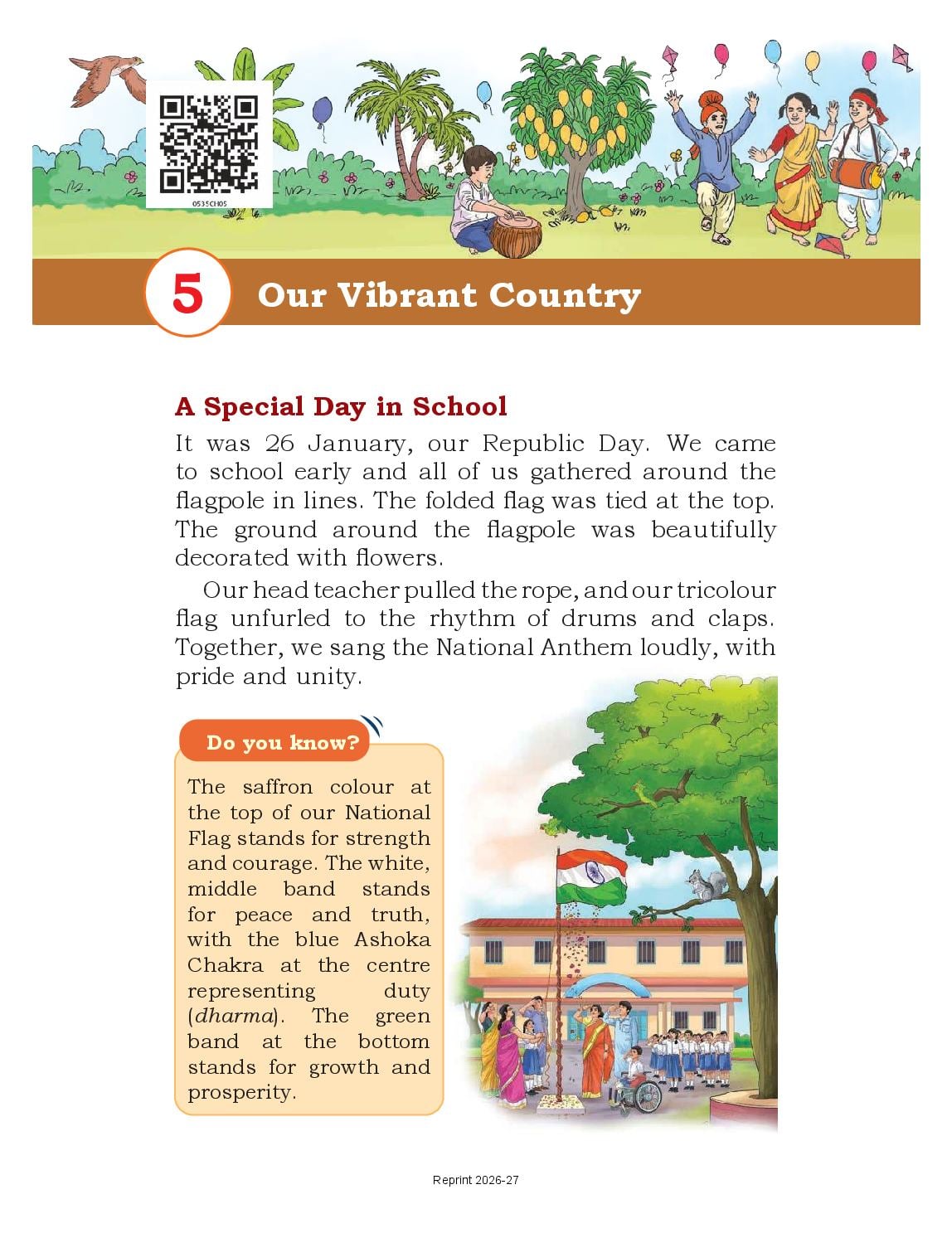
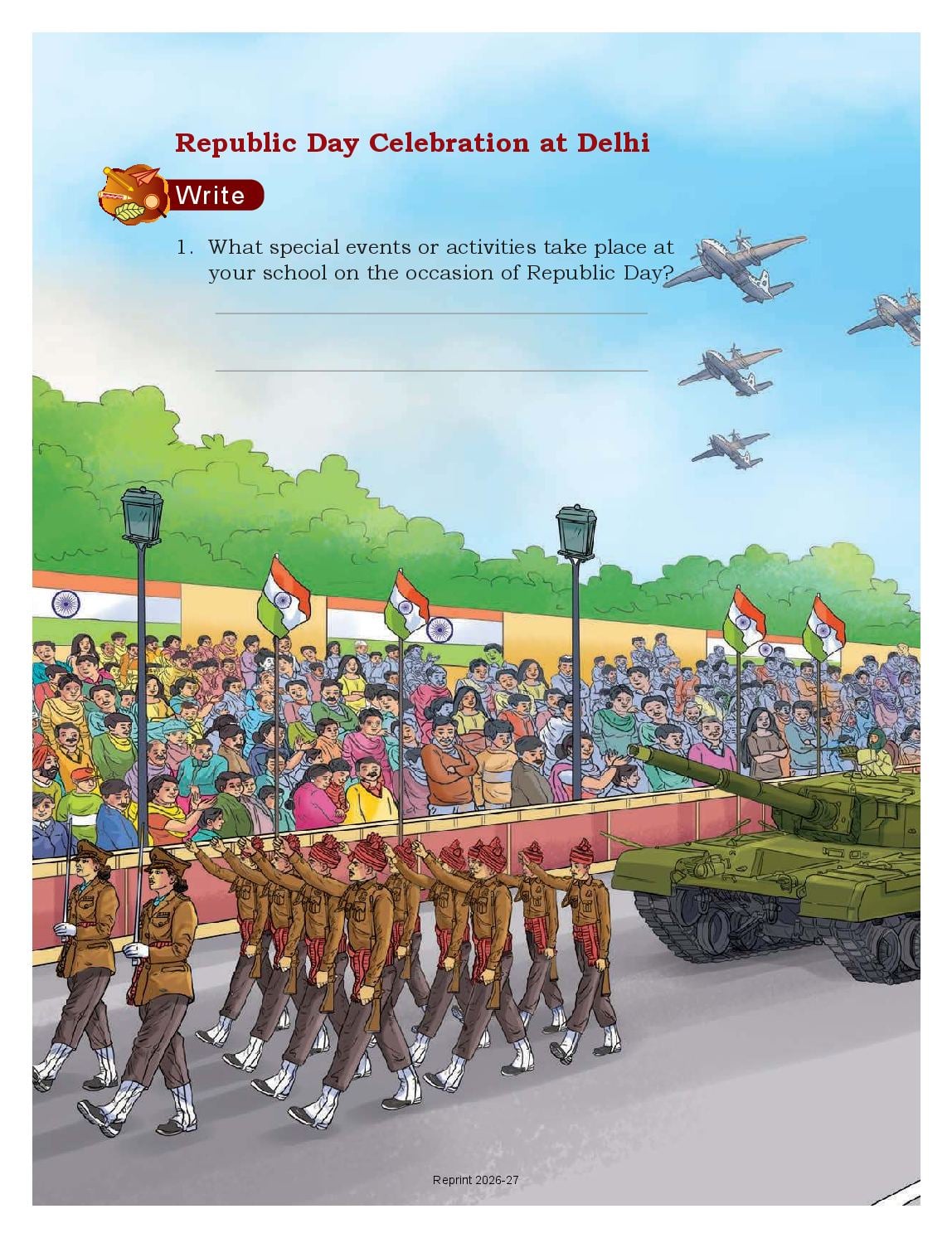
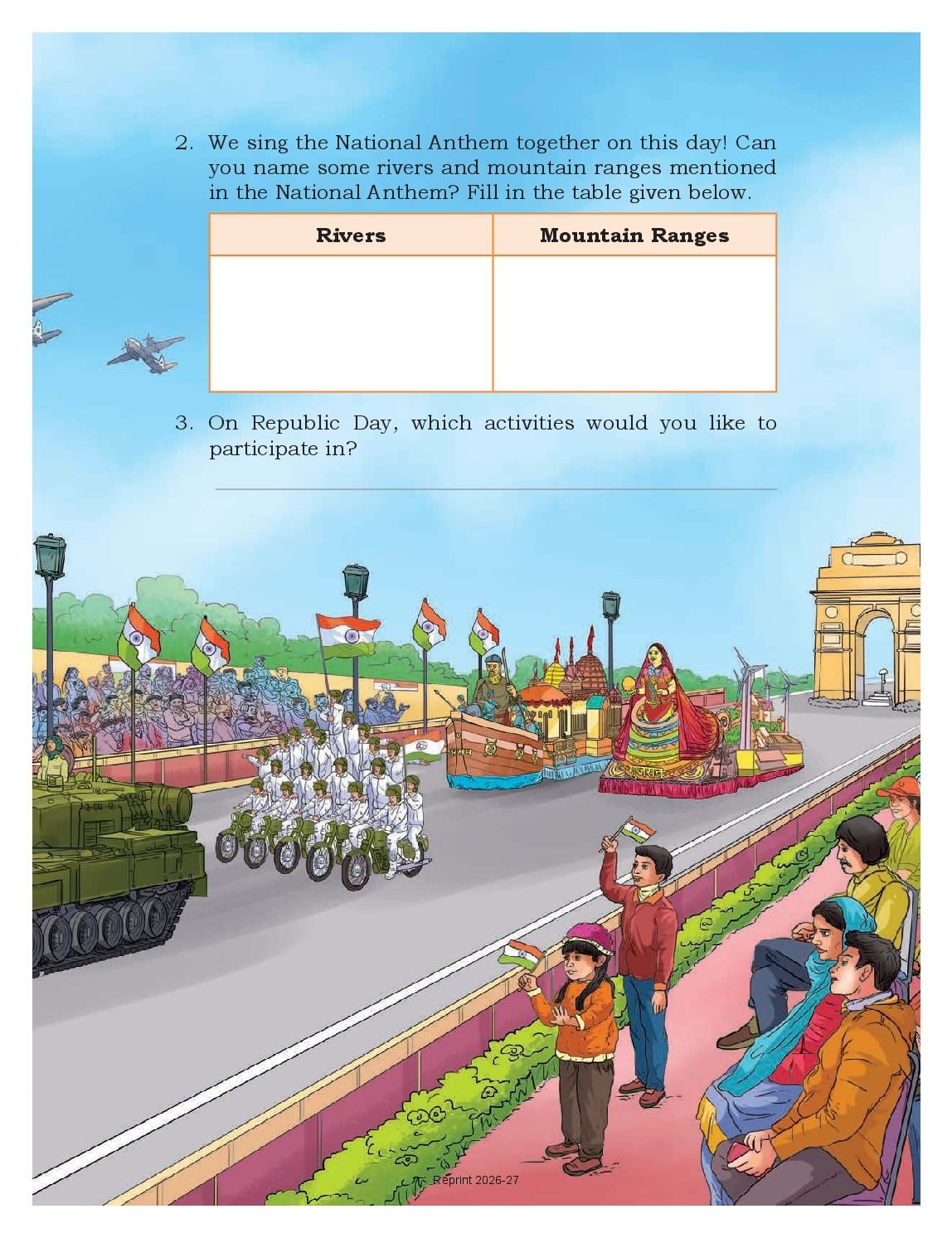
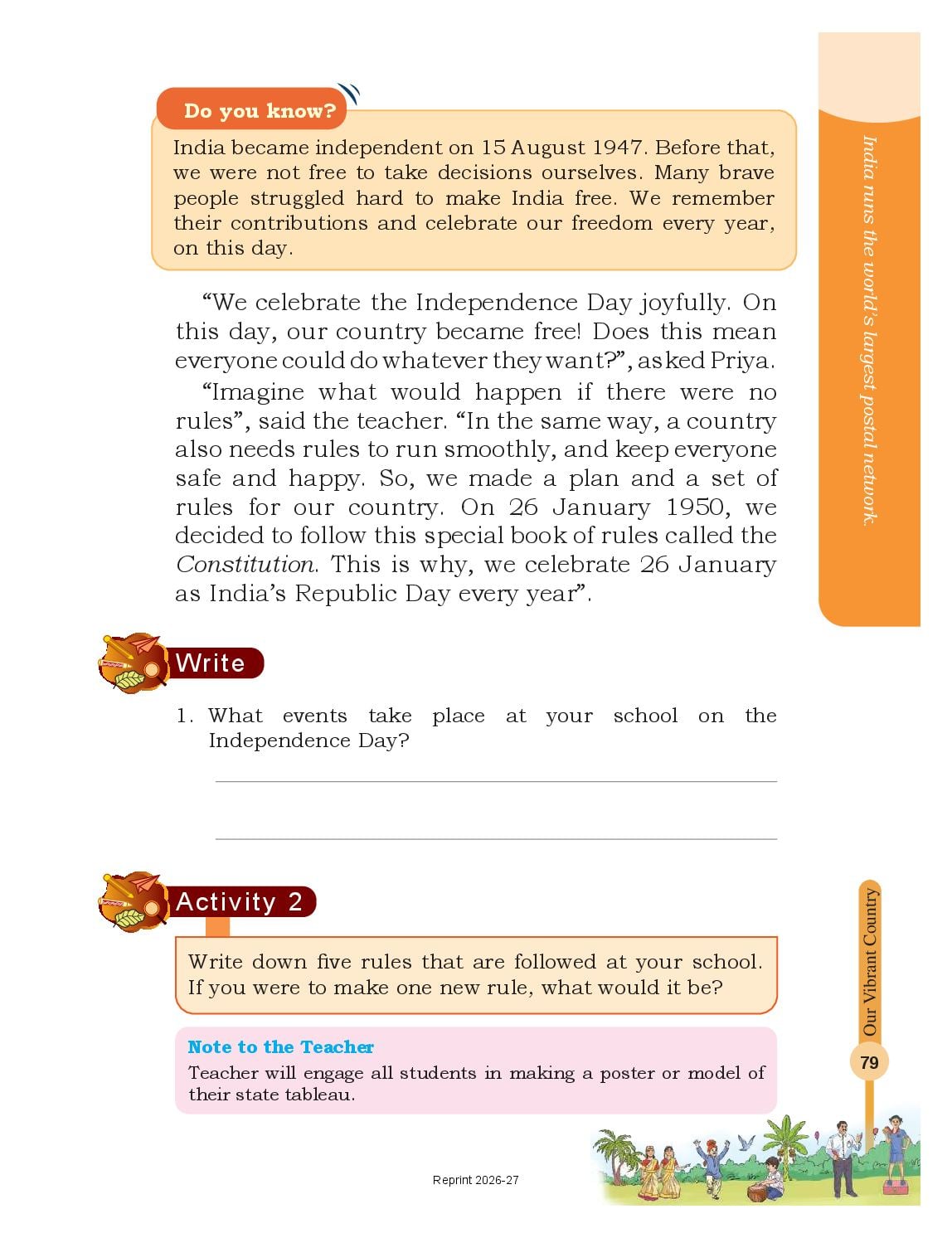
- Republic Day is about our book of rules. India became free on 15 August 1947. But a free country still needs rules, so that everyone stays safe and is treated fairly. Our leaders wrote a special book of rules for India. It is called the Constitution. We began following it on 26 January 1950. That is why 26 January is our Republic Day. India’s Constitution is the longest written constitution of any country in the world.
- The National Flag tells us four things. Saffron on top stands for strength and courage. White in the middle stands for peace and truth. The blue Ashoka Chakra in the white band stands for duty and dharma. Green at the bottom stands for growth and prosperity. The flag is unfurled on Republic Day and hoisted on Independence Day, and we sing the National Anthem together.
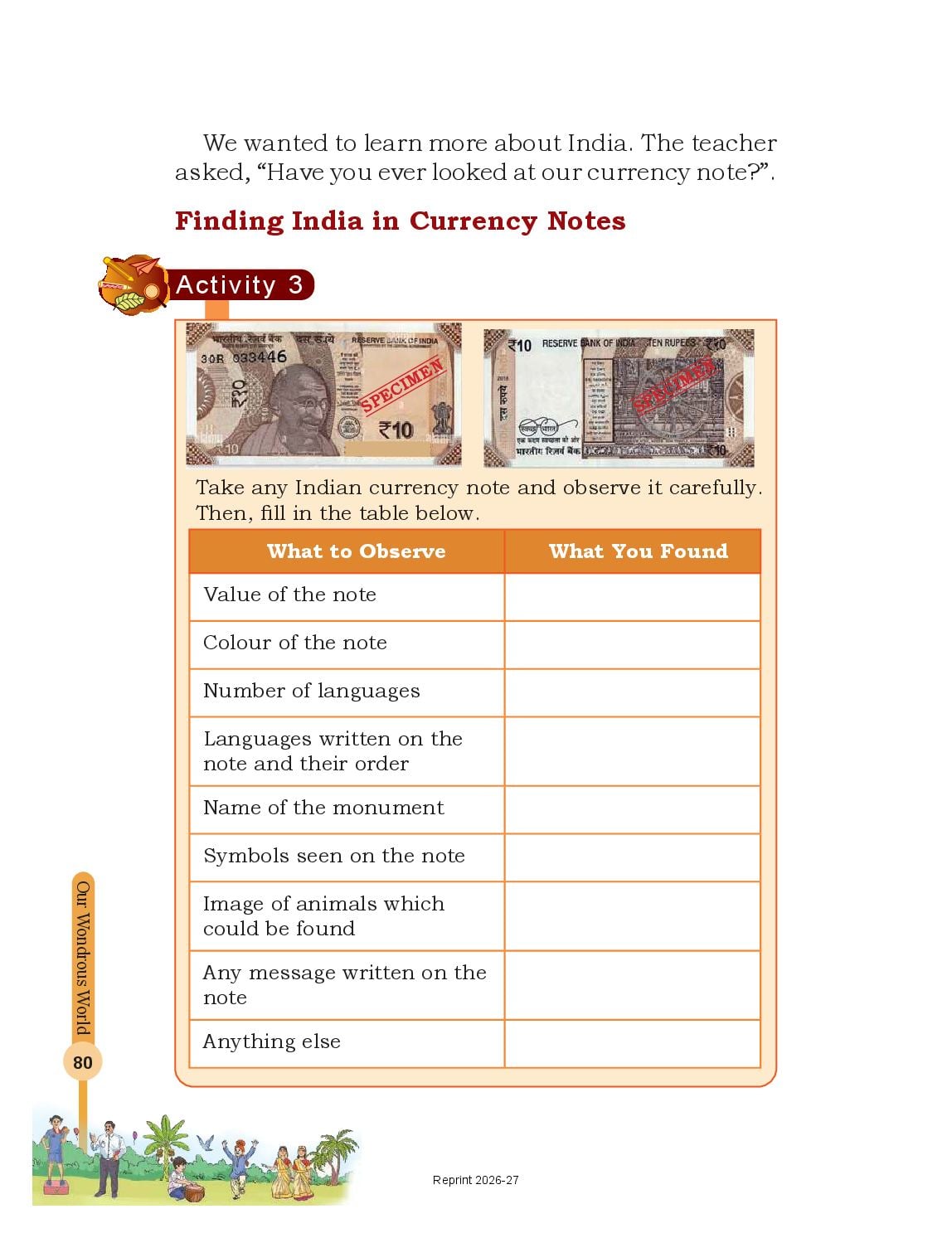
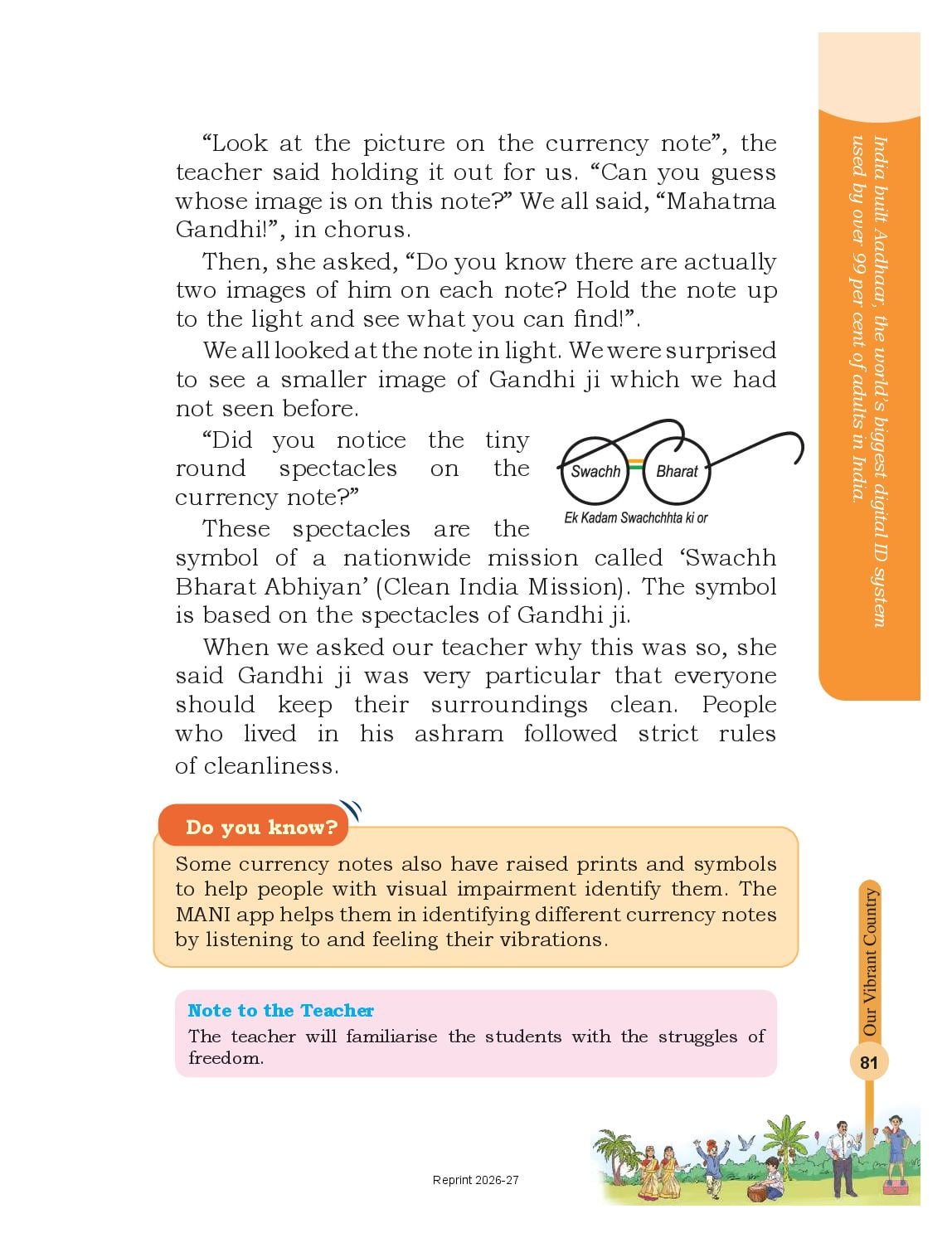
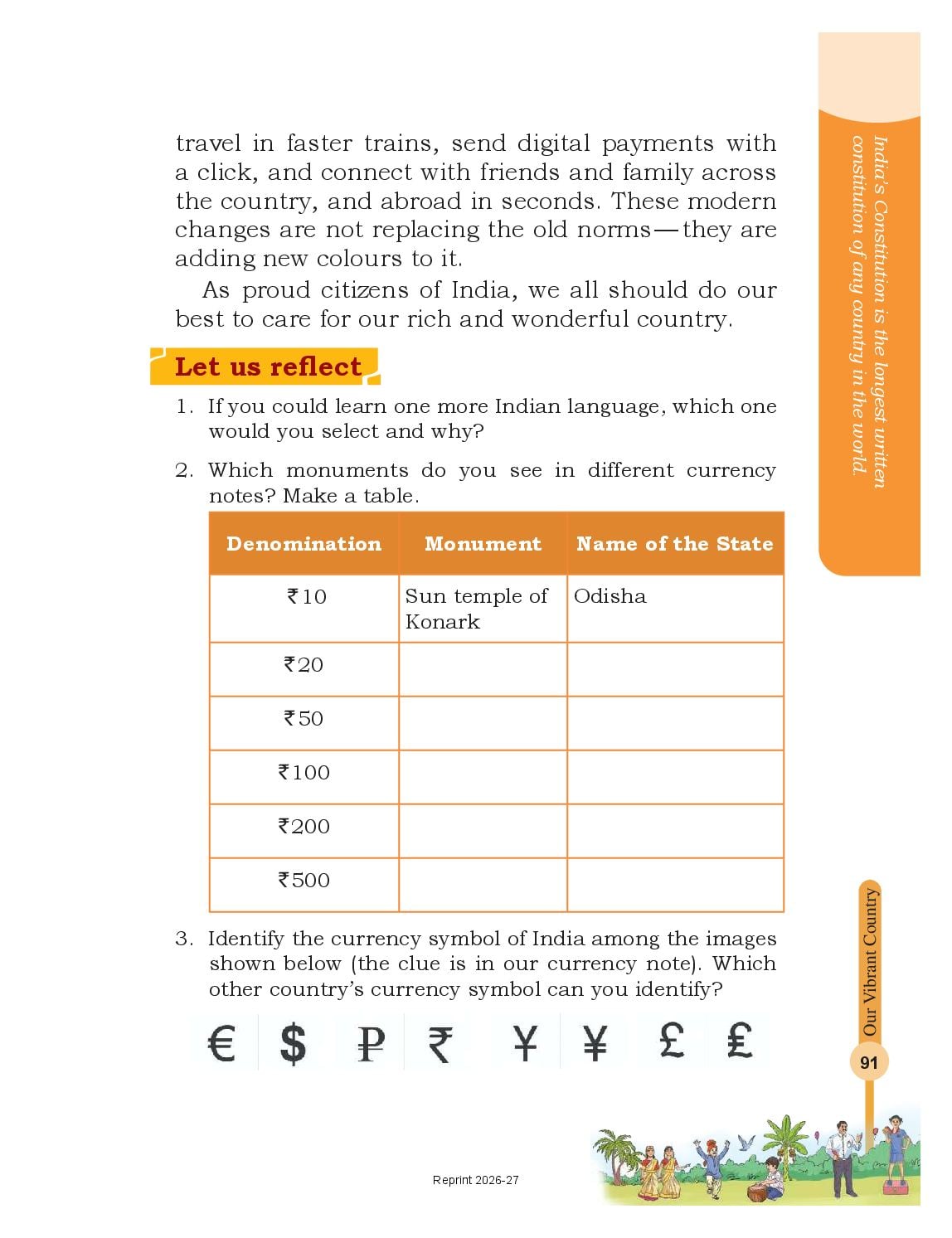
- A currency note is full of India. Hold a ten-rupee note. On the front are Mahatma Gandhi, the National Emblem — three lions on a round base — and the value written in Hindi and English. Hold it up to the light and a second, smaller Gandhi appears. That is the watermark. On the back is the Sun Temple of Konark in Odisha, the round spectacles of the Swachh Bharat Abhiyan, and a panel with the value in 15 more Indian languages. Some notes have raised marks so that people who cannot see can feel which note it is. The MANI app also reads notes aloud for them.
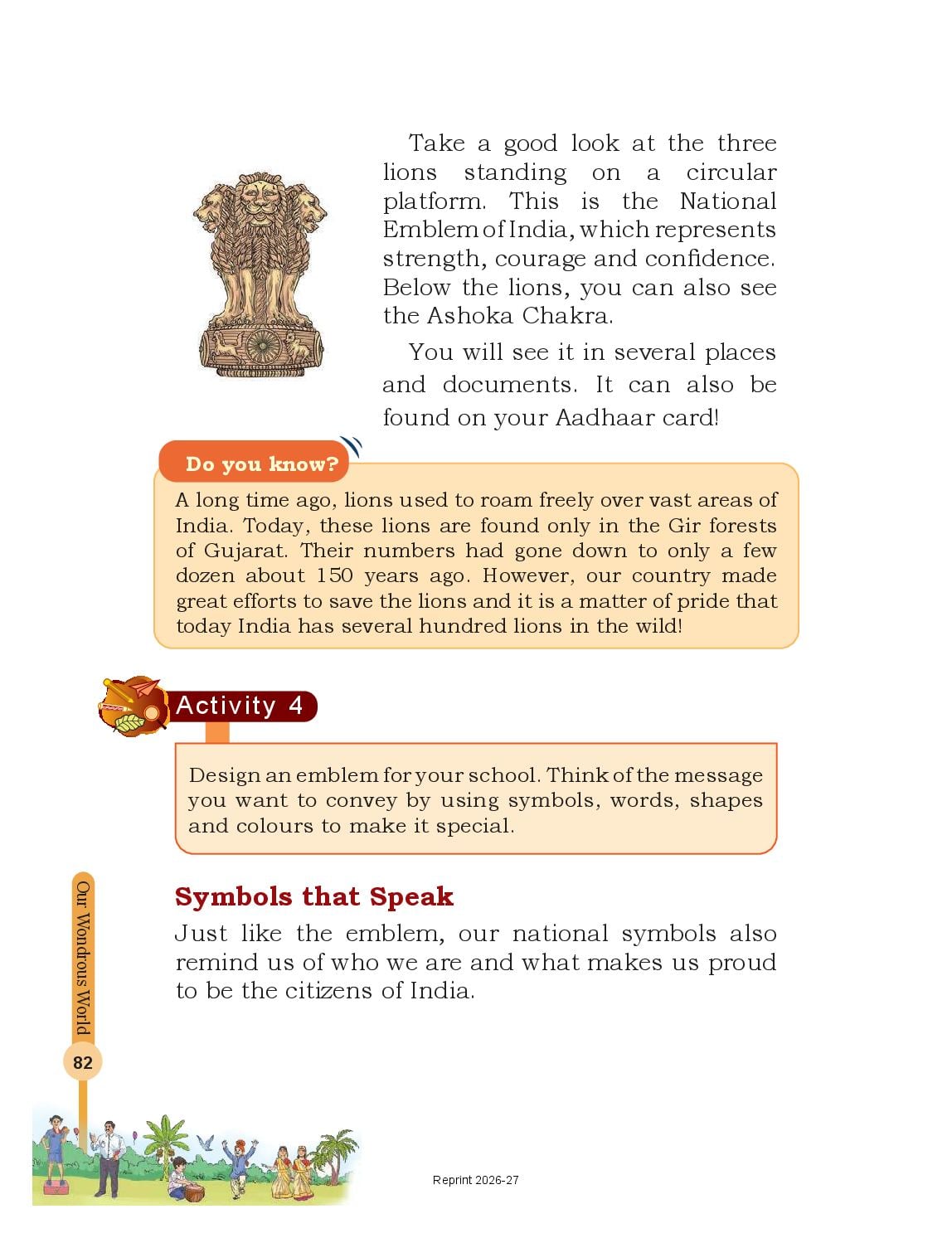
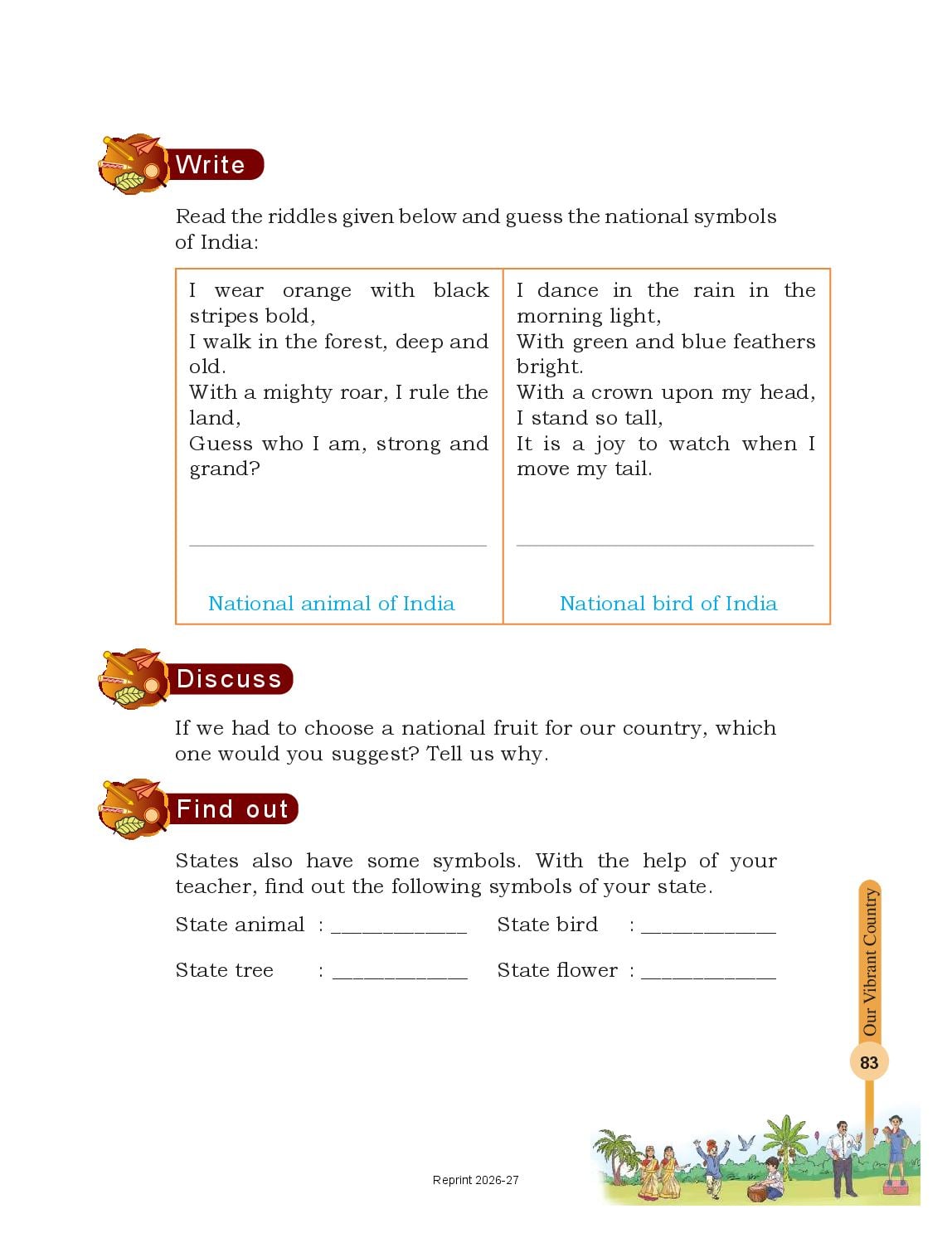
- National symbols remind us who we are. Our National Animal is the tiger, our National Bird the peacock, our National Flower the lotus, our National Tree the banyan and our National Fruit the mango. The National Emblem is taken from the Lion Capital that Emperor Ashoka set up at Sarnath. Every state has its own symbols too — a state animal, a state bird, a state tree and a state flower.
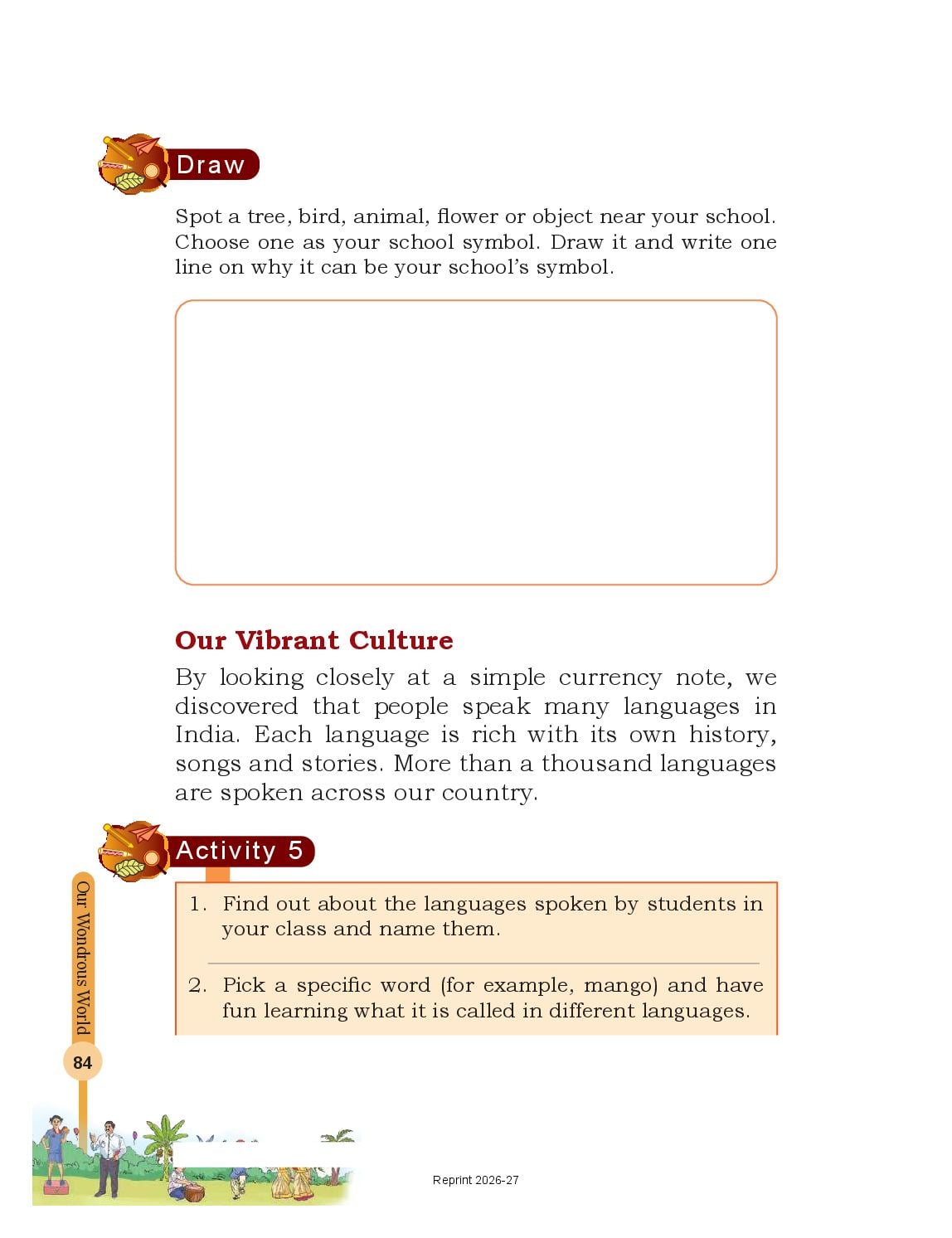
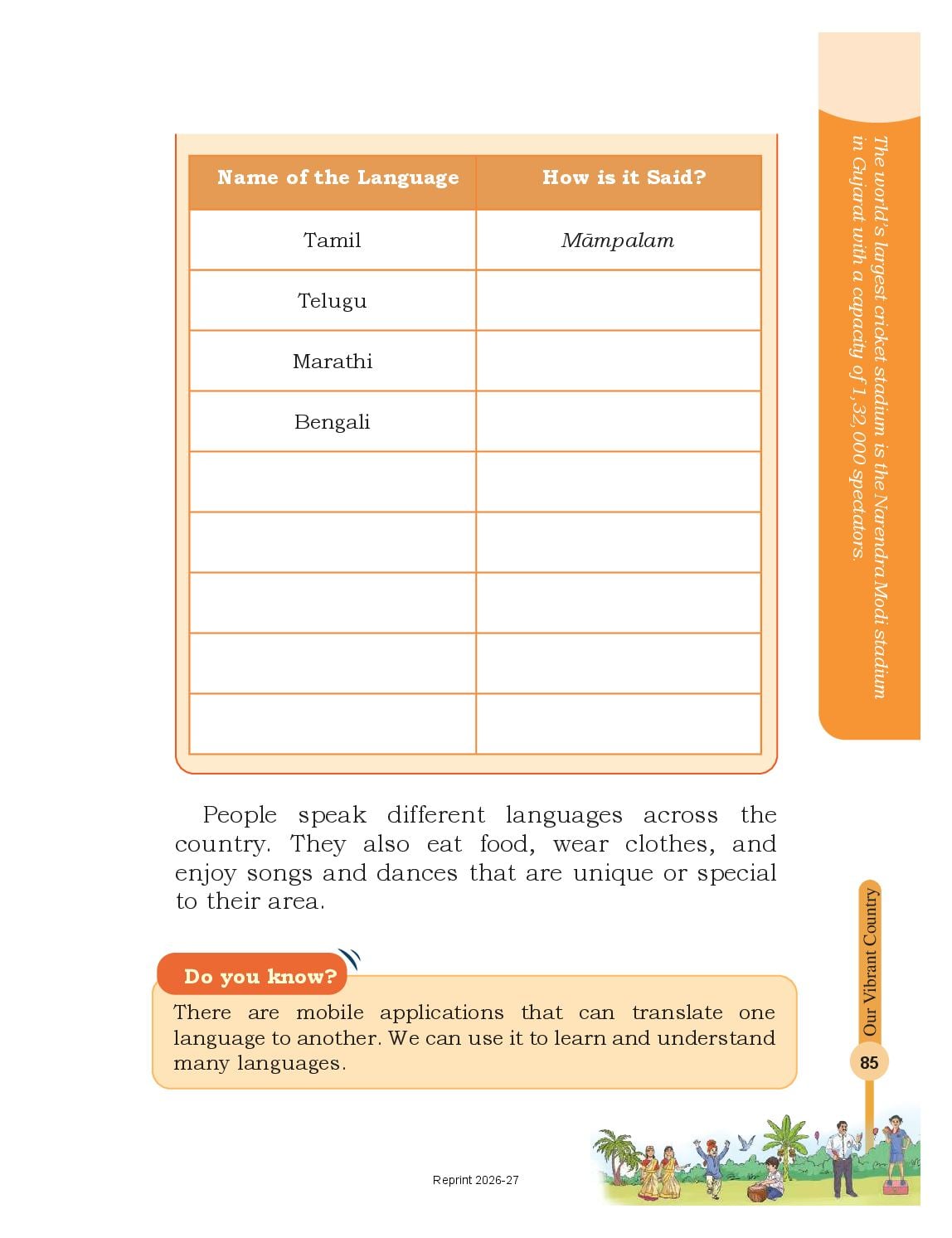
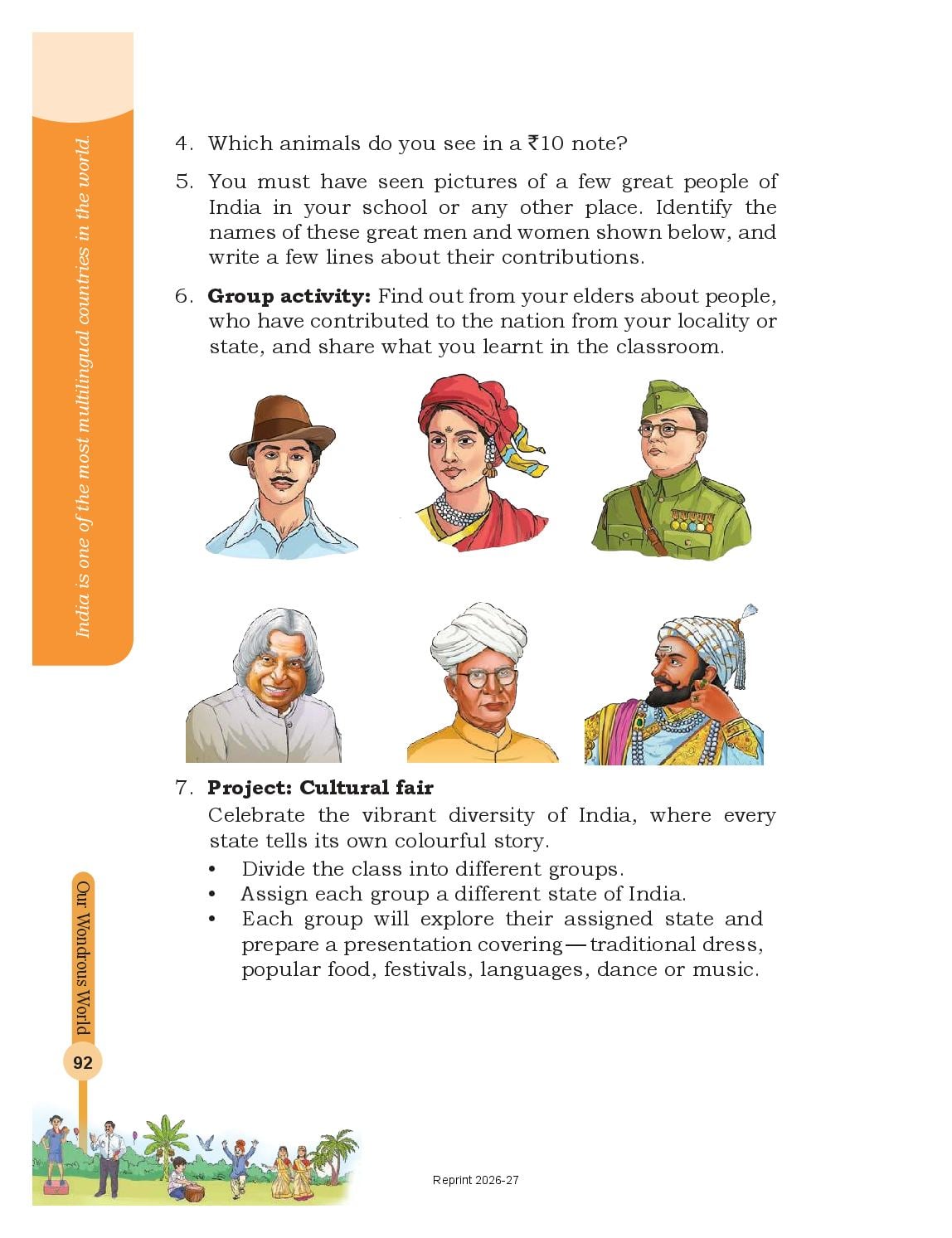
- India speaks more than a thousand languages. Twenty-two of them are listed in the Constitution. One fruit can have many names — māmpalam in Tamil, āmba in Marathi, ām in Bengali and Hindi, kerī in Gujarati. Each language carries its own songs, stories and history. India is one of the most multilingual countries in the world.
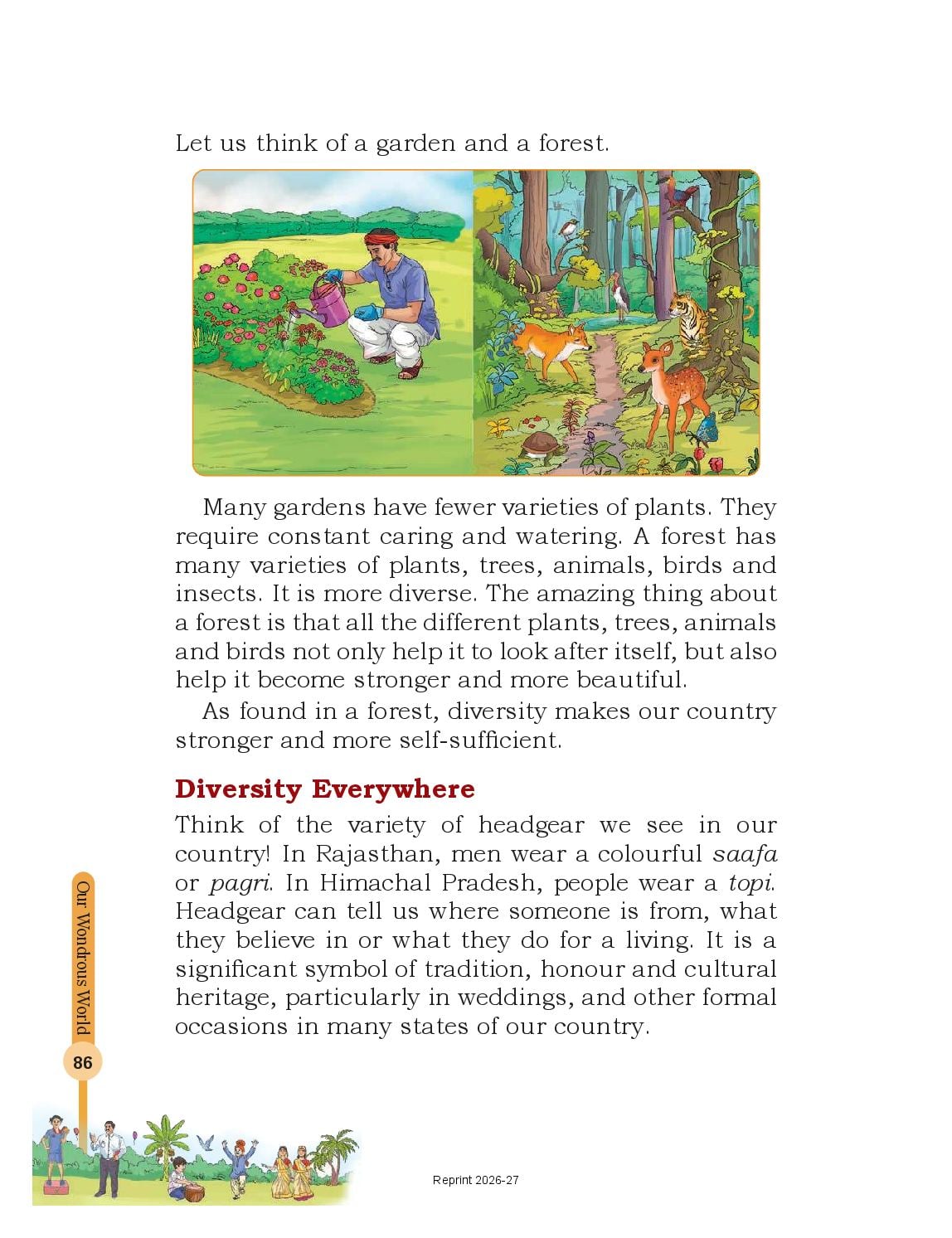
- Diversity makes a country strong, the way it makes a forest strong. A garden has only a few kinds of plants and needs constant care. A forest has hundreds of kinds of plants, animals, birds and insects. They look after each other, and the forest grows richer and stronger on its own. India is like the forest, not the garden.
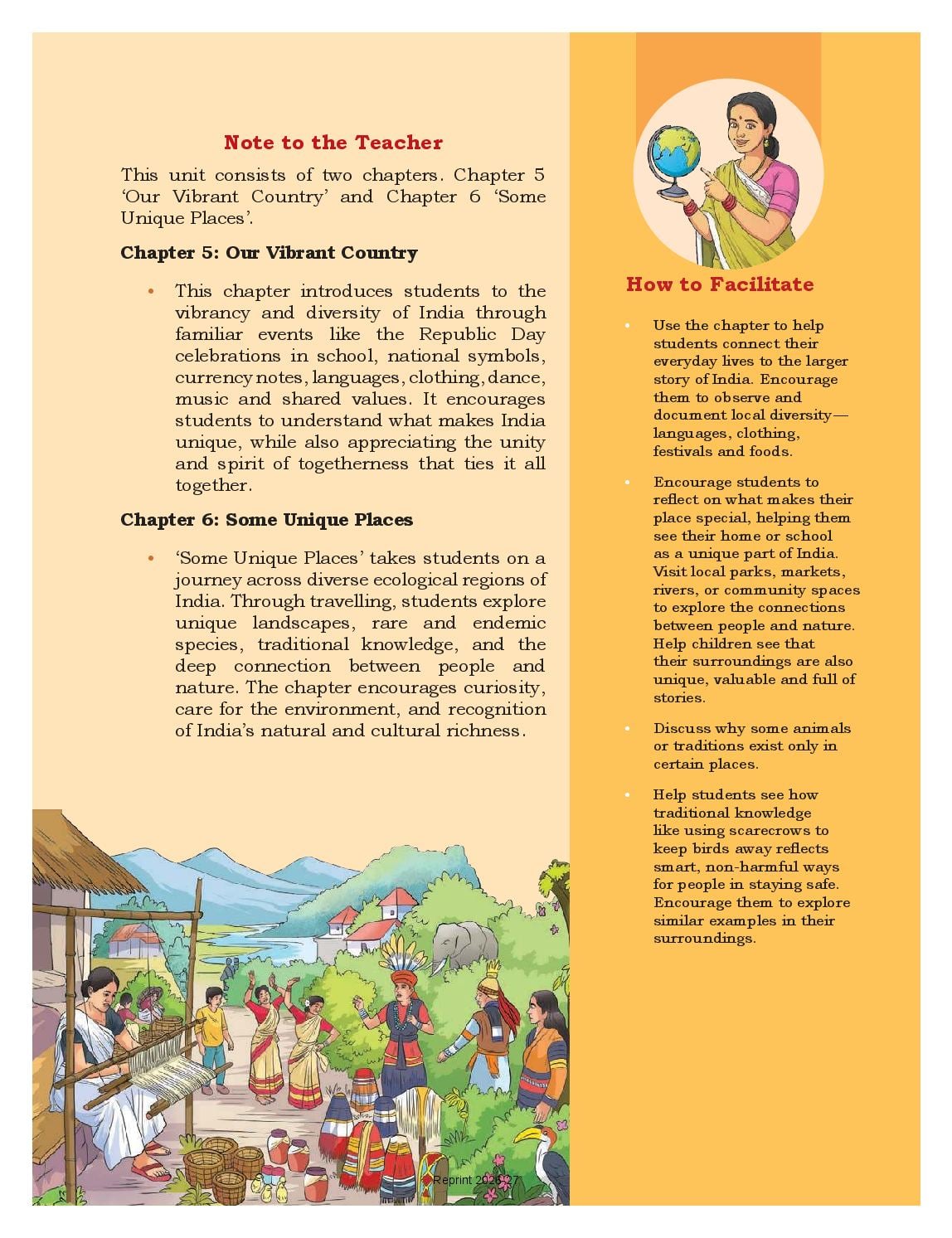
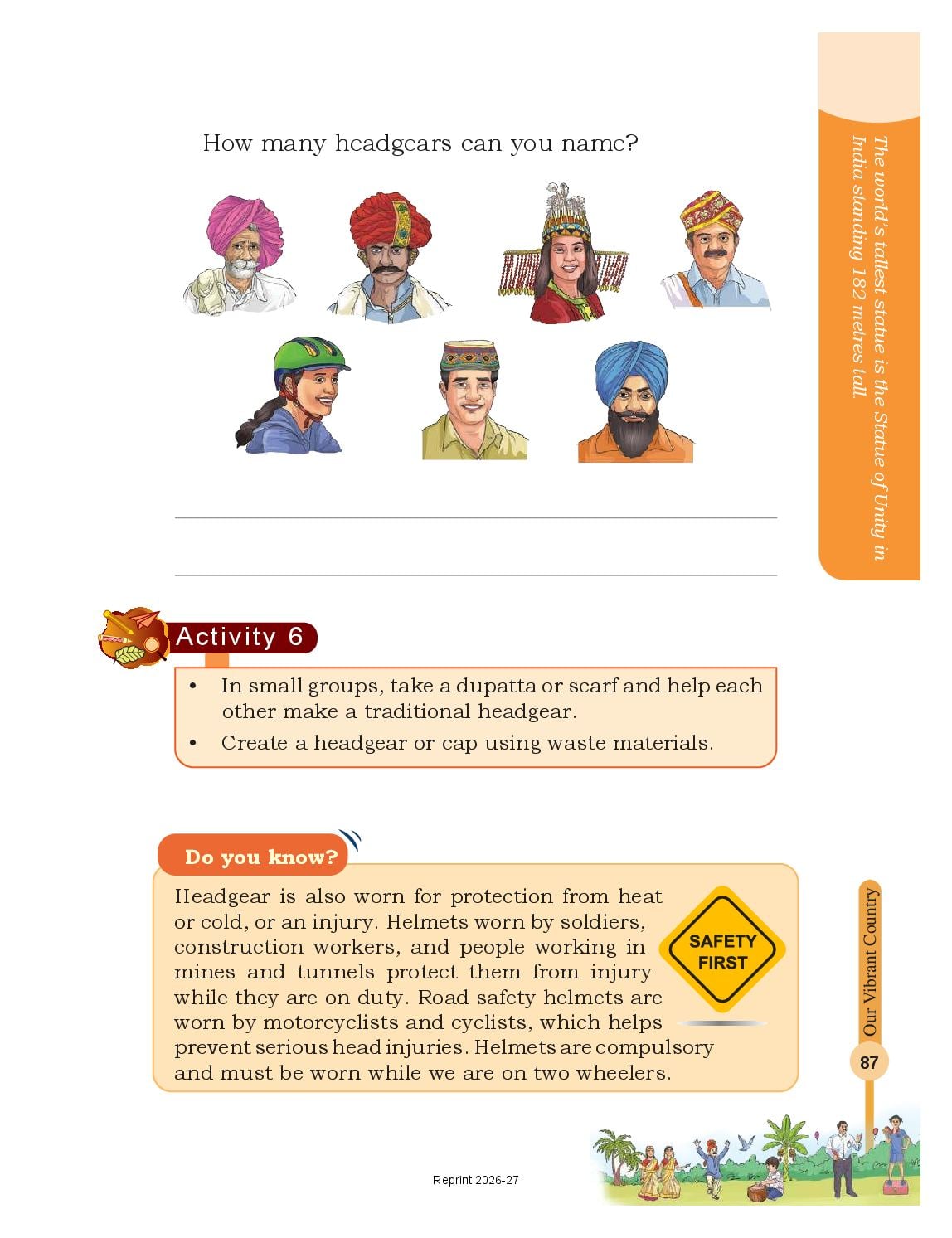
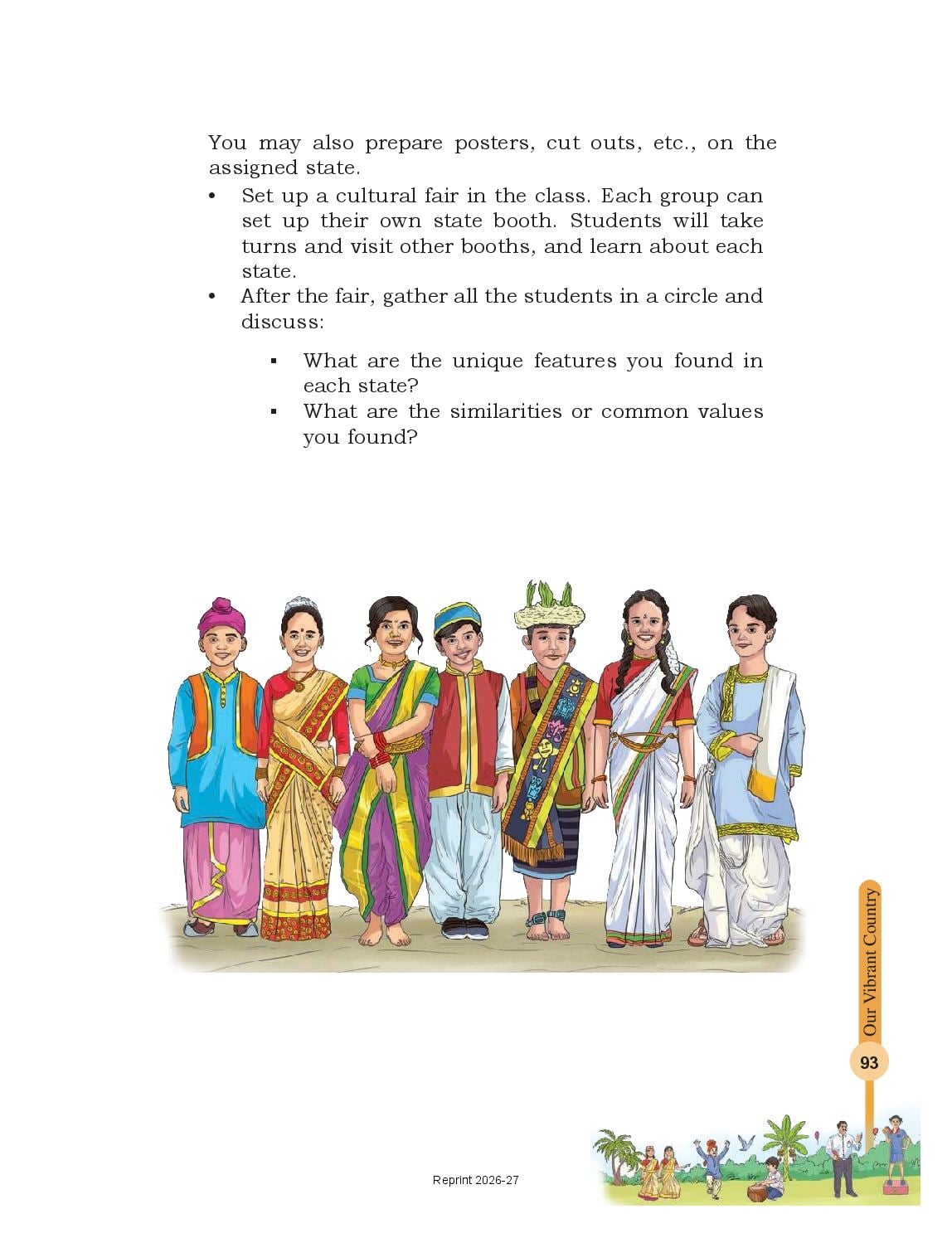
- You can read a person’s region in a headgear. In Rajasthan men tie a bright safa or pagri. In Himachal Pradesh people wear a woven topi. Many people in the North-East wear a decorated woven headdress on festival days. Headgear can show where a person is from, what they believe, or what work they do. Headgear also protects — a soldier’s helmet, a miner’s helmet, and the road helmet that everyone must wear on a two-wheeler.
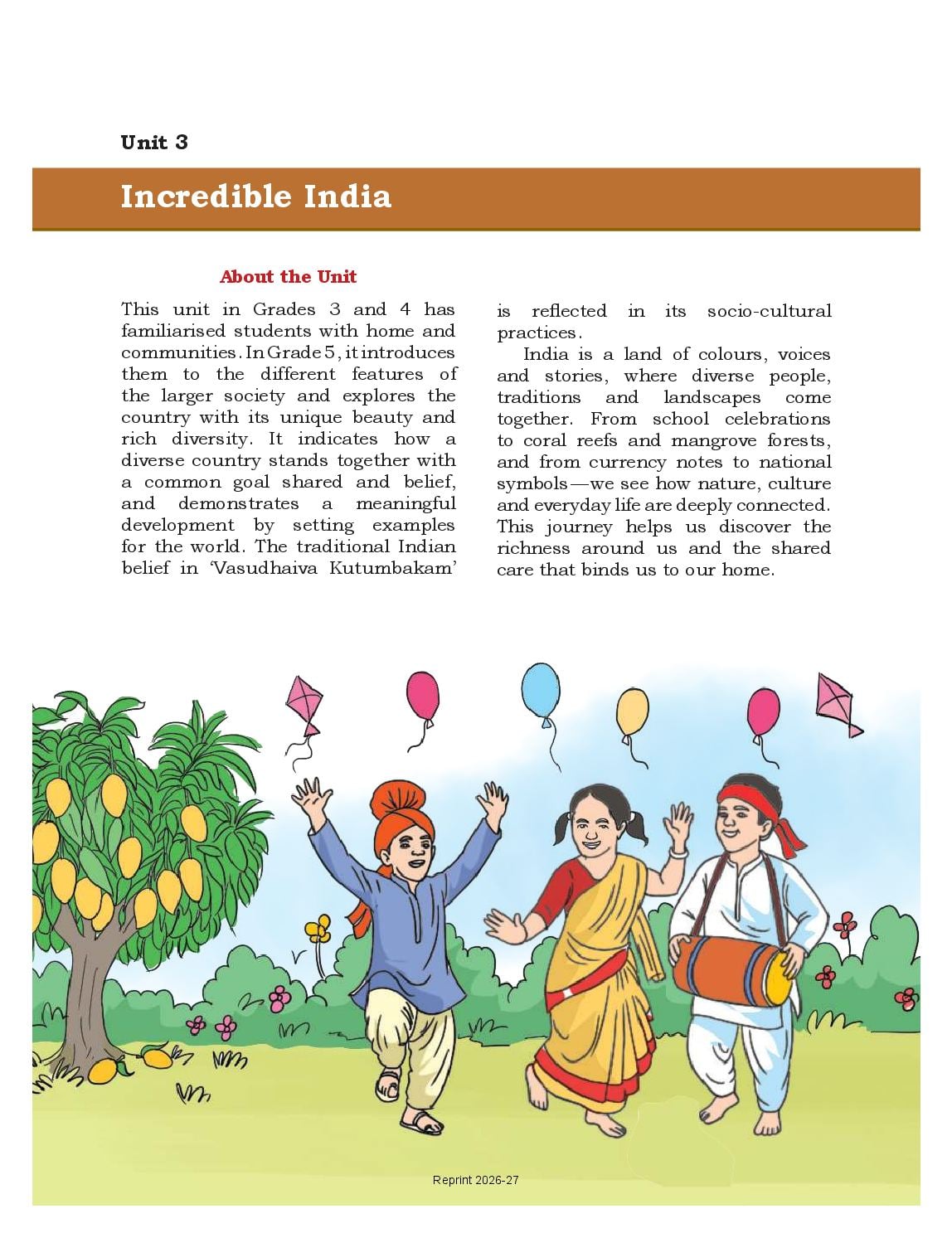
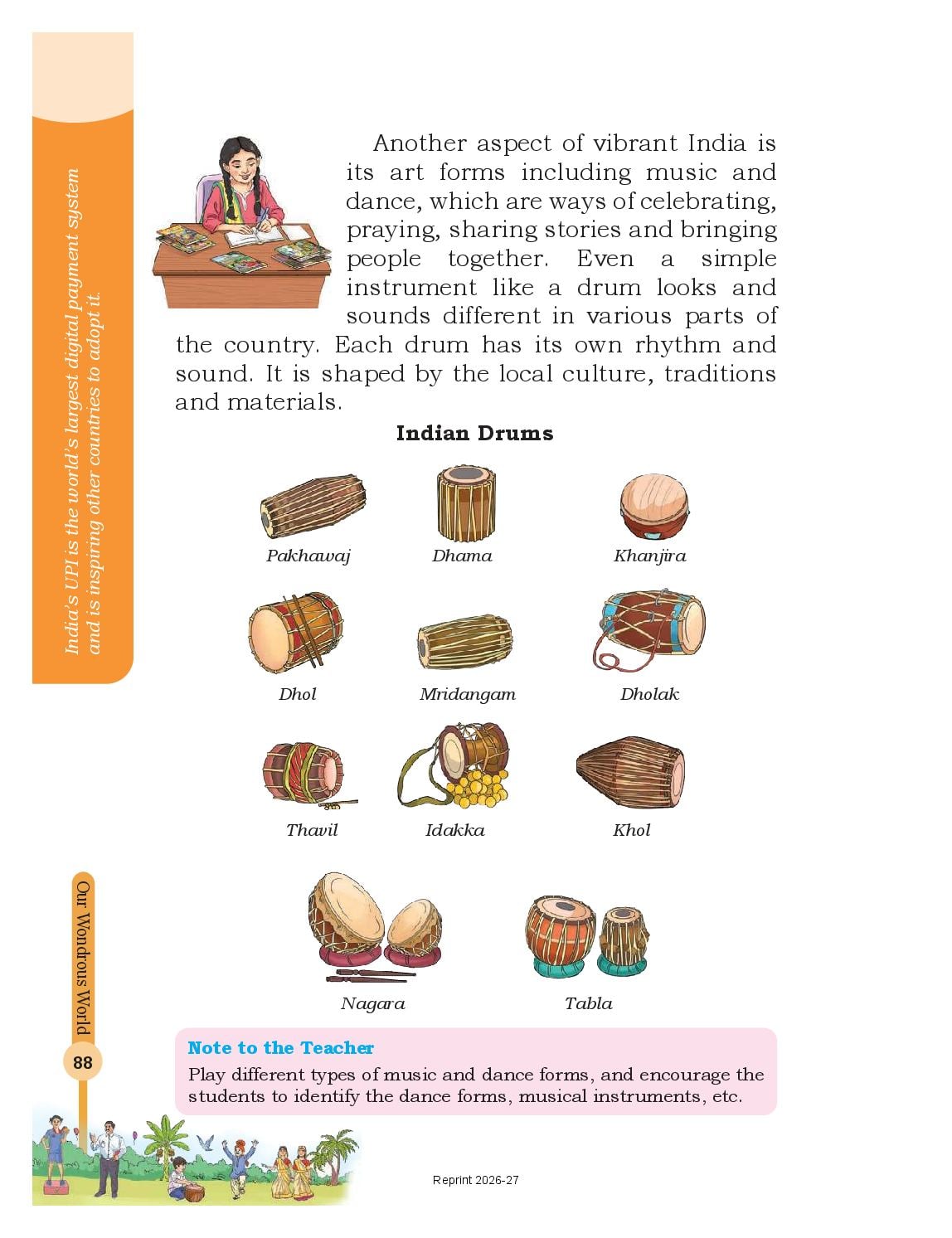
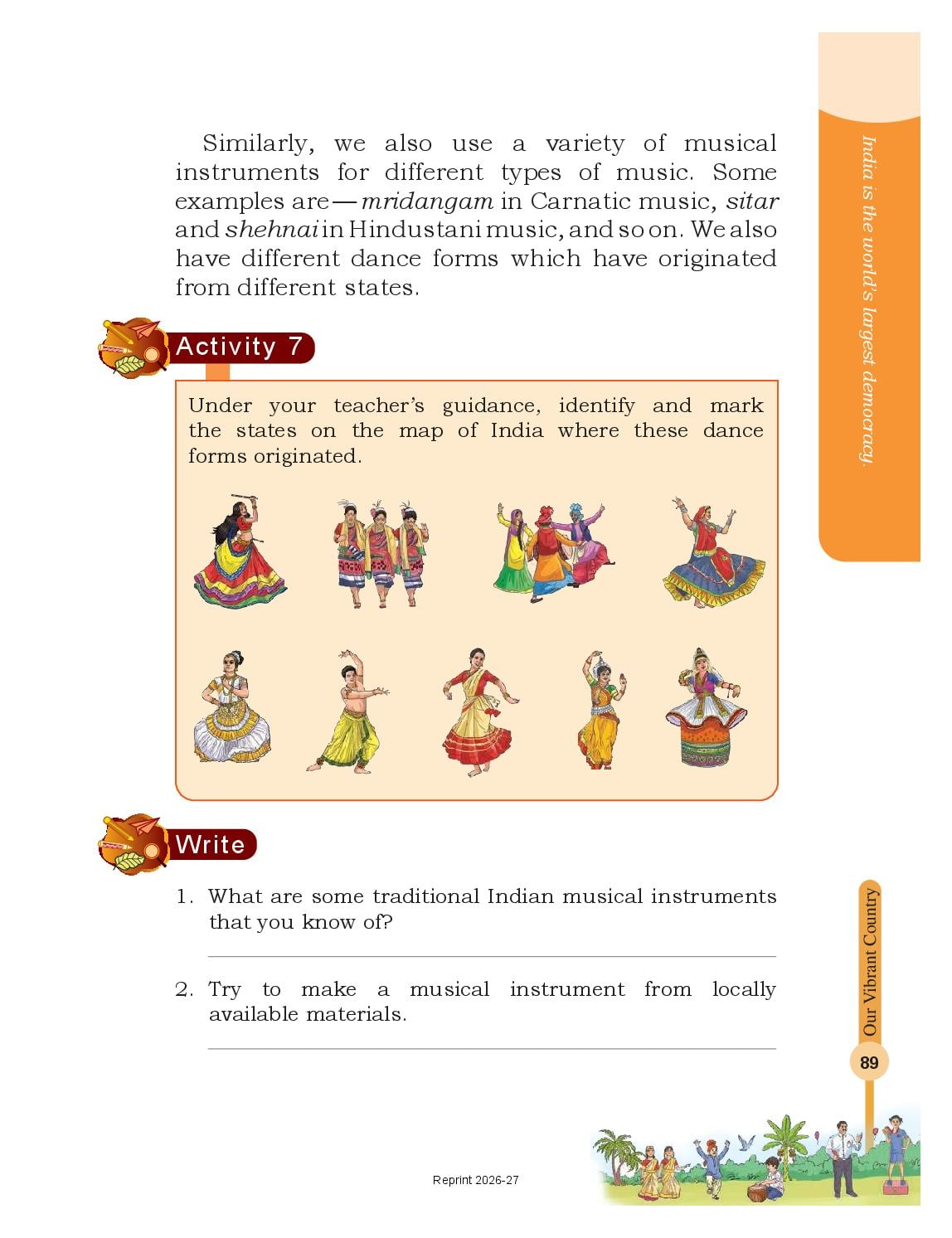
- Even a drum changes from state to state. The chapter’s picture panel shows eleven Indian drums: pakhawaj, dhama, khanjira, dhol, mridangam, dholak, thavil, idakka, khol, nagara and tabla. Each is made of the wood, skin and rope of its own region, and each has its own sound. In the same way, mridangam belongs to Carnatic music, and sitar and shehnai to Hindustani music. Different states have also given us different dance forms.
Quick revision – Our Vibrant Country
| Word | What it means | Where it appears | An everyday example |
|---|---|---|---|
| Republic Day | 26 January, the day we began following our Constitution | A Special Day in School, page 75 | The flag ceremony and parade in your school |
| Constitution | The special book of rules by which our country is run | Do you know?, page 79 | It says every child has the right to go to school |
| Ashoka Chakra | The blue wheel in the middle of the flag; it stands for duty and dharma | Do you know?, page 75 | The wheel in the centre of the tricolour |
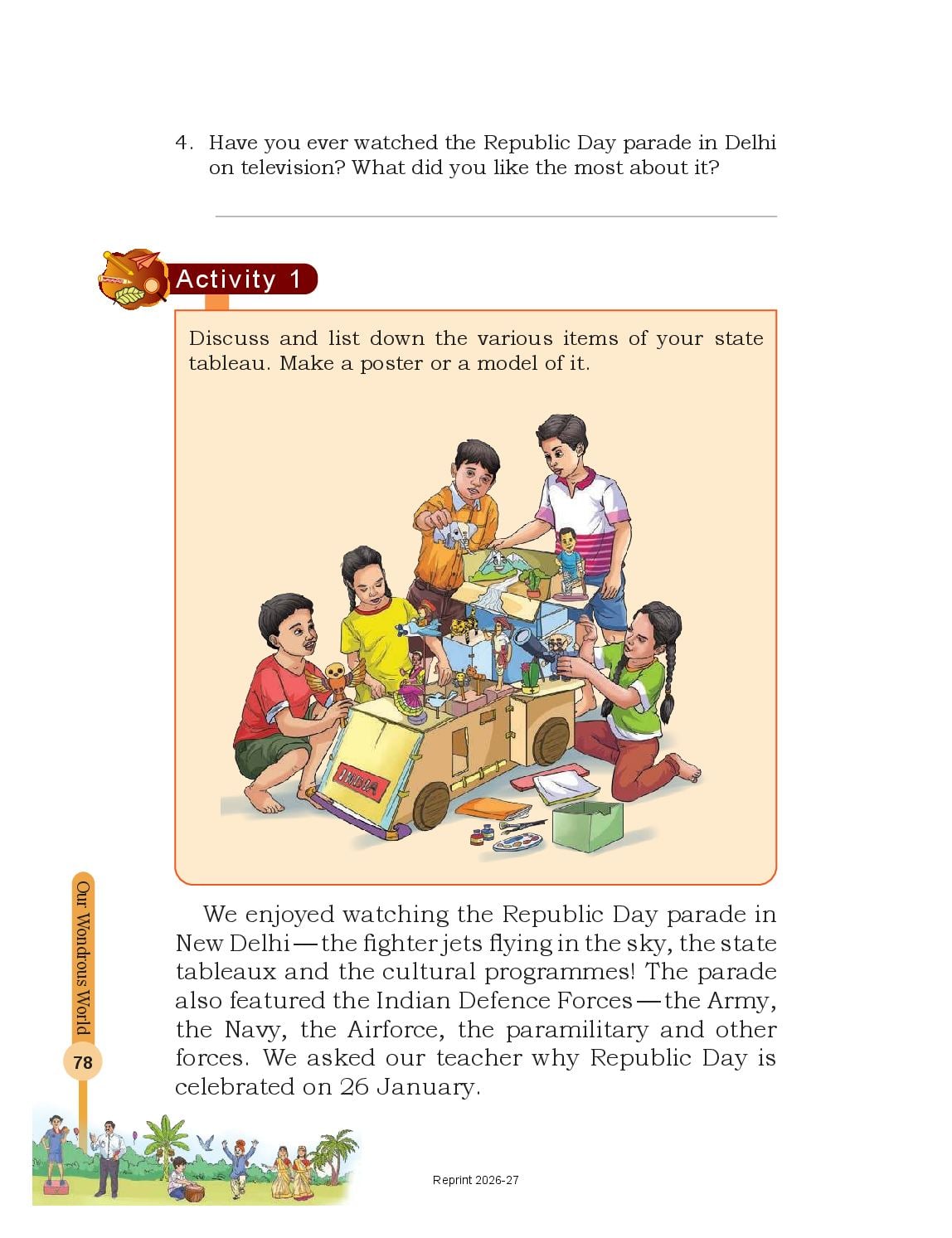
| Tableau (jhanki) | A decorated float that shows the life and culture of one state | Activity 1, page 78 | A Kerala float with a boat race on it |
| National Emblem | Three lions on a round base, taken from Ashoka’s pillar at Sarnath | Symbols that Speak, page 82 | Printed on your Aadhaar card and on every note |
| Watermark | A hidden picture inside the paper that shows only against light | Page 81 | The small second Gandhi on a currency note |
| Swachh Bharat Abhiyan | The Clean India Mission; its sign is Gandhi ji’s round spectacles | Page 81 | The spectacles printed on the back of a note |
| Currency symbol | The short sign written before an amount of money | Let us reflect 3, page 91 | ₹ 50 means fifty rupees |
| Diversity | Having many different kinds of people, languages and ways of living | Diversity Everywhere, page 86 | Four languages spoken in one classroom |
| Headgear | Anything worn on the head — turban, cap, helmet, woven crown | Page 86 | A safa, a Himachali topi, a cycling helmet |
| Safa / pagri | The long cloth wound round the head as a turban, tied in many styles | Page 86 | The bright pink turban of a Rajasthani elder |
| Art form | A way of saying something through music, dance, painting or craft | Page 88 | Bhangra, Odissi, a rangoli at the doorstep |
| Mridangam | A two-sided drum used in Carnatic music of South India | Page 89 | Played beside a singer in a Carnatic concert |
| Vasudhaiva Kutumbakam | An old Indian saying: the whole world is one family | About the Unit | Helping a new child in class feel at home |
Old NCERT vs New – Class 5 EVS
This chapter is from Our Wondrous World, the new NCERT Class 5 EVS book (NCF-SE 2023, used from 2025-26). It replaced the old book “Looking Around”, so chapter numbers and names differ from older PDFs.
Solutions and All Chapters
Answers to the exercises and the full chapter list of Our Wondrous World:
Our Vibrant Country – Overview
| Class | Class 5 |
| Subject | EVS |
| Book | Our Wondrous World – new NCERT book |
| Chapter | 5 of 10 – Our Vibrant Country |
| Book pages | 75 – 93 |
| Edition | NCERT Reprint 2026-27 |
| Session | 2026-27 |
| Free – read online or download |
Class 5 EVS Chapter 5 – FAQs
Where can I download Our Vibrant Country Class 5 PDF?
From the download table on this page – the chapter PDF is free, and the full book is linked too.
What is Class 5 EVS Chapter 5 about?
Republic Day is about our book of rules. India became free on 15 August 1947. But a free country still needs rules, so that everyone stays safe and is treated fairly. Our leaders wrote a special book of rules for India. It is called the Constitution. We began following it on 26 January 1950. That is why 26 January is our Republic Day. India’s Constitution is the longest written constitution of any country in the world.
Is Our Vibrant Country from the new NCERT Class 5 EVS book?
Yes. It is chapter 5 of our wondrous world, the new NCERT Class 5 EVS book for 2026-27.
Is this the latest NCERT edition for 2026-27?
Yes – the PDF is NCERT’s latest edition for the 2026-27 session.
Where are the NCERT Solutions for Class 5 EVS Chapter 5?
Open the NCERT Solutions link above for answers to the exercise questions.