NCERT Solutions for Class 5 English Chapter 10 Glass Bangles provide clear, step-by-step answers to every exercise and in-text question from the chapter Glass Bangles of the NCERT textbook Santoor. Prepared by subject experts as per the latest NCERT (CBSE) syllabus for 2026-27, these NCERT Solutions for Class 5 English help you understand each concept, write exam-ready answers, and check your own solutions. You can read them online below or download the free Class 5 English Chapter 10 question-answer PDF.
NCERT Solutions for Class 5 English Chapter 10 Glass Bangles
- Class: Class 5
- Subject: English
- Chapter: Chapter 10 – Glass Bangles
- Textbook: Santoor (NCERT)
- Study material: NCERT Solutions – questions with answers, free PDF
These solutions answer all the exercise questions of Chapter 10 Glass Bangles — including the in-text questions, short-answer and long-answer questions, and activities — with complete explanations so you can follow the method, not just the final answer. Read the full solutions below.
NCERT Solutions Class 5 English Chapter 10 Glass Bangles View Download
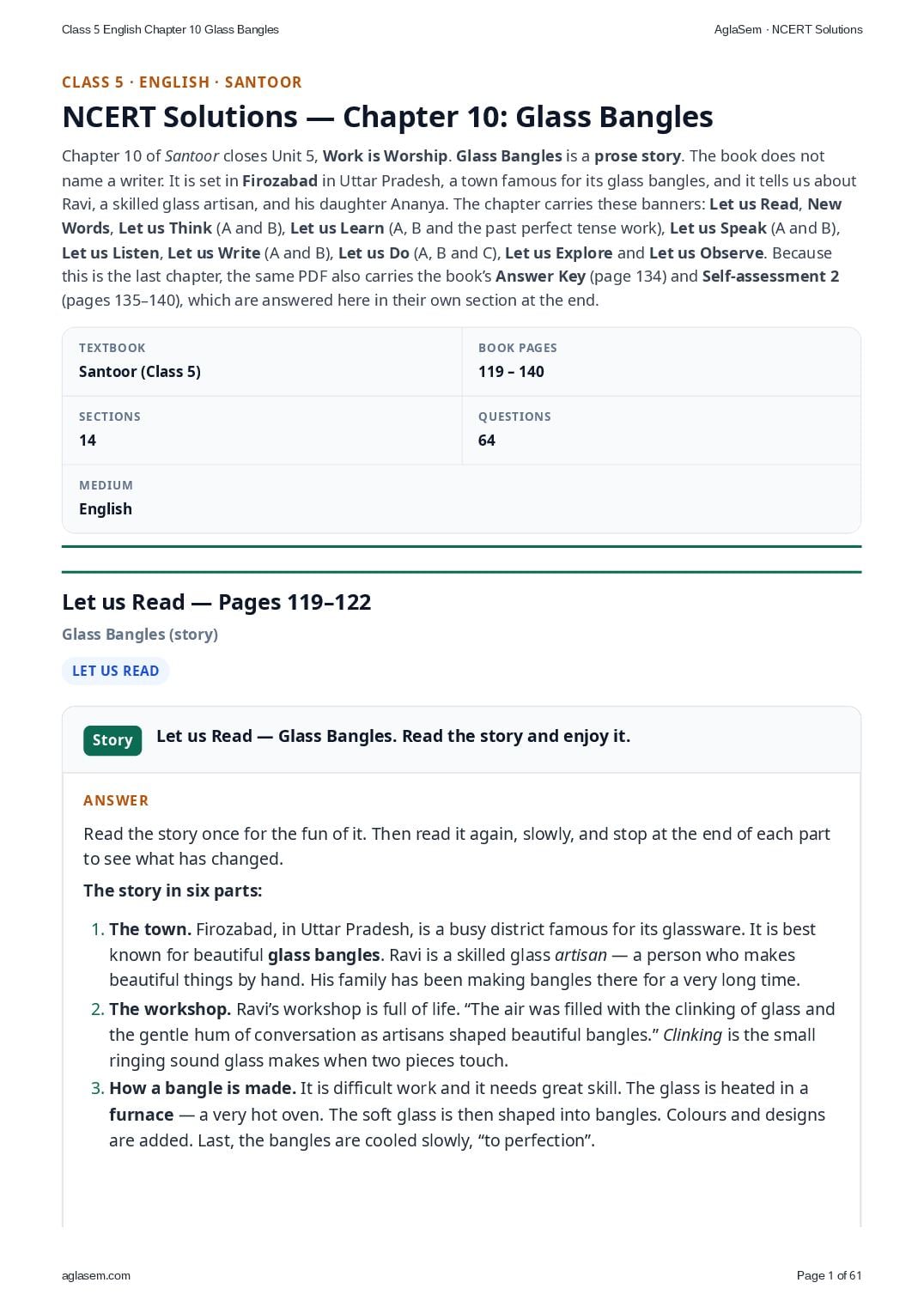
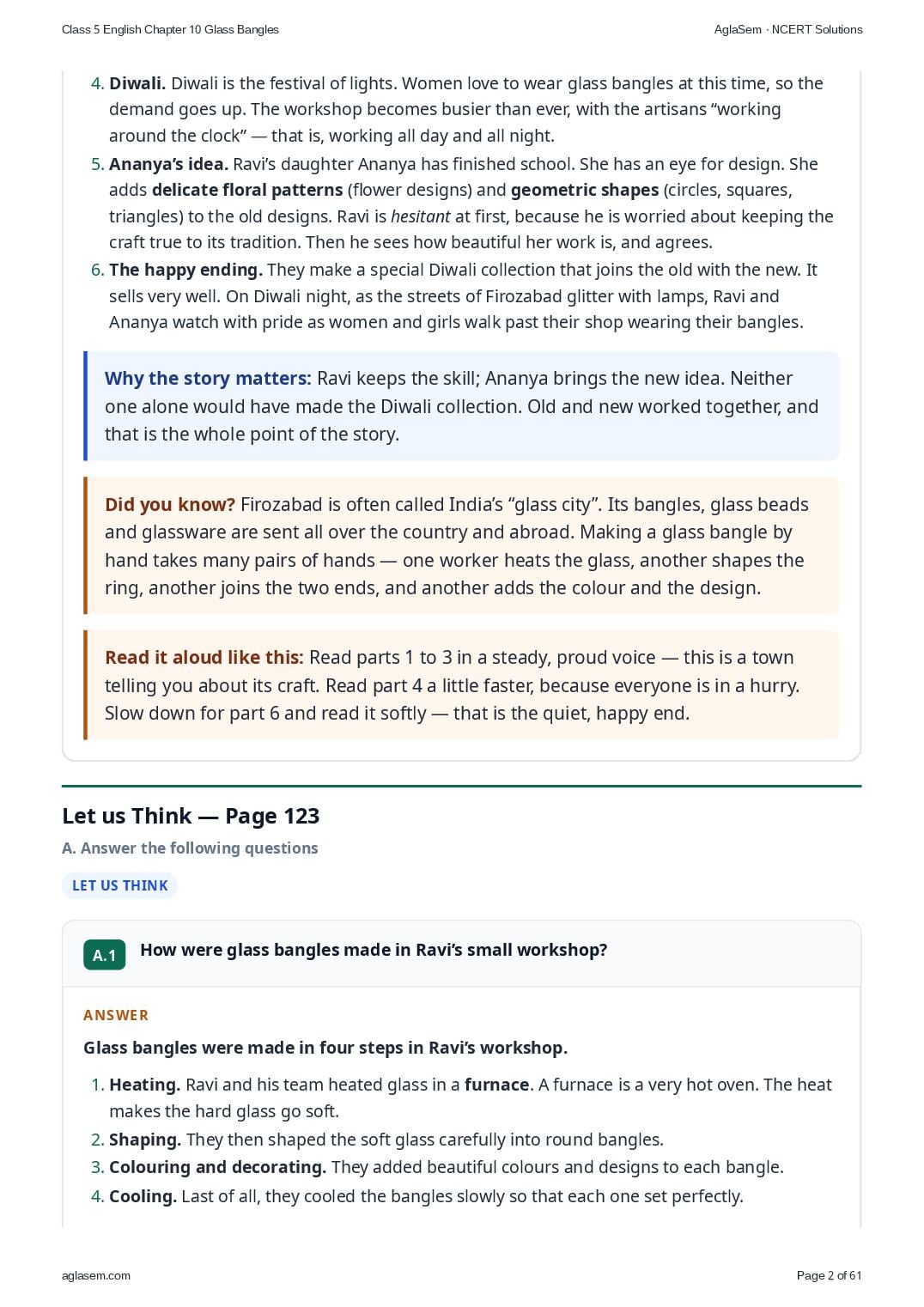
NCERT Solutions for Class 5 English Chapter 10 PDF Download
You can read the NCERT Solutions for Class 5 English Chapter 10 online above, or download the complete question-answer PDF to study Glass Bangles offline at any time.
NCERT Solutions for Class 5 English Chapter 10 PDF Download Link – Click Here to Download Solutions PDF
Questions Covered in This Chapter
These NCERT Solutions answer all 64 questions of this chapter. The questions solved are:
- Let us Read — Glass Bangles. Read the story and enjoy it.
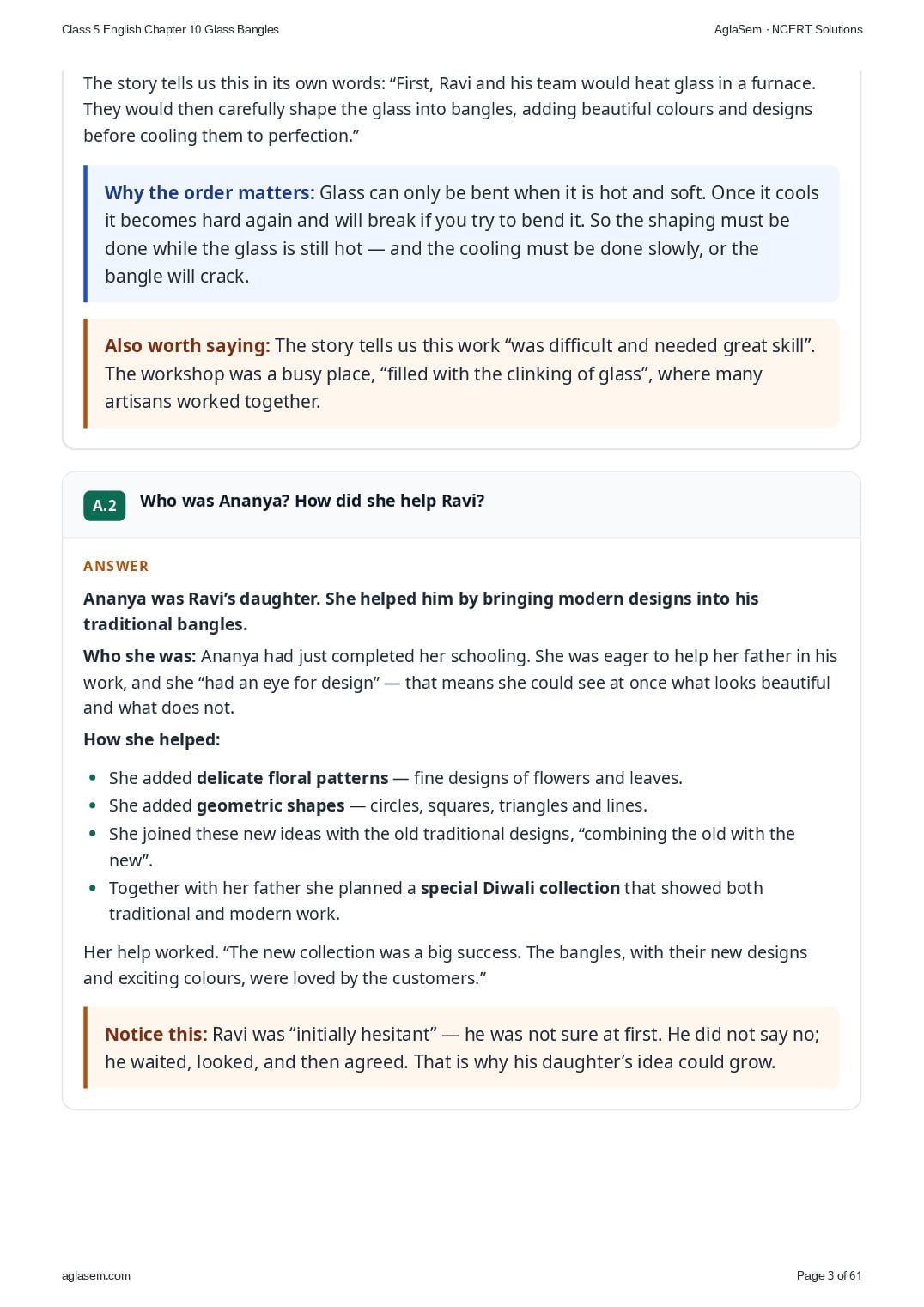
- How were glass bangles made in Ravi’s small workshop?
- Who was Ananya? How did she help Ravi?
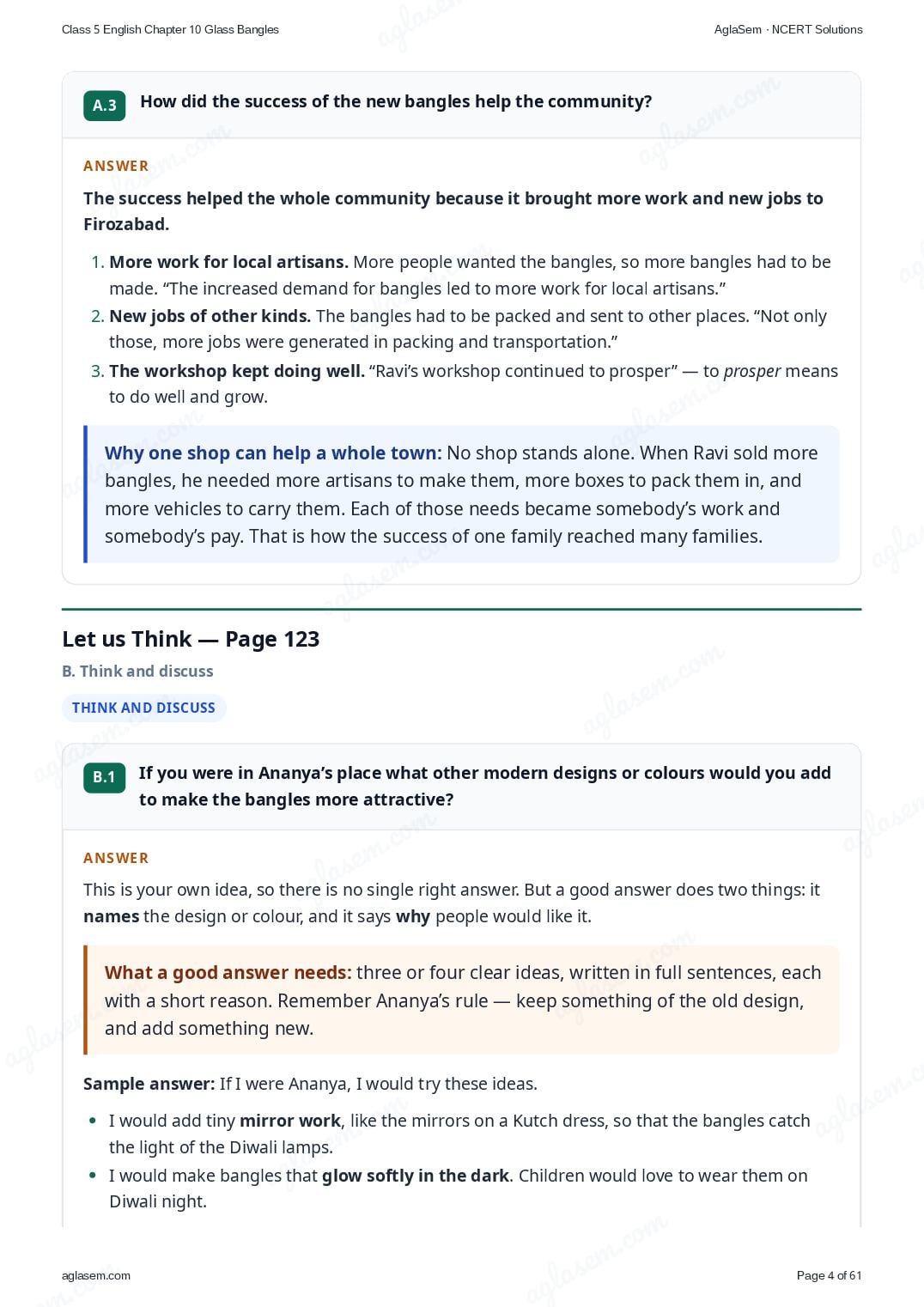
- How did the success of the new bangles help the community?
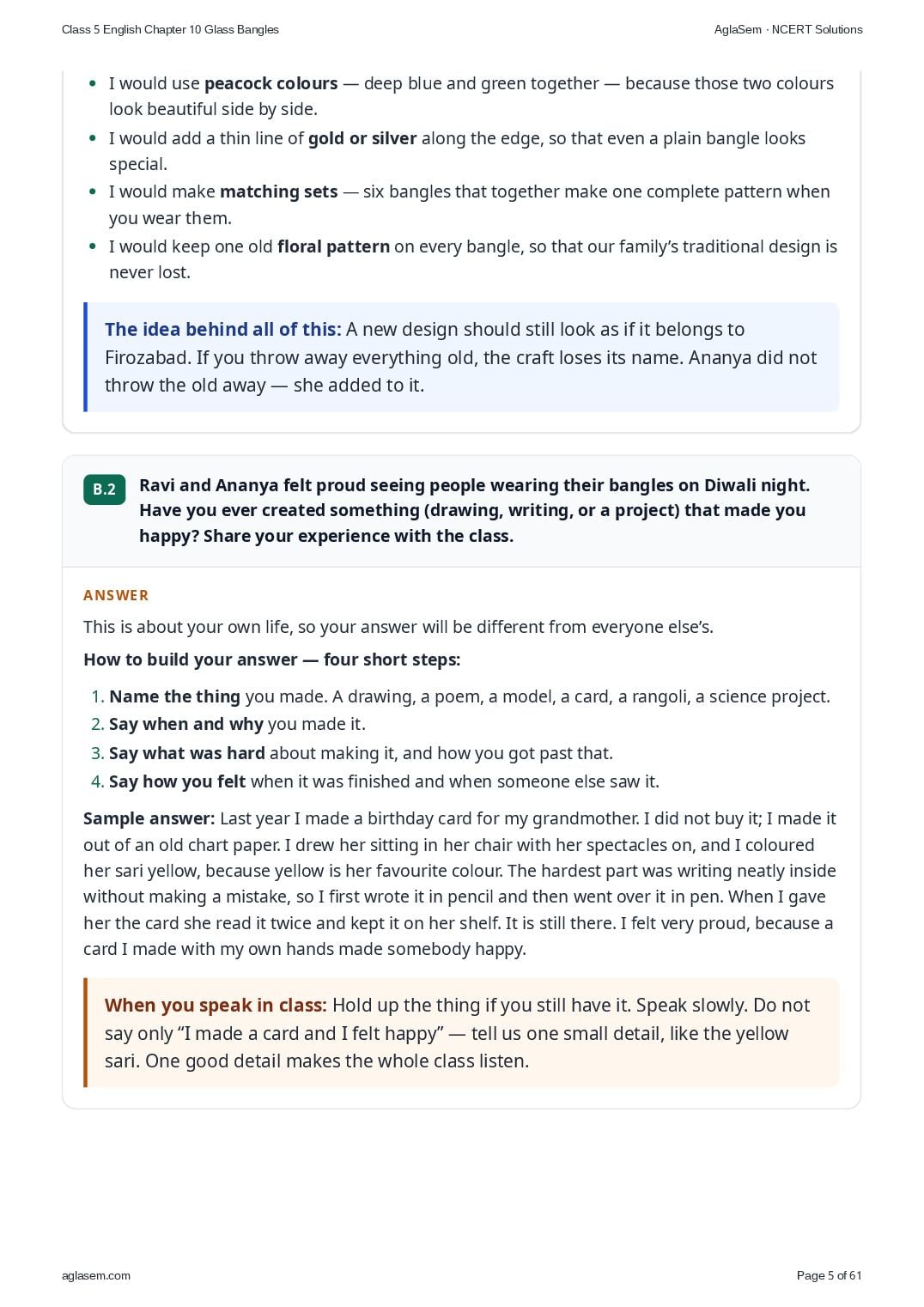
- If you were in Ananya’s place what other modern designs or colours would you add to make the bangles more attractive?
- Ravi and Ananya felt proud seeing people wearing their bangles on Diwali night. Have you ever created something (drawing, writing, or a project) that made you happy? Share your experience with the class.
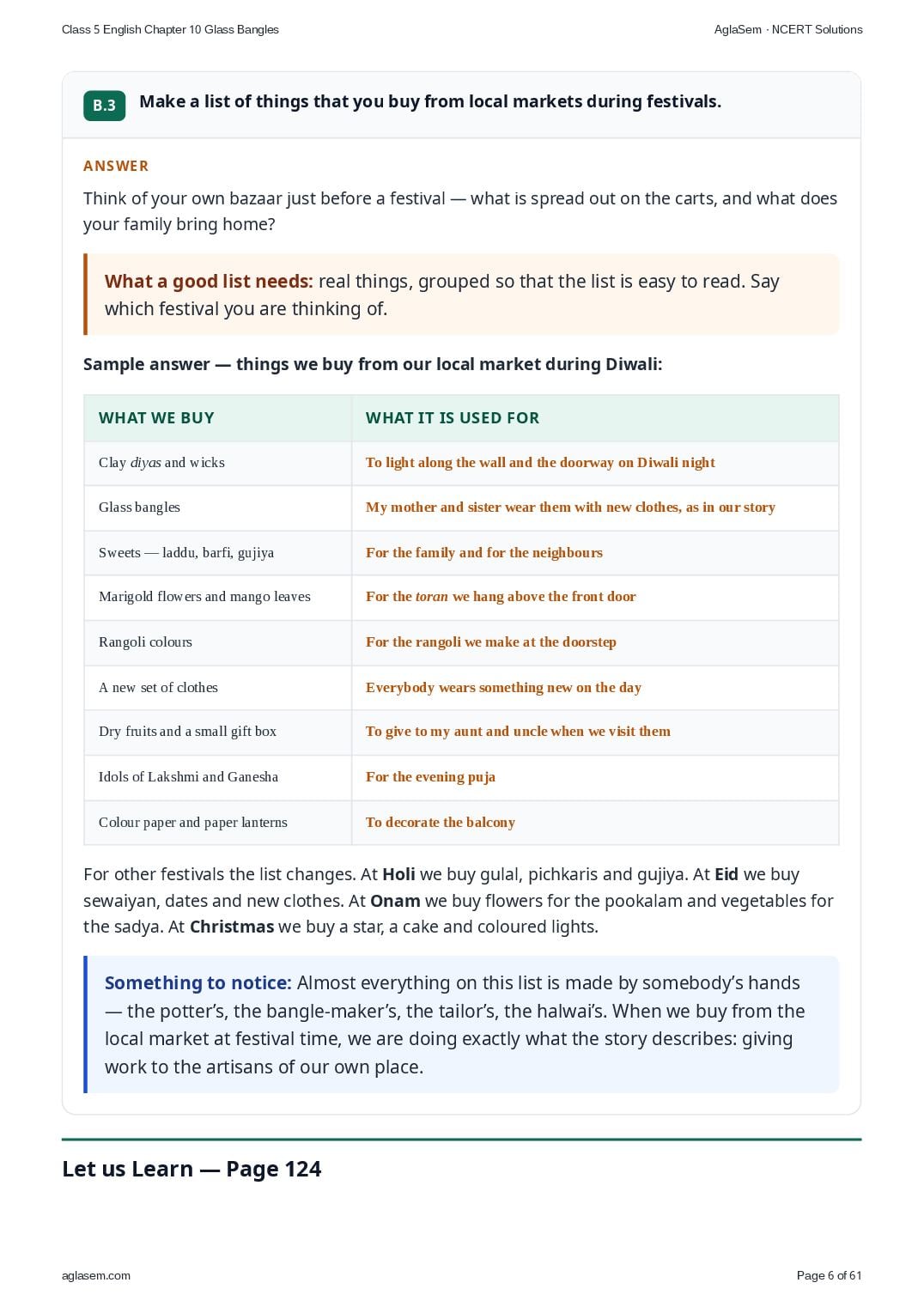
- Make a list of things that you buy from local markets during festivals.
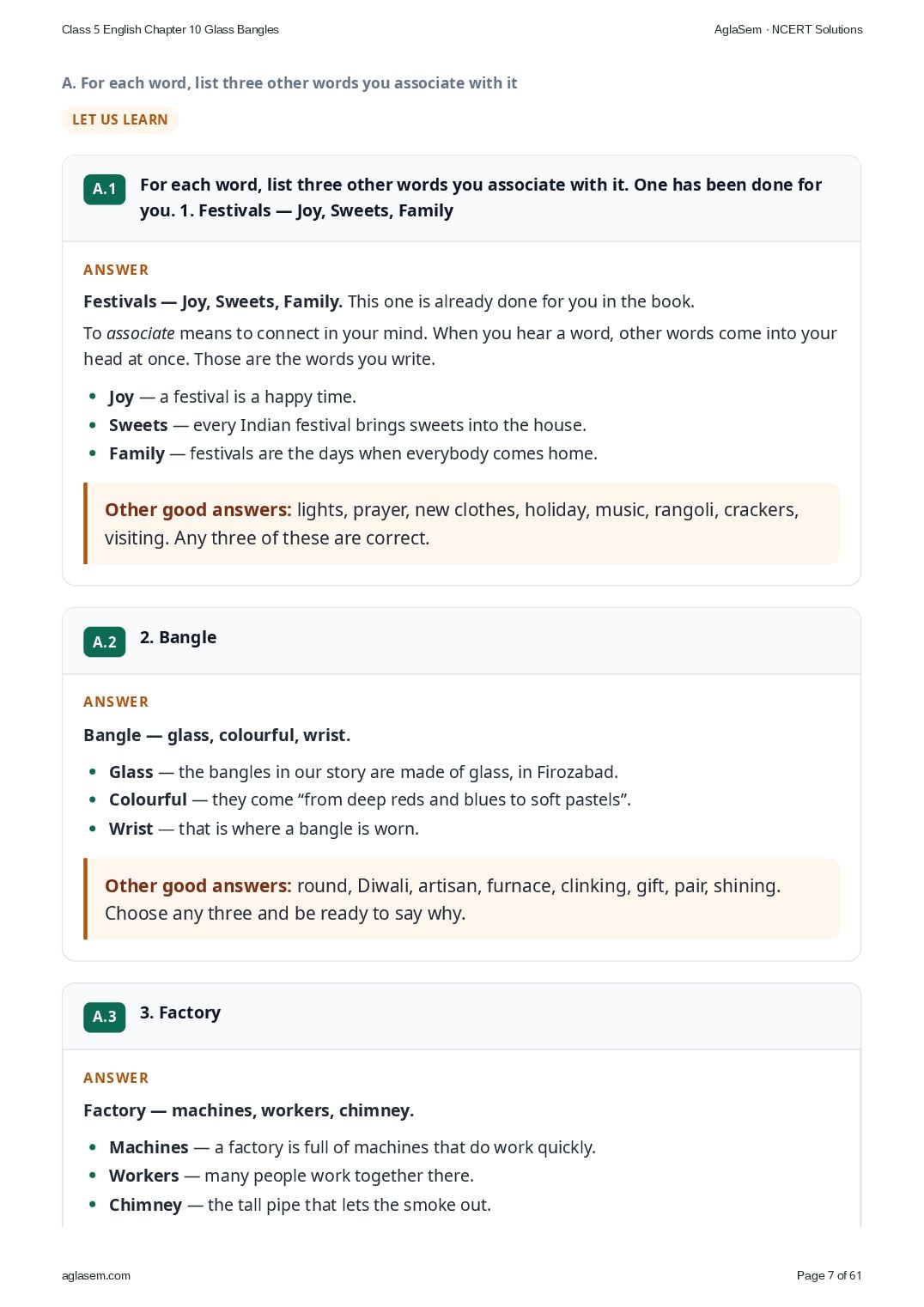
- For each word, list three other words you associate with it. One has been done for you. 1. Festivals — Joy, Sweets, Family
- 2. Bangle
- 3. Factory
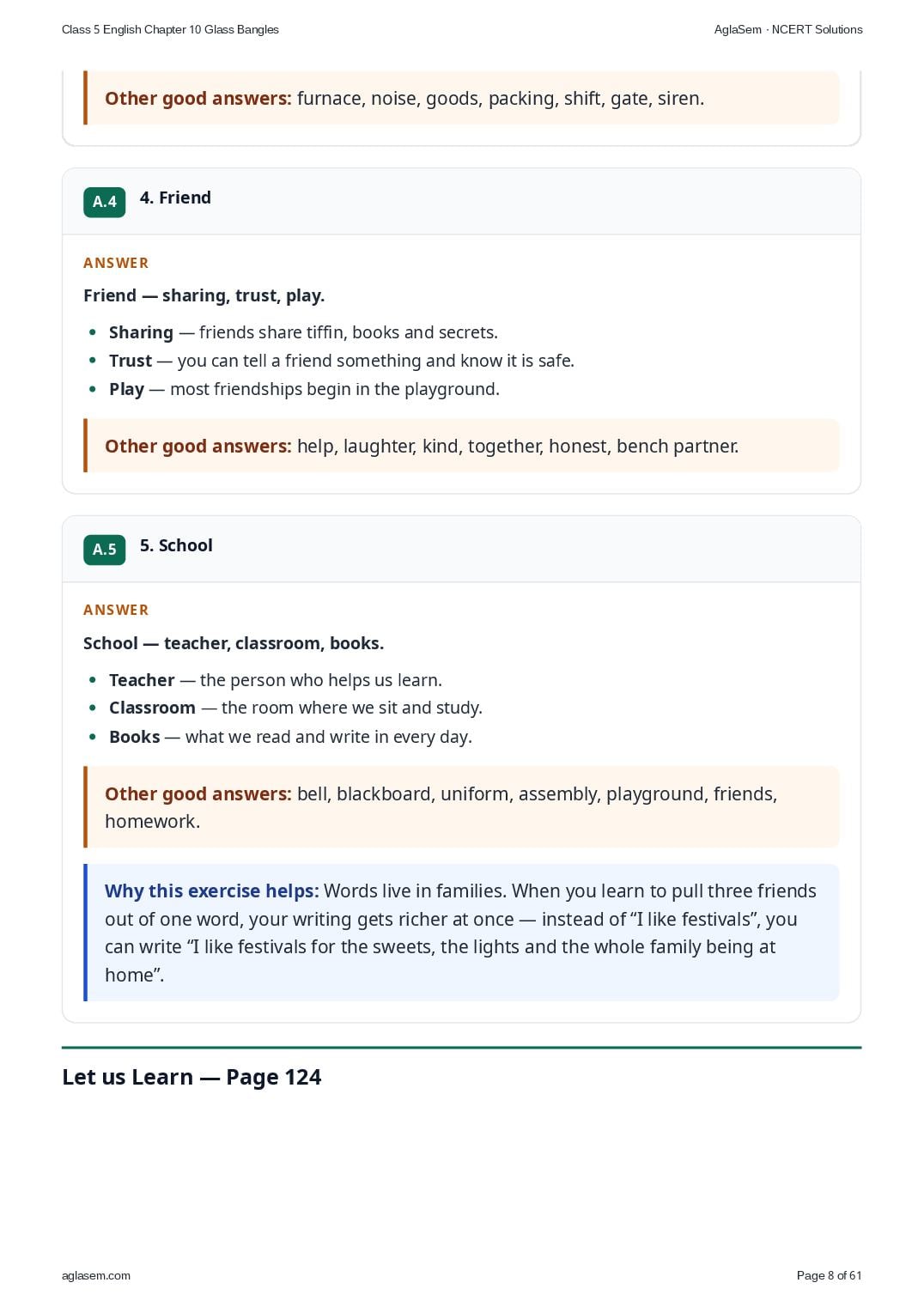
- 4. Friend
- 5. School
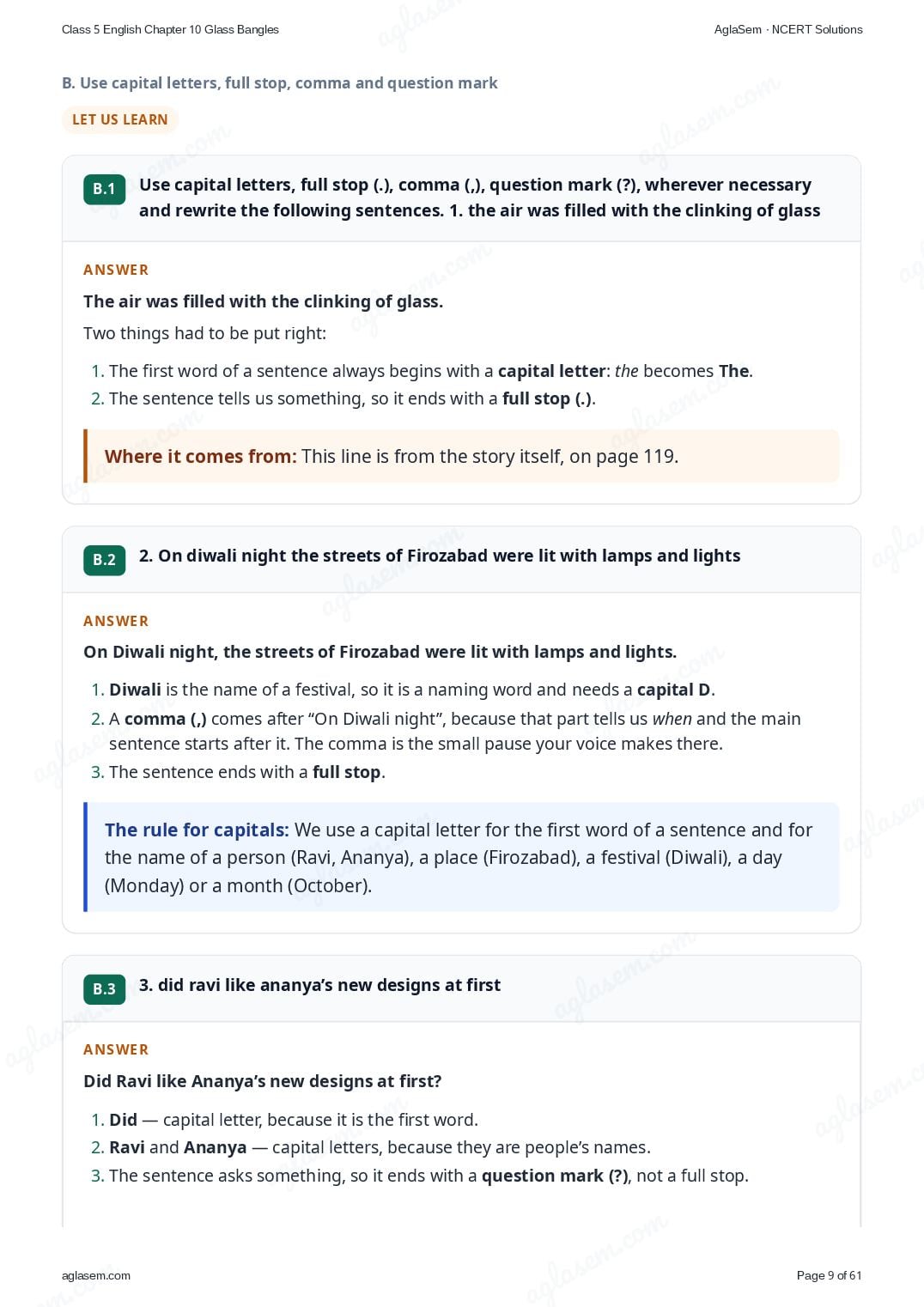
- Use capital letters, full stop (.), comma (,), question mark (?), wherever necessary and rewrite the following sentences. 1. the air was filled with the clinking of glass
- 2. On diwali night the streets of Firozabad were lit with lamps and lights
- 3. did ravi like ananya’s new designs at first
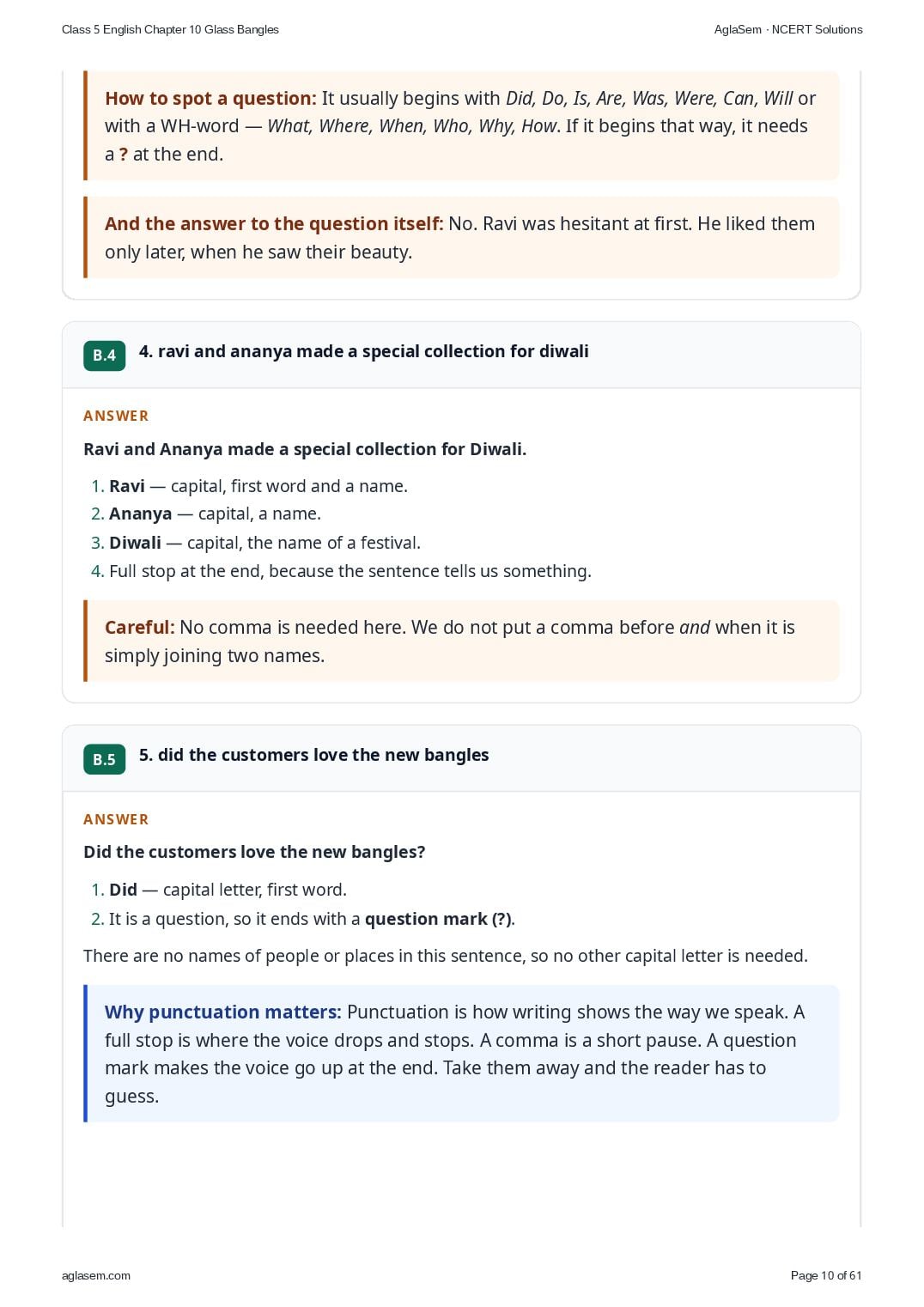
- 4. ravi and ananya made a special collection for diwali
- 5. did the customers love the new bangles
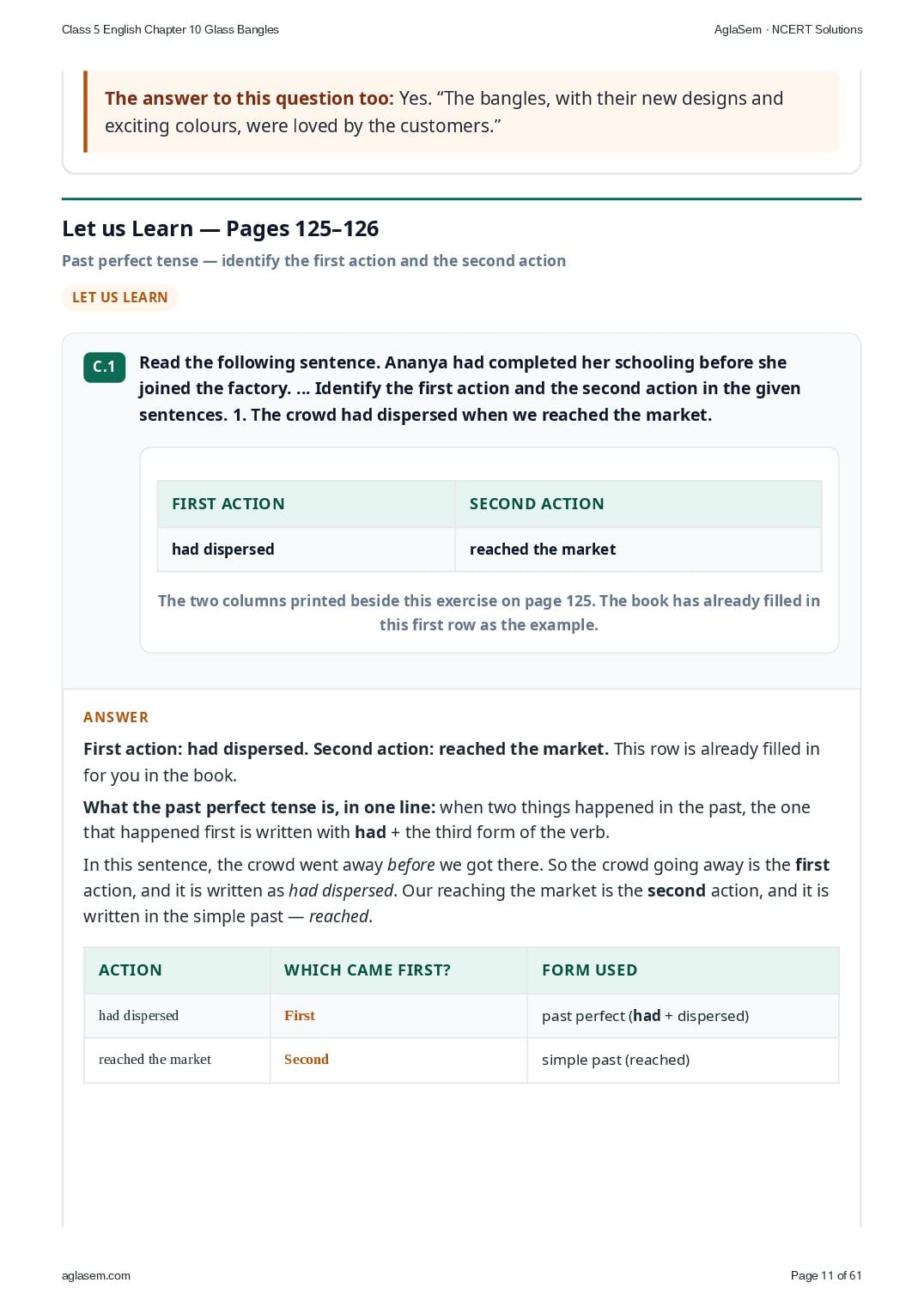
- Read the following sentence. Ananya had completed her schooling before she joined the factory. … Identify the first action and the second action in the given sentences. 1. The crowd had dispersed when we reached the market. First actionSecond action had dispersedreached the market The two columns printed beside this exercise on page 125. The book has already filled in this first row as the example.
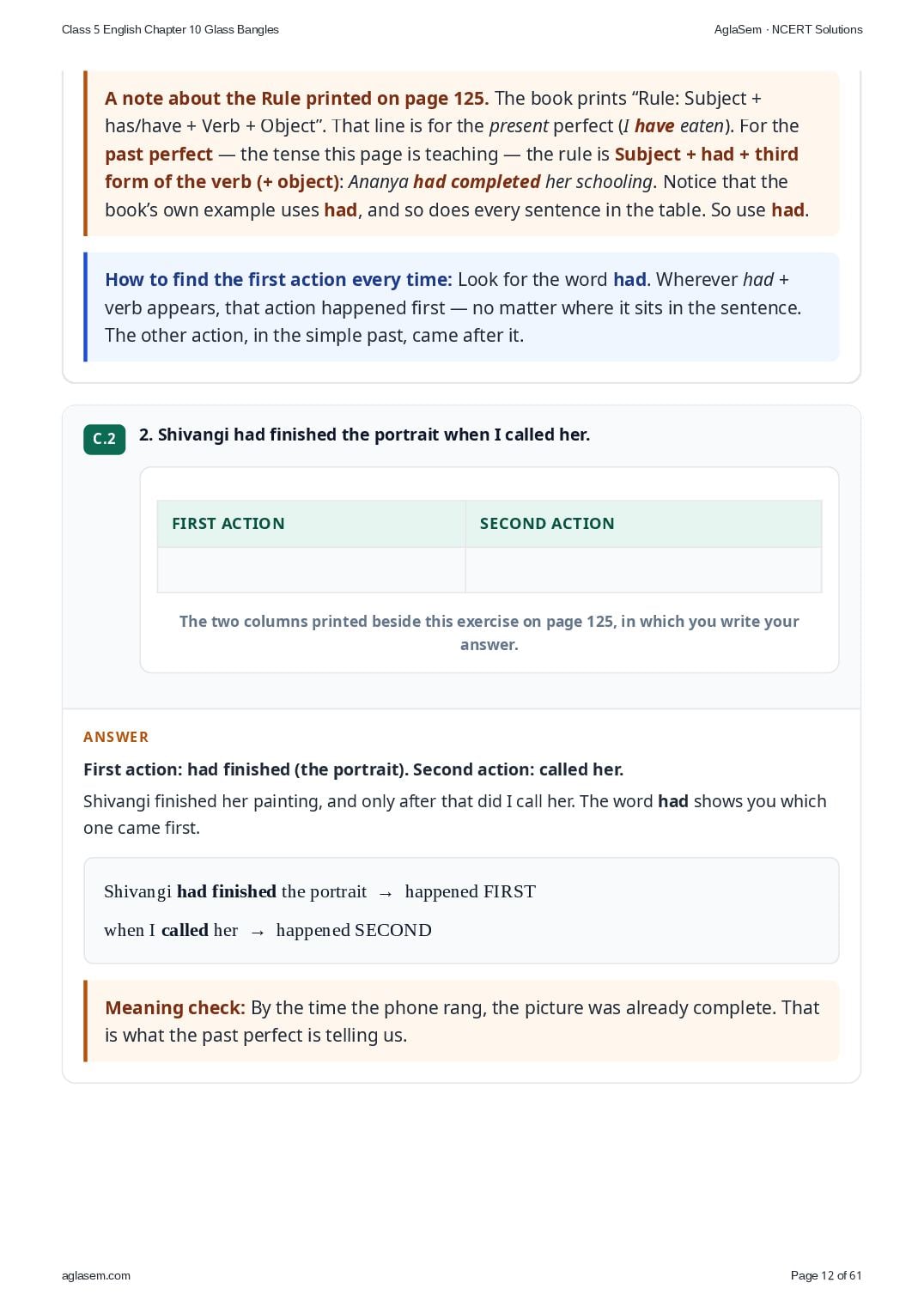
- 2. Shivangi had finished the portrait when I called her. First actionSecond action The two columns printed beside this exercise on page 125, in which you write your answer.
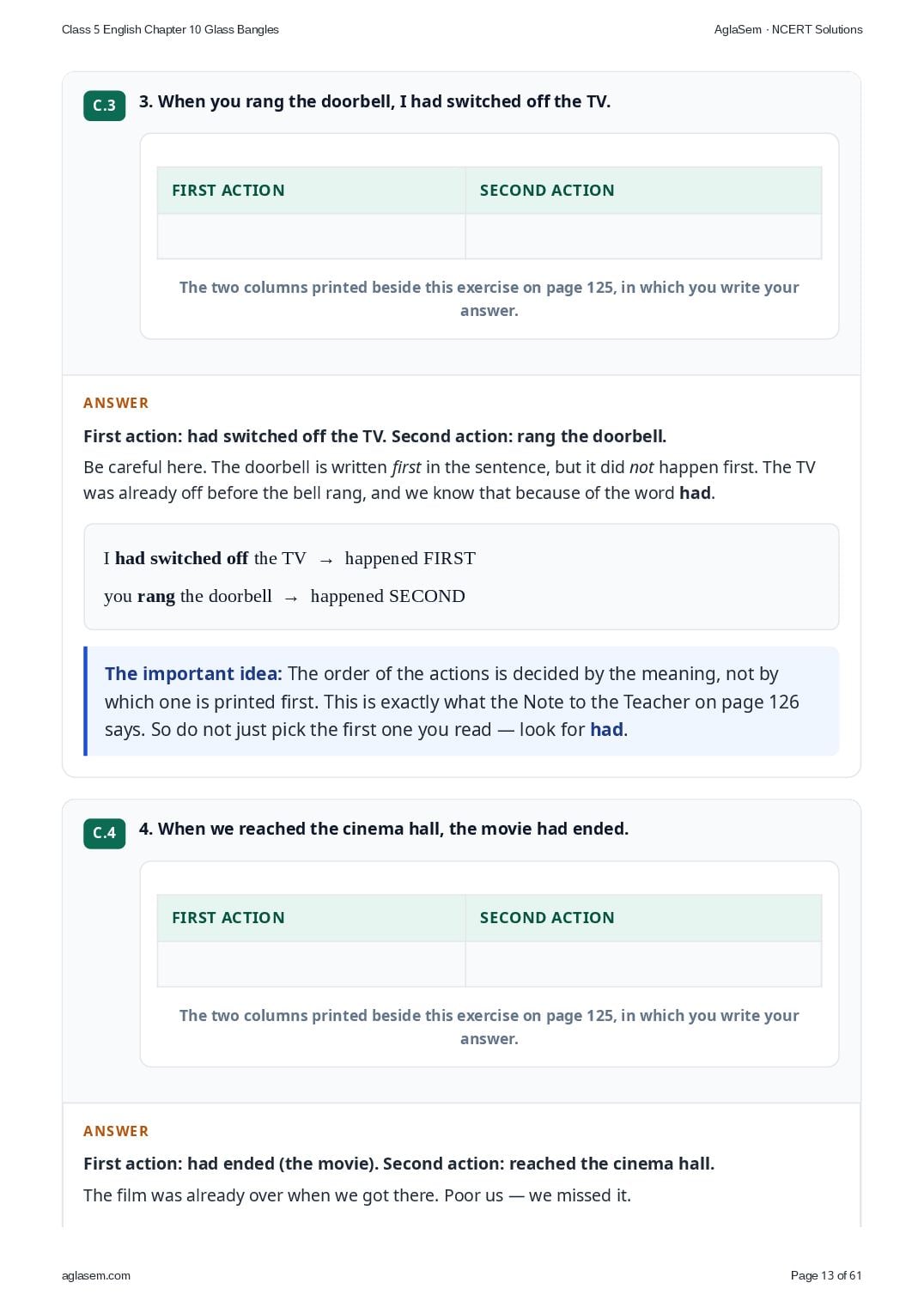
- 3. When you rang the doorbell, I had switched off the TV. First actionSecond action The two columns printed beside this exercise on page 125, in which you write your answer.
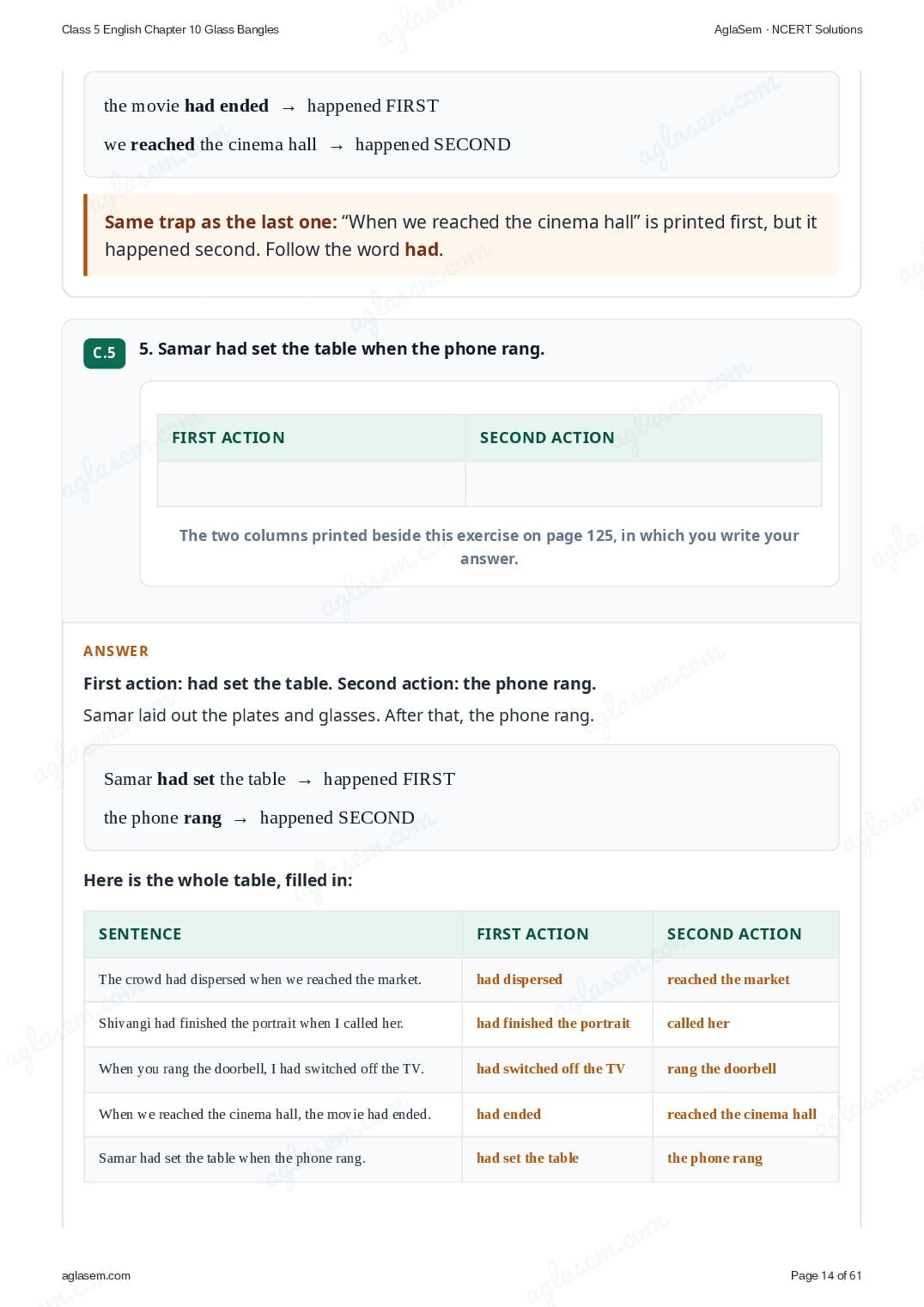
- 4. When we reached the cinema hall, the movie had ended. First actionSecond action The two columns printed beside this exercise on page 125, in which you write your answer.
- 5. Samar had set the table when the phone rang. First actionSecond action The two columns printed beside this exercise on page 125, in which you write your answer.
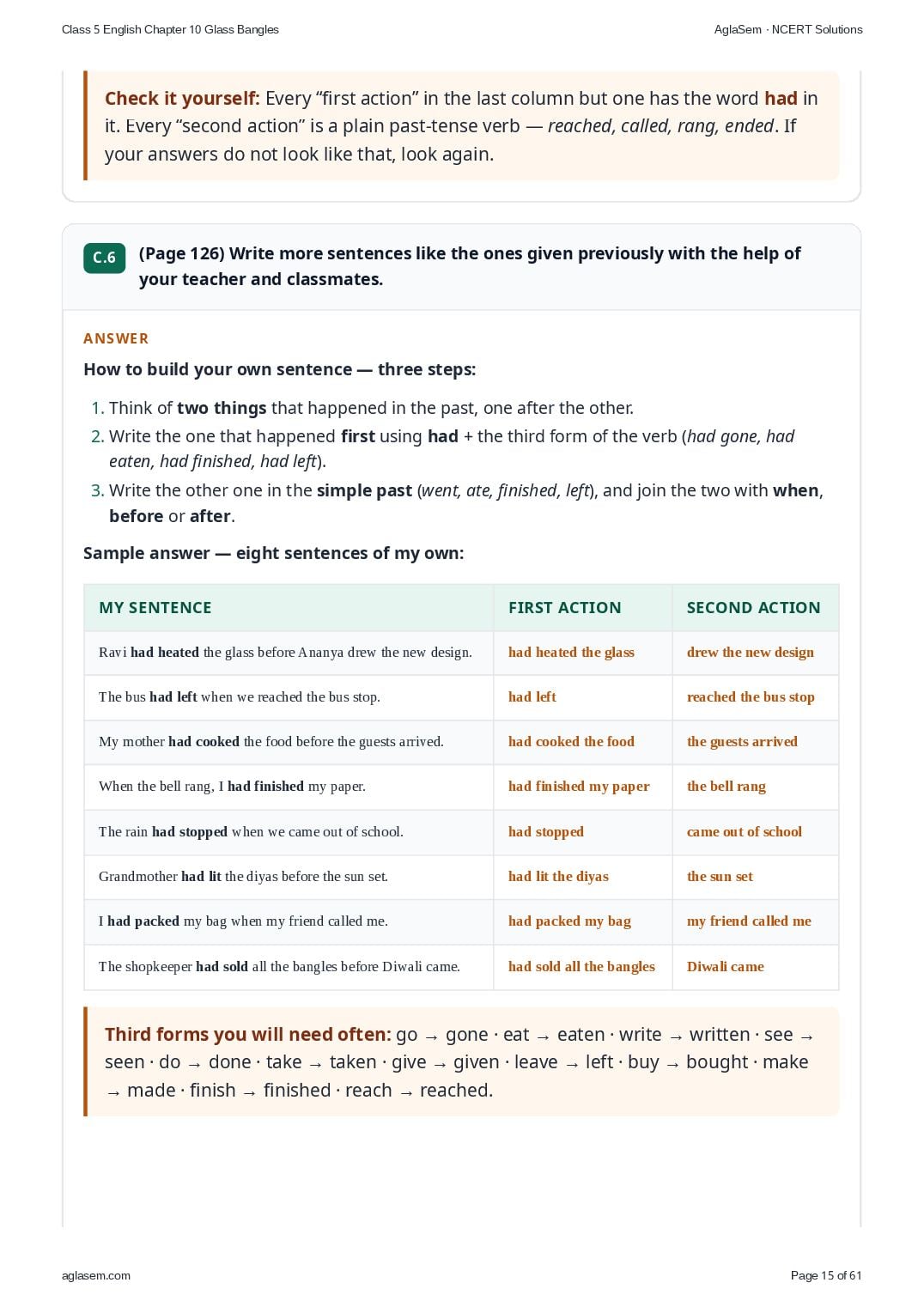
- (Page 126) Write more sentences like the ones given previously with the help of your teacher and classmates.
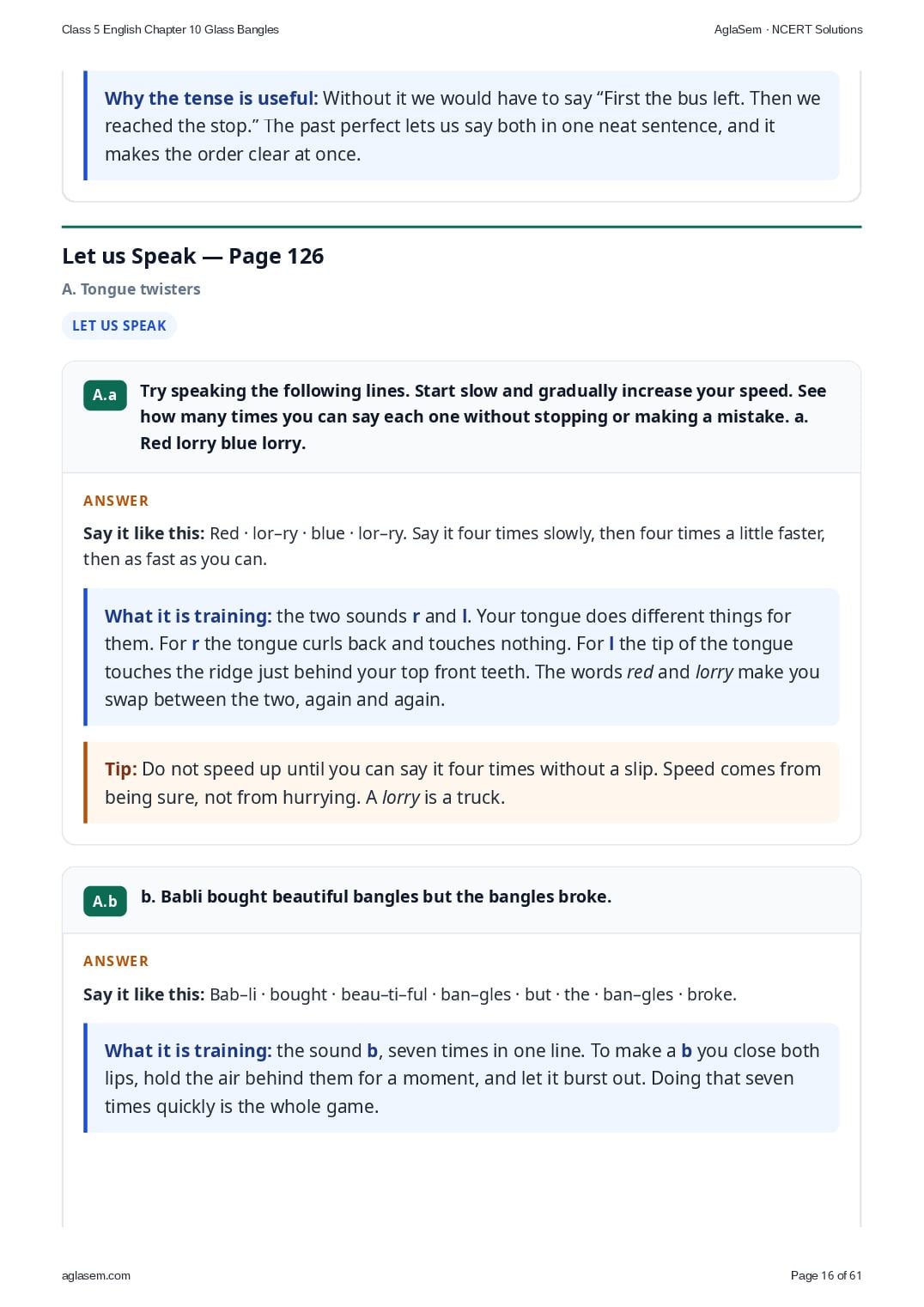
- Try speaking the following lines. Start slow and gradually increase your speed. See how many times you can say each one without stopping or making a mistake. a. Red lorry blue lorry.
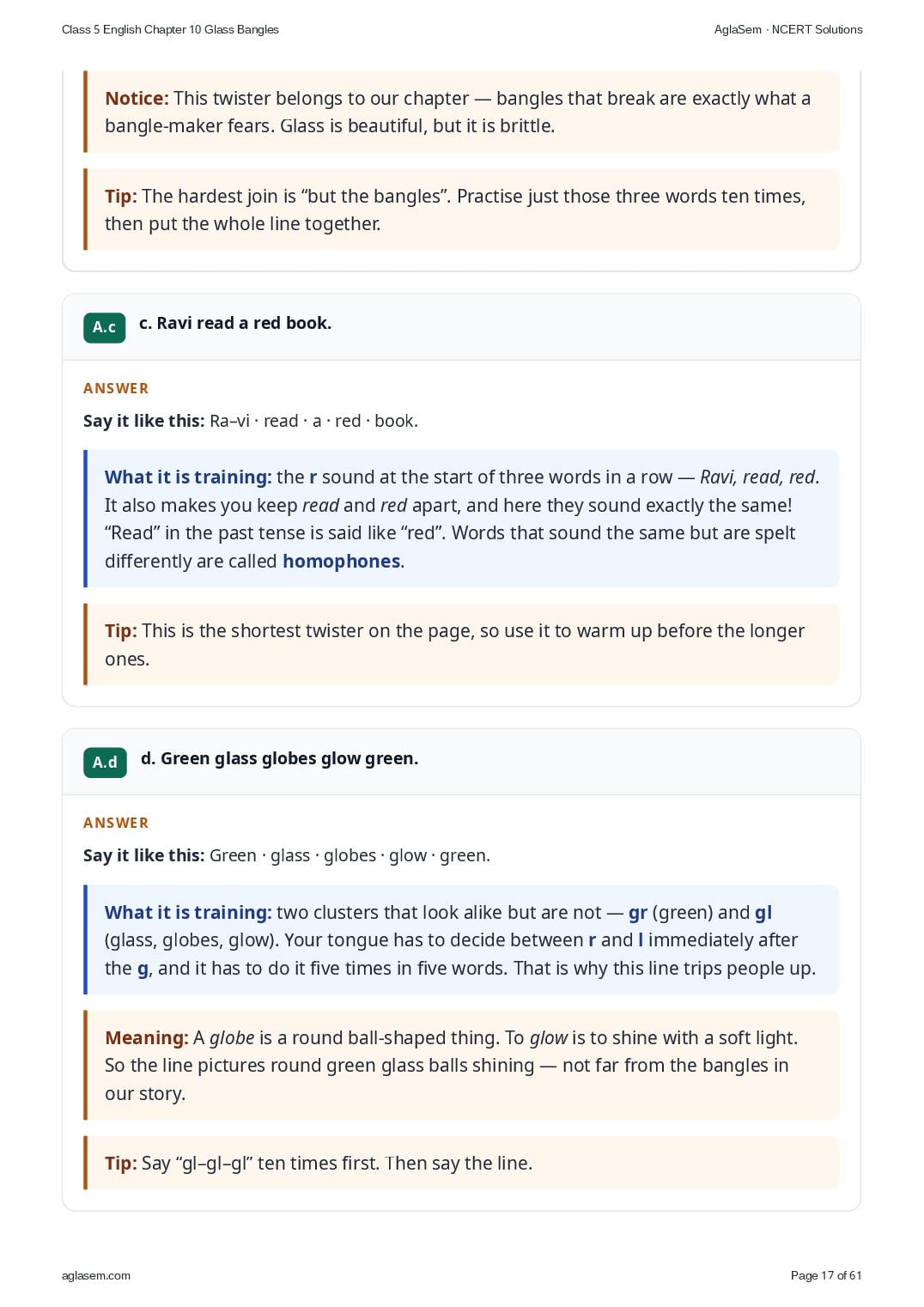
- b. Babli bought beautiful bangles but the bangles broke.
- c. Ravi read a red book.
- d. Green glass globes glow green.
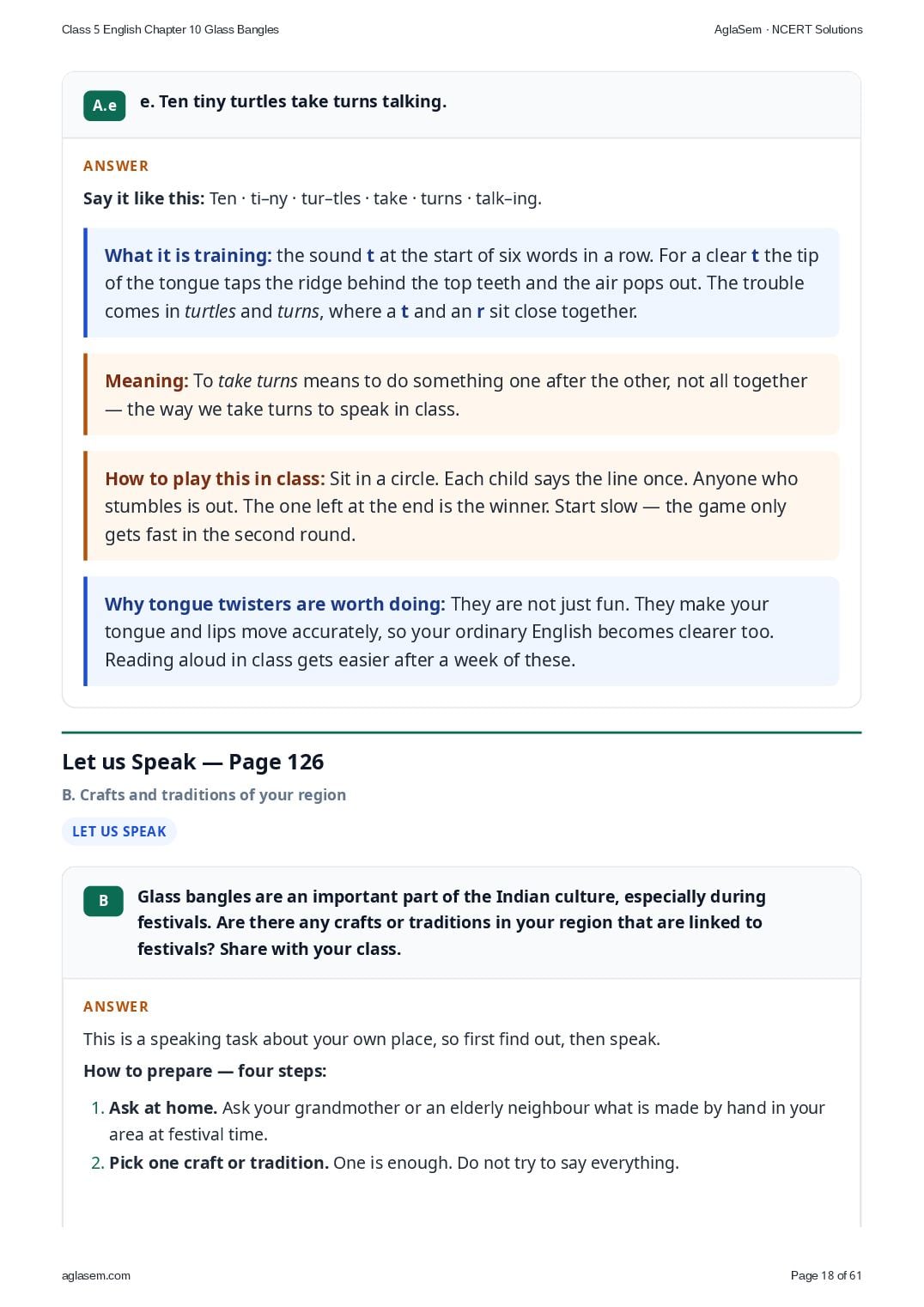
- e. Ten tiny turtles take turns talking.
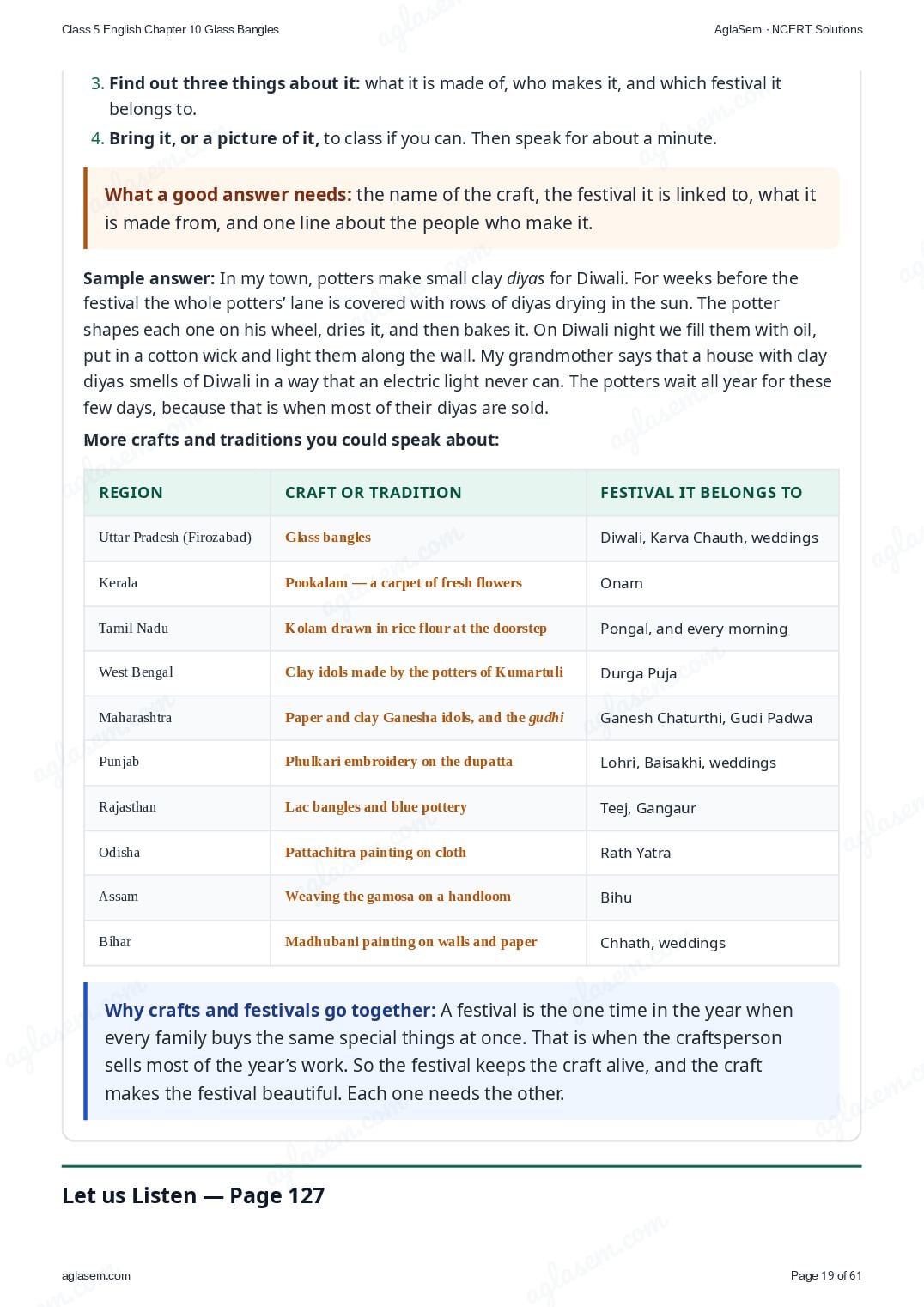
- Glass bangles are an important part of the Indian culture, especially during festivals. Are there any crafts or traditions in your region that are linked to festivals? Share with your class.
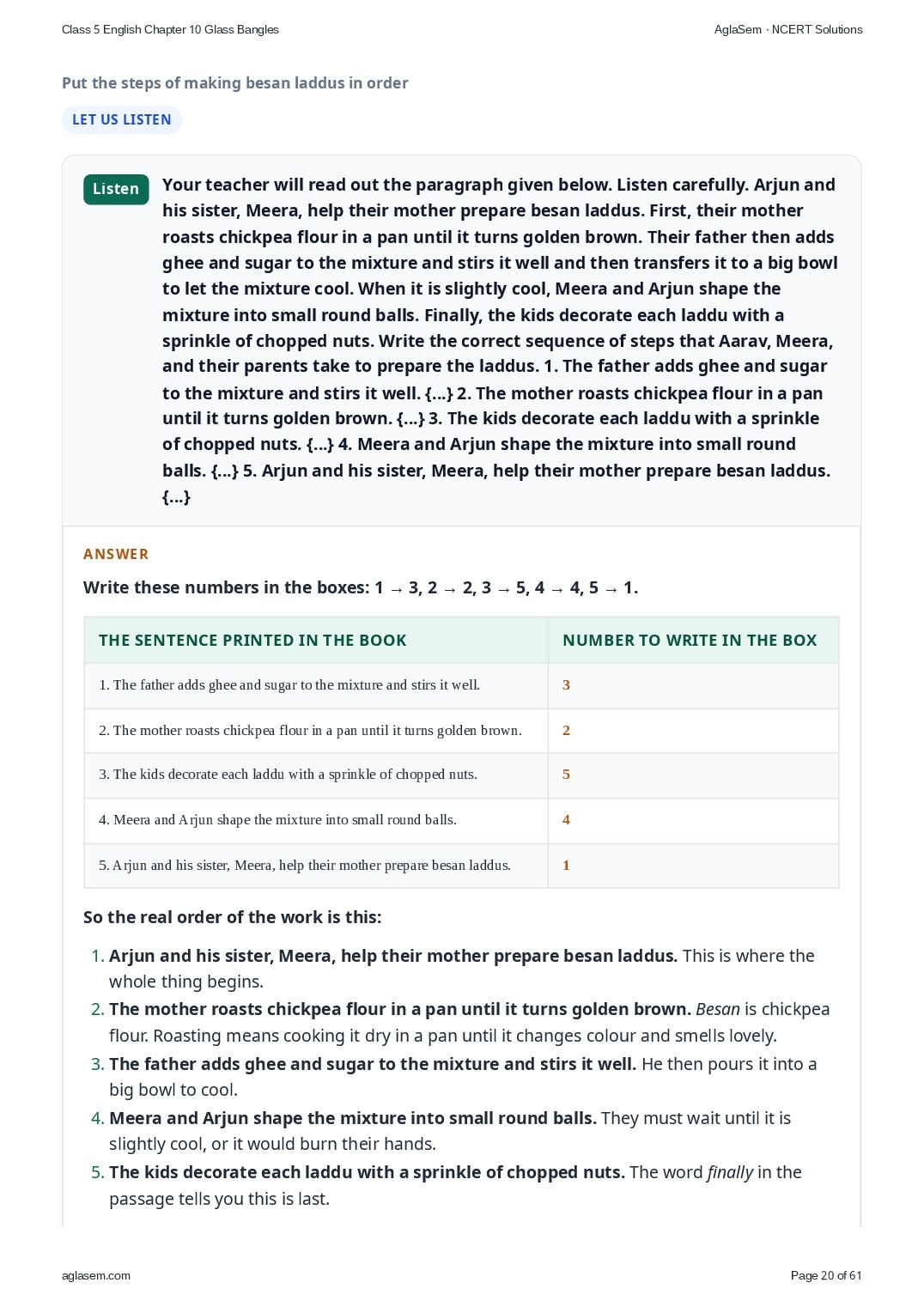
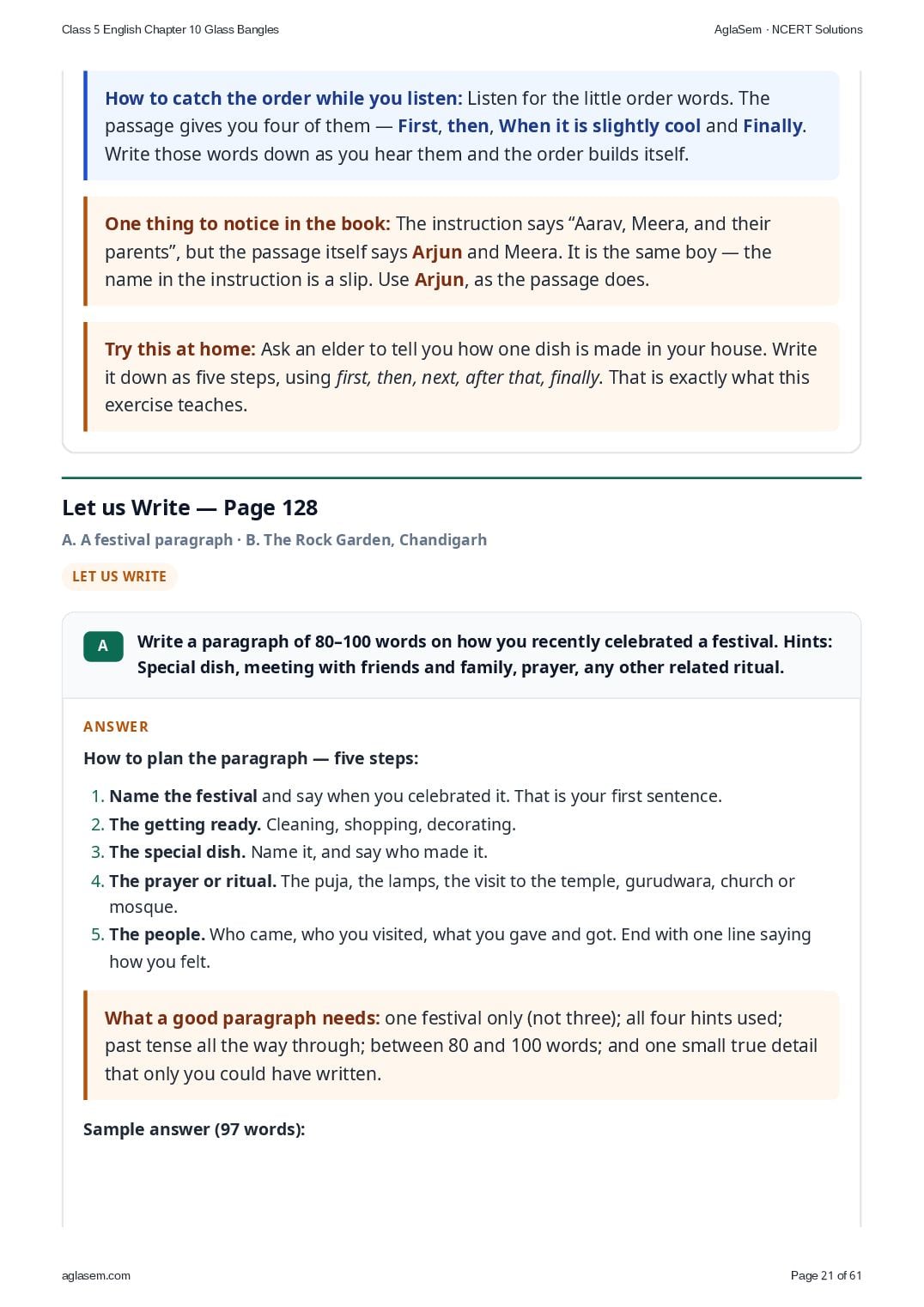
- Your teacher will read out the paragraph given below. Listen carefully. Arjun and his sister, Meera, help their mother prepare besan laddus. First, their mother roasts chickpea flour in a pan until it turns golden brown. Their father then adds ghee and sugar to the mixture and stirs it well and then transfers it to a big bowl to let the mixture cool. When it is slightly cool, Meera and Arjun shape the mixture into small round balls. Finally, the kids decorate each laddu with a sprinkle of chopped nuts. Write the correct sequence of steps that Aarav, Meera, and their parents take to prepare the laddus. 1. The father adds ghee and sugar to the mixture and stirs it well. {…} 2. The mother roasts chickpea flour in a pan until it turns golden brown. {…} 3. The kids decorate each laddu with a sprinkle of chopped nuts. {…} 4. Meera and Arjun shape the mixture into small round balls. {…} 5. Arjun and his sister, Meera, help their mother prepare besan laddus. {…}
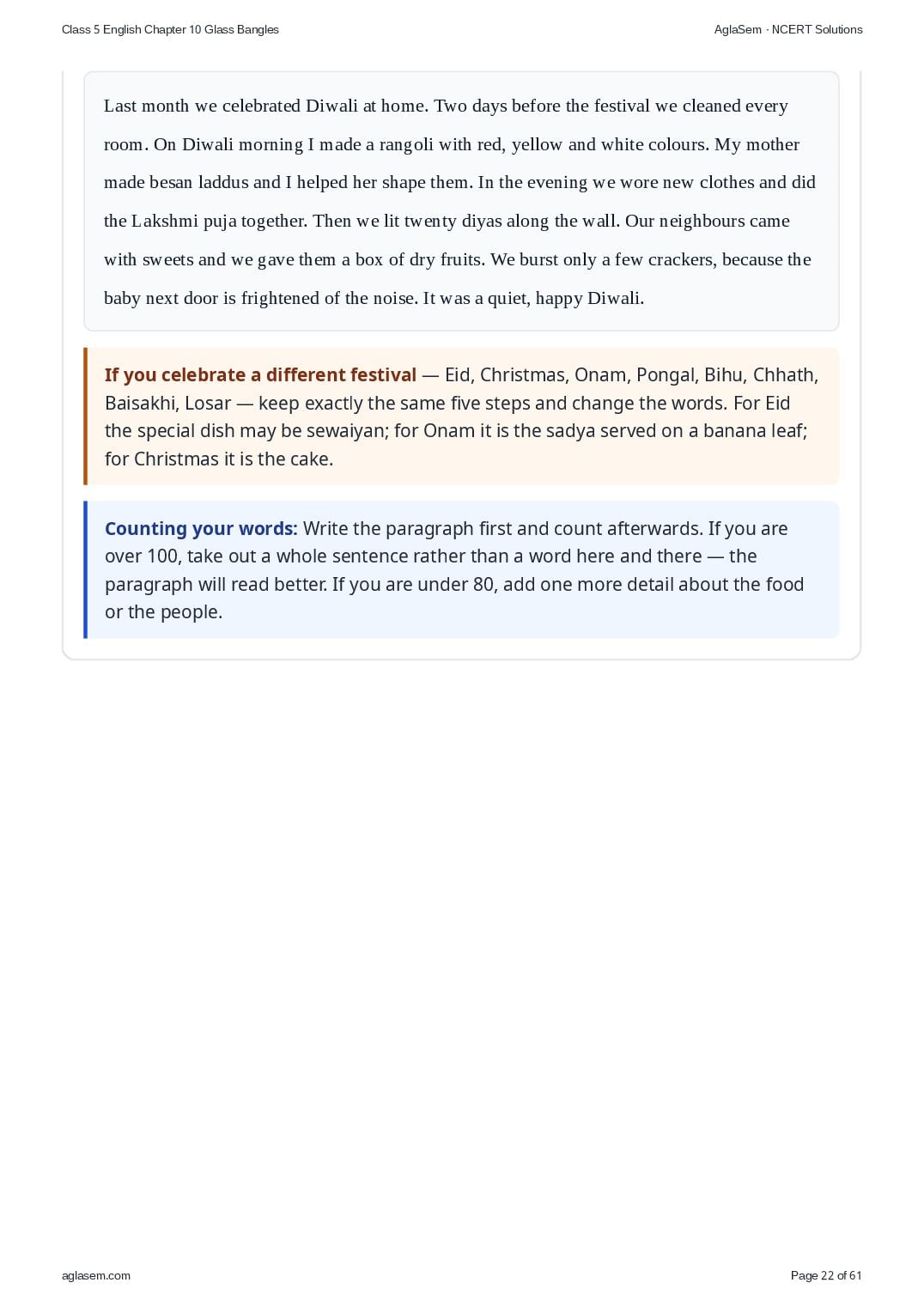
- Write a paragraph of 80–100 words on how you recently celebrated a festival. Hints: Special dish, meeting with friends and family, prayer, any other related ritual.
- Look at the pictures given below. The top photograph. A crowd of tall, thin standing figures of people fills an open yard. Each figure is made of cement and is covered all over, from neck to foot, in small curved pieces of broken glass bangles — pink, blue, green, yellow and red — laid in rows, so that the figures look as if they are wearing striped, many-coloured clothes. The tallest figure stands in the middle, looking straight ahead; the others stand in rows behind it. Trees and a low mud wall are seen at the back. The bottom photograph. Another crowd of the same kind of figures, this time covered in broken pieces of white china plates and tiles set in grey cement, like a cracked pattern. Some wear skirts of plain terracotta clay in orange, pink or dark grey. One figure in front has a hand raised beside its head; another has both arms bent at the elbow. Green trees stand behind them and the ground is bare grey stone. Rock Garden, Chandigarh — the two photographs printed on page 128, described here; see the textbook for the photographs.Discuss with your teacher and write a paragraph of 100–120 words in your notebook.
- Firozabad is famous for glass bangles. Find out and write the names of places in India known for the following crafts. 1. Madhubani painting
- 2. Paithani Saree
- 3. Blue pottery
- 4. Phulkari embroidery
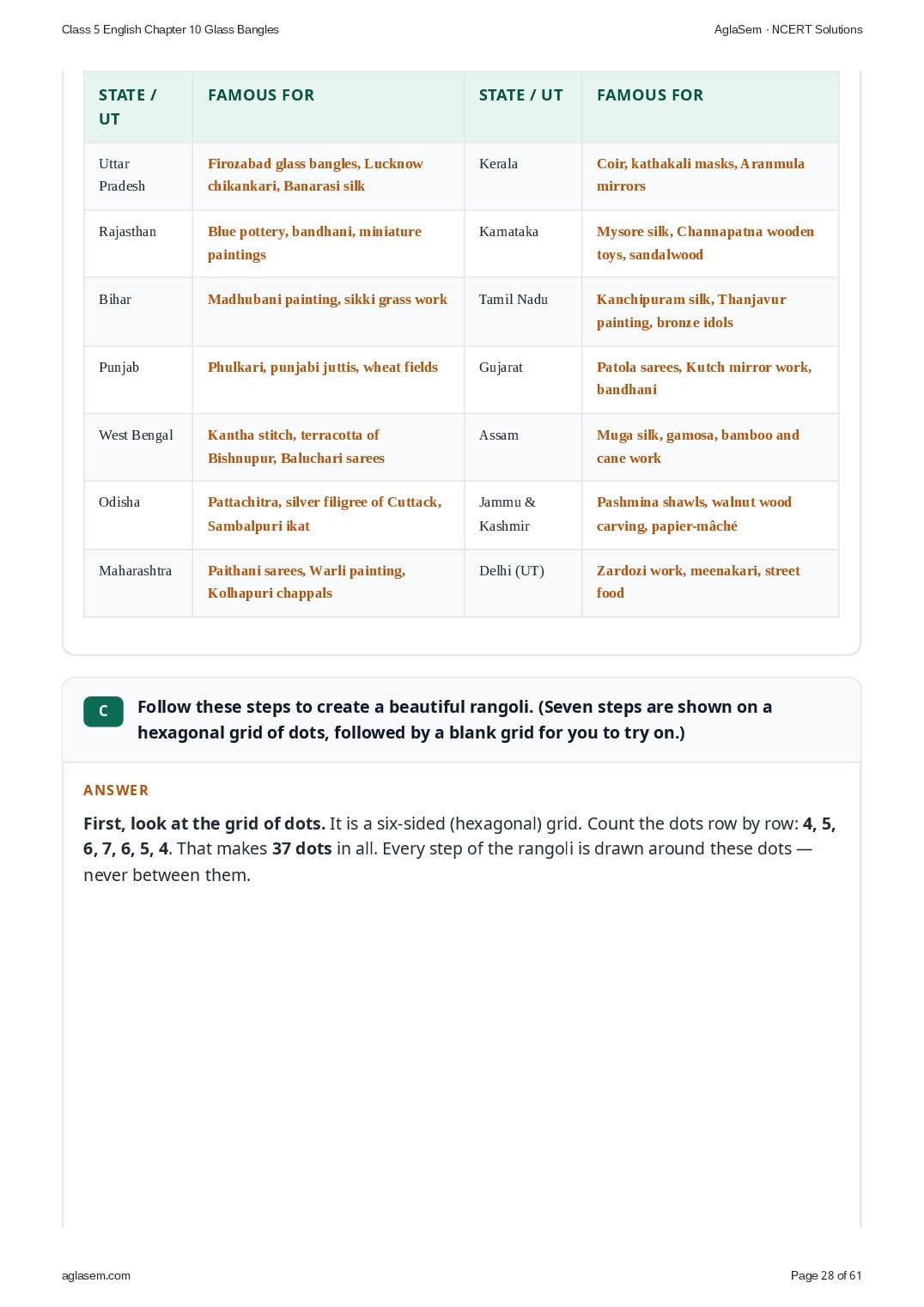
- Find out what your State or Union Territory (UT) is famous for. Speak about it.
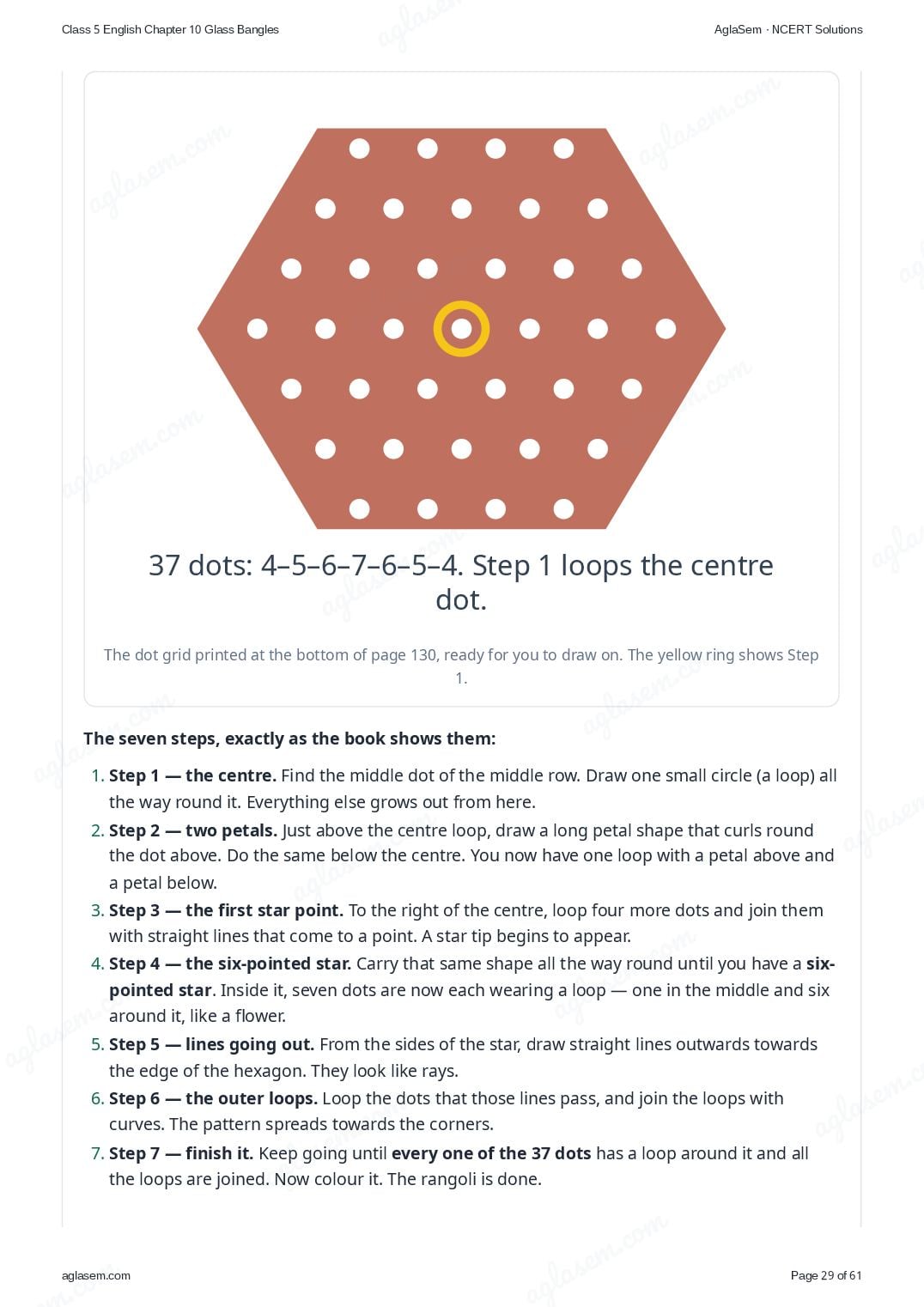
- Follow these steps to create a beautiful rangoli. (Seven steps are shown on a hexagonal grid of dots, followed by a blank grid for you to try on.)
- Do you have a bank account? Yes/ No
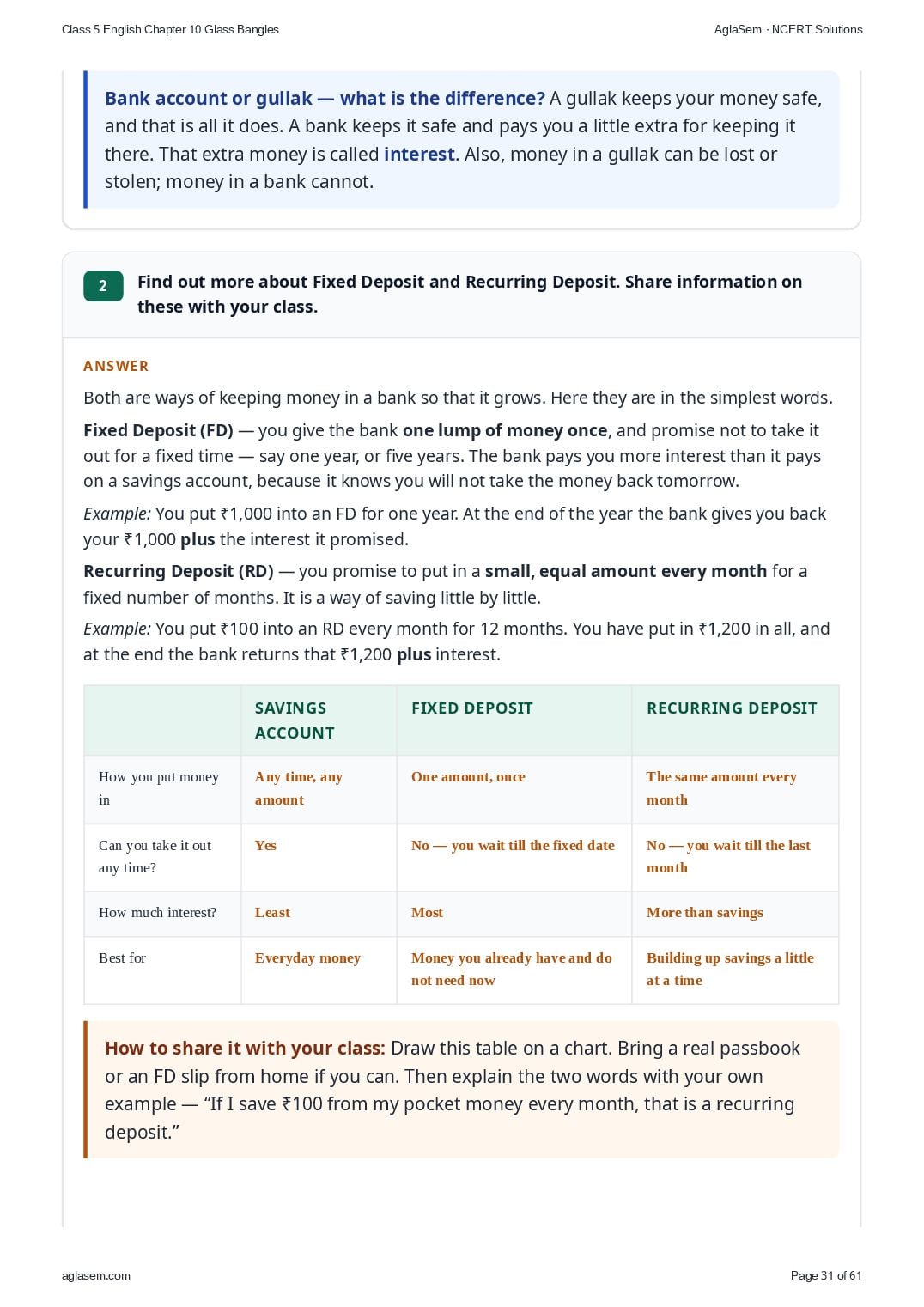
- Find out more about Fixed Deposit and Recurring Deposit. Share information on these with your class.
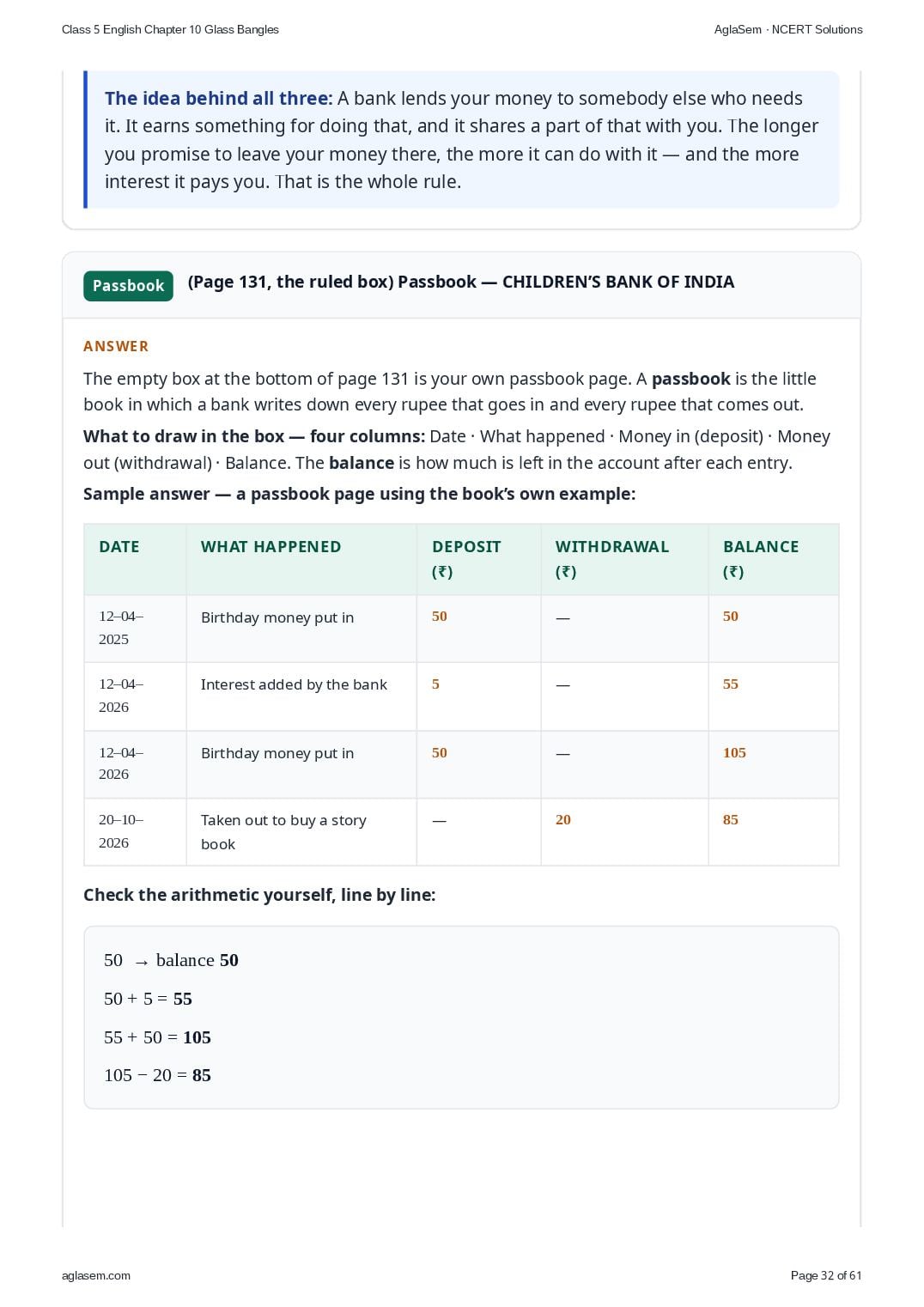
- (Page 131, the ruled box) Passbook — CHILDREN’S BANK OF INDIA
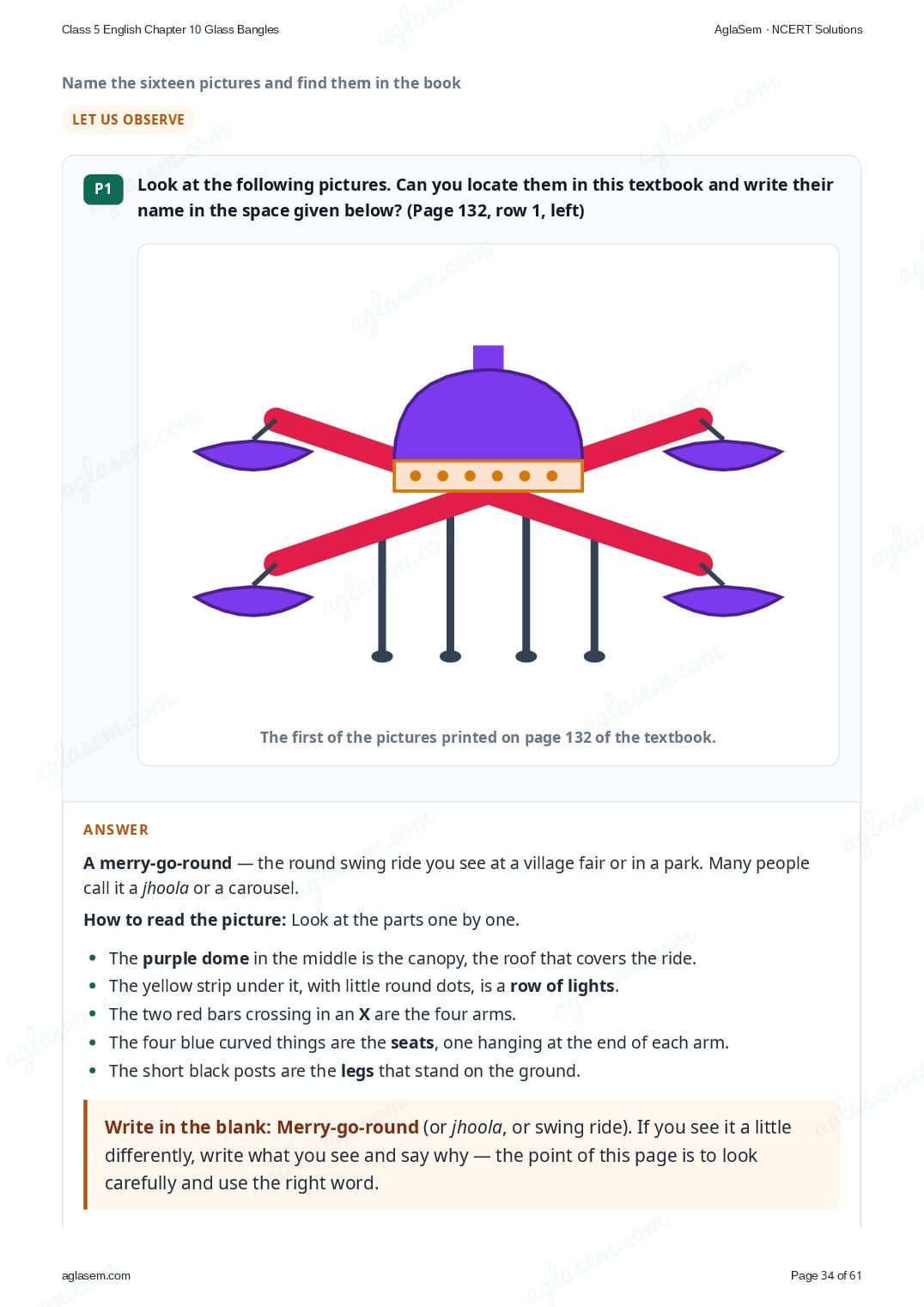
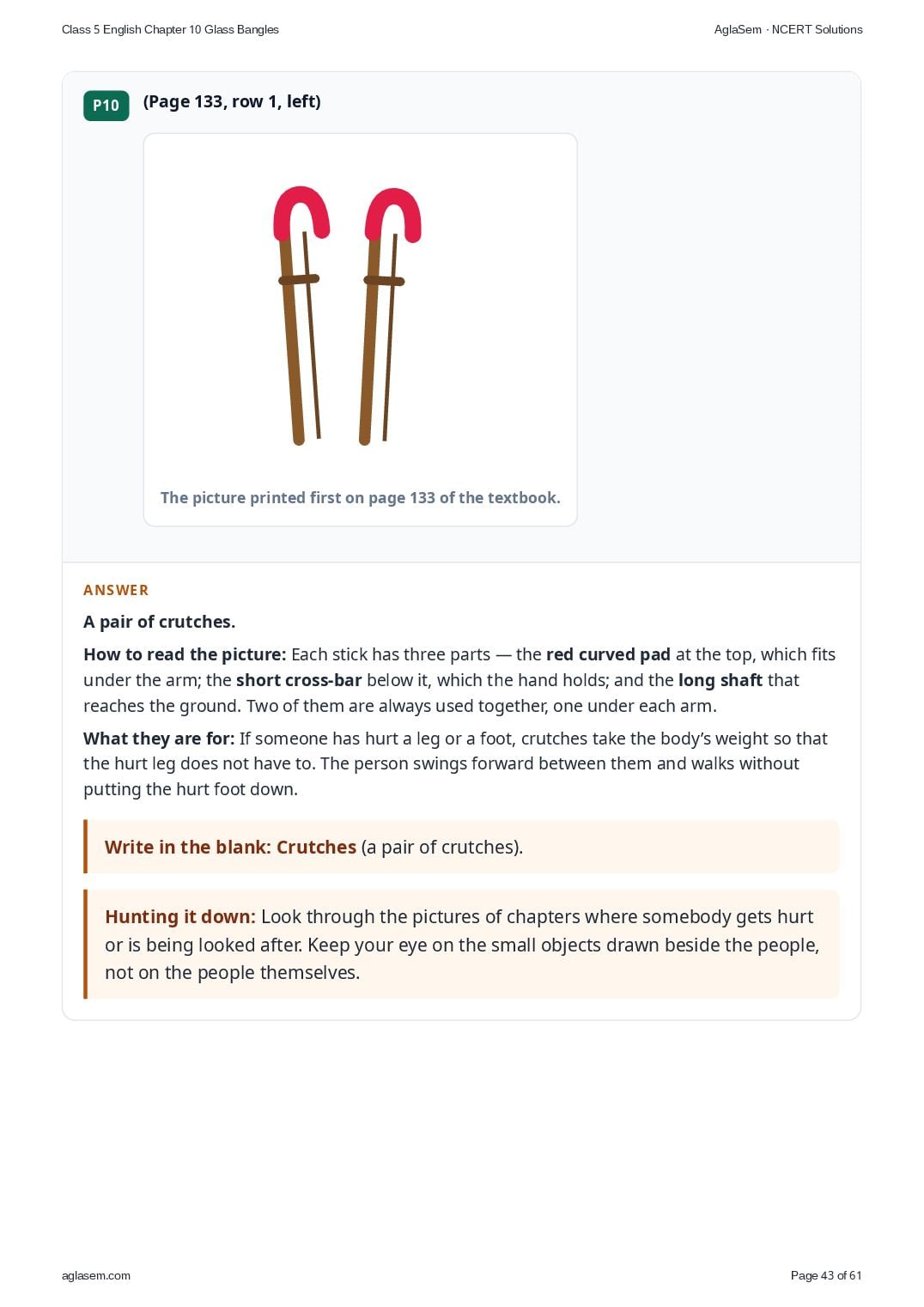
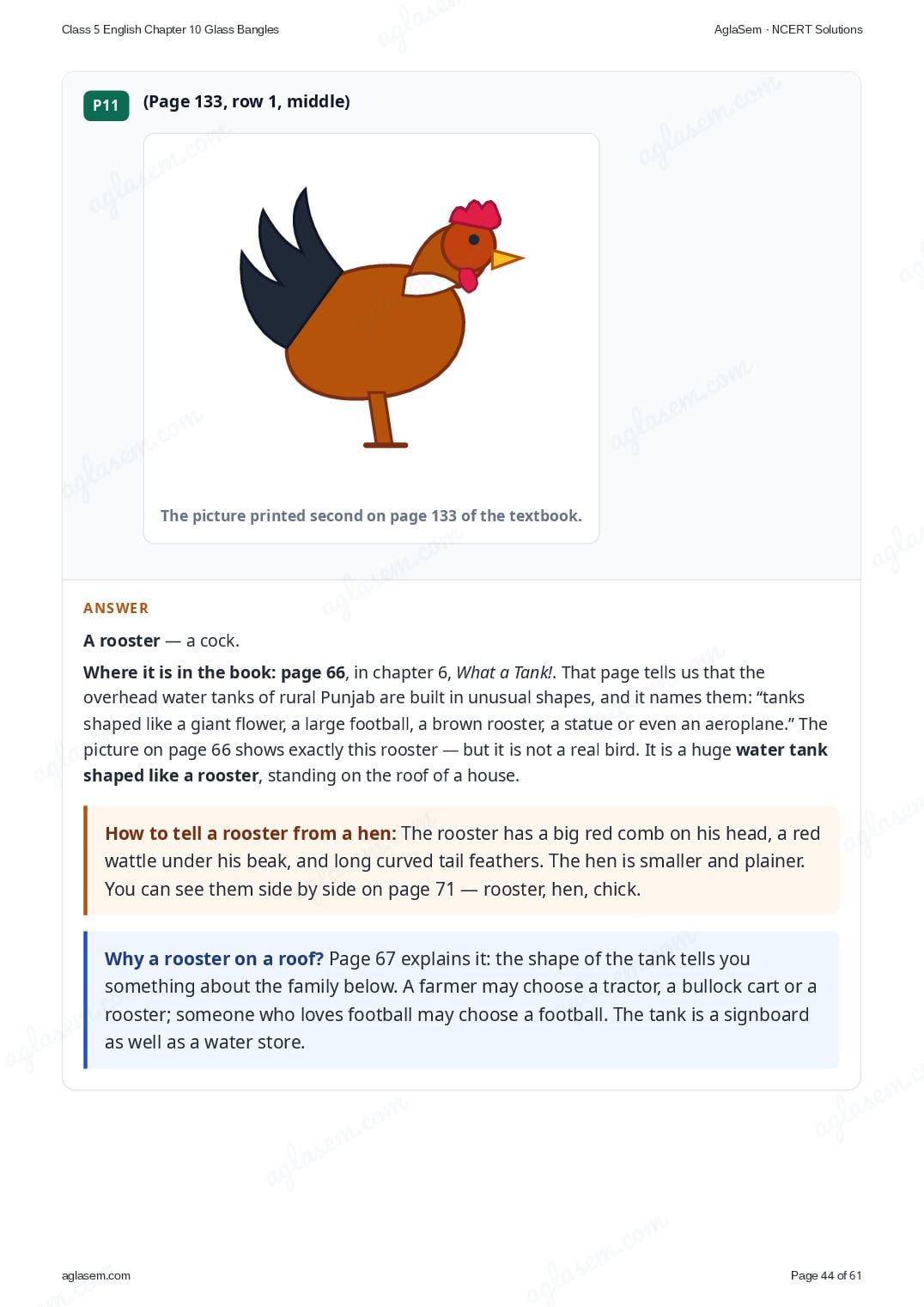
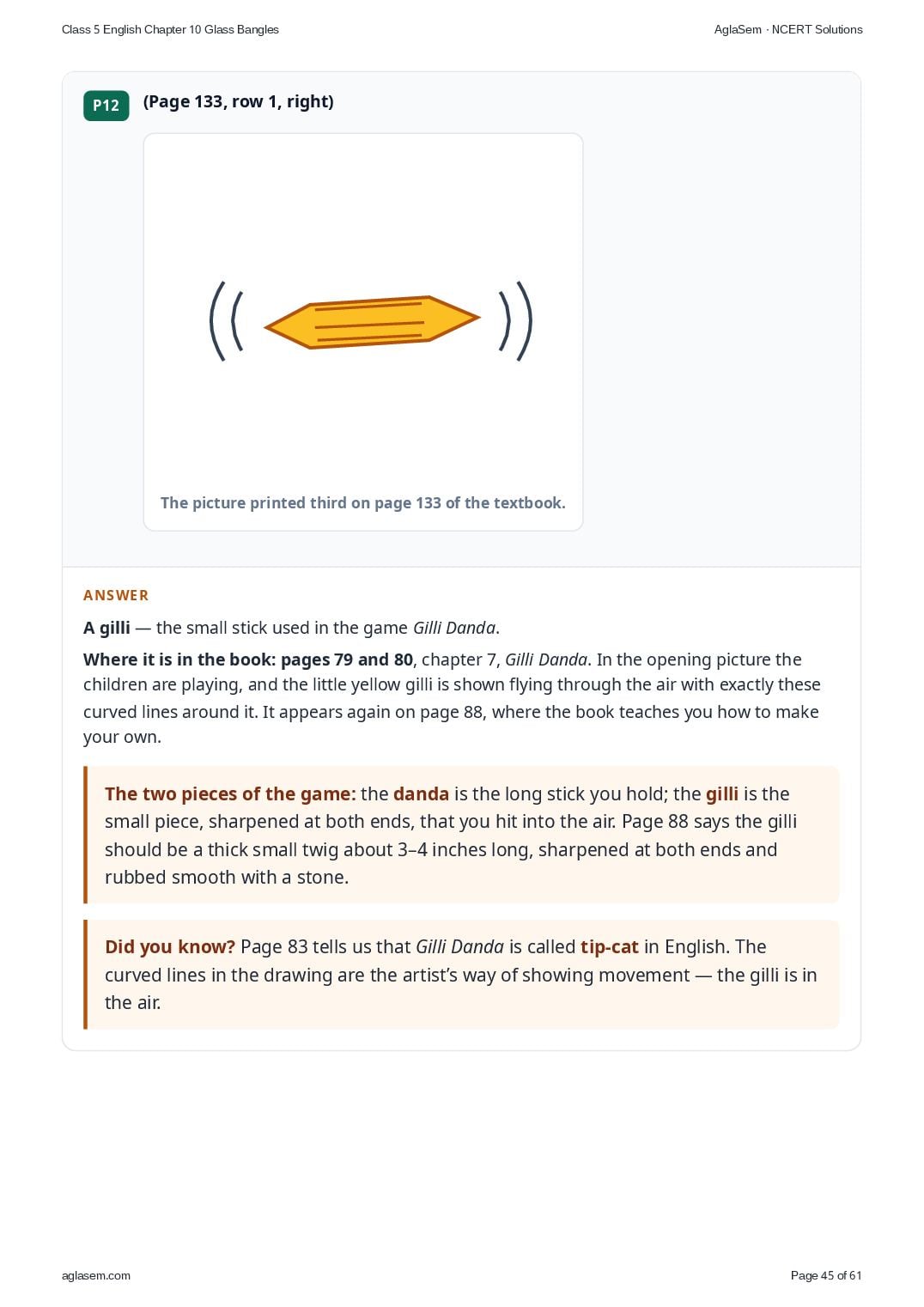
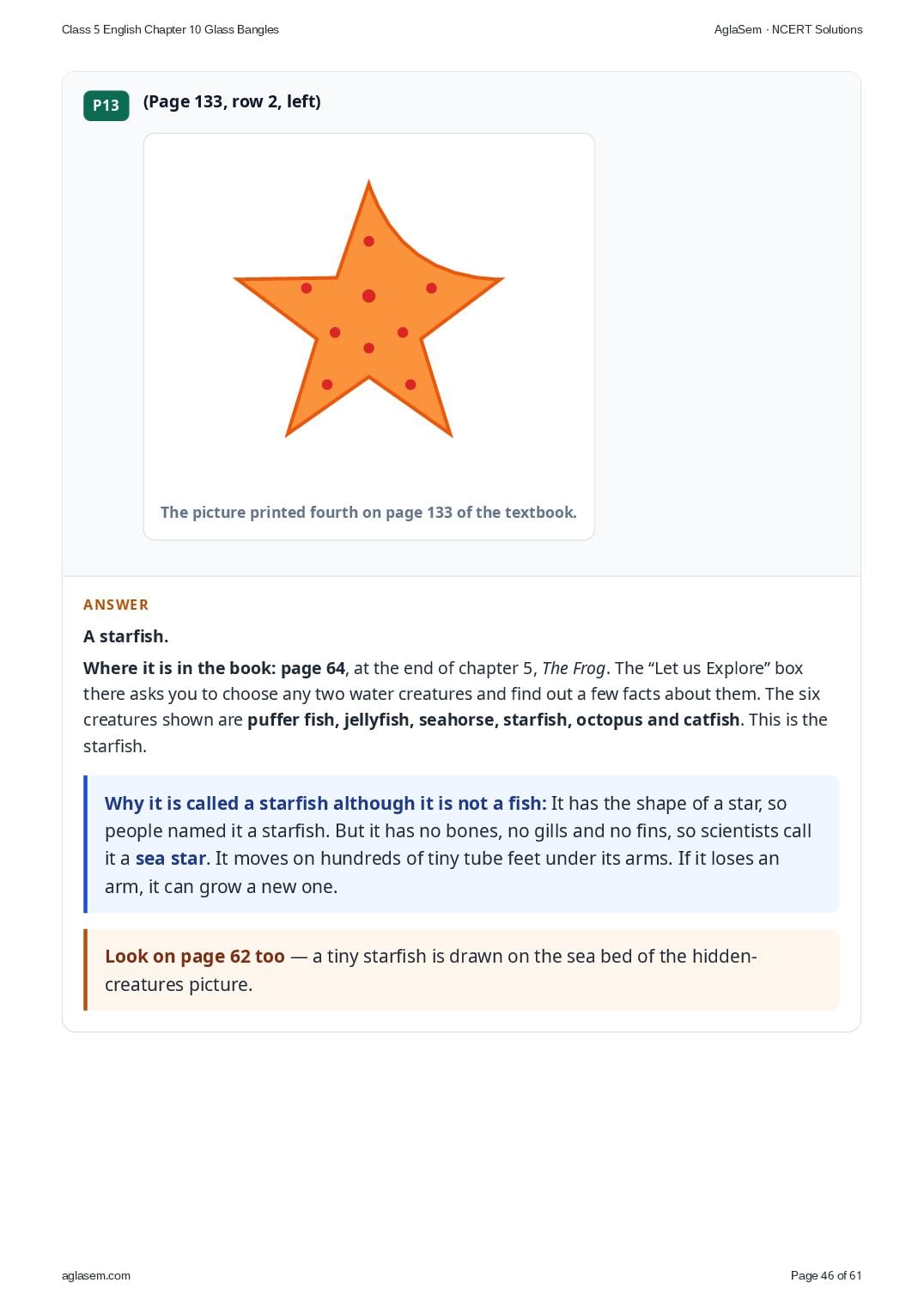
- Look at the following pictures. Can you locate them in this textbook and write their name in the space given below? (Page 132, row 1, left) The first of the pictures printed on page 132 The first of the pictures printed on page 132 of the textbook.
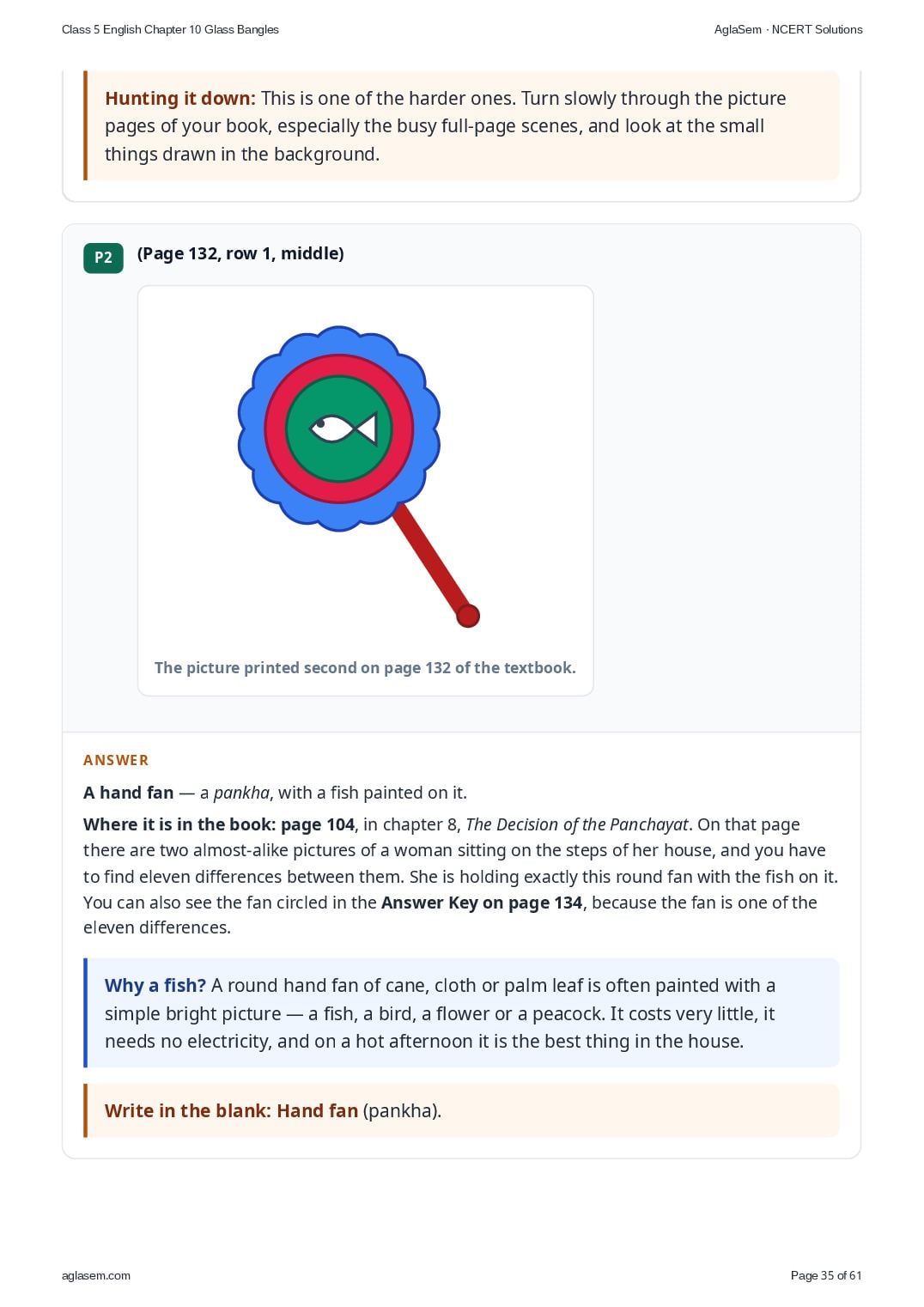
- (Page 132, row 1, middle) The picture printed second on page 132 The picture printed second on page 132 of the textbook.
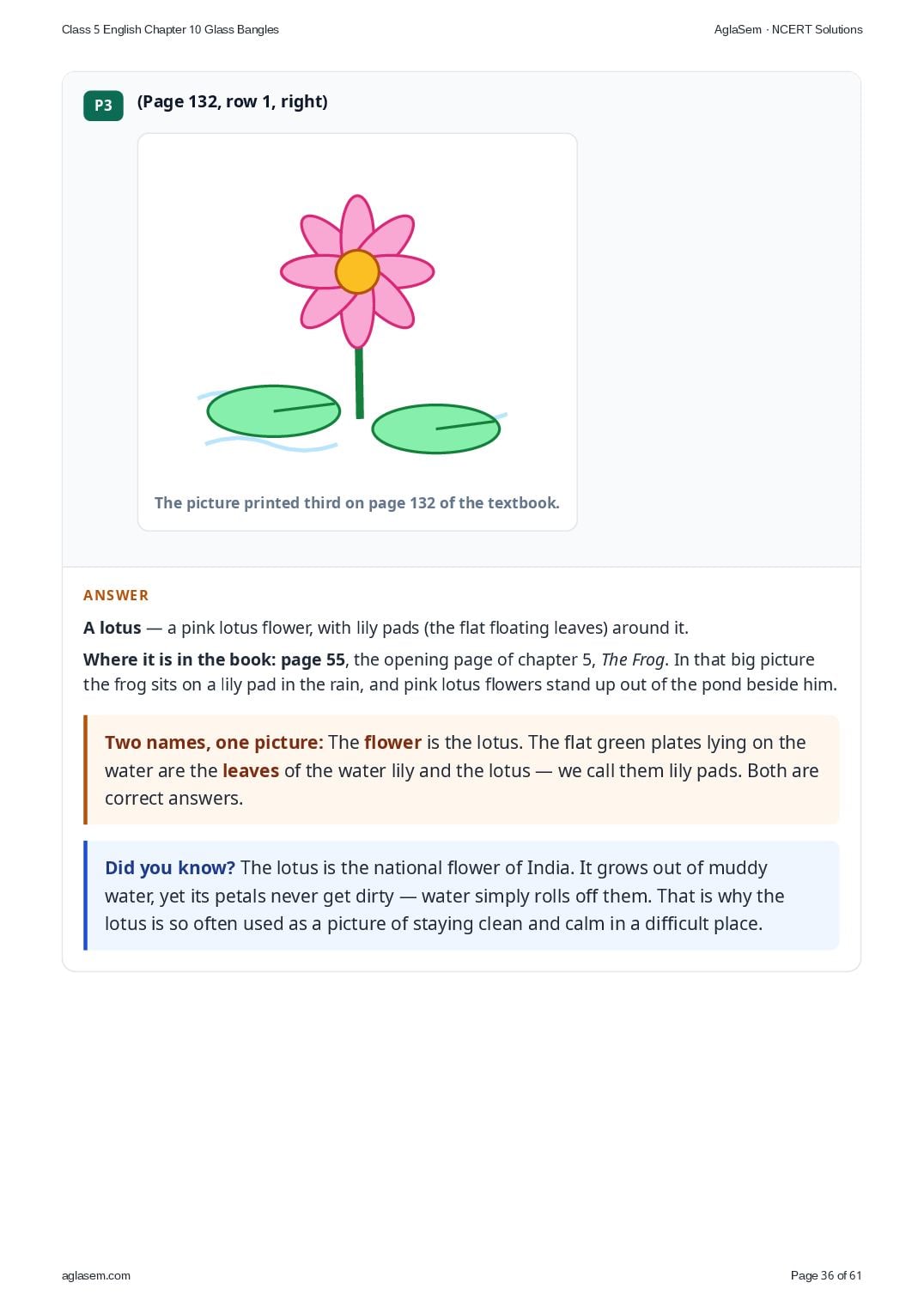
- (Page 132, row 1, right) The picture printed third on page 132 The picture printed third on page 132 of the textbook.
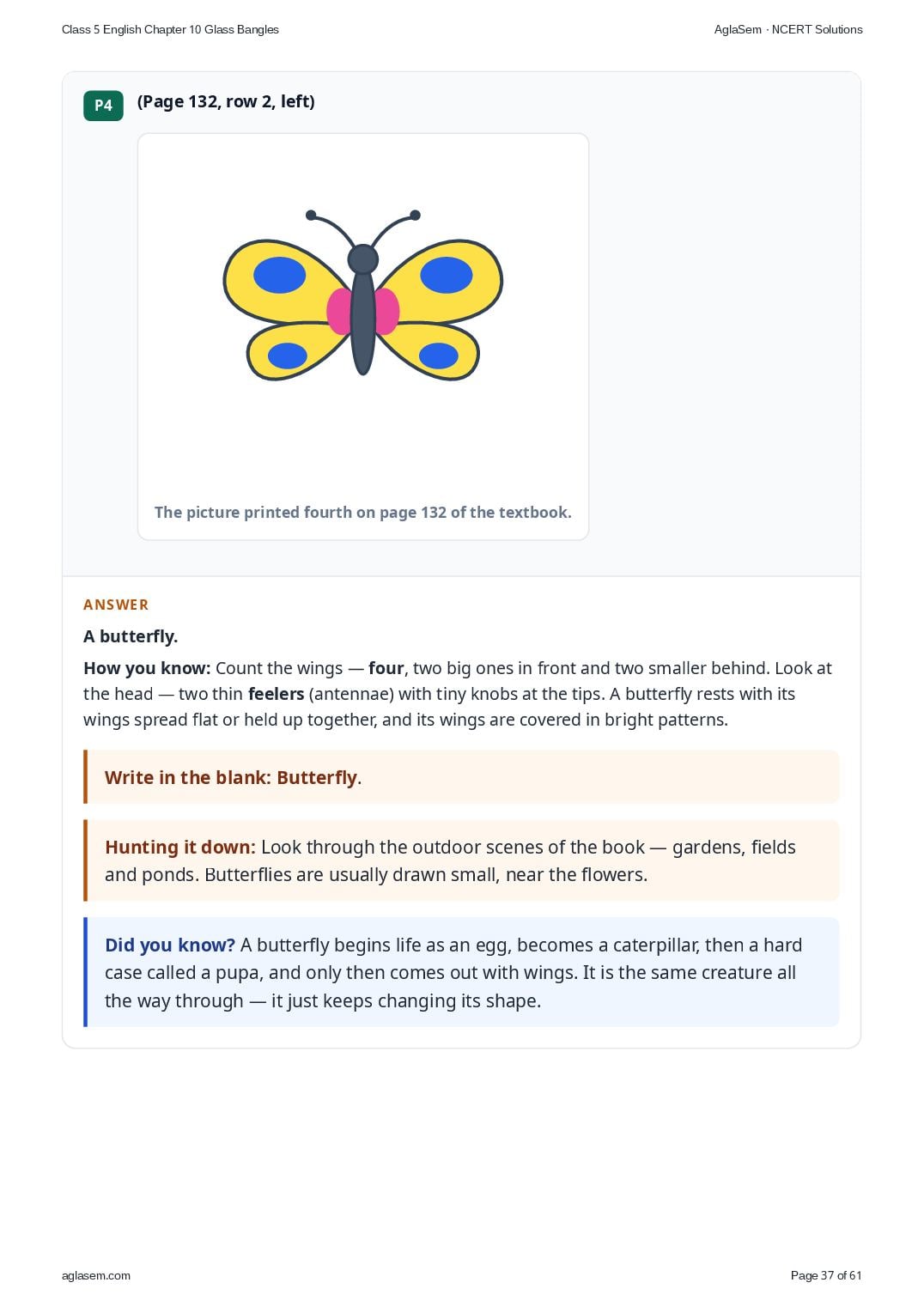
- (Page 132, row 2, left) The picture printed fourth on page 132 The picture printed fourth on page 132 of the textbook.
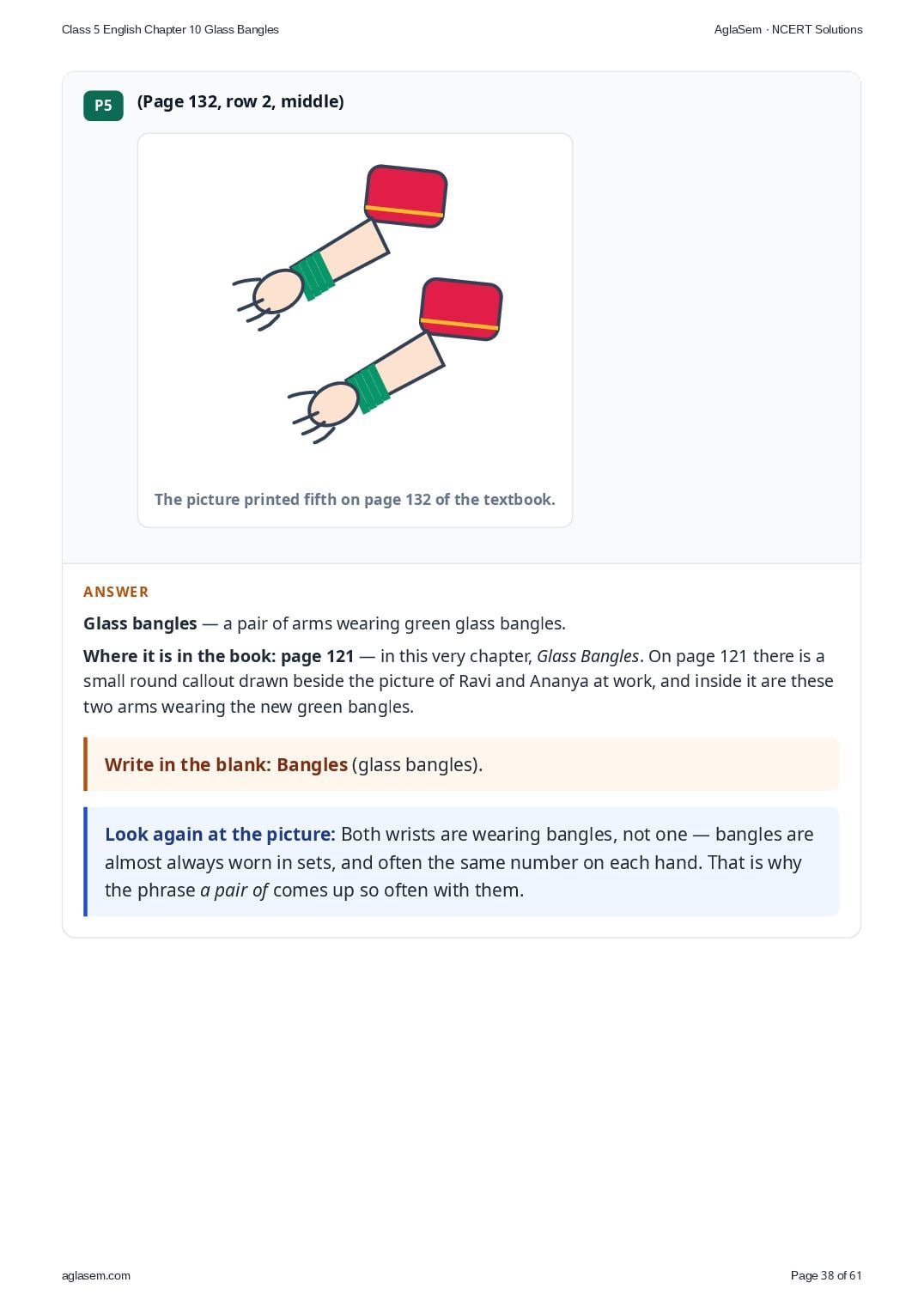
- (Page 132, row 2, middle) The picture printed fifth on page 132 The picture printed fifth on page 132 of the textbook.
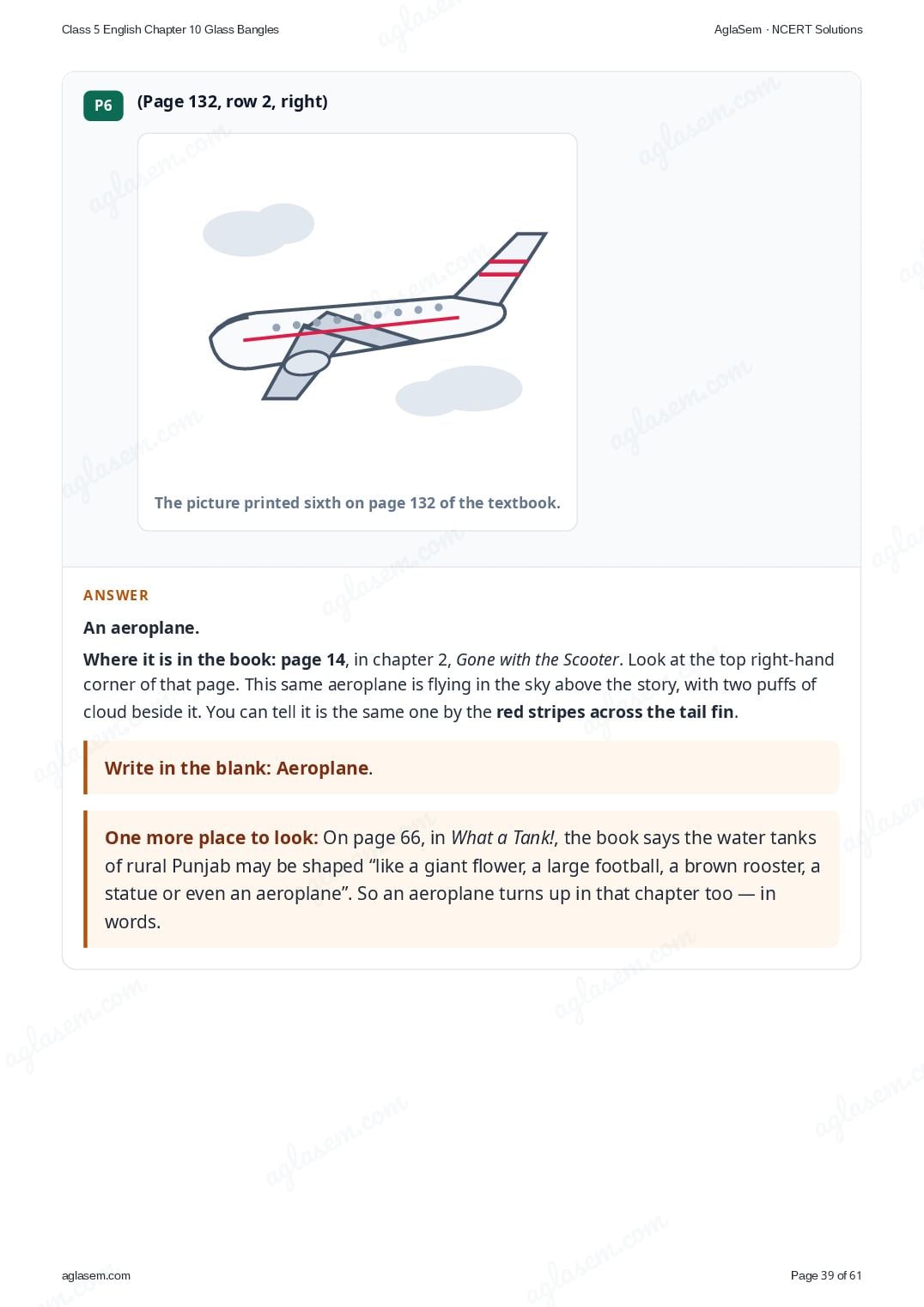
- (Page 132, row 2, right) The picture printed sixth on page 132 The picture printed sixth on page 132 of the textbook.
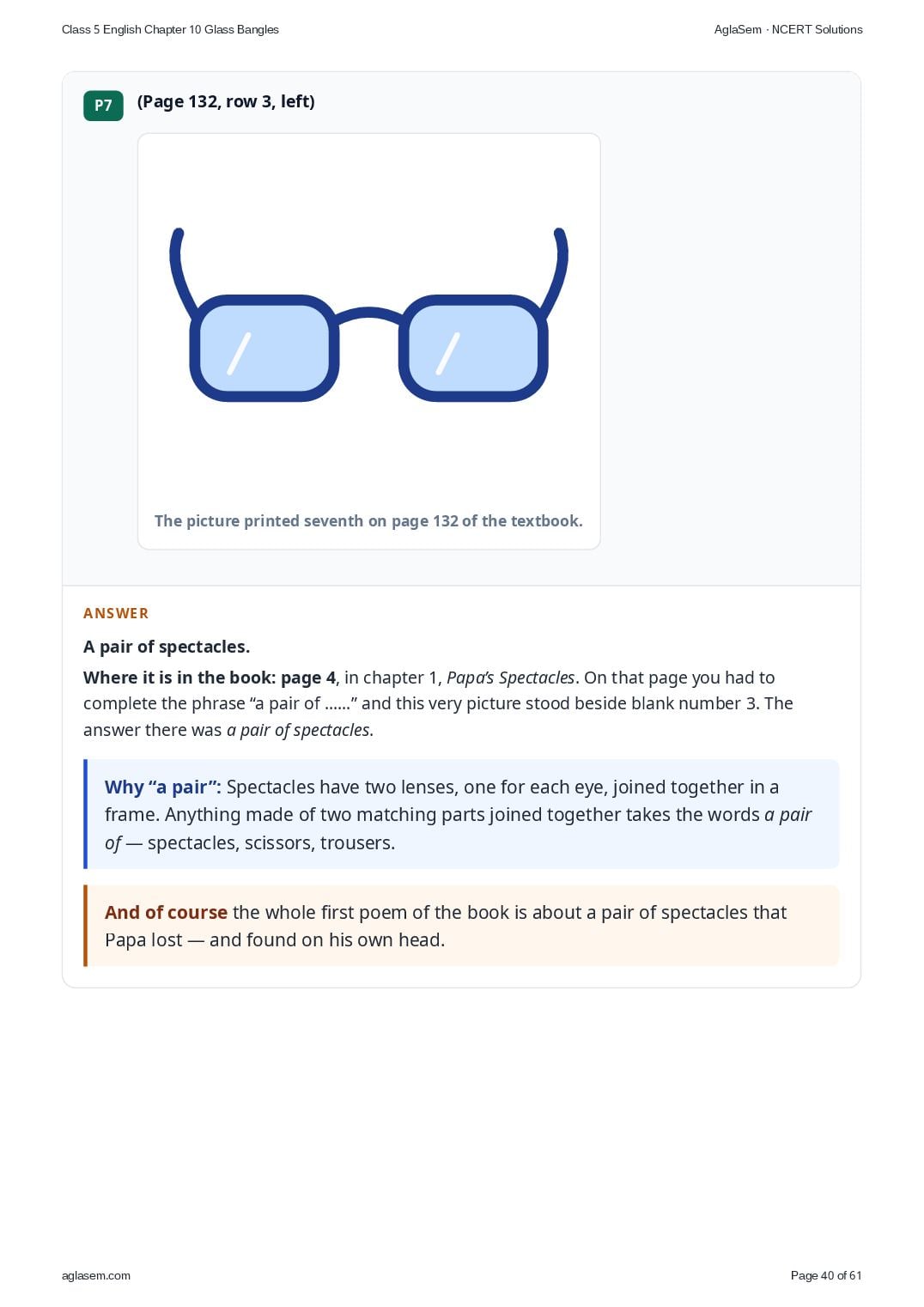
- (Page 132, row 3, left) The picture printed seventh on page 132 The picture printed seventh on page 132 of the textbook.
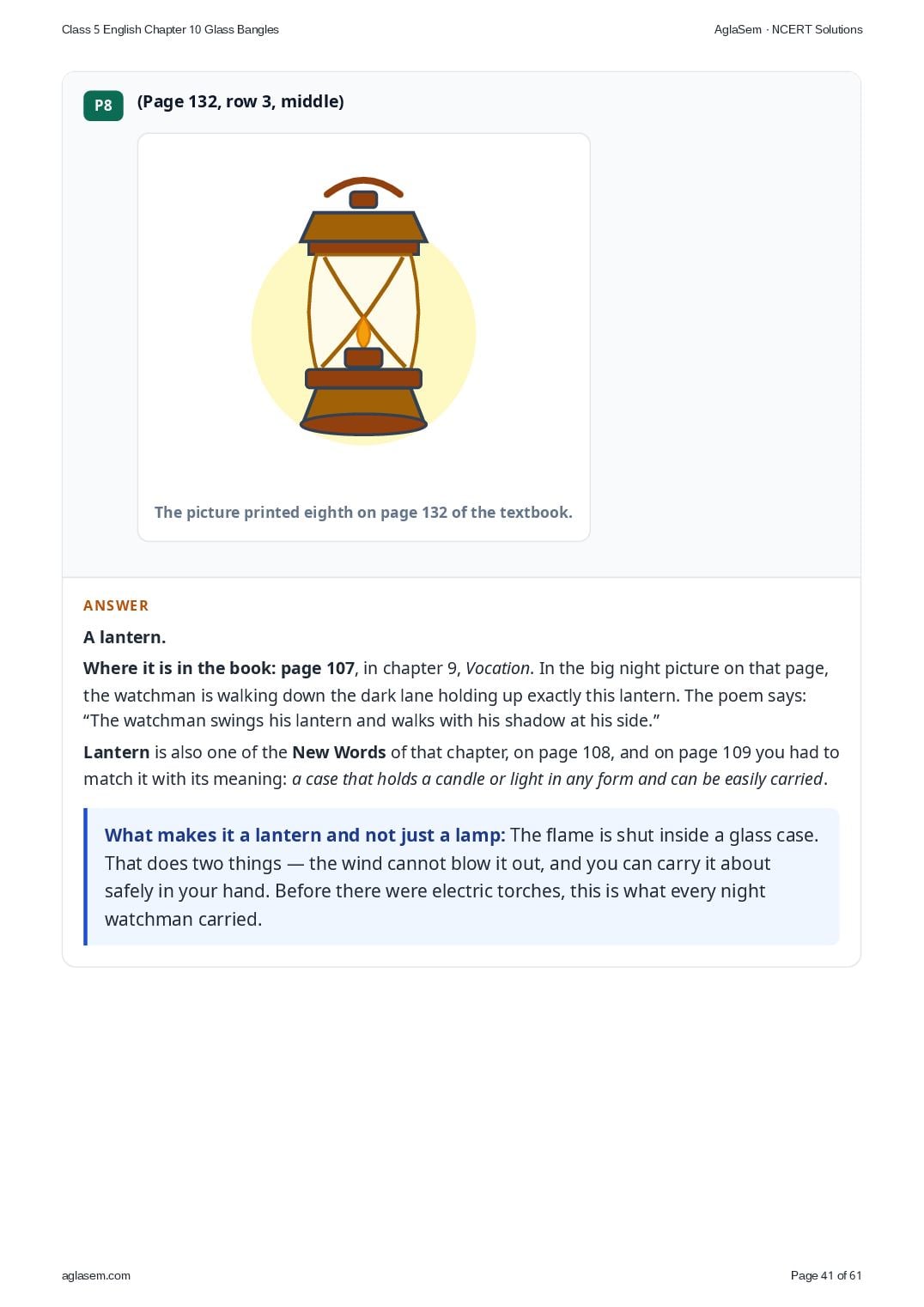
- (Page 132, row 3, middle) The picture printed eighth on page 132 The picture printed eighth on page 132 of the textbook.
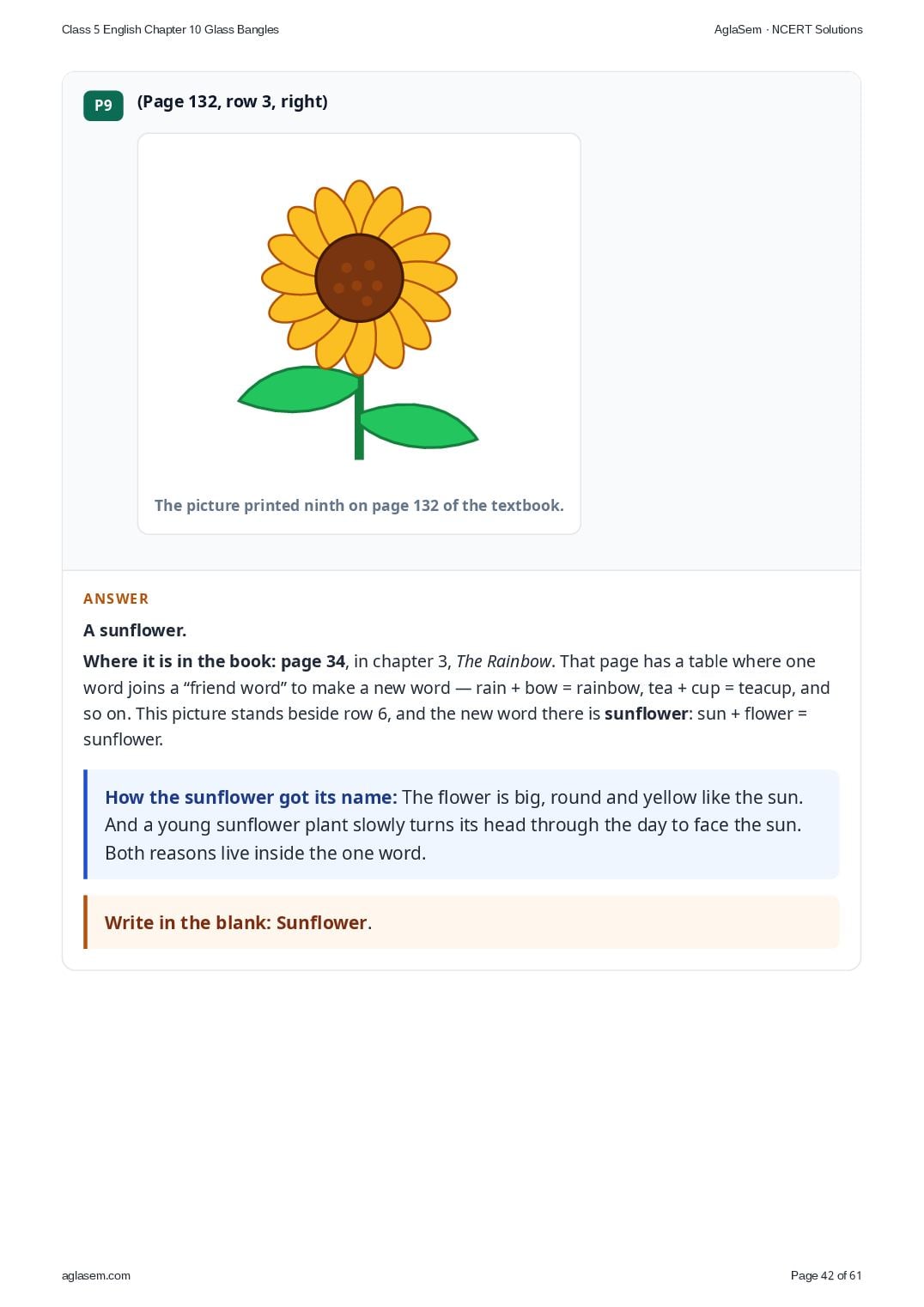
- (Page 132, row 3, right) The picture printed ninth on page 132 The picture printed ninth on page 132 of the textbook.
- (Page 133, row 1, left) The picture printed first on page 133 The picture printed first on page 133 of the textbook.
- (Page 133, row 1, middle) The picture printed second on page 133 The picture printed second on page 133 of the textbook.
- (Page 133, row 1, right) The picture printed third on page 133 The picture printed third on page 133 of the textbook.
- (Page 133, row 2, left) The picture printed fourth on page 133 The picture printed fourth on page 133 of the textbook.
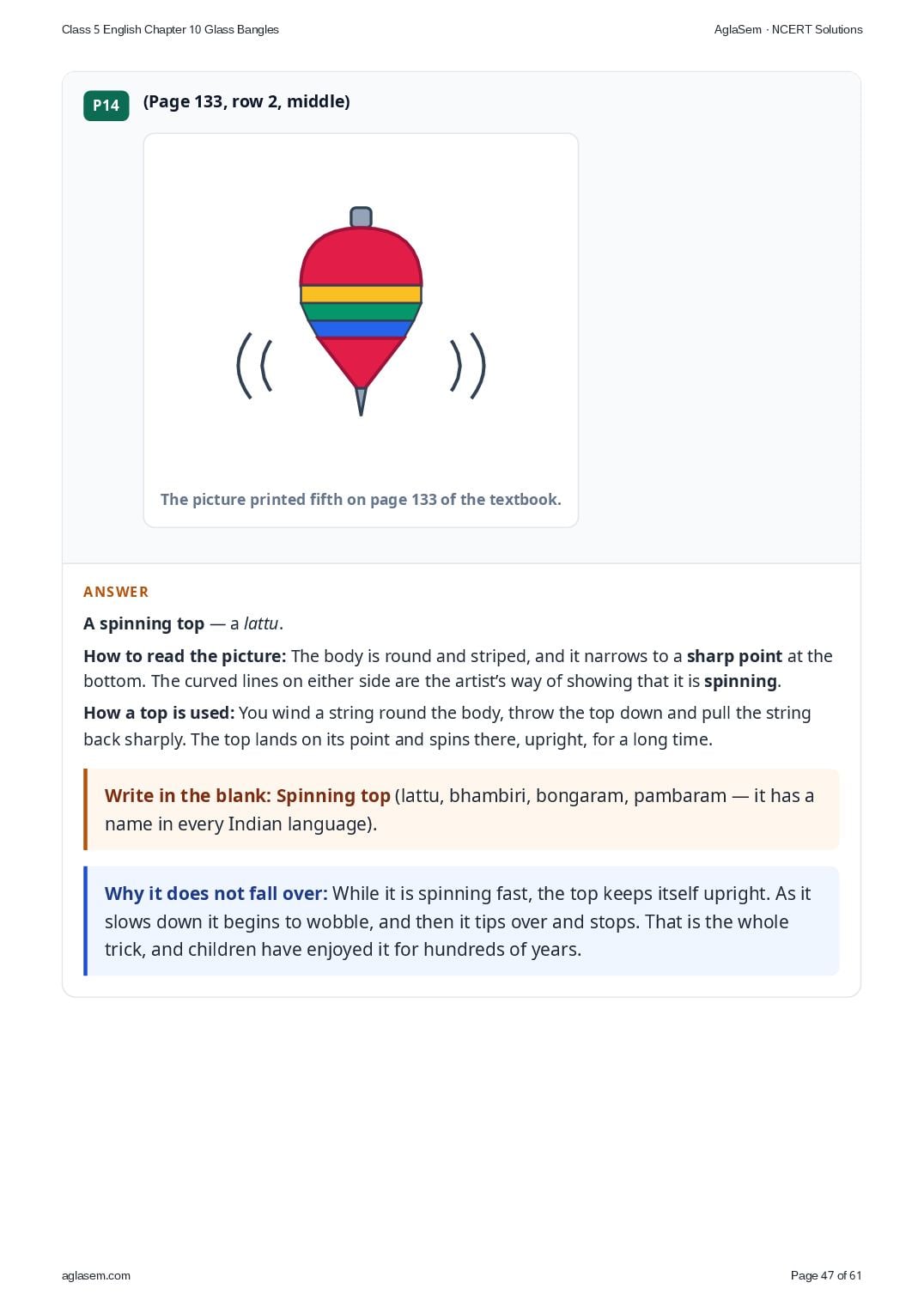
- (Page 133, row 2, middle) The picture printed fifth on page 133 The picture printed fifth on page 133 of the textbook.
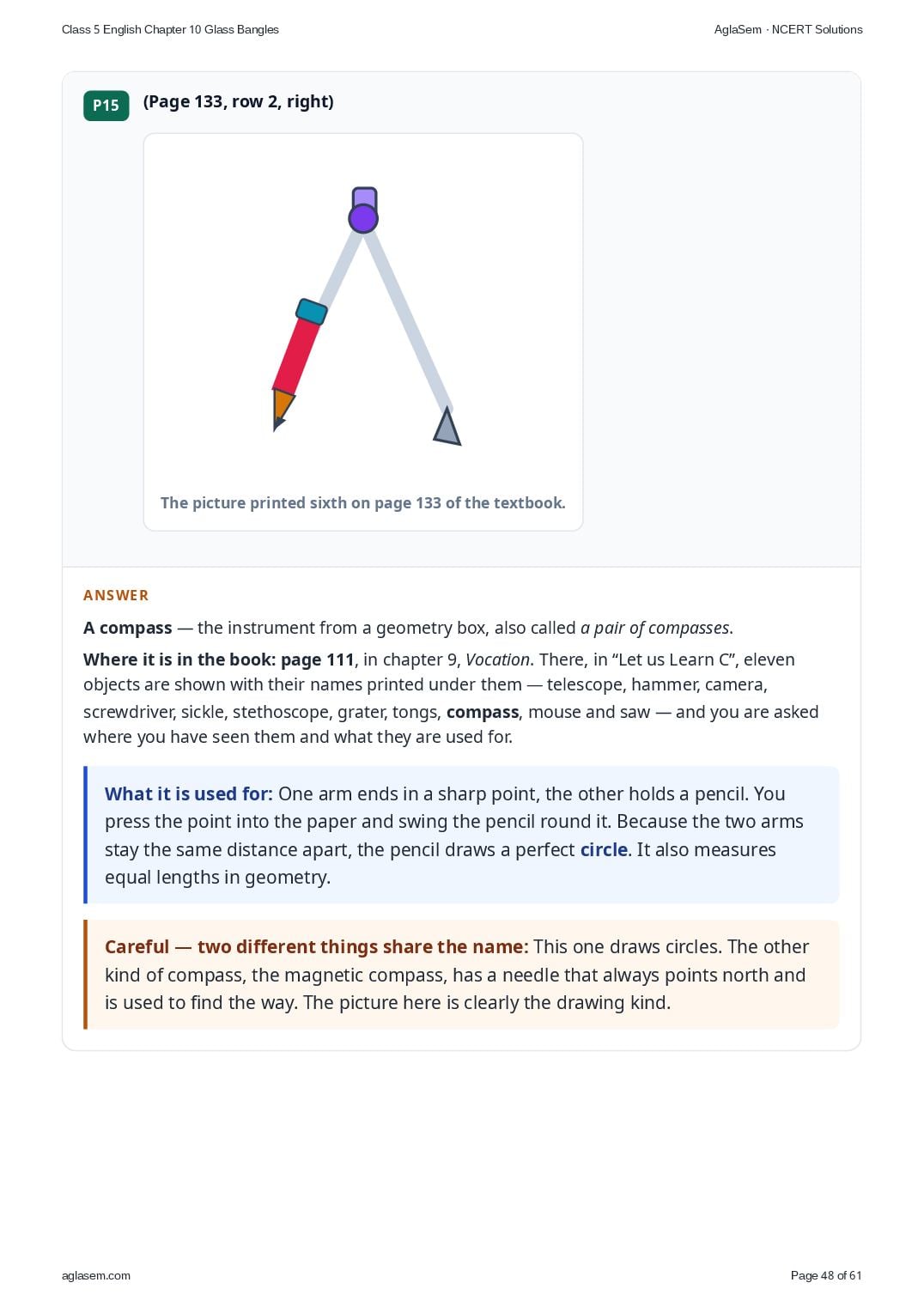
- (Page 133, row 2, right) The picture printed sixth on page 133 The picture printed sixth on page 133 of the textbook.
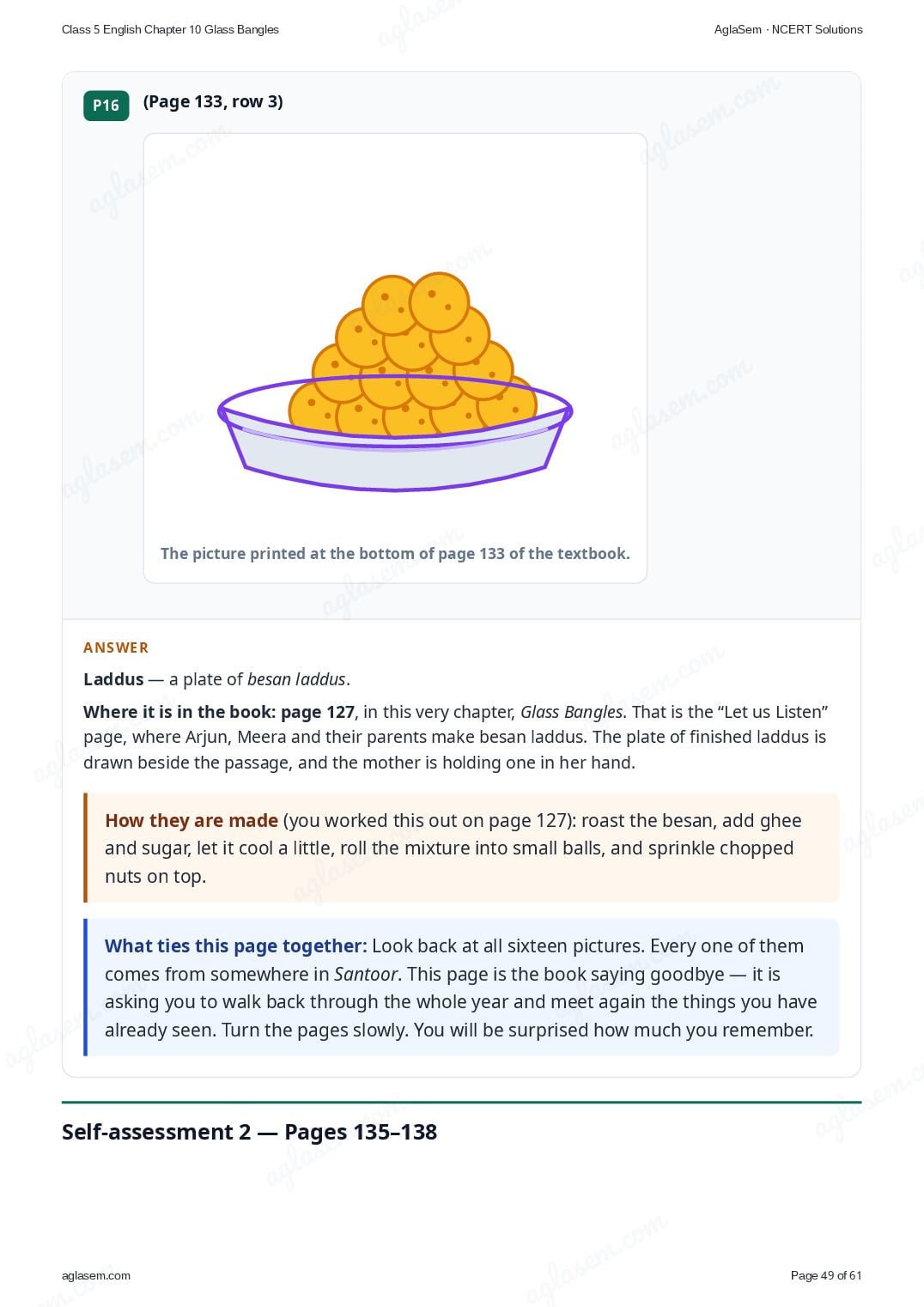
- (Page 133, row 3) The picture printed at the bottom of page 133 The picture printed at the bottom of page 133 of the textbook.
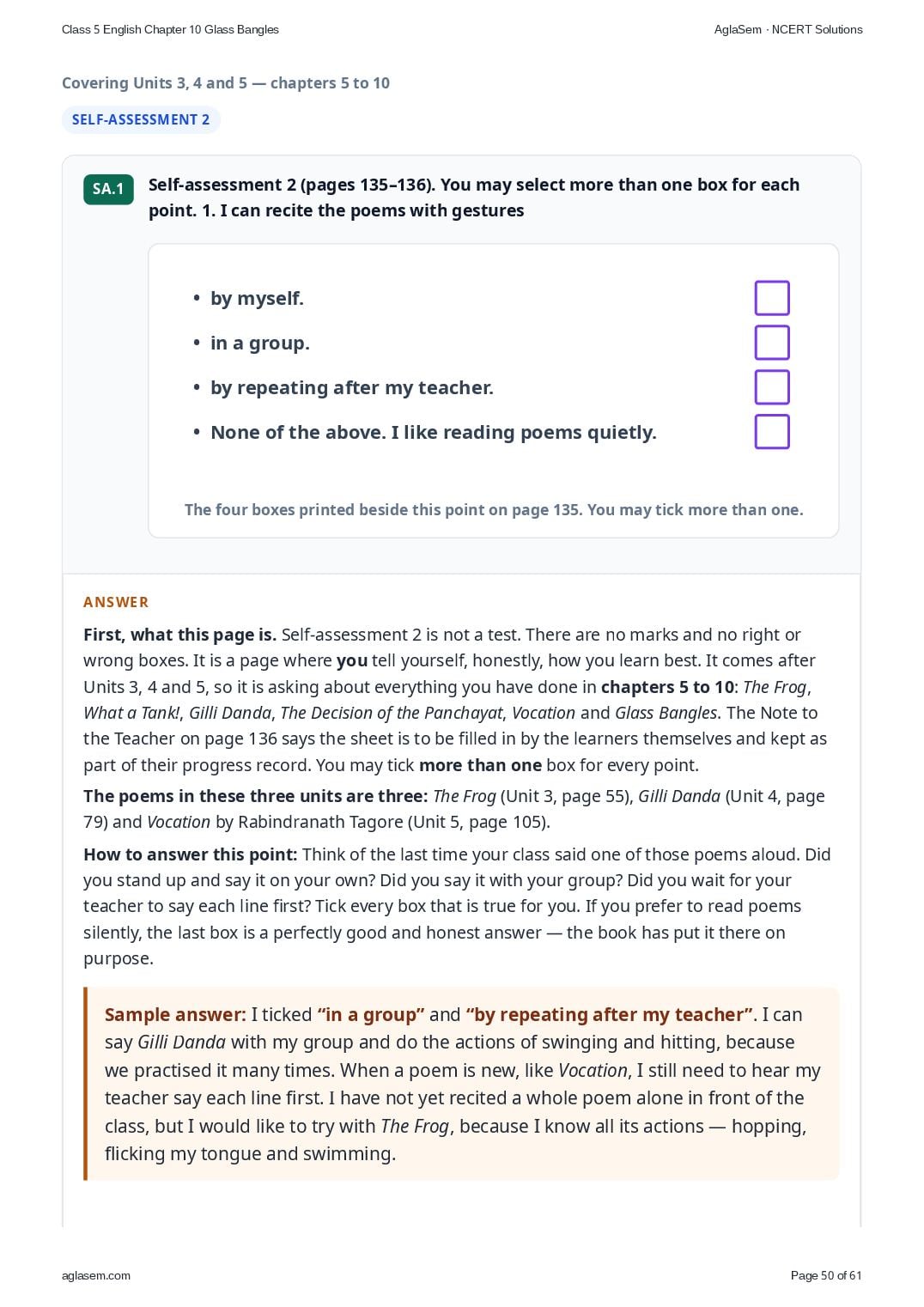
- Self-assessment 2 (pages 135–136). You may select more than one box for each point. 1. I can recite the poems with gestures The four tick boxes printed beside this point • by myself. • in a group. • by repeating after my teacher. • None of the above. I like reading poems quietly. The four boxes printed beside this point on page 135. You may tick more than one.
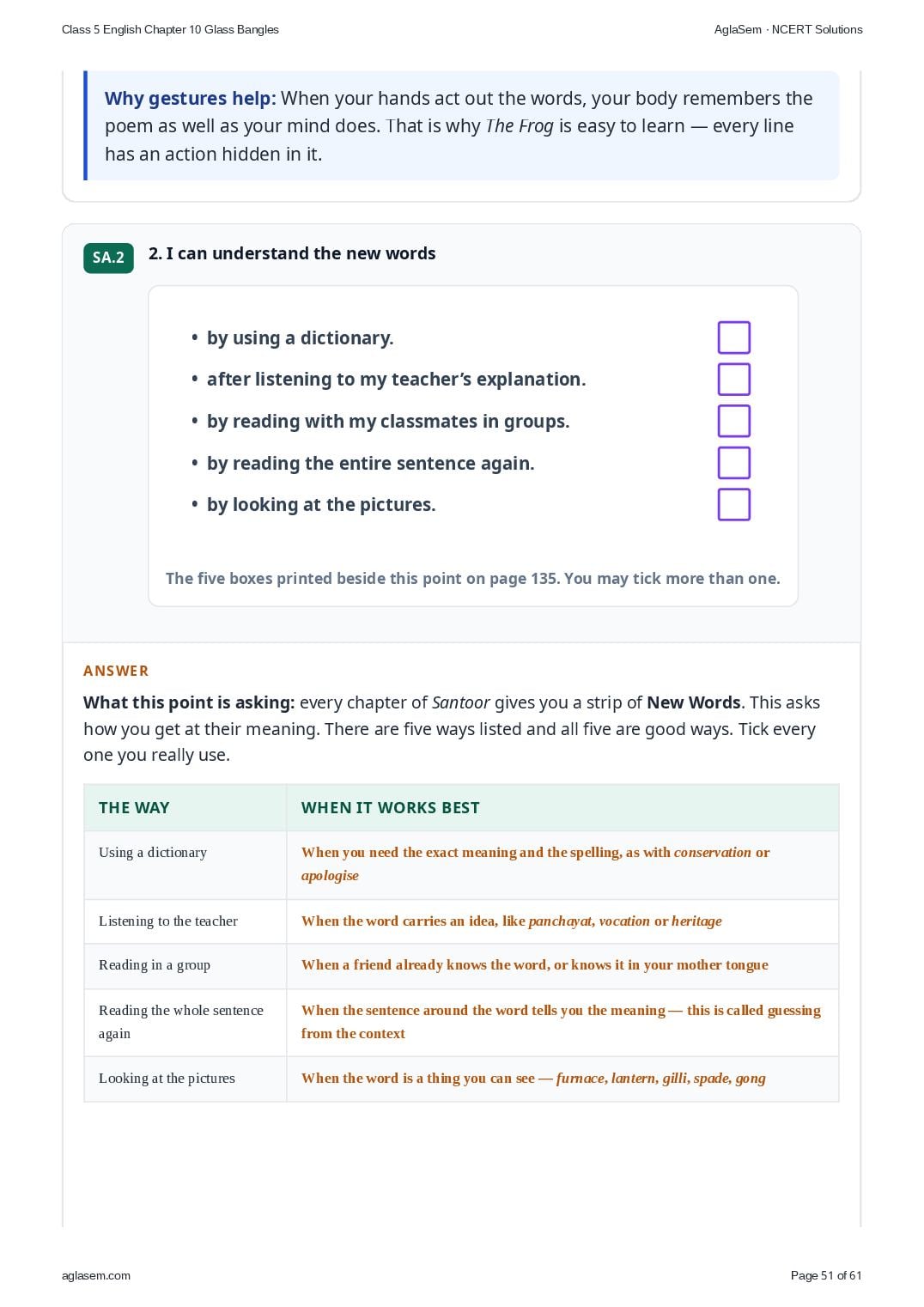
- 2. I can understand the new words The five tick boxes printed beside this point • by using a dictionary. • after listening to my teacher’s explanation. • by reading with my classmates in groups. • by reading the entire sentence again. • by looking at the pictures. The five boxes printed beside this point on page 135. You may tick more than one.
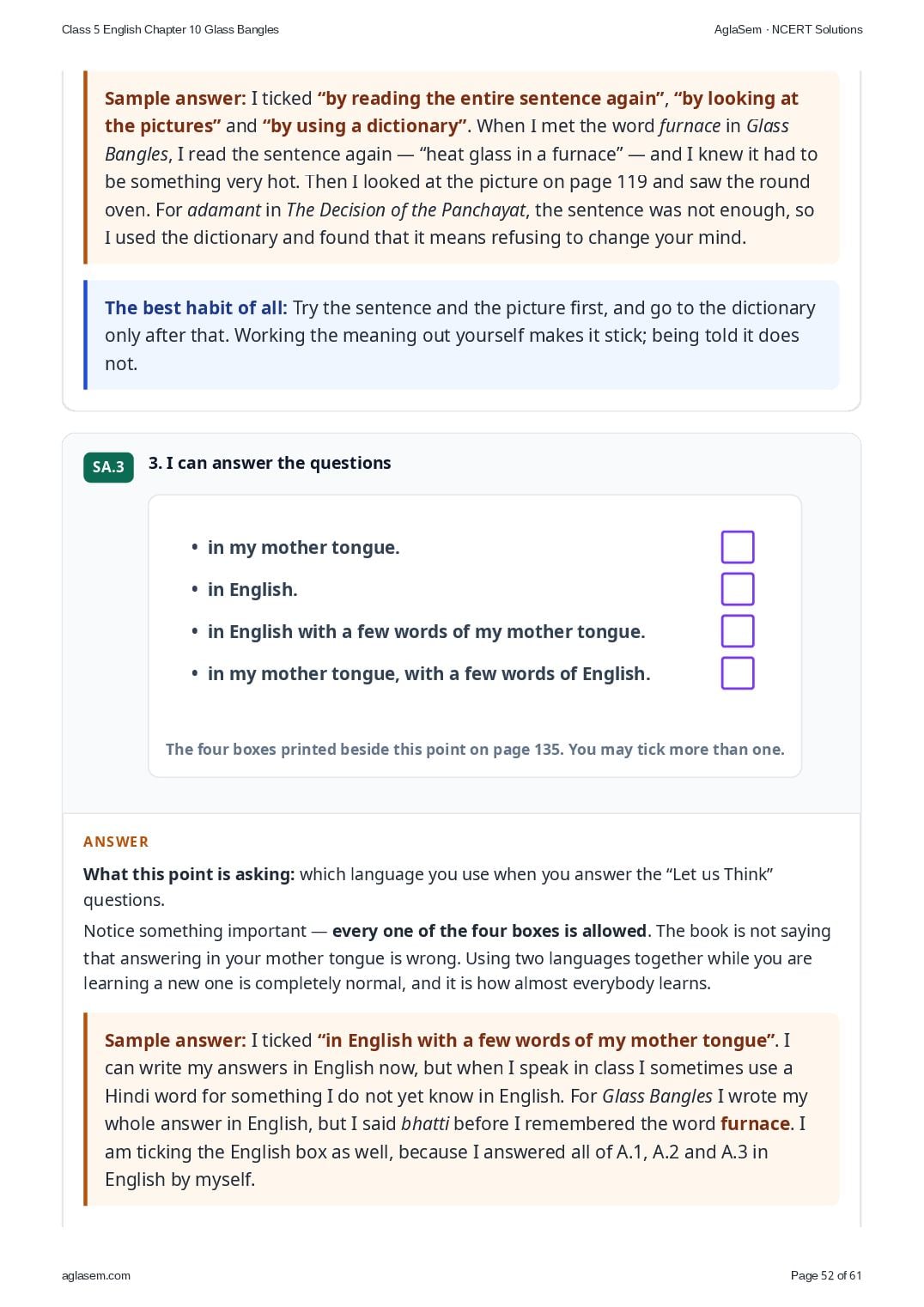
- 3. I can answer the questions The four tick boxes printed beside this point • in my mother tongue. • in English. • in English with a few words of my mother tongue. • in my mother tongue, with a few words of English. The four boxes printed beside this point on page 135. You may tick more than one.
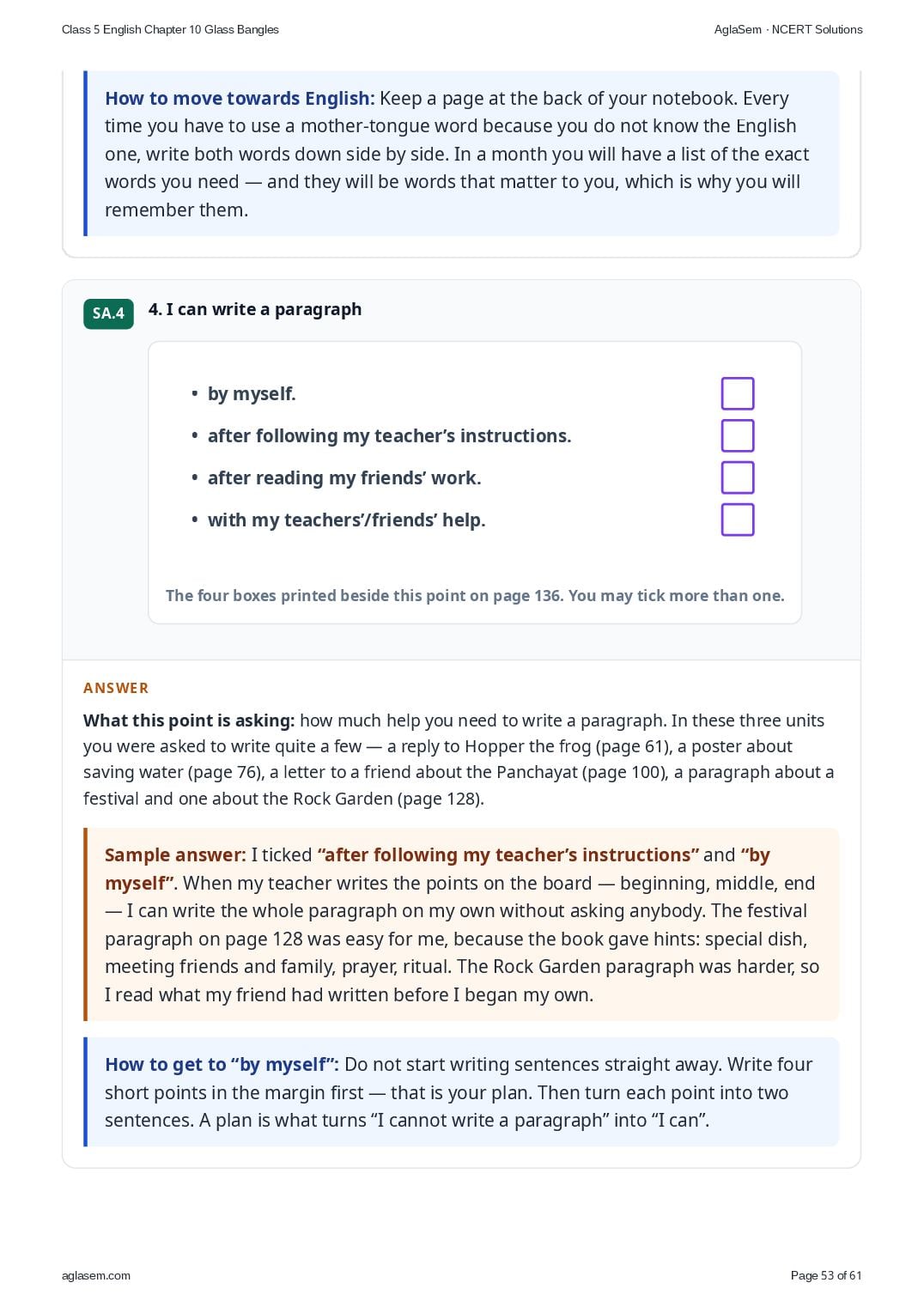
- 4. I can write a paragraph The four tick boxes printed beside this point • by myself. • after following my teacher’s instructions. • after reading my friends’ work. • with my teachers’/friends’ help. The four boxes printed beside this point on page 136. You may tick more than one.
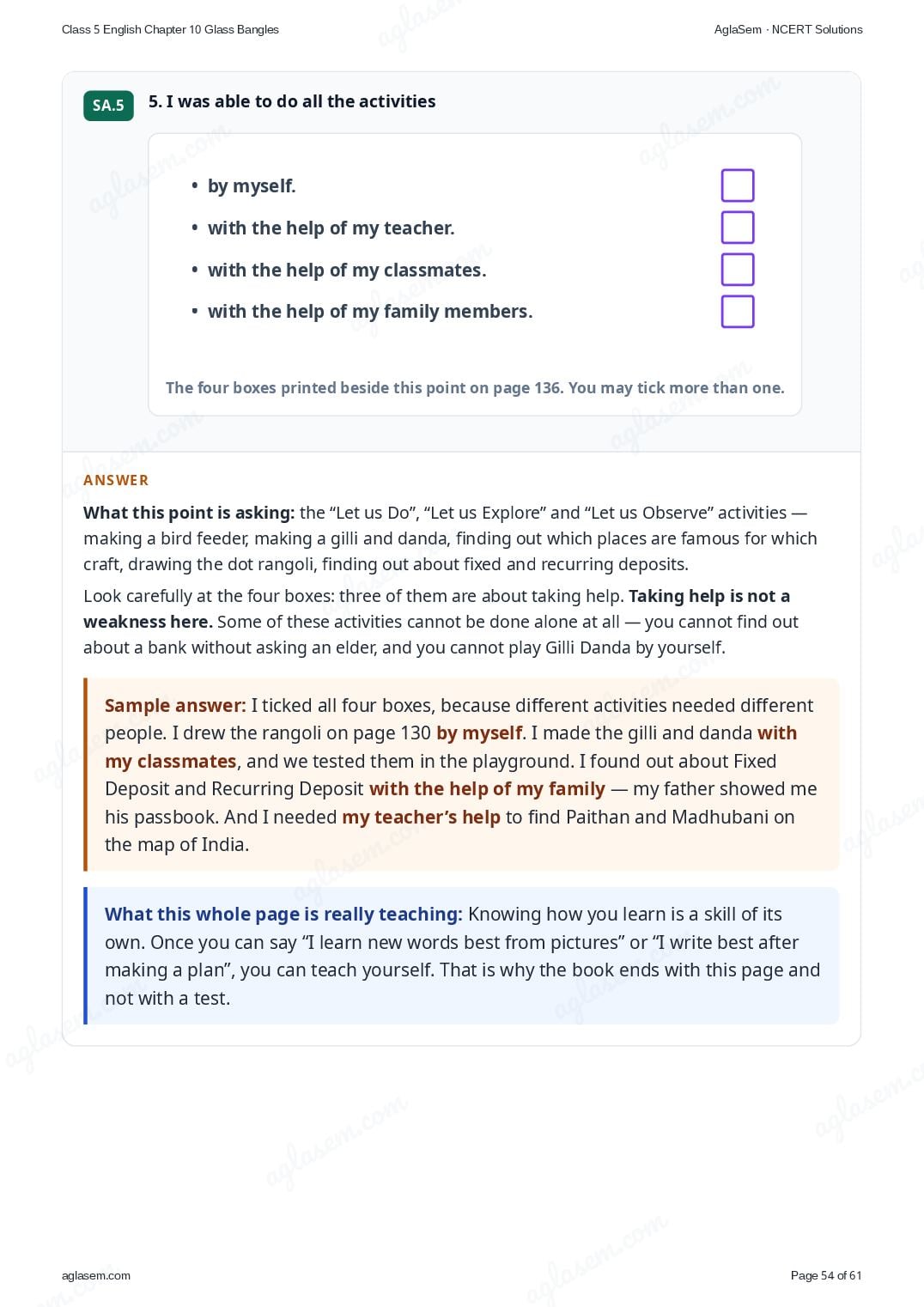
- 5. I was able to do all the activities The four tick boxes printed beside this point • by myself. • with the help of my teacher. • with the help of my classmates. • with the help of my family members. The four boxes printed beside this point on page 136. You may tick more than one.
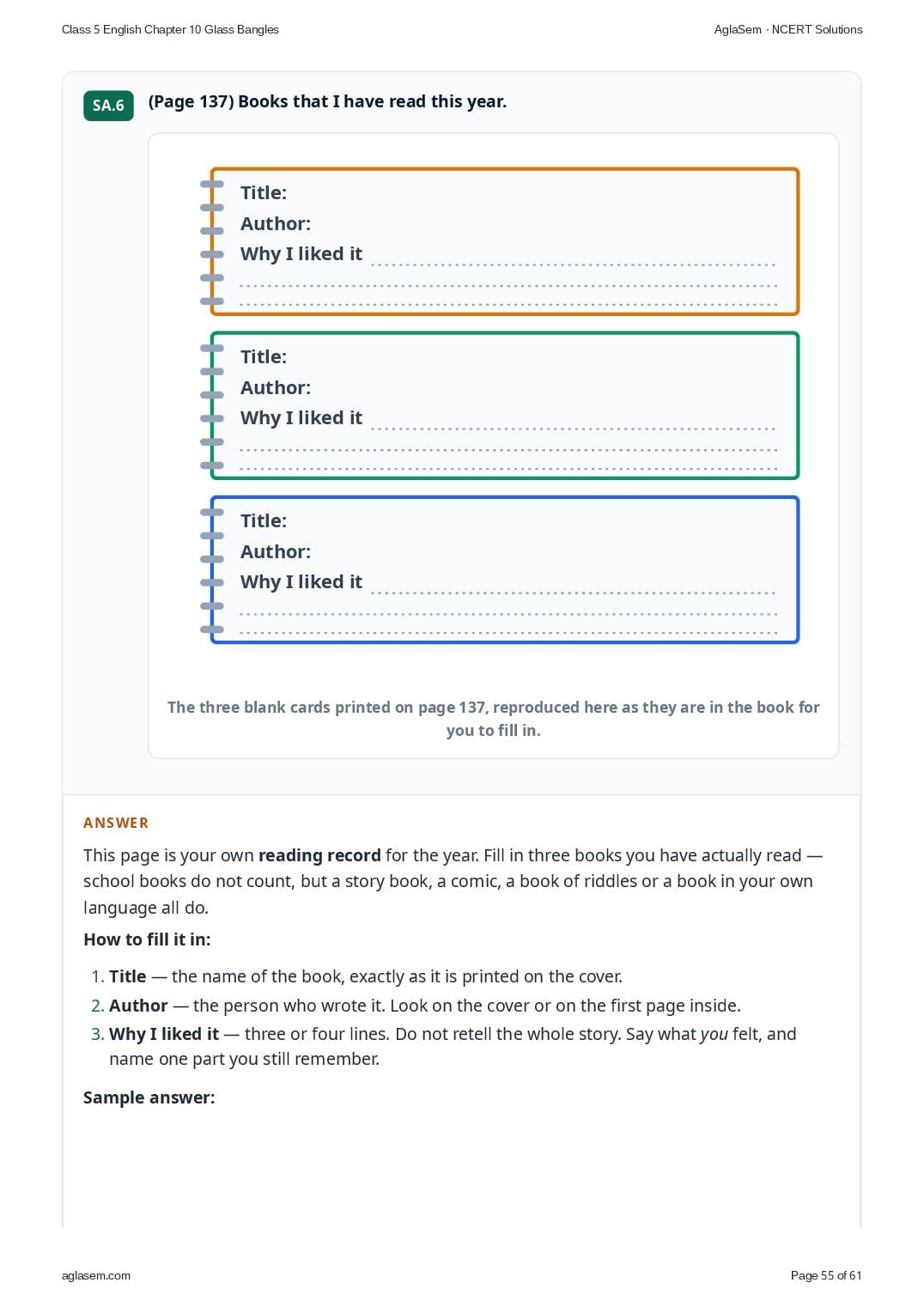
- (Page 137) Books that I have read this year. The three blank cards printed on page 137 Title: Author: Why I liked it Title: Author: Why I liked it Title: Author: Why I liked it The three blank cards printed on page 137, reproduced here as they are in the book for you to fill in.
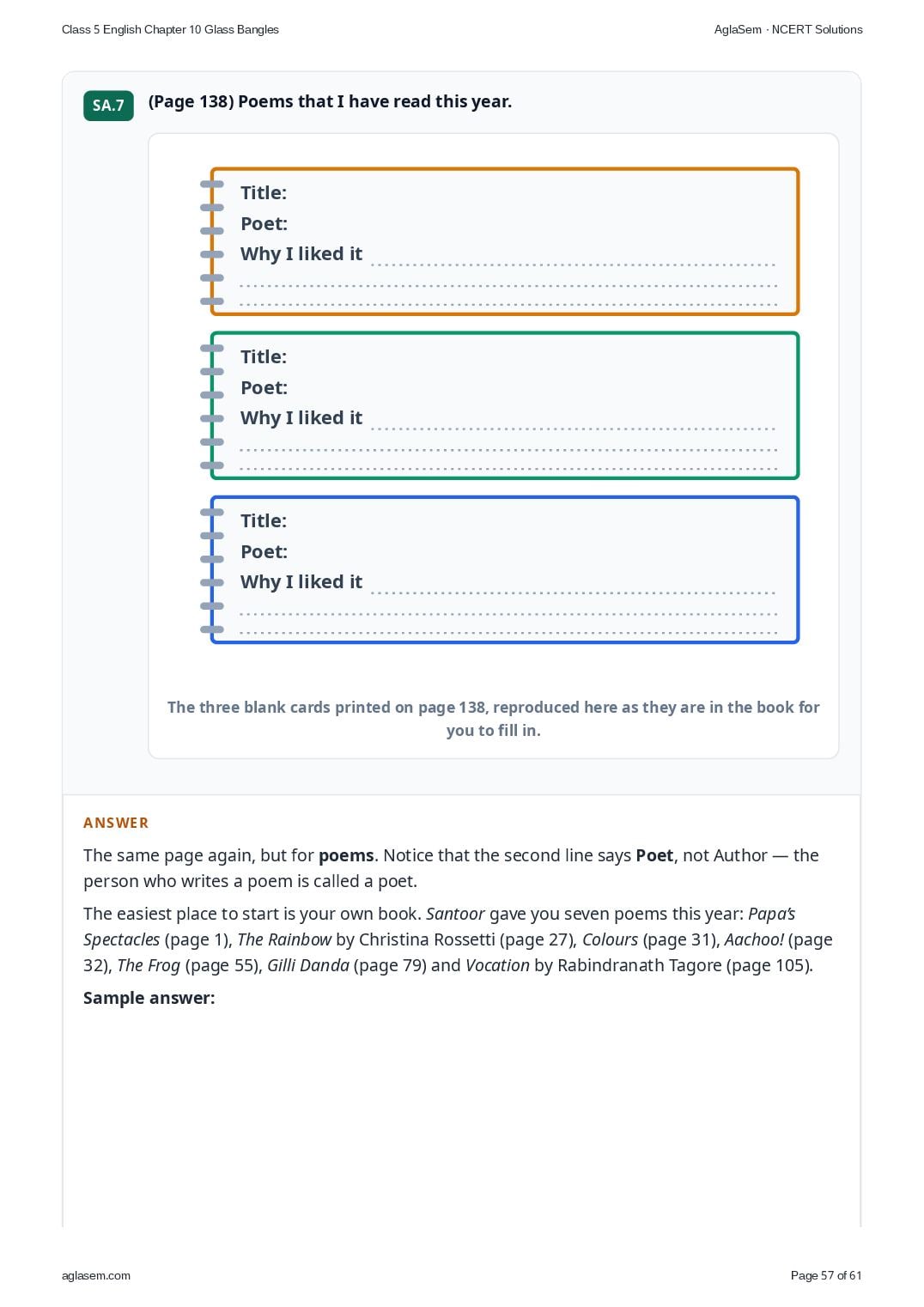
- (Page 138) Poems that I have read this year. The three blank cards printed on page 138 Title: Poet: Why I liked it Title: Poet: Why I liked it Title: Poet: Why I liked it The three blank cards printed on page 138, reproduced here as they are in the book for you to fill in.
Chapter at a Glance
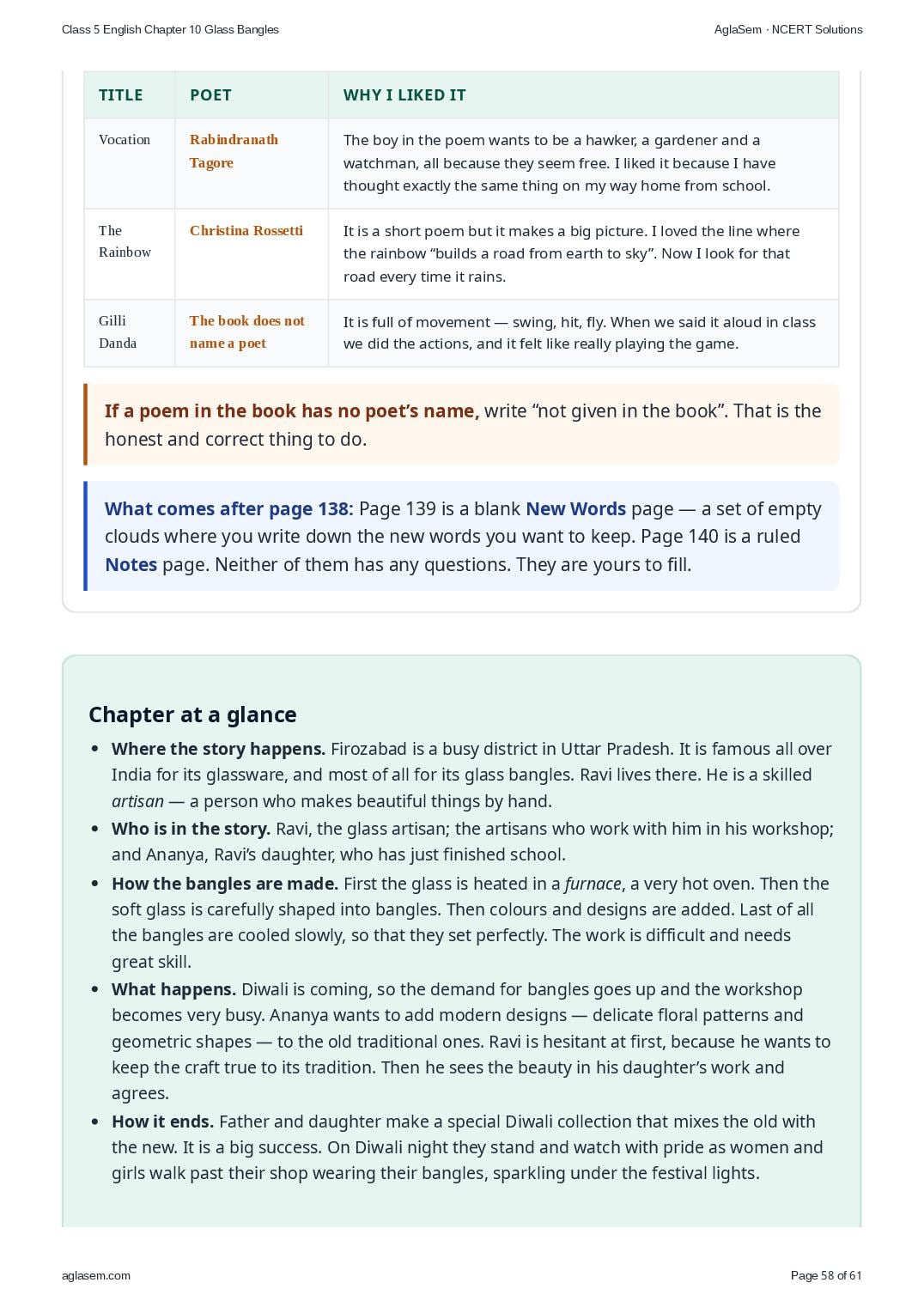
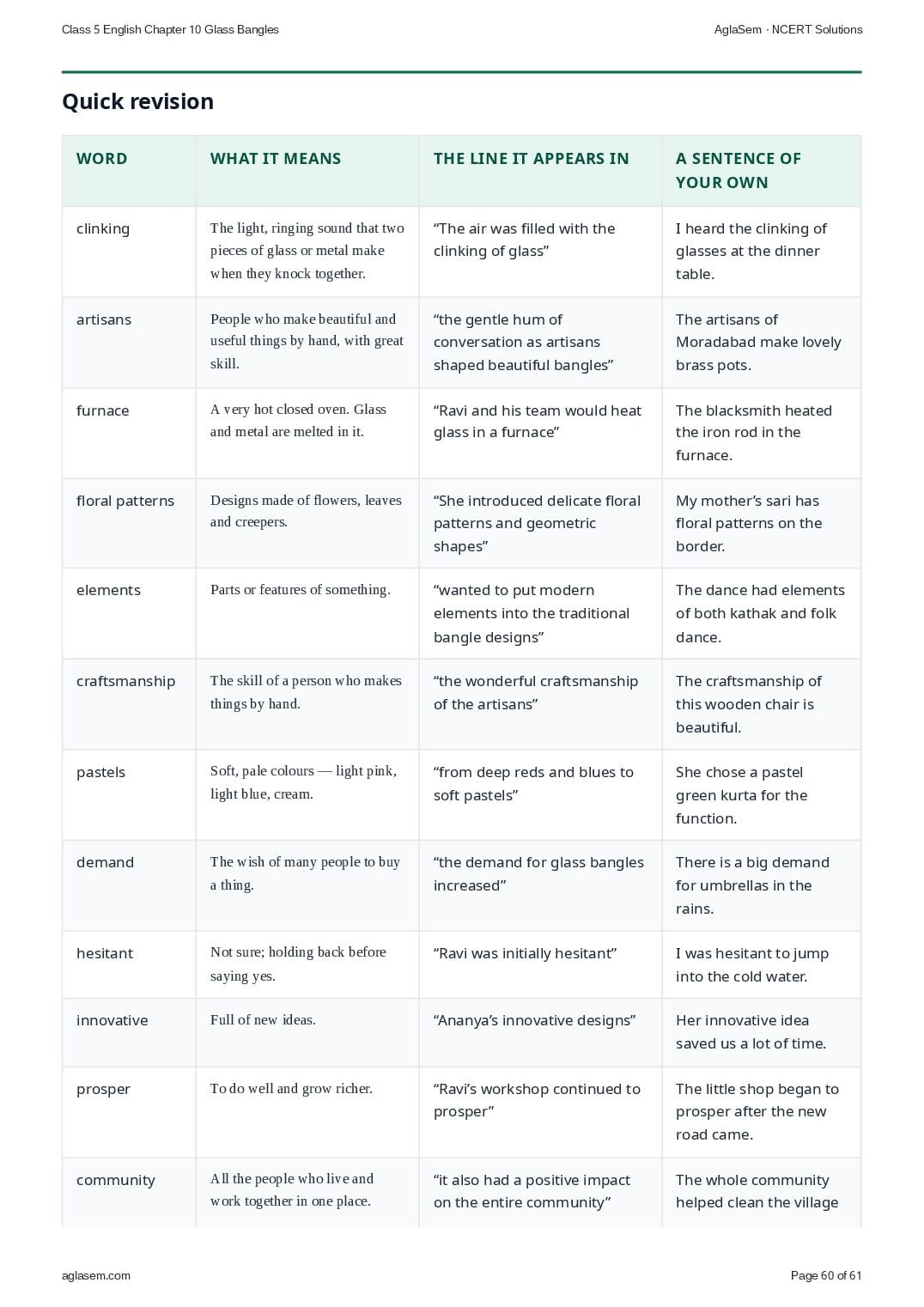
- Where the story happens. Firozabad is a busy district in Uttar Pradesh. It is famous all over India for its glassware, and most of all for its glass bangles. Ravi lives there. He is a skilled artisan — a person who makes beautiful things by hand.
- Who is in the story. Ravi, the glass artisan; the artisans who work with him in his workshop; and Ananya, Ravi’s daughter, who has just finished school.
- How the bangles are made. First the glass is heated in a furnace, a very hot oven. Then the soft glass is carefully shaped into bangles. Then colours and designs are added. Last of all the bangles are cooled slowly, so that they set perfectly. The work is difficult and needs great skill.
- What happens. Diwali is coming, so the demand for bangles goes up and the workshop becomes very busy. Ananya wants to add modern designs — delicate floral patterns and geometric shapes — to the old traditional ones. Ravi is hesitant at first, because he wants to keep the craft true to its tradition. Then he sees the beauty in his daughter’s work and agrees.
- How it ends. Father and daughter make a special Diwali collection that mixes the old with the new. It is a big success. On Diwali night they stand and watch with pride as women and girls walk past their shop wearing their bangles, sparkling under the festival lights.
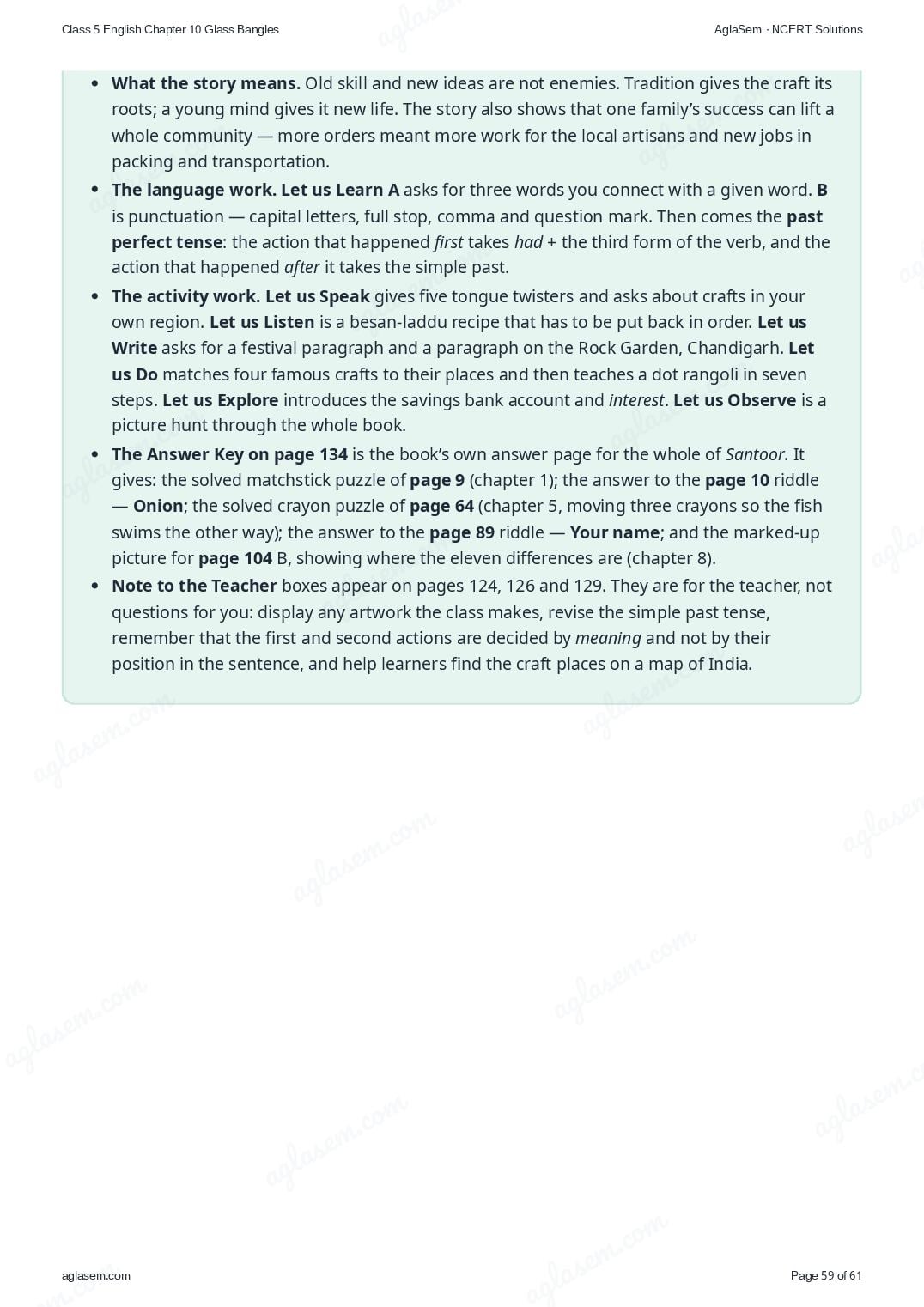
- What the story means. Old skill and new ideas are not enemies. Tradition gives the craft its roots; a young mind gives it new life. The story also shows that one family’s success can lift a whole community — more orders meant more work for the local artisans and new jobs in packing and transportation.
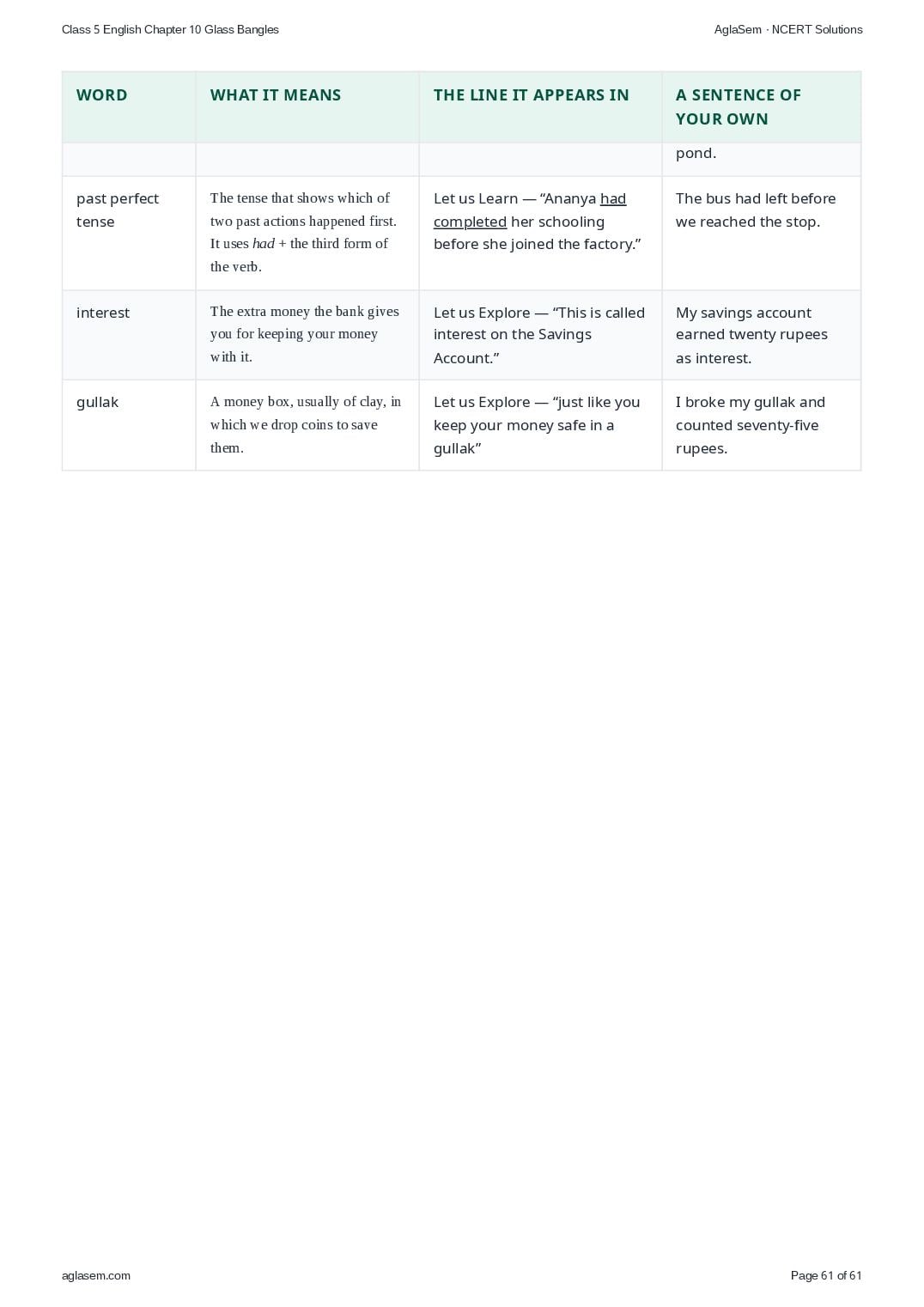
- The language work. Let us Learn A asks for three words you connect with a given word. B is punctuation — capital letters, full stop, comma and question mark. Then comes the past perfect tense: the action that happened first takes had + the third form of the verb, and the action that happened after it takes the simple past.
- The activity work. Let us Speak gives five tongue twisters and asks about crafts in your own region. Let us Listen is a besan-laddu recipe that has to be put back in order. Let us Write asks for a festival paragraph and a paragraph on the Rock Garden, Chandigarh. Let us Do matches four famous crafts to their places and then teaches a dot rangoli in seven steps. Let us Explore introduces the savings bank account and interest. Let us Observe is a picture hunt through the whole book.
- The Answer Key on page 134 is the book’s own answer page for the whole of Santoor. It gives: the solved matchstick puzzle of page 9 (chapter 1); the answer to the page 10 riddle — Onion; the solved crayon puzzle of page 64 (chapter 5, moving three crayons so the fish swims the other way); the answer to the page 89 riddle — Your name; and the marked-up picture for page 104 B, showing where the eleven differences are (chapter 8).
- Note to the Teacher boxes appear on pages 124, 126 and 129. They are for the teacher, not questions for you: display any artwork the class makes, revise the simple past tense, remember that the first and second actions are decided by meaning and not by their position in the sentence, and help learners find the craft places on a map of India.
How to Download NCERT Solutions for Class 5 English Chapter 10 PDF
Follow these simple steps to get the Glass Bangles questions-and-answers PDF from Santoor.
- Search NCERT Solutions for Class 5 English Chapter 10 aglasem and open this page.
- Read the exercise questions with answers for Glass Bangles shown above.
- Click the Download PDF link to save the Glass Bangles solutions to your device.
NCERT Solutions for Class 5 English – All Chapters
There are more chapters to study besides Glass Bangles in English. Here are the NCERT Solutions for all chapters of Class 5 English.
- Chapter 1 Papa s Spectacles
- Chapter 2 Gone with the Scooter
- Chapter 3 the Rainbow
- Chapter 4 the Wise Parrot
- Chapter 5 the Frog
- Chapter 6 What a Tank
- Chapter 7 Gilli Danda
- Chapter 8 the Decision of the Panchayat
- Chapter 9 Vocation
- Chapter 10 Glass Bangles
NCERT Solutions for Class 5 – All Subjects
Just like Chapter 10 of English, you can get the exercise questions with answers for every other subject of Class 5. Here are the NCERT Solutions for all subjects of Class 5.
NCERT Solutions for Class 5 English Chapter 10 – An Overview
The key highlights of this study material are as follows.
| Aspects | Details |
|---|---|
| Class | Class 5 |
| Subject | English |
| Chapter Number | Chapter 10 |
| Chapter Name | Glass Bangles |
| Book Name | Santoor |
| Book By | NCERT (National Council of Educational Research and Training) |
| Educational Resource Here | NCERT Solutions of Class 5 English Chapter 10 for all exercises |
| More Questions Answers of This Subject | NCERT Solutions for Class 5 English |
| Download Book Chapter | NCERT Book Class 5 English |
| All Questions Answers For This Class | NCERT Solutions for Class 5 |
| Complete Solutions | NCERT Solutions |
NCERT Solutions for Class 5 English Chapter 10 Glass Bangles – FAQs
What are the NCERT Solutions for Class 5 English Chapter 10 Glass Bangles?
They are the complete, step-by-step answers to all the exercise and in-text questions of Chapter 10 Glass Bangles from the NCERT Class 5 English textbook Santoor, written by experts as per the latest NCERT syllabus.
How can I download the Class 5 English Chapter 10 solutions PDF for free?
Open this page on aglasem, read the Glass Bangles questions with answers, and click the “Download Solutions PDF” link. The Class 5 English Chapter 10 NCERT Solutions PDF is completely free to download.
Are these NCERT Solutions as per the latest 2026-27 syllabus?
Yes. The NCERT Solutions for Class 5 English Chapter 10 are based on the latest NCERT textbook Santoor and the current 2026-27 CBSE syllabus, so the questions and answers match what you study in class.
Where can I get NCERT Solutions for the other chapters of Class 5 English?
You can find the answers to every chapter on the NCERT Solutions for Class 5 English page, and solutions for every subject on the NCERT Solutions for Class 5 page.
How do NCERT Solutions help in exam preparation?
They show the correct method to solve each question, help you write answers the way they are expected in exams, let you check and correct your own work, and save revision time — which together improve your marks in Class 5 English.
If you have any queries on NCERT Solutions for Class 5 English Chapter 10 Glass Bangles, then please ask in the comments below.