NCERT Solutions for Class 5 English Chapter 9 Vocation provide clear, step-by-step answers to every exercise and in-text question from the chapter Vocation of the NCERT textbook Santoor. Prepared by subject experts as per the latest NCERT (CBSE) syllabus for 2026-27, these NCERT Solutions for Class 5 English help you understand each concept, write exam-ready answers, and check your own solutions. You can read them online below or download the free Class 5 English Chapter 9 question-answer PDF.
NCERT Solutions for Class 5 English Chapter 9 Vocation
- Class: Class 5
- Subject: English
- Chapter: Chapter 9 – Vocation
- Textbook: Santoor (NCERT)
- Study material: NCERT Solutions – questions with answers, free PDF
These solutions answer all the exercise questions of Chapter 9 Vocation — including the in-text questions, short-answer and long-answer questions, and activities — with complete explanations so you can follow the method, not just the final answer. Read the full solutions below.
NCERT Solutions Class 5 English Chapter 9 Vocation View Download
NCERT Solutions for Class 5 English Chapter 9 PDF Download
You can read the NCERT Solutions for Class 5 English Chapter 9 online above, or download the complete question-answer PDF to study Vocation offline at any time.
NCERT Solutions for Class 5 English Chapter 9 PDF Download Link – Click Here to Download Solutions PDF
Questions Covered in This Chapter
These NCERT Solutions answer all 58 questions of this chapter. The questions solved are:
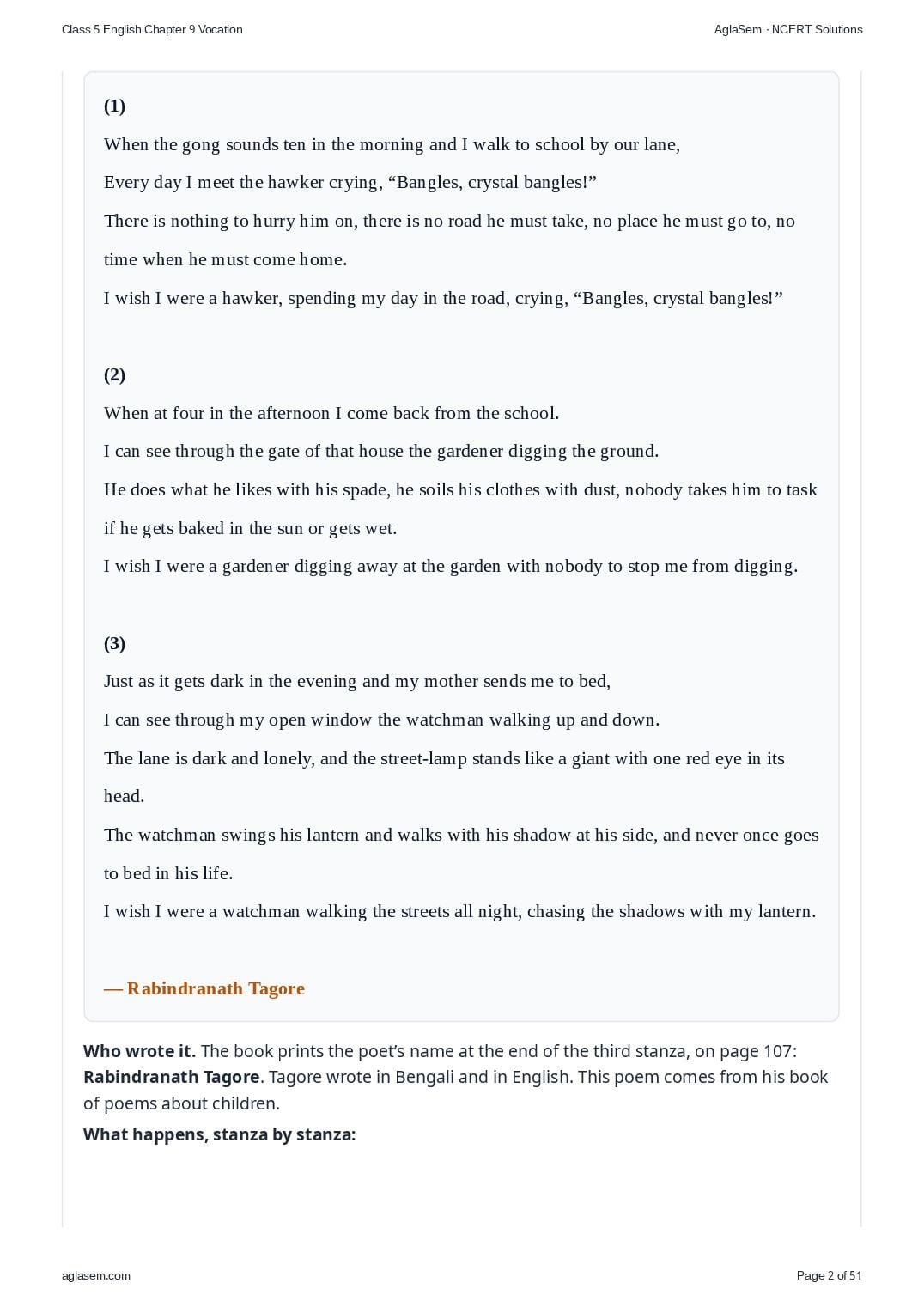
- Let us Recite — Vocation. Read the poem aloud and enjoy it.
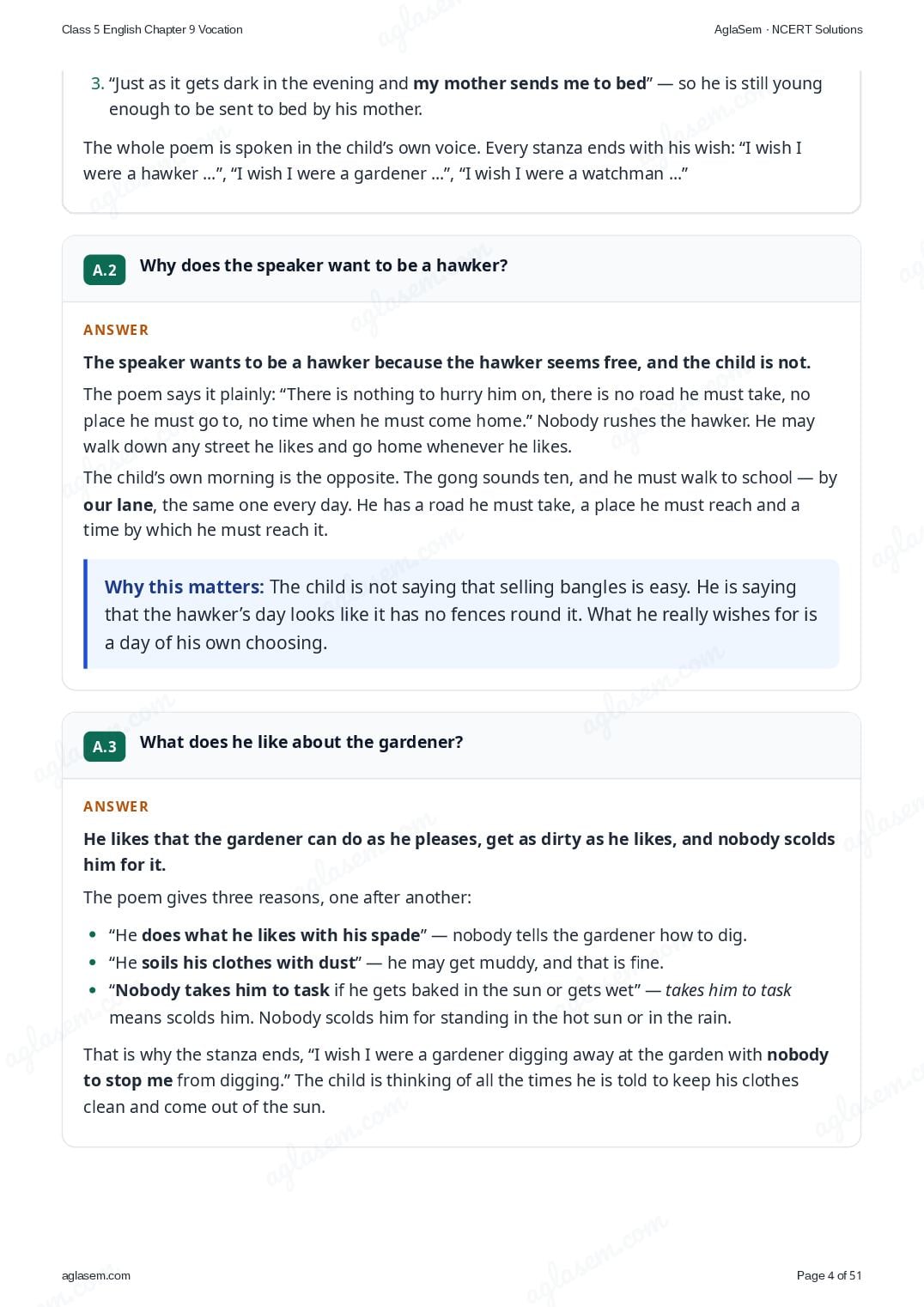
- Who is the speaker in the poem?
- Why does the speaker want to be a hawker?
- What does he like about the gardener?
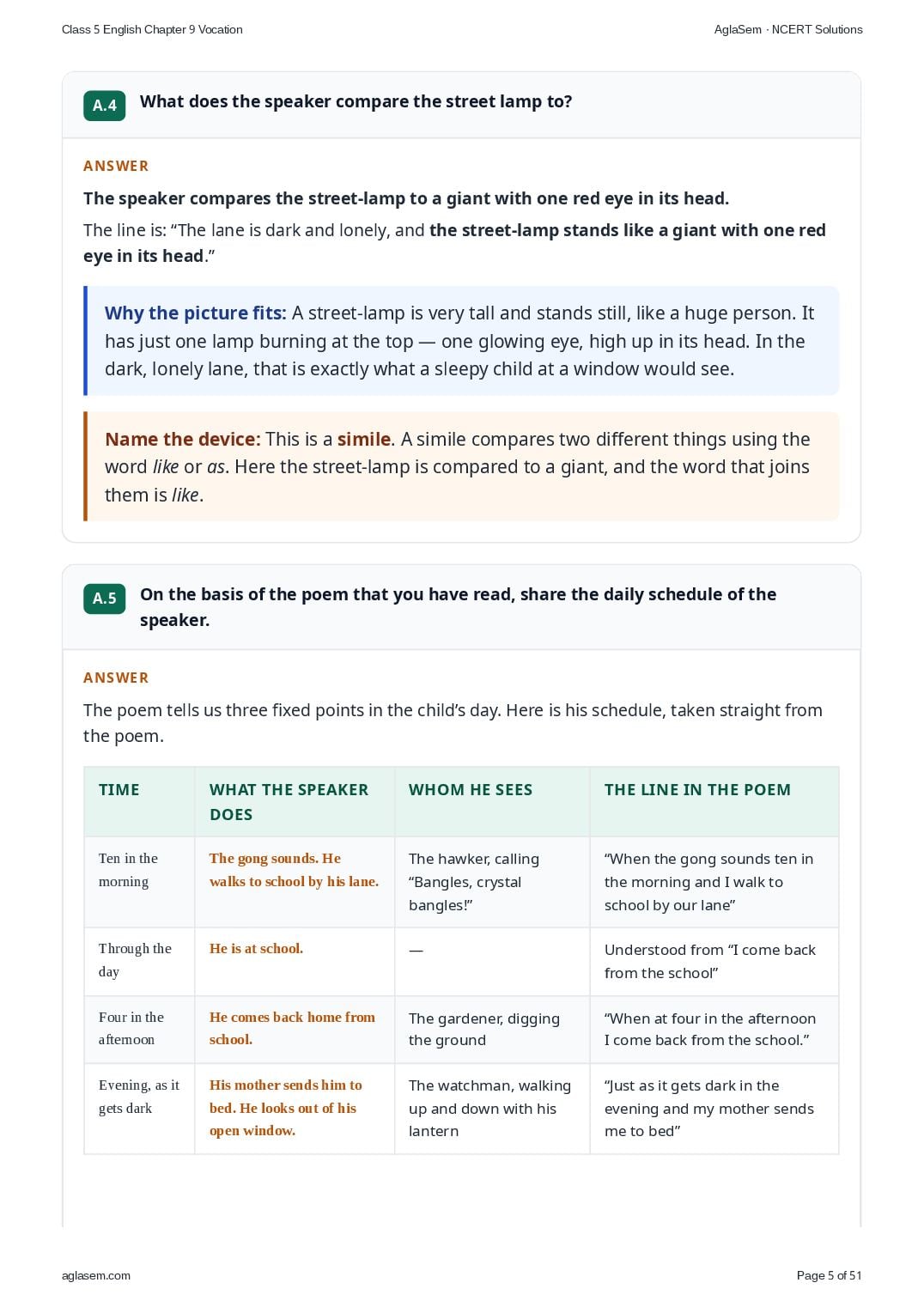
- What does the speaker compare the street lamp to?
- On the basis of the poem that you have read, share the daily schedule of the speaker.
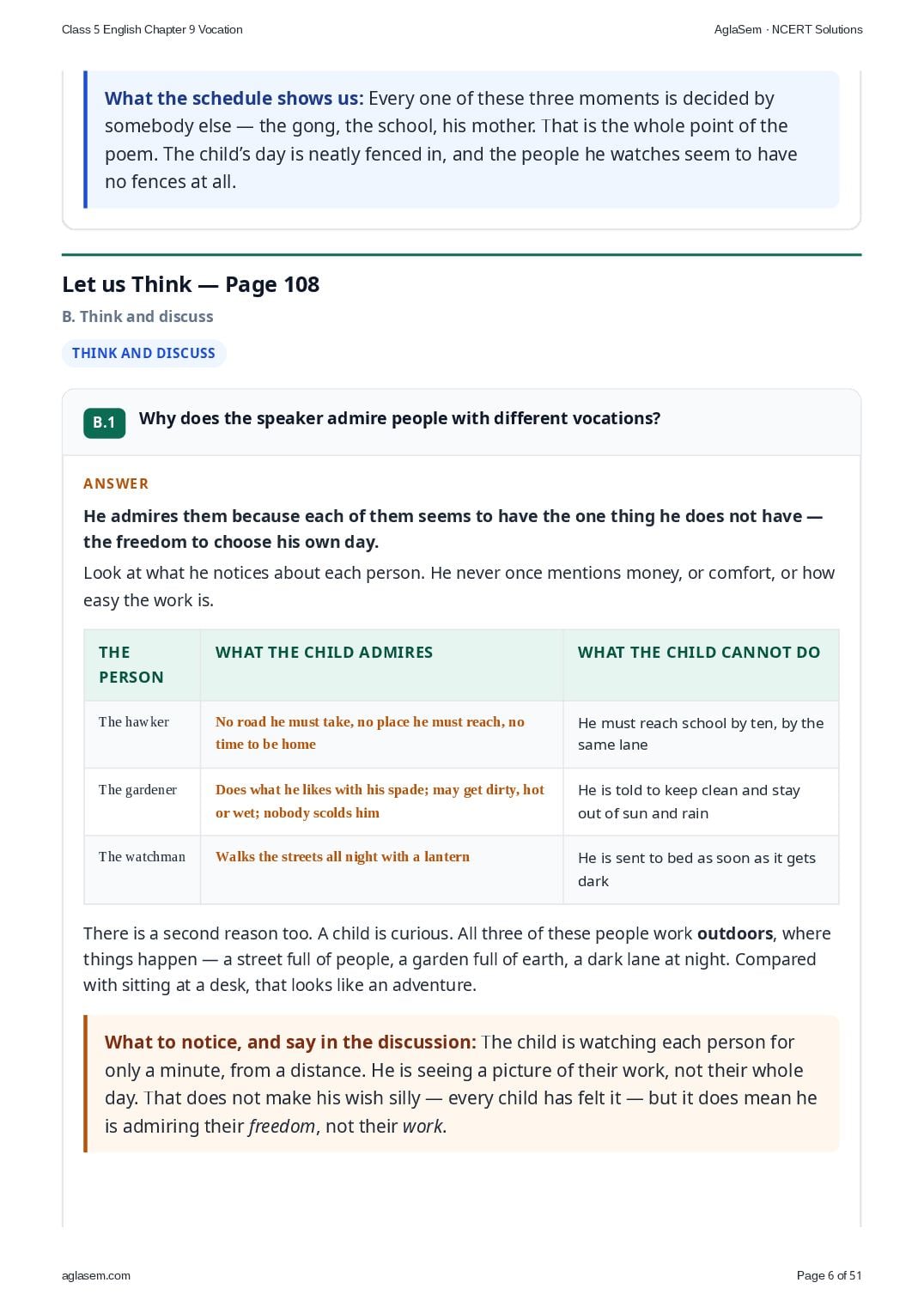
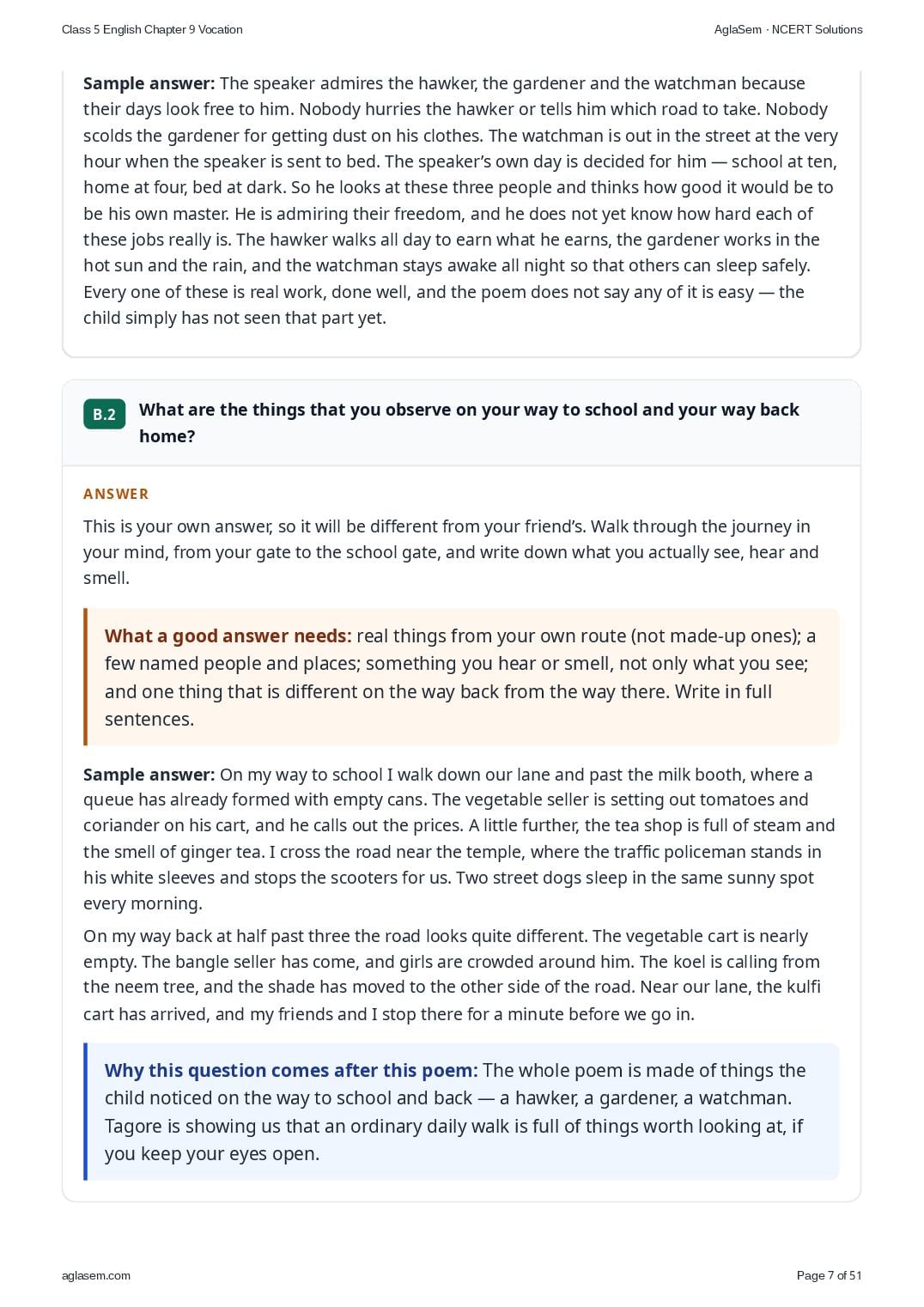
- Why does the speaker admire people with different vocations?
- What are the things that you observe on your way to school and your way back home?
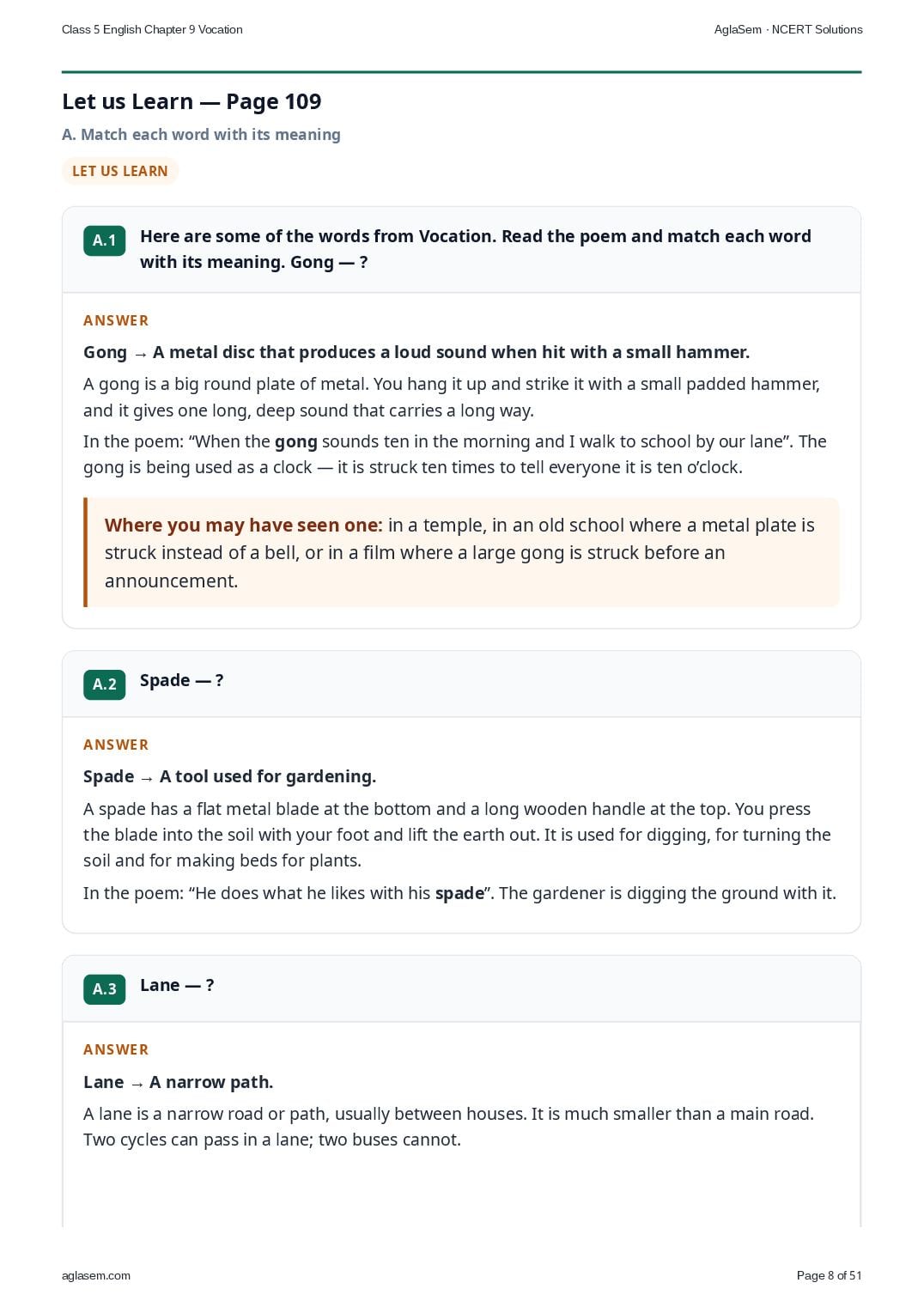
- Here are some of the words from Vocation. Read the poem and match each word with its meaning. Gong — ?
- Spade — ?
- Lane — ?
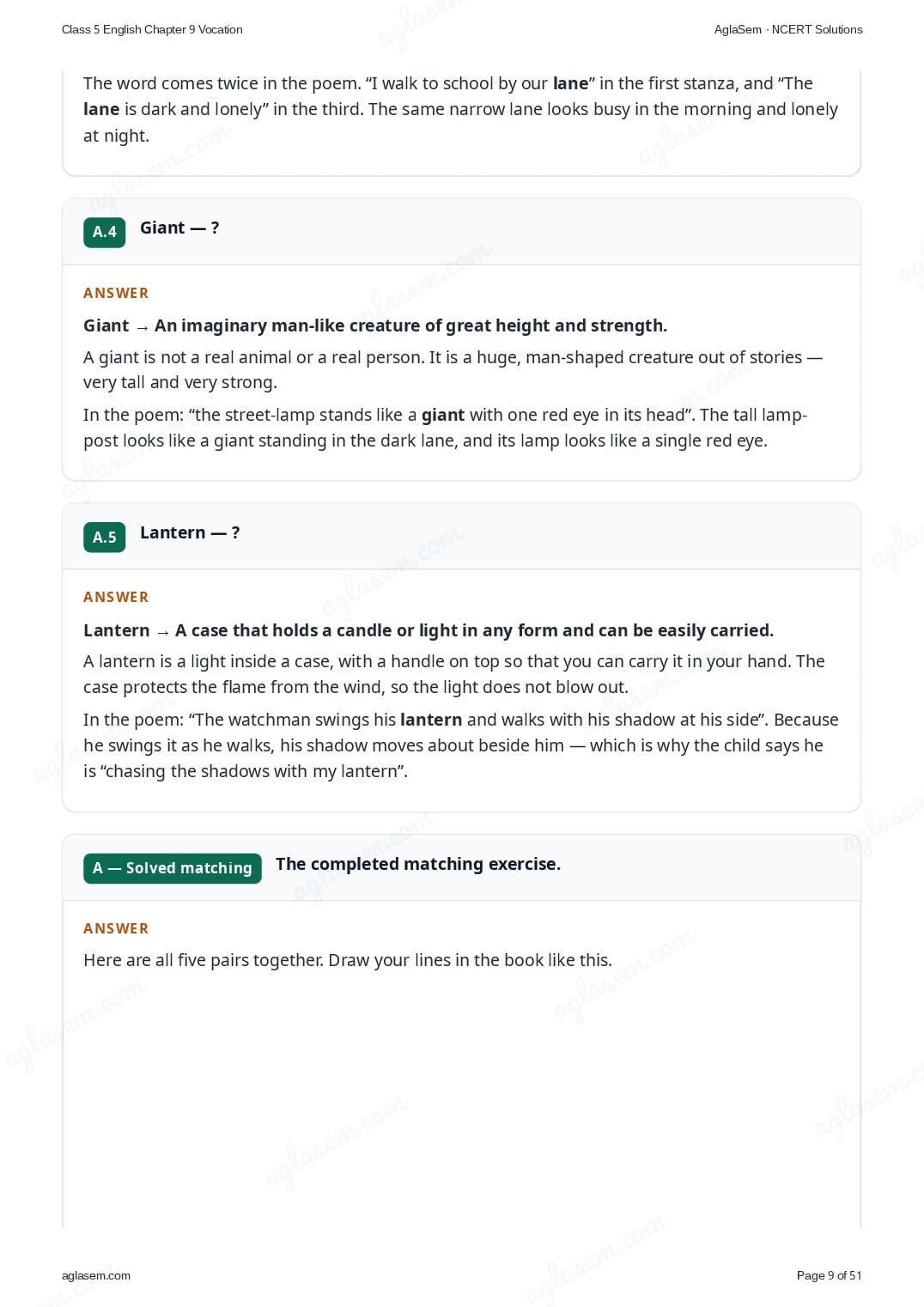
- Giant — ?
- Lantern — ?
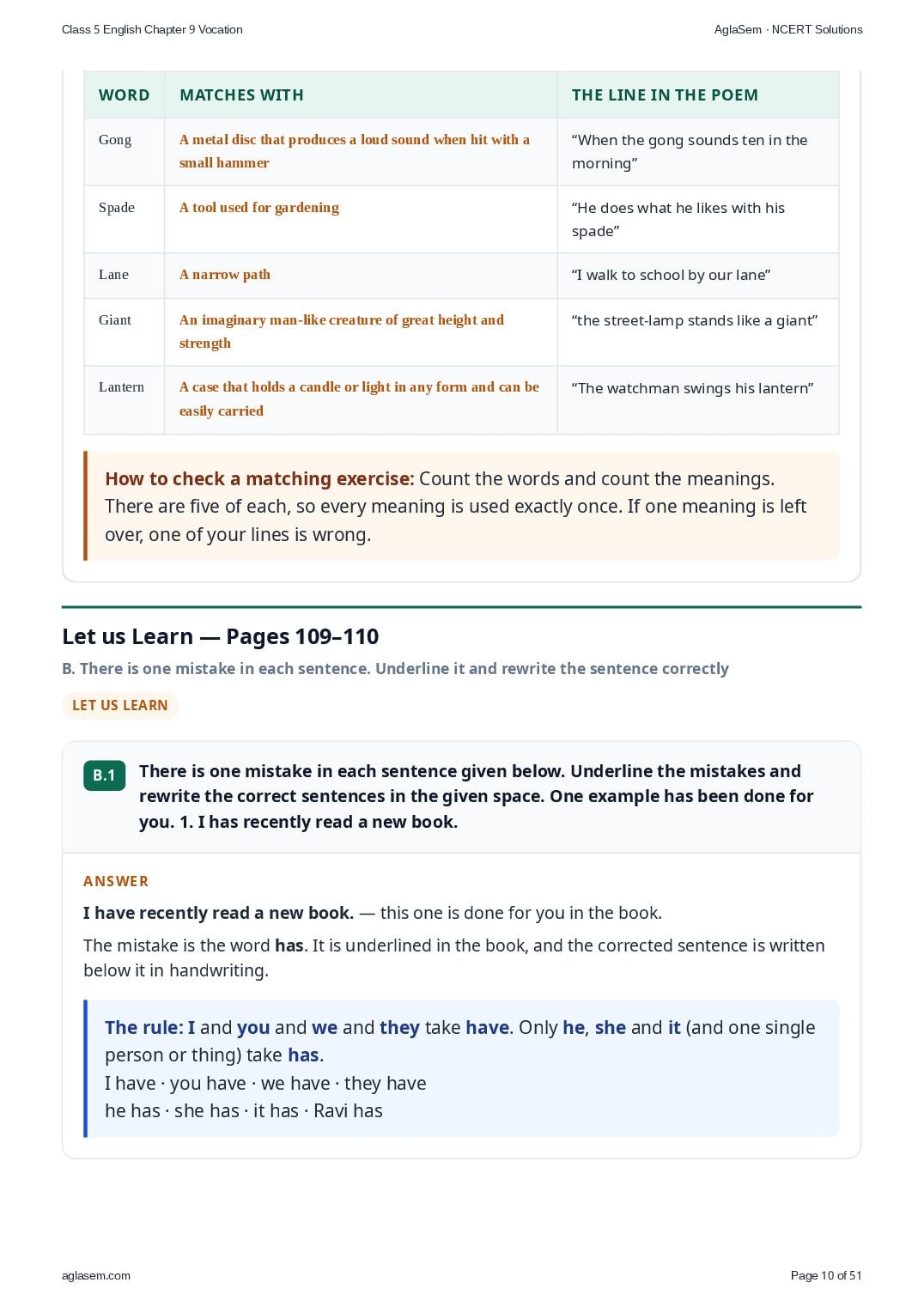
- The completed matching exercise.
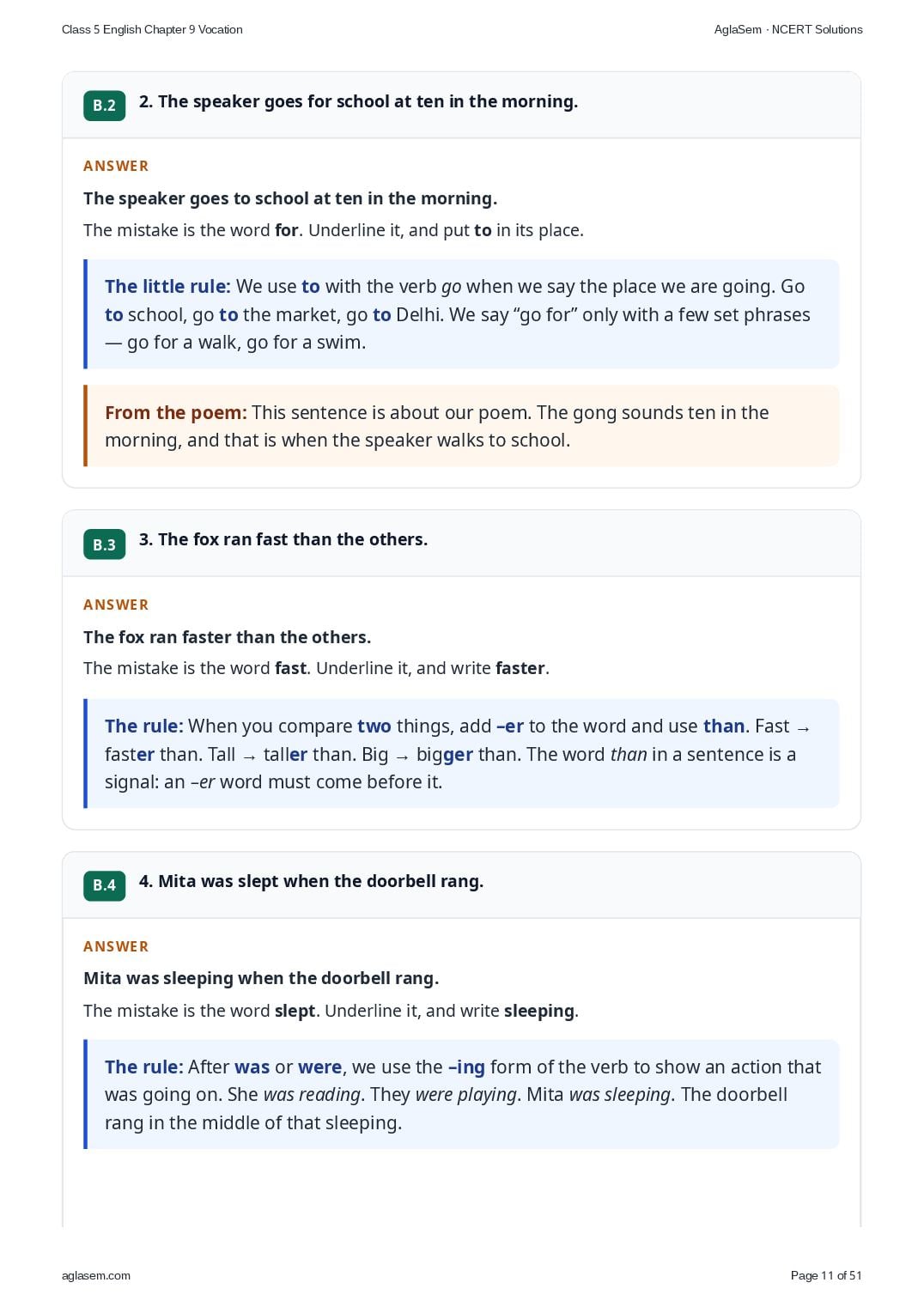
- There is one mistake in each sentence given below. Underline the mistakes and rewrite the correct sentences in the given space. One example has been done for you. 1. I has recently read a new book.
- 2. The speaker goes for school at ten in the morning.
- 3. The fox ran fast than the others.
- 4. Mita was slept when the doorbell rang.
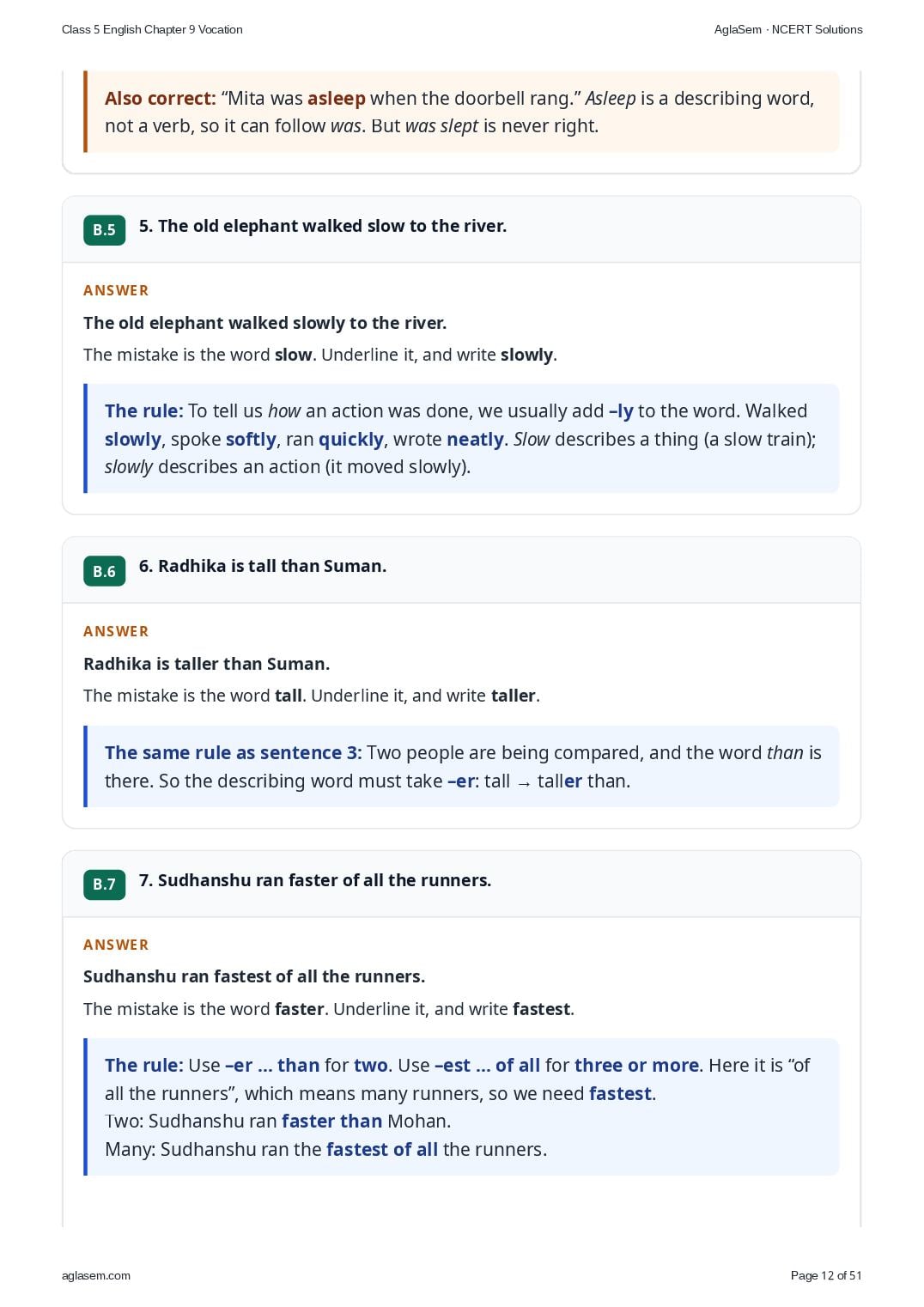
- 5. The old elephant walked slow to the river.
- 6. Radhika is tall than Suman.
- 7. Sudhanshu ran faster of all the runners.
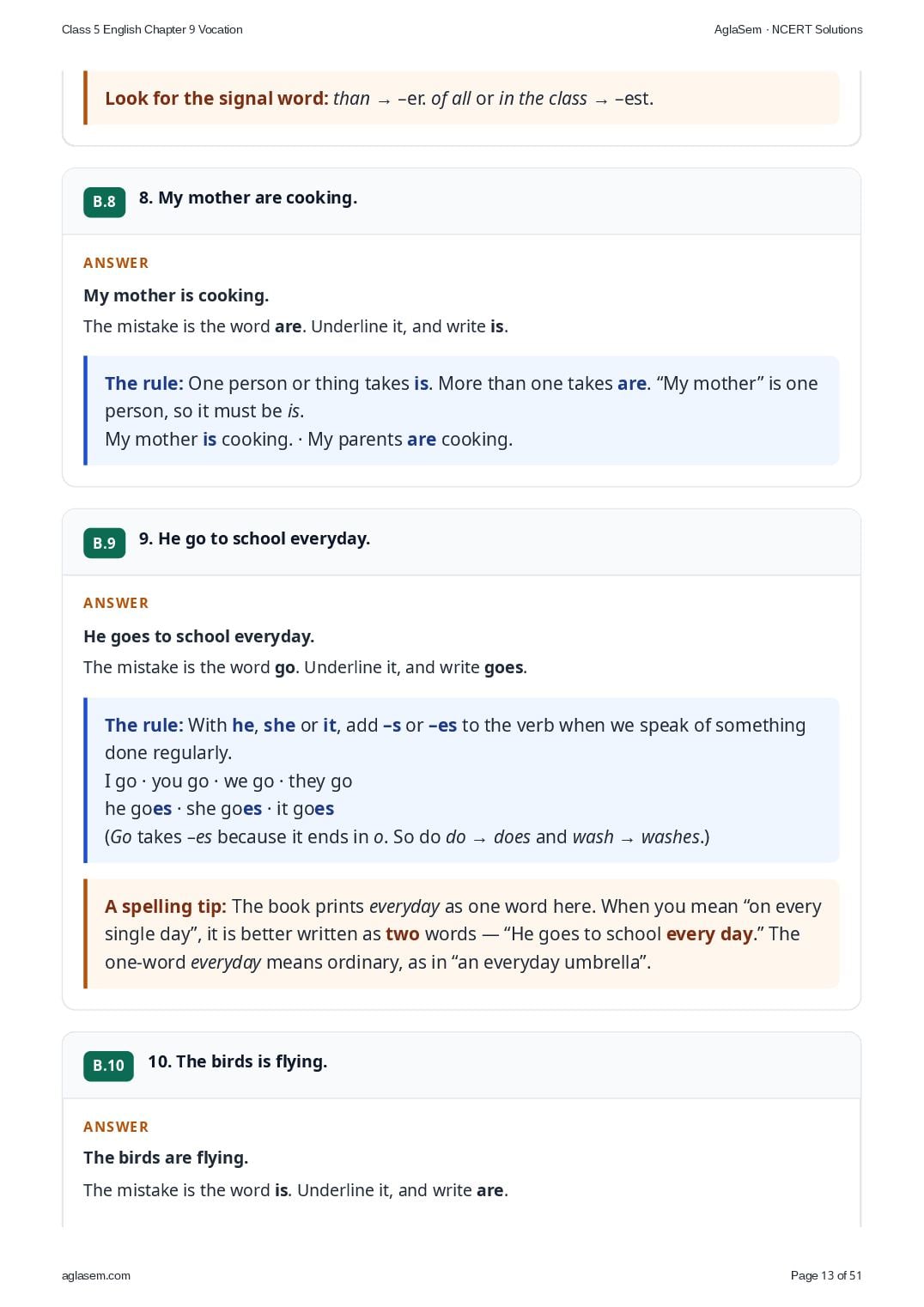
- 8. My mother are cooking.
- 9. He go to school everyday.
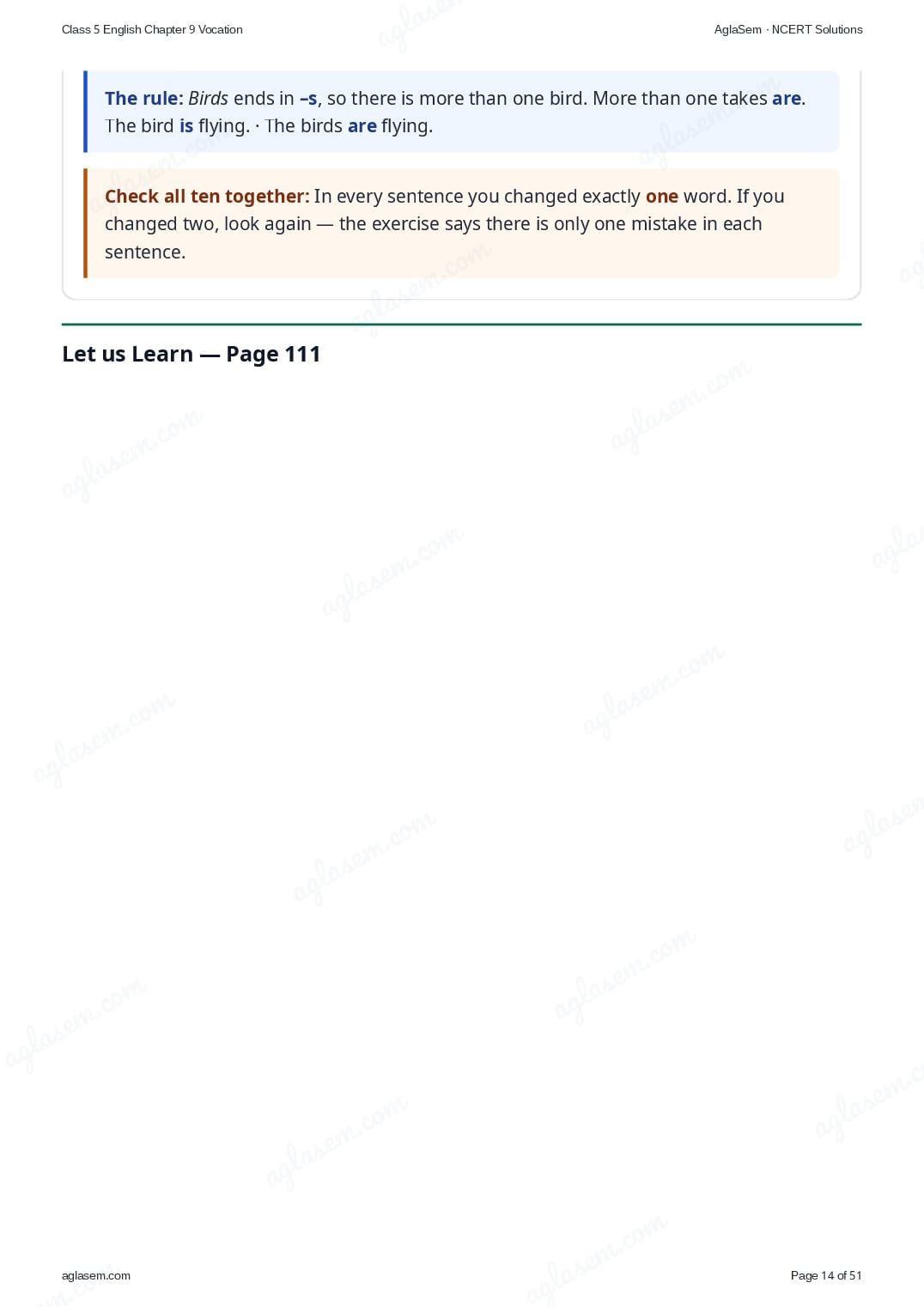
- 10. The birds is flying.
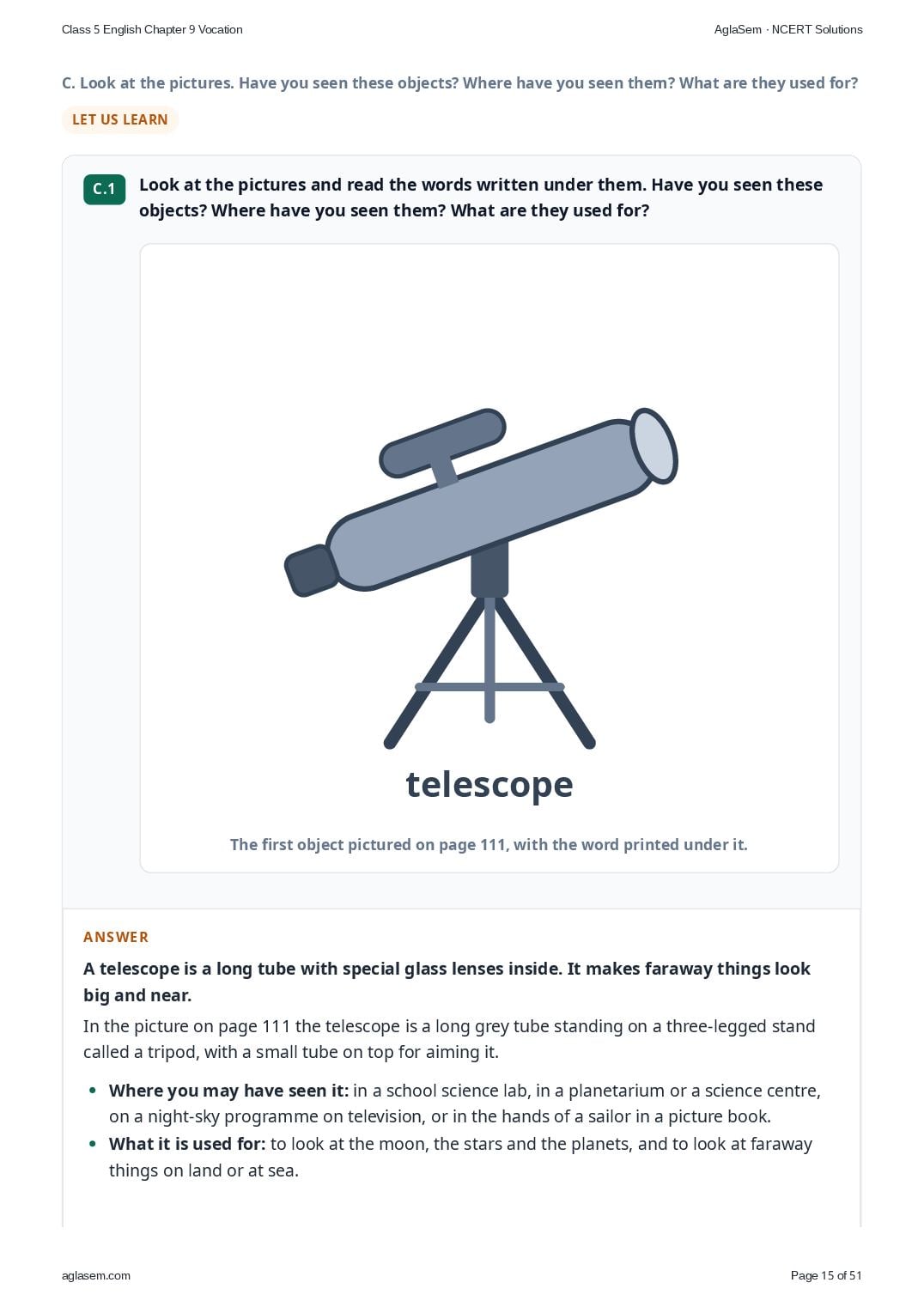
- Look at the pictures and read the words written under them. Have you seen these objects? Where have you seen them? What are they used for? The first of the objects pictured on page 111 telescope The first object pictured on page 111, with the word printed under it.
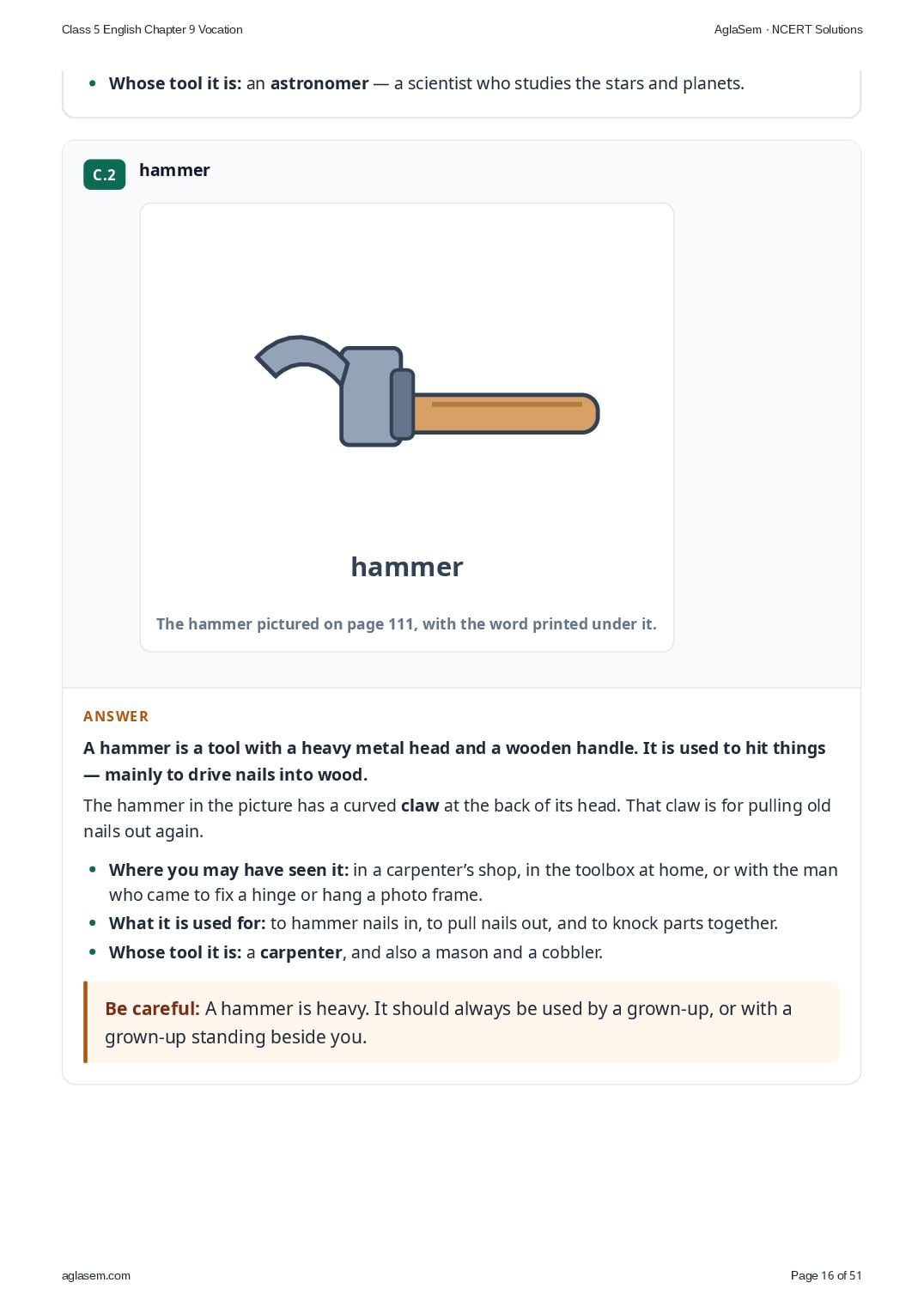
- hammer The hammer pictured on page 111 hammer The hammer pictured on page 111, with the word printed under it.
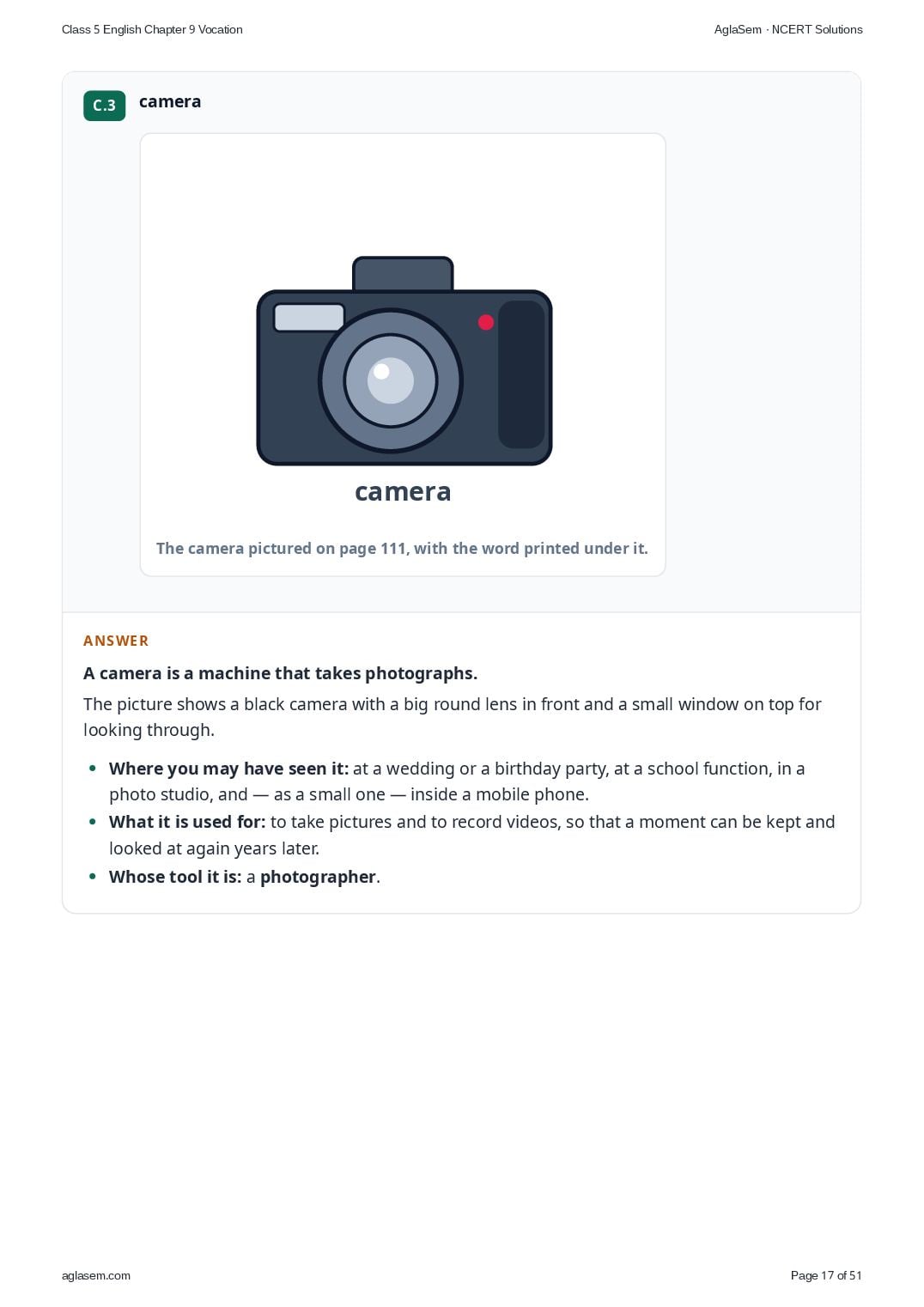
- camera The camera pictured on page 111 camera The camera pictured on page 111, with the word printed under it.
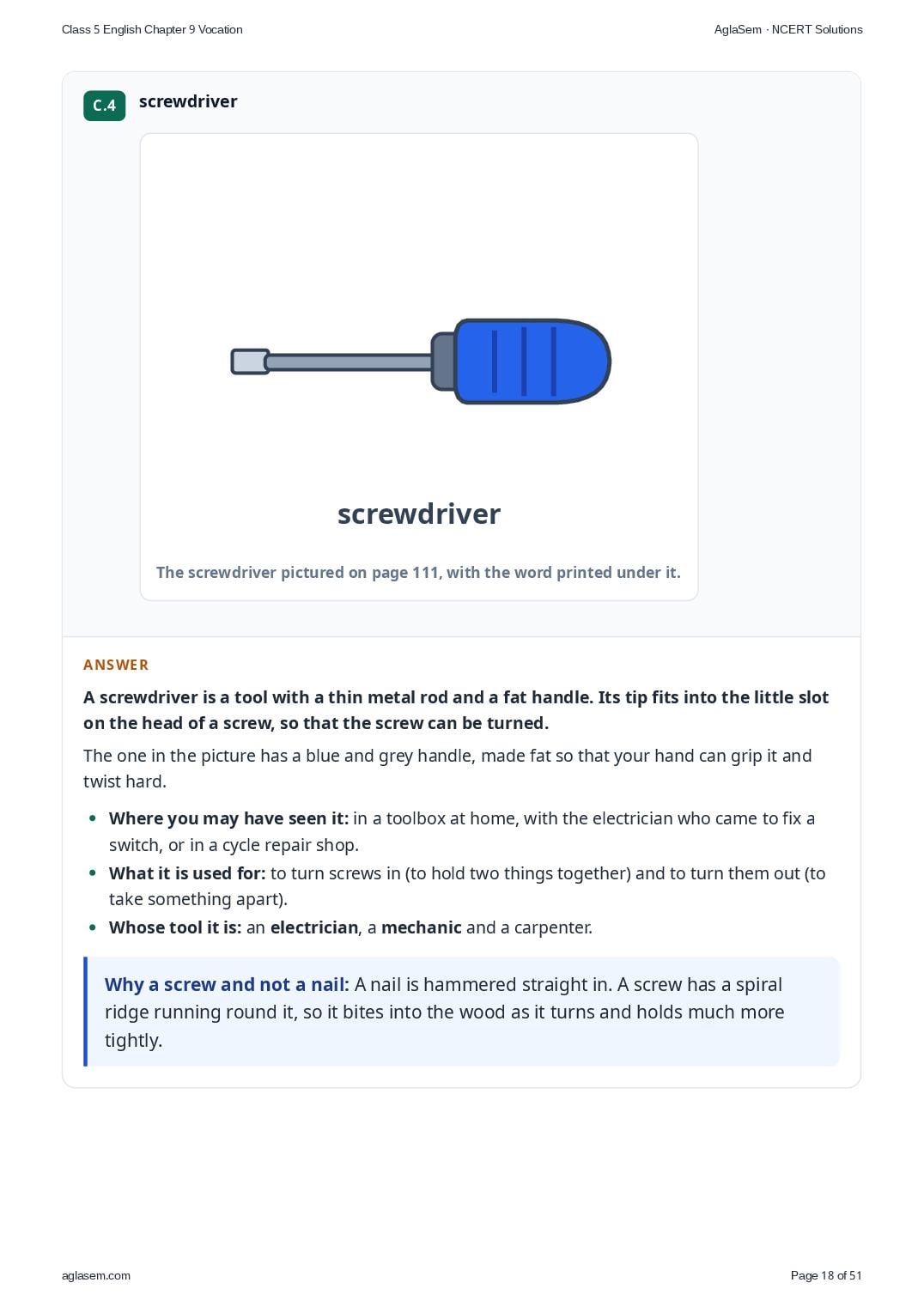
- screwdriver The screwdriver pictured on page 111 screwdriver The screwdriver pictured on page 111, with the word printed under it.
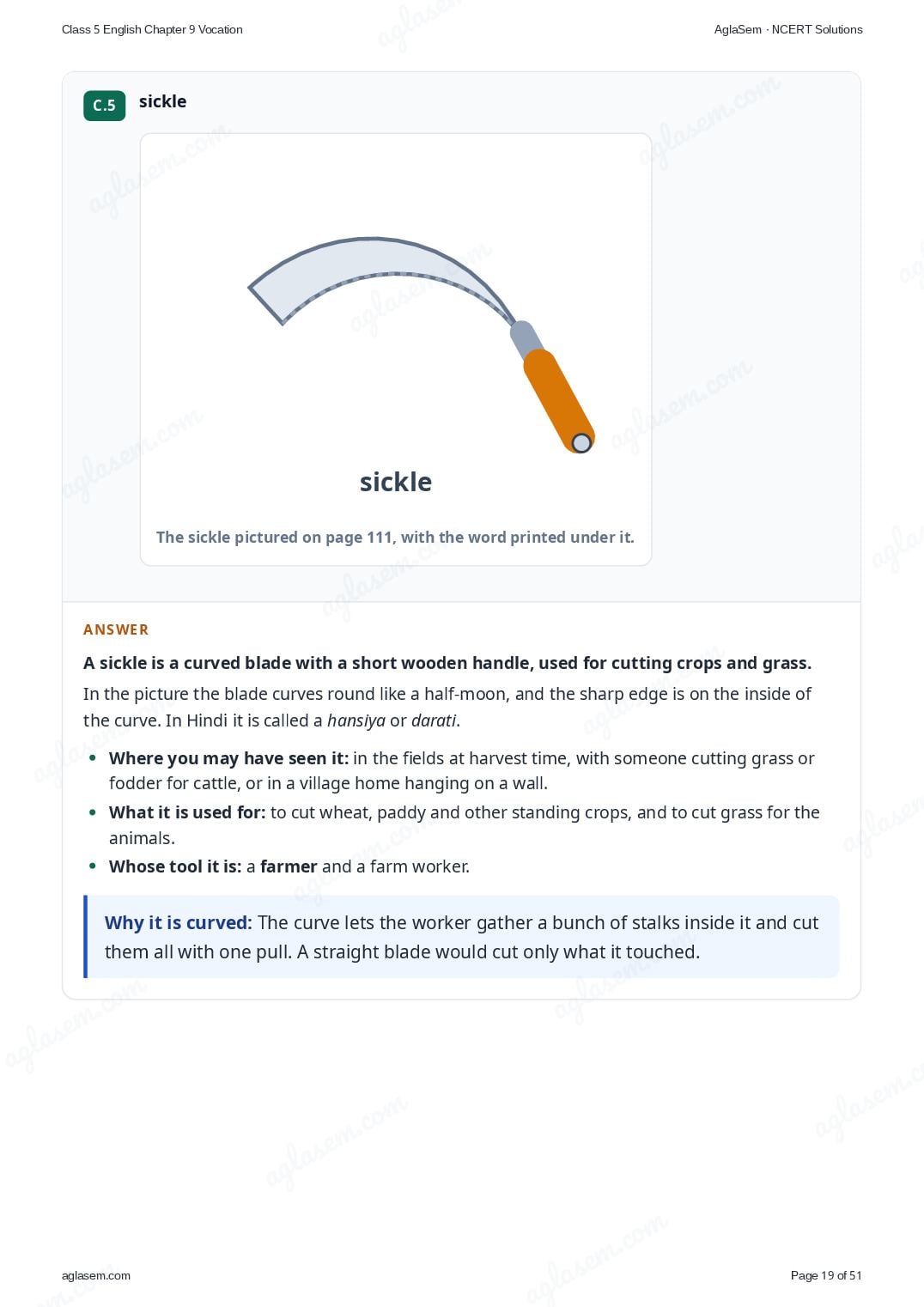
- sickle The sickle pictured on page 111 sickle The sickle pictured on page 111, with the word printed under it.
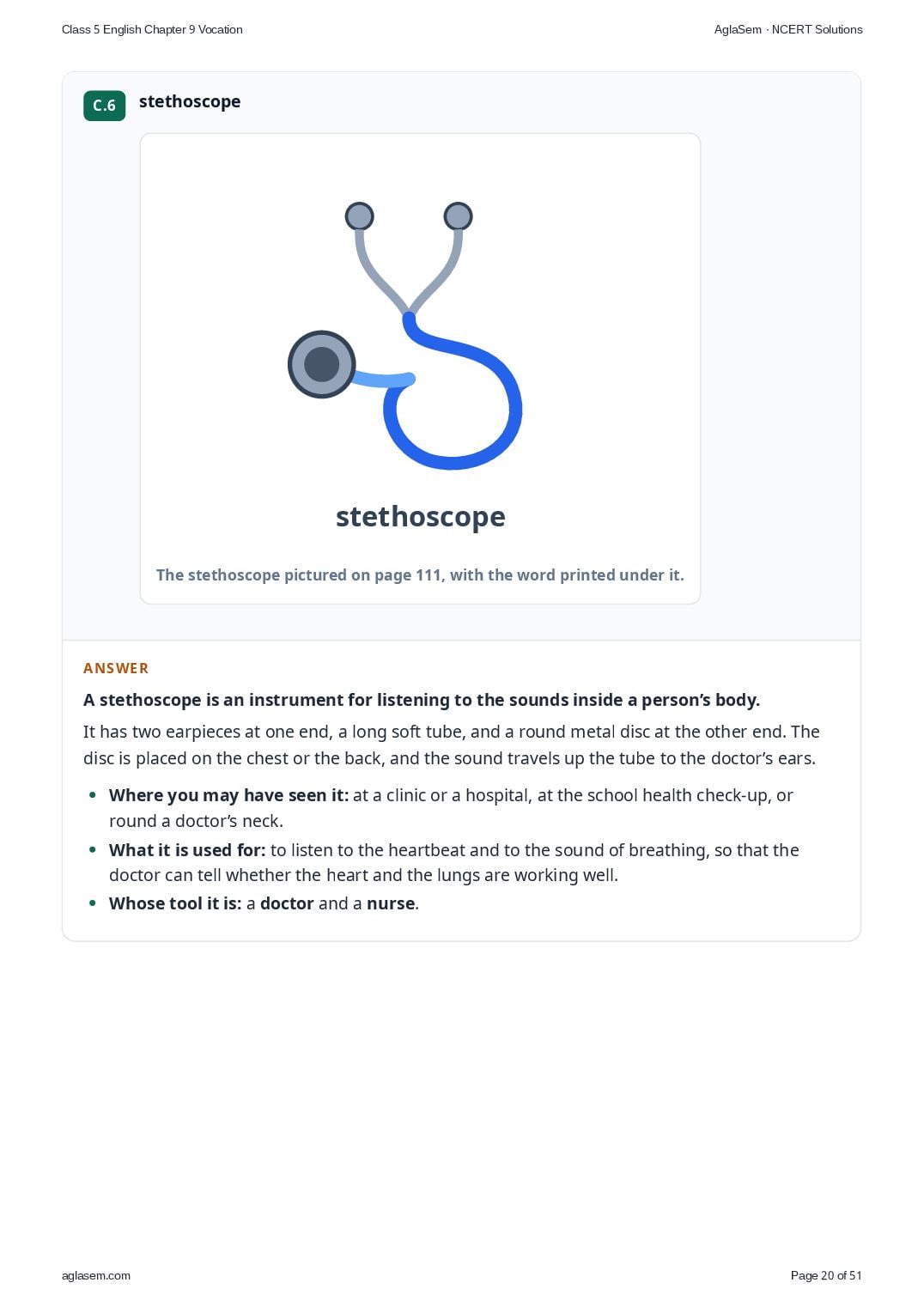
- stethoscope The stethoscope pictured on page 111 stethoscope The stethoscope pictured on page 111, with the word printed under it.
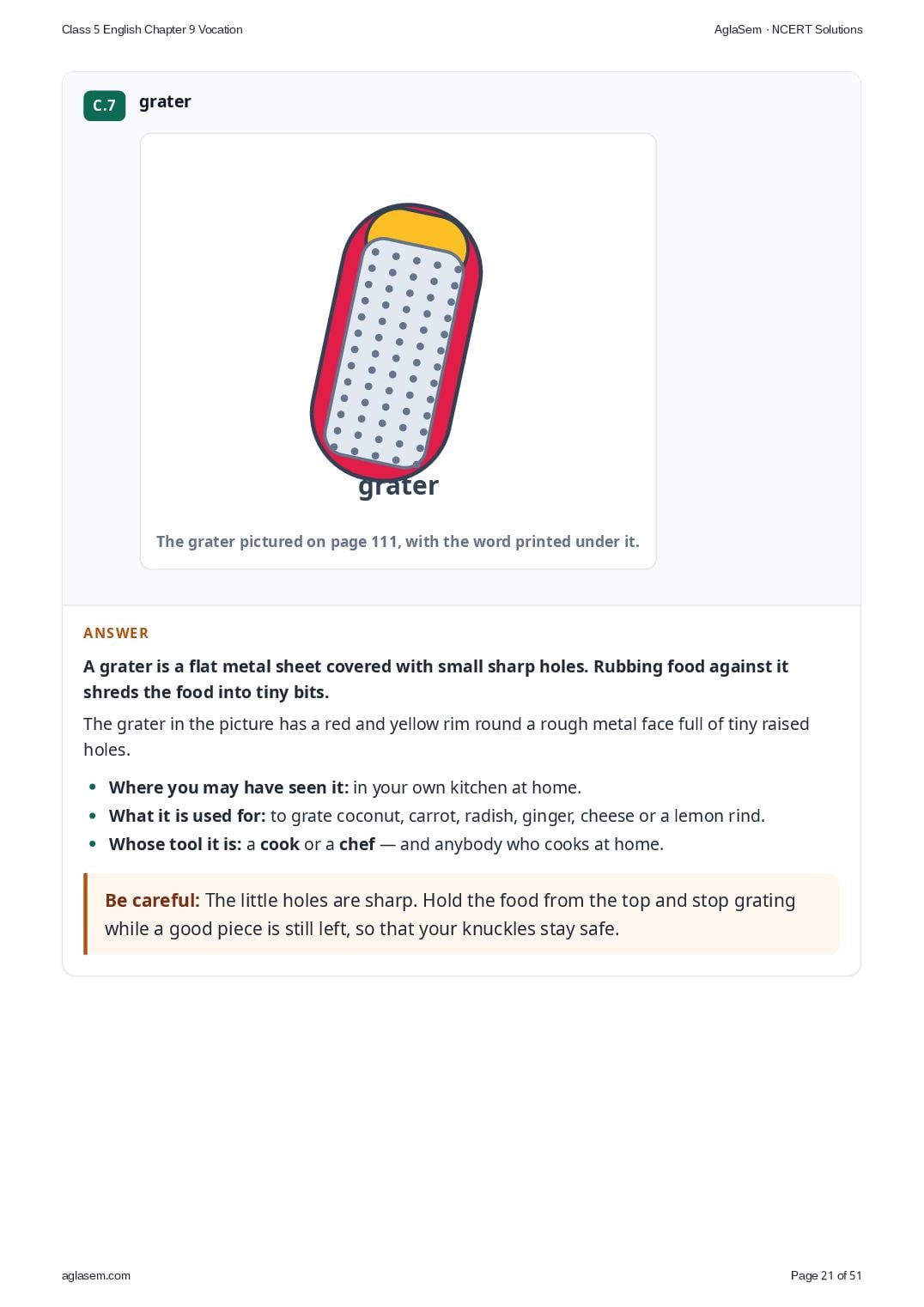
- grater The grater pictured on page 111 grater The grater pictured on page 111, with the word printed under it.
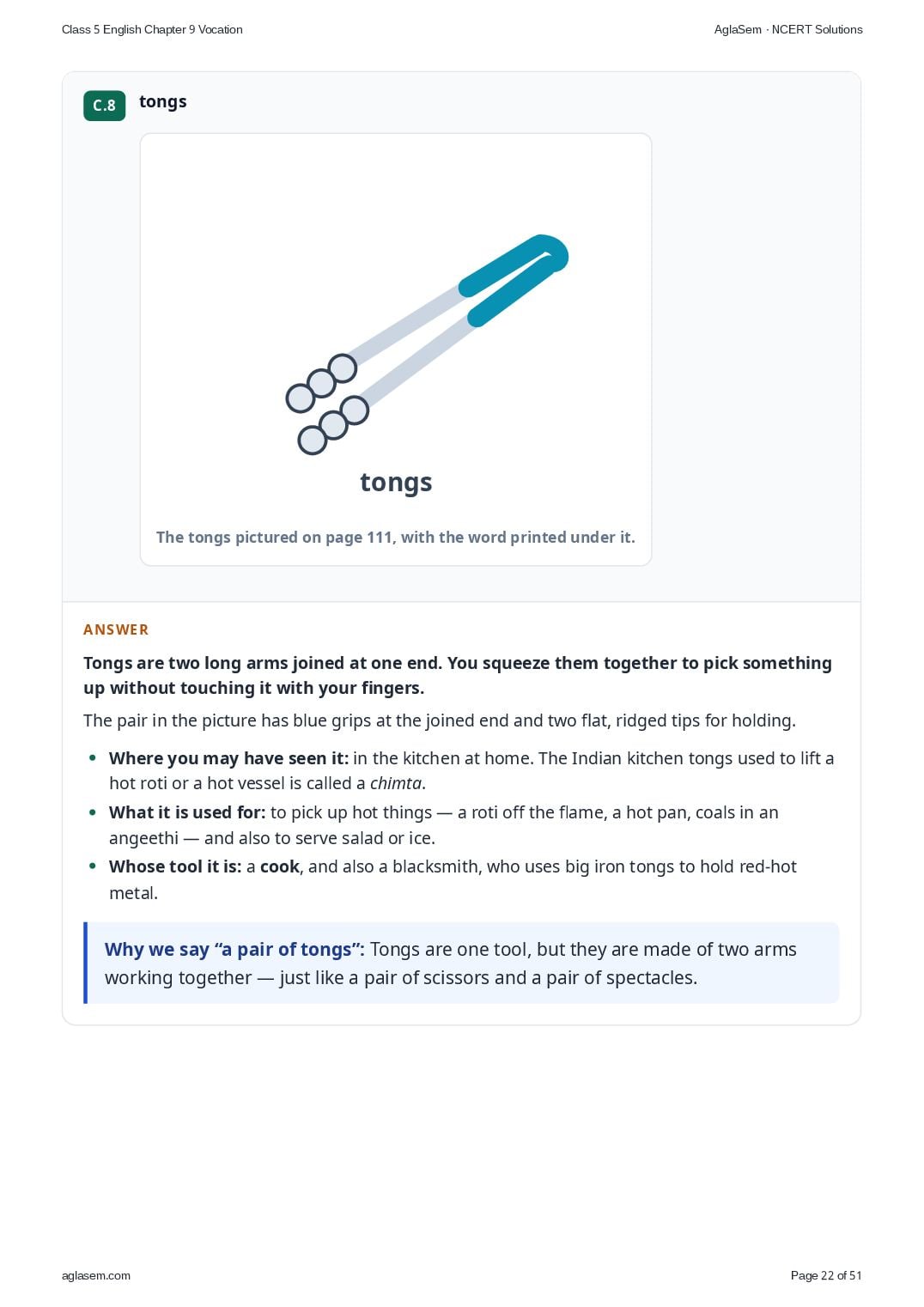
- tongs The tongs pictured on page 111 tongs The tongs pictured on page 111, with the word printed under it.
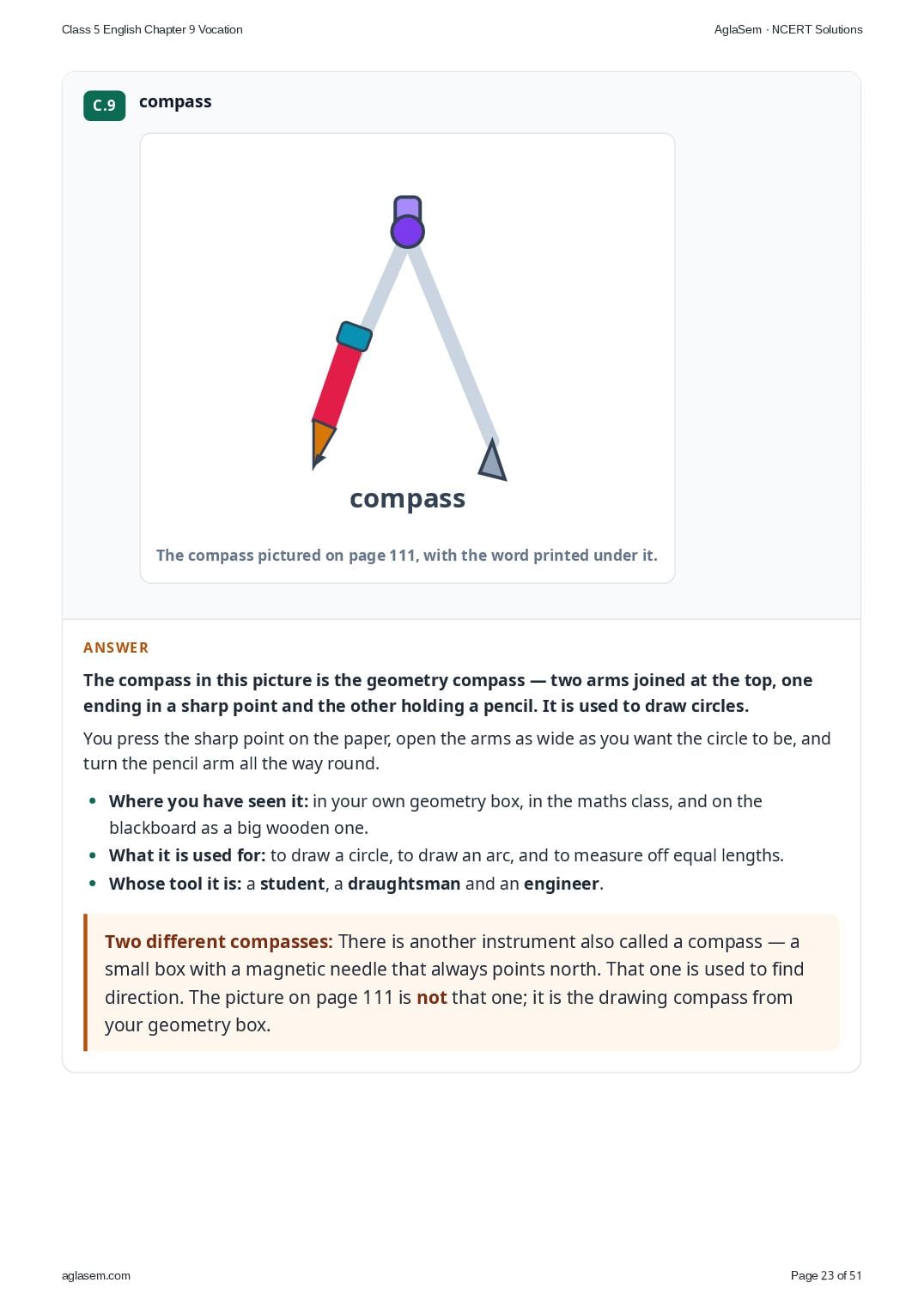
- compass The geometry compass pictured on page 111 compass The compass pictured on page 111, with the word printed under it.
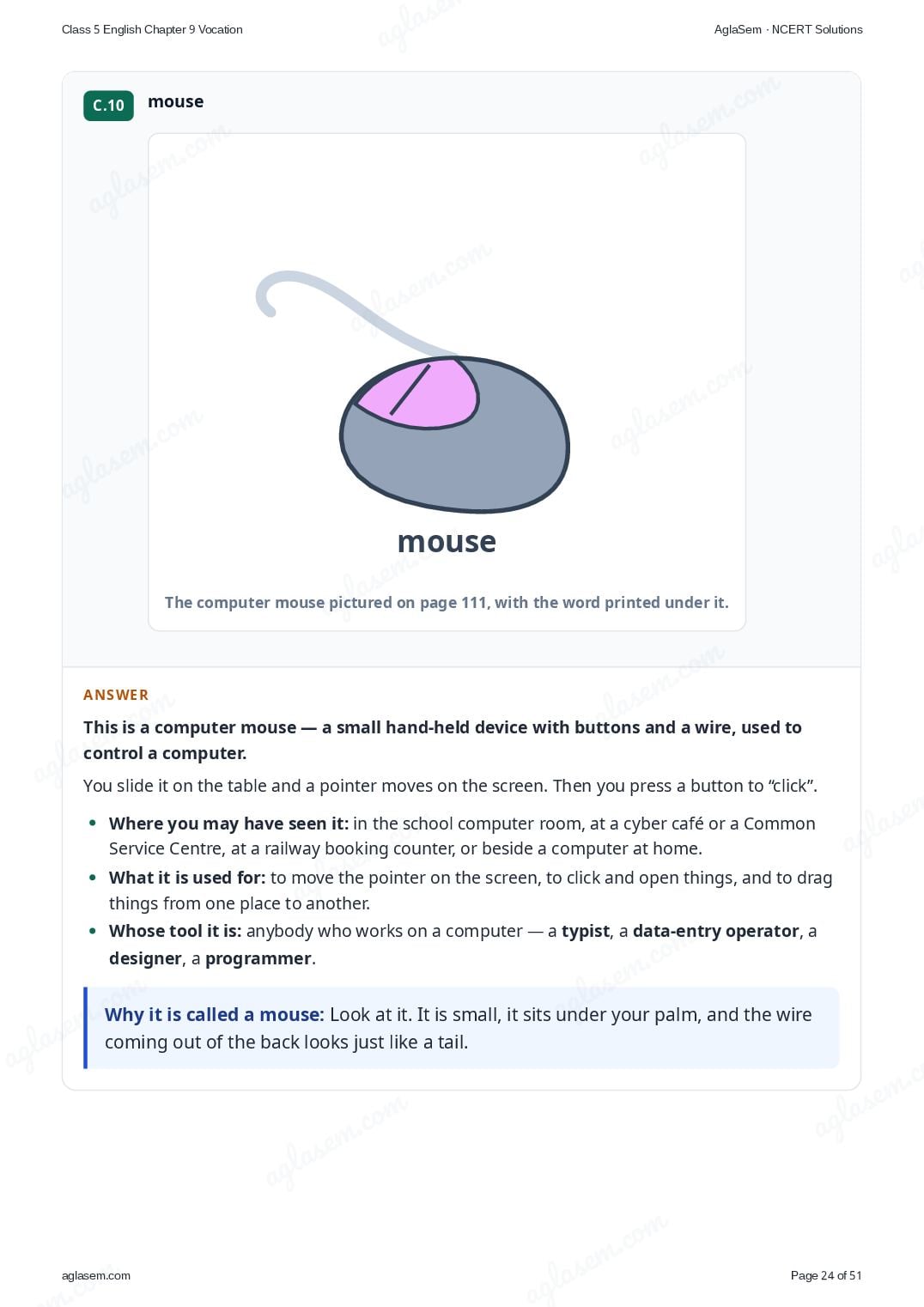
- mouse The computer mouse pictured on page 111 mouse The computer mouse pictured on page 111, with the word printed under it.
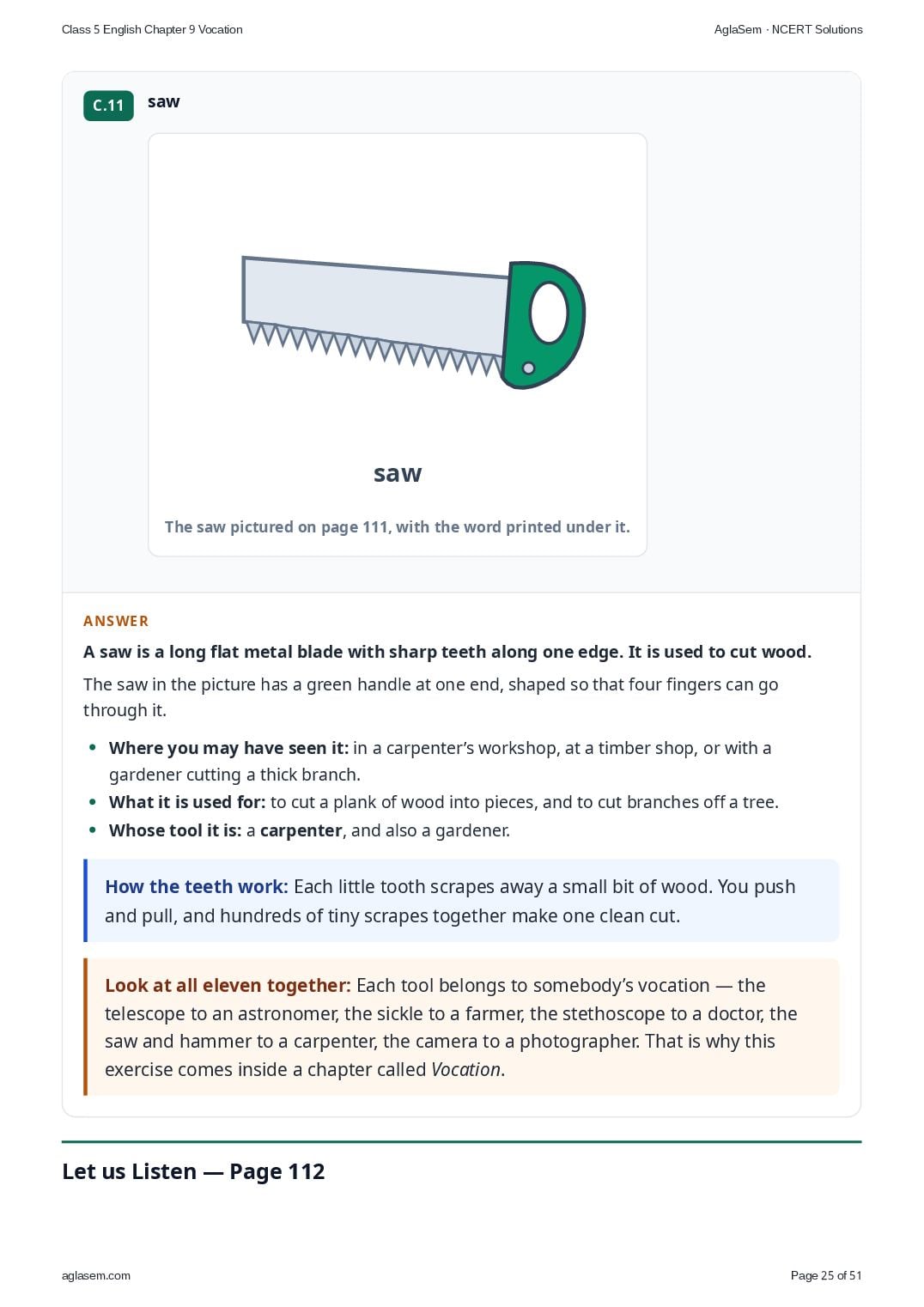
- saw The saw pictured on page 111 saw The saw pictured on page 111, with the word printed under it.
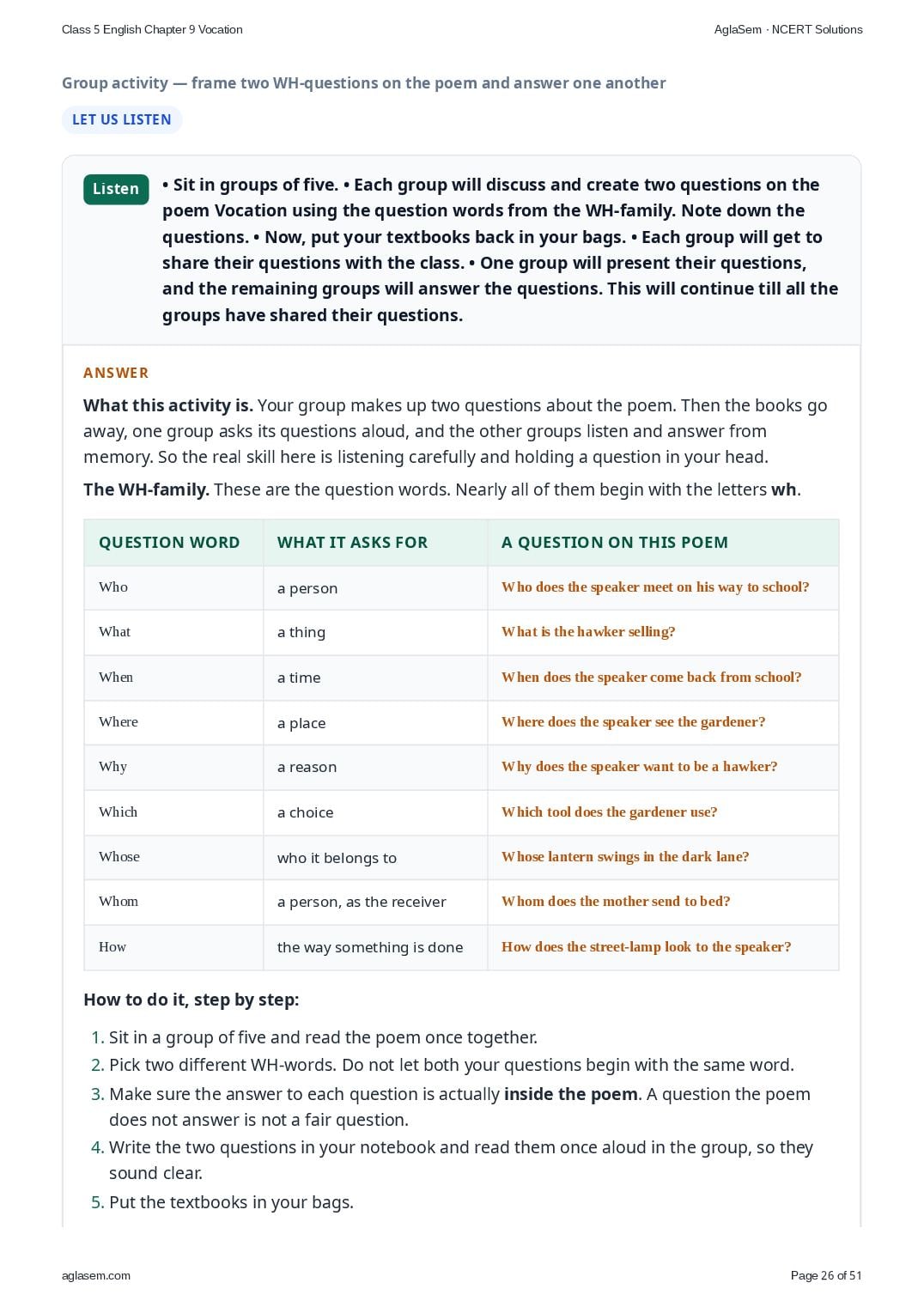
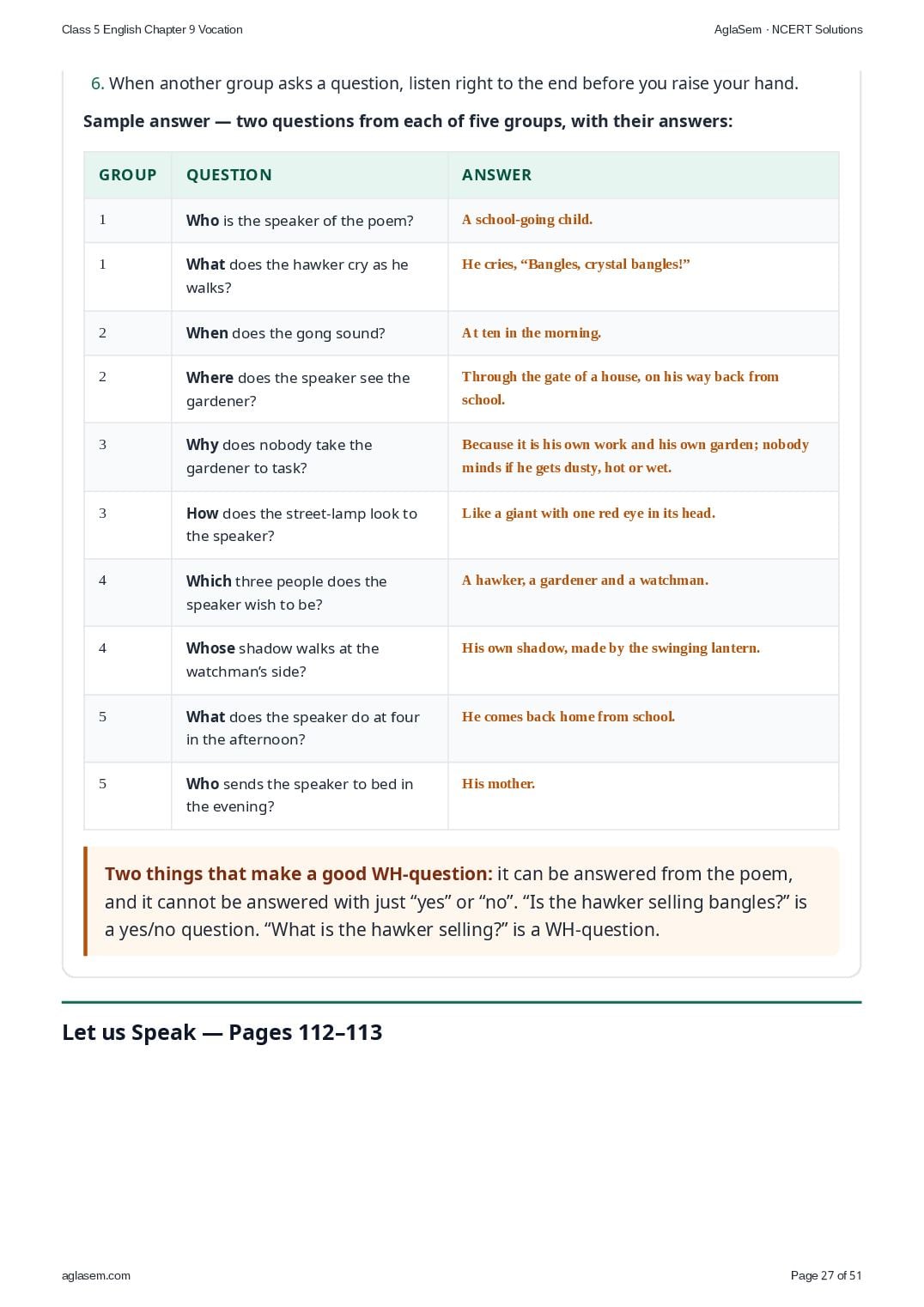
- • Sit in groups of five. • Each group will discuss and create two questions on the poem Vocation using the question words from the WH-family. Note down the questions. • Now, put your textbooks back in your bags. • Each group will get to share their questions with the class. • One group will present their questions, and the remaining groups will answer the questions. This will continue till all the groups have shared their questions.
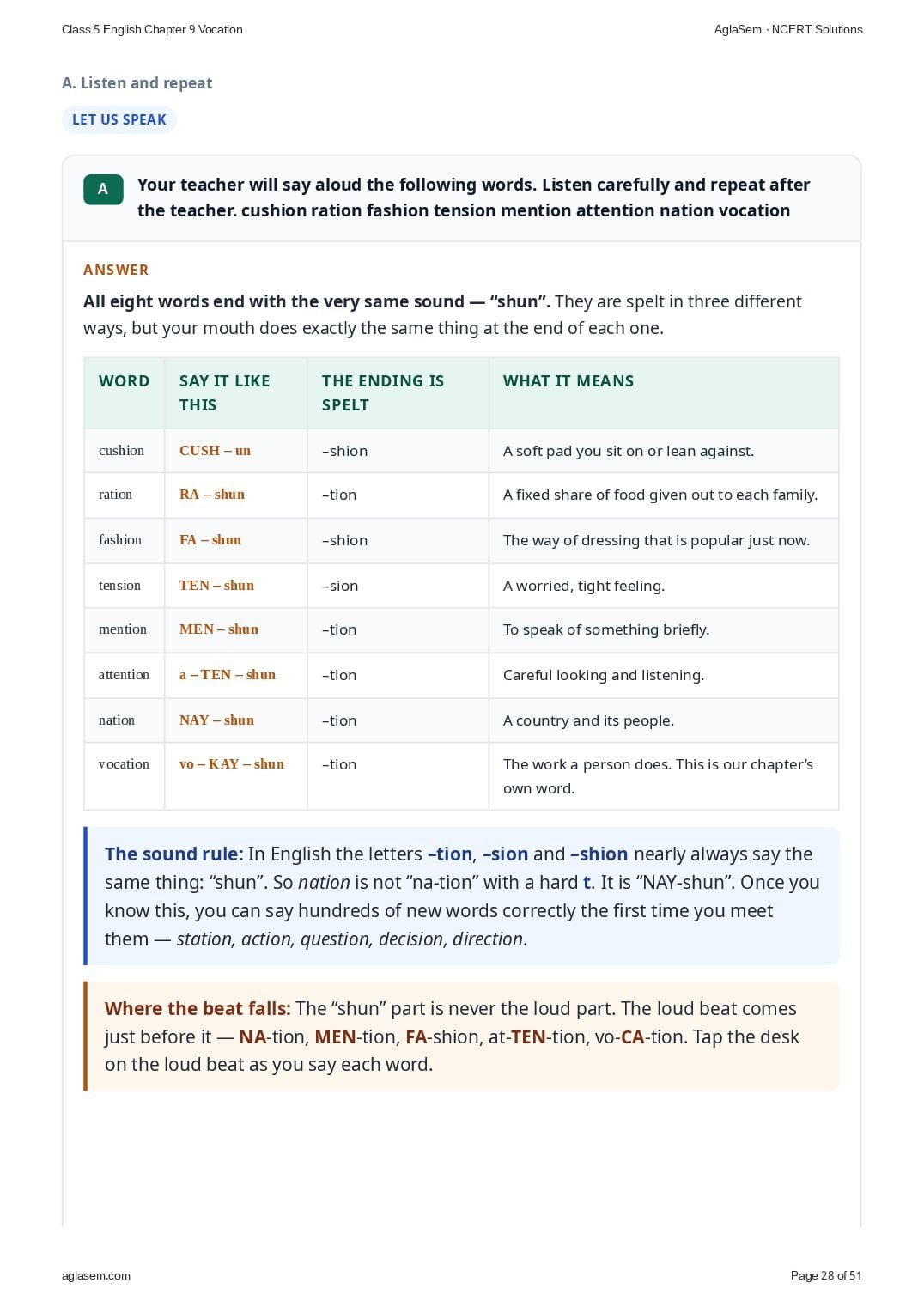
- Your teacher will say aloud the following words. Listen carefully and repeat after the teacher. cushion ration fashion tension mention attention nation vocation
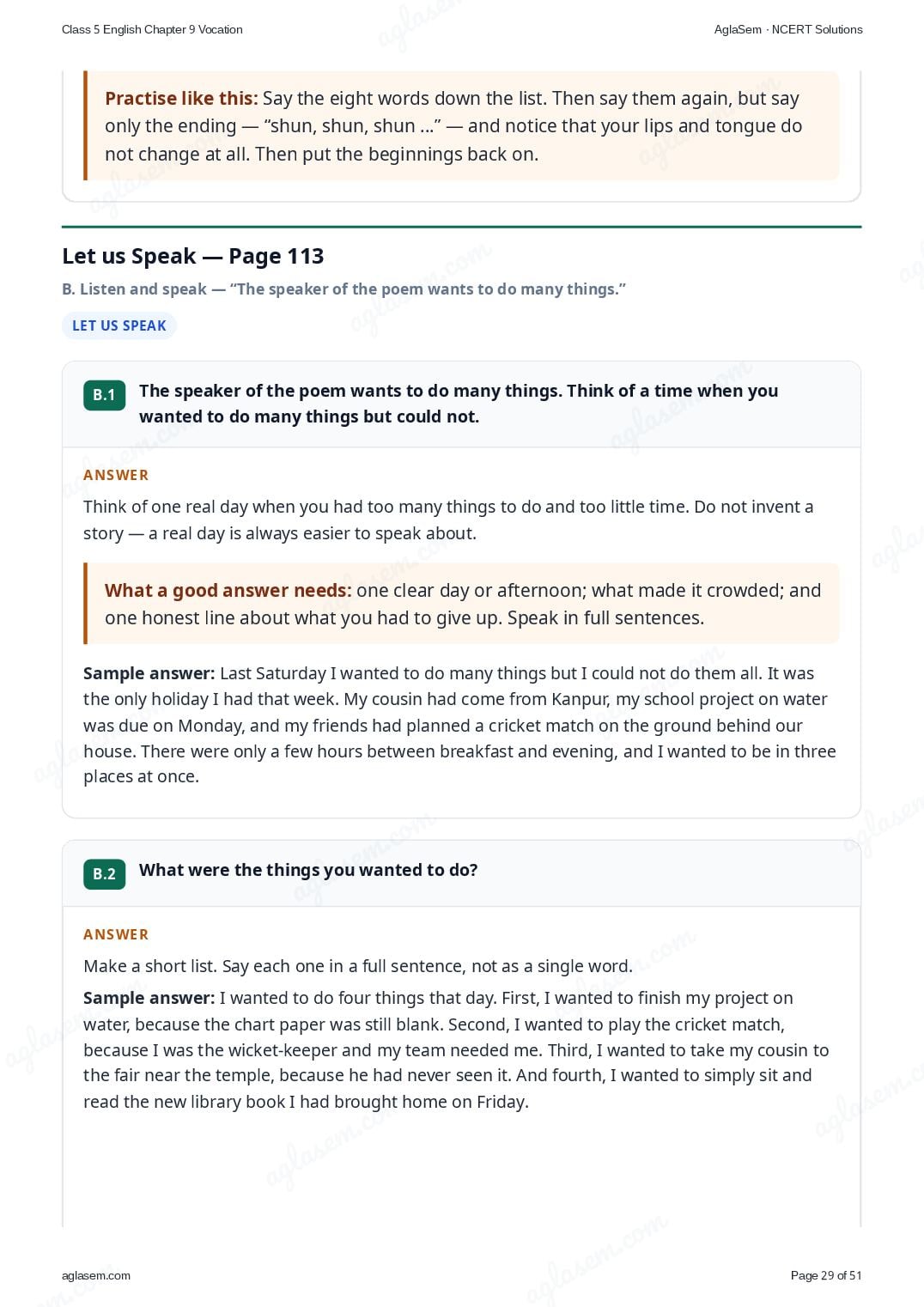
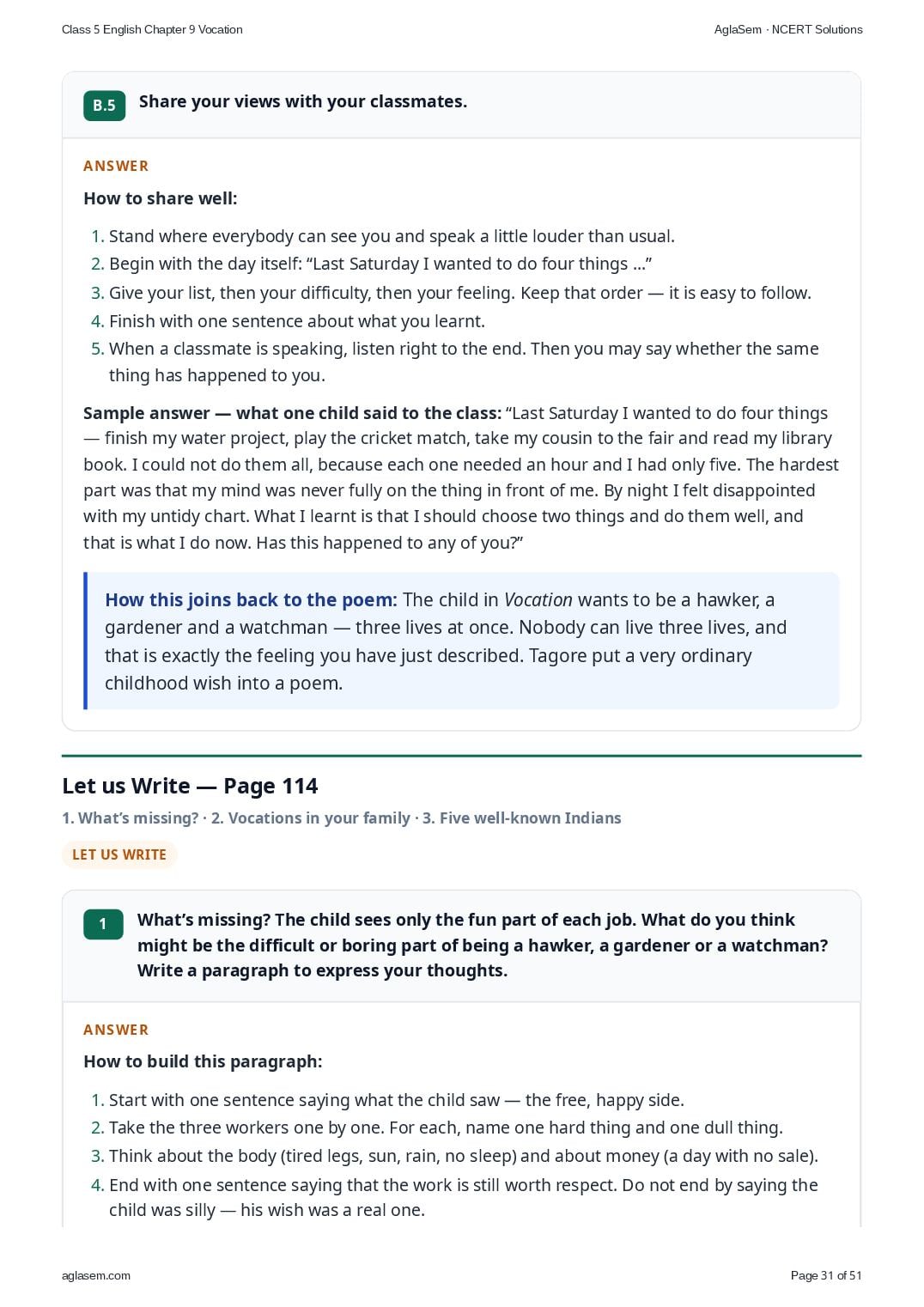
- The speaker of the poem wants to do many things. Think of a time when you wanted to do many things but could not.
- What were the things you wanted to do?
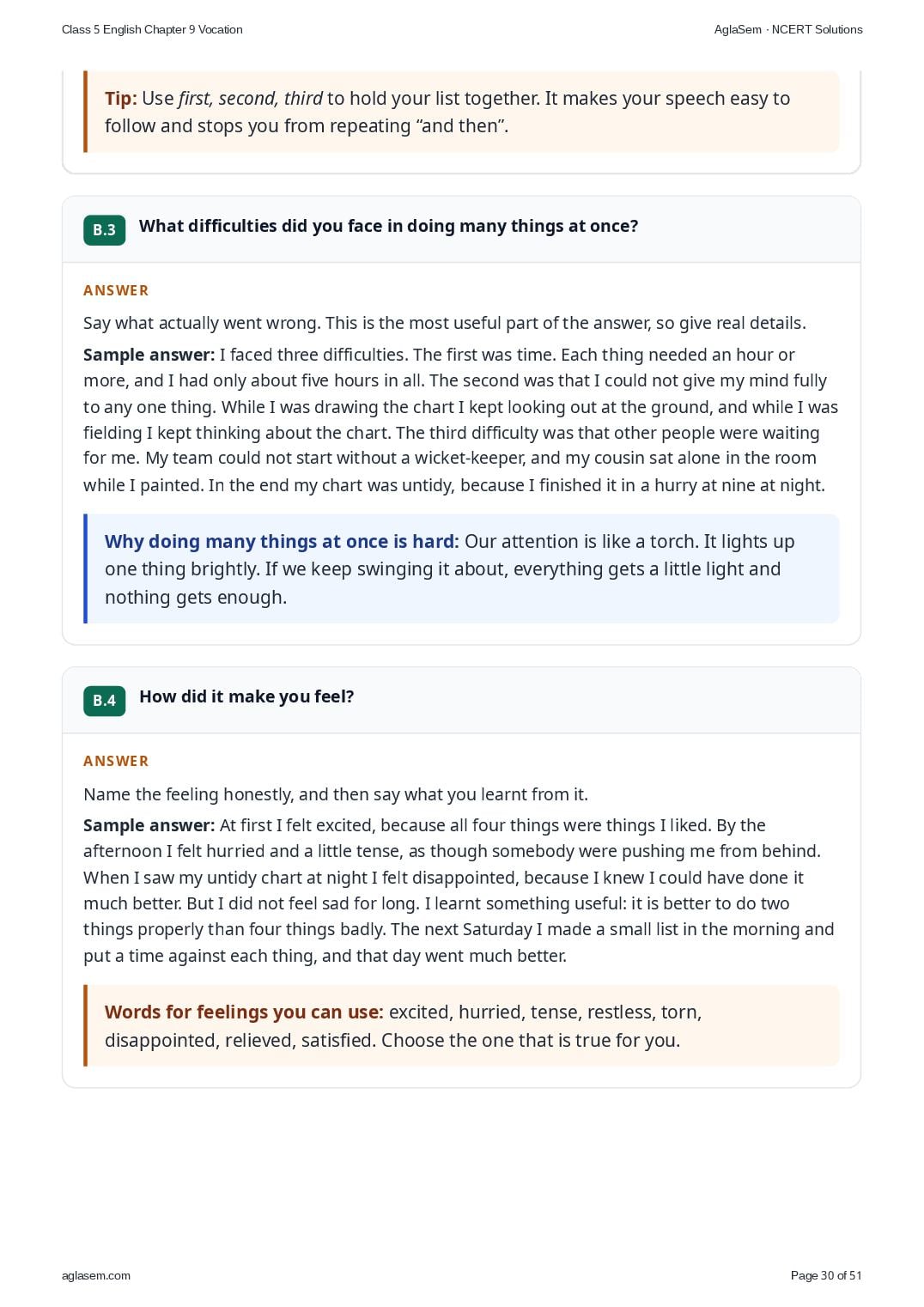
- What difficulties did you face in doing many things at once?
- How did it make you feel?
- Share your views with your classmates.
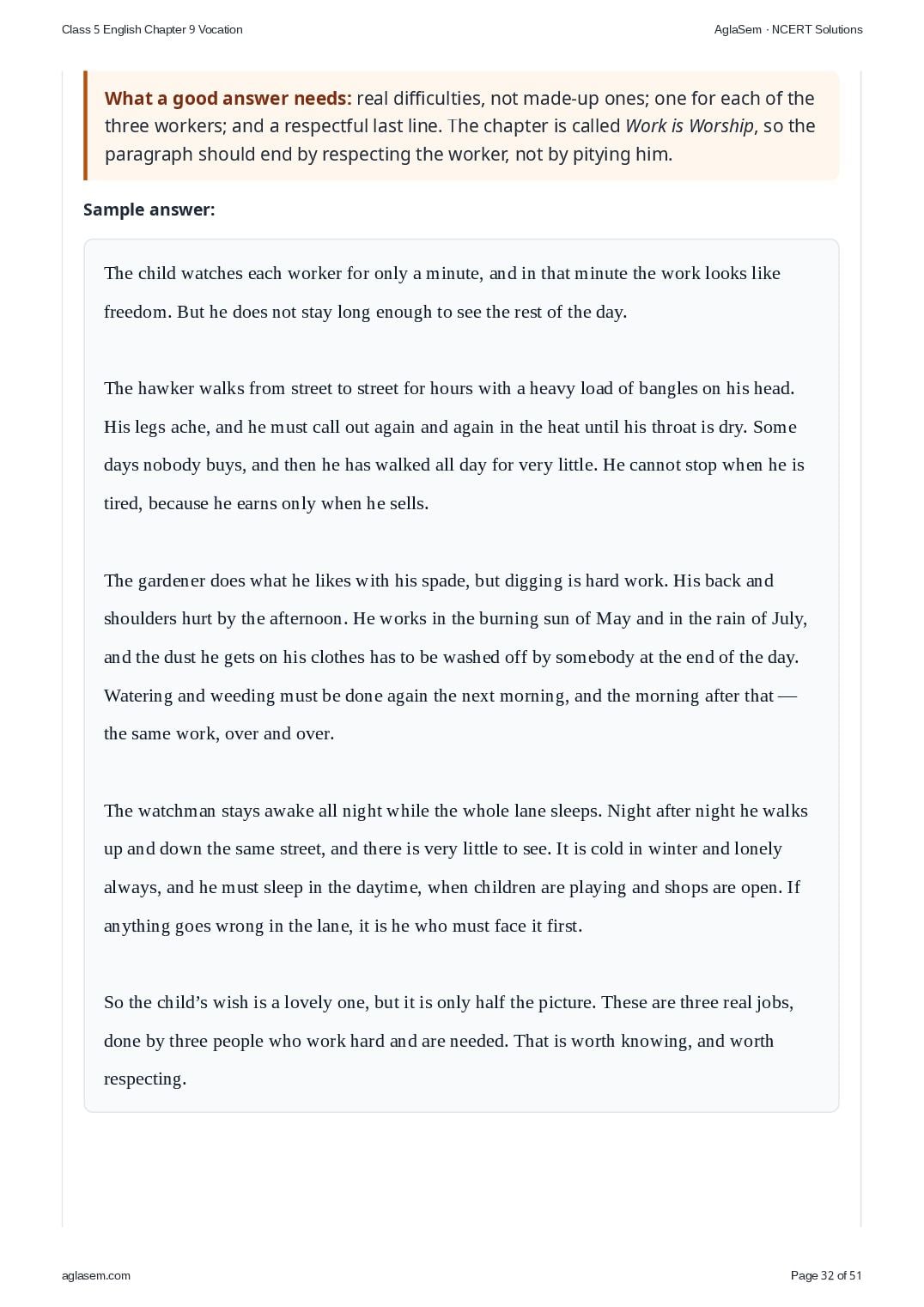
- What’s missing? The child sees only the fun part of each job. What do you think might be the difficult or boring part of being a hawker, a gardener or a watchman? Write a paragraph to express your thoughts.
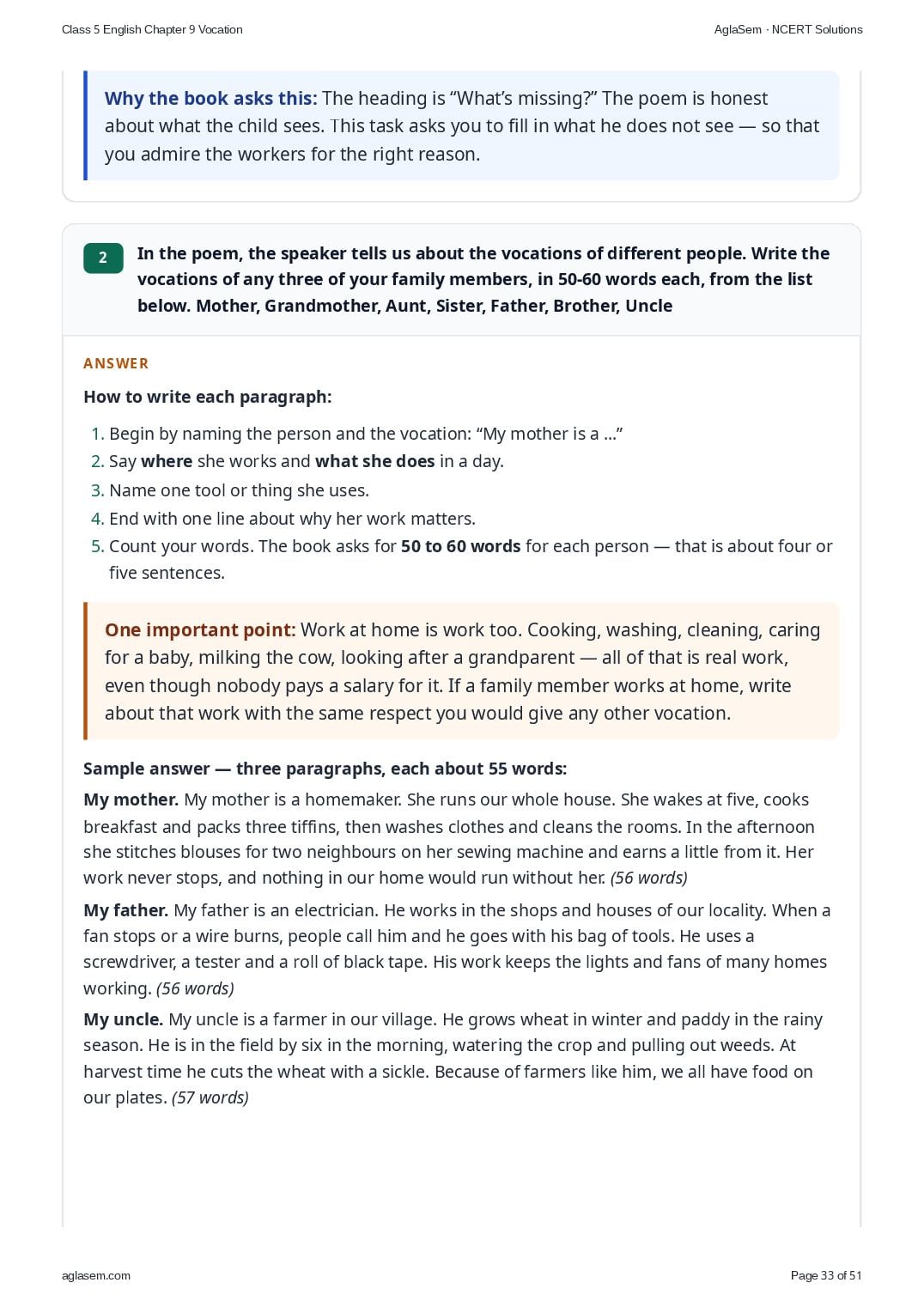
- In the poem, the speaker tells us about the vocations of different people. Write the vocations of any three of your family members, in 50-60 words each, from the list below. Mother, Grandmother, Aunt, Sister, Father, Brother, Uncle
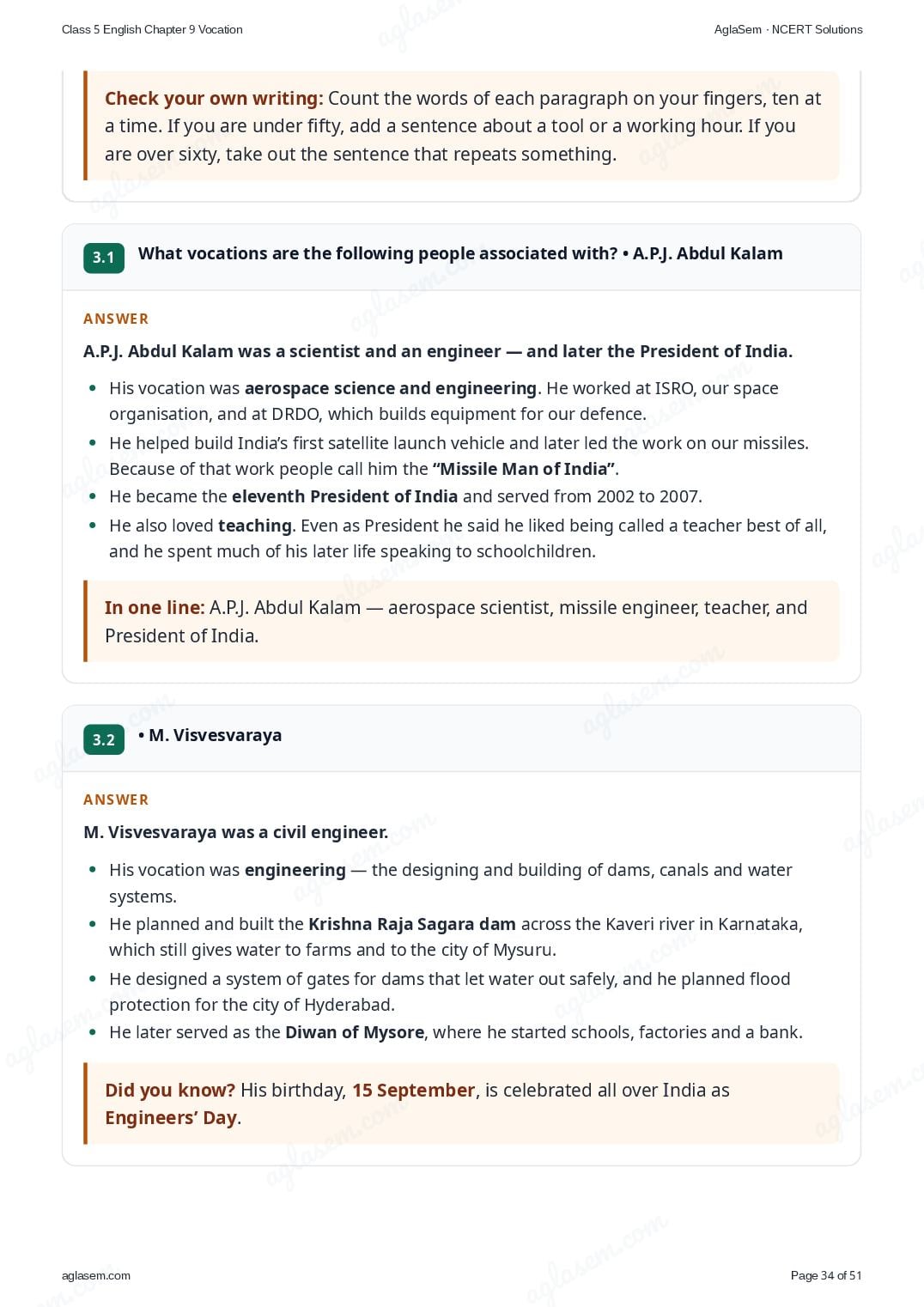
- What vocations are the following people associated with? • A.P.J. Abdul Kalam
- • M. Visvesvaraya
- • Janaki Ammal
- • M.S. Subbulakshmi
- • Salim Ali
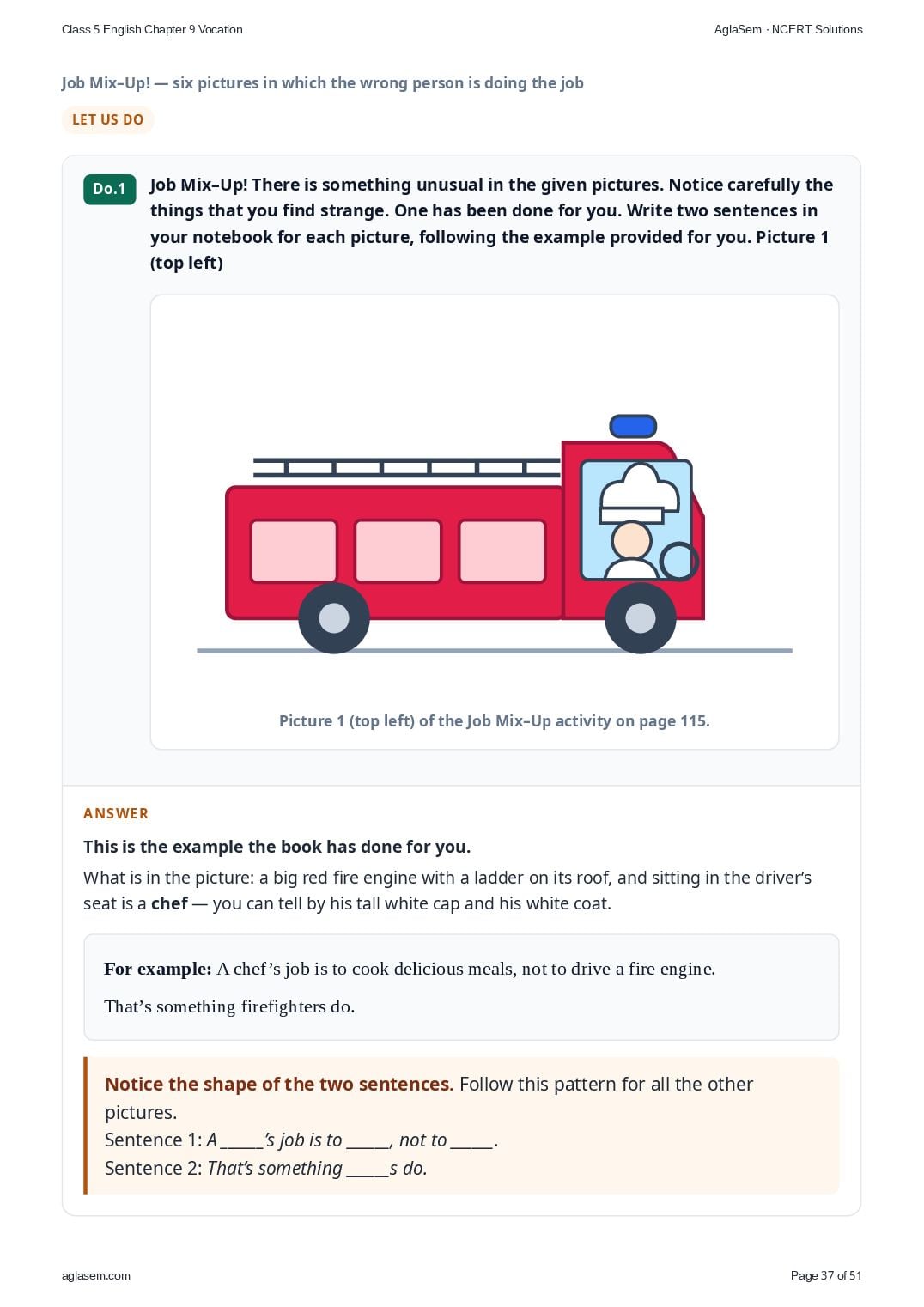
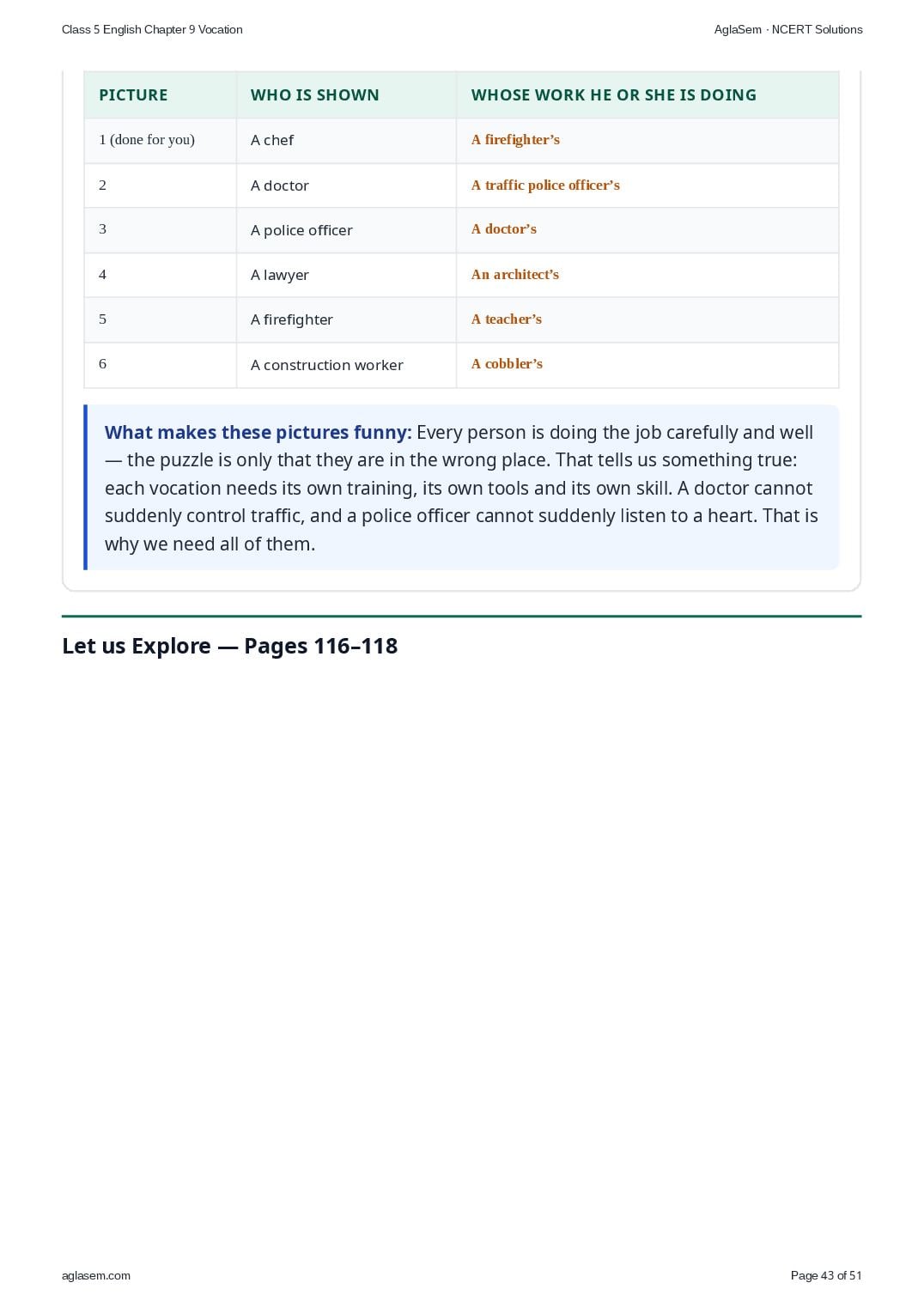
- Job Mix–Up! There is something unusual in the given pictures. Notice carefully the things that you find strange. One has been done for you. Write two sentences in your notebook for each picture, following the example provided for you. Picture 1 (top left) Picture 1 of the Job Mix-Up activity on page 115 Picture 1 (top left) of the Job Mix–Up activity on page 115.
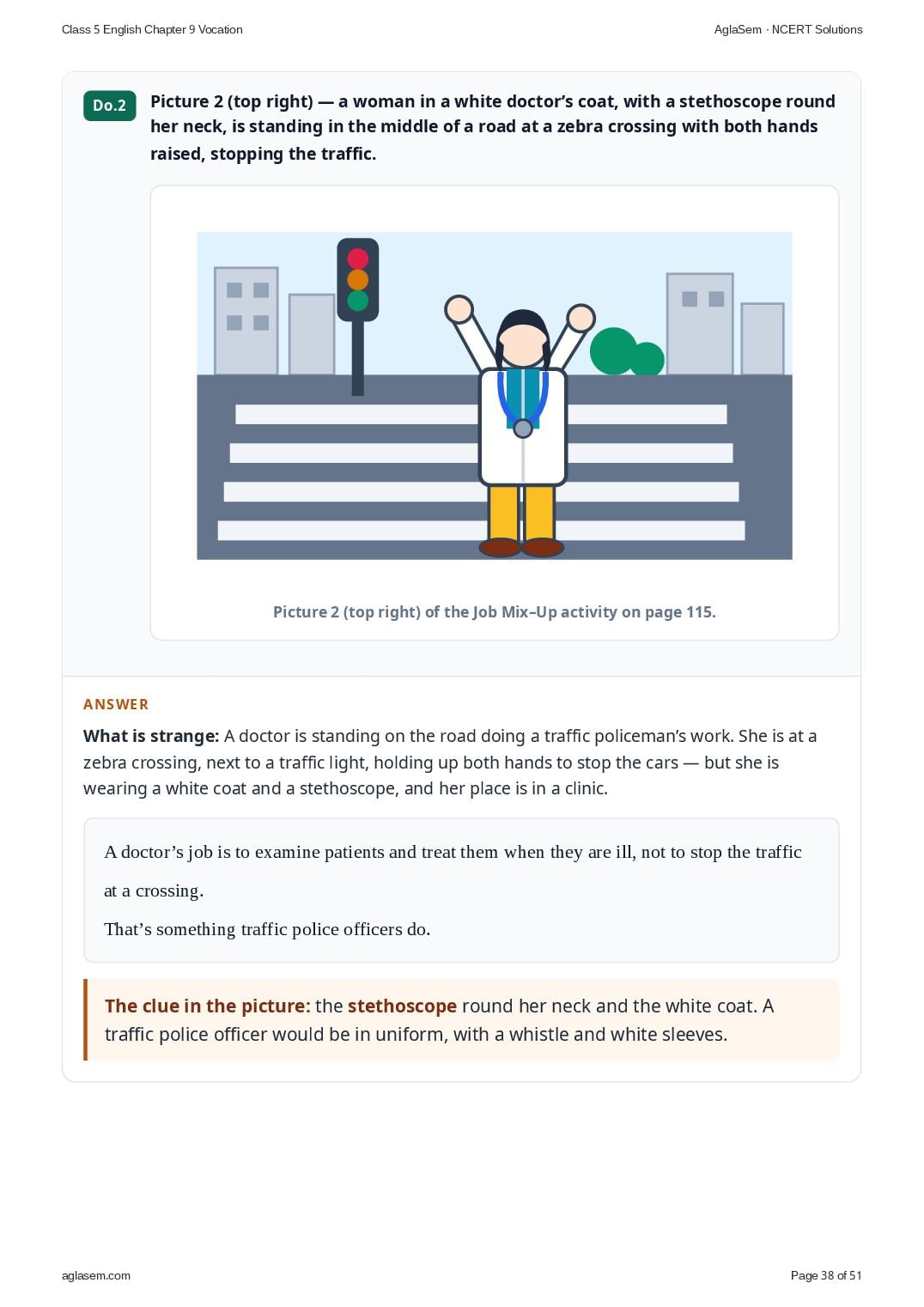
- Picture 2 (top right) — a woman in a white doctor’s coat, with a stethoscope round her neck, is standing in the middle of a road at a zebra crossing with both hands raised, stopping the traffic. Picture 2 of the Job Mix-Up activity on page 115 Picture 2 (top right) of the Job Mix–Up activity on page 115.
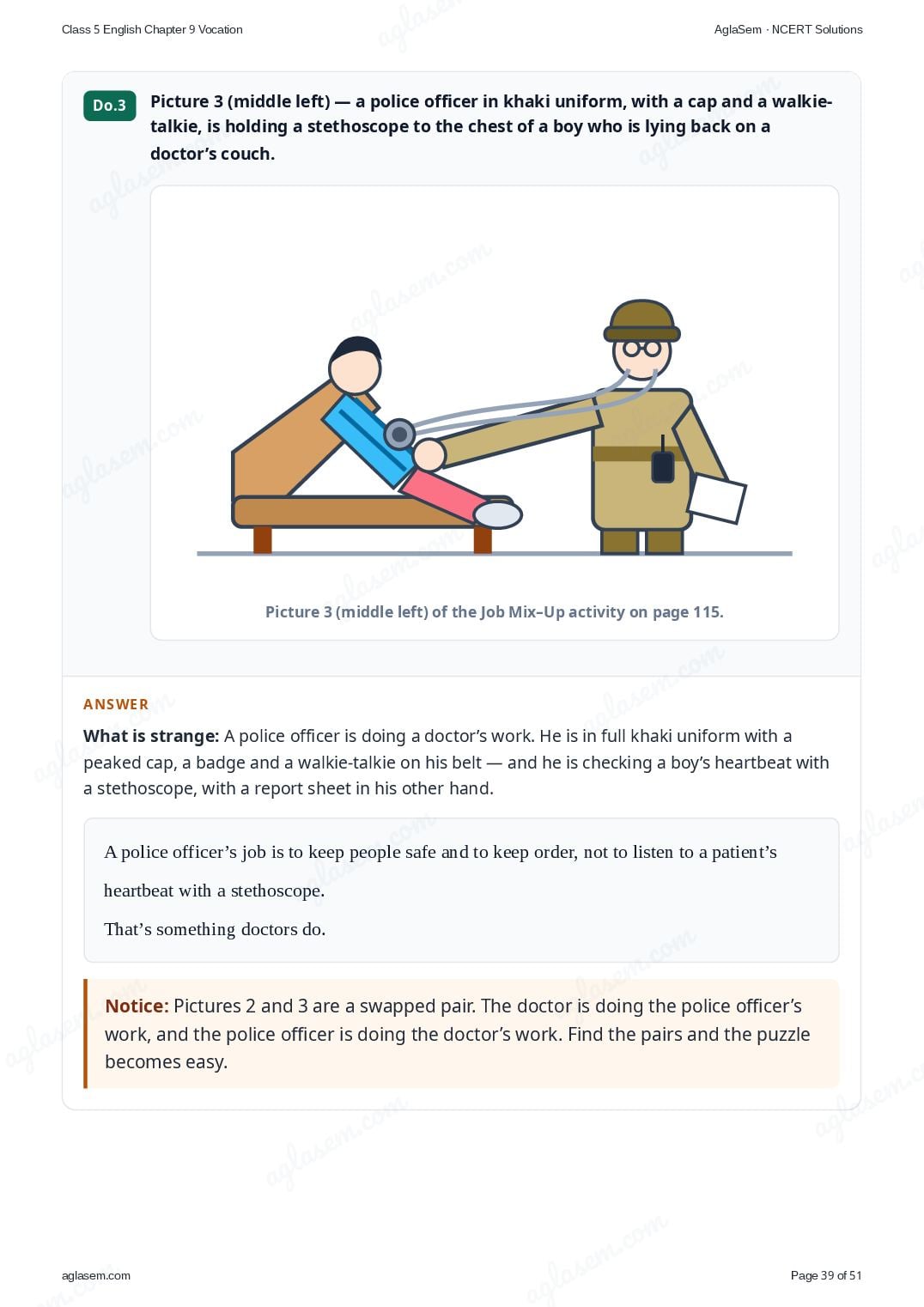
- Picture 3 (middle left) — a police officer in khaki uniform, with a cap and a walkie-talkie, is holding a stethoscope to the chest of a boy who is lying back on a doctor’s couch. Picture 3 of the Job Mix-Up activity on page 115 Picture 3 (middle left) of the Job Mix–Up activity on page 115.
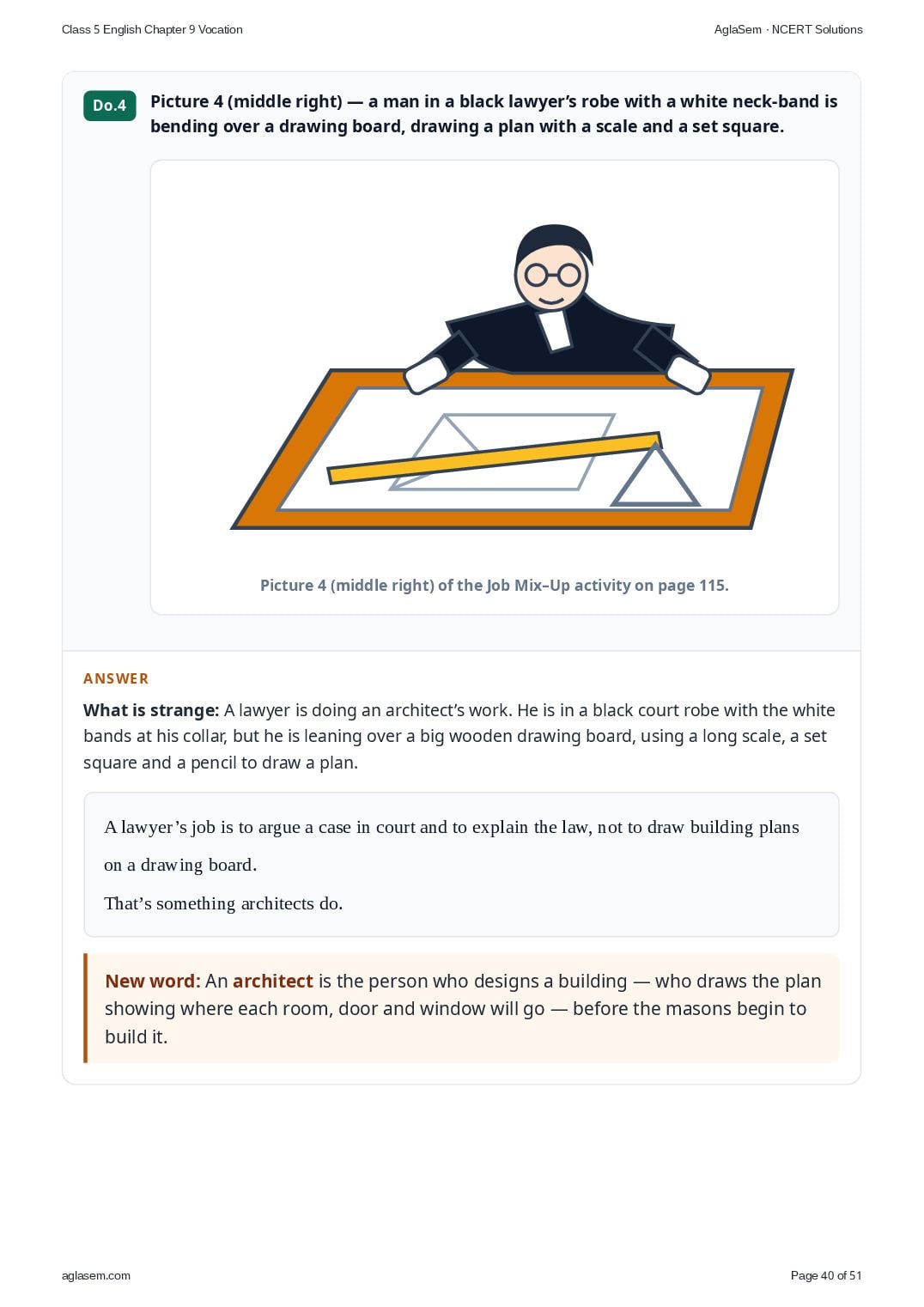
- Picture 4 (middle right) — a man in a black lawyer’s robe with a white neck-band is bending over a drawing board, drawing a plan with a scale and a set square. Picture 4 of the Job Mix-Up activity on page 115 Picture 4 (middle right) of the Job Mix–Up activity on page 115.
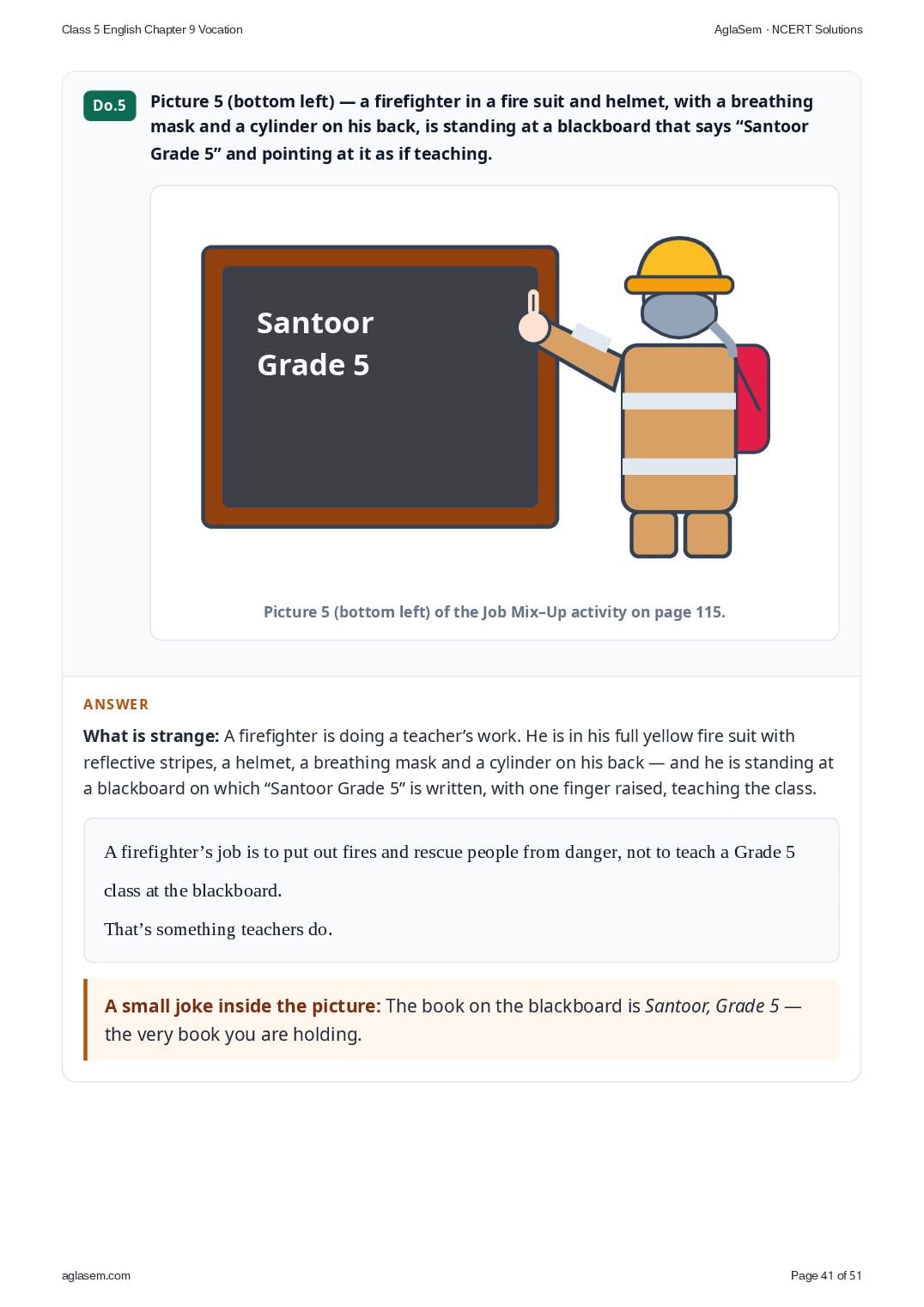
- Picture 5 (bottom left) — a firefighter in a fire suit and helmet, with a breathing mask and a cylinder on his back, is standing at a blackboard that says “Santoor Grade 5” and pointing at it as if teaching. Picture 5 of the Job Mix-Up activity on page 115 Santoor Grade 5 Picture 5 (bottom left) of the Job Mix–Up activity on page 115.
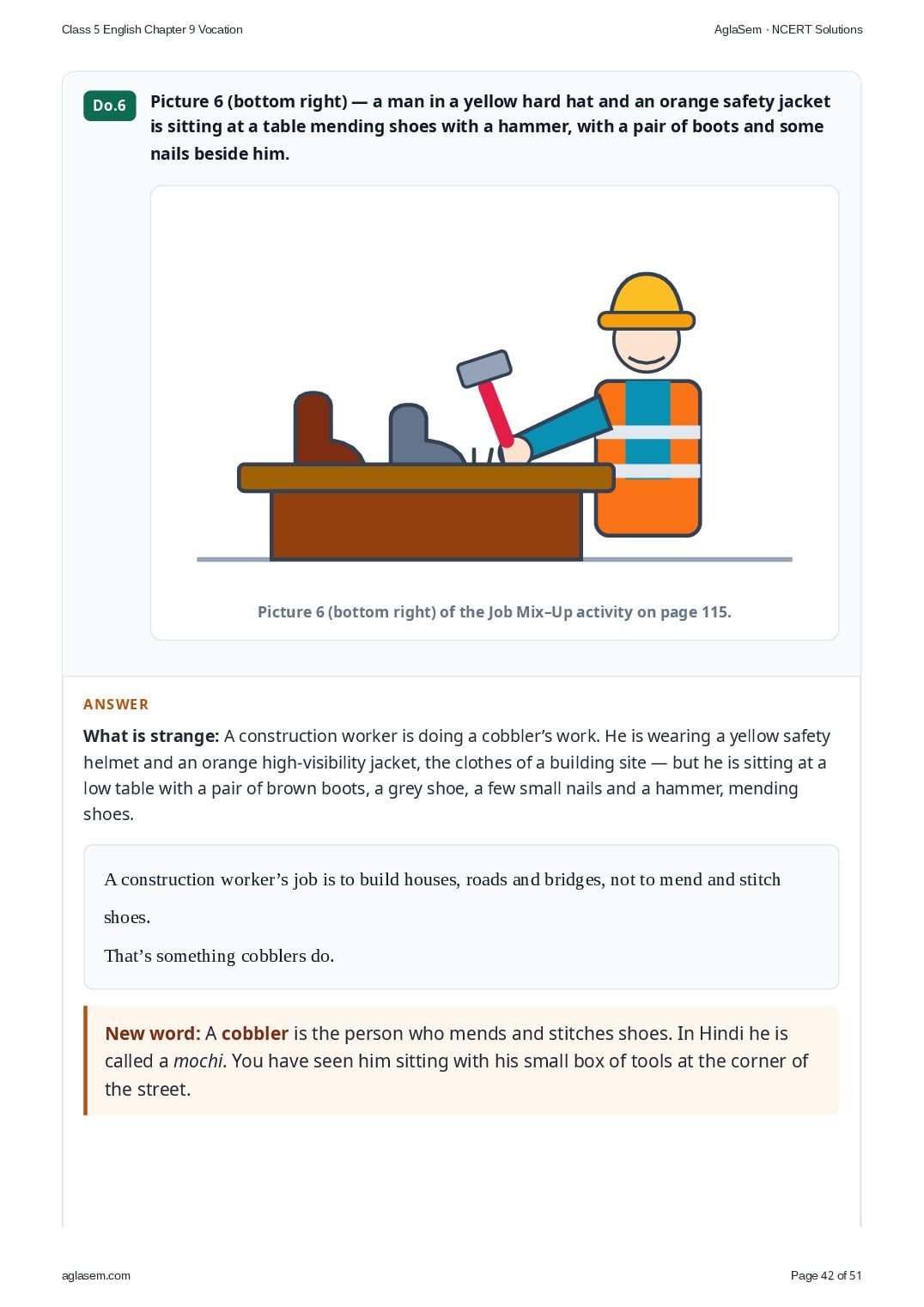
- Picture 6 (bottom right) — a man in a yellow hard hat and an orange safety jacket is sitting at a table mending shoes with a hammer, with a pair of boots and some nails beside him. Picture 6 of the Job Mix-Up activity on page 115 Picture 6 (bottom right) of the Job Mix–Up activity on page 115.
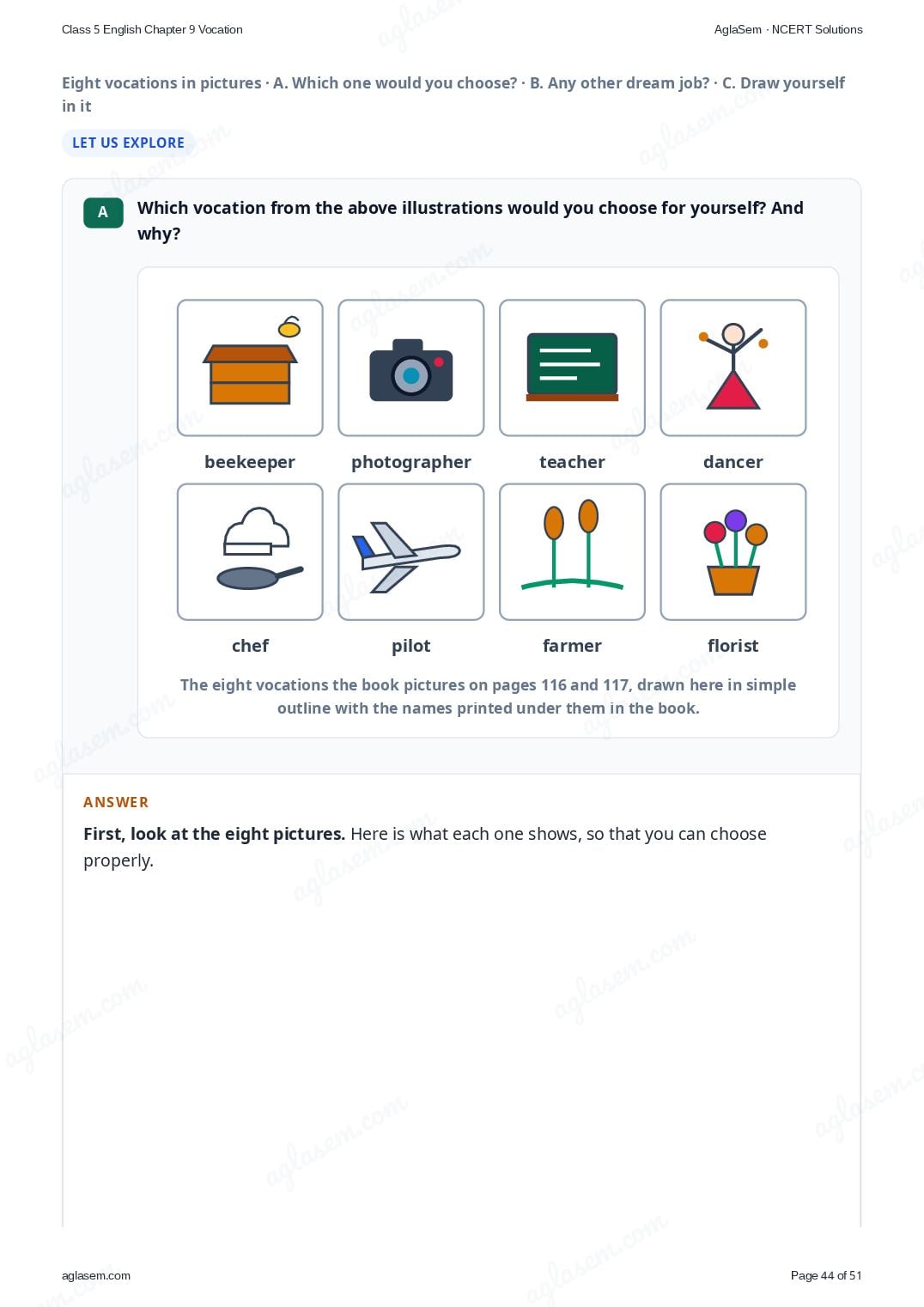
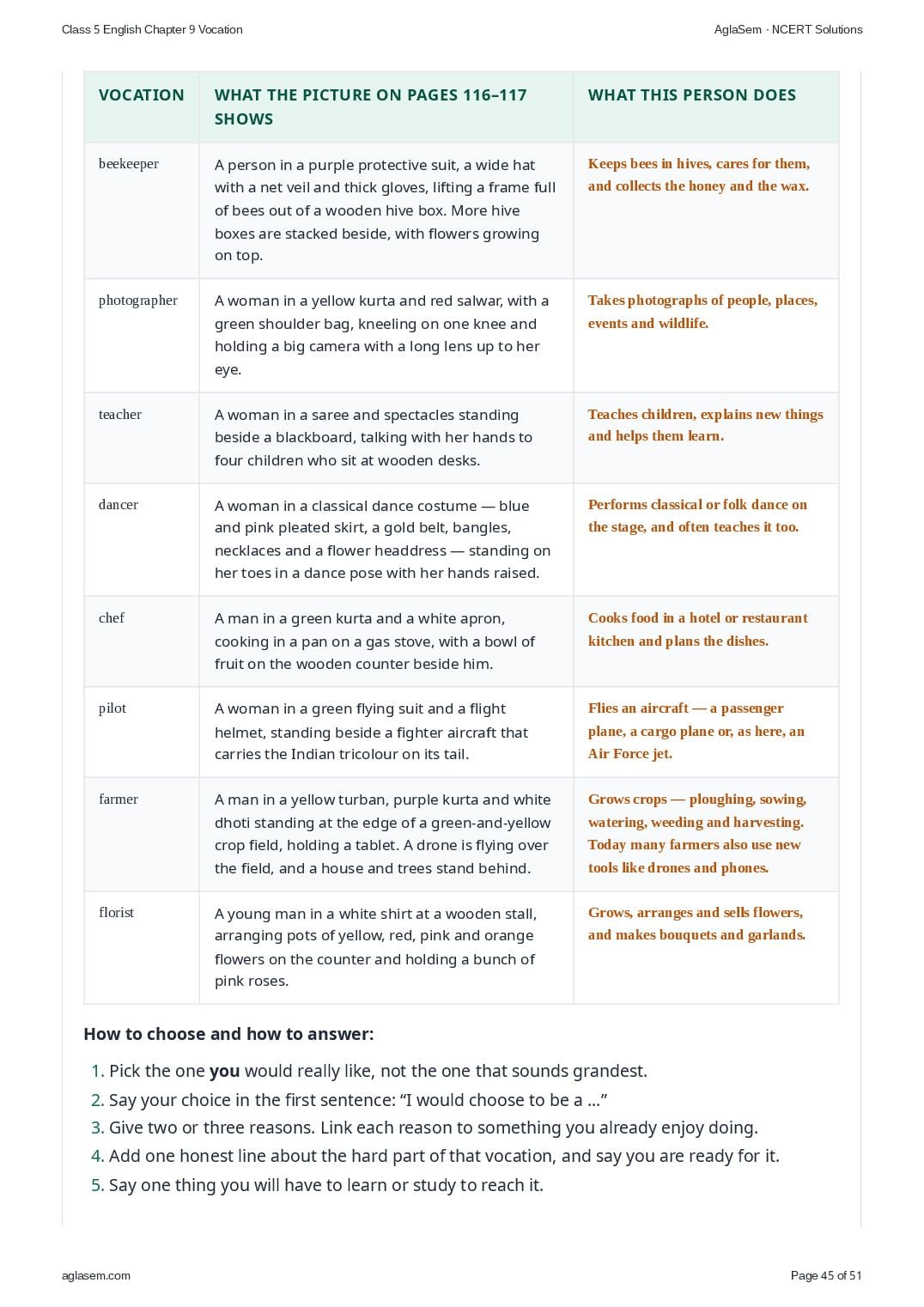
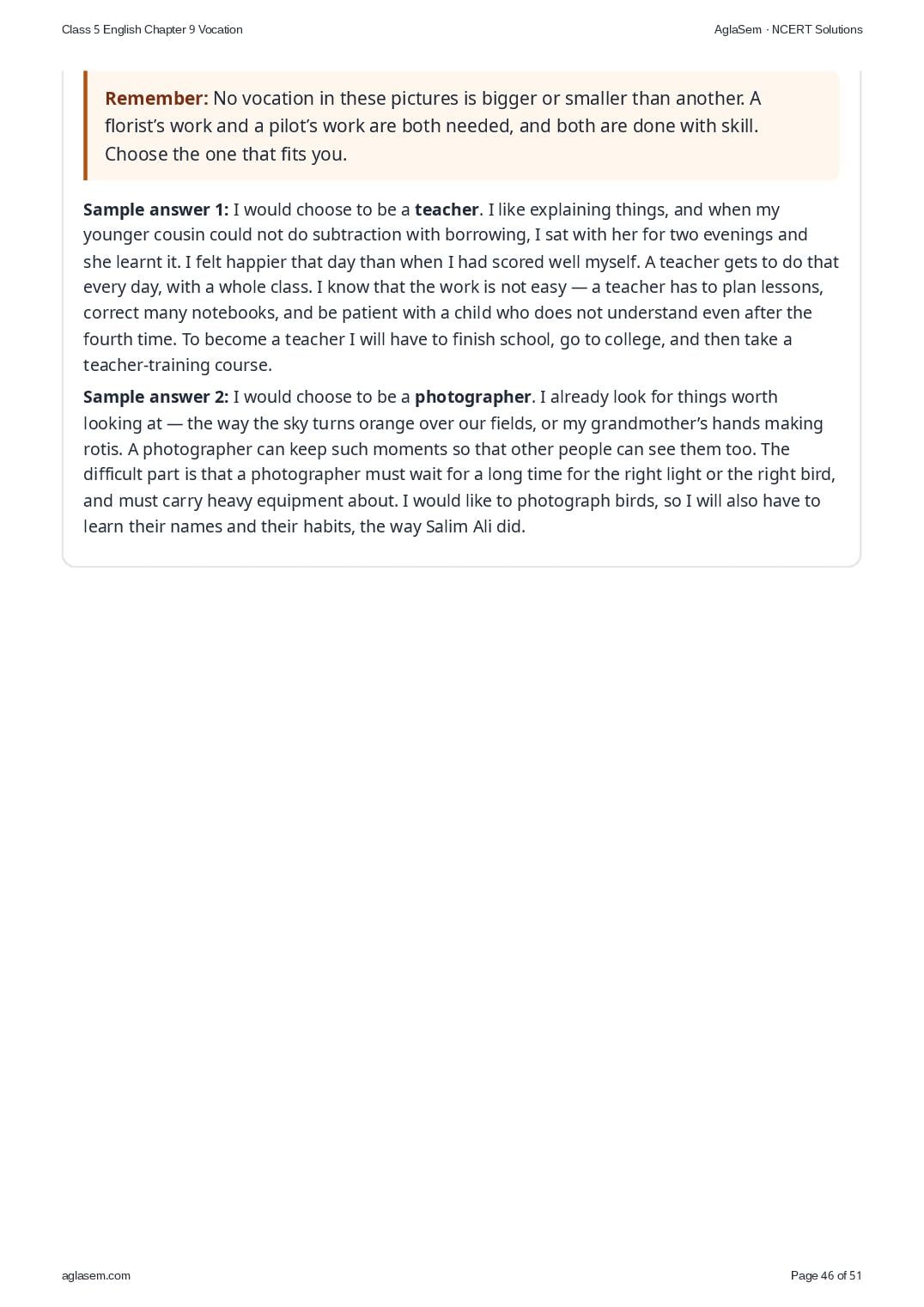
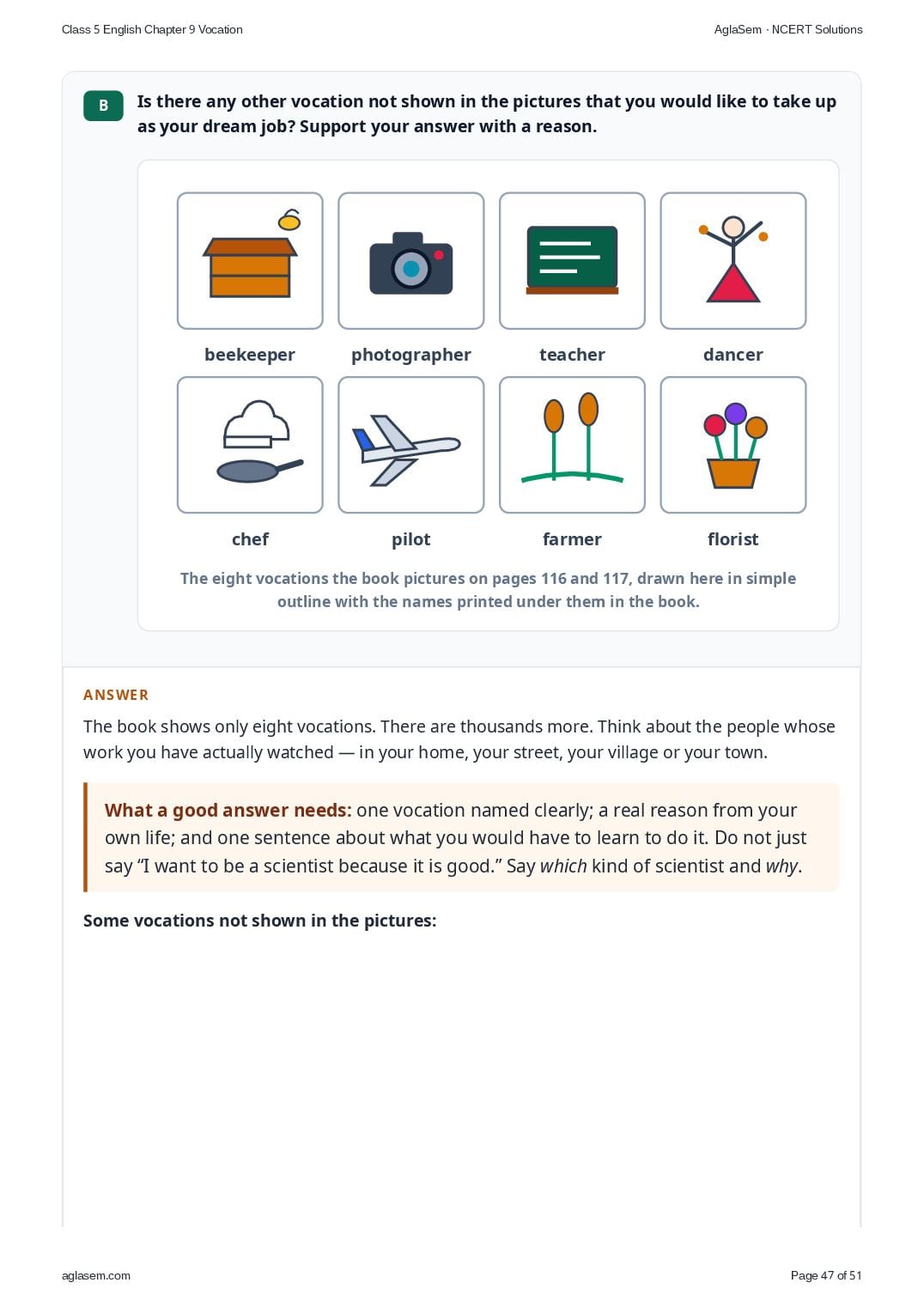
- Which vocation from the above illustrations would you choose for yourself? And why? The eight vocations pictured on pages 116 and 117 beekeeper photographer teacher dancer chef pilot farmer florist The eight vocations the book pictures on pages 116 and 117, drawn here in simple outline with the names printed under them in the book.
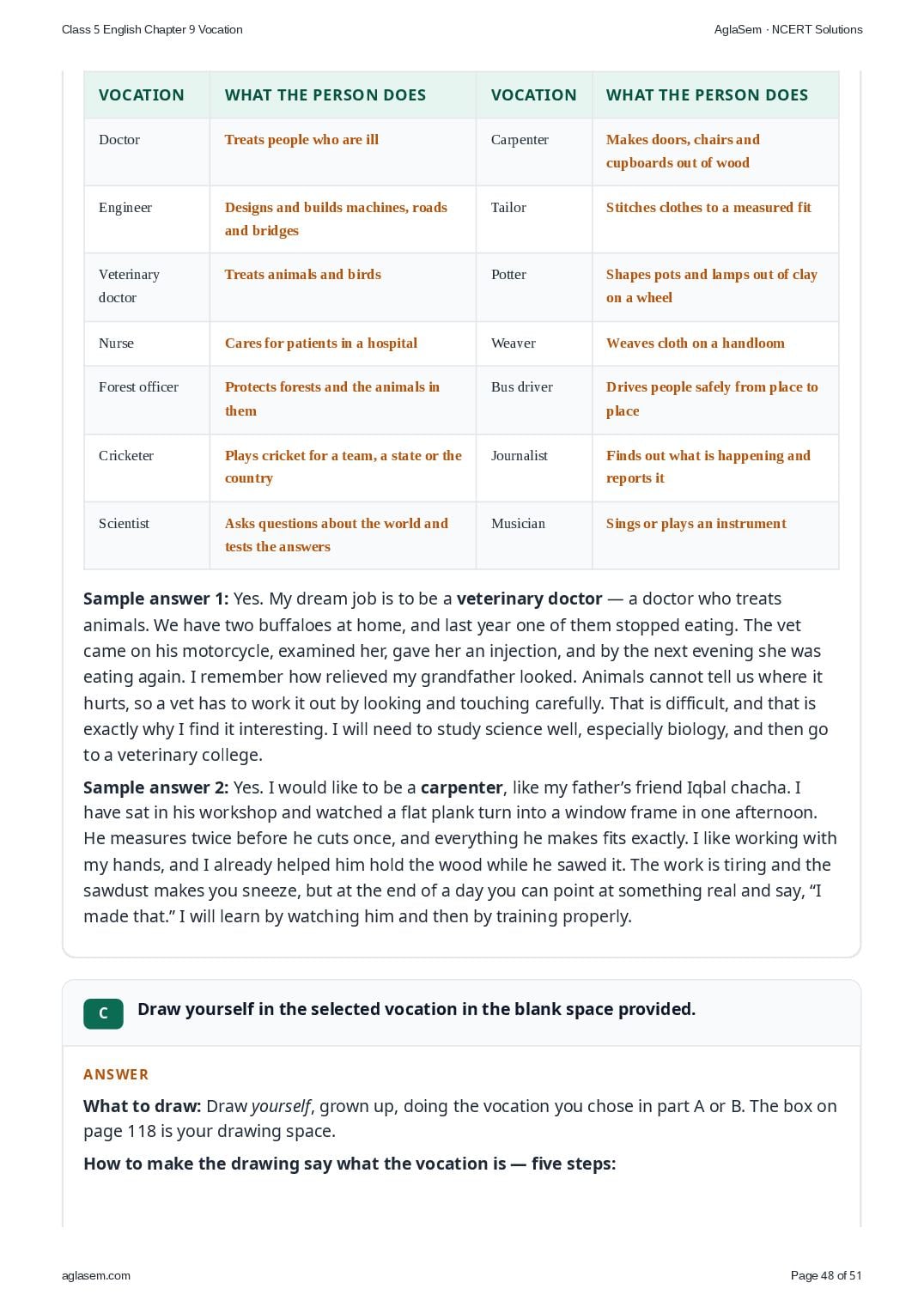
- Is there any other vocation not shown in the pictures that you would like to take up as your dream job? Support your answer with a reason. The eight vocations pictured on pages 116 and 117 beekeeper photographer teacher dancer chef pilot farmer florist The eight vocations the book pictures on pages 116 and 117, drawn here in simple outline with the names printed under them in the book.
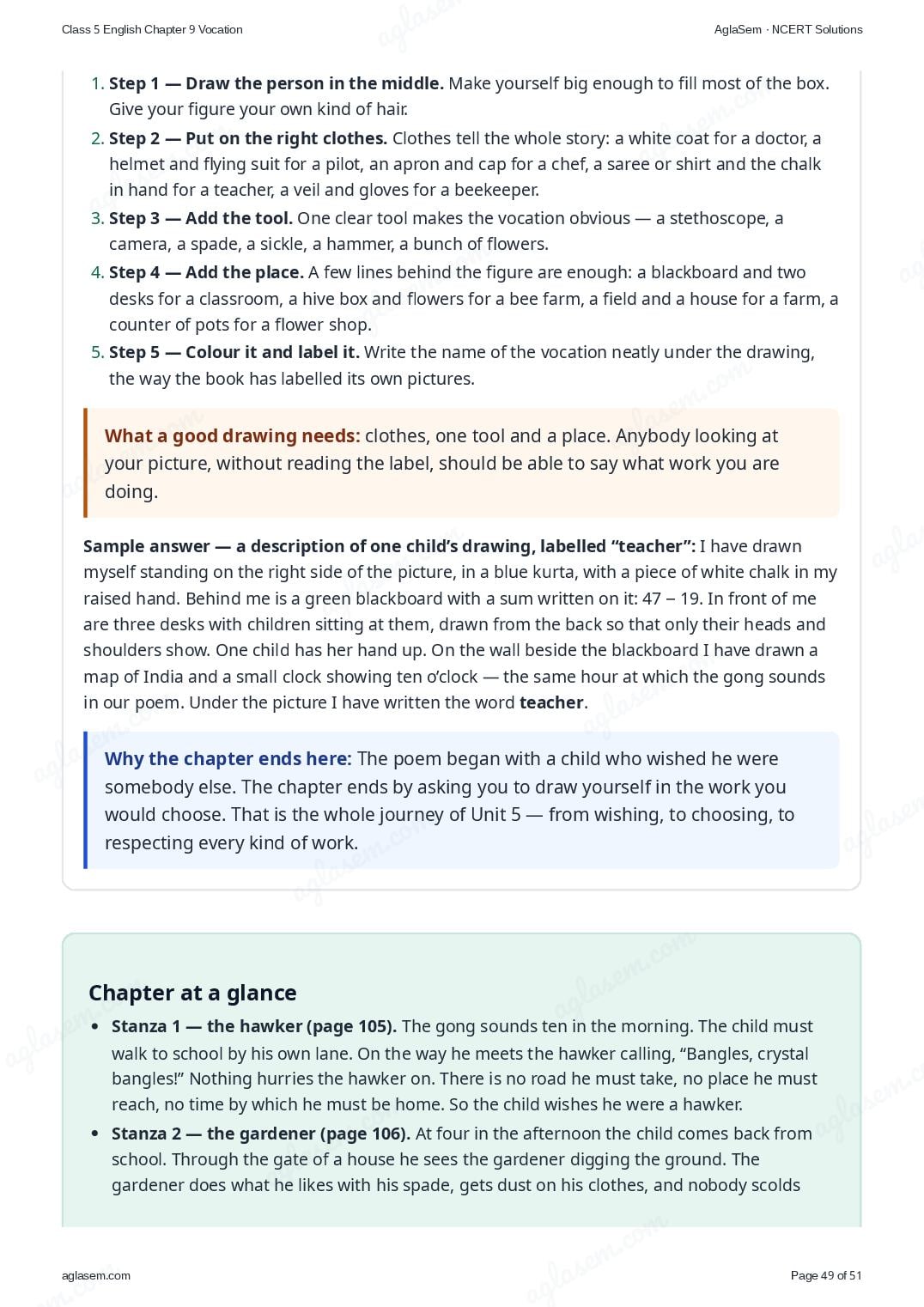
- Draw yourself in the selected vocation in the blank space provided.
Chapter at a Glance
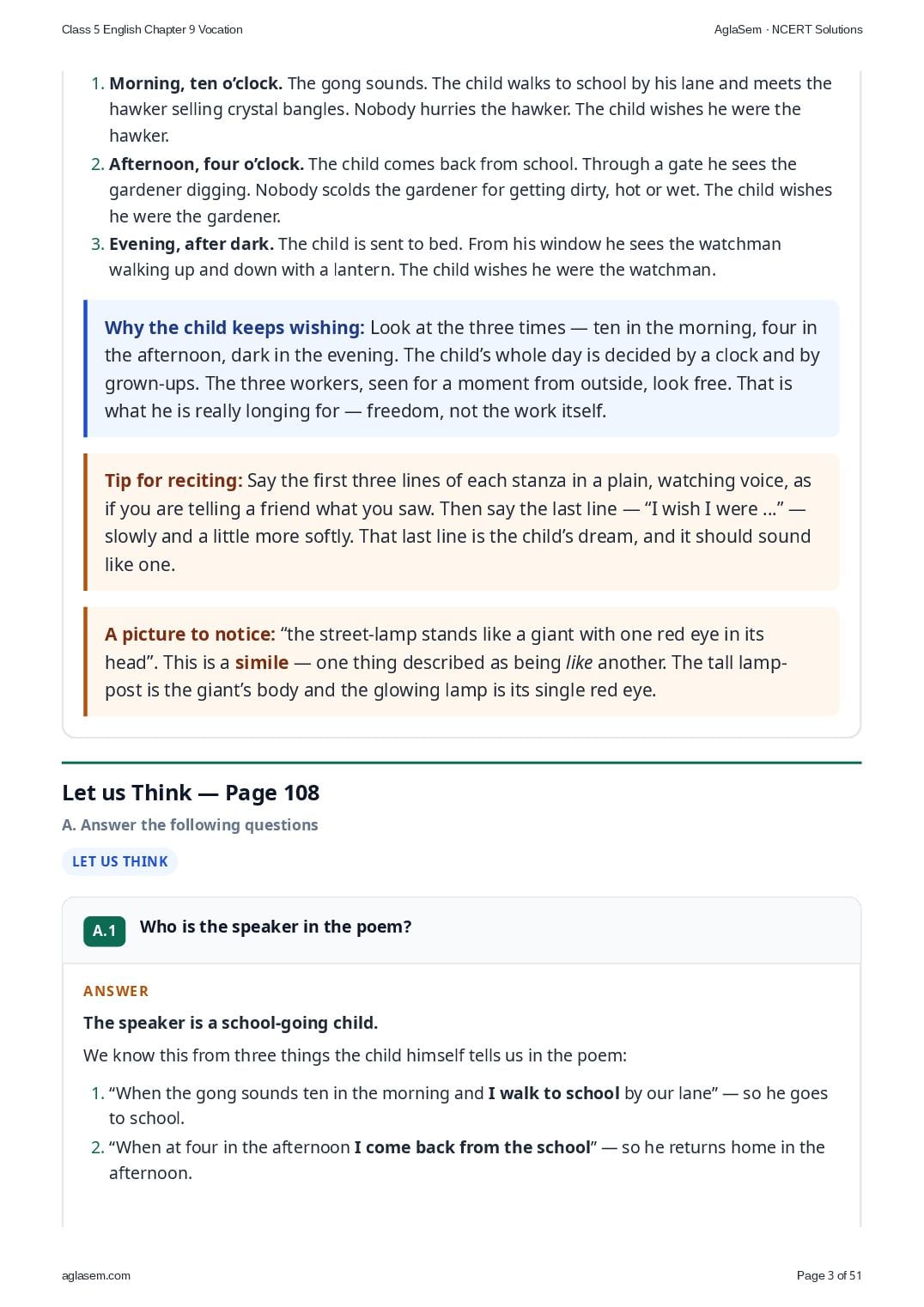
- Stanza 1 — the hawker (page 105). The gong sounds ten in the morning. The child must walk to school by his own lane. On the way he meets the hawker calling, “Bangles, crystal bangles!” Nothing hurries the hawker on. There is no road he must take, no place he must reach, no time by which he must be home. So the child wishes he were a hawker.
- Stanza 2 — the gardener (page 106). At four in the afternoon the child comes back from school. Through the gate of a house he sees the gardener digging the ground. The gardener does what he likes with his spade, gets dust on his clothes, and nobody scolds him whether the sun bakes him or the rain wets him. So the child wishes he were a gardener, with nobody to stop him from digging.
- Stanza 3 — the watchman (page 107). As it gets dark the child’s mother sends him to bed. Through his open window he sees the watchman walking up and down. The lane is dark and lonely and the street-lamp stands like a giant with one red eye in its head. The watchman swings his lantern and walks with his shadow beside him. So the child wishes he were a watchman, walking the streets all night.
- What the poem is really about. It is about a child’s longing to be free. The child’s own day is cut into fixed pieces by a clock and by grown-ups — ten in the morning, four in the afternoon, bedtime at dark. The three working people seem to have no such fences. The poem is about that wish, not about one kind of work being better than another.
- What the child does not see. He watches each worker for a minute or two, from a distance. He does not see the hawker walking street after street to earn a day’s money, the gardener working in the hot sun and the rain, or the watchman staying awake all night while everyone else sleeps. The book’s own Let us Write task, “What’s missing?”, asks the child to think about exactly this.
- The picture in the poem. The strongest image is the street-lamp: it “stands like a giant with one red eye in its head”. This is a simile — one thing described as being like another, using the word like. To a sleepy child at a window, a tall lamp-post with a glowing lamp really can look like a one-eyed giant.
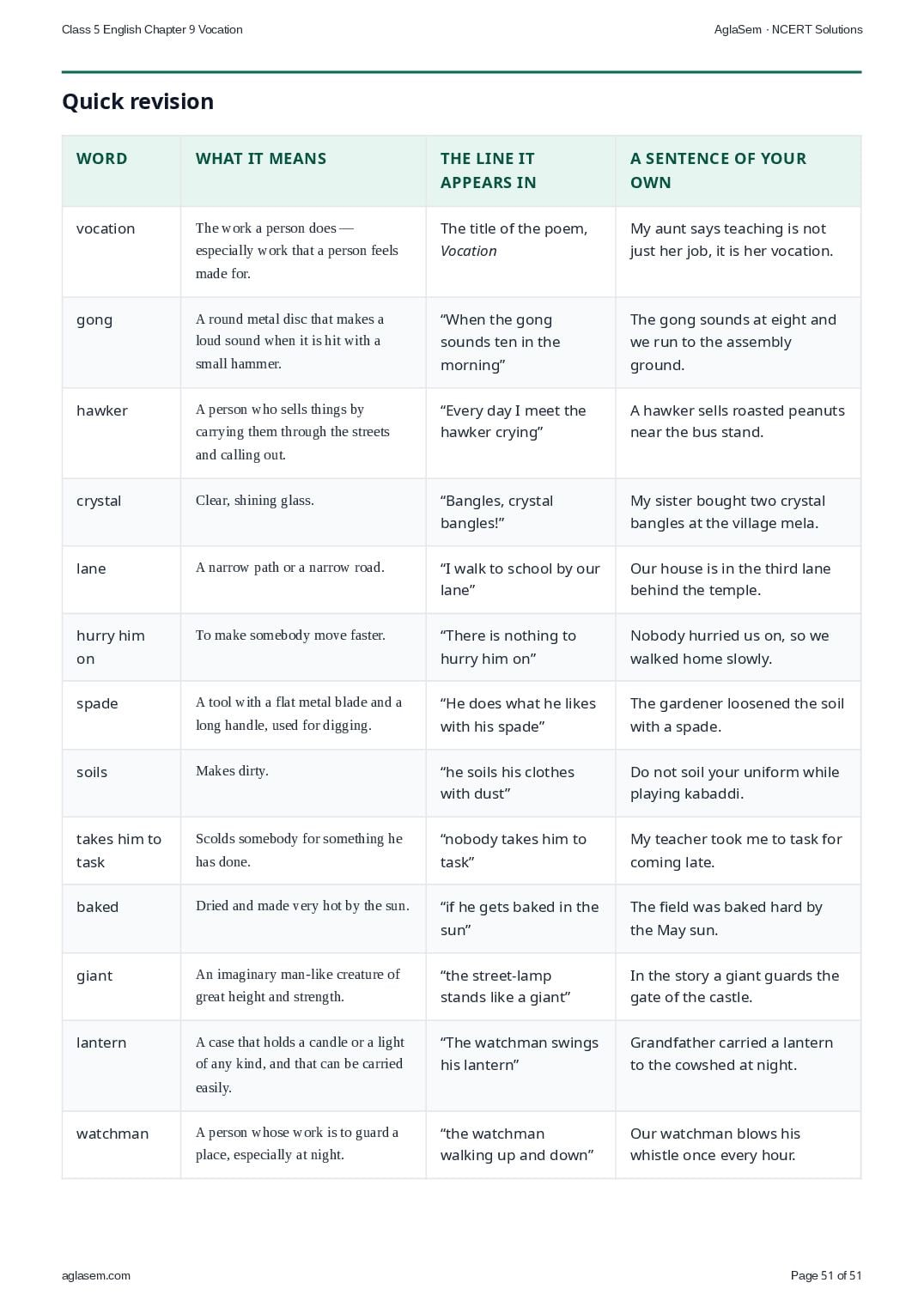
- New Words taught by the chapter: vocation, gong, lane, giant, spade, lantern.
- The language work (Let us Learn). A — matching five words from the poem with their meanings. B — finding one mistake in each sentence and rewriting it correctly: this covers subject–verb agreement (is/are, go/goes), comparatives and superlatives (faster, tallest), adverbs (slowly) and prepositions (go to school). C — eleven pictures of tools and instruments, and three questions about where you have seen them and what they are used for.
- Speaking and listening. Let us Listen is a group activity: each group frames two WH-questions on the poem and the other groups answer them. Let us Speak A drills eight words that all end in the same “shun” sound — cushion, ration, fashion, tension, mention, attention, nation, vocation. B asks the child to talk about a time when he or she wanted to do many things but could not.
- Writing, doing and exploring. Let us Write has three tasks: the difficult side of each job, the vocations of three family members, and the vocations of five well-known Indians. Let us Do is “Job Mix–Up!”, six funny pictures in which the wrong person is doing the job. Let us Explore shows eight vocations — beekeeper, photographer, teacher, dancer, chef, pilot, farmer and florist — and asks the child which one he or she would choose, and why.
How to Download NCERT Solutions for Class 5 English Chapter 9 PDF
Follow these simple steps to get the Vocation questions-and-answers PDF from Santoor.
- Search NCERT Solutions for Class 5 English Chapter 9 aglasem and open this page.
- Read the exercise questions with answers for Vocation shown above.
- Click the Download PDF link to save the Vocation solutions to your device.
NCERT Solutions for Class 5 English – All Chapters
There are more chapters to study besides Vocation in English. Here are the NCERT Solutions for all chapters of Class 5 English.
- Chapter 1 Papa s Spectacles
- Chapter 2 Gone with the Scooter
- Chapter 3 the Rainbow
- Chapter 4 the Wise Parrot
- Chapter 5 the Frog
- Chapter 6 What a Tank
- Chapter 7 Gilli Danda
- Chapter 8 the Decision of the Panchayat
- Chapter 9 Vocation
- Chapter 10 Glass Bangles
NCERT Solutions for Class 5 – All Subjects
Just like Chapter 9 of English, you can get the exercise questions with answers for every other subject of Class 5. Here are the NCERT Solutions for all subjects of Class 5.
NCERT Solutions for Class 5 English Chapter 9 – An Overview
The key highlights of this study material are as follows.
| Aspects | Details |
|---|---|
| Class | Class 5 |
| Subject | English |
| Chapter Number | Chapter 9 |
| Chapter Name | Vocation |
| Book Name | Santoor |
| Book By | NCERT (National Council of Educational Research and Training) |
| Educational Resource Here | NCERT Solutions of Class 5 English Chapter 9 for all exercises |
| More Questions Answers of This Subject | NCERT Solutions for Class 5 English |
| Download Book Chapter | NCERT Book Class 5 English |
| All Questions Answers For This Class | NCERT Solutions for Class 5 |
| Complete Solutions | NCERT Solutions |
NCERT Solutions for Class 5 English Chapter 9 Vocation – FAQs
What are the NCERT Solutions for Class 5 English Chapter 9 Vocation?
They are the complete, step-by-step answers to all the exercise and in-text questions of Chapter 9 Vocation from the NCERT Class 5 English textbook Santoor, written by experts as per the latest NCERT syllabus.
How can I download the Class 5 English Chapter 9 solutions PDF for free?
Open this page on aglasem, read the Vocation questions with answers, and click the “Download Solutions PDF” link. The Class 5 English Chapter 9 NCERT Solutions PDF is completely free to download.
Are these NCERT Solutions as per the latest 2026-27 syllabus?
Yes. The NCERT Solutions for Class 5 English Chapter 9 are based on the latest NCERT textbook Santoor and the current 2026-27 CBSE syllabus, so the questions and answers match what you study in class.
Where can I get NCERT Solutions for the other chapters of Class 5 English?
You can find the answers to every chapter on the NCERT Solutions for Class 5 English page, and solutions for every subject on the NCERT Solutions for Class 5 page.
How do NCERT Solutions help in exam preparation?
They show the correct method to solve each question, help you write answers the way they are expected in exams, let you check and correct your own work, and save revision time — which together improve your marks in Class 5 English.
If you have any queries on NCERT Solutions for Class 5 English Chapter 9 Vocation, then please ask in the comments below.