NCERT Solutions for Class 5 English Chapter 4 the Wise Parrot – step-by-step answers to every exercise and in-text question of the chapter, as per the latest NCERT syllabus for 2027. Read them online or download the free question-answer PDF.
Chapter 4 of Santoor closes Unit 2, My Colourful World. The Wise Parrot is a prose story — a folk tale. The book does not name a writer. A rich merchant keeps a clever parrot in a cage of gold. The parrot wants only one thing: to fly free. It never fights and it never begs twice — it thinks, and it wins. The chapter carries these banners: Let us Read, New Words, Let us Think (A and B), Let us Learn (A, B, C), Let us Listen, Let us Speak (A and B), Let us Write, Let us Do and Let us Explore. The same PDF also carries Self-assessment 1 on printed pages 53–54, which is answered in the last section here.
NCERT Solutions for Class 5 English Chapter 4 the Wise Parrot PDF
All the answers are on this page below. The PDF also explains every answer – why it is right and how to check it – so download it for revision.
| Chapter | Download | |
|---|---|---|
| Solutions PDF | The Wise Parrot | View PDF |
Summary and word meanings
The Wise Parrot (story)
Summary
- A rich merchant kept a clever parrot in a golden cage.
- The parrot longed to fly free, but the merchant said no.
- So it sent greetings to its friends in the jungle.
- Hearing this, one forest parrot fell from its tree like a stone.
- At home, the pet parrot also fell down, as if dead.
- The merchant placed it on the windowsill, and it flew away!
सारांश (हिन्दी में)
- एक अमीर व्यापारी ने एक समझदार तोते को सोने के पिंजरे में रखा था। तोता खुले आसमान में उड़ना चाहता था, पर व्यापारी ने उसे जाने नहीं दिया।
- तब तोते ने व्यापारी के हाथ जंगल के अपने दोस्तों को नमस्कार भेजा।
- यह संदेश सुनते ही जंगल का एक तोता पेड़ से पत्थर की तरह ज़मीन पर गिर पड़ा।
- घर लौटकर व्यापारी ने यह बात बताई, तो पालतू तोता भी मरा-सा होकर गिर पड़ा। व्यापारी ने उसे खिड़की पर रखा, और वह उड़ गया!
Word meanings
| Word | Meaning | हिंदी अर्थ | In the text |
|---|---|---|---|
| merchant | a person who buys and sells goods for a living | व्यापारी, सौदागर | “a rich merchant kept a bright and talkative parrot” |
| talkative | fond of talking a lot | बातूनी | “a bright and talkative parrot” |
| entertained | kept someone happy and amused | मन बहलाया, मनोरंजन किया | “often entertained the merchant with stories and songs” |
| longed for | wanted something very much | के लिए तरसता था | “the bird longed for the open skies” |
| beloved | dearly loved | प्यारा, प्रिय | “My beloved parrot” |
| far-off | very far away | दूर का, दूर-दराज़ का | “travel to a far-off land” |
| look after | take care of | देखभाल करना | “you look after my needs so well” |
| tender | soft and easy to bite | मुलायम, कोमल | “all the tender fruits and chillies” |
| cannot bear | feel too sad to let something happen | सहन नहीं कर सकता | “I cannot bear to let you go away” |
| sighed | let out a long, sad breath | आह भरी | “The bird sighed.” |
| greetings | a friendly message of hello and good wishes | नमस्कार, शुभकामनाएँ | “I send them greetings from my cage” |
| a flight of parrots | a group of parrots flying together | तोतों का झुंड | “he saw a flight of parrots” |
| relatives | members of the same family | रिश्तेदार, संबंधी | “I have one of your relatives as a pet” |
| dropped like a stone | fell straight down, fast and without moving | पत्थर की तरह गिर पड़ा | “one parrot dropped like a stone from the tree” |
| distressed | very upset and worried | बहुत दुखी, परेशान | “The merchant was distressed at this.” |
| hurried away | went away quickly | जल्दी से चला गया | “He hurried away from there.” |
| wonders | amazing things that surprise you | अद्भुत चीज़ें, अजूबे | “described all the wonders and the beauty” |
| conveyed | passed on (a message) to someone | पहुँचाया (संदेश) | “the message he had conveyed” |
| sorrow | deep sadness | दुख, शोक | “with great sorrow” |
| perch | the rod in a cage on which a bird sits | अड्डा, पिंजरे की छड़ जिस पर पक्षी बैठता है | “fell from the perch to the floor of the cage” |
| windowsill | the flat ledge at the bottom of a window | खिड़की की चौखट का निचला हिस्सा | “placed it on the windowsill” |
| stirred | moved a little after being still | हिला, हरकत की | “the bird stirred” |
| escape | get away from a place where one is kept | भाग निकलना, छूटना | “how I could escape” |
NCERT Solutions for Class 5 English Chapter 4 the Wise Parrot – Questions and Answers
All 36 questions of the chapter (textbook pages 41 – 54) are answered below, in the order of the book – in-text questions, activities and the end-of-chapter exercises. Each answer is written the way you would write it in the exam.
Let us Read — Pages 41–44The Wise Parrot (story)
The story in brief: A rich merchant keeps a clever parrot in a cage of gold. He will not set it free, so the parrot sends greetings to its jungle friends. On hearing this, a forest parrot drops down as if dead. The pet parrot copies the trick, the merchant lifts it out of the cage, and it flies away.
Let us Think — Page 45A. Answer the following questions
The merchant was rich, and the parrot was very dear to him. He kept it in a cage of gold because he loved and valued his clever pet so much.
The parrot was bright and talkative, and it had a sharp mind. It often entertained the merchant with stories and songs. That made it his favourite pet.
The parrot asked the merchant to tell its friends in the jungle that it sent them greetings from its cage.
As soon as the merchant finished speaking, one parrot dropped like a stone from the tree and fell on the ground. The merchant was distressed at this and hurried away.
The parrot pretended to be dead. It fell from its perch to the floor of the cage. The merchant thought it had died, so he took it out and placed it on the windowsill. As soon as he stepped back, the parrot flew off into the open sky.
Let us Think — Page 45B. Think and discuss
If I were the merchant, I would set the parrot free. It would be hard, because I love it and would miss its songs. But a bird is made to fly, and it asked me politely. So I would open the cage, say goodbye, and keep fruit and water at my window so that it could visit me.
Yes. Sample answer: Once our ball fell into a deep, narrow pipe. The big boys could not reach it with their arms. My friend poured water into the pipe, and the ball floated up to the top. A clever idea did what strength could not.
I think the pet parrot was truly wise. When the merchant refused to free it, it did not fight or give up. It sent a message to its friends, understood the forest parrot’s answer at once, and used the same trick to escape.
Let us Learn — Page 46A. Fill in the blanks with suitable phrases
Box: stand upright, all over, look after, stepped out, went away, came across, about to
One winter morning, as I ……………………. of my home, I saw that the snow was ……………………. the place. While walking uphill towards my shop, I ……………………. a small puppy. Its leg was injured and it was ……………………. collapse. Being in pain it was unable to ……………………. . So, I decided to take it home and ……………………. it. With good care, all its pain ……………………. .
Let us Learn — Page 46B. Complete the sentences — collective nouns
Box: pack, bouquet, army, flock, bunch, flight, swarm
1. A flight of parrots came to the forest. (done for you in the book)
A flight of parrots came to the forest. A group of birds flying together is called a flight.
I saw a flock of sheep in the fields. A group of sheep is called a flock.
A pack of wolves was howling loudly. Wolves live and hunt together in a pack.
We gave a bouquet of flowers to the chief guest. A bouquet is a bunch of flowers arranged neatly and given as a gift.
A swarm of bees hovered around the flowers. A large group of flying insects such as bees is called a swarm.
An army of ants is moving towards the anthill. Ants march in long lines like soldiers, so a group of them is an army. (Only army fits after An.)
I helped my mother find a bunch of keys. Keys held together on one ring make a bunch.
Let us Learn — Pages 47–48C. Present perfect tense
1. I have come from Jalandhar.
The underlined part tells us that the action of ‘coming from Jalandhar’ took place sometime in the recent past.
The underlined part is have come. It is in the present perfect tense (I + have + come). It shows that the speaker came from Jalandhar a short while ago — the coming is just over.
The underlined part tells us about an ‘experience of reading’, that took place in the past but is still relevant in the present.
The verb is has read (Rita + has + read), in the present perfect tense. Rita read the poems in the past, and that experience still counts: she knows them today.
a. I …………………. (visit) Delhi many times. It is a city with many historical sites.
I have visited Delhi many times. It is a city with many historical sites. (I takes have; visit → visited.)
My friend Onshangla is an artist. She has drawn pictures of ten monuments. (She takes has; draw → drawn.)
Mr. Joon has bought a new car. (Mr. Joon is one person, so has; buy → bought.)
I have completed my homework and my brother has revised for his test. (I → have; my brother, one person → has.)
They have written letters to their friends. (They takes have; write → written.)
Let us Listen — Page 48A paragraph about birds and bird sanctuaries
Birds are beautiful creatures with feathers and wings. Due to various reasons, many species of birds have become endangered. To protect these birds and their species, bird sanctuaries have been built. There are more than 70 bird sanctuaries in India. The Vedanthangal Bird Sanctuary, located in Tamil Nadu, is the oldest bird sanctuary in India. The Bharatpur Bird sanctuary, located in Rajasthan, is the largest bird sanctuary in our country.
Questions your teacher may ask, with answers:
| Question | Answer |
|---|---|
| 1. How does the paragraph describe birds? | Birds are beautiful creatures with feathers and wings. |
| 2. What has happened to many species of birds? | Many species of birds have become endangered. |
| 3. What has been built to protect these birds? | Bird sanctuaries have been built to protect the birds and their species. |
| 4. How many bird sanctuaries are there in India? | There are more than 70 bird sanctuaries in India. |
| 5. Which is the oldest bird sanctuary in India, and where is it? | The Vedanthangal Bird Sanctuary, in Tamil Nadu. |
| 6. Which is the largest bird sanctuary in our country, and where is it? | The Bharatpur Bird Sanctuary, in Rajasthan. |
| 7. Why do we need bird sanctuaries? | To keep endangered birds safe. A sanctuary is a protected place where birds can live and nest and nobody may harm them. |
Let us Speak — Page 49A. Listen and repeat · B. Which bird would you want to be?
| tail | toil |
| bail | boil |
| ail | oil |
| fail | foil |
| cane | coin |
| sail | soil |
Say each pair aloud, clearly. The first word of each pair has the ai sound (as in day); the second has the oi sound (as in boy): tail–toil, bail–boil, ail–oil, fail–foil, cane–coin, sail–soil.
I would want to be the bird flying in the open sky. The bird in the cage is safe and well fed, but it can never use its wings. The free bird must find its own food, but it can meet friends, sit on any tree and see new places. Freedom matters more to me than comfort.
Let us Write — Page 50Complete the parrot’s story
After escaping from the golden cage, the parrot decided to fly away…
After escaping from the golden cage, the parrot decided to fly away to the forest to thank its friend. The two parrots were overjoyed to meet. Later, a bird-catcher’s net trapped two young parrots. The wise parrot called, “Lie still, as if you are dead!” The bird-catcher threw the ‘dead’ birds out, and they flew away free.
Let us Do — Pages 50–51Bird feeders — identify the materials, then make one
1. Look at the pictures of bird feeders given below and try to identify the material used to make them.
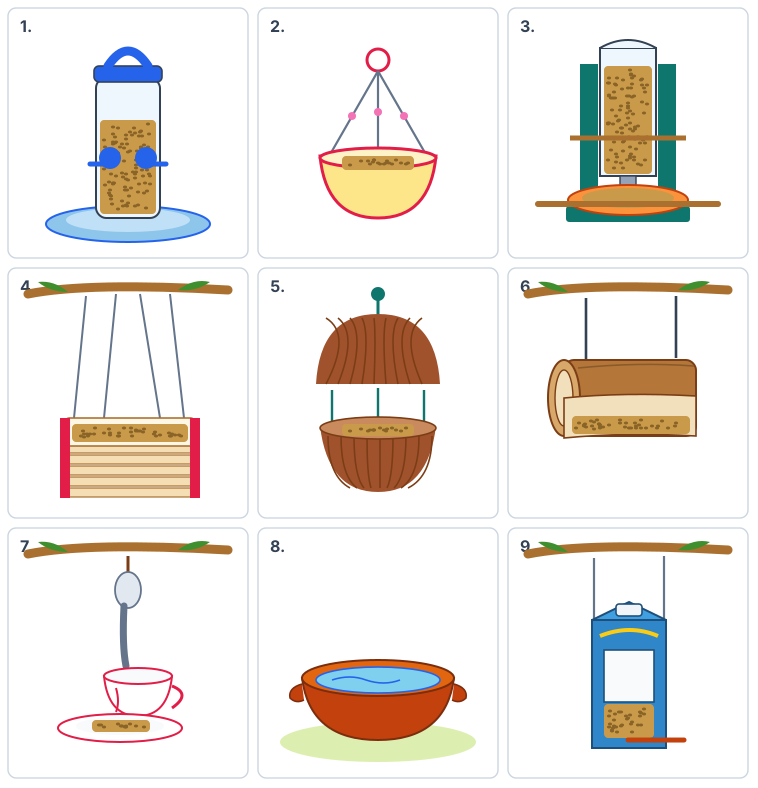
All nine feeders are made from things found at home:
| Feeder | What the picture shows | Material used |
|---|---|---|
| 1 (page 50, left) | A tall see-through jar with a blue lid, handle and feeding holes, on a round blue tray. | Plastic jar and plastic tray |
| 2 (page 50, middle) | A shallow bowl hanging from three strings with beads; two birds feed at it. | A bowl (plastic or clay) and string |
| 3 (page 50, right) | A bottle turned upside down, full of grain, tied to a stand, with a plate below. | Plastic bottle, wooden stand and a plate |
| 4 (page 51, top left) | A small tray of flat sticks laid side by side, hung from a branch by strings. | Ice-cream sticks and string |
| 5 (page 51, top middle) | A brown hairy dome hanging above a brown bowl of grain. | Coconut shell (two halves) |
| 6 (page 51, top right) | A hollow log, open at the front and filled with seeds, tied to a branch. | Wood (a hollow log or bamboo) |
| 7 (page 51, bottom left) | A tea cup on its side on a saucer, hung from a branch with a spoon. | Old cup, saucer and spoon (crockery) |
| 8 (page 51, bottom middle) | A wide red pot of water on the ground; a crow drinks from it. | Clay (an earthen pot) |
| 9 (page 51, bottom right) | A blue carton, cut open at the front, filled with grain and hung from a branch. | Juice or milk carton (cardboard) |
Sample answer — a bottle feeder:
- Take a clean, dry plastic bottle.
- Ask an elder to cut two small openings near the bottom and push a stick through, just below them, as a perch.
- Fill it with millets and other grains; close the cap.
- Hang it in shade, out of reach of cats. Keep a bowl of clean water nearby.
Let us Explore — Page 52Choose any two birds and find interesting facts
Choose any two of the above and find out a few interesting facts about them.
1. Tailor bird: It is a tiny bird with a greenish back and a rusty-red cap. It stitches two leaves together with plant fibre to make a pouch for its nest. It eats small insects.
2. Ostrich: It is the largest bird in the world. It cannot fly, but it can run very fast. It lays the biggest egg of any bird.
Self-assessment 1 — Pages 53–54Covers Unit 1 (Chapters 1–2) and Unit 2 (Chapters 3–4)
1. I can recite the poems with gestures
- by myself.
- in a group.
- by repeating after my teacher.
- None of the above. I like reading poems quietly.
I tick in a group and by repeating after my teacher. I can say The Rainbow with actions when my whole row says it together. On my own I still forget some lines. (Tick the boxes that are true for you.)
I tick by reading the entire sentence again, by using a dictionary and by looking at the pictures. The sentence usually tells me the meaning; for a hard word like distressed I use a dictionary. (Tick the boxes that are true for you.)
- in my mother tongue.
- in English.
- in English with a few words of my mother tongue.
- in my mother tongue, with a few words of English.
I tick in English with a few words of my mother tongue. I can answer most questions in English now. When I do not know a word, I say it in my own language and my teacher tells me the English word. (Tick the boxes that are true for you.)
- by myself.
- after following my teacher’s instructions.
- after reading my friends’ work.
- with my teachers’/friends’ help.
I tick after following my teacher’s instructions. I can write a full paragraph once I know the plan — beginning, middle and end. Sometimes I ask a friend for a spelling. (Tick the boxes that are true for you.)
- by myself.
- with the help of my teacher.
- with the help of my classmates.
- with the help of my family members.
I tick by myself and with the help of my family members. I found the bird facts on my own. For the bird feeder, my mother cut the bottle and helped me choose a shady place to hang it. (Tick the boxes that are true for you.)
Chapter 4 of 10 – English
- Previous: Chapter 3 the Rainbow
- Next: Chapter 5 the Frog
- All chapters: NCERT Solutions Class 5 English
Also for This Chapter
NCERT Solutions Class 5 English Chapter 4 the Wise Parrot – Overview
| Class | Class 5 |
| Subject | English |
| Chapter | 4 – the Wise Parrot |
| Textbook pages | 41 – 54 |
| Questions solved | 36 |
| Session | 2027 |
| Format | Full answers on this page + PDF |
NCERT Solutions Class 5 English Chapter 4 – FAQs
Where can I download NCERT Solutions Class 5 English Chapter 4 the Wise Parrot PDF?
Read every answer on this page, or download the free PDF from the table at the top.
Is this for the 2027 session?
Yes, it follows the latest NCERT Class 5 English book for 2027.
How many questions are solved in NCERT Class 5 English Chapter 4?
All 36 questions of the chapter (textbook pages 41 – 54) – the in-text questions, activities and the end-of-chapter exercises.
How should I use these solutions?
Read the chapter in the NCERT book first, attempt the questions yourself, then check your answers here.