NCERT Solutions for Class 5 English Chapter 6 What a Tank provide clear, step-by-step answers to every exercise and in-text question from the chapter What a Tank of the NCERT textbook Santoor. Prepared by subject experts as per the latest NCERT (CBSE) syllabus for 2026-27, these NCERT Solutions for Class 5 English help you understand each concept, write exam-ready answers, and check your own solutions. You can read them online below or download the free Class 5 English Chapter 6 question-answer PDF.
NCERT Solutions for Class 5 English Chapter 6 What a Tank
- Class: Class 5
- Subject: English
- Chapter: Chapter 6 – What a Tank
- Textbook: Santoor (NCERT)
- Study material: NCERT Solutions – questions with answers, free PDF
These solutions answer all the exercise questions of Chapter 6 What a Tank — including the in-text questions, short-answer and long-answer questions, and activities — with complete explanations so you can follow the method, not just the final answer. Read the full solutions below.
NCERT Solutions Class 5 English Chapter 6 What a Tank View Download
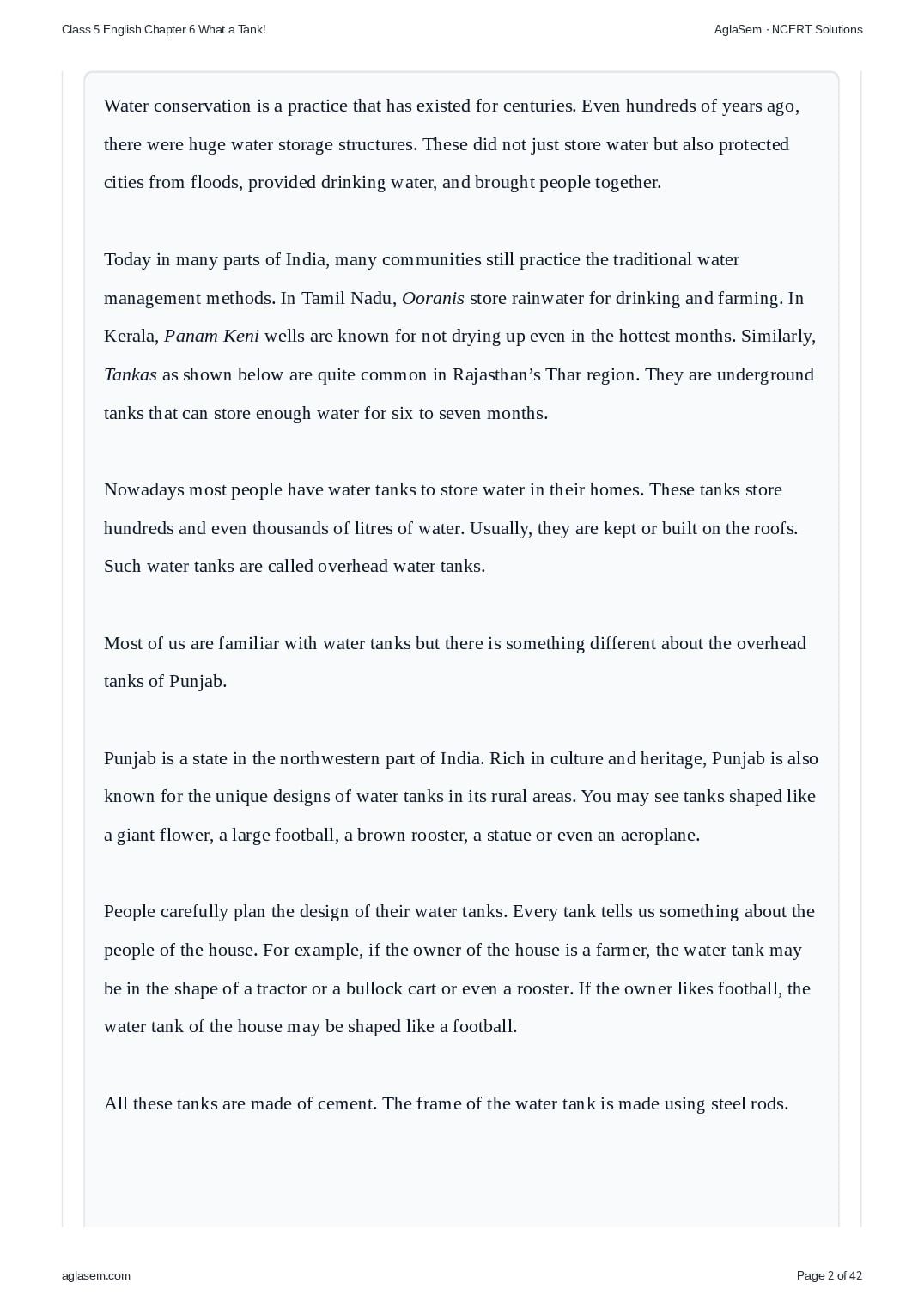
NCERT Solutions for Class 5 English Chapter 6 PDF Download
You can read the NCERT Solutions for Class 5 English Chapter 6 online above, or download the complete question-answer PDF to study What a Tank offline at any time.
NCERT Solutions for Class 5 English Chapter 6 PDF Download Link – Click Here to Download Solutions PDF
Questions Covered in This Chapter
These NCERT Solutions answer all 38 questions of this chapter. The questions solved are:
- Let us Read — What a Tank! Read the passage and enjoy it.
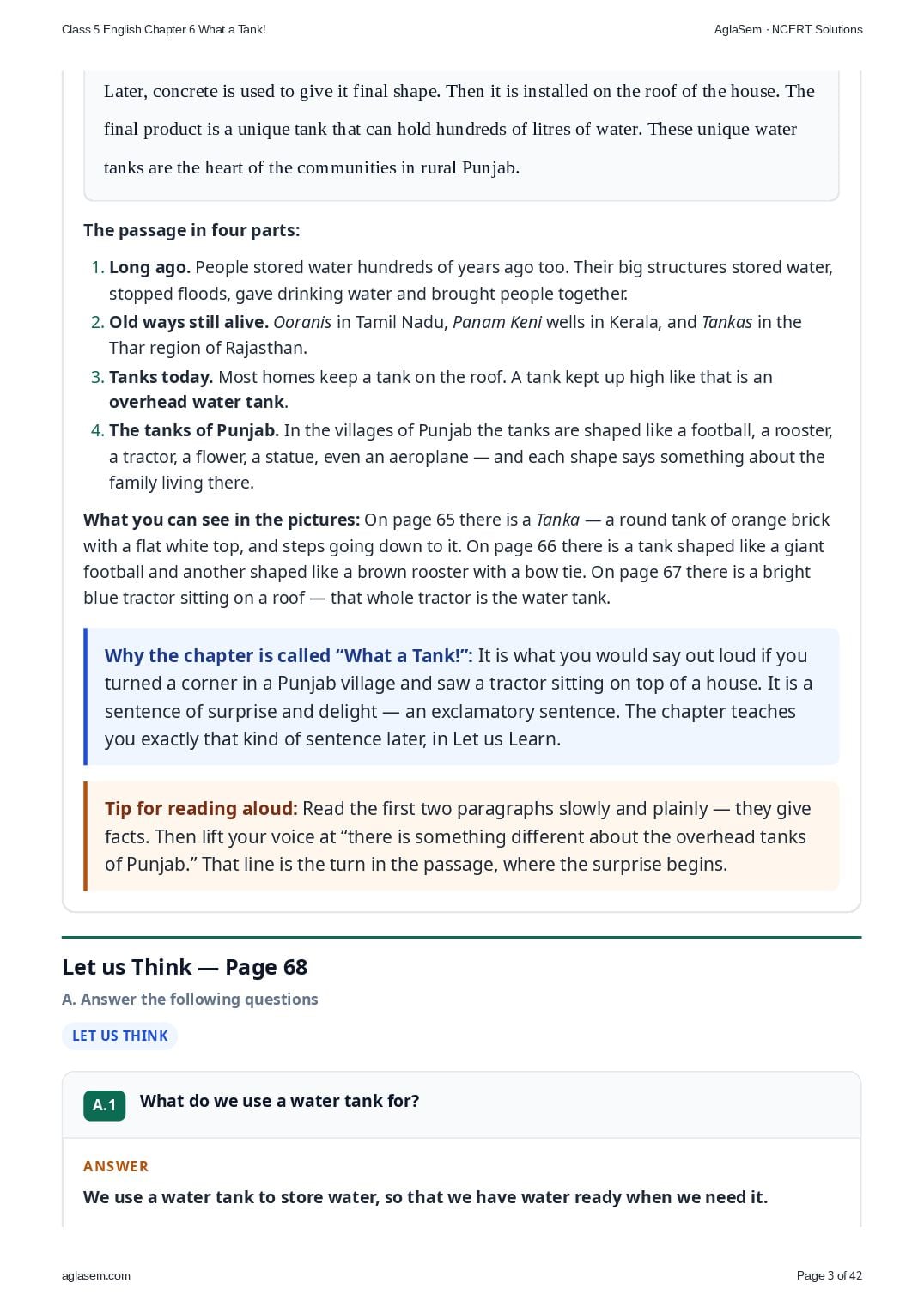
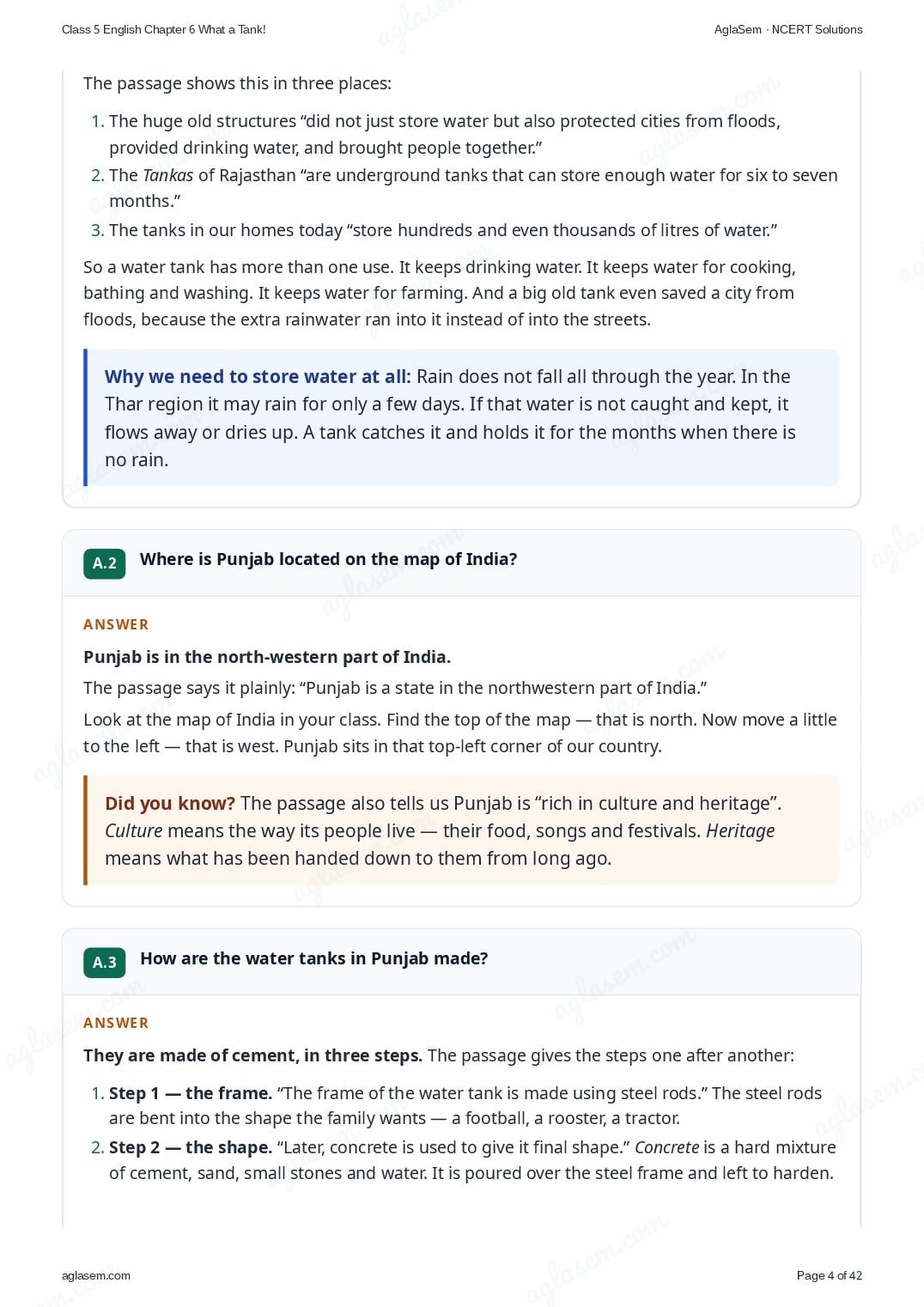
- What do we use a water tank for?
- Where is Punjab located on the map of India?
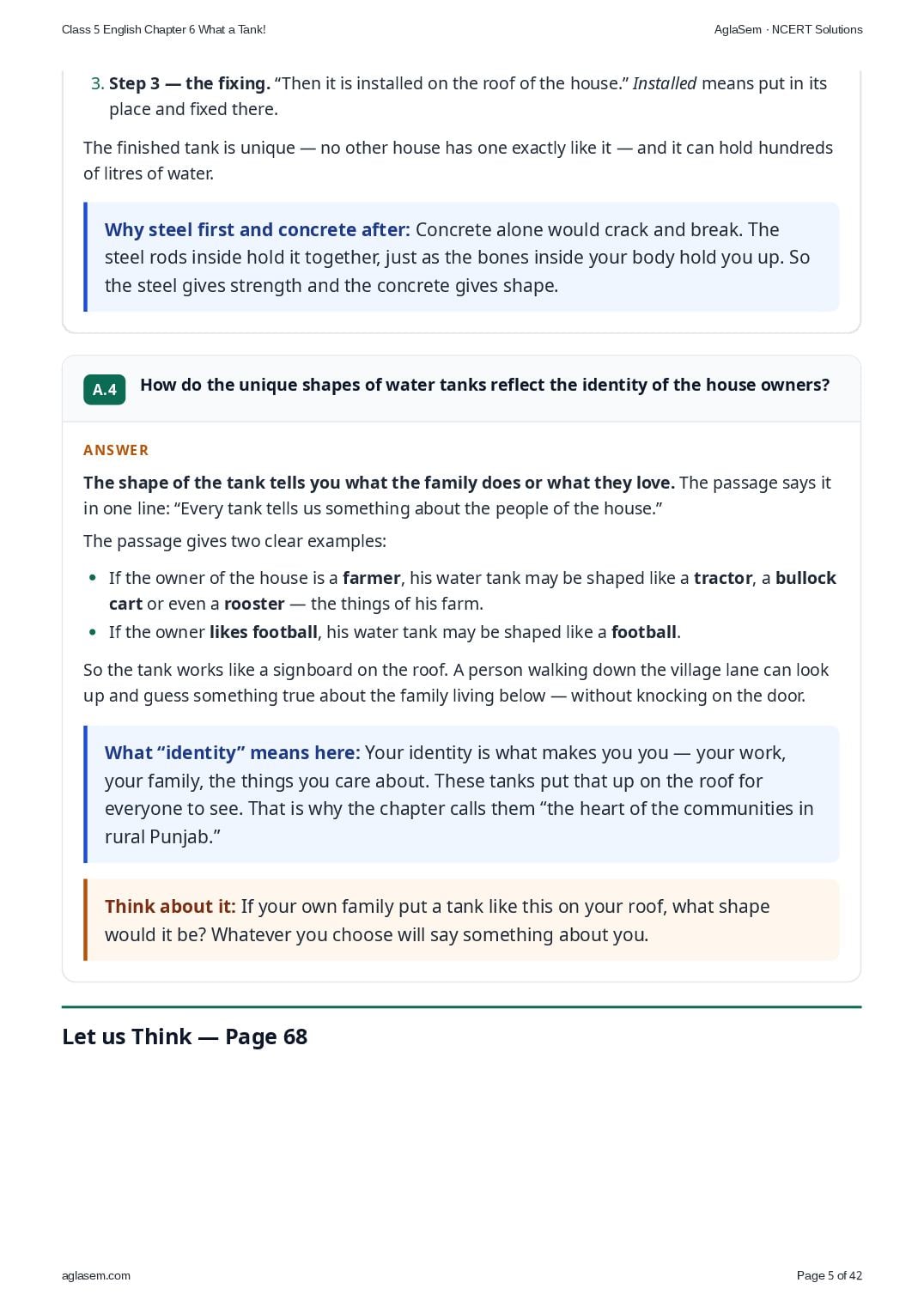
- How are the water tanks in Punjab made?
- How do the unique shapes of water tanks reflect the identity of the house owners?
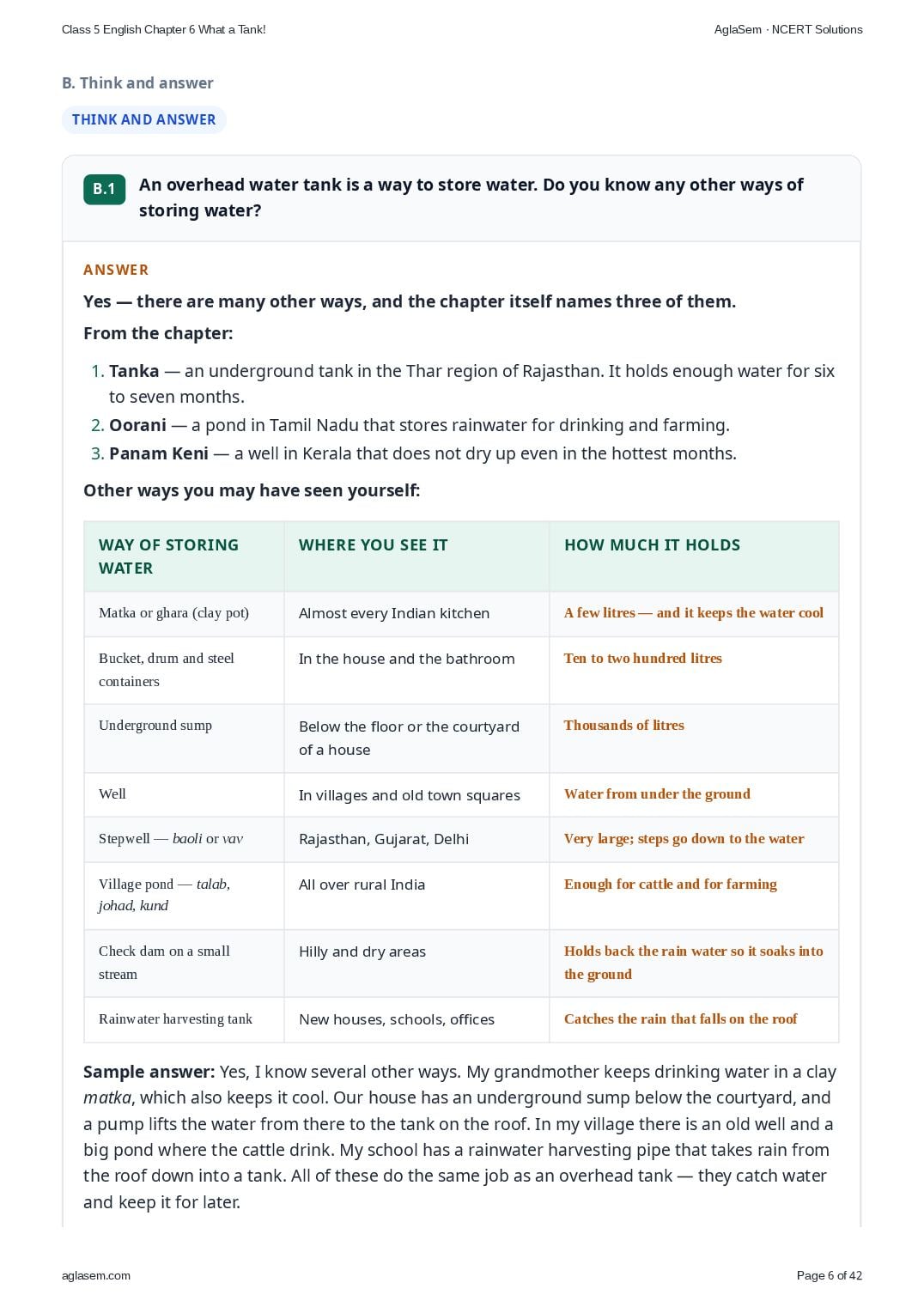
- An overhead water tank is a way to store water. Do you know any other ways of storing water?
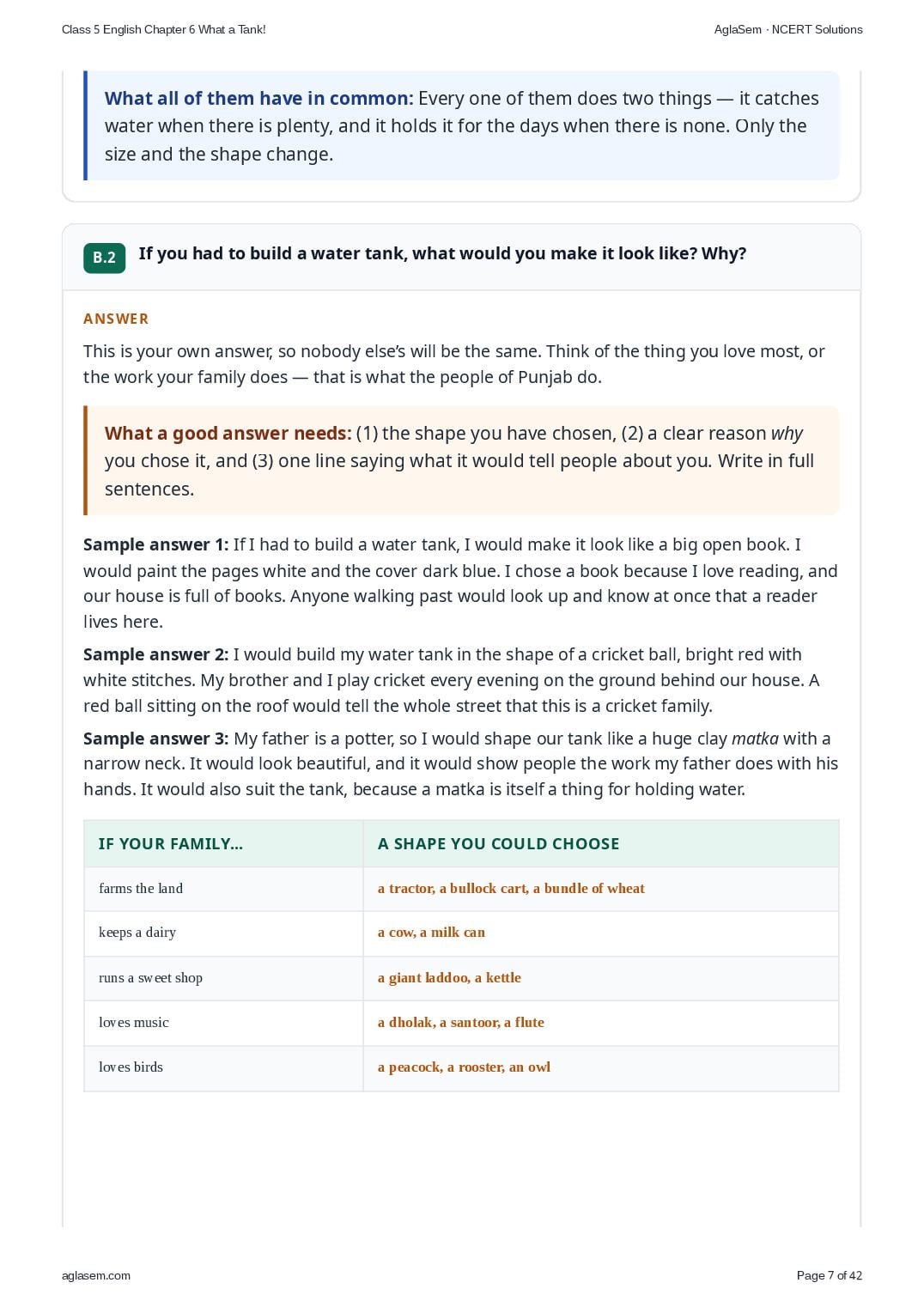
- If you had to build a water tank, what would you make it look like? Why?
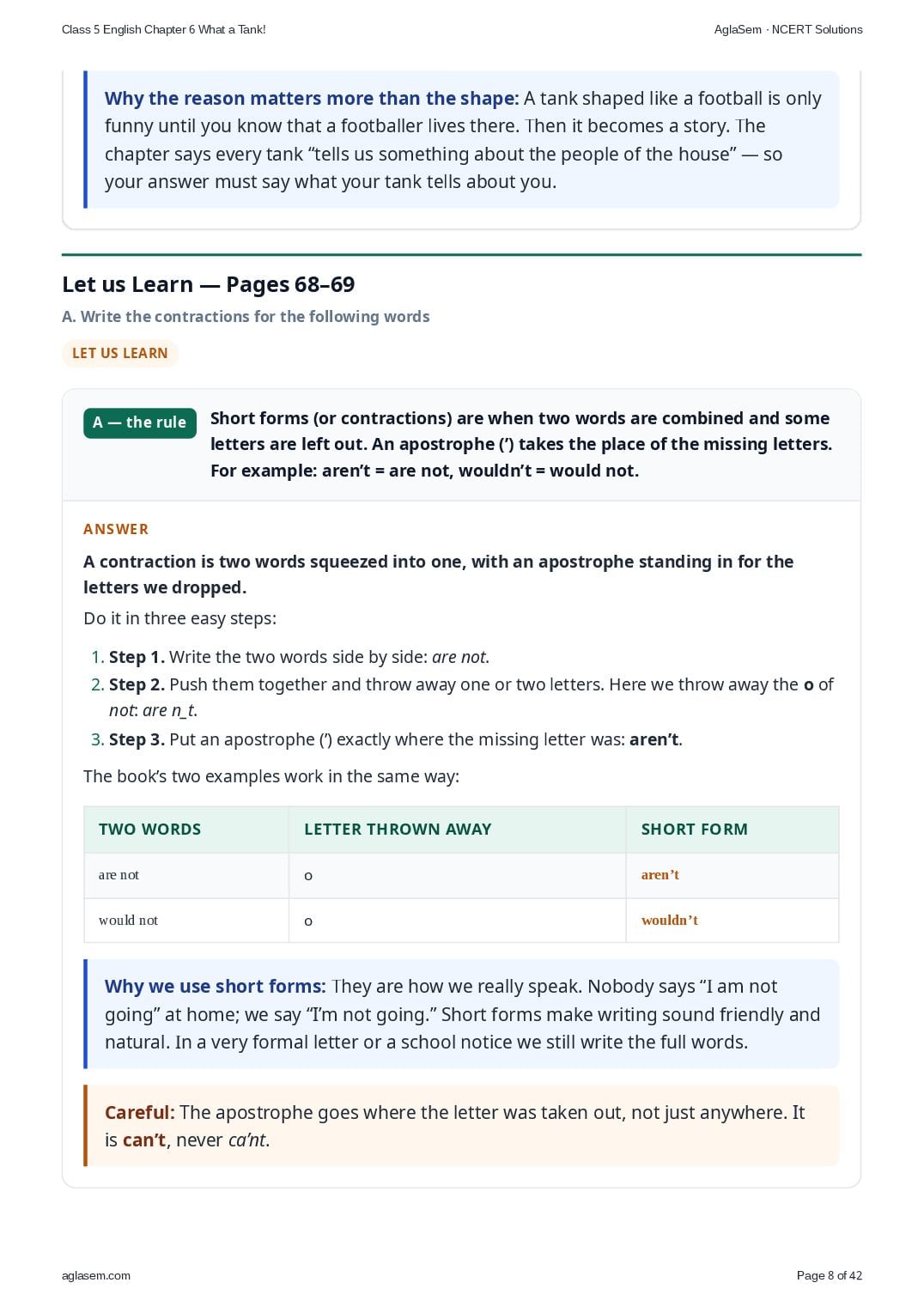
- Short forms (or contractions) are when two words are combined and some letters are left out. An apostrophe (’) takes the place of the missing letters. For example: aren’t = are not, wouldn’t = would not.
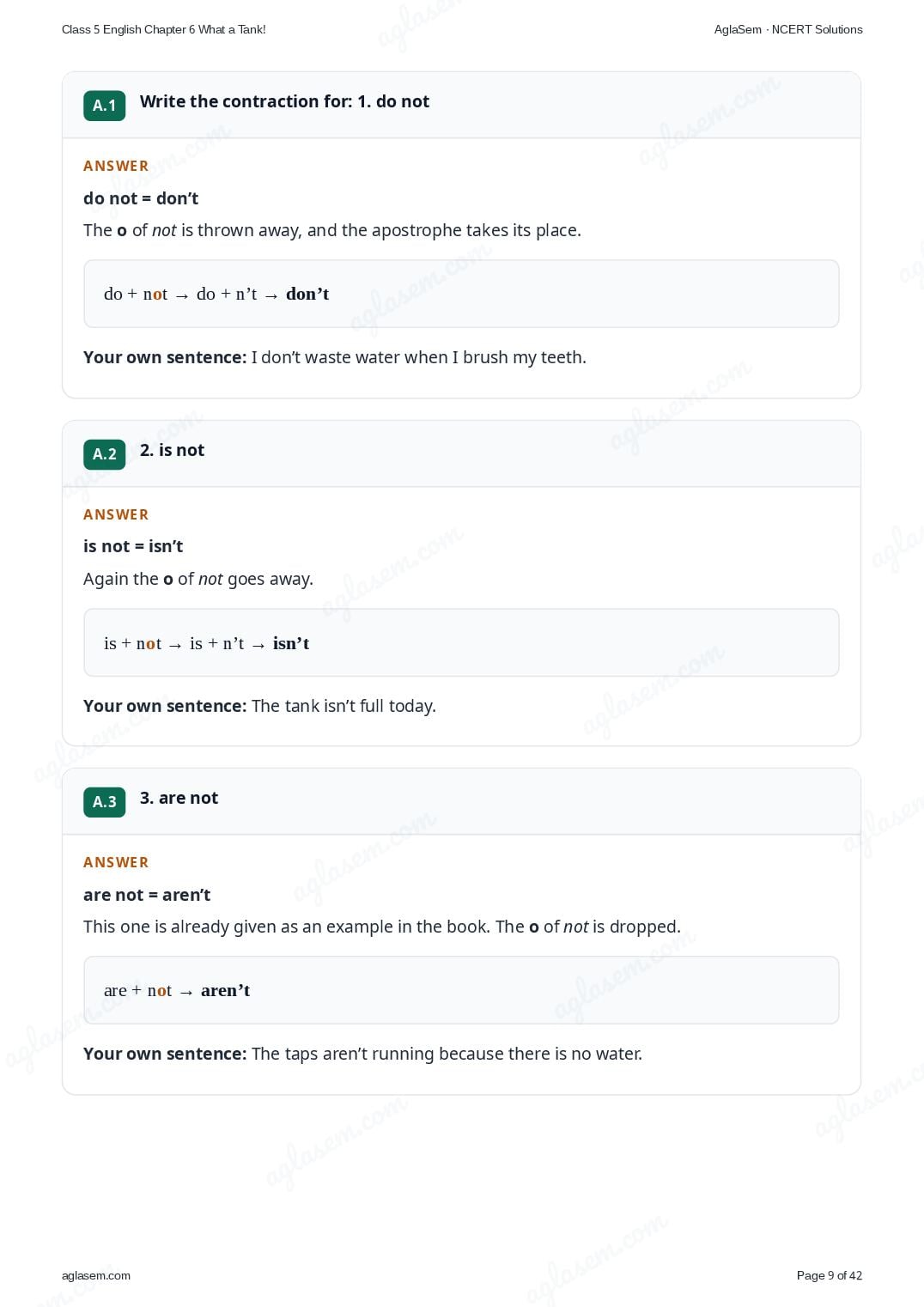
- Write the contraction for: 1. do not
- 2. is not
- 3. are not
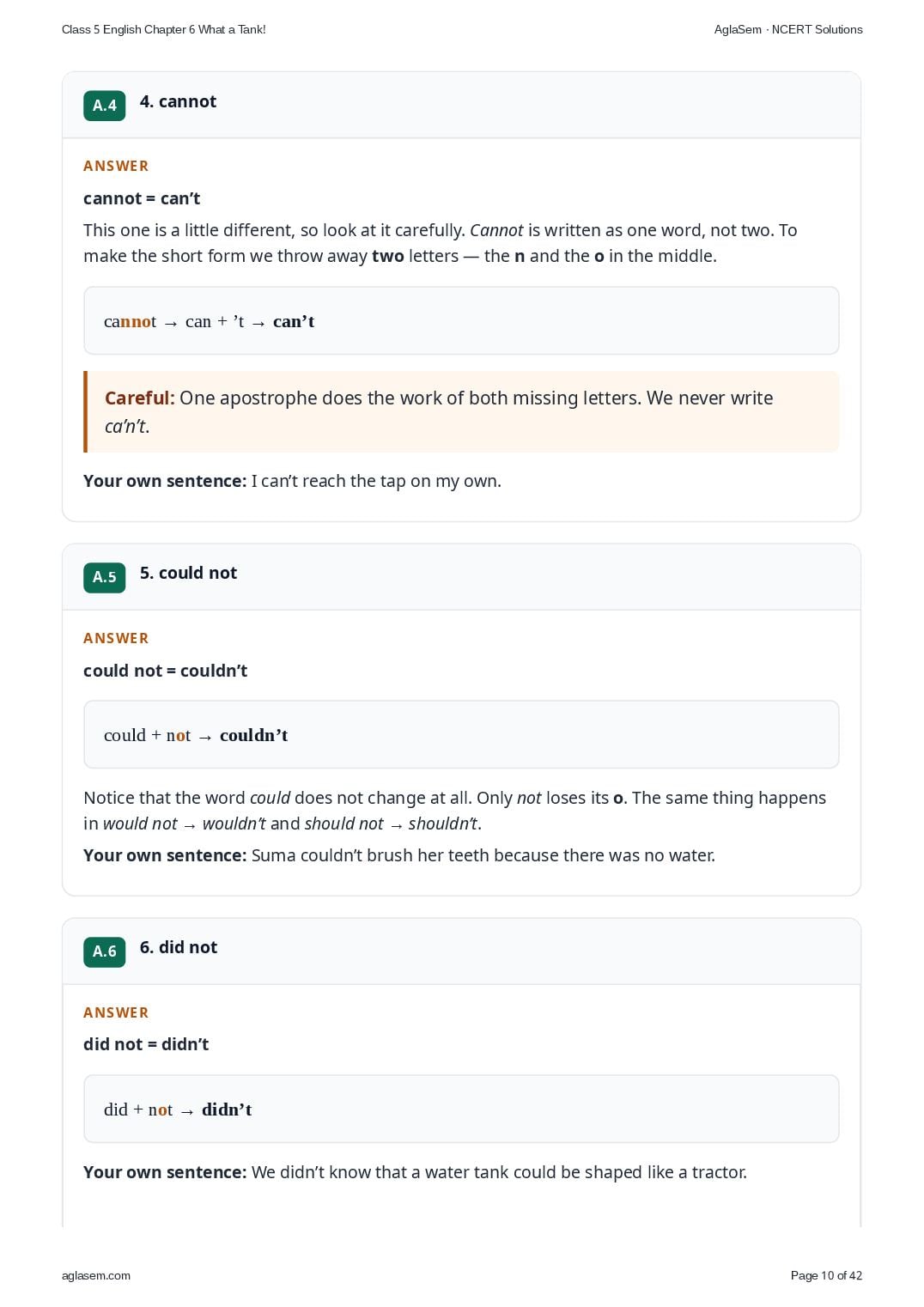
- 4. cannot
- 5. could not
- 6. did not
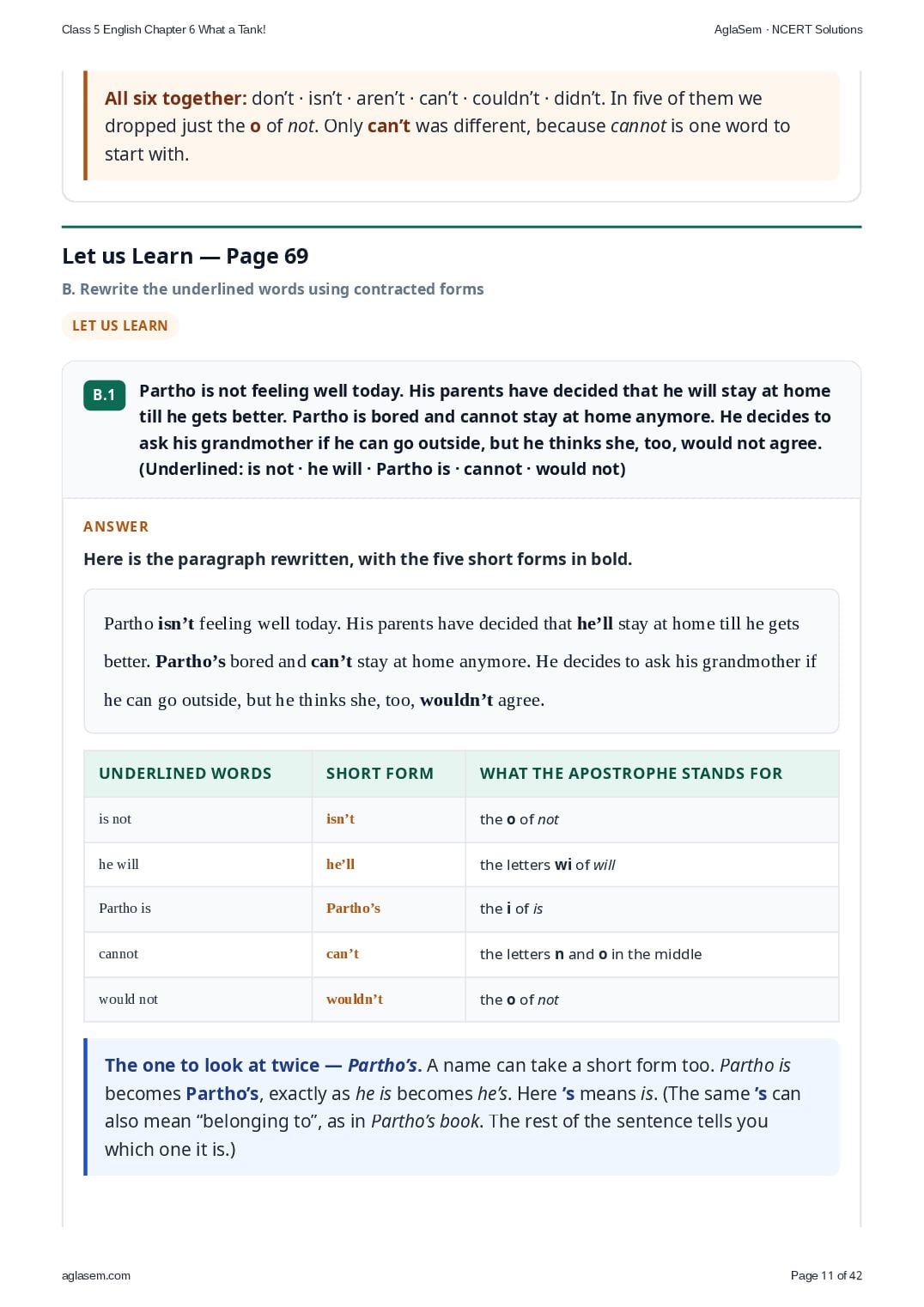
- Partho is not feeling well today. His parents have decided that he will stay at home till he gets better. Partho is bored and cannot stay at home anymore. He decides to ask his grandmother if he can go outside, but he thinks she, too, would not agree. (Underlined: is not · he will · Partho is · cannot · would not)
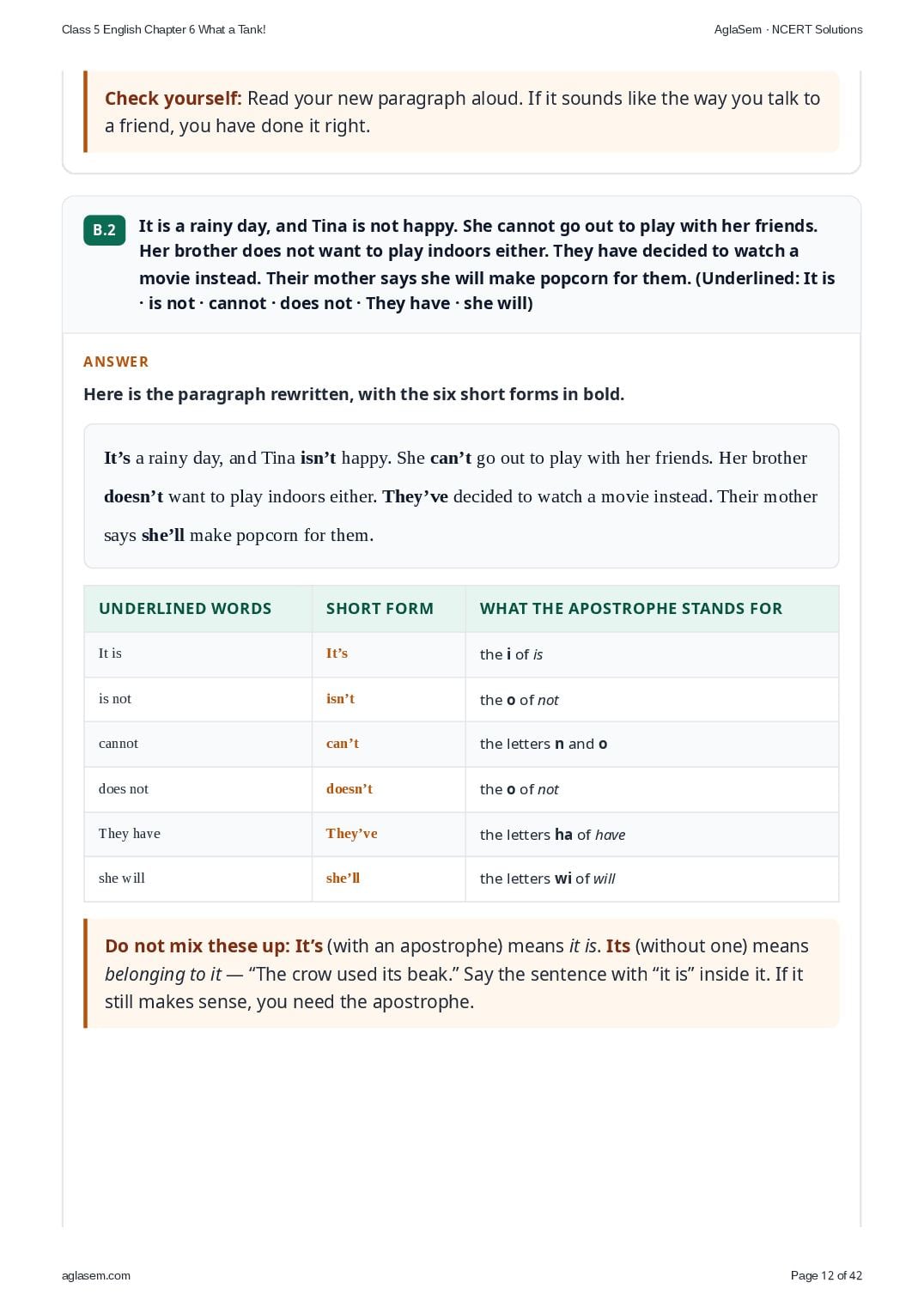
- It is a rainy day, and Tina is not happy. She cannot go out to play with her friends. Her brother does not want to play indoors either. They have decided to watch a movie instead. Their mother says she will make popcorn for them. (Underlined: It is · is not · cannot · does not · They have · she will)
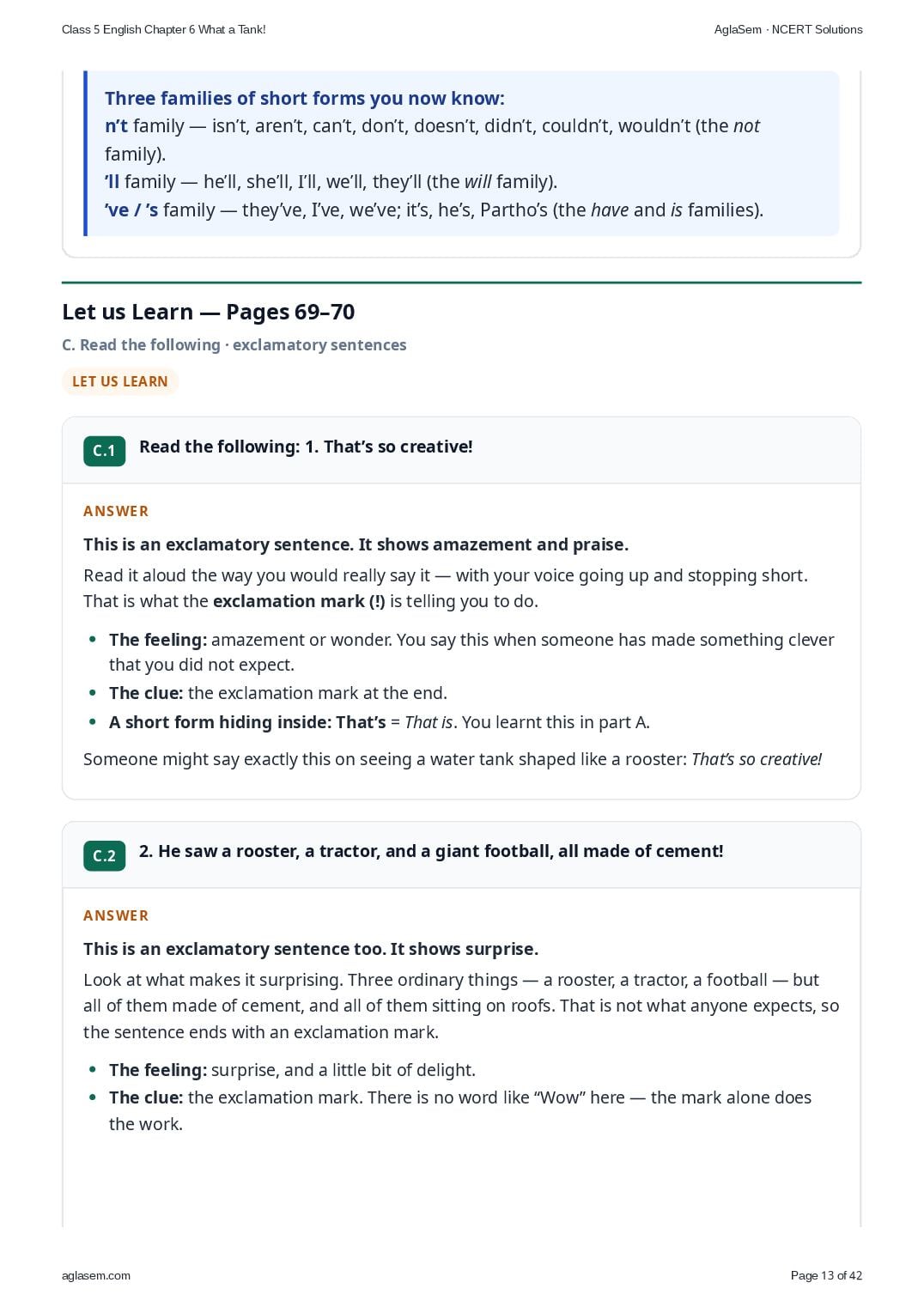
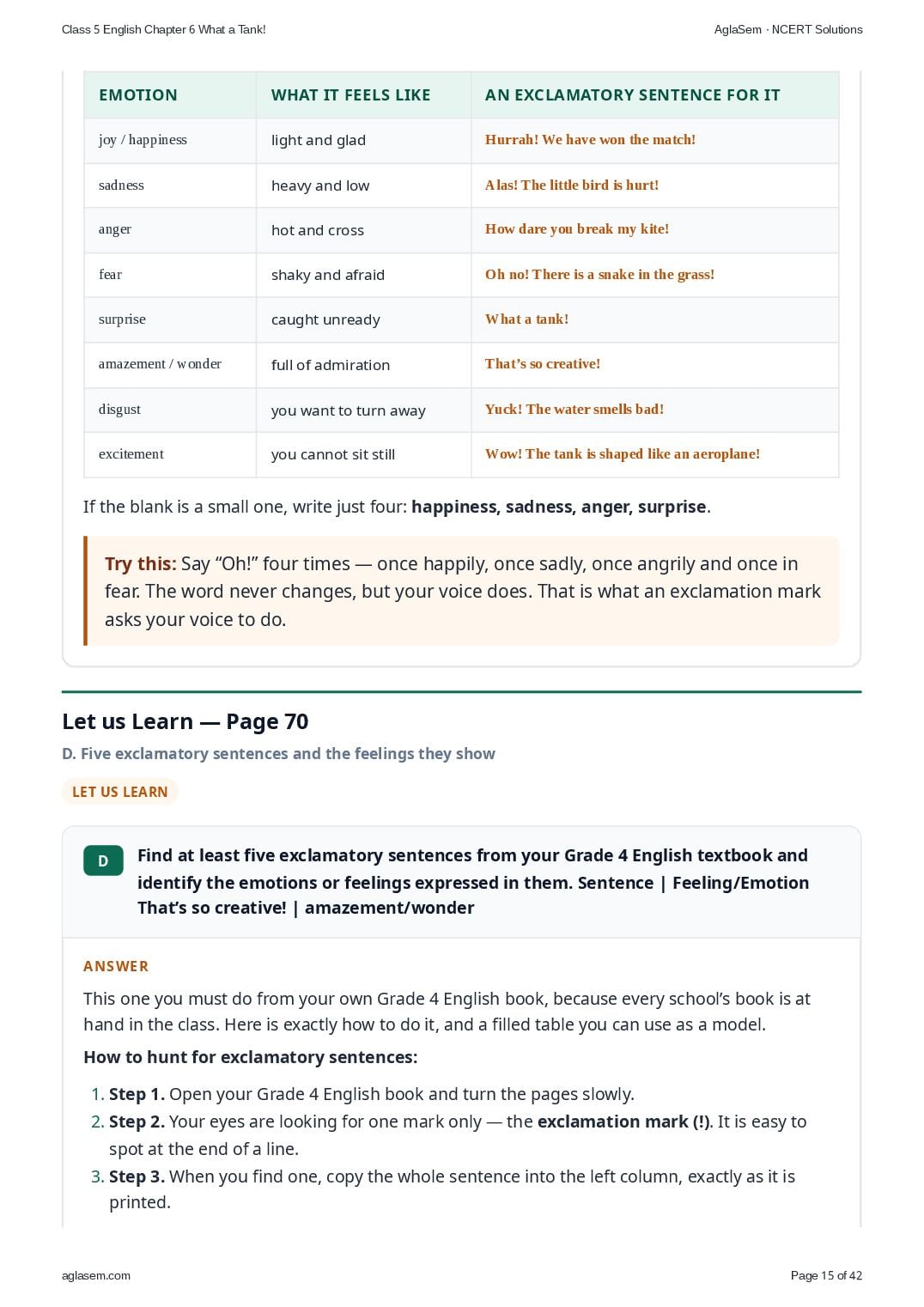
- Read the following: 1. That’s so creative!
- 2. He saw a rooster, a tractor, and a giant football, all made of cement!
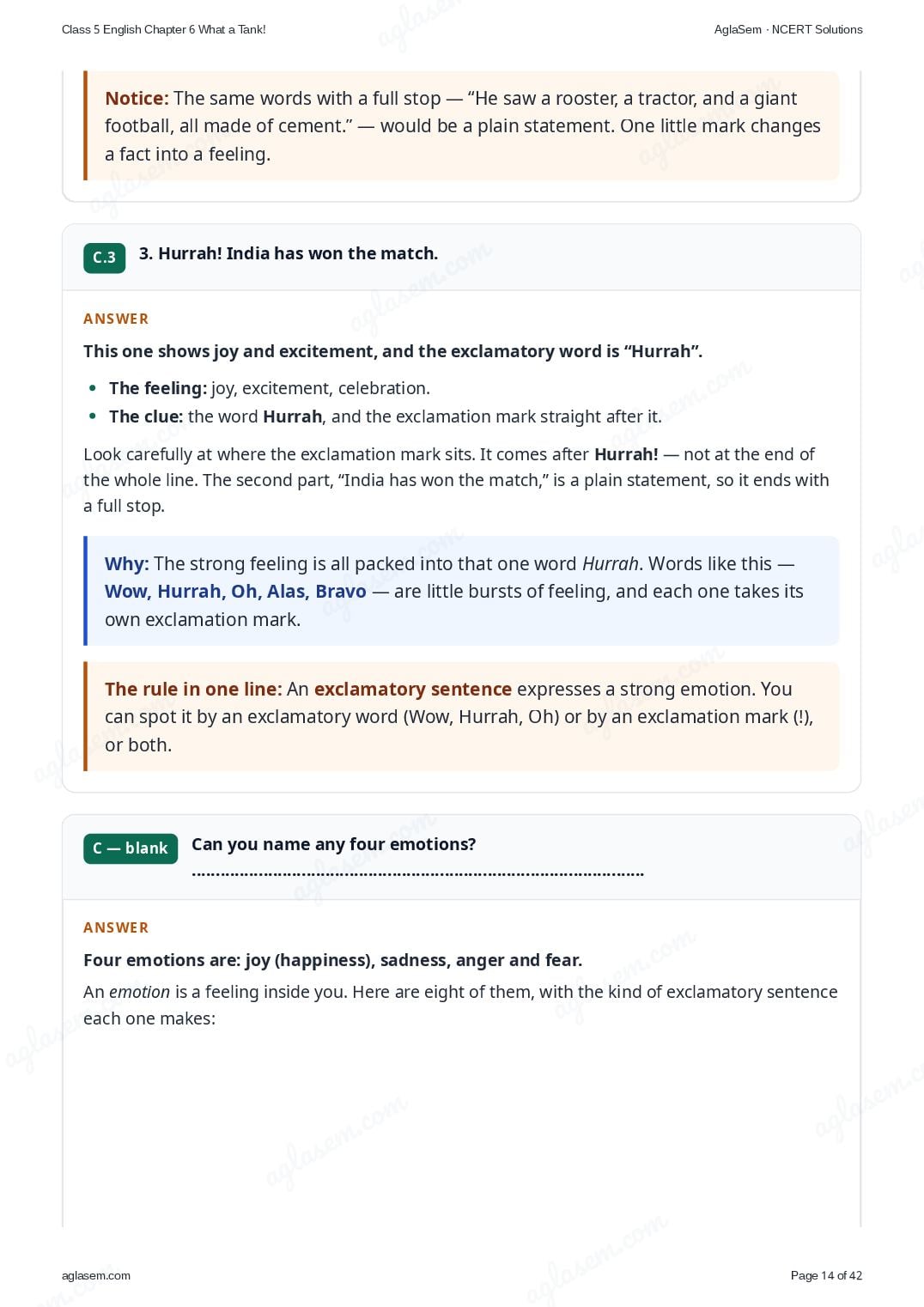
- 3. Hurrah! India has won the match.
- Can you name any four emotions? …………………………………………………………………………………..
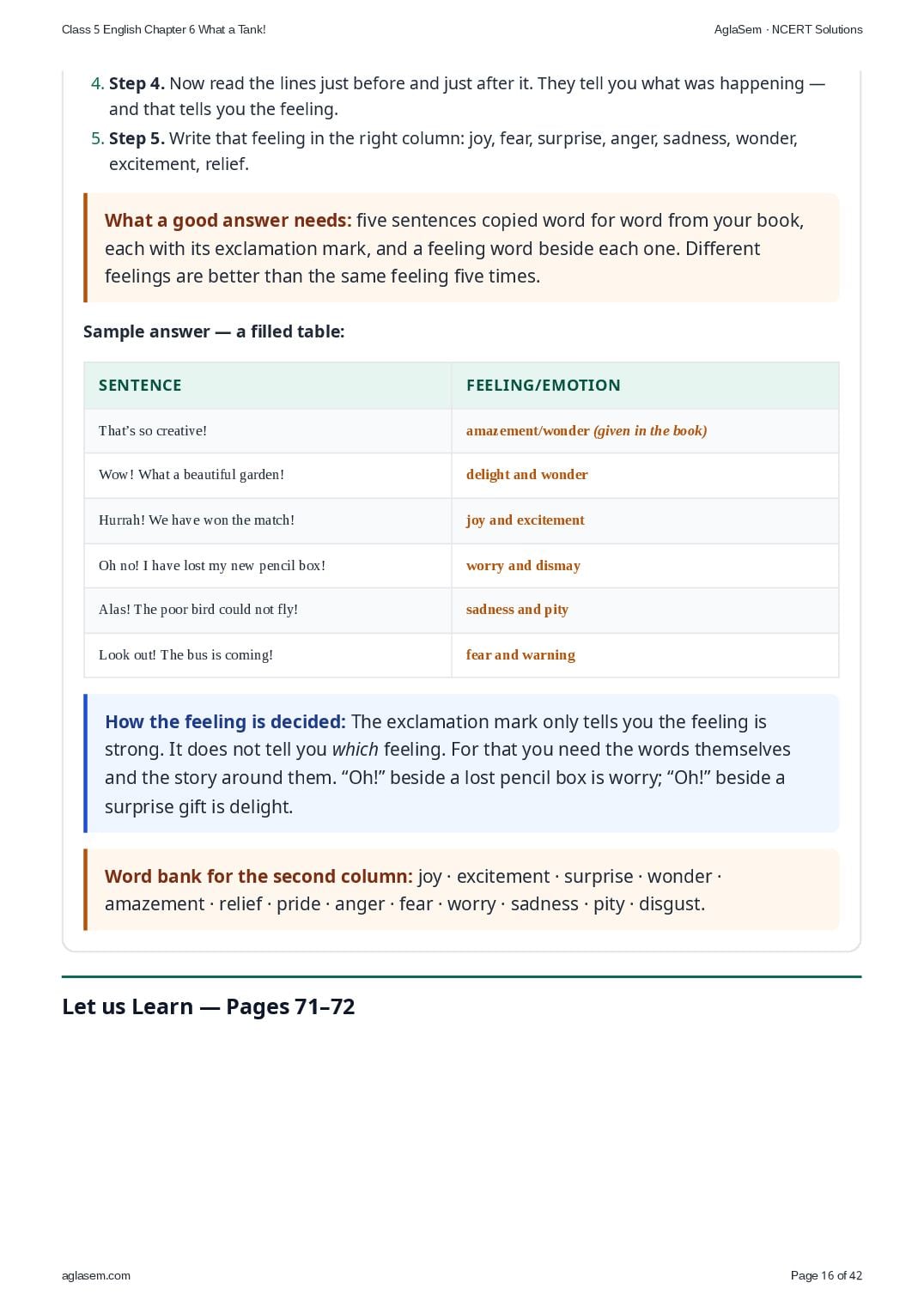
- Find at least five exclamatory sentences from your Grade 4 English textbook and identify the emotions or feelings expressed in them. Sentence | Feeling/Emotion That’s so creative! | amazement/wonder
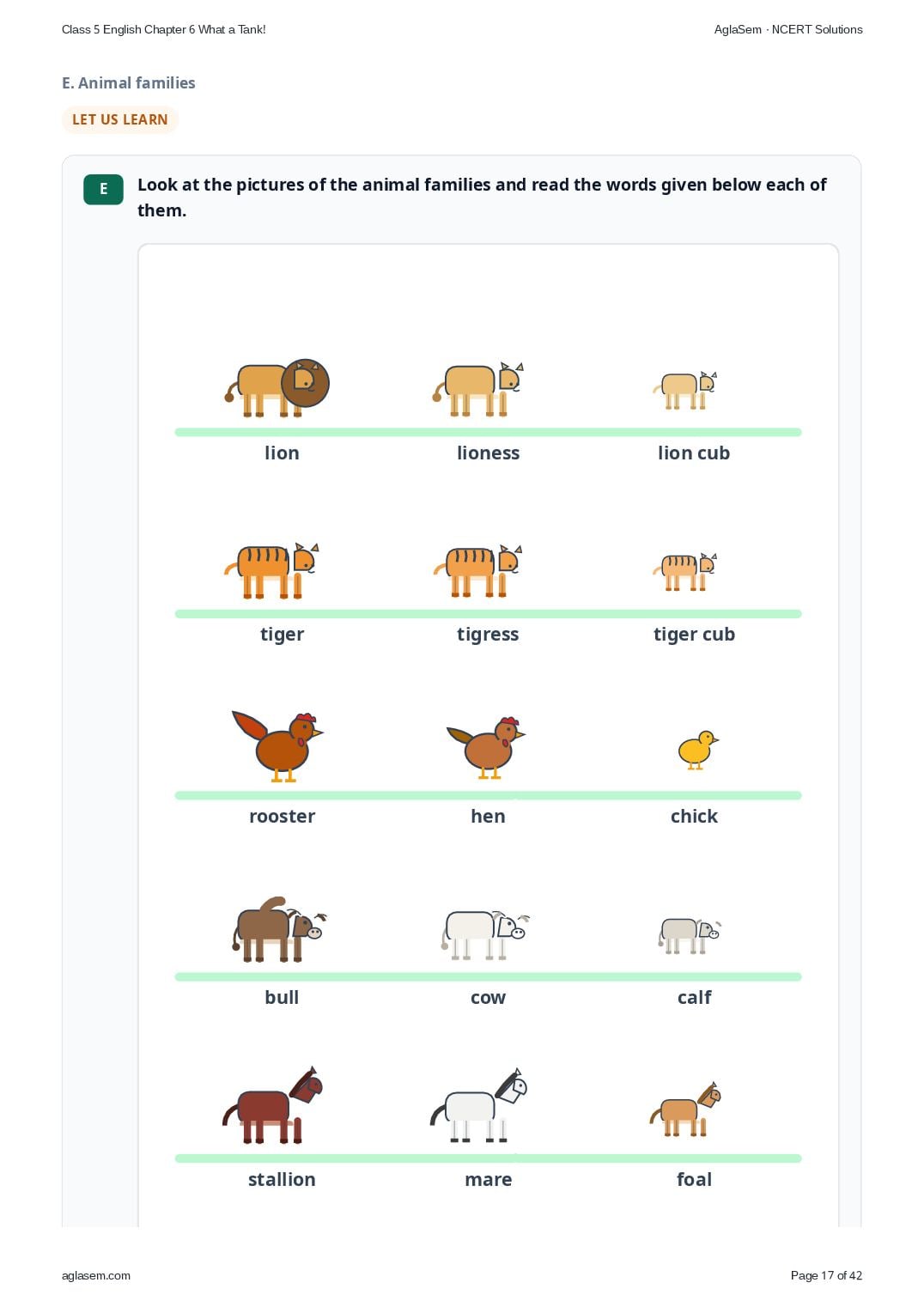
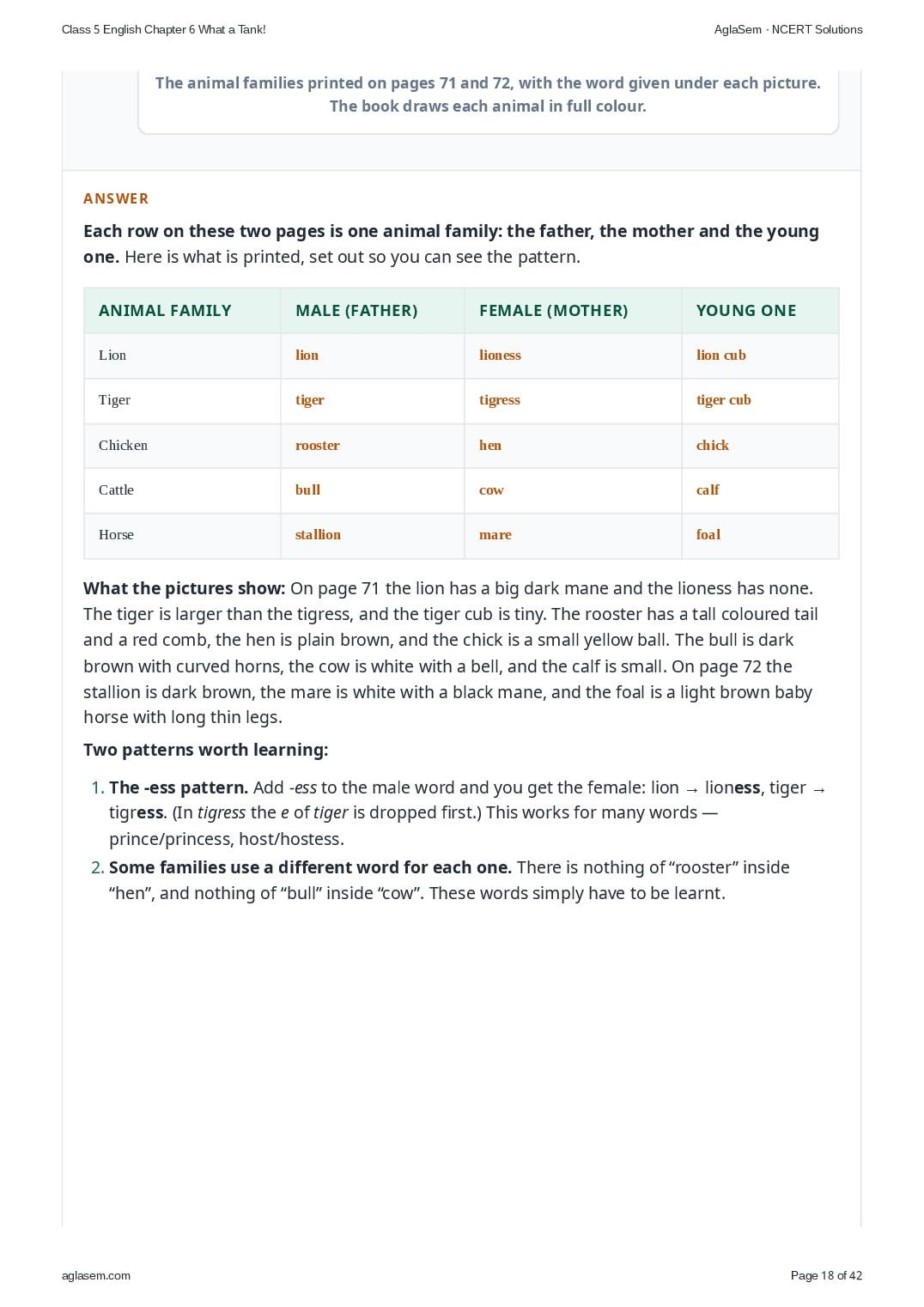
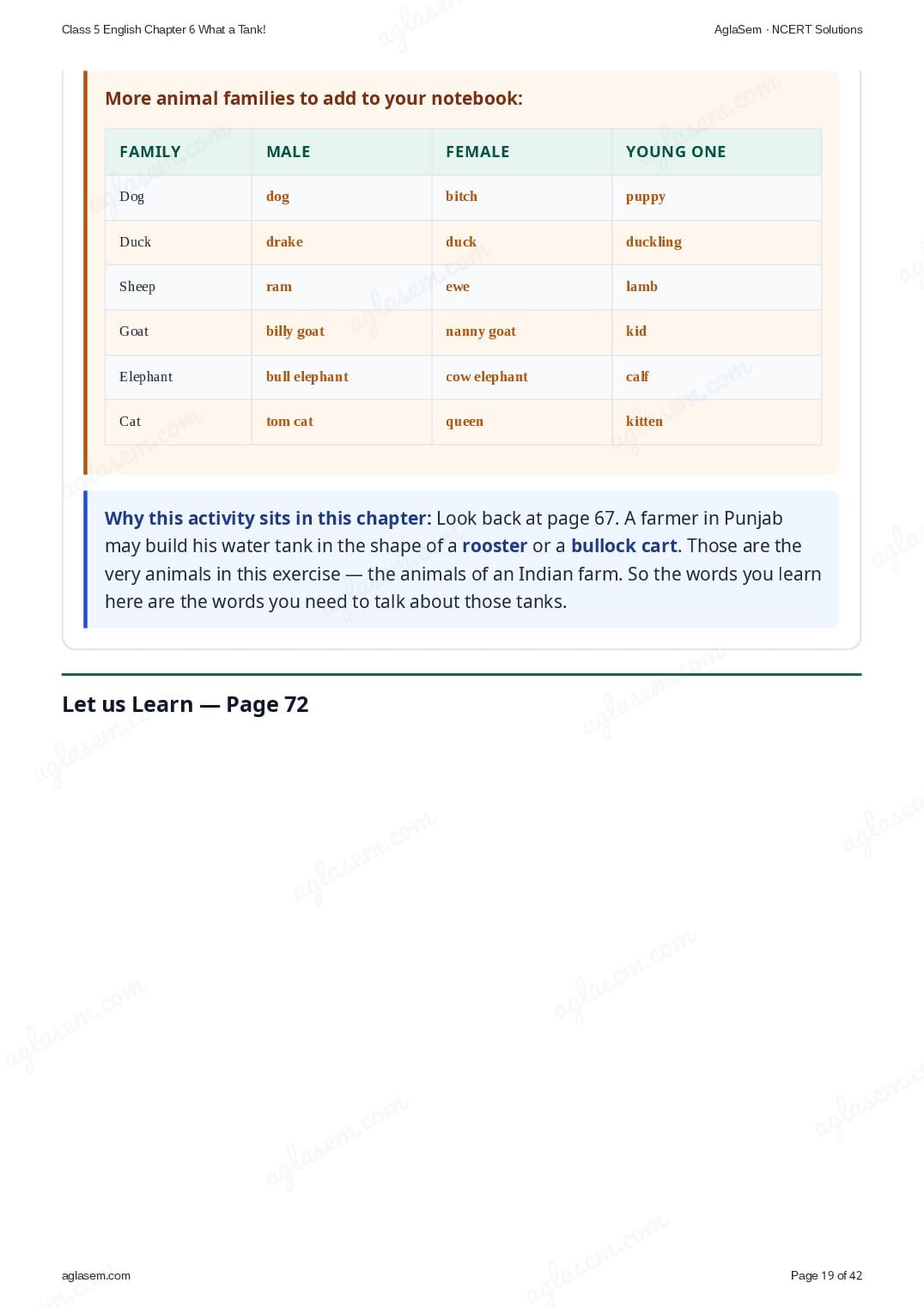
- Look at the pictures of the animal families and read the words given below each of them.lionlionesslion cubtigertigresstiger cubroosterhenchickbullcowcalfstallionmarefoalThe animal families printed on pages 71 and 72, with the word given under each picture. The book draws each animal in full colour.
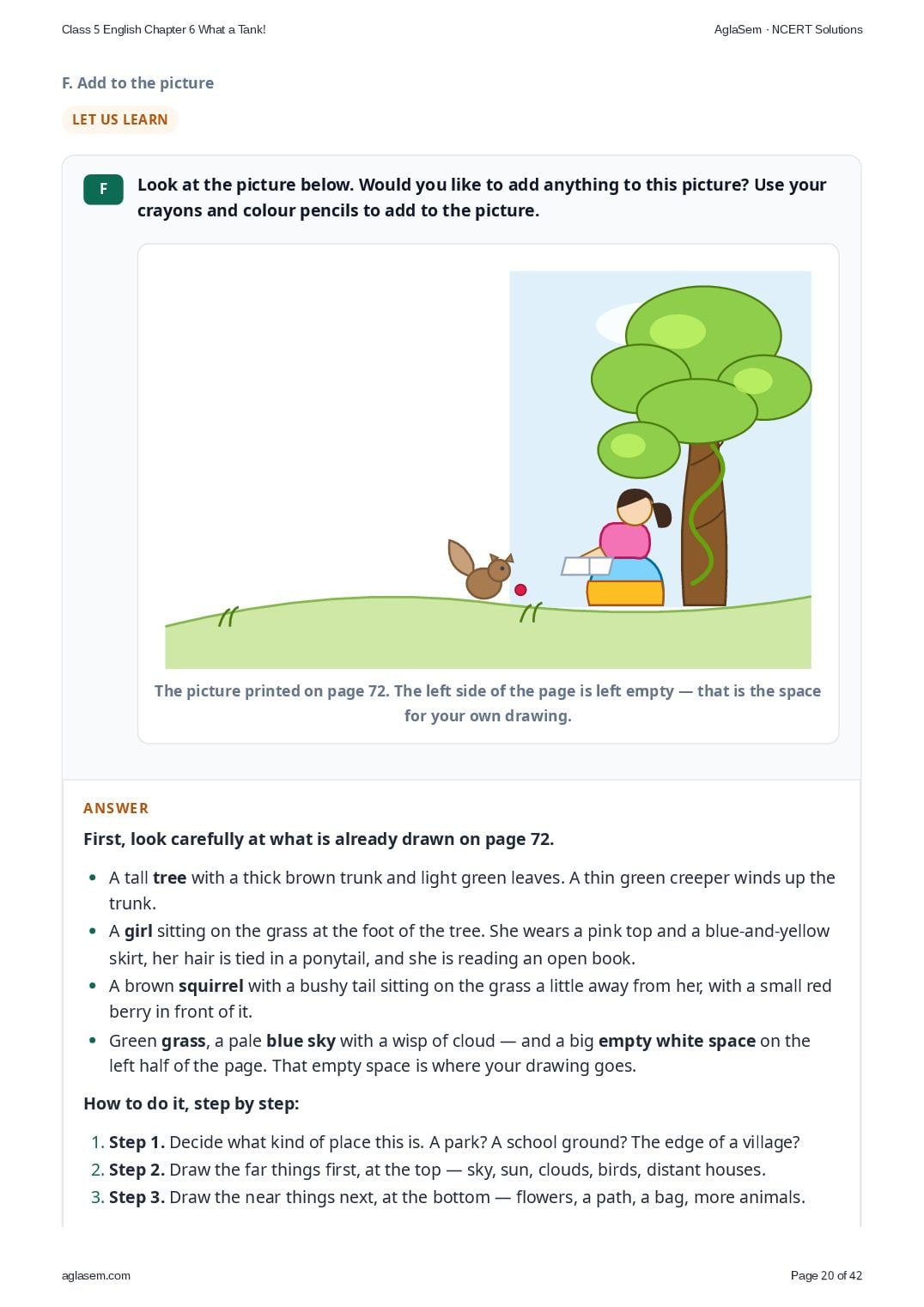
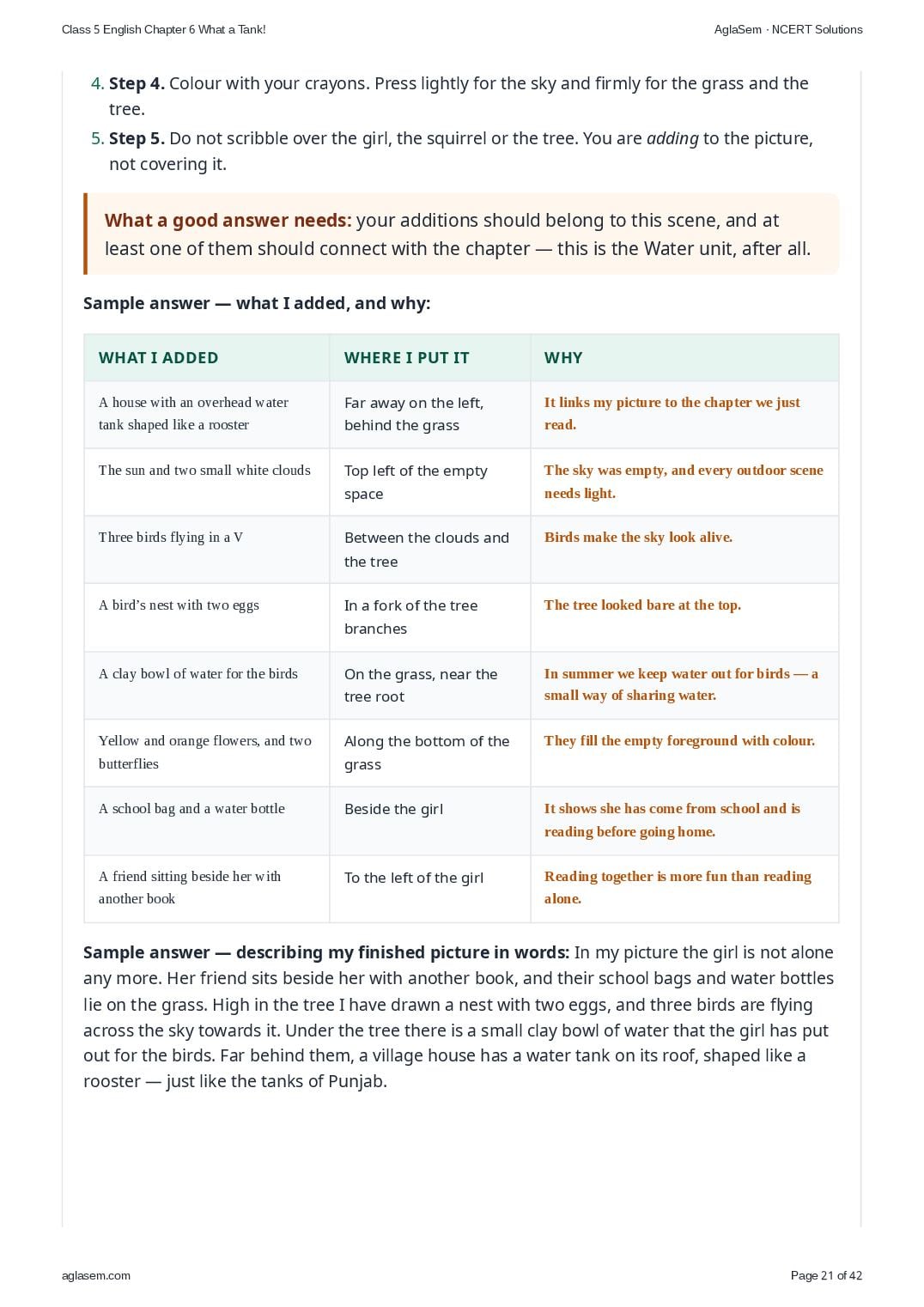
- Look at the picture below. Would you like to add anything to this picture? Use your crayons and colour pencils to add to the picture.The picture printed on page 72. The left side of the page is left empty — that is the space for your own drawing.
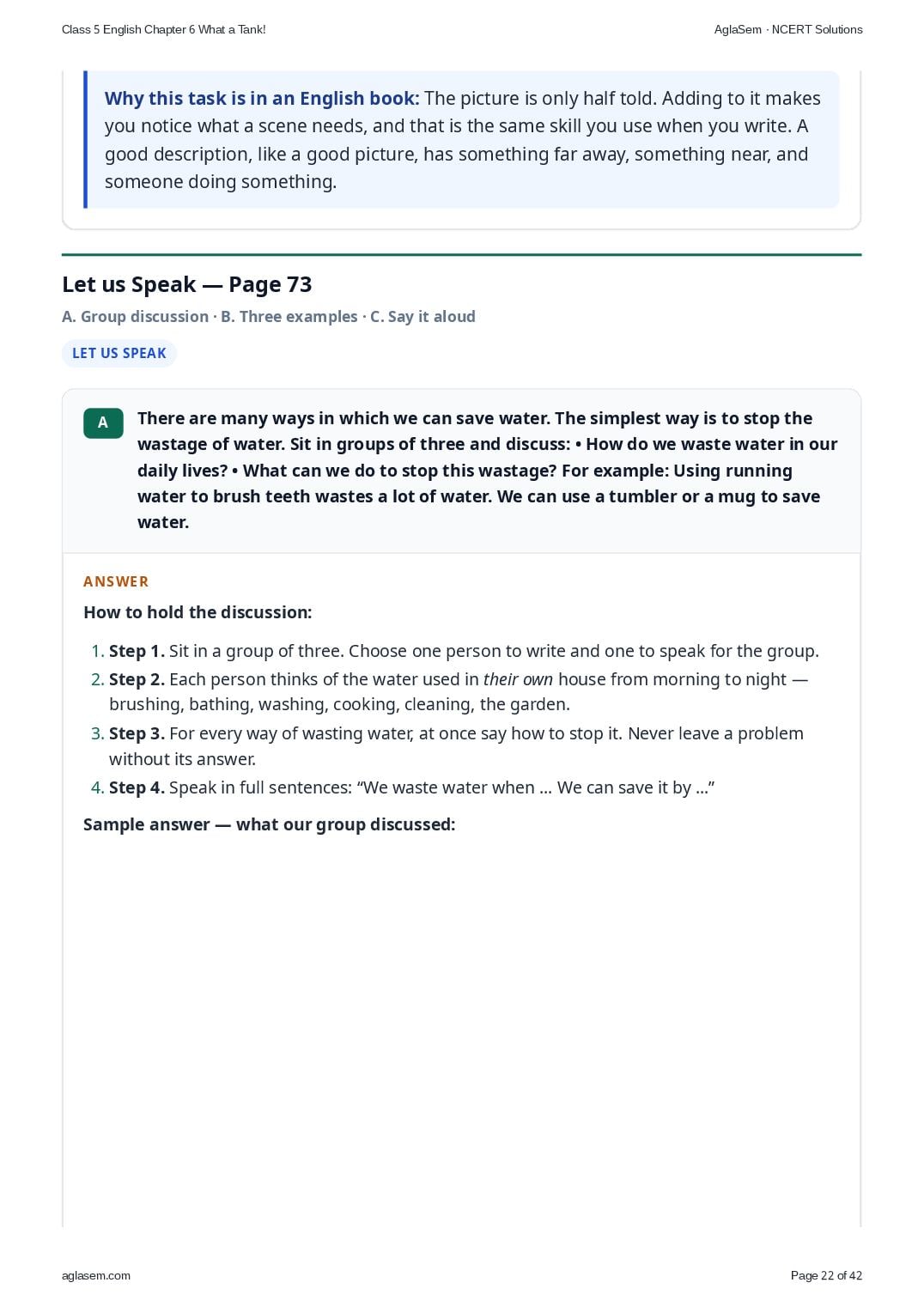
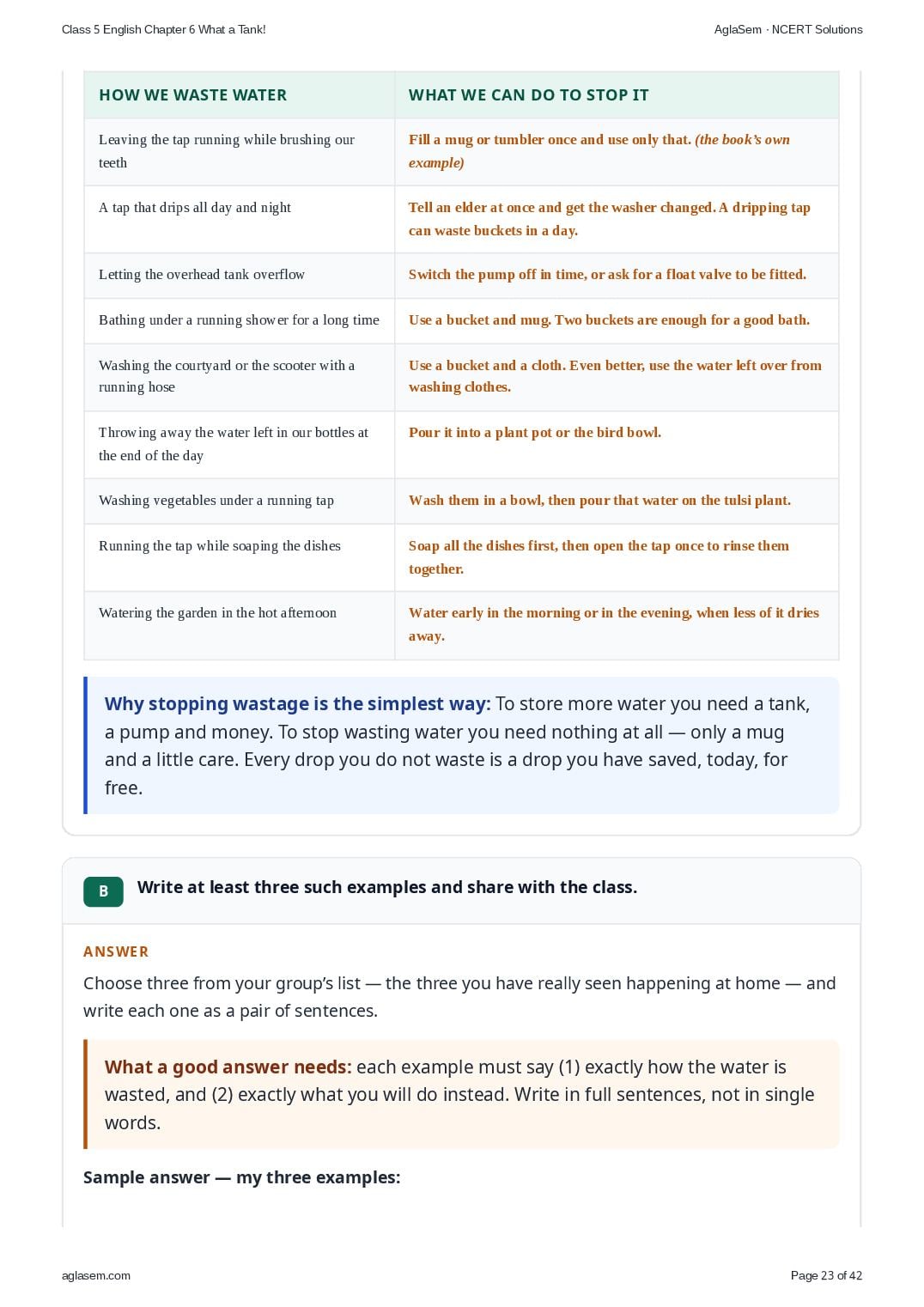
- There are many ways in which we can save water. The simplest way is to stop the wastage of water. Sit in groups of three and discuss: • How do we waste water in our daily lives? • What can we do to stop this wastage? For example: Using running water to brush teeth wastes a lot of water. We can use a tumbler or a mug to save water.
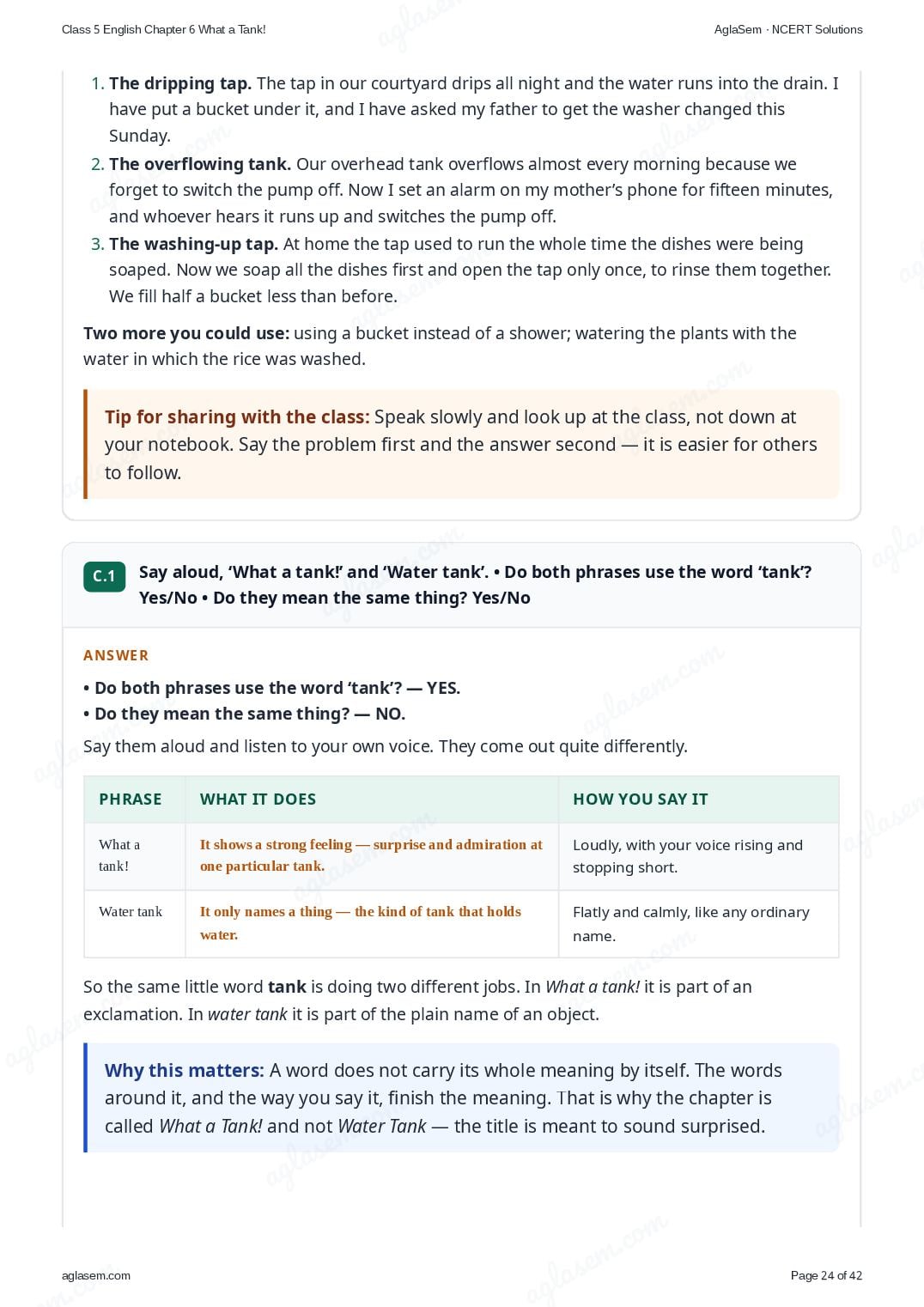
- Write at least three such examples and share with the class.
- Say aloud, ‘What a tank!’ and ‘Water tank’. • Do both phrases use the word ‘tank’? Yes/No • Do they mean the same thing? Yes/No
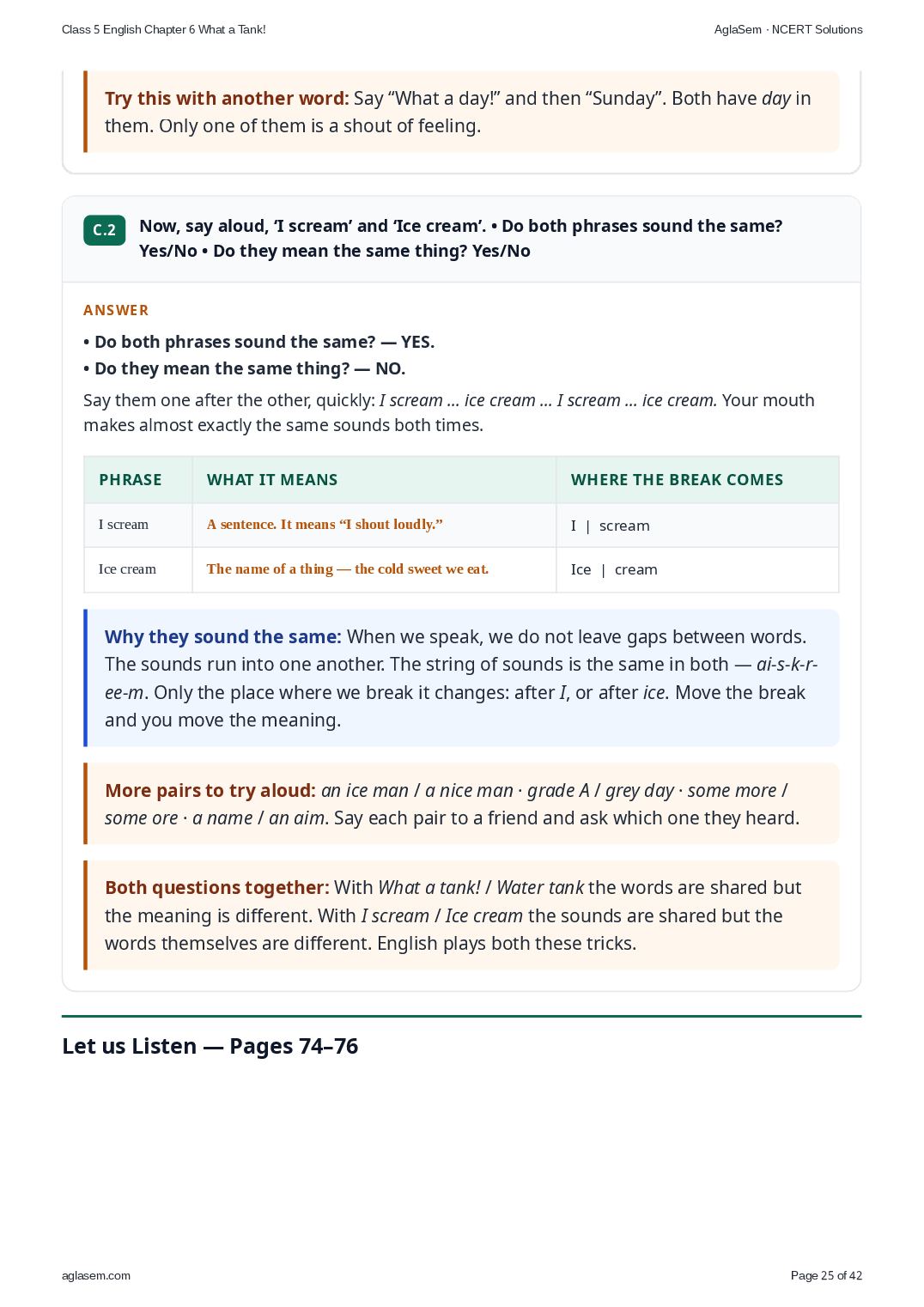
- Now, say aloud, ‘I scream’ and ‘Ice cream’. • Do both phrases sound the same? Yes/No • Do they mean the same thing? Yes/No
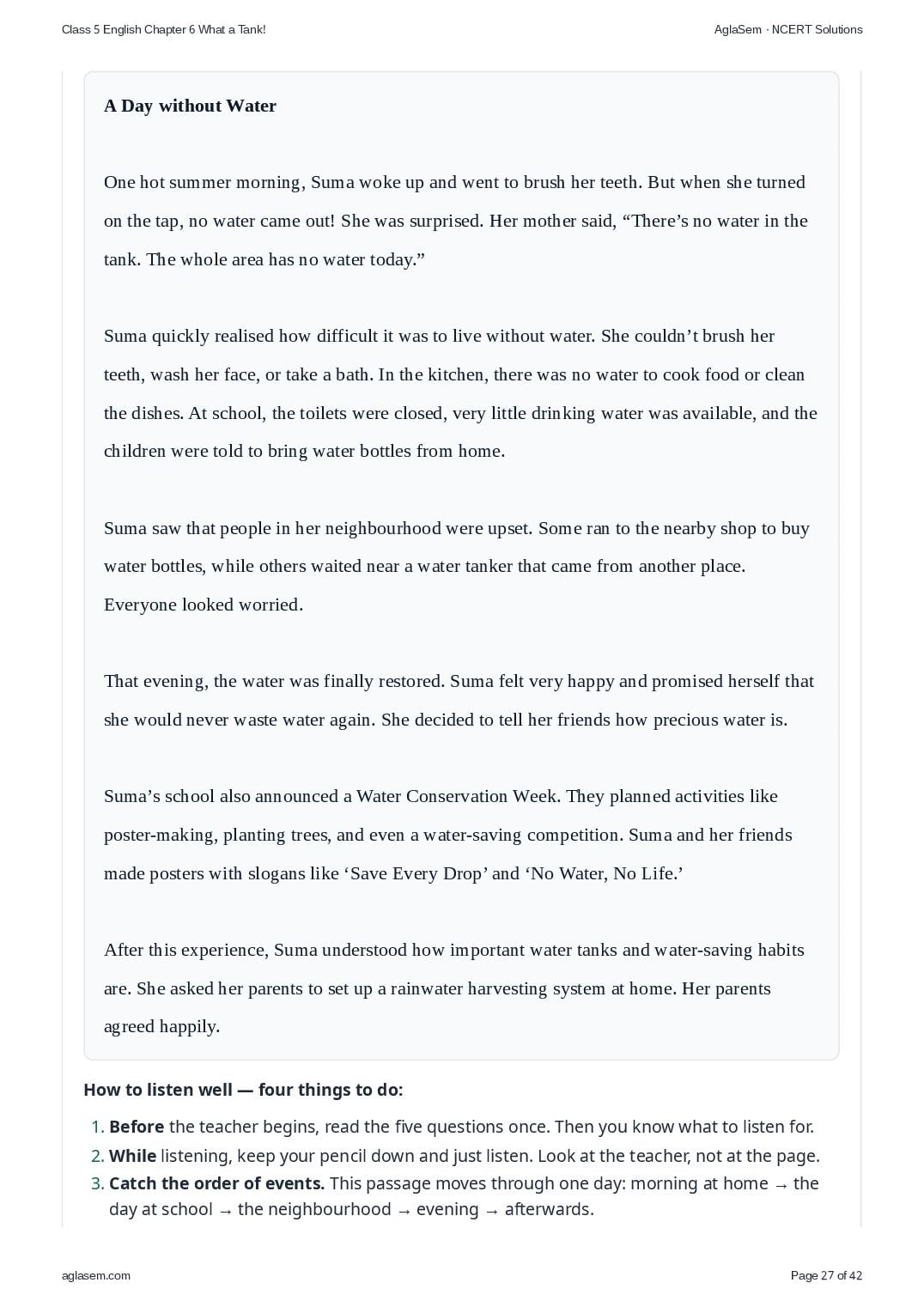
- Listen to your teacher read out the following passage and choose the correct option. — A Day without Water
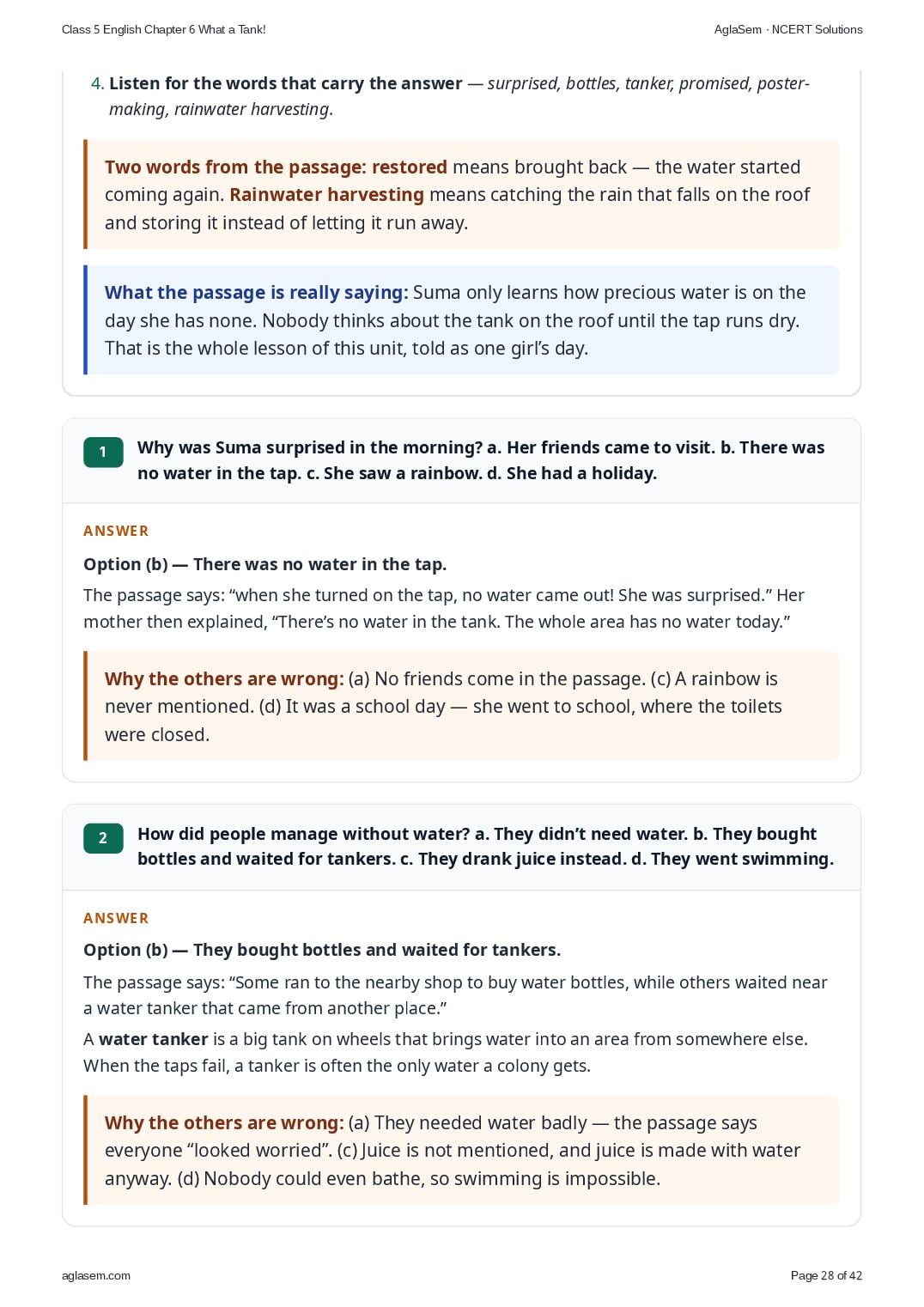
- Why was Suma surprised in the morning? a. Her friends came to visit. b. There was no water in the tap. c. She saw a rainbow. d. She had a holiday.
- How did people manage without water? a. They didn’t need water. b. They bought bottles and waited for tankers. c. They drank juice instead. d. They went swimming.
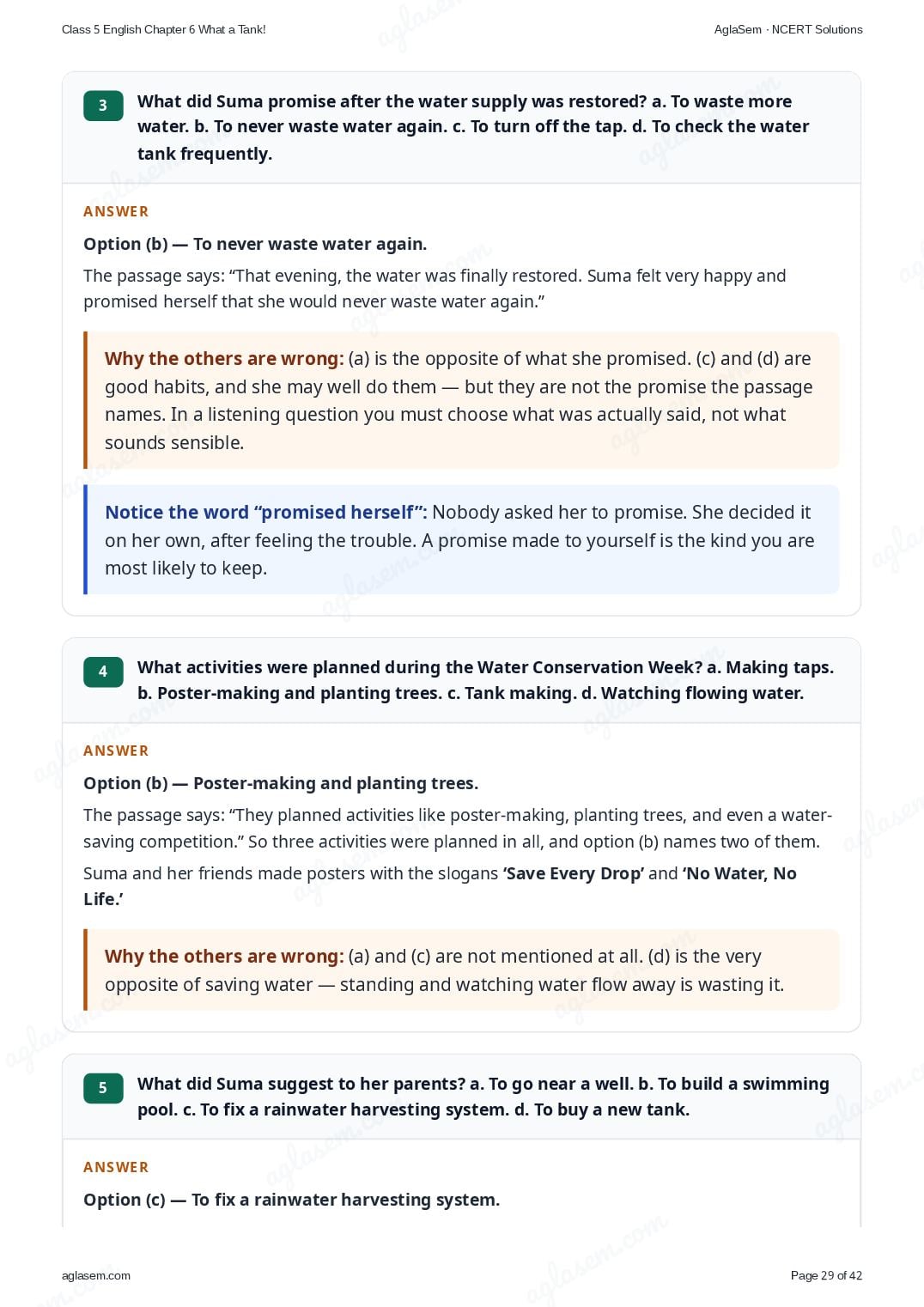
- What did Suma promise after the water supply was restored? a. To waste more water. b. To never waste water again. c. To turn off the tap. d. To check the water tank frequently.
- What activities were planned during the Water Conservation Week? a. Making taps. b. Poster-making and planting trees. c. Tank making. d. Watching flowing water.
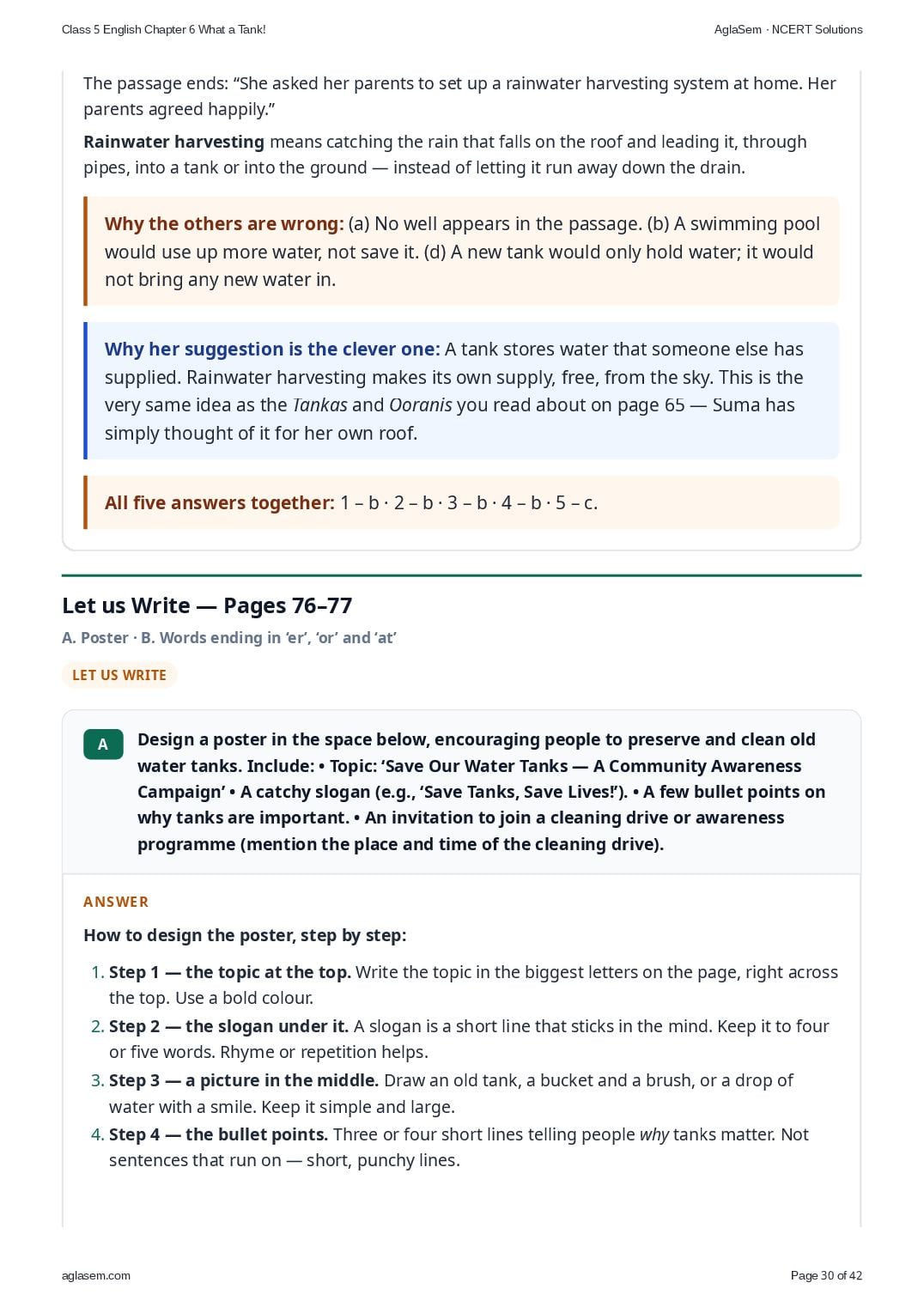
- What did Suma suggest to her parents? a. To go near a well. b. To build a swimming pool. c. To fix a rainwater harvesting system. d. To buy a new tank.
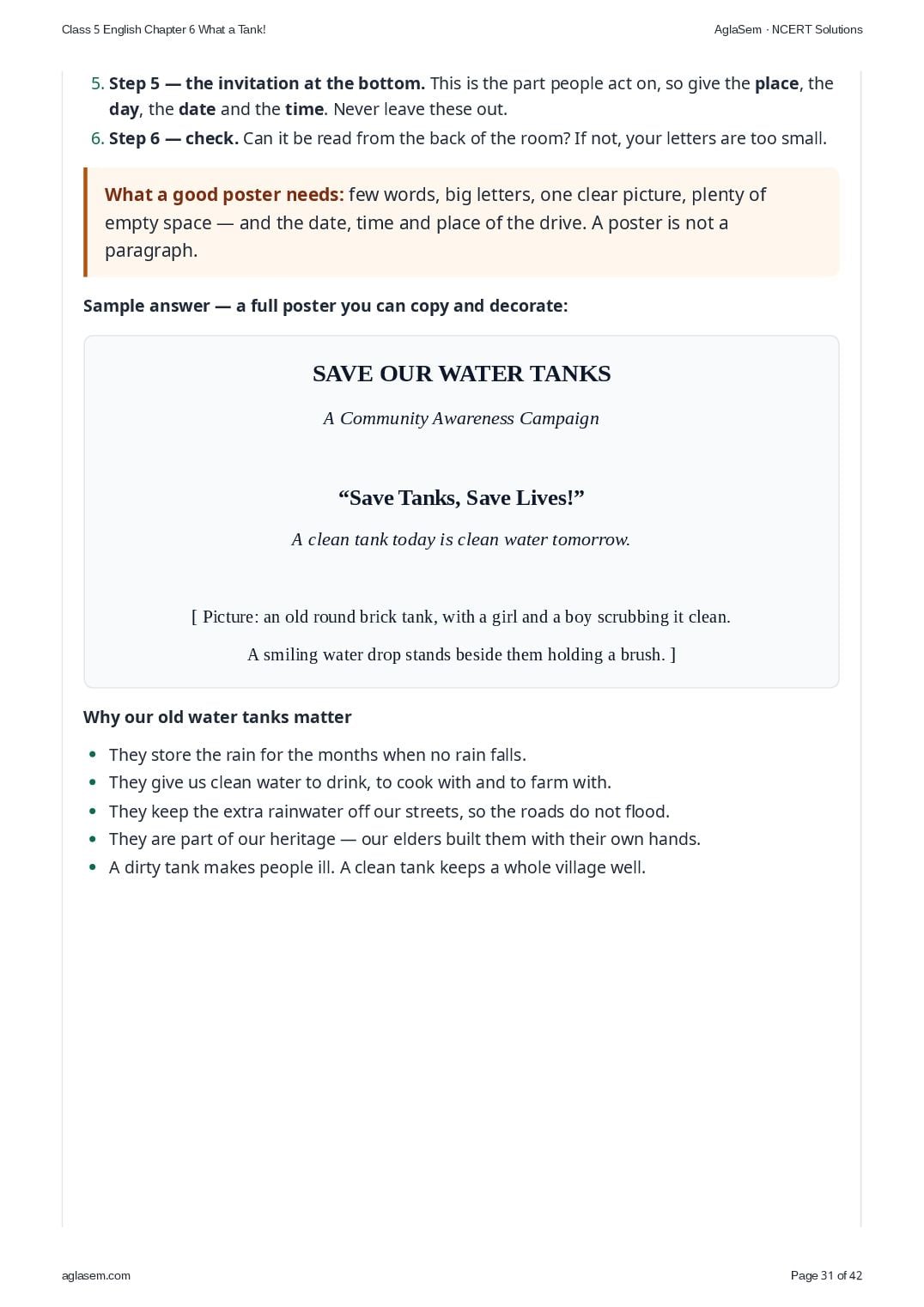
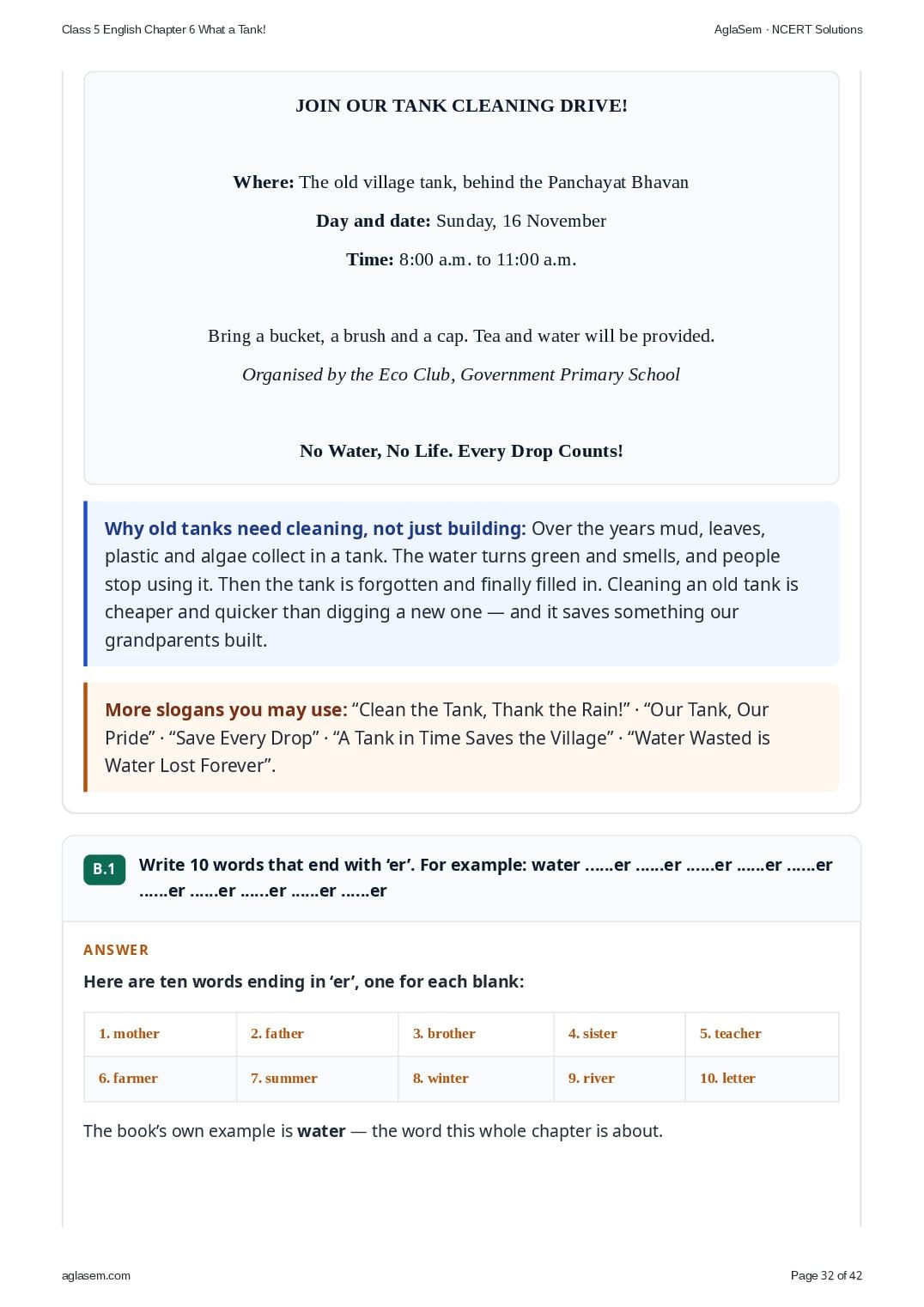
- Design a poster in the space below, encouraging people to preserve and clean old water tanks. Include: • Topic: ‘Save Our Water Tanks — A Community Awareness Campaign’ • A catchy slogan (e.g., ‘Save Tanks, Save Lives!’). • A few bullet points on why tanks are important. • An invitation to join a cleaning drive or awareness programme (mention the place and time of the cleaning drive).
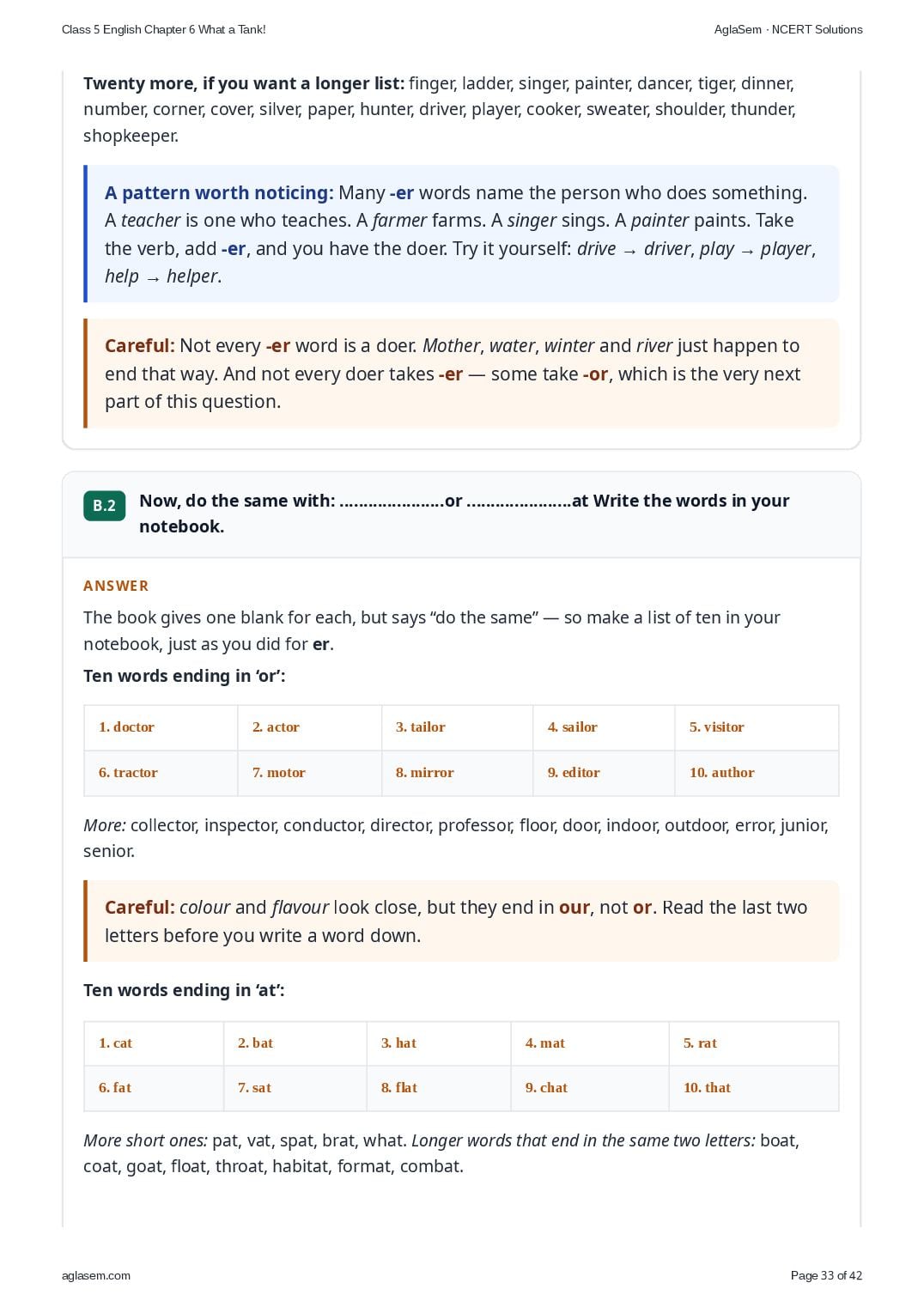
- Write 10 words that end with ‘er’. For example: water ……er ……er ……er ……er ……er ……er ……er ……er ……er ……er
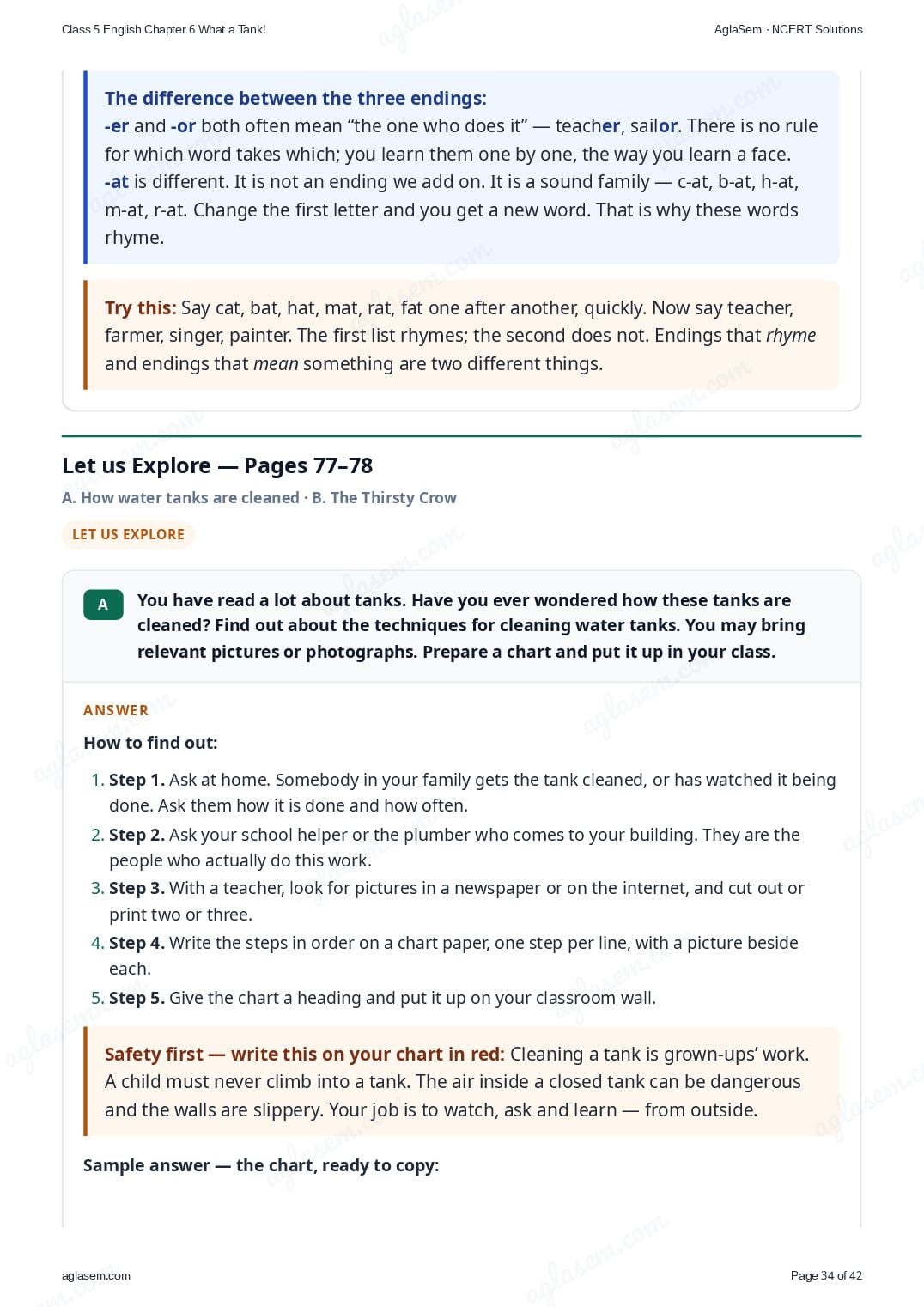
- Now, do the same with: ………………….or ………………….at Write the words in your notebook.
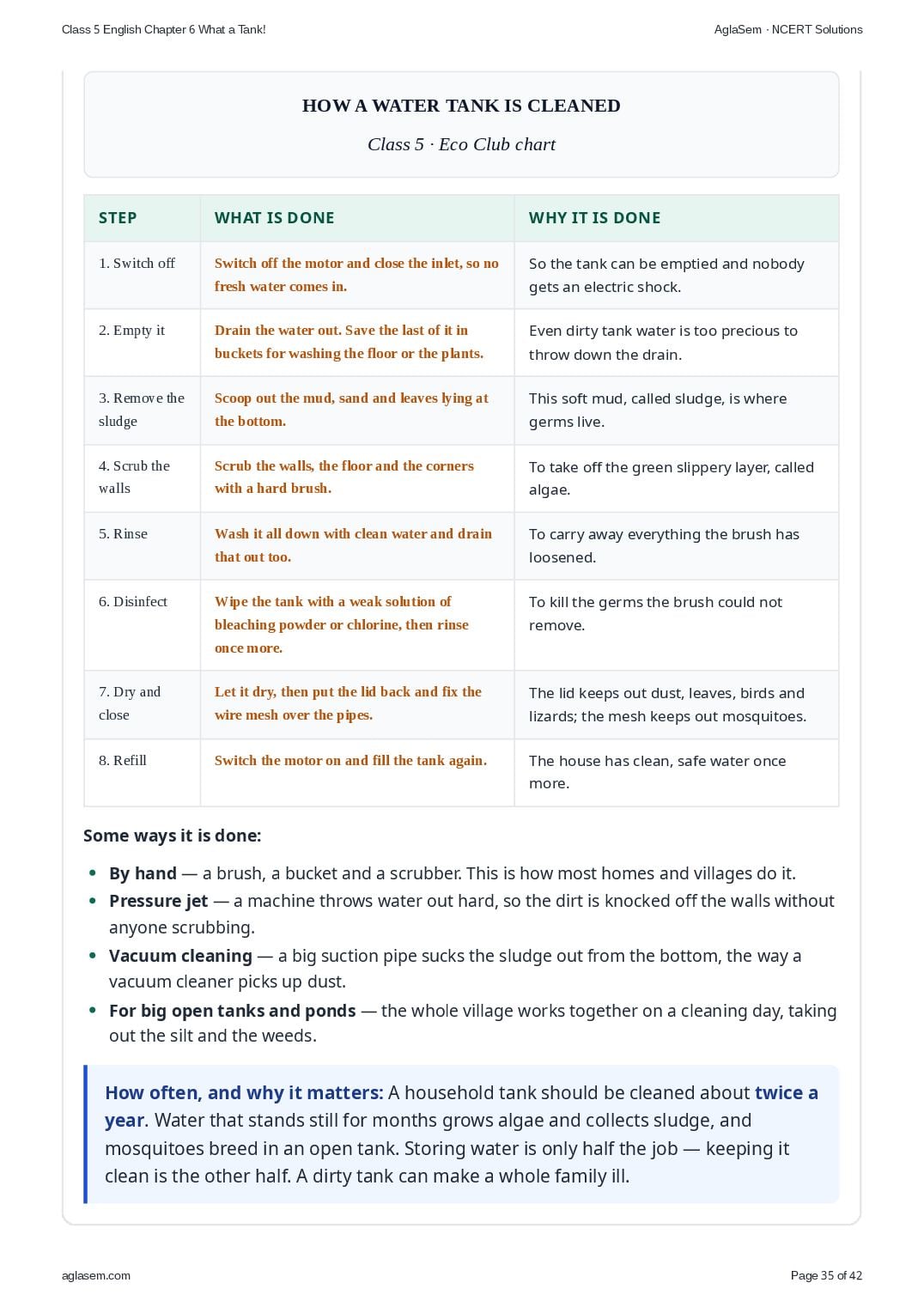
- You have read a lot about tanks. Have you ever wondered how these tanks are cleaned? Find out about the techniques for cleaning water tanks. You may bring relevant pictures or photographs. Prepare a chart and put it up in your class.
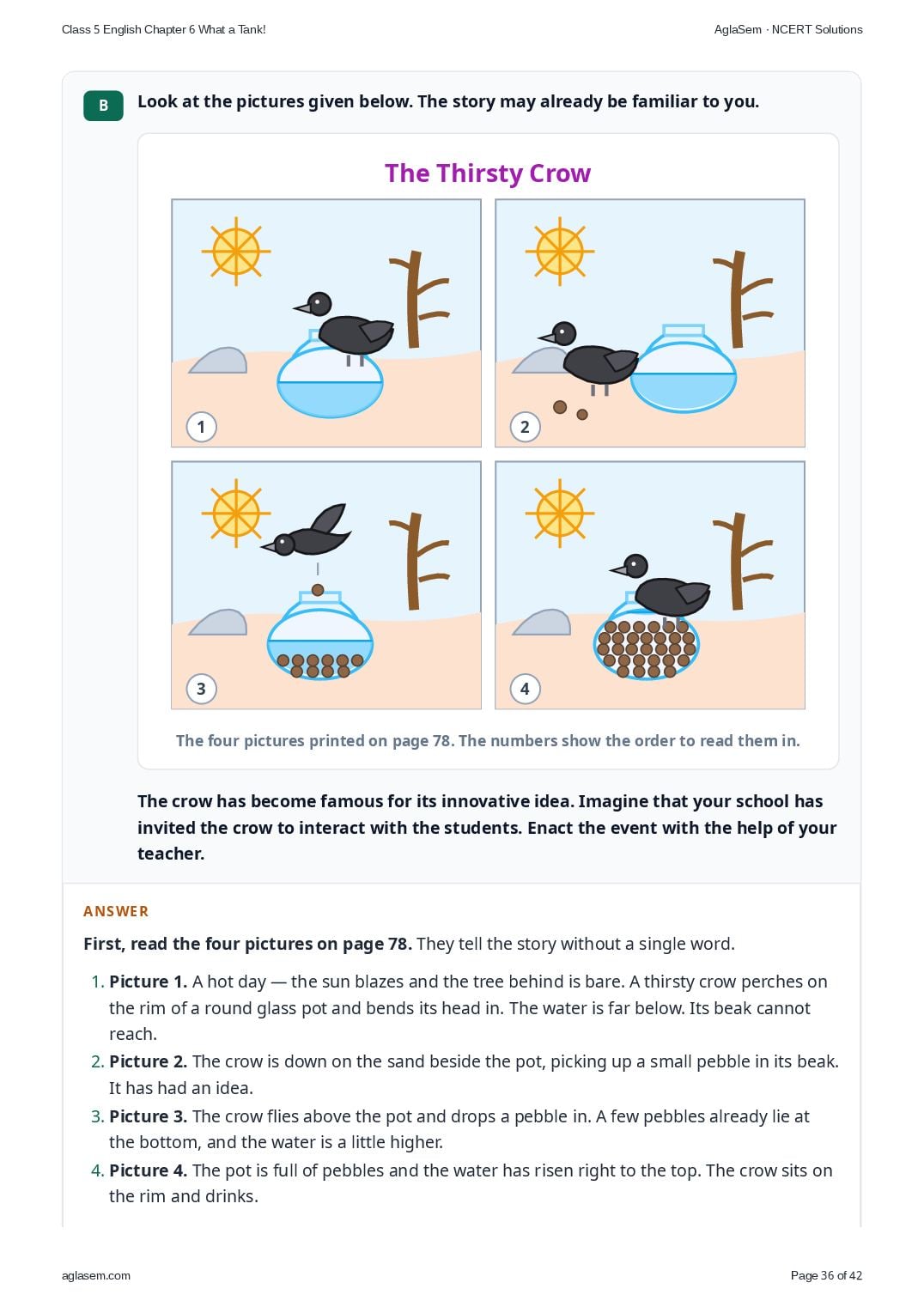
- Look at the pictures given below. The story may already be familiar to you.The Thirsty Crow1234The four pictures printed on page 78. The numbers show the order to read them in.The crow has become famous for its innovative idea. Imagine that your school has invited the crow to interact with the students. Enact the event with the help of your teacher.
Chapter at a Glance
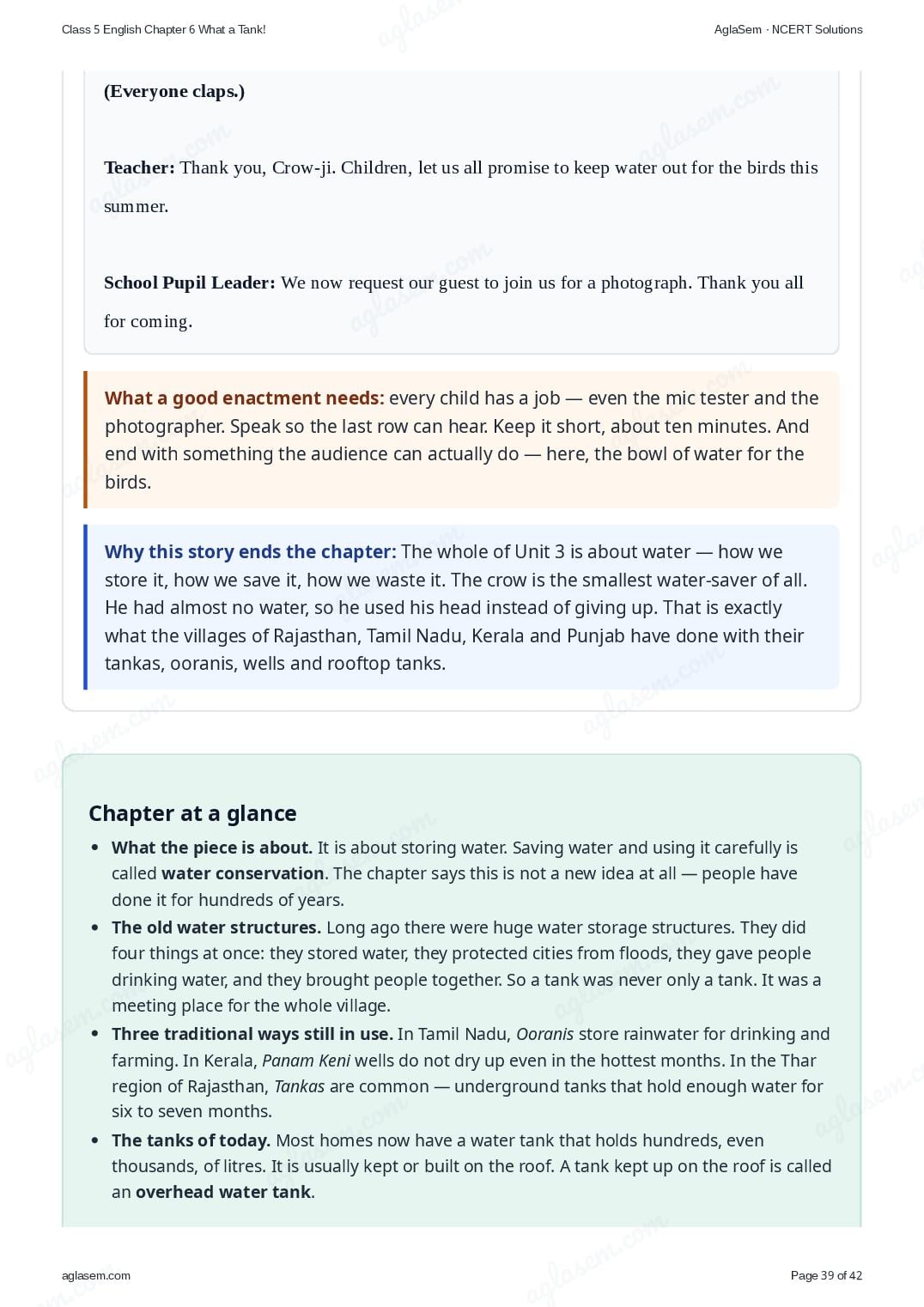
- What the piece is about. It is about storing water. Saving water and using it carefully is called water conservation. The chapter says this is not a new idea at all — people have done it for hundreds of years.
- The old water structures. Long ago there were huge water storage structures. They did four things at once: they stored water, they protected cities from floods, they gave people drinking water, and they brought people together. So a tank was never only a tank. It was a meeting place for the whole village.
- Three traditional ways still in use. In Tamil Nadu, Ooranis store rainwater for drinking and farming. In Kerala, Panam Keni wells do not dry up even in the hottest months. In the Thar region of Rajasthan, Tankas are common — underground tanks that hold enough water for six to seven months.
- The tanks of today. Most homes now have a water tank that holds hundreds, even thousands, of litres. It is usually kept or built on the roof. A tank kept up on the roof is called an overhead water tank.
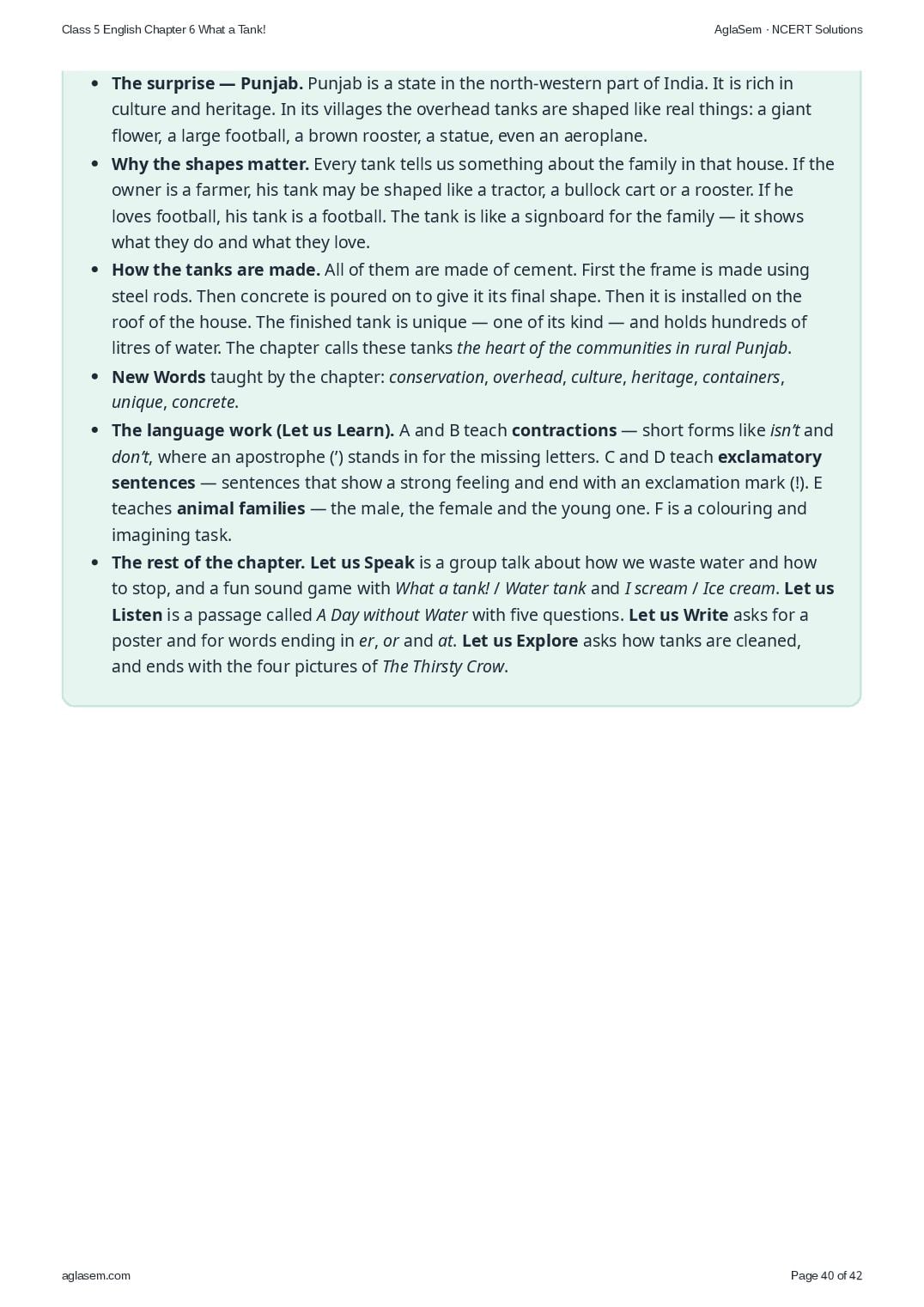
- The surprise — Punjab. Punjab is a state in the north-western part of India. It is rich in culture and heritage. In its villages the overhead tanks are shaped like real things: a giant flower, a large football, a brown rooster, a statue, even an aeroplane.
- Why the shapes matter. Every tank tells us something about the family in that house. If the owner is a farmer, his tank may be shaped like a tractor, a bullock cart or a rooster. If he loves football, his tank is a football. The tank is like a signboard for the family — it shows what they do and what they love.
- How the tanks are made. All of them are made of cement. First the frame is made using steel rods. Then concrete is poured on to give it its final shape. Then it is installed on the roof of the house. The finished tank is unique — one of its kind — and holds hundreds of litres of water. The chapter calls these tanks the heart of the communities in rural Punjab.
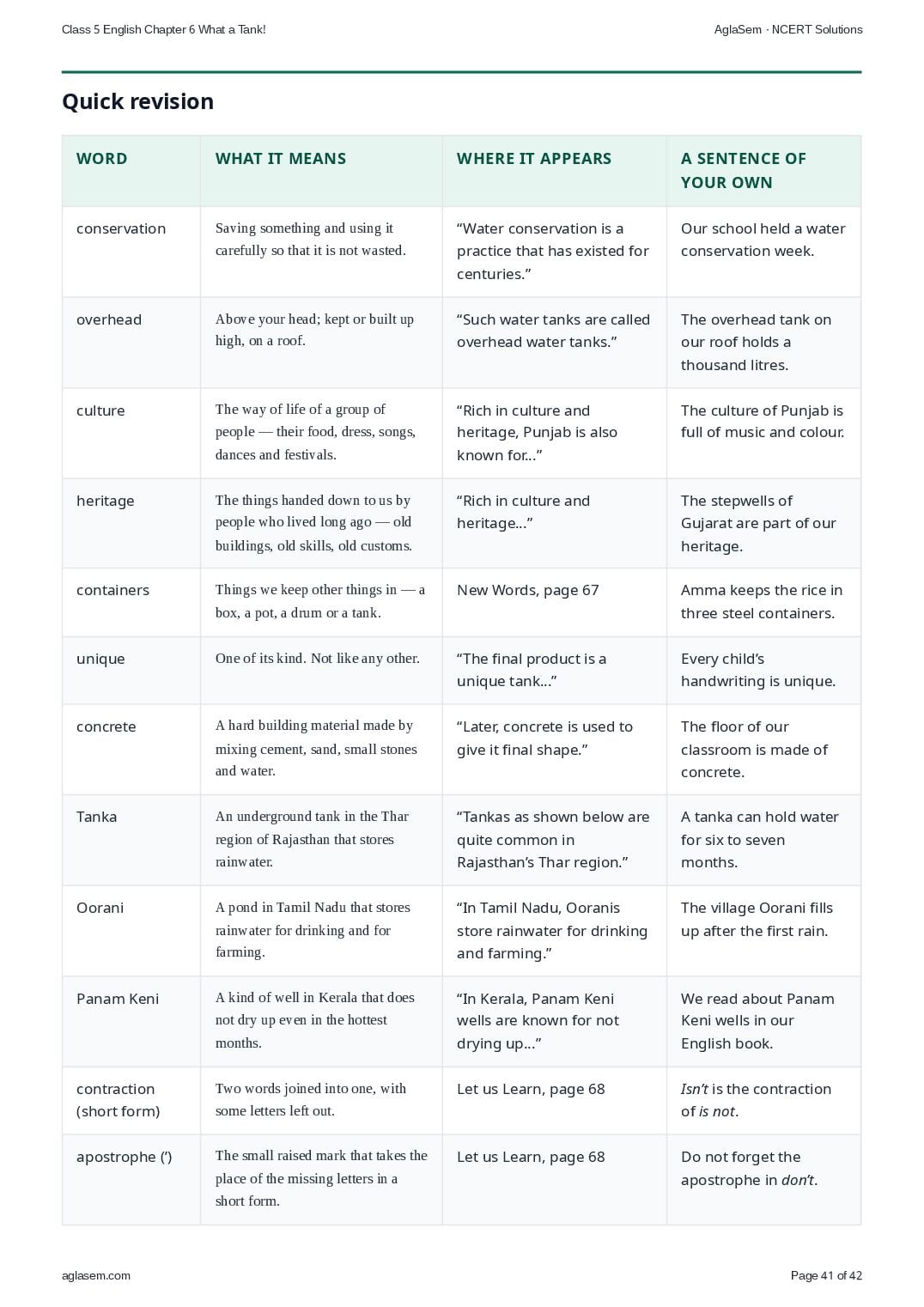
- New Words taught by the chapter: conservation, overhead, culture, heritage, containers, unique, concrete.
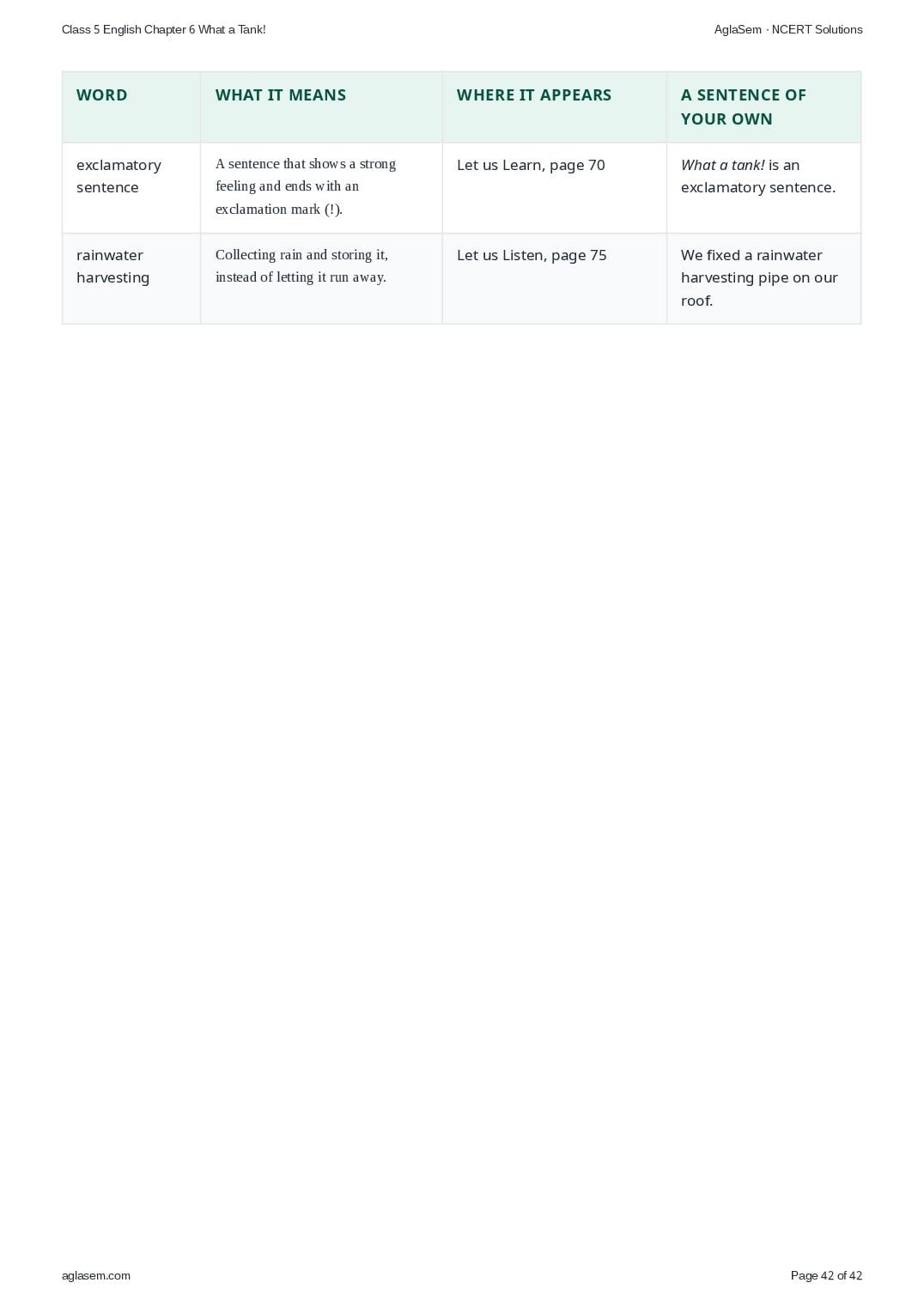
- The language work (Let us Learn). A and B teach contractions — short forms like isn’t and don’t, where an apostrophe (’) stands in for the missing letters. C and D teach exclamatory sentences — sentences that show a strong feeling and end with an exclamation mark (!). E teaches animal families — the male, the female and the young one. F is a colouring and imagining task.
- The rest of the chapter. Let us Speak is a group talk about how we waste water and how to stop, and a fun sound game with What a tank! / Water tank and I scream / Ice cream. Let us Listen is a passage called A Day without Water with five questions. Let us Write asks for a poster and for words ending in er, or and at. Let us Explore asks how tanks are cleaned, and ends with the four pictures of The Thirsty Crow.
How to Download NCERT Solutions for Class 5 English Chapter 6 PDF
Follow these simple steps to get the What a Tank questions-and-answers PDF from Santoor.
- Search NCERT Solutions for Class 5 English Chapter 6 aglasem and open this page.
- Read the exercise questions with answers for What a Tank shown above.
- Click the Download PDF link to save the What a Tank solutions to your device.
NCERT Solutions for Class 5 English – All Chapters
There are more chapters to study besides What a Tank in English. Here are the NCERT Solutions for all chapters of Class 5 English.
- Chapter 1 Papa s Spectacles
- Chapter 2 Gone with the Scooter
- Chapter 3 the Rainbow
- Chapter 4 the Wise Parrot
- Chapter 5 the Frog
- Chapter 6 What a Tank
- Chapter 7 Gilli Danda
- Chapter 8 the Decision of the Panchayat
- Chapter 9 Vocation
- Chapter 10 Glass Bangles
NCERT Solutions for Class 5 – All Subjects
Just like Chapter 6 of English, you can get the exercise questions with answers for every other subject of Class 5. Here are the NCERT Solutions for all subjects of Class 5.
NCERT Solutions for Class 5 English Chapter 6 – An Overview
The key highlights of this study material are as follows.
| Aspects | Details |
|---|---|
| Class | Class 5 |
| Subject | English |
| Chapter Number | Chapter 6 |
| Chapter Name | What a Tank |
| Book Name | Santoor |
| Book By | NCERT (National Council of Educational Research and Training) |
| Educational Resource Here | NCERT Solutions of Class 5 English Chapter 6 for all exercises |
| More Questions Answers of This Subject | NCERT Solutions for Class 5 English |
| Download Book Chapter | NCERT Book Class 5 English |
| All Questions Answers For This Class | NCERT Solutions for Class 5 |
| Complete Solutions | NCERT Solutions |
NCERT Solutions for Class 5 English Chapter 6 What a Tank – FAQs
What are the NCERT Solutions for Class 5 English Chapter 6 What a Tank?
They are the complete, step-by-step answers to all the exercise and in-text questions of Chapter 6 What a Tank from the NCERT Class 5 English textbook Santoor, written by experts as per the latest NCERT syllabus.
How can I download the Class 5 English Chapter 6 solutions PDF for free?
Open this page on aglasem, read the What a Tank questions with answers, and click the “Download Solutions PDF” link. The Class 5 English Chapter 6 NCERT Solutions PDF is completely free to download.
Are these NCERT Solutions as per the latest 2026-27 syllabus?
Yes. The NCERT Solutions for Class 5 English Chapter 6 are based on the latest NCERT textbook Santoor and the current 2026-27 CBSE syllabus, so the questions and answers match what you study in class.
Where can I get NCERT Solutions for the other chapters of Class 5 English?
You can find the answers to every chapter on the NCERT Solutions for Class 5 English page, and solutions for every subject on the NCERT Solutions for Class 5 page.
How do NCERT Solutions help in exam preparation?
They show the correct method to solve each question, help you write answers the way they are expected in exams, let you check and correct your own work, and save revision time — which together improve your marks in Class 5 English.
If you have any queries on NCERT Solutions for Class 5 English Chapter 6 What a Tank, then please ask in the comments below.