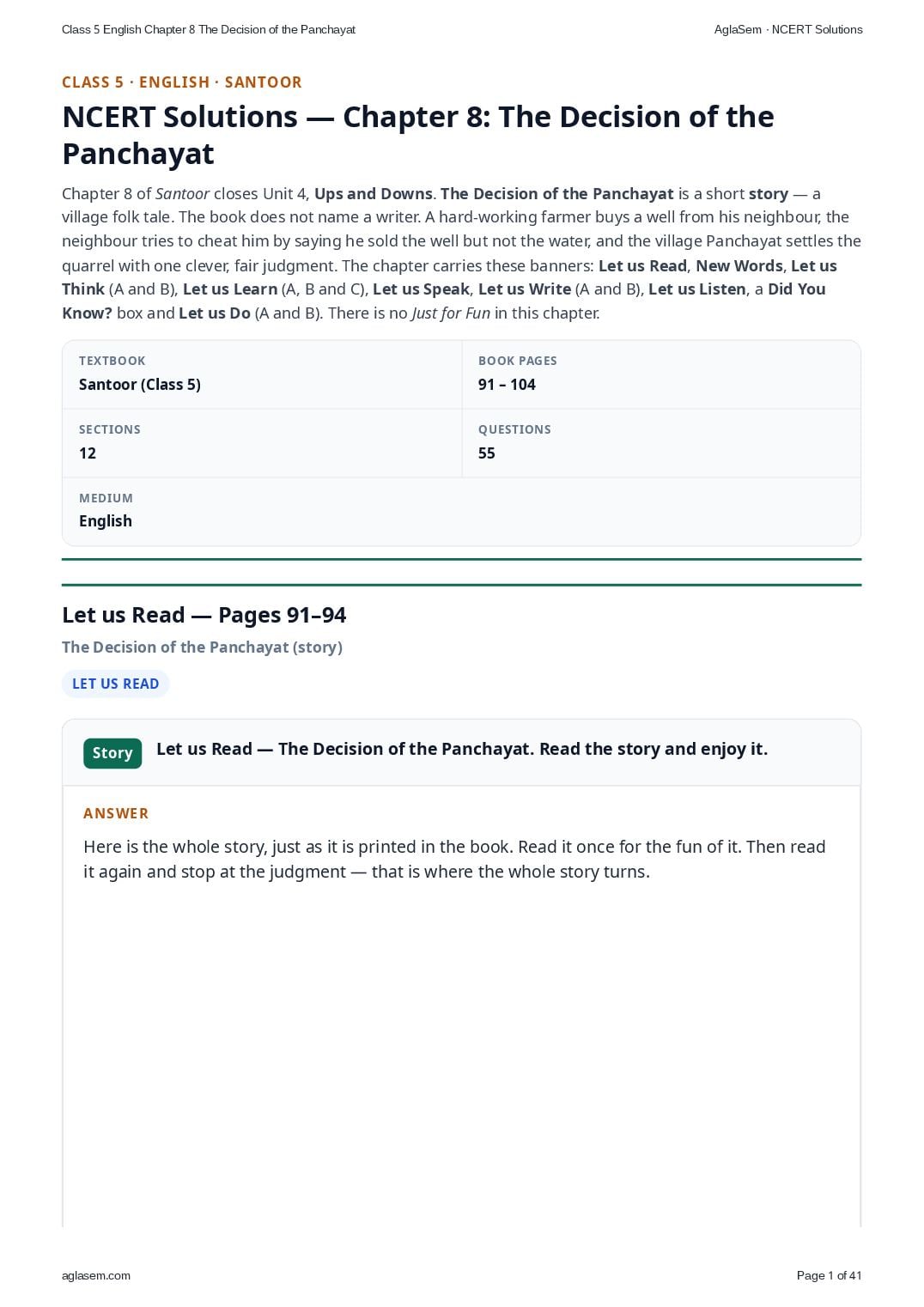
NCERT Solutions for Class 5 English Chapter 8 the Decision of the Panchayat provide clear, step-by-step answers to every exercise and in-text question from the chapter the Decision of the Panchayat of the NCERT textbook Santoor. Prepared by subject experts as per the latest NCERT (CBSE) syllabus for 2026-27, these NCERT Solutions for Class 5 English help you understand each concept, write exam-ready answers, and check your own solutions. You can read them online below or download the free Class 5 English Chapter 8 question-answer PDF.
NCERT Solutions for Class 5 English Chapter 8 the Decision of the Panchayat
- Class: Class 5
- Subject: English
- Chapter: Chapter 8 – the Decision of the Panchayat
- Textbook: Santoor (NCERT)
- Study material: NCERT Solutions – questions with answers, free PDF
These solutions answer all the exercise questions of Chapter 8 the Decision of the Panchayat — including the in-text questions, short-answer and long-answer questions, and activities — with complete explanations so you can follow the method, not just the final answer. Read the full solutions below.
NCERT Solutions Class 5 English Chapter 8 the Decision of the Panchayat View Download
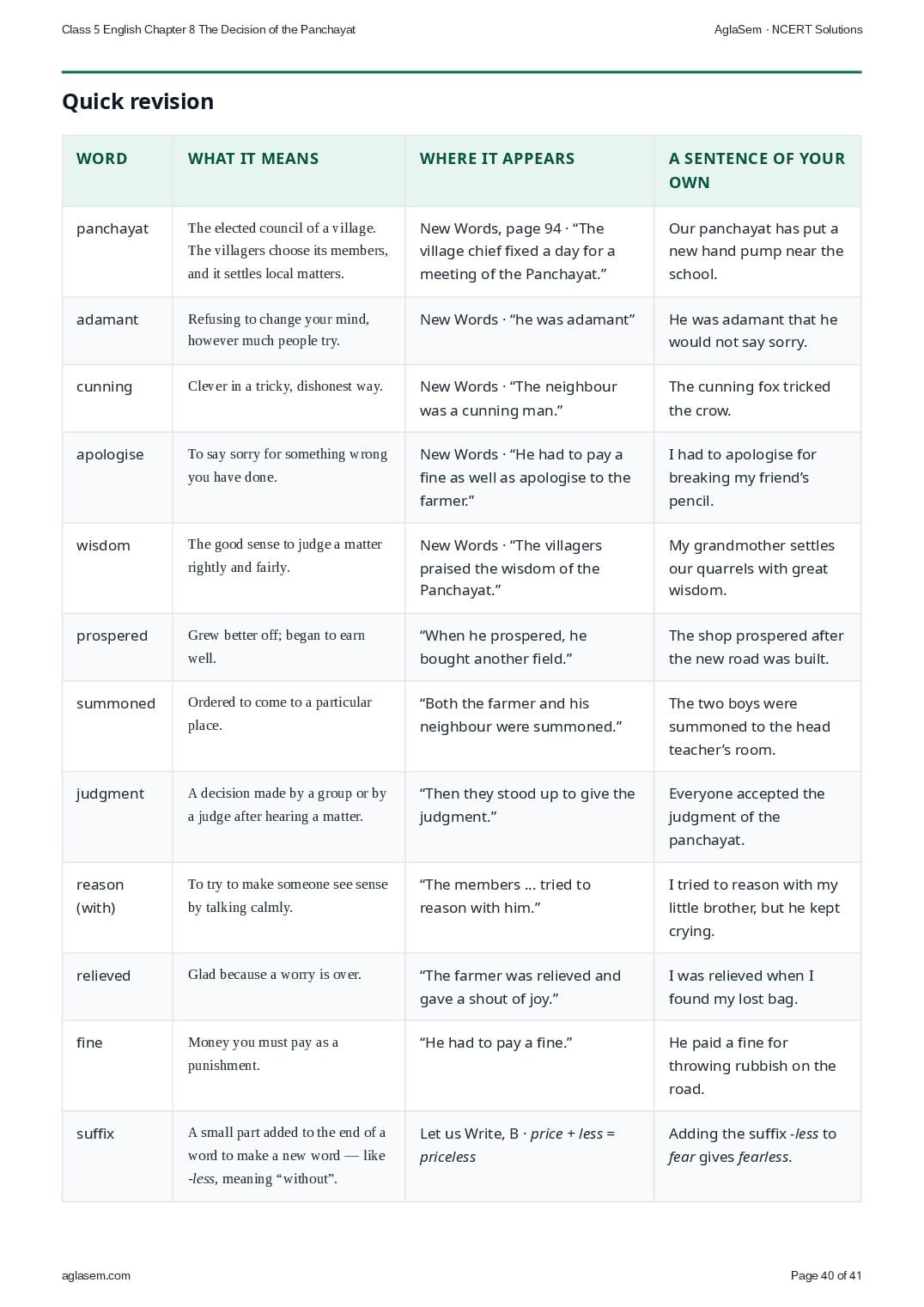
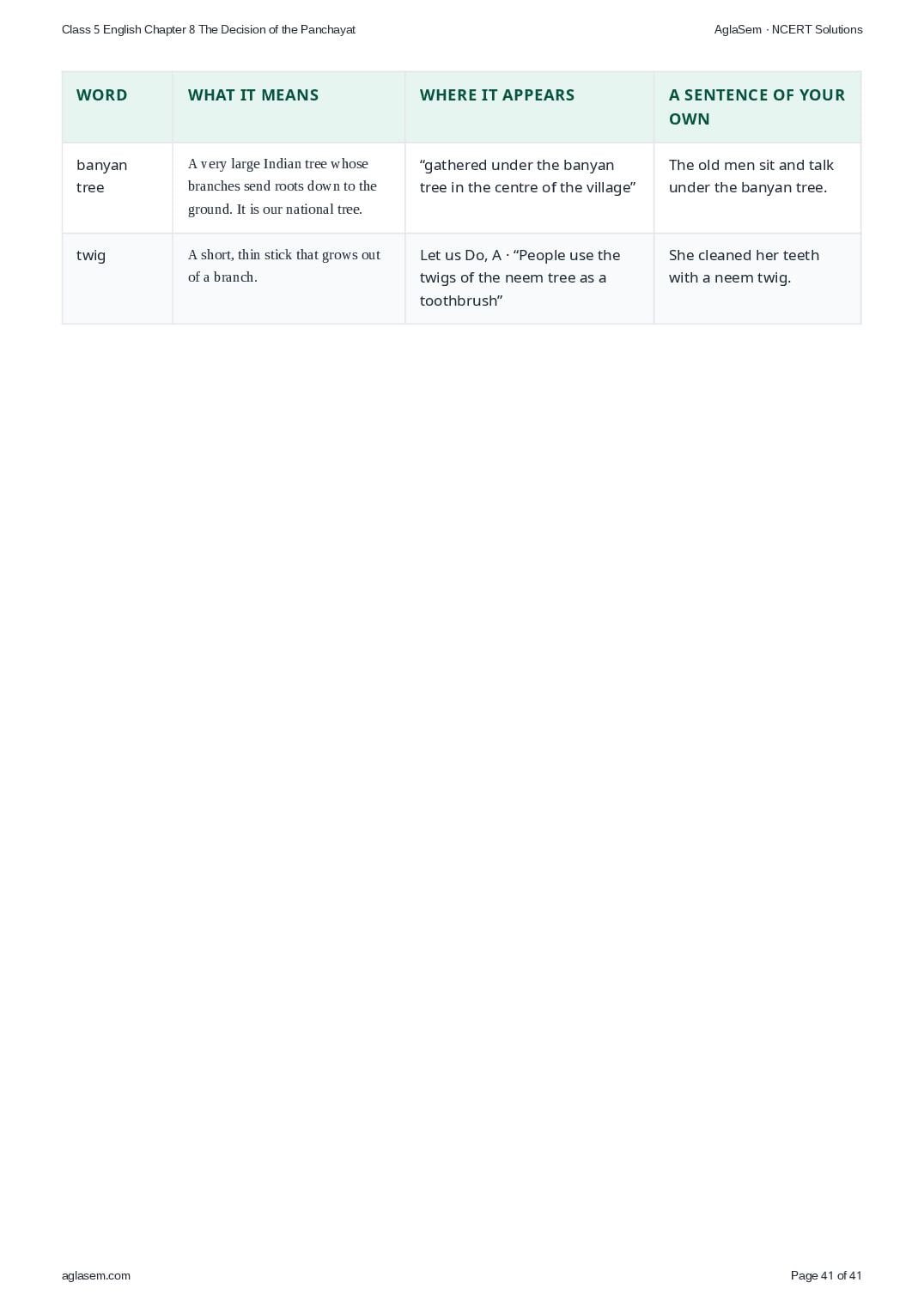
NCERT Solutions for Class 5 English Chapter 8 PDF Download
You can read the NCERT Solutions for Class 5 English Chapter 8 online above, or download the complete question-answer PDF to study the Decision of the Panchayat offline at any time.
NCERT Solutions for Class 5 English Chapter 8 PDF Download Link – Click Here to Download Solutions PDF
Questions Covered in This Chapter
These NCERT Solutions answer all 55 questions of this chapter. The questions solved are:
- Let us Read — The Decision of the Panchayat. Read the story and enjoy it.
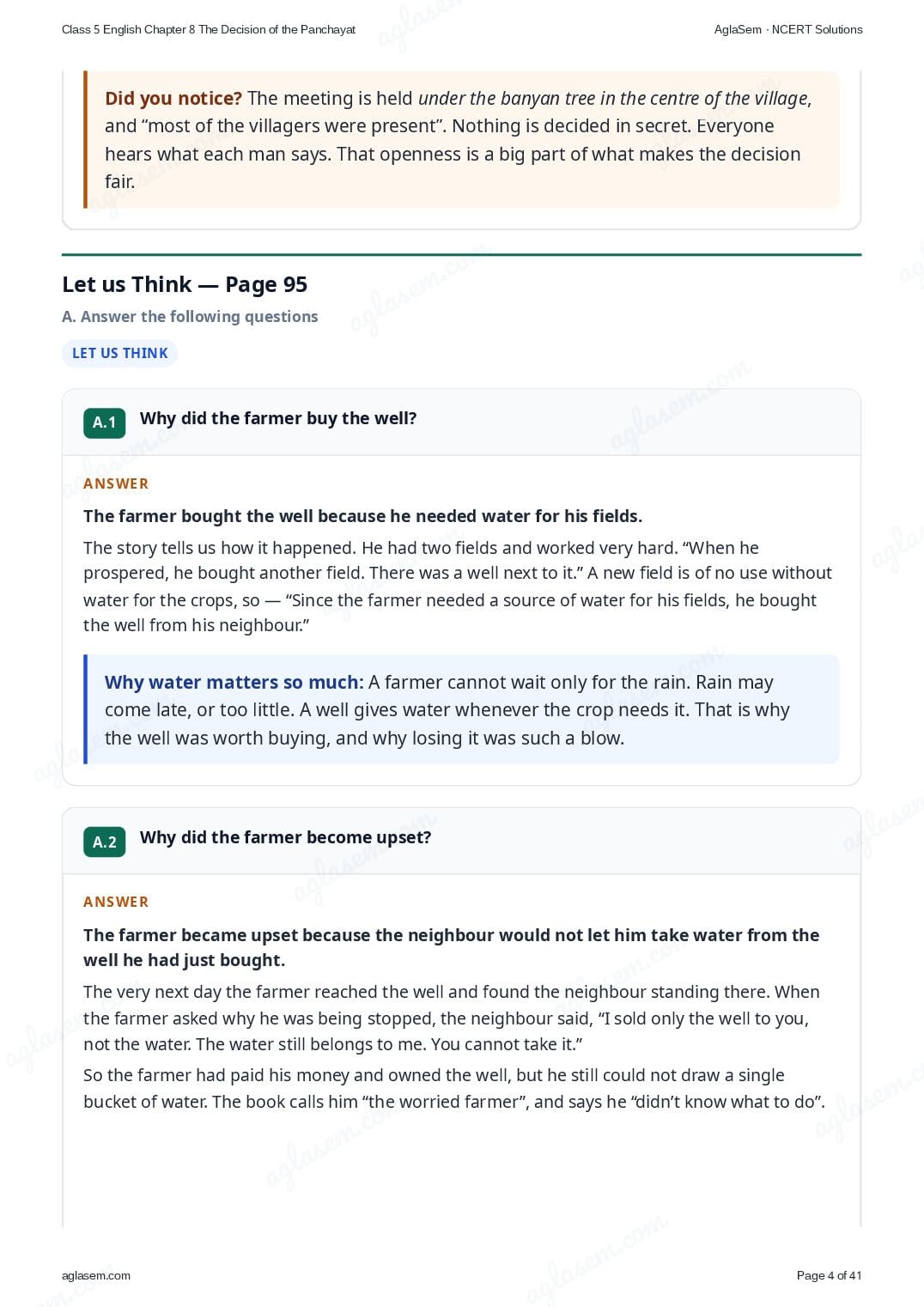
- Why did the farmer buy the well?
- Why did the farmer become upset?
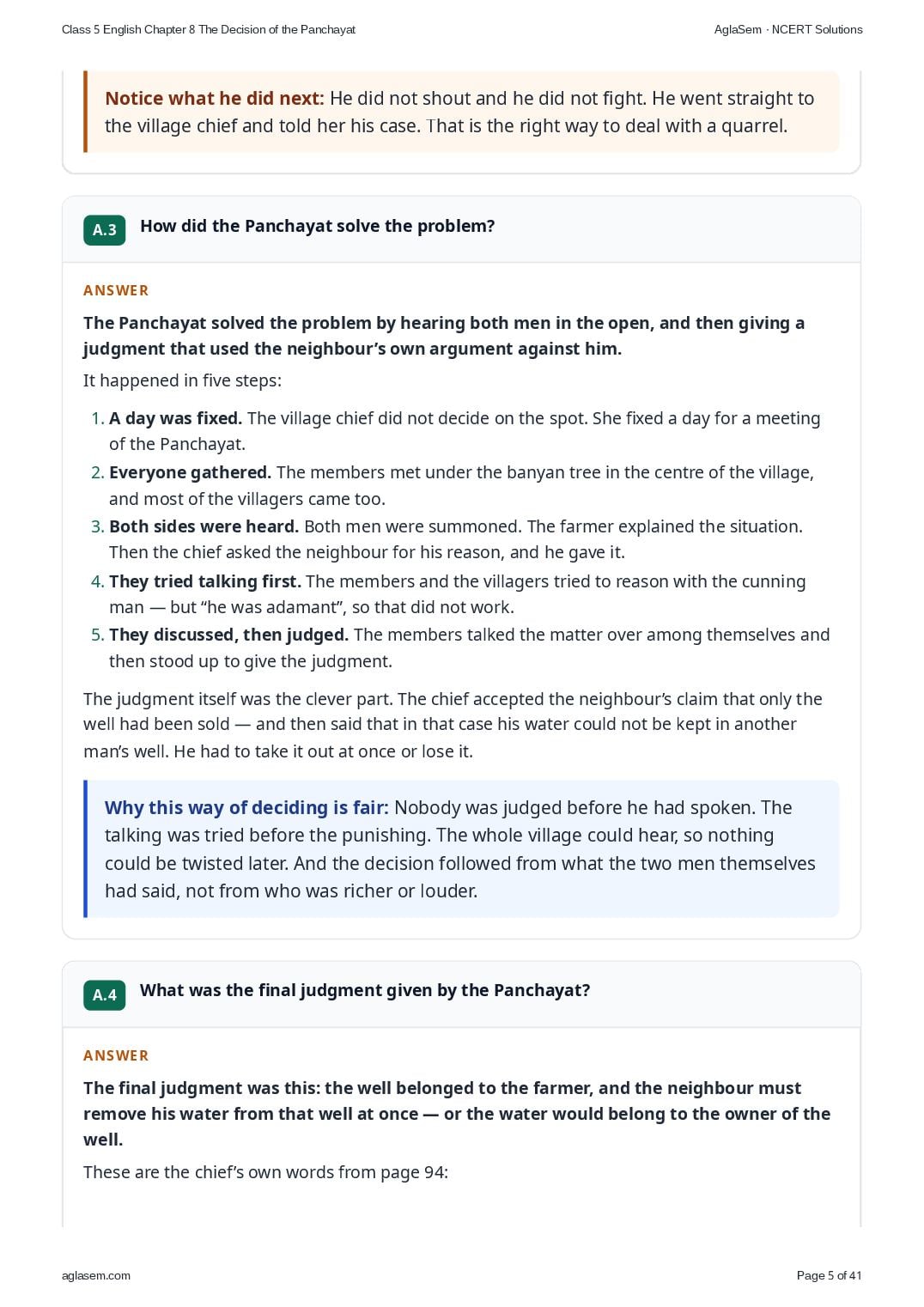
- How did the Panchayat solve the problem?
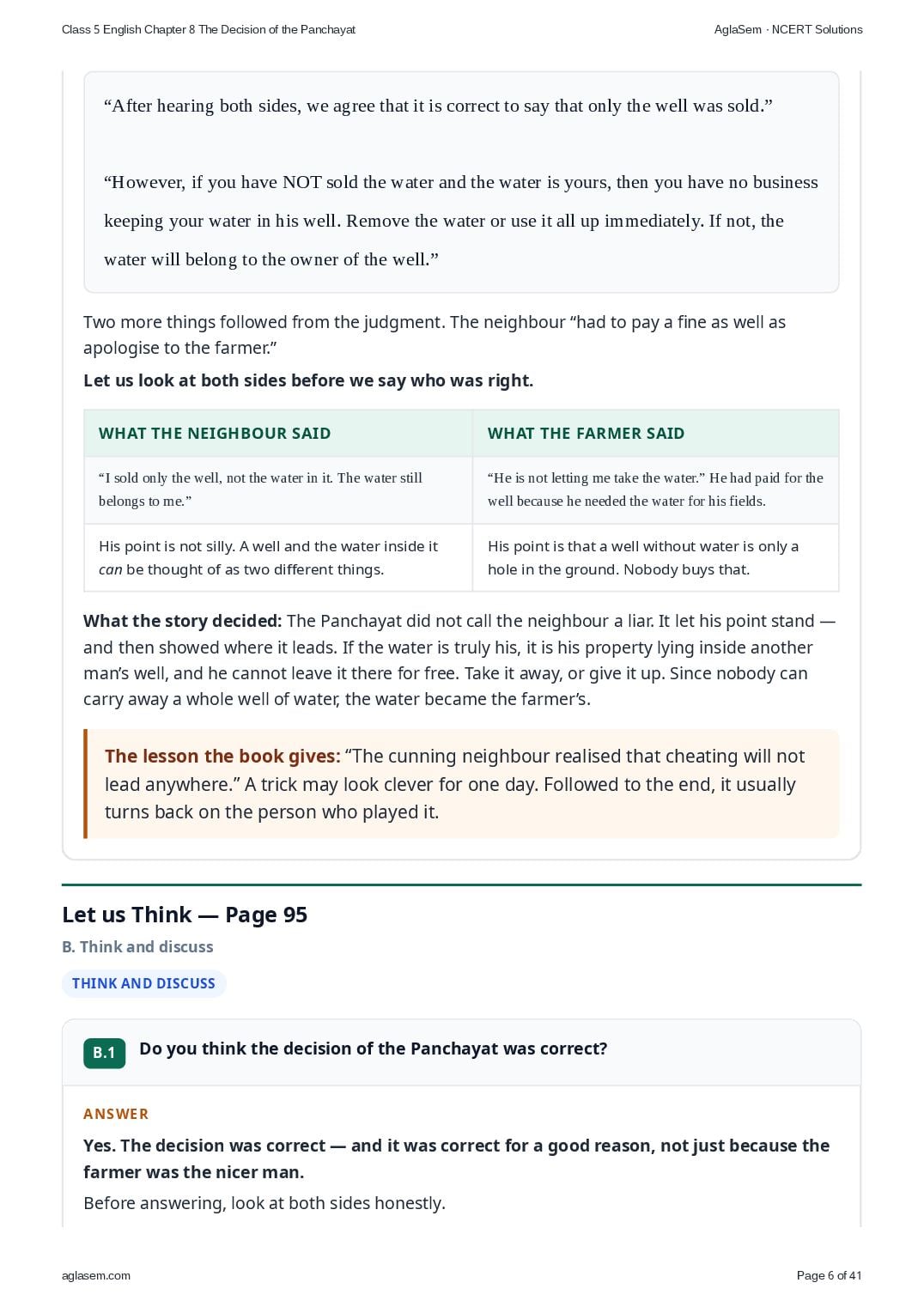
- What was the final judgment given by the Panchayat?
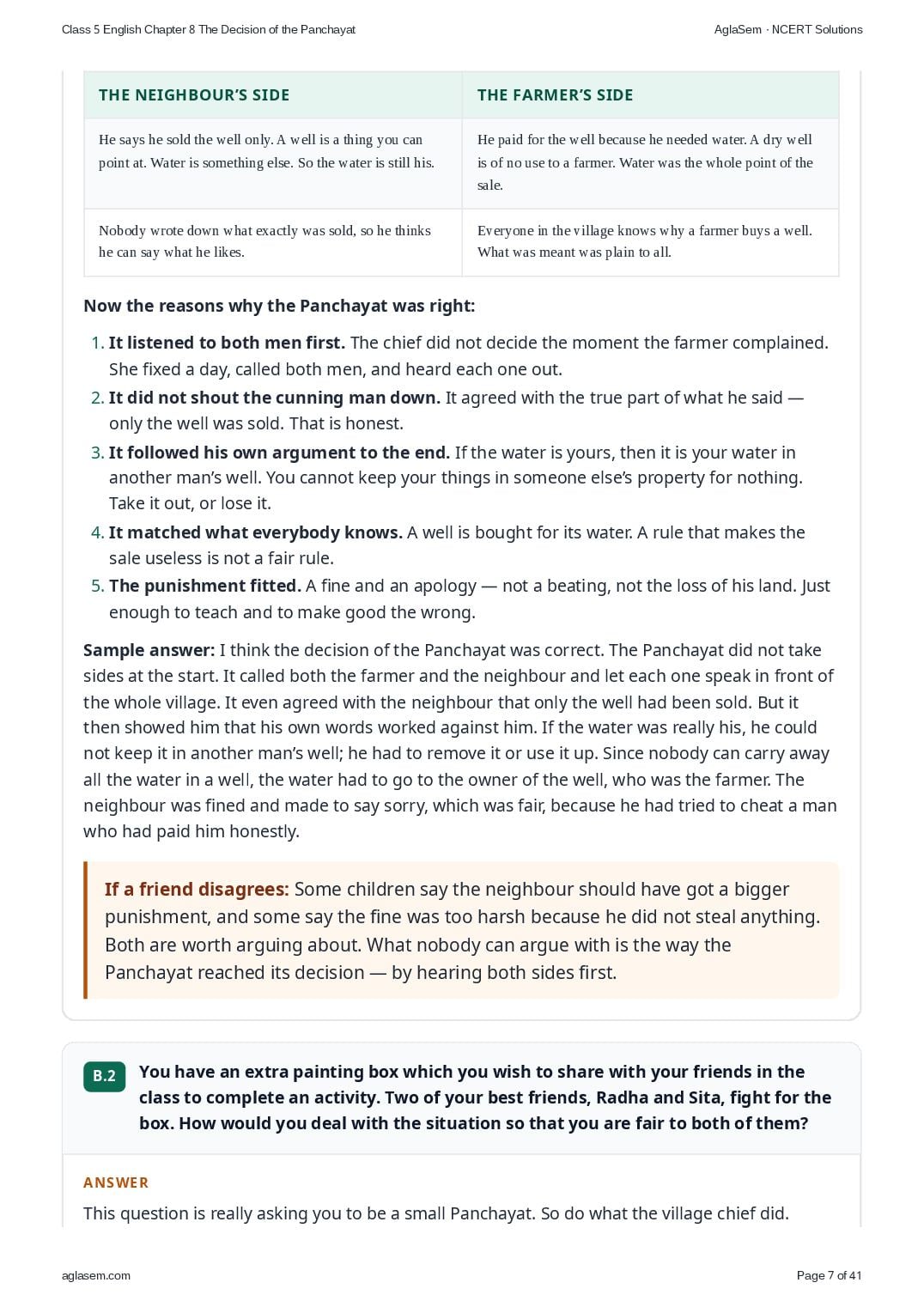
- Do you think the decision of the Panchayat was correct?
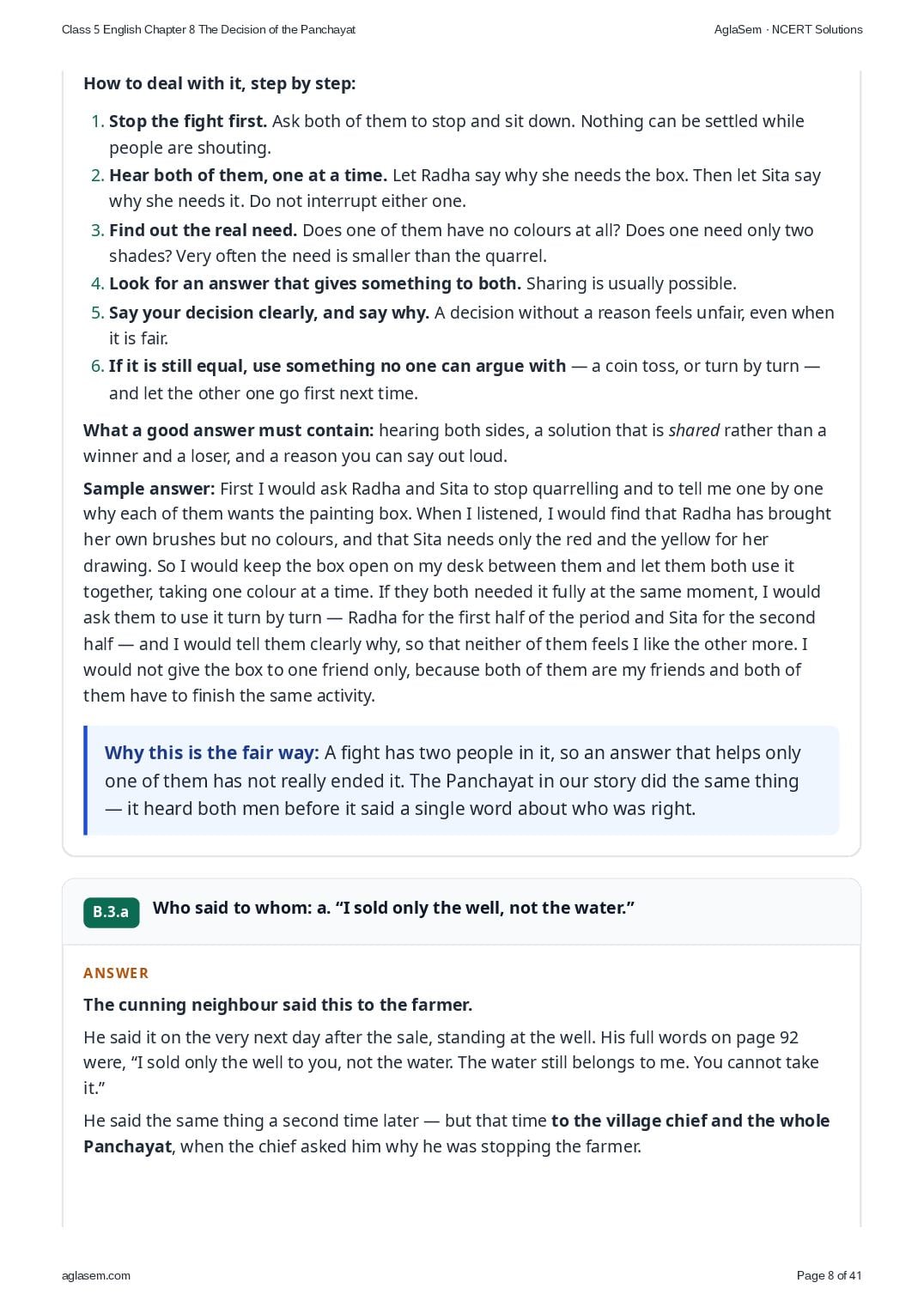
- You have an extra painting box which you wish to share with your friends in the class to complete an activity. Two of your best friends, Radha and Sita, fight for the box. How would you deal with the situation so that you are fair to both of them?
- Who said to whom: a. “I sold only the well, not the water.”
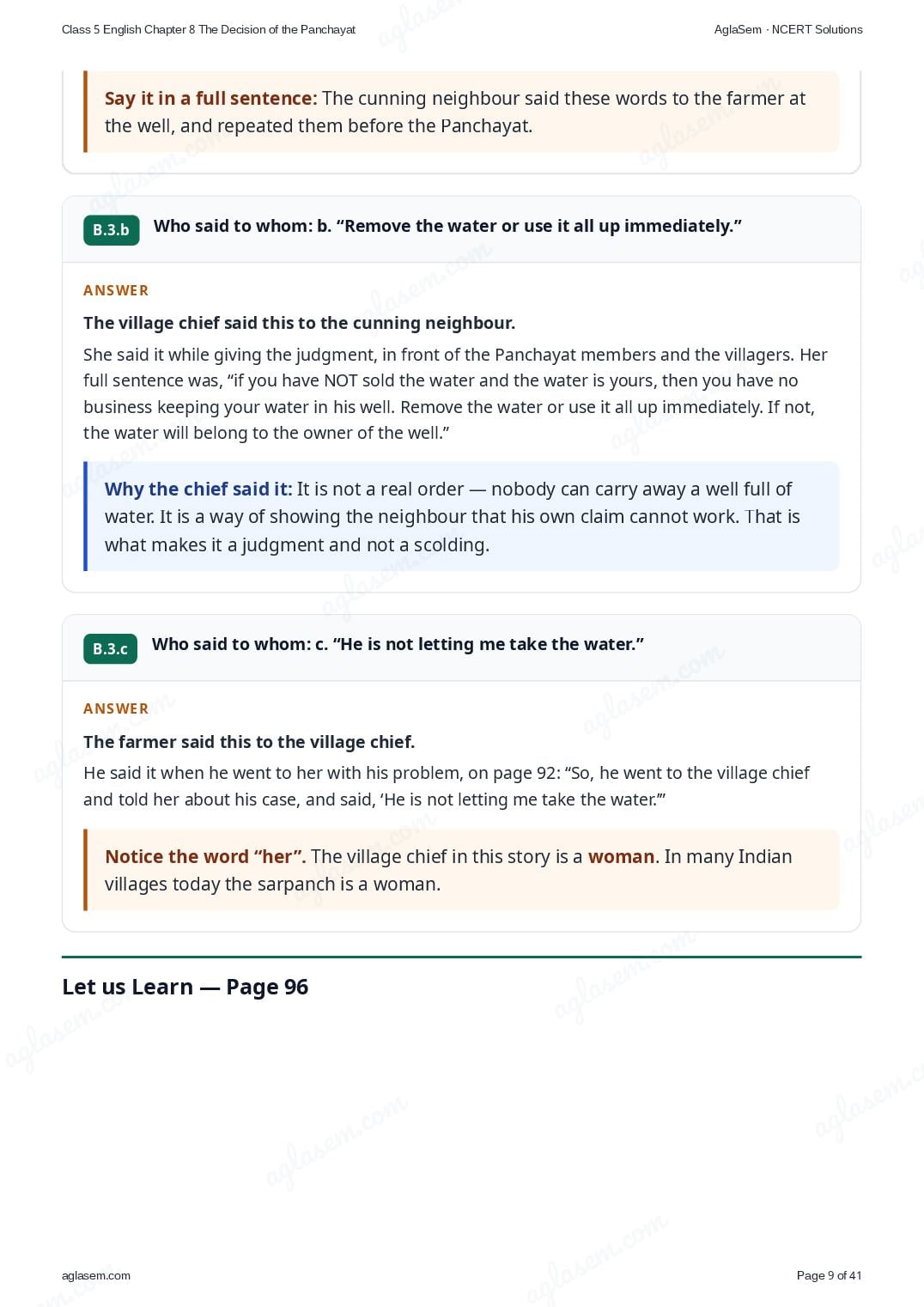
- Who said to whom: b. “Remove the water or use it all up immediately.”
- Who said to whom: c. “He is not letting me take the water.”
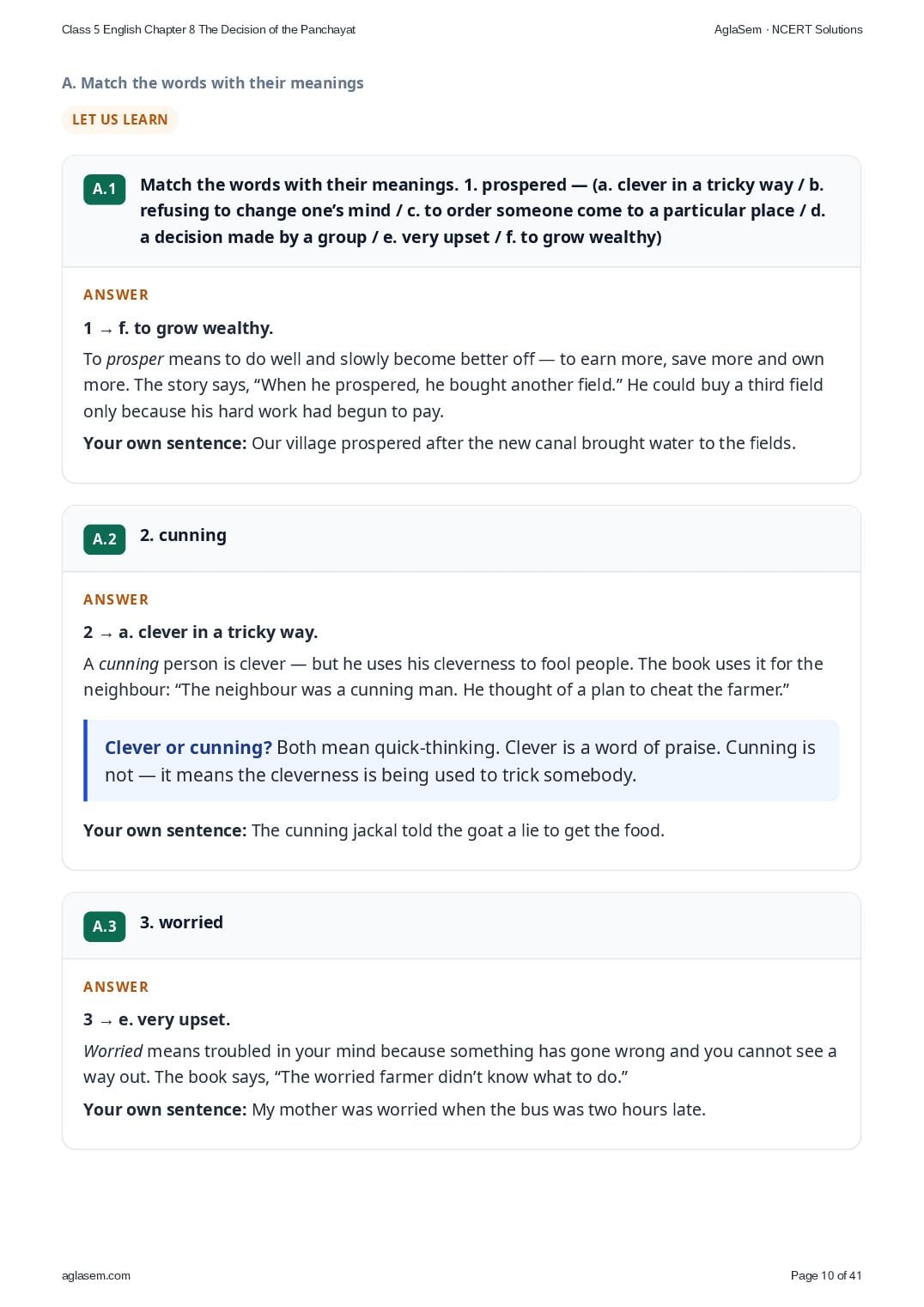
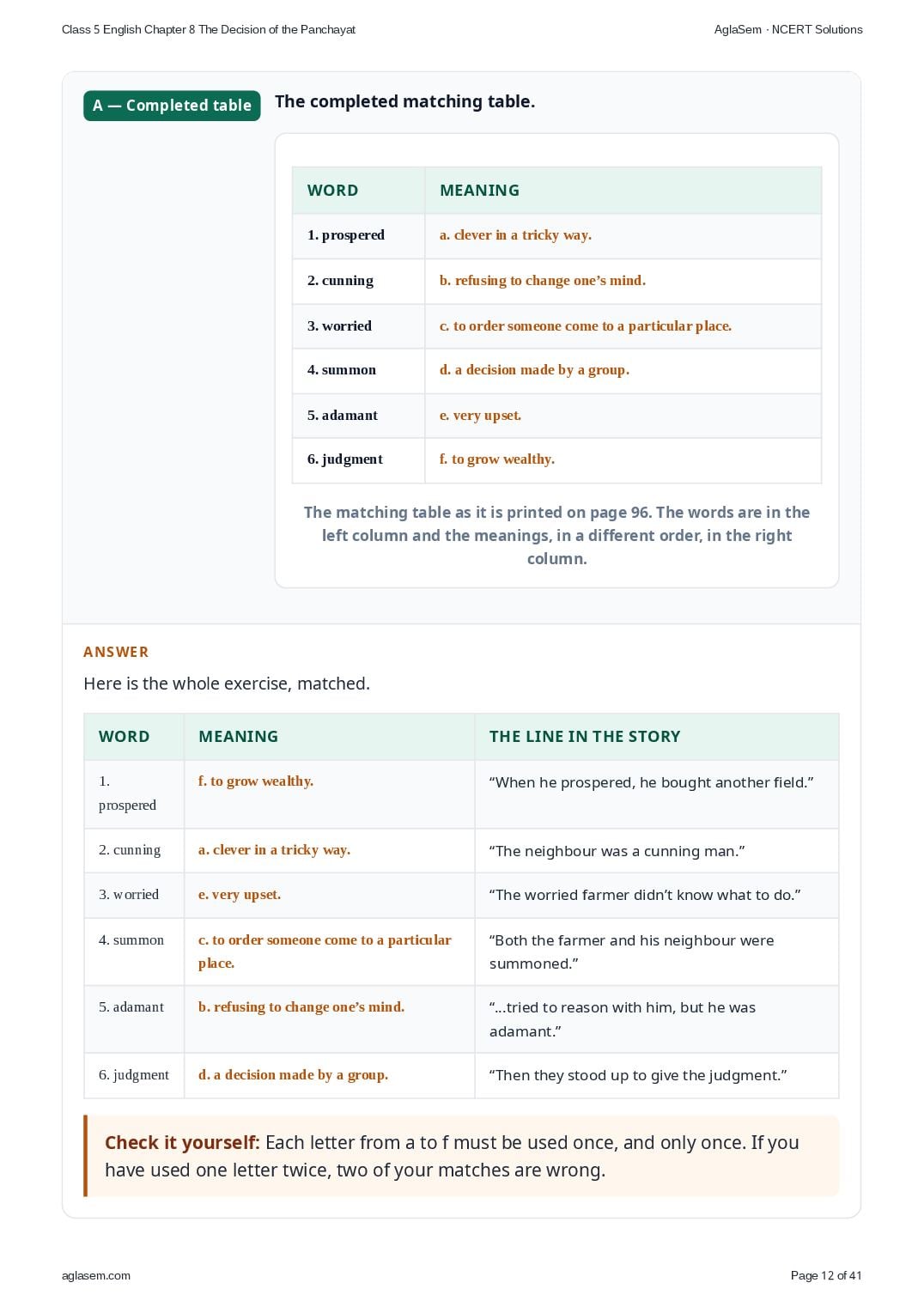
- Match the words with their meanings. 1. prospered — (a. clever in a tricky way / b. refusing to change one’s mind / c. to order someone come to a particular place / d. a decision made by a group / e. very upset / f. to grow wealthy)
- 2. cunning
- 3. worried
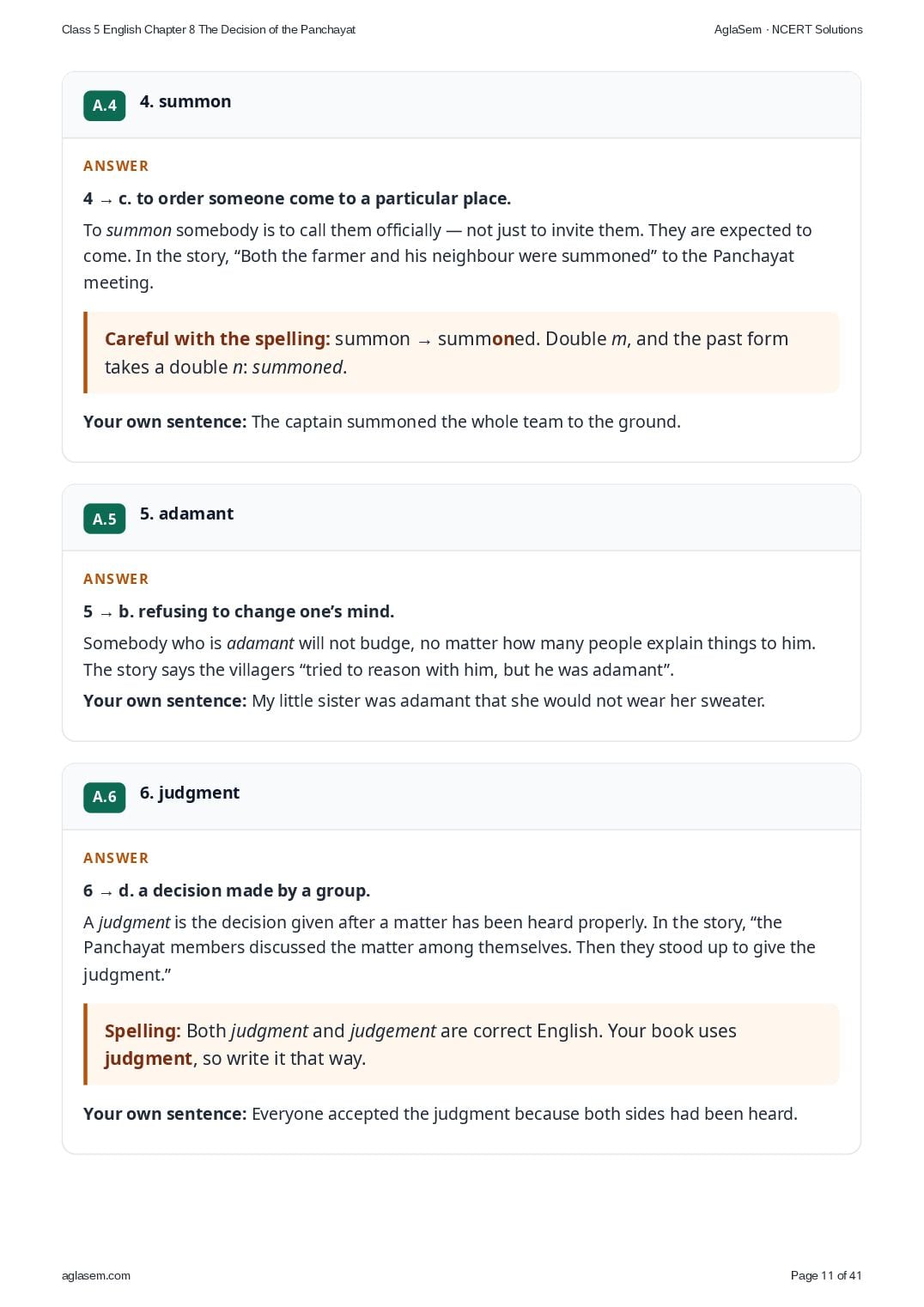
- 4. summon
- 5. adamant
- 6. judgment
- The completed matching table. WordMeaning 1. prospereda. clever in a tricky way. 2. cunningb. refusing to change one’s mind. 3. worriedc. to order someone come to a particular place. 4. summond. a decision made by a group. 5. adamante. very upset. 6. judgmentf. to grow wealthy. The matching table as it is printed on page 96. The words are in the left column and the meanings, in a different order, in the right column.
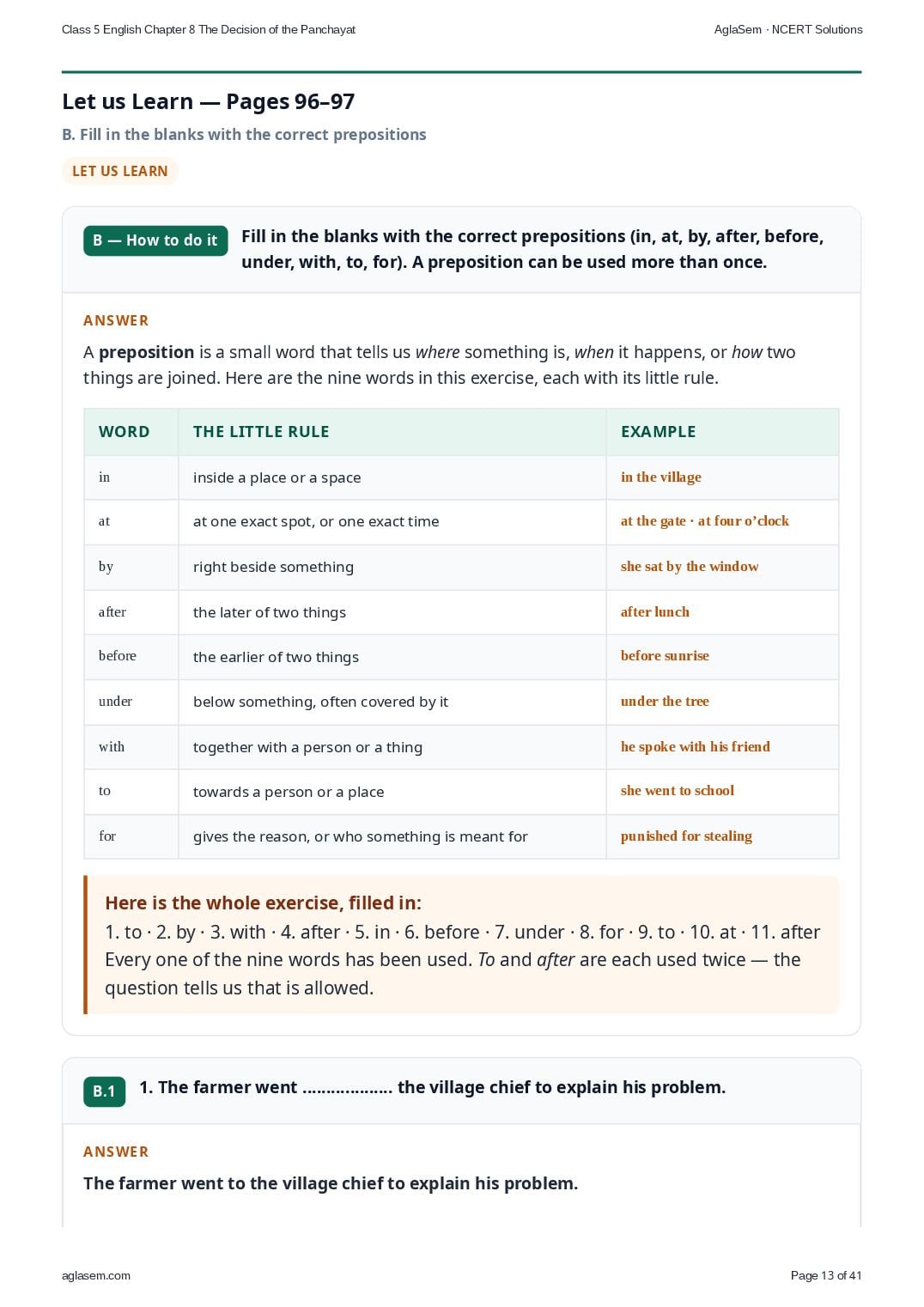
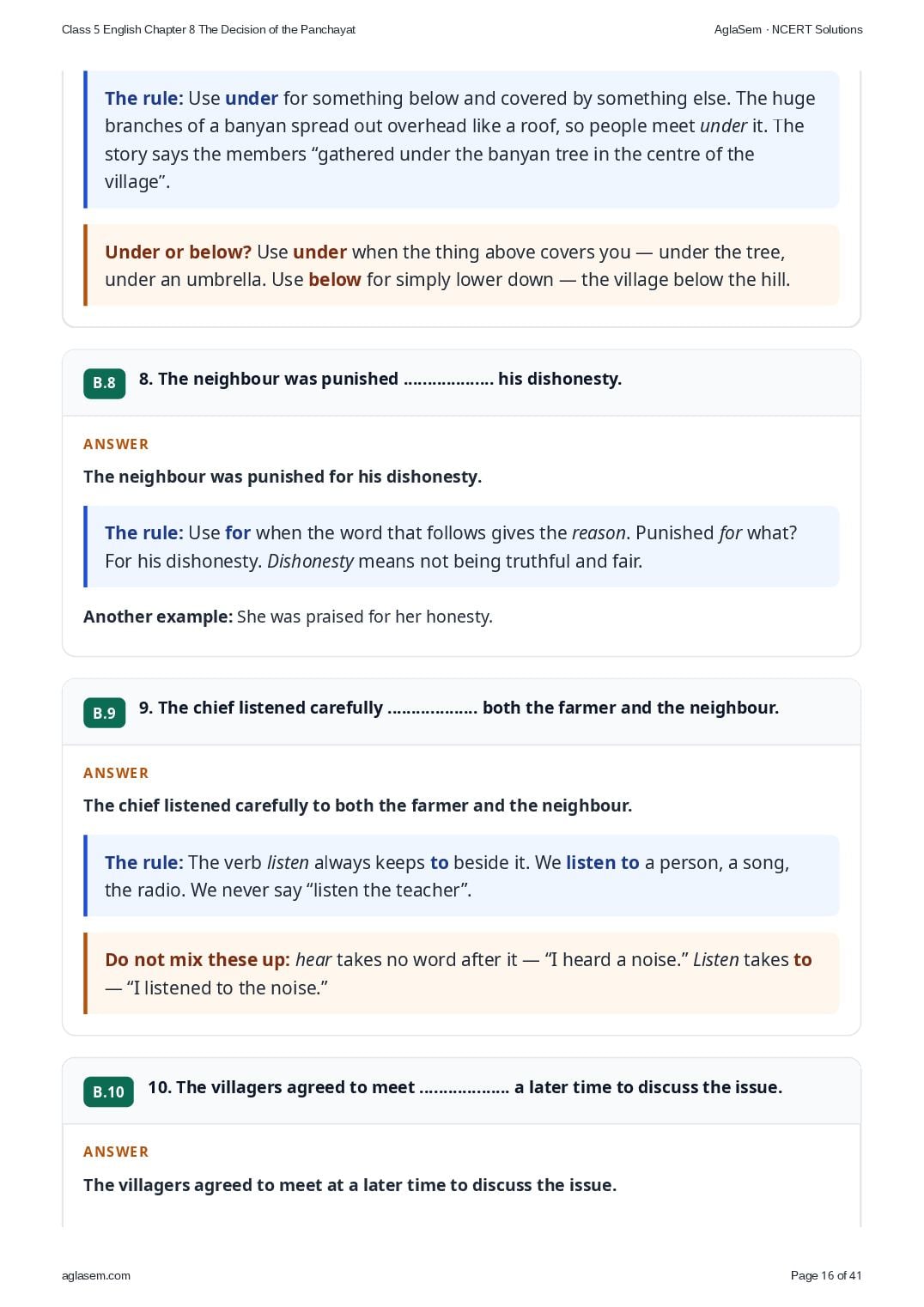
- Fill in the blanks with the correct prepositions (in, at, by, after, before, under, with, to, for). A preposition can be used more than once.
- 1. The farmer went ………………. the village chief to explain his problem.
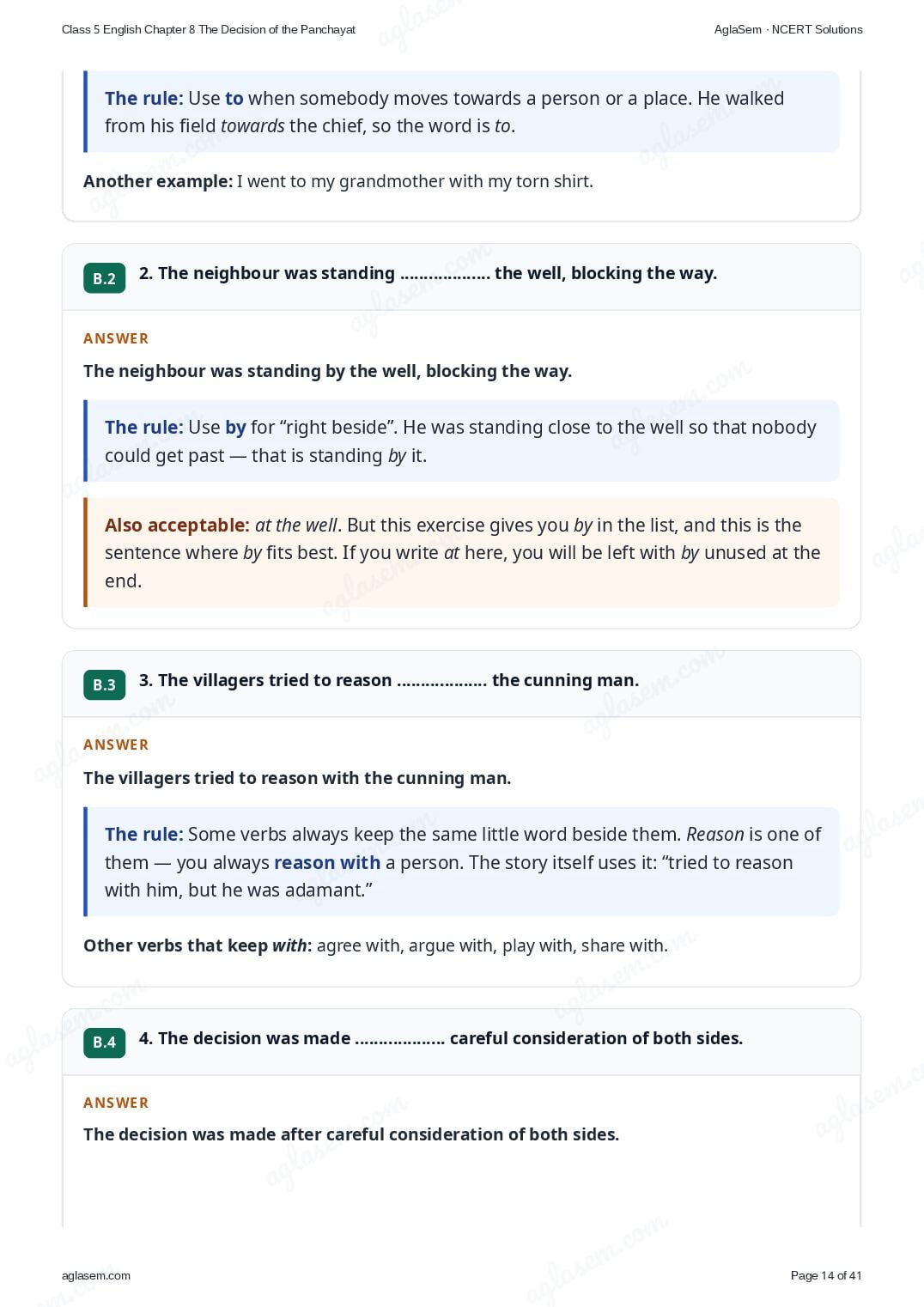
- 2. The neighbour was standing ………………. the well, blocking the way.
- 3. The villagers tried to reason ………………. the cunning man.
- 4. The decision was made ………………. careful consideration of both sides.
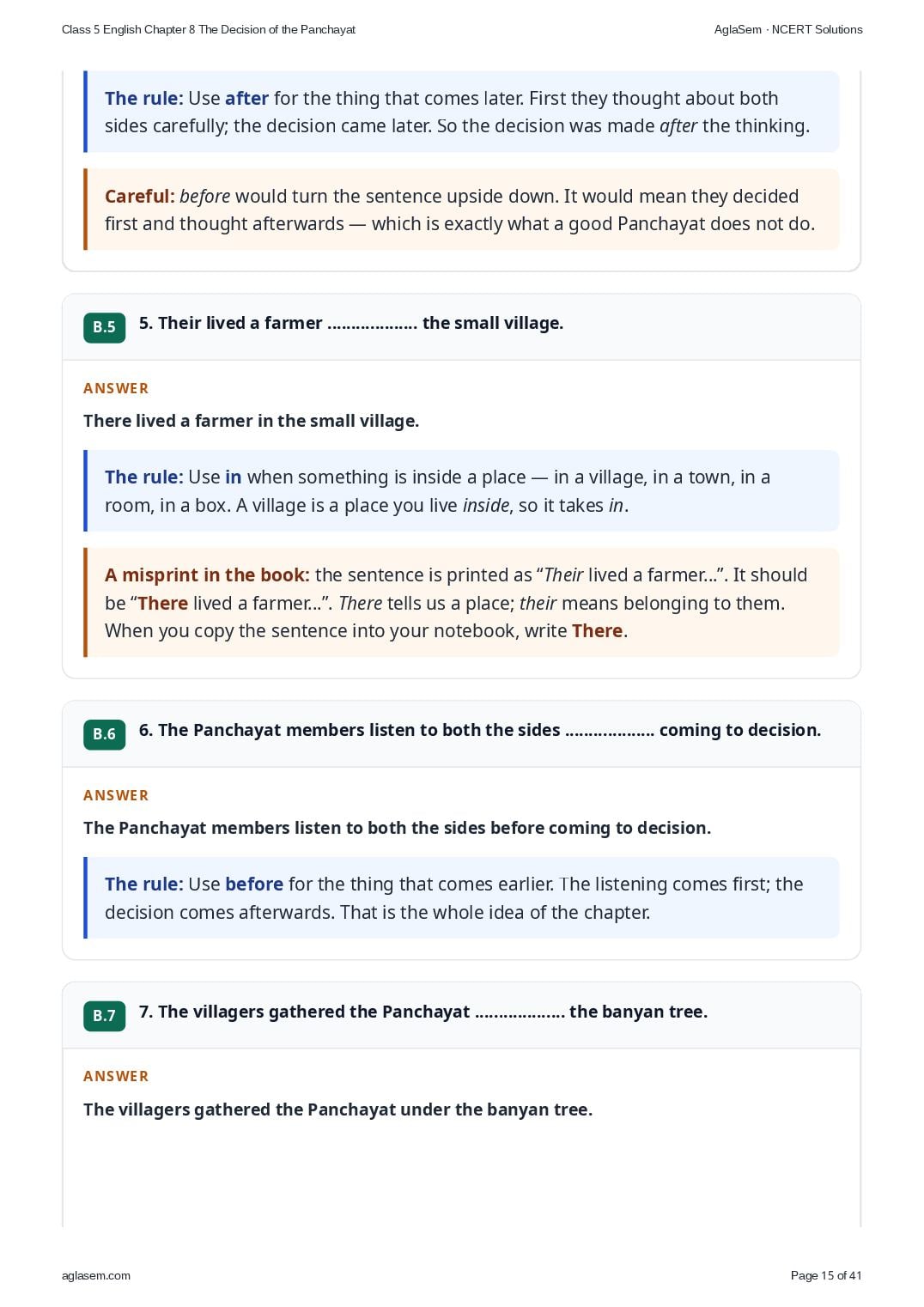
- 5. Their lived a farmer ………………. the small village.
- 6. The Panchayat members listen to both the sides ………………. coming to decision.
- 7. The villagers gathered the Panchayat ………………. the banyan tree.
- 8. The neighbour was punished ………………. his dishonesty.
- 9. The chief listened carefully ………………. both the farmer and the neighbour.
- 10. The villagers agreed to meet ………………. a later time to discuss the issue.
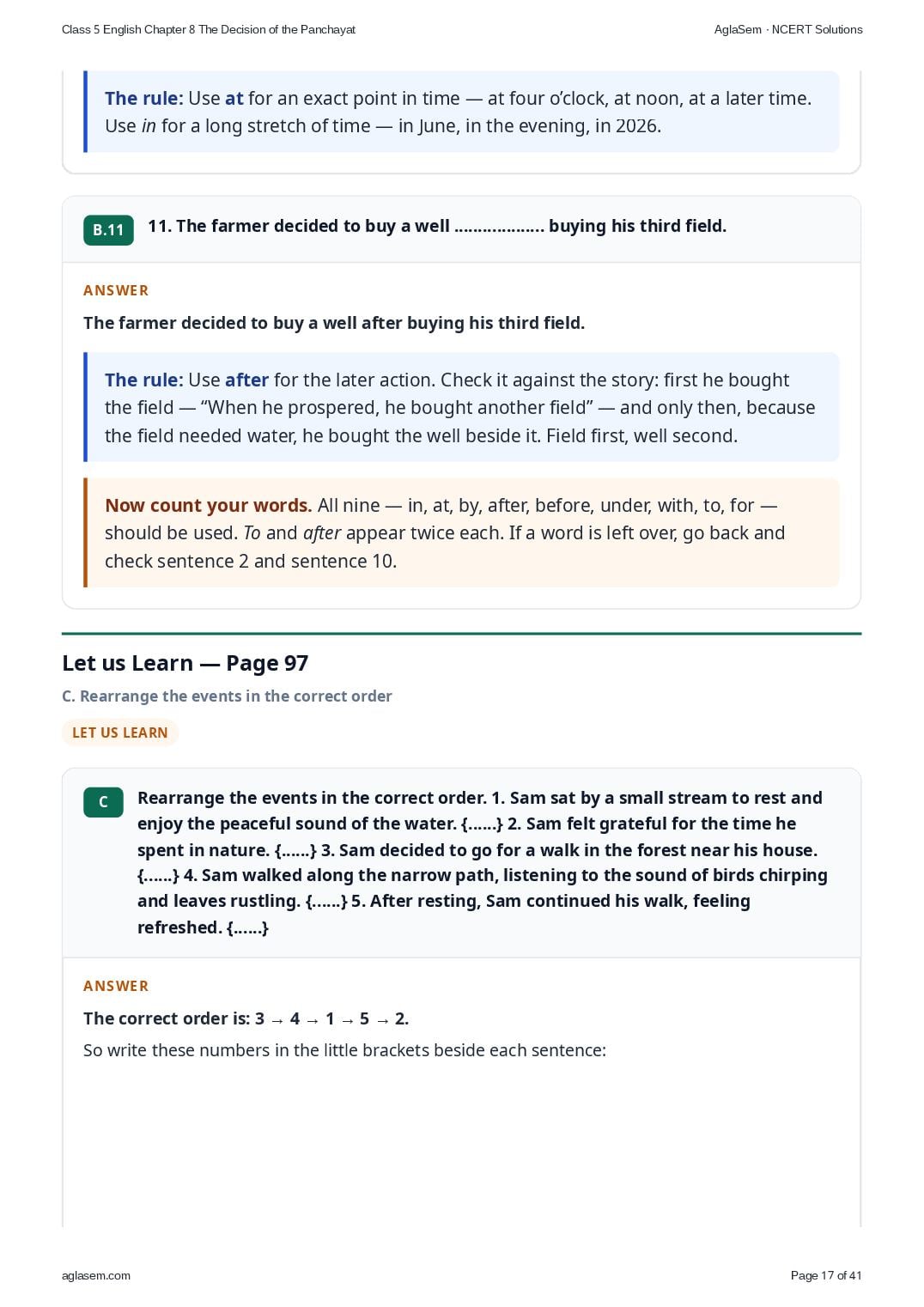
- 11. The farmer decided to buy a well ………………. buying his third field.
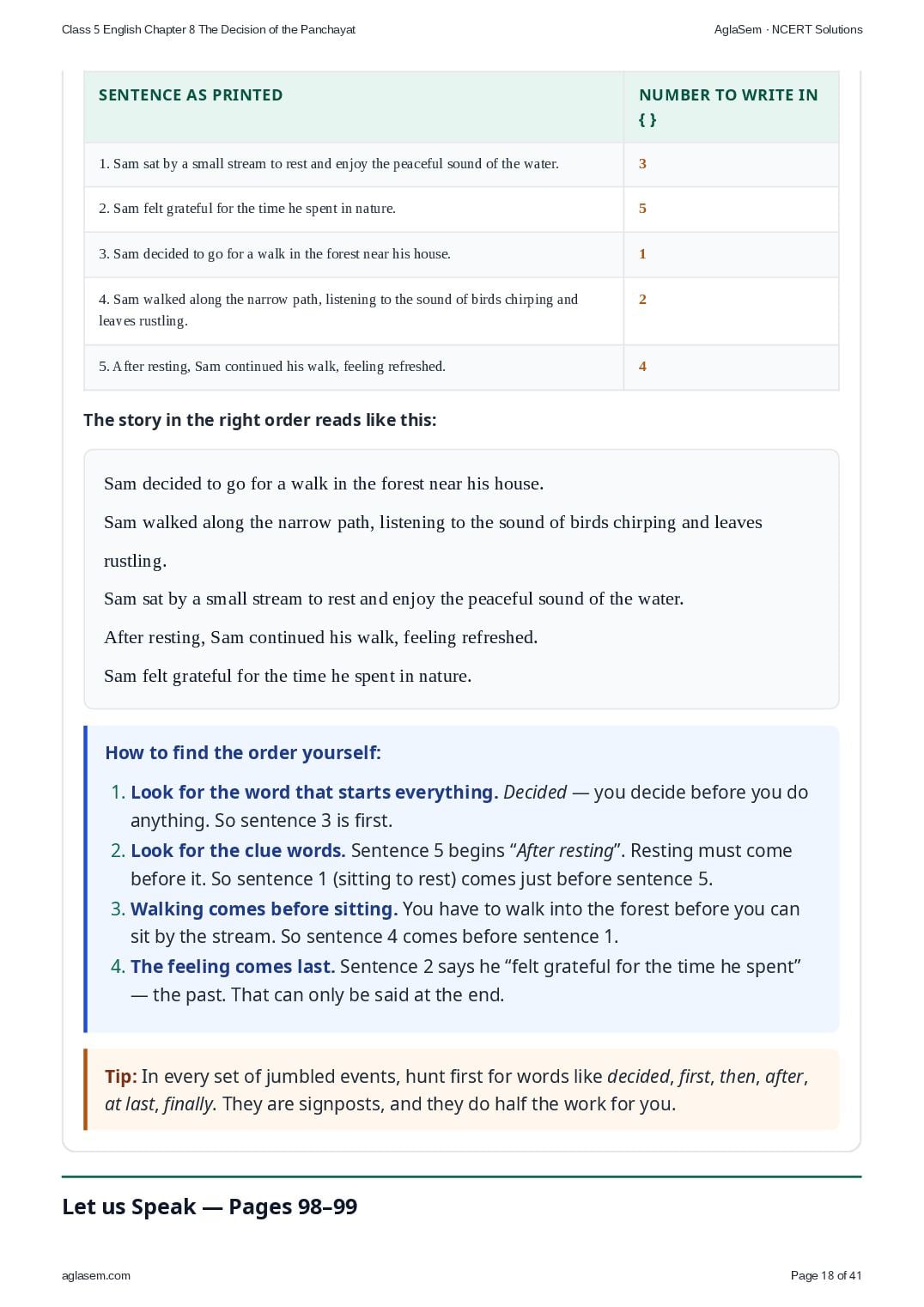
- Rearrange the events in the correct order. 1. Sam sat by a small stream to rest and enjoy the peaceful sound of the water. {……} 2. Sam felt grateful for the time he spent in nature. {……} 3. Sam decided to go for a walk in the forest near his house. {……} 4. Sam walked along the narrow path, listening to the sound of birds chirping and leaves rustling. {……} 5. After resting, Sam continued his walk, feeling refreshed. {……}
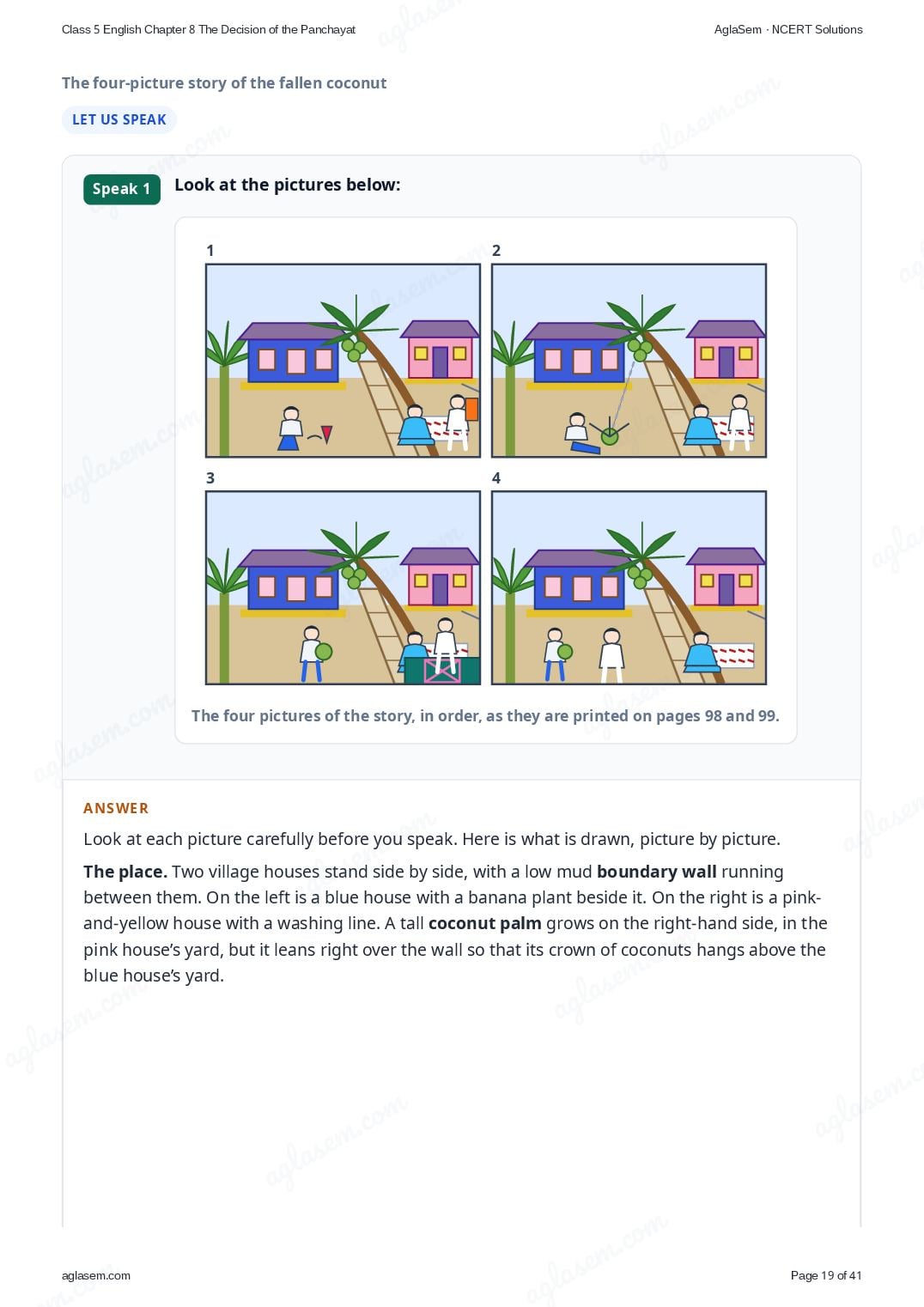
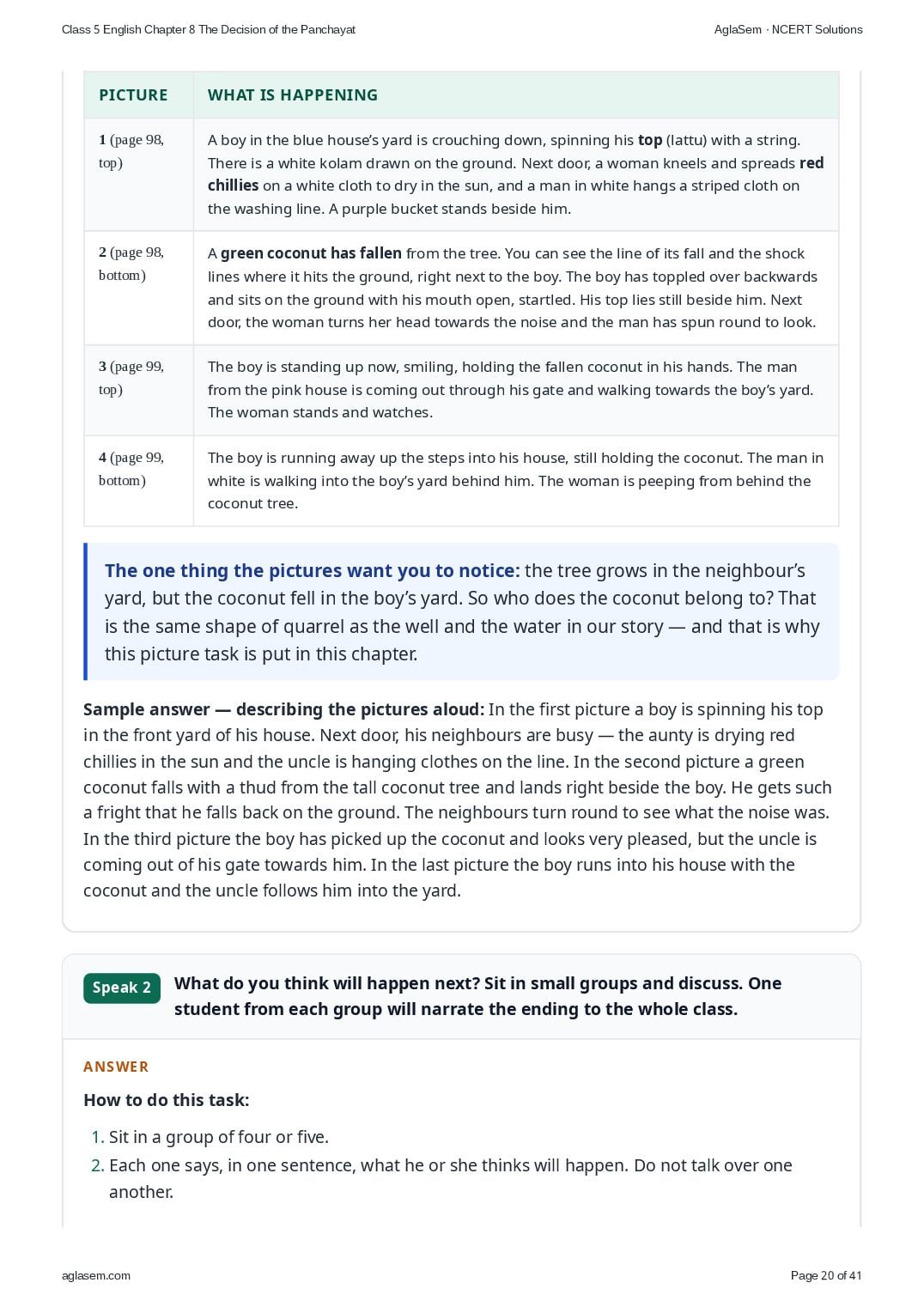
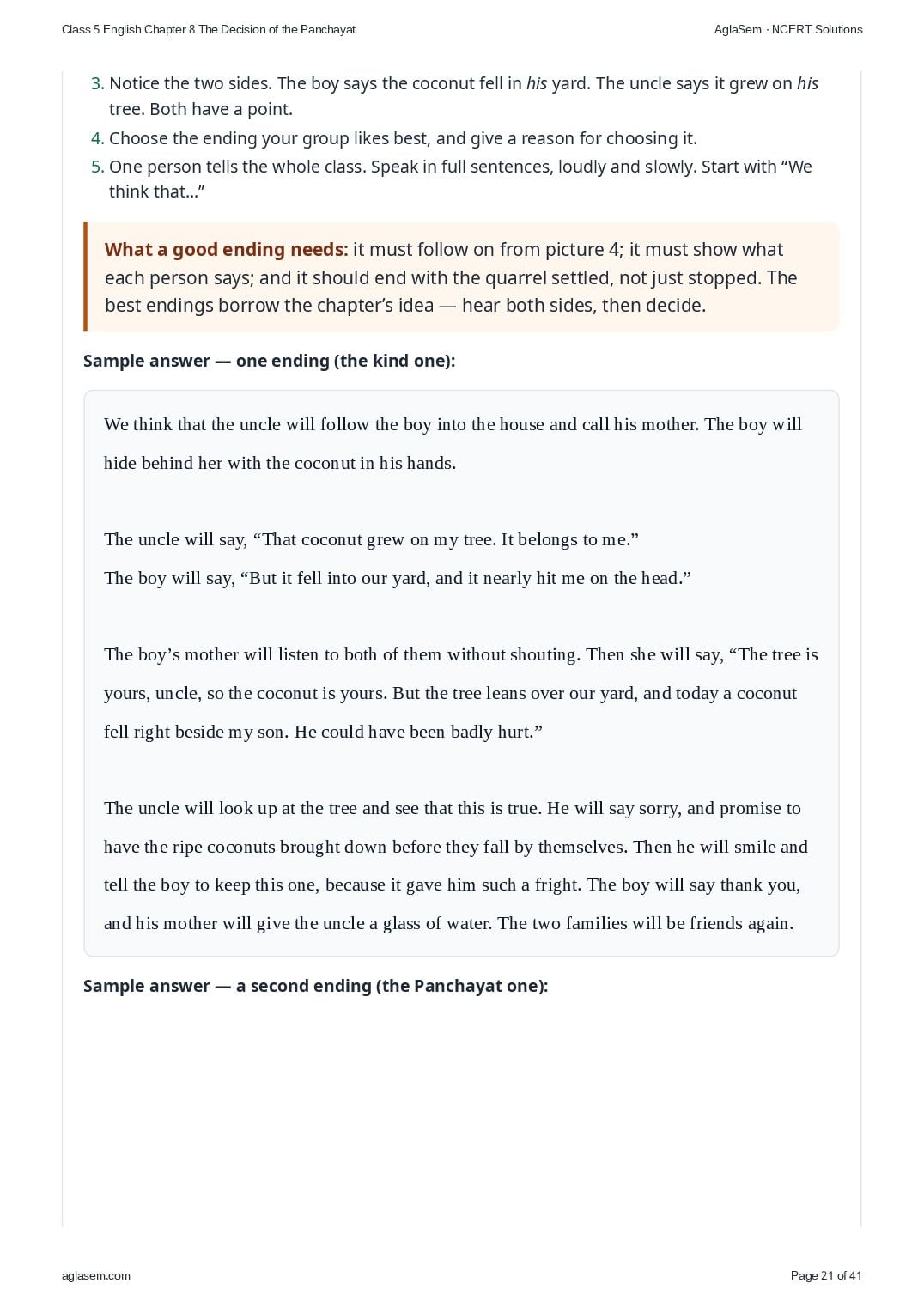
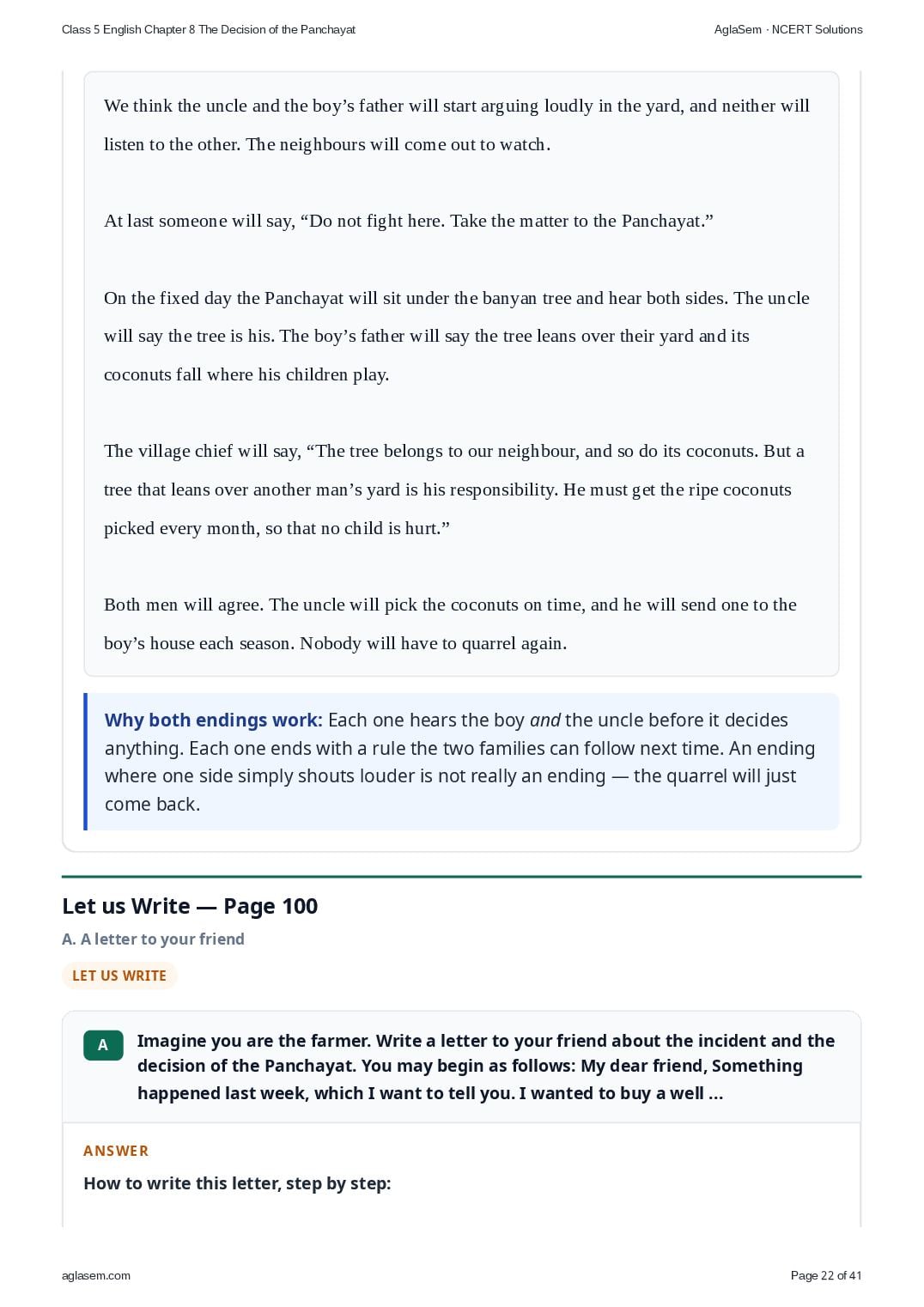
- Look at the pictures below: The four pictures printed on pages 98 and 99 1 2 3 4 The four pictures of the story, in order, as they are printed on pages 98 and 99.
- What do you think will happen next? Sit in small groups and discuss. One student from each group will narrate the ending to the whole class.
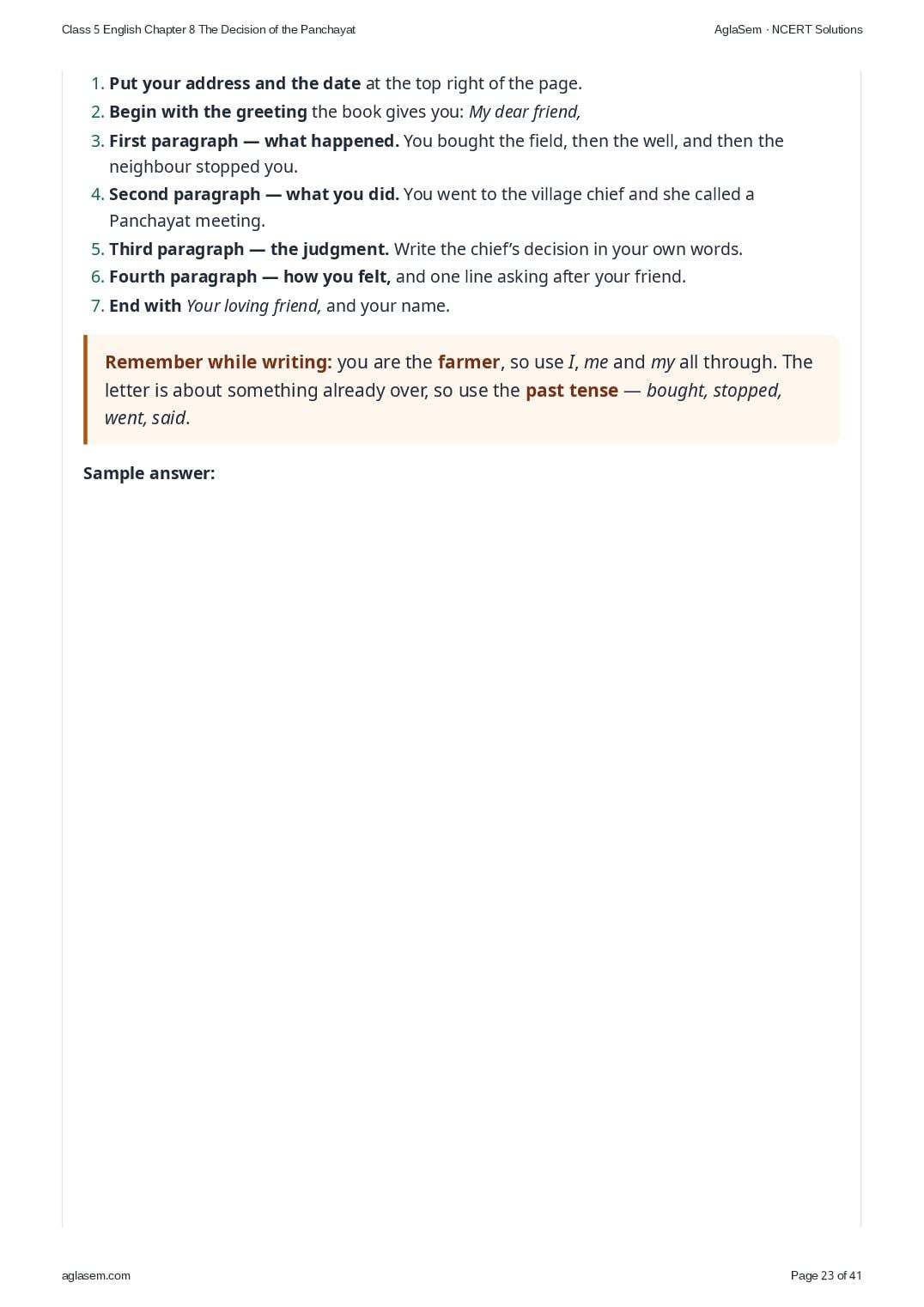
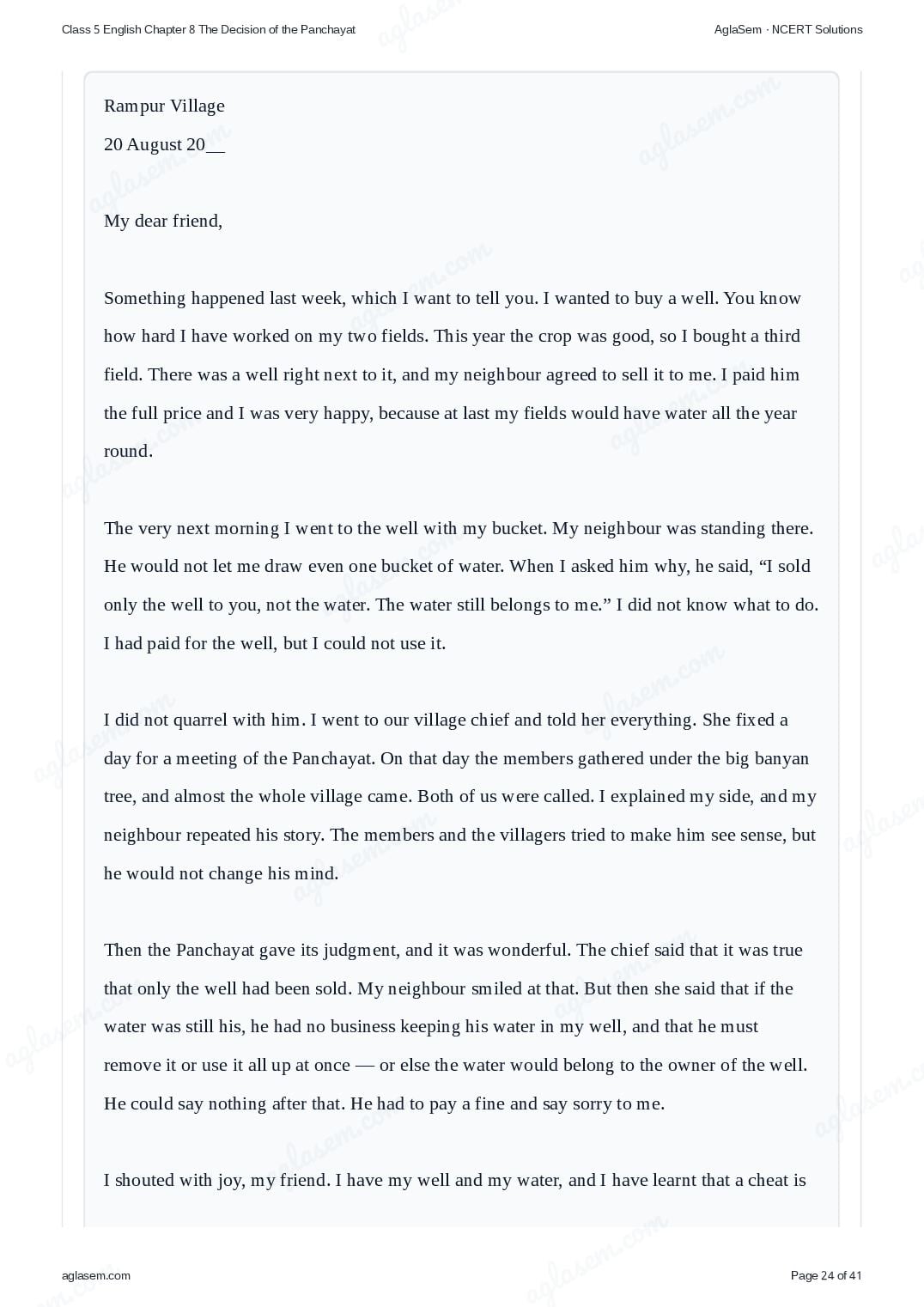
- Imagine you are the farmer. Write a letter to your friend about the incident and the decision of the Panchayat. You may begin as follows: My dear friend, Something happened last week, which I want to tell you. I wanted to buy a well …
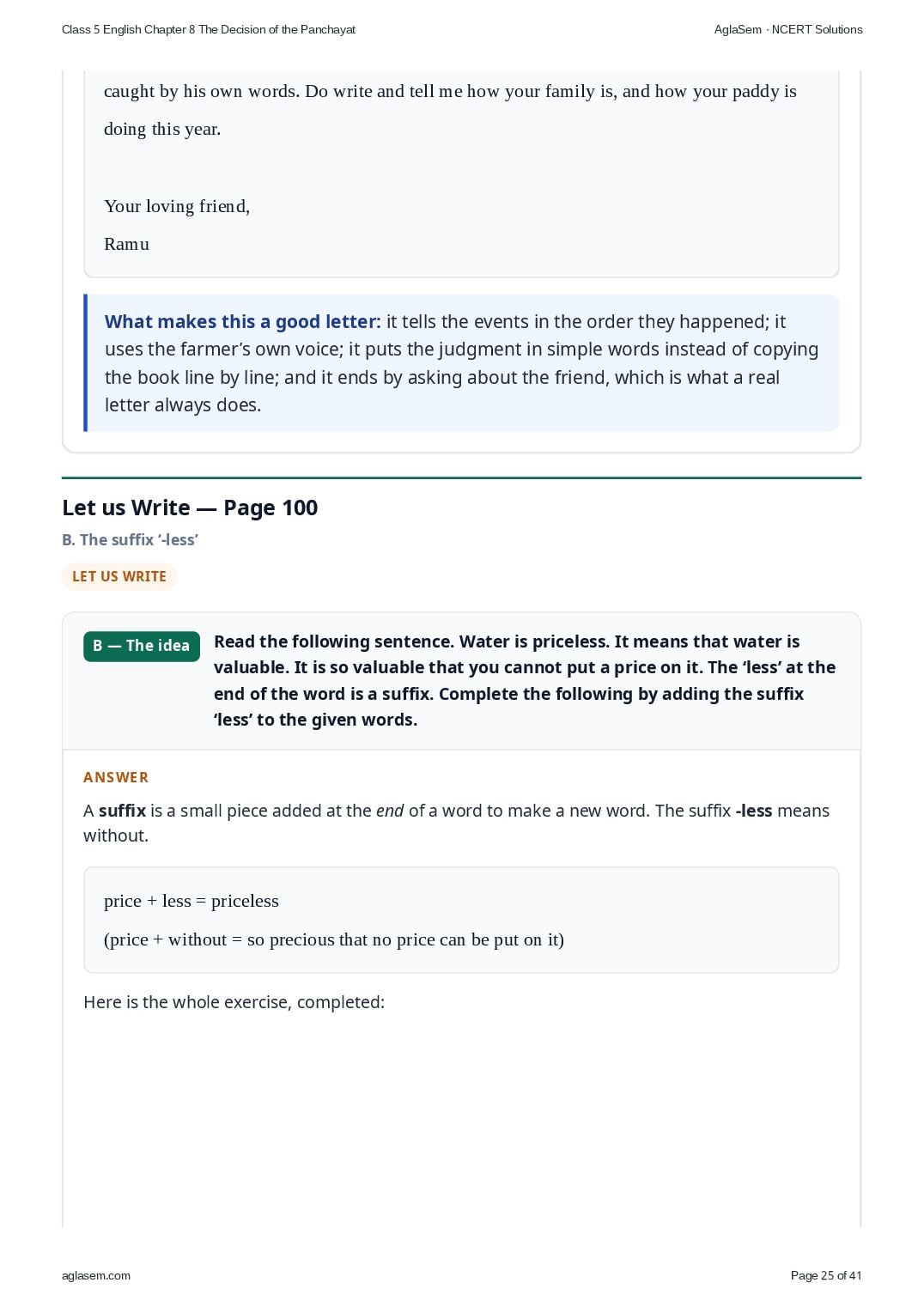
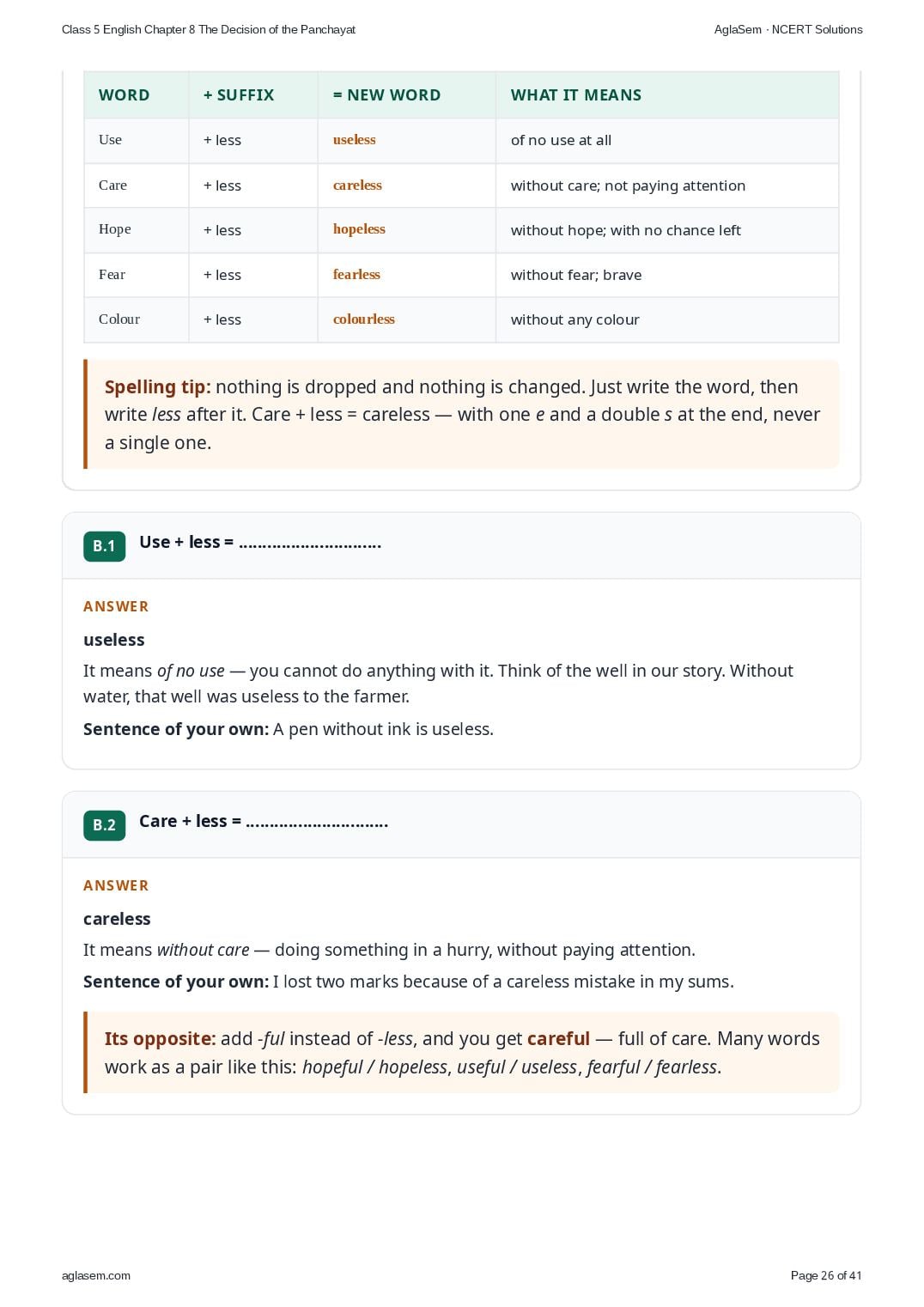
- Read the following sentence. Water is priceless. It means that water is valuable. It is so valuable that you cannot put a price on it. The ‘less’ at the end of the word is a suffix. Complete the following by adding the suffix ‘less’ to the given words.
- Use + less = …………………………
- Care + less = …………………………
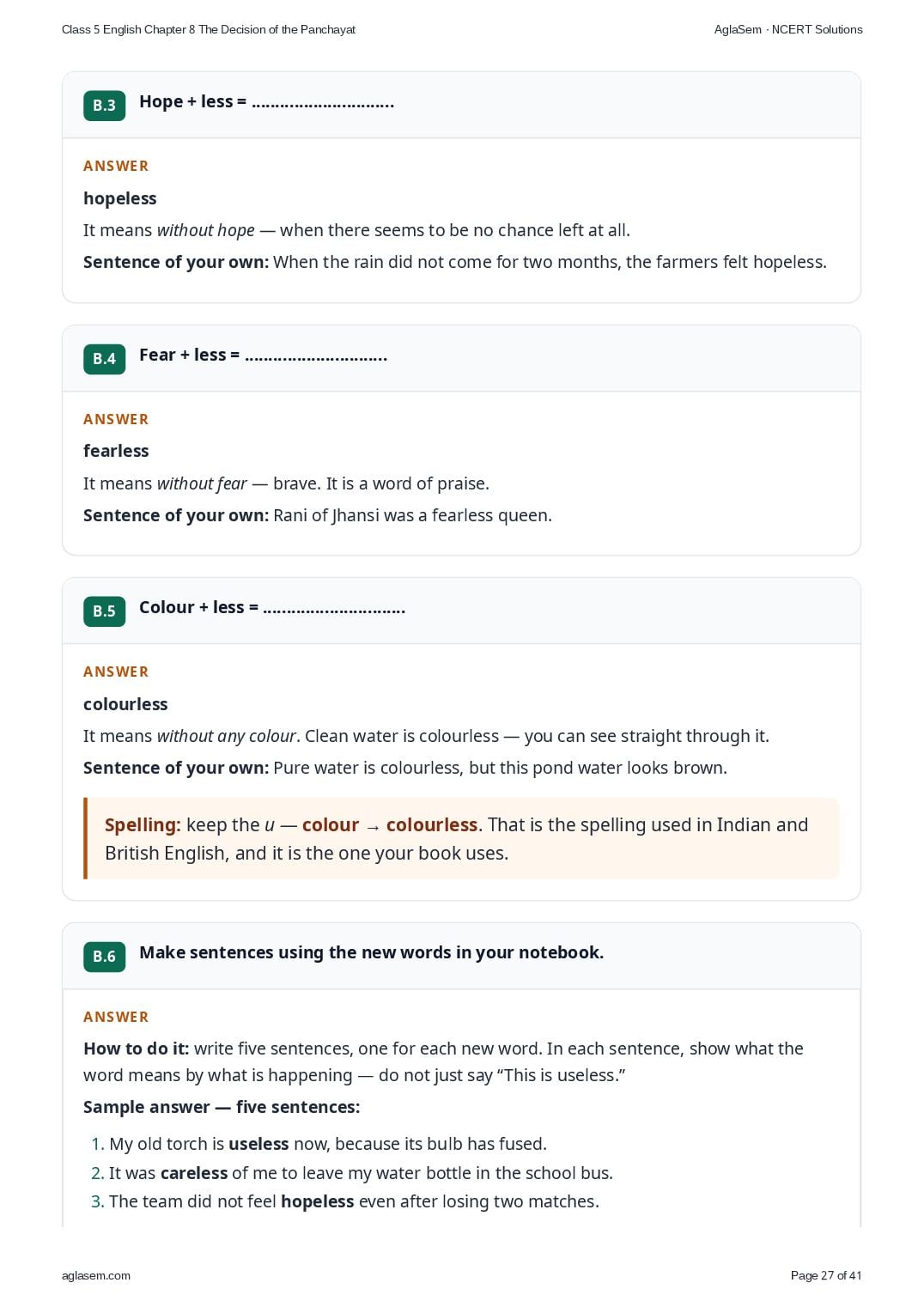
- Hope + less = …………………………
- Fear + less = …………………………
- Colour + less = …………………………
- Make sentences using the new words in your notebook.
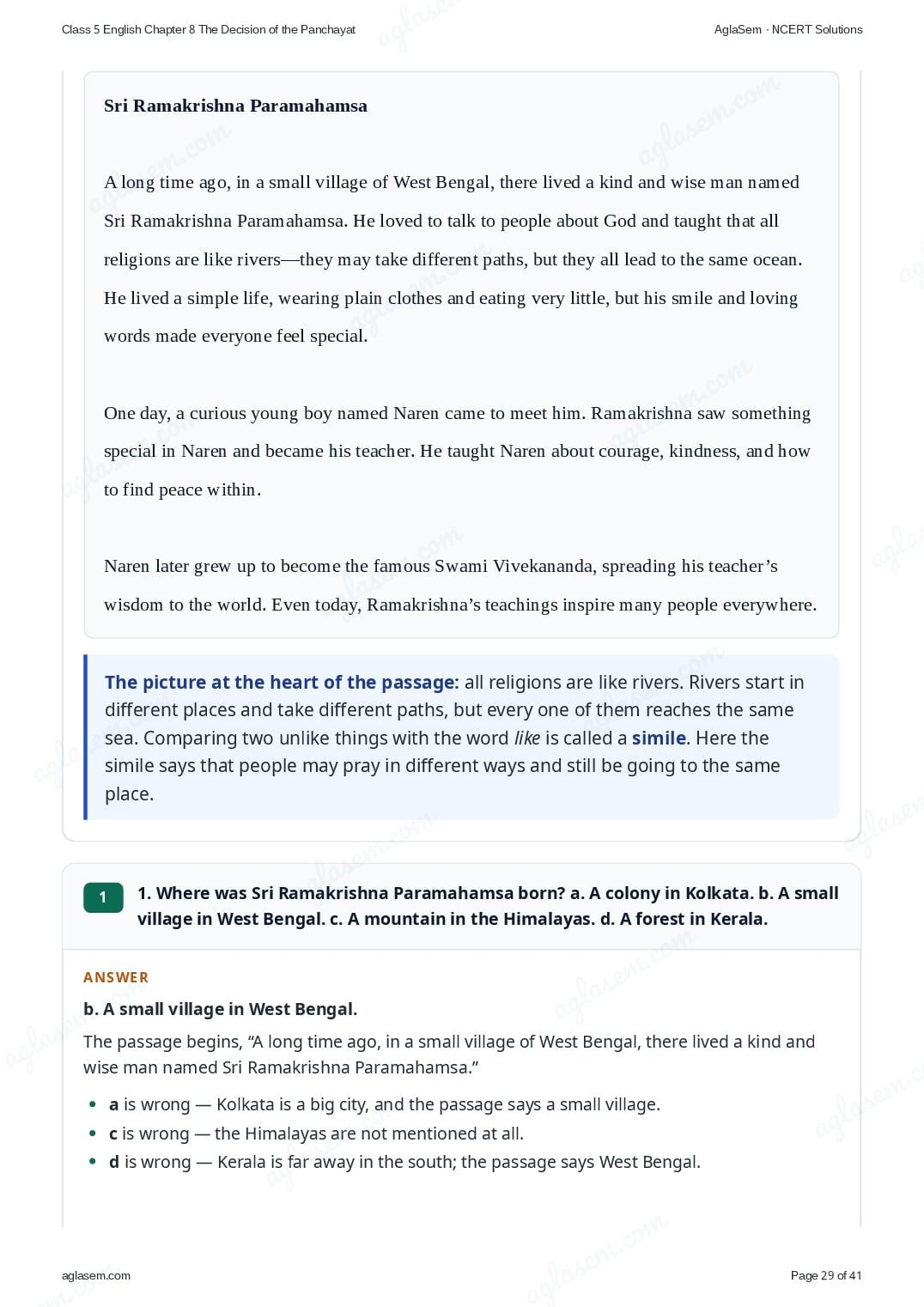
- Listen to your teacher read out this passage and answer the questions by choosing the correct option. Sri Ramakrishna Paramahamsa
- 1. Where was Sri Ramakrishna Paramahamsa born? a. A colony in Kolkata. b. A small village in West Bengal. c. A mountain in the Himalayas. d. A forest in Kerala.
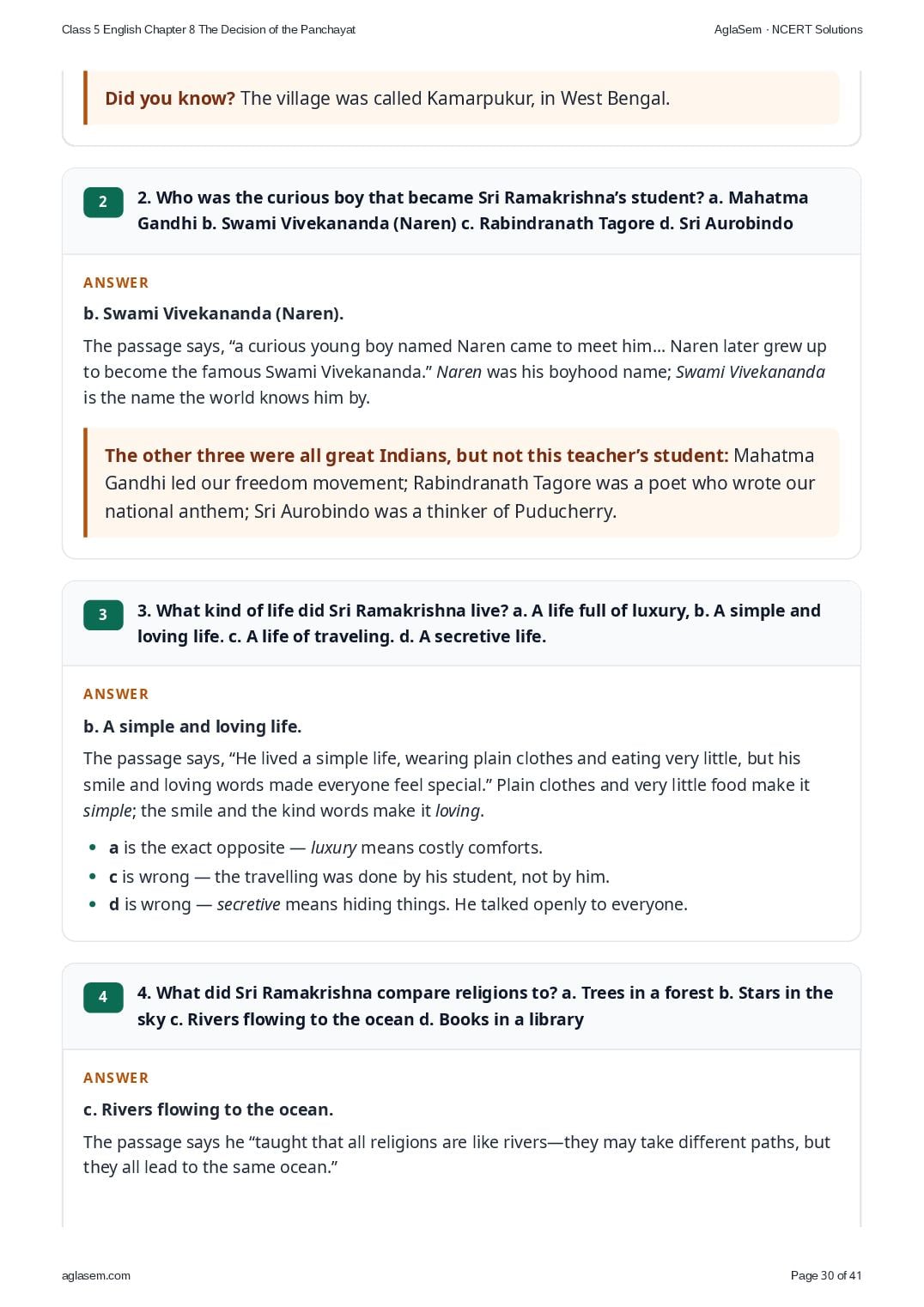
- 2. Who was the curious boy that became Sri Ramakrishna’s student? a. Mahatma Gandhi b. Swami Vivekananda (Naren) c. Rabindranath Tagore d. Sri Aurobindo
- 3. What kind of life did Sri Ramakrishna live? a. A life full of luxury, b. A simple and loving life. c. A life of traveling. d. A secretive life.
- 4. What did Sri Ramakrishna compare religions to? a. Trees in a forest b. Stars in the sky c. Rivers flowing to the ocean d. Books in a library
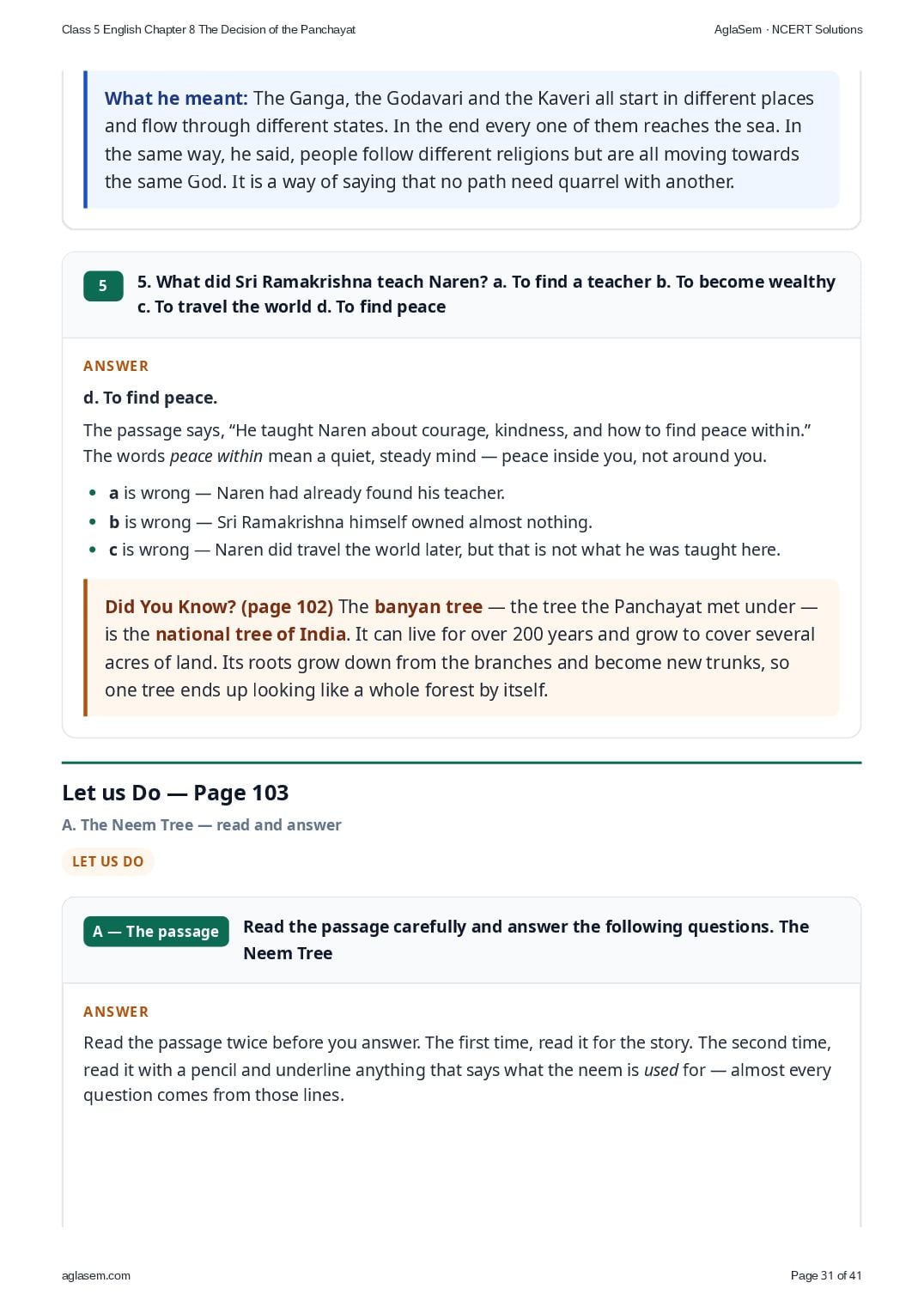
- 5. What did Sri Ramakrishna teach Naren? a. To find a teacher b. To become wealthy c. To travel the world d. To find peace
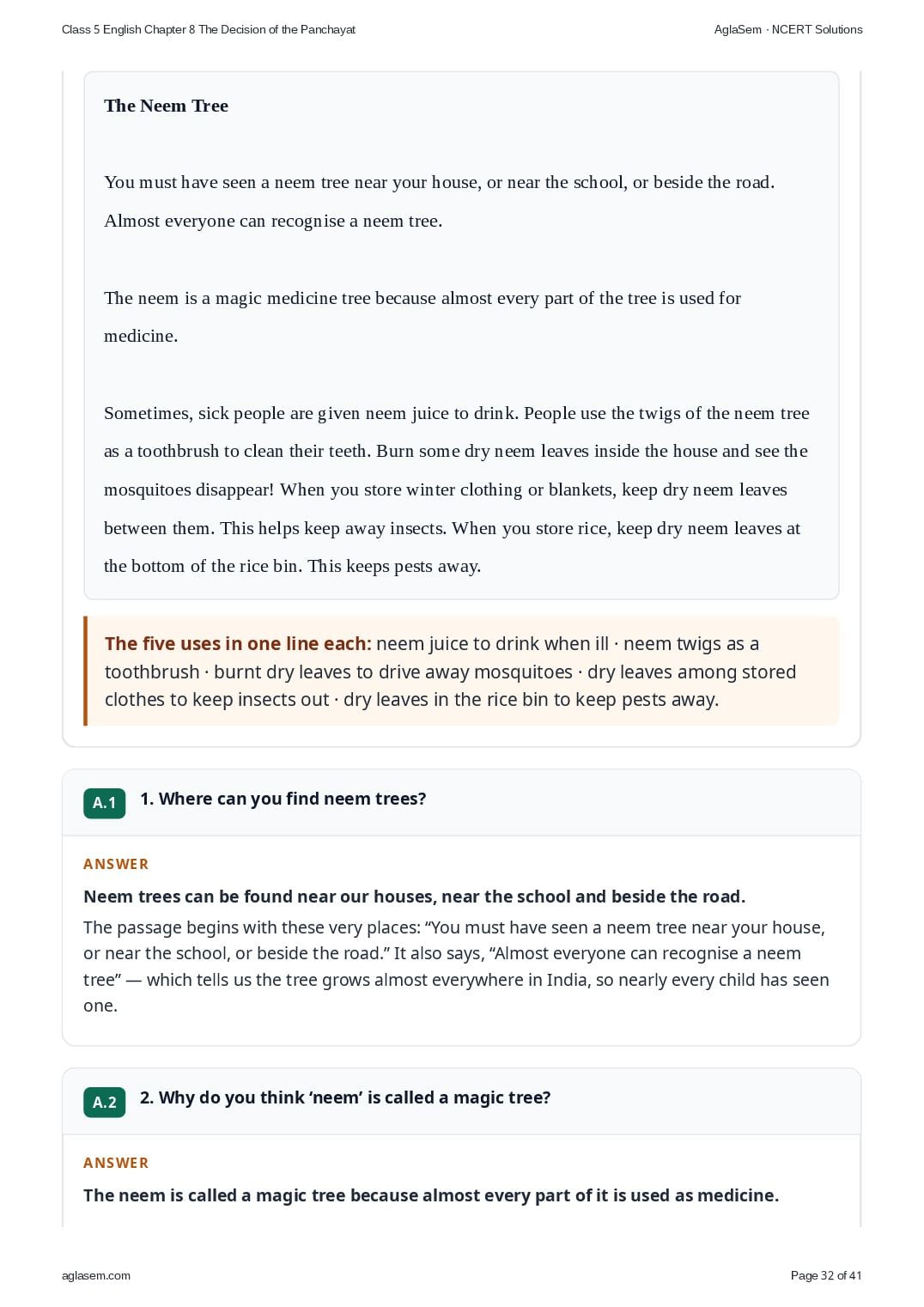
- Read the passage carefully and answer the following questions. The Neem Tree
- 1. Where can you find neem trees?
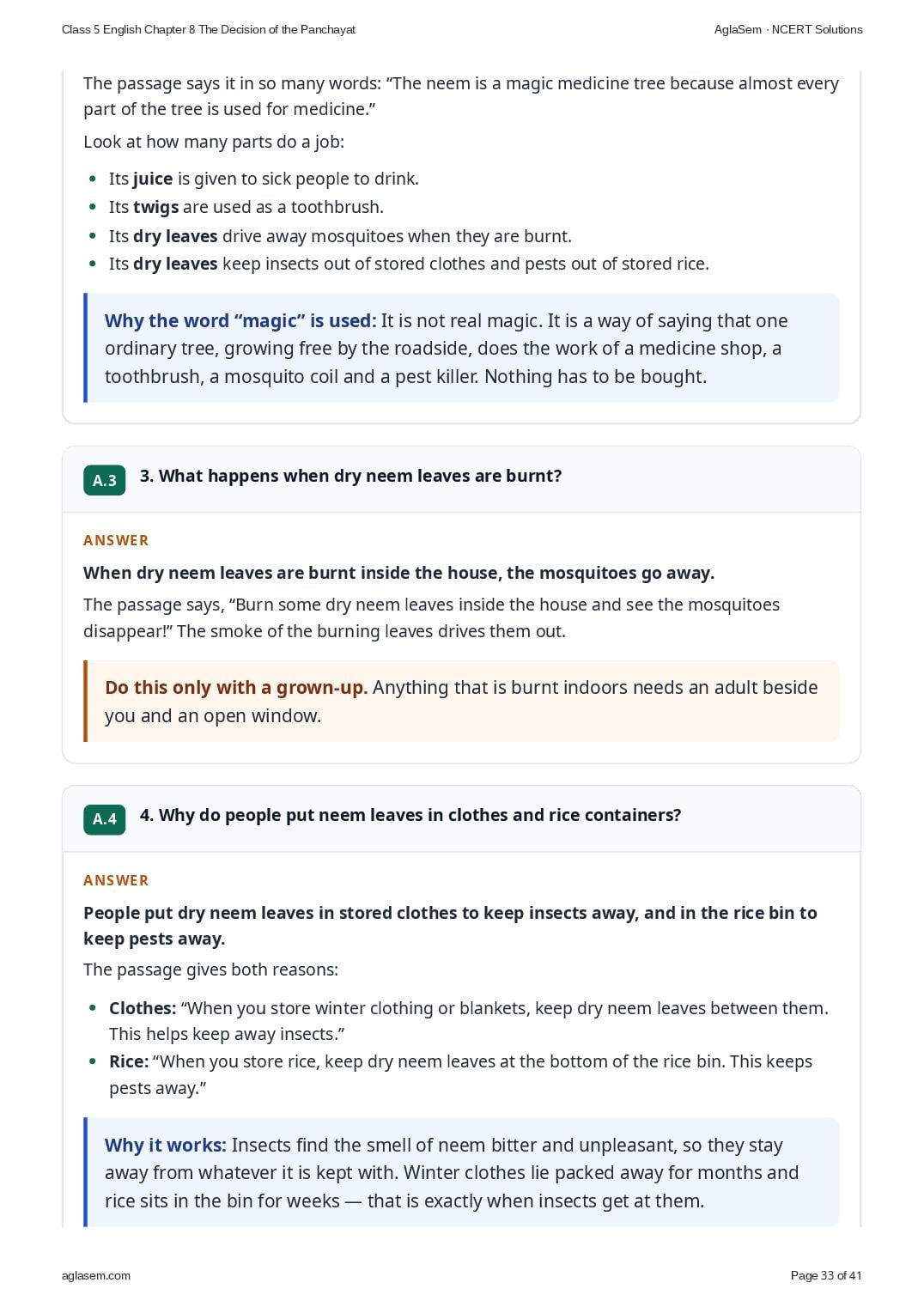
- 2. Why do you think ‘neem’ is called a magic tree?
- 3. What happens when dry neem leaves are burnt?
- 4. Why do people put neem leaves in clothes and rice containers?
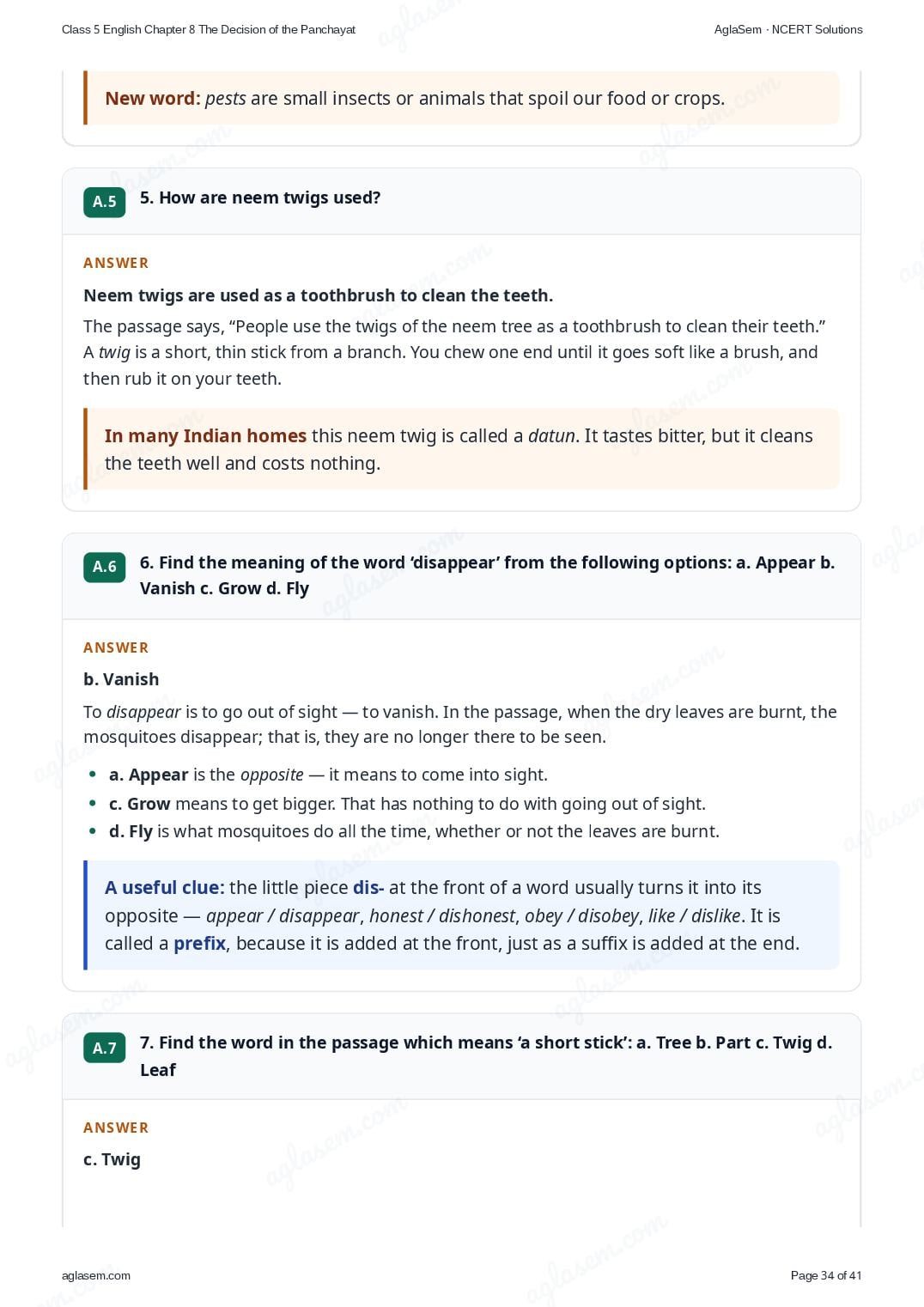
- 5. How are neem twigs used?
- 6. Find the meaning of the word ‘disappear’ from the following options: a. Appear b. Vanish c. Grow d. Fly
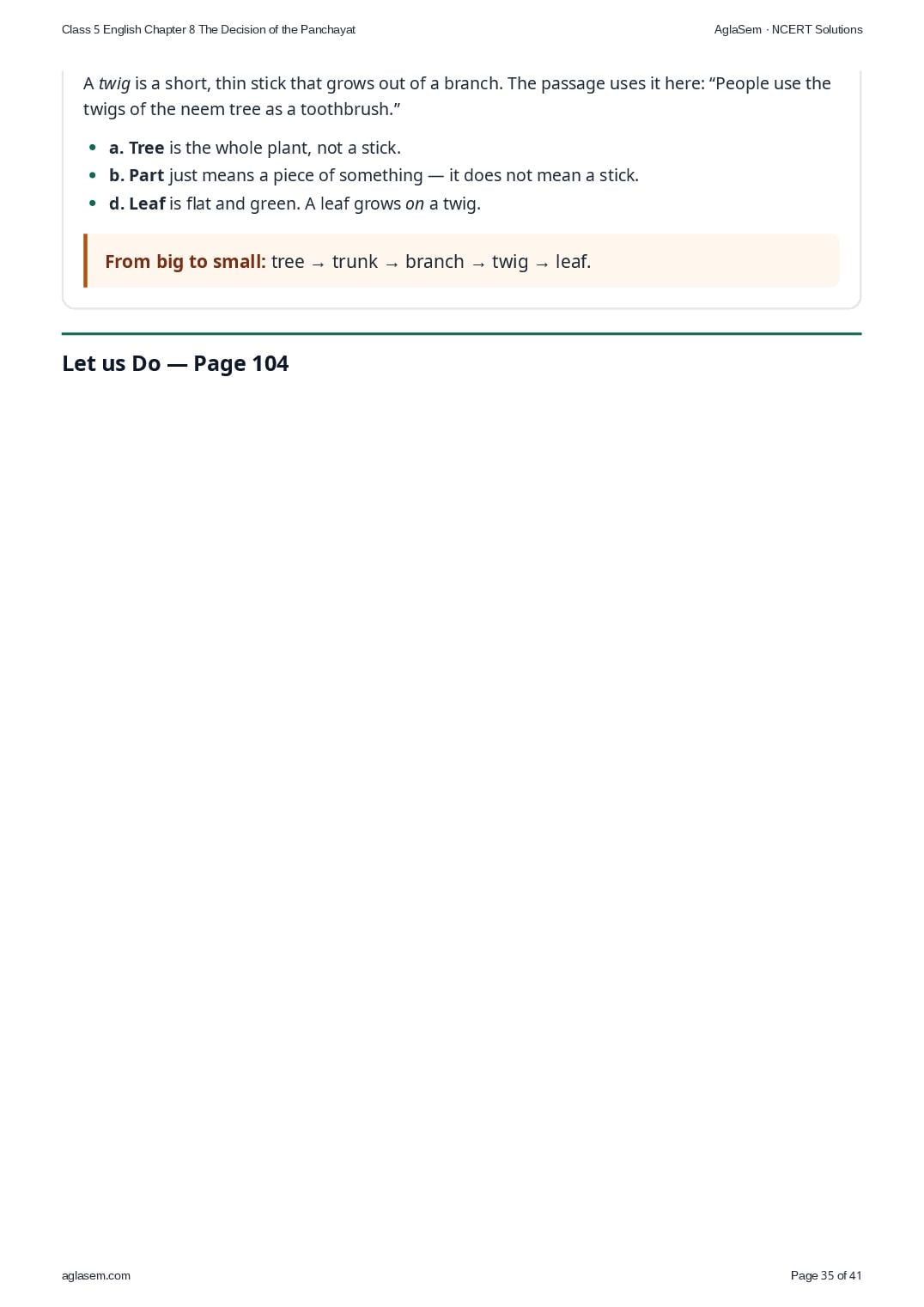
- 7. Find the word in the passage which means ‘a short stick’: a. Tree b. Part c. Twig d. Leaf
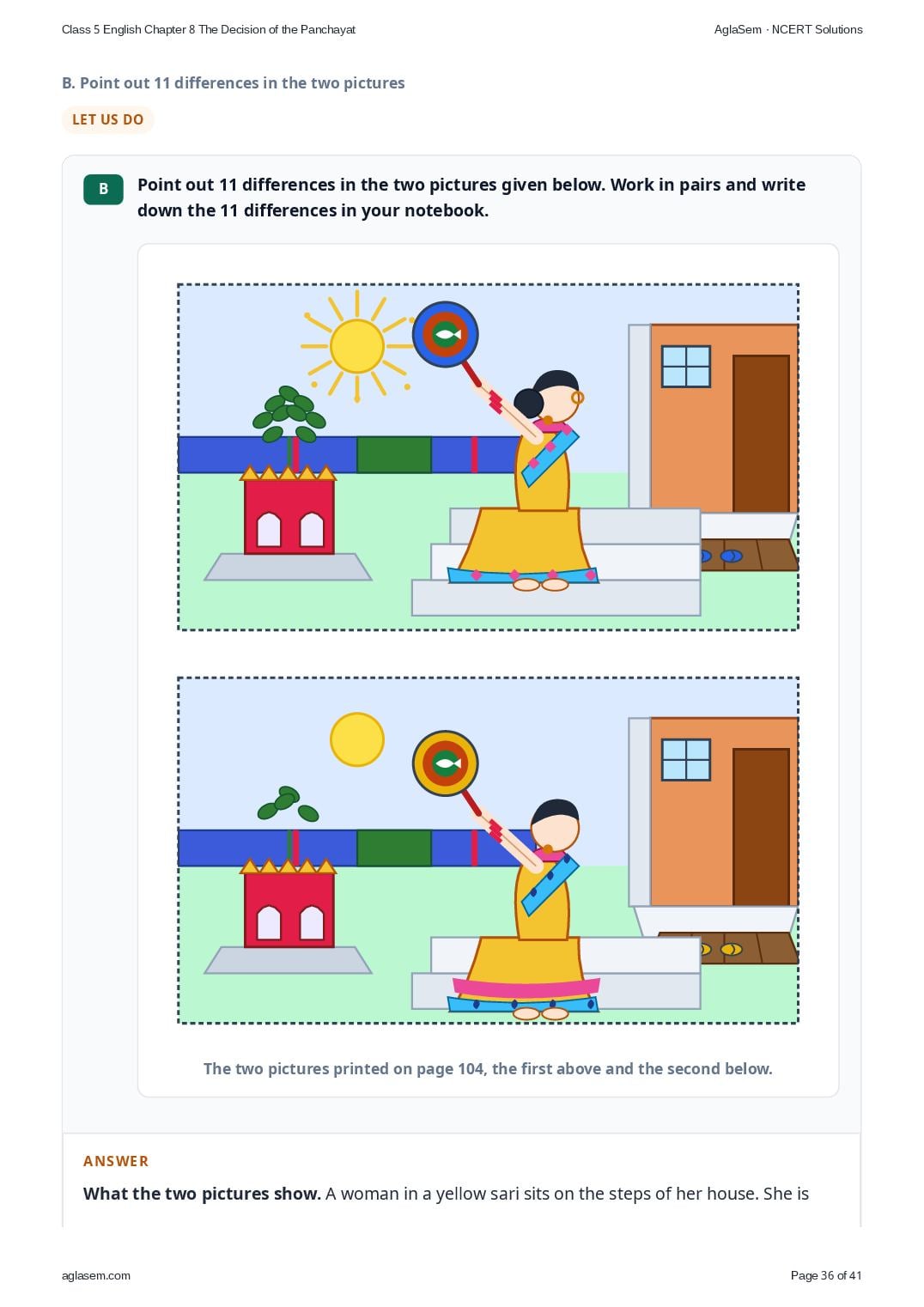
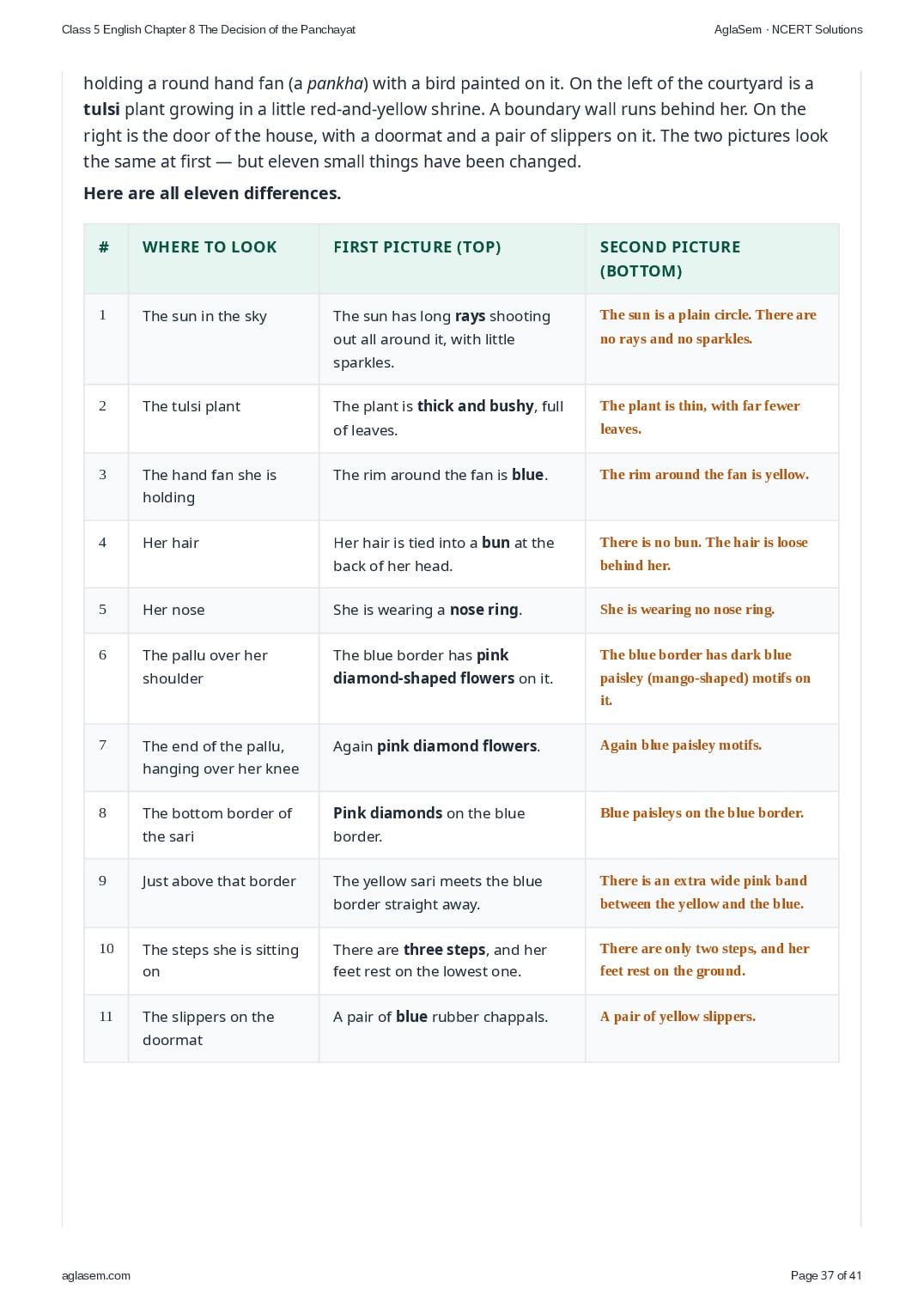
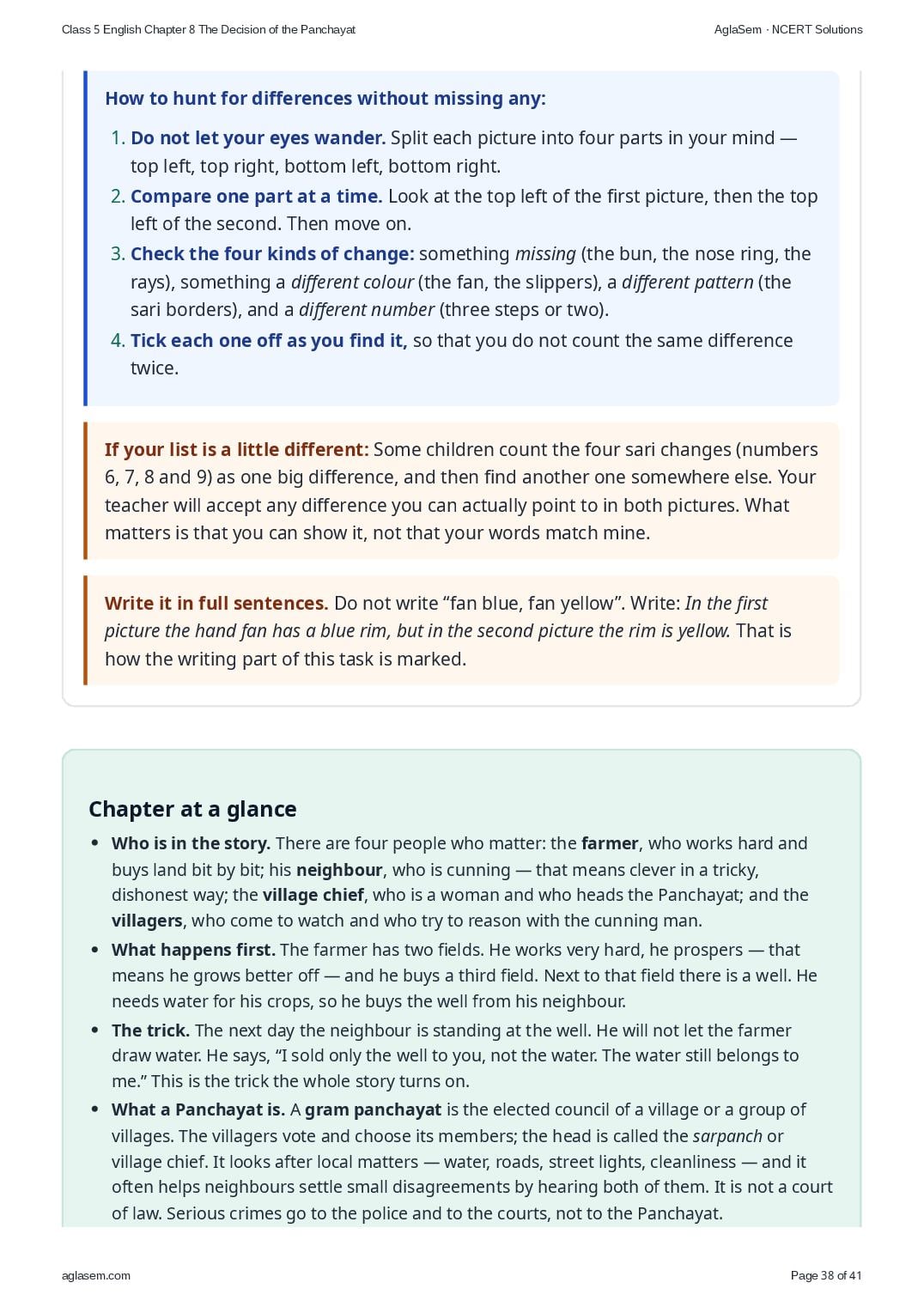
- Point out 11 differences in the two pictures given below. Work in pairs and write down the 11 differences in your notebook. The two almost-alike pictures printed on page 104 The two pictures printed on page 104, the first above and the second below.
Chapter at a Glance
- Who is in the story. There are four people who matter: the farmer, who works hard and buys land bit by bit; his neighbour, who is cunning — that means clever in a tricky, dishonest way; the village chief, who is a woman and who heads the Panchayat; and the villagers, who come to watch and who try to reason with the cunning man.
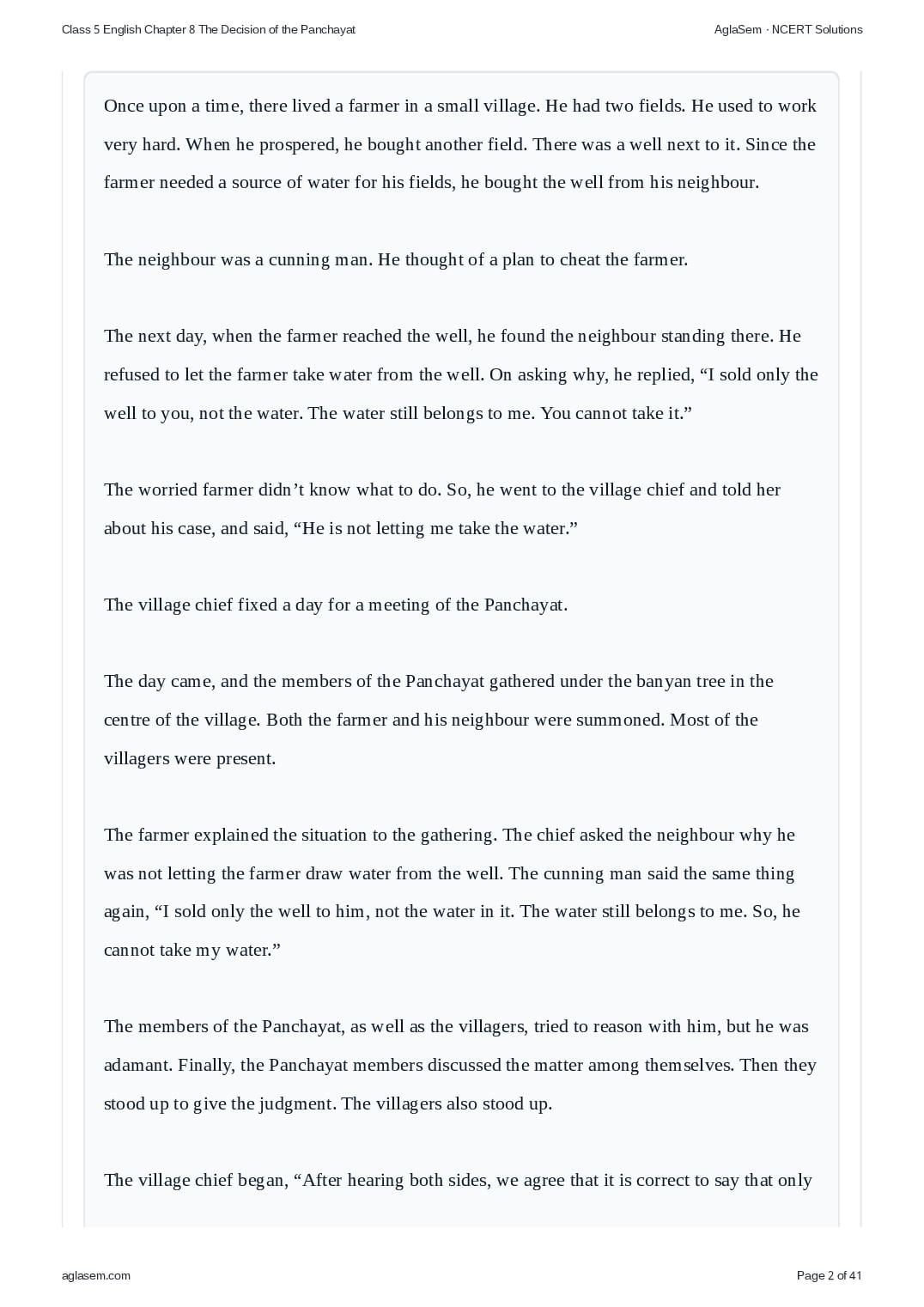
- What happens first. The farmer has two fields. He works very hard, he prospers — that means he grows better off — and he buys a third field. Next to that field there is a well. He needs water for his crops, so he buys the well from his neighbour.
- The trick. The next day the neighbour is standing at the well. He will not let the farmer draw water. He says, “I sold only the well to you, not the water. The water still belongs to me.” This is the trick the whole story turns on.
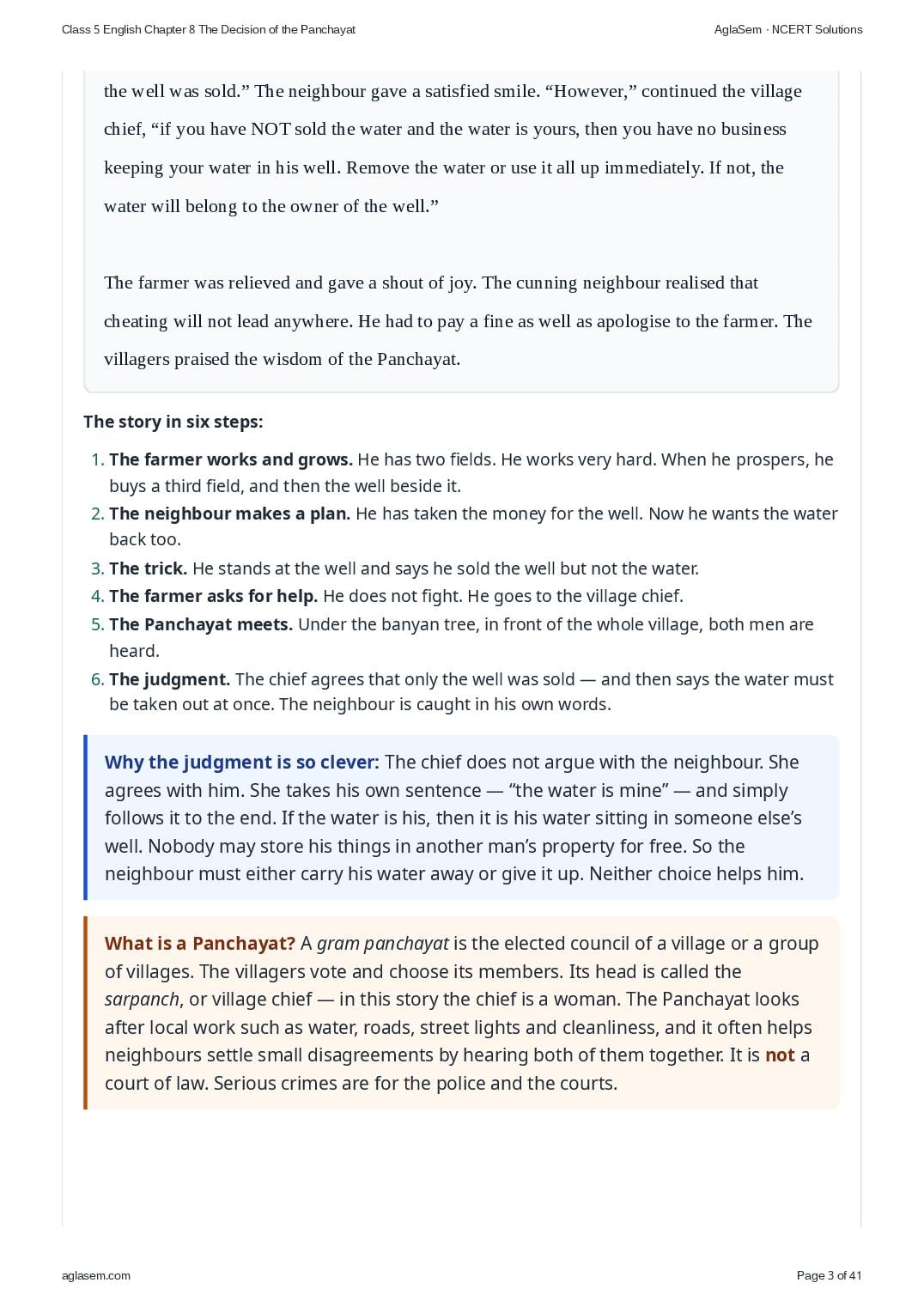
- What a Panchayat is. A gram panchayat is the elected council of a village or a group of villages. The villagers vote and choose its members; the head is called the sarpanch or village chief. It looks after local matters — water, roads, street lights, cleanliness — and it often helps neighbours settle small disagreements by hearing both of them. It is not a court of law. Serious crimes go to the police and to the courts, not to the Panchayat.
- The meeting. The village chief fixes a day. The Panchayat members gather under the banyan tree in the centre of the village. Both men are summoned — that means ordered to come. Most of the villagers are there too, so everything is said in the open where everyone can hear it.
- Both sides are heard. The farmer explains what happened. The neighbour repeats his claim word for word. The members and the villagers try to reason with him, but he is adamant — he refuses to change his mind. Only then do the members talk among themselves and stand up to give the judgment.
- The judgment. The chief agrees with the neighbour on one point: it is true that only the well was sold. The neighbour smiles. Then comes the turn: if the water is still his, he has no business storing his water in another man’s well. He must remove it or use it up at once — and if he does not, the water belongs to the owner of the well. His own argument is turned around and used against him.
- How it ends, and what it means. The farmer shouts with joy. The neighbour has to pay a fine and apologise. The villagers praise the wisdom of the Panchayat. The lesson is plain: cheating leads nowhere, and a fair decision is one that listens to both sides first and then follows the argument all the way to the end.
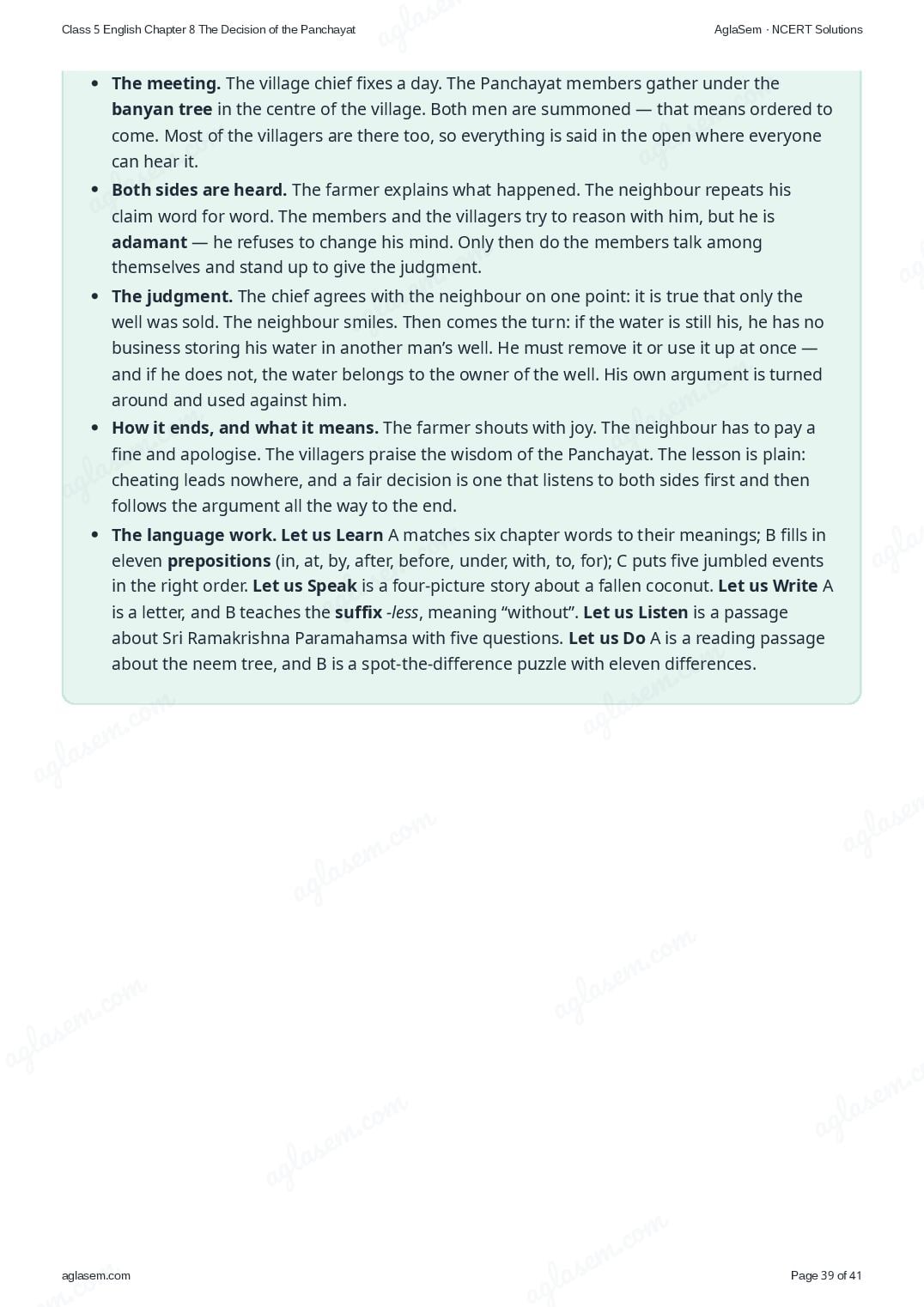
- The language work. Let us Learn A matches six chapter words to their meanings; B fills in eleven prepositions (in, at, by, after, before, under, with, to, for); C puts five jumbled events in the right order. Let us Speak is a four-picture story about a fallen coconut. Let us Write A is a letter, and B teaches the suffix -less, meaning “without”. Let us Listen is a passage about Sri Ramakrishna Paramahamsa with five questions. Let us Do A is a reading passage about the neem tree, and B is a spot-the-difference puzzle with eleven differences.
How to Download NCERT Solutions for Class 5 English Chapter 8 PDF
Follow these simple steps to get the the Decision of the Panchayat questions-and-answers PDF from Santoor.
- Search NCERT Solutions for Class 5 English Chapter 8 aglasem and open this page.
- Read the exercise questions with answers for the Decision of the Panchayat shown above.
- Click the Download PDF link to save the the Decision of the Panchayat solutions to your device.
NCERT Solutions for Class 5 English – All Chapters
There are more chapters to study besides the Decision of the Panchayat in English. Here are the NCERT Solutions for all chapters of Class 5 English.
- Chapter 1 Papa s Spectacles
- Chapter 2 Gone with the Scooter
- Chapter 3 the Rainbow
- Chapter 4 the Wise Parrot
- Chapter 5 the Frog
- Chapter 6 What a Tank
- Chapter 7 Gilli Danda
- Chapter 8 the Decision of the Panchayat
- Chapter 9 Vocation
- Chapter 10 Glass Bangles
NCERT Solutions for Class 5 – All Subjects
Just like Chapter 8 of English, you can get the exercise questions with answers for every other subject of Class 5. Here are the NCERT Solutions for all subjects of Class 5.
NCERT Solutions for Class 5 English Chapter 8 – An Overview
The key highlights of this study material are as follows.
| Aspects | Details |
|---|---|
| Class | Class 5 |
| Subject | English |
| Chapter Number | Chapter 8 |
| Chapter Name | the Decision of the Panchayat |
| Book Name | Santoor |
| Book By | NCERT (National Council of Educational Research and Training) |
| Educational Resource Here | NCERT Solutions of Class 5 English Chapter 8 for all exercises |
| More Questions Answers of This Subject | NCERT Solutions for Class 5 English |
| Download Book Chapter | NCERT Book Class 5 English |
| All Questions Answers For This Class | NCERT Solutions for Class 5 |
| Complete Solutions | NCERT Solutions |
NCERT Solutions for Class 5 English Chapter 8 the Decision of the Panchayat – FAQs
What are the NCERT Solutions for Class 5 English Chapter 8 the Decision of the Panchayat?
They are the complete, step-by-step answers to all the exercise and in-text questions of Chapter 8 the Decision of the Panchayat from the NCERT Class 5 English textbook Santoor, written by experts as per the latest NCERT syllabus.
How can I download the Class 5 English Chapter 8 solutions PDF for free?
Open this page on aglasem, read the the Decision of the Panchayat questions with answers, and click the “Download Solutions PDF” link. The Class 5 English Chapter 8 NCERT Solutions PDF is completely free to download.
Are these NCERT Solutions as per the latest 2026-27 syllabus?
Yes. The NCERT Solutions for Class 5 English Chapter 8 are based on the latest NCERT textbook Santoor and the current 2026-27 CBSE syllabus, so the questions and answers match what you study in class.
Where can I get NCERT Solutions for the other chapters of Class 5 English?
You can find the answers to every chapter on the NCERT Solutions for Class 5 English page, and solutions for every subject on the NCERT Solutions for Class 5 page.
How do NCERT Solutions help in exam preparation?
They show the correct method to solve each question, help you write answers the way they are expected in exams, let you check and correct your own work, and save revision time — which together improve your marks in Class 5 English.
If you have any queries on NCERT Solutions for Class 5 English Chapter 8 the Decision of the Panchayat, then please ask in the comments below.