NCERT Solutions for Class 4 English Chapter 11 a Journey to the Magical Mountains provide clear, step-by-step answers to every exercise and in-text question from the chapter a Journey to the Magical Mountains of the NCERT textbook Santoor. Prepared by subject experts as per the latest NCERT (CBSE) syllabus for 2026-27, these NCERT Solutions for Class 4 English help you understand each concept, write exam-ready answers, and check your own solutions. You can read them online below or download the free Class 4 English Chapter 11 question-answer PDF.
NCERT Solutions for Class 4 English Chapter 11 a Journey to the Magical Mountains
- Class: Class 4
- Subject: English
- Chapter: Chapter 11 – a Journey to the Magical Mountains
- Textbook: Santoor (NCERT)
- Study material: NCERT Solutions – questions with answers, free PDF
These solutions answer all the exercise questions of Chapter 11 a Journey to the Magical Mountains — including the in-text questions, short-answer and long-answer questions, and activities — with complete explanations so you can follow the method, not just the final answer. Read the full solutions below.
NCERT Solutions Class 4 English Chapter 11 a Journey to the Magical Mountains View Download
NCERT Solutions for Class 4 English Chapter 11 PDF Download
You can read the NCERT Solutions for Class 4 English Chapter 11 online above, or download the complete question-answer PDF to study a Journey to the Magical Mountains offline at any time.
NCERT Solutions for Class 4 English Chapter 11 PDF Download Link – Click Here to Download Solutions PDF
Questions Covered in This Chapter
These NCERT Solutions answer all 55 questions of this chapter. The questions solved are:
- Let us Read — A Journey to the Magical Mountains. Read the story and enjoy the journey Minam and her grandfather make into the Himalayas.
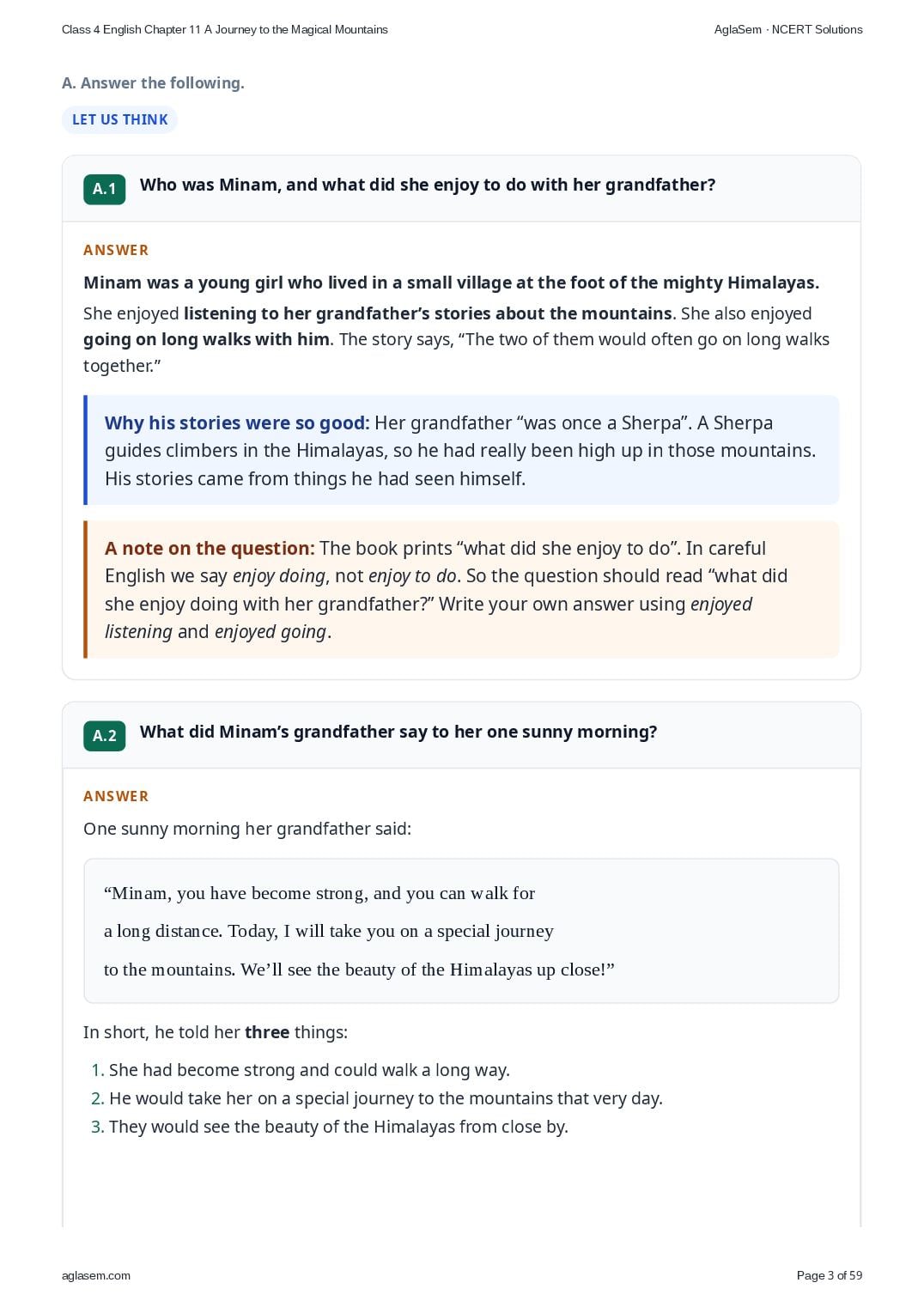
- Who was Minam, and what did she enjoy to do with her grandfather?
- What did Minam’s grandfather say to her one sunny morning?
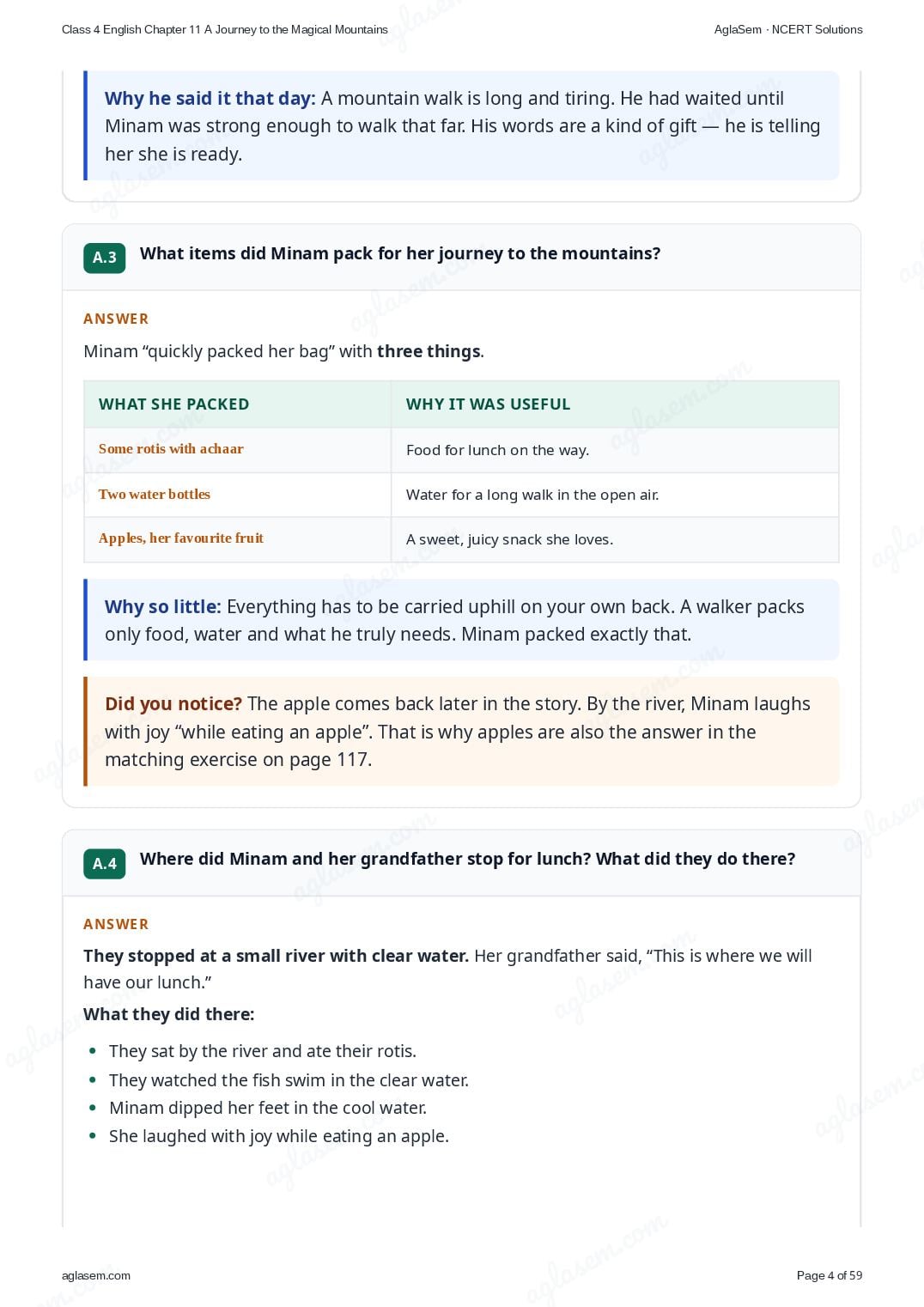
- What items did Minam pack for her journey to the mountains?
- Where did Minam and her grandfather stop for lunch? What did they do there?
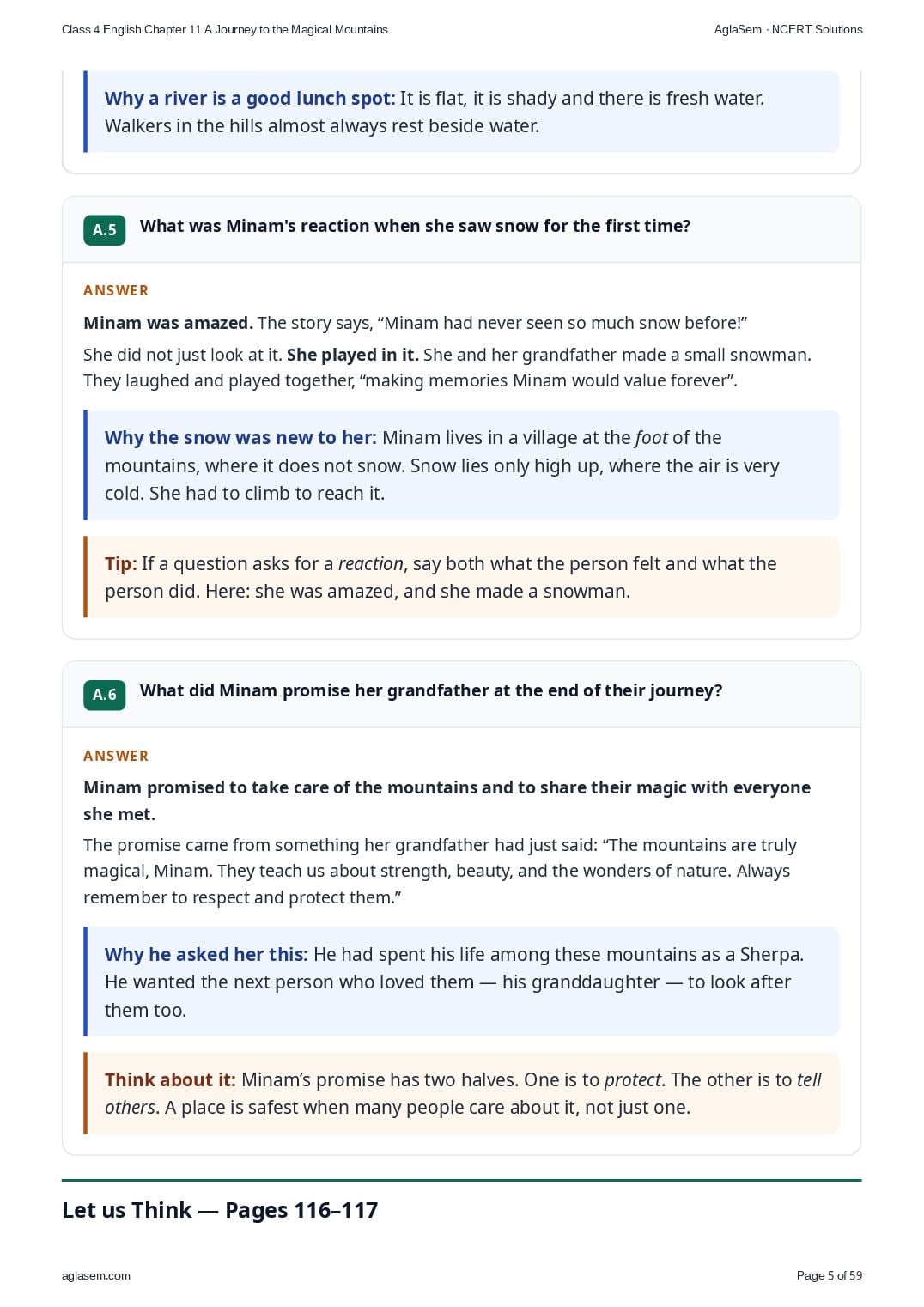
- What was Minam’s reaction when she saw snow for the first time?
- What did Minam promise her grandfather at the end of their journey?
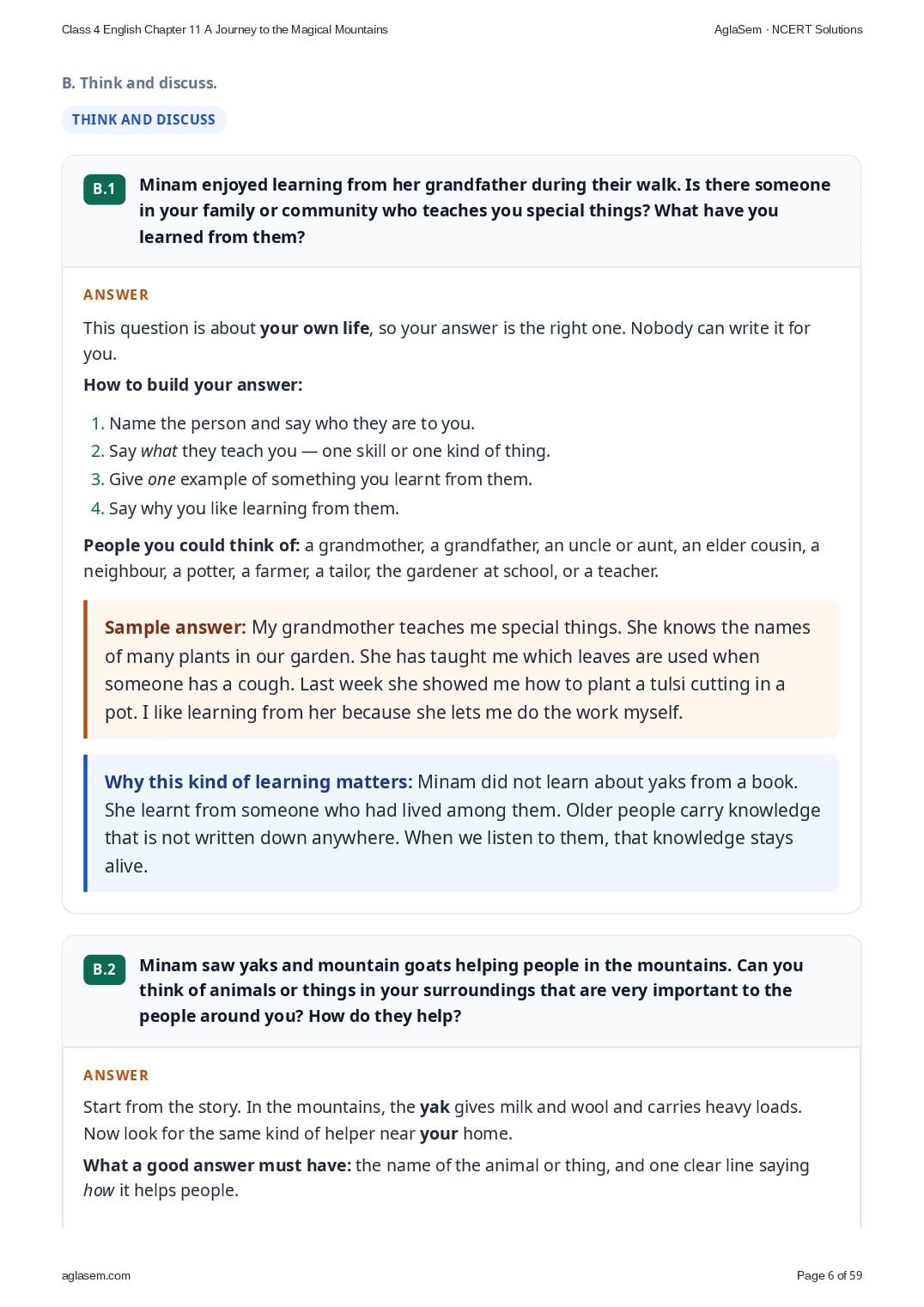
- Minam enjoyed learning from her grandfather during their walk. Is there someone in your family or community who teaches you special things? What have you learned from them?
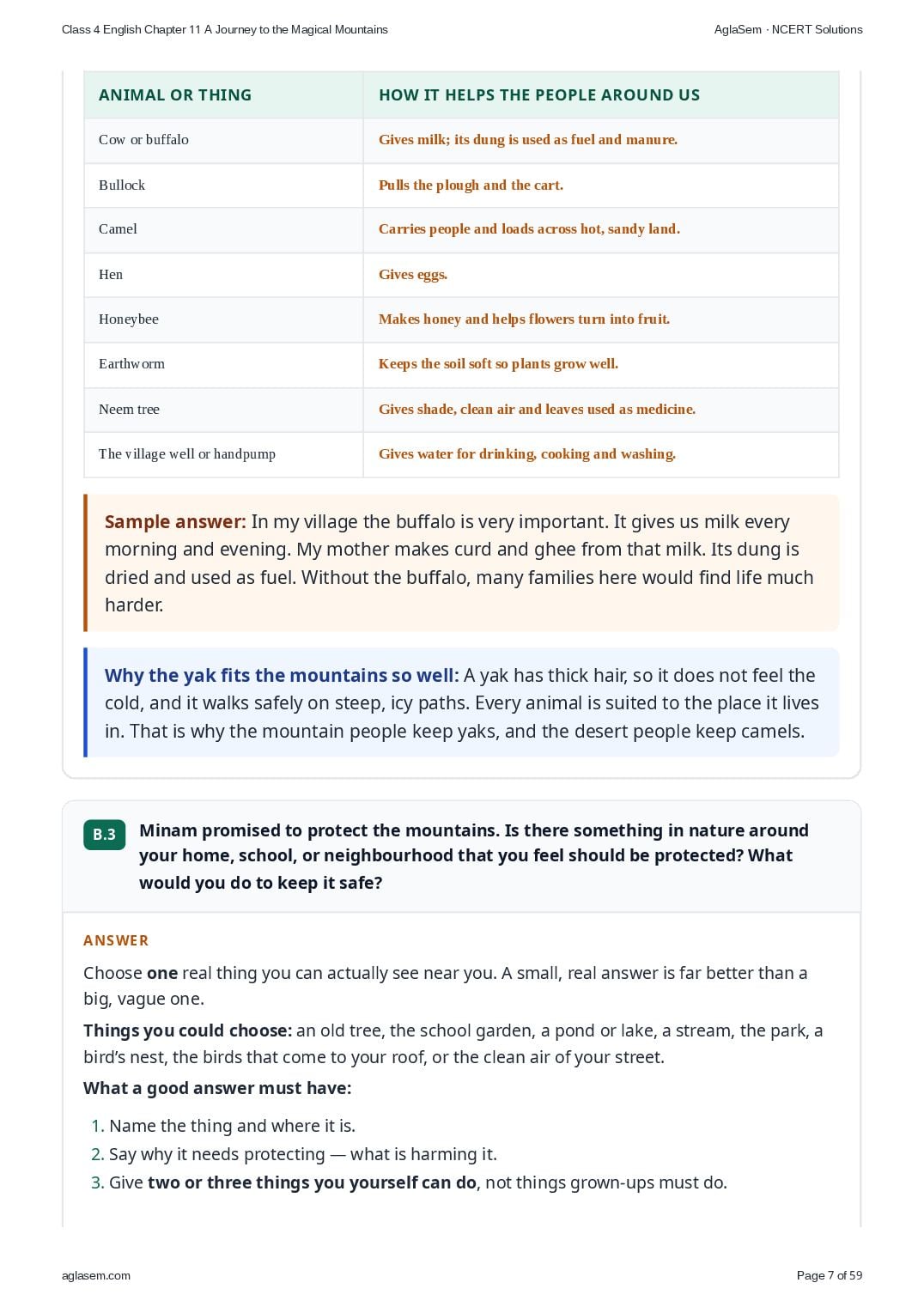
- Minam saw yaks and mountain goats helping people in the mountains. Can you think of animals or things in your surroundings that are very important to the people around you? How do they help?
- Minam promised to protect the mountains. Is there something in nature around your home, school, or neighbourhood that you feel should be protected? What would you do to keep it safe?
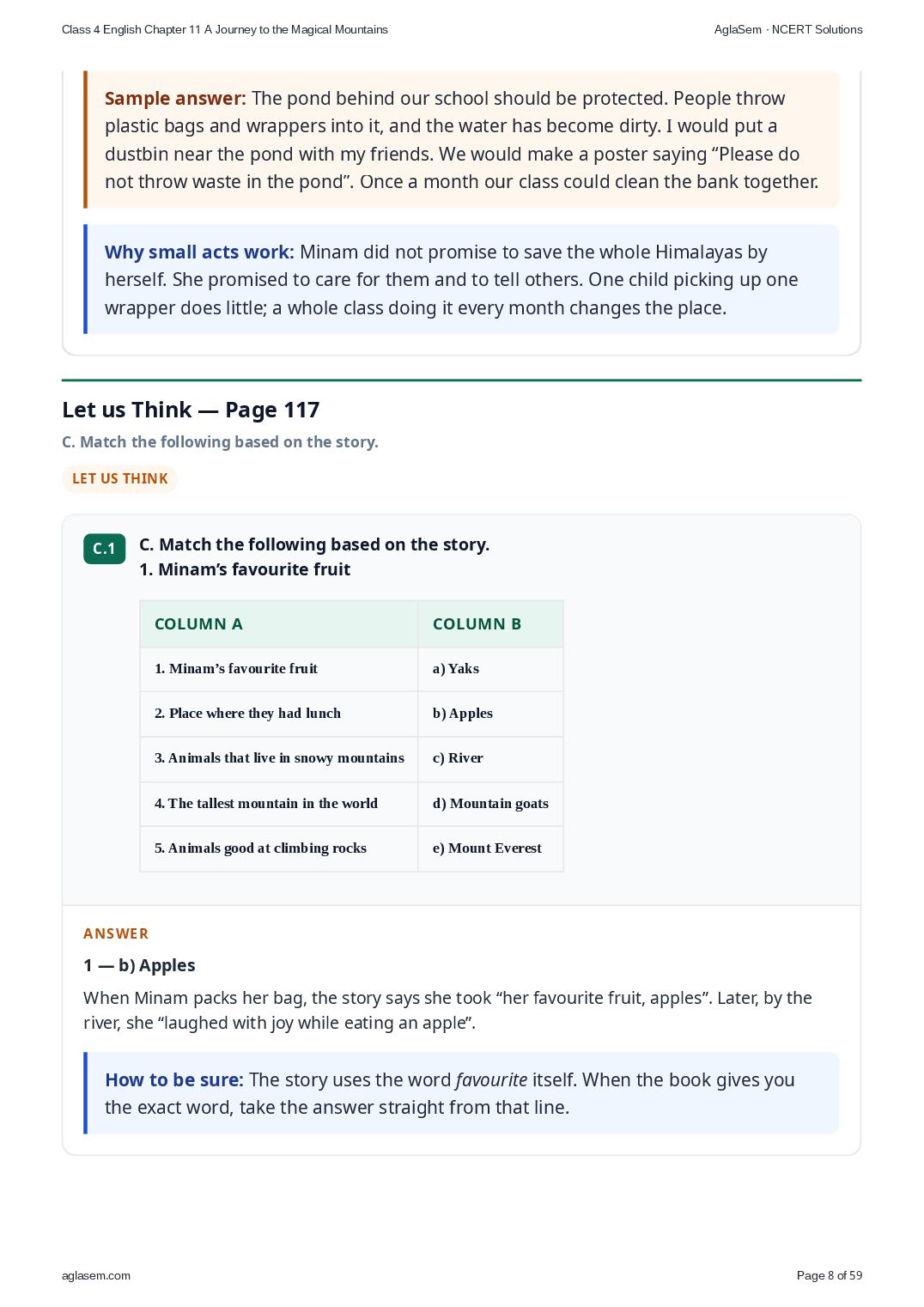
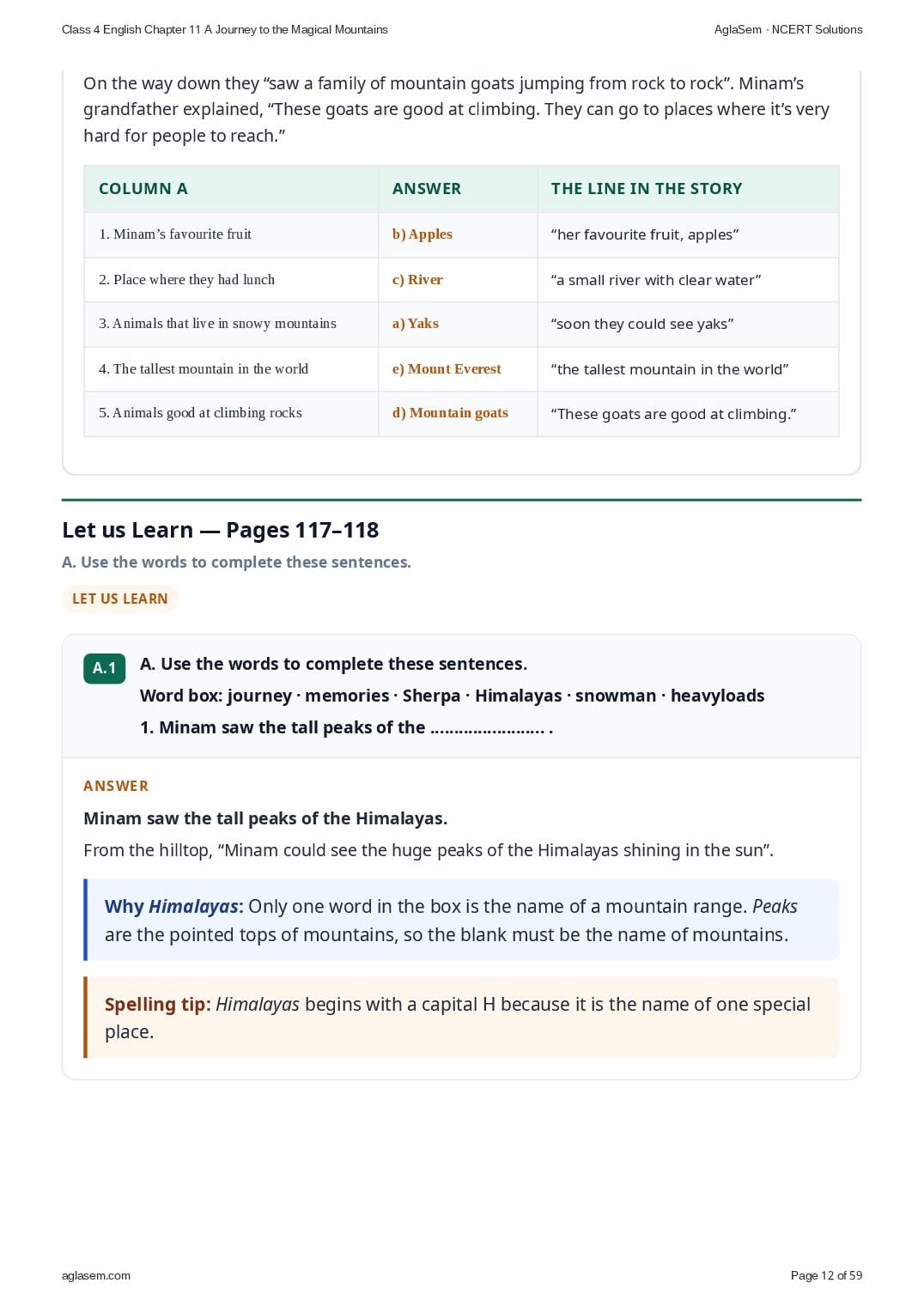
- C. Match the following based on the story.1. Minam’s favourite fruitColumn AColumn B1. Minam’s favourite fruita) Yaks2. Place where they had lunchb) Apples3. Animals that live in snowy mountainsc) River4. The tallest mountain in the worldd) Mountain goats5. Animals good at climbing rockse) Mount Everest
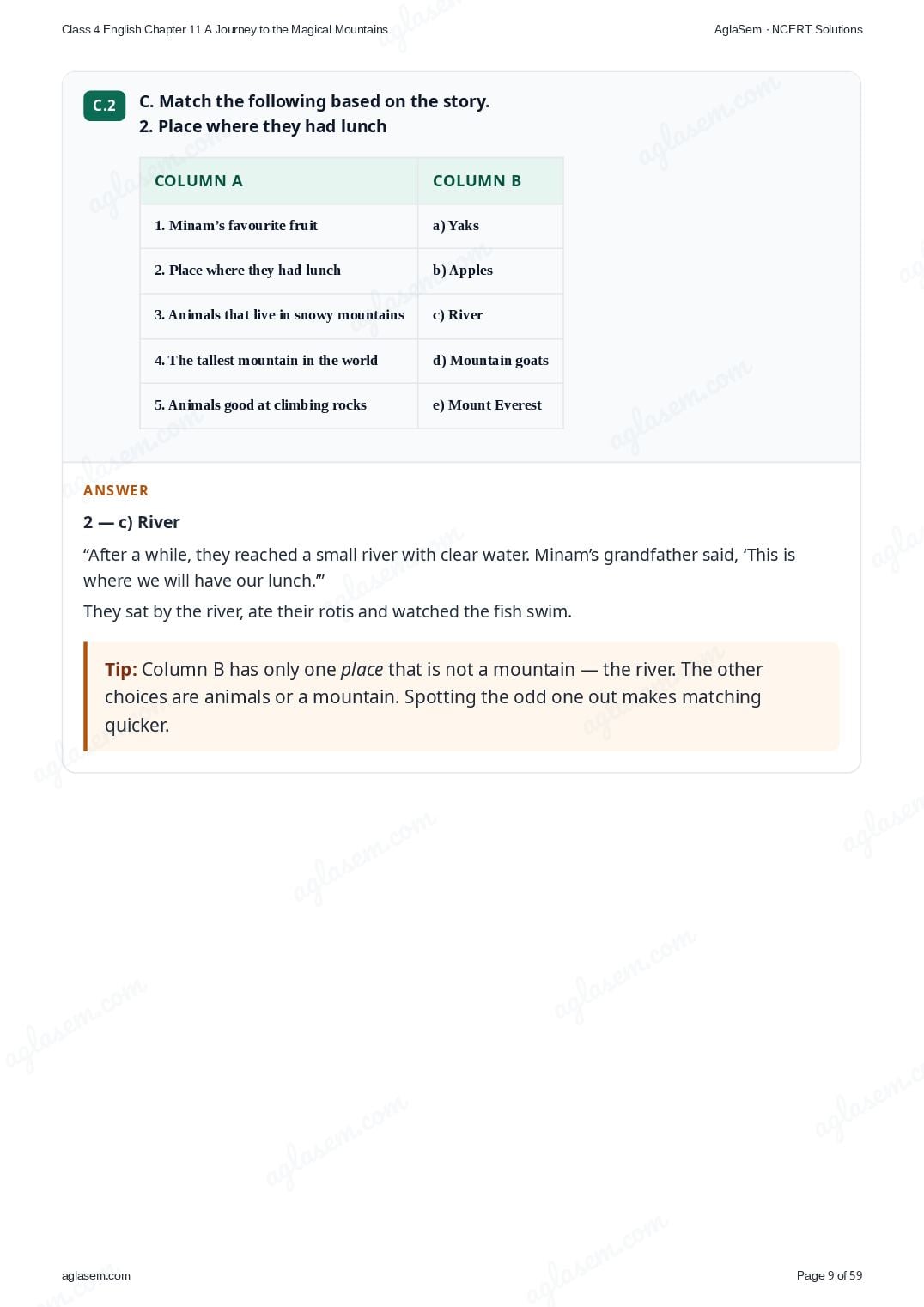
- C. Match the following based on the story.2. Place where they had lunchColumn AColumn B1. Minam’s favourite fruita) Yaks2. Place where they had lunchb) Apples3. Animals that live in snowy mountainsc) River4. The tallest mountain in the worldd) Mountain goats5. Animals good at climbing rockse) Mount Everest
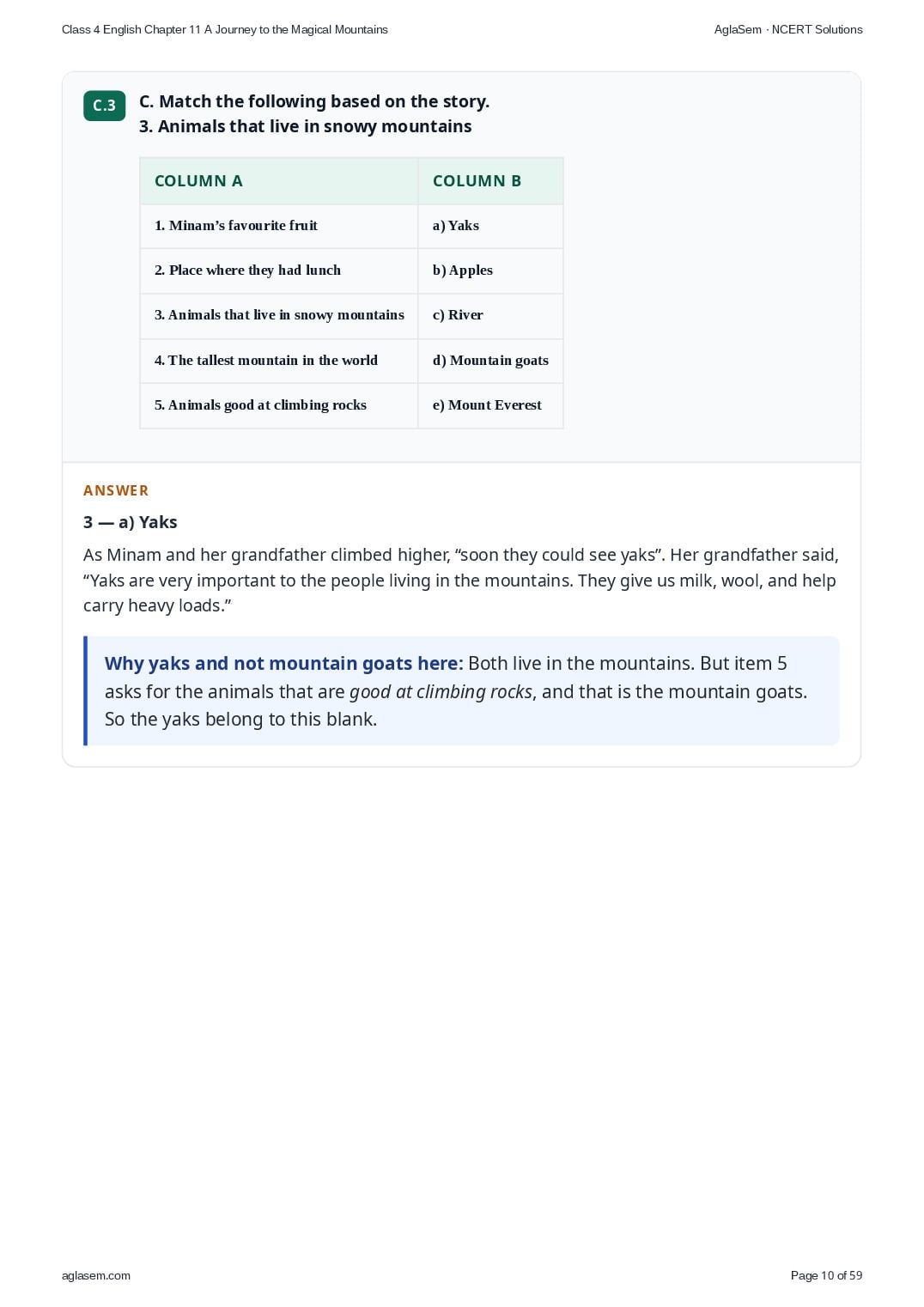
- C. Match the following based on the story.3. Animals that live in snowy mountainsColumn AColumn B1. Minam’s favourite fruita) Yaks2. Place where they had lunchb) Apples3. Animals that live in snowy mountainsc) River4. The tallest mountain in the worldd) Mountain goats5. Animals good at climbing rockse) Mount Everest
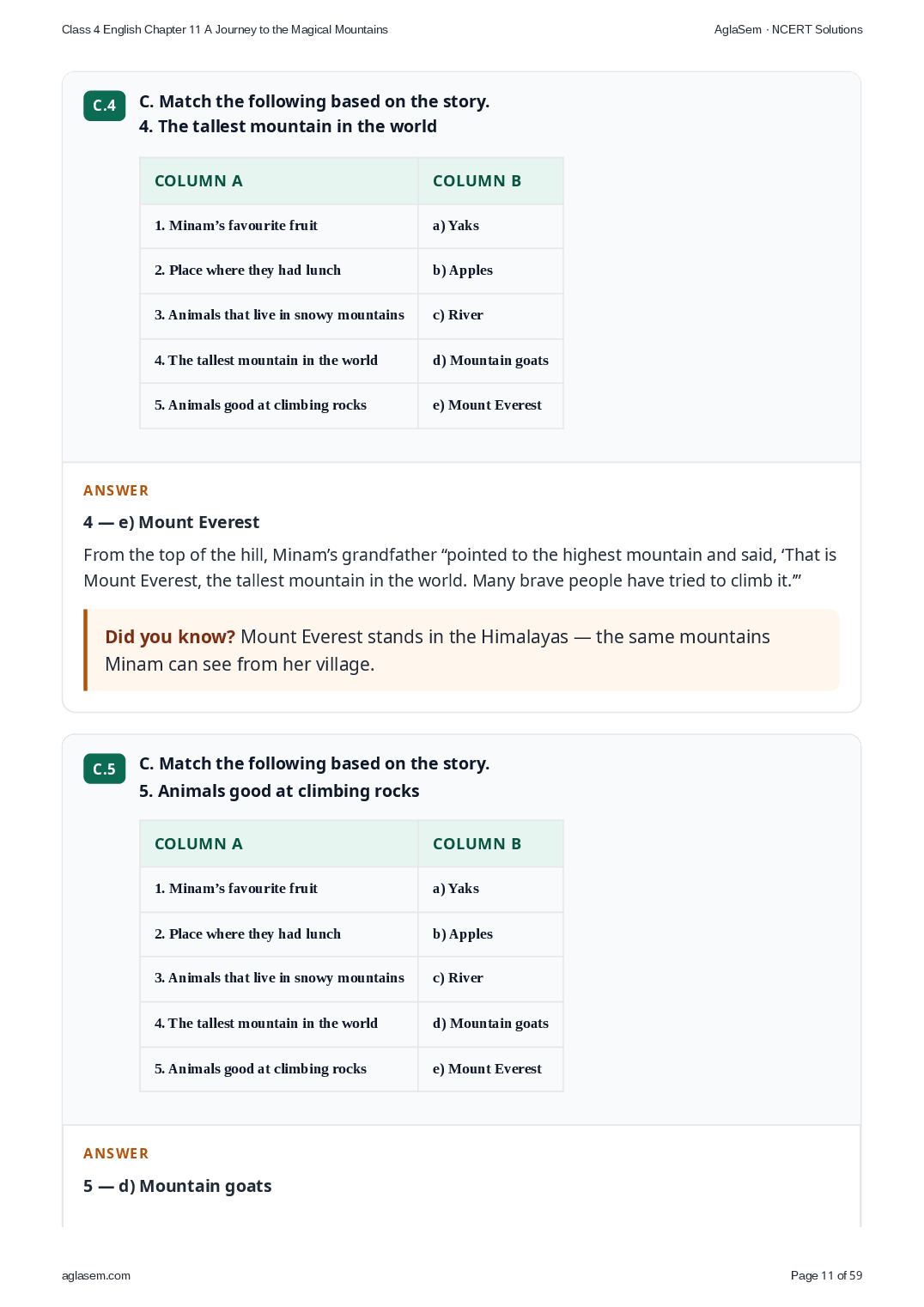
- C. Match the following based on the story.4. The tallest mountain in the worldColumn AColumn B1. Minam’s favourite fruita) Yaks2. Place where they had lunchb) Apples3. Animals that live in snowy mountainsc) River4. The tallest mountain in the worldd) Mountain goats5. Animals good at climbing rockse) Mount Everest
- C. Match the following based on the story.5. Animals good at climbing rocksColumn AColumn B1. Minam’s favourite fruita) Yaks2. Place where they had lunchb) Apples3. Animals that live in snowy mountainsc) River4. The tallest mountain in the worldd) Mountain goats5. Animals good at climbing rockse) Mount Everest
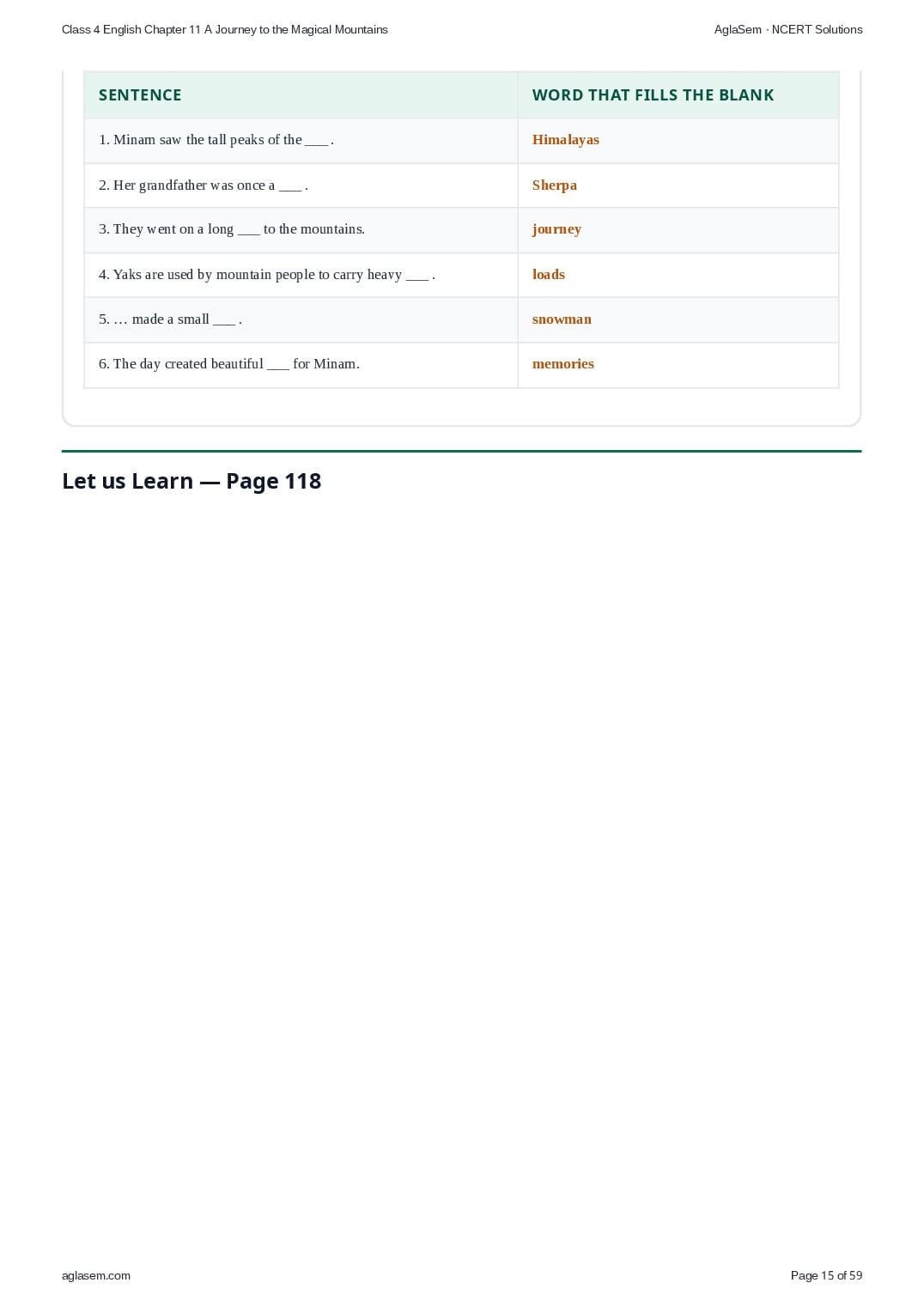
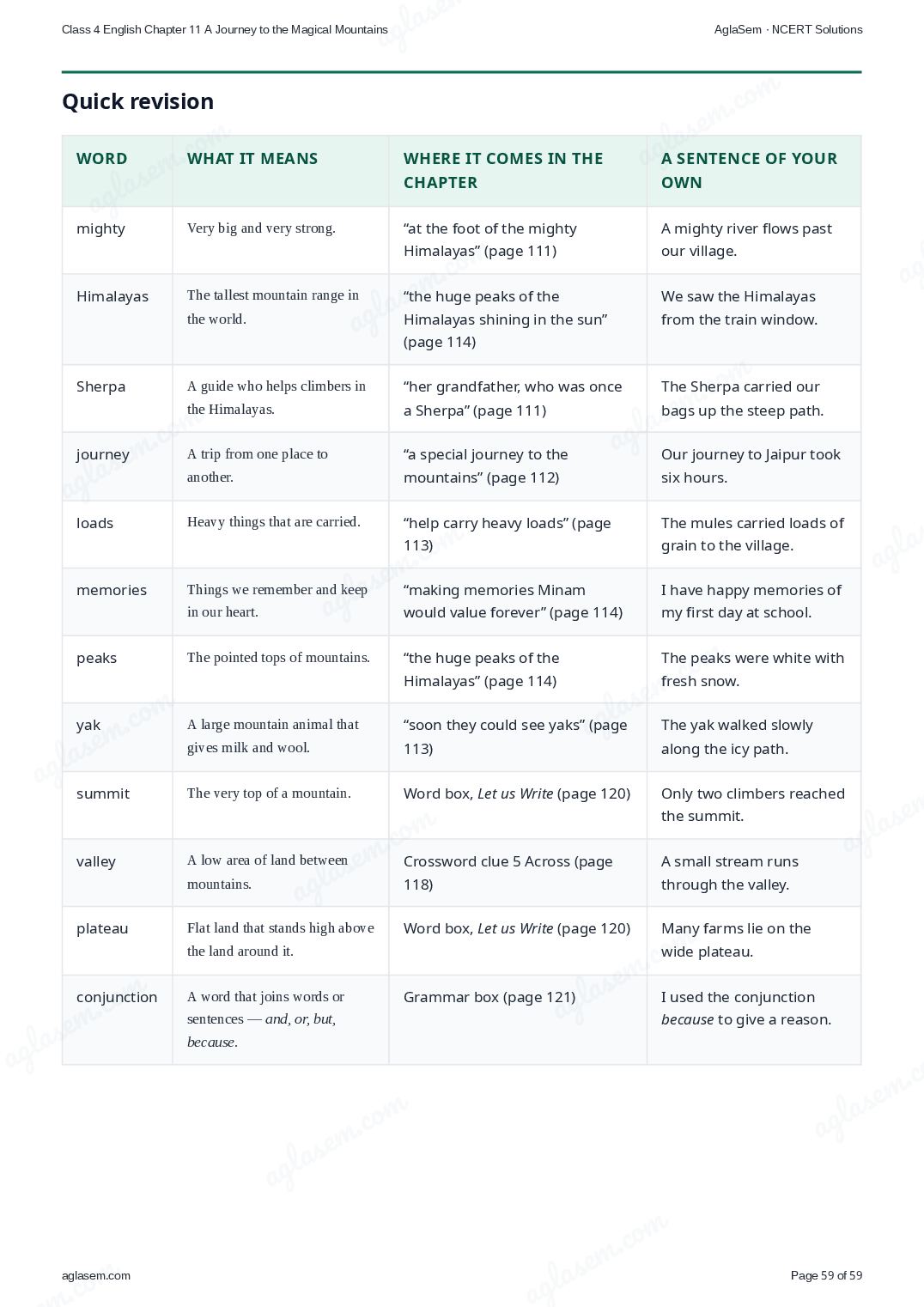
- A. Use the words to complete these sentences.Word box: journey · memories · Sherpa · Himalayas · snowman · heavyloads1. Minam saw the tall peaks of the …………………… .
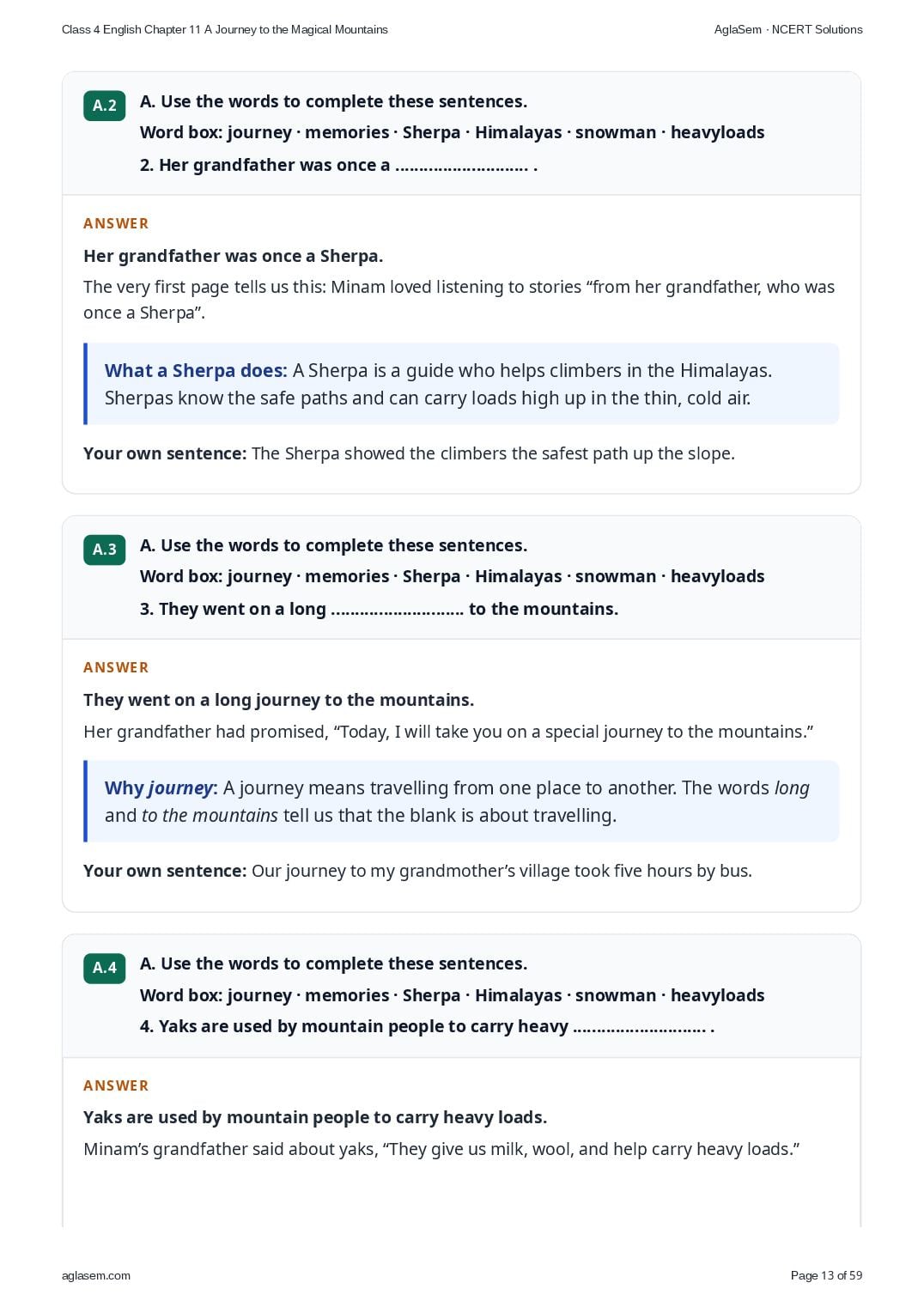
- A. Use the words to complete these sentences.Word box: journey · memories · Sherpa · Himalayas · snowman · heavyloads2. Her grandfather was once a ………………………. .
- A. Use the words to complete these sentences.Word box: journey · memories · Sherpa · Himalayas · snowman · heavyloads3. They went on a long ………………………. to the mountains.
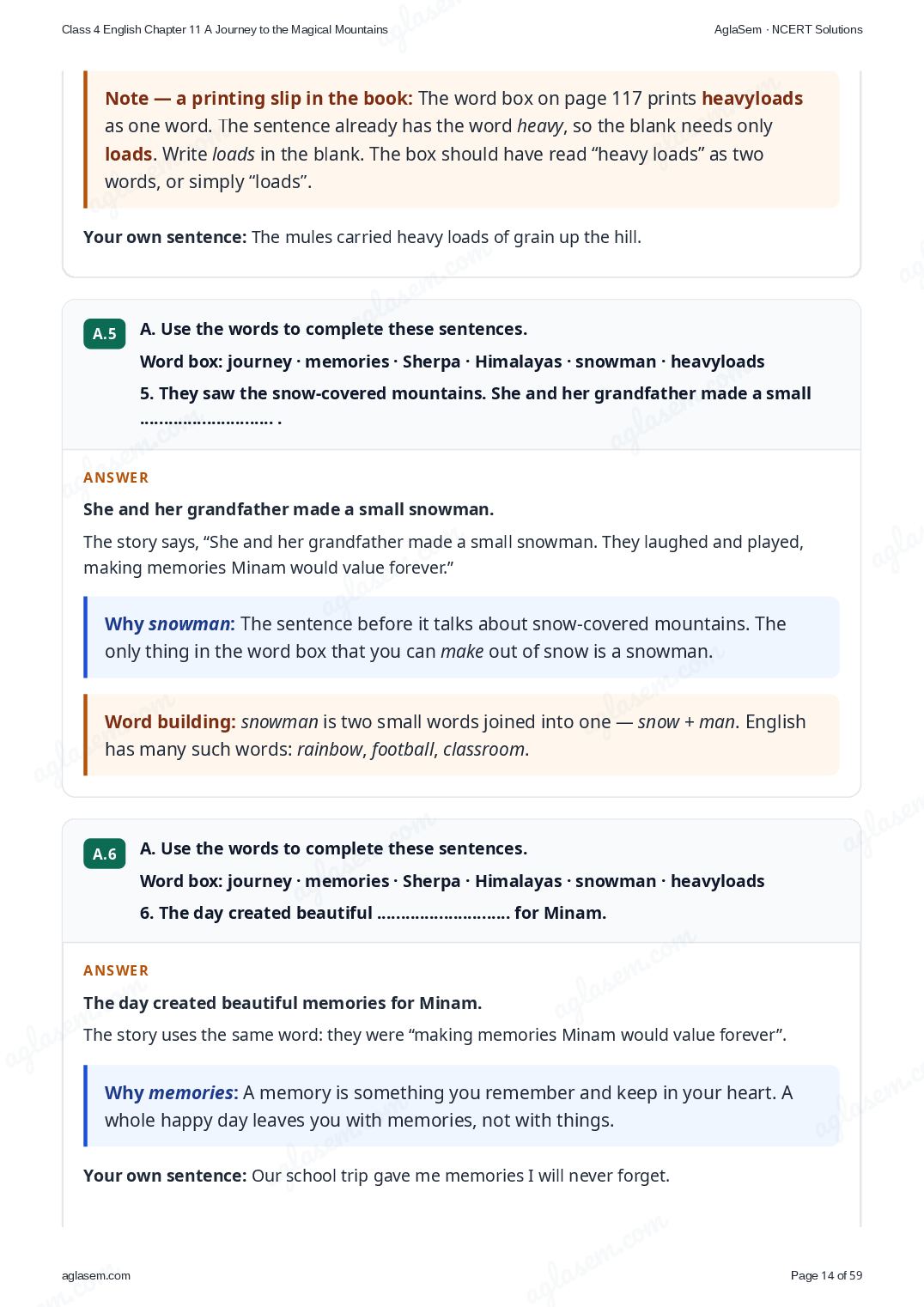
- A. Use the words to complete these sentences.Word box: journey · memories · Sherpa · Himalayas · snowman · heavyloads4. Yaks are used by mountain people to carry heavy ………………………. .
- A. Use the words to complete these sentences.Word box: journey · memories · Sherpa · Himalayas · snowman · heavyloads5. They saw the snow-covered mountains. She and her grandfather made a small ………………………. .
- A. Use the words to complete these sentences.Word box: journey · memories · Sherpa · Himalayas · snowman · heavyloads6. The day created beautiful ………………………. for Minam.
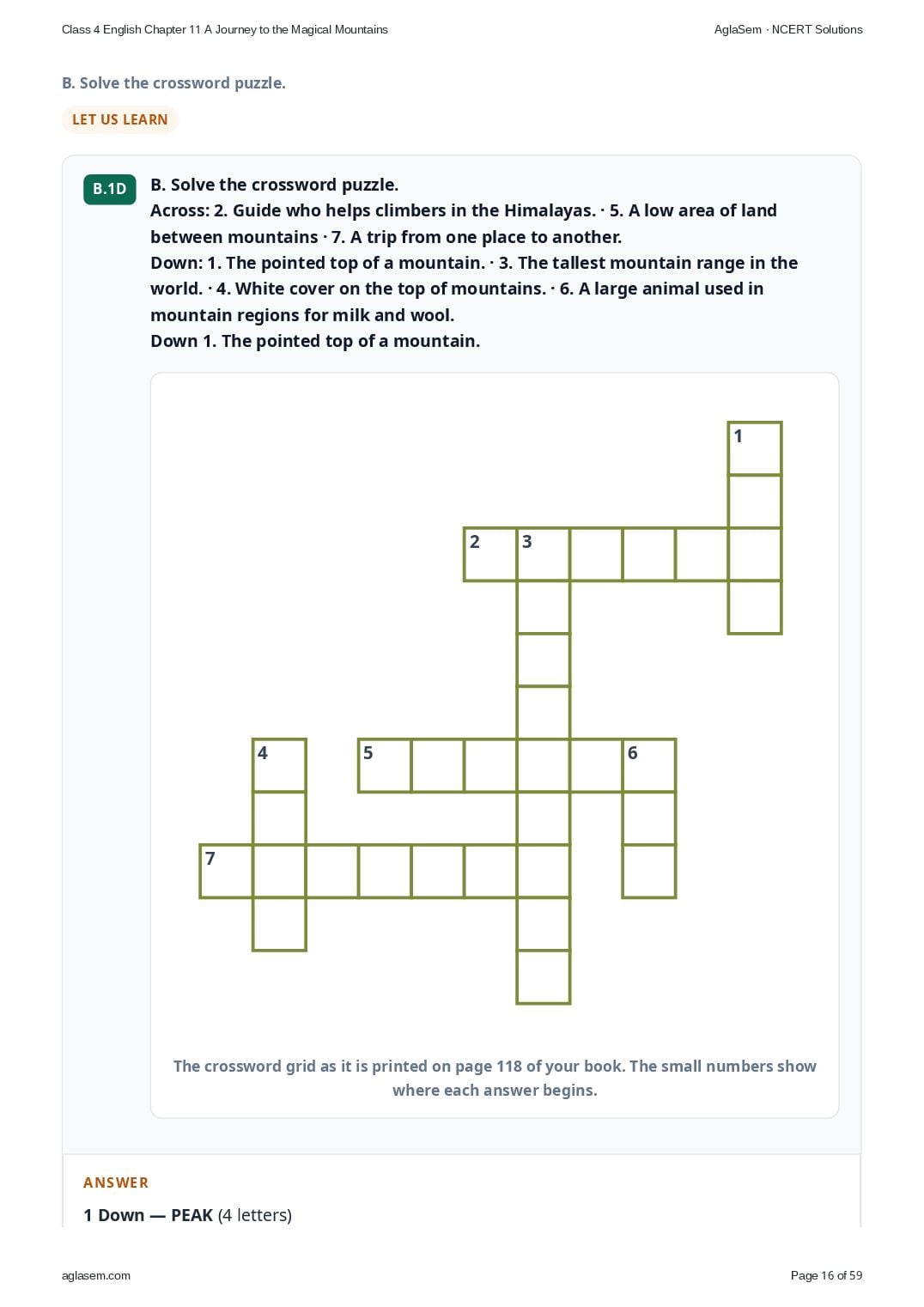
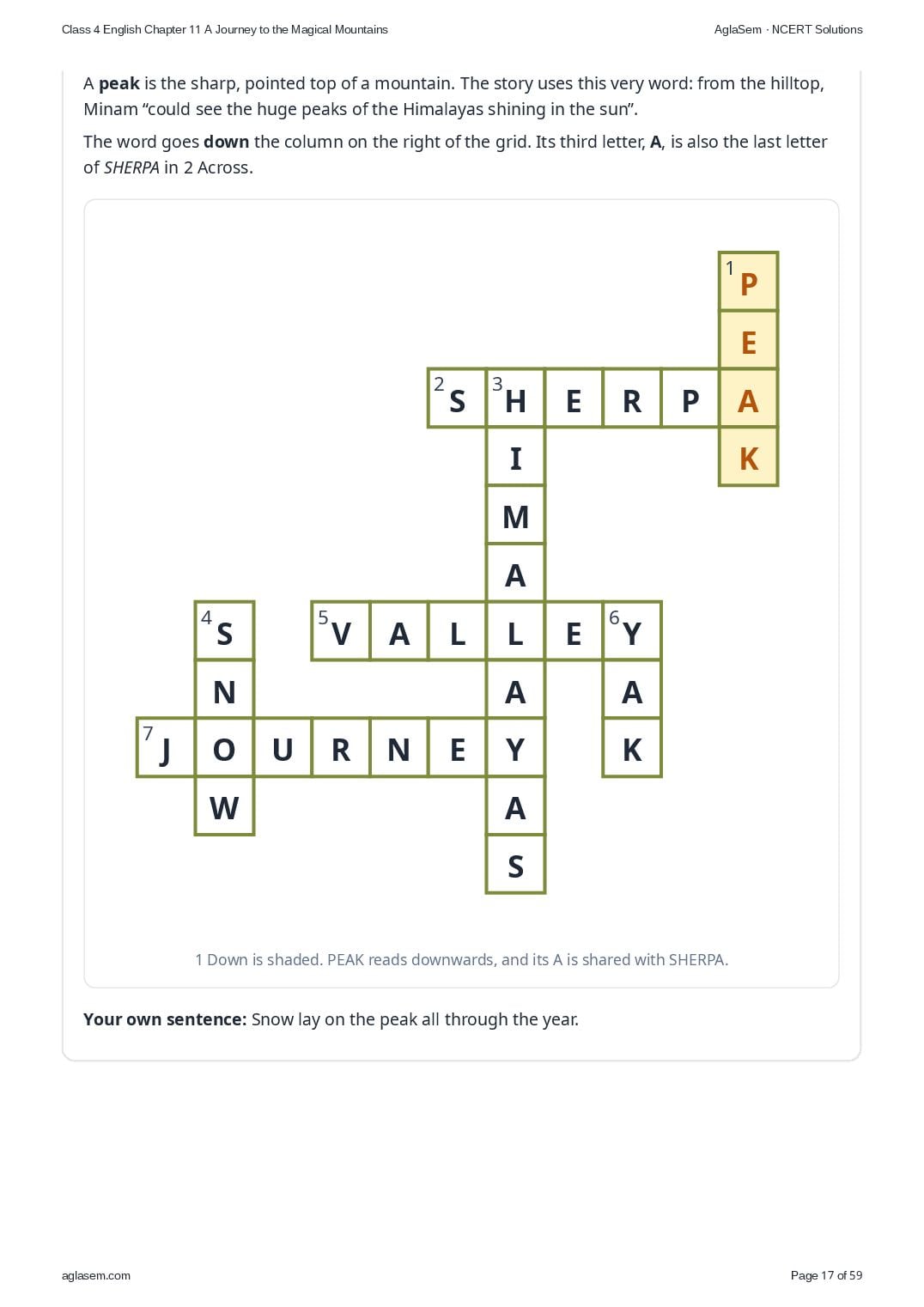
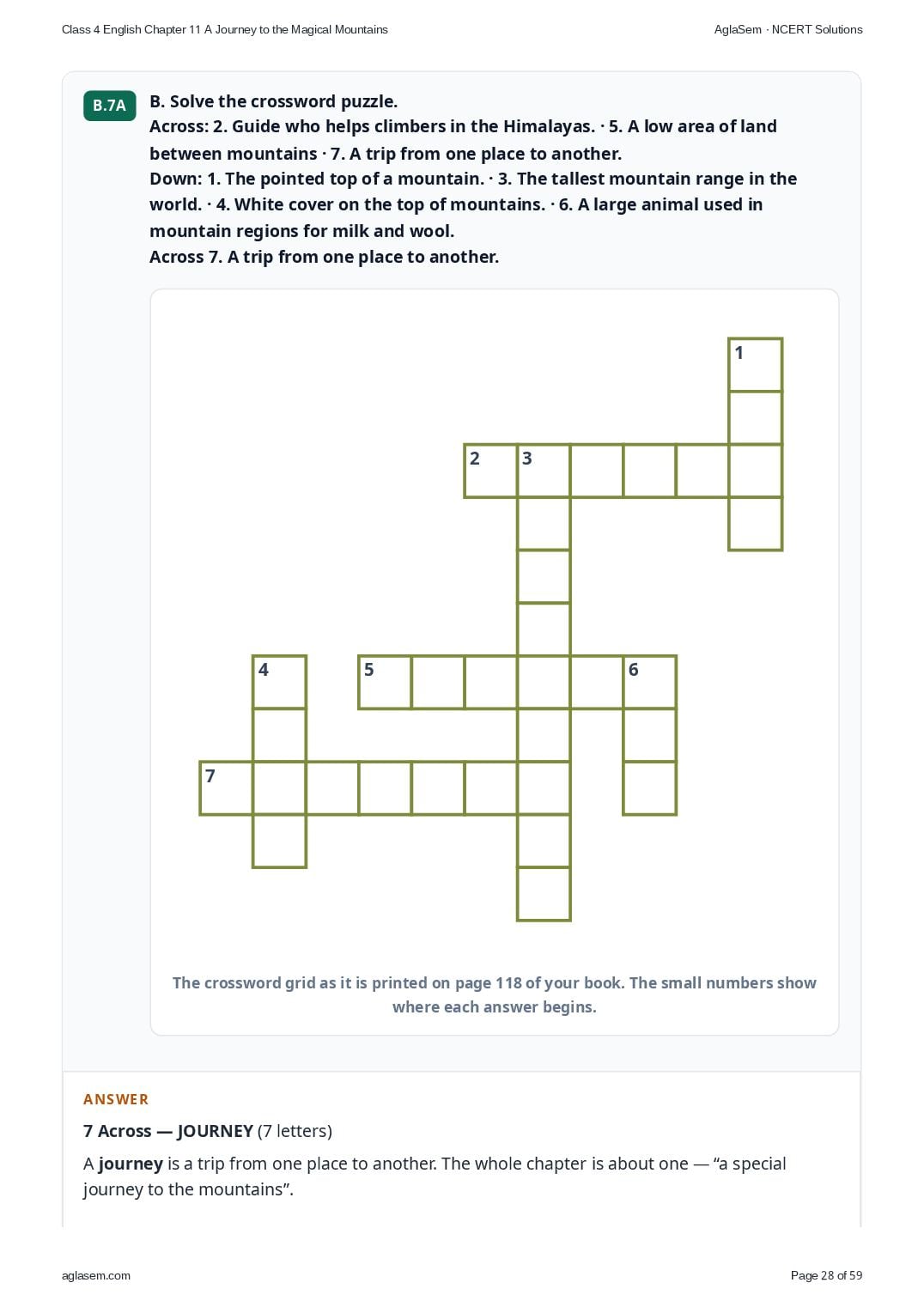
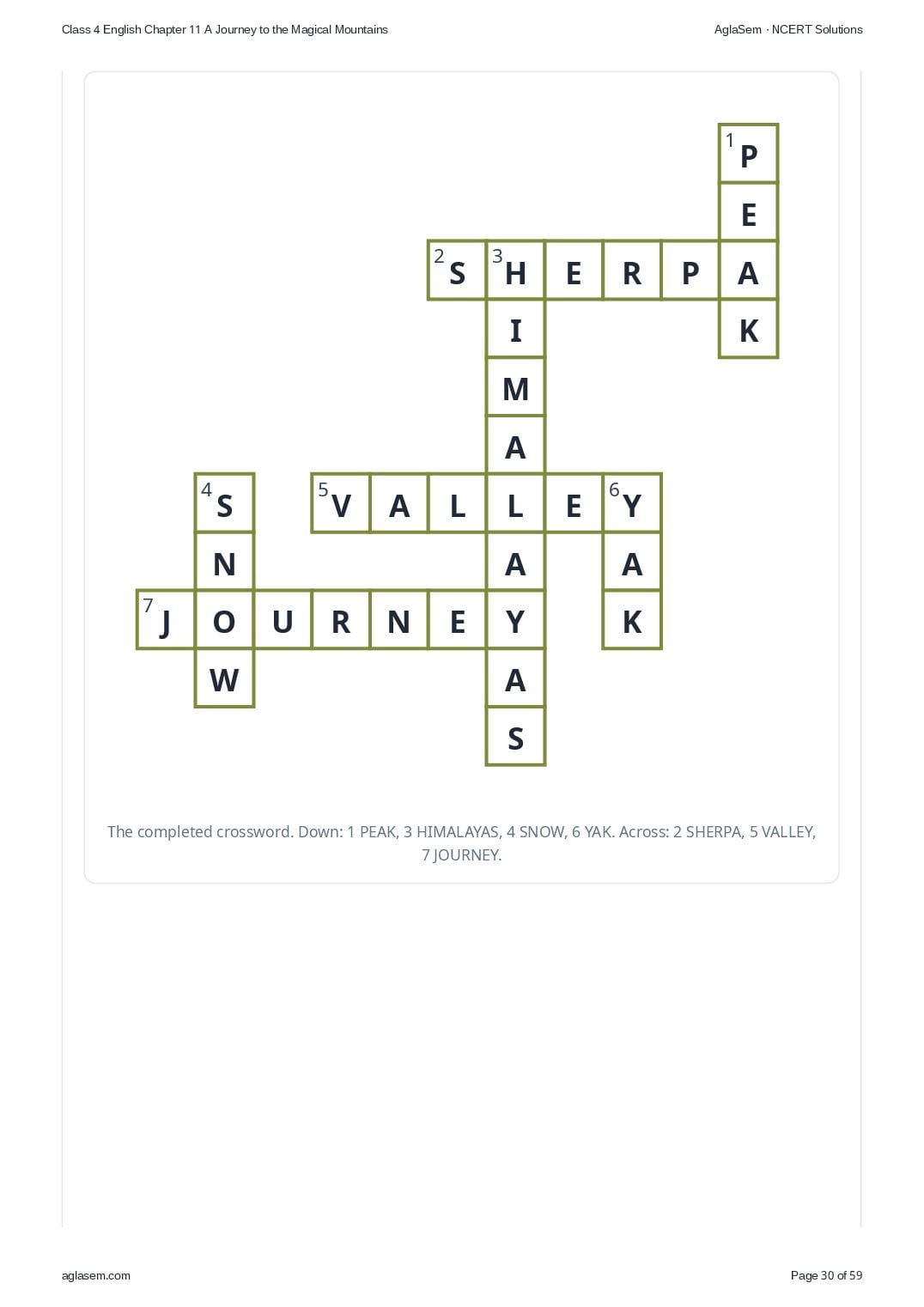
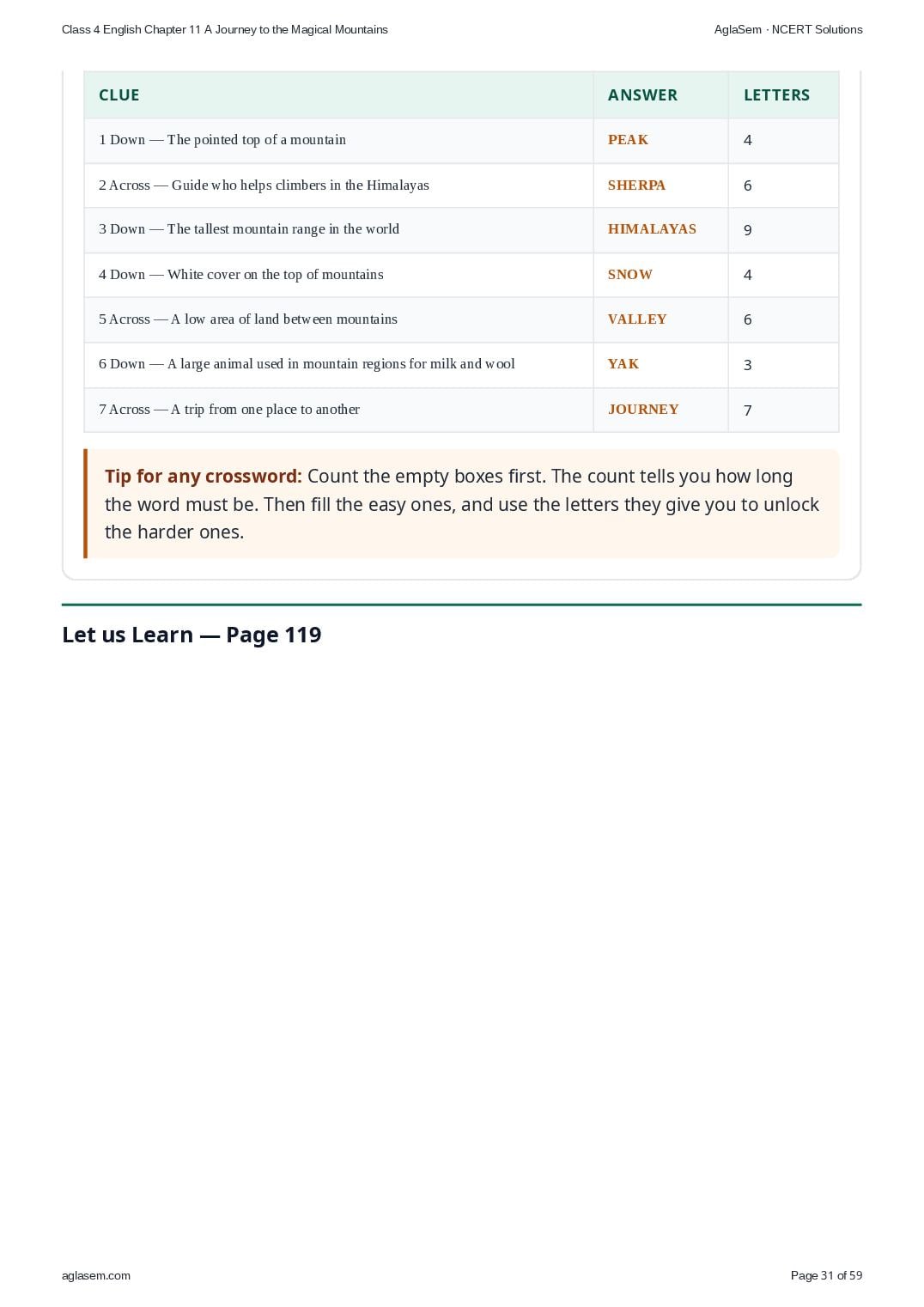
- B. Solve the crossword puzzle.Across: 2. Guide who helps climbers in the Himalayas. · 5. A low area of land between mountains · 7. A trip from one place to another.Down: 1. The pointed top of a mountain. · 3. The tallest mountain range in the world. · 4. White cover on the top of mountains. · 6. A large animal used in mountain regions for milk and wool.Down 1. The pointed top of a mountain.The crossword grid printed on page 1181234567The crossword grid as it is printed on page 118 of your book. The small numbers show where each answer begins.
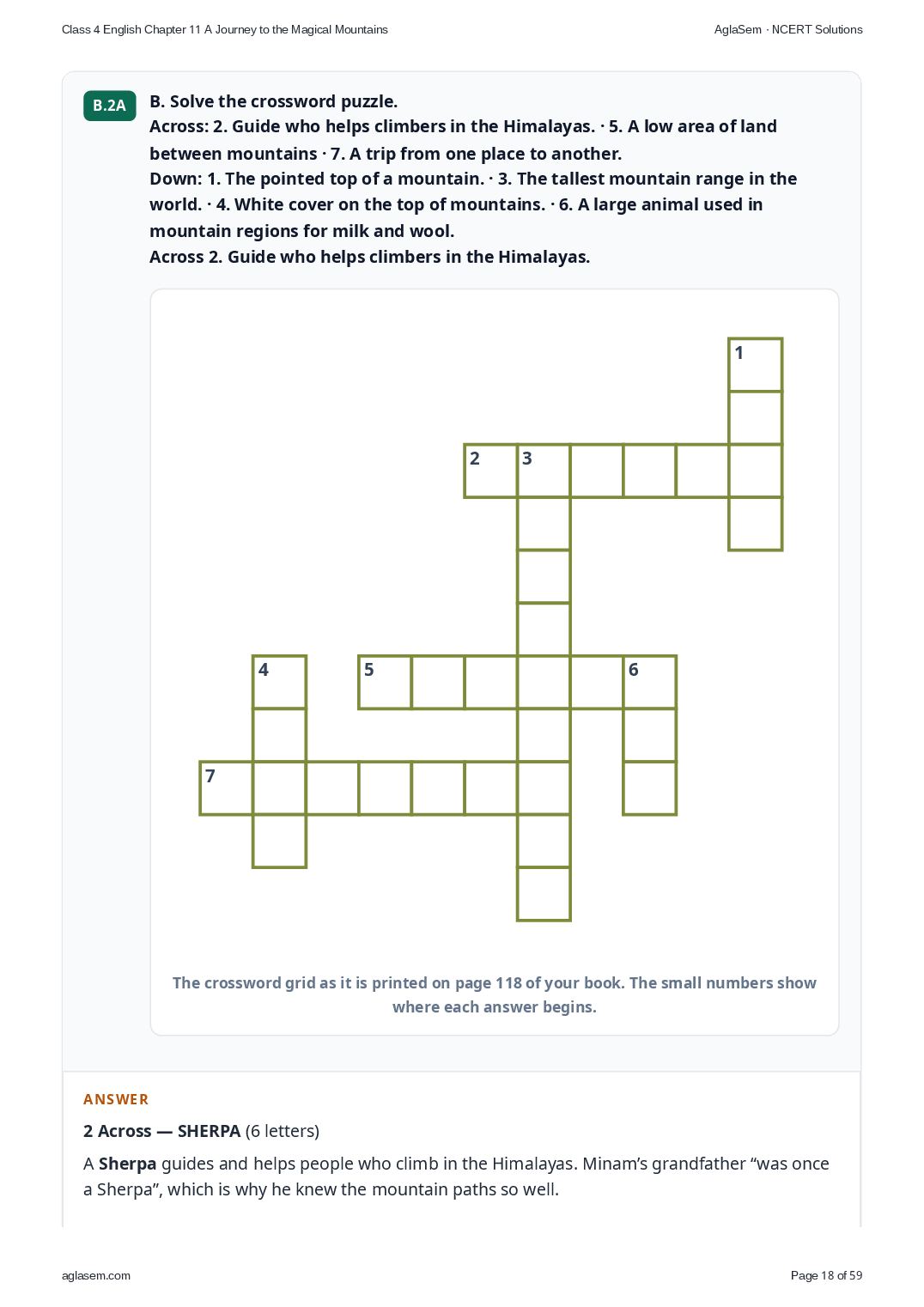
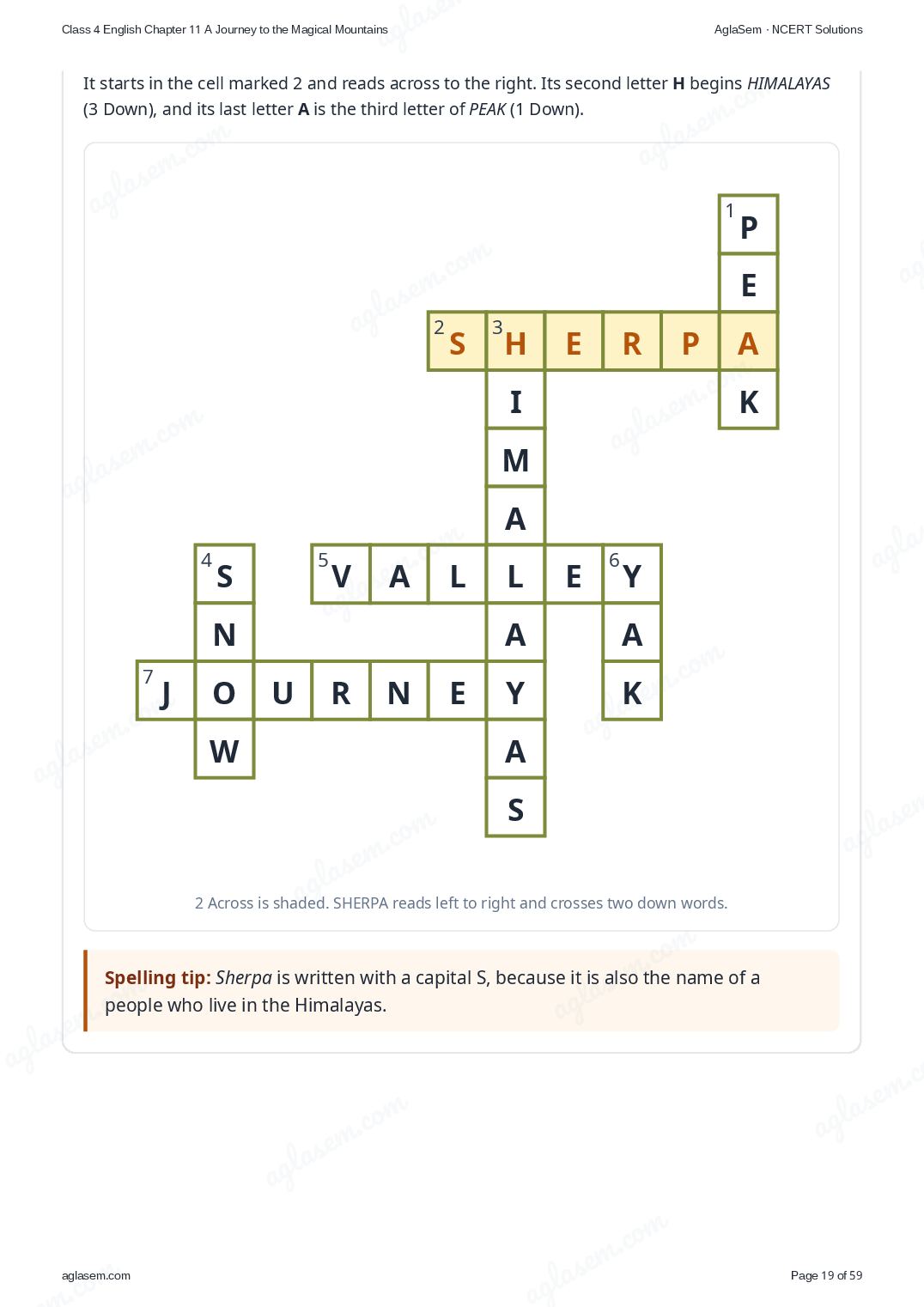
- B. Solve the crossword puzzle.Across: 2. Guide who helps climbers in the Himalayas. · 5. A low area of land between mountains · 7. A trip from one place to another.Down: 1. The pointed top of a mountain. · 3. The tallest mountain range in the world. · 4. White cover on the top of mountains. · 6. A large animal used in mountain regions for milk and wool.Across 2. Guide who helps climbers in the Himalayas.The crossword grid printed on page 1181234567The crossword grid as it is printed on page 118 of your book. The small numbers show where each answer begins.
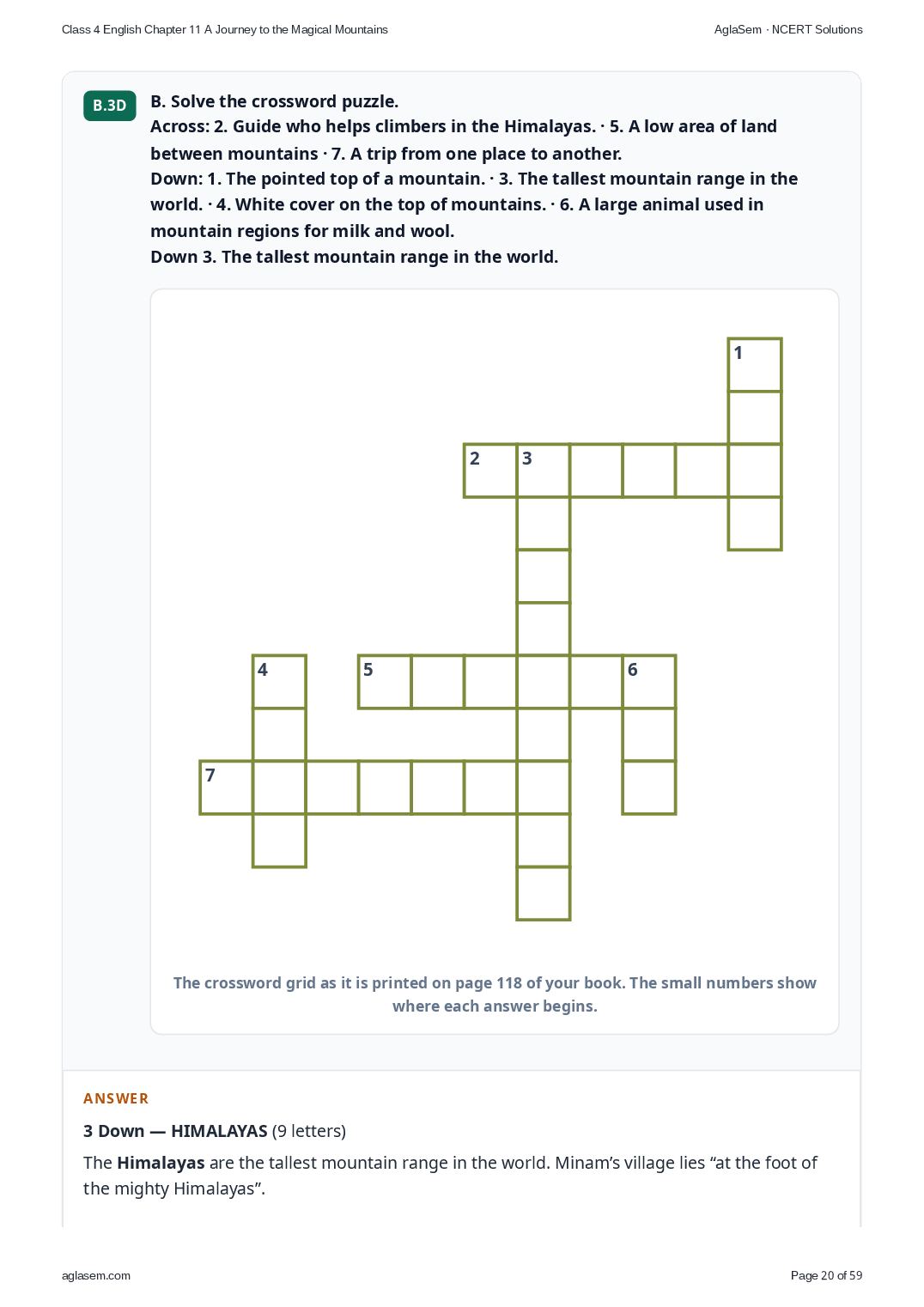
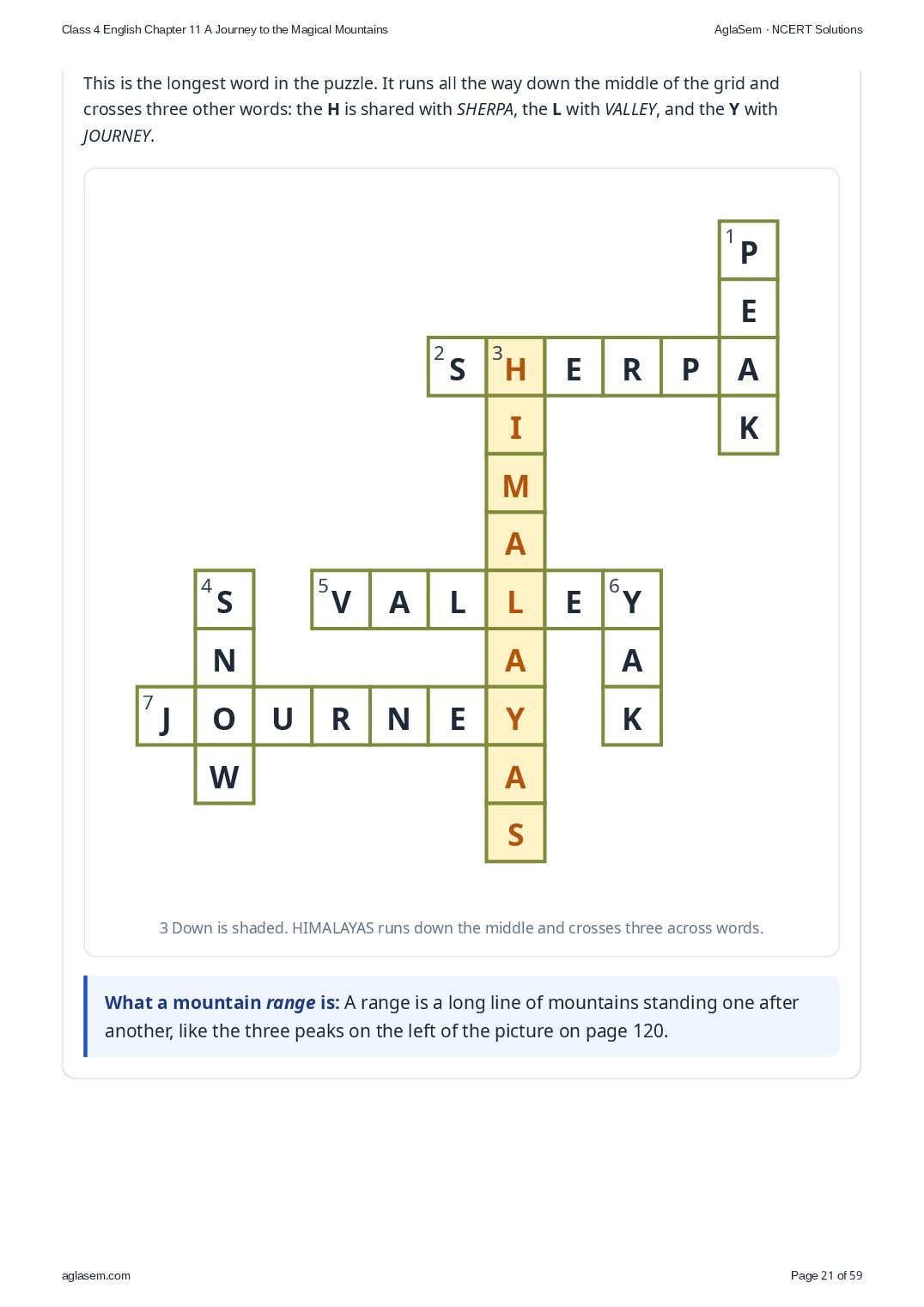
- B. Solve the crossword puzzle.Across: 2. Guide who helps climbers in the Himalayas. · 5. A low area of land between mountains · 7. A trip from one place to another.Down: 1. The pointed top of a mountain. · 3. The tallest mountain range in the world. · 4. White cover on the top of mountains. · 6. A large animal used in mountain regions for milk and wool.Down 3. The tallest mountain range in the world.The crossword grid printed on page 1181234567The crossword grid as it is printed on page 118 of your book. The small numbers show where each answer begins.
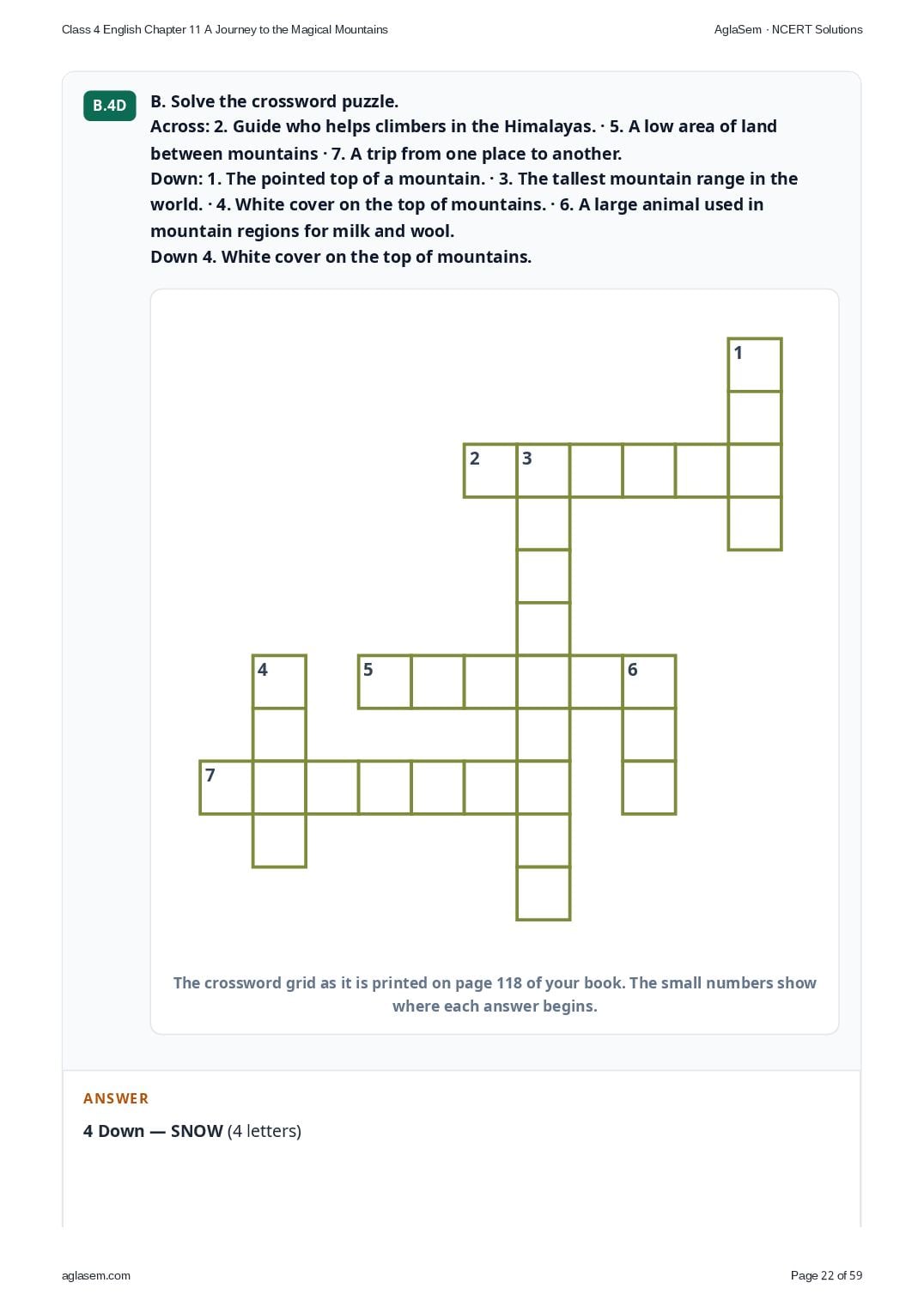
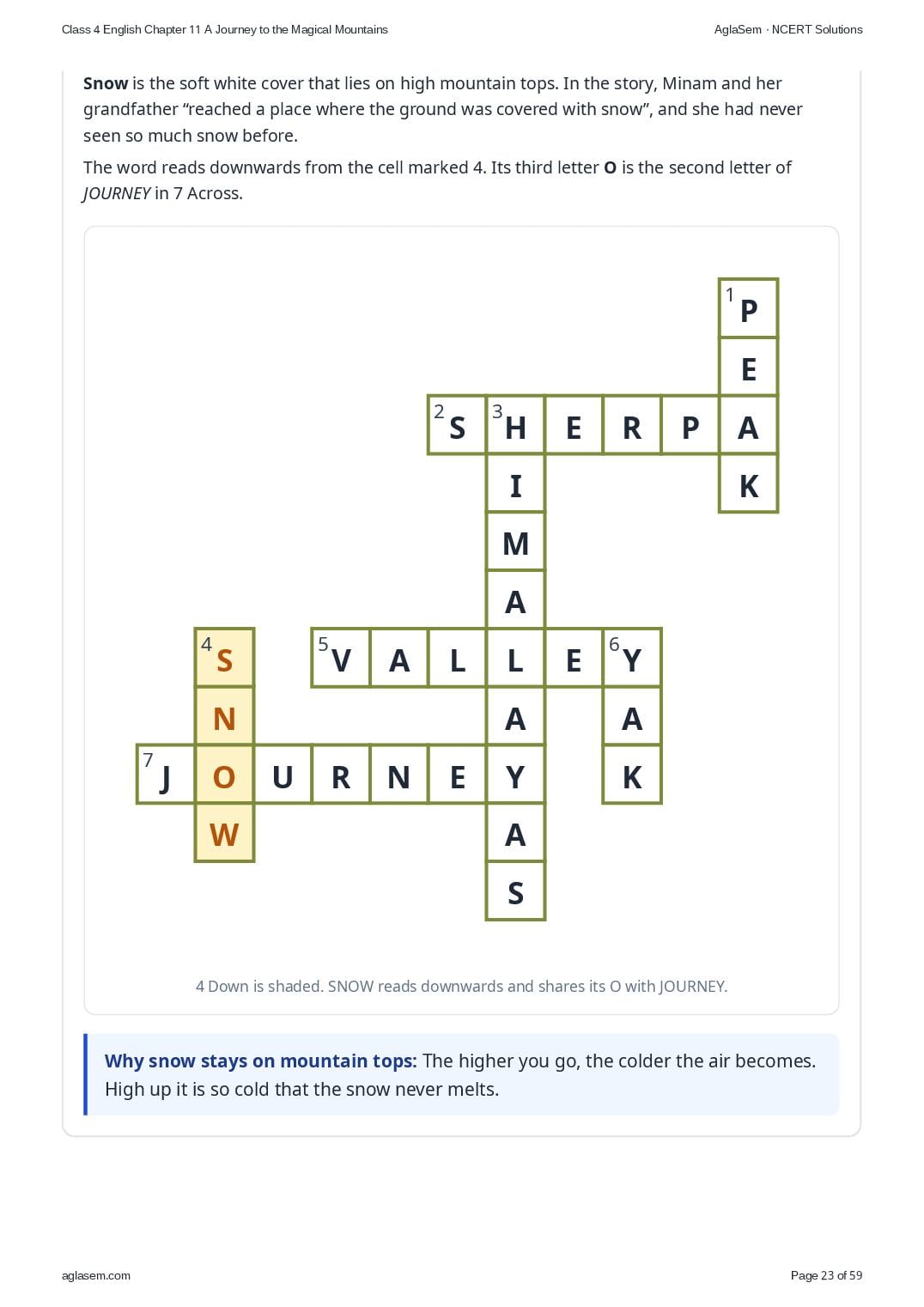
- B. Solve the crossword puzzle.Across: 2. Guide who helps climbers in the Himalayas. · 5. A low area of land between mountains · 7. A trip from one place to another.Down: 1. The pointed top of a mountain. · 3. The tallest mountain range in the world. · 4. White cover on the top of mountains. · 6. A large animal used in mountain regions for milk and wool.Down 4. White cover on the top of mountains.The crossword grid printed on page 1181234567The crossword grid as it is printed on page 118 of your book. The small numbers show where each answer begins.
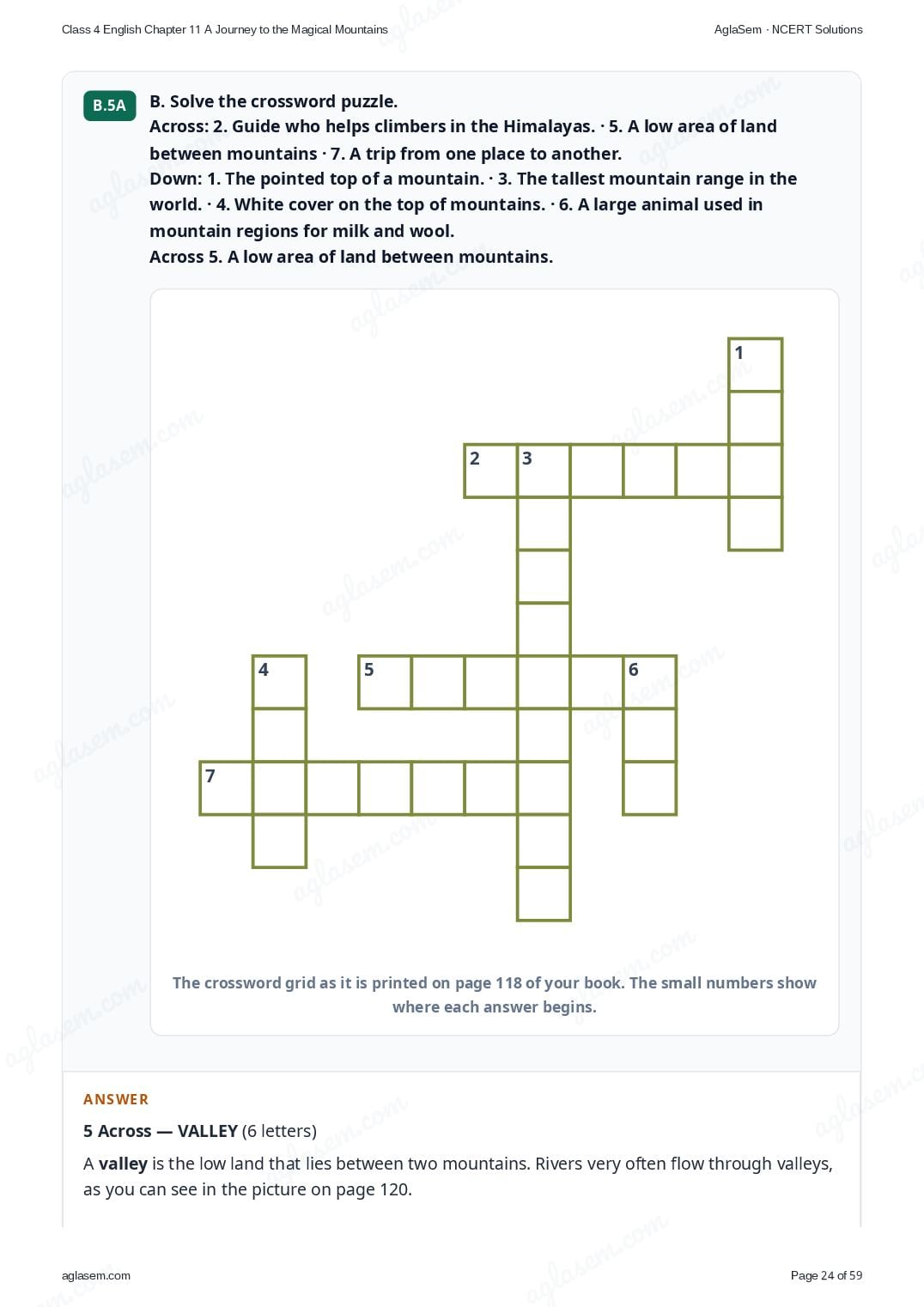
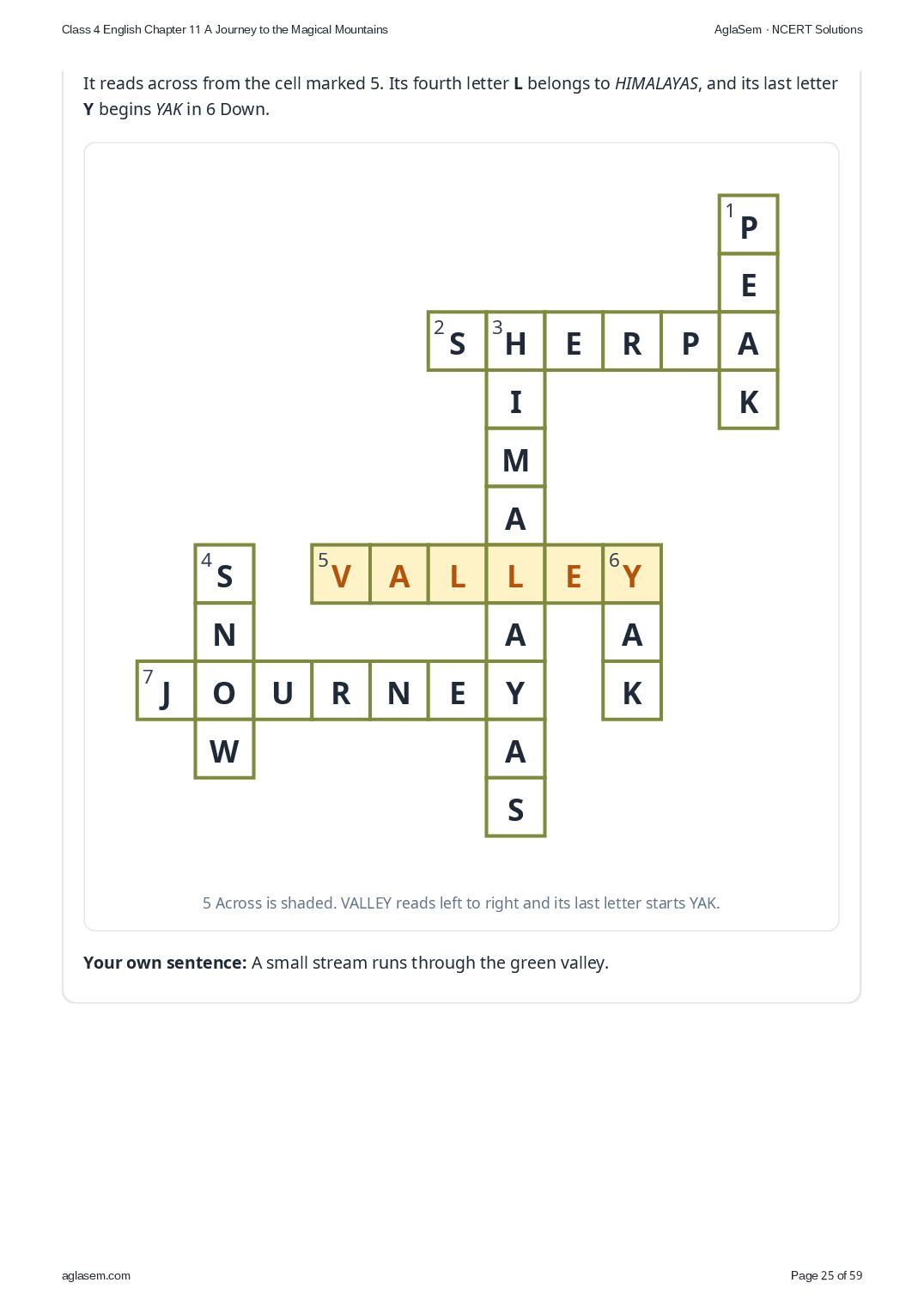
- B. Solve the crossword puzzle.Across: 2. Guide who helps climbers in the Himalayas. · 5. A low area of land between mountains · 7. A trip from one place to another.Down: 1. The pointed top of a mountain. · 3. The tallest mountain range in the world. · 4. White cover on the top of mountains. · 6. A large animal used in mountain regions for milk and wool.Across 5. A low area of land between mountains.The crossword grid printed on page 1181234567The crossword grid as it is printed on page 118 of your book. The small numbers show where each answer begins.
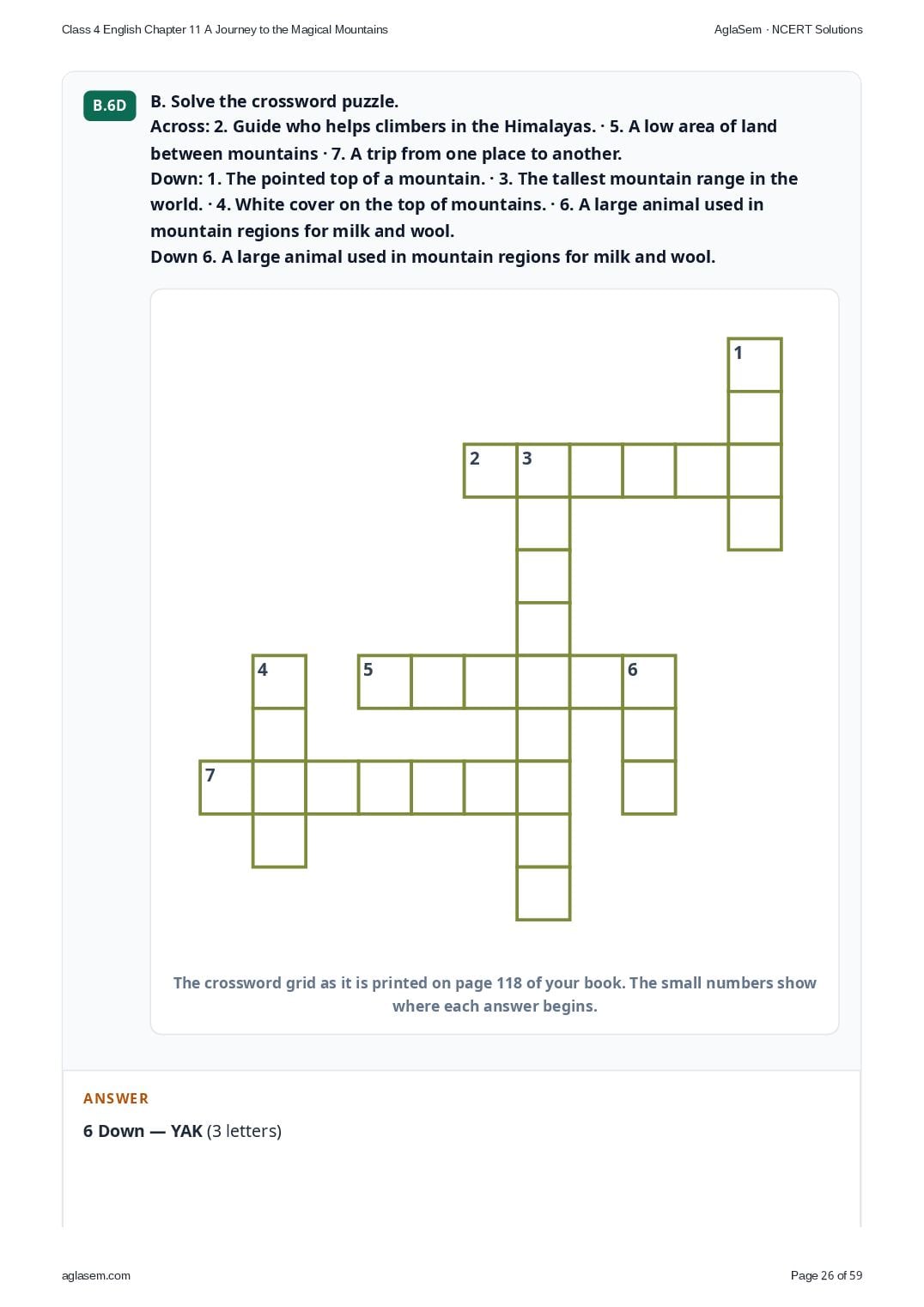
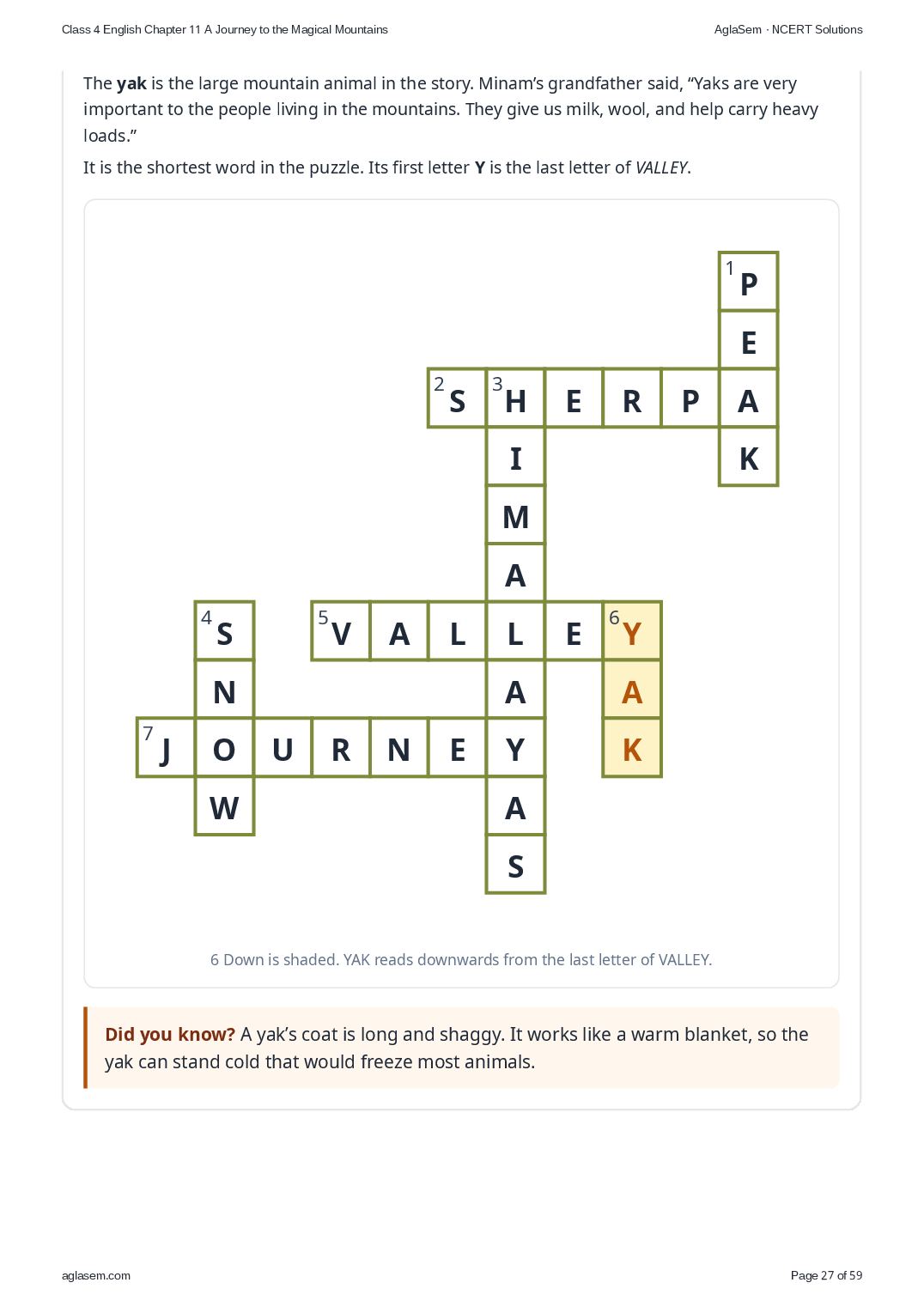
- B. Solve the crossword puzzle.Across: 2. Guide who helps climbers in the Himalayas. · 5. A low area of land between mountains · 7. A trip from one place to another.Down: 1. The pointed top of a mountain. · 3. The tallest mountain range in the world. · 4. White cover on the top of mountains. · 6. A large animal used in mountain regions for milk and wool.Down 6. A large animal used in mountain regions for milk and wool.The crossword grid printed on page 1181234567The crossword grid as it is printed on page 118 of your book. The small numbers show where each answer begins.
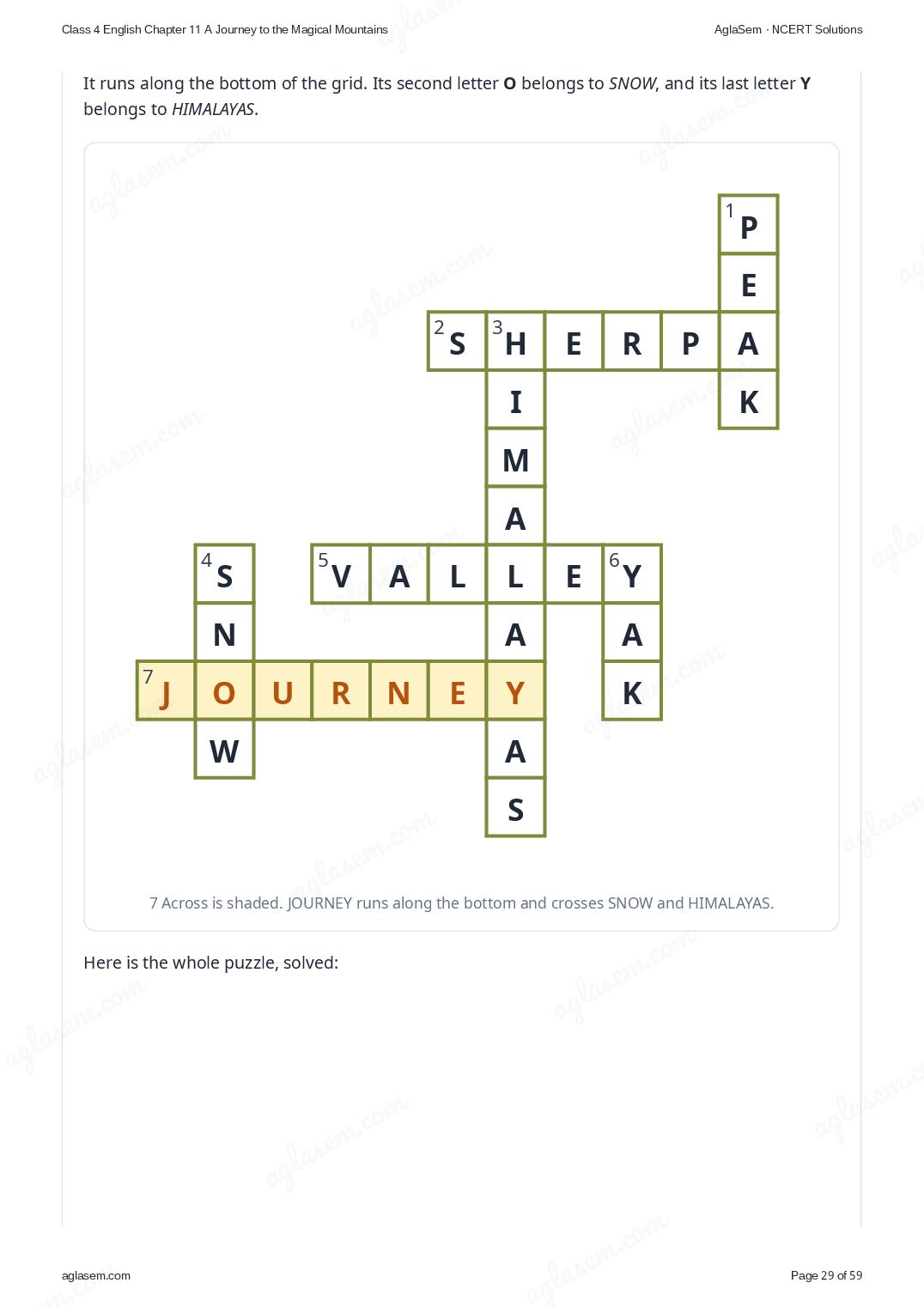
- B. Solve the crossword puzzle.Across: 2. Guide who helps climbers in the Himalayas. · 5. A low area of land between mountains · 7. A trip from one place to another.Down: 1. The pointed top of a mountain. · 3. The tallest mountain range in the world. · 4. White cover on the top of mountains. · 6. A large animal used in mountain regions for milk and wool.Across 7. A trip from one place to another.The crossword grid printed on page 1181234567The crossword grid as it is printed on page 118 of your book. The small numbers show where each answer begins.
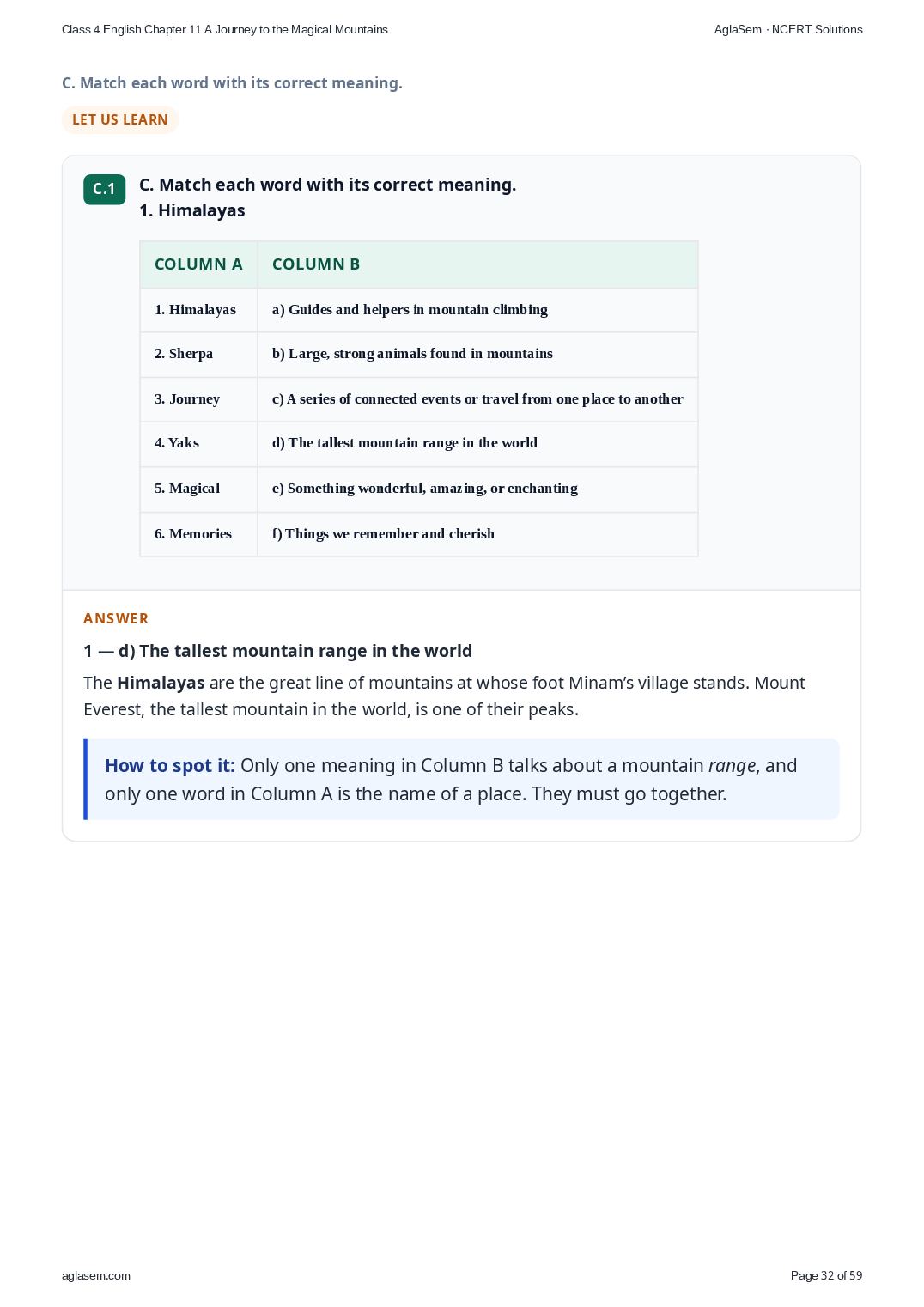
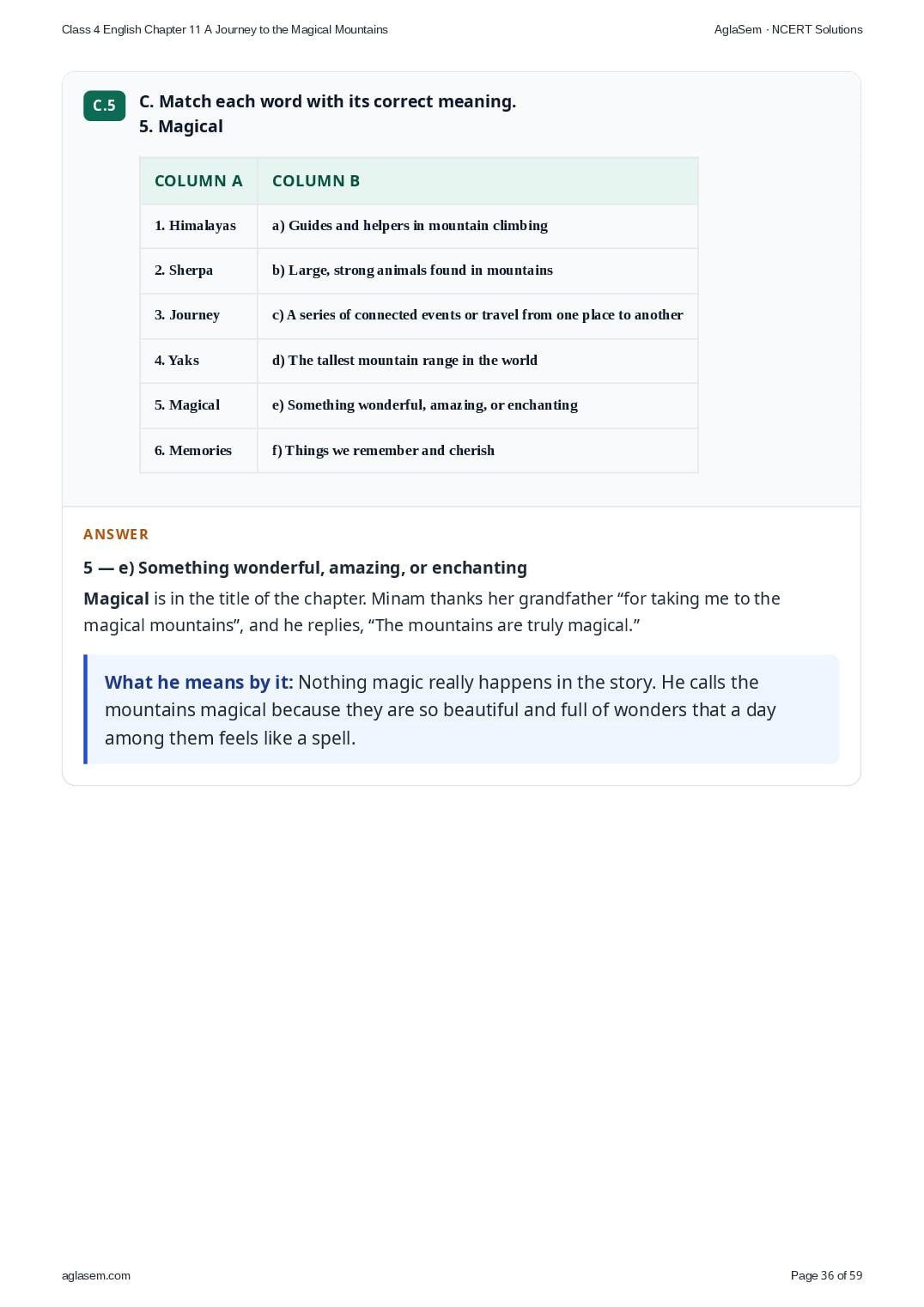
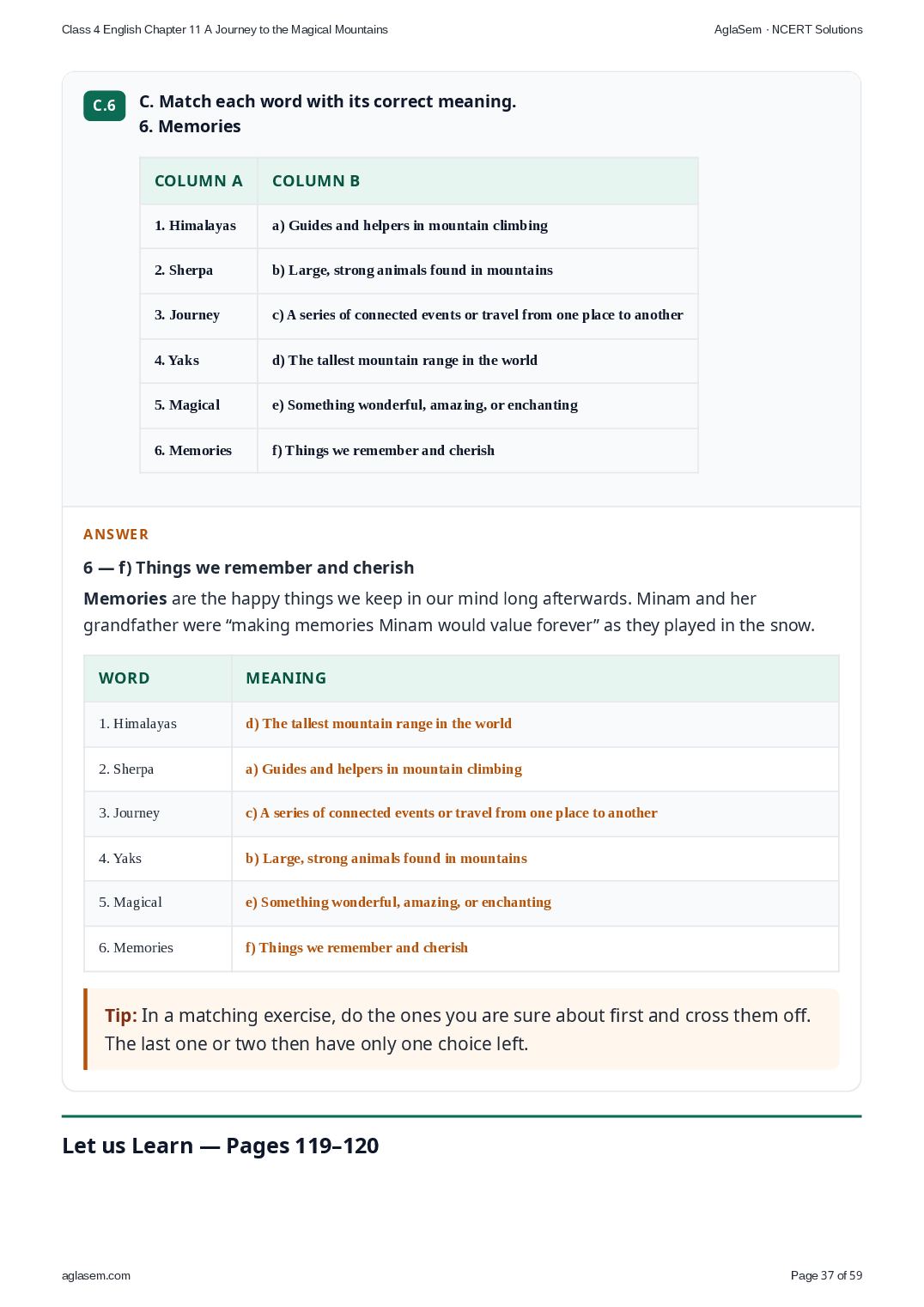
- C. Match each word with its correct meaning.1. HimalayasColumn AColumn B1. Himalayasa) Guides and helpers in mountain climbing2. Sherpab) Large, strong animals found in mountains3. Journeyc) A series of connected events or travel from one place to another4. Yaksd) The tallest mountain range in the world5. Magicale) Something wonderful, amazing, or enchanting6. Memoriesf) Things we remember and cherish
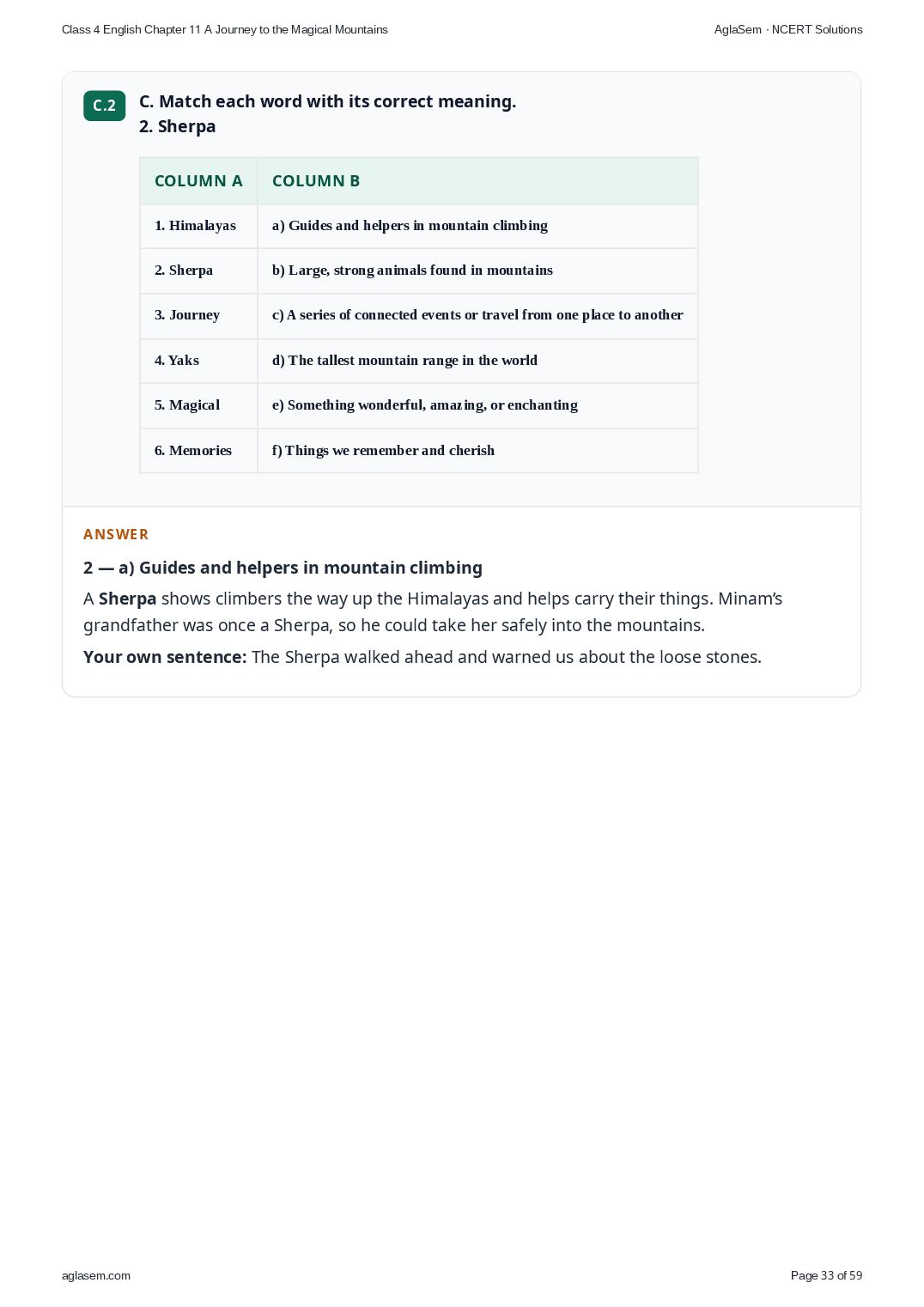
- C. Match each word with its correct meaning.2. SherpaColumn AColumn B1. Himalayasa) Guides and helpers in mountain climbing2. Sherpab) Large, strong animals found in mountains3. Journeyc) A series of connected events or travel from one place to another4. Yaksd) The tallest mountain range in the world5. Magicale) Something wonderful, amazing, or enchanting6. Memoriesf) Things we remember and cherish
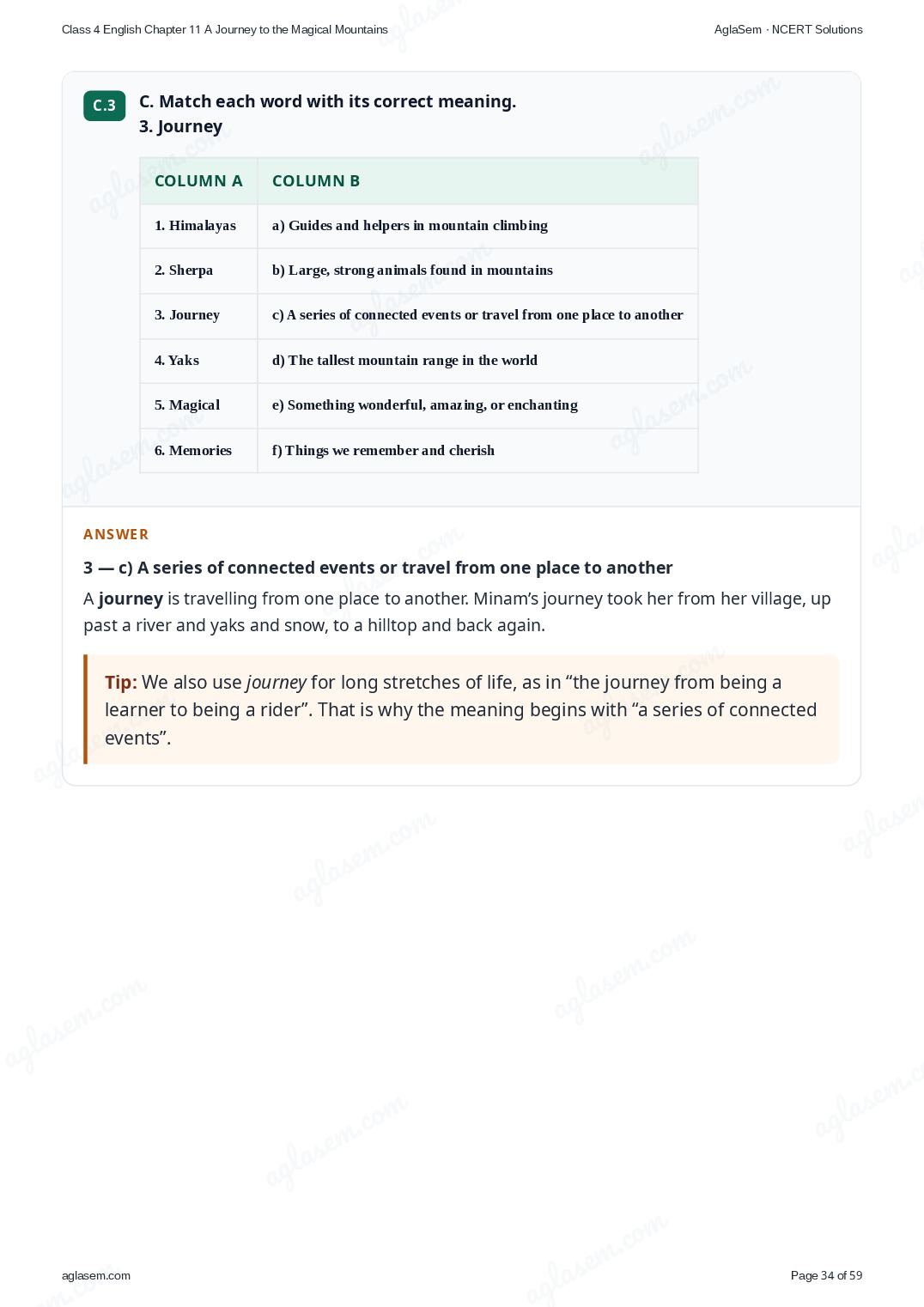
- C. Match each word with its correct meaning.3. JourneyColumn AColumn B1. Himalayasa) Guides and helpers in mountain climbing2. Sherpab) Large, strong animals found in mountains3. Journeyc) A series of connected events or travel from one place to another4. Yaksd) The tallest mountain range in the world5. Magicale) Something wonderful, amazing, or enchanting6. Memoriesf) Things we remember and cherish
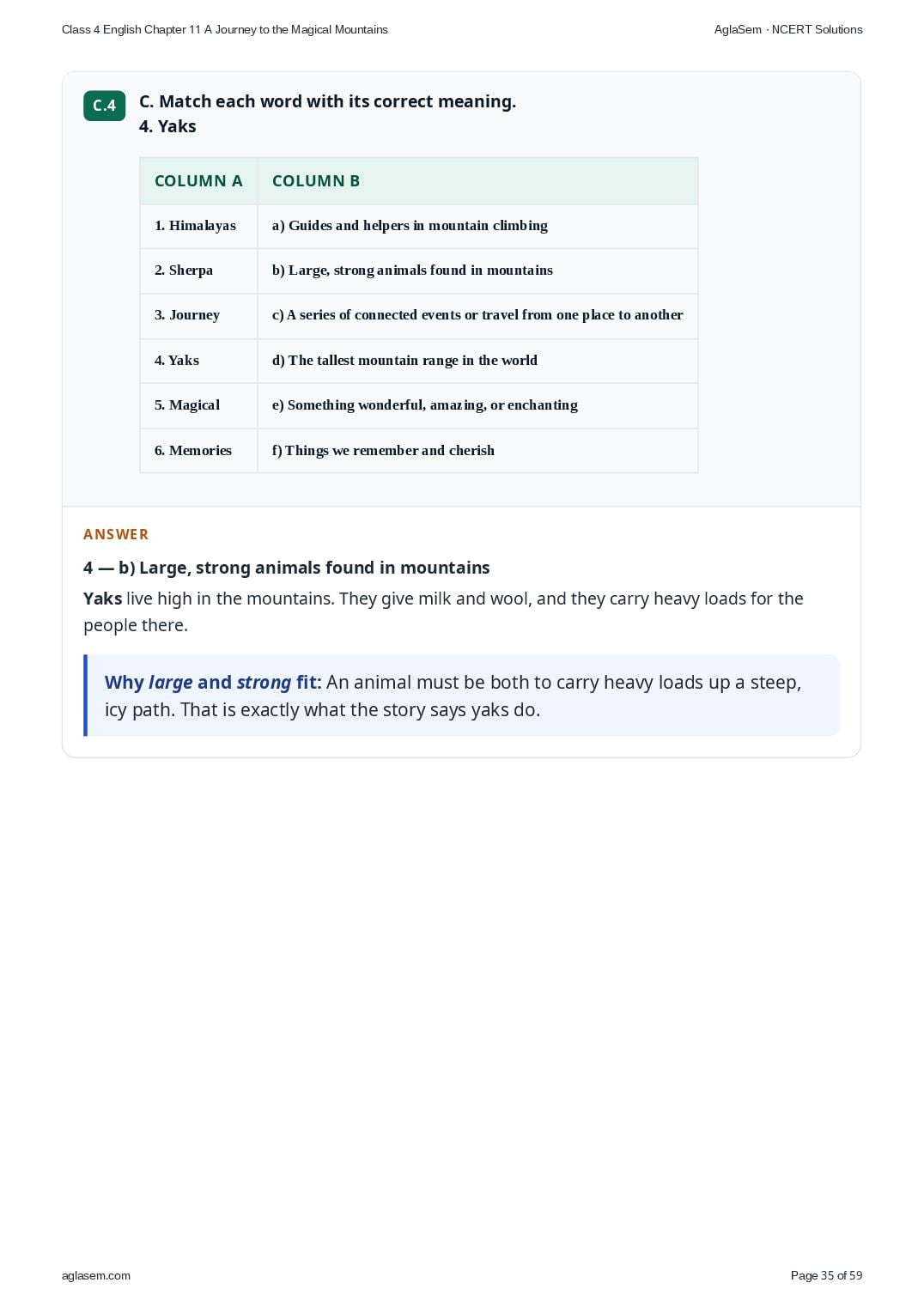
- C. Match each word with its correct meaning.4. YaksColumn AColumn B1. Himalayasa) Guides and helpers in mountain climbing2. Sherpab) Large, strong animals found in mountains3. Journeyc) A series of connected events or travel from one place to another4. Yaksd) The tallest mountain range in the world5. Magicale) Something wonderful, amazing, or enchanting6. Memoriesf) Things we remember and cherish
- C. Match each word with its correct meaning.5. MagicalColumn AColumn B1. Himalayasa) Guides and helpers in mountain climbing2. Sherpab) Large, strong animals found in mountains3. Journeyc) A series of connected events or travel from one place to another4. Yaksd) The tallest mountain range in the world5. Magicale) Something wonderful, amazing, or enchanting6. Memoriesf) Things we remember and cherish
- C. Match each word with its correct meaning.6. MemoriesColumn AColumn B1. Himalayasa) Guides and helpers in mountain climbing2. Sherpab) Large, strong animals found in mountains3. Journeyc) A series of connected events or travel from one place to another4. Yaksd) The tallest mountain range in the world5. Magicale) Something wonderful, amazing, or enchanting6. Memoriesf) Things we remember and cherish
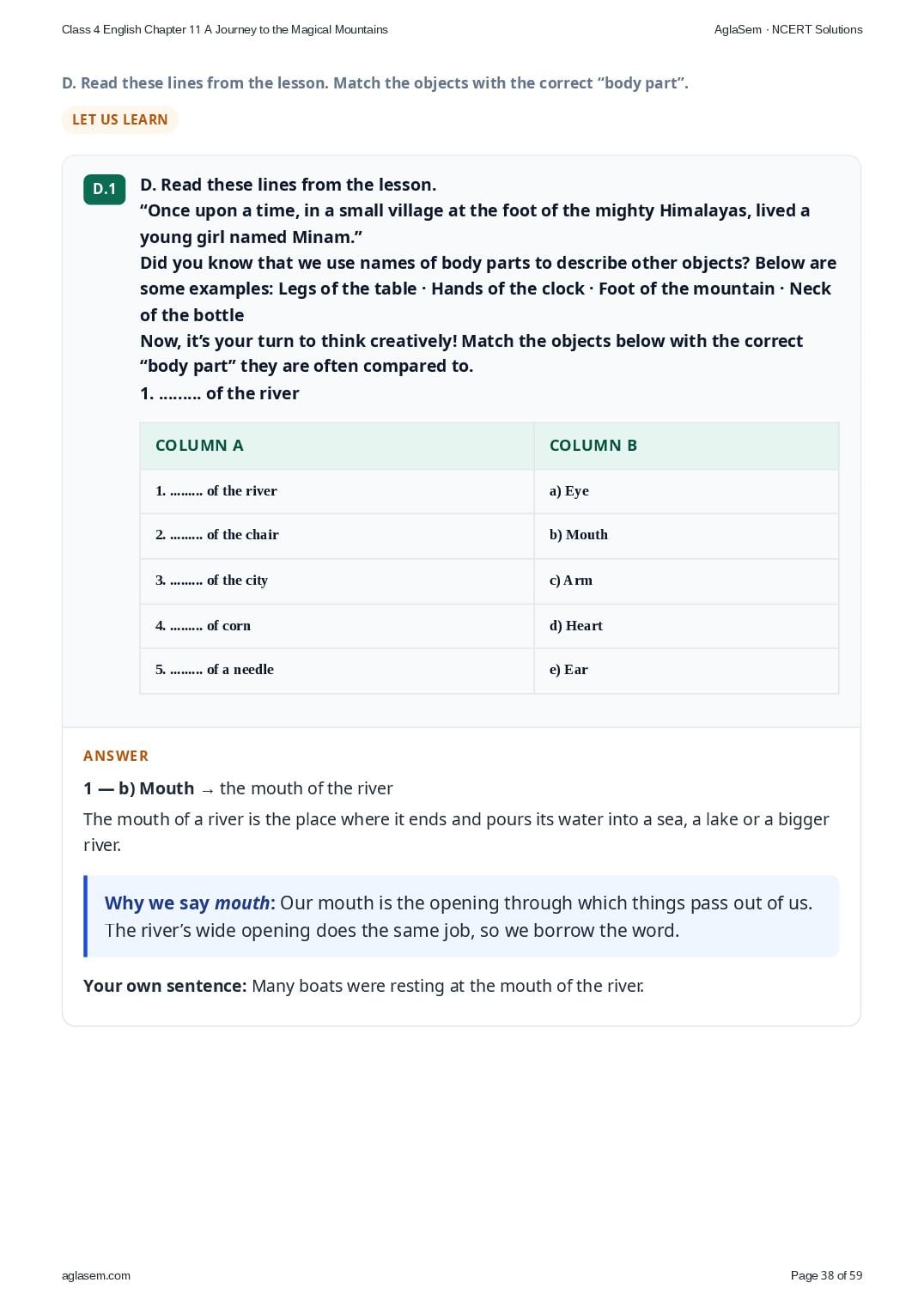
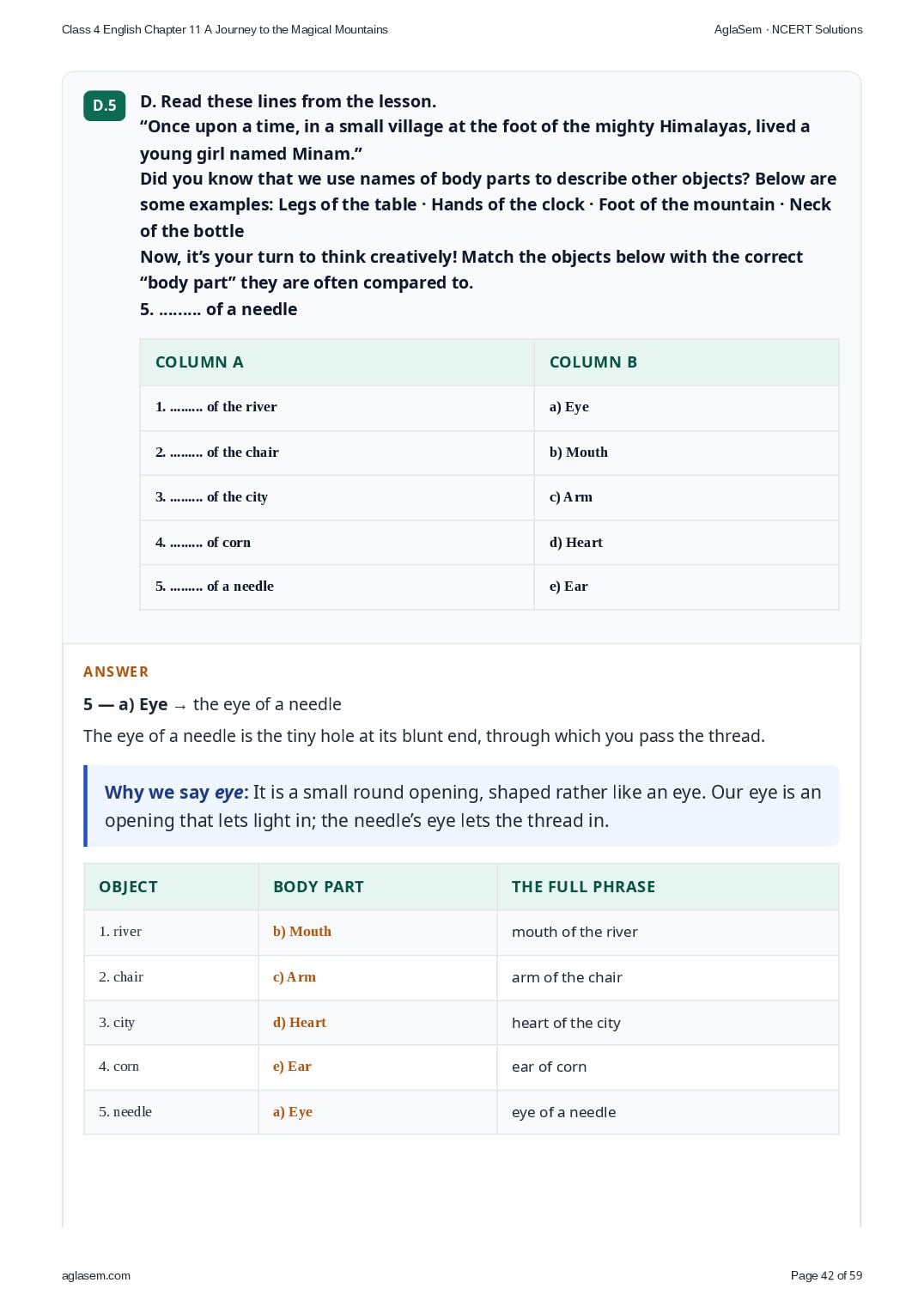
- D. Read these lines from the lesson.“Once upon a time, in a small village at the foot of the mighty Himalayas, lived a young girl named Minam.”Did you know that we use names of body parts to describe other objects? Below are some examples: Legs of the table · Hands of the clock · Foot of the mountain · Neck of the bottleNow, it’s your turn to think creatively! Match the objects below with the correct “body part” they are often compared to.1. ……… of the riverColumn AColumn B1. ……… of the rivera) Eye2. ……… of the chairb) Mouth3. ……… of the cityc) Arm4. ……… of cornd) Heart5. ……… of a needlee) Ear
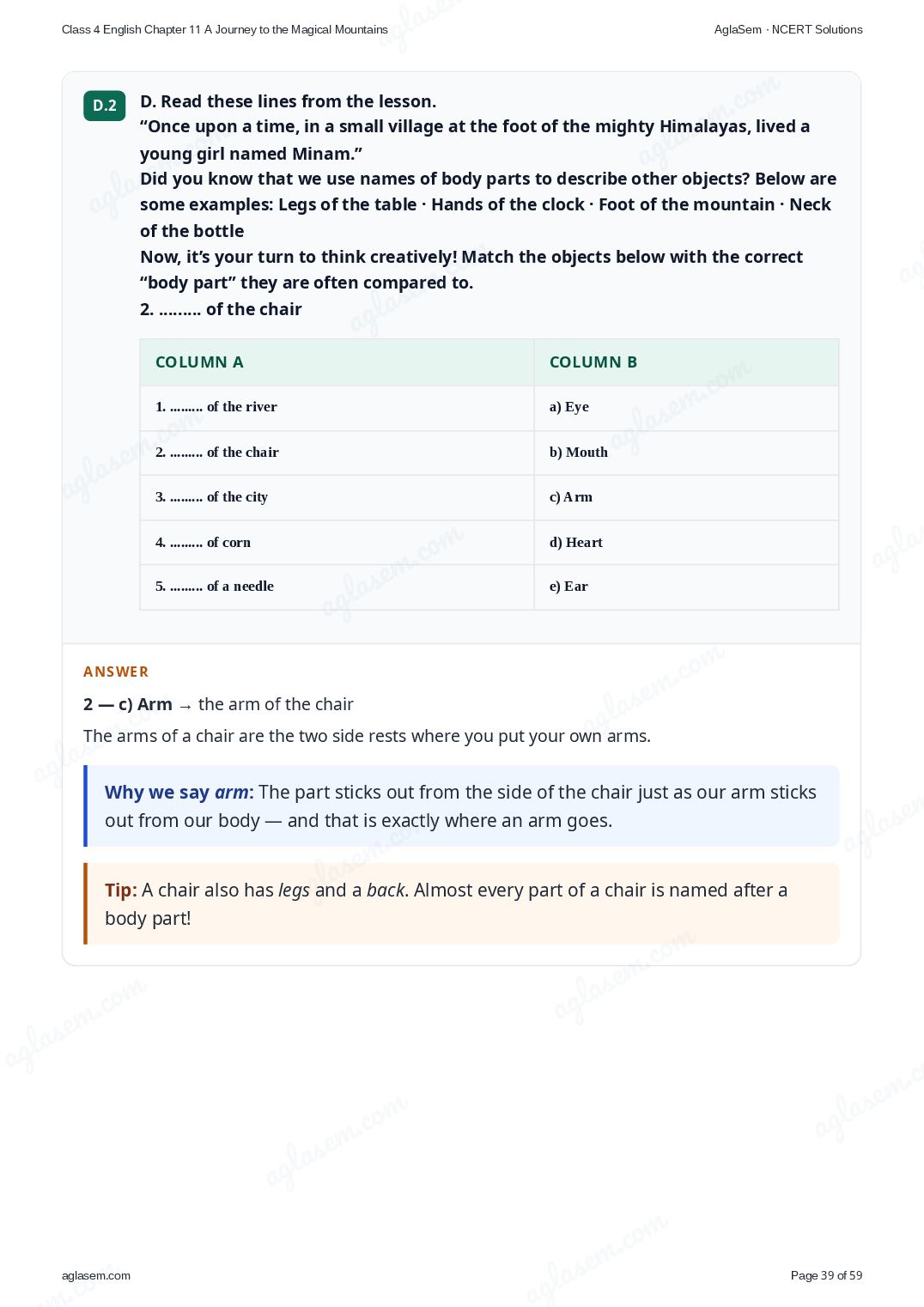
- D. Read these lines from the lesson.“Once upon a time, in a small village at the foot of the mighty Himalayas, lived a young girl named Minam.”Did you know that we use names of body parts to describe other objects? Below are some examples: Legs of the table · Hands of the clock · Foot of the mountain · Neck of the bottleNow, it’s your turn to think creatively! Match the objects below with the correct “body part” they are often compared to.2. ……… of the chairColumn AColumn B1. ……… of the rivera) Eye2. ……… of the chairb) Mouth3. ……… of the cityc) Arm4. ……… of cornd) Heart5. ……… of a needlee) Ear
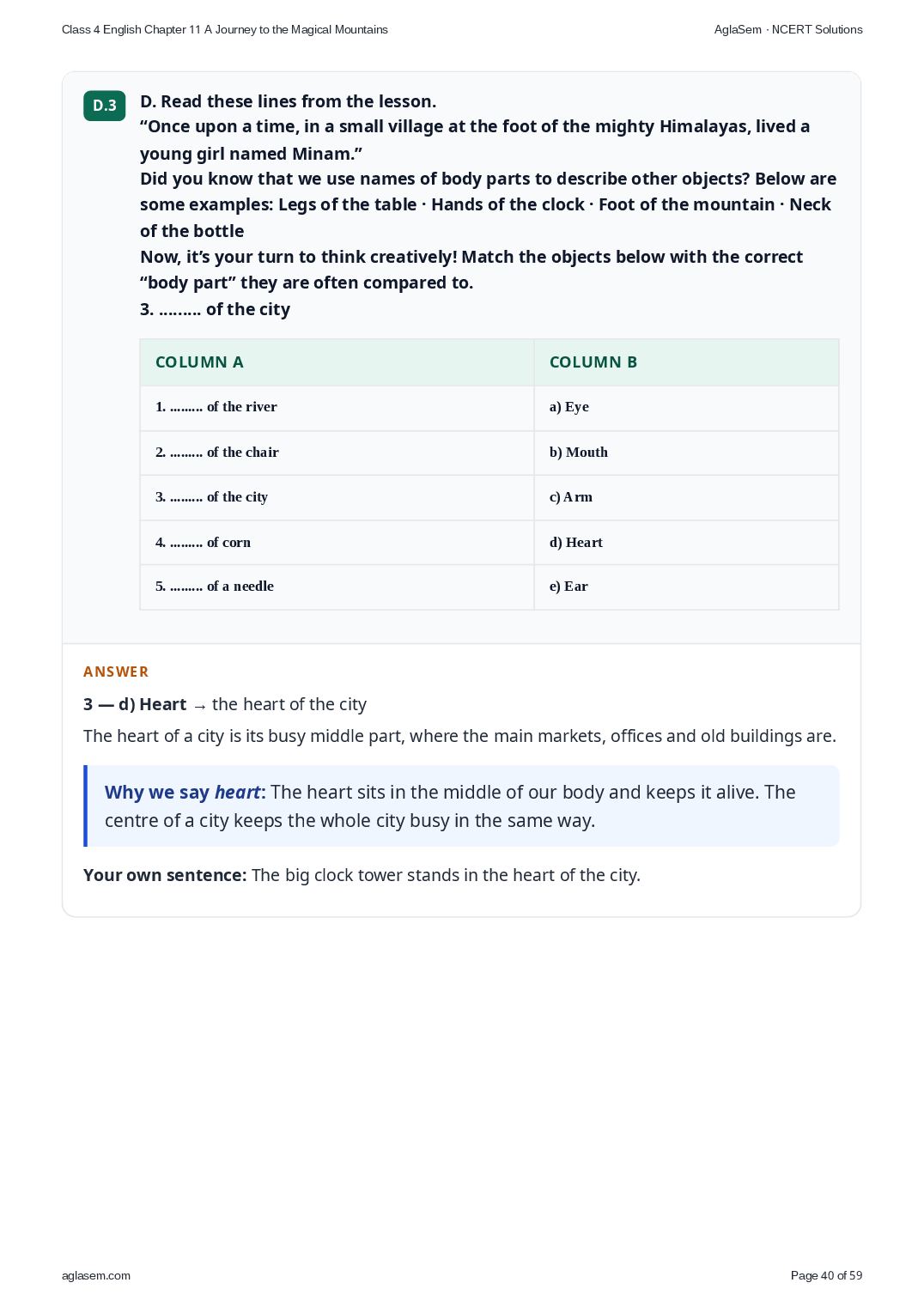
- D. Read these lines from the lesson.“Once upon a time, in a small village at the foot of the mighty Himalayas, lived a young girl named Minam.”Did you know that we use names of body parts to describe other objects? Below are some examples: Legs of the table · Hands of the clock · Foot of the mountain · Neck of the bottleNow, it’s your turn to think creatively! Match the objects below with the correct “body part” they are often compared to.3. ……… of the cityColumn AColumn B1. ……… of the rivera) Eye2. ……… of the chairb) Mouth3. ……… of the cityc) Arm4. ……… of cornd) Heart5. ……… of a needlee) Ear
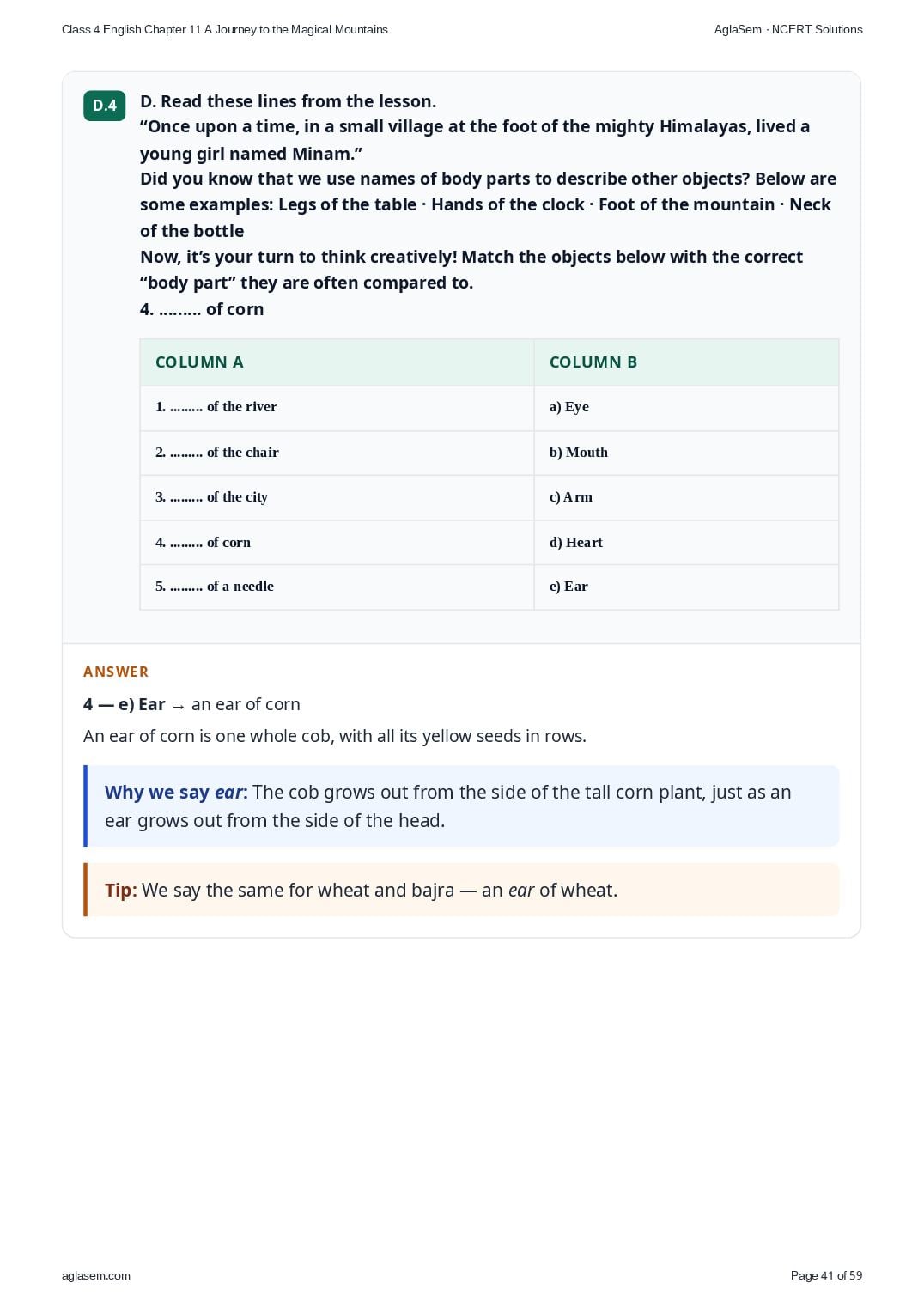
- D. Read these lines from the lesson.“Once upon a time, in a small village at the foot of the mighty Himalayas, lived a young girl named Minam.”Did you know that we use names of body parts to describe other objects? Below are some examples: Legs of the table · Hands of the clock · Foot of the mountain · Neck of the bottleNow, it’s your turn to think creatively! Match the objects below with the correct “body part” they are often compared to.4. ……… of cornColumn AColumn B1. ……… of the rivera) Eye2. ……… of the chairb) Mouth3. ……… of the cityc) Arm4. ……… of cornd) Heart5. ……… of a needlee) Ear
- D. Read these lines from the lesson.“Once upon a time, in a small village at the foot of the mighty Himalayas, lived a young girl named Minam.”Did you know that we use names of body parts to describe other objects? Below are some examples: Legs of the table · Hands of the clock · Foot of the mountain · Neck of the bottleNow, it’s your turn to think creatively! Match the objects below with the correct “body part” they are often compared to.5. ……… of a needleColumn AColumn B1. ……… of the rivera) Eye2. ……… of the chairb) Mouth3. ……… of the cityc) Arm4. ……… of cornd) Heart5. ……… of a needlee) Ear
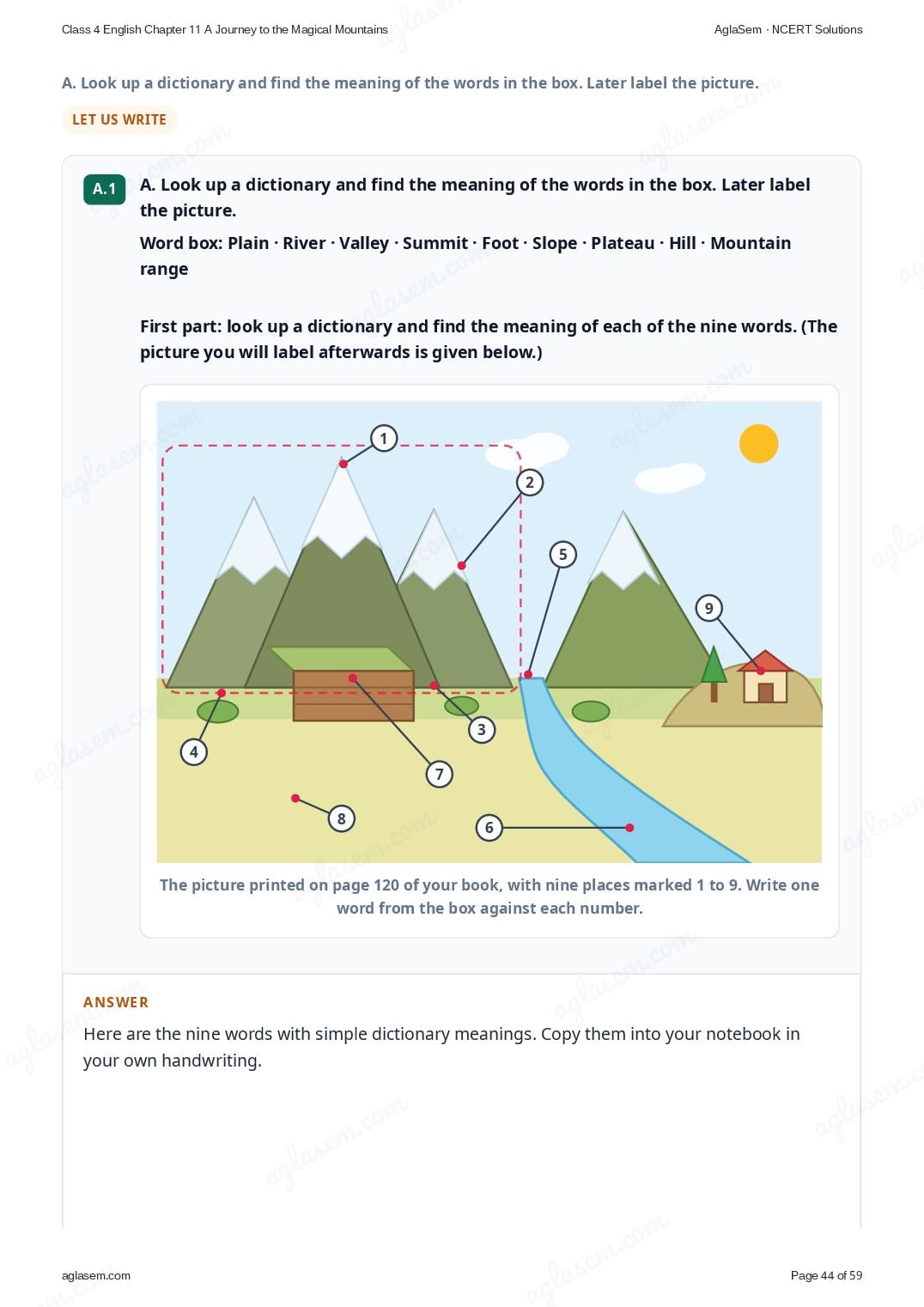
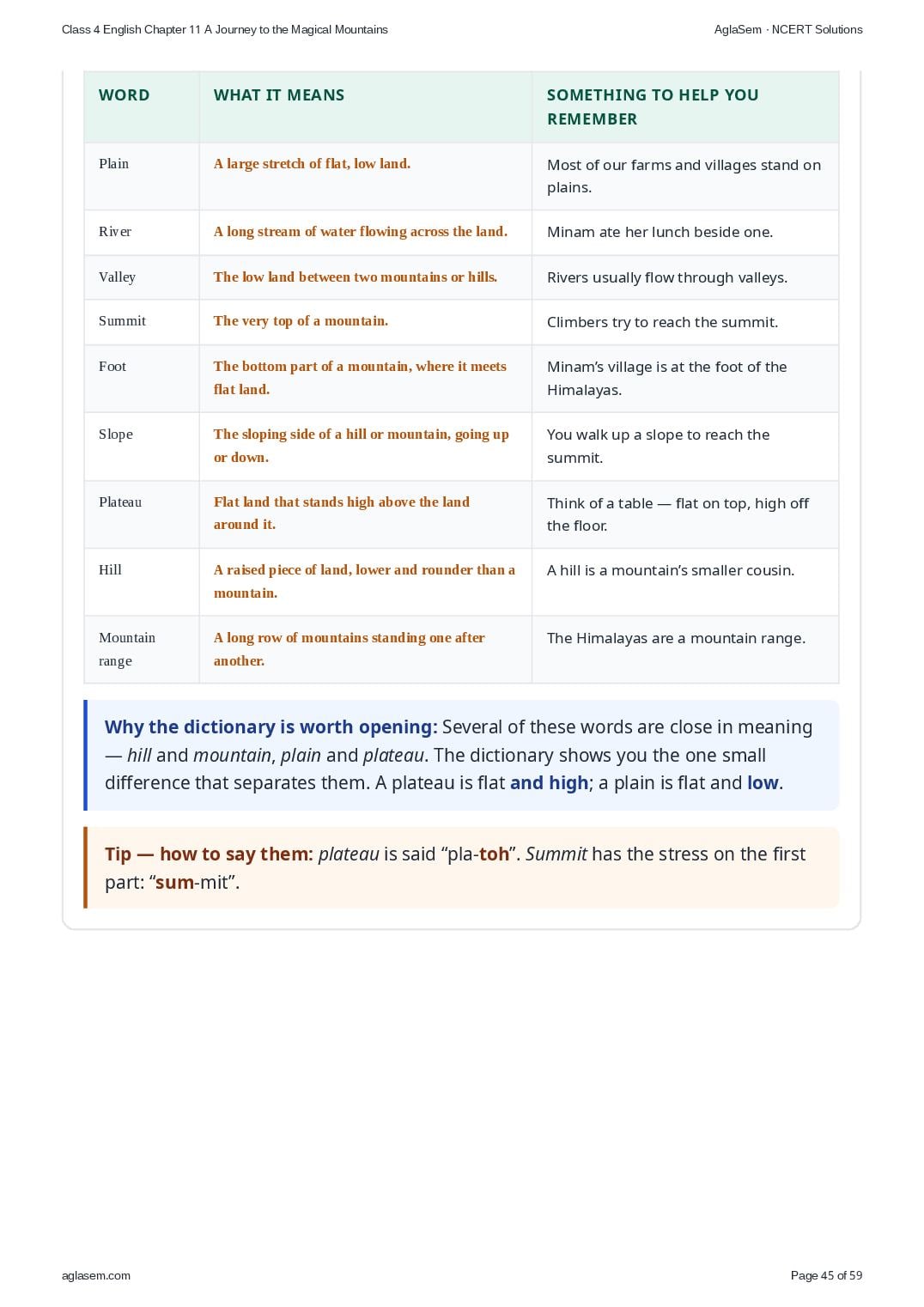
- A. Look up a dictionary and find the meaning of the words in the box. Later label the picture.Word box: Plain · River · Valley · Summit · Foot · Slope · Plateau · Hill · Mountain rangeFirst part: look up a dictionary and find the meaning of each of the nine words. (The picture you will label afterwards is given below.)The mountain landscape printed on page 120123456789The picture printed on page 120 of your book, with nine places marked 1 to 9. Write one word from the box against each number.
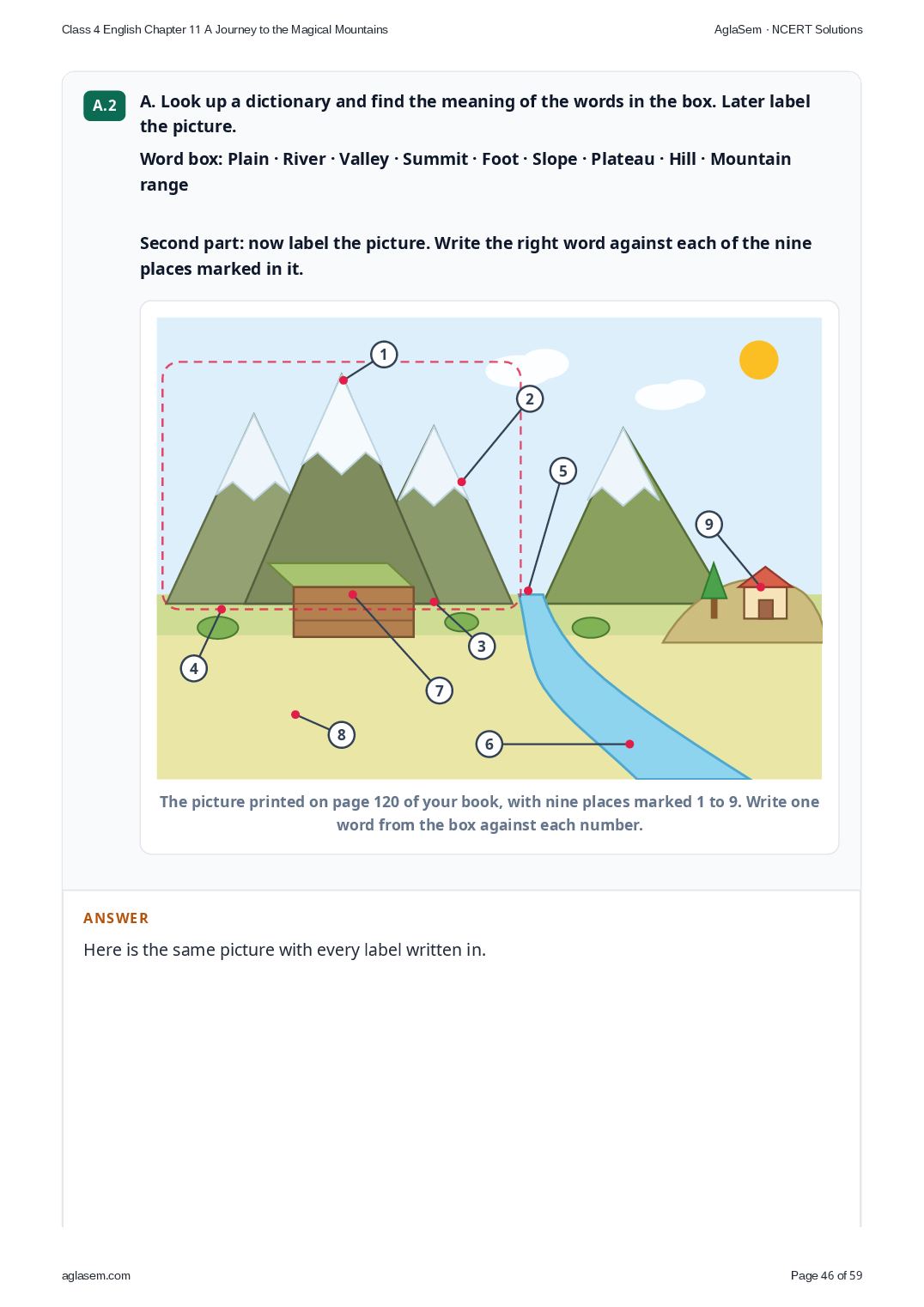
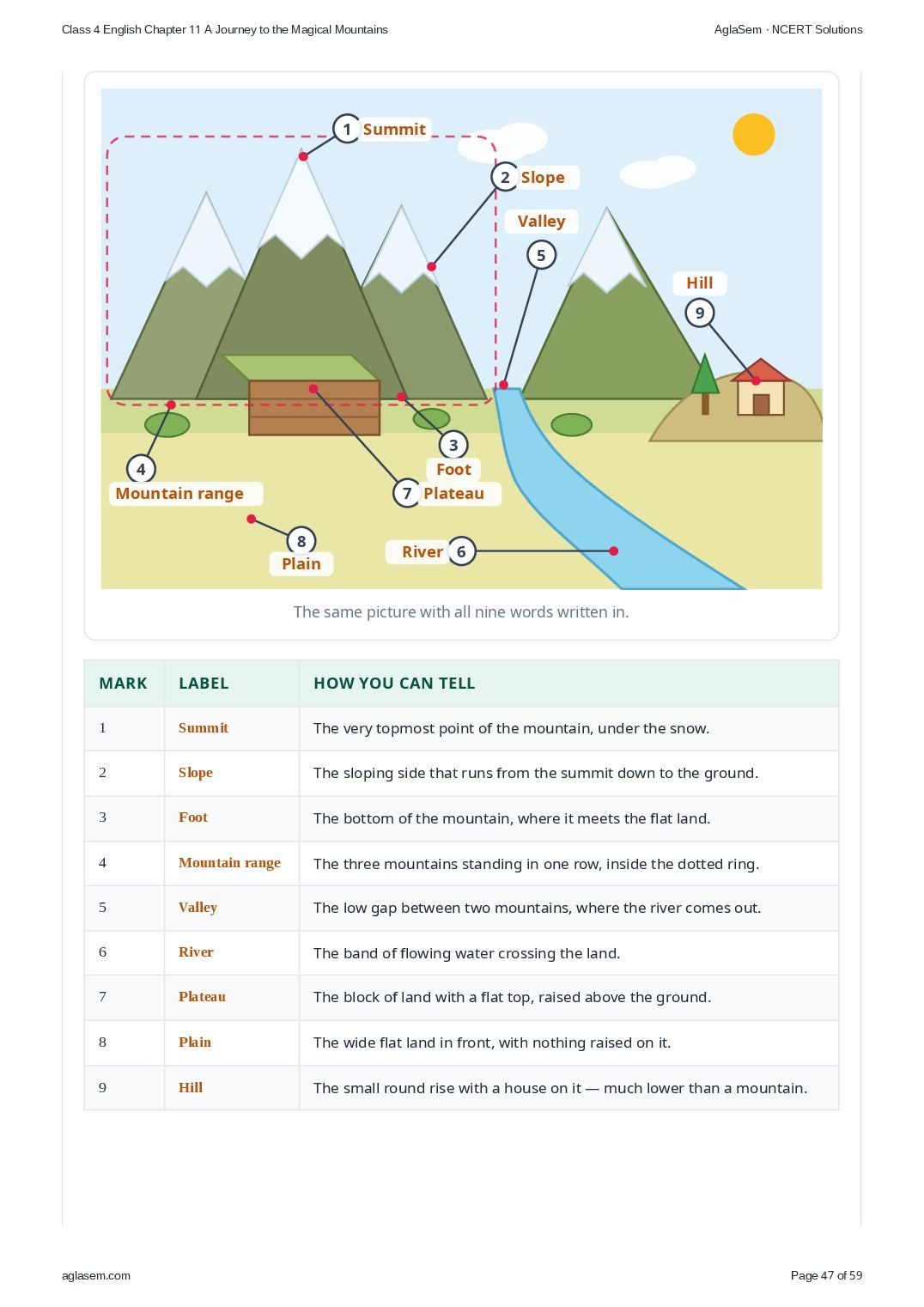
- A. Look up a dictionary and find the meaning of the words in the box. Later label the picture.Word box: Plain · River · Valley · Summit · Foot · Slope · Plateau · Hill · Mountain rangeSecond part: now label the picture. Write the right word against each of the nine places marked in it.The mountain landscape printed on page 120123456789The picture printed on page 120 of your book, with nine places marked 1 to 9. Write one word from the box against each number.
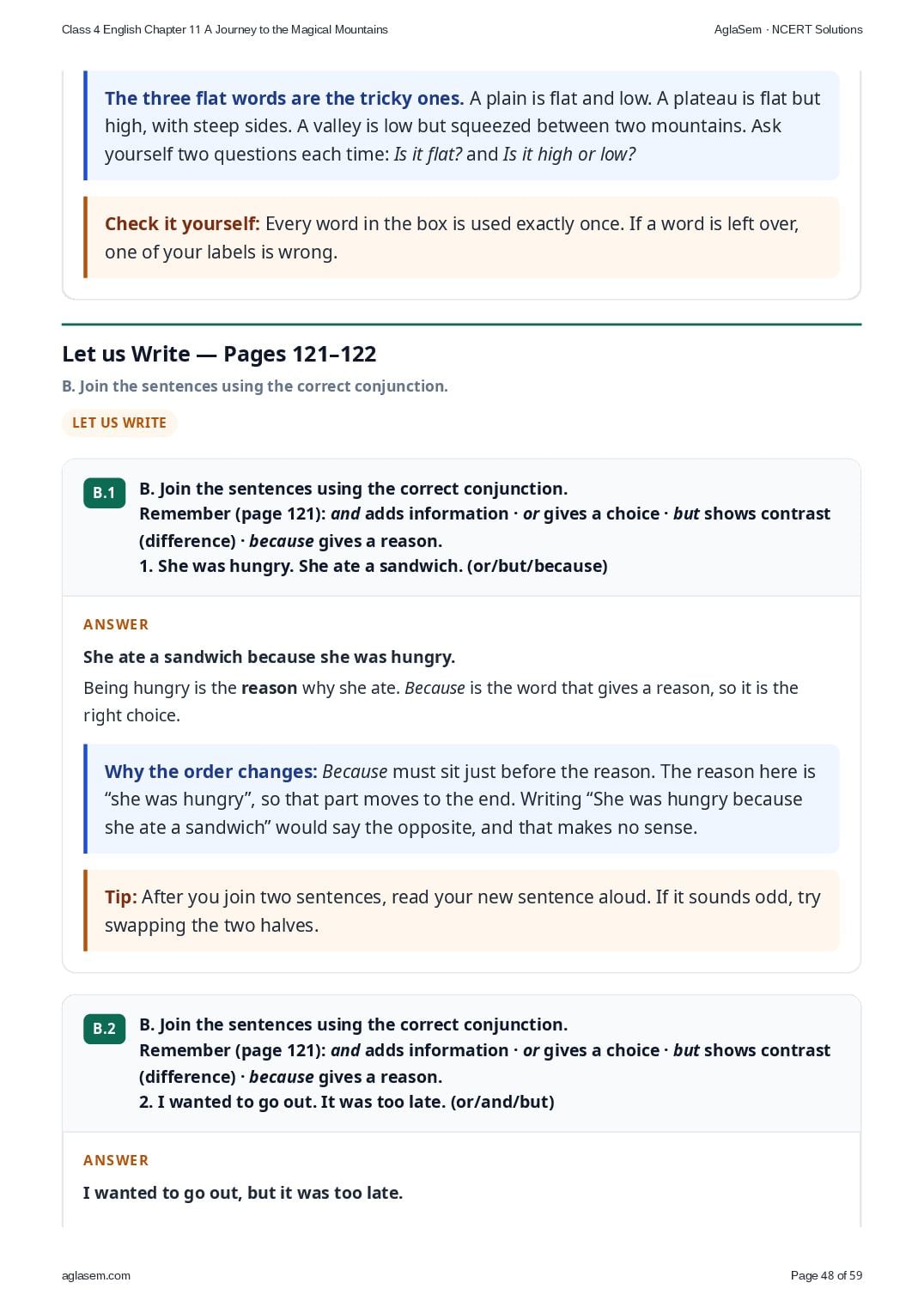
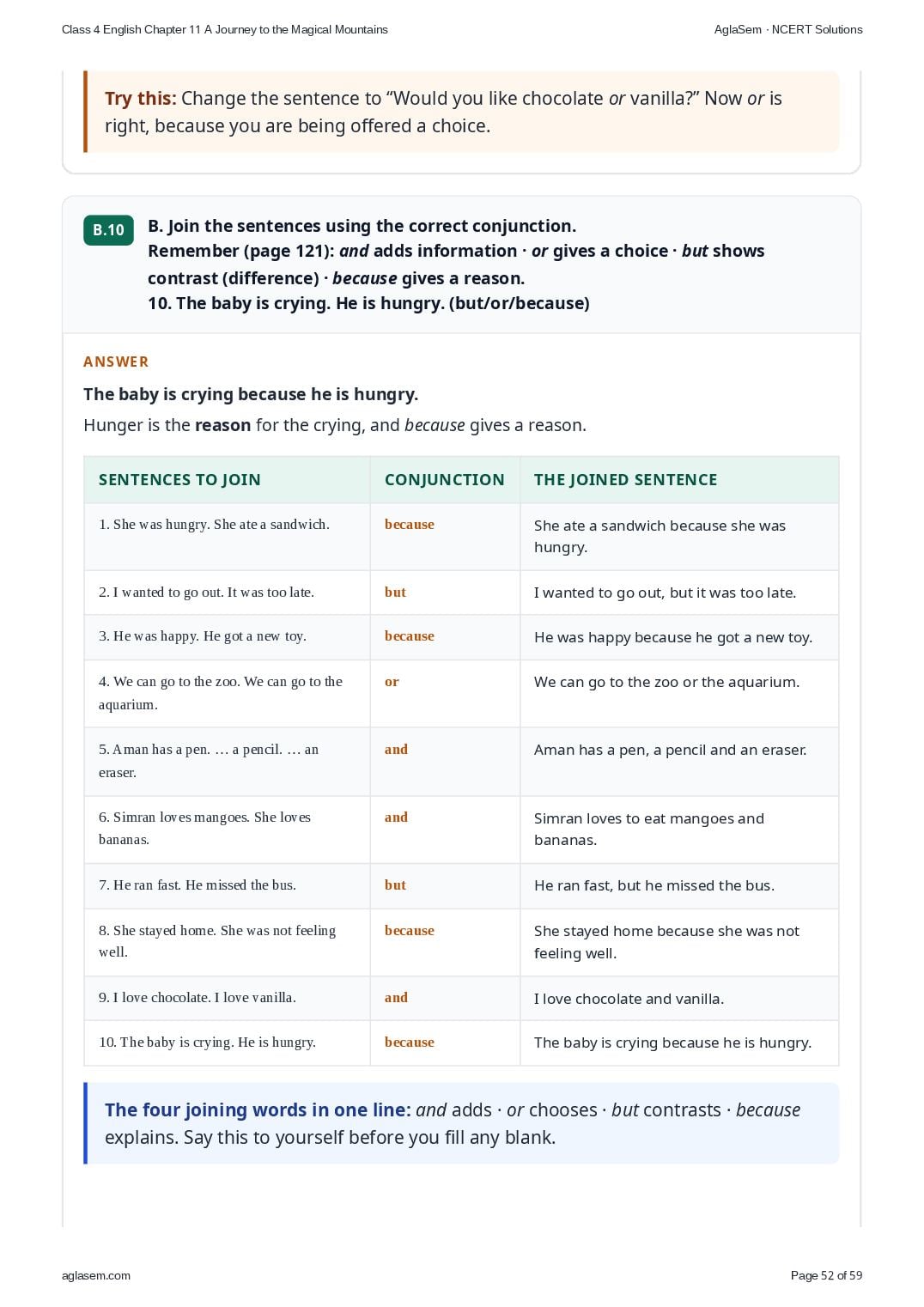
- B. Join the sentences using the correct conjunction.Remember (page 121): and adds information · or gives a choice · but shows contrast (difference) · because gives a reason.1. She was hungry. She ate a sandwich. (or/but/because)
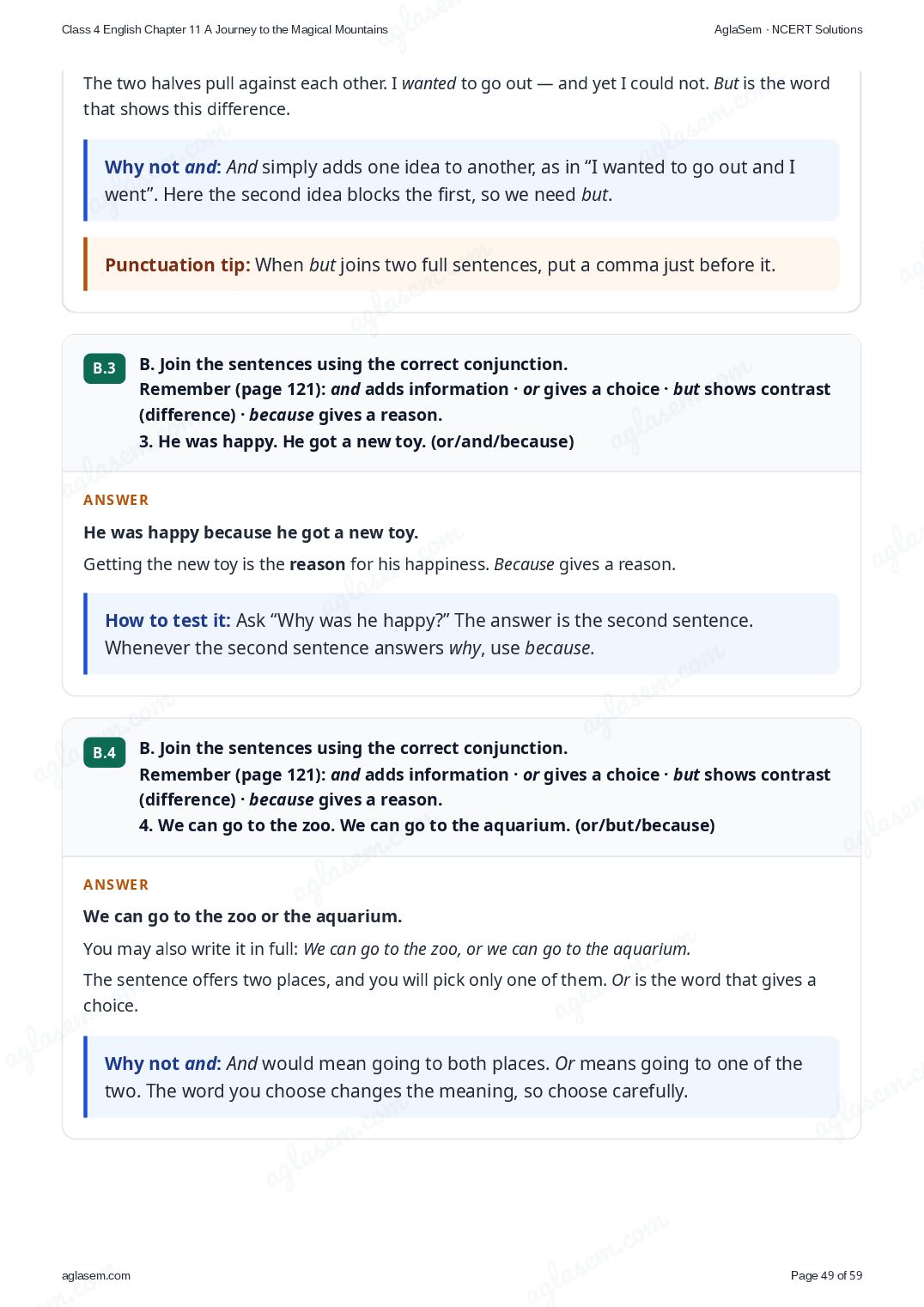
- B. Join the sentences using the correct conjunction.Remember (page 121): and adds information · or gives a choice · but shows contrast (difference) · because gives a reason.2. I wanted to go out. It was too late. (or/and/but)
- B. Join the sentences using the correct conjunction.Remember (page 121): and adds information · or gives a choice · but shows contrast (difference) · because gives a reason.3. He was happy. He got a new toy. (or/and/because)
- B. Join the sentences using the correct conjunction.Remember (page 121): and adds information · or gives a choice · but shows contrast (difference) · because gives a reason.4. We can go to the zoo. We can go to the aquarium. (or/but/because)
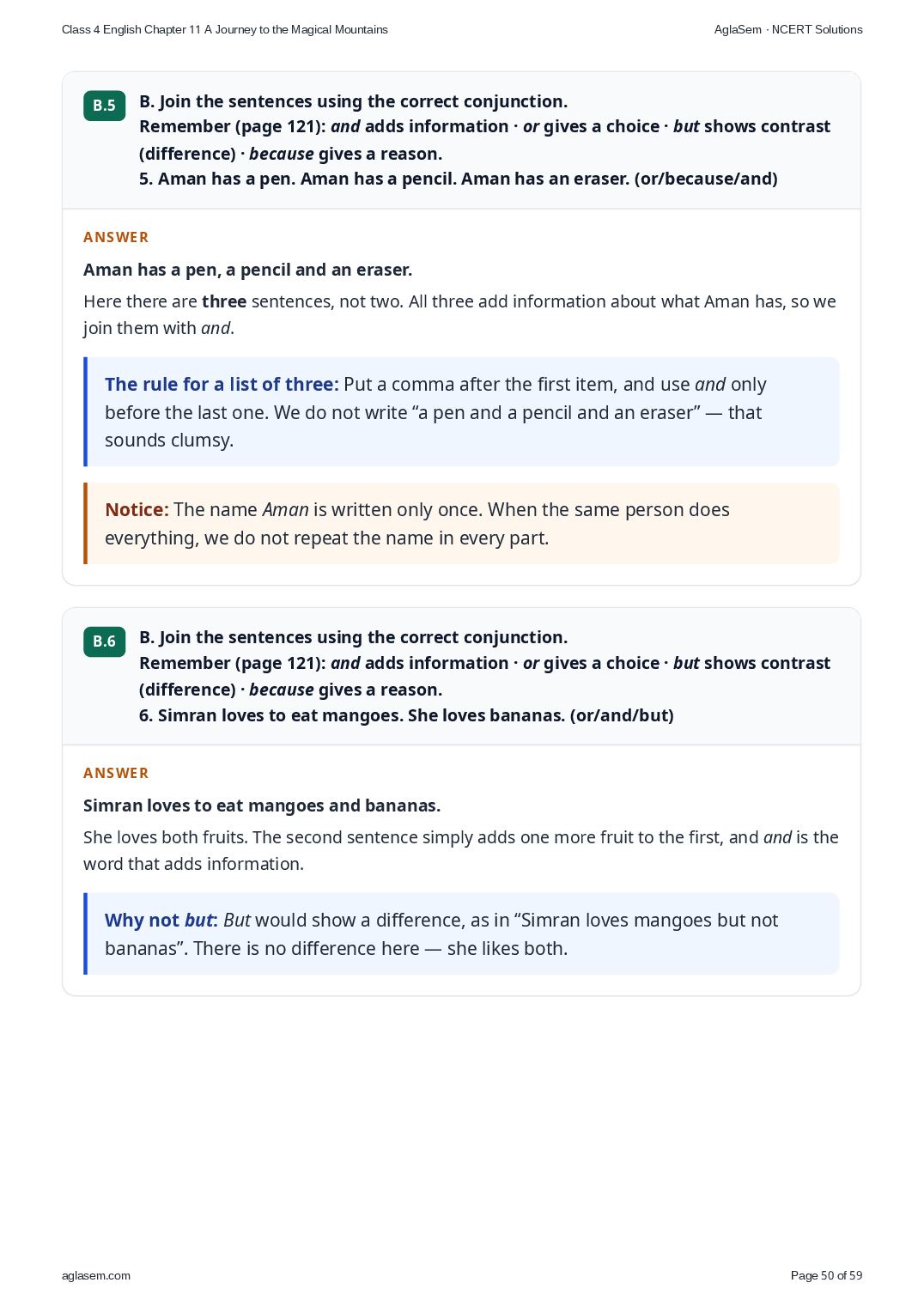
- B. Join the sentences using the correct conjunction.Remember (page 121): and adds information · or gives a choice · but shows contrast (difference) · because gives a reason.5. Aman has a pen. Aman has a pencil. Aman has an eraser. (or/because/and)
- B. Join the sentences using the correct conjunction.Remember (page 121): and adds information · or gives a choice · but shows contrast (difference) · because gives a reason.6. Simran loves to eat mangoes. She loves bananas. (or/and/but)
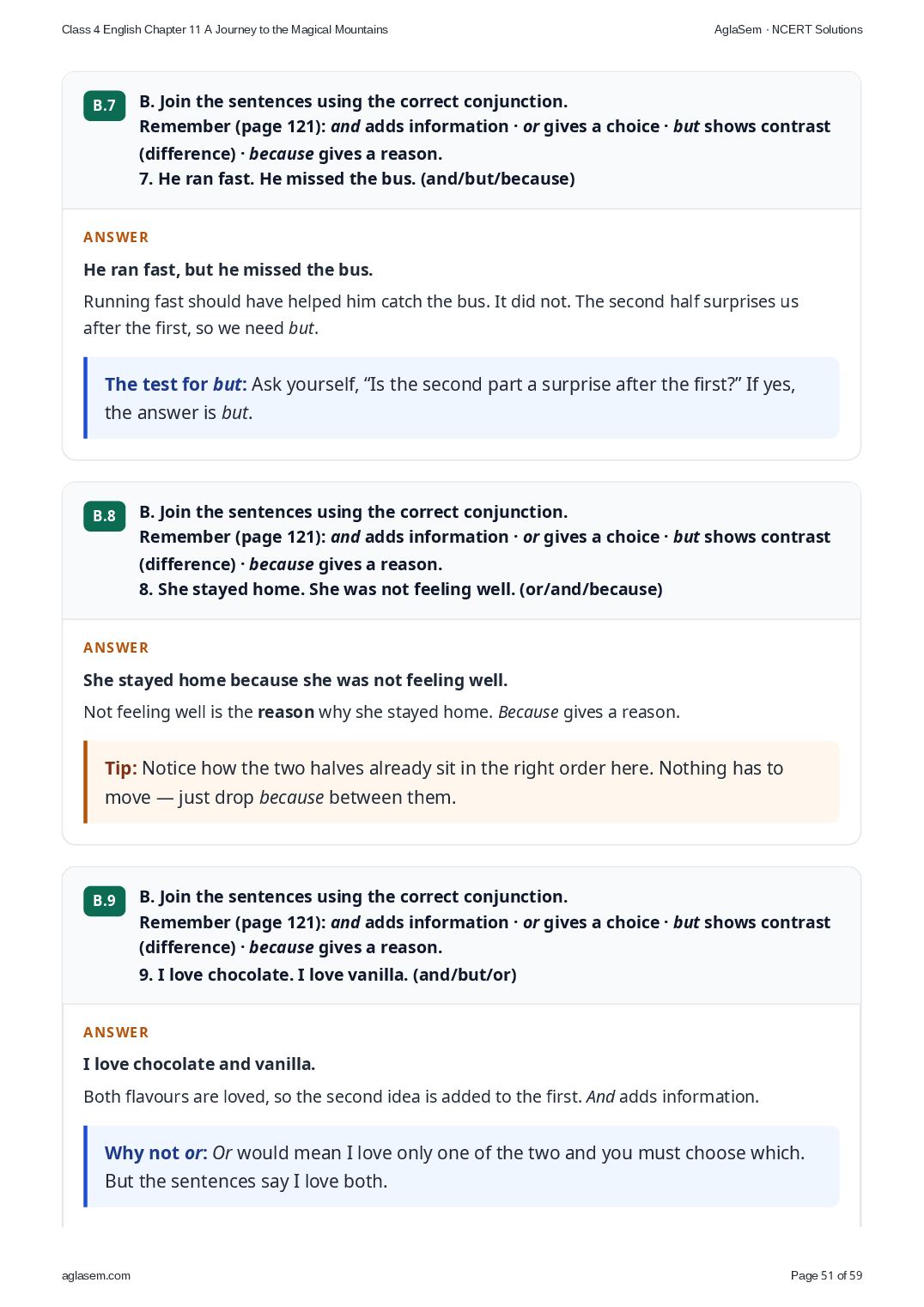
- B. Join the sentences using the correct conjunction.Remember (page 121): and adds information · or gives a choice · but shows contrast (difference) · because gives a reason.7. He ran fast. He missed the bus. (and/but/because)
- B. Join the sentences using the correct conjunction.Remember (page 121): and adds information · or gives a choice · but shows contrast (difference) · because gives a reason.8. She stayed home. She was not feeling well. (or/and/because)
- B. Join the sentences using the correct conjunction.Remember (page 121): and adds information · or gives a choice · but shows contrast (difference) · because gives a reason.9. I love chocolate. I love vanilla. (and/but/or)
- B. Join the sentences using the correct conjunction.Remember (page 121): and adds information · or gives a choice · but shows contrast (difference) · because gives a reason.10. The baby is crying. He is hungry. (but/or/because)
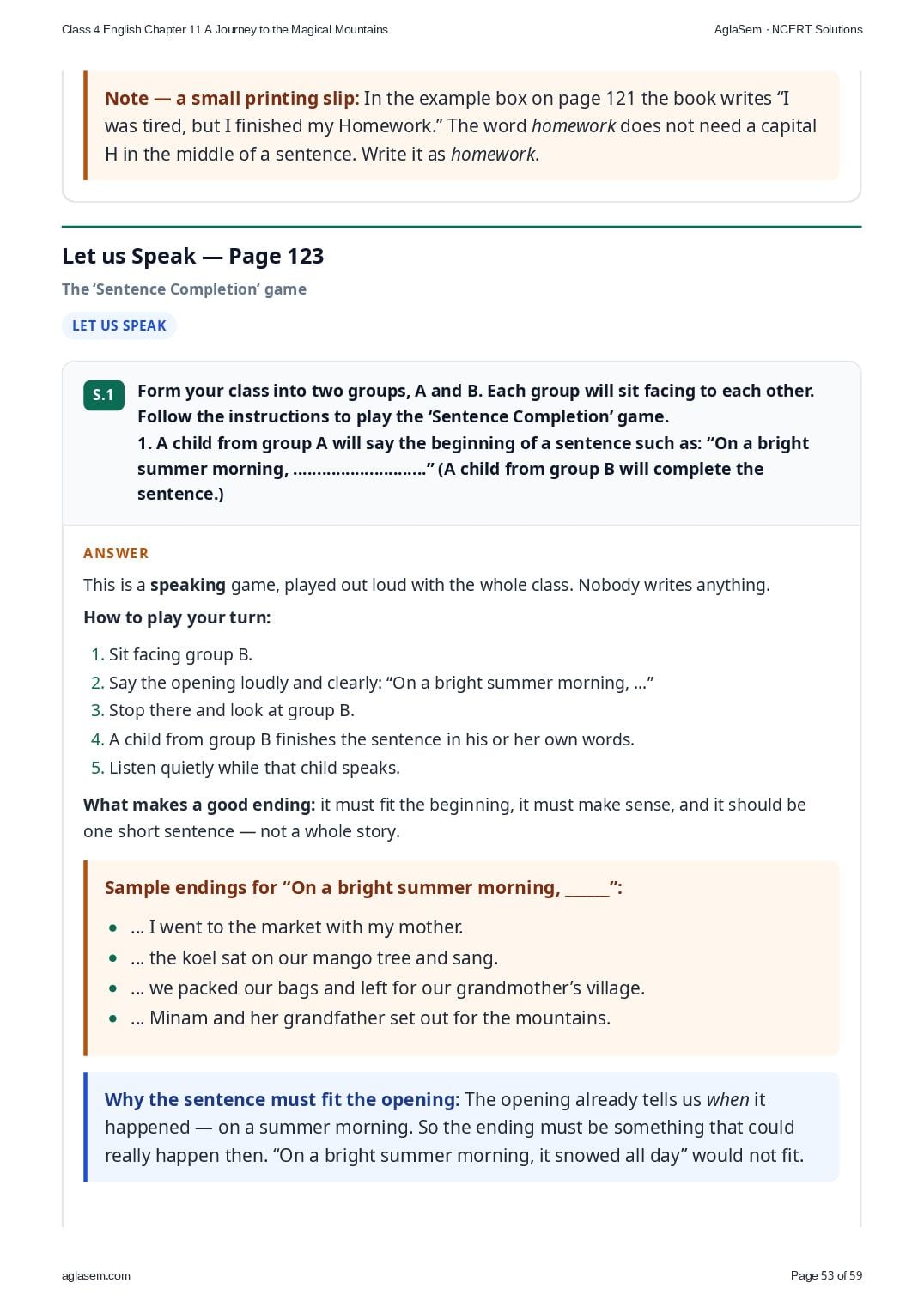
- Form your class into two groups, A and B. Each group will sit facing to each other. Follow the instructions to play the ‘Sentence Completion’ game.1. A child from group A will say the beginning of a sentence such as: “On a bright summer morning, ……………………….” (A child from group B will complete the sentence.)
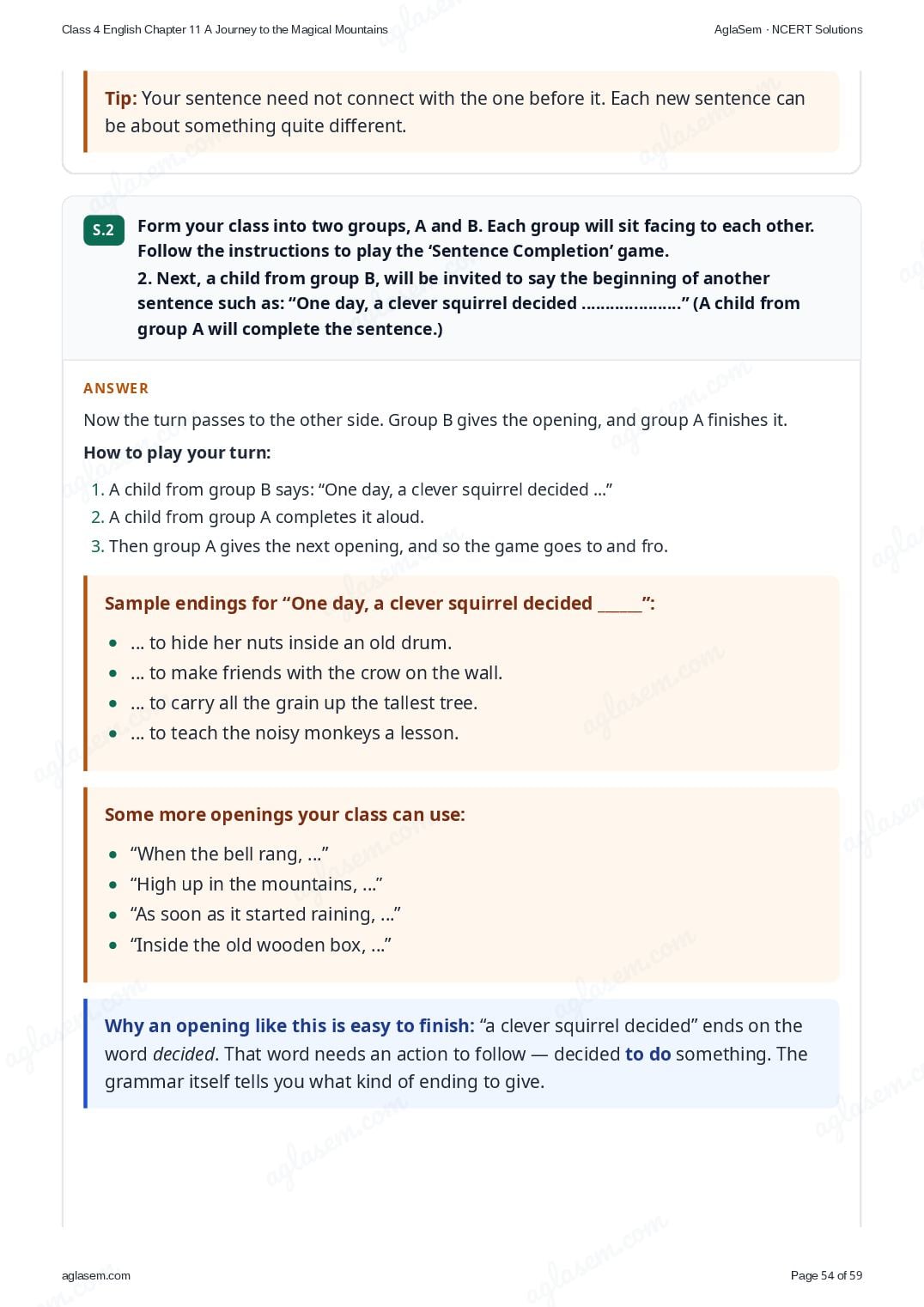
- Form your class into two groups, A and B. Each group will sit facing to each other. Follow the instructions to play the ‘Sentence Completion’ game.2. Next, a child from group B, will be invited to say the beginning of another sentence such as: “One day, a clever squirrel decided …………………” (A child from group A will complete the sentence.)
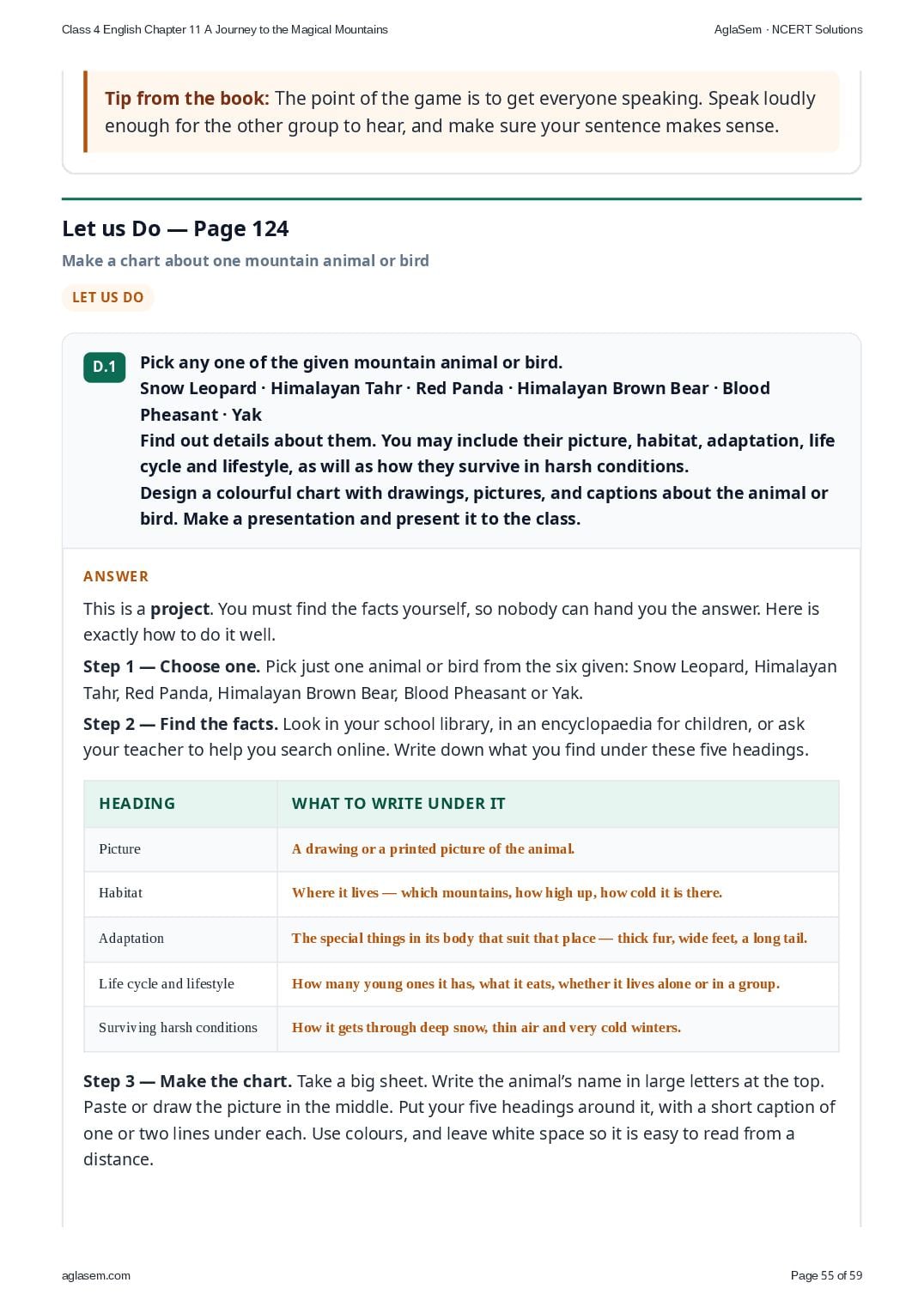
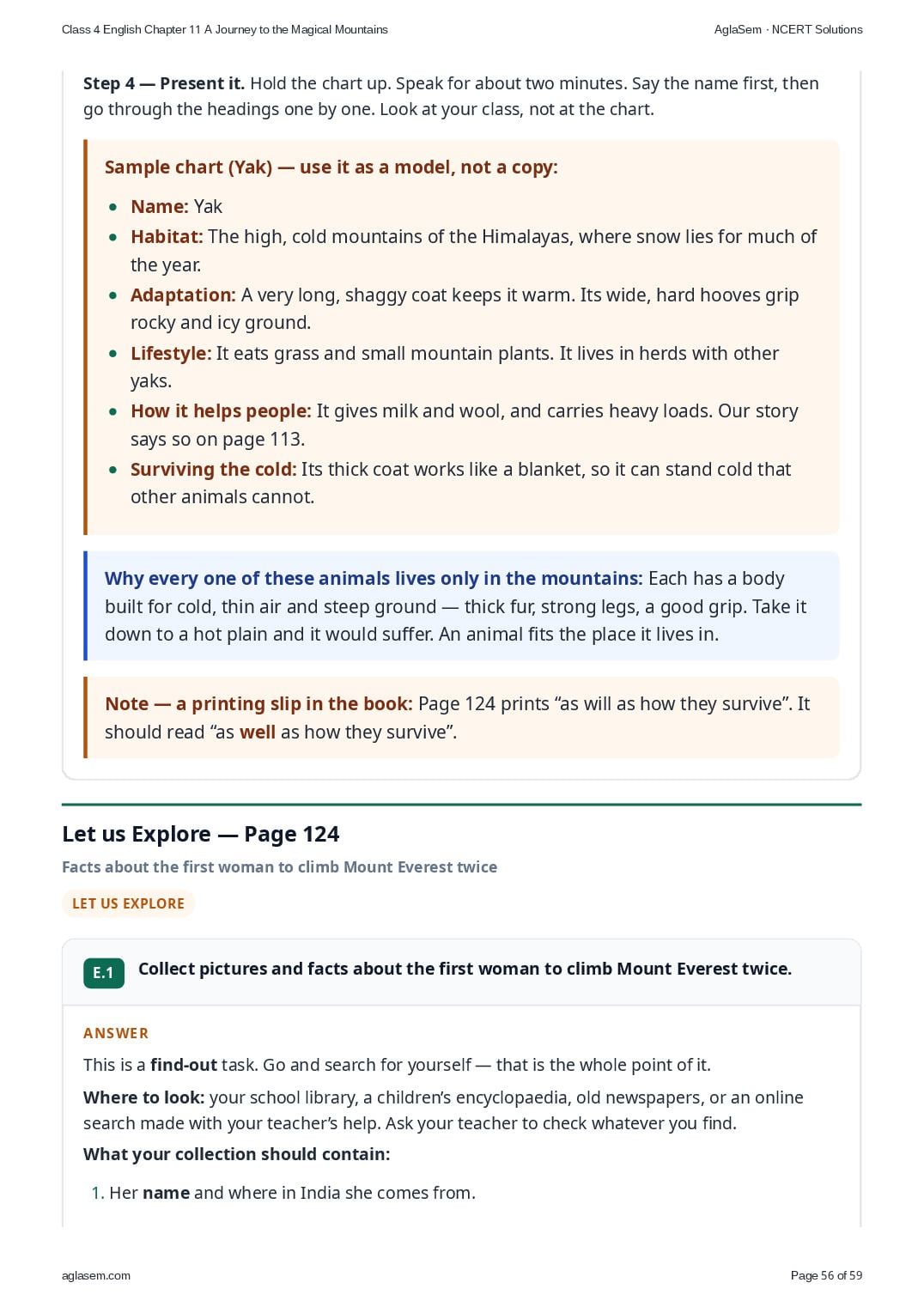
- Pick any one of the given mountain animal or bird.Snow Leopard · Himalayan Tahr · Red Panda · Himalayan Brown Bear · Blood Pheasant · YakFind out details about them. You may include their picture, habitat, adaptation, life cycle and lifestyle, as will as how they survive in harsh conditions.Design a colourful chart with drawings, pictures, and captions about the animal or bird. Make a presentation and present it to the class.
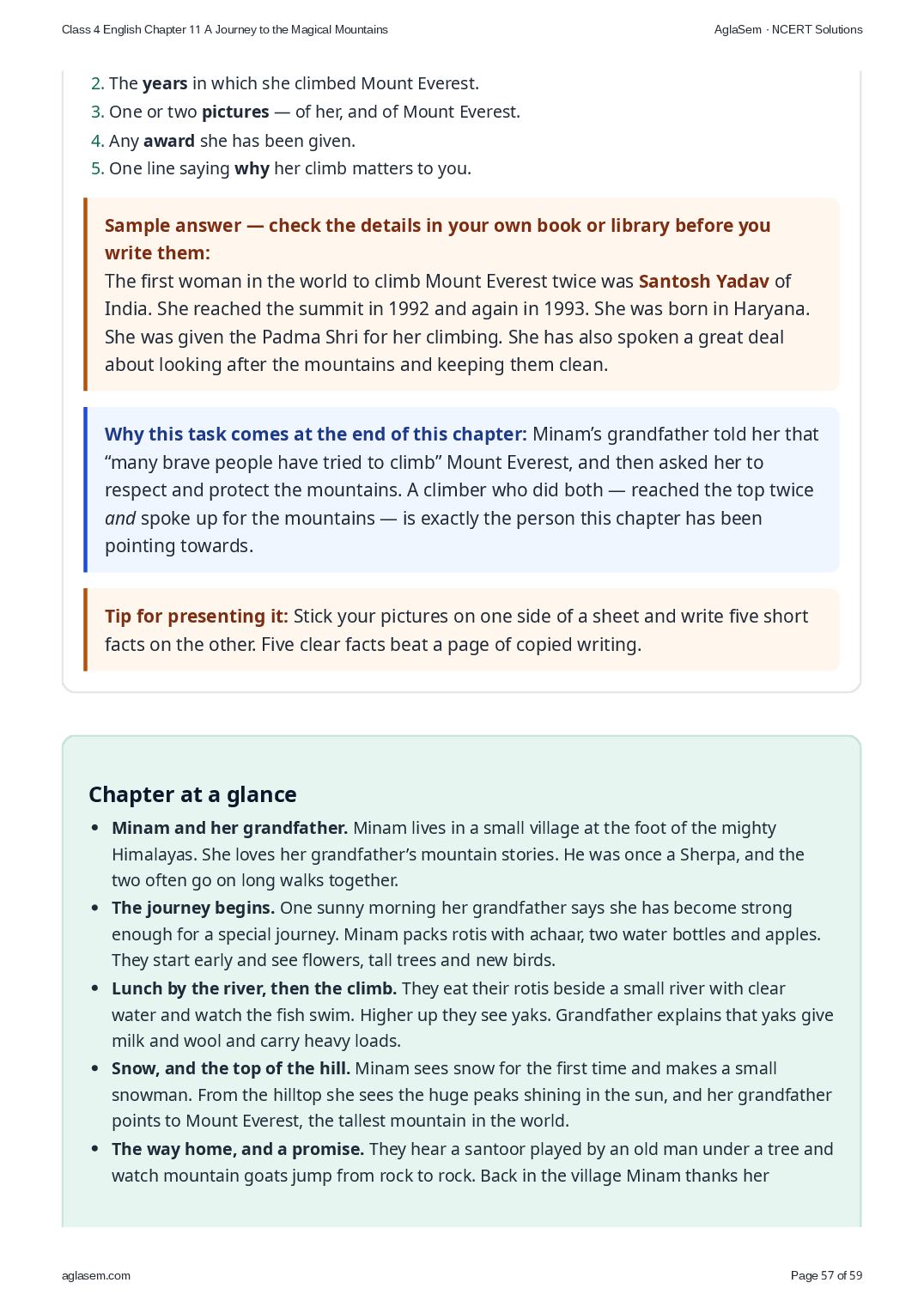
- Collect pictures and facts about the first woman to climb Mount Everest twice.
Chapter at a Glance
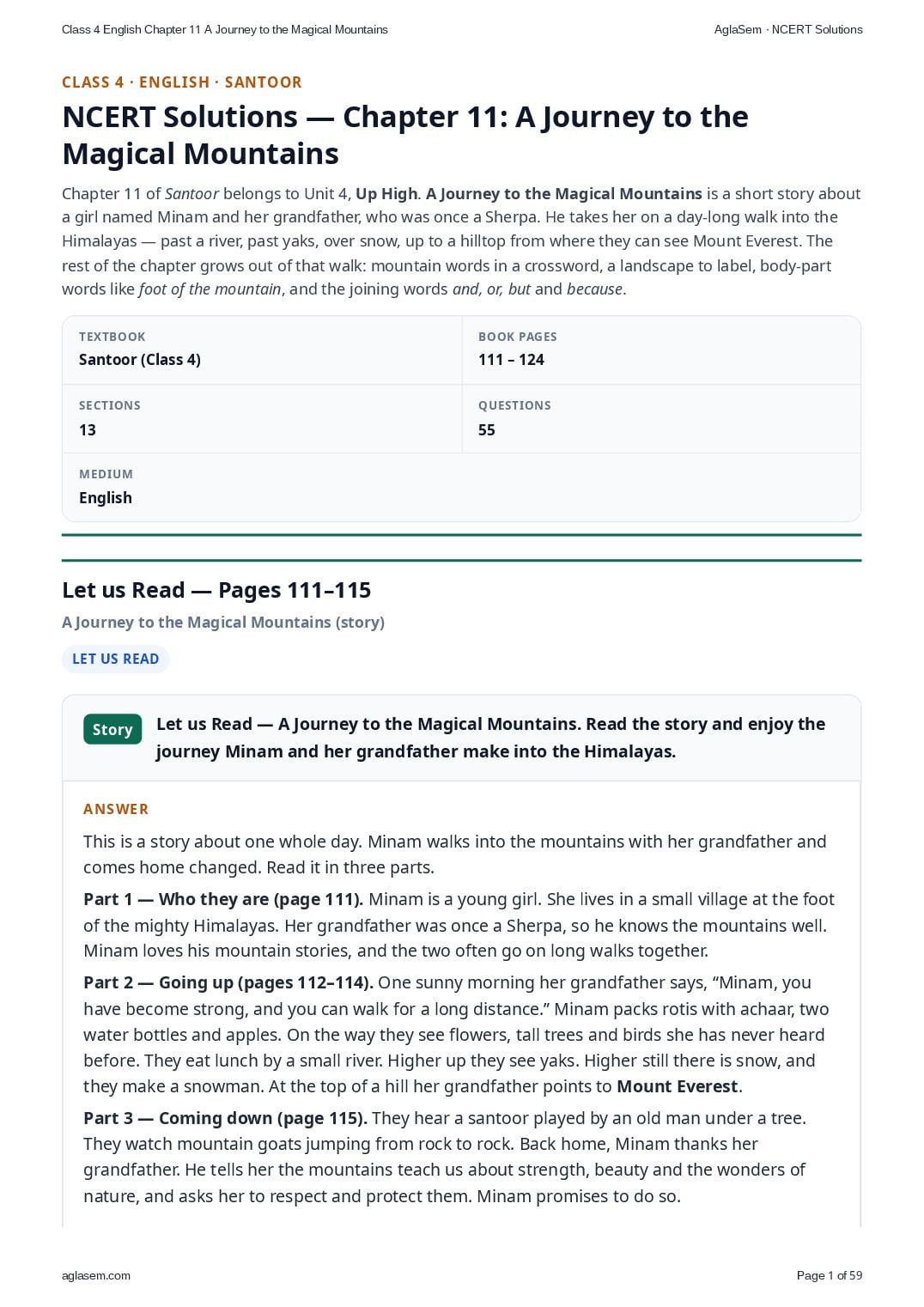
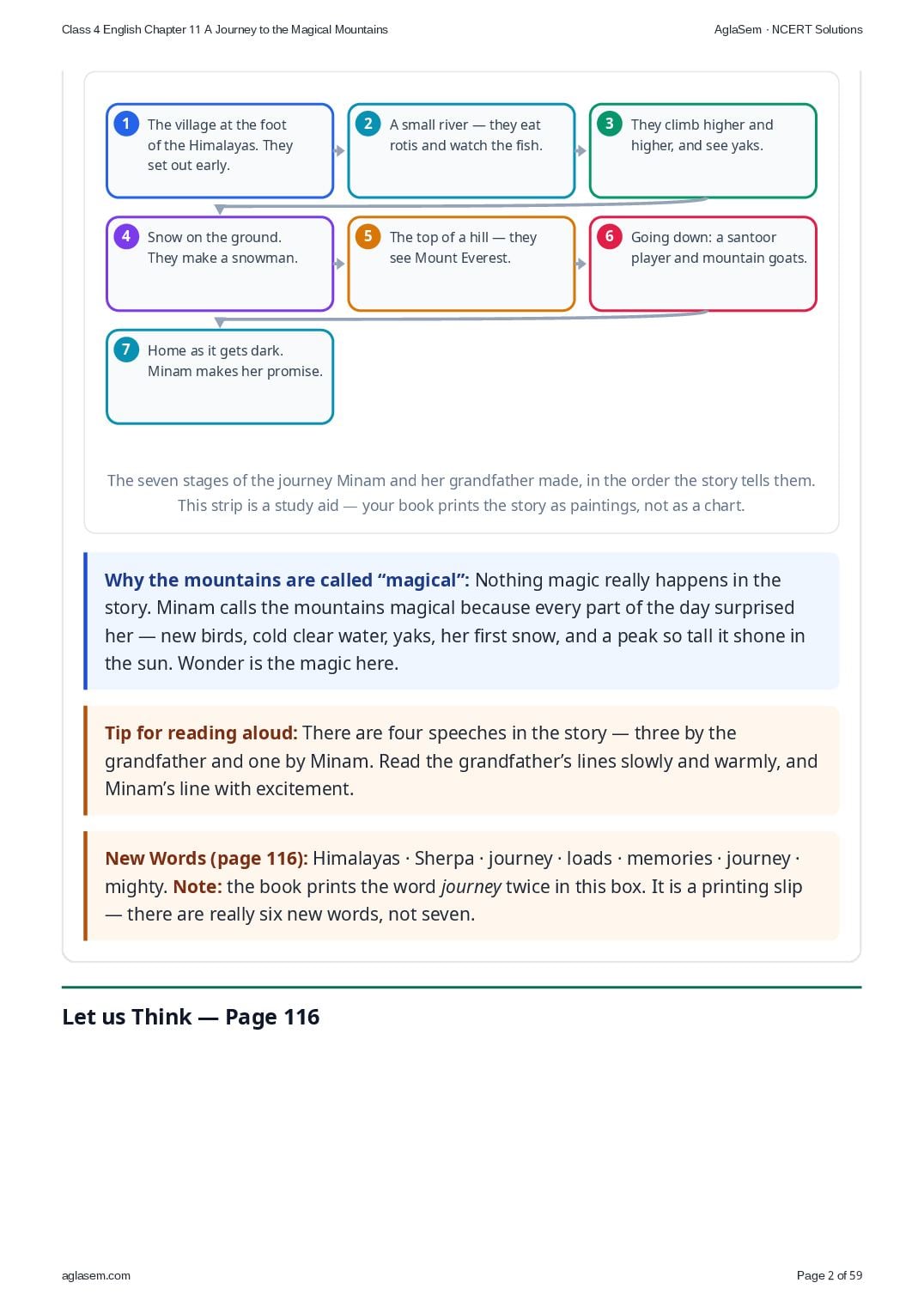
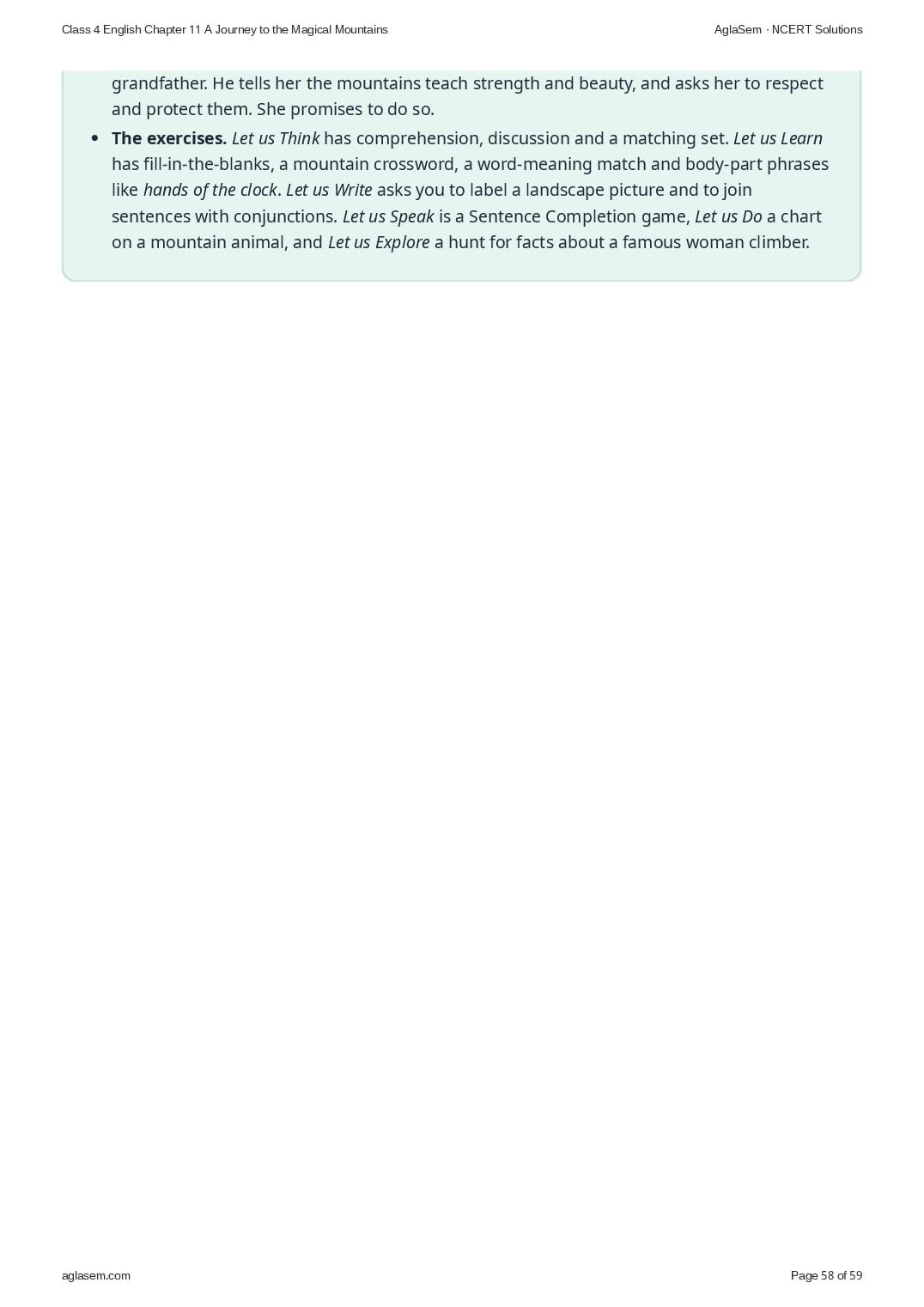
- Minam and her grandfather. Minam lives in a small village at the foot of the mighty Himalayas. She loves her grandfather’s mountain stories. He was once a Sherpa, and the two often go on long walks together.
- The journey begins. One sunny morning her grandfather says she has become strong enough for a special journey. Minam packs rotis with achaar, two water bottles and apples. They start early and see flowers, tall trees and new birds.
- Lunch by the river, then the climb. They eat their rotis beside a small river with clear water and watch the fish swim. Higher up they see yaks. Grandfather explains that yaks give milk and wool and carry heavy loads.
- Snow, and the top of the hill. Minam sees snow for the first time and makes a small snowman. From the hilltop she sees the huge peaks shining in the sun, and her grandfather points to Mount Everest, the tallest mountain in the world.
- The way home, and a promise. They hear a santoor played by an old man under a tree and watch mountain goats jump from rock to rock. Back in the village Minam thanks her grandfather. He tells her the mountains teach strength and beauty, and asks her to respect and protect them. She promises to do so.
- The exercises. Let us Think has comprehension, discussion and a matching set. Let us Learn has fill-in-the-blanks, a mountain crossword, a word-meaning match and body-part phrases like hands of the clock. Let us Write asks you to label a landscape picture and to join sentences with conjunctions. Let us Speak is a Sentence Completion game, Let us Do a chart on a mountain animal, and Let us Explore a hunt for facts about a famous woman climber.
How to Download NCERT Solutions for Class 4 English Chapter 11 PDF
Follow these simple steps to get the a Journey to the Magical Mountains questions-and-answers PDF from Santoor.
- Search NCERT Solutions for Class 4 English Chapter 11 aglasem and open this page.
- Read the exercise questions with answers for a Journey to the Magical Mountains shown above.
- Click the Download PDF link to save the a Journey to the Magical Mountains solutions to your device.
NCERT Solutions for Class 4 English – All Chapters
There are more chapters to study besides a Journey to the Magical Mountains in English. Here are the NCERT Solutions for all chapters of Class 4 English.
- Chapter 1 Together We Can
- Chapter 2 the Tinkling Bells
- Chapter 3 Be Smart Be Safe
- Chapter 4 One Thing At a Time
- Chapter 5 the Old Stag
- Chapter 6 Braille
- Chapter 7 Fit Body Fit Mind Fit Nation
- Chapter 8 the Lagori Champions
- Chapter 9 Hekko
- Chapter 10 the Swing
- Chapter 11 a Journey to the Magical Mountains
- Chapter 12 Maheshwar
NCERT Solutions for Class 4 – All Subjects
Just like Chapter 11 of English, you can get the exercise questions with answers for every other subject of Class 4. Here are the NCERT Solutions for all subjects of Class 4.
NCERT Solutions for Class 4 English Chapter 11 – An Overview
The key highlights of this study material are as follows.
| Aspects | Details |
|---|---|
| Class | Class 4 |
| Subject | English |
| Chapter Number | Chapter 11 |
| Chapter Name | a Journey to the Magical Mountains |
| Book Name | Santoor |
| Book By | NCERT (National Council of Educational Research and Training) |
| Educational Resource Here | NCERT Solutions of Class 4 English Chapter 11 for all exercises |
| More Questions Answers of This Subject | NCERT Solutions for Class 4 English |
| Download Book Chapter | NCERT Book Class 4 English |
| All Questions Answers For This Class | NCERT Solutions for Class 4 |
| Complete Solutions | NCERT Solutions |
NCERT Solutions for Class 4 English Chapter 11 a Journey to the Magical Mountains – FAQs
What are the NCERT Solutions for Class 4 English Chapter 11 a Journey to the Magical Mountains?
They are the complete, step-by-step answers to all the exercise and in-text questions of Chapter 11 a Journey to the Magical Mountains from the NCERT Class 4 English textbook Santoor, written by experts as per the latest NCERT syllabus.
How can I download the Class 4 English Chapter 11 solutions PDF for free?
Open this page on aglasem, read the a Journey to the Magical Mountains questions with answers, and click the “Download Solutions PDF” link. The Class 4 English Chapter 11 NCERT Solutions PDF is completely free to download.
Are these NCERT Solutions as per the latest 2026-27 syllabus?
Yes. The NCERT Solutions for Class 4 English Chapter 11 are based on the latest NCERT textbook Santoor and the current 2026-27 CBSE syllabus, so the questions and answers match what you study in class.
Where can I get NCERT Solutions for the other chapters of Class 4 English?
You can find the answers to every chapter on the NCERT Solutions for Class 4 English page, and solutions for every subject on the NCERT Solutions for Class 4 page.
How do NCERT Solutions help in exam preparation?
They show the correct method to solve each question, help you write answers the way they are expected in exams, let you check and correct your own work, and save revision time — which together improve your marks in Class 4 English.
If you have any queries on NCERT Solutions for Class 4 English Chapter 11 a Journey to the Magical Mountains, then please ask in the comments below.