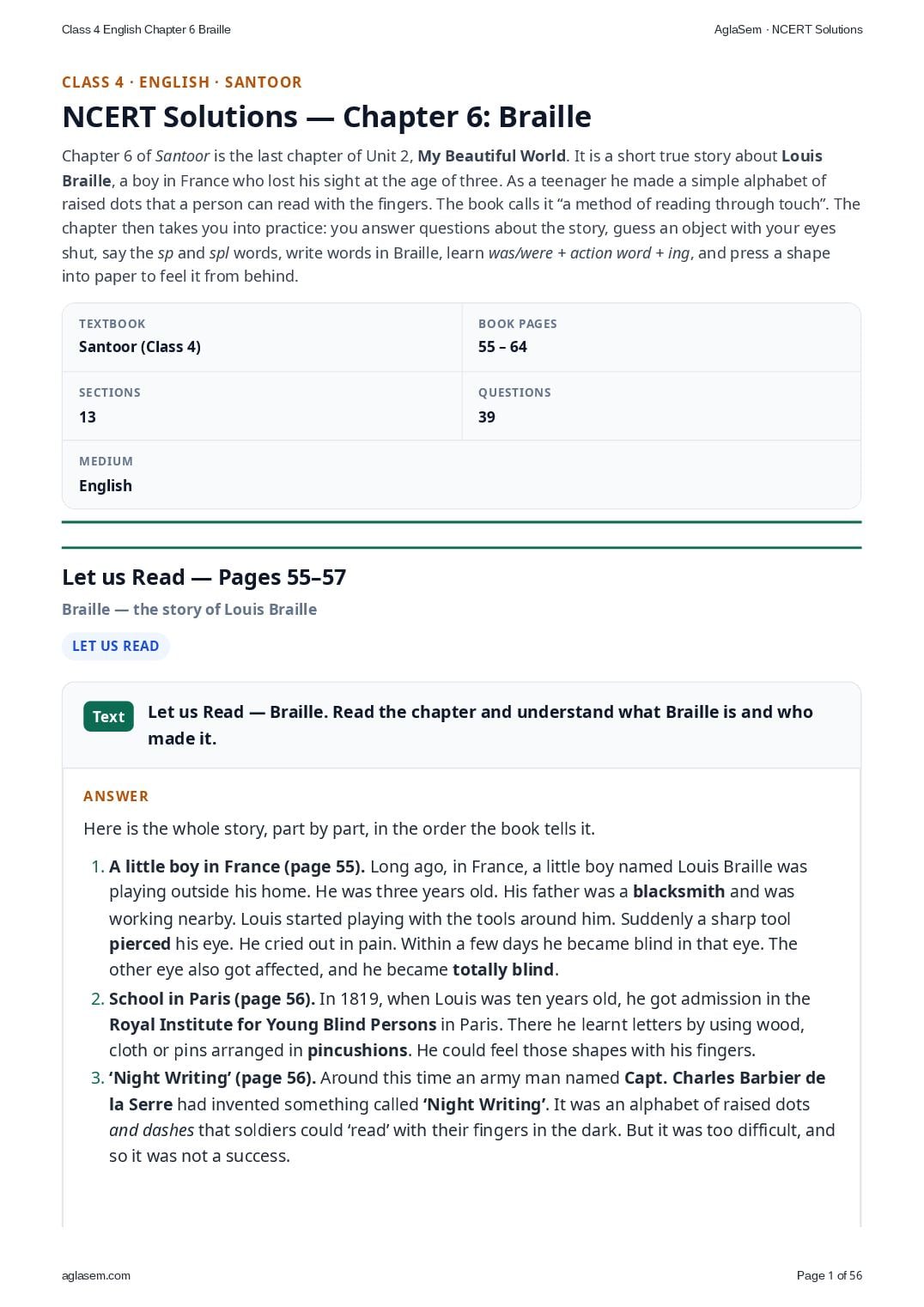
NCERT Solutions for Class 4 English Chapter 6 Braille provide clear, step-by-step answers to every exercise and in-text question from the chapter Braille of the NCERT textbook Santoor. Prepared by subject experts as per the latest NCERT (CBSE) syllabus for 2026-27, these NCERT Solutions for Class 4 English help you understand each concept, write exam-ready answers, and check your own solutions. You can read them online below or download the free Class 4 English Chapter 6 question-answer PDF.
NCERT Solutions for Class 4 English Chapter 6 Braille
- Class: Class 4
- Subject: English
- Chapter: Chapter 6 – Braille
- Textbook: Santoor (NCERT)
- Study material: NCERT Solutions – questions with answers, free PDF
These solutions answer all the exercise questions of Chapter 6 Braille — including the in-text questions, short-answer and long-answer questions, and activities — with complete explanations so you can follow the method, not just the final answer. Read the full solutions below.
NCERT Solutions Class 4 English Chapter 6 Braille View Download
NCERT Solutions for Class 4 English Chapter 6 PDF Download
You can read the NCERT Solutions for Class 4 English Chapter 6 online above, or download the complete question-answer PDF to study Braille offline at any time.
NCERT Solutions for Class 4 English Chapter 6 PDF Download Link – Click Here to Download Solutions PDF
Questions Covered in This Chapter
These NCERT Solutions answer all 39 questions of this chapter. The questions solved are:
- Let us Read — Braille. Read the chapter and understand what Braille is and who made it.
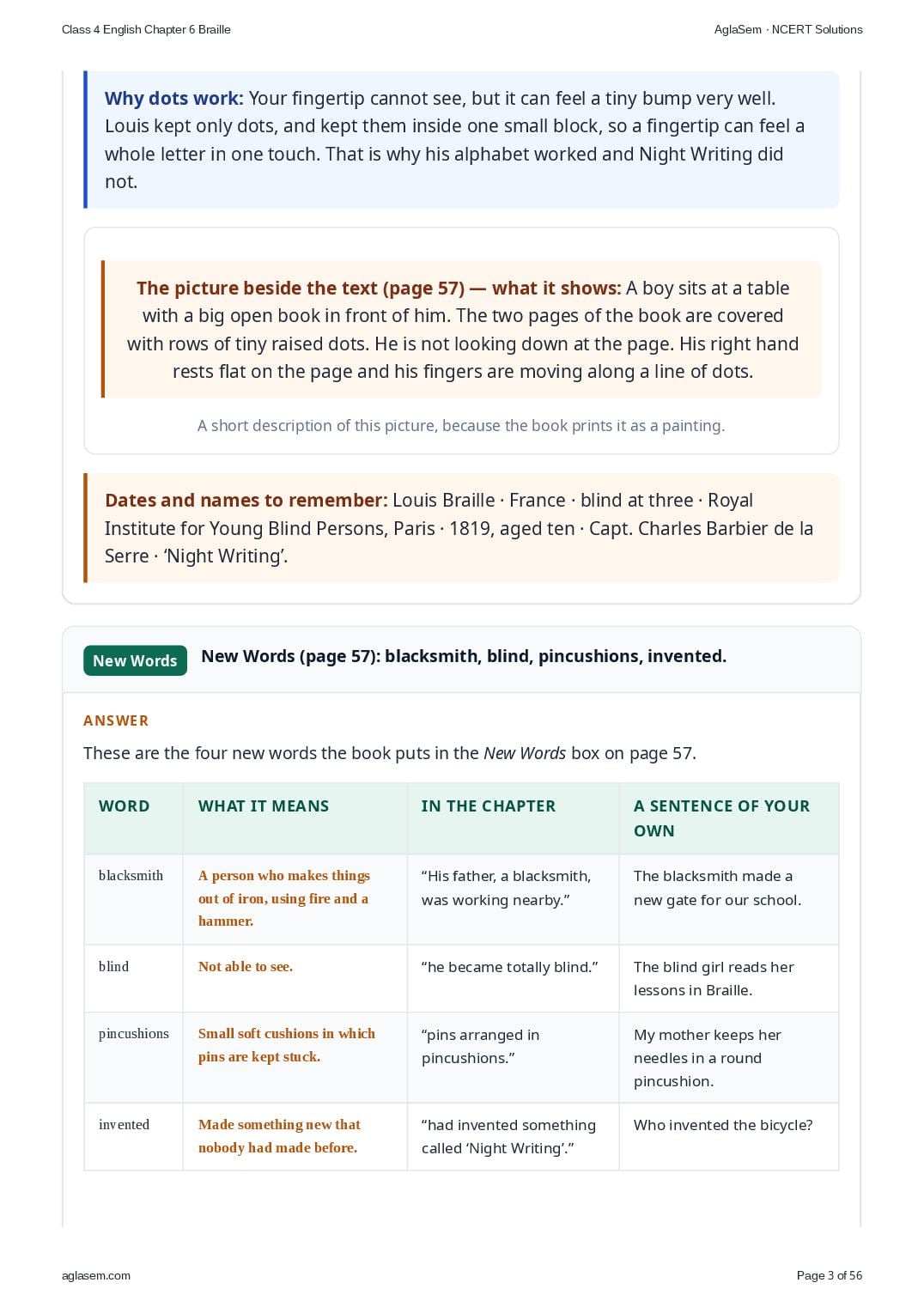
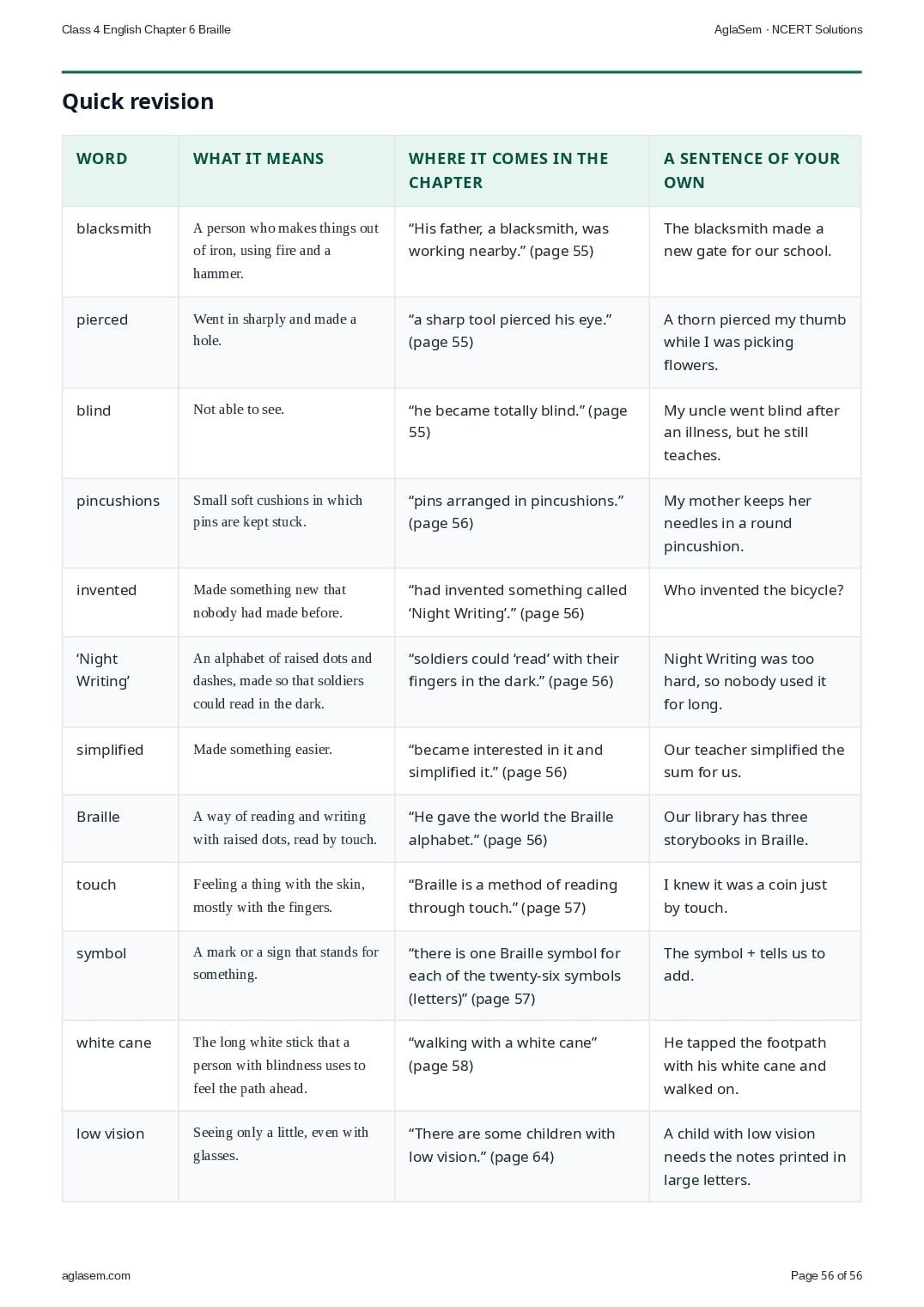
- New Words (page 57): blacksmith, blind, pincushions, invented.
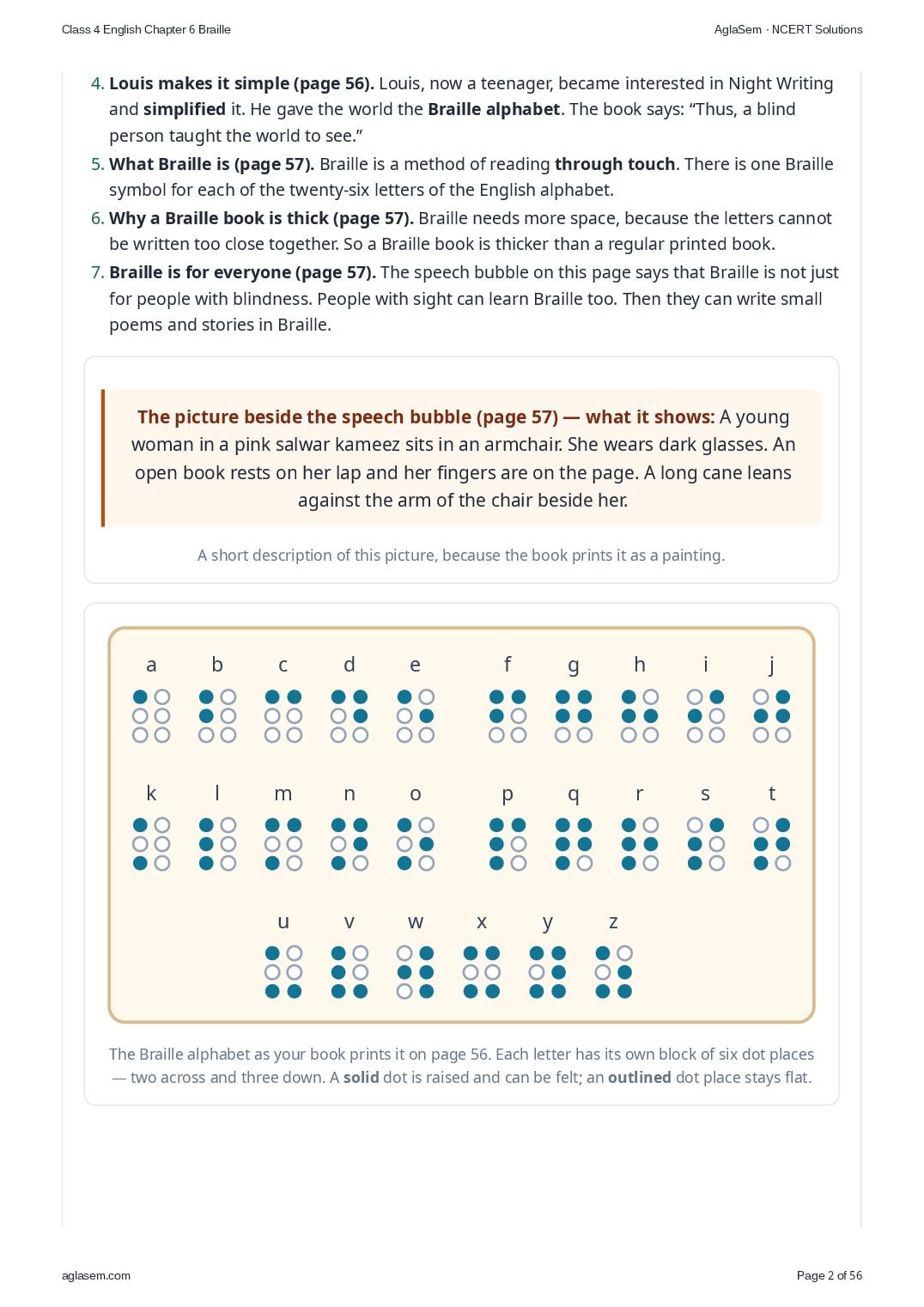
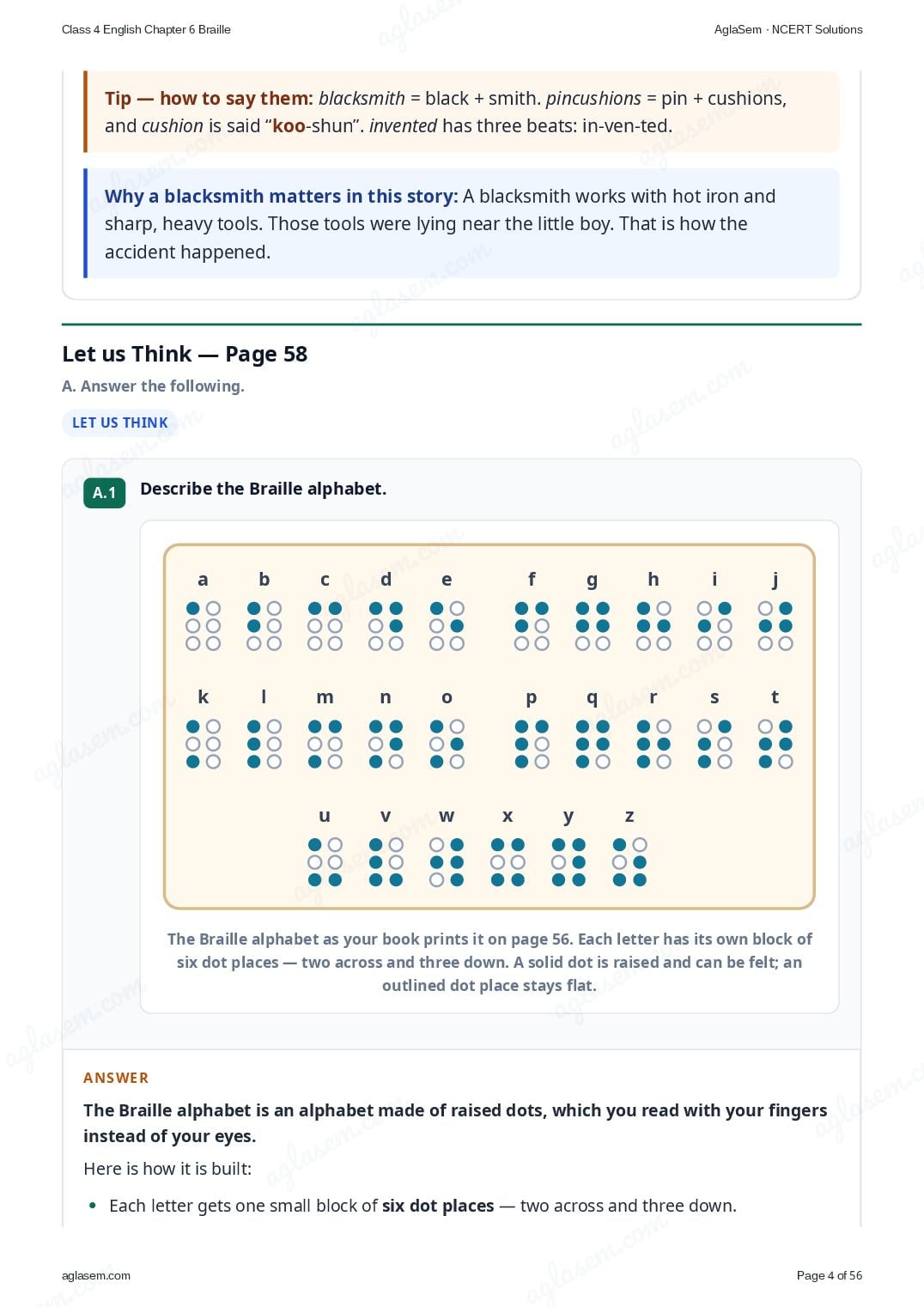
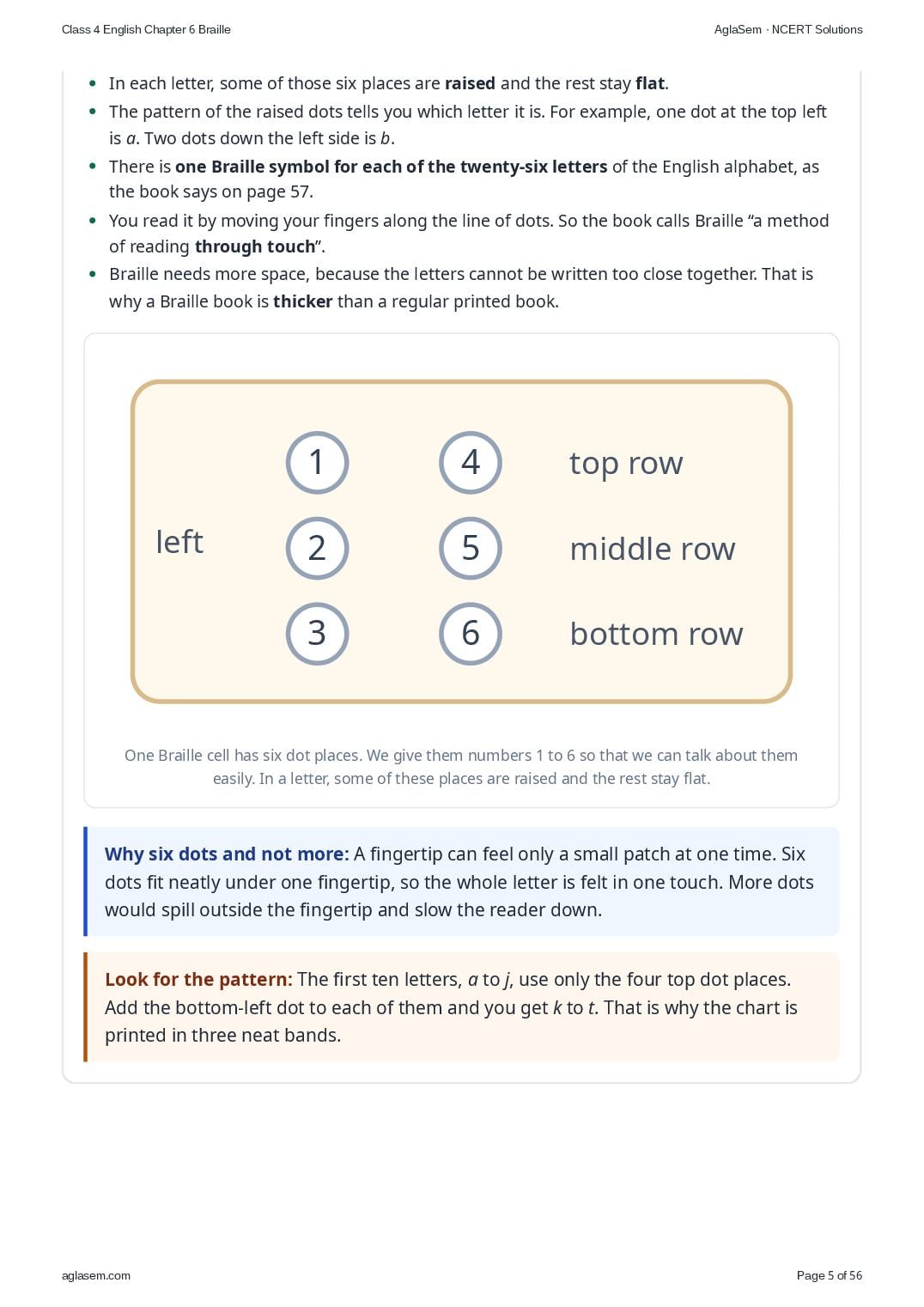
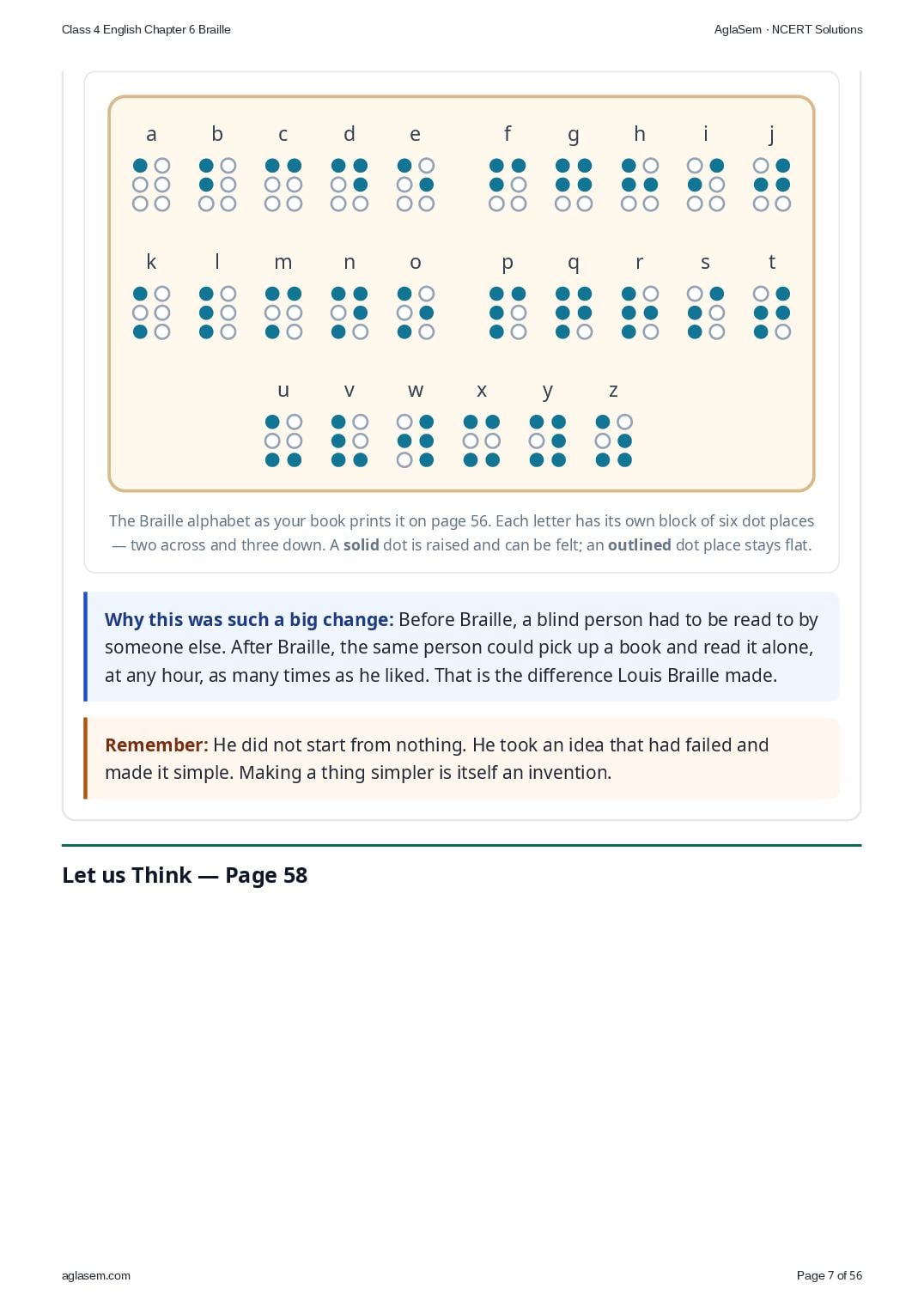
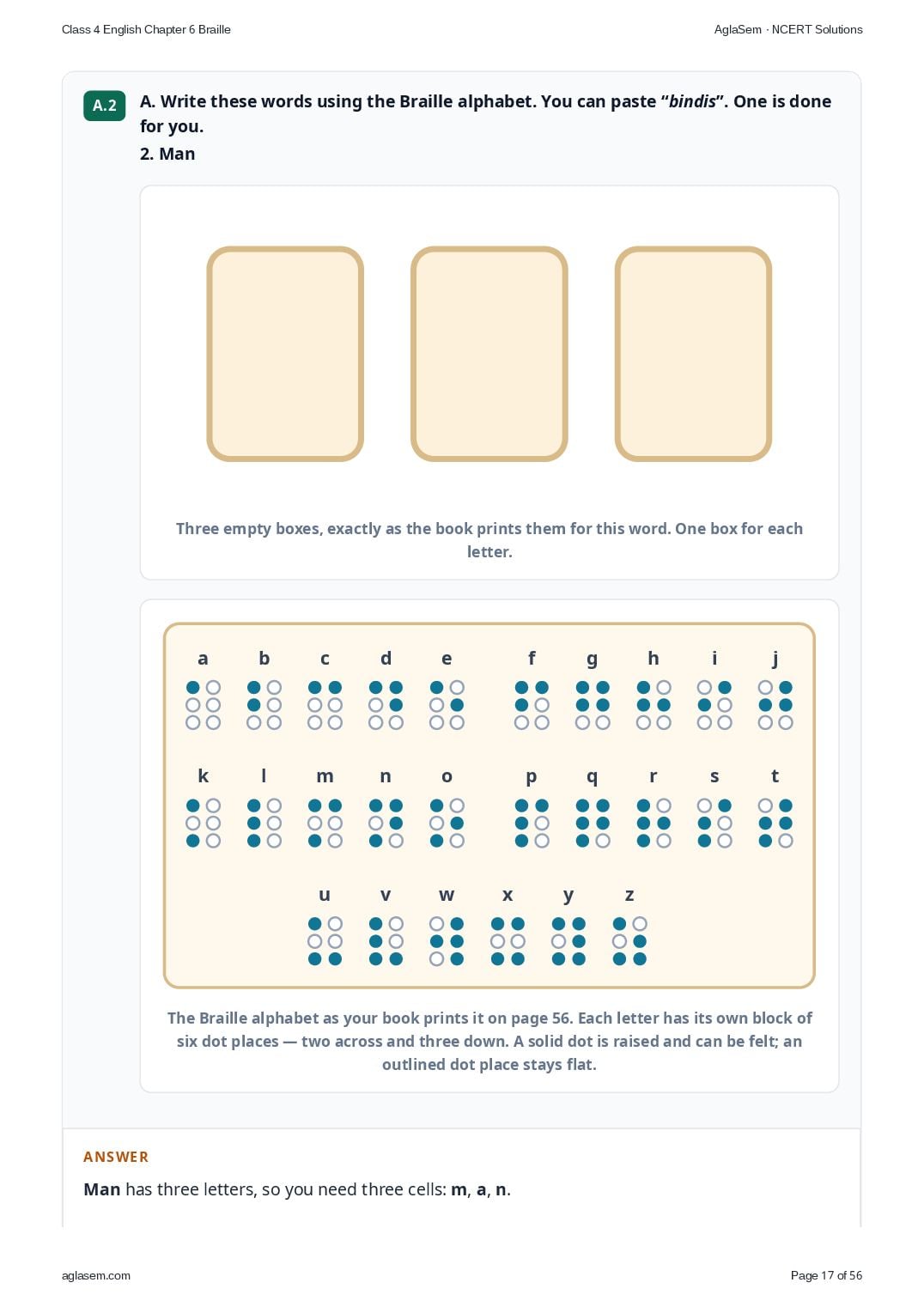
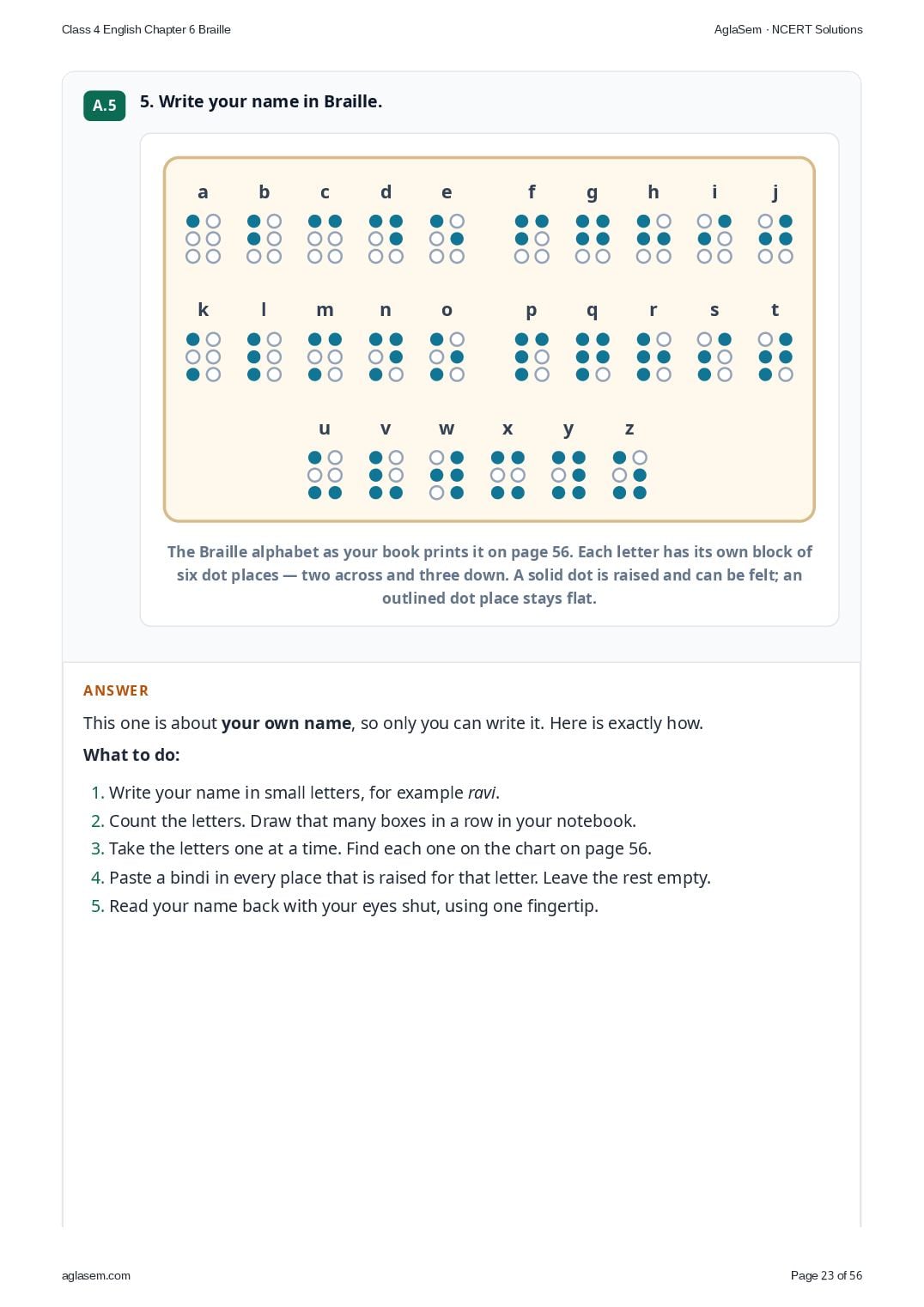
- Describe the Braille alphabet.The Braille alphabet chart printed on page 56abcdefghijklmnopqrstuvwxyzThe Braille alphabet as your book prints it on page 56. Each letter has its own block of six dot places — two across and three down. A solid dot is raised and can be felt; an outlined dot place stays flat.
- Why was ‘Night Writing’ not a success?
- What did Louis Braille do to make reading easier for the blind?
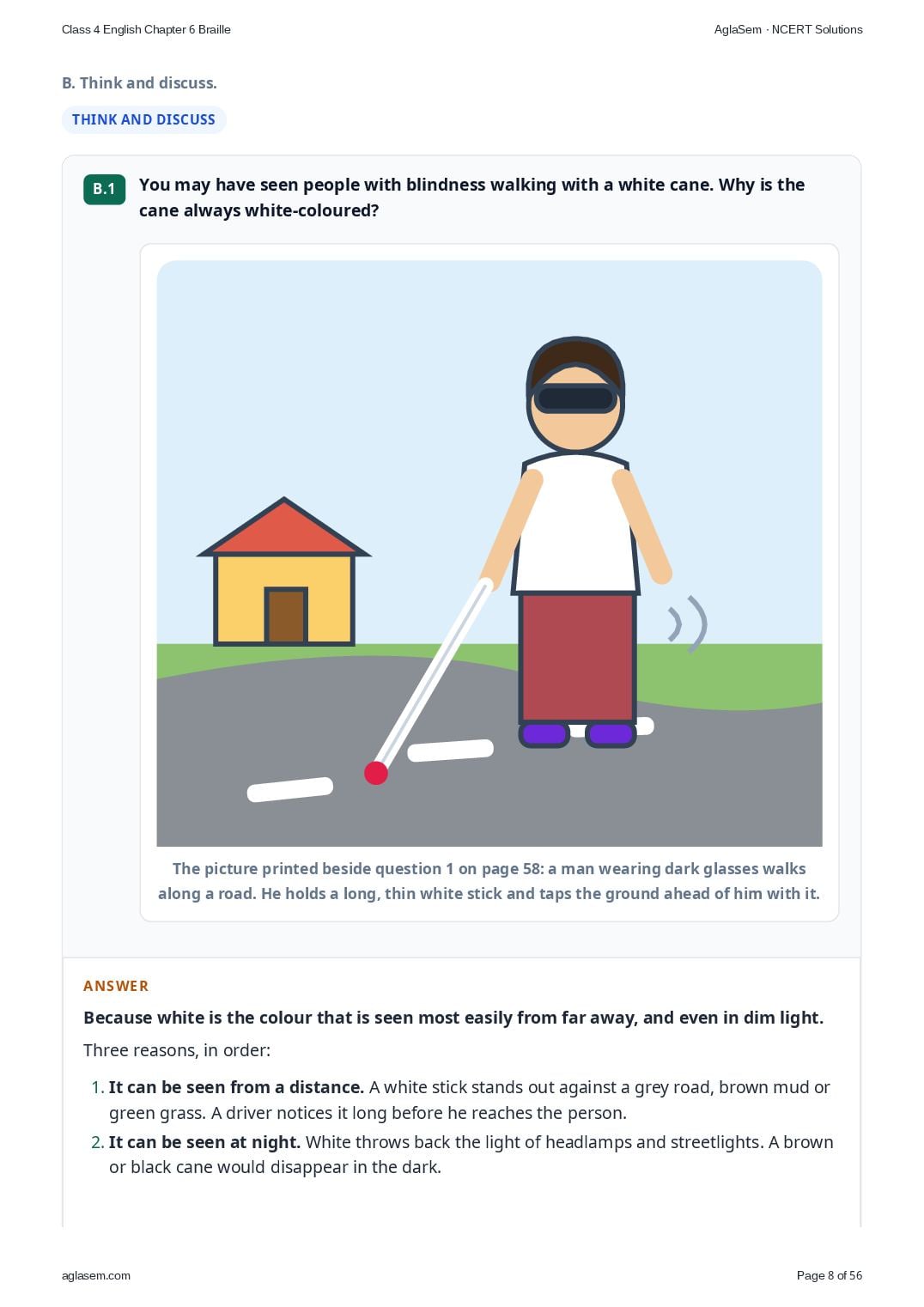
- You may have seen people with blindness walking with a white cane. Why is the cane always white-coloured? The picture on page 58: a man walking with a white cane The picture printed beside question 1 on page 58: a man wearing dark glasses walks along a road. He holds a long, thin white stick and taps the ground ahead of him with it.
- Imagine that the world becomes dark for a day and there is no light. What difficulties might one face on such a day?
- Close your eyes. Pick an object. Keep the object back. Now complete the sentences and share them with the class.1. The object in my hand was ………………….. in shape.
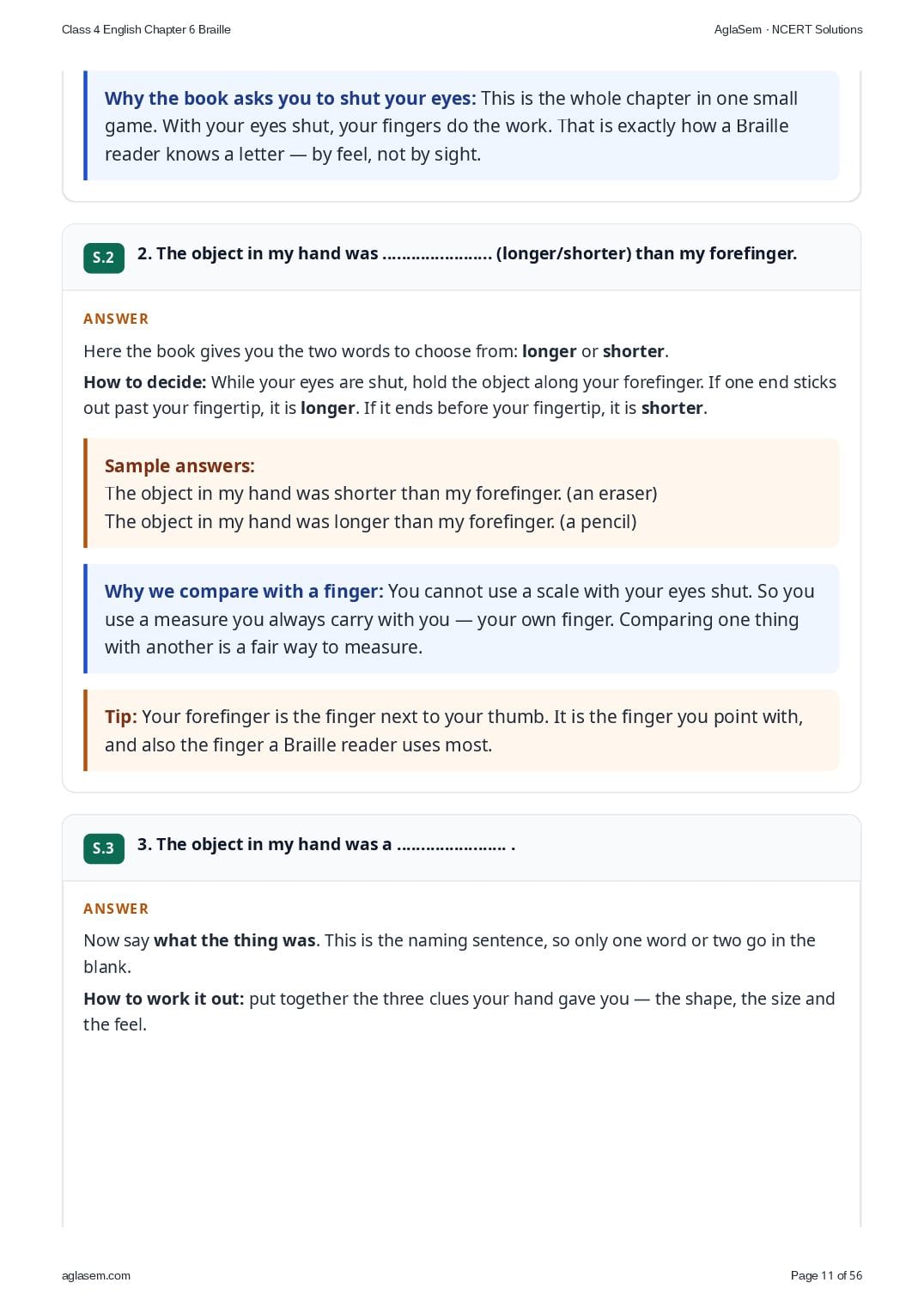
- 2. The object in my hand was ………………….. (longer/shorter) than my forefinger.
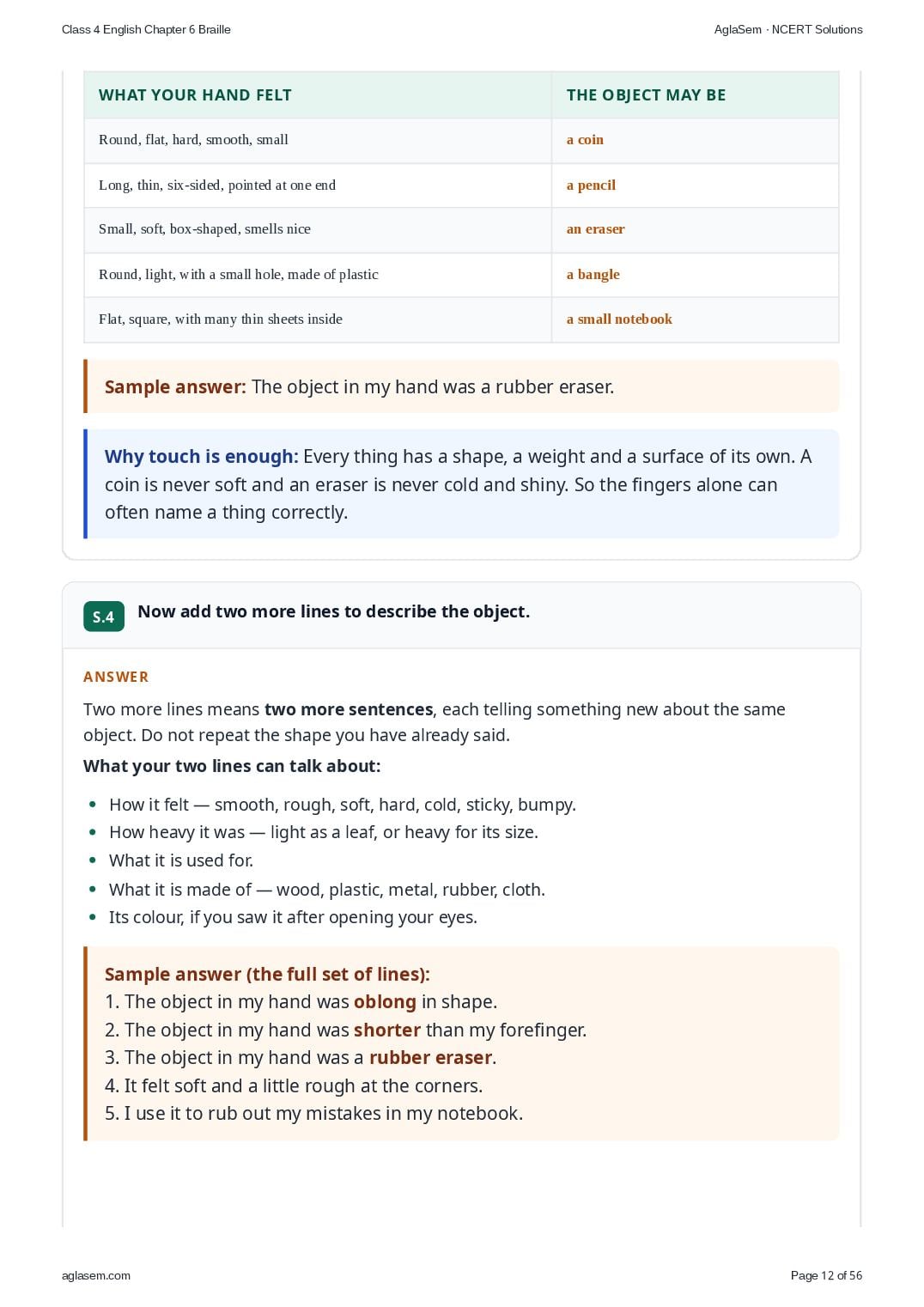
- 3. The object in my hand was a ………………….. .
- Now add two more lines to describe the object.
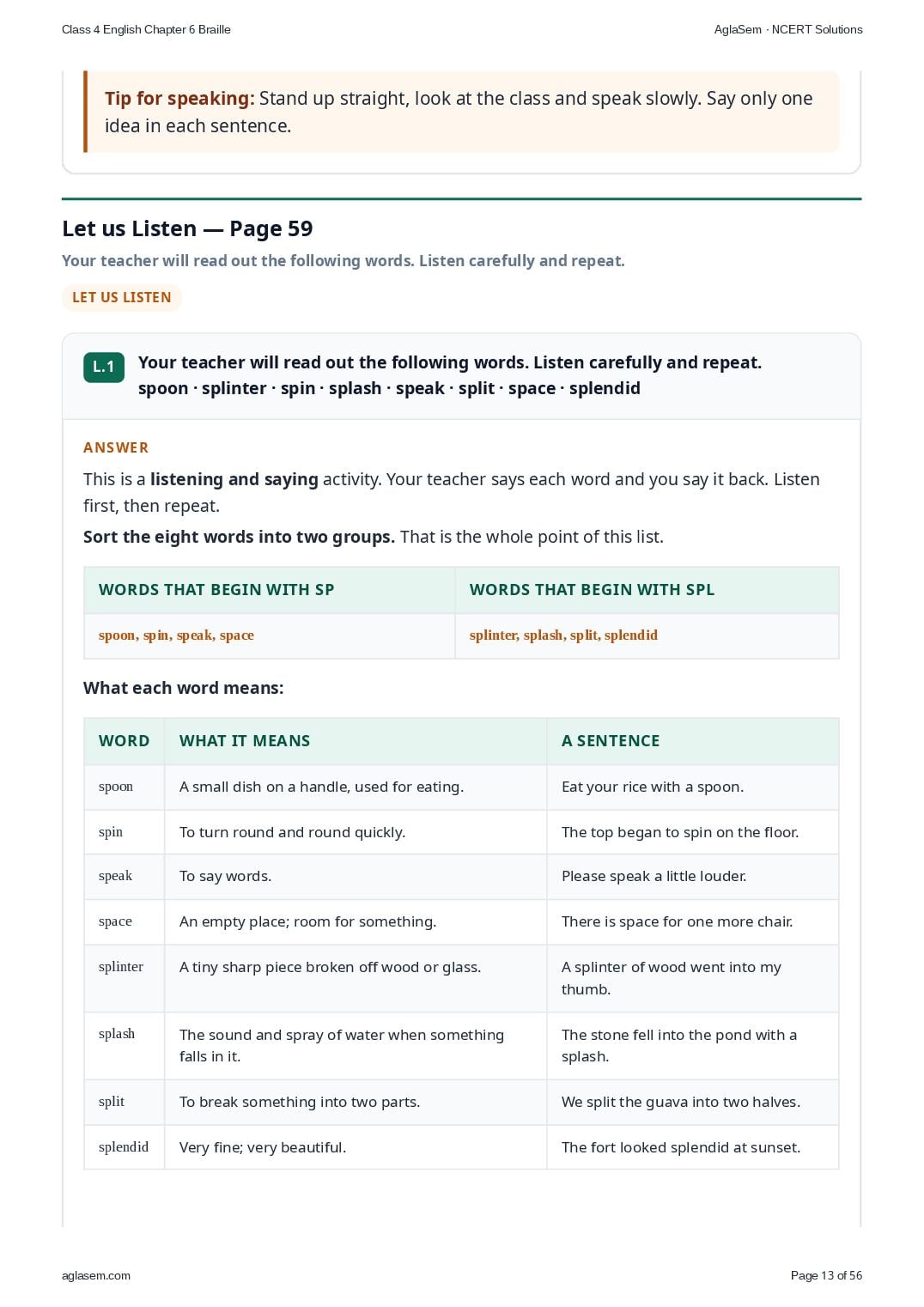
- Your teacher will read out the following words. Listen carefully and repeat.spoon · splinter · spin · splash · speak · split · space · splendid
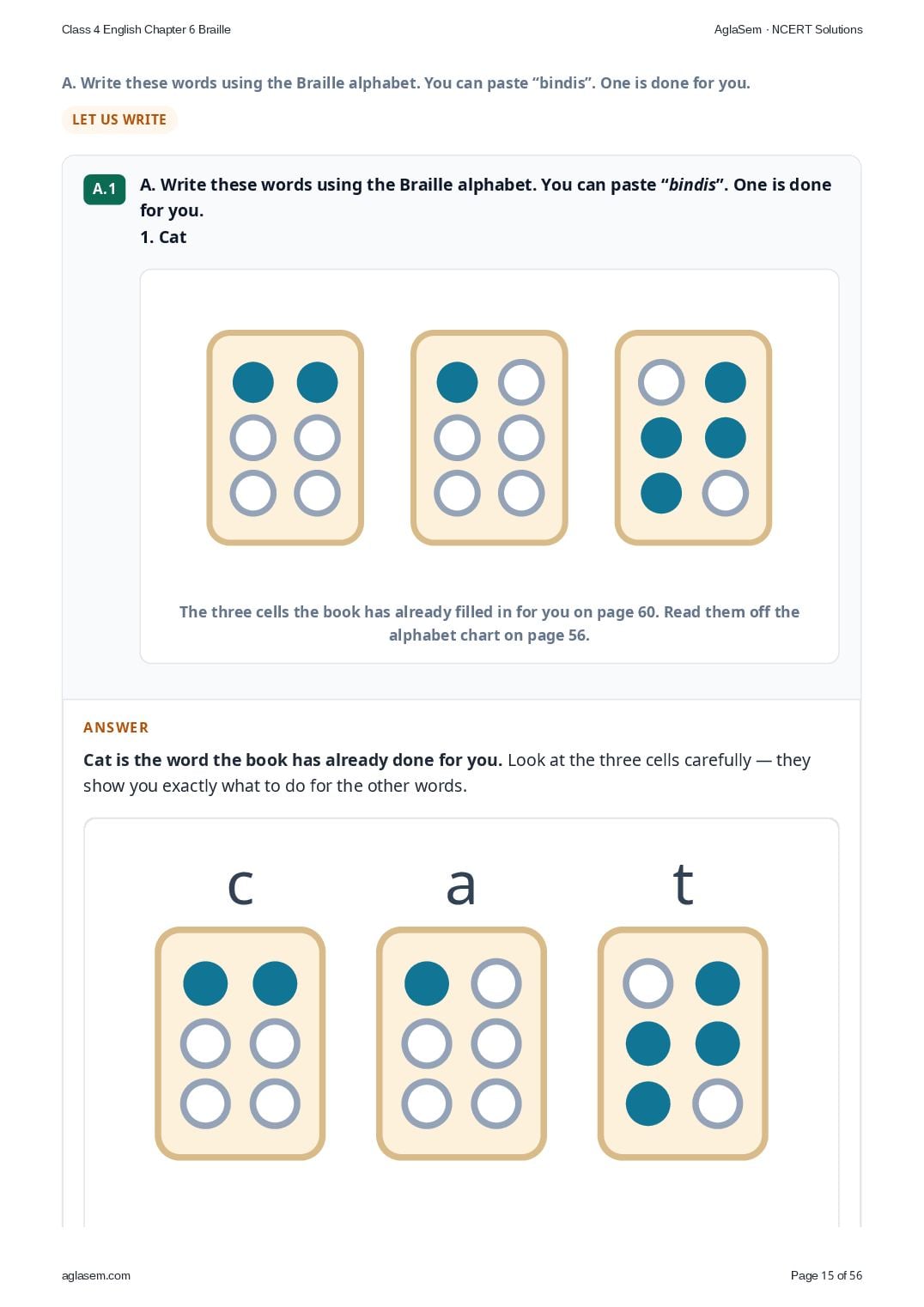
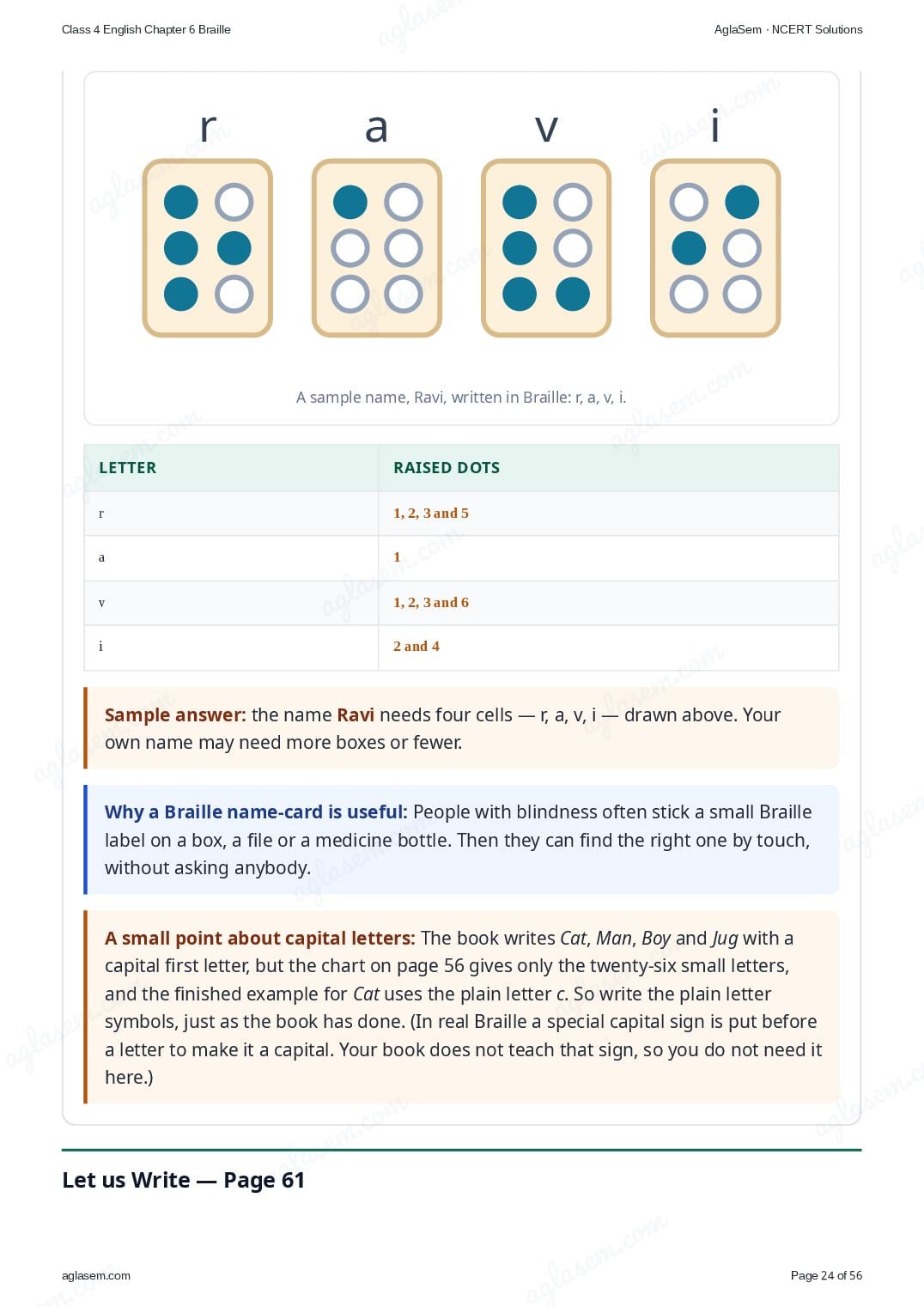
- A. Write these words using the Braille alphabet. You can paste “bindis”. One is done for you.1. CatThe completed cells for the word CatThe three cells the book has already filled in for you on page 60. Read them off the alphabet chart on page 56.
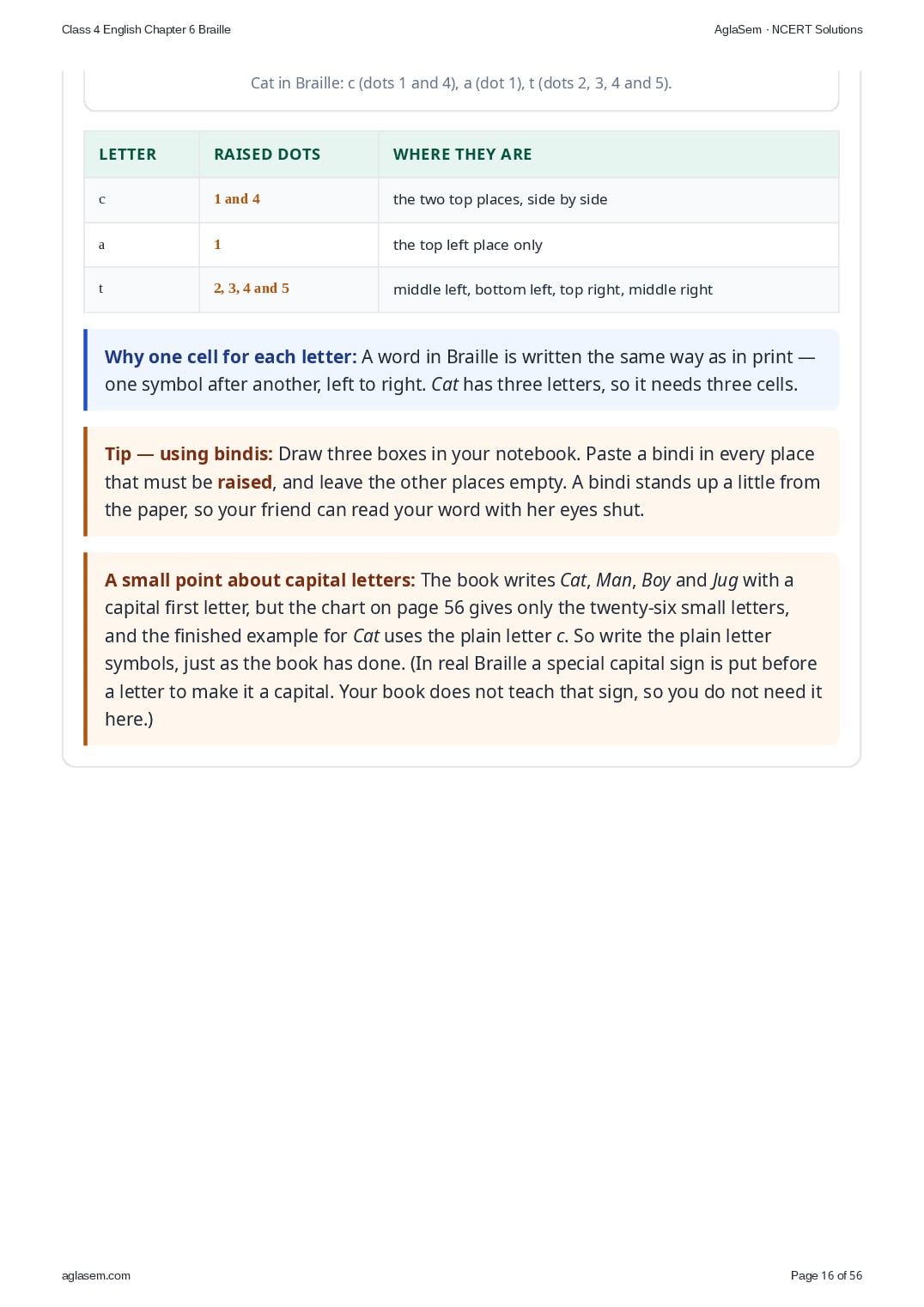
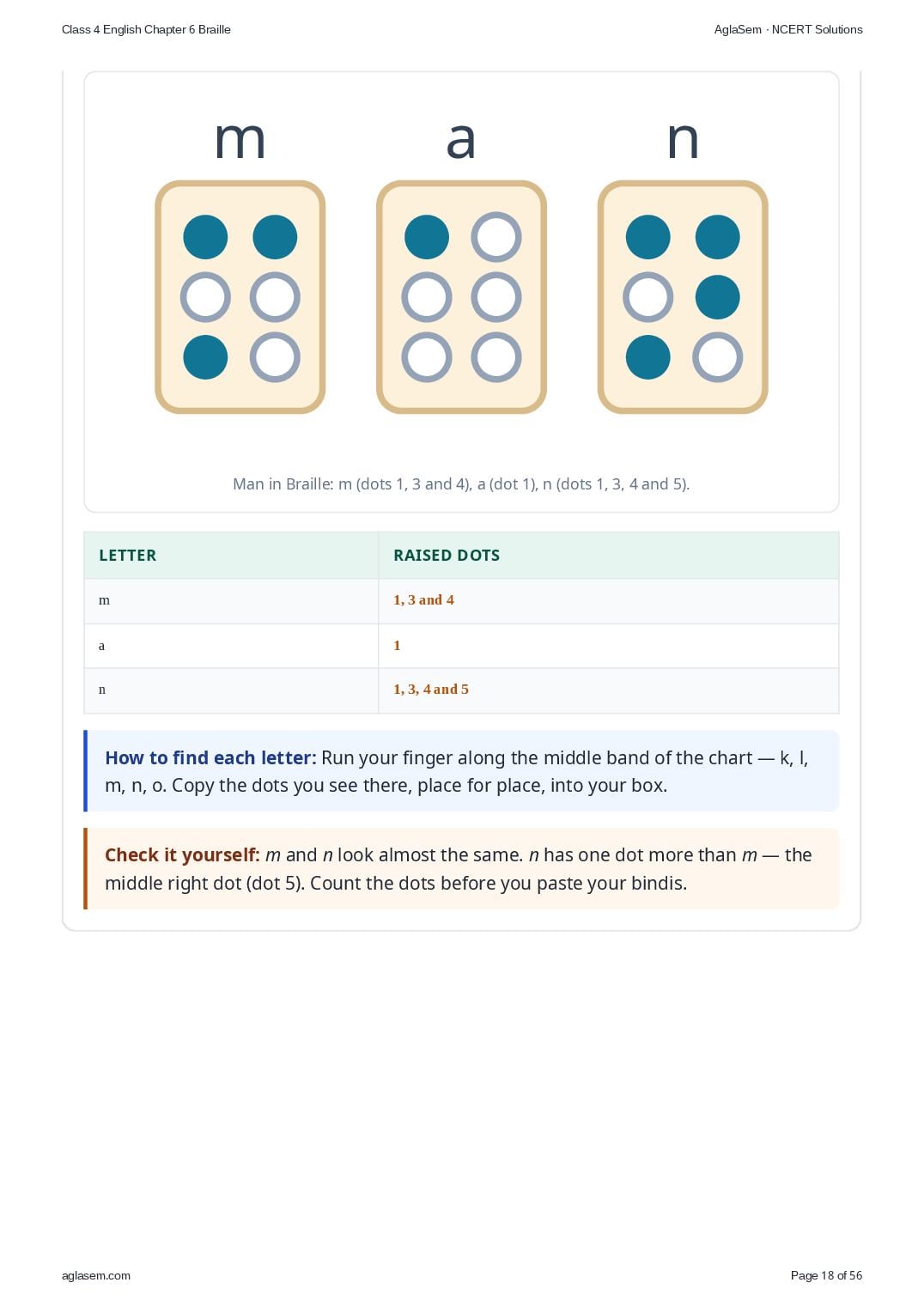
- A. Write these words using the Braille alphabet. You can paste “bindis”. One is done for you.2. ManThree empty Braille boxesThree empty boxes, exactly as the book prints them for this word. One box for each letter.The Braille alphabet chart printed on page 56abcdefghijklmnopqrstuvwxyzThe Braille alphabet as your book prints it on page 56. Each letter has its own block of six dot places — two across and three down. A solid dot is raised and can be felt; an outlined dot place stays flat.
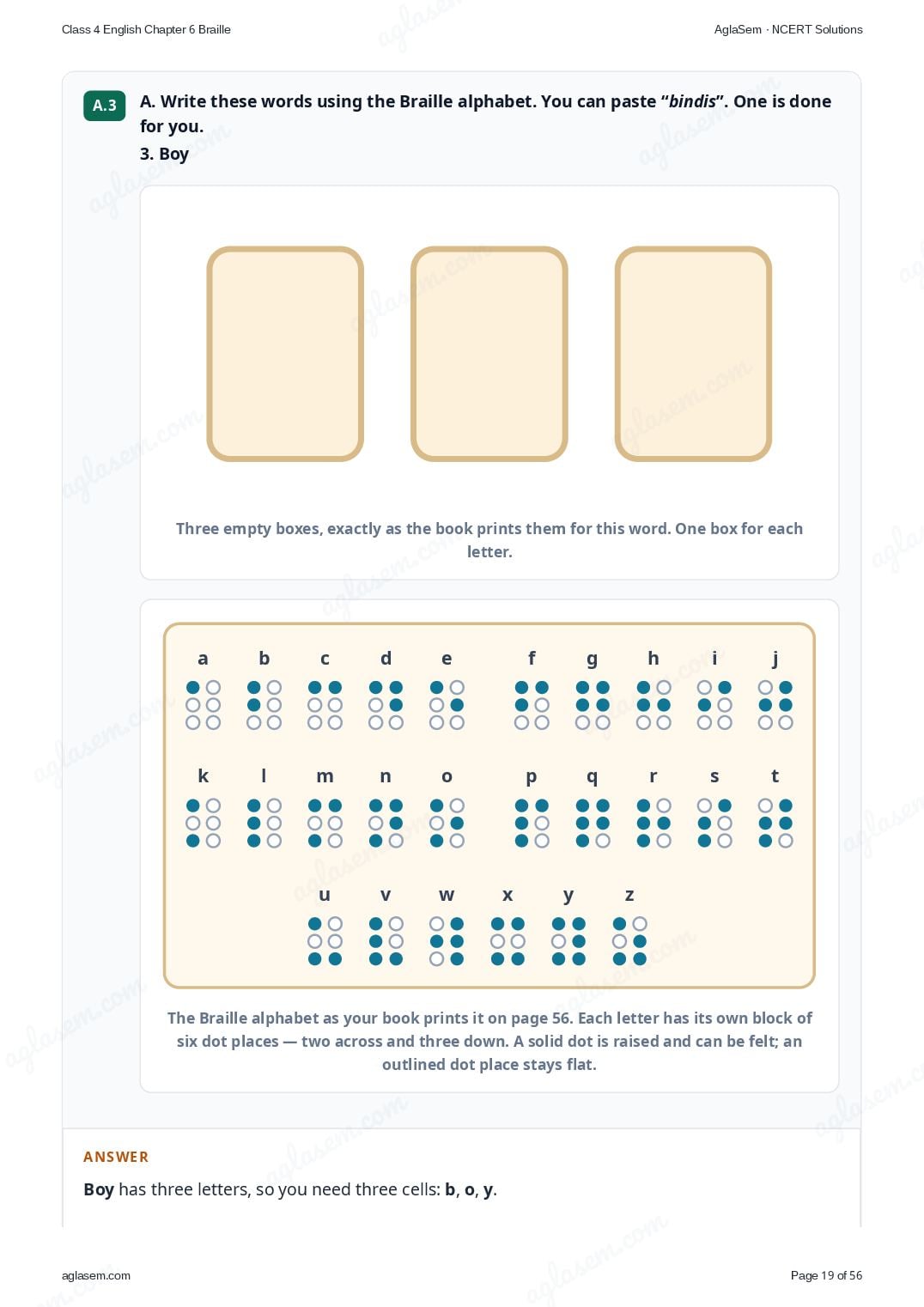
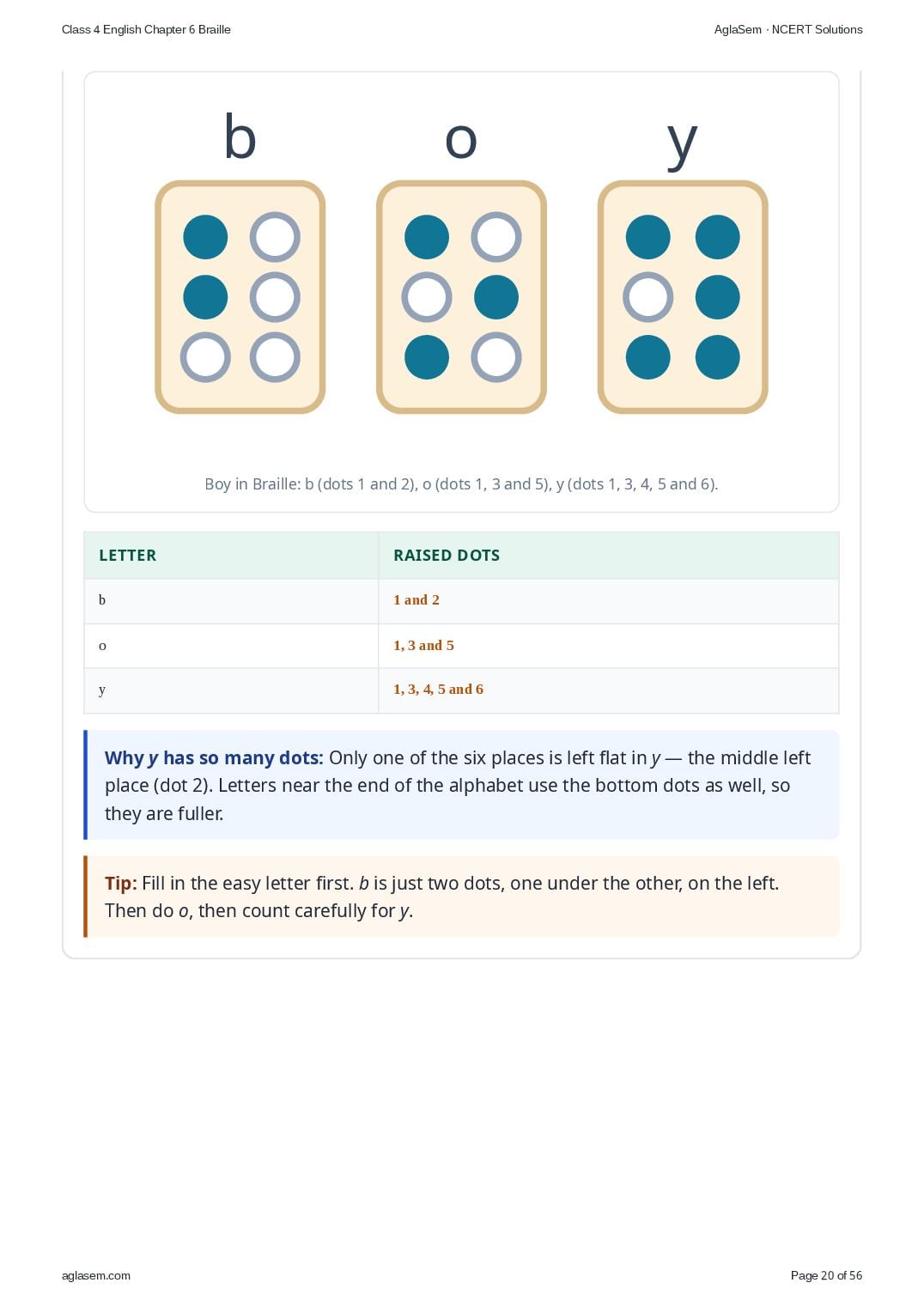
- A. Write these words using the Braille alphabet. You can paste “bindis”. One is done for you.3. BoyThree empty Braille boxesThree empty boxes, exactly as the book prints them for this word. One box for each letter.The Braille alphabet chart printed on page 56abcdefghijklmnopqrstuvwxyzThe Braille alphabet as your book prints it on page 56. Each letter has its own block of six dot places — two across and three down. A solid dot is raised and can be felt; an outlined dot place stays flat.
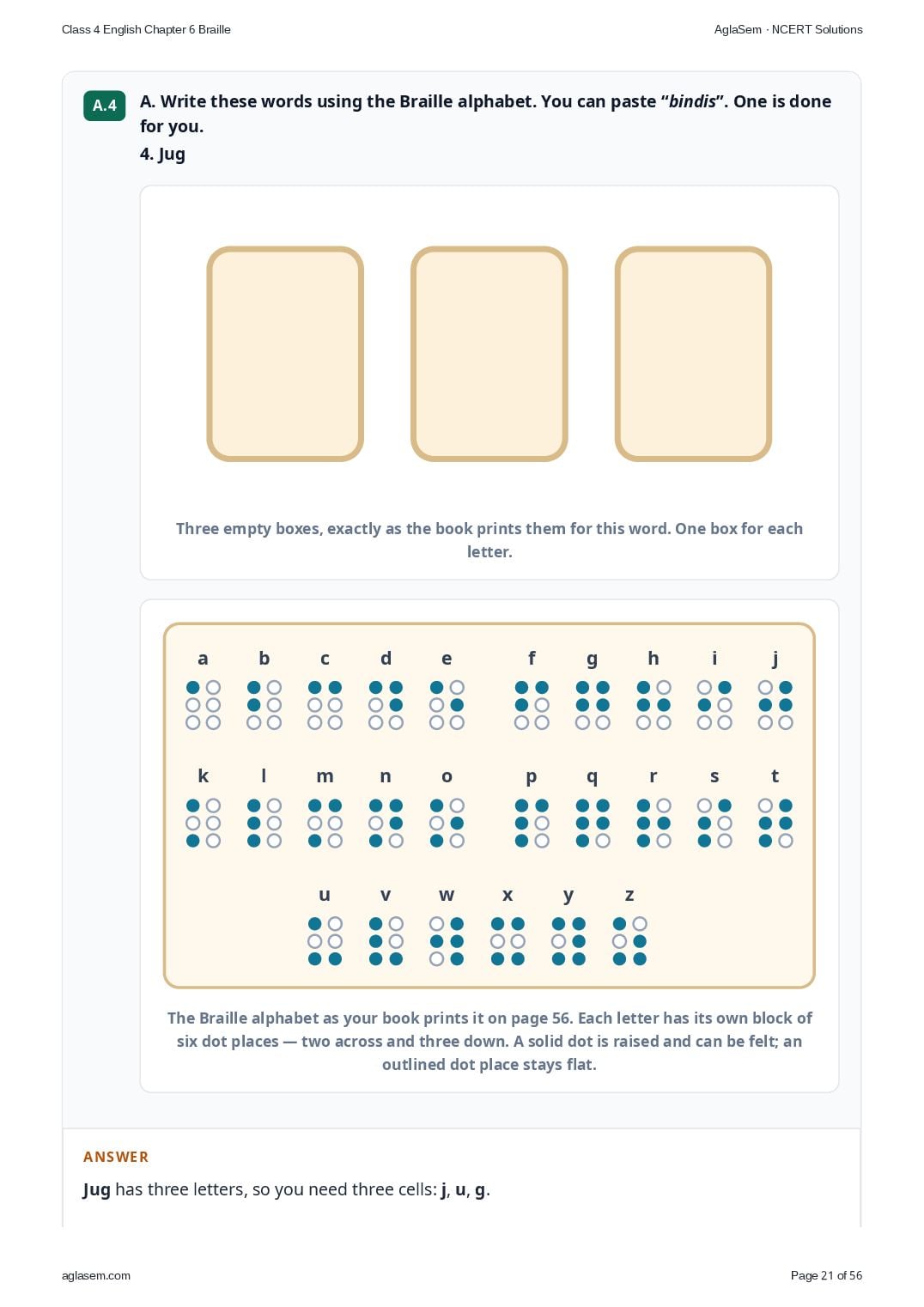
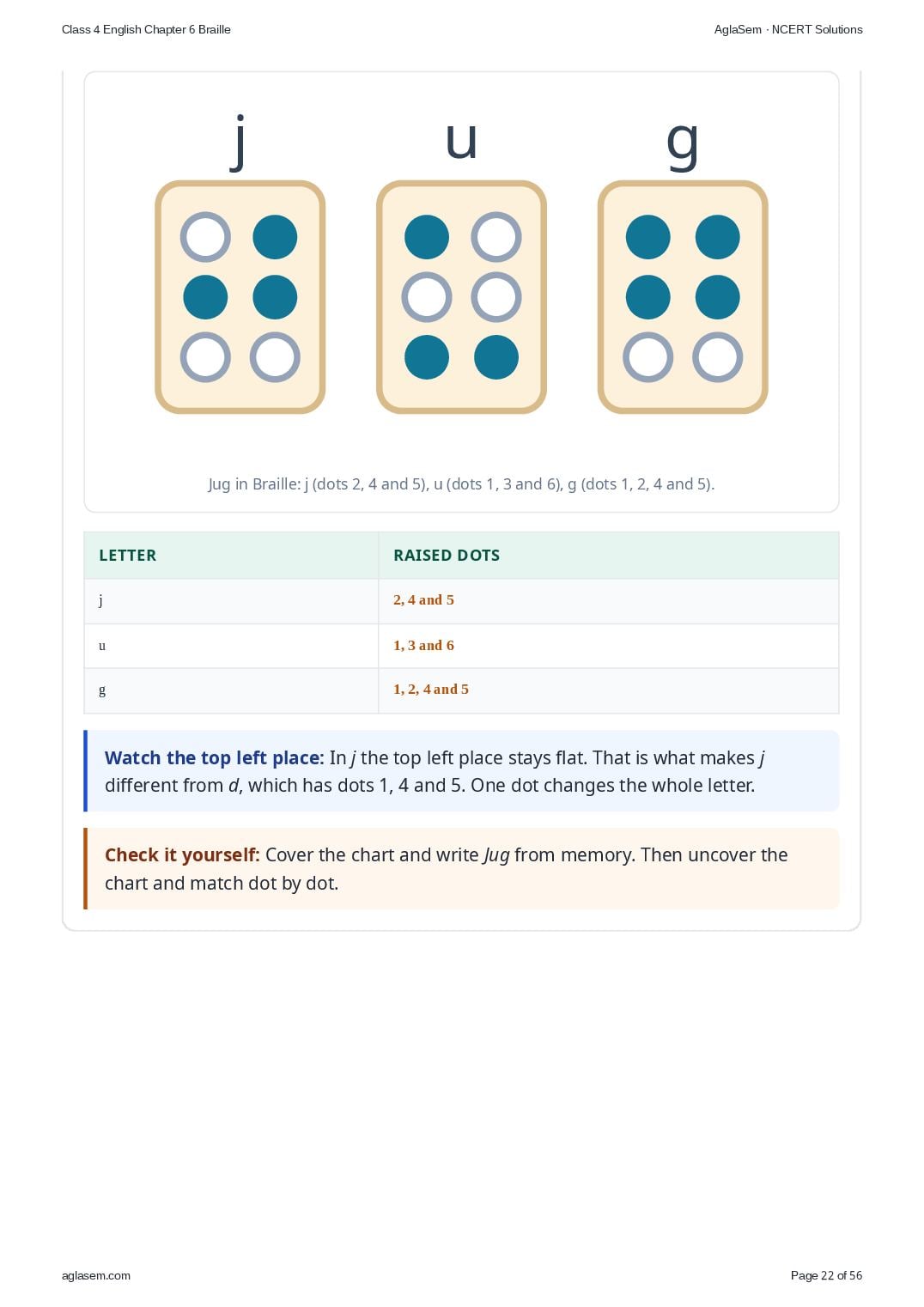
- A. Write these words using the Braille alphabet. You can paste “bindis”. One is done for you.4. JugThree empty Braille boxesThree empty boxes, exactly as the book prints them for this word. One box for each letter.The Braille alphabet chart printed on page 56abcdefghijklmnopqrstuvwxyzThe Braille alphabet as your book prints it on page 56. Each letter has its own block of six dot places — two across and three down. A solid dot is raised and can be felt; an outlined dot place stays flat.
- 5. Write your name in Braille.The Braille alphabet chart printed on page 56abcdefghijklmnopqrstuvwxyzThe Braille alphabet as your book prints it on page 56. Each letter has its own block of six dot places — two across and three down. A solid dot is raised and can be felt; an outlined dot place stays flat.
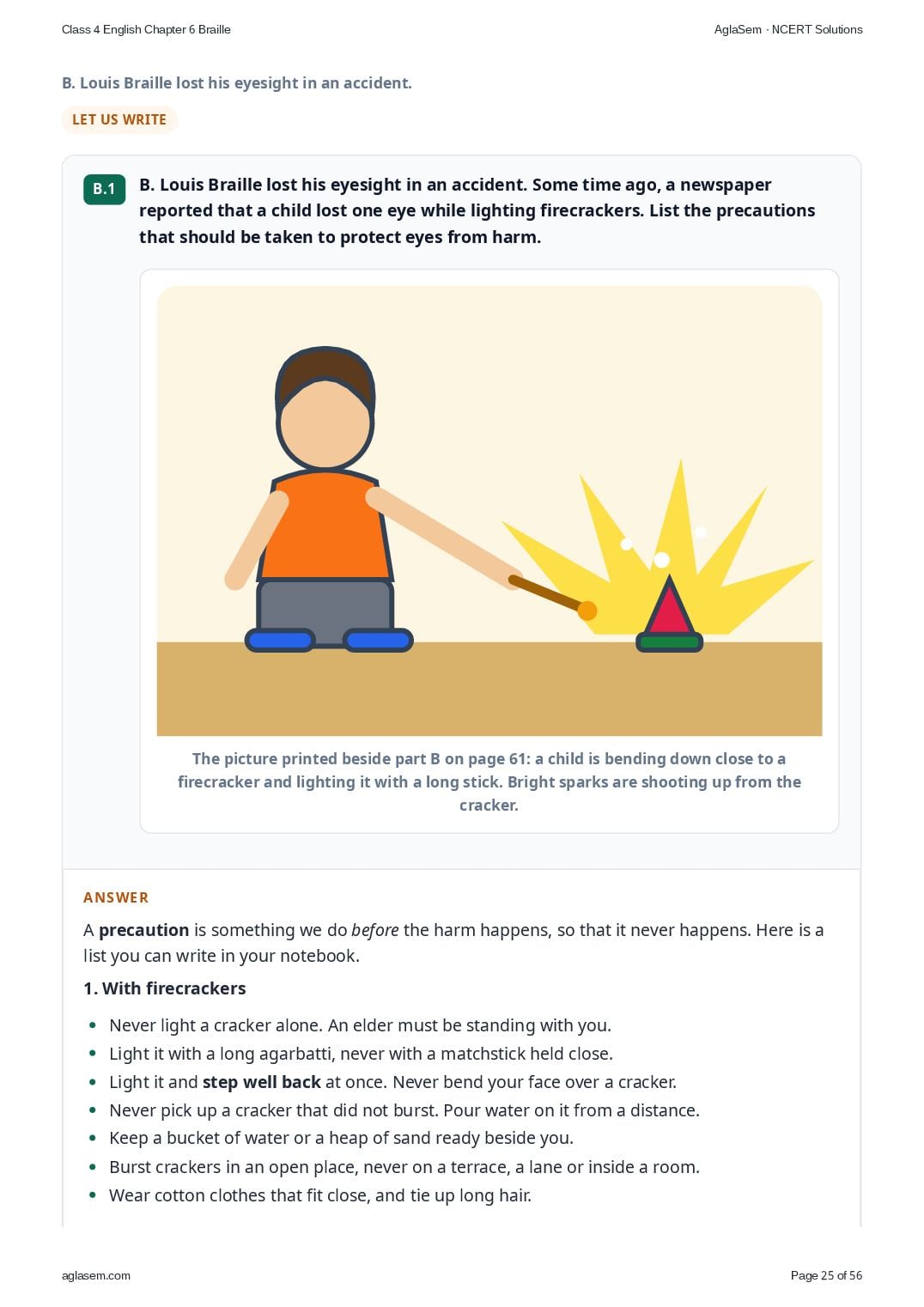
- B. Louis Braille lost his eyesight in an accident. Some time ago, a newspaper reported that a child lost one eye while lighting firecrackers. List the precautions that should be taken to protect eyes from harm. The picture on page 61: a child lighting a firecracker The picture printed beside part B on page 61: a child is bending down close to a firecracker and lighting it with a long stick. Bright sparks are shooting up from the cracker.
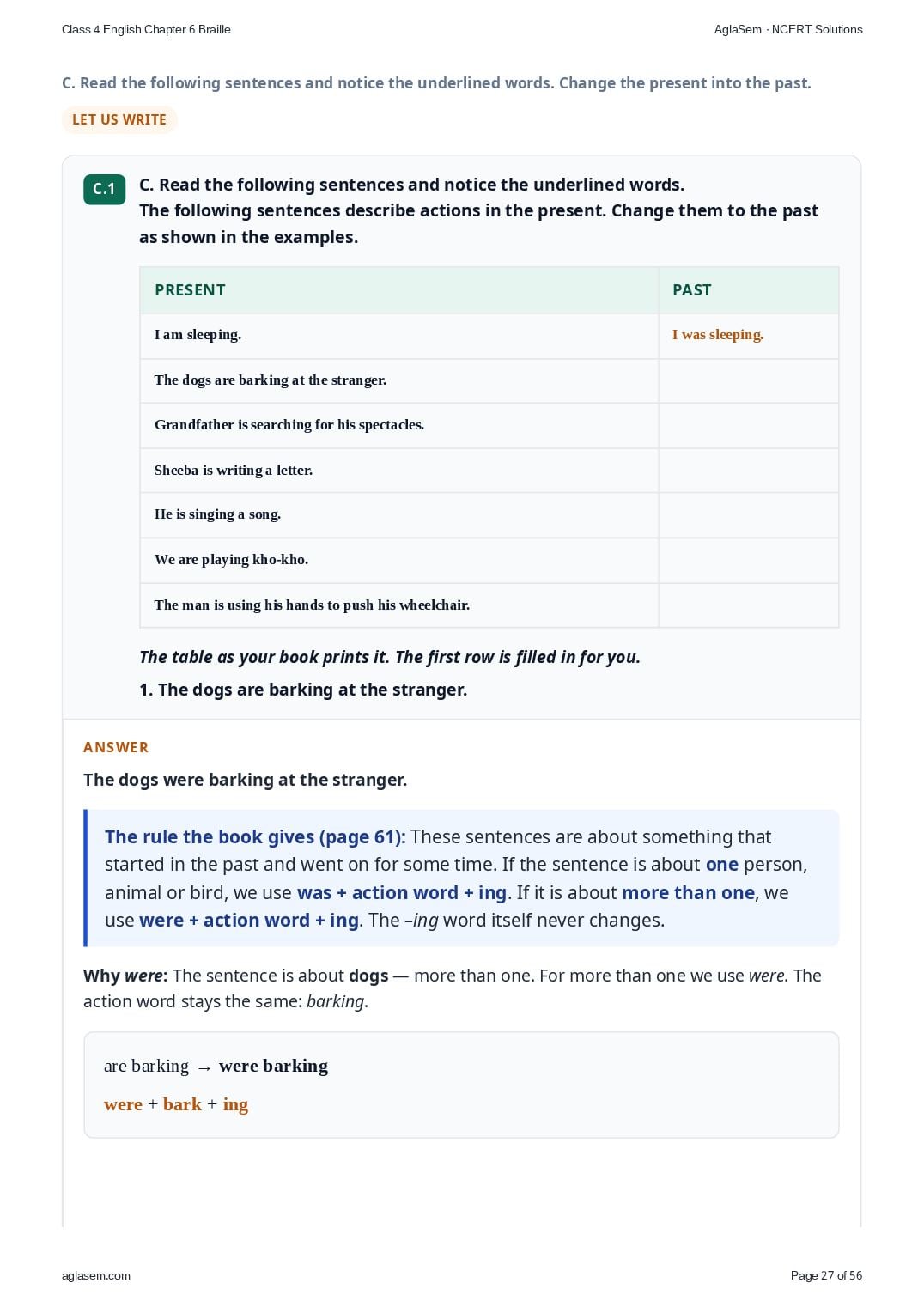
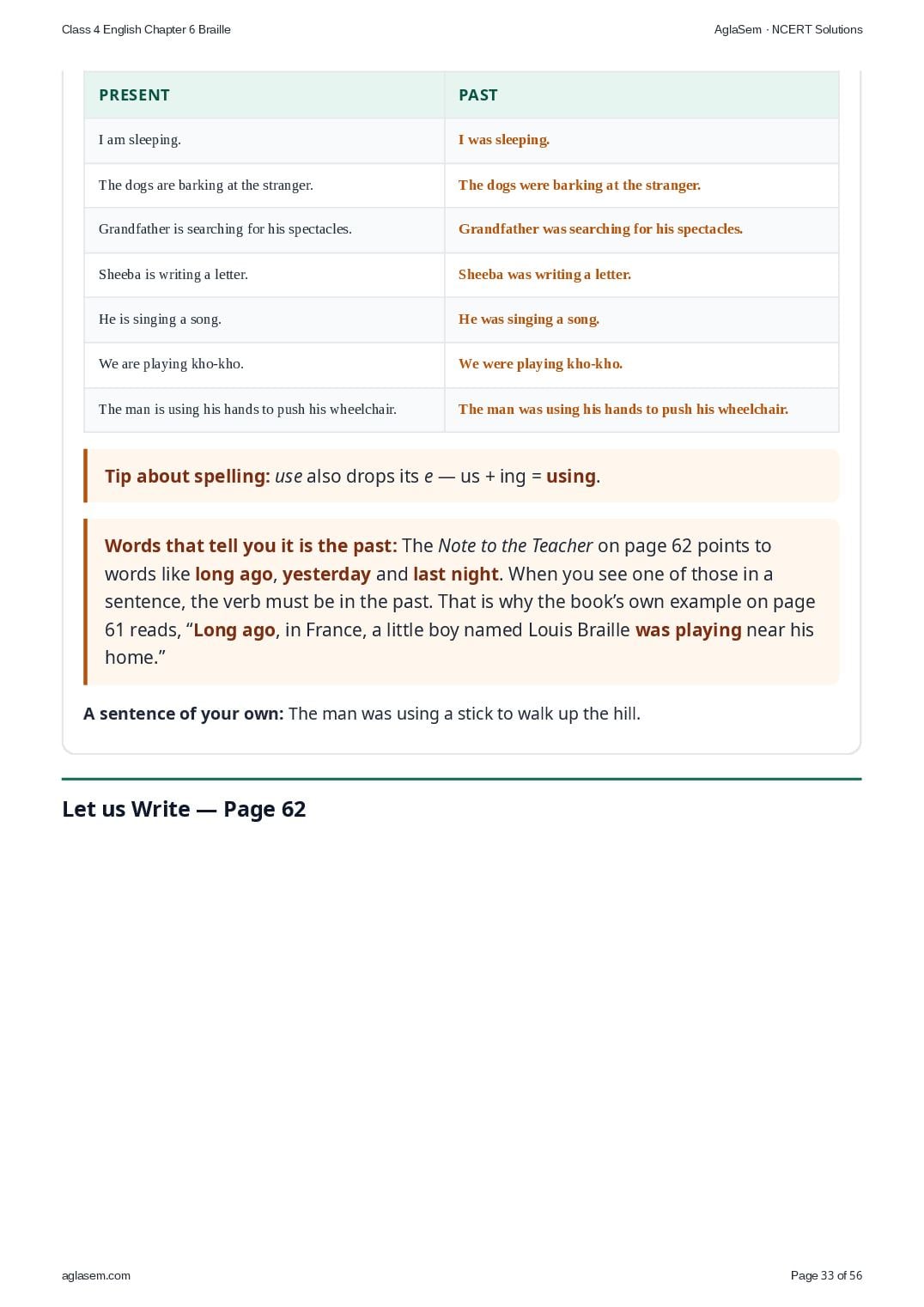
- C. Read the following sentences and notice the underlined words.The following sentences describe actions in the present. Change them to the past as shown in the examples.PresentPastI am sleeping.I was sleeping.The dogs are barking at the stranger. Grandfather is searching for his spectacles. Sheeba is writing a letter. He is singing a song. We are playing kho-kho. The man is using his hands to push his wheelchair. The table as your book prints it. The first row is filled in for you.1. The dogs are barking at the stranger.
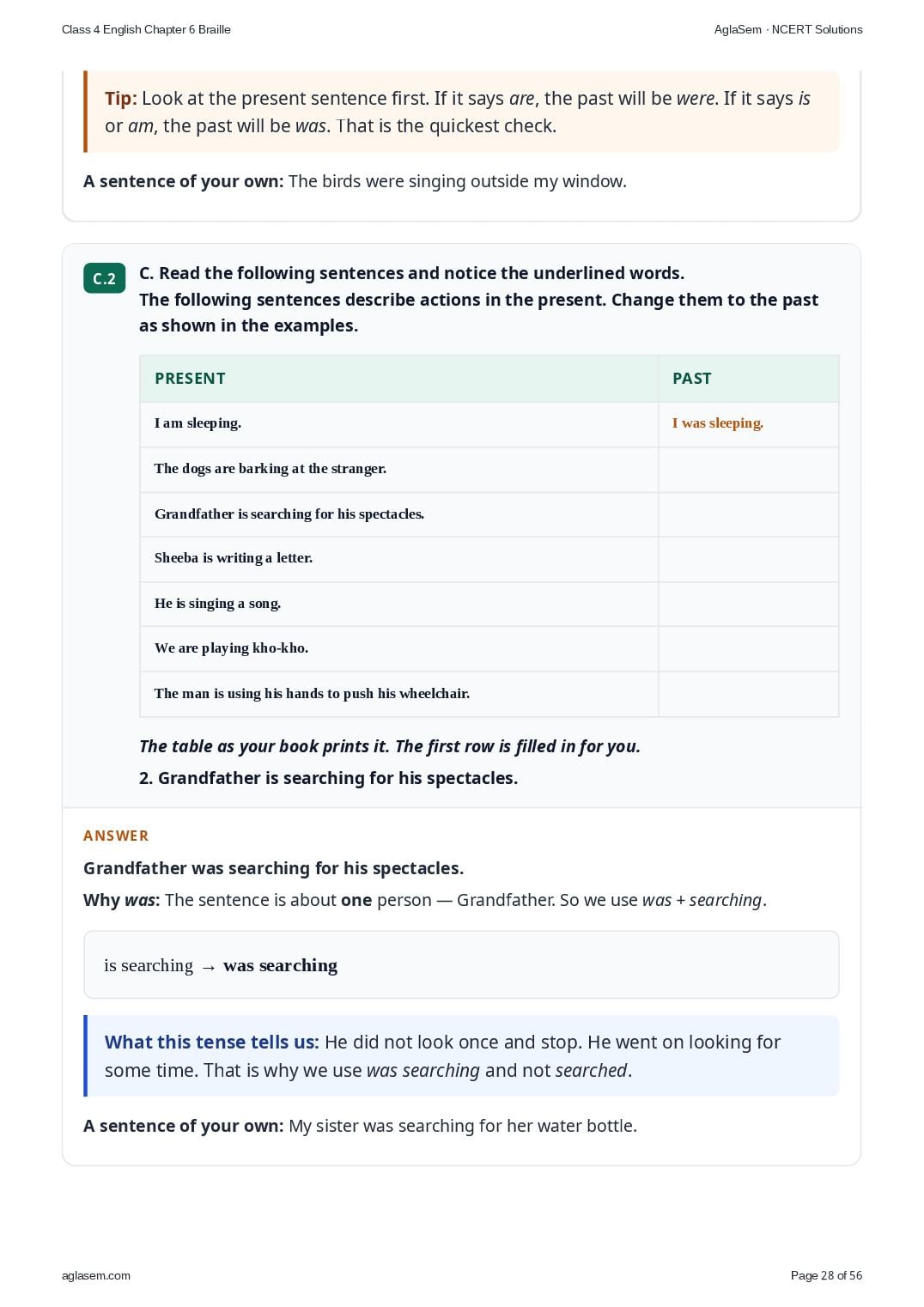
- C. Read the following sentences and notice the underlined words.The following sentences describe actions in the present. Change them to the past as shown in the examples.PresentPastI am sleeping.I was sleeping.The dogs are barking at the stranger. Grandfather is searching for his spectacles. Sheeba is writing a letter. He is singing a song. We are playing kho-kho. The man is using his hands to push his wheelchair. The table as your book prints it. The first row is filled in for you.2. Grandfather is searching for his spectacles.
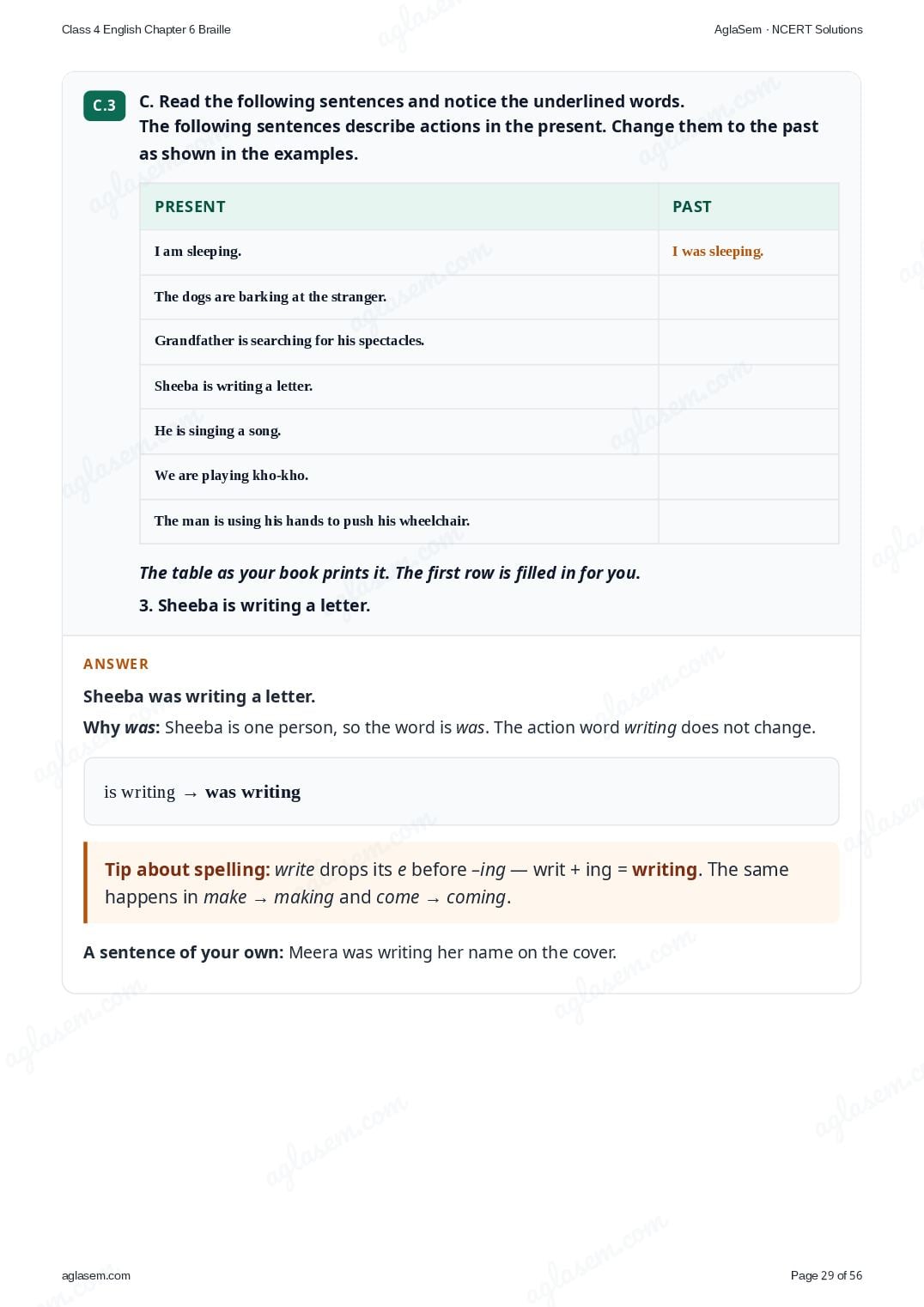
- C. Read the following sentences and notice the underlined words.The following sentences describe actions in the present. Change them to the past as shown in the examples.PresentPastI am sleeping.I was sleeping.The dogs are barking at the stranger. Grandfather is searching for his spectacles. Sheeba is writing a letter. He is singing a song. We are playing kho-kho. The man is using his hands to push his wheelchair. The table as your book prints it. The first row is filled in for you.3. Sheeba is writing a letter.
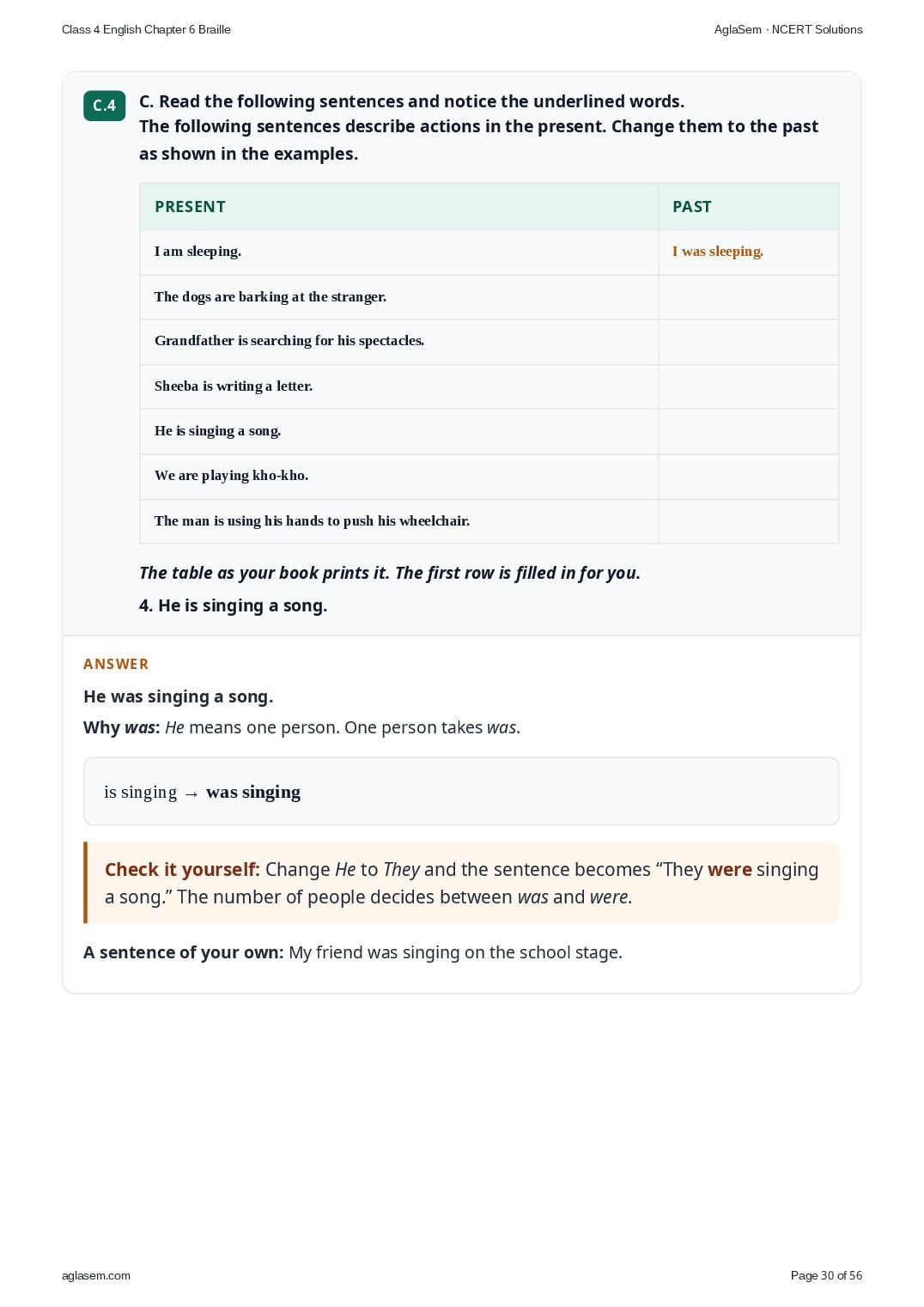
- C. Read the following sentences and notice the underlined words.The following sentences describe actions in the present. Change them to the past as shown in the examples.PresentPastI am sleeping.I was sleeping.The dogs are barking at the stranger. Grandfather is searching for his spectacles. Sheeba is writing a letter. He is singing a song. We are playing kho-kho. The man is using his hands to push his wheelchair. The table as your book prints it. The first row is filled in for you.4. He is singing a song.
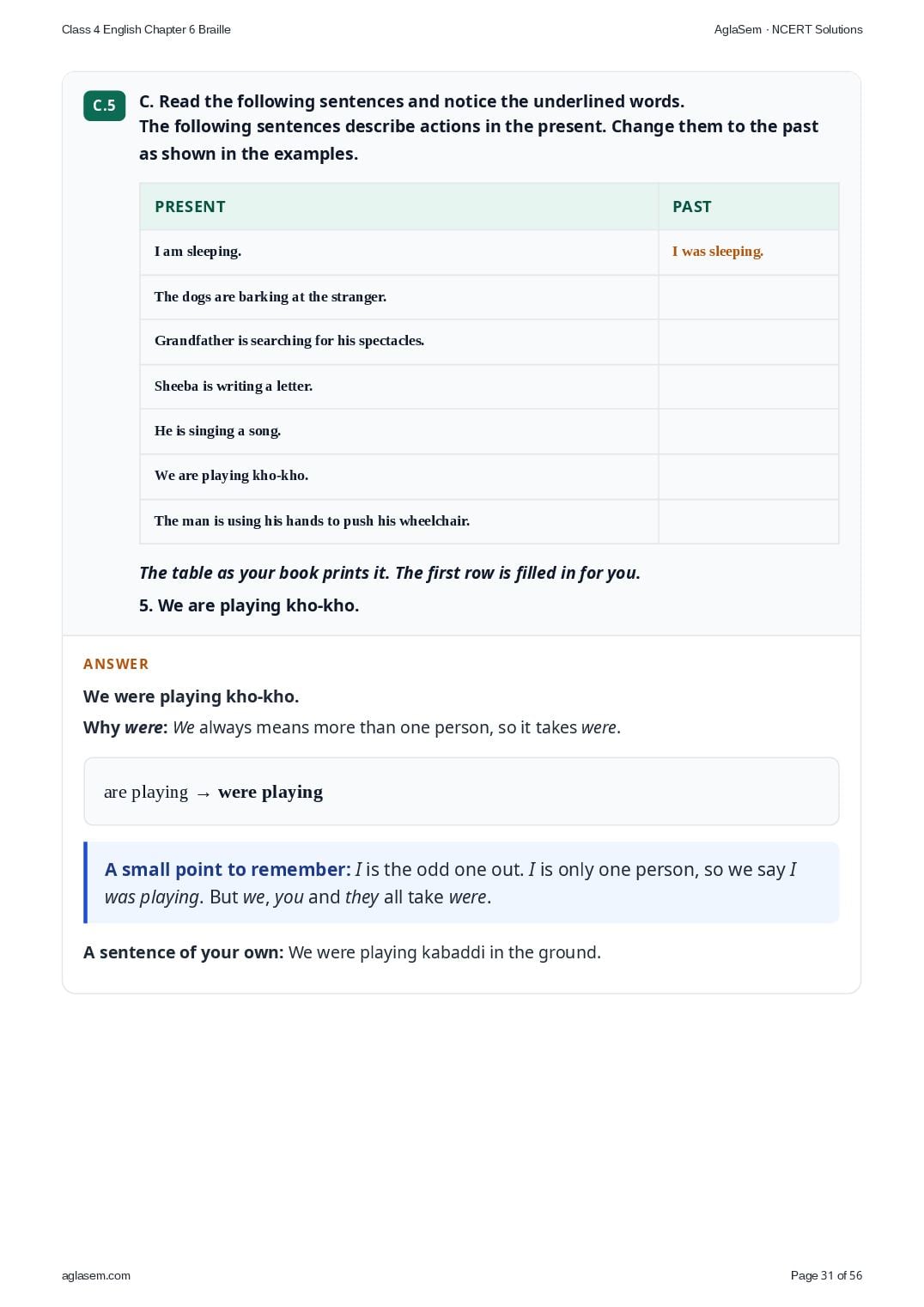
- C. Read the following sentences and notice the underlined words.The following sentences describe actions in the present. Change them to the past as shown in the examples.PresentPastI am sleeping.I was sleeping.The dogs are barking at the stranger. Grandfather is searching for his spectacles. Sheeba is writing a letter. He is singing a song. We are playing kho-kho. The man is using his hands to push his wheelchair. The table as your book prints it. The first row is filled in for you.5. We are playing kho-kho.
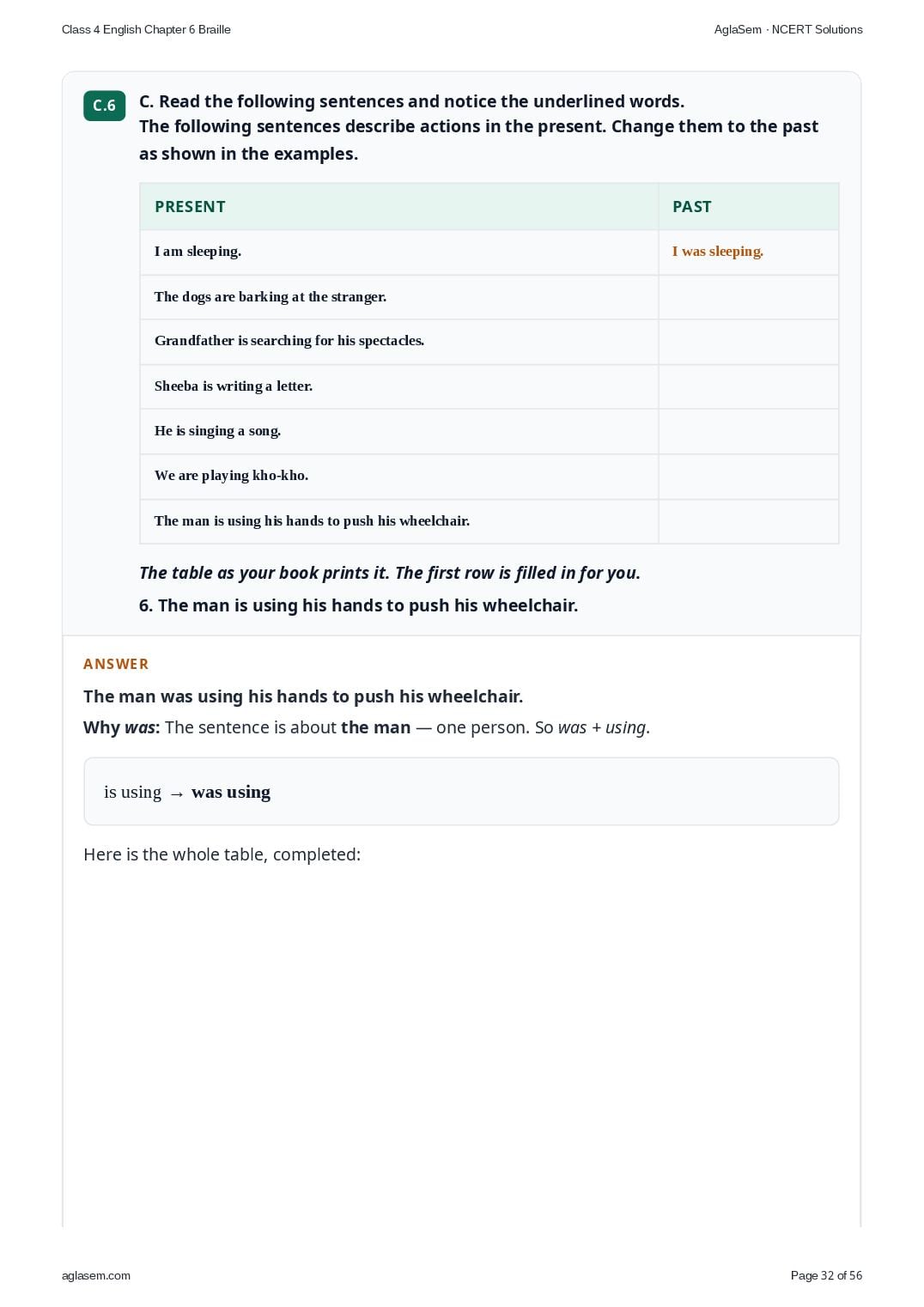
- C. Read the following sentences and notice the underlined words.The following sentences describe actions in the present. Change them to the past as shown in the examples.PresentPastI am sleeping.I was sleeping.The dogs are barking at the stranger. Grandfather is searching for his spectacles. Sheeba is writing a letter. He is singing a song. We are playing kho-kho. The man is using his hands to push his wheelchair. The table as your book prints it. The first row is filled in for you.6. The man is using his hands to push his wheelchair.
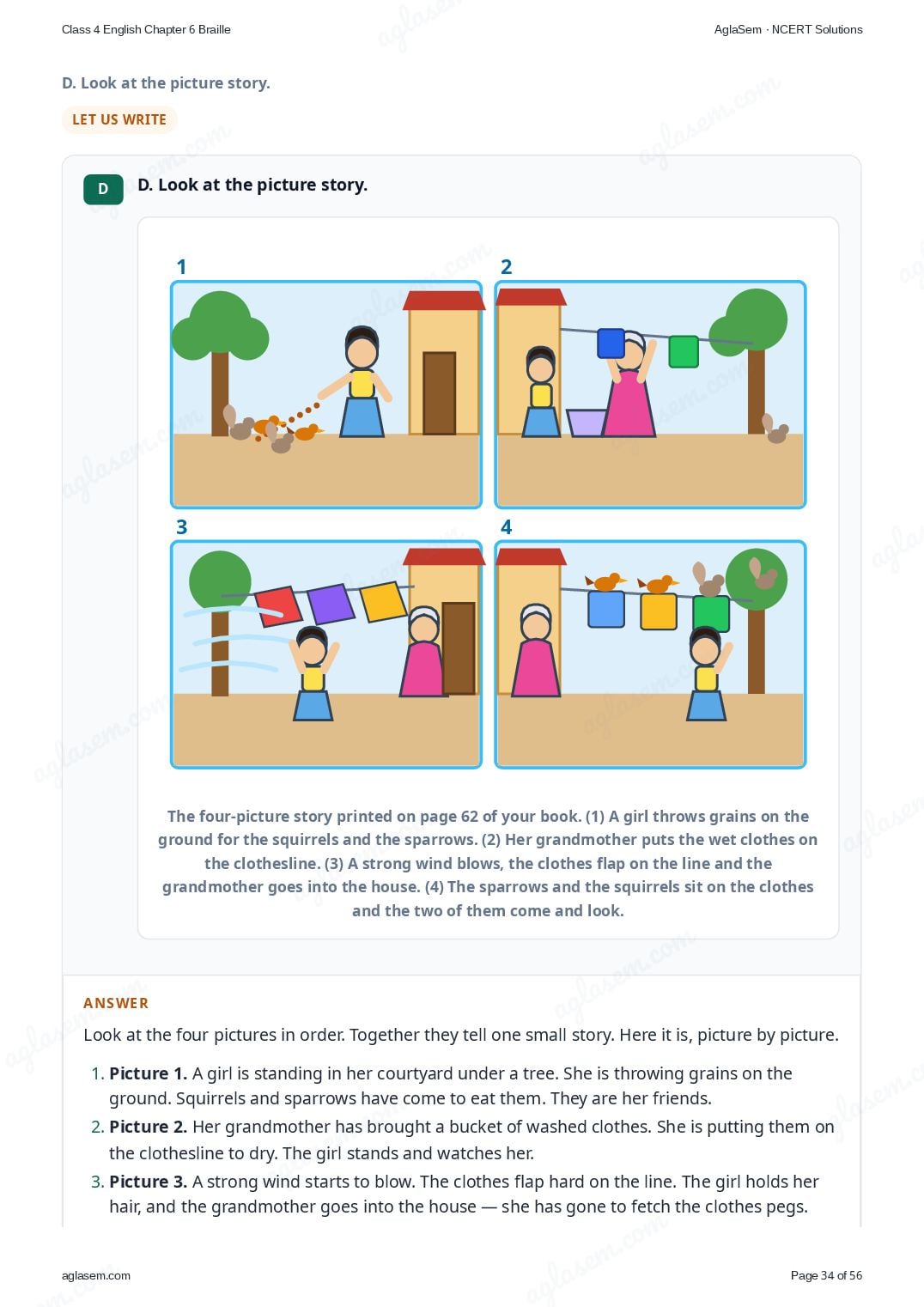
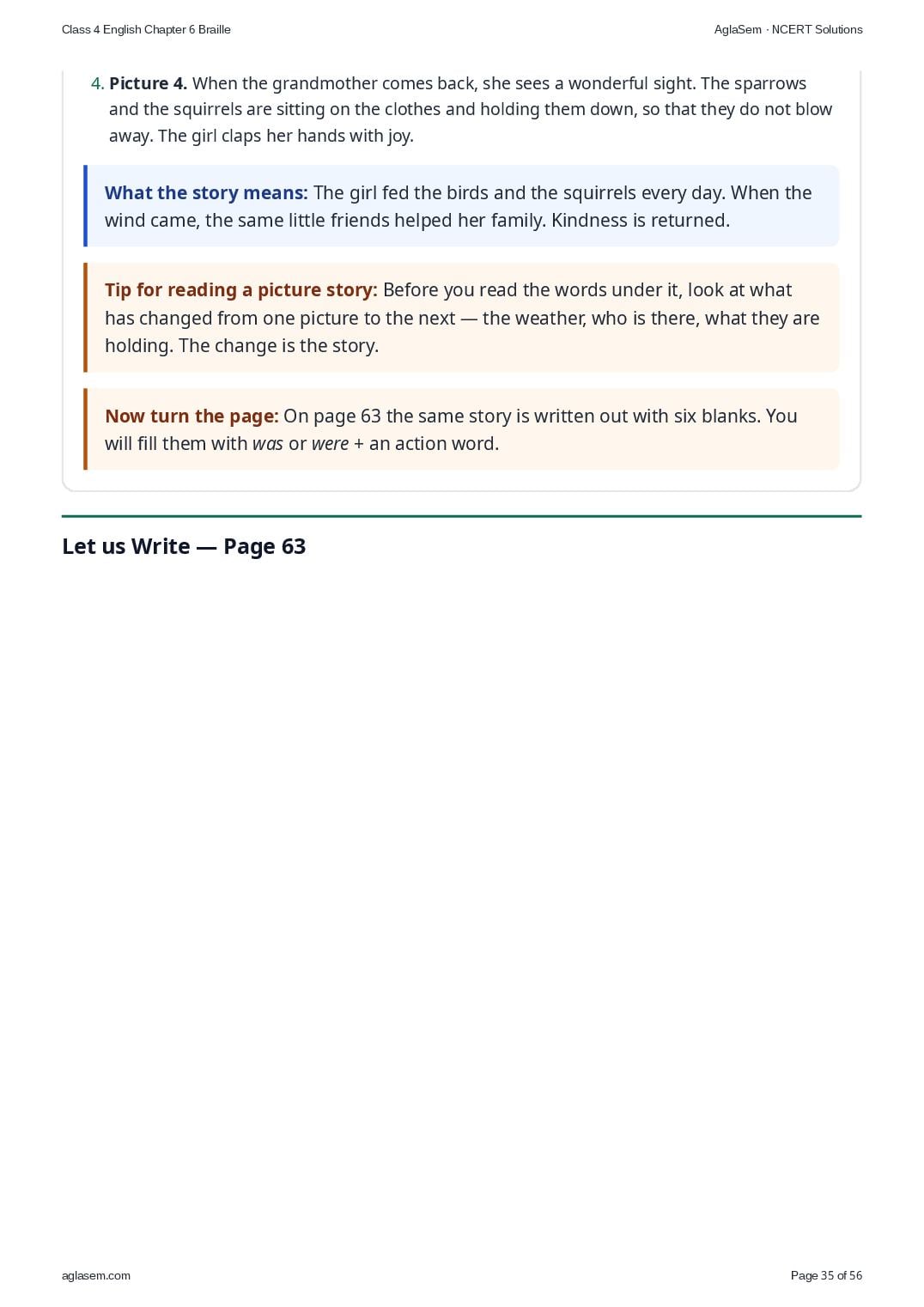
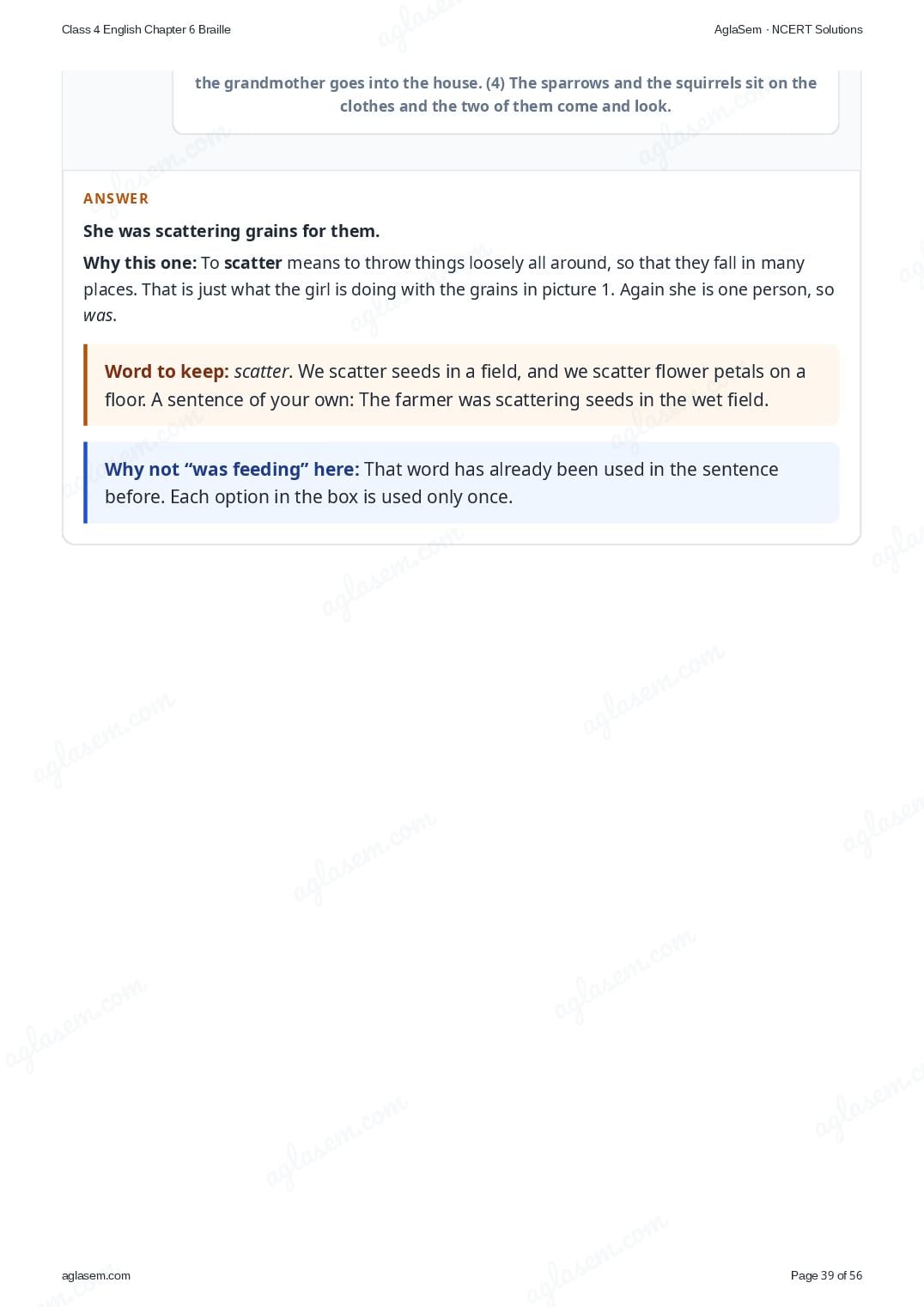
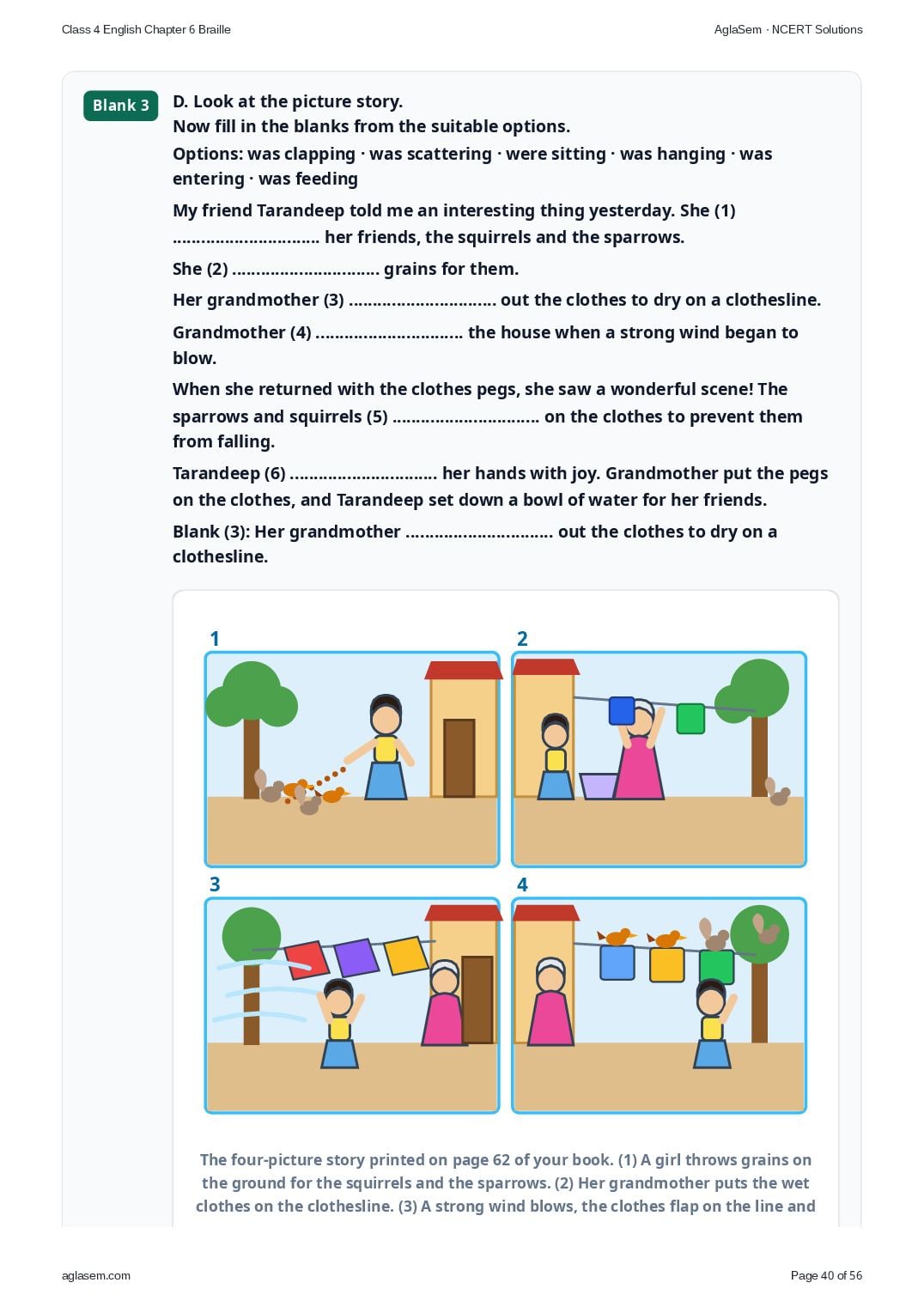
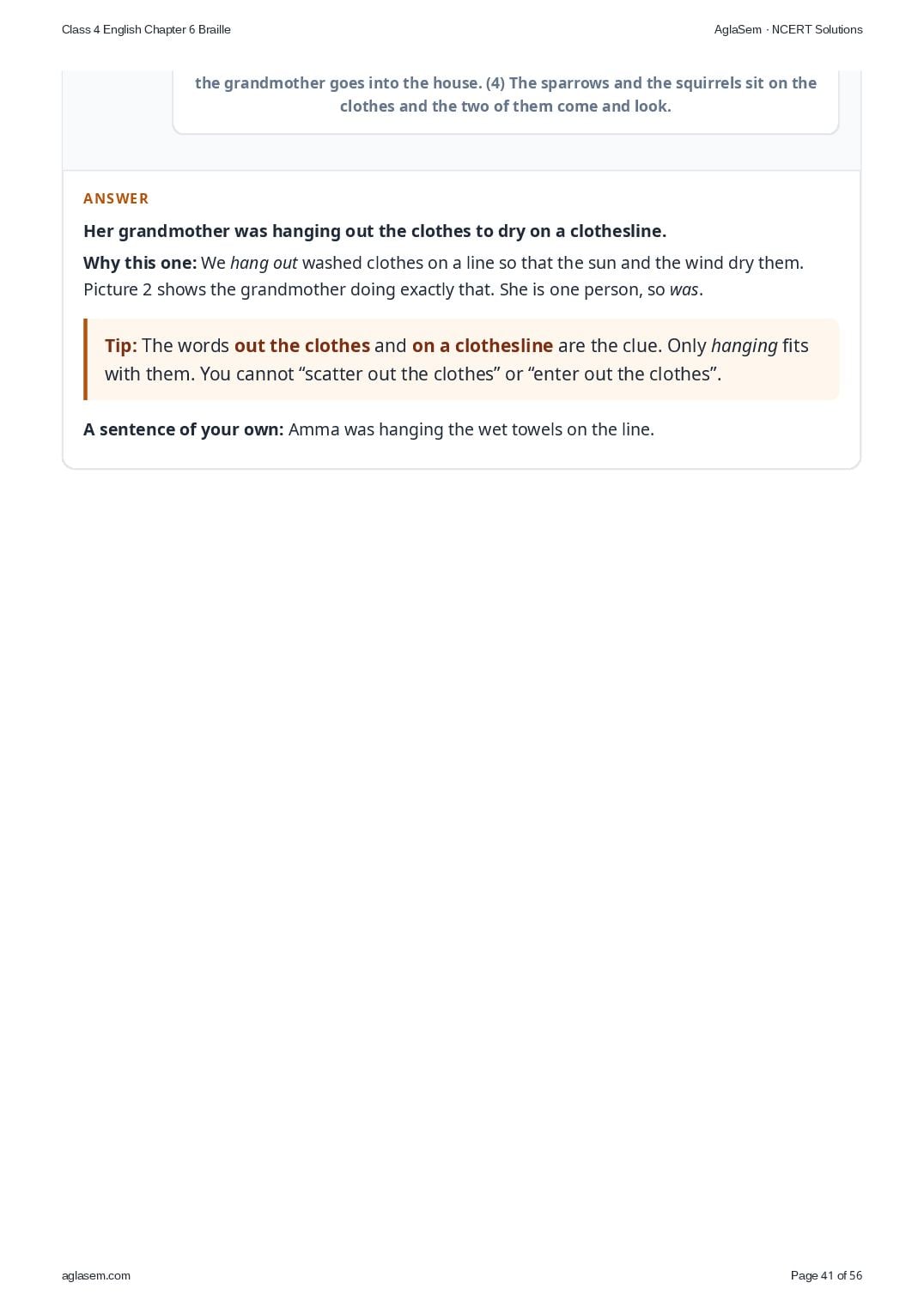
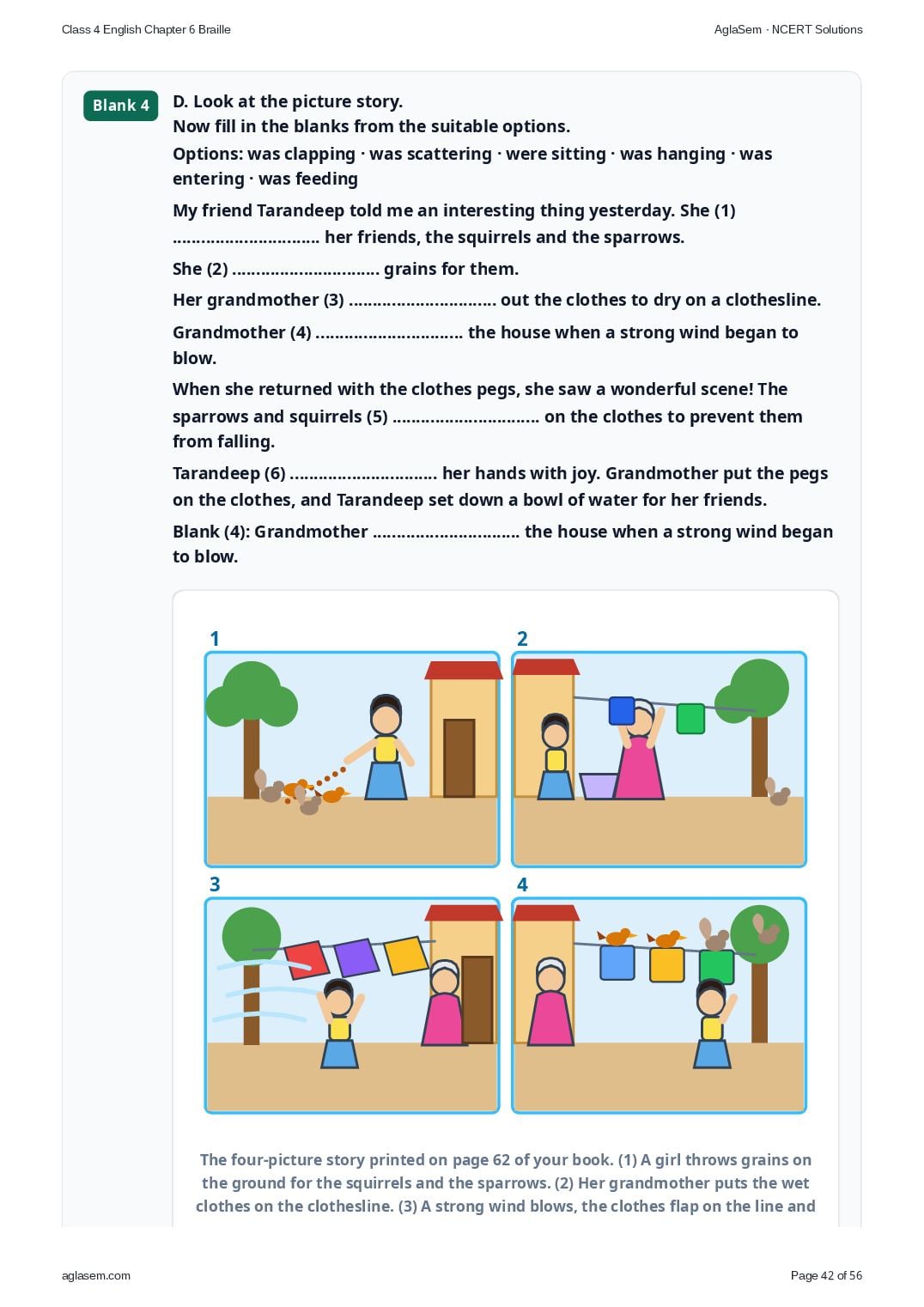
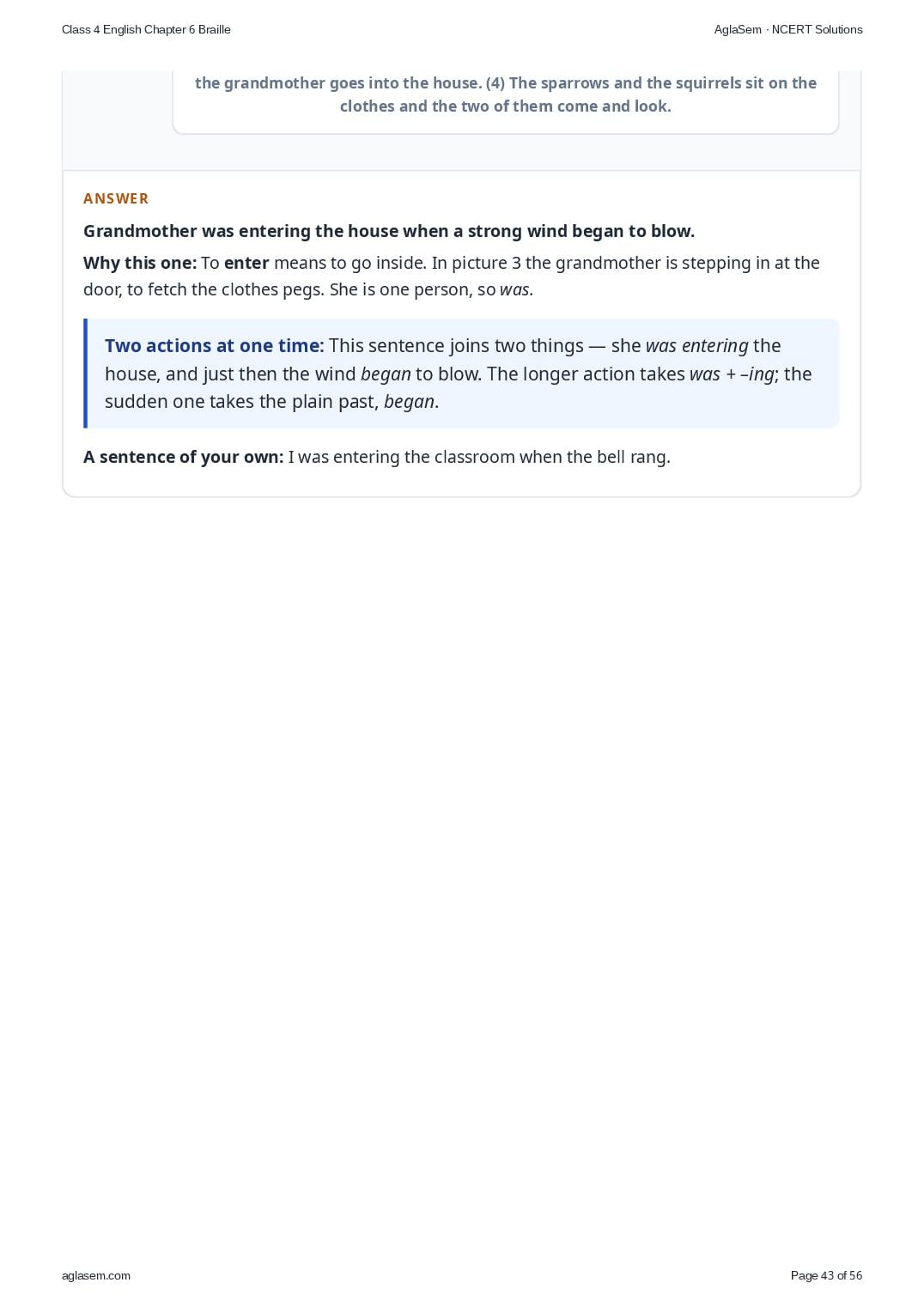
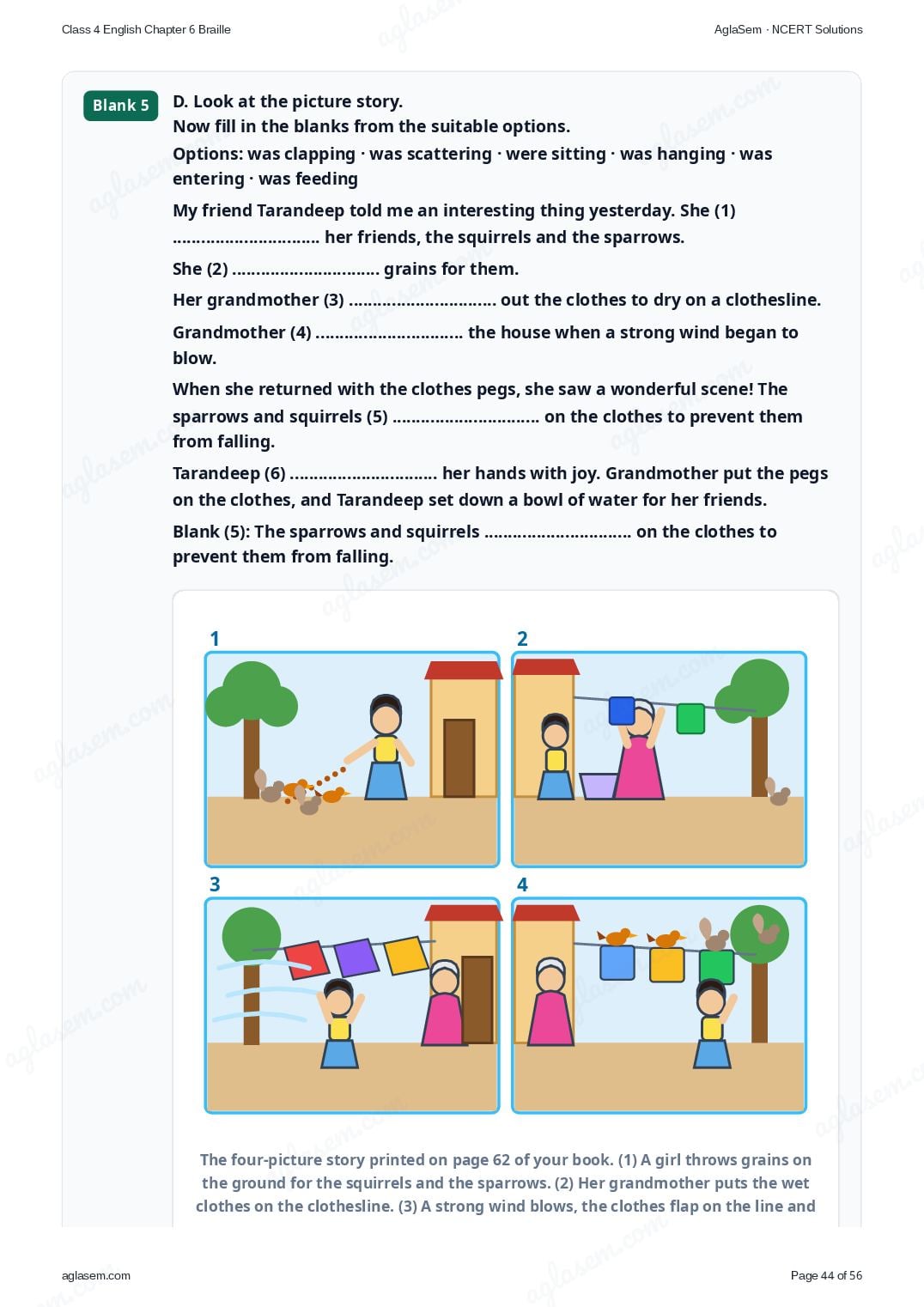
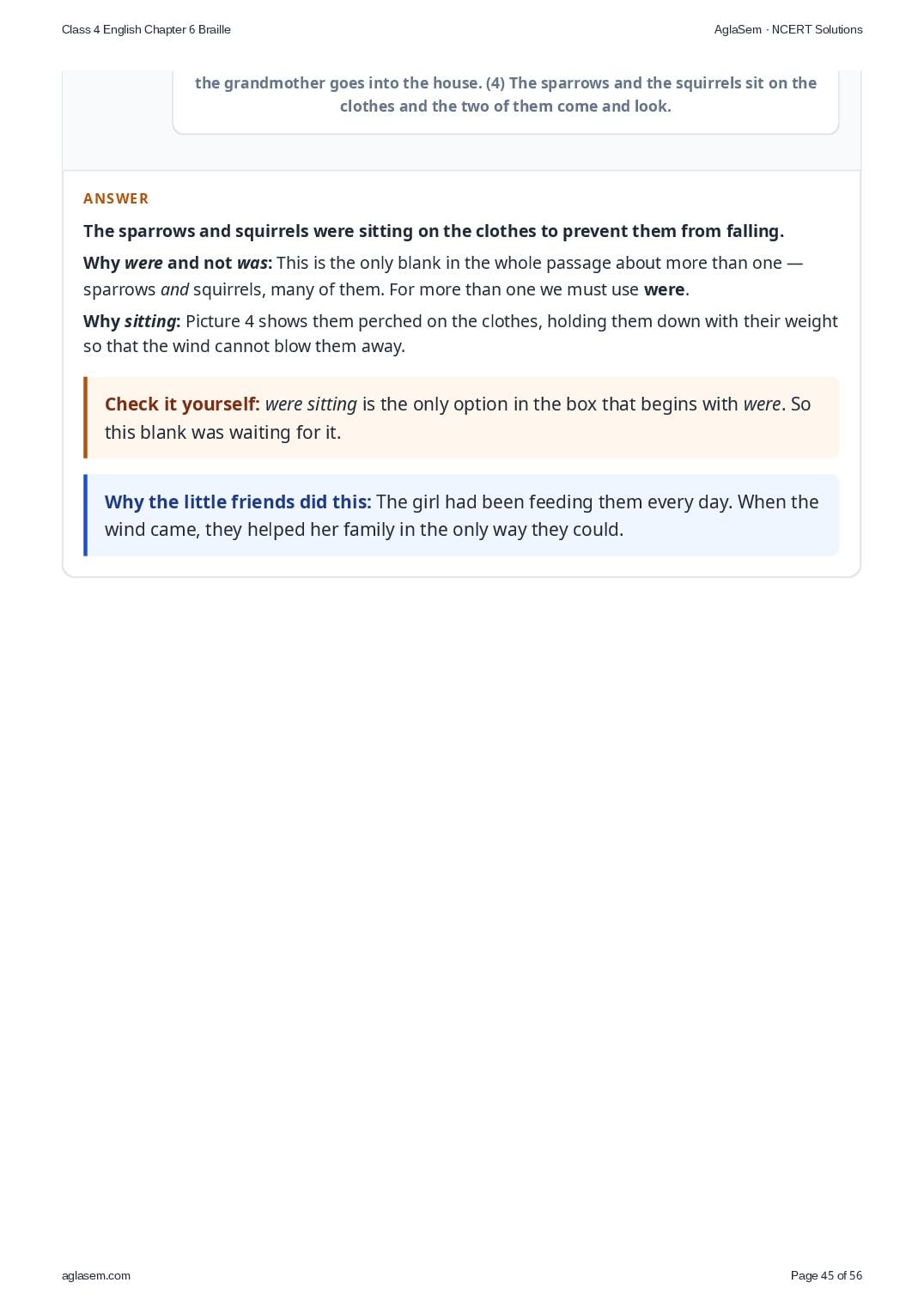
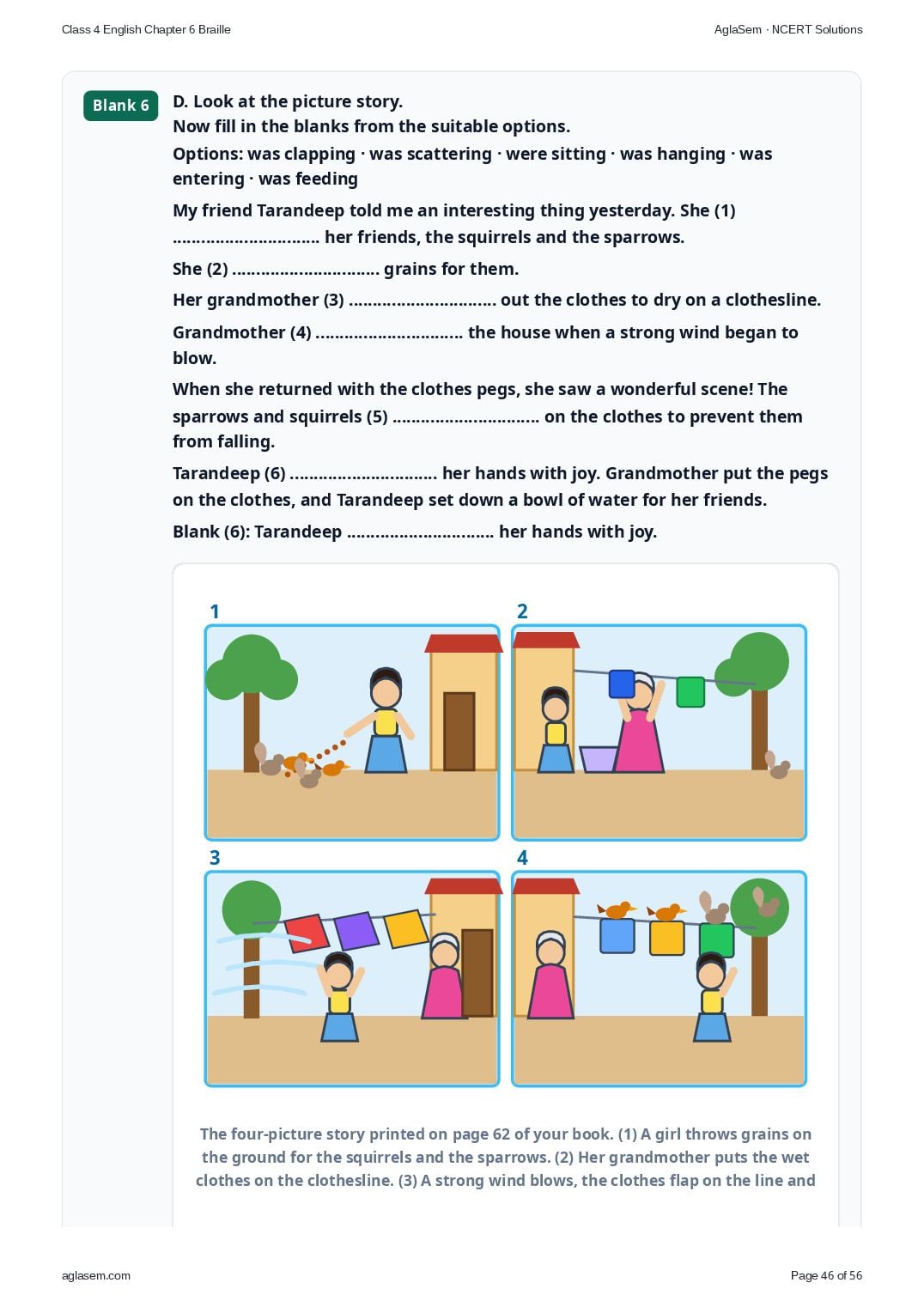
- D. Look at the picture story.The picture story printed on page 621234The four-picture story printed on page 62 of your book. (1) A girl throws grains on the ground for the squirrels and the sparrows. (2) Her grandmother puts the wet clothes on the clothesline. (3) A strong wind blows, the clothes flap on the line and the grandmother goes into the house. (4) The sparrows and the squirrels sit on the clothes and the two of them come and look.
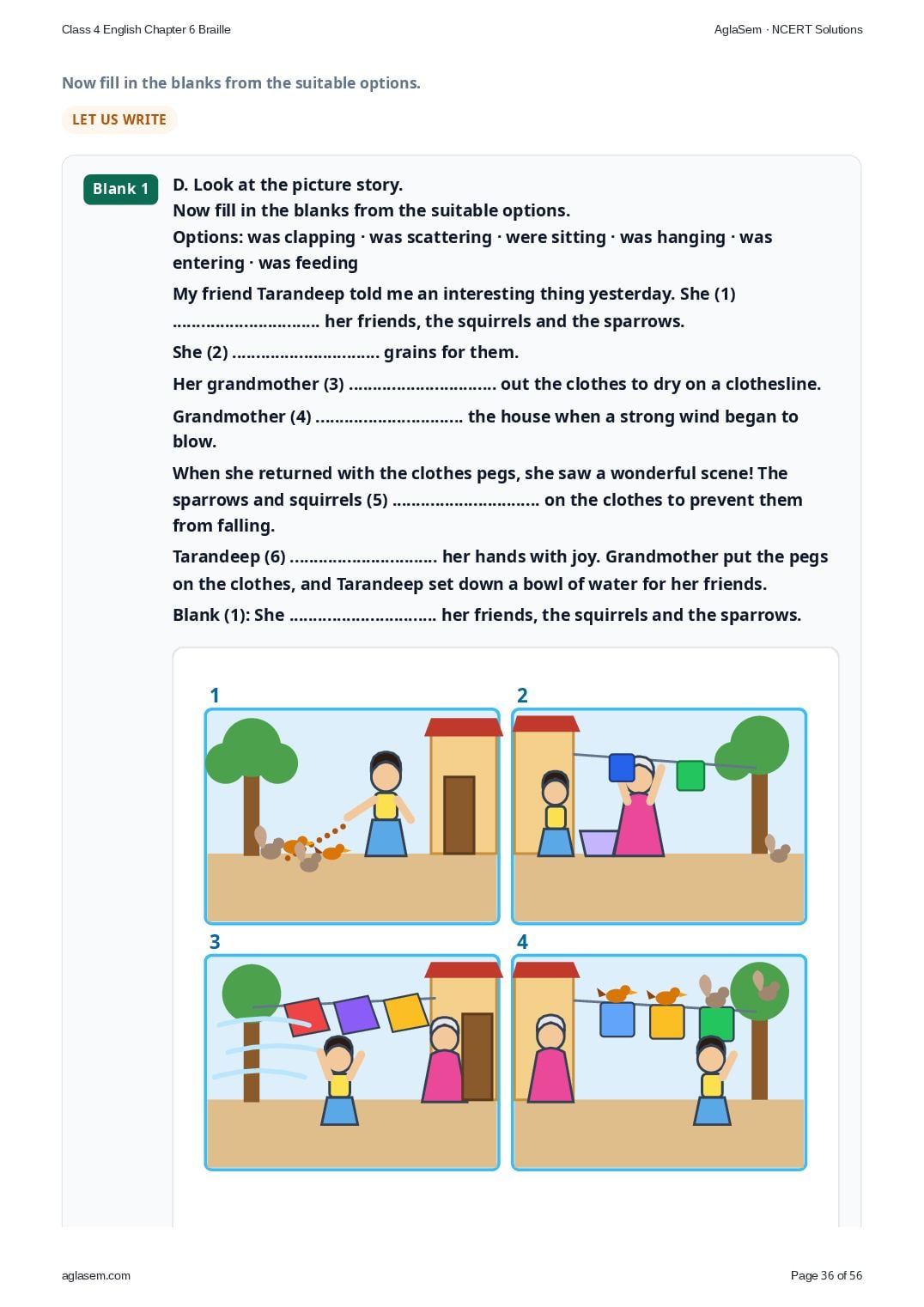
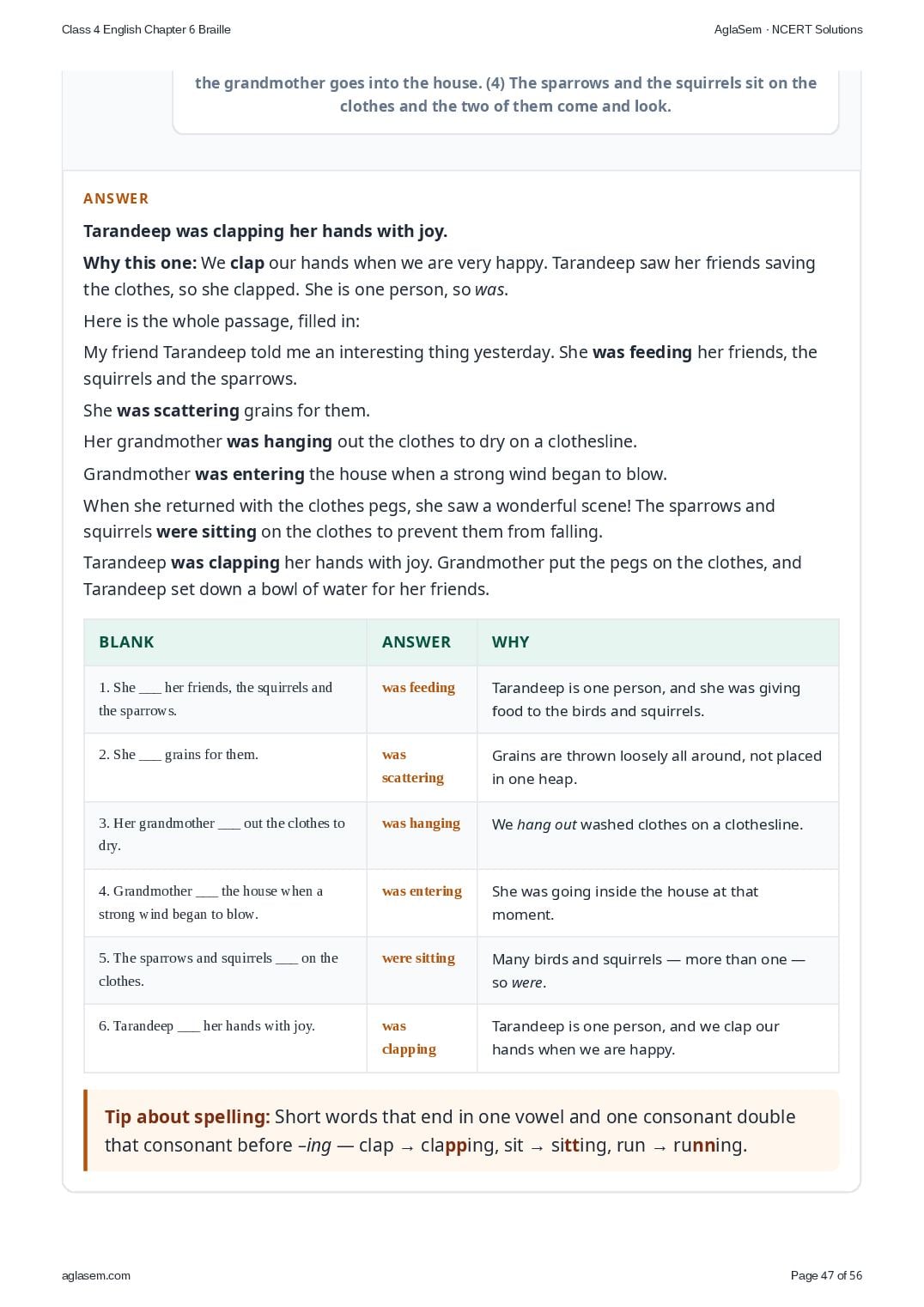
- D. Look at the picture story.Now fill in the blanks from the suitable options.Options: was clapping · was scattering · were sitting · was hanging · was entering · was feedingMy friend Tarandeep told me an interesting thing yesterday. She (1) …………………………. her friends, the squirrels and the sparrows.She (2) …………………………. grains for them.Her grandmother (3) …………………………. out the clothes to dry on a clothesline.Grandmother (4) …………………………. the house when a strong wind began to blow.When she returned with the clothes pegs, she saw a wonderful scene! The sparrows and squirrels (5) …………………………. on the clothes to prevent them from falling.Tarandeep (6) …………………………. her hands with joy. Grandmother put the pegs on the clothes, and Tarandeep set down a bowl of water for her friends.Blank (1): She …………………………. her friends, the squirrels and the sparrows.The picture story printed on page 621234The four-picture story printed on page 62 of your book. (1) A girl throws grains on the ground for the squirrels and the sparrows. (2) Her grandmother puts the wet clothes on the clothesline. (3) A strong wind blows, the clothes flap on the line and the grandmother goes into the house. (4) The sparrows and the squirrels sit on the clothes and the two of them come and look.
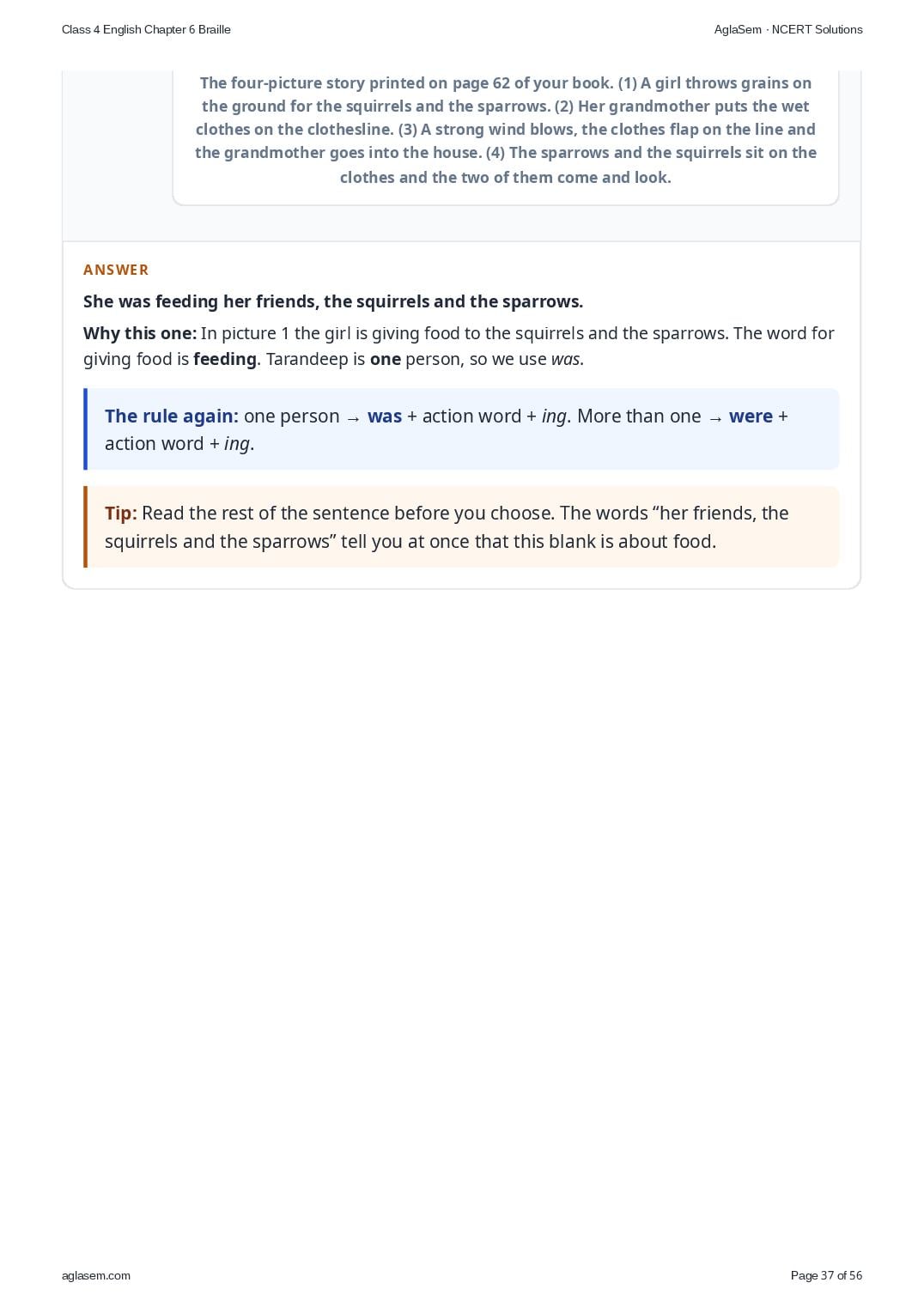
- D. Look at the picture story.Now fill in the blanks from the suitable options.Options: was clapping · was scattering · were sitting · was hanging · was entering · was feedingMy friend Tarandeep told me an interesting thing yesterday. She (1) …………………………. her friends, the squirrels and the sparrows.She (2) …………………………. grains for them.Her grandmother (3) …………………………. out the clothes to dry on a clothesline.Grandmother (4) …………………………. the house when a strong wind began to blow.When she returned with the clothes pegs, she saw a wonderful scene! The sparrows and squirrels (5) …………………………. on the clothes to prevent them from falling.Tarandeep (6) …………………………. her hands with joy. Grandmother put the pegs on the clothes, and Tarandeep set down a bowl of water for her friends.Blank (2): She …………………………. grains for them.The picture story printed on page 621234The four-picture story printed on page 62 of your book. (1) A girl throws grains on the ground for the squirrels and the sparrows. (2) Her grandmother puts the wet clothes on the clothesline. (3) A strong wind blows, the clothes flap on the line and the grandmother goes into the house. (4) The sparrows and the squirrels sit on the clothes and the two of them come and look.
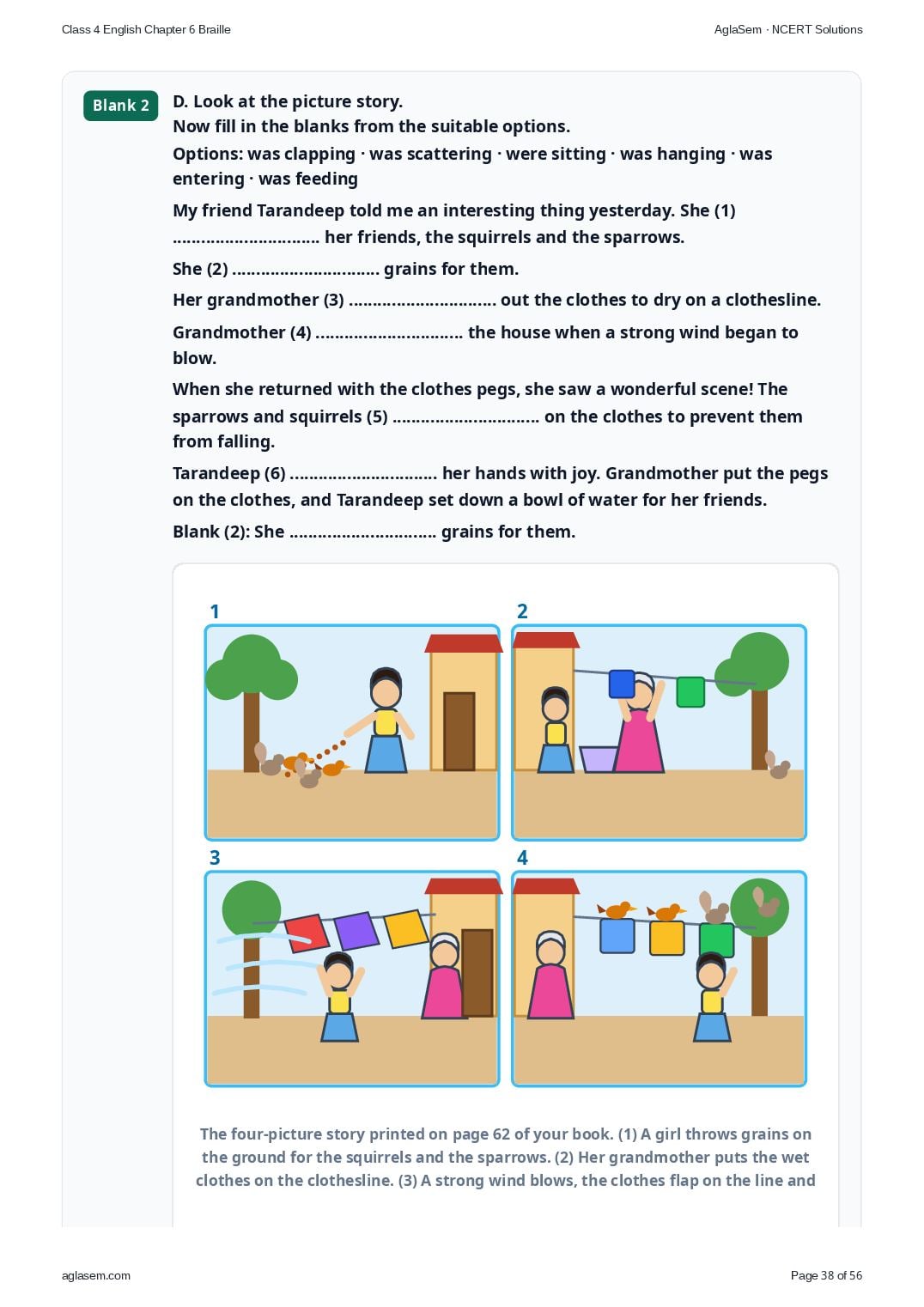
- D. Look at the picture story.Now fill in the blanks from the suitable options.Options: was clapping · was scattering · were sitting · was hanging · was entering · was feedingMy friend Tarandeep told me an interesting thing yesterday. She (1) …………………………. her friends, the squirrels and the sparrows.She (2) …………………………. grains for them.Her grandmother (3) …………………………. out the clothes to dry on a clothesline.Grandmother (4) …………………………. the house when a strong wind began to blow.When she returned with the clothes pegs, she saw a wonderful scene! The sparrows and squirrels (5) …………………………. on the clothes to prevent them from falling.Tarandeep (6) …………………………. her hands with joy. Grandmother put the pegs on the clothes, and Tarandeep set down a bowl of water for her friends.Blank (3): Her grandmother …………………………. out the clothes to dry on a clothesline.The picture story printed on page 621234The four-picture story printed on page 62 of your book. (1) A girl throws grains on the ground for the squirrels and the sparrows. (2) Her grandmother puts the wet clothes on the clothesline. (3) A strong wind blows, the clothes flap on the line and the grandmother goes into the house. (4) The sparrows and the squirrels sit on the clothes and the two of them come and look.
- D. Look at the picture story.Now fill in the blanks from the suitable options.Options: was clapping · was scattering · were sitting · was hanging · was entering · was feedingMy friend Tarandeep told me an interesting thing yesterday. She (1) …………………………. her friends, the squirrels and the sparrows.She (2) …………………………. grains for them.Her grandmother (3) …………………………. out the clothes to dry on a clothesline.Grandmother (4) …………………………. the house when a strong wind began to blow.When she returned with the clothes pegs, she saw a wonderful scene! The sparrows and squirrels (5) …………………………. on the clothes to prevent them from falling.Tarandeep (6) …………………………. her hands with joy. Grandmother put the pegs on the clothes, and Tarandeep set down a bowl of water for her friends.Blank (4): Grandmother …………………………. the house when a strong wind began to blow.The picture story printed on page 621234The four-picture story printed on page 62 of your book. (1) A girl throws grains on the ground for the squirrels and the sparrows. (2) Her grandmother puts the wet clothes on the clothesline. (3) A strong wind blows, the clothes flap on the line and the grandmother goes into the house. (4) The sparrows and the squirrels sit on the clothes and the two of them come and look.
- D. Look at the picture story.Now fill in the blanks from the suitable options.Options: was clapping · was scattering · were sitting · was hanging · was entering · was feedingMy friend Tarandeep told me an interesting thing yesterday. She (1) …………………………. her friends, the squirrels and the sparrows.She (2) …………………………. grains for them.Her grandmother (3) …………………………. out the clothes to dry on a clothesline.Grandmother (4) …………………………. the house when a strong wind began to blow.When she returned with the clothes pegs, she saw a wonderful scene! The sparrows and squirrels (5) …………………………. on the clothes to prevent them from falling.Tarandeep (6) …………………………. her hands with joy. Grandmother put the pegs on the clothes, and Tarandeep set down a bowl of water for her friends.Blank (5): The sparrows and squirrels …………………………. on the clothes to prevent them from falling.The picture story printed on page 621234The four-picture story printed on page 62 of your book. (1) A girl throws grains on the ground for the squirrels and the sparrows. (2) Her grandmother puts the wet clothes on the clothesline. (3) A strong wind blows, the clothes flap on the line and the grandmother goes into the house. (4) The sparrows and the squirrels sit on the clothes and the two of them come and look.
- D. Look at the picture story.Now fill in the blanks from the suitable options.Options: was clapping · was scattering · were sitting · was hanging · was entering · was feedingMy friend Tarandeep told me an interesting thing yesterday. She (1) …………………………. her friends, the squirrels and the sparrows.She (2) …………………………. grains for them.Her grandmother (3) …………………………. out the clothes to dry on a clothesline.Grandmother (4) …………………………. the house when a strong wind began to blow.When she returned with the clothes pegs, she saw a wonderful scene! The sparrows and squirrels (5) …………………………. on the clothes to prevent them from falling.Tarandeep (6) …………………………. her hands with joy. Grandmother put the pegs on the clothes, and Tarandeep set down a bowl of water for her friends.Blank (6): Tarandeep …………………………. her hands with joy.The picture story printed on page 621234The four-picture story printed on page 62 of your book. (1) A girl throws grains on the ground for the squirrels and the sparrows. (2) Her grandmother puts the wet clothes on the clothesline. (3) A strong wind blows, the clothes flap on the line and the grandmother goes into the house. (4) The sparrows and the squirrels sit on the clothes and the two of them come and look.
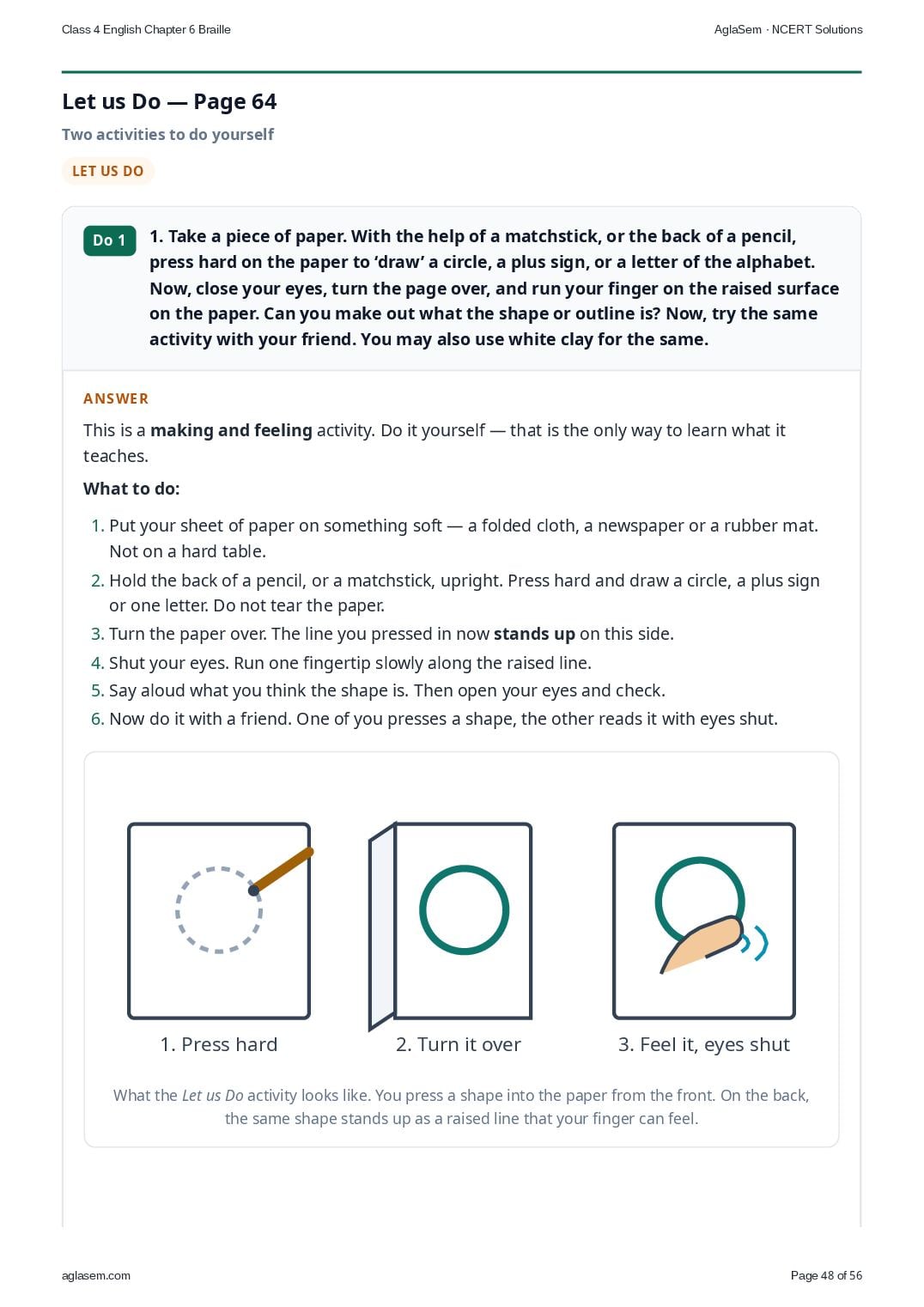
- 1. Take a piece of paper. With the help of a matchstick, or the back of a pencil, press hard on the paper to ‘draw’ a circle, a plus sign, or a letter of the alphabet. Now, close your eyes, turn the page over, and run your finger on the raised surface on the paper. Can you make out what the shape or outline is? Now, try the same activity with your friend. You may also use white clay for the same.
- 2. There are some children with low vision. (e.g., wearing thick glasses or holding a book too close to their eyes). Being a classmate and friend, how can you assist them? For example: Bringing a printout of a paragraph with large fonts to help them read.
- Find out about the nearest resource centre for people with blindness.
- You may select more than one box for each point.1. I can recite the poems with gestures:□ By myself □ In a group □ By repeating after my teacher □ None of the above. I like reading poems quietly
- You may select more than one box for each point.2. I can understand new words:□ By using a dictionary □ After listening to my teacher’s explanation □ By reading with my classmates in groups □ By reading the entire sentence again □ By looking at the pictures
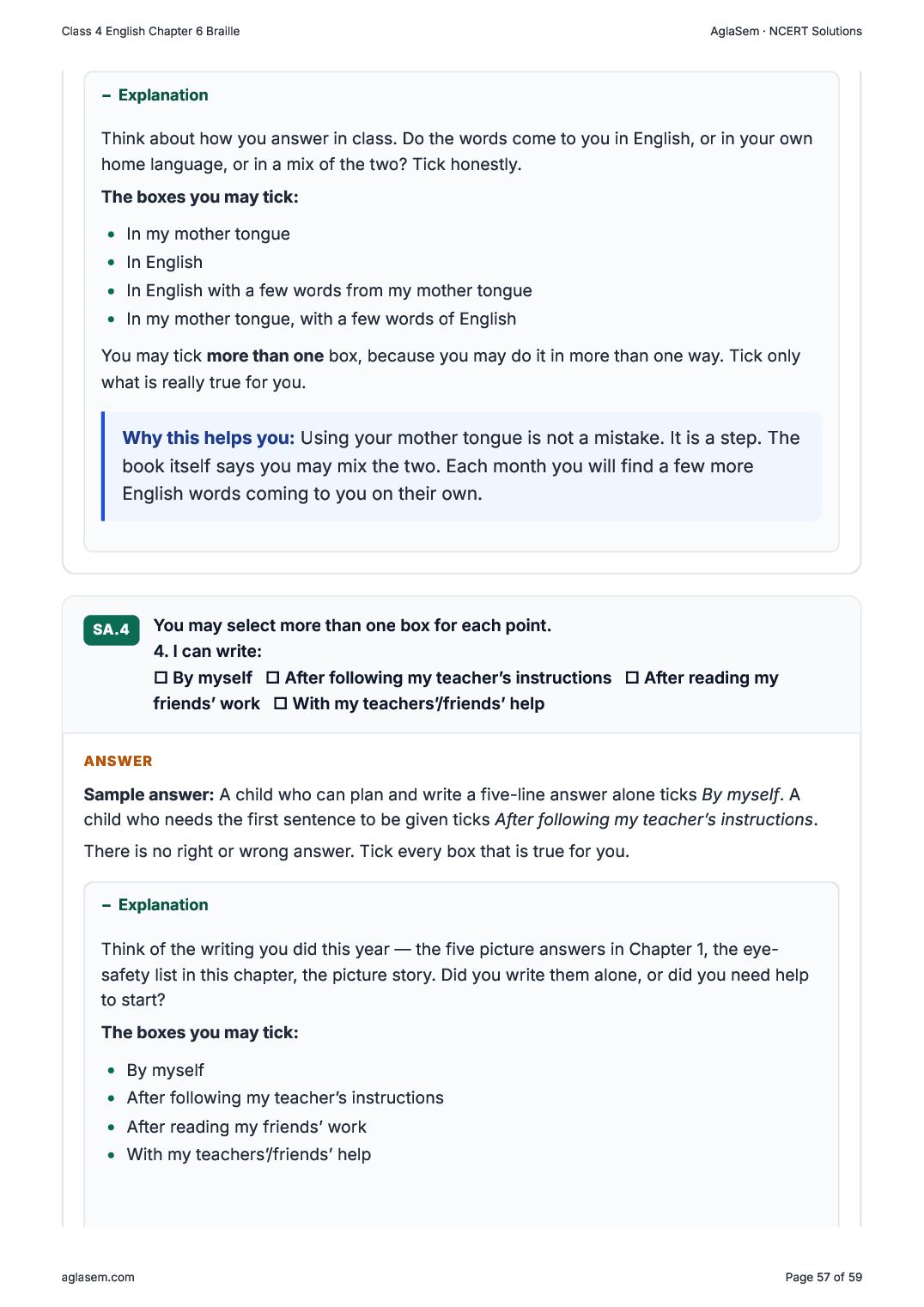
- You may select more than one box for each point.3. I can answer questions:□ In my mother tongue □ In English □ In English with a few words from my mother tongue □ In my mother tongue, with a few words of English
- You may select more than one box for each point.4. I can write:□ By myself □ After following my teacher’s instructions □ After reading my friends’ work □ With my teachers’/friends’ help
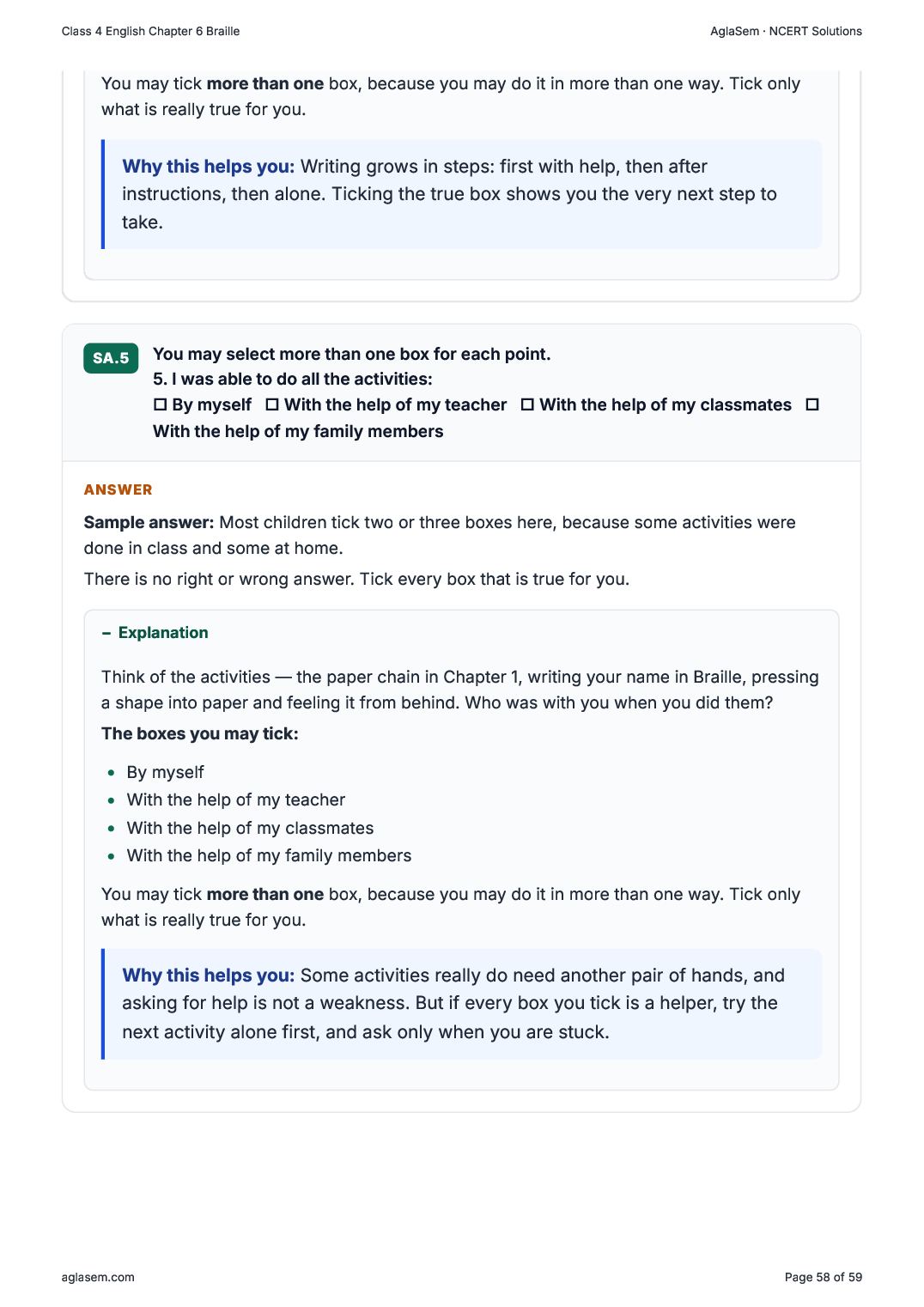
- You may select more than one box for each point.5. I was able to do all the activities:□ By myself □ With the help of my teacher □ With the help of my classmates □ With the help of my family members
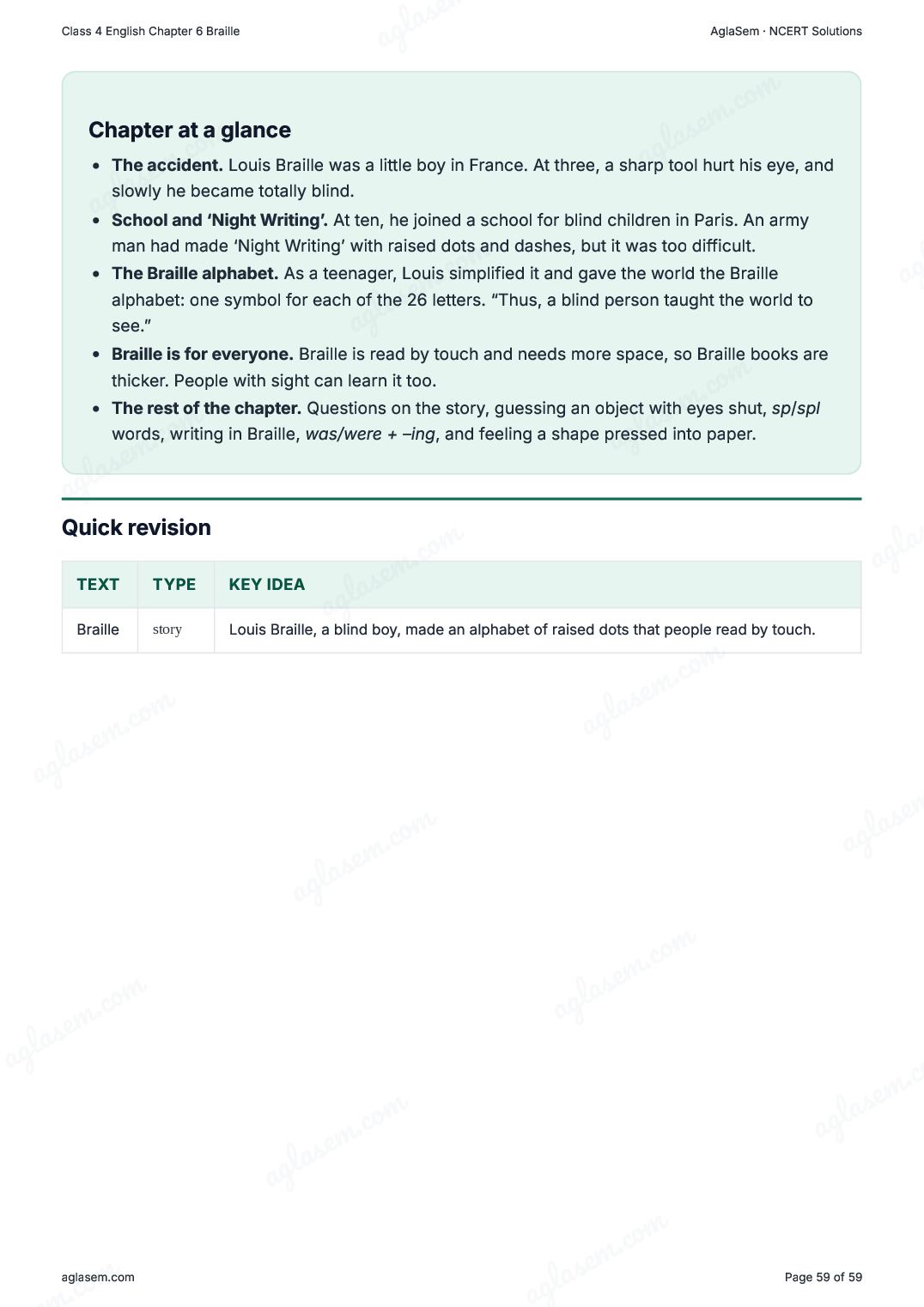
Chapter at a Glance
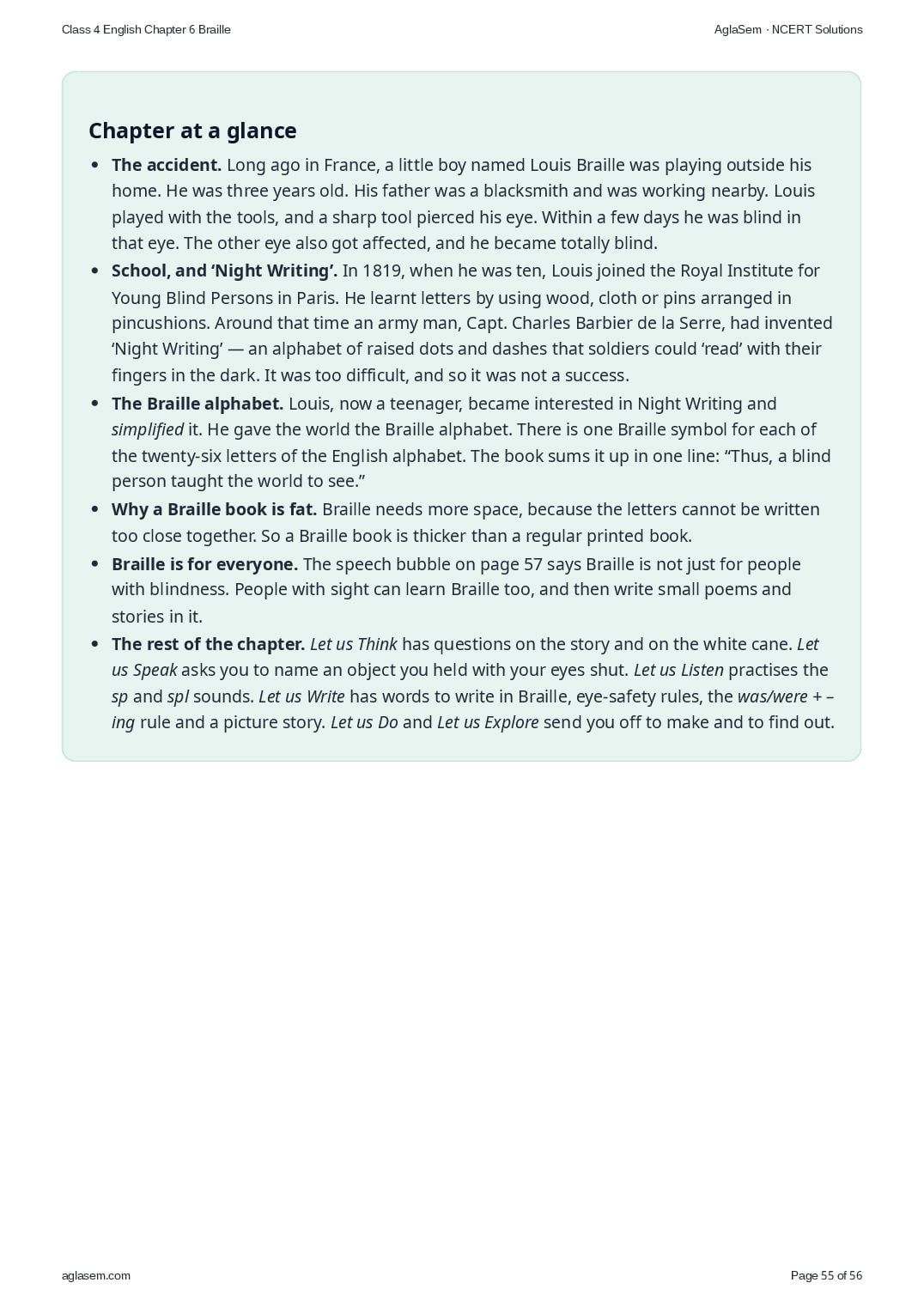
- The accident. Long ago in France, a little boy named Louis Braille was playing outside his home. He was three years old. His father was a blacksmith and was working nearby. Louis played with the tools, and a sharp tool pierced his eye. Within a few days he was blind in that eye. The other eye also got affected, and he became totally blind.
- School, and ‘Night Writing’. In 1819, when he was ten, Louis joined the Royal Institute for Young Blind Persons in Paris. He learnt letters by using wood, cloth or pins arranged in pincushions. Around that time an army man, Capt. Charles Barbier de la Serre, had invented ‘Night Writing’ — an alphabet of raised dots and dashes that soldiers could ‘read’ with their fingers in the dark. It was too difficult, and so it was not a success.
- The Braille alphabet. Louis, now a teenager, became interested in Night Writing and simplified it. He gave the world the Braille alphabet. There is one Braille symbol for each of the twenty-six letters of the English alphabet. The book sums it up in one line: “Thus, a blind person taught the world to see.”
- Why a Braille book is fat. Braille needs more space, because the letters cannot be written too close together. So a Braille book is thicker than a regular printed book.
- Braille is for everyone. The speech bubble on page 57 says Braille is not just for people with blindness. People with sight can learn Braille too, and then write small poems and stories in it.
- The rest of the chapter. Let us Think has questions on the story and on the white cane. Let us Speak asks you to name an object you held with your eyes shut. Let us Listen practises the sp and spl sounds. Let us Write has words to write in Braille, eye-safety rules, the was/were + –ing rule and a picture story. Let us Do and Let us Explore send you off to make and to find out.
How to Download NCERT Solutions for Class 4 English Chapter 6 PDF
Follow these simple steps to get the Braille questions-and-answers PDF from Santoor.
- Search NCERT Solutions for Class 4 English Chapter 6 aglasem and open this page.
- Read the exercise questions with answers for Braille shown above.
- Click the Download PDF link to save the Braille solutions to your device.
NCERT Solutions for Class 4 English – All Chapters
There are more chapters to study besides Braille in English. Here are the NCERT Solutions for all chapters of Class 4 English.
- Chapter 1 Together We Can
- Chapter 2 the Tinkling Bells
- Chapter 3 Be Smart Be Safe
- Chapter 4 One Thing At a Time
- Chapter 5 the Old Stag
- Chapter 6 Braille
- Chapter 7 Fit Body Fit Mind Fit Nation
- Chapter 8 the Lagori Champions
- Chapter 9 Hekko
- Chapter 10 the Swing
- Chapter 11 a Journey to the Magical Mountains
- Chapter 12 Maheshwar
NCERT Solutions for Class 4 – All Subjects
Just like Chapter 6 of English, you can get the exercise questions with answers for every other subject of Class 4. Here are the NCERT Solutions for all subjects of Class 4.
NCERT Solutions for Class 4 English Chapter 6 – An Overview
The key highlights of this study material are as follows.
| Aspects | Details |
|---|---|
| Class | Class 4 |
| Subject | English |
| Chapter Number | Chapter 6 |
| Chapter Name | Braille |
| Book Name | Santoor |
| Book By | NCERT (National Council of Educational Research and Training) |
| Educational Resource Here | NCERT Solutions of Class 4 English Chapter 6 for all exercises |
| More Questions Answers of This Subject | NCERT Solutions for Class 4 English |
| Download Book Chapter | NCERT Book Class 4 English |
| All Questions Answers For This Class | NCERT Solutions for Class 4 |
| Complete Solutions | NCERT Solutions |
NCERT Solutions for Class 4 English Chapter 6 Braille – FAQs
What are the NCERT Solutions for Class 4 English Chapter 6 Braille?
They are the complete, step-by-step answers to all the exercise and in-text questions of Chapter 6 Braille from the NCERT Class 4 English textbook Santoor, written by experts as per the latest NCERT syllabus.
How can I download the Class 4 English Chapter 6 solutions PDF for free?
Open this page on aglasem, read the Braille questions with answers, and click the “Download Solutions PDF” link. The Class 4 English Chapter 6 NCERT Solutions PDF is completely free to download.
Are these NCERT Solutions as per the latest 2026-27 syllabus?
Yes. The NCERT Solutions for Class 4 English Chapter 6 are based on the latest NCERT textbook Santoor and the current 2026-27 CBSE syllabus, so the questions and answers match what you study in class.
Where can I get NCERT Solutions for the other chapters of Class 4 English?
You can find the answers to every chapter on the NCERT Solutions for Class 4 English page, and solutions for every subject on the NCERT Solutions for Class 4 page.
How do NCERT Solutions help in exam preparation?
They show the correct method to solve each question, help you write answers the way they are expected in exams, let you check and correct your own work, and save revision time — which together improve your marks in Class 4 English.
If you have any queries on NCERT Solutions for Class 4 English Chapter 6 Braille, then please ask in the comments below.