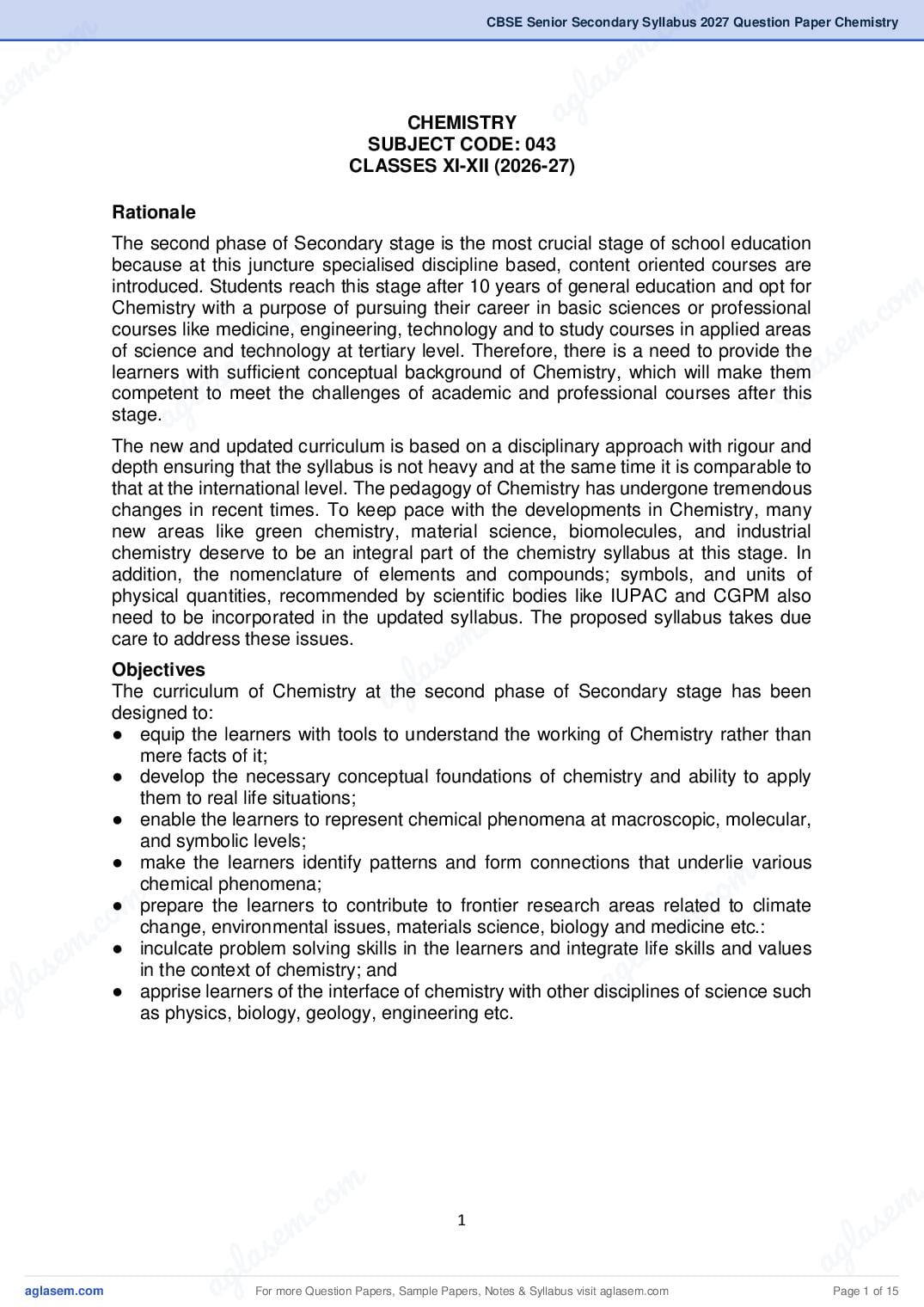
CBSE Class 11 Chemistry Syllabus 2027 (Subject Code 043) has been released by the Central Board of Secondary Education for the 2026-27 academic session. It is a 100-mark course – 70 marks theory across a 3-hour exam covering 9 units from Basic Concepts of Chemistry to Hydrocarbons, plus 30 marks Practical including volumetric analysis, salt analysis and a project. Download the official CBSE Class 11 Chemistry Syllabus PDF and see the full unit-wise breakdown below.
CBSE Class 11 Chemistry Syllabus 2027 PDF
The complete curriculum is as follows.
CBSE Senior Secondary Syllabus 2027 Chemistry View Download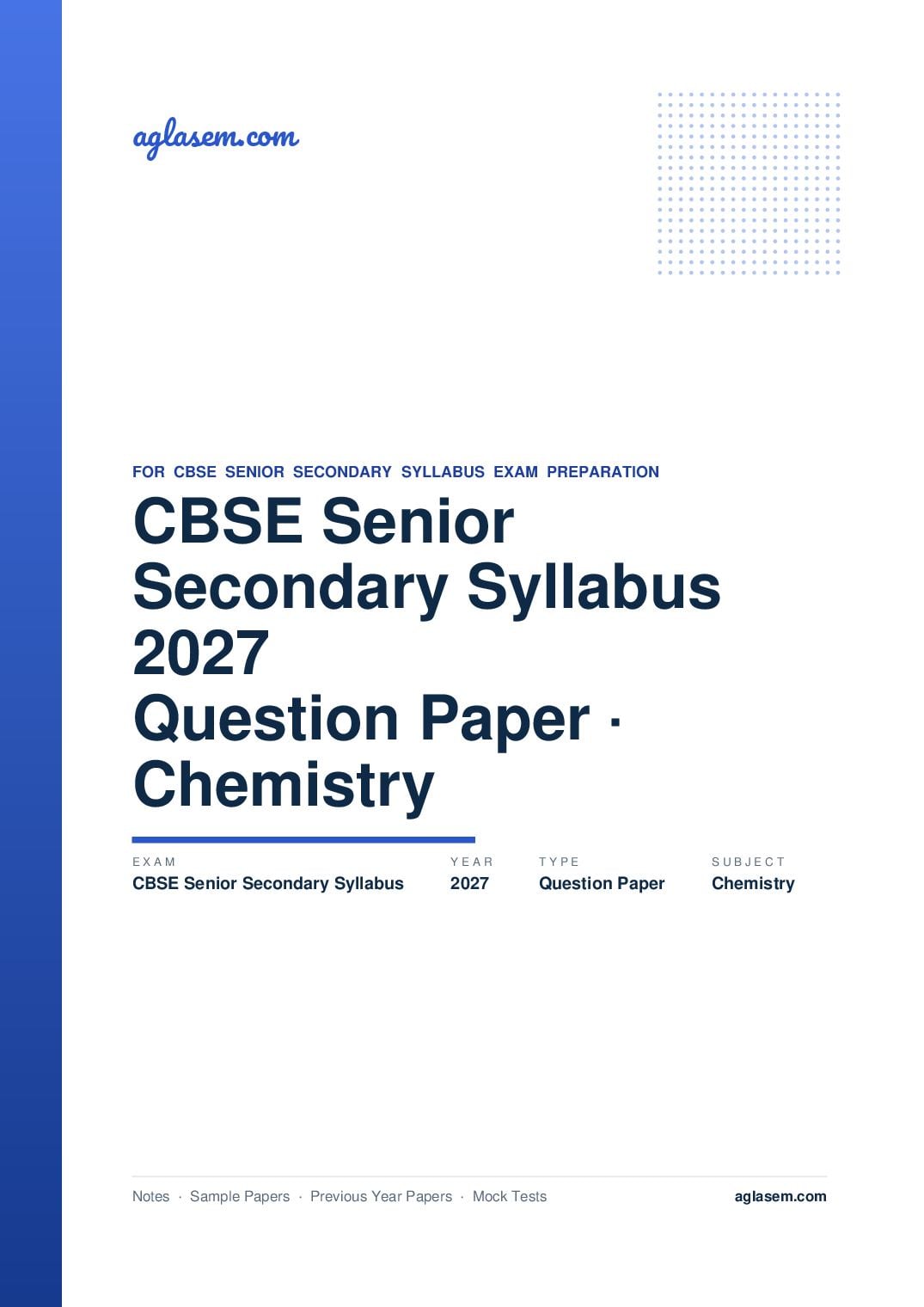
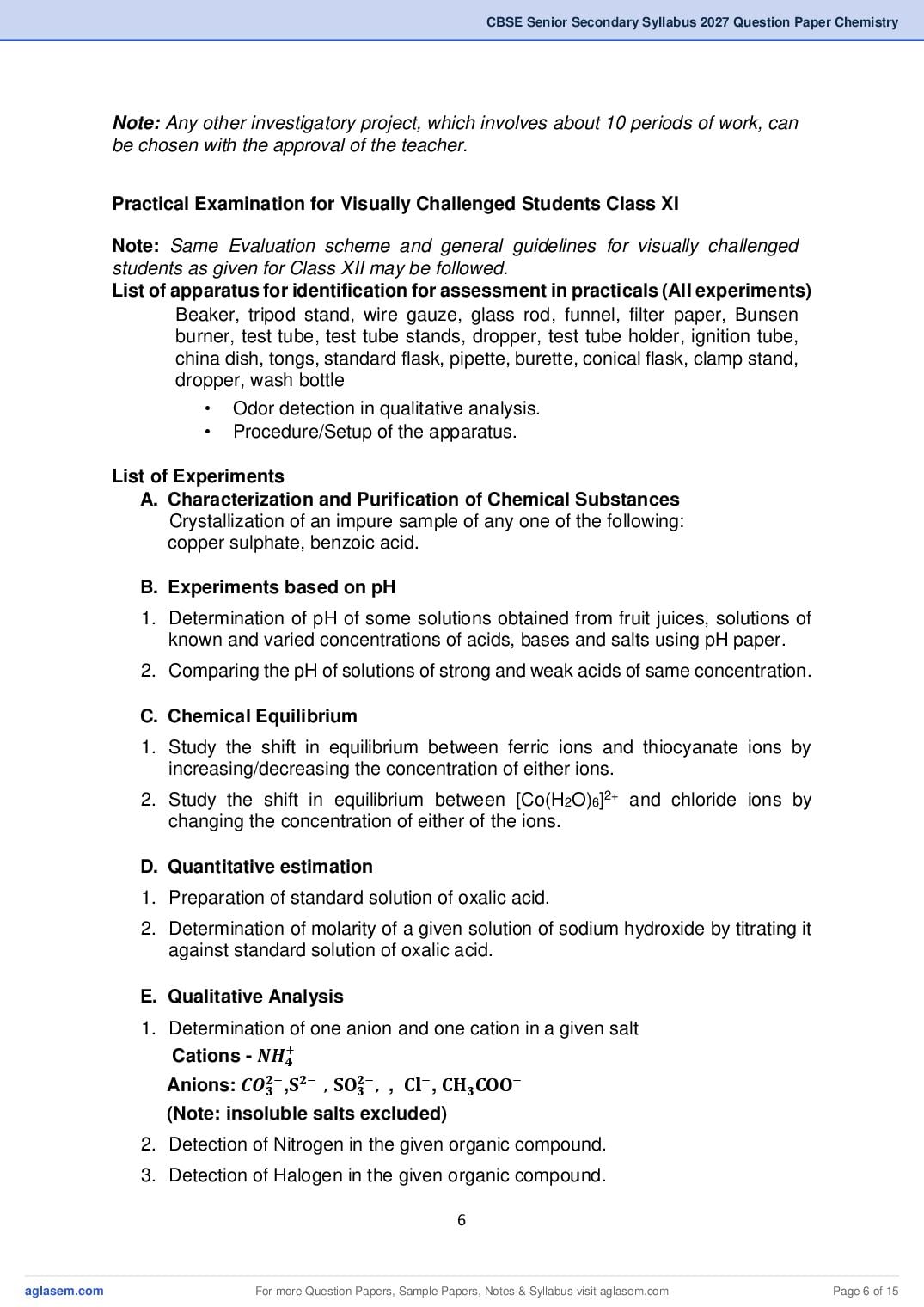
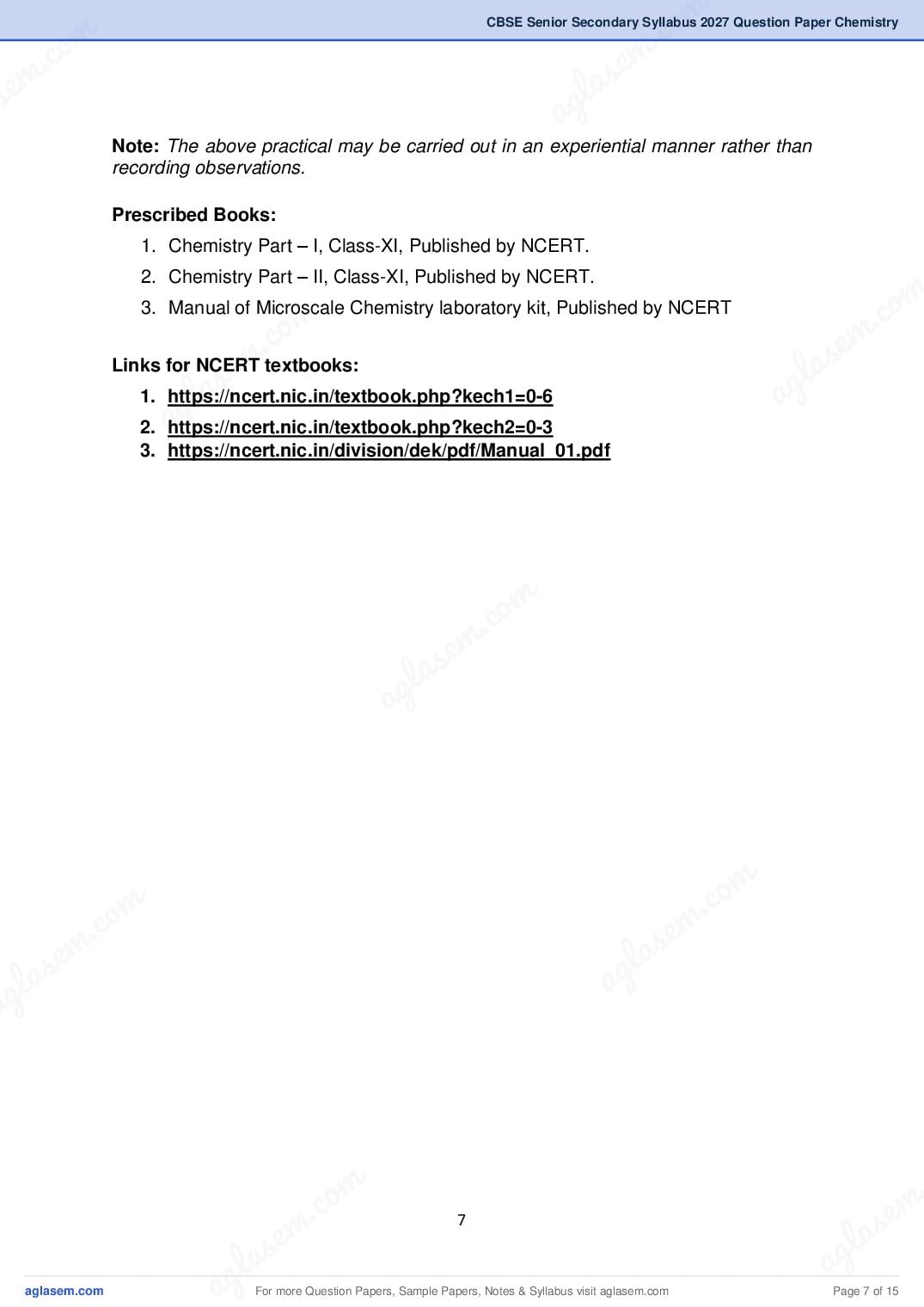
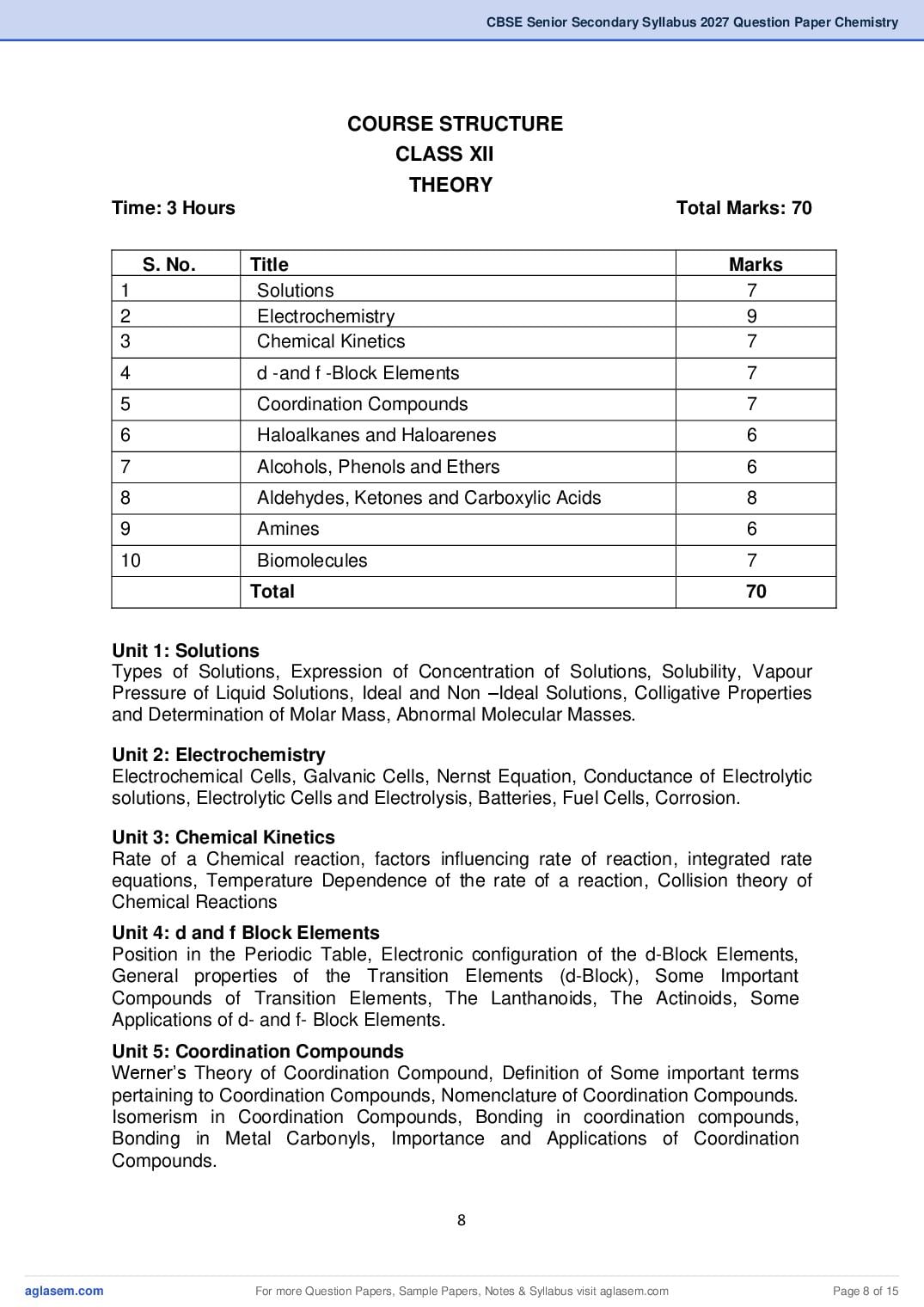
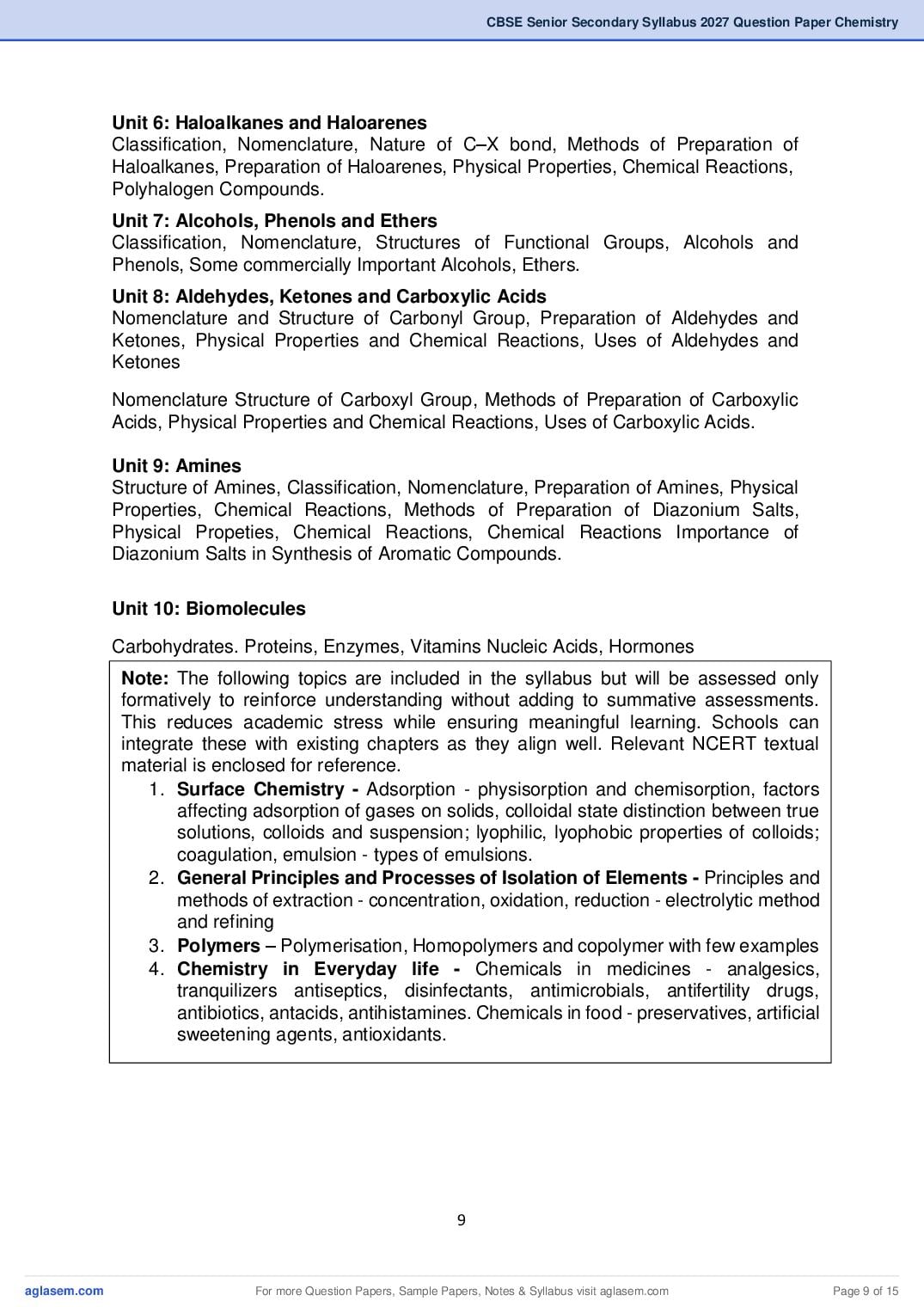
CBSE Class 11 Chemistry Syllabus 2027 – Marks Weightage (Unit-wise)
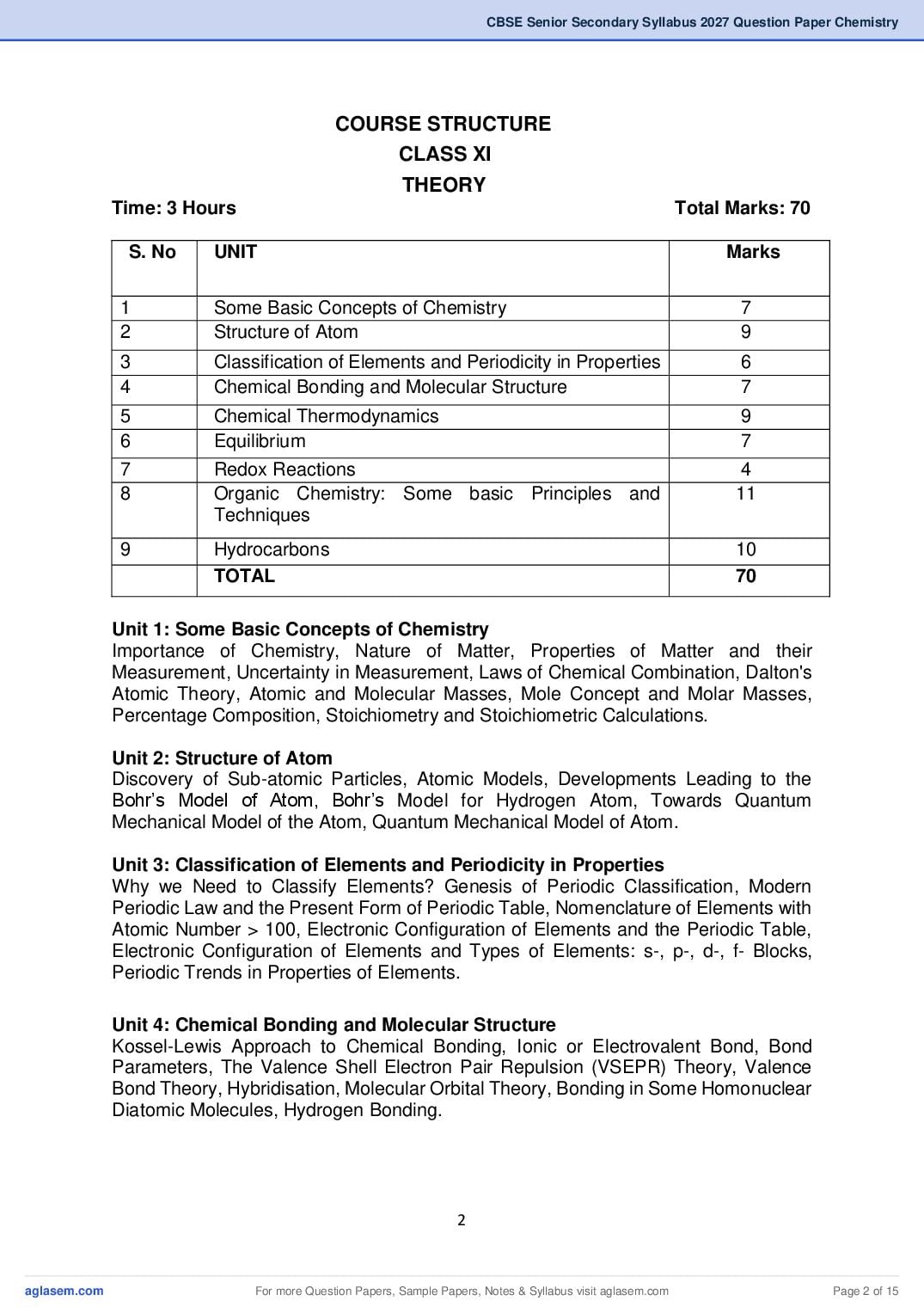
The CBSE Class 11 Chemistry exam carries 100 total marks – 70 for the theory paper across 9 units and 30 for the Practical examination.
| Unit | Title | Marks |
|---|---|---|
| 1 | Some Basic Concepts of Chemistry | 7 |
| 2 | Structure of Atom | 9 |
| 3 | Classification of Elements and Periodicity in Properties | 6 |
| 4 | Chemical Bonding and Molecular Structure | 7 |
| 5 | Chemical Thermodynamics | 9 |
| 6 | Equilibrium | 7 |
| 7 | Redox Reactions | 4 |
| 8 | Organic Chemistry: Some Basic Principles and Techniques | 11 |
| 9 | Hydrocarbons | 10 |
| Theory Total | 70 | |
| Practical | 30 | |
| Total | 100 |
CBSE Class 11 Chemistry Syllabus 2027 – Unit-wise Topics
The CBSE Class 11 Chemistry theory paper (70 marks) is spread across 9 units. The key topics under each unit are as follows.
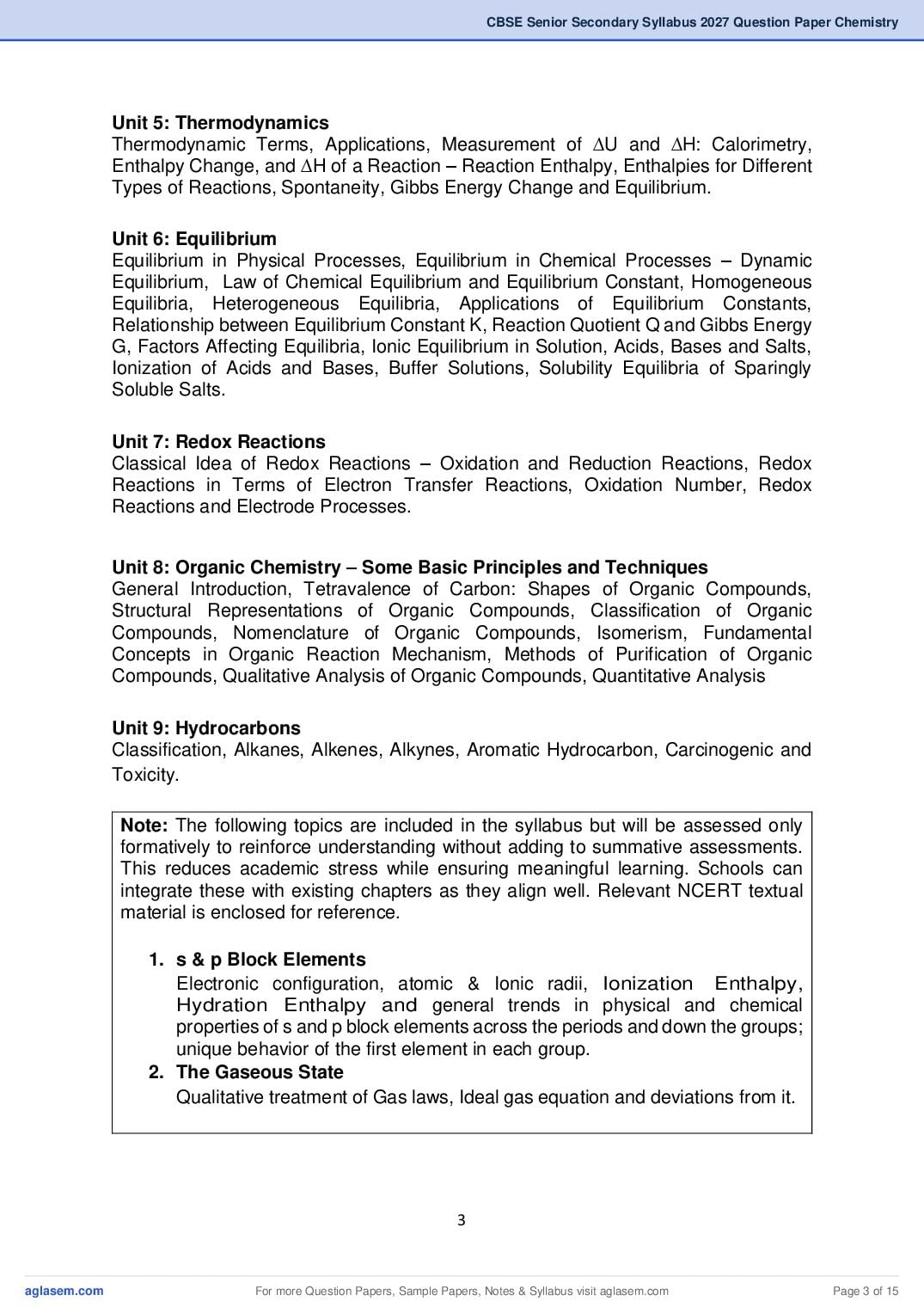
Unit 1: Some Basic Concepts of Chemistry – Importance of Chemistry, Nature of Matter, Laws of Chemical Combination, Dalton’s Atomic Theory, Mole Concept and Molar Masses, Stoichiometry. Unit 2: Structure of Atom – Discovery of Sub-atomic Particles, Bohr’s Model, Quantum Mechanical Model of Atom. Unit 3: Classification of Elements and Periodicity – Modern Periodic Law, Electronic Configuration and s-, p-, d-, f- Blocks, Periodic Trends. Unit 4: Chemical Bonding and Molecular Structure – Ionic Bond, VSEPR Theory, Valence Bond Theory, Hybridisation, Molecular Orbital Theory, Hydrogen Bonding. Unit 5: Chemical Thermodynamics – Thermodynamic Terms, Enthalpy Change, Spontaneity, Gibbs Energy Change. Unit 6: Equilibrium – Equilibrium in Physical and Chemical Processes, Equilibrium Constant, Ionic Equilibrium, Buffer Solutions. Unit 7: Redox Reactions – Oxidation and Reduction, Electron Transfer Reactions, Oxidation Number. Unit 8: Organic Chemistry – Tetravalence of Carbon, Nomenclature, Isomerism, Reaction Mechanism, Purification and Analysis of Organic Compounds. Unit 9: Hydrocarbons – Alkanes, Alkenes, Alkynes, Aromatic Hydrocarbons, Carcinogenicity and Toxicity.
CBSE Class 11 Chemistry Syllabus 2027 – Prescribed Textbook & Practicals
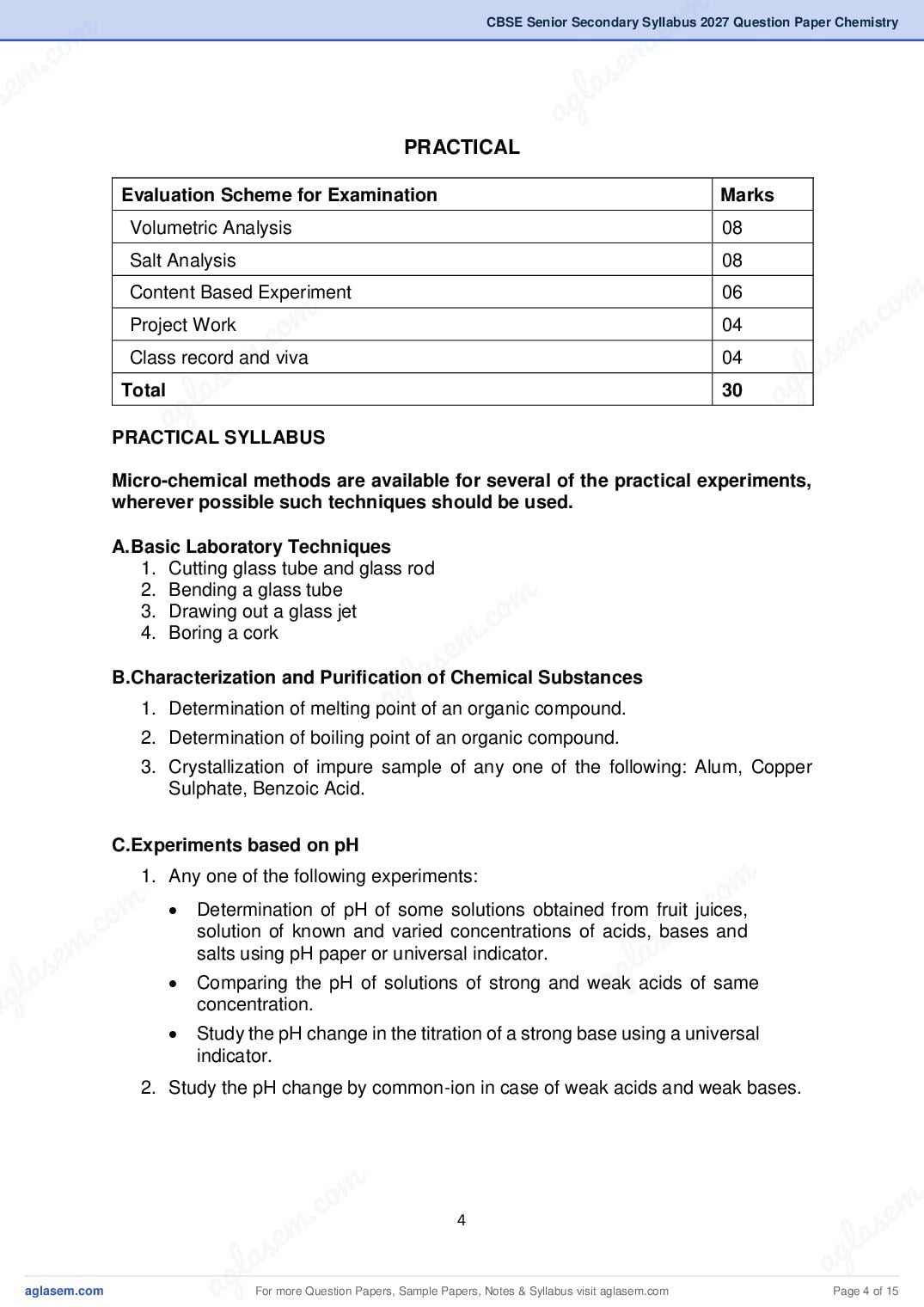
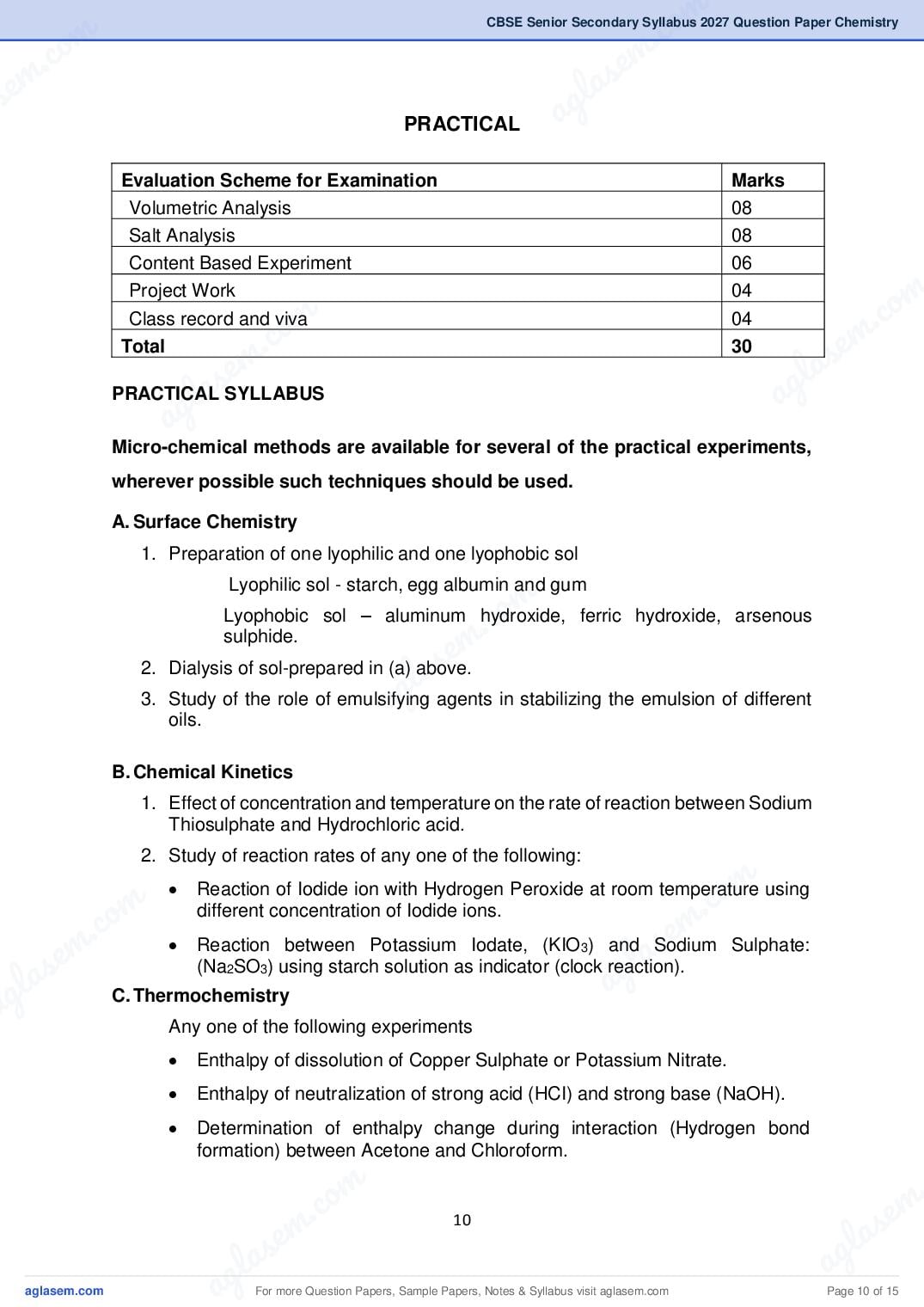
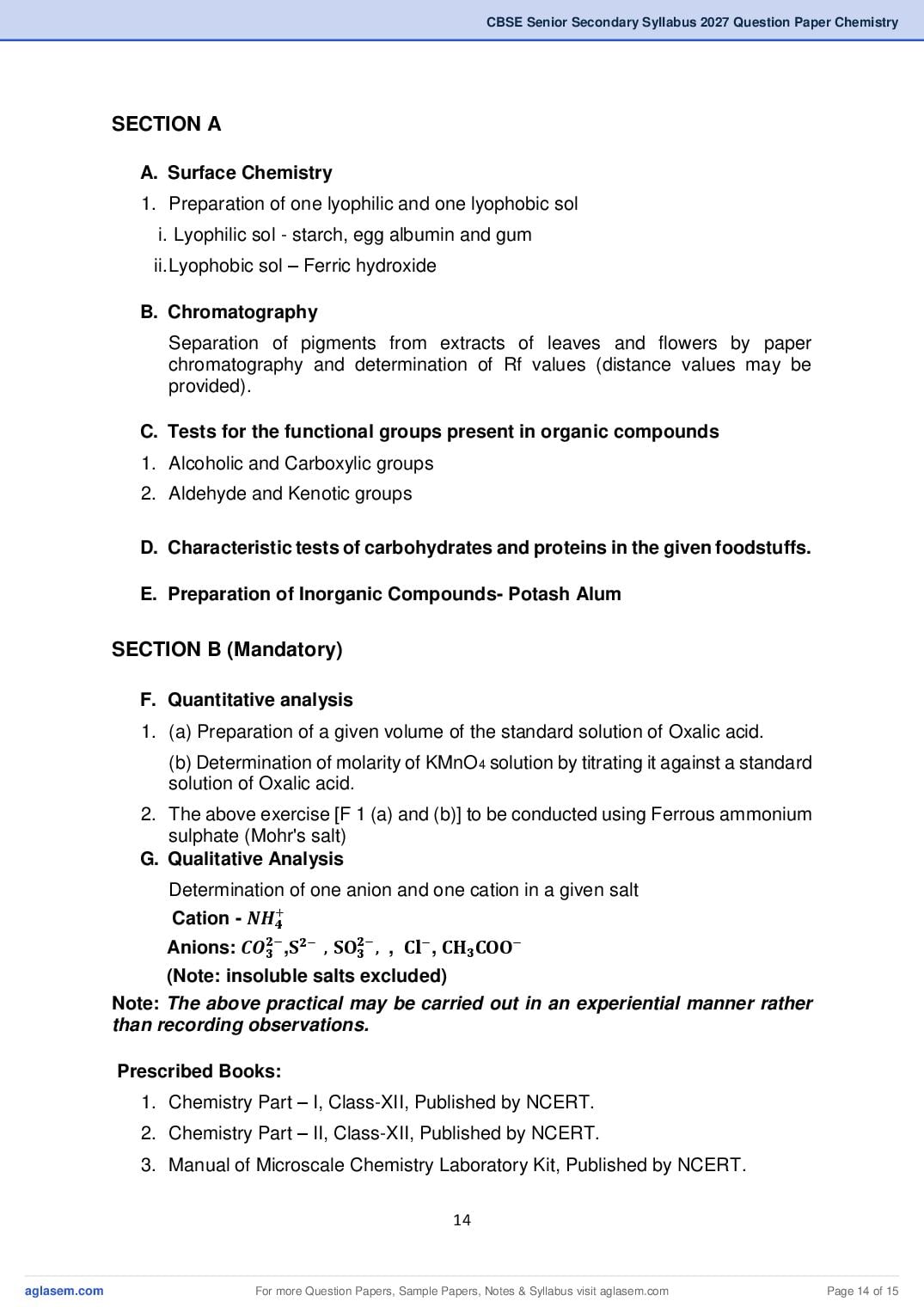
The Practical examination carries 30 marks, split between volumetric analysis, salt analysis, a content-based experiment, project work, and viva.
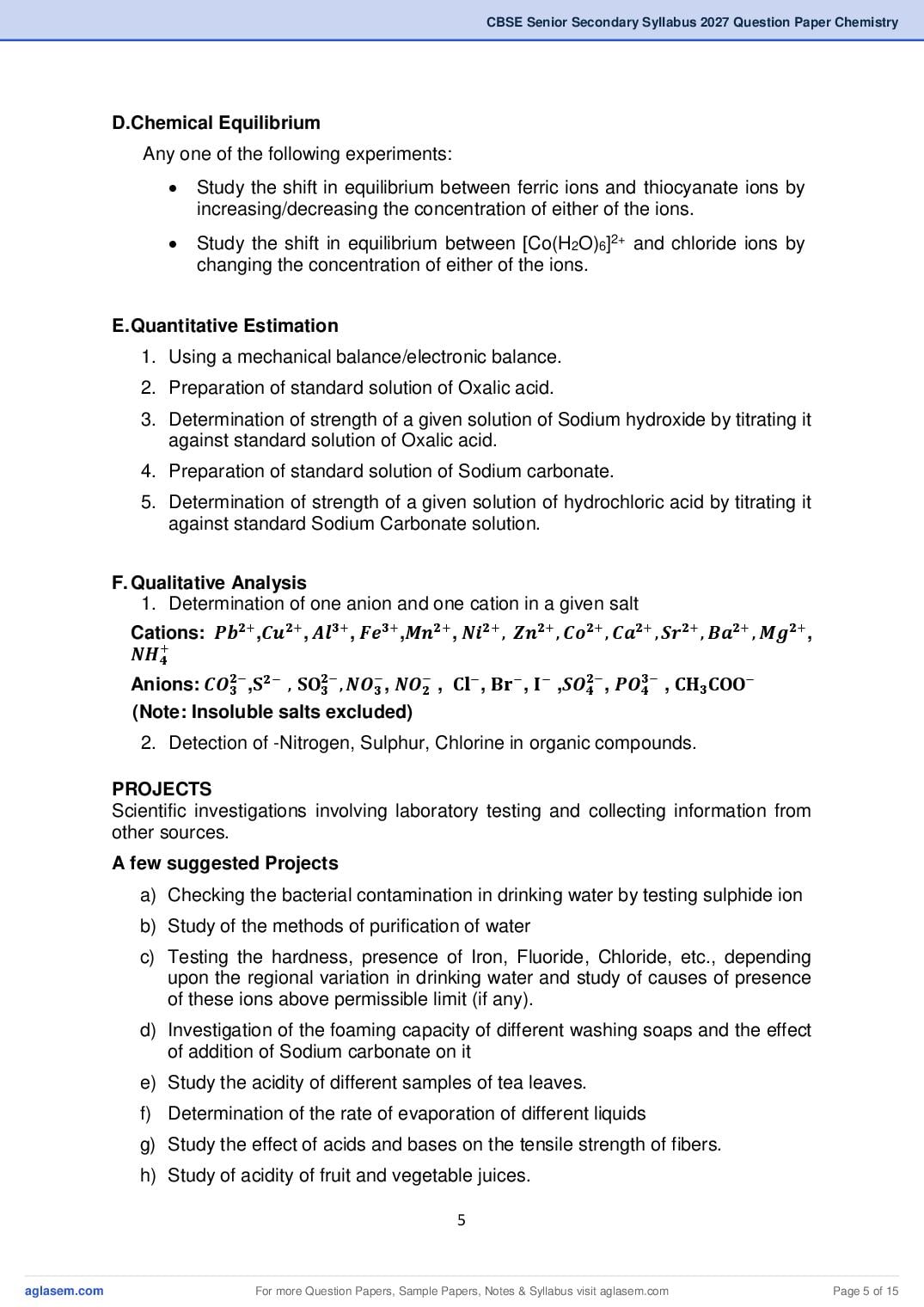
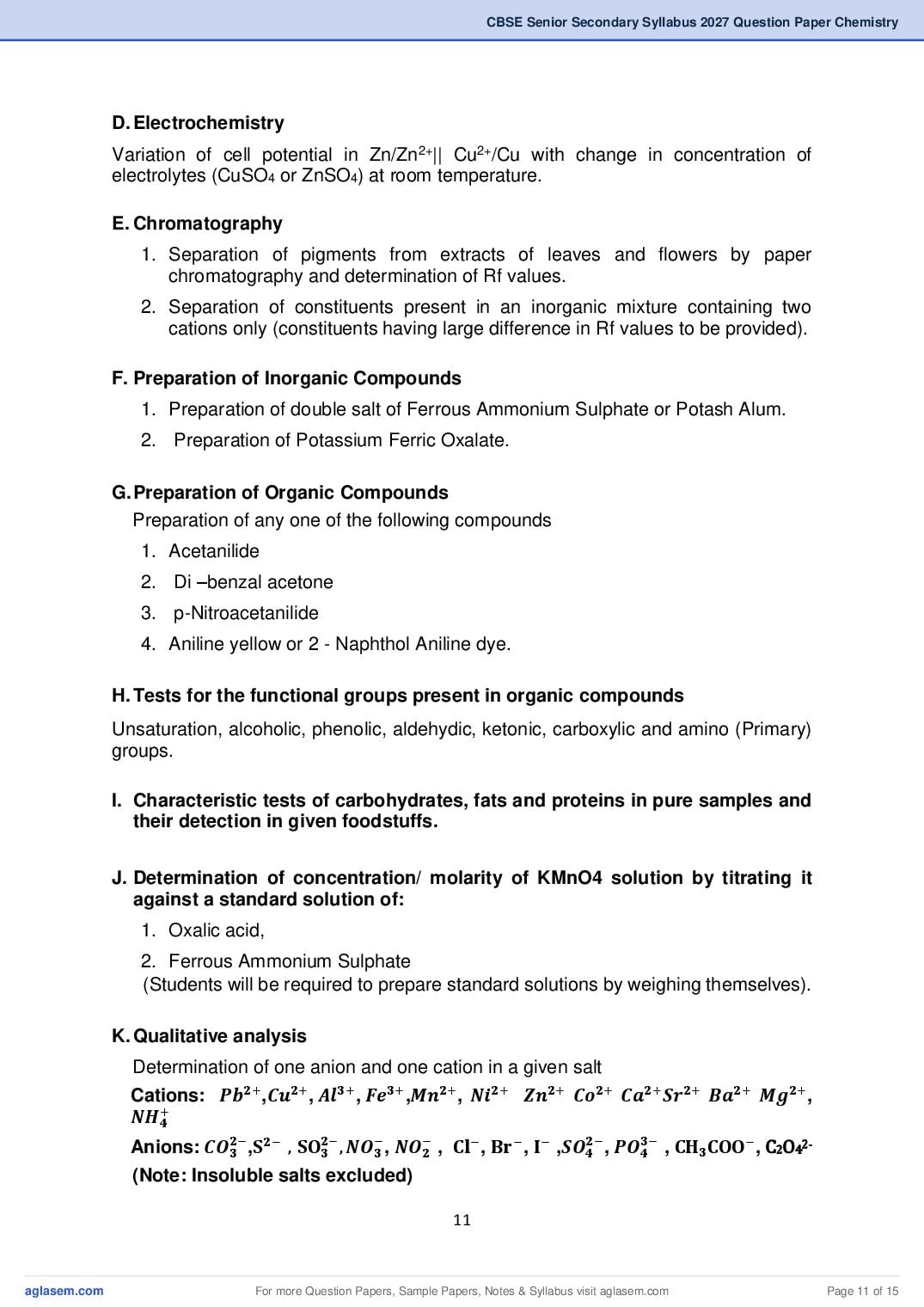
The prescribed practicals include Basic Laboratory Techniques (cutting/bending glass tube, boring a cork), Characterization and Purification (melting/boiling point, crystallization), Experiments based on pH, Chemical Equilibrium shift studies, Quantitative Estimation (titration of NaOH against Oxalic acid, HCl against Sodium Carbonate), and Qualitative Analysis of one anion and one cation in a given salt, plus detection of Nitrogen, Sulphur and Chlorine in organic compounds.
Prescribed Textbook: Chemistry Part – I, Class XI, NCERT; Chemistry Part – II, Class XI, NCERT; and Manual of Microscale Chemistry Laboratory Kit, published by NCERT.
CBSE Class 11 Chemistry Syllabus 2027 – Exam Pattern (Question-wise Breakdown)
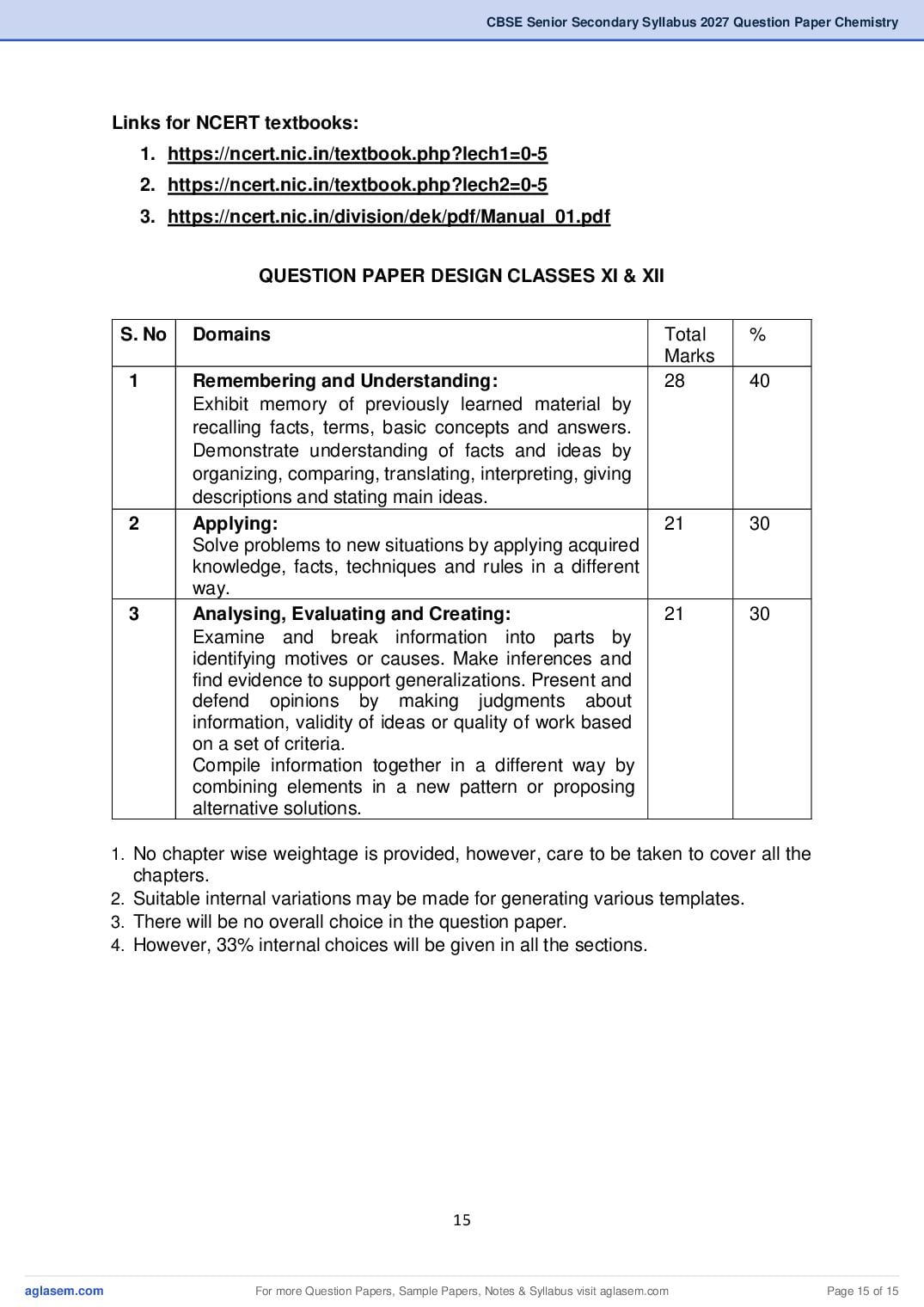
The CBSE Class 11 Chemistry question paper follows a common design for Classes XI and XII, with no chapter-wise weightage but coverage of all chapters. The detailed scheme and weightage to cognitive domains is as follows.
| Domain | Description | Marks | % |
|---|---|---|---|
| Remembering and Understanding | Recalling facts, terms, basic concepts and answers; organizing, comparing, interpreting and stating main ideas | 28 | 40% |
| Applying | Solving problems in new situations by applying acquired knowledge, facts, techniques and rules | 21 | 30% |
| Analysing, Evaluating and Creating | Examining information, making inferences, defending opinions, and compiling information in new patterns | 21 | 30% |
| Total | 70 | 100% |
There will be no overall choice in the question paper, however 33% internal choices will be given in all sections.
CBSE Class 11 Chemistry Syllabus 2027 – Continue Your Preparation
Once you have reviewed the syllabus, practice with the CBSE Class 11 Sample Papers, refer to NCERT Books for Class 11, and check NCERT Solutions for Class 11 to prepare for your exams.
Frequently Asked Questions
The CBSE Class 11 Chemistry Syllabus 2027 (Subject Code 043) is the official curriculum released by CBSE for the 2026-27 academic session. It covers 9 units from Some Basic Concepts of Chemistry to Hydrocarbons, for a total of 100 marks (70 theory plus 30 Practical).
The subject code for Chemistry in CBSE Class 11 is 043.
The CBSE Class 11 Chemistry theory exam is of 70 marks (3 hours), plus 30 marks for the Practical examination, making a total of 100 marks.
The prescribed textbooks are Chemistry Part I and Part II for Class XI, published by NCERT, along with the Manual of Microscale Chemistry Laboratory Kit published by NCERT.
Unit 8, Organic Chemistry: Some Basic Principles and Techniques, carries the highest weightage with 11 marks, followed by Hydrocarbons with 10 marks.
CBSE Class 11 Syllabus 2026-27 (All Subjects)
You study more subjects besides Chemistry in 11th class. The subject-wise syllabus for CBSE Class 11 students is as follows.
CBSE Syllabus 2026-27 (Class-wise)
The class-wise syllabus for CBSE board students is as follows.
CBSE Class 11 Chemistry Syllabus 2027 – An Overview
The important things to know about this curriculum are as follows.
| Aspects | Details |
|---|---|
| Education Board | CBSE |
| Class | Class 11 |
| Subject | Chemistry |
| Study Material Here | CBSE Syllabus for Class 11 Chemistry |
| All Curriculum for This Class | CBSE Syllabus for Class 11 |
| All Curriculum for This Board | CBSE Syllabus |
| Full Name of CBSE | Central Board of Secondary Education |
| NCERT Books | NCERT Books for Class 11 |
| NCERT Solutions | NCERT Solutions for Class 11 |
If you have any queries on CBSE Class 11 Chemistry Syllabus 2027, then please ask in comments below.