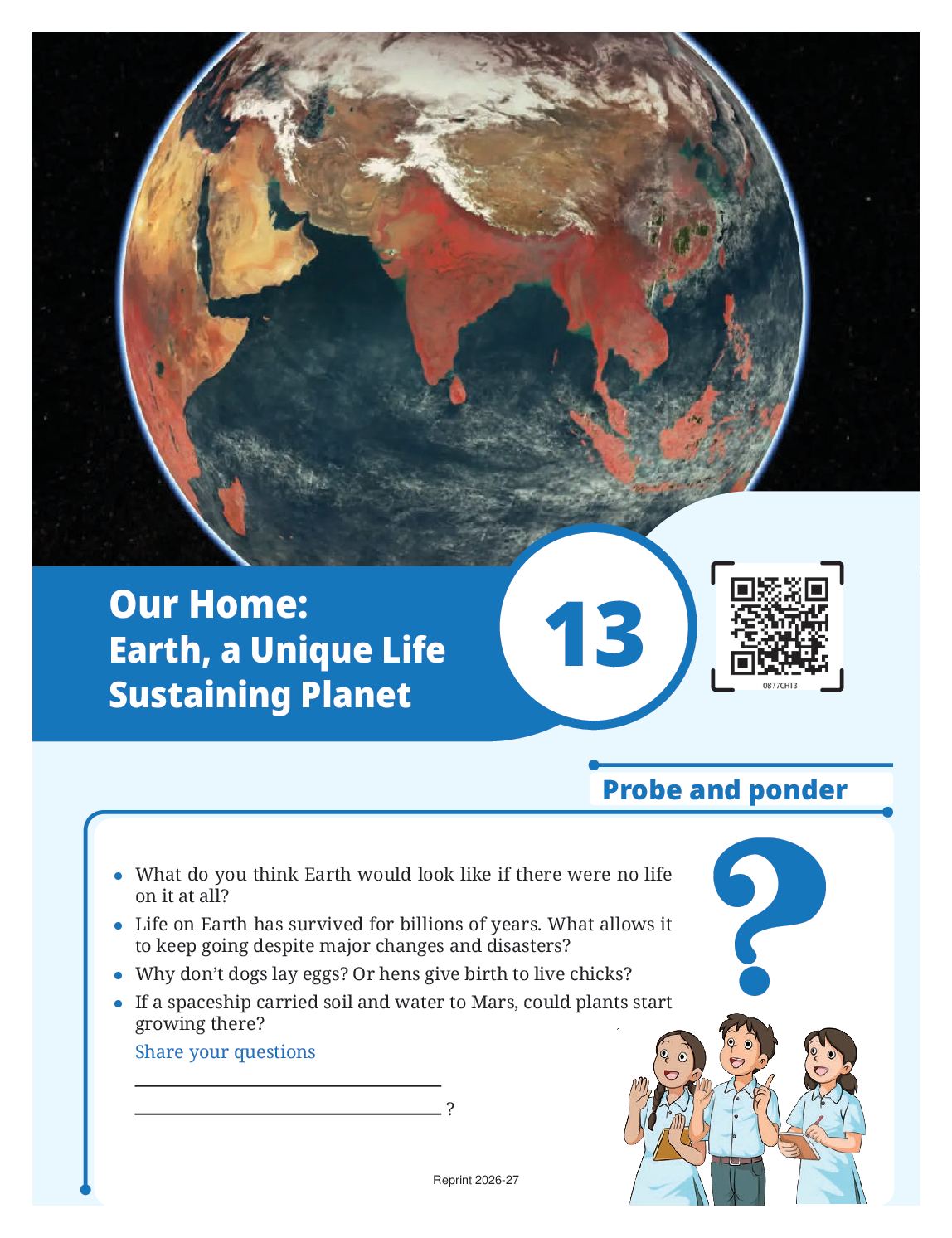
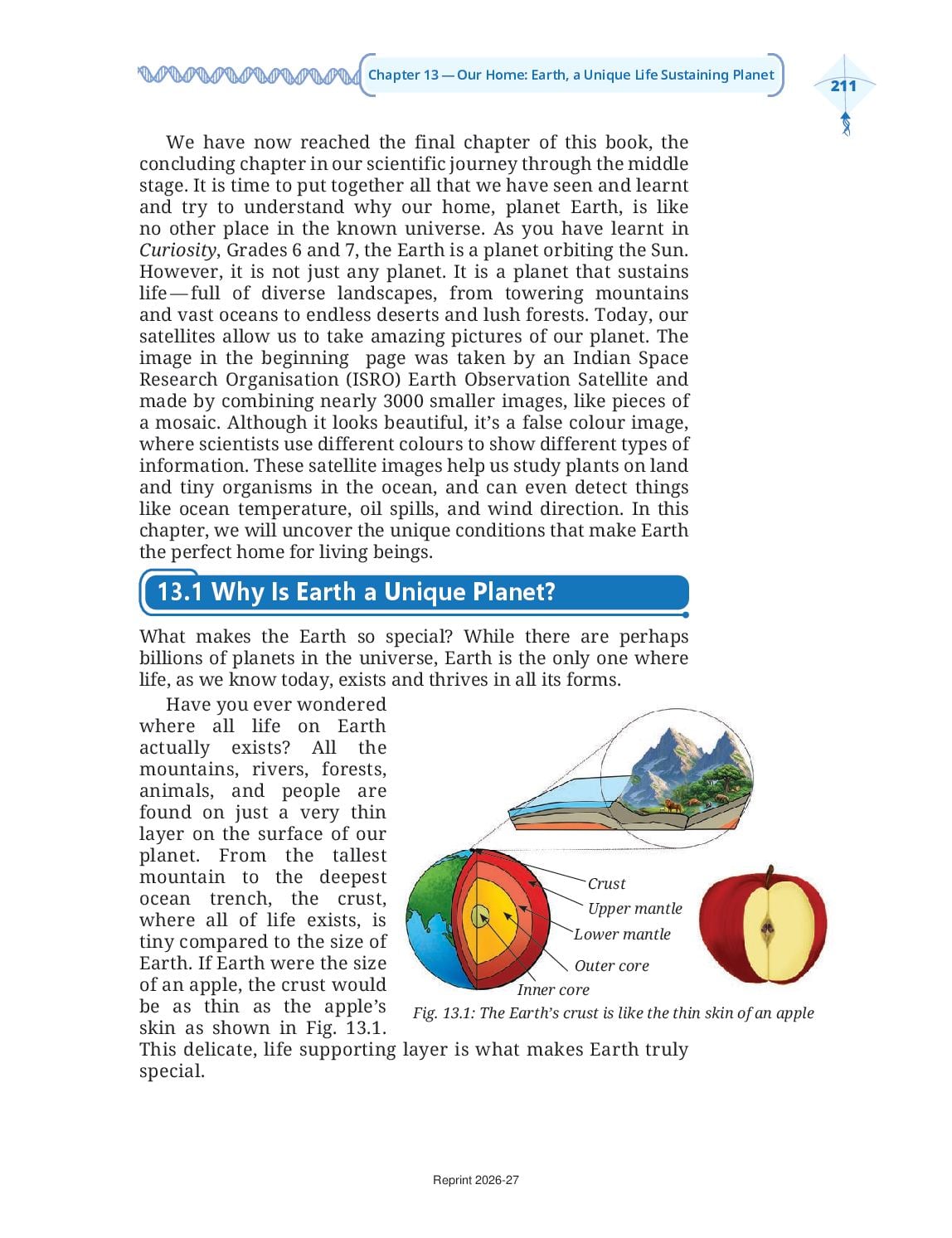
Download Our Home: Earth, a Unique Life Sustaining Planet – NCERT Class 8 Science Chapter 13 PDF from the new NCERT Class 8 Science book Curiosity (2026-27). Read the chapter online or download the free PDF. All life on Earth exists in an astonishingly thin shell. From the highest peak to the deepest ocean trench is only about 20 km against an Earth radius of about 6400 km — if Earth were an apple, the crust would be the apple’s skin.
Our Home: Earth, a Unique Life Sustaining Planet PDF – Chapter 13 of Curiosity
Read the chapter online or download the PDF.
| Chapter | Download | |
|---|---|---|
| Chapter 13 PDF | Our Home: Earth, a Unique Life Sustaining Planet | View PDF |
| Full book | NCERT Class 8 Science – Curiosity | View Book |
Read Online
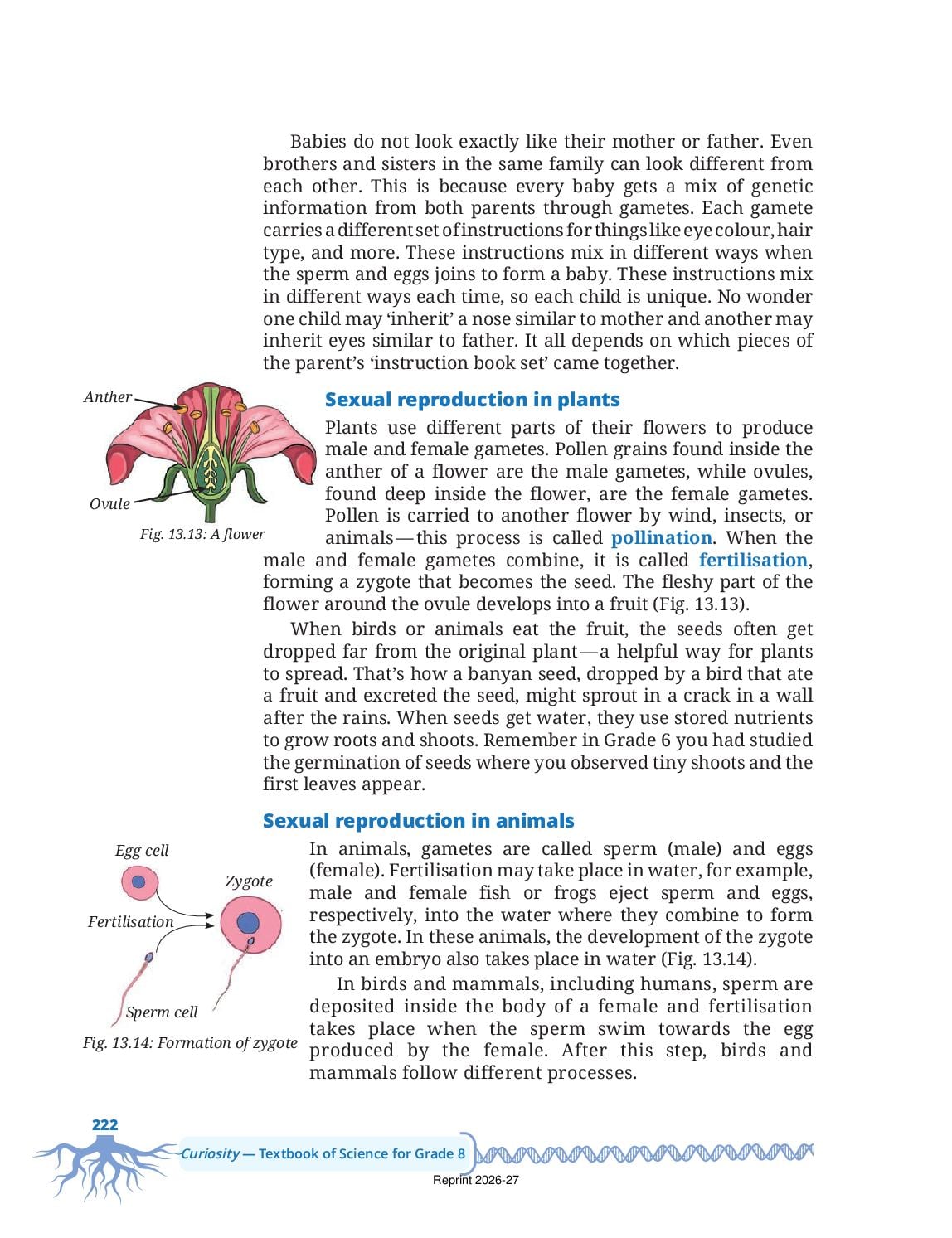
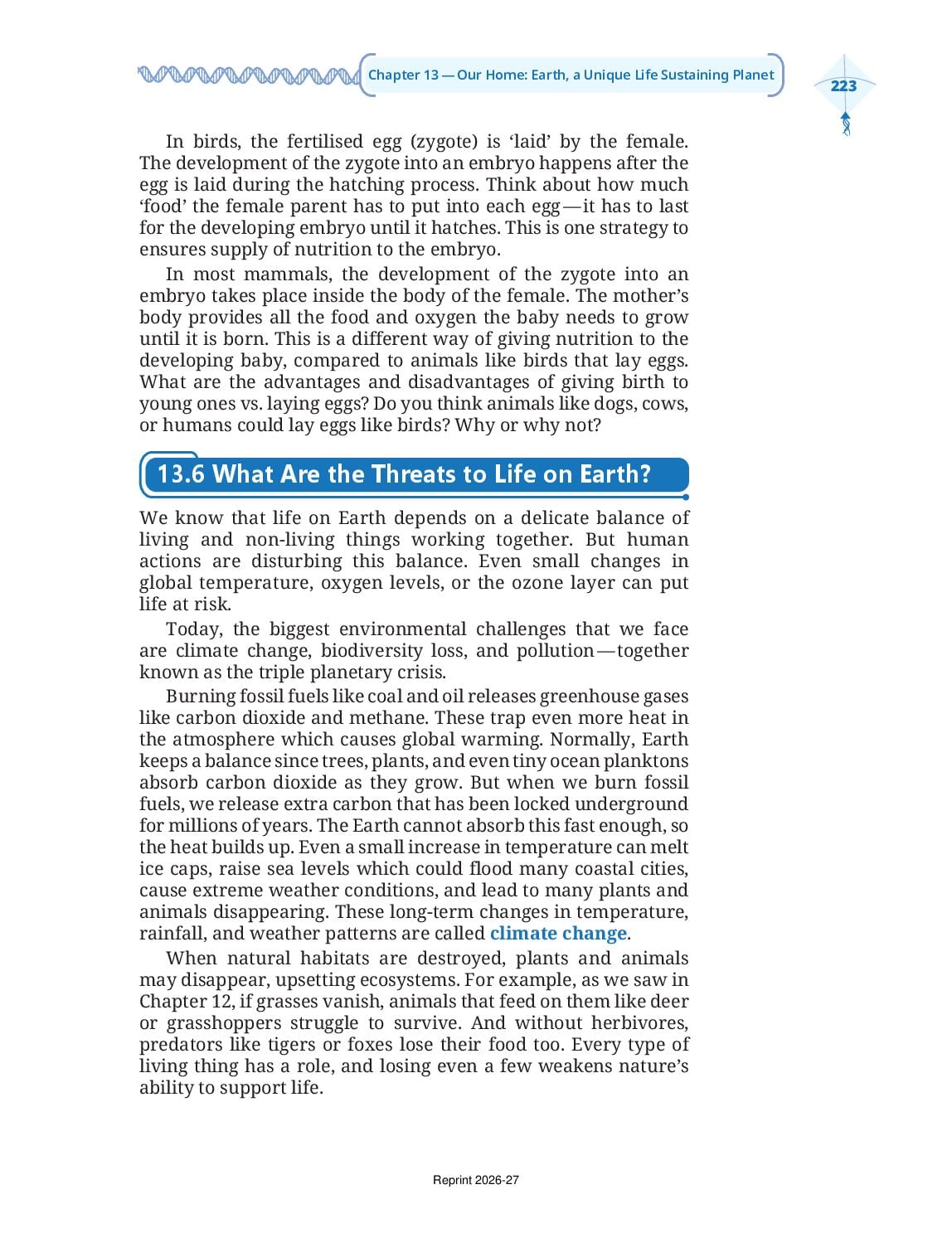
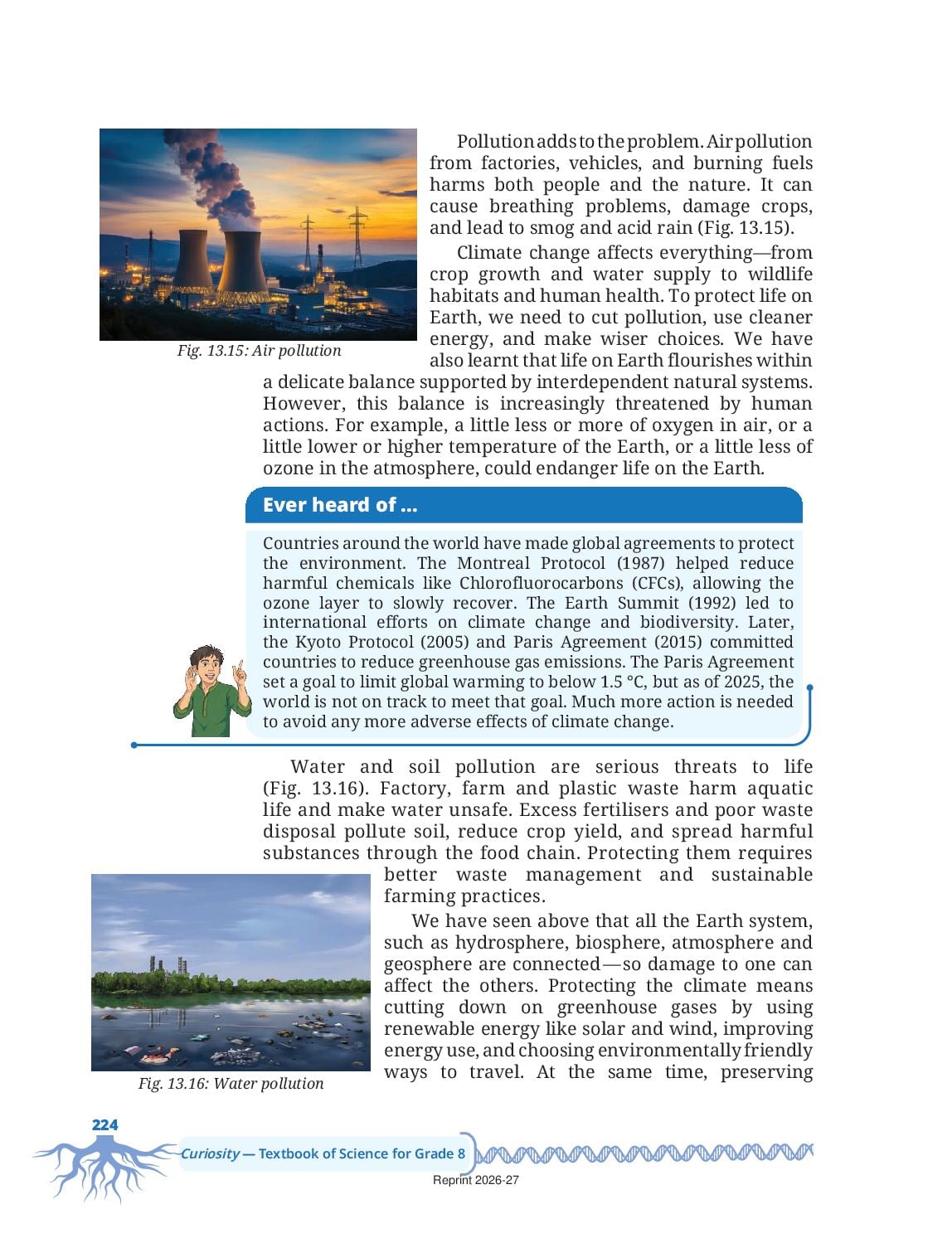
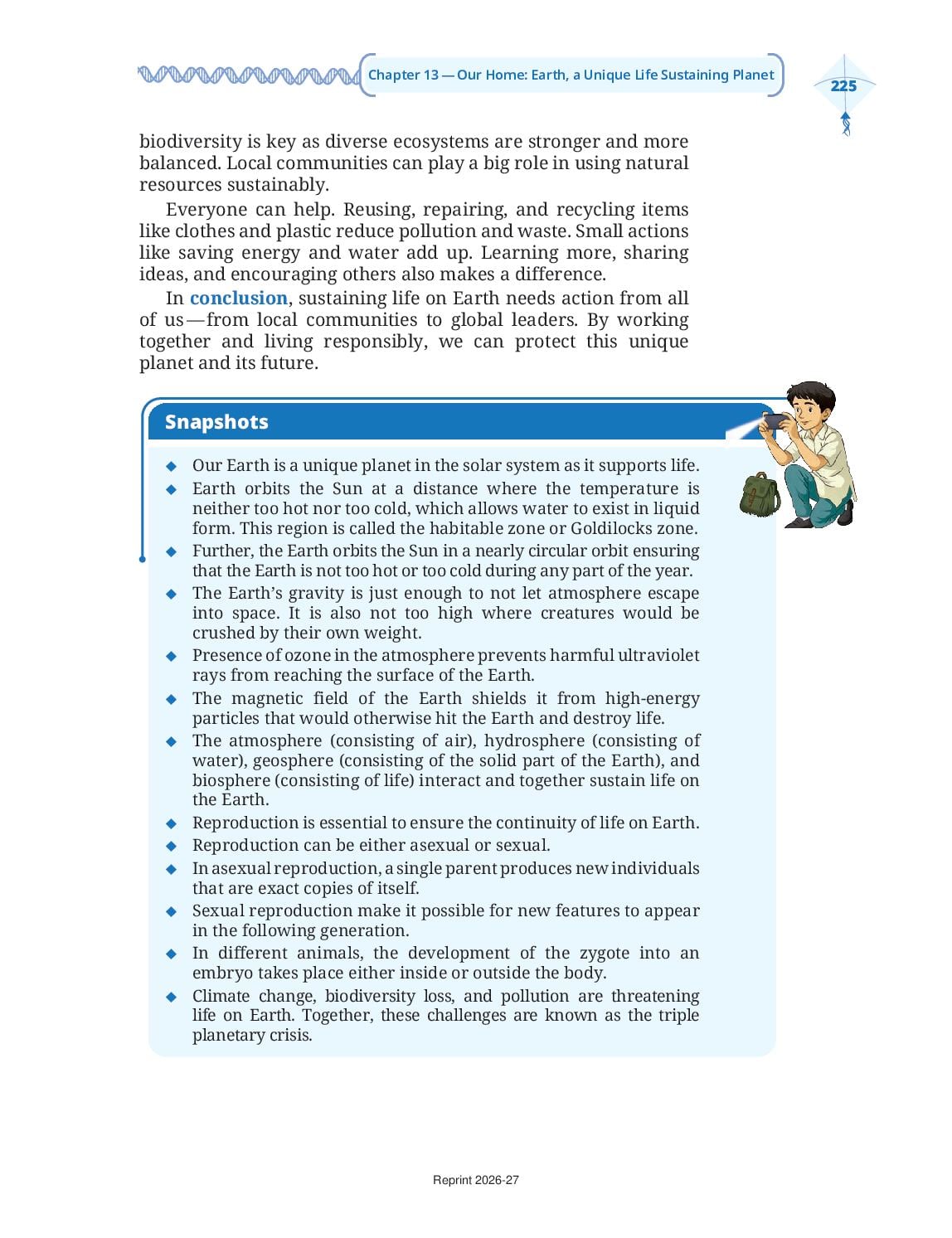
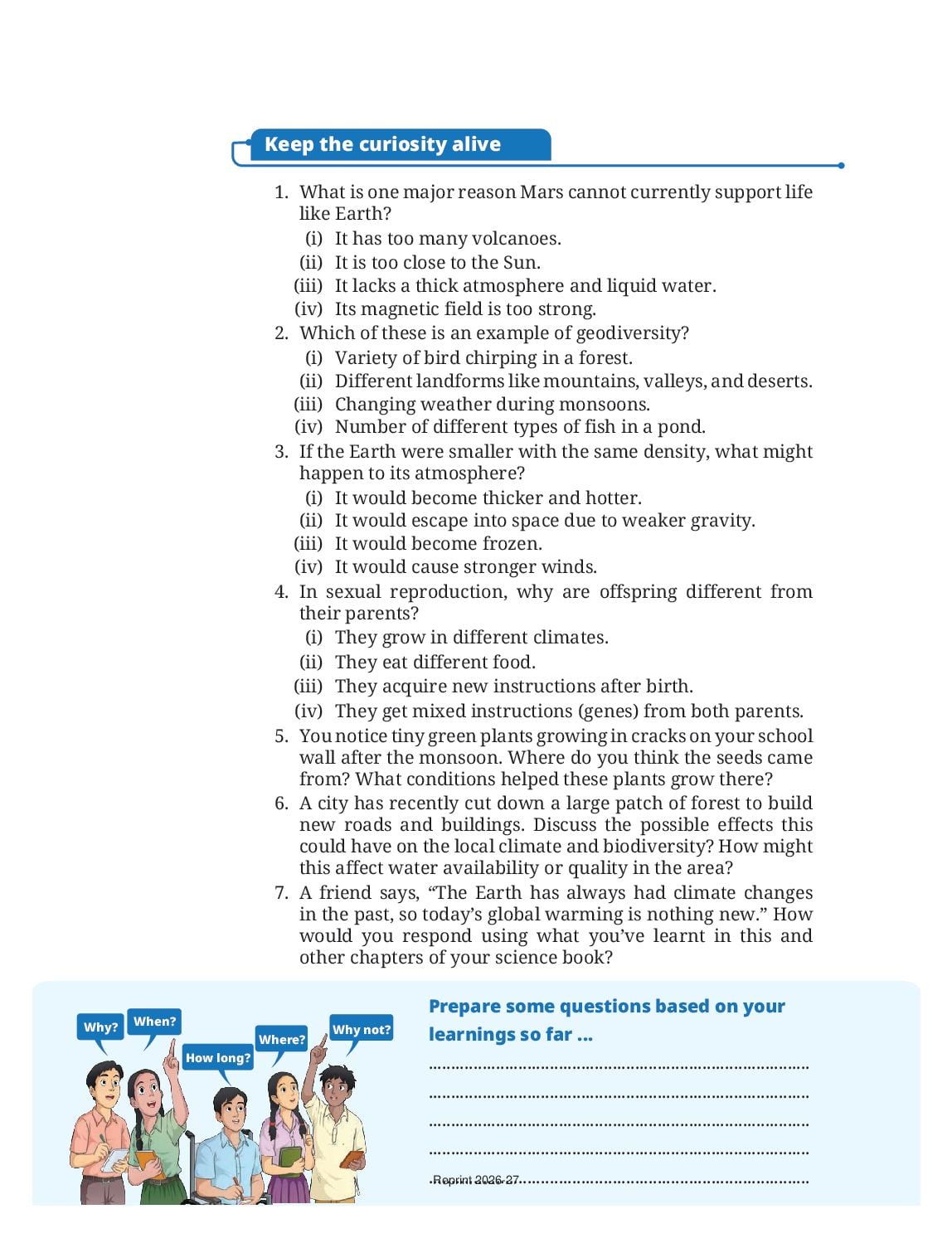
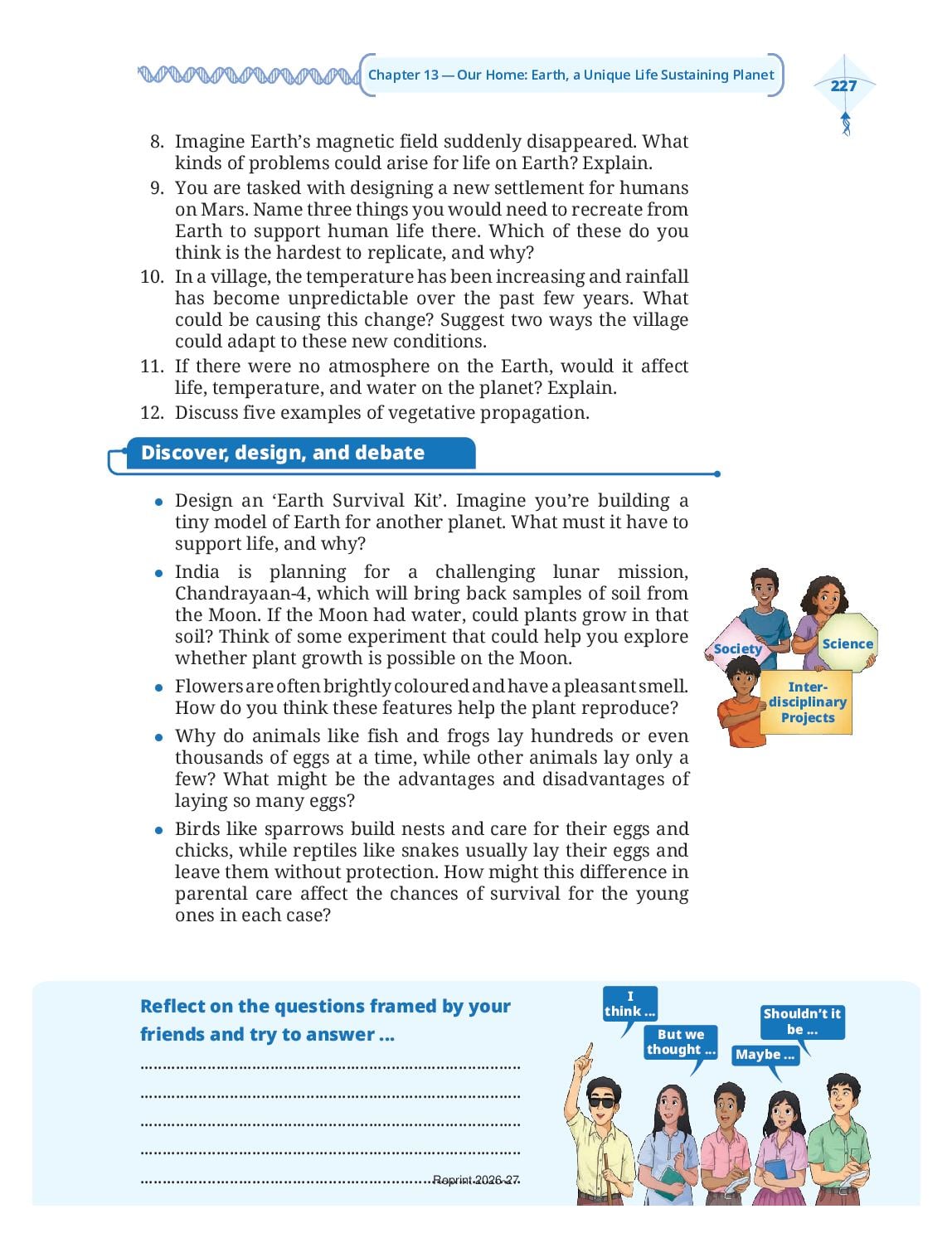
What Is in Our Home: Earth, a Unique Life Sustaining Planet? (Class 8 Science Chapter 13)
- All life on Earth exists in an astonishingly thin shell. From the highest peak to the deepest ocean trench is only about 20 km against an Earth radius of about 6400 km — if Earth were an apple, the crust would be the apple’s skin.
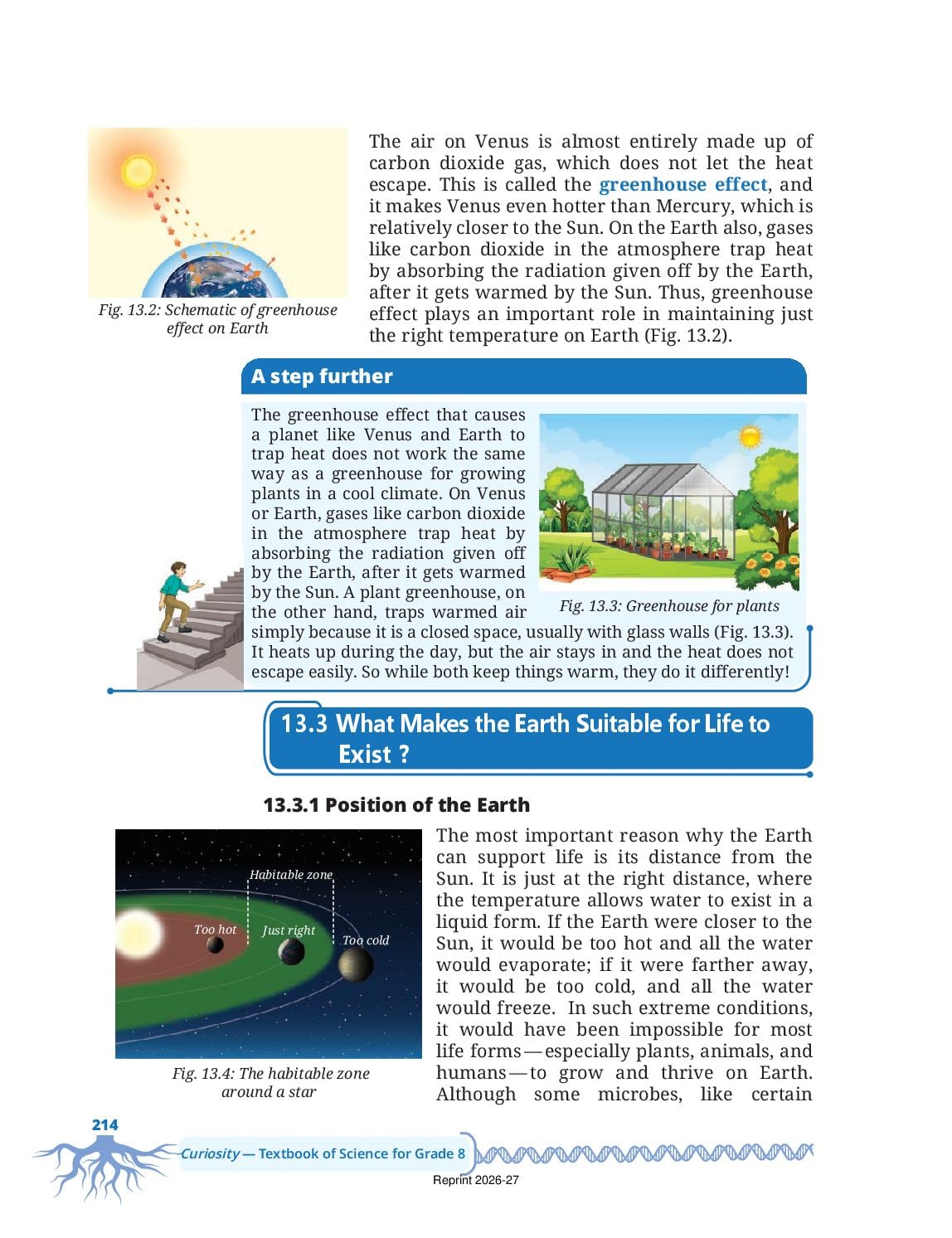
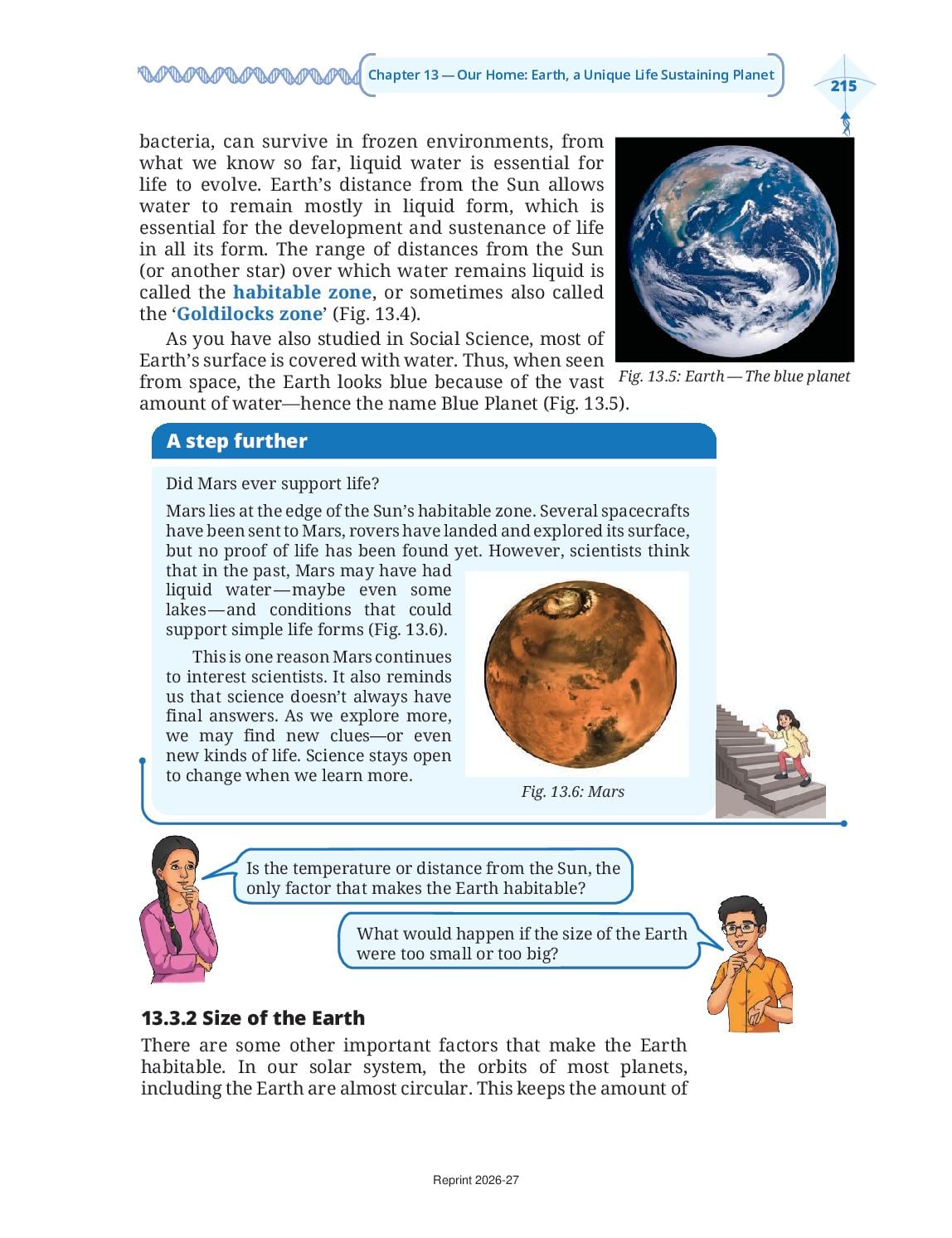
- Earth lies in the habitable zone (or ‘Goldilocks zone’), the range of distances from a star over which water stays liquid. Its nearly circular orbit keeps sunlight and heat steady through the year, so most places escape extreme summers and winters.
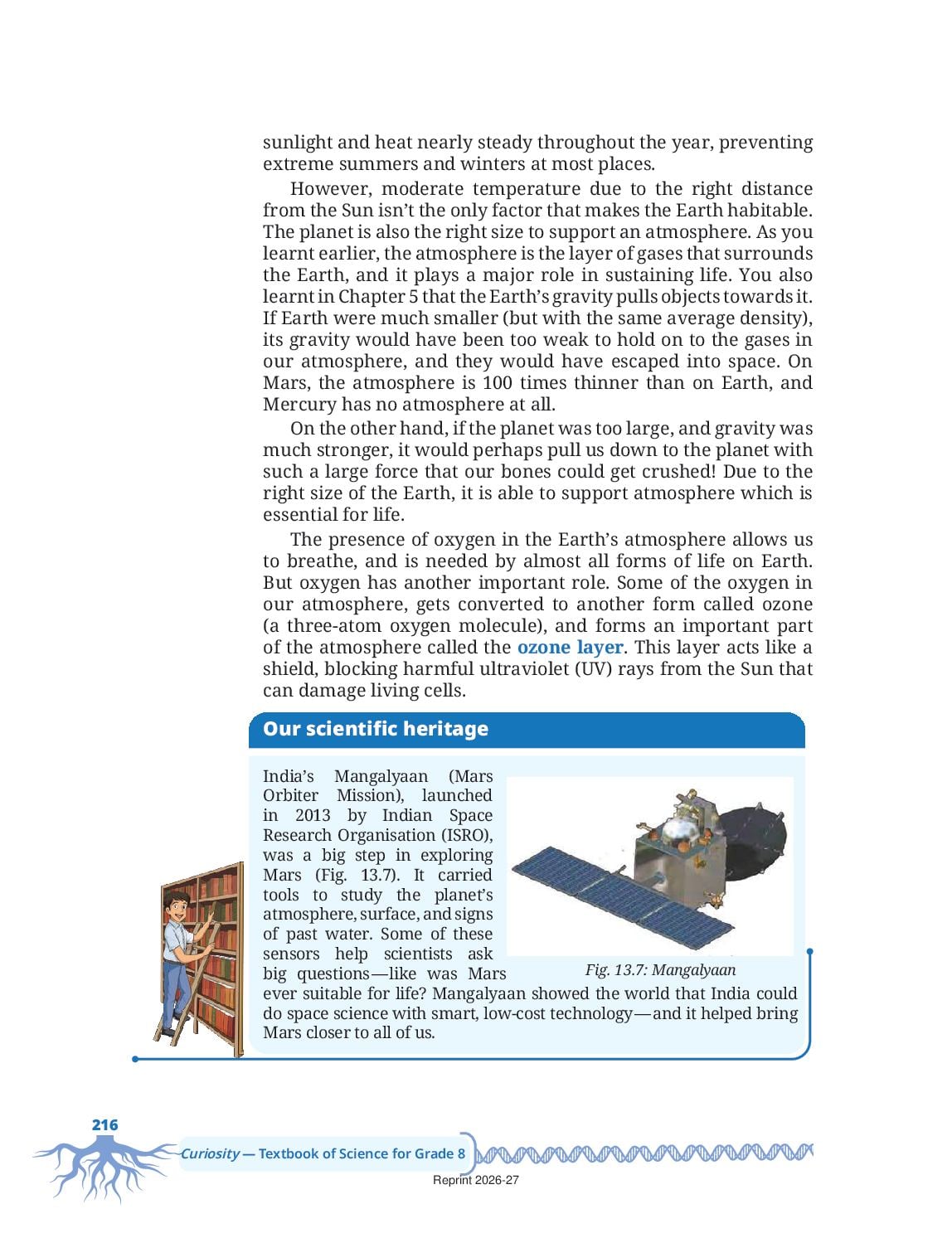
- Earth is also the right size. Its gravity is strong enough to hold on to the atmosphere — Mars’s atmosphere is 100 times thinner and Mercury has none — but not so strong that our own weight would crush us.
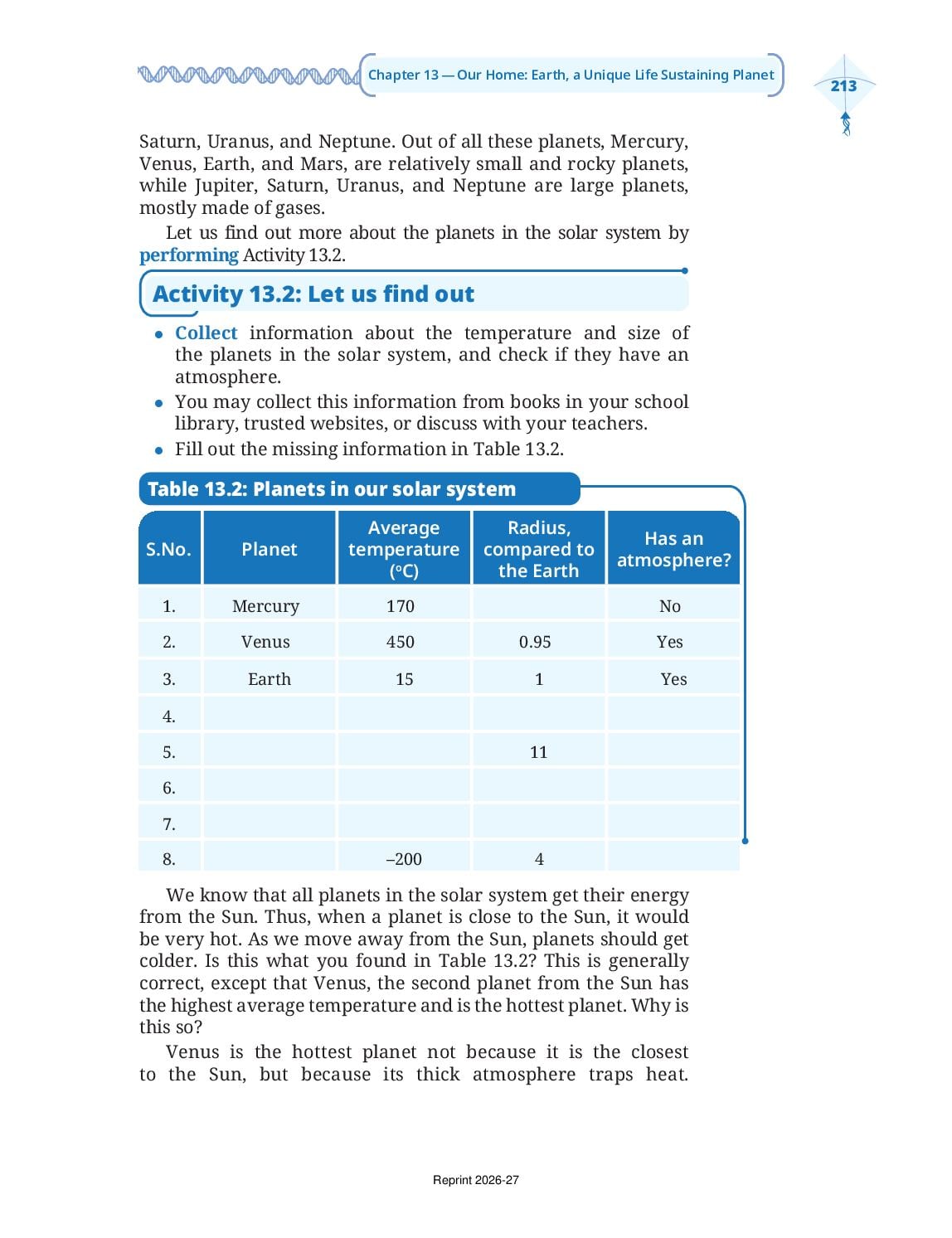
- The atmosphere works in three ways: oxygen for respiration, the ozone layer (a three-atom form of oxygen) that blocks harmful ultraviolet rays, and a mild greenhouse effect in which gases like carbon dioxide absorb the radiation Earth gives off, keeping it warm enough for liquid water. On Venus a thick carbon dioxide atmosphere pushes the same effect to 450 °C.
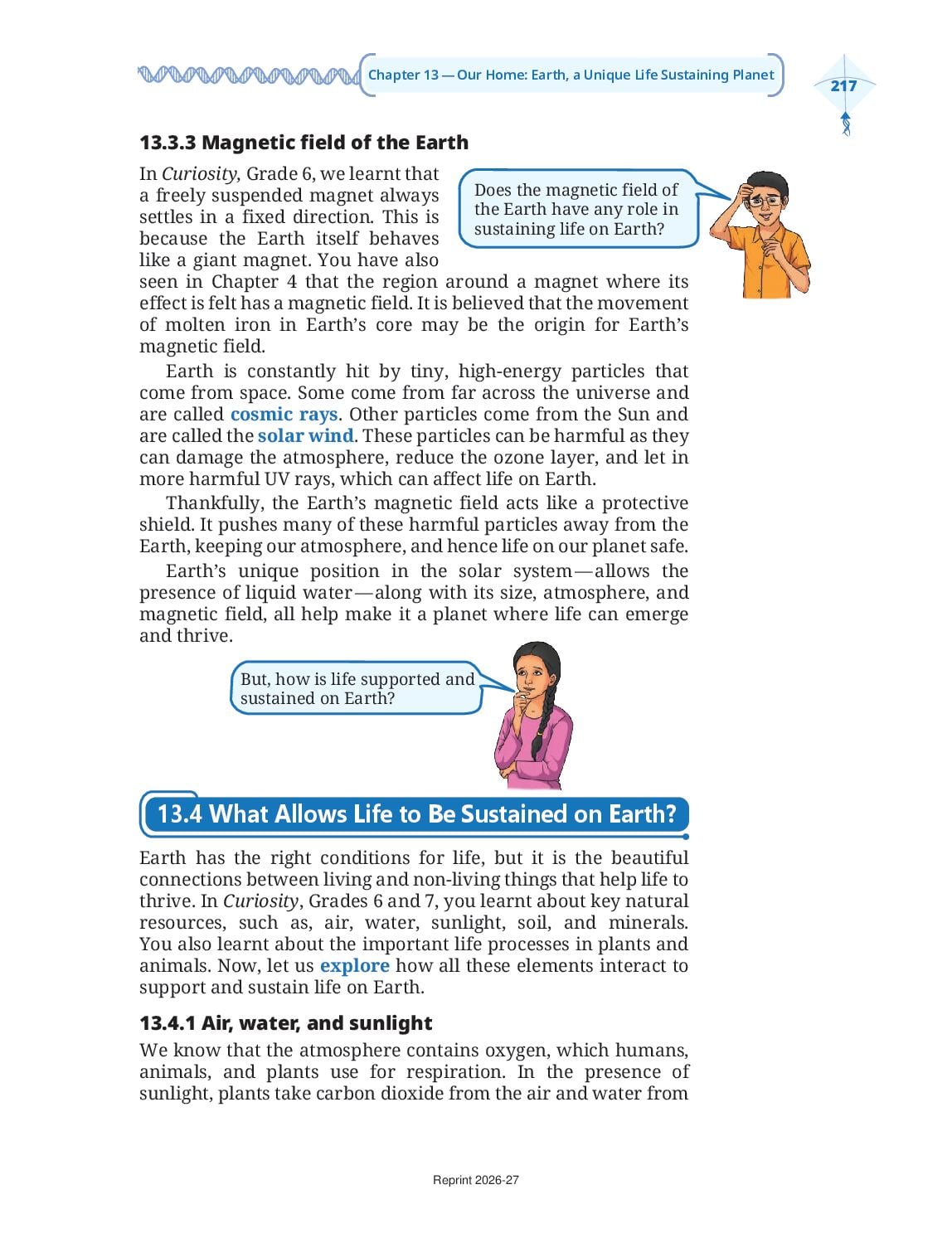
- Molten iron moving in Earth’s core is believed to give Earth its magnetic field, which deflects cosmic rays and the solar wind that would otherwise strip the atmosphere and thin the ozone layer.
- Life is sustained by the interaction of four systems — atmosphere (air), hydrosphere (water), geosphere (rock, soil and minerals) and biosphere (all living things and where they live). Damage to one reaches the others.
- Reproduction keeps life from disappearing. Asexual reproduction (vegetative propagation, budding in Hydra, regeneration in Planaria) gives exact copies; sexual reproduction combines half the instructions from each parent through gametes, so offspring are similar but never identical — and that variation lets life adapt.
- The triple planetary crisis — climate change, biodiversity loss and pollution — is now the biggest threat to that balance. The Paris Agreement (2015) set a goal of limiting global warming to below 1.5 °C; as of 2025 the world is not on track to meet it.
Quick revision – Our Home: Earth, a Unique Life Sustaining Planet
| Term | What it means | Why it matters for life | Where it appears in the chapter |
|---|---|---|---|
| Crust | The thin, solid outer layer of the Earth | Everything alive lives on or just above it — it is as thin, relatively, as an apple’s skin | Fig. 13.1, Section 13.1 |
| Habitable zone (Goldilocks zone) | The range of distances from a star over which water stays liquid | Liquid water is, as far as we know, essential for life to evolve | Fig. 13.4, Section 13.3.1 |
| Greenhouse effect | Gases such as carbon dioxide absorb the radiation the Earth gives off after the Sun warms it, so heat does not escape | Mild on Earth, it keeps the planet warm enough for liquid water; runaway on Venus, it makes 450 °C | Fig. 13.2, Section 13.2 |
| Ozone layer | A part of the atmosphere containing ozone, a three-atom oxygen molecule | Acts as a shield that blocks harmful ultraviolet rays which damage living cells | Section 13.3.2 |
| Cosmic rays and solar wind | High-energy particles from deep space and from the Sun | They can damage the atmosphere and reduce the ozone layer; Earth’s magnetic field pushes most of them away | Section 13.3.3 |
| Magnetic field of the Earth | The region around the Earth where its magnetism is felt, believed to arise from molten iron moving in the core | A protective shield for the atmosphere, and so for life | Section 13.3.3 |
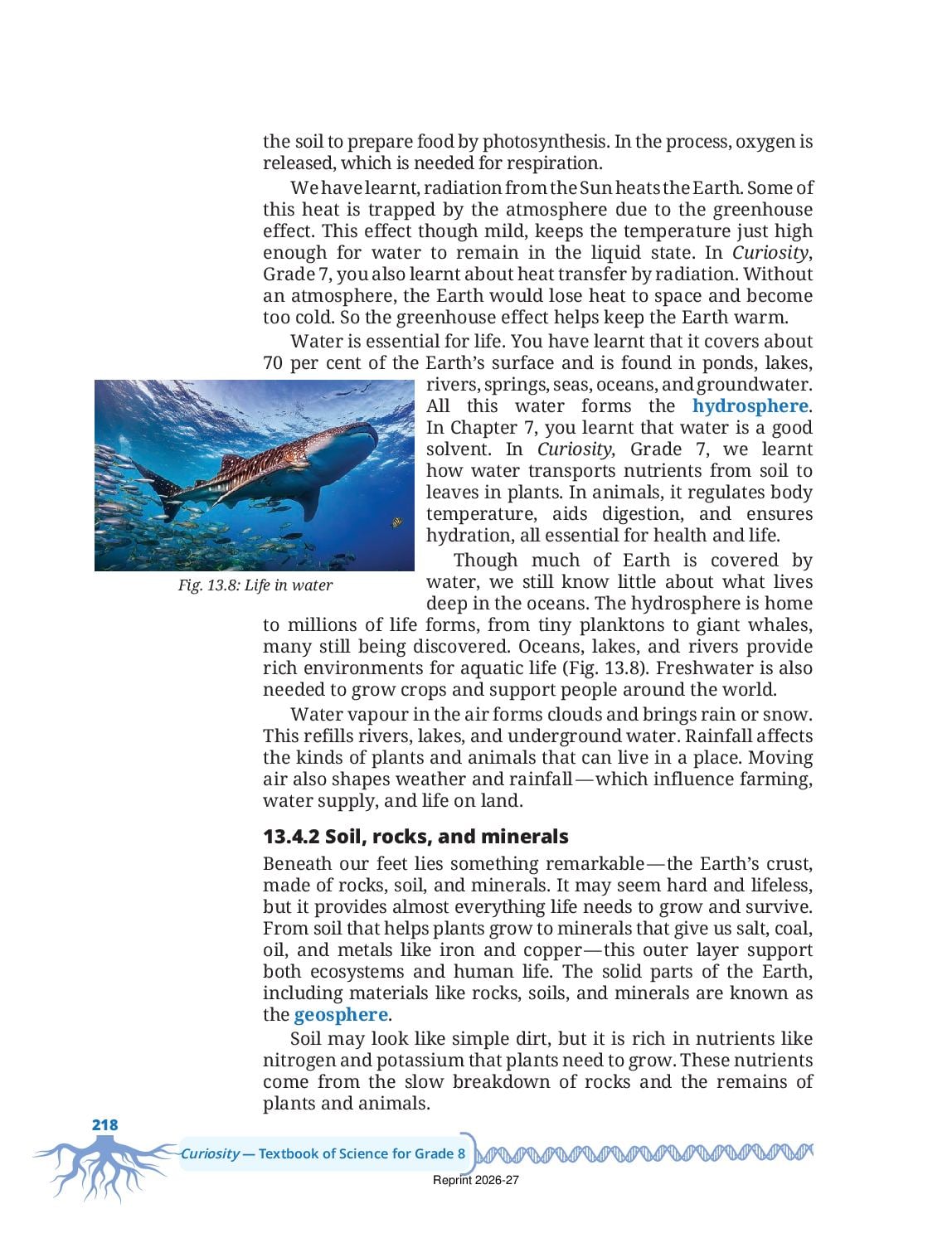
| Hydrosphere | All the water of the Earth — ponds, lakes, rivers, springs, seas, oceans and groundwater; about 70 per cent of the surface | Water is a good solvent, carries nutrients in plants, regulates body temperature in animals, and is home to millions of species | Section 13.4.1 |
| Geosphere | The solid part of the Earth — rocks, soils and minerals | Supplies nutrients such as nitrogen and potassium, and materials like salt, coal, oil, iron and copper | Section 13.4.2 |
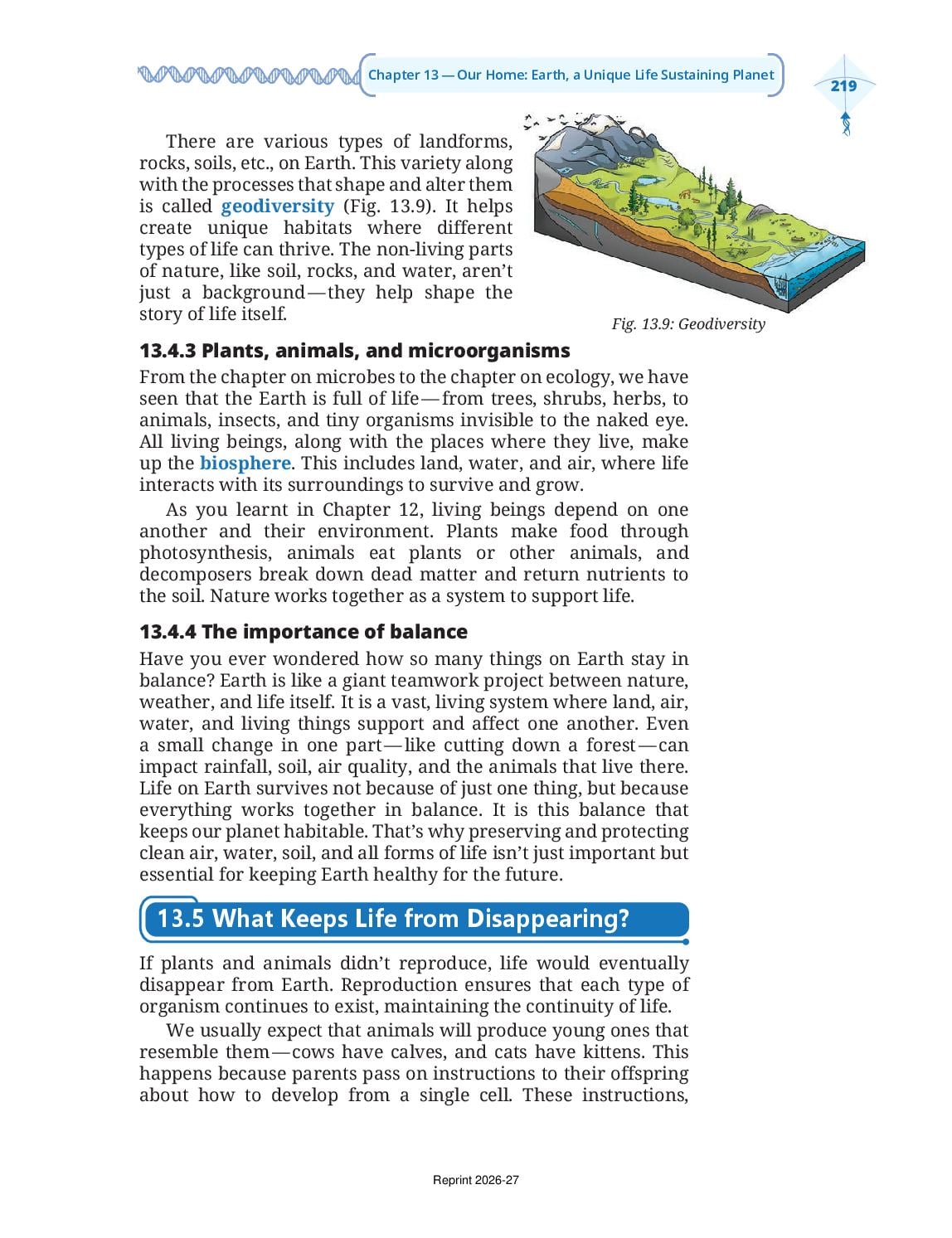
| Geodiversity | The variety of landforms, rocks and soils, together with the processes that shape them | Creates the different habitats in which different kinds of life can thrive | Fig. 13.9, Section 13.4.2 |
| Biosphere | All living beings together with the places where they live — land, water and air | This is where living things interact with their surroundings to survive and grow | Section 13.4.3 |
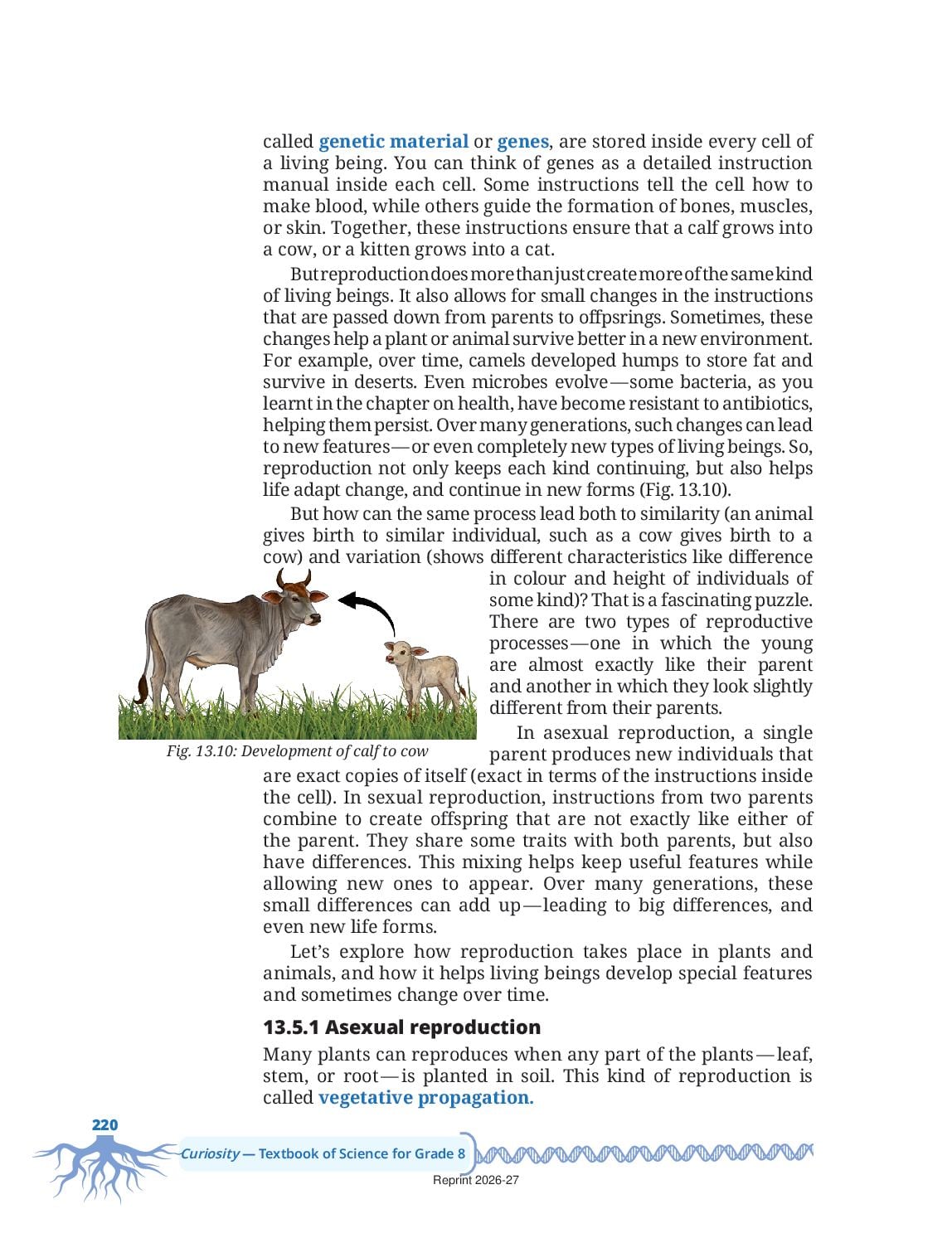
| Genetic material (genes) | Instructions stored inside every cell that tell it how to develop | They make a calf grow into a cow; small changes in them, passed on, allow adaptation | Section 13.5 |
| Gametes | Specialised reproductive cells carrying only half the parent’s genetic material | Half from each parent gives a complete set, so instructions do not double every generation | Section 13.5.2 |
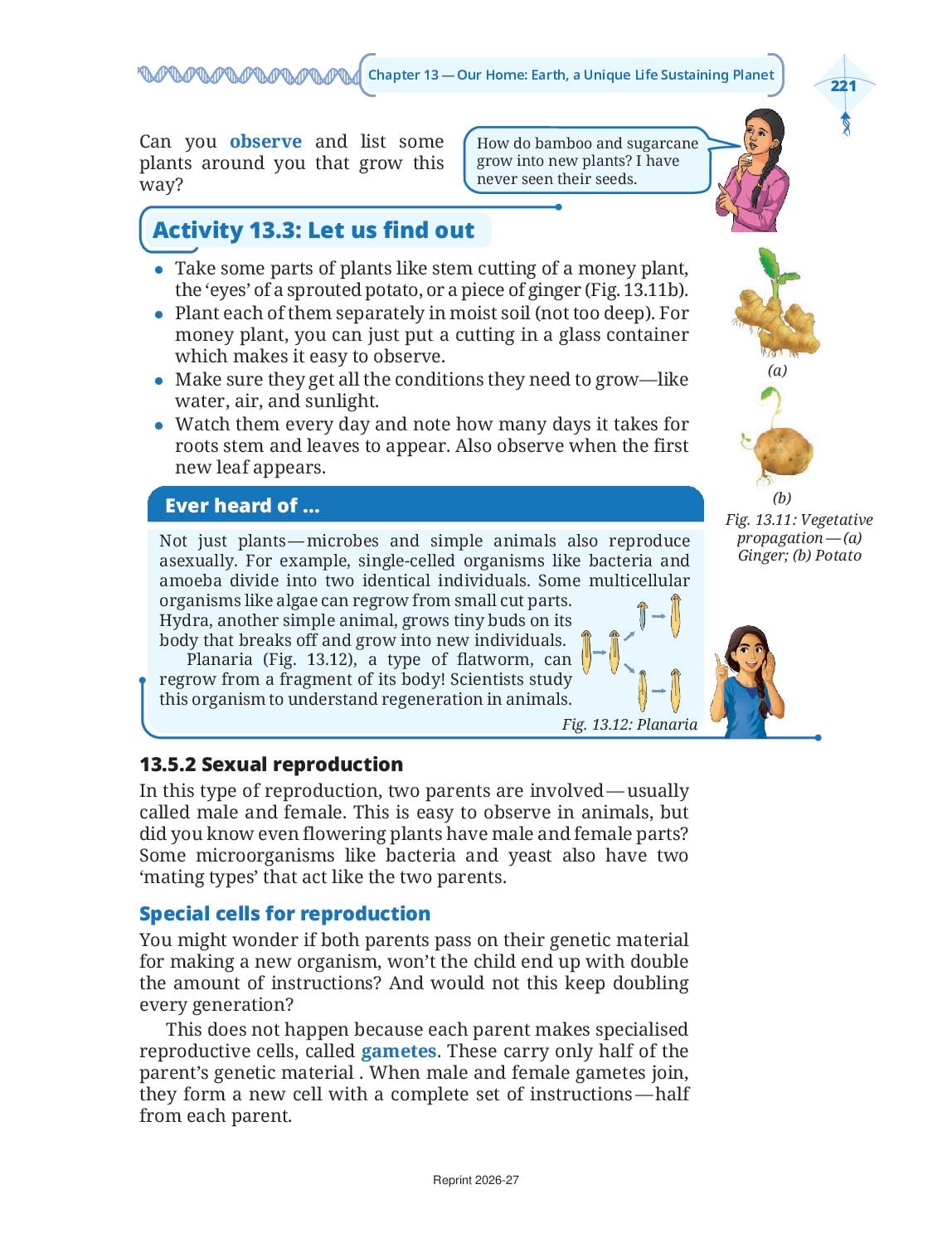
| Vegetative propagation | Asexual reproduction in which a leaf, stem or root planted in soil grows into a new plant | How bamboo, sugarcane, potato, ginger and money plant multiply without seeds | Fig. 13.11, Section 13.5.1 |
| Triple planetary crisis | Climate change, biodiversity loss and pollution taken together | The three biggest environmental challenges now threatening life on Earth | Section 13.6 |
Old NCERT vs New – Class 8 Science
This chapter is from Curiosity, the new NCERT Class 8 Science book (NCF-SE 2023, used from 2025-26). It replaced the old book “Science”, so chapter numbers and names differ from older PDFs.
Solutions and All Chapters
Answers to the exercises and the full chapter list of Curiosity:
Our Home: Earth, a Unique Life Sustaining Planet – Overview
| Class | Class 8 |
| Subject | Science |
| Book | Curiosity – new NCERT book |
| Chapter | 13 of 13 – Our Home: Earth, a Unique Life Sustaining Planet |
| Book pages | 210 – 228 |
| Edition | NCERT Reprint 2026-27 |
| Session | 2026-27 |
| Free – read online or download |
Class 8 Science Chapter 13 – FAQs
Where can I download Our Home: Earth, a Unique Life Sustaining Planet Class 8 PDF?
From the download table on this page – the chapter PDF is free, and the full book is linked too.
What is Class 8 Science Chapter 13 about?
All life on Earth exists in an astonishingly thin shell. From the highest peak to the deepest ocean trench is only about 20 km against an Earth radius of about 6400 km — if Earth were an apple, the crust would be the apple’s skin.
Is Our Home: Earth, a Unique Life Sustaining Planet from the new NCERT Class 8 Science book?
Yes. It is chapter 13 of curiosity, the new NCERT Class 8 Science book for 2026-27.
Is this the latest NCERT edition for 2026-27?
Yes – the PDF is NCERT’s latest edition for the 2026-27 session.
Where are the NCERT Solutions for Class 8 Science Chapter 13?
Open the NCERT Solutions link above for answers to the exercise questions.