Download Nature of Matter: Elements, Compounds, and Mixtures – NCERT Class 8 Science Chapter 8 PDF from the new NCERT Class 8 Science book Curiosity (2026-27). Read the chapter online or download the free PDF. A mixture is two or more substances mixed together in which each substance keeps its own properties and no chemical reaction takes place. The substances that make it up are its components.
Nature of Matter: Elements, Compounds, and Mixtures PDF – Chapter 8 of Curiosity
Read the chapter online or download the PDF.
| Chapter | Download | |
|---|---|---|
| Chapter 8 PDF | Nature of Matter: Elements, Compounds, and Mixtures | View PDF |
| Full book | NCERT Class 8 Science – Curiosity | View Book |
Read Online
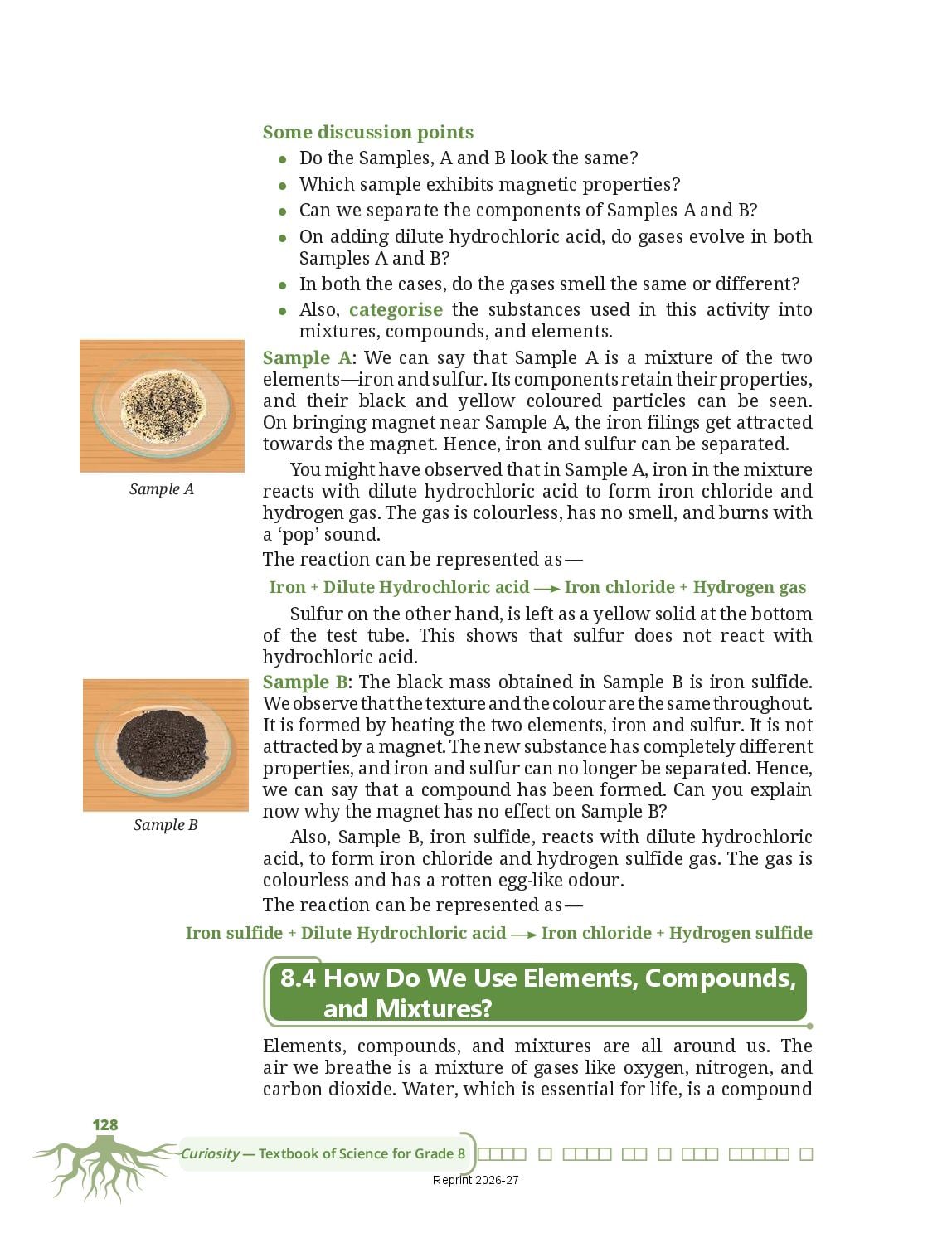
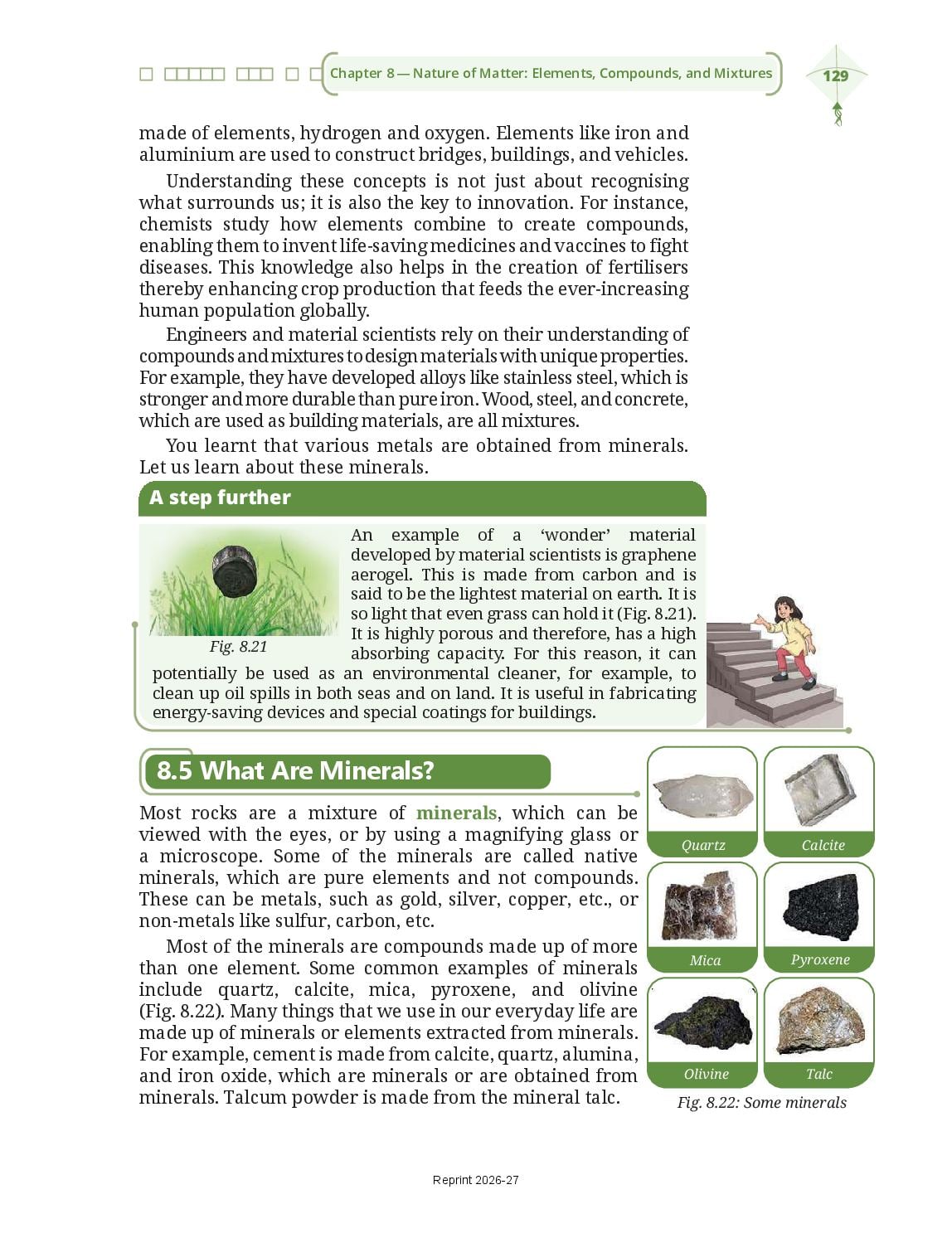
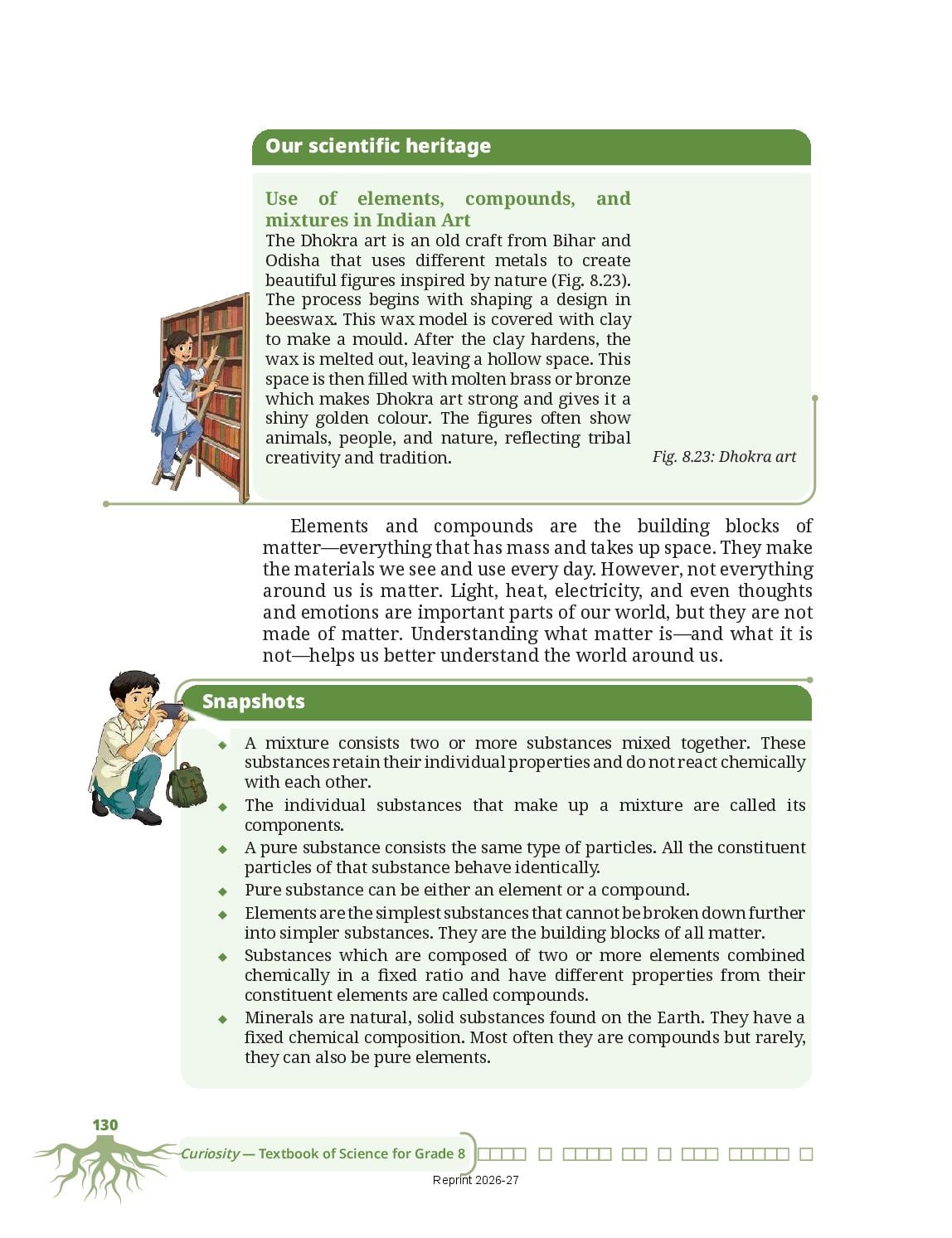
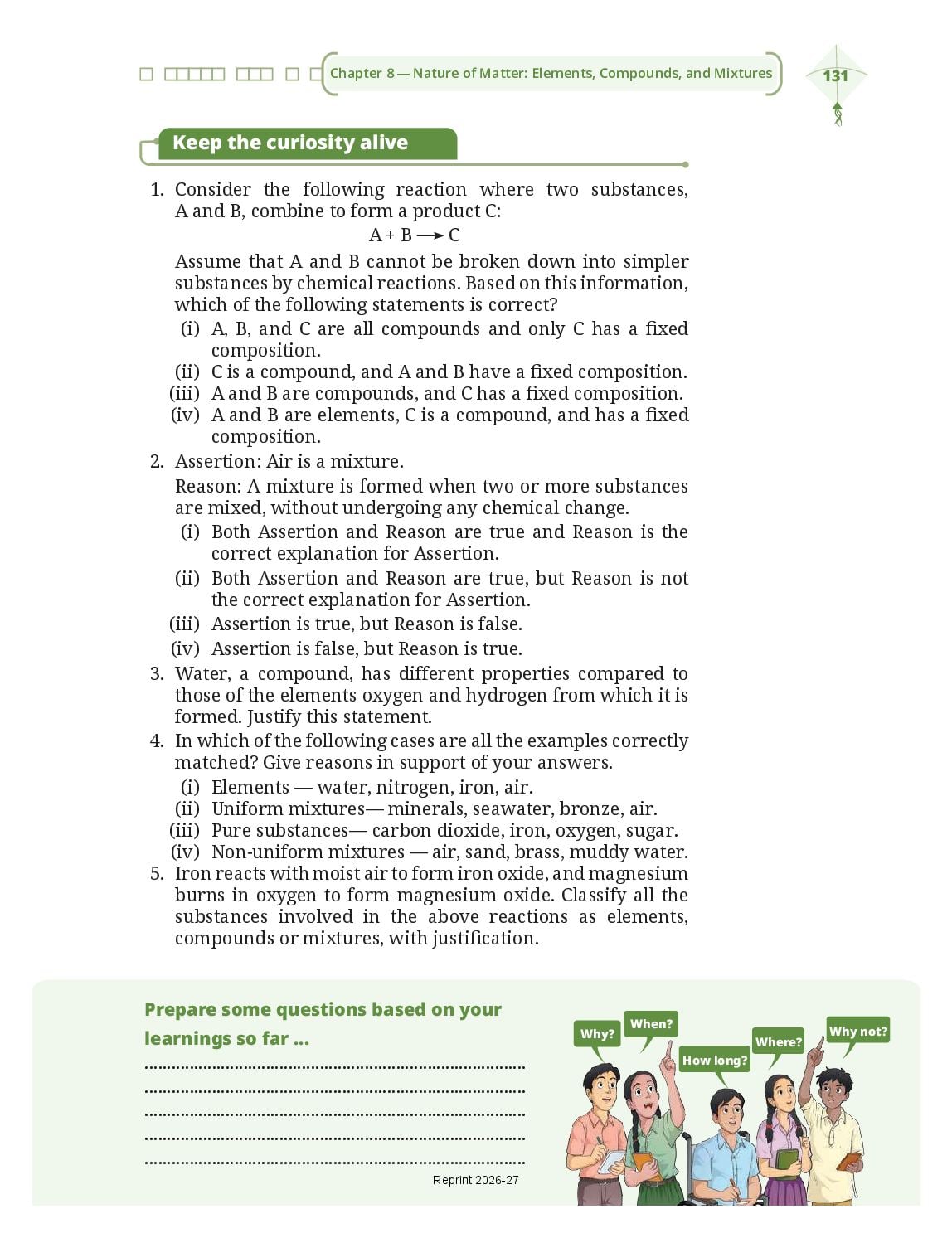
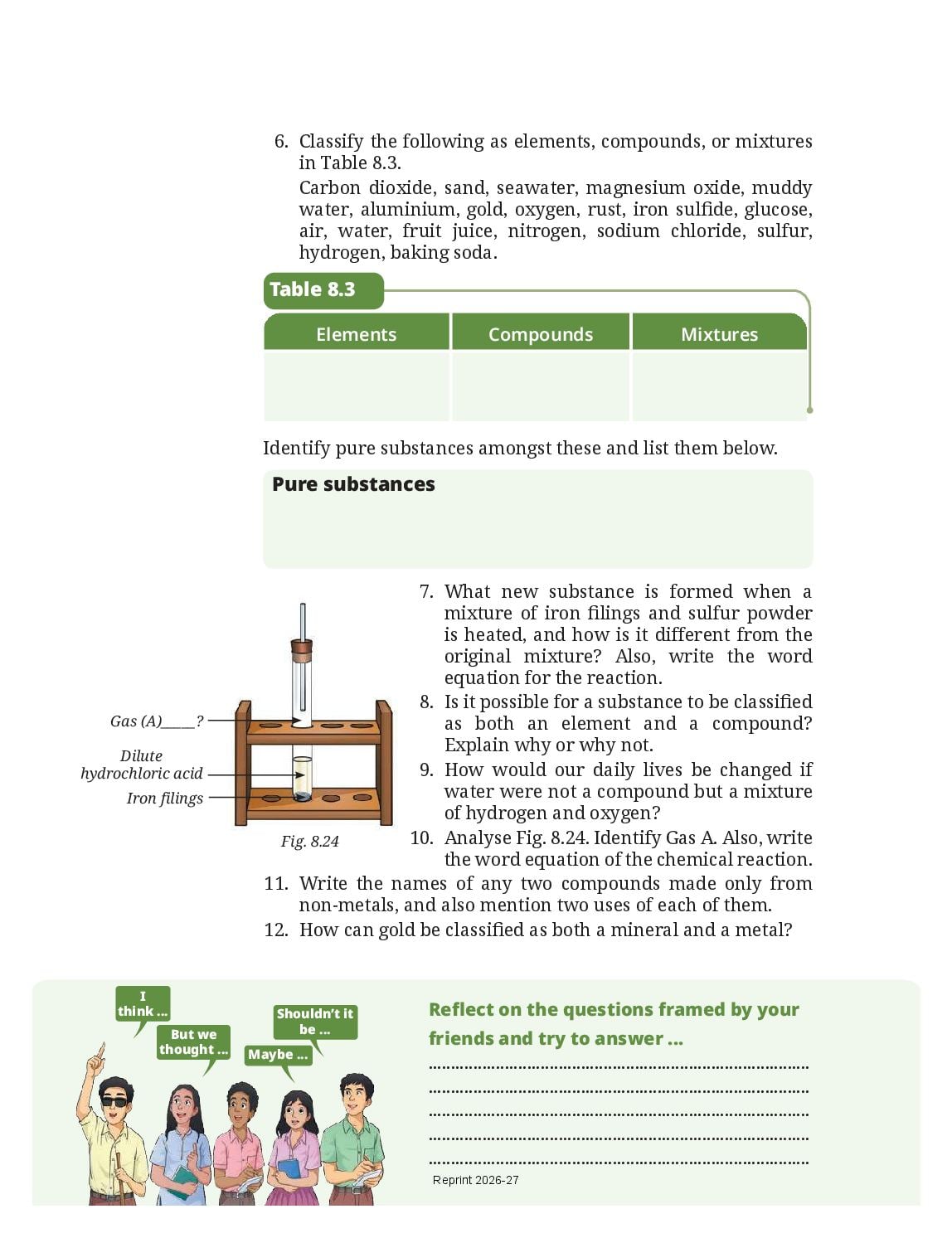
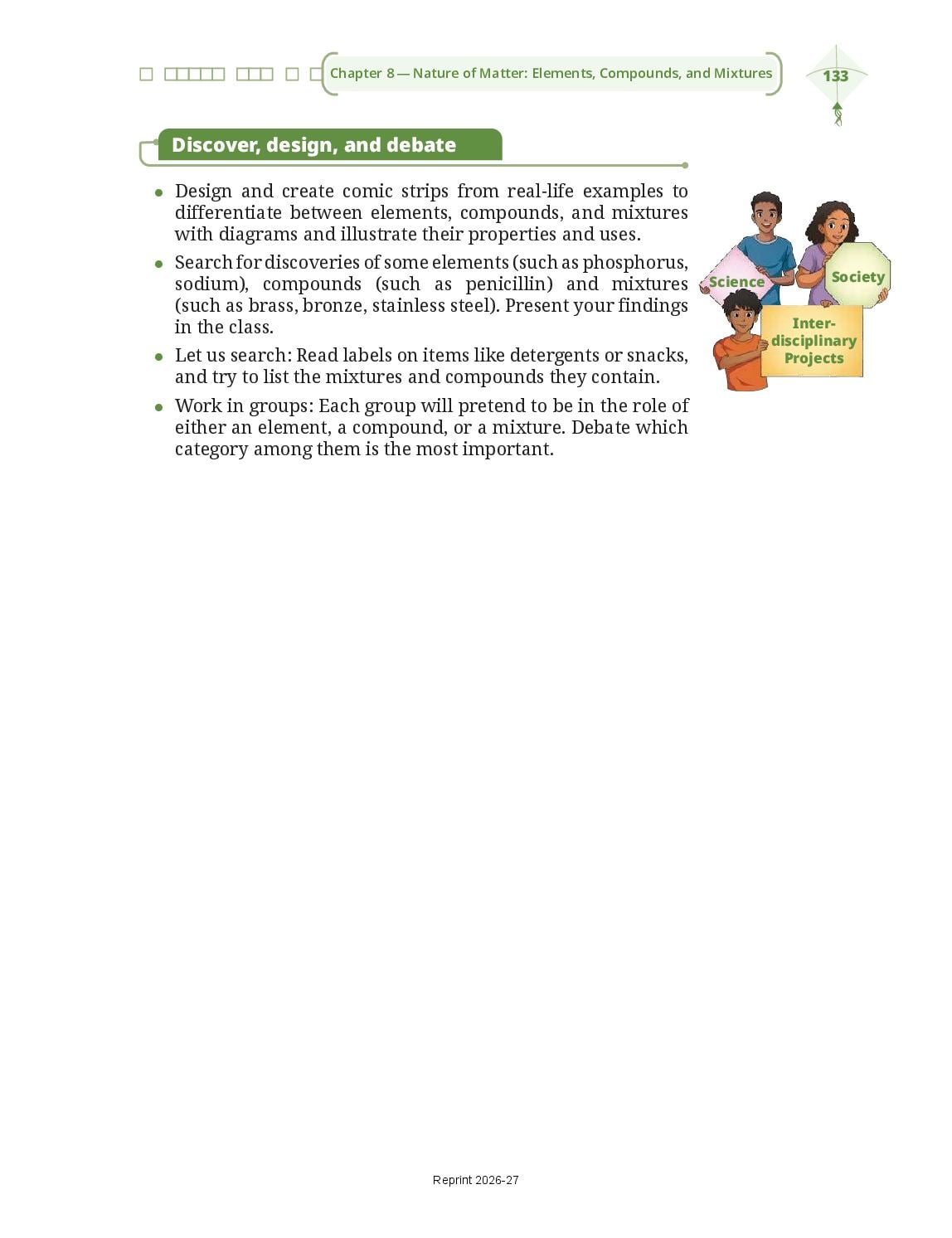
What Is in Nature of Matter: Elements, Compounds, and Mixtures? (Class 8 Science Chapter 8)
- A mixture is two or more substances mixed together in which each substance keeps its own properties and no chemical reaction takes place. The substances that make it up are its components.
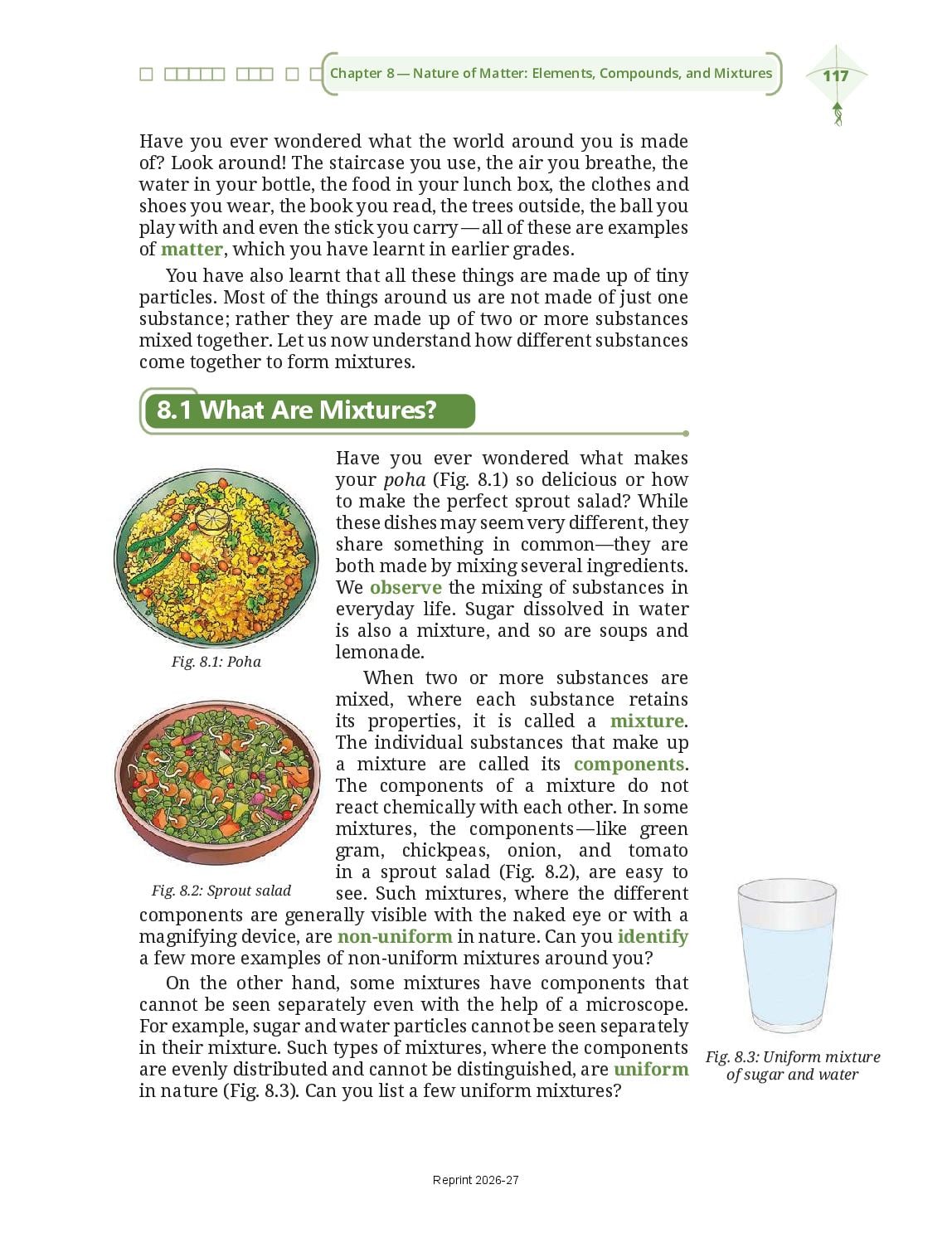
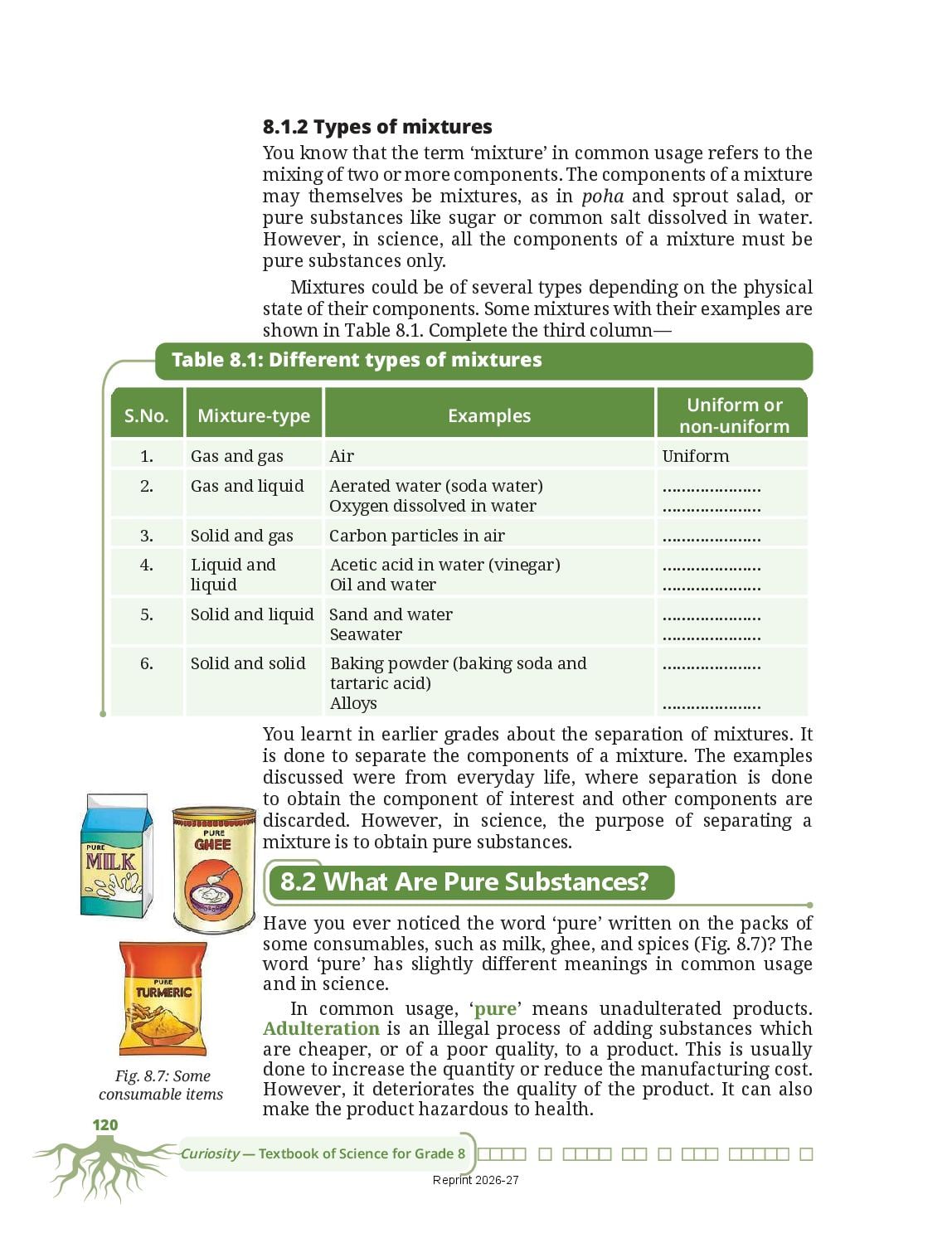
- A mixture is uniform when its components are evenly spread and cannot be told apart even under a microscope (air, sugar in water, alloys), and non-uniform when they can be seen separately (sprout salad, sand and water).
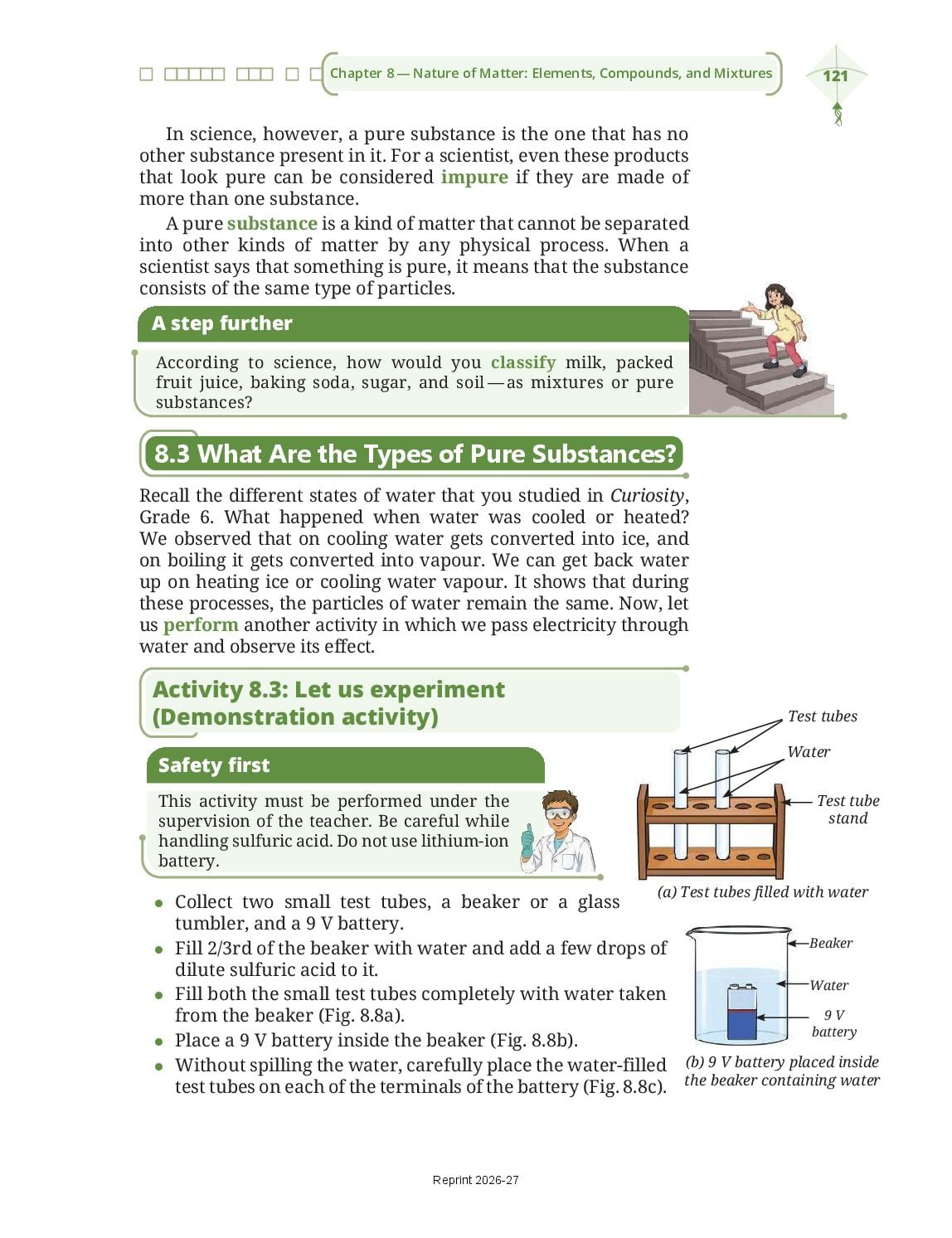
- A pure substance contains only one kind of particle and cannot be separated into other kinds of matter by any physical process. Every pure substance is either an element or a compound.
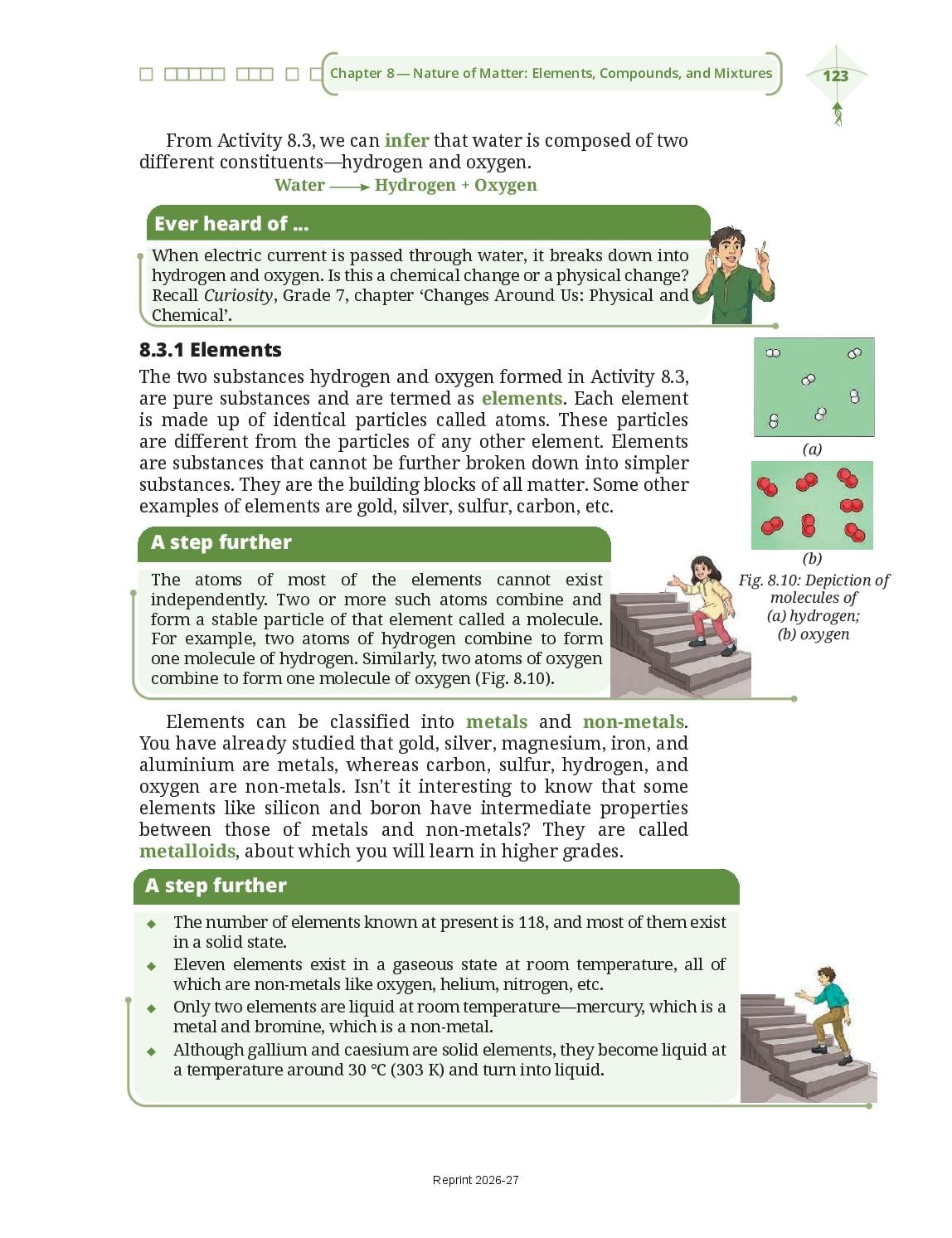
- Elements cannot be broken down into simpler substances. Each is made of identical atoms; two or more atoms usually join into a molecule. 118 elements are known — mostly solids, eleven gases, and only mercury and bromine liquid at room temperature.
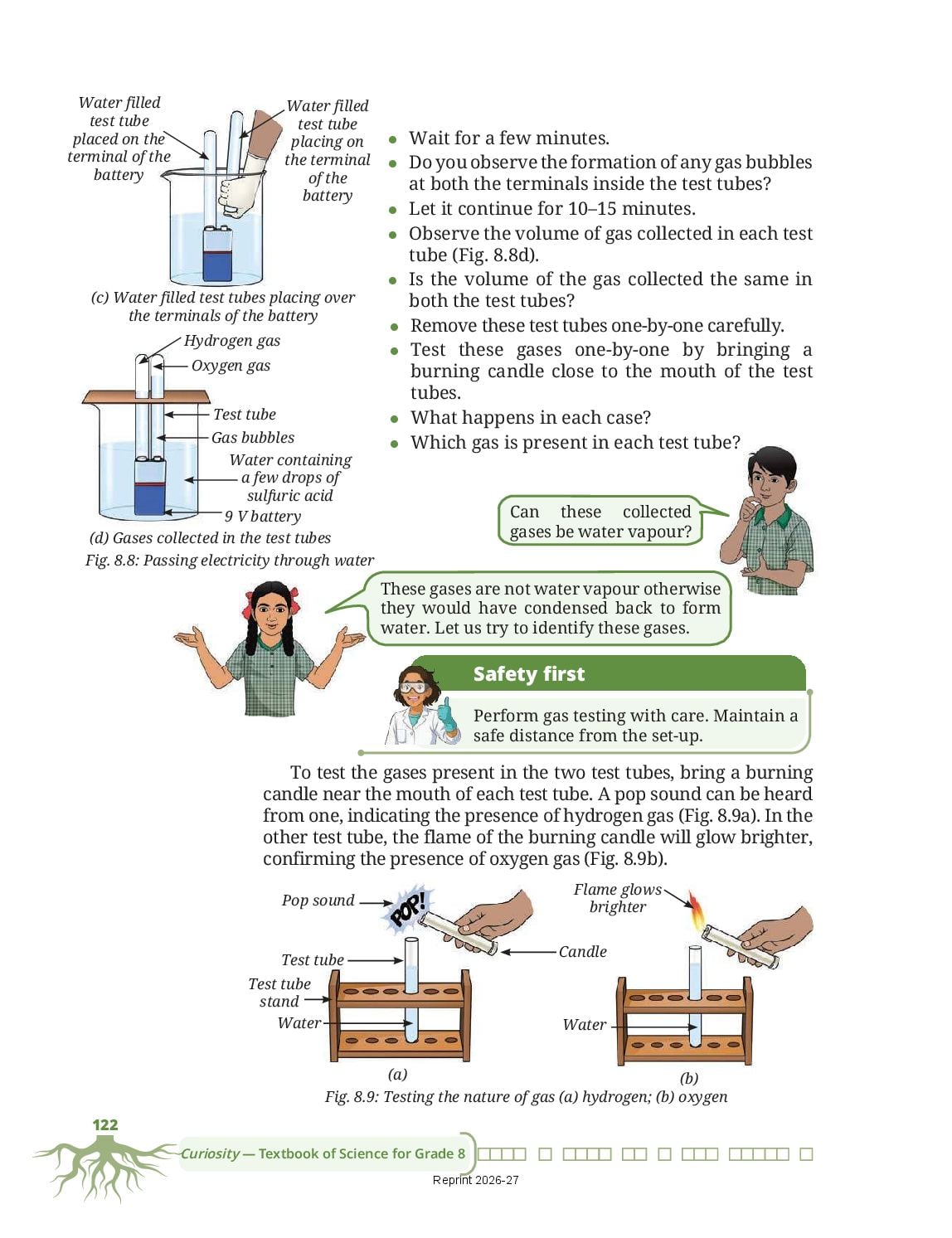
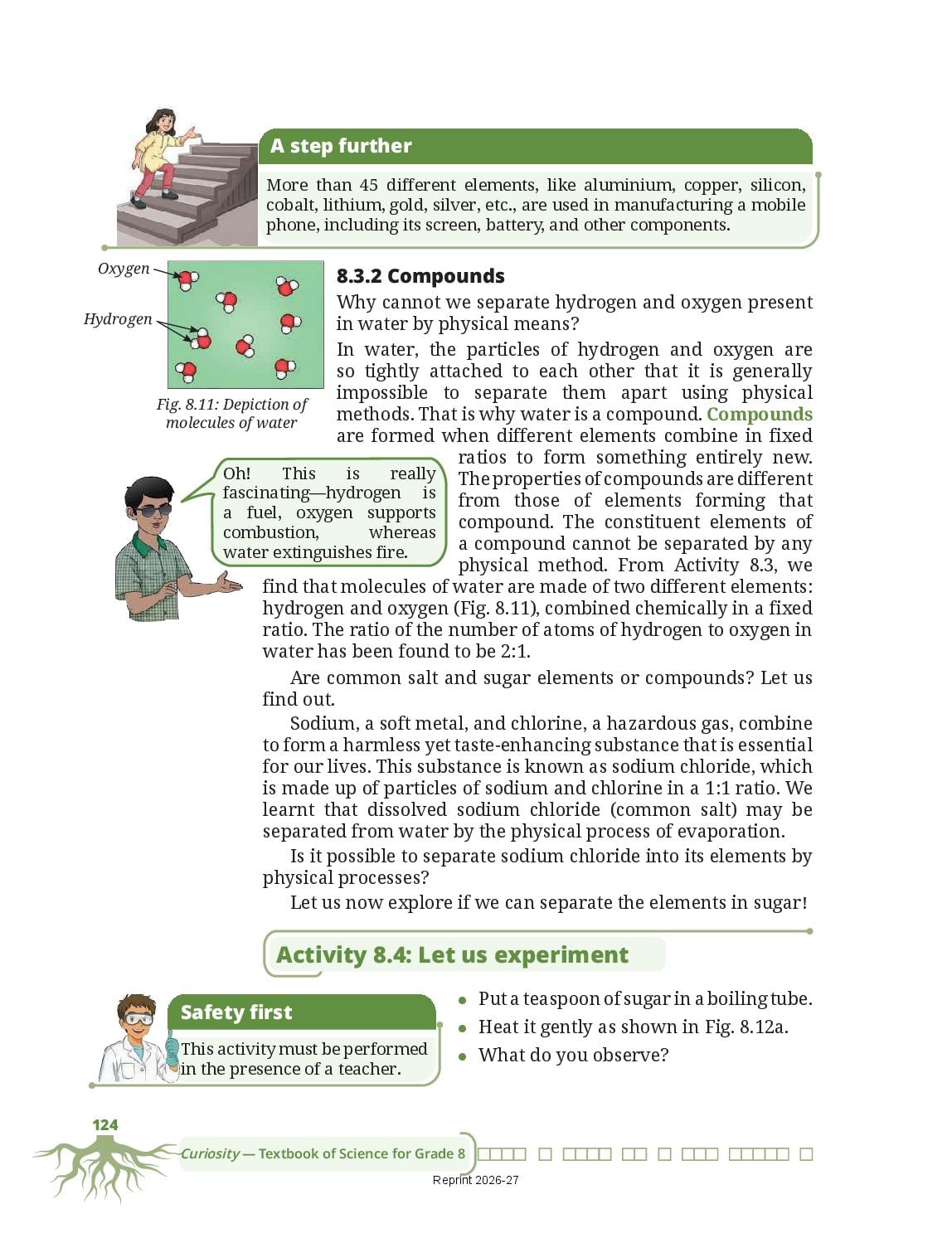
- Compounds are formed when different elements combine chemically in a fixed ratio. The compound’s properties are completely different from those of its elements, and the elements cannot be separated by any physical method.
- Minerals are natural solids of the Earth with a fixed chemical composition — mostly compounds (quartz, calcite, mica), but a few, the native minerals such as gold and sulfur, are pure elements.
Quick revision – Nature of Matter: Elements, Compounds, and Mixtures
| Term | What it means | How you can tell | Example from the chapter |
|---|---|---|---|
| Mixture | Two or more substances mixed; each keeps its own properties, no chemical reaction | Components can be separated by a physical method; composition can vary | Poha, sprout salad, air, seawater |
| Component | An individual substance that makes up a mixture | It is still itself inside the mixture | Green gram, chickpeas, onion, tomato in a sprout salad |
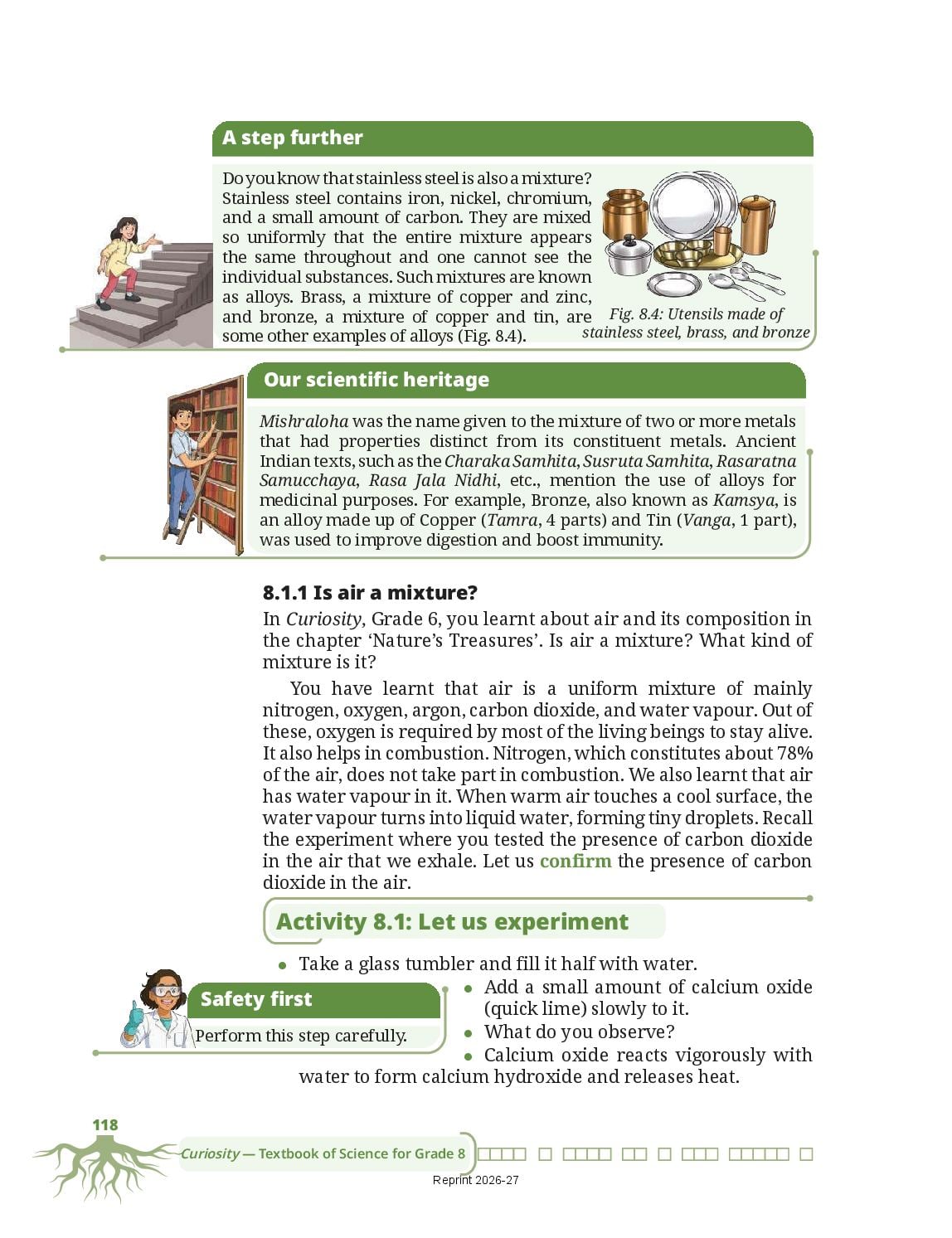
| Uniform mixture | Components evenly spread; cannot be distinguished even with a microscope | Looks the same throughout | Sugar in water, air, brass, bronze, stainless steel |
| Non-uniform mixture | Components visible to the naked eye or with a magnifying device | You can point to the separate bits | Sprout salad, sand and water, muddy water |
| Alloy | A uniform mixture of metals (and sometimes a little carbon) | Looks like one metal, but is a mixture | Brass (copper + zinc), bronze (copper + tin), stainless steel |
| Pure substance | Matter made of only one kind of particle | Cannot be separated into other kinds of matter by any physical process | Oxygen, iron, water, sodium chloride, sugar |
| Element | A substance that cannot be broken down into simpler substances | Made of identical atoms; it is a building block of matter | Hydrogen, oxygen, gold, silver, sulfur, carbon |
| Atom | The identical particle an element is made of | Different from the particle of every other element | An atom of hydrogen; an atom of oxygen |
| Molecule | A stable particle formed when two or more atoms combine | Two hydrogen atoms give one hydrogen molecule (Fig. 8.10) | Molecule of hydrogen; molecule of oxygen |
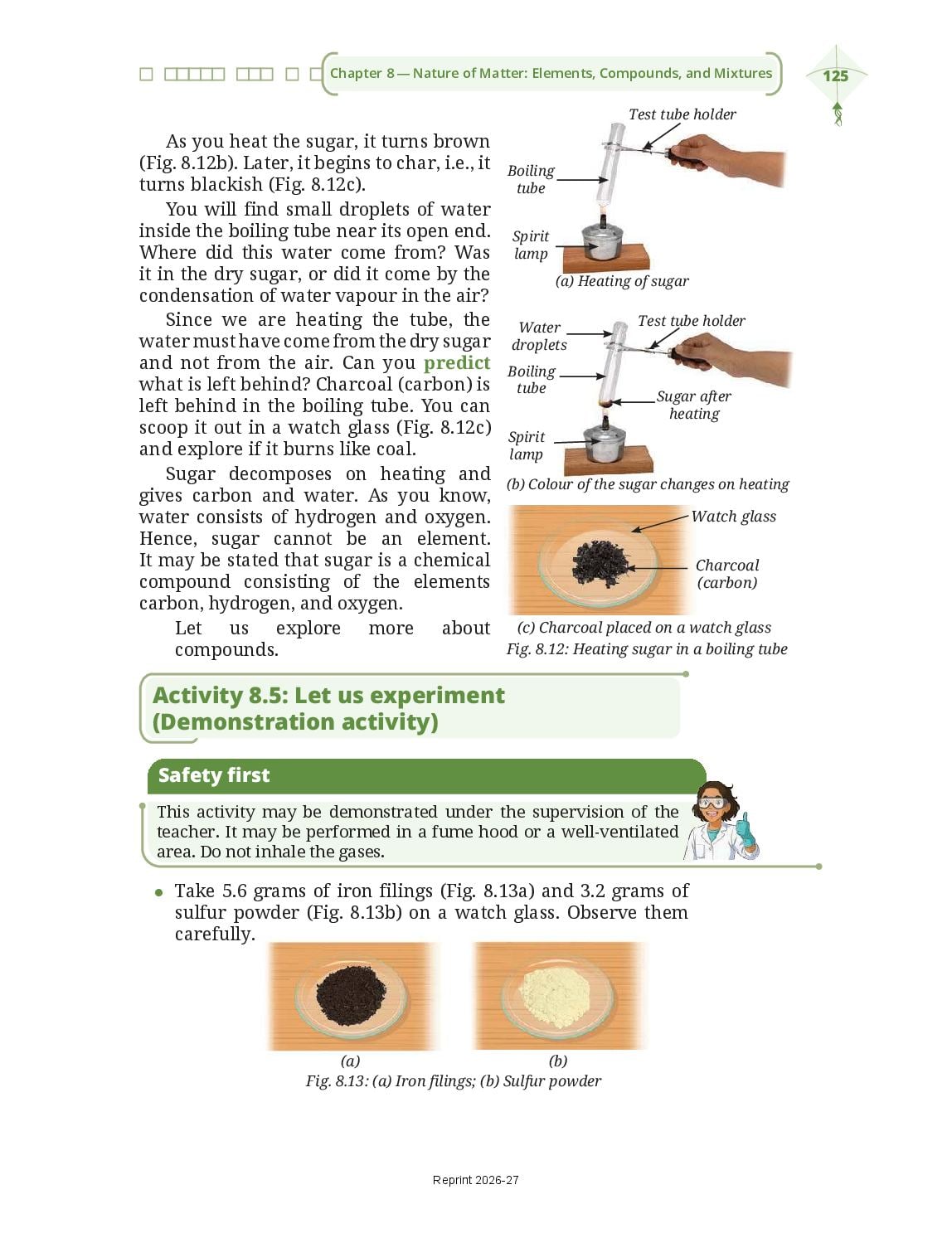
| Compound | Different elements combined chemically in a fixed ratio | New properties; elements cannot be separated physically | Water (hydrogen : oxygen = 2 : 1), sodium chloride (1 : 1), iron sulfide, sugar |
| Metals / non-metals / metalloids | The two main classes of elements, and the in-between class | Gold, iron are metals; carbon, sulfur are non-metals; silicon, boron are metalloids | Silicon and boron have properties between the two |
| Mineral | A natural solid of the Earth with a fixed chemical composition | Mostly a compound; a native mineral is a pure element | Quartz, calcite, mica, pyroxene, olivine, talc; gold and sulfur are native minerals |
Old NCERT vs New – Class 8 Science
This chapter is from Curiosity, the new NCERT Class 8 Science book (NCF-SE 2023, used from 2025-26). It replaced the old book “Science”, so chapter numbers and names differ from older PDFs.
Solutions and All Chapters
Answers to the exercises and the full chapter list of Curiosity:
Nature of Matter: Elements, Compounds, and Mixtures – Overview
| Class | Class 8 |
| Subject | Science |
| Book | Curiosity – new NCERT book |
| Chapter | 8 of 13 – Nature of Matter: Elements, Compounds, and Mixtures |
| Book pages | 116 – 133 |
| Edition | NCERT Reprint 2026-27 |
| Session | 2026-27 |
| Free – read online or download |
Class 8 Science Chapter 8 – FAQs
Where can I download Nature of Matter: Elements, Compounds, and Mixtures Class 8 PDF?
From the download table on this page – the chapter PDF is free, and the full book is linked too.
What is Class 8 Science Chapter 8 about?
A mixture is two or more substances mixed together in which each substance keeps its own properties and no chemical reaction takes place. The substances that make it up are its components.
Is Nature of Matter: Elements, Compounds, and Mixtures from the new NCERT Class 8 Science book?
Yes. It is chapter 8 of curiosity, the new NCERT Class 8 Science book for 2026-27.
Is this the latest NCERT edition for 2026-27?
Yes – the PDF is NCERT’s latest edition for the 2026-27 session.
Where are the NCERT Solutions for Class 8 Science Chapter 8?
Open the NCERT Solutions link above for answers to the exercise questions.