Download Electricity: Magnetic and Heating Effects – NCERT Class 8 Science Chapter 4 PDF from the new NCERT Class 8 Science book Curiosity (2026-27). Read the chapter online or download the free PDF. When an electric current flows through a conductor such as a wire, it produces a magnetic field around it. This is the magnetic effect of electric current, and it is why a compass needle placed under a current carrying wire is deflected. Stop the…
Electricity: Magnetic and Heating Effects PDF – Chapter 4 of Curiosity
Read the chapter online or download the PDF.
| Chapter | Download | |
|---|---|---|
| Chapter 4 PDF | Electricity: Magnetic and Heating Effects | View PDF |
| Full book | NCERT Class 8 Science – Curiosity | View Book |
Read Online
What Is in Electricity: Magnetic and Heating Effects? (Class 8 Science Chapter 4)
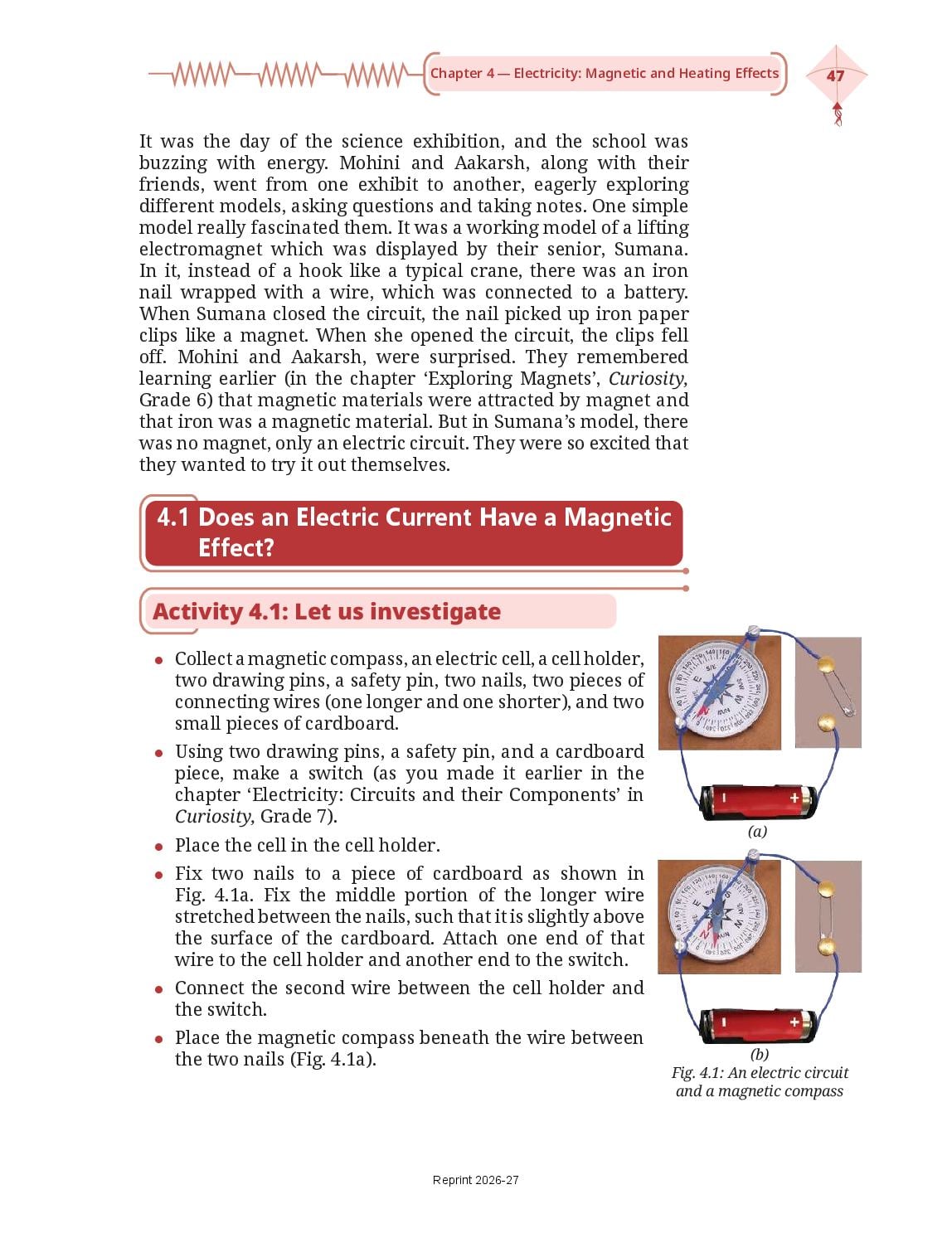
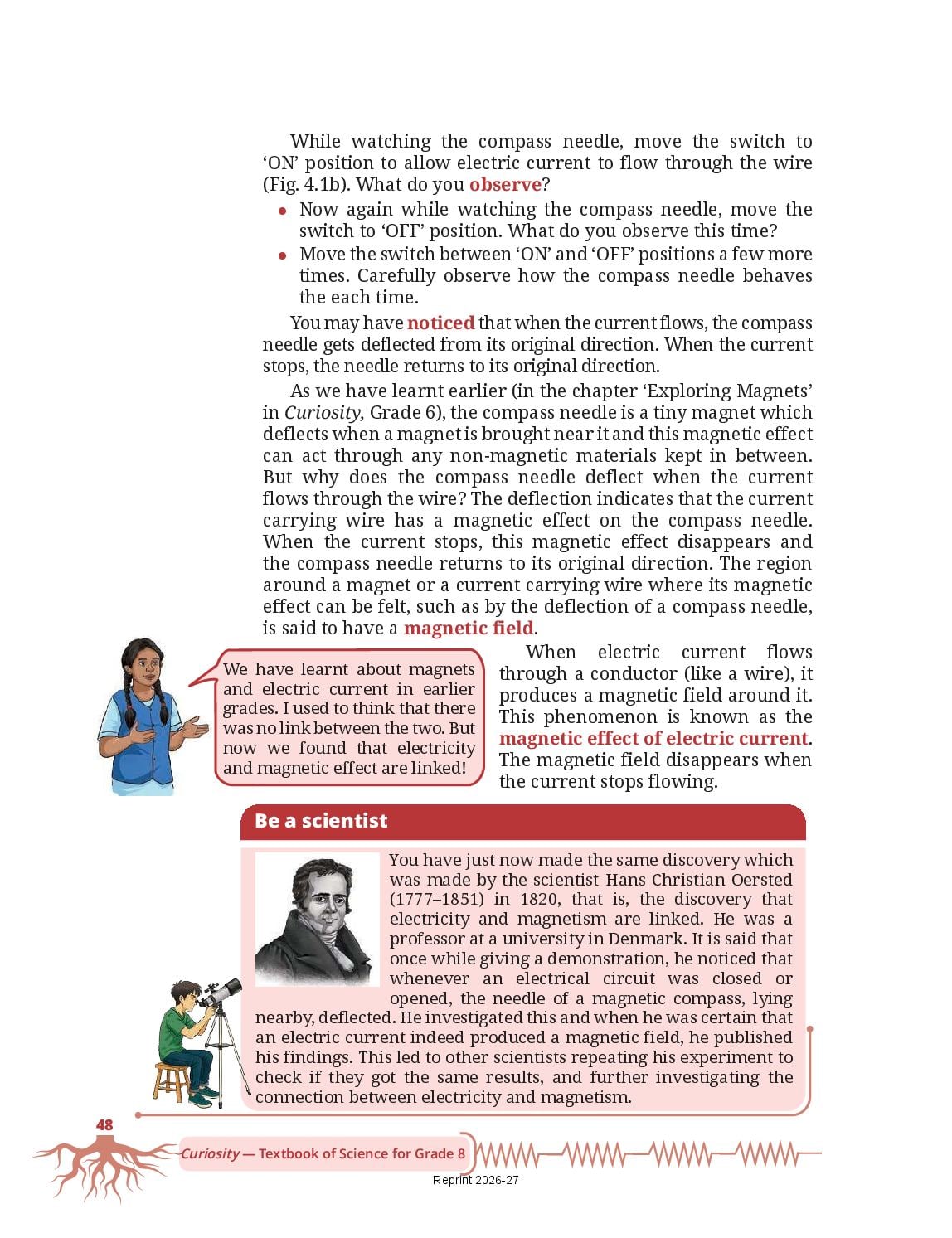
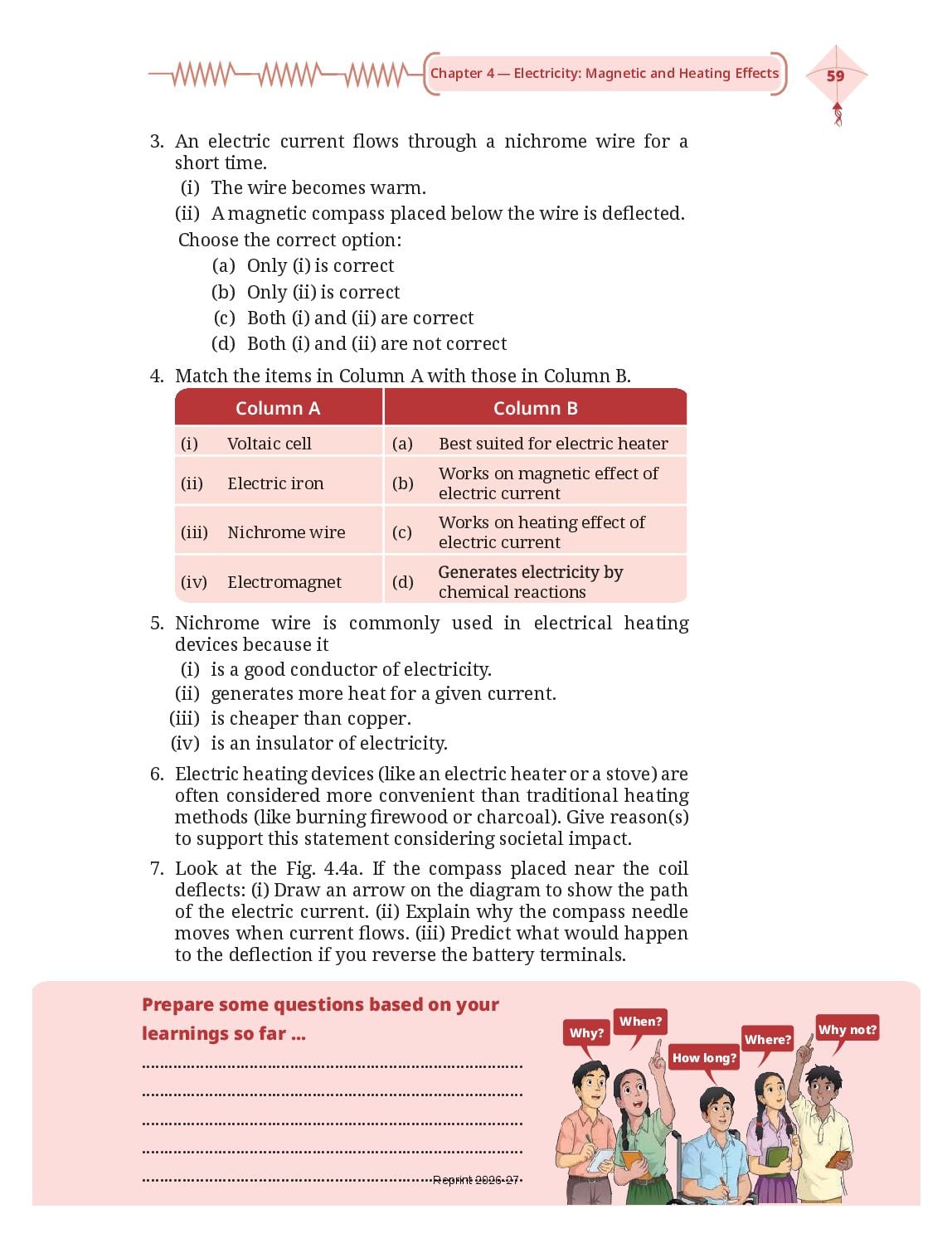
- When an electric current flows through a conductor such as a wire, it produces a magnetic field around it. This is the magnetic effect of electric current, and it is why a compass needle placed under a current carrying wire is deflected. Stop the current and the field disappears at once.
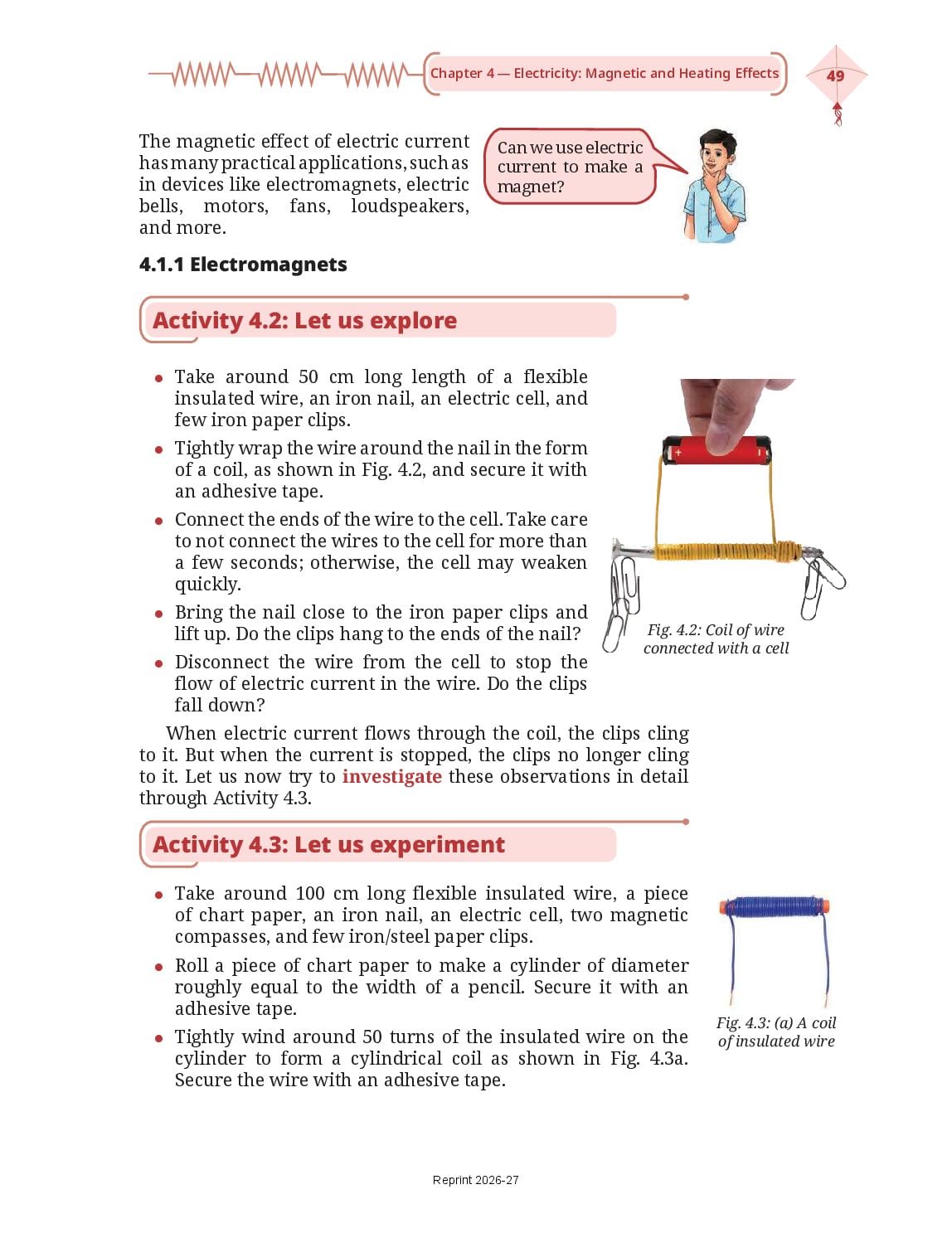
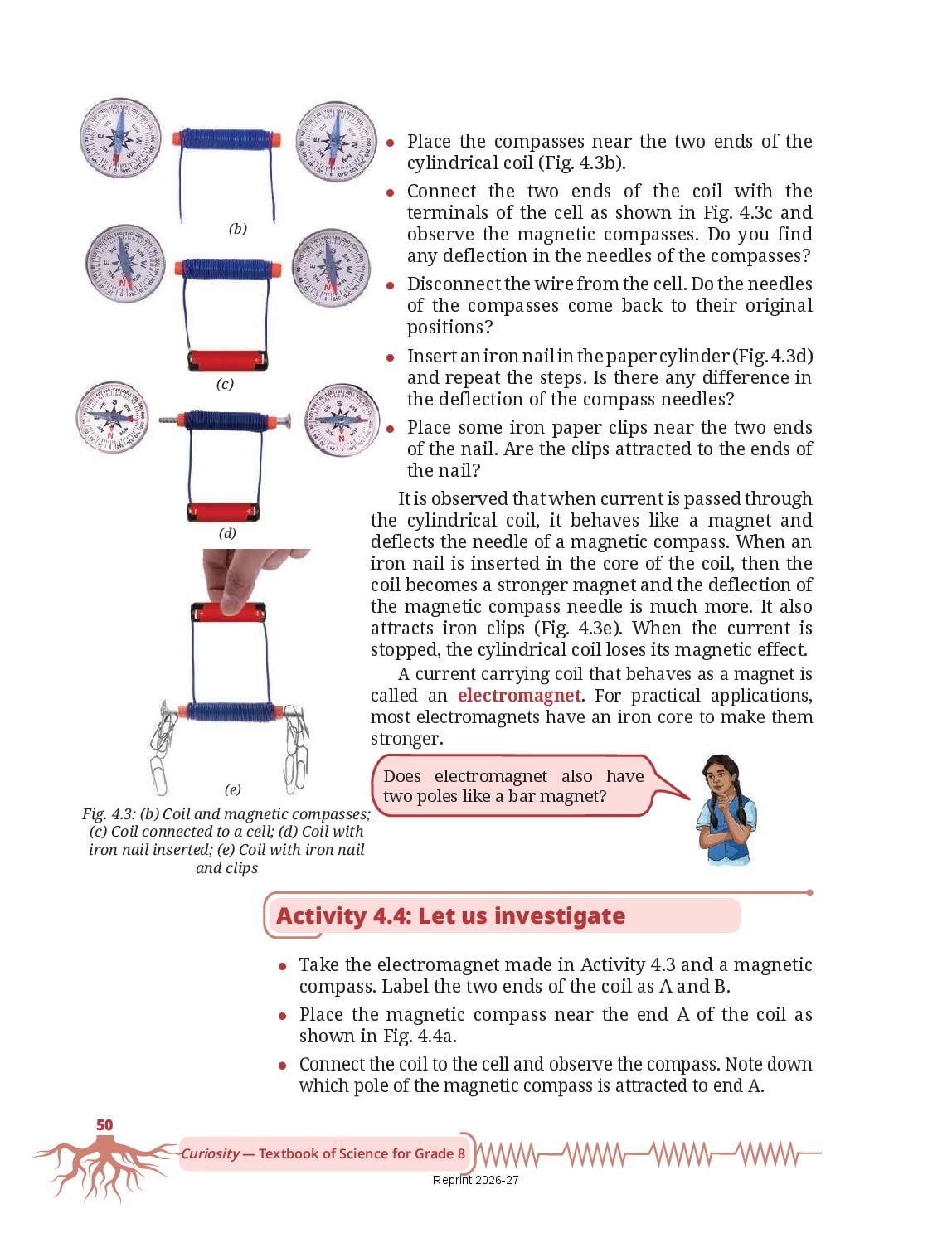
- A current carrying coil that behaves as a magnet is called an electromagnet. Every turn of the coil makes its own magnetic field, and because all the turns are wound the same way these fields point the same way inside the coil and add up — so a coil of 50 turns is far stronger than a single straight wire.
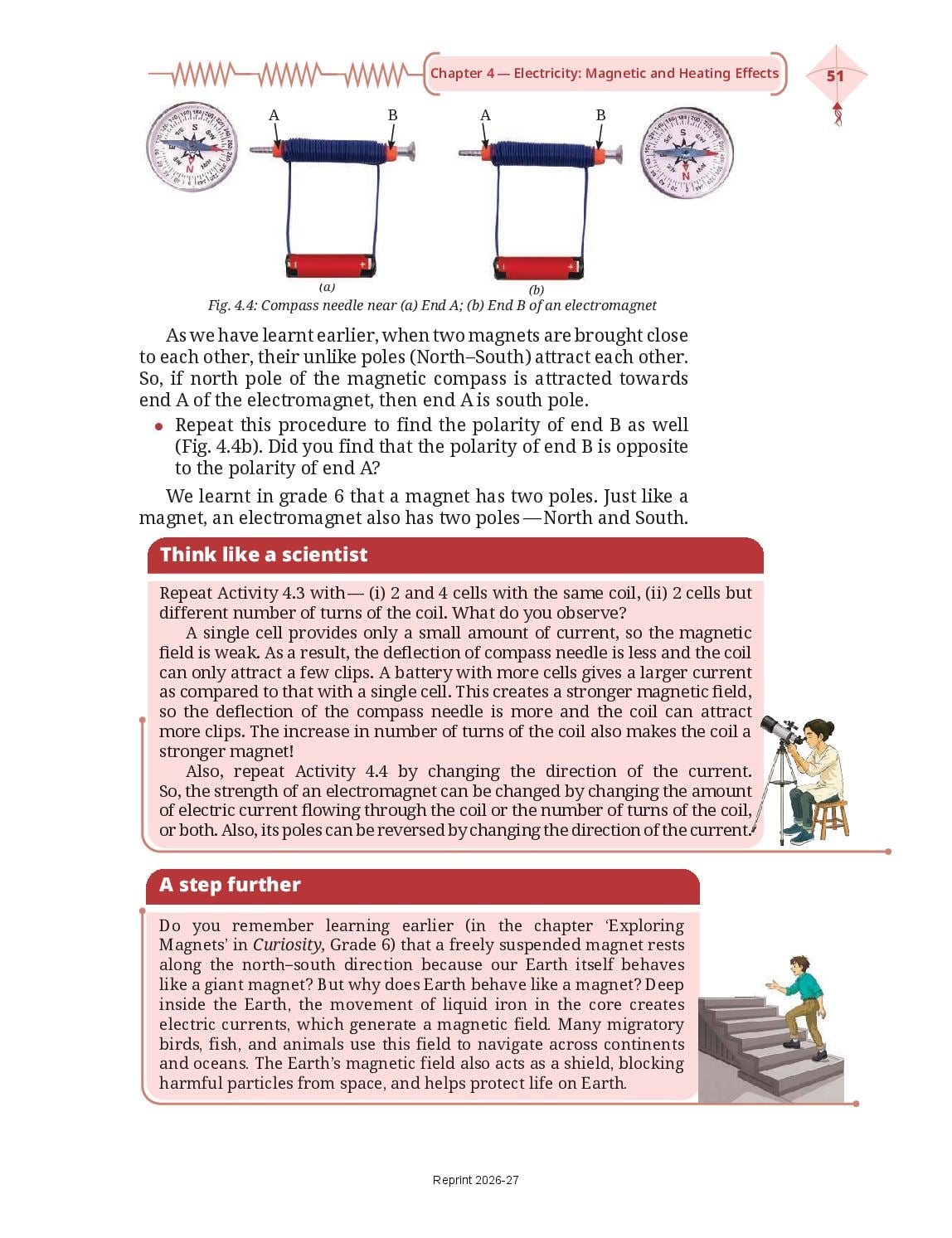
- An electromagnet has a North and a South pole, just like a bar magnet. Its strength is increased by increasing the current (more cells) or the number of turns, and its poles are reversed by reversing the direction of the current. It is a temporary magnet — magnetic only while the current flows.
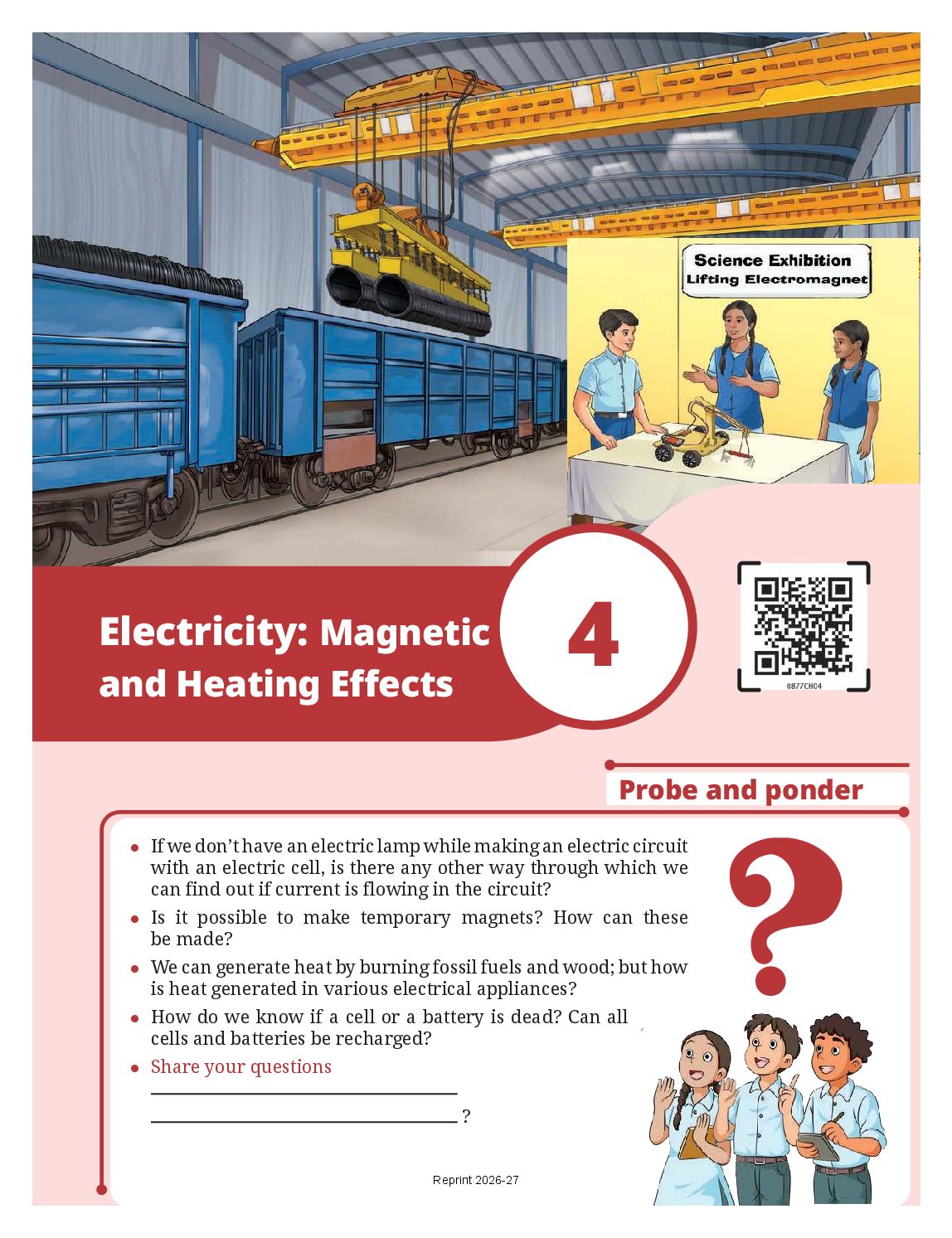
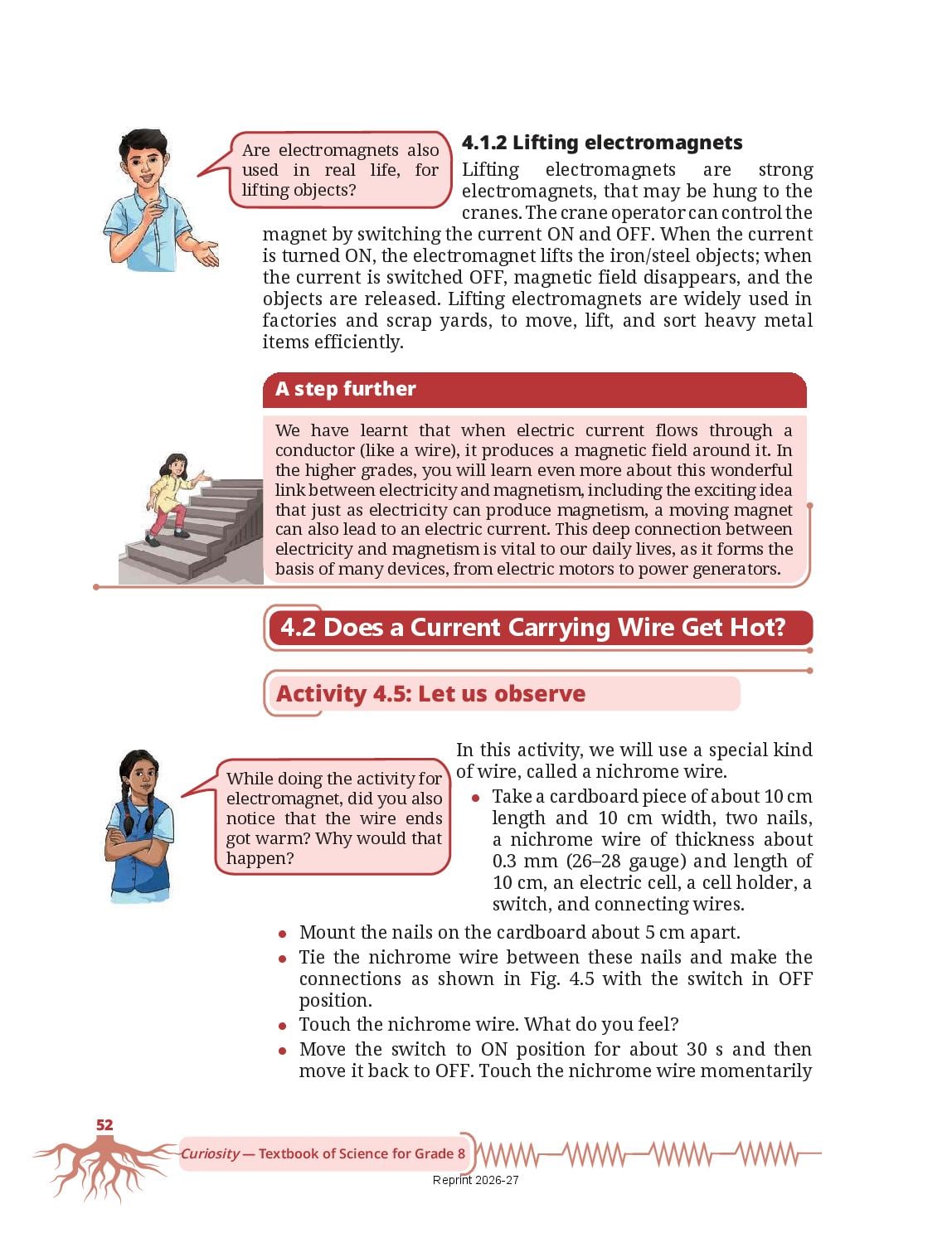
- Most practical electromagnets carry an iron core. Iron is a magnetic material, so inside the coil’s field the iron itself becomes a magnet and its magnetism adds to the coil’s. Lifting electromagnets hung from cranes use this to pick up and drop iron and steel scrap at the flick of a switch.
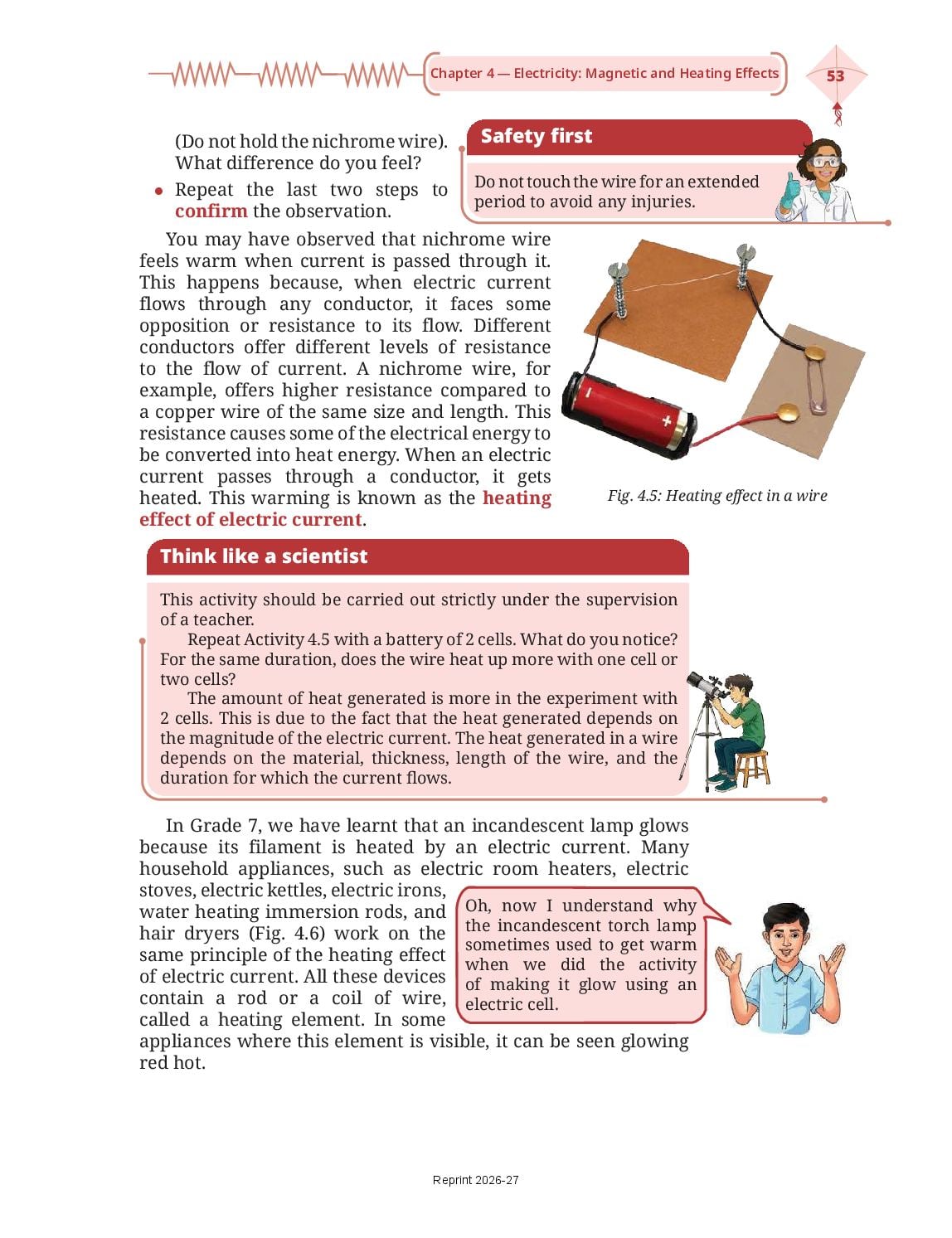
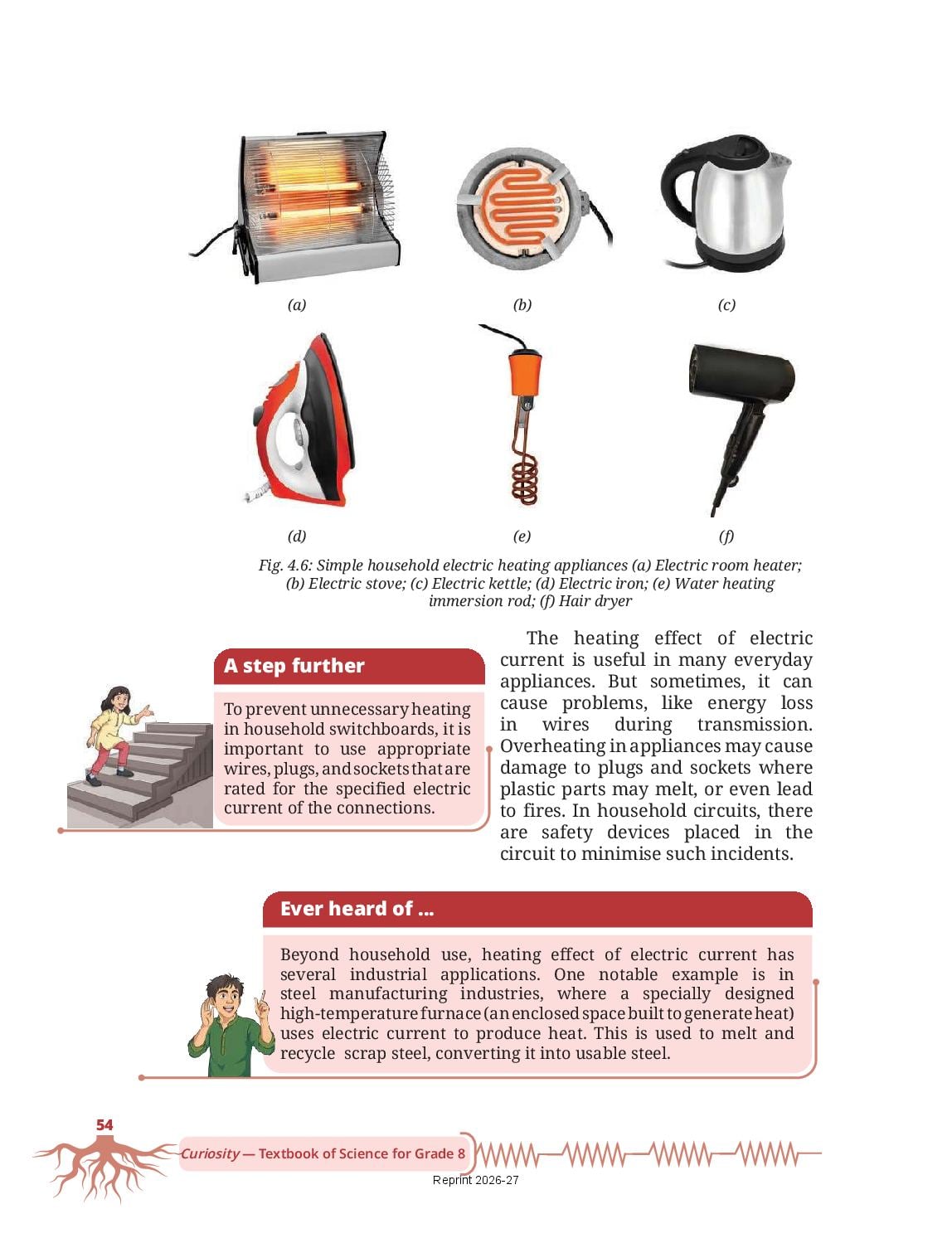
- A conductor offers resistance to the flow of current, and this converts some electrical energy into heat — the heating effect of electric current. Nichrome offers far more resistance than copper of the same size and length, so nichrome is used as the heating element in heaters, stoves, kettles, irons, immersion rods and hair dryers.
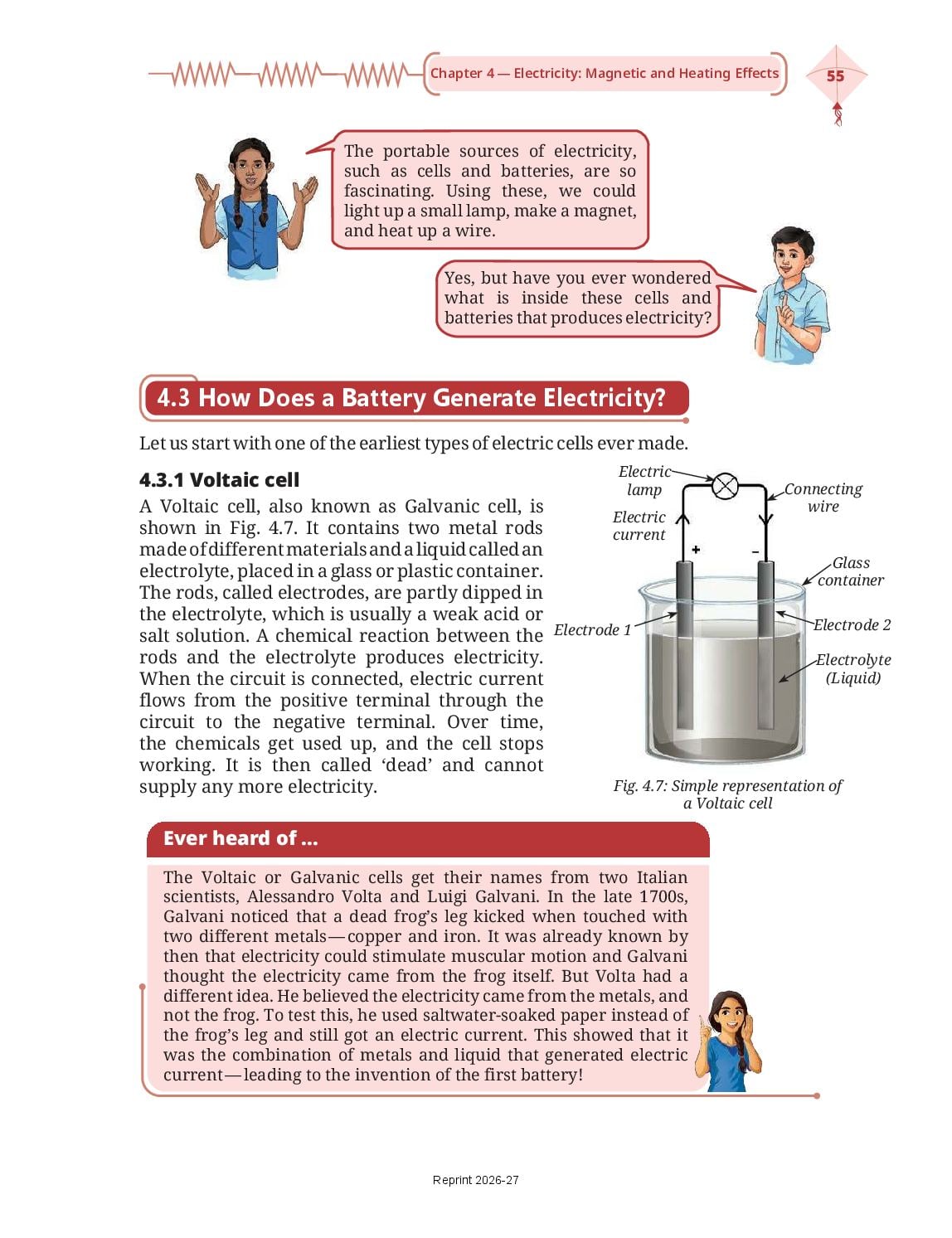
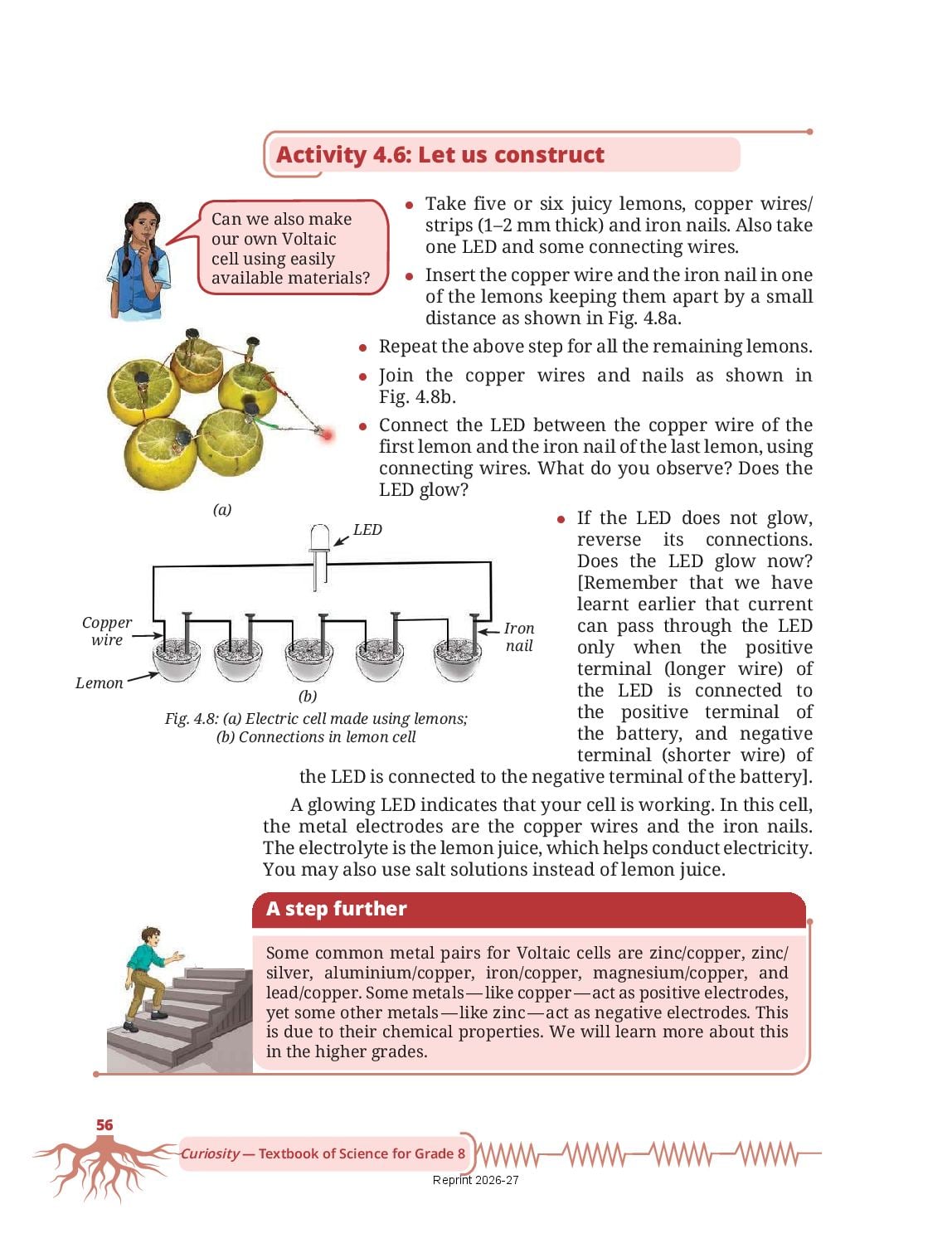
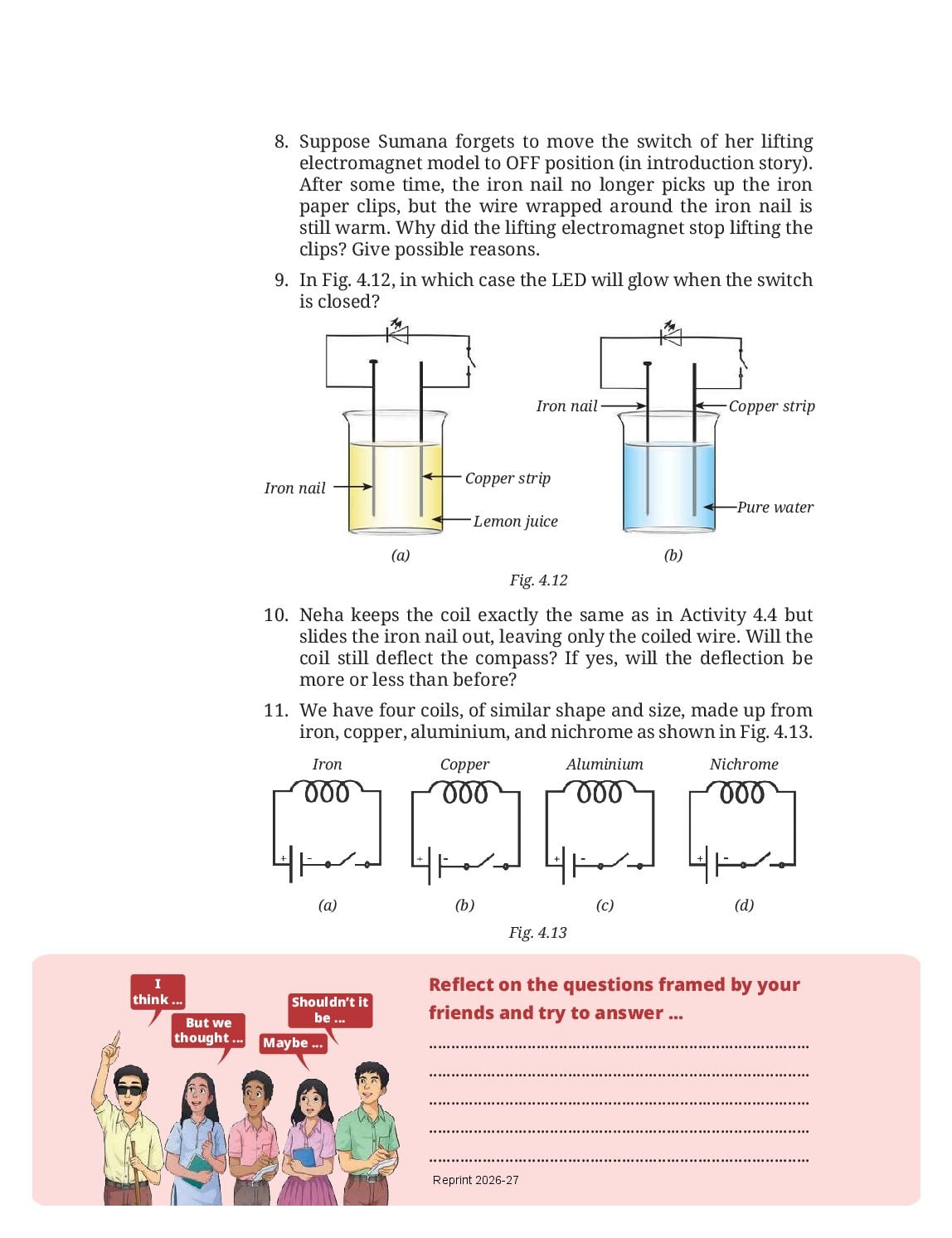
- A Voltaic (Galvanic) cell has two electrodes of different metals dipped in an electrolyte — a weak acid or salt solution. A chemical reaction between the electrodes and the electrolyte produces electricity. When the chemicals are used up, the cell is dead. A lemon with a copper wire and an iron nail is a working Voltaic cell.
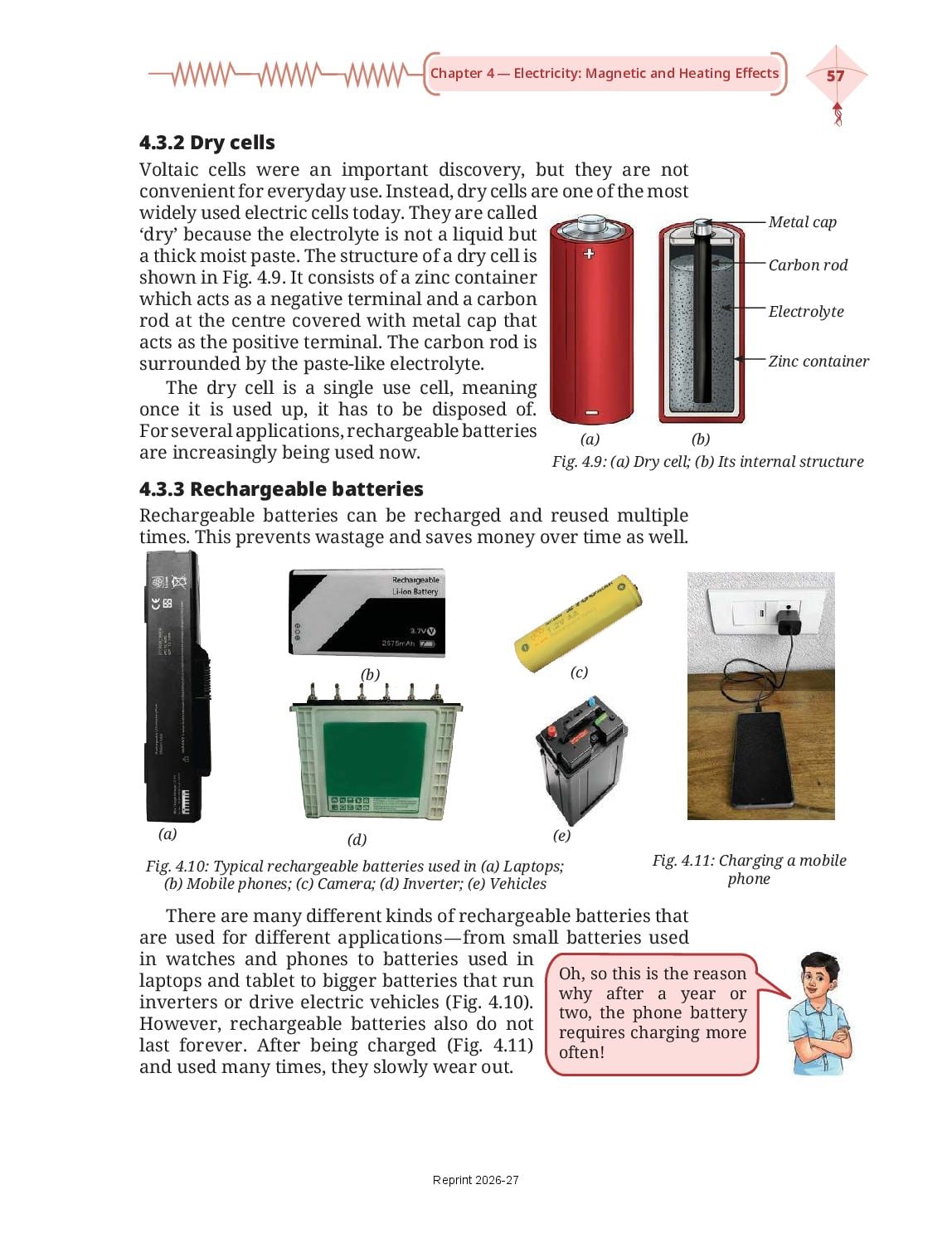
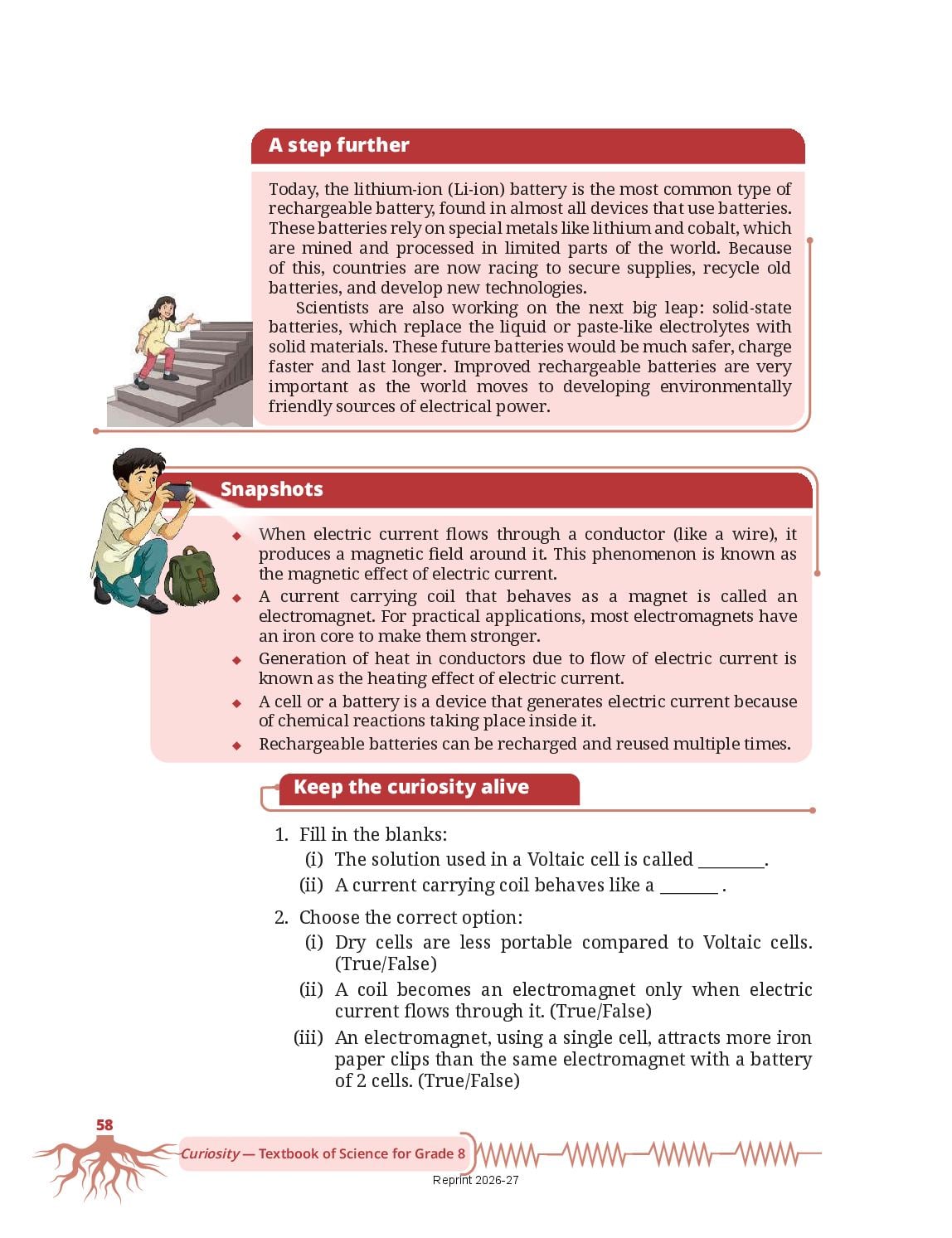
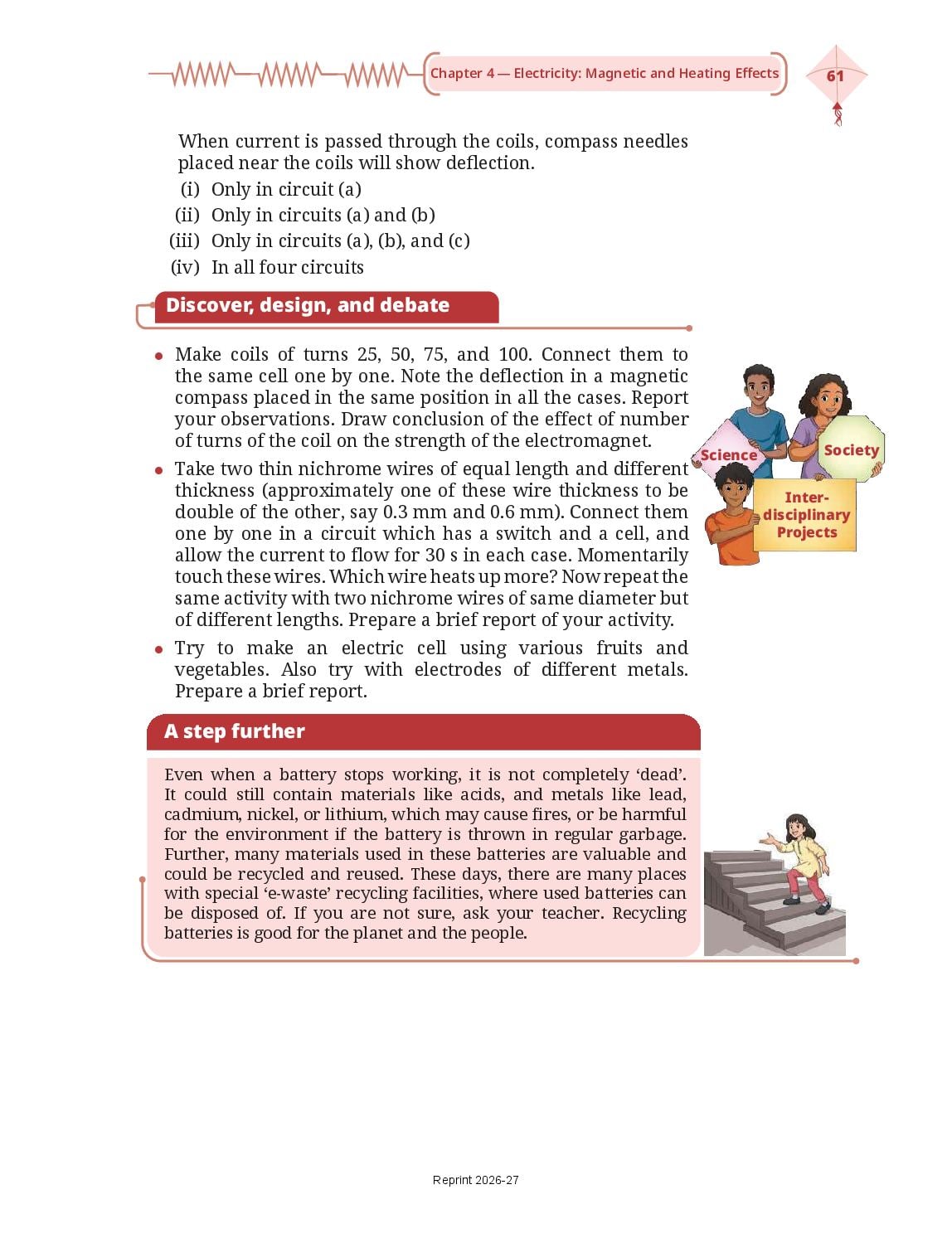
- A dry cell has a zinc container as the negative terminal and a central carbon rod with a metal cap as the positive terminal, surrounded by a thick moist paste of electrolyte. A dry cell is single use; rechargeable batteries can be charged and reused many times, but they too wear out and must be disposed of at an e-waste facility.
Quick revision – Electricity: Magnetic and Heating Effects
| Term | What it means | Where it comes in the chapter | Everyday example |
|---|---|---|---|
| Magnetic field | The region around a magnet or a current carrying wire in which its magnetic effect can be felt | Section 4.1, page 48 | A compass needle turning when it is brought near a magnet |
| Magnetic effect of electric current | The production of a magnetic field around a conductor when current flows through it | Section 4.1, page 48 | The needle of a compass under a wire kicking the moment the switch is closed |
| Electromagnet | A current carrying coil that behaves as a magnet | Section 4.1.1, page 50 | The coil in an electric bell, a fan, a loudspeaker |
| Core | The iron rod or nail placed inside the coil to make the electromagnet stronger | Section 4.1.1, page 50 | The iron nail inside the coil in Activity 4.3 |
| Poles of an electromagnet | The two ends, North and South, whose polarity reverses if the current is reversed | Activity 4.4, pages 50–51 | End A and end B of the coil in Fig. 4.4 |
| Lifting electromagnet | A strong electromagnet hung from a crane, switched ON to lift and OFF to release | Section 4.1.2, page 52 | Sorting scrap iron in a scrap yard or a steel plant |
| Resistance | The opposition a conductor offers to the flow of electric current | Section 4.2, page 53 | Nichrome offers more resistance than copper of the same size and length |
| Heating effect of electric current | The generation of heat in a conductor because current is flowing through it | Section 4.2, page 53 | The filament of an incandescent lamp; a warm charger pin |
| Heating element | The rod or coil of wire in an appliance that is meant to become hot | Page 53 | The red-hot coil of an electric room heater or an electric stove |
| Electrode | One of the two metal rods, of different materials, dipped in the electrolyte of a cell | Section 4.3.1, page 55 | The copper wire and the iron nail in the lemon cell |
| Electrolyte | The liquid or paste — usually a weak acid or a salt solution — in which the electrodes are dipped | Section 4.3.1, page 55 | Lemon juice; salt solution; the moist paste inside a dry cell |
| Dead cell | A cell whose chemicals are used up, so it can supply no more electricity | Page 55 | A torch cell that no longer lights the lamp |
| Dry cell | A single use cell whose electrolyte is a thick moist paste, not a liquid | Section 4.3.2, page 57 | The cell in a wall clock or a TV remote |
| Rechargeable battery | A battery that can be charged and reused many times | Section 4.3.3, page 57 | Mobile phone, laptop, camera, inverter and electric vehicle batteries |
Old NCERT vs New – Class 8 Science
This chapter is from Curiosity, the new NCERT Class 8 Science book (NCF-SE 2023, used from 2025-26). It replaced the old book “Science”, so chapter numbers and names differ from older PDFs.
Solutions and All Chapters
Answers to the exercises and the full chapter list of Curiosity:
Electricity: Magnetic and Heating Effects – Overview
| Class | Class 8 |
| Subject | Science |
| Book | Curiosity – new NCERT book |
| Chapter | 4 of 13 – Electricity: Magnetic and Heating Effects |
| Book pages | 46 – 61 |
| Edition | NCERT Reprint 2026-27 |
| Session | 2026-27 |
| Free – read online or download |
Class 8 Science Chapter 4 – FAQs
Where can I download Electricity: Magnetic and Heating Effects Class 8 PDF?
From the download table on this page – the chapter PDF is free, and the full book is linked too.
What is Class 8 Science Chapter 4 about?
When an electric current flows through a conductor such as a wire, it produces a magnetic field around it. This is the magnetic effect of electric current, and it is why a compass needle placed under a current carrying wire is deflected. Stop the current and the field disappears at once.
Is Electricity: Magnetic and Heating Effects from the new NCERT Class 8 Science book?
Yes. It is chapter 4 of curiosity, the new NCERT Class 8 Science book for 2026-27.
Is this the latest NCERT edition for 2026-27?
Yes – the PDF is NCERT’s latest edition for the 2026-27 session.
Where are the NCERT Solutions for Class 8 Science Chapter 4?
Open the NCERT Solutions link above for answers to the exercise questions.