NCERT Solutions for Class 8 Science Chapter 4 Electricity Magnetic and Heating Effects provide clear, step-by-step answers to every exercise and in-text question from the chapter Electricity Magnetic and Heating Effects of the NCERT textbook Curiosity. Prepared by subject experts as per the latest NCERT (CBSE) syllabus for 2026-27, these NCERT Solutions for Class 8 Science help you understand each concept, write exam-ready answers, and check your own solutions. You can read them online below or download the free Class 8 Science Chapter 4 question-answer PDF.
NCERT Solutions for Class 8 Science Chapter 4 Electricity Magnetic and Heating Effects
- Class: Class 8
- Subject: Science
- Chapter: Chapter 4 – Electricity Magnetic and Heating Effects
- Textbook: Curiosity (NCERT)
- Study material: NCERT Solutions – questions with answers, free PDF
These solutions answer all the exercise questions of Chapter 4 Electricity Magnetic and Heating Effects — including the in-text questions, short-answer and long-answer questions, and activities — with complete explanations so you can follow the method, not just the final answer. Read the full solutions below.
NCERT Solutions Class 8 Science Chapter 4 Electricity Magnetic and Heating Effects View Download


NCERT Solutions for Class 8 Science Chapter 4 PDF Download
You can read the NCERT Solutions for Class 8 Science Chapter 4 online above, or download the complete question-answer PDF to study Electricity Magnetic and Heating Effects offline at any time.
NCERT Solutions for Class 8 Science Chapter 4 PDF Download Link – Click Here to Download Solutions PDF
Questions Covered in This Chapter
These NCERT Solutions answer all 44 questions of this chapter. The questions solved are:
- If we don't have an electric lamp while making an electric circuit with an electric cell, is there any other way through which we can find out if current is flowing in the circuit?
- Is it possible to make temporary magnets? How can these be made?
- We can generate heat by burning fossil fuels and wood; but how is heat generated in various electrical appliances?
- How do we know if a cell or a battery is dead? Can all cells and batteries be recharged?
- Share your questions
- While watching the compass needle, move the switch to 'ON' position to allow electric current to flow through the wire (Fig. 4.1b). What do you observe?
- Now again while watching the compass needle, move the switch to 'OFF' position. What do you observe this time?
- Move the switch between 'ON' and 'OFF' positions a few more times. Carefully observe how the compass needle behaves the each time.
- Can we use electric current to make a magnet?
- Bring the nail close to the iron paper clips and lift up. Do the clips hang to the ends of the nail?
- Disconnect the wire from the cell to stop the flow of electric current in the wire. Do the clips fall down?
- Connect the two ends of the coil with the terminals of the cell as shown in Fig. 4.3c and observe the magnetic compasses. Do you find any deflection in the needles of the compasses?
- Disconnect the wire from the cell. Do the needles of the compasses come back to their original positions?
- Insert an iron nail in the paper cylinder (Fig. 4.3d) and repeat the steps. Is there any difference in the deflection of the compass needles?
- Place some iron paper clips near the two ends of the nail. Are the clips attracted to the ends of the nail?
- Does electromagnet also have two poles like a bar magnet?
- Connect the coil to the cell and observe the compass. Note down which pole of the magnetic compass is attracted to end A.
- Repeat this procedure to find the polarity of end B as well (Fig. 4.4b). Did you find that the polarity of end B is opposite to the polarity of end A?
- Repeat Activity 4.3 with — (i) 2 and 4 cells with the same coil, (ii) 2 cells but different number of turns of the coil. What do you observe?
- Also, repeat Activity 4.4 by changing the direction of the current.
- But why does Earth behave like a magnet?
- Are electromagnets also used in real life, for lifting objects?
- While doing the activity for electromagnet, did you also notice that the wire ends got warm? Why would that happen?
- Touch the nichrome wire. What do you feel?
- Move the switch to ON position for about 30 s and then move it back to OFF. Touch the nichrome wire momentarily (Do not hold the nichrome wire). What difference do you feel?
- Repeat Activity 4.5 with a battery of 2 cells. What do you notice? For the same duration, does the wire heat up more with one cell or two cells?
- Yes, but have you ever wondered what is inside these cells and batteries that produces electricity?
- Can we also make our own Voltaic cell using easily available materials?
- Connect the LED between the copper wire of the first lemon and the iron nail of the last lemon, using connecting wires. What do you observe? Does the LED glow?
- If the LED does not glow, reverse its connections. Does the LED glow now?
- Fill in the blanks: (i) The solution used in a Voltaic cell is called ________. (ii) A current carrying coil behaves like a _______ .
- Choose the correct option: (i) Dry cells are less portable compared to Voltaic cells. (True/False) (ii) A coil becomes an electromagnet only when electric current flows through it. (True/False) (iii) An electromagnet, using a single cell, attracts more iron paper clips than the same electromagnet with a battery of 2 cells. (True/False)
- An electric current flows through a nichrome wire for a short time. (i) The wire becomes warm. (ii) A magnetic compass placed below the wire is deflected. Choose the correct option: (a) Only (i) is correct (b) Only (ii) is correct (c) Both (i) and (ii) are correct (d) Both (i) and (ii) are not correct
- Match the items in Column A with those in Column B. Column A: (i) Voltaic cell (ii) Electric iron (iii) Nichrome wire (iv) Electromagnet. Column B: (a) Best suited for electric heater (b) Works on magnetic effect of electric current (c) Works on heating effect of electric current (d) Generates electricity by chemical reactions
- Nichrome wire is commonly used in electrical heating devices because it (i) is a good conductor of electricity. (ii) generates more heat for a given current. (iii) is cheaper than copper. (iv) is an insulator of electricity.
- Electric heating devices (like an electric heater or a stove) are often considered more convenient than traditional heating methods (like burning firewood or charcoal). Give reason(s) to support this statement considering societal impact.
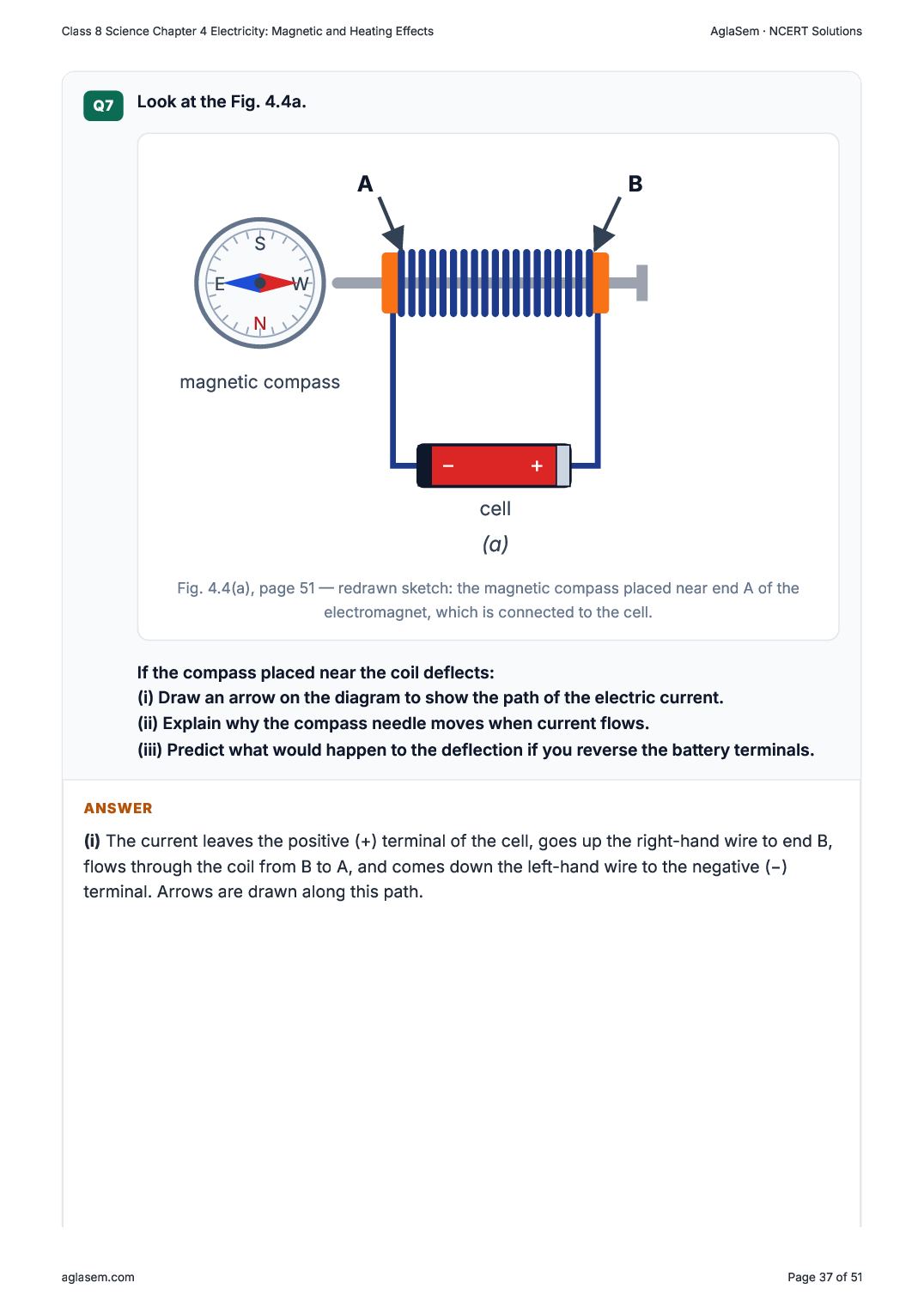
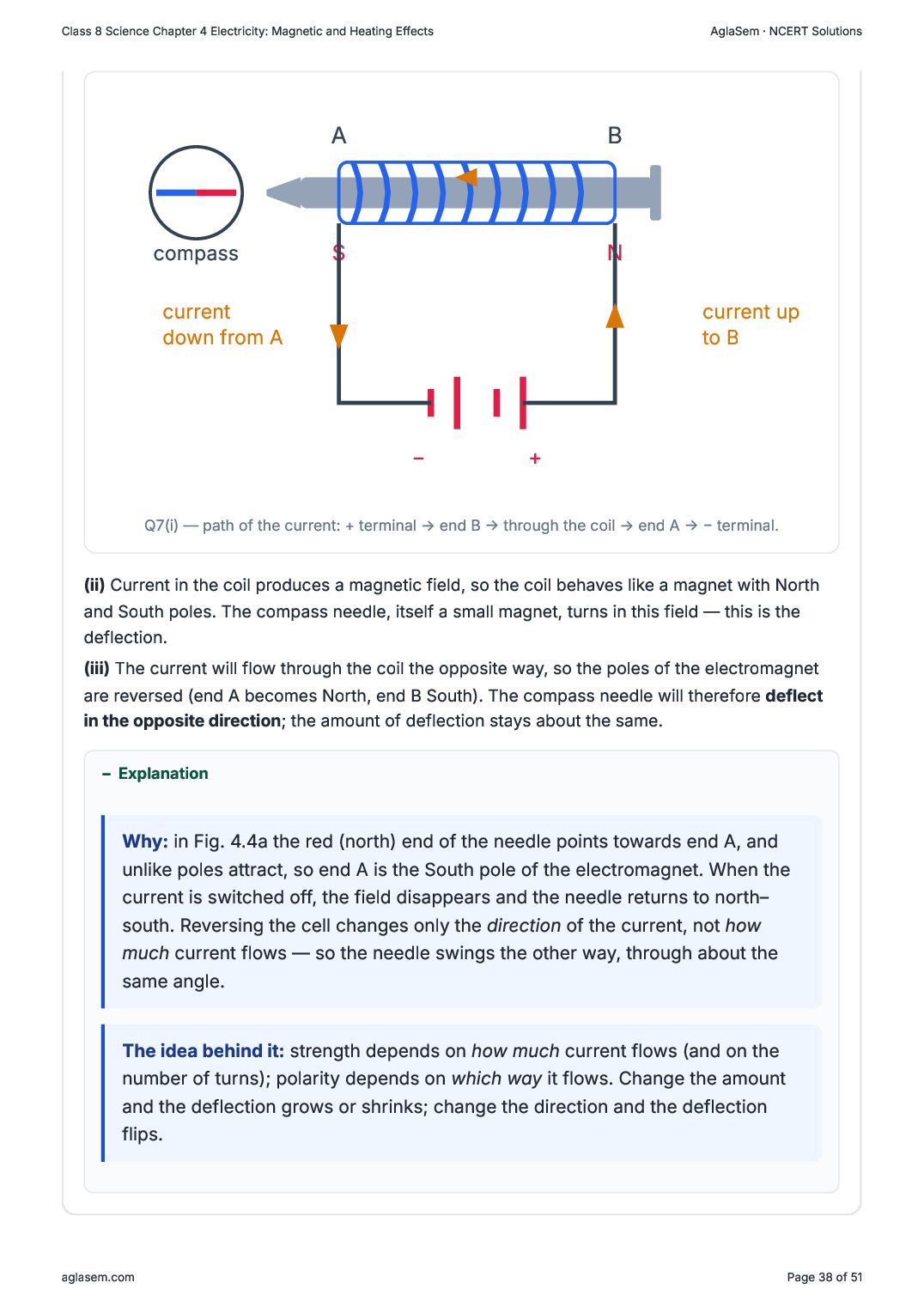
- Look at the Fig. 4.4a. If the compass placed near the coil deflects: (i) Draw an arrow on the diagram to show the path of the electric current. (ii) Explain why the compass needle moves when current flows. (iii) Predict what would happen to the deflection if you reverse the battery terminals.
- Suppose Sumana forgets to move the switch of her lifting electromagnet model to OFF position (in introduction story). After some time, the iron nail no longer picks up the iron paper clips, but the wire wrapped around the iron nail is still warm. Why did the lifting electromagnet stop lifting the clips? Give possible reasons.
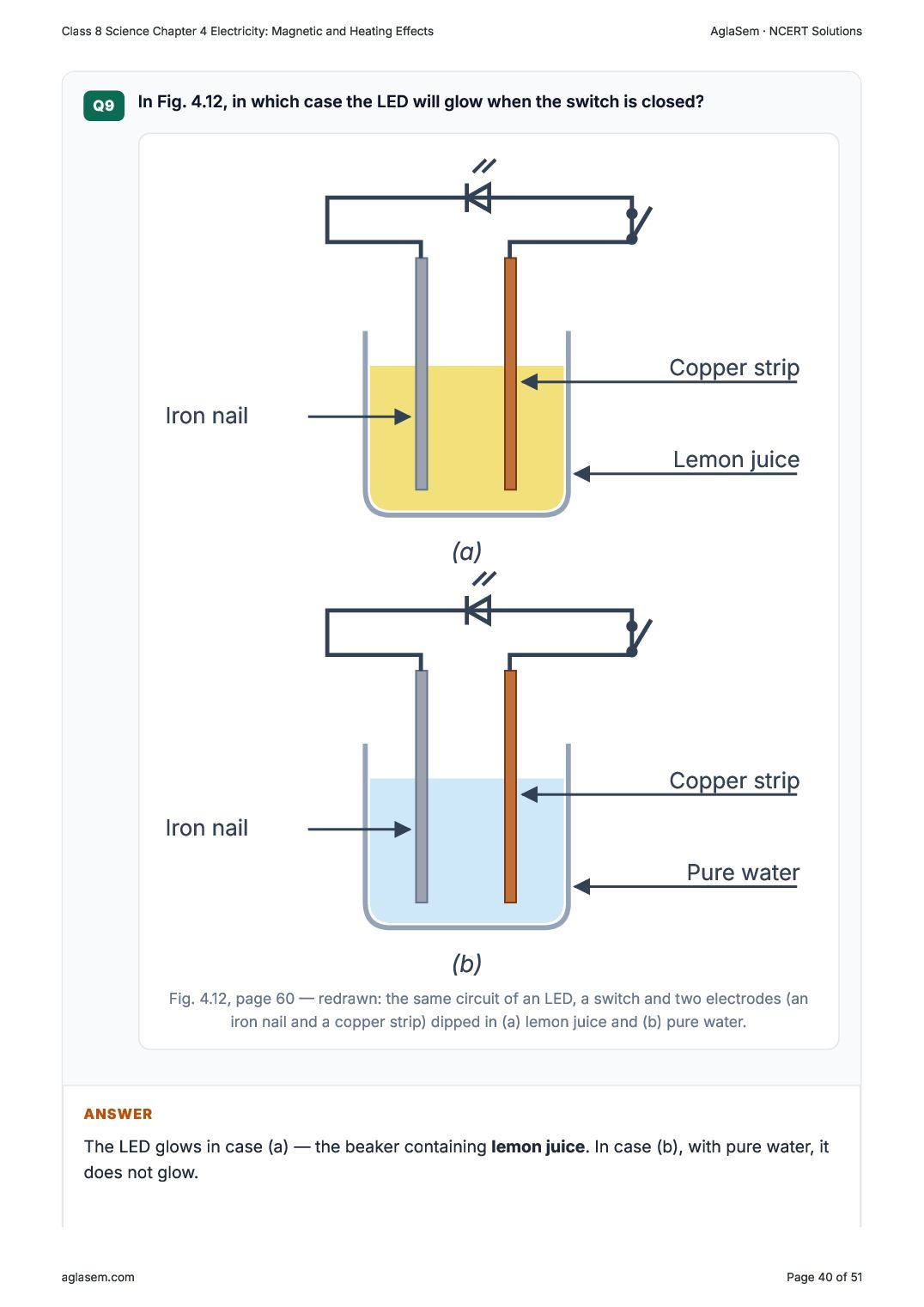
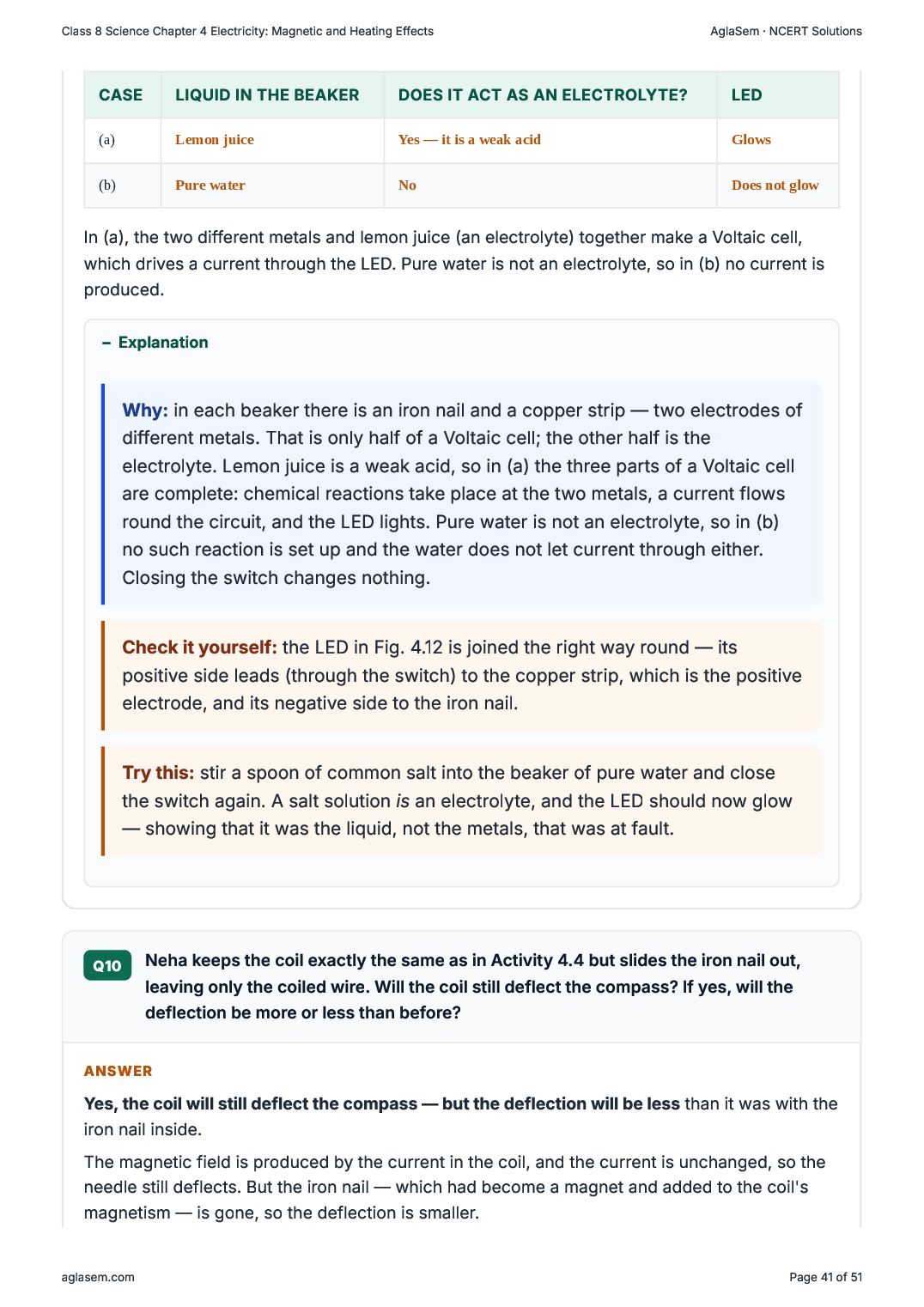
- In Fig. 4.12, in which case the LED will glow when the switch is closed?
- Neha keeps the coil exactly the same as in Activity 4.4 but slides the iron nail out, leaving only the coiled wire. Will the coil still deflect the compass? If yes, will the deflection be more or less than before?
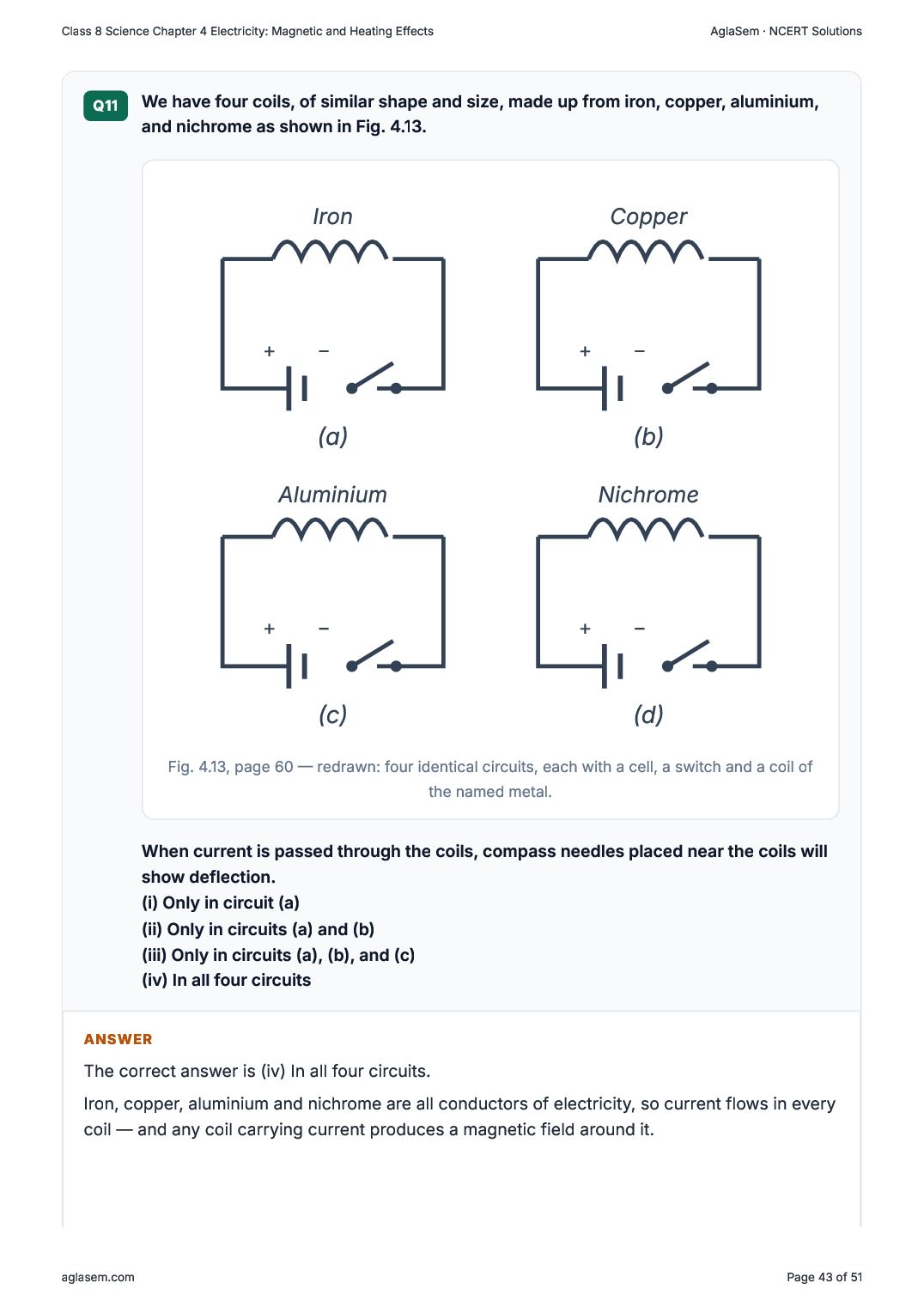
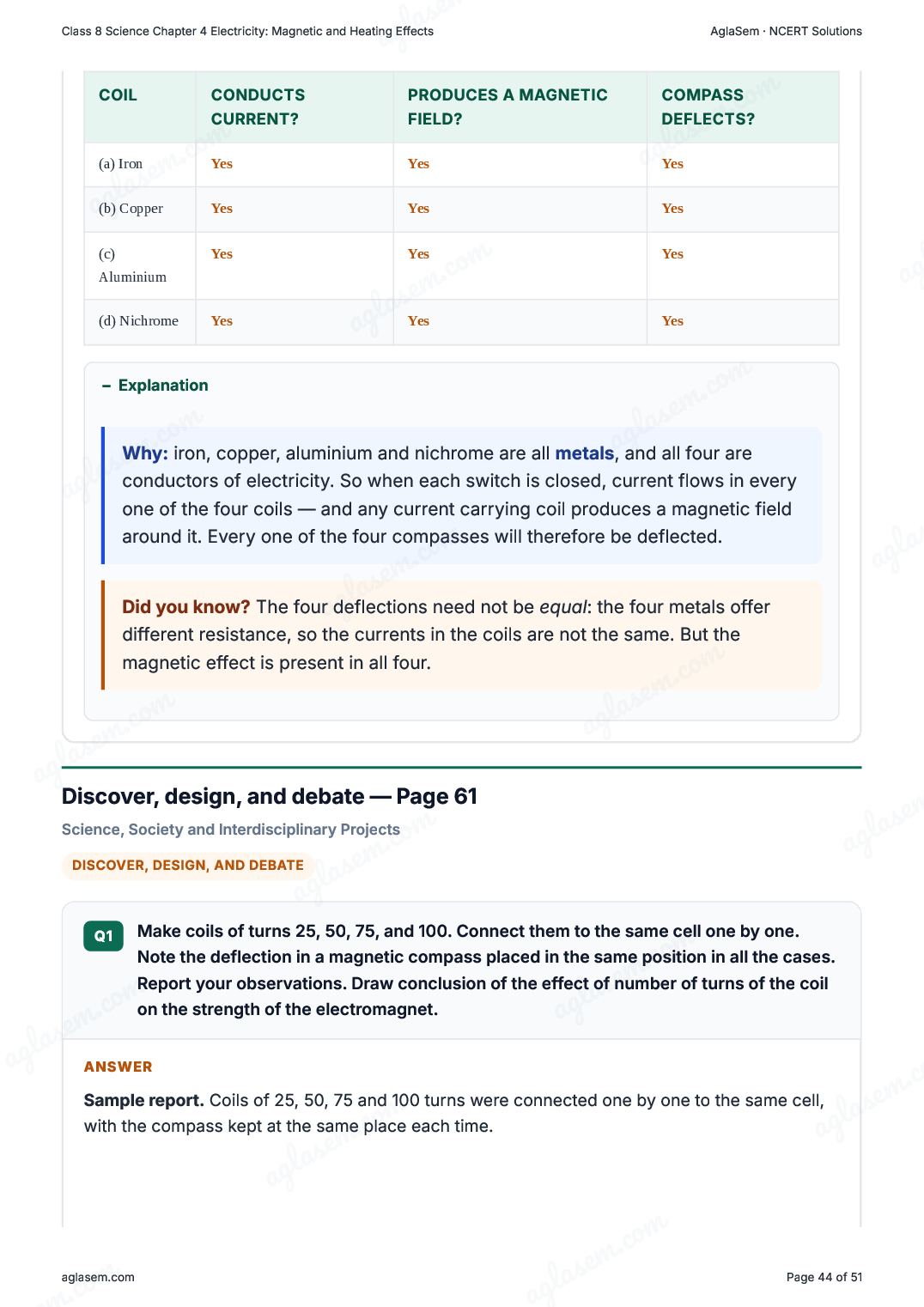
- We have four coils, of similar shape and size, made up from iron, copper, aluminium, and nichrome as shown in Fig. 4.13. When current is passed through the coils, compass needles placed near the coils will show deflection. (i) Only in circuit (a) (ii) Only in circuits (a) and (b) (iii) Only in circuits (a), (b), and (c) (iv) In all four circuits
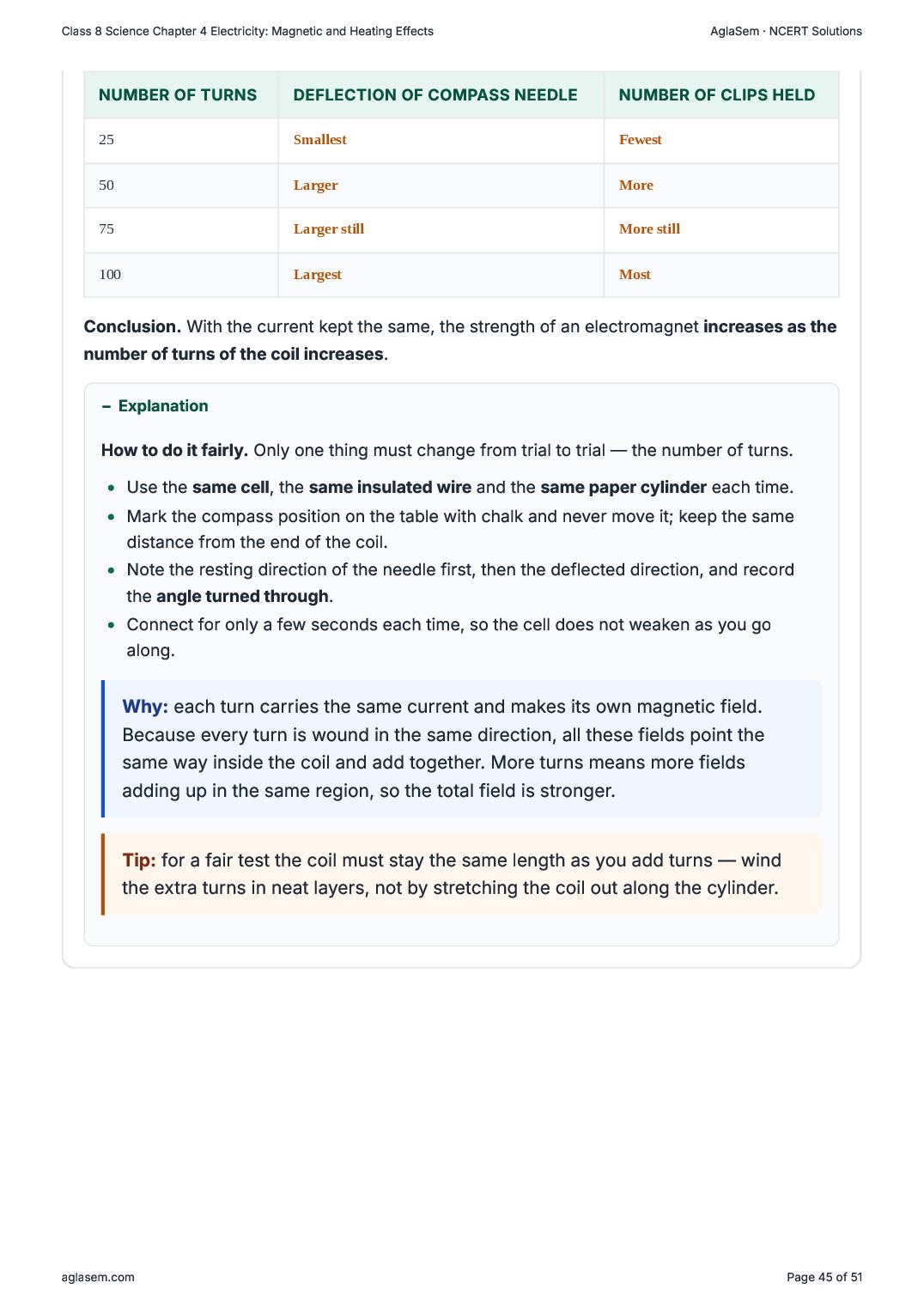
- Make coils of turns 25, 50, 75, and 100. Connect them to the same cell one by one. Note the deflection in a magnetic compass placed in the same position in all the cases. Report your observations. Draw conclusion of the effect of number of turns of the coil on the strength of the electromagnet.
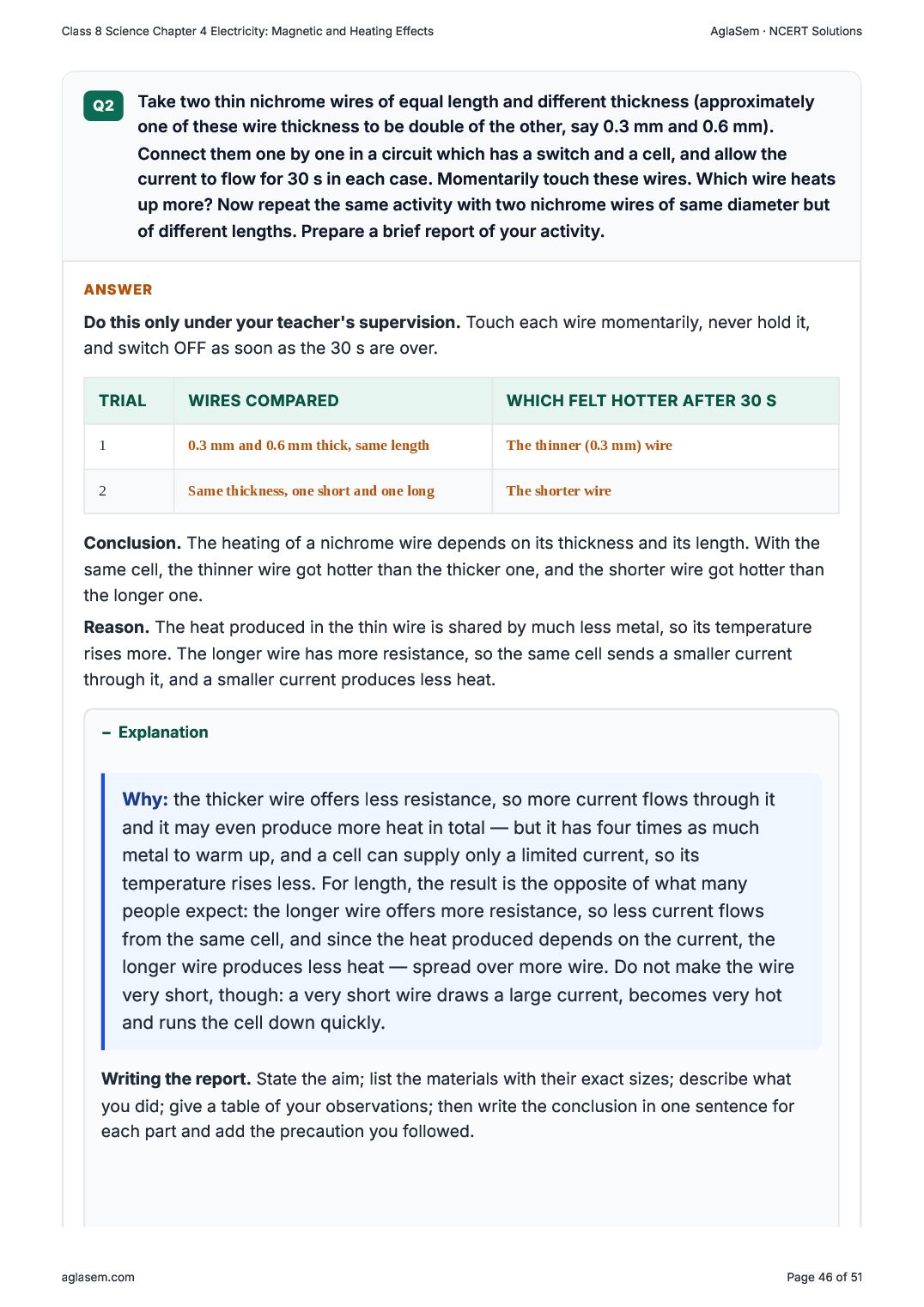
- Take two thin nichrome wires of equal length and different thickness (approximately one of these wire thickness to be double of the other, say 0.3 mm and 0.6 mm). Connect them one by one in a circuit which has a switch and a cell, and allow the current to flow for 30 s in each case. Momentarily touch these wires. Which wire heats up more? Now repeat the same activity with two nichrome wires of same diameter but of different lengths. Prepare a brief report of your activity.
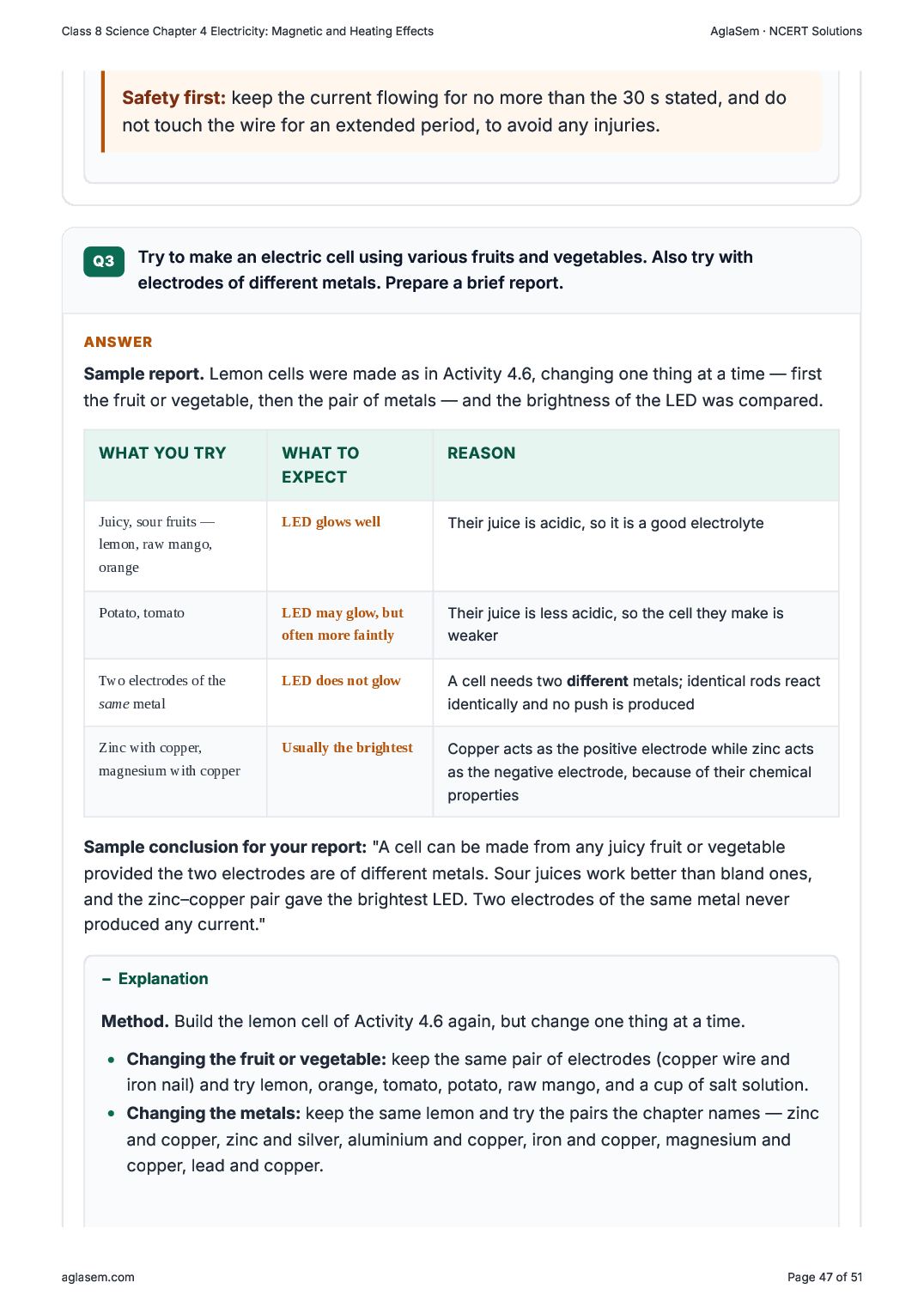
- Try to make an electric cell using various fruits and vegetables. Also try with electrodes of different metals. Prepare a brief report.
Chapter at a Glance
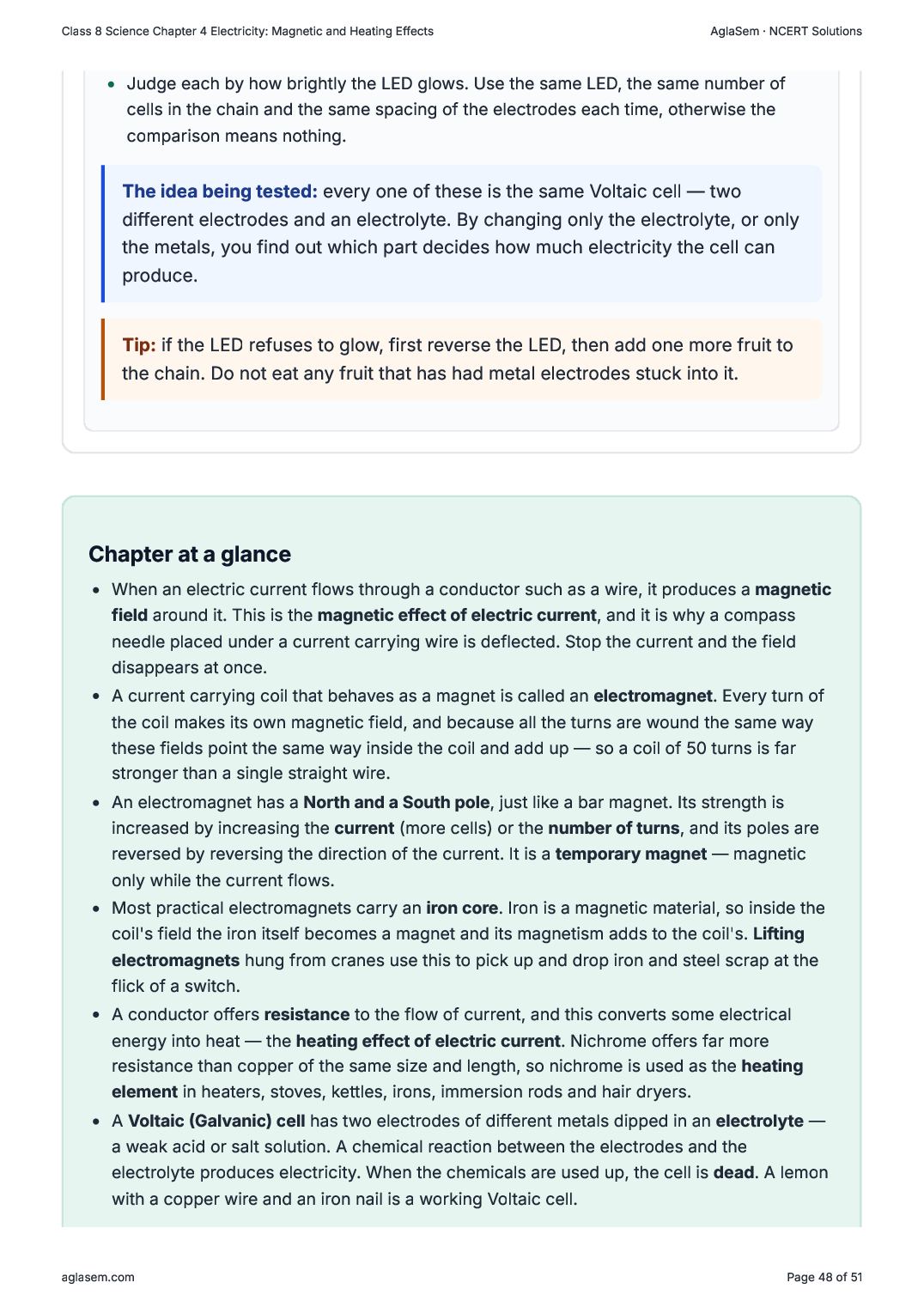
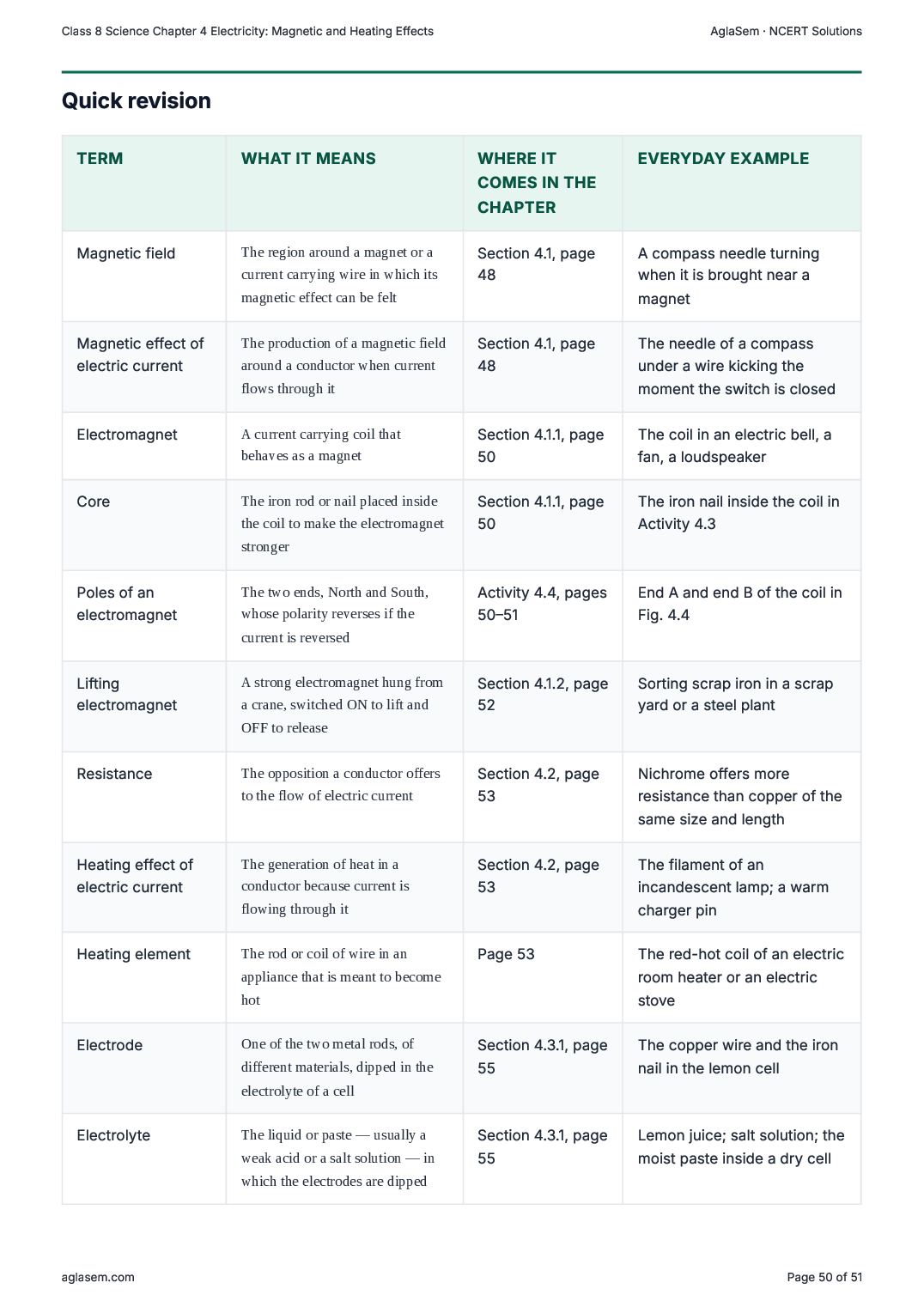
- When an electric current flows through a conductor such as a wire, it produces a magnetic field around it. This is the magnetic effect of electric current , and it is why a compass needle placed under a current carrying wire is deflected. Stop the current and the field disappears at once.
- A current carrying coil that behaves as a magnet is called an electromagnet . Every turn of the coil makes its own magnetic field, and because all the turns are wound the same way these fields point the same way inside the coil and add up — so a coil of 50 turns is far stronger than a single straight wire.
- An electromagnet has a North and a South pole , just like a bar magnet. Its strength is increased by increasing the current (more cells) or the number of turns , and its poles are reversed by reversing the direction of the current. It is a temporary magnet — magnetic only while the current flows.
- Most practical electromagnets carry an iron core . Iron is a magnetic material, so inside the coil's field the iron itself becomes a magnet and its magnetism adds to the coil's. Lifting electromagnets hung from cranes use this to pick up and drop iron and steel scrap at the flick of a switch.
- A conductor offers resistance to the flow of current, and this converts some electrical energy into heat — the heating effect of electric current . Nichrome offers far more resistance than copper of the same size and length, so nichrome is used as the heating element in heaters, stoves, kettles, irons, immersion rods and hair dryers.
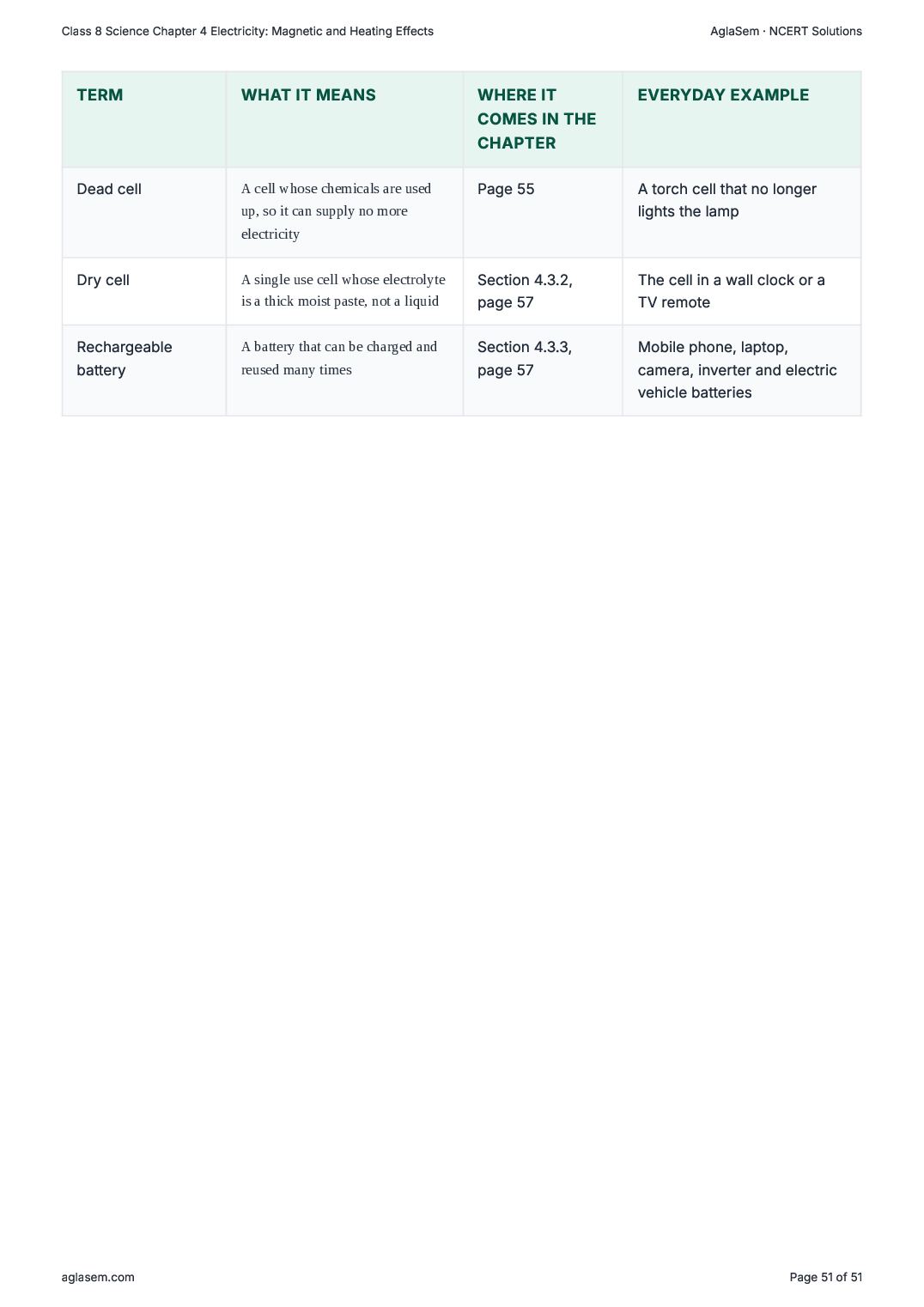
- A Voltaic (Galvanic) cell has two electrodes of different metals dipped in an electrolyte — a weak acid or salt solution. A chemical reaction between the electrodes and the electrolyte produces electricity. When the chemicals are used up, the cell is dead . A lemon with a copper wire and an iron nail is a working Voltaic cell.
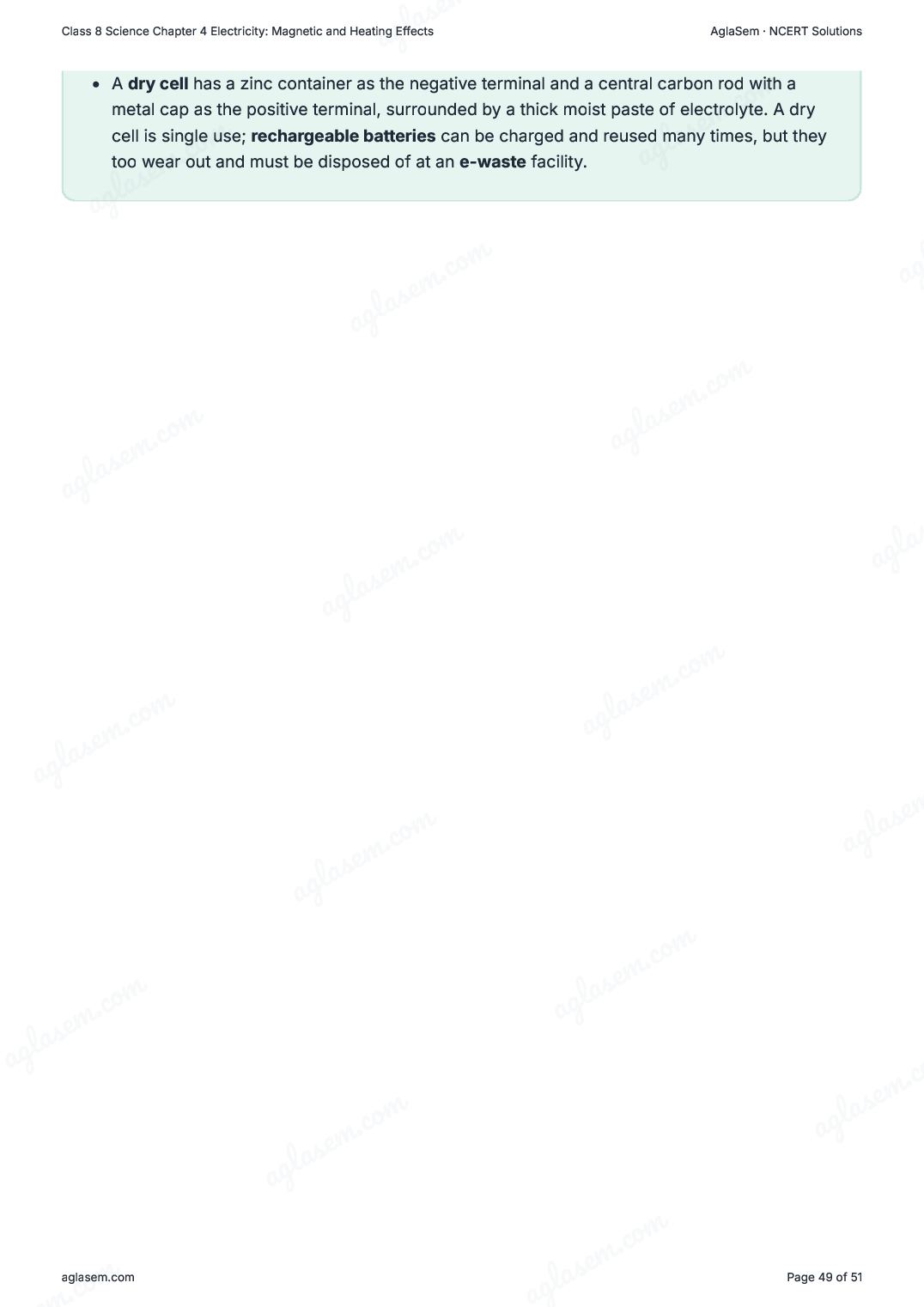
- A dry cell has a zinc container as the negative terminal and a central carbon rod with a metal cap as the positive terminal, surrounded by a thick moist paste of electrolyte. A dry cell is single use; rechargeable batteries can be charged and reused many times, but they too wear out and must be disposed of at an e-waste facility.
How to Download NCERT Solutions for Class 8 Science Chapter 4 PDF
Follow these simple steps to get the Electricity Magnetic and Heating Effects questions-and-answers PDF from Curiosity.
- Search NCERT Solutions for Class 8 Science Chapter 4 aglasem and open this page.
- Read the exercise questions with answers for Electricity Magnetic and Heating Effects shown above.
- Click the Download PDF link to save the Electricity Magnetic and Heating Effects solutions to your device.
NCERT Solutions for Class 8 Science – All Chapters
There are more chapters to study besides Electricity Magnetic and Heating Effects in Science. Here are the NCERT Solutions for all chapters of Class 8 Science.
- Chapter 1 Exploring the Investigative World of Science
- Chapter 2 The Invisible Living World Beyond Our Naked Eye
- Chapter 3 Health the Ultimate Treasure
- Chapter 4 Electricity Magnetic and Heating Effects
- Chapter 5 Exploring Forces
- Chapter 6 Pressure Winds Storms and Cyclones
- Chapter 7 Particulate Nature of Matter
- Chapter 8 Nature of Matter Elements Compounds and Mixtures
- Chapter 9 The Amazing World of Solutes Solvents and Solutions
- Chapter 10 Light Mirrors and Lenses
- Chapter 11 Keeping Time with the Skies
- Chapter 12 How Nature Works in Harmony
- Chapter 13 Our Home Earth a Unique Life Sustaining Planet
NCERT Solutions for Class 8 – All Subjects
Just like Chapter 4 of Science, you can get the exercise questions with answers for every other subject of Class 8. Here are the NCERT Solutions for all subjects of Class 8.
NCERT Solutions for Class 8 Science Chapter 4 – An Overview
The key highlights of this study material are as follows.
| Aspects | Details |
|---|---|
| Class | Class 8 |
| Subject | Science |
| Chapter Number | Chapter 4 |
| Chapter Name | Electricity Magnetic and Heating Effects |
| Book Name | Curiosity |
| Book By | NCERT (National Council of Educational Research and Training) |
| Educational Resource Here | NCERT Solutions of Class 8 Science Chapter 4 for all exercises |
| More Questions Answers of This Subject | NCERT Solutions for Class 8 Science |
| Download Book Chapter | NCERT Book Class 8 Science |
| All Questions Answers For This Class | NCERT Solutions for Class 8 |
| Complete Solutions | NCERT Solutions |
NCERT Solutions for Class 8 Science Chapter 4 Electricity Magnetic and Heating Effects – FAQs
What are the NCERT Solutions for Class 8 Science Chapter 4 Electricity Magnetic and Heating Effects?
They are the complete, step-by-step answers to all the exercise and in-text questions of Chapter 4 Electricity Magnetic and Heating Effects from the NCERT Class 8 Science textbook Curiosity, written by experts as per the latest NCERT syllabus.
How can I download the Class 8 Science Chapter 4 solutions PDF for free?
Open this page on aglasem, read the Electricity Magnetic and Heating Effects questions with answers, and click the “Download Solutions PDF” link. The Class 8 Science Chapter 4 NCERT Solutions PDF is completely free to download.
Are these NCERT Solutions as per the latest 2026-27 syllabus?
Yes. The NCERT Solutions for Class 8 Science Chapter 4 are based on the latest NCERT textbook Curiosity and the current 2026-27 CBSE syllabus, so the questions and answers match what you study in class.
Where can I get NCERT Solutions for the other chapters of Class 8 Science?
You can find the answers to every chapter on the NCERT Solutions for Class 8 Science page, and solutions for every subject on the NCERT Solutions for Class 8 page.
How do NCERT Solutions help in exam preparation?
They show the correct method to solve each question, help you write answers the way they are expected in exams, let you check and correct your own work, and save revision time — which together improve your marks in Class 8 Science.
If you have any queries on NCERT Solutions for Class 8 Science Chapter 4 Electricity Magnetic and Heating Effects, then please ask in the comments below.