NCERT Solutions for Class 8 Science Chapter 6 Pressure Winds Storms and Cyclones provide clear, step-by-step answers to every exercise and in-text question from the chapter Pressure Winds Storms and Cyclones of the NCERT textbook Curiosity. Prepared by subject experts as per the latest NCERT (CBSE) syllabus for 2026-27, these NCERT Solutions for Class 8 Science help you understand each concept, write exam-ready answers, and check your own solutions. You can read them online below or download the free Class 8 Science Chapter 6 question-answer PDF.
NCERT Solutions for Class 8 Science Chapter 6 Pressure Winds Storms and Cyclones
- Class: Class 8
- Subject: Science
- Chapter: Chapter 6 – Pressure Winds Storms and Cyclones
- Textbook: Curiosity (NCERT)
- Study material: NCERT Solutions – questions with answers, free PDF
These solutions answer all the exercise questions of Chapter 6 Pressure Winds Storms and Cyclones — including the in-text questions, short-answer and long-answer questions, and activities — with complete explanations so you can follow the method, not just the final answer. Read the full solutions below.
NCERT Solutions Class 8 Science Chapter 6 Pressure Winds Storms and Cyclones View Download
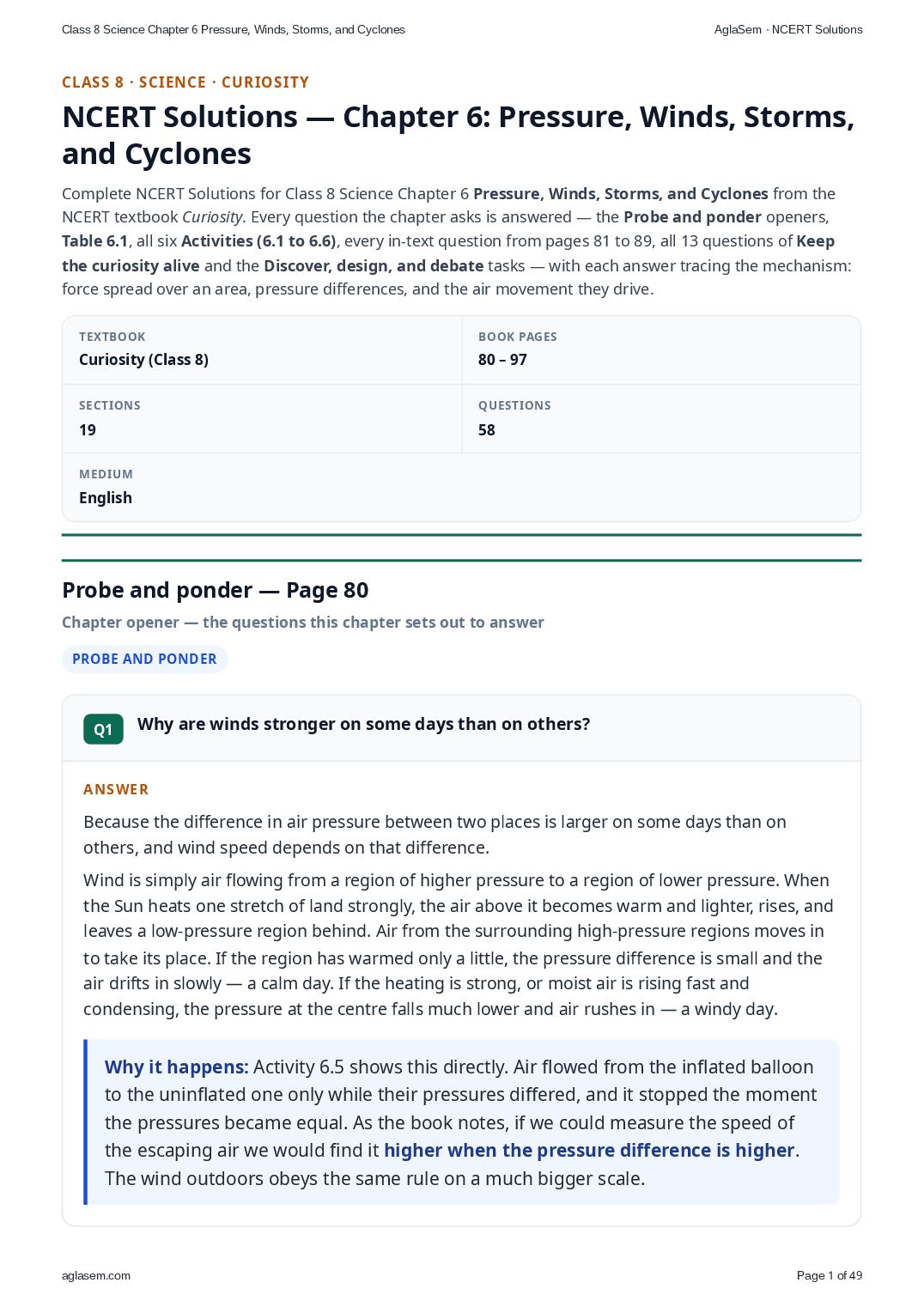
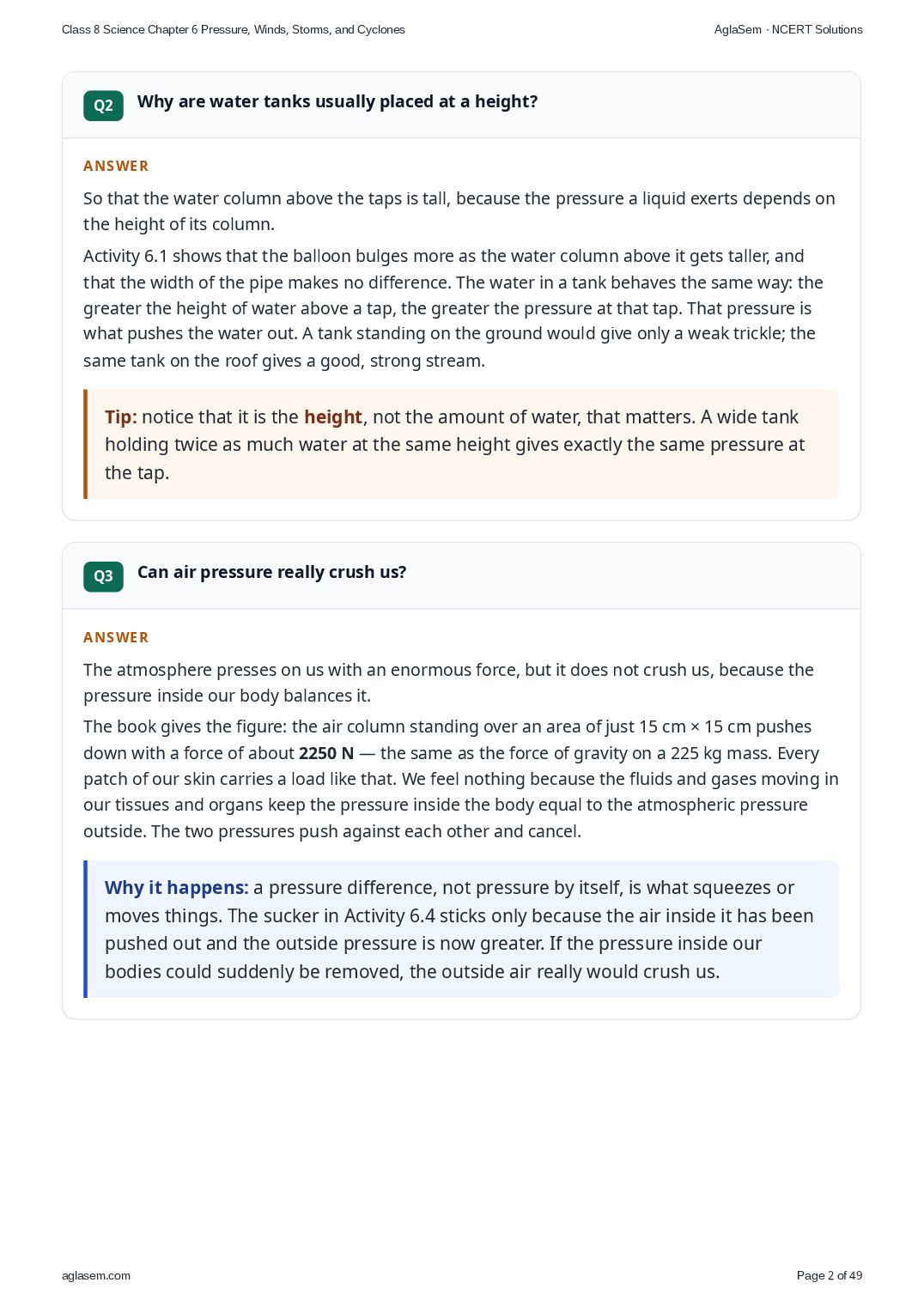
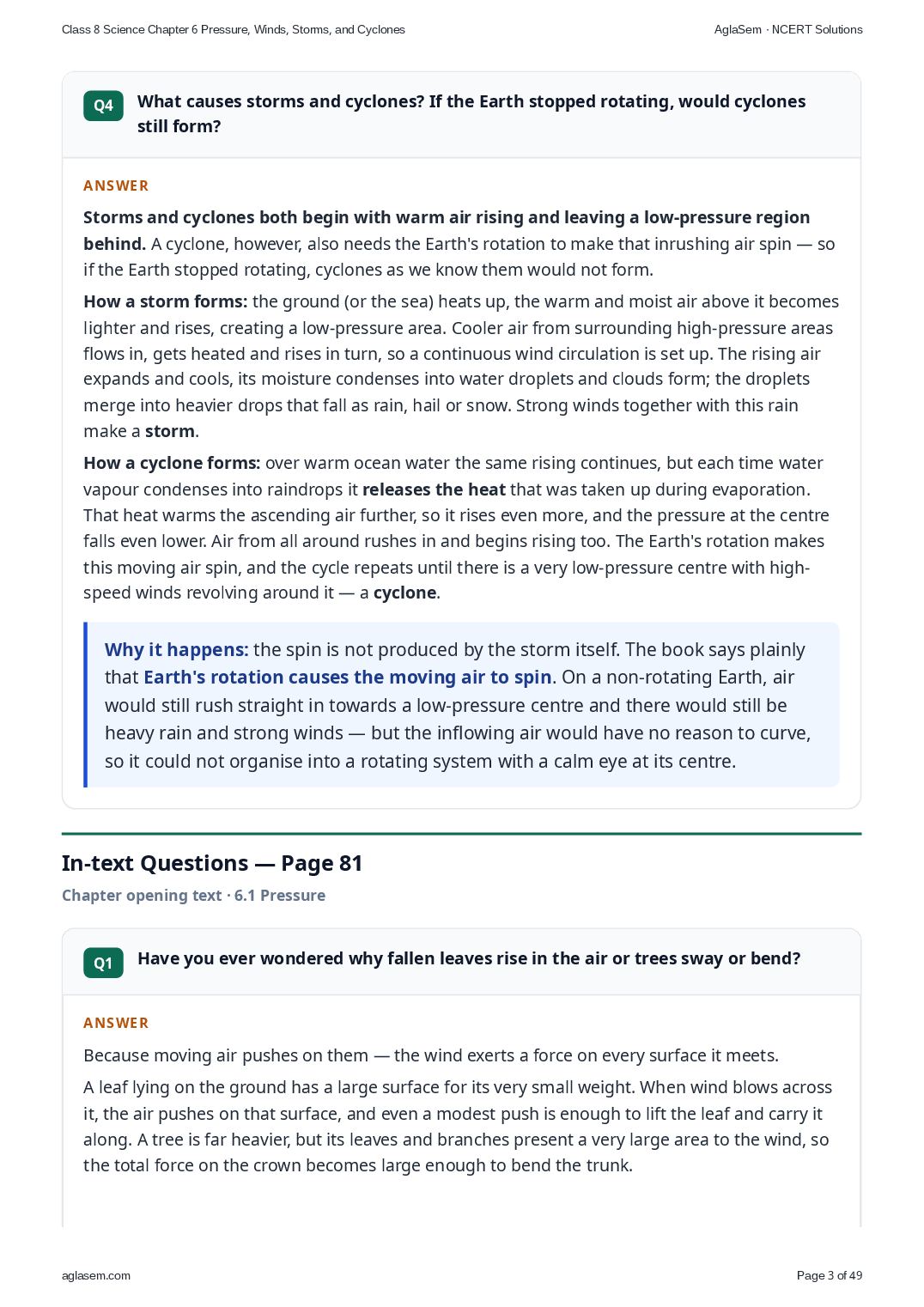
NCERT Solutions for Class 8 Science Chapter 6 PDF Download
You can read the NCERT Solutions for Class 8 Science Chapter 6 online above, or download the complete question-answer PDF to study Pressure Winds Storms and Cyclones offline at any time.
NCERT Solutions for Class 8 Science Chapter 6 PDF Download Link – Click Here to Download Solutions PDF
Questions Covered in This Chapter
These NCERT Solutions answer all 58 questions of this chapter. The questions solved are:
- Why are winds stronger on some days than on others?
- Why are water tanks usually placed at a height?
- Can air pressure really crush us?
- What causes storms and cyclones? If the Earth stopped rotating, would cyclones still form?
- Have you ever wondered why fallen leaves rise in the air or trees sway or bend?
- Does the wind exert force on fallen leaves to make them rise or on trees to bend?
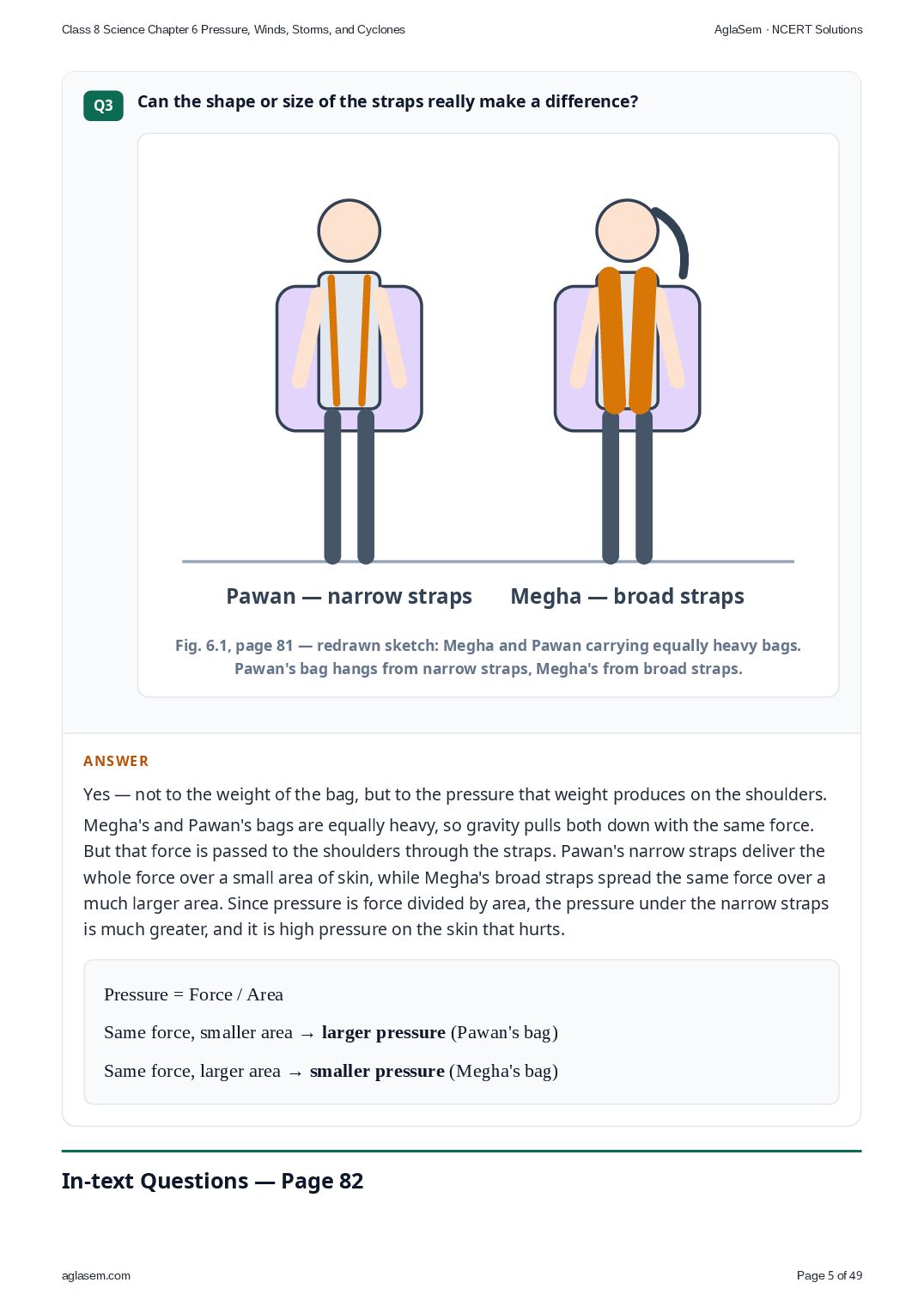
- Can the shape or size of the straps really make a difference?
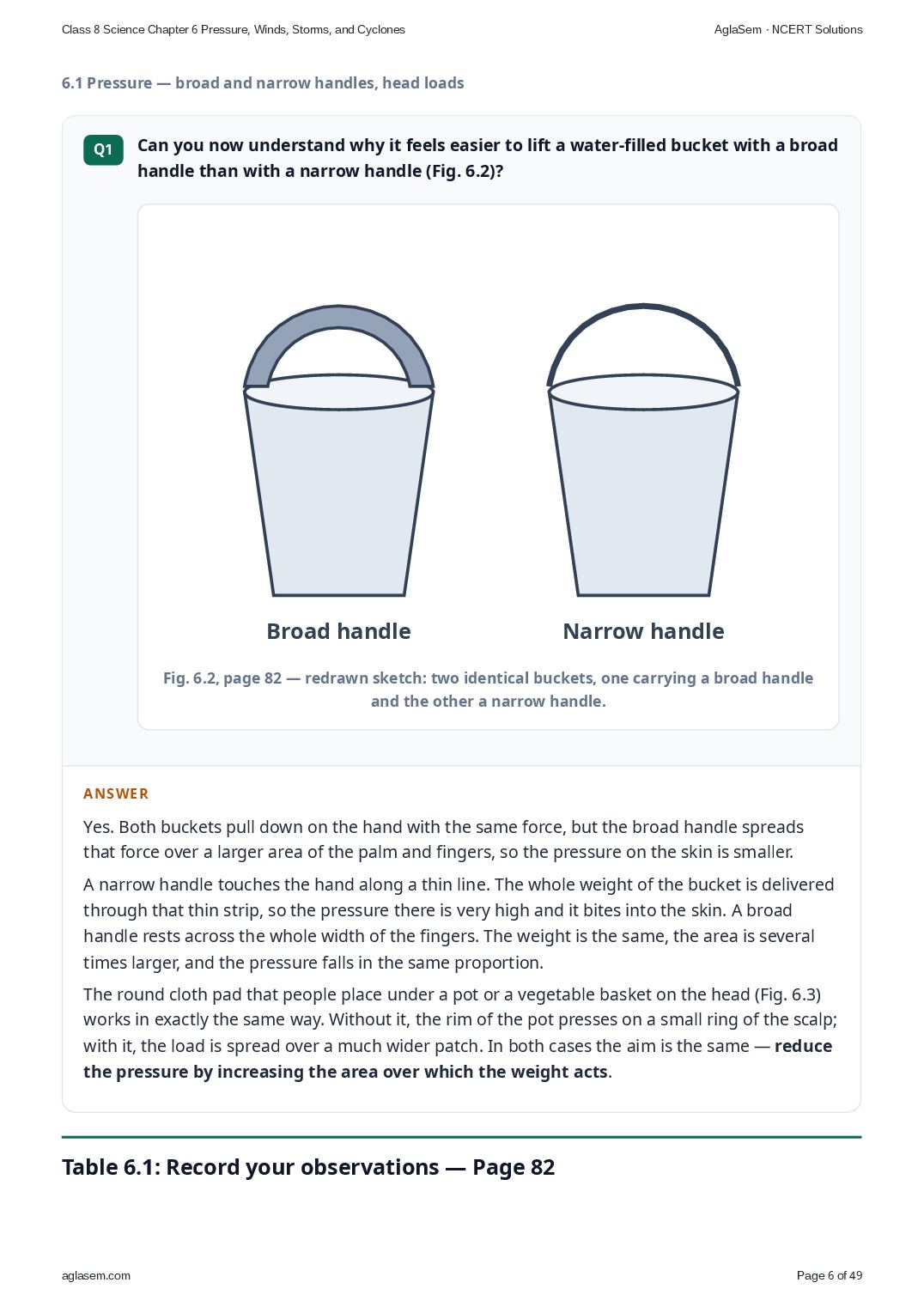
- Can you now understand why it feels easier to lift a water-filled bucket with a broad handle than with a narrow handle (Fig. 6.2)?
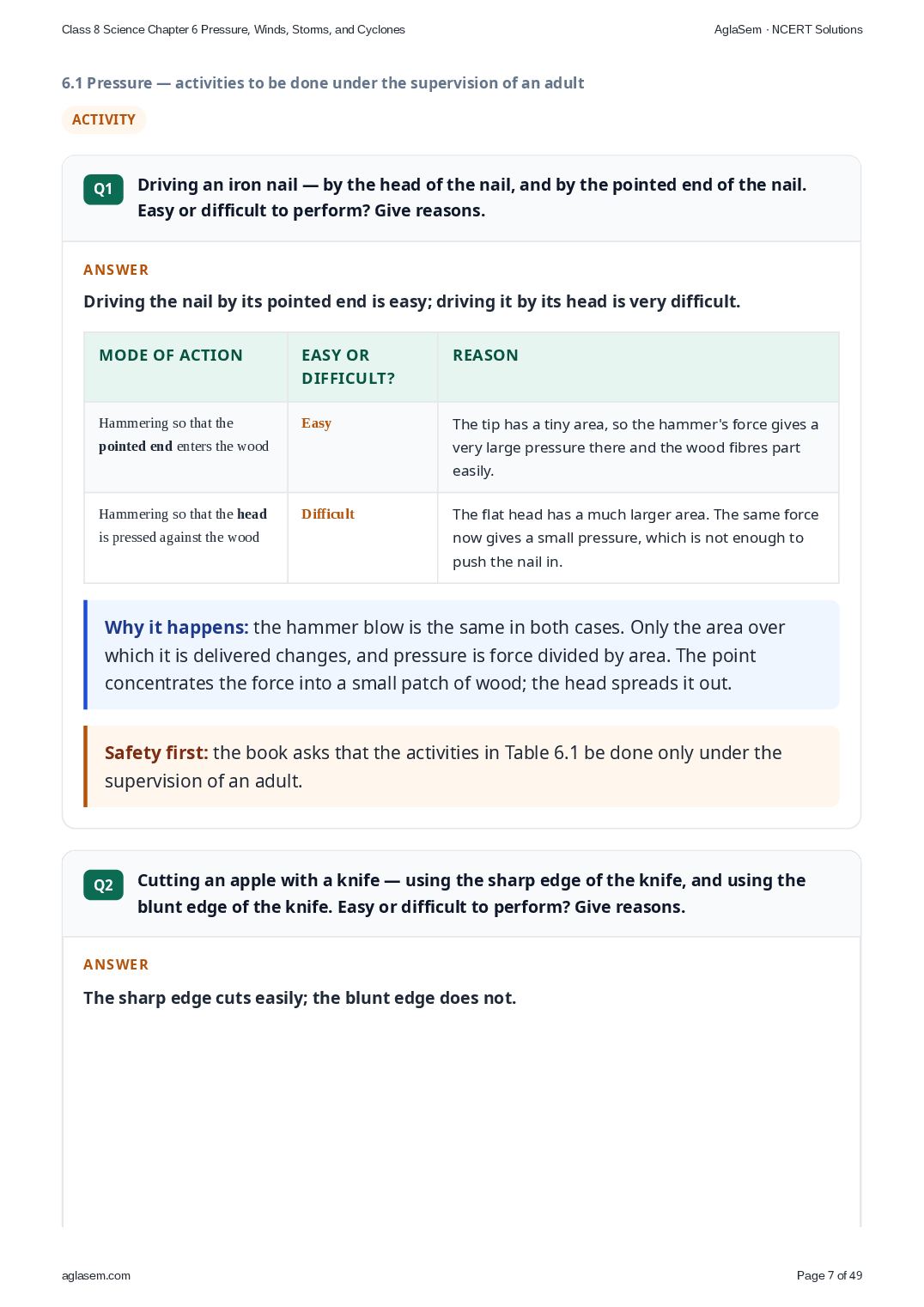
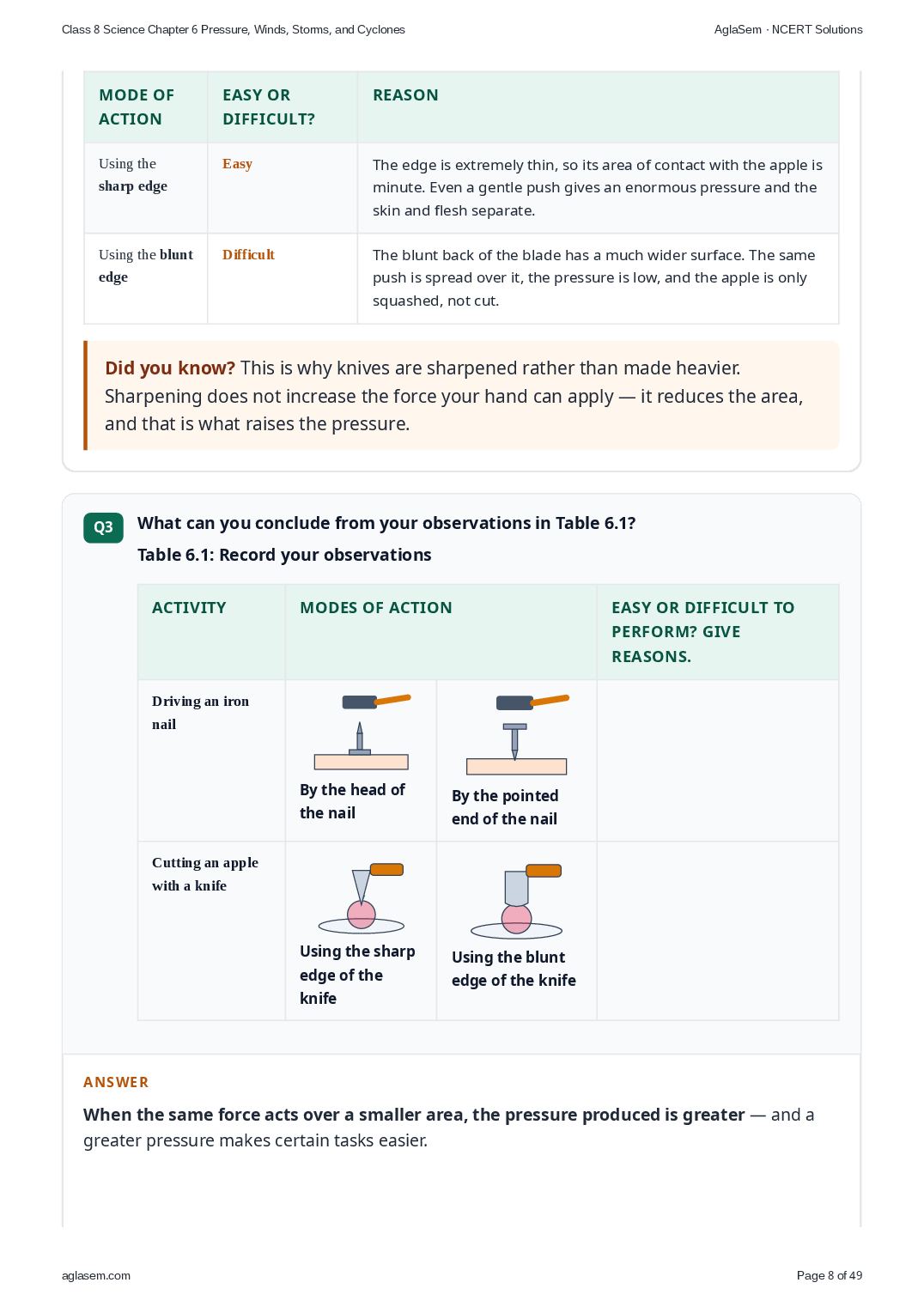
- Driving an iron nail — by the head of the nail, and by the pointed end of the nail. Easy or difficult to perform? Give reasons.
- Cutting an apple with a knife — using the sharp edge of the knife, and using the blunt edge of the knife. Easy or difficult to perform? Give reasons.
- What can you conclude from your observations in Table 6.1?
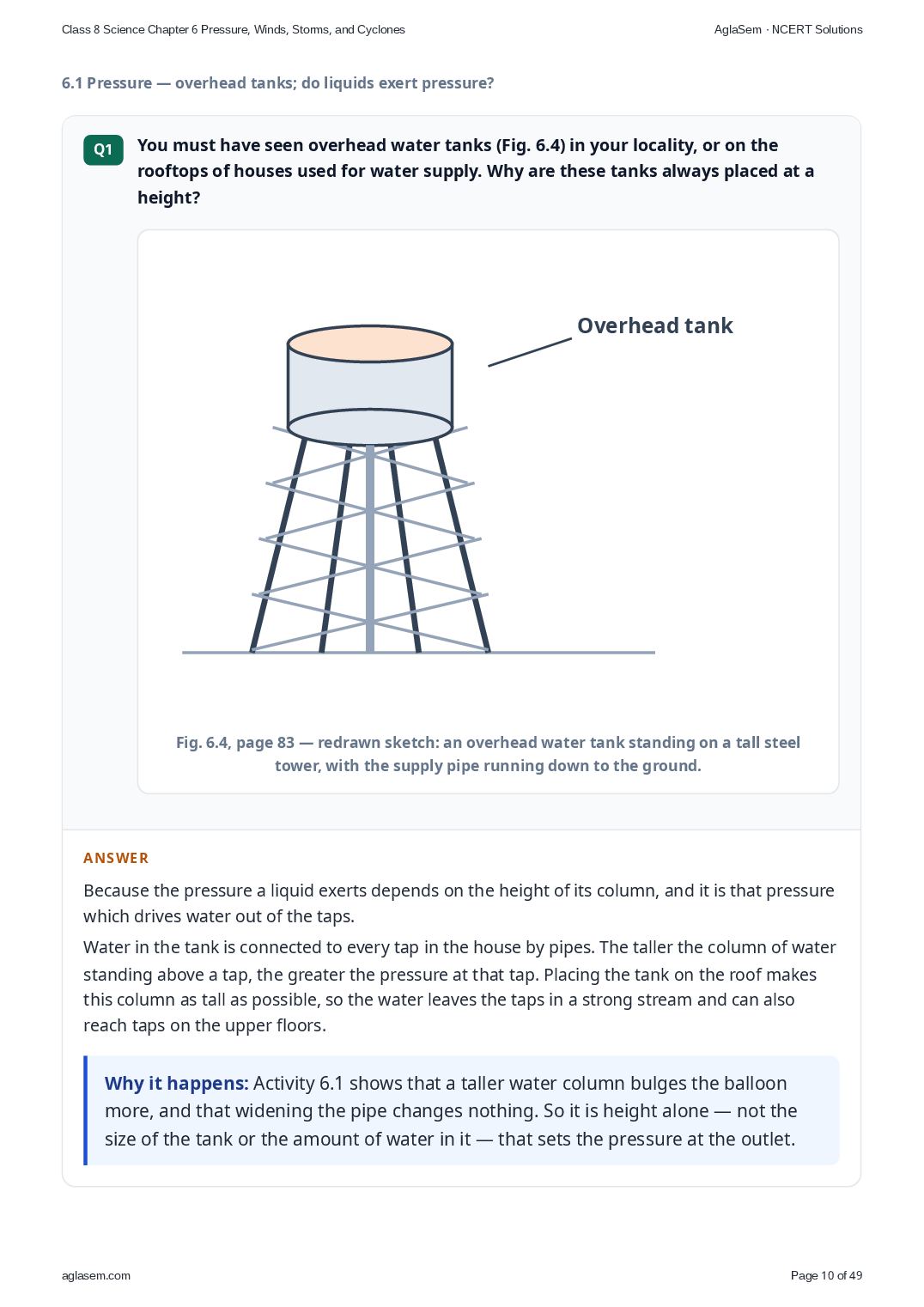
- You must have seen overhead water tanks (Fig. 6.4) in your locality, or on the rooftops of houses used for water supply. Why are these tanks always placed at a height?
- Do liquids also exert pressure?
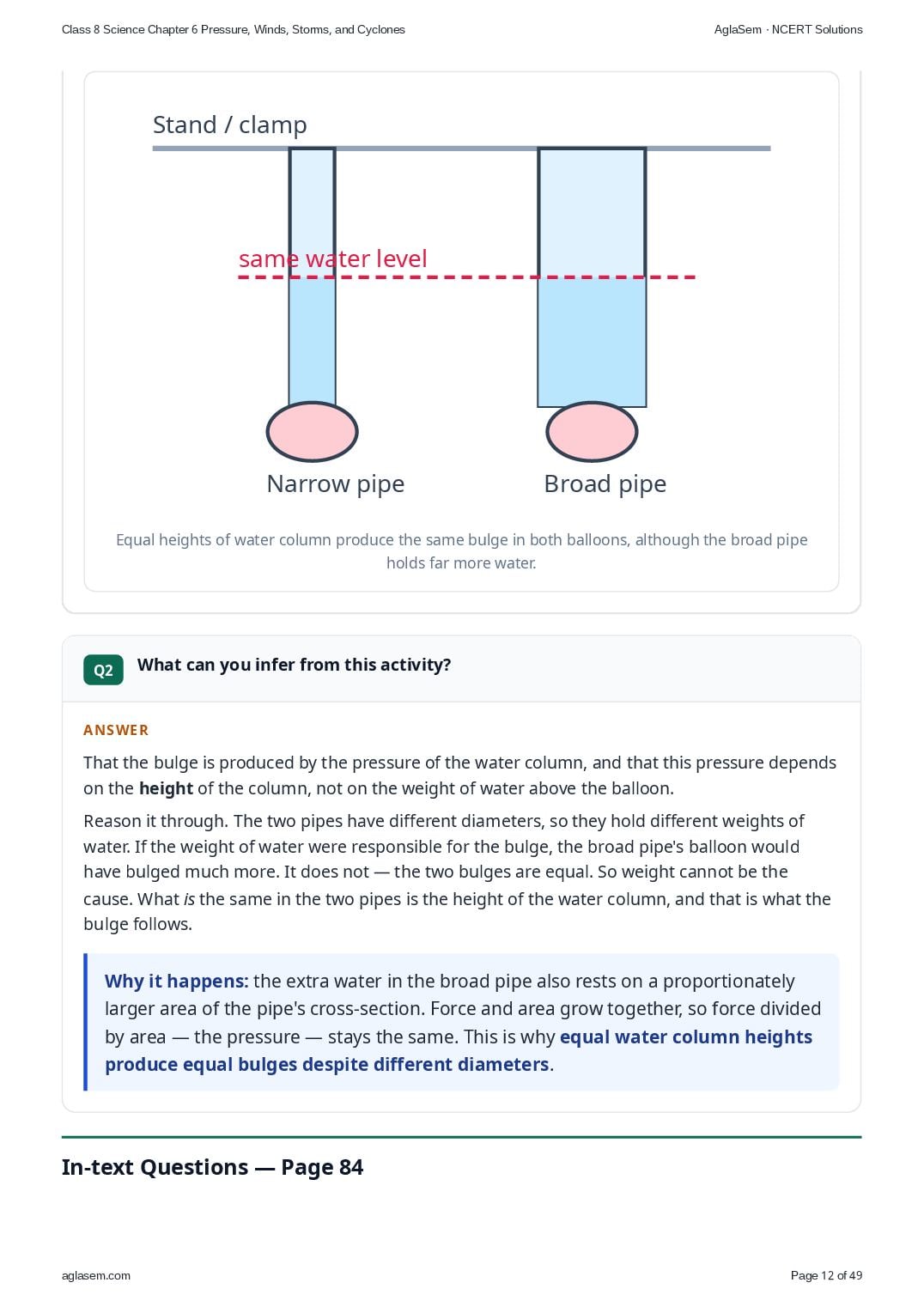
- Do both balloons bulge? Do they bulge to the same extent?
- What can you infer from this activity?
- What will happen to the bulge of the balloon if we increase the height of the water column?
- Do you see any relation between the amount of bulge of the rubber balloon and the height of the water column in the pipe?
- Suppose you are living on the second floor of a three-storeyed building and an overhead water tank is placed on the top floor. Will you or your friend on the first floor receive a more powerful stream of tap water? Give reasons.
- Do liquids also exert pressure on the walls of the container?
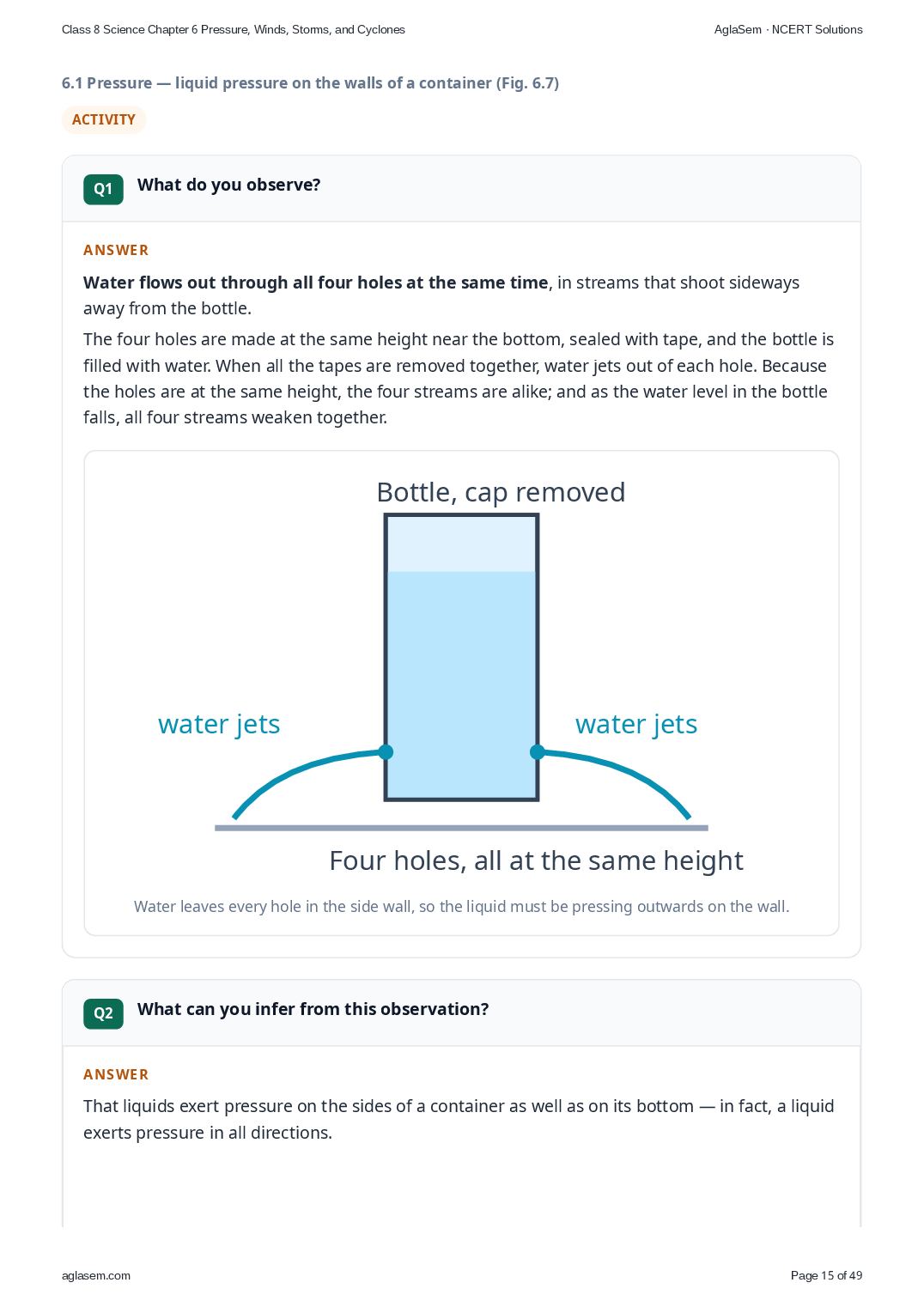
- What do you observe?
- What can you infer from this observation?
- You must have seen water spurting out like a fountain from leaking joints or holes in water pipes. Can you explain why this happens? Is it due to the pressure exerted by water on the walls of the pipes?
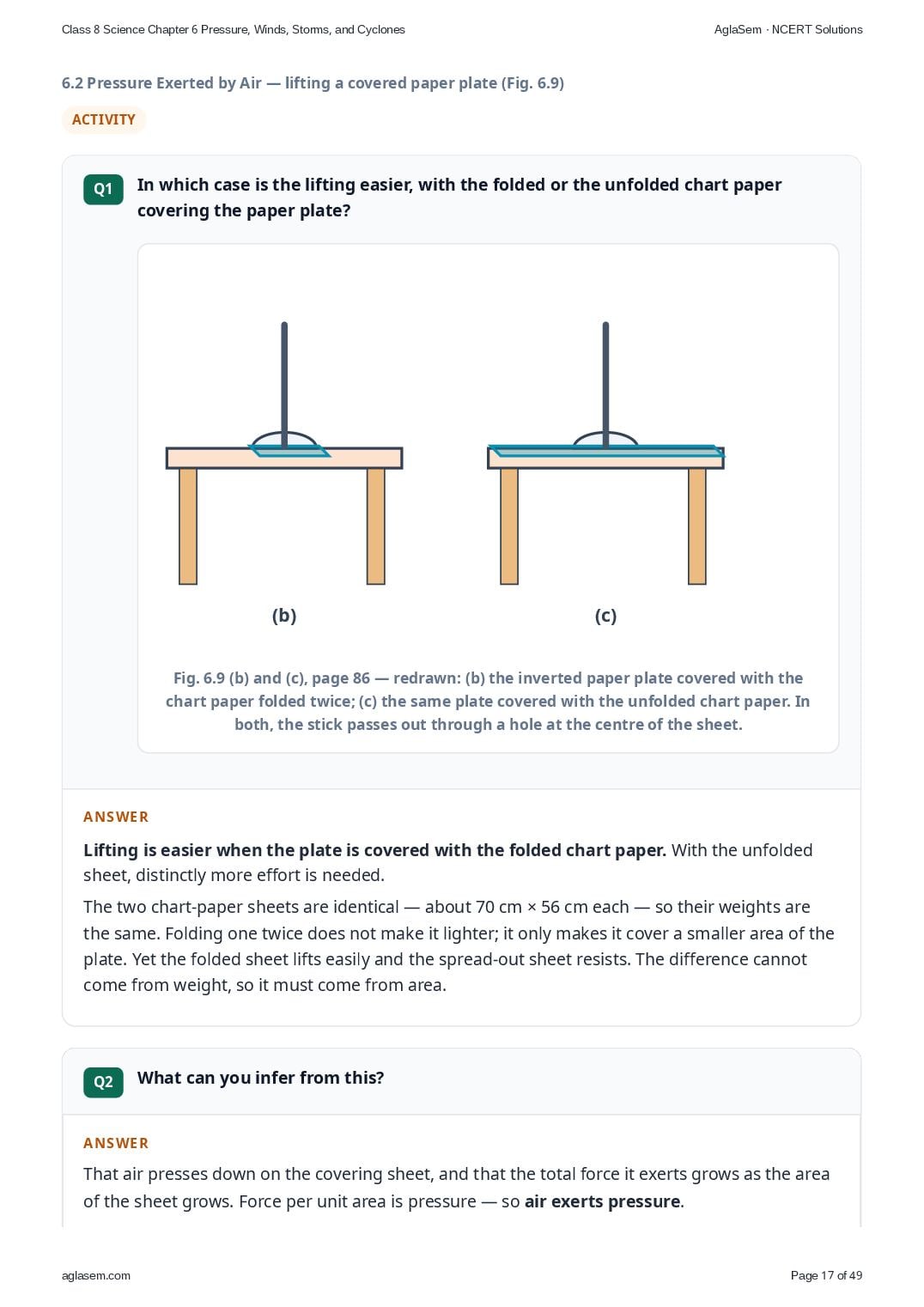
- In which case is the lifting easier, with the folded or the unfolded chart paper covering the paper plate?
- What can you infer from this?
- You must have experienced that when you blow air into a balloon, it gets inflated. Why?
- Can we say that air exerts pressure in all directions?
- What happens when an inflated balloon is kept without closing its mouth? Why does the air escape from the balloon?
- Do you realise that it sticks to the surface?
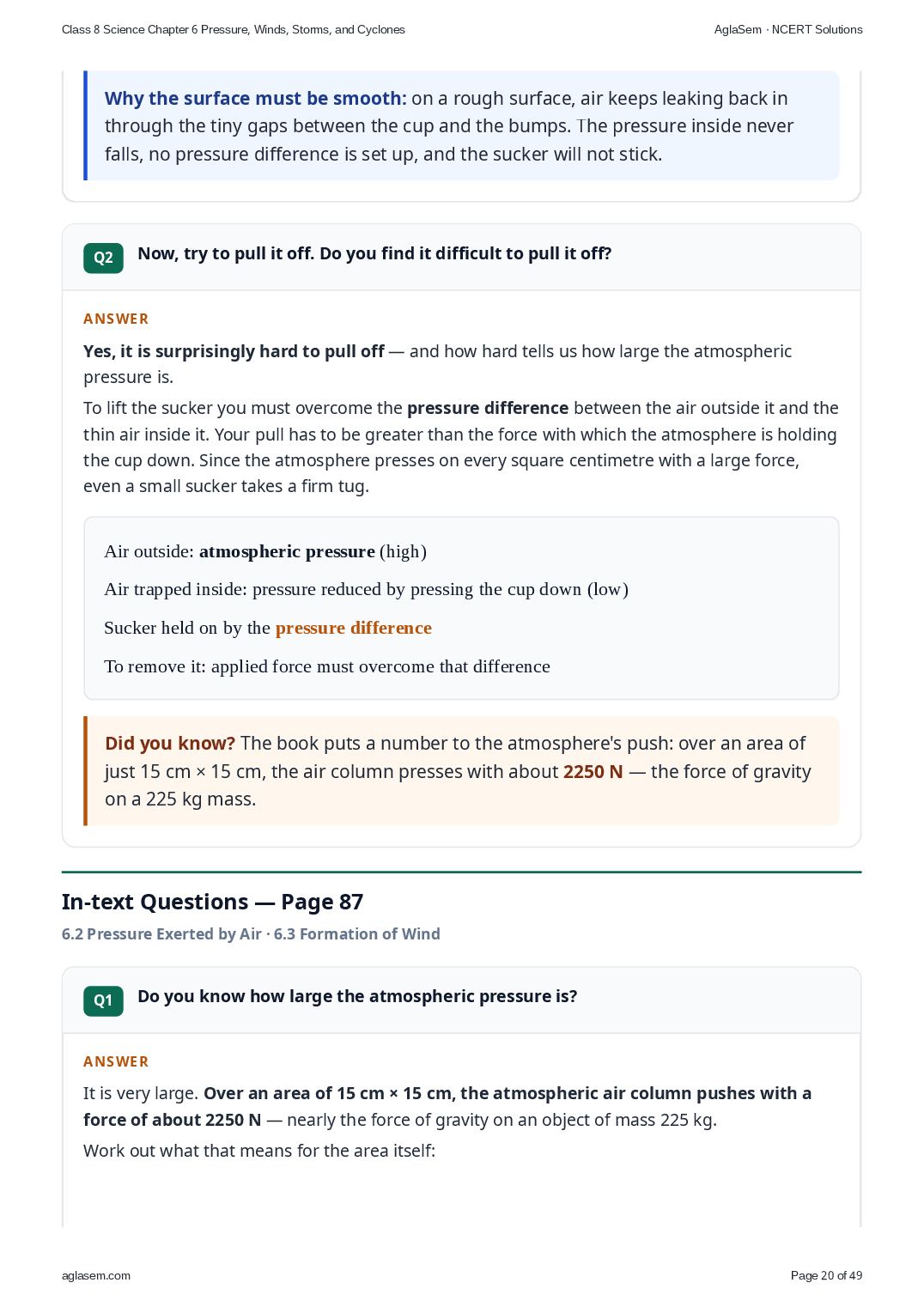
- Now, try to pull it off. Do you find it difficult to pull it off?
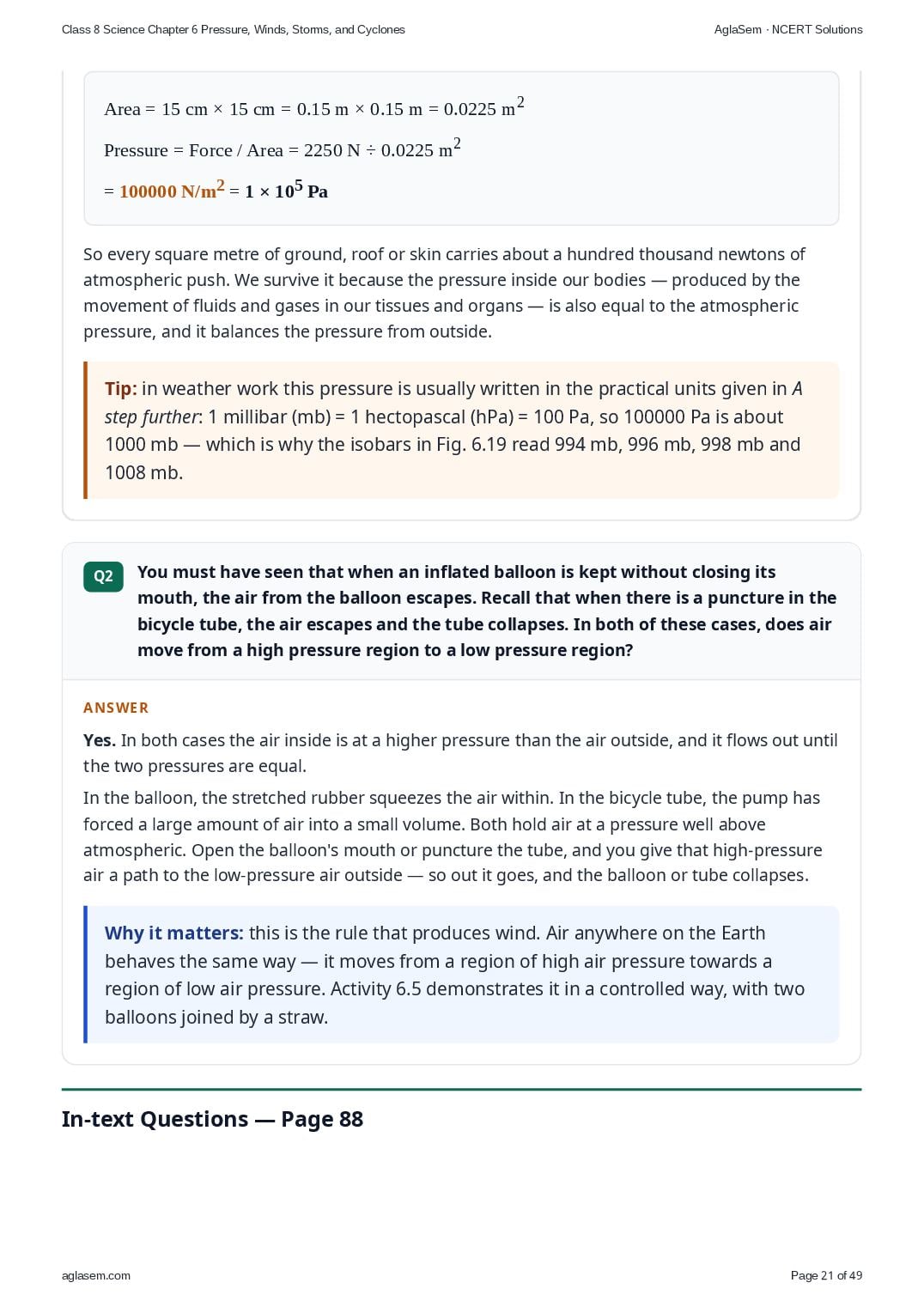
- Do you know how large the atmospheric pressure is?
- You must have seen that when an inflated balloon is kept without closing its mouth, the air from the balloon escapes. Recall that when there is a puncture in the bicycle tube, the air escapes and the tube collapses. In both of these cases, does air move from a high pressure region to a low pressure region?
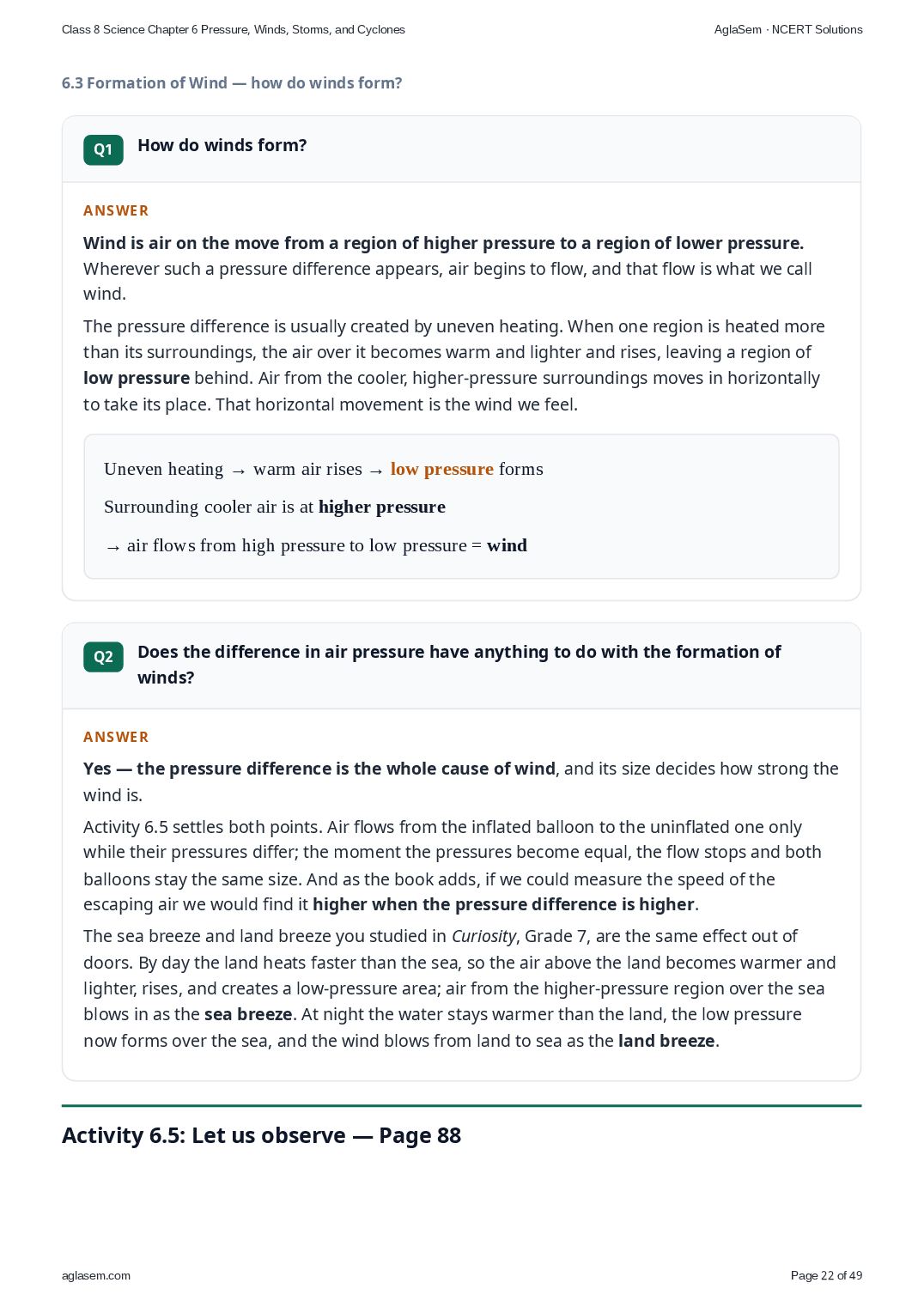
- How do winds form?
- Does the difference in air pressure have anything to do with the formation of winds?
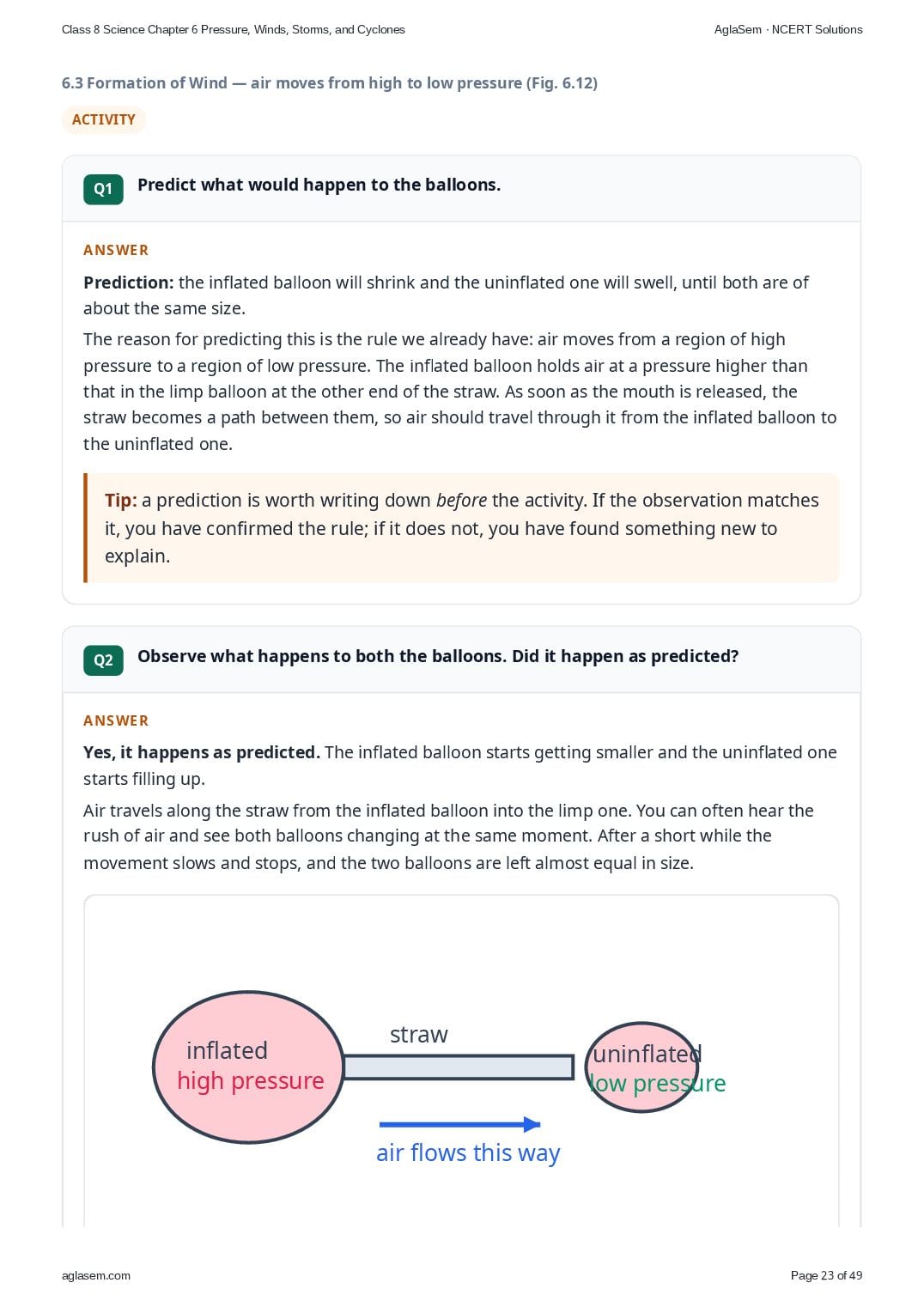
- Predict what would happen to the balloons.
- Observe what happens to both the balloons. Did it happen as predicted?
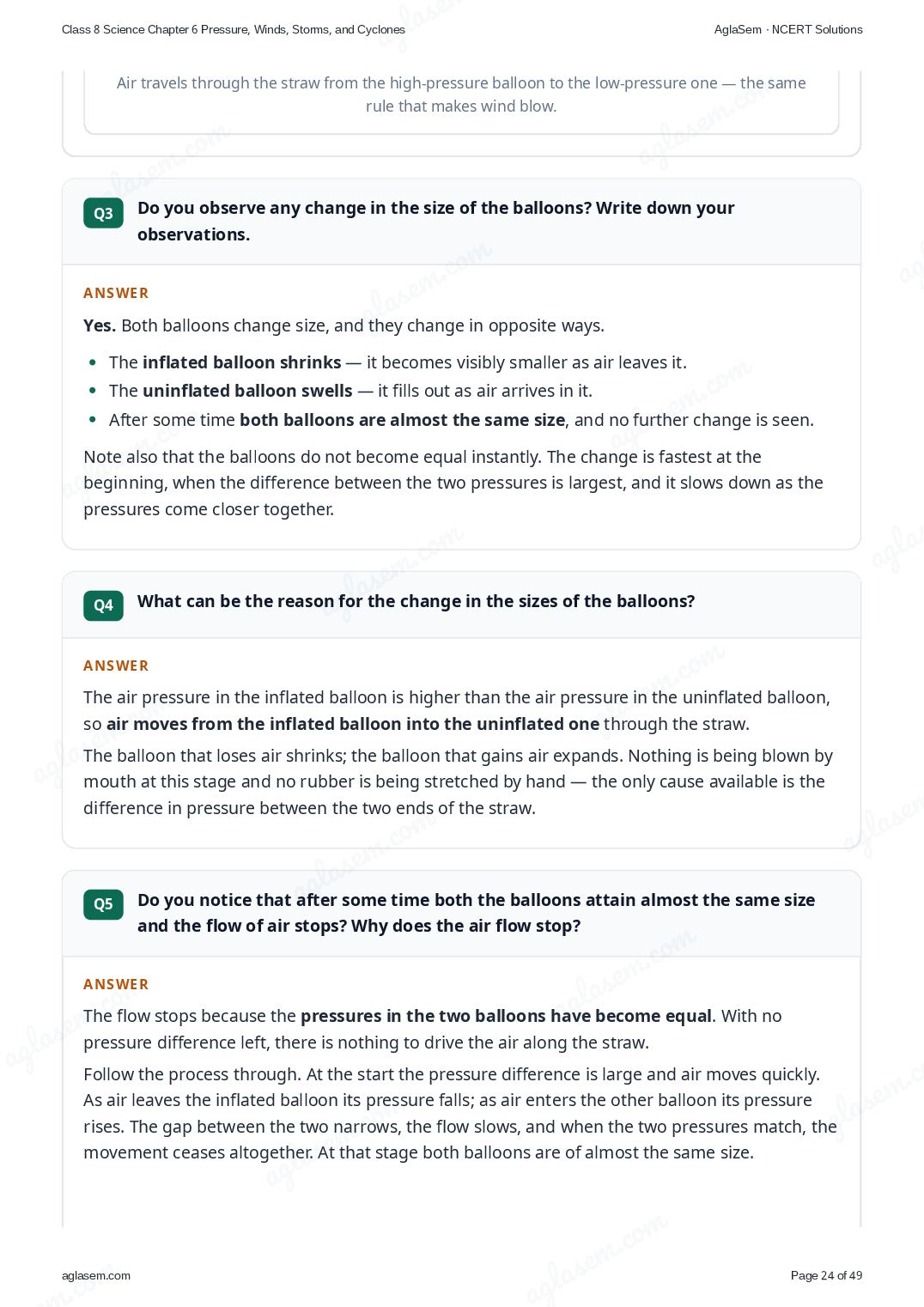
- Do you observe any change in the size of the balloons? Write down your observations.
- What can be the reason for the change in the sizes of the balloons?
- Do you notice that after some time both the balloons attain almost the same size and the flow of air stops? Why does the air flow stop?
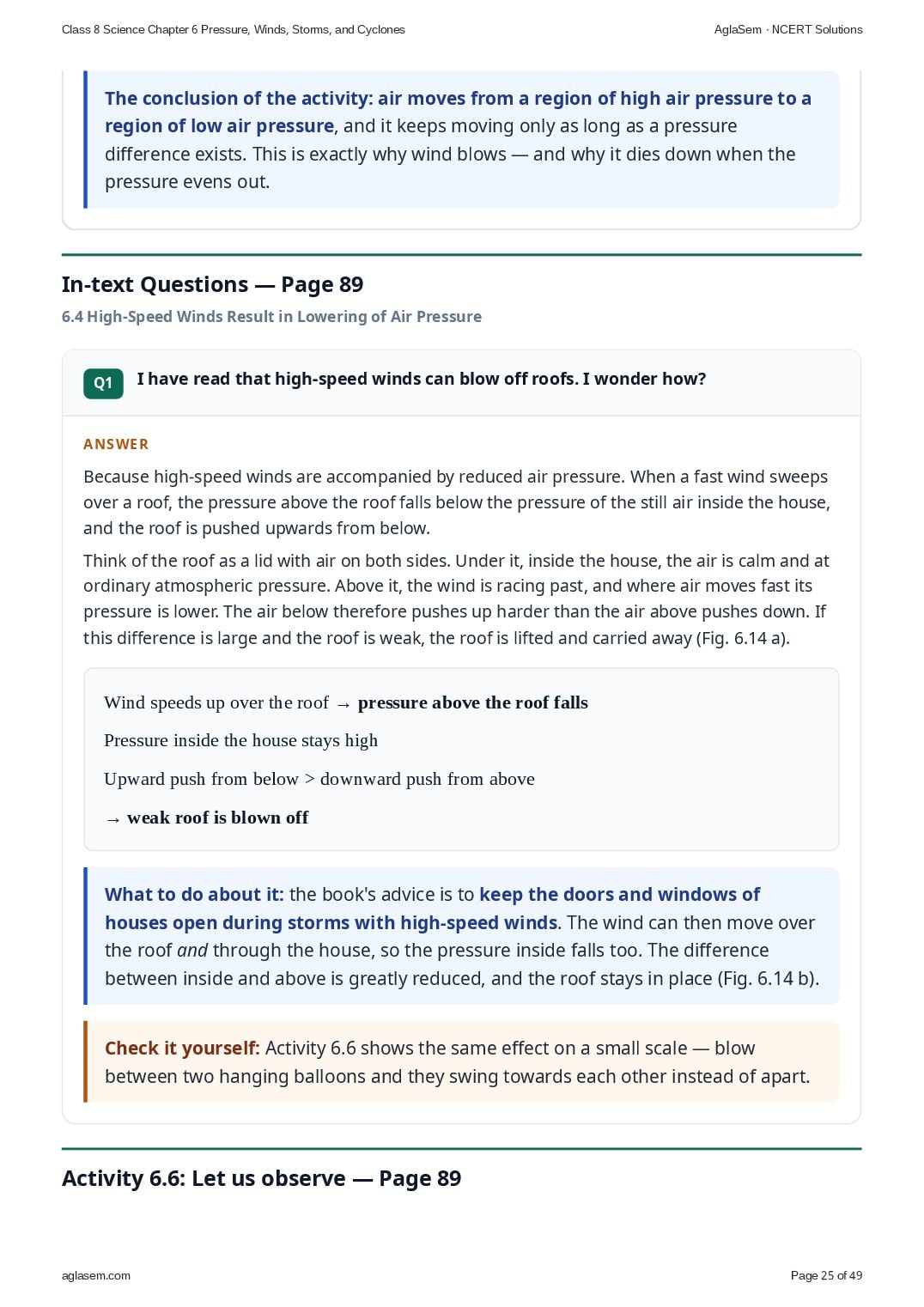
- I have read that high-speed winds can blow off roofs. I wonder how?
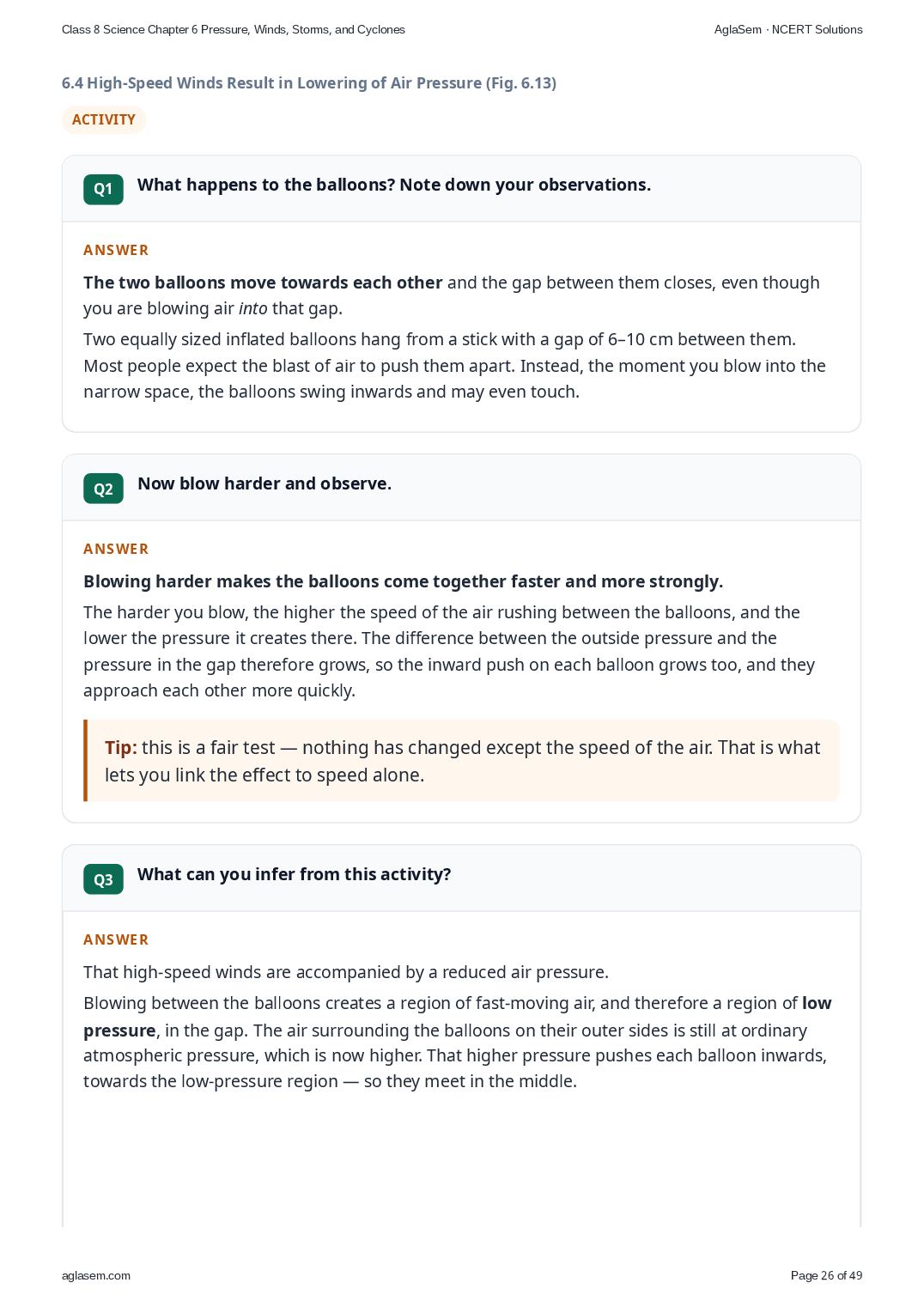
- What happens to the balloons? Note down your observations.
- Now blow harder and observe.
- What can you infer from this activity?
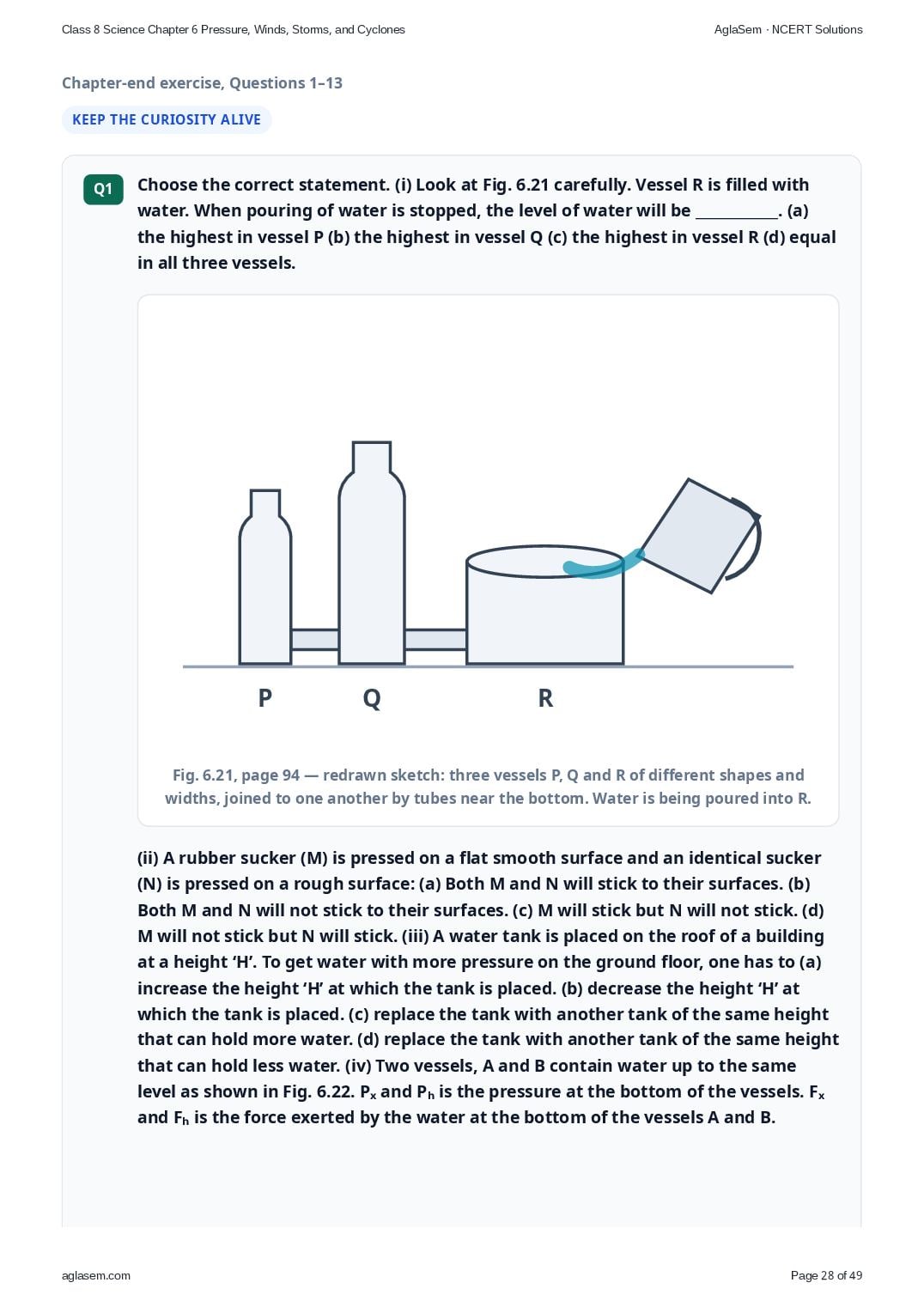
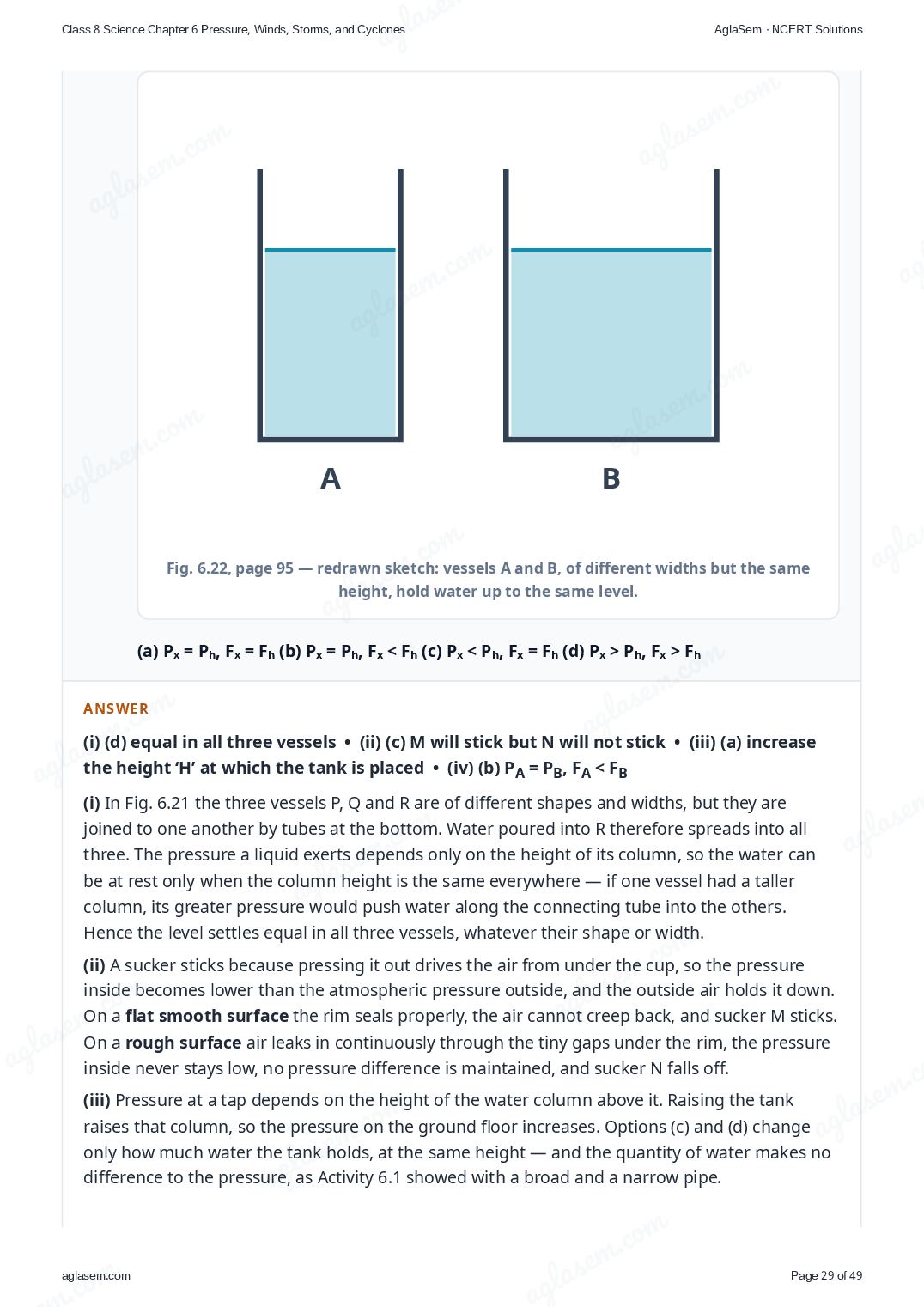
- Choose the correct statement. (i) Look at Fig. 6.21 carefully. Vessel R is filled with water. When pouring of water is stopped, the level of water will be ____________. (a) the highest in vessel P (b) the highest in vessel Q (c) the highest in vessel R (d) equal in all three vessels. (ii) A rubber sucker (M) is pressed on a flat smooth surface and an identical sucker (N) is pressed on a rough surface: (a) Both M and N will stick to their surfaces. (b) Both M and N will not stick to their surfaces. (c) M will stick but N will not stick. (d) M will not stick but N will stick. (iii) A water tank is placed on the roof of a building at a height ‘H’. To get water with more pressure on the ground floor, one has to (a) increase the height ‘H’ at which the tank is placed. (b) decrease the height ‘H’ at which the tank is placed. (c) replace the tank with another tank of the same height that can hold more water. (d) replace the tank with another tank of the same height that can hold less water. (iv) Two vessels, A and B contain water up to the same level as shown in Fig. 6.22. Pₓ and Pₕ is the pressure at the bottom of the vessels. Fₓ and Fₕ is the force exerted by the water at the bottom of the vessels A and B. (a) Pₓ = Pₕ, Fₓ = Fₕ (b) Pₓ = Pₕ, Fₓ < Fₕ (c) Pₓ < Pₕ, Fₓ = Fₕ (d) Pₓ > Pₕ, Fₓ > Fₕ
- State whether the following statements are True [T] or False [F]. (i) Air flows from a region of higher pressure to a region of lower pressure. (ii) Liquids exert pressure only at the bottom of a container. (iii) Weather is stormy at the eye of a cyclone. (iv) During a thunderstorm, it is safer to be in a car.
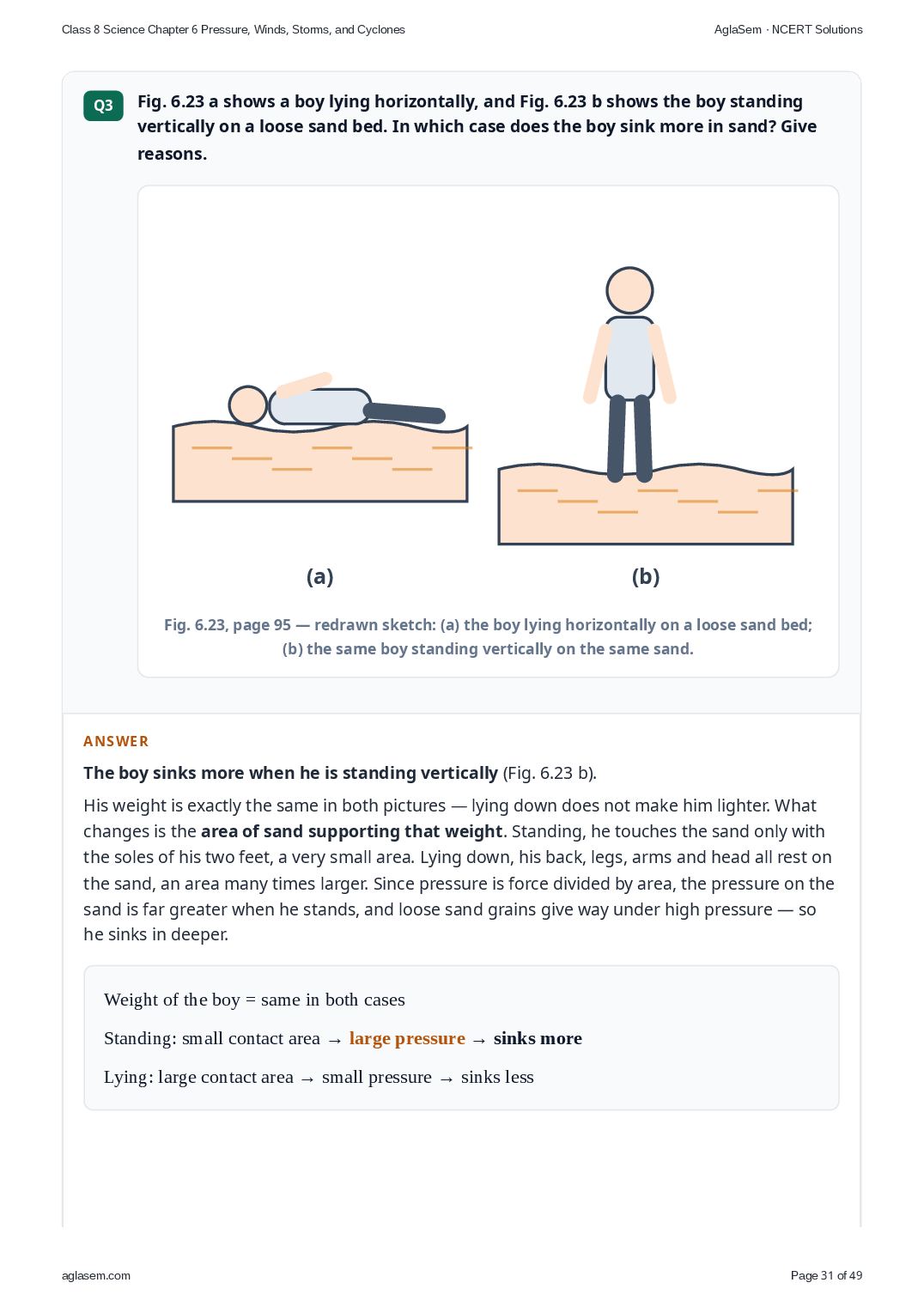
- Fig. 6.23 a shows a boy lying horizontally, and Fig. 6.23 b shows the boy standing vertically on a loose sand bed. In which case does the boy sink more in sand? Give reasons.
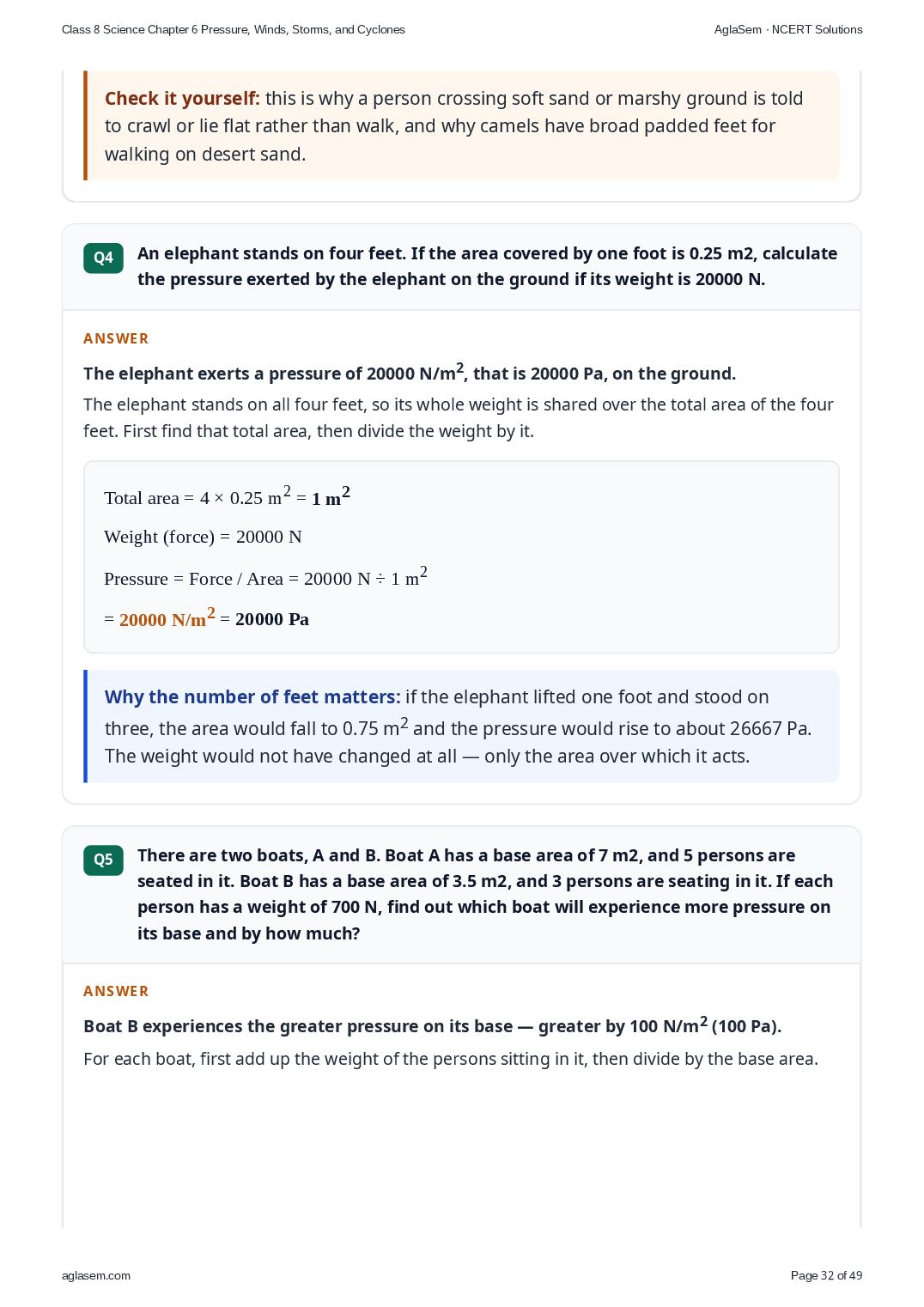
- An elephant stands on four feet. If the area covered by one foot is 0.25 m2, calculate the pressure exerted by the elephant on the ground if its weight is 20000 N.
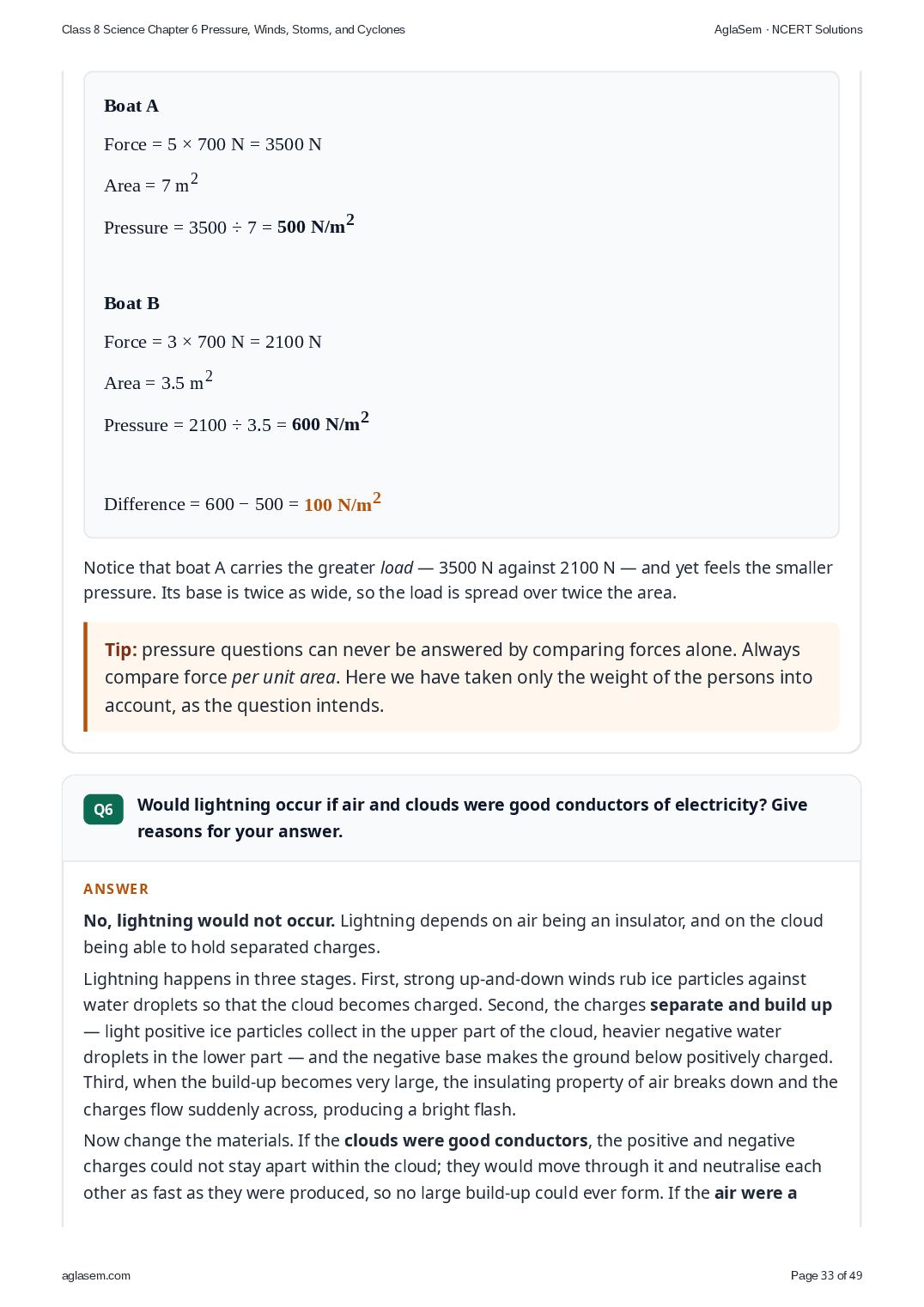
- There are two boats, A and B. Boat A has a base area of 7 m2, and 5 persons are seated in it. Boat B has a base area of 3.5 m2, and 3 persons are seating in it. If each person has a weight of 700 N, find out which boat will experience more pressure on its base and by how much?
- Would lightning occur if air and clouds were good conductors of electricity? Give reasons for your answer.
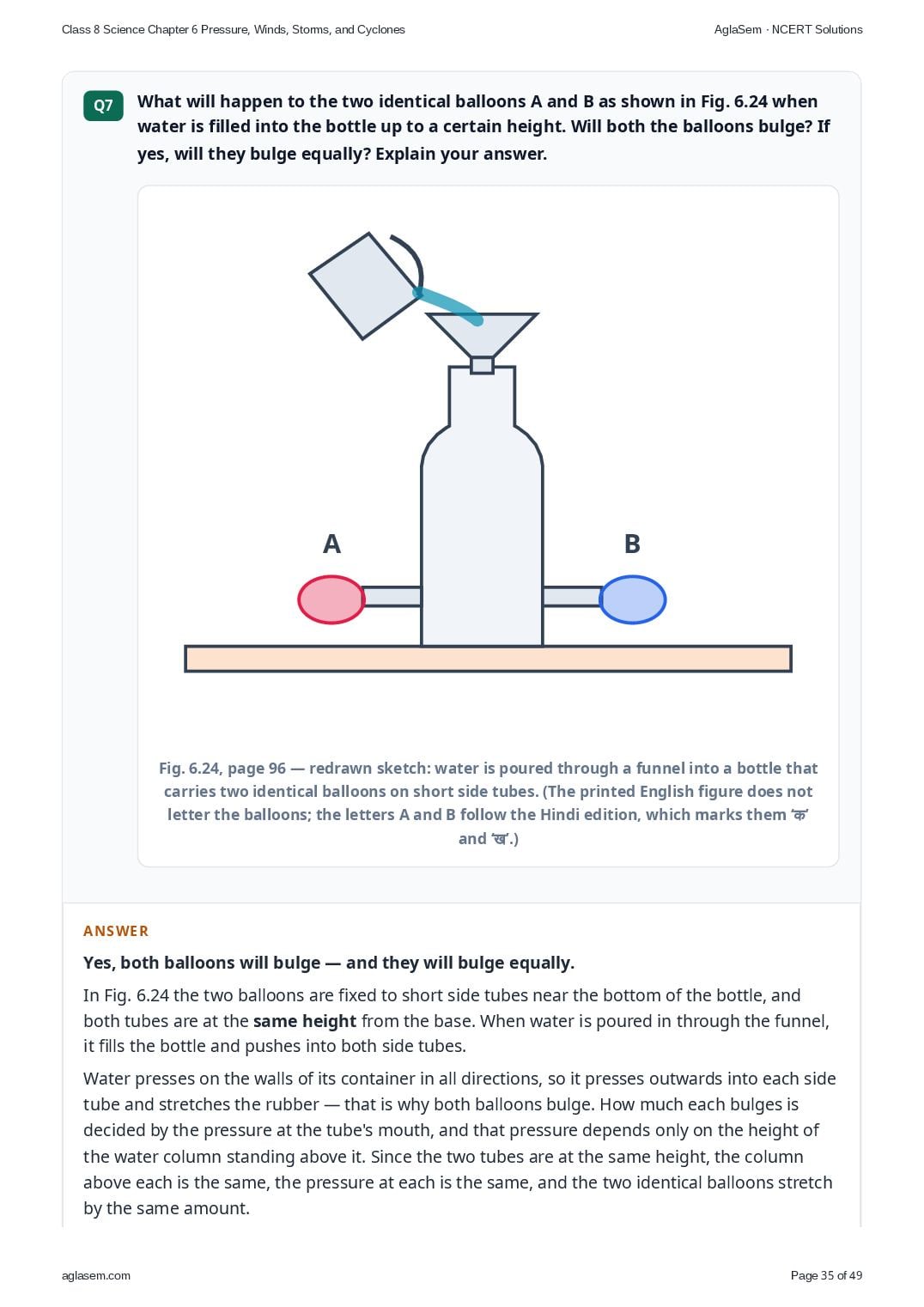
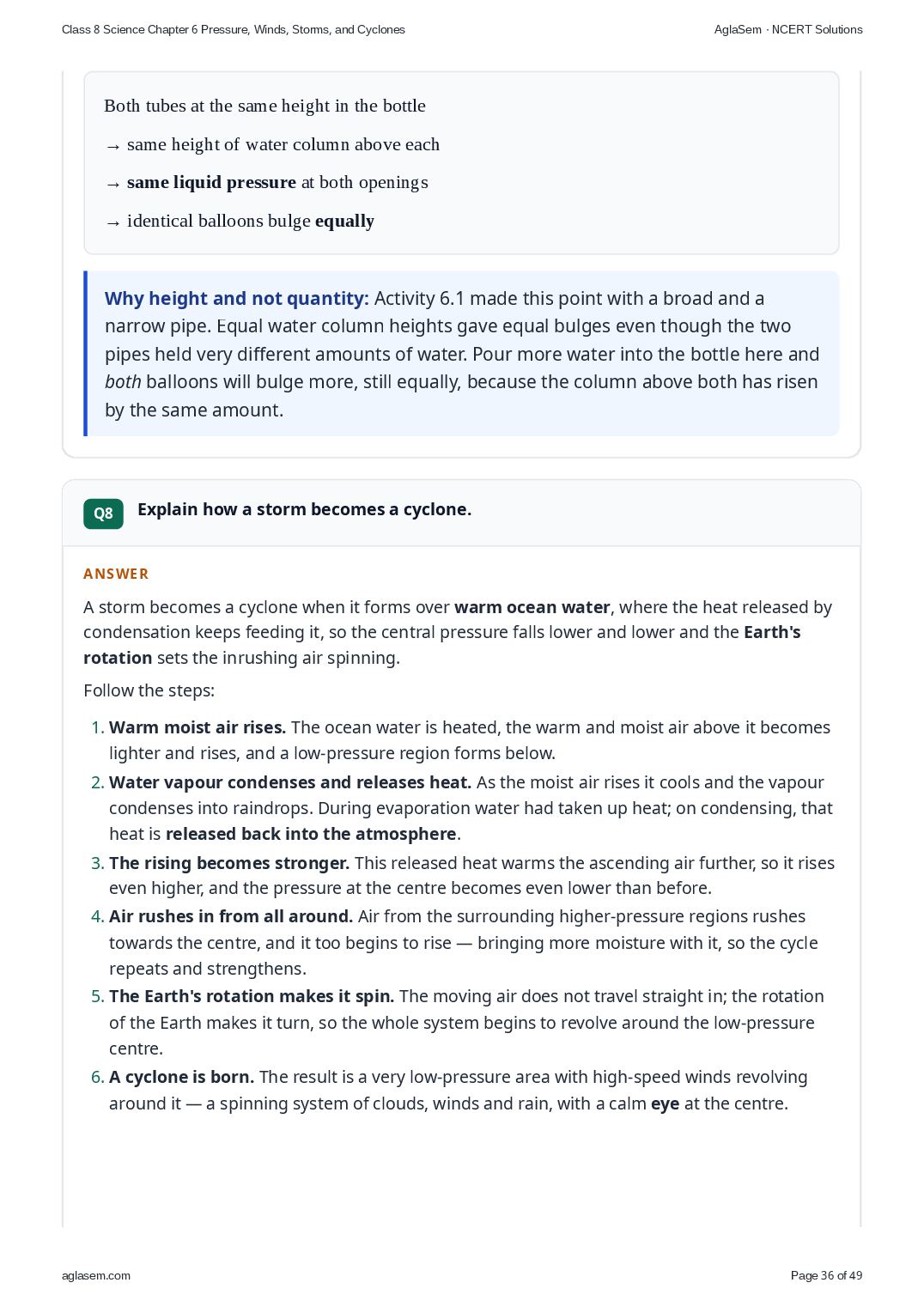
- What will happen to the two identical balloons A and B as shown in Fig. 6.24 when water is filled into the bottle up to a certain height. Will both the balloons bulge? If yes, will they bulge equally? Explain your answer.
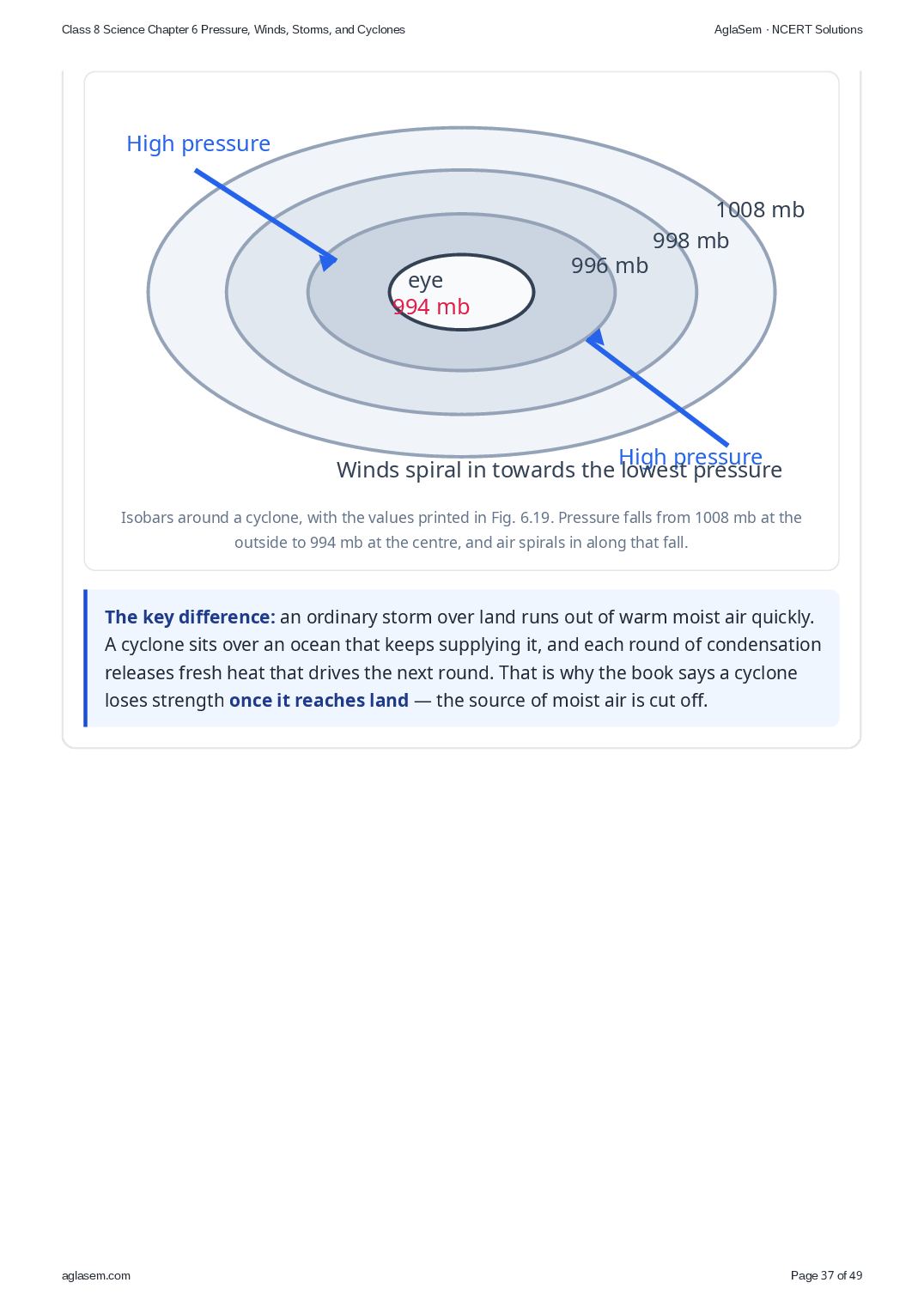
- Explain how a storm becomes a cyclone.
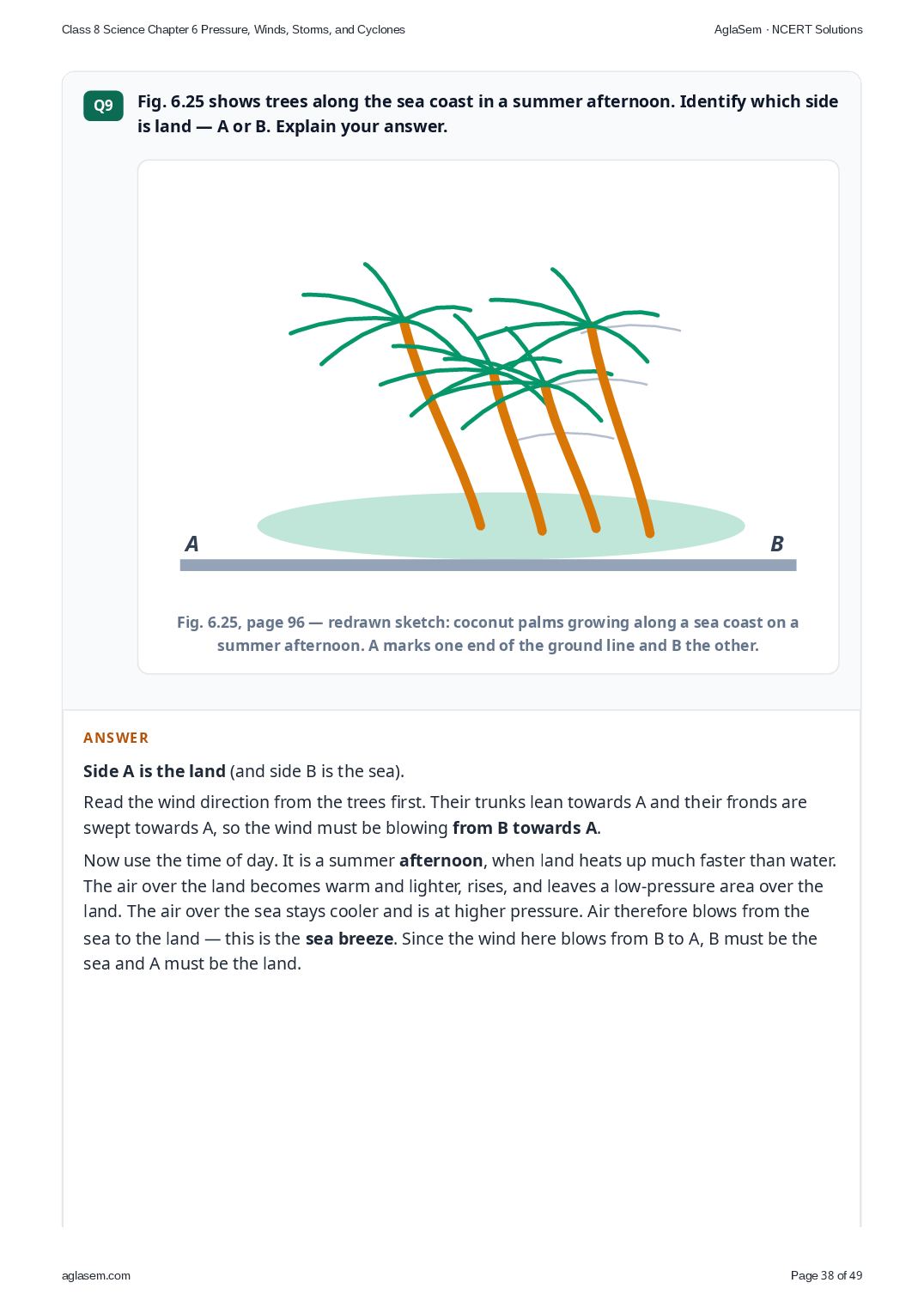
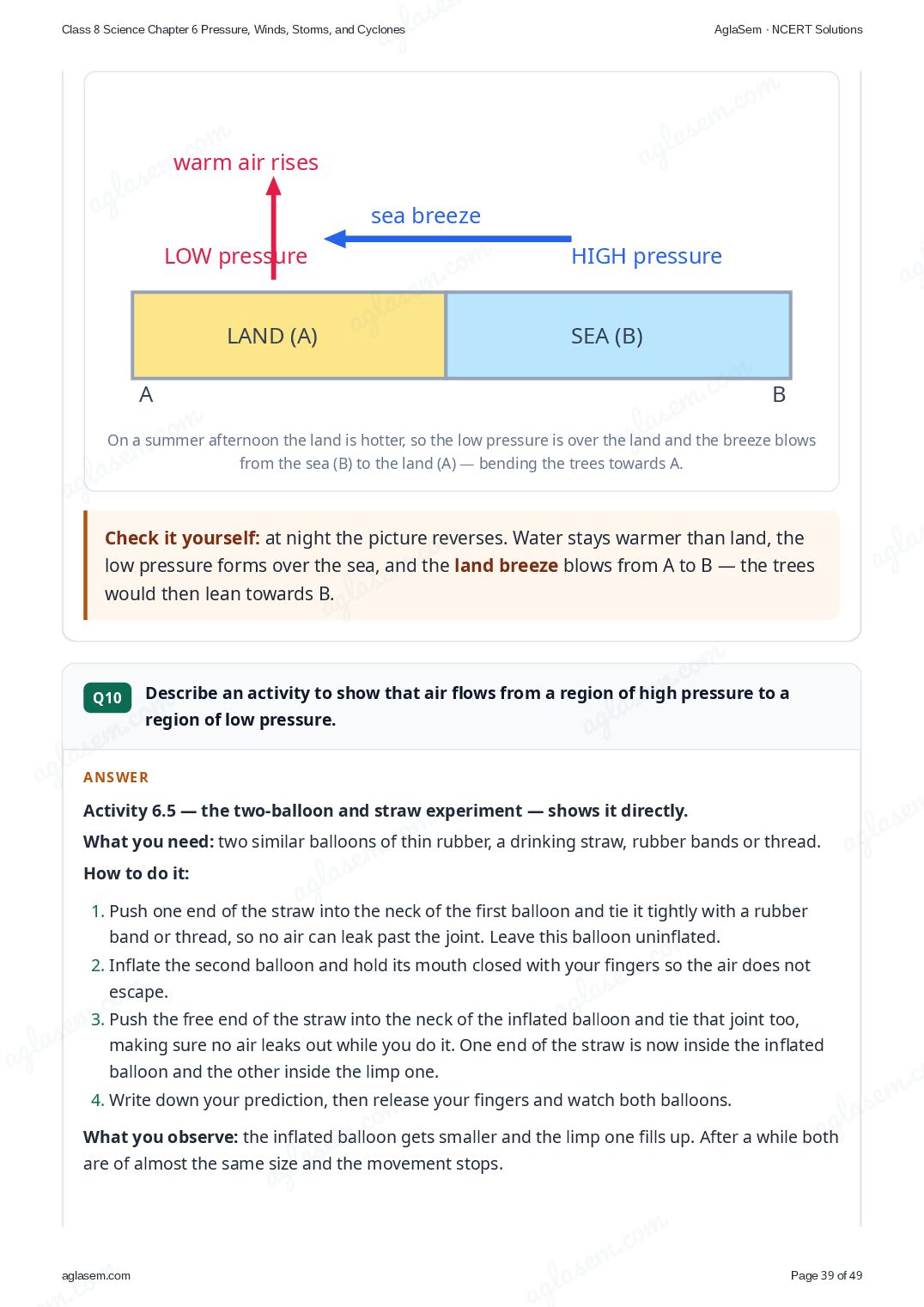
- Fig. 6.25 shows trees along the sea coast in a summer afternoon. Identify which side is land — A or B. Explain your answer.
- Describe an activity to show that air flows from a region of high pressure to a region of low pressure.
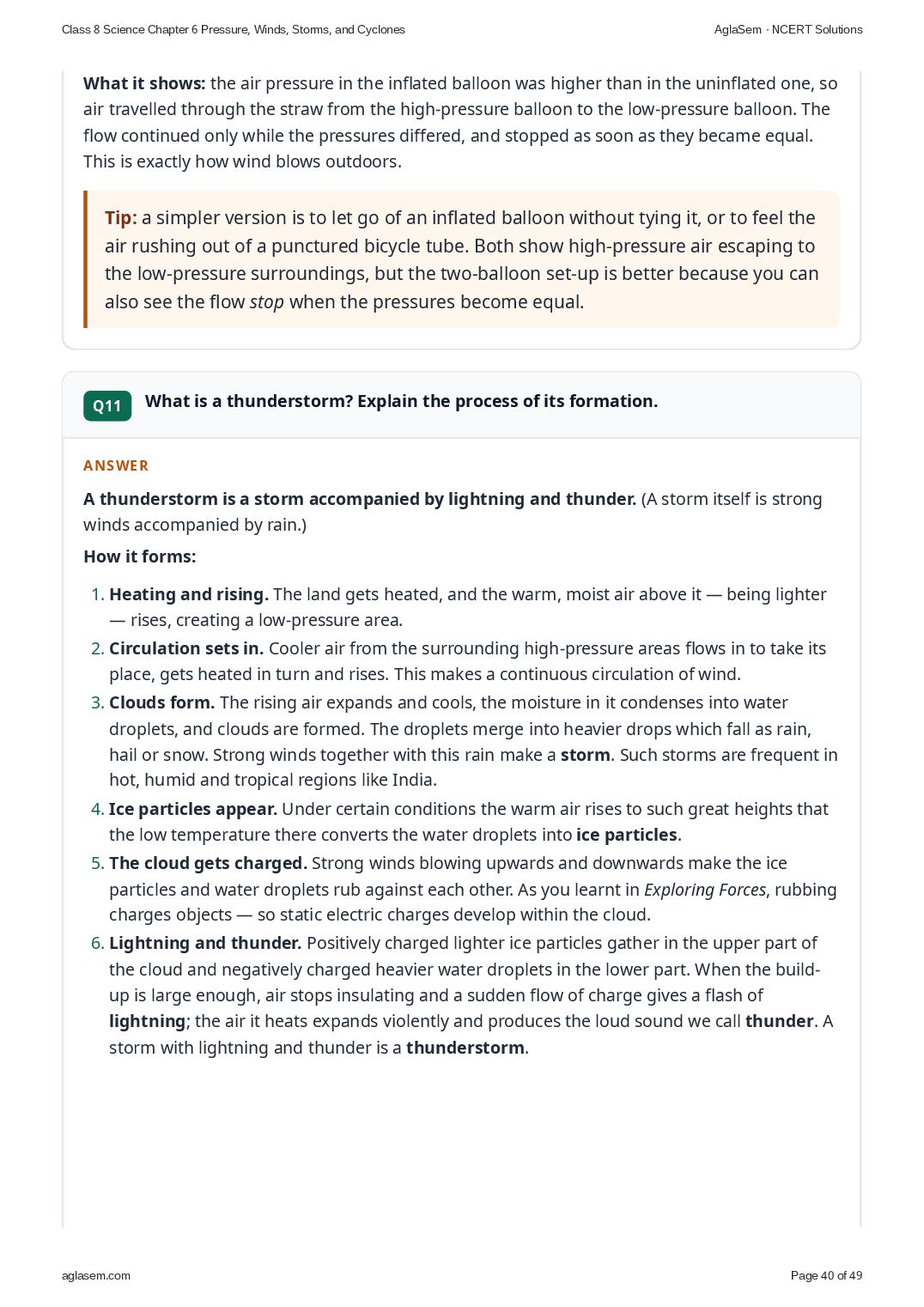
- What is a thunderstorm? Explain the process of its formation.
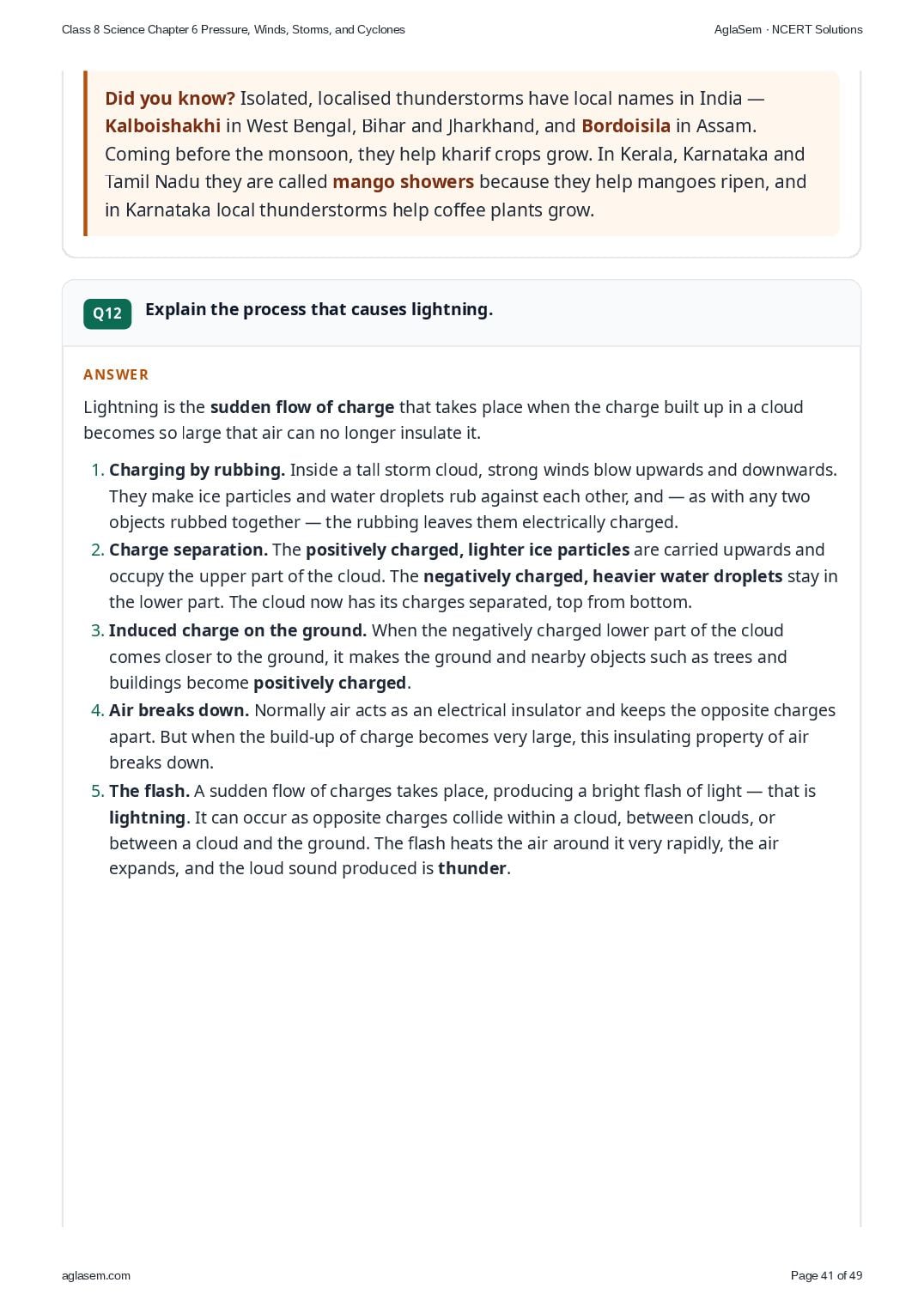
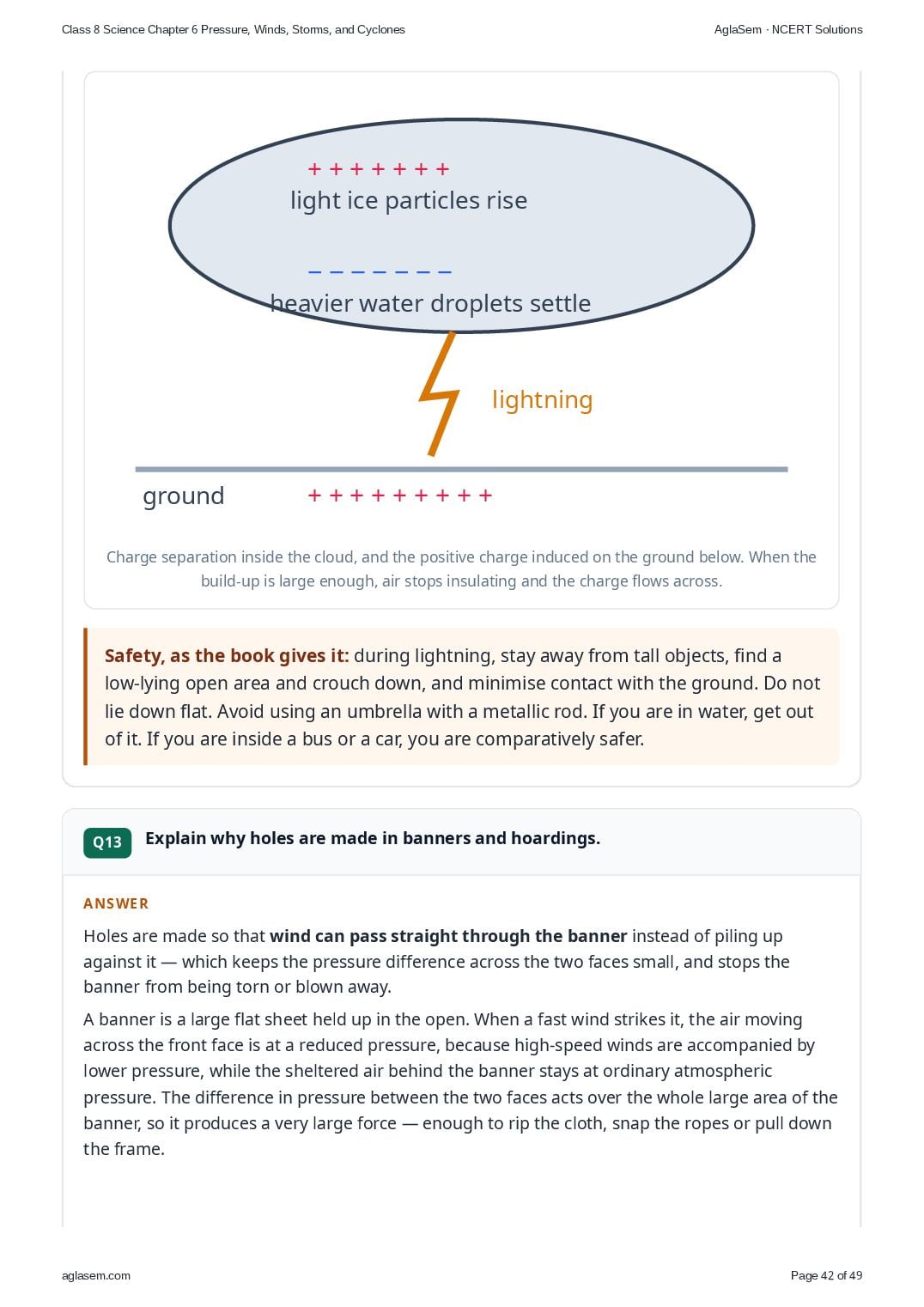
- Explain the process that causes lightning.
- Explain why holes are made in banners and hoardings.
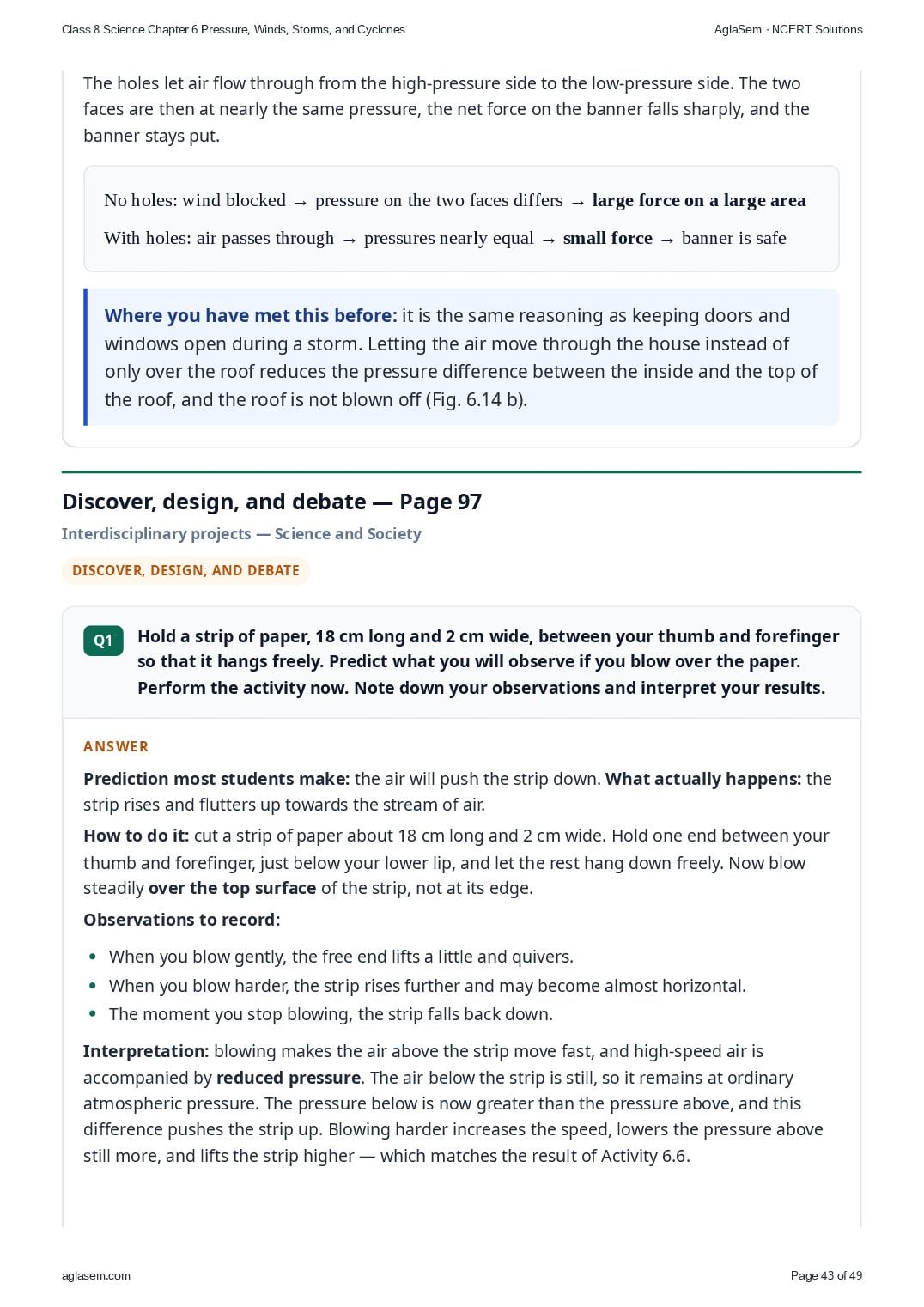
- Hold a strip of paper, 18 cm long and 2 cm wide, between your thumb and forefinger so that it hangs freely. Predict what you will observe if you blow over the paper. Perform the activity now. Note down your observations and interpret your results.
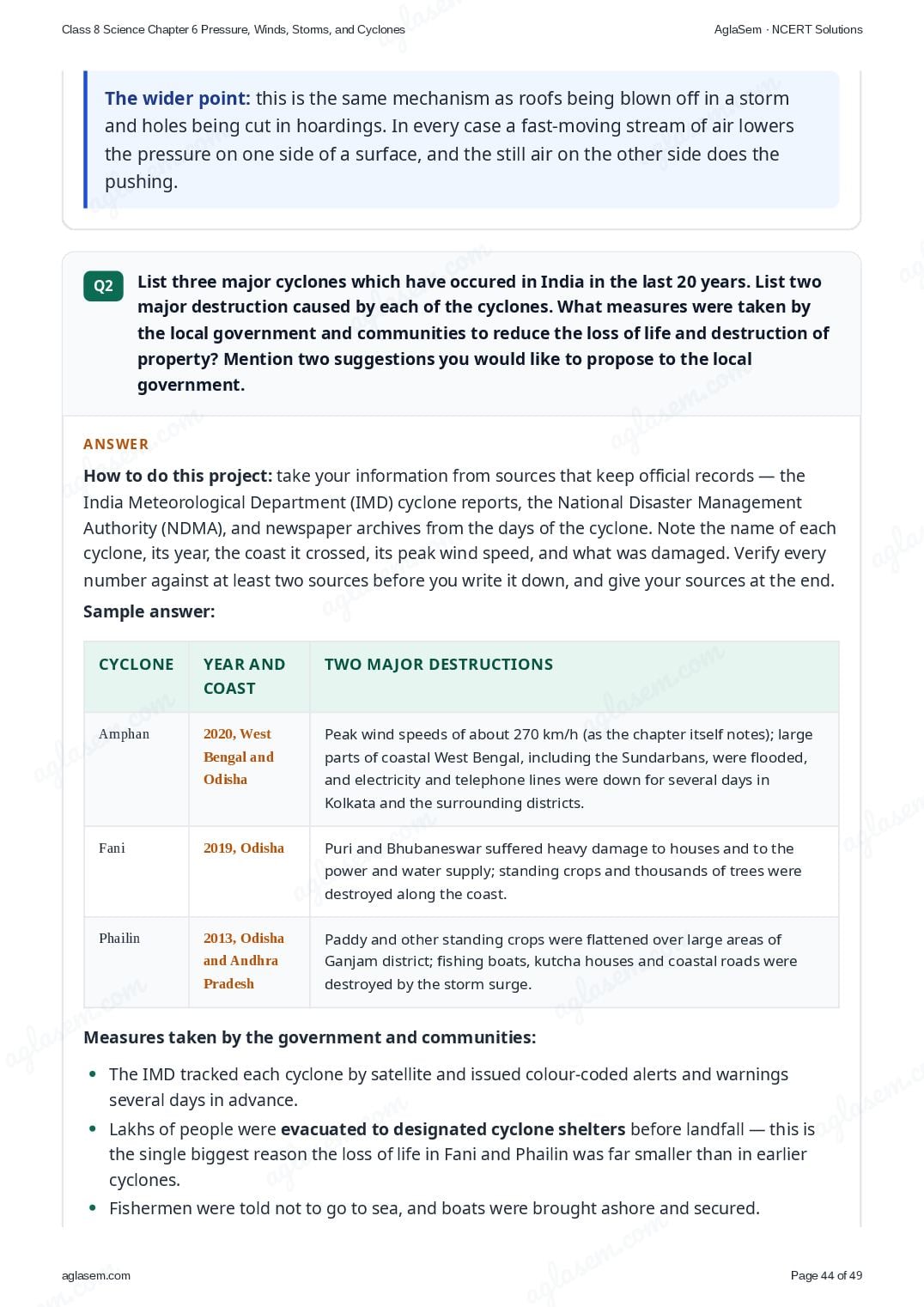
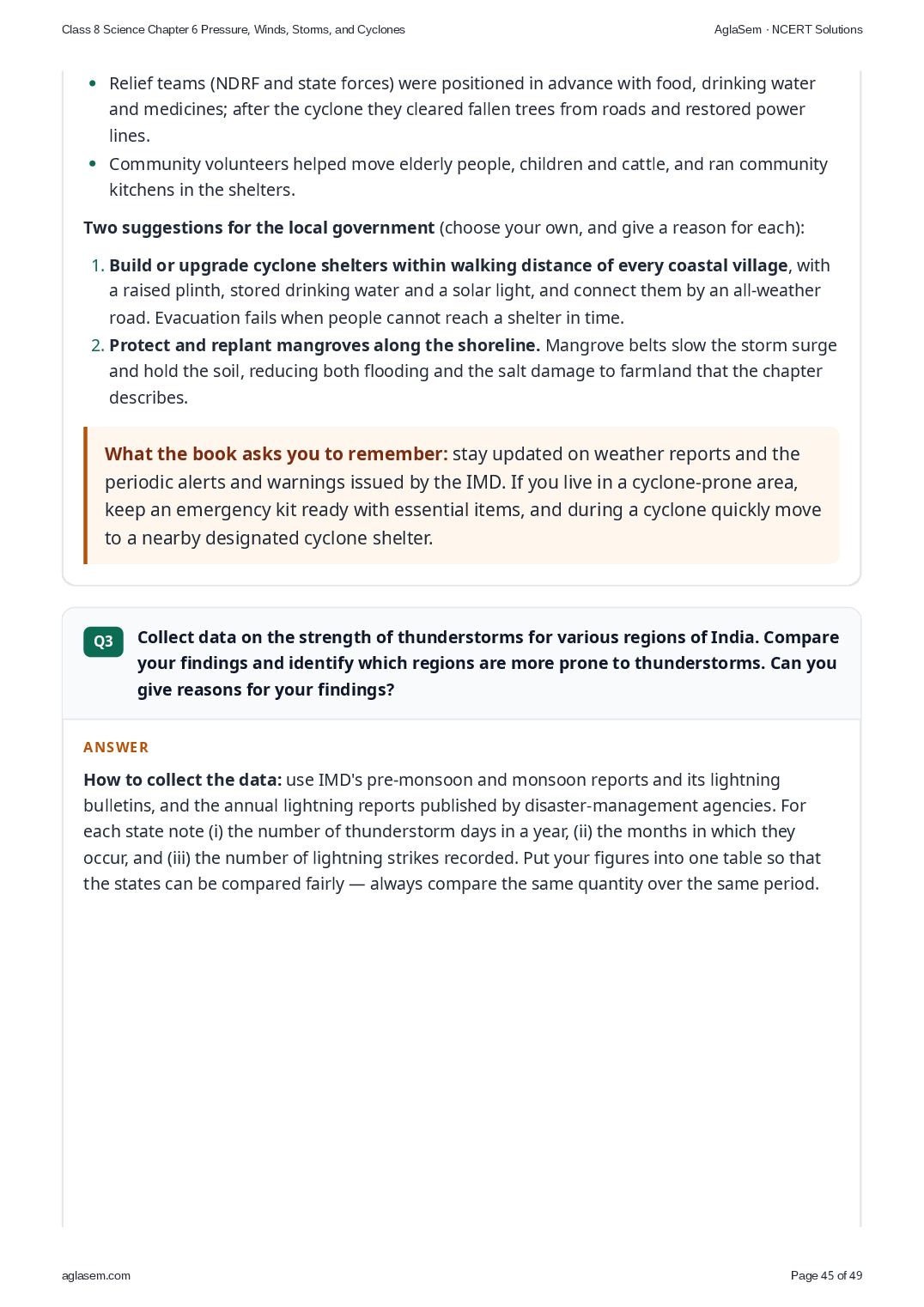
- List three major cyclones which have occured in India in the last 20 years. List two major destruction caused by each of the cyclones. What measures were taken by the local government and communities to reduce the loss of life and destruction of property? Mention two suggestions you would like to propose to the local government.
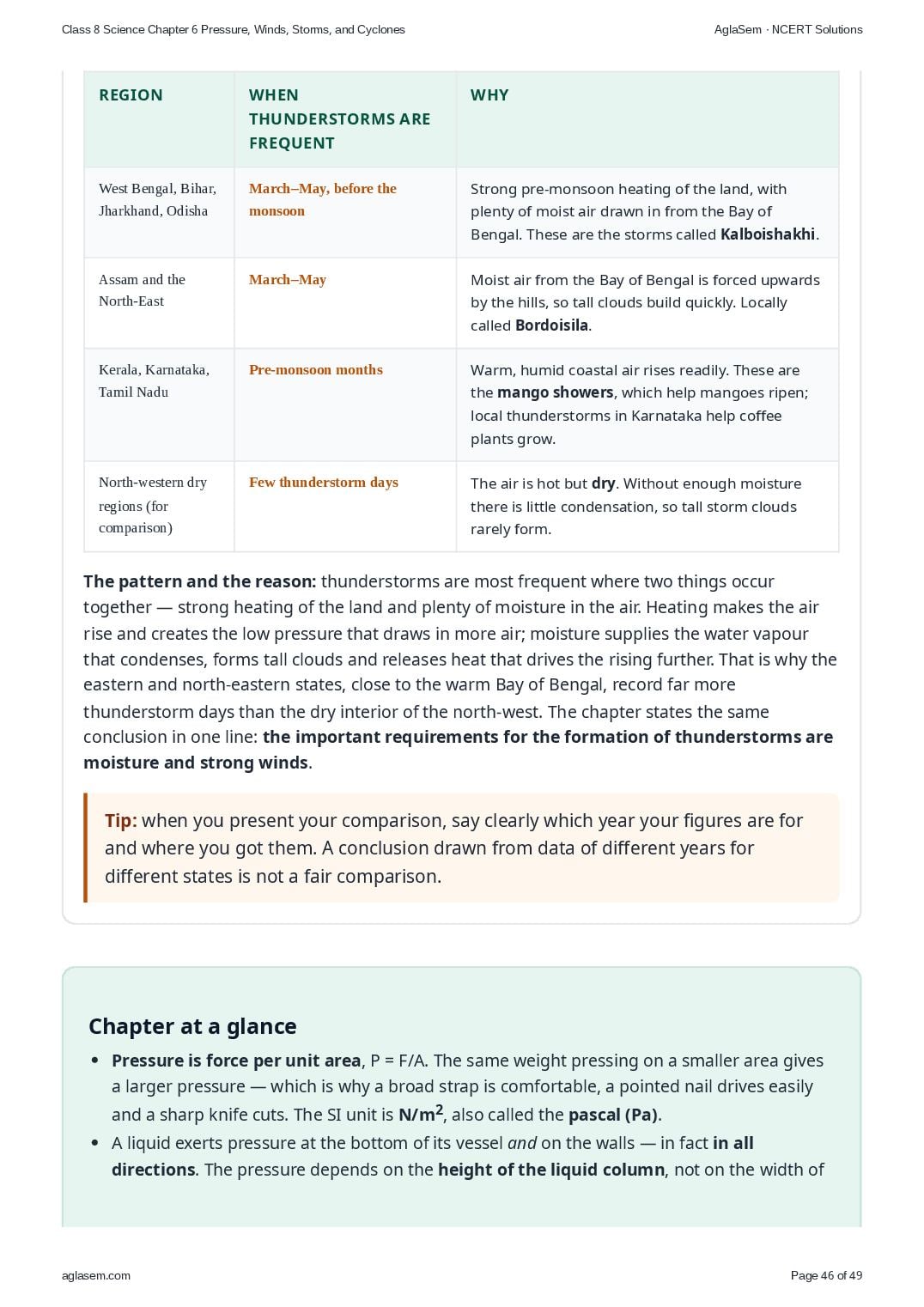
- Collect data on the strength of thunderstorms for various regions of India. Compare your findings and identify which regions are more prone to thunderstorms. Can you give reasons for your findings?
Chapter at a Glance
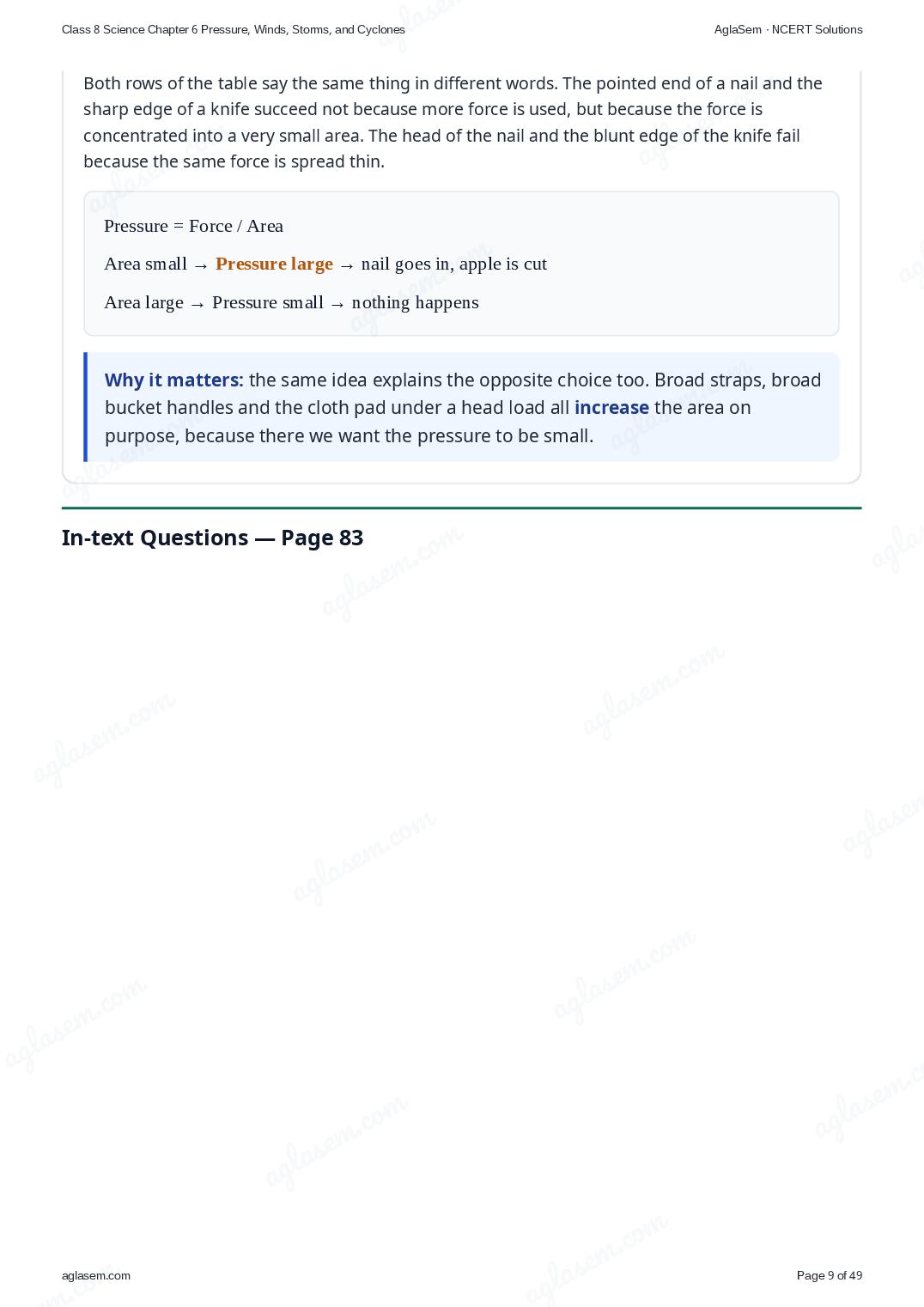
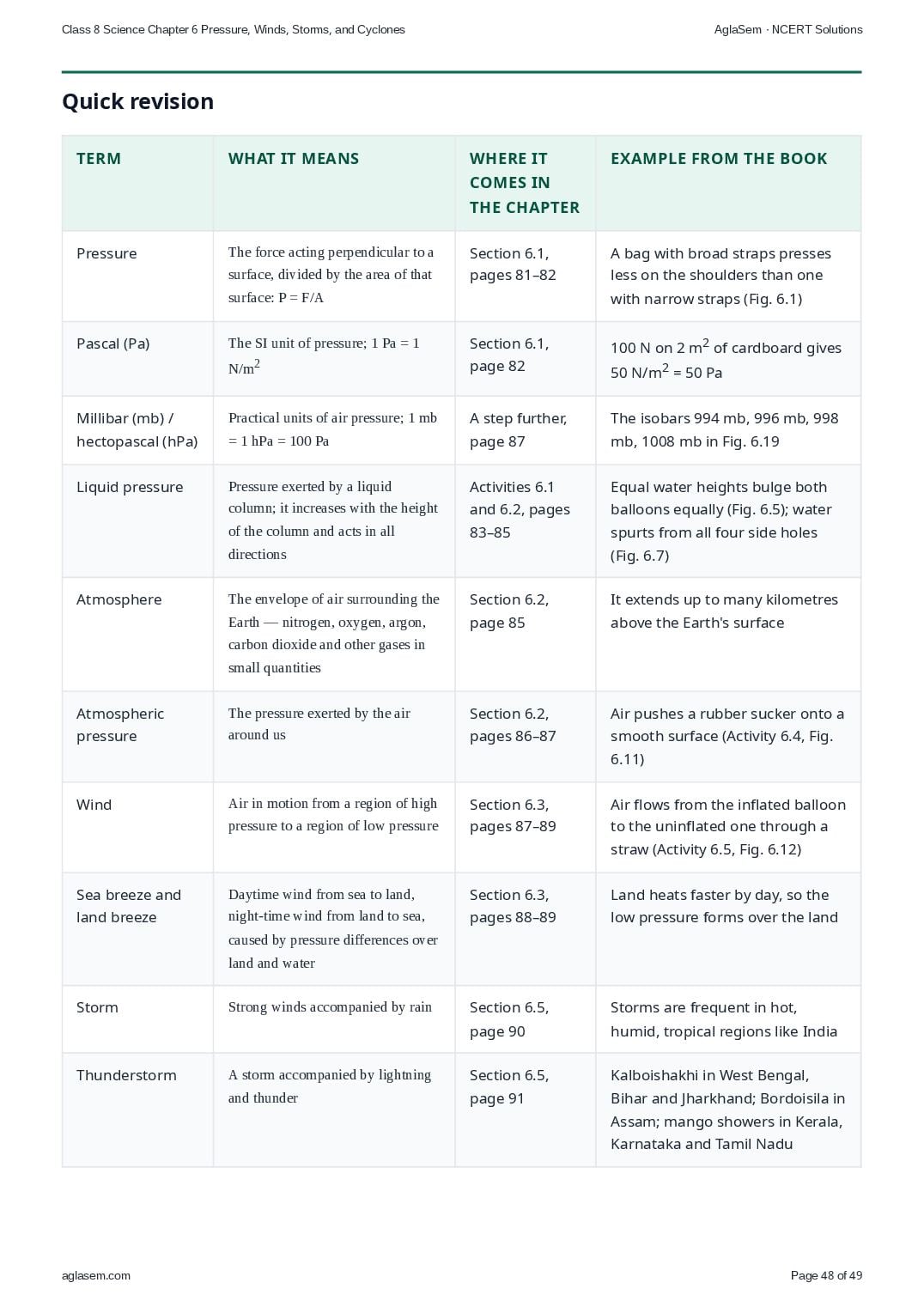
- Pressure is force per unit area , P = F/A . The same weight pressing on a smaller area gives a larger pressure — which is why a broad strap is comfortable, a pointed nail drives easily and a sharp knife cuts. The SI unit is N/m 2 , also called the pascal (Pa) .
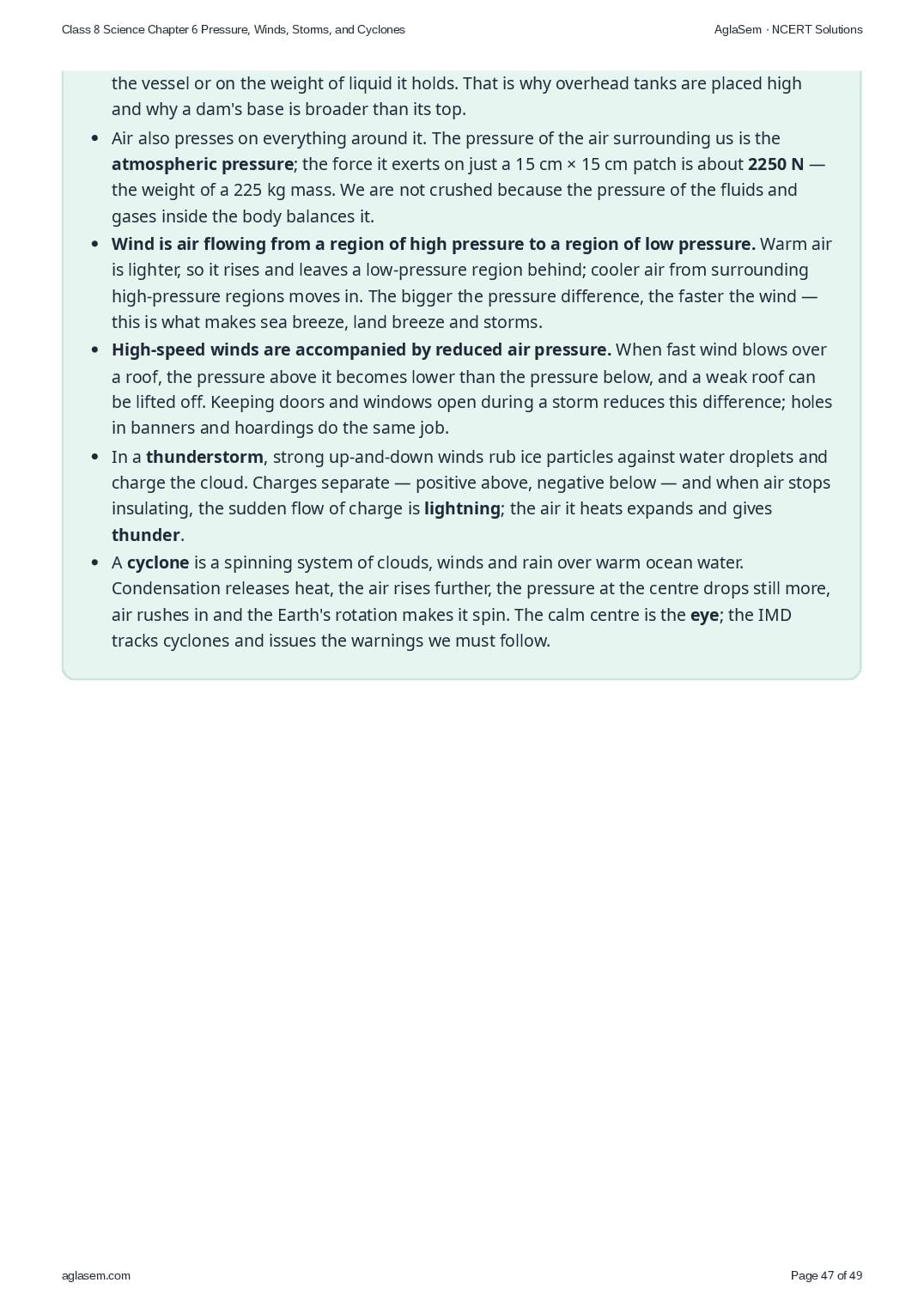
- A liquid exerts pressure at the bottom of its vessel and on the walls — in fact in all directions . The pressure depends on the height of the liquid column , not on the width of the vessel or on the weight of liquid it holds. That is why overhead tanks are placed high and why a dam's base is broader than its top.
- Air also presses on everything around it. The pressure of the air surrounding us is the atmospheric pressure ; the force it exerts on just a 15 cm × 15 cm patch is about 2250 N — the weight of a 225 kg mass. We are not crushed because the pressure of the fluids and gases inside the body balances it.
- Wind is air flowing from a region of high pressure to a region of low pressure. Warm air is lighter, so it rises and leaves a low-pressure region behind; cooler air from surrounding high-pressure regions moves in. The bigger the pressure difference, the faster the wind — this is what makes sea breeze, land breeze and storms.
- High-speed winds are accompanied by reduced air pressure. When fast wind blows over a roof, the pressure above it becomes lower than the pressure below, and a weak roof can be lifted off. Keeping doors and windows open during a storm reduces this difference; holes in banners and hoardings do the same job.
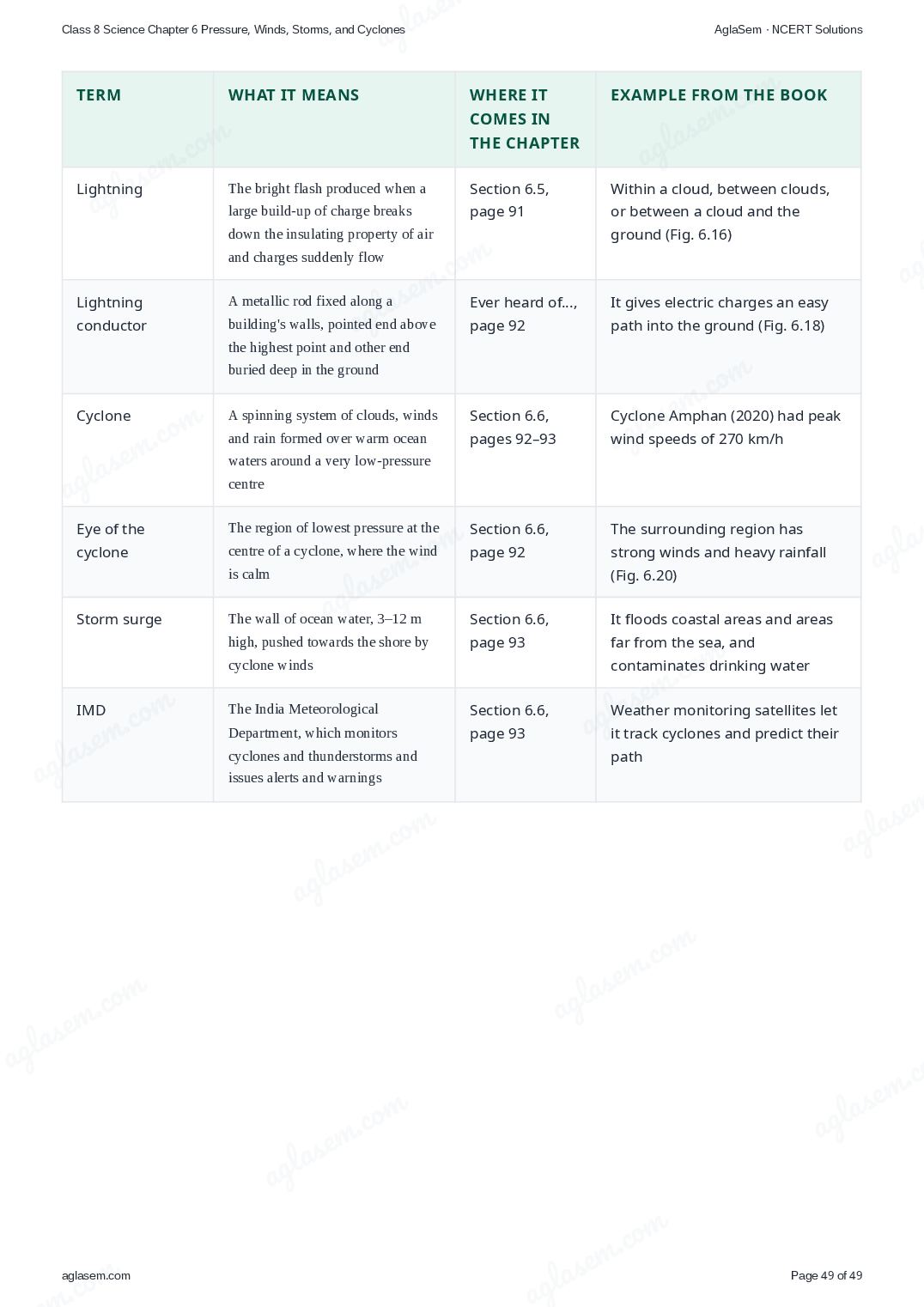
- In a thunderstorm , strong up-and-down winds rub ice particles against water droplets and charge the cloud. Charges separate — positive above, negative below — and when air stops insulating, the sudden flow of charge is lightning ; the air it heats expands and gives thunder .
- A cyclone is a spinning system of clouds, winds and rain over warm ocean water. Condensation releases heat, the air rises further, the pressure at the centre drops still more, air rushes in and the Earth's rotation makes it spin. The calm centre is the eye ; the IMD tracks cyclones and issues the warnings we must follow.
How to Download NCERT Solutions for Class 8 Science Chapter 6 PDF
Follow these simple steps to get the Pressure Winds Storms and Cyclones questions-and-answers PDF from Curiosity.
- Search NCERT Solutions for Class 8 Science Chapter 6 aglasem and open this page.
- Read the exercise questions with answers for Pressure Winds Storms and Cyclones shown above.
- Click the Download PDF link to save the Pressure Winds Storms and Cyclones solutions to your device.
NCERT Solutions for Class 8 Science – All Chapters
There are more chapters to study besides Pressure Winds Storms and Cyclones in Science. Here are the NCERT Solutions for all chapters of Class 8 Science.
- Chapter 1 Exploring the Investigative World of Science
- Chapter 2 The Invisible Living World Beyond Our Naked Eye
- Chapter 3 Health the Ultimate Treasure
- Chapter 4 Electricity Magnetic and Heating Effects
- Chapter 5 Exploring Forces
- Chapter 6 Pressure Winds Storms and Cyclones
- Chapter 7 Particulate Nature of Matter
- Chapter 8 Nature of Matter Elements Compounds and Mixtures
- Chapter 9 The Amazing World of Solutes Solvents and Solutions
- Chapter 10 Light Mirrors and Lenses
- Chapter 11 Keeping Time with the Skies
- Chapter 12 How Nature Works in Harmony
- Chapter 13 Our Home Earth a Unique Life Sustaining Planet
NCERT Solutions for Class 8 – All Subjects
Just like Chapter 6 of Science, you can get the exercise questions with answers for every other subject of Class 8. Here are the NCERT Solutions for all subjects of Class 8.
NCERT Solutions for Class 8 Science Chapter 6 – An Overview
The key highlights of this study material are as follows.
| Aspects | Details |
|---|---|
| Class | Class 8 |
| Subject | Science |
| Chapter Number | Chapter 6 |
| Chapter Name | Pressure Winds Storms and Cyclones |
| Book Name | Curiosity |
| Book By | NCERT (National Council of Educational Research and Training) |
| Educational Resource Here | NCERT Solutions of Class 8 Science Chapter 6 for all exercises |
| More Questions Answers of This Subject | NCERT Solutions for Class 8 Science |
| Download Book Chapter | NCERT Book Class 8 Science |
| All Questions Answers For This Class | NCERT Solutions for Class 8 |
| Complete Solutions | NCERT Solutions |
NCERT Solutions for Class 8 Science Chapter 6 Pressure Winds Storms and Cyclones – FAQs
What are the NCERT Solutions for Class 8 Science Chapter 6 Pressure Winds Storms and Cyclones?
They are the complete, step-by-step answers to all the exercise and in-text questions of Chapter 6 Pressure Winds Storms and Cyclones from the NCERT Class 8 Science textbook Curiosity, written by experts as per the latest NCERT syllabus.
How can I download the Class 8 Science Chapter 6 solutions PDF for free?
Open this page on aglasem, read the Pressure Winds Storms and Cyclones questions with answers, and click the “Download Solutions PDF” link. The Class 8 Science Chapter 6 NCERT Solutions PDF is completely free to download.
Are these NCERT Solutions as per the latest 2026-27 syllabus?
Yes. The NCERT Solutions for Class 8 Science Chapter 6 are based on the latest NCERT textbook Curiosity and the current 2026-27 CBSE syllabus, so the questions and answers match what you study in class.
Where can I get NCERT Solutions for the other chapters of Class 8 Science?
You can find the answers to every chapter on the NCERT Solutions for Class 8 Science page, and solutions for every subject on the NCERT Solutions for Class 8 page.
How do NCERT Solutions help in exam preparation?
They show the correct method to solve each question, help you write answers the way they are expected in exams, let you check and correct your own work, and save revision time — which together improve your marks in Class 8 Science.
If you have any queries on NCERT Solutions for Class 8 Science Chapter 6 Pressure Winds Storms and Cyclones, then please ask in the comments below.