NCERT Solutions for Class 8 Science Chapter 12 How Nature Works in Harmony provide clear, step-by-step answers to every exercise and in-text question from the chapter How Nature Works in Harmony of the NCERT textbook Curiosity. Prepared by subject experts as per the latest NCERT (CBSE) syllabus for 2026-27, these NCERT Solutions for Class 8 Science help you understand each concept, write exam-ready answers, and check your own solutions. You can read them online below or download the free Class 8 Science Chapter 12 question-answer PDF.
NCERT Solutions for Class 8 Science Chapter 12 How Nature Works in Harmony
- Class: Class 8
- Subject: Science
- Chapter: Chapter 12 – How Nature Works in Harmony
- Textbook: Curiosity (NCERT)
- Study material: NCERT Solutions – questions with answers, free PDF
These solutions answer all the exercise questions of Chapter 12 How Nature Works in Harmony — including the in-text questions, short-answer and long-answer questions, and activities — with complete explanations so you can follow the method, not just the final answer. Read the full solutions below.
NCERT Solutions Class 8 Science Chapter 12 How Nature Works in Harmony View Download






NCERT Solutions for Class 8 Science Chapter 12 PDF Download
You can read the NCERT Solutions for Class 8 Science Chapter 12 online above, or download the complete question-answer PDF to study How Nature Works in Harmony offline at any time.
NCERT Solutions for Class 8 Science Chapter 12 PDF Download Link – Click Here to Download Solutions PDF
Questions Covered in This Chapter
These NCERT Solutions answer all 60 questions of this chapter. The questions solved are:
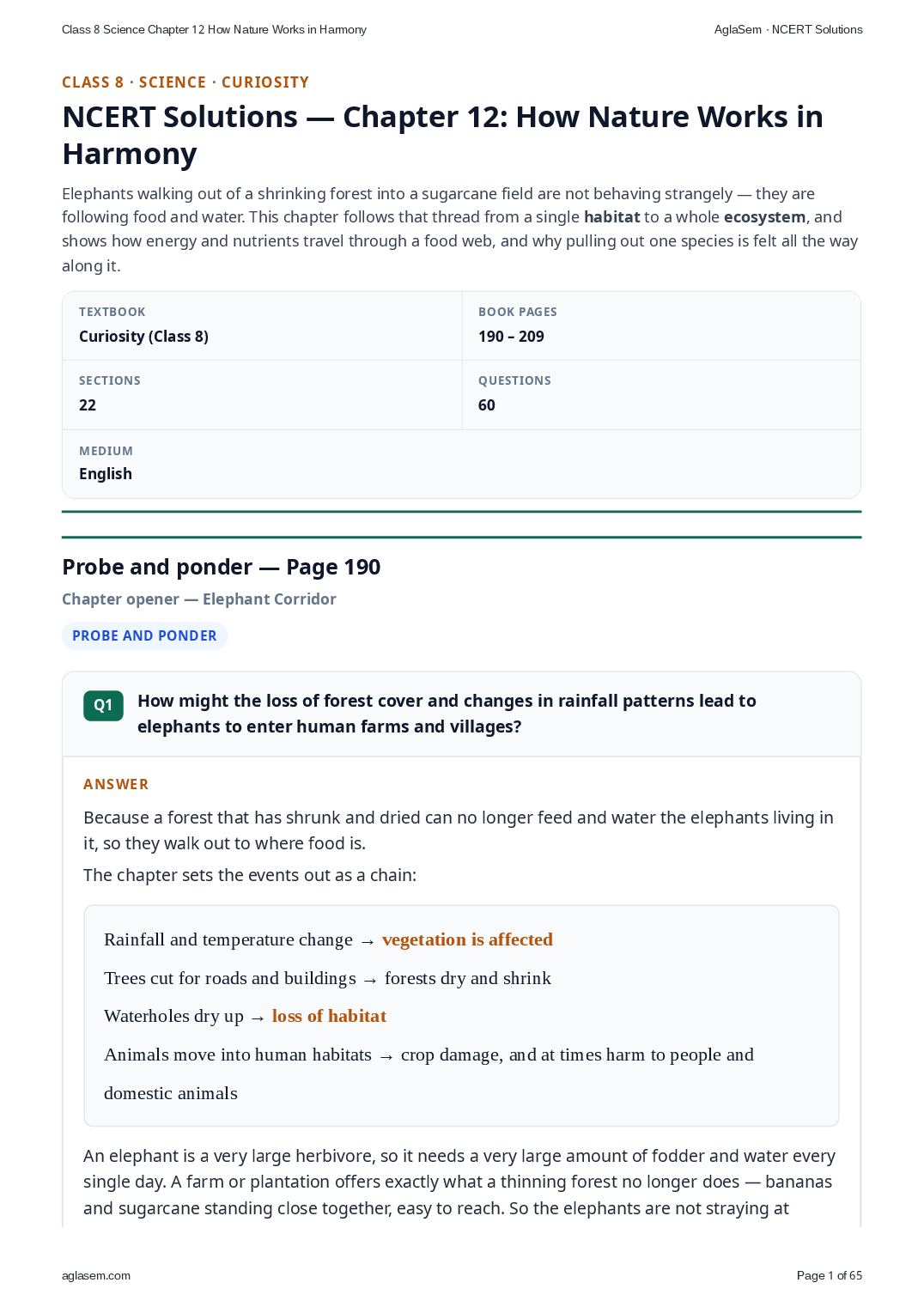
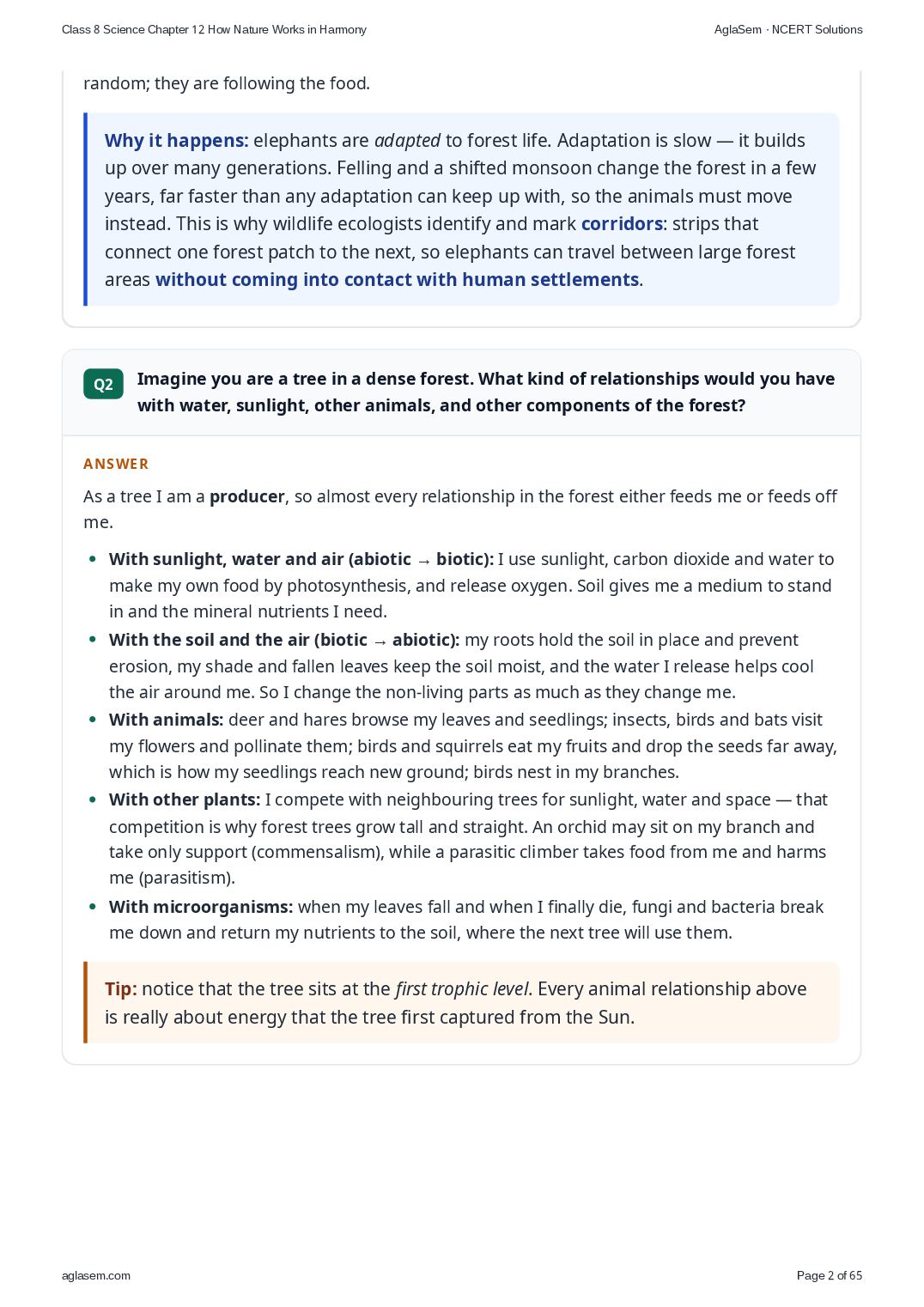
- How might the loss of forest cover and changes in rainfall patterns lead to elephants to enter human farms and villages?
- Imagine you are a tree in a dense forest. What kind of relationships would you have with water, sunlight, other animals, and other components of the forest?
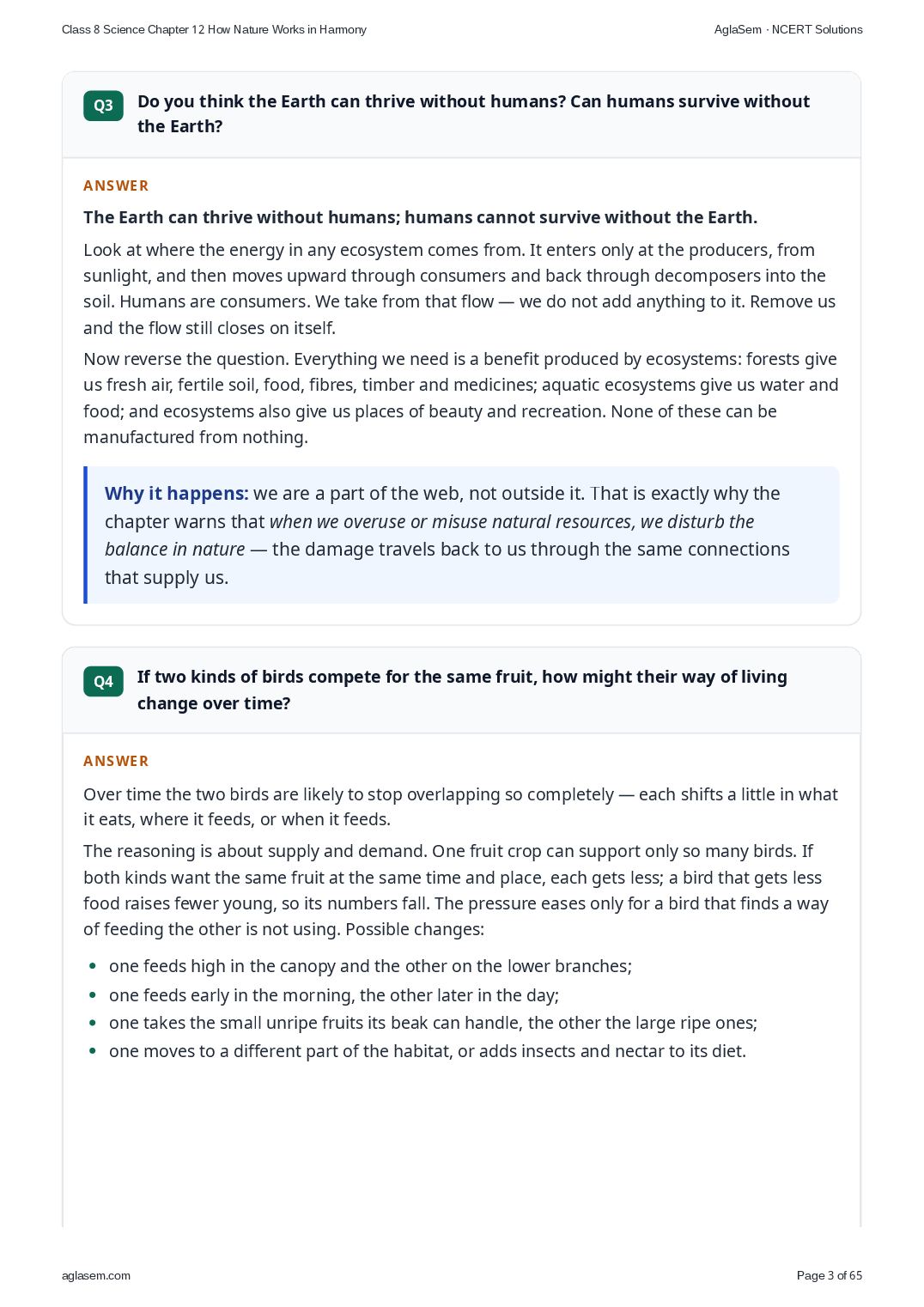
- Do you think the Earth can thrive without humans? Can humans survive without the Earth?
- If two kinds of birds compete for the same fruit, how might their way of living change over time?
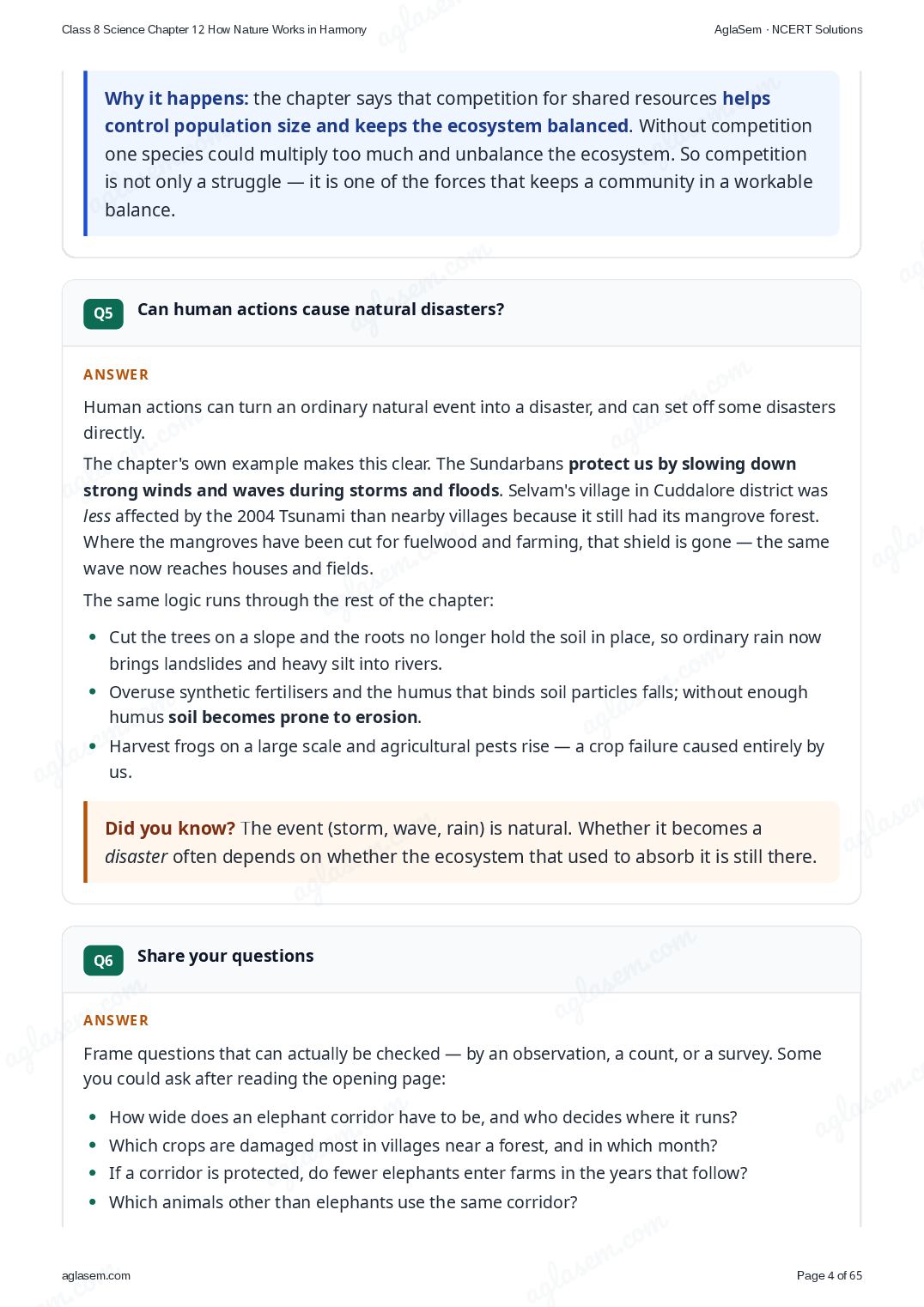
- Can human actions cause natural disasters?
- Share your questions
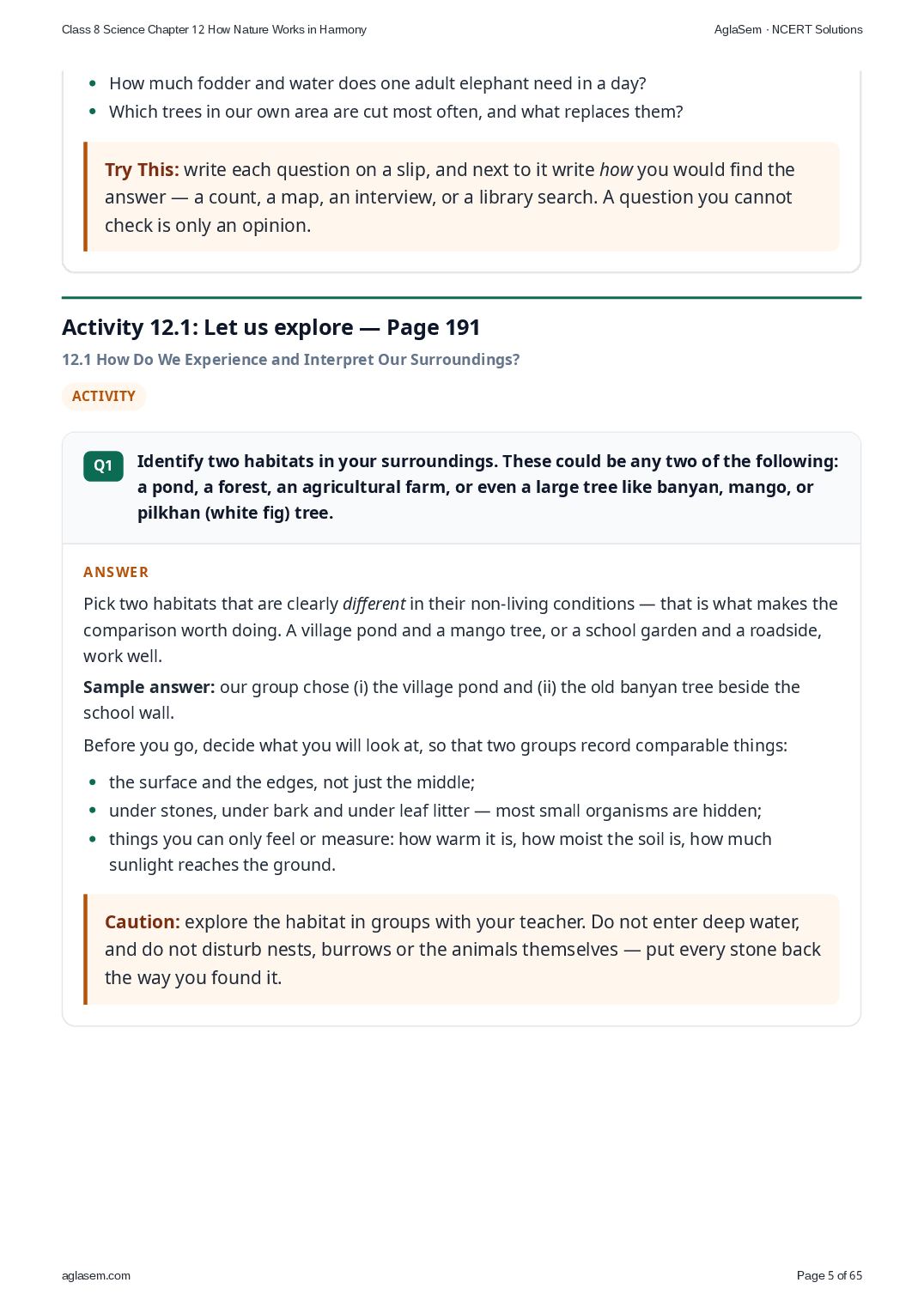
- Identify two habitats in your surroundings. These could be any two of the following: a pond, a forest, an agricultural farm, or even a large tree like banyan, mango, or pilkhan (white fig) tree.
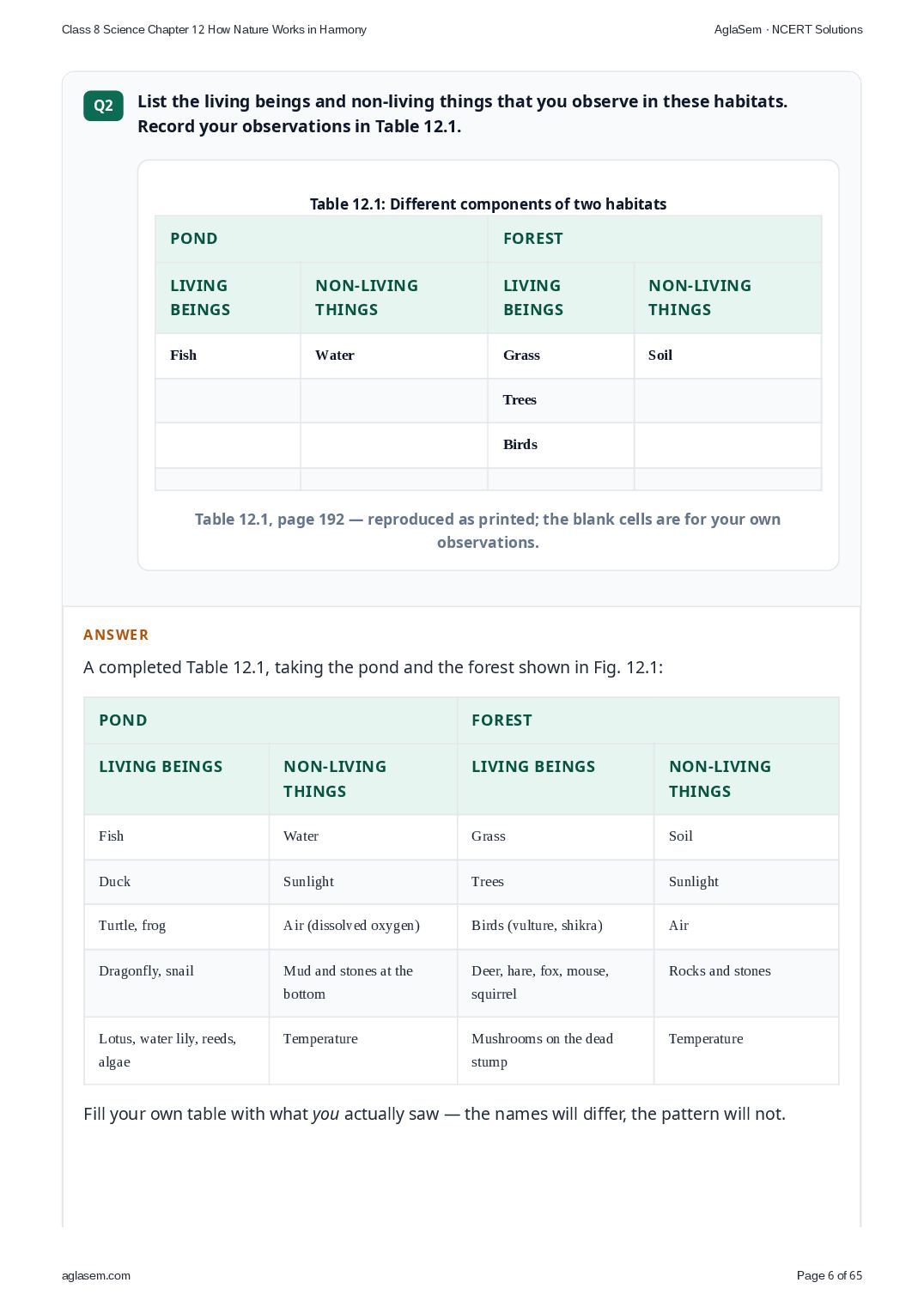
- List the living beings and non-living things that you observe in these habitats. Record your observations in Table 12.1.
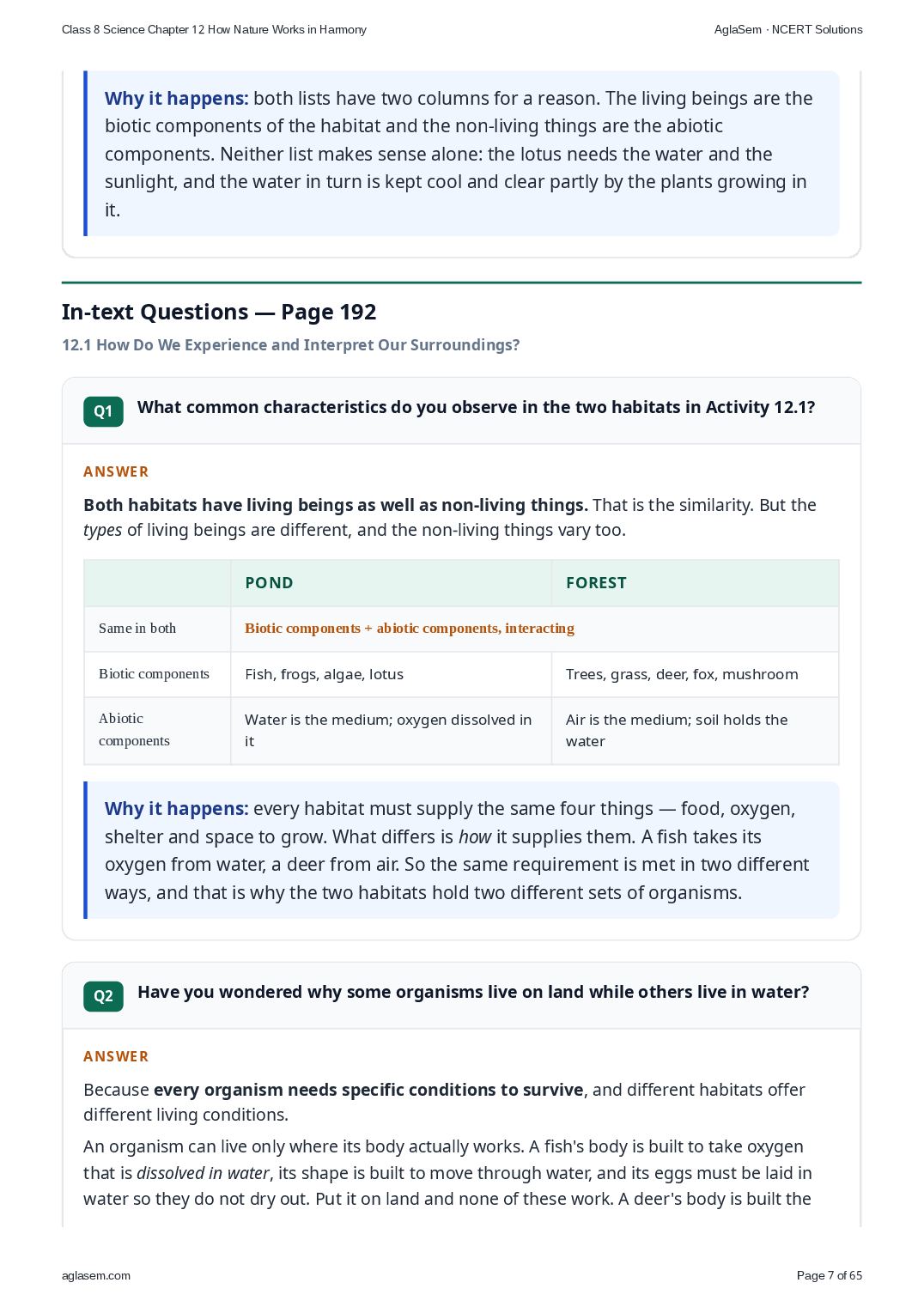
- What common characteristics do you observe in the two habitats in Activity 12.1?
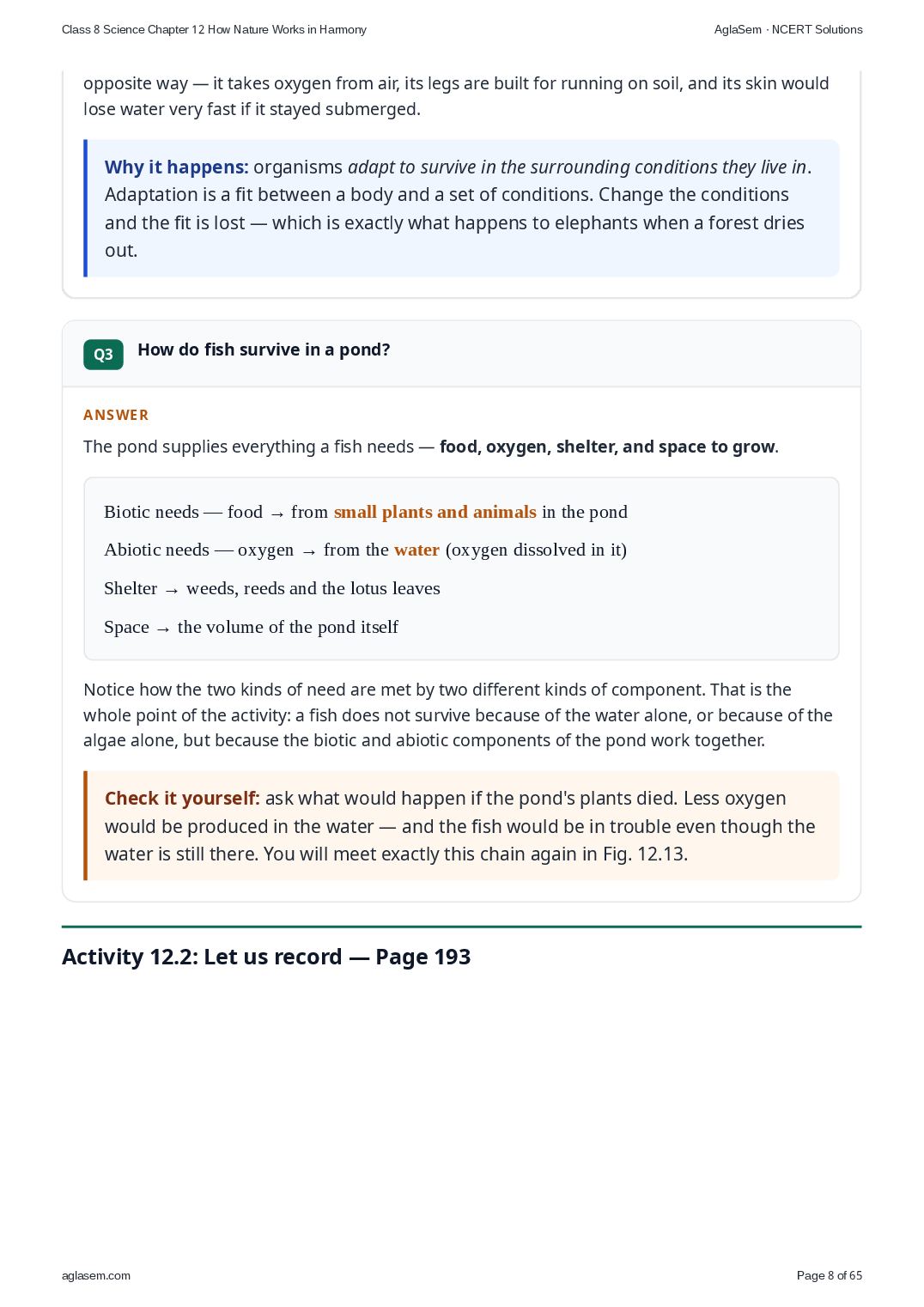
- Have you wondered why some organisms live on land while others live in water?
- How do fish survive in a pond?
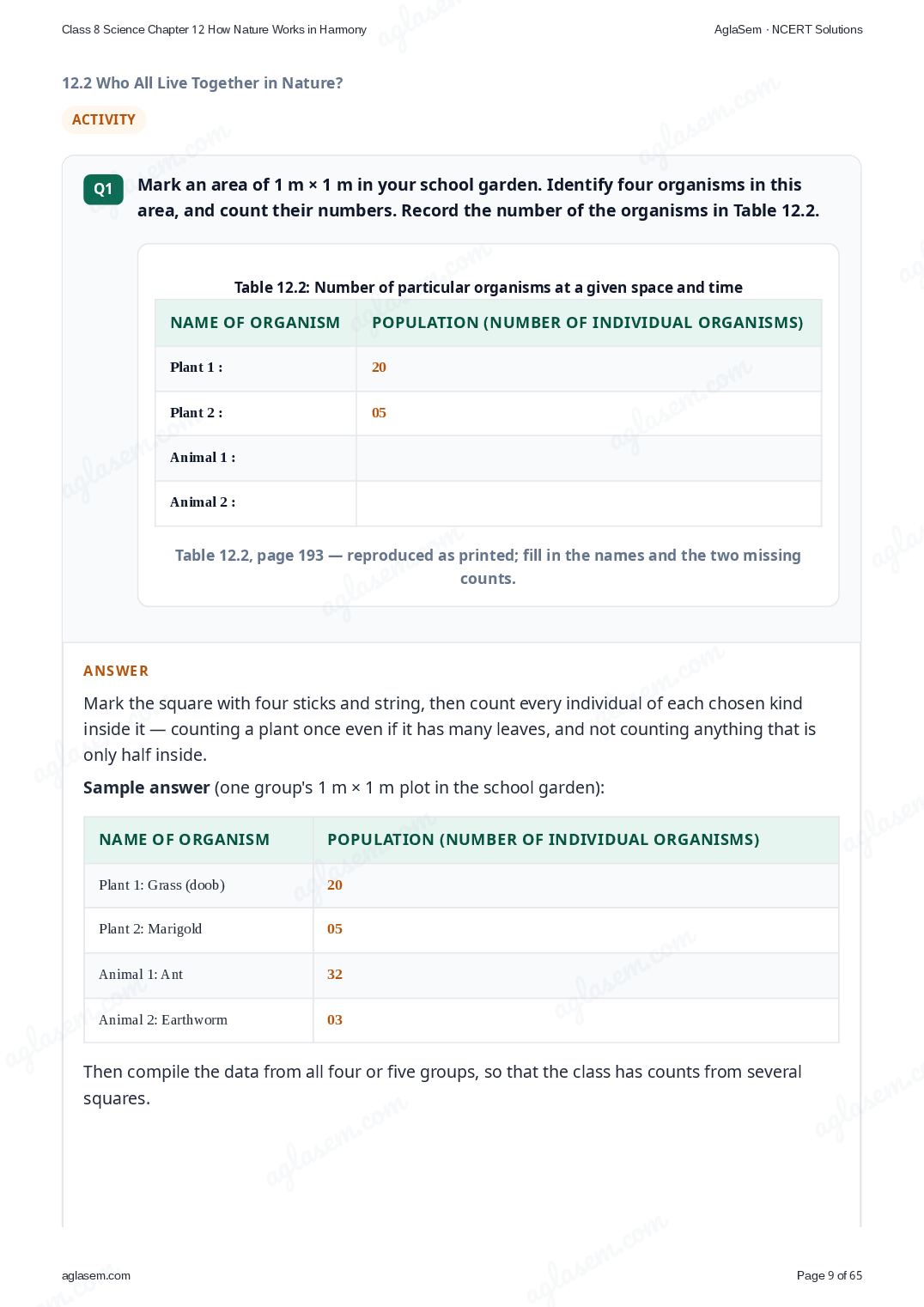
- Mark an area of 1 m × 1 m in your school garden. Identify four organisms in this area, and count their numbers. Record the number of the organisms in Table 12.2.
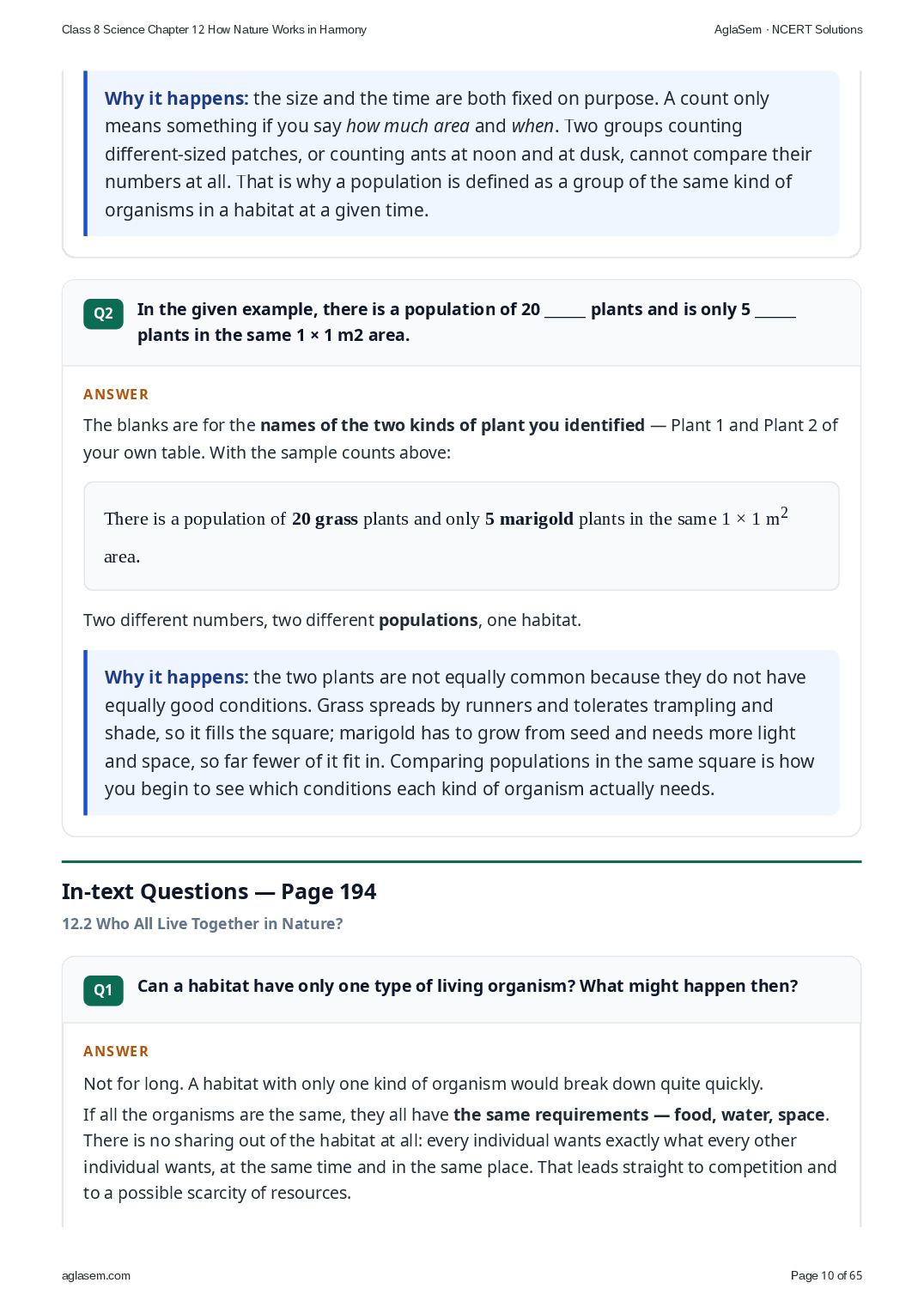
- In the given example, there is a population of 20 ______ plants and is only 5 ______ plants in the same 1 × 1 m2 area.
- Can a habitat have only one type of living organism? What might happen then?
- What else do you think could happen?
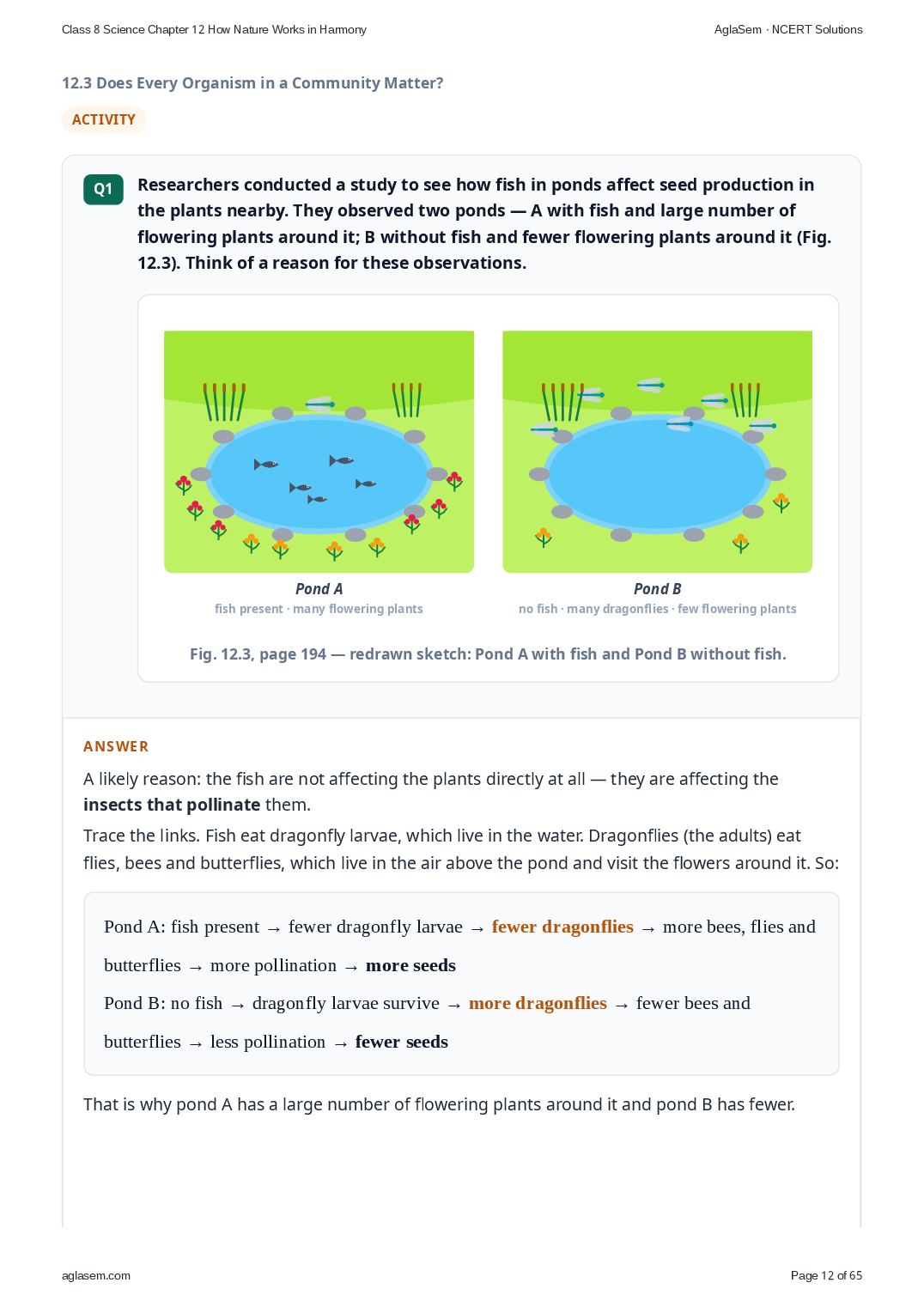
- Researchers conducted a study to see how fish in ponds affect seed production in the plants nearby. They observed two ponds — A with fish and large number of flowering plants around it; B without fish and fewer flowering plants around it (Fig. 12.3). Think of a reason for these observations.
- Compare the number of dragonflies, bees, and butterflies in both the ponds. Do you find any relationship between the number of dragonflies and bees/butterflies? We observed that in Pond A (with fish) the number of dragonflies were less as compared to Pond B. Why?
- What does this study show? How does the population of fish in a pond affect the seed production in nearby plants?
- Similarly, can overfishing by humans change this balance? How do you think it may affect the living and non-living parts of the habitat?
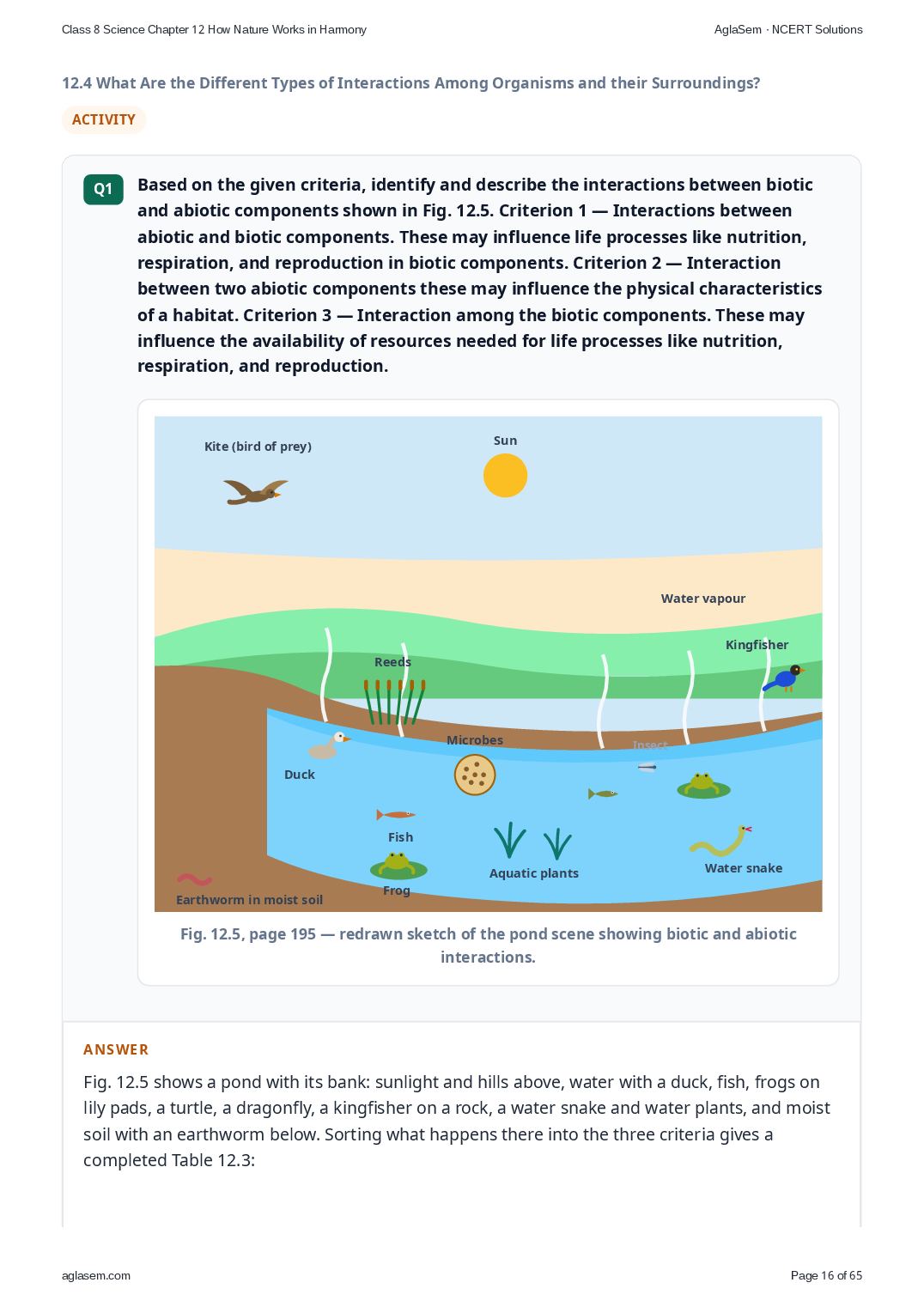
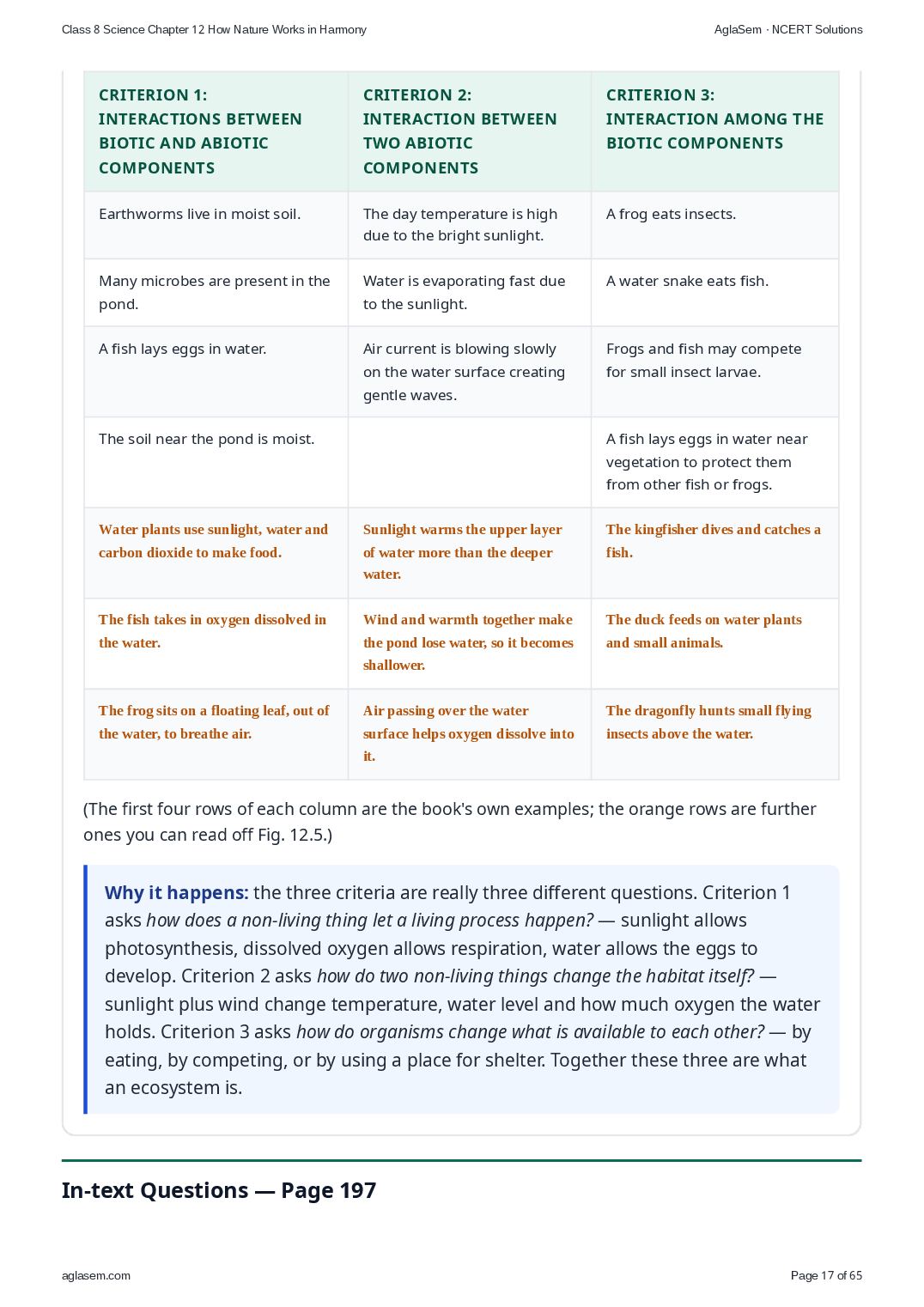
- Based on the given criteria, identify and describe the interactions between biotic and abiotic components shown in Fig. 12.5. Criterion 1 — Interactions between abiotic and biotic components. These may influence life processes like nutrition, respiration, and reproduction in biotic components. Criterion 2 — Interaction between two abiotic components these may influence the physical characteristics of a habitat. Criterion 3 — Interaction among the biotic components. These may influence the availability of resources needed for life processes like nutrition, respiration, and reproduction.
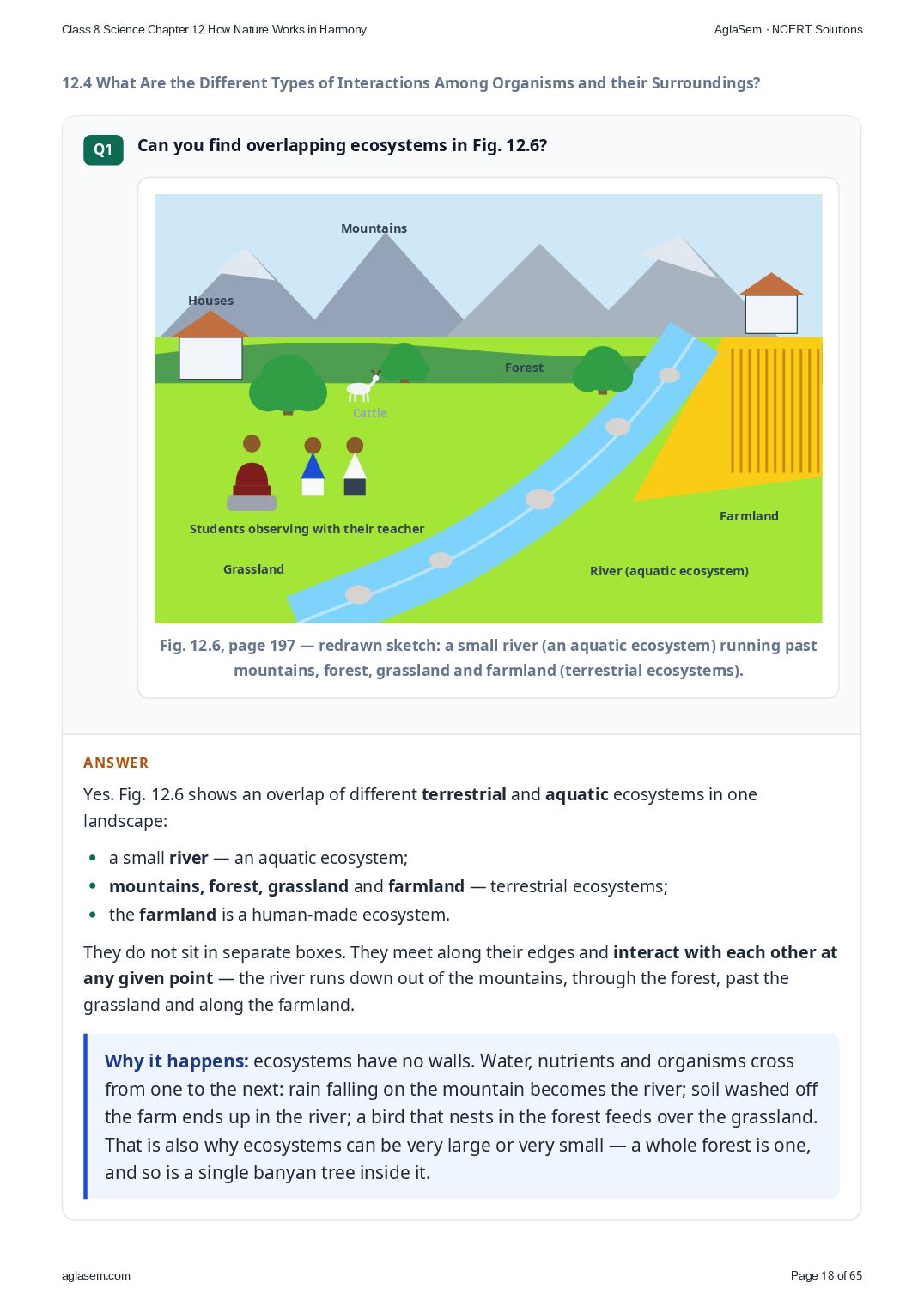
- Can you find overlapping ecosystems in Fig. 12.6?
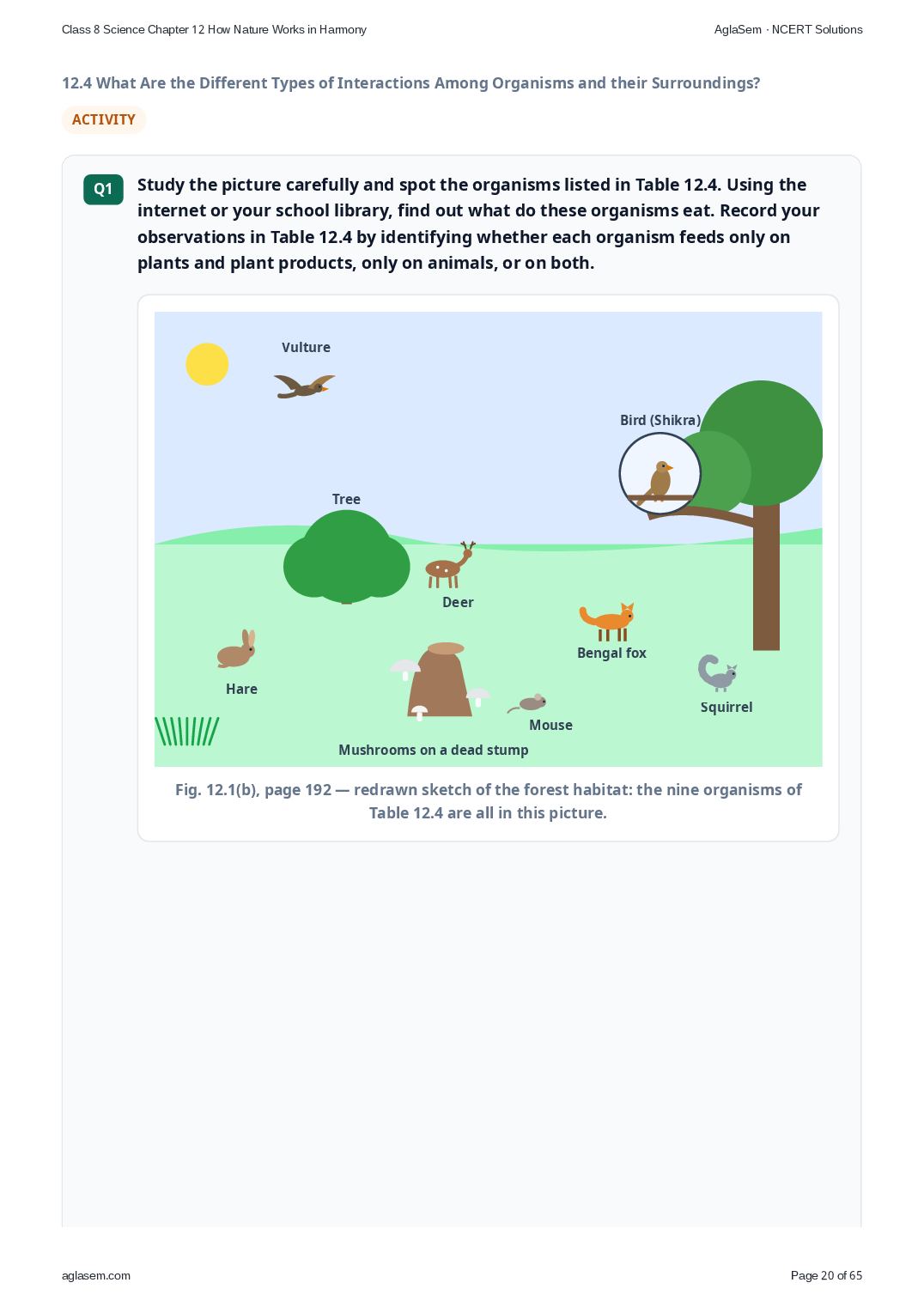
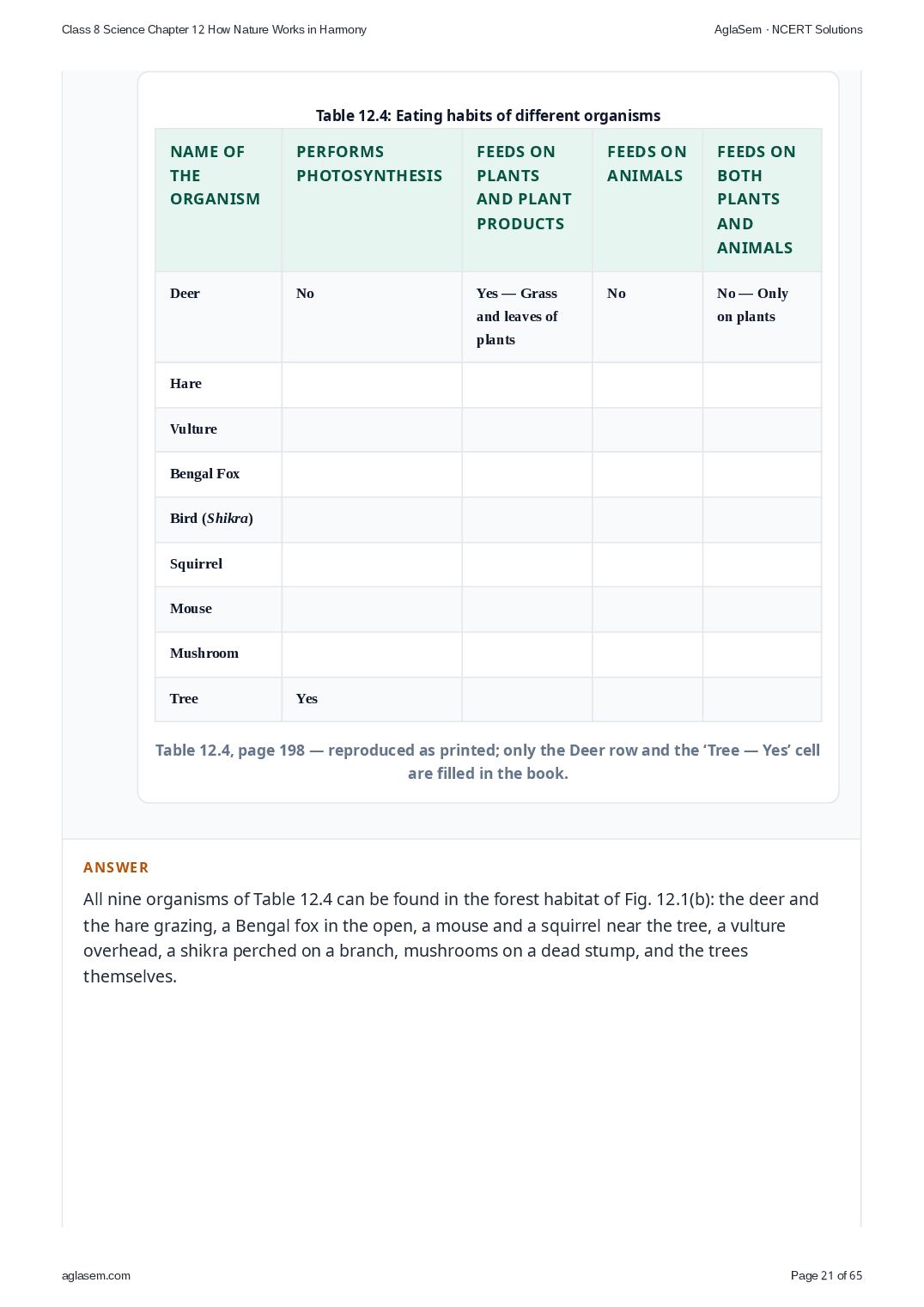
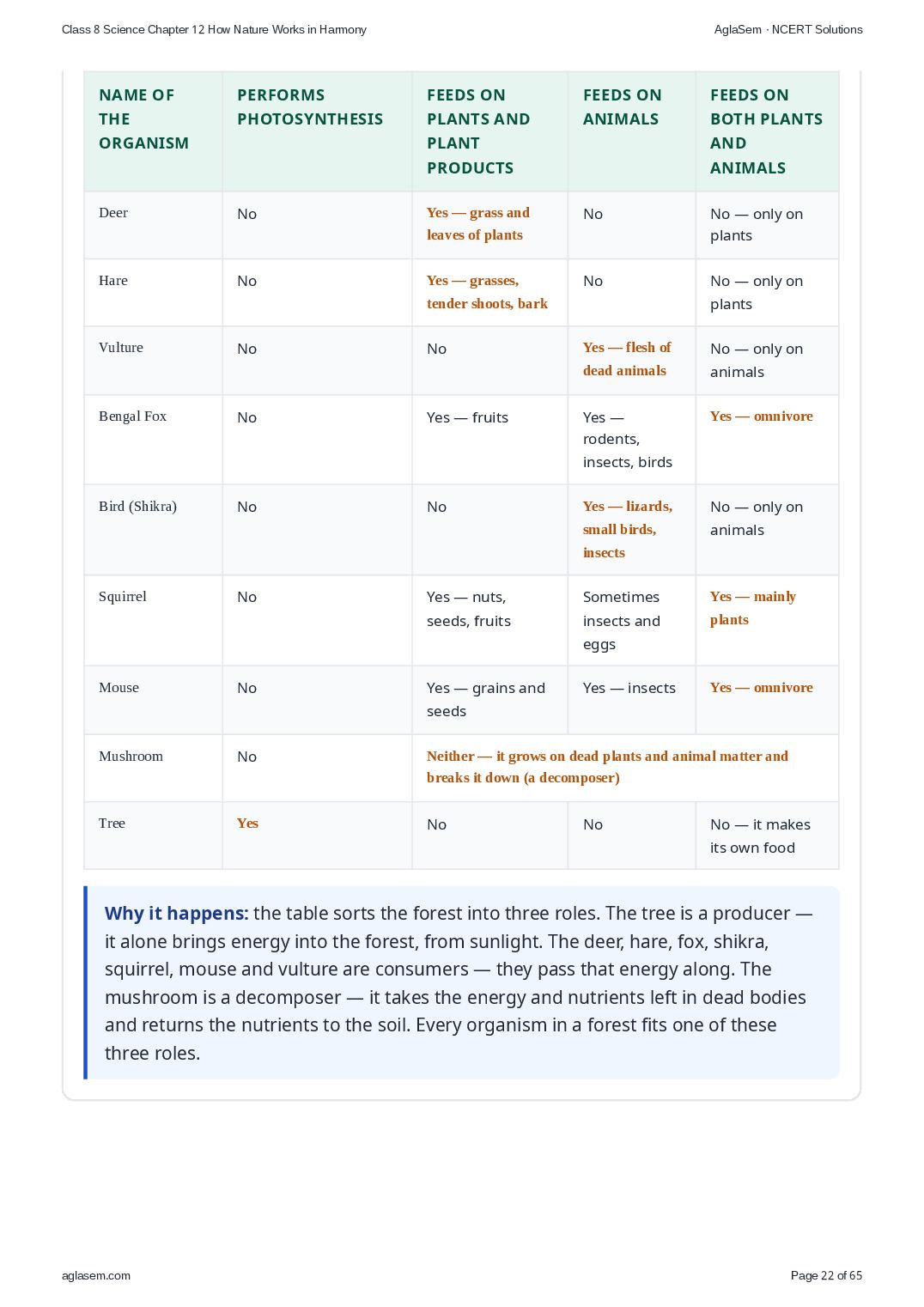
- Study the picture carefully and spot the organisms listed in Table 12.4. Using the internet or your school library, find out what do these organisms eat. Record your observations in Table 12.4 by identifying whether each organism feeds only on plants and plant products, only on animals, or on both.
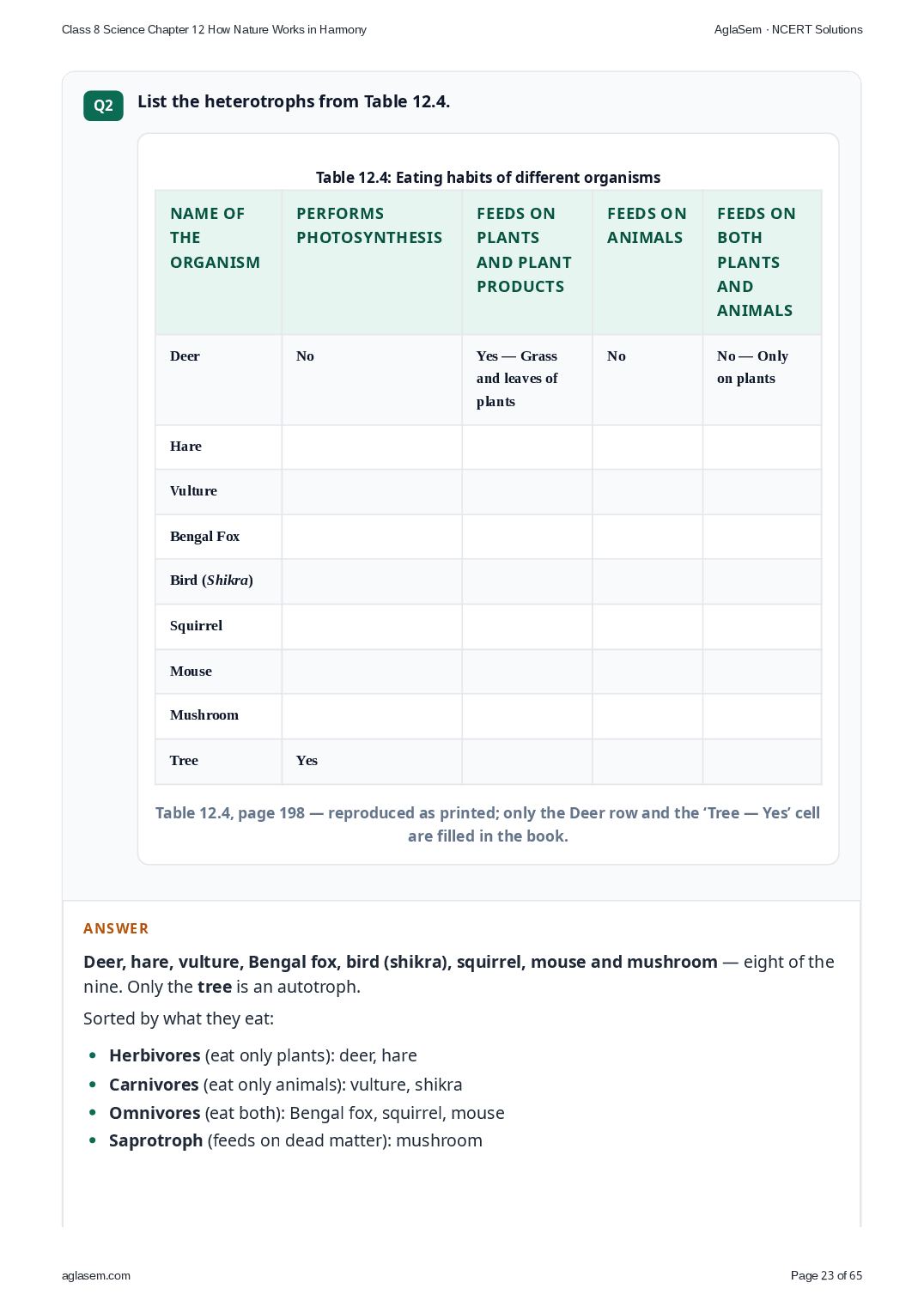
- List the heterotrophs from Table 12.4.
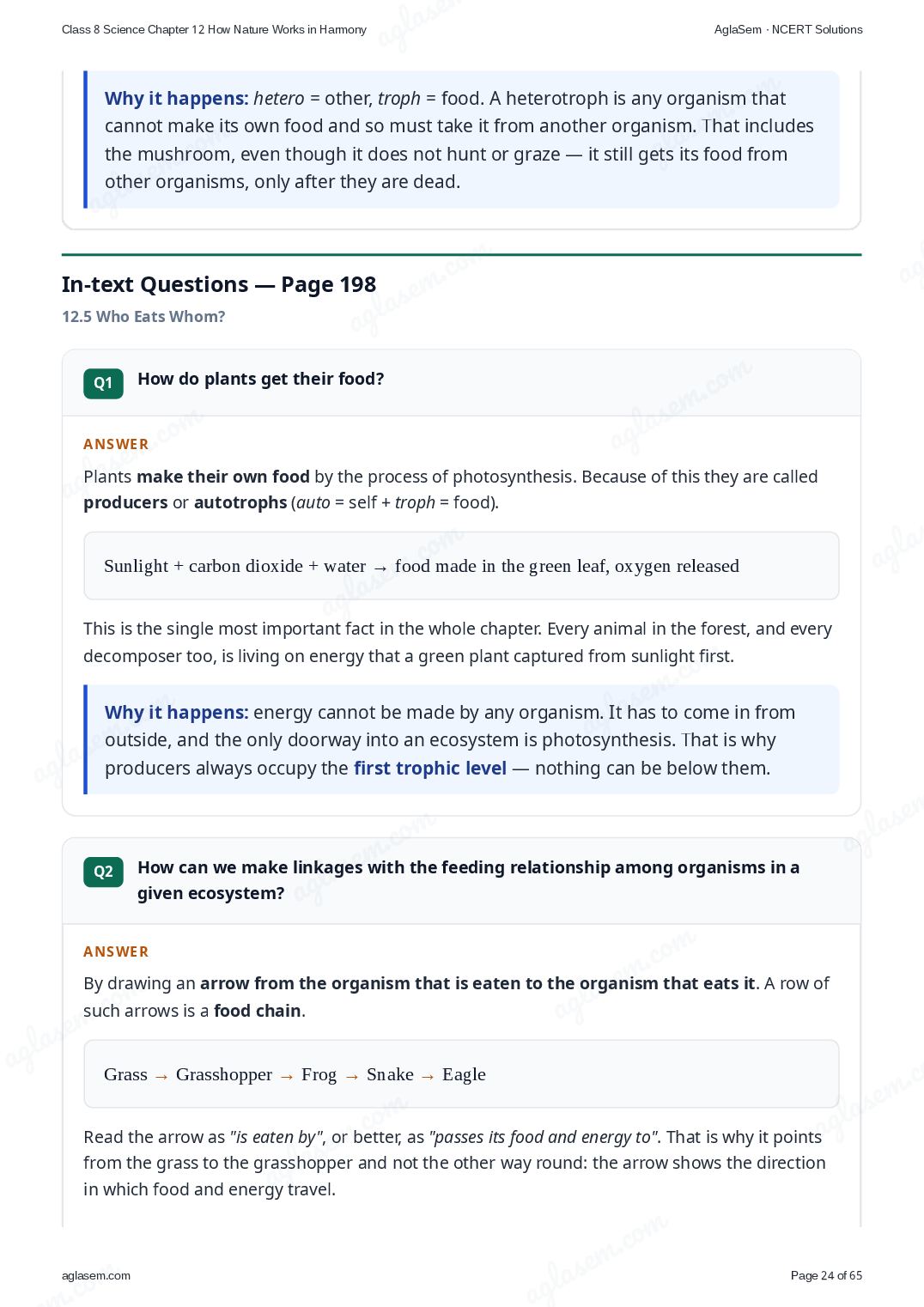
- How do plants get their food?
- How can we make linkages with the feeding relationship among organisms in a given ecosystem?
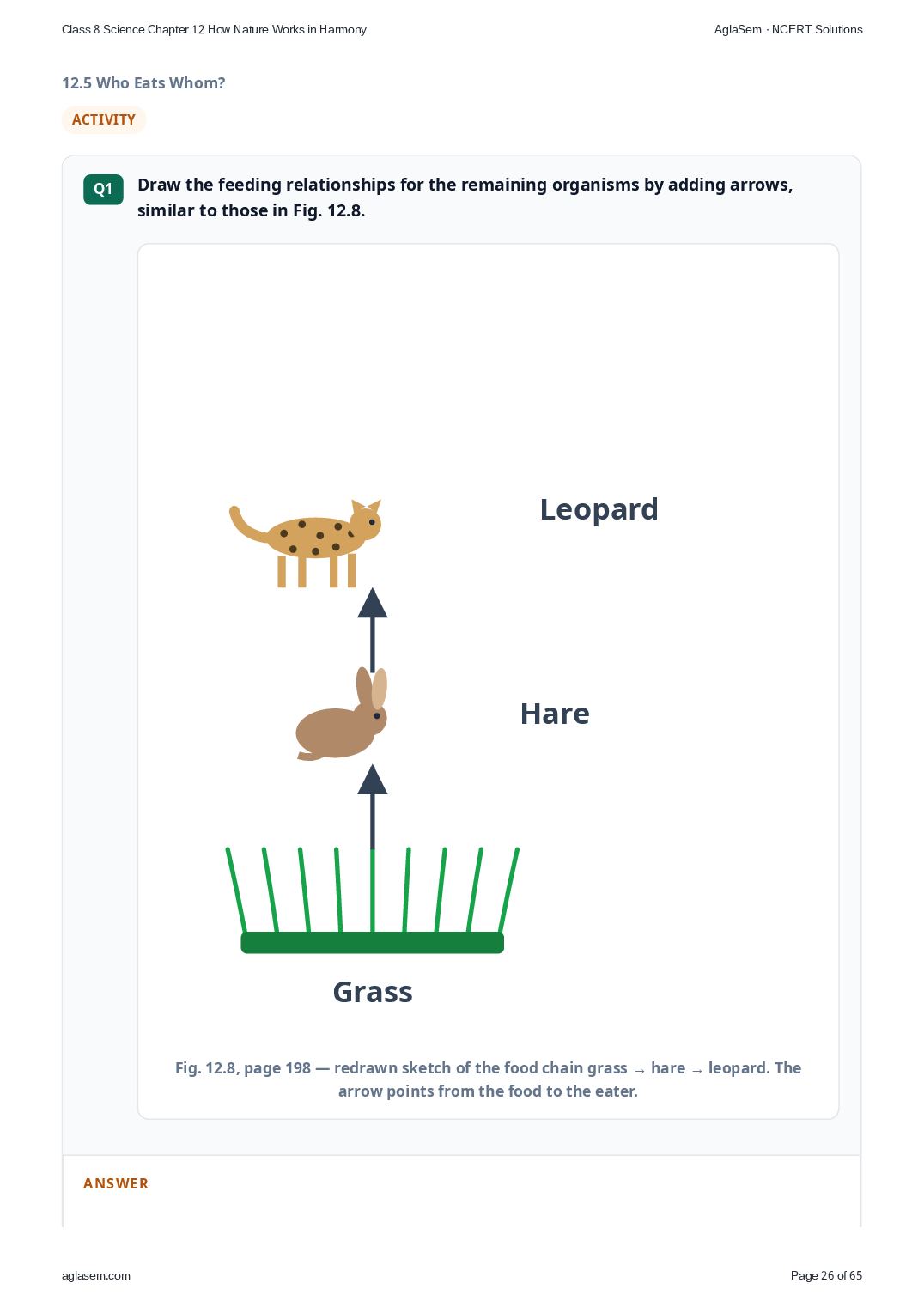
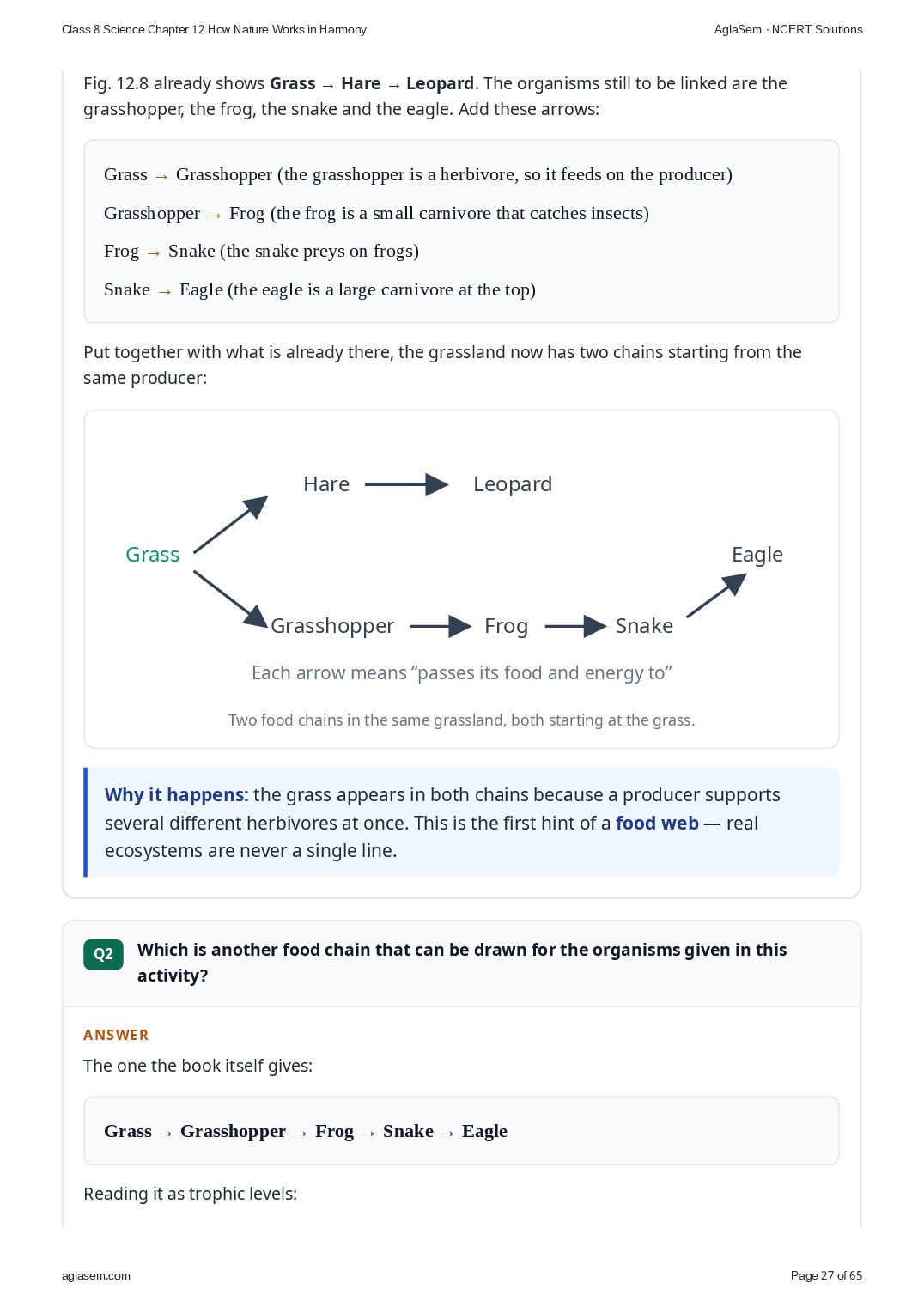
- Draw the feeding relationships for the remaining organisms by adding arrows, similar to those in Fig. 12.8.
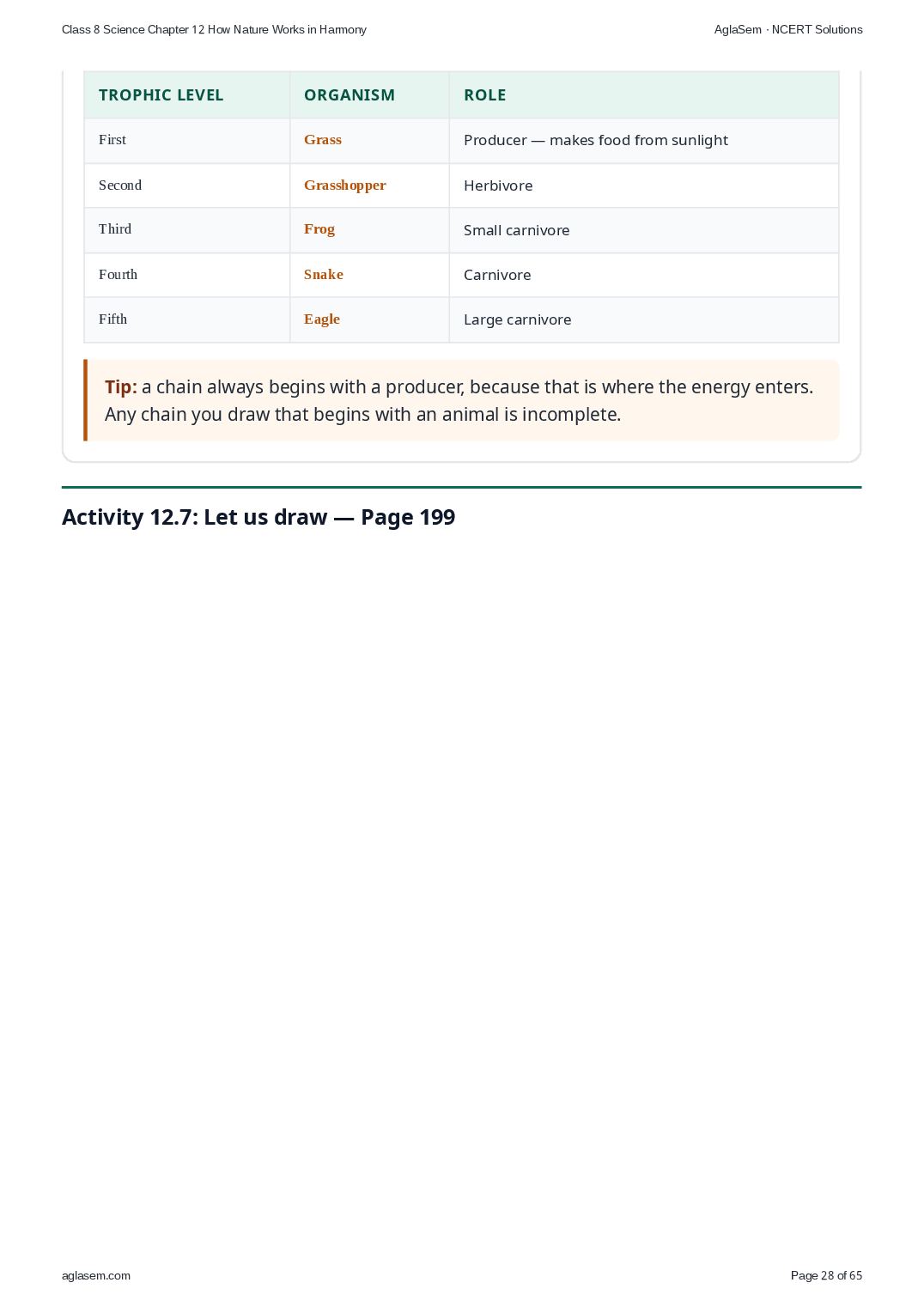
- Which is another food chain that can be drawn for the organisms given in this activity?
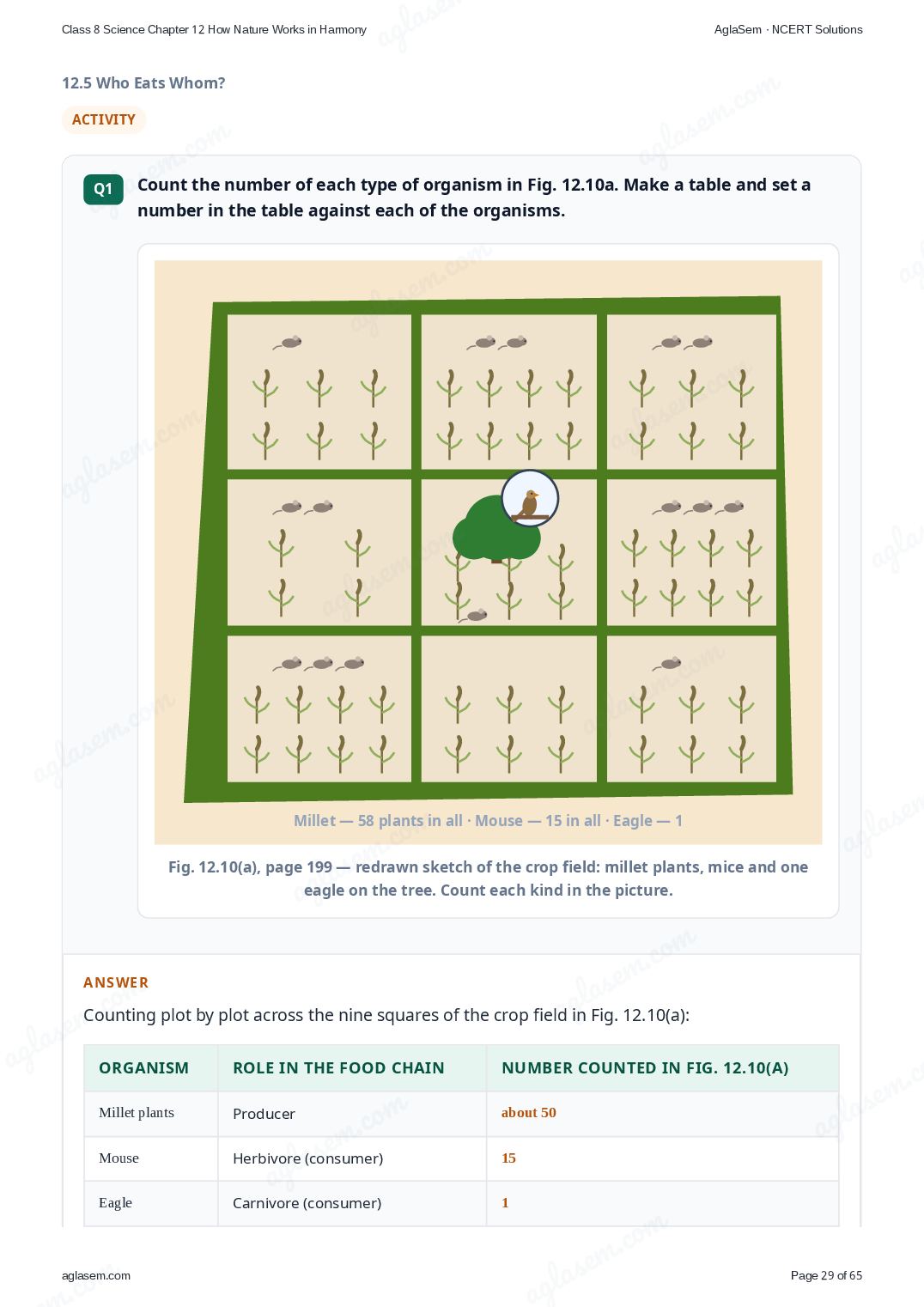
- Count the number of each type of organism in Fig. 12.10a. Make a table and set a number in the table against each of the organisms.
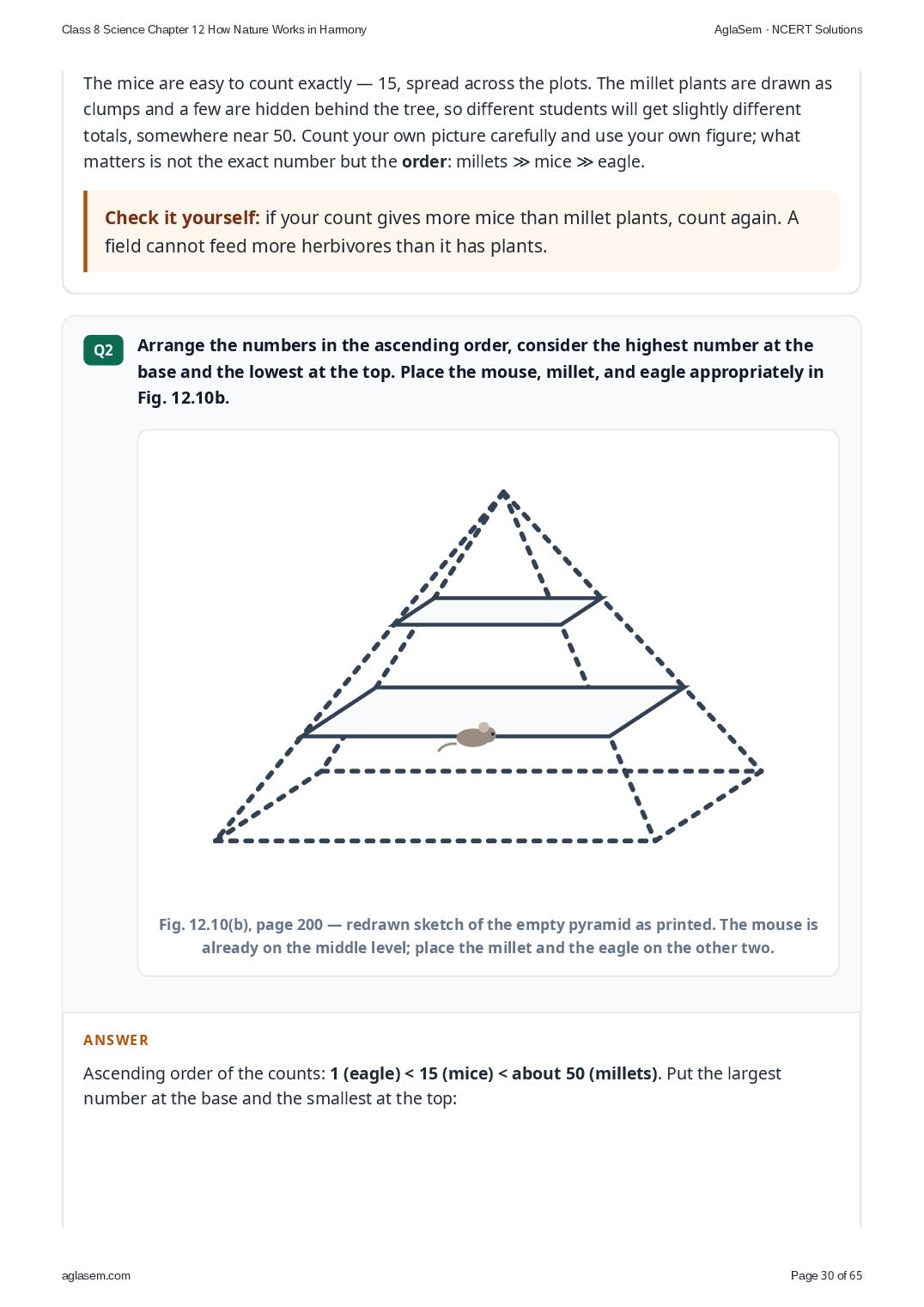
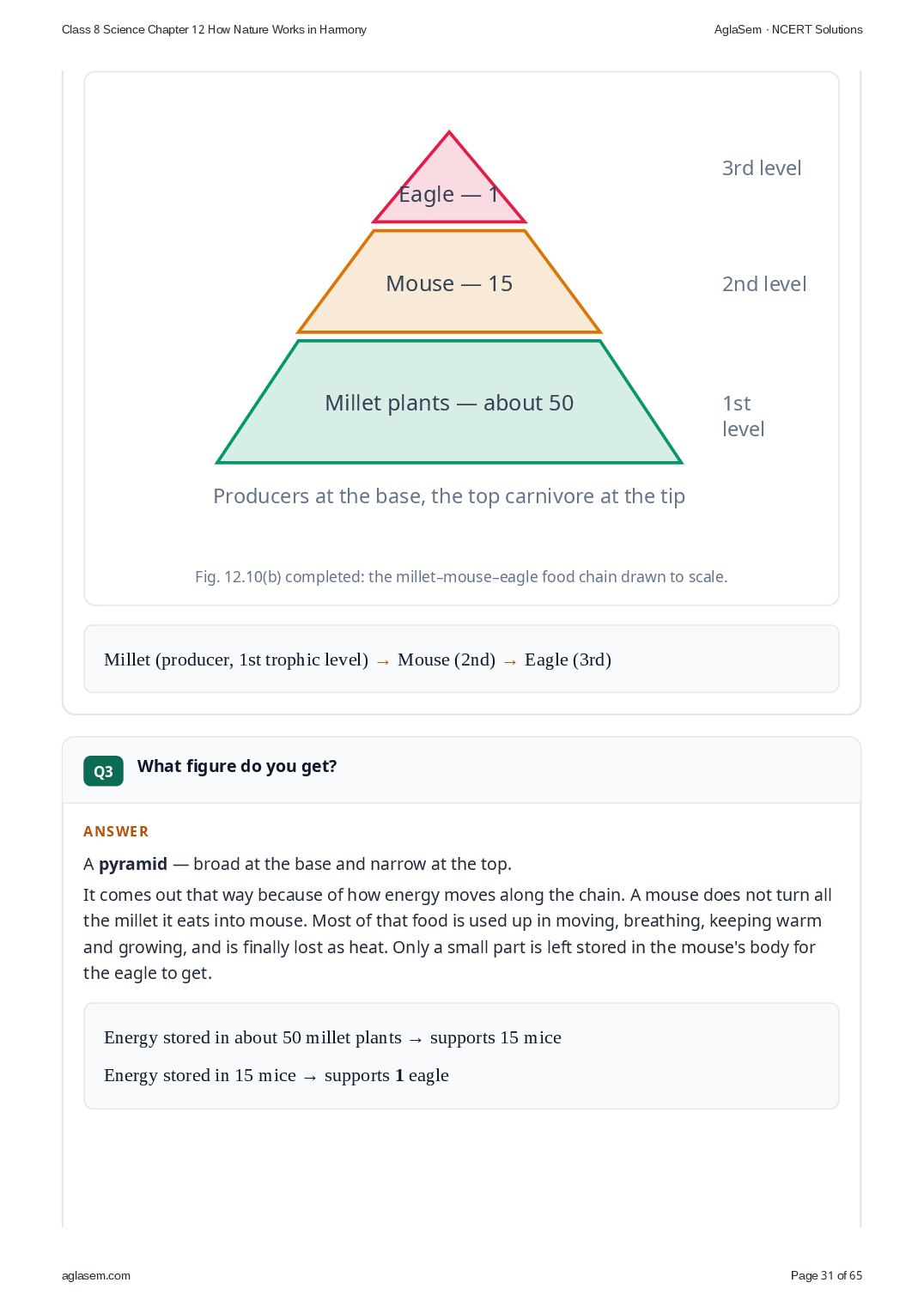
- Arrange the numbers in the ascending order, consider the highest number at the base and the lowest at the top. Place the mouse, millet, and eagle appropriately in Fig. 12.10b.
- What figure do you get?
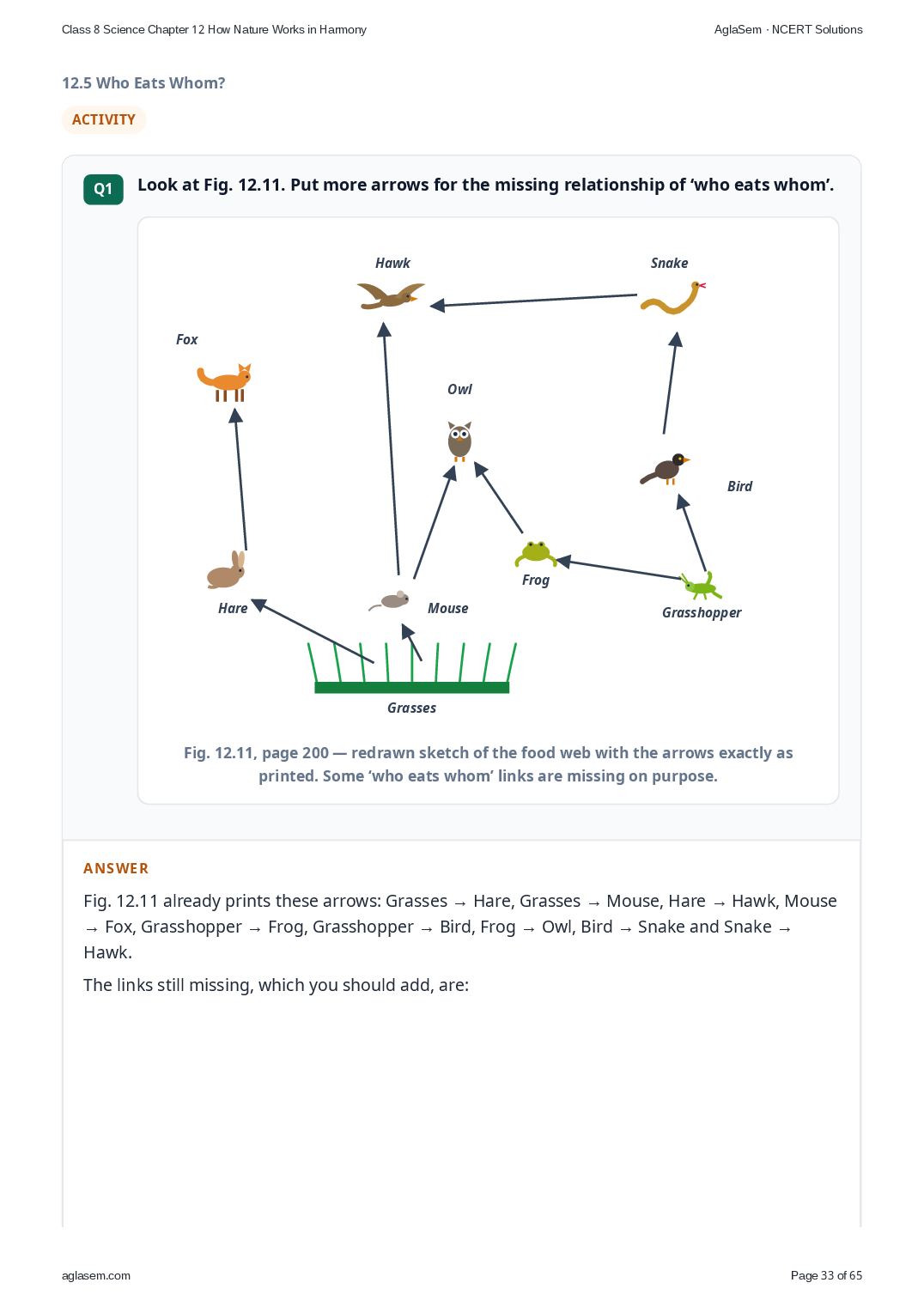
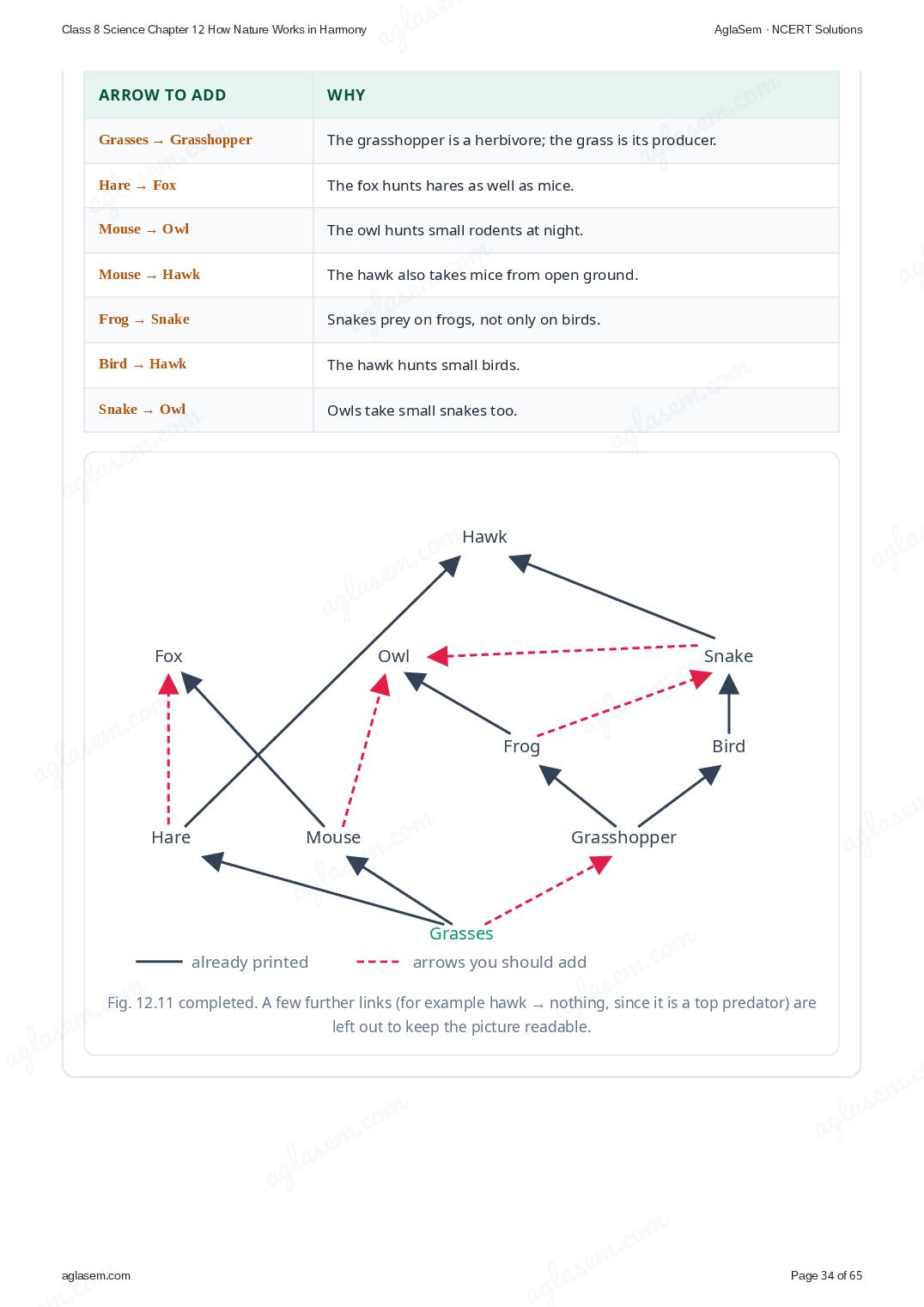
- Look at Fig. 12.11. Put more arrows for the missing relationship of ‘who eats whom’.
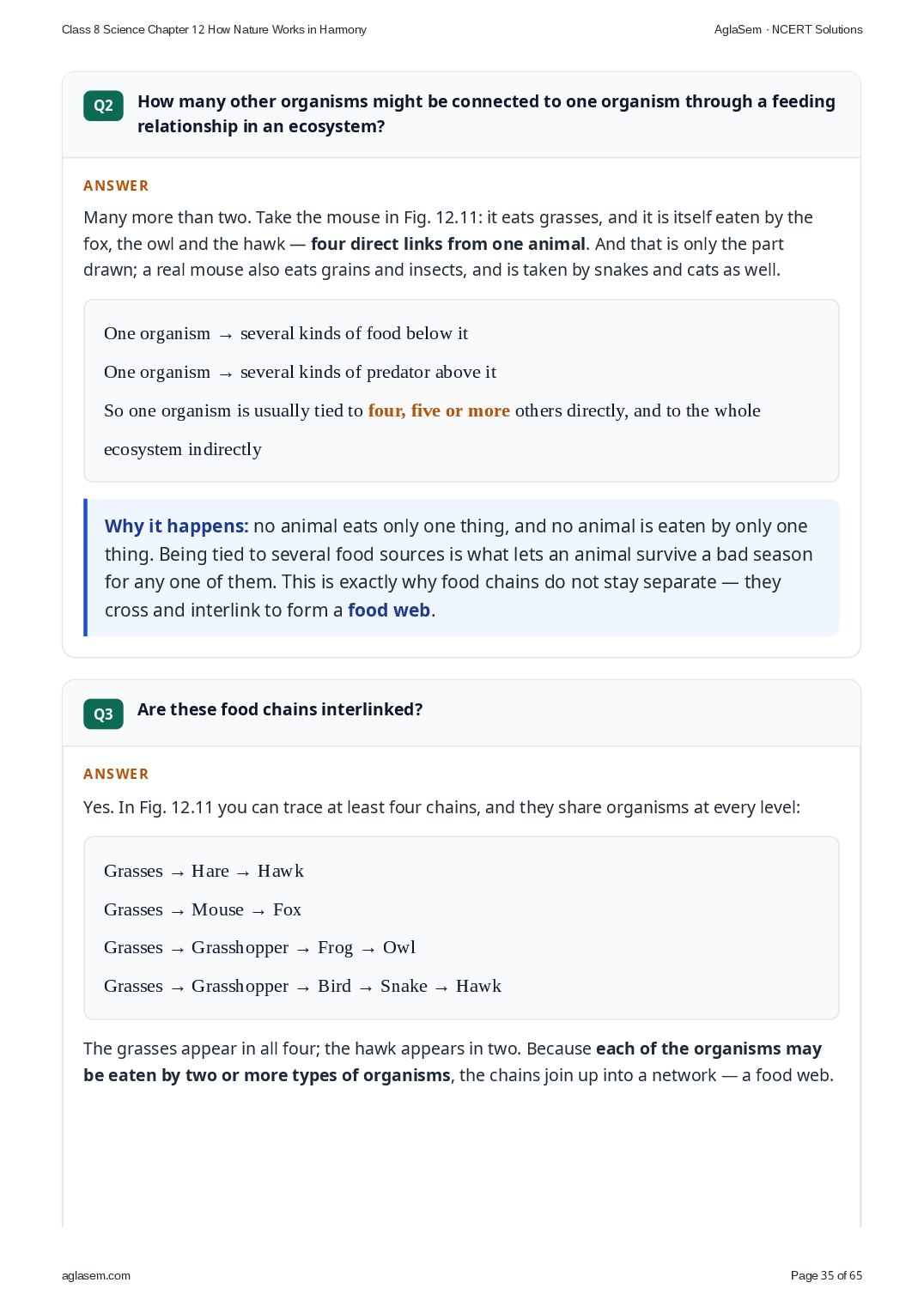
- How many other organisms might be connected to one organism through a feeding relationship in an ecosystem?
- Are these food chains interlinked?
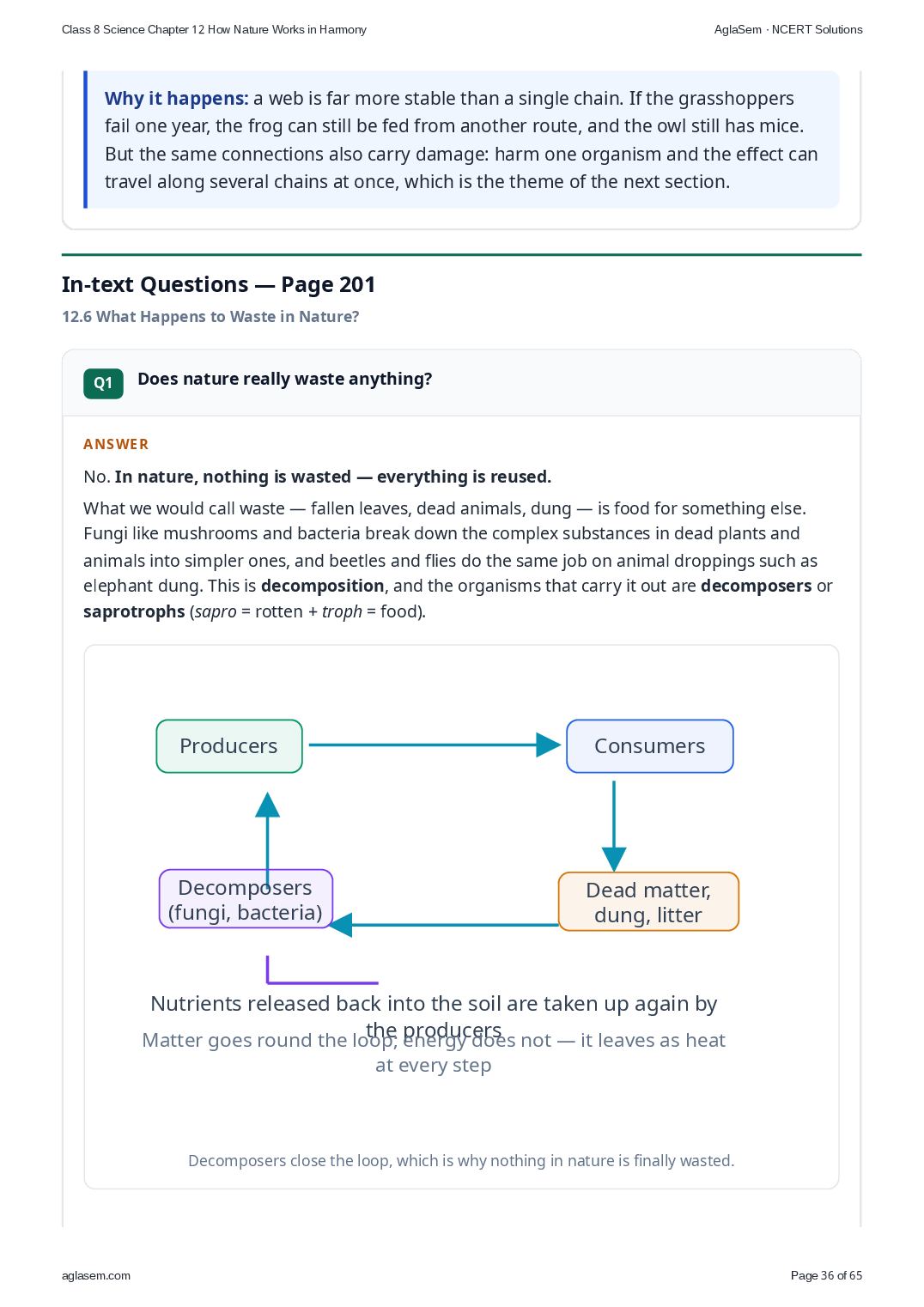
- Does nature really waste anything?
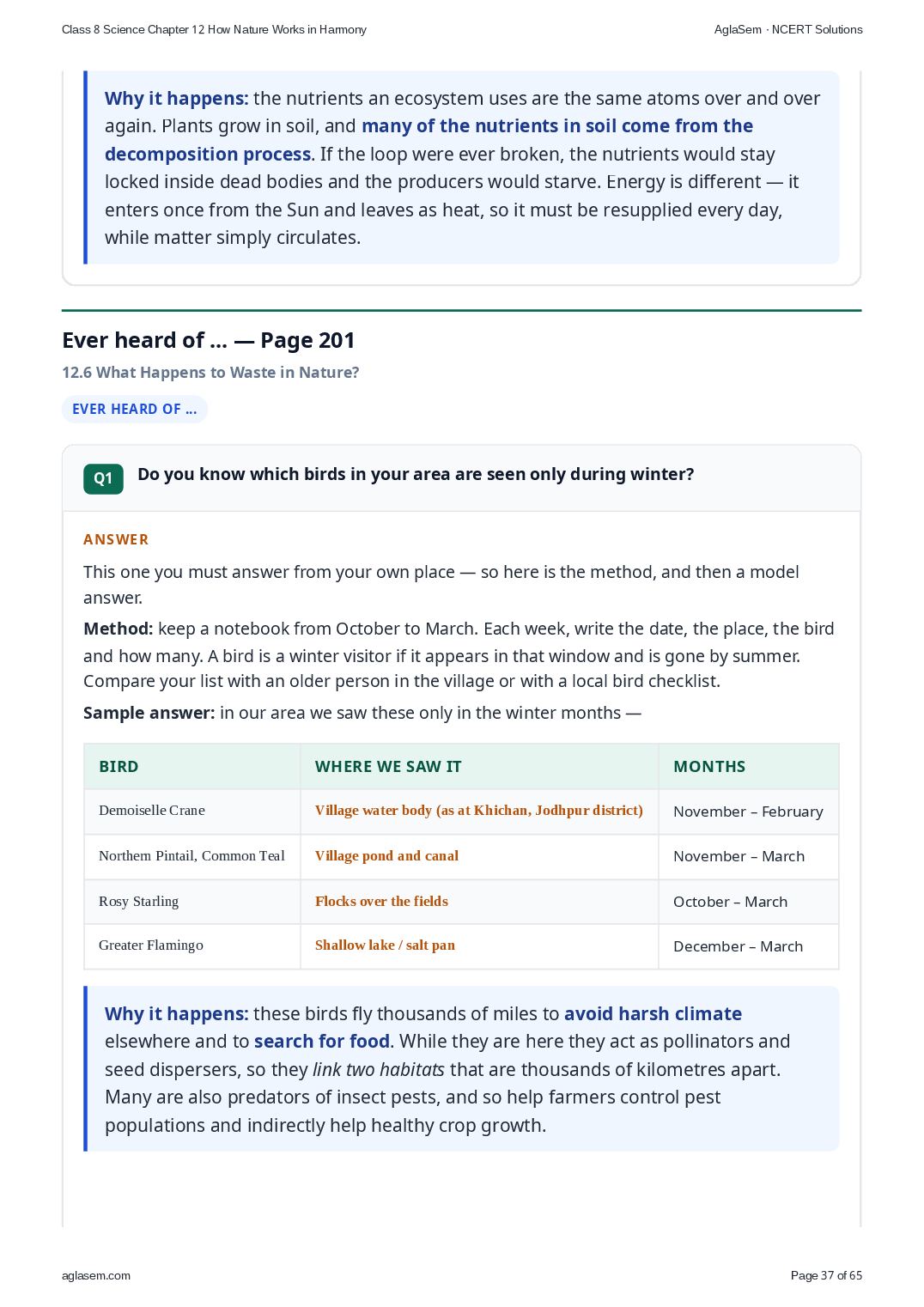
- Do you know which birds in your area are seen only during winter?
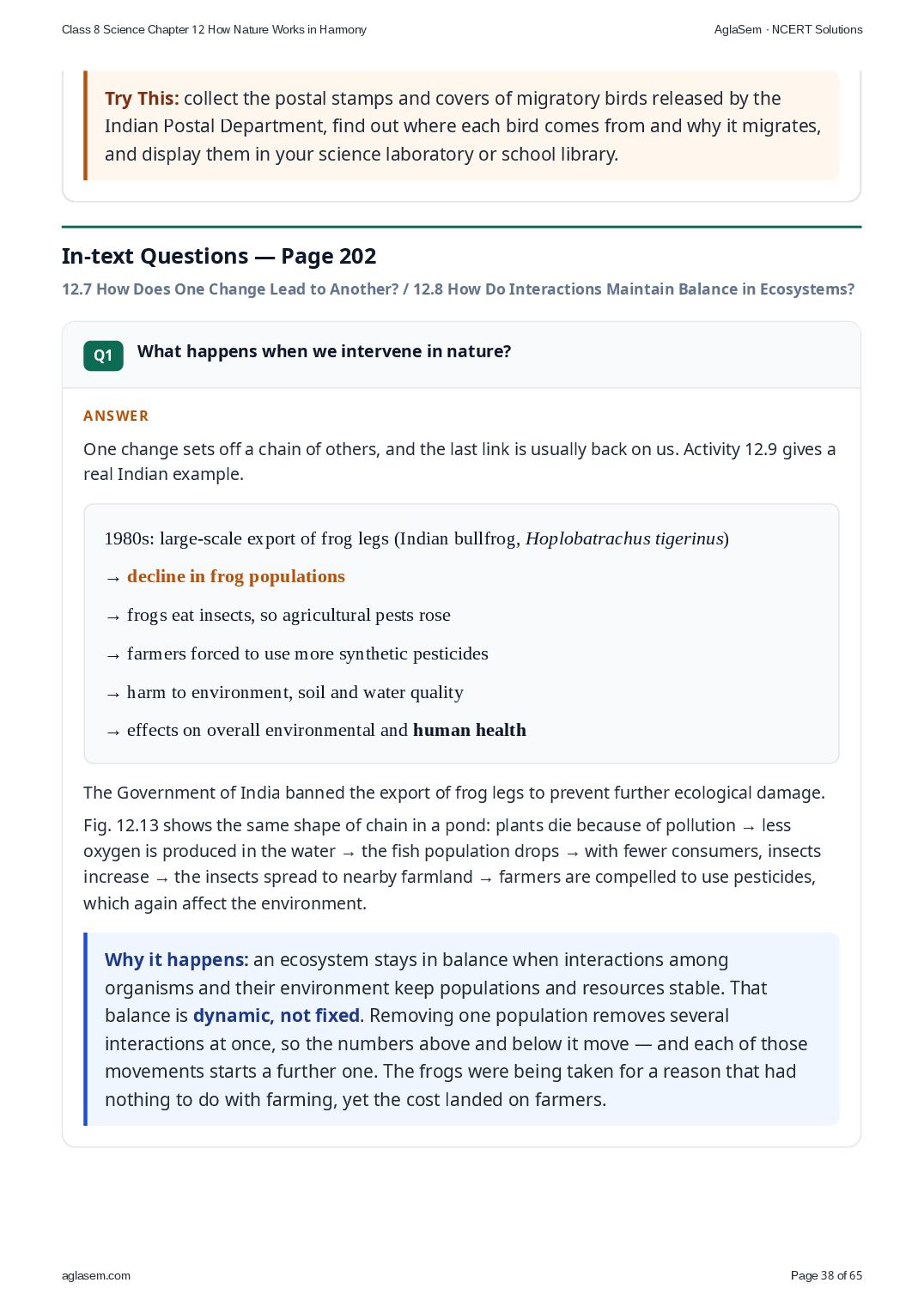
- What happens when we intervene in nature?
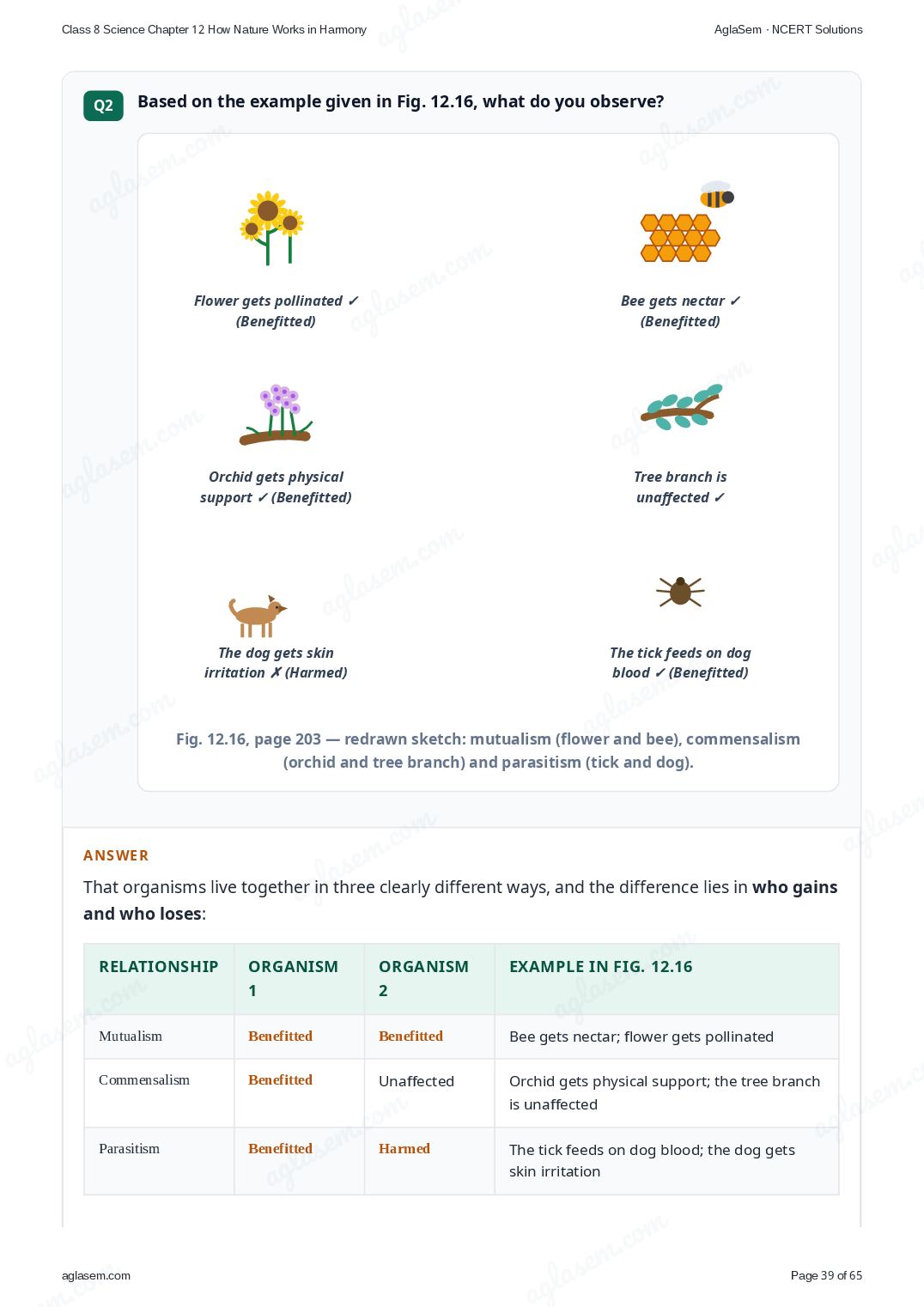
- Based on the example given in Fig. 12.16, what do you observe?
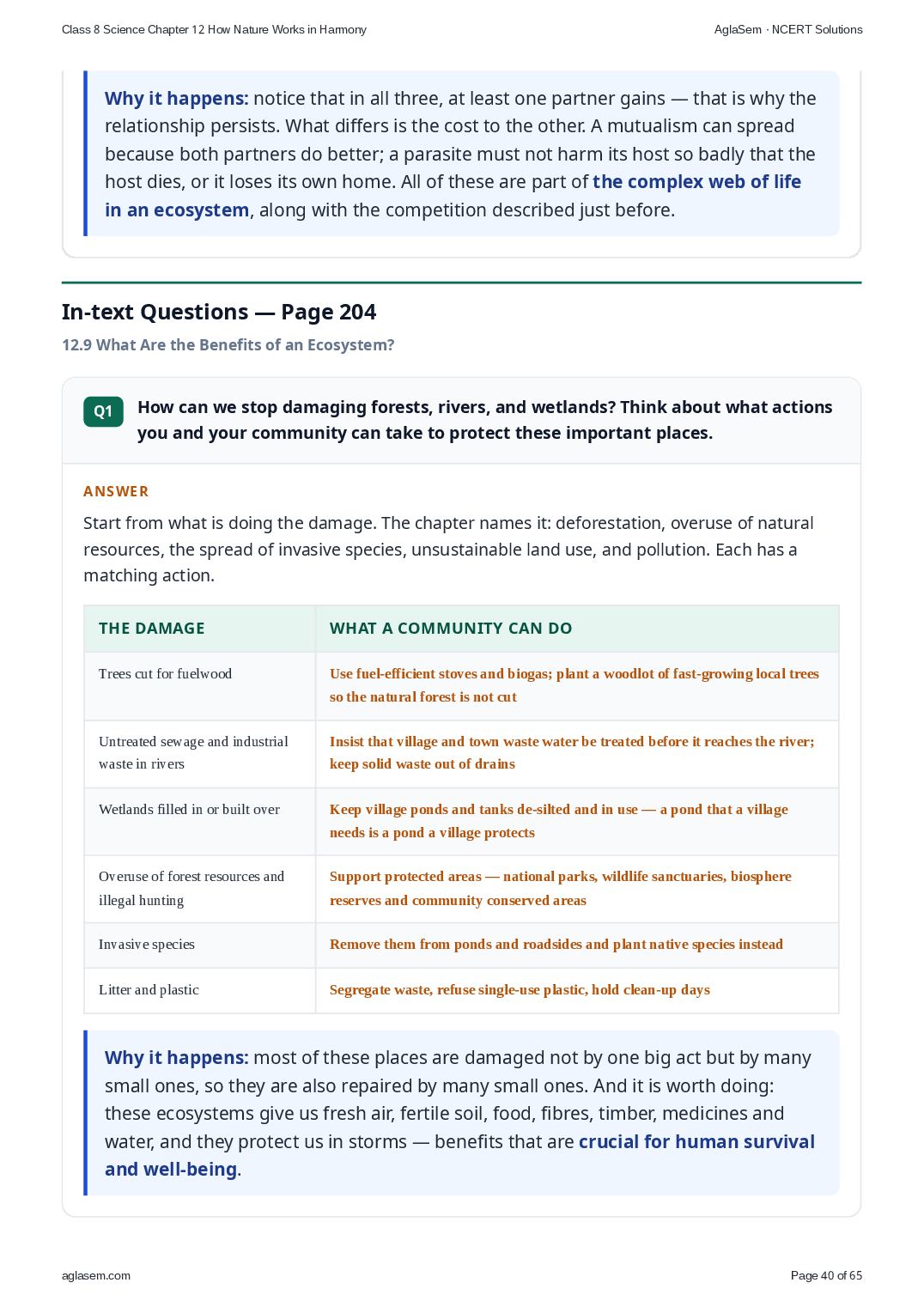
- How can we stop damaging forests, rivers, and wetlands? Think about what actions you and your community can take to protect these important places.
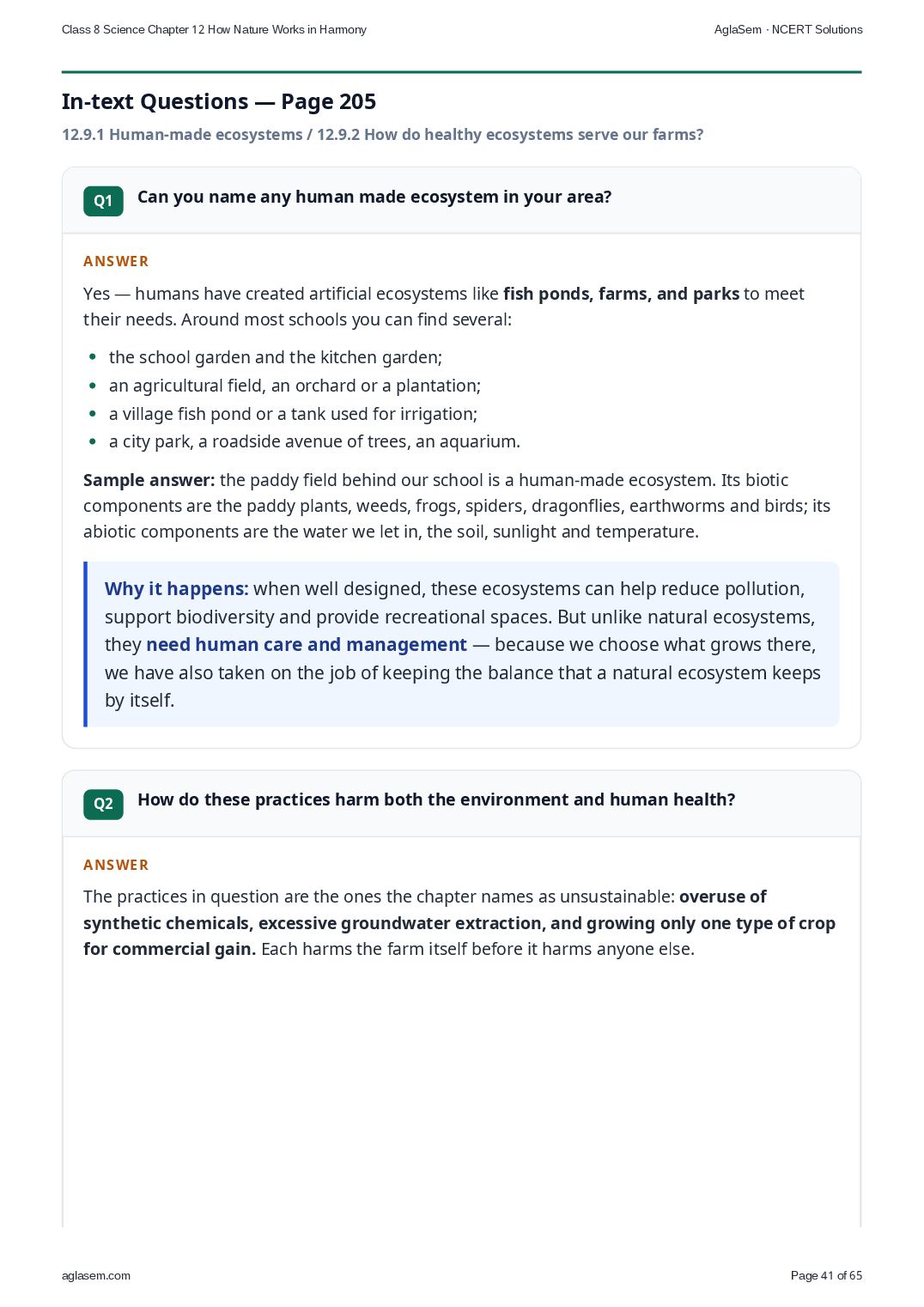
- Can you name any human made ecosystem in your area?
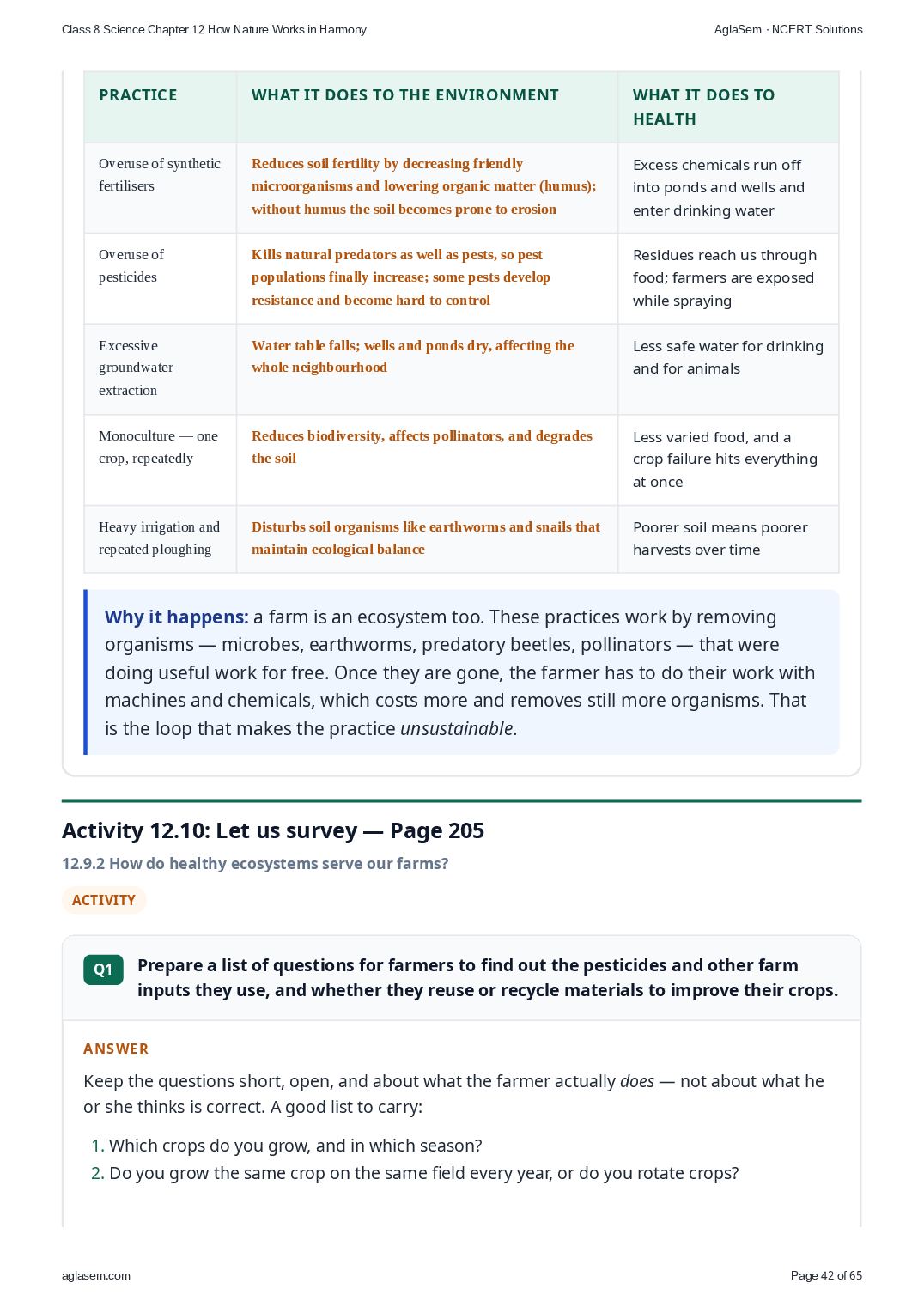
- How do these practices harm both the environment and human health?
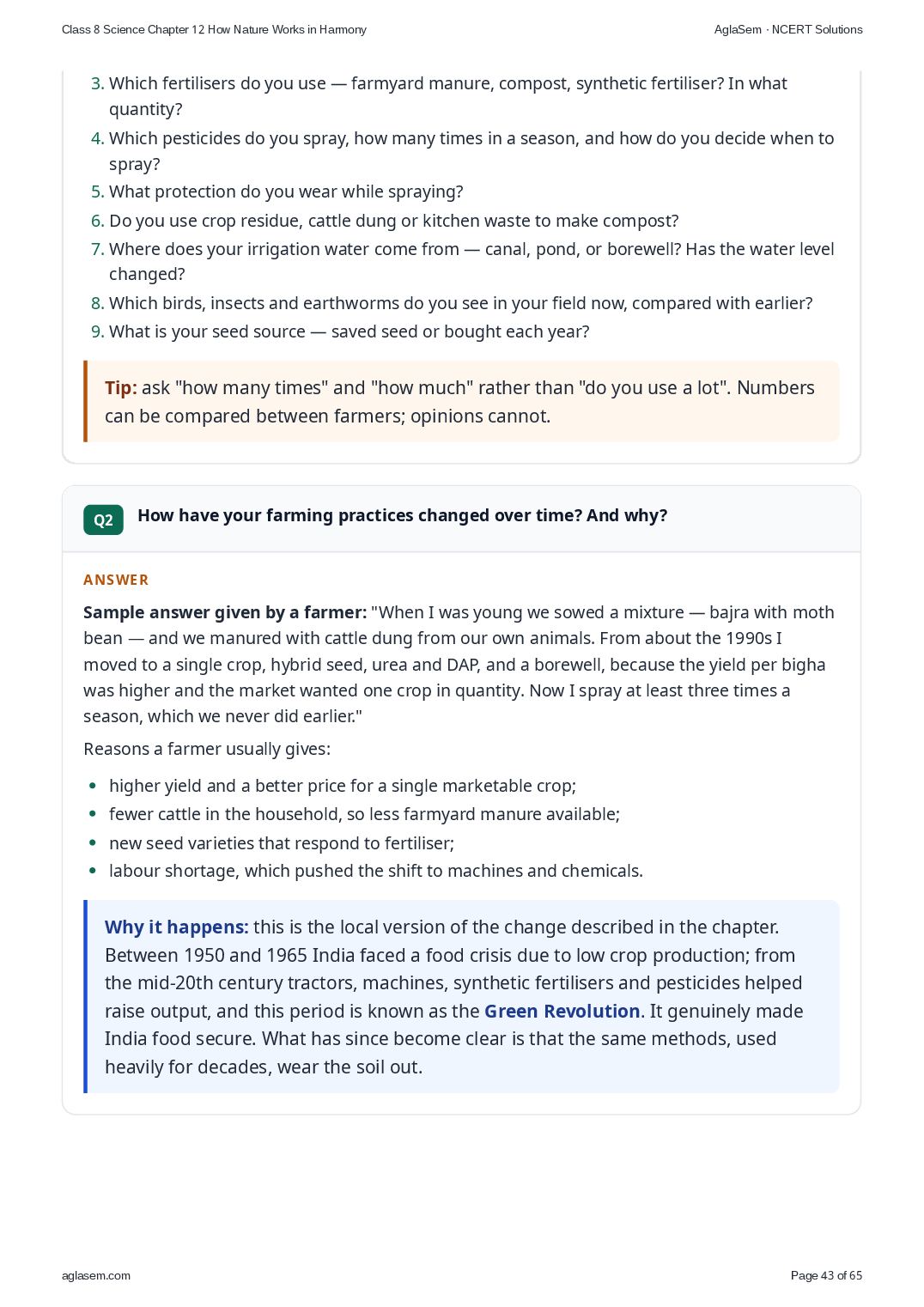
- Prepare a list of questions for farmers to find out the pesticides and other farm inputs they use, and whether they reuse or recycle materials to improve their crops.
- How have your farming practices changed over time? And why?
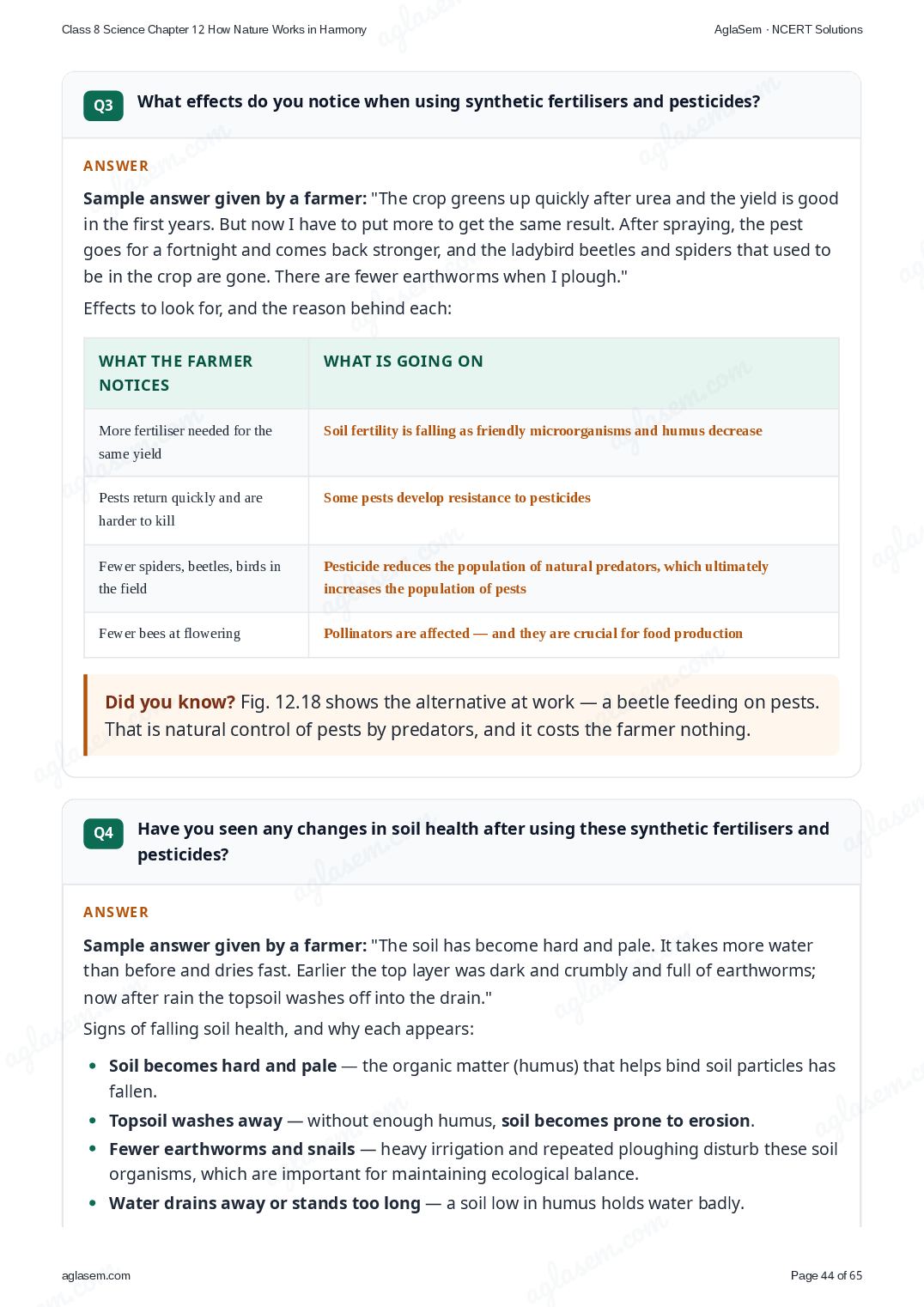
- What effects do you notice when using synthetic fertilisers and pesticides?
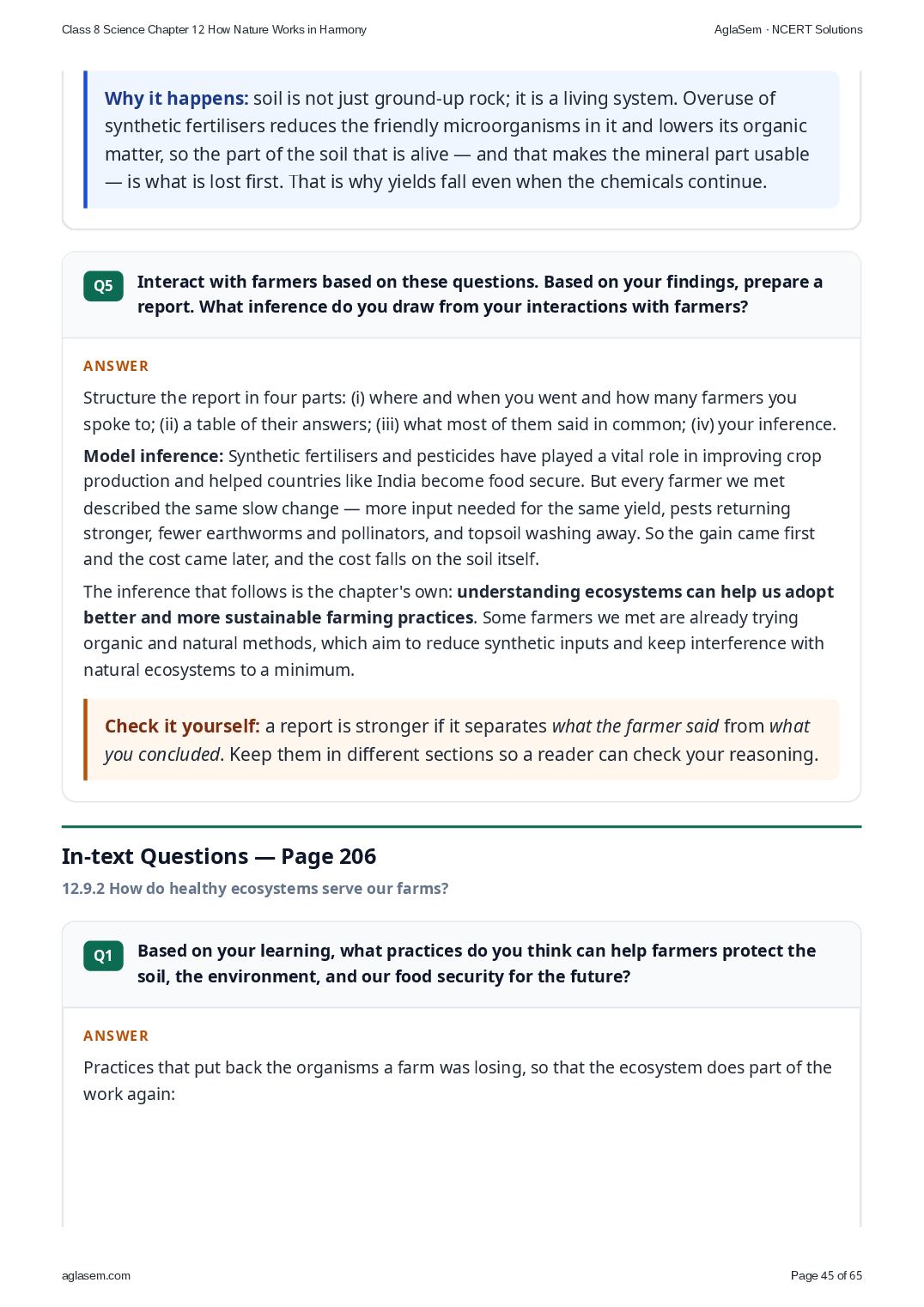
- Have you seen any changes in soil health after using these synthetic fertilisers and pesticides?
- Interact with farmers based on these questions. Based on your findings, prepare a report. What inference do you draw from your interactions with farmers?
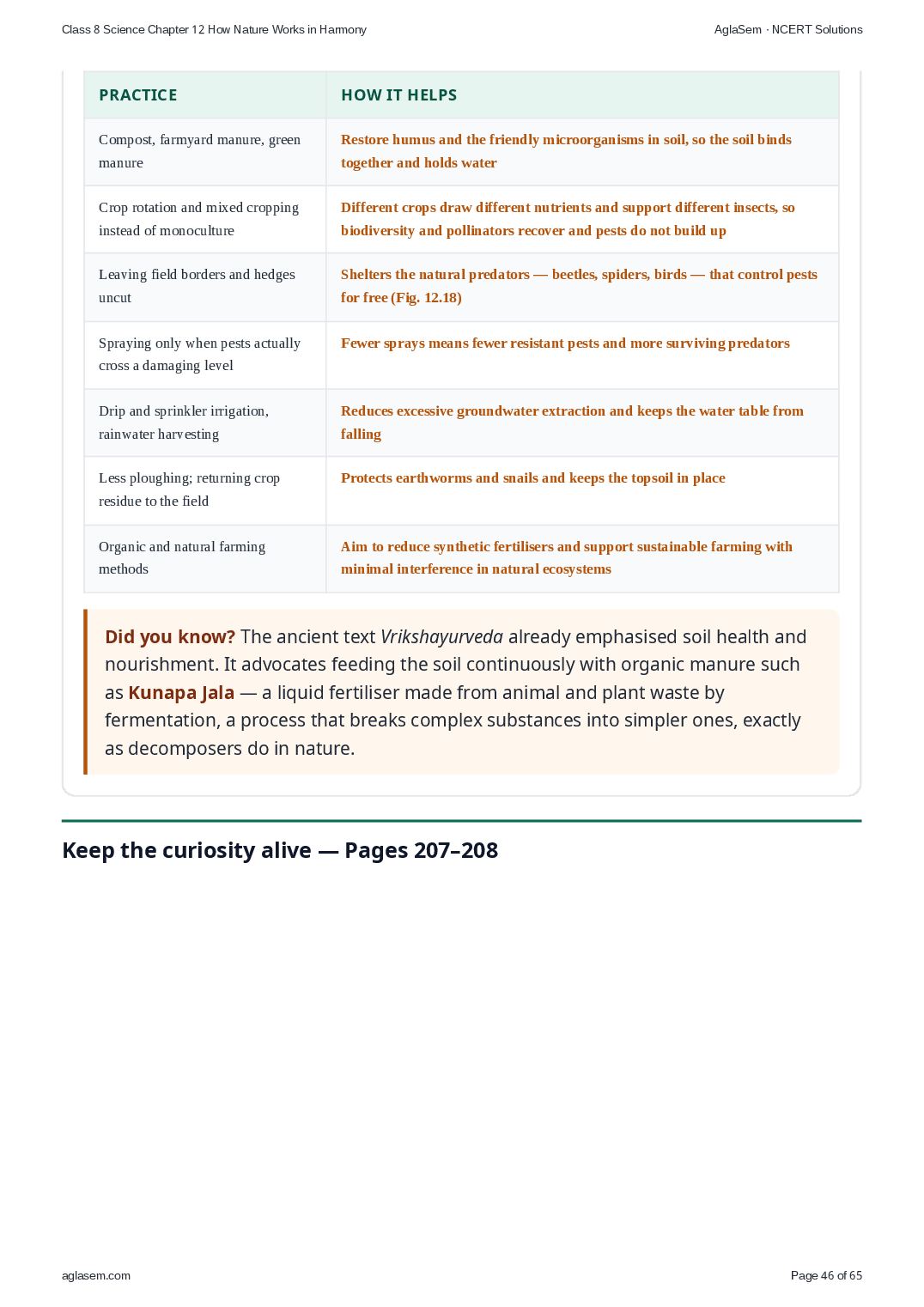
- Based on your learning, what practices do you think can help farmers protect the soil, the environment, and our food security for the future?
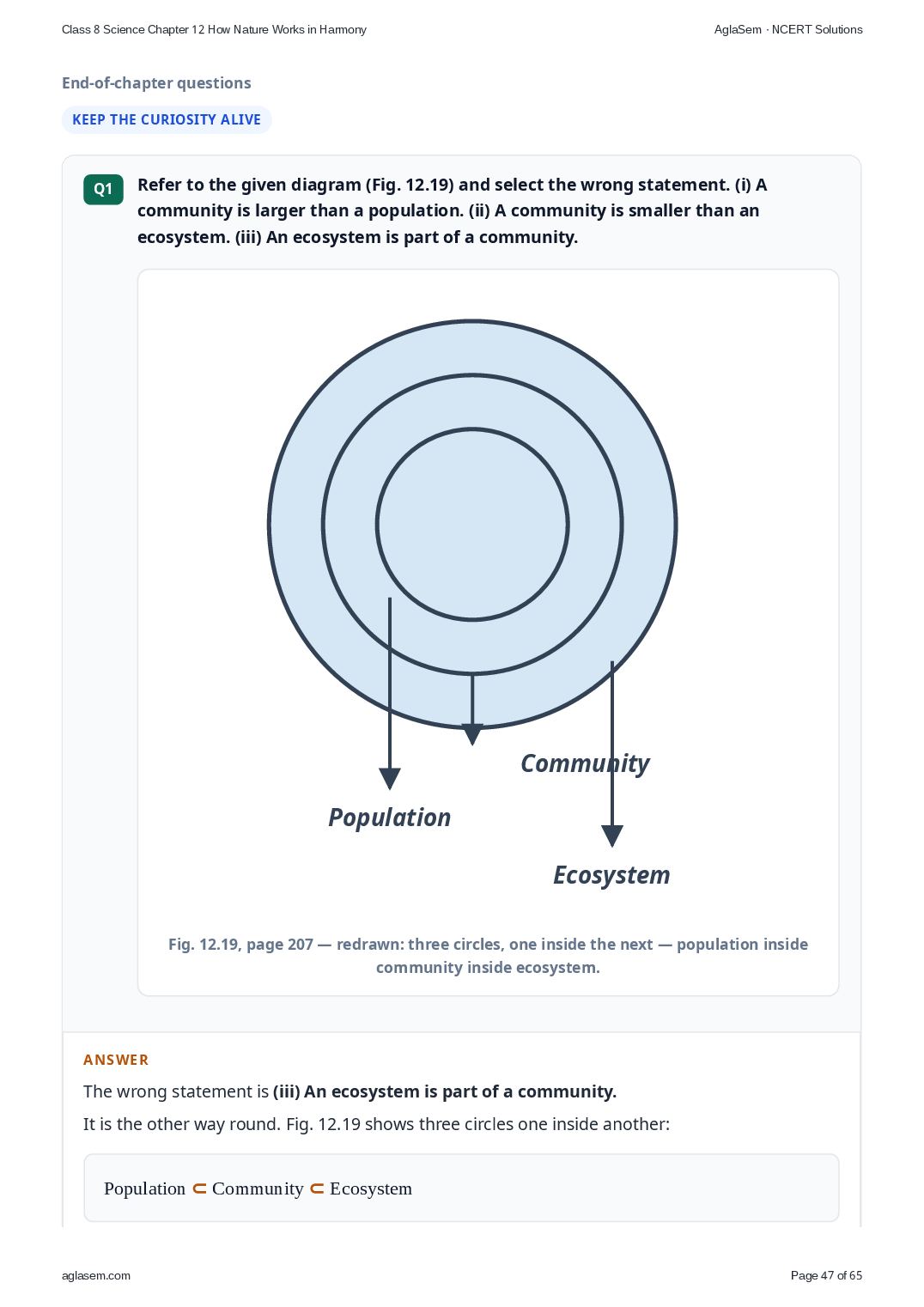
- Refer to the given diagram (Fig. 12.19) and select the wrong statement. (i) A community is larger than a population. (ii) A community is smaller than an ecosystem. (iii) An ecosystem is part of a community.
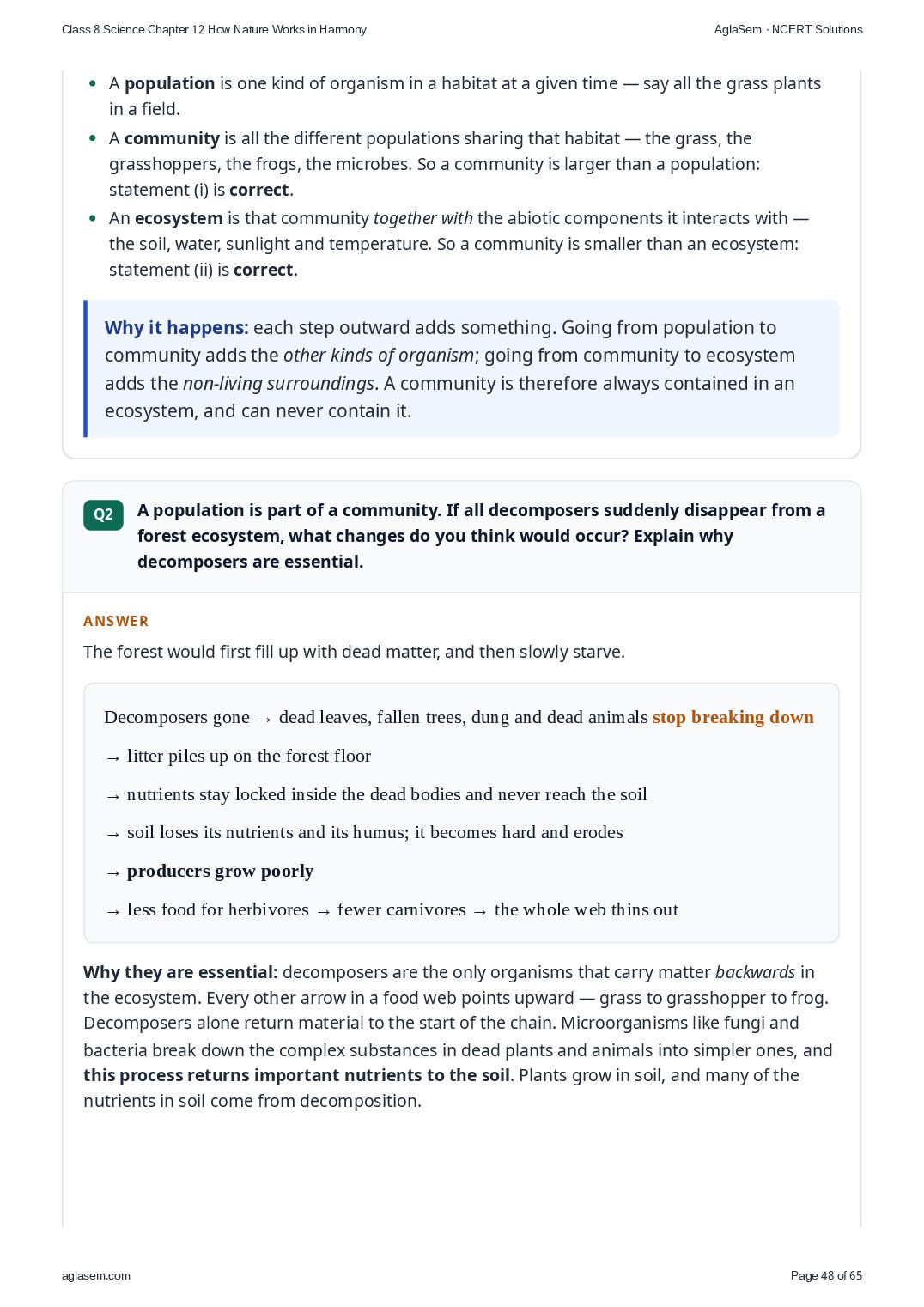
- A population is part of a community. If all decomposers suddenly disappear from a forest ecosystem, what changes do you think would occur? Explain why decomposers are essential.
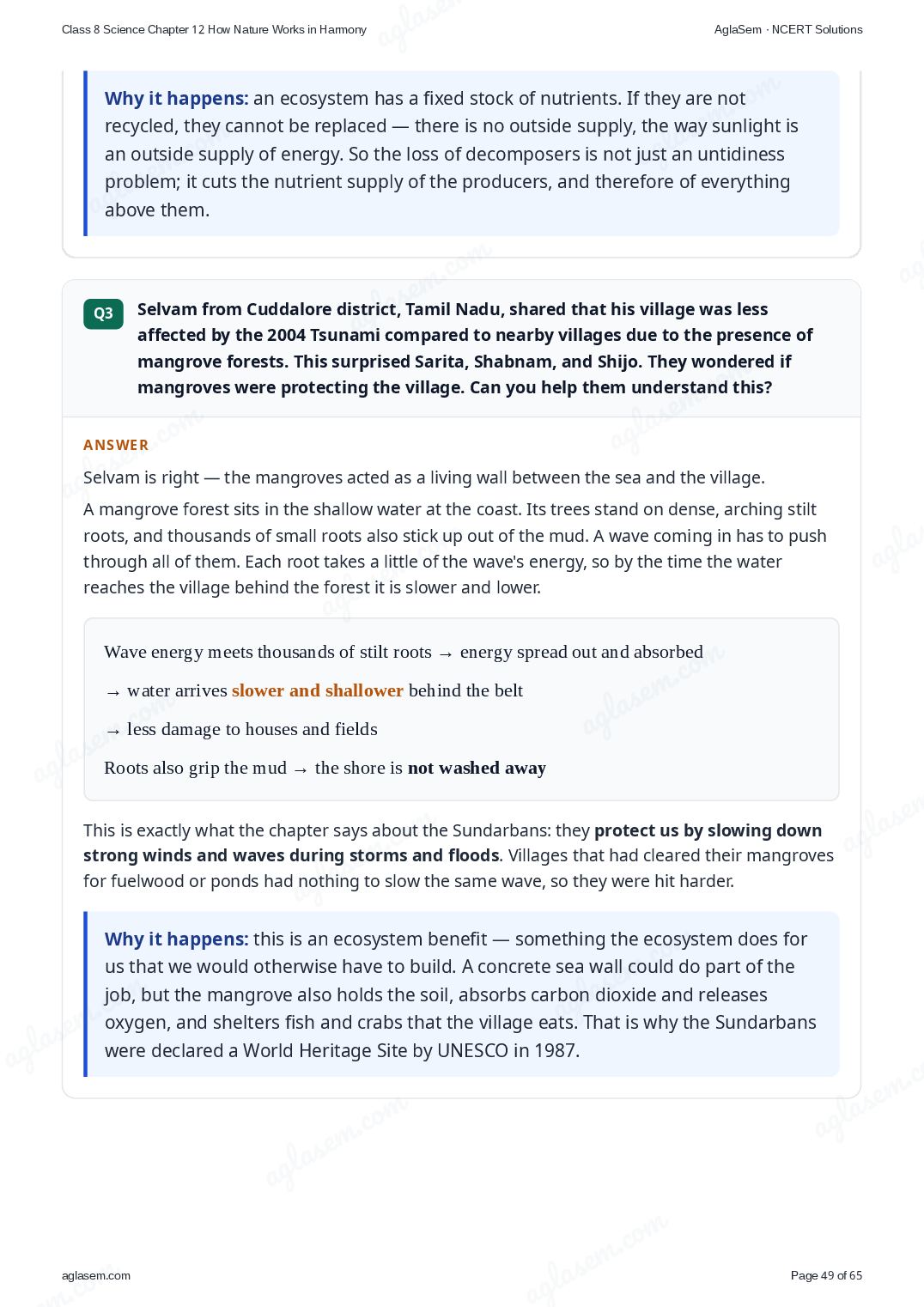
- Selvam from Cuddalore district, Tamil Nadu, shared that his village was less affected by the 2004 Tsunami compared to nearby villages due to the presence of mangrove forests. This surprised Sarita, Shabnam, and Shijo. They wondered if mangroves were protecting the village. Can you help them understand this?
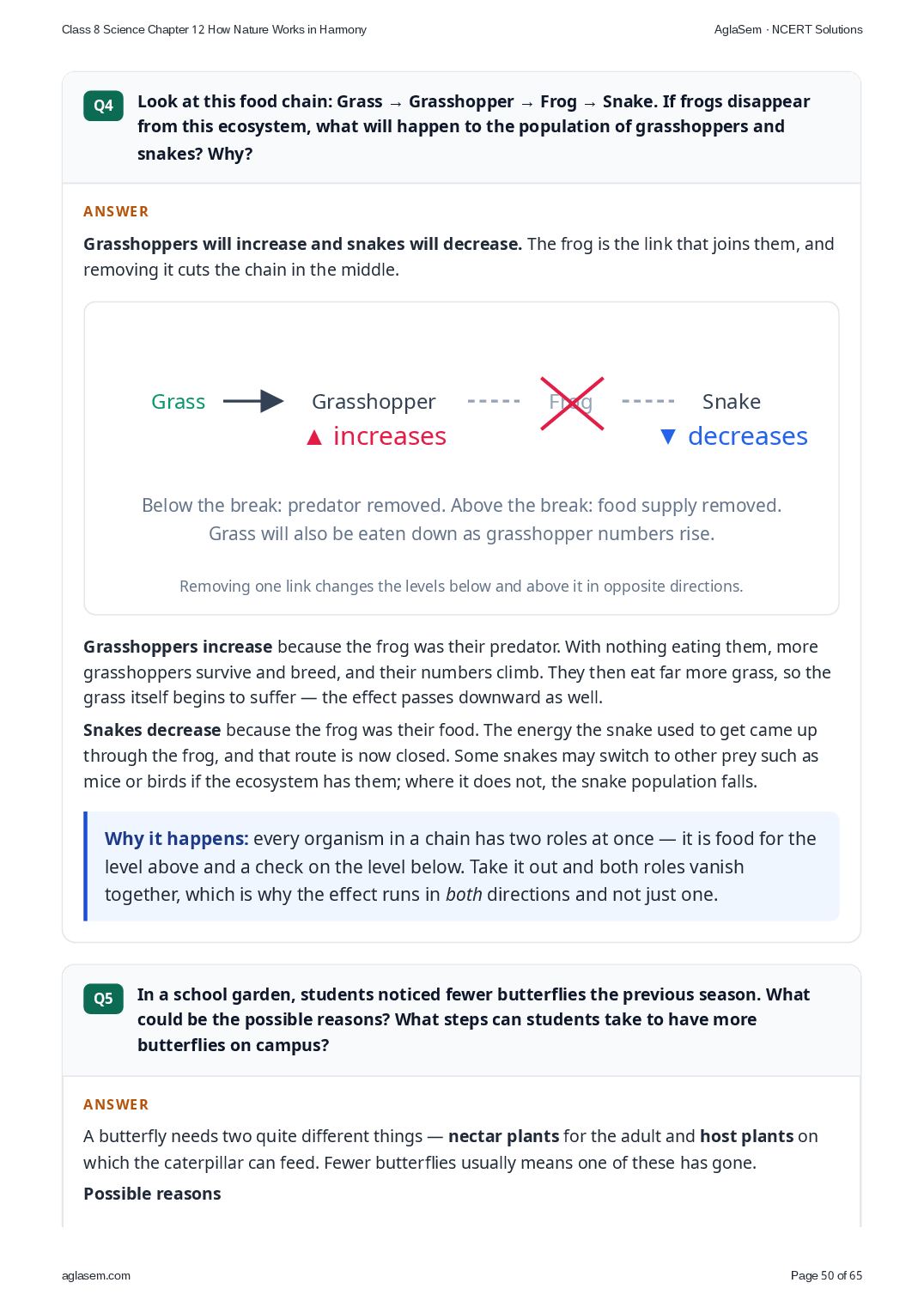
- Look at this food chain: Grass → Grasshopper → Frog → Snake. If frogs disappear from this ecosystem, what will happen to the population of grasshoppers and snakes? Why?
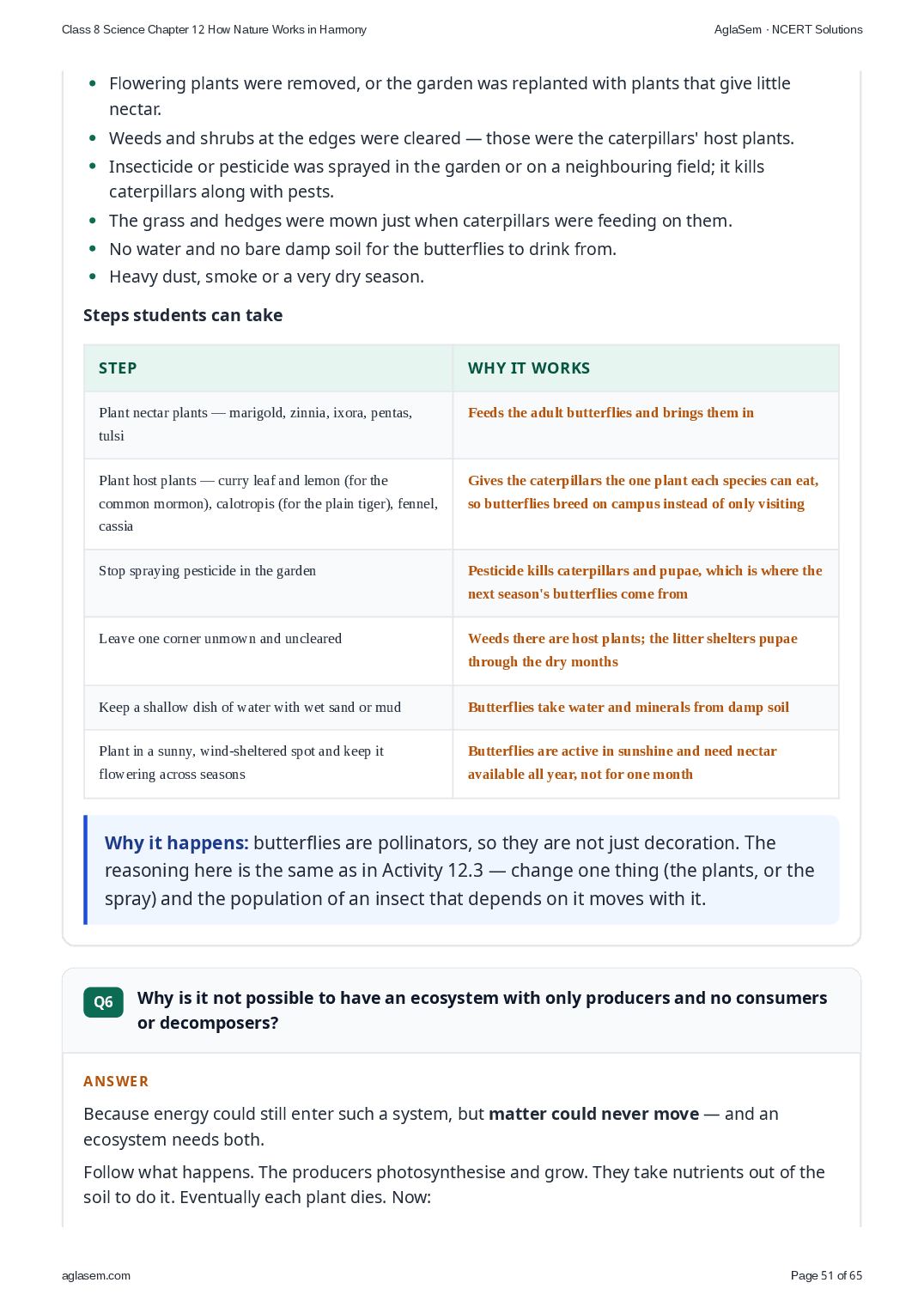
- In a school garden, students noticed fewer butterflies the previous season. What could be the possible reasons? What steps can students take to have more butterflies on campus?
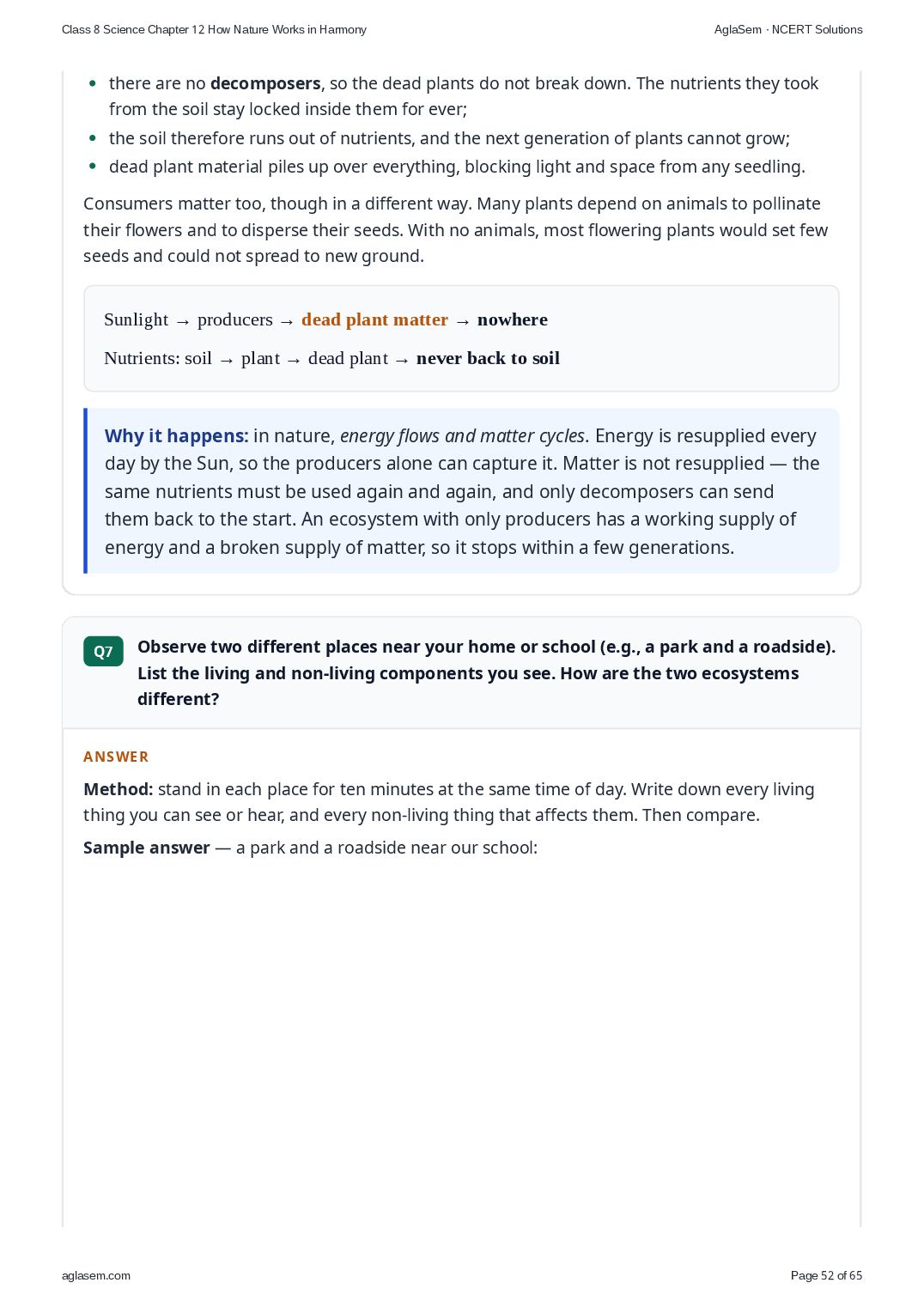
- Why is it not possible to have an ecosystem with only producers and no consumers or decomposers?
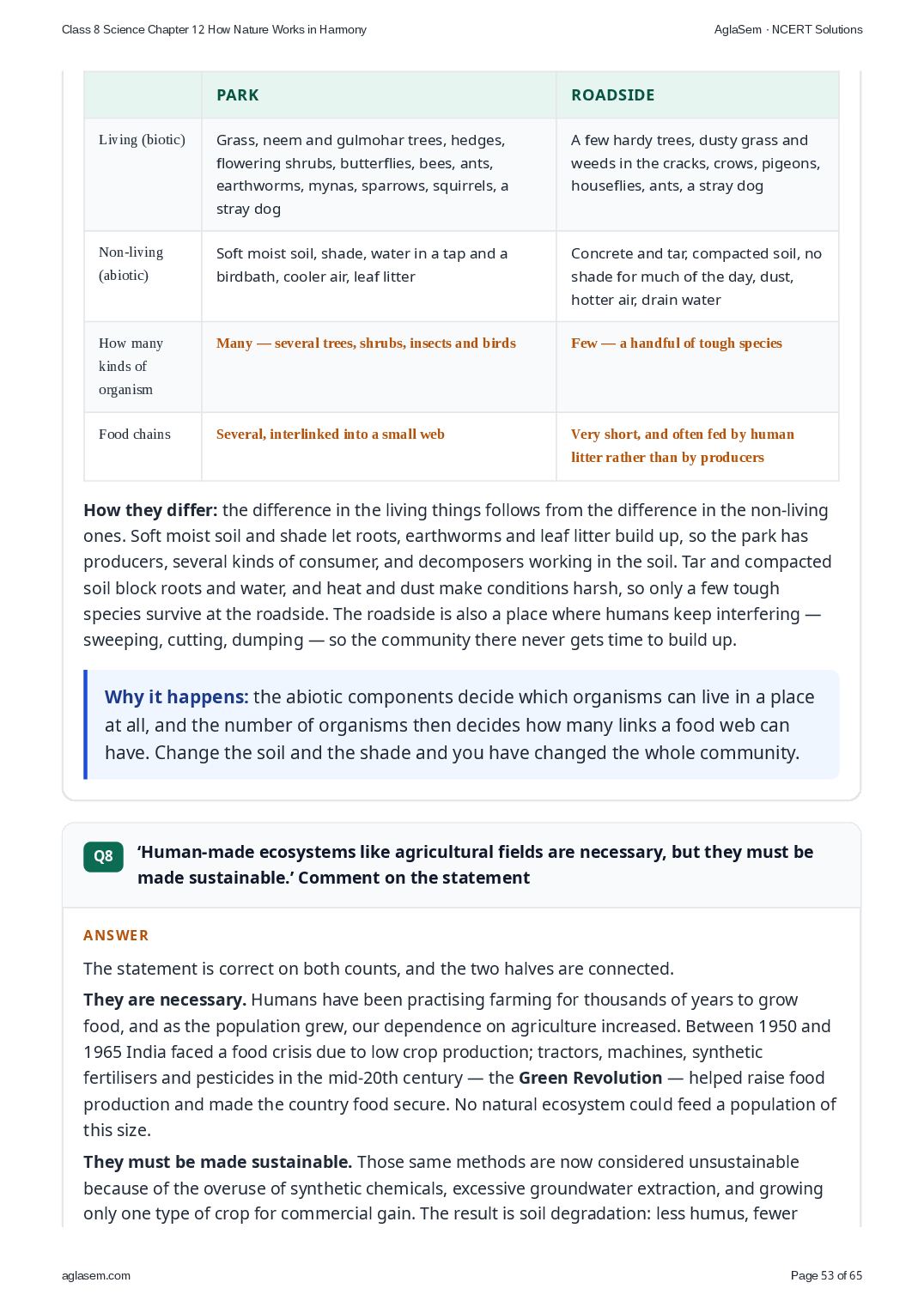
- Observe two different places near your home or school (e.g., a park and a roadside). List the living and non-living components you see. How are the two ecosystems different?
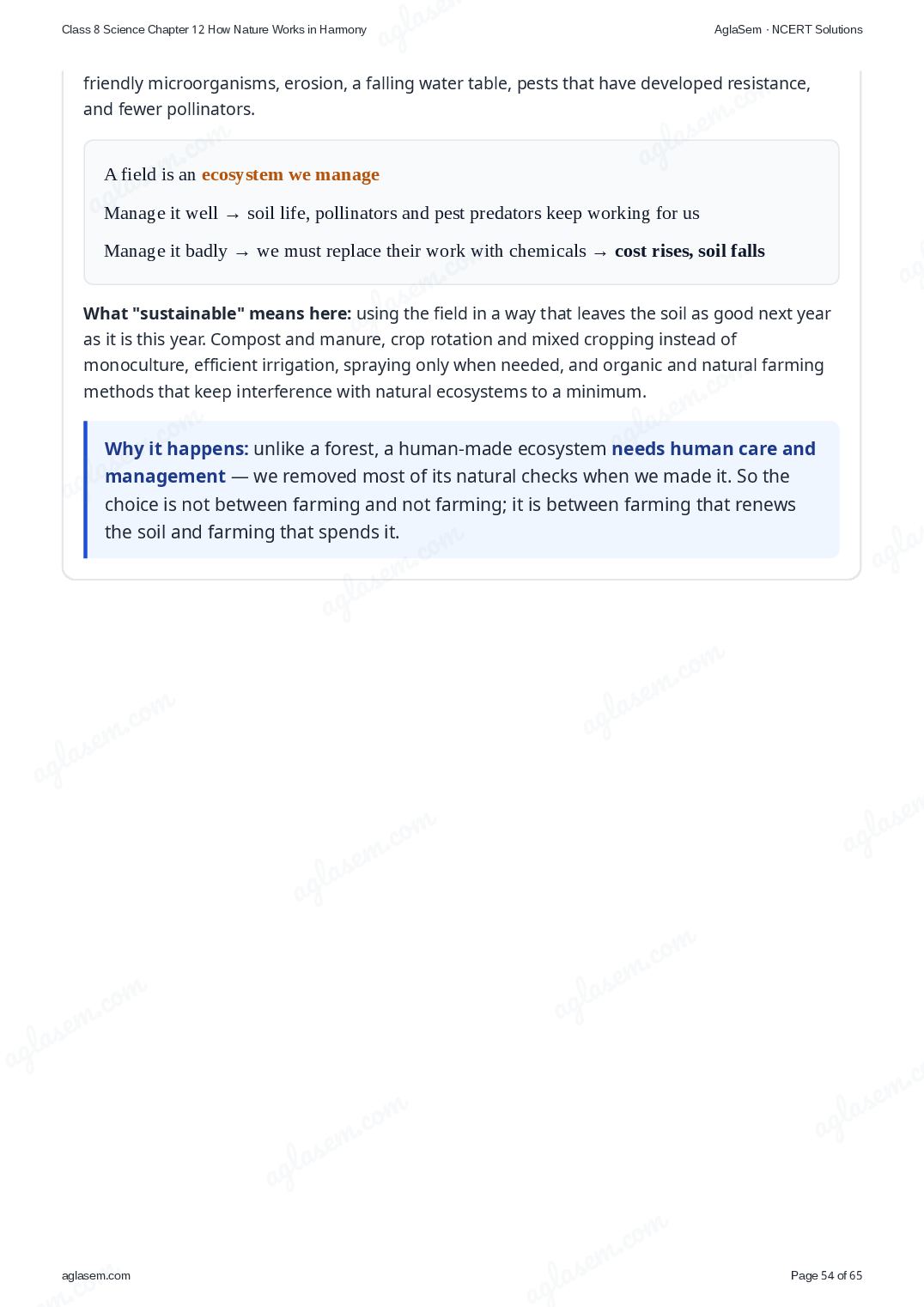
- ‘Human-made ecosystems like agricultural fields are necessary, but they must be made sustainable.’ Comment on the statement
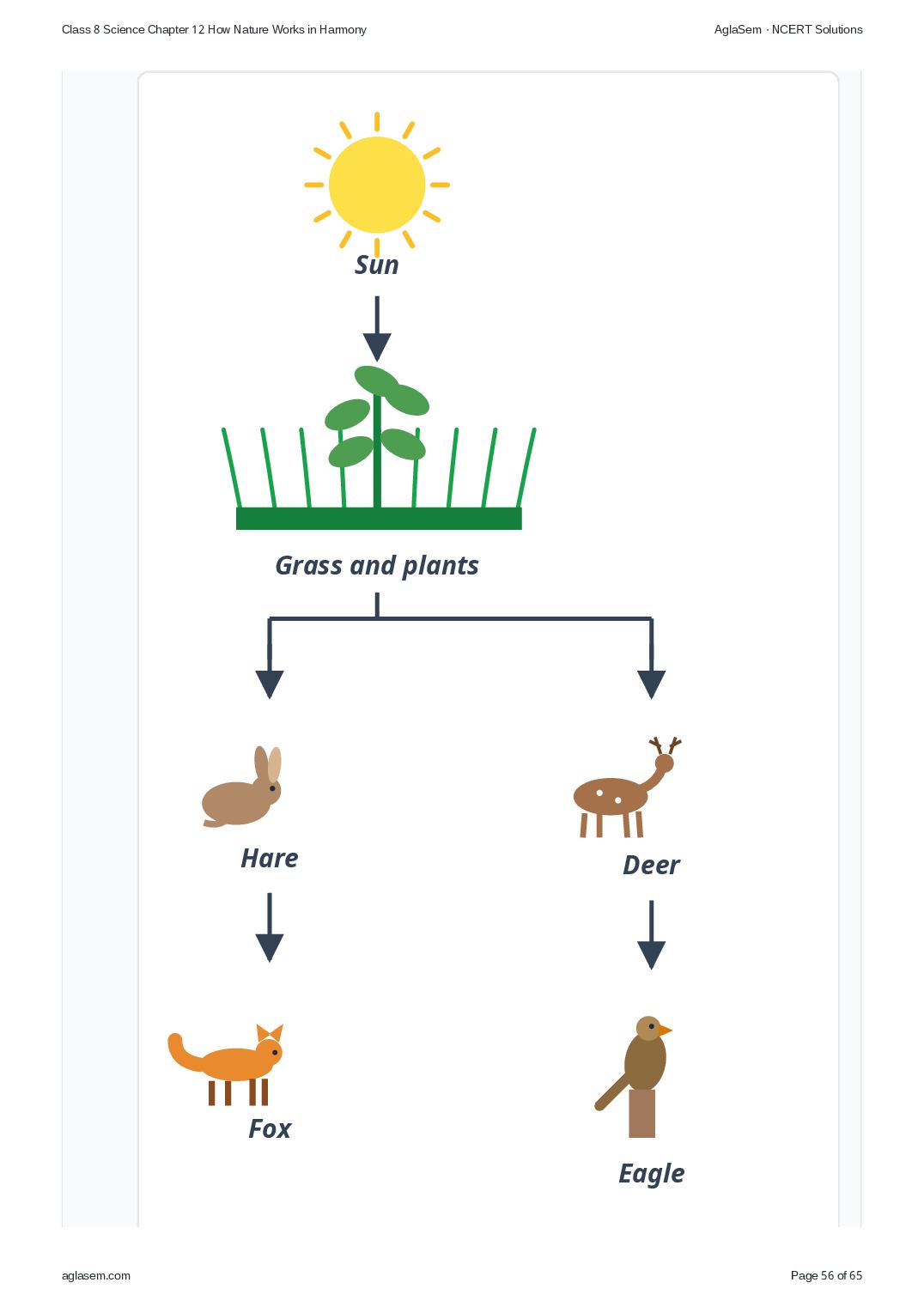
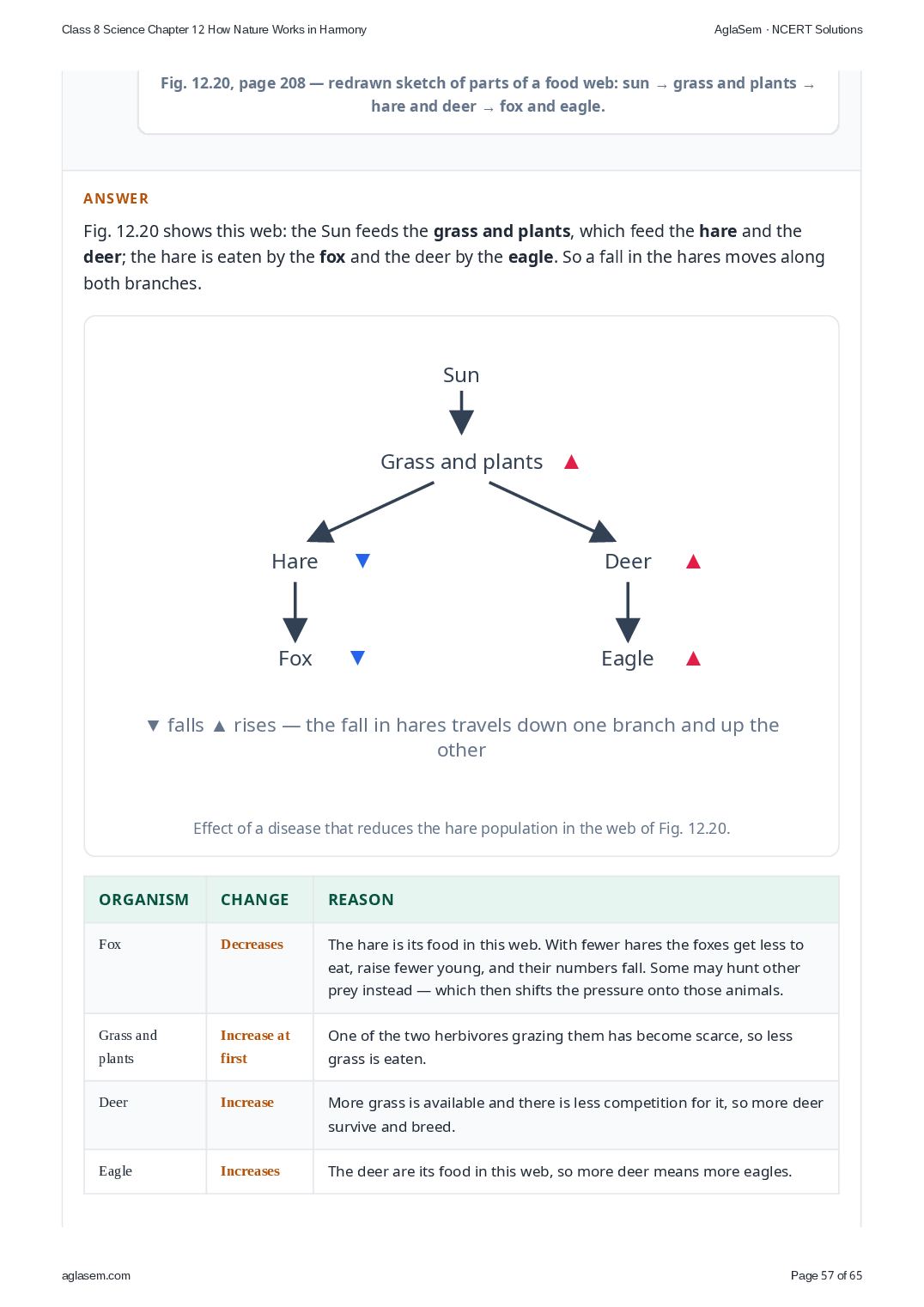
- If the Indian hare population (Fig. 12.20) drops because of a disease, how would it affect the number of other organisms?
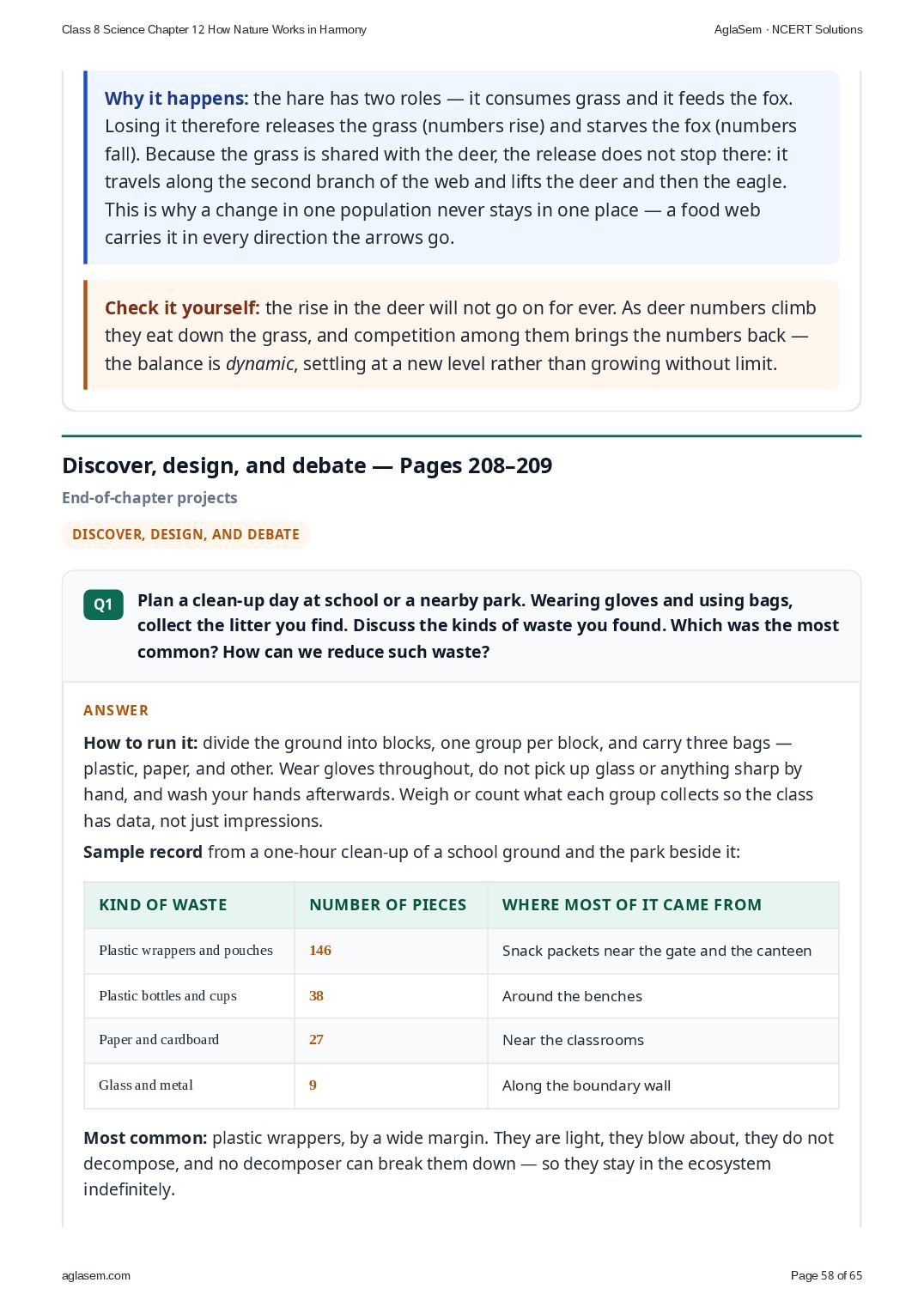
- Plan a clean-up day at school or a nearby park. Wearing gloves and using bags, collect the litter you find. Discuss the kinds of waste you found. Which was the most common? How can we reduce such waste?
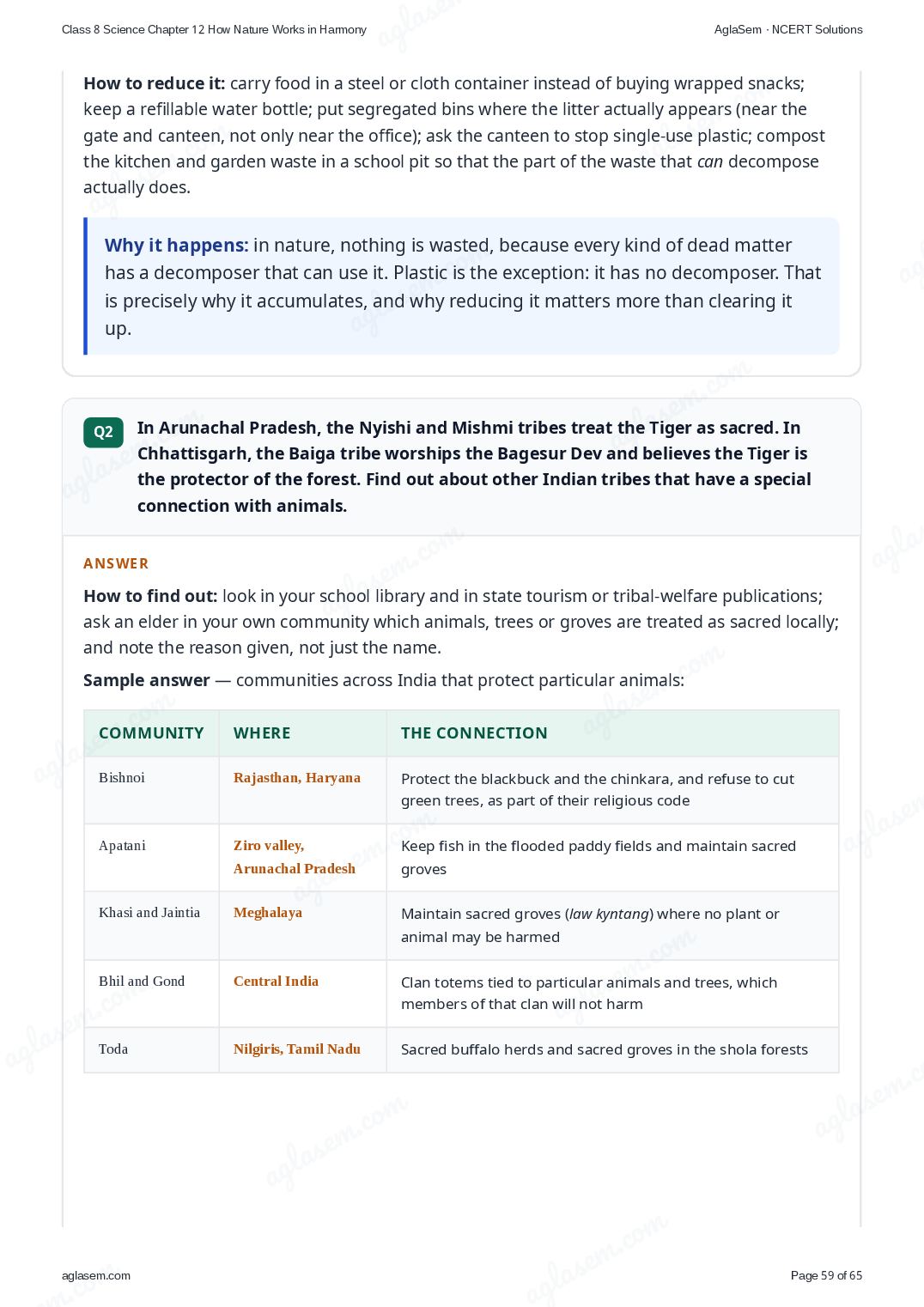
- In Arunachal Pradesh, the Nyishi and Mishmi tribes treat the Tiger as sacred. In Chhattisgarh, the Baiga tribe worships the Bagesur Dev and believes the Tiger is the protector of the forest. Find out about other Indian tribes that have a special connection with animals.
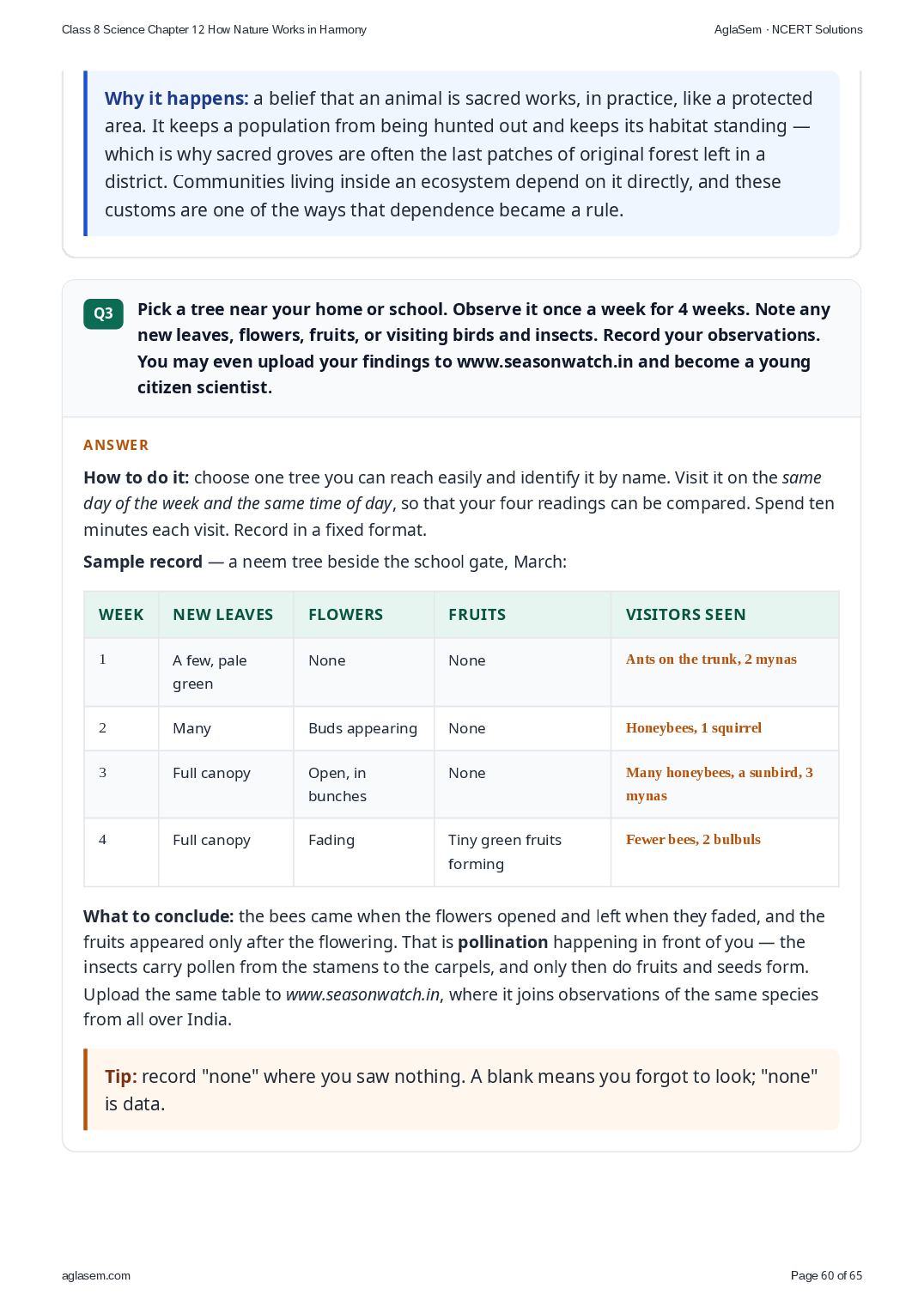
- Pick a tree near your home or school. Observe it once a week for 4 weeks. Note any new leaves, flowers, fruits, or visiting birds and insects. Record your observations. You may even upload your findings to http://www.seasonwatch.in and become a young citizen scientist.
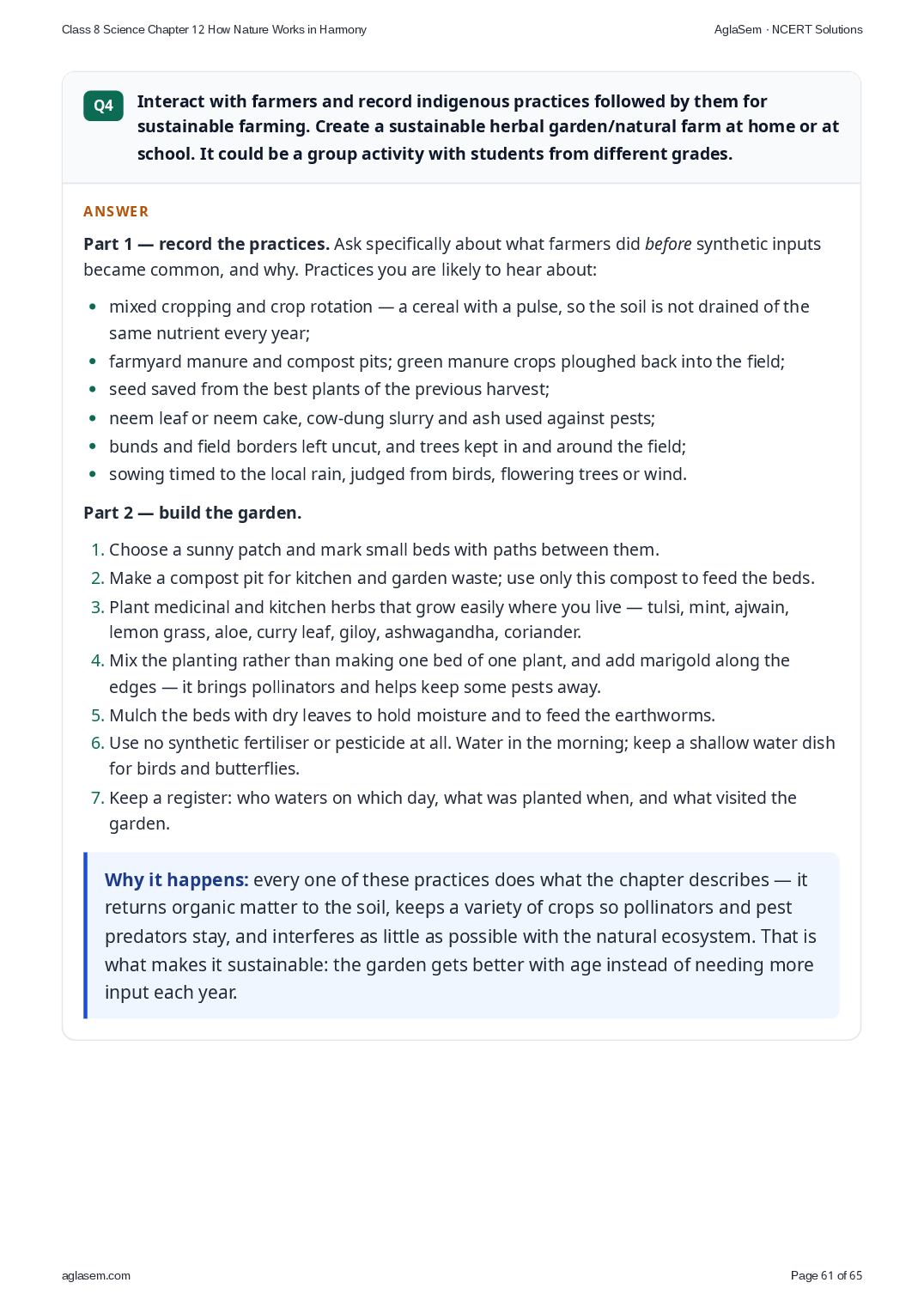
- Interact with farmers and record indigenous practices followed by them for sustainable farming. Create a sustainable herbal garden/natural farm at home or at school. It could be a group activity with students from different grades.
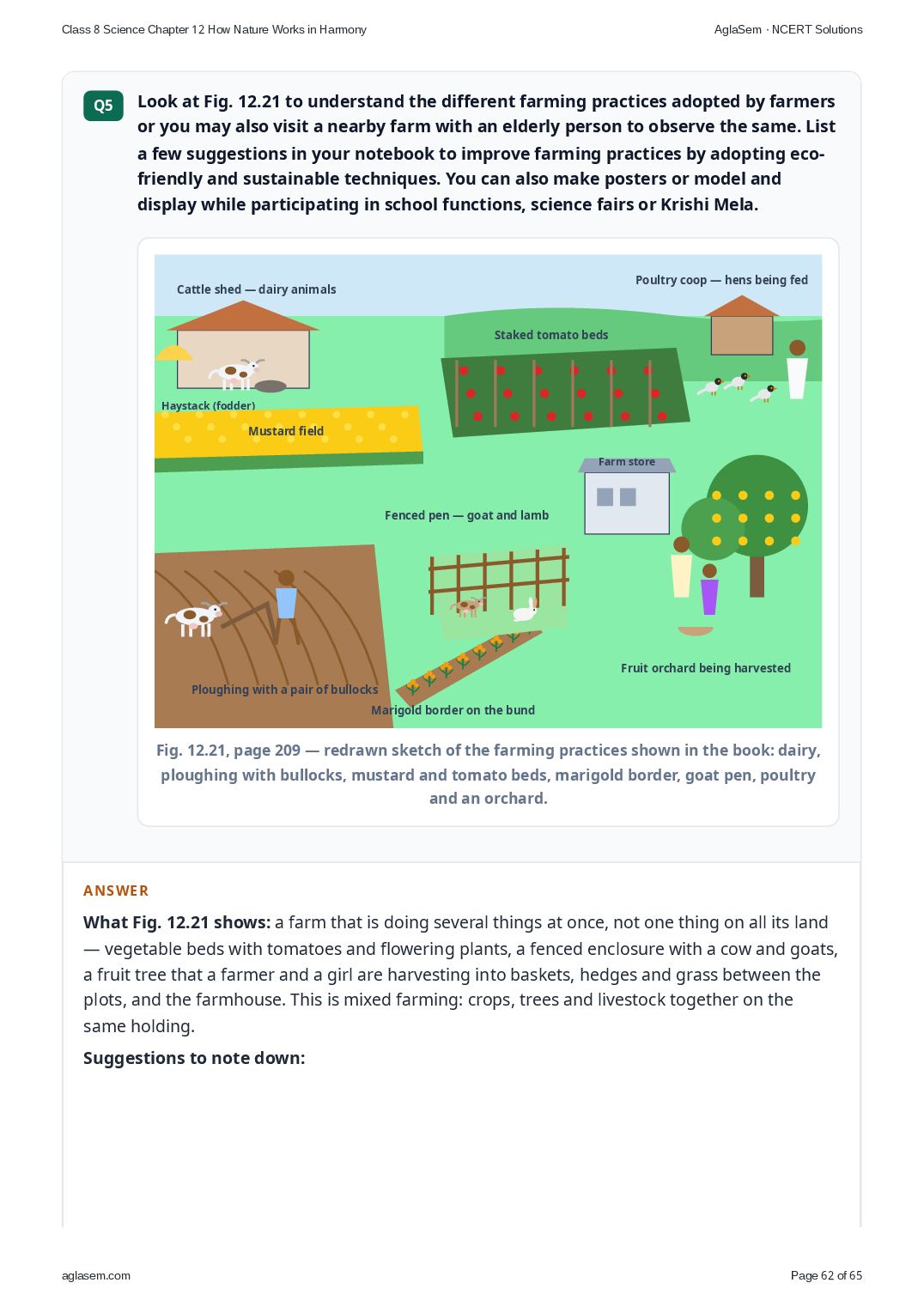
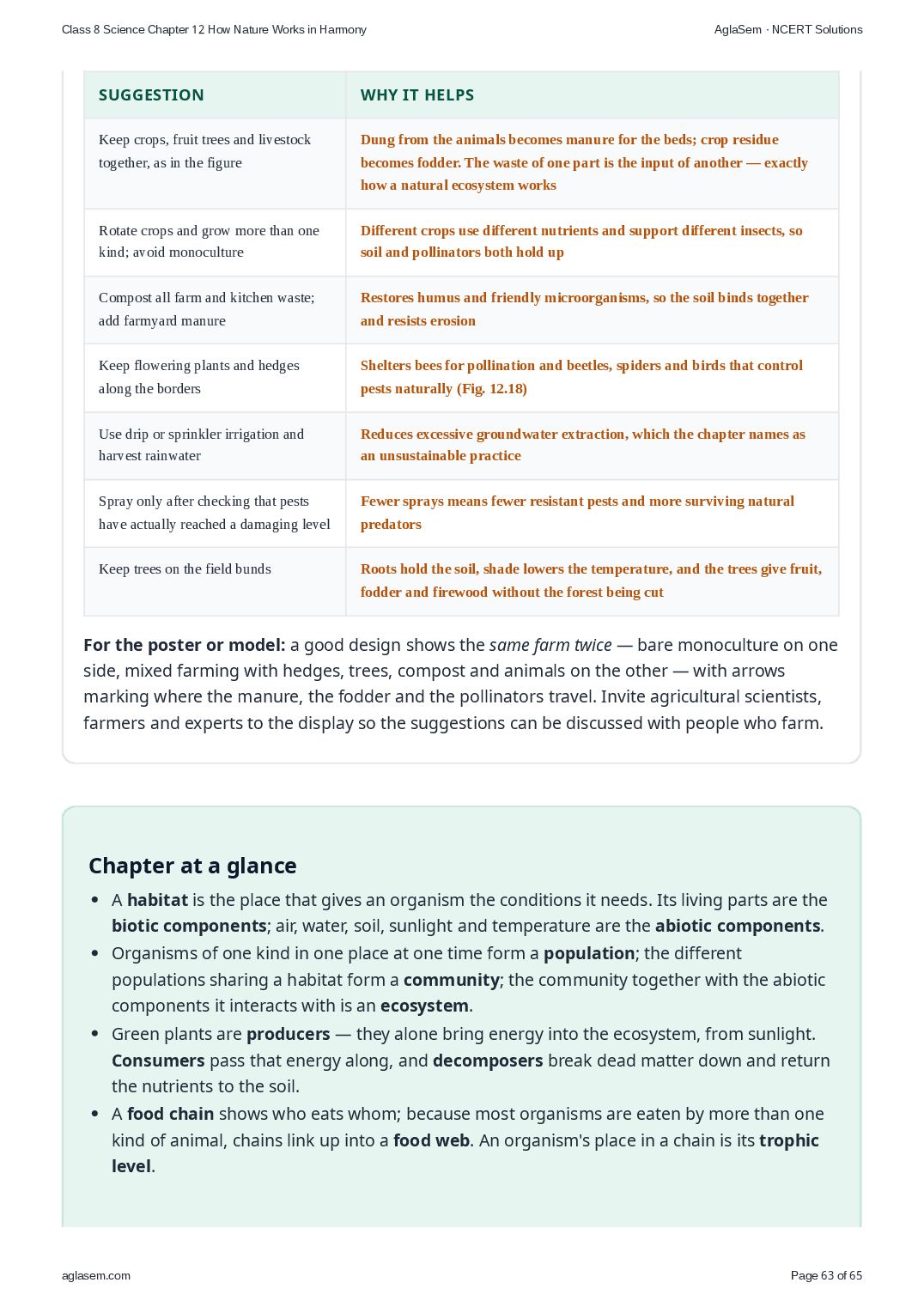
- Look at Fig. 12.21 to understand the different farming practices adopted by farmers or you may also visit a nearby farm with an elderly person to observe the same. List a few suggestions in your notebook to improve farming practices by adopting eco-friendly and sustainable techniques. You can also make posters or model and display while participating in school functions, science fairs or Krishi Mela.
Chapter at a Glance
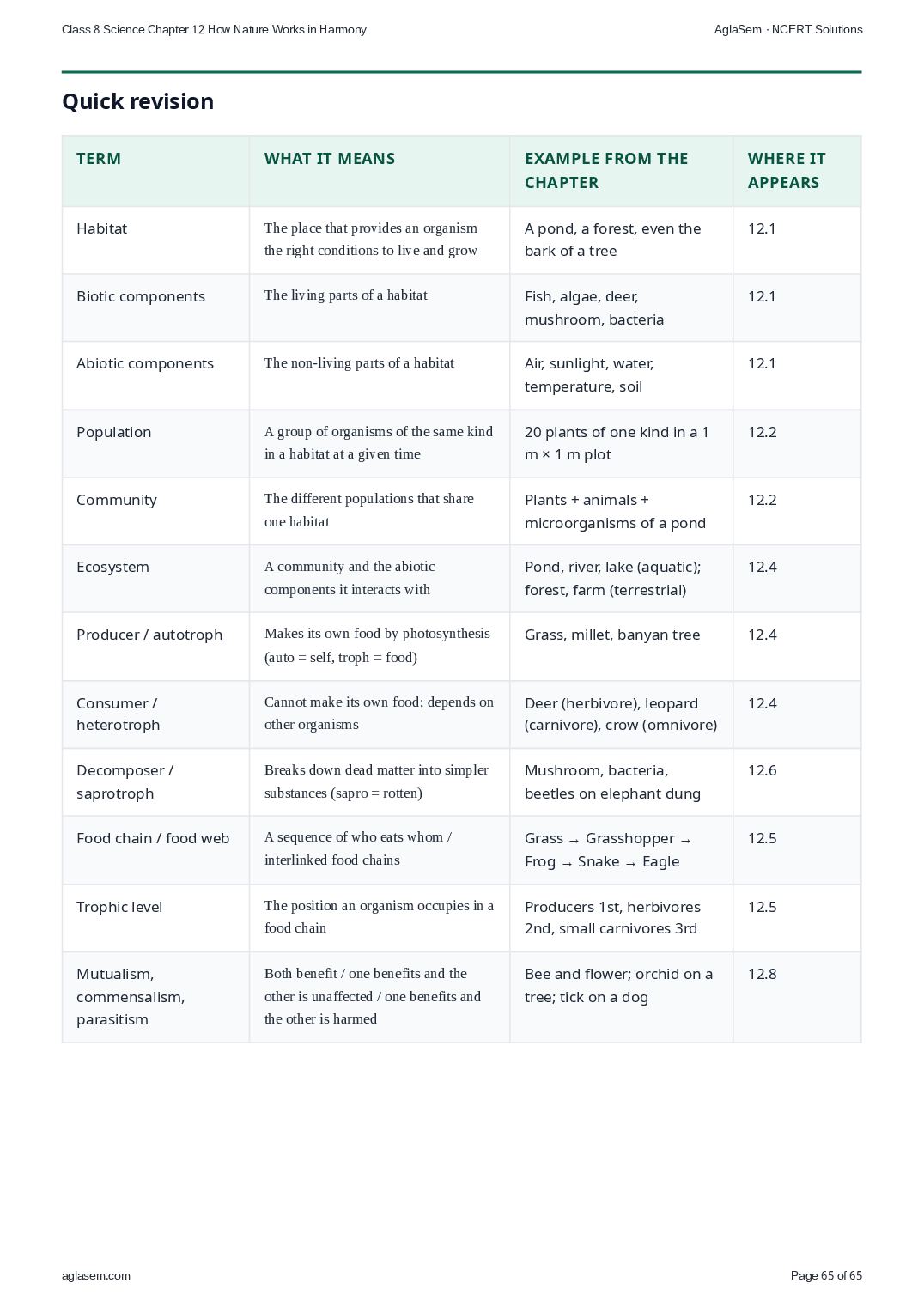
- A habitat is the place that gives an organism the conditions it needs. Its living parts are the biotic components ; air, water, soil, sunlight and temperature are the abiotic components .
- Organisms of one kind in one place at one time form a population ; the different populations sharing a habitat form a community ; the community together with the abiotic components it interacts with is an ecosystem .
- Green plants are producers — they alone bring energy into the ecosystem, from sunlight. Consumers pass that energy along, and decomposers break dead matter down and return the nutrients to the soil.
- A food chain shows who eats whom; because most organisms are eaten by more than one kind of animal, chains link up into a food web . An organism's place in a chain is its trophic level .
- Energy flows one way — in at the producers, out as heat at every step — so numbers shrink upward and a food chain drawn to scale looks like a pyramid . Matter, unlike energy, is recycled: nothing in nature is wasted.
- Competition, mutualism, commensalism and parasitism keep populations in a balance that is dynamic , not fixed. Deforestation, pollution, overuse and monoculture disturb that balance; protected areas and sustainable farming help restore it.
How to Download NCERT Solutions for Class 8 Science Chapter 12 PDF
Follow these simple steps to get the How Nature Works in Harmony questions-and-answers PDF from Curiosity.
- Search NCERT Solutions for Class 8 Science Chapter 12 aglasem and open this page.
- Read the exercise questions with answers for How Nature Works in Harmony shown above.
- Click the Download PDF link to save the How Nature Works in Harmony solutions to your device.
NCERT Solutions for Class 8 Science – All Chapters
There are more chapters to study besides How Nature Works in Harmony in Science. Here are the NCERT Solutions for all chapters of Class 8 Science.
- Chapter 1 Exploring the Investigative World of Science
- Chapter 2 The Invisible Living World Beyond Our Naked Eye
- Chapter 3 Health the Ultimate Treasure
- Chapter 4 Electricity Magnetic and Heating Effects
- Chapter 5 Exploring Forces
- Chapter 6 Pressure Winds Storms and Cyclones
- Chapter 7 Particulate Nature of Matter
- Chapter 8 Nature of Matter Elements Compounds and Mixtures
- Chapter 9 The Amazing World of Solutes Solvents and Solutions
- Chapter 10 Light Mirrors and Lenses
- Chapter 11 Keeping Time with the Skies
- Chapter 12 How Nature Works in Harmony
- Chapter 13 Our Home Earth a Unique Life Sustaining Planet
NCERT Solutions for Class 8 – All Subjects
Just like Chapter 12 of Science, you can get the exercise questions with answers for every other subject of Class 8. Here are the NCERT Solutions for all subjects of Class 8.
NCERT Solutions for Class 8 Science Chapter 12 – An Overview
The key highlights of this study material are as follows.
| Aspects | Details |
|---|---|
| Class | Class 8 |
| Subject | Science |
| Chapter Number | Chapter 12 |
| Chapter Name | How Nature Works in Harmony |
| Book Name | Curiosity |
| Book By | NCERT (National Council of Educational Research and Training) |
| Educational Resource Here | NCERT Solutions of Class 8 Science Chapter 12 for all exercises |
| More Questions Answers of This Subject | NCERT Solutions for Class 8 Science |
| Download Book Chapter | NCERT Book Class 8 Science |
| All Questions Answers For This Class | NCERT Solutions for Class 8 |
| Complete Solutions | NCERT Solutions |
NCERT Solutions for Class 8 Science Chapter 12 How Nature Works in Harmony – FAQs
What are the NCERT Solutions for Class 8 Science Chapter 12 How Nature Works in Harmony?
They are the complete, step-by-step answers to all the exercise and in-text questions of Chapter 12 How Nature Works in Harmony from the NCERT Class 8 Science textbook Curiosity, written by experts as per the latest NCERT syllabus.
How can I download the Class 8 Science Chapter 12 solutions PDF for free?
Open this page on aglasem, read the How Nature Works in Harmony questions with answers, and click the “Download Solutions PDF” link. The Class 8 Science Chapter 12 NCERT Solutions PDF is completely free to download.
Are these NCERT Solutions as per the latest 2026-27 syllabus?
Yes. The NCERT Solutions for Class 8 Science Chapter 12 are based on the latest NCERT textbook Curiosity and the current 2026-27 CBSE syllabus, so the questions and answers match what you study in class.
Where can I get NCERT Solutions for the other chapters of Class 8 Science?
You can find the answers to every chapter on the NCERT Solutions for Class 8 Science page, and solutions for every subject on the NCERT Solutions for Class 8 page.
How do NCERT Solutions help in exam preparation?
They show the correct method to solve each question, help you write answers the way they are expected in exams, let you check and correct your own work, and save revision time — which together improve your marks in Class 8 Science.
If you have any queries on NCERT Solutions for Class 8 Science Chapter 12 How Nature Works in Harmony, then please ask in the comments below.