NCERT Solutions for Class 8 Science Chapter 9 The Amazing World of Solutes Solvents and Solutions provide clear, step-by-step answers to every exercise and in-text question from the chapter The Amazing World of Solutes Solvents and Solutions of the NCERT textbook Curiosity. Prepared by subject experts as per the latest NCERT (CBSE) syllabus for 2026-27, these NCERT Solutions for Class 8 Science help you understand each concept, write exam-ready answers, and check your own solutions. You can read them online below or download the free Class 8 Science Chapter 9 question-answer PDF.
NCERT Solutions for Class 8 Science Chapter 9 The Amazing World of Solutes Solvents and Solutions
- Class: Class 8
- Subject: Science
- Chapter: Chapter 9 – The Amazing World of Solutes Solvents and Solutions
- Textbook: Curiosity (NCERT)
- Study material: NCERT Solutions – questions with answers, free PDF
These solutions answer all the exercise questions of Chapter 9 The Amazing World of Solutes Solvents and Solutions — including the in-text questions, short-answer and long-answer questions, and activities — with complete explanations so you can follow the method, not just the final answer. Read the full solutions below.
NCERT Solutions Class 8 Science Chapter 9 the Amazing World of Solutes Solvents and Solutions View Download
NCERT Solutions for Class 8 Science Chapter 9 PDF Download
You can read the NCERT Solutions for Class 8 Science Chapter 9 online above, or download the complete question-answer PDF to study The Amazing World of Solutes Solvents and Solutions offline at any time.
NCERT Solutions for Class 8 Science Chapter 9 PDF Download Link – Click Here to Download Solutions PDF
Questions Covered in This Chapter
These NCERT Solutions answer all 52 questions of this chapter. The questions solved are:
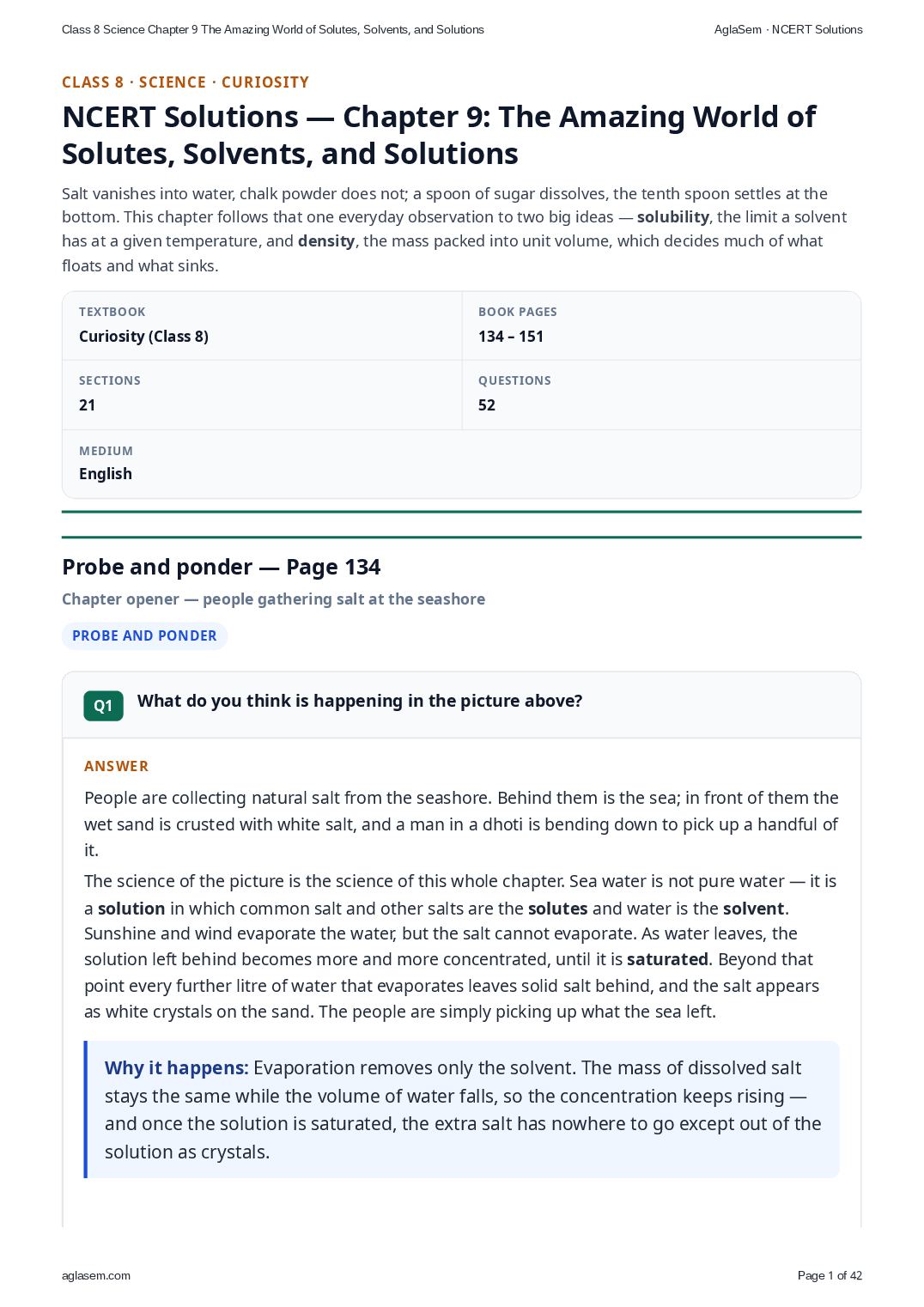
- What do you think is happening in the picture above?
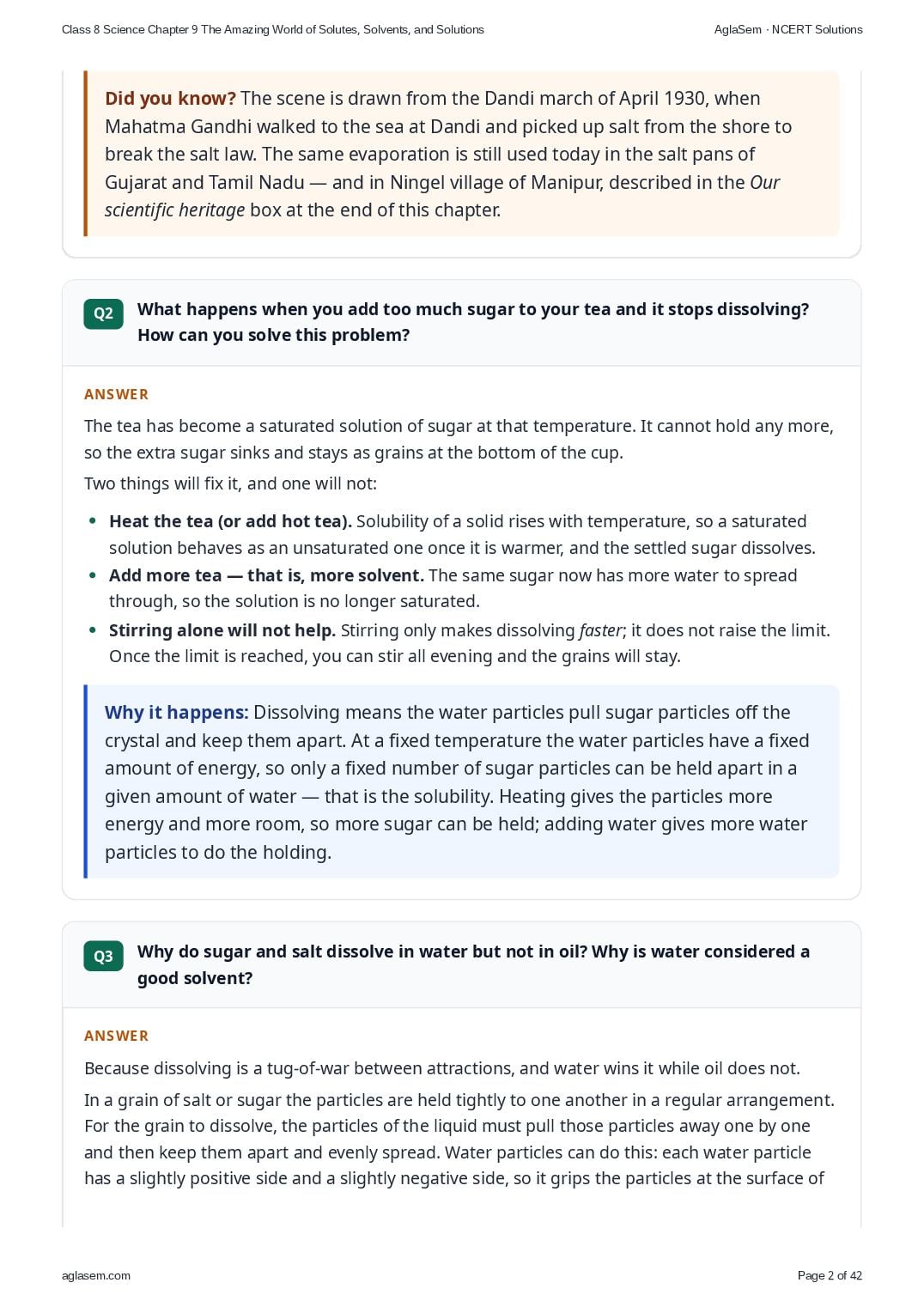
- What happens when you add too much sugar to your tea and it stops dissolving? How can you solve this problem?
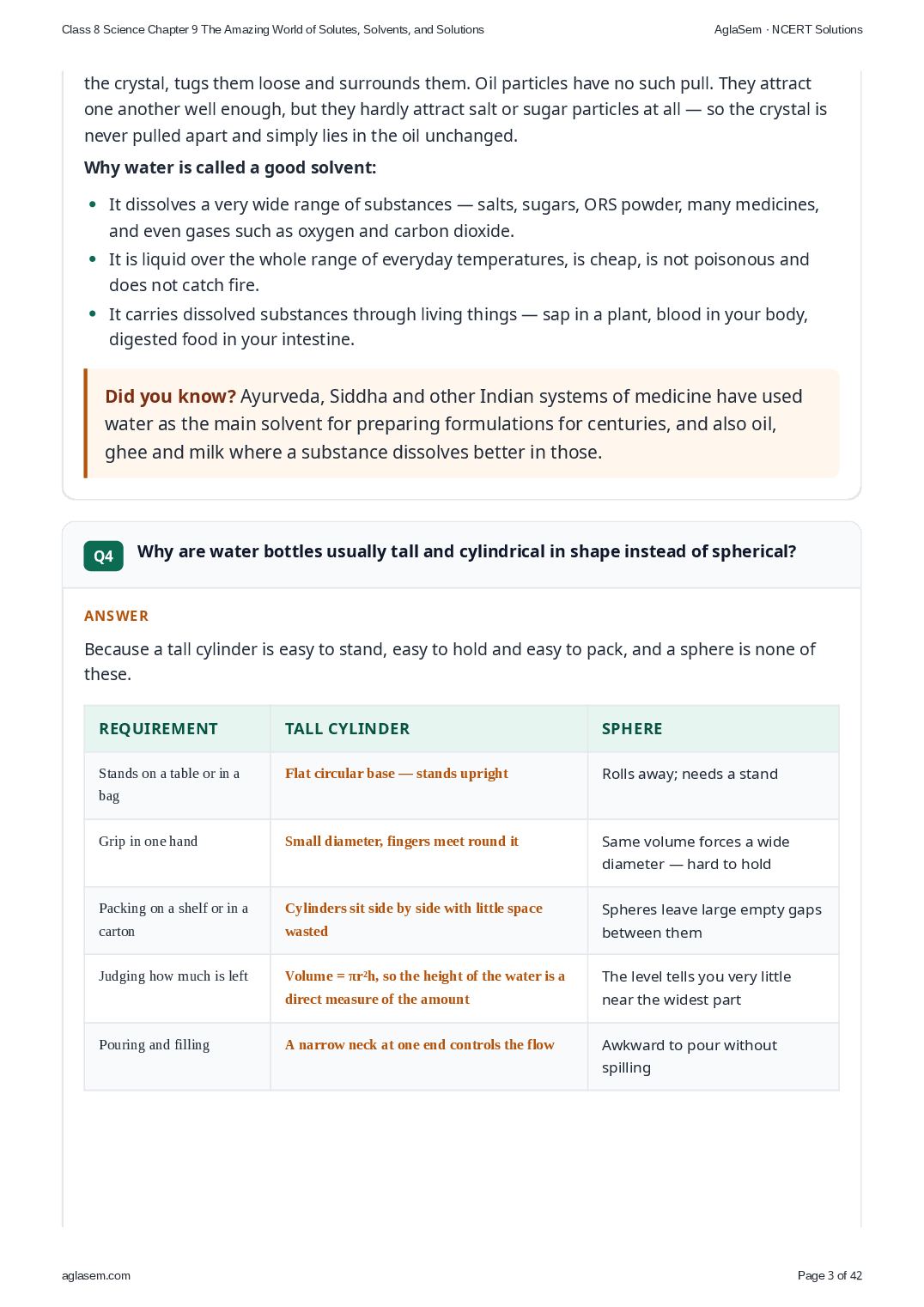
- Why do sugar and salt dissolve in water but not in oil? Why is water considered a good solvent?
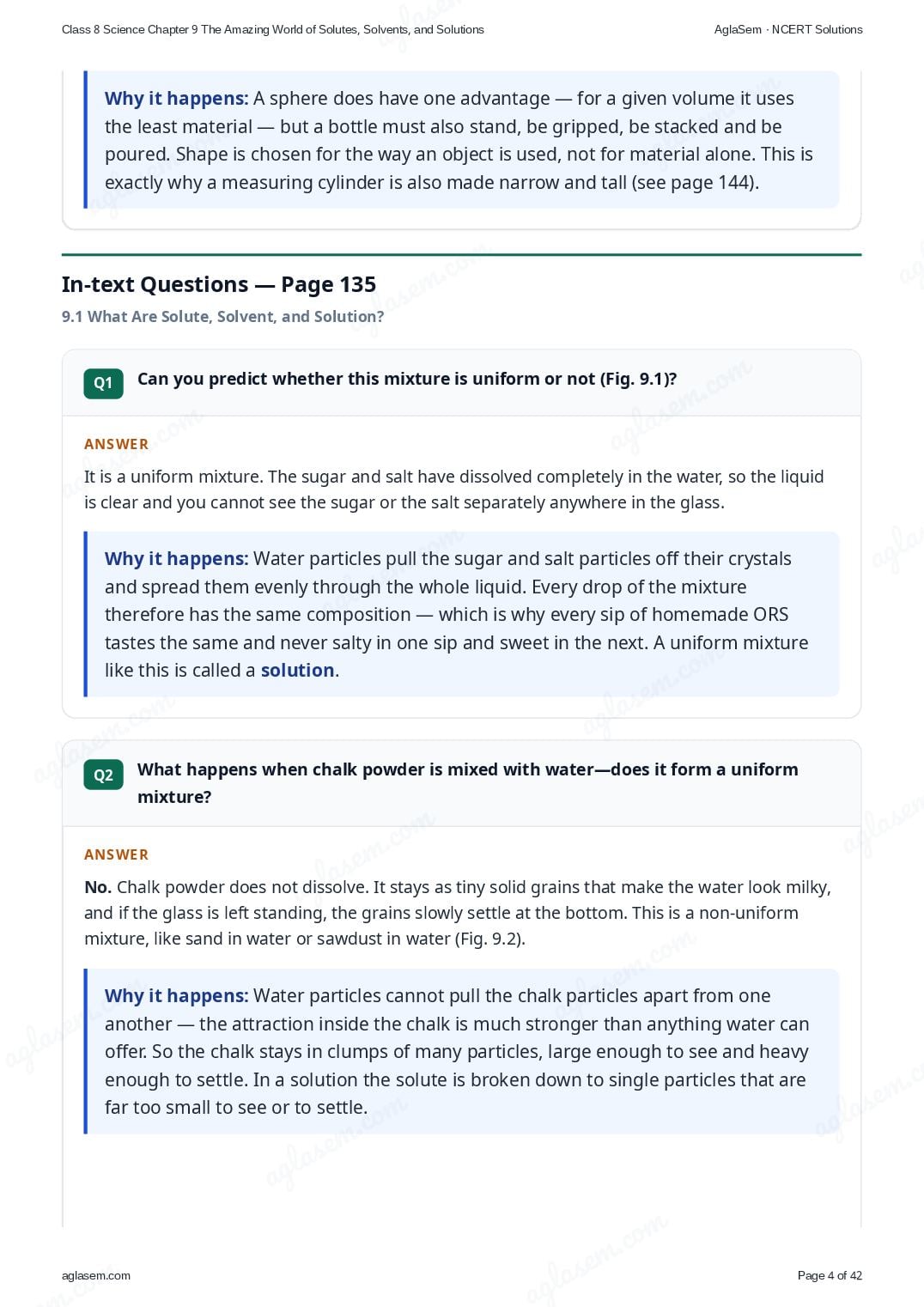
- Why are water bottles usually tall and cylindrical in shape instead of spherical?
- Can you predict whether this mixture is uniform or not (Fig. 9.1)?
- What happens when chalk powder is mixed with water—does it form a uniform mixture?
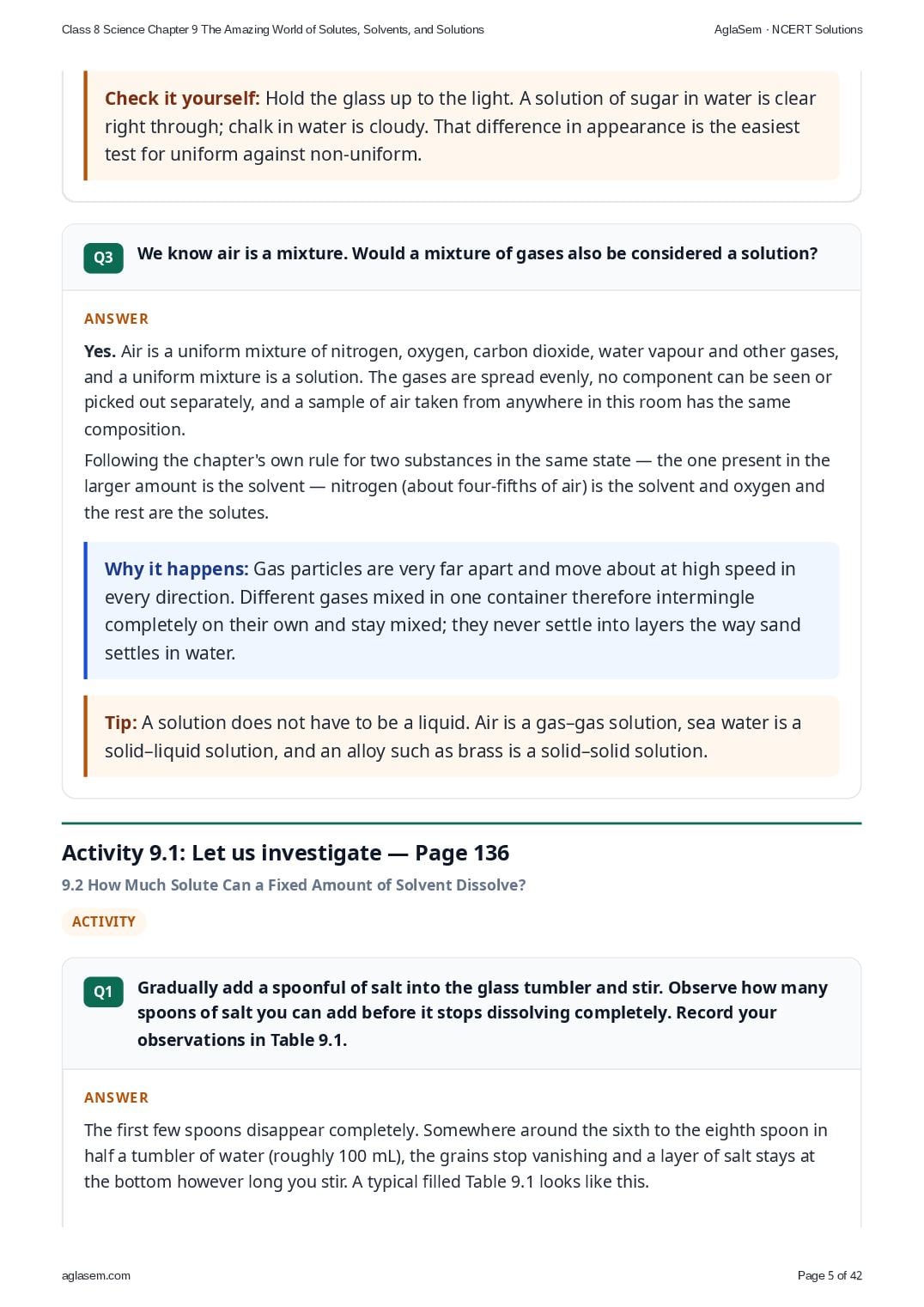
- We know air is a mixture. Would a mixture of gases also be considered a solution?
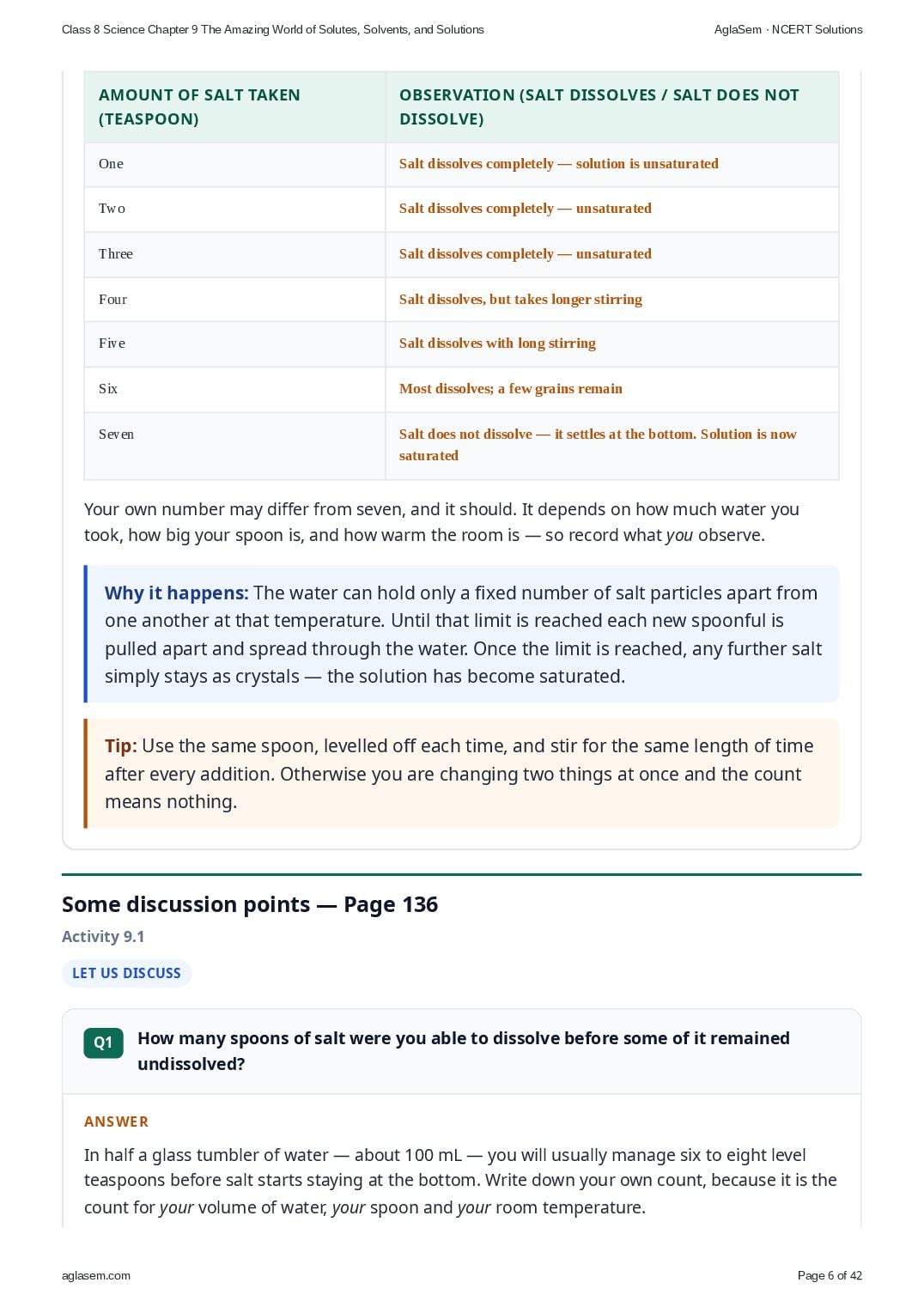
- Gradually add a spoonful of salt into the glass tumbler and stir. Observe how many spoons of salt you can add before it stops dissolving completely. Record your observations in Table 9.1.
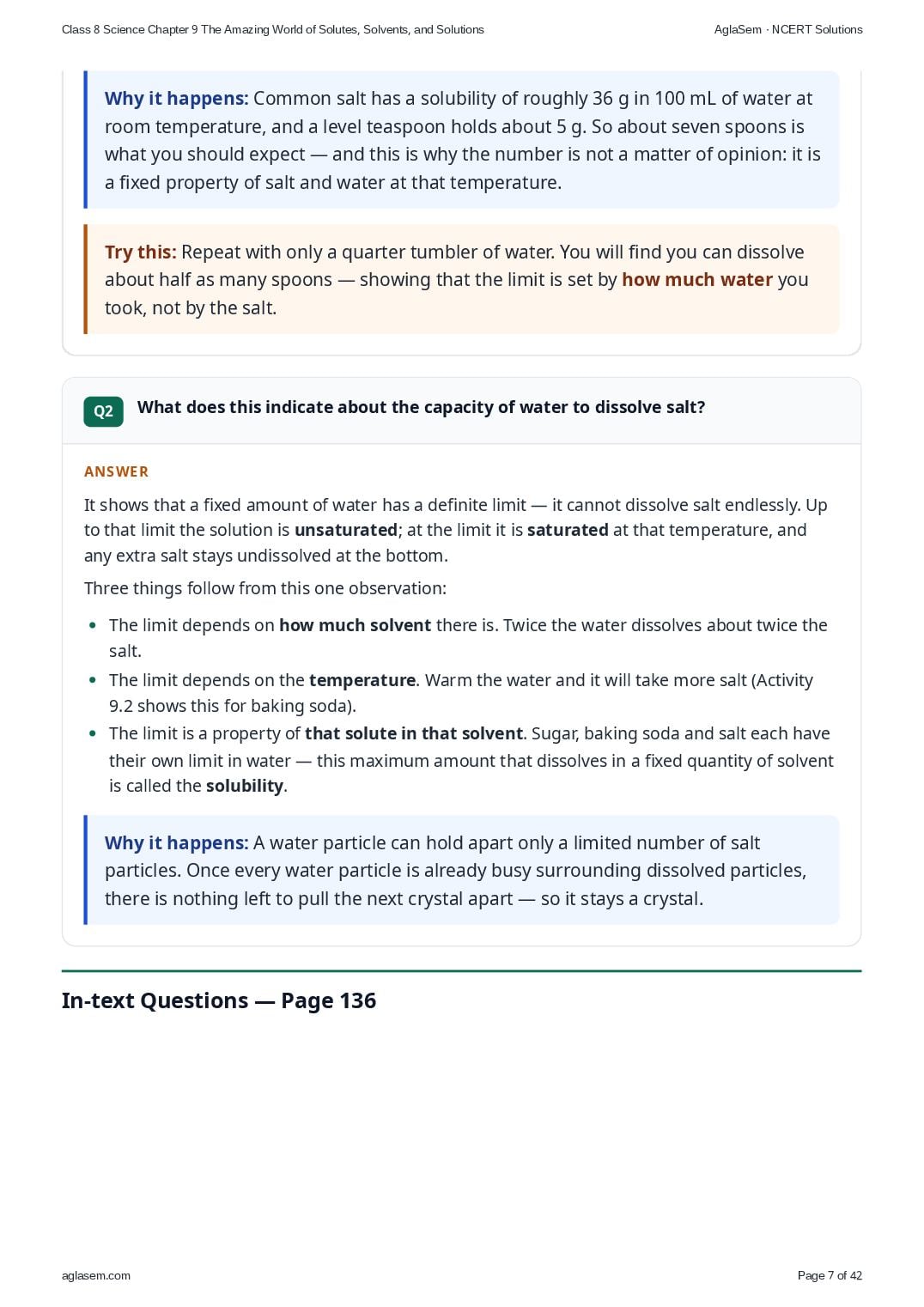
- How many spoons of salt were you able to dissolve before some of it remained undissolved?
- What does this indicate about the capacity of water to dissolve salt?
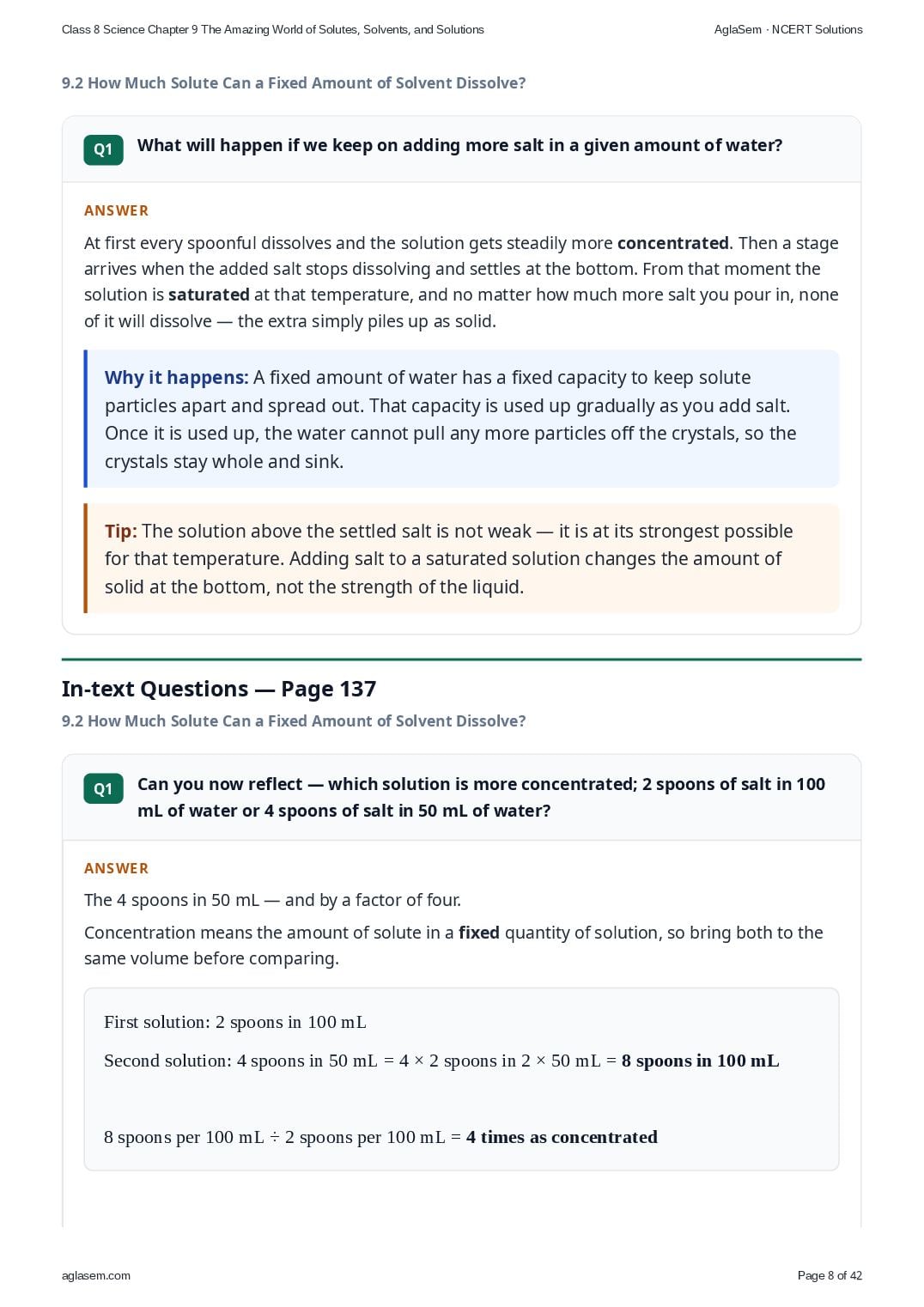
- What will happen if we keep on adding more salt in a given amount of water?
- Can you now reflect — which solution is more concentrated; 2 spoons of salt in 100 mL of water or 4 spoons of salt in 50 mL of water?
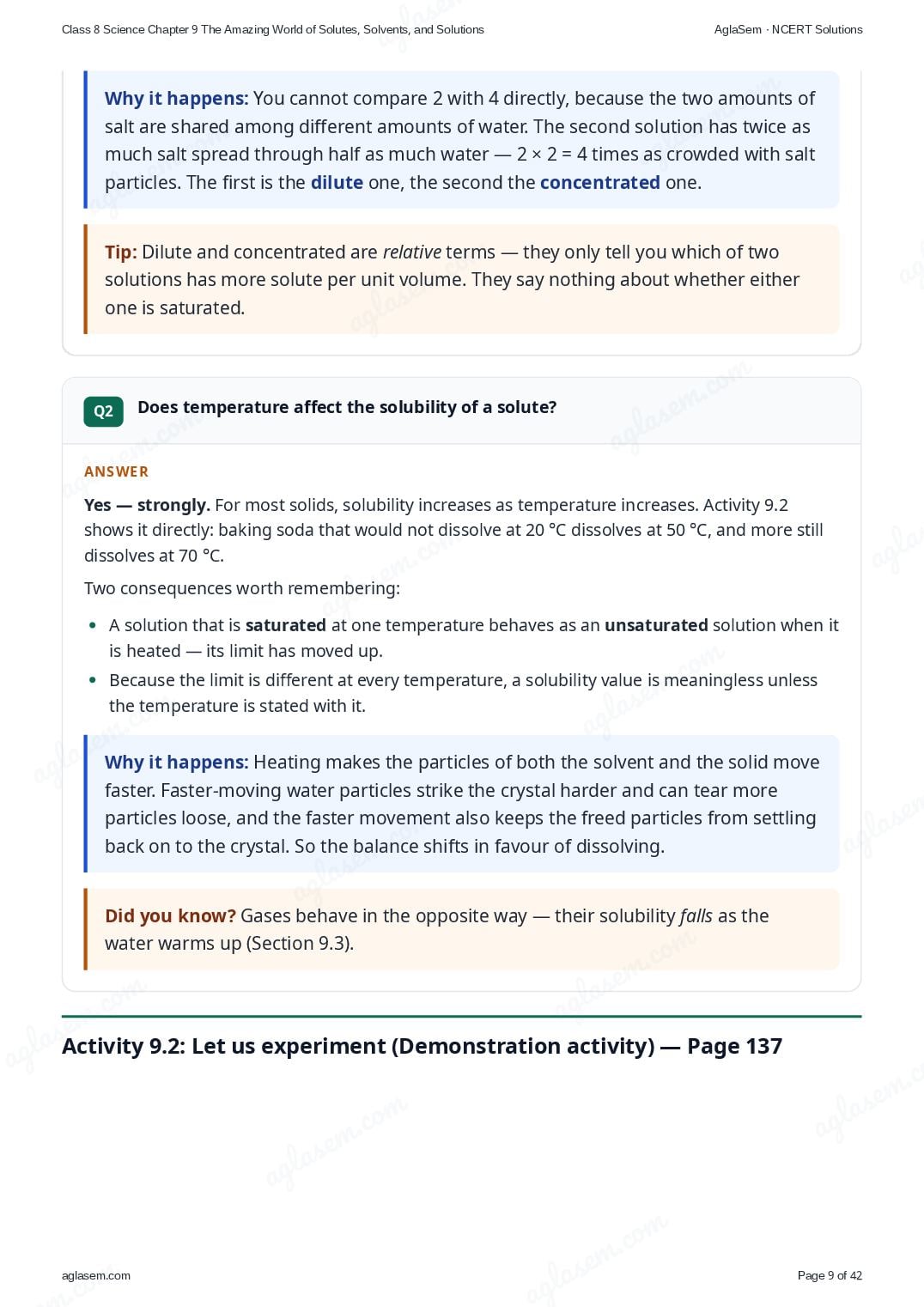
- Does temperature affect the solubility of a solute?
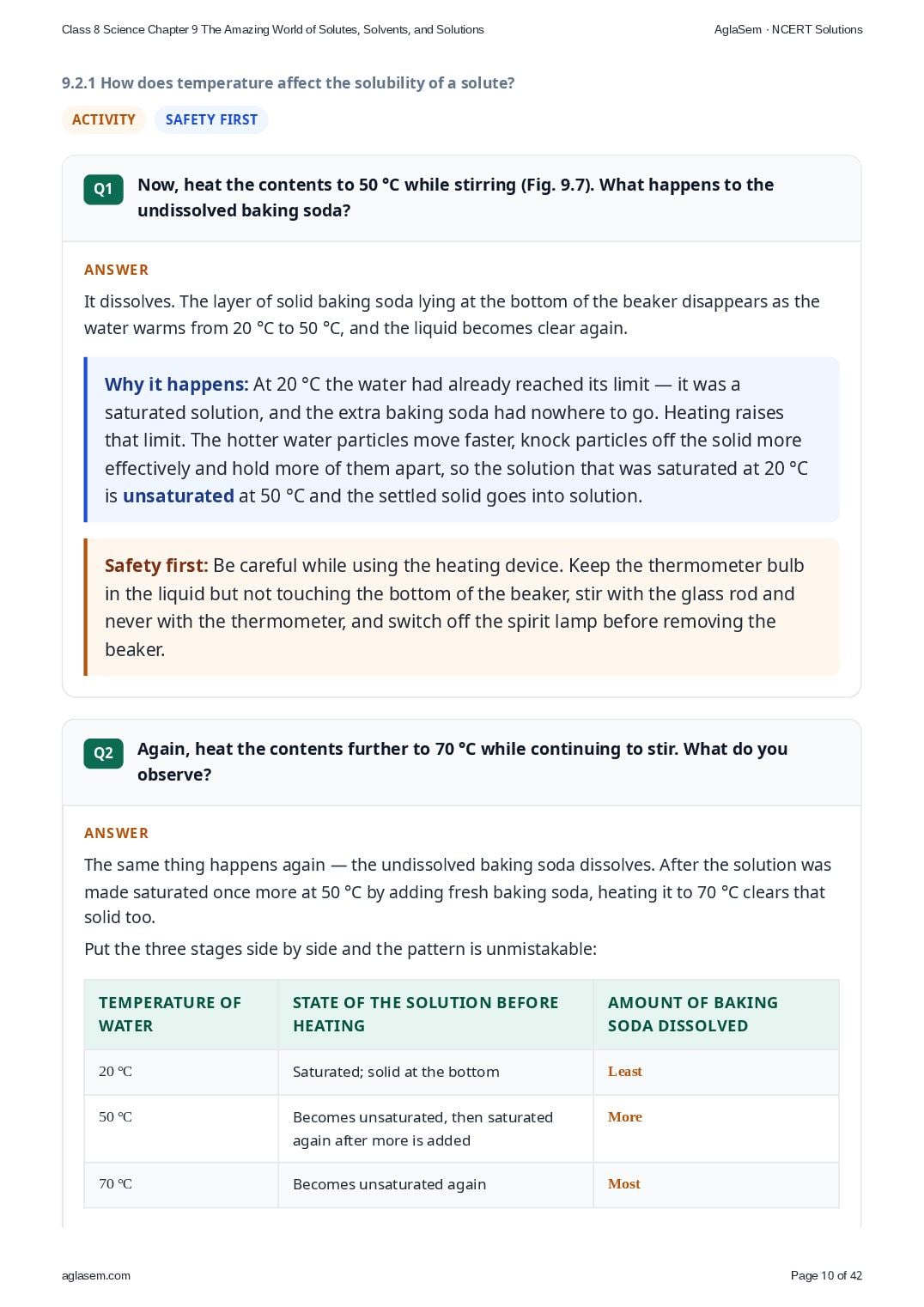
- Now, heat the contents to 50 °C while stirring (Fig. 9.7). What happens to the undissolved baking soda?
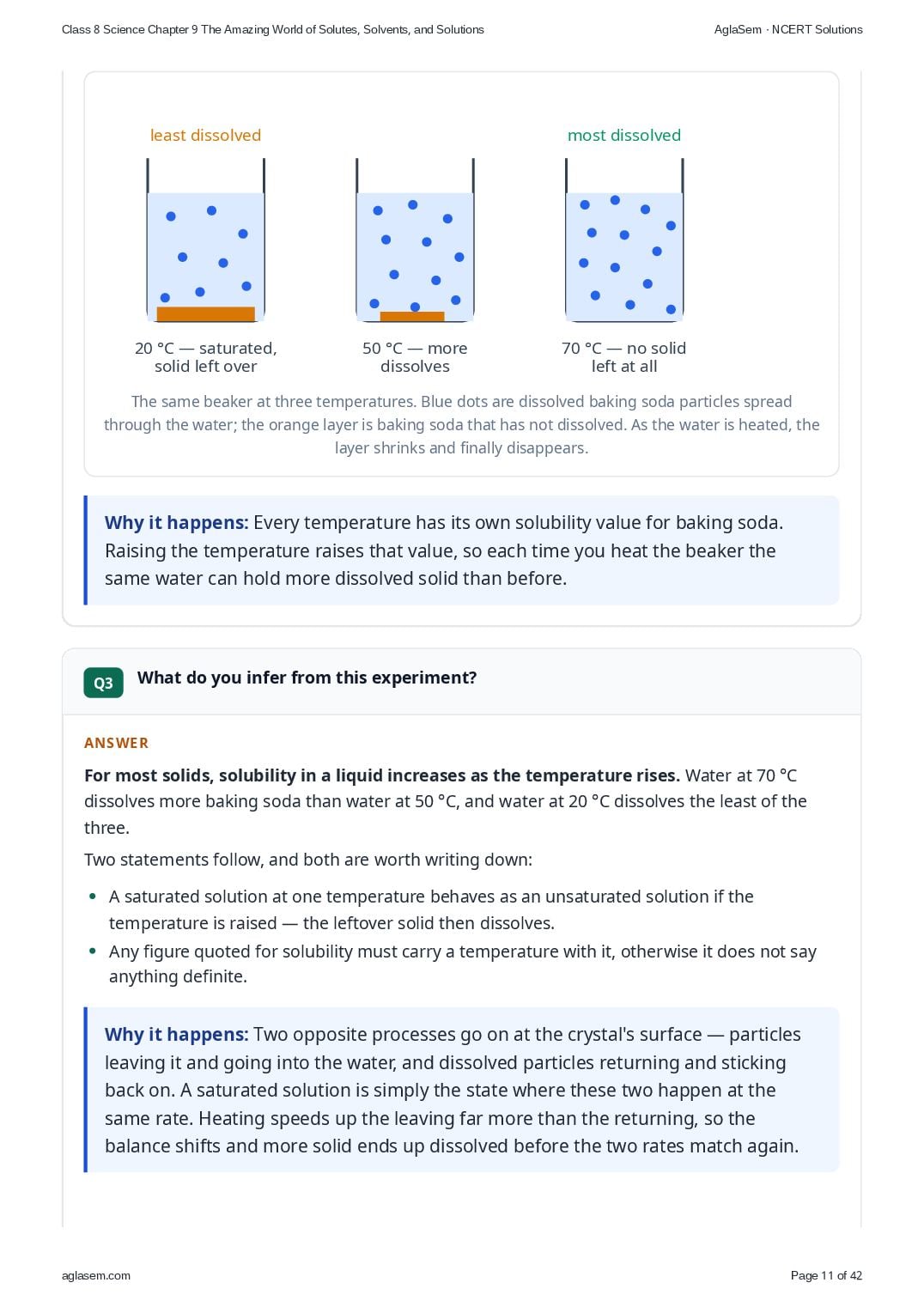
- Again, heat the contents further to 70 °C while continuing to stir. What do you observe?
- What do you infer from this experiment?
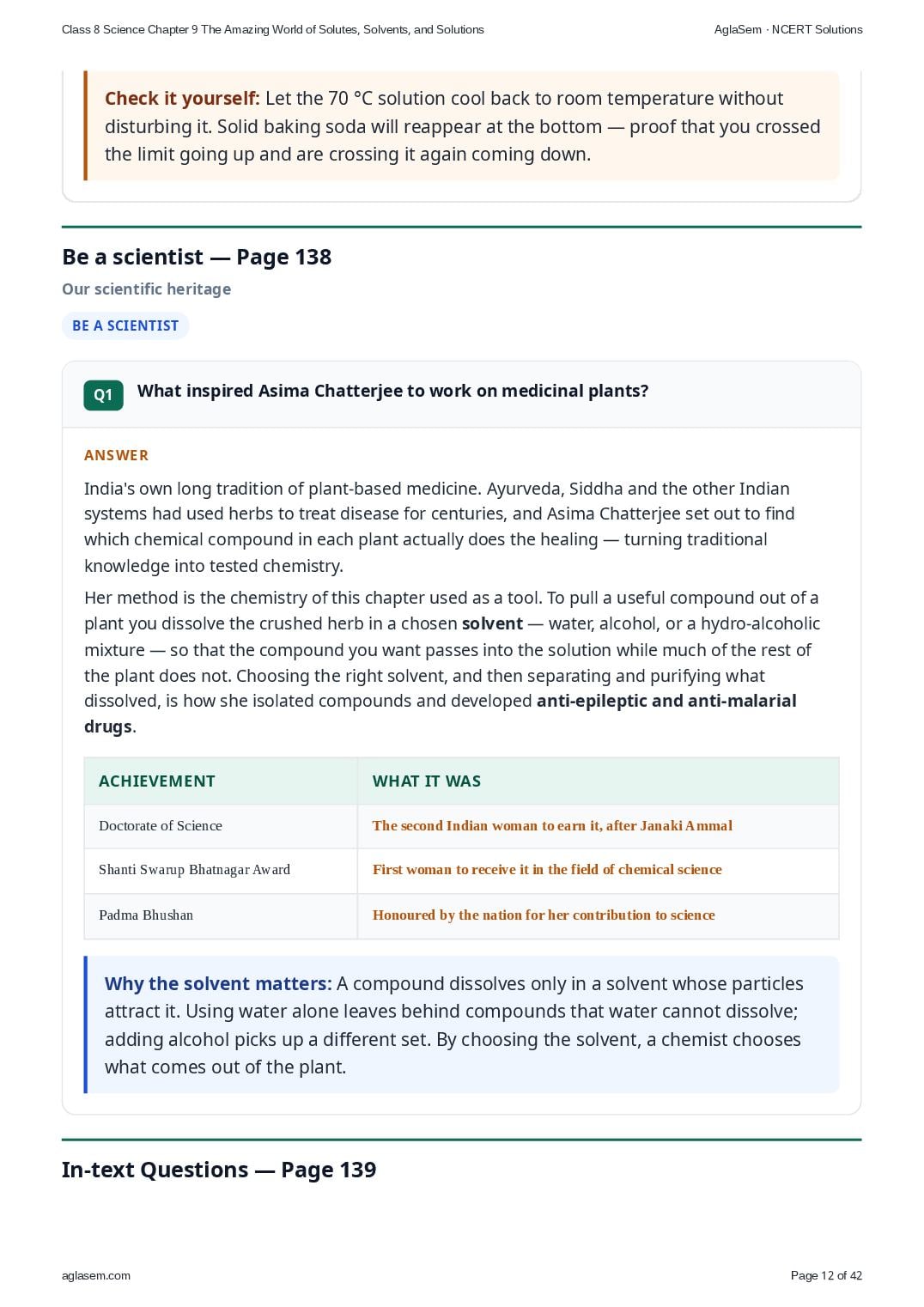
- What inspired Asima Chatterjee to work on medicinal plants?
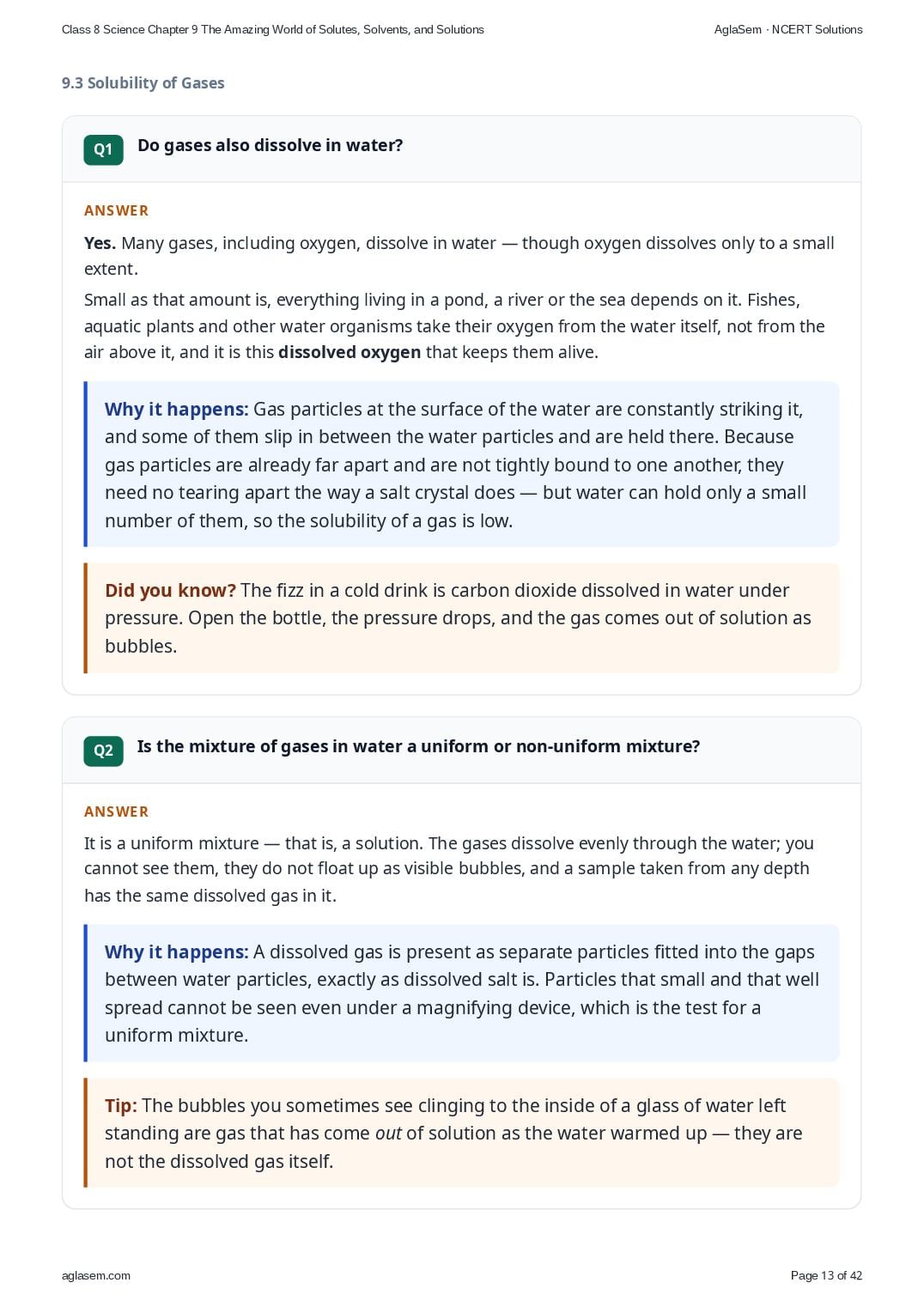
- Do gases also dissolve in water?
- Is the mixture of gases in water a uniform or non-uniform mixture?
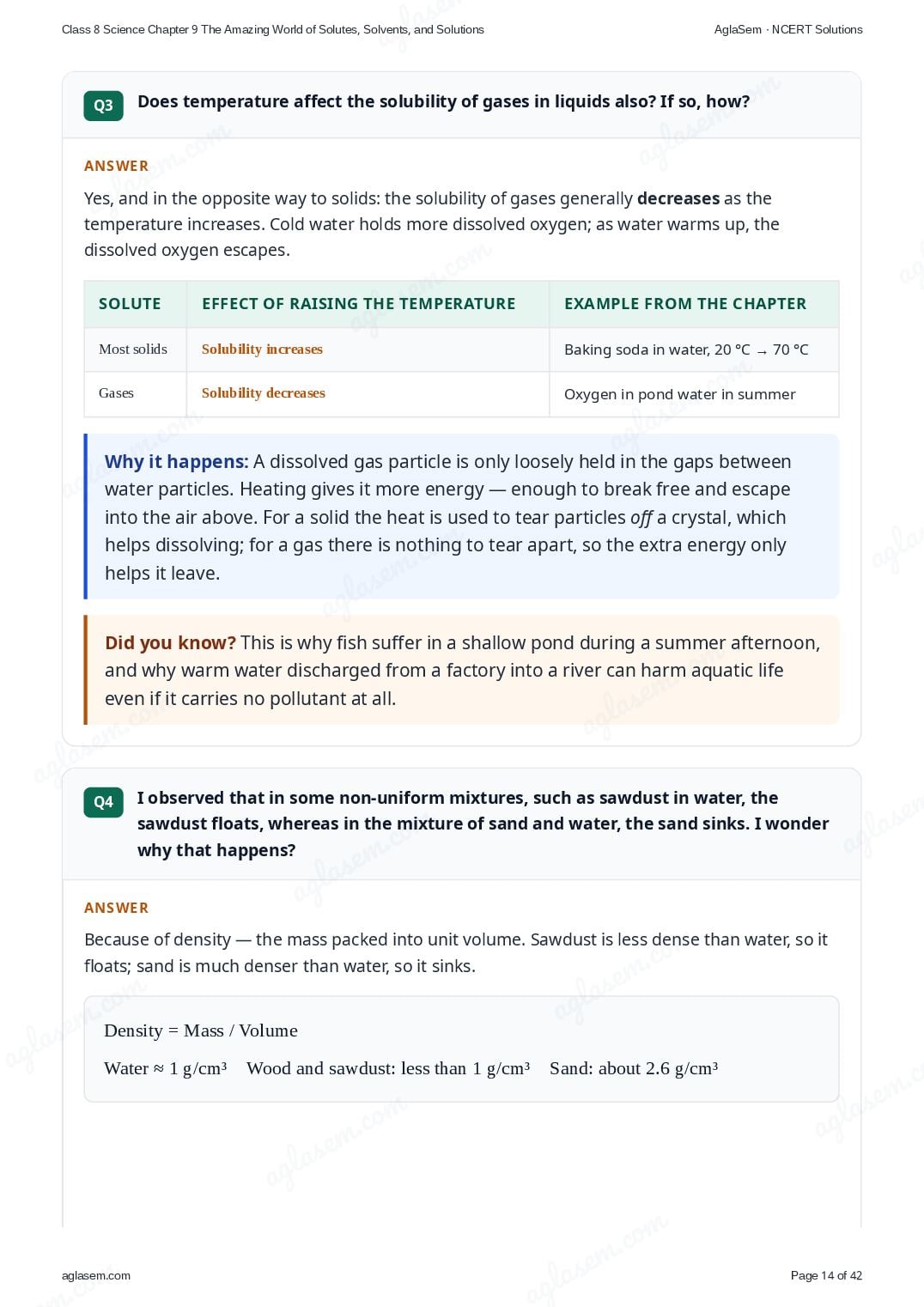
- Does temperature affect the solubility of gases in liquids also? If so, how?
- I observed that in some non-uniform mixtures, such as sawdust in water, the sawdust floats, whereas in the mixture of sand and water, the sand sinks. I wonder why that happens?
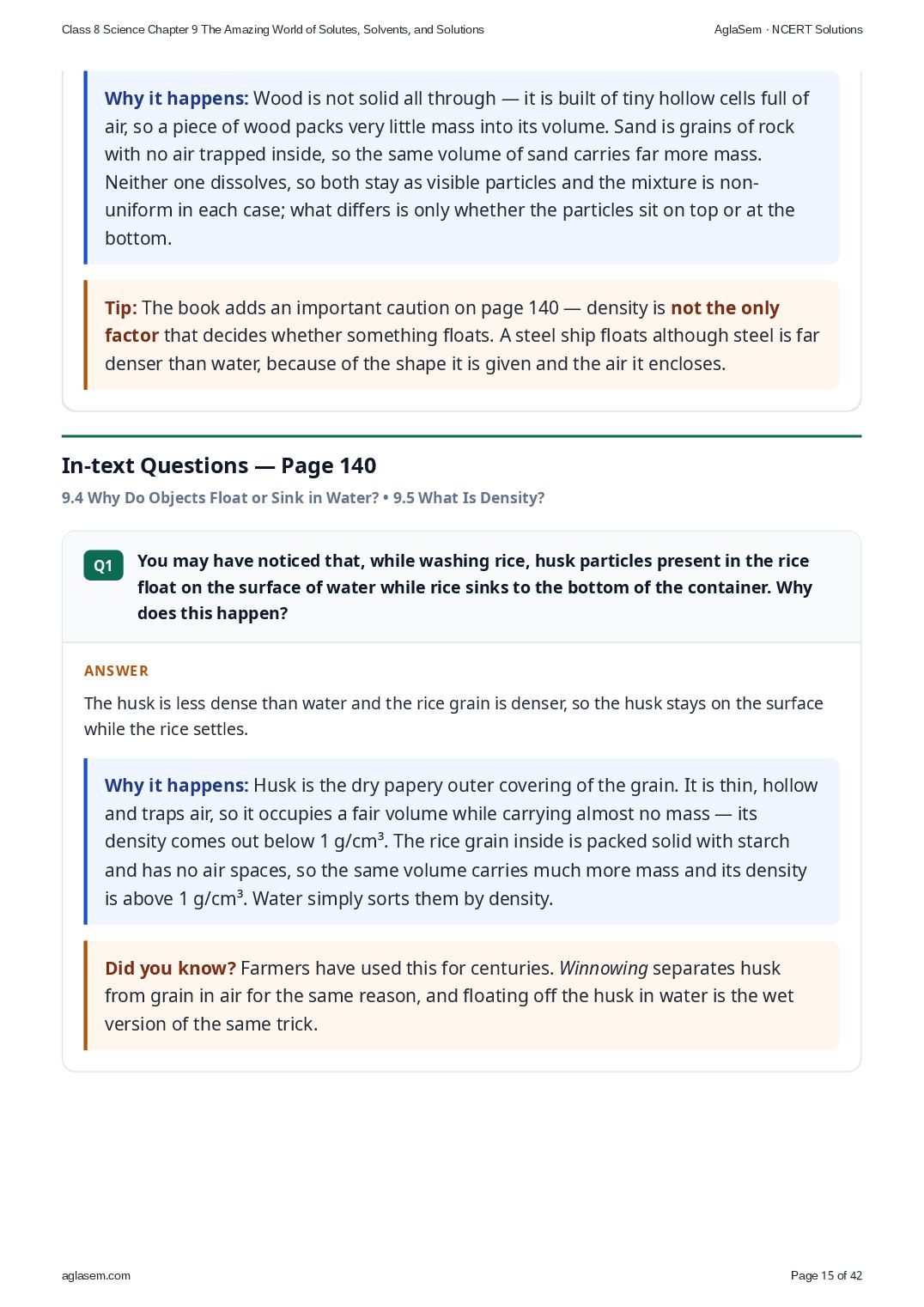
- You may have noticed that, while washing rice, husk particles present in the rice float on the surface of water while rice sinks to the bottom of the container. Why does this happen?
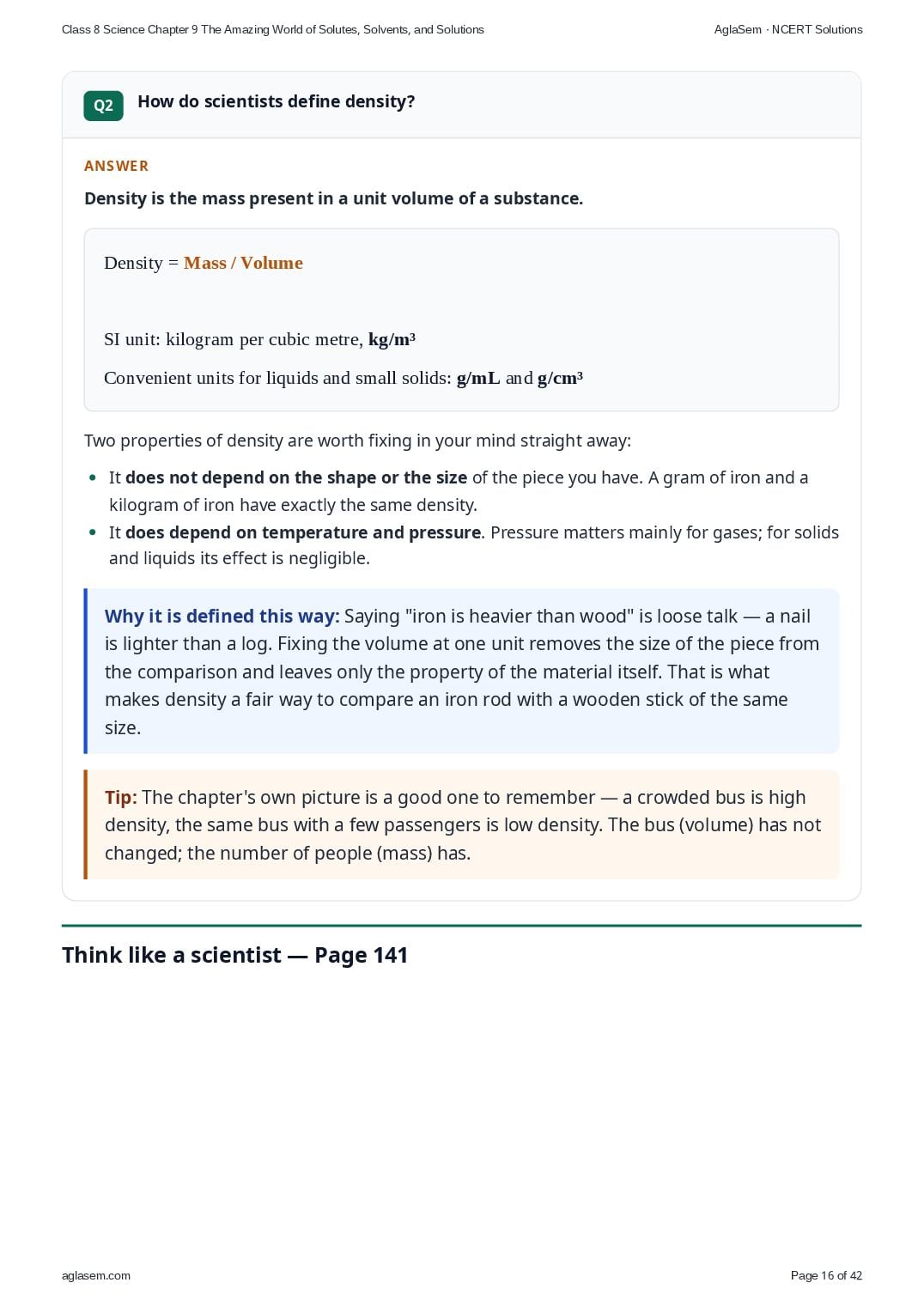
- How do scientists define density?
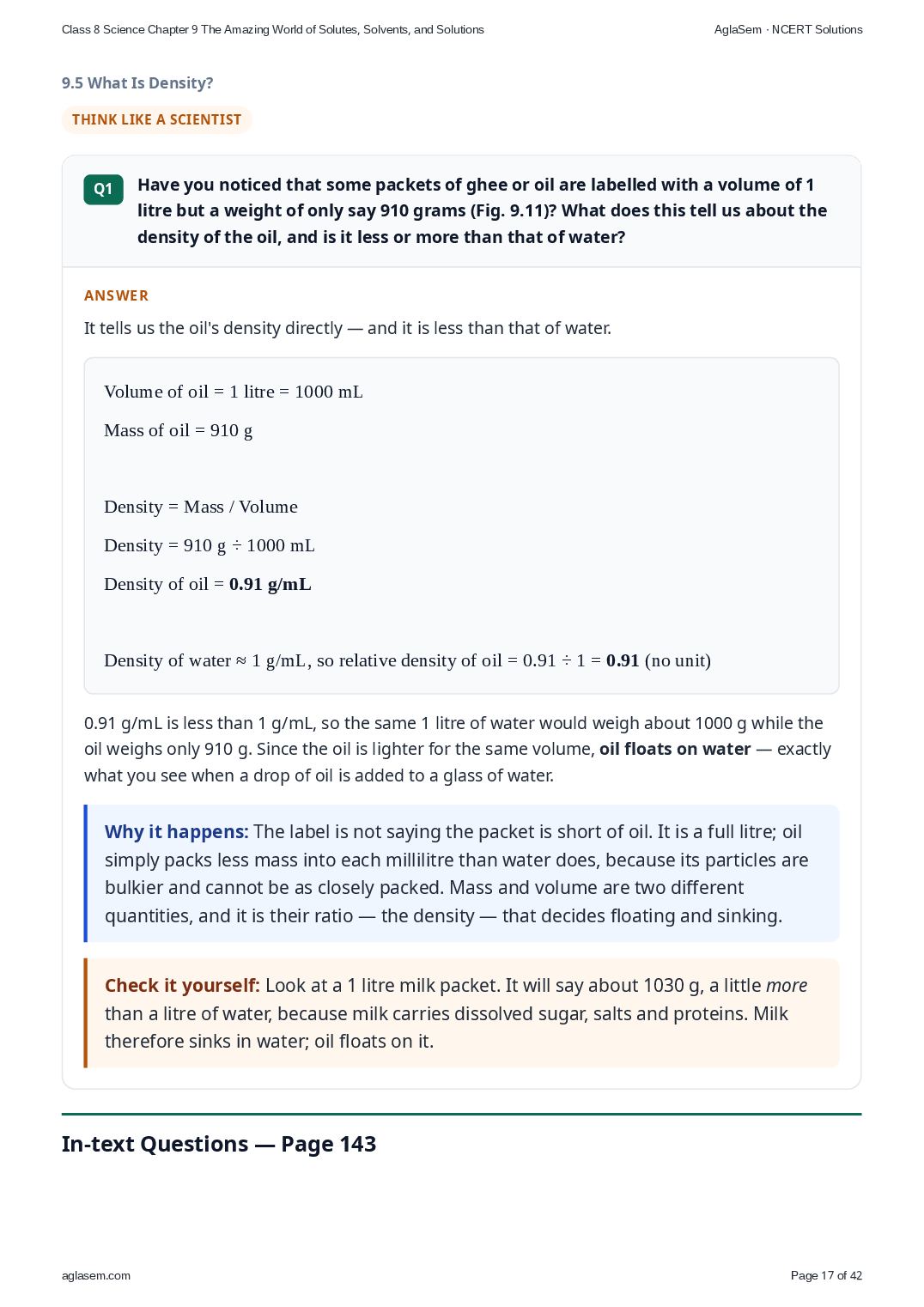
- Have you noticed that some packets of ghee or oil are labelled with a volume of 1 litre but a weight of only say 910 grams (Fig. 9.11)? What does this tell us about the density of the oil, and is it less or more than that of water?
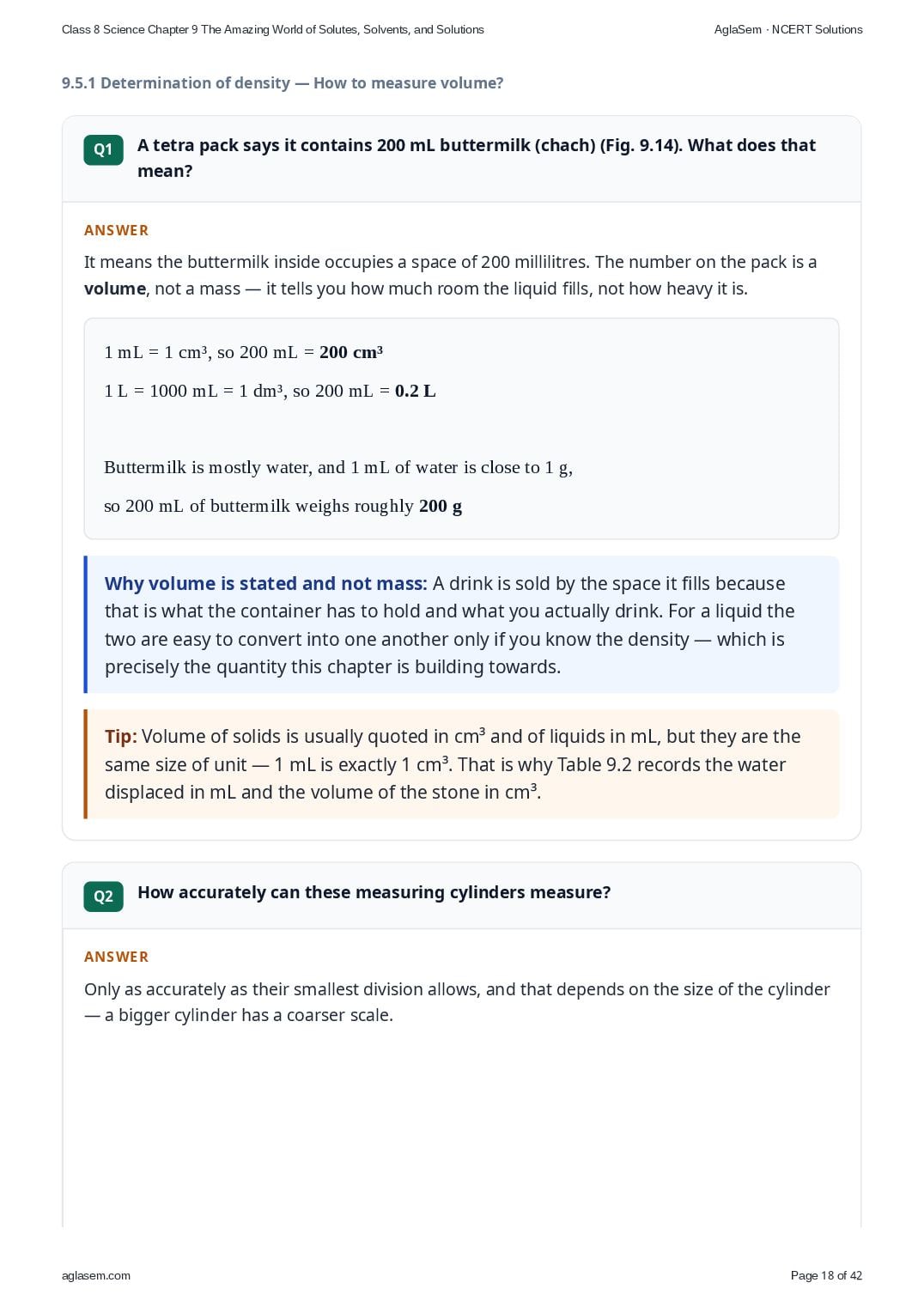
- A tetra pack says it contains 200 mL buttermilk (chach) (Fig. 9.14). What does that mean?
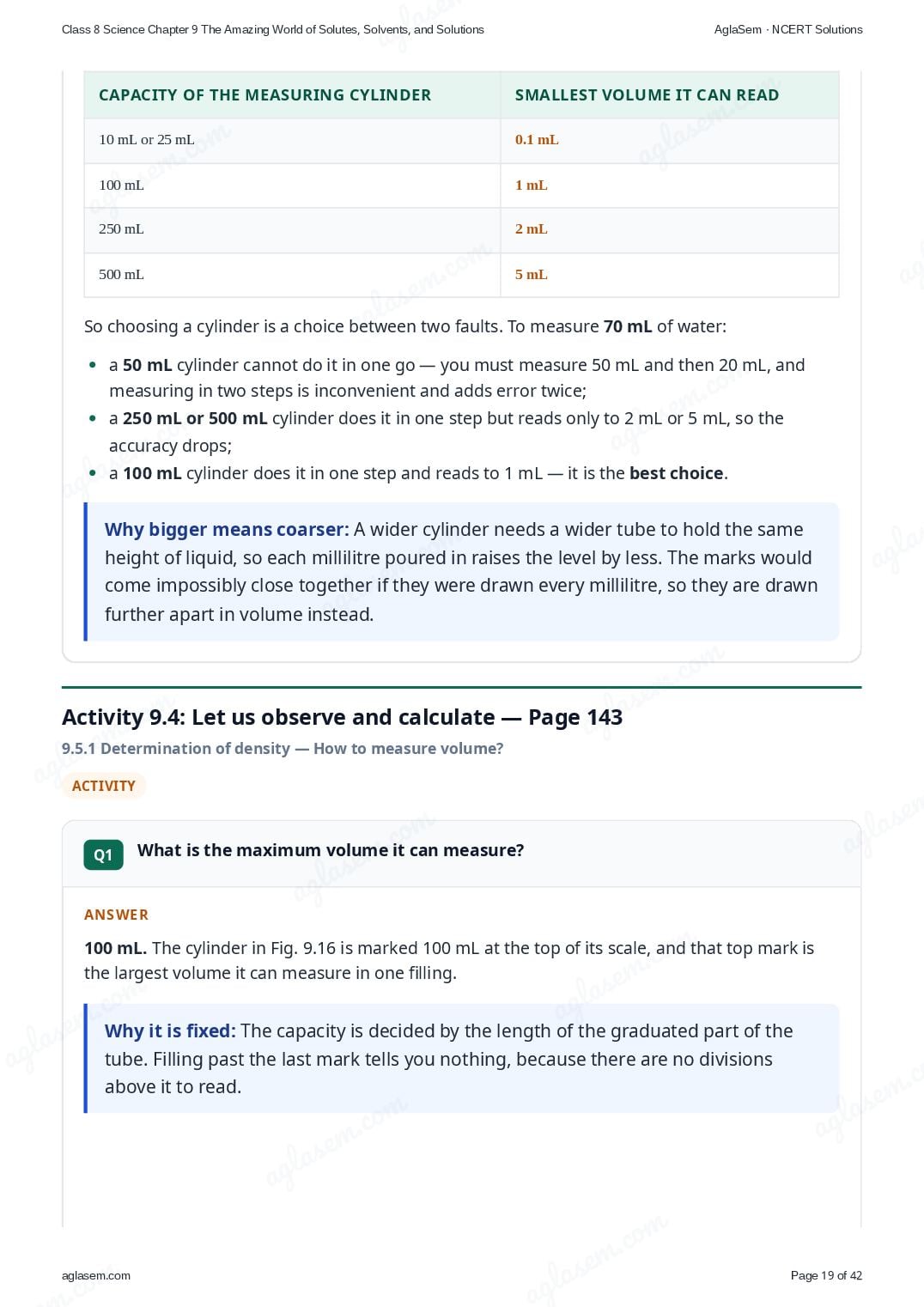
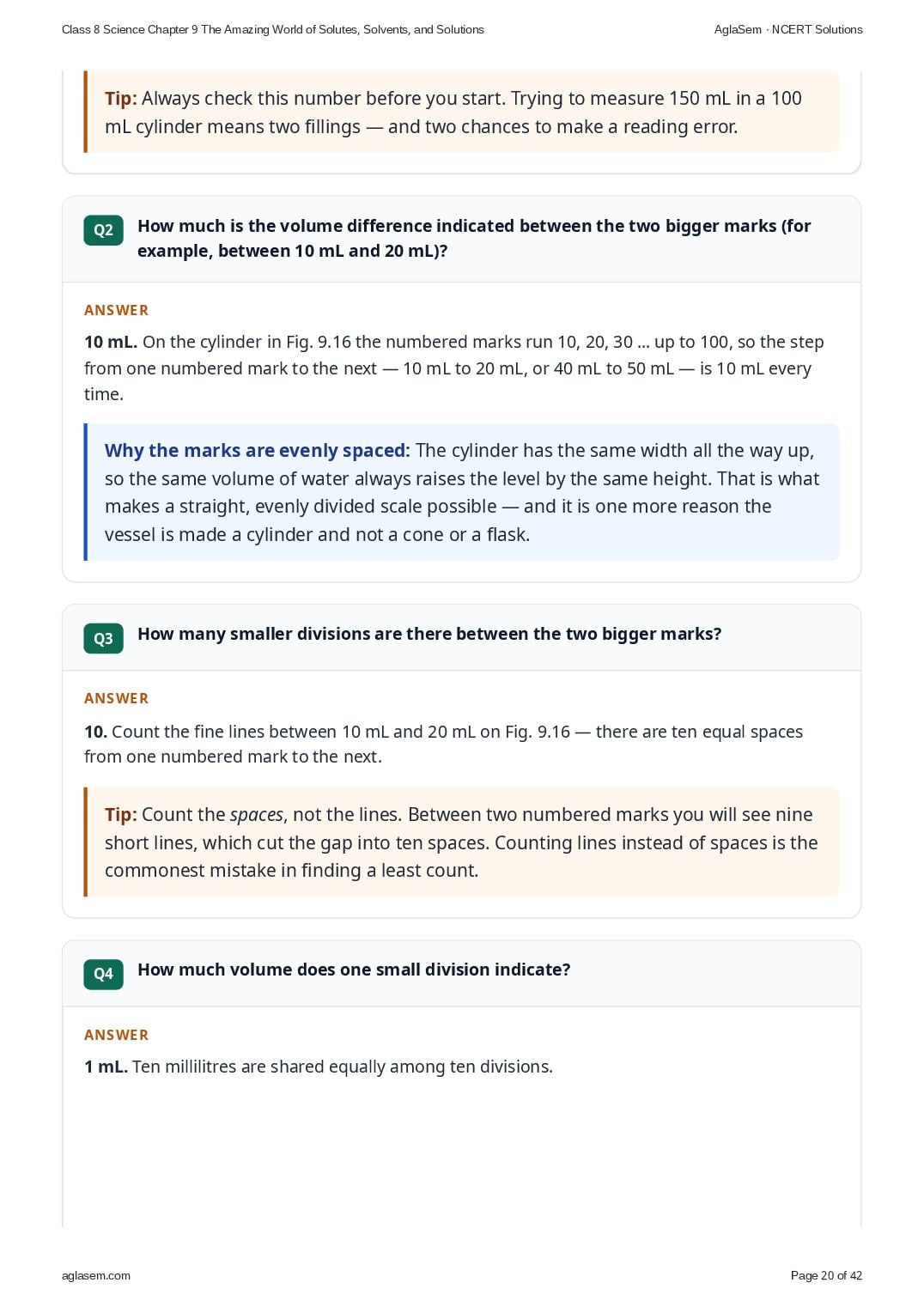
- How accurately can these measuring cylinders measure?
- What is the maximum volume it can measure?
- How much is the volume difference indicated between the two bigger marks (for example, between 10 mL and 20 mL)?
- How many smaller divisions are there between the two bigger marks?
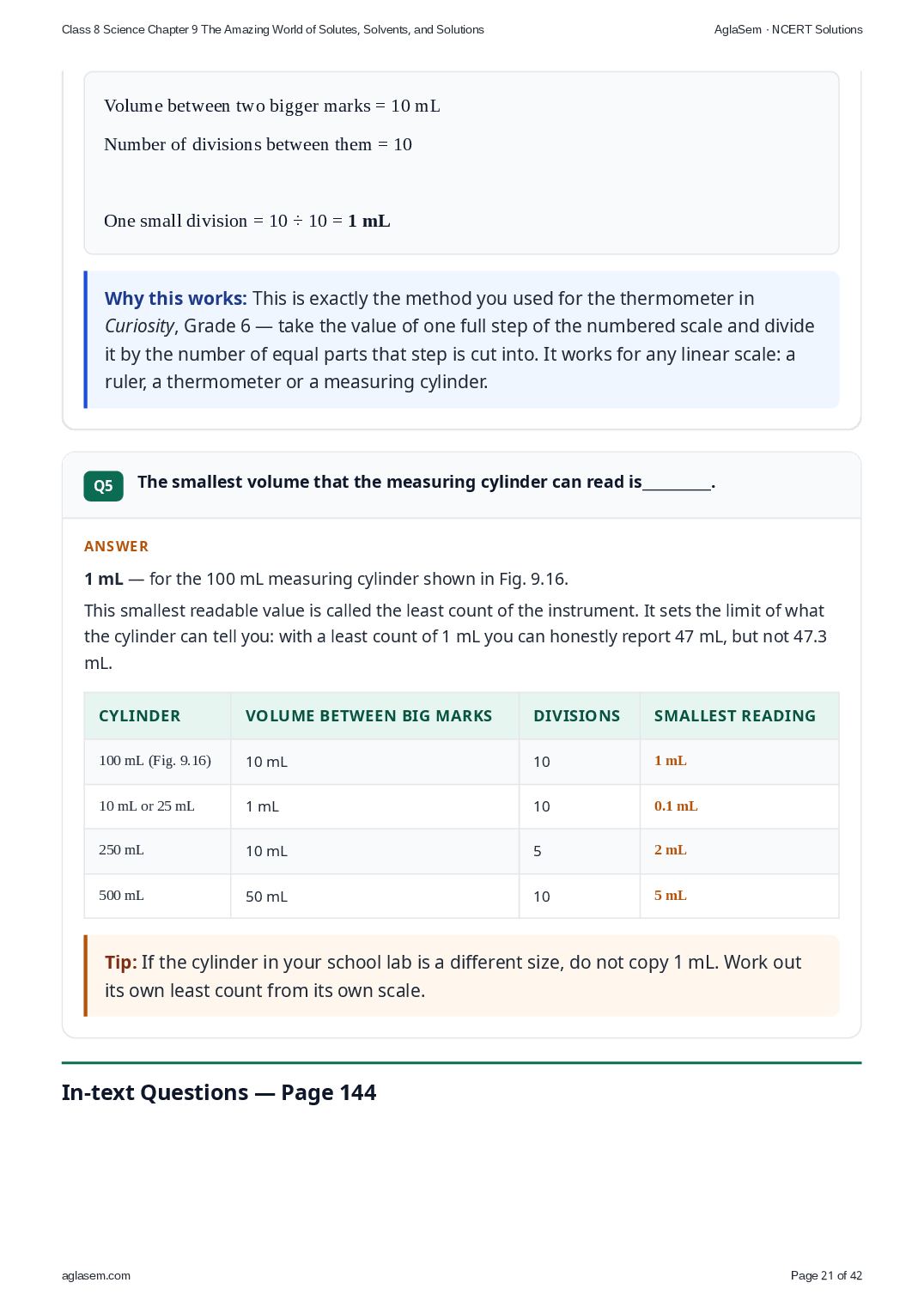
- How much volume does one small division indicate?
- The smallest volume that the measuring cylinder can read is__________.
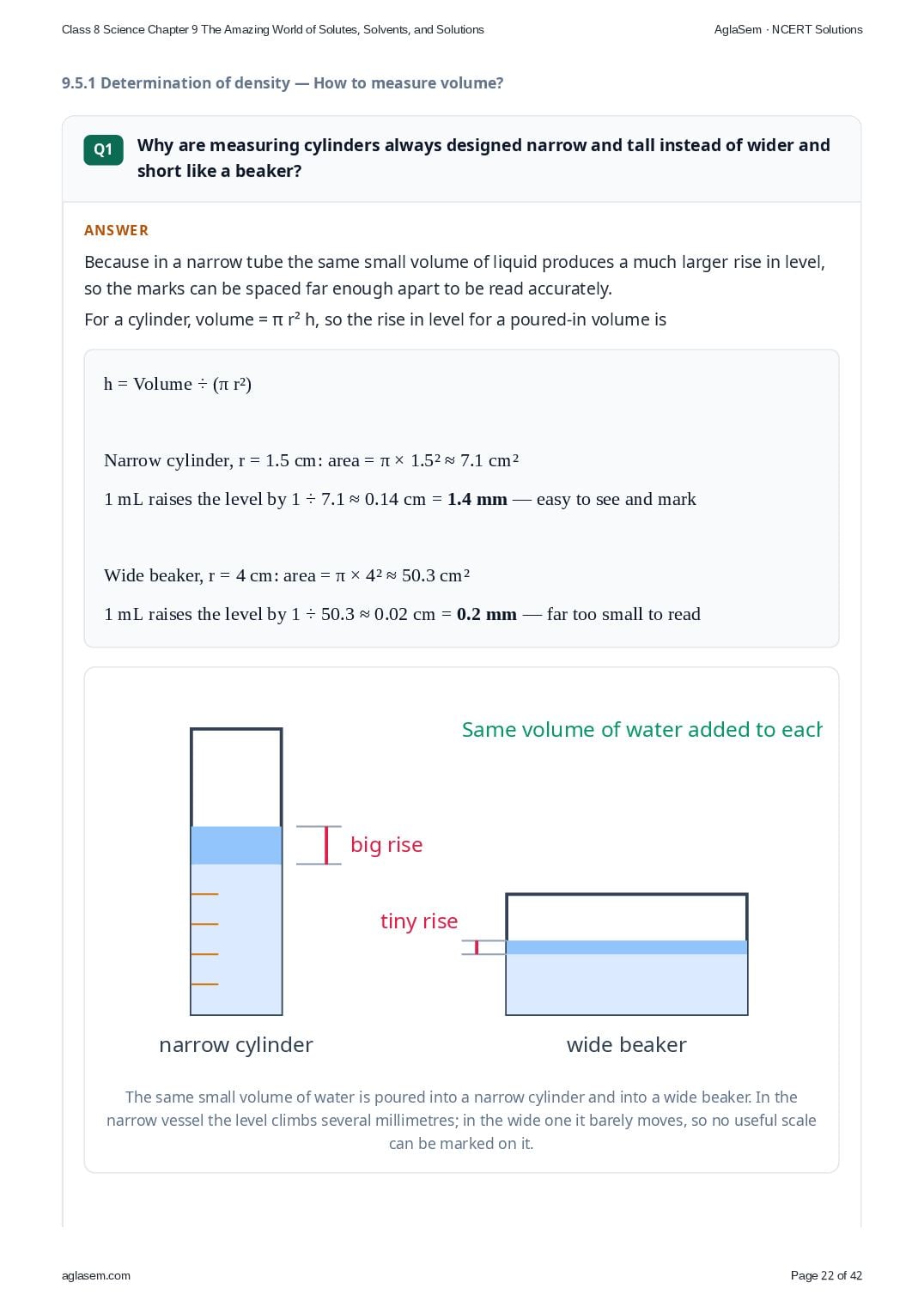
- Why are measuring cylinders always designed narrow and tall instead of wider and short like a beaker?
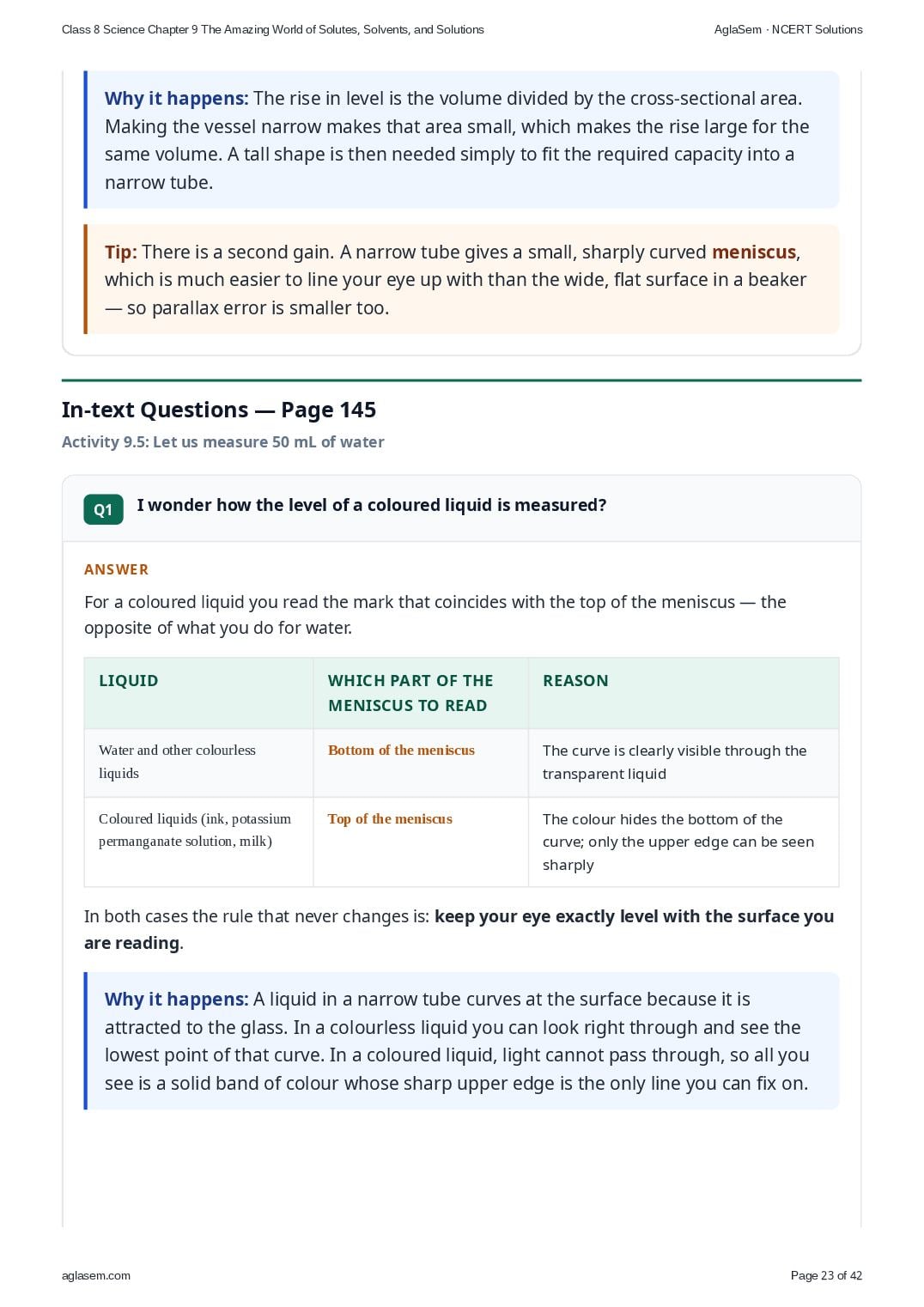
- I wonder how the level of a coloured liquid is measured?
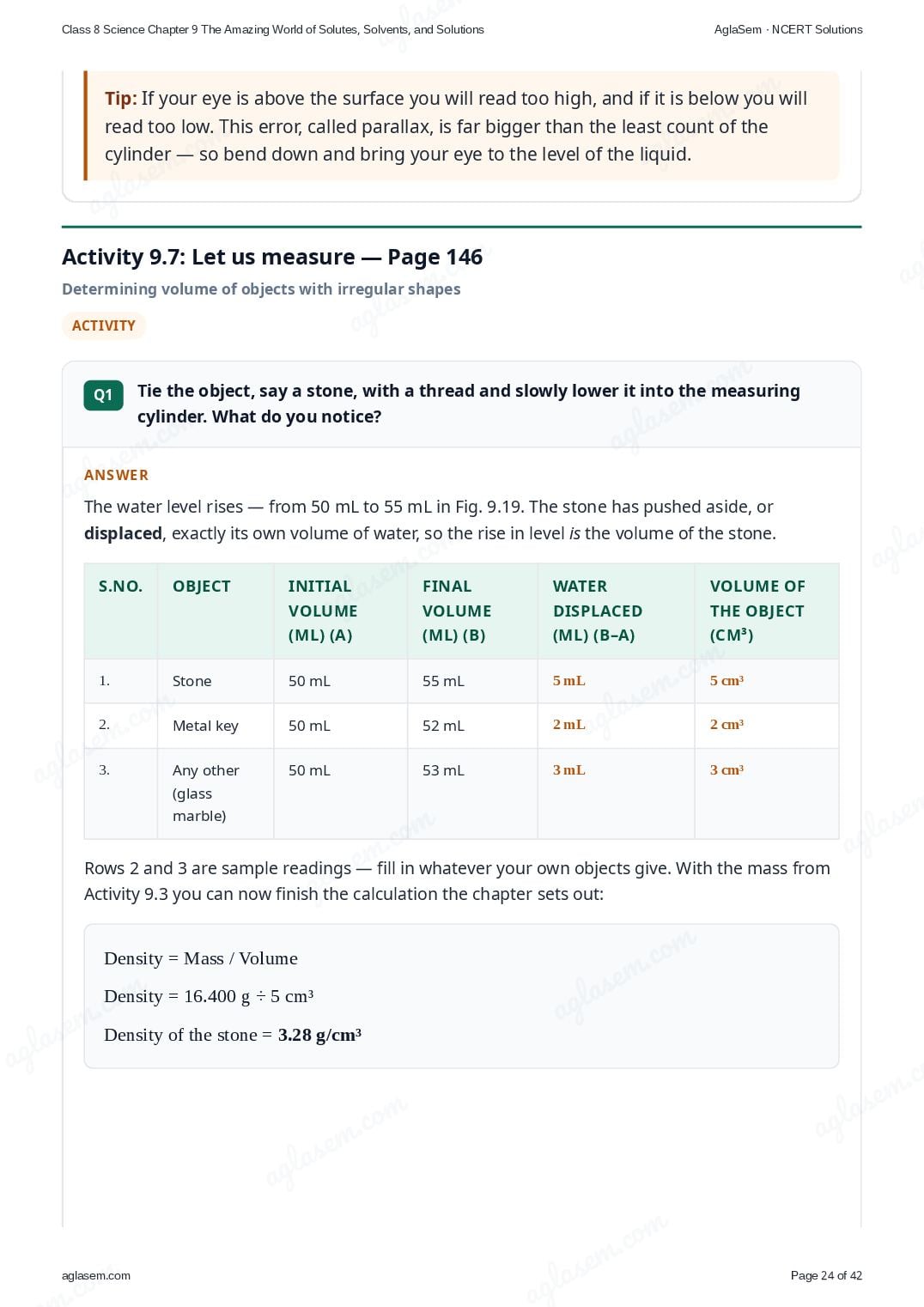
- Tie the object, say a stone, with a thread and slowly lower it into the measuring cylinder. What do you notice?
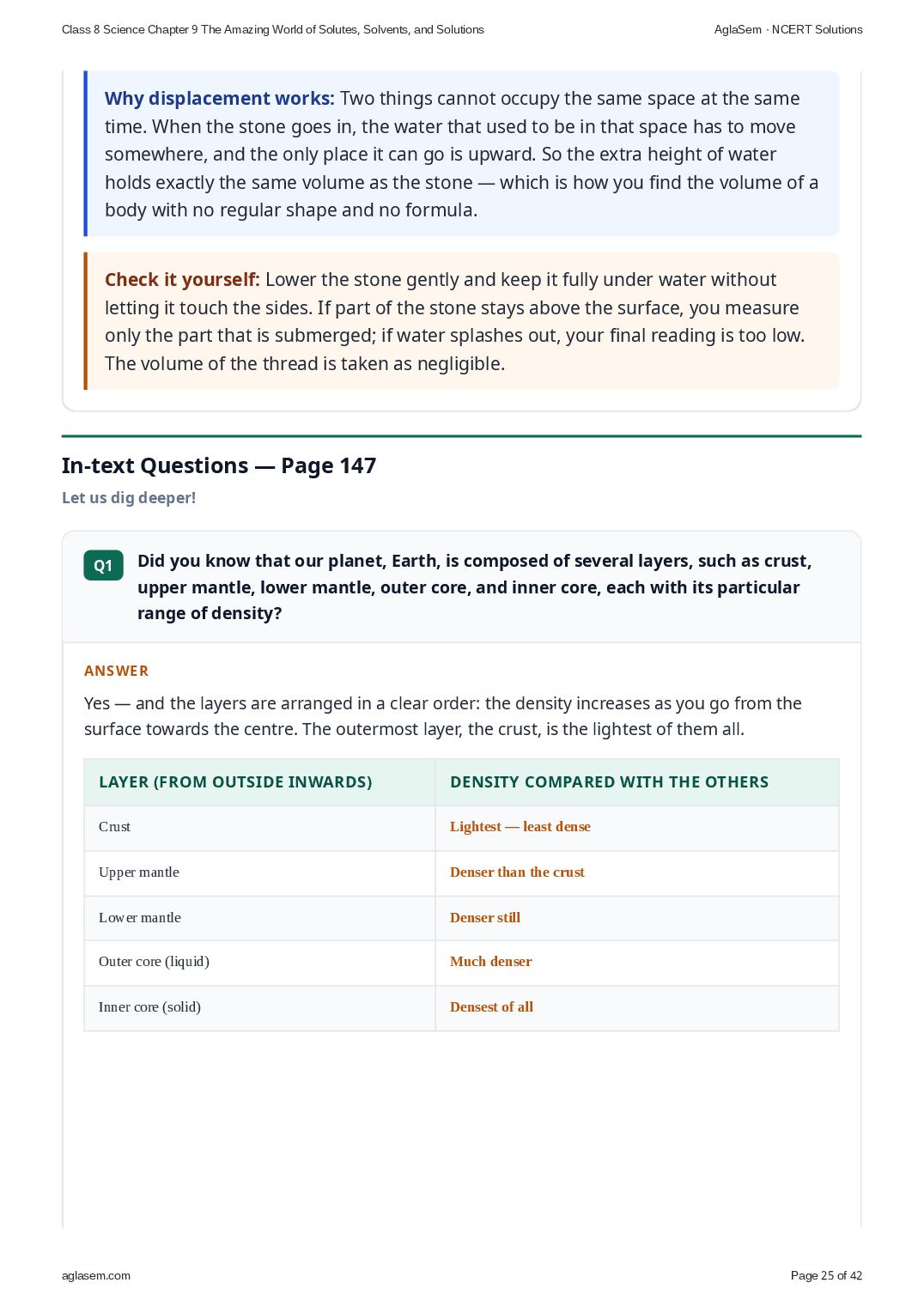
- Did you know that our planet, Earth, is composed of several layers, such as crust, upper mantle, lower mantle, outer core, and inner core, each with its particular range of density?
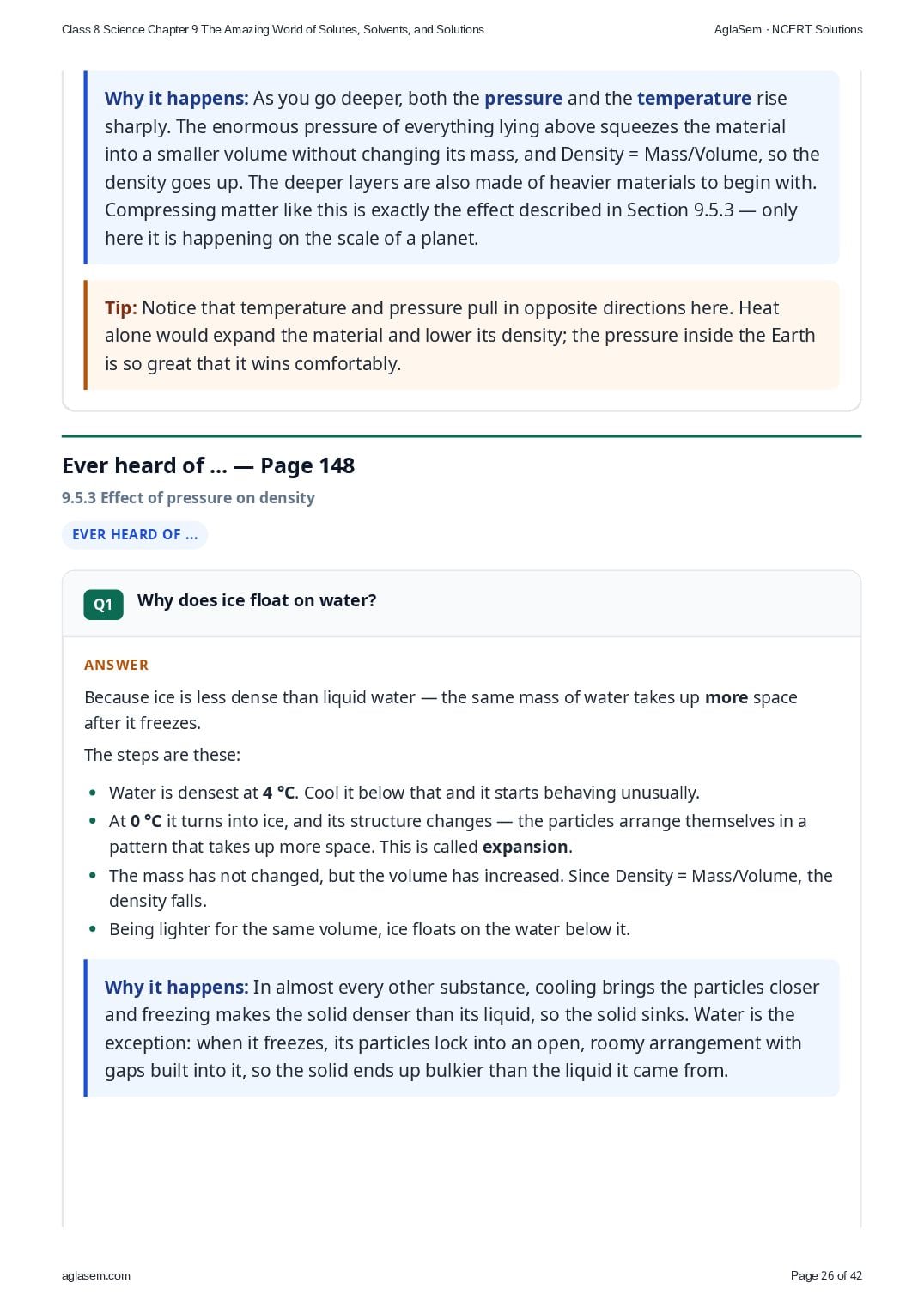
- Why does ice float on water?
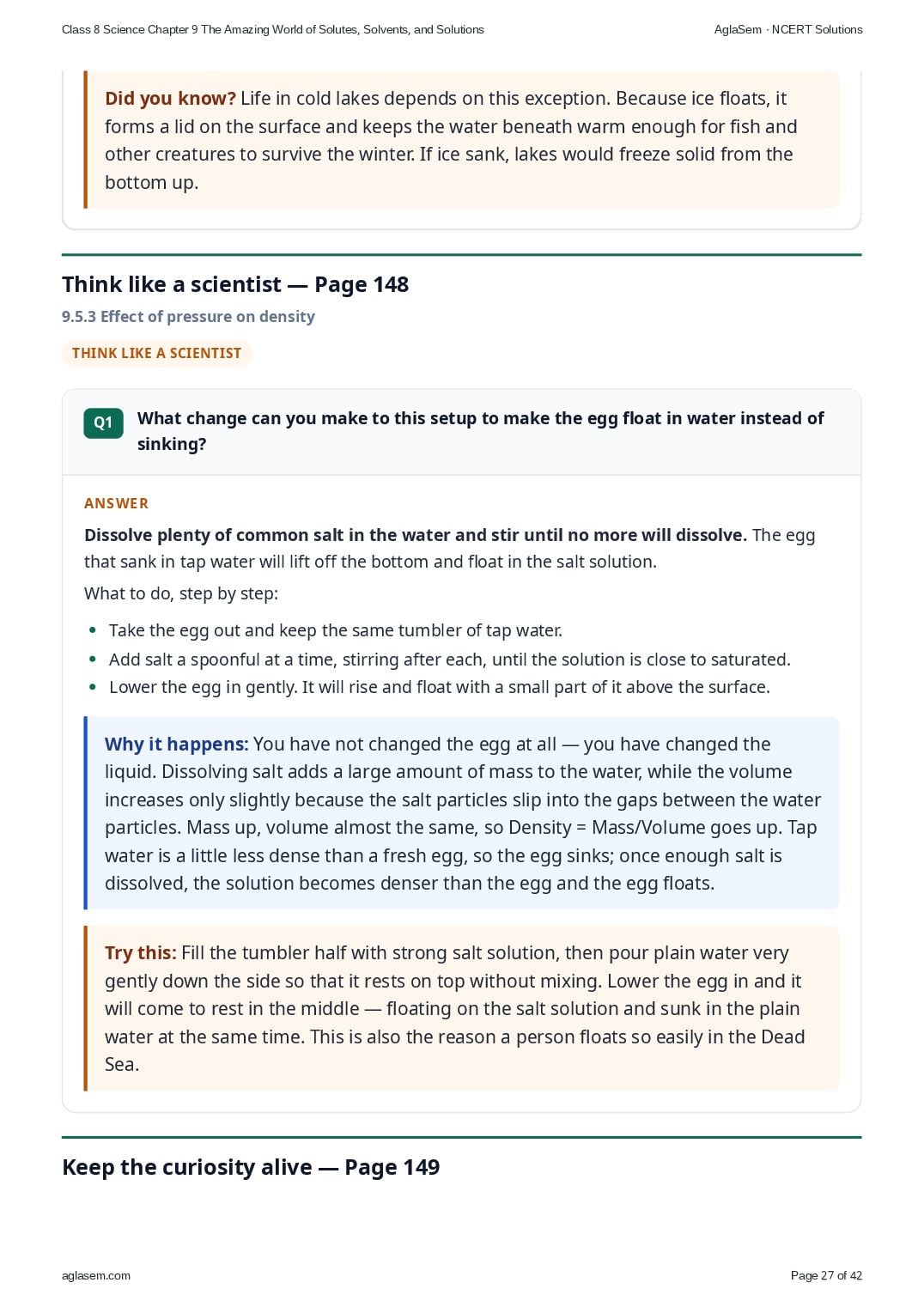
- What change can you make to this setup to make the egg float in water instead of sinking?
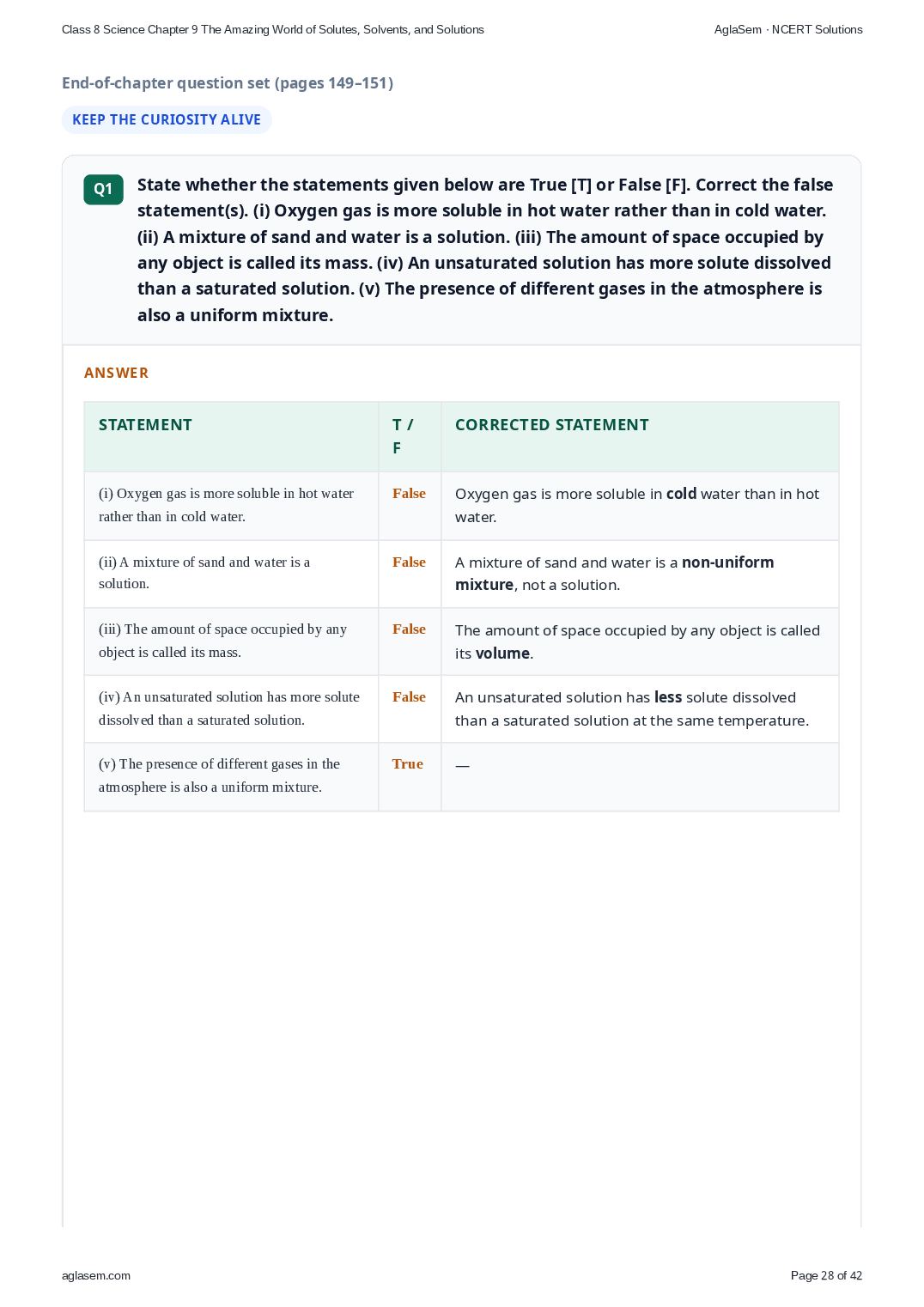
- State whether the statements given below are True [T] or False [F]. Correct the false statement(s). (i) Oxygen gas is more soluble in hot water rather than in cold water. (ii) A mixture of sand and water is a solution. (iii) The amount of space occupied by any object is called its mass. (iv) An unsaturated solution has more solute dissolved than a saturated solution. (v) The presence of different gases in the atmosphere is also a uniform mixture.
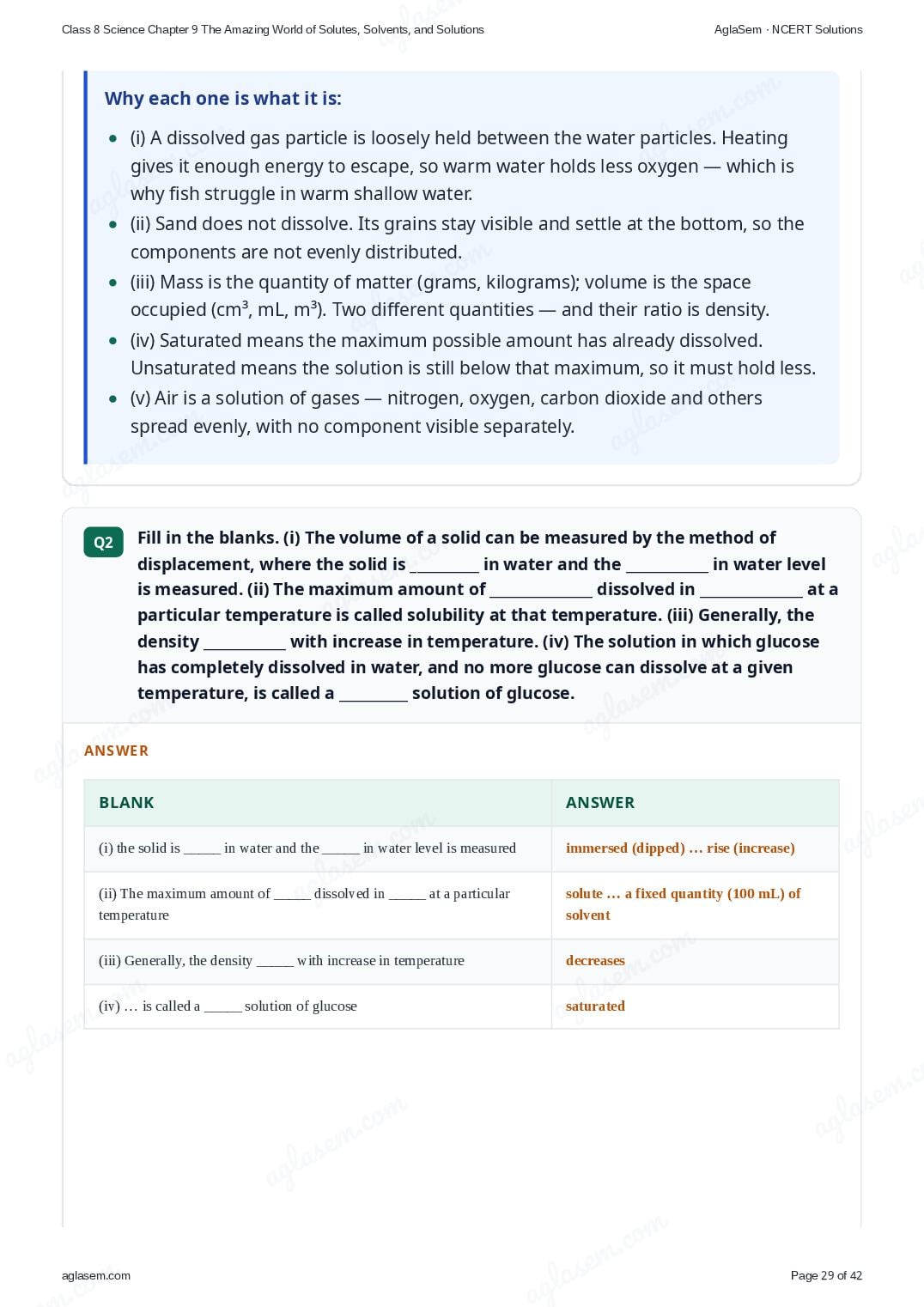
- Fill in the blanks. (i) The volume of a solid can be measured by the method of displacement, where the solid is __________ in water and the ____________ in water level is measured. (ii) The maximum amount of _______________ dissolved in _______________ at a particular temperature is called solubility at that temperature. (iii) Generally, the density ____________ with increase in temperature. (iv) The solution in which glucose has completely dissolved in water, and no more glucose can dissolve at a given temperature, is called a __________ solution of glucose.
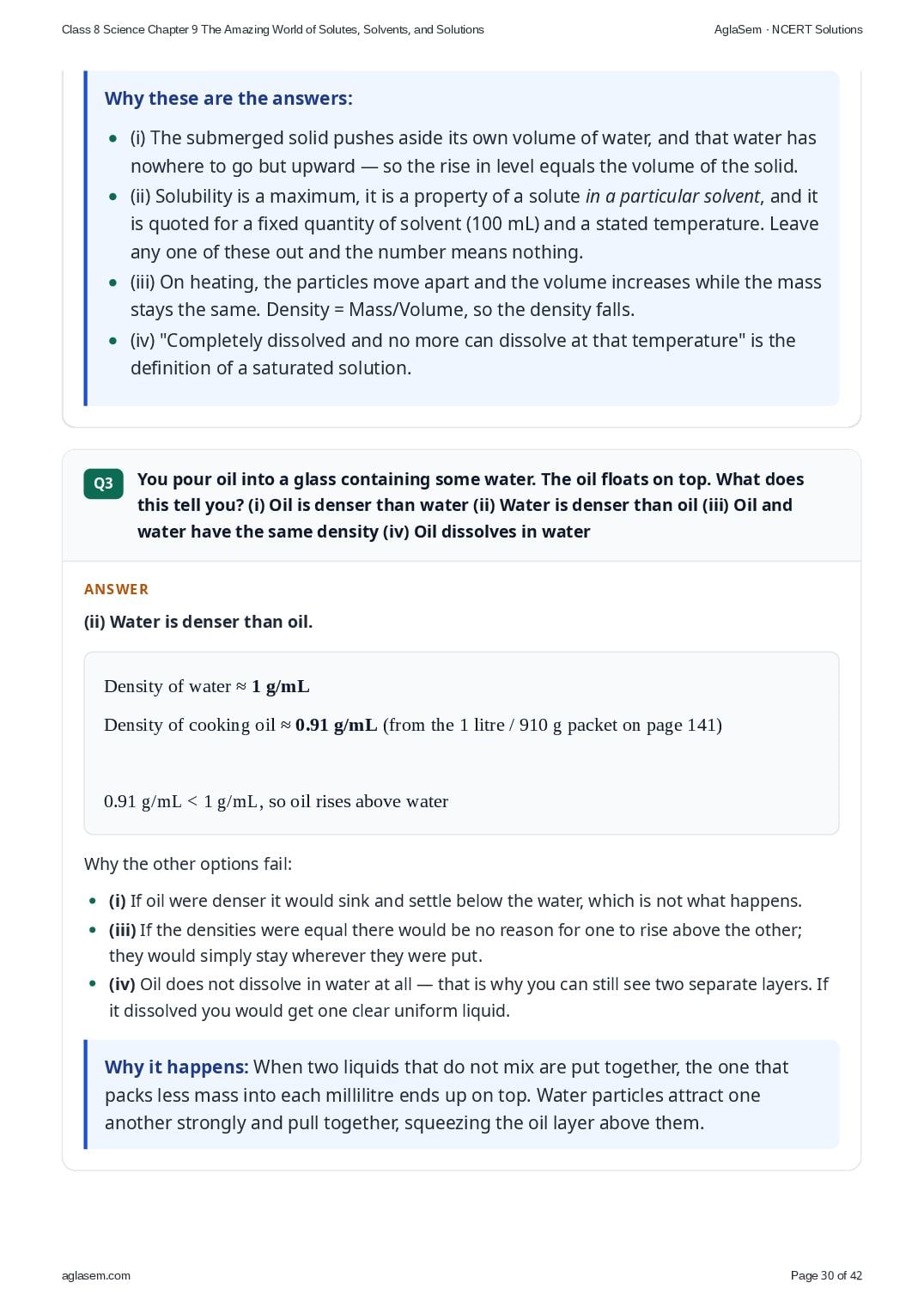
- You pour oil into a glass containing some water. The oil floats on top. What does this tell you? (i) Oil is denser than water (ii) Water is denser than oil (iii) Oil and water have the same density (iv) Oil dissolves in water
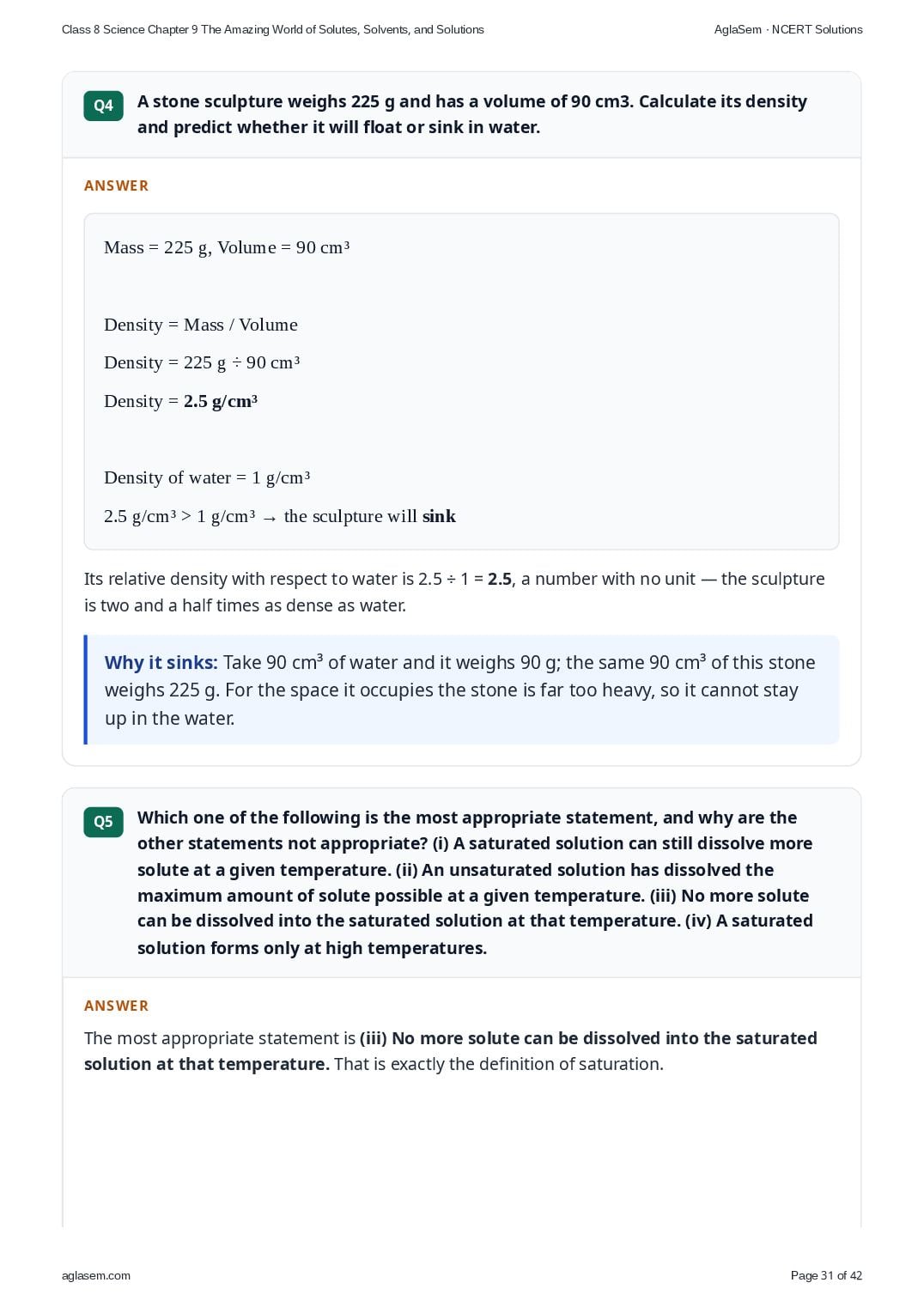
- A stone sculpture weighs 225 g and has a volume of 90 cm3. Calculate its density and predict whether it will float or sink in water.
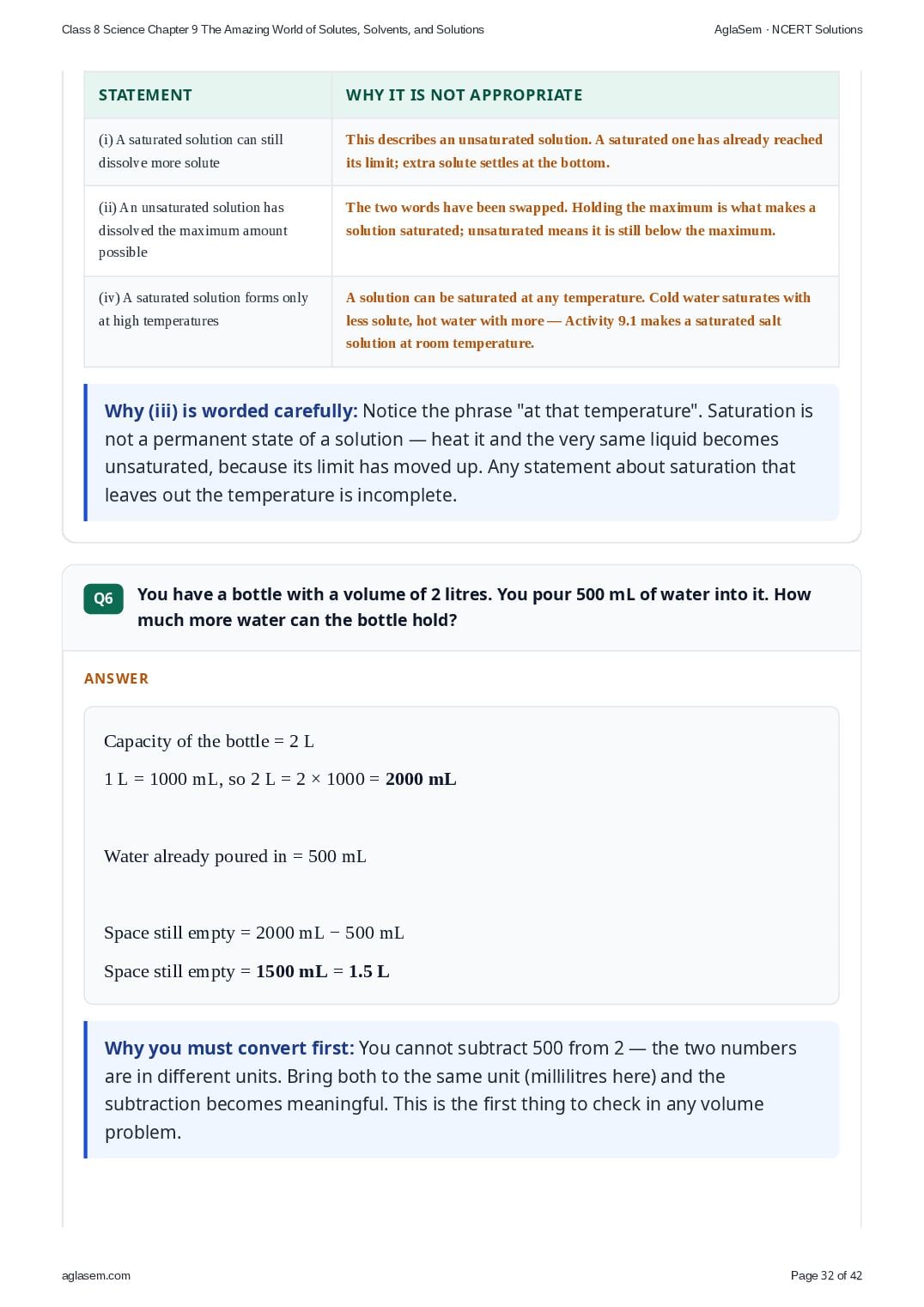
- Which one of the following is the most appropriate statement, and why are the other statements not appropriate? (i) A saturated solution can still dissolve more solute at a given temperature. (ii) An unsaturated solution has dissolved the maximum amount of solute possible at a given temperature. (iii) No more solute can be dissolved into the saturated solution at that temperature. (iv) A saturated solution forms only at high temperatures.
- You have a bottle with a volume of 2 litres. You pour 500 mL of water into it. How much more water can the bottle hold?
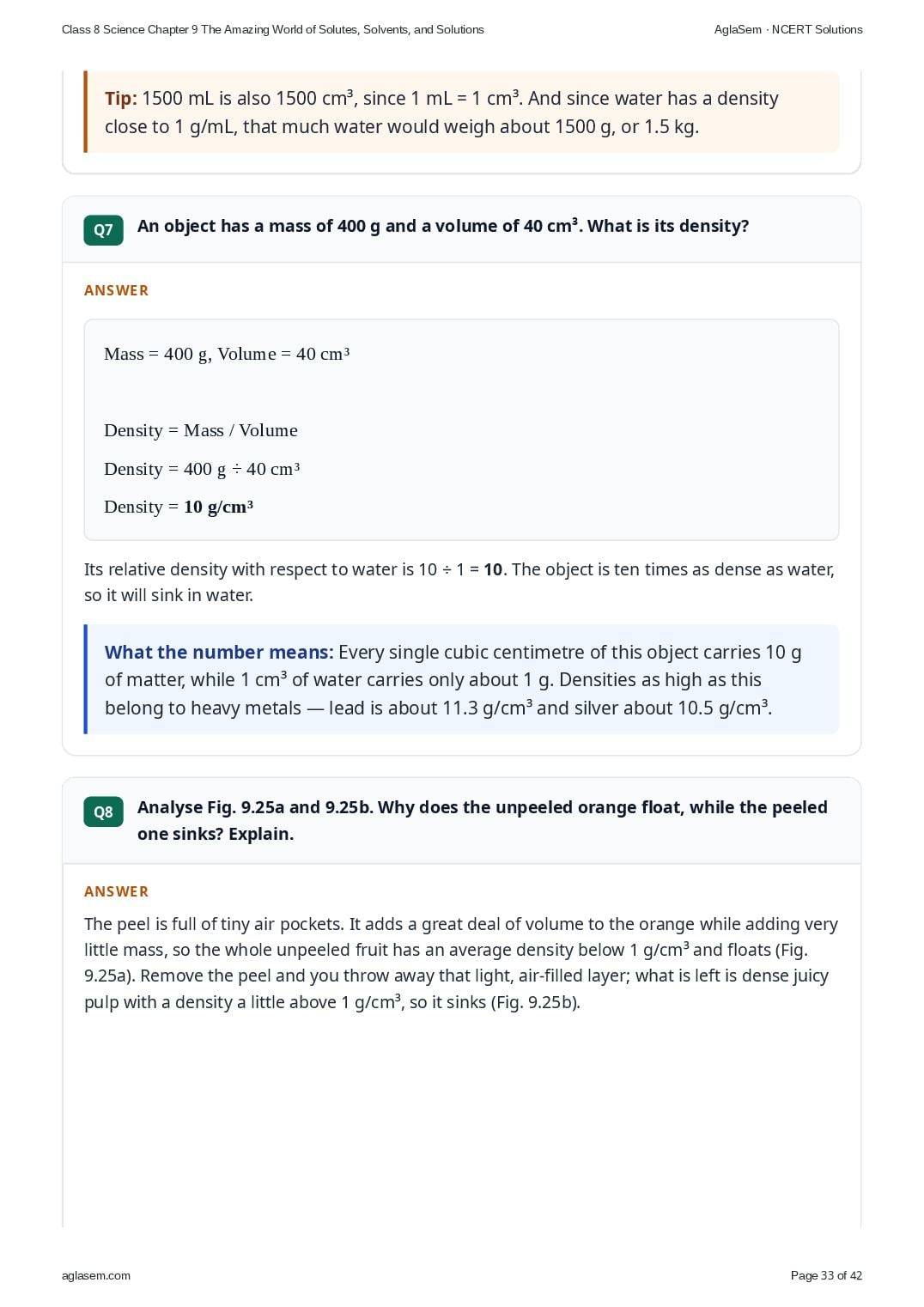
- An object has a mass of 400 g and a volume of 40 cm³. What is its density?
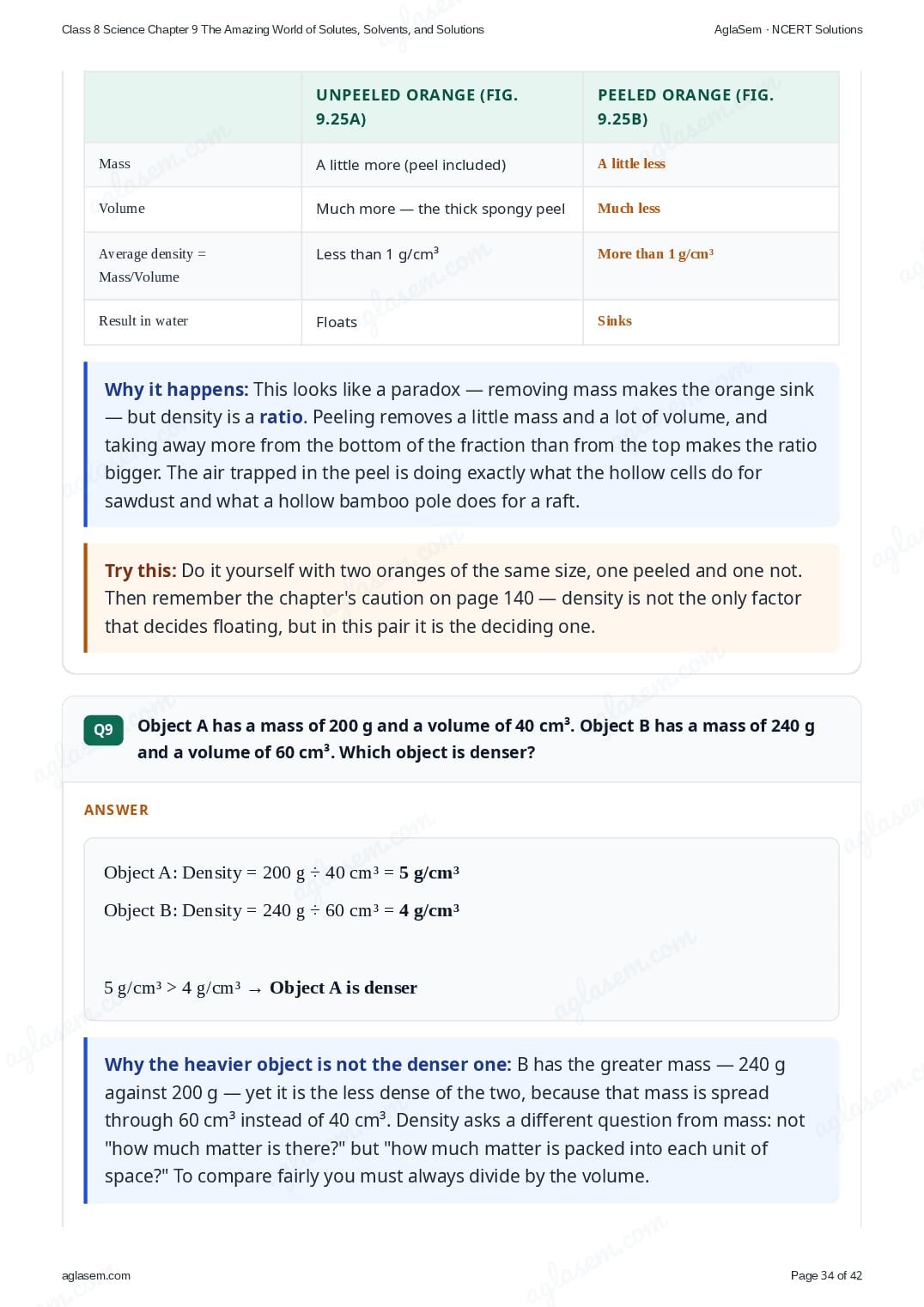
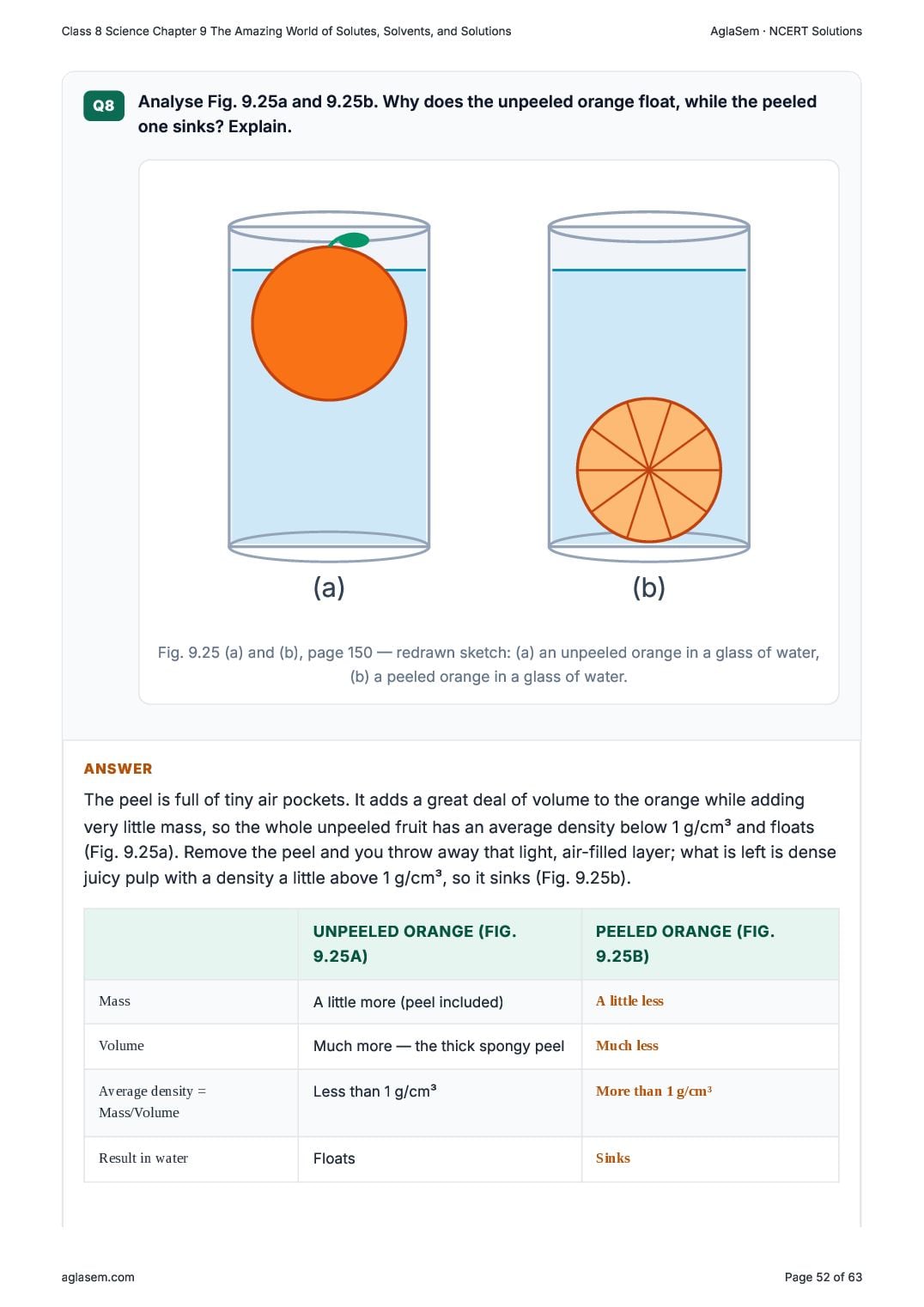
- Analyse Fig. 9.25a and 9.25b. Why does the unpeeled orange float, while the peeled one sinks? Explain.
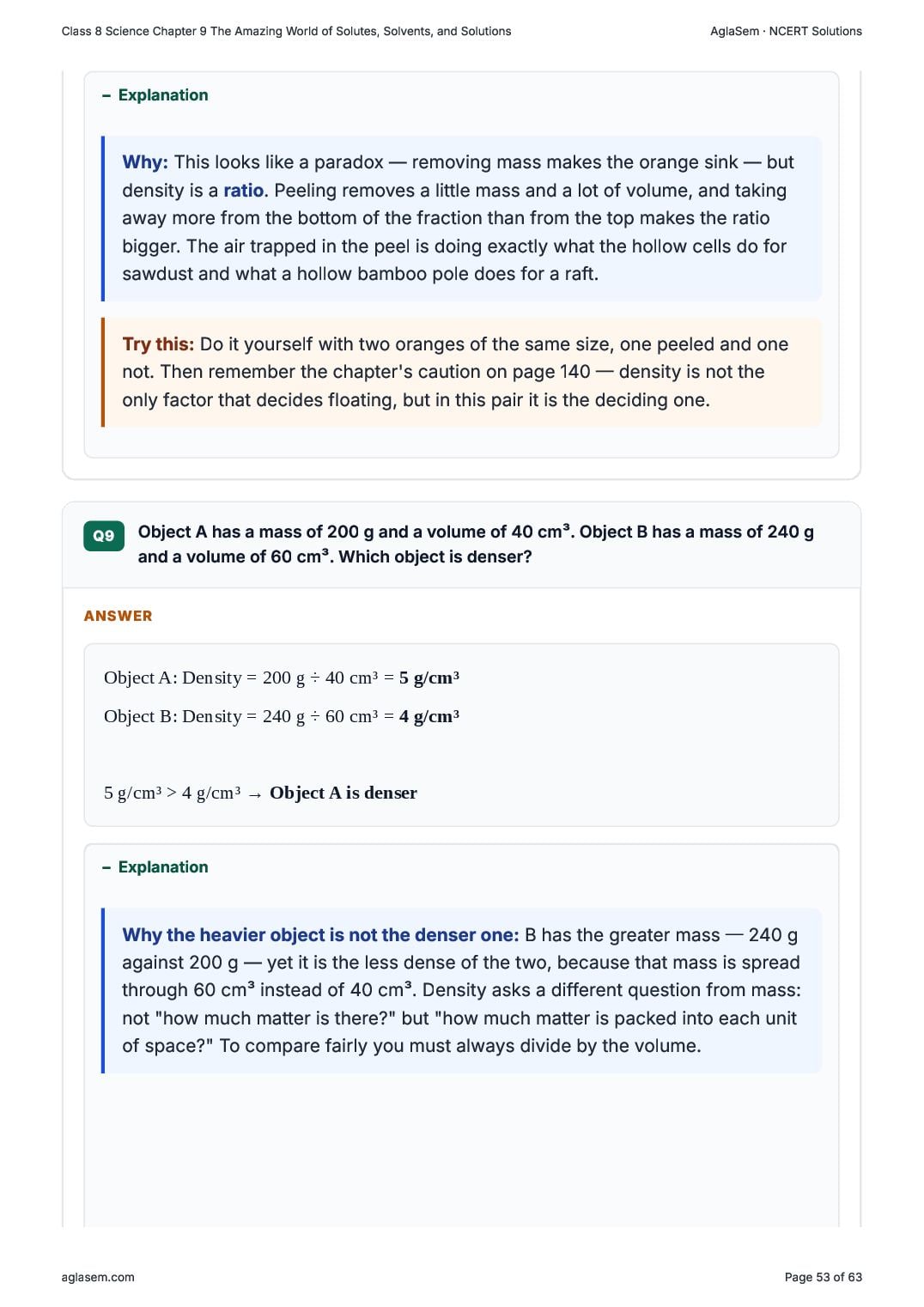
- Object A has a mass of 200 g and a volume of 40 cm³. Object B has a mass of 240 g and a volume of 60 cm³. Which object is denser?
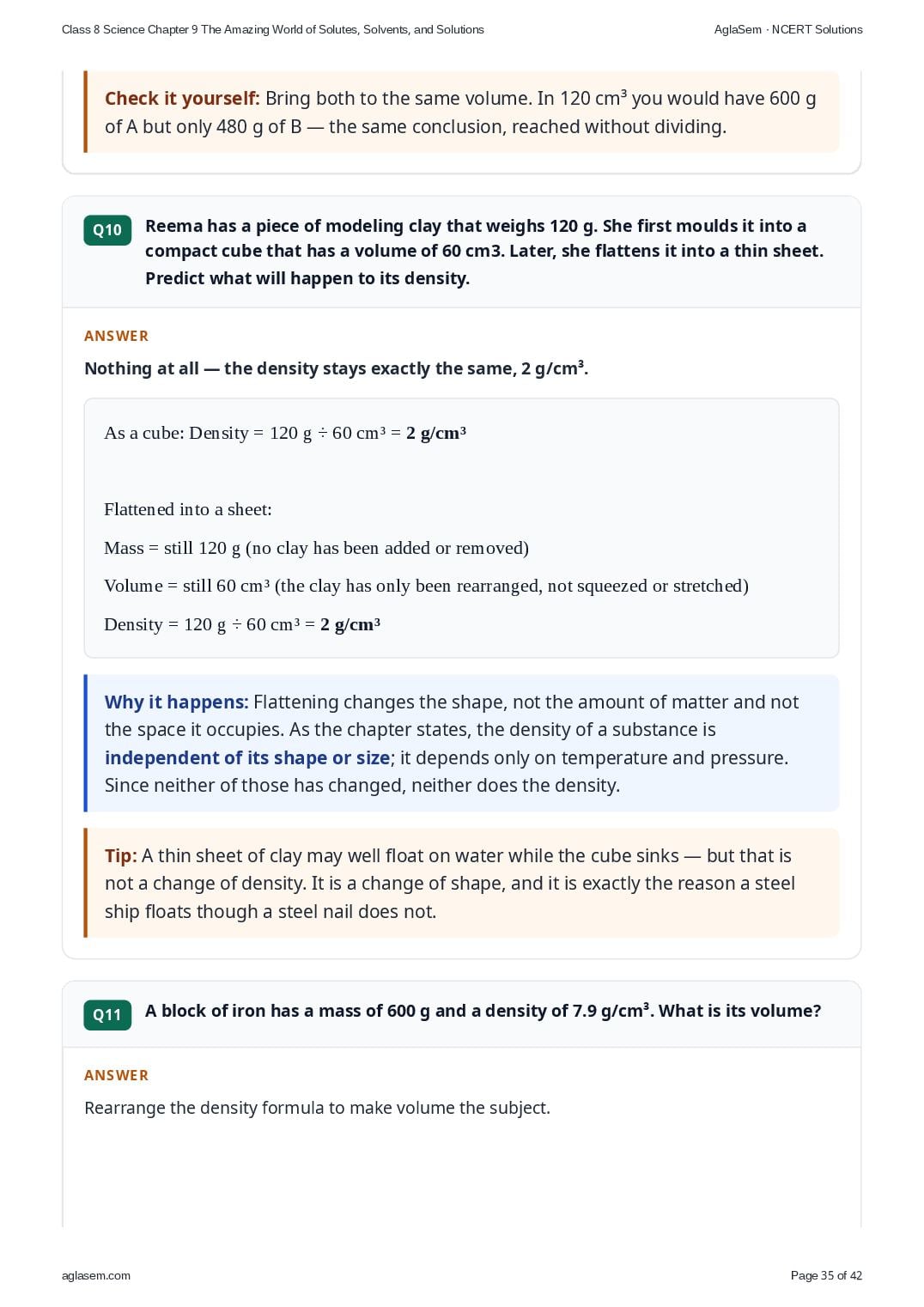
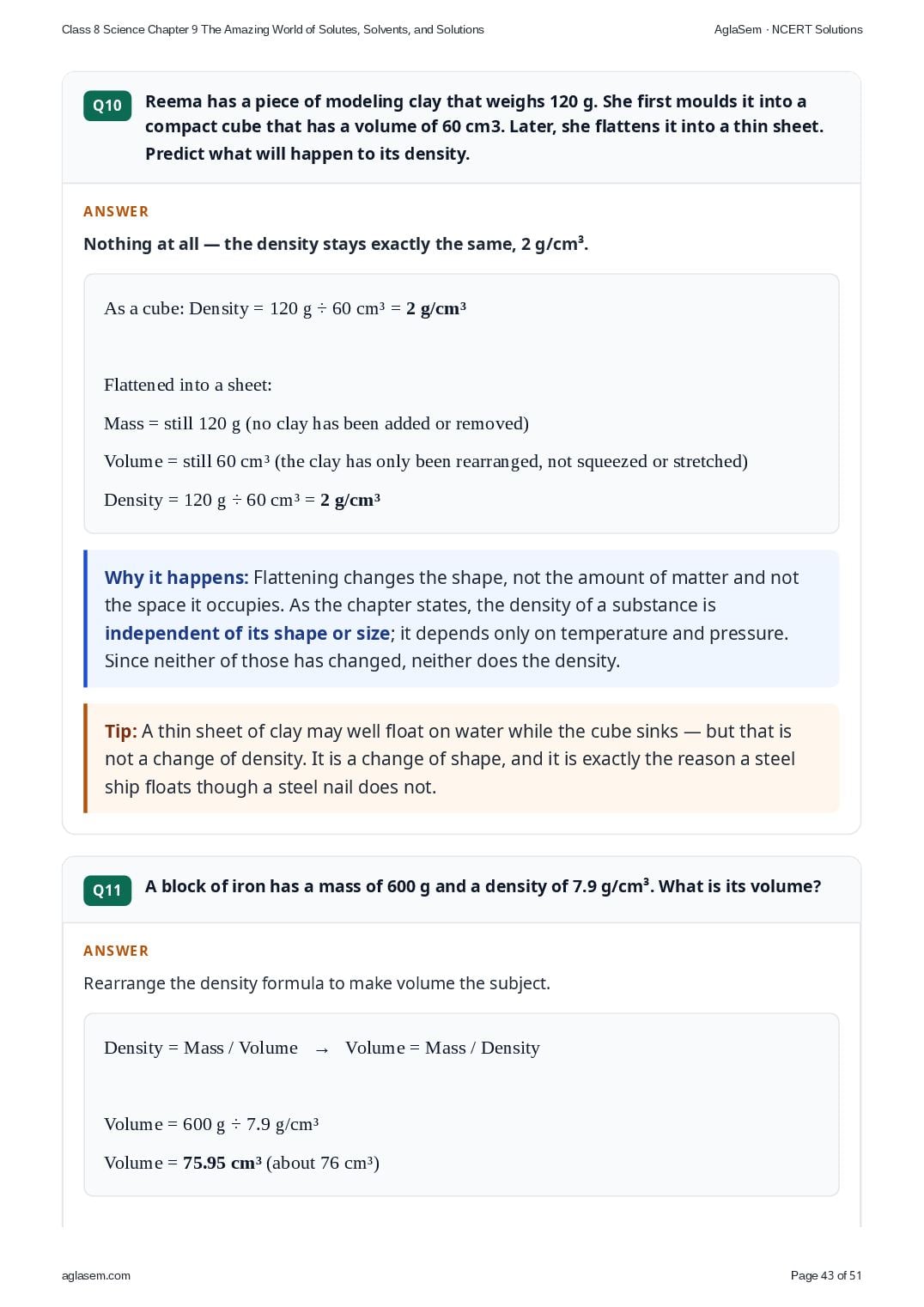
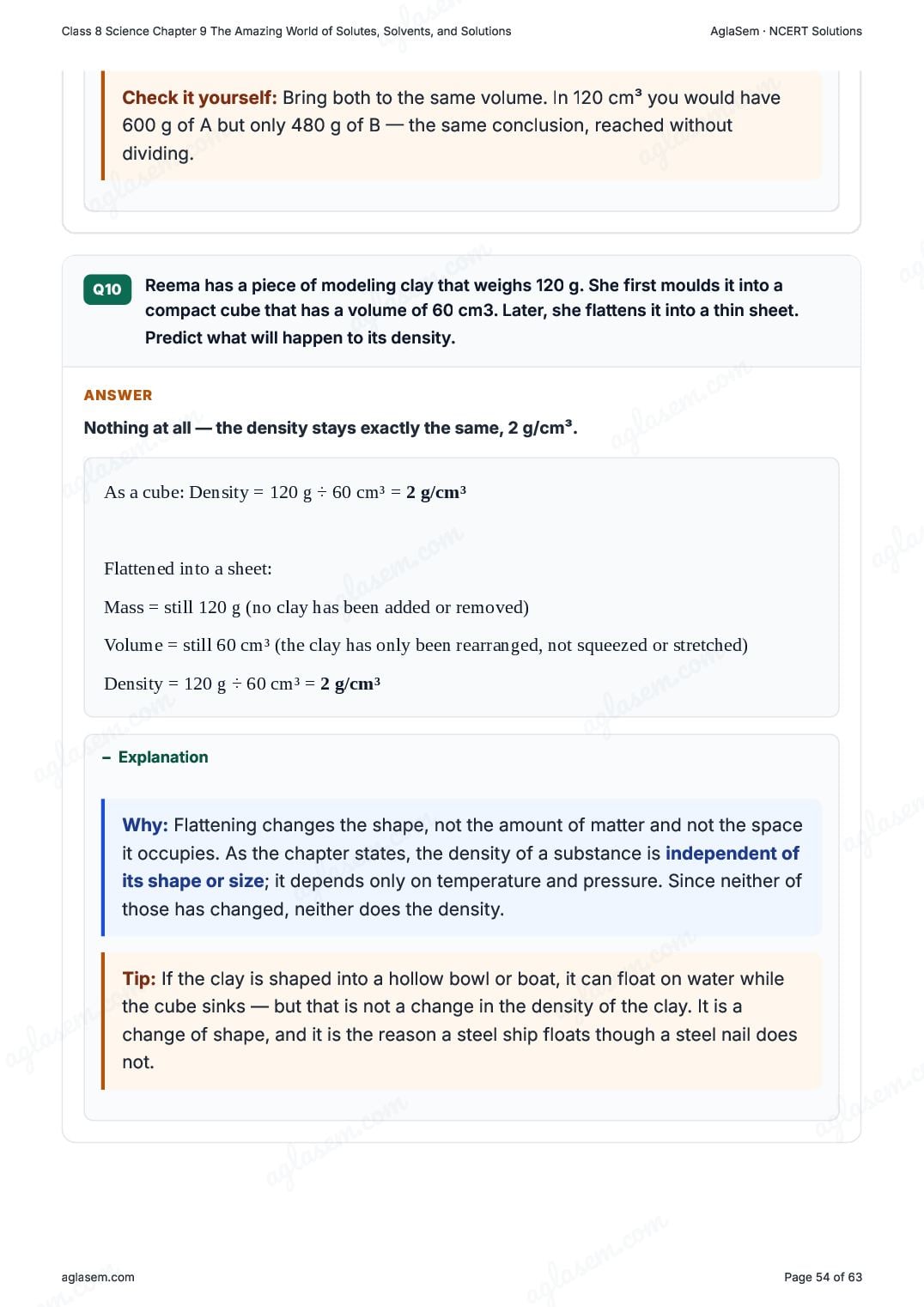
- Reema has a piece of modeling clay that weighs 120 g. She first moulds it into a compact cube that has a volume of 60 cm3. Later, she flattens it into a thin sheet. Predict what will happen to its density.
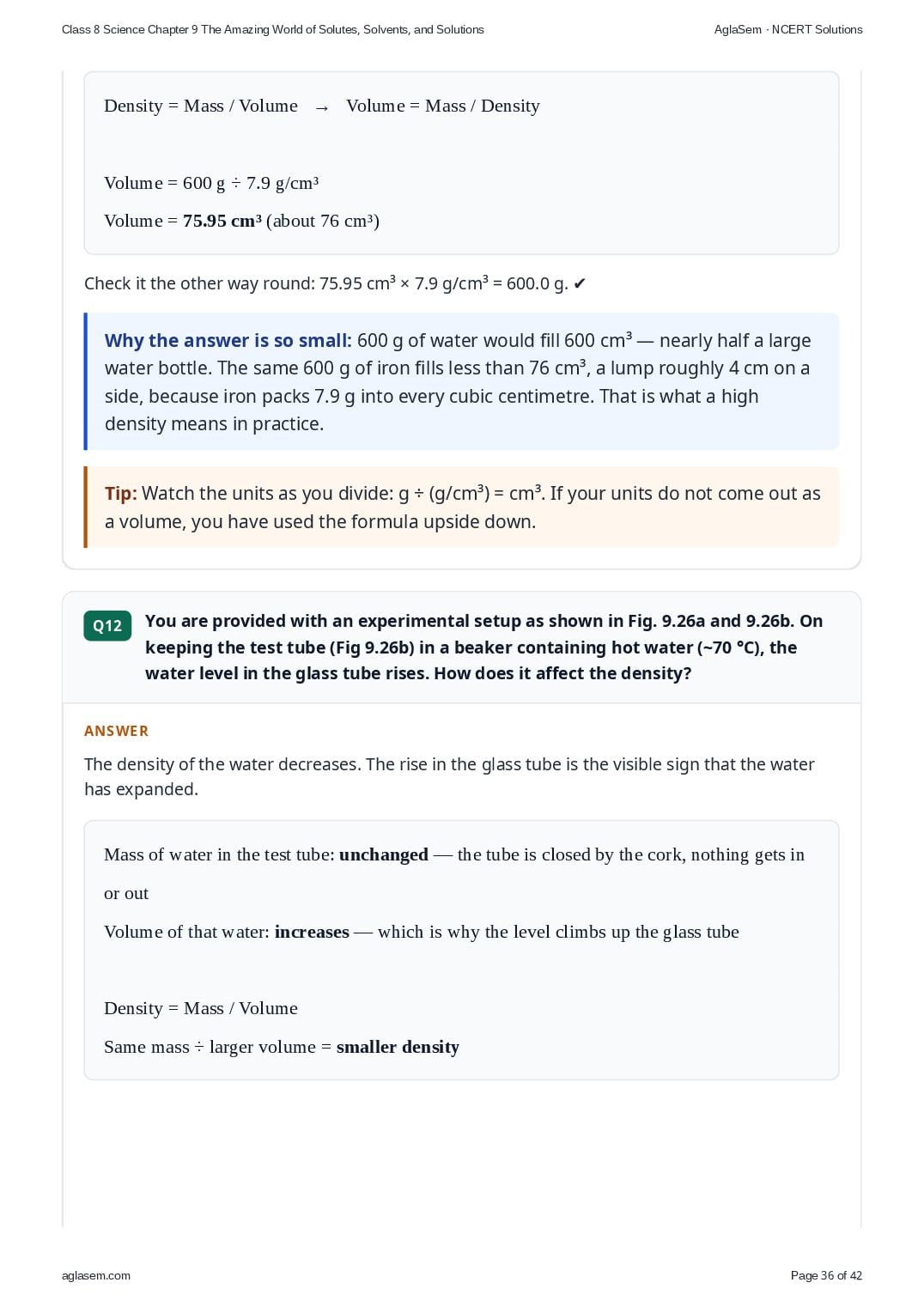
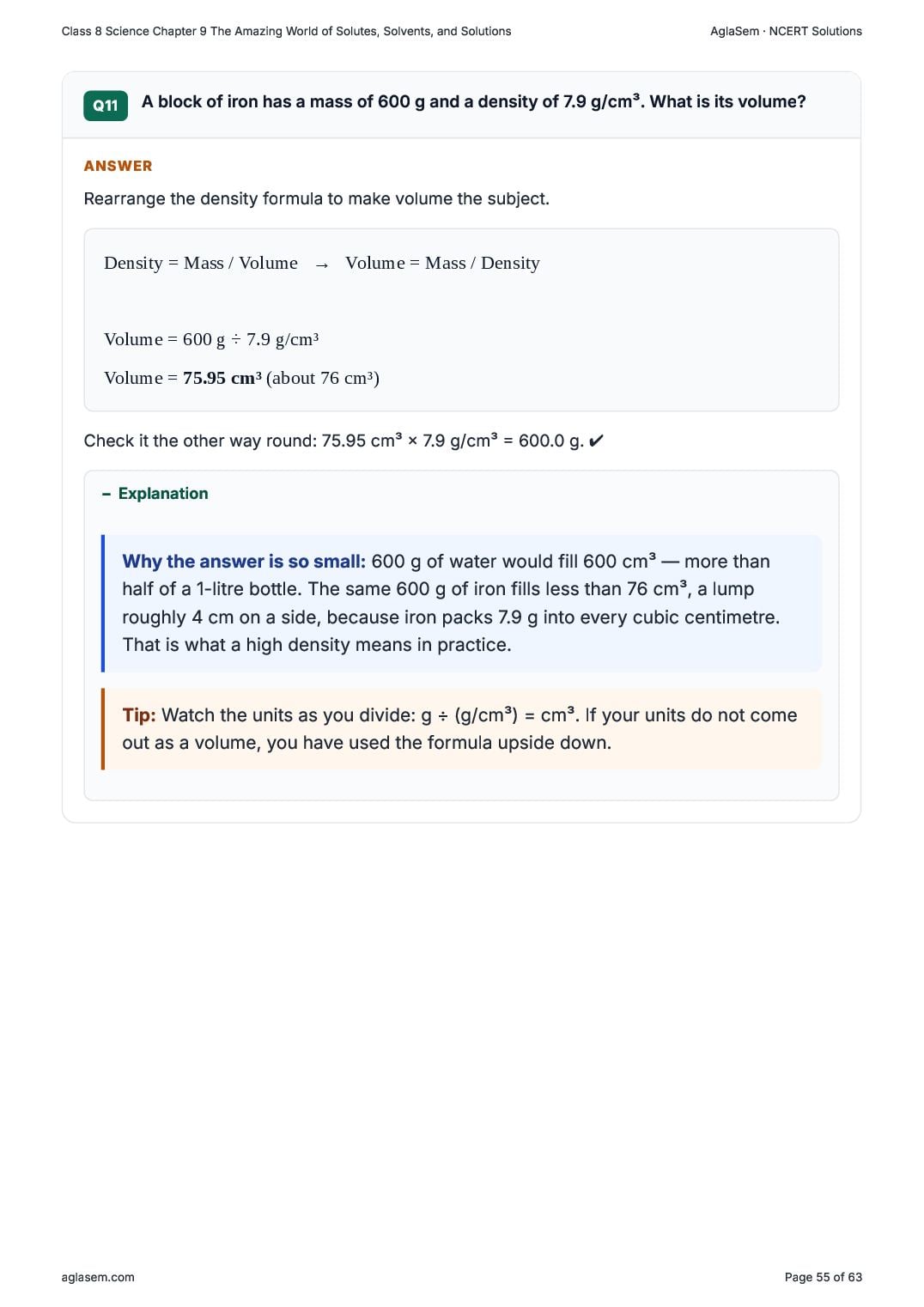
- A block of iron has a mass of 600 g and a density of 7.9 g/cm³. What is its volume?
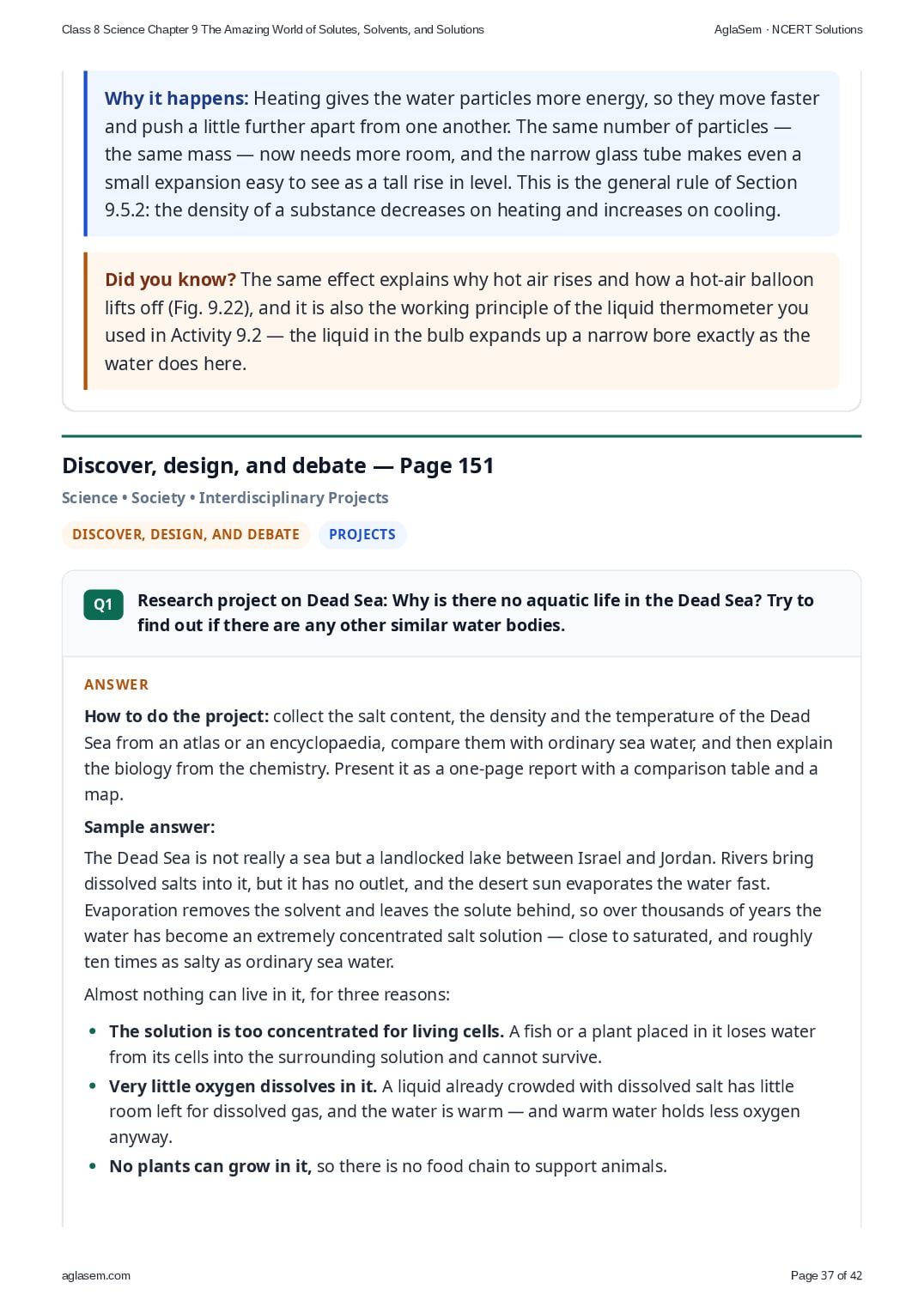
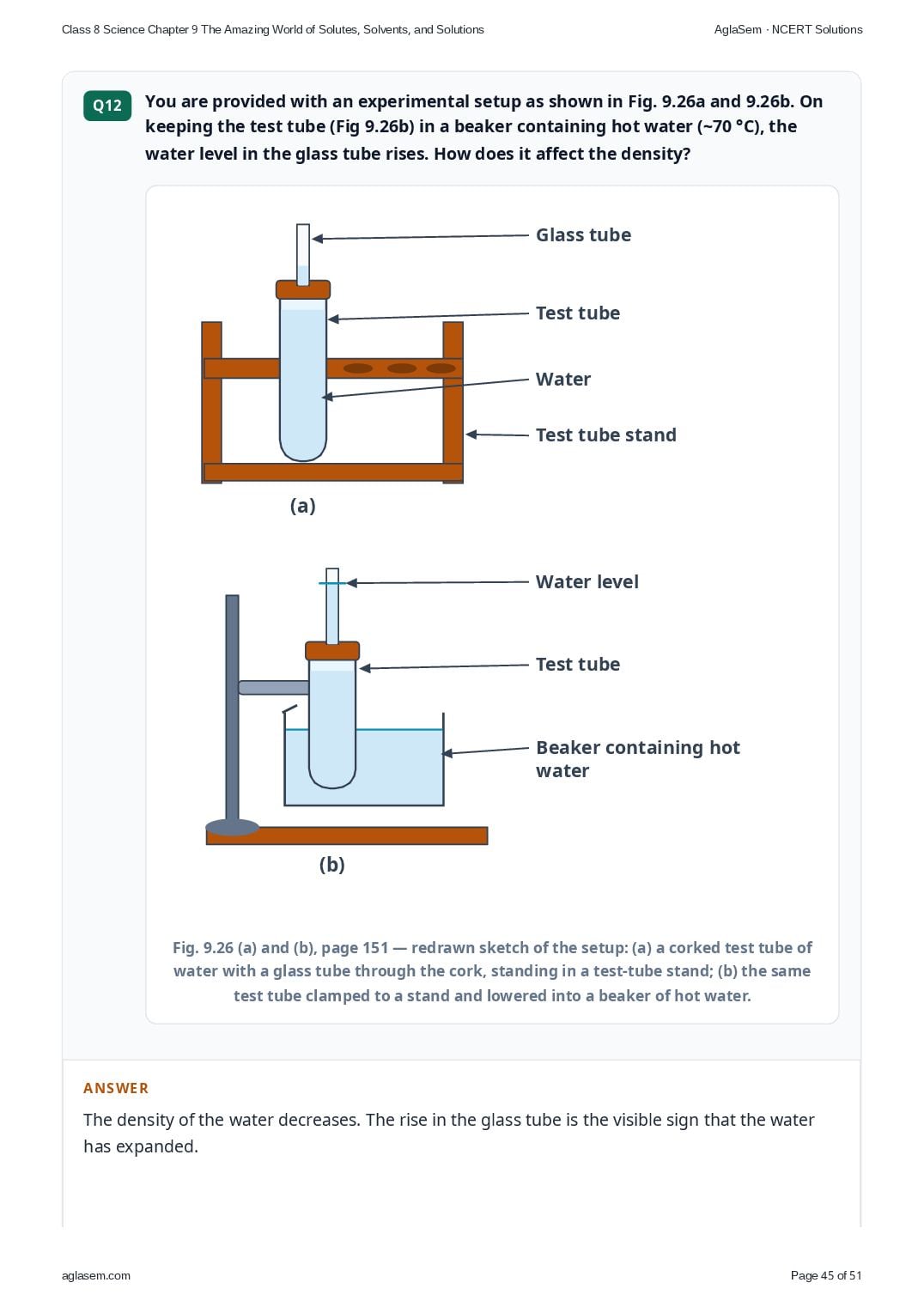
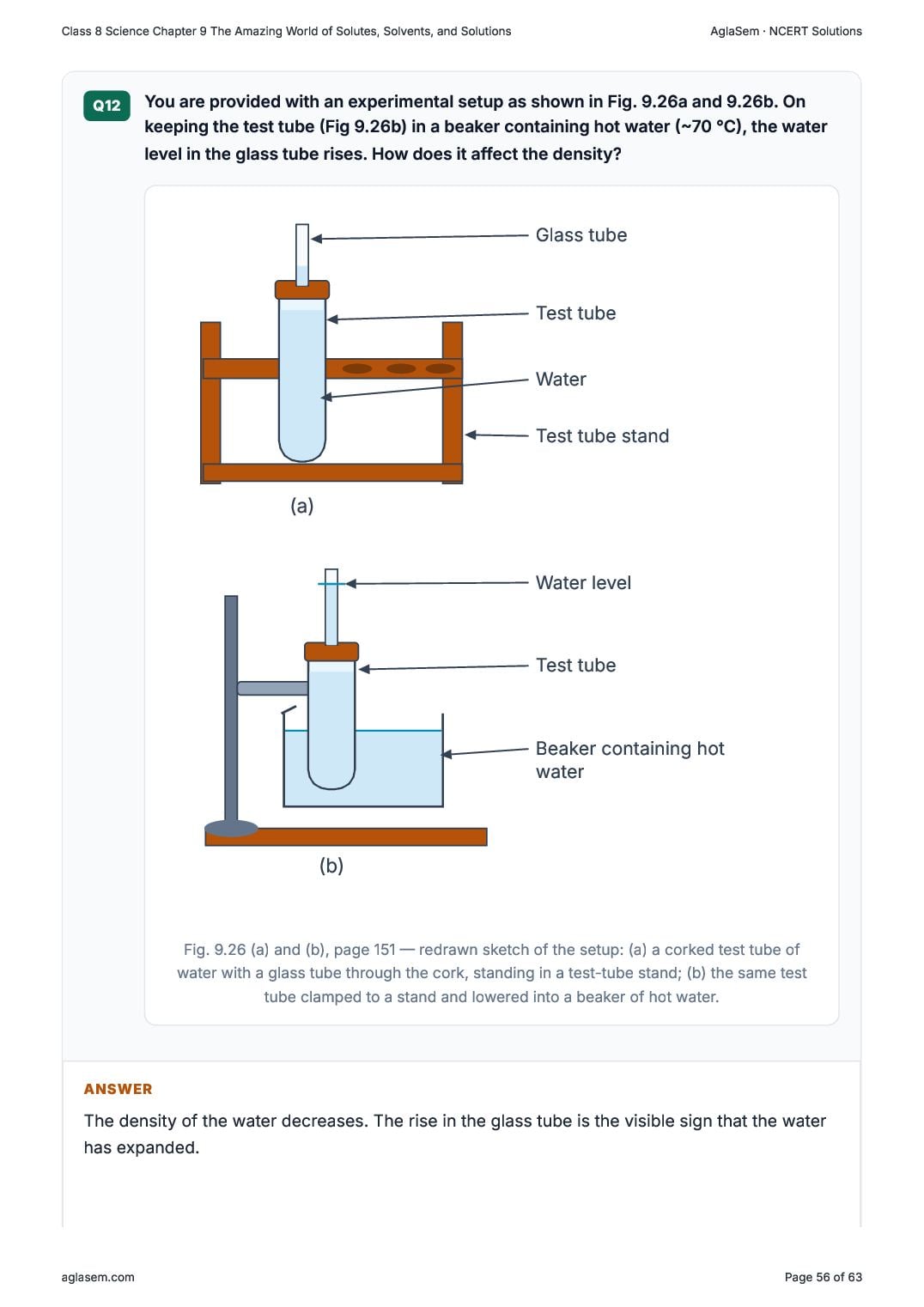
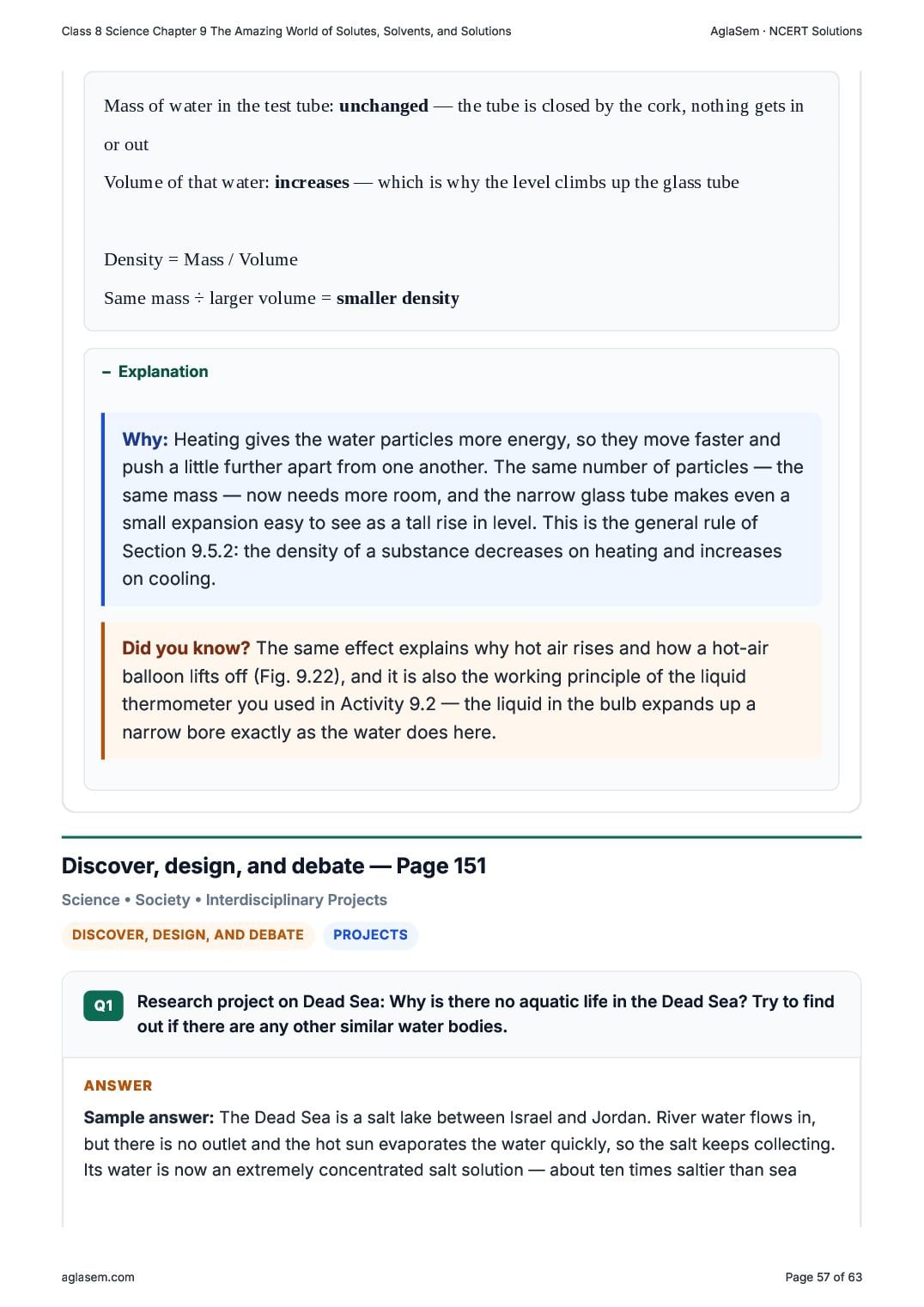
- You are provided with an experimental setup as shown in Fig. 9.26a and 9.26b. On keeping the test tube (Fig 9.26b) in a beaker containing hot water (~70 °C), the water level in the glass tube rises. How does it affect the density?
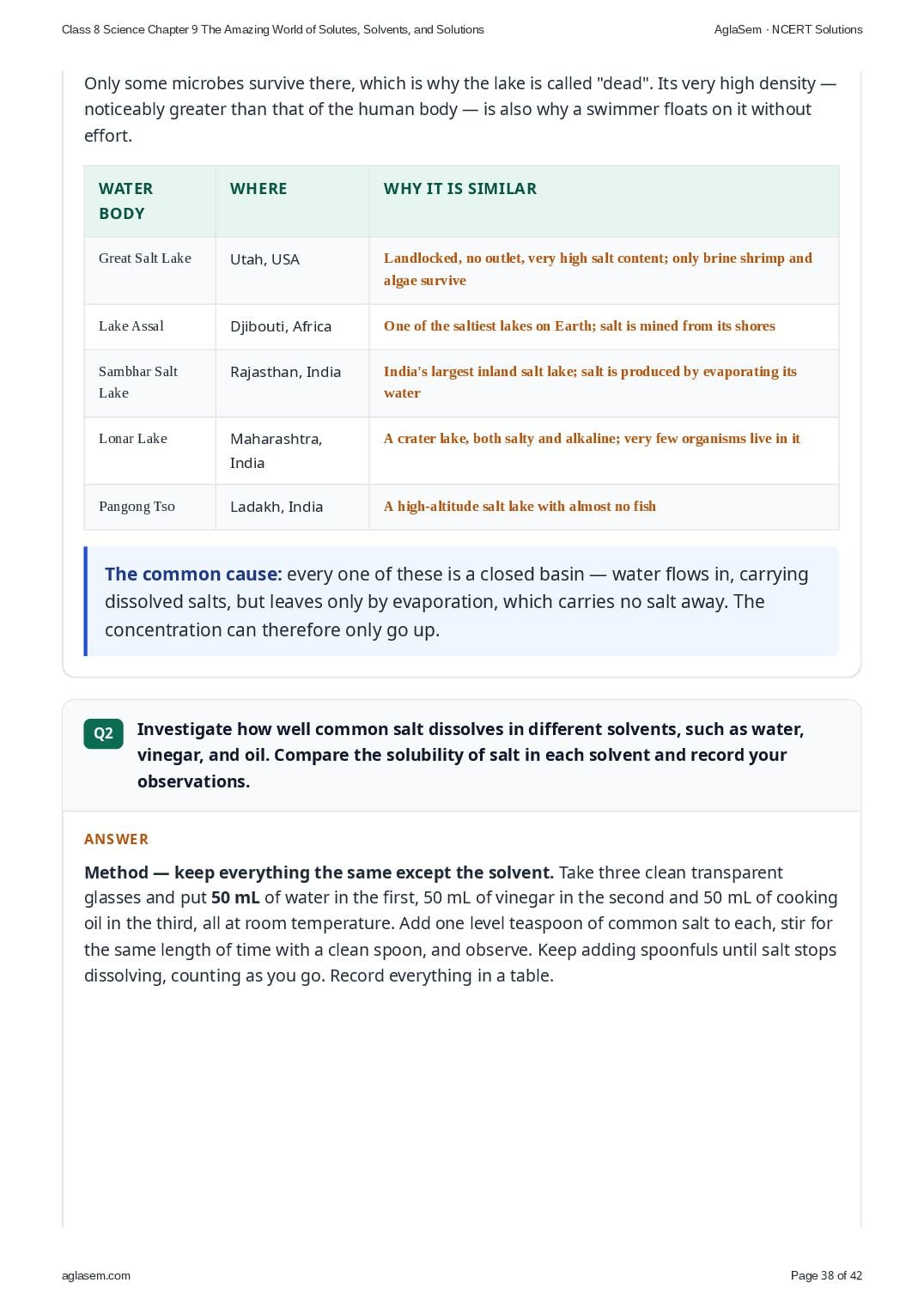
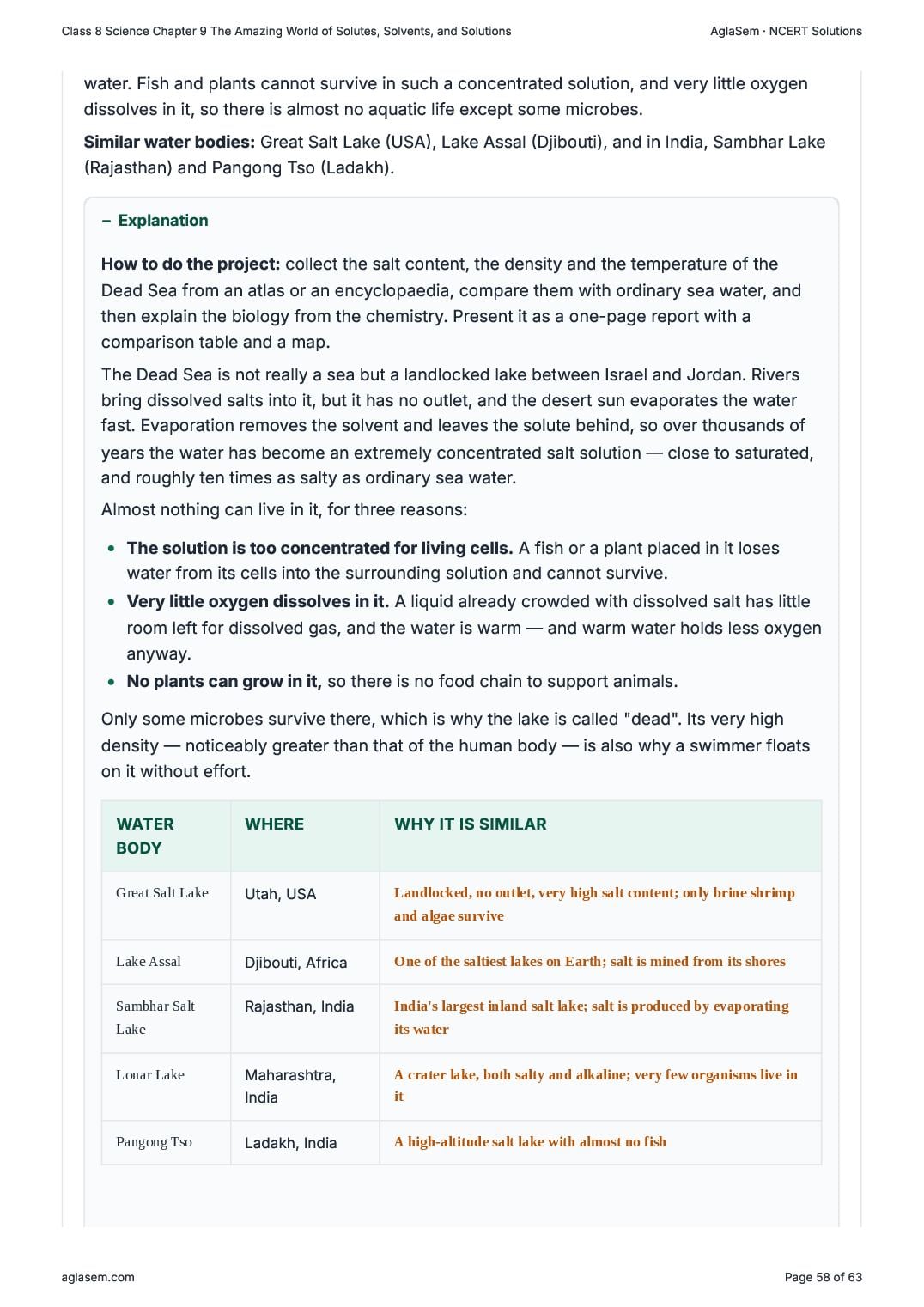
- Research project on Dead Sea: Why is there no aquatic life in the Dead Sea? Try to find out if there are any other similar water bodies.
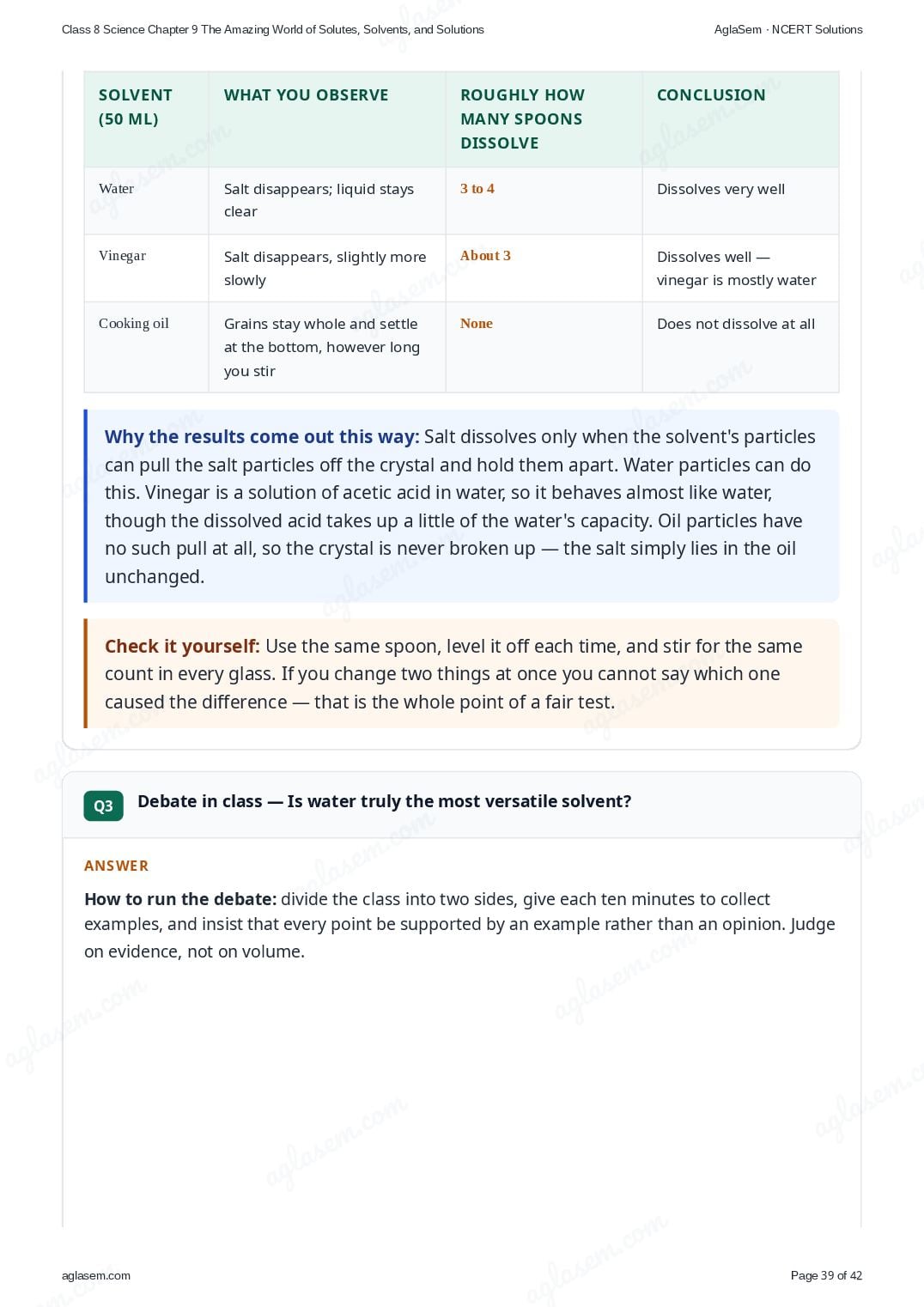
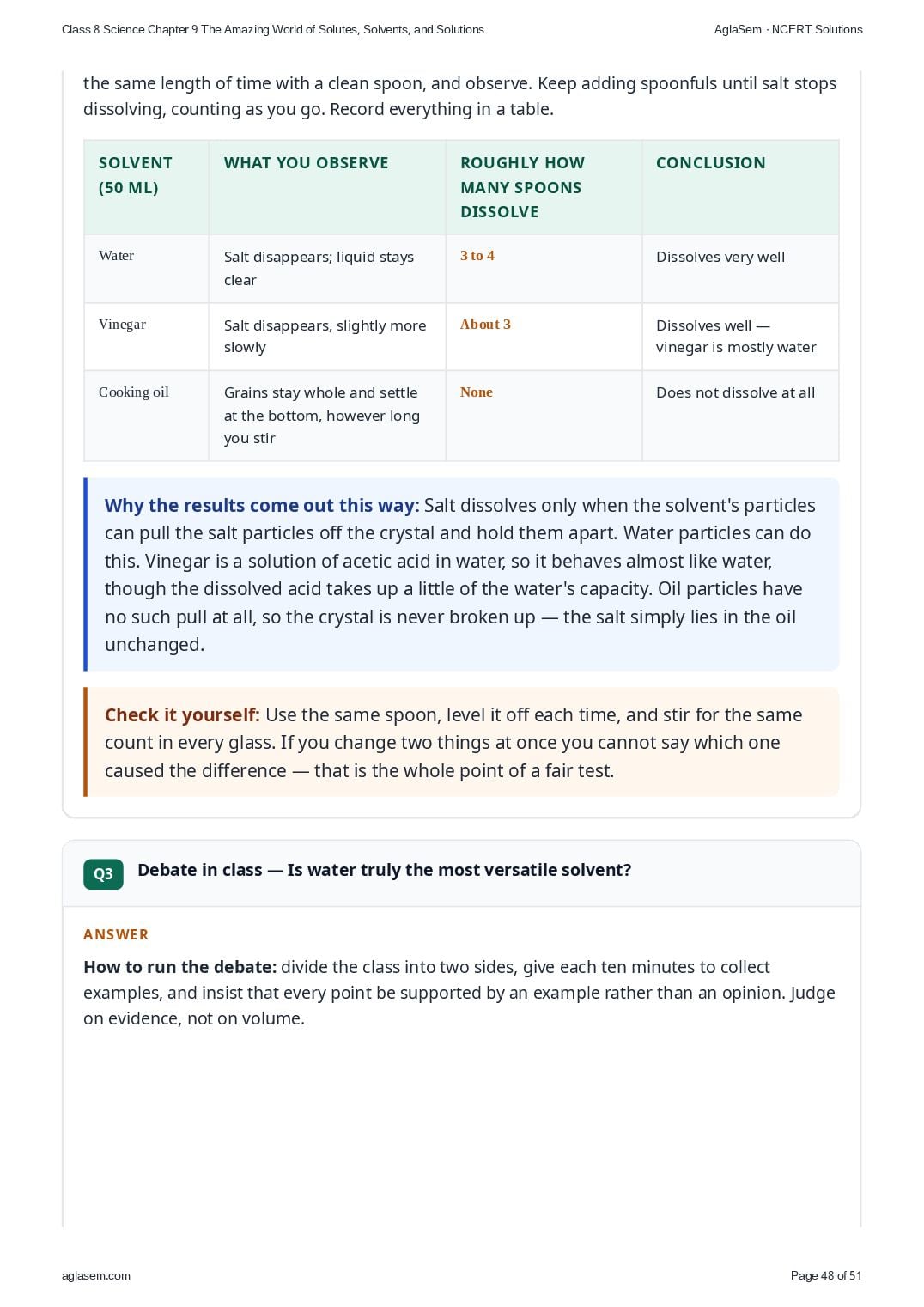
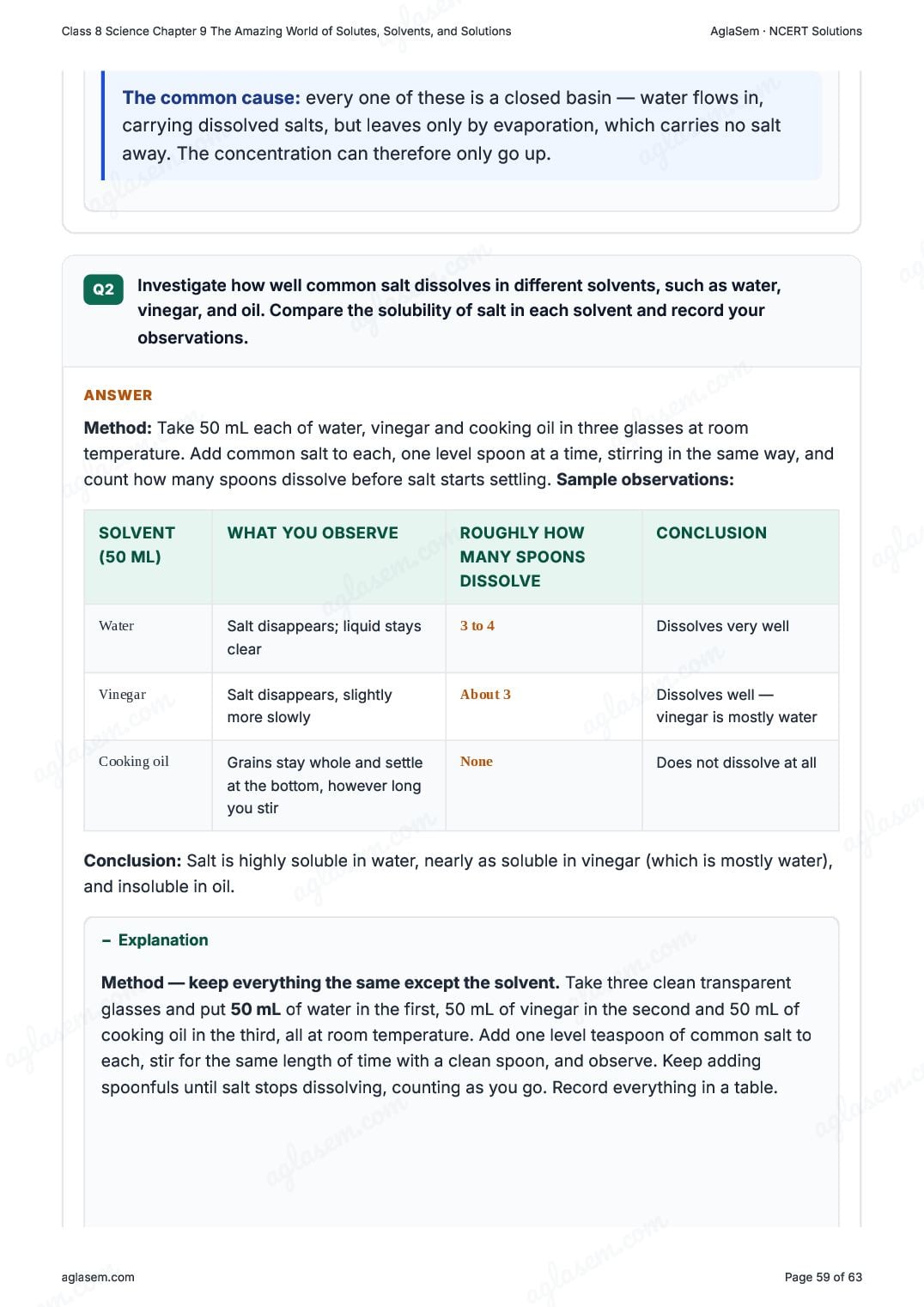
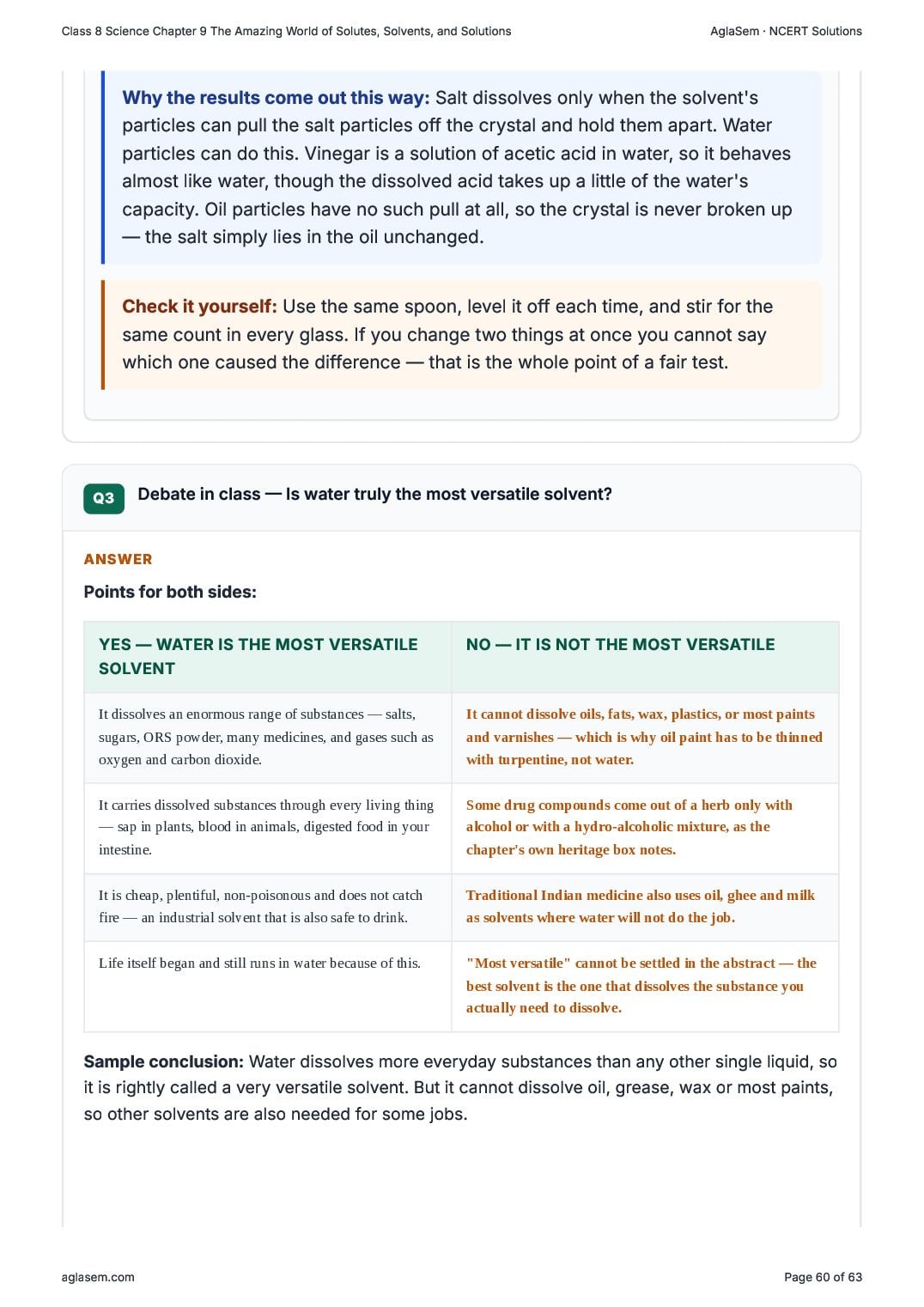
- Investigate how well common salt dissolves in different solvents, such as water, vinegar, and oil. Compare the solubility of salt in each solvent and record your observations.
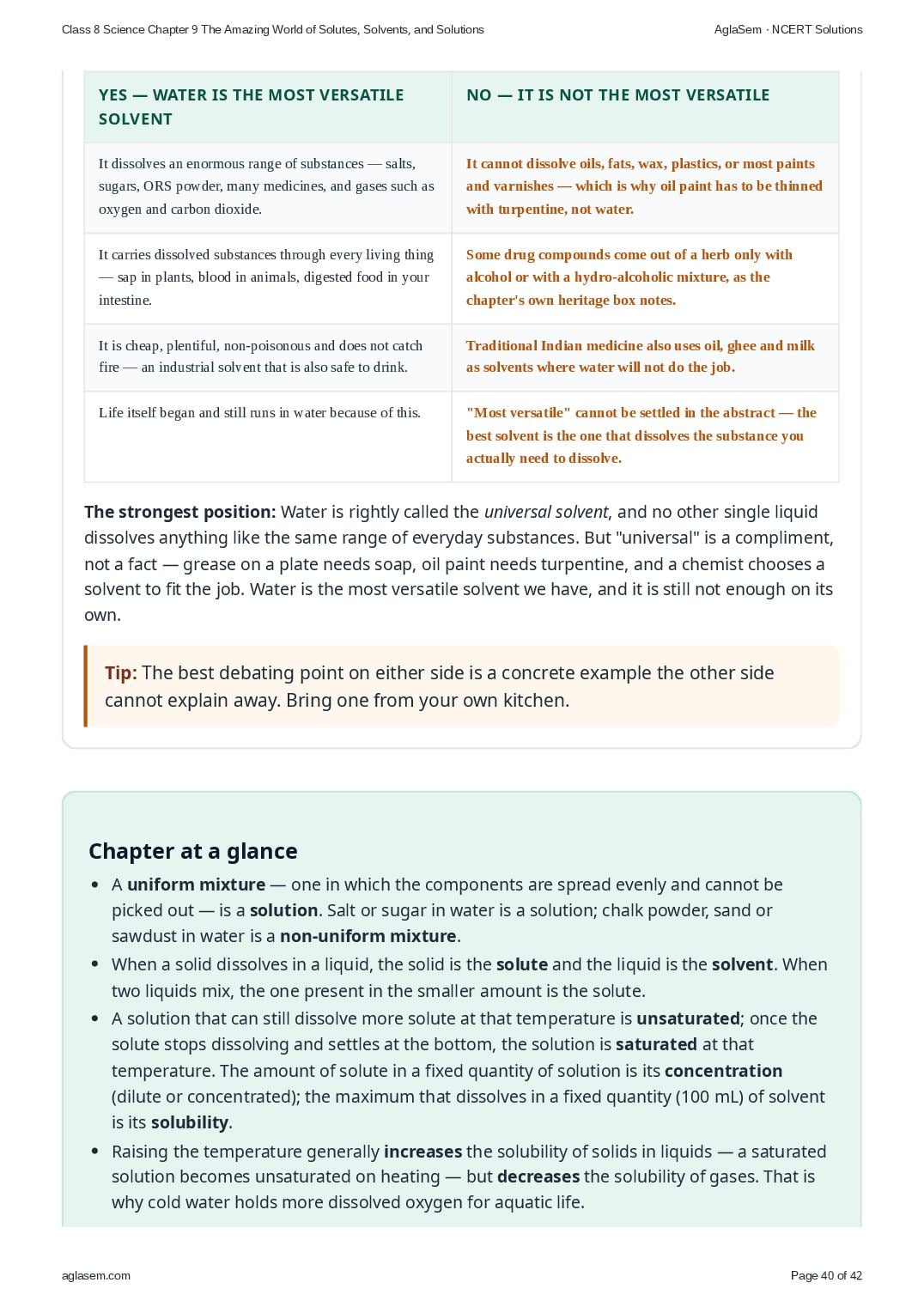
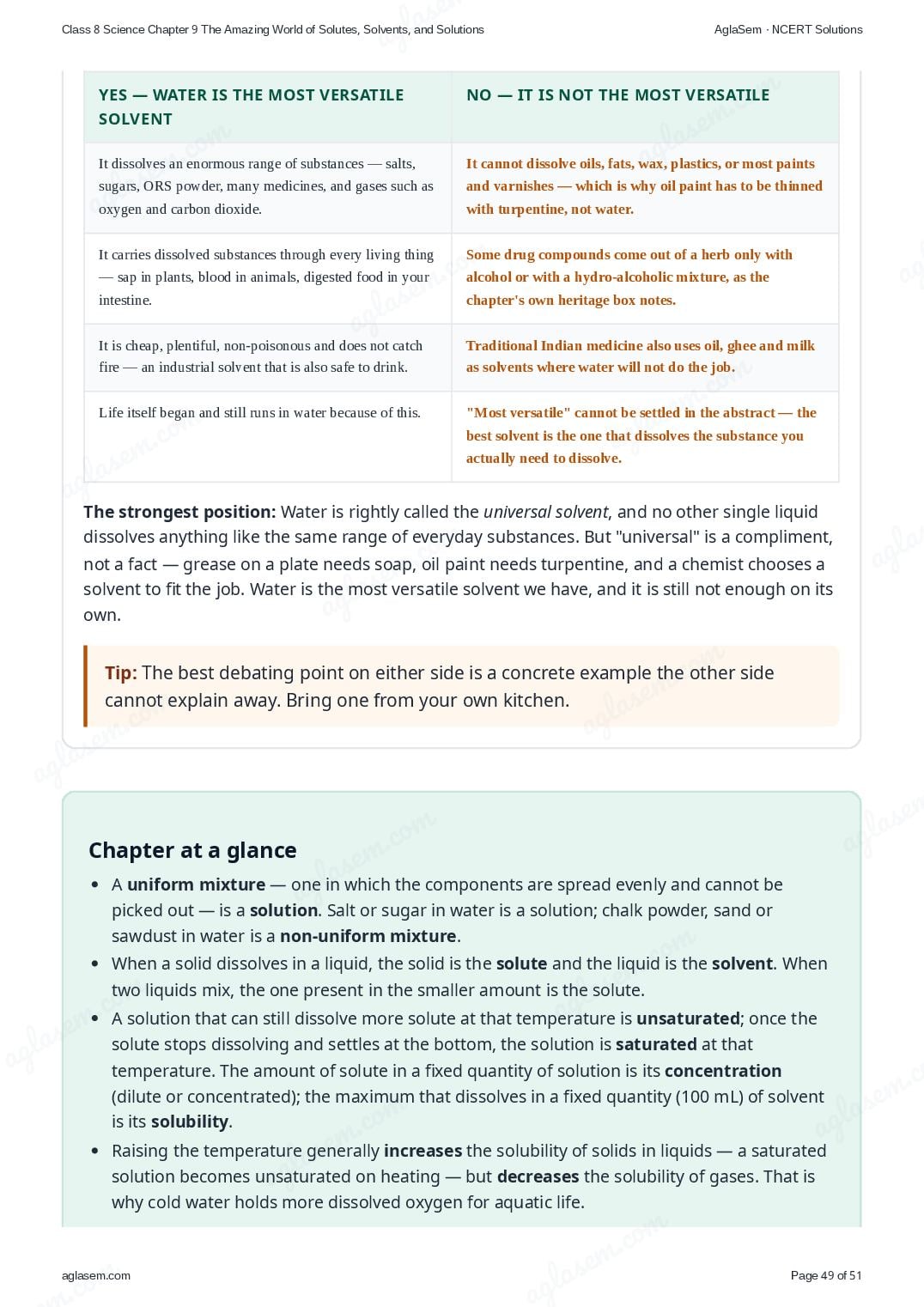
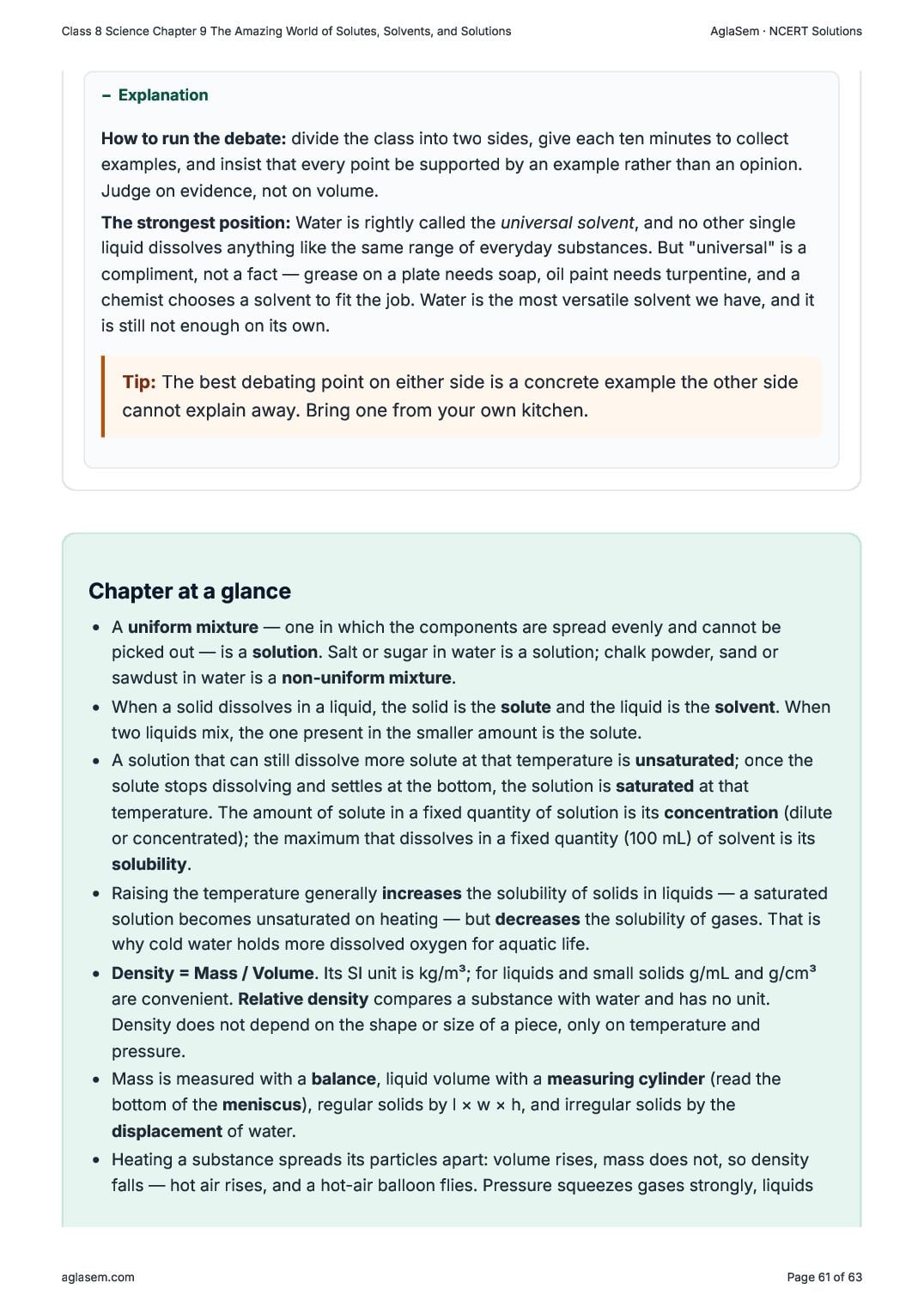
- Debate in class — Is water truly the most versatile solvent?
Chapter at a Glance
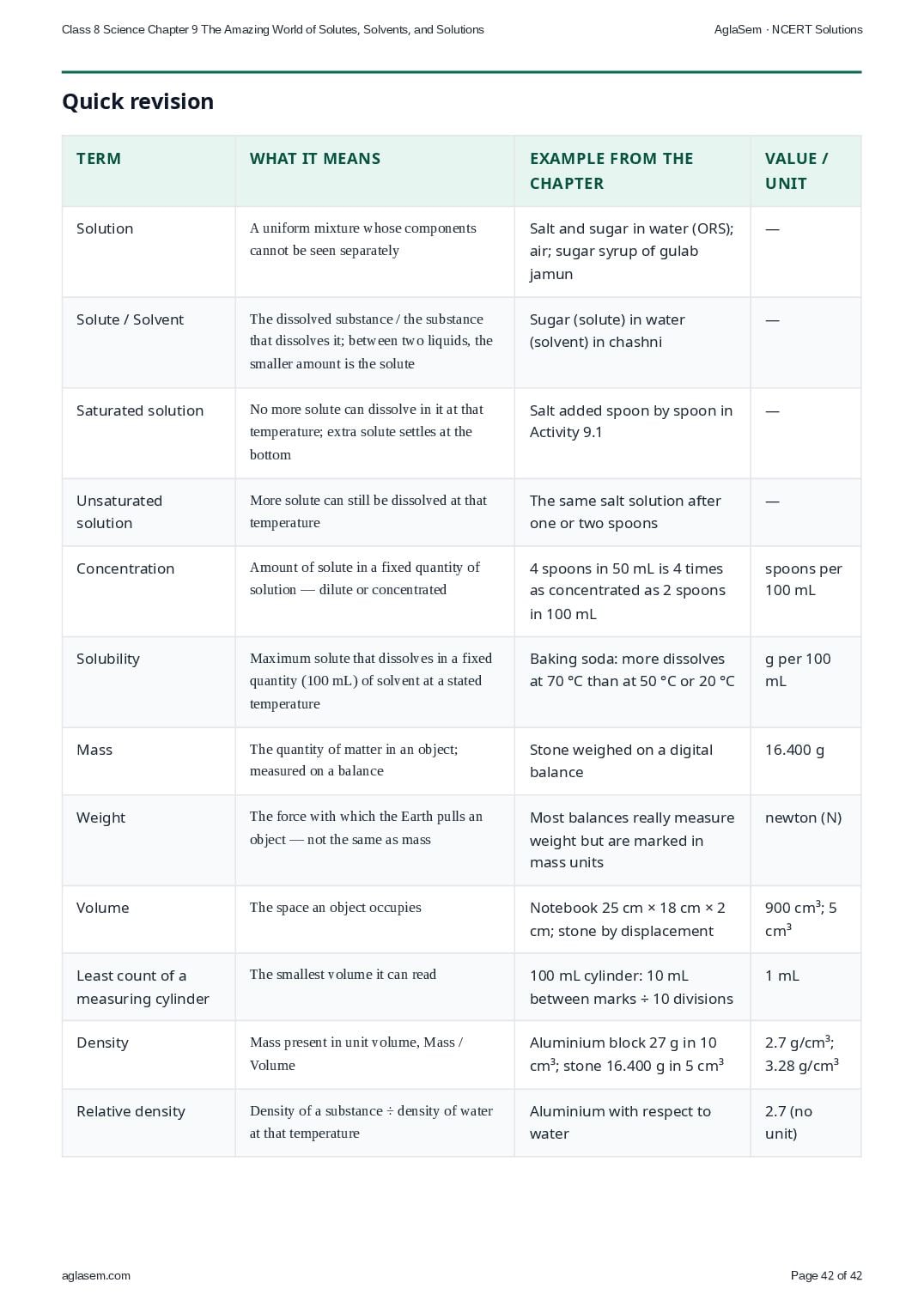
- A uniform mixture — one in which the components are spread evenly and cannot be picked out — is a solution . Salt or sugar in water is a solution; chalk powder, sand or sawdust in water is a non-uniform mixture .
- When a solid dissolves in a liquid, the solid is the solute and the liquid is the solvent . When two liquids mix, the one present in the smaller amount is the solute.
- A solution that can still dissolve more solute at that temperature is unsaturated ; once the solute stops dissolving and settles at the bottom, the solution is saturated at that temperature. The amount of solute in a fixed quantity of solution is its concentration (dilute or concentrated); the maximum that dissolves in a fixed quantity (100 mL) of solvent is its solubility .
- Raising the temperature generally increases the solubility of solids in liquids — a saturated solution becomes unsaturated on heating — but decreases the solubility of gases. That is why cold water holds more dissolved oxygen for aquatic life.
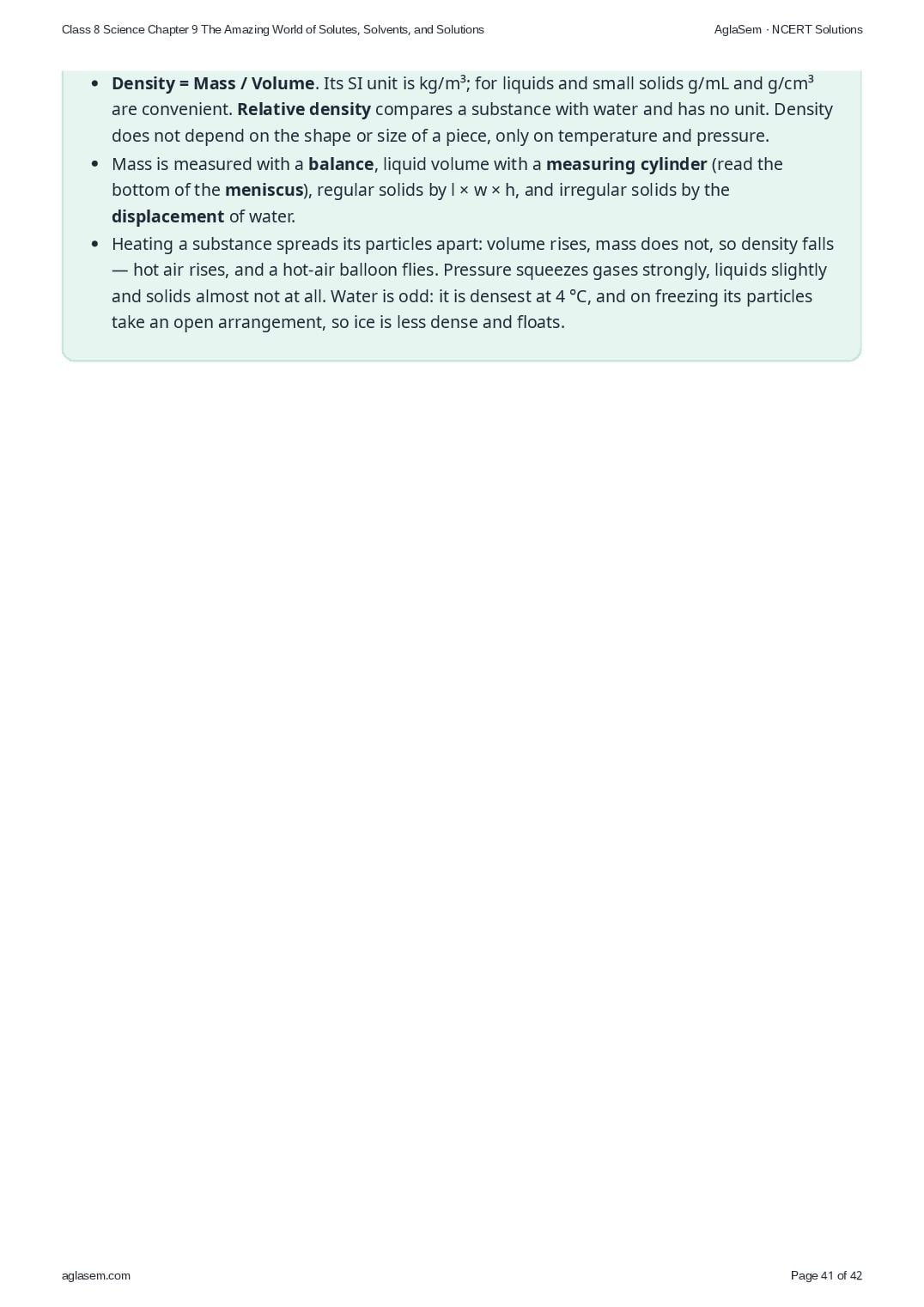
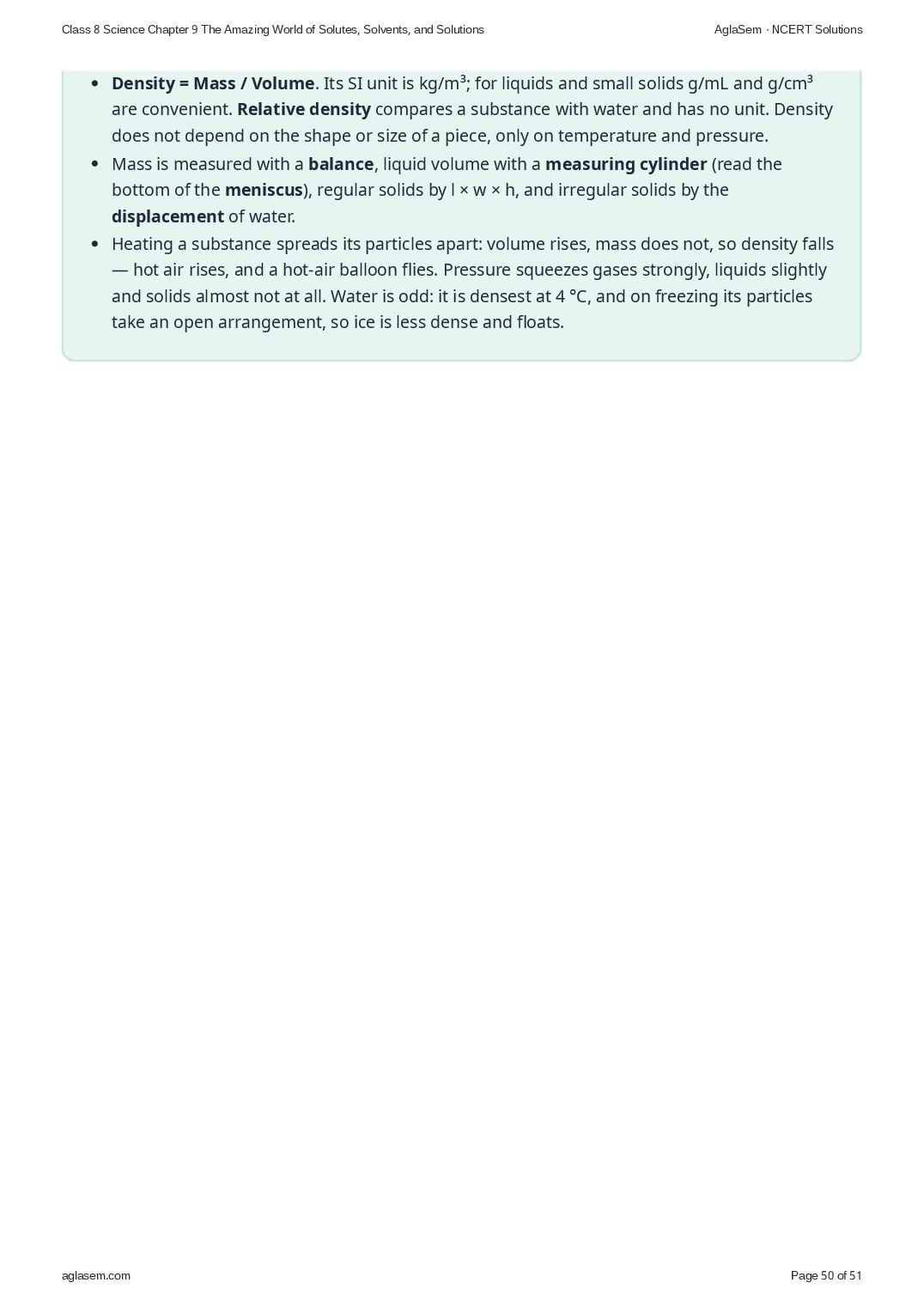
- Density = Mass / Volume . Its SI unit is kg/m³; for liquids and small solids g/mL and g/cm³ are convenient. Relative density compares a substance with water and has no unit. Density does not depend on the shape or size of a piece, only on temperature and pressure.
- Mass is measured with a balance , liquid volume with a measuring cylinder (read the bottom of the meniscus ), regular solids by l × w × h, and irregular solids by the displacement of water.
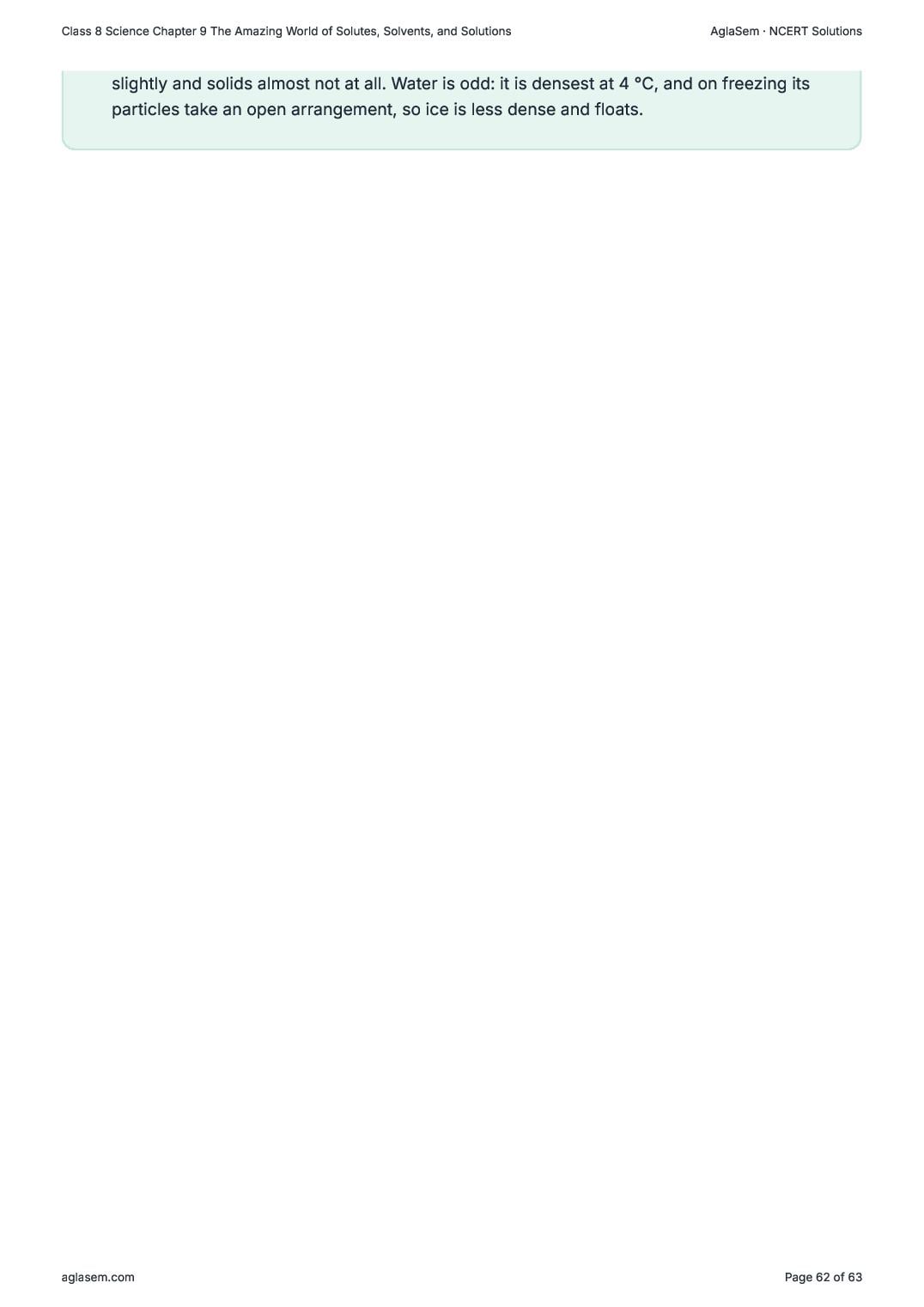
- Heating a substance spreads its particles apart: volume rises, mass does not, so density falls — hot air rises, and a hot-air balloon flies. Pressure squeezes gases strongly, liquids slightly and solids almost not at all. Water is odd: it is densest at 4 °C, and on freezing its particles take an open arrangement, so ice is less dense and floats.
How to Download NCERT Solutions for Class 8 Science Chapter 9 PDF
Follow these simple steps to get the The Amazing World of Solutes Solvents and Solutions questions-and-answers PDF from Curiosity.
- Search NCERT Solutions for Class 8 Science Chapter 9 aglasem and open this page.
- Read the exercise questions with answers for The Amazing World of Solutes Solvents and Solutions shown above.
- Click the Download PDF link to save the The Amazing World of Solutes Solvents and Solutions solutions to your device.
NCERT Solutions for Class 8 Science – All Chapters
There are more chapters to study besides The Amazing World of Solutes Solvents and Solutions in Science. Here are the NCERT Solutions for all chapters of Class 8 Science.
- Chapter 1 Exploring the Investigative World of Science
- Chapter 2 The Invisible Living World Beyond Our Naked Eye
- Chapter 3 Health the Ultimate Treasure
- Chapter 4 Electricity Magnetic and Heating Effects
- Chapter 5 Exploring Forces
- Chapter 6 Pressure Winds Storms and Cyclones
- Chapter 7 Particulate Nature of Matter
- Chapter 8 Nature of Matter Elements Compounds and Mixtures
- Chapter 9 The Amazing World of Solutes Solvents and Solutions
- Chapter 10 Light Mirrors and Lenses
- Chapter 11 Keeping Time with the Skies
- Chapter 12 How Nature Works in Harmony
- Chapter 13 Our Home Earth a Unique Life Sustaining Planet
NCERT Solutions for Class 8 – All Subjects
Just like Chapter 9 of Science, you can get the exercise questions with answers for every other subject of Class 8. Here are the NCERT Solutions for all subjects of Class 8.
NCERT Solutions for Class 8 Science Chapter 9 – An Overview
The key highlights of this study material are as follows.
| Aspects | Details |
|---|---|
| Class | Class 8 |
| Subject | Science |
| Chapter Number | Chapter 9 |
| Chapter Name | The Amazing World of Solutes Solvents and Solutions |
| Book Name | Curiosity |
| Book By | NCERT (National Council of Educational Research and Training) |
| Educational Resource Here | NCERT Solutions of Class 8 Science Chapter 9 for all exercises |
| More Questions Answers of This Subject | NCERT Solutions for Class 8 Science |
| Download Book Chapter | NCERT Book Class 8 Science |
| All Questions Answers For This Class | NCERT Solutions for Class 8 |
| Complete Solutions | NCERT Solutions |
NCERT Solutions for Class 8 Science Chapter 9 The Amazing World of Solutes Solvents and Solutions – FAQs
What are the NCERT Solutions for Class 8 Science Chapter 9 The Amazing World of Solutes Solvents and Solutions?
They are the complete, step-by-step answers to all the exercise and in-text questions of Chapter 9 The Amazing World of Solutes Solvents and Solutions from the NCERT Class 8 Science textbook Curiosity, written by experts as per the latest NCERT syllabus.
How can I download the Class 8 Science Chapter 9 solutions PDF for free?
Open this page on aglasem, read the The Amazing World of Solutes Solvents and Solutions questions with answers, and click the “Download Solutions PDF” link. The Class 8 Science Chapter 9 NCERT Solutions PDF is completely free to download.
Are these NCERT Solutions as per the latest 2026-27 syllabus?
Yes. The NCERT Solutions for Class 8 Science Chapter 9 are based on the latest NCERT textbook Curiosity and the current 2026-27 CBSE syllabus, so the questions and answers match what you study in class.
Where can I get NCERT Solutions for the other chapters of Class 8 Science?
You can find the answers to every chapter on the NCERT Solutions for Class 8 Science page, and solutions for every subject on the NCERT Solutions for Class 8 page.
How do NCERT Solutions help in exam preparation?
They show the correct method to solve each question, help you write answers the way they are expected in exams, let you check and correct your own work, and save revision time — which together improve your marks in Class 8 Science.
If you have any queries on NCERT Solutions for Class 8 Science Chapter 9 The Amazing World of Solutes Solvents and Solutions, then please ask in the comments below.