NCERT Solutions for Class 8 Science Chapter 10 Light Mirrors and Lenses provide clear, step-by-step answers to every exercise and in-text question from the chapter Light Mirrors and Lenses of the NCERT textbook Curiosity. Prepared by subject experts as per the latest NCERT (CBSE) syllabus for 2026-27, these NCERT Solutions for Class 8 Science help you understand each concept, write exam-ready answers, and check your own solutions. You can read them online below or download the free Class 8 Science Chapter 10 question-answer PDF.
NCERT Solutions for Class 8 Science Chapter 10 Light Mirrors and Lenses
- Class: Class 8
- Subject: Science
- Chapter: Chapter 10 – Light Mirrors and Lenses
- Textbook: Curiosity (NCERT)
- Study material: NCERT Solutions – questions with answers, free PDF
These solutions answer all the exercise questions of Chapter 10 Light Mirrors and Lenses — including the in-text questions, short-answer and long-answer questions, and activities — with complete explanations so you can follow the method, not just the final answer. Read the full solutions below.
NCERT Solutions Class 8 Science Chapter 10 Light Mirrors and Lenses View Download
NCERT Solutions for Class 8 Science Chapter 10 PDF Download
You can read the NCERT Solutions for Class 8 Science Chapter 10 online above, or download the complete question-answer PDF to study Light Mirrors and Lenses offline at any time.
NCERT Solutions for Class 8 Science Chapter 10 PDF Download Link – Click Here to Download Solutions PDF
Questions Covered in This Chapter
These NCERT Solutions answer all 61 questions of this chapter. The questions solved are:
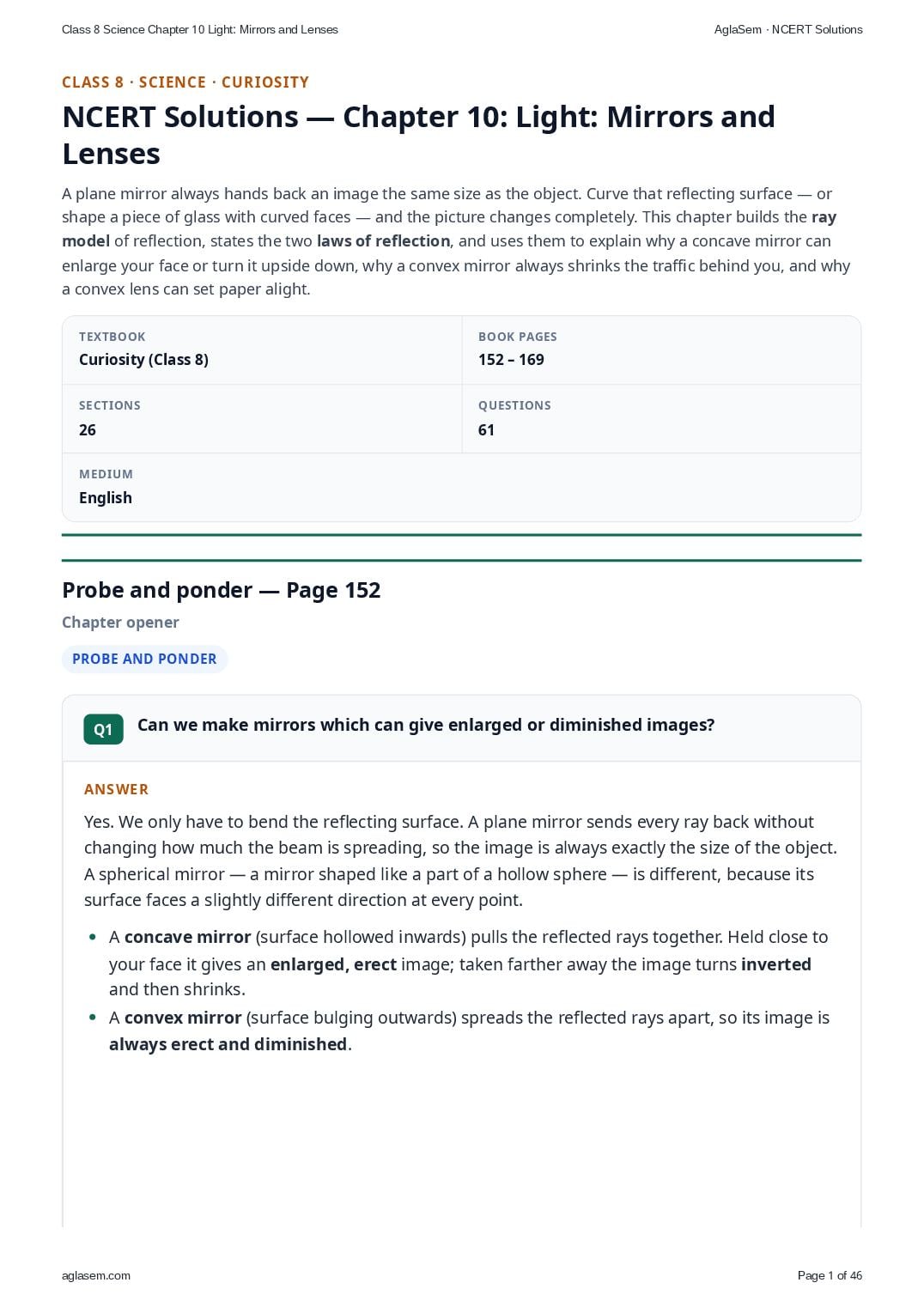
- Can we make mirrors which can give enlarged or diminished images?
- On side-view mirrors of vehicles, there is a warning that says “Objects in mirror are closer than they appear”. Why is this warning written there?
- Why is there a curved line on some reading glasses?
- Share your questions
- Take a shiny metallic spoon and hold its curved surface close to your face. Can you see your image in it?
- Notice the image of your face. Is it different from the image you see in a plane mirror?
- While observing the image, slowly move the spoon away from your face. Do you observe any change in the image?
- Now flip the spoon and repeat the same steps.
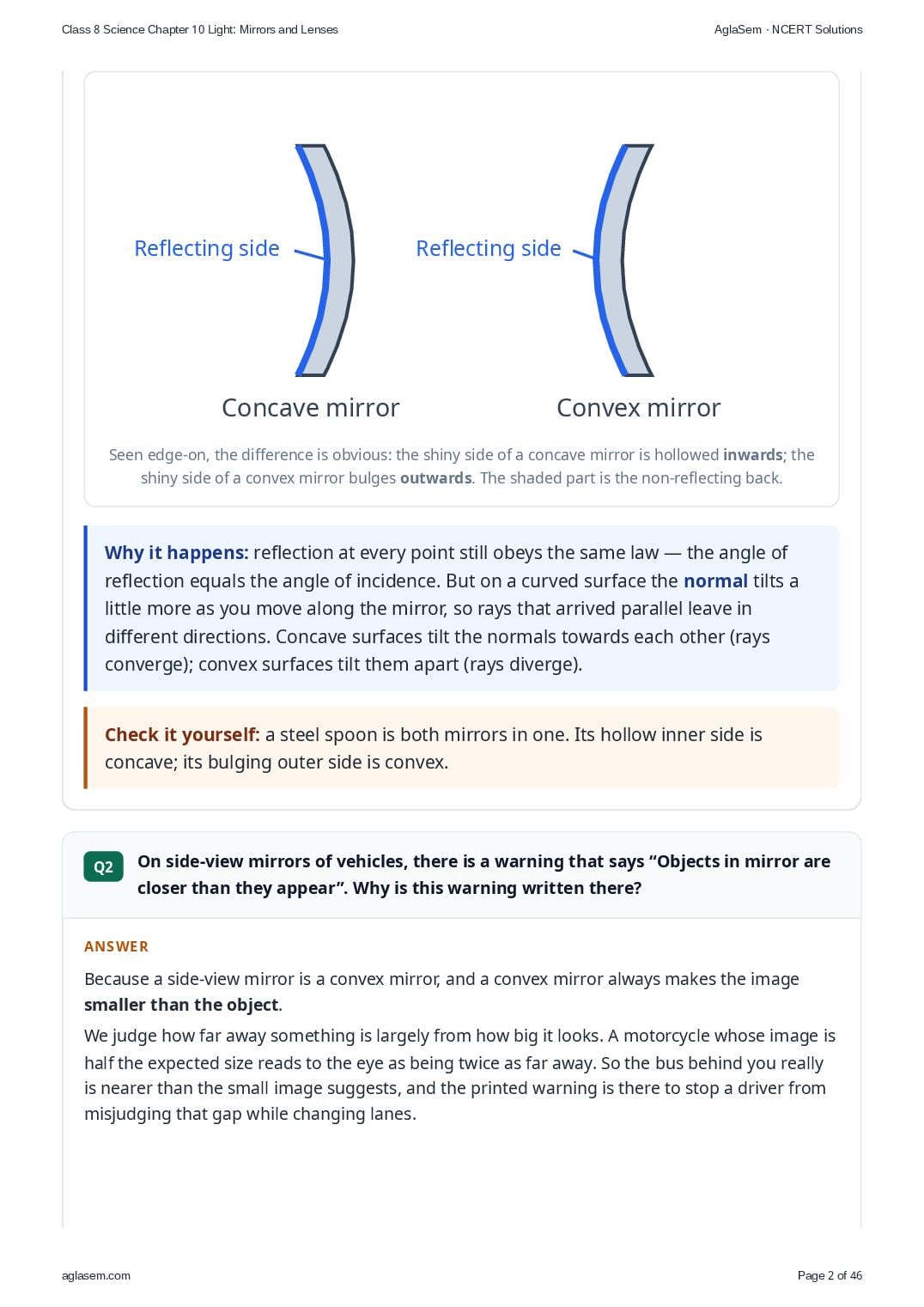
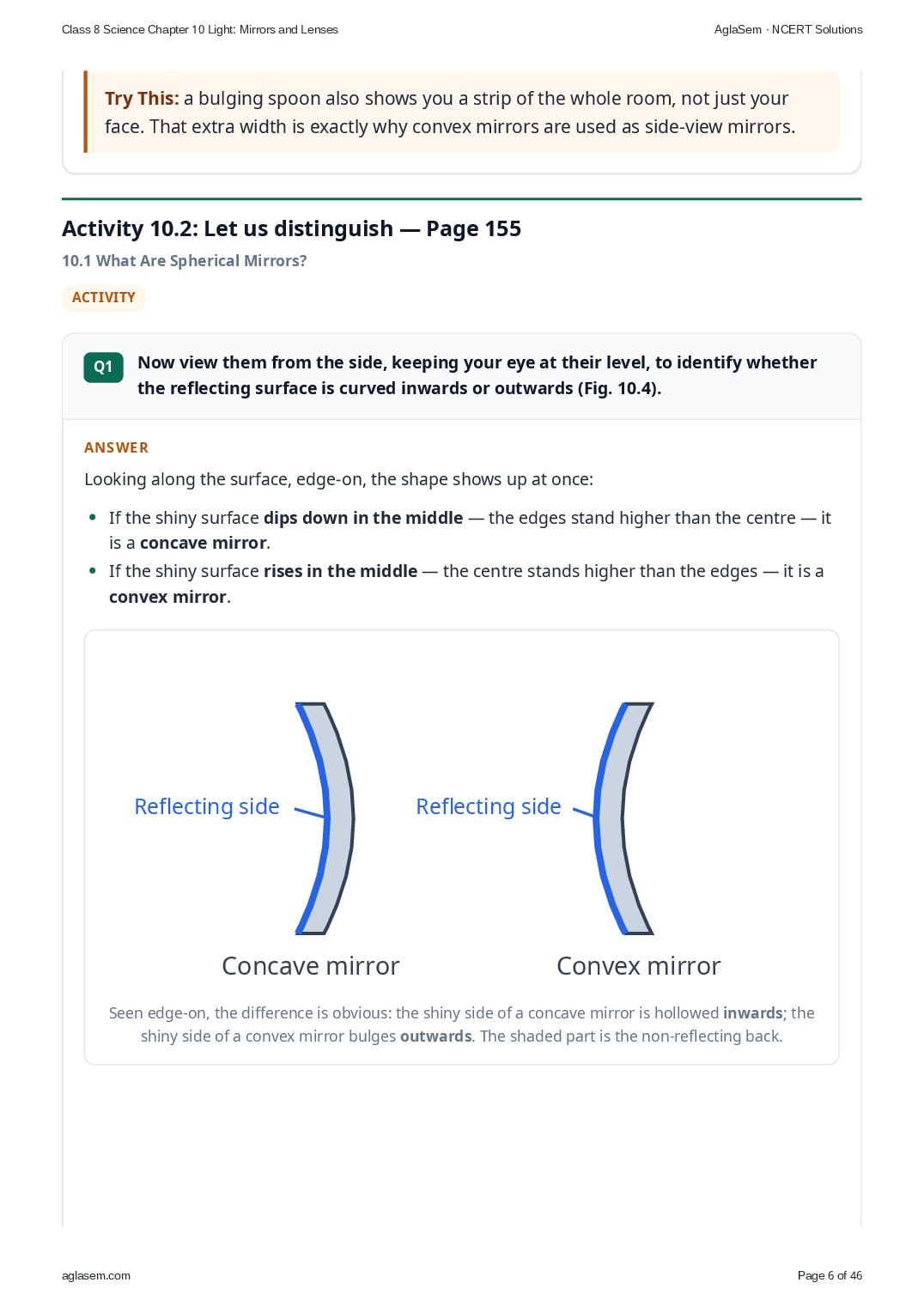
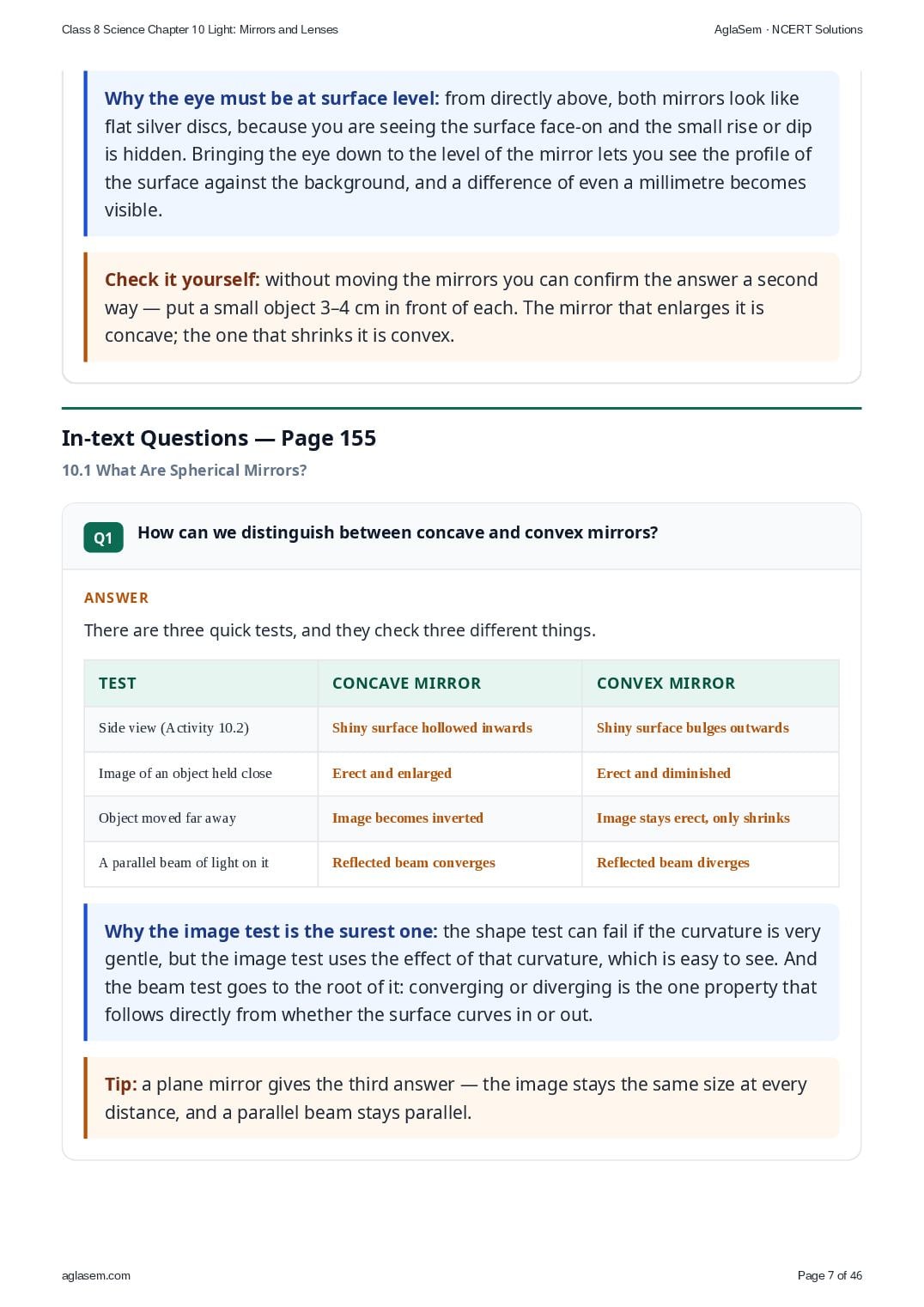
- Now view them from the side, keeping your eye at their level, to identify whether the reflecting surface is curved inwards or outwards (Fig. 10.4).
- How can we distinguish between concave and convex mirrors?
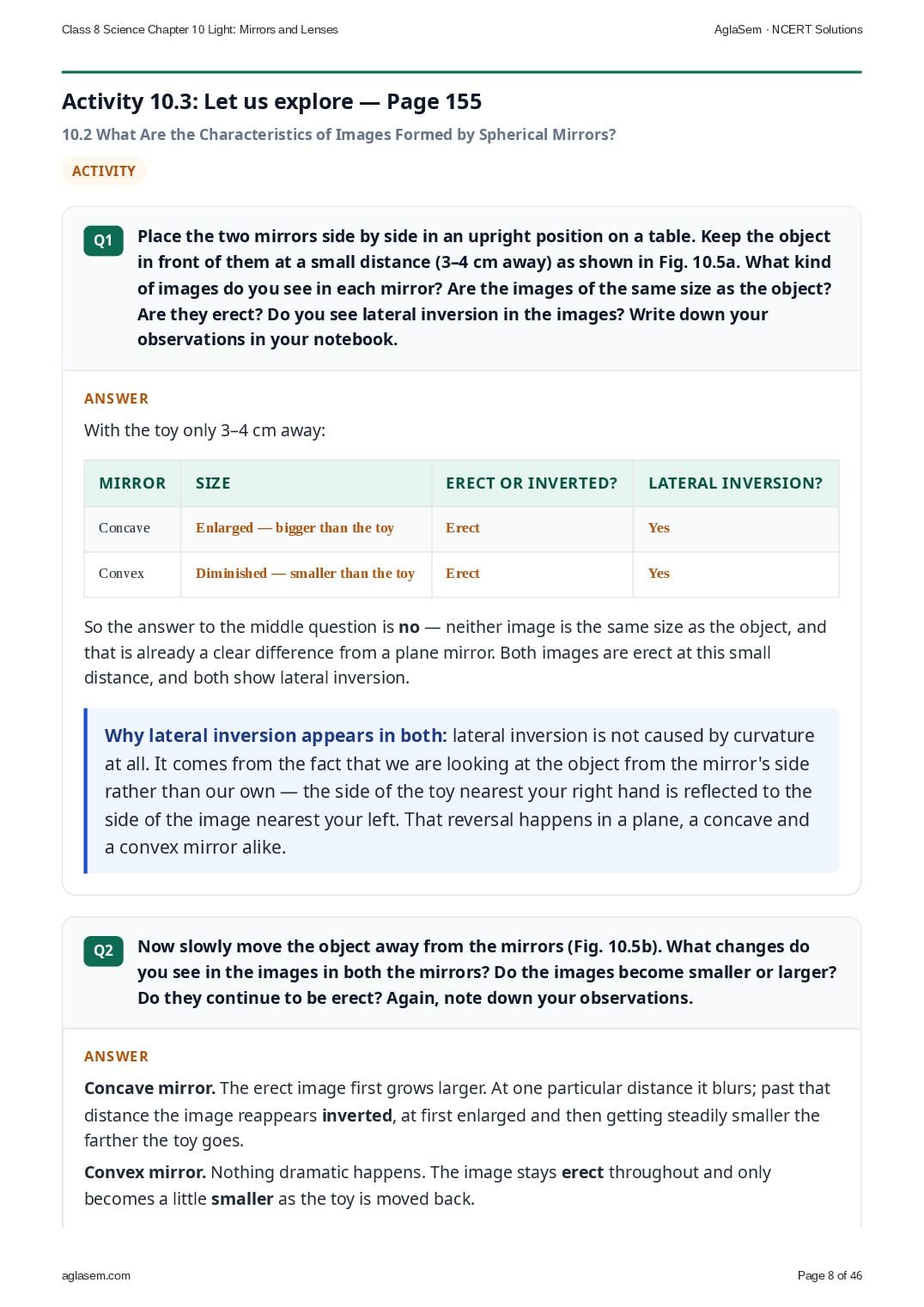
- Place the two mirrors side by side in an upright position on a table. Keep the object in front of them at a small distance (3–4 cm away) as shown in Fig. 10.5a. What kind of images do you see in each mirror? Are the images of the same size as the object? Are they erect? Do you see lateral inversion in the images? Write down your observations in your notebook.
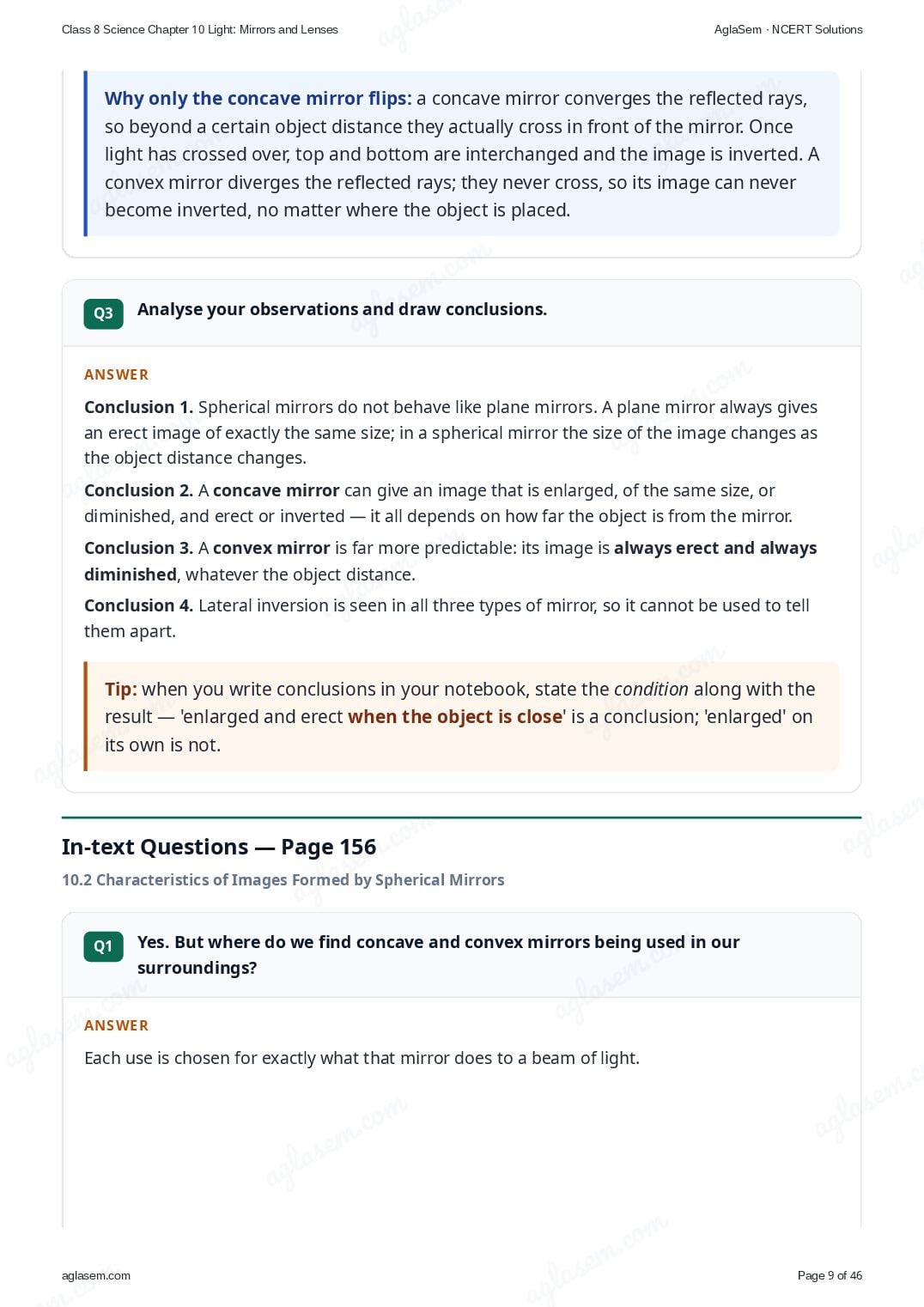
- Now slowly move the object away from the mirrors (Fig. 10.5b). What changes do you see in the images in both the mirrors? Do the images become smaller or larger? Do they continue to be erect? Again, note down your observations.
- Analyse your observations and draw conclusions.
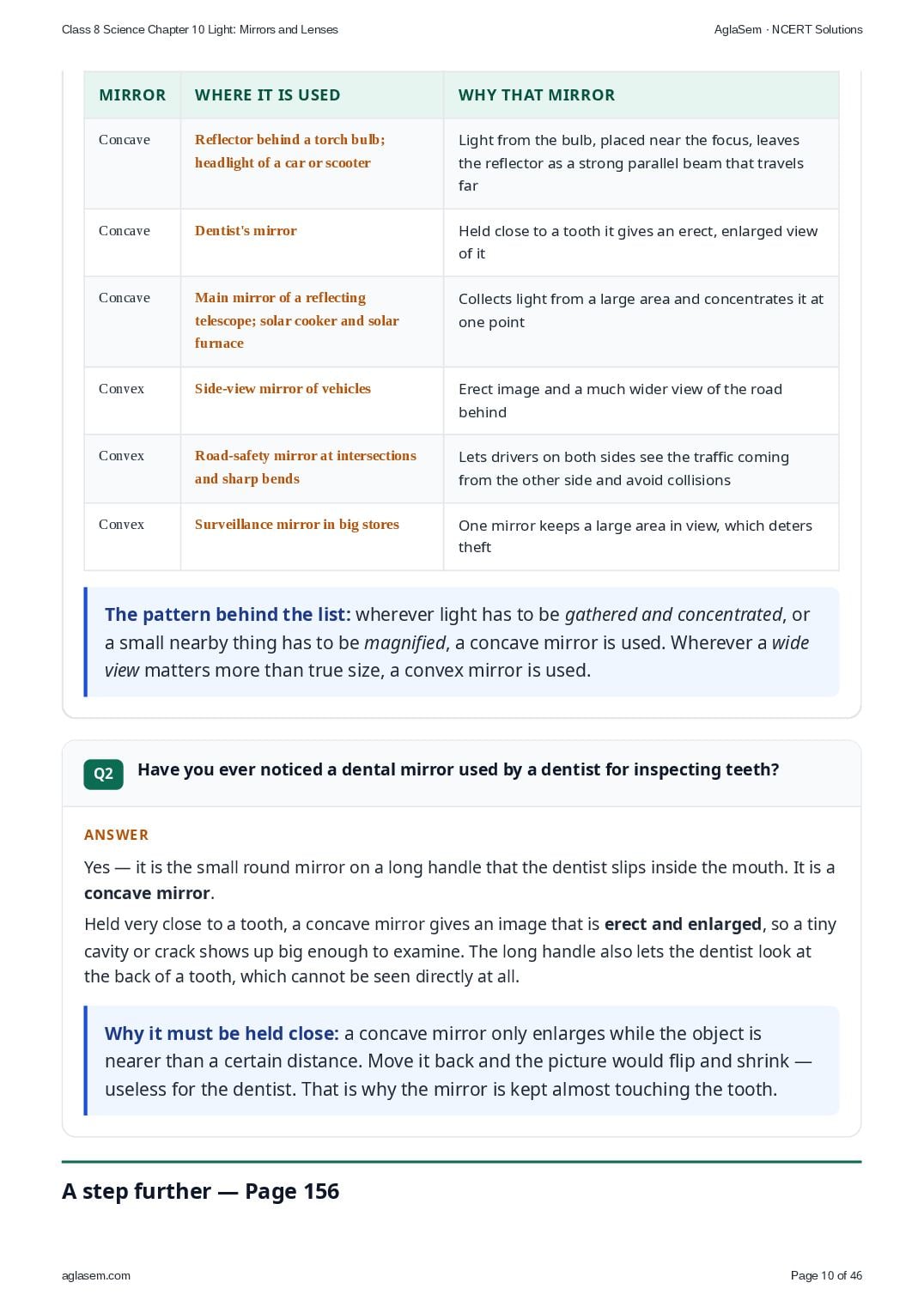
- Yes. But where do we find concave and convex mirrors being used in our surroundings?
- Have you ever noticed a dental mirror used by a dentist for inspecting teeth?
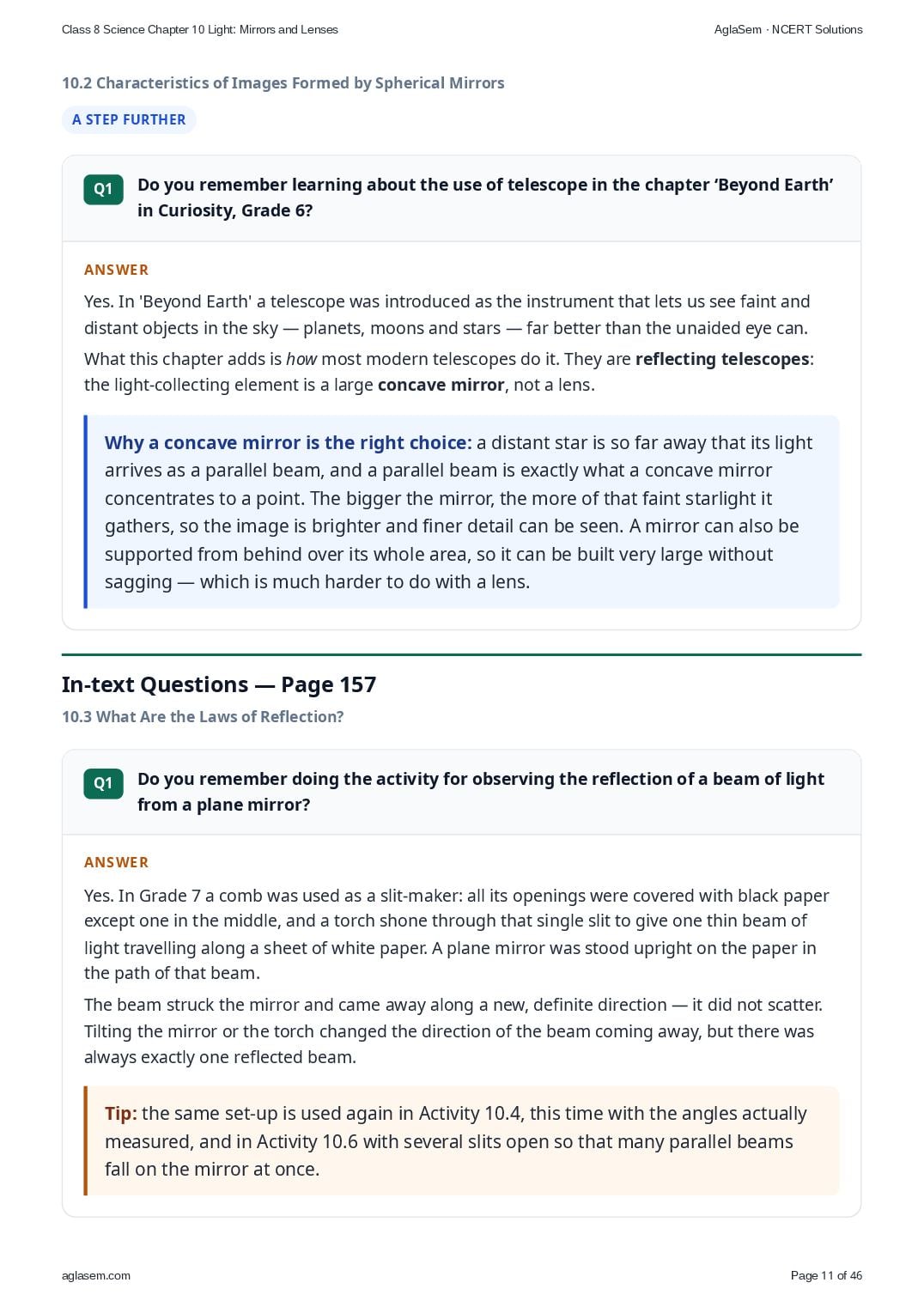
- Do you remember learning about the use of telescope in the chapter ‘Beyond Earth’ in Curiosity, Grade 6?
- Do you remember doing the activity for observing the reflection of a beam of light from a plane mirror?
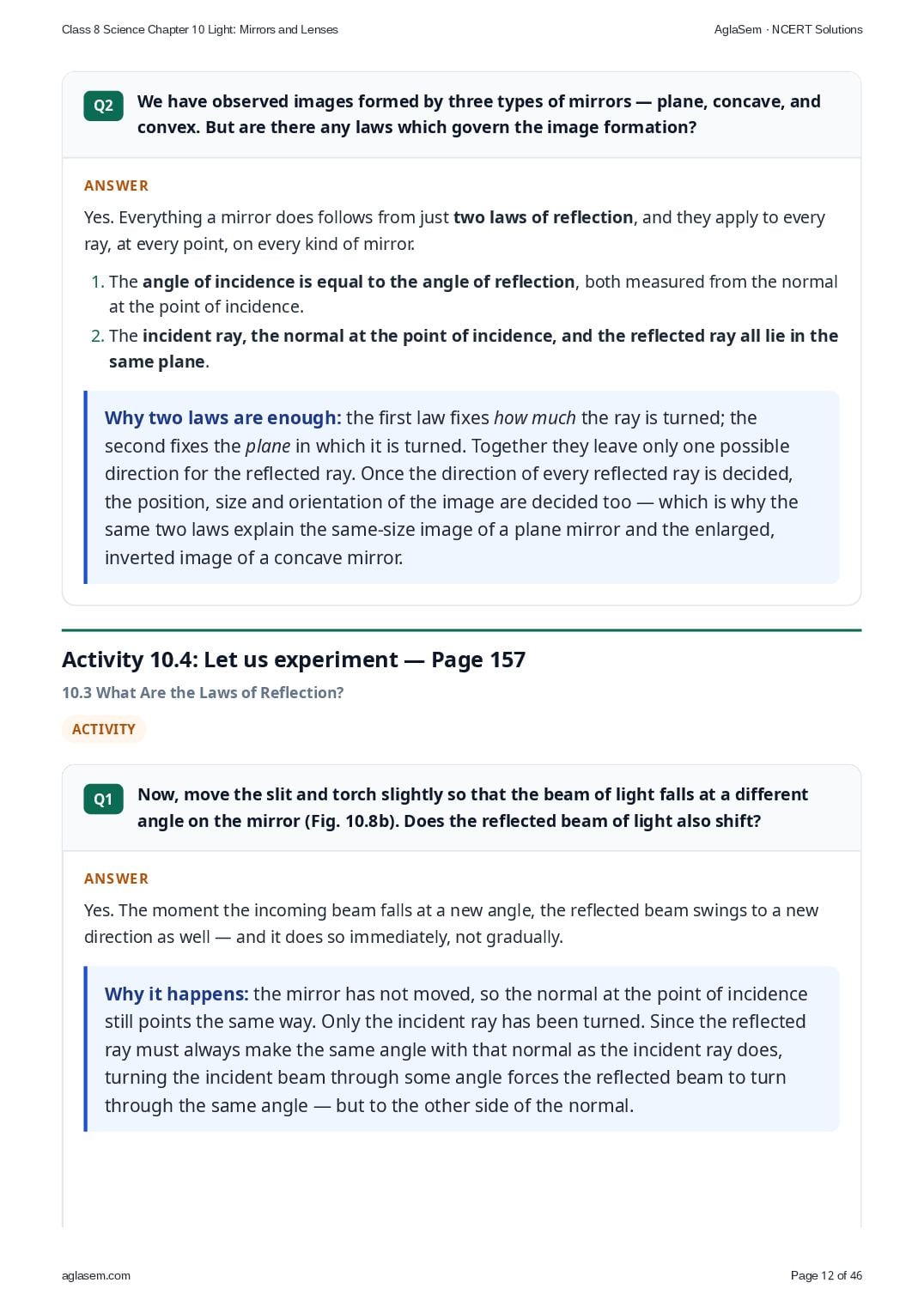
- We have observed images formed by three types of mirrors — plane, concave, and convex. But are there any laws which govern the image formation?
- Now, move the slit and torch slightly so that the beam of light falls at a different angle on the mirror (Fig. 10.8b). Does the reflected beam of light also shift?
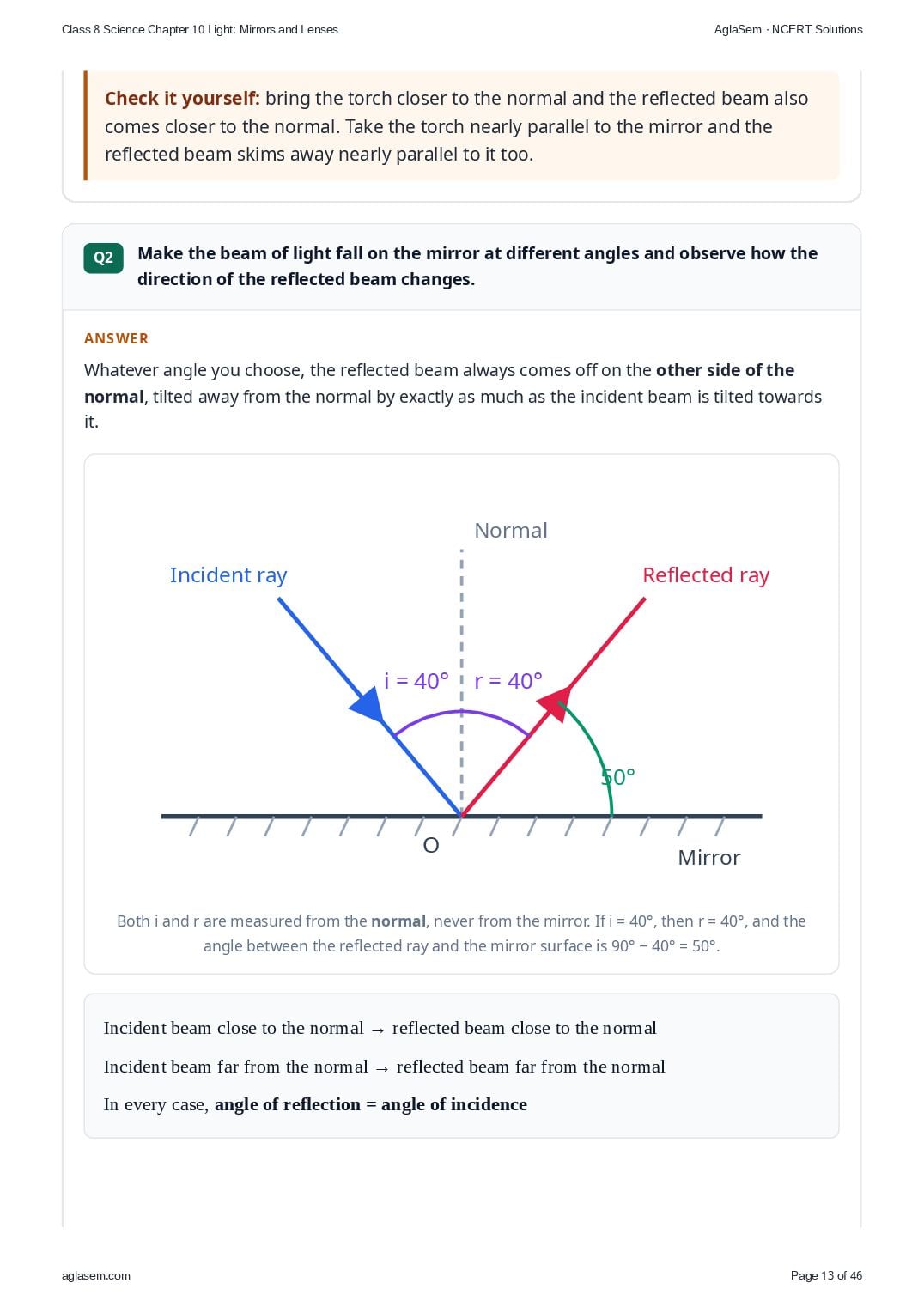
- Make the beam of light fall on the mirror at different angles and observe how the direction of the reflected beam changes.
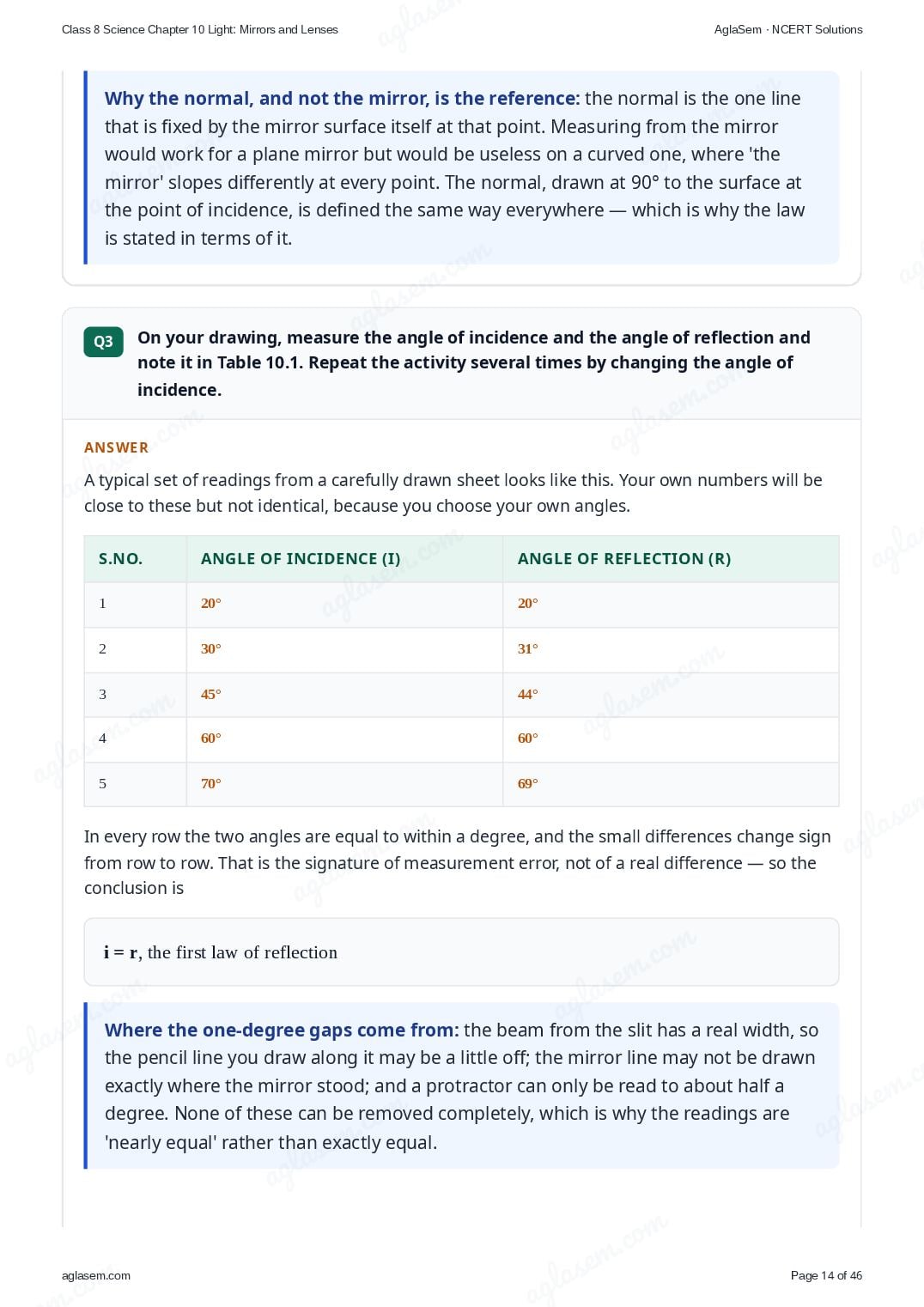
- On your drawing, measure the angle of incidence and the angle of reflection and note it in Table 10.1. Repeat the activity several times by changing the angle of incidence.
- Finally, let the incident beam fall on the mirror along the normal and observe the direction of the reflected beam. What would be the angle of incidence and angle of reflection in this case?
- Do you remember learning earlier that the light travels along a straight line?
- Now, bend the extended part of the sheet along the edge of the table (Fig. 10.10b). Do you still see the reflected beam on the extended portion?
- Flatten the paper again and observe.
- Are laws of reflection applicable to spherical mirrors also?
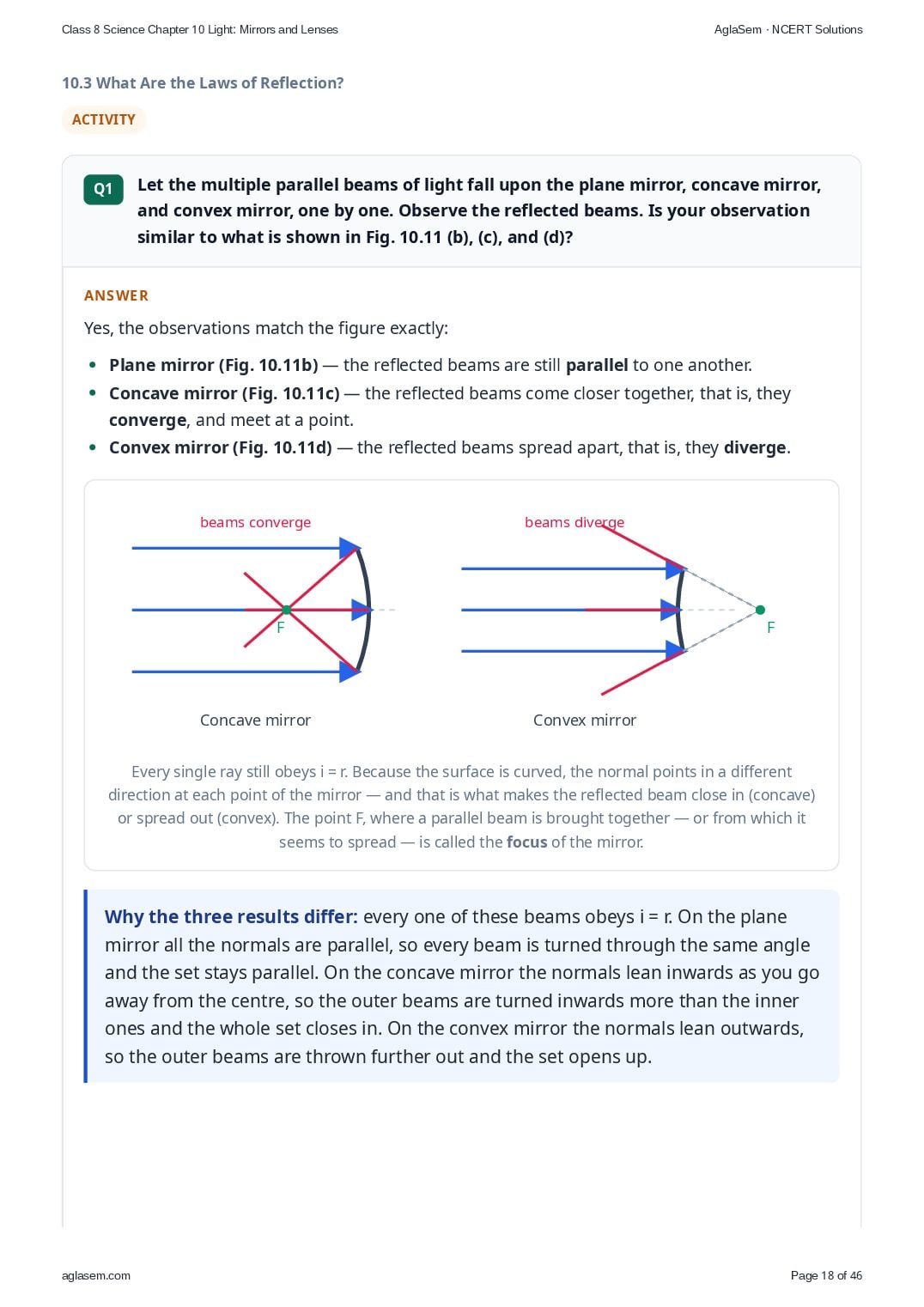
- Let the multiple parallel beams of light fall upon the plane mirror, concave mirror, and convex mirror, one by one. Observe the reflected beams. Is your observation similar to what is shown in Fig. 10.11 (b), (c), and (d)?
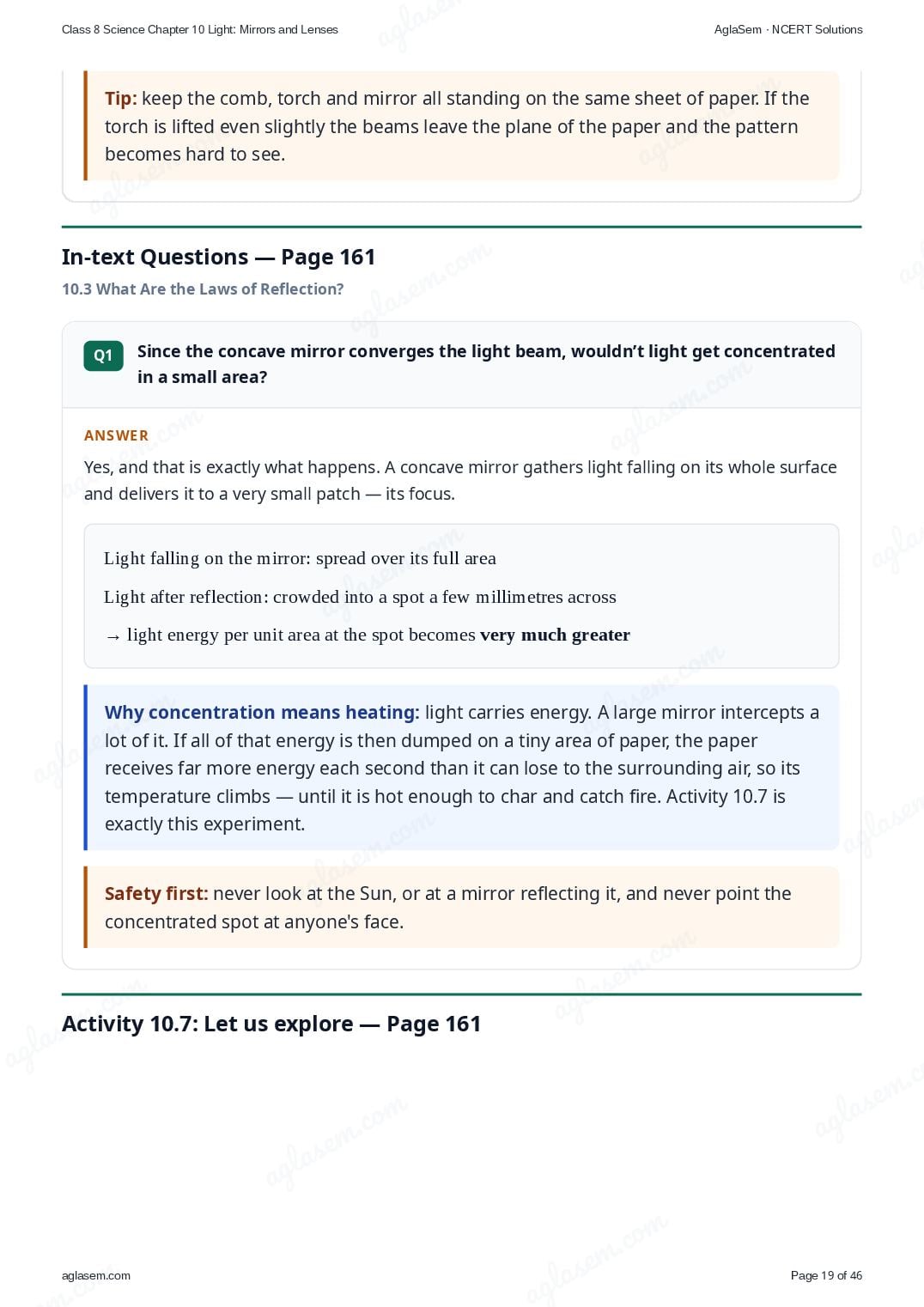
- Since the concave mirror converges the light beam, wouldn’t light get concentrated in a small area?
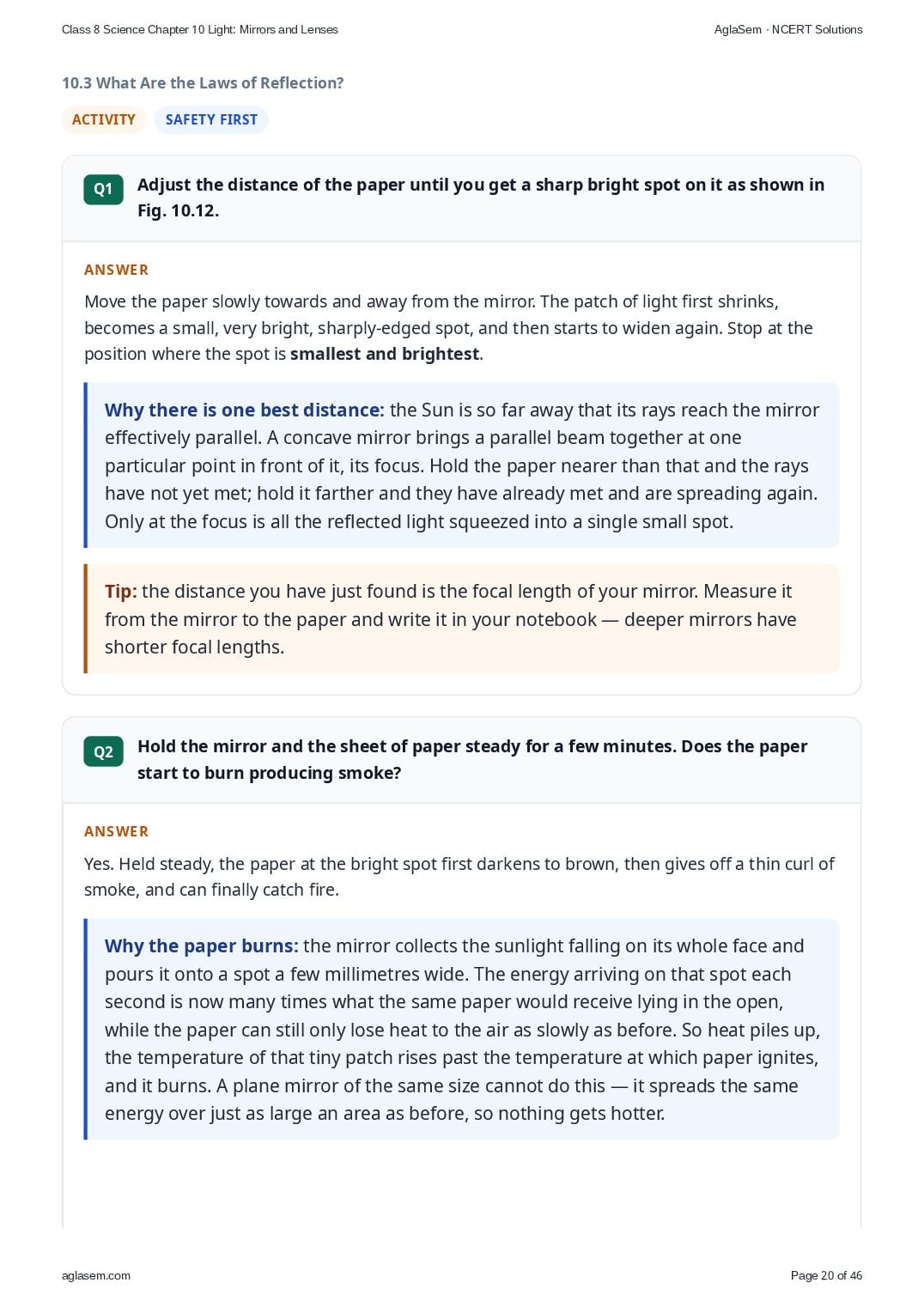
- Adjust the distance of the paper until you get a sharp bright spot on it as shown in Fig. 10.12.
- Hold the mirror and the sheet of paper steady for a few minutes. Does the paper start to burn producing smoke?
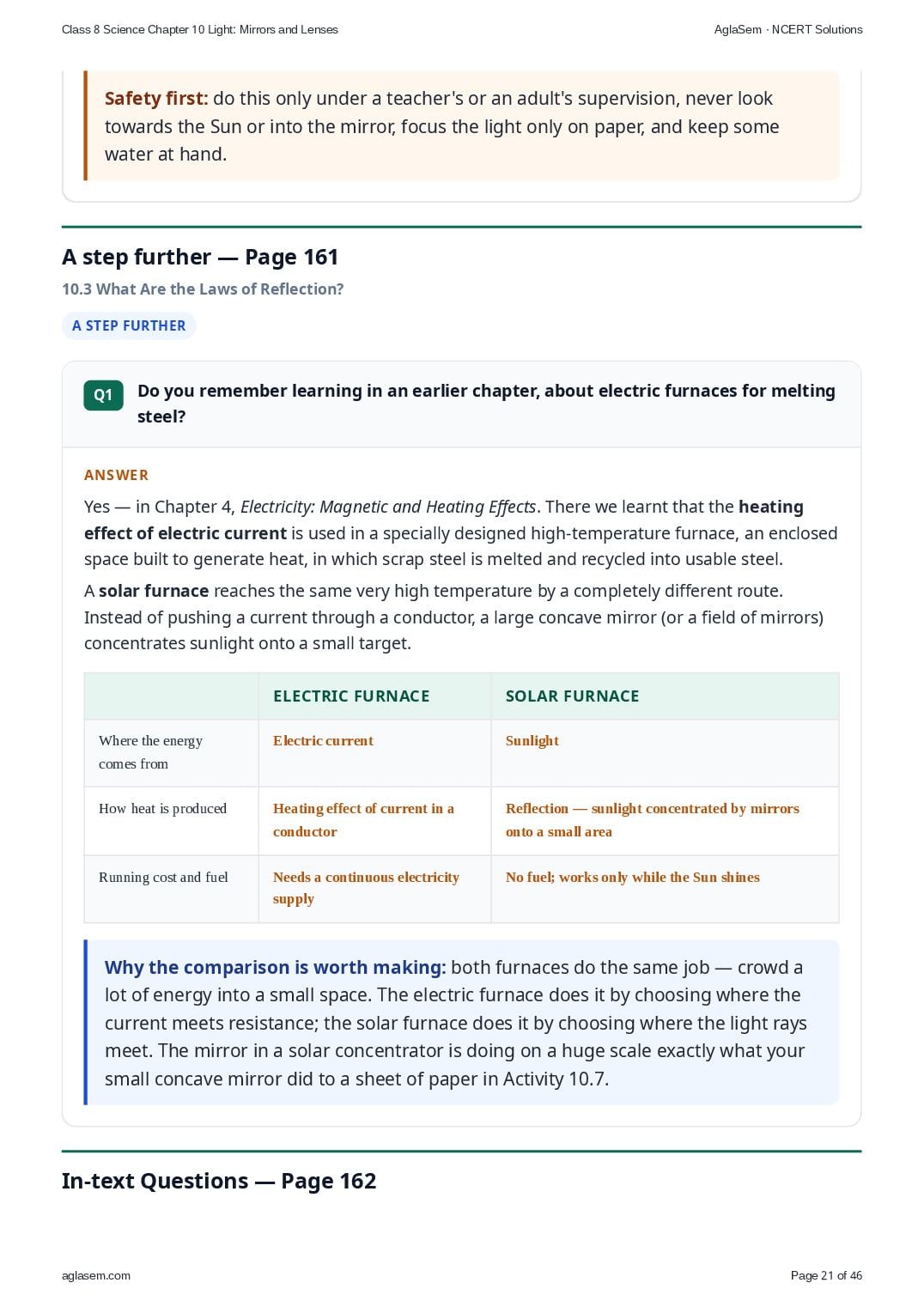
- Do you remember learning in an earlier chapter, about electric furnaces for melting steel?
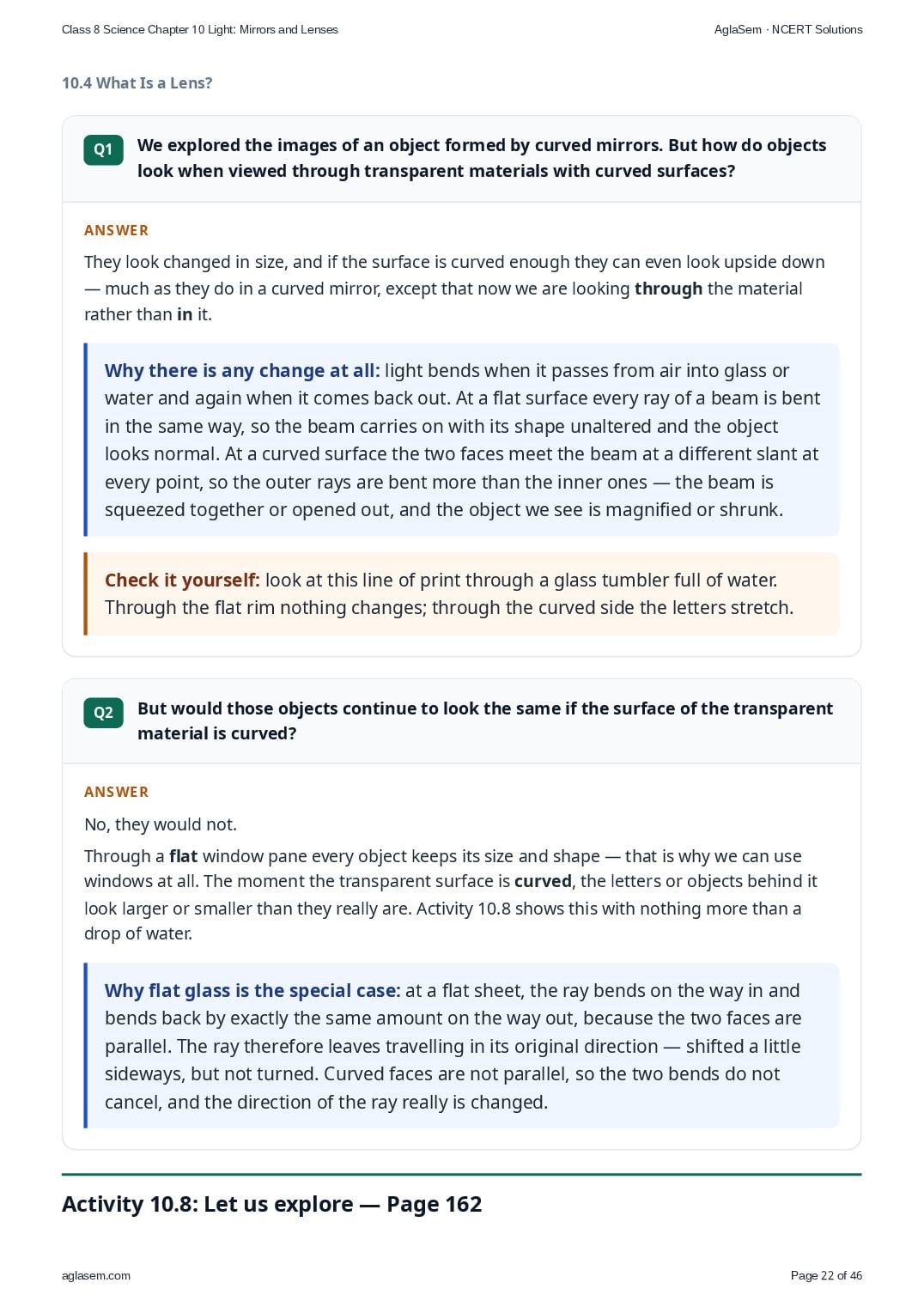
- We explored the images of an object formed by curved mirrors. But how do objects look when viewed through transparent materials with curved surfaces?
- But would those objects continue to look the same if the surface of the transparent material is curved?
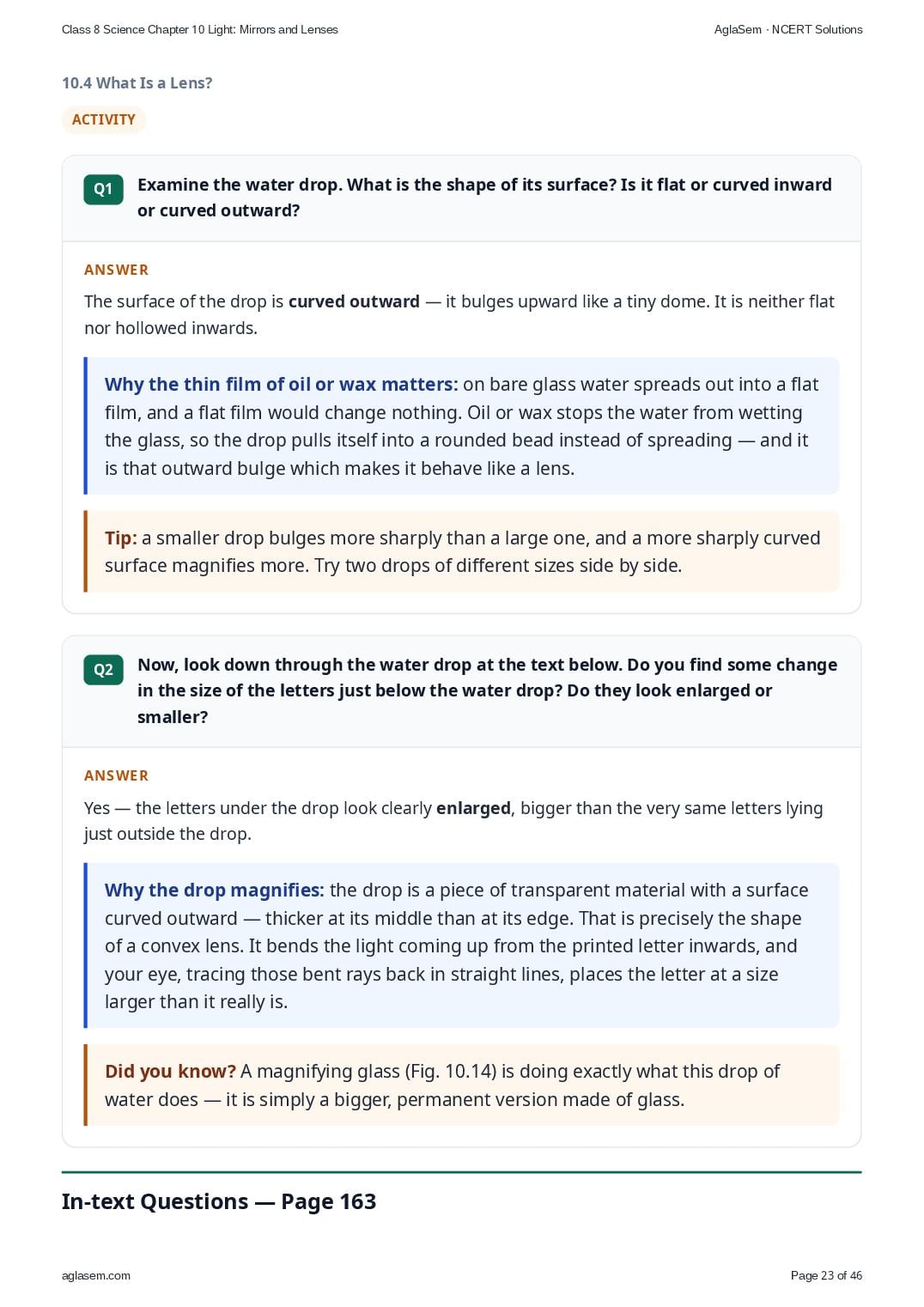
- Examine the water drop. What is the shape of its surface? Is it flat or curved inward or curved outward?
- Now, look down through the water drop at the text below. Do you find some change in the size of the letters just below the water drop? Do they look enlarged or smaller?
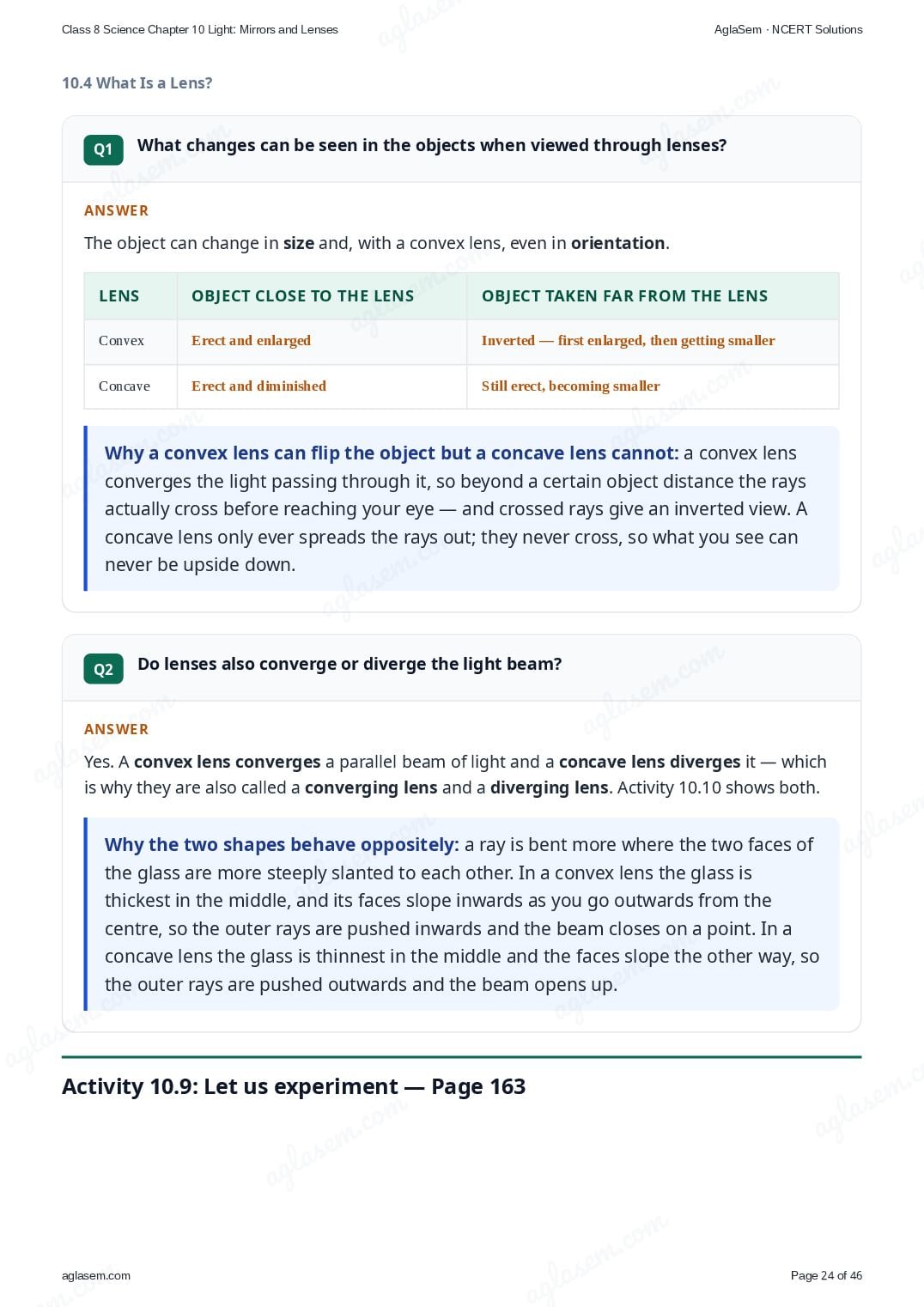
- What changes can be seen in the objects when viewed through lenses?
- Do lenses also converge or diverge the light beam?
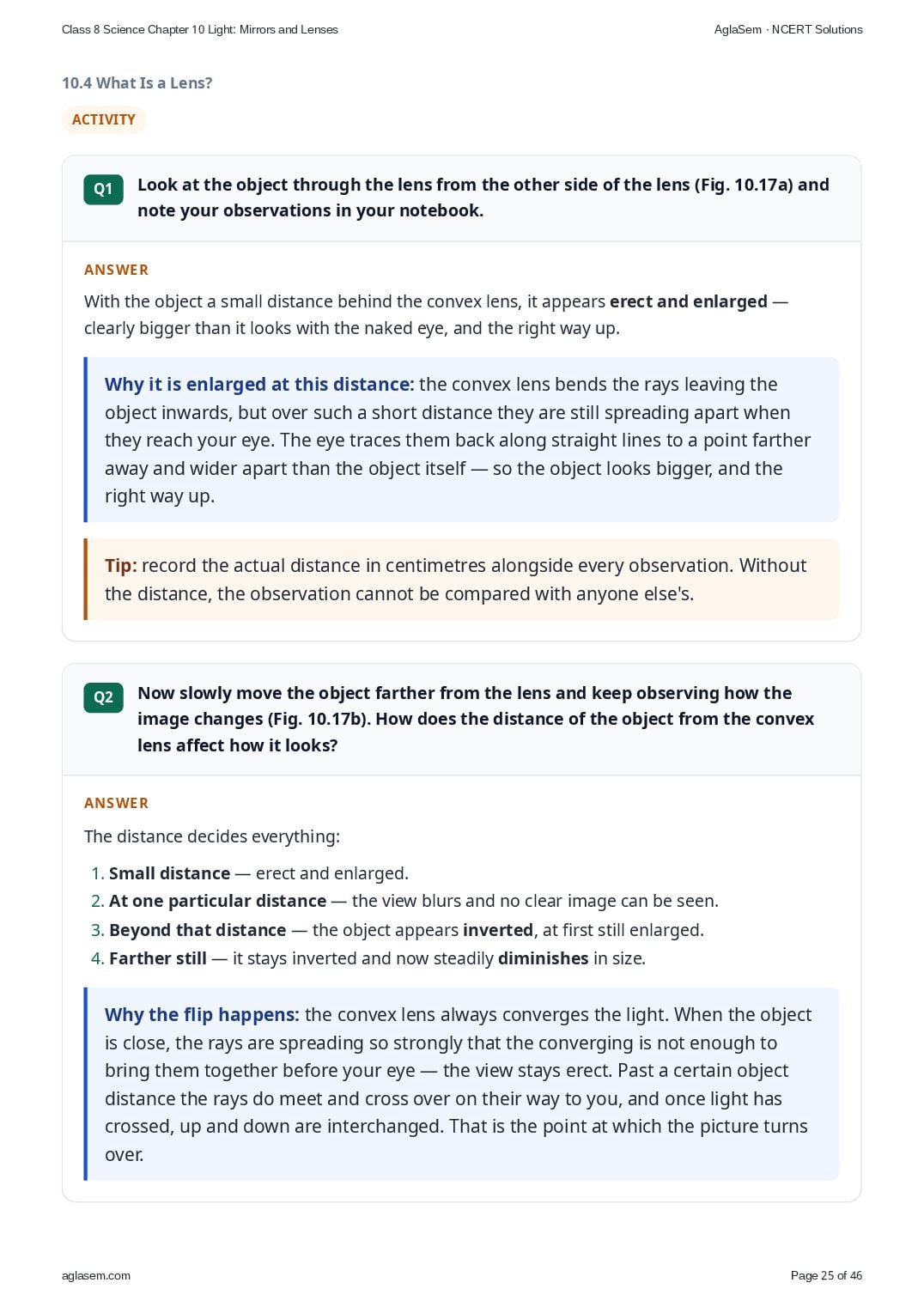
- Look at the object through the lens from the other side of the lens (Fig. 10.17a) and note your observations in your notebook.
- Now slowly move the object farther from the lens and keep observing how the image changes (Fig. 10.17b). How does the distance of the object from the convex lens affect how it looks?
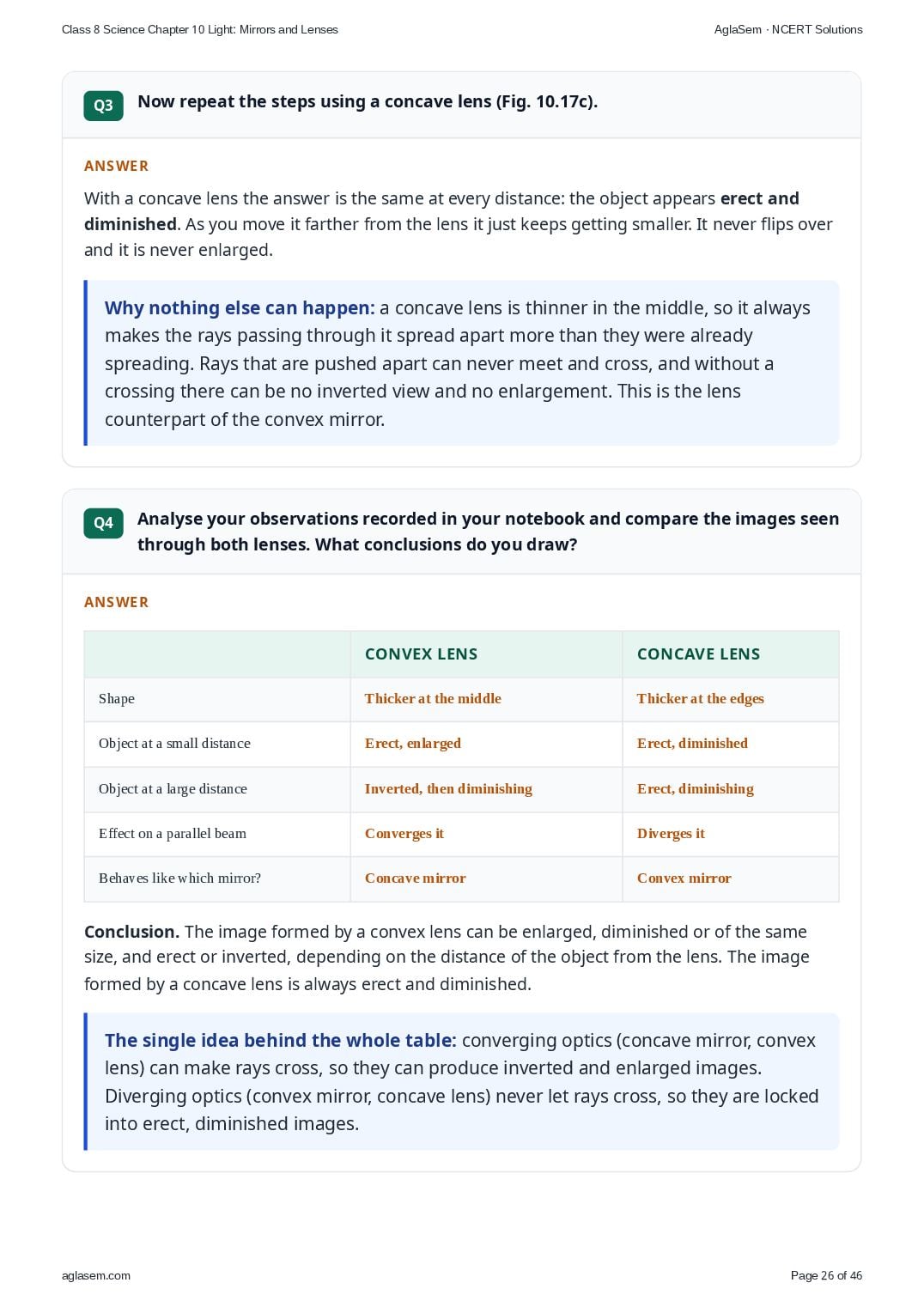
- Now repeat the steps using a concave lens (Fig. 10.17c).
- Analyse your observations recorded in your notebook and compare the images seen through both lenses. What conclusions do you draw?
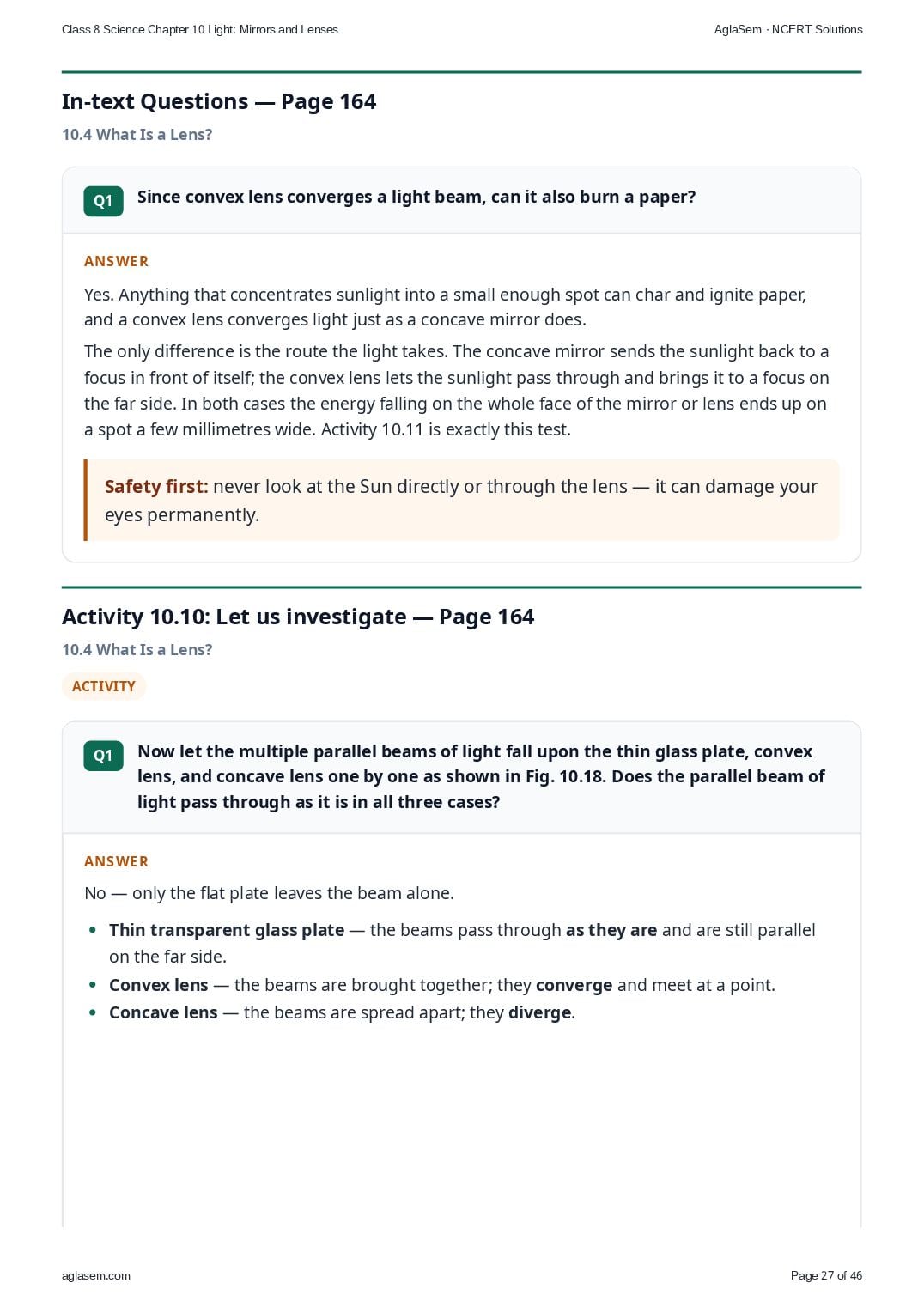
- Since convex lens converges a light beam, can it also burn a paper?
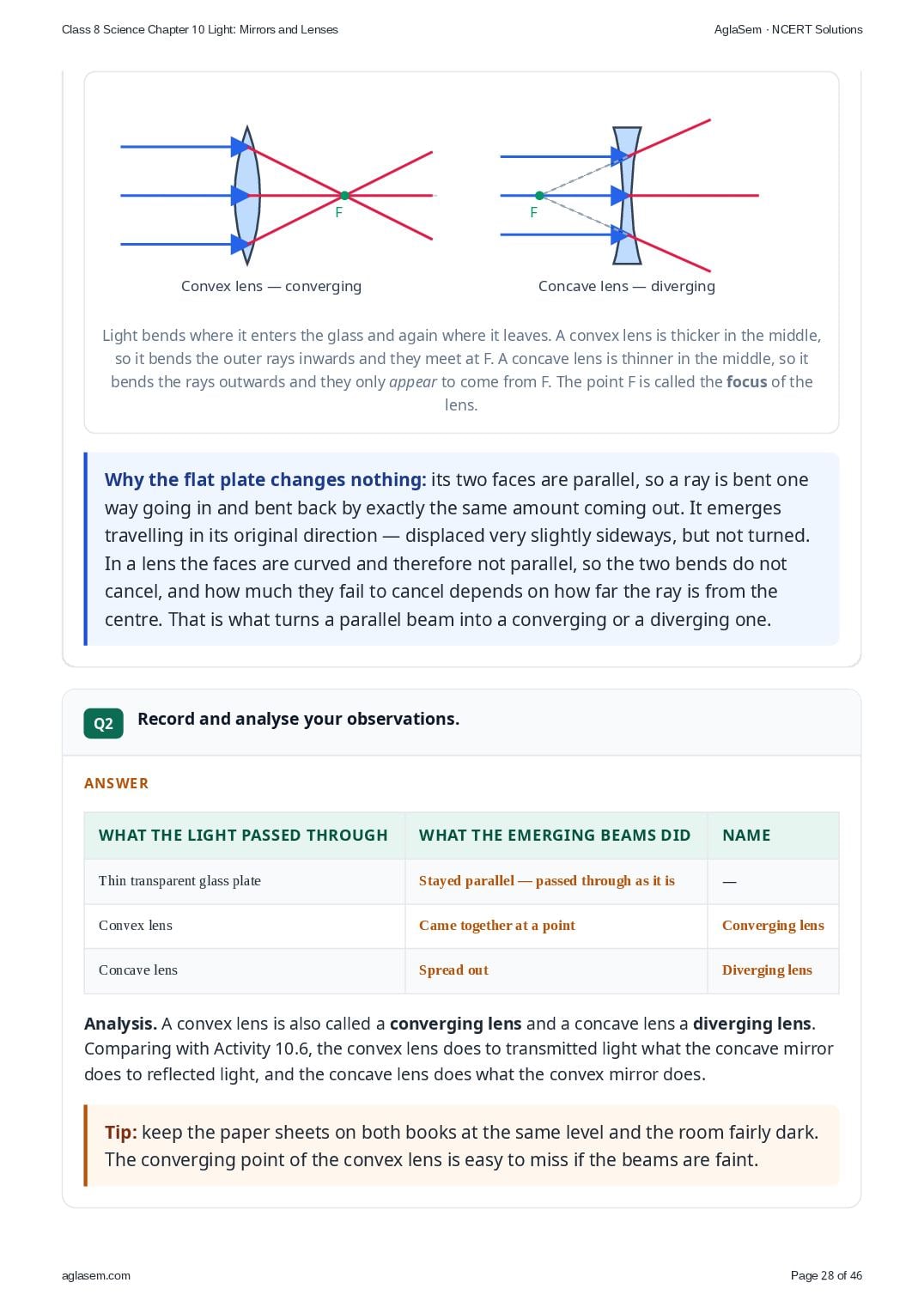
- Now let the multiple parallel beams of light fall upon the thin glass plate, convex lens, and concave lens one by one as shown in Fig. 10.18. Does the parallel beam of light pass through as it is in all three cases?
- Record and analyse your observations.
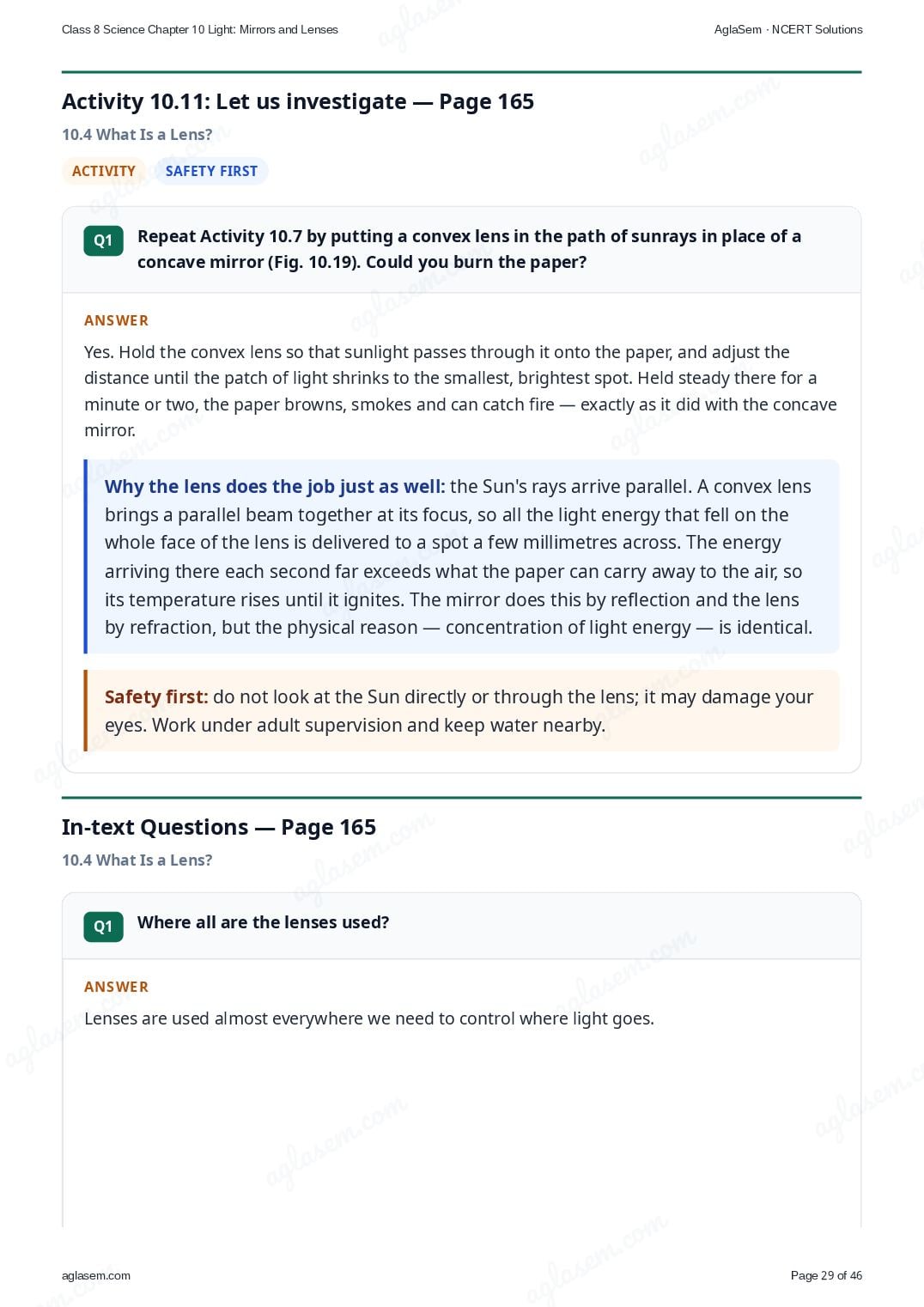
- Repeat Activity 10.7 by putting a convex lens in the path of sunrays in place of a concave mirror (Fig. 10.19). Could you burn the paper?
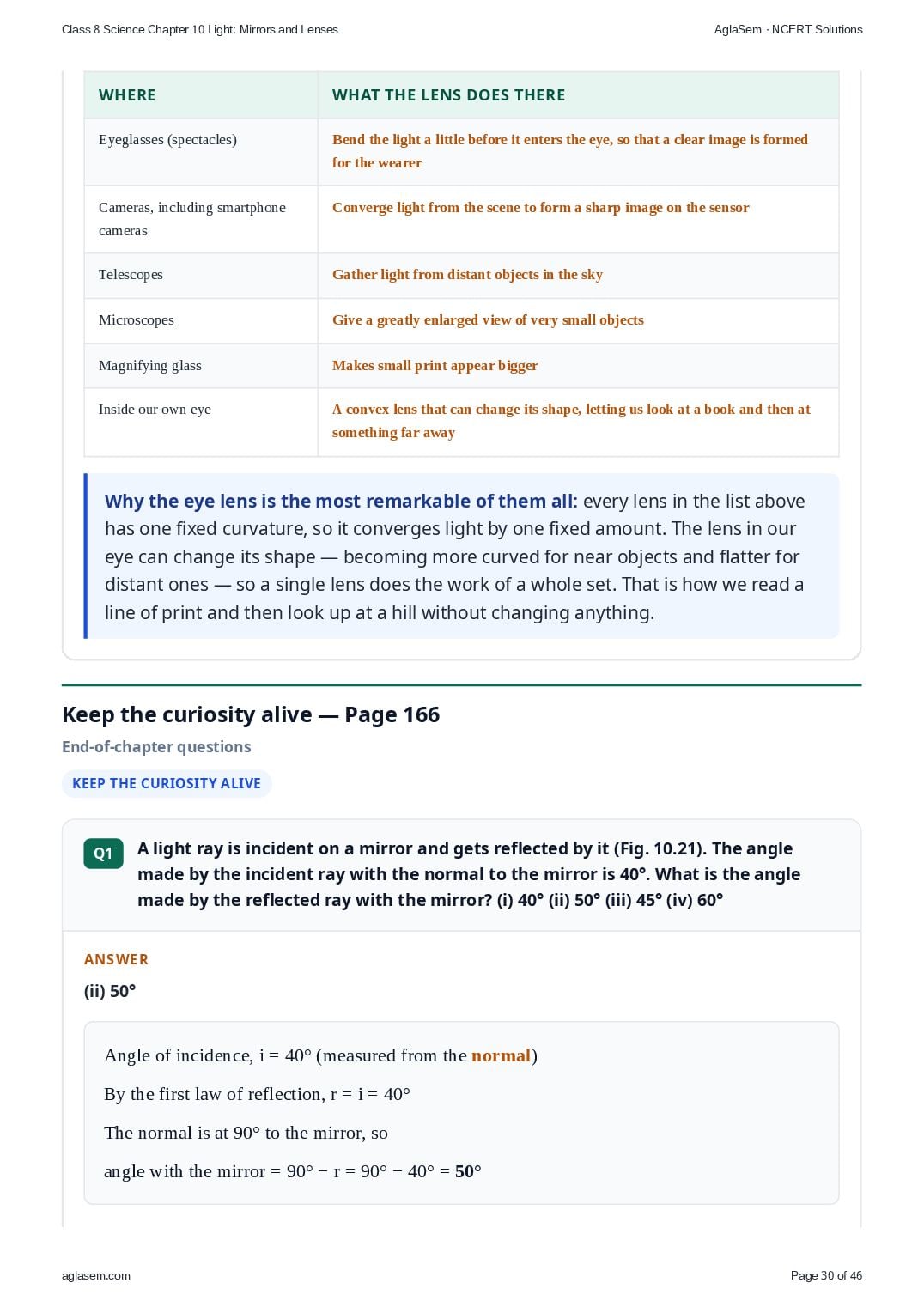
- Where all are the lenses used?
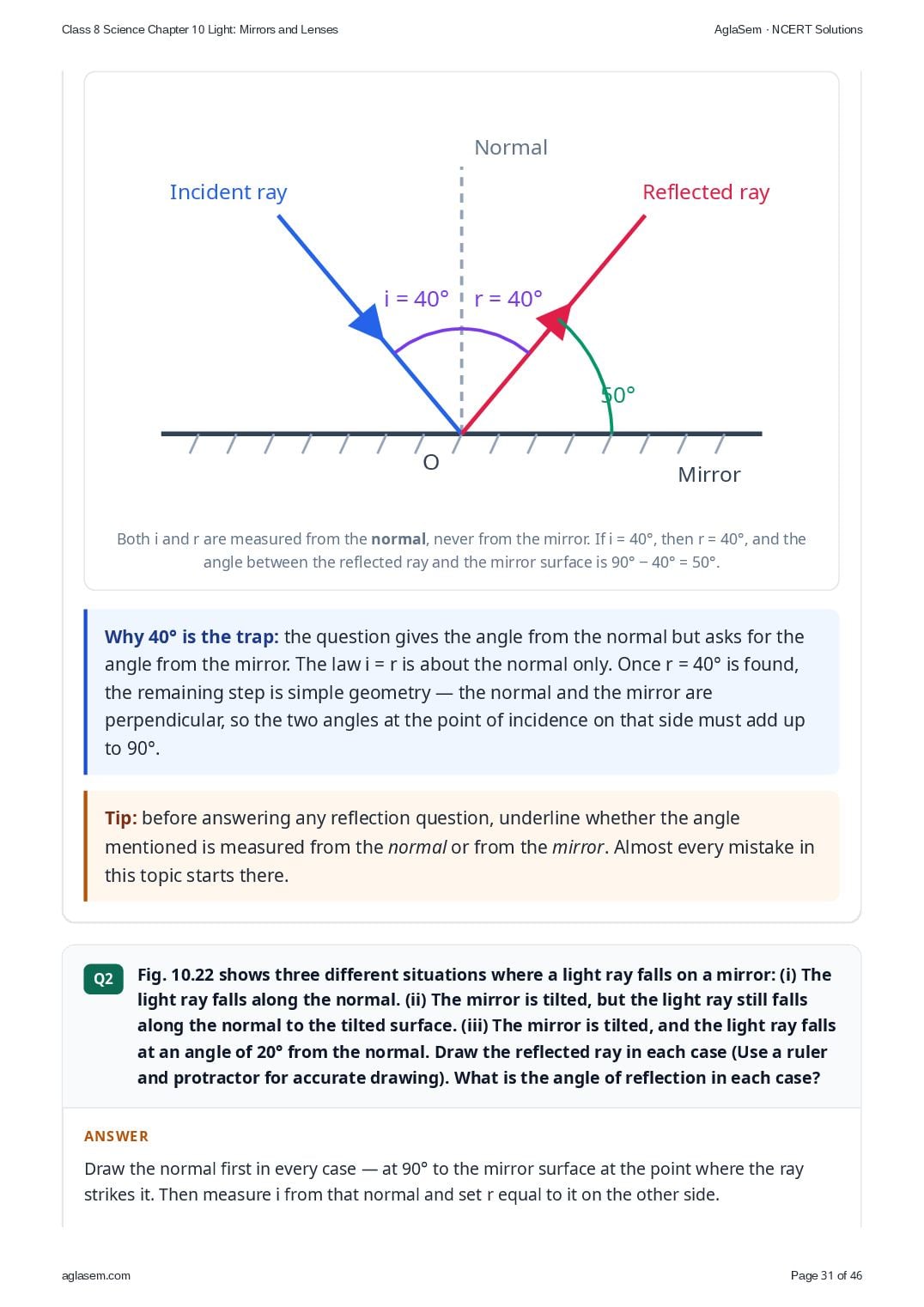
- A light ray is incident on a mirror and gets reflected by it (Fig. 10.21). The angle made by the incident ray with the normal to the mirror is 40°. What is the angle made by the reflected ray with the mirror? (i) 40° (ii) 50° (iii) 45° (iv) 60°
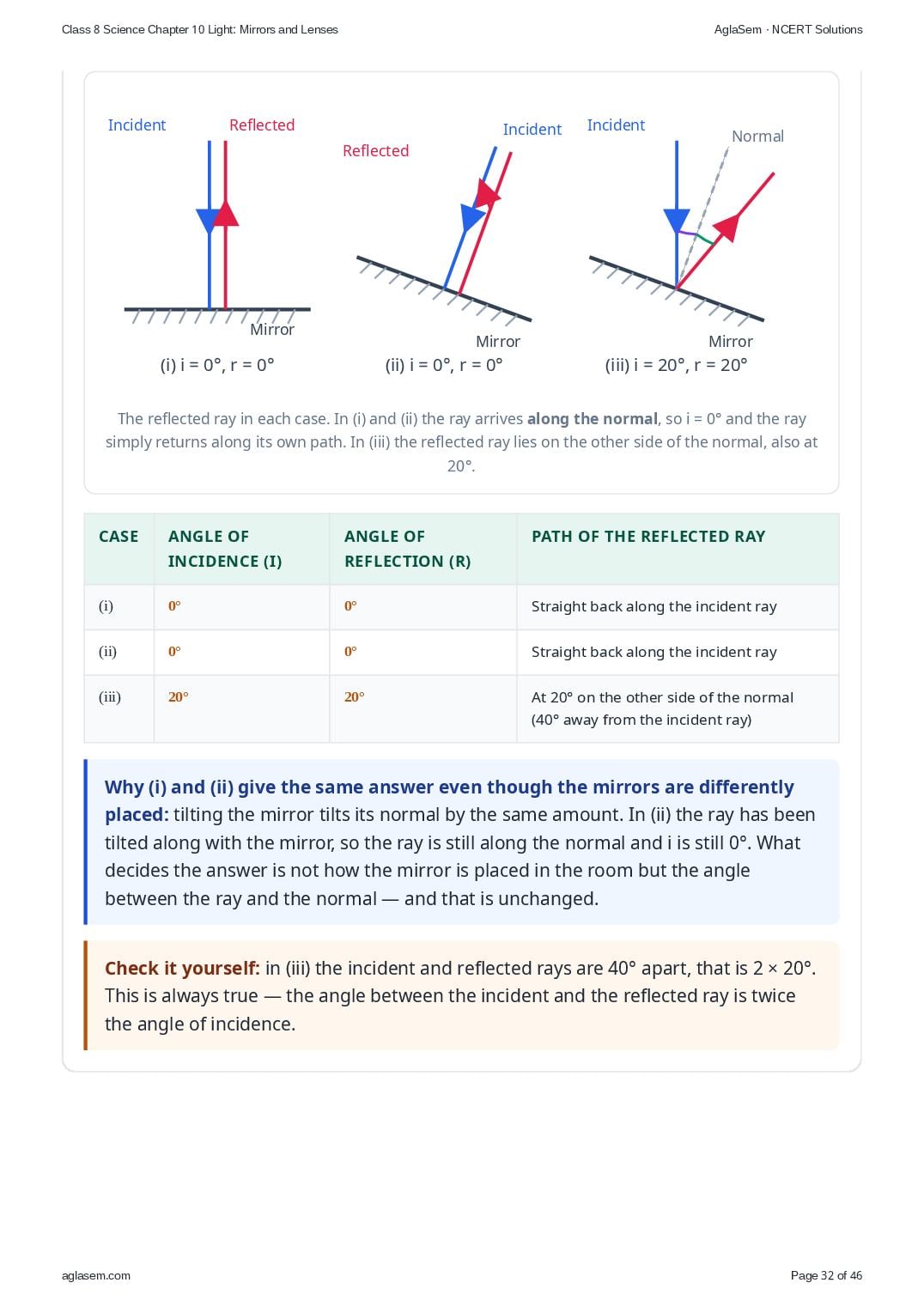
- Fig. 10.22 shows three different situations where a light ray falls on a mirror: (i) The light ray falls along the normal. (ii) The mirror is tilted, but the light ray still falls along the normal to the tilted surface. (iii) The mirror is tilted, and the light ray falls at an angle of 20° from the normal. Draw the reflected ray in each case (Use a ruler and protractor for accurate drawing). What is the angle of reflection in each case?
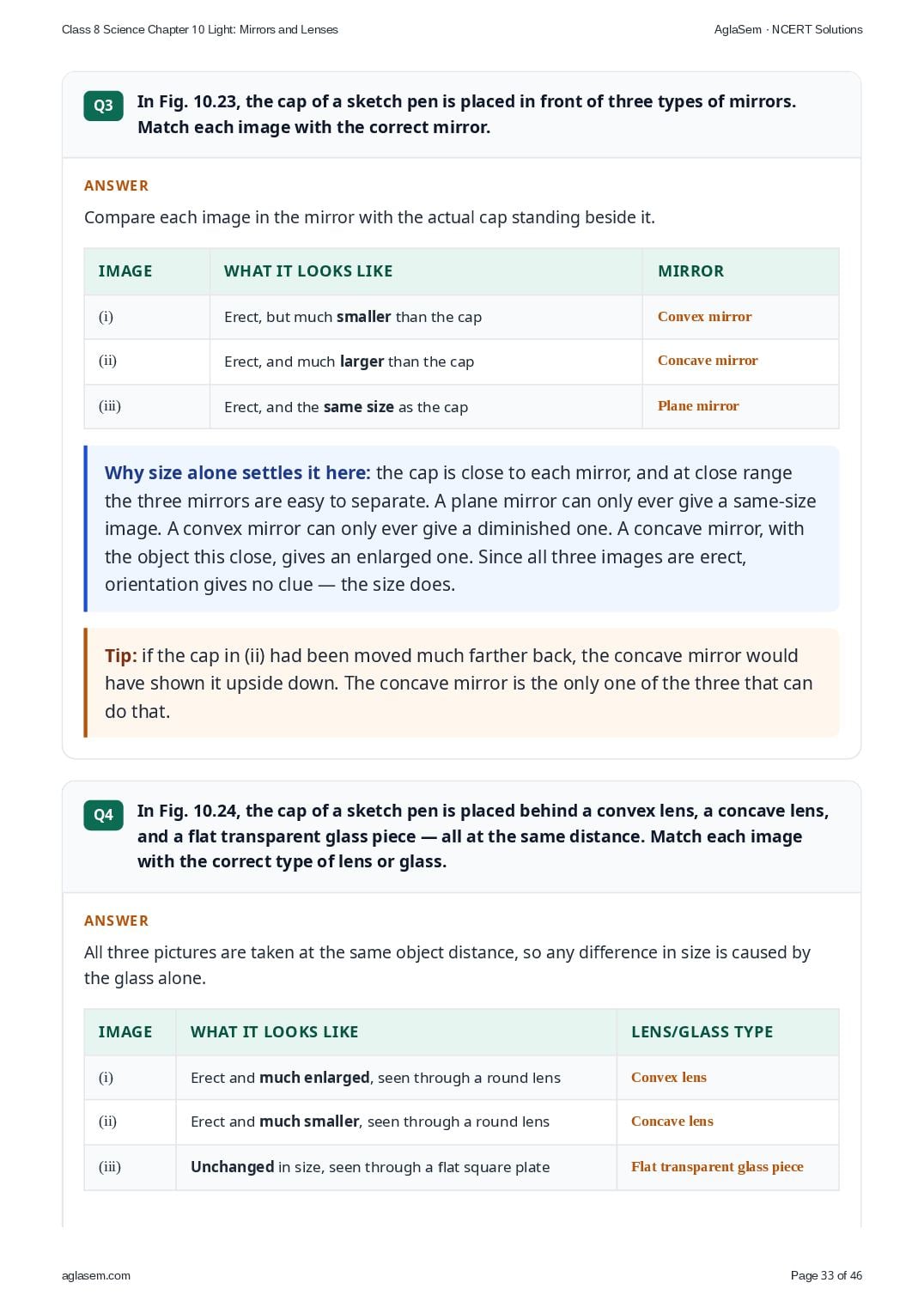
- In Fig. 10.23, the cap of a sketch pen is placed in front of three types of mirrors. Match each image with the correct mirror.
- In Fig. 10.24, the cap of a sketch pen is placed behind a convex lens, a concave lens, and a flat transparent glass piece — all at the same distance. Match each image with the correct type of lens or glass.
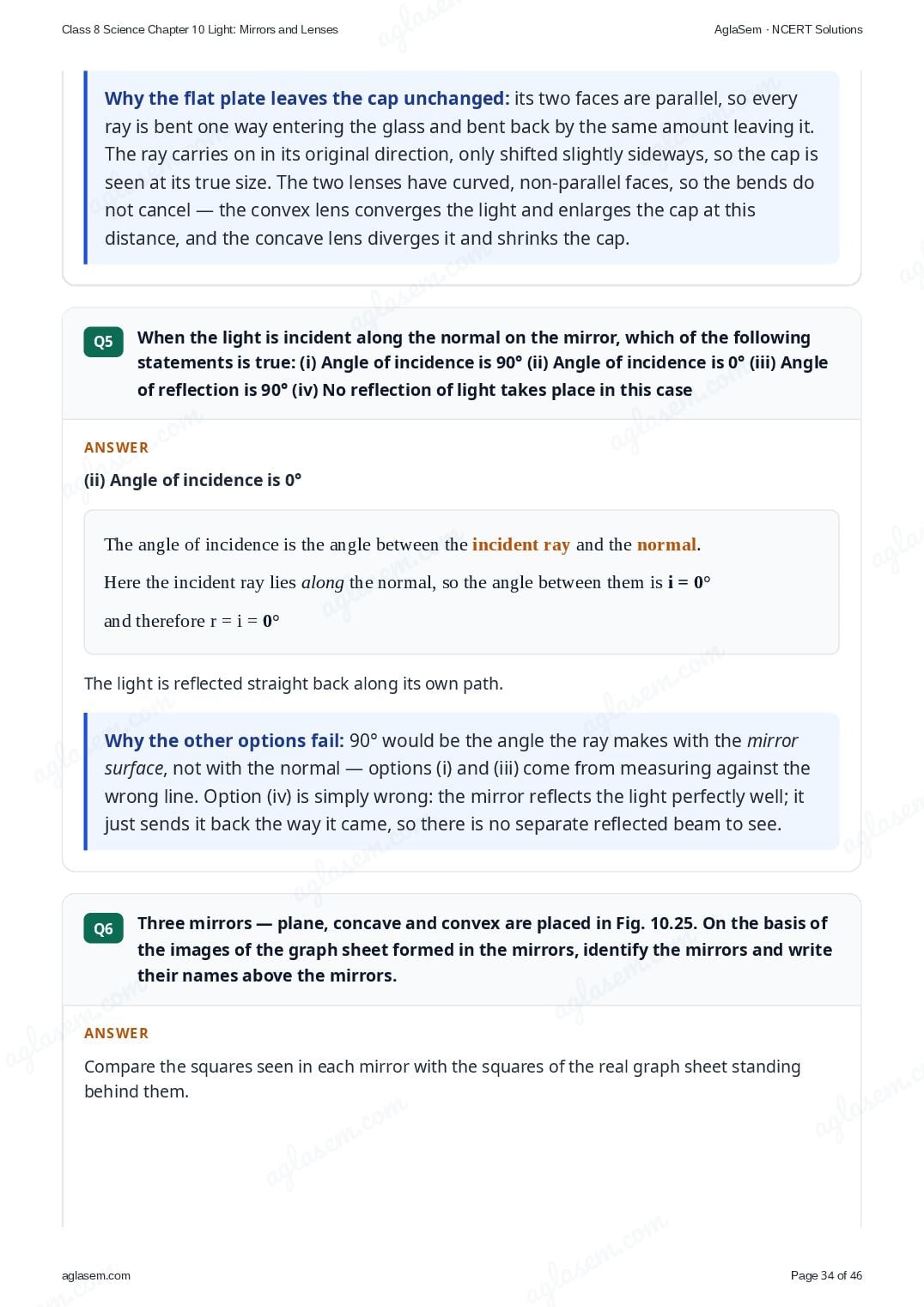
- When the light is incident along the normal on the mirror, which of the following statements is true: (i) Angle of incidence is 90° (ii) Angle of incidence is 0° (iii) Angle of reflection is 90° (iv) No reflection of light takes place in this case
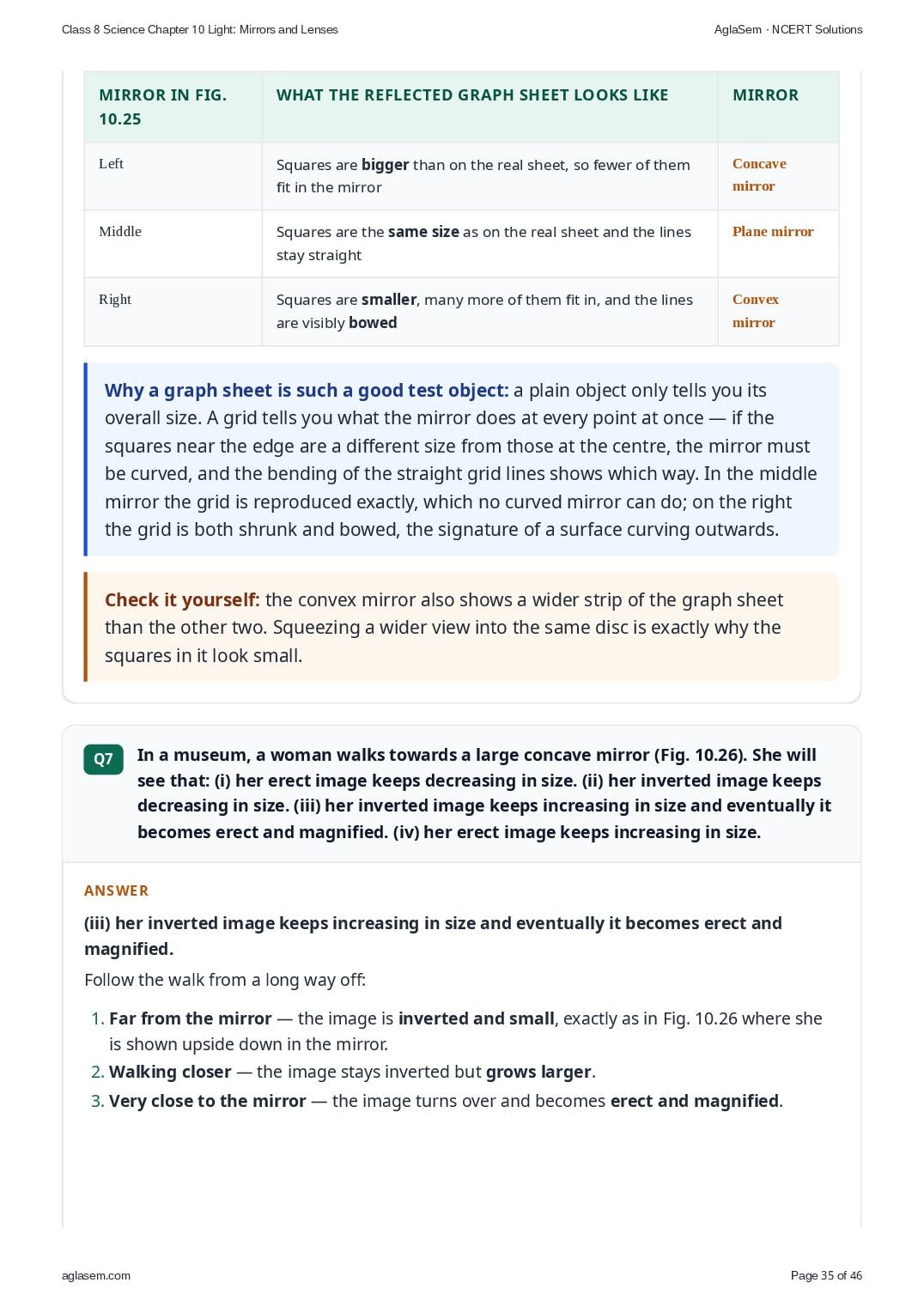
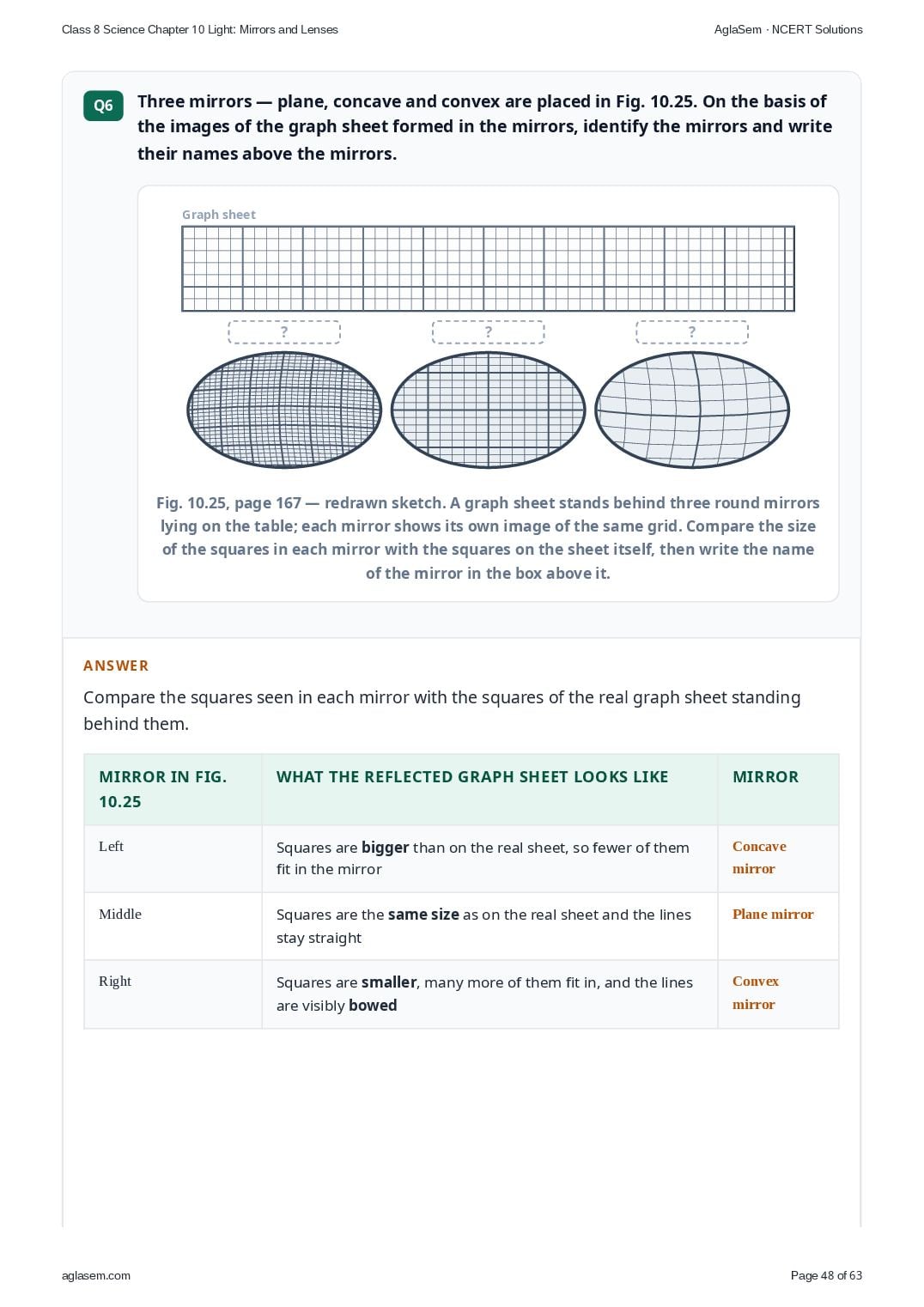
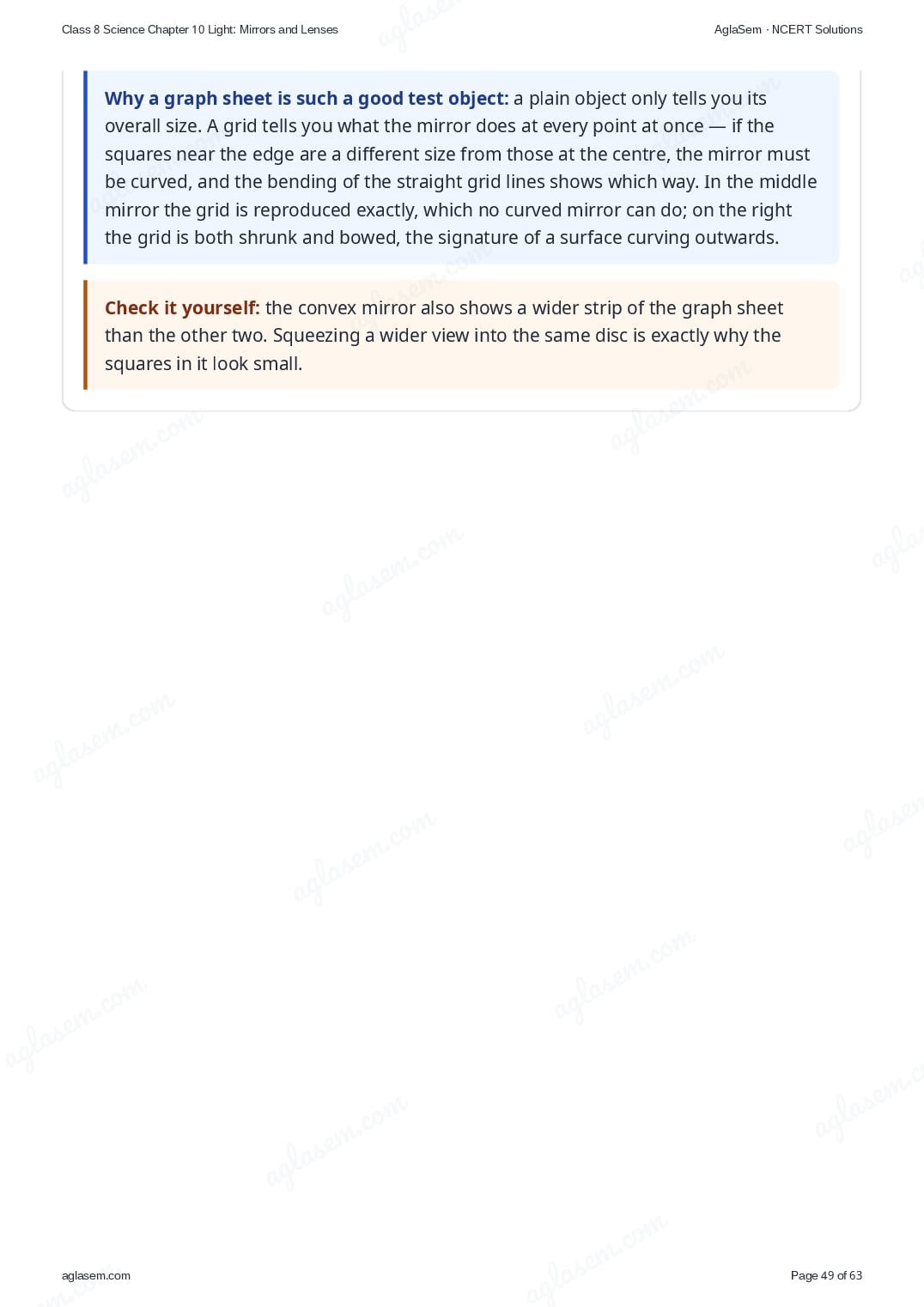
- Three mirrors — plane, concave and convex are placed in Fig. 10.25. On the basis of the images of the graph sheet formed in the mirrors, identify the mirrors and write their names above the mirrors.
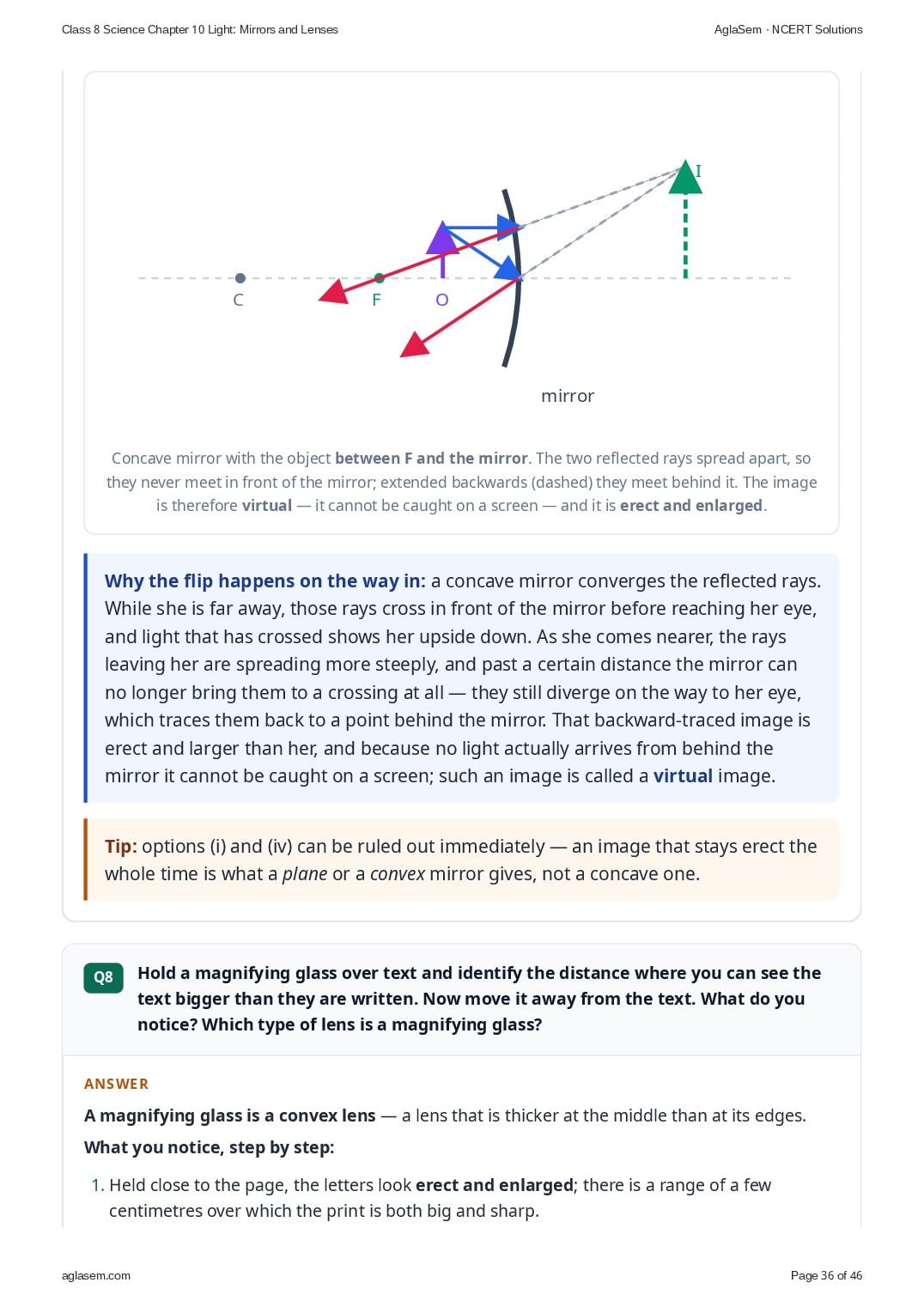
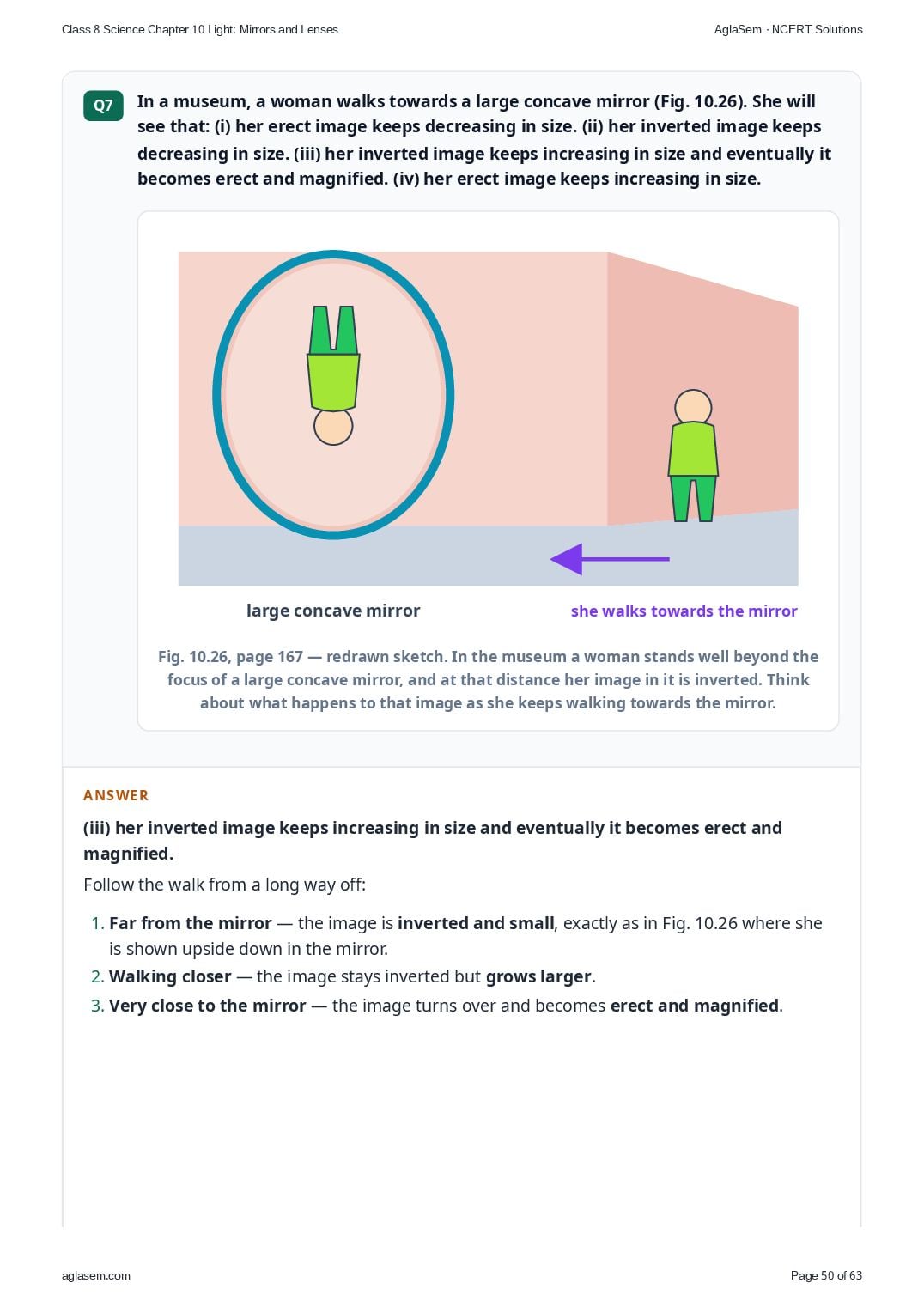
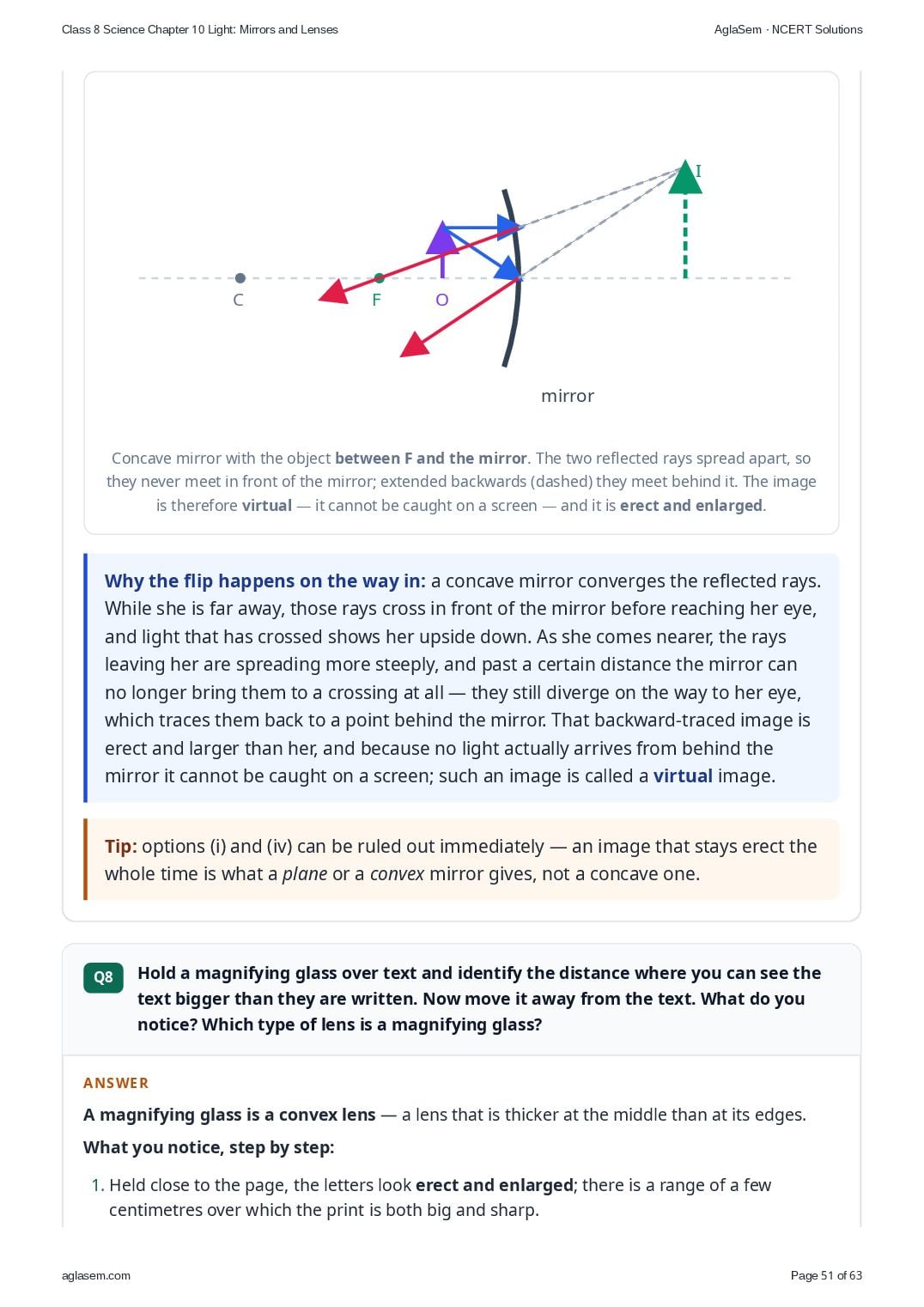
- In a museum, a woman walks towards a large concave mirror (Fig. 10.26). She will see that: (i) her erect image keeps decreasing in size. (ii) her inverted image keeps decreasing in size. (iii) her inverted image keeps increasing in size and eventually it becomes erect and magnified. (iv) her erect image keeps increasing in size.
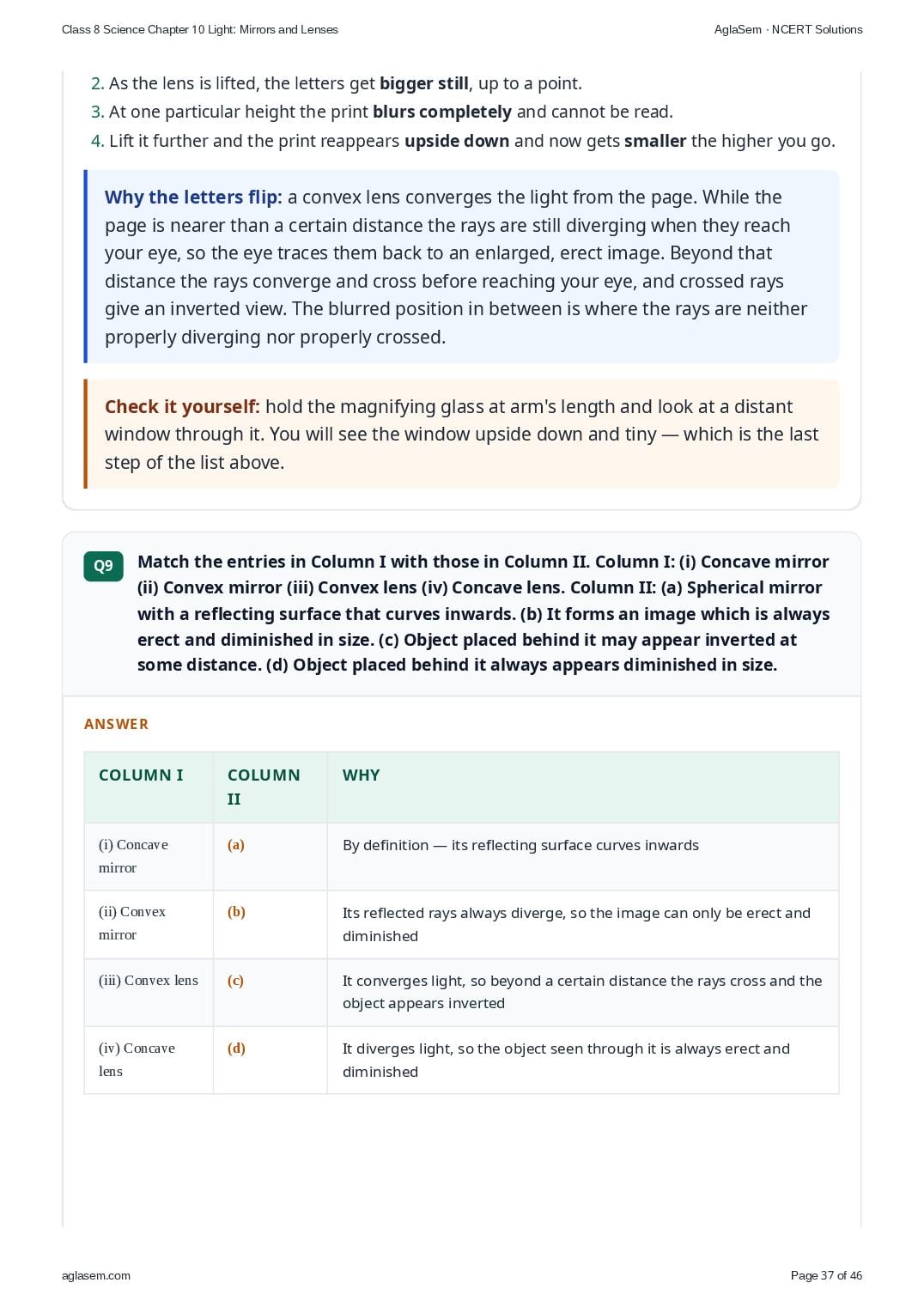
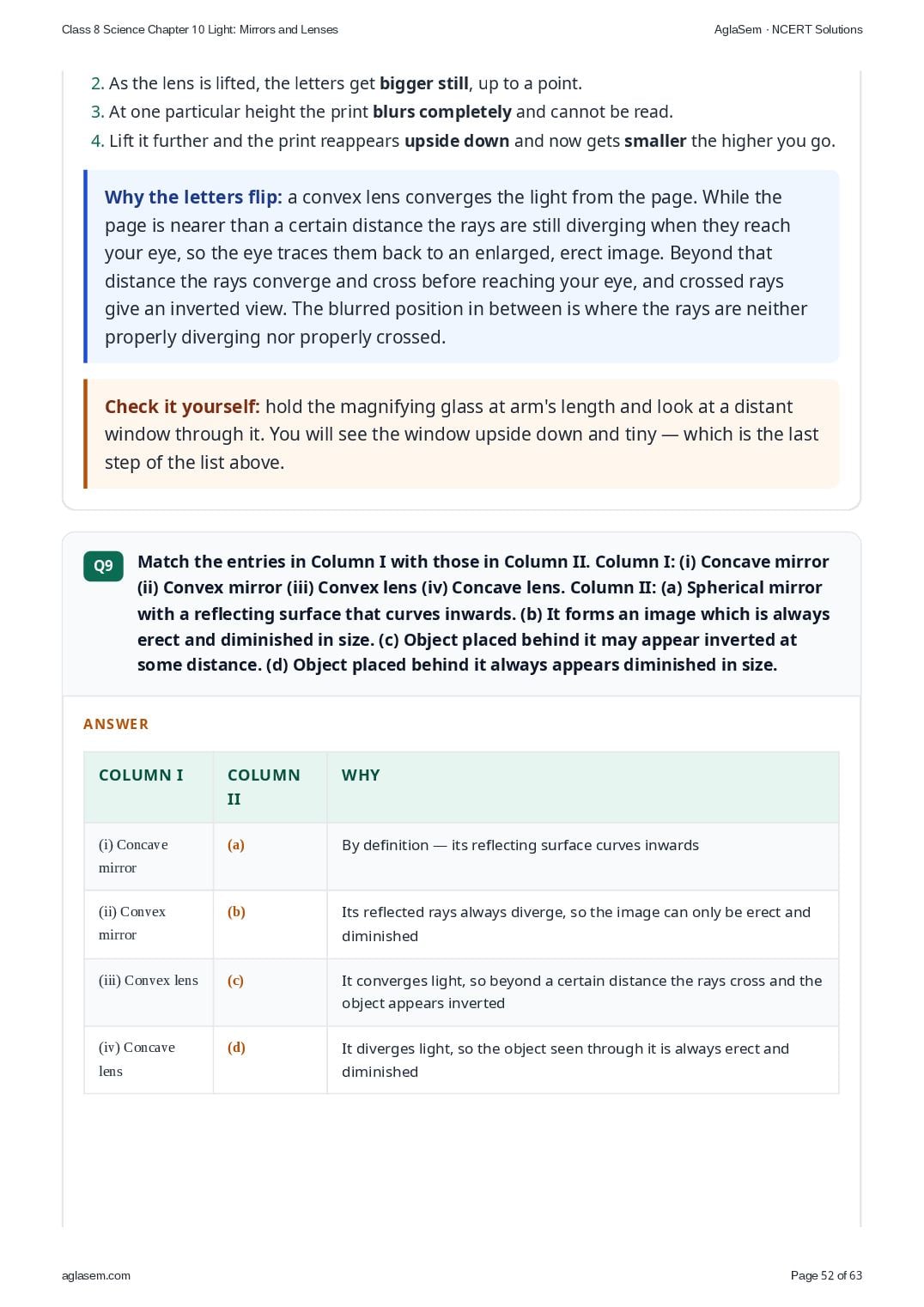
- Hold a magnifying glass over text and identify the distance where you can see the text bigger than they are written. Now move it away from the text. What do you notice? Which type of lens is a magnifying glass?
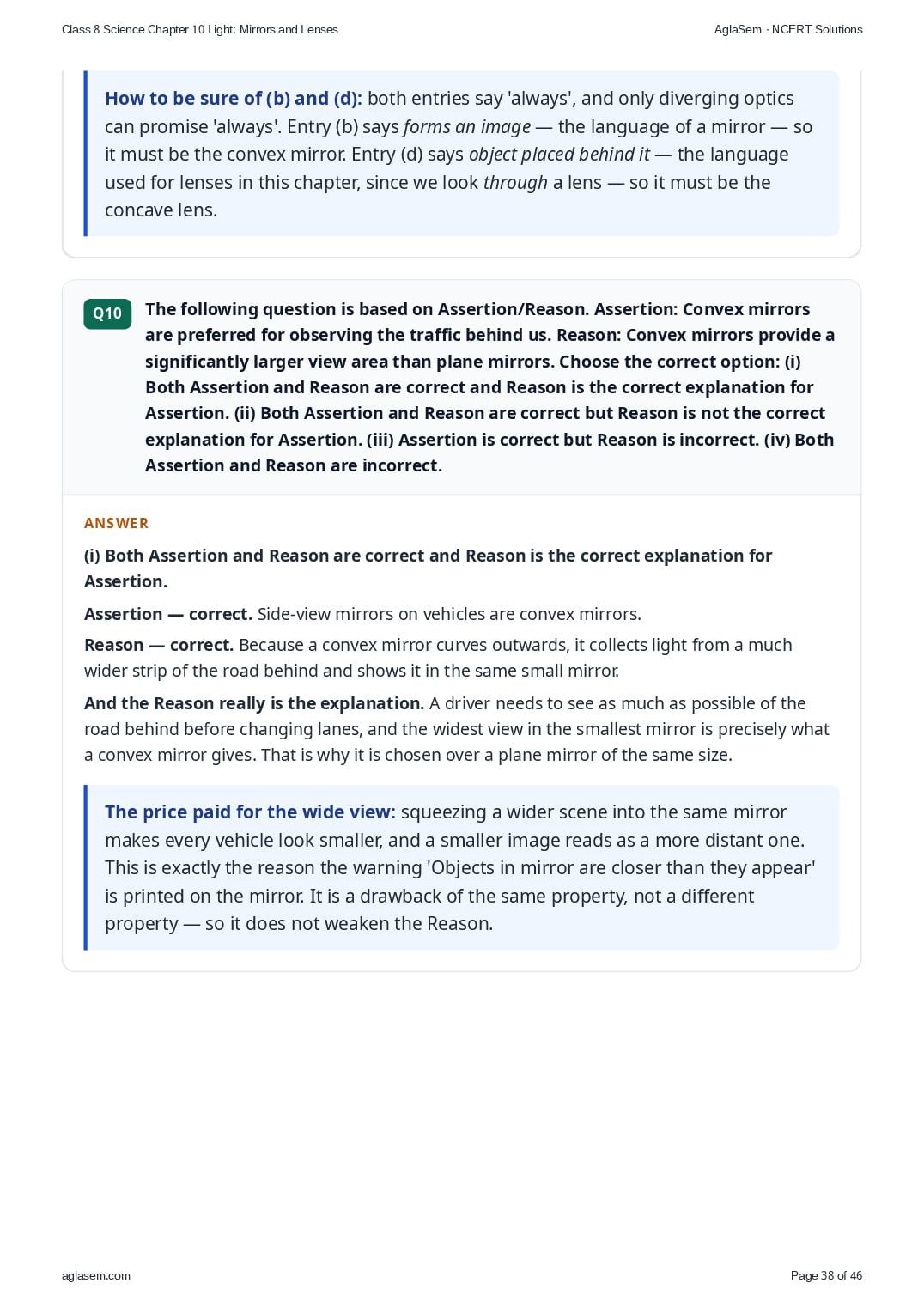
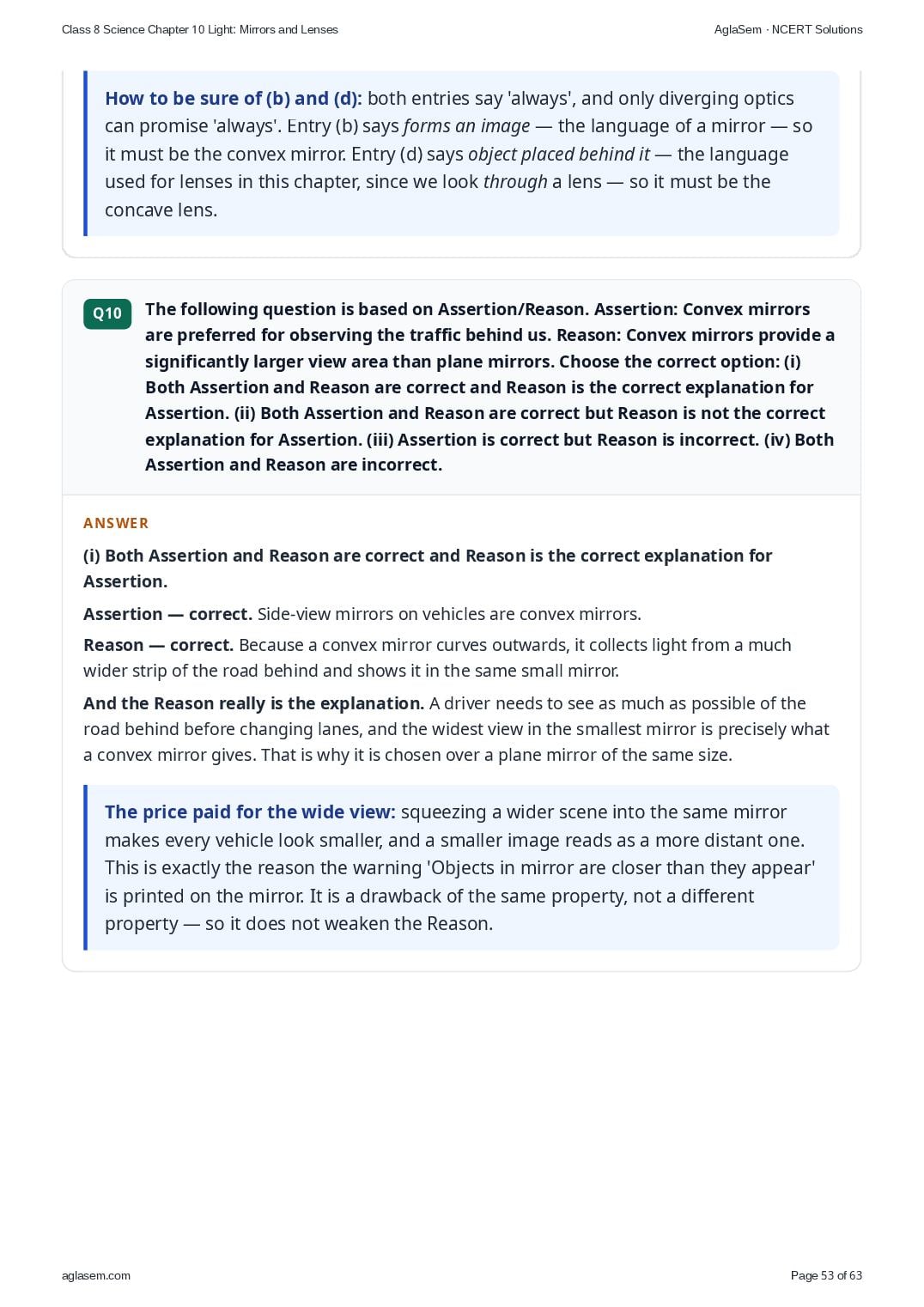
- Match the entries in Column I with those in Column II. Column I: (i) Concave mirror (ii) Convex mirror (iii) Convex lens (iv) Concave lens. Column II: (a) Spherical mirror with a reflecting surface that curves inwards. (b) It forms an image which is always erect and diminished in size. (c) Object placed behind it may appear inverted at some distance. (d) Object placed behind it always appears diminished in size.
- The following question is based on Assertion/Reason. Assertion: Convex mirrors are preferred for observing the traffic behind us. Reason: Convex mirrors provide a significantly larger view area than plane mirrors. Choose the correct option: (i) Both Assertion and Reason are correct and Reason is the correct explanation for Assertion. (ii) Both Assertion and Reason are correct but Reason is not the correct explanation for Assertion. (iii) Assertion is correct but Reason is incorrect. (iv) Both Assertion and Reason are incorrect.
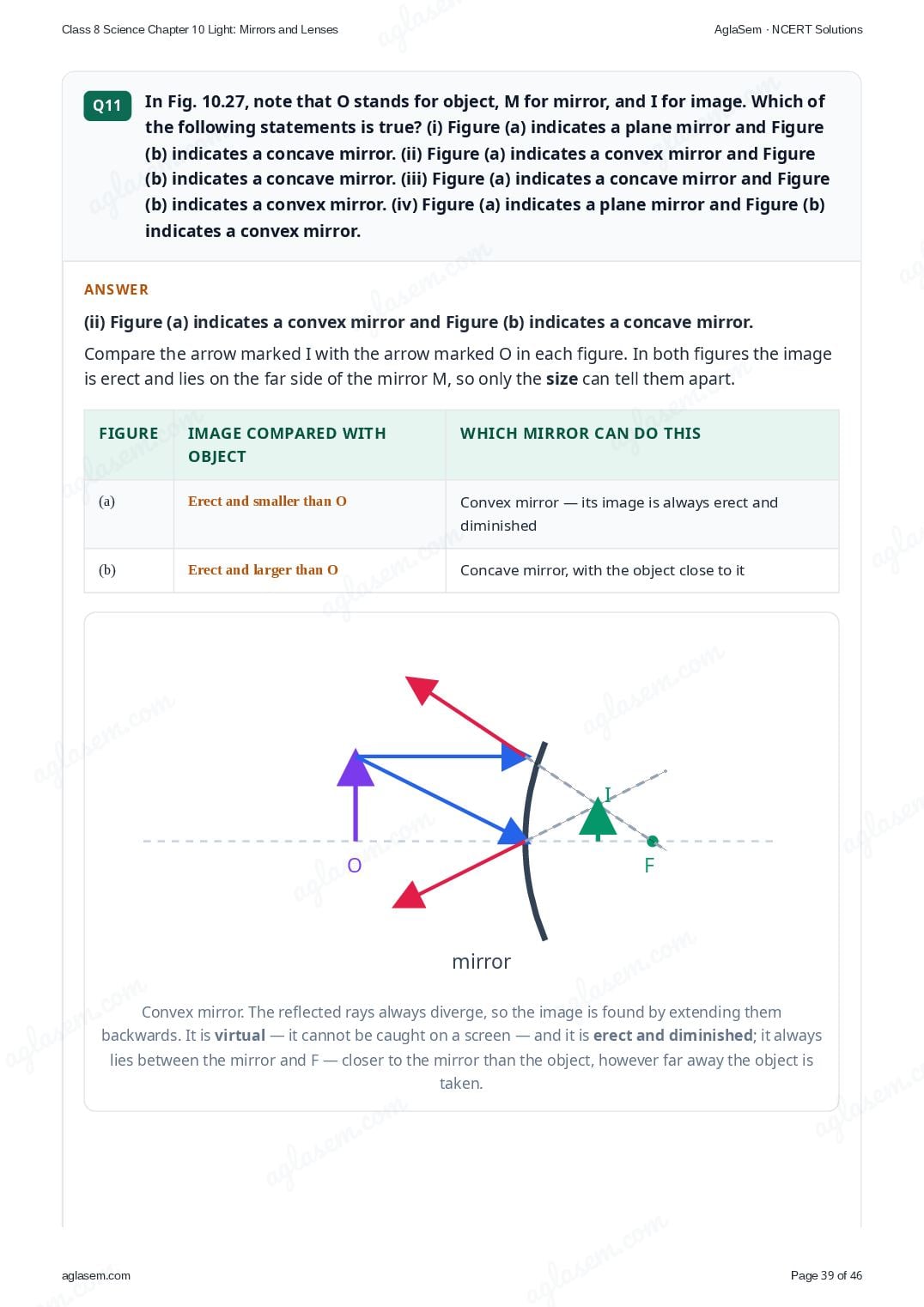
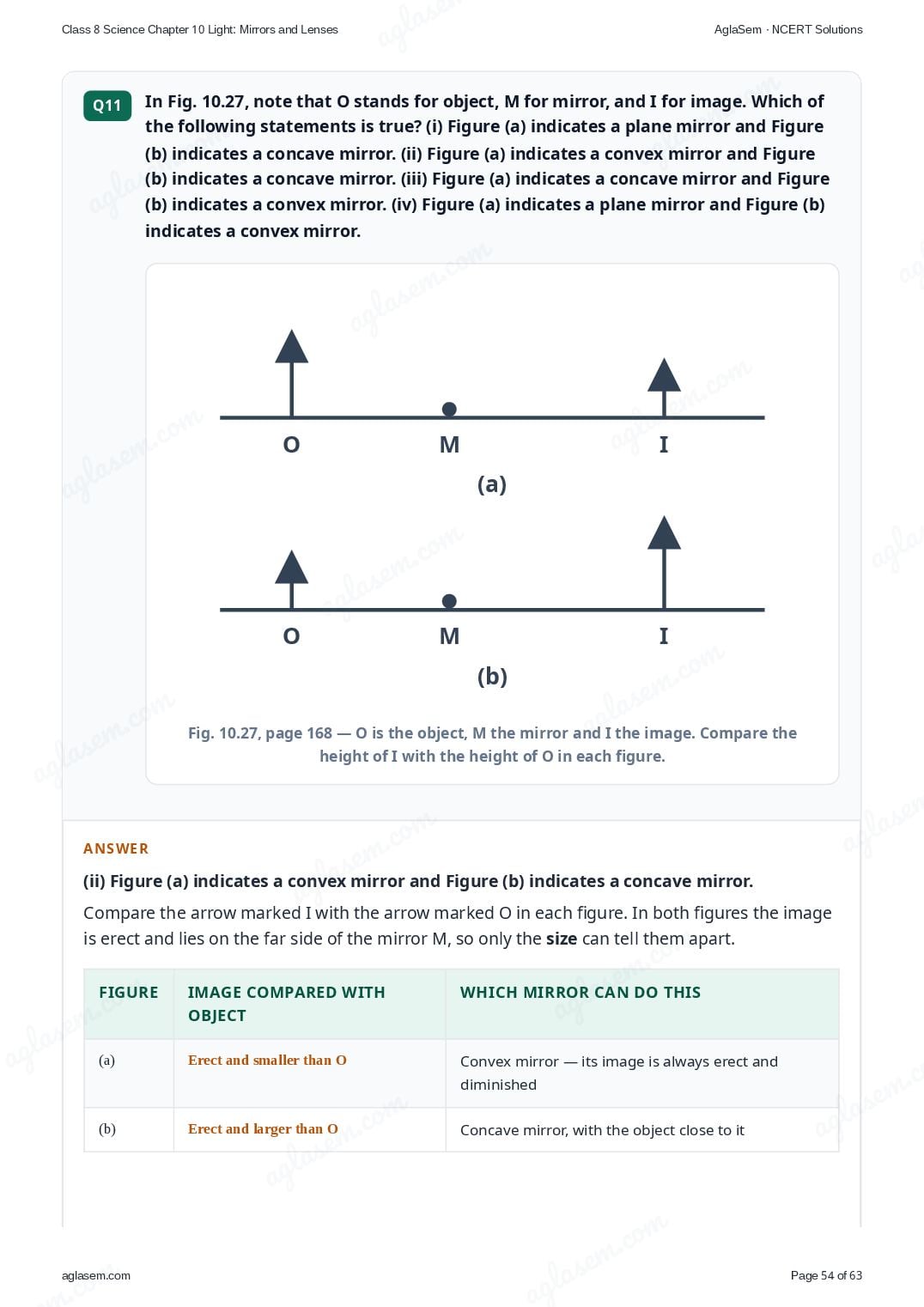
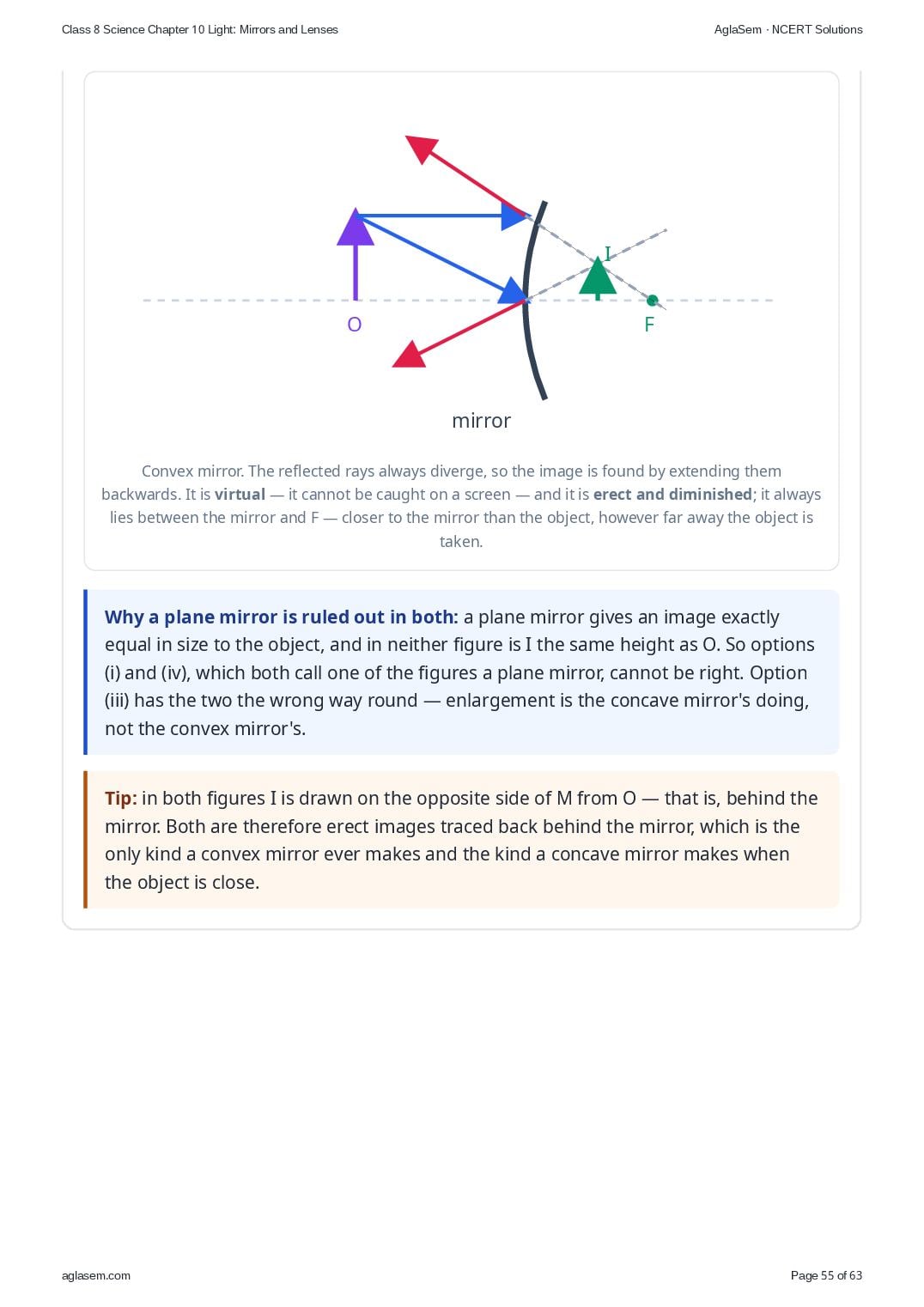
- In Fig. 10.27, note that O stands for object, M for mirror, and I for image. Which of the following statements is true? (i) Figure (a) indicates a plane mirror and Figure (b) indicates a concave mirror. (ii) Figure (a) indicates a convex mirror and Figure (b) indicates a concave mirror. (iii) Figure (a) indicates a concave mirror and Figure (b) indicates a convex mirror. (iv) Figure (a) indicates a plane mirror and Figure (b) indicates a convex mirror.
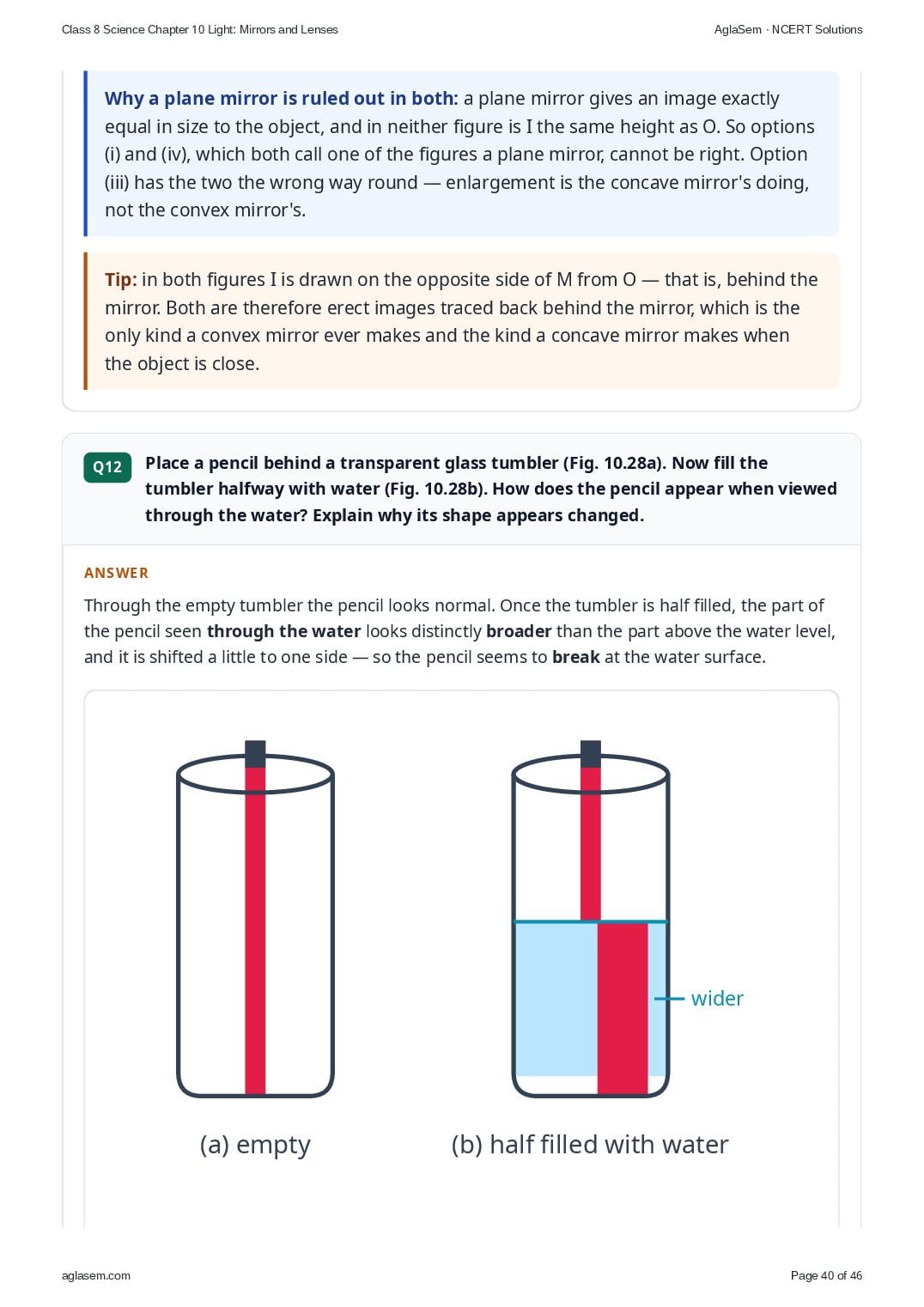
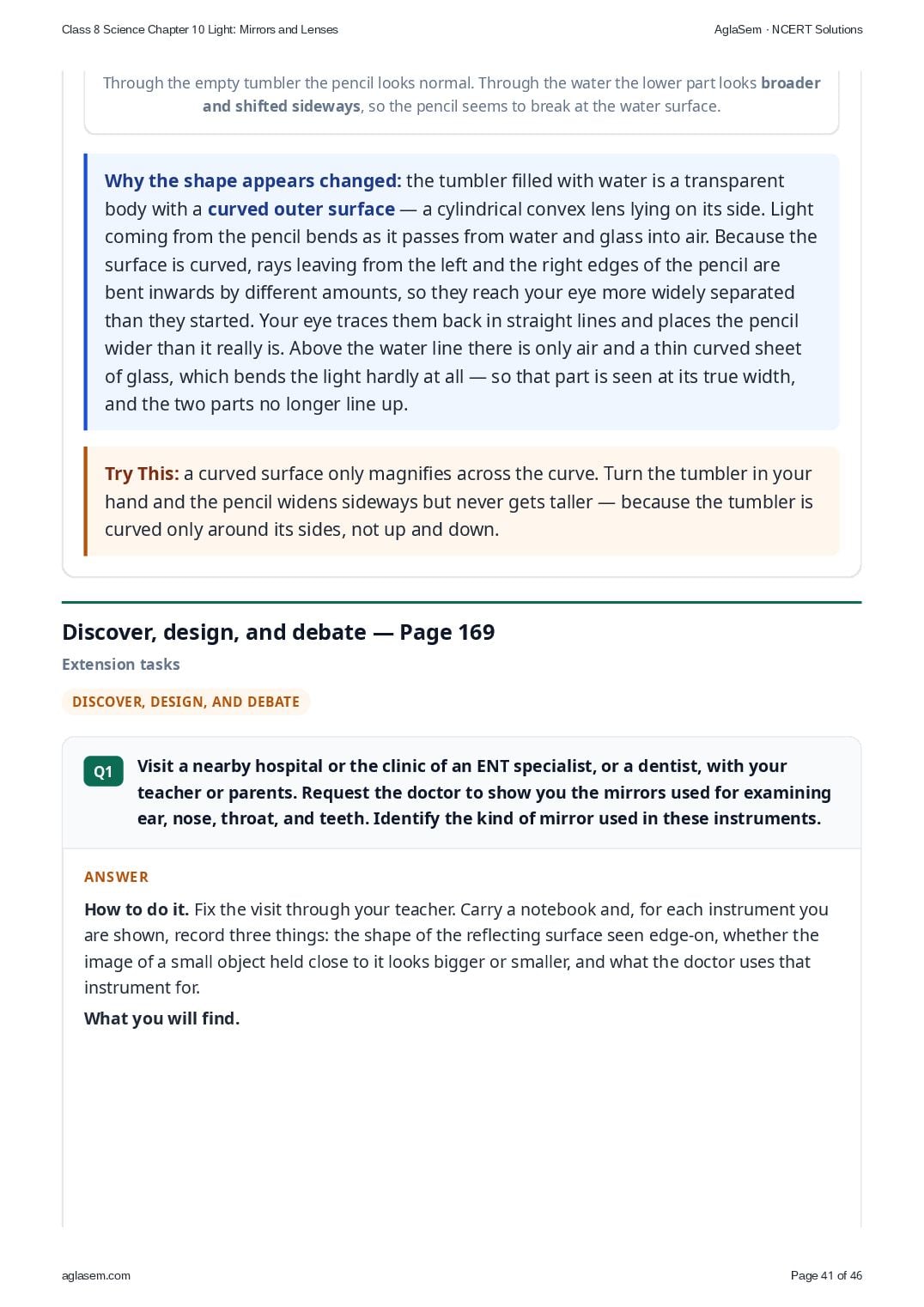
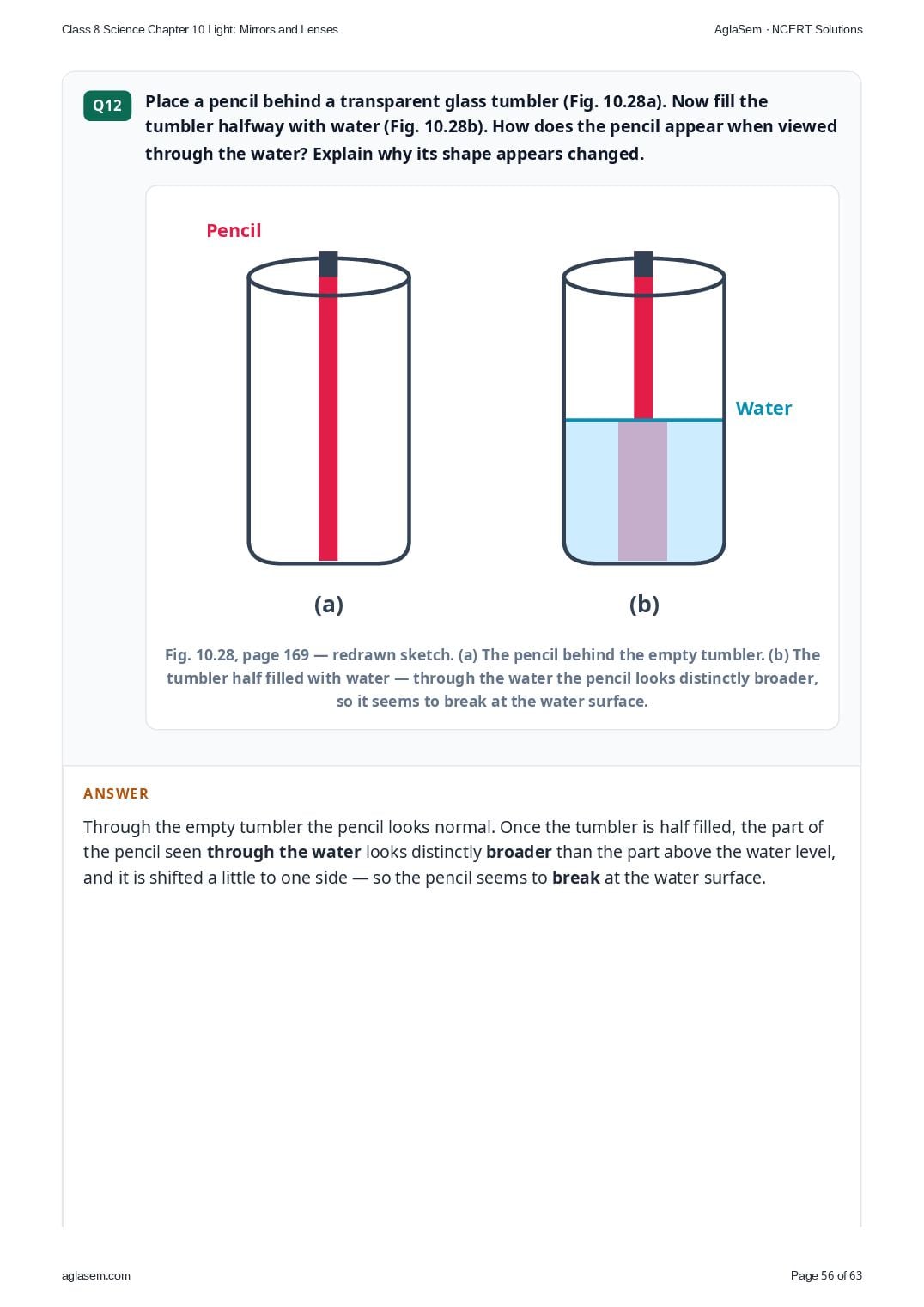
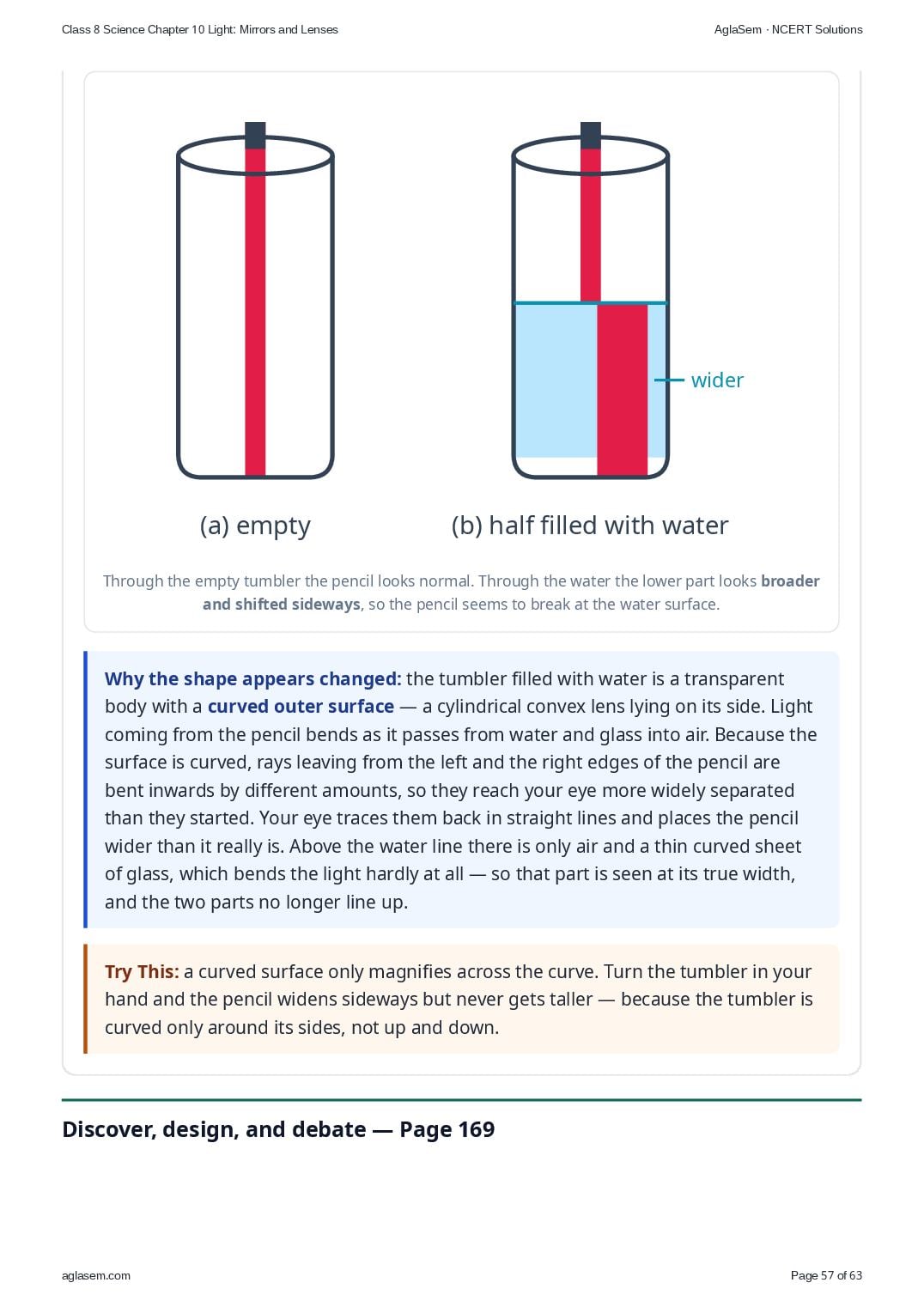
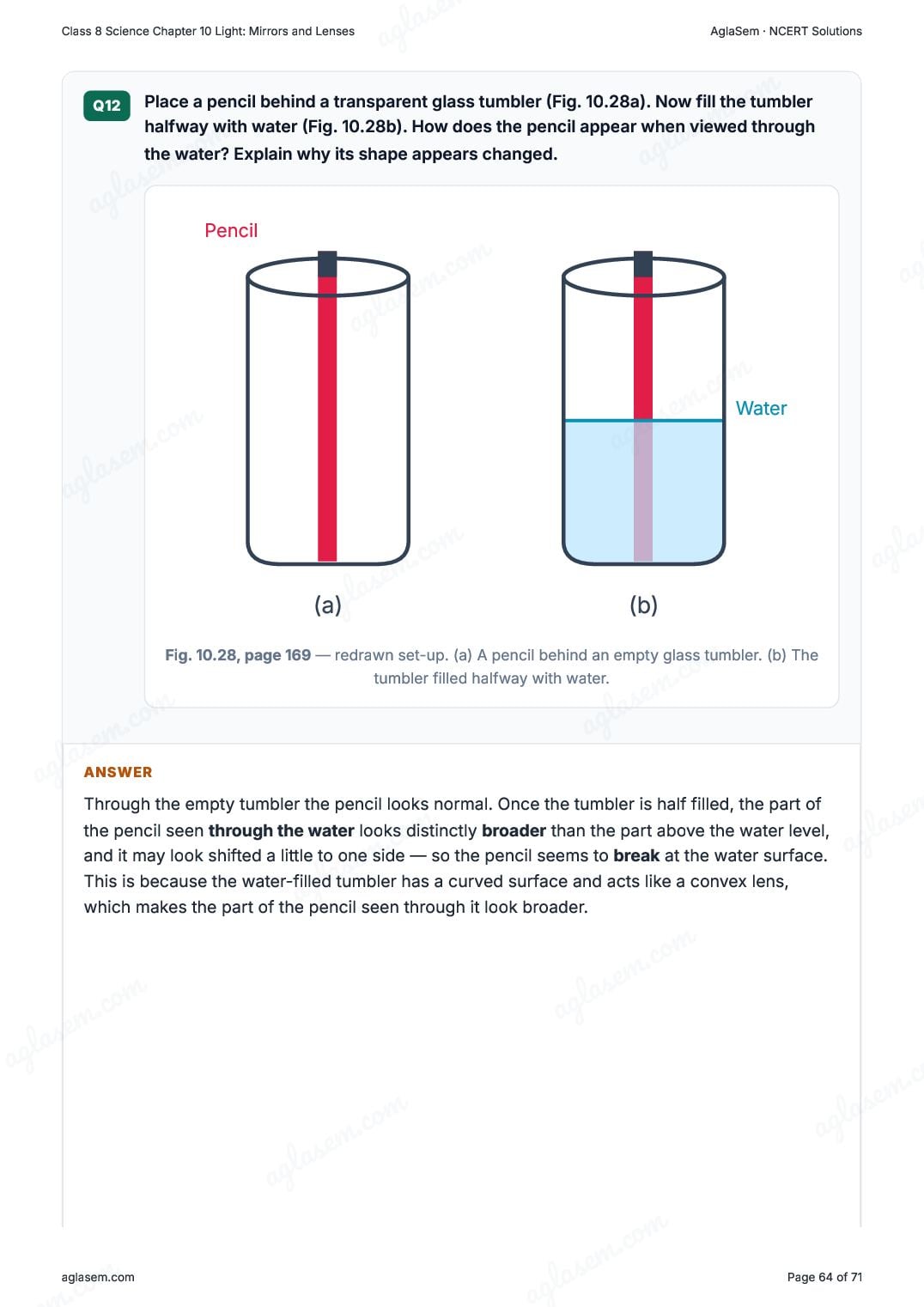
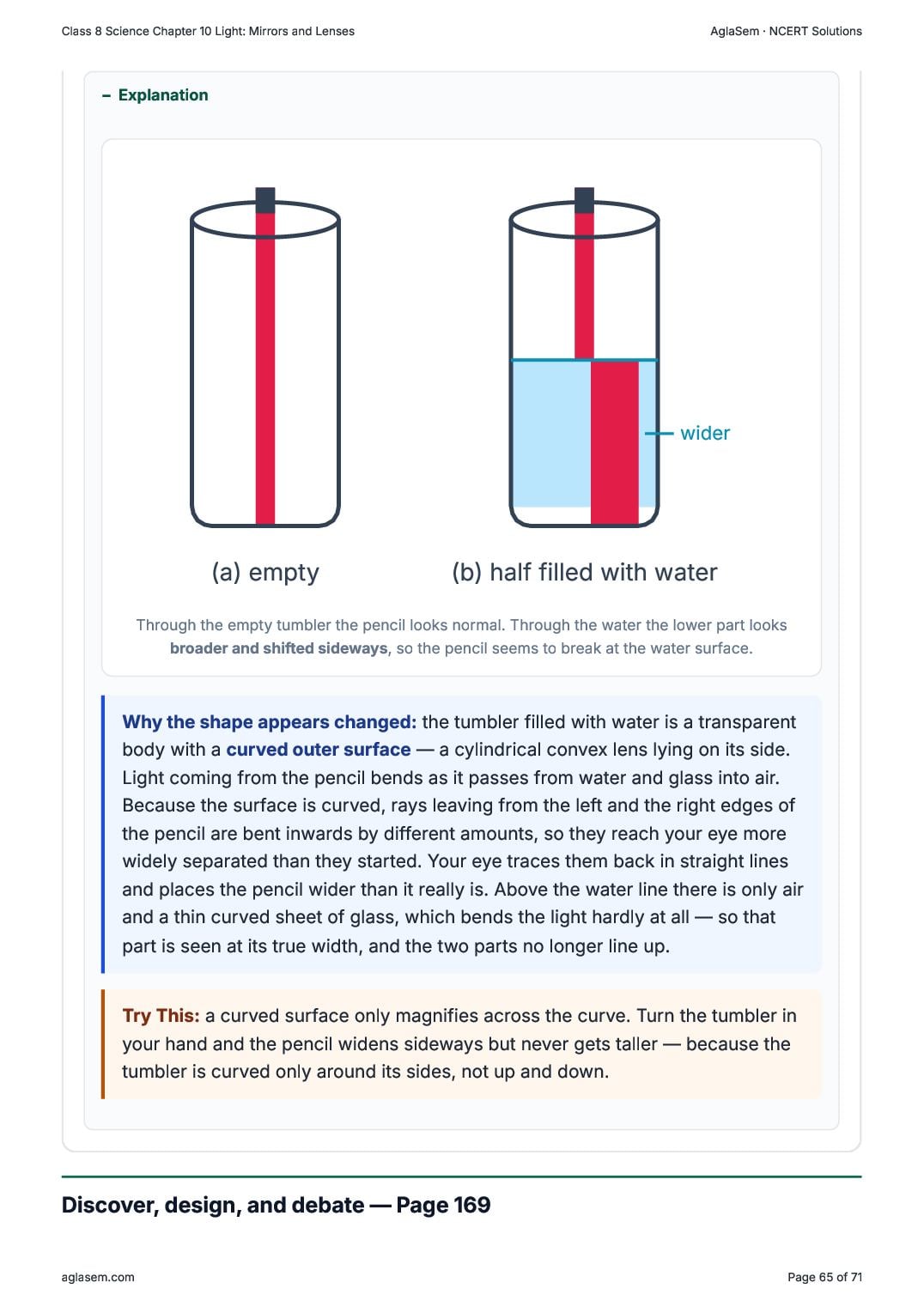
- Place a pencil behind a transparent glass tumbler (Fig. 10.28a). Now fill the tumbler halfway with water (Fig. 10.28b). How does the pencil appear when viewed through the water? Explain why its shape appears changed.
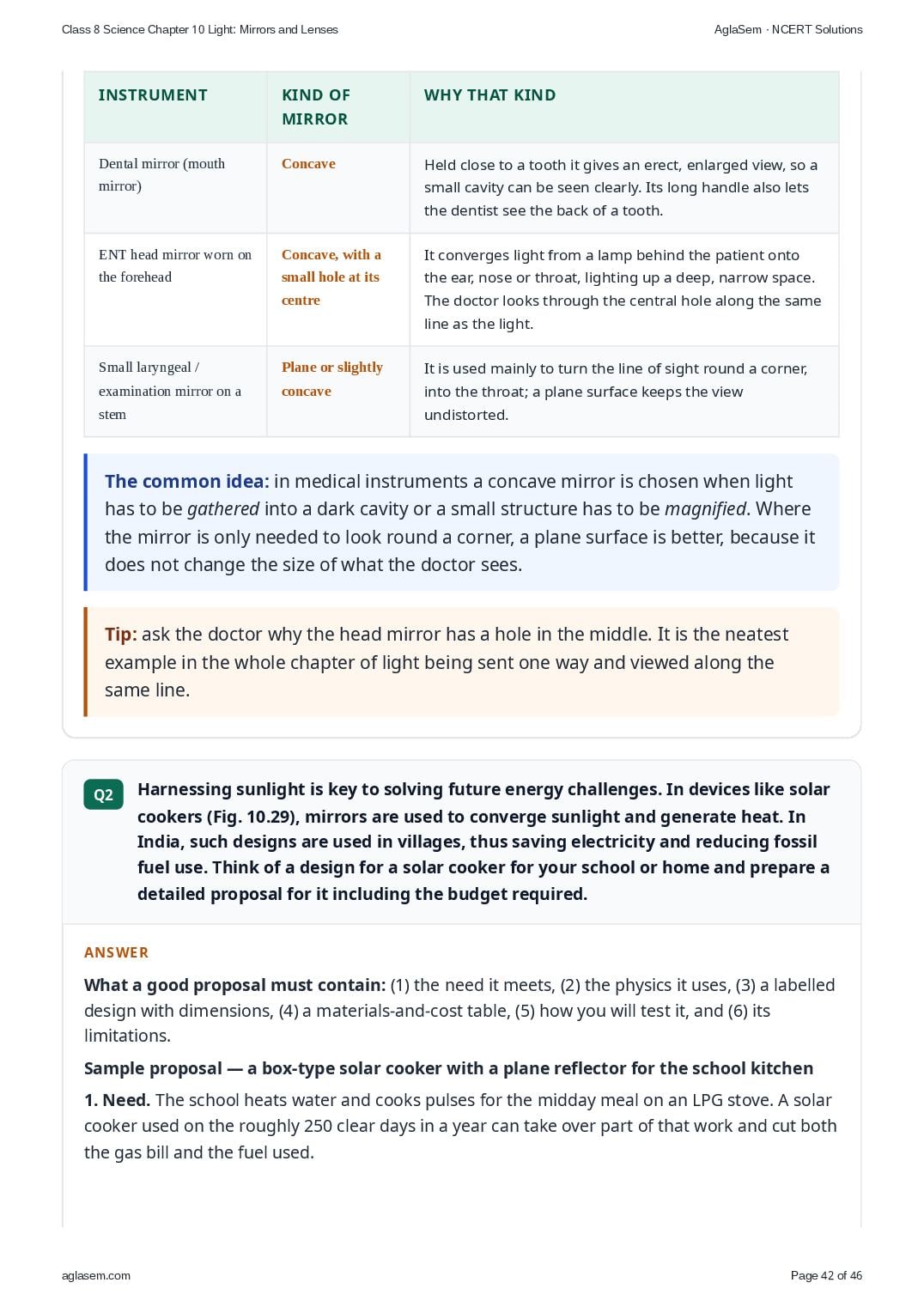
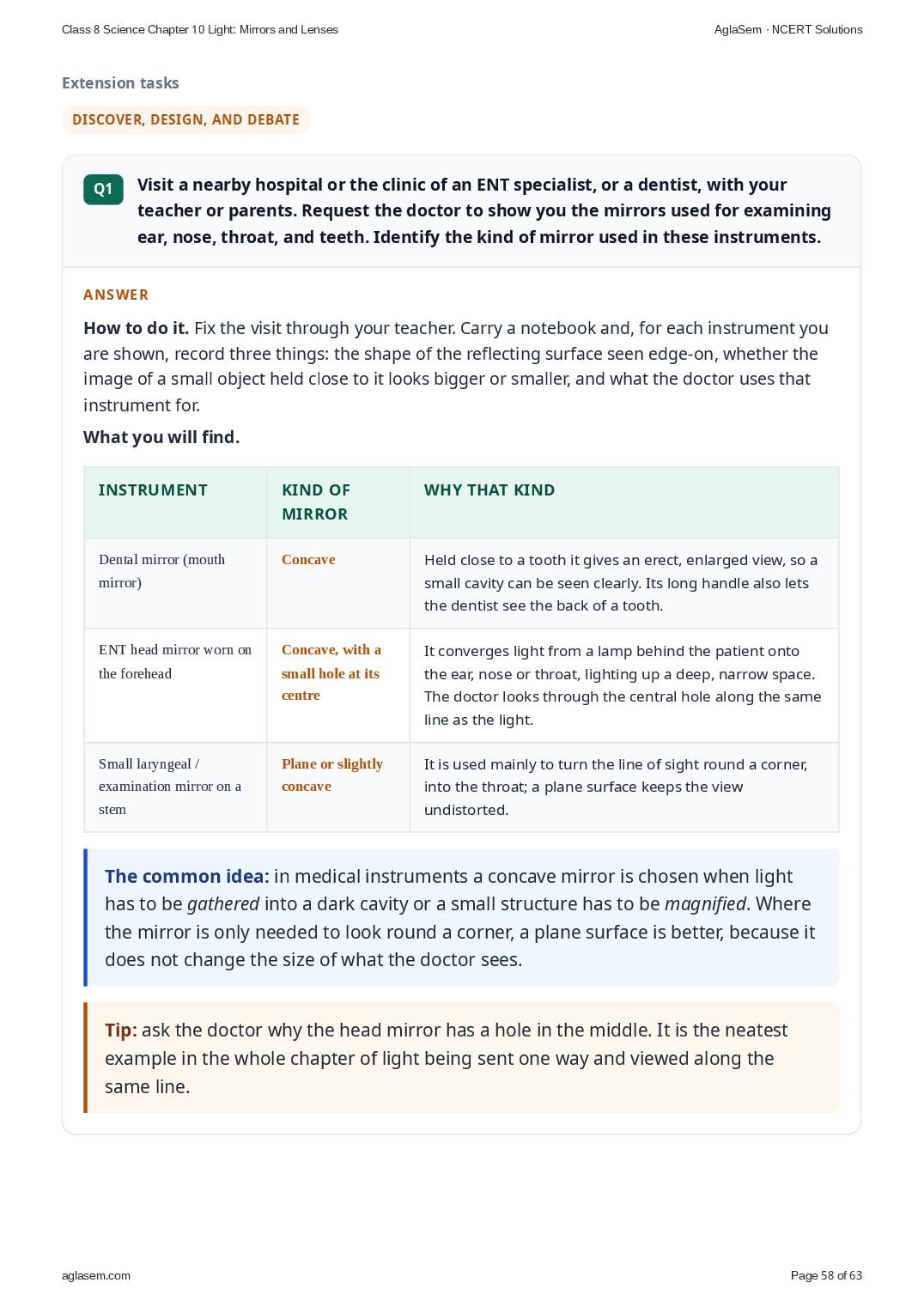
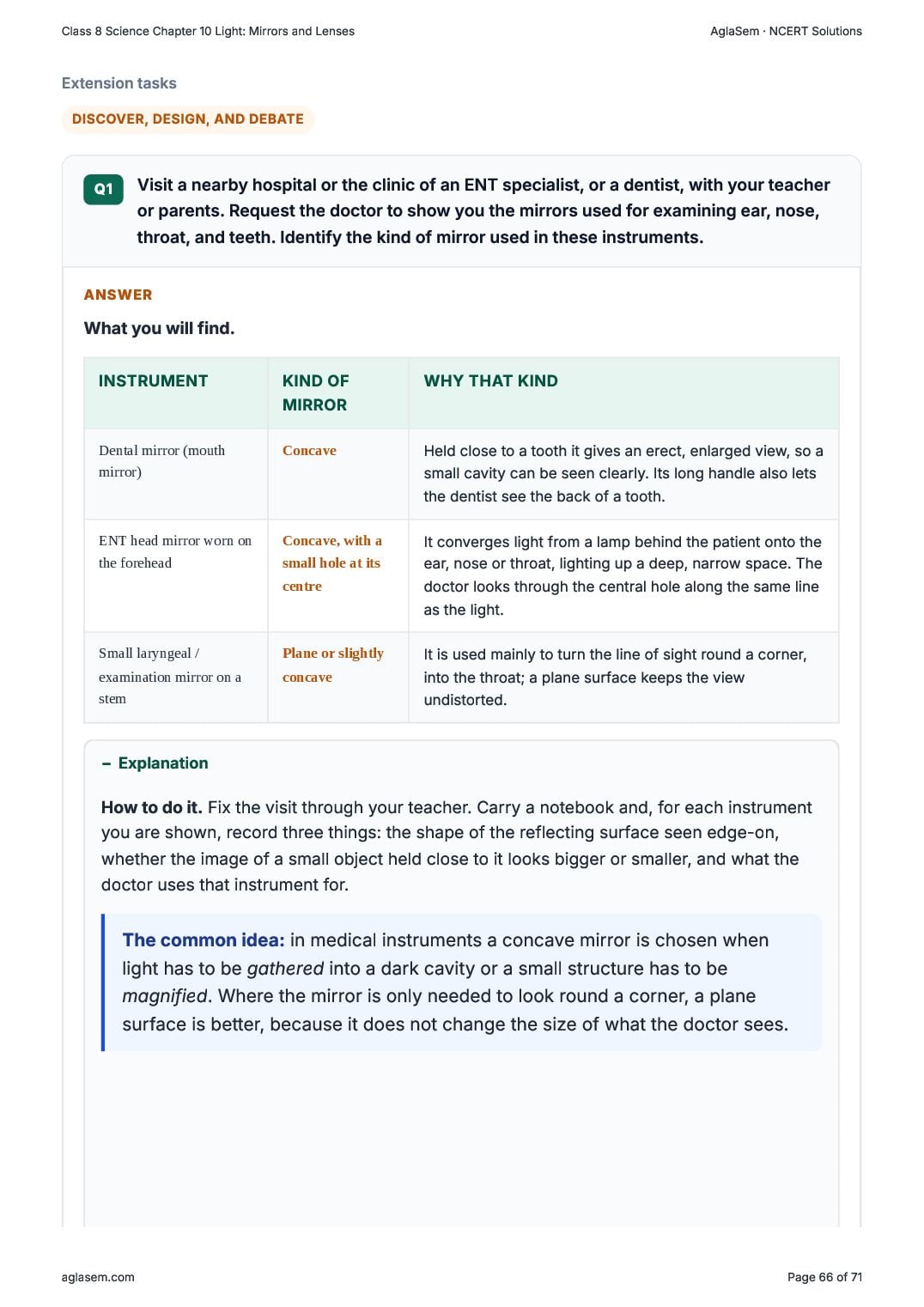
- Visit a nearby hospital or the clinic of an ENT specialist, or a dentist, with your teacher or parents. Request the doctor to show you the mirrors used for examining ear, nose, throat, and teeth. Identify the kind of mirror used in these instruments.
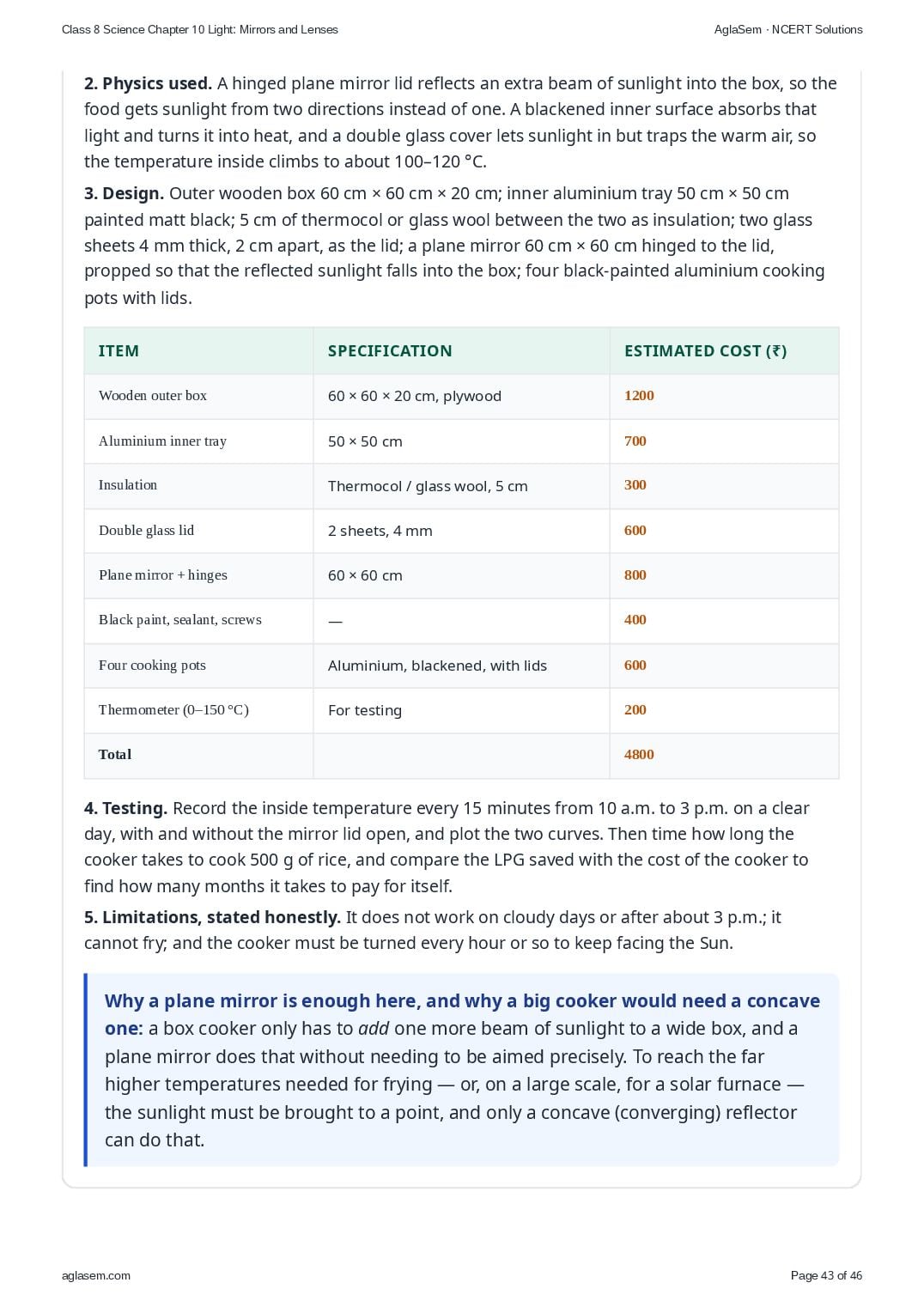
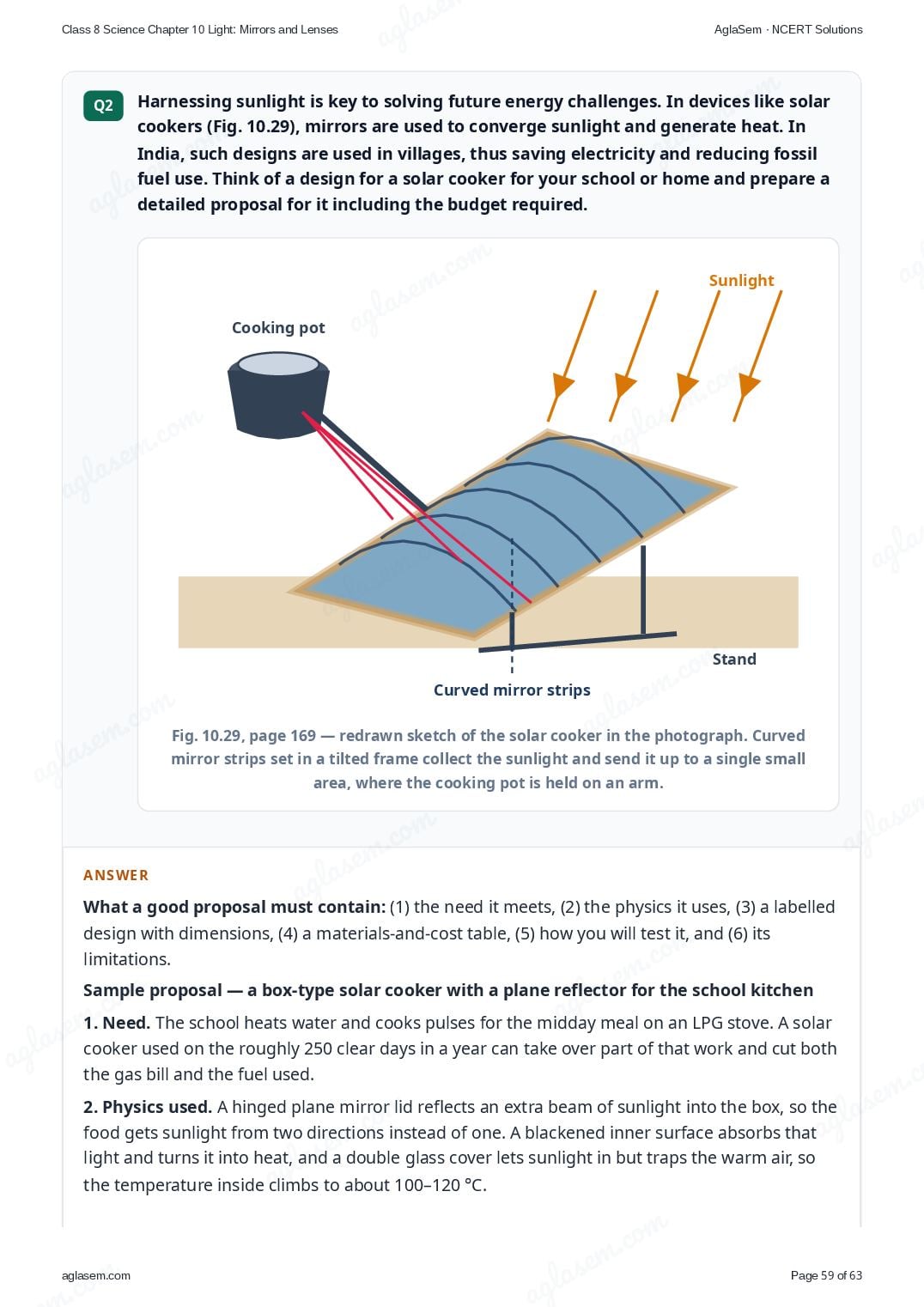
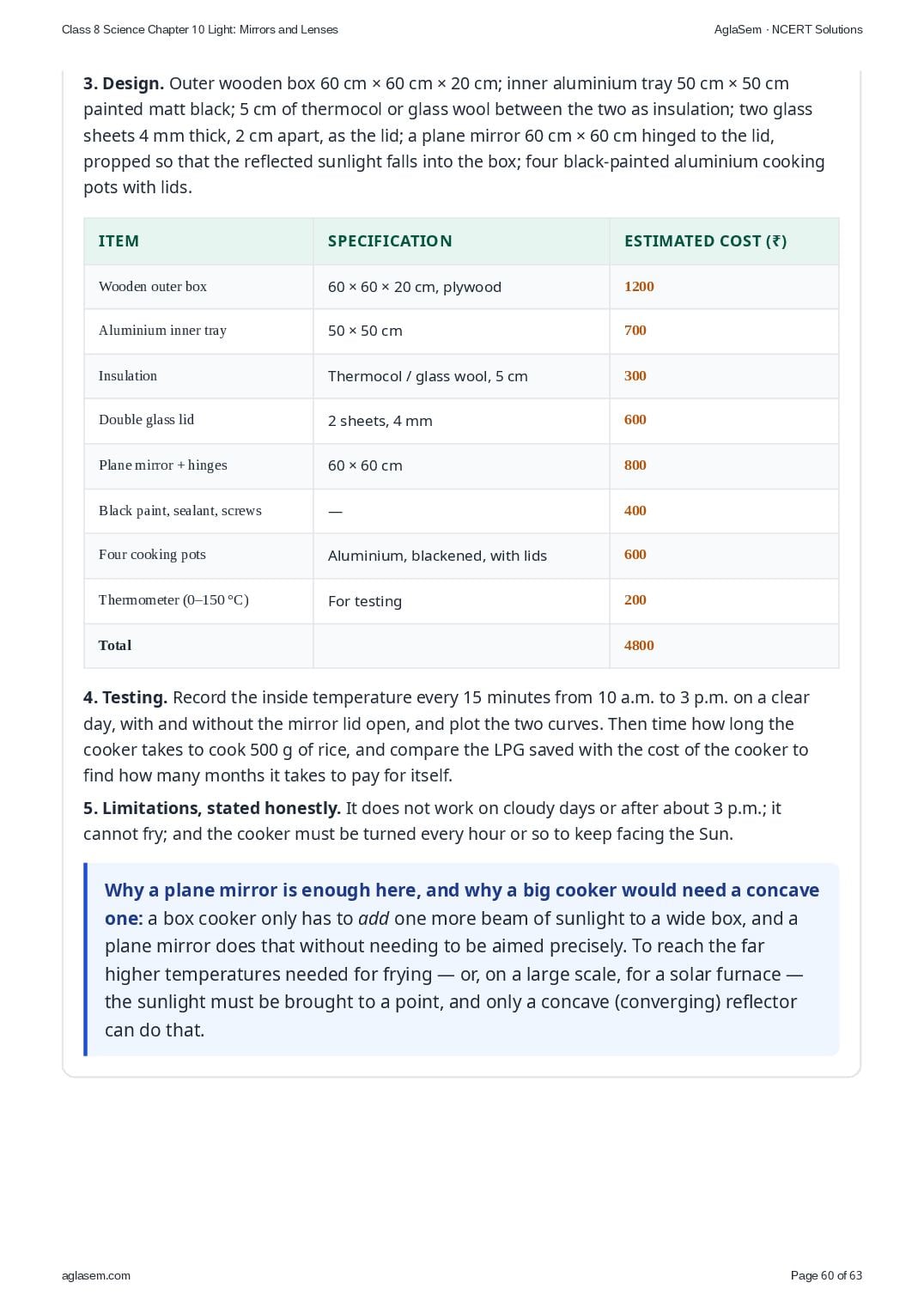
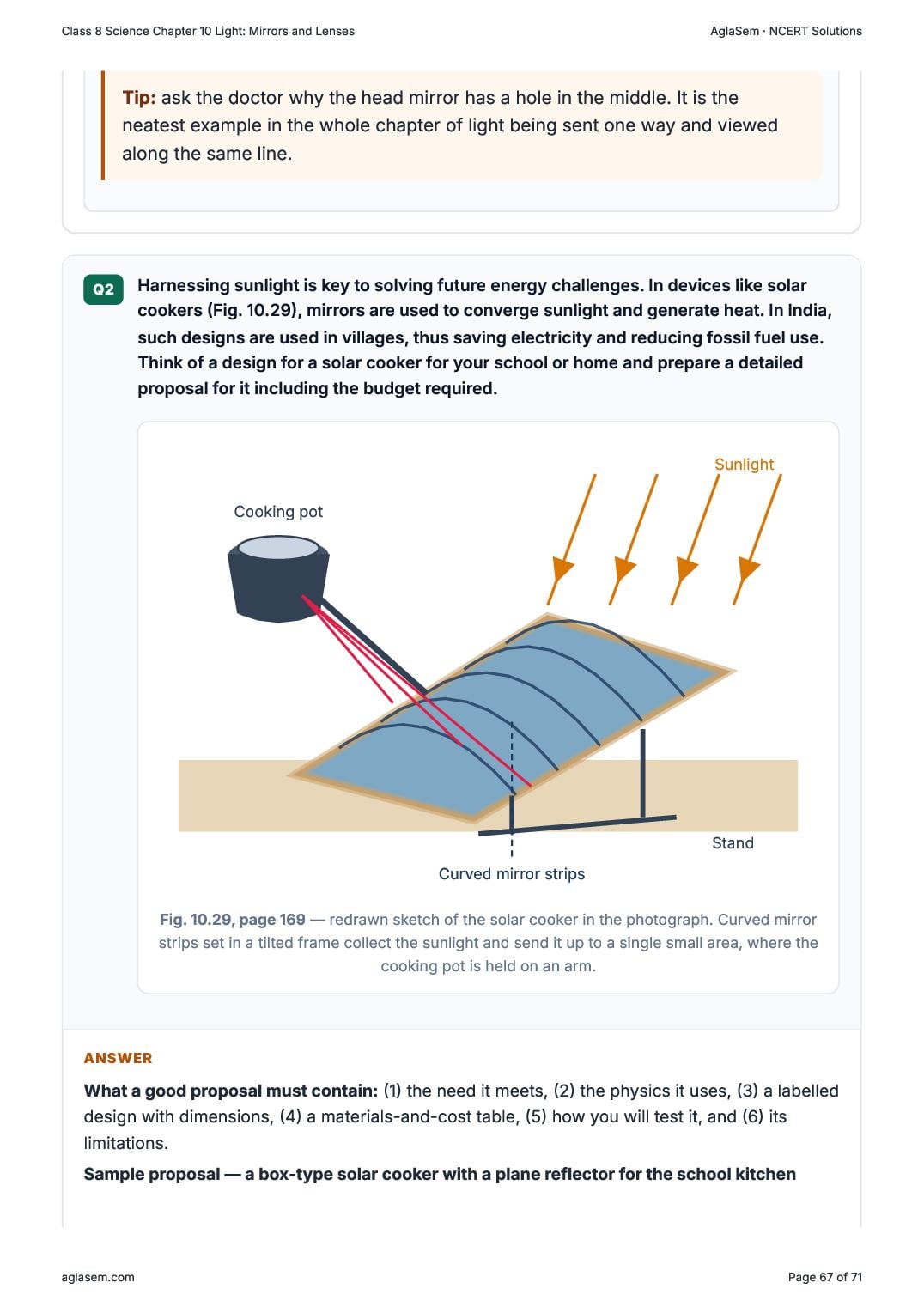
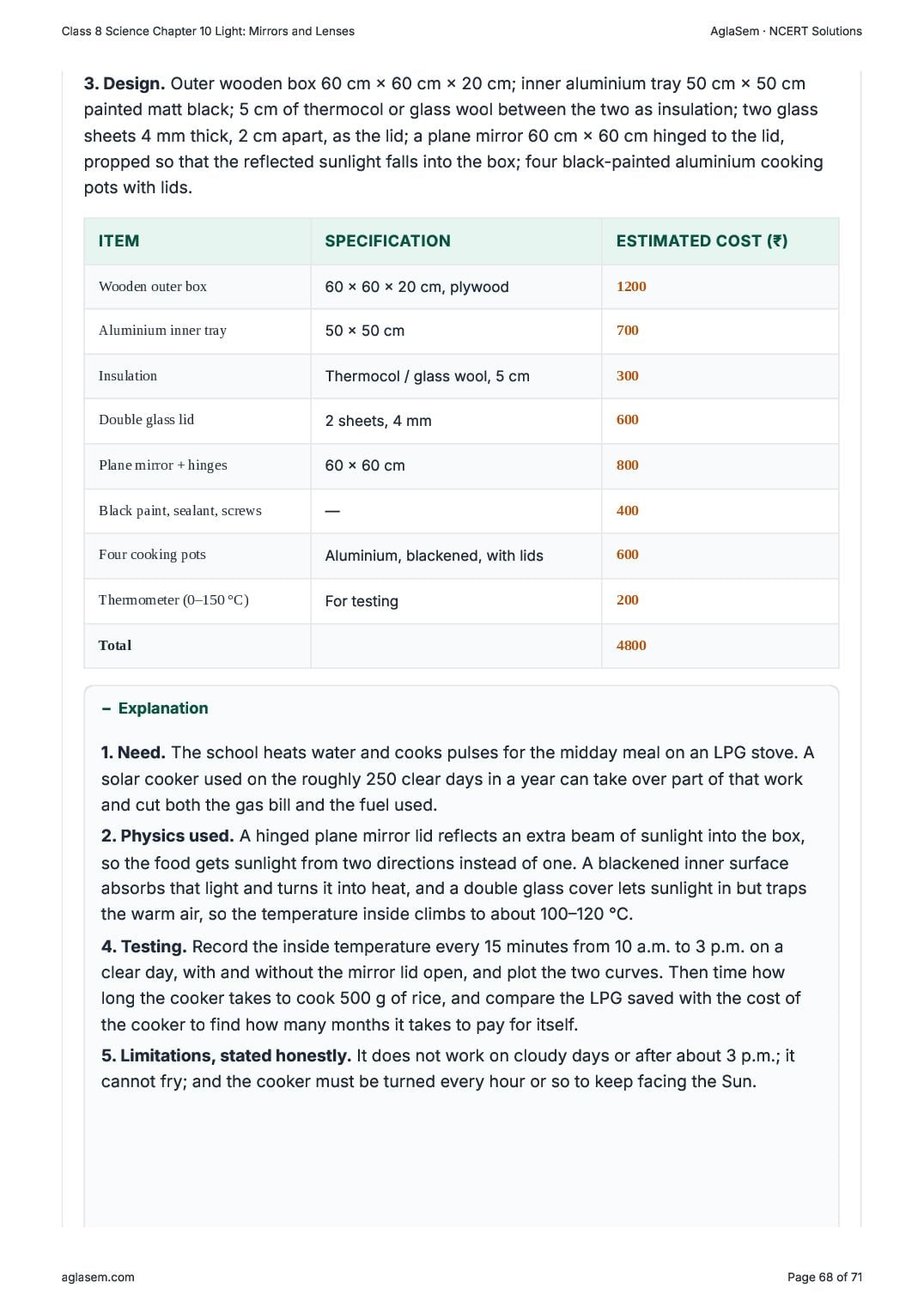
- Harnessing sunlight is key to solving future energy challenges. In devices like solar cookers (Fig. 10.29), mirrors are used to converge sunlight and generate heat. In India, such designs are used in villages, thus saving electricity and reducing fossil fuel use. Think of a design for a solar cooker for your school or home and prepare a detailed proposal for it including the budget required.
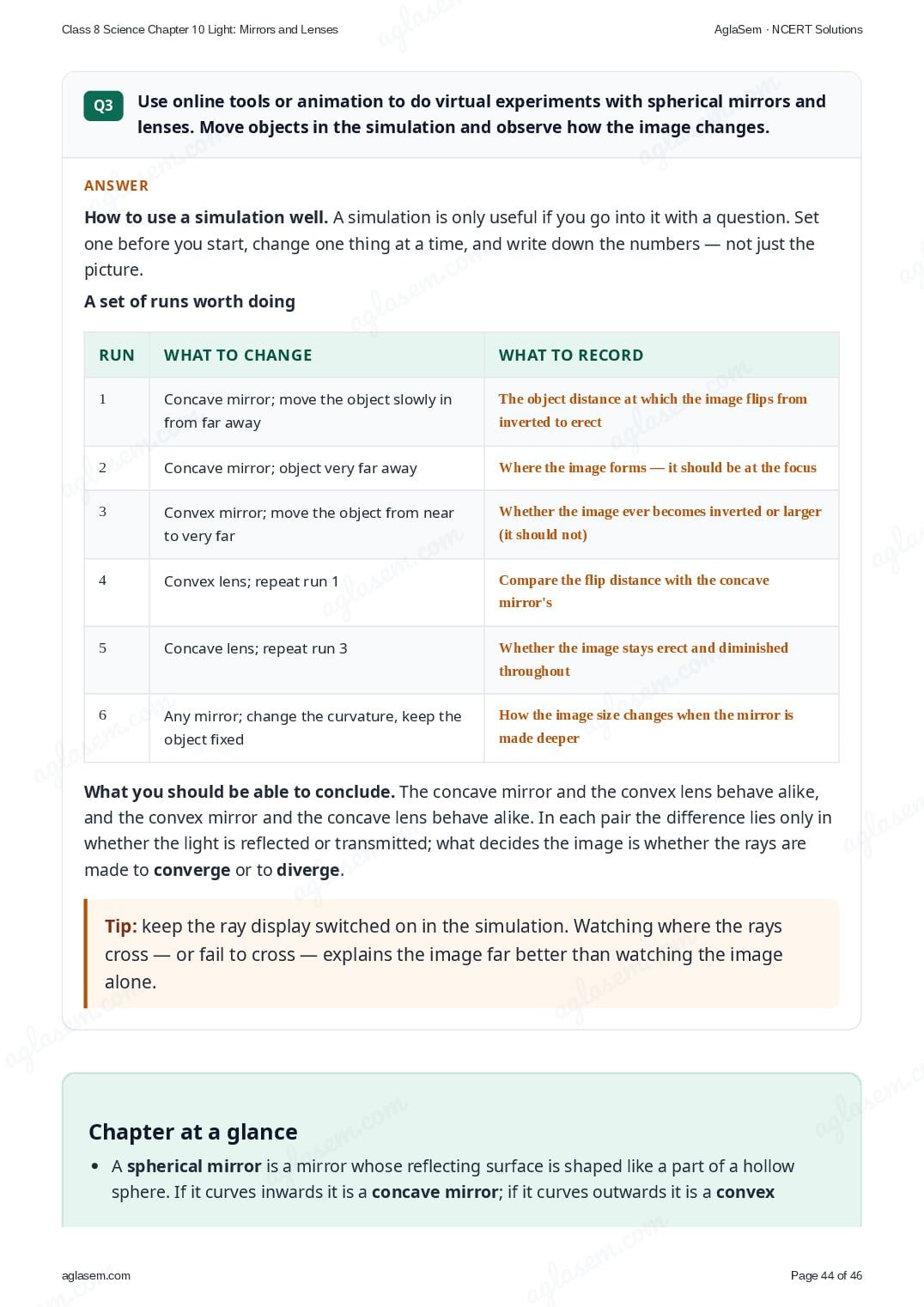
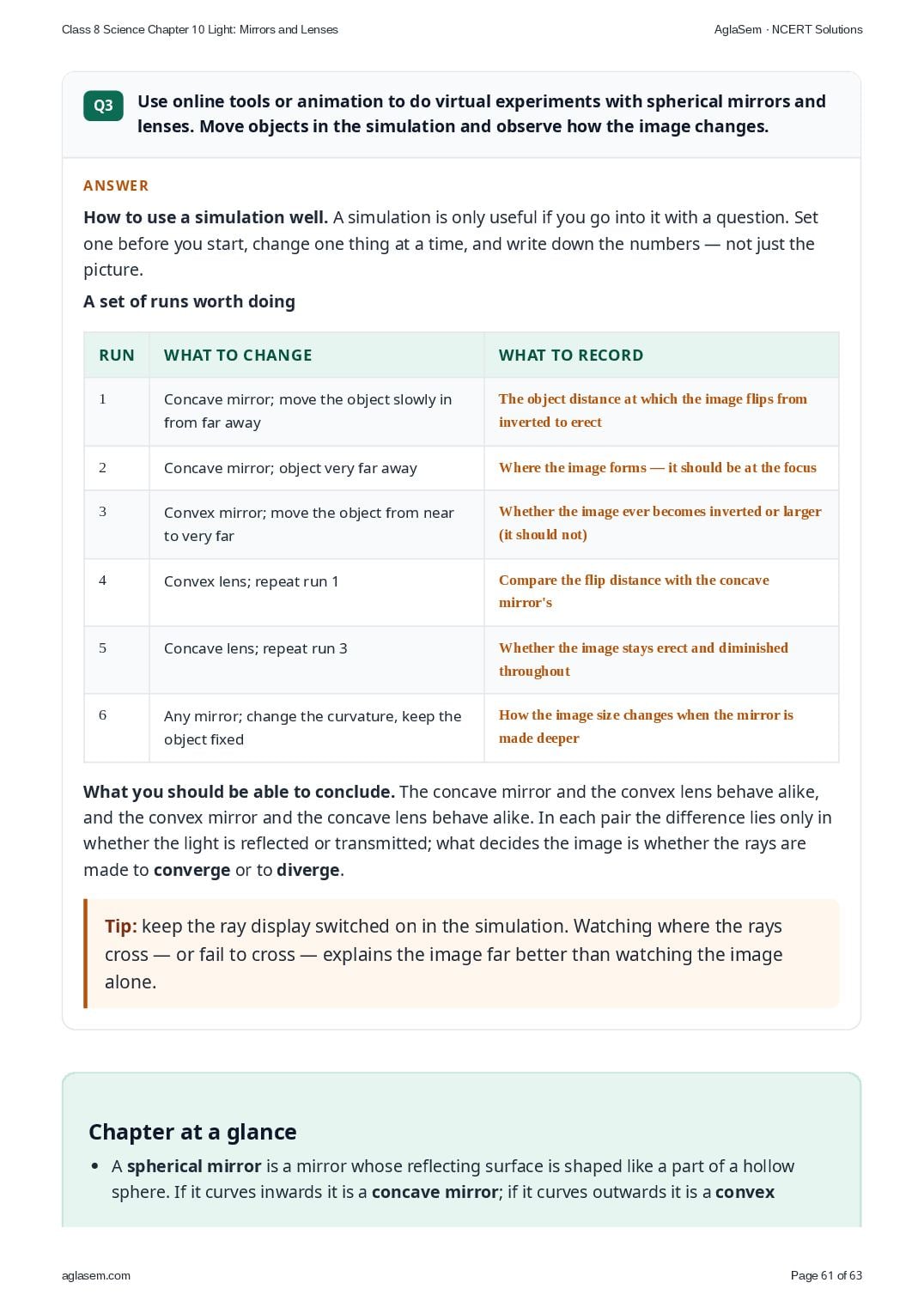
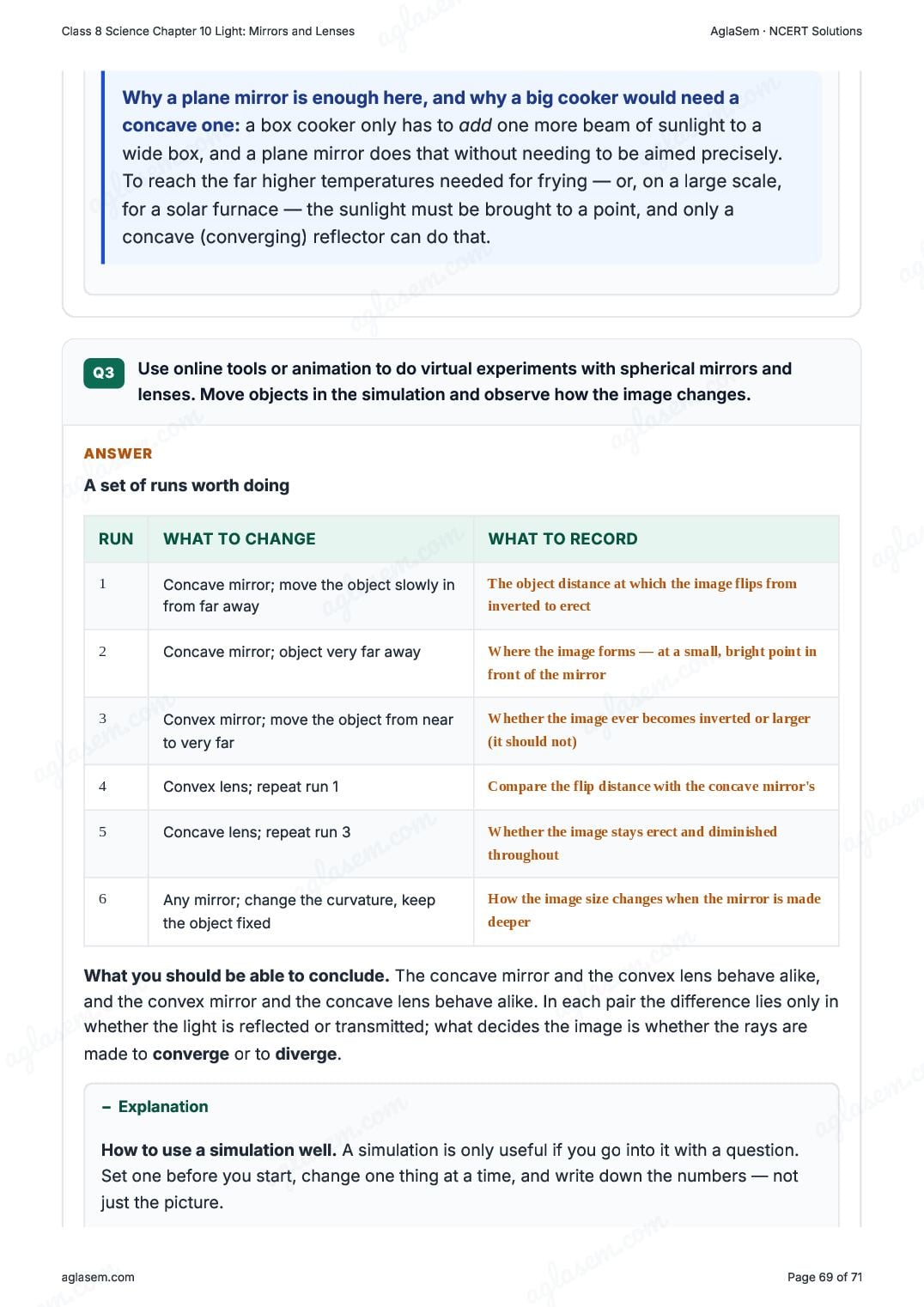
- Use online tools or animation to do virtual experiments with spherical mirrors and lenses. Move objects in the simulation and observe how the image changes.
Chapter at a Glance
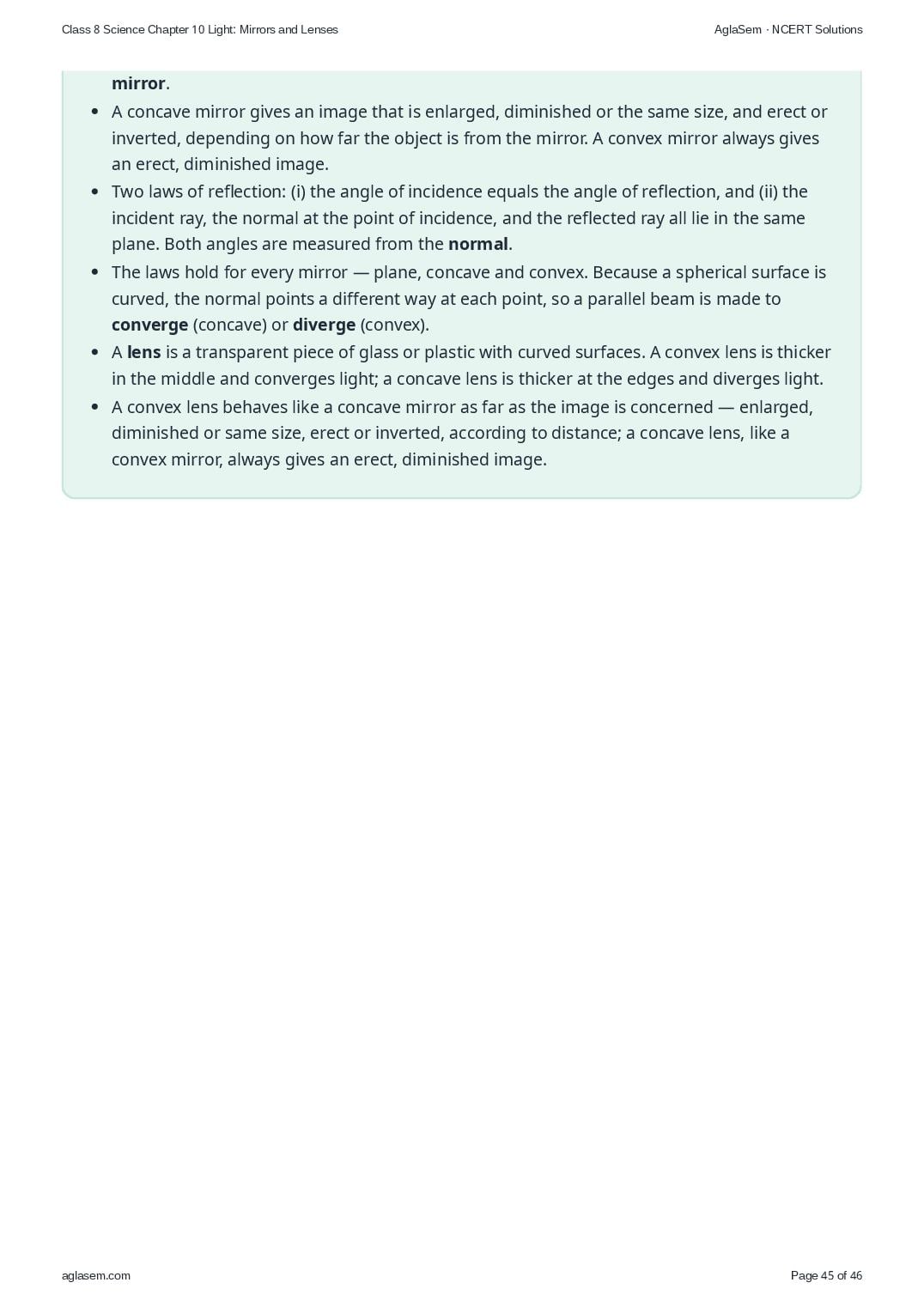
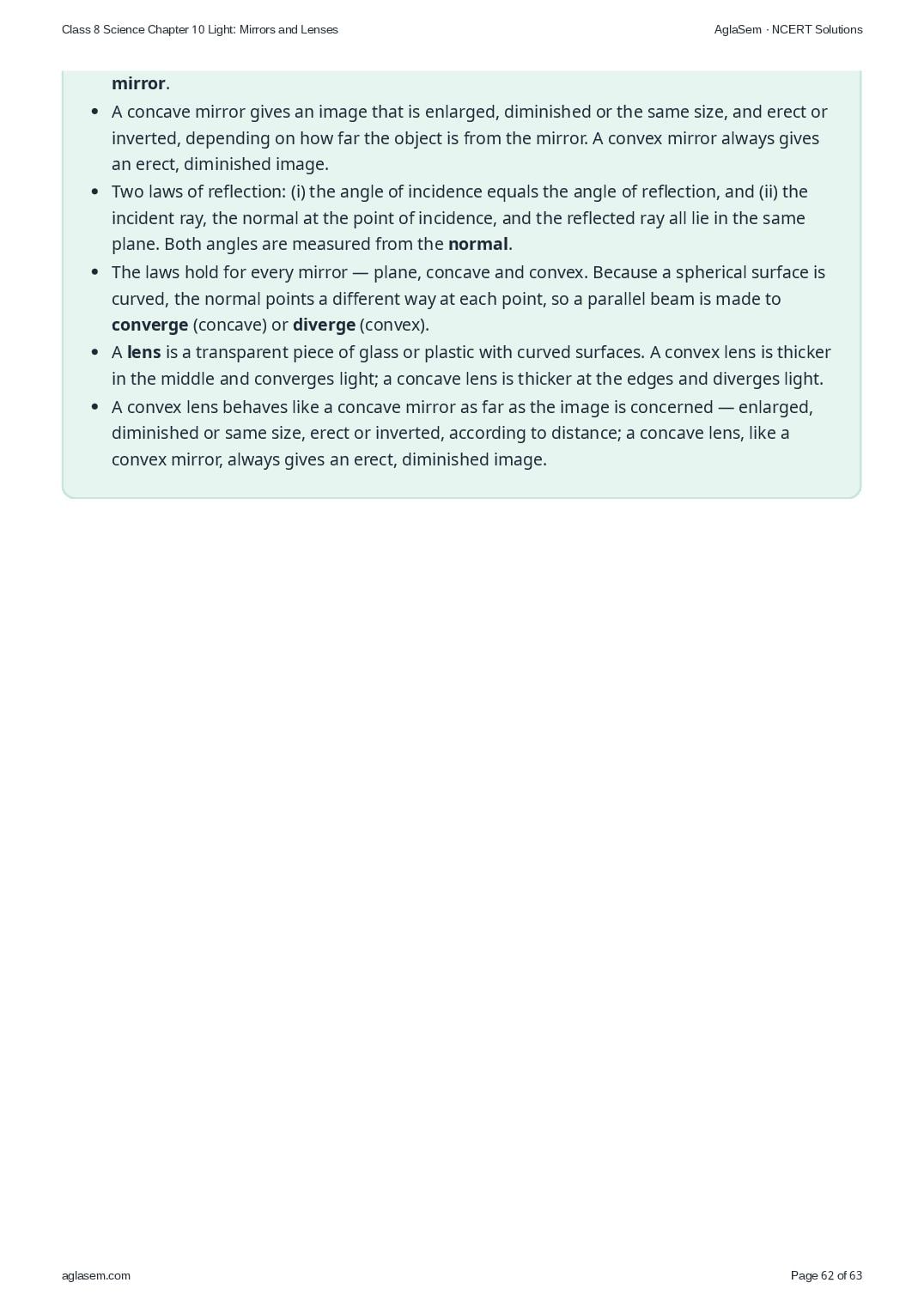
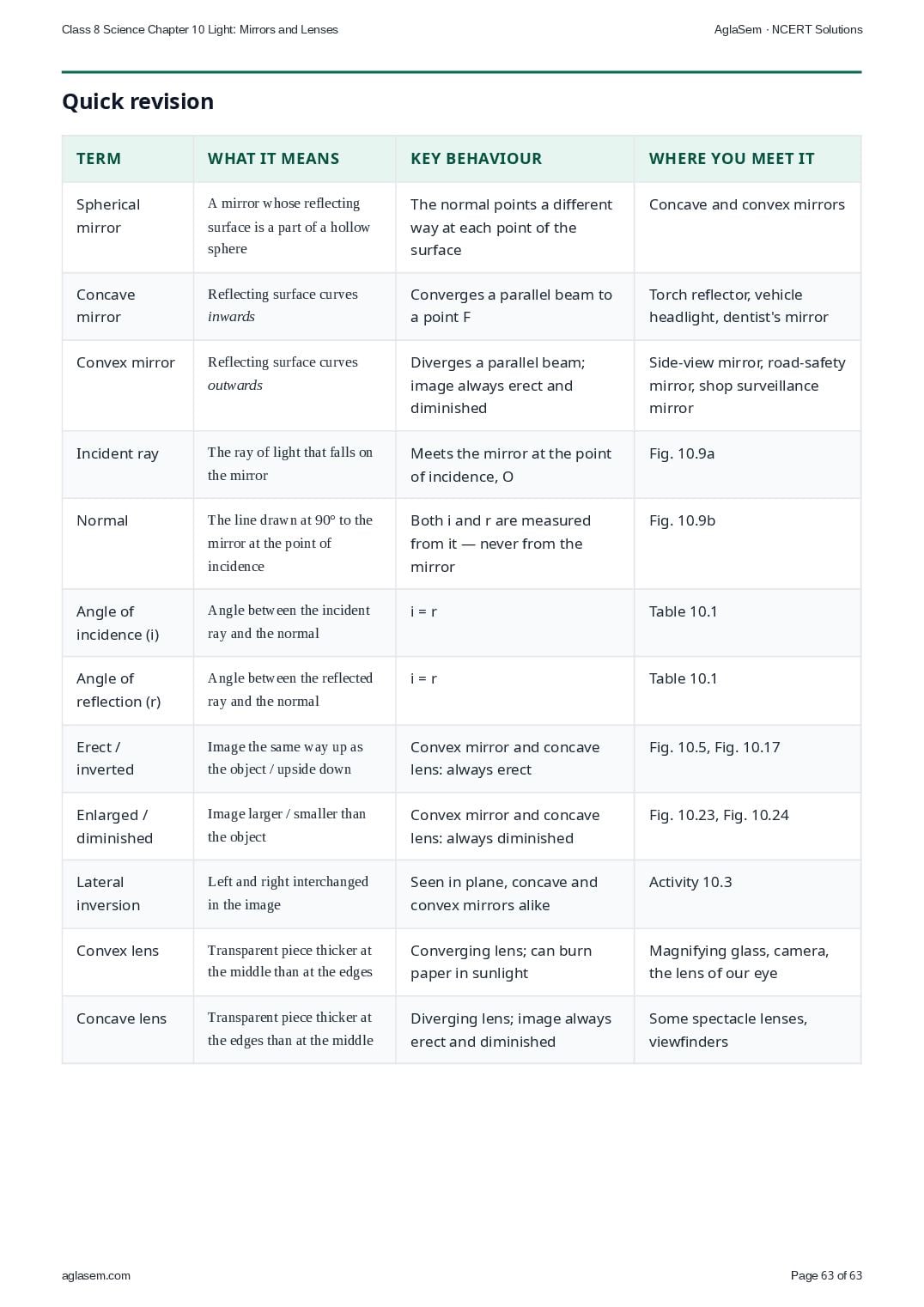
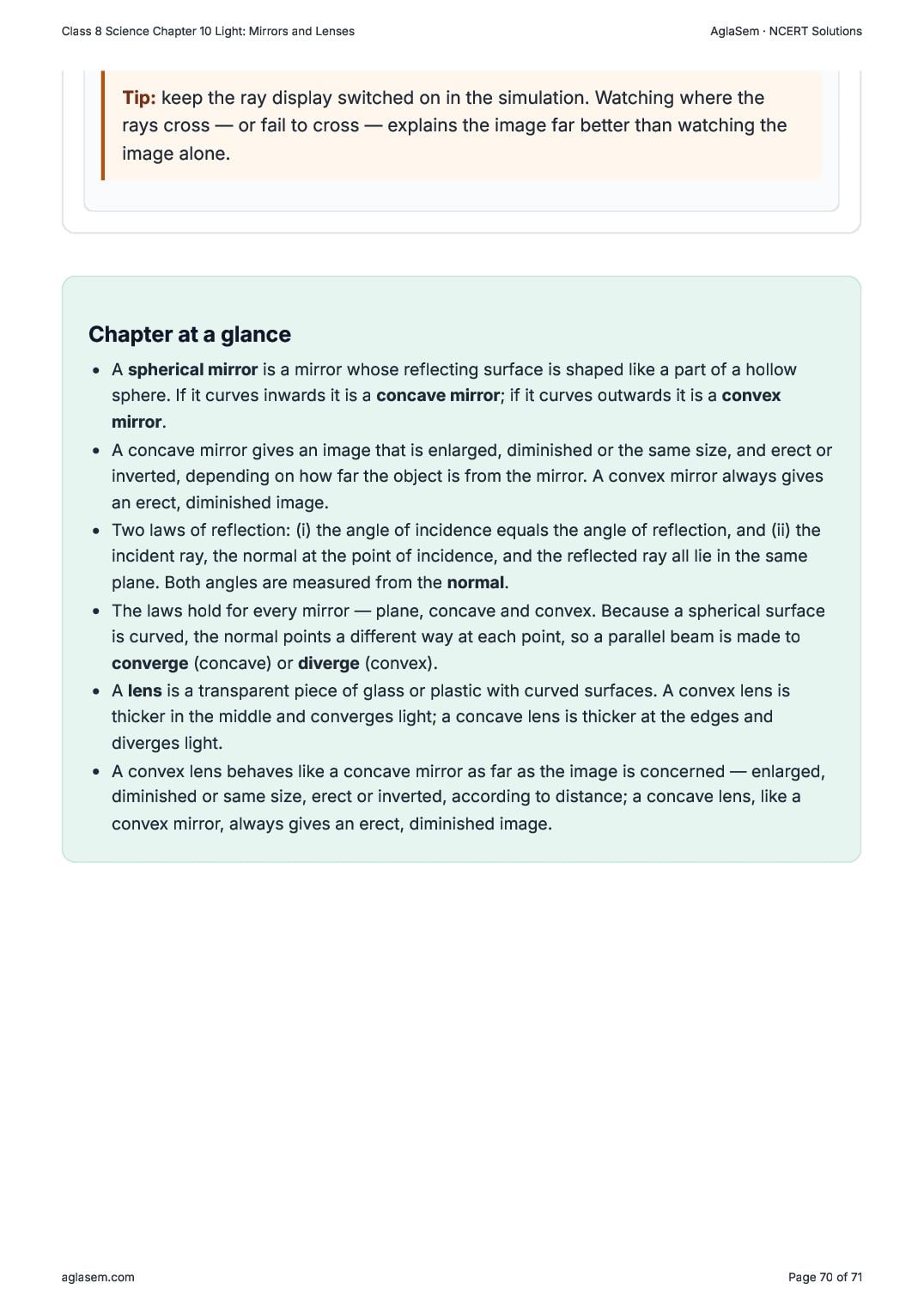
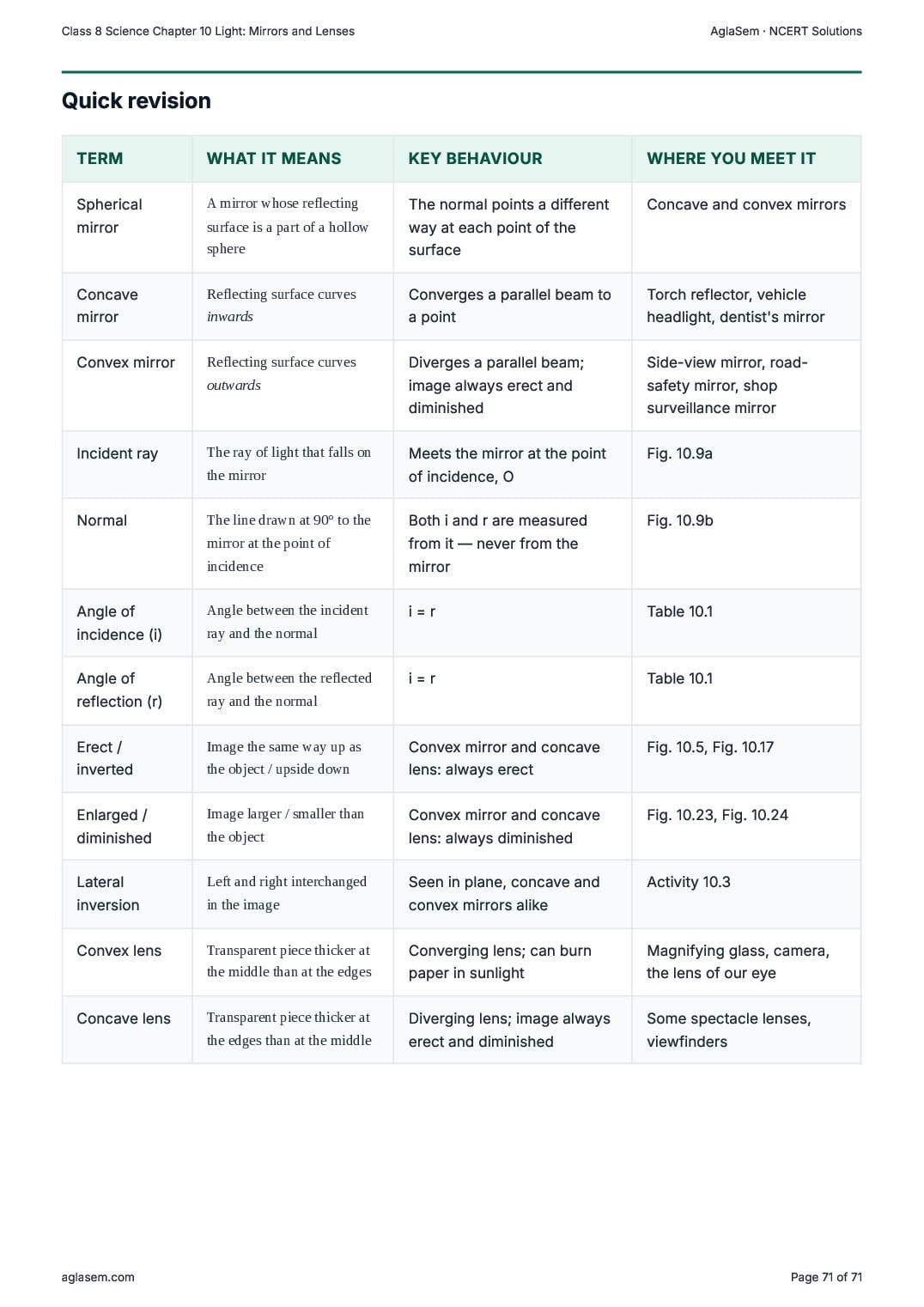
- A spherical mirror is a mirror whose reflecting surface is shaped like a part of a hollow sphere. If it curves inwards it is a concave mirror ; if it curves outwards it is a convex mirror .
- A concave mirror gives an image that is enlarged, diminished or the same size, and erect or inverted, depending on how far the object is from the mirror. A convex mirror always gives an erect, diminished image.
- Two laws of reflection: (i) the angle of incidence equals the angle of reflection, and (ii) the incident ray, the normal at the point of incidence, and the reflected ray all lie in the same plane. Both angles are measured from the normal .
- The laws hold for every mirror — plane, concave and convex. Because a spherical surface is curved, the normal points a different way at each point, so a parallel beam is made to converge (concave) or diverge (convex).
- A lens is a transparent piece of glass or plastic with curved surfaces. A convex lens is thicker in the middle and converges light; a concave lens is thicker at the edges and diverges light.
- A convex lens behaves like a concave mirror as far as the image is concerned — enlarged, diminished or same size, erect or inverted, according to distance; a concave lens, like a convex mirror, always gives an erect, diminished image.
How to Download NCERT Solutions for Class 8 Science Chapter 10 PDF
Follow these simple steps to get the Light Mirrors and Lenses questions-and-answers PDF from Curiosity.
- Search NCERT Solutions for Class 8 Science Chapter 10 aglasem and open this page.
- Read the exercise questions with answers for Light Mirrors and Lenses shown above.
- Click the Download PDF link to save the Light Mirrors and Lenses solutions to your device.
NCERT Solutions for Class 8 Science – All Chapters
There are more chapters to study besides Light Mirrors and Lenses in Science. Here are the NCERT Solutions for all chapters of Class 8 Science.
- Chapter 1 Exploring the Investigative World of Science
- Chapter 2 The Invisible Living World Beyond Our Naked Eye
- Chapter 3 Health the Ultimate Treasure
- Chapter 4 Electricity Magnetic and Heating Effects
- Chapter 5 Exploring Forces
- Chapter 6 Pressure Winds Storms and Cyclones
- Chapter 7 Particulate Nature of Matter
- Chapter 8 Nature of Matter Elements Compounds and Mixtures
- Chapter 9 The Amazing World of Solutes Solvents and Solutions
- Chapter 10 Light Mirrors and Lenses
- Chapter 11 Keeping Time with the Skies
- Chapter 12 How Nature Works in Harmony
- Chapter 13 Our Home Earth a Unique Life Sustaining Planet
NCERT Solutions for Class 8 – All Subjects
Just like Chapter 10 of Science, you can get the exercise questions with answers for every other subject of Class 8. Here are the NCERT Solutions for all subjects of Class 8.
NCERT Solutions for Class 8 Science Chapter 10 – An Overview
The key highlights of this study material are as follows.
| Aspects | Details |
|---|---|
| Class | Class 8 |
| Subject | Science |
| Chapter Number | Chapter 10 |
| Chapter Name | Light Mirrors and Lenses |
| Book Name | Curiosity |
| Book By | NCERT (National Council of Educational Research and Training) |
| Educational Resource Here | NCERT Solutions of Class 8 Science Chapter 10 for all exercises |
| More Questions Answers of This Subject | NCERT Solutions for Class 8 Science |
| Download Book Chapter | NCERT Book Class 8 Science |
| All Questions Answers For This Class | NCERT Solutions for Class 8 |
| Complete Solutions | NCERT Solutions |
NCERT Solutions for Class 8 Science Chapter 10 Light Mirrors and Lenses – FAQs
What are the NCERT Solutions for Class 8 Science Chapter 10 Light Mirrors and Lenses?
They are the complete, step-by-step answers to all the exercise and in-text questions of Chapter 10 Light Mirrors and Lenses from the NCERT Class 8 Science textbook Curiosity, written by experts as per the latest NCERT syllabus.
How can I download the Class 8 Science Chapter 10 solutions PDF for free?
Open this page on aglasem, read the Light Mirrors and Lenses questions with answers, and click the “Download Solutions PDF” link. The Class 8 Science Chapter 10 NCERT Solutions PDF is completely free to download.
Are these NCERT Solutions as per the latest 2026-27 syllabus?
Yes. The NCERT Solutions for Class 8 Science Chapter 10 are based on the latest NCERT textbook Curiosity and the current 2026-27 CBSE syllabus, so the questions and answers match what you study in class.
Where can I get NCERT Solutions for the other chapters of Class 8 Science?
You can find the answers to every chapter on the NCERT Solutions for Class 8 Science page, and solutions for every subject on the NCERT Solutions for Class 8 page.
How do NCERT Solutions help in exam preparation?
They show the correct method to solve each question, help you write answers the way they are expected in exams, let you check and correct your own work, and save revision time — which together improve your marks in Class 8 Science.
If you have any queries on NCERT Solutions for Class 8 Science Chapter 10 Light Mirrors and Lenses, then please ask in the comments below.