NCERT Solutions for Class 8 Science Chapter 5 Exploring Forces provide clear, step-by-step answers to every exercise and in-text question from the chapter Exploring Forces of the NCERT textbook Curiosity. Prepared by subject experts as per the latest NCERT (CBSE) syllabus for 2026-27, these NCERT Solutions for Class 8 Science help you understand each concept, write exam-ready answers, and check your own solutions. You can read them online below or download the free Class 8 Science Chapter 5 question-answer PDF.
NCERT Solutions for Class 8 Science Chapter 5 Exploring Forces
- Class: Class 8
- Subject: Science
- Chapter: Chapter 5 – Exploring Forces
- Textbook: Curiosity (NCERT)
- Study material: NCERT Solutions – questions with answers, free PDF
These solutions answer all the exercise questions of Chapter 5 Exploring Forces — including the in-text questions, short-answer and long-answer questions, and activities — with complete explanations so you can follow the method, not just the final answer. Read the full solutions below.
NCERT Solutions Class 8 Science Chapter 5 Exploring Forces View Download
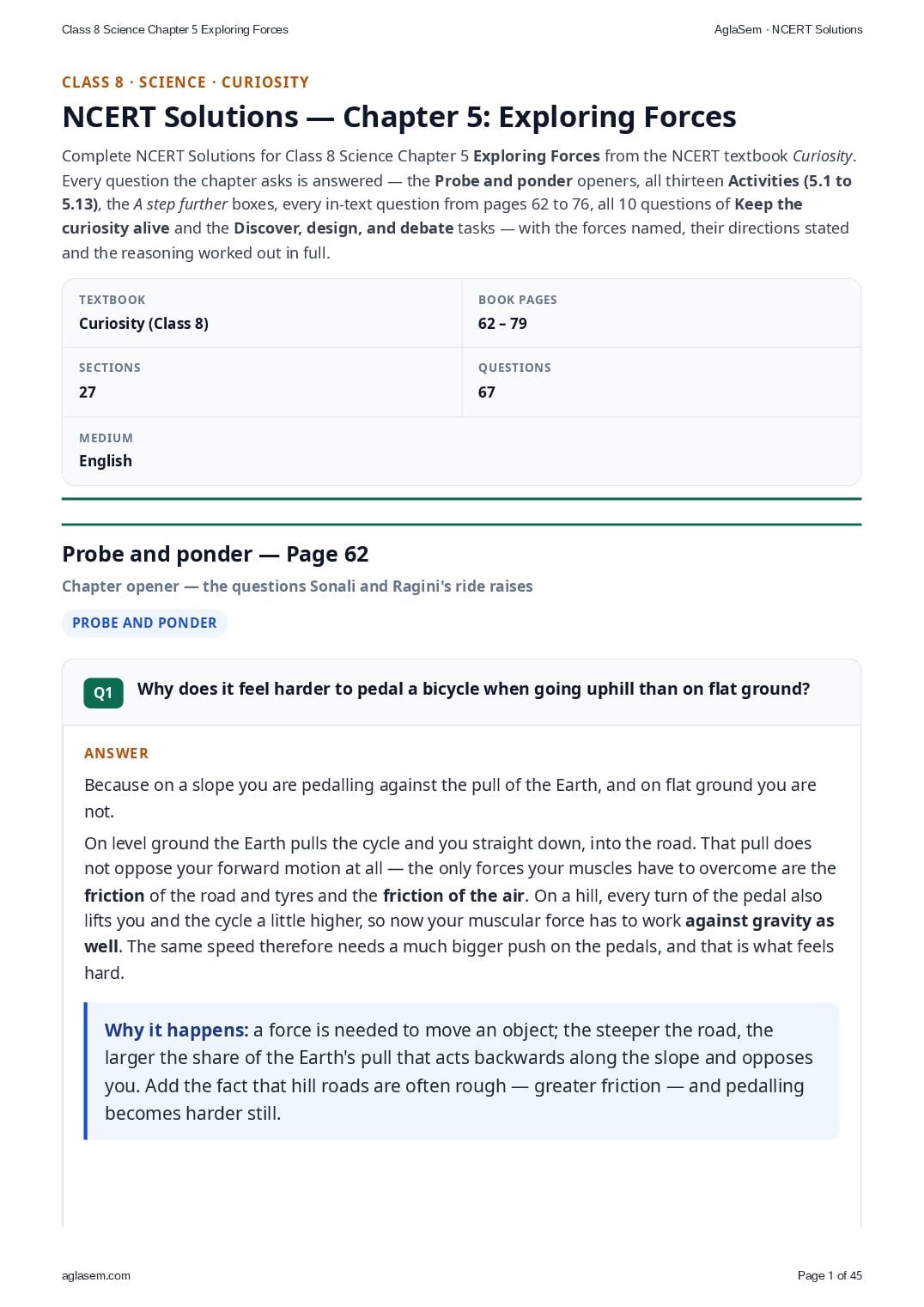
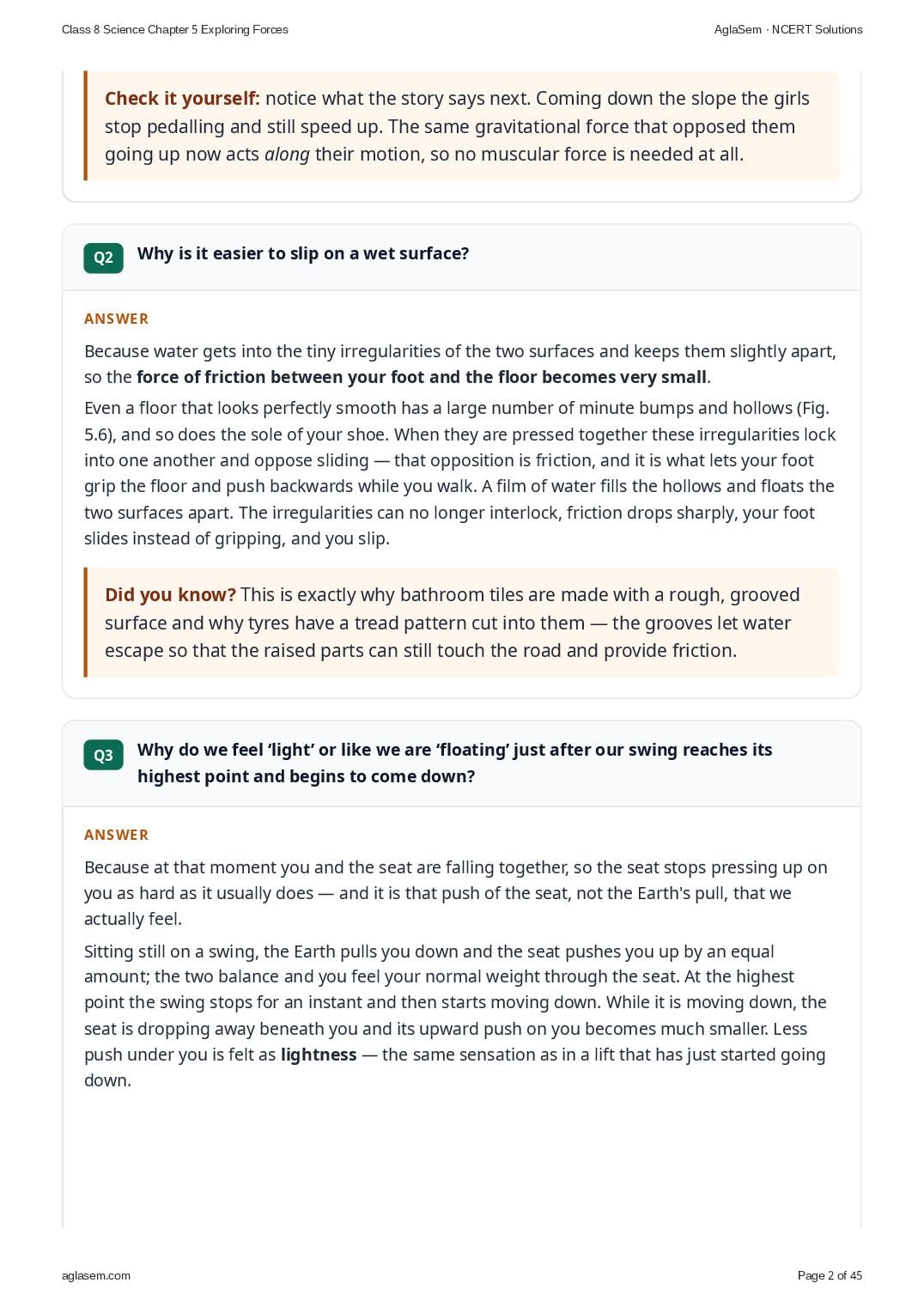
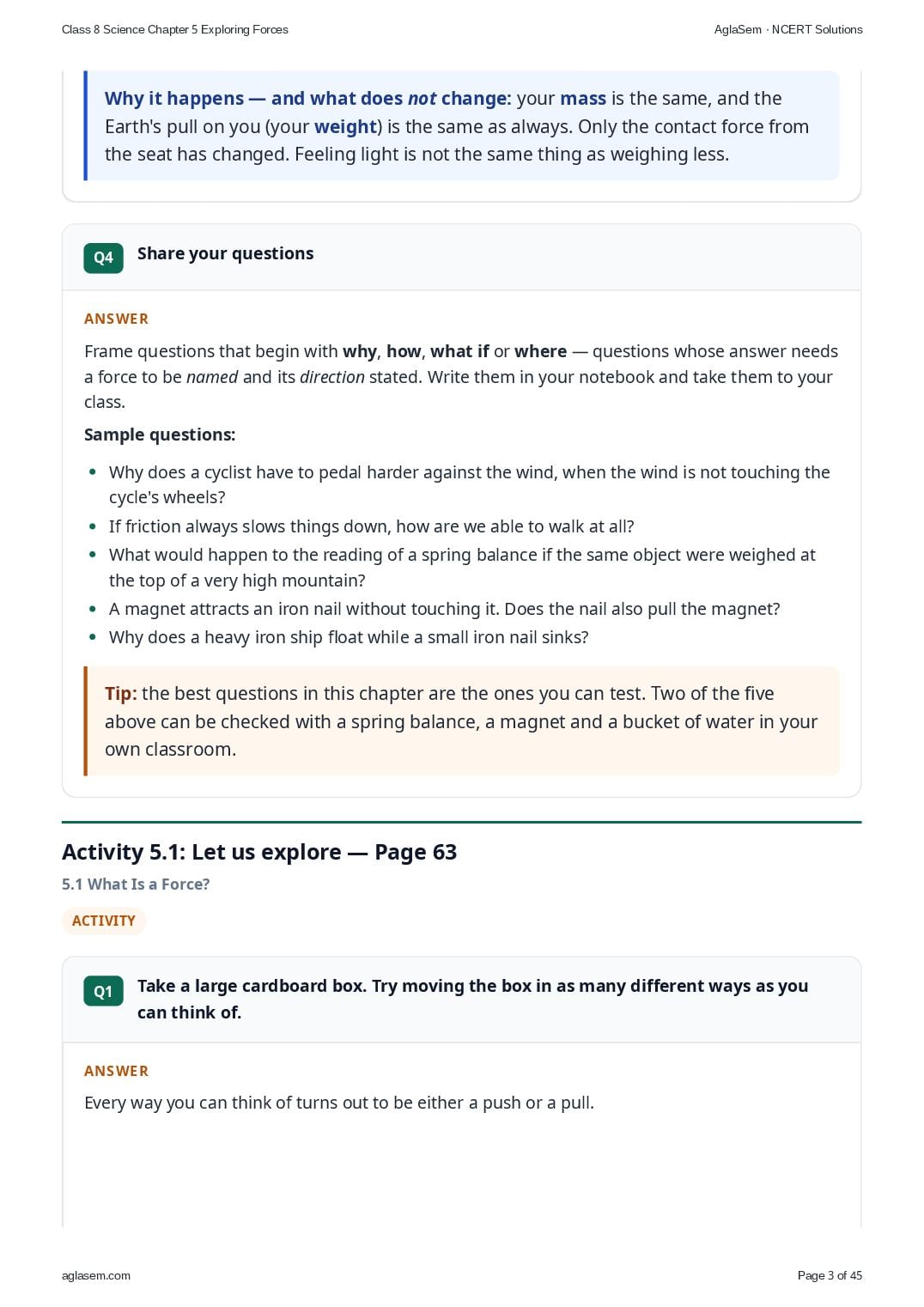
NCERT Solutions for Class 8 Science Chapter 5 PDF Download
You can read the NCERT Solutions for Class 8 Science Chapter 5 online above, or download the complete question-answer PDF to study Exploring Forces offline at any time.
NCERT Solutions for Class 8 Science Chapter 5 PDF Download Link – Click Here to Download Solutions PDF
Questions Covered in This Chapter
These NCERT Solutions answer all 67 questions of this chapter. The questions solved are:
- Why does it feel harder to pedal a bicycle when going uphill than on flat ground?
- Why is it easier to slip on a wet surface?
- Why do we feel ‘light’ or like we are ‘floating’ just after our swing reaches its highest point and begins to come down?
- Share your questions
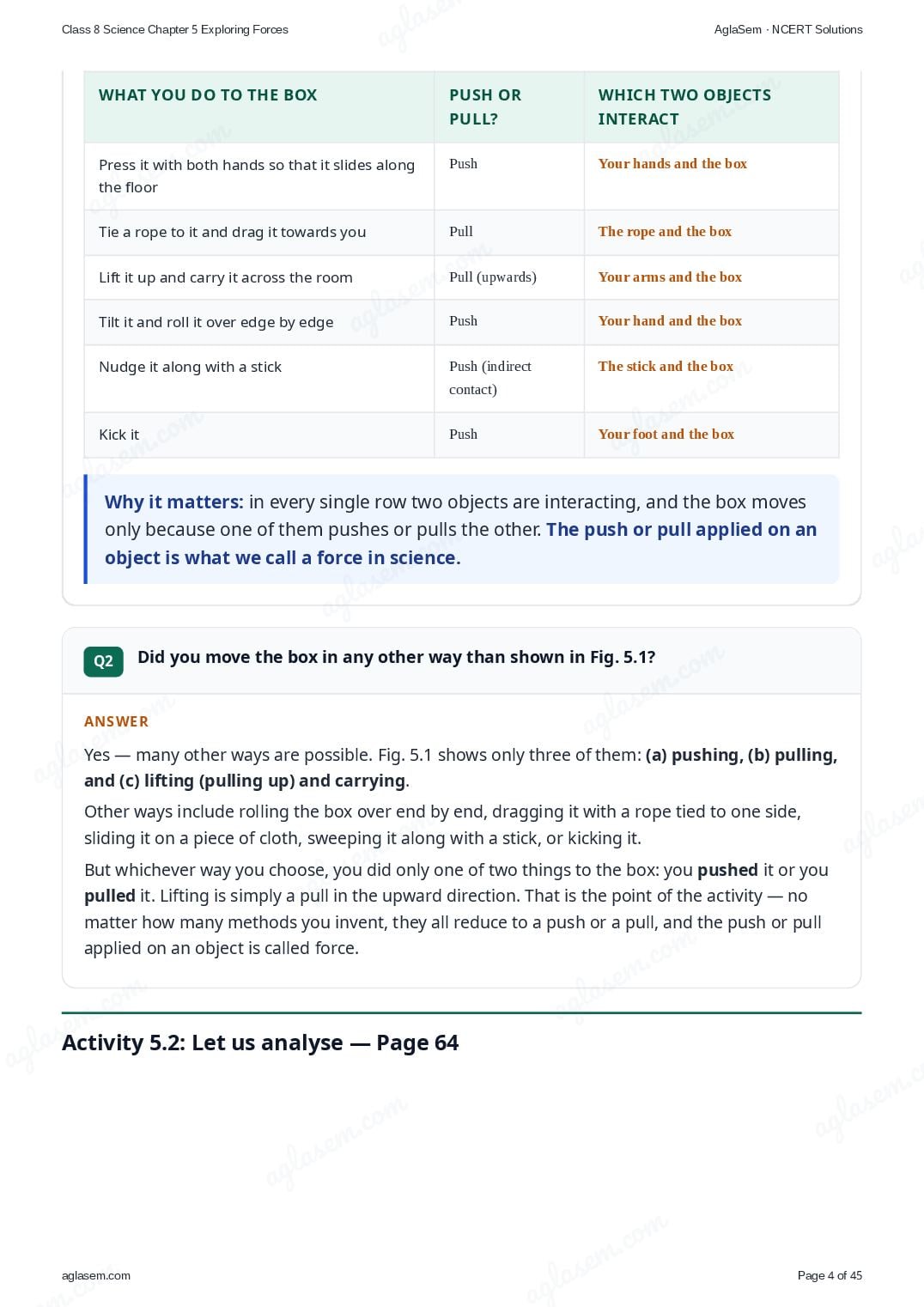
- Take a large cardboard box. Try moving the box in as many different ways as you can think of.
- Did you move the box in any other way than shown in Fig. 5.1?
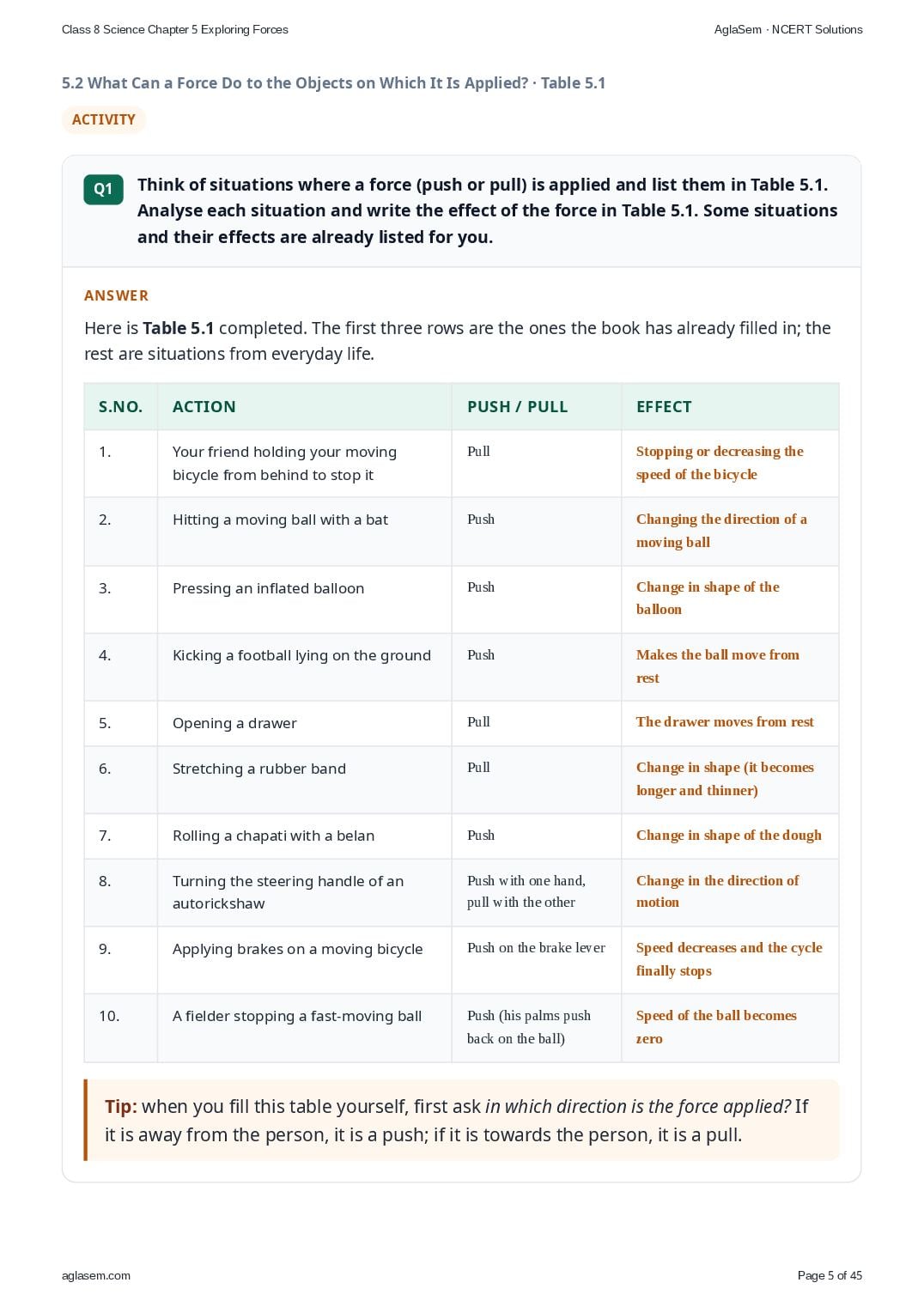
- Think of situations where a force (push or pull) is applied and list them in Table 5.1. Analyse each situation and write the effect of the force in Table 5.1. Some situations and their effects are already listed for you.
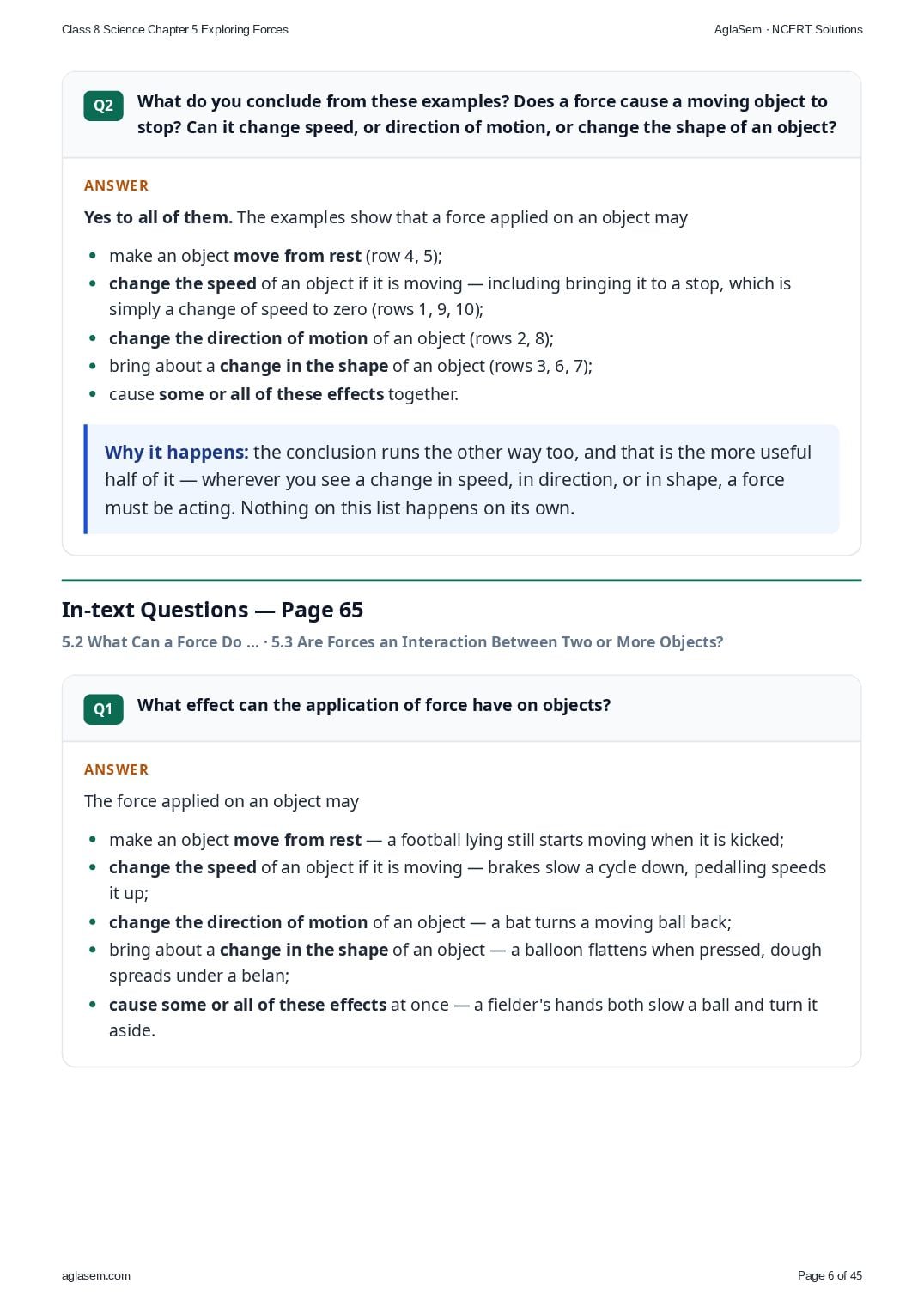
- What do you conclude from these examples? Does a force cause a moving object to stop? Can it change speed, or direction of motion, or change the shape of an object?
- What effect can the application of force have on objects?
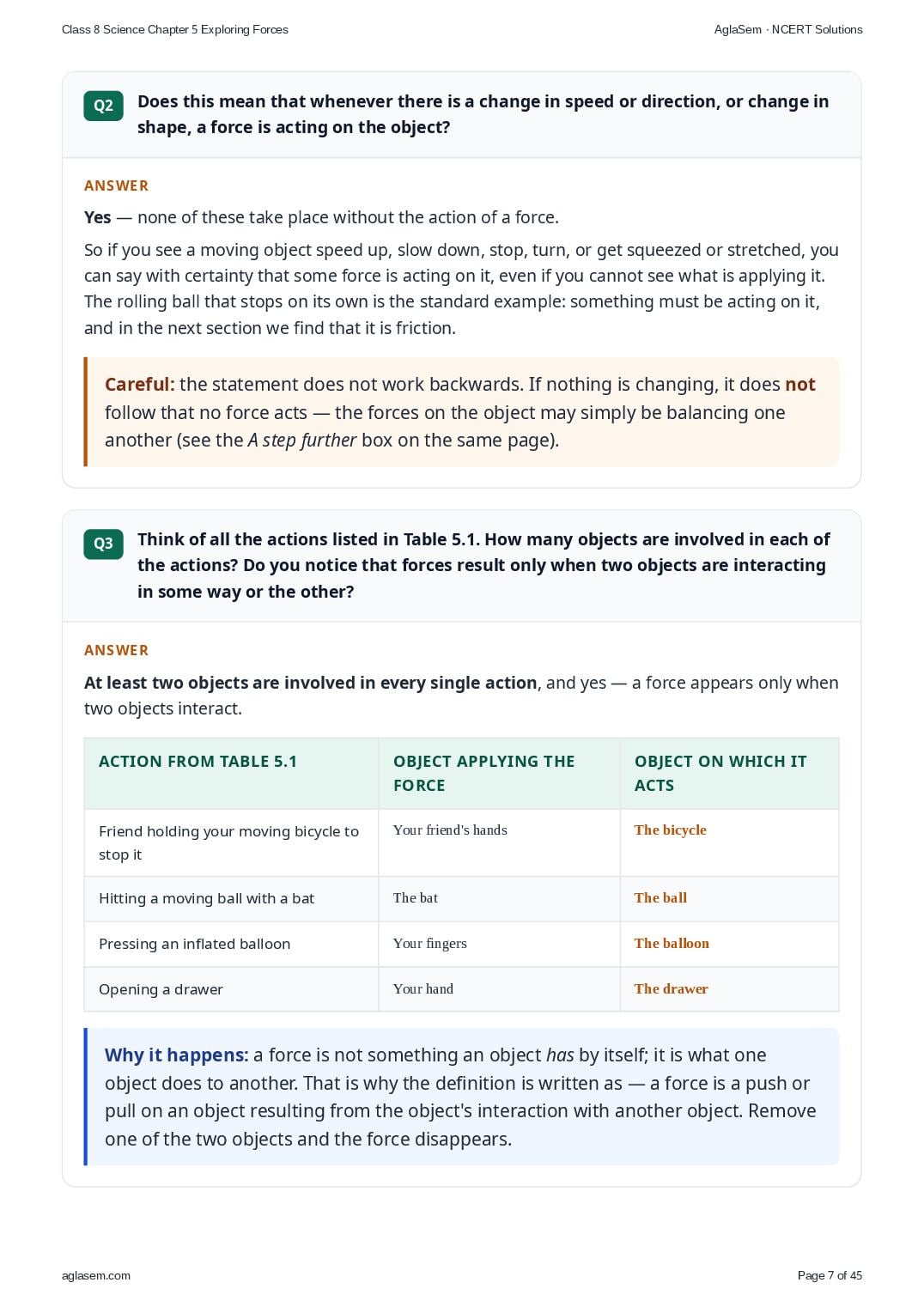
- Does this mean that whenever there is a change in speed or direction, or change in shape, a force is acting on the object?
- Think of all the actions listed in Table 5.1. How many objects are involved in each of the actions? Do you notice that forces result only when two objects are interacting in some way or the other?
- Suppose an object is at rest. Does it mean that no force is acting on this object?
- When you pushed the table with your hand, did you feel a force on your hand too?
- Is there any other contact force?
- A ball rolling on a flat ground stops on its own after some time … What causes the change in the speed of objects in such situations? … Is it possible that some force is indeed acting on them? Which force is that?
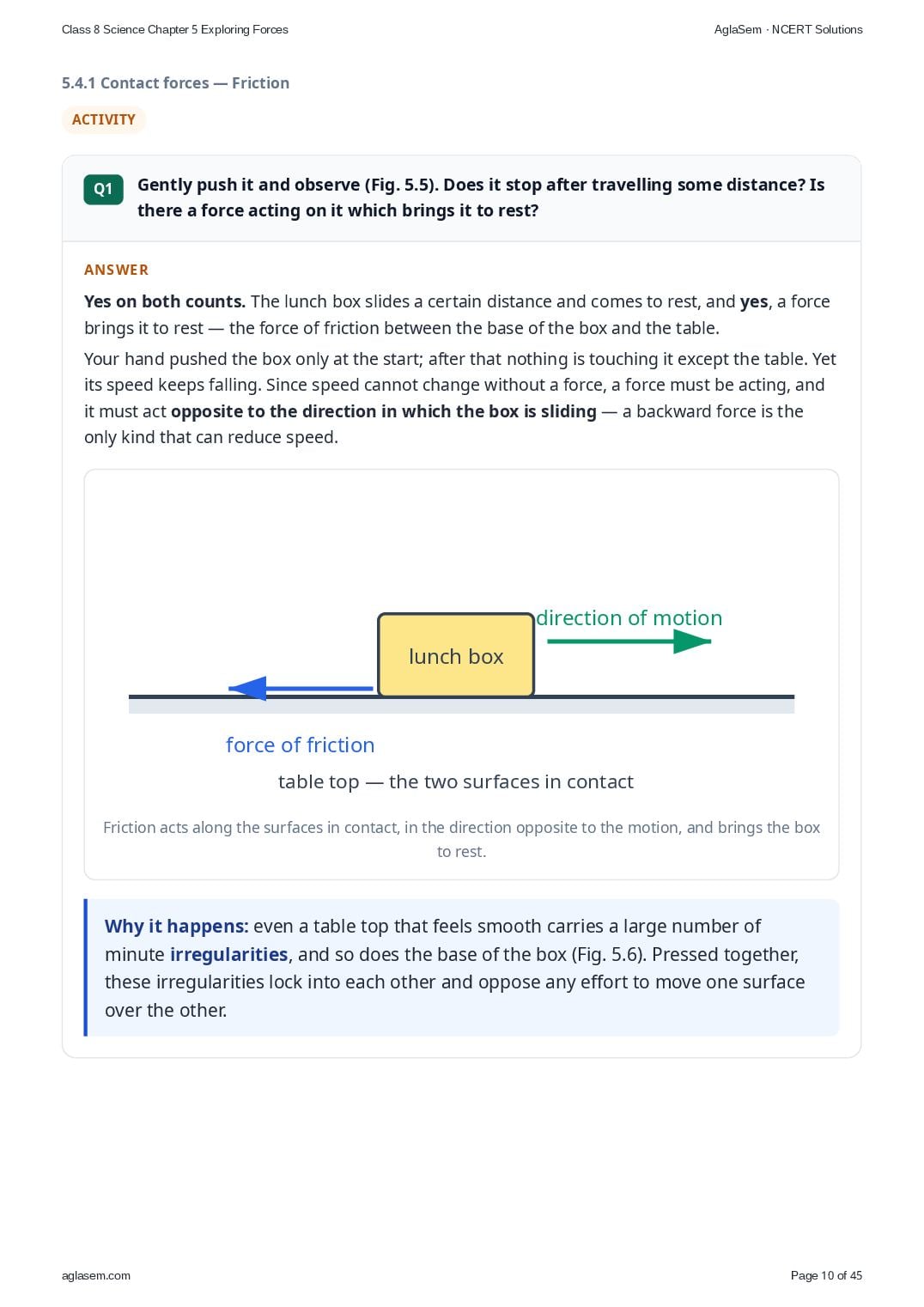
- Gently push it and observe (Fig. 5.5). Does it stop after travelling some distance? Is there a force acting on it which brings it to rest?
- Now repeat by pushing the object in the opposite direction. Does it stop again after travelling some distance?
- Does the object stop after travelling the same distance as in Activity 5.3?
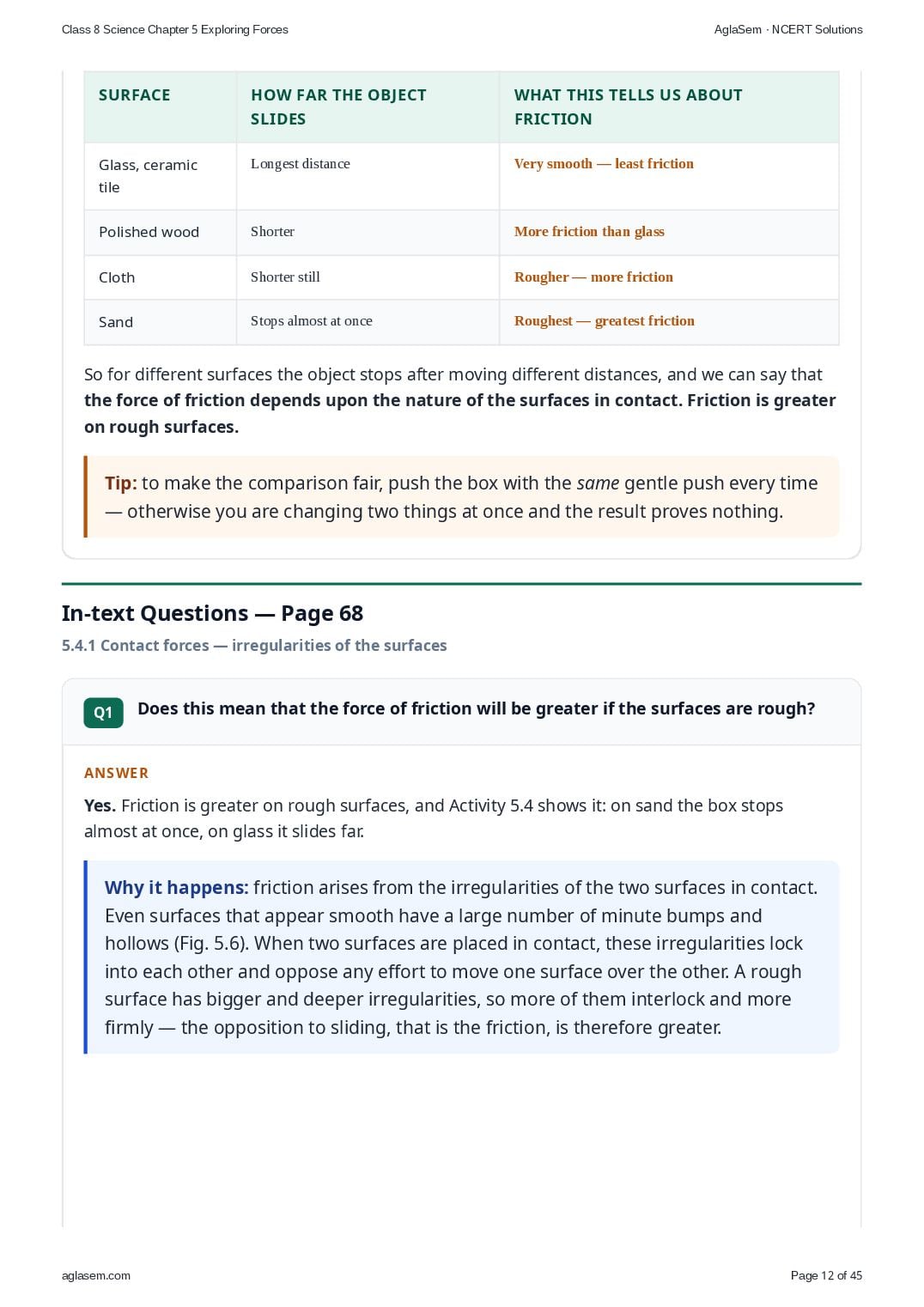
- Does the object stop at the same distance on all surfaces?
- Does this mean that the force of friction will be greater if the surfaces are rough?
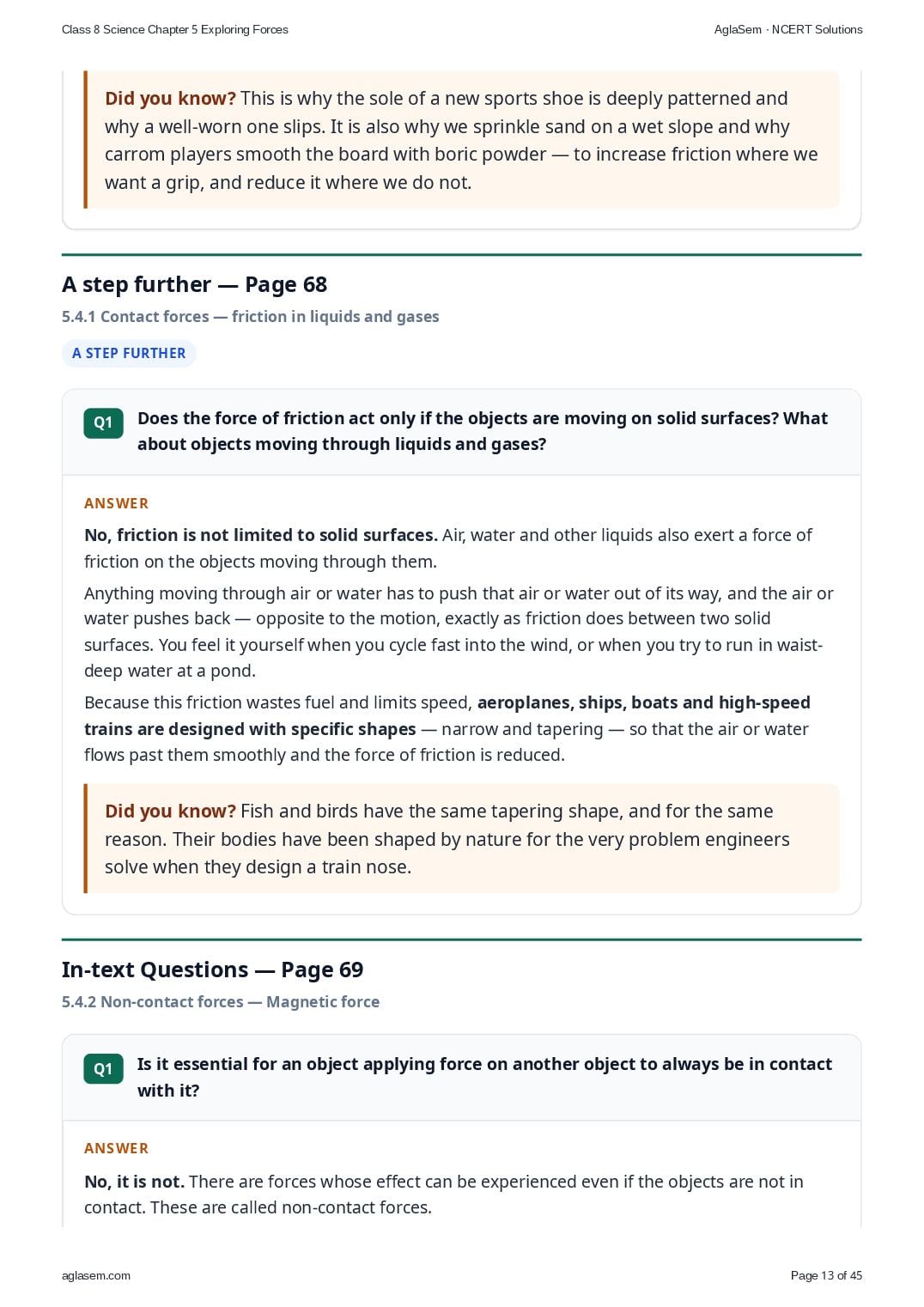
- Does the force of friction act only if the objects are moving on solid surfaces? What about objects moving through liquids and gases?
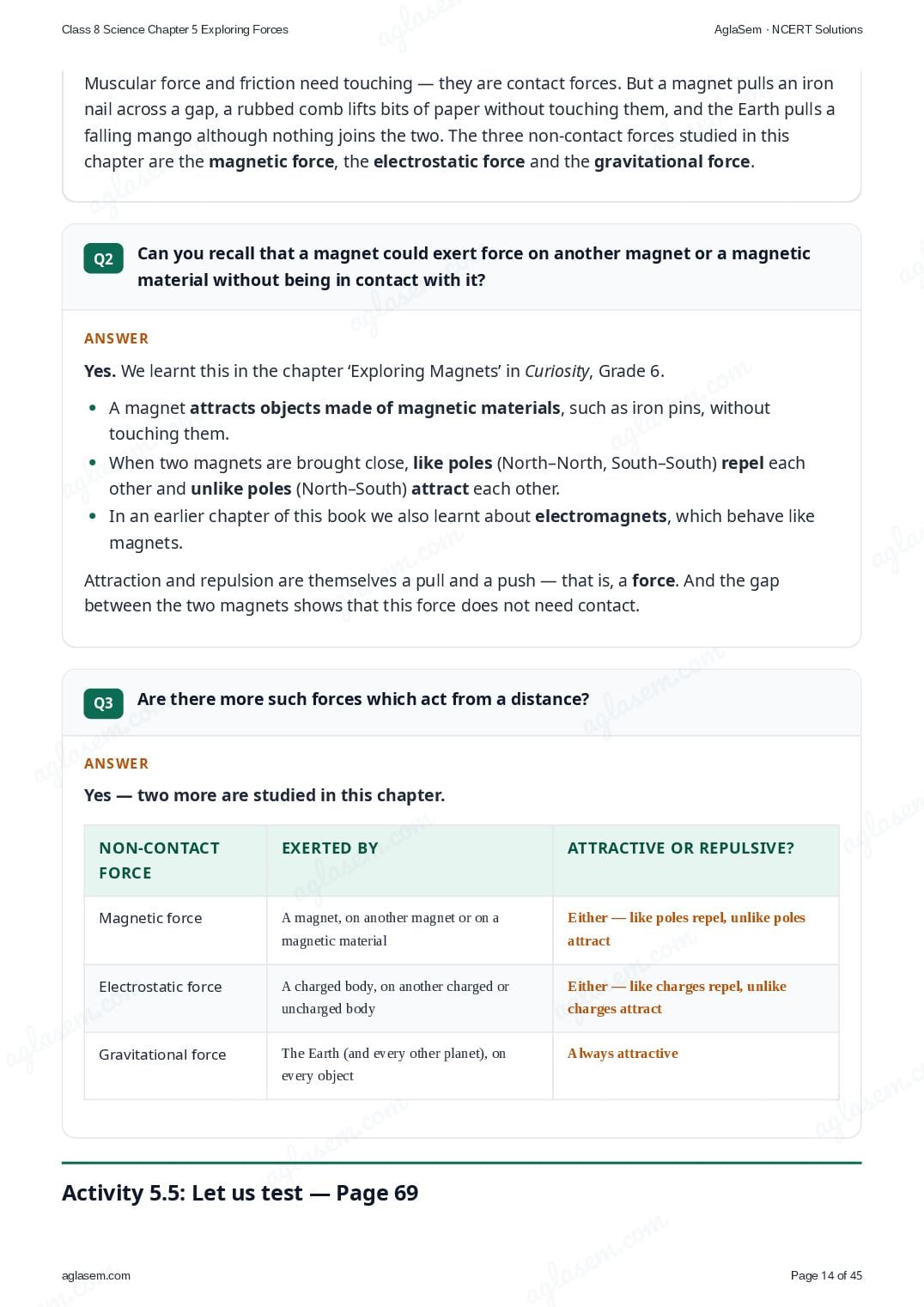
- Is it essential for an object applying force on another object to always be in contact with it?
- Can you recall that a magnet could exert force on another magnet or a magnetic material without being in contact with it?
- Are there more such forces which act from a distance?
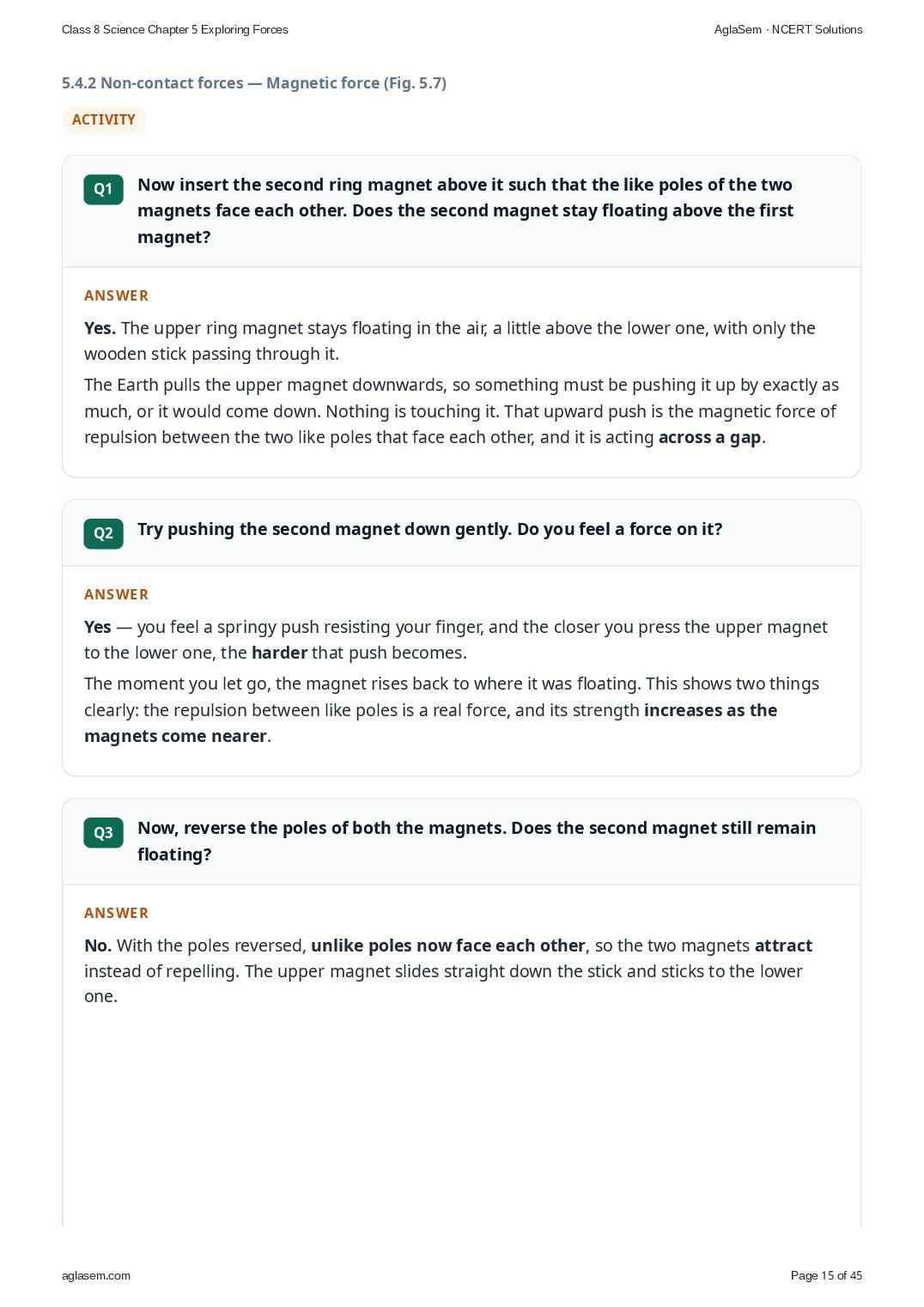
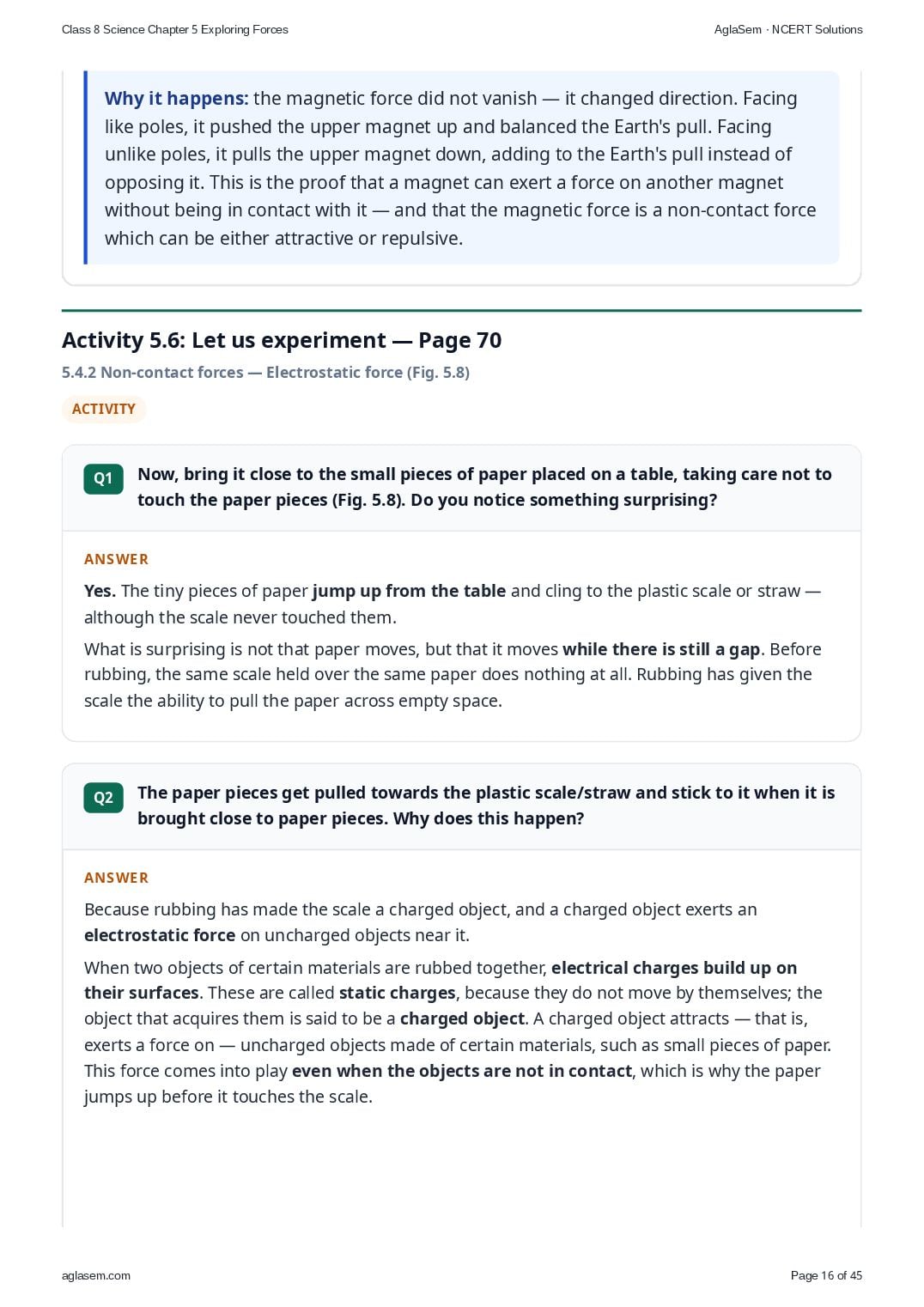
- Now insert the second ring magnet above it such that the like poles of the two magnets face each other. Does the second magnet stay floating above the first magnet?
- Try pushing the second magnet down gently. Do you feel a force on it?
- Now, reverse the poles of both the magnets. Does the second magnet still remain floating?
- Now, bring it close to the small pieces of paper placed on a table, taking care not to touch the paper pieces (Fig. 5.8). Do you notice something surprising?
- The paper pieces get pulled towards the plastic scale/straw and stick to it when it is brought close to paper pieces. Why does this happen?
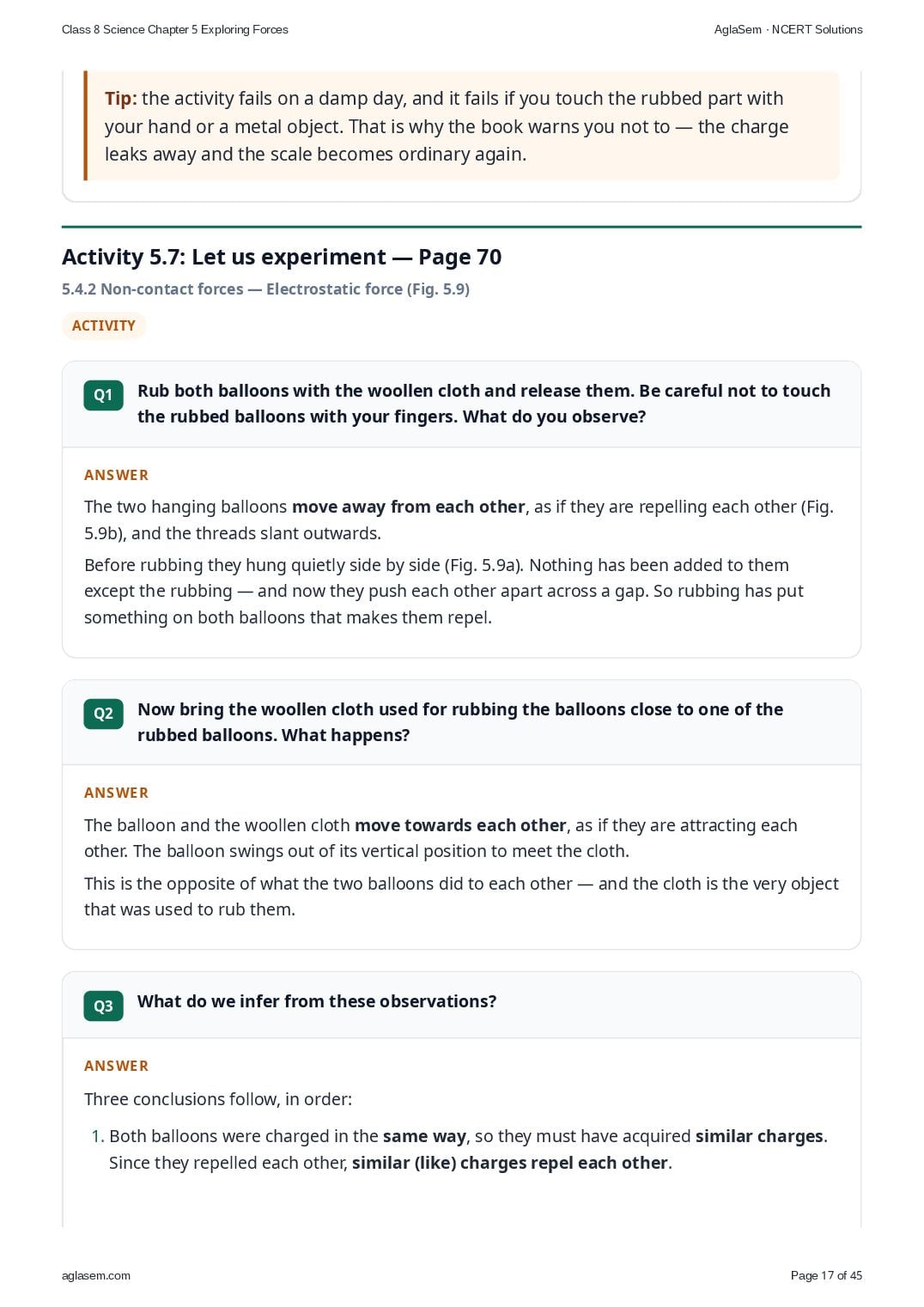
- Rub both balloons with the woollen cloth and release them. Be careful not to touch the rubbed balloons with your fingers. What do you observe?
- Now bring the woollen cloth used for rubbing the balloons close to one of the rubbed balloons. What happens?
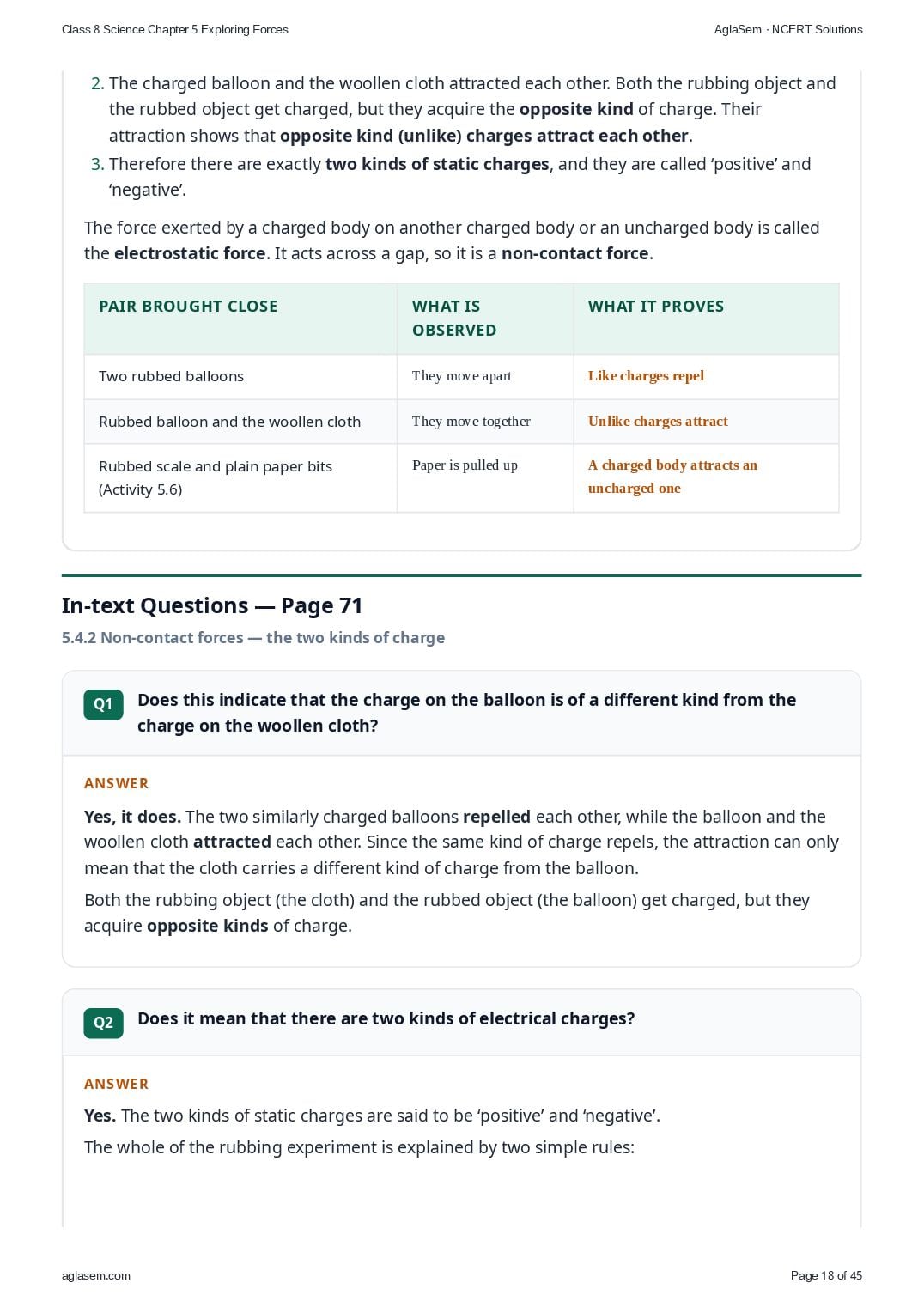
- What do we infer from these observations?
- Does this indicate that the charge on the balloon is of a different kind from the charge on the woollen cloth?
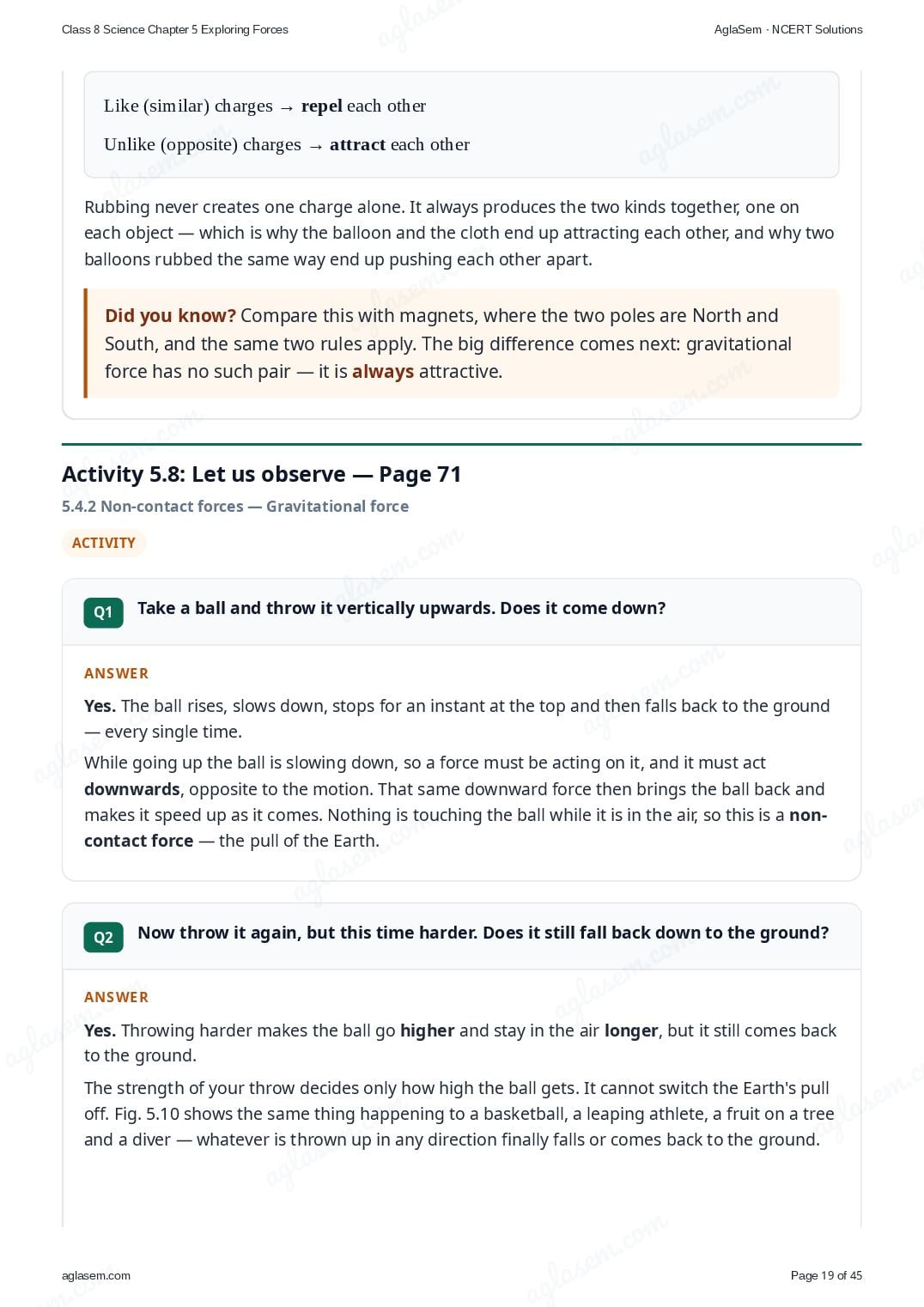
- Does it mean that there are two kinds of electrical charges?
- Take a ball and throw it vertically upwards. Does it come down?
- Now throw it again, but this time harder. Does it still fall back down to the ground?
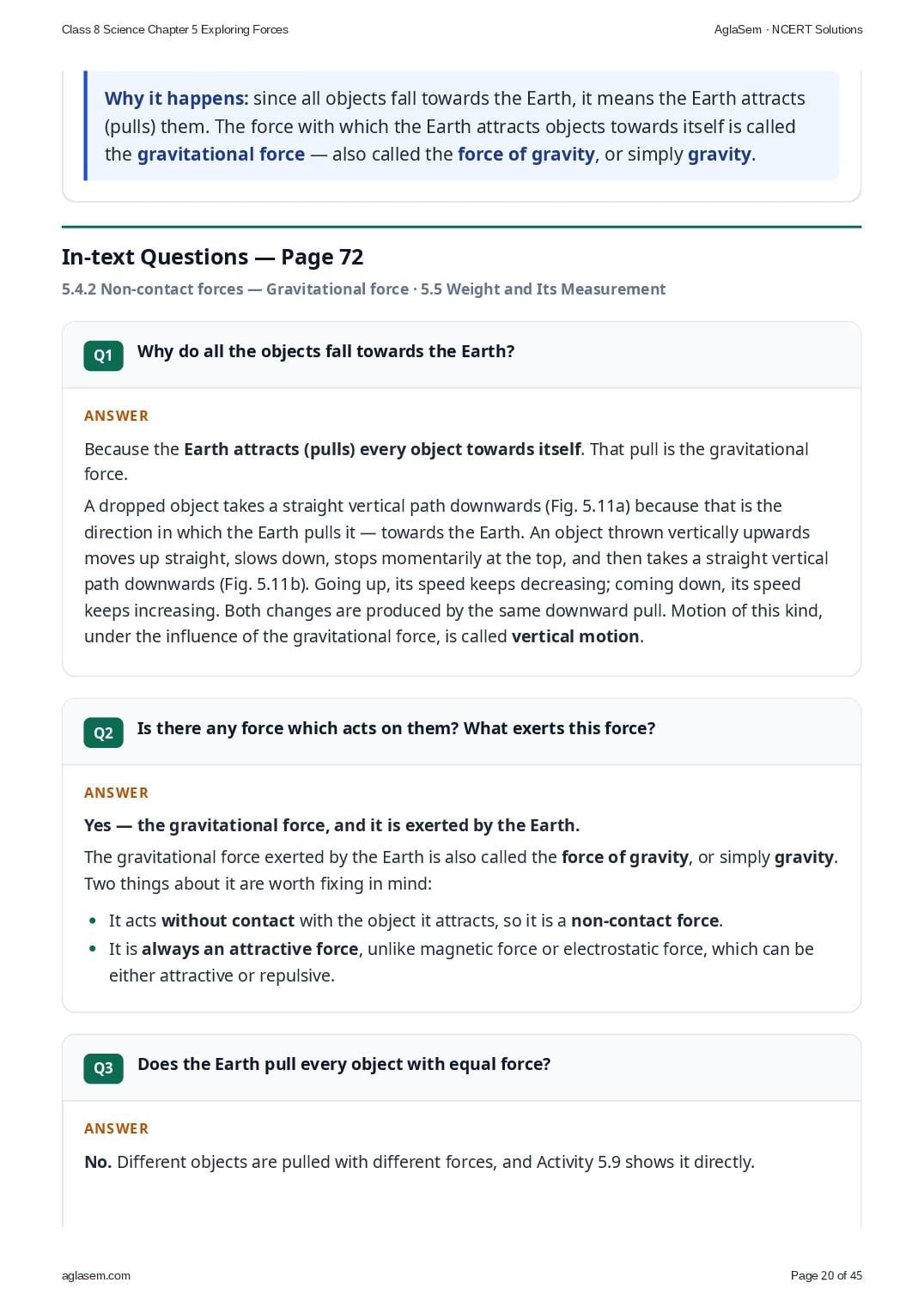
- Why do all the objects fall towards the Earth?
- Is there any force which acts on them? What exerts this force?
- Does the Earth pull every object with equal force?
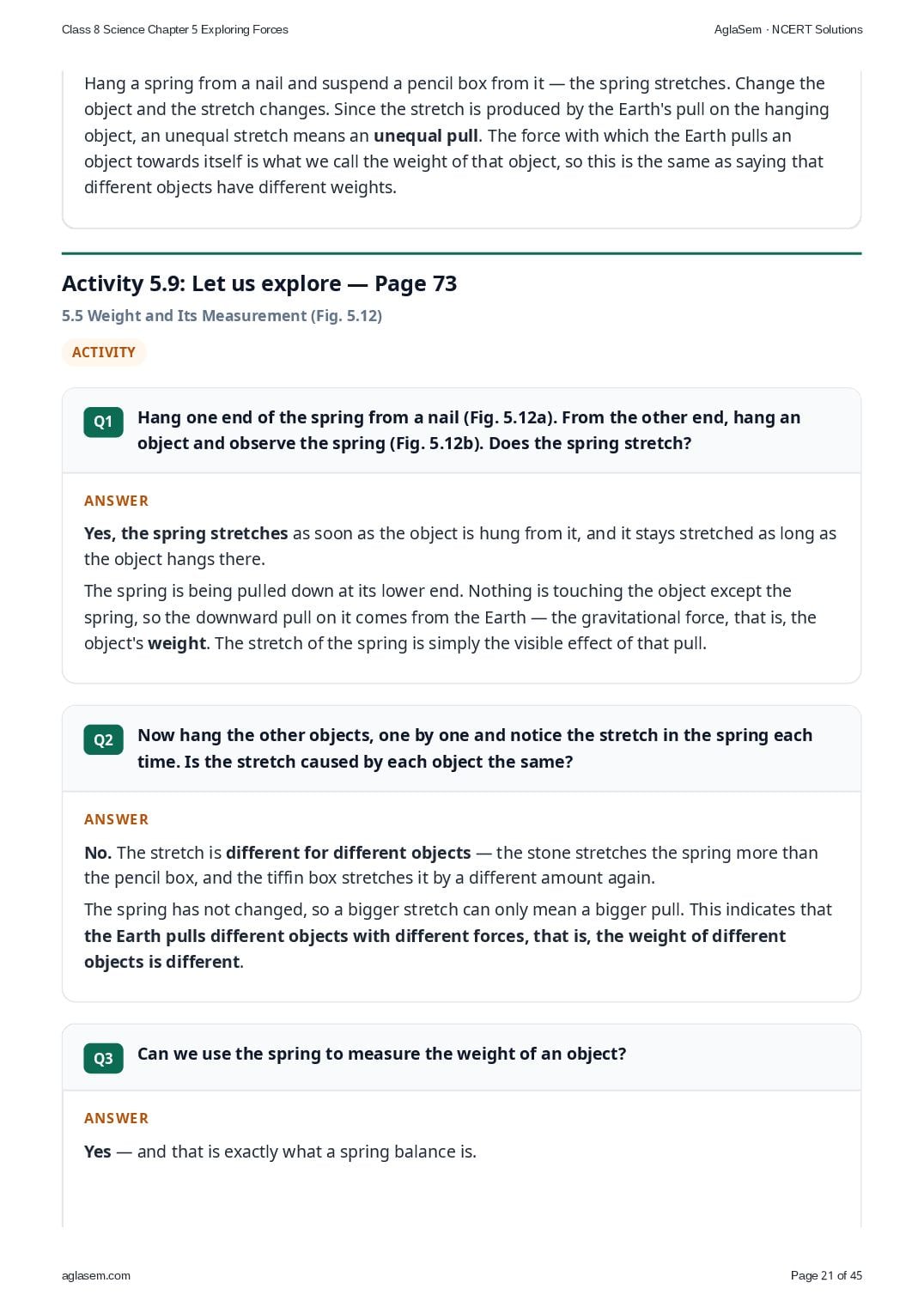
- Hang one end of the spring from a nail (Fig. 5.12a). From the other end, hang an object and observe the spring (Fig. 5.12b). Does the spring stretch?
- Now hang the other objects, one by one and notice the stretch in the spring each time. Is the stretch caused by each object the same?
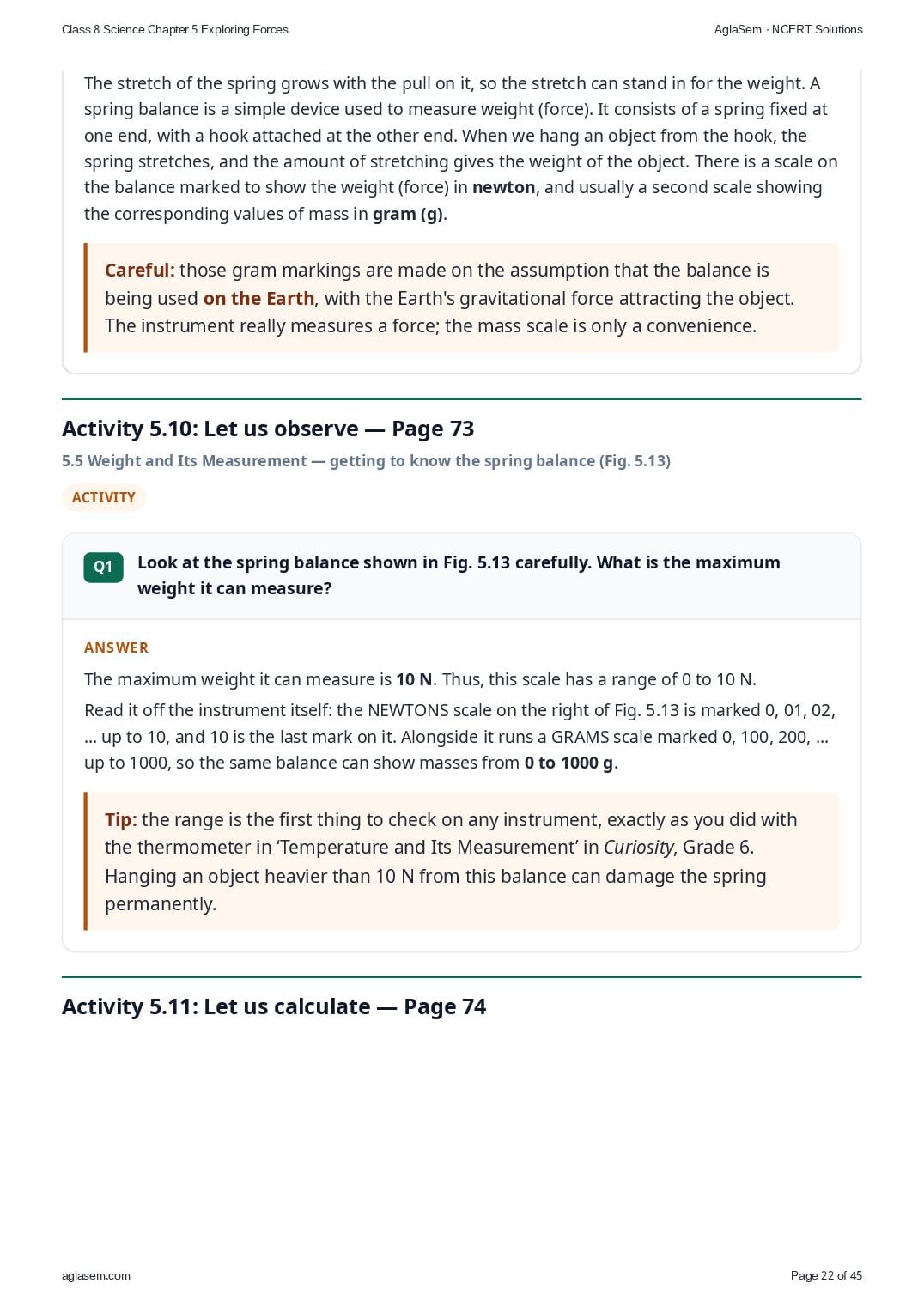
- Can we use the spring to measure the weight of an object?
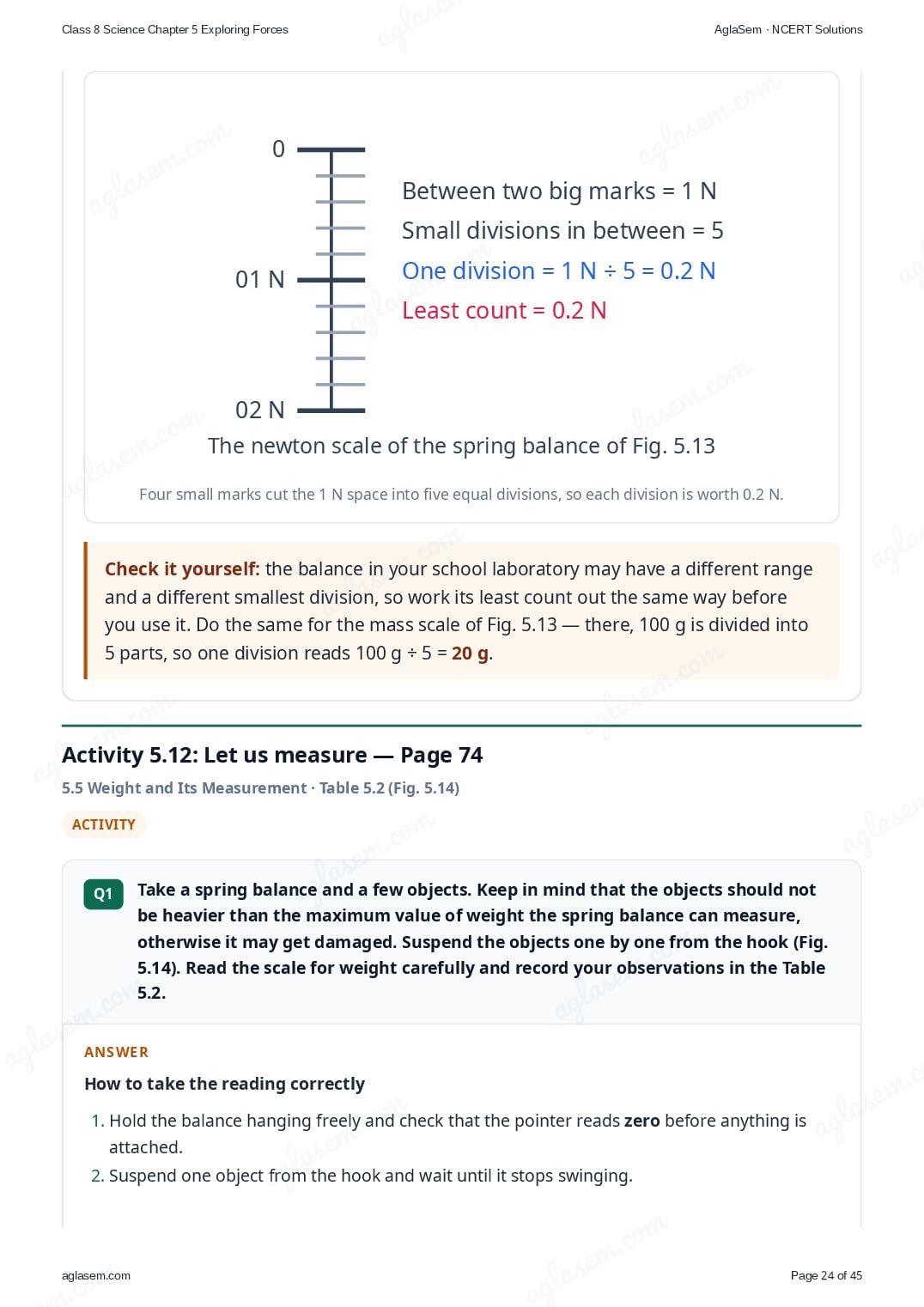
- Look at the spring balance shown in Fig. 5.13 carefully. What is the maximum weight it can measure?
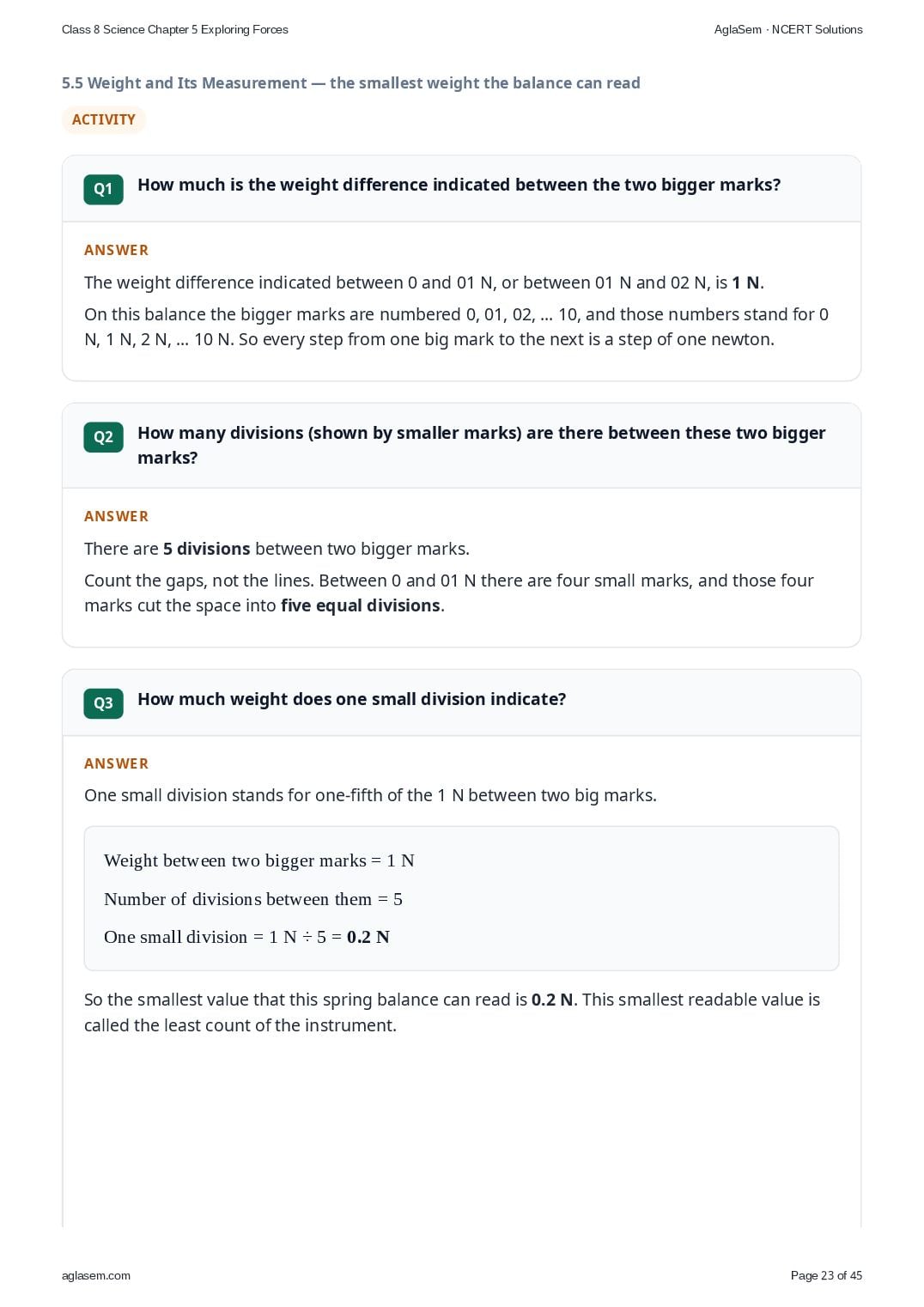
- How much is the weight difference indicated between the two bigger marks?
- How many divisions (shown by smaller marks) are there between these two bigger marks?
- How much weight does one small division indicate?
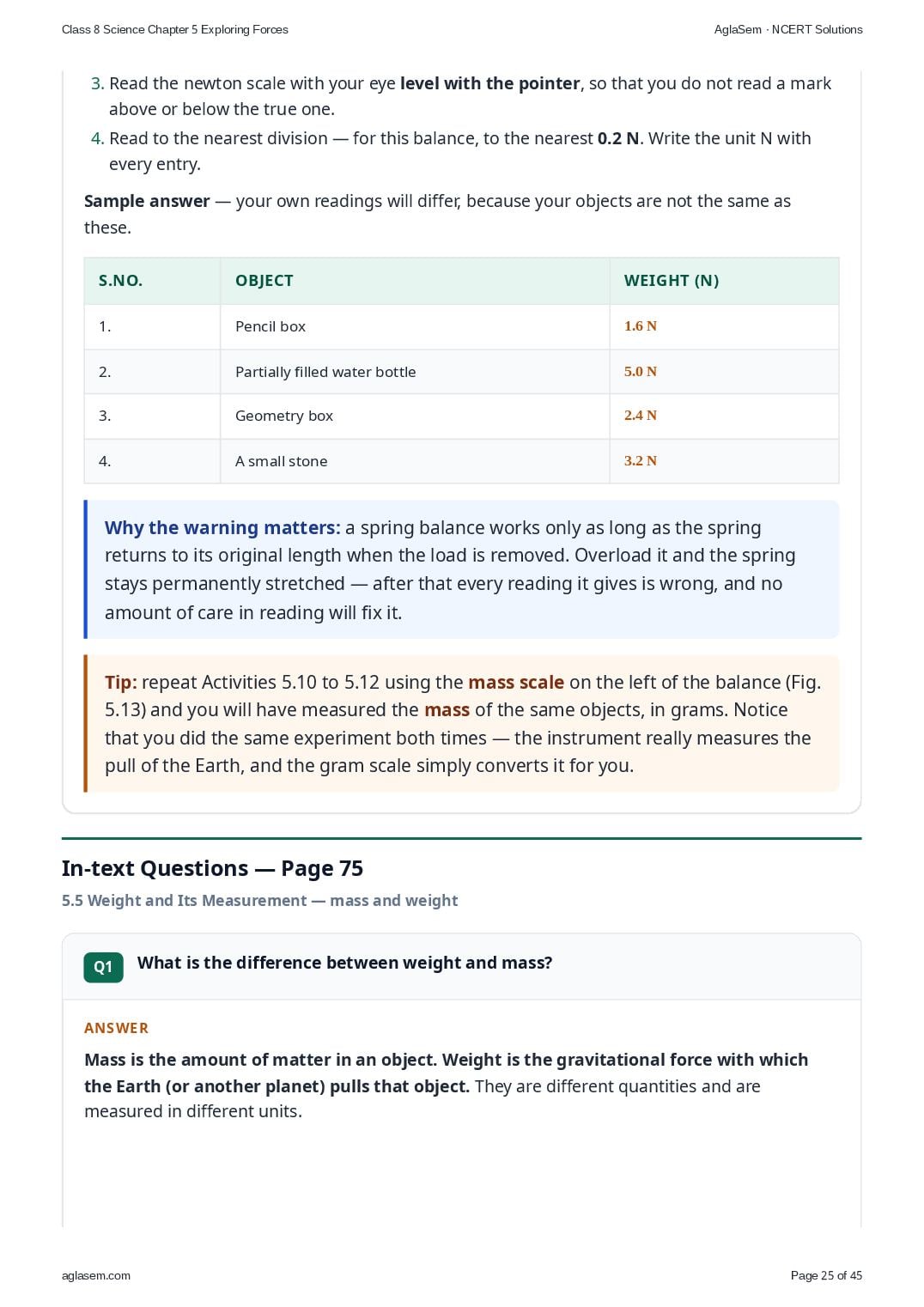
- Take a spring balance and a few objects. Keep in mind that the objects should not be heavier than the maximum value of weight the spring balance can measure, otherwise it may get damaged. Suspend the objects one by one from the hook (Fig. 5.14). Read the scale for weight carefully and record your observations in the Table 5.2.
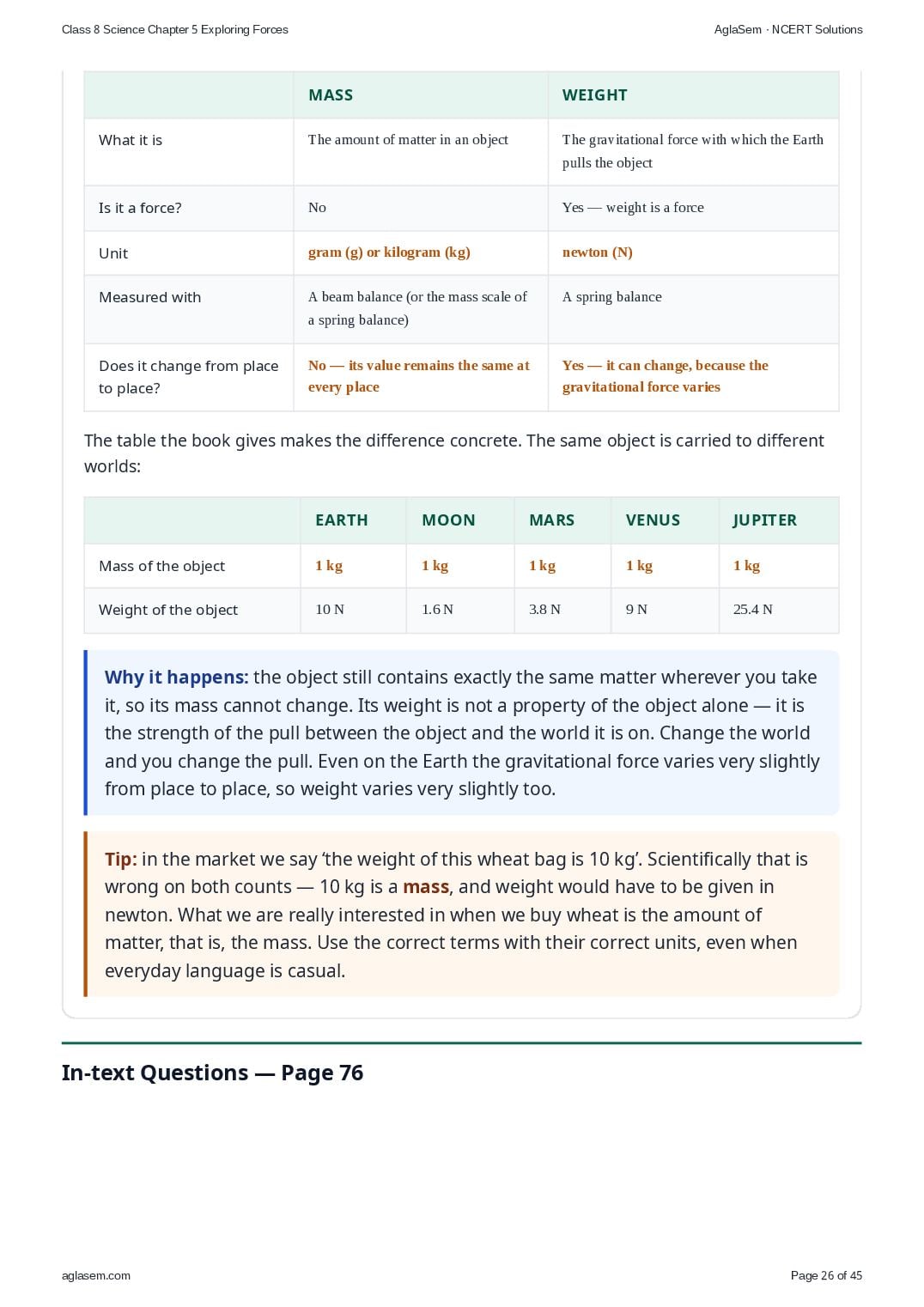
- What is the difference between weight and mass?
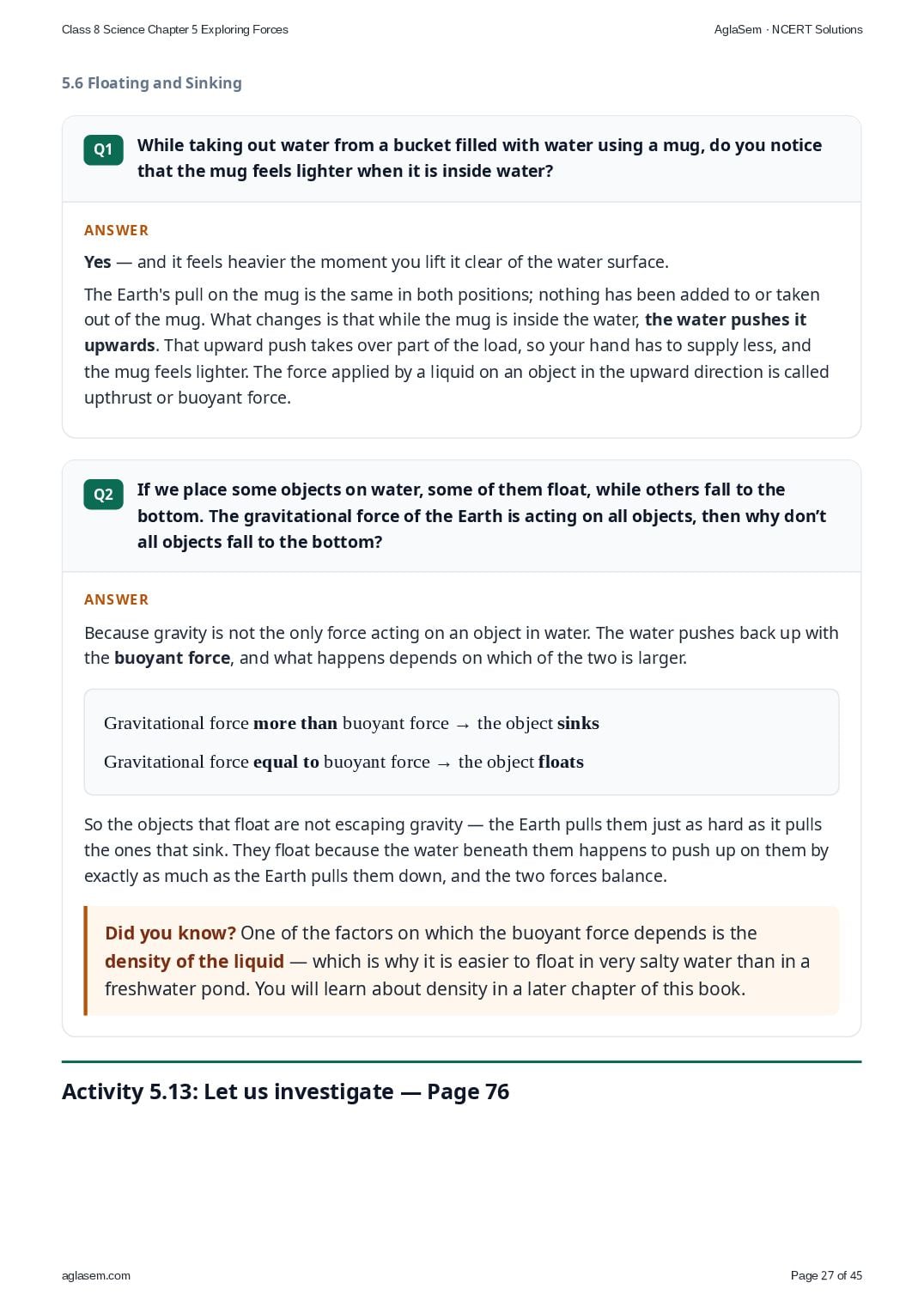
- While taking out water from a bucket filled with water using a mug, do you notice that the mug feels lighter when it is inside water?
- If we place some objects on water, some of them float, while others fall to the bottom. The gravitational force of the Earth is acting on all objects, then why don’t all objects fall to the bottom?
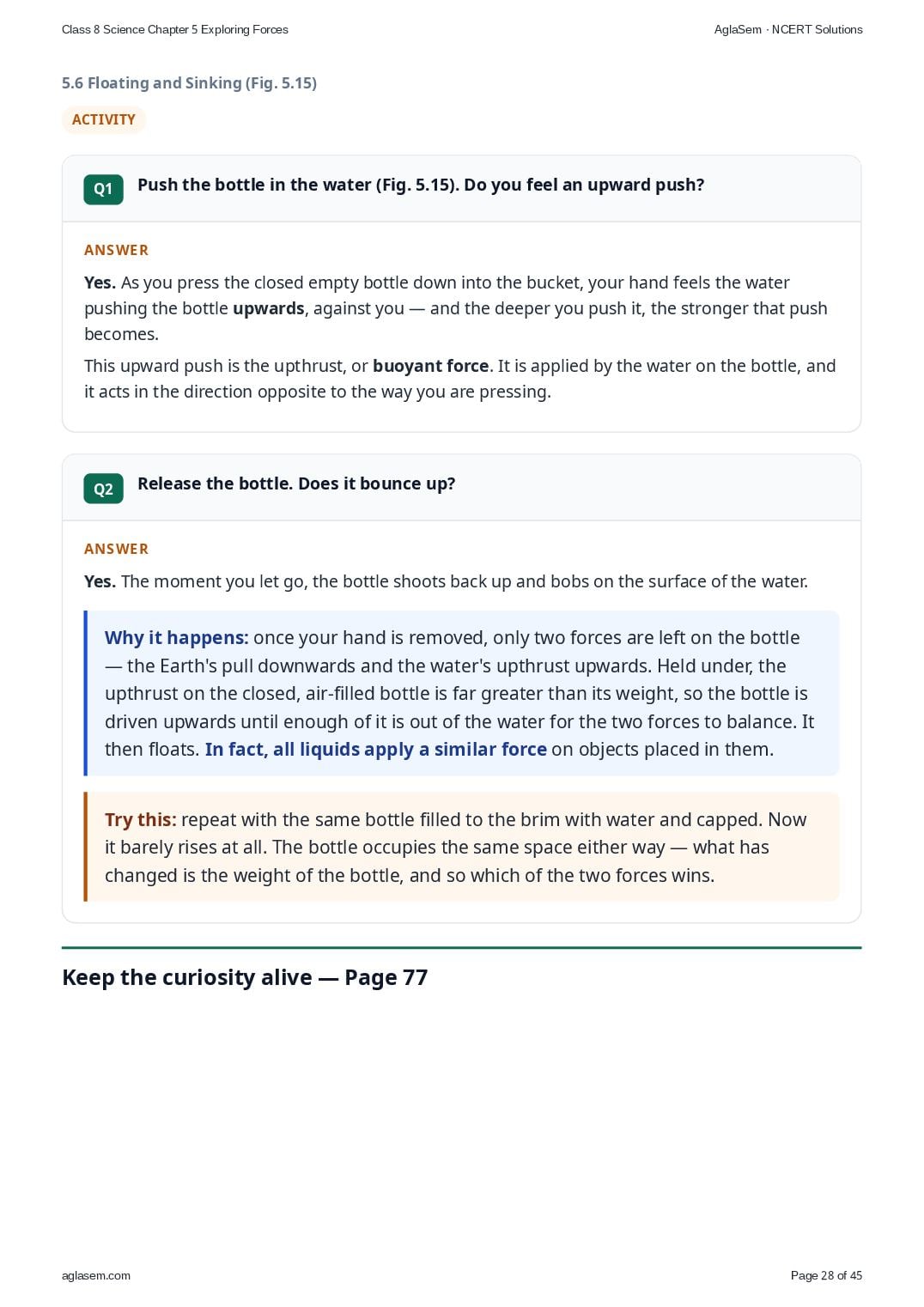
- Push the bottle in the water (Fig. 5.15). Do you feel an upward push?
- Release the bottle. Does it bounce up?
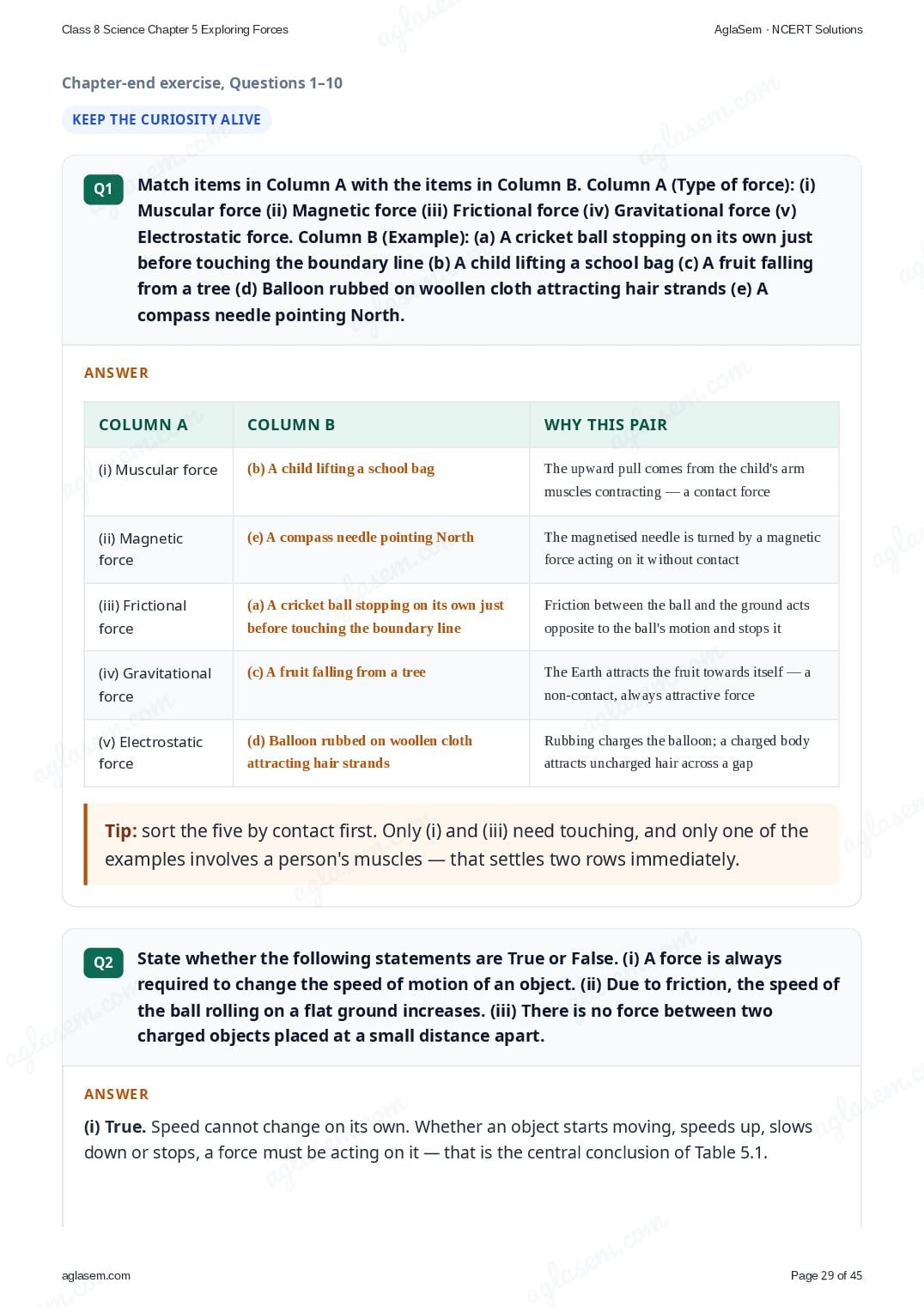
- Match items in Column A with the items in Column B. Column A (Type of force): (i) Muscular force (ii) Magnetic force (iii) Frictional force (iv) Gravitational force (v) Electrostatic force. Column B (Example): (a) A cricket ball stopping on its own just before touching the boundary line (b) A child lifting a school bag (c) A fruit falling from a tree (d) Balloon rubbed on woollen cloth attracting hair strands (e) A compass needle pointing North.
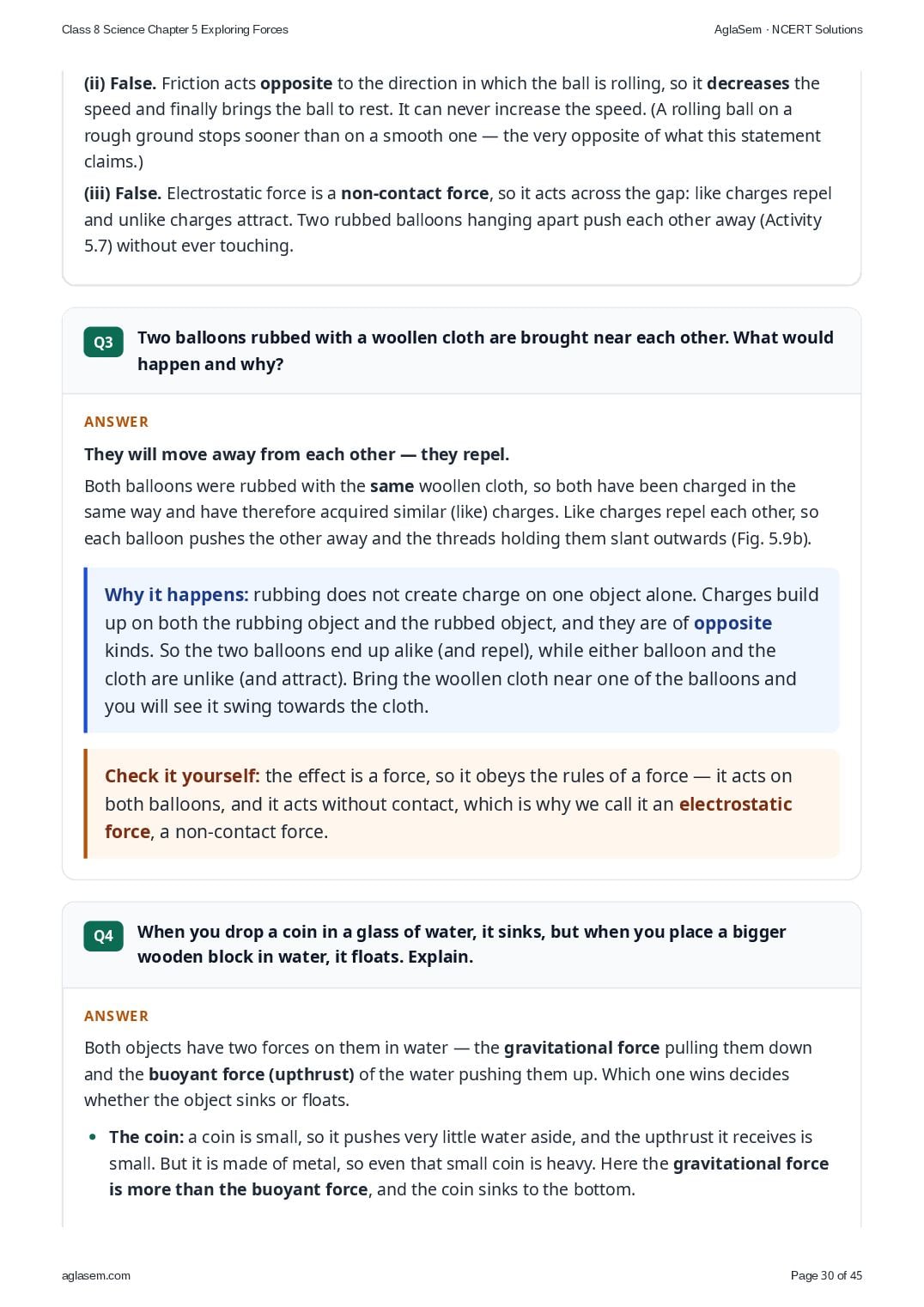
- State whether the following statements are True or False. (i) A force is always required to change the speed of motion of an object. (ii) Due to friction, the speed of the ball rolling on a flat ground increases. (iii) There is no force between two charged objects placed at a small distance apart.
- Two balloons rubbed with a woollen cloth are brought near each other. What would happen and why?
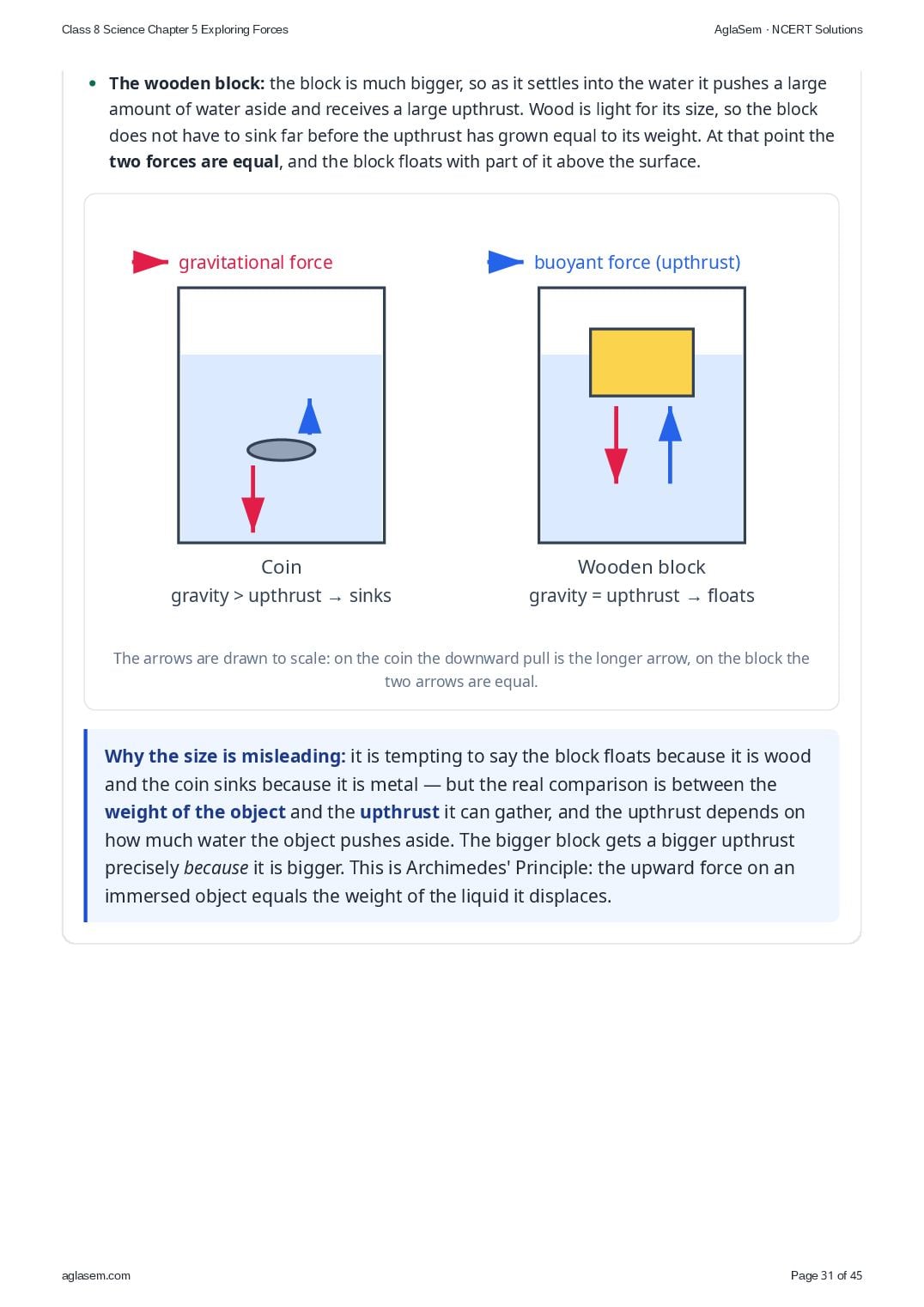
- When you drop a coin in a glass of water, it sinks, but when you place a bigger wooden block in water, it floats. Explain.
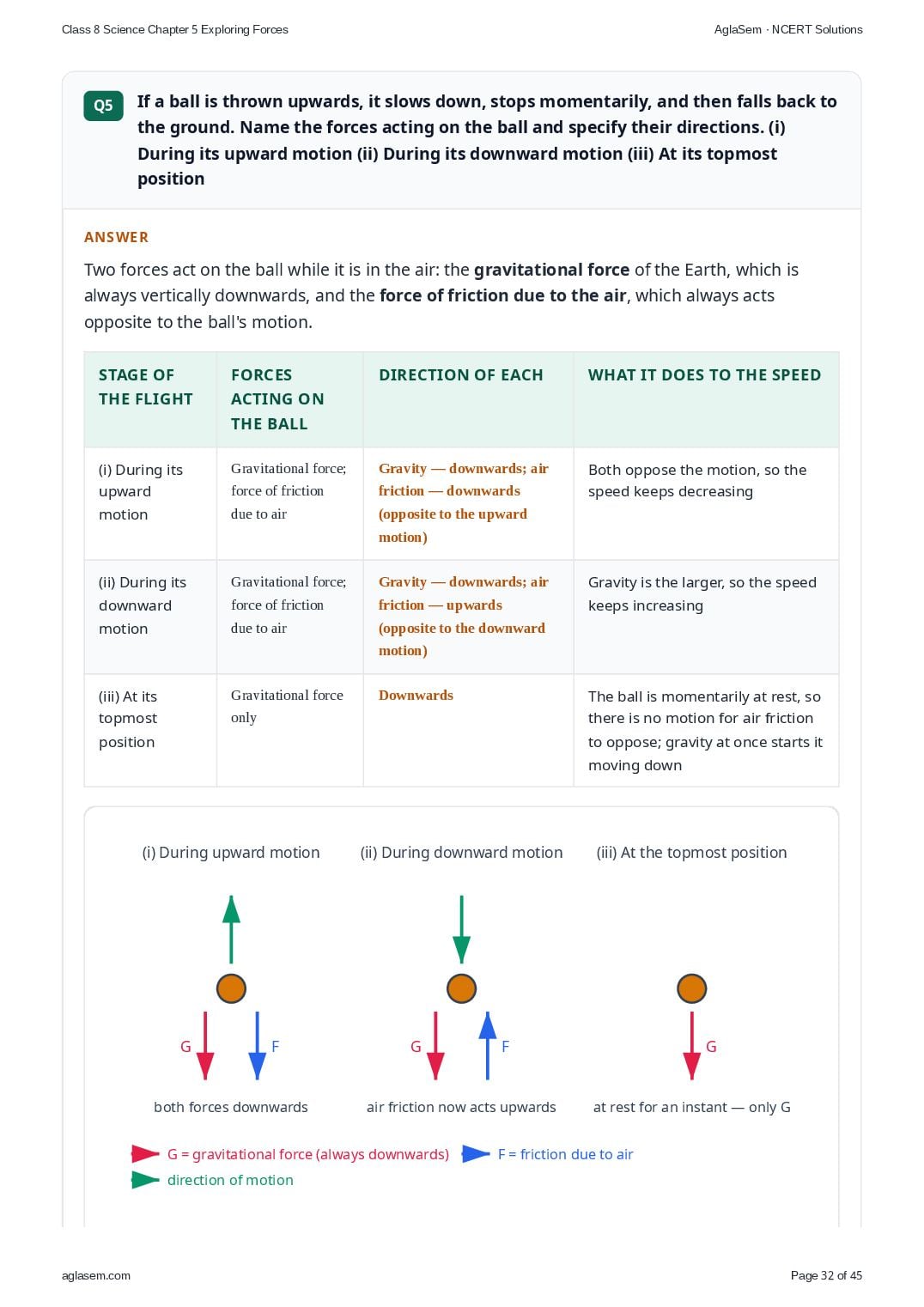
- If a ball is thrown upwards, it slows down, stops momentarily, and then falls back to the ground. Name the forces acting on the ball and specify their directions. (i) During its upward motion (ii) During its downward motion (iii) At its topmost position
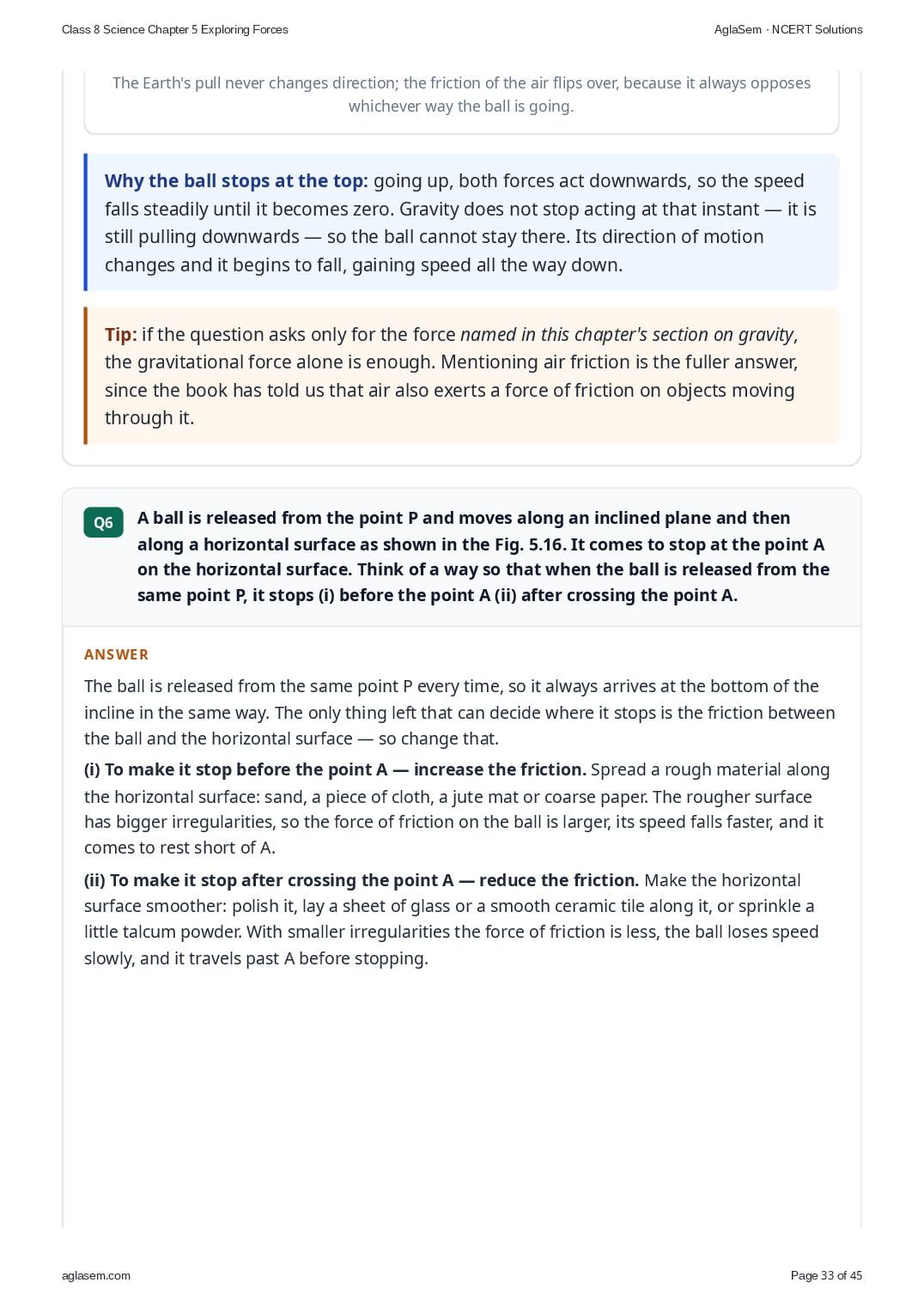
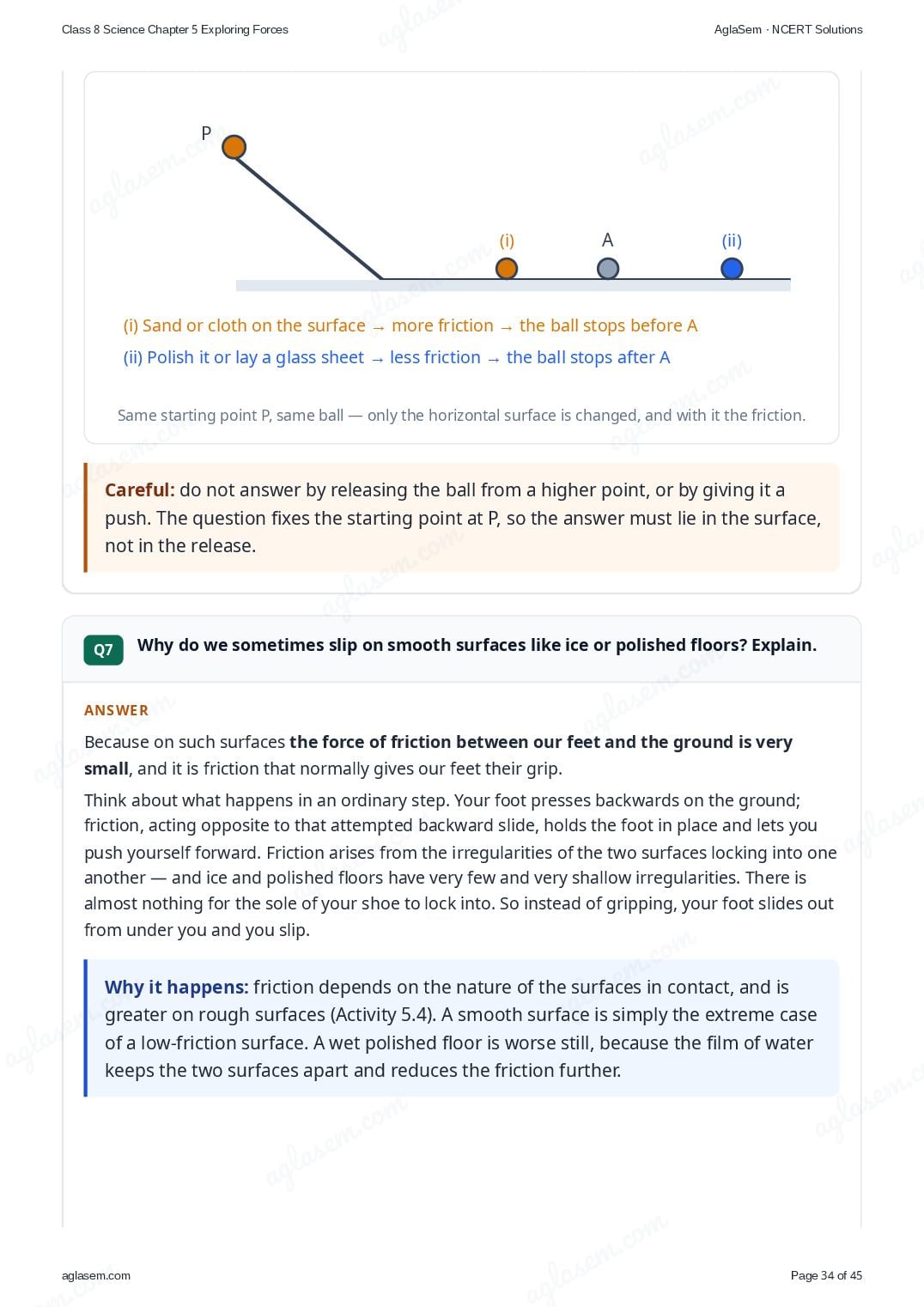
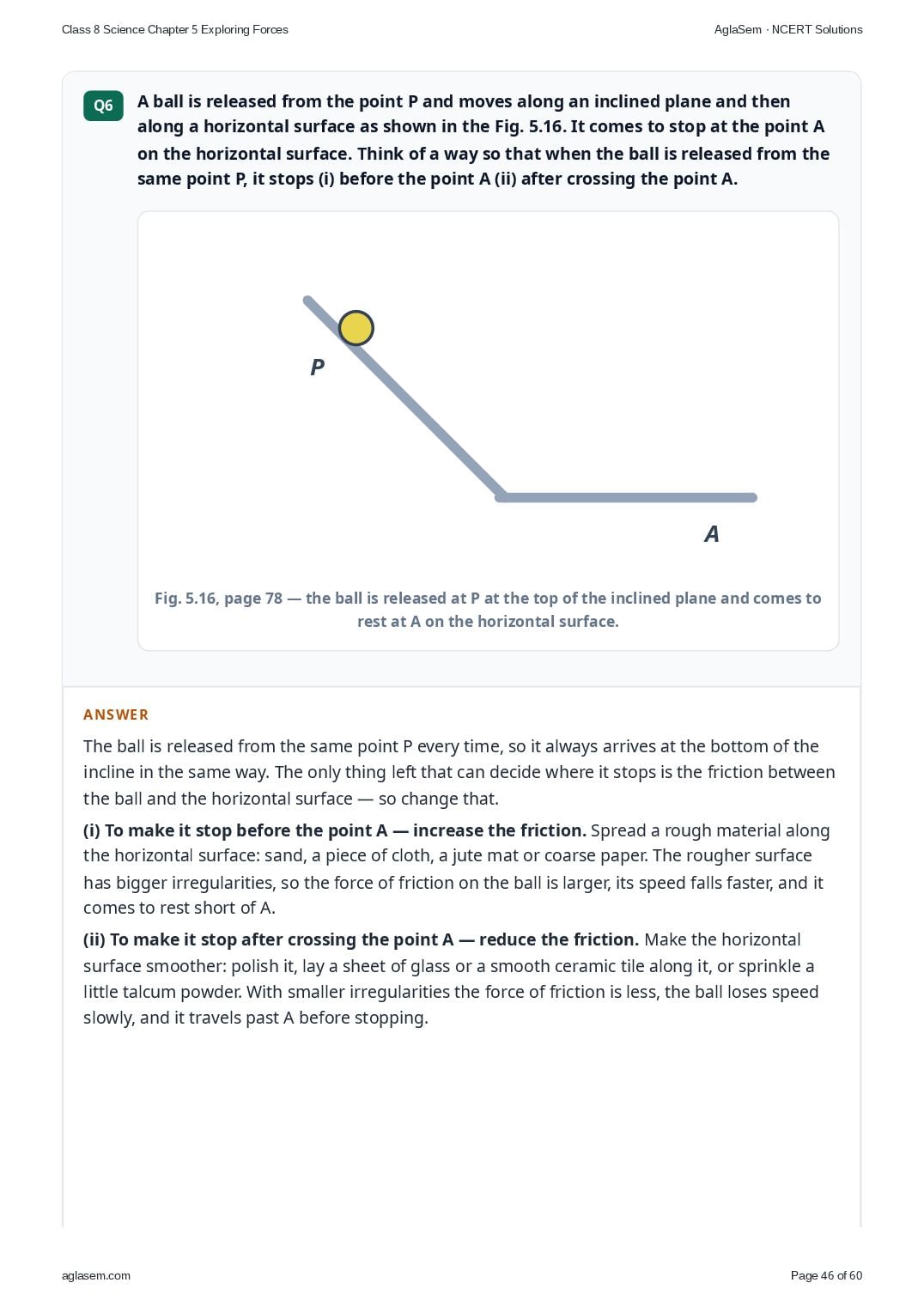
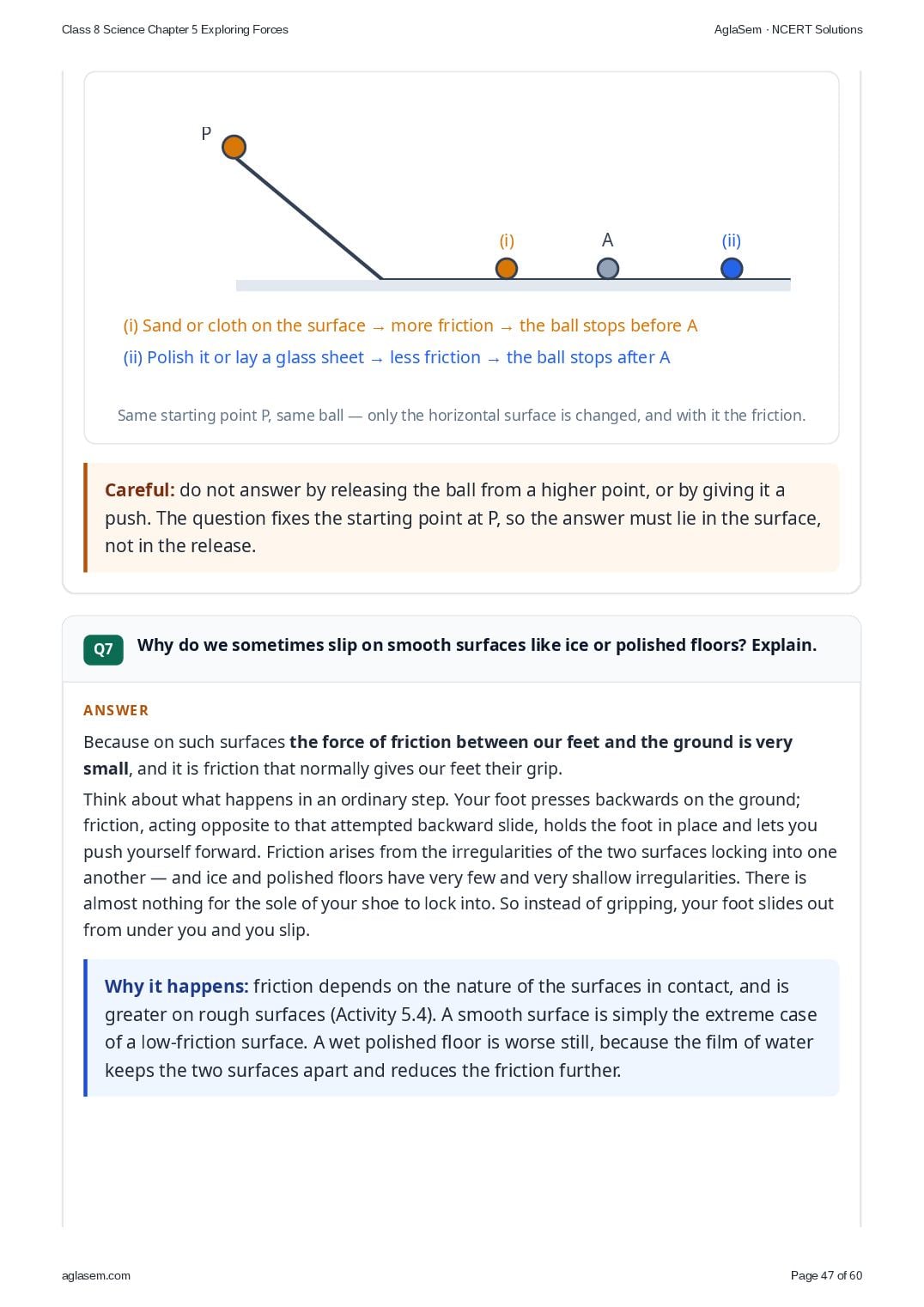
- A ball is released from the point P and moves along an inclined plane and then along a horizontal surface as shown in the Fig. 5.16. It comes to stop at the point A on the horizontal surface. Think of a way so that when the ball is released from the same point P, it stops (i) before the point A (ii) after crossing the point A.
- Why do we sometimes slip on smooth surfaces like ice or polished floors? Explain.
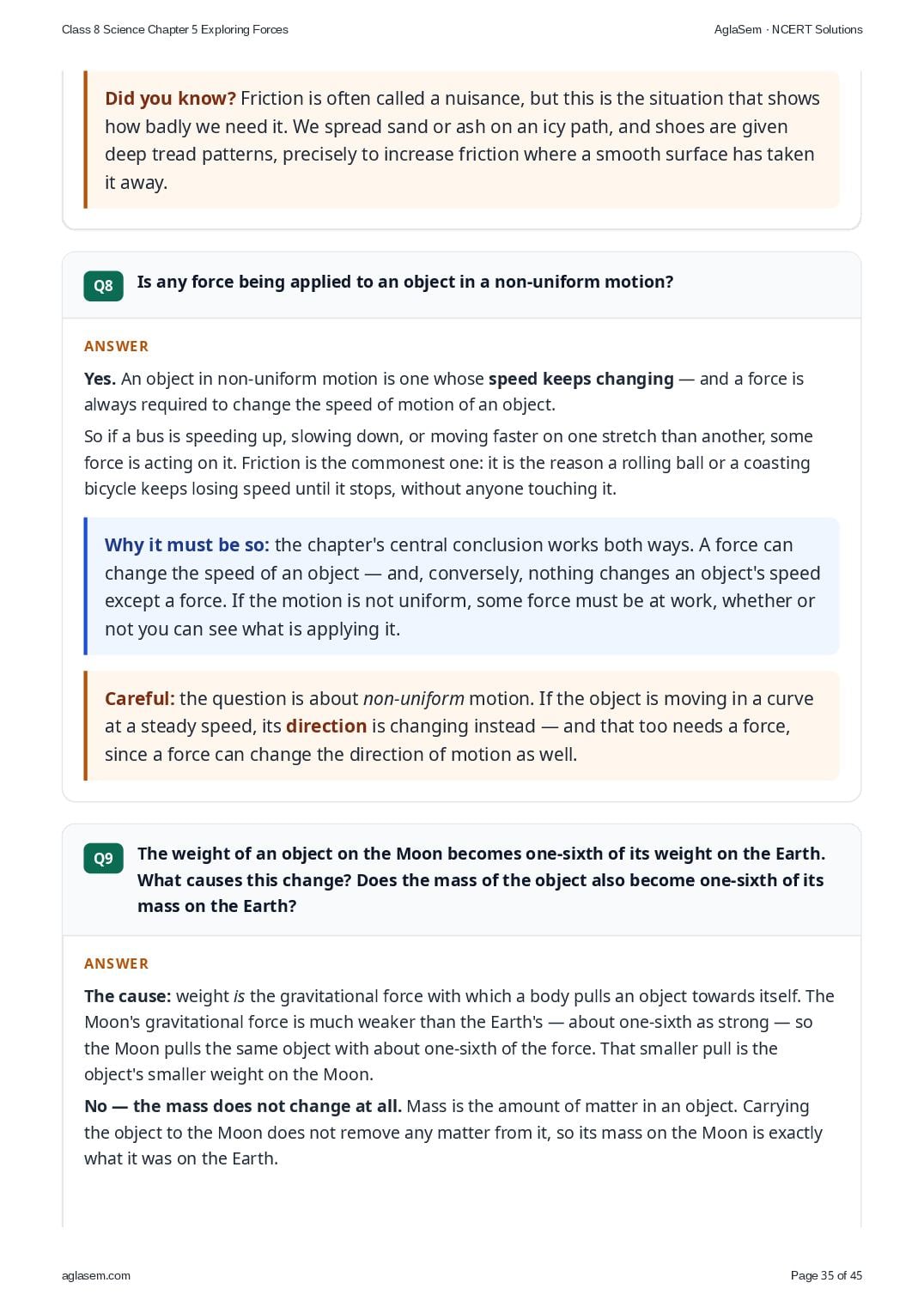
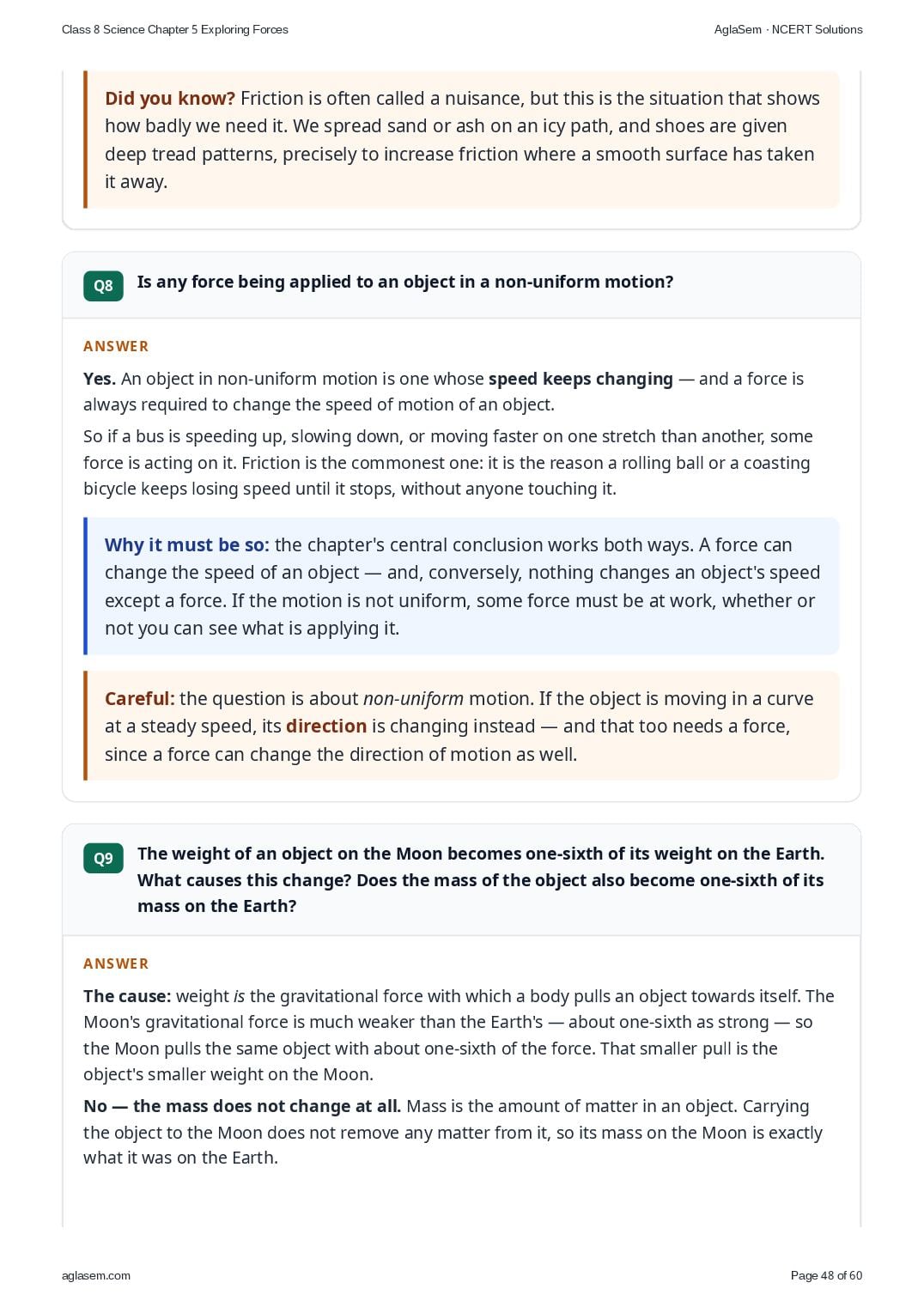
- Is any force being applied to an object in a non-uniform motion?
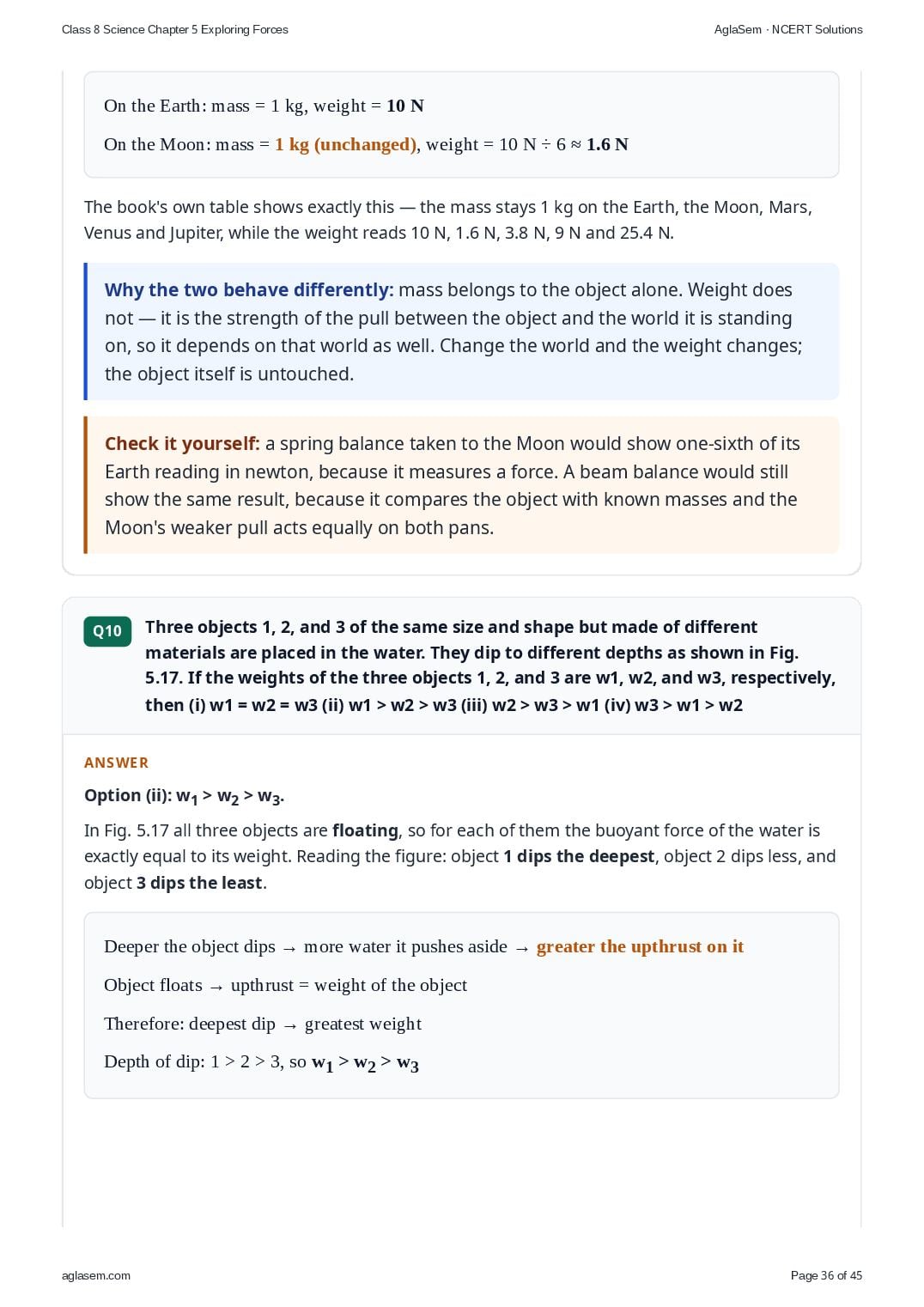
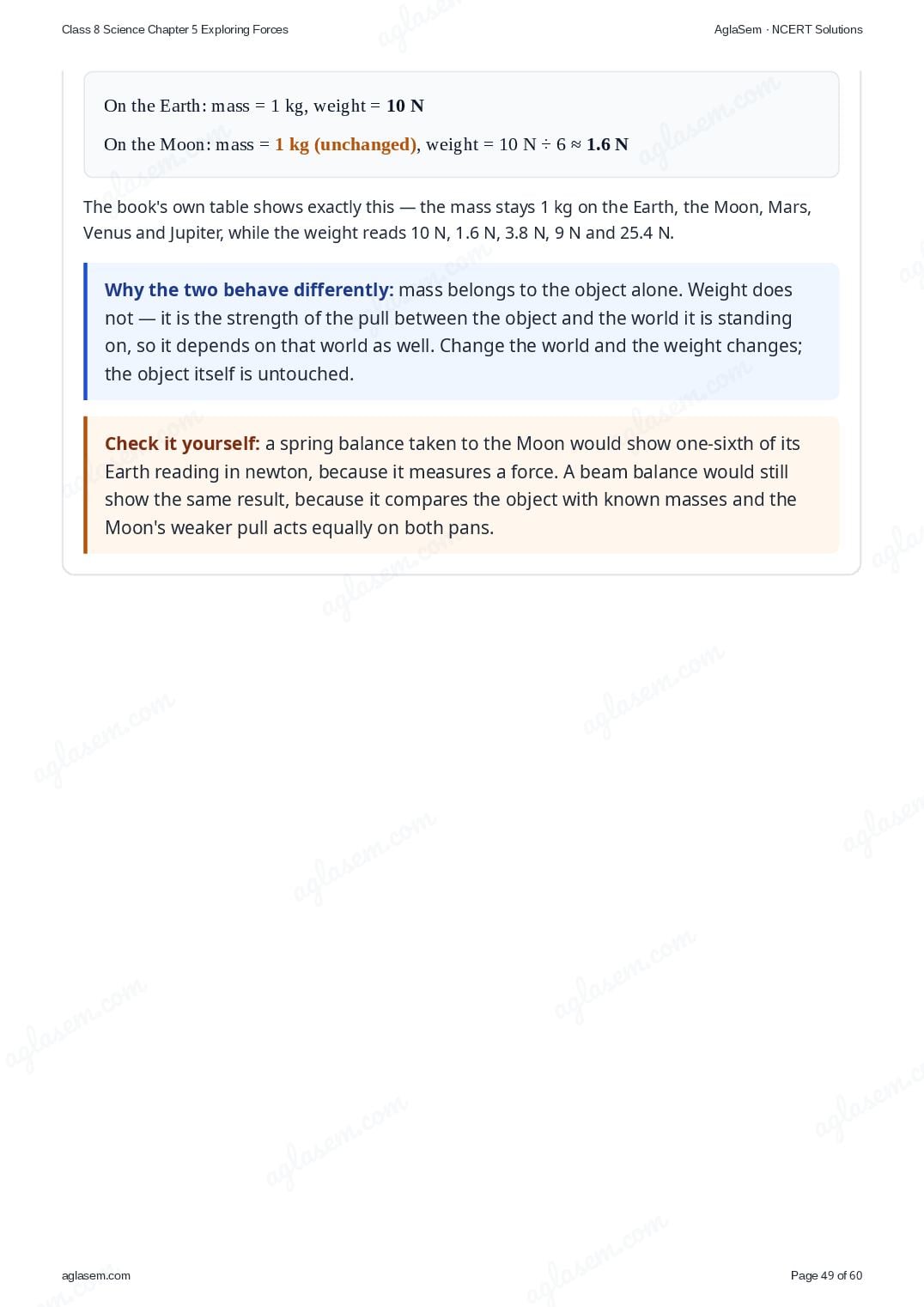
- The weight of an object on the Moon becomes one-sixth of its weight on the Earth. What causes this change? Does the mass of the object also become one-sixth of its mass on the Earth?
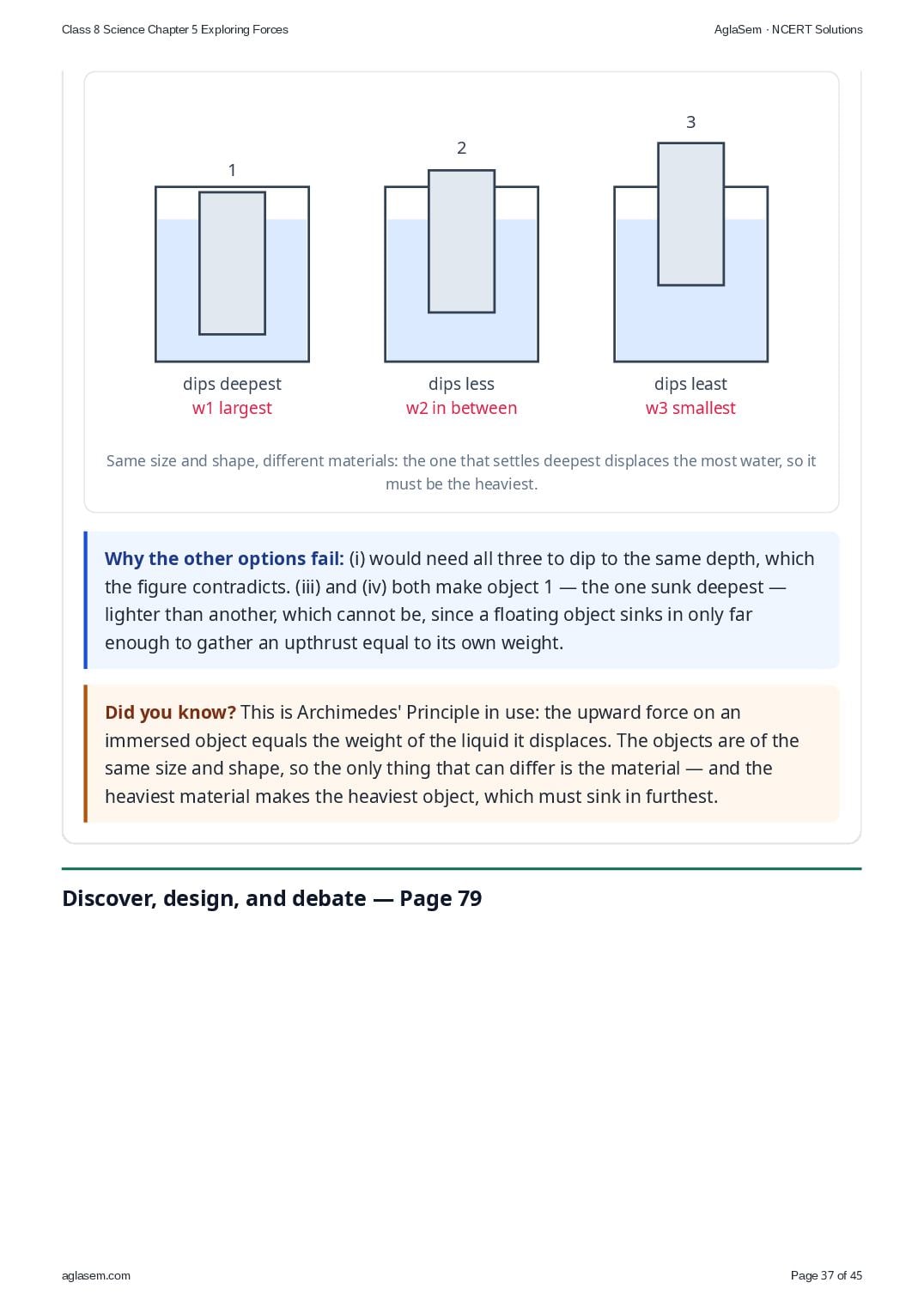
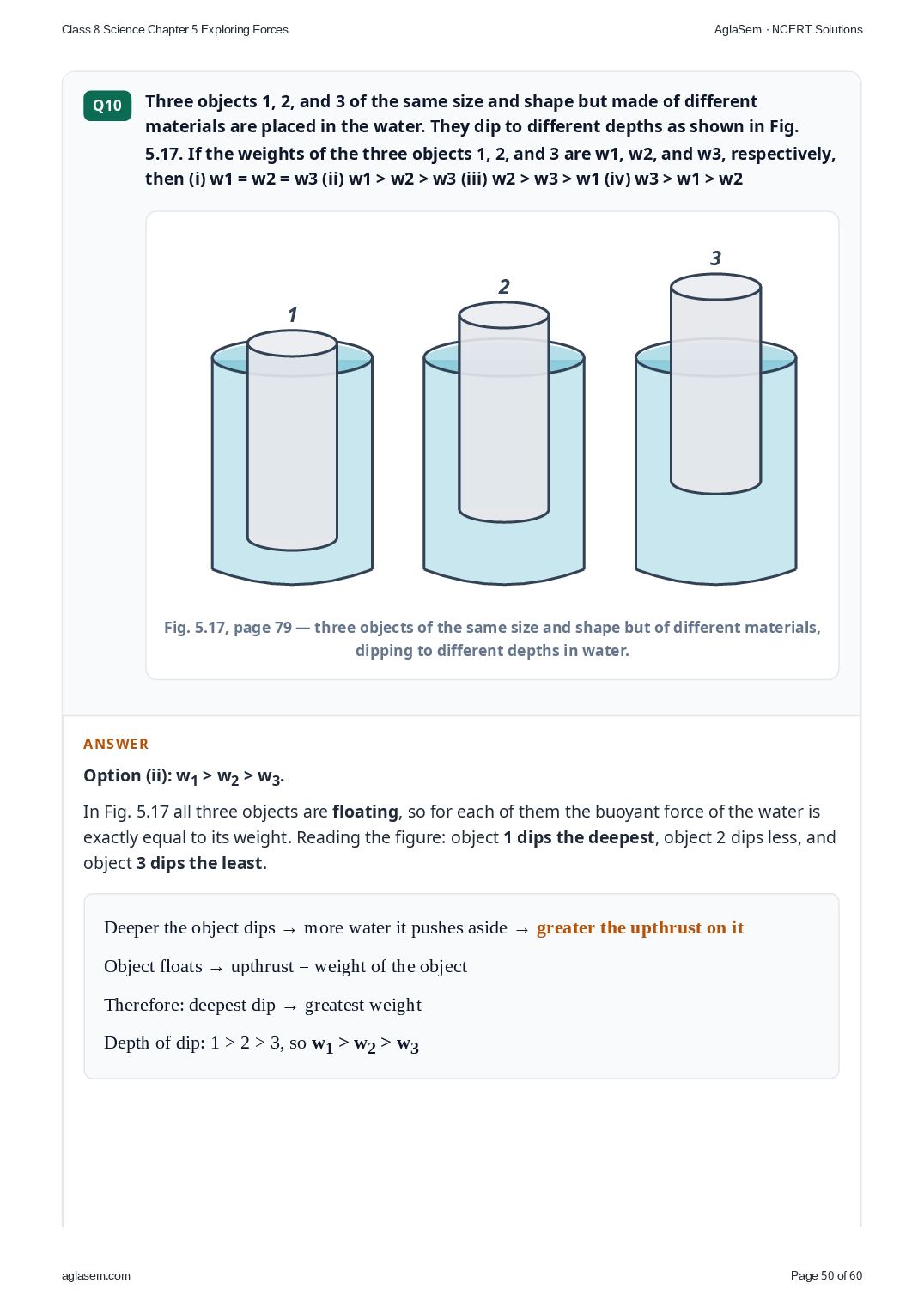
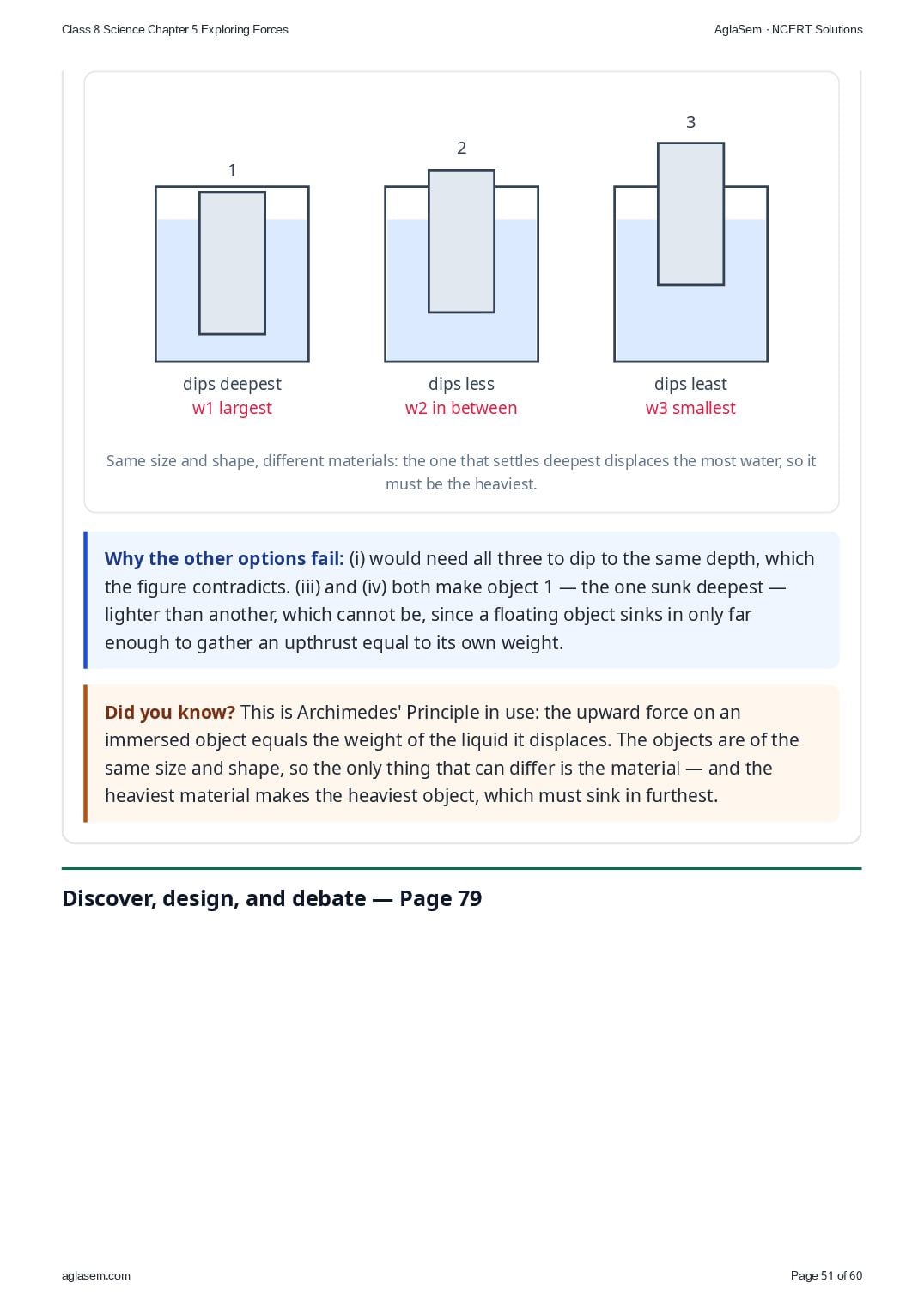
- Three objects 1, 2, and 3 of the same size and shape but made of different materials are placed in the water. They dip to different depths as shown in Fig. 5.17. If the weights of the three objects 1, 2, and 3 are w1, w2, and w3, respectively, then (i) w1 = w2 = w3 (ii) w1 > w2 > w3 (iii) w2 > w3 > w1 (iv) w3 > w1 > w2
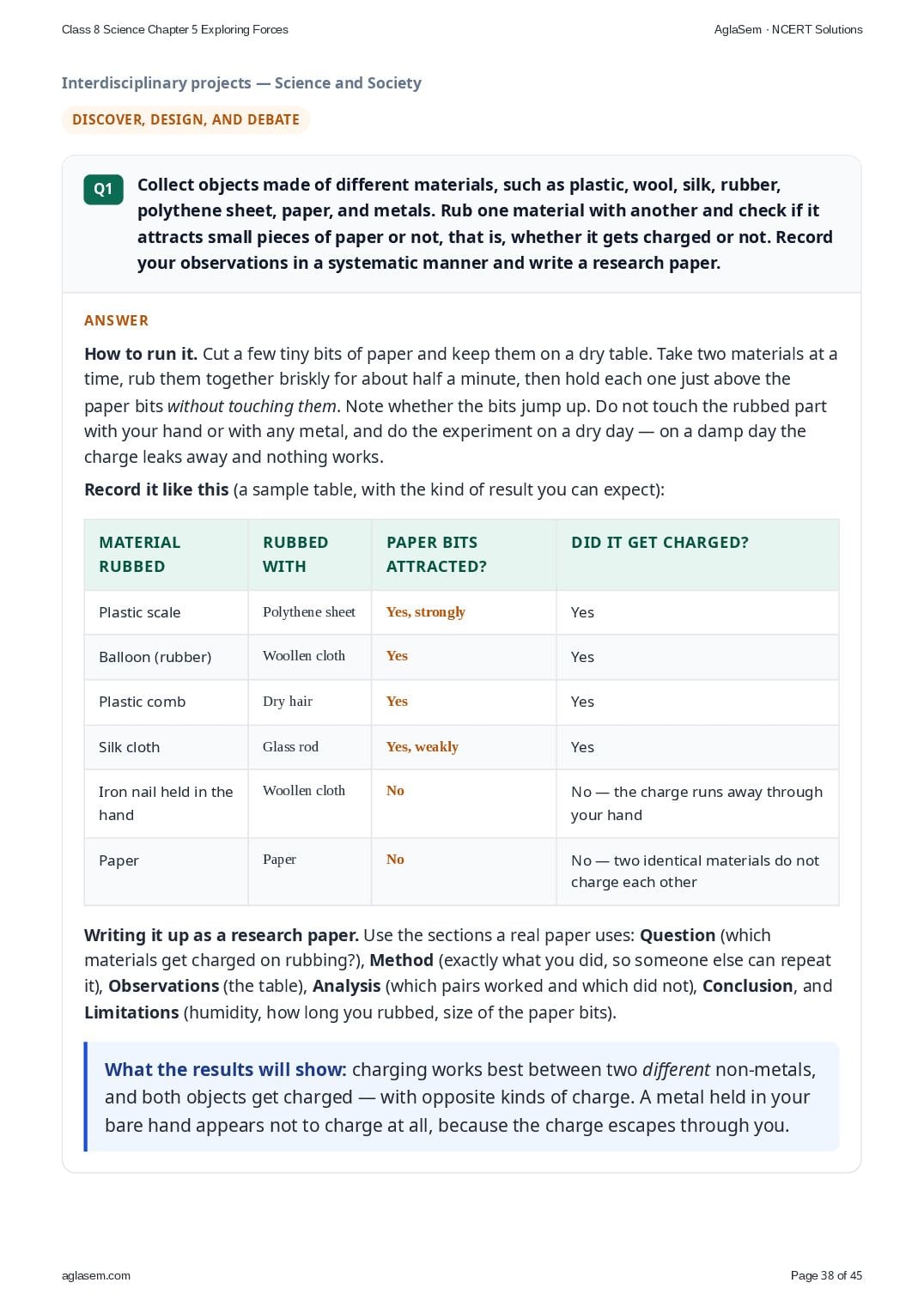
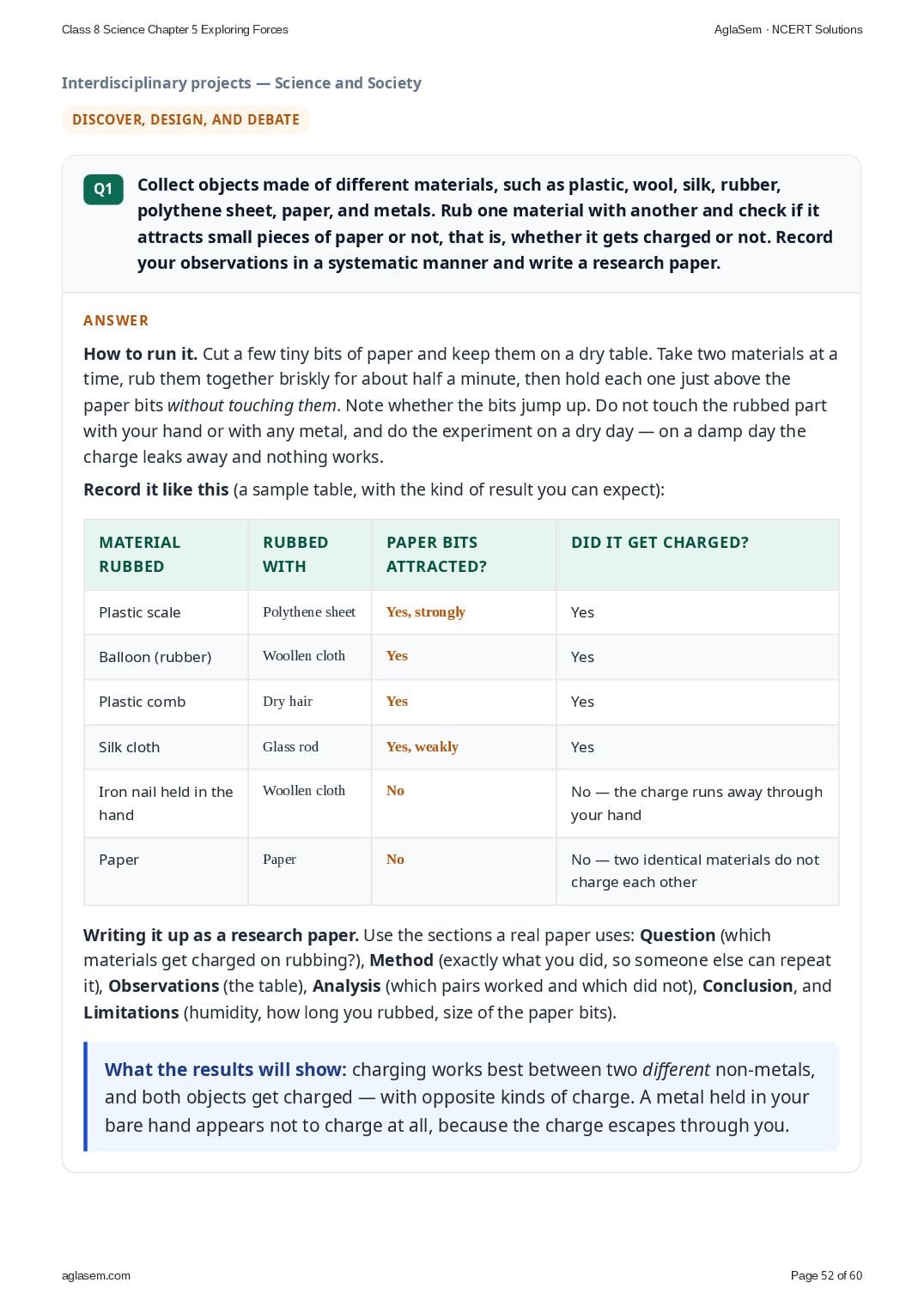
- Collect objects made of different materials, such as plastic, wool, silk, rubber, polythene sheet, paper, and metals. Rub one material with another and check if it attracts small pieces of paper or not, that is, whether it gets charged or not. Record your observations in a systematic manner and write a research paper.
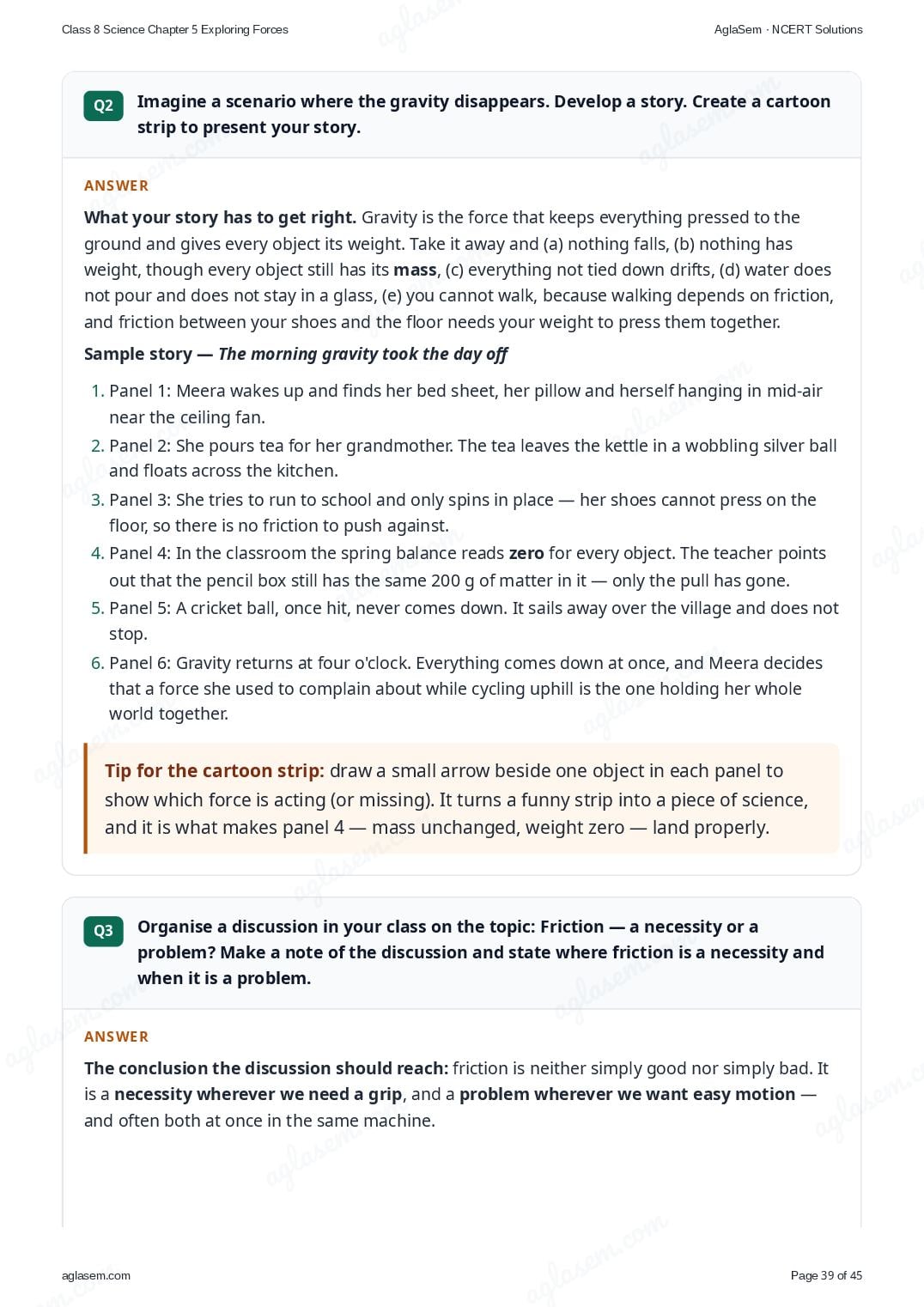
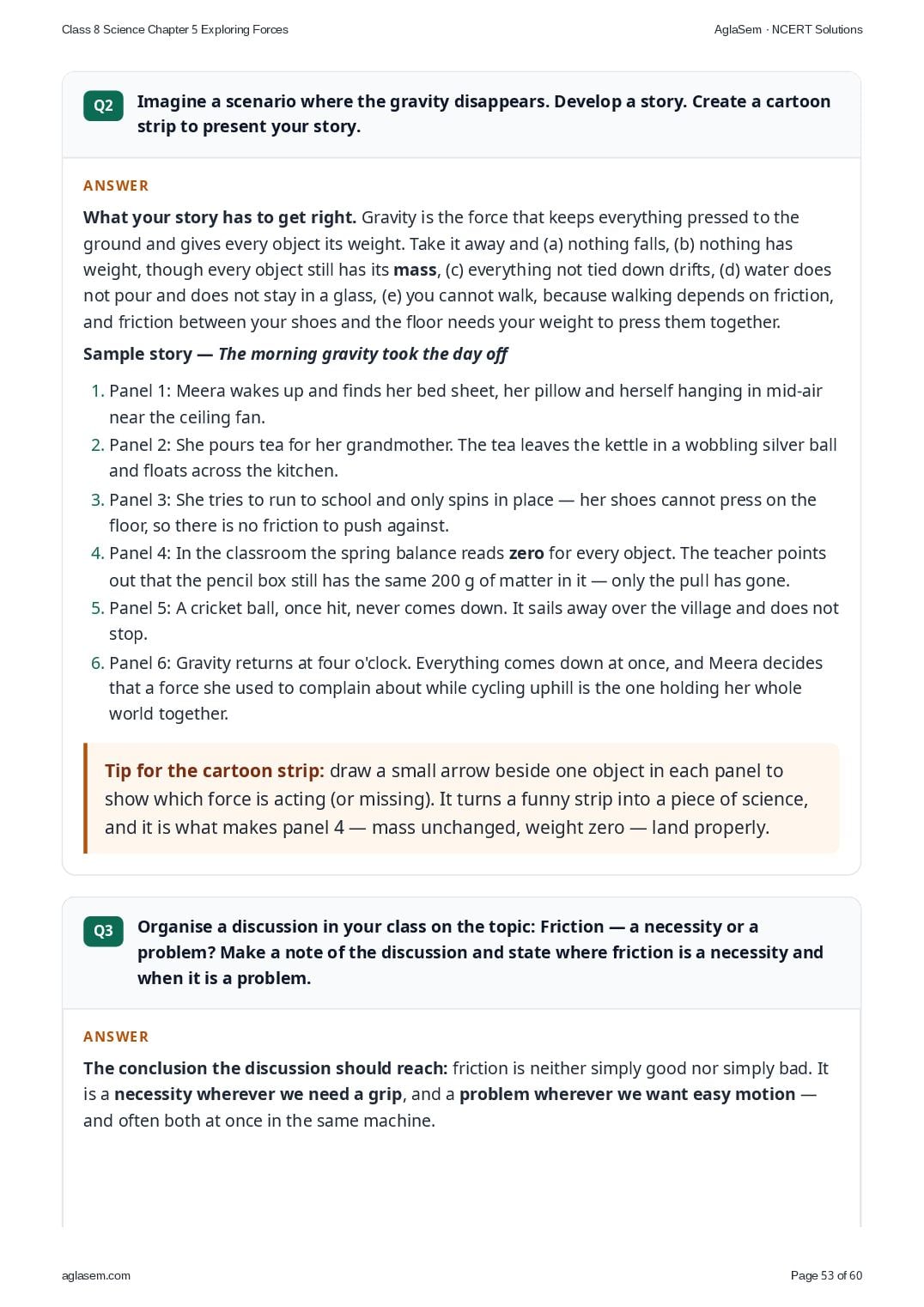
- Imagine a scenario where the gravity disappears. Develop a story. Create a cartoon strip to present your story.
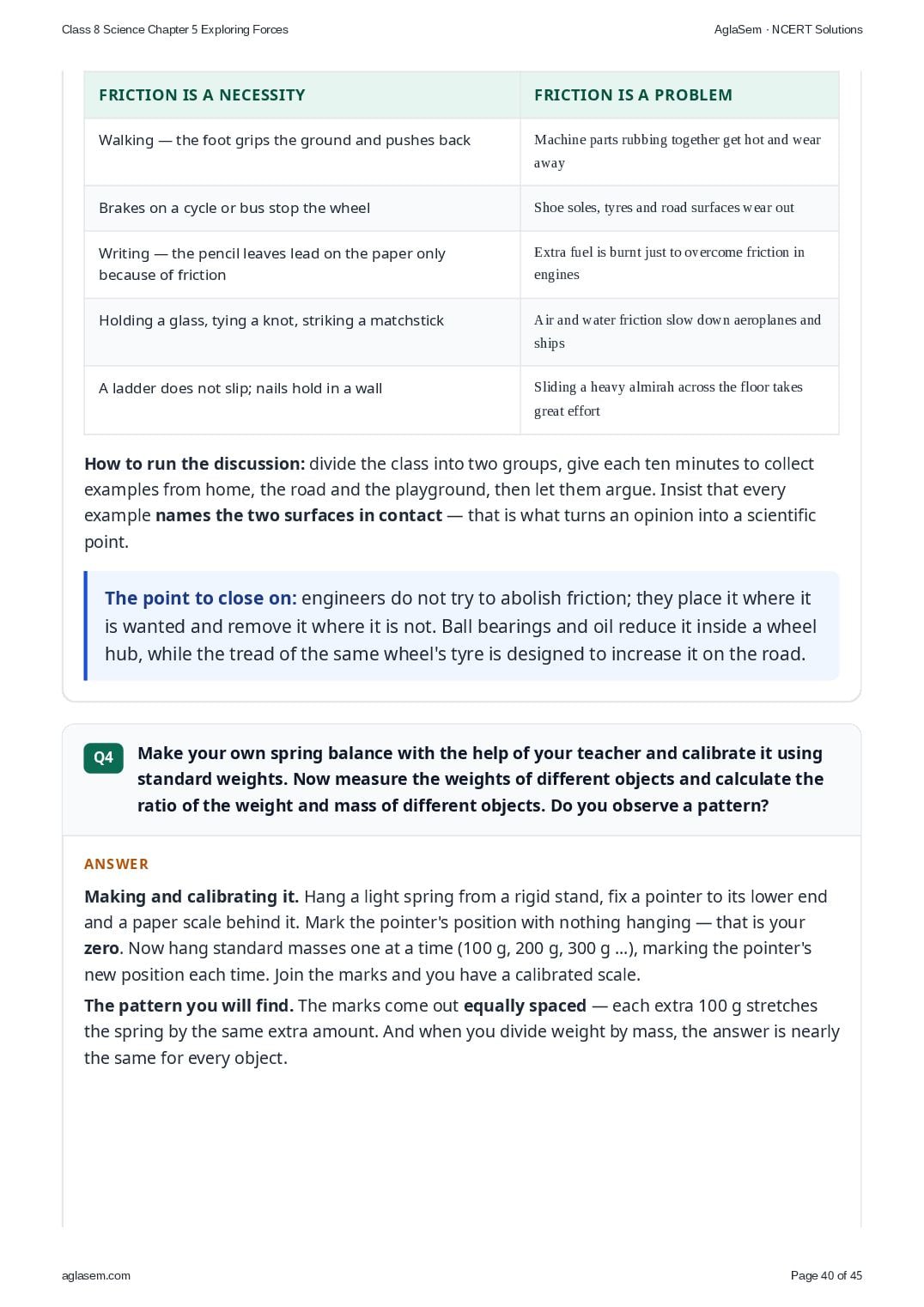
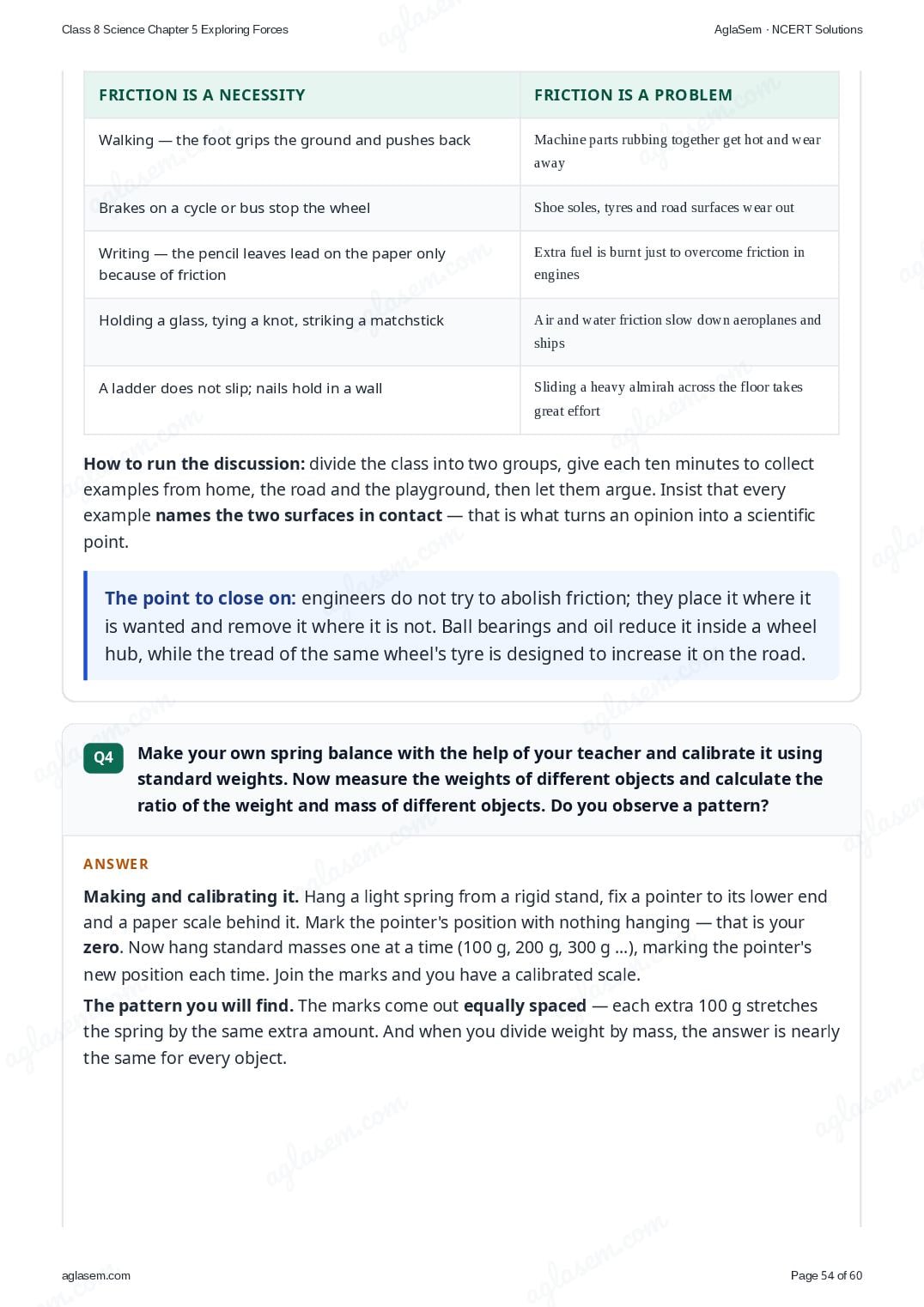
- Organise a discussion in your class on the topic: Friction — a necessity or a problem? Make a note of the discussion and state where friction is a necessity and when it is a problem.
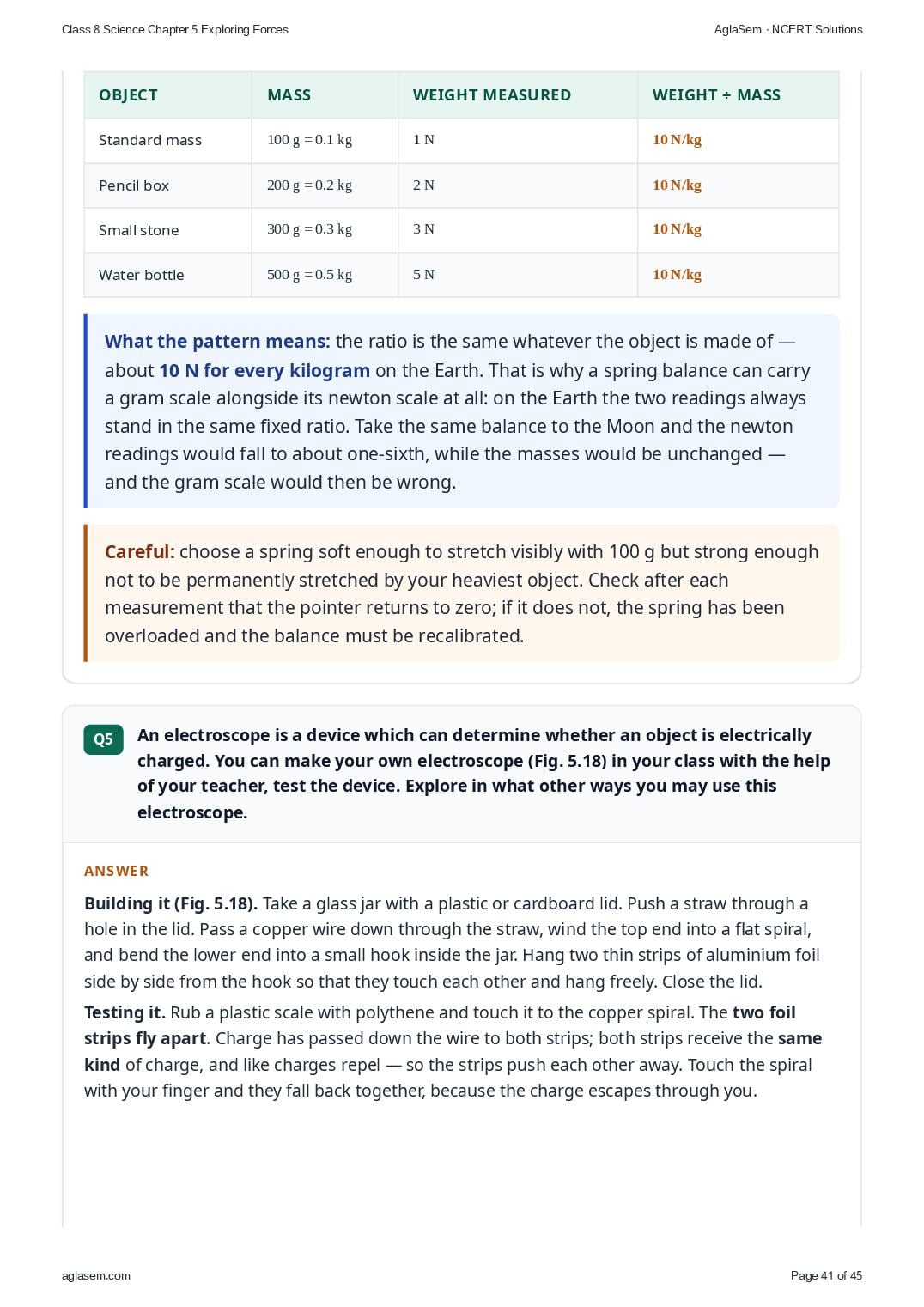
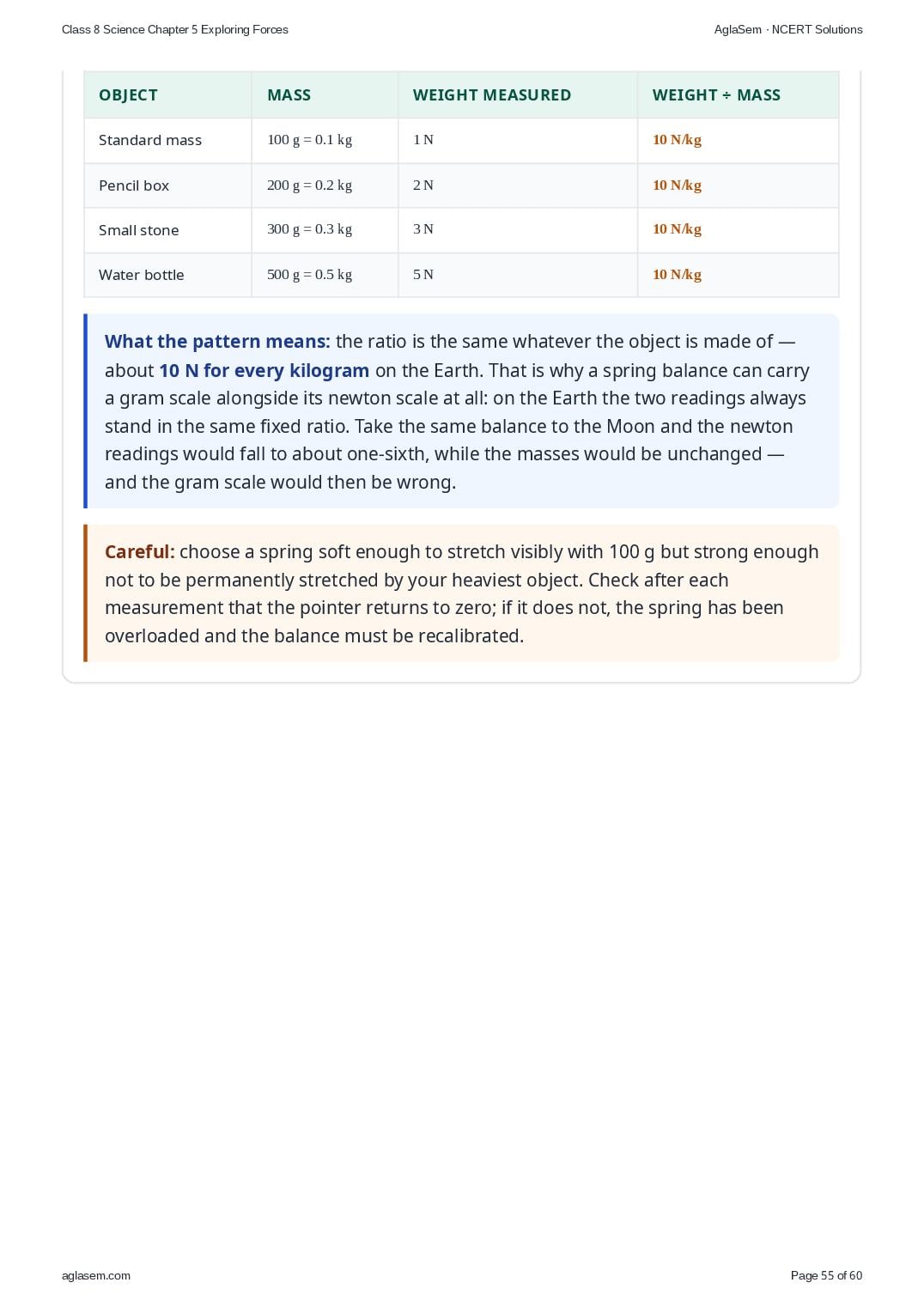
- Make your own spring balance with the help of your teacher and calibrate it using standard weights. Now measure the weights of different objects and calculate the ratio of the weight and mass of different objects. Do you observe a pattern?
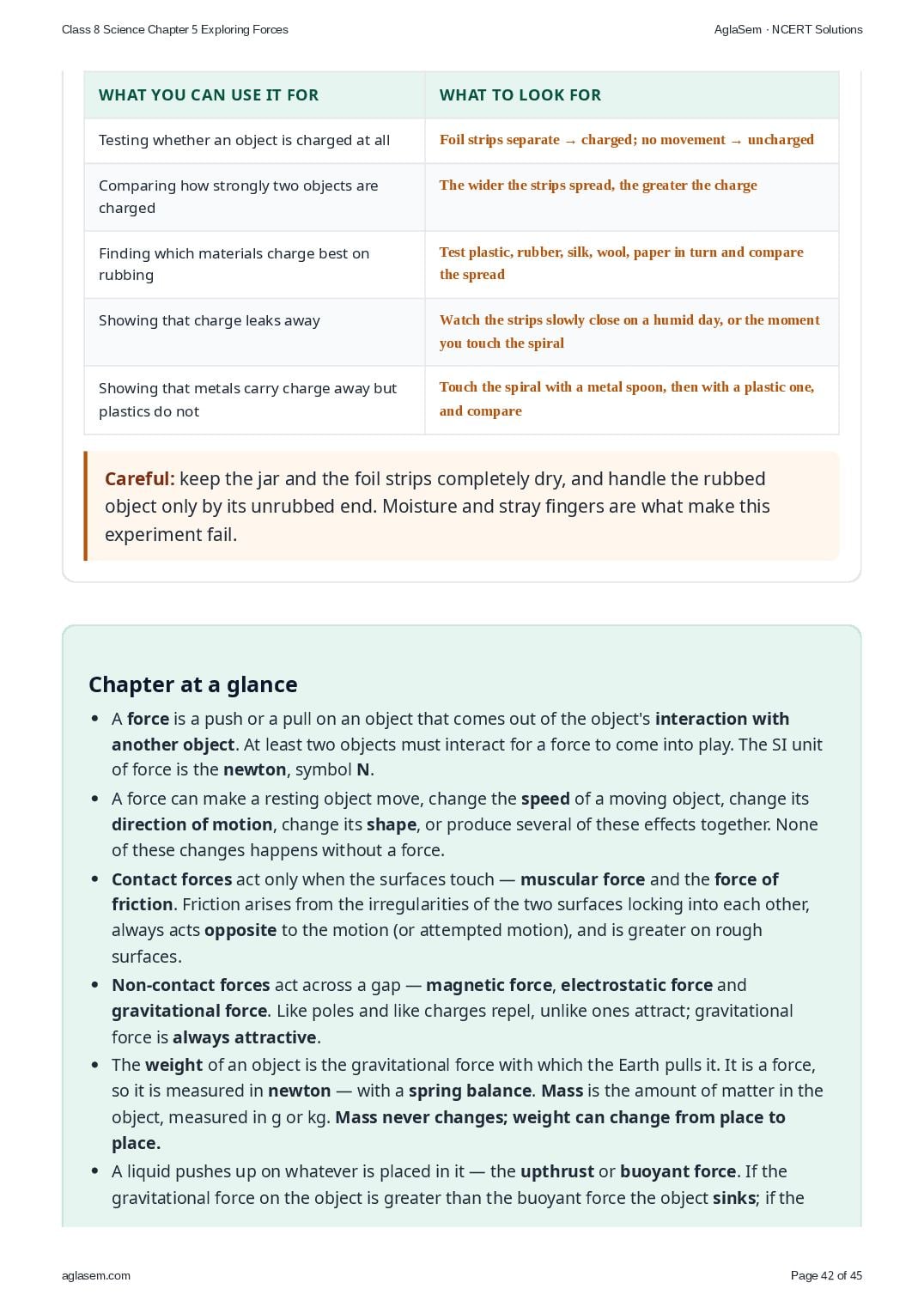
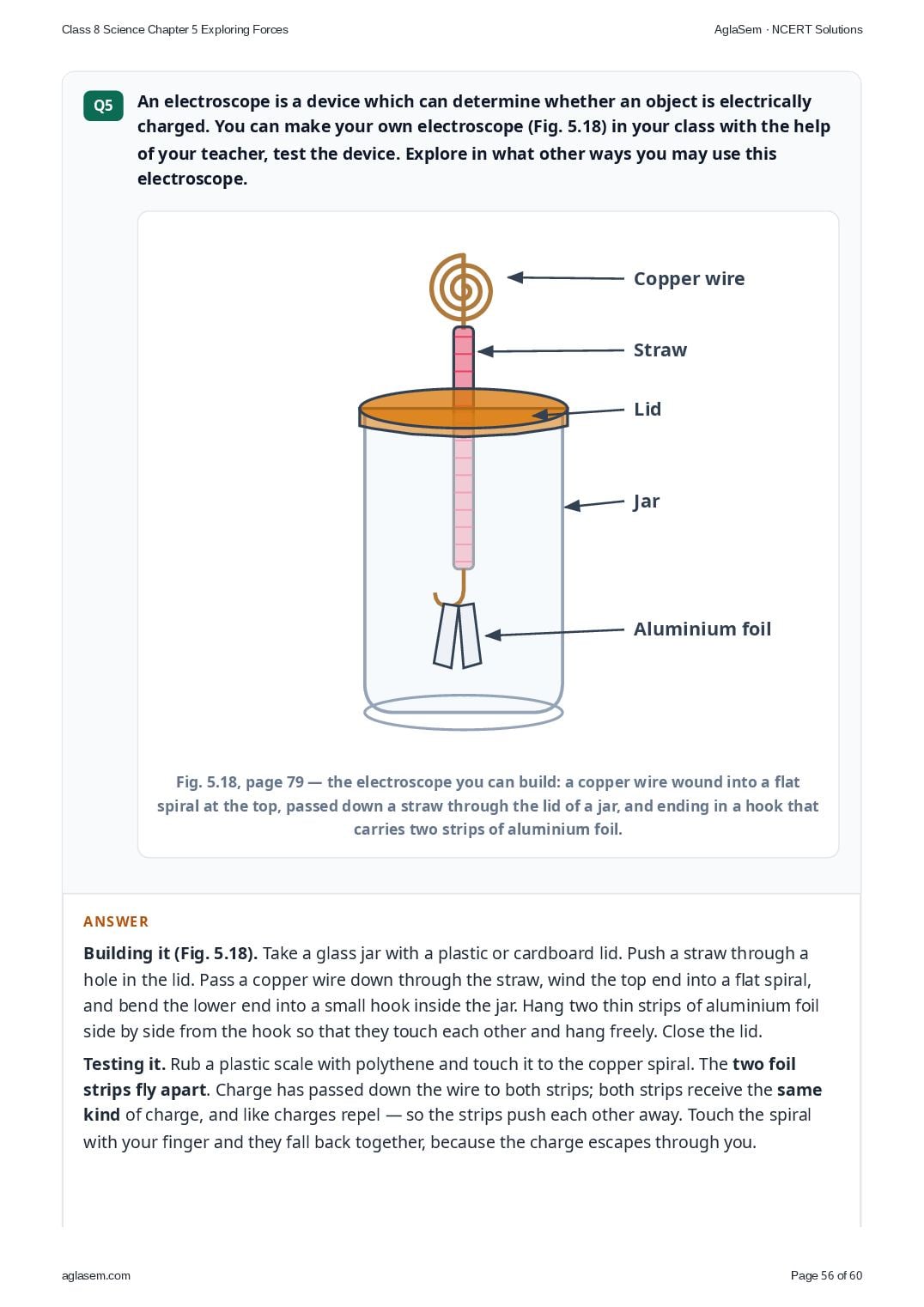
- An electroscope is a device which can determine whether an object is electrically charged. You can make your own electroscope (Fig. 5.18) in your class with the help of your teacher, test the device. Explore in what other ways you may use this electroscope.
Chapter at a Glance
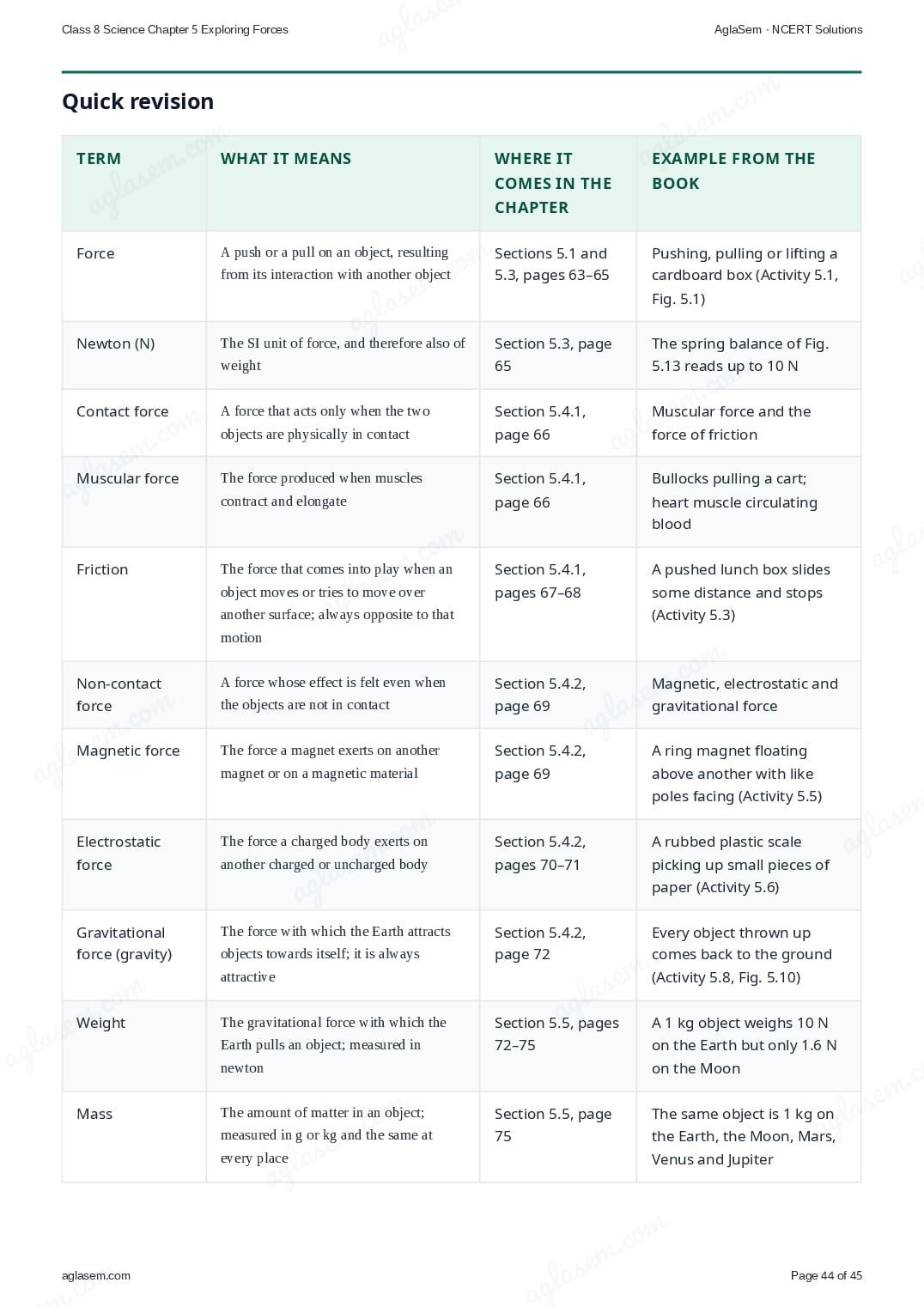
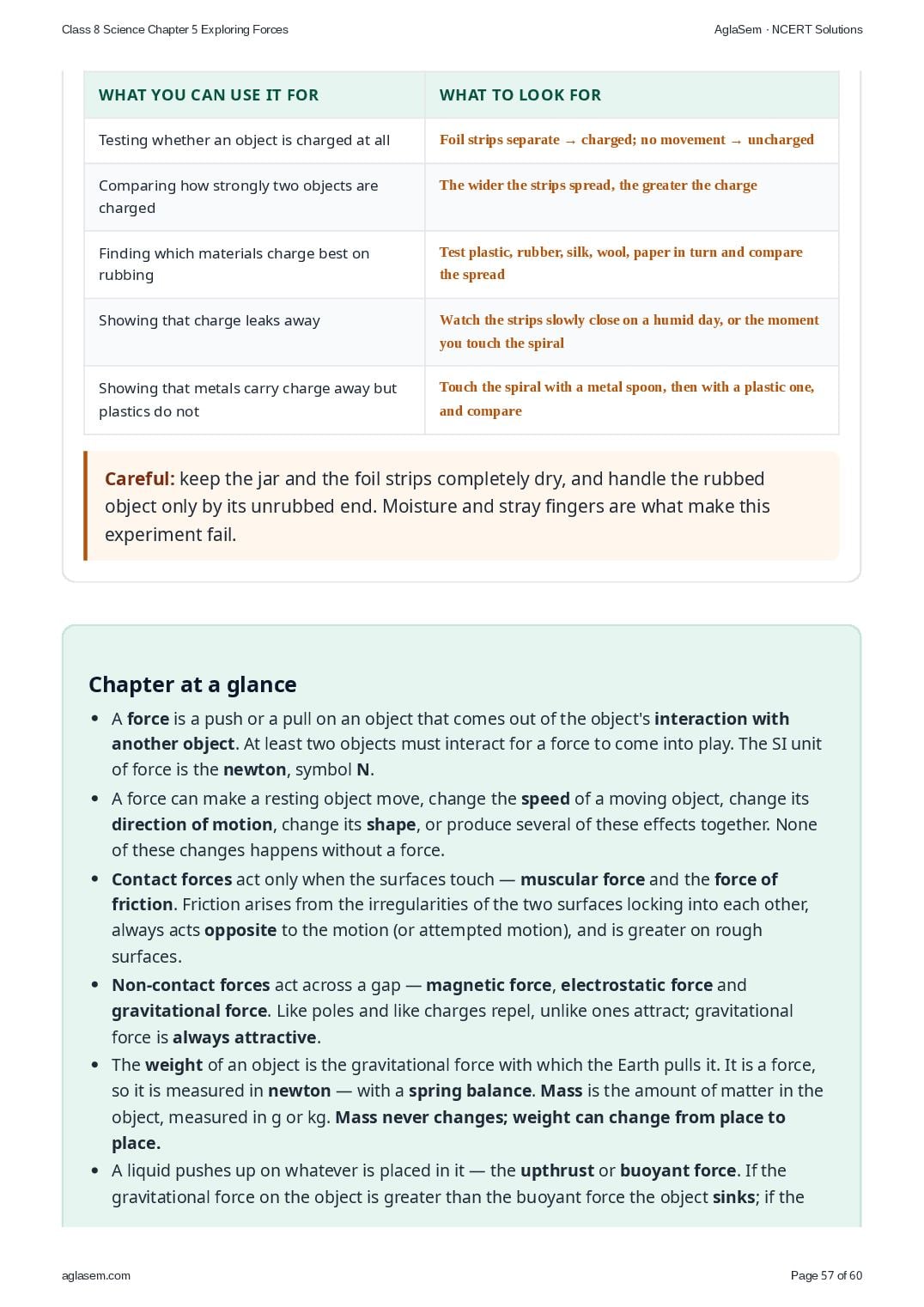
- A force is a push or a pull on an object that comes out of the object's interaction with another object . At least two objects must interact for a force to come into play. The SI unit of force is the newton , symbol N .
- A force can make a resting object move, change the speed of a moving object, change its direction of motion , change its shape , or produce several of these effects together. None of these changes happens without a force.
- Contact forces act only when the surfaces touch — muscular force and the force of friction . Friction arises from the irregularities of the two surfaces locking into each other, always acts opposite to the motion (or attempted motion), and is greater on rough surfaces.
- Non-contact forces act across a gap — magnetic force , electrostatic force and gravitational force . Like poles and like charges repel, unlike ones attract; gravitational force is always attractive .
- The weight of an object is the gravitational force with which the Earth pulls it. It is a force, so it is measured in newton — with a spring balance . Mass is the amount of matter in the object, measured in g or kg. Mass never changes; weight can change from place to place.
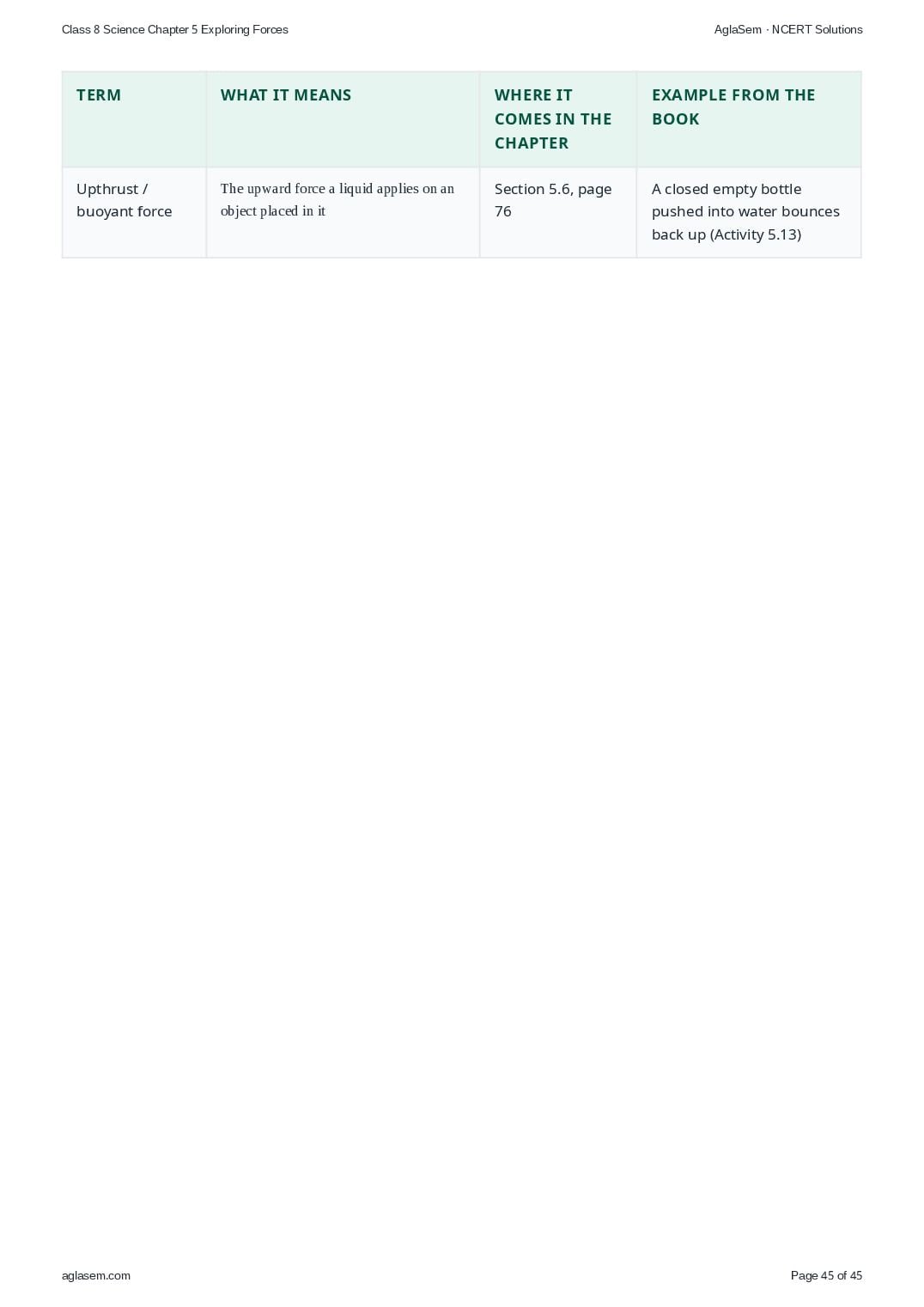
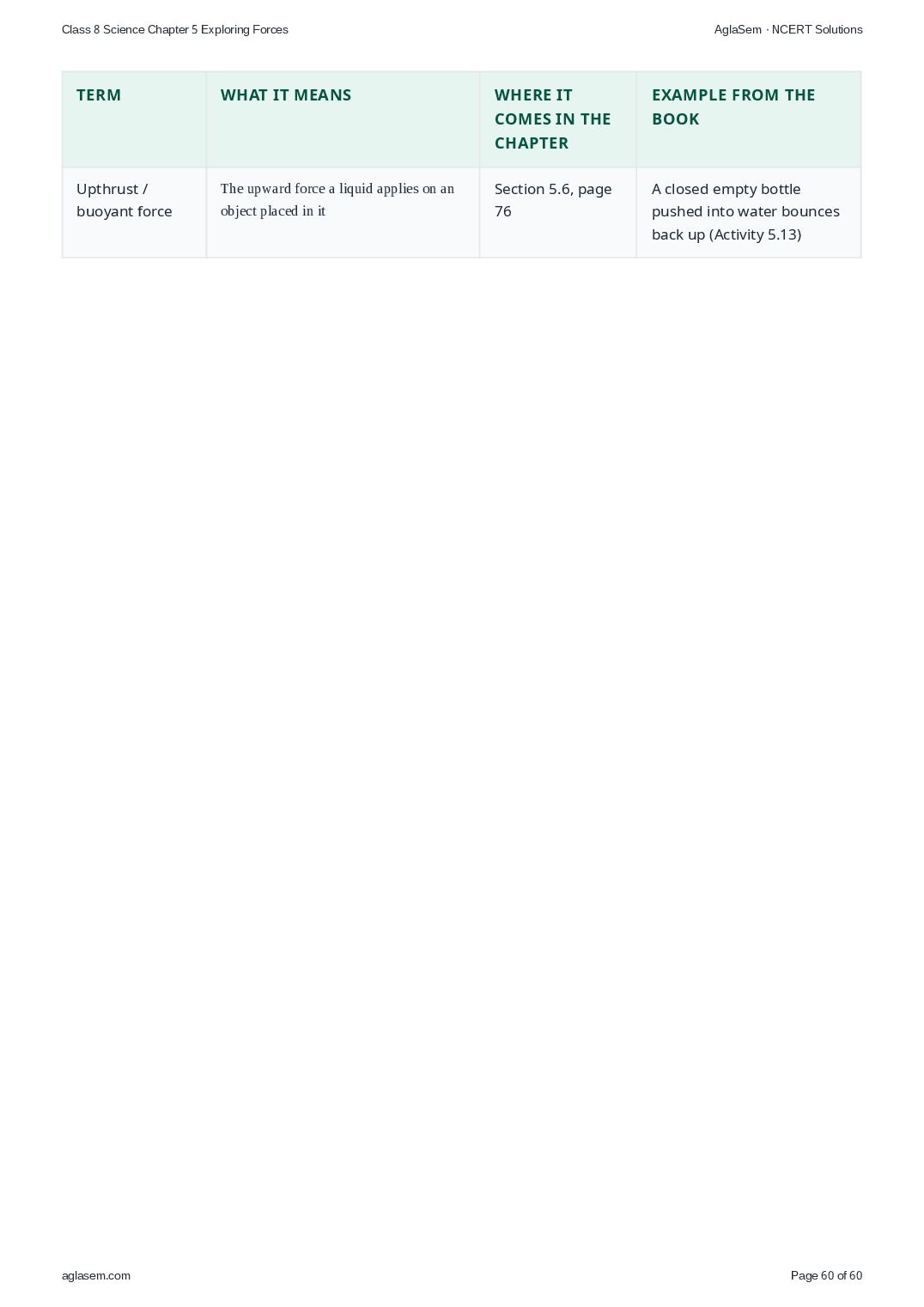
- A liquid pushes up on whatever is placed in it — the upthrust or buoyant force . If the gravitational force on the object is greater than the buoyant force the object sinks ; if the two are equal it floats .
How to Download NCERT Solutions for Class 8 Science Chapter 5 PDF
Follow these simple steps to get the Exploring Forces questions-and-answers PDF from Curiosity.
- Search NCERT Solutions for Class 8 Science Chapter 5 aglasem and open this page.
- Read the exercise questions with answers for Exploring Forces shown above.
- Click the Download PDF link to save the Exploring Forces solutions to your device.
NCERT Solutions for Class 8 Science – All Chapters
There are more chapters to study besides Exploring Forces in Science. Here are the NCERT Solutions for all chapters of Class 8 Science.
- Chapter 1 Exploring the Investigative World of Science
- Chapter 2 The Invisible Living World Beyond Our Naked Eye
- Chapter 3 Health the Ultimate Treasure
- Chapter 4 Electricity Magnetic and Heating Effects
- Chapter 5 Exploring Forces
- Chapter 6 Pressure Winds Storms and Cyclones
- Chapter 7 Particulate Nature of Matter
- Chapter 8 Nature of Matter Elements Compounds and Mixtures
- Chapter 9 The Amazing World of Solutes Solvents and Solutions
- Chapter 10 Light Mirrors and Lenses
- Chapter 11 Keeping Time with the Skies
- Chapter 12 How Nature Works in Harmony
- Chapter 13 Our Home Earth a Unique Life Sustaining Planet
NCERT Solutions for Class 8 – All Subjects
Just like Chapter 5 of Science, you can get the exercise questions with answers for every other subject of Class 8. Here are the NCERT Solutions for all subjects of Class 8.
NCERT Solutions for Class 8 Science Chapter 5 – An Overview
The key highlights of this study material are as follows.
| Aspects | Details |
|---|---|
| Class | Class 8 |
| Subject | Science |
| Chapter Number | Chapter 5 |
| Chapter Name | Exploring Forces |
| Book Name | Curiosity |
| Book By | NCERT (National Council of Educational Research and Training) |
| Educational Resource Here | NCERT Solutions of Class 8 Science Chapter 5 for all exercises |
| More Questions Answers of This Subject | NCERT Solutions for Class 8 Science |
| Download Book Chapter | NCERT Book Class 8 Science |
| All Questions Answers For This Class | NCERT Solutions for Class 8 |
| Complete Solutions | NCERT Solutions |
NCERT Solutions for Class 8 Science Chapter 5 Exploring Forces – FAQs
What are the NCERT Solutions for Class 8 Science Chapter 5 Exploring Forces?
They are the complete, step-by-step answers to all the exercise and in-text questions of Chapter 5 Exploring Forces from the NCERT Class 8 Science textbook Curiosity, written by experts as per the latest NCERT syllabus.
How can I download the Class 8 Science Chapter 5 solutions PDF for free?
Open this page on aglasem, read the Exploring Forces questions with answers, and click the “Download Solutions PDF” link. The Class 8 Science Chapter 5 NCERT Solutions PDF is completely free to download.
Are these NCERT Solutions as per the latest 2026-27 syllabus?
Yes. The NCERT Solutions for Class 8 Science Chapter 5 are based on the latest NCERT textbook Curiosity and the current 2026-27 CBSE syllabus, so the questions and answers match what you study in class.
Where can I get NCERT Solutions for the other chapters of Class 8 Science?
You can find the answers to every chapter on the NCERT Solutions for Class 8 Science page, and solutions for every subject on the NCERT Solutions for Class 8 page.
How do NCERT Solutions help in exam preparation?
They show the correct method to solve each question, help you write answers the way they are expected in exams, let you check and correct your own work, and save revision time — which together improve your marks in Class 8 Science.
If you have any queries on NCERT Solutions for Class 8 Science Chapter 5 Exploring Forces, then please ask in the comments below.