NCERT Solutions for Class 8 Science Chapter 7 Particulate Nature of Matter provide clear, step-by-step answers to every exercise and in-text question from the chapter Particulate Nature of Matter of the NCERT textbook Curiosity. Prepared by subject experts as per the latest NCERT (CBSE) syllabus for 2026-27, these NCERT Solutions for Class 8 Science help you understand each concept, write exam-ready answers, and check your own solutions. You can read them online below or download the free Class 8 Science Chapter 7 question-answer PDF.
NCERT Solutions for Class 8 Science Chapter 7 Particulate Nature of Matter
- Class: Class 8
- Subject: Science
- Chapter: Chapter 7 – Particulate Nature of Matter
- Textbook: Curiosity (NCERT)
- Study material: NCERT Solutions – questions with answers, free PDF
These solutions answer all the exercise questions of Chapter 7 Particulate Nature of Matter — including the in-text questions, short-answer and long-answer questions, and activities — with complete explanations so you can follow the method, not just the final answer. Read the full solutions below.
NCERT Solutions Class 8 Science Chapter 7 Particulate Nature of Matter View Download
NCERT Solutions for Class 8 Science Chapter 7 PDF Download
You can read the NCERT Solutions for Class 8 Science Chapter 7 online above, or download the complete question-answer PDF to study Particulate Nature of Matter offline at any time.
NCERT Solutions for Class 8 Science Chapter 7 PDF Download Link – Click Here to Download Solutions PDF
Questions Covered in This Chapter
These NCERT Solutions answer all 54 questions of this chapter. The questions solved are:
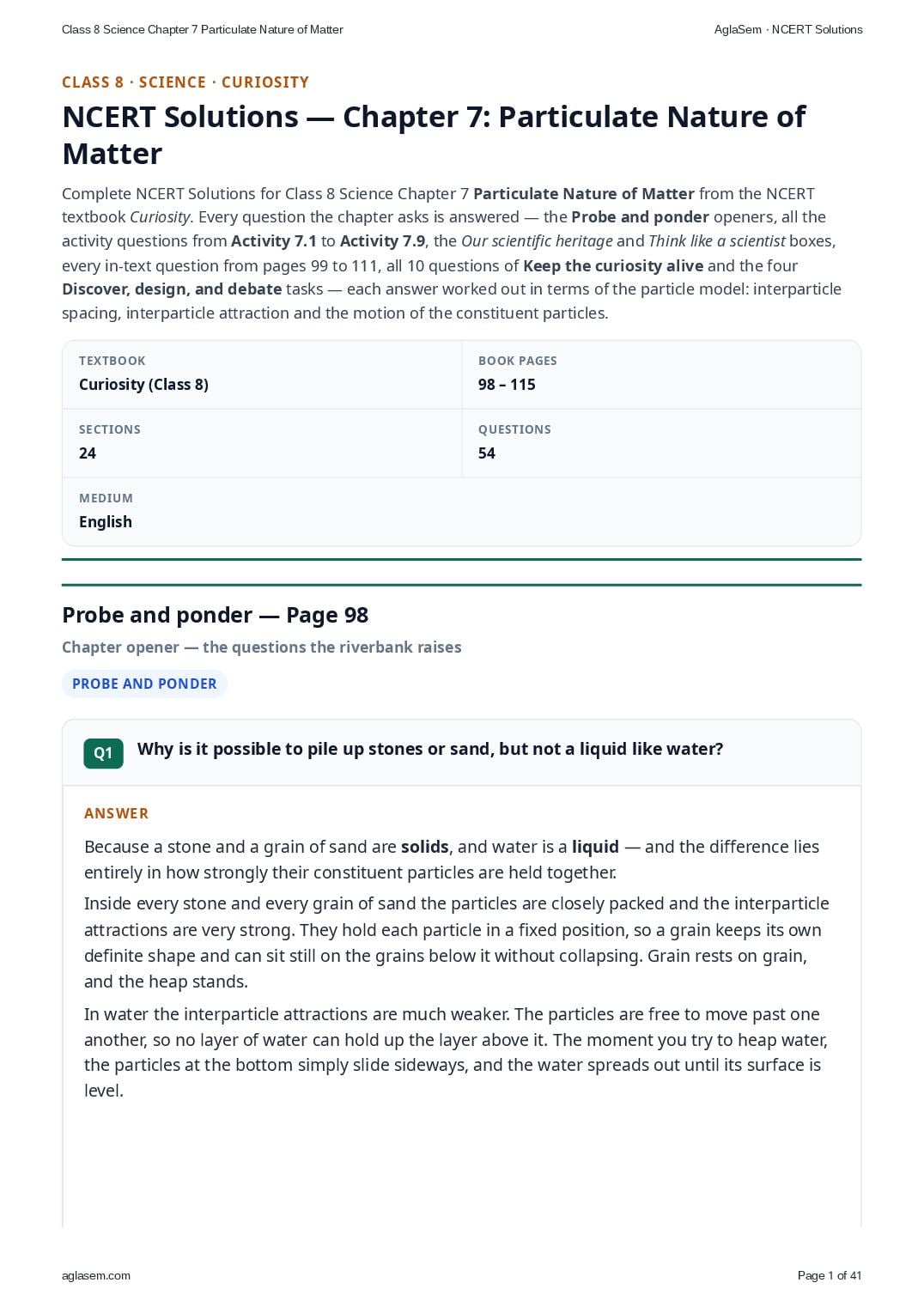
- Why is it possible to pile up stones or sand, but not a liquid like water?
- Why does water take the shape of folded hands but lose that shape when released?
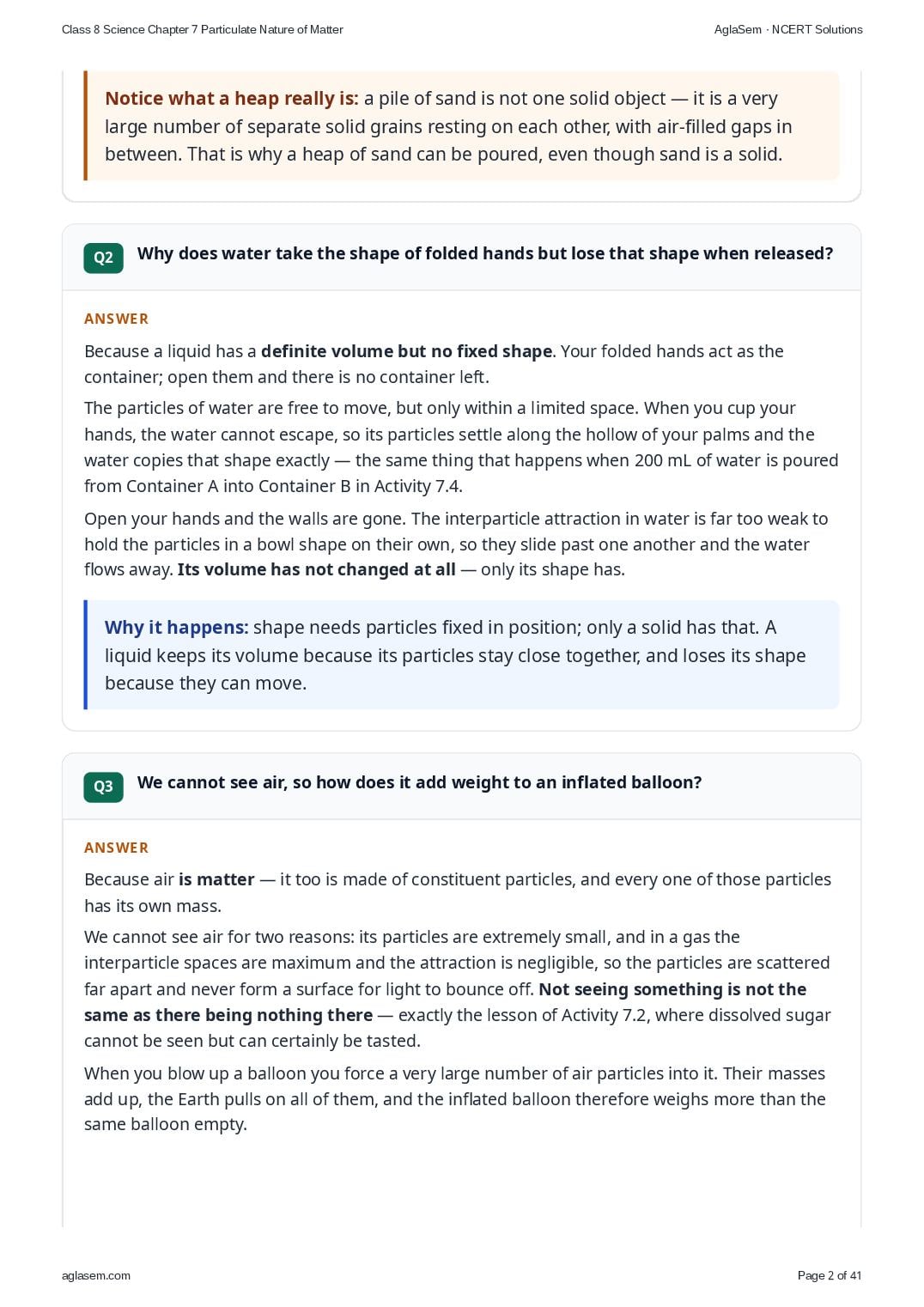
- We cannot see air, so how does it add weight to an inflated balloon?
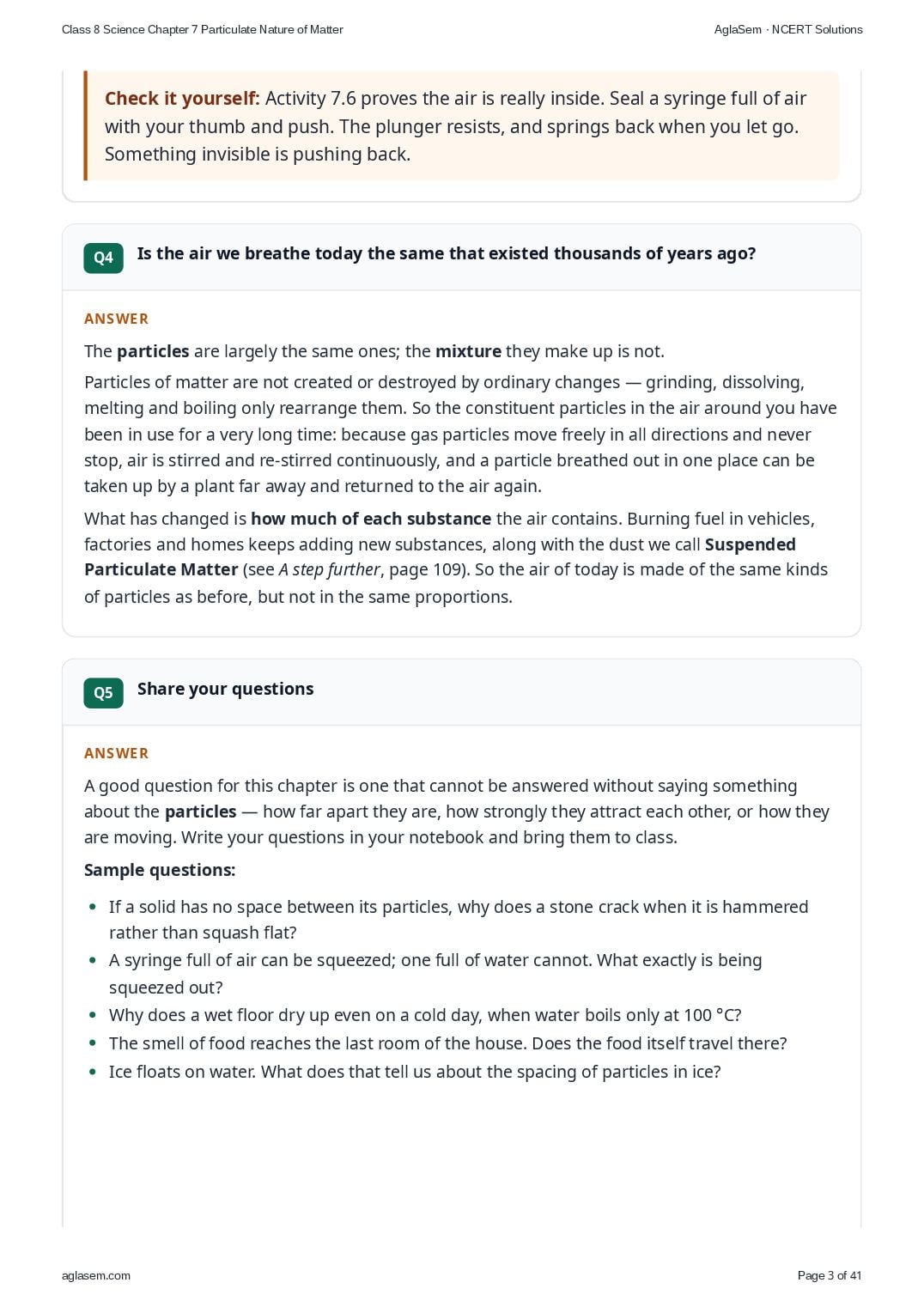
- Is the air we breathe today the same that existed thousands of years ago?
- Share your questions
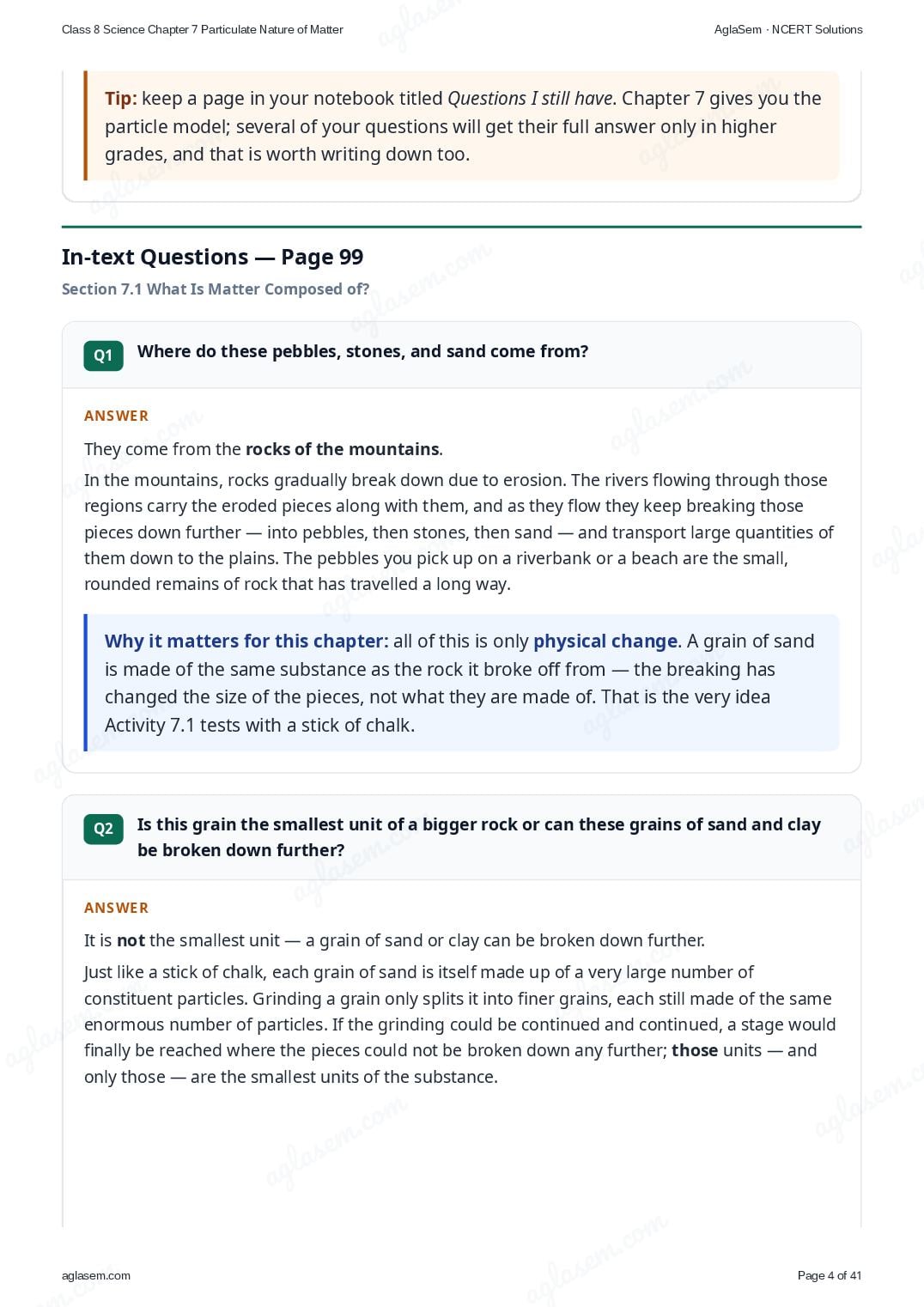
- Where do these pebbles, stones, and sand come from?
- Is this grain the smallest unit of a bigger rock or can these grains of sand and clay be broken down further?
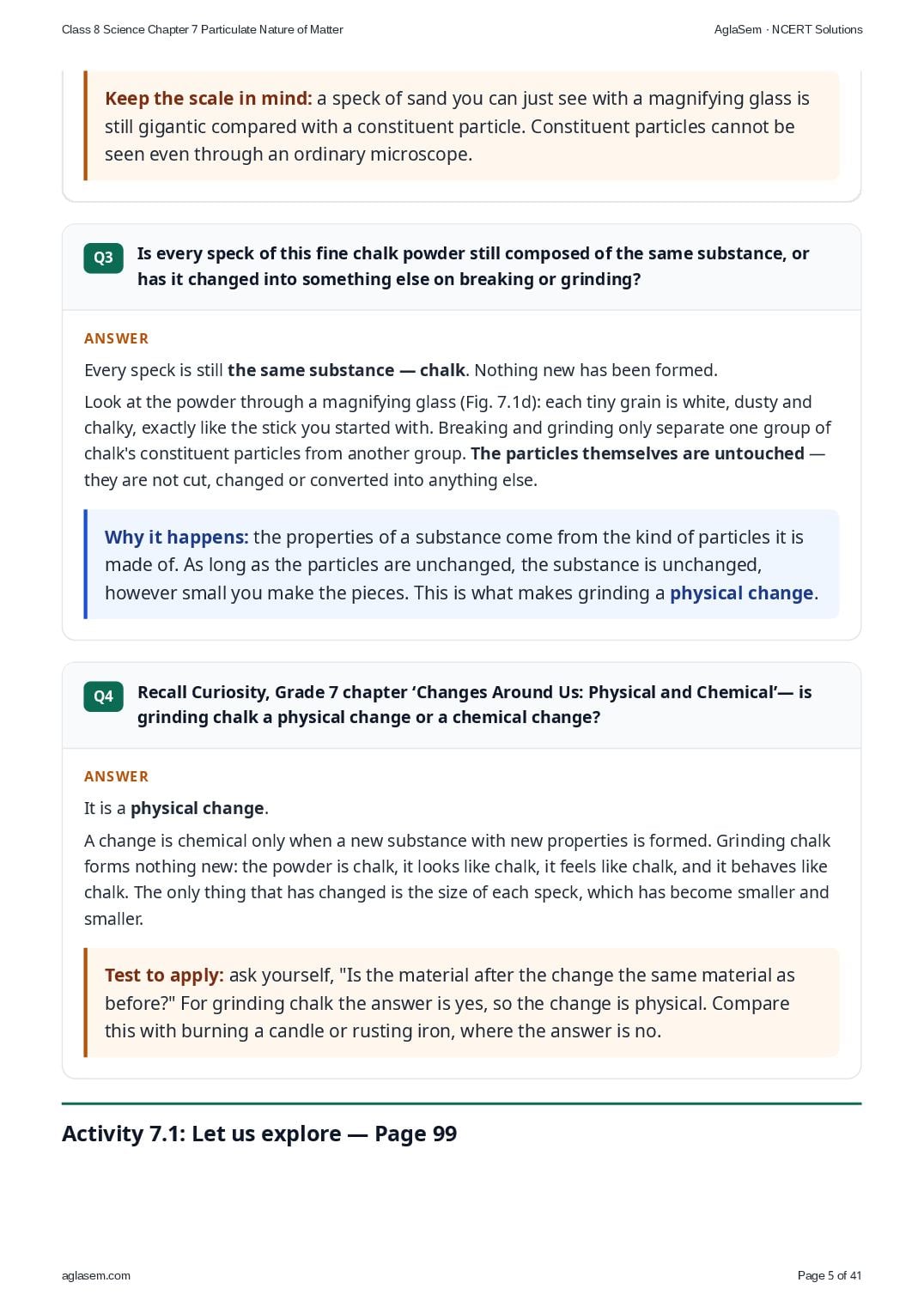
- Is every speck of this fine chalk powder still composed of the same substance, or has it changed into something else on breaking or grinding?
- Recall Curiosity, Grade 7 chapter ‘Changes Around Us: Physical and Chemical’— is grinding chalk a physical change or a chemical change?
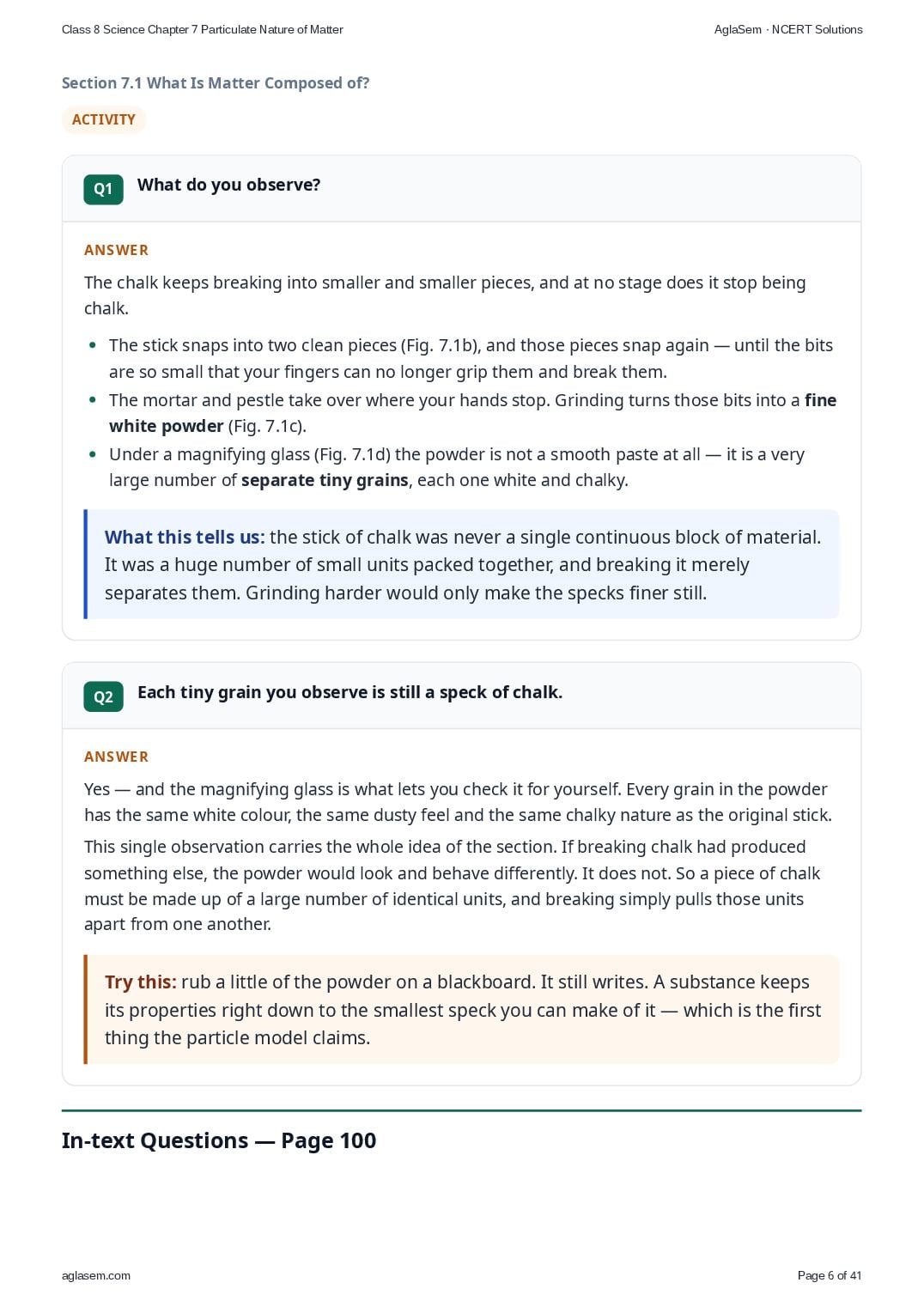
- What do you observe?
- Each tiny grain you observe is still a speck of chalk.
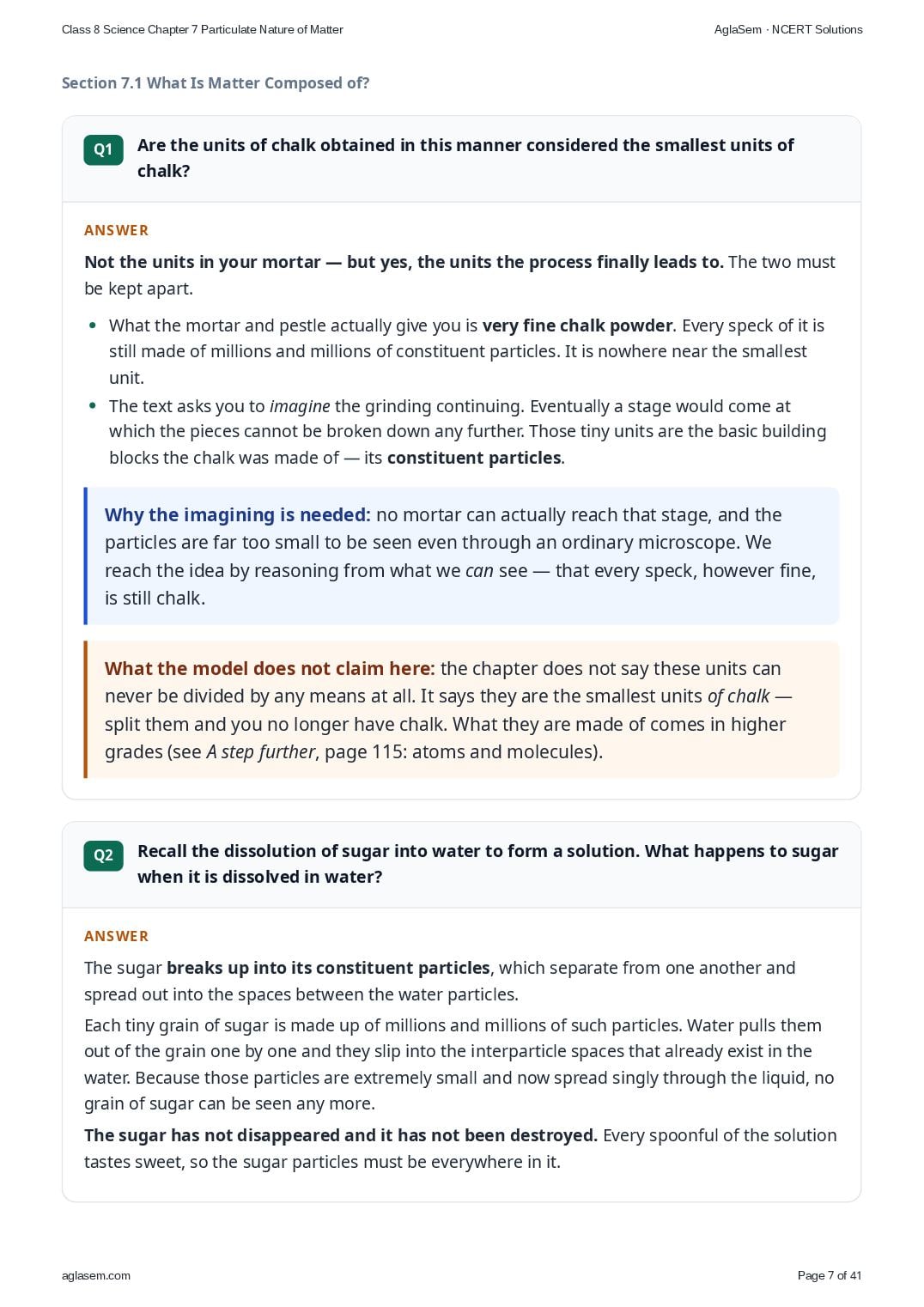
- Are the units of chalk obtained in this manner considered the smallest units of chalk?
- Recall the dissolution of sugar into water to form a solution. What happens to sugar when it is dissolved in water?
- Do you observe any sugar particles in the solution?
- Does the water taste sweet?
- What difference in taste do you notice? Does it taste sweet?
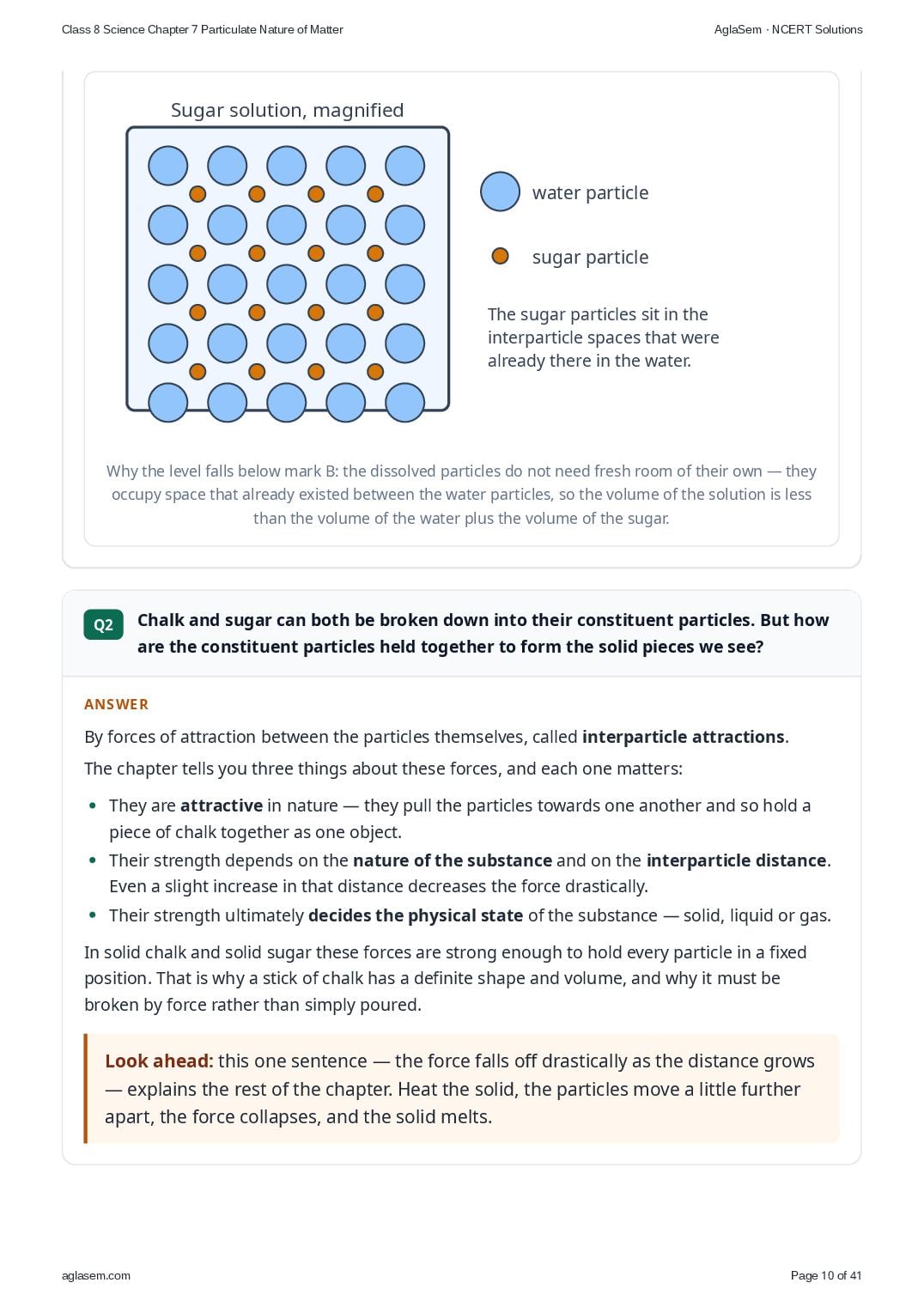
- But, where did the sugar go?
- Chalk and sugar can both be broken down into their constituent particles. But how are the constituent particles held together to form the solid pieces we see?
- Do you know that since ancient times, people have been thinking about how far things could be broken down and what is matter made up of?
- How are constituent particles held together in solids?
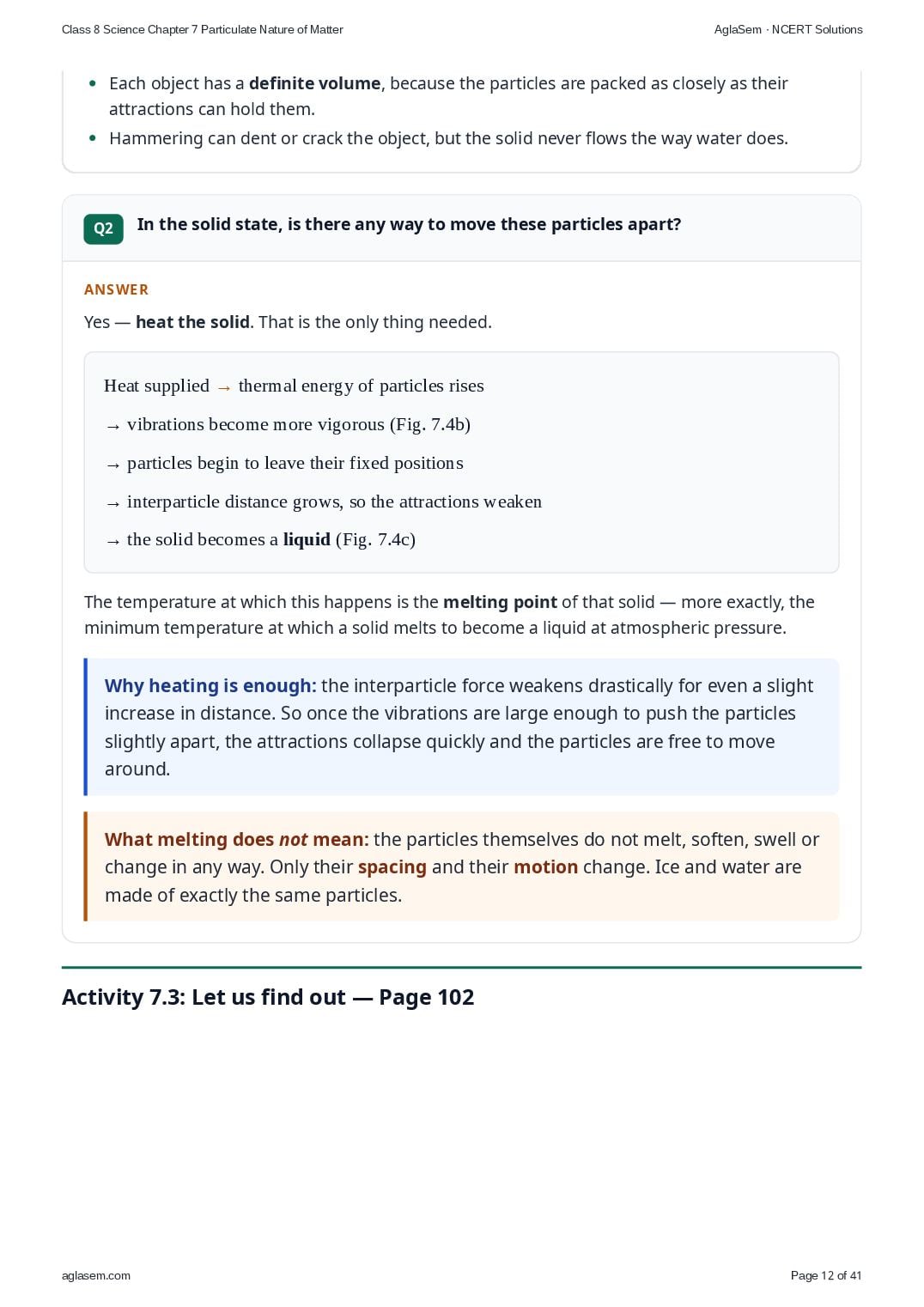
- In the solid state, is there any way to move these particles apart?
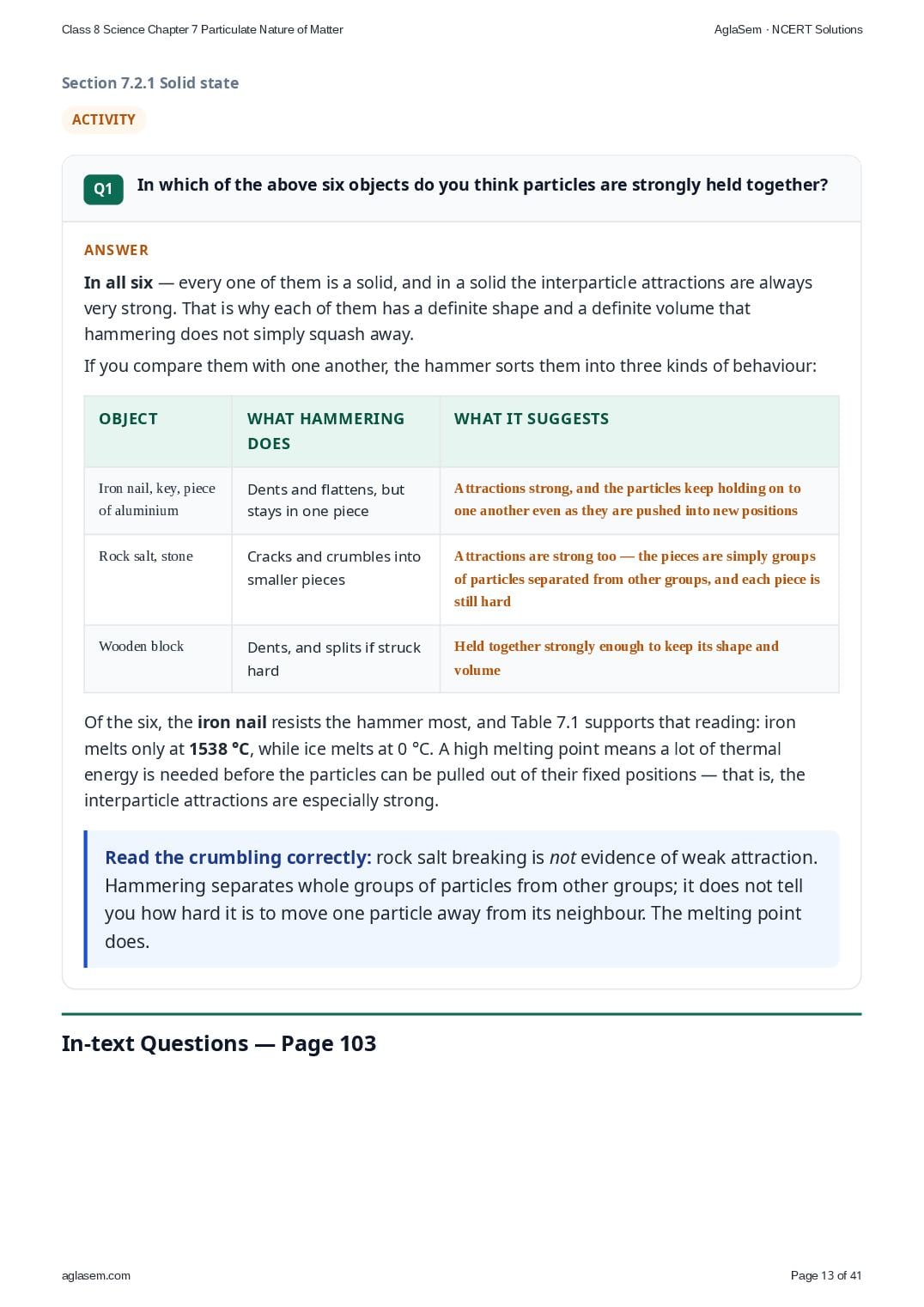
- In which of the above six objects do you think particles are strongly held together?
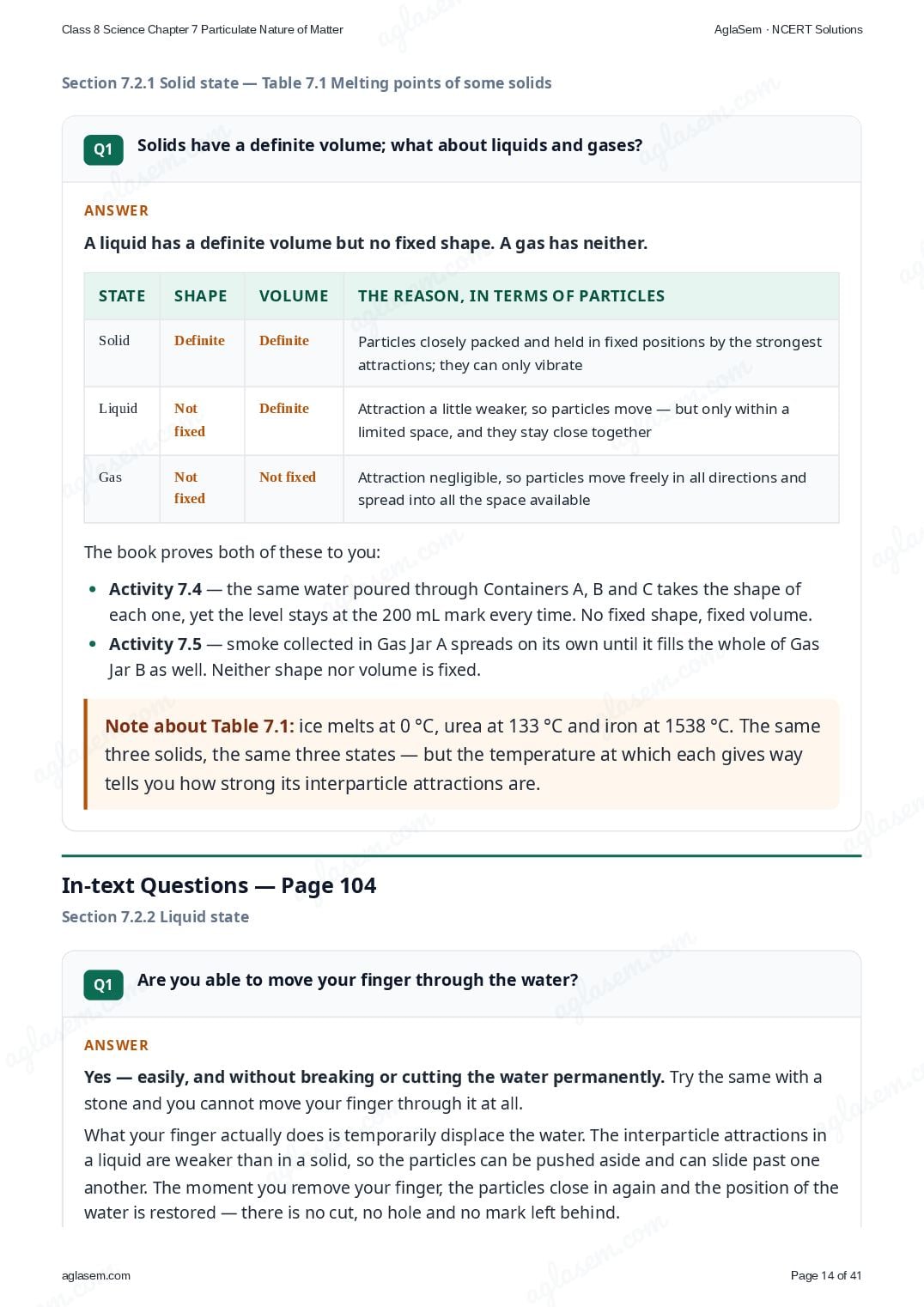
- Solids have a definite volume; what about liquids and gases?
- Are you able to move your finger through the water?
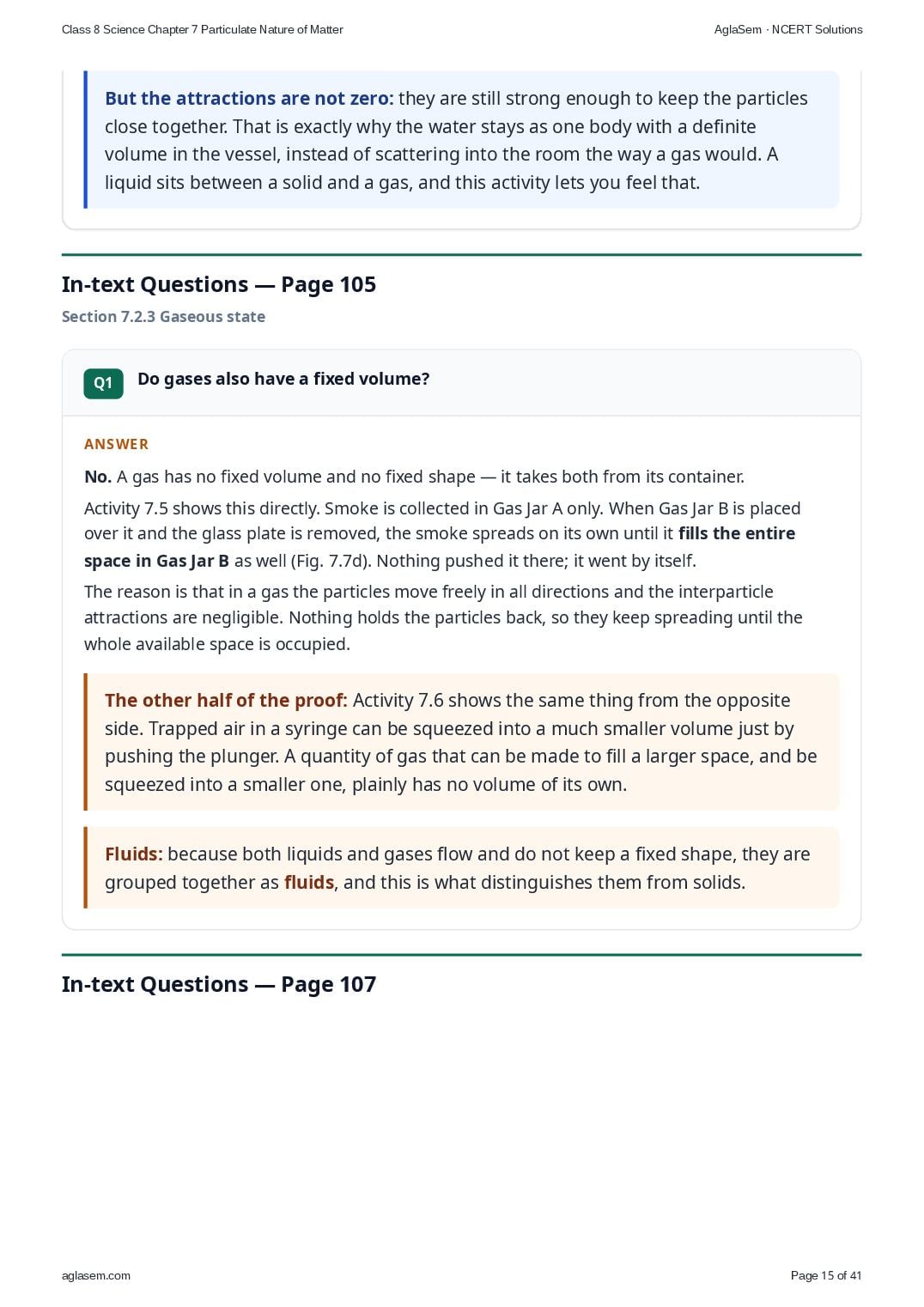
- Do gases also have a fixed volume?
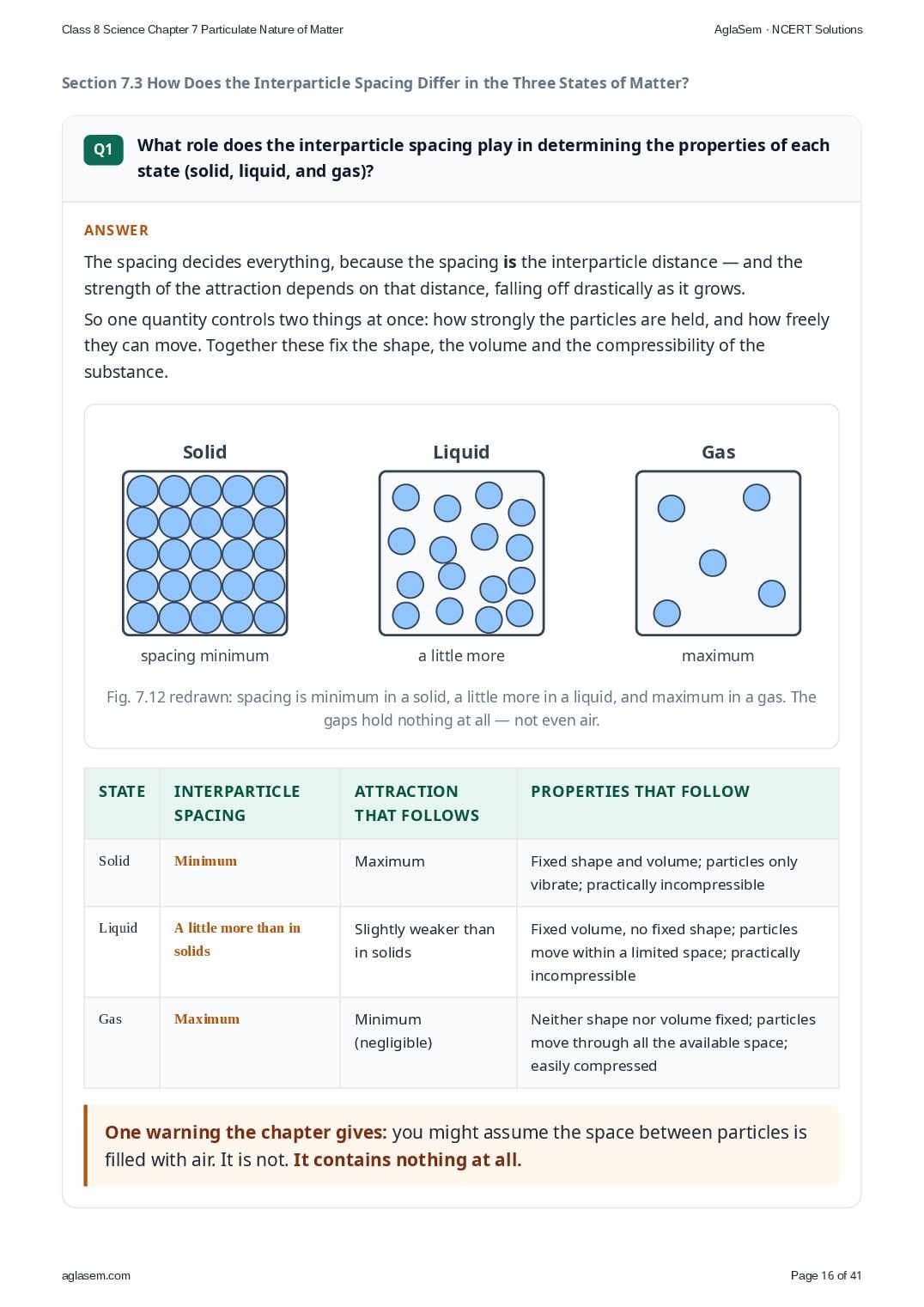
- What role does the interparticle spacing play in determining the properties of each state (solid, liquid, and gas)?
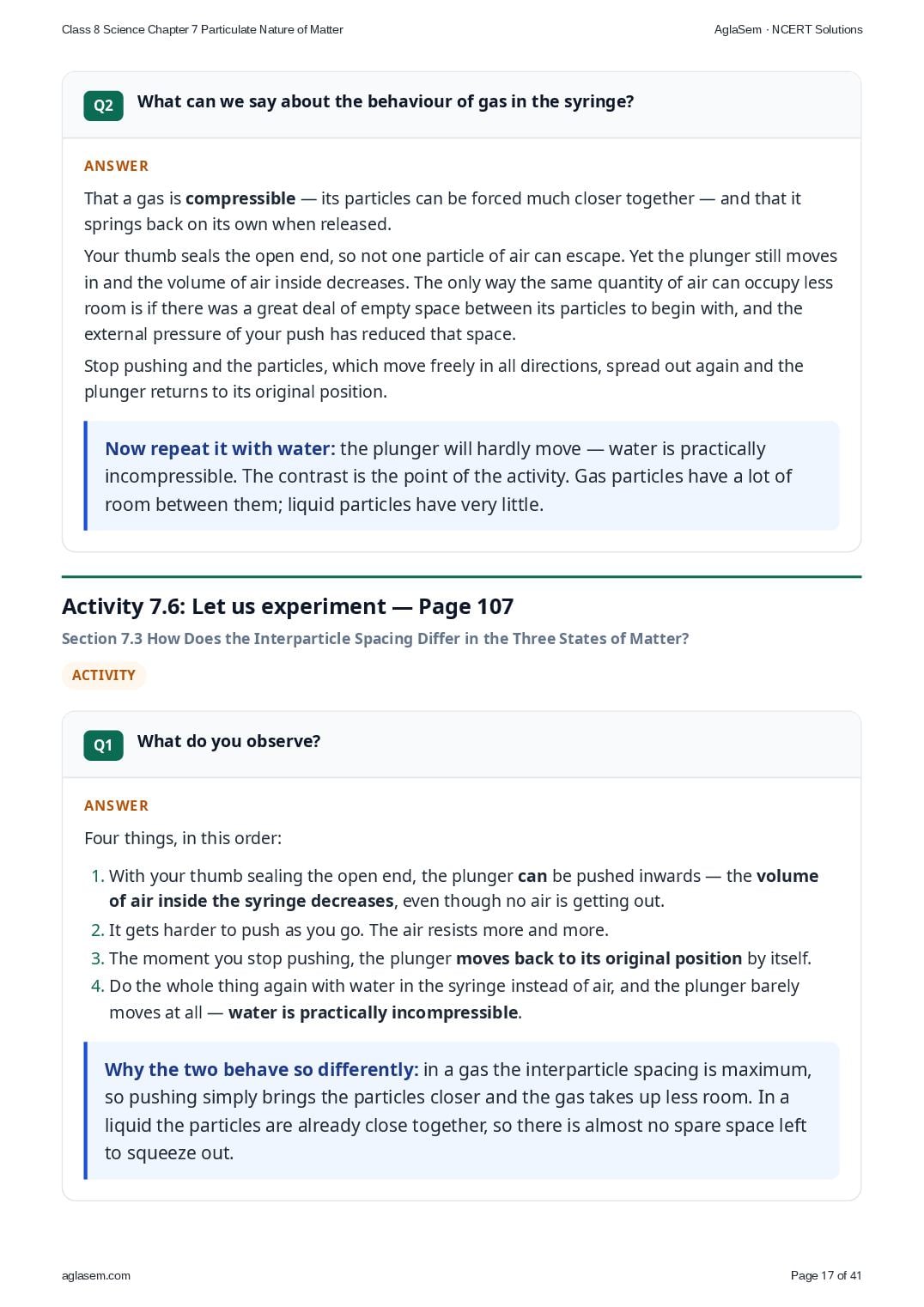
- What can we say about the behaviour of gas in the syringe?
- What do you observe?
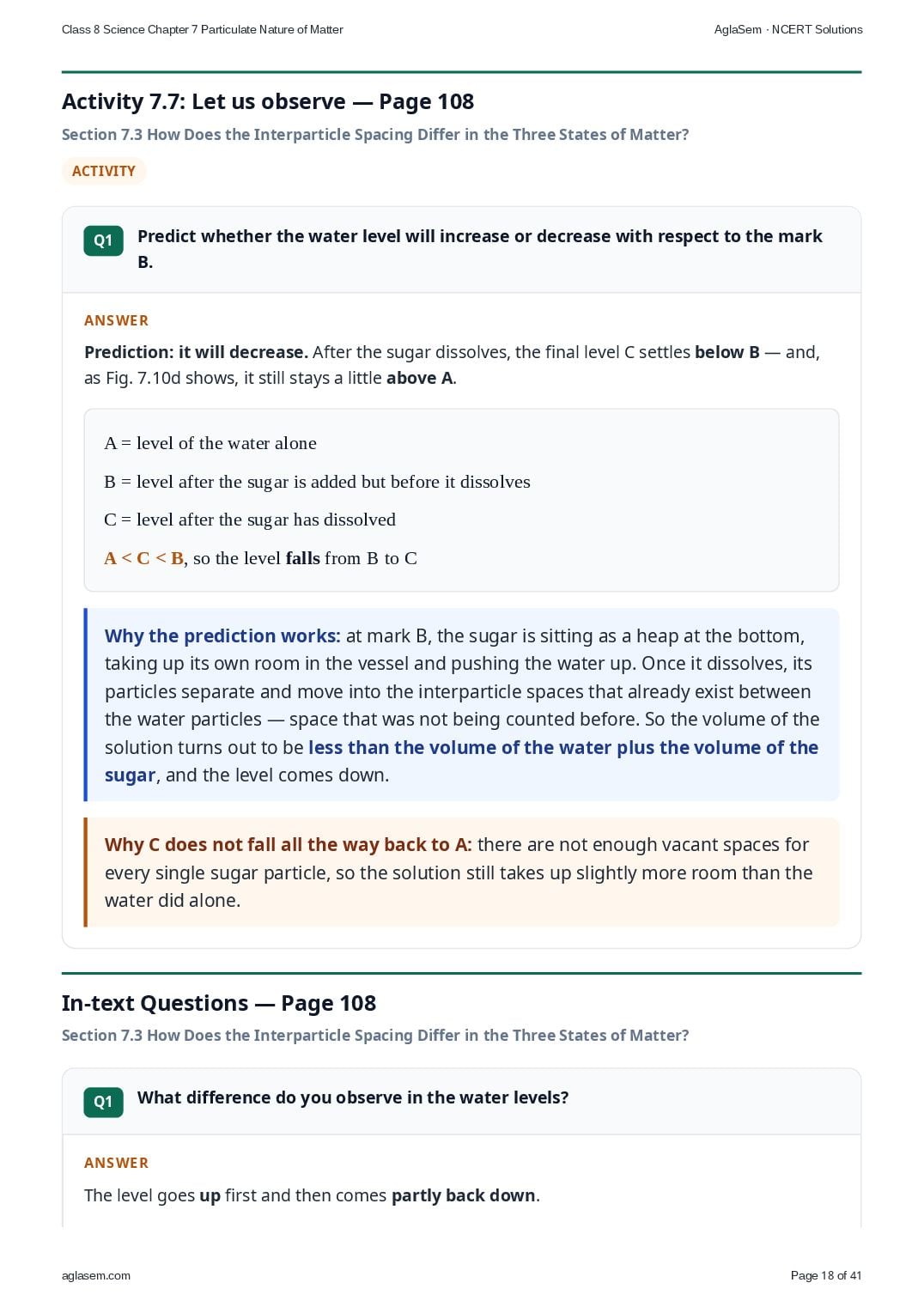
- Predict whether the water level will increase or decrease with respect to the mark B.
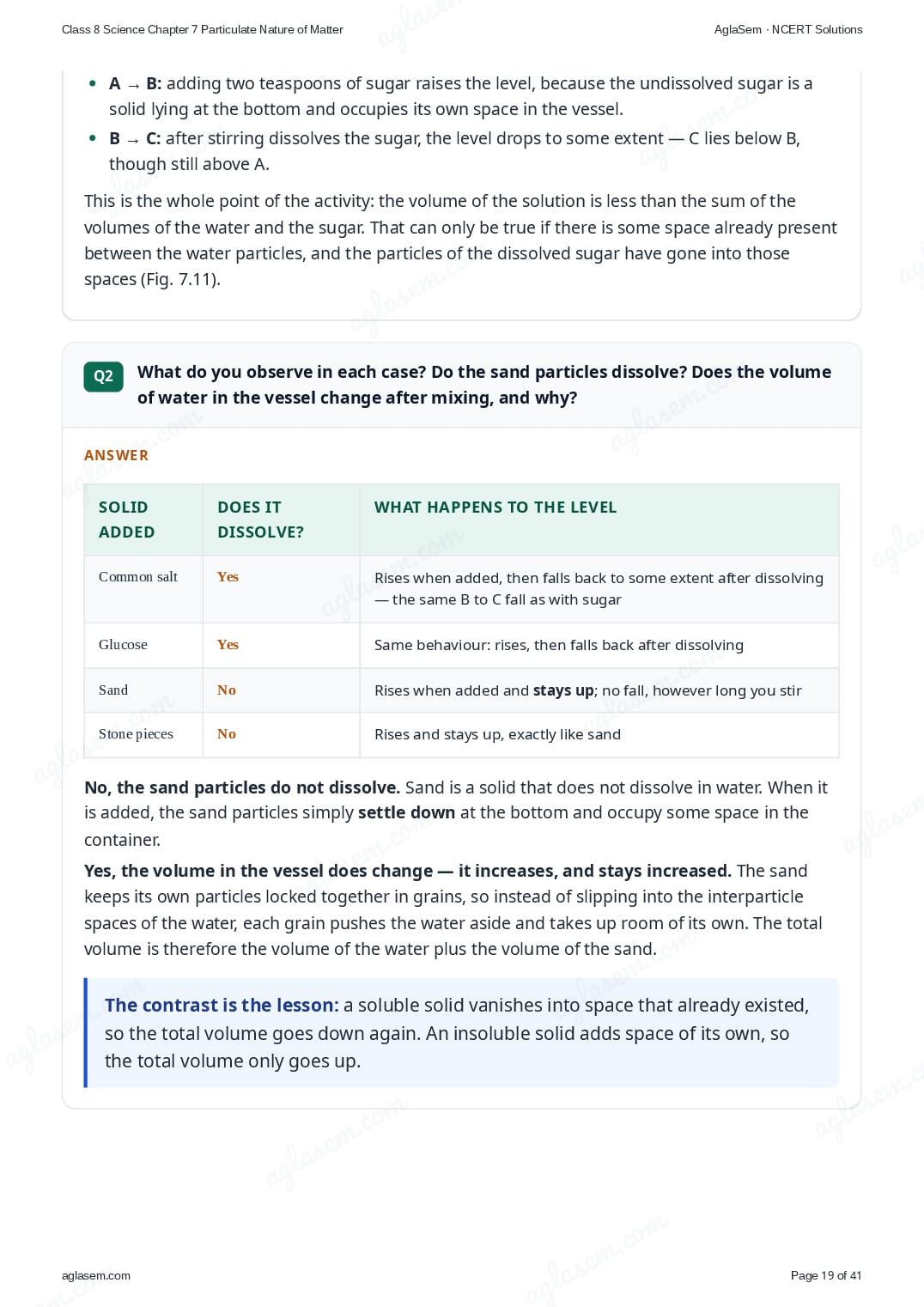
- What difference do you observe in the water levels?
- What do you observe in each case? Do the sand particles dissolve? Does the volume of water in the vessel change after mixing, and why?
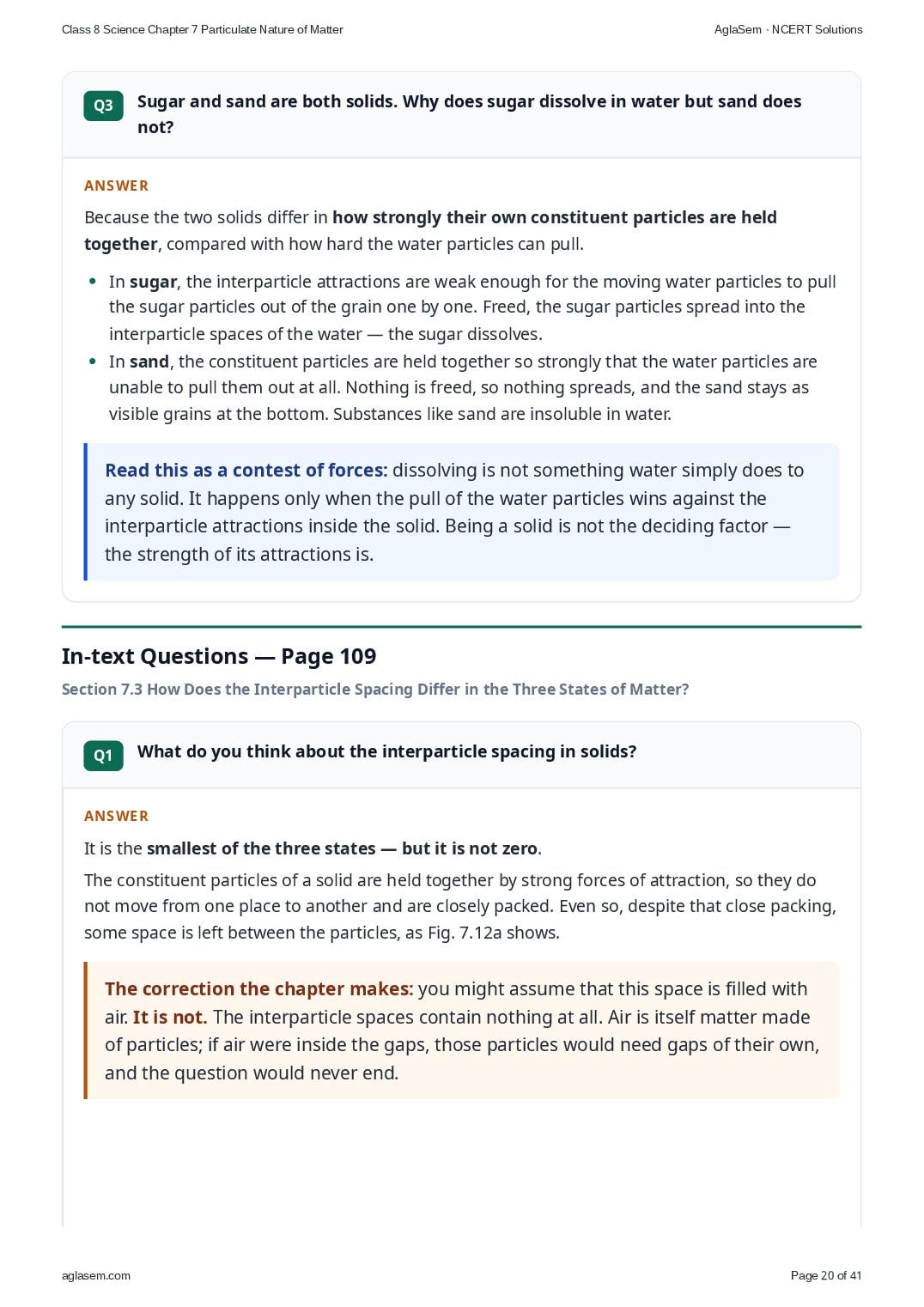
- Sugar and sand are both solids. Why does sugar dissolve in water but sand does not?
- What do you think about the interparticle spacing in solids?
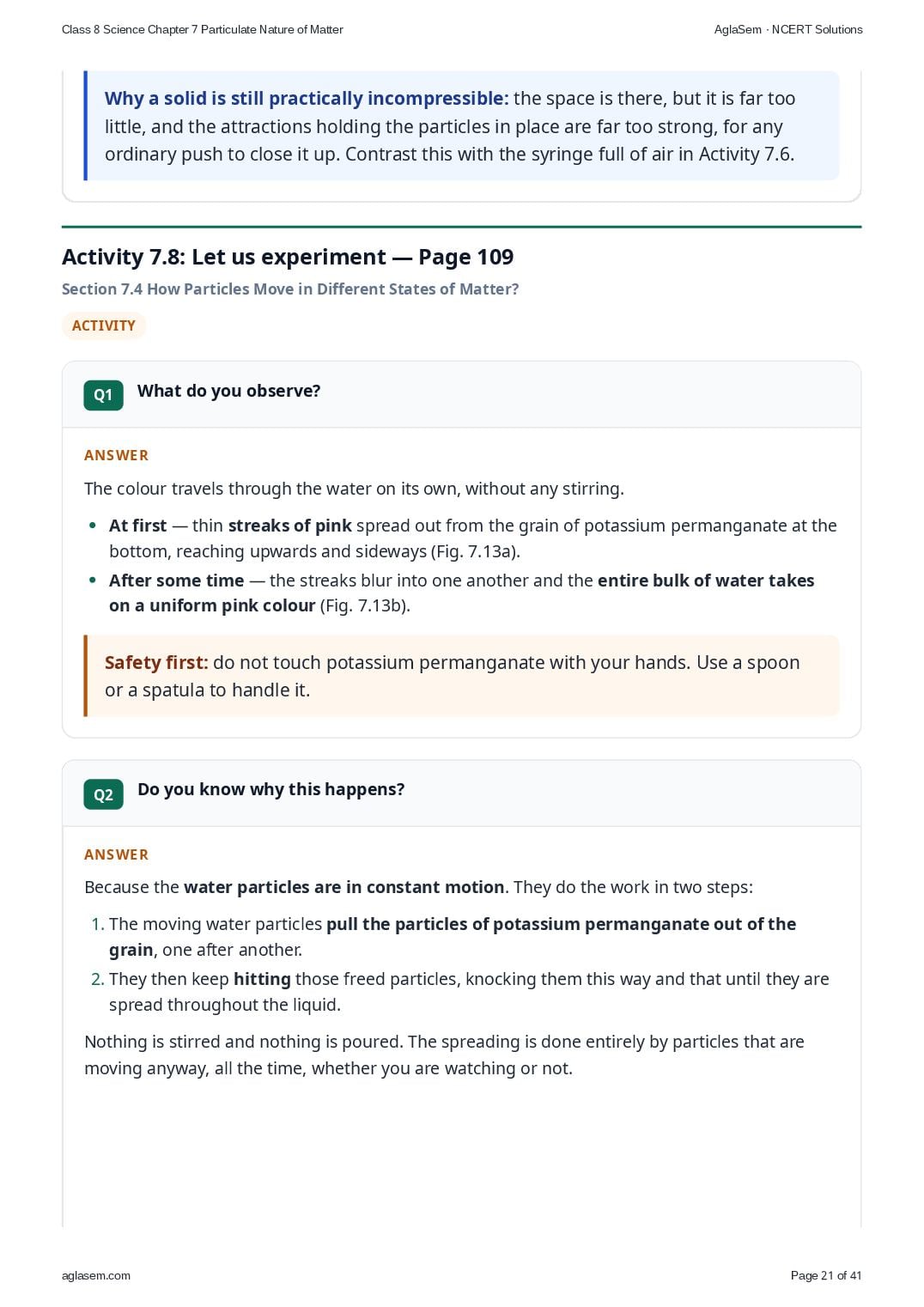
- What do you observe?
- Do you know why this happens?
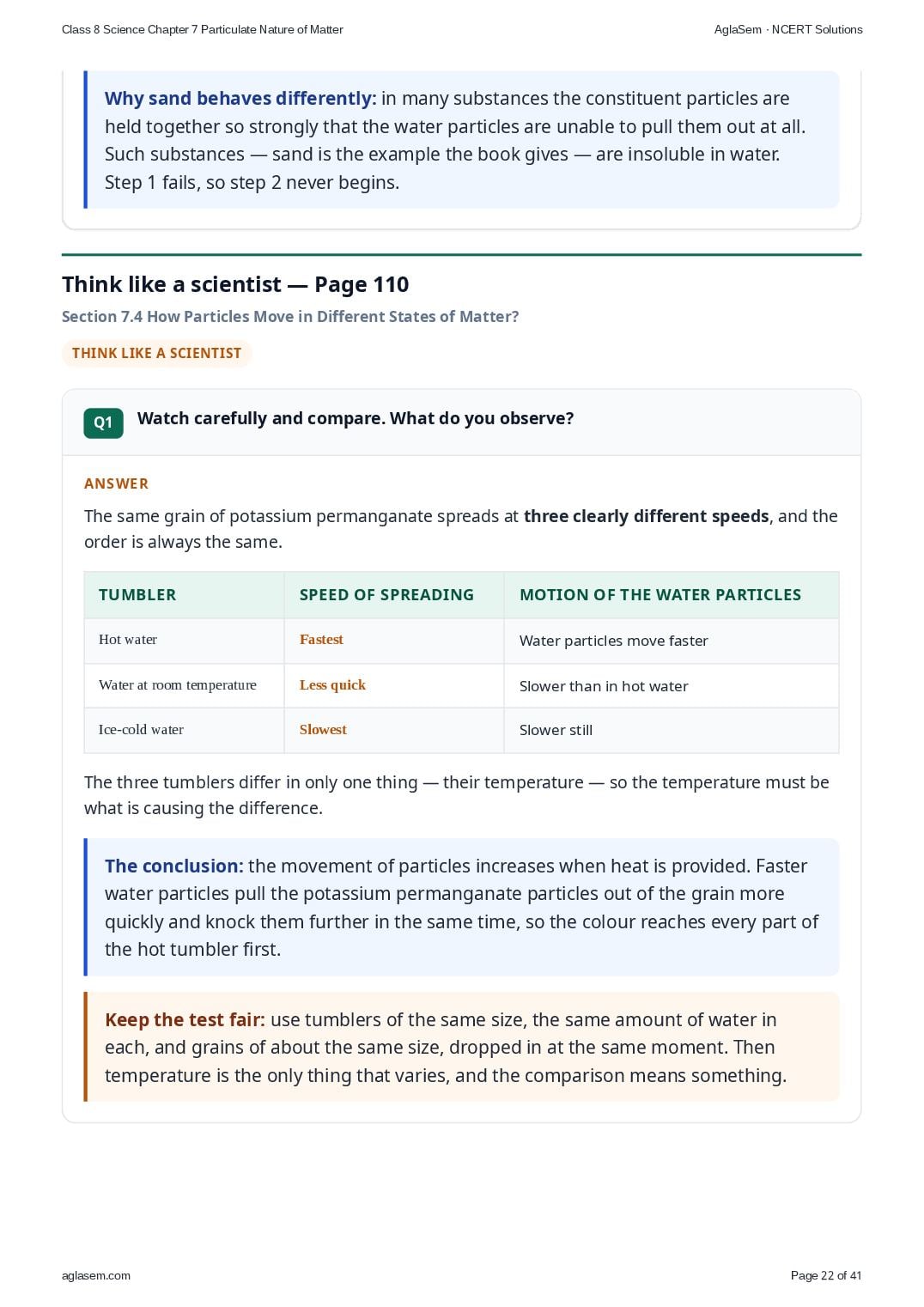
- Watch carefully and compare. What do you observe?
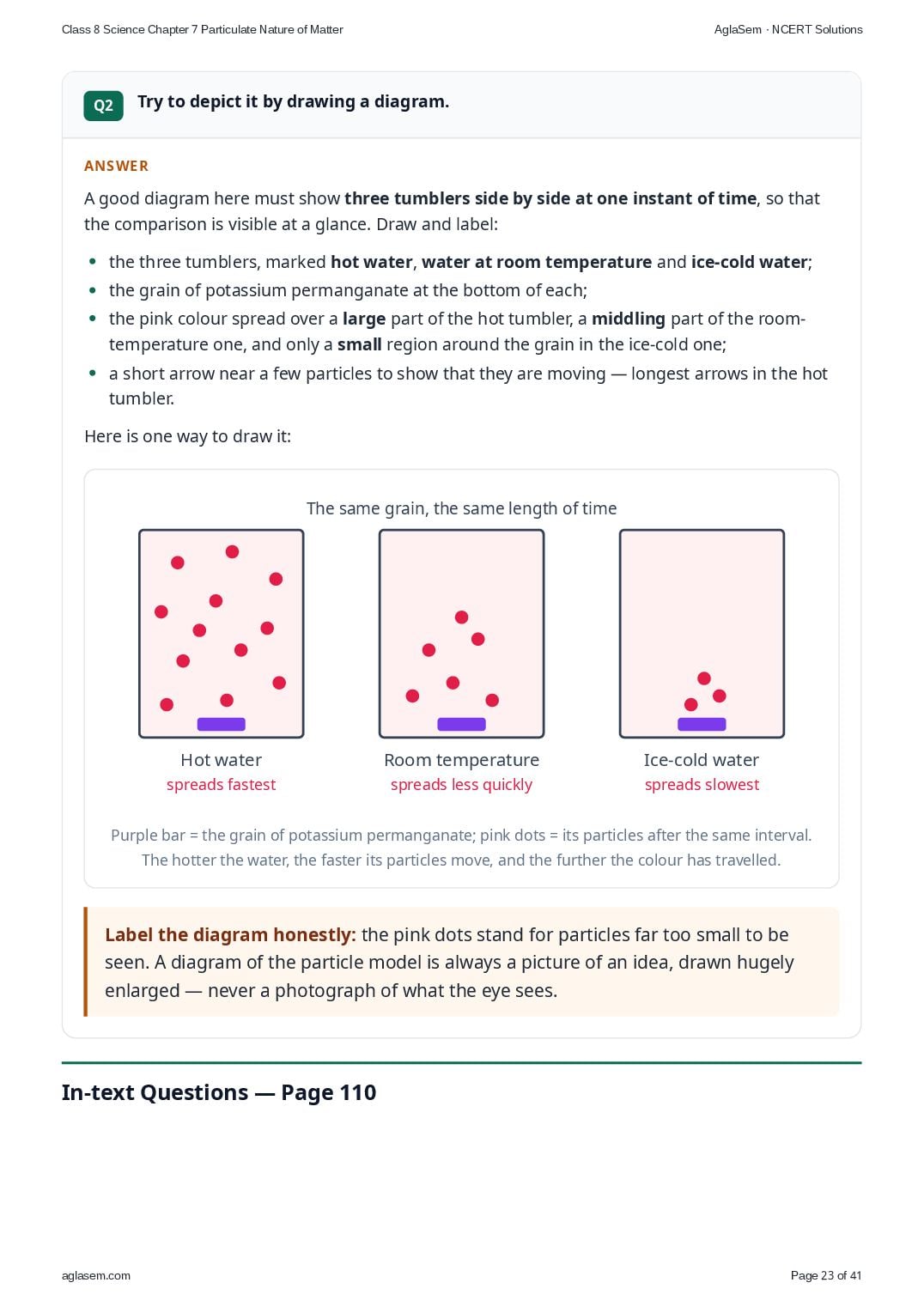
- Try to depict it by drawing a diagram.
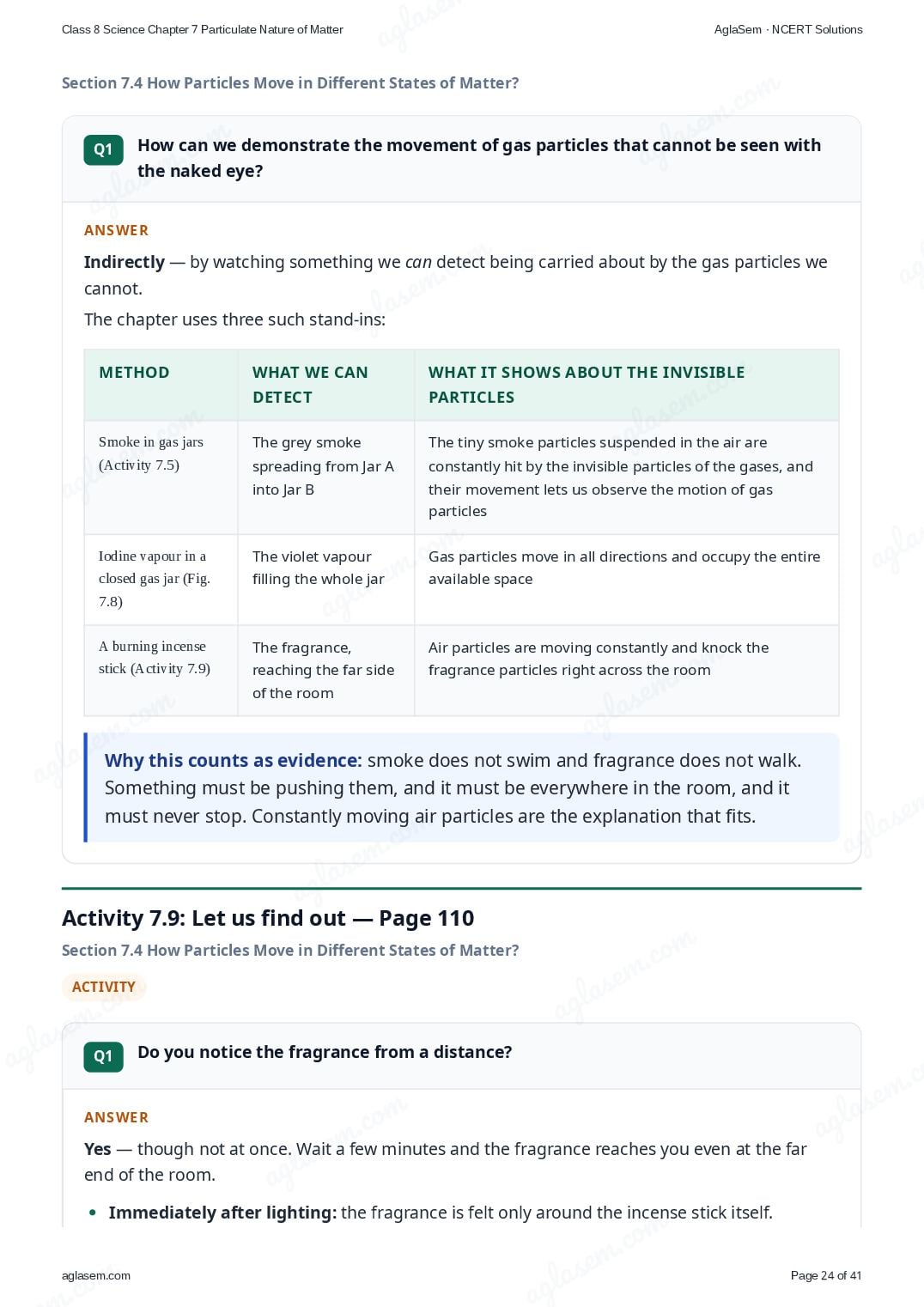
- How can we demonstrate the movement of gas particles that cannot be seen with the naked eye?
- Do you notice the fragrance from a distance?
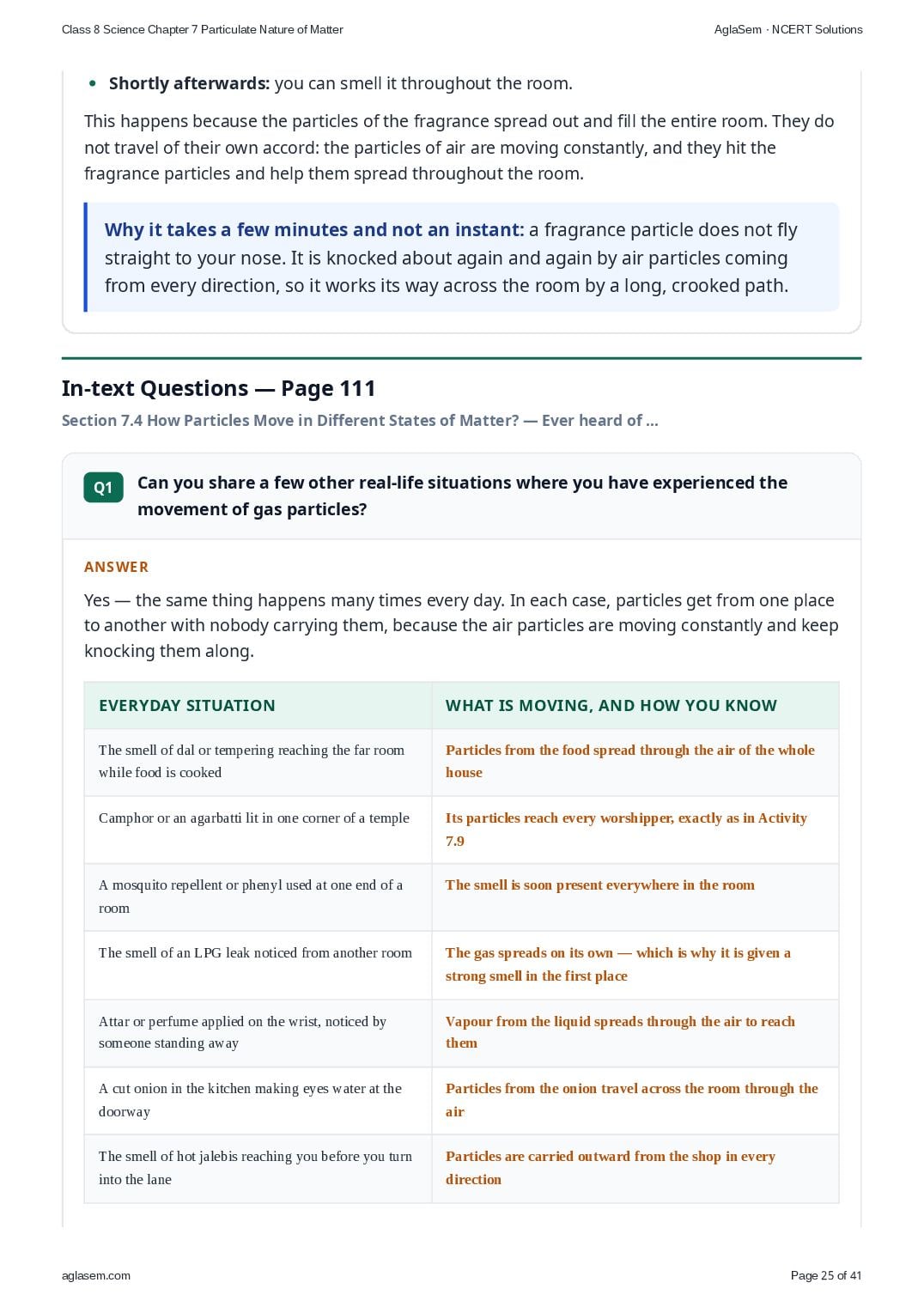
- Can you share a few other real-life situations where you have experienced the movement of gas particles?
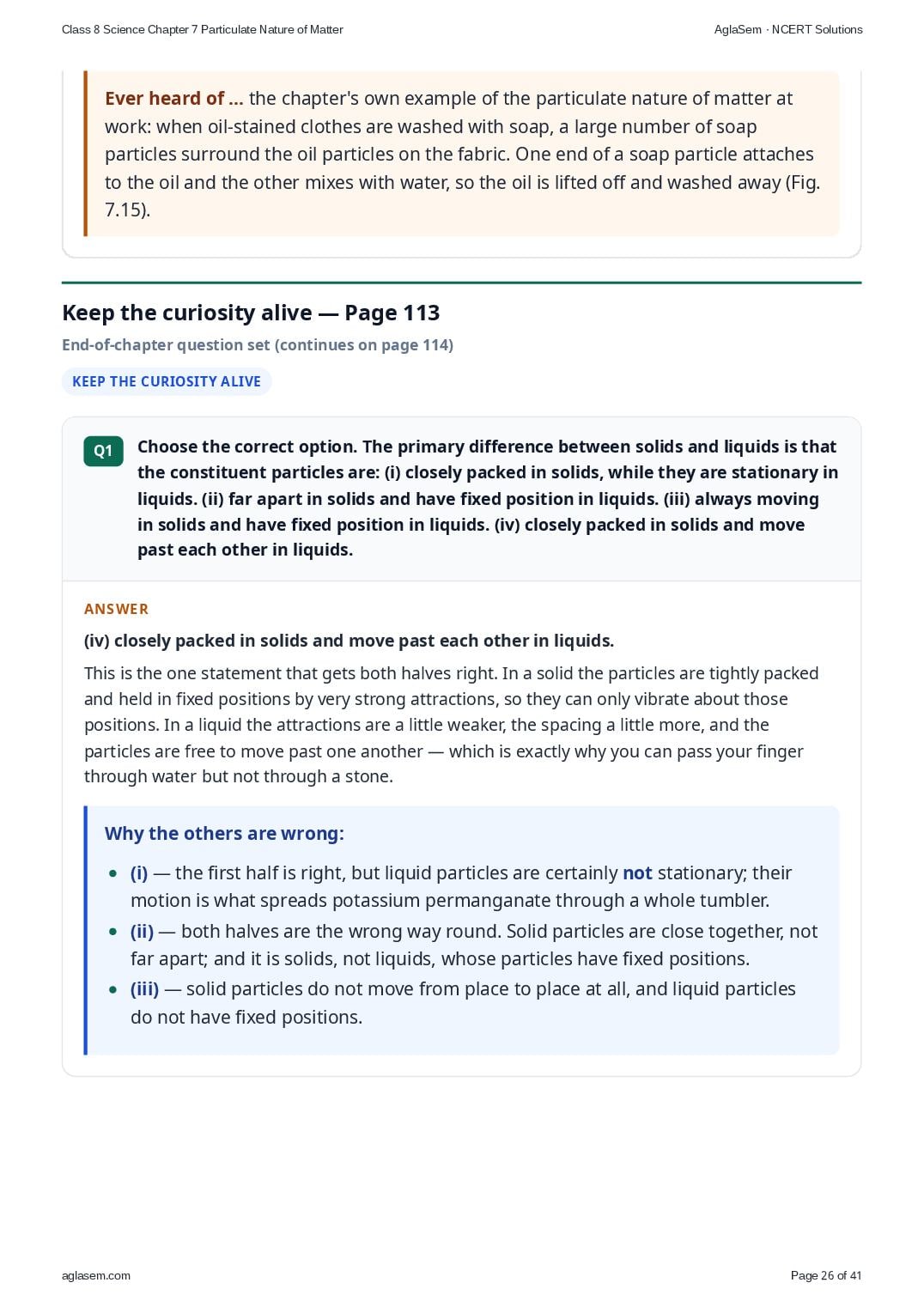
- Choose the correct option. The primary difference between solids and liquids is that the constituent particles are: (i) closely packed in solids, while they are stationary in liquids. (ii) far apart in solids and have fixed position in liquids. (iii) always moving in solids and have fixed position in liquids. (iv) closely packed in solids and move past each other in liquids.
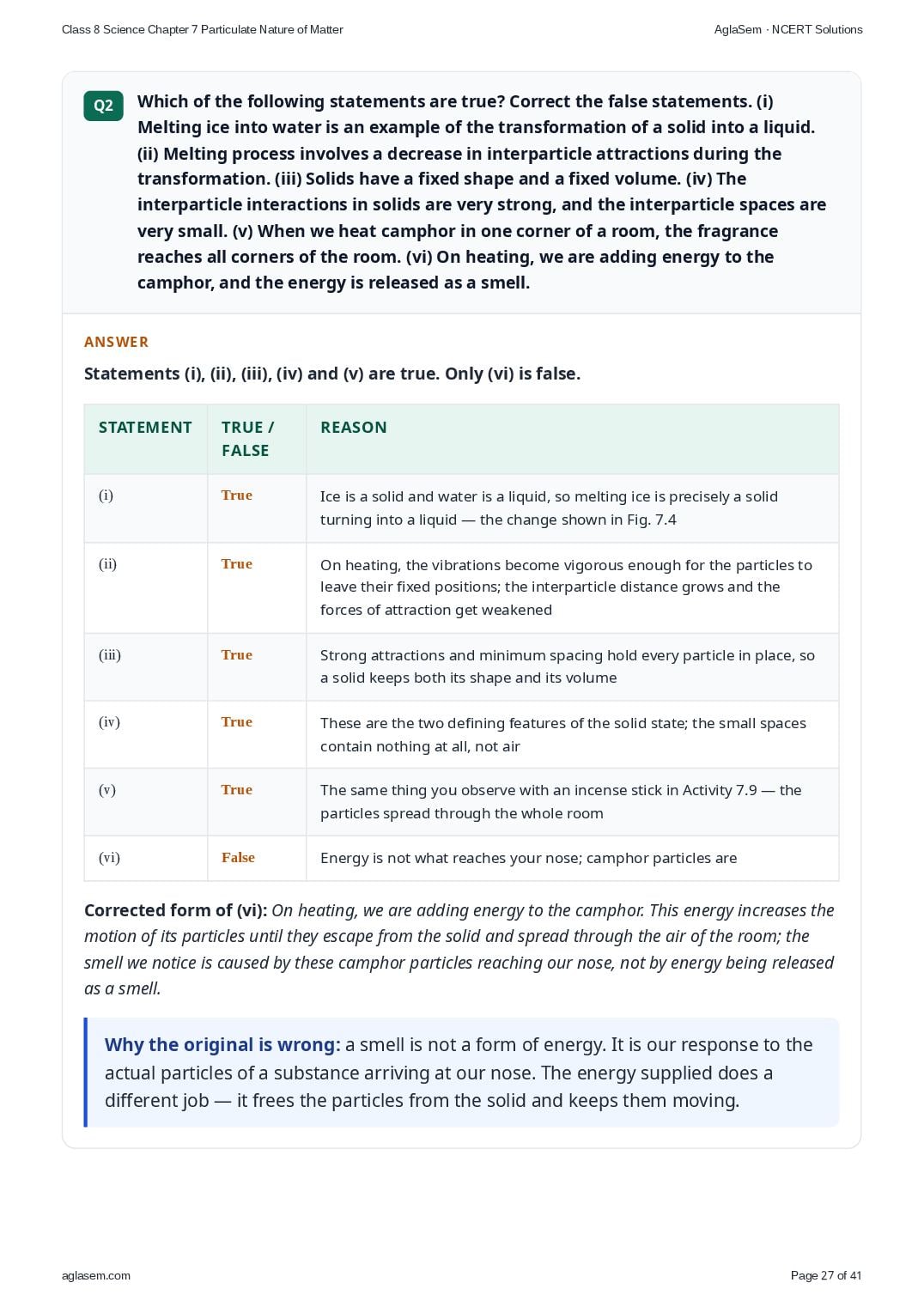
- Which of the following statements are true? Correct the false statements. (i) Melting ice into water is an example of the transformation of a solid into a liquid. (ii) Melting process involves a decrease in interparticle attractions during the transformation. (iii) Solids have a fixed shape and a fixed volume. (iv) The interparticle interactions in solids are very strong, and the interparticle spaces are very small. (v) When we heat camphor in one corner of a room, the fragrance reaches all corners of the room. (vi) On heating, we are adding energy to the camphor, and the energy is released as a smell.
- Choose the correct answer with justification. If we could remove all the constituent particles from a chair, what would happen? (i) Nothing will change. (ii) The chair will weigh less due to lost particles. (iii) Nothing of the chair will remain.
- Why do gases mix easily, while solids do not?
- When spilled on the table, milk in a glass tumbler, flows and spreads out, but the glass tumbler stays in the same shape. Justify this statement.
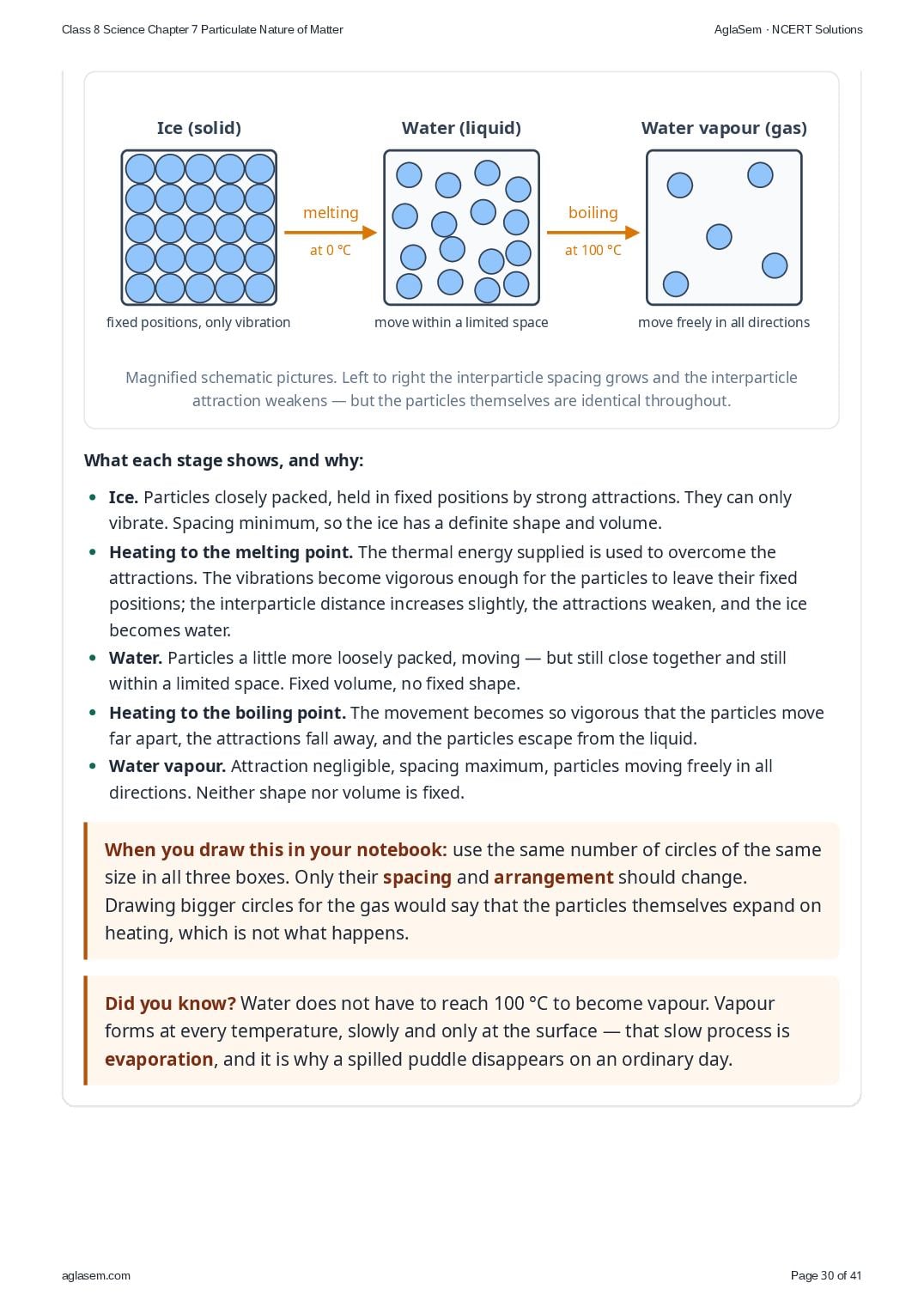
- Represent diagrammatically the changes in the arrangement of particles as ice melts and transforms into water vapour.
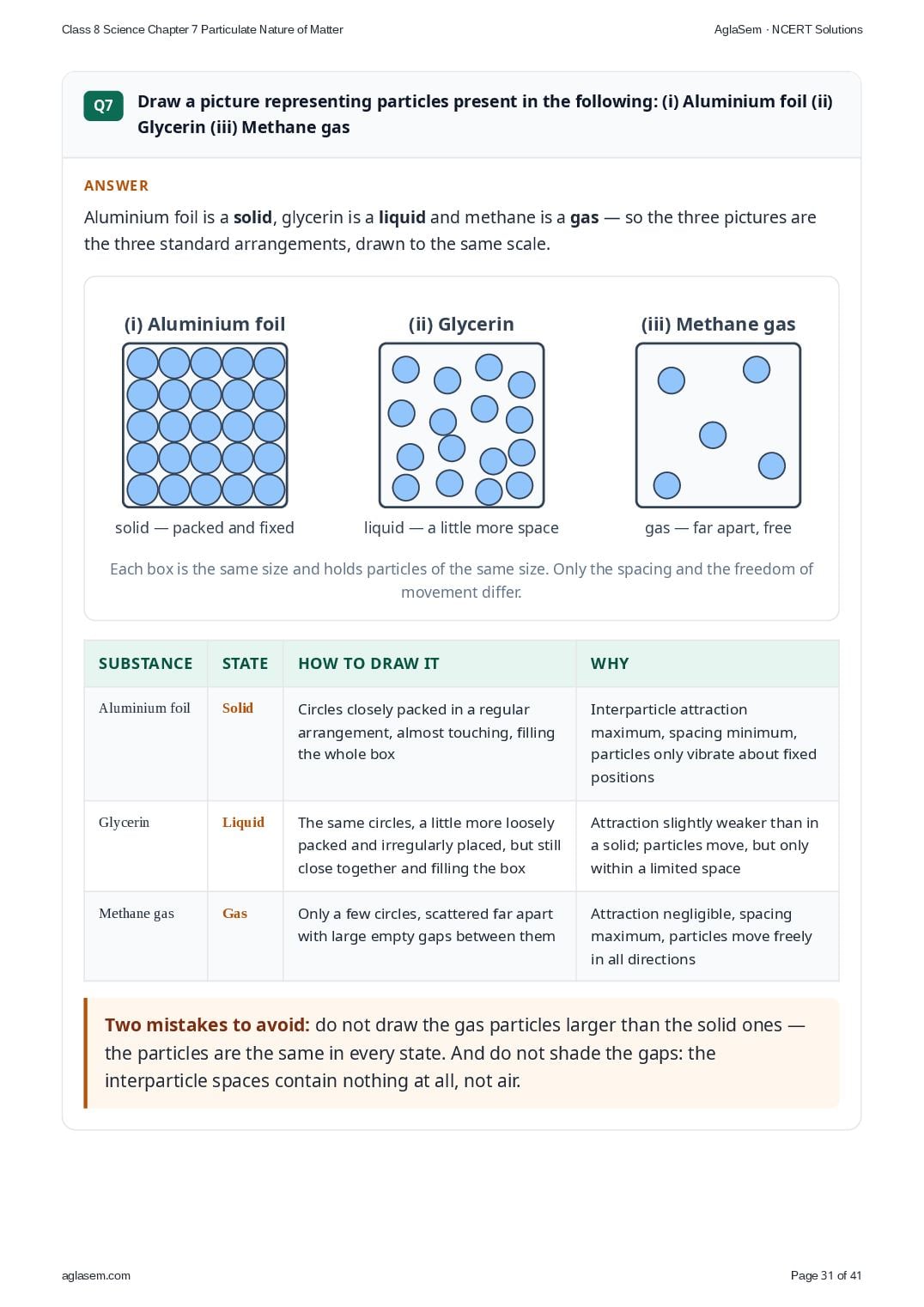
- Draw a picture representing particles present in the following: (i) Aluminium foil (ii) Glycerin (iii) Methane gas
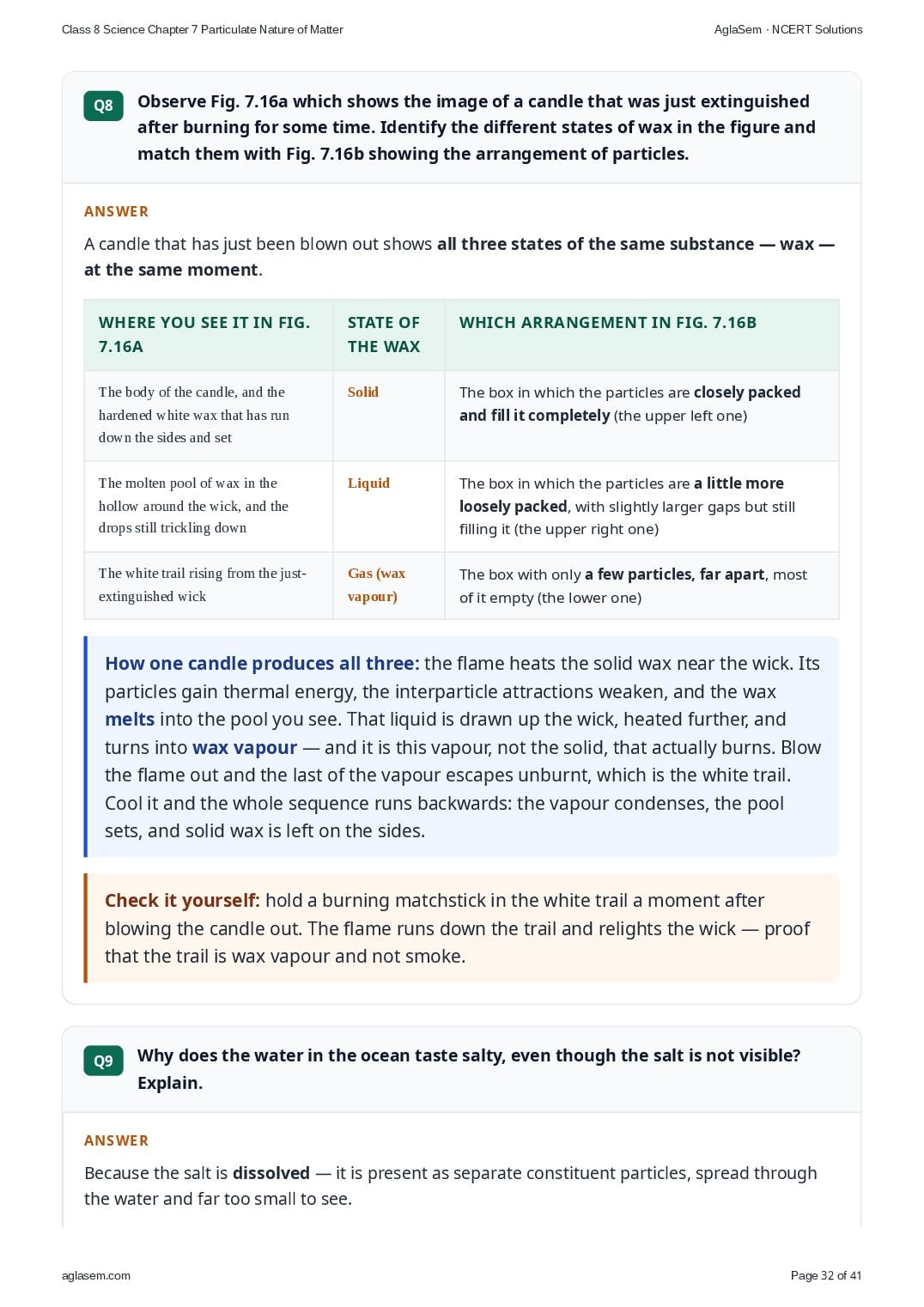
- Observe Fig. 7.16a which shows the image of a candle that was just extinguished after burning for some time. Identify the different states of wax in the figure and match them with Fig. 7.16b showing the arrangement of particles.
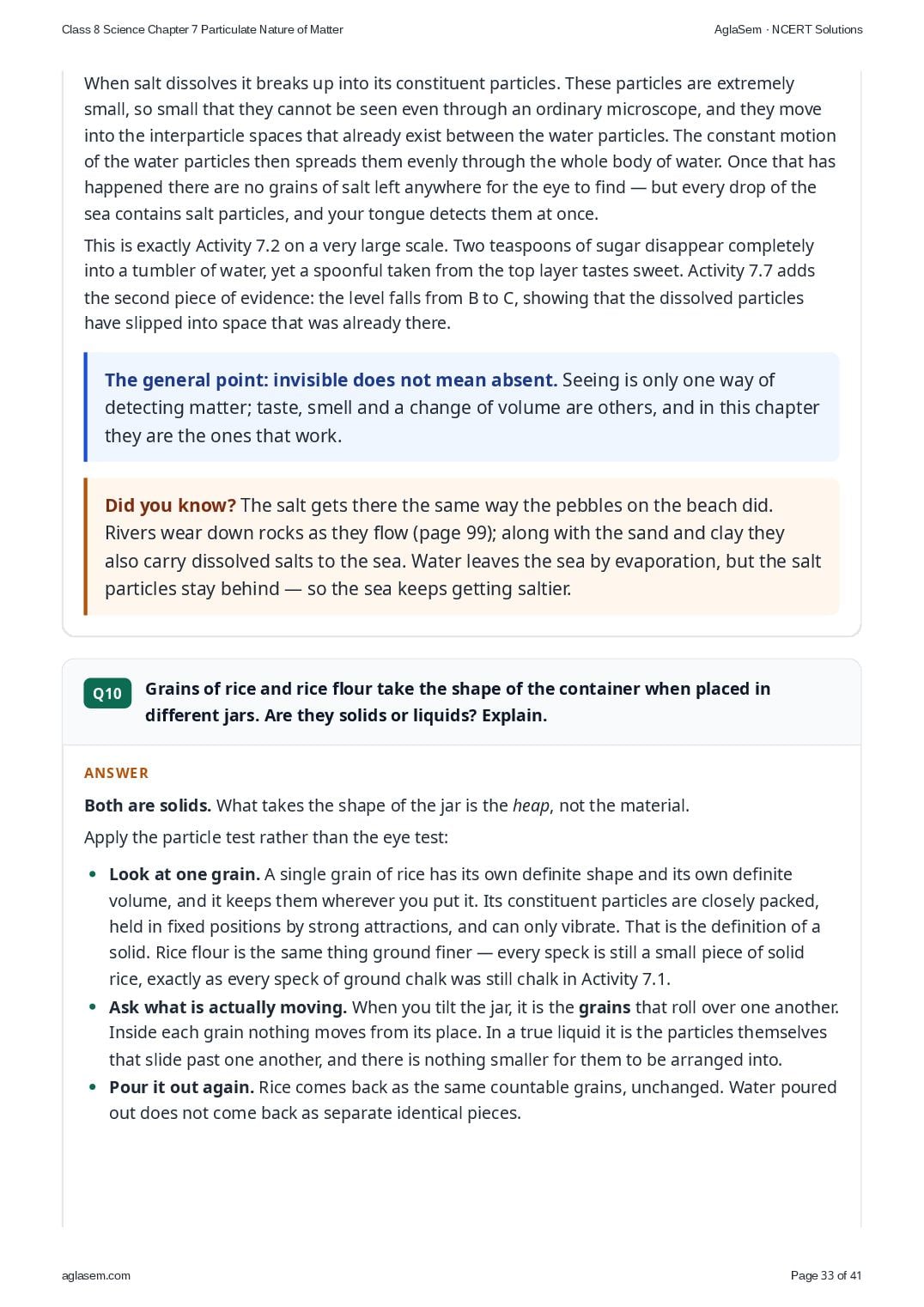
- Why does the water in the ocean taste salty, even though the salt is not visible? Explain.
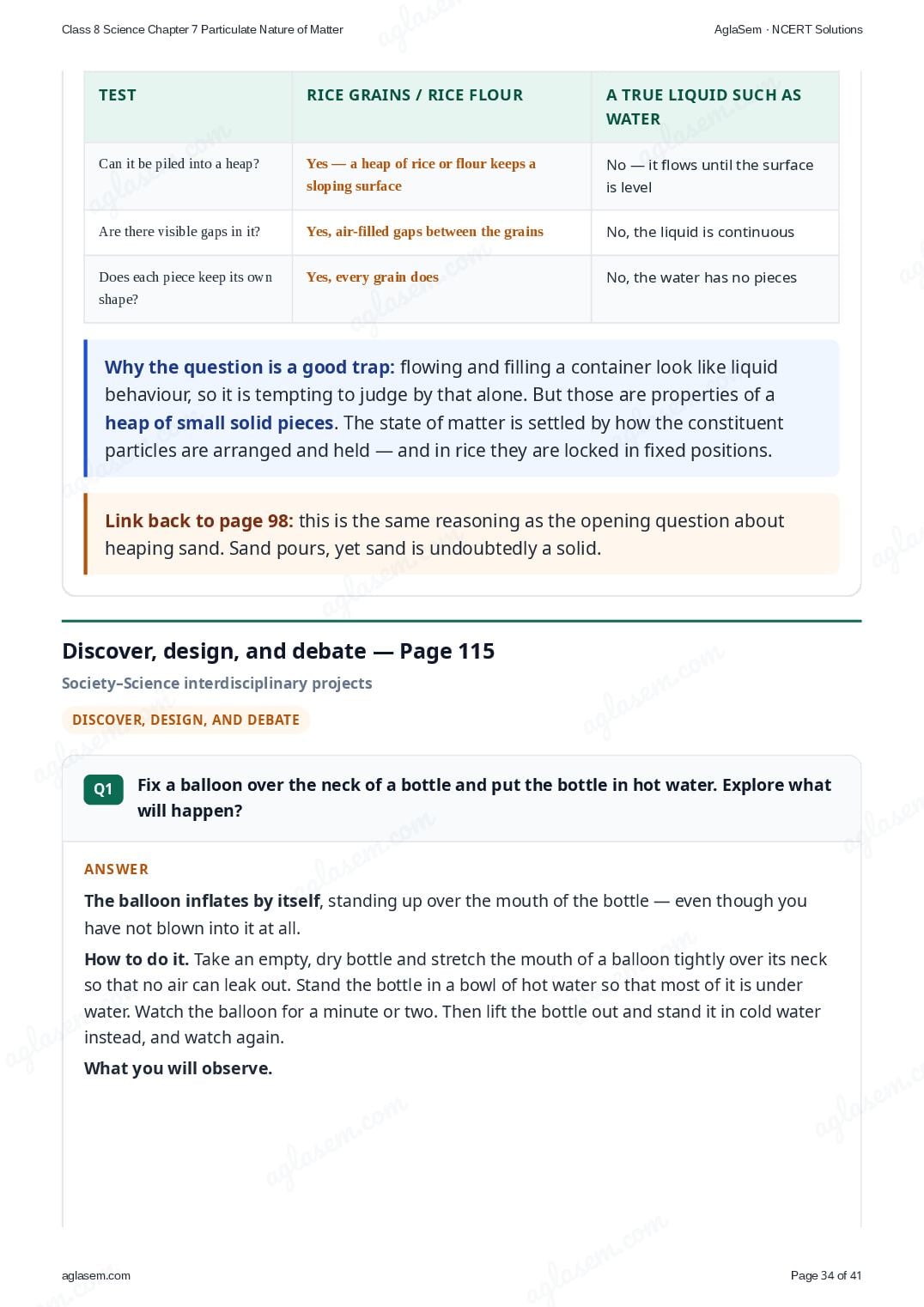
- Grains of rice and rice flour take the shape of the container when placed in different jars. Are they solids or liquids? Explain.
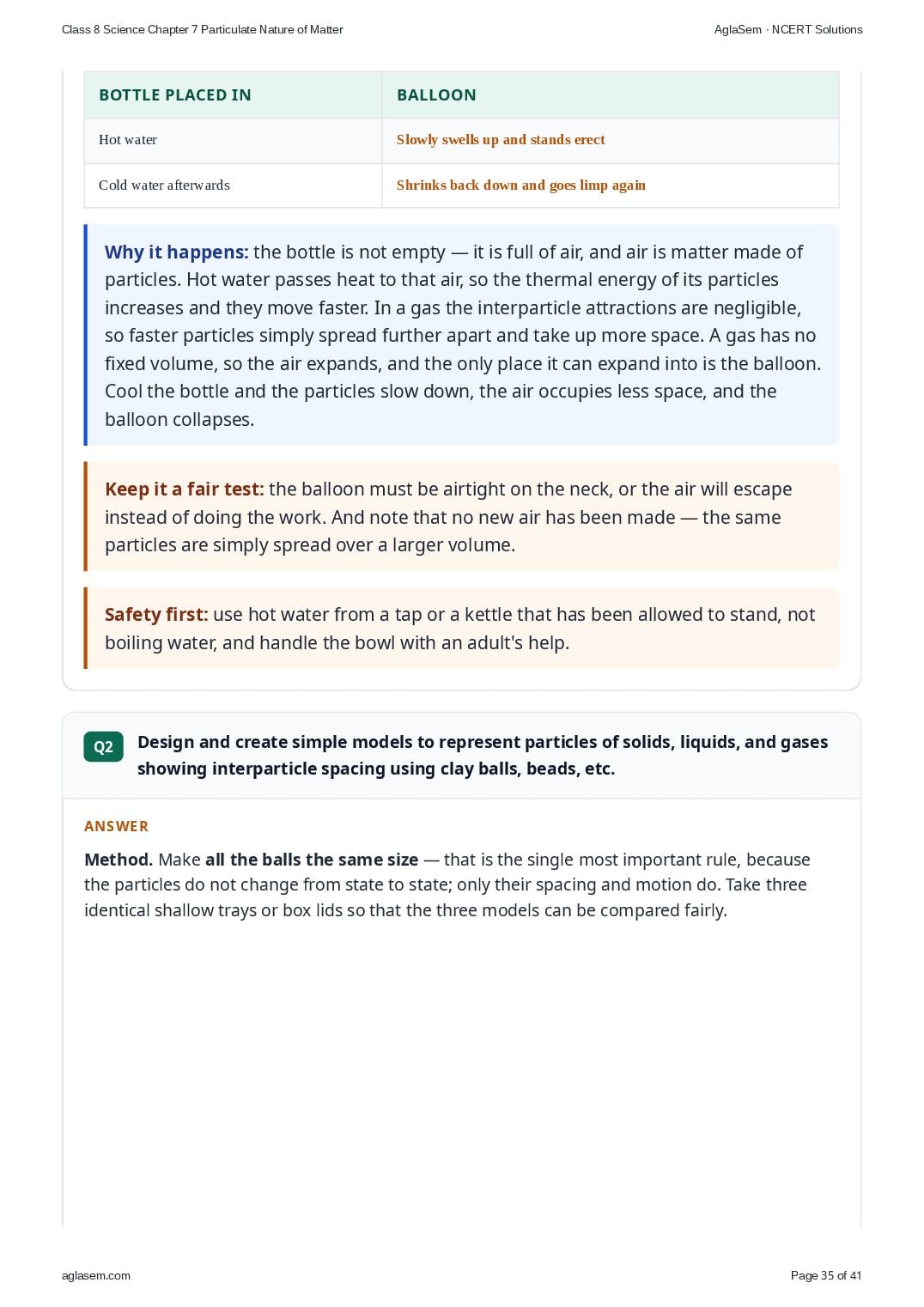
- Fix a balloon over the neck of a bottle and put the bottle in hot water. Explore what will happen?
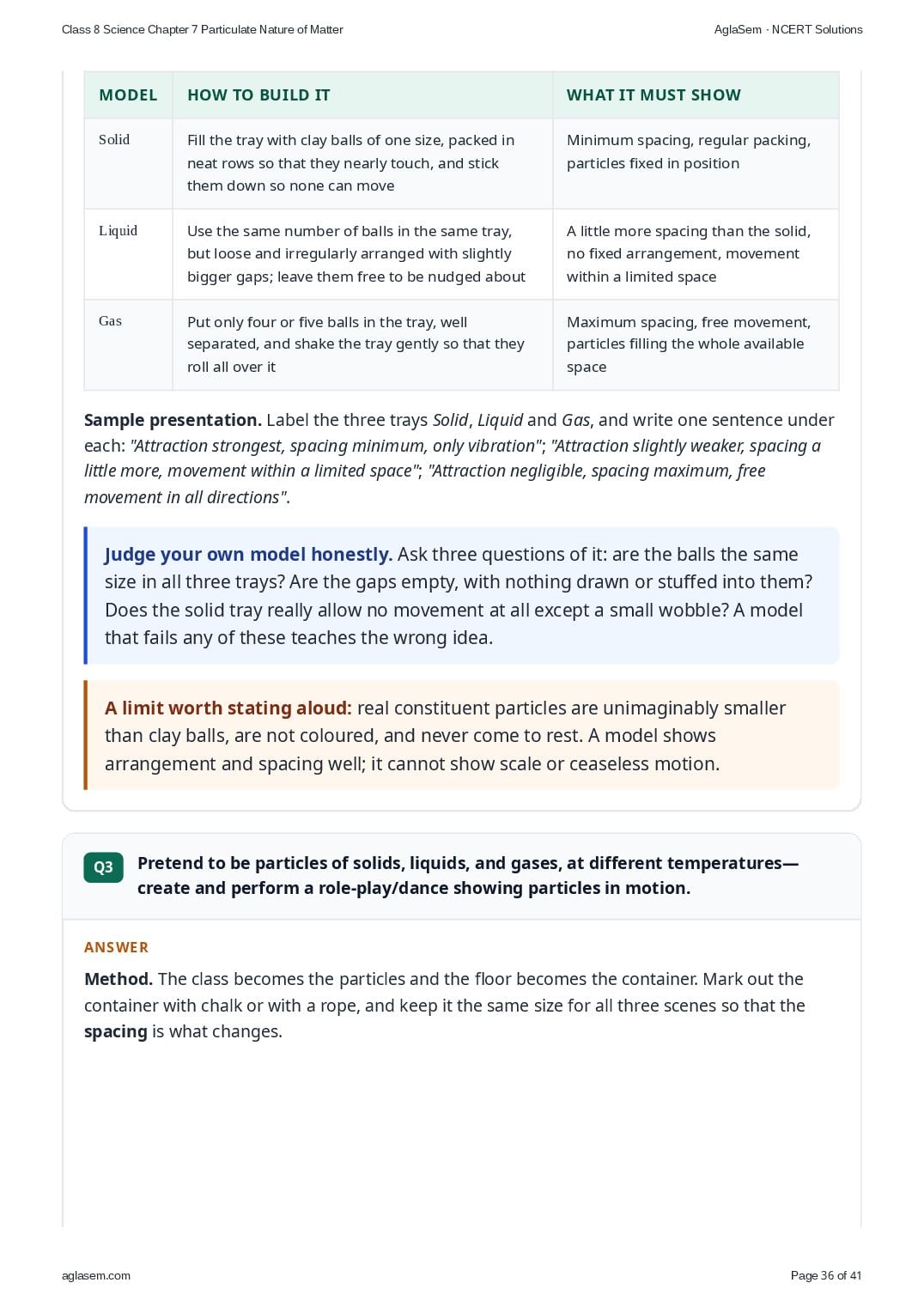
- Design and create simple models to represent particles of solids, liquids, and gases showing interparticle spacing using clay balls, beads, etc.
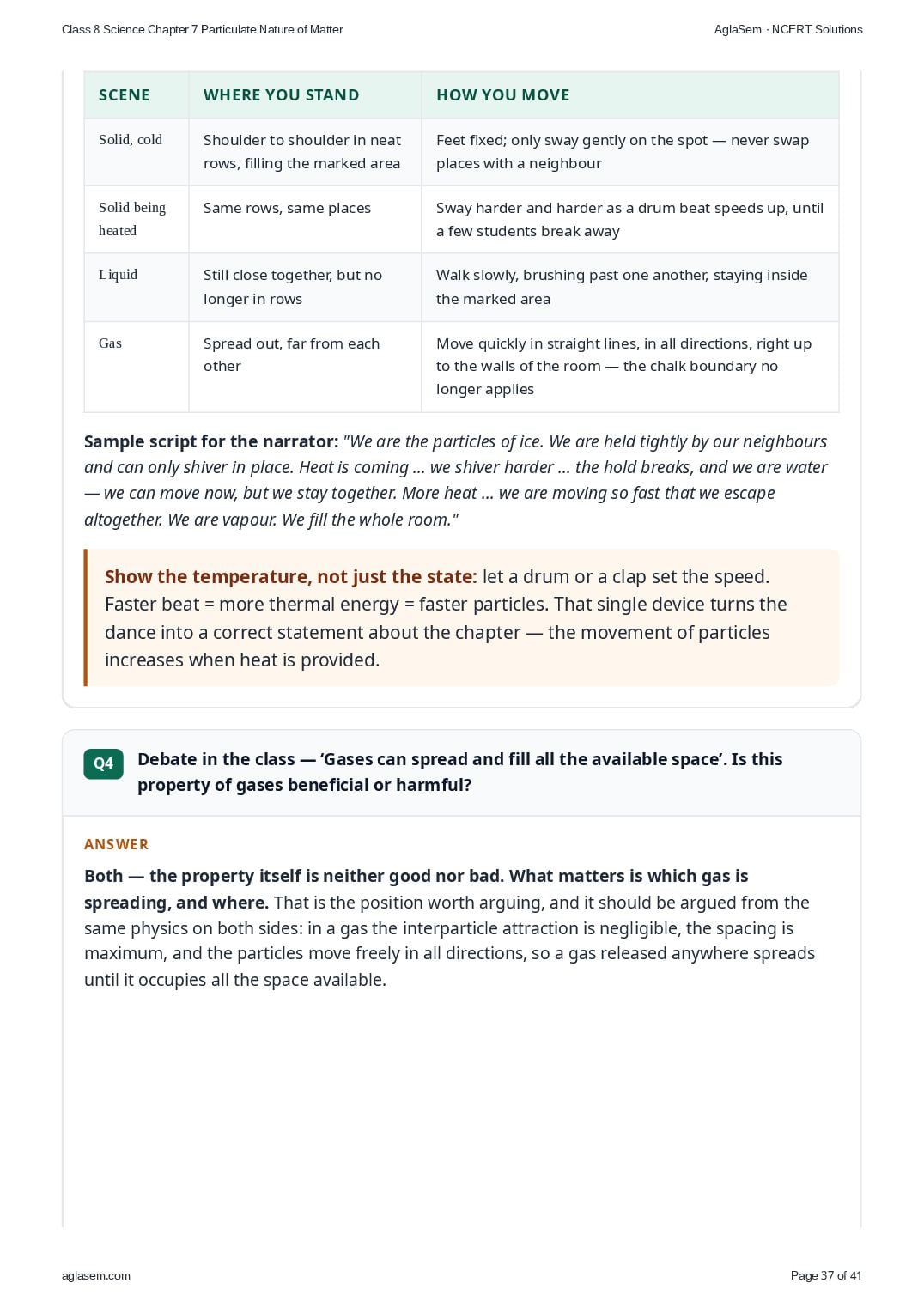
- Pretend to be particles of solids, liquids, and gases, at different temperatures—create and perform a role-play/dance showing particles in motion.
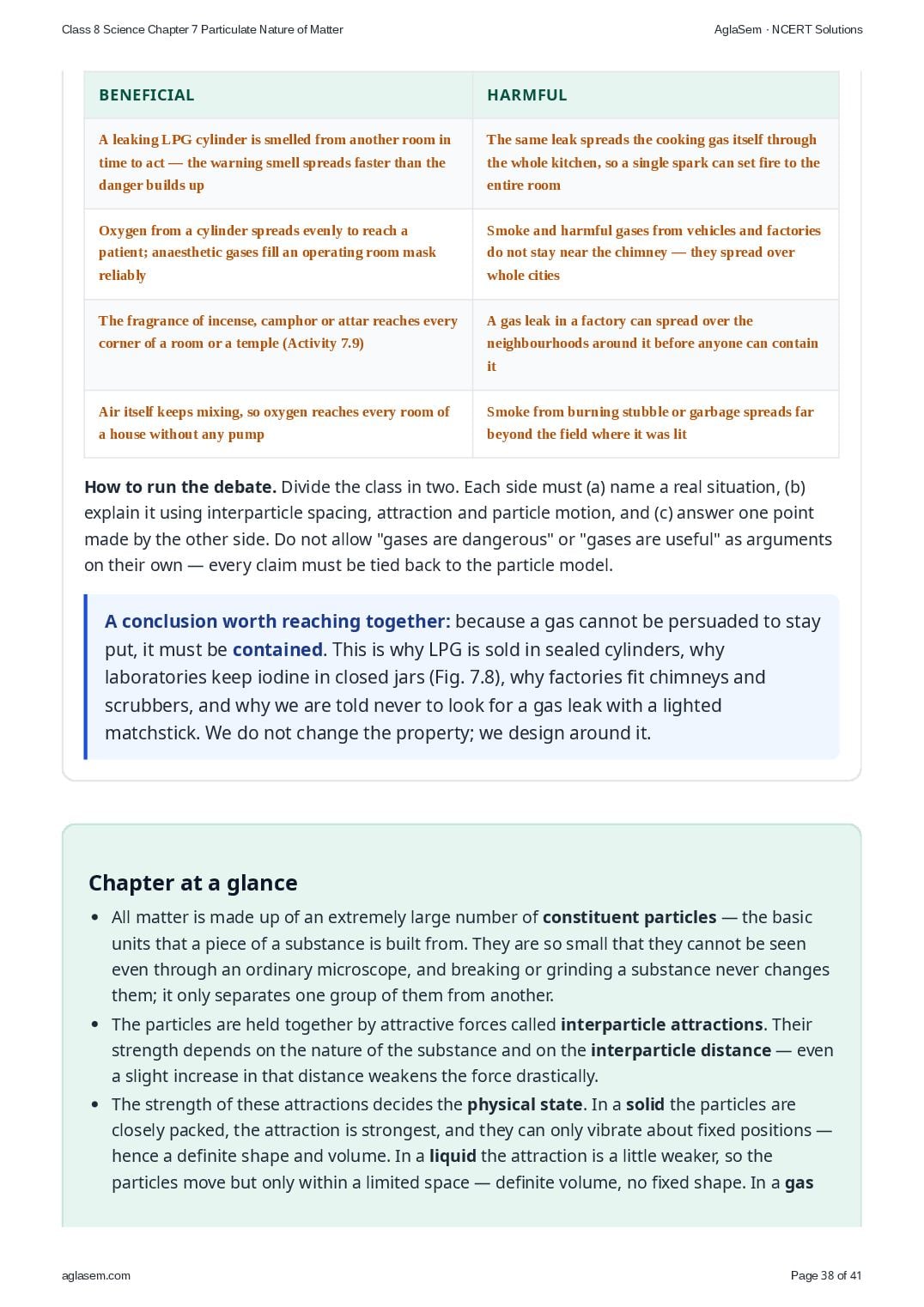
- Debate in the class — ‘Gases can spread and fill all the available space’. Is this property of gases beneficial or harmful?
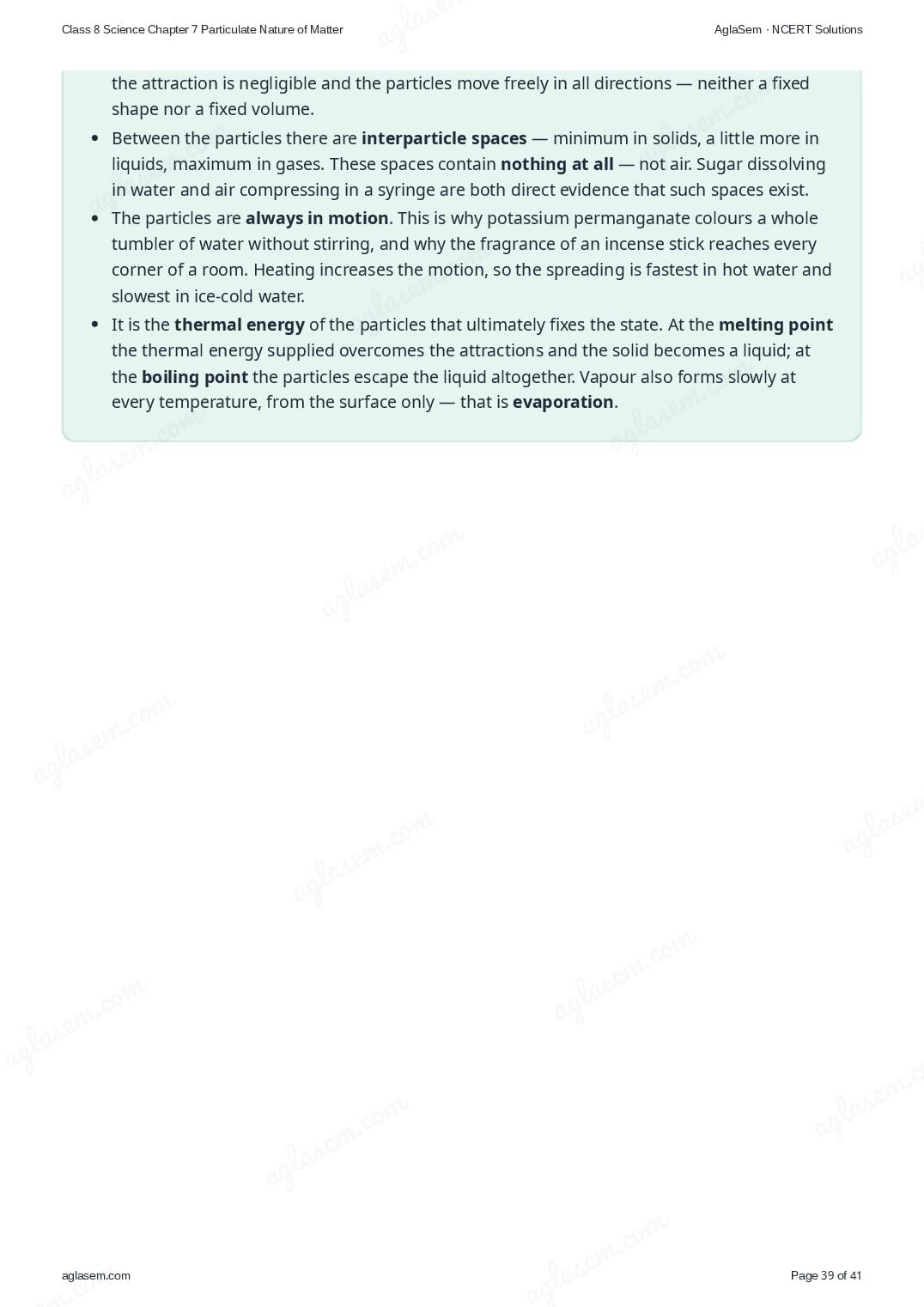
Chapter at a Glance
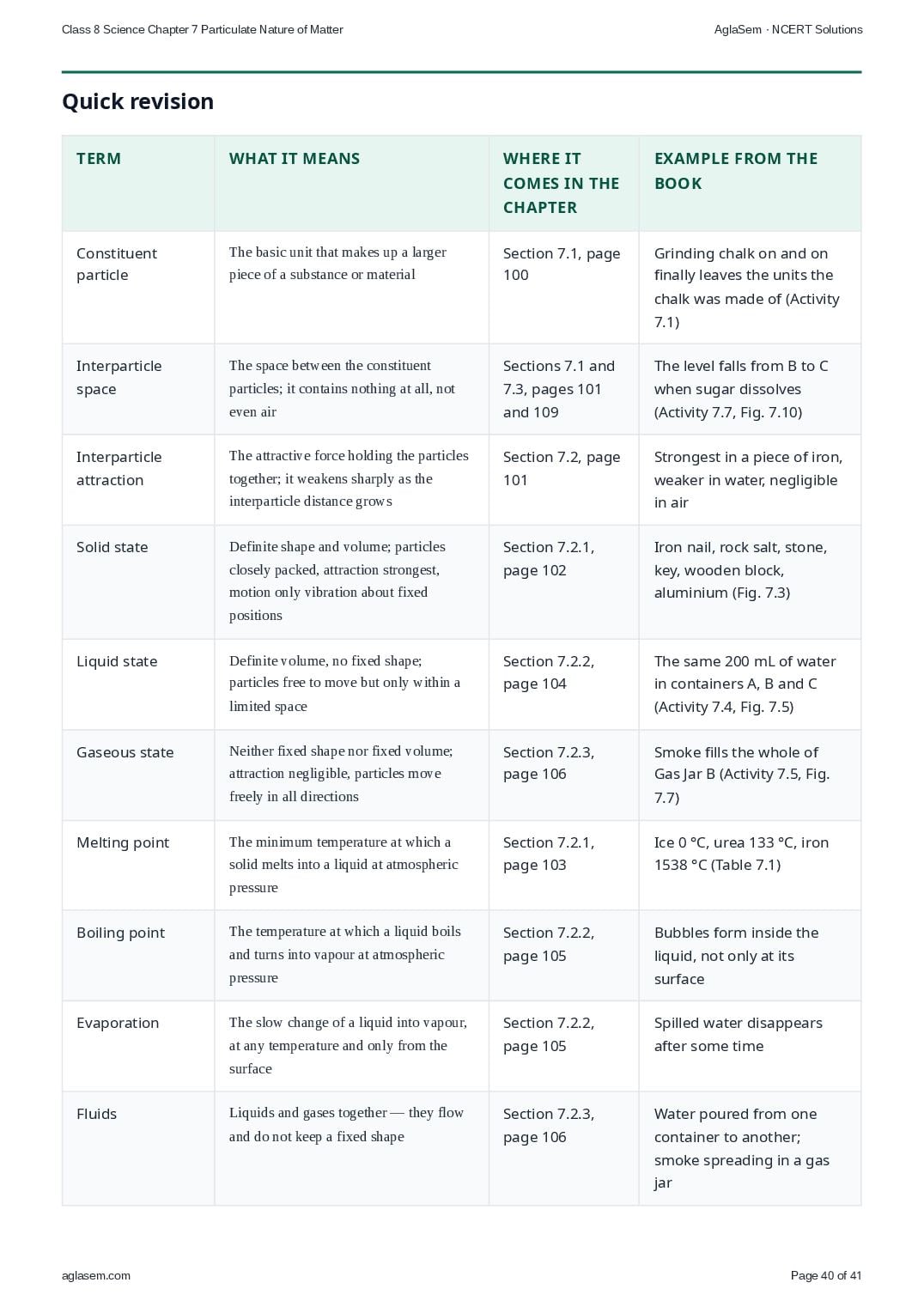
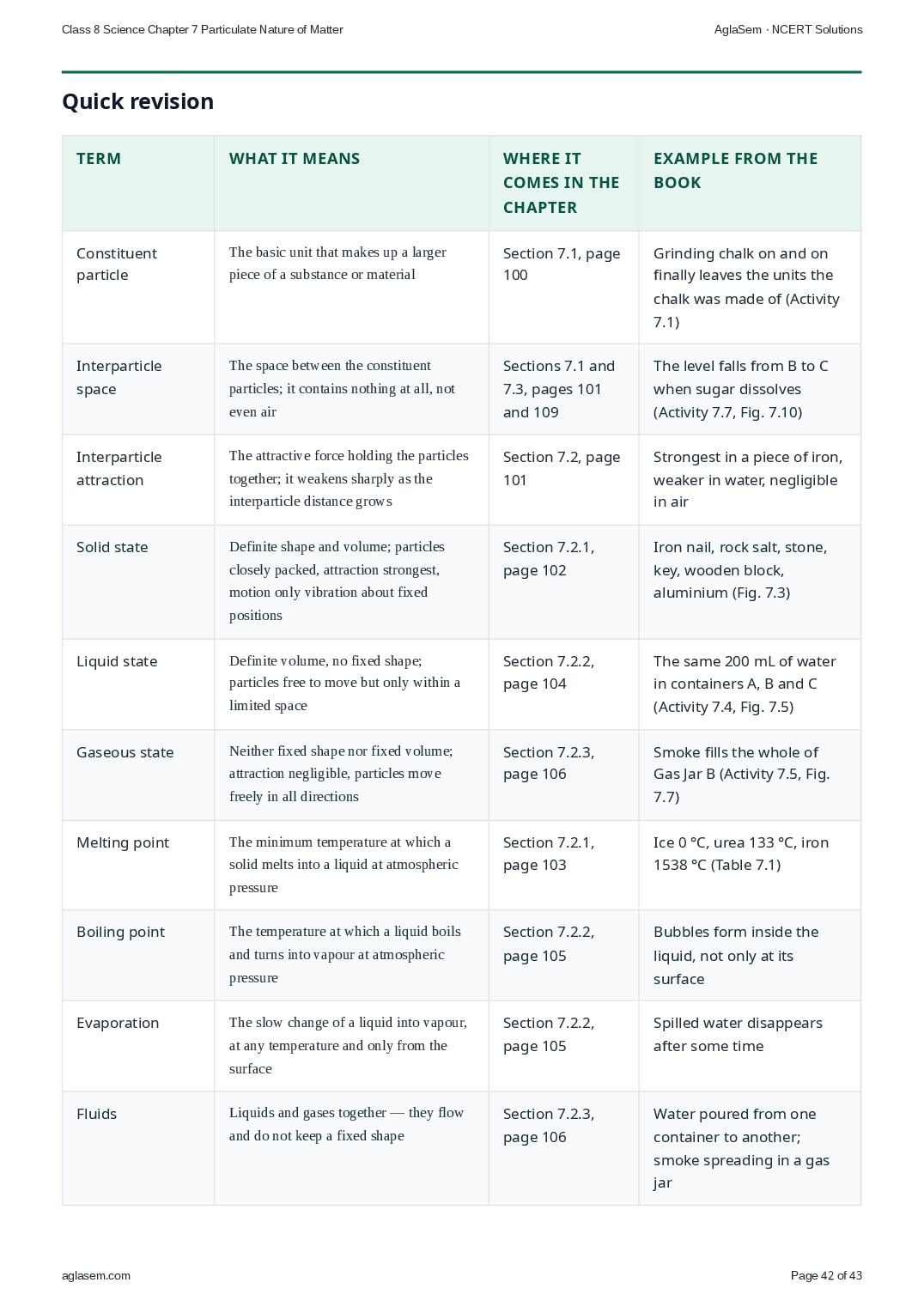
- All matter is made up of an extremely large number of constituent particles — the basic units that a piece of a substance is built from. They are so small that they cannot be seen even through an ordinary microscope, and breaking or grinding a substance never changes them; it only separates one group of them from another.
- The particles are held together by attractive forces called interparticle attractions . Their strength depends on the nature of the substance and on the interparticle distance — even a slight increase in that distance weakens the force drastically.
- The strength of these attractions decides the physical state . In a solid the particles are closely packed, the attraction is strongest, and they can only vibrate about fixed positions — hence a definite shape and volume. In a liquid the attraction is a little weaker, so the particles move but only within a limited space — definite volume, no fixed shape. In a gas the attraction is negligible and the particles move freely in all directions — neither a fixed shape nor a fixed volume.
- Between the particles there are interparticle spaces — minimum in solids, a little more in liquids, maximum in gases. These spaces contain nothing at all — not air. Sugar dissolving in water and air compressing in a syringe are both direct evidence that such spaces exist.
- The particles are always in motion . This is why potassium permanganate colours a whole tumbler of water without stirring, and why the fragrance of an incense stick reaches every corner of a room. Heating increases the motion, so the spreading is fastest in hot water and slowest in ice-cold water.
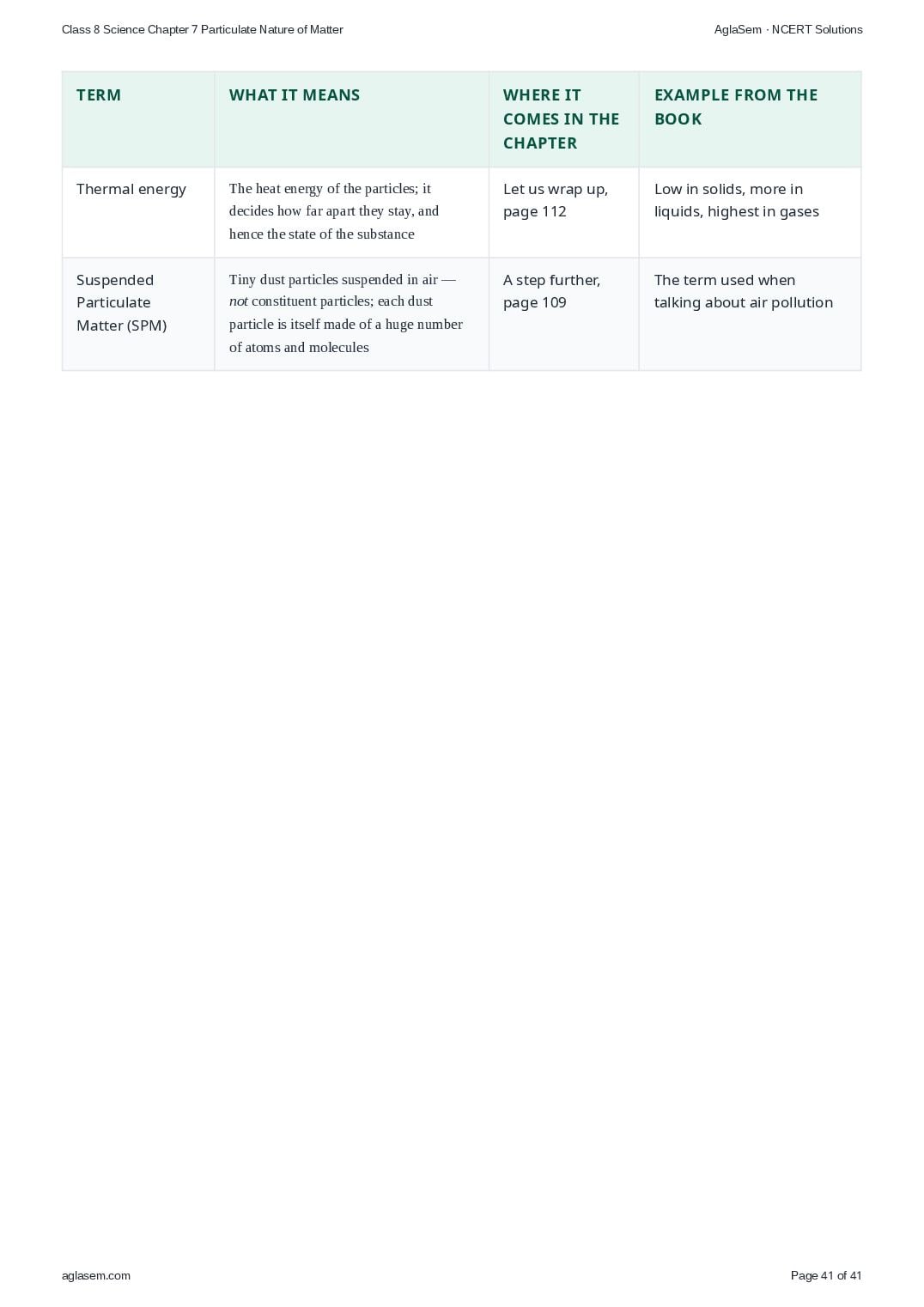
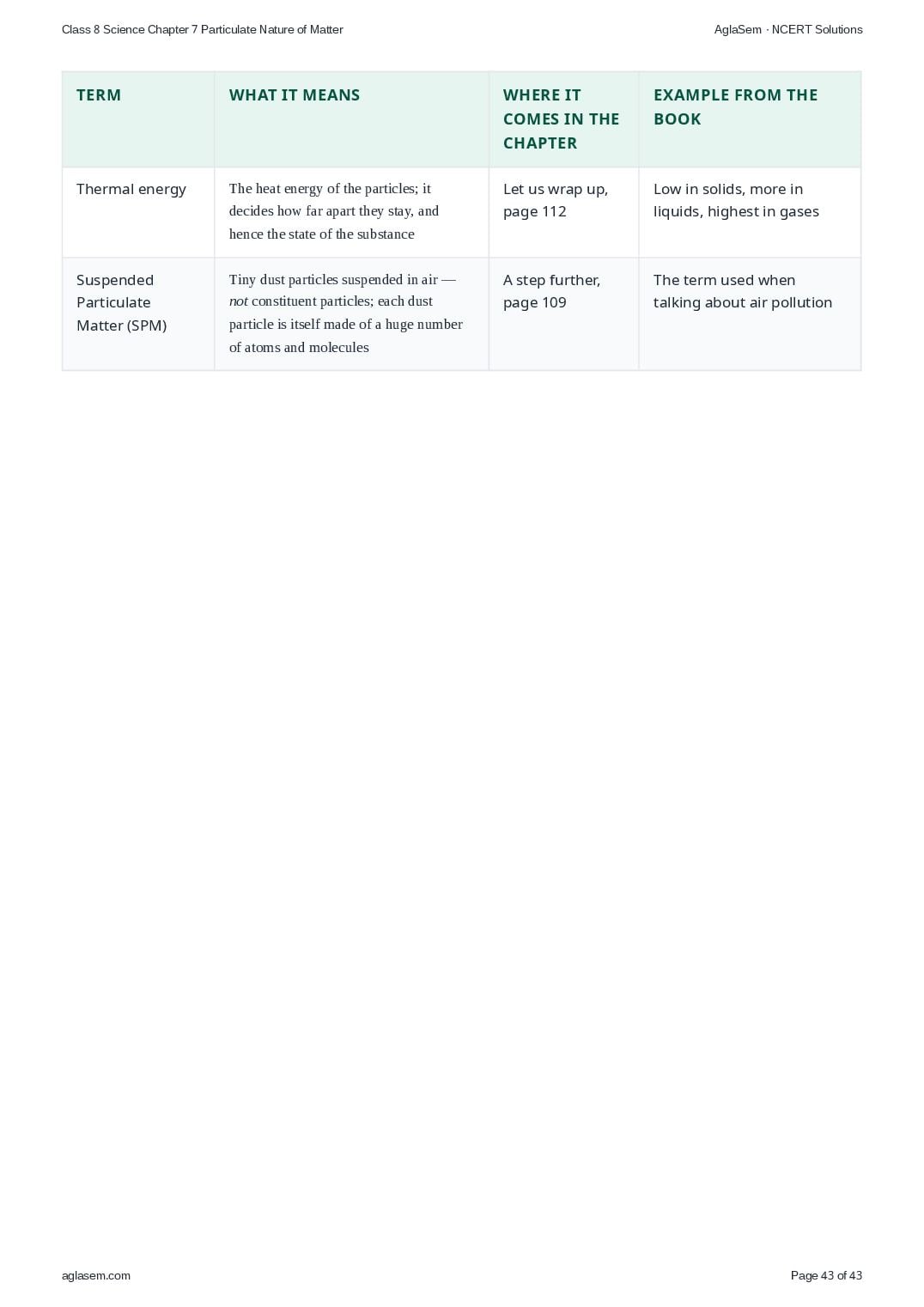
- It is the thermal energy of the particles that ultimately fixes the state. At the melting point the thermal energy supplied overcomes the attractions and the solid becomes a liquid; at the boiling point the particles escape the liquid altogether. Vapour also forms slowly at every temperature, from the surface only — that is evaporation .
How to Download NCERT Solutions for Class 8 Science Chapter 7 PDF
Follow these simple steps to get the Particulate Nature of Matter questions-and-answers PDF from Curiosity.
- Search NCERT Solutions for Class 8 Science Chapter 7 aglasem and open this page.
- Read the exercise questions with answers for Particulate Nature of Matter shown above.
- Click the Download PDF link to save the Particulate Nature of Matter solutions to your device.
NCERT Solutions for Class 8 Science – All Chapters
There are more chapters to study besides Particulate Nature of Matter in Science. Here are the NCERT Solutions for all chapters of Class 8 Science.
- Chapter 1 Exploring the Investigative World of Science
- Chapter 2 The Invisible Living World Beyond Our Naked Eye
- Chapter 3 Health the Ultimate Treasure
- Chapter 4 Electricity Magnetic and Heating Effects
- Chapter 5 Exploring Forces
- Chapter 6 Pressure Winds Storms and Cyclones
- Chapter 7 Particulate Nature of Matter
- Chapter 8 Nature of Matter Elements Compounds and Mixtures
- Chapter 9 The Amazing World of Solutes Solvents and Solutions
- Chapter 10 Light Mirrors and Lenses
- Chapter 11 Keeping Time with the Skies
- Chapter 12 How Nature Works in Harmony
- Chapter 13 Our Home Earth a Unique Life Sustaining Planet
NCERT Solutions for Class 8 – All Subjects
Just like Chapter 7 of Science, you can get the exercise questions with answers for every other subject of Class 8. Here are the NCERT Solutions for all subjects of Class 8.
NCERT Solutions for Class 8 Science Chapter 7 – An Overview
The key highlights of this study material are as follows.
| Aspects | Details |
|---|---|
| Class | Class 8 |
| Subject | Science |
| Chapter Number | Chapter 7 |
| Chapter Name | Particulate Nature of Matter |
| Book Name | Curiosity |
| Book By | NCERT (National Council of Educational Research and Training) |
| Educational Resource Here | NCERT Solutions of Class 8 Science Chapter 7 for all exercises |
| More Questions Answers of This Subject | NCERT Solutions for Class 8 Science |
| Download Book Chapter | NCERT Book Class 8 Science |
| All Questions Answers For This Class | NCERT Solutions for Class 8 |
| Complete Solutions | NCERT Solutions |
NCERT Solutions for Class 8 Science Chapter 7 Particulate Nature of Matter – FAQs
What are the NCERT Solutions for Class 8 Science Chapter 7 Particulate Nature of Matter?
They are the complete, step-by-step answers to all the exercise and in-text questions of Chapter 7 Particulate Nature of Matter from the NCERT Class 8 Science textbook Curiosity, written by experts as per the latest NCERT syllabus.
How can I download the Class 8 Science Chapter 7 solutions PDF for free?
Open this page on aglasem, read the Particulate Nature of Matter questions with answers, and click the “Download Solutions PDF” link. The Class 8 Science Chapter 7 NCERT Solutions PDF is completely free to download.
Are these NCERT Solutions as per the latest 2026-27 syllabus?
Yes. The NCERT Solutions for Class 8 Science Chapter 7 are based on the latest NCERT textbook Curiosity and the current 2026-27 CBSE syllabus, so the questions and answers match what you study in class.
Where can I get NCERT Solutions for the other chapters of Class 8 Science?
You can find the answers to every chapter on the NCERT Solutions for Class 8 Science page, and solutions for every subject on the NCERT Solutions for Class 8 page.
How do NCERT Solutions help in exam preparation?
They show the correct method to solve each question, help you write answers the way they are expected in exams, let you check and correct your own work, and save revision time — which together improve your marks in Class 8 Science.
If you have any queries on NCERT Solutions for Class 8 Science Chapter 7 Particulate Nature of Matter, then please ask in the comments below.