NCERT Solutions for Class 8 Science Chapter 2 The Invisible Living World Beyond Our Naked Eye provide clear, step-by-step answers to every exercise and in-text question from the chapter The Invisible Living World Beyond Our Naked Eye of the NCERT textbook Curiosity. Prepared by subject experts as per the latest NCERT (CBSE) syllabus for 2026-27, these NCERT Solutions for Class 8 Science help you understand each concept, write exam-ready answers, and check your own solutions. You can read them online below or download the free Class 8 Science Chapter 2 question-answer PDF.
NCERT Solutions for Class 8 Science Chapter 2 The Invisible Living World Beyond Our Naked Eye
- Class: Class 8
- Subject: Science
- Chapter: Chapter 2 – The Invisible Living World Beyond Our Naked Eye
- Textbook: Curiosity (NCERT)
- Study material: NCERT Solutions – questions with answers, free PDF
These solutions answer all the exercise questions of Chapter 2 The Invisible Living World Beyond Our Naked Eye — including the in-text questions, short-answer and long-answer questions, and activities — with complete explanations so you can follow the method, not just the final answer. Read the full solutions below.
NCERT Solutions Class 8 Science Chapter 2 the Invisible Living World Beyond Our Naked Eye View Download
NCERT Solutions for Class 8 Science Chapter 2 PDF Download
You can read the NCERT Solutions for Class 8 Science Chapter 2 online above, or download the complete question-answer PDF to study The Invisible Living World Beyond Our Naked Eye offline at any time.
NCERT Solutions for Class 8 Science Chapter 2 PDF Download Link – Click Here to Download Solutions PDF
Questions Covered in This Chapter
These NCERT Solutions answer all 47 questions of this chapter. The questions solved are:
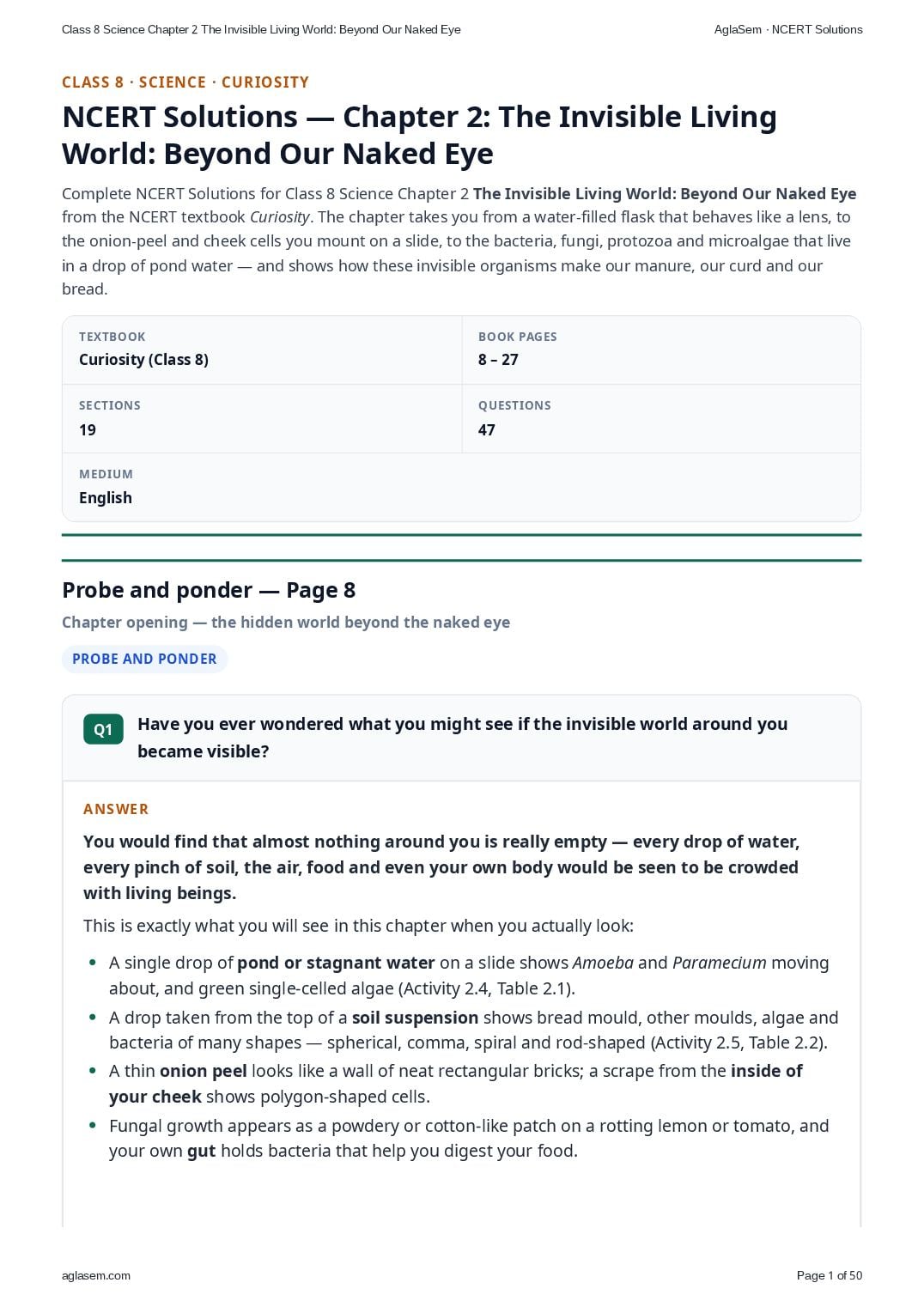
- Have you ever wondered what you might see if the invisible world around you became visible?
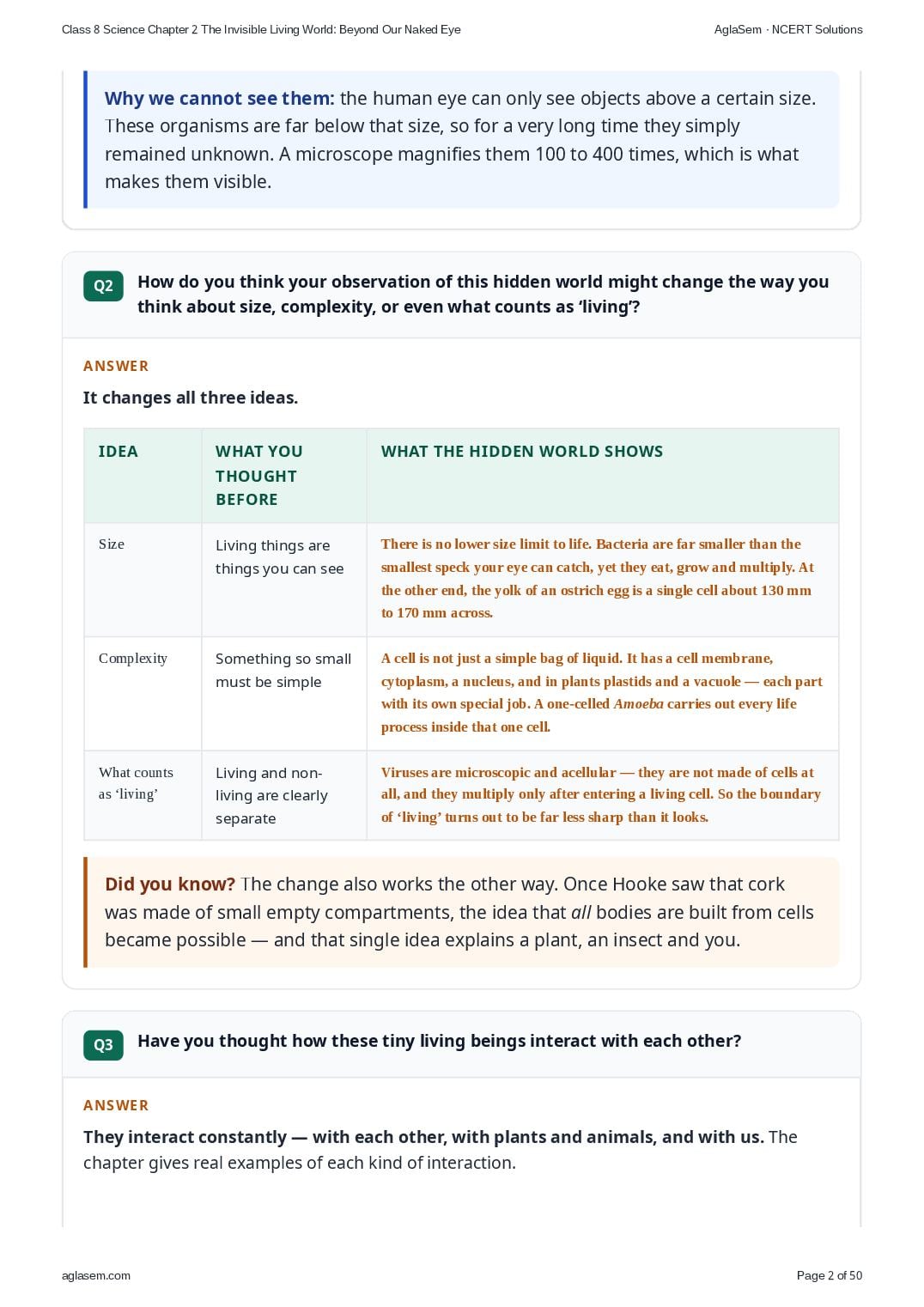
- How do you think your observation of this hidden world might change the way you think about size, complexity, or even what counts as ‘living’?
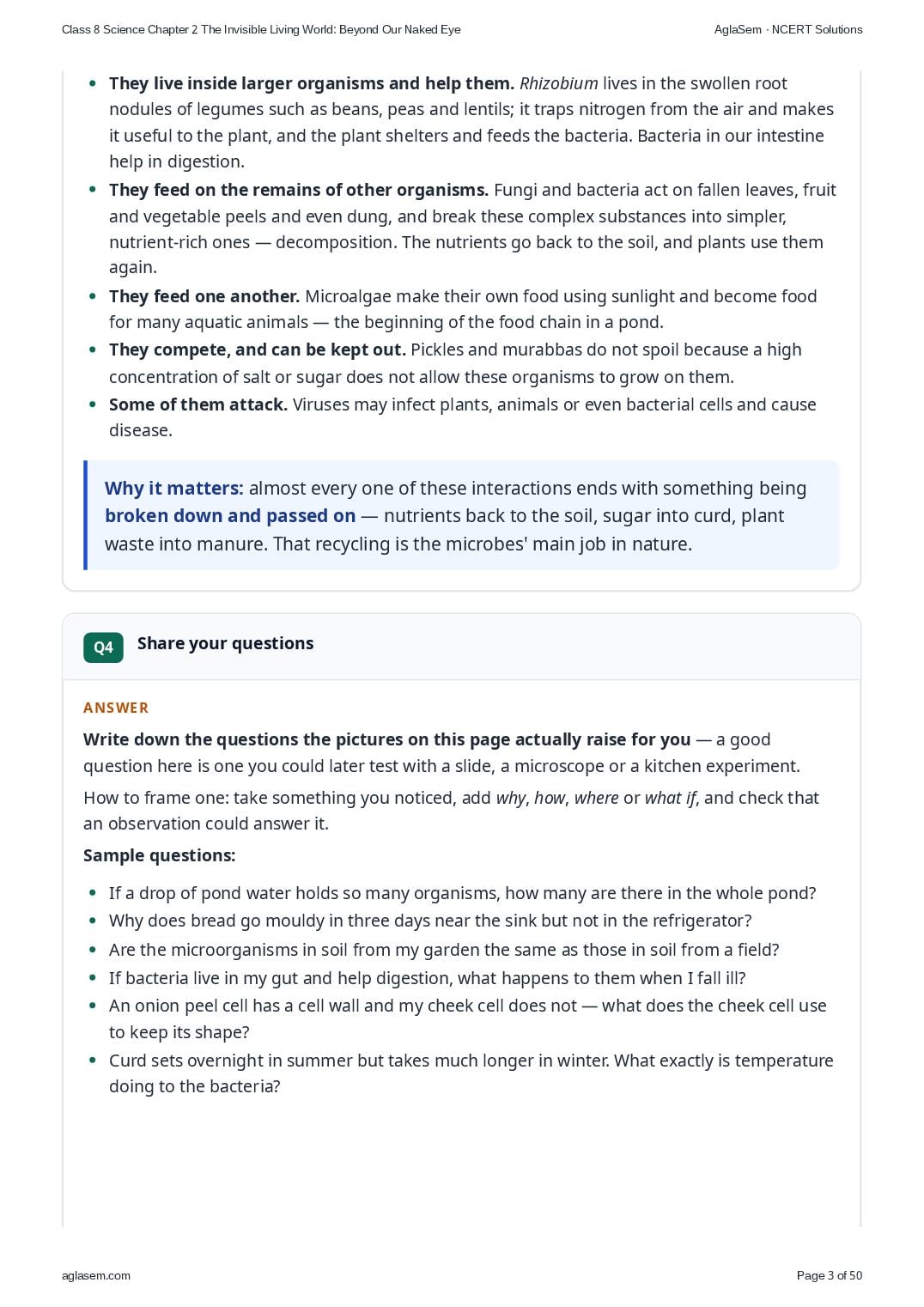
- Have you thought how these tiny living beings interact with each other?
- Share your questions
- Do you notice something interesting?
- Now, use a real magnifying glass to look at small organisms, like an ant. Were you able to see the details of its body more clearly?
- For a long time, people were curious to explore the tiny organisms around them, but they could not see them with their naked eyes. So, how did we finally discover this invisible world? Do you know which scientific discovery helped us see the tiny world for the first time?
- Have you ever noticed the smallest organism around you that is visible to the naked eye? Think about it — how small a thing can your eyes actually see?
- You might have seen some people using reading glasses. How does it help them see better? Or what happens when we use a magnifying glass to observe something?
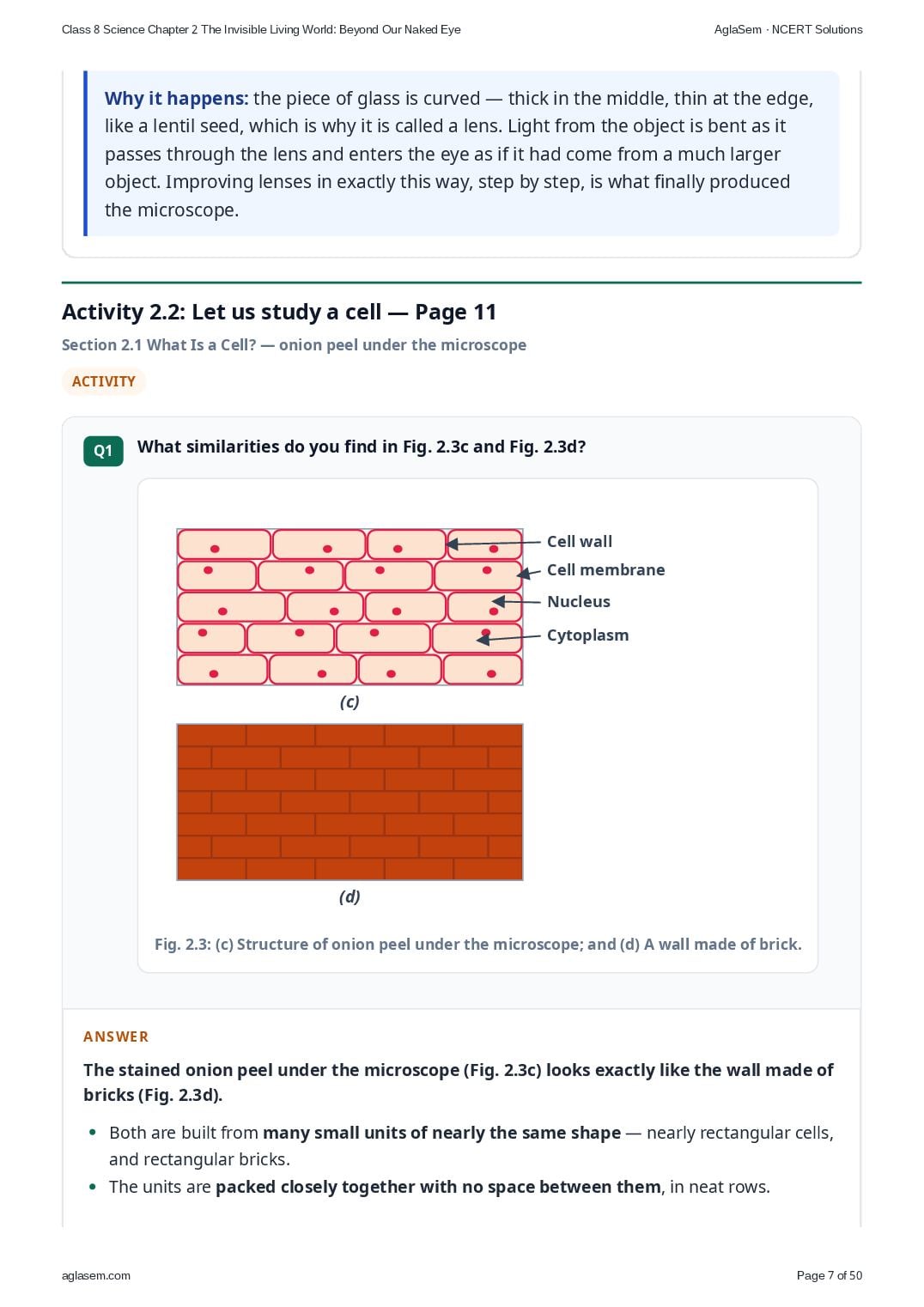
- What similarities do you find in Fig. 2.3c and Fig. 2.3d?
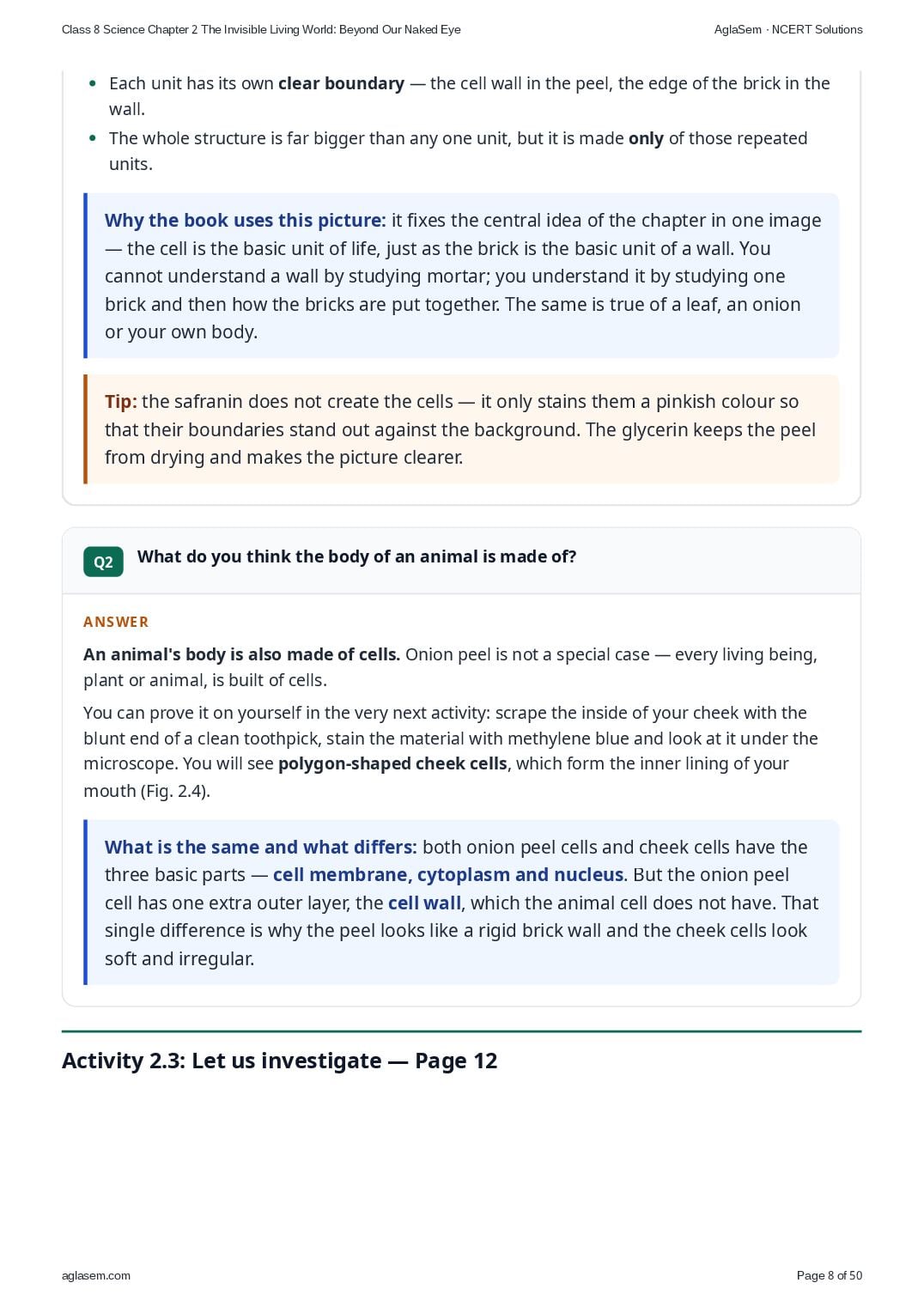
- What do you think the body of an animal is made of?
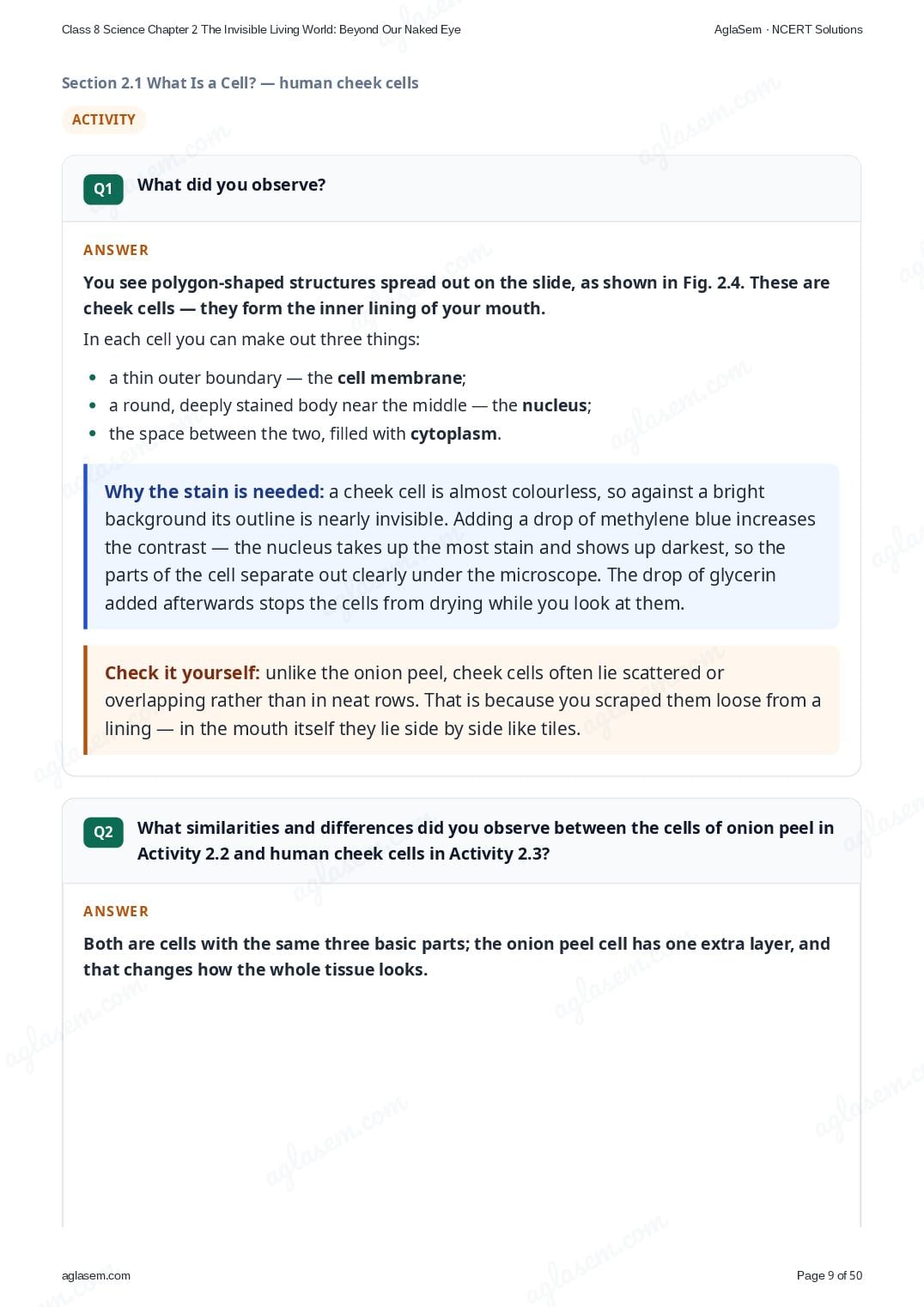
- What did you observe?
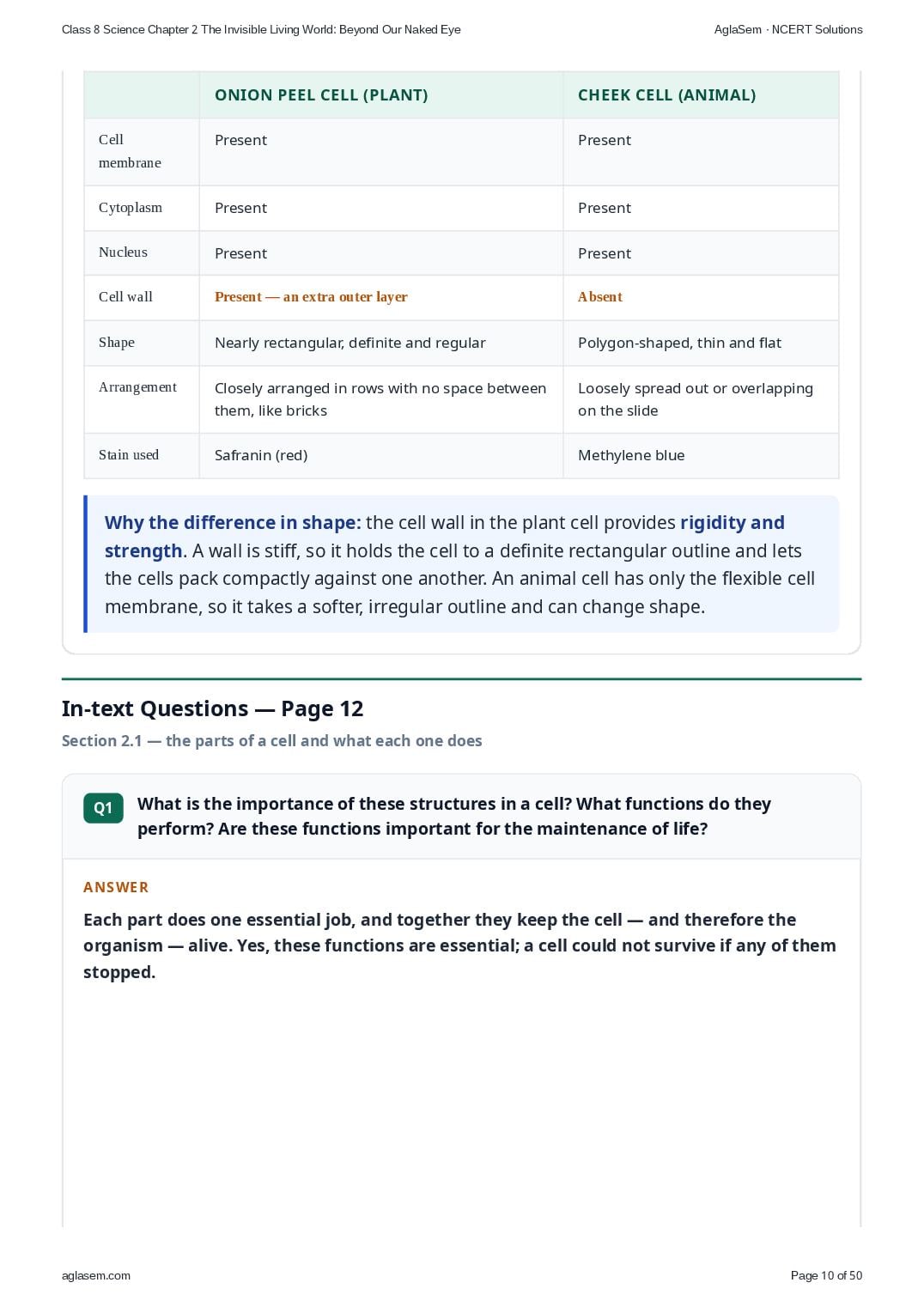
- What similarities and differences did you observe between the cells of onion peel in Activity 2.2 and human cheek cells in Activity 2.3?
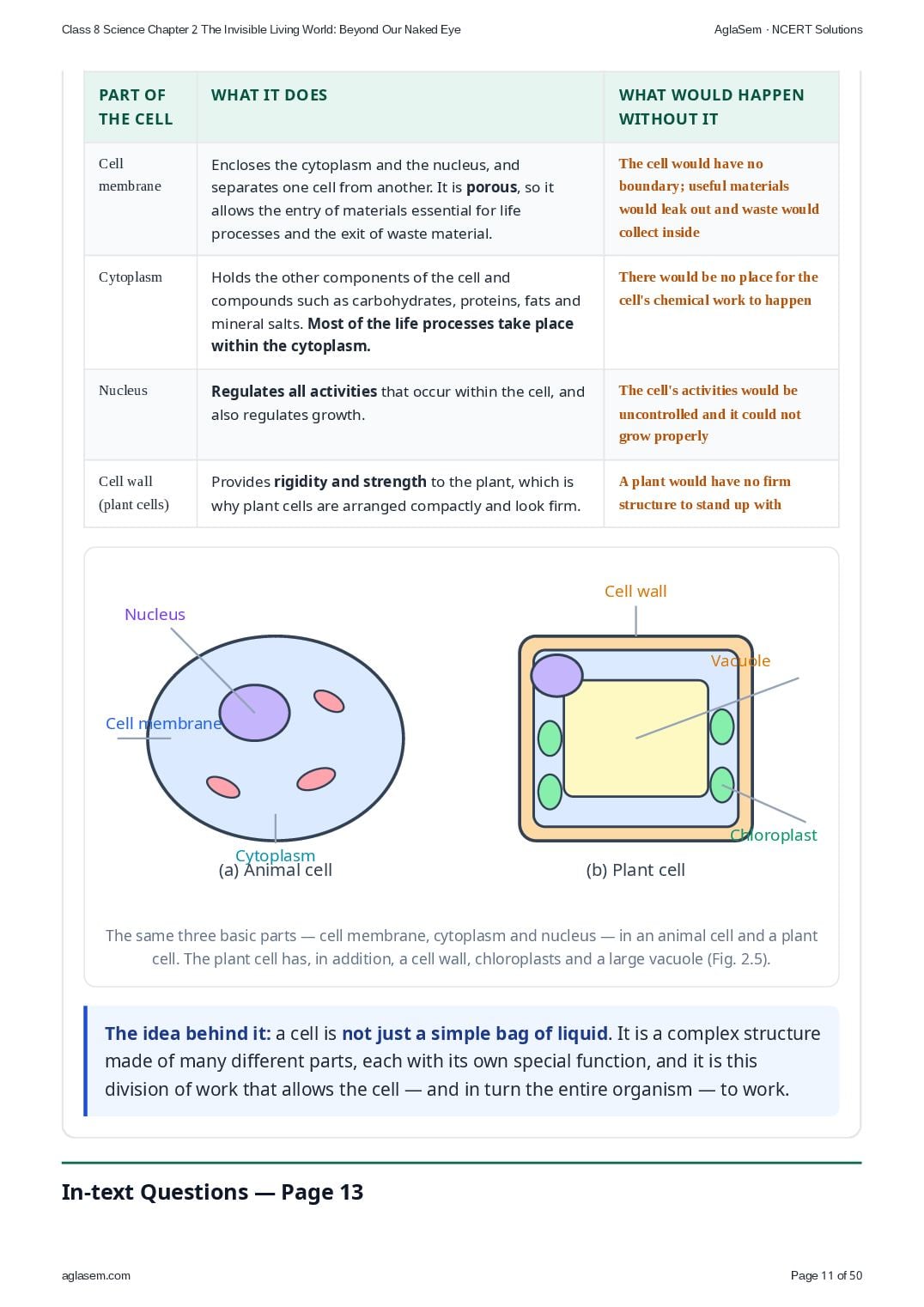
- What is the importance of these structures in a cell? What functions do they perform? Are these functions important for the maintenance of life?
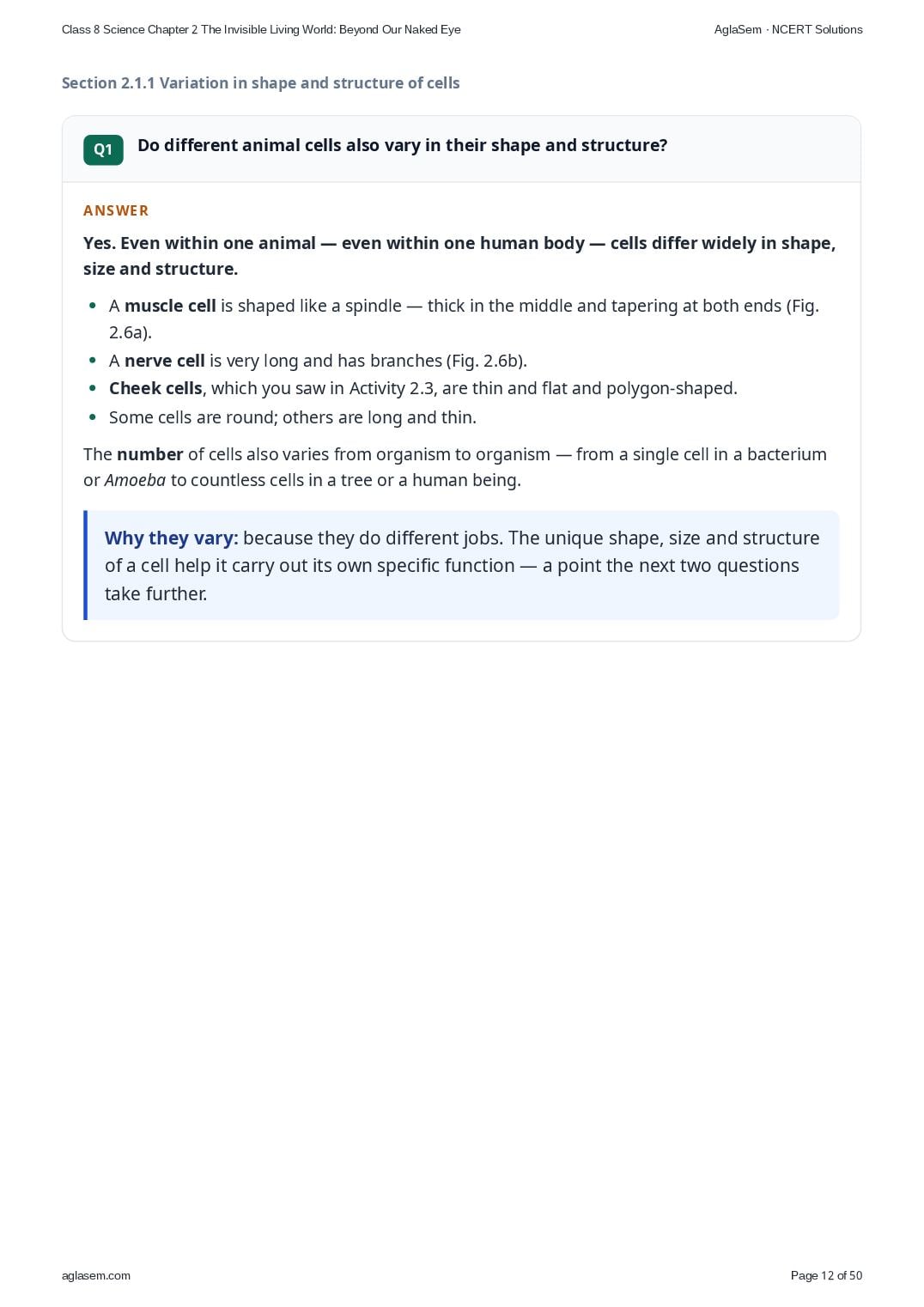
- Do different animal cells also vary in their shape and structure?
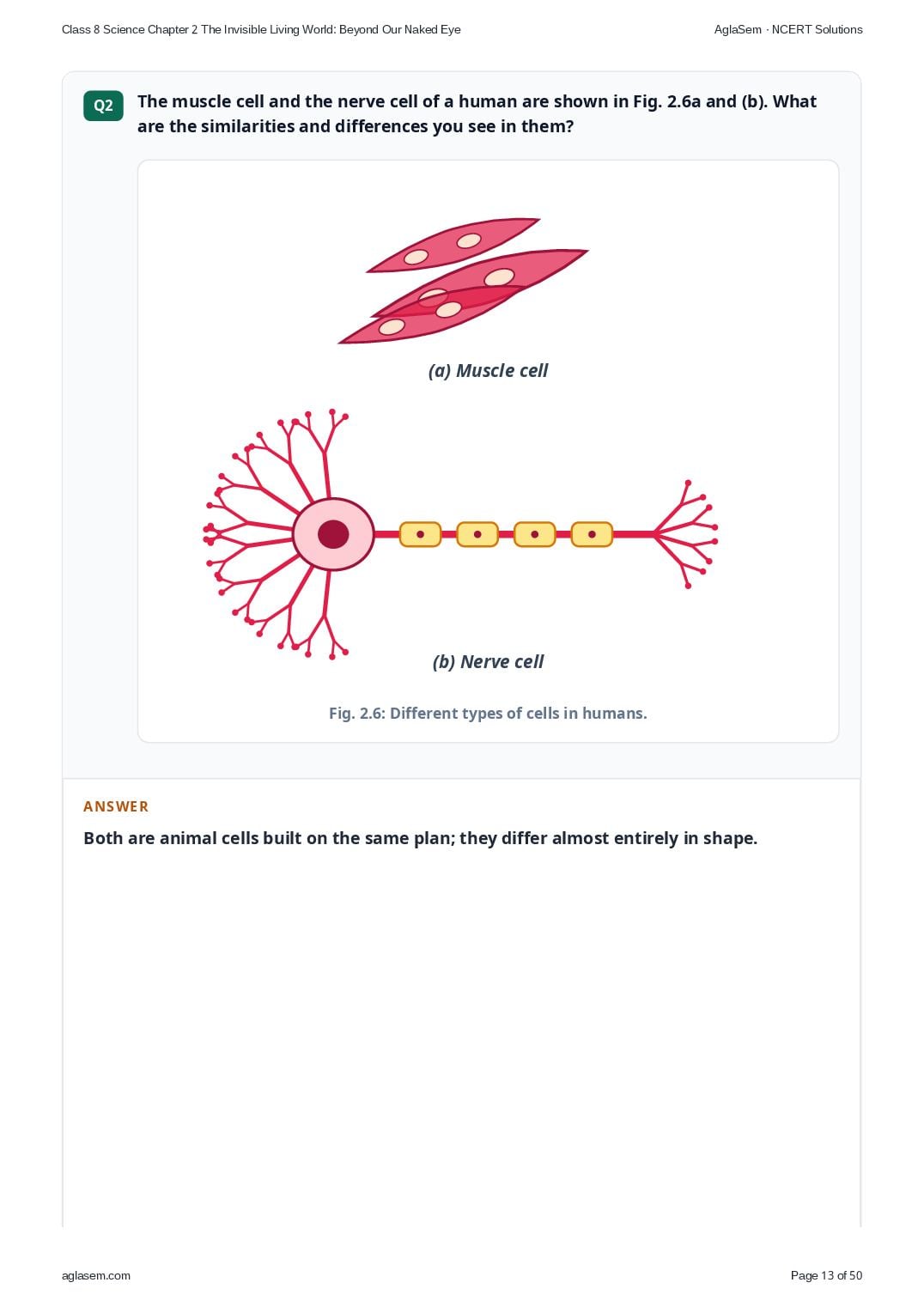
- The muscle cell and the nerve cell of a human are shown in Fig. 2.6a and (b). What are the similarities and differences you see in them?
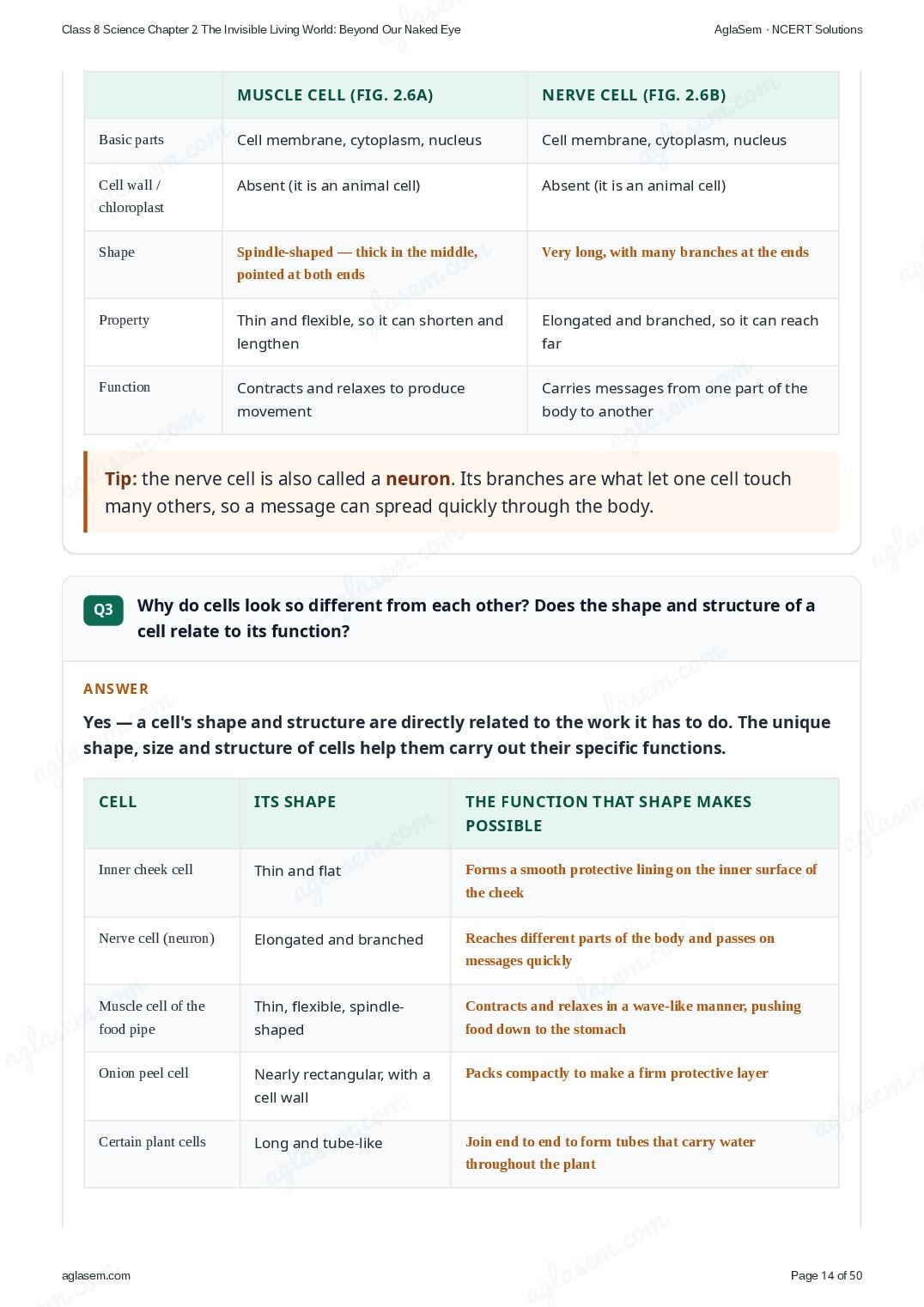
- Why do cells look so different from each other? Does the shape and structure of a cell relate to its function?
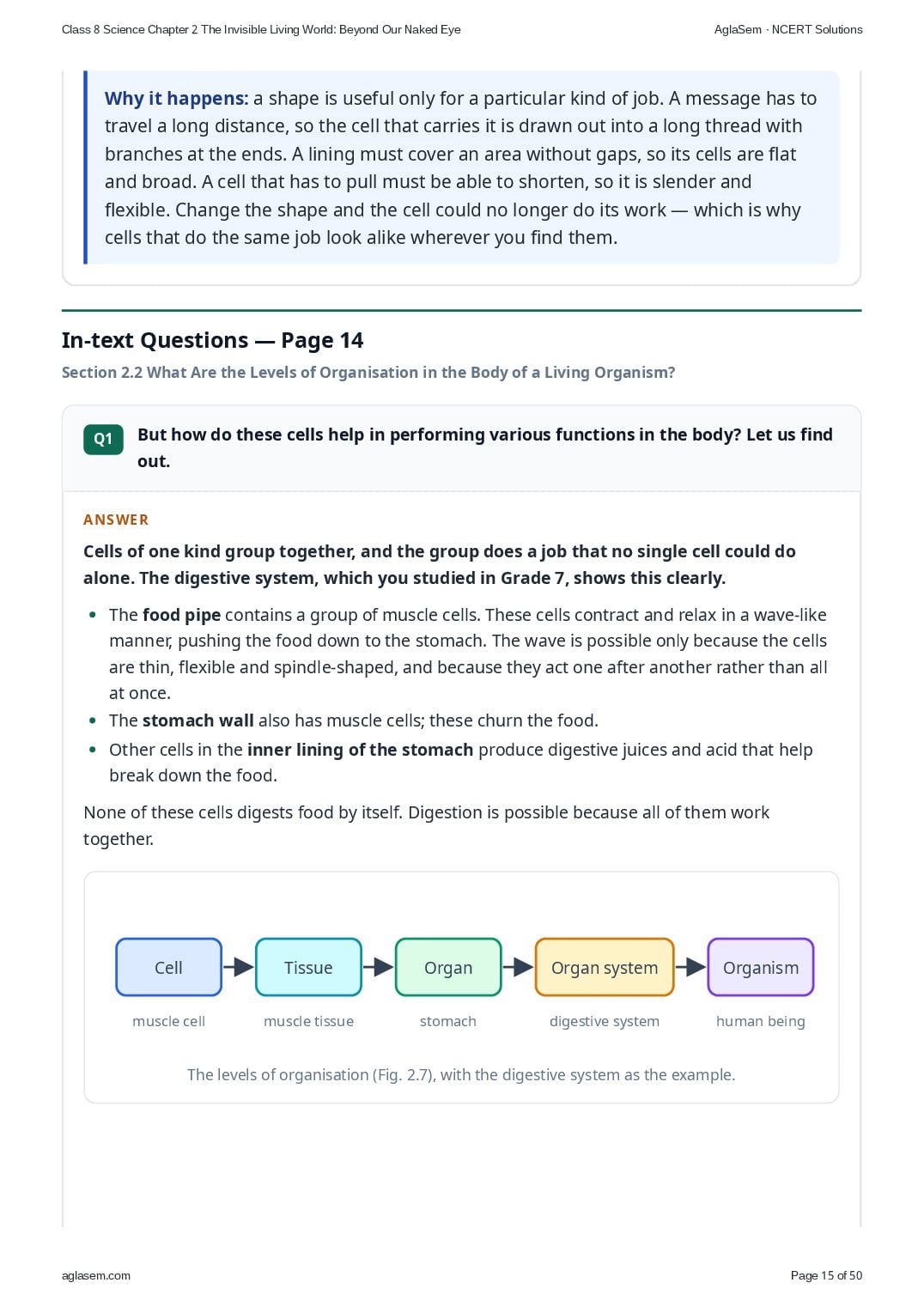
- But how do these cells help in performing various functions in the body? Let us find out.
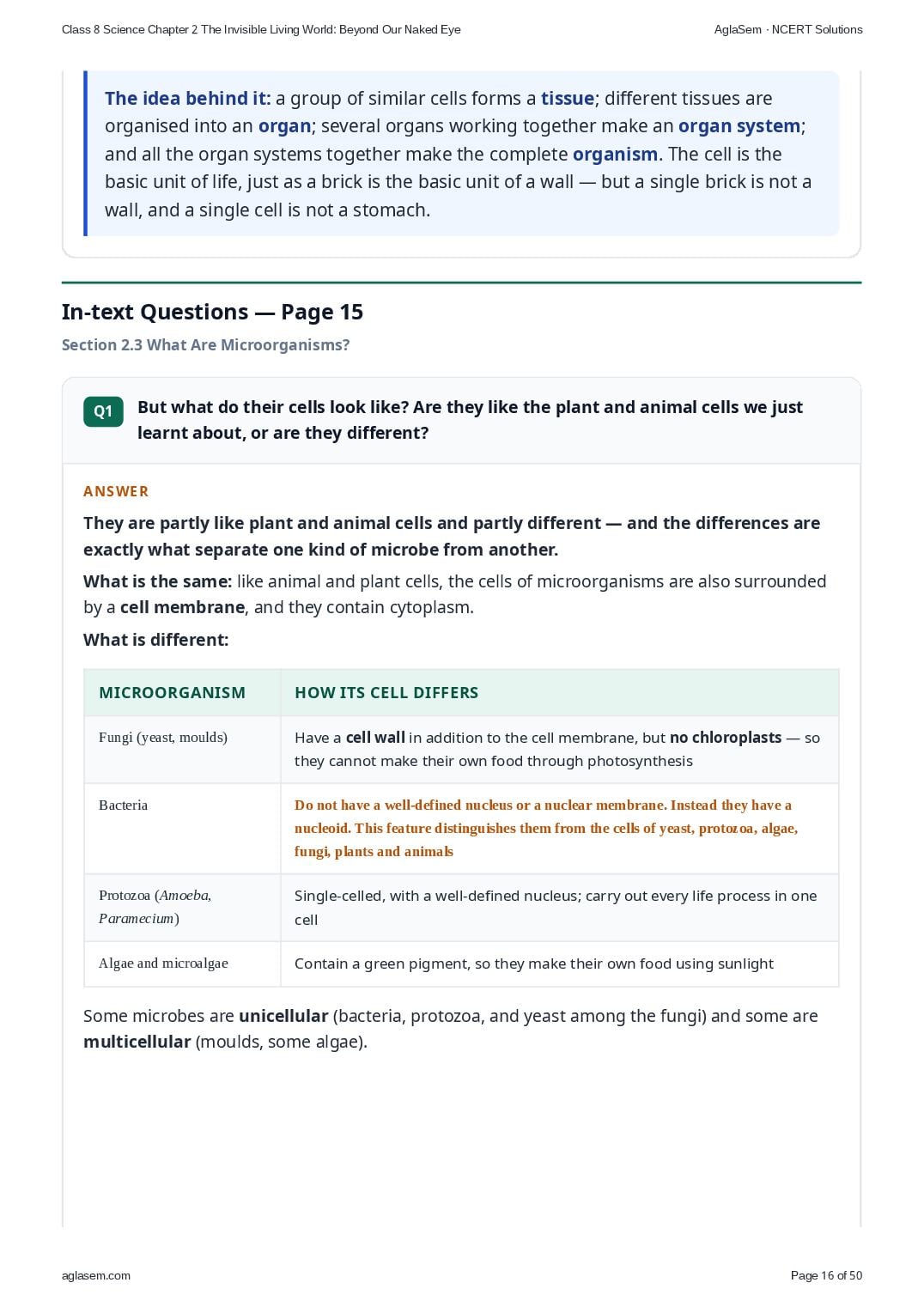
- But what do their cells look like? Are they like the plant and animal cells we just learnt about, or are they different?
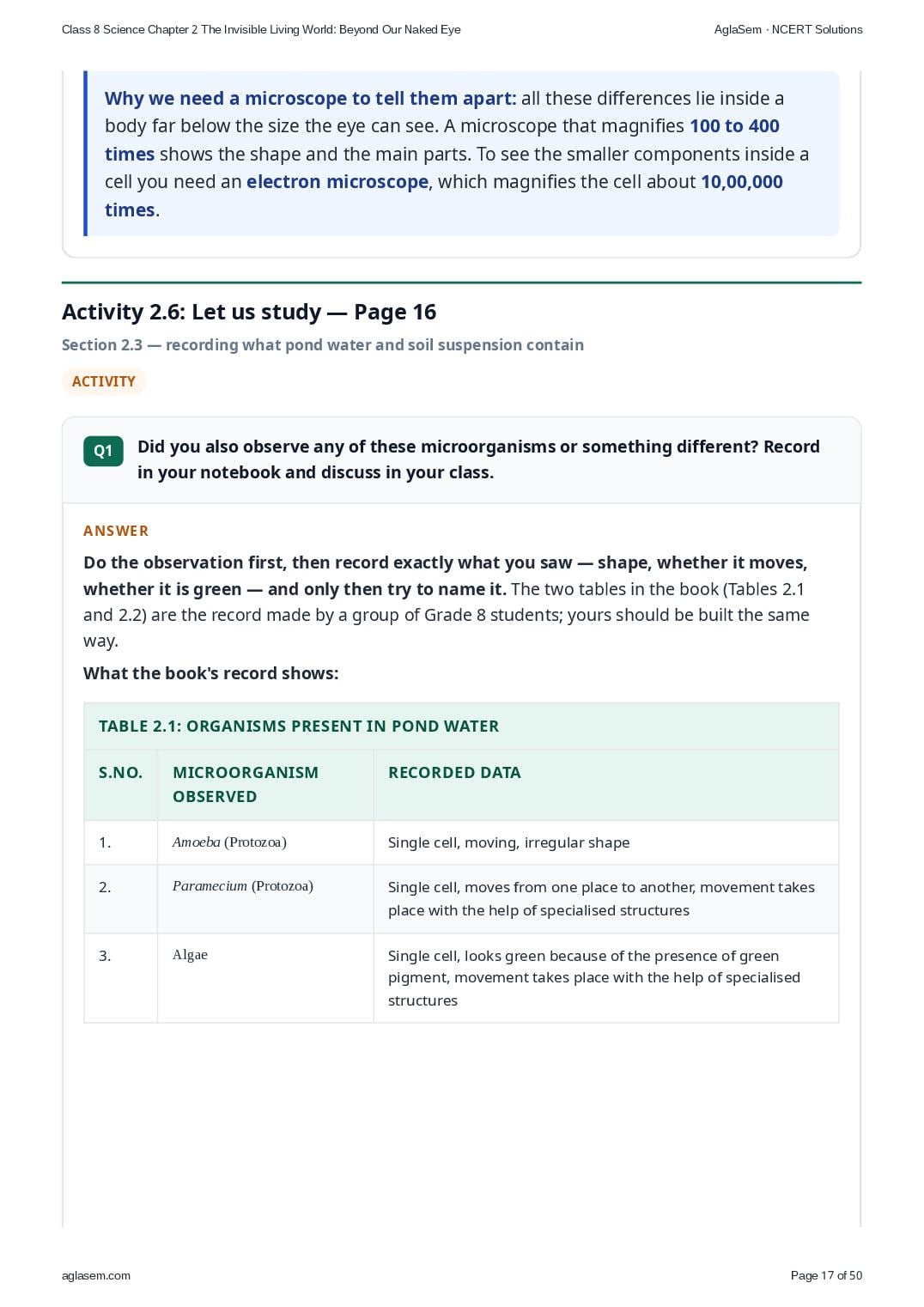
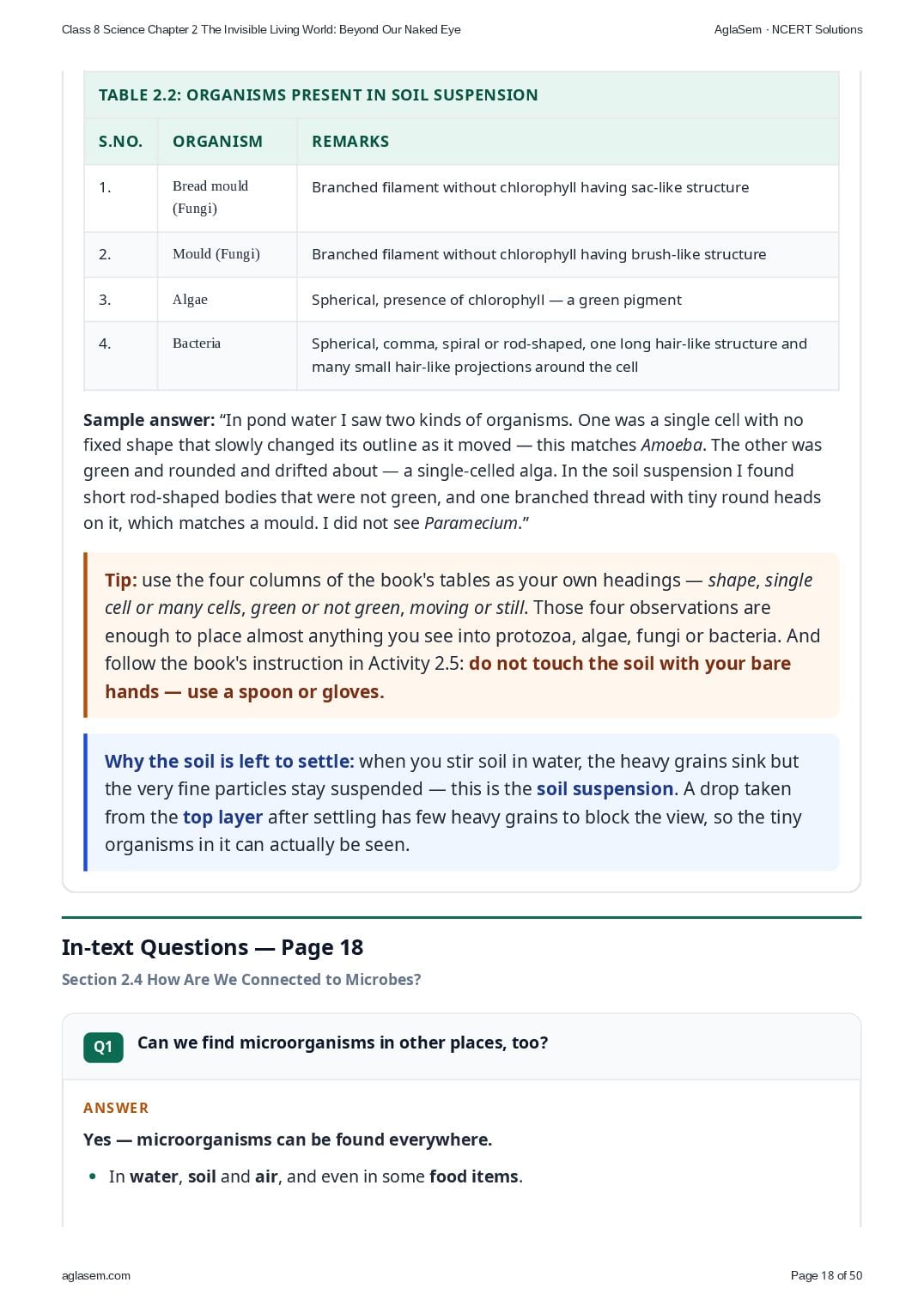
- Did you also observe any of these microorganisms or something different? Record in your notebook and discuss in your class.
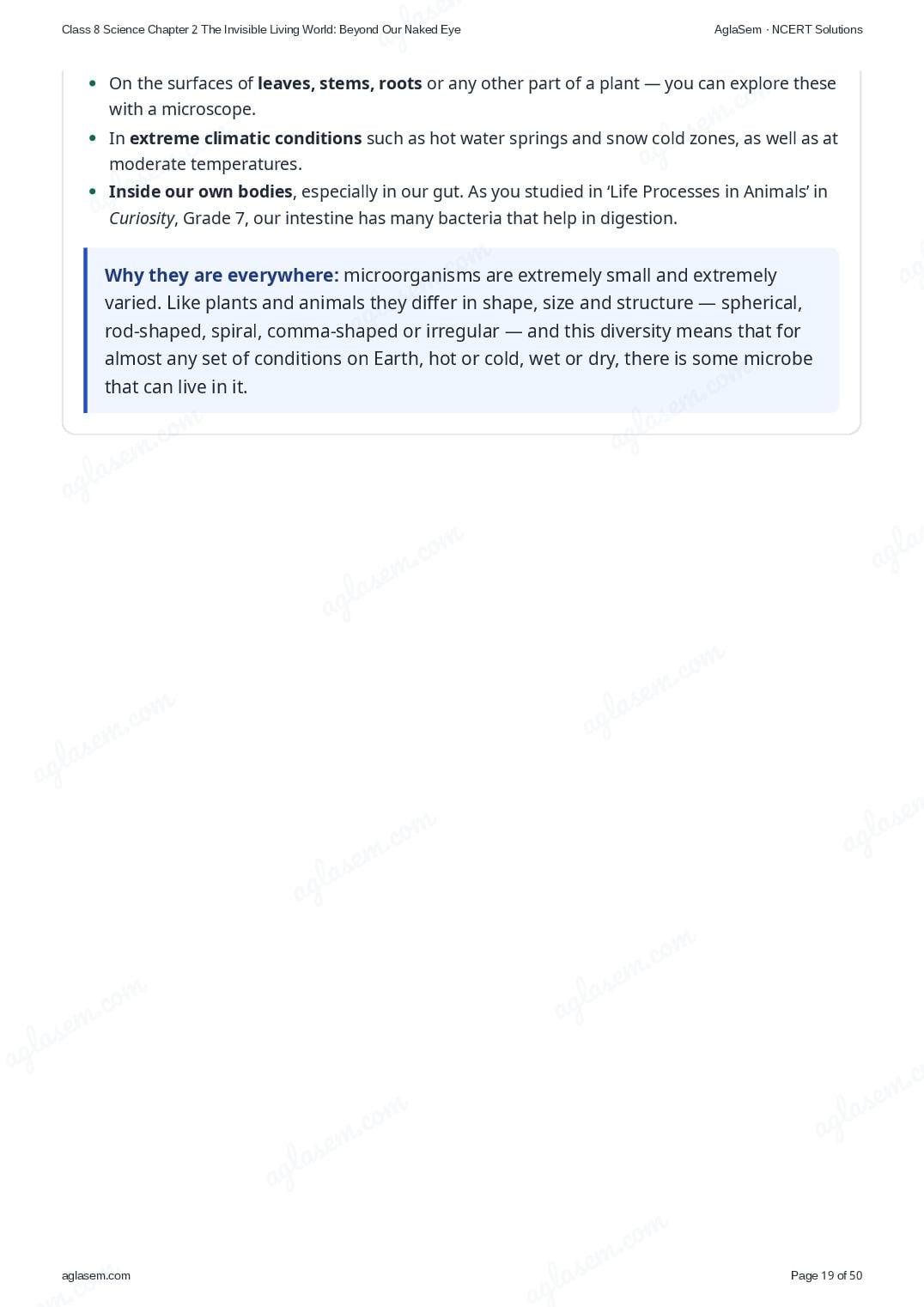
- Can we find microorganisms in other places, too?
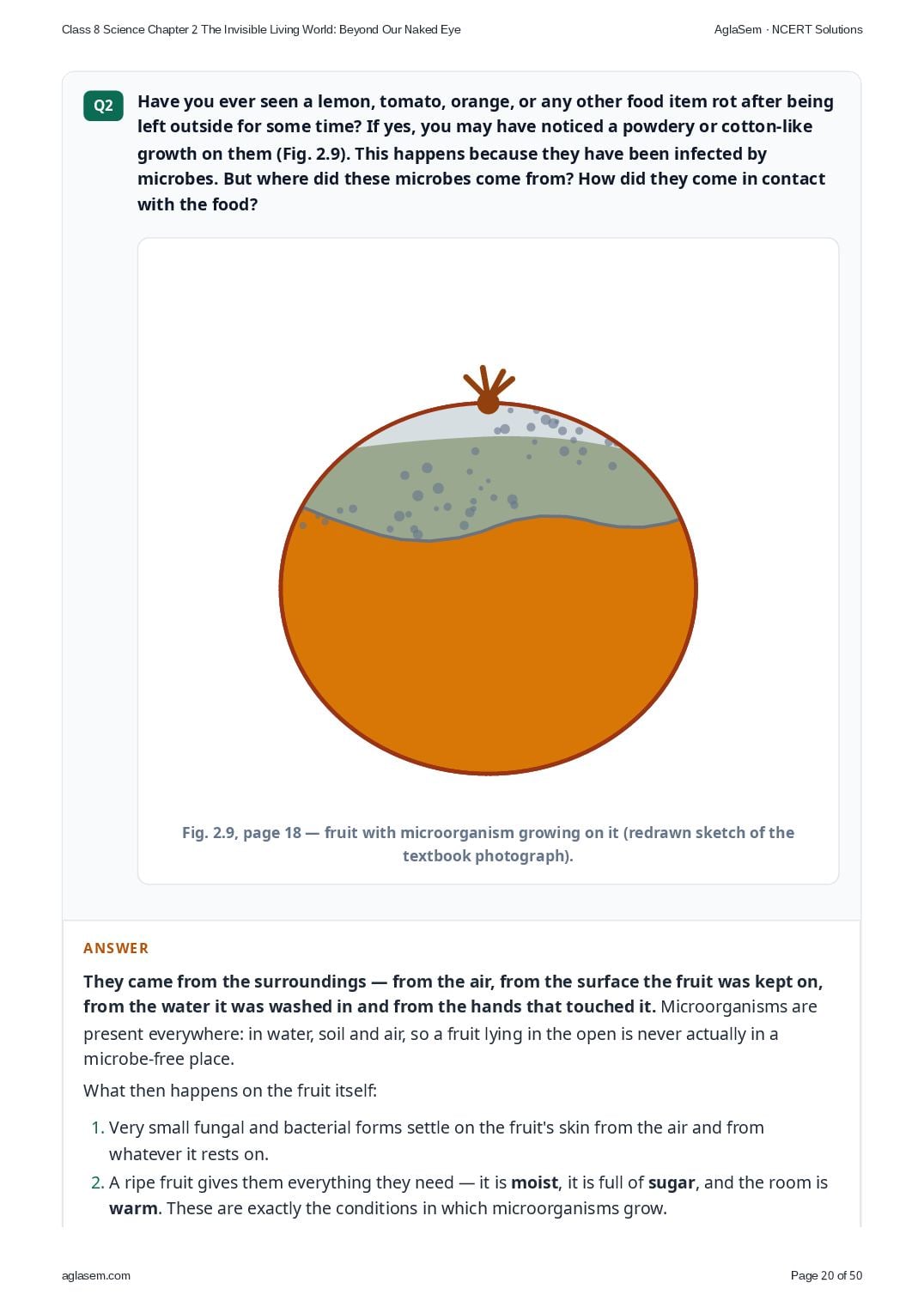
- Have you ever seen a lemon, tomato, orange, or any other food item rot after being left outside for some time? If yes, you may have noticed a powdery or cotton-like growth on them (Fig. 2.9). This happens because they have been infected by microbes. But where did these microbes come from? How did they come in contact with the food?
- But why do microorganisms not infect the pickles and murabbas?
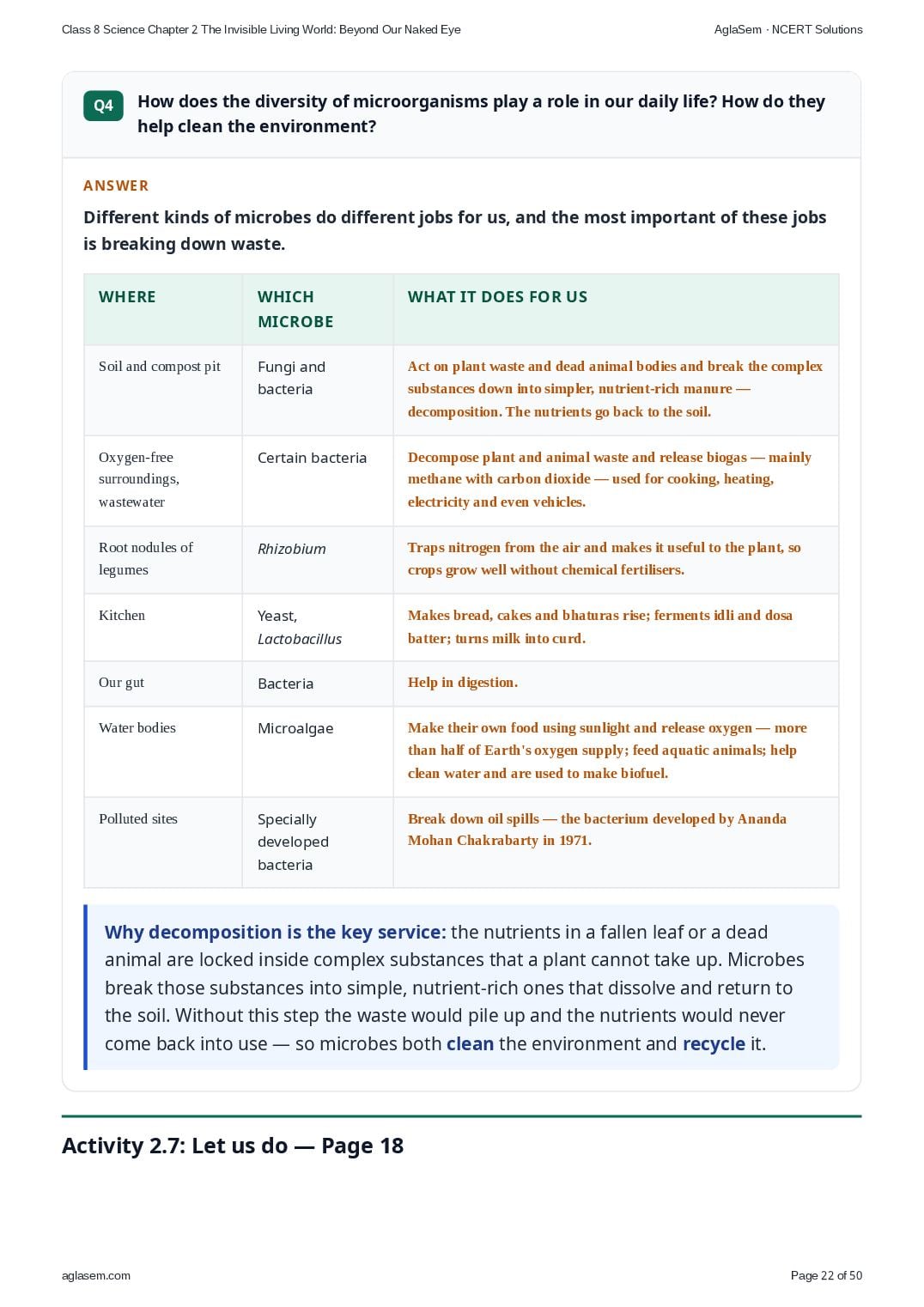
- How does the diversity of microorganisms play a role in our daily life? How do they help clean the environment?
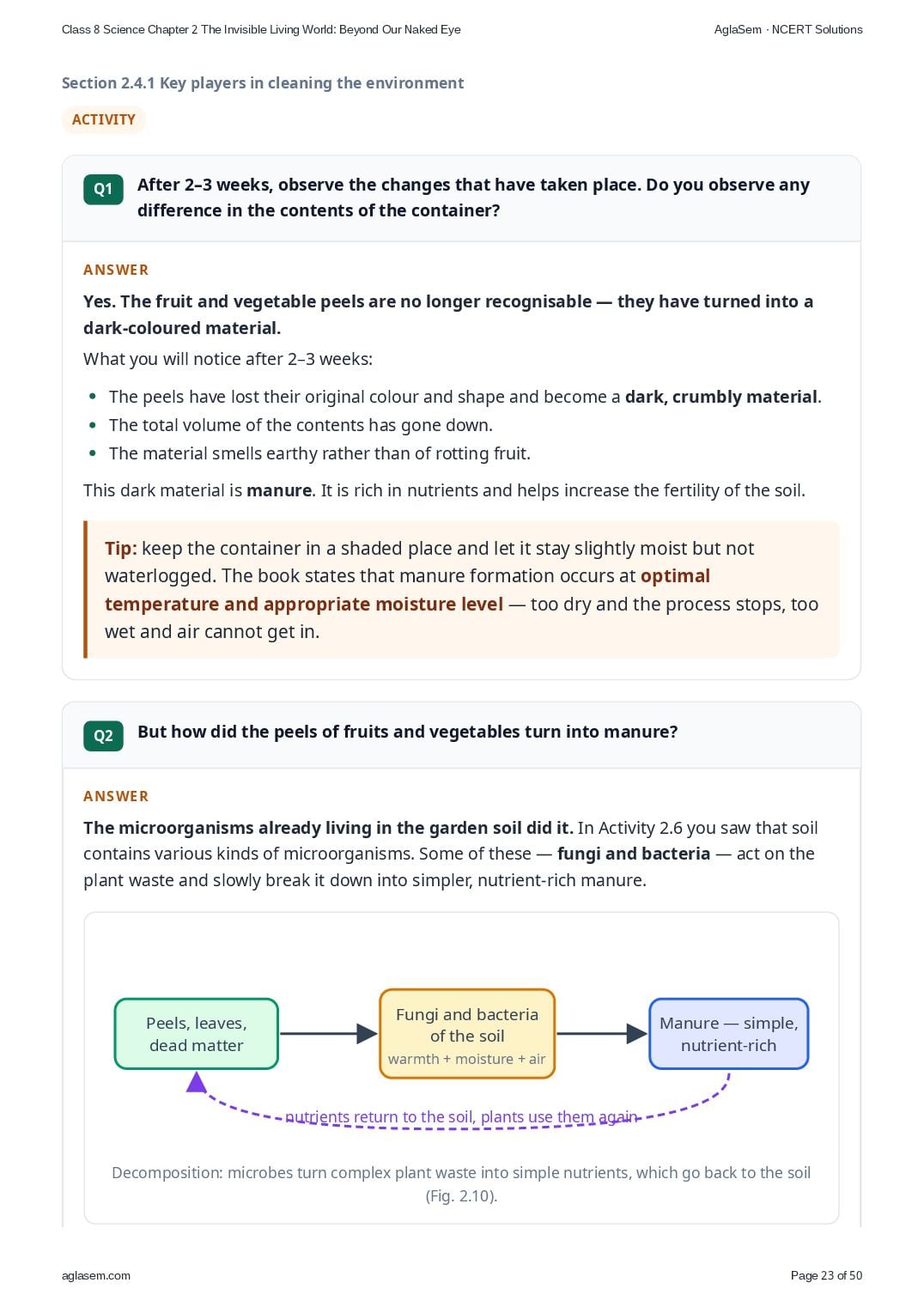
- After 2–3 weeks, observe the changes that have taken place. Do you observe any difference in the contents of the container?
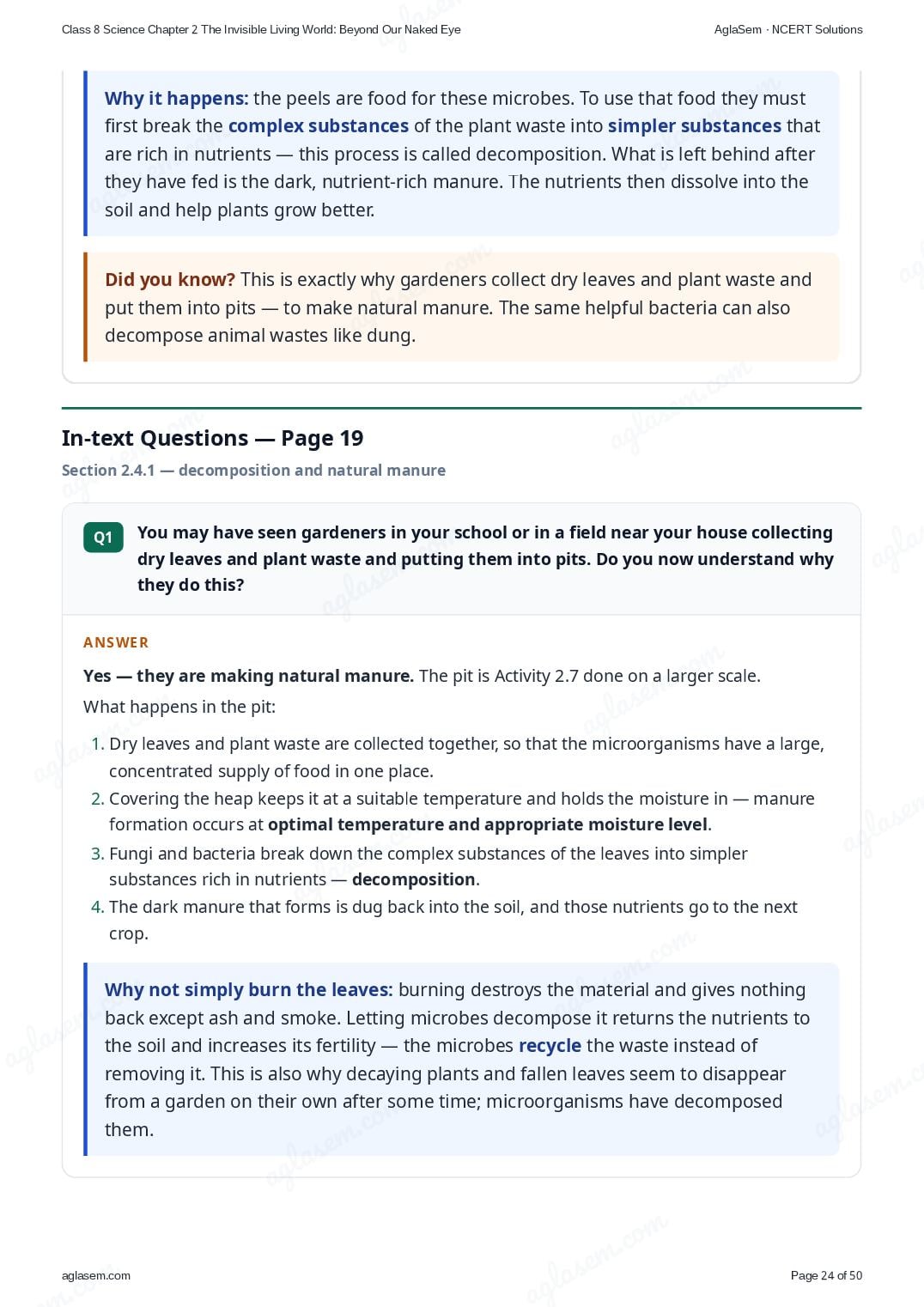
- But how did the peels of fruits and vegetables turn into manure?
- You may have seen gardeners in your school or in a field near your house collecting dry leaves and plant waste and putting them into pits. Do you now understand why they do this?
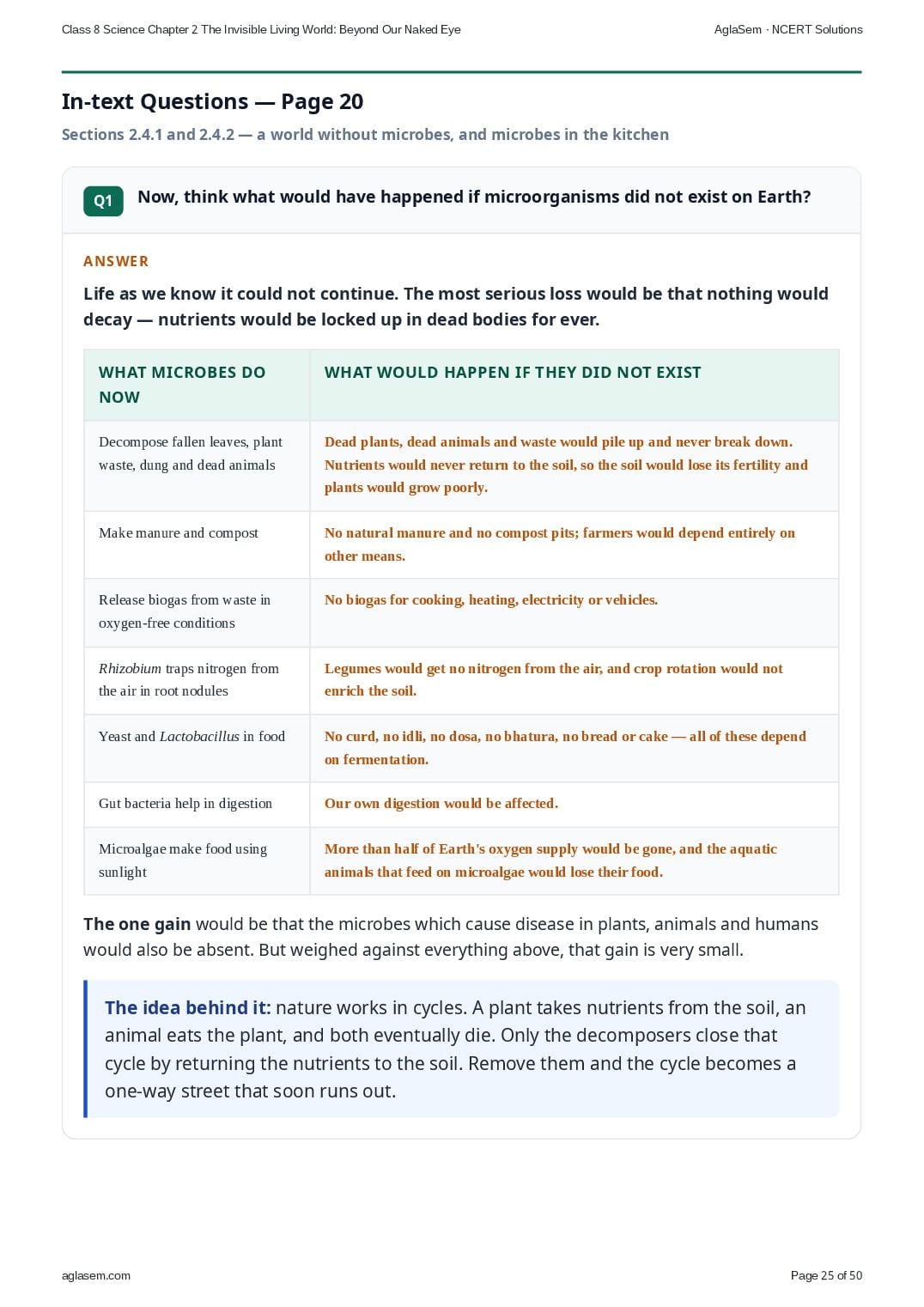
- Now, think what would have happened if microorganisms did not exist on Earth?
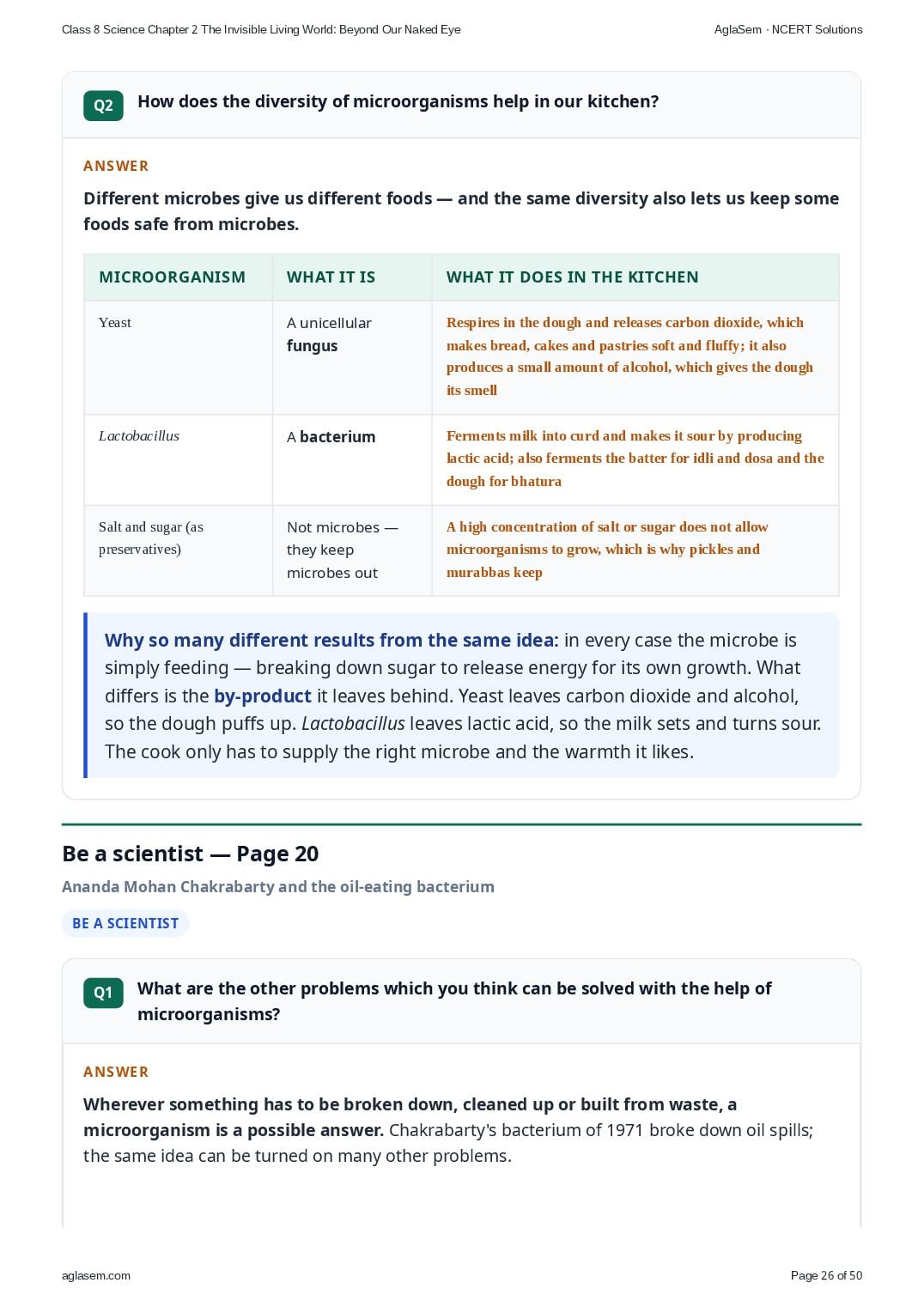
- How does the diversity of microorganisms help in our kitchen?
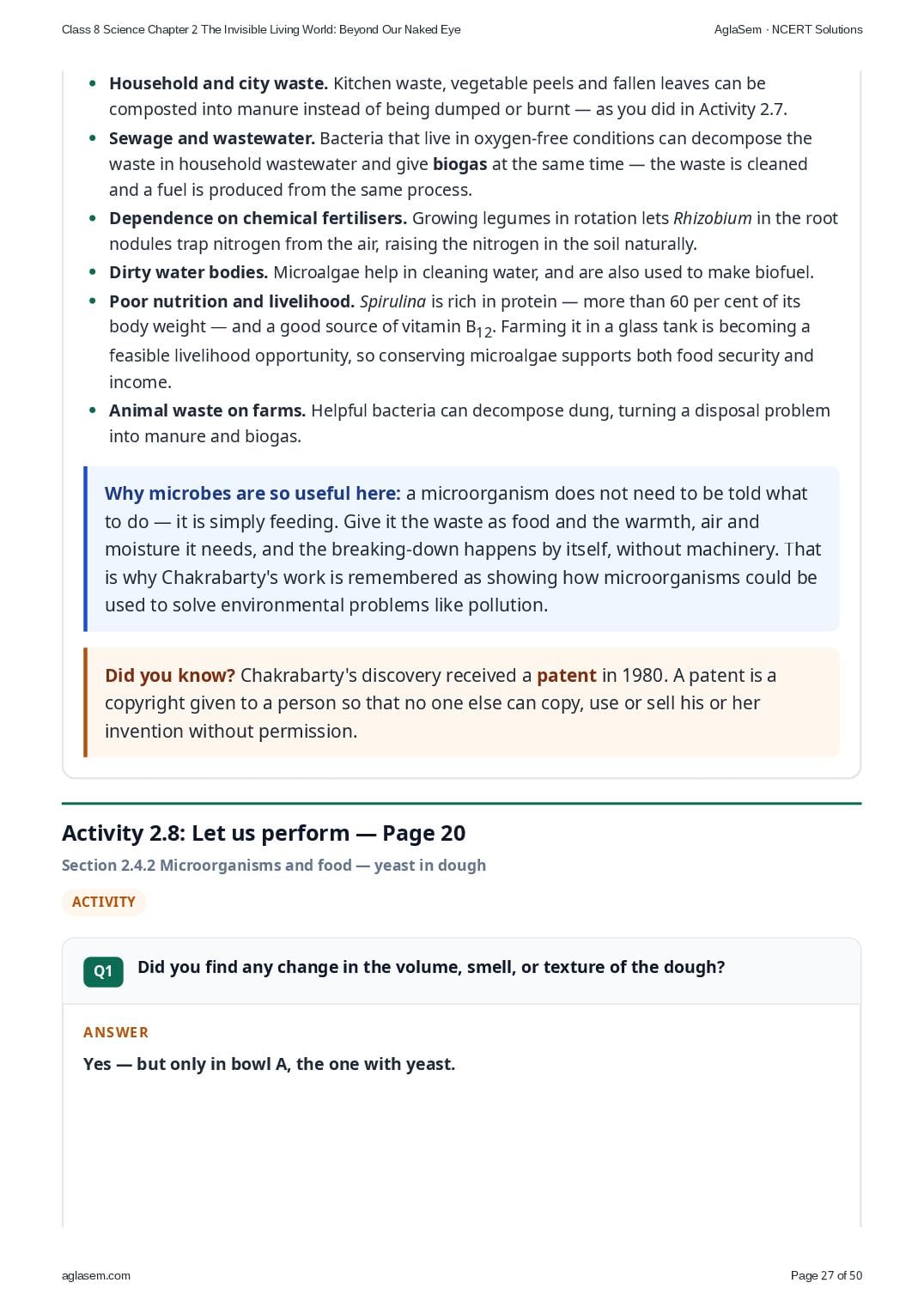
- What are the other problems which you think can be solved with the help of microorganisms?
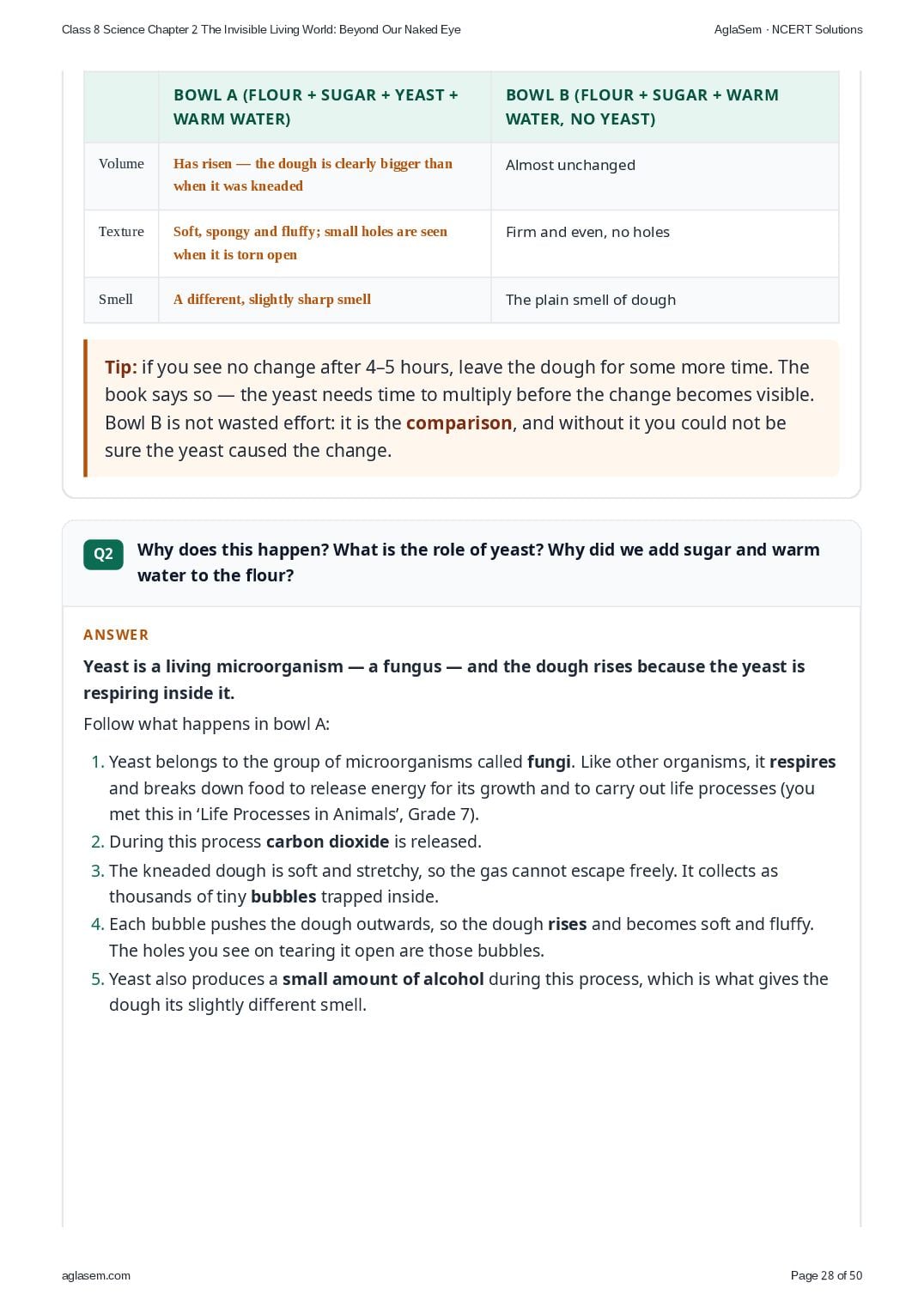
- Did you find any change in the volume, smell, or texture of the dough?
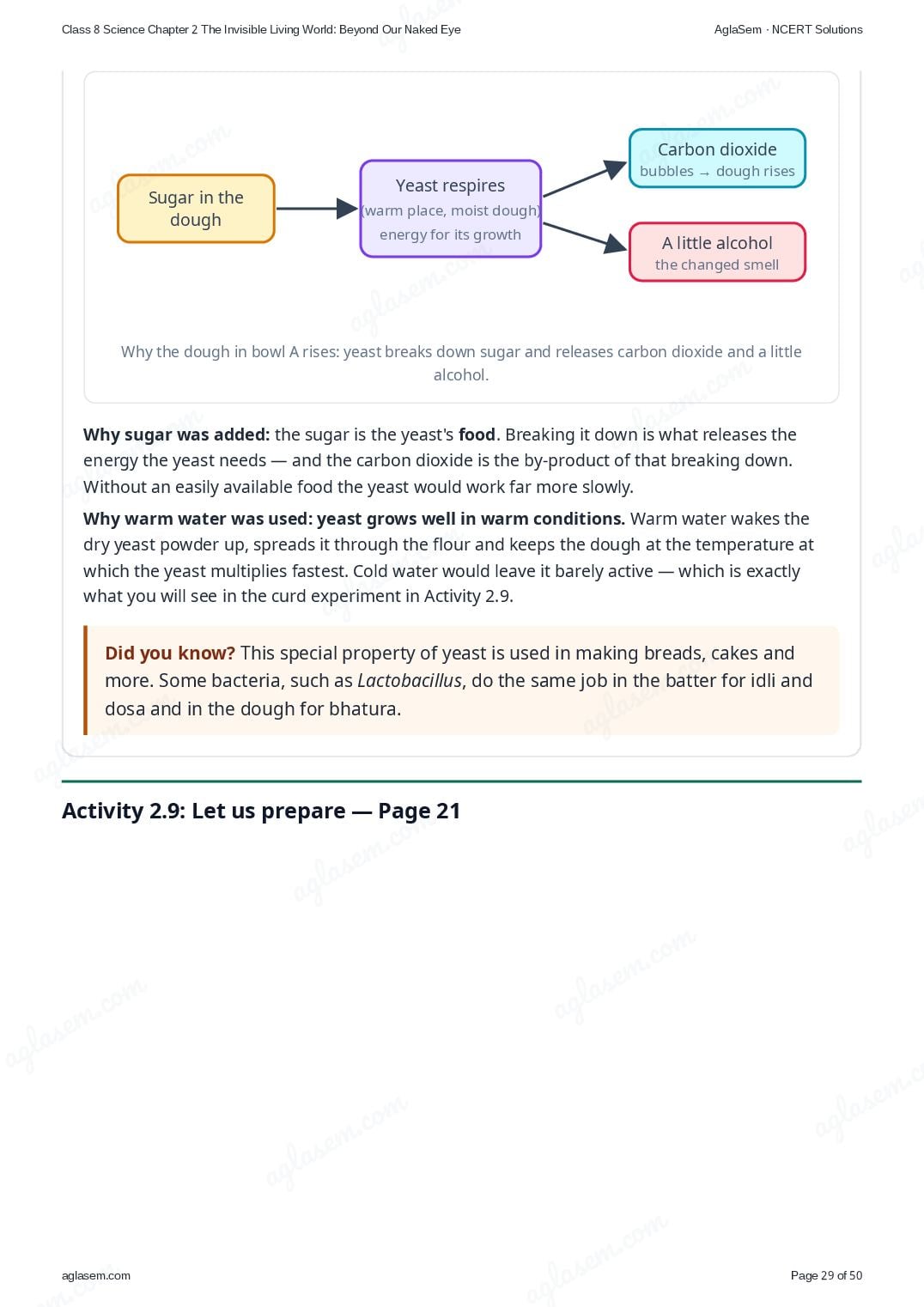
- Why does this happen? What is the role of yeast? Why did we add sugar and warm water to the flour?
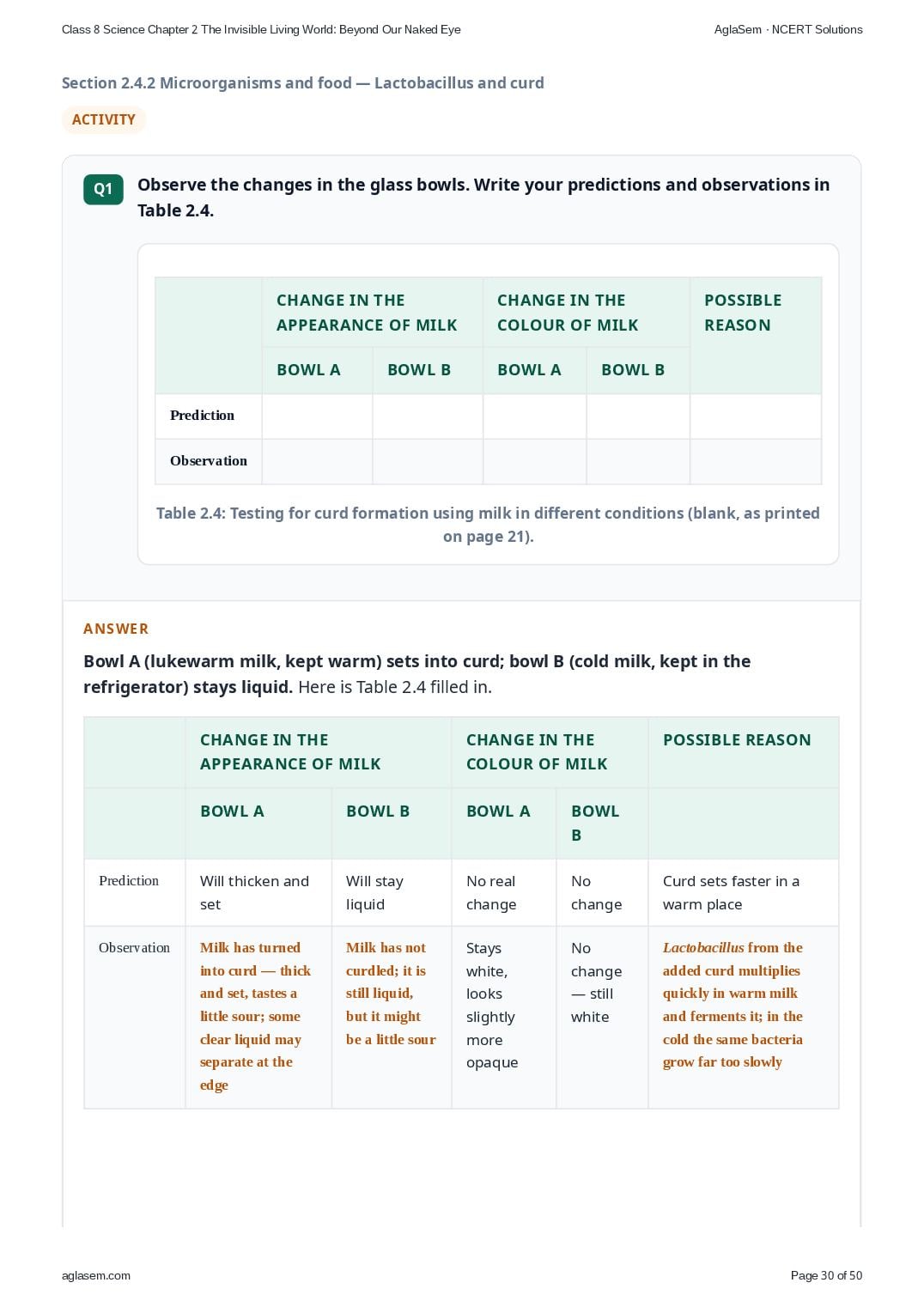
- Observe the changes in the glass bowls. Write your predictions and observations in Table 2.4.
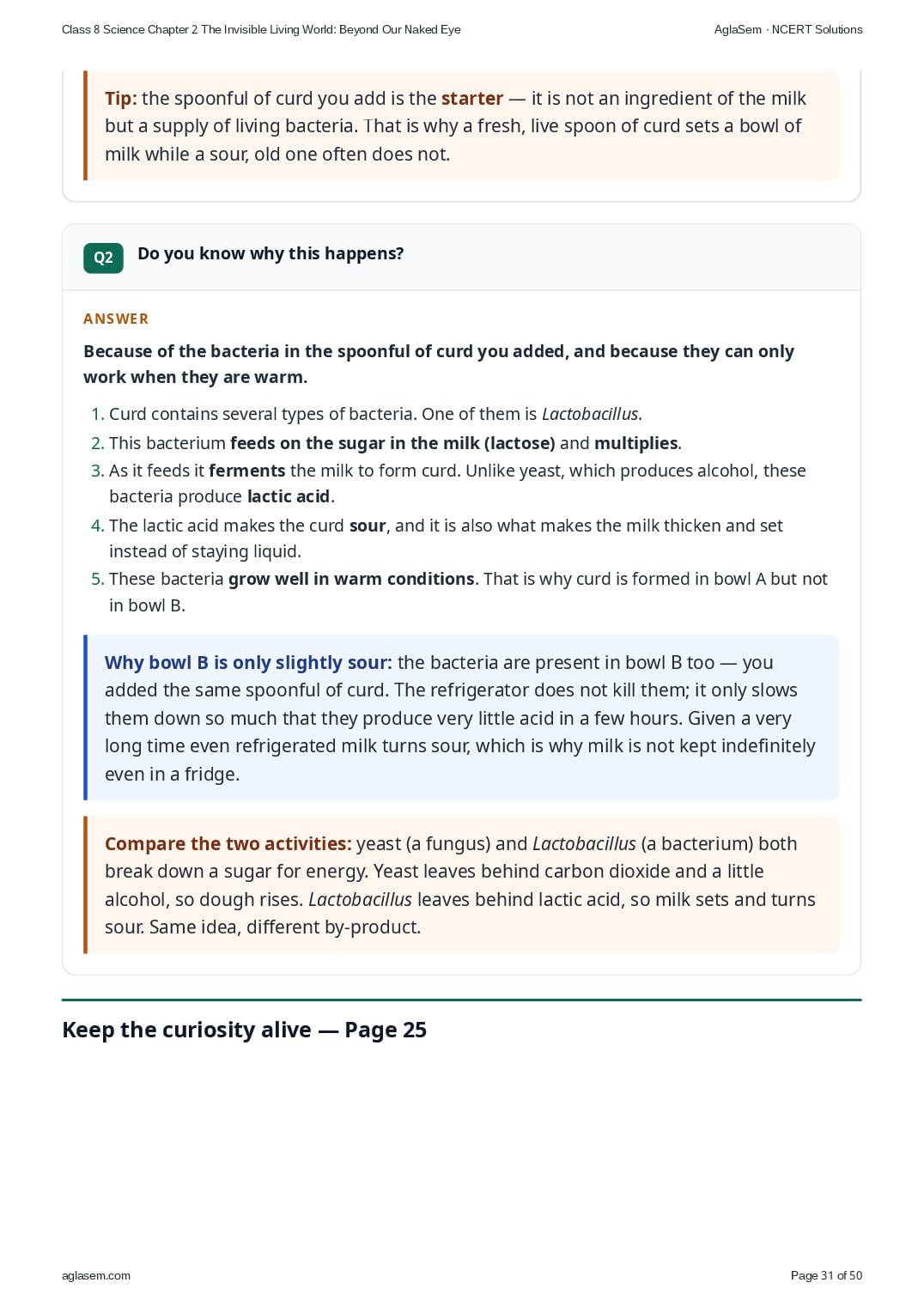
- Do you know why this happens?
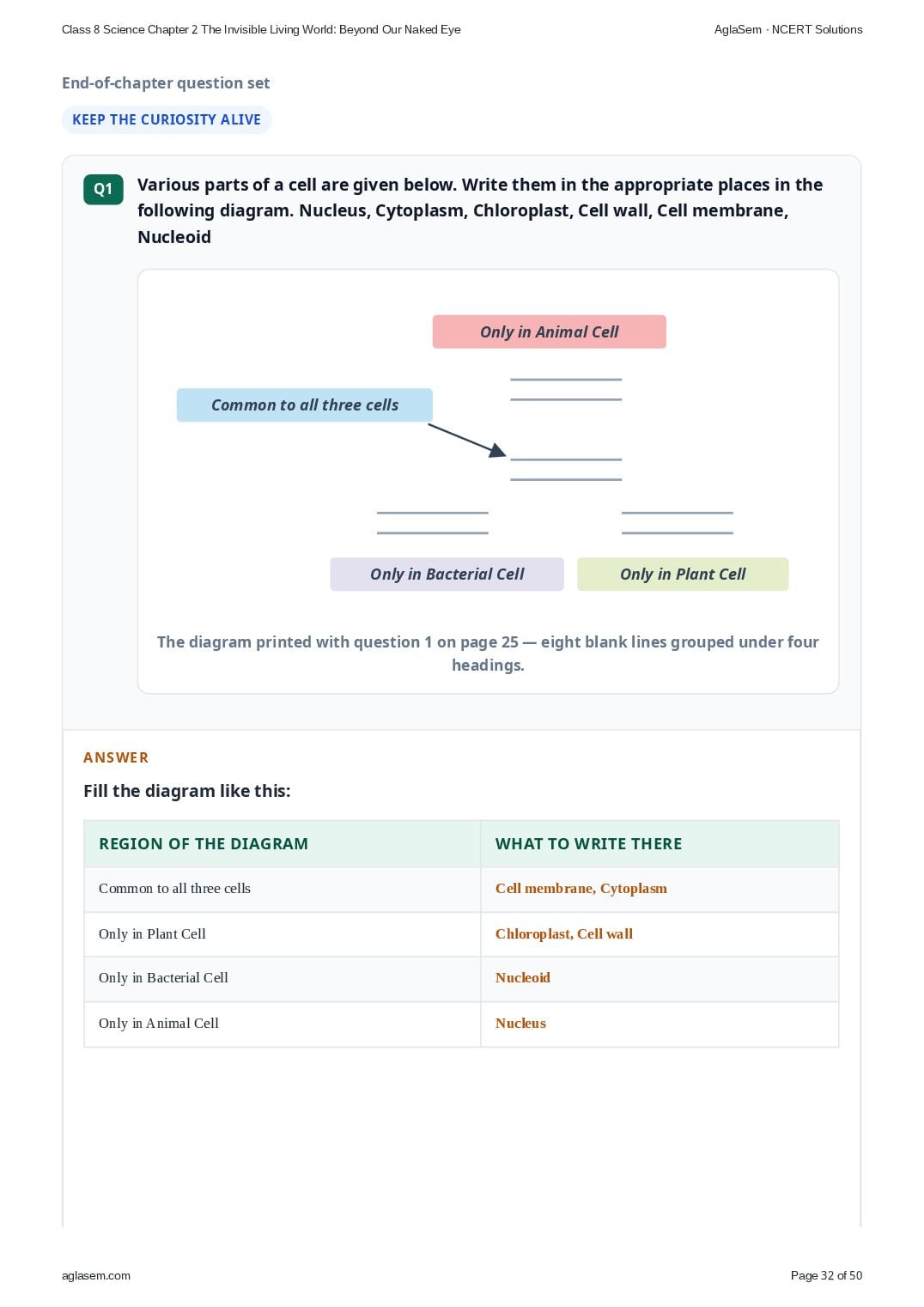
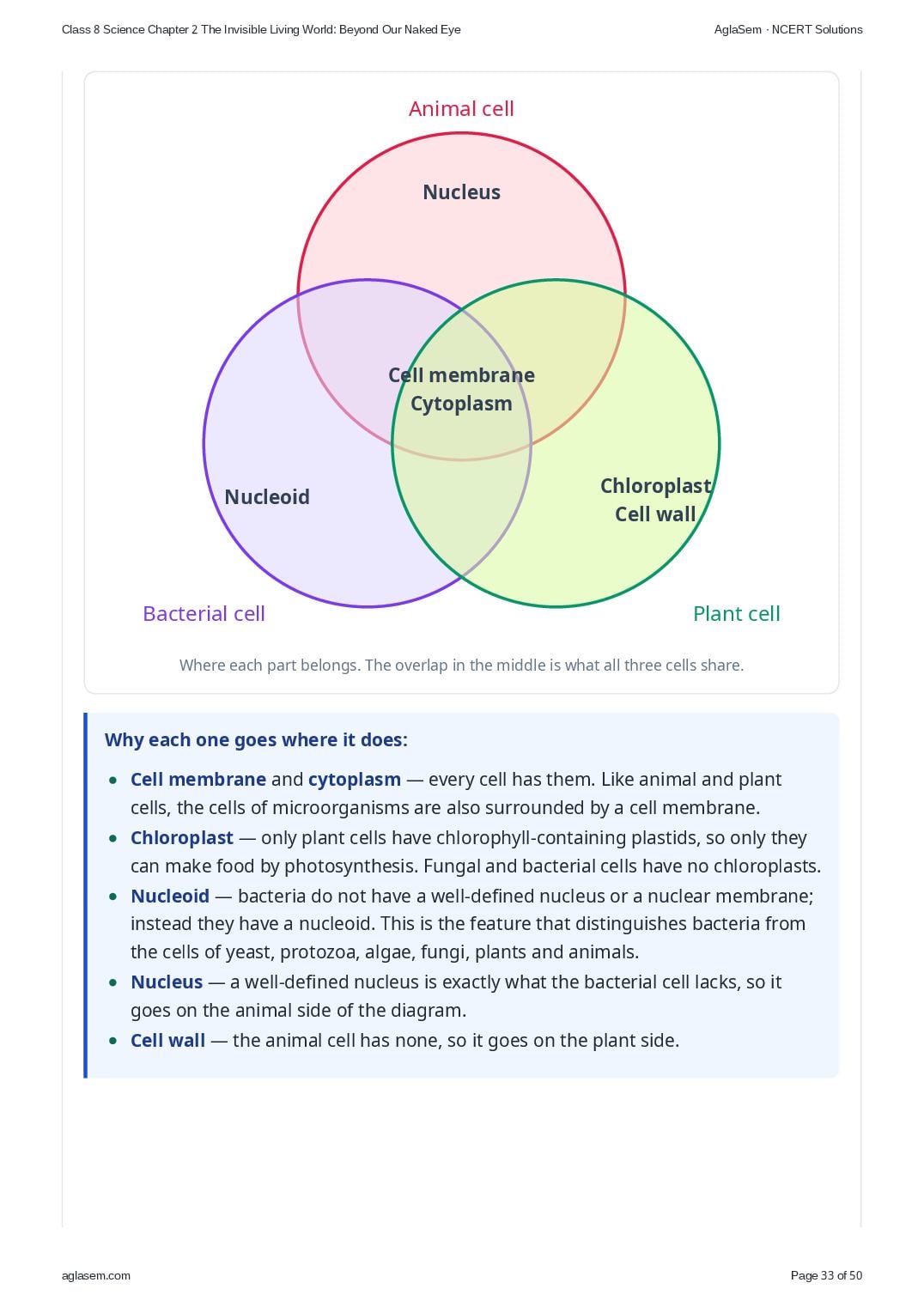
- Various parts of a cell are given below. Write them in the appropriate places in the following diagram. Nucleus, Cytoplasm, Chloroplast, Cell wall, Cell membrane, Nucleoid
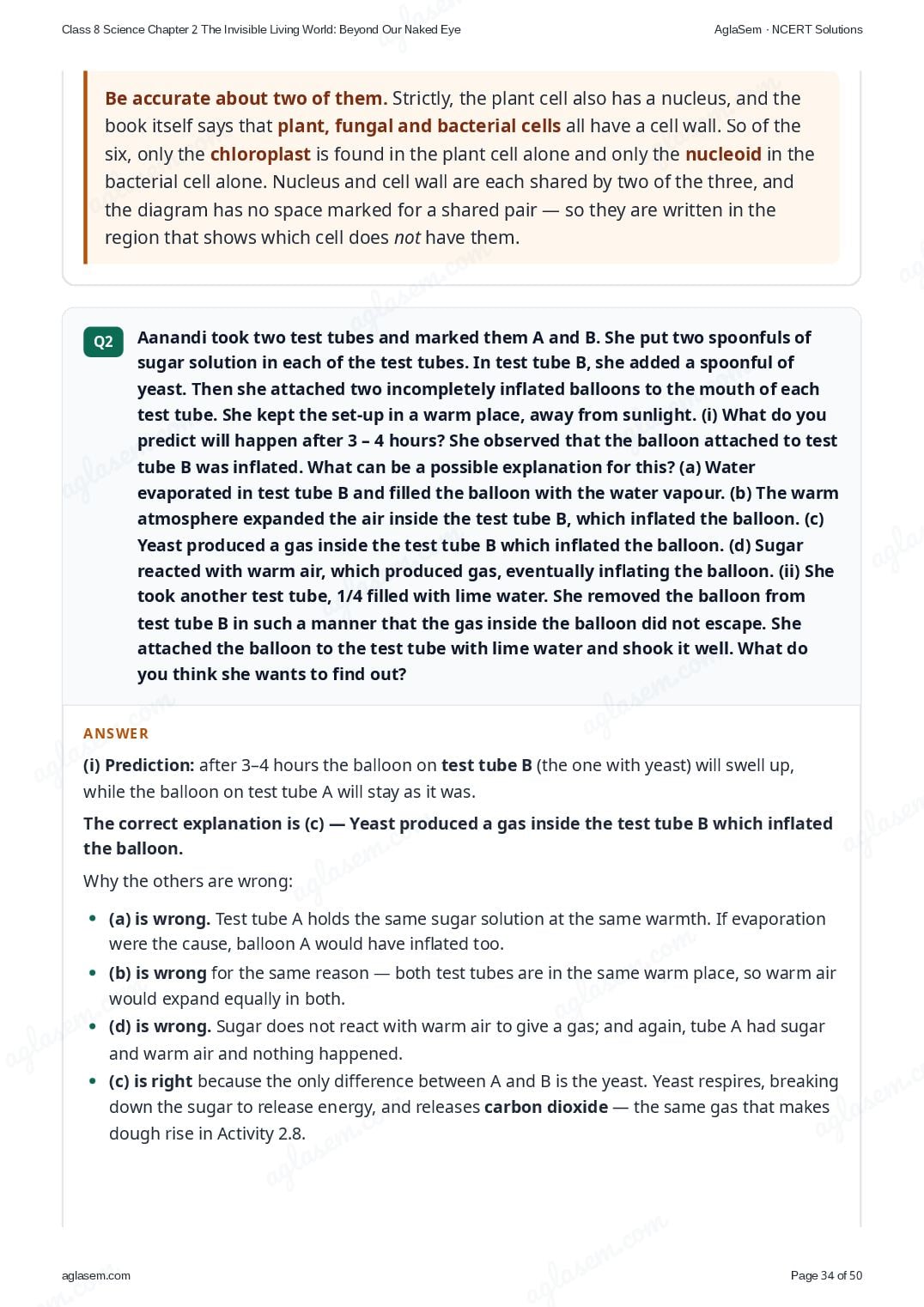
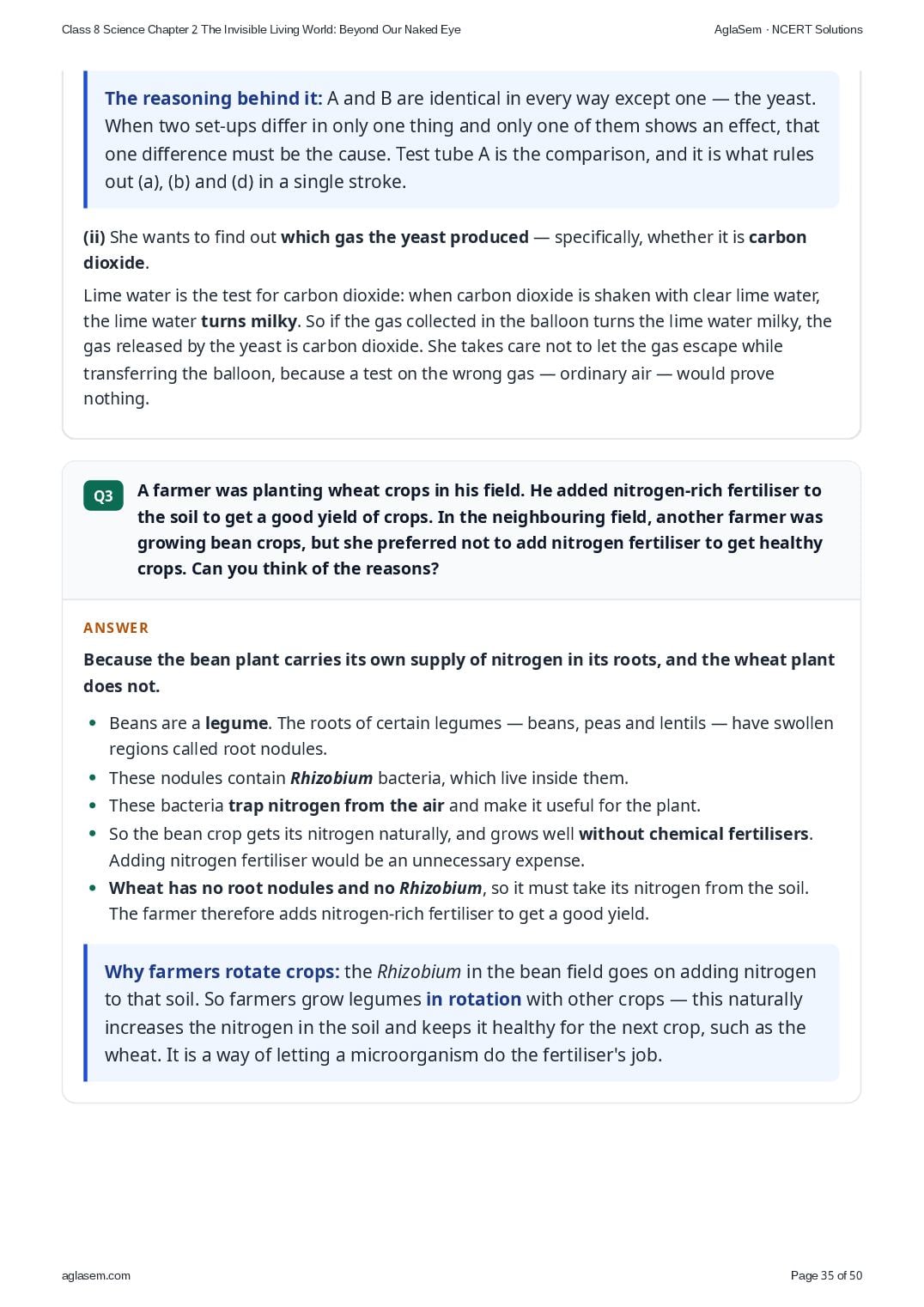
- Aanandi took two test tubes and marked them A and B. She put two spoonfuls of sugar solution in each of the test tubes. In test tube B, she added a spoonful of yeast. Then she attached two incompletely inflated balloons to the mouth of each test tube. She kept the set-up in a warm place, away from sunlight. (i) What do you predict will happen after 3 – 4 hours? She observed that the balloon attached to test tube B was inflated. What can be a possible explanation for this? (a) Water evaporated in test tube B and filled the balloon with the water vapour. (b) The warm atmosphere expanded the air inside the test tube B, which inflated the balloon. (c) Yeast produced a gas inside the test tube B which inflated the balloon. (d) Sugar reacted with warm air, which produced gas, eventually inflating the balloon. (ii) She took another test tube, 1/4 filled with lime water. She removed the balloon from test tube B in such a manner that the gas inside the balloon did not escape. She attached the balloon to the test tube with lime water and shook it well. What do you think she wants to find out?
- A farmer was planting wheat crops in his field. He added nitrogen-rich fertiliser to the soil to get a good yield of crops. In the neighbouring field, another farmer was growing bean crops, but she preferred not to add nitrogen fertiliser to get healthy crops. Can you think of the reasons?
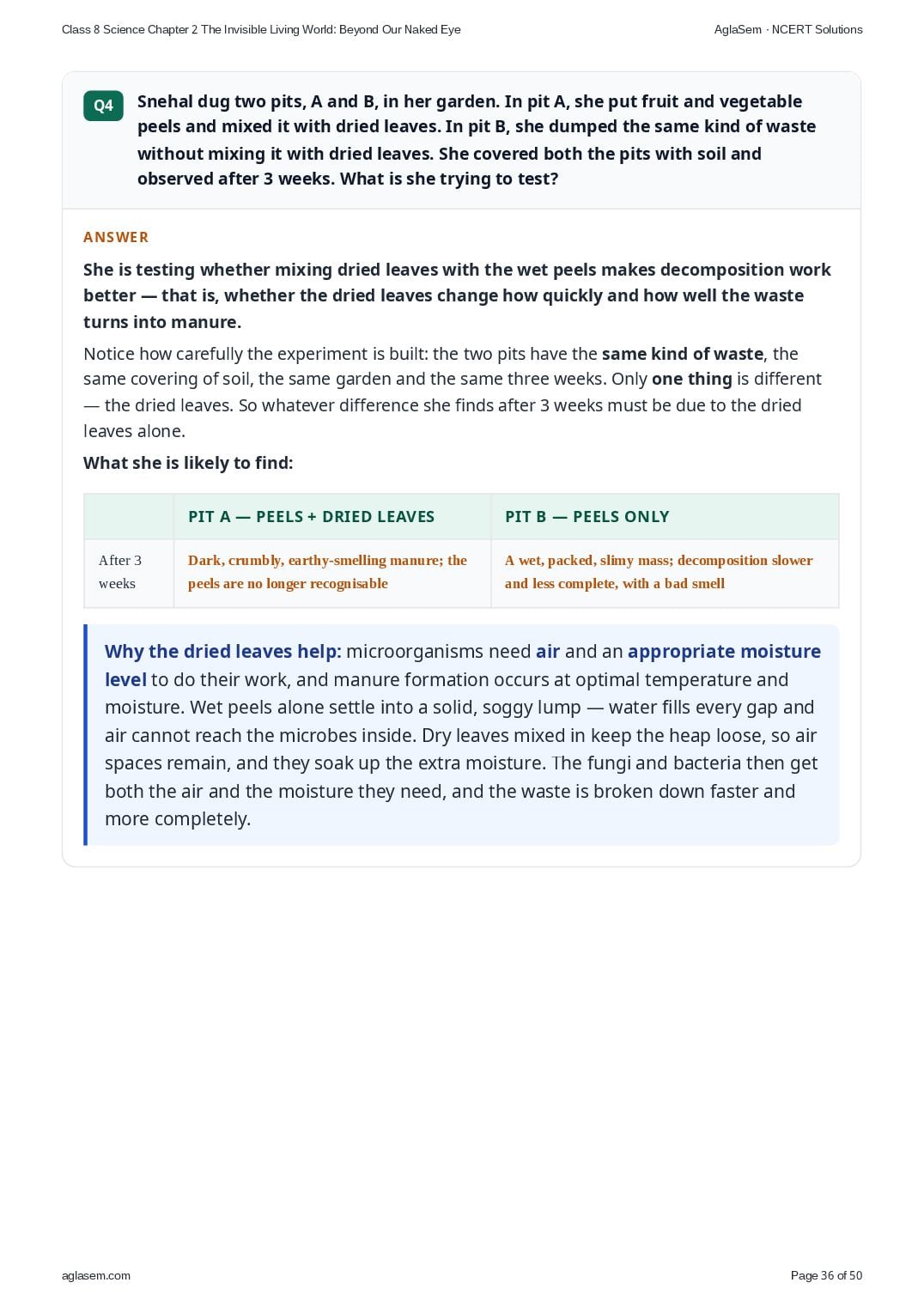
- Snehal dug two pits, A and B, in her garden. In pit A, she put fruit and vegetable peels and mixed it with dried leaves. In pit B, she dumped the same kind of waste without mixing it with dried leaves. She covered both the pits with soil and observed after 3 weeks. What is she trying to test?
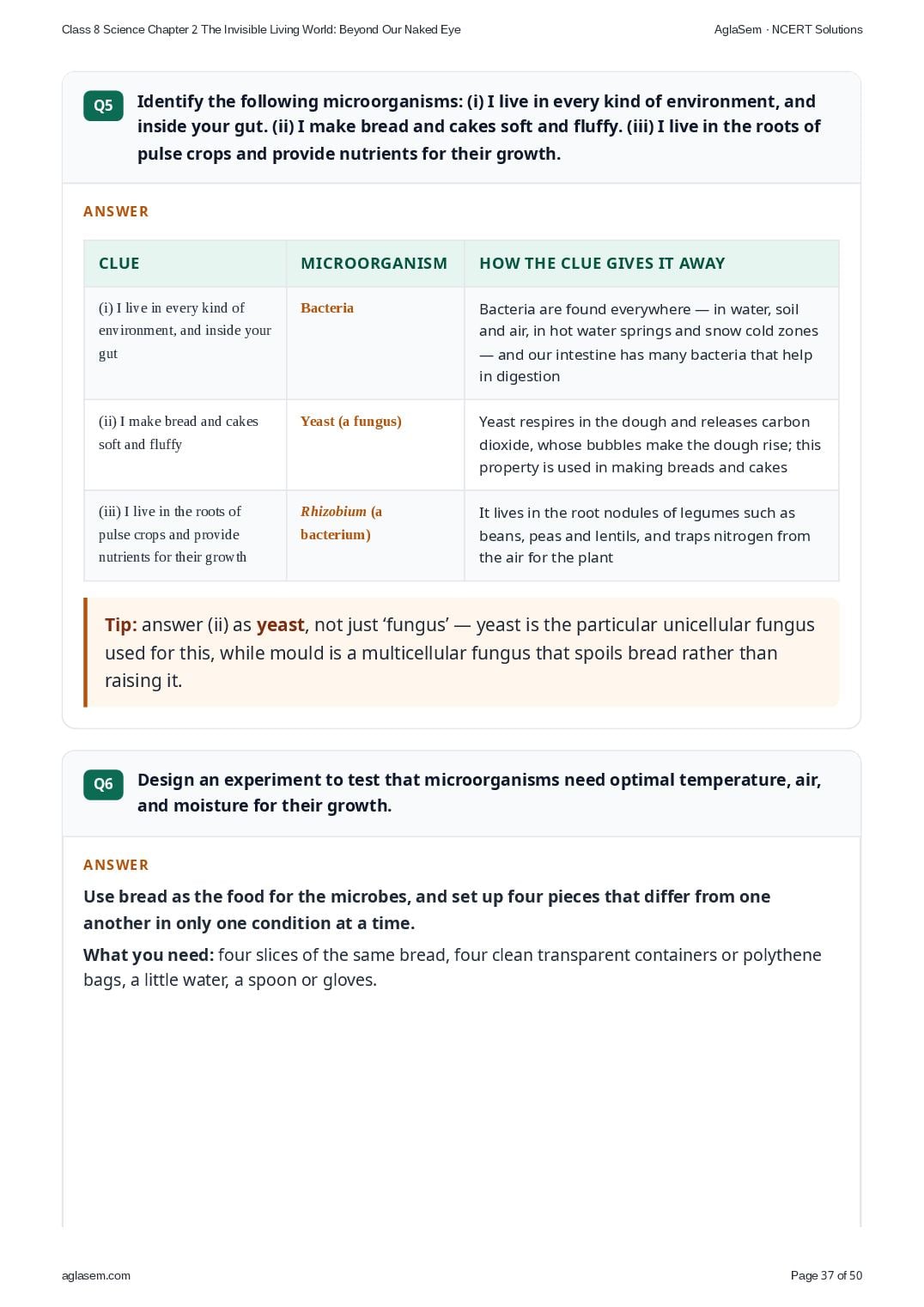
- Identify the following microorganisms: (i) I live in every kind of environment, and inside your gut. (ii) I make bread and cakes soft and fluffy. (iii) I live in the roots of pulse crops and provide nutrients for their growth.
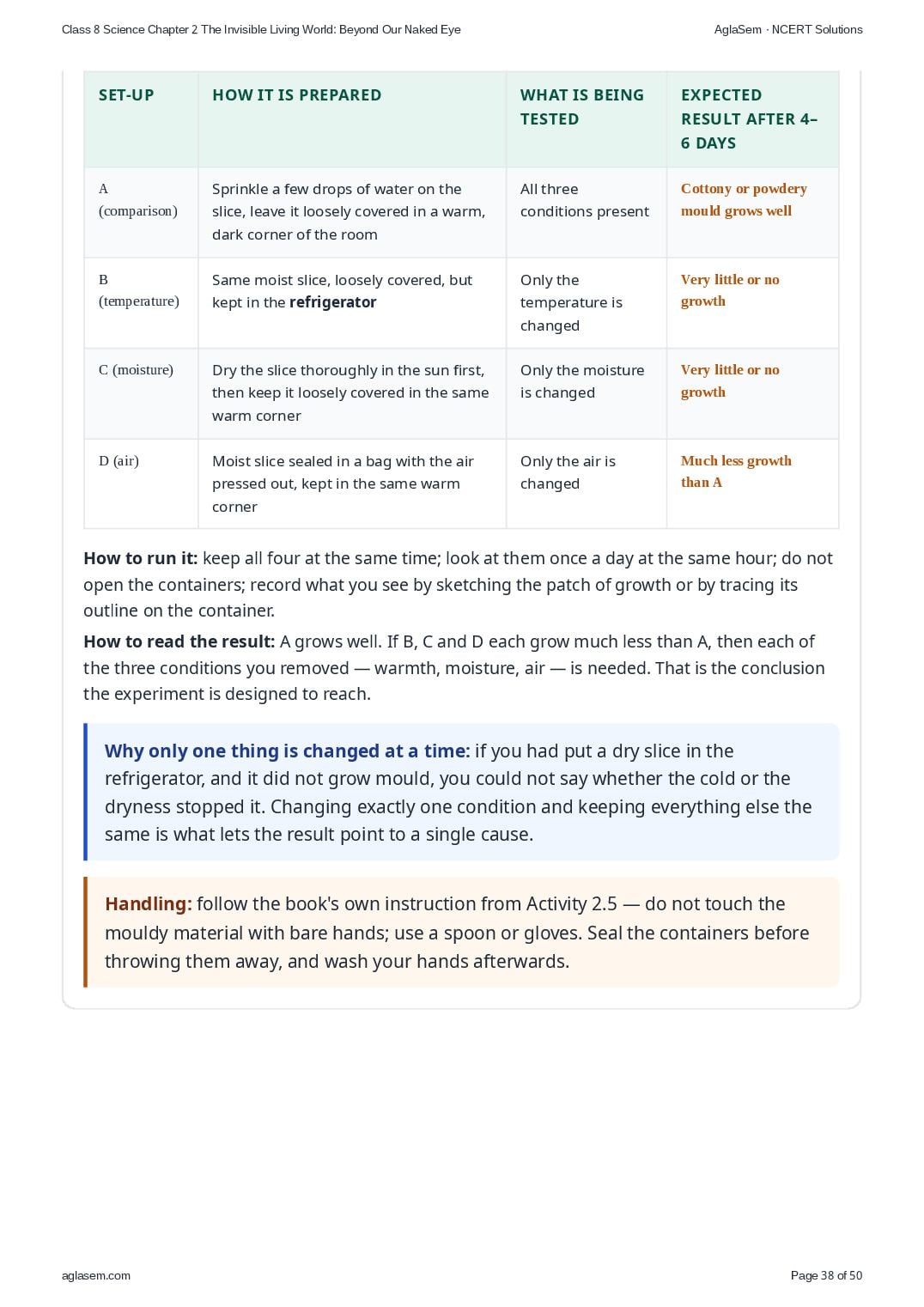
- Design an experiment to test that microorganisms need optimal temperature, air, and moisture for their growth.
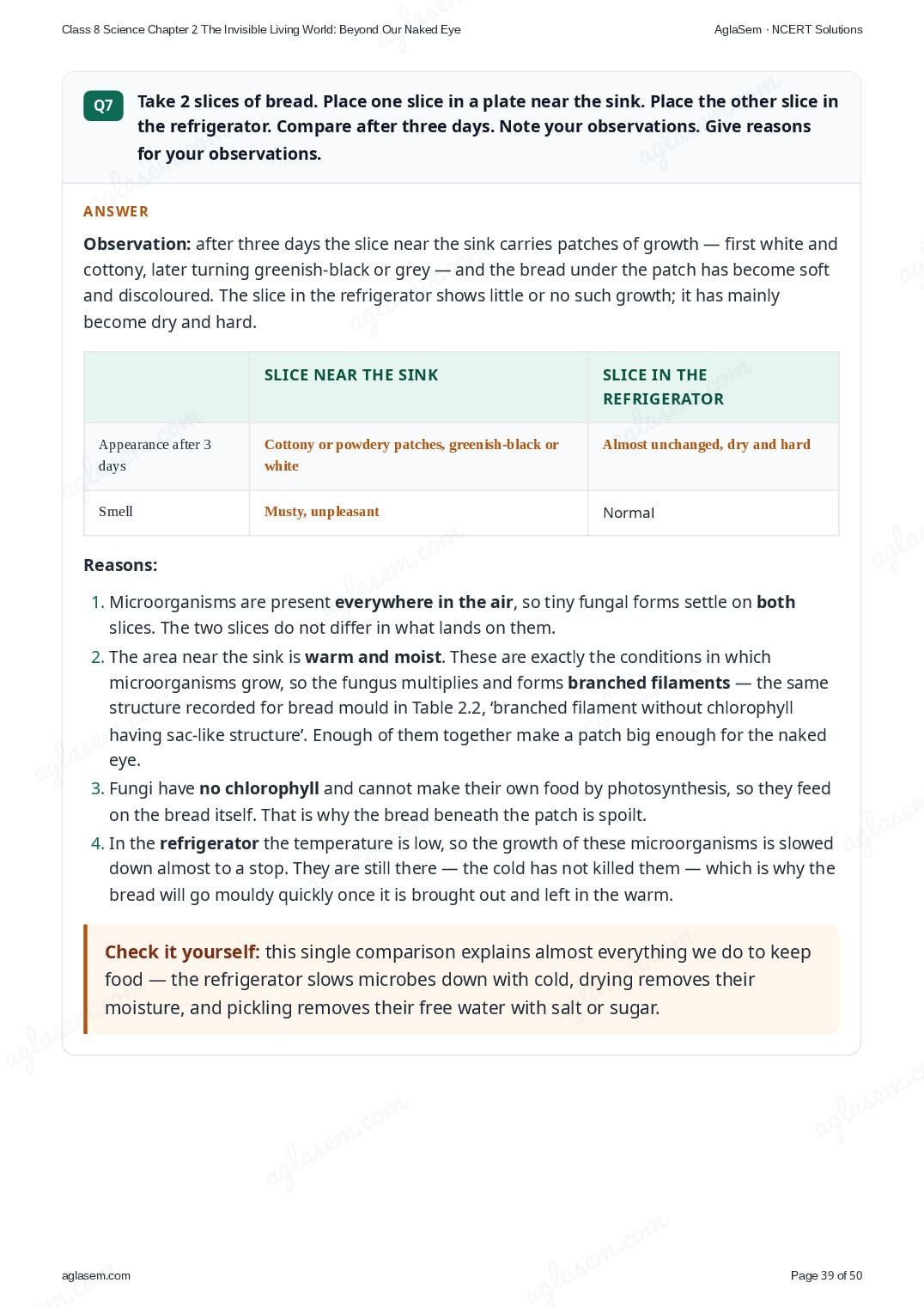
- Take 2 slices of bread. Place one slice in a plate near the sink. Place the other slice in the refrigerator. Compare after three days. Note your observations. Give reasons for your observations.
- A student observes that when curd is left out for a day, it becomes more sour. What can be two possible explanations for this observation?
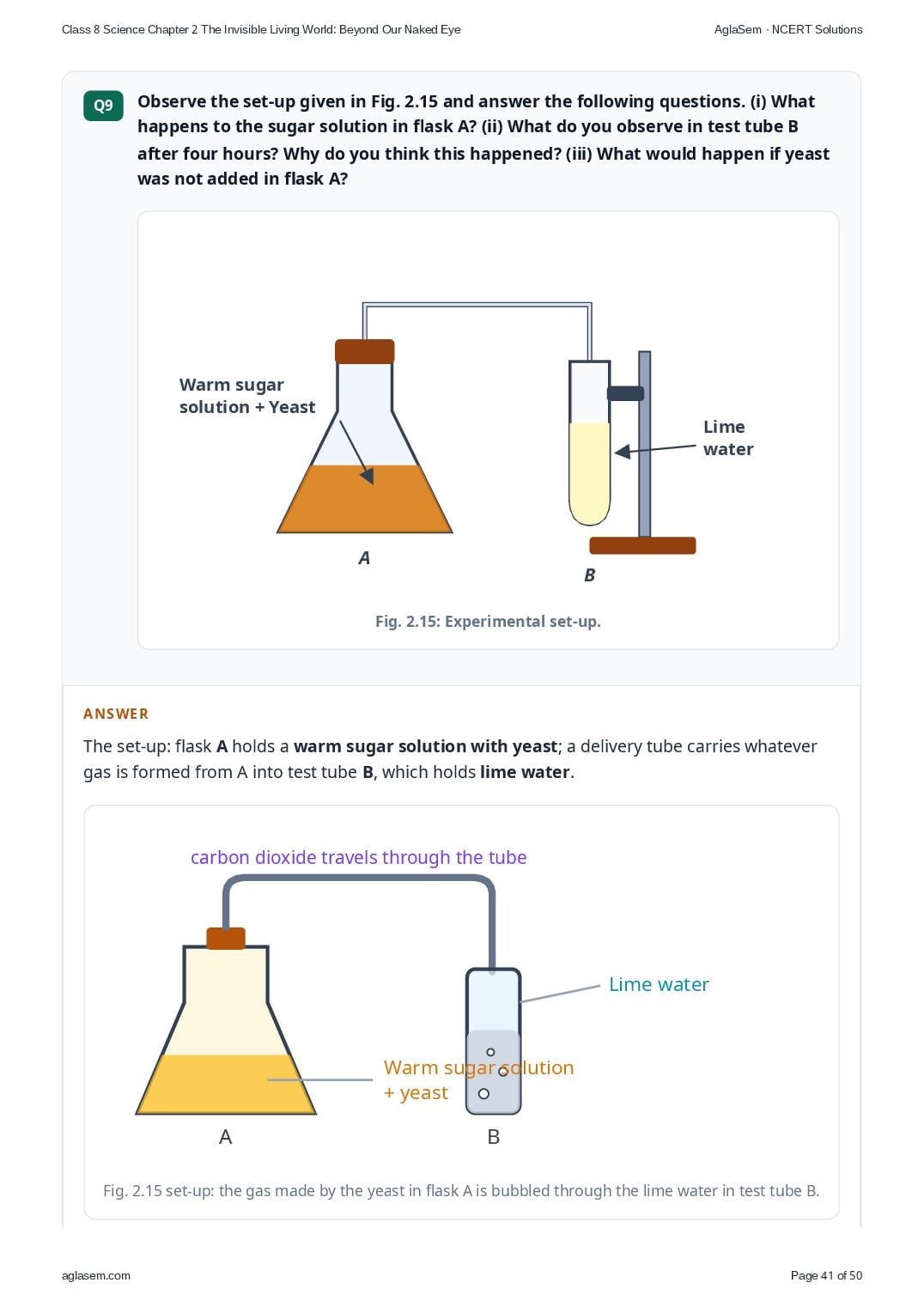
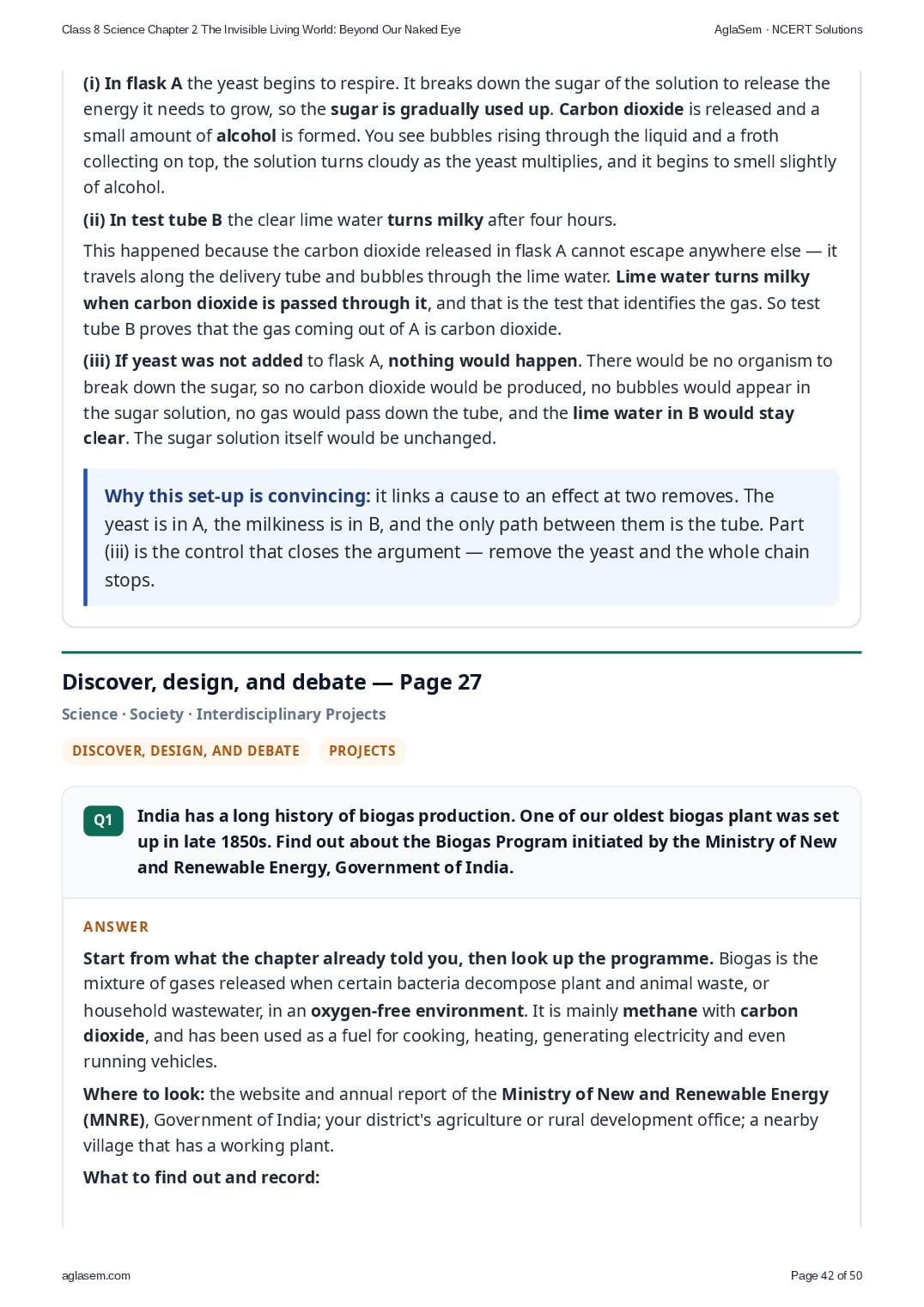
- Observe the set-up given in Fig. 2.15 and answer the following questions. (i) What happens to the sugar solution in flask A? (ii) What do you observe in test tube B after four hours? Why do you think this happened? (iii) What would happen if yeast was not added in flask A?
- India has a long history of biogas production. One of our oldest biogas plant was set up in late 1850s. Find out about the Biogas Program initiated by the Ministry of New and Renewable Energy, Government of India.
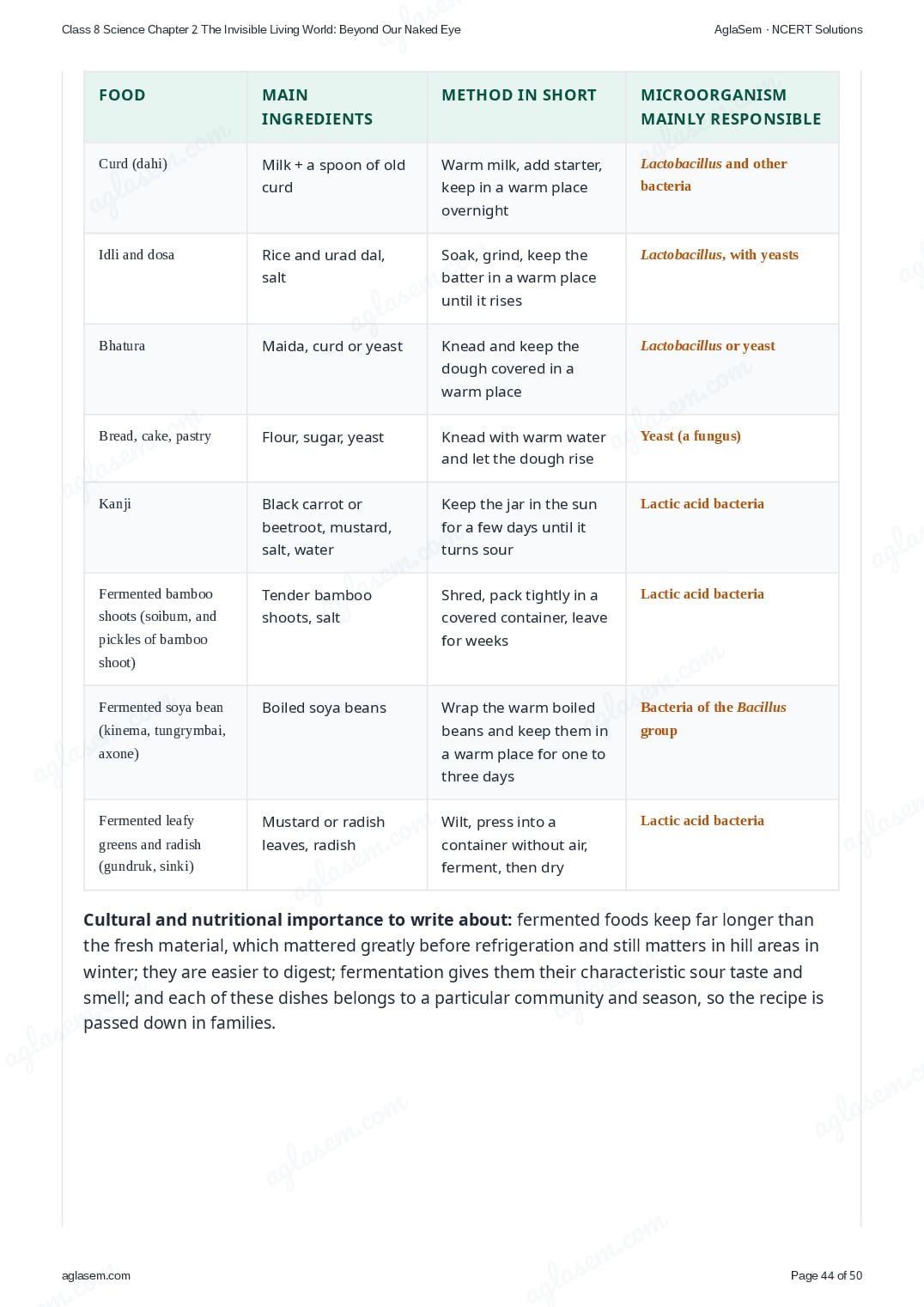
- Fermented food items like fermented soya bean and fermented bamboo shoots are consumed as traditional food in some parts of India. With the help of your parents and teachers, list some traditional food items from your area that utilise the process of fermentation. Investigate the ingredients used in the preparation of these fermented food items; the method of preparing them; the microorganism responsible for the fermentation of the food, and the cultural and nutritional importance of the fermented food.
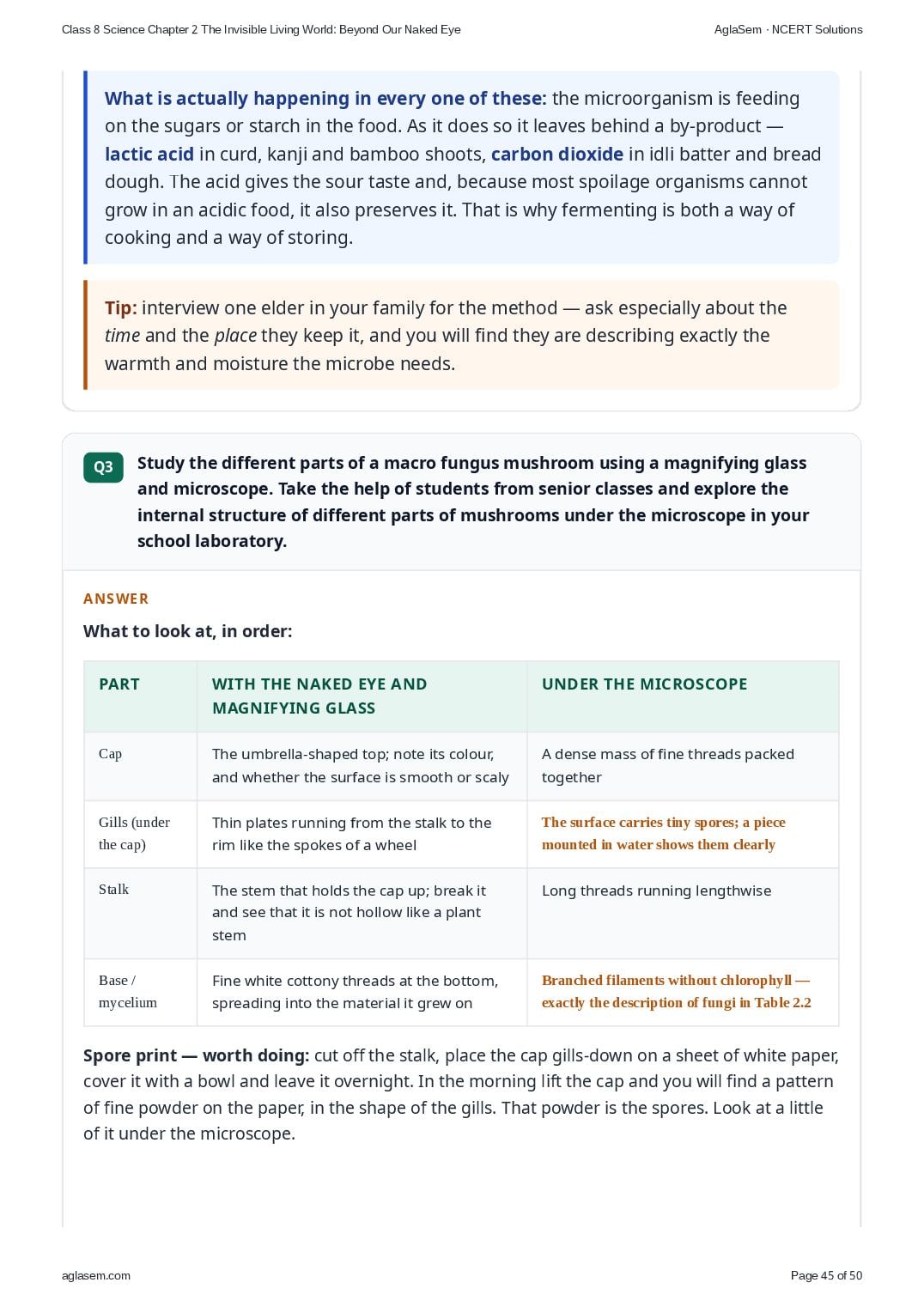
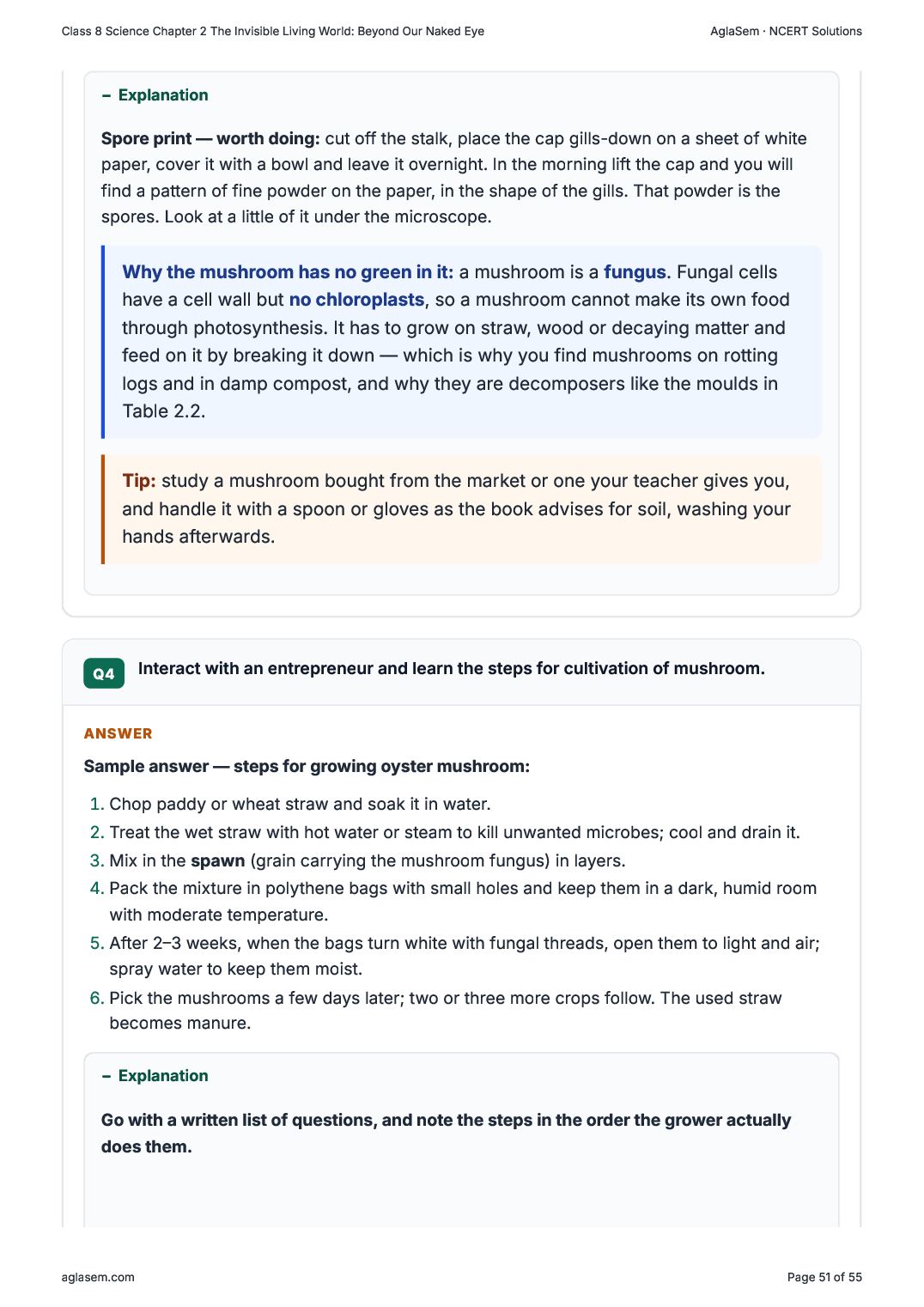
- Study the different parts of a macro fungus mushroom using a magnifying glass and microscope. Take the help of students from senior classes and explore the internal structure of different parts of mushrooms under the microscope in your school laboratory.
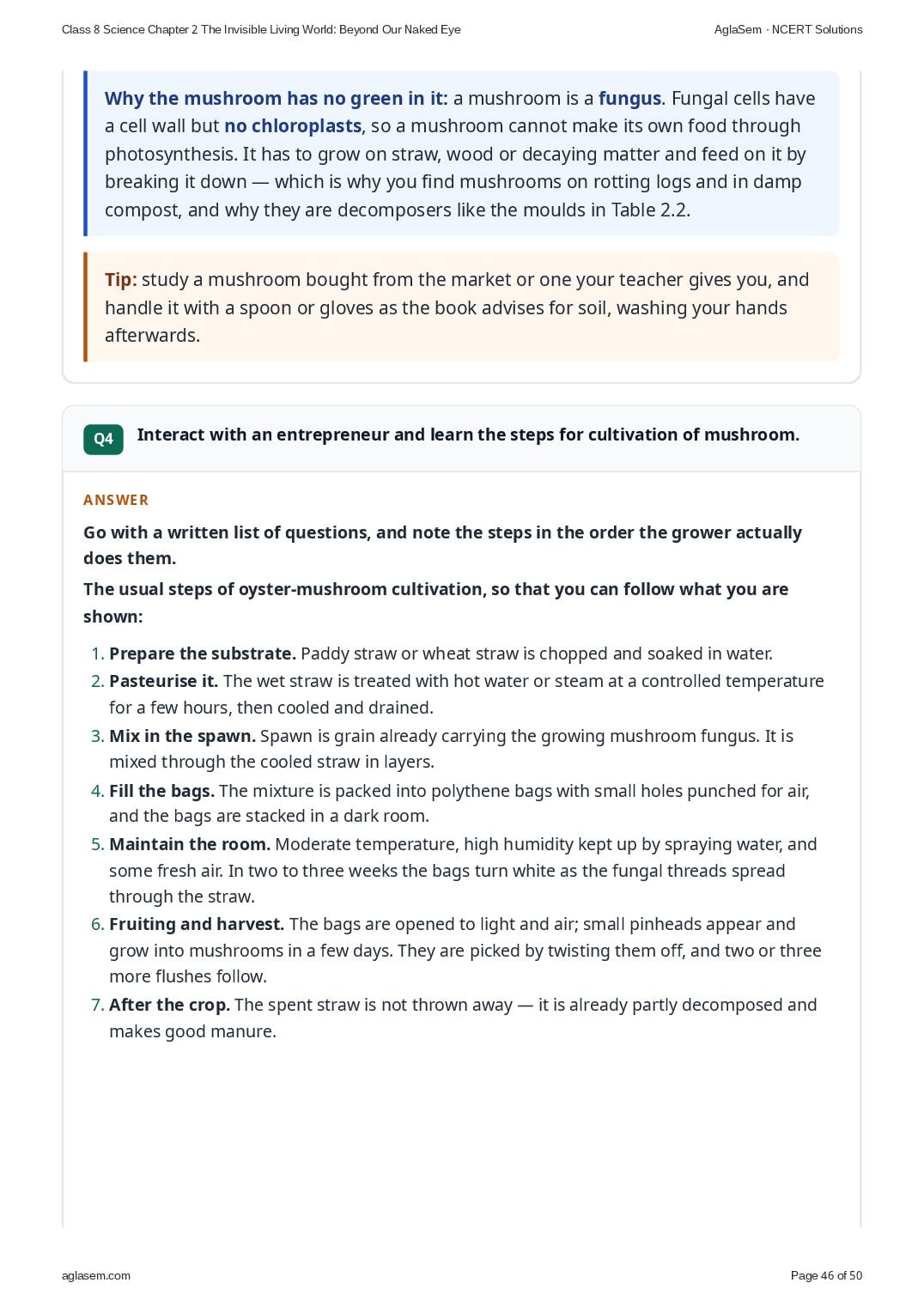
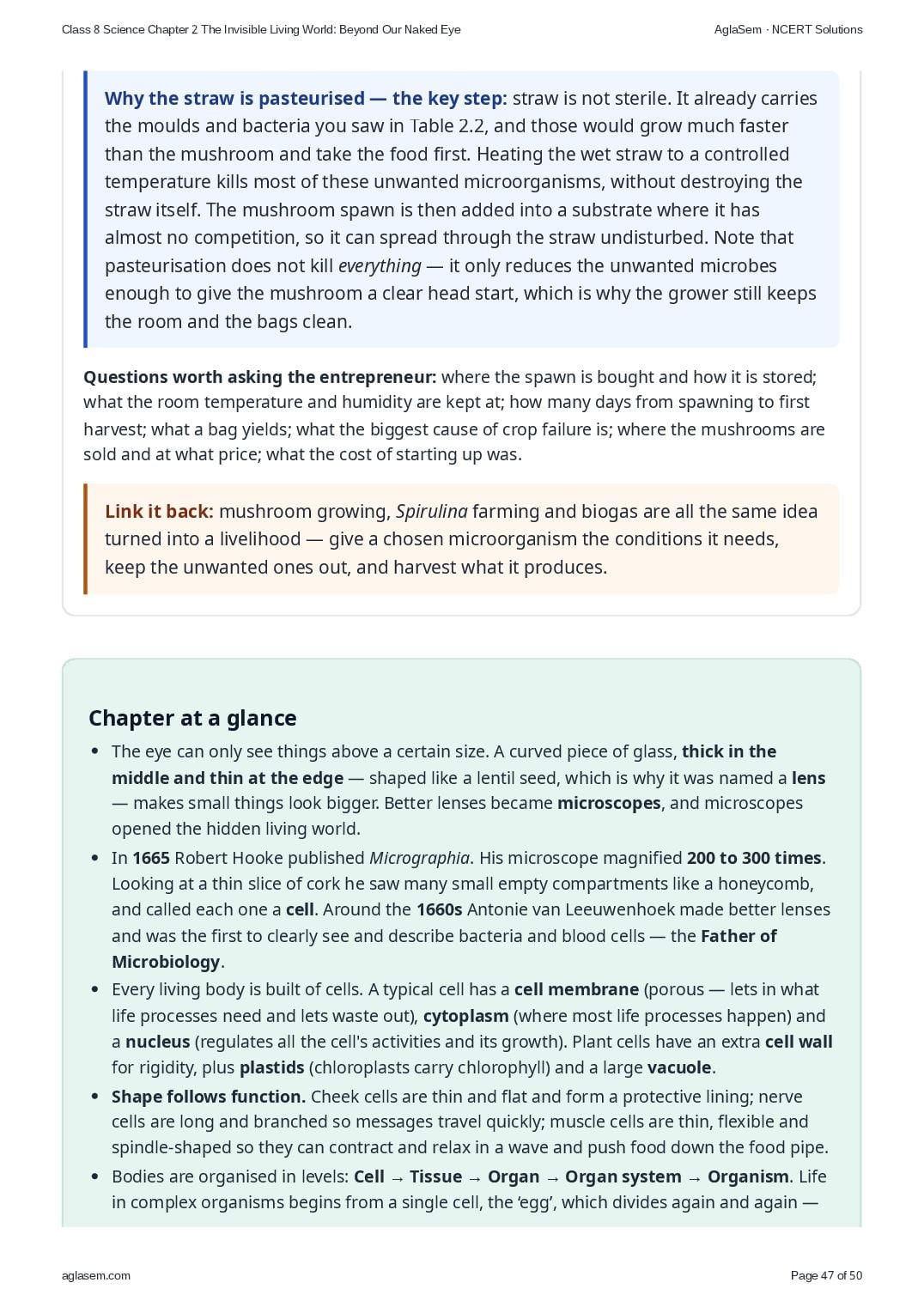
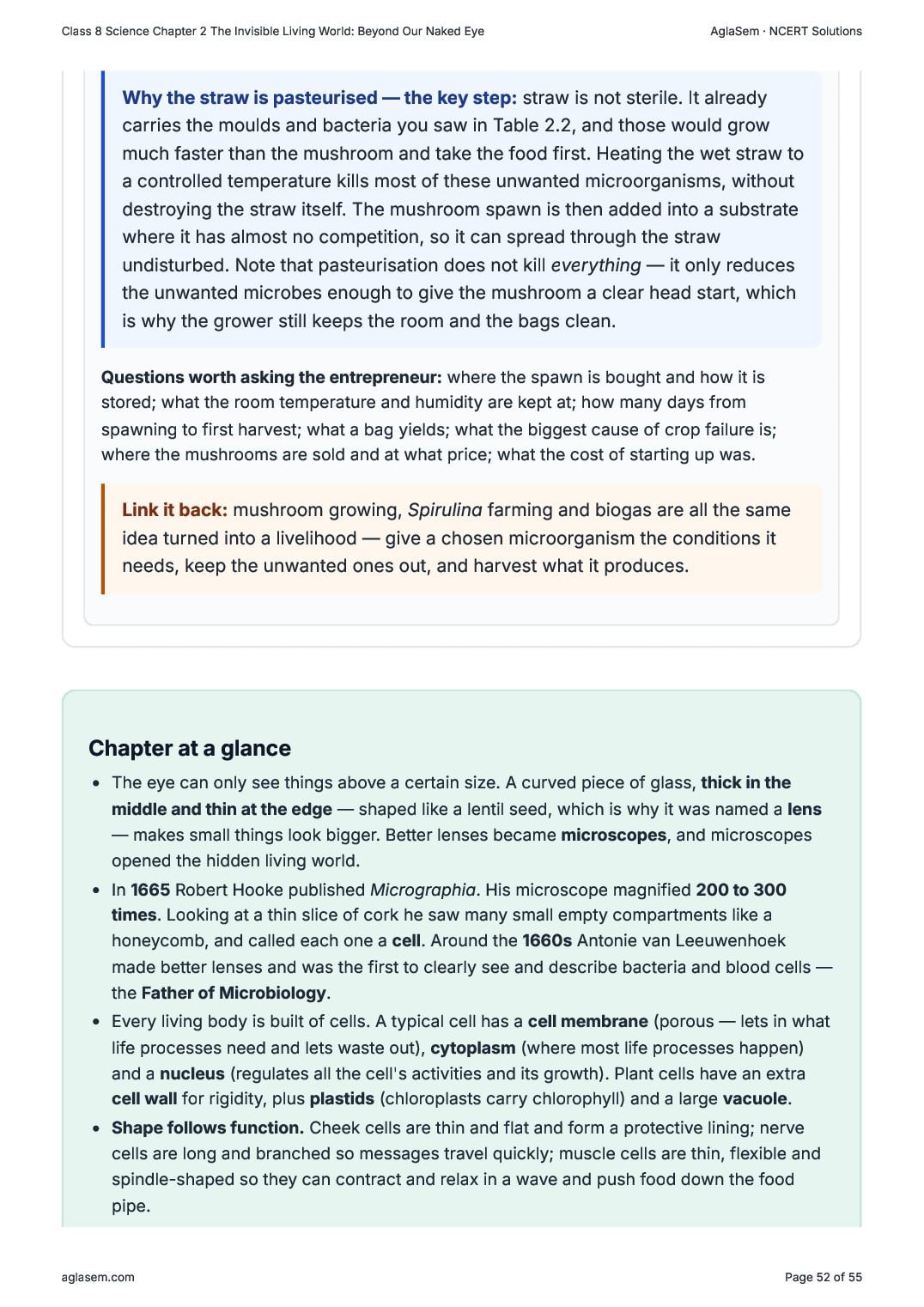
- Interact with an entrepreneur and learn the steps for cultivation of mushroom.
Chapter at a Glance
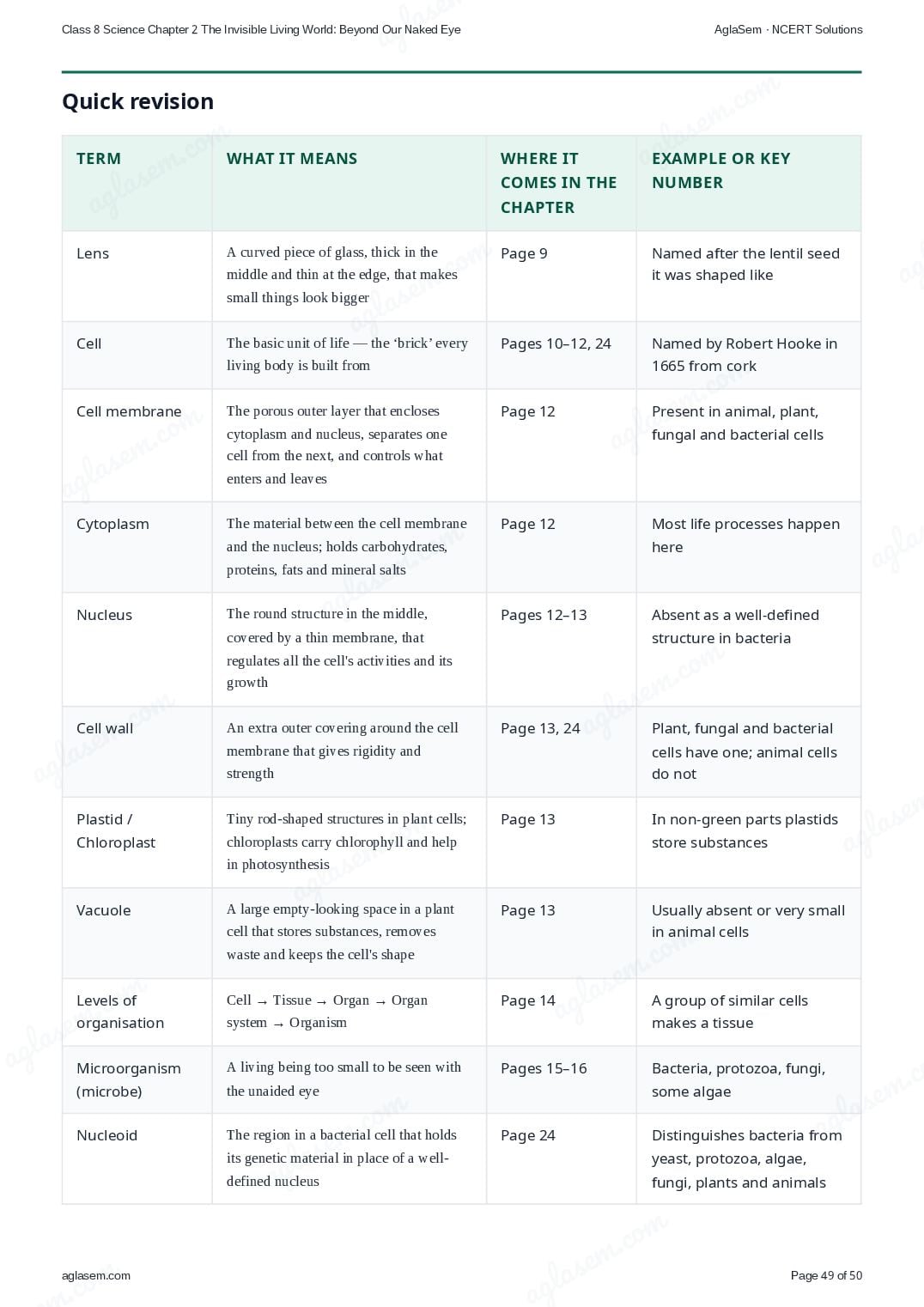
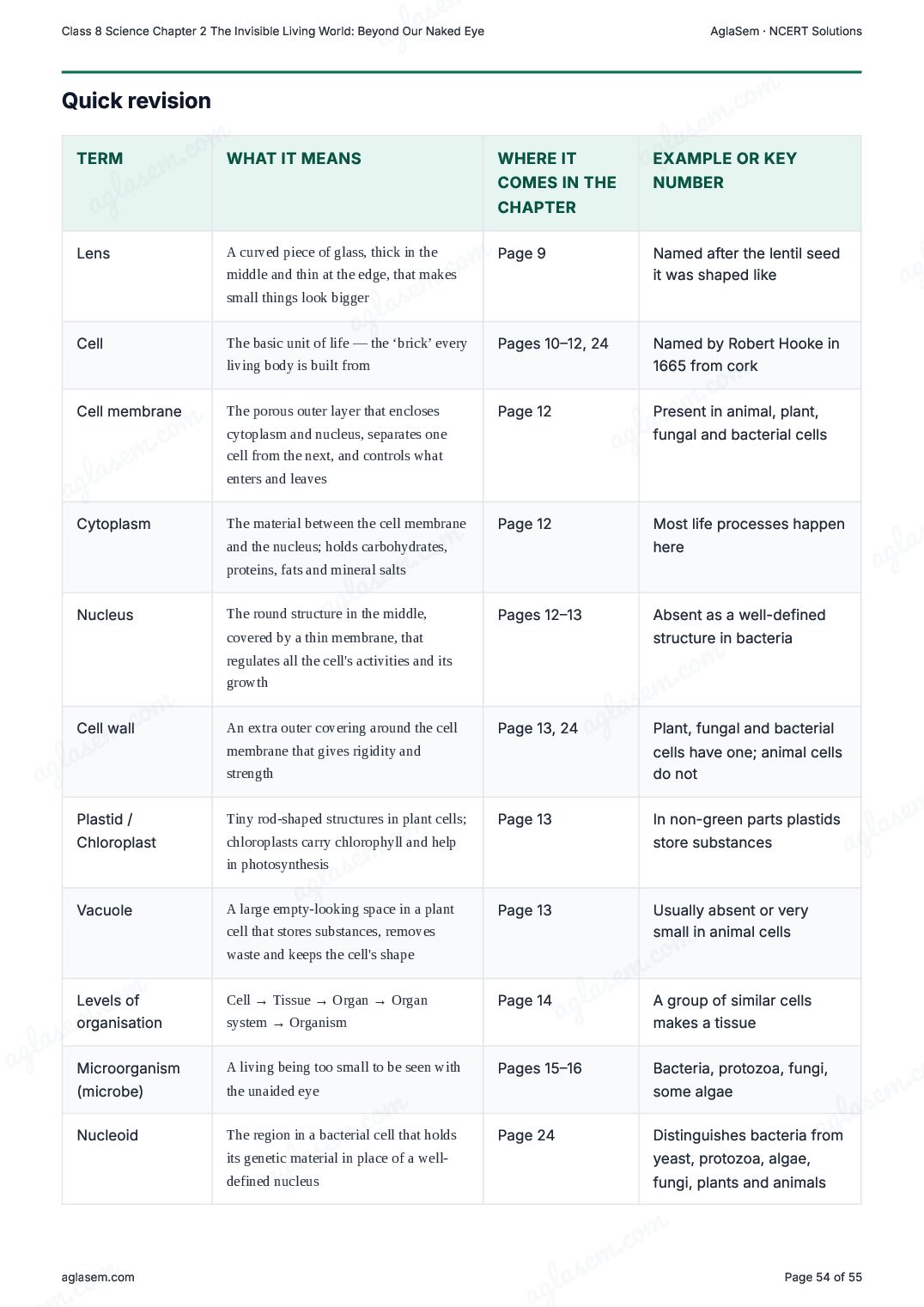
- The eye can only see things above a certain size. A curved piece of glass, thick in the middle and thin at the edge — shaped like a lentil seed, which is why it was named a lens — makes small things look bigger. Better lenses became microscopes , and microscopes opened the hidden living world.
- In 1665 Robert Hooke published Micrographia . His microscope magnified 200 to 300 times . Looking at a thin slice of cork he saw many small empty compartments like a honeycomb, and called each one a cell . Around the 1660s Antonie van Leeuwenhoek made better lenses and was the first to clearly see and describe bacteria and blood cells — the Father of Microbiology .
- Every living body is built of cells. A typical cell has a cell membrane (porous — lets in what life processes need and lets waste out), cytoplasm (where most life processes happen) and a nucleus (regulates all the cell's activities and its growth). Plant cells have an extra cell wall for rigidity, plus plastids (chloroplasts carry chlorophyll) and a large vacuole .
- Shape follows function. Cheek cells are thin and flat and form a protective lining; nerve cells are long and branched so messages travel quickly; muscle cells are thin, flexible and spindle-shaped so they can contract and relax in a wave and push food down the food pipe.
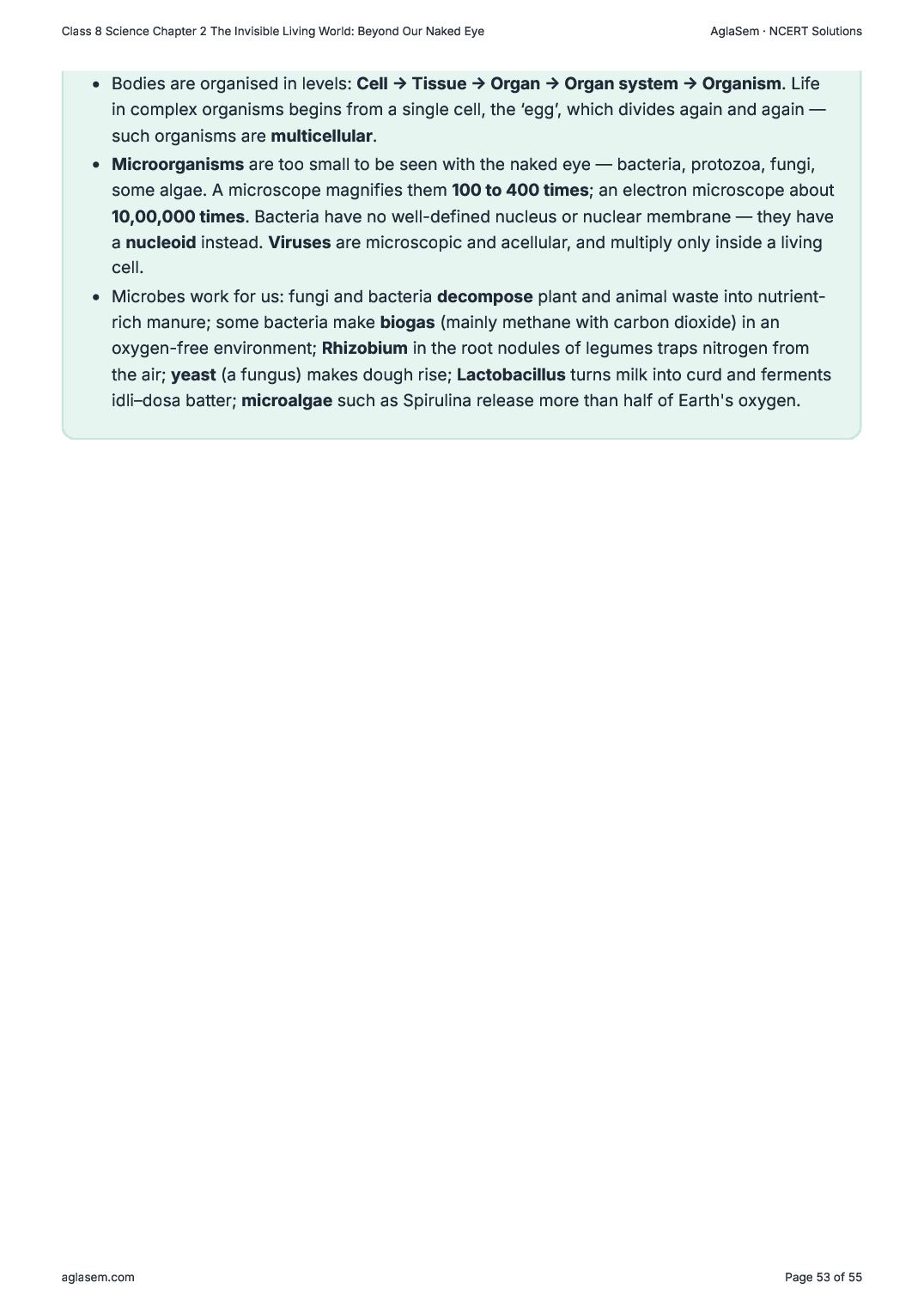
- Bodies are organised in levels: Cell → Tissue → Organ → Organ system → Organism . Life in complex organisms begins from a single cell, the ‘egg’, which divides again and again — such organisms are multicellular .
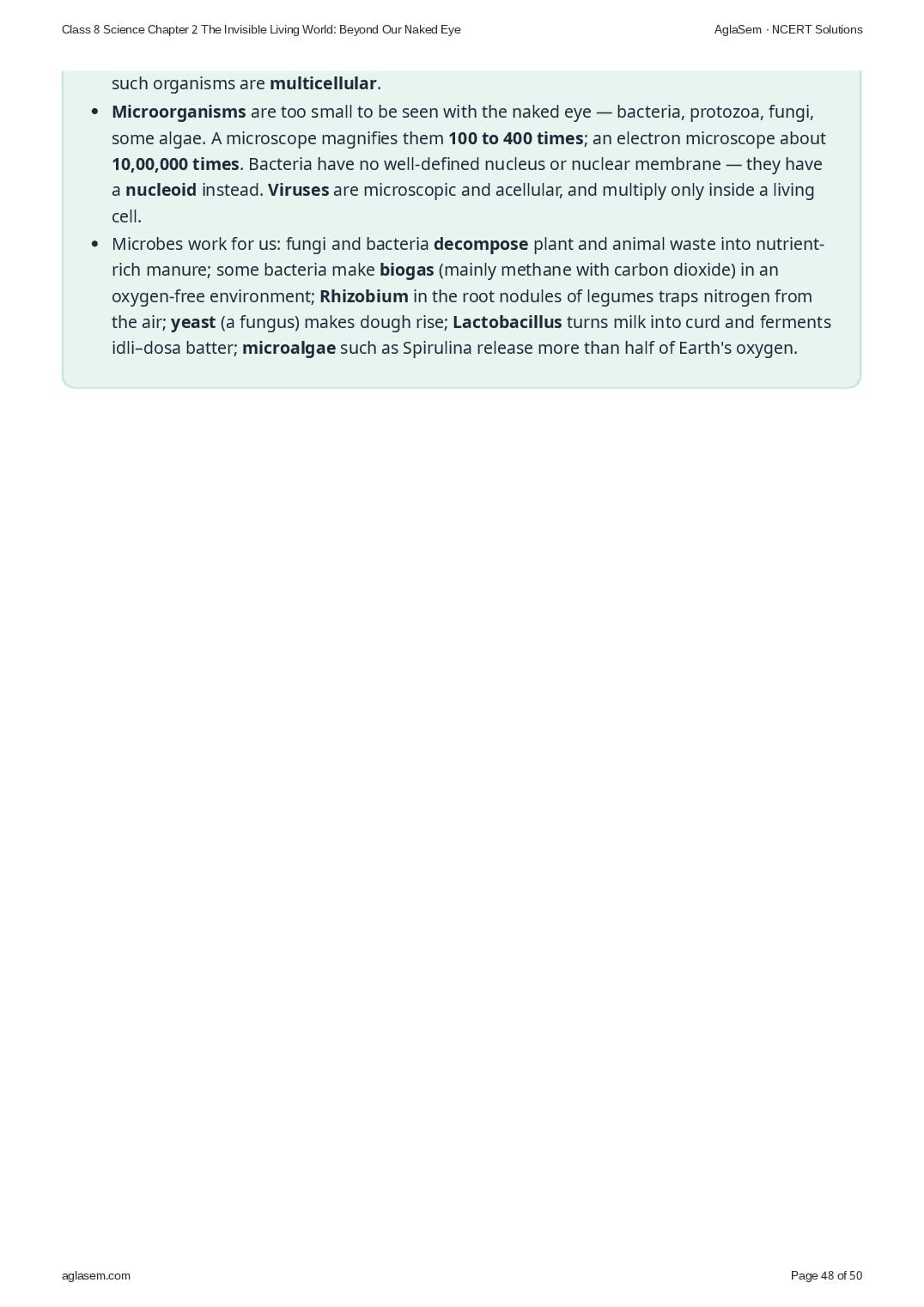
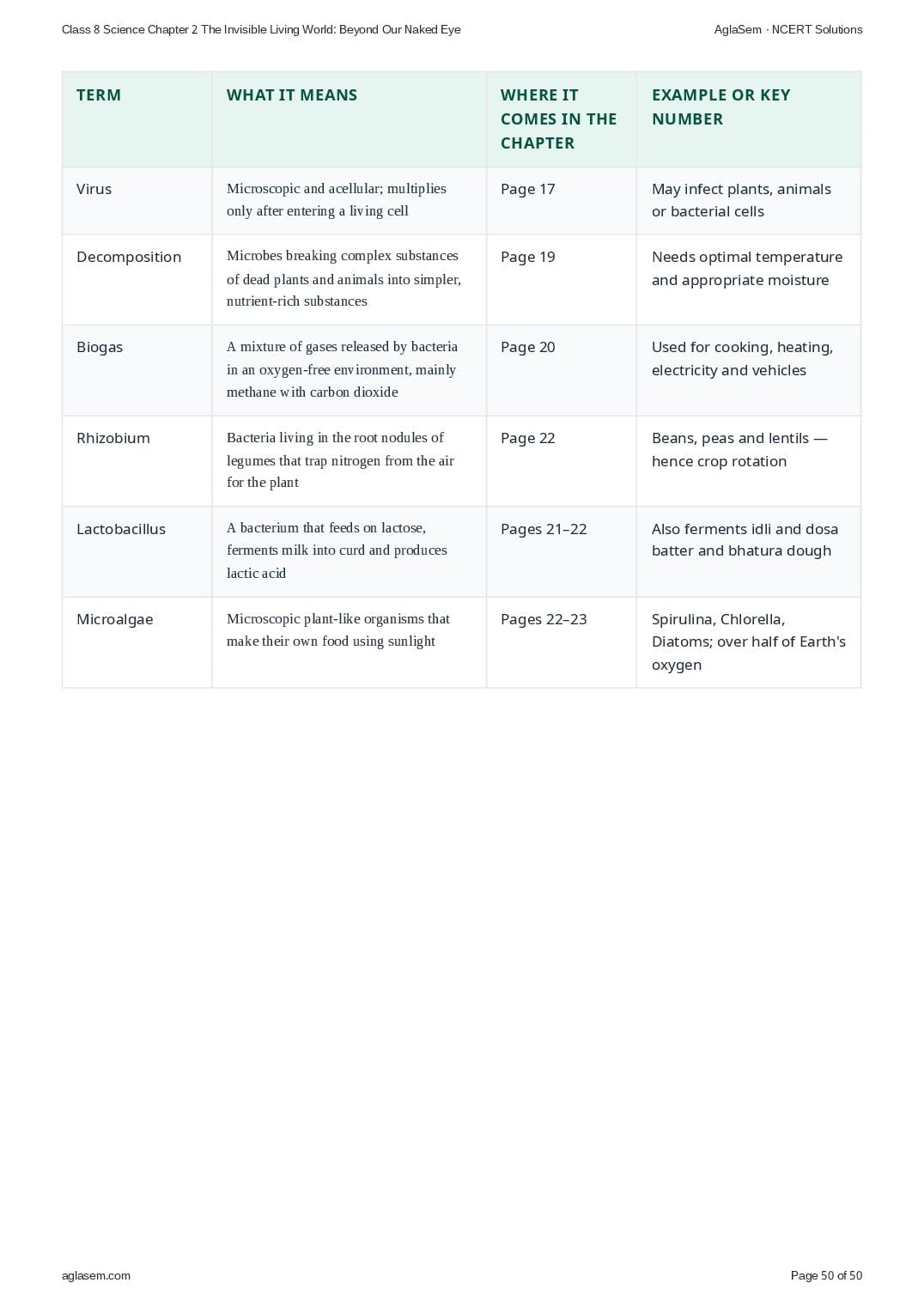
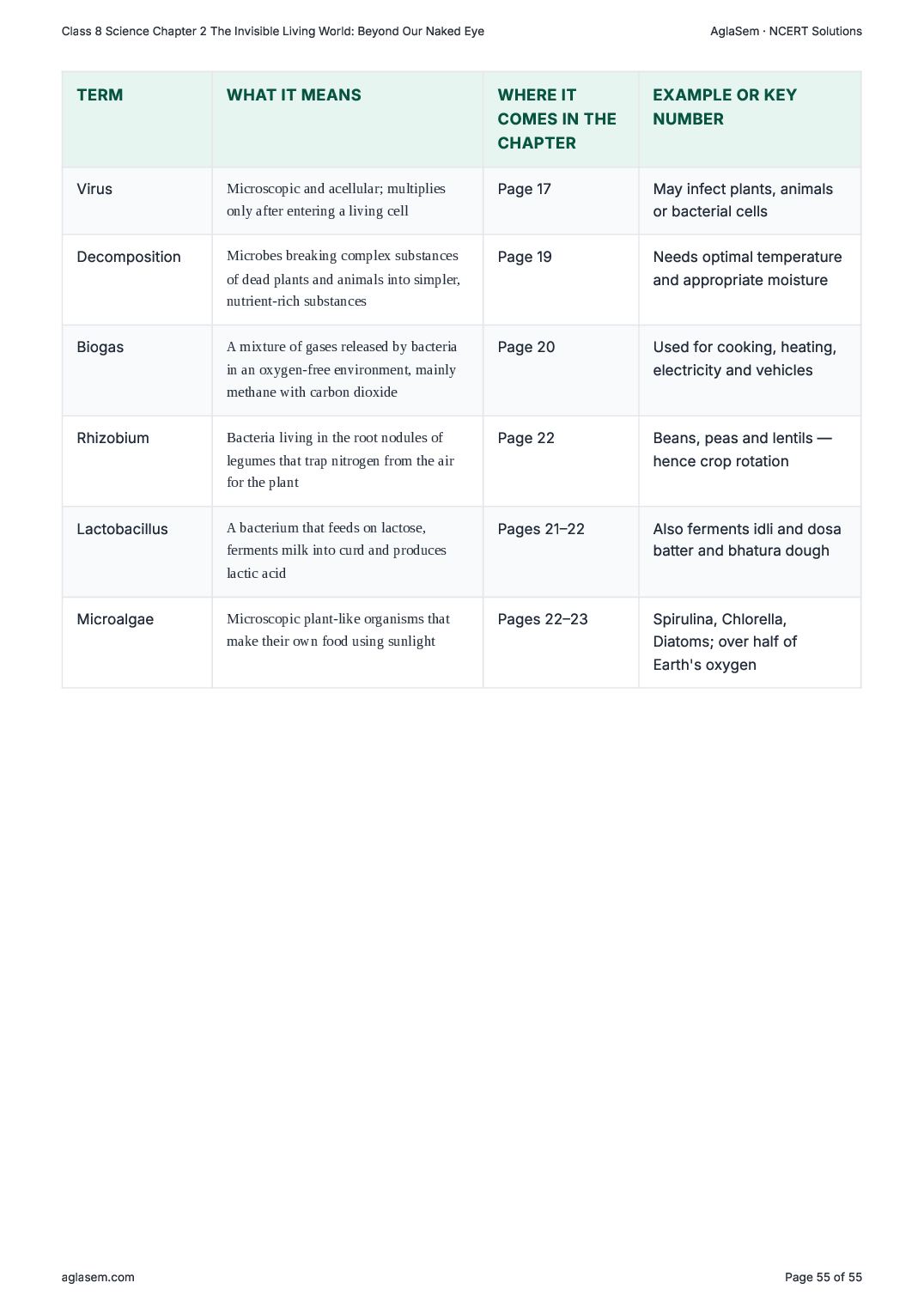
- Microorganisms are too small to be seen with the naked eye — bacteria, protozoa, fungi, some algae. A microscope magnifies them 100 to 400 times ; an electron microscope about 10,00,000 times . Bacteria have no well-defined nucleus or nuclear membrane — they have a nucleoid instead. Viruses are microscopic and acellular, and multiply only inside a living cell.
- Microbes work for us: fungi and bacteria decompose plant and animal waste into nutrient-rich manure; some bacteria make biogas (mainly methane with carbon dioxide) in an oxygen-free environment; Rhizobium in the root nodules of legumes traps nitrogen from the air; yeast (a fungus) makes dough rise; Lactobacillus turns milk into curd and ferments idli–dosa batter; microalgae such as Spirulina release more than half of Earth's oxygen.
How to Download NCERT Solutions for Class 8 Science Chapter 2 PDF
Follow these simple steps to get the The Invisible Living World Beyond Our Naked Eye questions-and-answers PDF from Curiosity.
- Search NCERT Solutions for Class 8 Science Chapter 2 aglasem and open this page.
- Read the exercise questions with answers for The Invisible Living World Beyond Our Naked Eye shown above.
- Click the Download PDF link to save the The Invisible Living World Beyond Our Naked Eye solutions to your device.
NCERT Solutions for Class 8 Science – All Chapters
There are more chapters to study besides The Invisible Living World Beyond Our Naked Eye in Science. Here are the NCERT Solutions for all chapters of Class 8 Science.
- Chapter 1 Exploring the Investigative World of Science
- Chapter 2 The Invisible Living World Beyond Our Naked Eye
- Chapter 3 Health the Ultimate Treasure
- Chapter 4 Electricity Magnetic and Heating Effects
- Chapter 5 Exploring Forces
- Chapter 6 Pressure Winds Storms and Cyclones
- Chapter 7 Particulate Nature of Matter
- Chapter 8 Nature of Matter Elements Compounds and Mixtures
- Chapter 9 The Amazing World of Solutes Solvents and Solutions
- Chapter 10 Light Mirrors and Lenses
- Chapter 11 Keeping Time with the Skies
- Chapter 12 How Nature Works in Harmony
- Chapter 13 Our Home Earth a Unique Life Sustaining Planet
NCERT Solutions for Class 8 – All Subjects
Just like Chapter 2 of Science, you can get the exercise questions with answers for every other subject of Class 8. Here are the NCERT Solutions for all subjects of Class 8.
NCERT Solutions for Class 8 Science Chapter 2 – An Overview
The key highlights of this study material are as follows.
| Aspects | Details |
|---|---|
| Class | Class 8 |
| Subject | Science |
| Chapter Number | Chapter 2 |
| Chapter Name | The Invisible Living World Beyond Our Naked Eye |
| Book Name | Curiosity |
| Book By | NCERT (National Council of Educational Research and Training) |
| Educational Resource Here | NCERT Solutions of Class 8 Science Chapter 2 for all exercises |
| More Questions Answers of This Subject | NCERT Solutions for Class 8 Science |
| Download Book Chapter | NCERT Book Class 8 Science |
| All Questions Answers For This Class | NCERT Solutions for Class 8 |
| Complete Solutions | NCERT Solutions |
NCERT Solutions for Class 8 Science Chapter 2 The Invisible Living World Beyond Our Naked Eye – FAQs
What are the NCERT Solutions for Class 8 Science Chapter 2 The Invisible Living World Beyond Our Naked Eye?
They are the complete, step-by-step answers to all the exercise and in-text questions of Chapter 2 The Invisible Living World Beyond Our Naked Eye from the NCERT Class 8 Science textbook Curiosity, written by experts as per the latest NCERT syllabus.
How can I download the Class 8 Science Chapter 2 solutions PDF for free?
Open this page on aglasem, read the The Invisible Living World Beyond Our Naked Eye questions with answers, and click the “Download Solutions PDF” link. The Class 8 Science Chapter 2 NCERT Solutions PDF is completely free to download.
Are these NCERT Solutions as per the latest 2026-27 syllabus?
Yes. The NCERT Solutions for Class 8 Science Chapter 2 are based on the latest NCERT textbook Curiosity and the current 2026-27 CBSE syllabus, so the questions and answers match what you study in class.
Where can I get NCERT Solutions for the other chapters of Class 8 Science?
You can find the answers to every chapter on the NCERT Solutions for Class 8 Science page, and solutions for every subject on the NCERT Solutions for Class 8 page.
How do NCERT Solutions help in exam preparation?
They show the correct method to solve each question, help you write answers the way they are expected in exams, let you check and correct your own work, and save revision time — which together improve your marks in Class 8 Science.
If you have any queries on NCERT Solutions for Class 8 Science Chapter 2 The Invisible Living World Beyond Our Naked Eye, then please ask in the comments below.