NCERT Solutions for Class 8 Science Chapter 11 Keeping Time with the Skies provide clear, step-by-step answers to every exercise and in-text question from the chapter Keeping Time with the Skies of the NCERT textbook Curiosity. Prepared by subject experts as per the latest NCERT (CBSE) syllabus for 2026-27, these NCERT Solutions for Class 8 Science help you understand each concept, write exam-ready answers, and check your own solutions. You can read them online below or download the free Class 8 Science Chapter 11 question-answer PDF.
NCERT Solutions for Class 8 Science Chapter 11 Keeping Time with the Skies
- Class: Class 8
- Subject: Science
- Chapter: Chapter 11 – Keeping Time with the Skies
- Textbook: Curiosity (NCERT)
- Study material: NCERT Solutions – questions with answers, free PDF
These solutions answer all the exercise questions of Chapter 11 Keeping Time with the Skies — including the in-text questions, short-answer and long-answer questions, and activities — with complete explanations so you can follow the method, not just the final answer. Read the full solutions below.
NCERT Solutions Class 8 Science Chapter 11 Keeping Time with the Skies View Download


NCERT Solutions for Class 8 Science Chapter 11 PDF Download
You can read the NCERT Solutions for Class 8 Science Chapter 11 online above, or download the complete question-answer PDF to study Keeping Time with the Skies offline at any time.
NCERT Solutions for Class 8 Science Chapter 11 PDF Download Link – Click Here to Download Solutions PDF
Questions Covered in This Chapter
These NCERT Solutions answer all 37 questions of this chapter. The questions solved are:
- Have you ever seen the Moon during the day? Why do you think it is sometimes visible when the Sun is up?
- Imagine you lived on the Moon instead of Earth. What would you mean by a day, a month or a year?
- What would happen if Earth had two moons instead of one? How would that change the night sky?
- If we didn’t have clocks or calendars, how else could we measure time?
- Analyse the data recorded by you in Table 11.1. Did the Moon appear different each day?
- Was the Moon visible on all days?
- Did the Moon appear at the same position in the sky as on the previous day?
- When you checked the Moon at the same time on successive days (for example, at sunrise), did you see it in a different part of the sky?
- Look in a local newspaper or on the Positional Astronomy Centre (India Meteorological Department) website to find the moonrise time in your area. Check these times for several days in a row and you will see that the Moon rises about 50 minutes later each day.
- Why does the illuminated portion of the Moon seen from the Earth decrease when it appears closer to the Sun?
- Does the portion of the ball facing you appear to be illuminated or not?
- Does the shape of the illuminated portion change?
- Is the line separating the illuminated and non-illuminated portions of the ball curved?
- Was your observation similar to the changing shape of the illuminated portion of ball shown in Fig. 11.4c?
- As can be seen in Fig. 11.5a, on the New Moon day, the Moon appears closest to the Sun and it appears farthest on the Full Moon day. Is this not what we also observed in Activity 11.1?
- But how are these periodic events used for keeping time?
- Find the duration of the solar day by finding a difference in time on two consecutive days as shown in Table 11.2.
- Find the average duration of the day. Is it nearly equal to 24 hours?
- Why do most Indian festivals fall on different dates every year?
- When I look at the night sky in early evening, I see some moving stars. What are they? Is their motion also periodic?
- State whether the following statements are True or False. (i) We can only see that part of the Moon which reflects sunlight towards us. (ii) The shadow of Earth blocks sunlight from reaching the Moon causing phases. (iii) Calendars are based on various astronomical cycles which repeat in a predictable manner. (iv) The Moon can only be seen at night.
- Amol was born on 6th of May on a full Moon day. Does his birthday fall on the full Moon day every year? Explain your answer.
- Name two things that are incorrect in Fig. 11.10.
- Look at the pictures of the Moon in Fig. 11.11, and answer the following questions. (i) Write the correct panel number corresponding to the phases of the Moon shown in the pictures above. [Three days after New Moon; Full Moon; Three days after Full Moon; A week after Full Moon; Day of New Moon] (ii) List the picture labels of the phases of the Moon that are never seen from Earth. Hint: You can use your observations from Activity 11.1 or Fig. 11.2 as reference.
- Malini saw the Moon overhead in the sky at sunset. (i) Draw the phase of the Moon that Malini saw. (ii) Is the Moon in the waxing or the waning phase?
- Ravi said, “I saw a crescent Moon, and it was rising in the East, when the Sun was setting.” Kaushalya said, “Once I saw the gibbous Moon during the afternoon in the East.” Who out of the two is telling the truth?
- Scientific studies show that the Moon is getting farther away from the Earth and slower in its revolution. Will luni-solar calendars need an intercalary month more often or less often?
- A total of 37 full Moons happen during 3 years in a solar calendar. Show that at least two of the 37 full moons must happen during the same month of the solar calendar.
- On a particular night, Vaishali saw the Moon in the sky from sunset to sunrise. What phase of the Moon would she have noticed?
- If we stopped having leap years, in approximately how many years would the Indian Independence day happen in winter?
- What is the purpose of launching artificial satellites?
- On which periodic phenomenon are the following measures of time based: (i) day (ii) month (iii) year?
- The Moon’s crescent always faces towards the Sun (Fig. 11.12). On days when you see the crescent Moon, point your finger towards the Sun, and slowly move it across the sky towards the Moon taking as short a path as you can. Note how your finger always crosses the illuminated part of the Moon first and clearly shows us that we see sunlight reflected off the Moon. The line joining the tips of the crescent would correspond to the diameter of the Moon.
- Most of the dates in the Indian National Calendar always map to the same dates in the Gregorian calendar. Can you find out which ones may differ for certain years?
- Different states in India celebrate the New Year according to their local cultures. Find out the names of the New Year festival celebrated in any 10 states of India. Also find out whether it is based on the lunar calendar or the solar calendar or the luni-solar calendar.
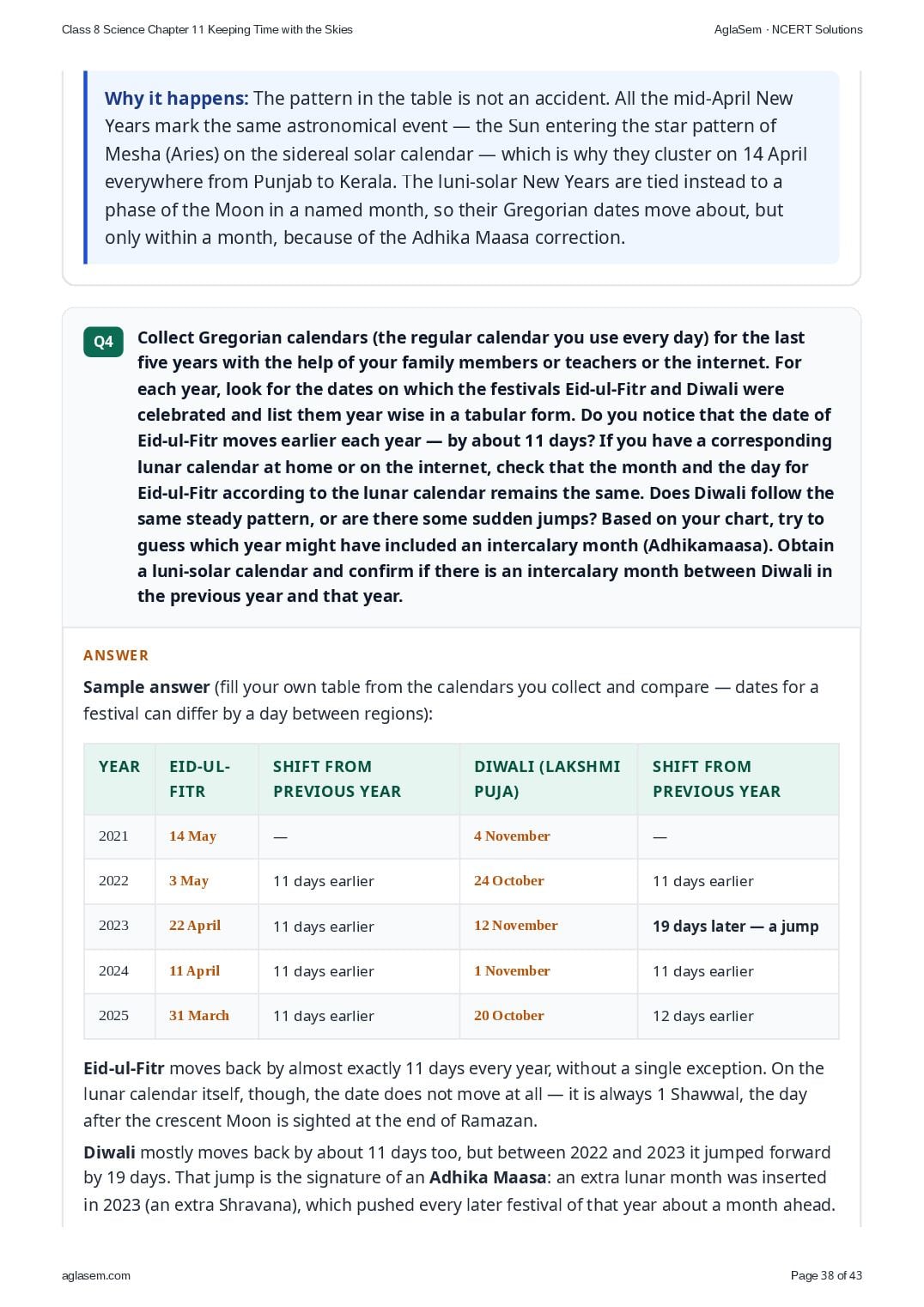
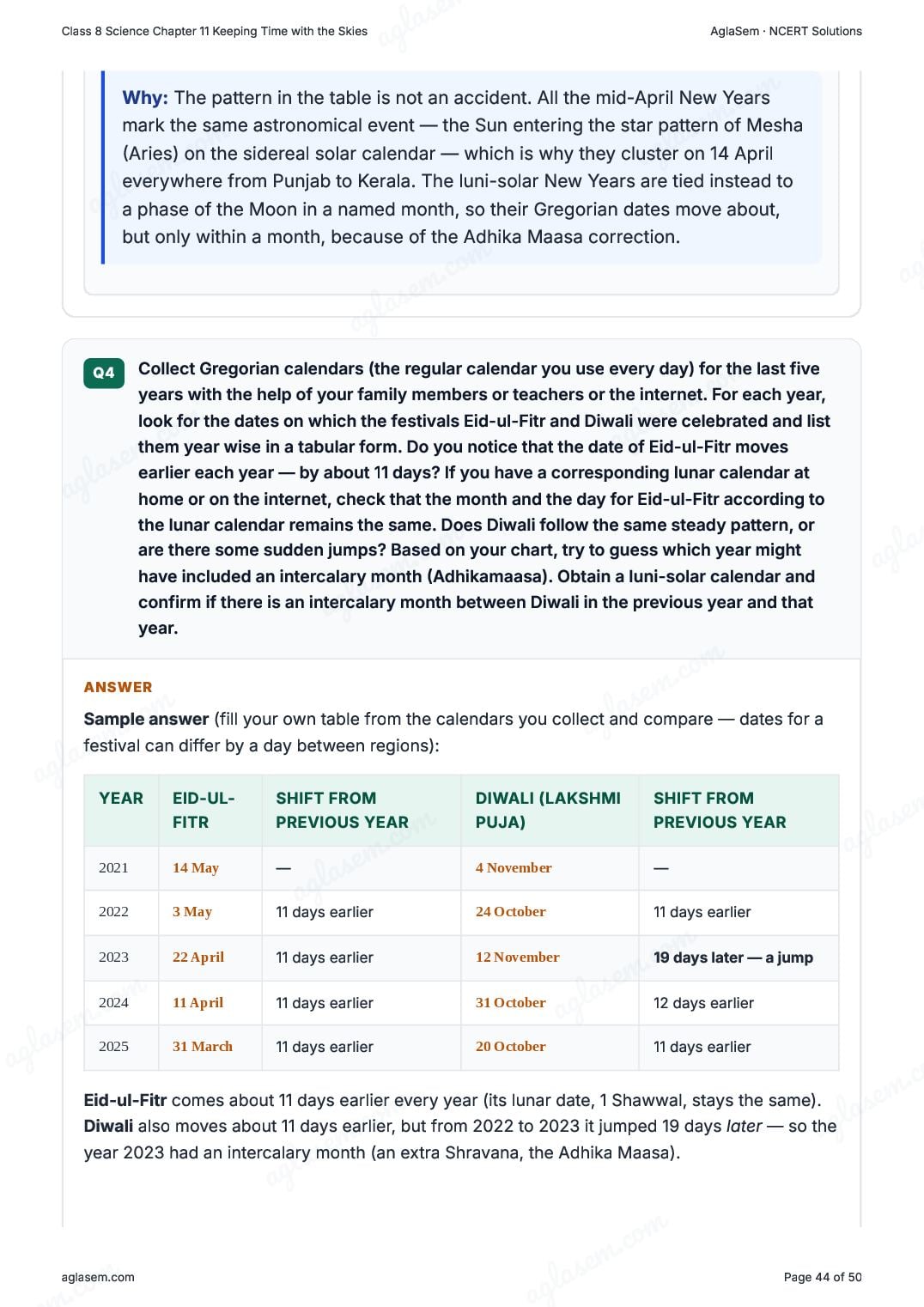
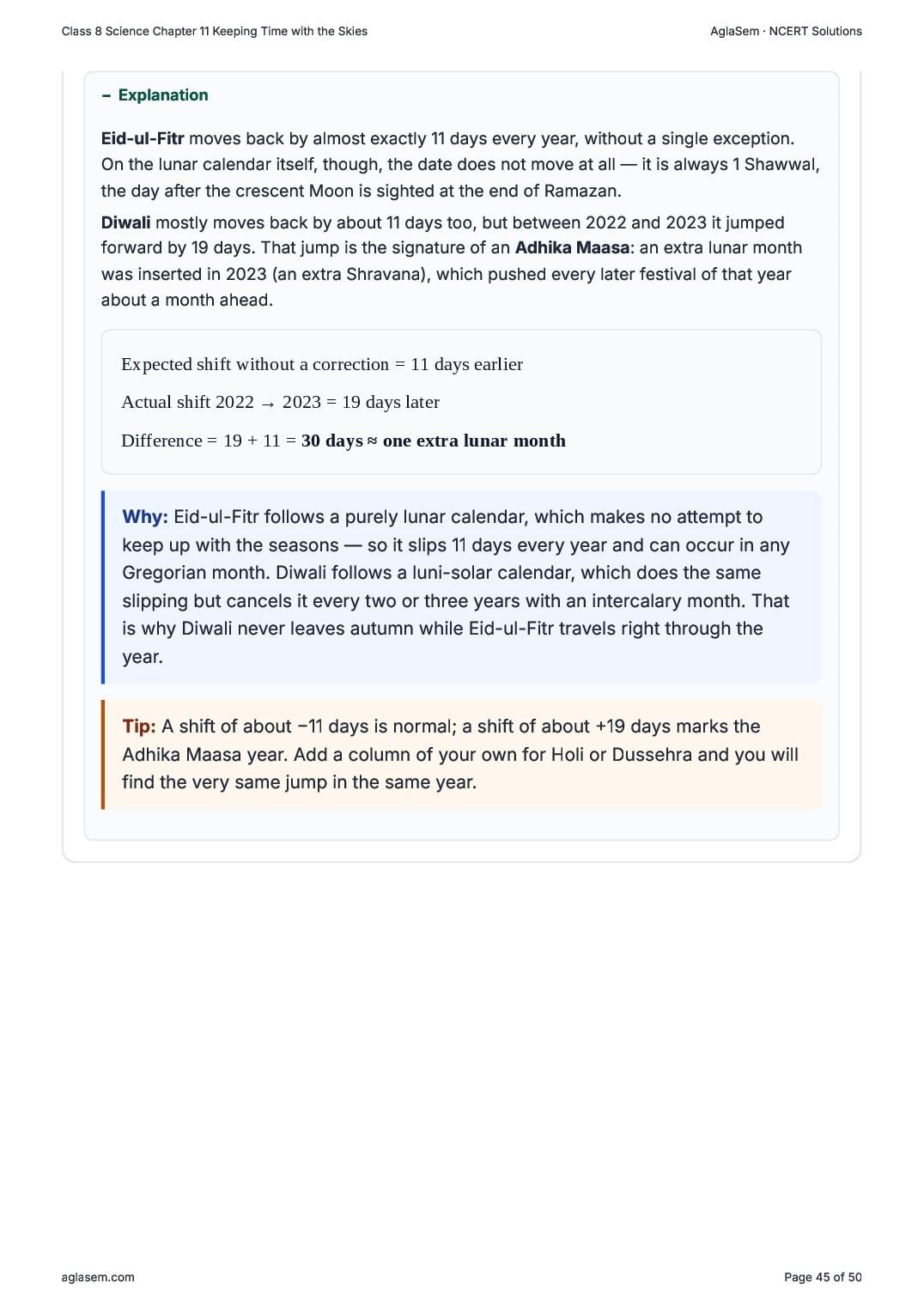
- Collect Gregorian calendars (the regular calendar you use every day) for the last five years with the help of your family members or teachers or the internet. For each year, look for the dates on which the festivals Eid-ul-Fitr and Diwali were celebrated and list them year wise in a tabular form. Do you notice that the date of Eid-ul-Fitr moves earlier each year — by about 11 days? If you have a corresponding lunar calendar at home or on the internet, check that the month and the day for Eid-ul-Fitr according to the lunar calendar remains the same. Does Diwali follow the same steady pattern, or are there some sudden jumps? Based on your chart, try to guess which year might have included an intercalary month (Adhikamaasa). Obtain a luni-solar calendar and confirm if there is an intercalary month between Diwali in the previous year and that year.
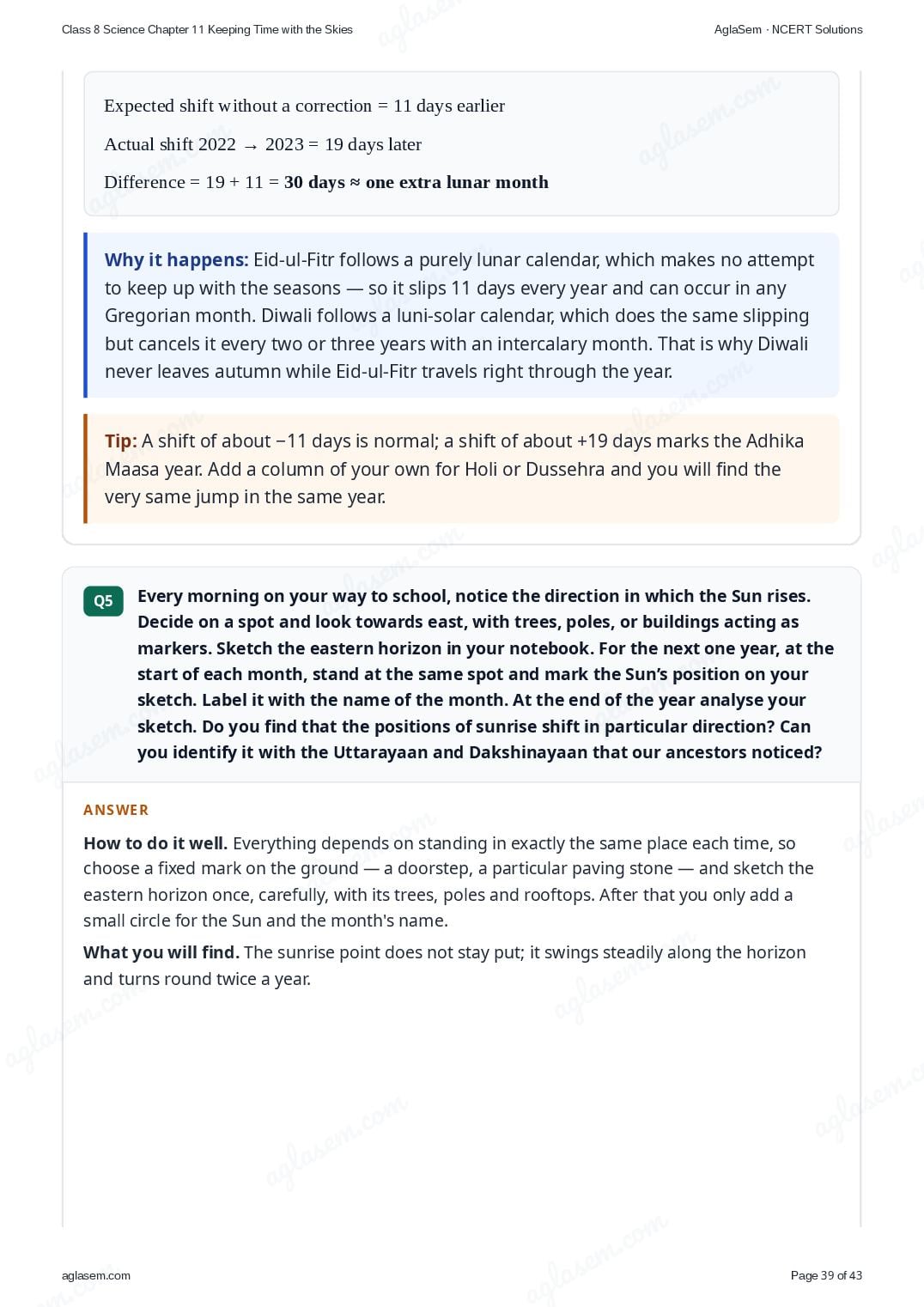
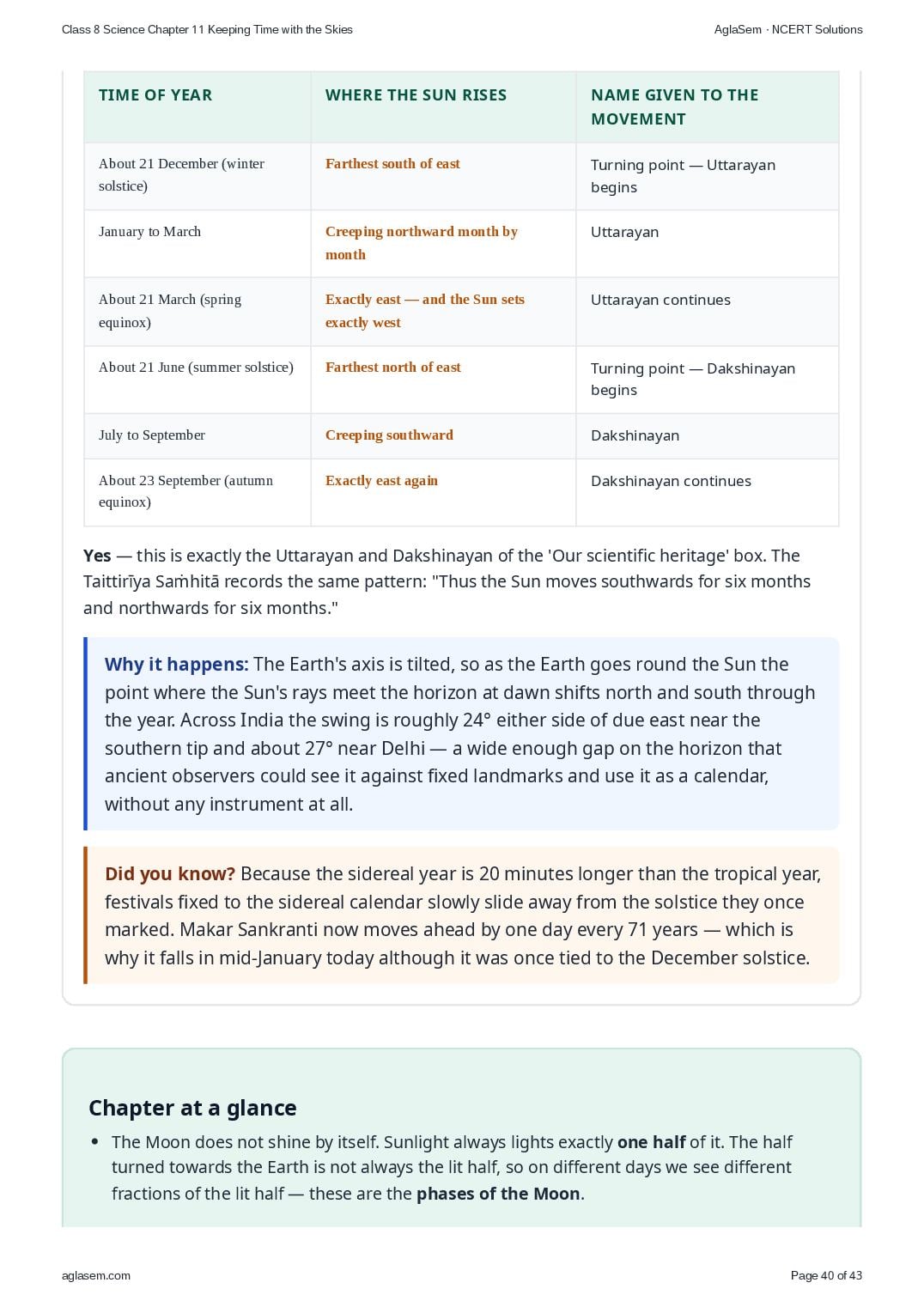
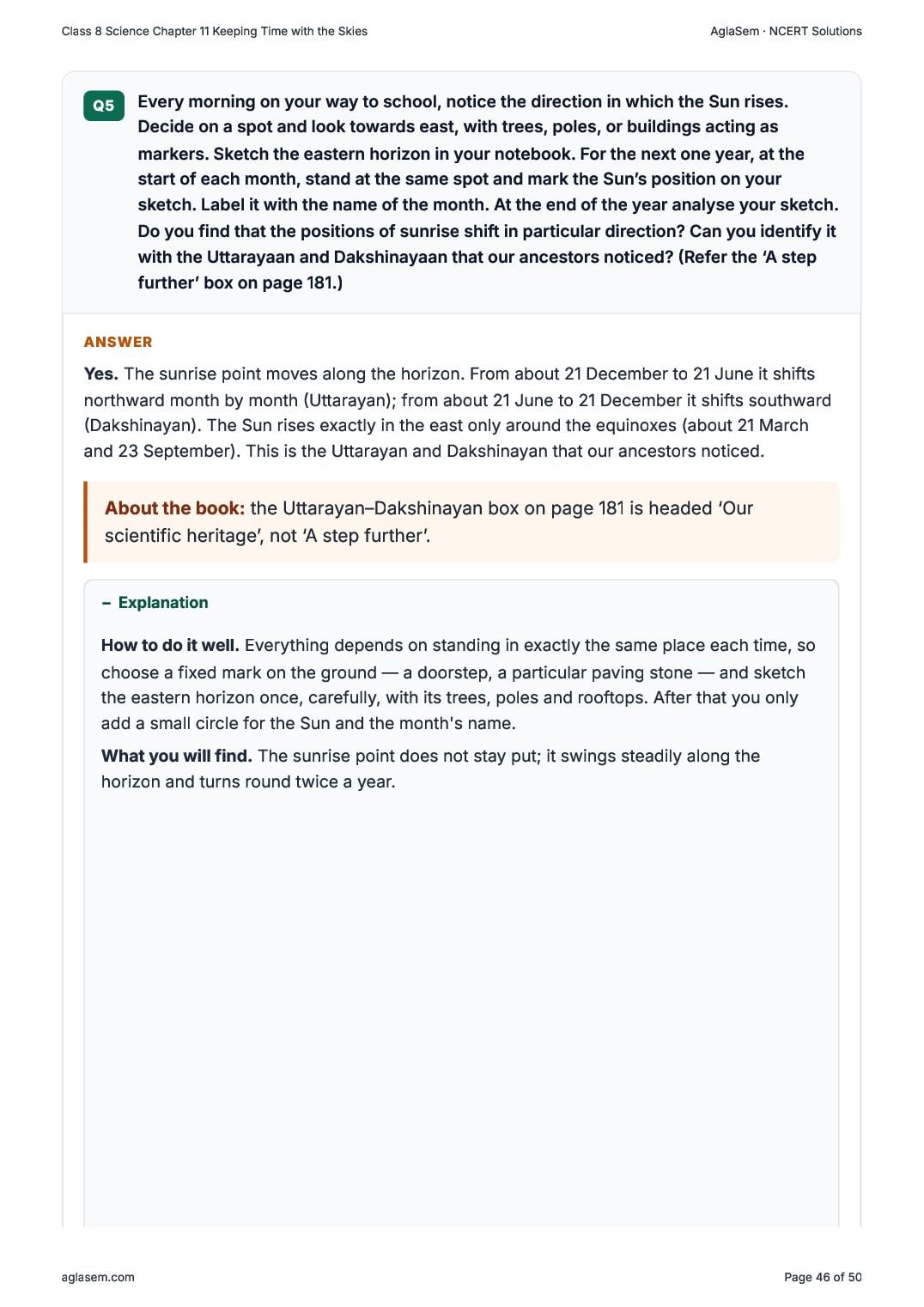
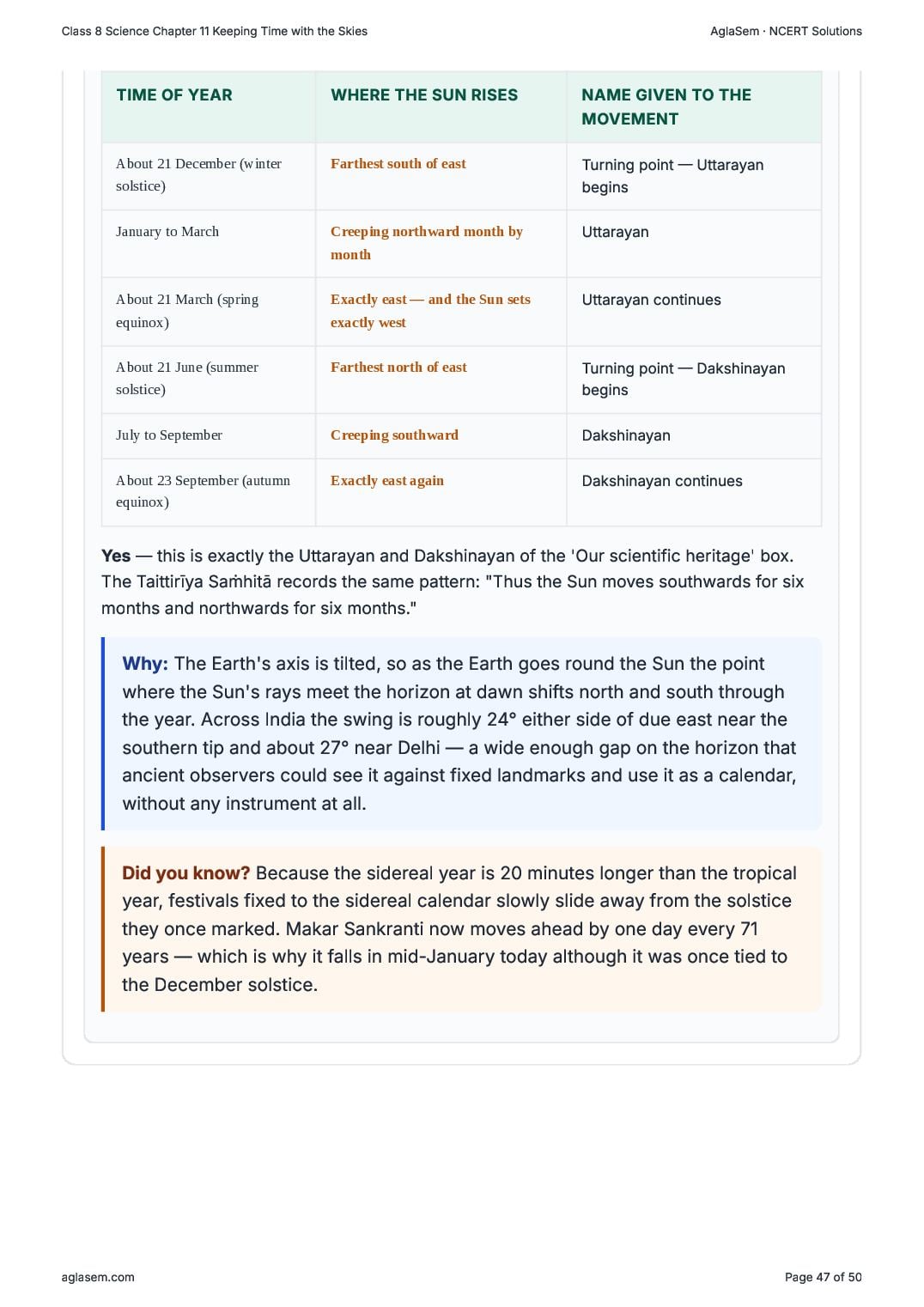
- Every morning on your way to school, notice the direction in which the Sun rises. Decide on a spot and look towards east, with trees, poles, or buildings acting as markers. Sketch the eastern horizon in your notebook. For the next one year, at the start of each month, stand at the same spot and mark the Sun’s position on your sketch. Label it with the name of the month. At the end of the year analyse your sketch. Do you find that the positions of sunrise shift in particular direction? Can you identify it with the Uttarayaan and Dakshinayaan that our ancestors noticed?
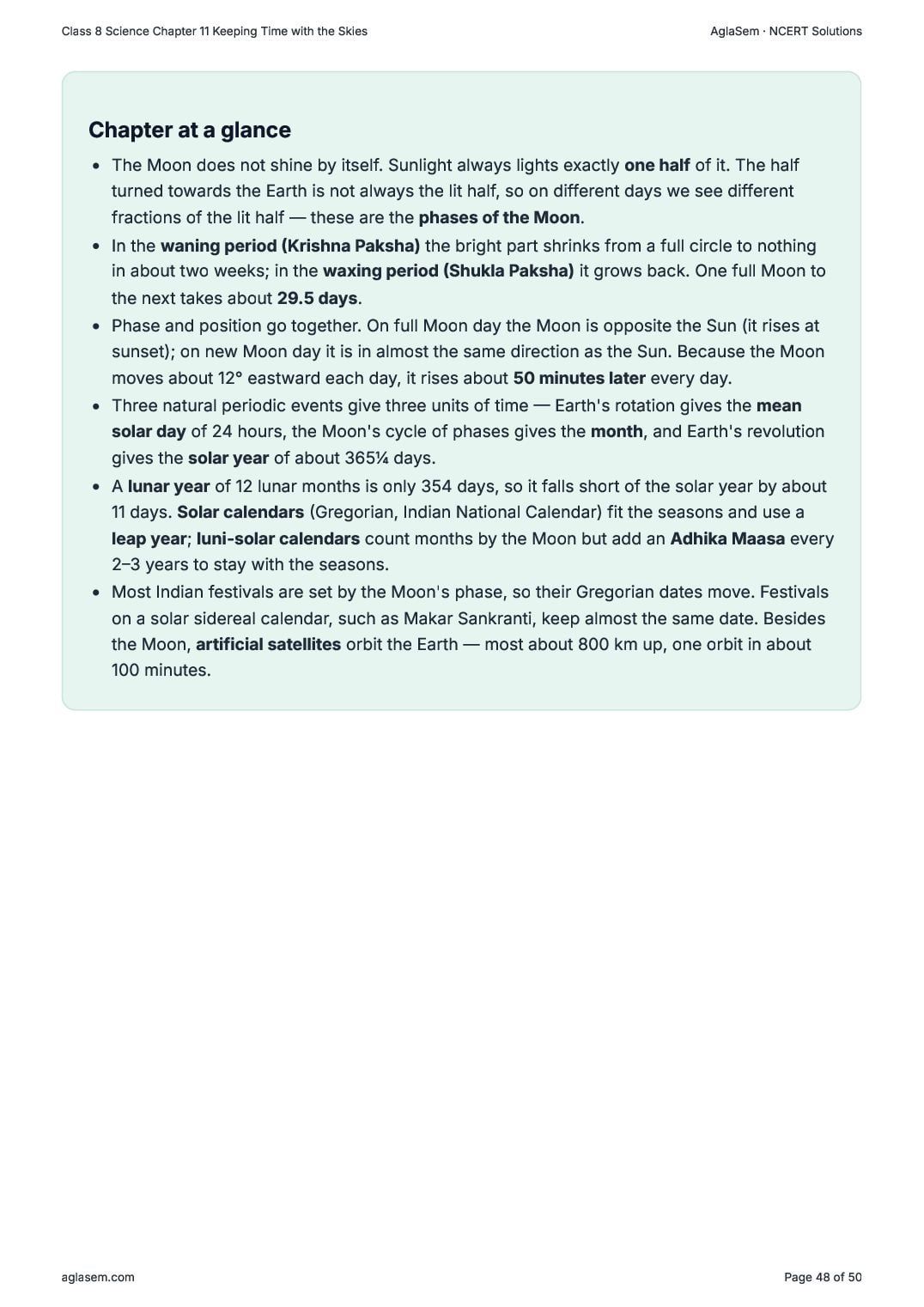
Chapter at a Glance
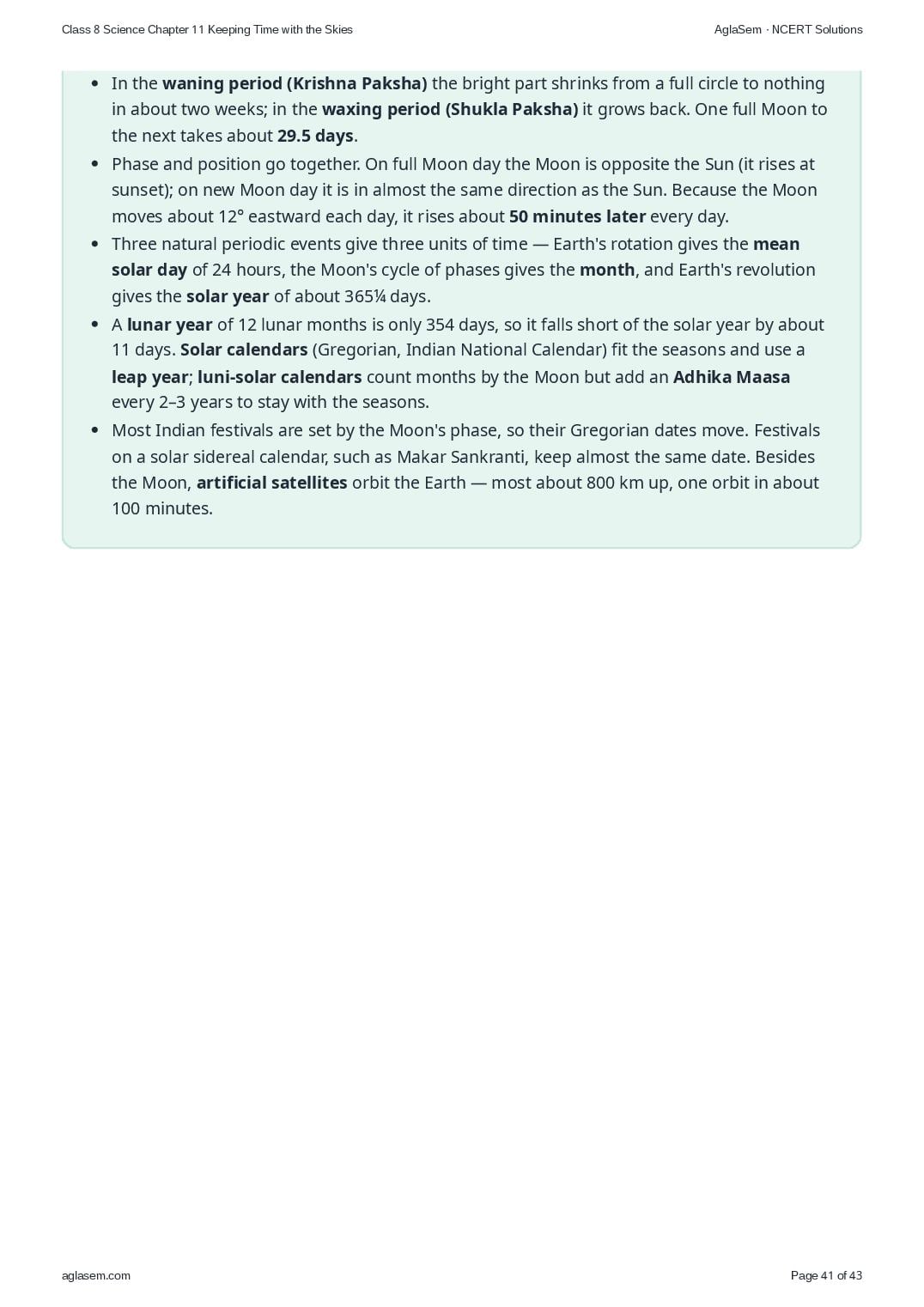
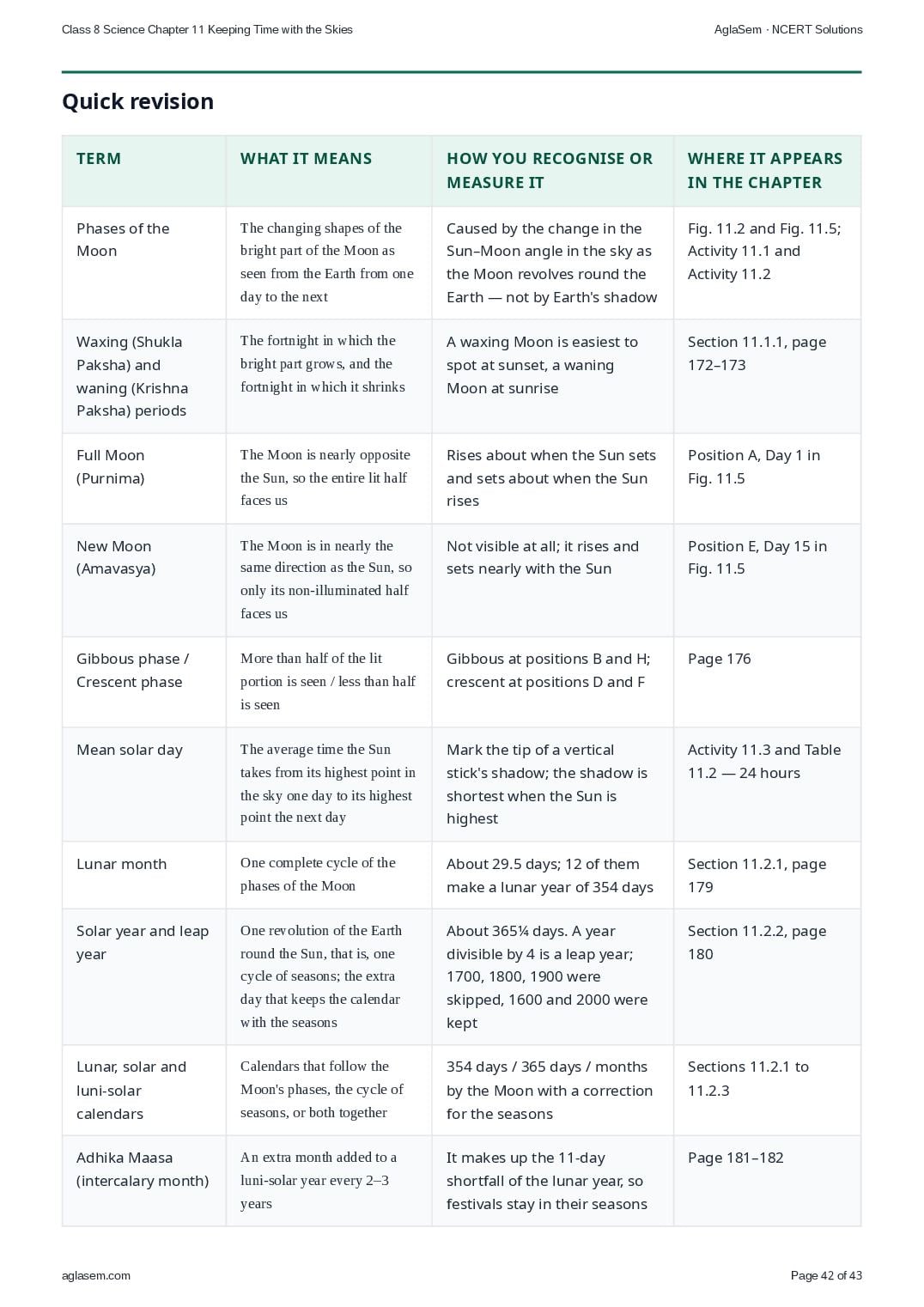
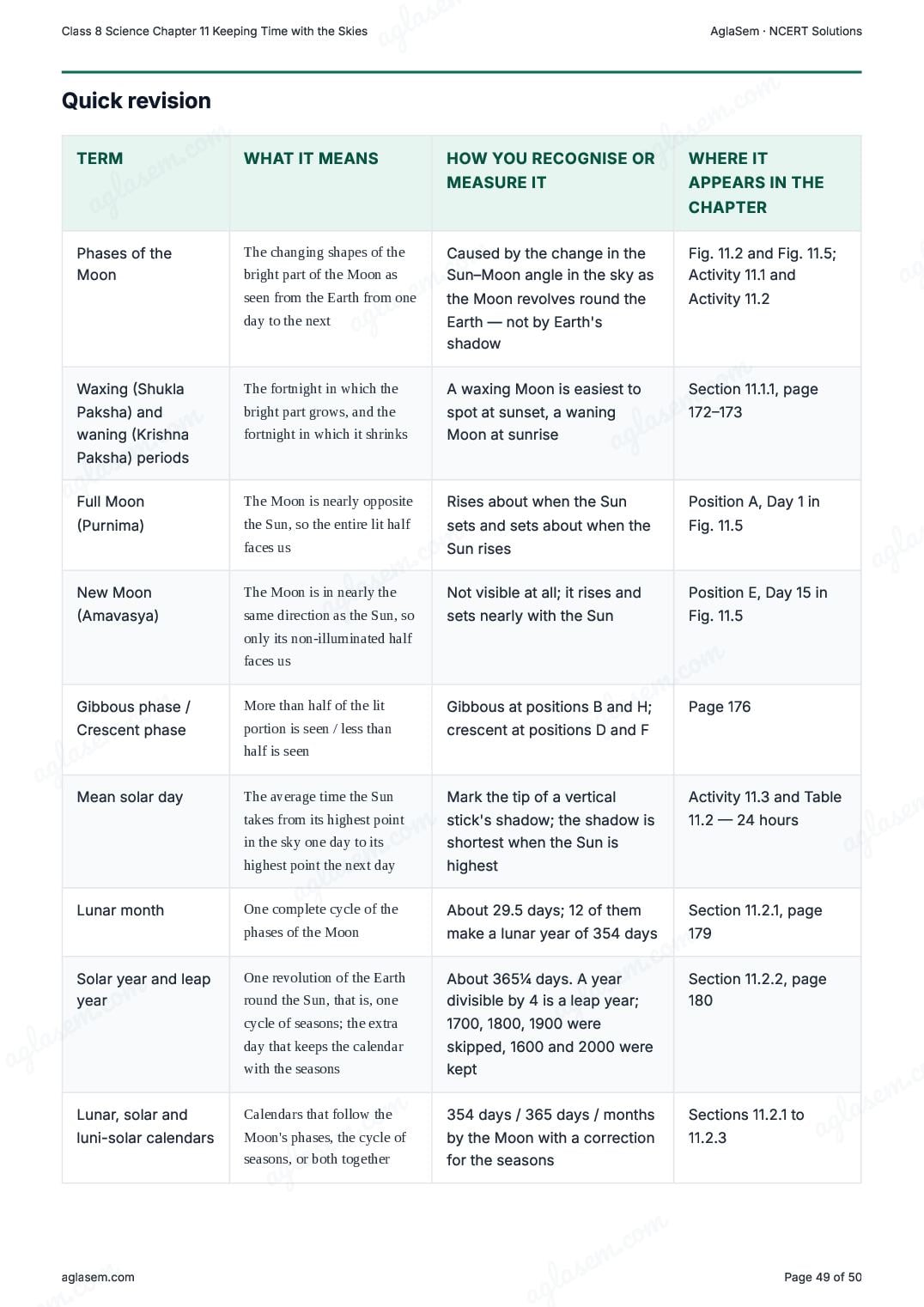
- The Moon does not shine by itself. Sunlight always lights exactly one half of it. The half turned towards the Earth is not always the lit half, so on different days we see different fractions of the lit half — these are the phases of the Moon .
- In the waning period (Krishna Paksha) the bright part shrinks from a full circle to nothing in about two weeks; in the waxing period (Shukla Paksha) it grows back. One full Moon to the next takes about 29.5 days .
- Phase and position go together. On full Moon day the Moon is opposite the Sun (it rises at sunset); on new Moon day it is in almost the same direction as the Sun. Because the Moon moves about 12° eastward each day, it rises about 50 minutes later every day.
- Three natural periodic events give three units of time — Earth's rotation gives the mean solar day of 24 hours, the Moon's cycle of phases gives the month , and Earth's revolution gives the solar year of about 365¼ days.
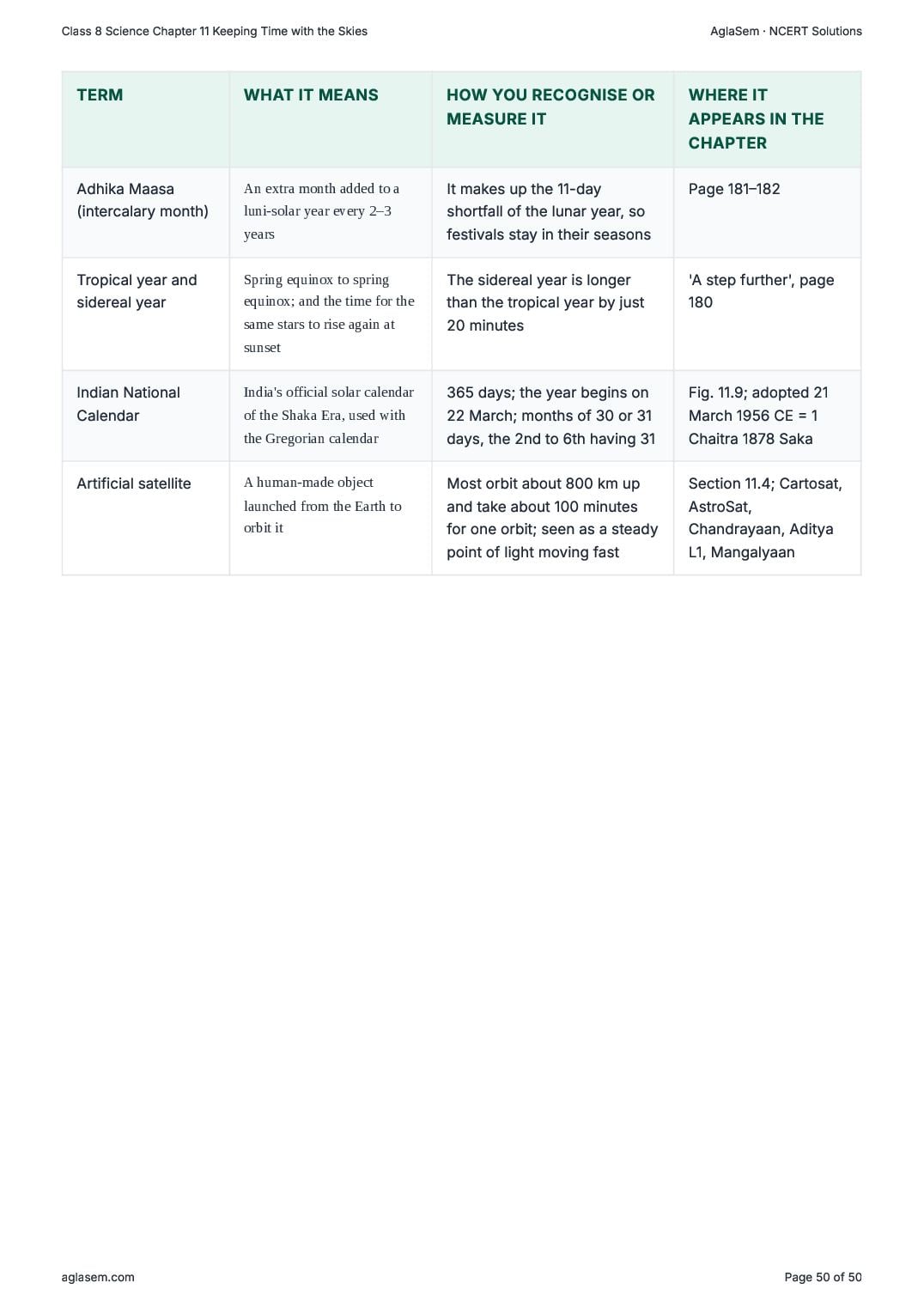
- A lunar year of 12 lunar months is only 354 days, so it falls short of the solar year by about 11 days. Solar calendars (Gregorian, Indian National Calendar) fit the seasons and use a leap year ; luni-solar calendars count months by the Moon but add an Adhika Maasa every 2–3 years to stay with the seasons.
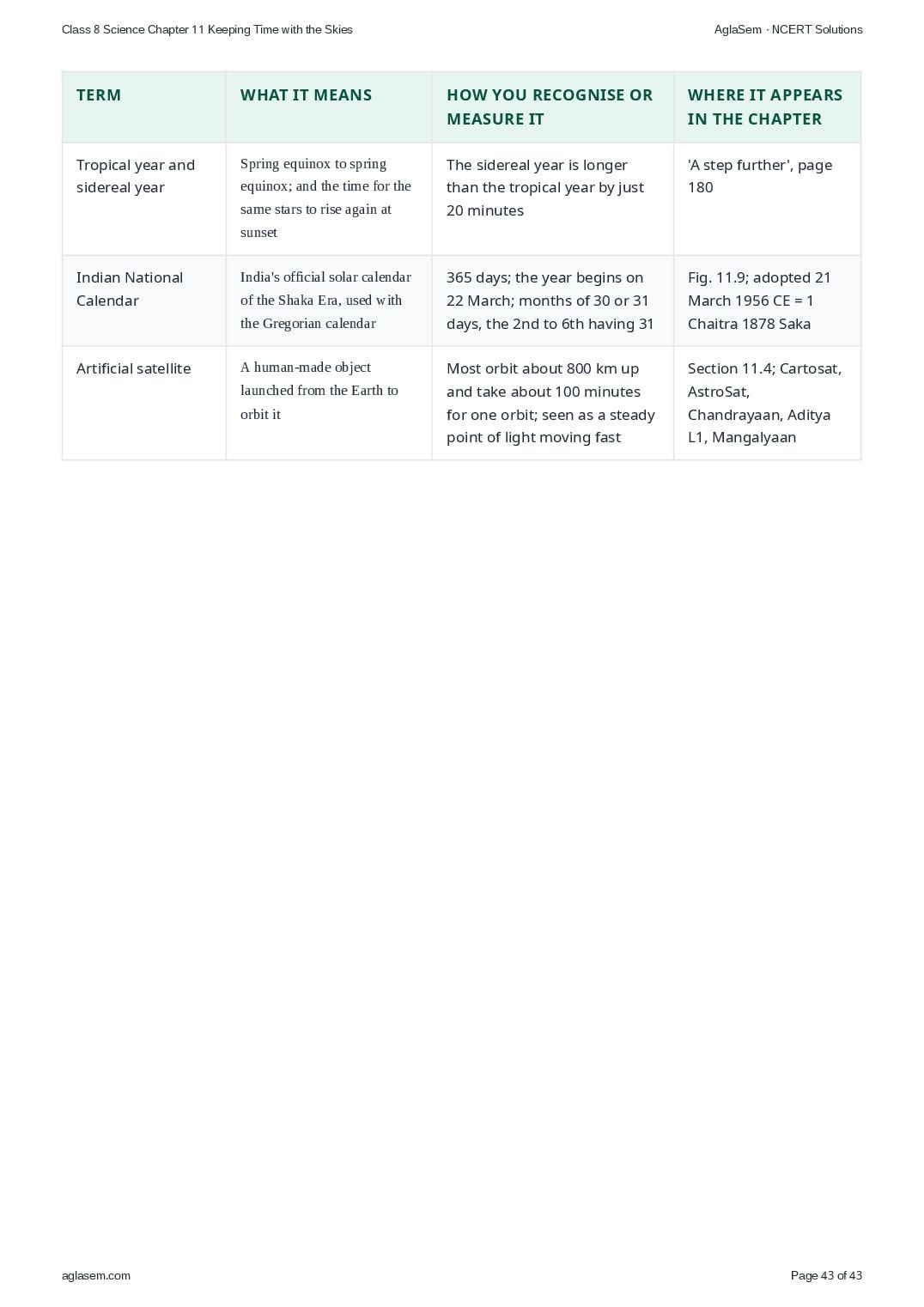
- Most Indian festivals are set by the Moon's phase, so their Gregorian dates move. Festivals on a solar sidereal calendar, such as Makar Sankranti, keep almost the same date. Besides the Moon, artificial satellites orbit the Earth — most about 800 km up, one orbit in about 100 minutes.
How to Download NCERT Solutions for Class 8 Science Chapter 11 PDF
Follow these simple steps to get the Keeping Time with the Skies questions-and-answers PDF from Curiosity.
- Search NCERT Solutions for Class 8 Science Chapter 11 aglasem and open this page.
- Read the exercise questions with answers for Keeping Time with the Skies shown above.
- Click the Download PDF link to save the Keeping Time with the Skies solutions to your device.
NCERT Solutions for Class 8 Science – All Chapters
There are more chapters to study besides Keeping Time with the Skies in Science. Here are the NCERT Solutions for all chapters of Class 8 Science.
- Chapter 1 Exploring the Investigative World of Science
- Chapter 2 The Invisible Living World Beyond Our Naked Eye
- Chapter 3 Health the Ultimate Treasure
- Chapter 4 Electricity Magnetic and Heating Effects
- Chapter 5 Exploring Forces
- Chapter 6 Pressure Winds Storms and Cyclones
- Chapter 7 Particulate Nature of Matter
- Chapter 8 Nature of Matter Elements Compounds and Mixtures
- Chapter 9 The Amazing World of Solutes Solvents and Solutions
- Chapter 10 Light Mirrors and Lenses
- Chapter 11 Keeping Time with the Skies
- Chapter 12 How Nature Works in Harmony
- Chapter 13 Our Home Earth a Unique Life Sustaining Planet
NCERT Solutions for Class 8 – All Subjects
Just like Chapter 11 of Science, you can get the exercise questions with answers for every other subject of Class 8. Here are the NCERT Solutions for all subjects of Class 8.
NCERT Solutions for Class 8 Science Chapter 11 – An Overview
The key highlights of this study material are as follows.
| Aspects | Details |
|---|---|
| Class | Class 8 |
| Subject | Science |
| Chapter Number | Chapter 11 |
| Chapter Name | Keeping Time with the Skies |
| Book Name | Curiosity |
| Book By | NCERT (National Council of Educational Research and Training) |
| Educational Resource Here | NCERT Solutions of Class 8 Science Chapter 11 for all exercises |
| More Questions Answers of This Subject | NCERT Solutions for Class 8 Science |
| Download Book Chapter | NCERT Book Class 8 Science |
| All Questions Answers For This Class | NCERT Solutions for Class 8 |
| Complete Solutions | NCERT Solutions |
NCERT Solutions for Class 8 Science Chapter 11 Keeping Time with the Skies – FAQs
What are the NCERT Solutions for Class 8 Science Chapter 11 Keeping Time with the Skies?
They are the complete, step-by-step answers to all the exercise and in-text questions of Chapter 11 Keeping Time with the Skies from the NCERT Class 8 Science textbook Curiosity, written by experts as per the latest NCERT syllabus.
How can I download the Class 8 Science Chapter 11 solutions PDF for free?
Open this page on aglasem, read the Keeping Time with the Skies questions with answers, and click the “Download Solutions PDF” link. The Class 8 Science Chapter 11 NCERT Solutions PDF is completely free to download.
Are these NCERT Solutions as per the latest 2026-27 syllabus?
Yes. The NCERT Solutions for Class 8 Science Chapter 11 are based on the latest NCERT textbook Curiosity and the current 2026-27 CBSE syllabus, so the questions and answers match what you study in class.
Where can I get NCERT Solutions for the other chapters of Class 8 Science?
You can find the answers to every chapter on the NCERT Solutions for Class 8 Science page, and solutions for every subject on the NCERT Solutions for Class 8 page.
How do NCERT Solutions help in exam preparation?
They show the correct method to solve each question, help you write answers the way they are expected in exams, let you check and correct your own work, and save revision time — which together improve your marks in Class 8 Science.
If you have any queries on NCERT Solutions for Class 8 Science Chapter 11 Keeping Time with the Skies, then please ask in the comments below.