Download Keeping Time with the Skies – NCERT Class 8 Science Chapter 11 PDF from the new NCERT Class 8 Science book Curiosity (2026-27). Read the chapter online or download the free PDF. The Moon does not shine by itself. Sunlight always lights exactly one half of it. The half turned towards the Earth is not always the lit half, so on different days we see different fractions of the lit half — these are the phases of the Moon.
Keeping Time with the Skies PDF – Chapter 11 of Curiosity
Read the chapter online or download the PDF.
| Chapter | Download | |
|---|---|---|
| Chapter 11 PDF | Keeping Time with the Skies | View PDF |
| Full book | NCERT Class 8 Science – Curiosity | View Book |
Read Online
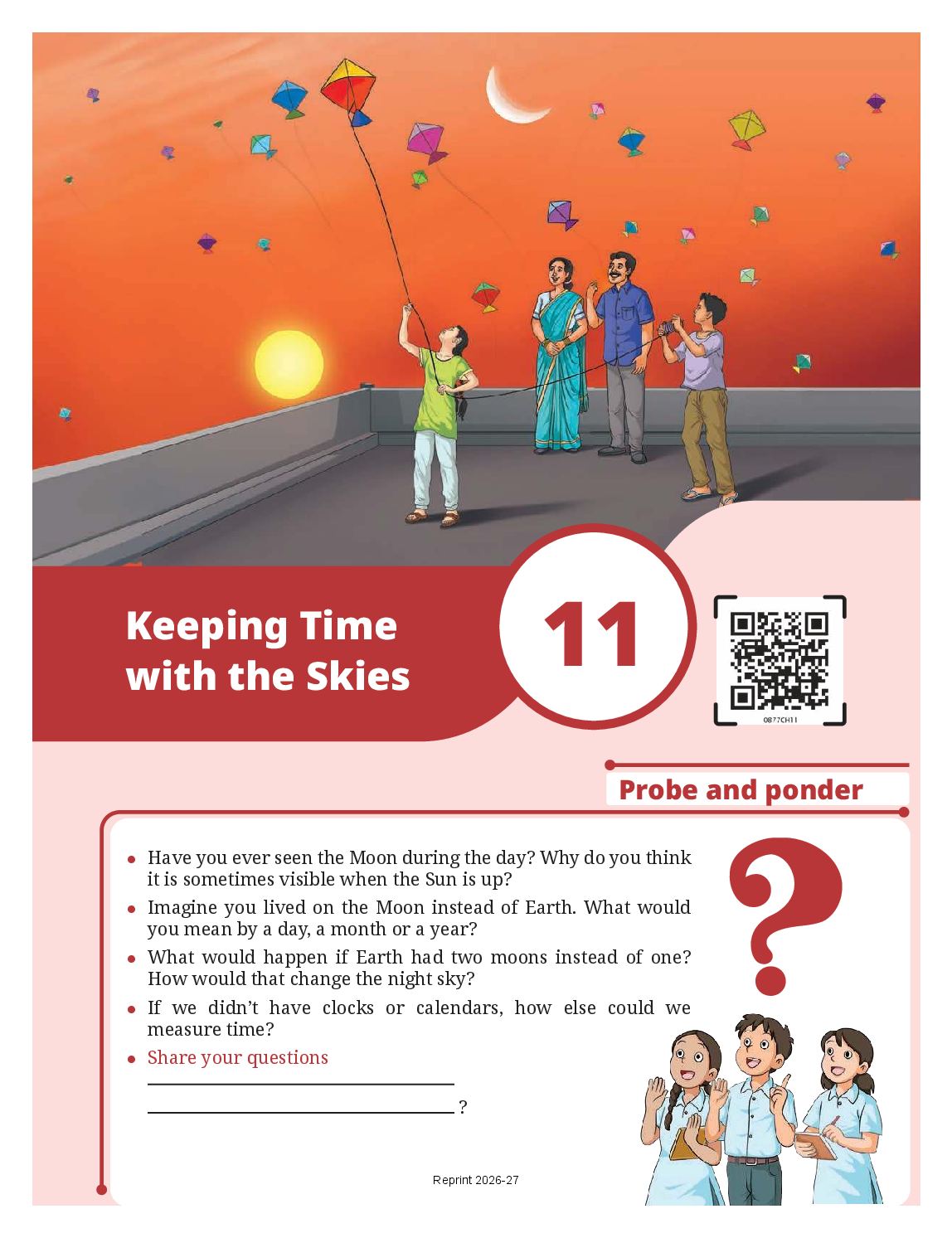
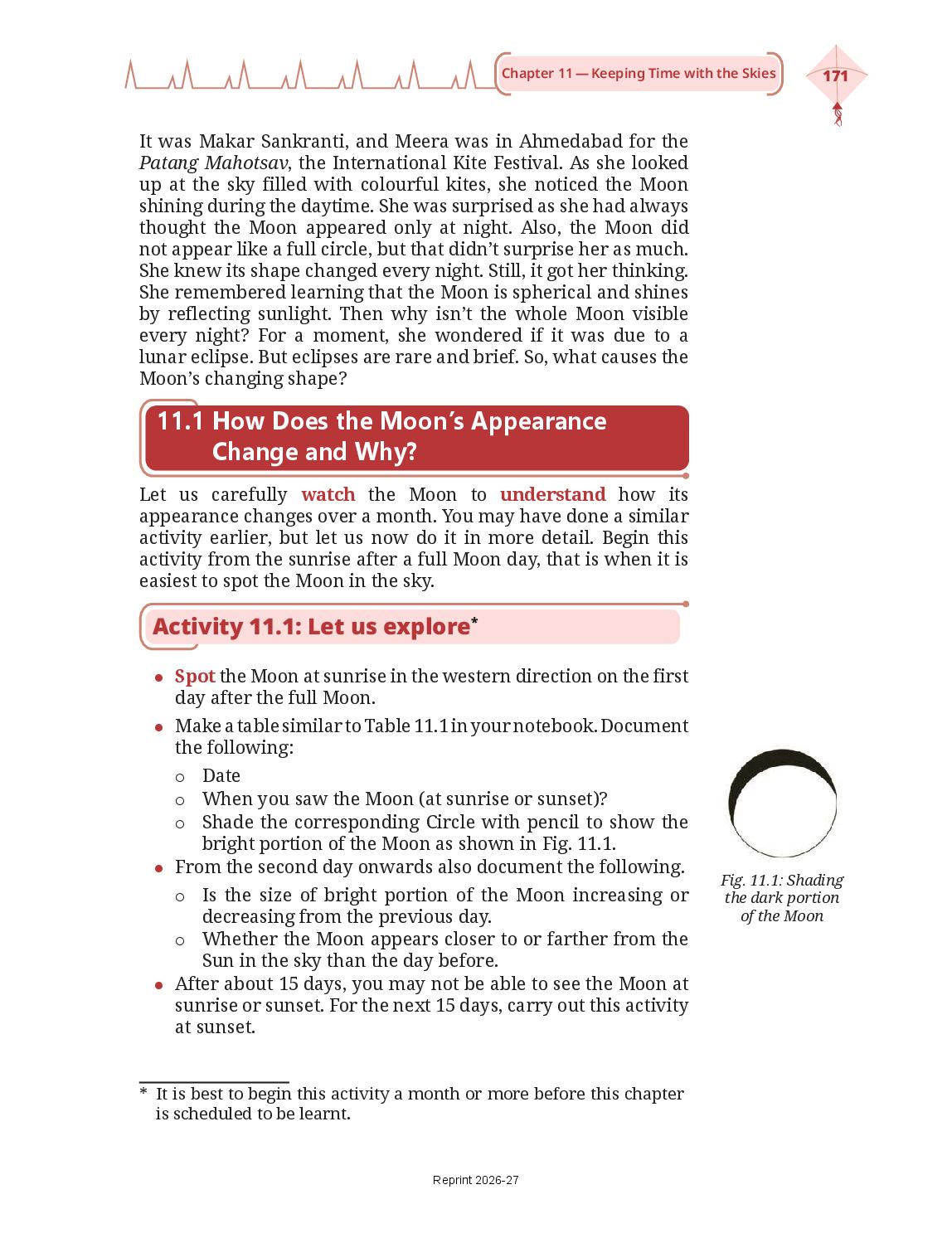
What Is in Keeping Time with the Skies? (Class 8 Science Chapter 11)
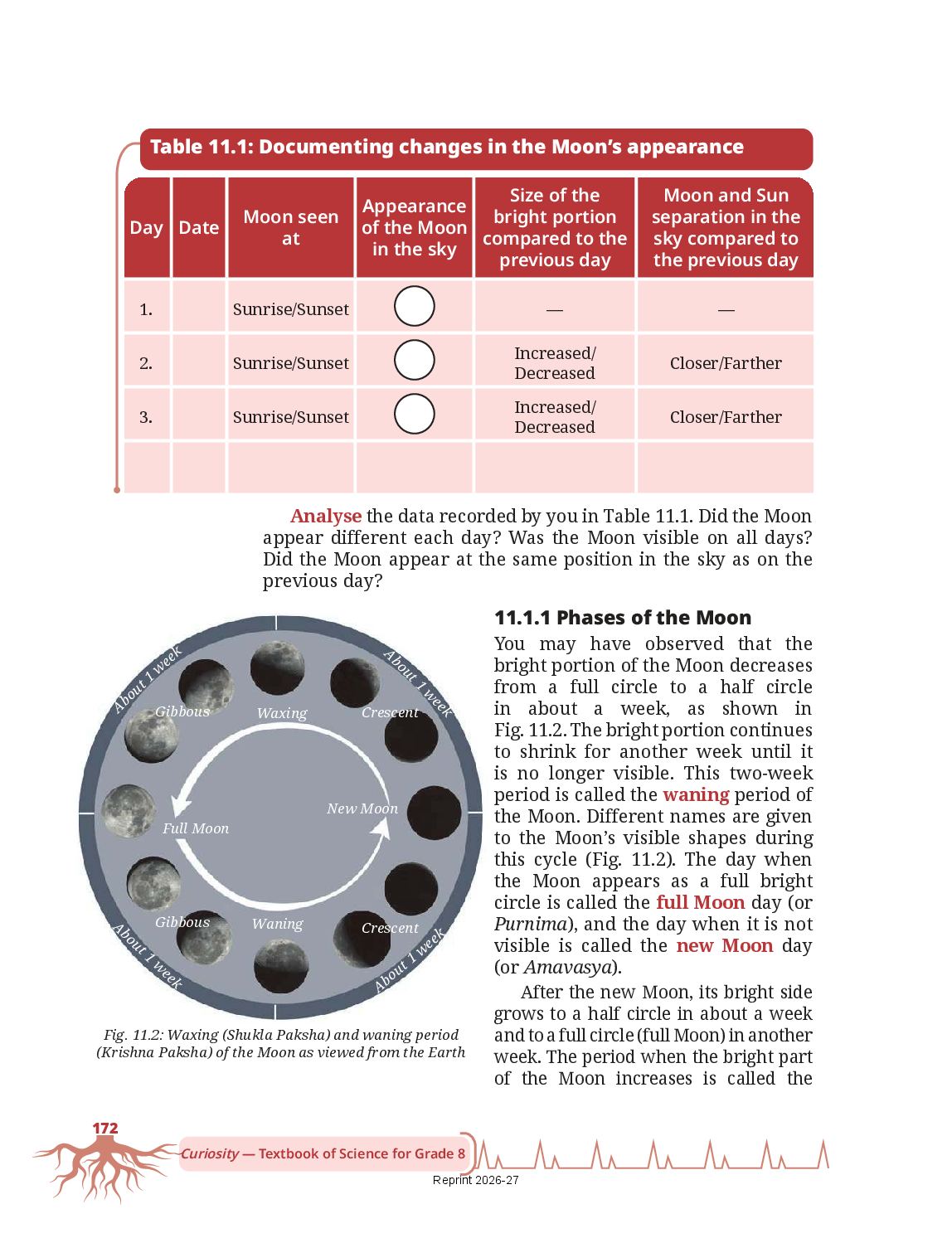
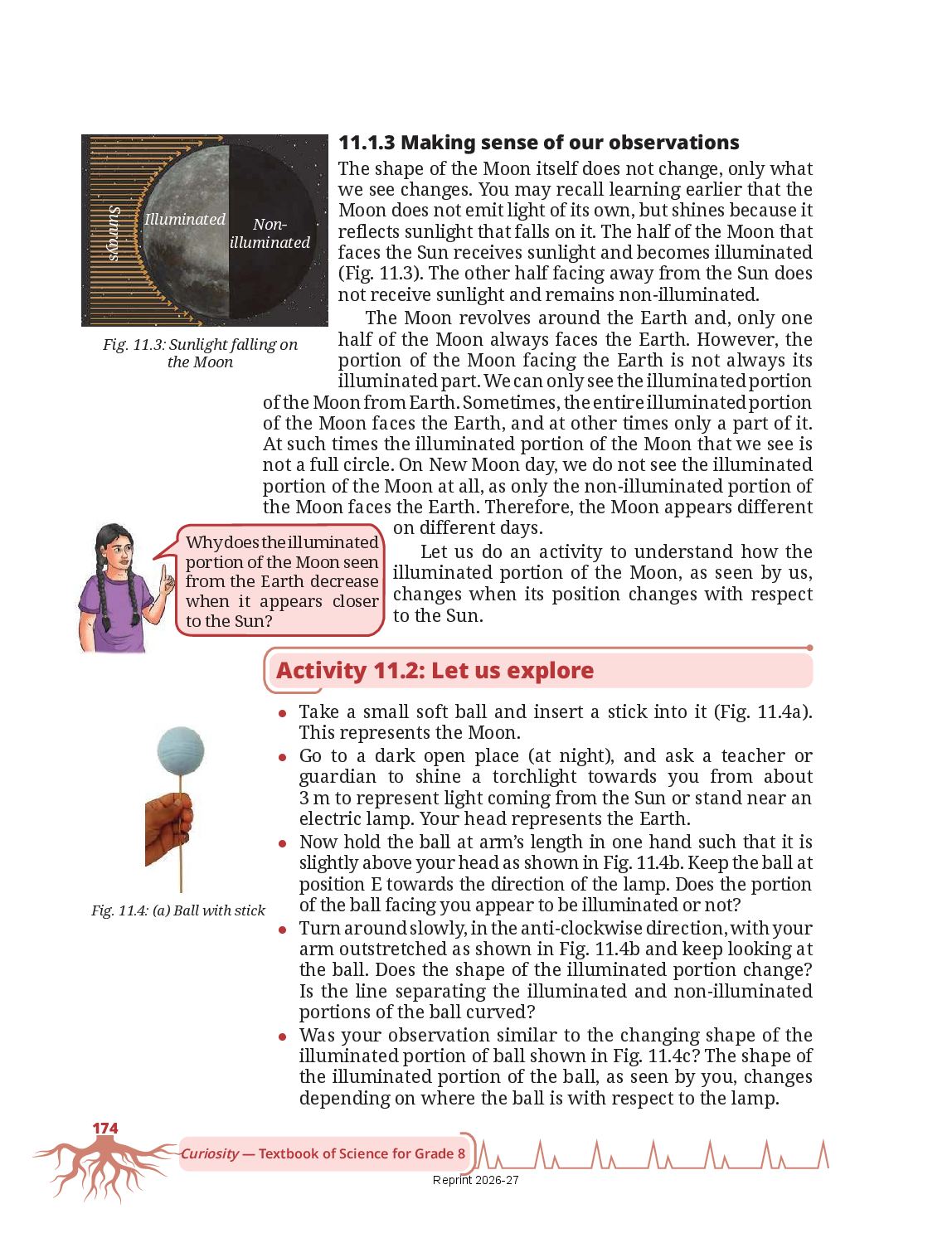
- The Moon does not shine by itself. Sunlight always lights exactly one half of it. The half turned towards the Earth is not always the lit half, so on different days we see different fractions of the lit half — these are the phases of the Moon.
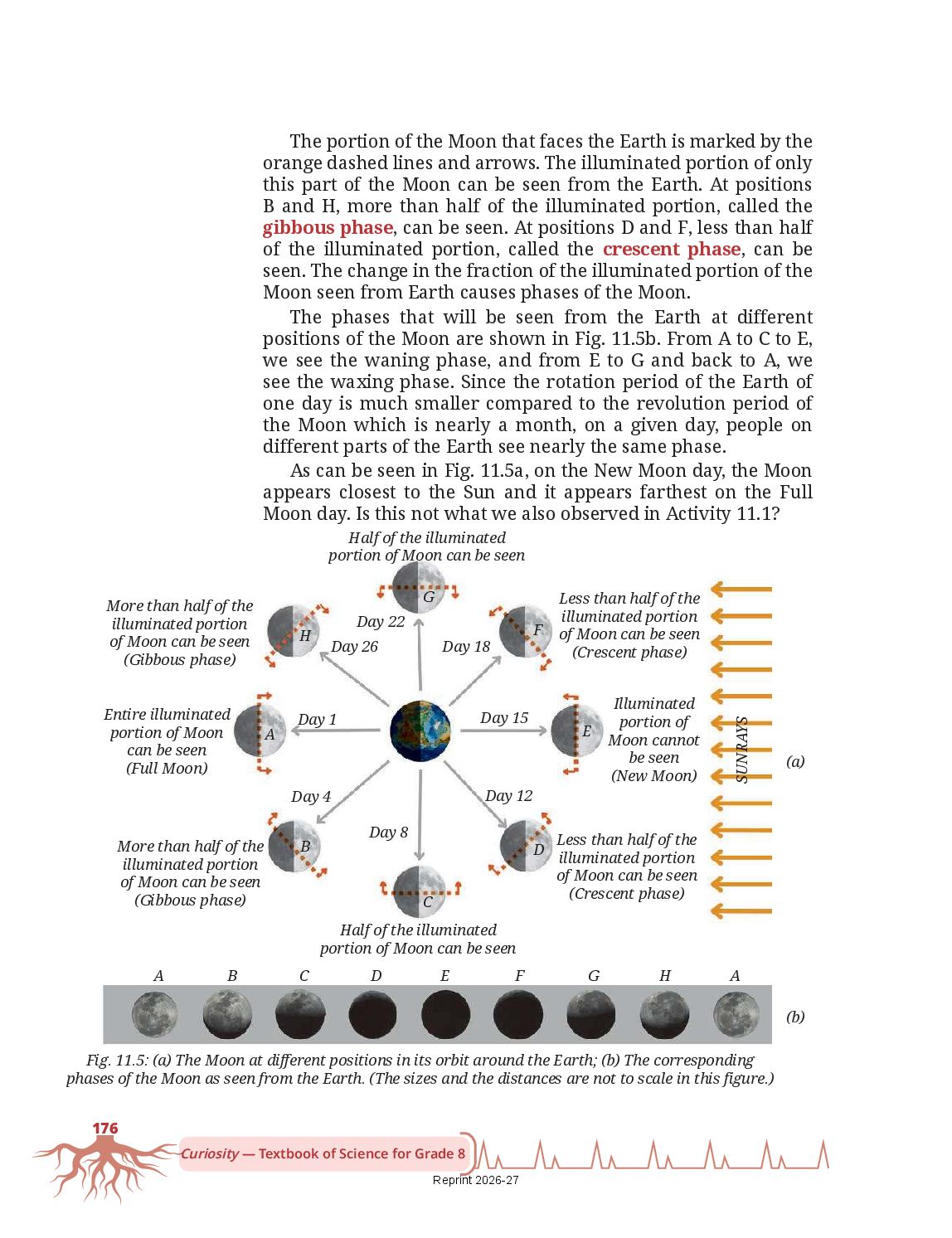
- In the waning period (Krishna Paksha) the bright part shrinks from a full circle to nothing in about two weeks; in the waxing period (Shukla Paksha) it grows back. One full Moon to the next takes about 29.5 days.
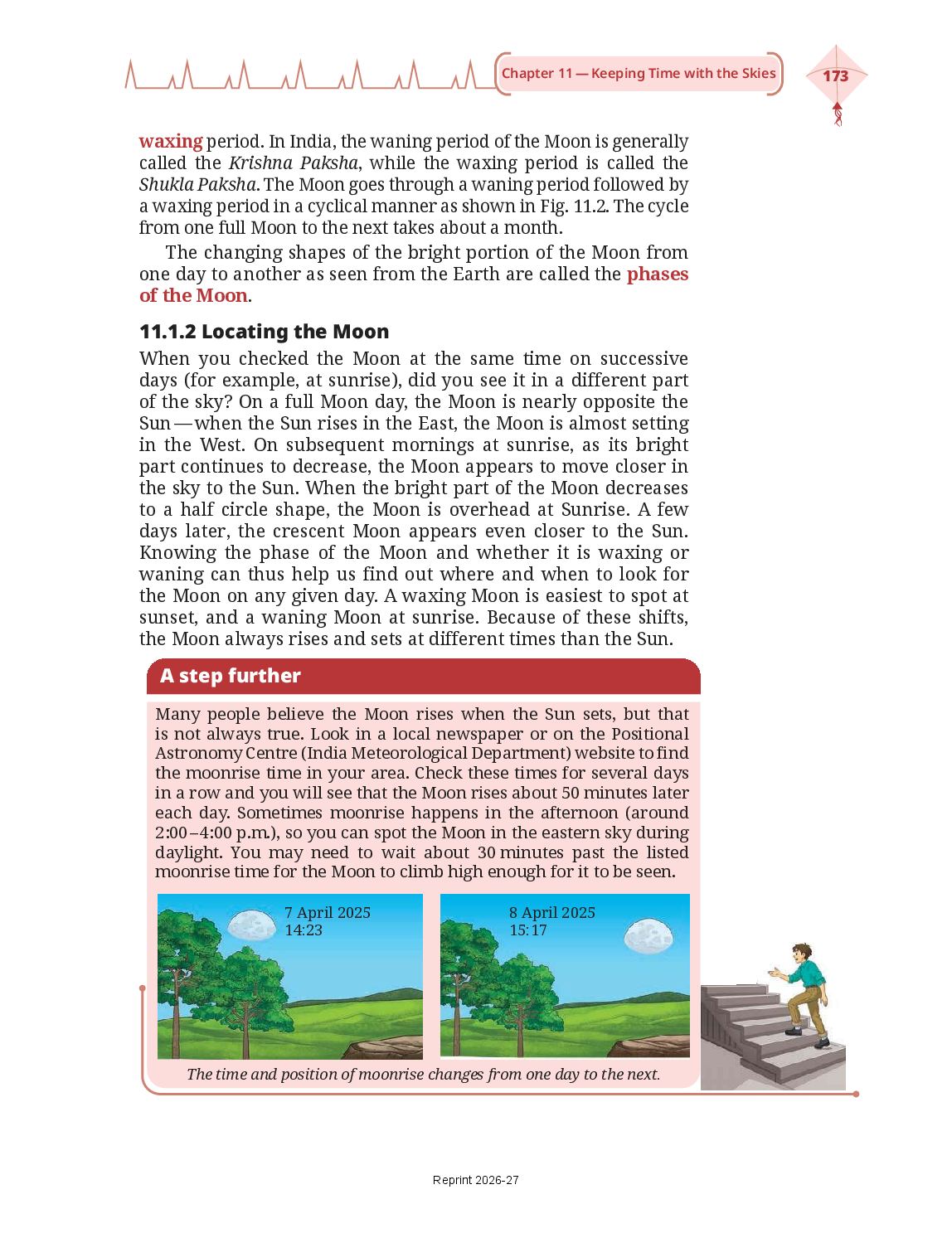
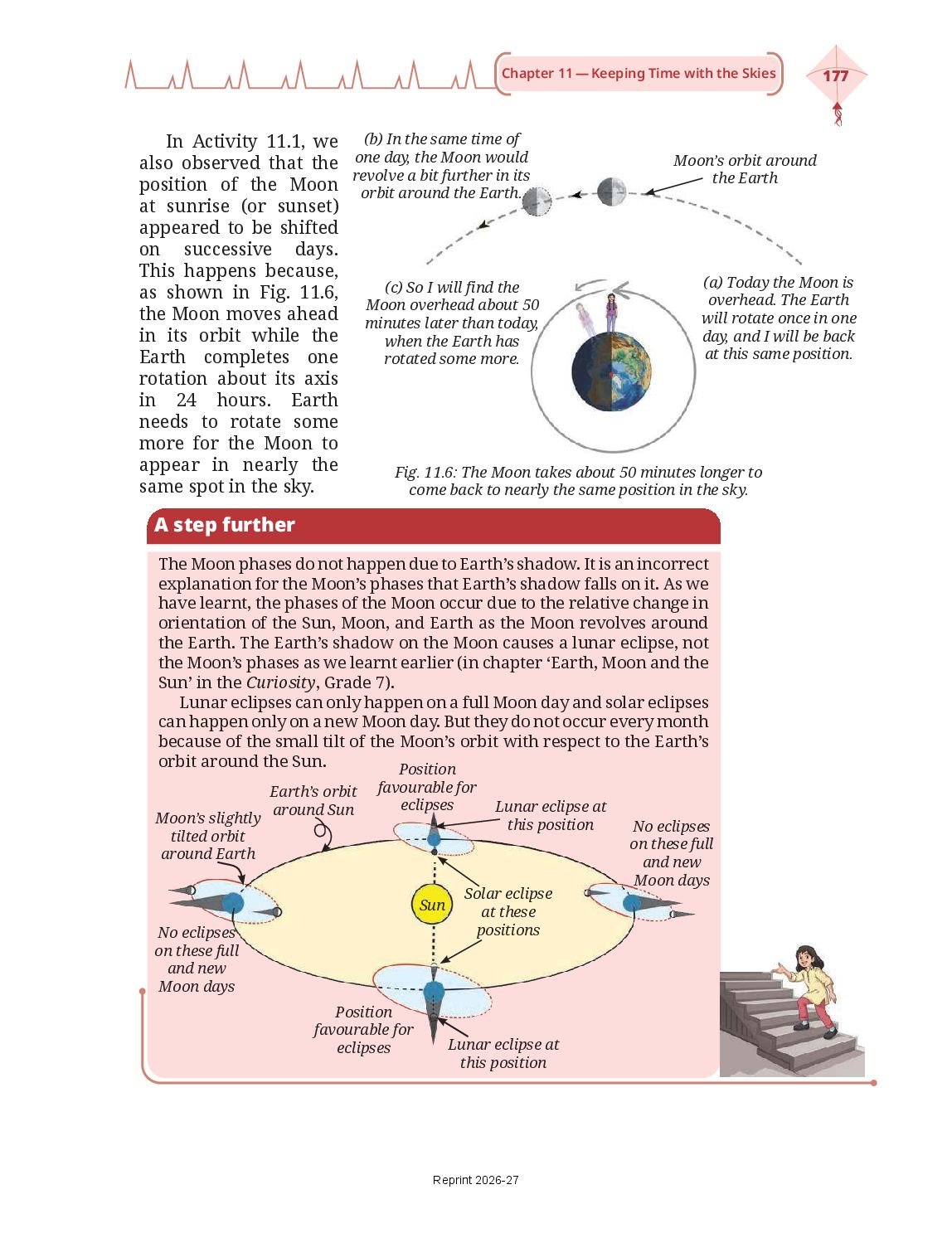
- Phase and position go together. On full Moon day the Moon is opposite the Sun (it rises at sunset); on new Moon day it is in almost the same direction as the Sun. Because the Moon moves about 12° eastward each day, it rises about 50 minutes later every day.
- Three natural periodic events give three units of time — Earth’s rotation gives the mean solar day of 24 hours, the Moon’s cycle of phases gives the month, and Earth’s revolution gives the solar year of about 365¼ days.
- A lunar year of 12 lunar months is only 354 days, so it falls short of the solar year by about 11 days. Solar calendars (Gregorian, Indian National Calendar) fit the seasons and use a leap year; luni-solar calendars count months by the Moon but add an Adhika Maasa every 2–3 years to stay with the seasons.
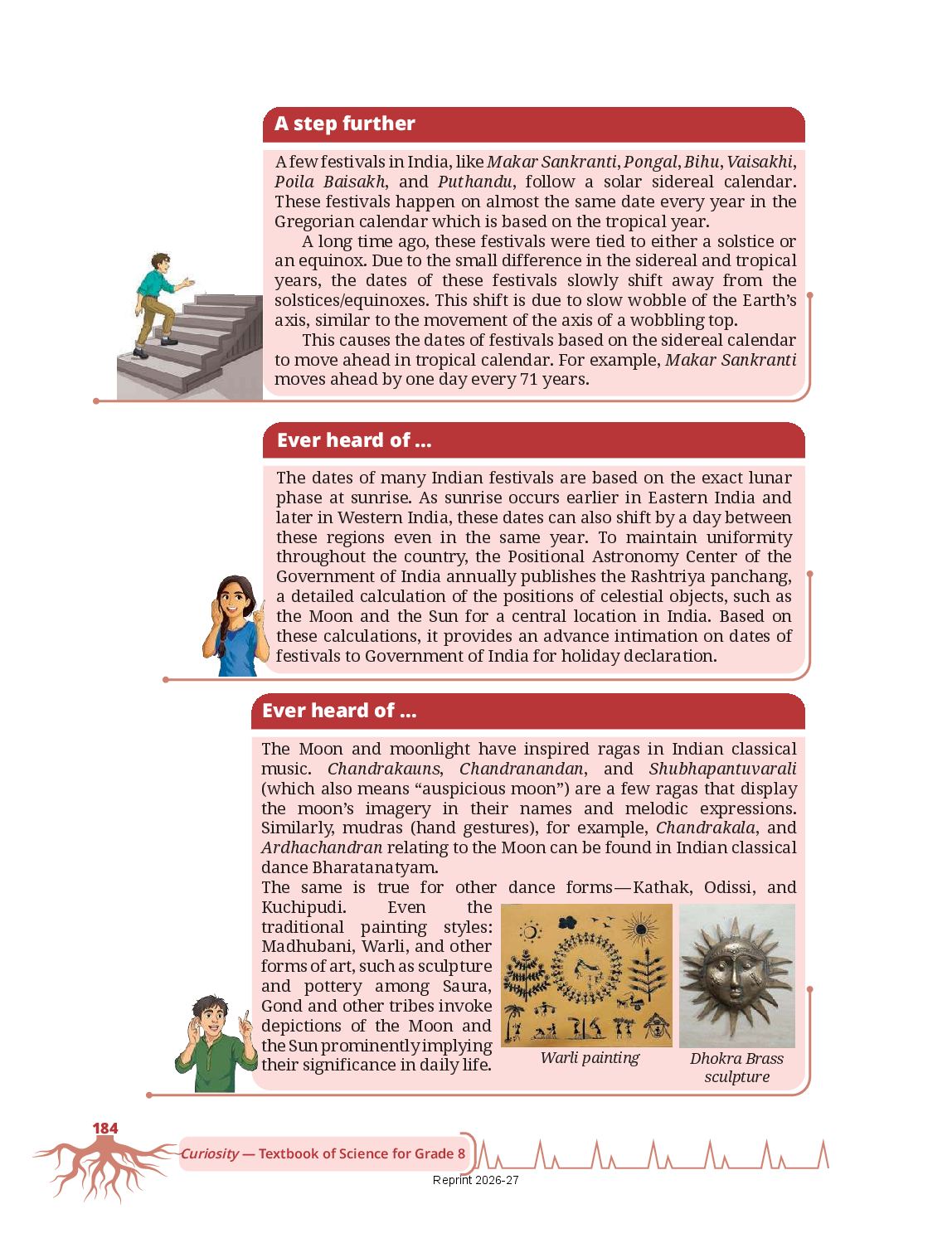
- Most Indian festivals are set by the Moon’s phase, so their Gregorian dates move. Festivals on a solar sidereal calendar, such as Makar Sankranti, keep almost the same date. Besides the Moon, artificial satellites orbit the Earth — most about 800 km up, one orbit in about 100 minutes.
Quick revision – Keeping Time with the Skies
| Term | What it means | How you recognise or measure it | Where it appears in the chapter |
|---|---|---|---|
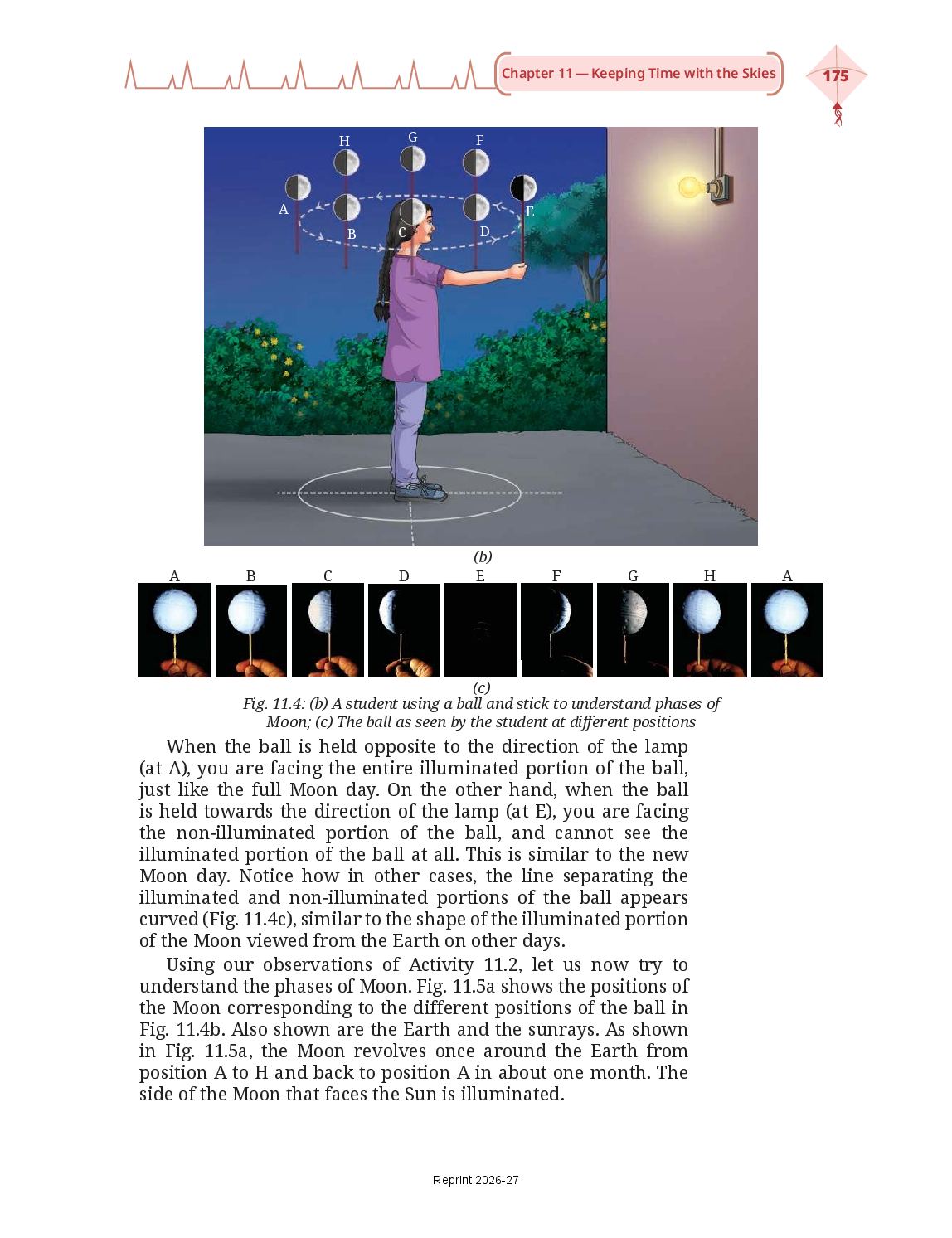
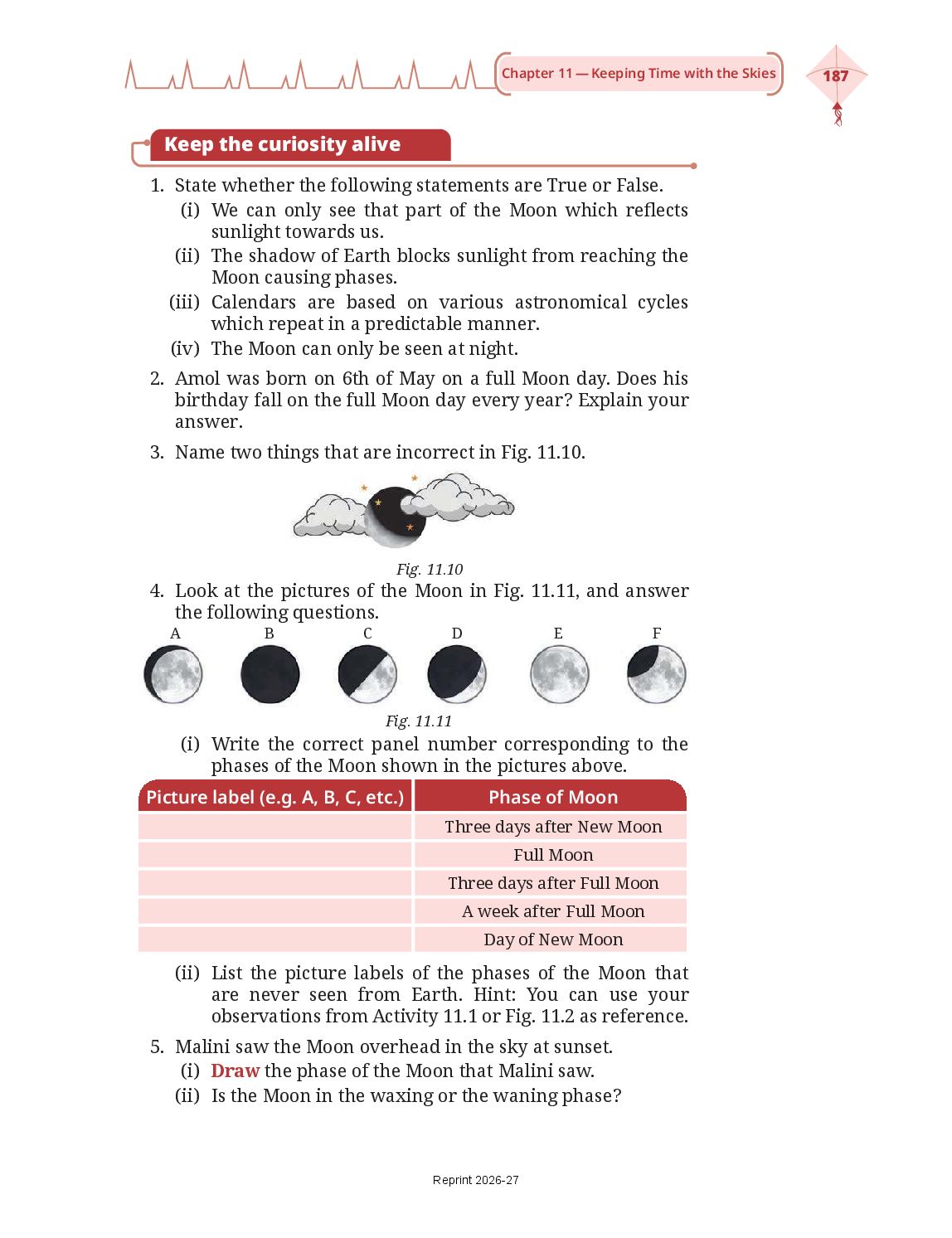
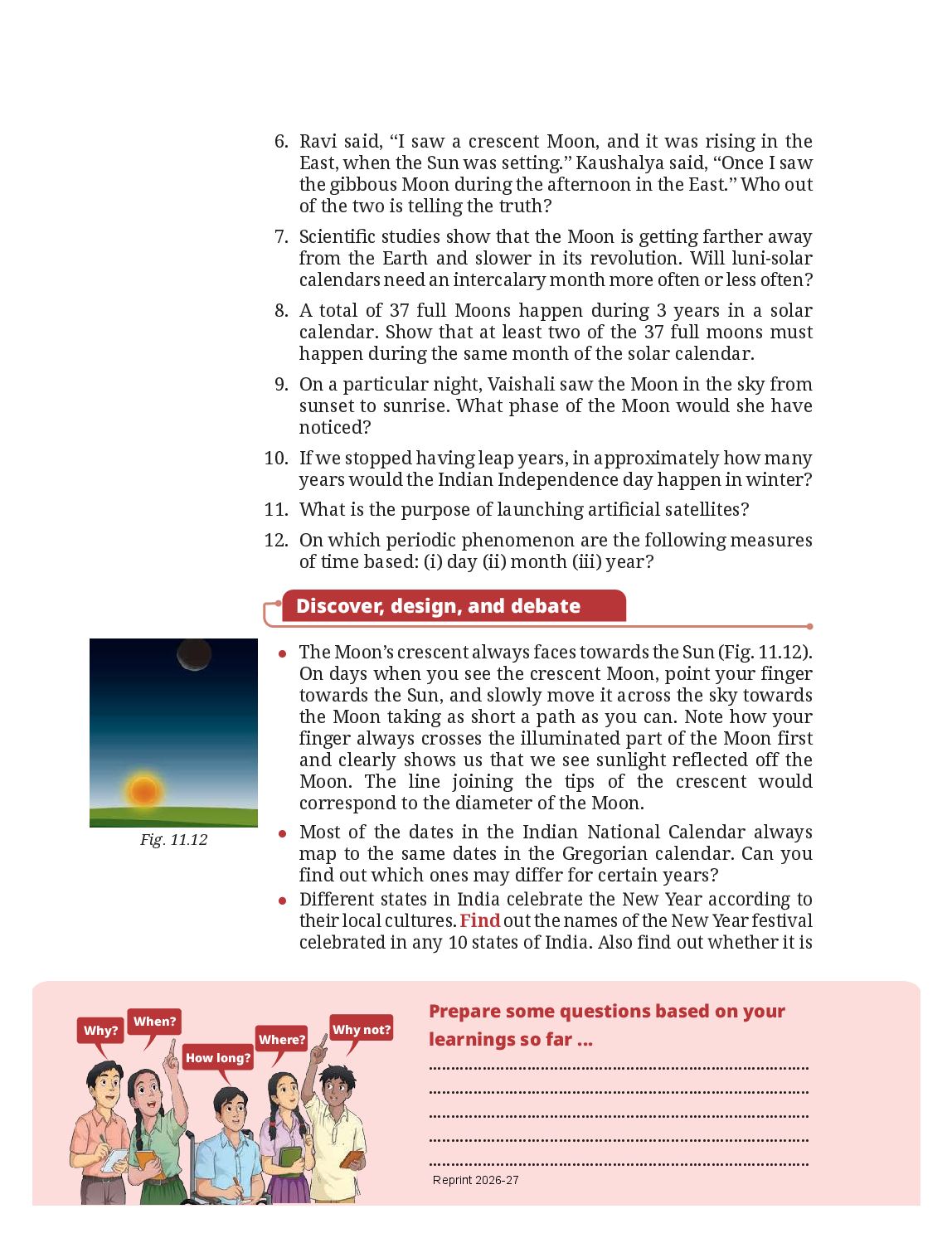
| Phases of the Moon | The changing shapes of the bright part of the Moon as seen from the Earth from one day to the next | Caused by the change in the Sun–Moon angle in the sky as the Moon revolves round the Earth — not by Earth’s shadow | Fig. 11.2 and Fig. 11.5; Activity 11.1 and Activity 11.2 |
| Waxing (Shukla Paksha) and waning (Krishna Paksha) periods | The fortnight in which the bright part grows, and the fortnight in which it shrinks | A waxing Moon is easiest to spot at sunset, a waning Moon at sunrise | Section 11.1.1, page 172–173 |
| Full Moon (Purnima) | The Moon is nearly opposite the Sun, so the entire lit half faces us | Rises about when the Sun sets and sets about when the Sun rises | Position A, Day 1 in Fig. 11.5 |
| New Moon (Amavasya) | The Moon is in nearly the same direction as the Sun, so only its non-illuminated half faces us | Not visible at all; it rises and sets nearly with the Sun | Position E, Day 15 in Fig. 11.5 |
| Gibbous phase / Crescent phase | More than half of the lit portion is seen / less than half is seen | Gibbous at positions B and H; crescent at positions D and F | Page 176 |
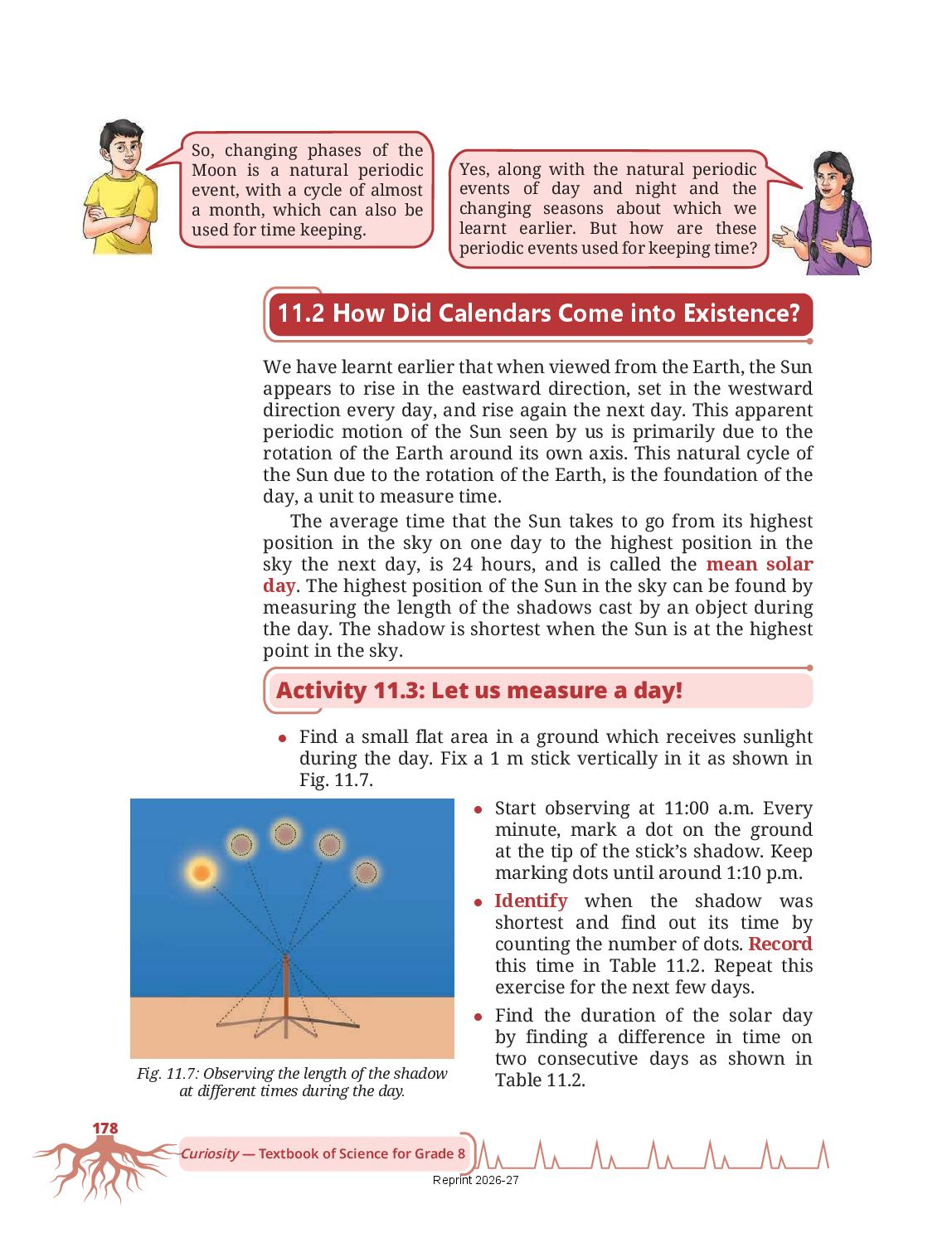
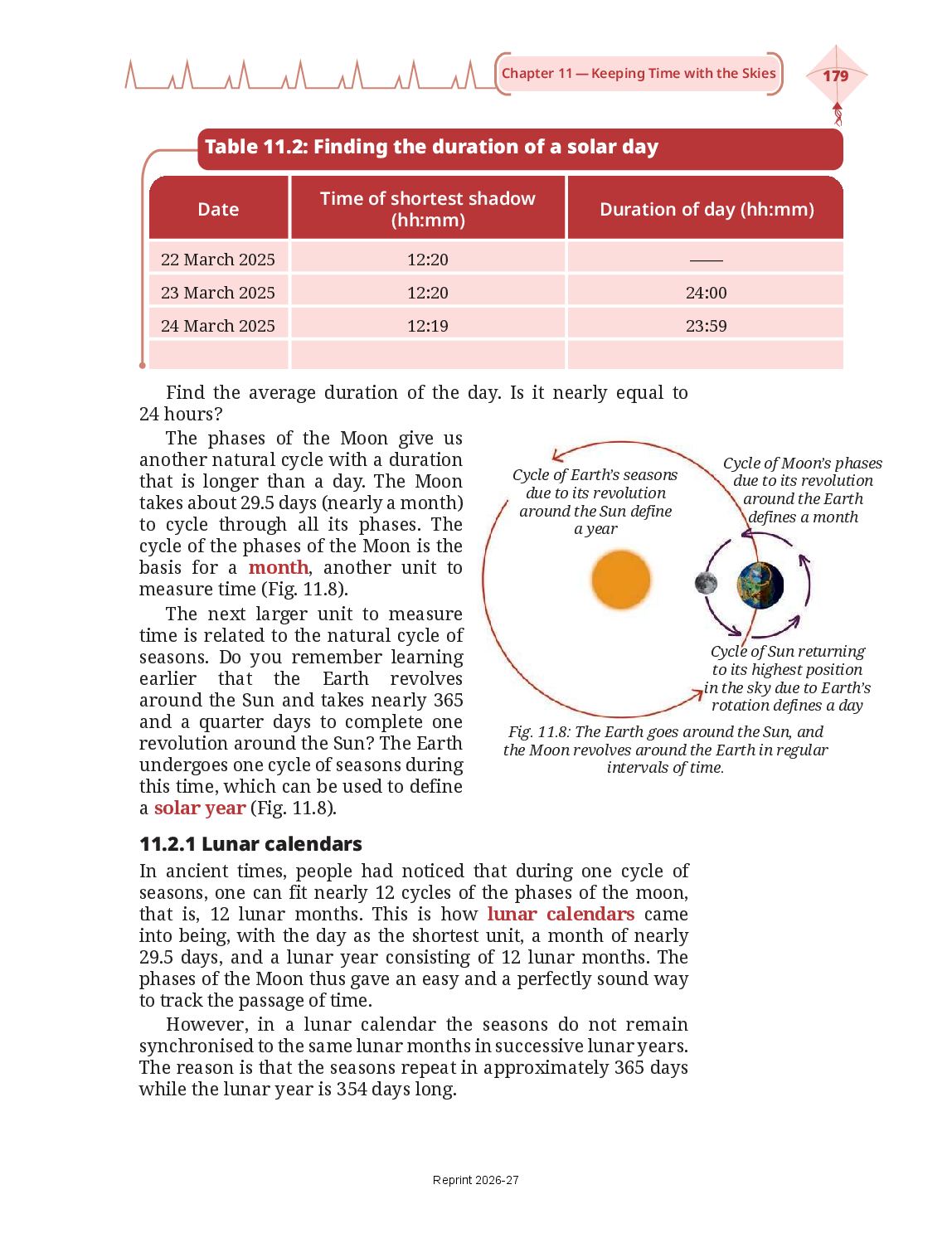
| Mean solar day | The average time the Sun takes from its highest point in the sky one day to its highest point the next day | Mark the tip of a vertical stick’s shadow; the shadow is shortest when the Sun is highest | Activity 11.3 and Table 11.2 — 24 hours |
| Lunar month | One complete cycle of the phases of the Moon | About 29.5 days; 12 of them make a lunar year of 354 days | Section 11.2.1, page 179 |
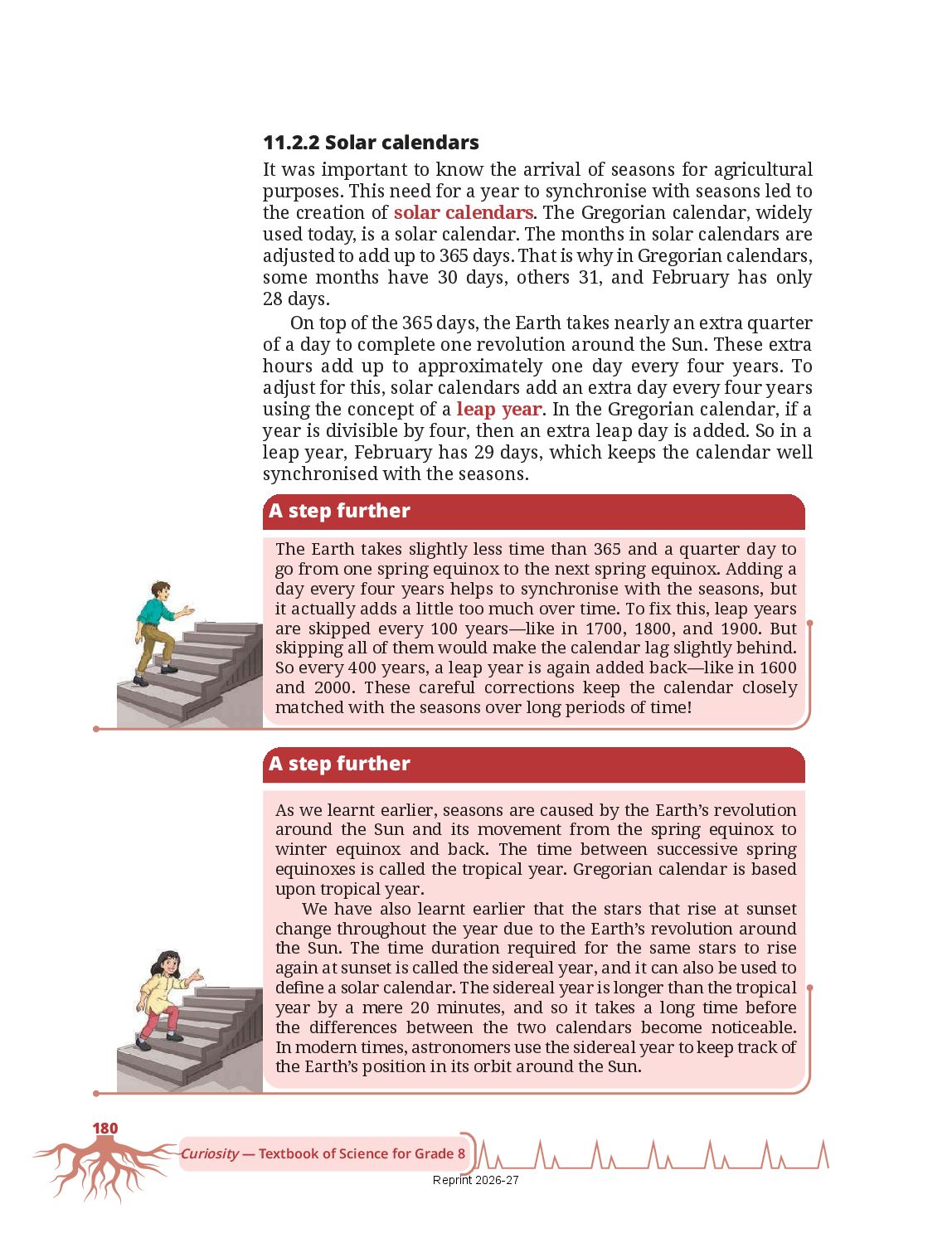
| Solar year and leap year | One revolution of the Earth round the Sun, that is, one cycle of seasons; the extra day that keeps the calendar with the seasons | About 365¼ days. A year divisible by 4 is a leap year; 1700, 1800, 1900 were skipped, 1600 and 2000 were kept | Section 11.2.2, page 180 |
| Lunar, solar and luni-solar calendars | Calendars that follow the Moon’s phases, the cycle of seasons, or both together | 354 days / 365 days / months by the Moon with a correction for the seasons | Sections 11.2.1 to 11.2.3 |
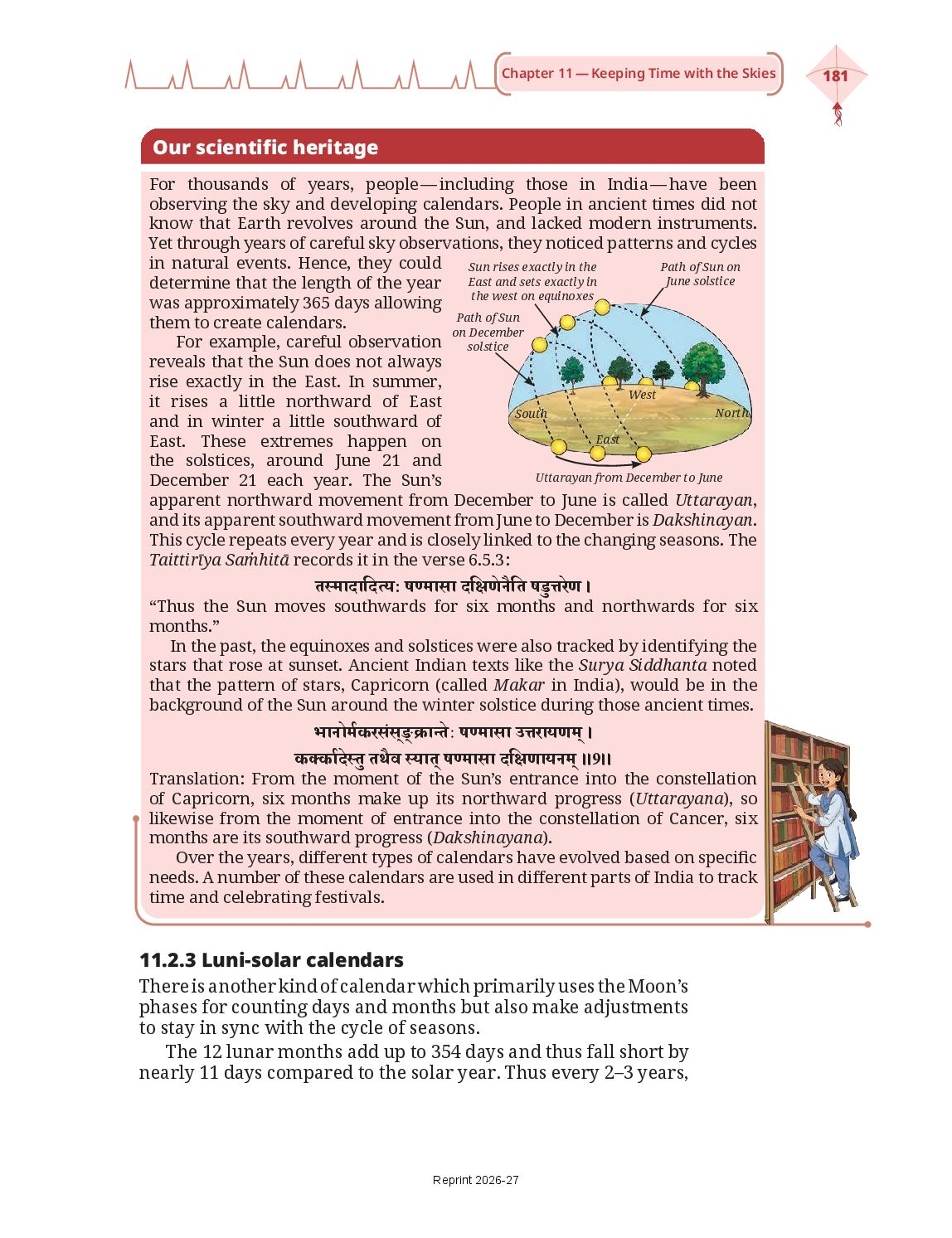
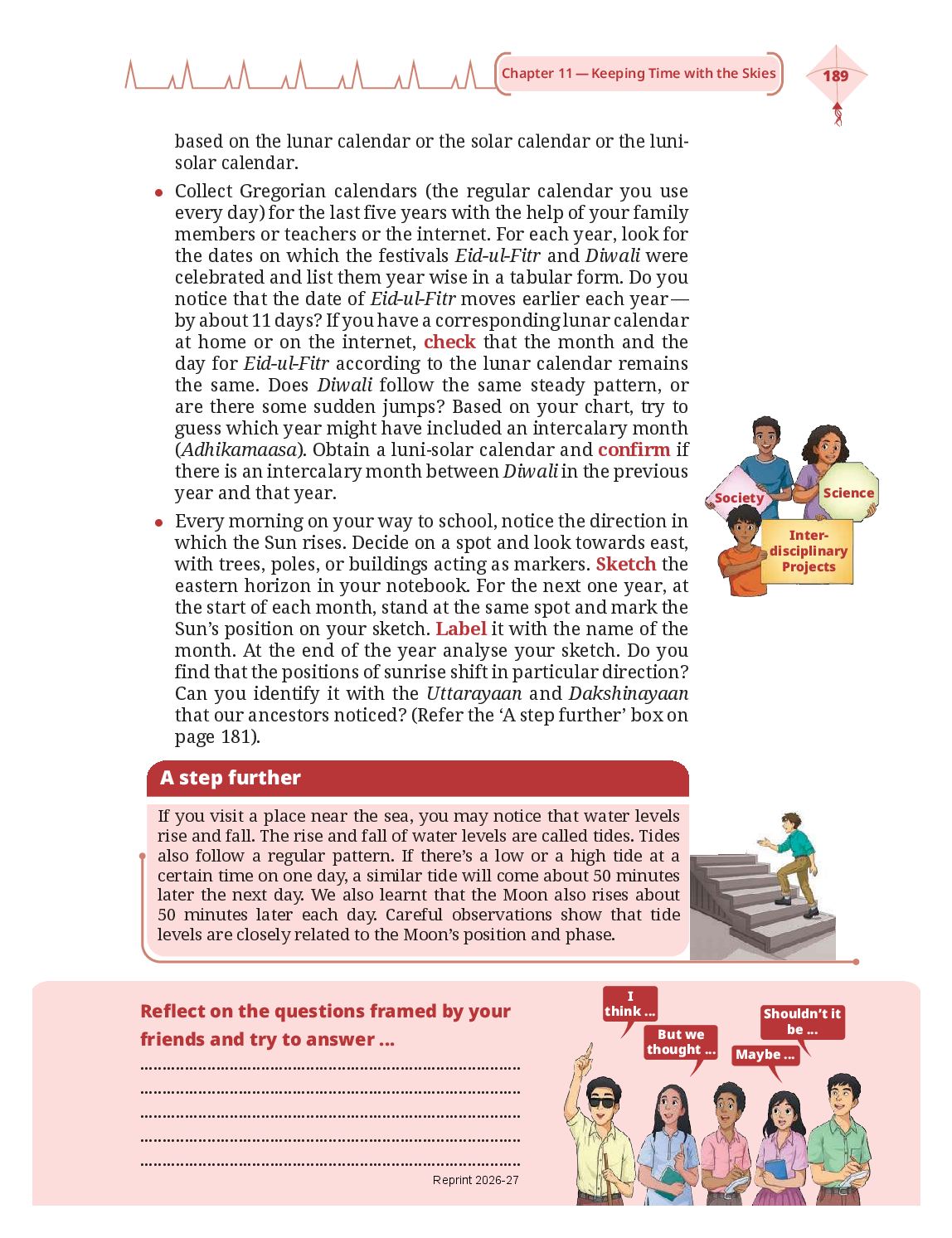
| Adhika Maasa (intercalary month) | An extra month added to a luni-solar year every 2–3 years | It makes up the 11-day shortfall of the lunar year, so festivals stay in their seasons | Page 181–182 |
| Tropical year and sidereal year | Spring equinox to spring equinox; and the time for the same stars to rise again at sunset | The sidereal year is longer than the tropical year by just 20 minutes | ‘A step further’, page 180 |
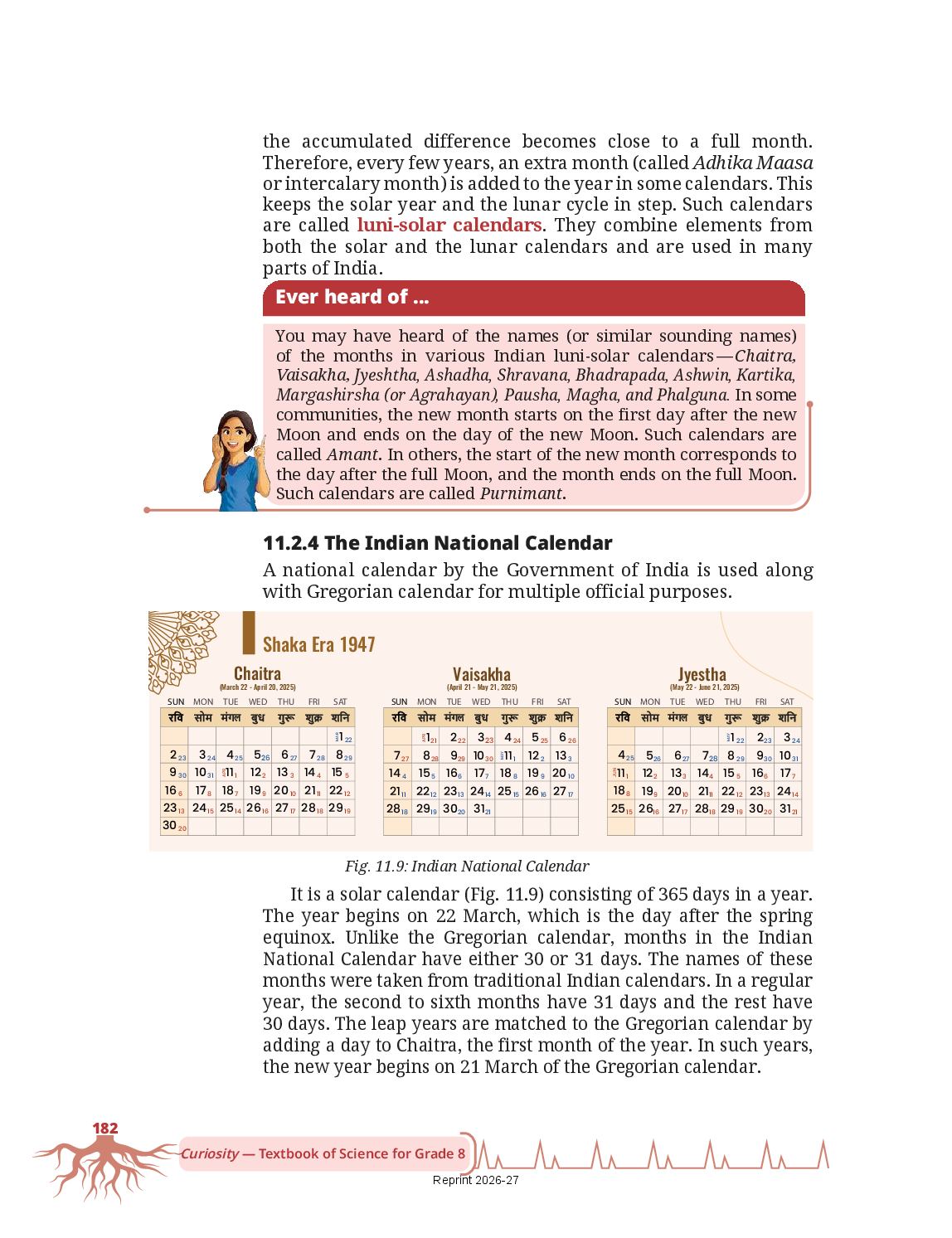
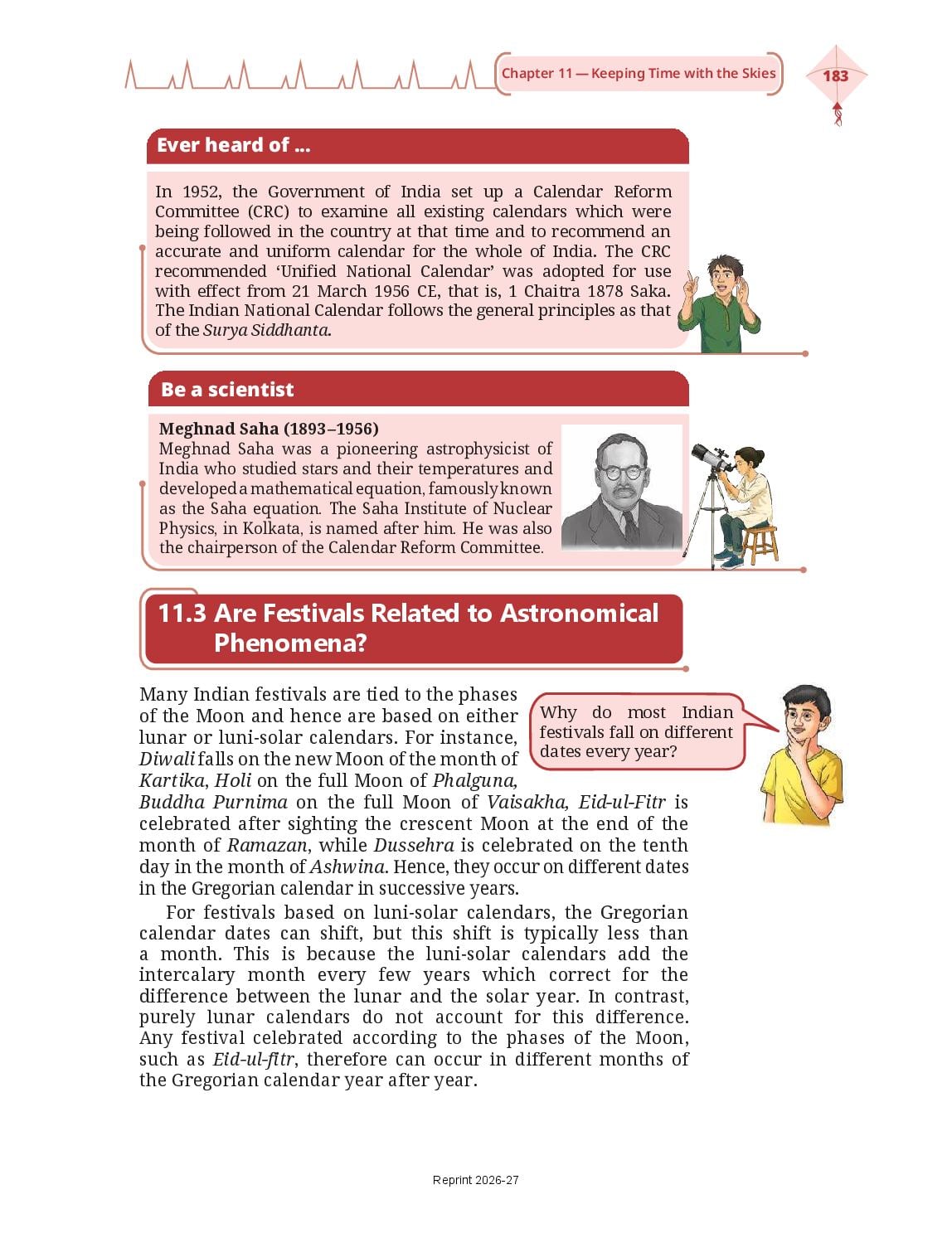
| Indian National Calendar | India’s official solar calendar of the Shaka Era, used with the Gregorian calendar | 365 days; the year begins on 22 March; months of 30 or 31 days, the 2nd to 6th having 31 | Fig. 11.9; adopted 21 March 1956 CE = 1 Chaitra 1878 Saka |
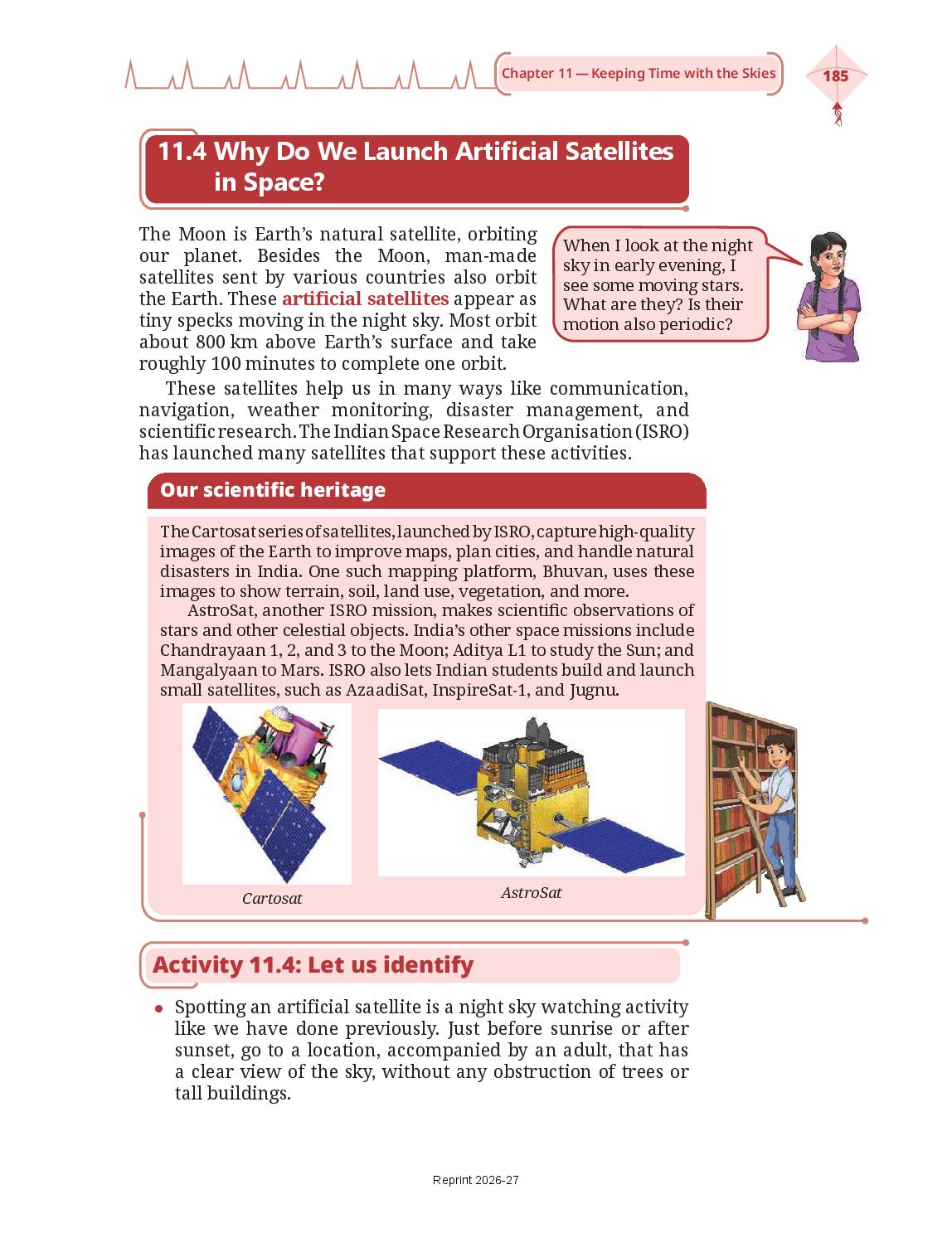
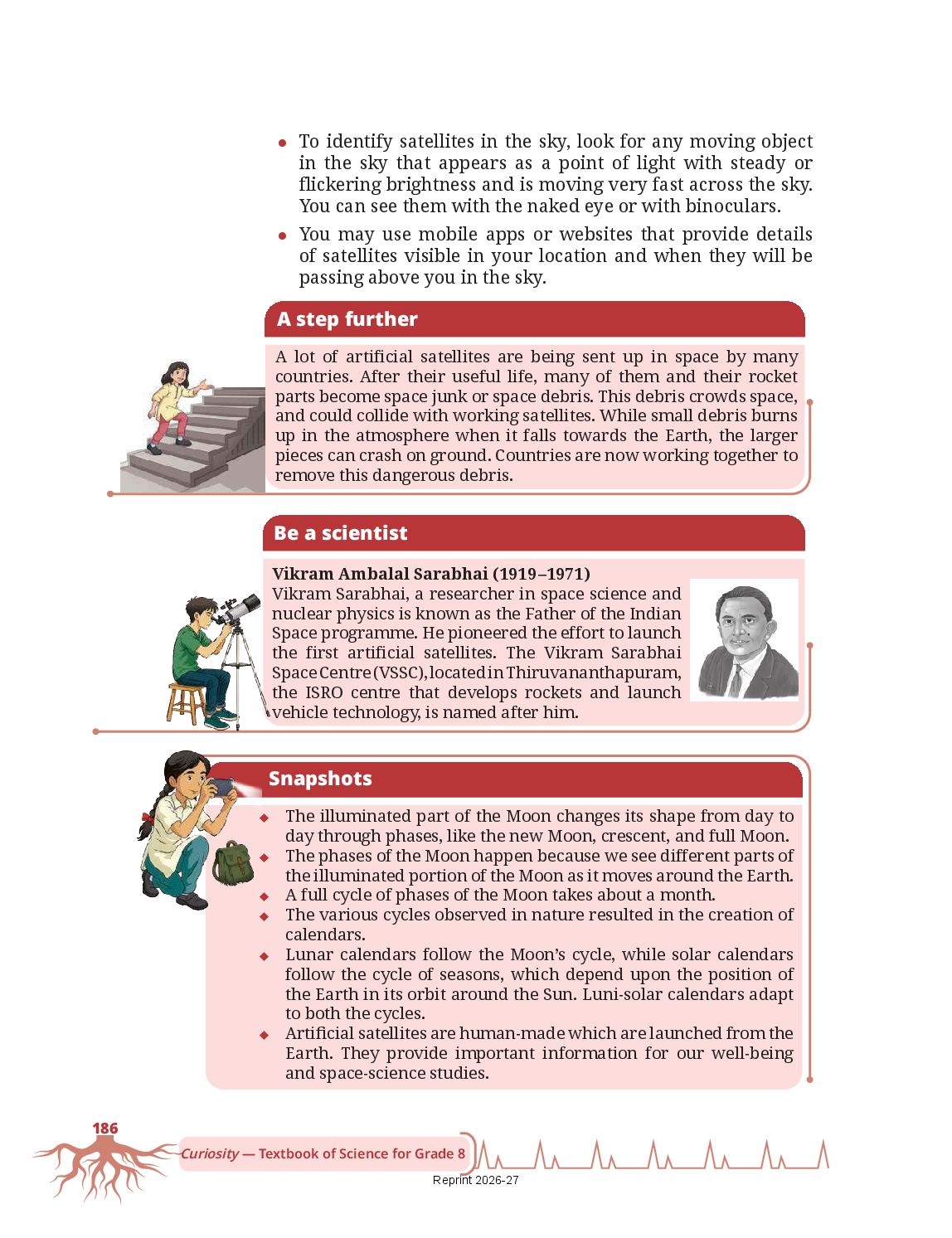
| Artificial satellite | A human-made object launched from the Earth to orbit it | Most orbit about 800 km up and take about 100 minutes for one orbit; seen as a steady point of light moving fast | Section 11.4; Cartosat, AstroSat, Chandrayaan, Aditya L1, Mangalyaan |
Old NCERT vs New – Class 8 Science
This chapter is from Curiosity, the new NCERT Class 8 Science book (NCF-SE 2023, used from 2025-26). It replaced the old book “Science”, so chapter numbers and names differ from older PDFs.
Solutions and All Chapters
Answers to the exercises and the full chapter list of Curiosity:
Keeping Time with the Skies – Overview
| Class | Class 8 |
| Subject | Science |
| Book | Curiosity – new NCERT book |
| Chapter | 11 of 13 – Keeping Time with the Skies |
| Book pages | 170 – 189 |
| Edition | NCERT Reprint 2026-27 |
| Session | 2026-27 |
| Free – read online or download |
Class 8 Science Chapter 11 – FAQs
Where can I download Keeping Time with the Skies Class 8 PDF?
From the download table on this page – the chapter PDF is free, and the full book is linked too.
What is Class 8 Science Chapter 11 about?
The Moon does not shine by itself. Sunlight always lights exactly one half of it. The half turned towards the Earth is not always the lit half, so on different days we see different fractions of the lit half — these are the phases of the Moon.
Is Keeping Time with the Skies from the new NCERT Class 8 Science book?
Yes. It is chapter 11 of curiosity, the new NCERT Class 8 Science book for 2026-27.
Is this the latest NCERT edition for 2026-27?
Yes – the PDF is NCERT’s latest edition for the 2026-27 session.
Where are the NCERT Solutions for Class 8 Science Chapter 11?
Open the NCERT Solutions link above for answers to the exercise questions.