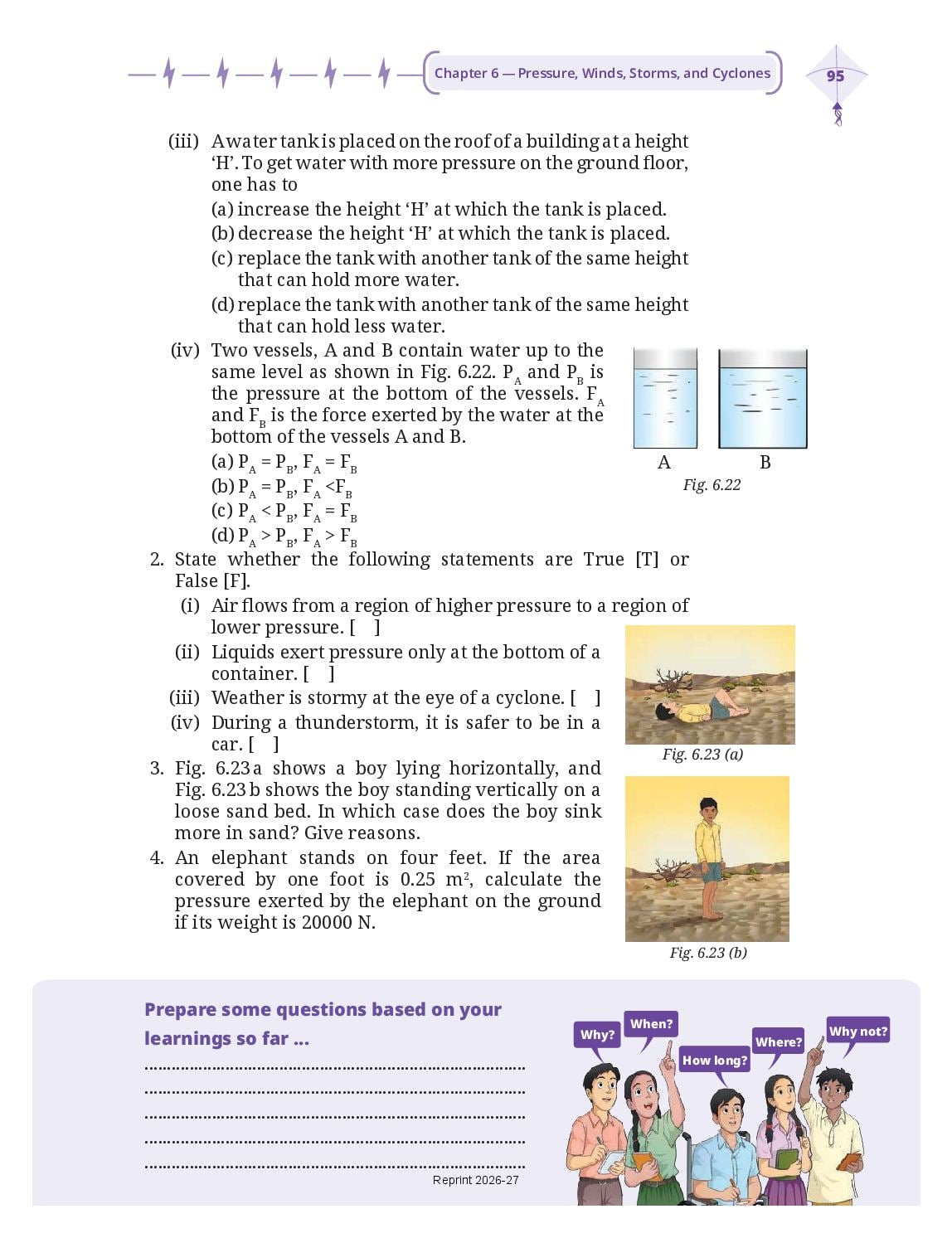
Download Pressure, Winds, Storms, and Cyclones – NCERT Class 8 Science Chapter 6 PDF from the new NCERT Class 8 Science book Curiosity (2026-27). Read the chapter online or download the free PDF. Pressure is force per unit area, P = F/A. The same weight pressing on a smaller area gives a larger pressure — which is why a broad strap is comfortable, a pointed nail drives easily and a sharp knife cuts. The SI unit is N/m2, also called the pascal (Pa).
Pressure, Winds, Storms, and Cyclones PDF – Chapter 6 of Curiosity
Read the chapter online or download the PDF.
| Chapter | Download | |
|---|---|---|
| Chapter 6 PDF | Pressure, Winds, Storms, and Cyclones | View PDF |
| Full book | NCERT Class 8 Science – Curiosity | View Book |
Read Online
What Is in Pressure, Winds, Storms, and Cyclones? (Class 8 Science Chapter 6)
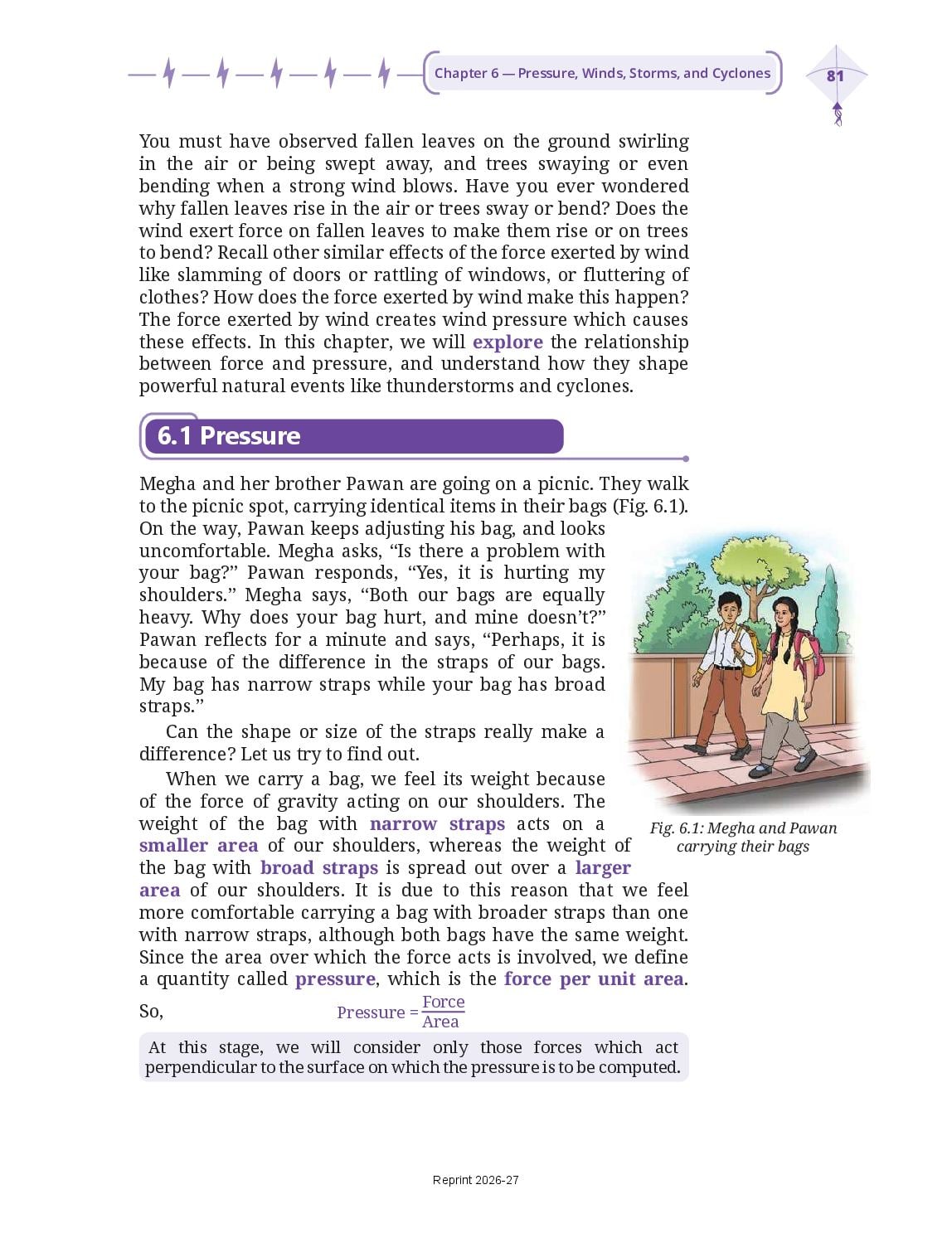
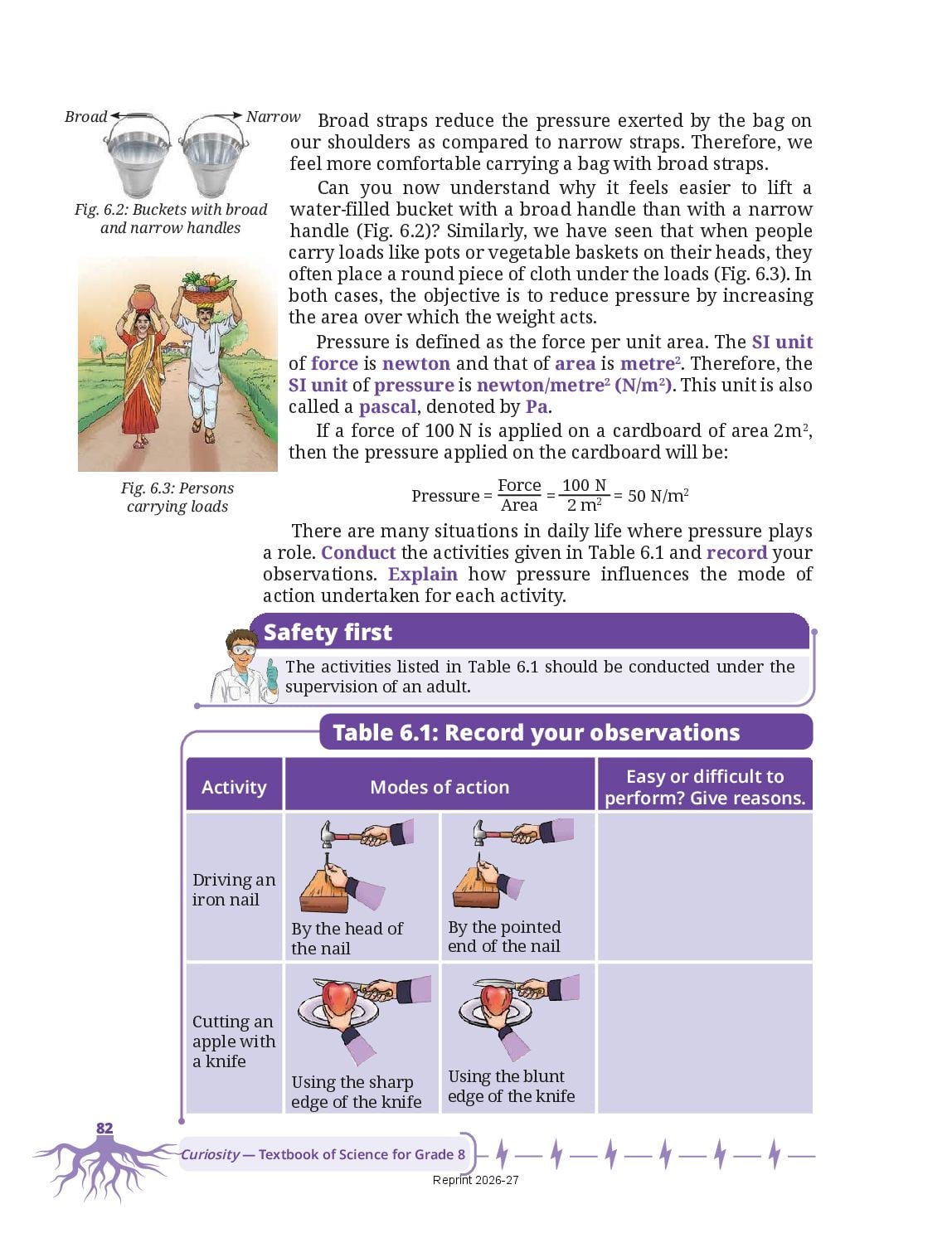
- Pressure is force per unit area, P = F/A. The same weight pressing on a smaller area gives a larger pressure — which is why a broad strap is comfortable, a pointed nail drives easily and a sharp knife cuts. The SI unit is N/m2, also called the pascal (Pa).
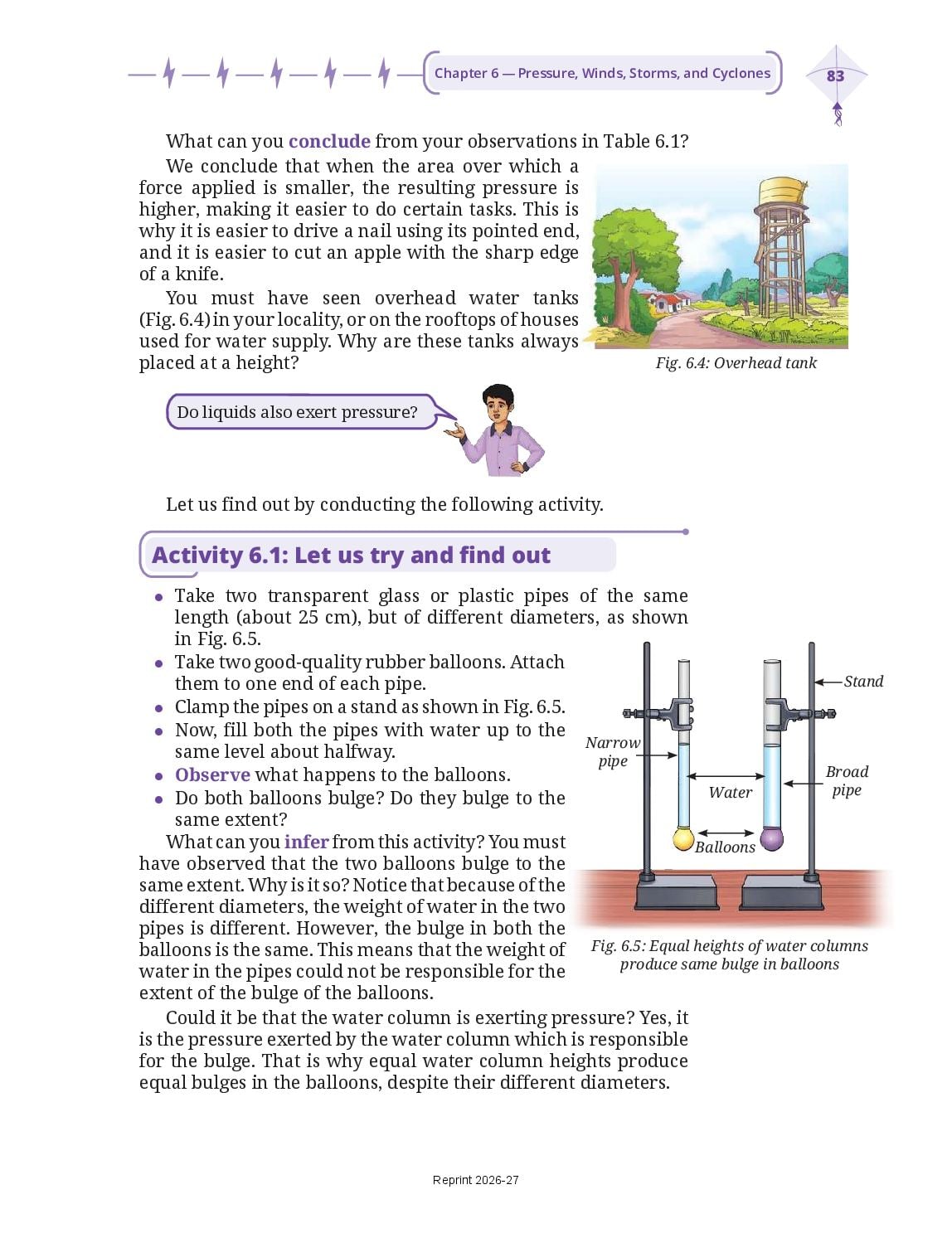
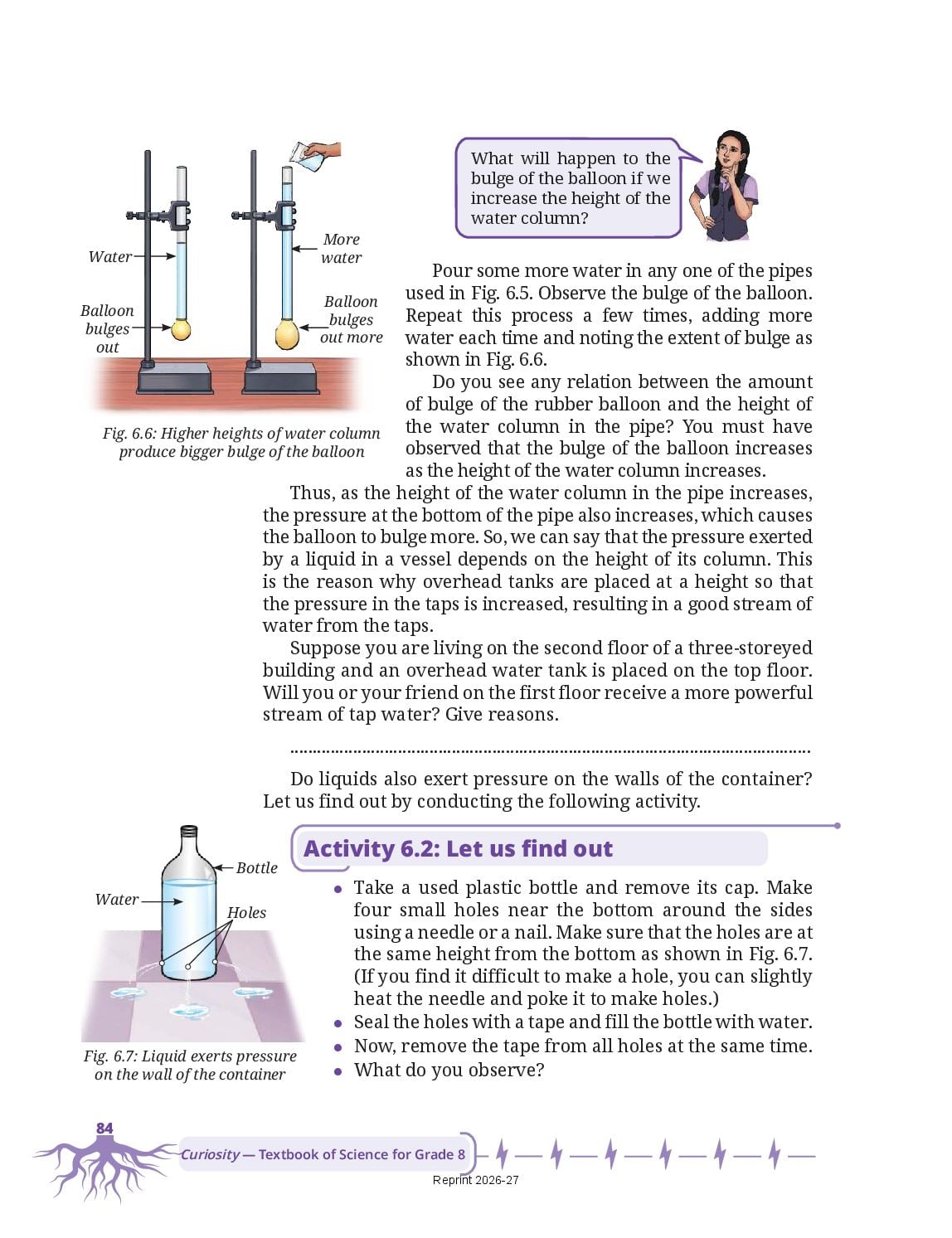
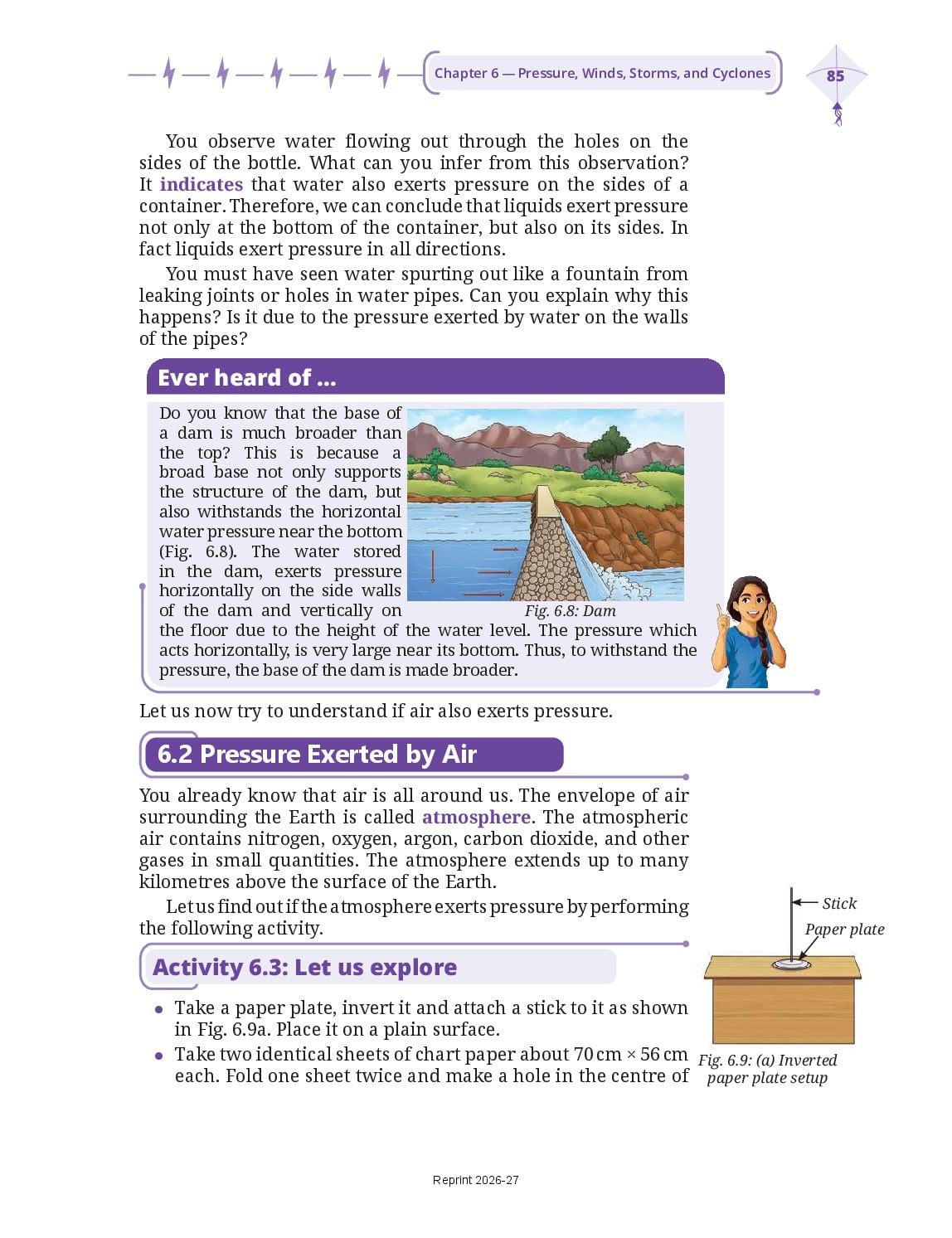
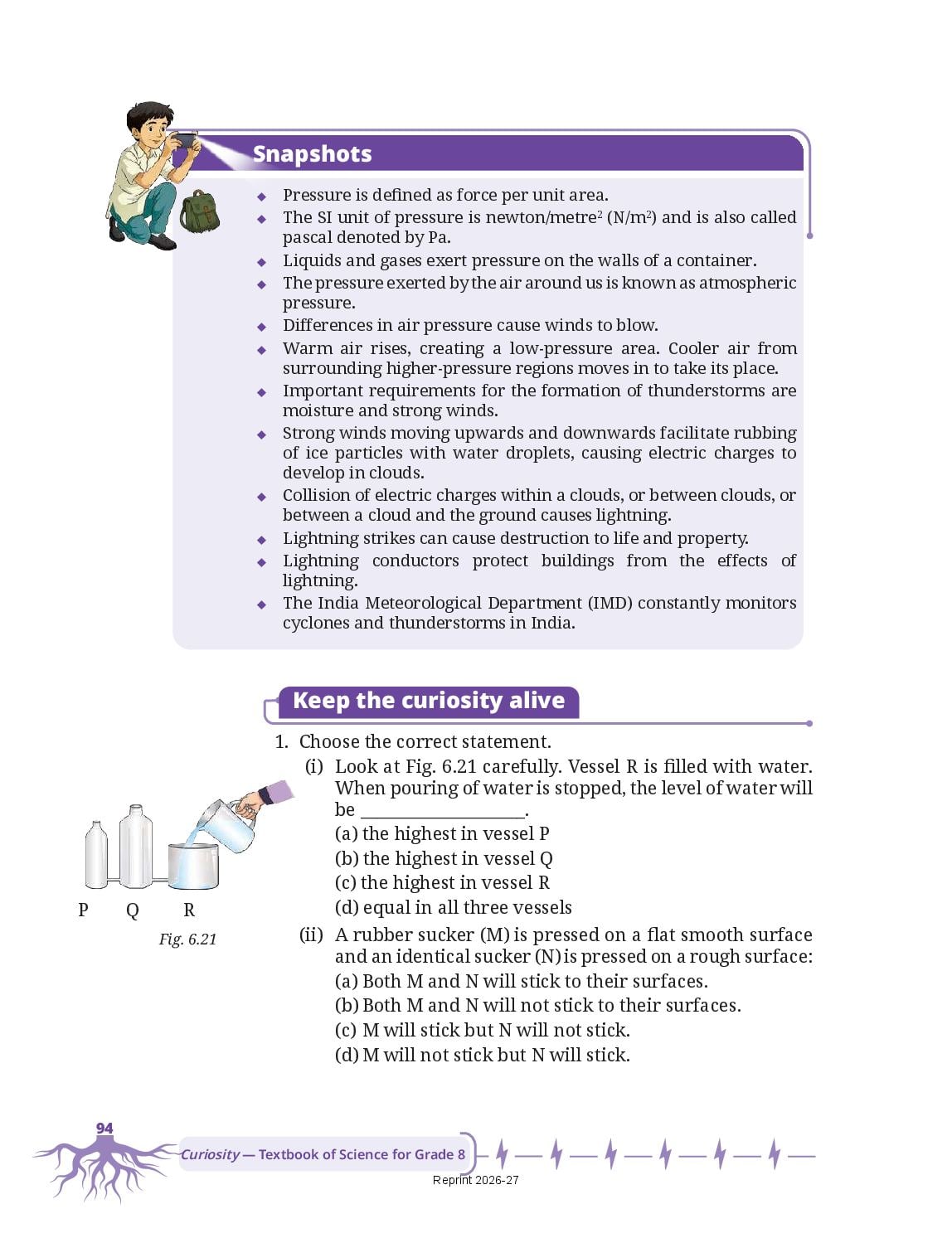
- A liquid exerts pressure at the bottom of its vessel and on the walls — in fact in all directions. The pressure depends on the height of the liquid column, not on the width of the vessel or on the weight of liquid it holds. That is why overhead tanks are placed high and why a dam’s base is broader than its top.
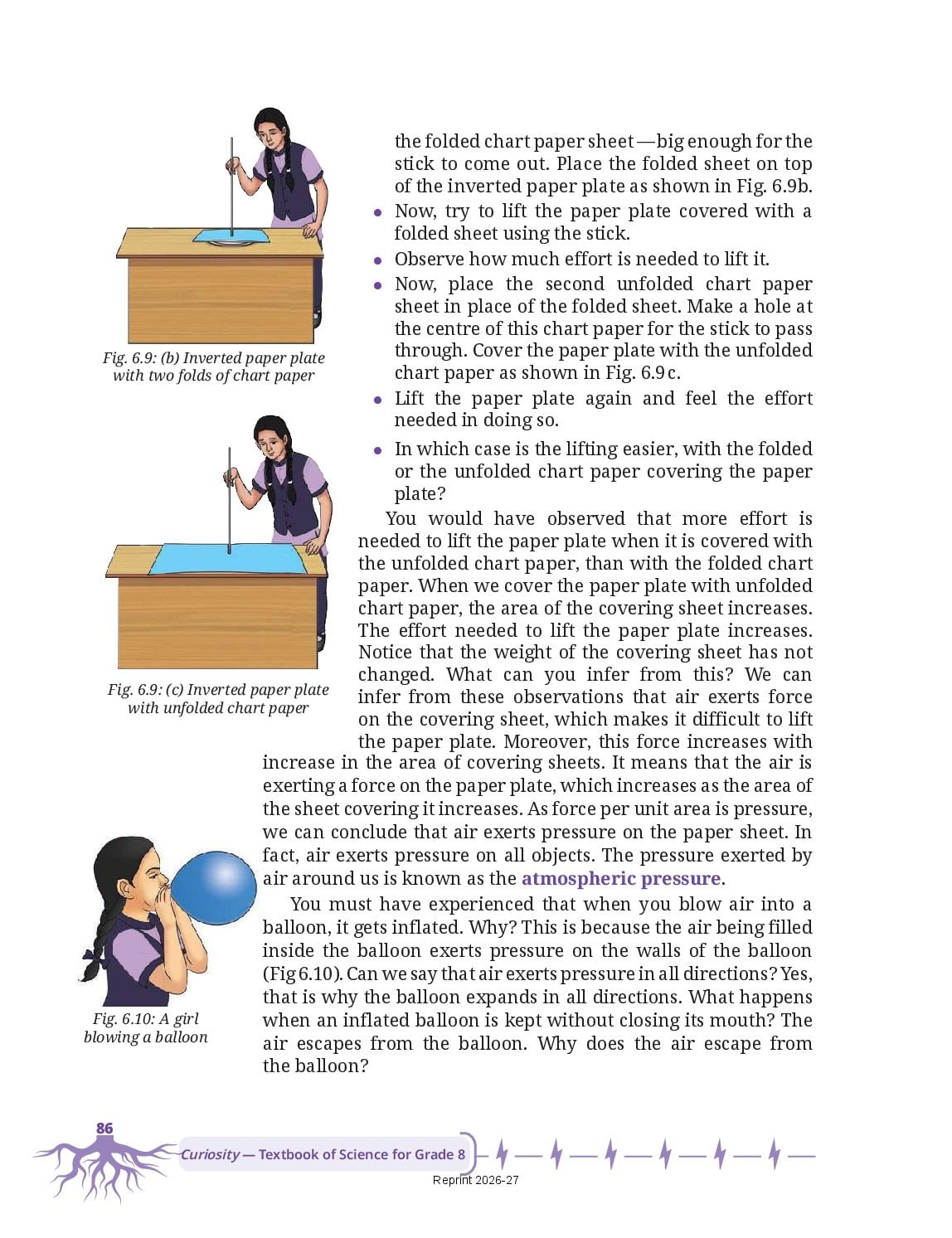
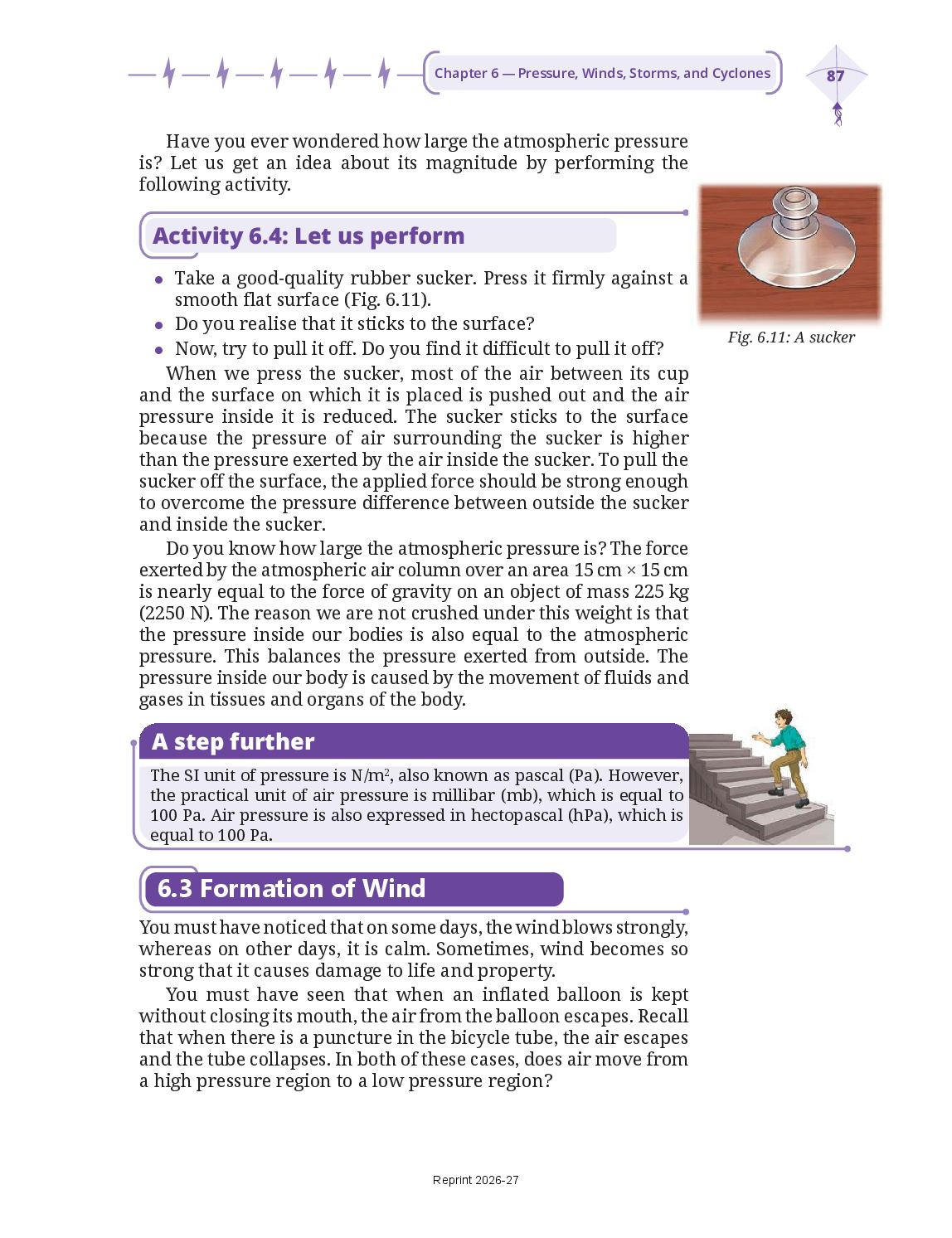
- Air also presses on everything around it. The pressure of the air surrounding us is the atmospheric pressure; the force it exerts on just a 15 cm × 15 cm patch is about 2250 N — the weight of a 225 kg mass. We are not crushed because the pressure of the fluids and gases inside the body balances it.
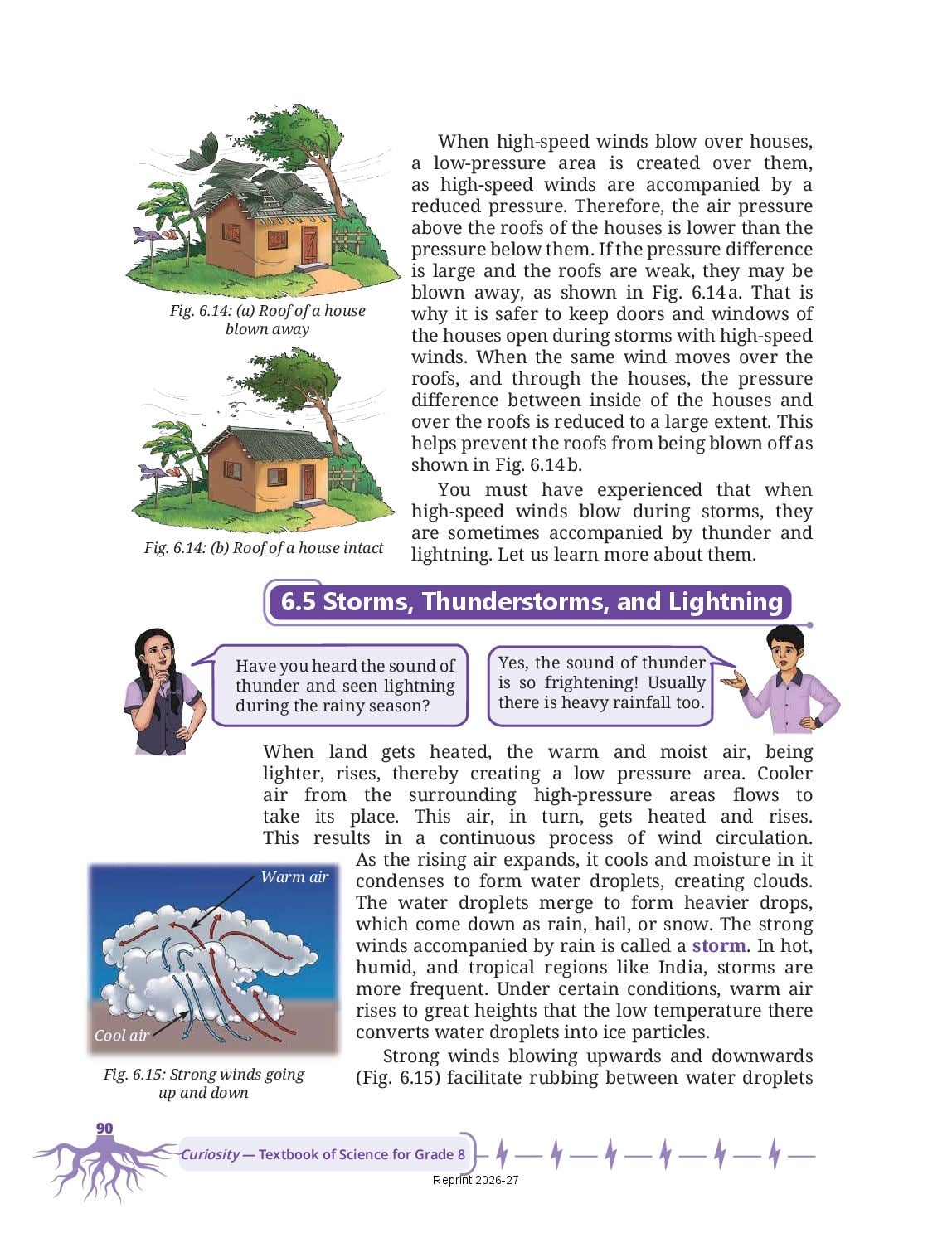
- Wind is air flowing from a region of high pressure to a region of low pressure. Warm air is lighter, so it rises and leaves a low-pressure region behind; cooler air from surrounding high-pressure regions moves in. The bigger the pressure difference, the faster the wind — this is what makes sea breeze, land breeze and storms.
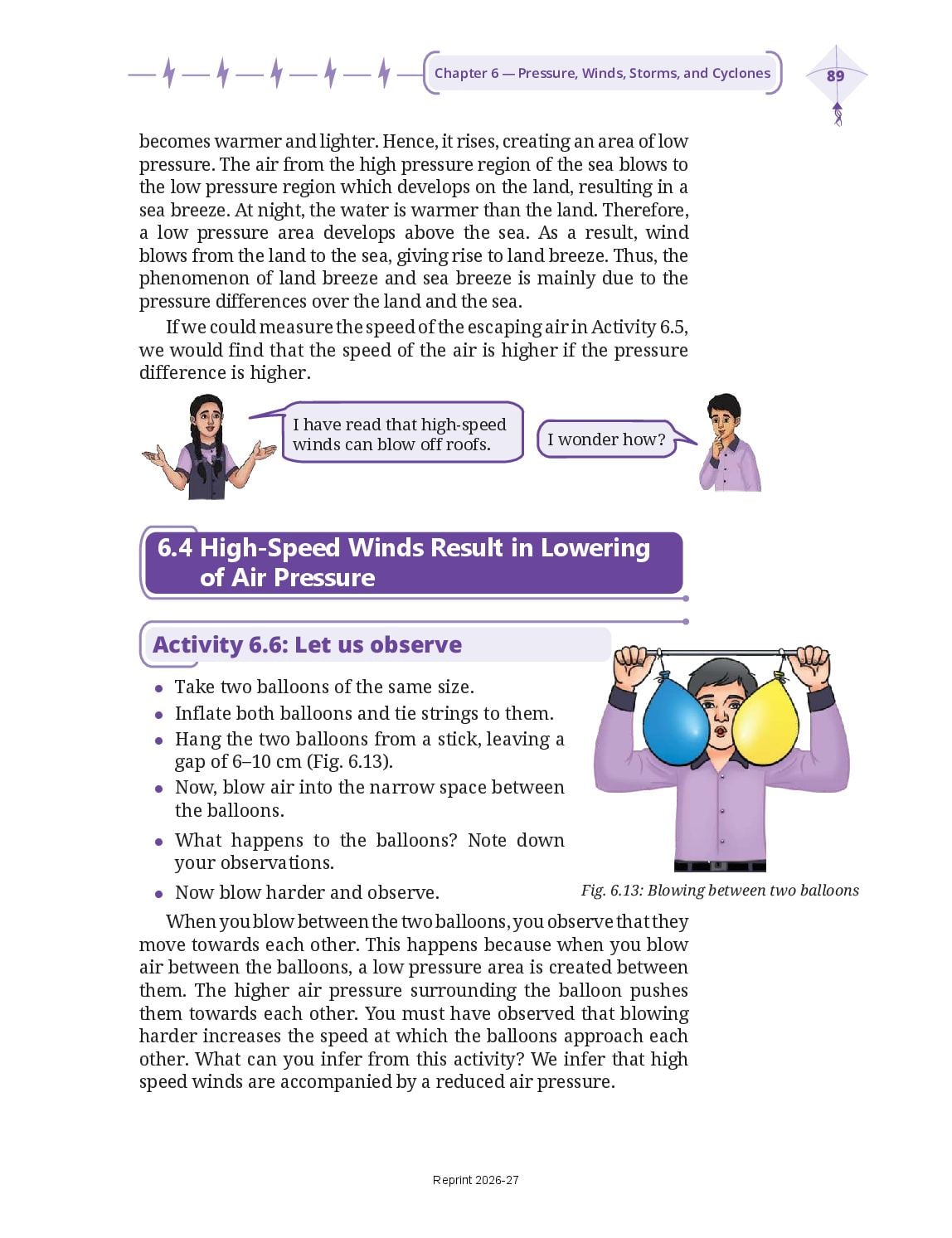
- High-speed winds are accompanied by reduced air pressure. When fast wind blows over a roof, the pressure above it becomes lower than the pressure below, and a weak roof can be lifted off. Keeping doors and windows open during a storm reduces this difference; holes in banners and hoardings do the same job.
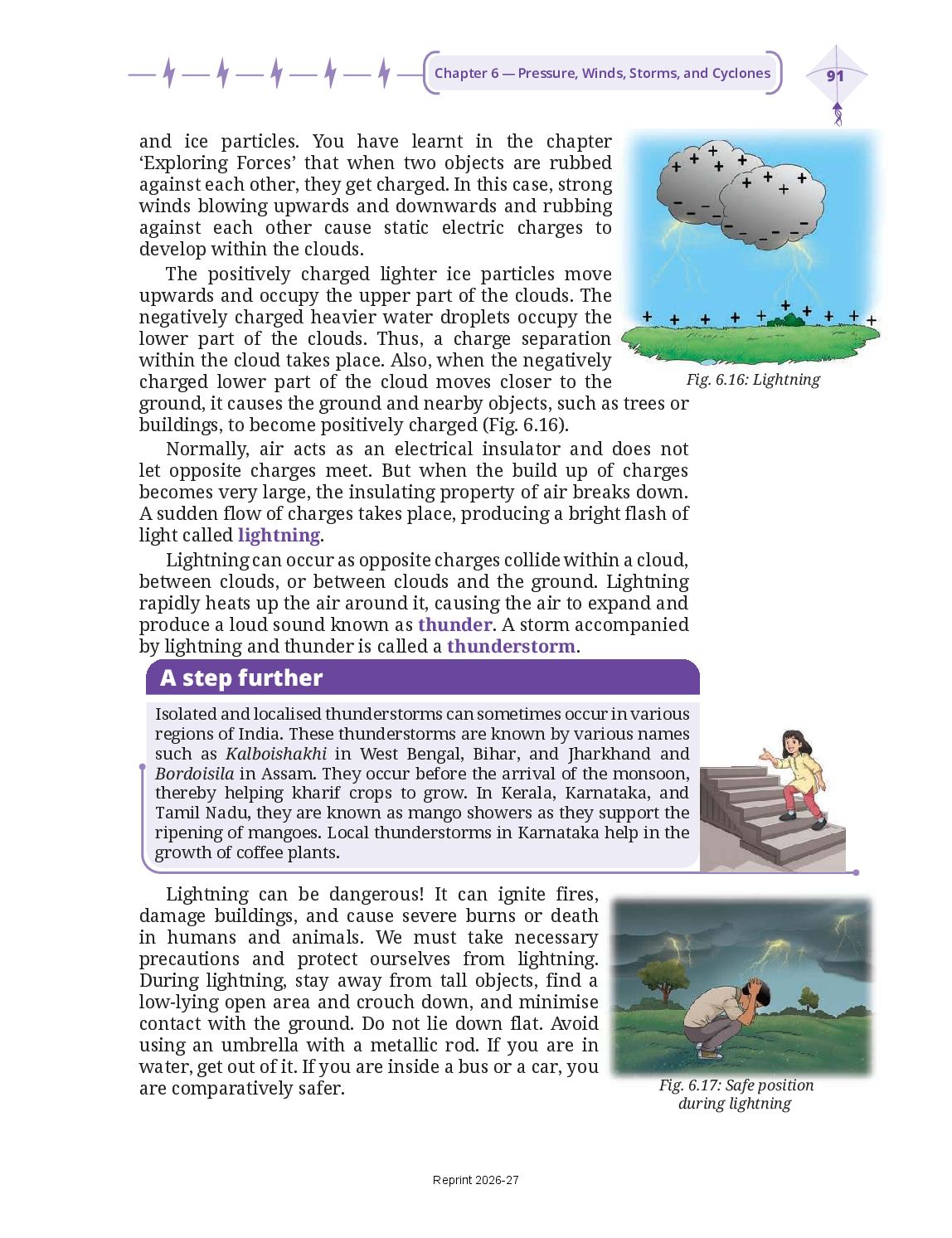
- In a thunderstorm, strong up-and-down winds rub ice particles against water droplets and charge the cloud. Charges separate — positive above, negative below — and when air stops insulating, the sudden flow of charge is lightning; the air it heats expands and gives thunder.
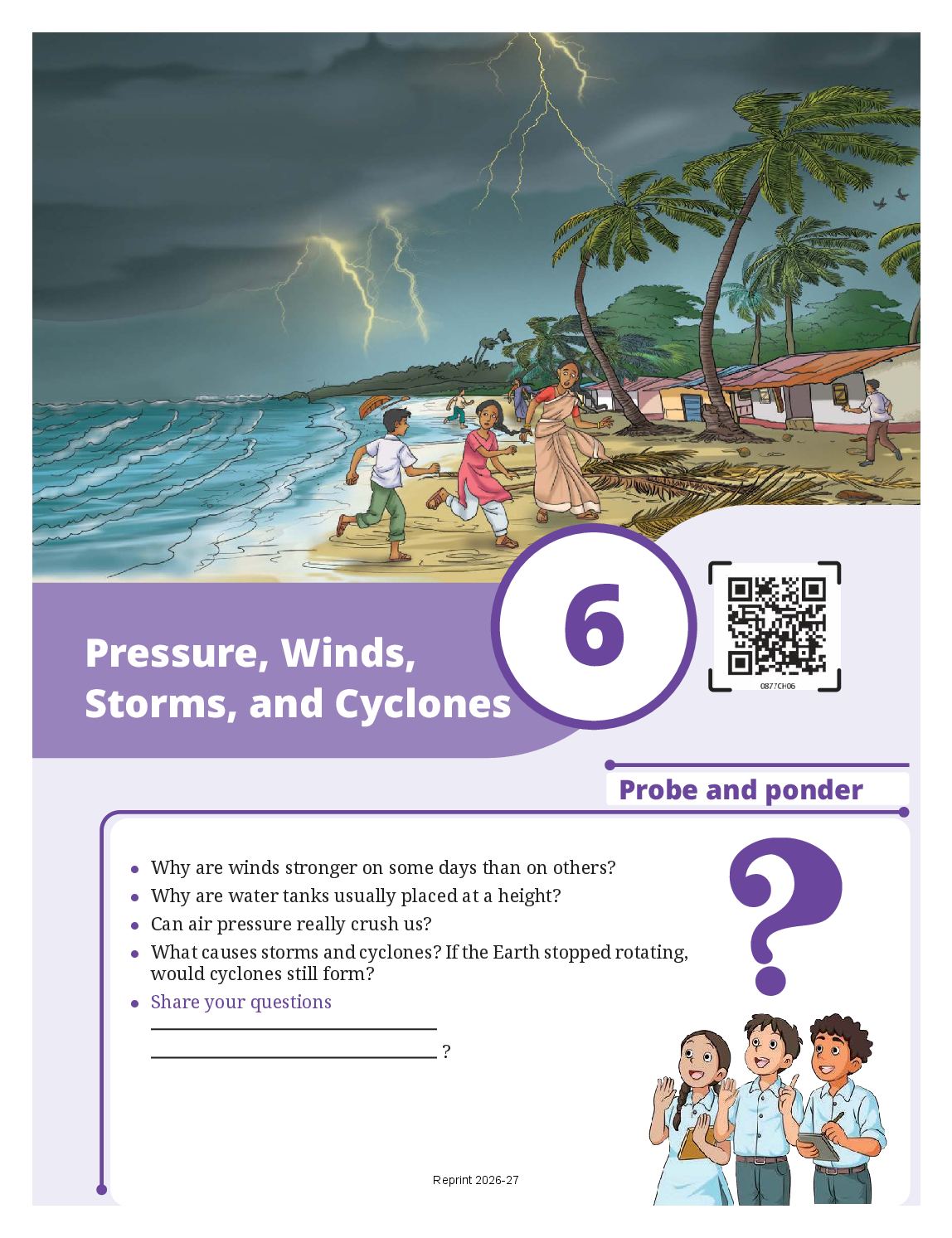
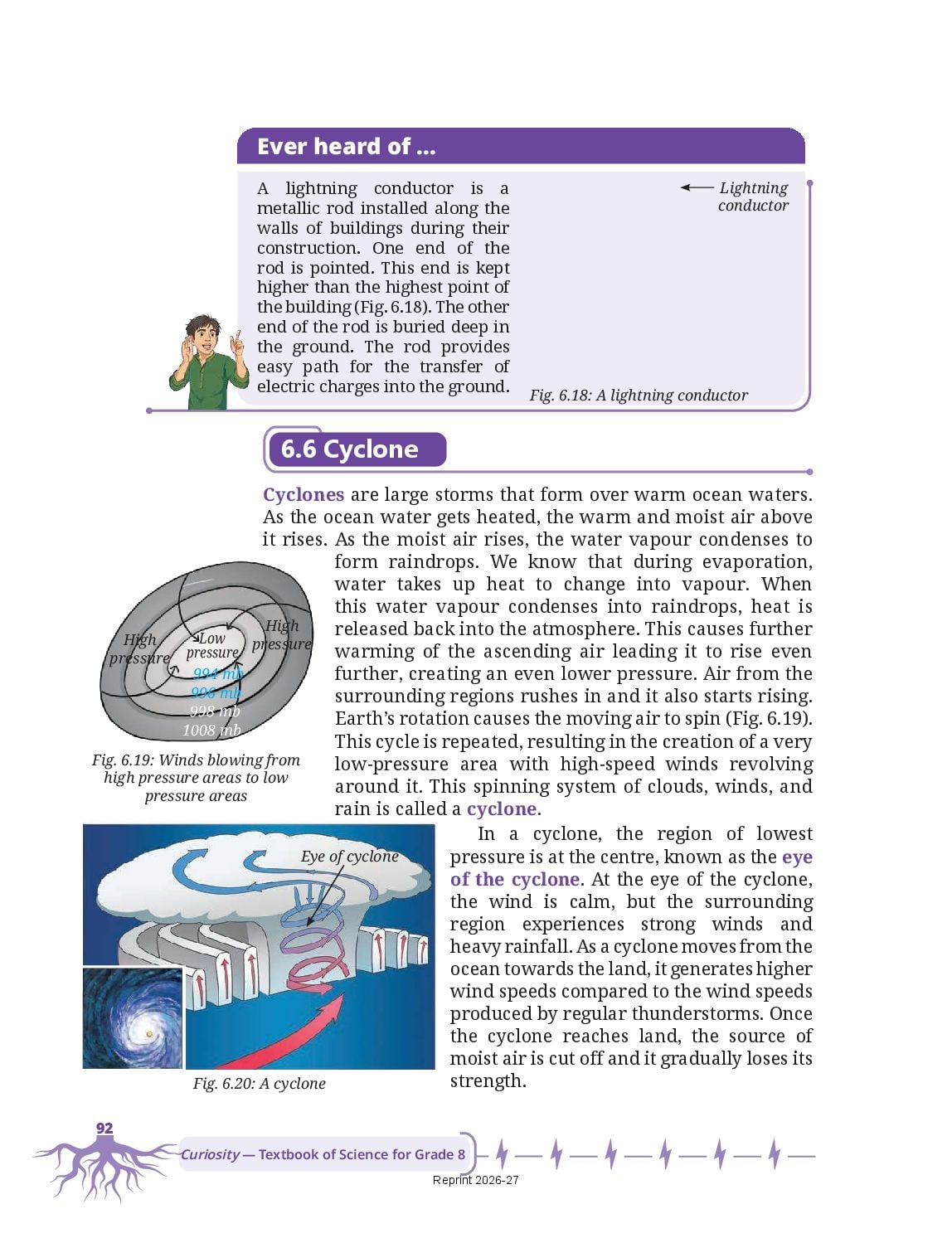
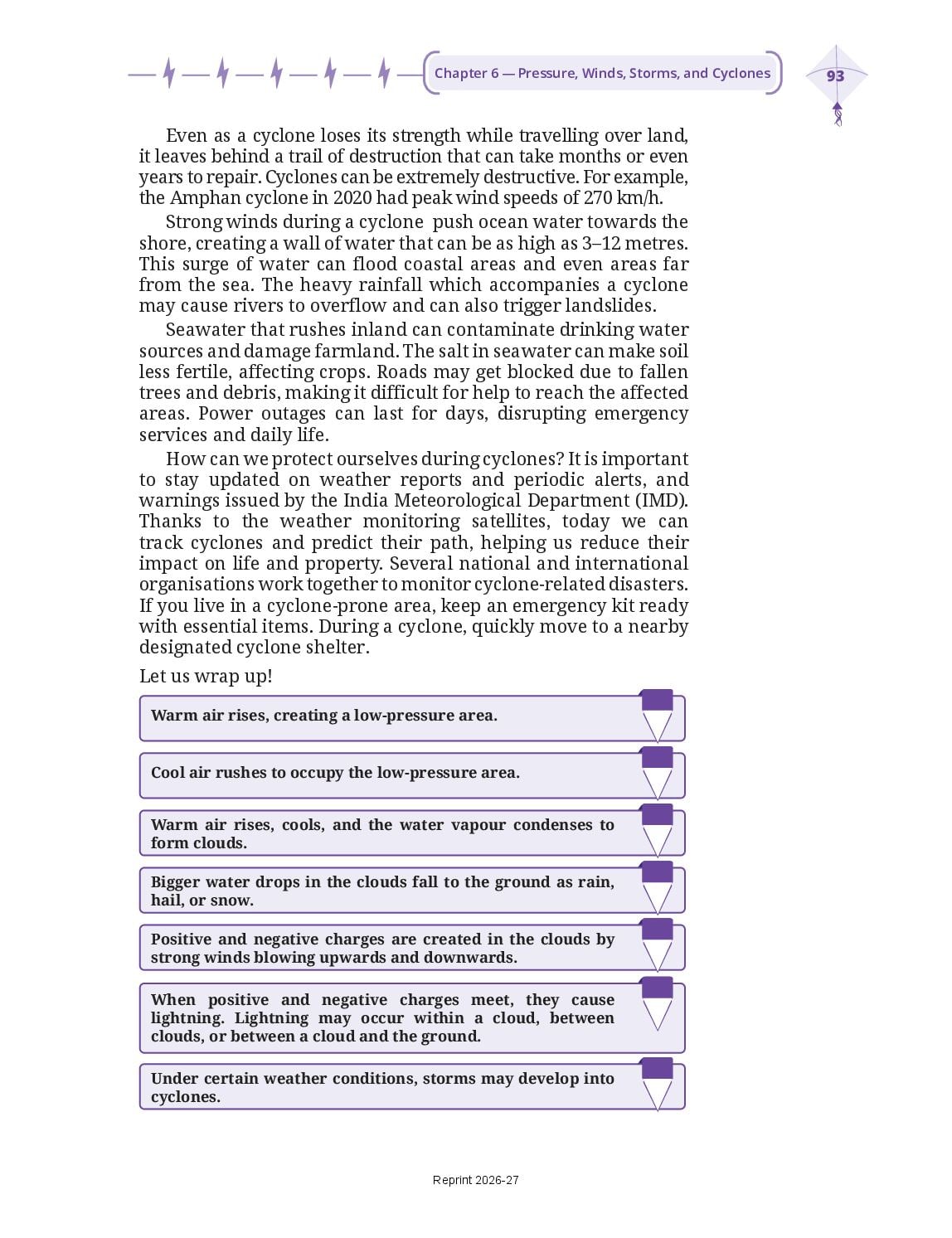
- A cyclone is a spinning system of clouds, winds and rain over warm ocean water. Condensation releases heat, the air rises further, the pressure at the centre drops still more, air rushes in and the Earth’s rotation makes it spin. The calm centre is the eye; the IMD tracks cyclones and issues the warnings we must follow.
Quick revision – Pressure, Winds, Storms, and Cyclones
| Term | What it means | Where it comes in the chapter | Example from the book |
|---|---|---|---|
| Pressure | The force acting perpendicular to a surface, divided by the area of that surface: P = F/A | Section 6.1, pages 81–82 | A bag with broad straps presses less on the shoulders than one with narrow straps (Fig. 6.1) |
| Pascal (Pa) | The SI unit of pressure; 1 Pa = 1 N/m2 | Section 6.1, page 82 | 100 N on 2 m2 of cardboard gives 50 N/m2 = 50 Pa |
| Millibar (mb) / hectopascal (hPa) | Practical units of air pressure; 1 mb = 1 hPa = 100 Pa | A step further, page 87 | The isobars 994 mb, 996 mb, 998 mb, 1008 mb in Fig. 6.19 |
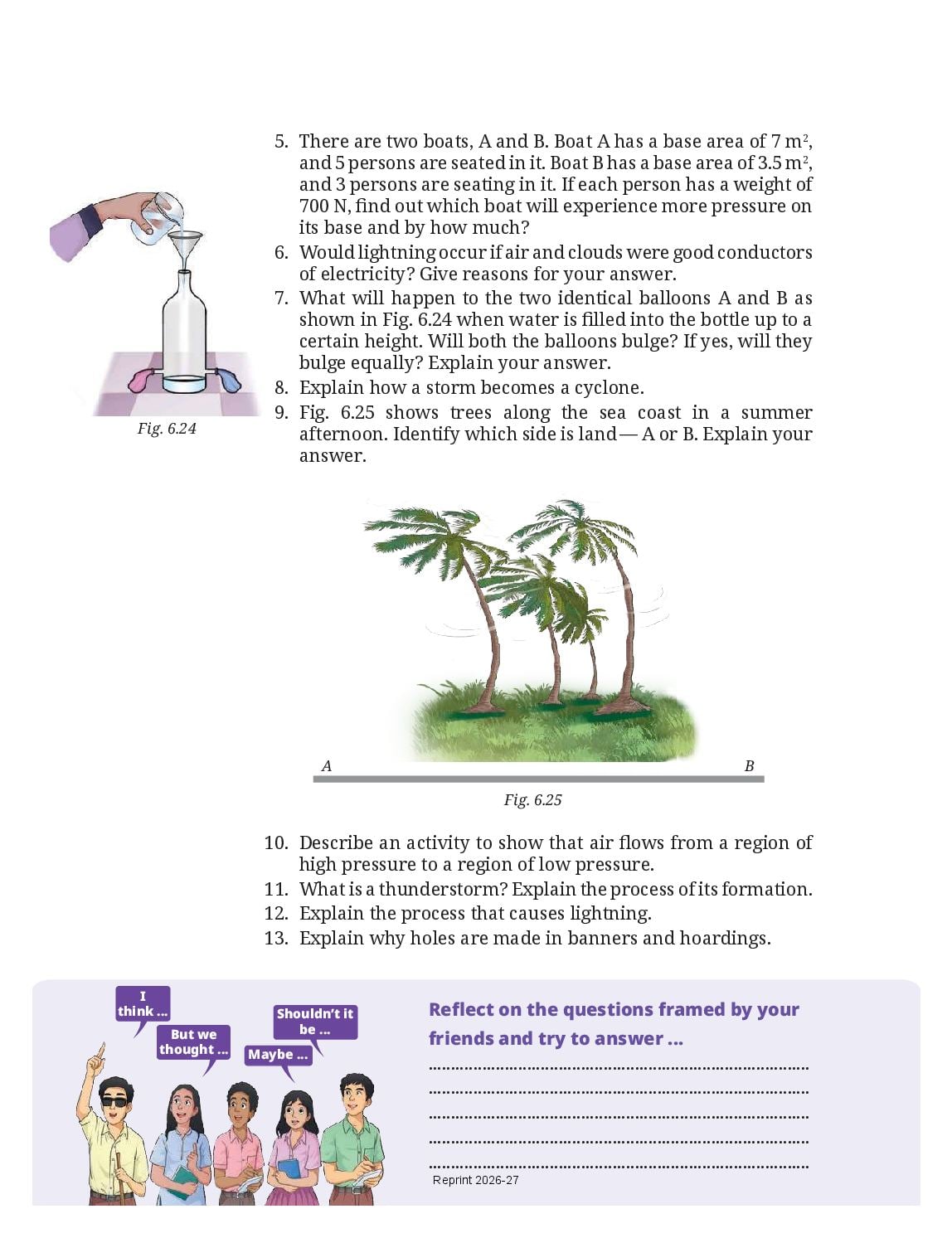
| Liquid pressure | Pressure exerted by a liquid column; it increases with the height of the column and acts in all directions | Activities 6.1 and 6.2, pages 83–85 | Equal water heights bulge both balloons equally (Fig. 6.5); water spurts from all four side holes (Fig. 6.7) |
| Atmosphere | The envelope of air surrounding the Earth — nitrogen, oxygen, argon, carbon dioxide and other gases in small quantities | Section 6.2, page 85 | It extends up to many kilometres above the Earth’s surface |
| Atmospheric pressure | The pressure exerted by the air around us | Section 6.2, pages 86–87 | Air pushes a rubber sucker onto a smooth surface (Activity 6.4, Fig. 6.11) |
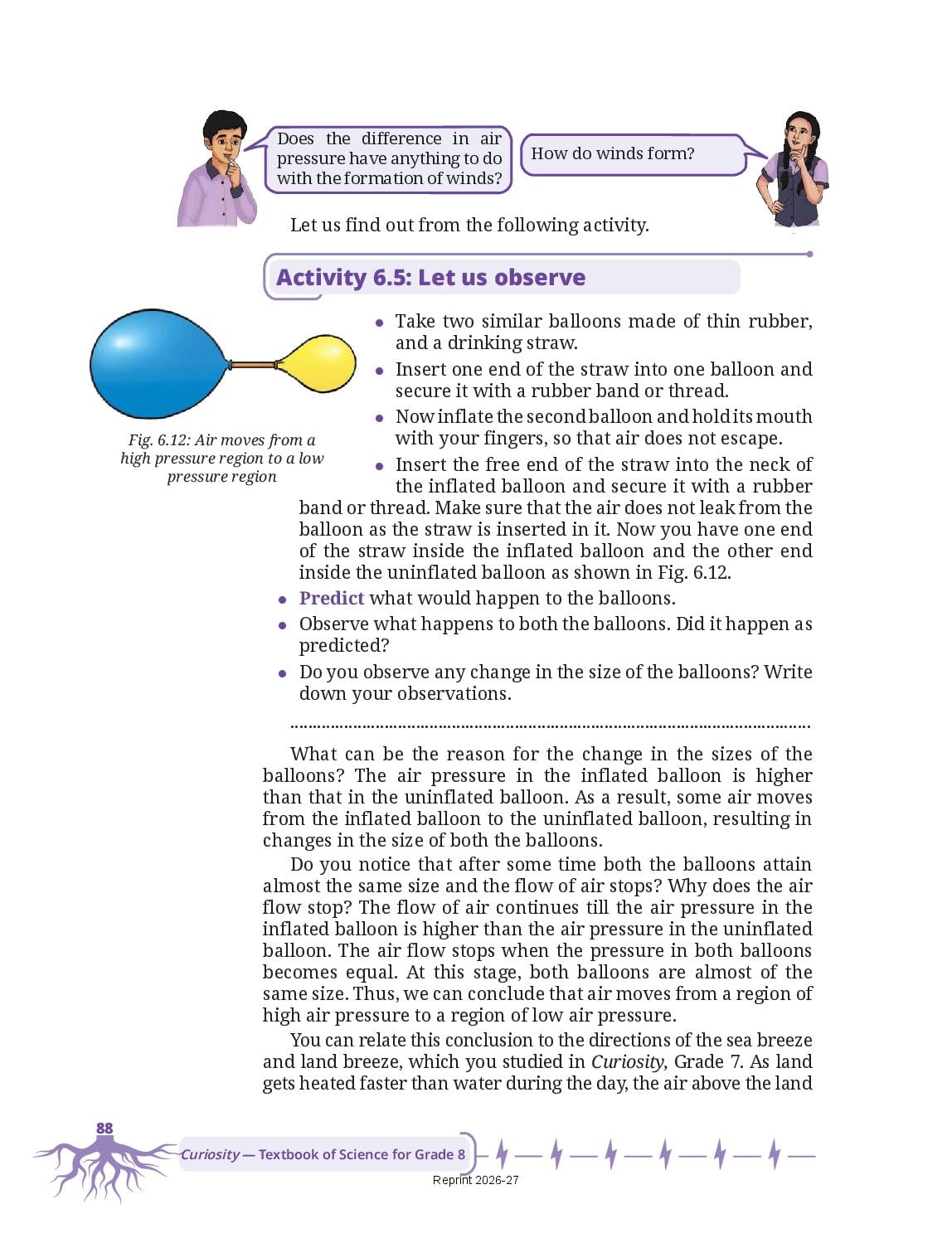
| Wind | Air in motion from a region of high pressure to a region of low pressure | Section 6.3, pages 87–89 | Air flows from the inflated balloon to the uninflated one through a straw (Activity 6.5, Fig. 6.12) |
| Sea breeze and land breeze | Daytime wind from sea to land, night-time wind from land to sea, caused by pressure differences over land and water | Section 6.3, pages 88–89 | Land heats faster by day, so the low pressure forms over the land |
| Storm | Strong winds accompanied by rain | Section 6.5, page 90 | Storms are frequent in hot, humid, tropical regions like India |
| Thunderstorm | A storm accompanied by lightning and thunder | Section 6.5, page 91 | Kalboishakhi in West Bengal, Bihar and Jharkhand; Bordoisila in Assam; mango showers in Kerala, Karnataka and Tamil Nadu |
| Lightning | The bright flash produced when a large build-up of charge breaks down the insulating property of air and charges suddenly flow | Section 6.5, page 91 | Within a cloud, between clouds, or between a cloud and the ground (Fig. 6.16) |
| Lightning conductor | A metallic rod fixed along a building’s walls, pointed end above the highest point and other end buried deep in the ground | Ever heard of…, page 92 | It gives electric charges an easy path into the ground (Fig. 6.18) |
| Cyclone | A spinning system of clouds, winds and rain formed over warm ocean waters around a very low-pressure centre | Section 6.6, pages 92–93 | Cyclone Amphan (2020) had peak wind speeds of 270 km/h |
| Eye of the cyclone | The region of lowest pressure at the centre of a cyclone, where the wind is calm | Section 6.6, page 92 | The surrounding region has strong winds and heavy rainfall (Fig. 6.20) |
Old NCERT vs New – Class 8 Science
This chapter is from Curiosity, the new NCERT Class 8 Science book (NCF-SE 2023, used from 2025-26). It replaced the old book “Science”, so chapter numbers and names differ from older PDFs.
Solutions and All Chapters
Answers to the exercises and the full chapter list of Curiosity:
Pressure, Winds, Storms, and Cyclones – Overview
| Class | Class 8 |
| Subject | Science |
| Book | Curiosity – new NCERT book |
| Chapter | 6 of 13 – Pressure, Winds, Storms, and Cyclones |
| Book pages | 80 – 97 |
| Edition | NCERT Reprint 2026-27 |
| Session | 2026-27 |
| Free – read online or download |
Class 8 Science Chapter 6 – FAQs
Where can I download Pressure, Winds, Storms, and Cyclones Class 8 PDF?
From the download table on this page – the chapter PDF is free, and the full book is linked too.
What is Class 8 Science Chapter 6 about?
Pressure is force per unit area, P = F/A. The same weight pressing on a smaller area gives a larger pressure — which is why a broad strap is comfortable, a pointed nail drives easily and a sharp knife cuts. The SI unit is N/m2, also called the pascal (Pa).
Is Pressure, Winds, Storms, and Cyclones from the new NCERT Class 8 Science book?
Yes. It is chapter 6 of curiosity, the new NCERT Class 8 Science book for 2026-27.
Is this the latest NCERT edition for 2026-27?
Yes – the PDF is NCERT’s latest edition for the 2026-27 session.
Where are the NCERT Solutions for Class 8 Science Chapter 6?
Open the NCERT Solutions link above for answers to the exercise questions.