Download The Amazing World of Solutes, Solvents, and Solutions – NCERT Class 8 Science Chapter 9 PDF from the new NCERT Class 8 Science book Curiosity (2026-27). Read the chapter online or download the free PDF. A uniform mixture — one in which the components are spread evenly and cannot be picked out — is a solution. Salt or sugar in water is a solution; chalk powder, sand or sawdust in water is a non-uniform mixture.
The Amazing World of Solutes, Solvents, and Solutions PDF – Chapter 9 of Curiosity
Read the chapter online or download the PDF.
| Chapter | Download | |
|---|---|---|
| Chapter 9 PDF | The Amazing World of Solutes, Solvents, and Solutions | View PDF |
| Full book | NCERT Class 8 Science – Curiosity | View Book |
Read Online
What Is in The Amazing World of Solutes, Solvents, and Solutions? (Class 8 Science Chapter 9)
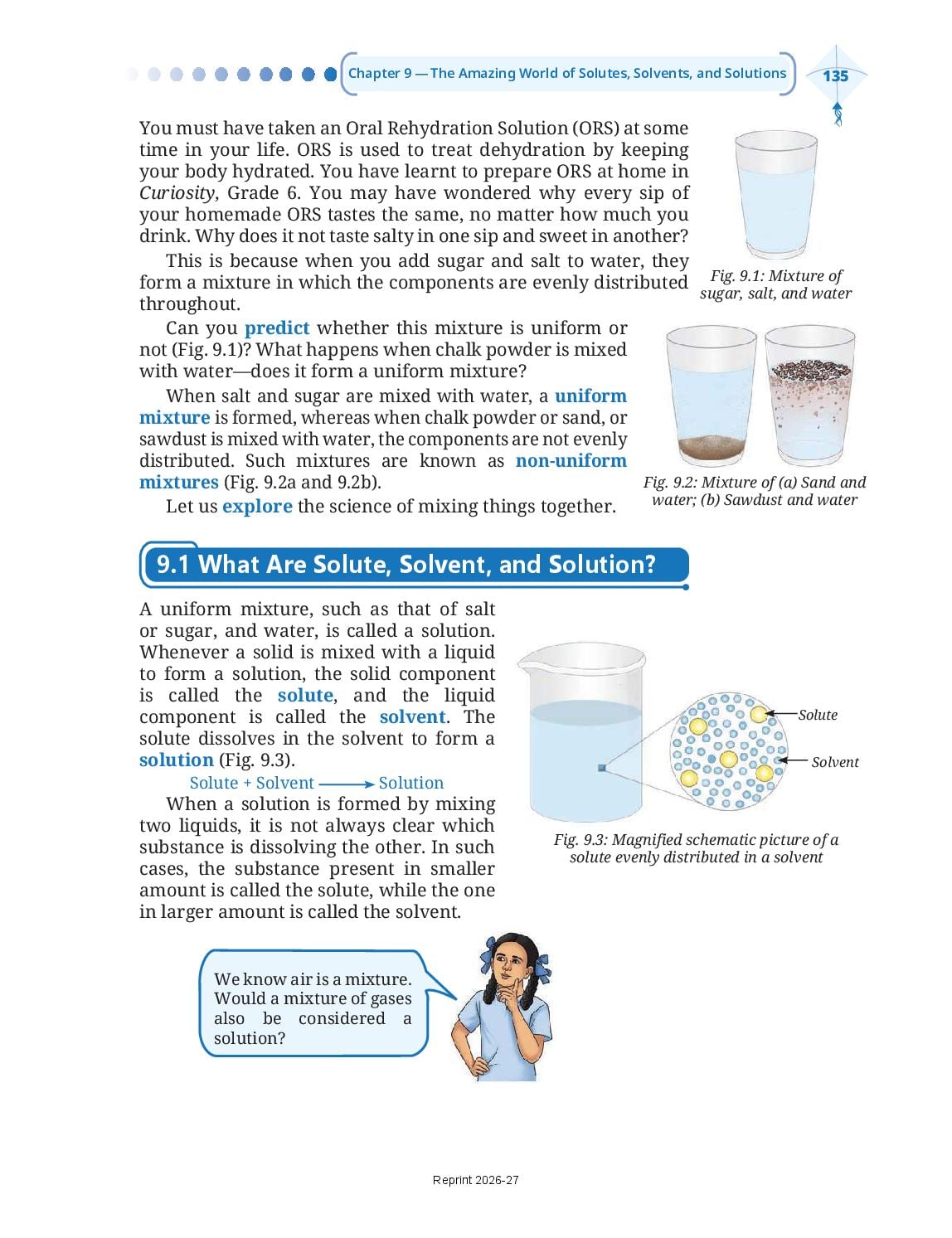
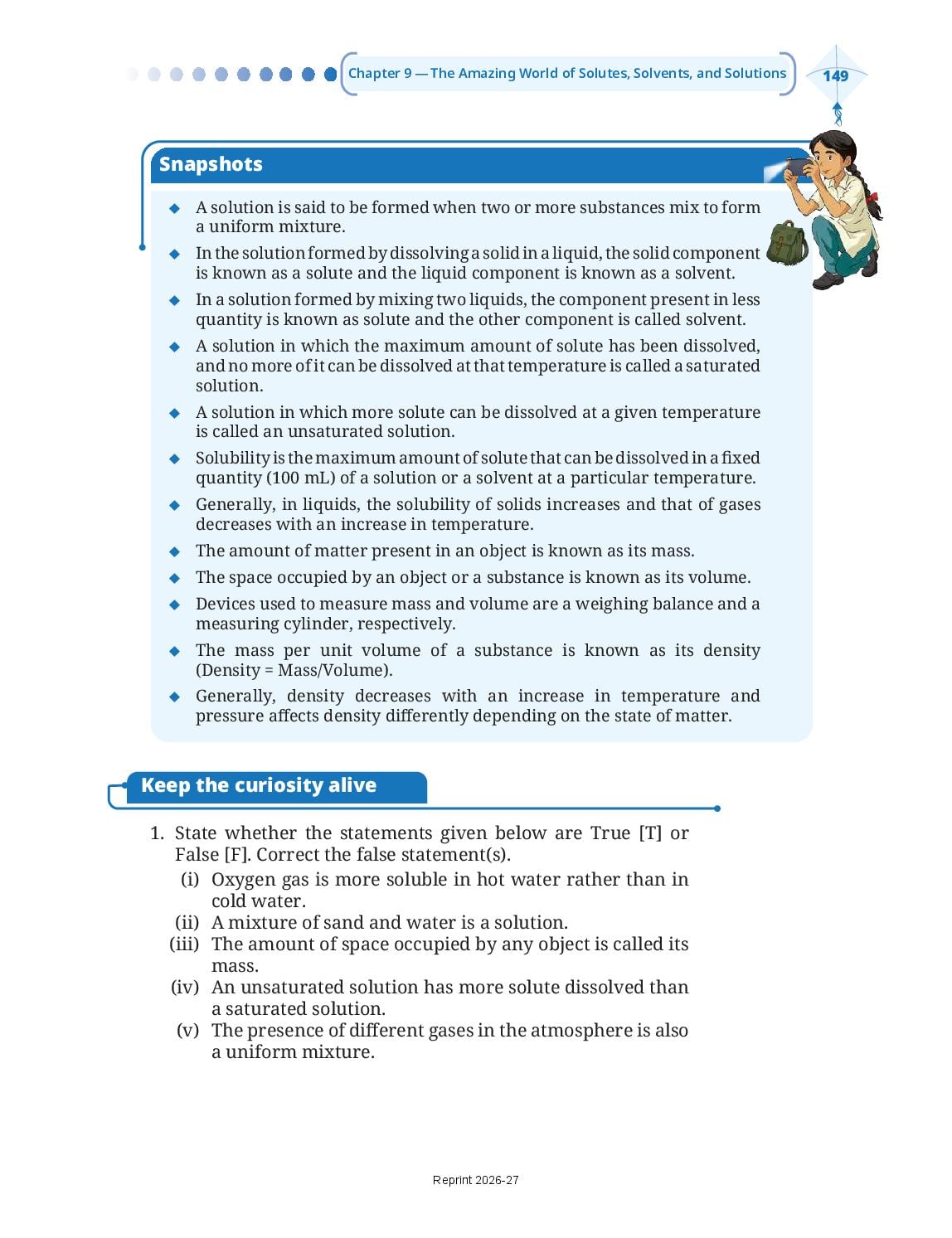
- A uniform mixture — one in which the components are spread evenly and cannot be picked out — is a solution. Salt or sugar in water is a solution; chalk powder, sand or sawdust in water is a non-uniform mixture.
- When a solid dissolves in a liquid, the solid is the solute and the liquid is the solvent. When two liquids mix, the one present in the smaller amount is the solute.
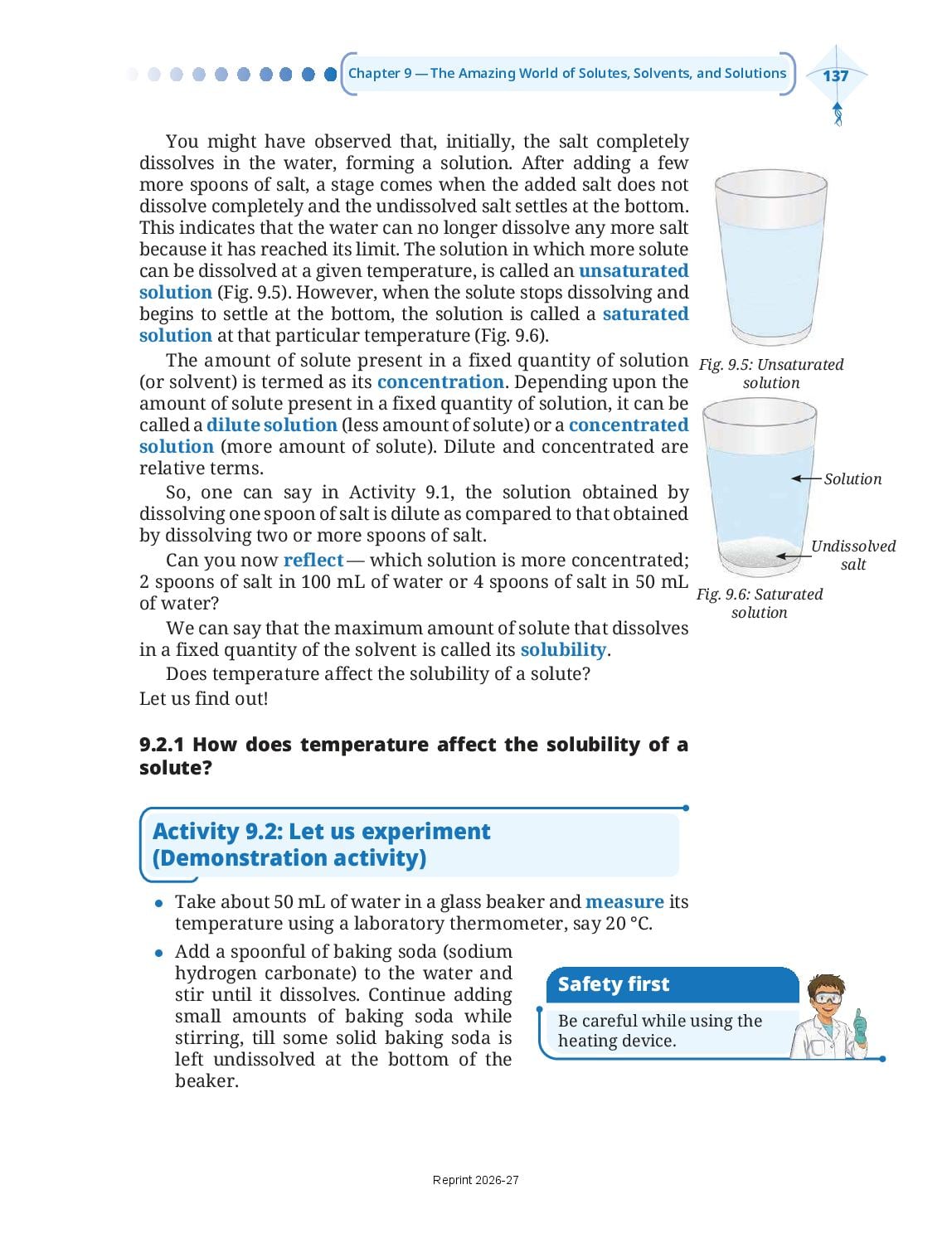
- A solution that can still dissolve more solute at that temperature is unsaturated; once the solute stops dissolving and settles at the bottom, the solution is saturated at that temperature. The amount of solute in a fixed quantity of solution is its concentration (dilute or concentrated); the maximum that dissolves in a fixed quantity (100 mL) of solvent is its solubility.
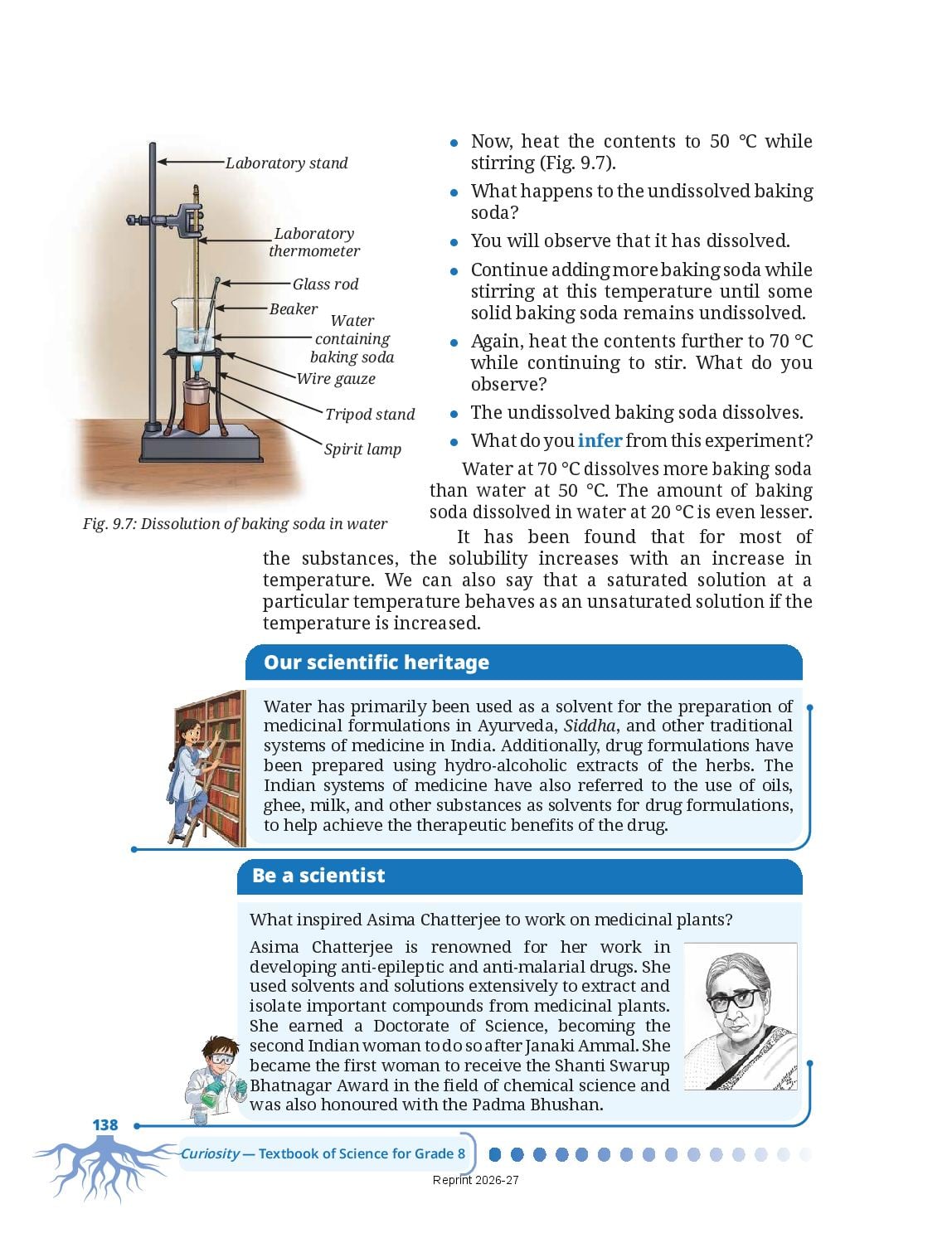
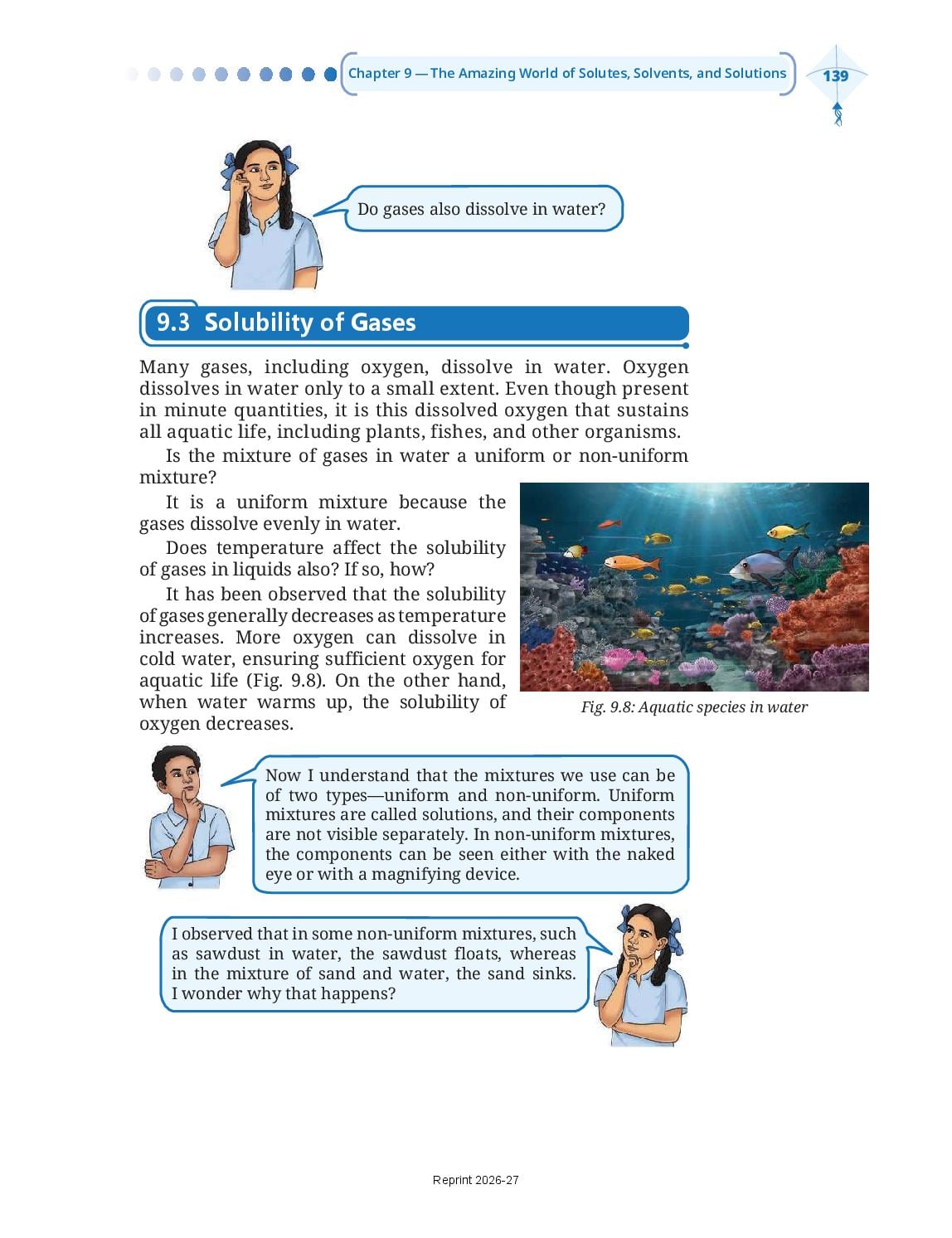
- Raising the temperature generally increases the solubility of solids in liquids — a saturated solution becomes unsaturated on heating — but decreases the solubility of gases. That is why cold water holds more dissolved oxygen for aquatic life.
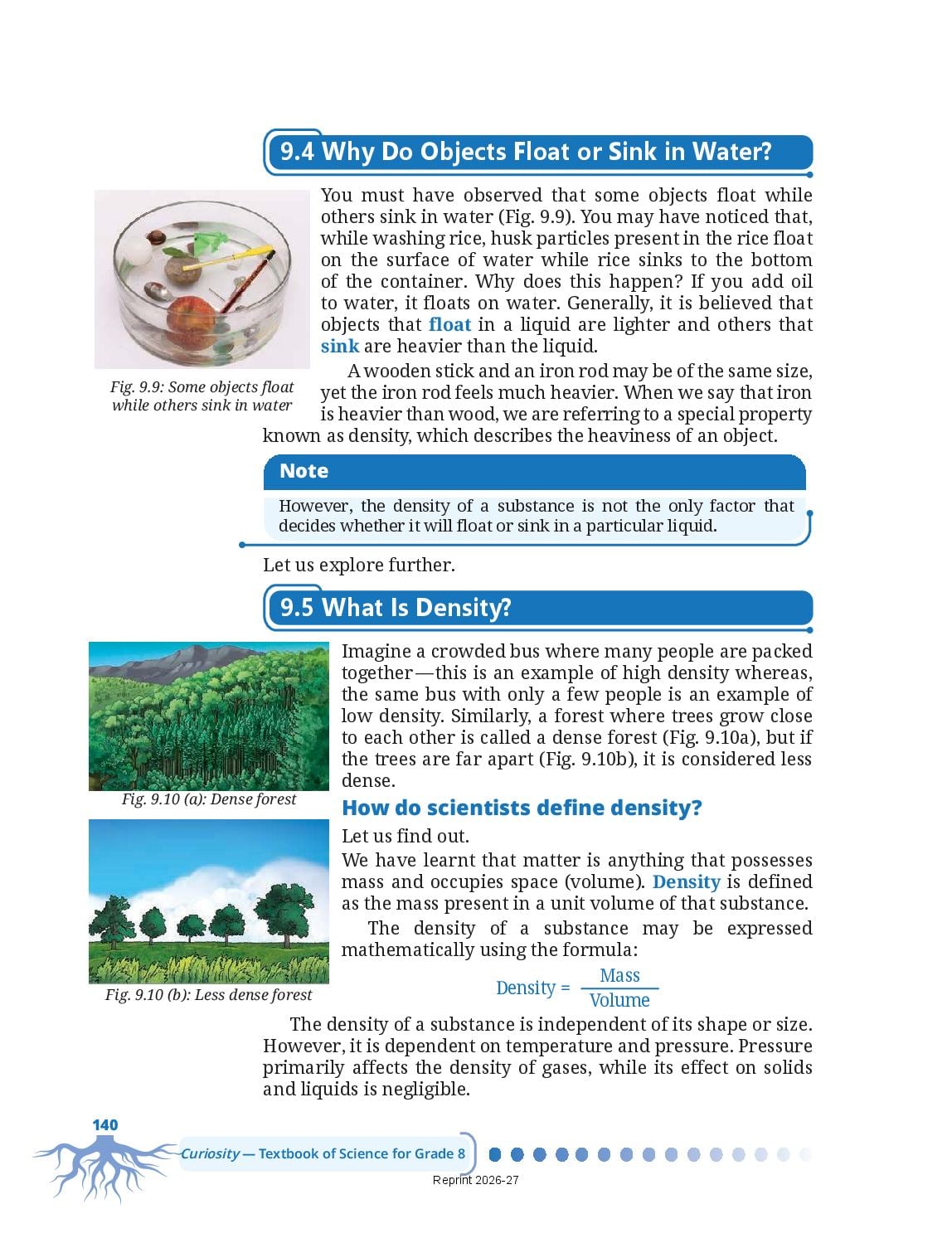
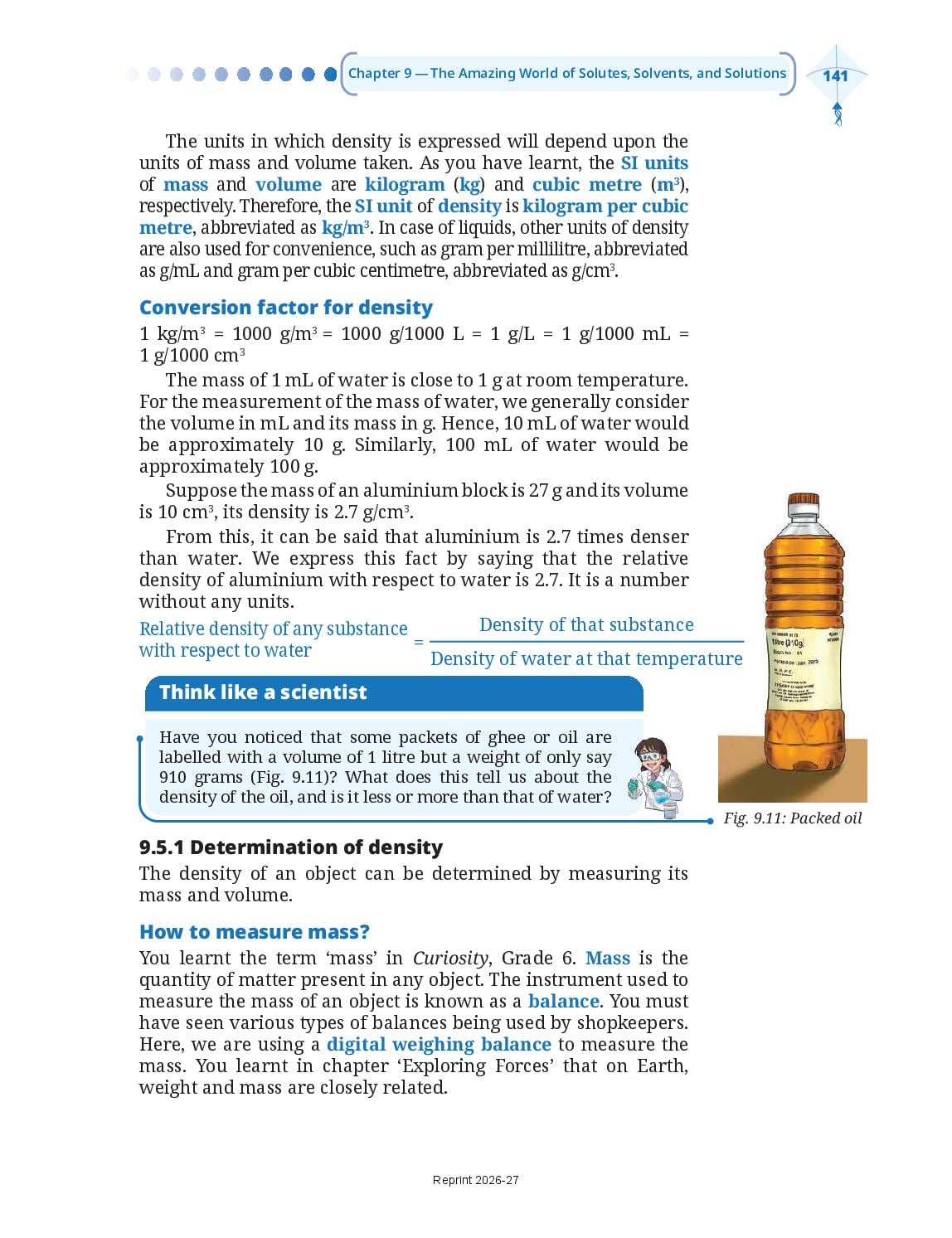
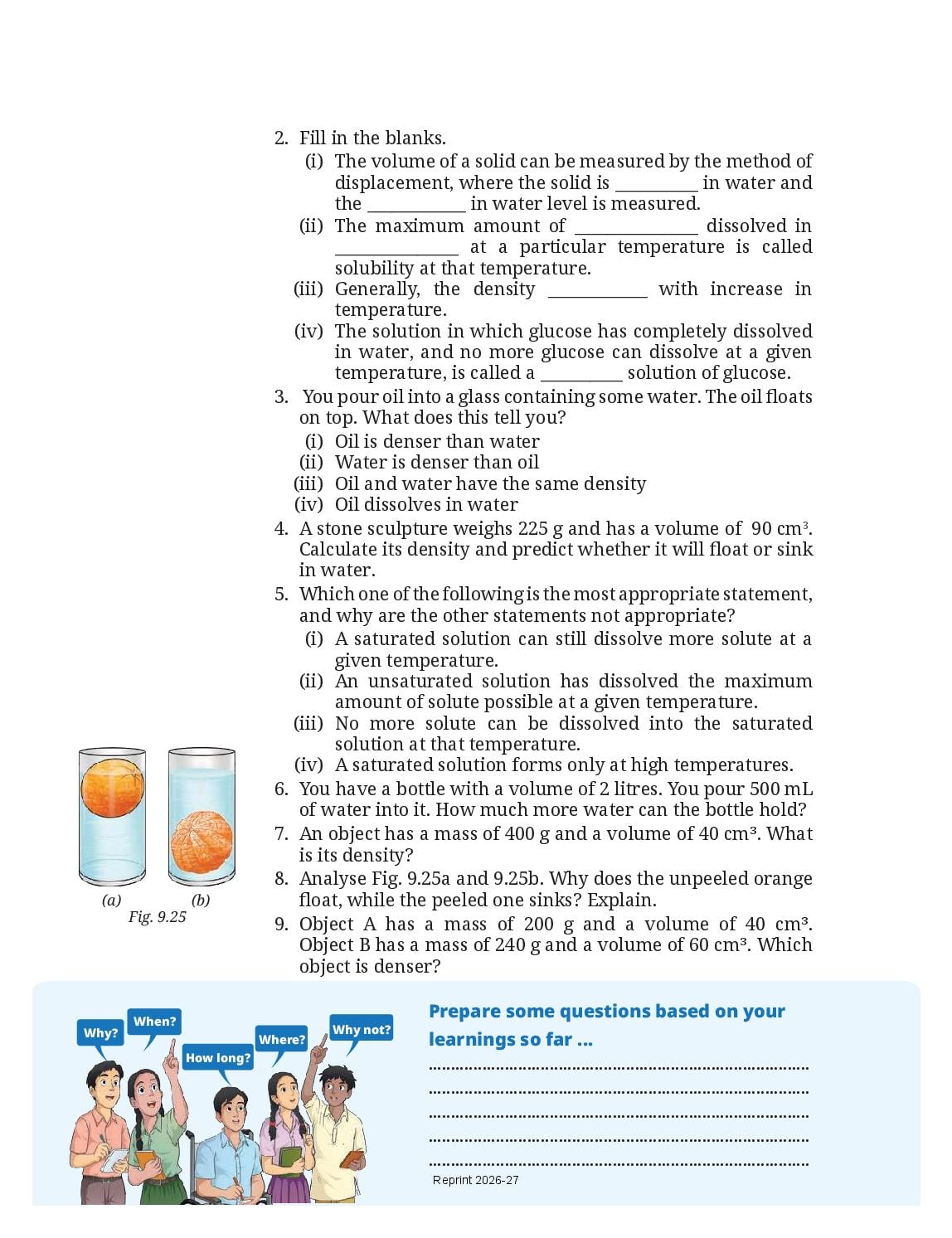
- Density = Mass / Volume. Its SI unit is kg/m³; for liquids and small solids g/mL and g/cm³ are convenient. Relative density compares a substance with water and has no unit. Density does not depend on the shape or size of a piece, only on temperature and pressure.
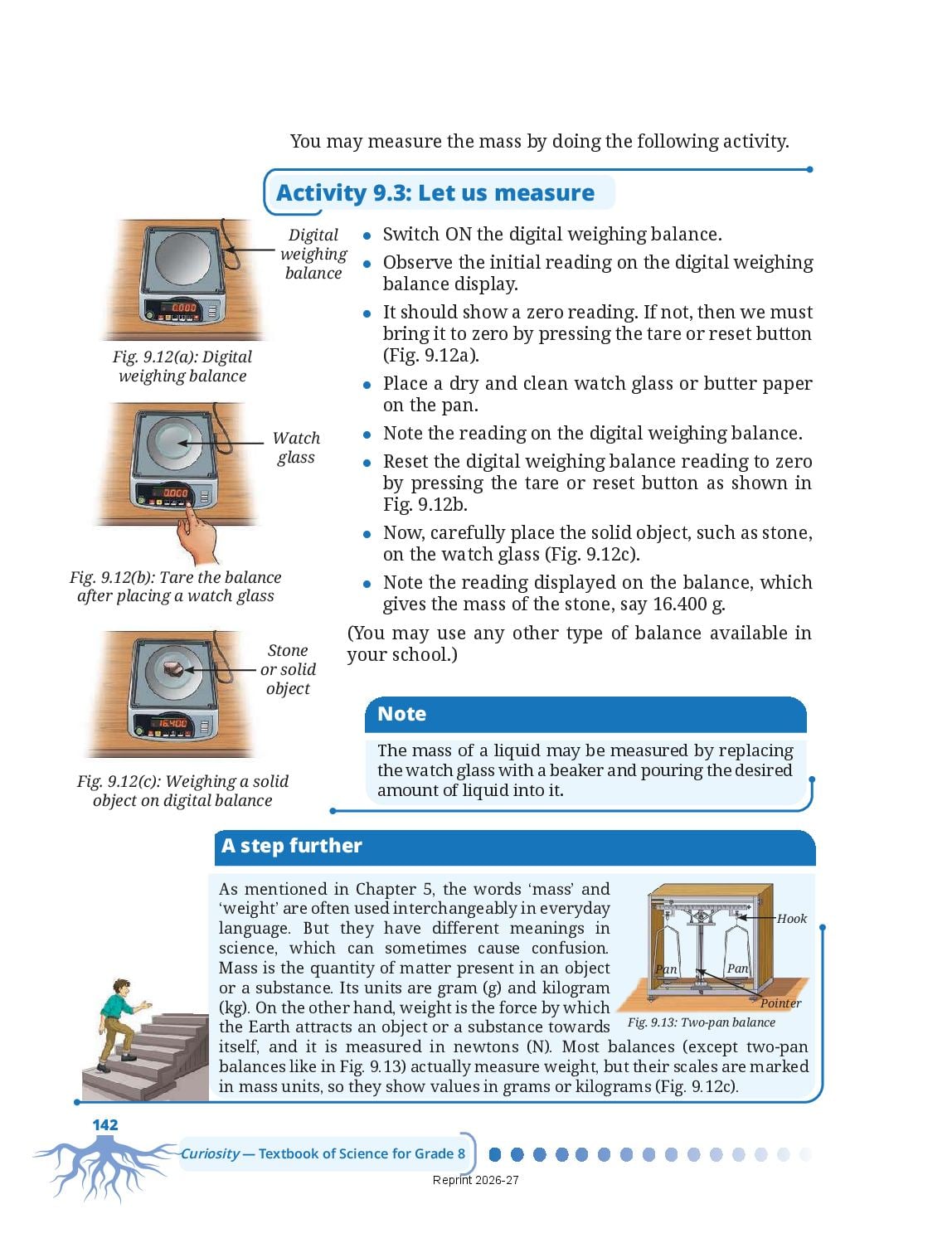
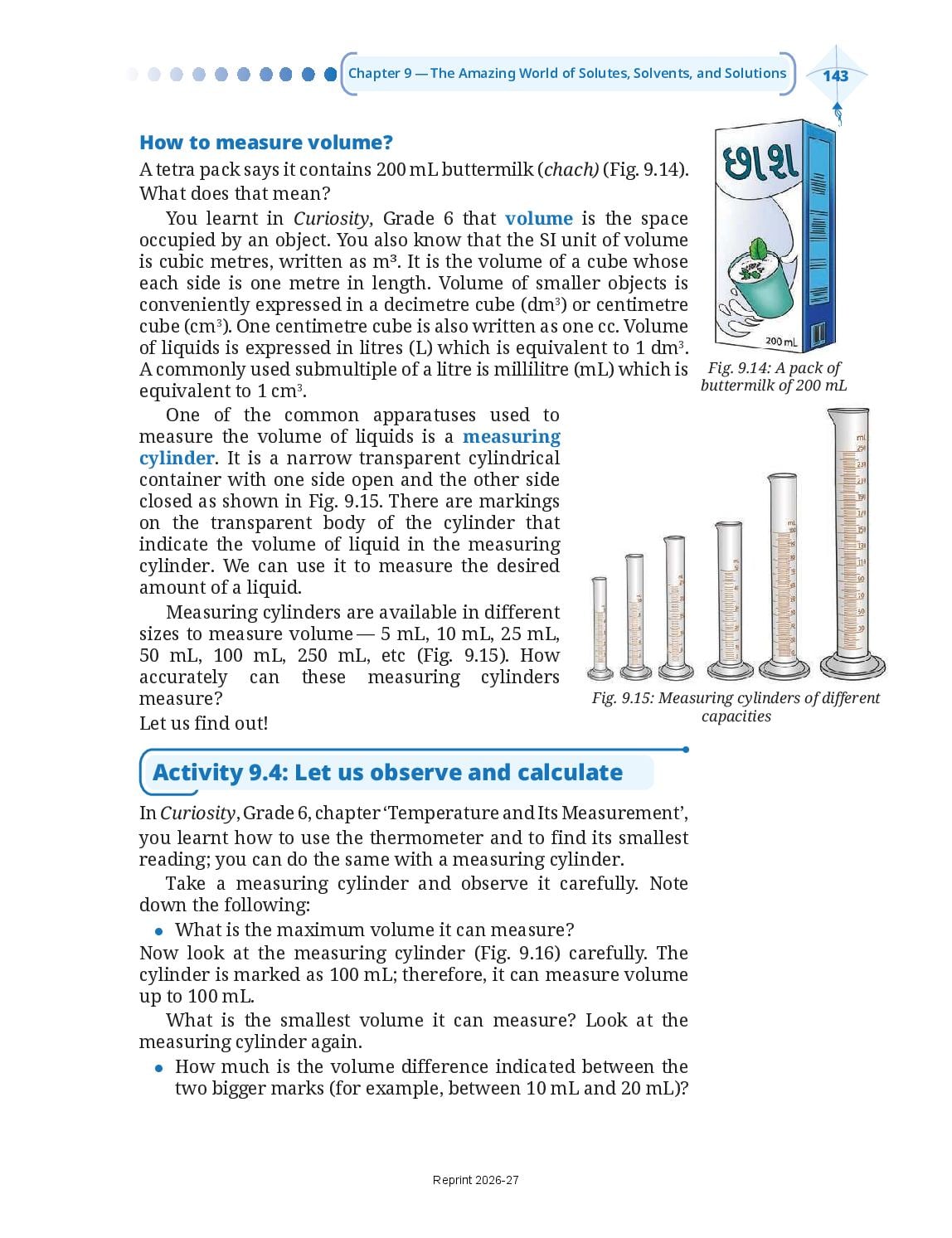
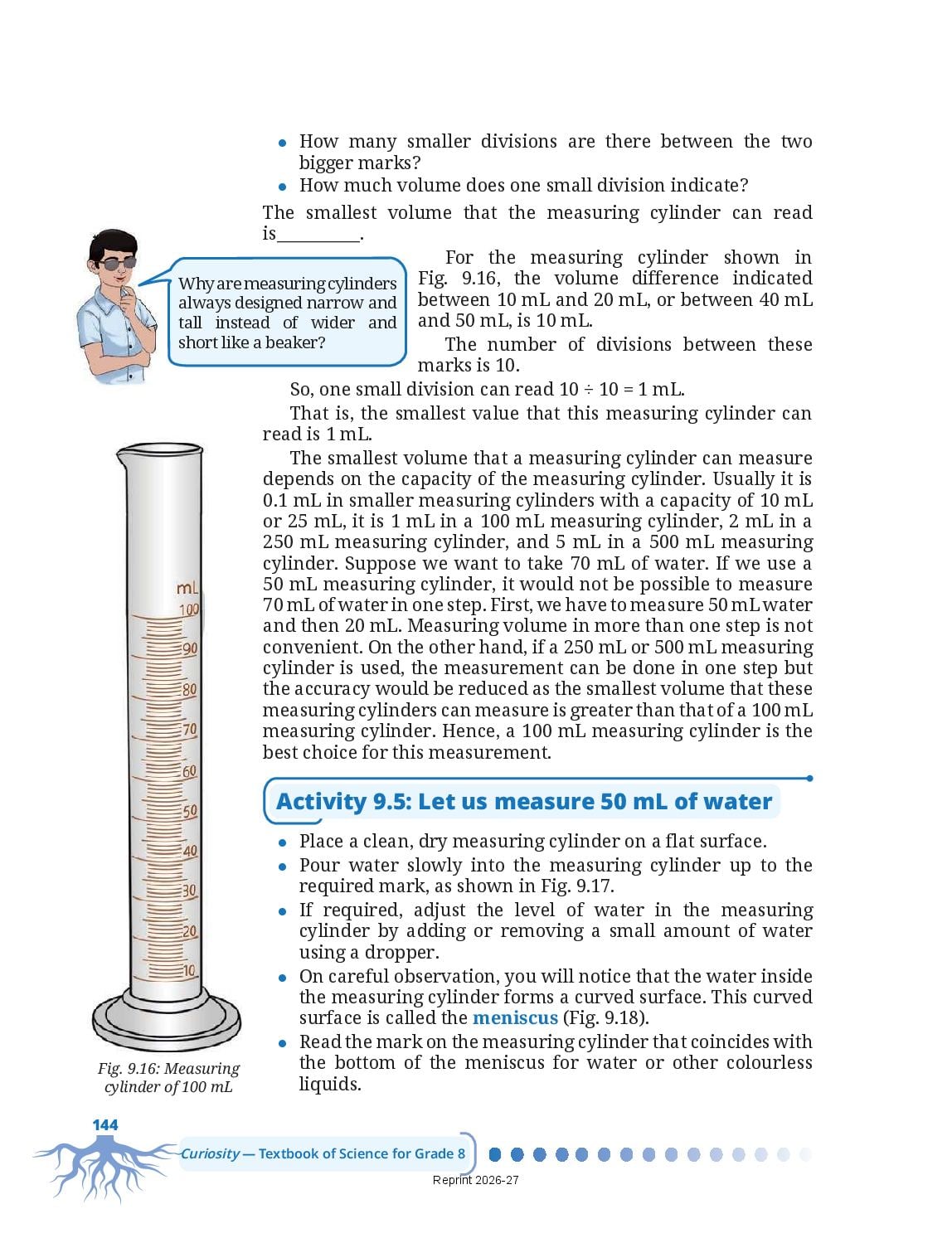
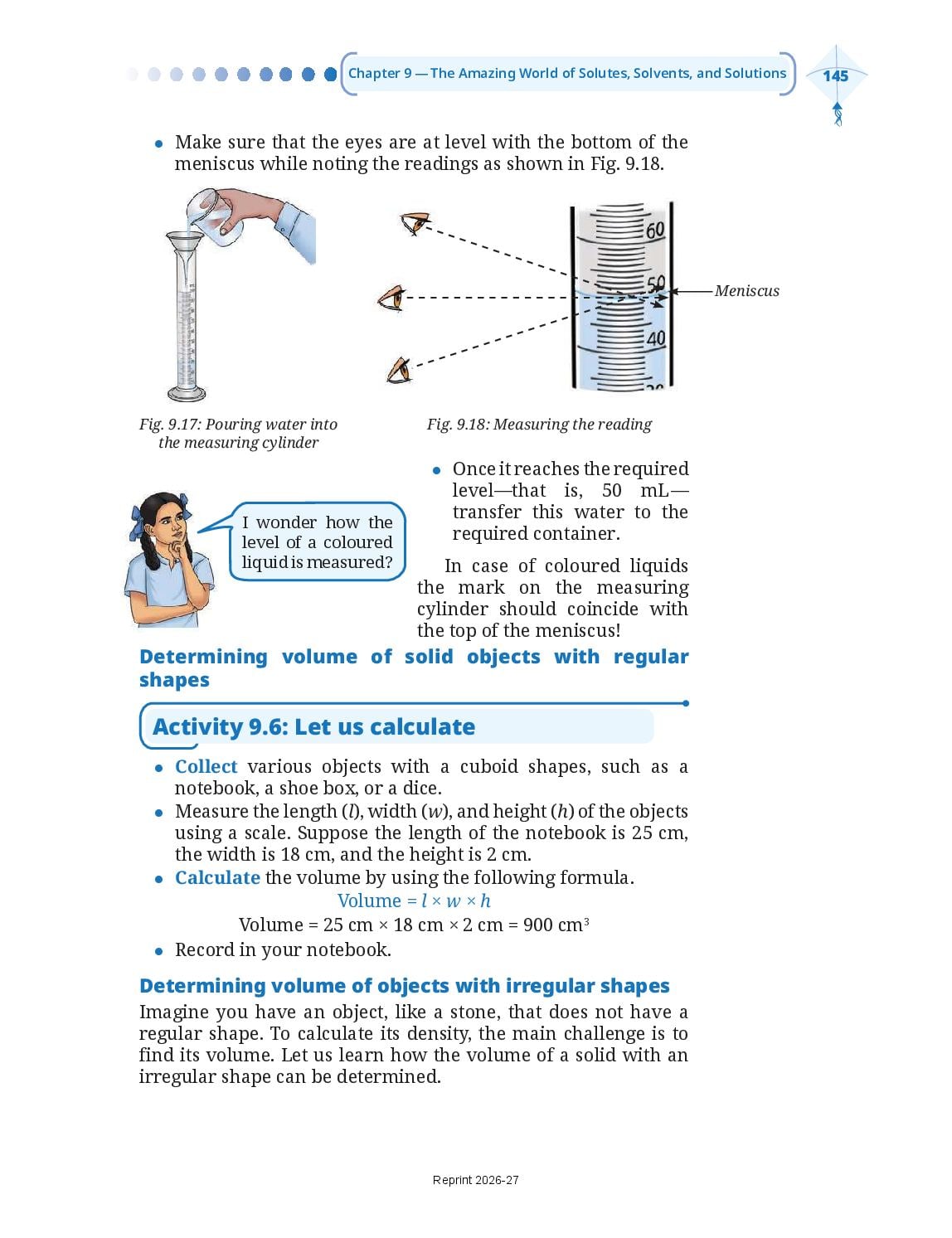
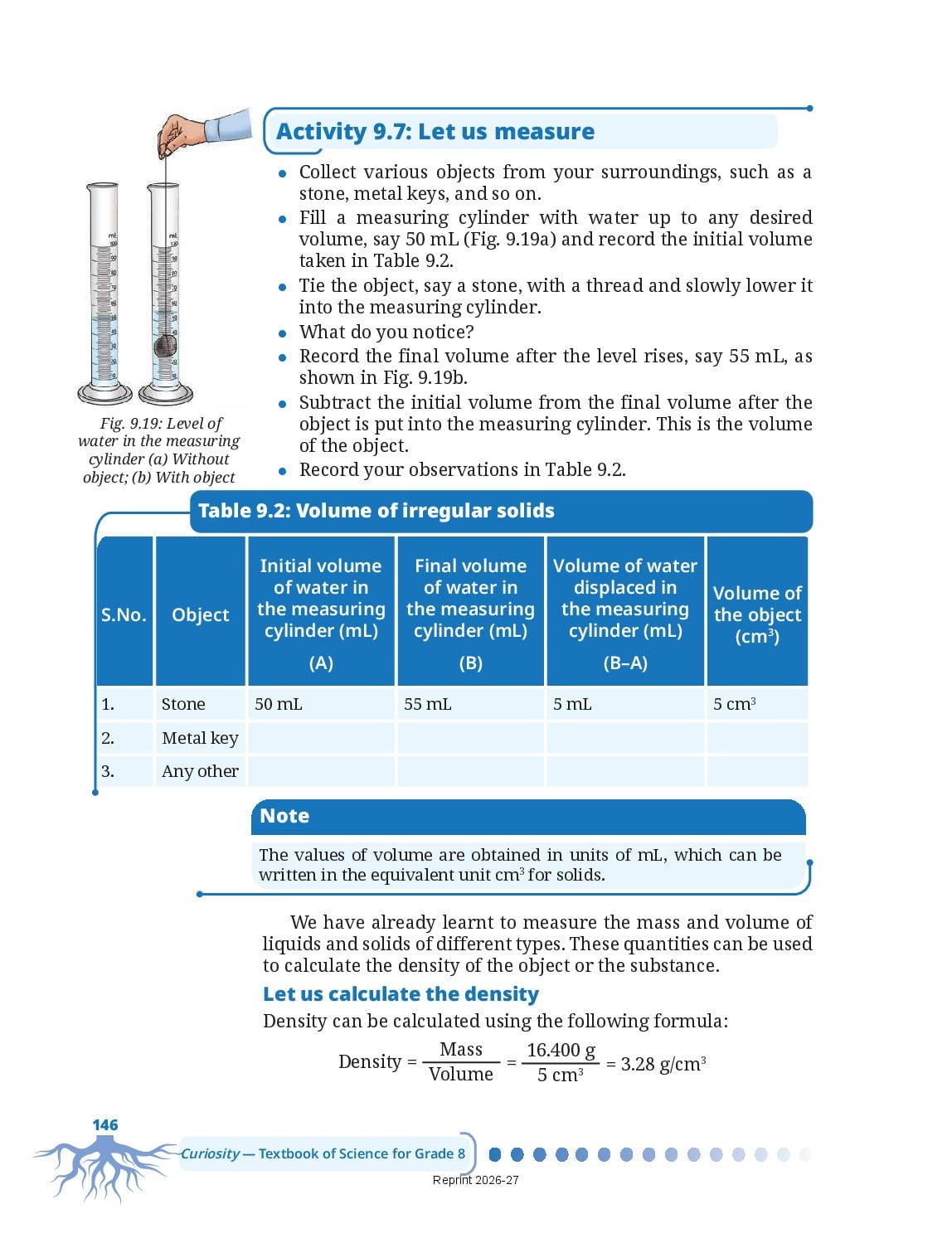
- Mass is measured with a balance, liquid volume with a measuring cylinder (read the bottom of the meniscus), regular solids by l × w × h, and irregular solids by the displacement of water.
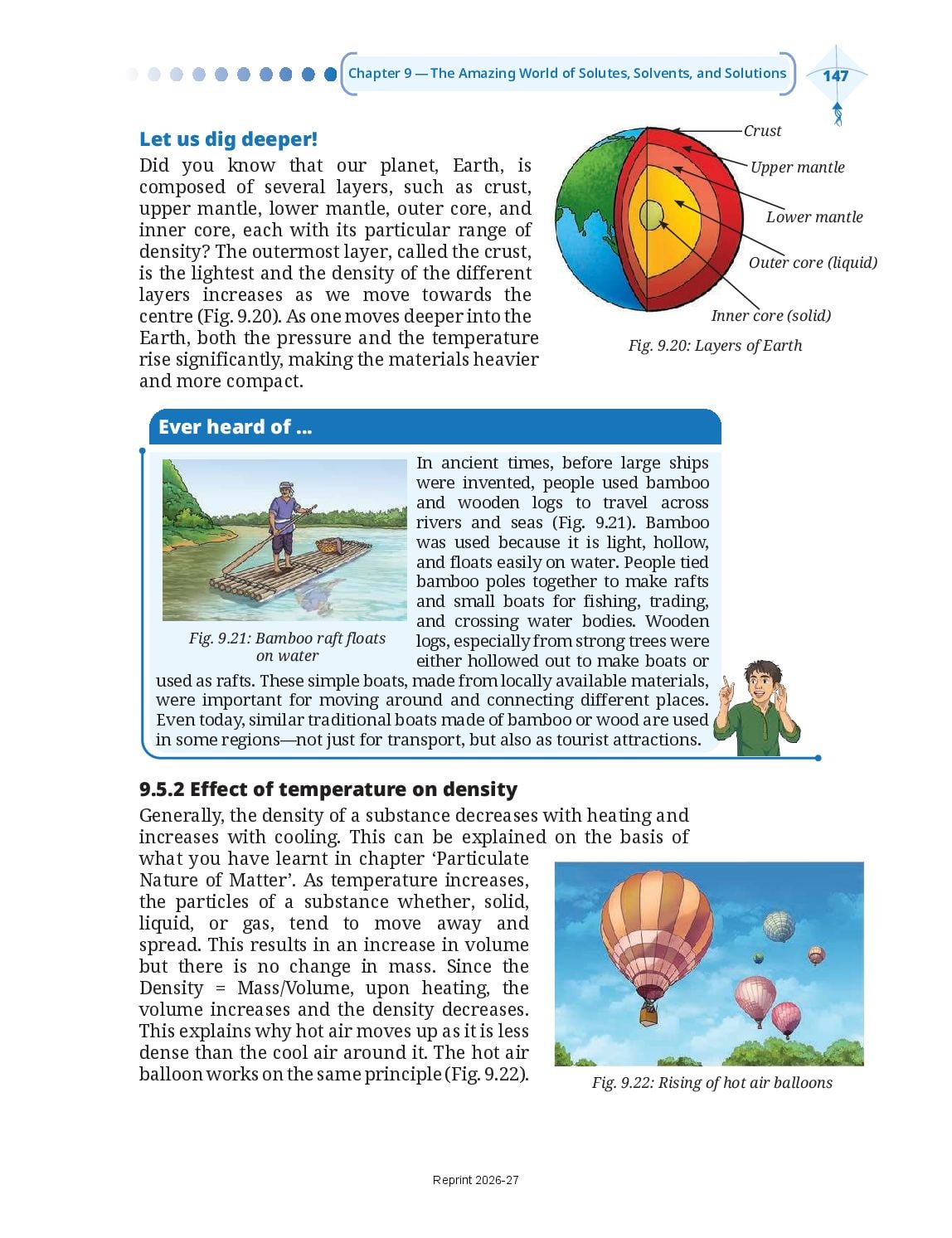
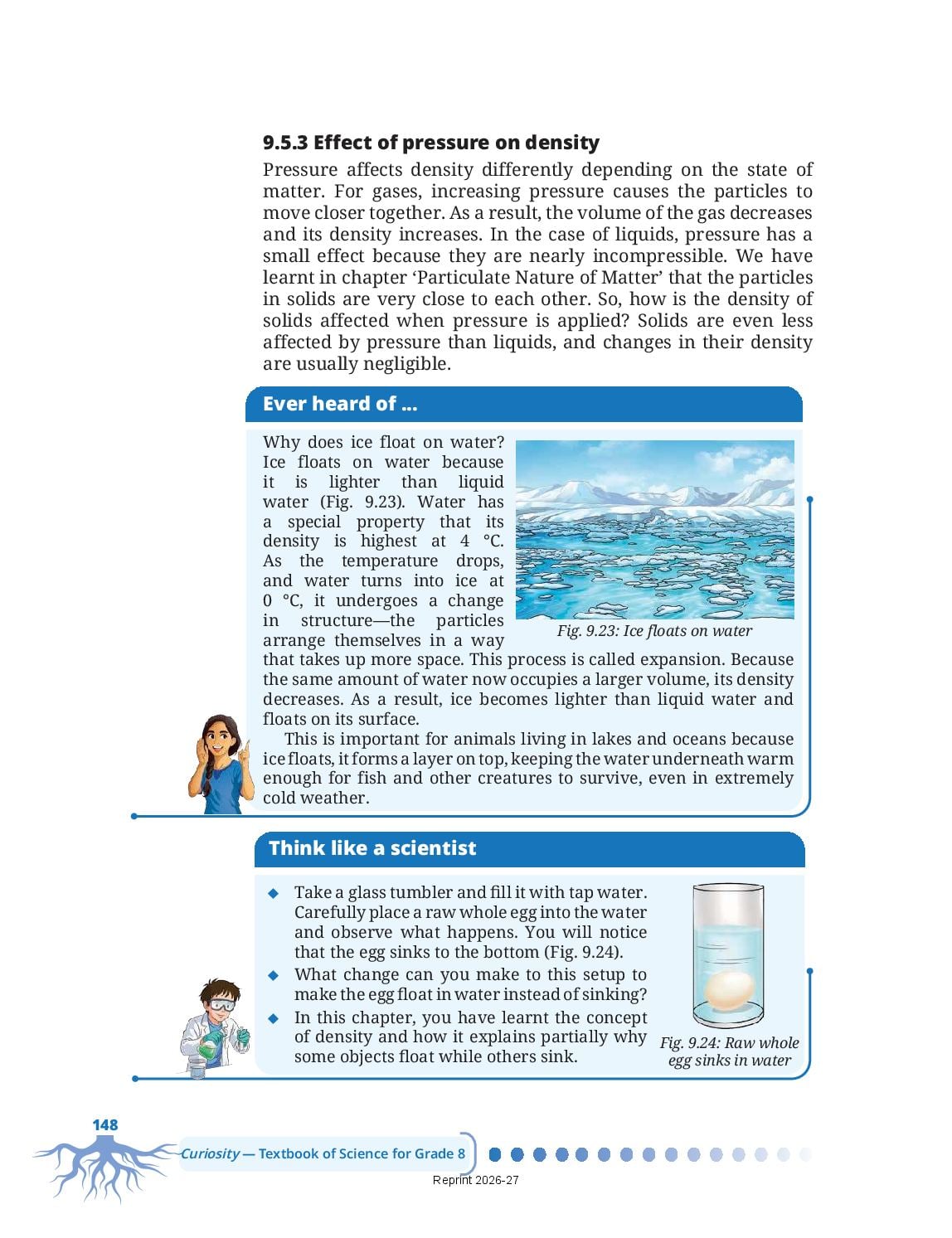
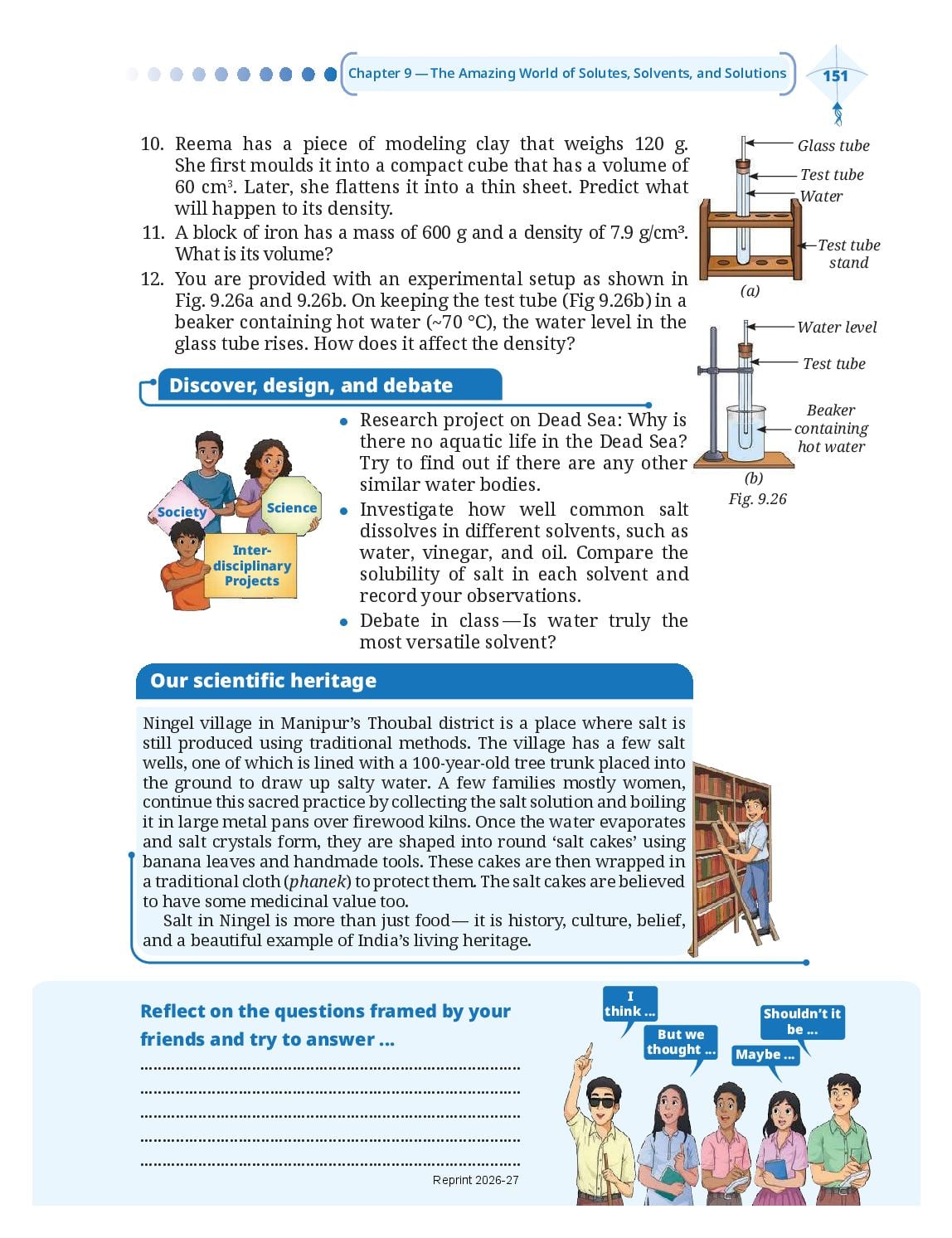
- Heating a substance spreads its particles apart: volume rises, mass does not, so density falls — hot air rises, and a hot-air balloon flies. Pressure squeezes gases strongly, liquids slightly and solids almost not at all. Water is odd: it is densest at 4 °C, and on freezing its particles take an open arrangement, so ice is less dense and floats.
Quick revision – The Amazing World of Solutes, Solvents, and Solutions
| Term | What it means | Example from the chapter | Value / unit |
|---|---|---|---|
| Solution | A uniform mixture whose components cannot be seen separately | Salt and sugar in water (ORS); air; sugar syrup of gulab jamun | — |
| Solute / Solvent | The dissolved substance / the substance that dissolves it; between two liquids, the smaller amount is the solute | Sugar (solute) in water (solvent) in chashni | — |
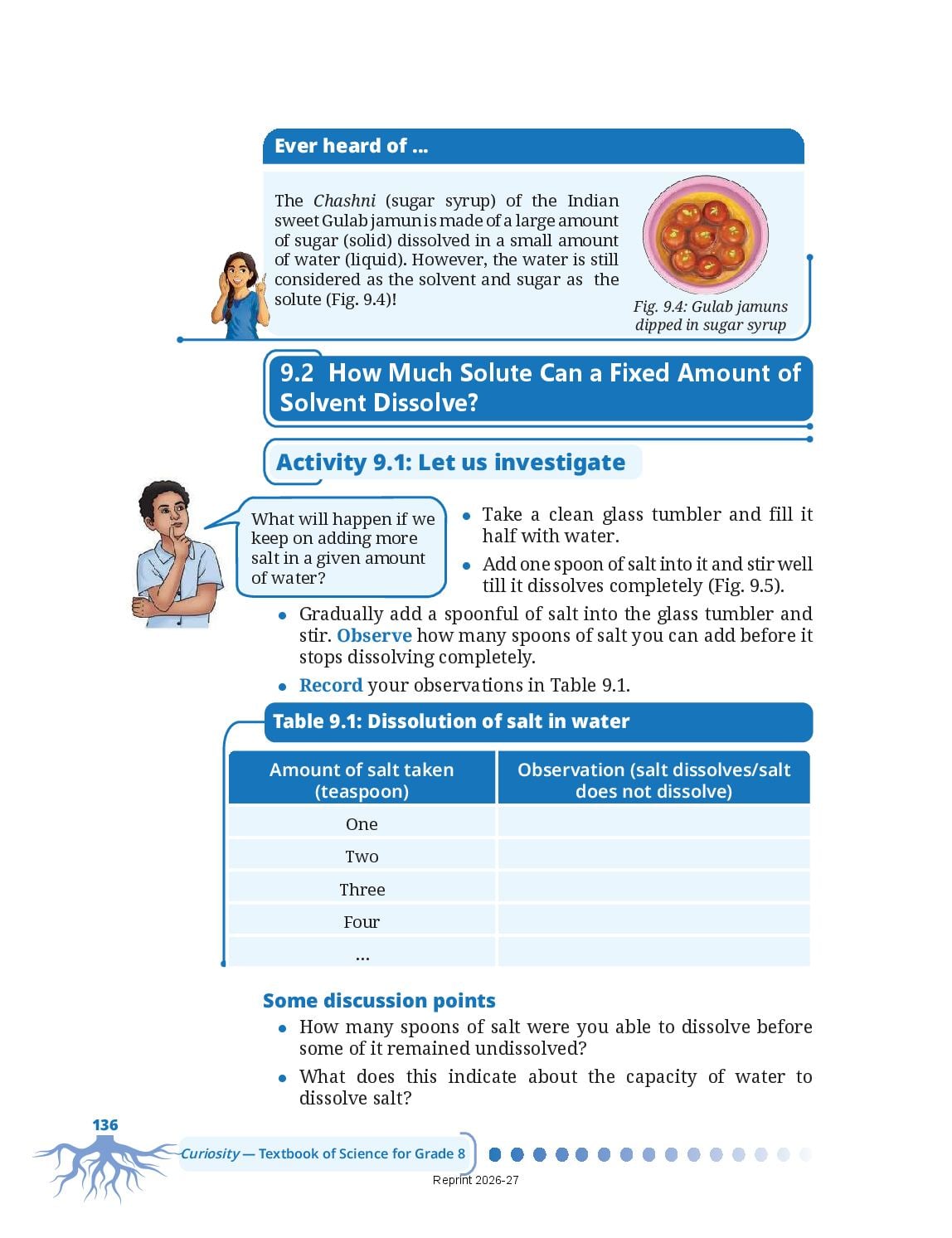
| Saturated solution | No more solute can dissolve in it at that temperature; extra solute settles at the bottom | Salt added spoon by spoon in Activity 9.1 | — |
| Unsaturated solution | More solute can still be dissolved at that temperature | The same salt solution after one or two spoons | — |
| Concentration | Amount of solute in a fixed quantity of solution — dilute or concentrated | 4 spoons in 50 mL is 4 times as concentrated as 2 spoons in 100 mL | Spoons per 100 mL |
| Solubility | Maximum solute that dissolves in a fixed quantity (100 mL) of solvent at a stated temperature | Baking soda: more dissolves at 70 °C than at 50 °C or 20 °C | G per 100 mL |
| Mass | The quantity of matter in an object; measured on a balance | Stone weighed on a digital balance | 16.400 g |
| Weight | The force with which the Earth pulls an object — not the same as mass | Most balances really measure weight but are marked in mass units | Newton (N) |
| Volume | The space an object occupies | Notebook 25 cm × 18 cm × 2 cm; stone by displacement | 900 cm³; 5 cm³ |
| Least count of a measuring cylinder | The smallest volume it can read | 100 mL cylinder: 10 mL between marks ÷ 10 divisions | 1 mL |
| Density | Mass present in unit volume, Mass / Volume | Aluminium block 27 g in 10 cm³; stone 16.400 g in 5 cm³ | 2.7 g/cm³; 3.28 g/cm³ |
| Relative density | Density of a substance ÷ density of water at that temperature | Aluminium with respect to water | 2.7 (no unit) |
Old NCERT vs New – Class 8 Science
This chapter is from Curiosity, the new NCERT Class 8 Science book (NCF-SE 2023, used from 2025-26). It replaced the old book “Science”, so chapter numbers and names differ from older PDFs.
Solutions and All Chapters
Answers to the exercises and the full chapter list of Curiosity:
The Amazing World of Solutes, Solvents, and Solutions – Overview
| Class | Class 8 |
| Subject | Science |
| Book | Curiosity – new NCERT book |
| Chapter | 9 of 13 – The Amazing World of Solutes, Solvents, and Solutions |
| Book pages | 134 – 151 |
| Edition | NCERT Reprint 2026-27 |
| Session | 2026-27 |
| Free – read online or download |
Class 8 Science Chapter 9 – FAQs
Where can I download The Amazing World of Solutes, Solvents, and Solutions Class 8 PDF?
From the download table on this page – the chapter PDF is free, and the full book is linked too.
What is Class 8 Science Chapter 9 about?
A uniform mixture — one in which the components are spread evenly and cannot be picked out — is a solution. Salt or sugar in water is a solution; chalk powder, sand or sawdust in water is a non-uniform mixture.
Is The Amazing World of Solutes, Solvents, and Solutions from the new NCERT Class 8 Science book?
Yes. It is chapter 9 of curiosity, the new NCERT Class 8 Science book for 2026-27.
Is this the latest NCERT edition for 2026-27?
Yes – the PDF is NCERT’s latest edition for the 2026-27 session.
Where are the NCERT Solutions for Class 8 Science Chapter 9?
Open the NCERT Solutions link above for answers to the exercise questions.