Download Particulate Nature of Matter – NCERT Class 8 Science Chapter 7 PDF from the new NCERT Class 8 Science book Curiosity (2026-27). Read the chapter online or download the free PDF. All matter is made up of an extremely large number of constituent particles — the basic units that a piece of a substance is built from. They are so small that they cannot be seen even through an ordinary microscope, and breaking or grinding a…
Particulate Nature of Matter PDF – Chapter 7 of Curiosity
Read the chapter online or download the PDF.
| Chapter | Download | |
|---|---|---|
| Chapter 7 PDF | Particulate Nature of Matter | View PDF |
| Full book | NCERT Class 8 Science – Curiosity | View Book |
Read Online
What Is in Particulate Nature of Matter? (Class 8 Science Chapter 7)
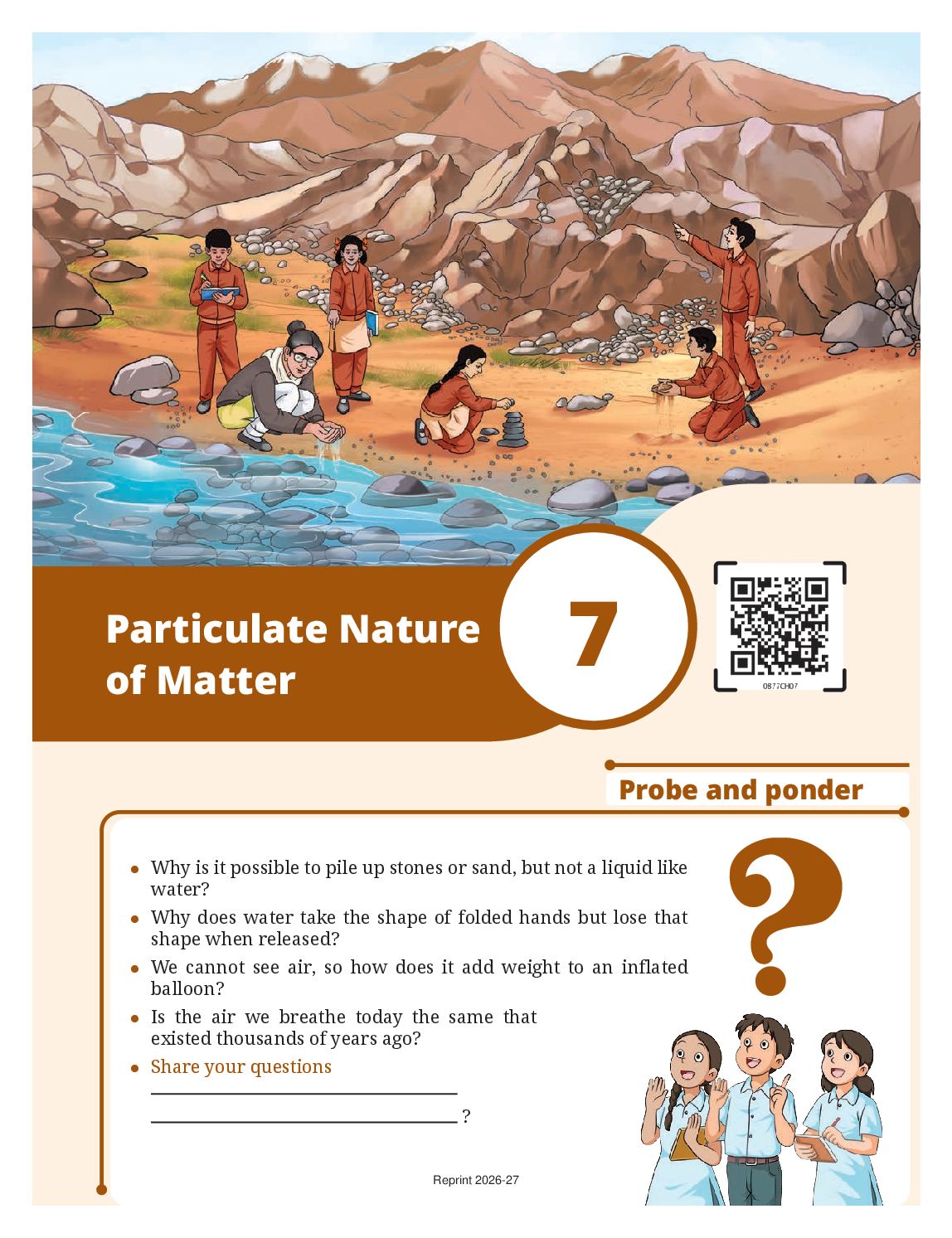
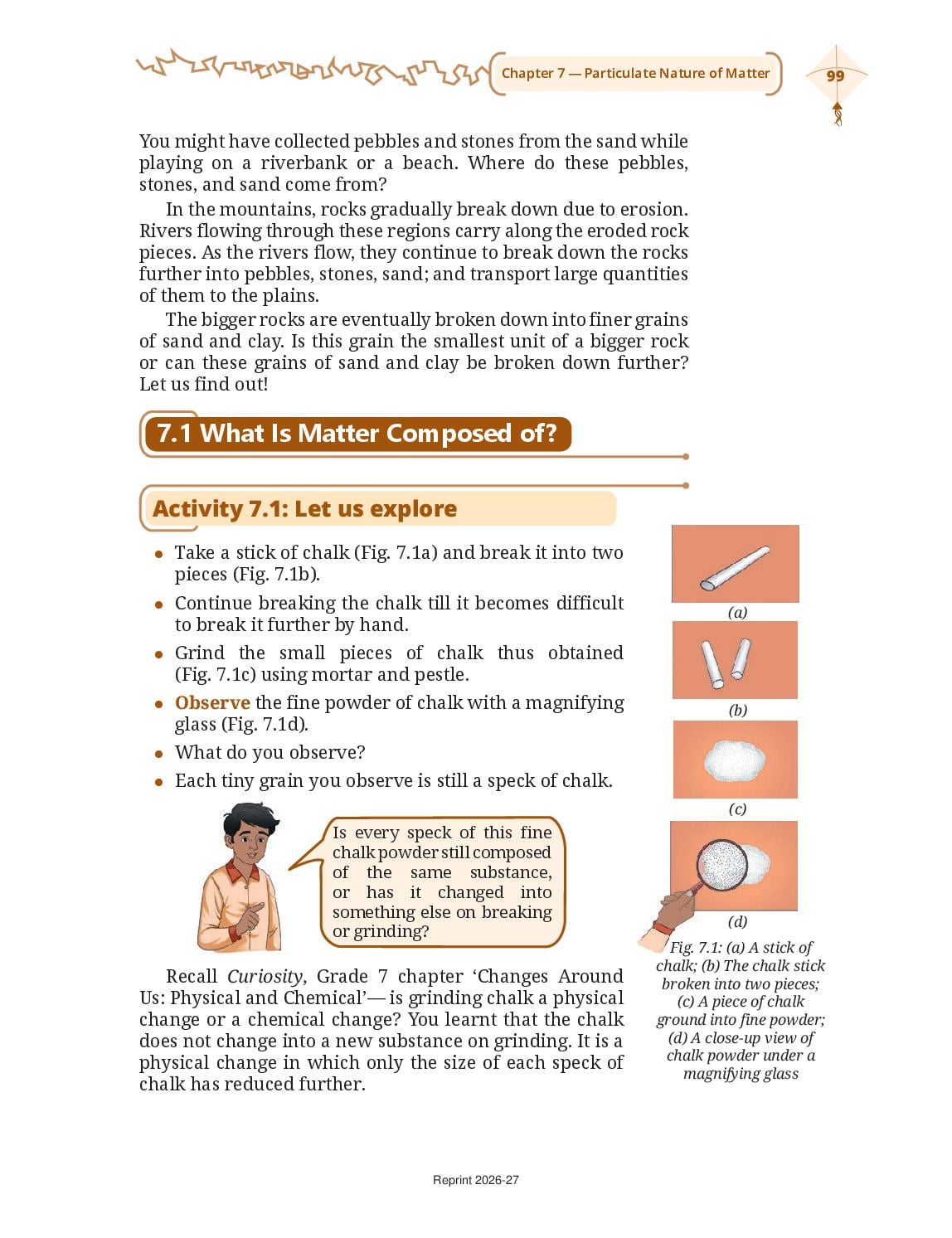
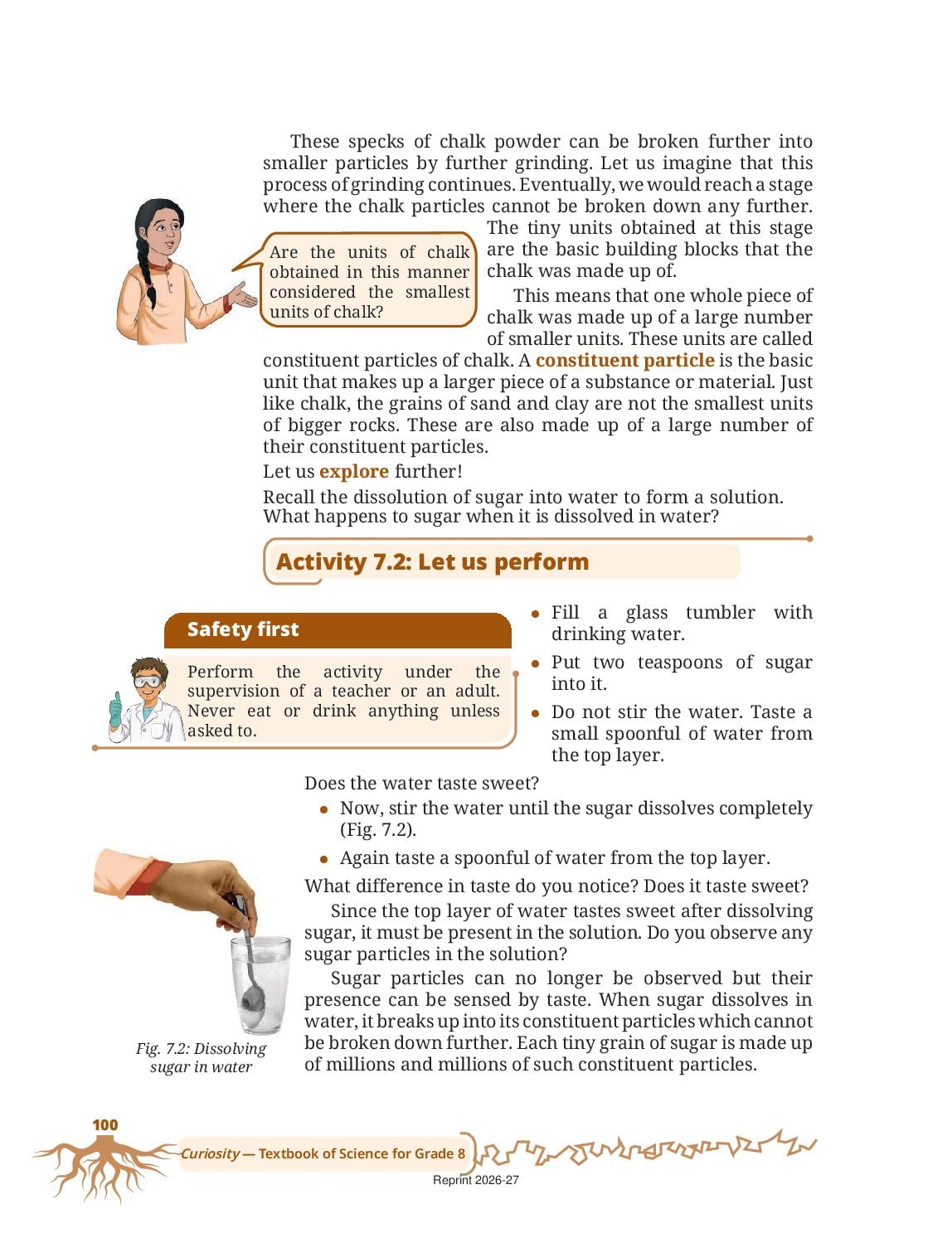
- All matter is made up of an extremely large number of constituent particles — the basic units that a piece of a substance is built from. They are so small that they cannot be seen even through an ordinary microscope, and breaking or grinding a substance never changes them; it only separates one group of them from another.
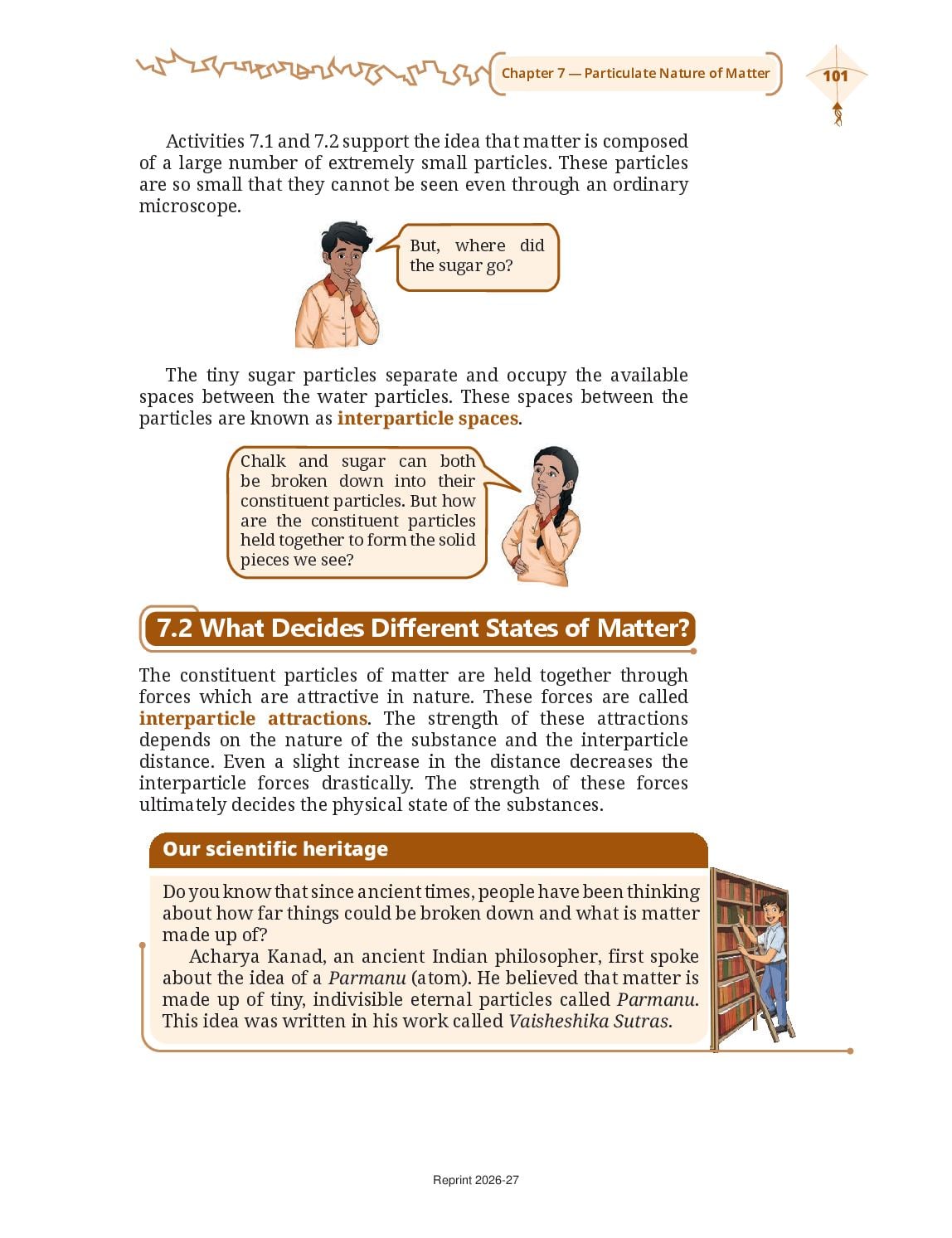
- The particles are held together by attractive forces called interparticle attractions. Their strength depends on the nature of the substance and on the interparticle distance — even a slight increase in that distance weakens the force drastically.
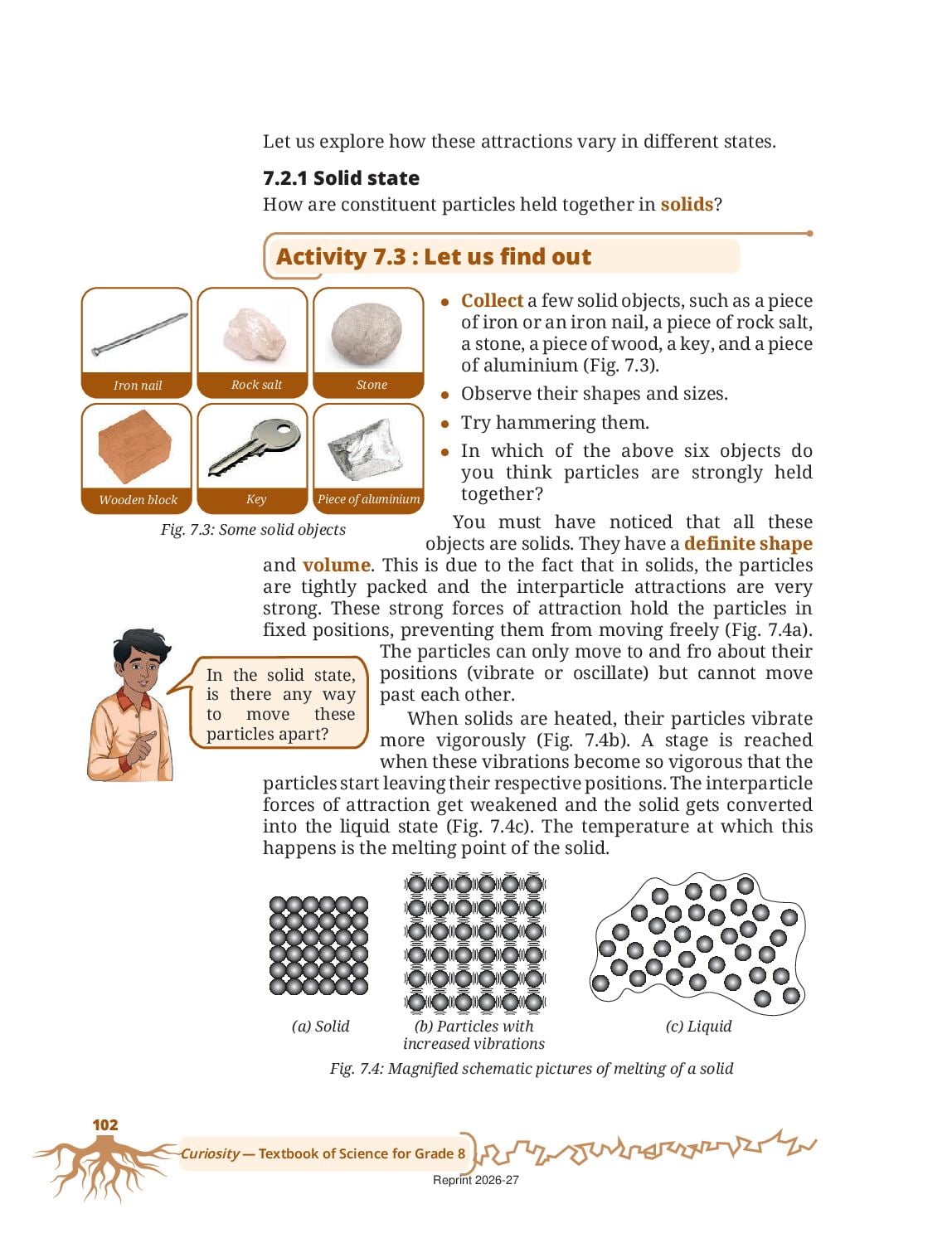
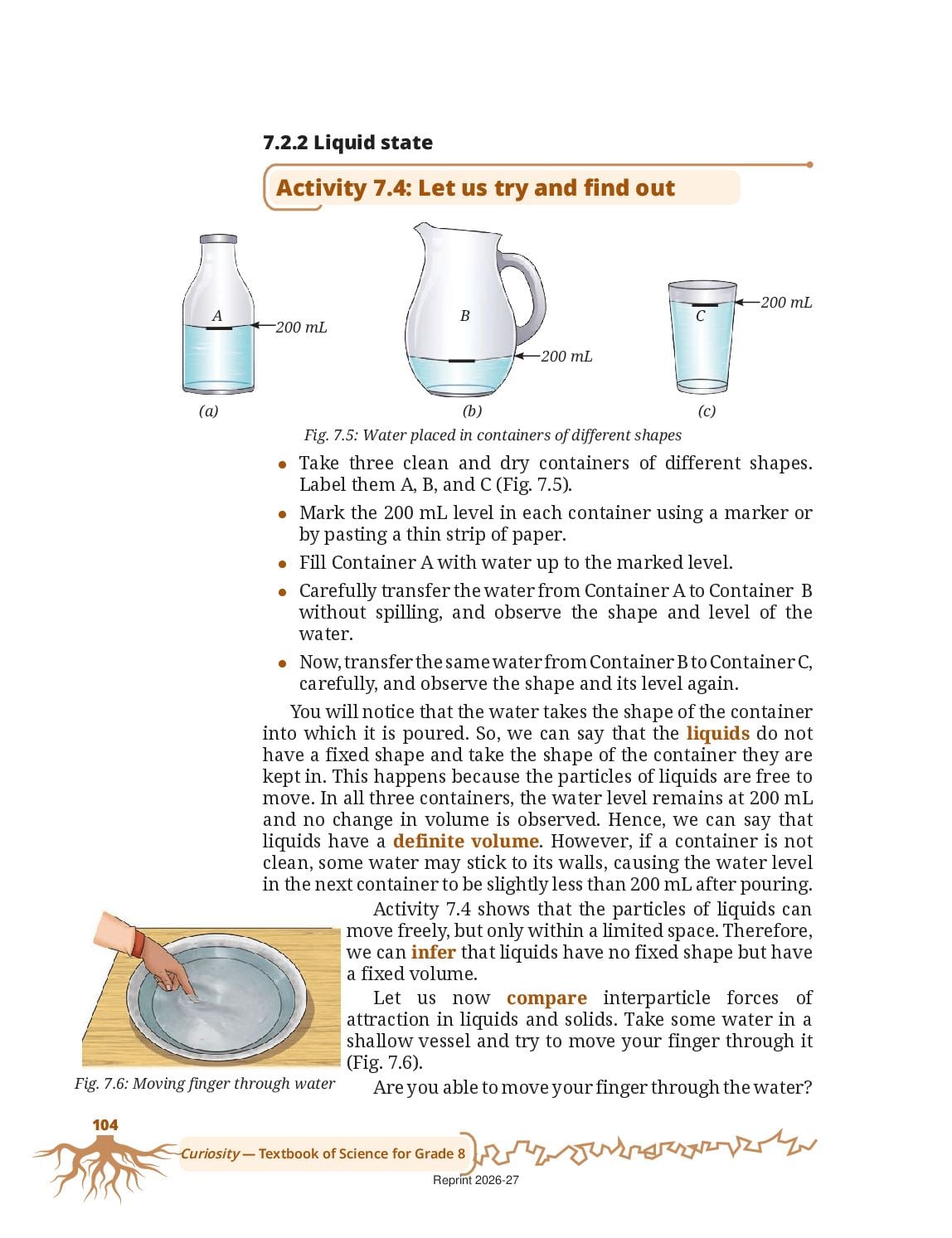
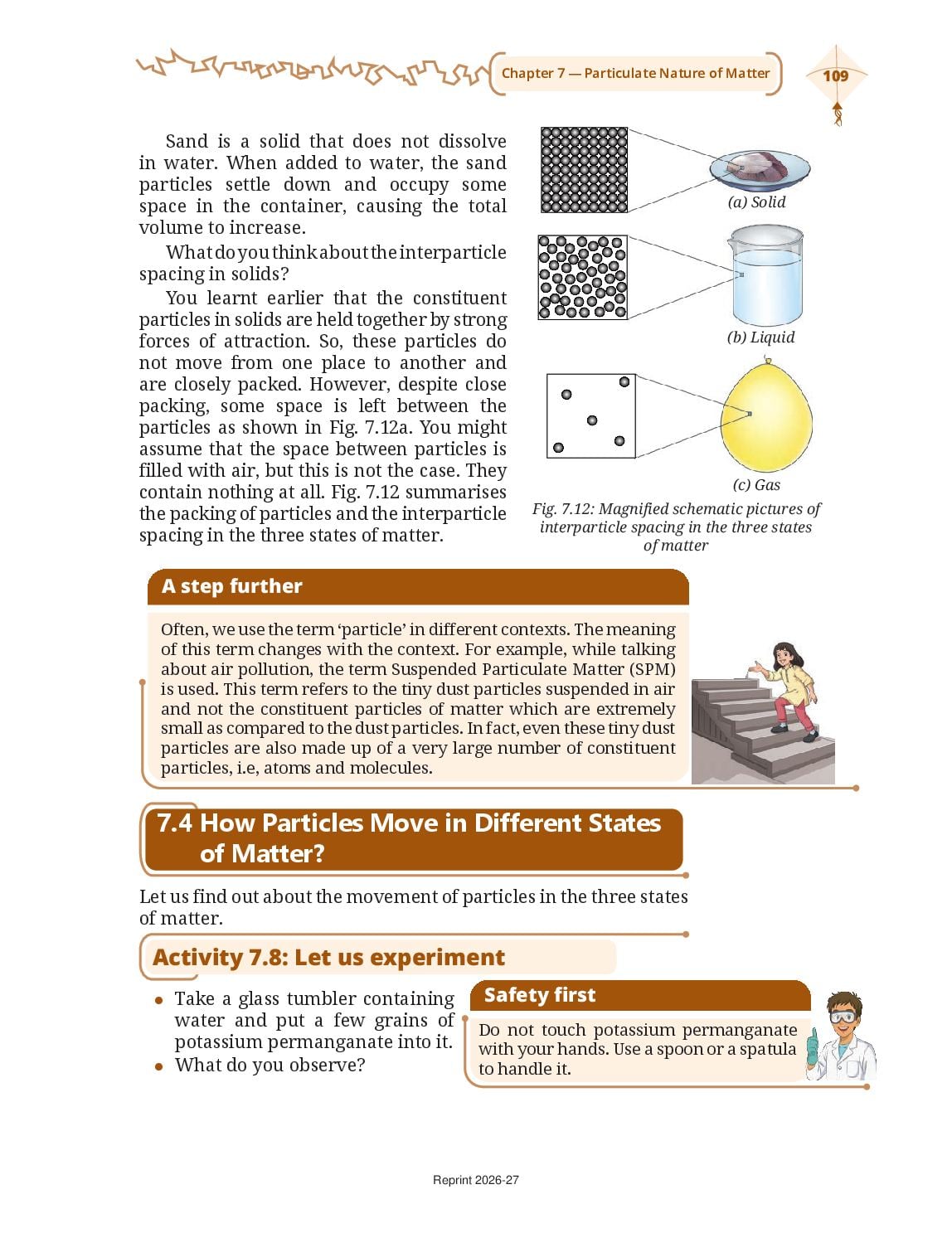
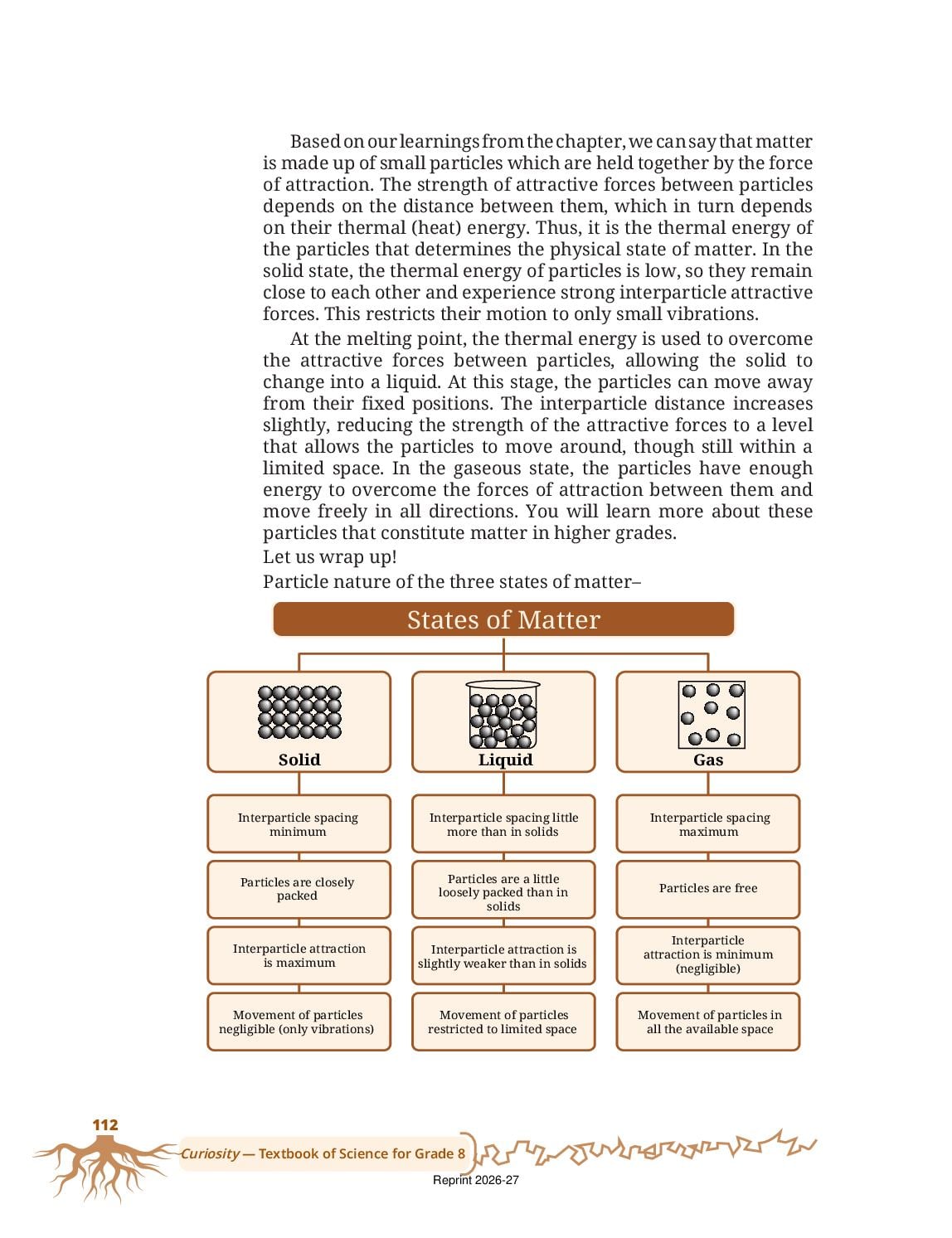
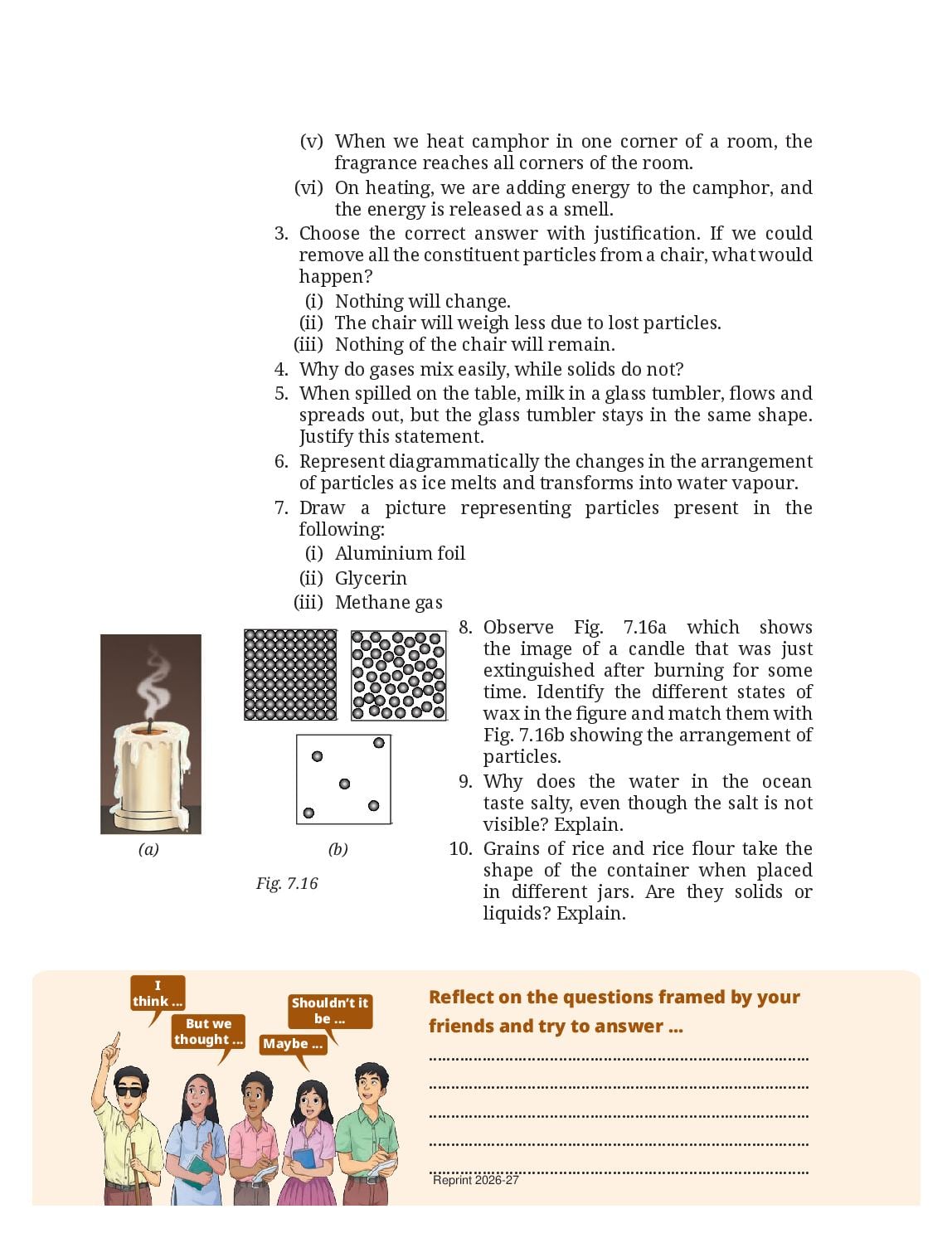
- The strength of these attractions decides the physical state. In a solid the particles are closely packed, the attraction is strongest, and they can only vibrate about fixed positions — hence a definite shape and volume. In a liquid the attraction is a little weaker, so the particles move but only within a limited space — definite volume, no fixed shape. In a gas the attraction is negligible and the particles move freely in all directions — neither a fixed shape nor a fixed volume.
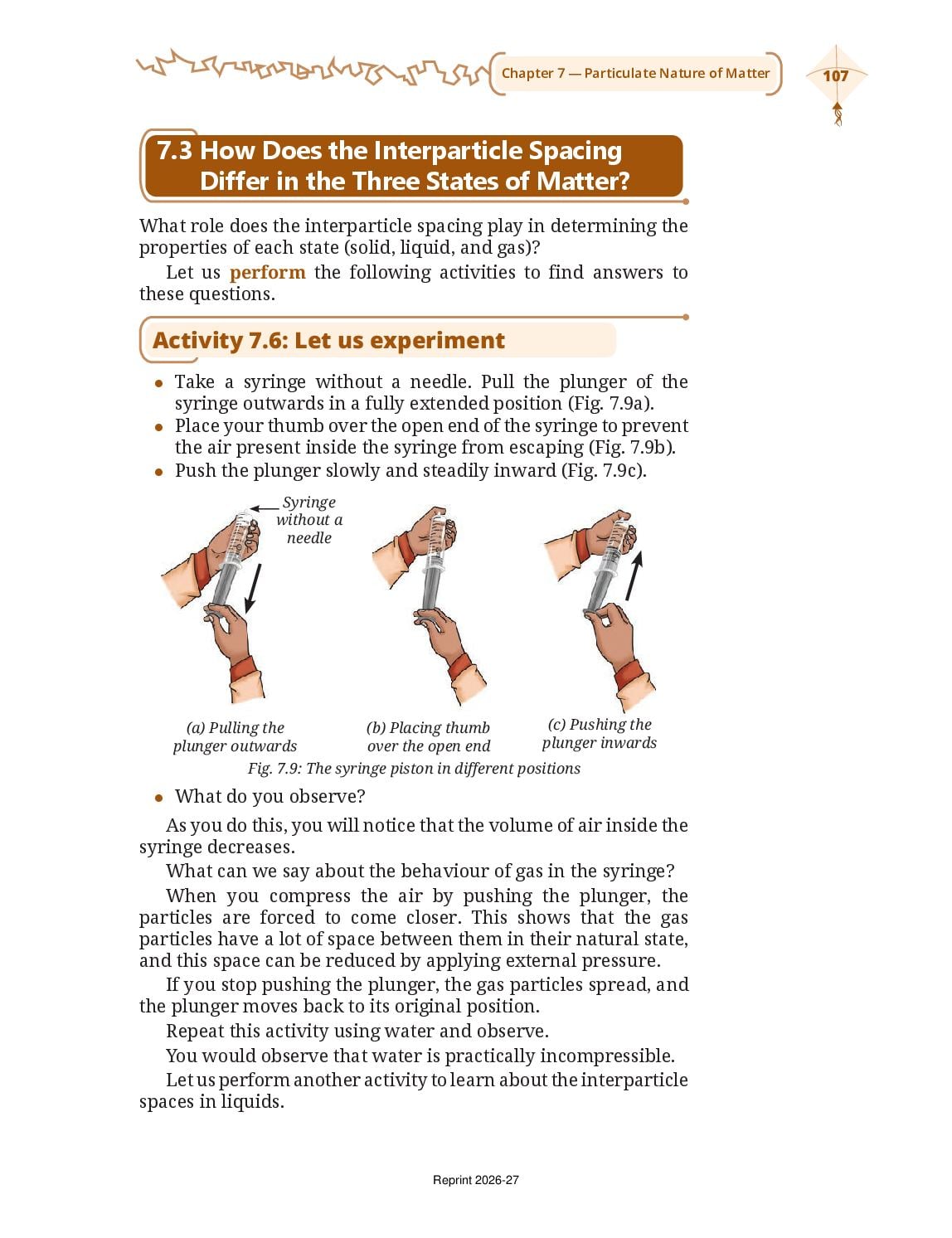
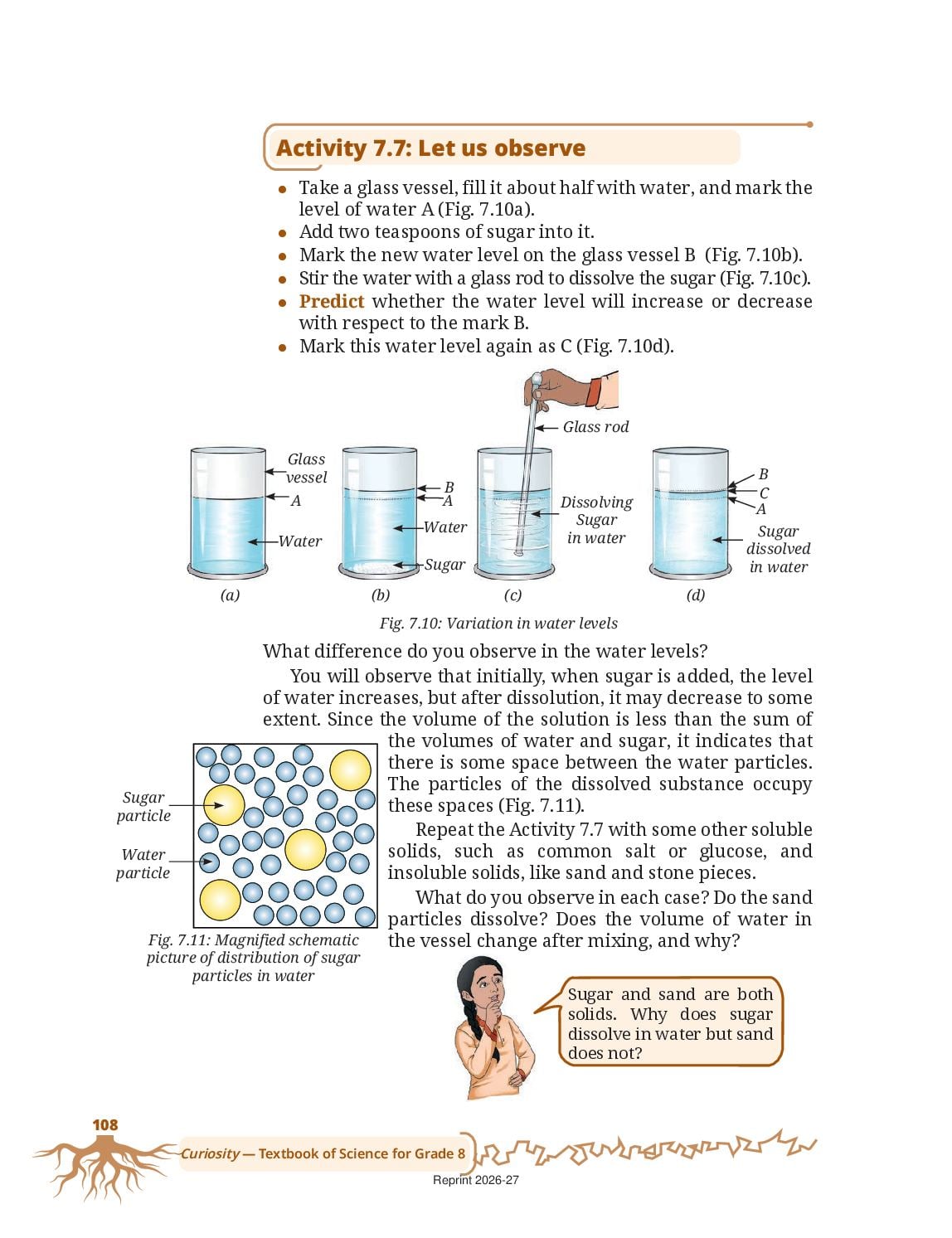
- Between the particles there are interparticle spaces — minimum in solids, a little more in liquids, maximum in gases. These spaces contain nothing at all — not air. Sugar dissolving in water and air compressing in a syringe are both direct evidence that such spaces exist.
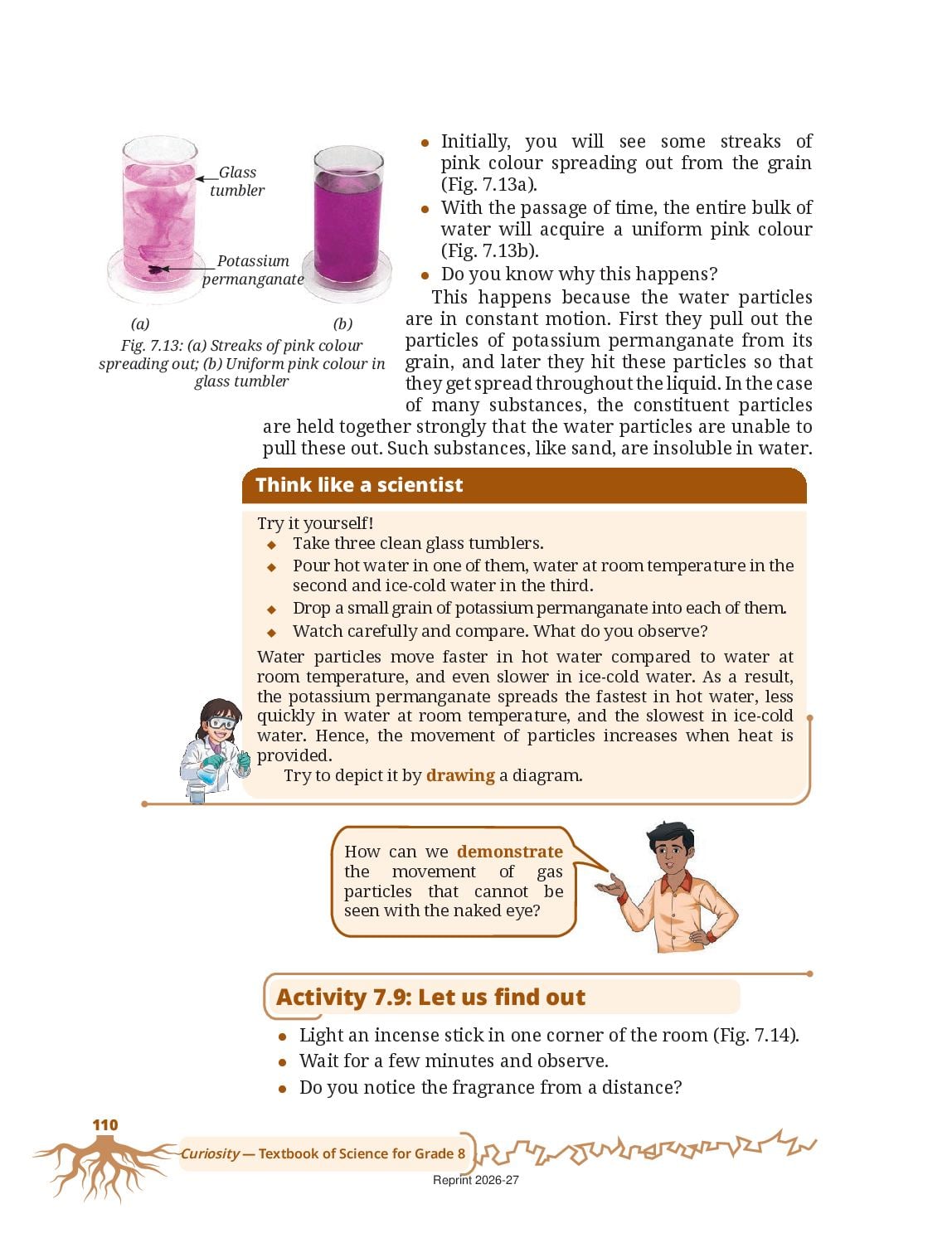
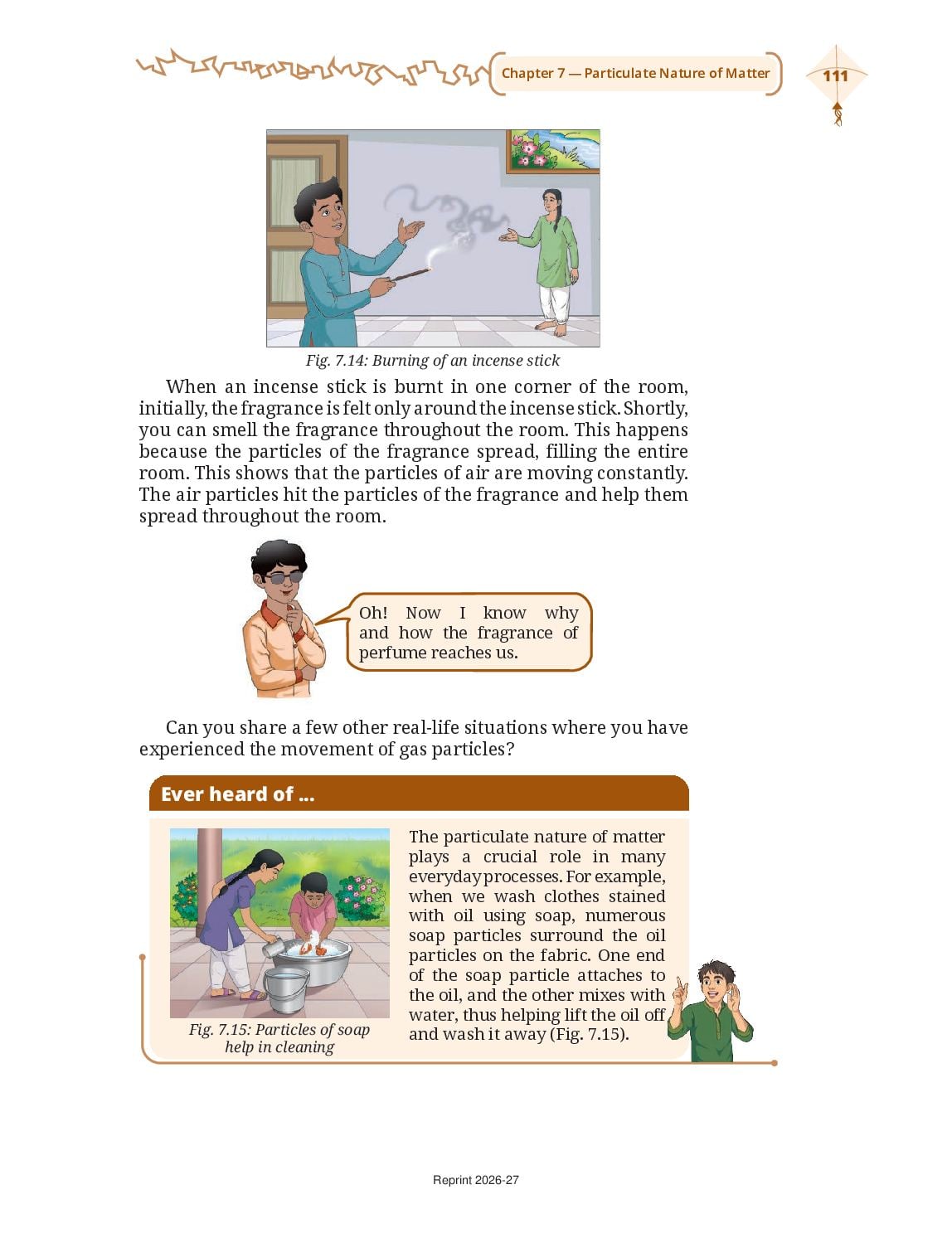
- The particles are always in motion. This is why potassium permanganate colours a whole tumbler of water without stirring, and why the fragrance of an incense stick reaches every corner of a room. Heating increases the motion, so the spreading is fastest in hot water and slowest in ice-cold water.
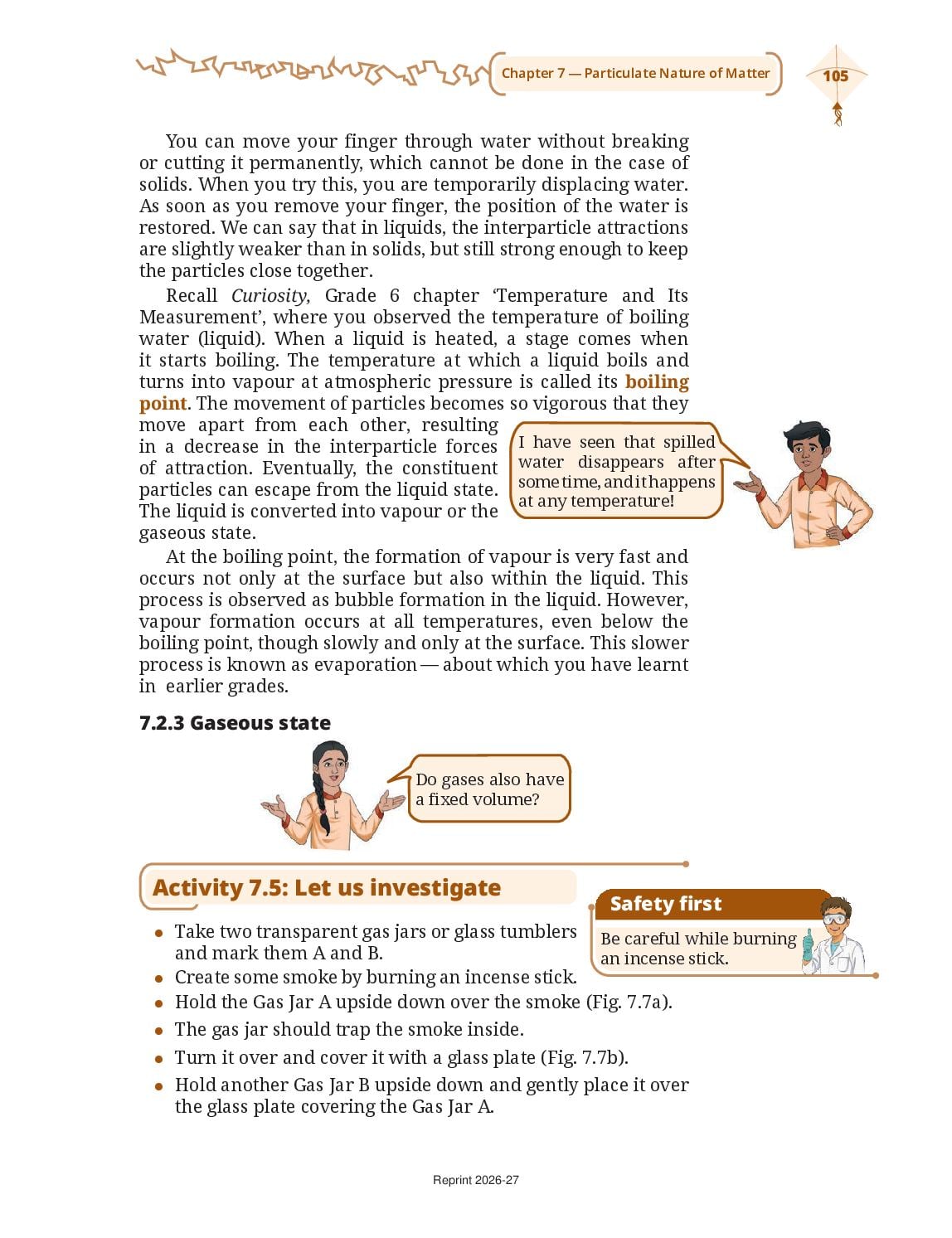
- It is the thermal energy of the particles that ultimately fixes the state. At the melting point the thermal energy supplied overcomes the attractions and the solid becomes a liquid; at the boiling point the particles escape the liquid altogether. Vapour also forms slowly at every temperature, from the surface only — that is evaporation.
Quick revision – Particulate Nature of Matter
| Term | What it means | Where it comes in the chapter | Example from the book |
|---|---|---|---|
| Constituent particle | The basic unit that makes up a larger piece of a substance or material | Section 7.1, page 100 | Grinding chalk on and on finally leaves the units the chalk was made of (Activity 7.1) |
| Interparticle space | The space between the constituent particles; it contains nothing at all, not even air | Sections 7.1 and 7.3, pages 101 and 109 | The level falls from B to C when sugar dissolves (Activity 7.7, Fig. 7.10) |
| Interparticle attraction | The attractive force holding the particles together; it weakens sharply as the interparticle distance grows | Section 7.2, page 101 | Strongest in a piece of iron, weaker in water, negligible in air |
| Solid state | Definite shape and volume; particles closely packed, attraction strongest, motion only vibration about fixed positions | Section 7.2.1, page 102 | Iron nail, rock salt, stone, key, wooden block, aluminium (Fig. 7.3) |
| Liquid state | Definite volume, no fixed shape; particles free to move but only within a limited space | Section 7.2.2, page 104 | The same 200 mL of water in containers A, B and C (Activity 7.4, Fig. 7.5) |
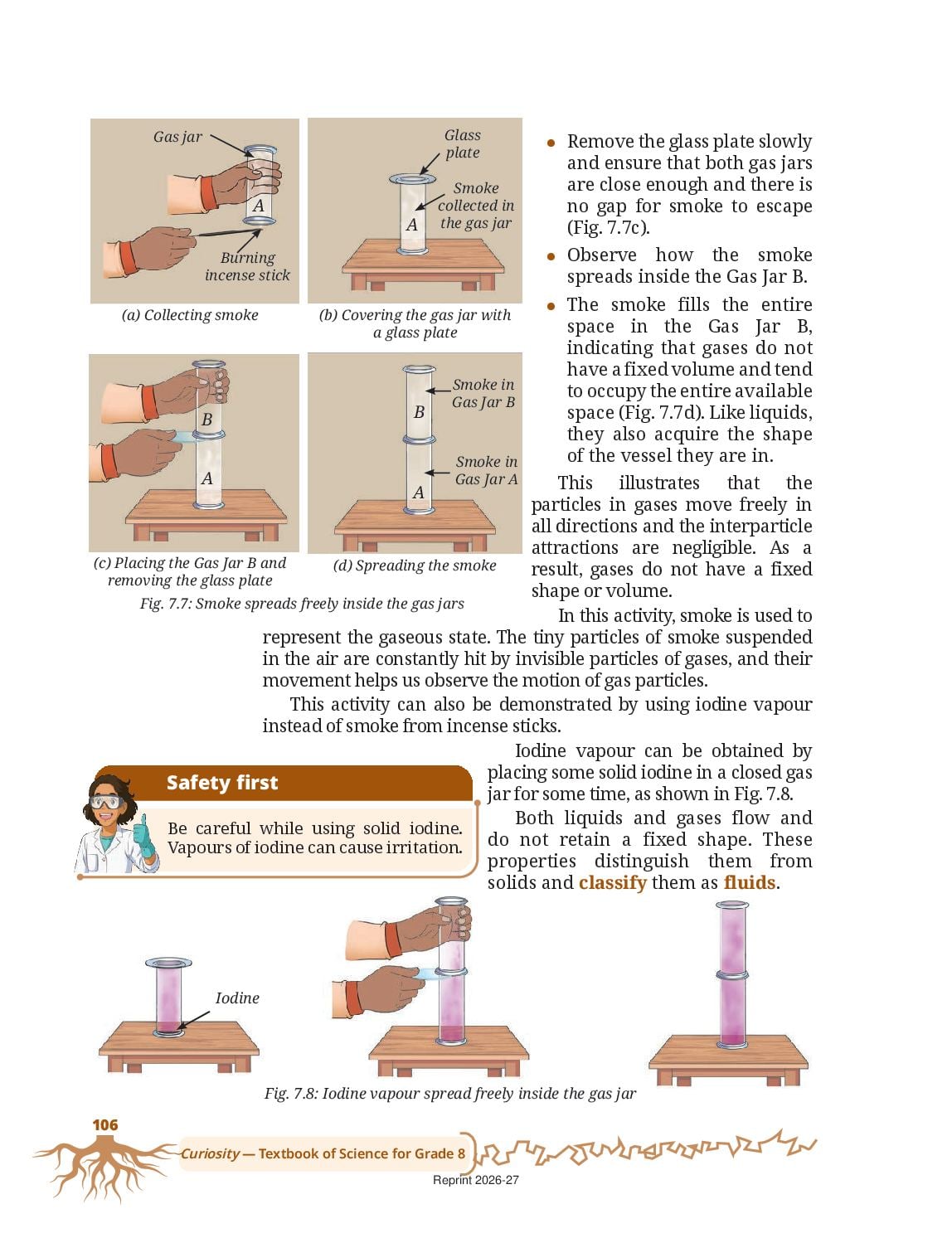
| Gaseous state | Neither fixed shape nor fixed volume; attraction negligible, particles move freely in all directions | Section 7.2.3, page 105 | Smoke fills the whole of Gas Jar B (Activity 7.5, Fig. 7.7) |
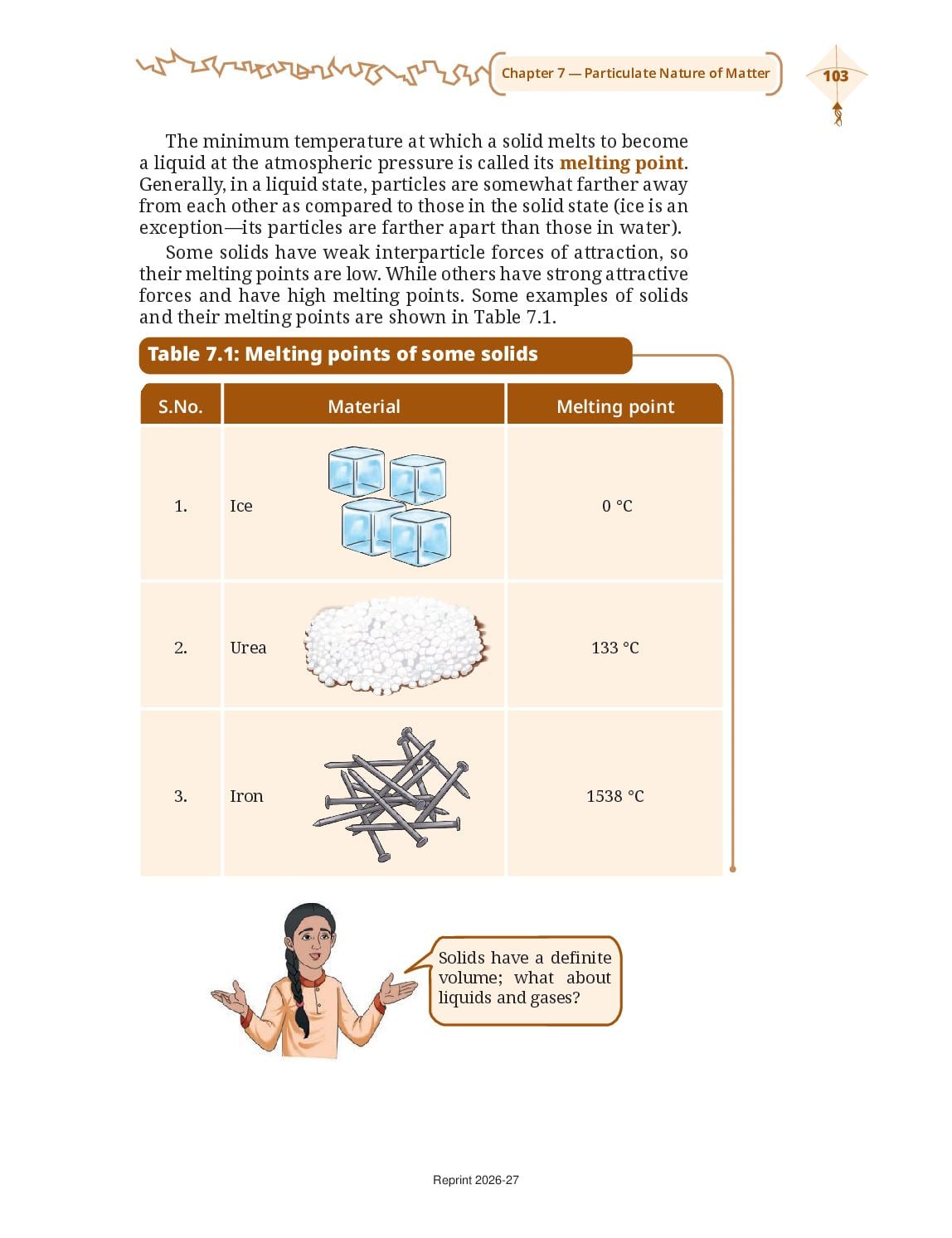
| Melting point | The minimum temperature at which a solid melts into a liquid at atmospheric pressure | Section 7.2.1, page 103 | Ice 0 °C, urea 133 °C, iron 1538 °C (Table 7.1) |
| Boiling point | The temperature at which a liquid boils and turns into vapour at atmospheric pressure | Section 7.2.2, page 105 | Bubbles form inside the liquid, not only at its surface |
| Evaporation | The slow change of a liquid into vapour, at any temperature and only from the surface | Section 7.2.2, page 105 | Spilled water disappears after some time |
| Fluids | Liquids and gases together — they flow and do not keep a fixed shape | Section 7.2.3, page 106 | Water poured from one container to another; smoke spreading in a gas jar |
| Thermal energy | The heat energy of the particles; it decides how far apart they stay, and hence the state of the substance | Let us wrap up, page 112 | Low in solids, more in liquids, highest in gases |
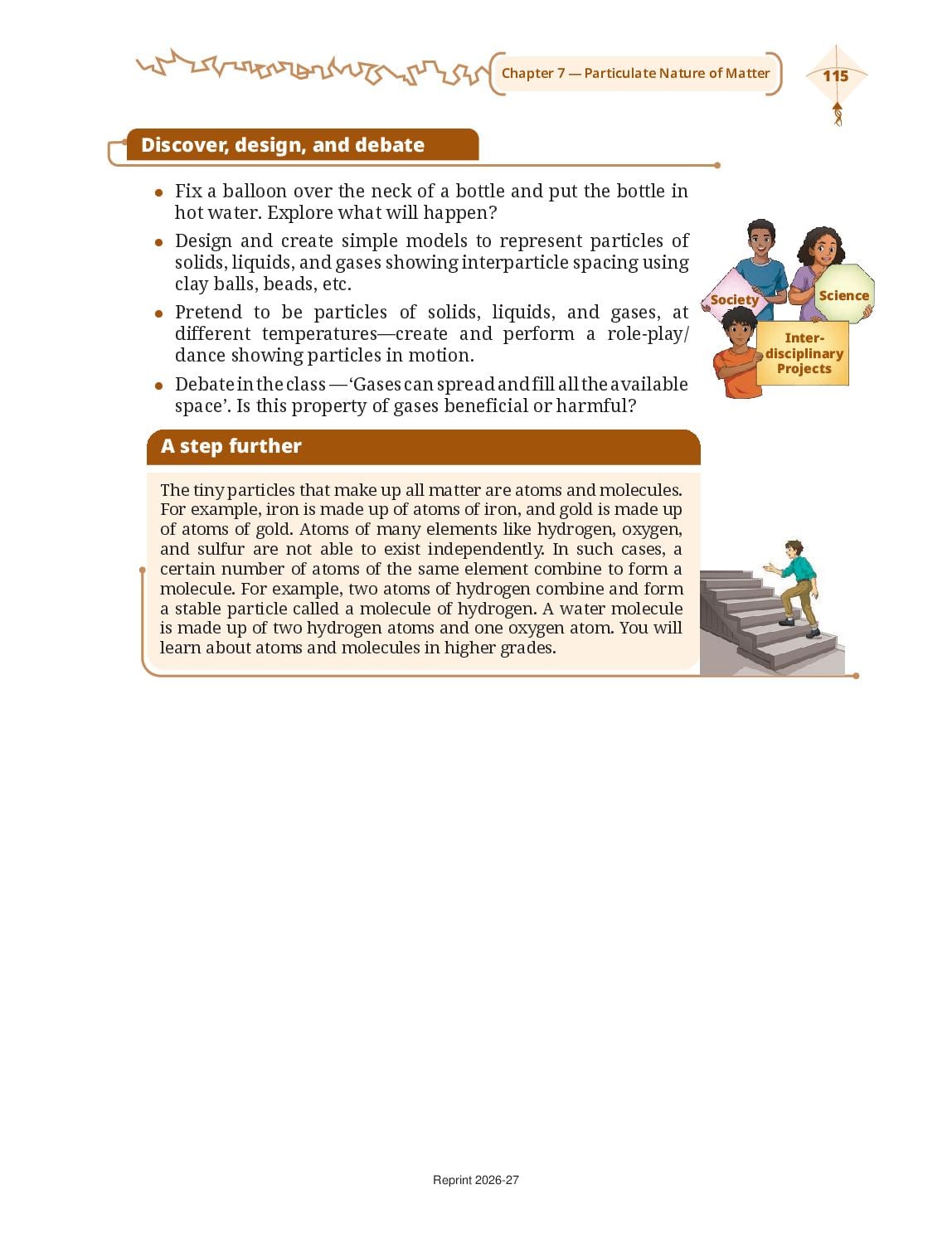
| Suspended Particulate Matter (SPM) | Tiny dust particles suspended in air — not constituent particles; each dust particle is itself made of a huge number of atoms and molecules | A step further, page 109 | The term used when talking about air pollution |
Old NCERT vs New – Class 8 Science
This chapter is from Curiosity, the new NCERT Class 8 Science book (NCF-SE 2023, used from 2025-26). It replaced the old book “Science”, so chapter numbers and names differ from older PDFs.
Solutions and All Chapters
Answers to the exercises and the full chapter list of Curiosity:
Particulate Nature of Matter – Overview
| Class | Class 8 |
| Subject | Science |
| Book | Curiosity – new NCERT book |
| Chapter | 7 of 13 – Particulate Nature of Matter |
| Book pages | 98 – 115 |
| Edition | NCERT Reprint 2026-27 |
| Session | 2026-27 |
| Free – read online or download |
Class 8 Science Chapter 7 – FAQs
Where can I download Particulate Nature of Matter Class 8 PDF?
From the download table on this page – the chapter PDF is free, and the full book is linked too.
What is Class 8 Science Chapter 7 about?
All matter is made up of an extremely large number of constituent particles — the basic units that a piece of a substance is built from. They are so small that they cannot be seen even through an ordinary microscope, and breaking or grinding a substance never changes them; it only separates one group of them from another.
Is Particulate Nature of Matter from the new NCERT Class 8 Science book?
Yes. It is chapter 7 of curiosity, the new NCERT Class 8 Science book for 2026-27.
Is this the latest NCERT edition for 2026-27?
Yes – the PDF is NCERT’s latest edition for the 2026-27 session.
Where are the NCERT Solutions for Class 8 Science Chapter 7?
Open the NCERT Solutions link above for answers to the exercise questions.