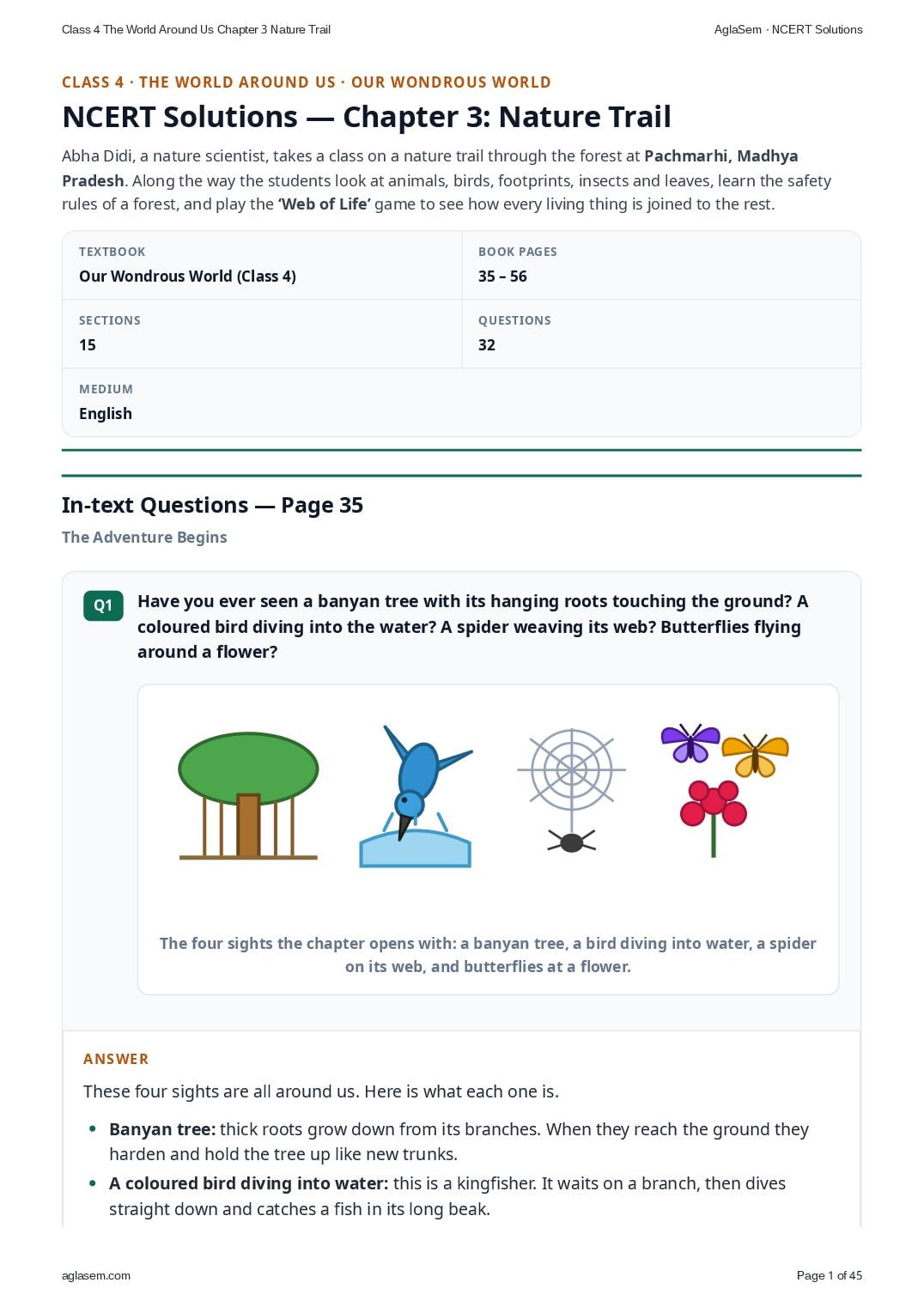
NCERT Solutions for Class 4 The World Around Us Chapter 3 Nature Trail provide clear, step-by-step answers to every exercise and in-text question from the chapter Nature Trail of the NCERT textbook Our Wondrous World. Prepared by subject experts as per the latest NCERT (CBSE) syllabus for 2026-27, these NCERT Solutions for Class 4 The World Around Us help you understand each concept, write exam-ready answers, and check your own solutions. You can read them online below or download the free Class 4 The World Around Us Chapter 3 question-answer PDF.
NCERT Solutions for Class 4 The World Around Us Chapter 3 Nature Trail
- Class: Class 4
- Subject: The World Around Us
- Chapter: Chapter 3 – Nature Trail
- Textbook: Our Wondrous World (NCERT)
- Study material: NCERT Solutions – questions with answers, free PDF
These solutions answer all the exercise questions of Chapter 3 Nature Trail — including the in-text questions, short-answer and long-answer questions, and activities — with complete explanations so you can follow the method, not just the final answer. Read the full solutions below.
NCERT Solutions Class 4 The World Around Us Chapter 3 Nature Trail View Download













NCERT Solutions for Class 4 The World Around Us Chapter 3 PDF Download
You can read the NCERT Solutions for Class 4 The World Around Us Chapter 3 online above, or download the complete question-answer PDF to study Nature Trail offline at any time.
NCERT Solutions for Class 4 The World Around Us Chapter 3 PDF Download Link – Click Here to Download Solutions PDF
Questions Covered in This Chapter
These NCERT Solutions answer all 32 questions of this chapter. The questions solved are:
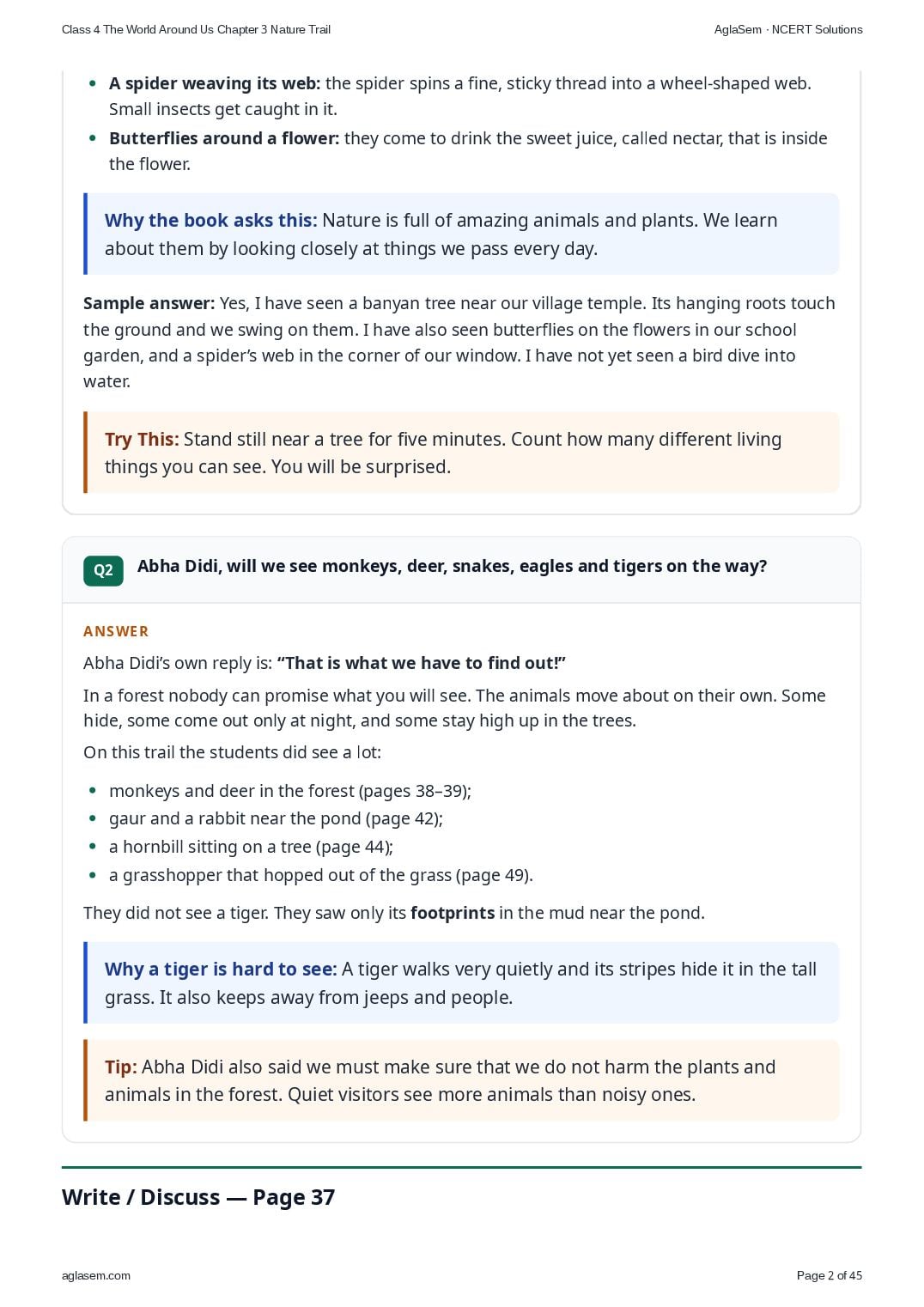
- Have you ever seen a banyan tree with its hanging roots touching the ground? A coloured bird diving into the water? A spider weaving its web? Butterflies flying around a flower? The four sights the chapter opens with: a banyan tree, a bird diving into water, a spider on its web, and butterflies at a flower.
- Abha Didi, will we see monkeys, deer, snakes, eagles and tigers on the way?
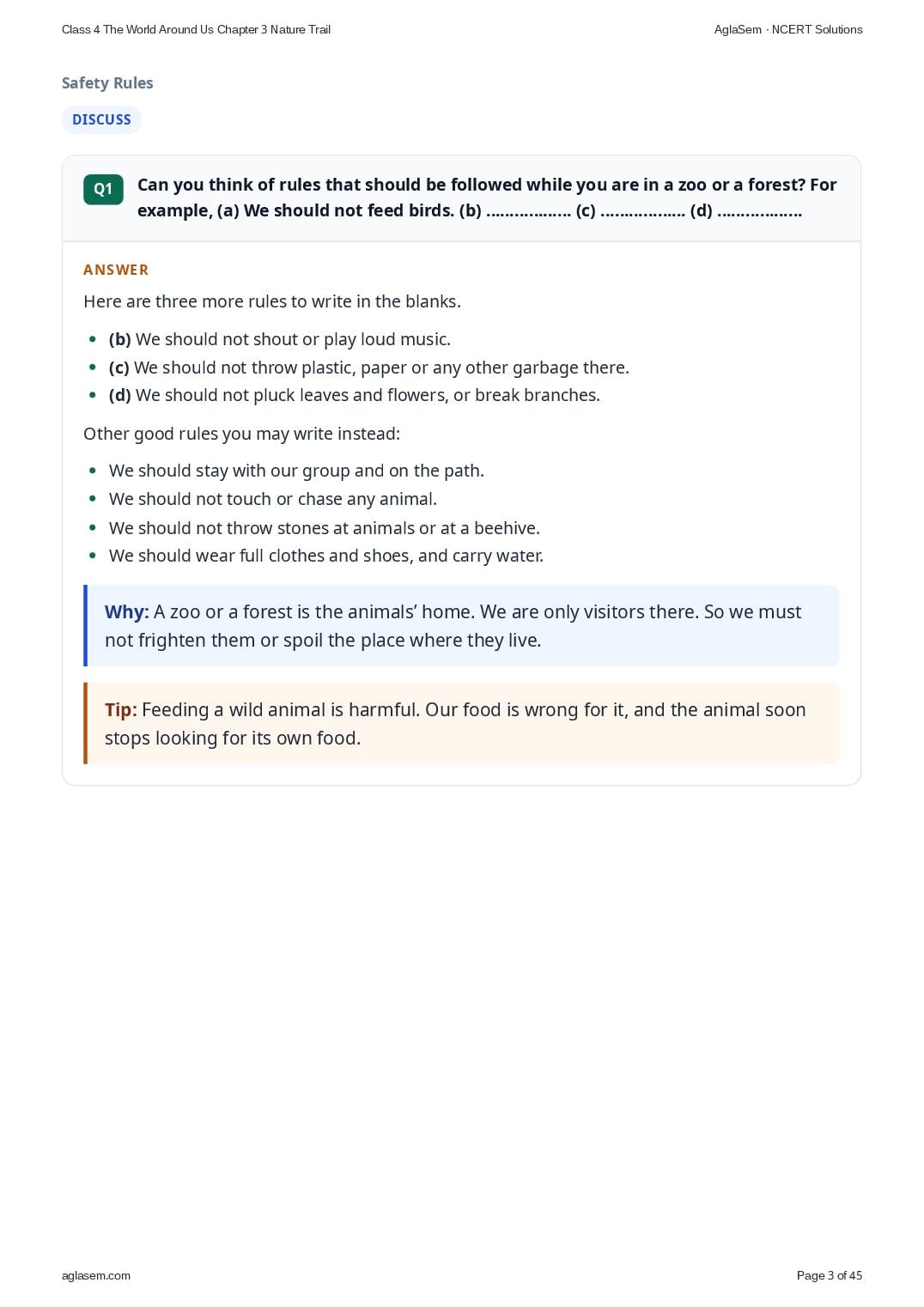
- Can you think of rules that should be followed while you are in a zoo or a forest? For example, (a) We should not feed birds. (b) ……………… (c) ……………… (d) ………………
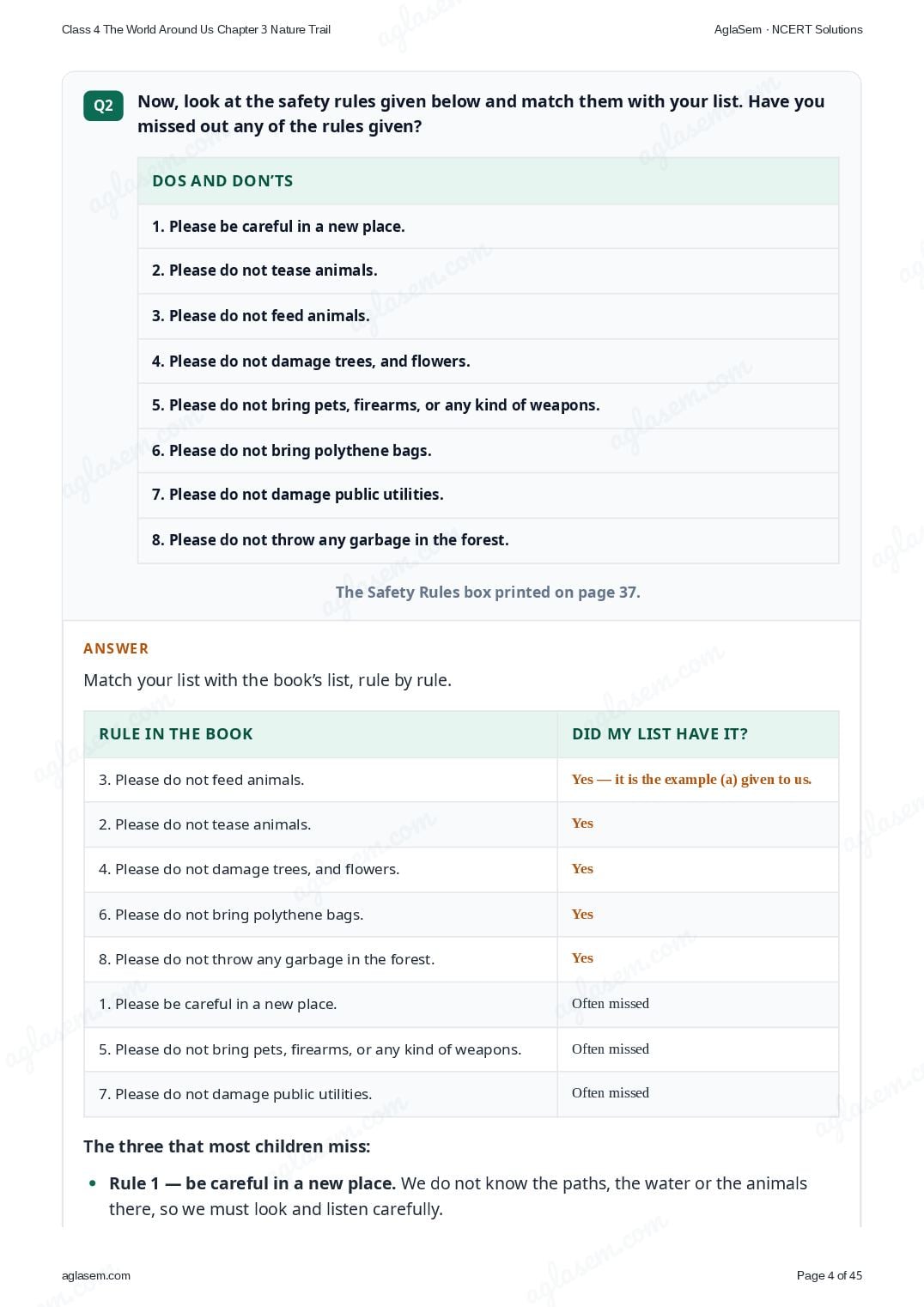
- Now, look at the safety rules given below and match them with your list. Have you missed out any of the rules given?DOs and DON’Ts1. Please be careful in a new place.2. Please do not tease animals.3. Please do not feed animals.4. Please do not damage trees, and flowers.5. Please do not bring pets, firearms, or any kind of weapons.6. Please do not bring polythene bags.7. Please do not damage public utilities.8. Please do not throw any garbage in the forest.The Safety Rules box printed on page 37.
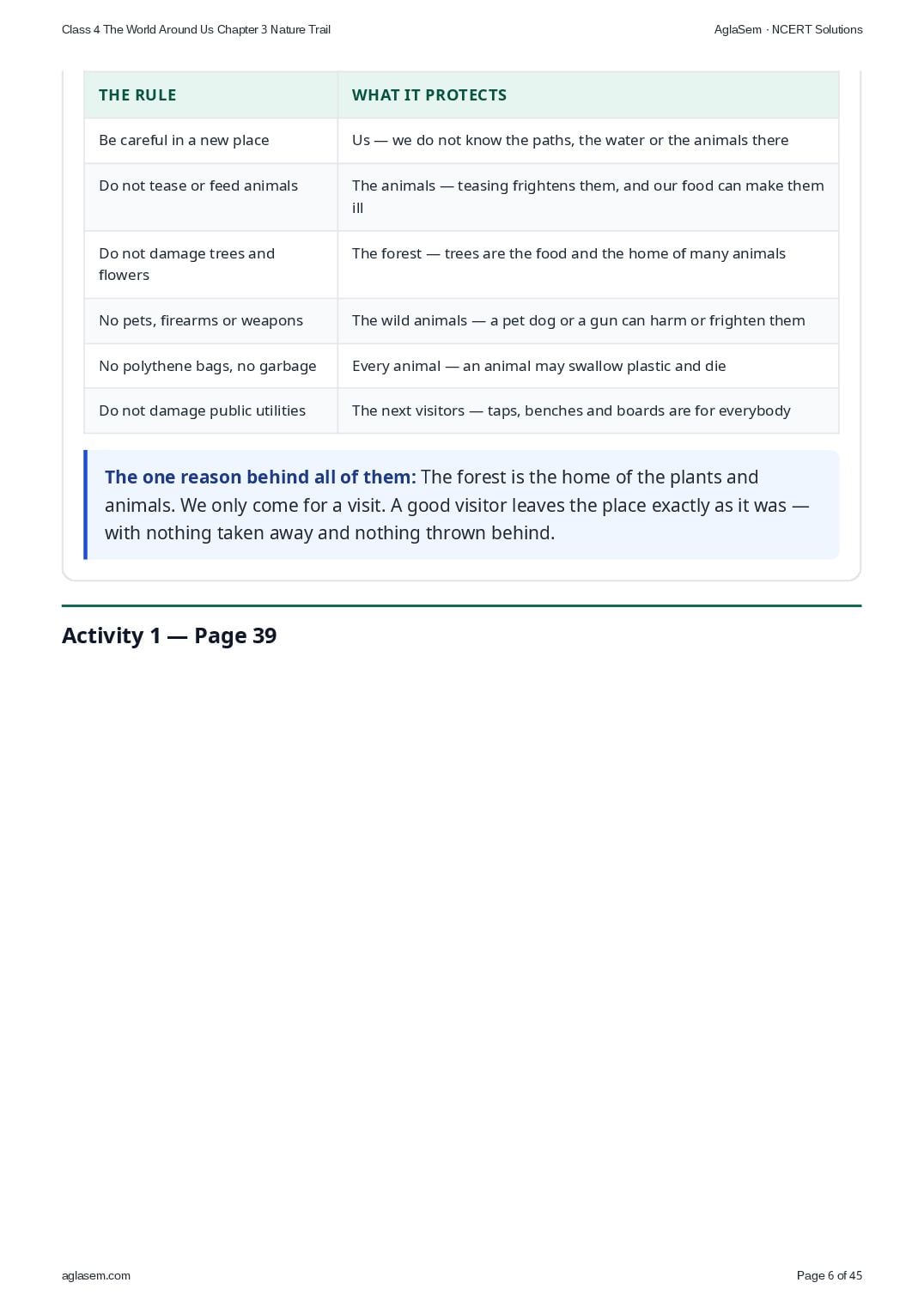
- Why are these rules important to be followed?DOs and DON’Ts1. Please be careful in a new place.2. Please do not tease animals.3. Please do not feed animals.4. Please do not damage trees, and flowers.5. Please do not bring pets, firearms, or any kind of weapons.6. Please do not bring polythene bags.7. Please do not damage public utilities.8. Please do not throw any garbage in the forest.The Safety Rules box printed on page 37.
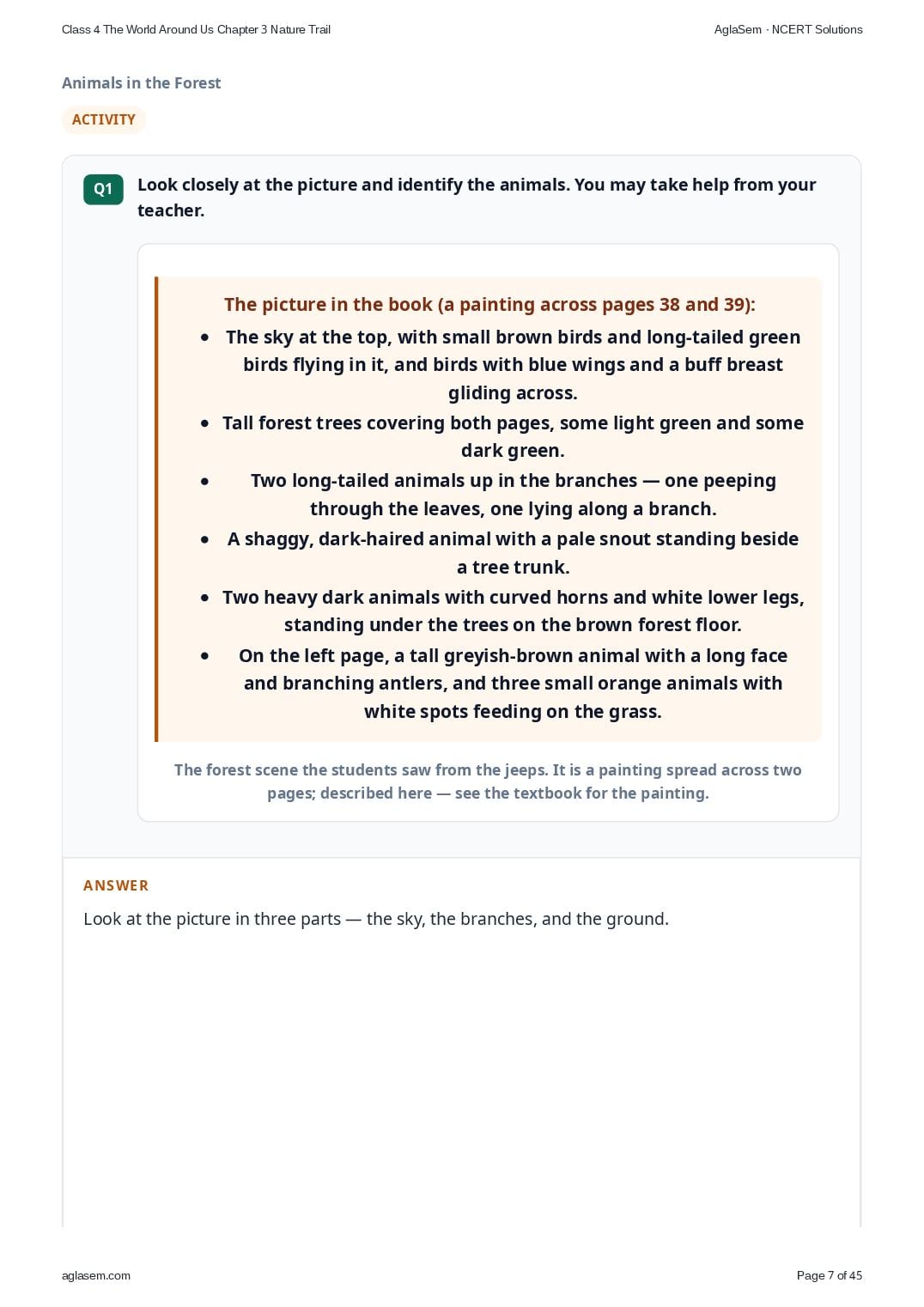
- Look closely at the picture and identify the animals. You may take help from your teacher.The picture in the book (a painting across pages 38 and 39):The sky at the top, with small brown birds and long-tailed green birds flying in it, and birds with blue wings and a buff breast gliding across.Tall forest trees covering both pages, some light green and some dark green.Two long-tailed animals up in the branches — one peeping through the leaves, one lying along a branch.A shaggy, dark-haired animal with a pale snout standing beside a tree trunk.Two heavy dark animals with curved horns and white lower legs, standing under the trees on the brown forest floor.On the left page, a tall greyish-brown animal with a long face and branching antlers, and three small orange animals with white spots feeding on the grass.The forest scene the students saw from the jeeps. It is a painting spread across two pages; described here — see the textbook for the painting.
- Divide them into two categories: 1. Animals on land: 2. Birds in the sky:The picture in the book (a painting across pages 38 and 39):The sky at the top, with small brown birds and long-tailed green birds flying in it, and birds with blue wings and a buff breast gliding across.Tall forest trees covering both pages, some light green and some dark green.Two long-tailed animals up in the branches — one peeping through the leaves, one lying along a branch.A shaggy, dark-haired animal with a pale snout standing beside a tree trunk.Two heavy dark animals with curved horns and white lower legs, standing under the trees on the brown forest floor.On the left page, a tall greyish-brown animal with a long face and branching antlers, and three small orange animals with white spots feeding on the grass.The forest scene the students saw from the jeeps. It is a painting spread across two pages; described here — see the textbook for the painting.
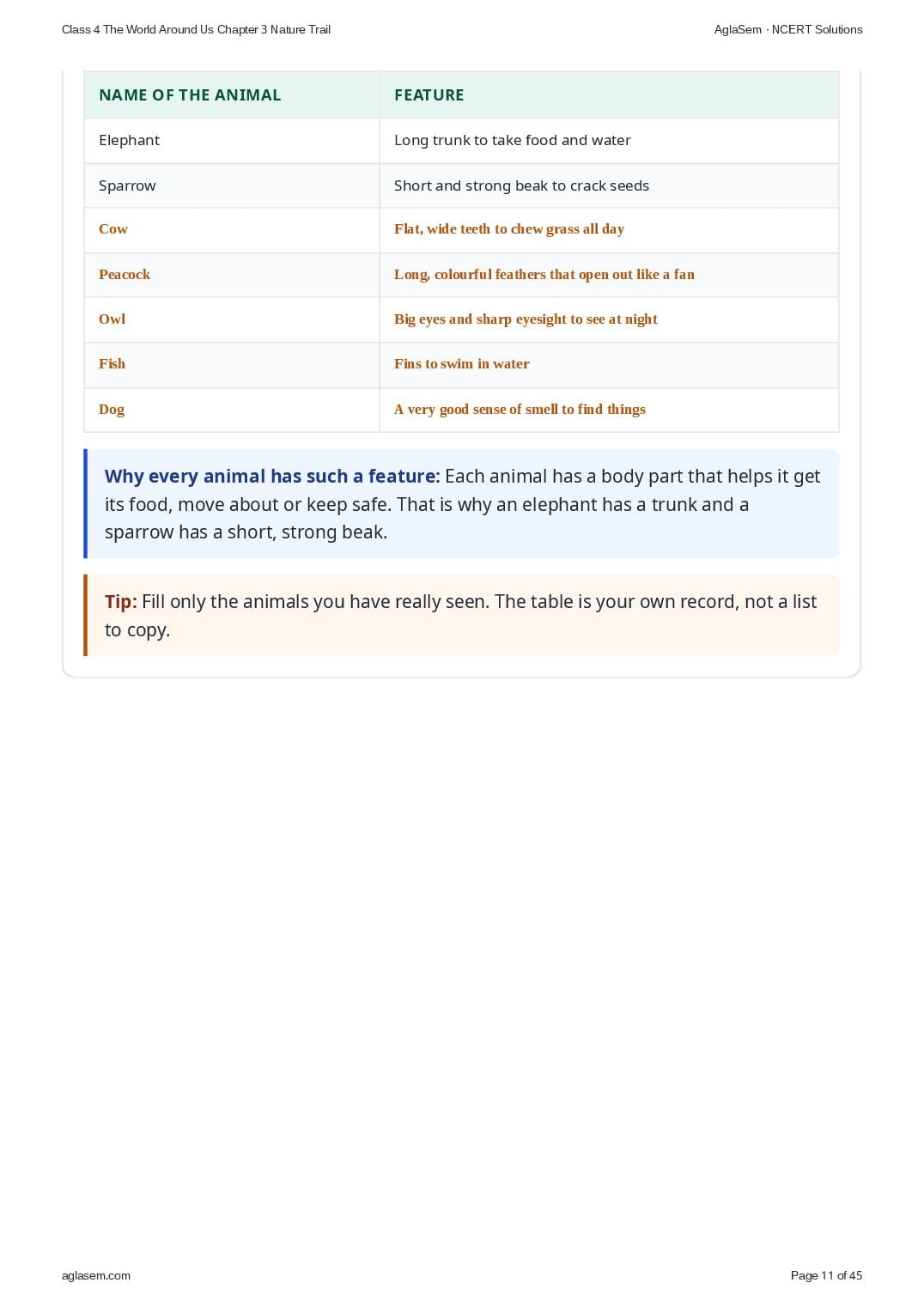
- Name some animals including the birds that you have seen. Write any one feature of each of them.Name of the animalFeatureElephantLong trunk to take food and waterSparrowShort and strong beak to crack seeds The table as it is printed in the book, with two rows already filled.
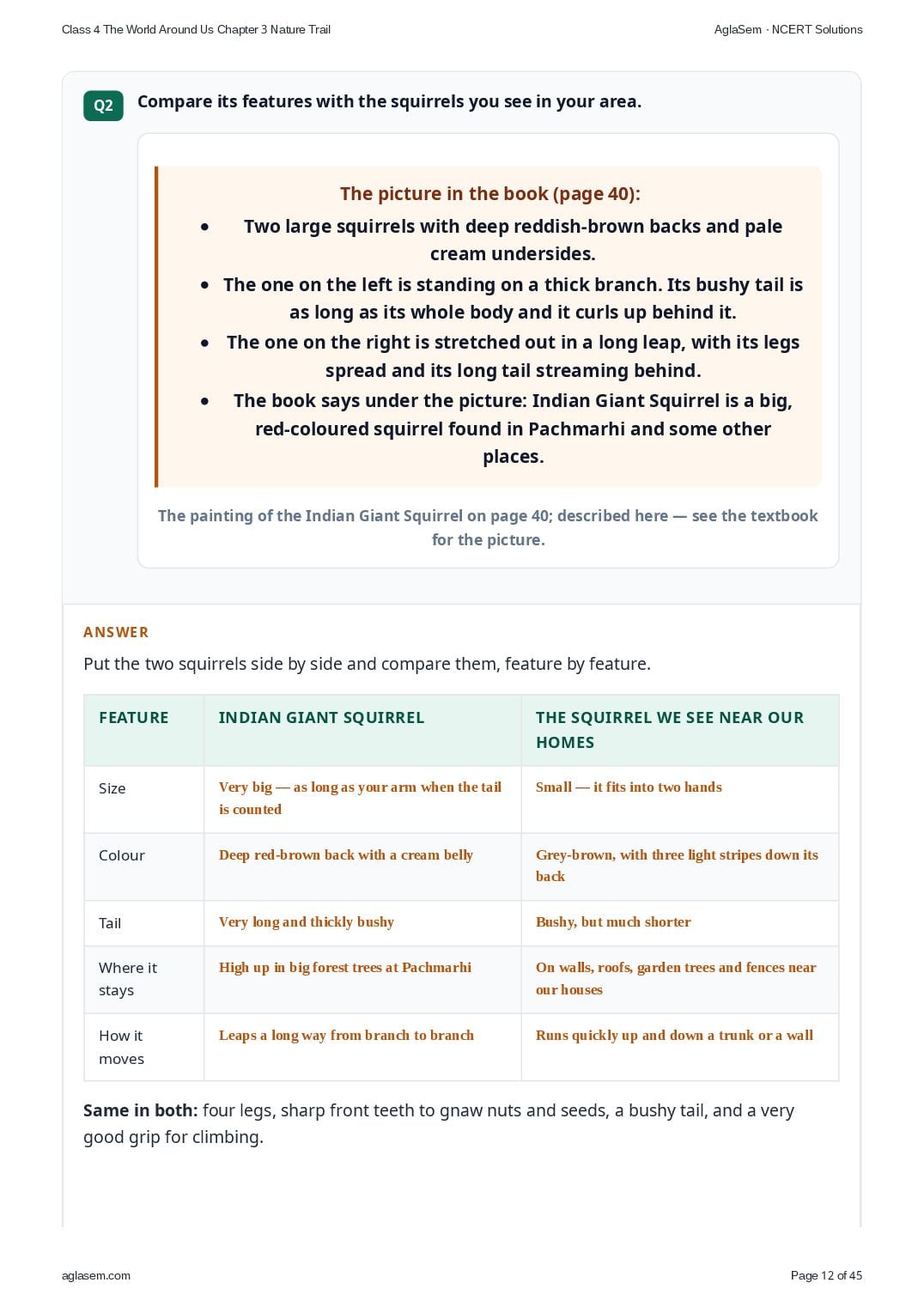
- Compare its features with the squirrels you see in your area.The picture in the book (page 40):Two large squirrels with deep reddish-brown backs and pale cream undersides.The one on the left is standing on a thick branch. Its bushy tail is as long as its whole body and it curls up behind it.The one on the right is stretched out in a long leap, with its legs spread and its long tail streaming behind.The book says under the picture: Indian Giant Squirrel is a big, red-coloured squirrel found in Pachmarhi and some other places.The painting of the Indian Giant Squirrel on page 40; described here — see the textbook for the picture.
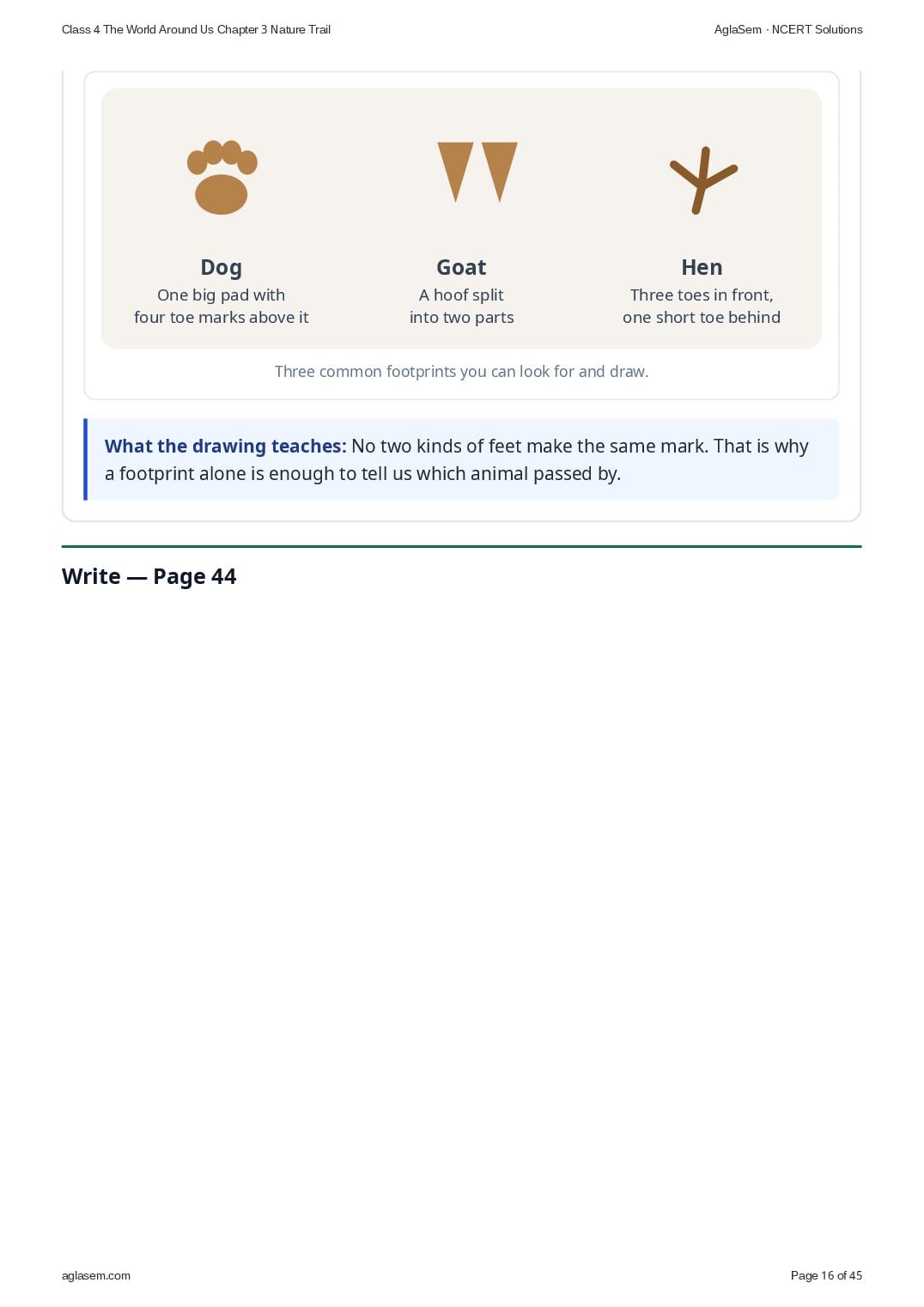
- Look at these footprints in the mud. Which animal might had left these marks?123The three sets of footprints pressed into the mud beside the pond.
- Look at the footprints and guess the name of the animals that you think must have come to the pond to drink water.123The three sets of footprints pressed into the mud beside the pond.
- Observe and draw the footprint of any animal in the space given here.The empty box printed in the book, for you to draw the footprint in.
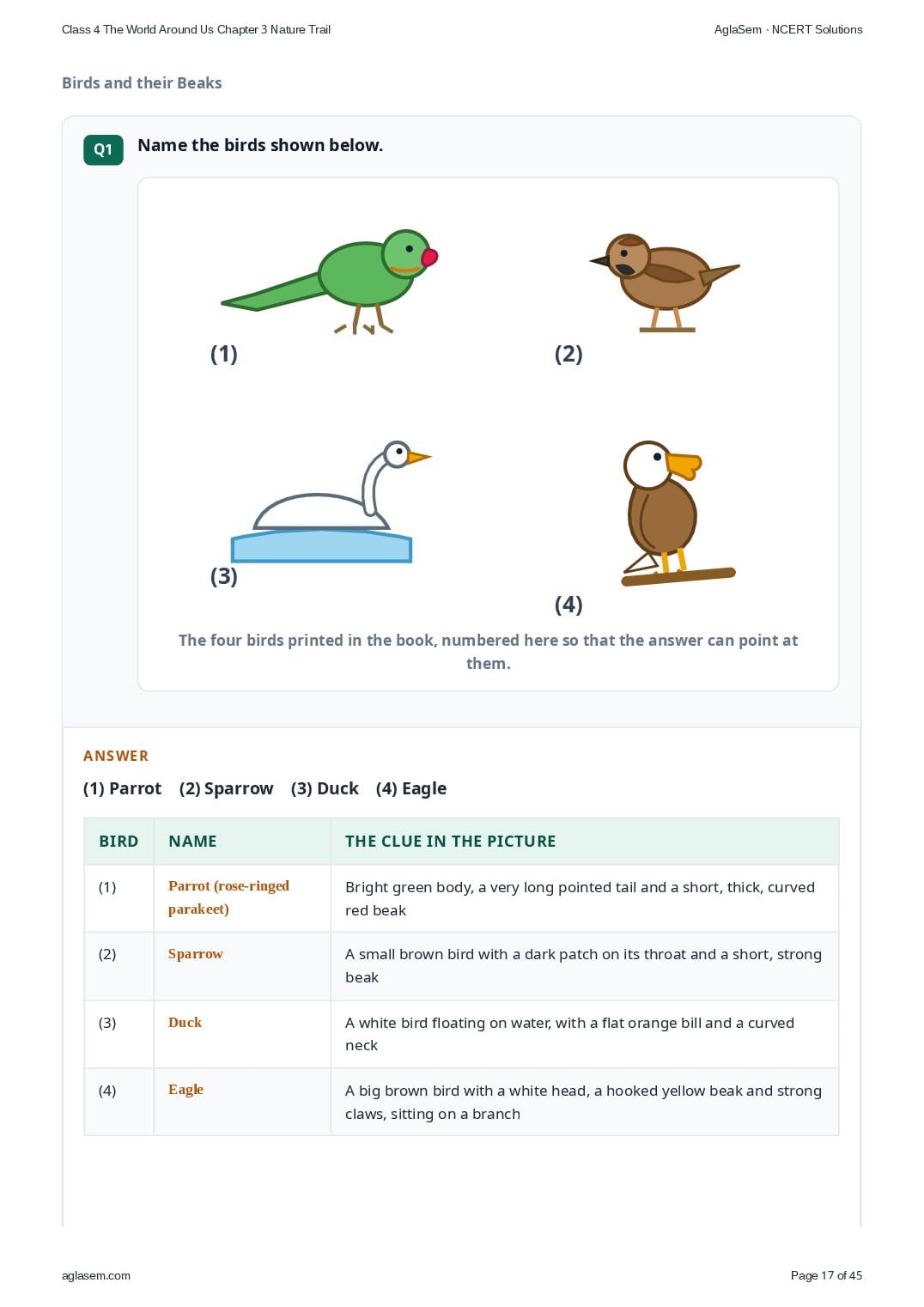
- Name the birds shown below. (1) (2) (3) (4) The four birds printed in the book, numbered here so that the answer can point at them.
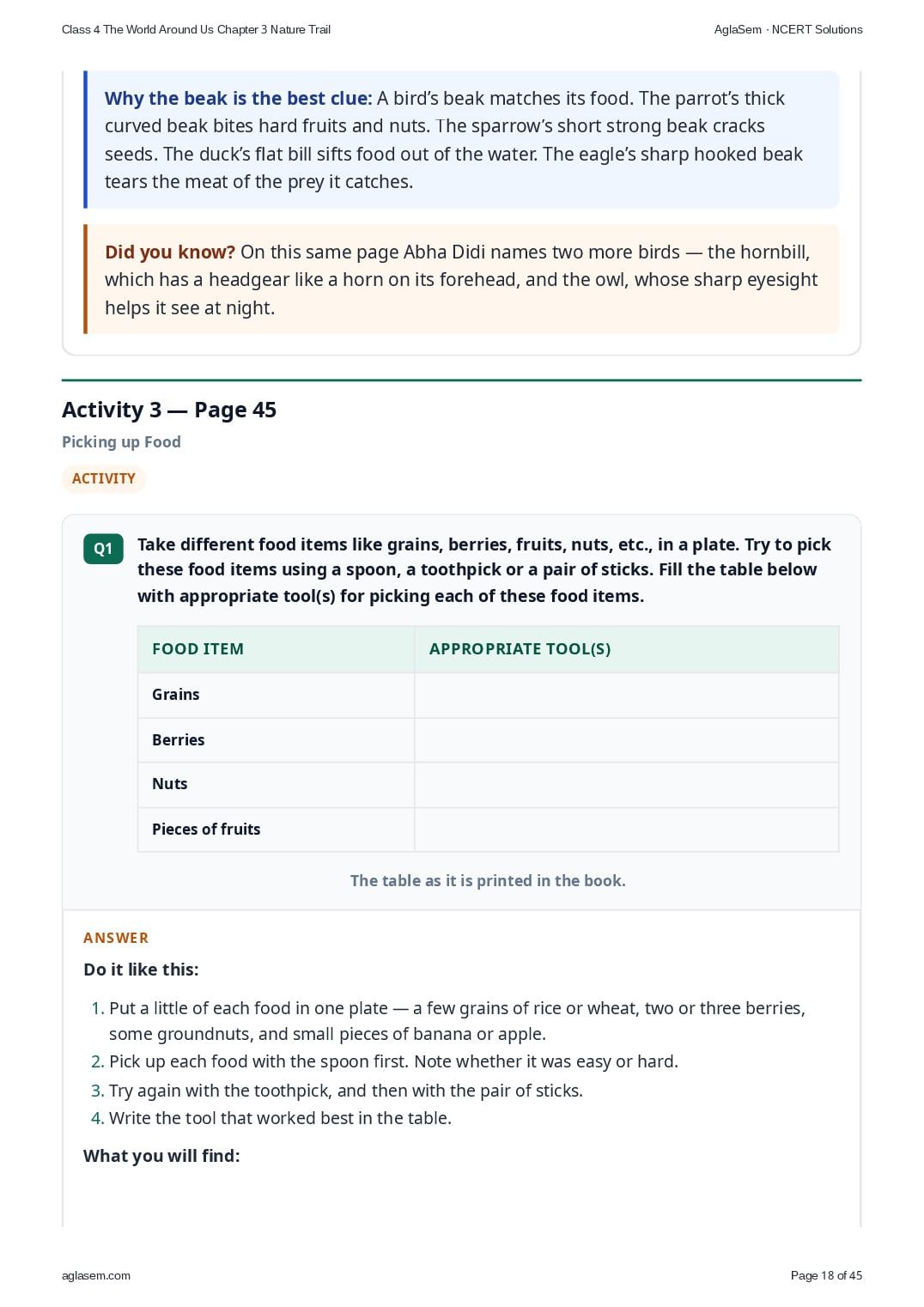
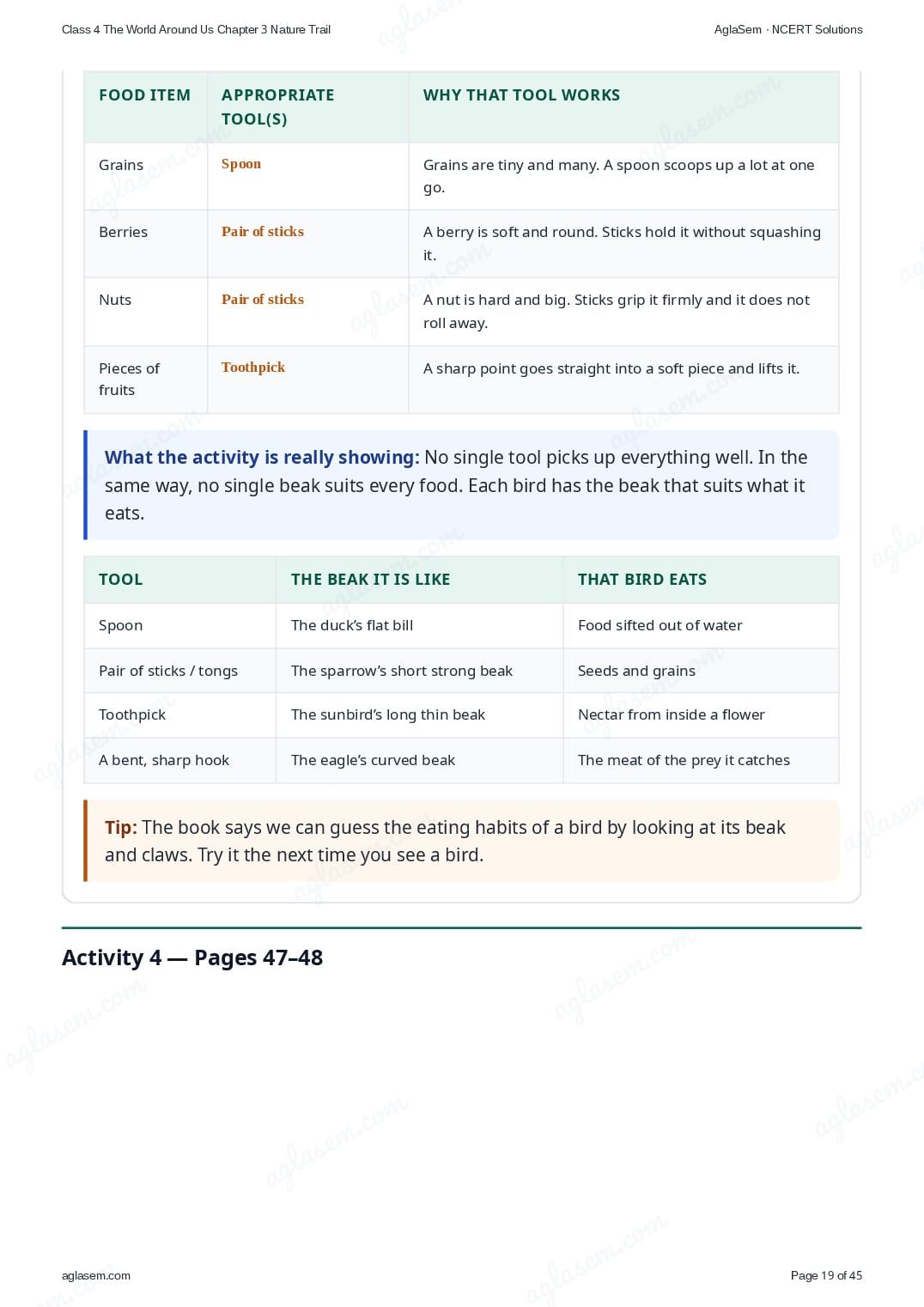
- Take different food items like grains, berries, fruits, nuts, etc., in a plate. Try to pick these food items using a spoon, a toothpick or a pair of sticks. Fill the table below with appropriate tool(s) for picking each of these food items.Food itemAppropriate tool(s)Grains Berries Nuts Pieces of fruits The table as it is printed in the book.
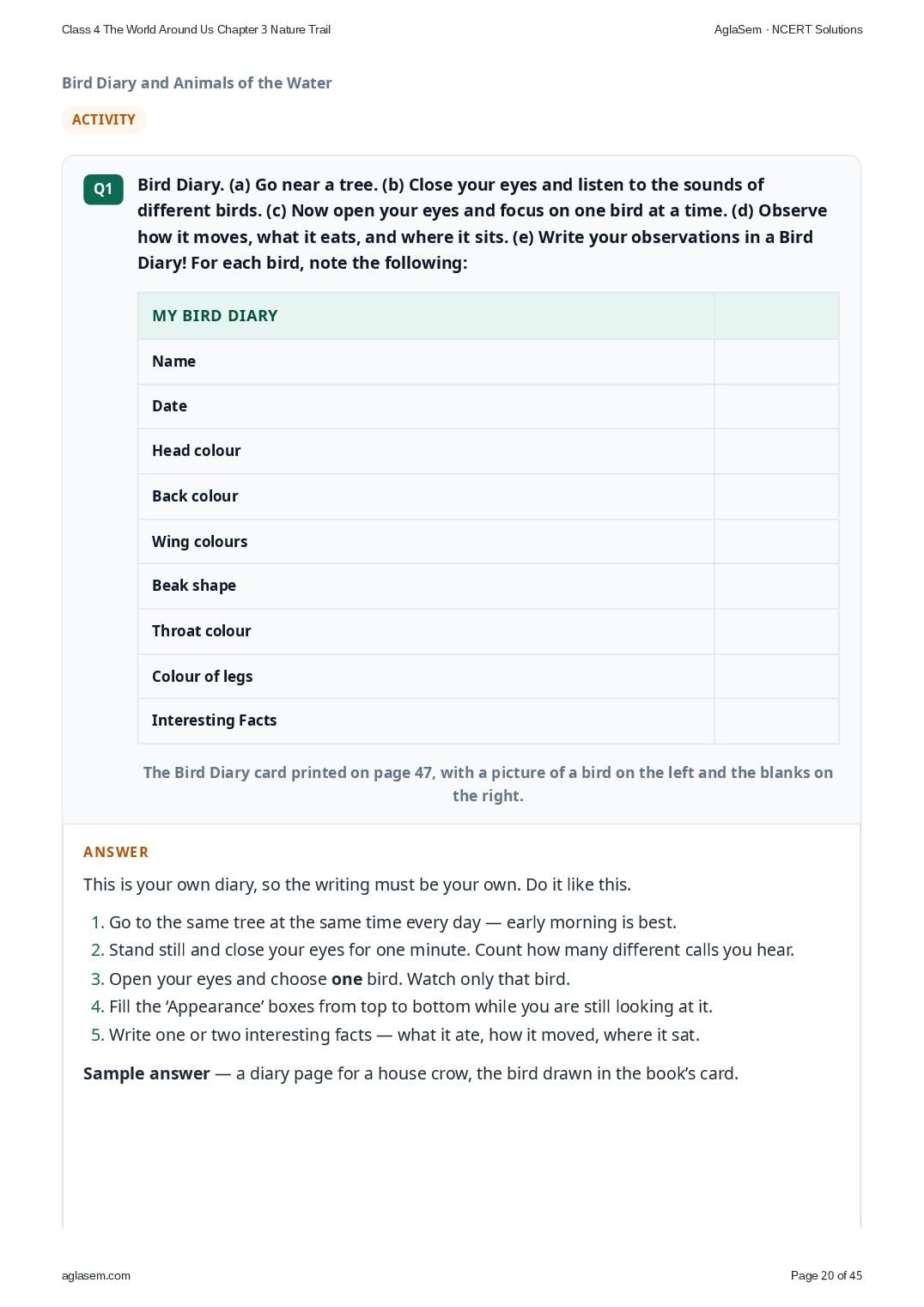
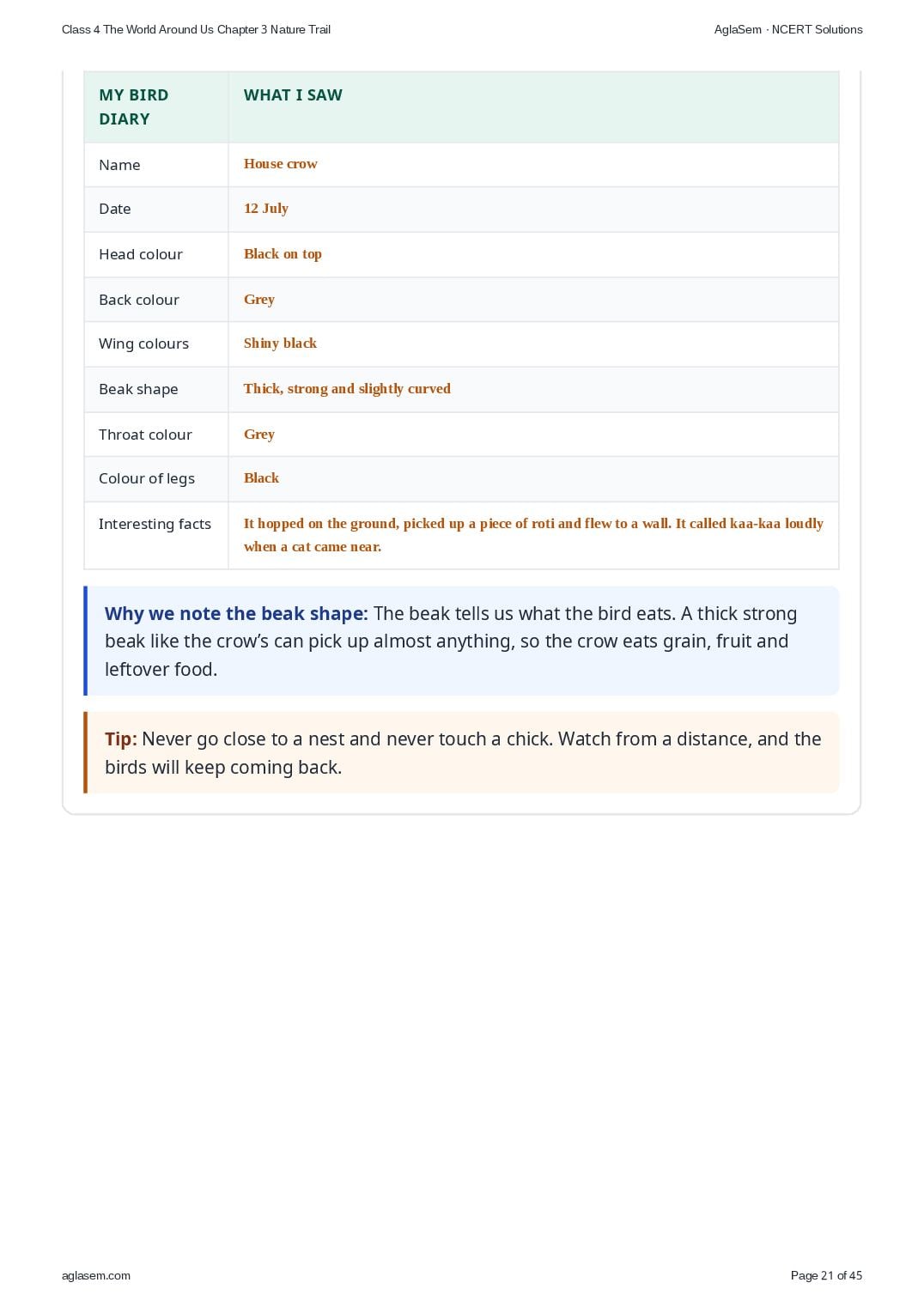
- Bird Diary. (a) Go near a tree. (b) Close your eyes and listen to the sounds of different birds. (c) Now open your eyes and focus on one bird at a time. (d) Observe how it moves, what it eats, and where it sits. (e) Write your observations in a Bird Diary! For each bird, note the following:My Bird Diary Name Date Head colour Back colour Wing colours Beak shape Throat colour Colour of legs Interesting Facts The Bird Diary card printed on page 47, with a picture of a bird on the left and the blanks on the right.
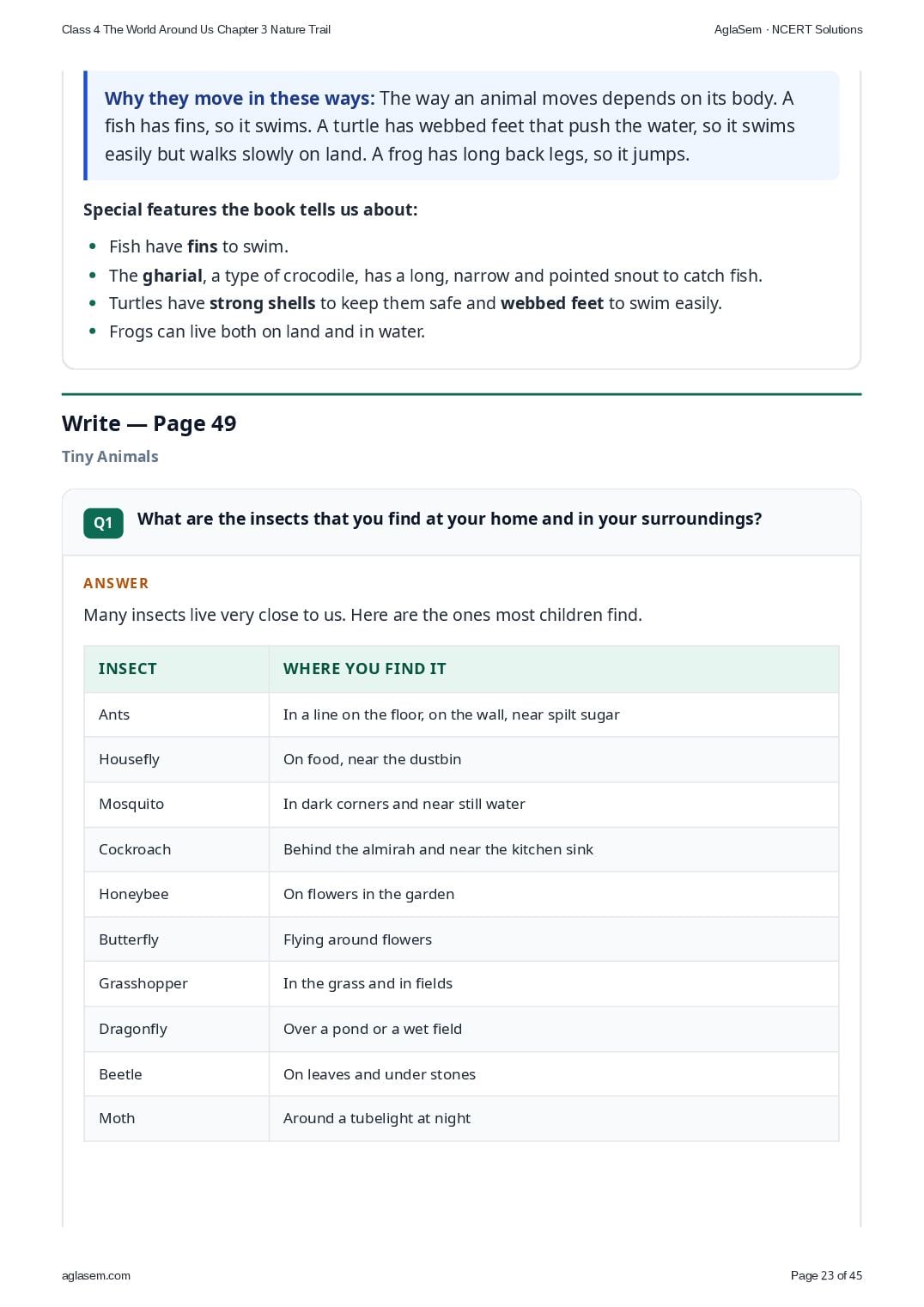
- List the animals which live in and around water bodies. Fill in the table given below.Name of the animalMovementsFishSwimsCrabWalksFrogJumpsTurtle Crocodile Snakes The table as it is printed in the book, with three rows already filled.
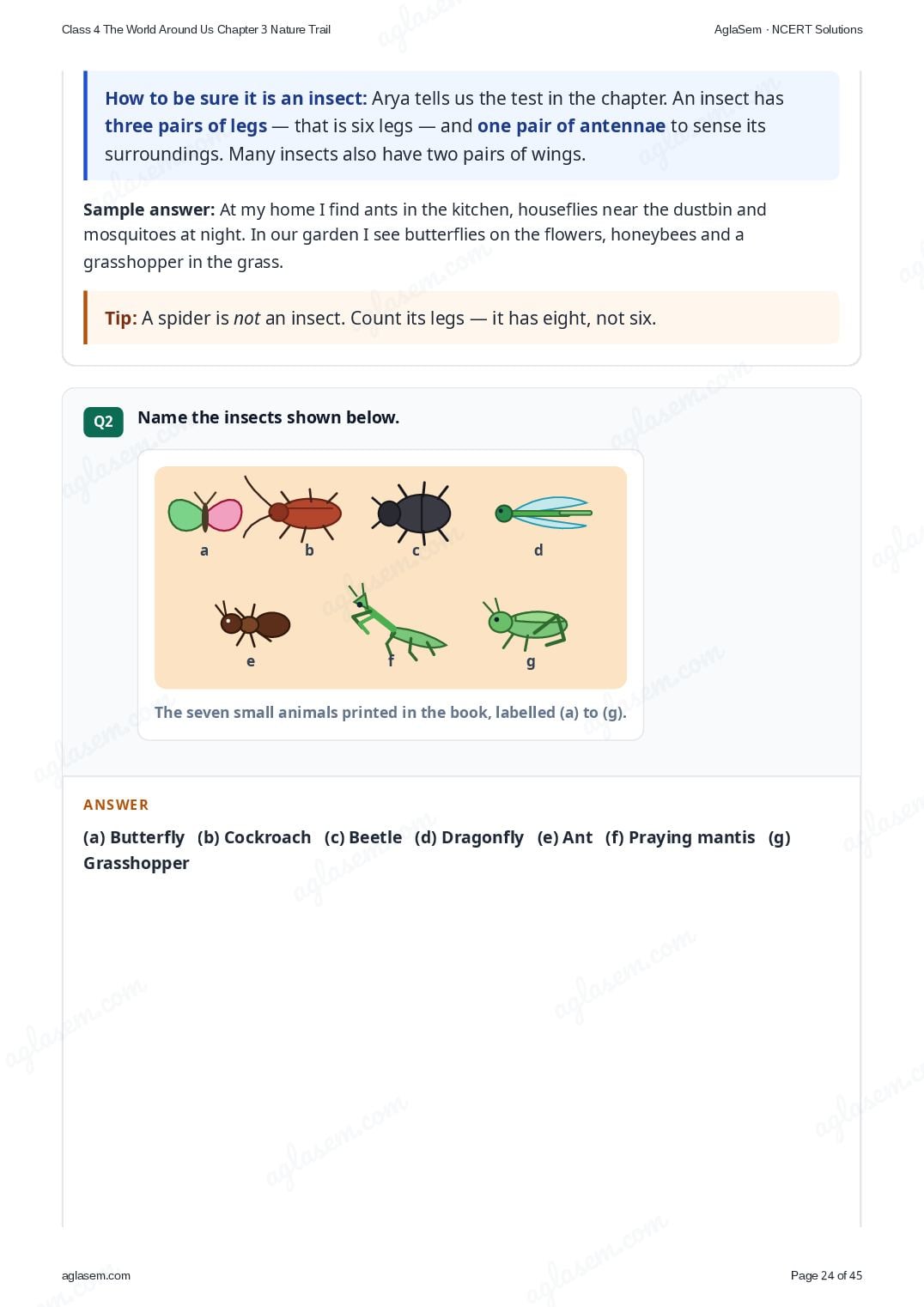
- What are the insects that you find at your home and in your surroundings?
- Name the insects shown below. a b c d e f g The seven small animals printed in the book, labelled (a) to (g).
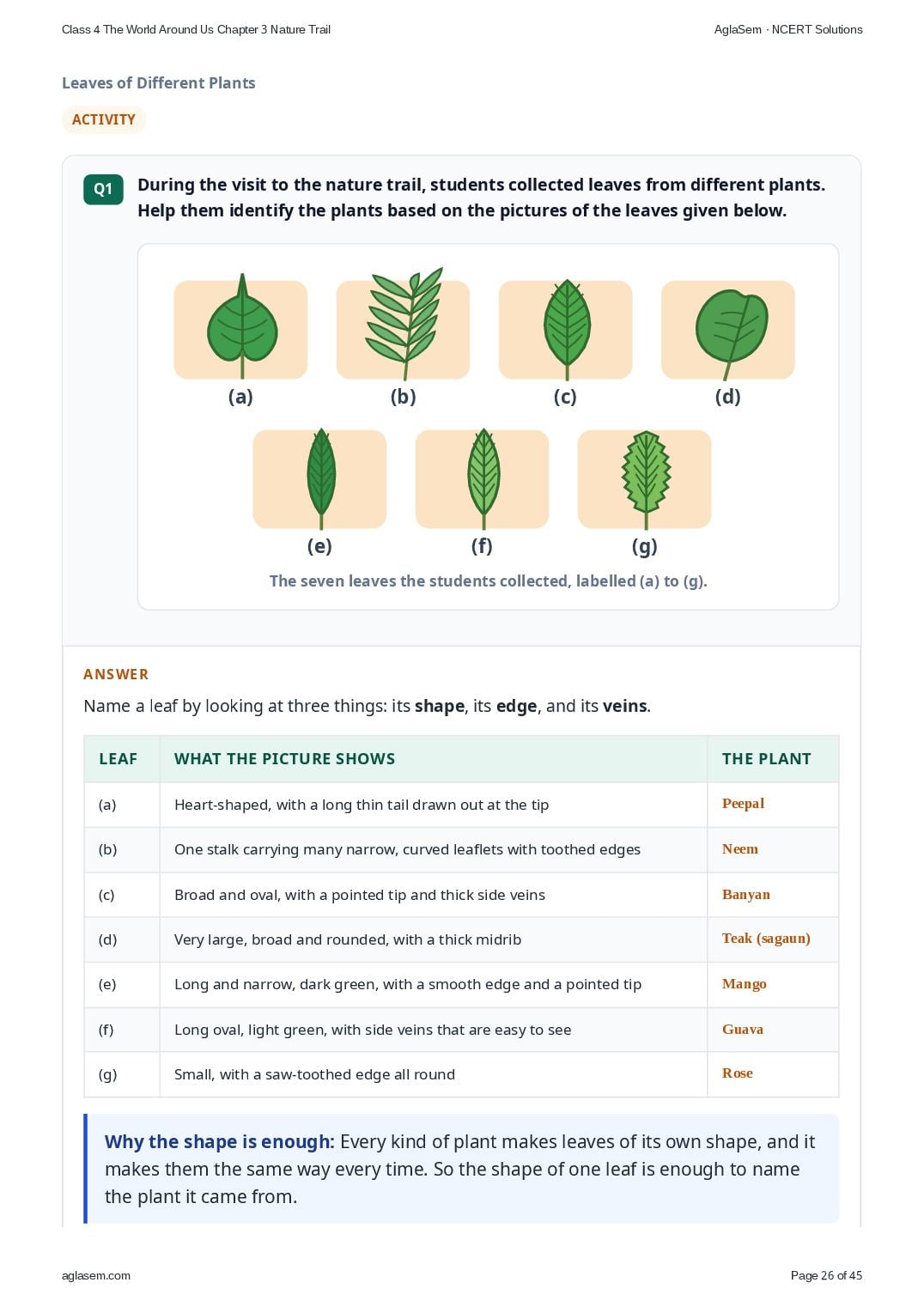
- During the visit to the nature trail, students collected leaves from different plants. Help them identify the plants based on the pictures of the leaves given below.(a)(b)(c)(d)(e)(f)(g)The seven leaves the students collected, labelled (a) to (g).
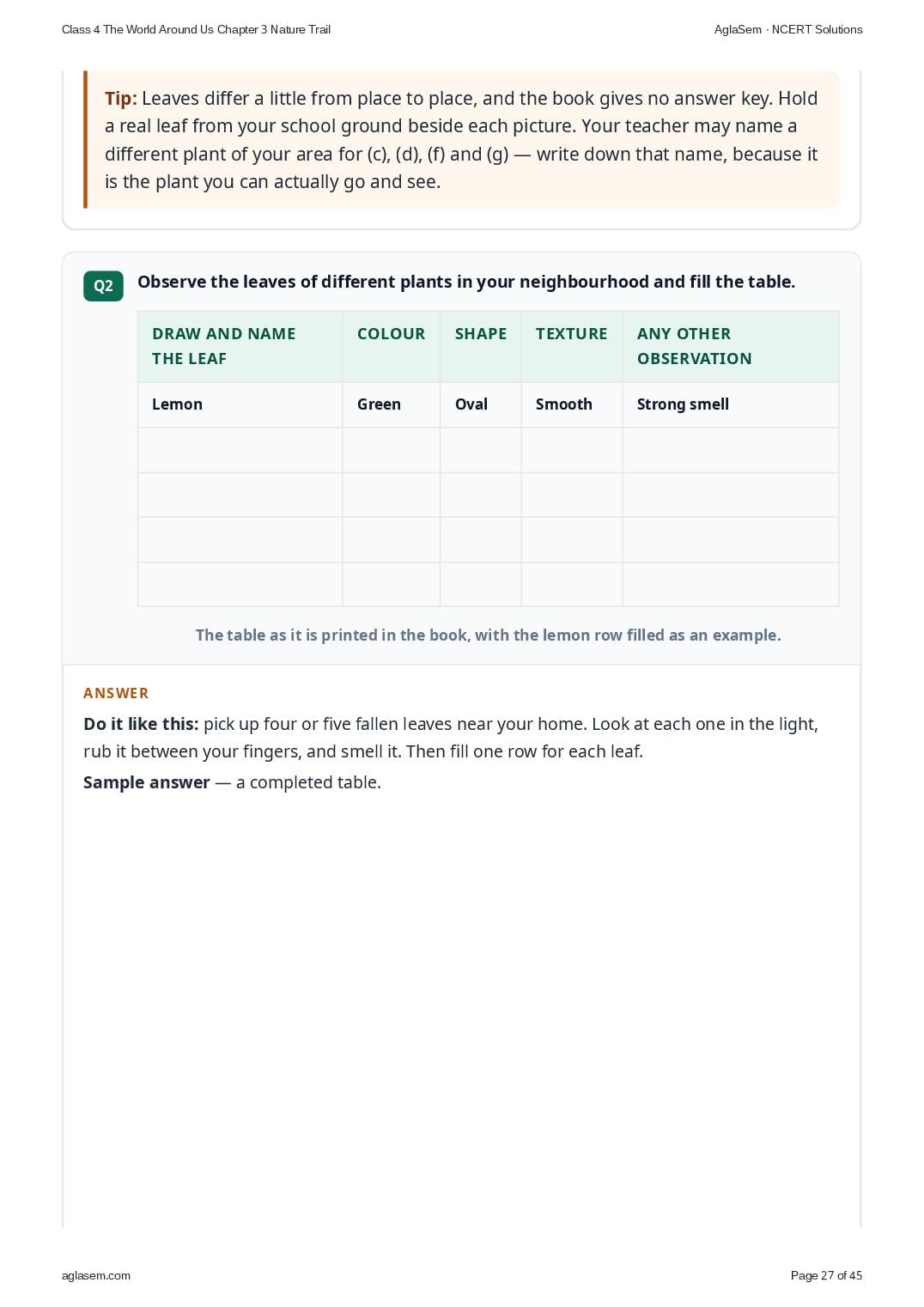
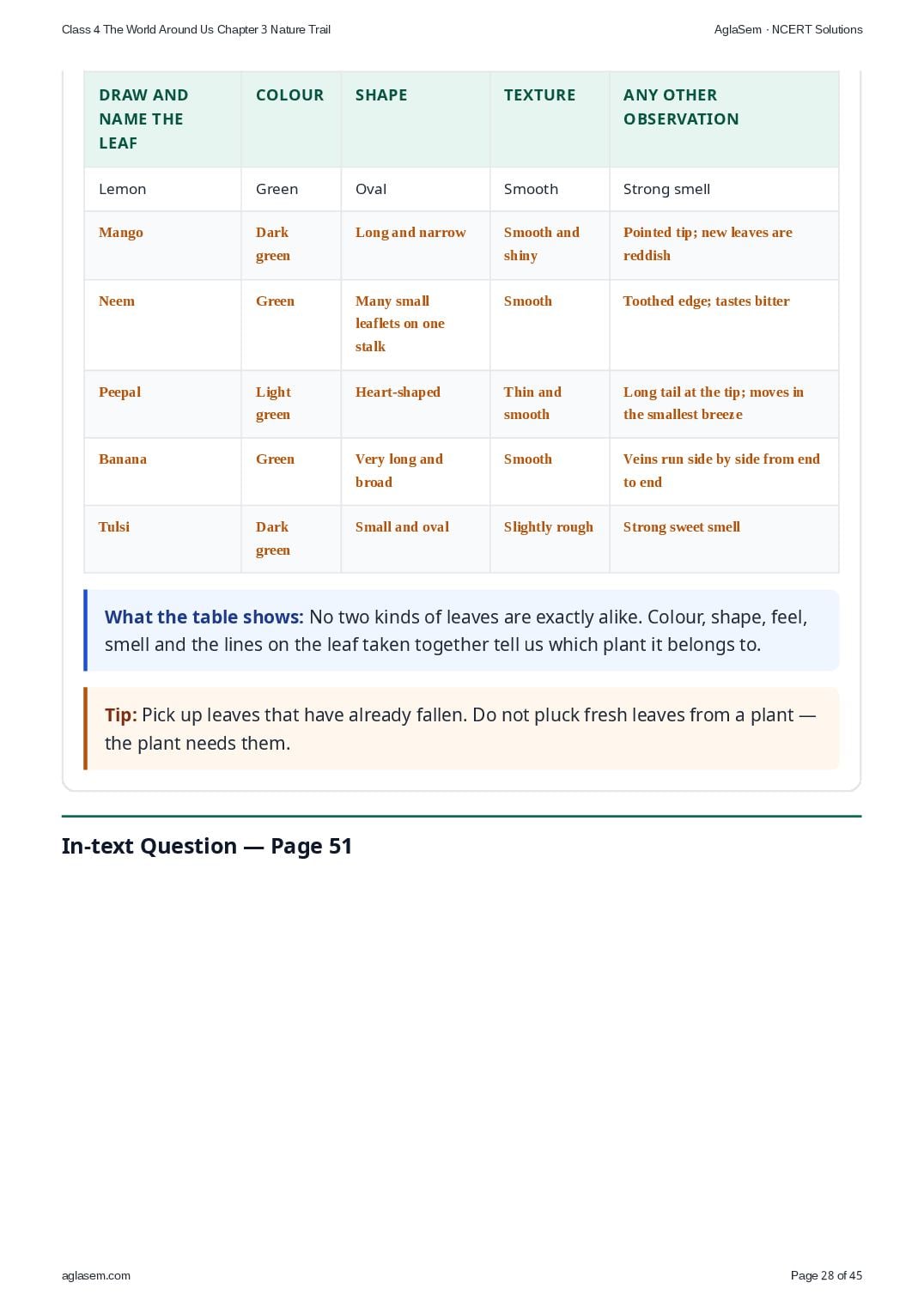
- Observe the leaves of different plants in your neighbourhood and fill the table.Draw and name the leafColourShapeTextureAny other observationLemonGreenOvalSmoothStrong smell The table as it is printed in the book, with the lemon row filled as an example.
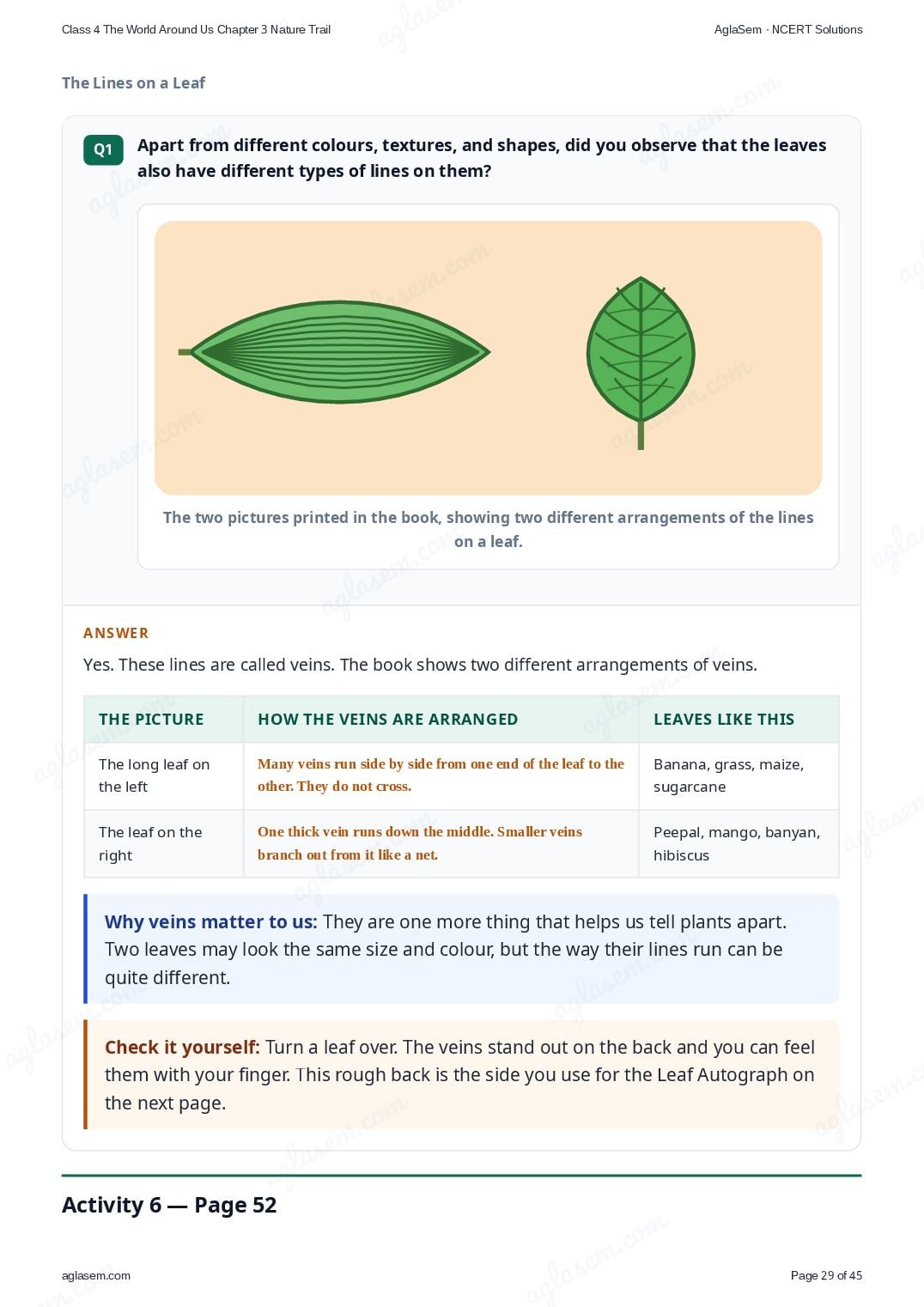
- Apart from different colours, textures, and shapes, did you observe that the leaves also have different types of lines on them?The two pictures printed in the book, showing two different arrangements of the lines on a leaf.
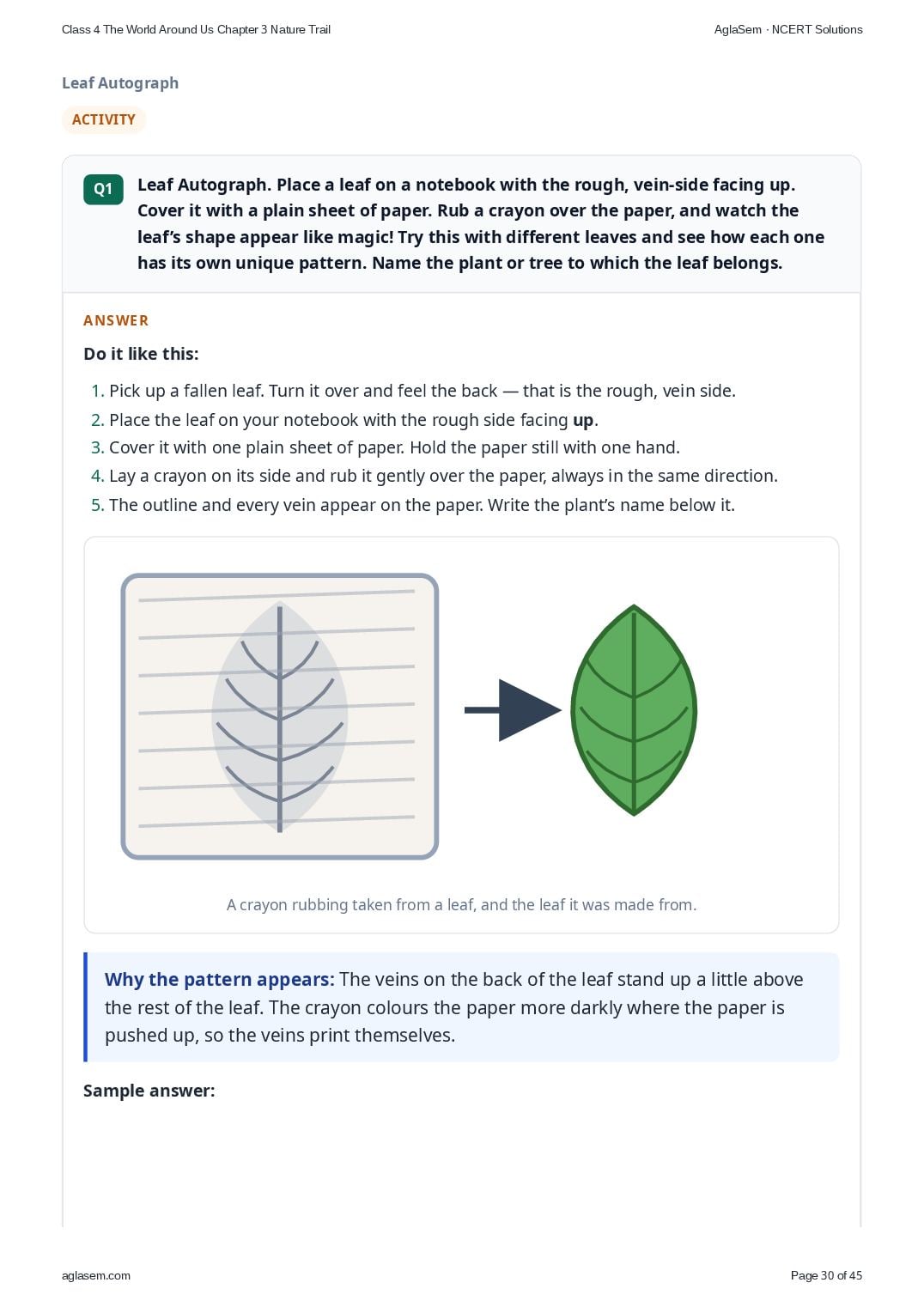
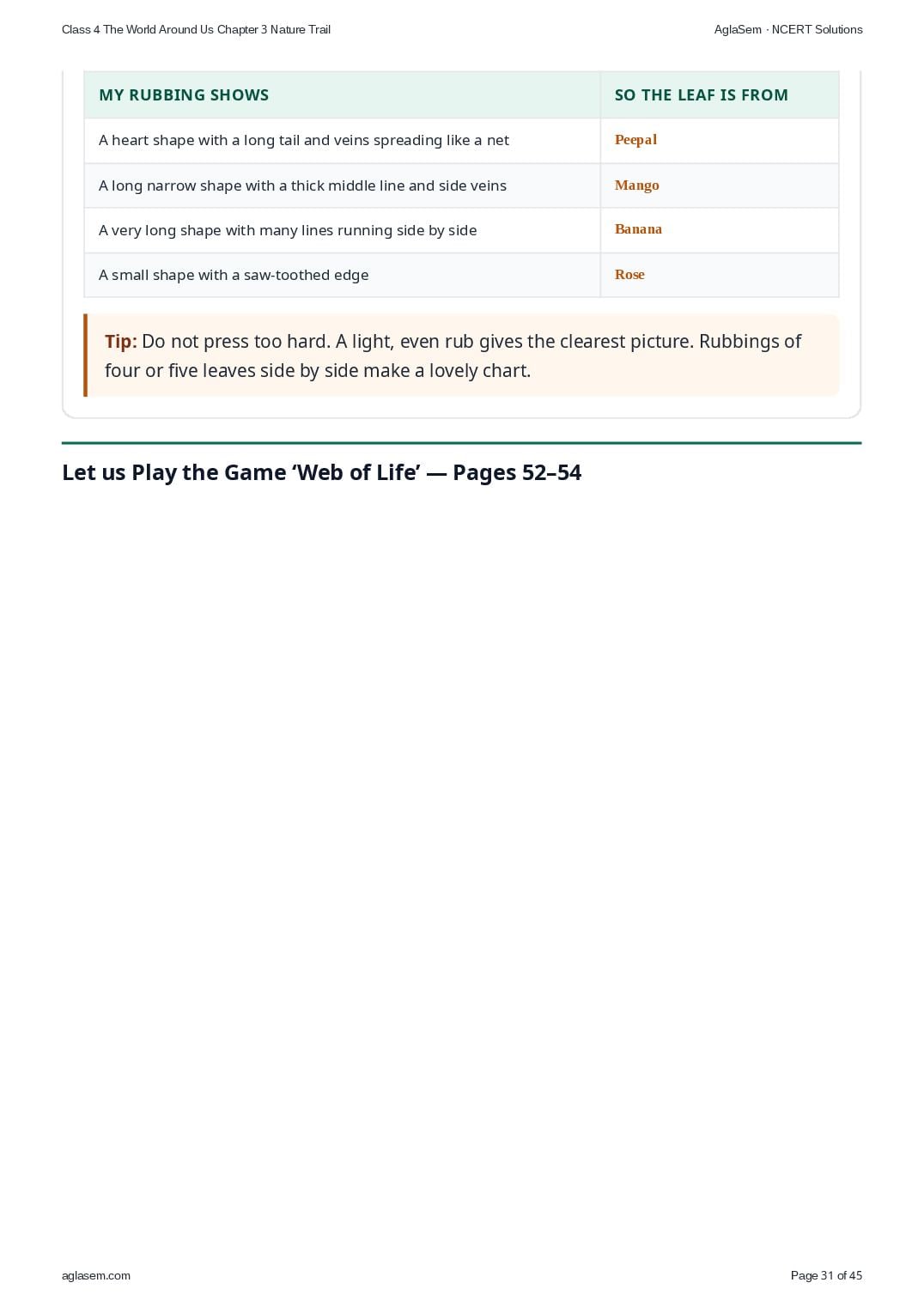
- Leaf Autograph. Place a leaf on a notebook with the rough, vein-side facing up. Cover it with a plain sheet of paper. Rub a crayon over the paper, and watch the leaf’s shape appear like magic! Try this with different leaves and see how each one has its own unique pattern. Name the plant or tree to which the leaf belongs.
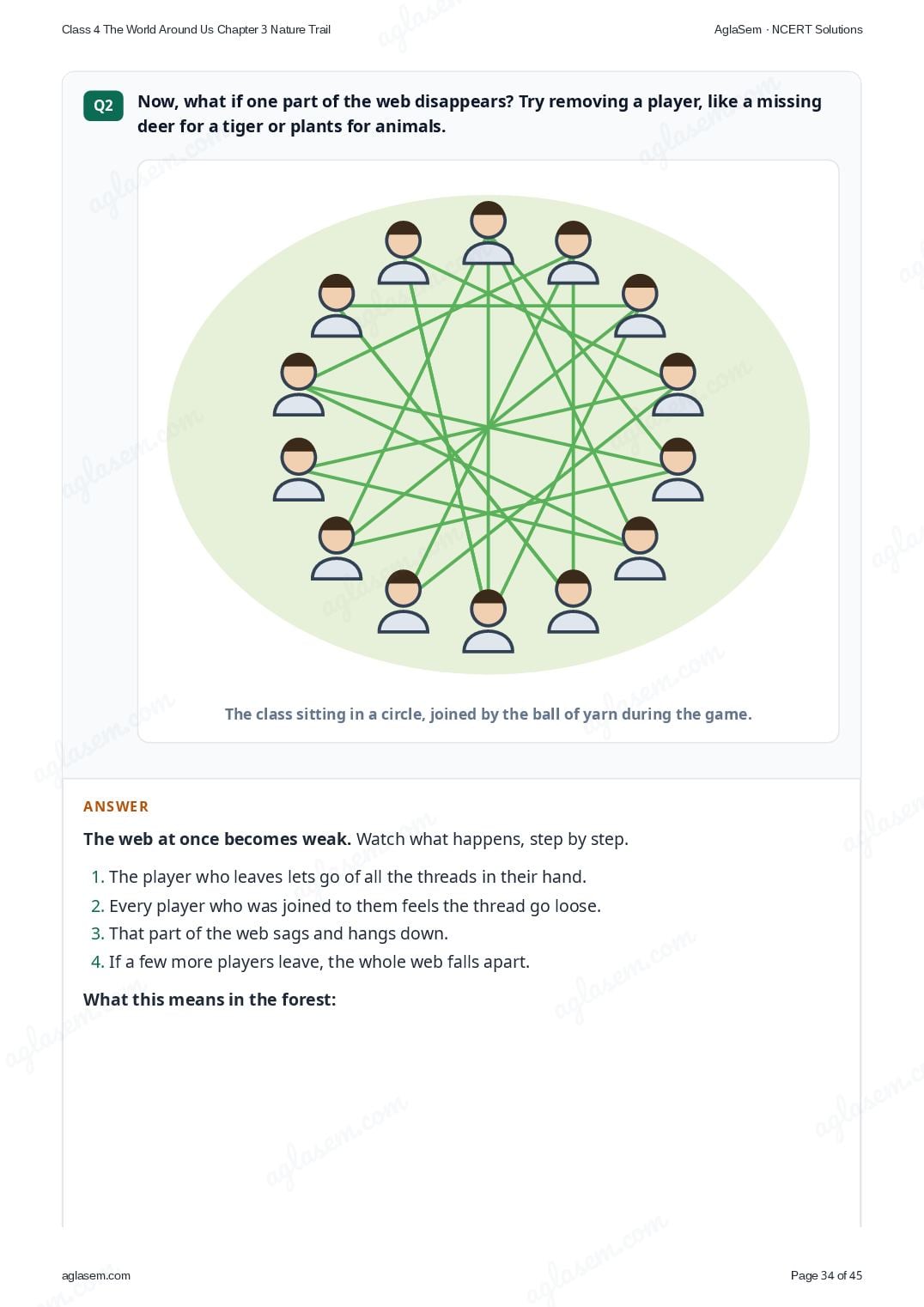
- Have you ever wondered how all living beings are connected?The class sitting in a circle, joined by the ball of yarn during the game.
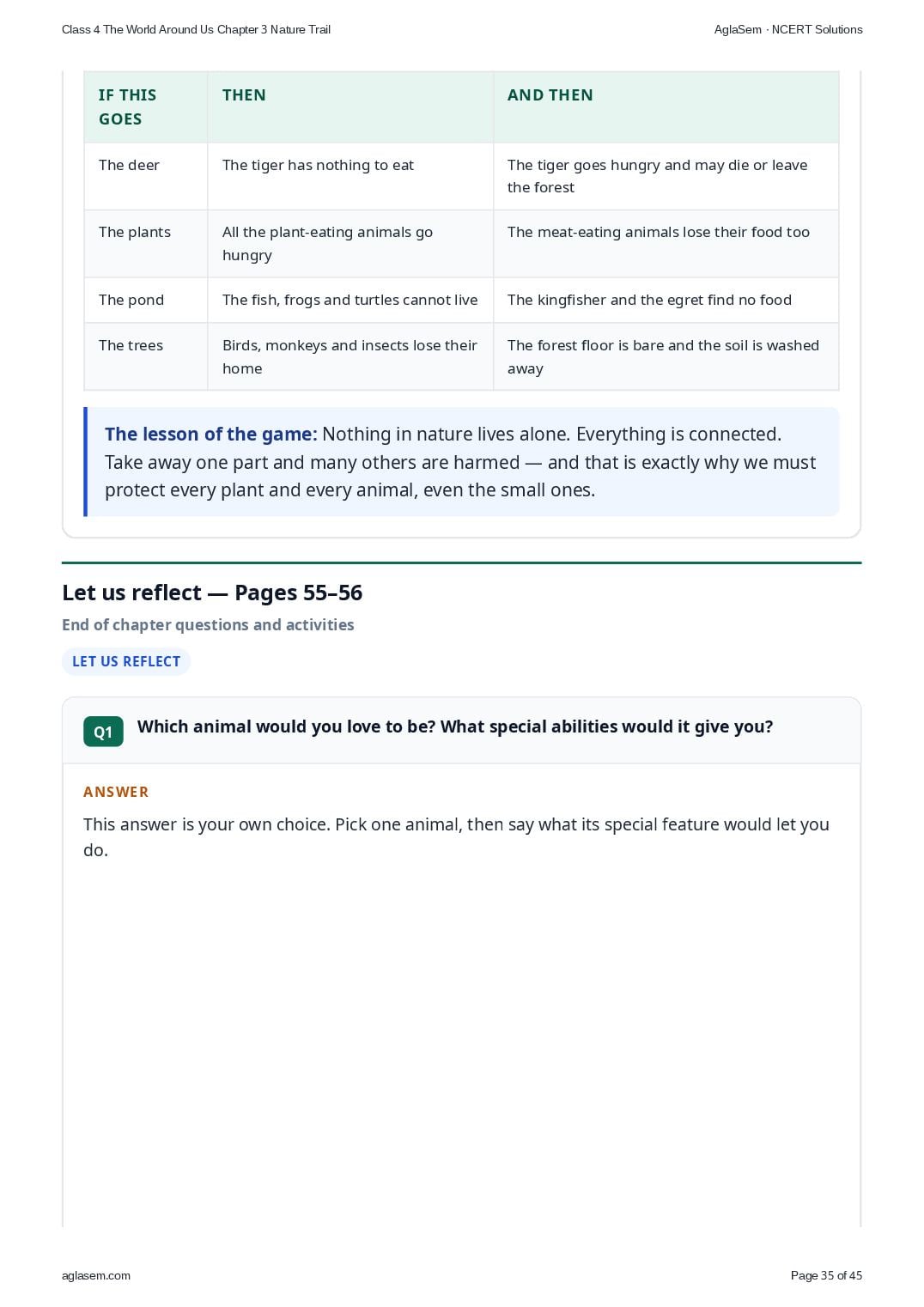
- Now, what if one part of the web disappears? Try removing a player, like a missing deer for a tiger or plants for animals.The class sitting in a circle, joined by the ball of yarn during the game.
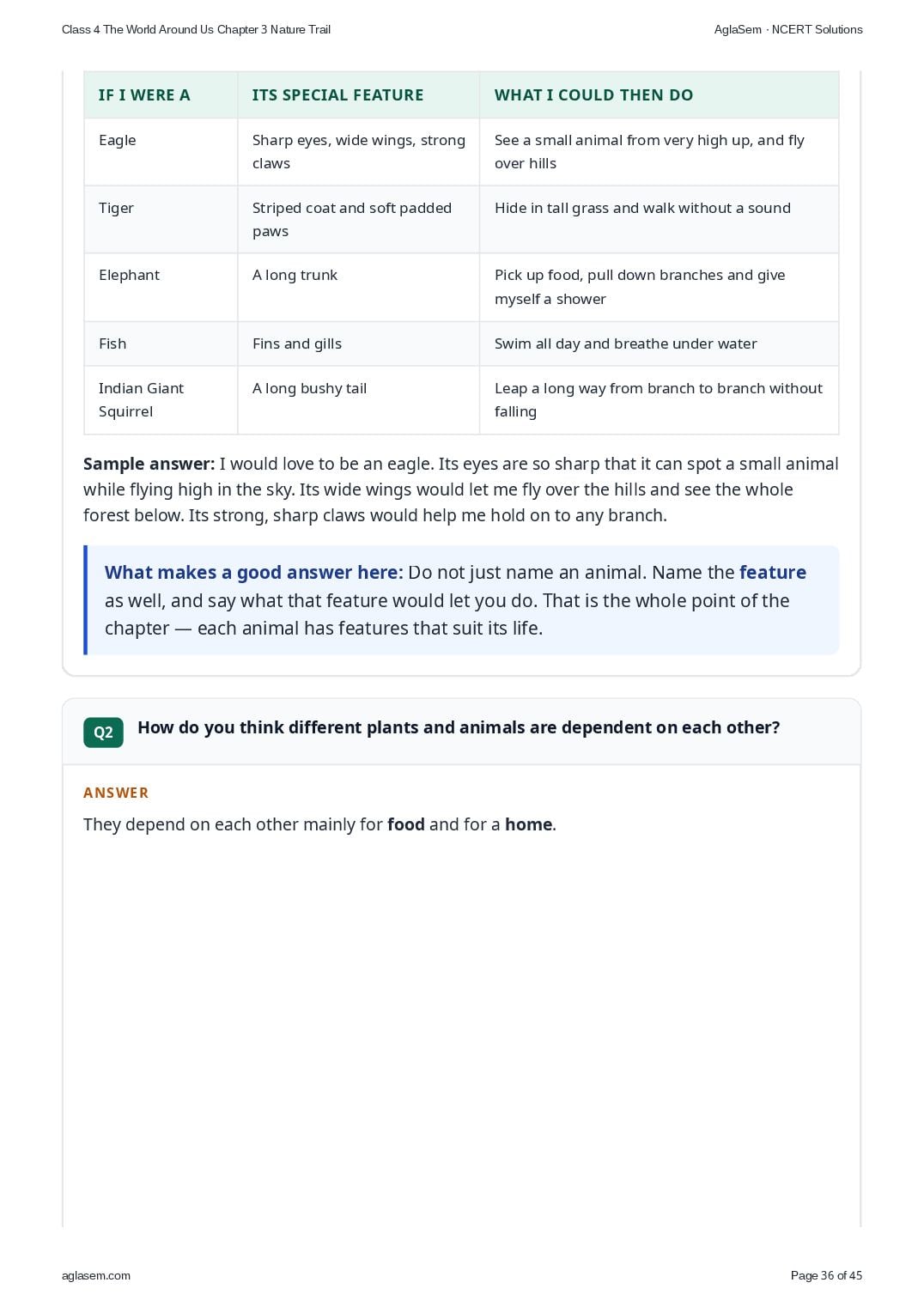
- Which animal would you love to be? What special abilities would it give you?
- How do you think different plants and animals are dependent on each other?
- What is the role of a nature scientist?
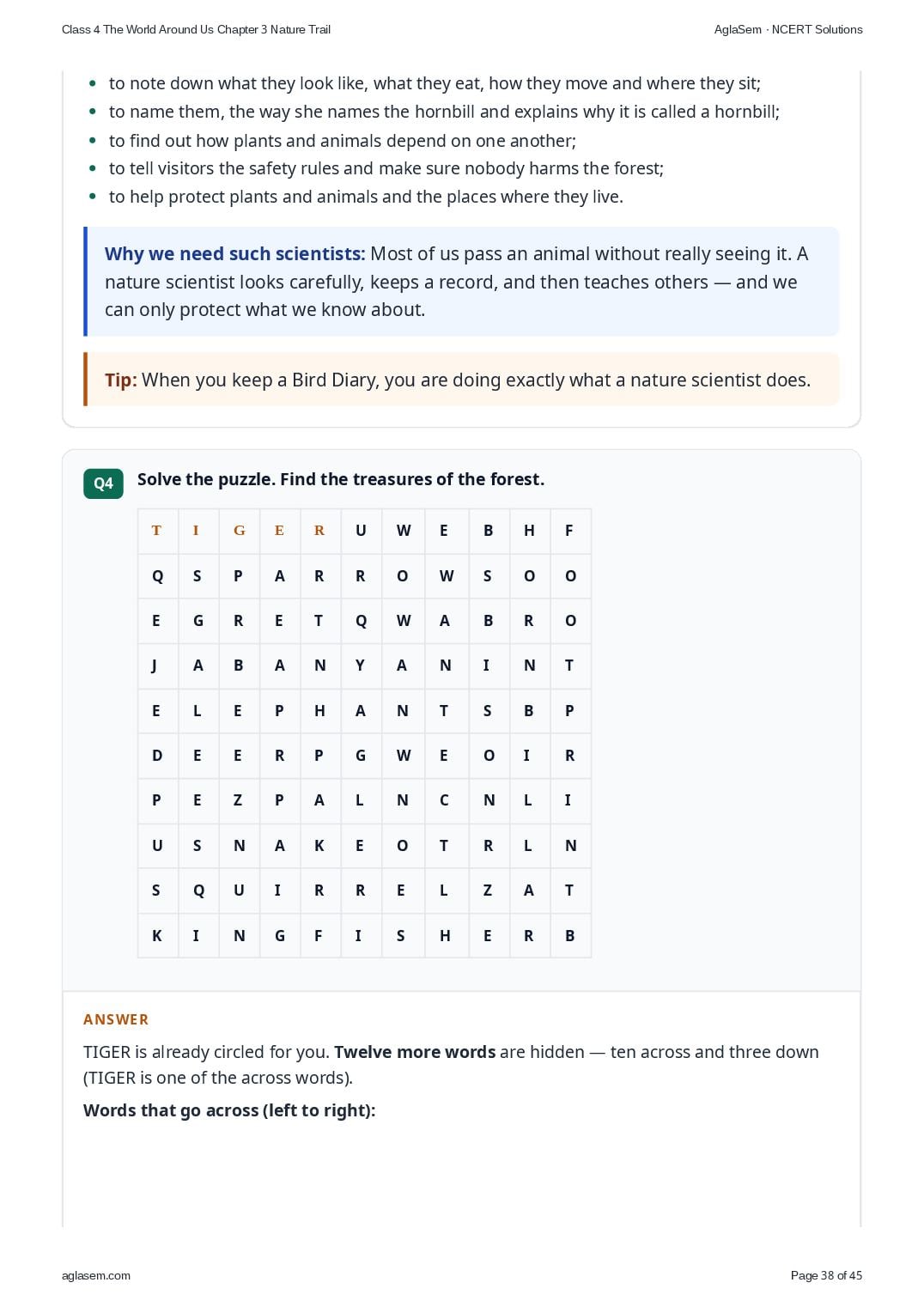
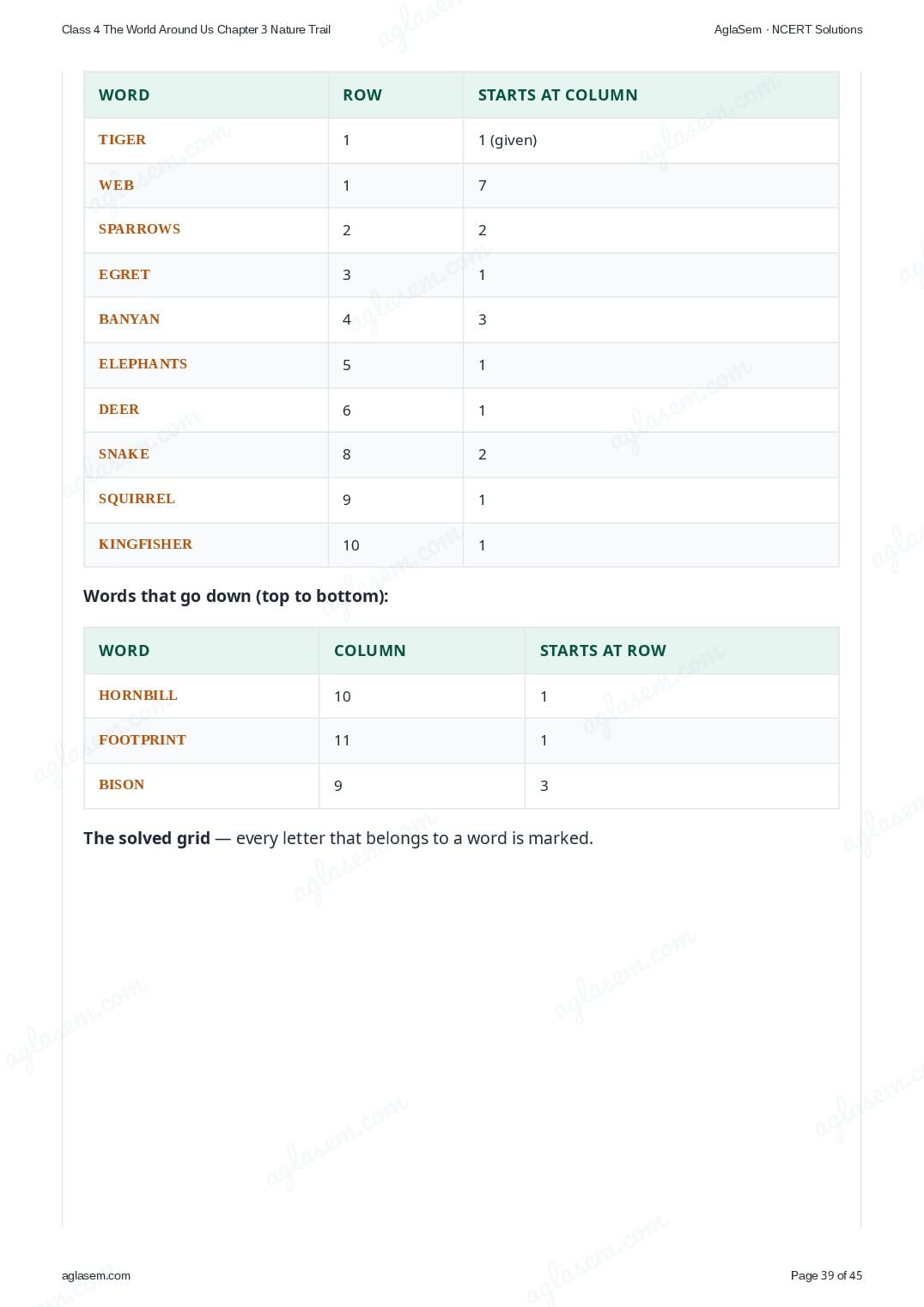
- Solve the puzzle. Find the treasures of the forest.TIGERUWEBHFQSPARROWSOOEGRETQWABROJABANYANINTELEPHANTSBPDEERPGWEOIRPEZPALNCNLIUSNAKEOTRLNSQUIRRELZATKINGFISHERB
- Take on the challenge. Plan a nature walk with your family or friends in a nearby park. To prepare yourself as a guide, identify few plants and animals, and study their features and interesting facts which you can explain during the walk.
- Do an activity. Role-play: Create a scene of a forest in your classroom where students can perform roles of plants and animals, and of visitors. While enacting the play, focus on our role to protect animals and plants.
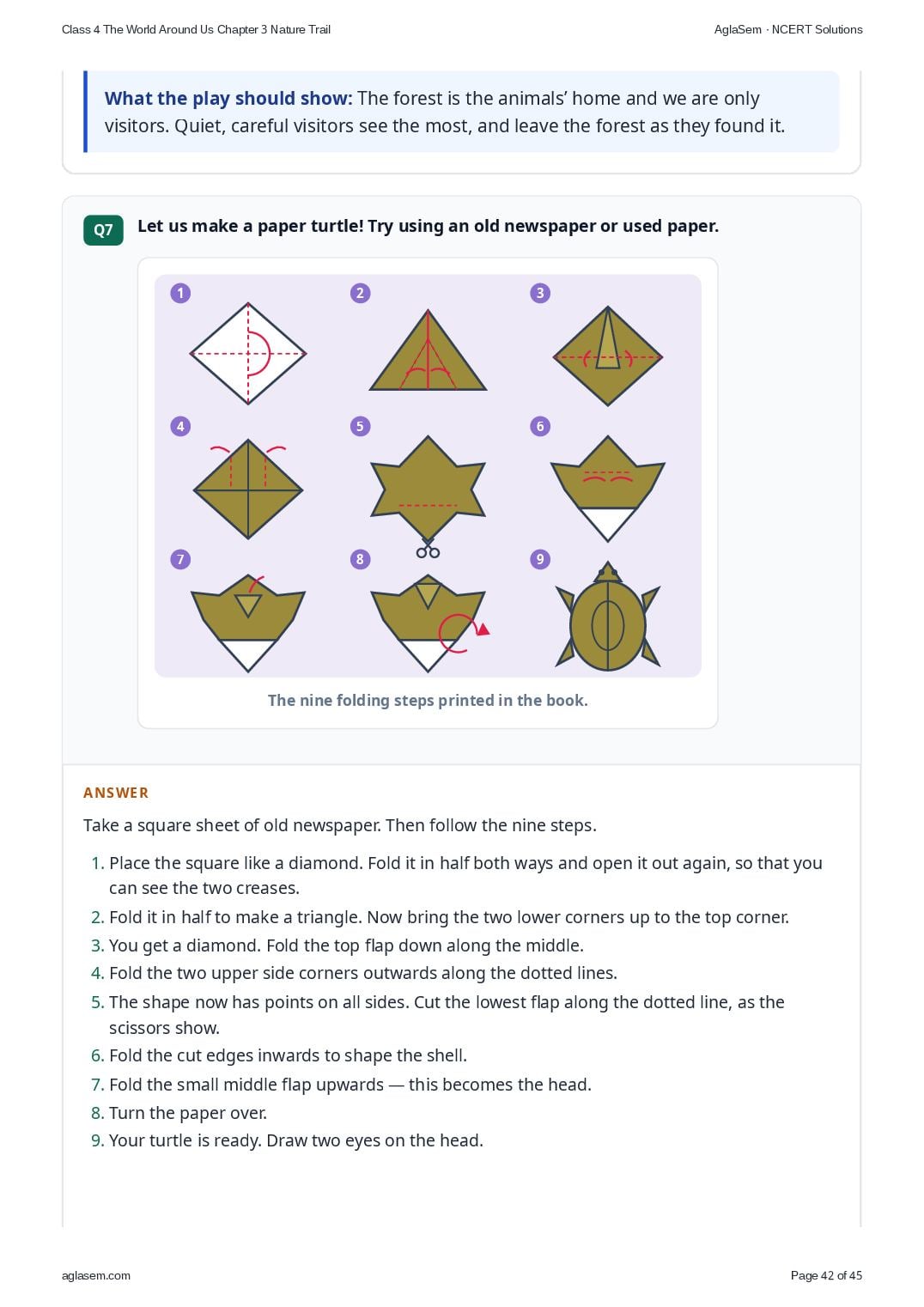
- Let us make a paper turtle! Try using an old newspaper or used paper.123456789The nine folding steps printed in the book.
- Find out. Write the name of your state animal, bird, and plant.
Chapter at a Glance
- Every animal has features that suit its life — an elephant’s long trunk, a sparrow’s short strong beak, an eagle’s sharp curved beak and claws, a sunbird’s long beak for nectar.
- We can guess what a bird eats by looking at its beak and claws.
- Animals that live in and around water have special features — fins to swim, a turtle’s strong shell and webbed feet, the gharial’s long pointed snout.
- An insect has three pairs of legs and one pair of antennae, and often two pairs of wings.
- Leaves differ in colour, shape, texture and smell. The lines on a leaf are called veins, and they are arranged in two ways — side by side, or branching out like a net.
- In the ‘Web of Life’ game we see that all living things are connected. If one part of the web goes, the whole web grows weak.
- A forest is the home of plants and animals. Safety rules — no teasing, no feeding, no plucking, no polythene, no garbage — keep them safe and keep us safe too.
How to Download NCERT Solutions for Class 4 The World Around Us Chapter 3 PDF
Follow these simple steps to get the Nature Trail questions-and-answers PDF from Our Wondrous World.
- Search NCERT Solutions for Class 4 The World Around Us Chapter 3 aglasem and open this page.
- Read the exercise questions with answers for Nature Trail shown above.
- Click the Download PDF link to save the Nature Trail solutions to your device.
NCERT Solutions for Class 4 The World Around Us – All Chapters
There are more chapters to study besides Nature Trail in The World Around Us. Here are the NCERT Solutions for all chapters of Class 4 The World Around Us.
- Chapter 1 Living Together
- Chapter 2 Exploring Our Neighbourhood
- Chapter 3 Nature Trail
- Chapter 4 Growing Up with Nature
- Chapter 5 Food for Health
- Chapter 6 Happy and Healthy Living
- Chapter 7 How Things Work
- Chapter 8 How Things Are Made
- Chapter 9 Different Lands Different Lives
- Chapter 10 Our Sky
NCERT Solutions for Class 4 – All Subjects
Just like Chapter 3 of The World Around Us, you can get the exercise questions with answers for every other subject of Class 4. Here are the NCERT Solutions for all subjects of Class 4.
NCERT Solutions for Class 4 The World Around Us Chapter 3 – An Overview
The key highlights of this study material are as follows.
| Aspects | Details |
|---|---|
| Class | Class 4 |
| Subject | The World Around Us |
| Chapter Number | Chapter 3 |
| Chapter Name | Nature Trail |
| Book Name | Our Wondrous World |
| Book By | NCERT (National Council of Educational Research and Training) |
| Educational Resource Here | NCERT Solutions of Class 4 The World Around Us Chapter 3 for all exercises |
| More Questions Answers of This Subject | NCERT Solutions for Class 4 The World Around Us |
| Download Book Chapter | NCERT Book Class 4 The World Around Us |
| All Questions Answers For This Class | NCERT Solutions for Class 4 |
| Complete Solutions | NCERT Solutions |
NCERT Solutions for Class 4 The World Around Us Chapter 3 Nature Trail – FAQs
What are the NCERT Solutions for Class 4 The World Around Us Chapter 3 Nature Trail?
They are the complete, step-by-step answers to all the exercise and in-text questions of Chapter 3 Nature Trail from the NCERT Class 4 The World Around Us textbook Our Wondrous World, written by experts as per the latest NCERT syllabus.
How can I download the Class 4 The World Around Us Chapter 3 solutions PDF for free?
Open this page on aglasem, read the Nature Trail questions with answers, and click the “Download Solutions PDF” link. The Class 4 The World Around Us Chapter 3 NCERT Solutions PDF is completely free to download.
Are these NCERT Solutions as per the latest 2026-27 syllabus?
Yes. The NCERT Solutions for Class 4 The World Around Us Chapter 3 are based on the latest NCERT textbook Our Wondrous World and the current 2026-27 CBSE syllabus, so the questions and answers match what you study in class.
Where can I get NCERT Solutions for the other chapters of Class 4 The World Around Us?
You can find the answers to every chapter on the NCERT Solutions for Class 4 The World Around Us page, and solutions for every subject on the NCERT Solutions for Class 4 page.
How do NCERT Solutions help in exam preparation?
They show the correct method to solve each question, help you write answers the way they are expected in exams, let you check and correct your own work, and save revision time — which together improve your marks in Class 4 The World Around Us.
If you have any queries on NCERT Solutions for Class 4 The World Around Us Chapter 3 Nature Trail, then please ask in the comments below.