NCERT Solutions for Class 4 The World Around Us Chapter 6 Happy and Healthy Living – step-by-step answers to every exercise and in-text question of the chapter, as per the latest NCERT syllabus for 2027. Read them online or download the free question-answer PDF.
Chapter 6 first follows a grain of rice or wheat all the way from the farm to our plate, and counts everyone who helps it on the way. It then teaches four habits of happy and healthy living — eating mindfully without wasting food, playing and doing yoga, sleeping enough, and knowing a safe touch from an unsafe touch.
NCERT Solutions for Class 4 The World Around Us Chapter 6 Happy and Healthy Living PDF
All the answers are on this page below. The PDF also explains every answer – why it is right and how to check it – so download it for revision.
| Chapter | Download | |
|---|---|---|
| Solutions PDF (English medium) | Happy and Healthy Living | View PDF |
| Solutions PDF (Hindi medium) | स्वस्थ रहो, प्रसन्न रहो | View PDF |
NCERT Solutions for Class 4 The World Around Us Chapter 6 Happy and Healthy Living – Questions and Answers
All 32 questions of the chapter (textbook pages 85 – 101) are answered below, in the order of the book – in-text questions, activities and the end-of-chapter exercises. Each answer is written the way you would write it in the exam.
In-text Questions — Page 85When do I feel happy?
When my friends come to my house. · When my teacher praises my work.
Activity 1 — Page 85Food items and ingredients
| Food items | Ingredients | Food items |
|---|---|---|
| A blue bowl full of a yellow flattened-rice dish with green bits in it | A heap of peanuts A brown root cut open, white inside (tapioca) | A black pot of a yellow curry with a red chilli floating in it |
| A plate of small golden fried pieces | A heap of chana (gram) A heap of thin white rice flakes | A blue bowl heaped with round brown laddoos |
| A plate with two soft white steamed cakes | A heap of green peas A knobby brown root (ginger) | A plate with a pale mound of cooked food with red and green bits on it |
| A plate with three triangular fried samosas | A heap of golden wheat grains Two green pea pods, one of them open | A plate with two puffed round breads |
Match them like this:
| Food item (picture) | Ingredient |
|---|---|
| Yellow flattened-rice dish (poha) | Rice flakes |
| Small golden fried pieces (pakoras) | Chana (gram) |
| Two white steamed cakes (idlis) | Rice |
| Samosas | Green peas |
| Yellow curry in the black pot (kadhi or dal) | Chana or another pulse, with ginger |
| Round brown laddoos | Peanuts (or chana) |
| Pale mound with red and green bits (sabudana khichdi) | The brown root (tapioca) |
| Puffed round breads (puris) | Wheat |
The book prints no names, so other sensible matches are also right.
Activity 2 and Write — Pages 88–89Journey of the Grains
| Soil | Stone | Air | Wood | Water | Tiger |
|---|---|---|---|---|---|
| ✓ | |||||
| Farmer | Earthworm | Hills | Fire | Insect | Bat |
Tick these five: Soil, Air, Water, Farmer and Earthworm. (Soil is already ticked in the book.)
| Soil | Stone | Air | Wood | Water | Tiger |
|---|---|---|---|---|---|
| ✓ | ✓ | ✓ | |||
| Farmer | Earthworm | Hills | Fire | Insect | Bat |
| ✓ | ✓ |
| Picture | What it shows |
|---|---|
| 1 | A farmer walking over the ploughed field and sowing seeds by hand. |
| 2 | The sun shining over the young crop, and water flowing into the field from a pump. |
| 3 | Rain falling from dark clouds on the field and on the stream beside it. |
| 4 | A cow standing beside the growing crop, next to a heap of manure and a sack marked MANURE. |
| 5 | Earthworms moving about inside the brown soil, under the crop. |
| 6 | The farmer standing in the tall green crop, beside a scarecrow. |
| 7 | The farmer sitting in the field and pulling out the weeds. |
| 8 | The farmer cutting the ripe golden crop with a sickle. |
| 9 | The farmer filling grain into a sack from a big heap. |
| 10 | A shopkeeper at his shop filling a paper packet with grain, among open sacks of grain marked WHEAT and RICE. |
| 11 | A woman cleaning grain on a tray at home, and a man cooking in a pan on the stove. |
| 12 | A girl at the table eating rotis, with a bowl of curry and a glass of water. |
The farmer sows the seeds, waters the field and puts manure in it. He guards the crop, pulls out the weeds, cuts the ripe crop and fills the grain into sacks.
| Soil | Stone | Air | Wood | Water | Tiger |
|---|---|---|---|---|---|
| ✓ | |||||
| Farmer | Earthworm | Hills | Fire | Insect | Bat |
Missing helpers: sunlight, rain, seed, manure, cattle, the shopkeeper, the cook and family members, and farm tools like the sickle.
| Picture | What it shows |
|---|---|
| 1 | A farmer walking over the ploughed field and sowing seeds by hand. |
| 2 | The sun shining over the young crop, and water flowing into the field from a pump. |
| 3 | Rain falling from dark clouds on the field and on the stream beside it. |
| 4 | A cow standing beside the growing crop, next to a heap of manure and a sack marked MANURE. |
| 5 | Earthworms moving about inside the brown soil, under the crop. |
| 6 | The farmer standing in the tall green crop, beside a scarecrow. |
| 7 | The farmer sitting in the field and pulling out the weeds. |
| 8 | The farmer cutting the ripe golden crop with a sickle. |
| 9 | The farmer filling grain into a sack from a big heap. |
| 10 | A shopkeeper at his shop filling a paper packet with grain, among open sacks of grain marked WHEAT and RICE. |
| 11 | A woman cleaning grain on a tray at home, and a man cooking in a pan on the stove. |
| 12 | A girl at the table eating rotis, with a bowl of curry and a glass of water. |
Write one line against each name. Here is what each of them does.
| Its role in the journey | |
|---|---|
| (a) Soil | Holds the seed, and gives the plant food and a place to stand. |
| (b) Water | Makes the seed sprout, and the plant drinks it every day. |
| (c) Farmer | Sows, waters, puts manure, weeds, guards and harvests the crop. |
| (d) Cattle | Give manure for the field, and help in ploughing and carrying the load. |
| (e) Shopkeeper | Keeps the grain in sacks in his shop and sells it to us. |
| (f) Family members | Clean the grain, cook it, and serve the food on our plate. |
| (g) Any other | Sunlight helps the plant make its food; earthworms make the soil soft; rain fills the field with water. |
Activity 3 — Page 89Thank You Everyone!
Thank you — the farmer · the cattle · the earthworms · the sun and the rain · the soil · the driver who carried the grain · the shopkeeper · my mother, who cooks our food.
Discuss — Page 92Mindful Eating
- (a) Put the food item in your mouth slowly.
- (b) Use your tongue and mouth to feel the surface of the food.
- (c) Gently, chew it with your teeth.
- (d) Feel the flavour and taste, using your tongue, nose and other senses.
- (e) Remember the taste as you continue to chew.
- (f) Before swallowing, remember the texture of the food.
The tongue feels the surface of the food (smooth or rough, hard or soft) and tells us its taste. It also moves the food around inside the mouth.
- (a) Put the food item in your mouth slowly.
- (b) Use your tongue and mouth to feel the surface of the food.
- (c) Gently, chew it with your teeth.
- (d) Feel the flavour and taste, using your tongue, nose and other senses.
- (e) Remember the taste as you continue to chew.
- (f) Before swallowing, remember the texture of the food.
The teeth chew the food and break it into small, soft pieces, so that it is easy to swallow.
- (a) Put the food item in your mouth slowly.
- (b) Use your tongue and mouth to feel the surface of the food.
- (c) Gently, chew it with your teeth.
- (d) Feel the flavour and taste, using your tongue, nose and other senses.
- (e) Remember the taste as you continue to chew.
- (f) Before swallowing, remember the texture of the food.
The food becomes wet, breaks into small pieces and turns soft. Its taste and smell spread in the mouth. Then we swallow it.
Activity 4 and Write — Page 93Valuing Food
Yes, on most days I eat every grain on my plate. If I leave a little, I take less the next time.
| Day | Breakfast | Lunch | Dinner | Did you eat fully? | Did you waste? | How do you feel? |
|---|---|---|---|---|---|---|
| 1. | ||||||
| 2. | ||||||
| 3. | ||||||
| 4. | ||||||
| 5. | ||||||
| 6. | ||||||
| 7. |
Fill one row every day: what you ate, then ‘Yes’ 🙂 or ‘No’ 🙁, and how you felt. Here is a sample:
| Day | Breakfast | Lunch | Dinner | Did you eat fully? | Did you waste? | How do you feel? |
|---|---|---|---|---|---|---|
| 1. | Poha and milk | Rice, dal, bhindi | Two rotis, curd | Yes 🙂 | No | Happy |
| 2. | Idli and sambar | Roti, rajma, salad | Khichdi | No 🙁 | Yes, some rice | Sorry |
| 3. | Paratha and curd | Rice, dal, lauki | Two rotis, sabzi | Yes 🙂 | No | Happy |
| 4. | ||||||
| 5. | ||||||
| 6. | ||||||
| 7. |
Say politely: ‘Thank you, this much is enough for me.’
- Take a small helping first.
- Ask for more only if you are still hungry.
- Never take food on the plate just because it looks nice.
I will not throw it away. Before it is served, I will ask for only a little of it, and I will taste it. Our taste changes as we grow.
Write — Page 94Enjoy Sports
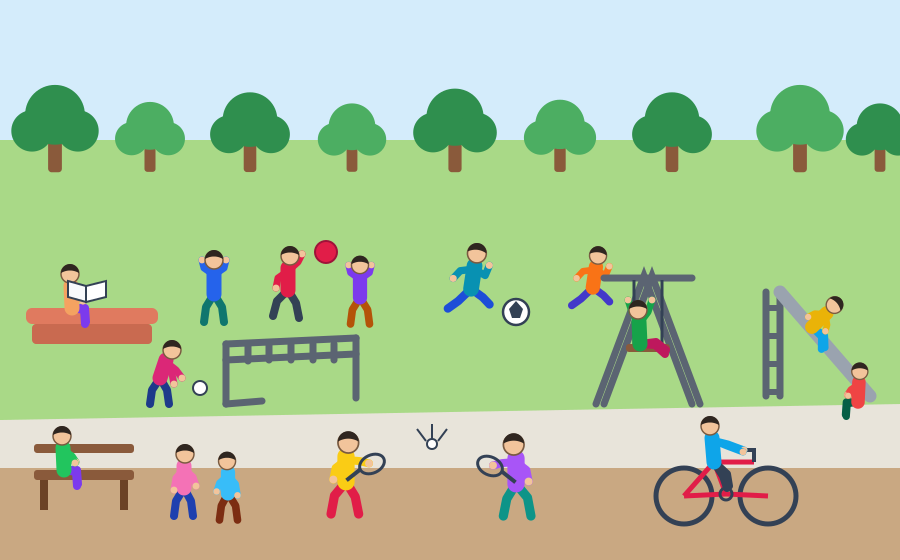
The children in the park are:
- Throwing and catching a ball.
- Playing football.
- Running on the grass.
- Swinging on a swing.
- Sliding down a slide.
- Playing near the climbing frame.
- Playing badminton on the path.
- Riding a bicycle.
- Reading a book, sitting on the wall.
- Walking on the paths and sitting on the benches.
Discuss and Find out — Page 95Enjoy Sports
I walk to school and back every day. In the games period I play kho-kho. In the evening I cycle for half an hour and play badminton with my sister.
My body feels tired, but I feel happy and fresh. I feel very hungry, and I sleep well at night.
- Gilli-danda
- Pittu (Lagori or Seven Stones)
- Poshampa
- Hopscotch (Stapu or Kith-kith)
Activity 5 — Page 95Easy yoga poses
The three poses are Vajrasana, Vrikshasana (tree pose) and Sukhasana.
Sample observation: Day 1 — I wobbled on one leg. Day 7 — I could stand still in the tree pose, and I felt calm and fresh.
Sleep Well too! — Page 97Activity 6 and Discuss
I would wake up tired and sleepy, and my arms and legs would ache. I could not focus on work or play, and I would feel irritable.
| Day | When did you sleep? | When did you get up? | Duration of sleep | How you felt during the day? (a, b, c) |
|---|---|---|---|---|
| Yesterday | ||||
| Day before yesterday | ||||
| Prior to it |
a: Felt fresh; b: Lazy; c: Sleepy
Fill it from your own last three days. Duration of sleep = the hours from sleeping to getting up. For example:
9:30 p.m. to 12 midnight = 2 hours 30 minutes
12 midnight to 6:30 a.m. = 6 hours 30 minutes
2 h 30 min + 6 h 30 min = 9 hours
| Day | When did you sleep? | When did you get up? | Duration of sleep | How you felt during the day? (a, b, c) |
|---|---|---|---|---|
| Yesterday | 9:30 p.m. | 6:30 a.m. | 9 hours | a |
| Day before yesterday | 11:00 p.m. | 6:00 a.m. | 7 hours | c |
| Prior to it | 10:00 p.m. | 6:00 a.m. | 8 hours | a |
a: Felt fresh; b: Lazy; c: Sleepy
Our body works the whole day and gets tired. Rest and sleep take away the tiredness, make us fresh again and help the body grow strong.
Yes. After a busy day of exercise and play the body is tired. Rest and sleep take the tiredness away and make us fresh. Without rest we feel tired, sleepy and irritable, and cannot focus.
Activity 7 — Page 98Feeling Safe
Picture 1 ✗ · Picture 2 ✗ · Picture 3 ✓ · Picture 4 ✗
| Picture | Your mark | What the picture shows |
|---|---|---|
| 1 | ✗ | The boy is stepping back with his arms held away, and he looks frightened. |
| 2 | ✗ | The boy leans away from the hand on his face and looks uneasy. |
| 3 | ✓ | The boy is smiling. His mother is beside him, and the doctor is checking him to make him well. |
| 4 | ✗ | The girl is pushing the man’s arm away and looks worried. |
Write — Page 99Feeling Safe
I would say ‘No’, move away, and tell a trusted adult like my teacher or my parents. It is not my fault.
I would tell a trusted adult, like my teacher or my parents.
Sample answer: At home I would tell my mother. In school I would tell my class teacher.
- If someone touches me in a way that makes me feel scared or uncomfortable.
- If a stranger asks me to go with him, or offers me sweets or a ride.
Let us reflect — Pages 100–101End-of-chapter questions
| Elements | |
|---|---|
| Soil | |
| Water | |
| Sunlight | |
| Animals | |
| Cattle | |
| Earthworm | |
| People | |
| Farmer | |
| Shopkeeper | |
| Cook | |
Write one line against each name. Here is the completed list.
| Elements | |
|---|---|
| Soil | The seed would get no place to grow and no food. It would not sprout at all. |
| Water | The seed would stay dry and would not sprout. A growing plant would dry up. |
| Sunlight | The plant could not make its own food. It would turn pale and weak. |
| Animals | |
| Cattle | We would get no manure for the field, and no help in ploughing or carrying loads. |
| Earthworm | The soil would stay hard. Air and water could not reach the roots. |
| People | |
| Farmer | Nobody would sow, water, weed or harvest. The grain would never be grown. |
| Shopkeeper | The grain would not reach our town, our market and our home. |
| Cook | The grain would stay raw. Nobody would turn it into food on our plate. |
| Breakfast plate | Lunch plate | Dinner plate |
|---|---|---|
Put four kinds of food on each plate: a grain, a dal (or milk, curd or egg), a vegetable and a fruit. For example:
| Plate | What you can put on it |
|---|---|
| Breakfast plate | Two idlis with sambar, one banana, a glass of milk |
| Lunch plate | Two rotis, a bowl of rice, dal, bhindi sabzi, curd, a slice of papaya |
| Dinner plate | Two rotis, palak sabzi, moong dal, cucumber and carrot salad |
Remember: Serve yourself only as much as you can finish.
I enjoyed guessing the peanut with my eyes closed. I also enjoyed chewing it slowly, because the taste became sweeter the longer I chewed.
I can keep my body strong by eating good food on time, playing every day, doing yoga and sleeping enough.
| Names you can write | |
|---|---|
| Exercises | Running, skipping, jumping, cycling, stretching, and yoga poses like Vajrasana, Vrikshasana and Sukhasana. |
| Games | Kho-kho, kabaddi, gilli-danda, pittu, hopscotch, football, badminton, and playing catch with a ball. |
| Activity | Your plan |
|---|---|
| Wake up early | |
| Yoga and exercises | |
| Eat a balanced diet on time | |
| Exercise and play | |
| Less use of TV and mobile | |
| Read a book | |
| Sleep peacefully |
Against each habit write what you will actually do, with a time. A plan with a time is easy to follow.
| Activity | Your plan |
|---|---|
| Wake up early | I will get up at 6 o’clock every morning. |
| Yoga and exercises | I will do yoga and exercises for 15 minutes after brushing. |
| Eat a balanced diet on time | Breakfast at 7:30, lunch at 1 o’clock, dinner at 8 o’clock. |
| Exercise and play | I will play in the park for one hour after school. |
| Less use of TV and mobile | I will watch TV or use the mobile for only half an hour a day. |
| Read a book | I will read a story book for 20 minutes before sleeping. |
| Sleep peacefully | I will sleep by 9:30 at night, so I get 8 and a half hours of sleep. |
Chapter 6 of 10 – The World Around Us
- Previous: Chapter 5 Food for Health
- Next: Chapter 7 How Things Work
- All chapters: NCERT Solutions Class 4 The World Around Us
NCERT Solutions Class 4 The World Around Us Chapter 6 Happy and Healthy Living – Overview
| Class | Class 4 |
| Subject | The World Around Us |
| Chapter | 6 – Happy and Healthy Living |
| Textbook pages | 85 – 101 |
| Questions solved | 32 |
| Session | 2027 |
| Format | Full answers on this page + PDF |
NCERT Solutions Class 4 The World Around Us Chapter 6 – FAQs
Where can I download NCERT Solutions Class 4 The World Around Us Chapter 6 Happy and Healthy Living PDF?
Read every answer on this page, or download the free PDF from the table at the top.
Is this for the 2027 session?
Yes, it follows the latest NCERT Class 4 The World Around Us book for 2027.
How many questions are solved in NCERT Class 4 The World Around Us Chapter 6?
All 32 questions of the chapter (textbook pages 85 – 101) – the in-text questions, activities and the end-of-chapter exercises.
How should I use these solutions?
Read the chapter in the NCERT book first, attempt the questions yourself, then check your answers here.