NCERT Solutions for Class 4 The World Around Us Chapter 9 Different Lands Different Lives provide clear, step-by-step answers to every exercise and in-text question from the chapter Different Lands Different Lives of the NCERT textbook Our Wondrous World. Prepared by subject experts as per the latest NCERT (CBSE) syllabus for 2026-27, these NCERT Solutions for Class 4 The World Around Us help you understand each concept, write exam-ready answers, and check your own solutions. You can read them online below or download the free Class 4 The World Around Us Chapter 9 question-answer PDF.
NCERT Solutions for Class 4 The World Around Us Chapter 9 Different Lands Different Lives
- Class: Class 4
- Subject: The World Around Us
- Chapter: Chapter 9 – Different Lands Different Lives
- Textbook: Our Wondrous World (NCERT)
- Study material: NCERT Solutions – questions with answers, free PDF
These solutions answer all the exercise questions of Chapter 9 Different Lands Different Lives — including the in-text questions, short-answer and long-answer questions, and activities — with complete explanations so you can follow the method, not just the final answer. Read the full solutions below.
NCERT Solutions Class 4 The World Around Us Chapter 9 Different Lands Different Lives View Download
















NCERT Solutions for Class 4 The World Around Us Chapter 9 PDF Download
You can read the NCERT Solutions for Class 4 The World Around Us Chapter 9 online above, or download the complete question-answer PDF to study Different Lands Different Lives offline at any time.
NCERT Solutions for Class 4 The World Around Us Chapter 9 PDF Download Link – Click Here to Download Solutions PDF
Questions Covered in This Chapter
These NCERT Solutions answer all 43 questions of this chapter. The questions solved are:
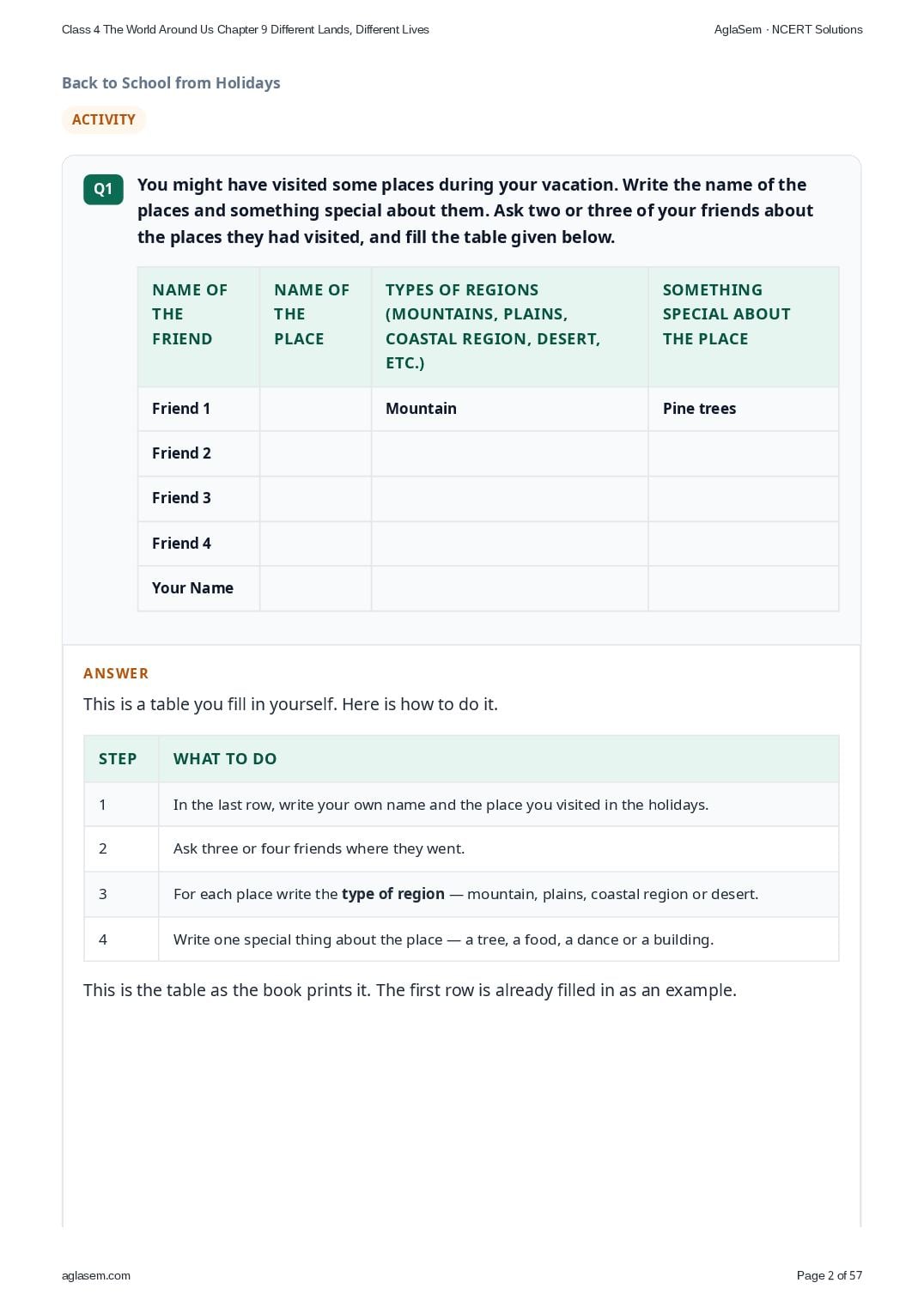
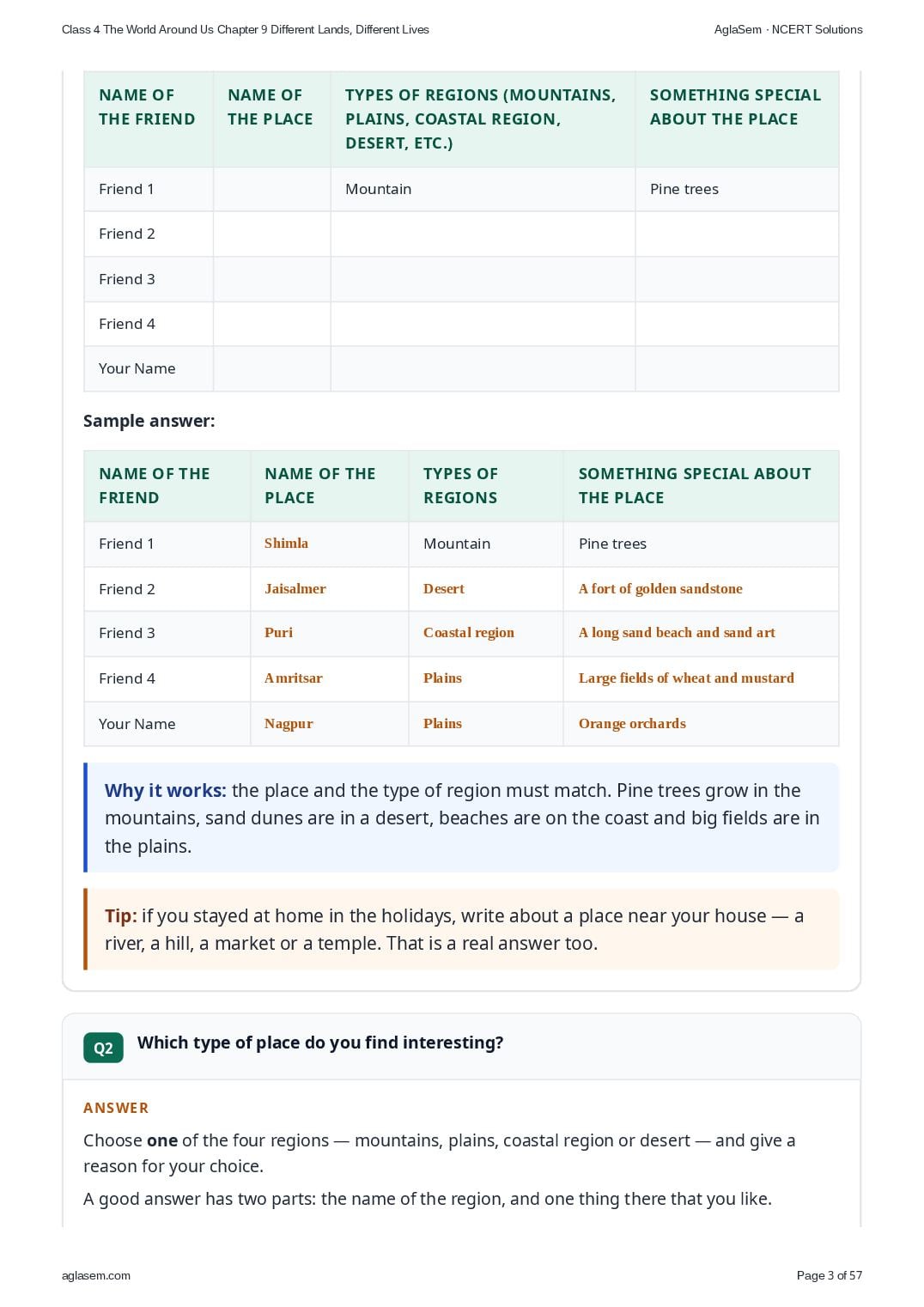
- You might have visited some places during your vacation. Write the name of the places and something special about them. Ask two or three of your friends about the places they had visited, and fill the table given below. Name of the friendName of the placeTypes of regions (mountains, plains, coastal region, desert, etc.)Something special about the place Friend 1MountainPine trees Friend 2 Friend 3 Friend 4 Your Name
- Which type of place do you find interesting?
- What similarities and differences do you find in the place you visited, and those visited by your friends?
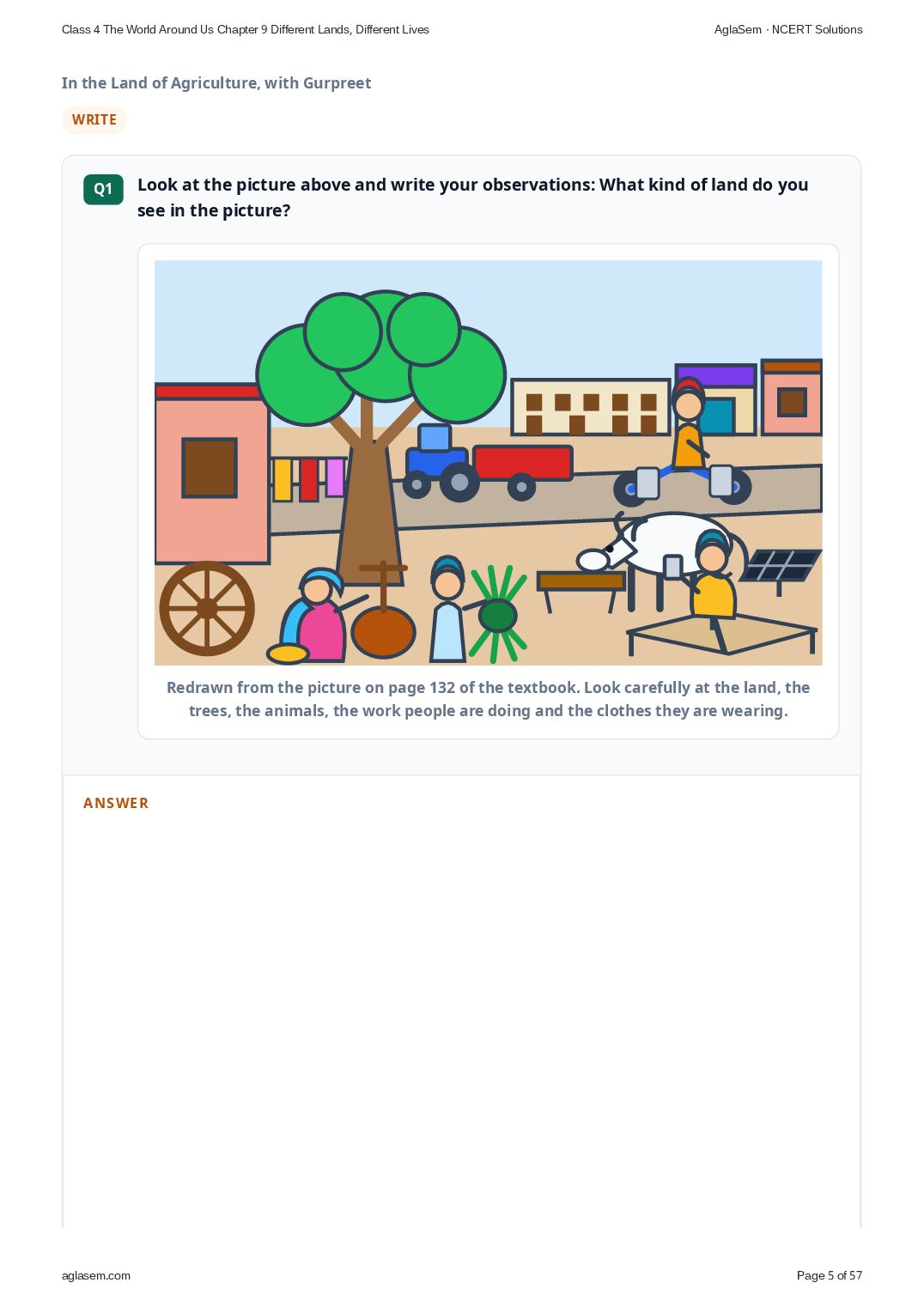
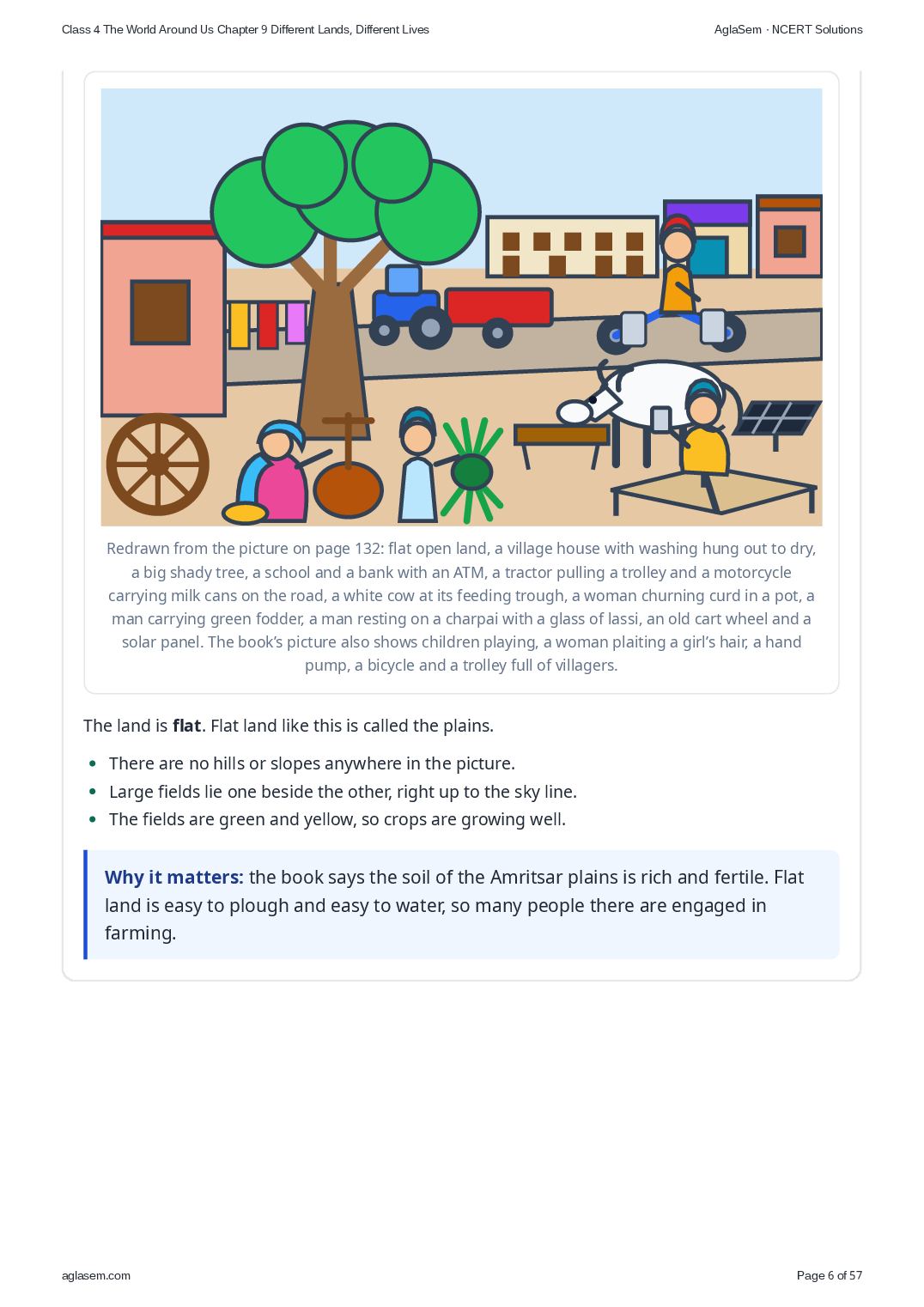
- Look at the picture above and write your observations: What kind of land do you see in the picture? Redrawn from the picture on page 132 of the textbook. Look carefully at the land, the trees, the animals, the work people are doing and the clothes they are wearing.
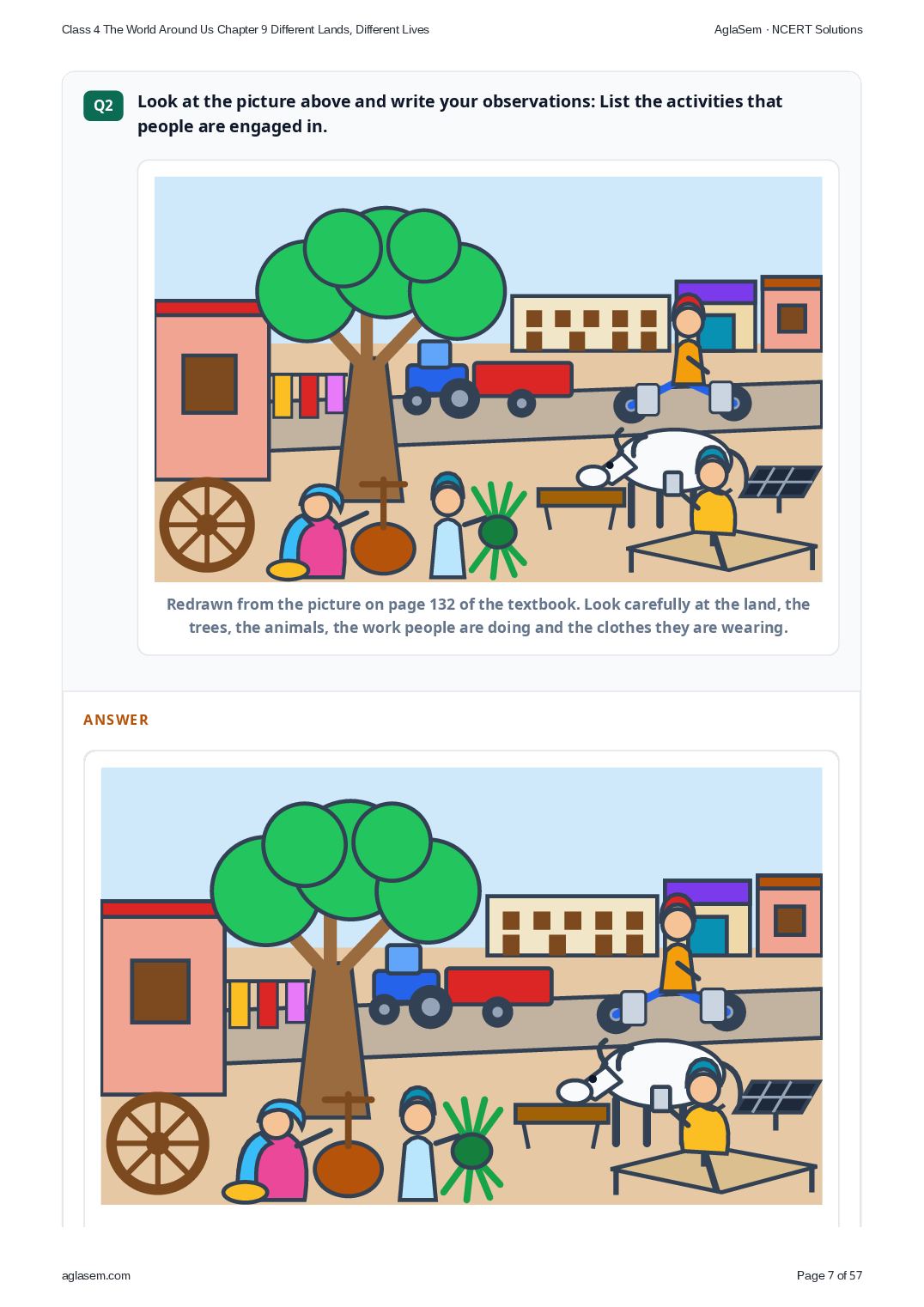
- Look at the picture above and write your observations: List the activities that people are engaged in. Redrawn from the picture on page 132 of the textbook. Look carefully at the land, the trees, the animals, the work people are doing and the clothes they are wearing.
- Look at the picture above and write your observations: Which animals do you see in the picture? Redrawn from the picture on page 132 of the textbook. Look carefully at the land, the trees, the animals, the work people are doing and the clothes they are wearing.
- Look at the picture above and write your observations: Do you notice anything unique about the clothing of the people? Redrawn from the picture on page 132 of the textbook. Look carefully at the land, the trees, the animals, the work people are doing and the clothes they are wearing.
- What is the most popular food in your region? Can you list the main ingredients used in its preparation? Name of the food item: ______ Ingredients: ______
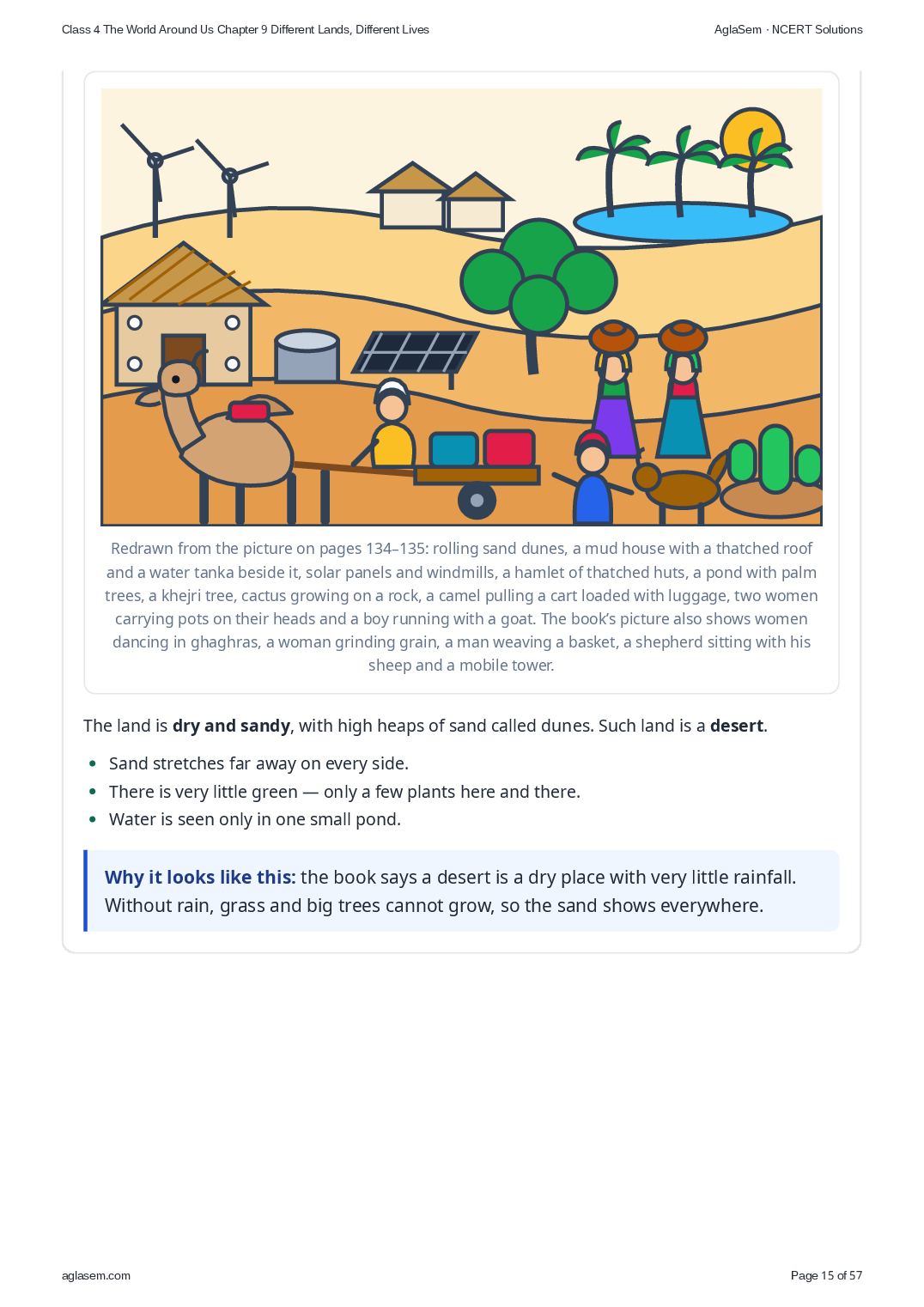
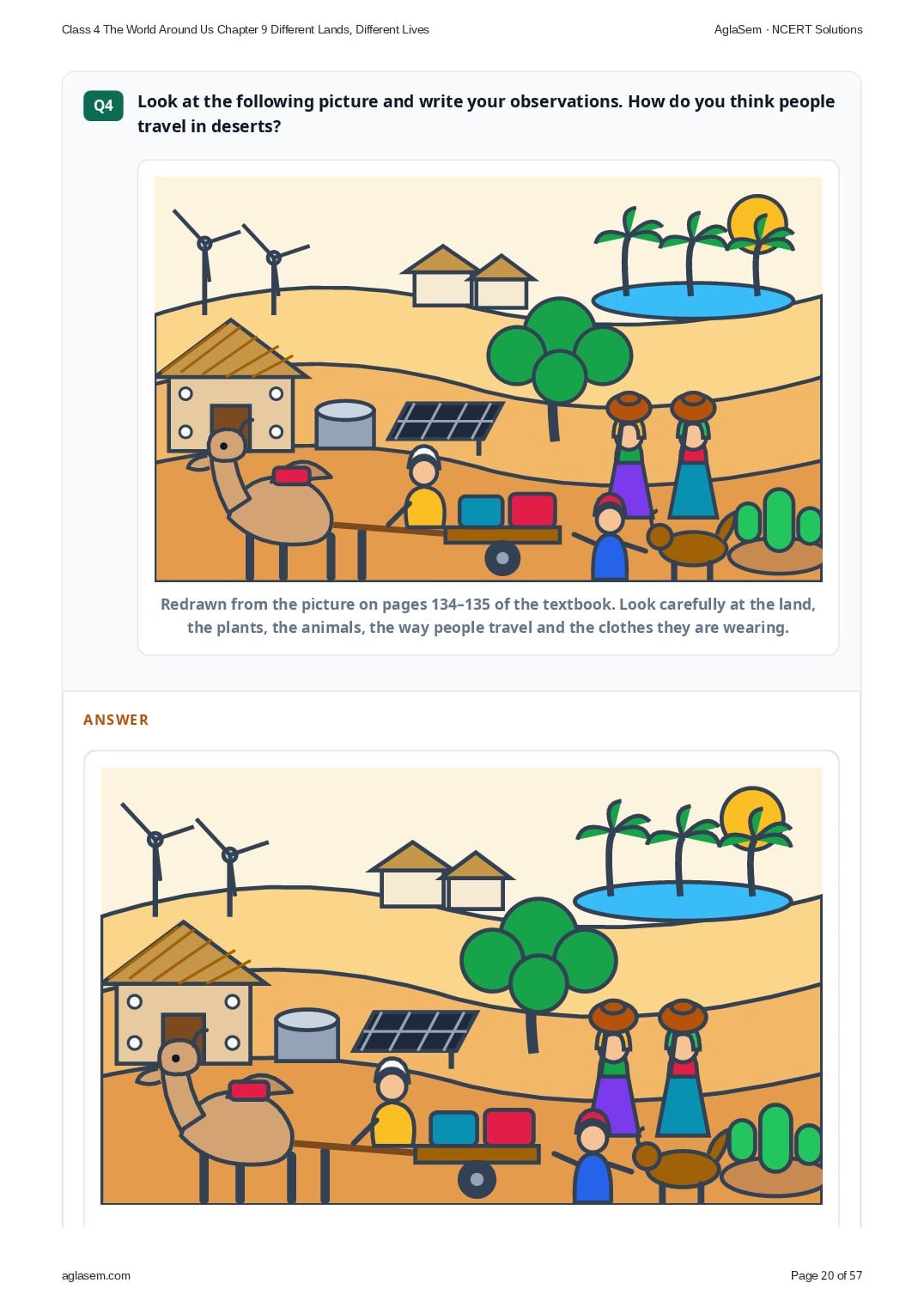
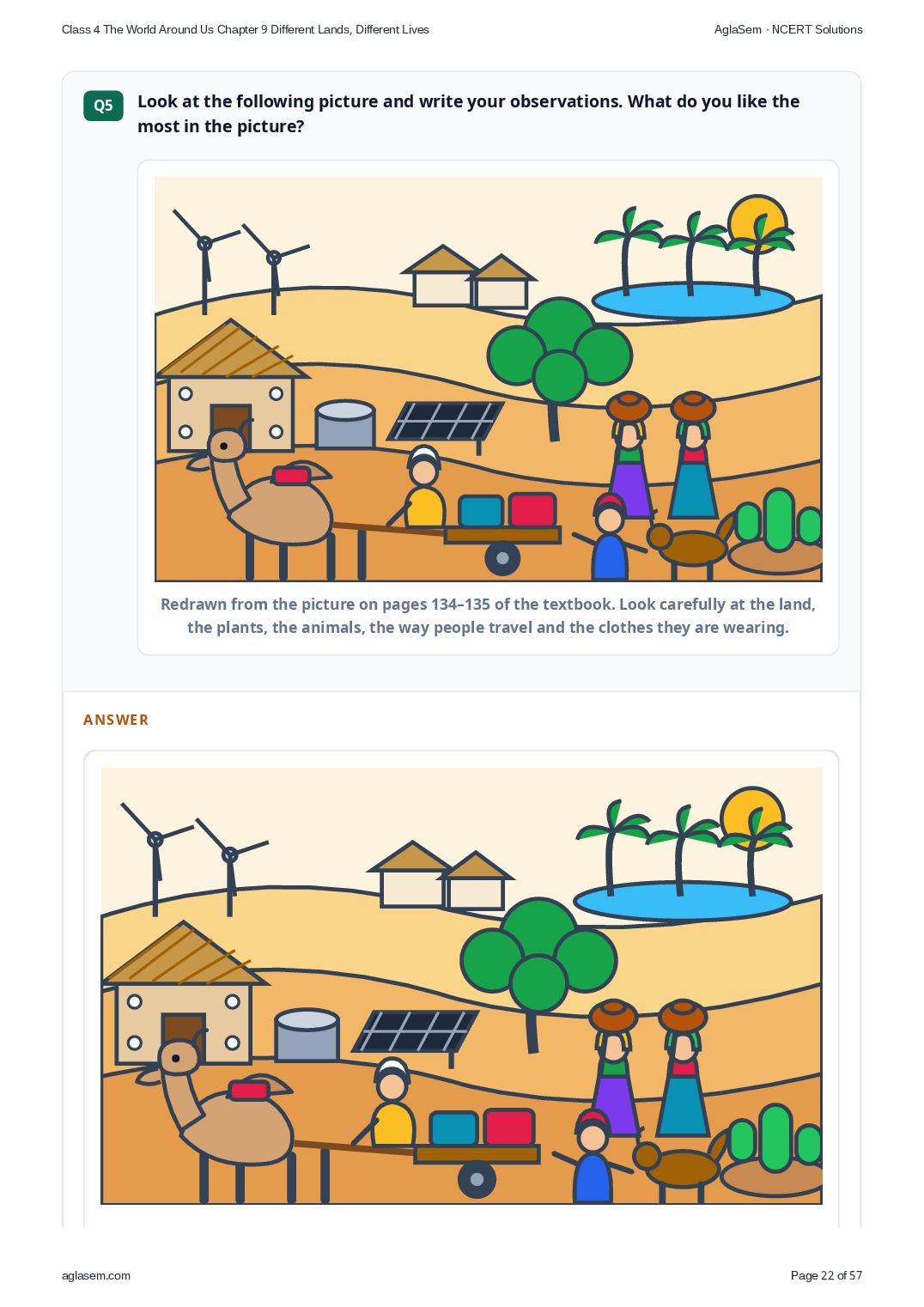
- Look at the following picture and write your observations. What kind of land do you see? Redrawn from the picture on pages 134–135 of the textbook. Look carefully at the land, the plants, the animals, the way people travel and the clothes they are wearing.
- Look at the following picture and write your observations. What types of plants do you see in the picture? How are they different from the plants you see in your locality? Redrawn from the picture on pages 134–135 of the textbook. Look carefully at the land, the plants, the animals, the way people travel and the clothes they are wearing.
- Look at the following picture and write your observations. Is there something unique about the way people in this village are dressed? Redrawn from the picture on pages 134–135 of the textbook. Look carefully at the land, the plants, the animals, the way people travel and the clothes they are wearing.
- Look at the following picture and write your observations. How do you think people travel in deserts? Redrawn from the picture on pages 134–135 of the textbook. Look carefully at the land, the plants, the animals, the way people travel and the clothes they are wearing.
- Look at the following picture and write your observations. What do you like the most in the picture? Redrawn from the picture on pages 134–135 of the textbook. Look carefully at the land, the plants, the animals, the way people travel and the clothes they are wearing.
- Ask your family members about the folk songs and dances from your region, and note them down in the table below. Dance formFolk music
- Why do you think water is scarce in the desert?
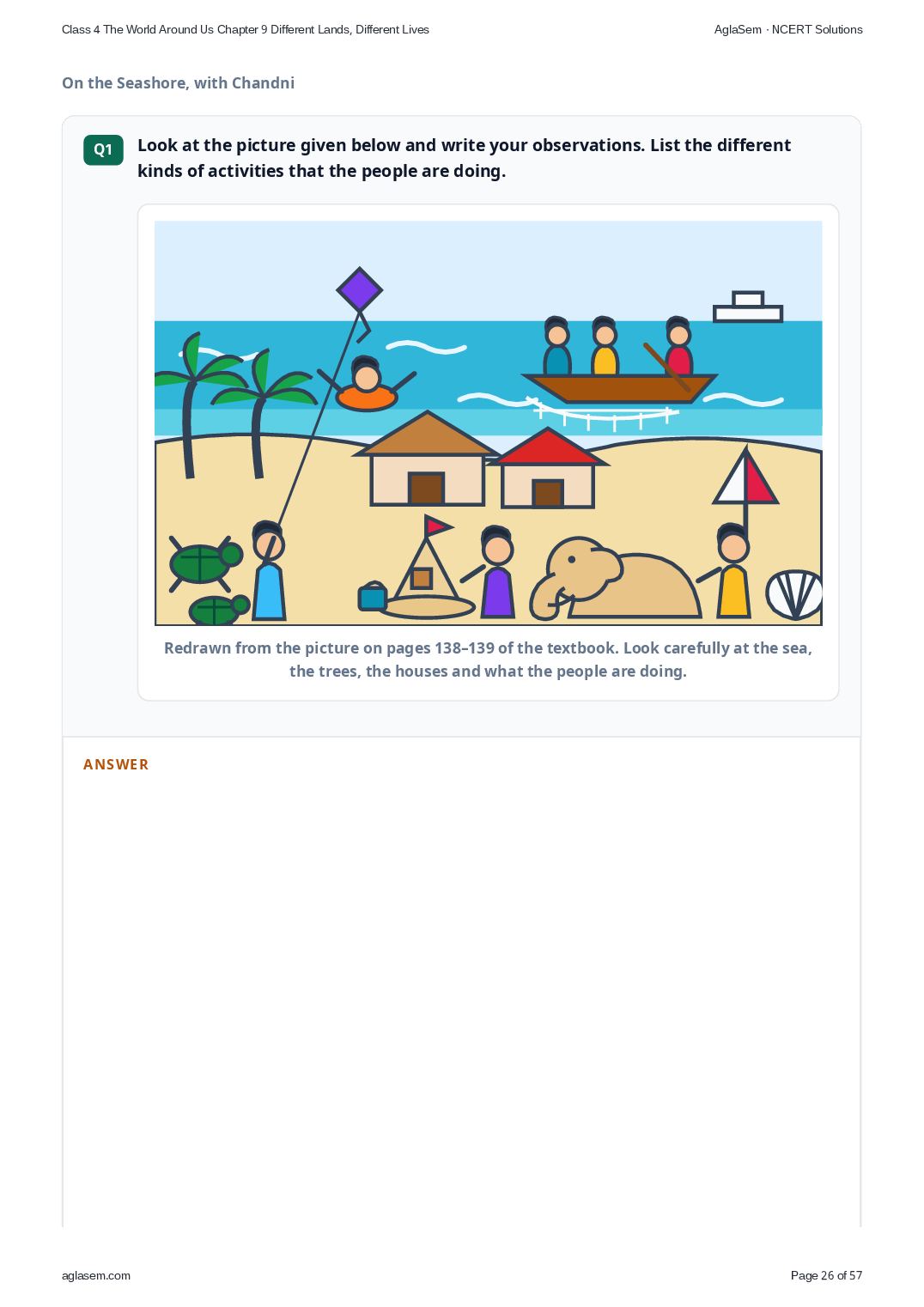
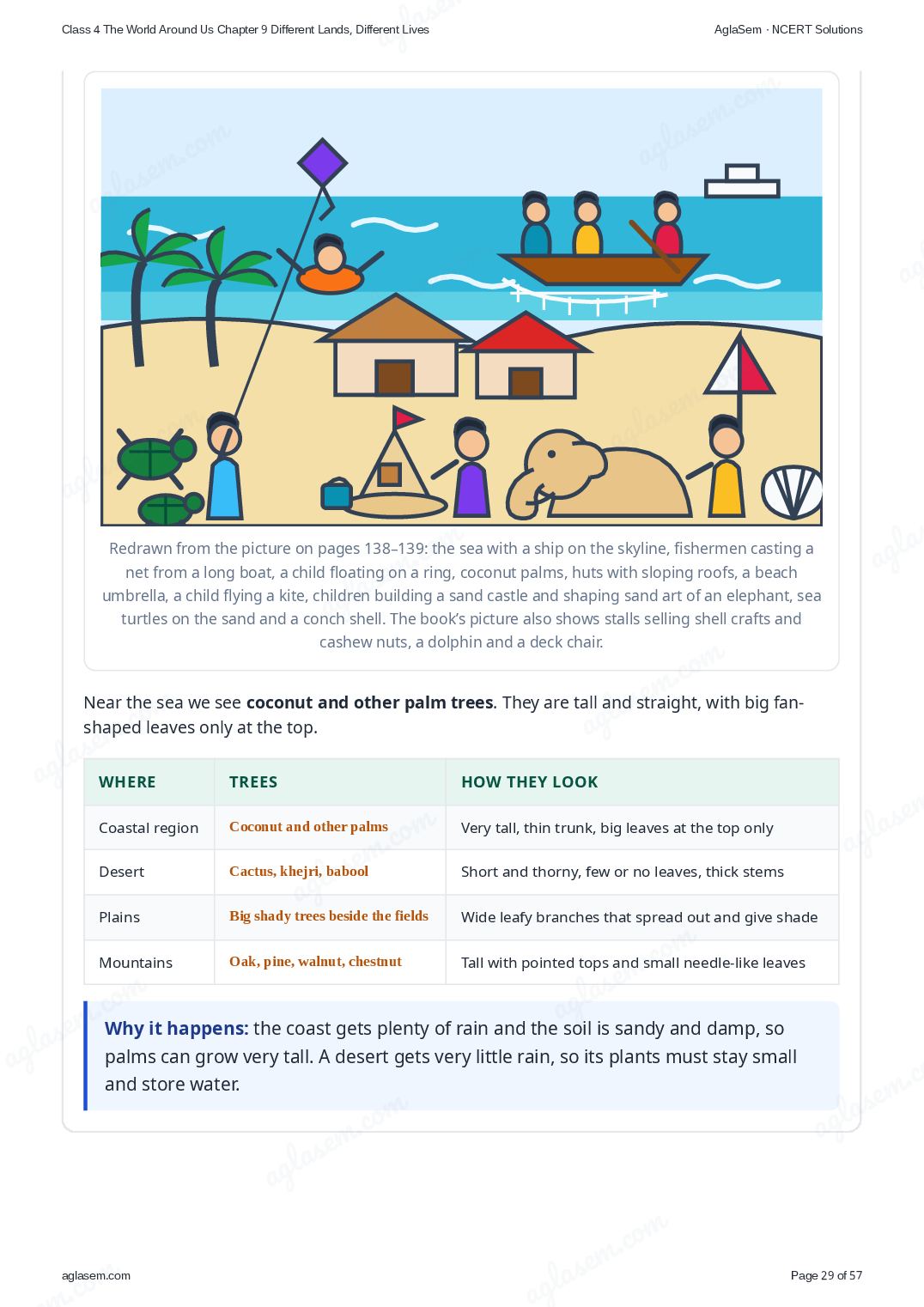
- Look at the picture given below and write your observations. List the different kinds of activities that the people are doing. Redrawn from the picture on pages 138–139 of the textbook. Look carefully at the sea, the trees, the houses and what the people are doing.
- Look at the picture given below and write your observations. What kinds of trees are found near the sea, and how are they different from those in the deserts and plains? Redrawn from the picture on pages 138–139 of the textbook. Look carefully at the sea, the trees, the houses and what the people are doing.
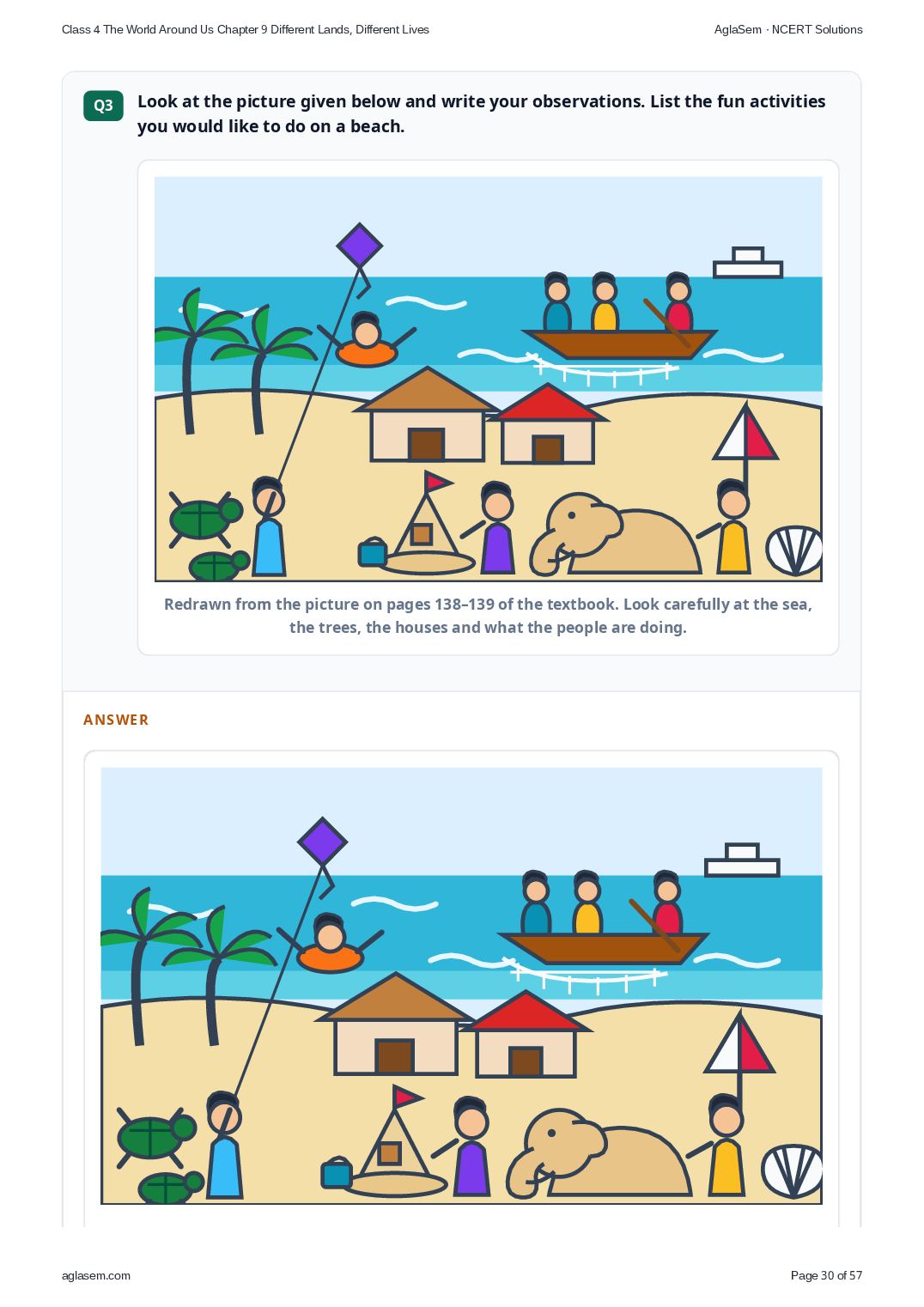
- Look at the picture given below and write your observations. List the fun activities you would like to do on a beach. Redrawn from the picture on pages 138–139 of the textbook. Look carefully at the sea, the trees, the houses and what the people are doing.
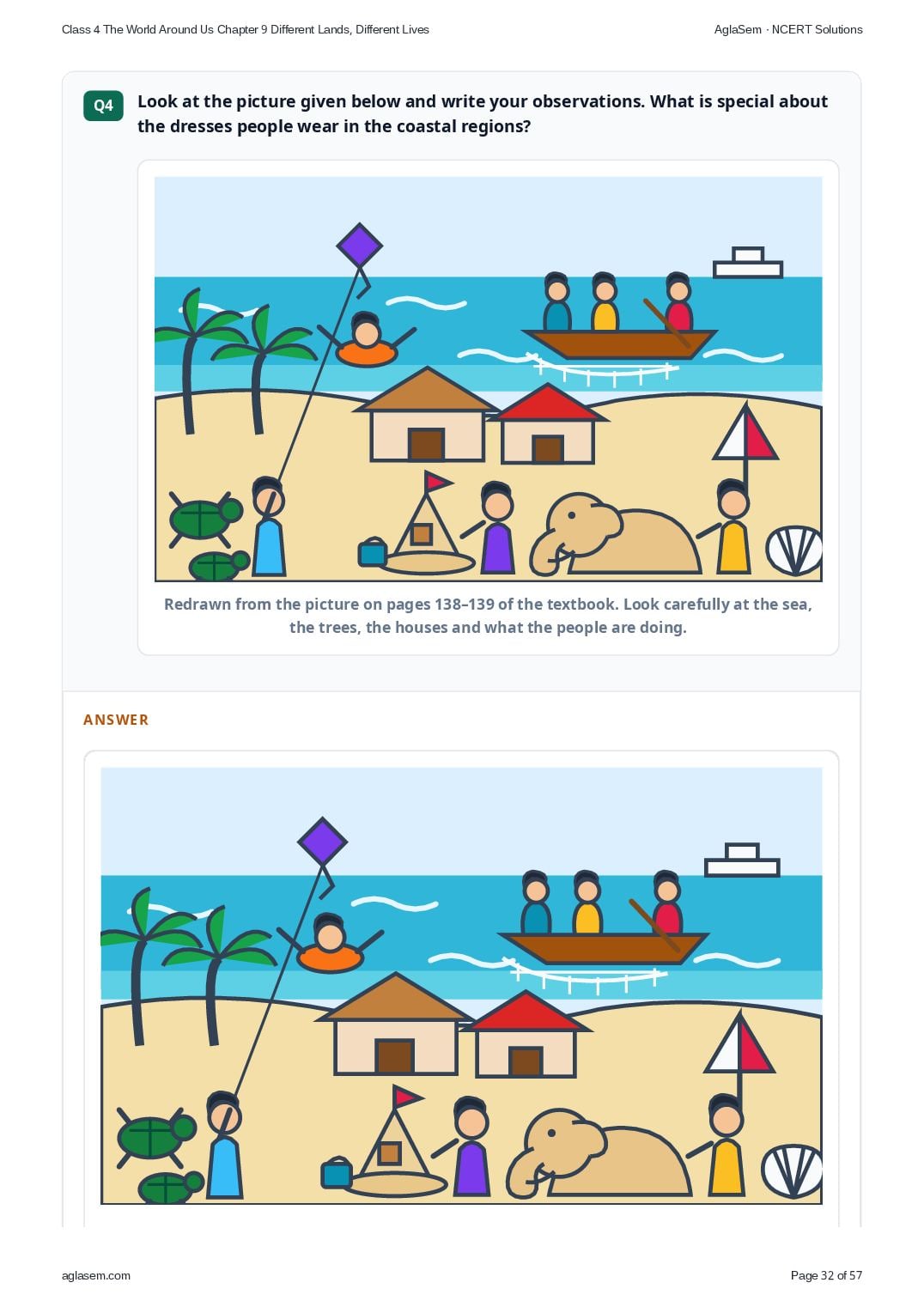
- Look at the picture given below and write your observations. What is special about the dresses people wear in the coastal regions? Redrawn from the picture on pages 138–139 of the textbook. Look carefully at the sea, the trees, the houses and what the people are doing.
- Let us Create — Use one coastal item to create a fun decor object like a photo frame, a necklace, a painted pebble, a mini basket or a sand art jar. Add your own creative twist and display your work in the class! You can use any other locally available materials to create the decor items.
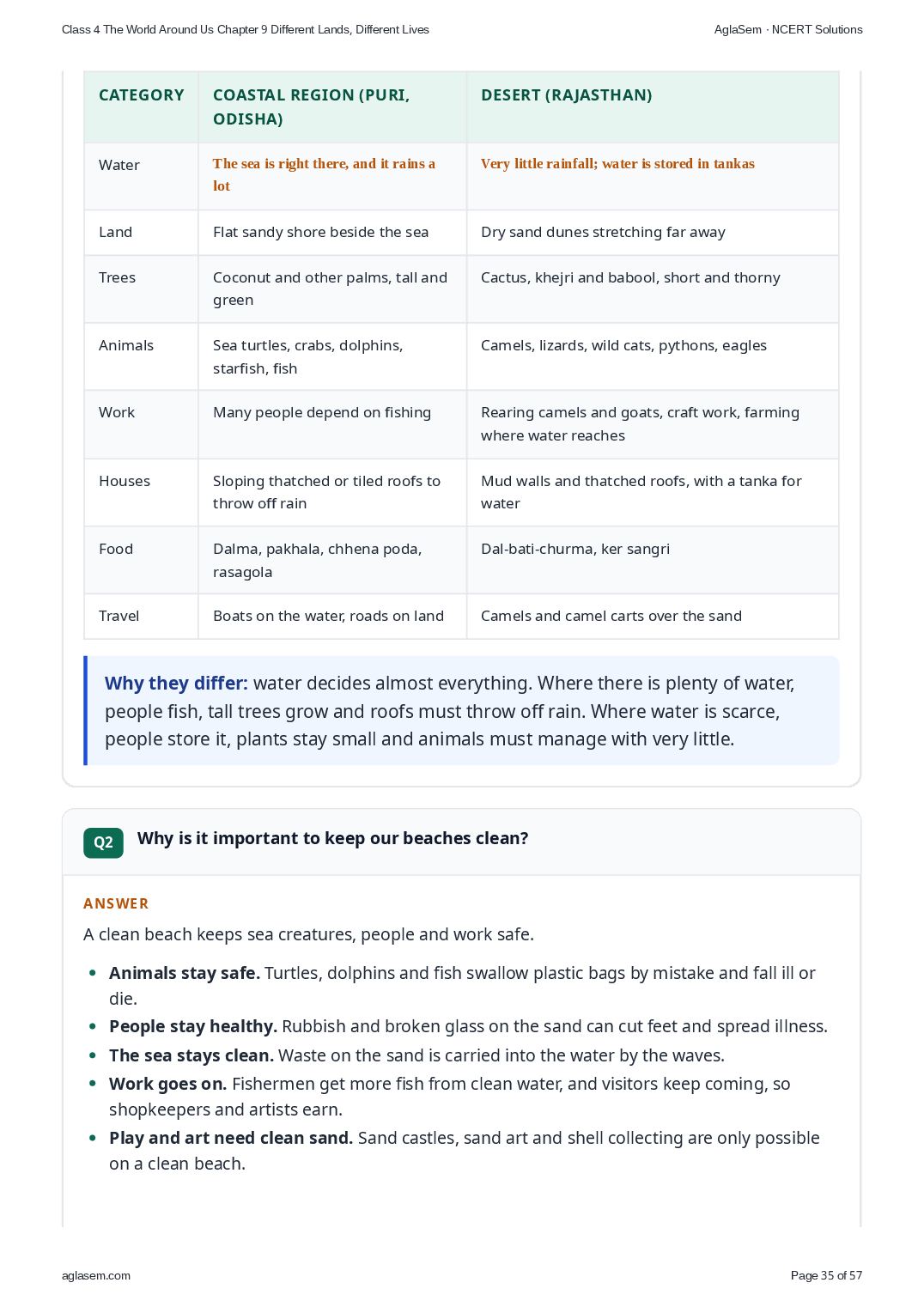
- Write your observations on how the life around a coastal region differs from the life in a desert.
- Why is it important to keep our beaches clean?
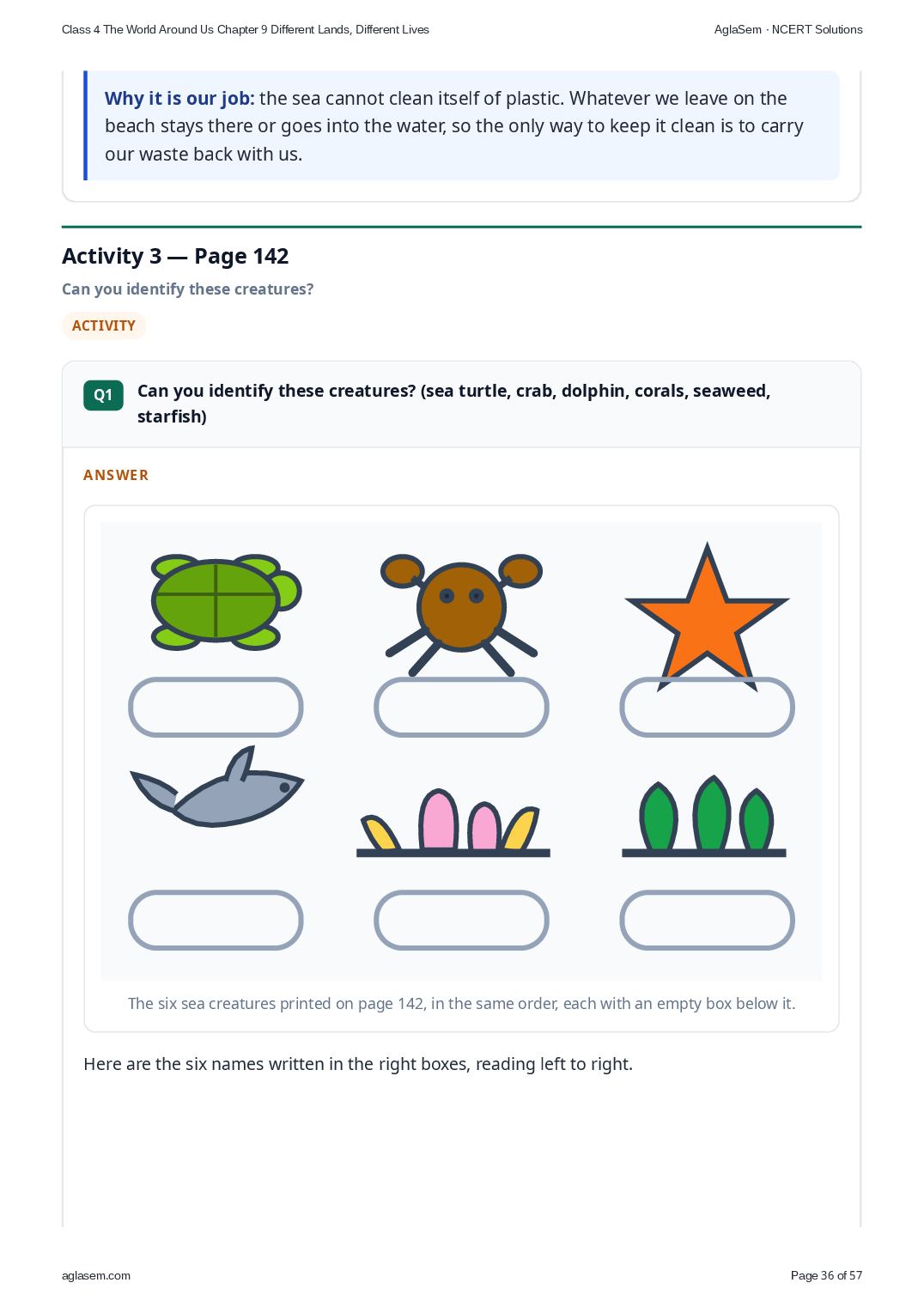
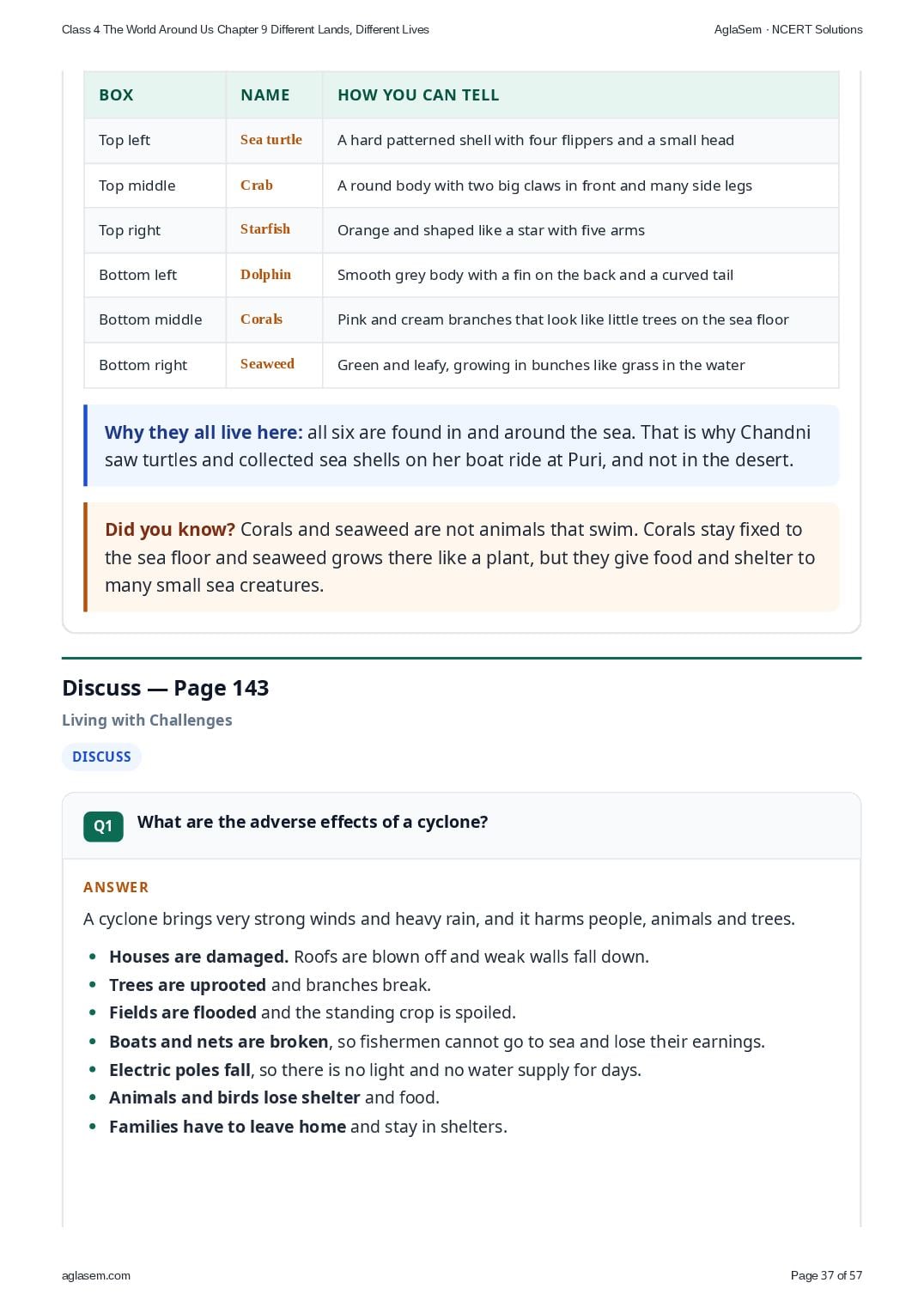
- Can you identify these creatures? (sea turtle, crab, dolphin, corals, seaweed, starfish)
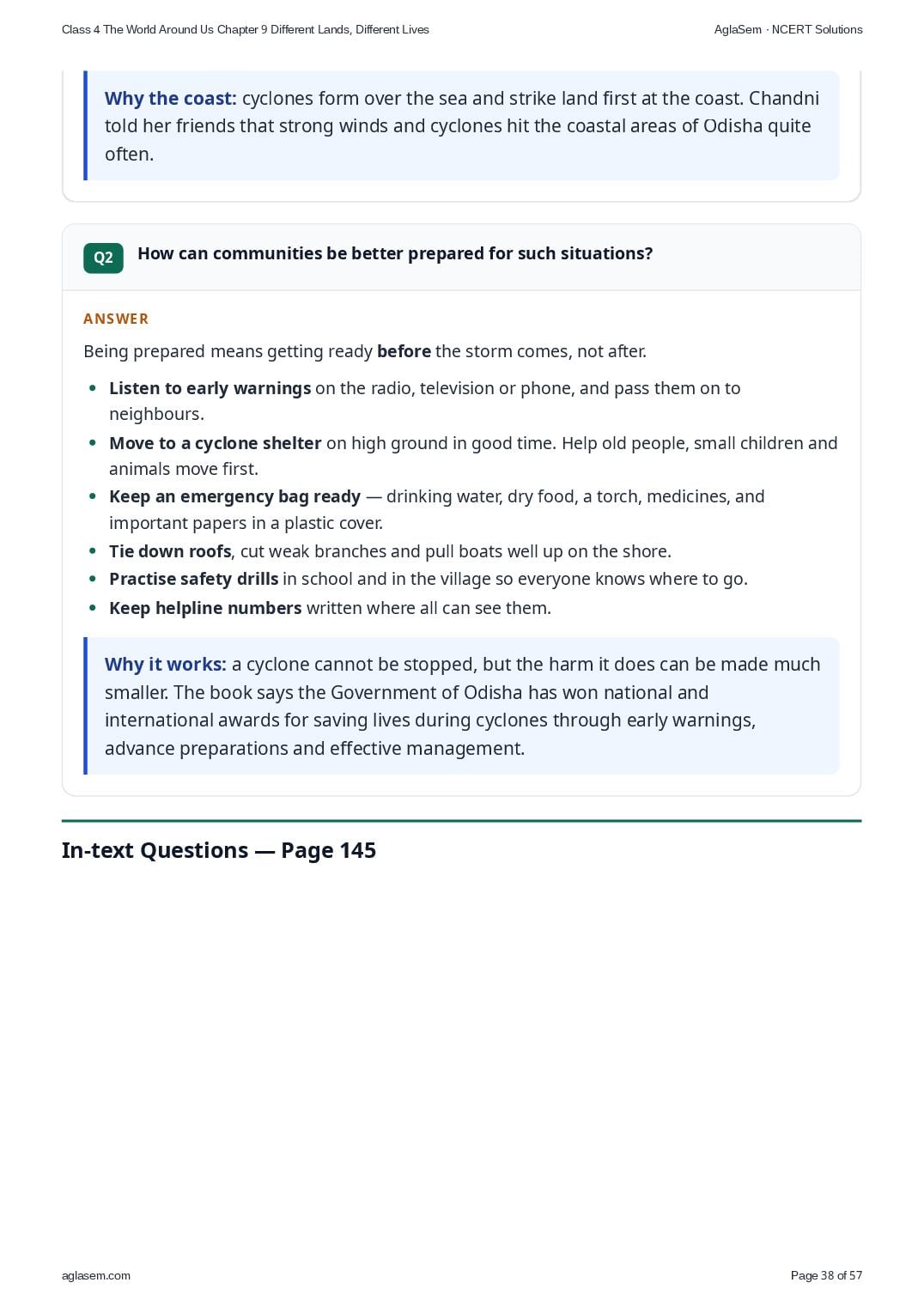
- What are the adverse effects of a cyclone?
- How can communities be better prepared for such situations?
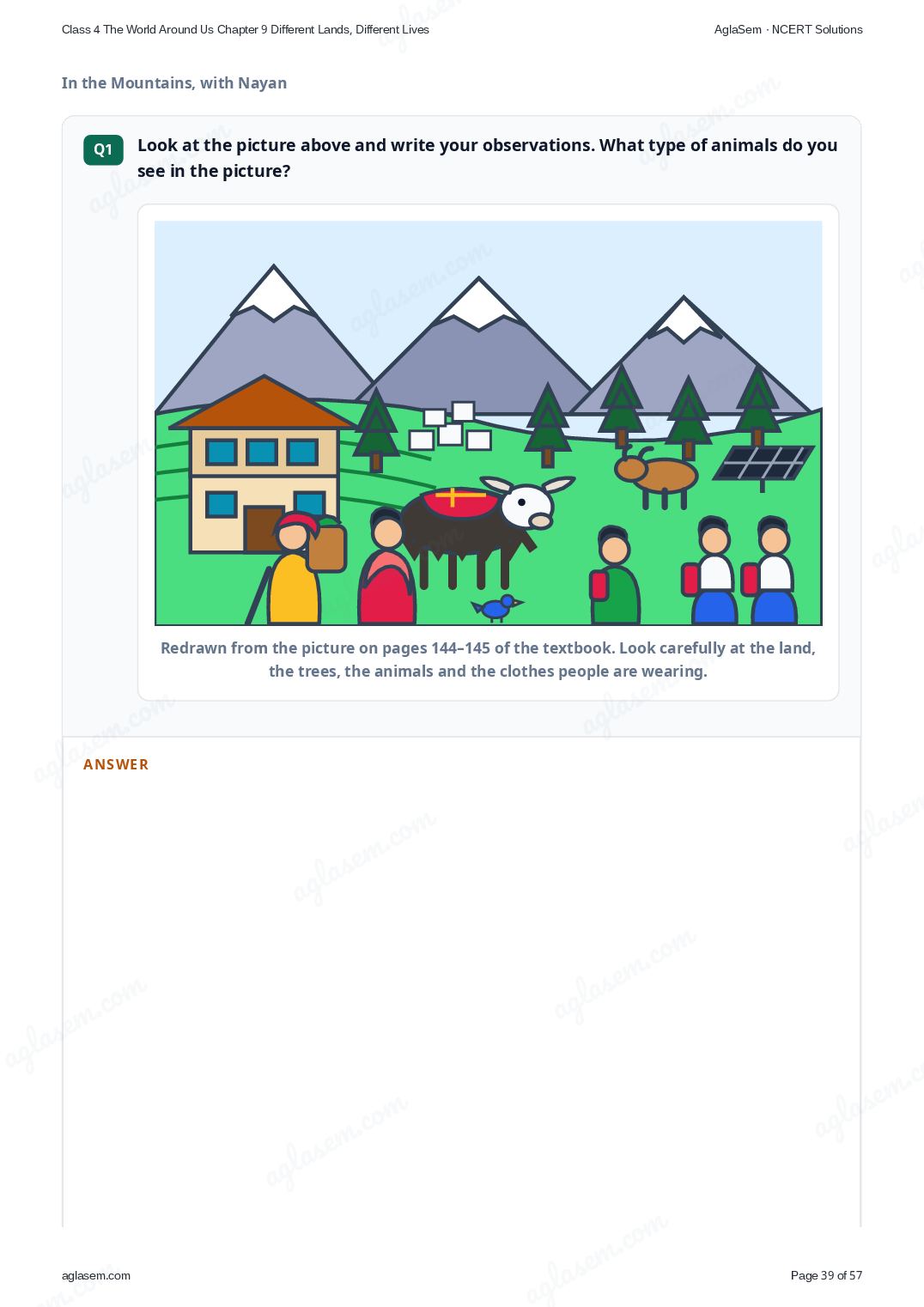
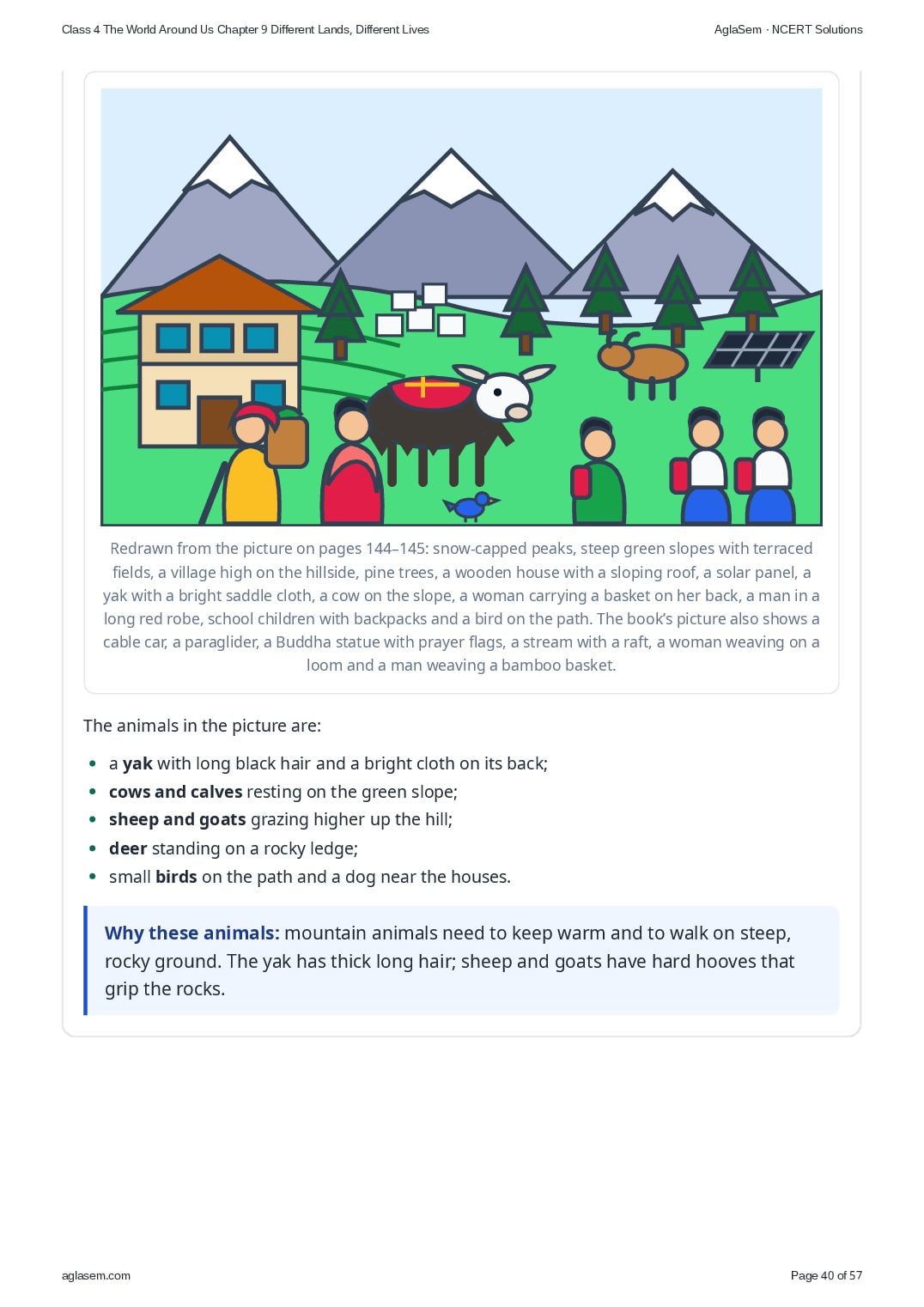
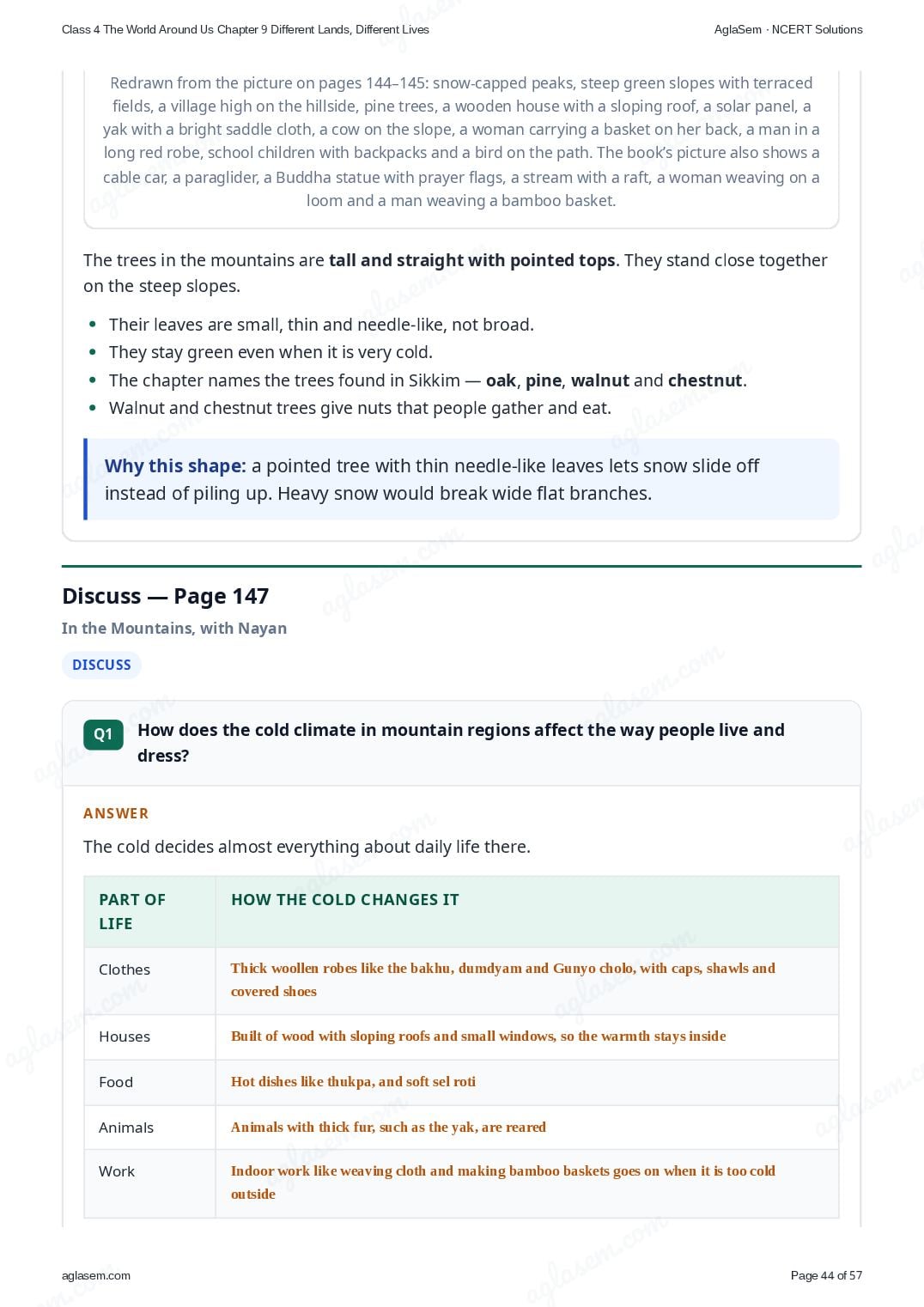
- Look at the picture above and write your observations. What type of animals do you see in the picture? Redrawn from the picture on pages 144–145 of the textbook. Look carefully at the land, the trees, the animals and the clothes people are wearing.
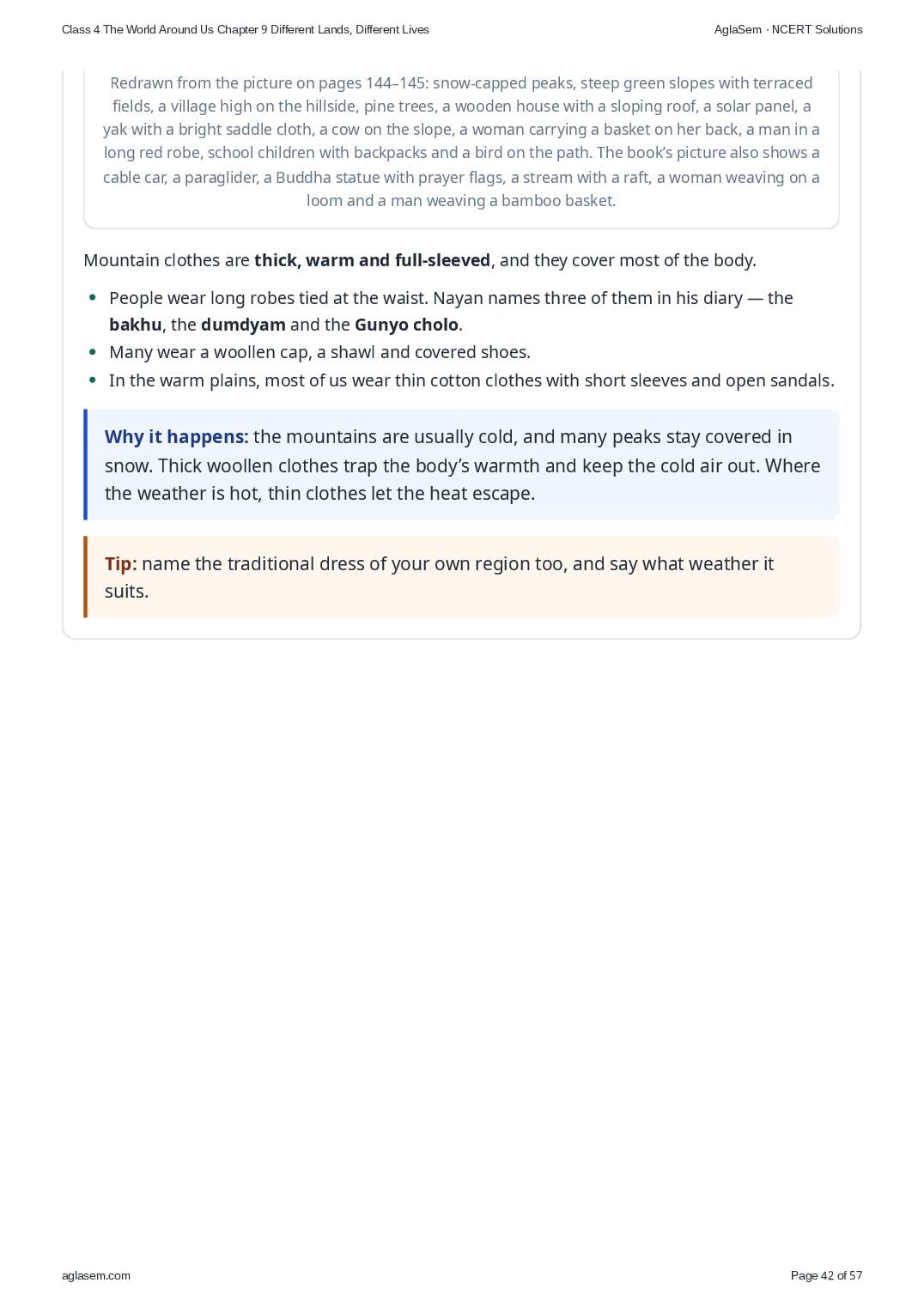
- Look at the picture above and write your observations. How are the dresses worn by people living in the mountains different from those worn in your region? Redrawn from the picture on pages 144–145 of the textbook. Look carefully at the land, the trees, the animals and the clothes people are wearing.
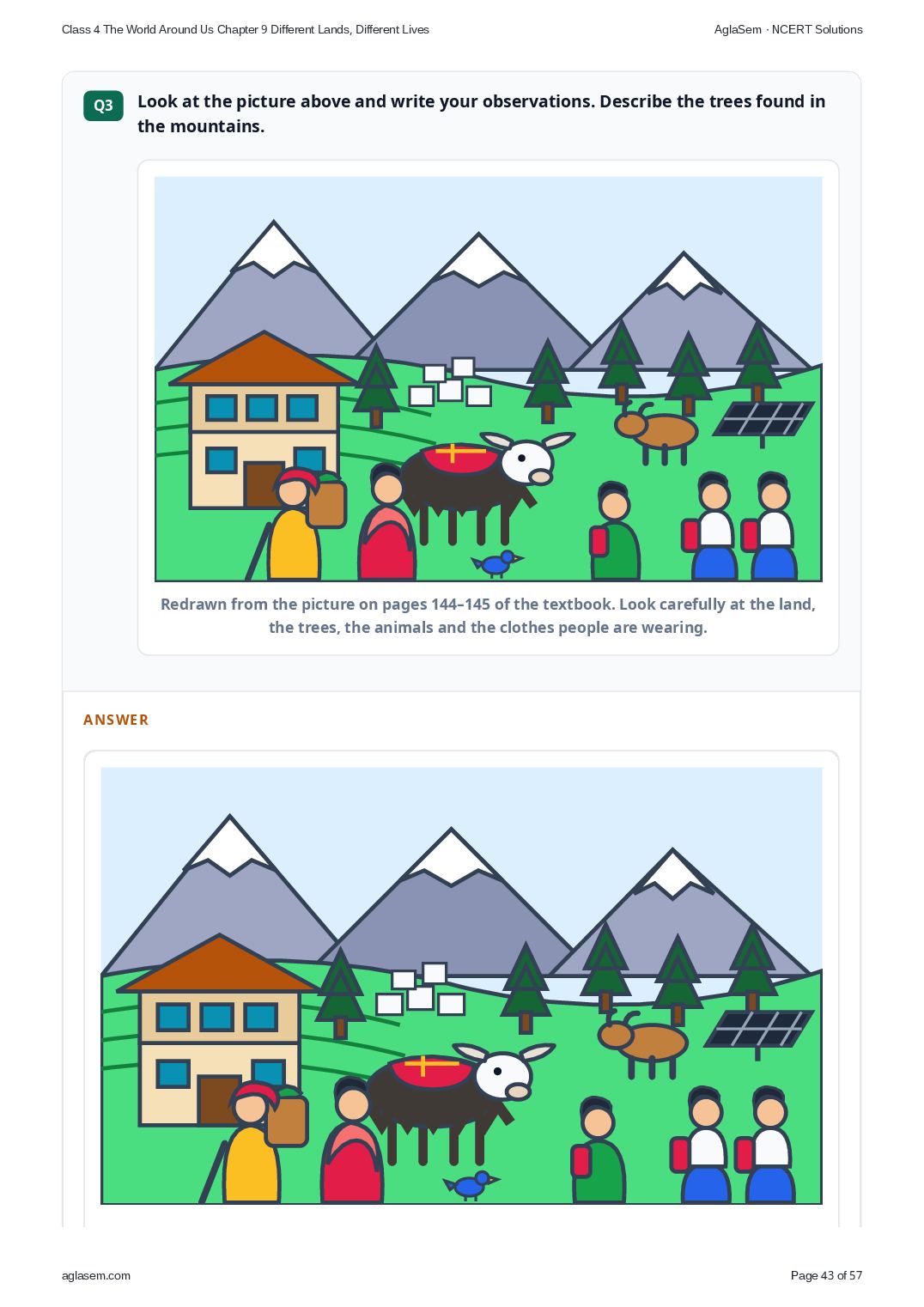
- Look at the picture above and write your observations. Describe the trees found in the mountains. Redrawn from the picture on pages 144–145 of the textbook. Look carefully at the land, the trees, the animals and the clothes people are wearing.
- How does the cold climate in mountain regions affect the way people live and dress?
- What traditional clothes are worn in your region? How do they match with the local climate?
- Why do you think certain trees, like pine and oak, grow better in the mountains?
- How do animals like yak survive in the cold climate of Sikkim?
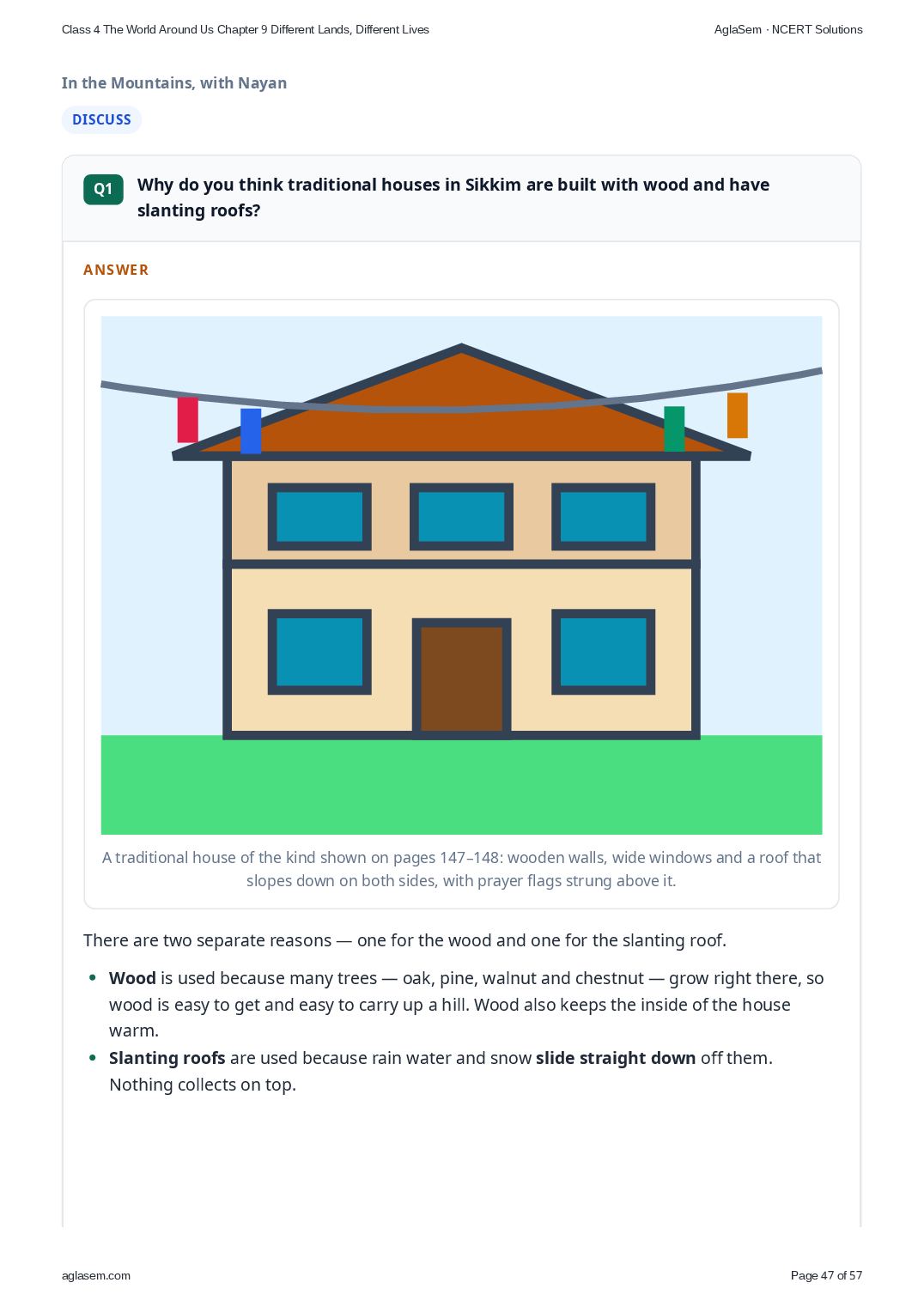
- Why do you think traditional houses in Sikkim are built with wood and have slanting roofs?
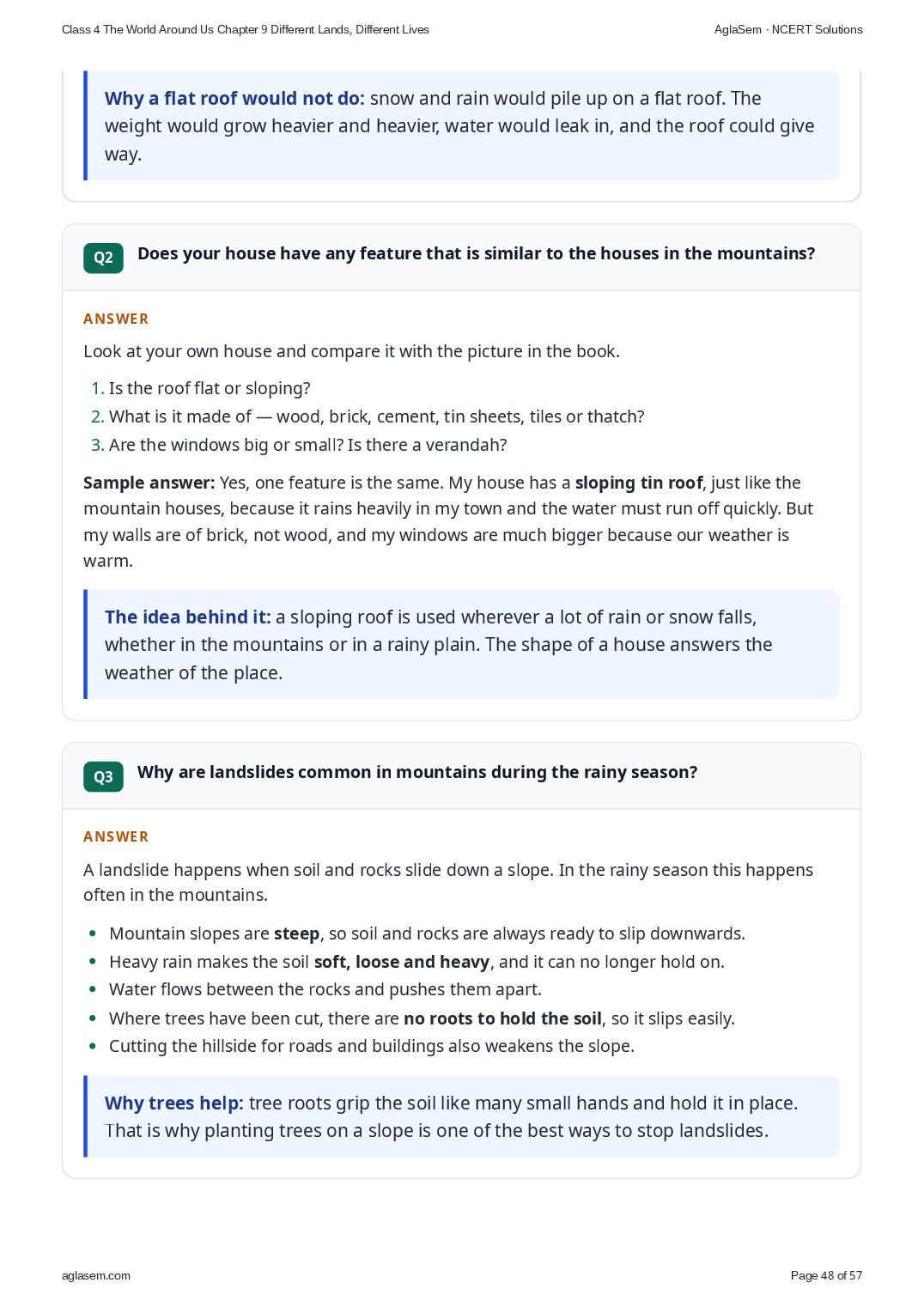
- Does your house have any feature that is similar to the houses in the mountains?
- Why are landslides common in mountains during the rainy season?
- What do you think can be done to keep people safe during the landslides?
- What can communities do to help people who lose their homes or get affected by natural disasters?
- Draw the landform around you in the space given below. Name the area, the type of landform, some interesting features of the people, their professions, food, houses, plants and animals.
- Compare life in the mountains and plains by capturing the differences in trees, animals, houses, clothes, food, festivals and art forms.
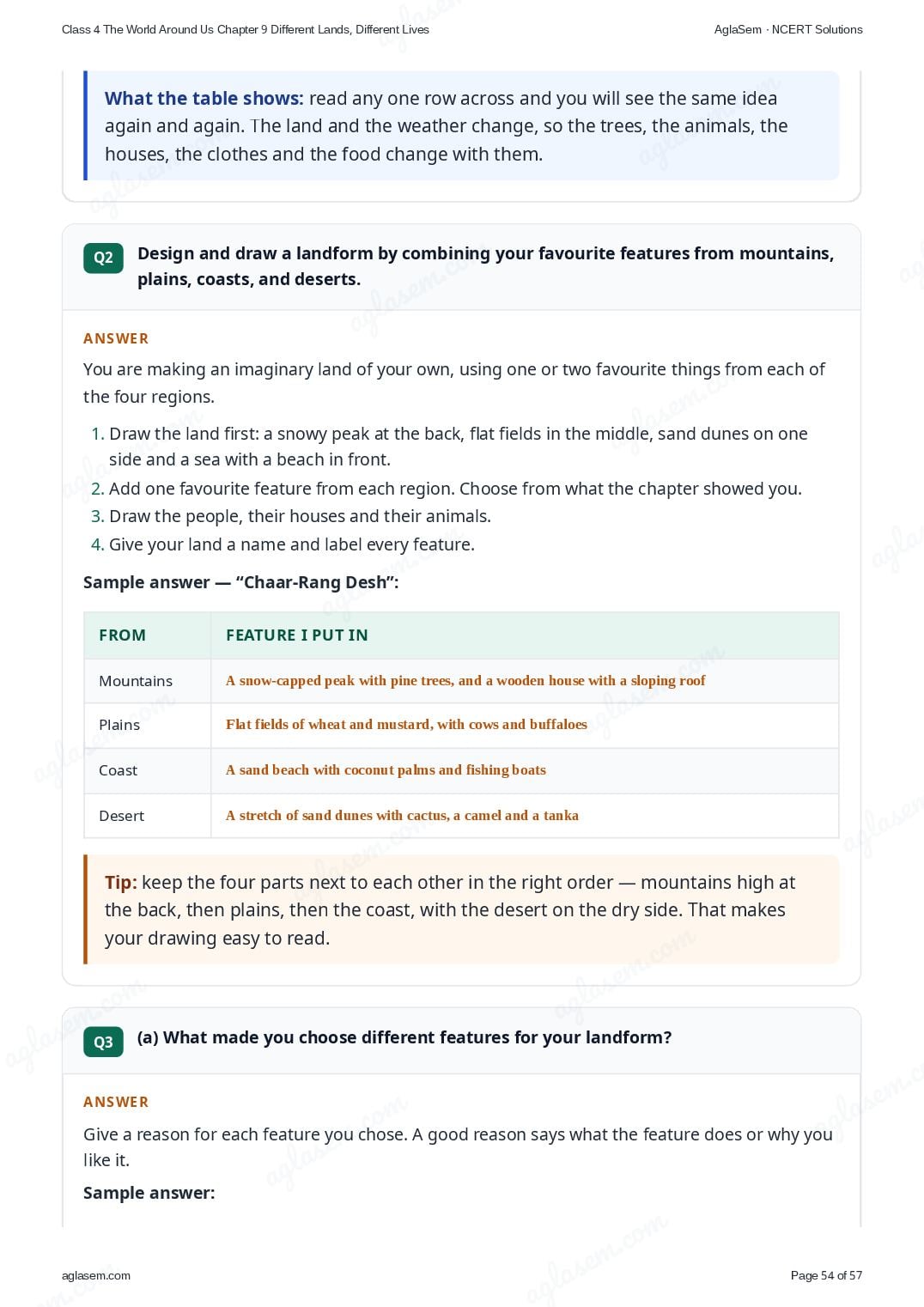
- Design and draw a landform by combining your favourite features from mountains, plains, coasts, and deserts.
- (a) What made you choose different features for your landform?
- (b) How does each feature benefit people, animals or plants?
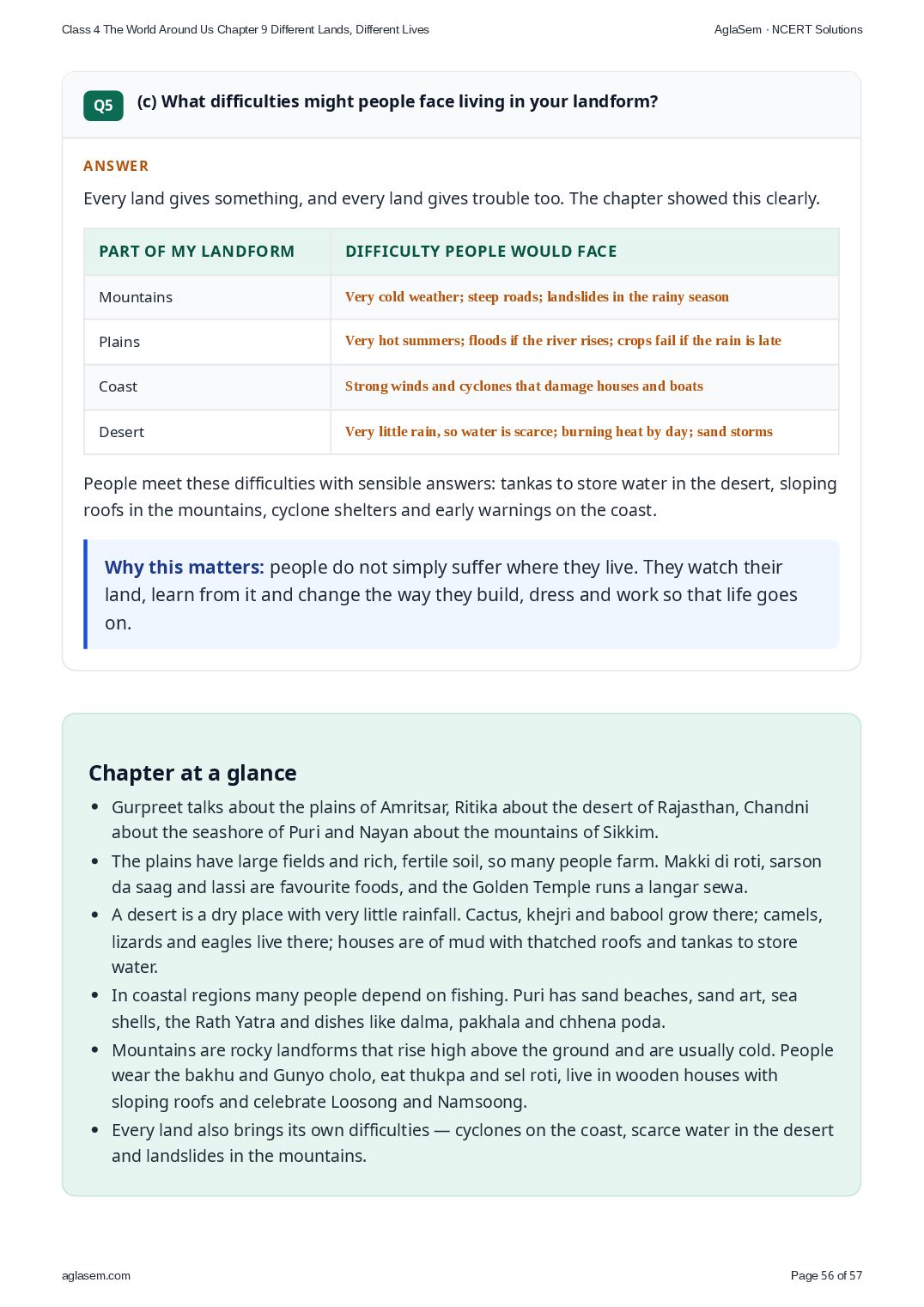
- (c) What difficulties might people face living in your landform?
Chapter at a Glance
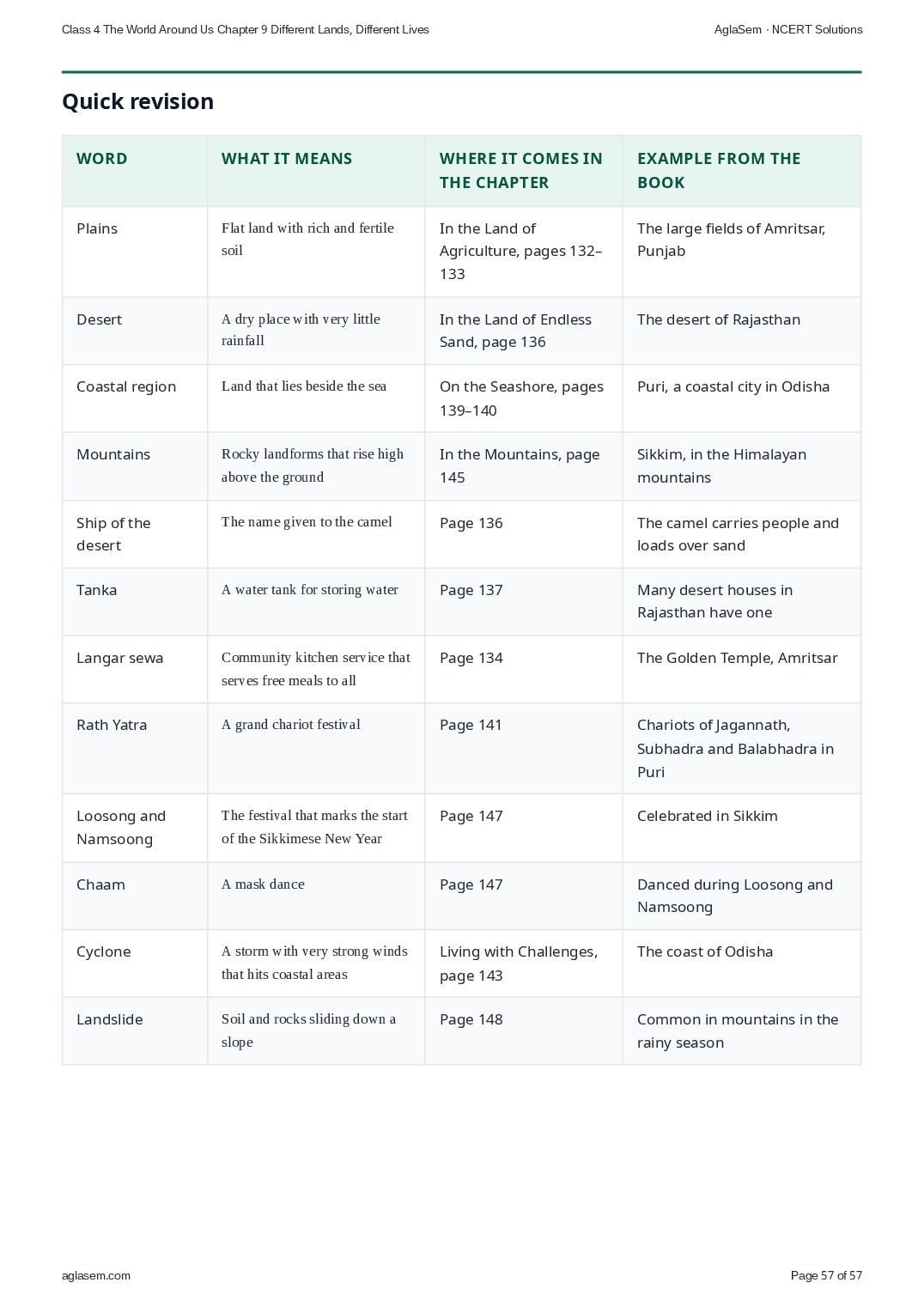
- Gurpreet talks about the plains of Amritsar, Ritika about the desert of Rajasthan, Chandni about the seashore of Puri and Nayan about the mountains of Sikkim.
- The plains have large fields and rich, fertile soil, so many people farm. Makki di roti, sarson da saag and lassi are favourite foods, and the Golden Temple runs a langar sewa.
- A desert is a dry place with very little rainfall. Cactus, khejri and babool grow there; camels, lizards and eagles live there; houses are of mud with thatched roofs and tankas to store water.
- In coastal regions many people depend on fishing. Puri has sand beaches, sand art, sea shells, the Rath Yatra and dishes like dalma, pakhala and chhena poda.
- Mountains are rocky landforms that rise high above the ground and are usually cold. People wear the bakhu and Gunyo cholo, eat thukpa and sel roti, live in wooden houses with sloping roofs and celebrate Loosong and Namsoong.
- Every land also brings its own difficulties — cyclones on the coast, scarce water in the desert and landslides in the mountains.
How to Download NCERT Solutions for Class 4 The World Around Us Chapter 9 PDF
Follow these simple steps to get the Different Lands Different Lives questions-and-answers PDF from Our Wondrous World.
- Search NCERT Solutions for Class 4 The World Around Us Chapter 9 aglasem and open this page.
- Read the exercise questions with answers for Different Lands Different Lives shown above.
- Click the Download PDF link to save the Different Lands Different Lives solutions to your device.
NCERT Solutions for Class 4 The World Around Us – All Chapters
There are more chapters to study besides Different Lands Different Lives in The World Around Us. Here are the NCERT Solutions for all chapters of Class 4 The World Around Us.
- Chapter 1 Living Together
- Chapter 2 Exploring Our Neighbourhood
- Chapter 3 Nature Trail
- Chapter 4 Growing Up with Nature
- Chapter 5 Food for Health
- Chapter 6 Happy and Healthy Living
- Chapter 7 How Things Work
- Chapter 8 How Things Are Made
- Chapter 9 Different Lands Different Lives
- Chapter 10 Our Sky
NCERT Solutions for Class 4 – All Subjects
Just like Chapter 9 of The World Around Us, you can get the exercise questions with answers for every other subject of Class 4. Here are the NCERT Solutions for all subjects of Class 4.
NCERT Solutions for Class 4 The World Around Us Chapter 9 – An Overview
The key highlights of this study material are as follows.
| Aspects | Details |
|---|---|
| Class | Class 4 |
| Subject | The World Around Us |
| Chapter Number | Chapter 9 |
| Chapter Name | Different Lands Different Lives |
| Book Name | Our Wondrous World |
| Book By | NCERT (National Council of Educational Research and Training) |
| Educational Resource Here | NCERT Solutions of Class 4 The World Around Us Chapter 9 for all exercises |
| More Questions Answers of This Subject | NCERT Solutions for Class 4 The World Around Us |
| Download Book Chapter | NCERT Book Class 4 The World Around Us |
| All Questions Answers For This Class | NCERT Solutions for Class 4 |
| Complete Solutions | NCERT Solutions |
NCERT Solutions for Class 4 The World Around Us Chapter 9 Different Lands Different Lives – FAQs
What are the NCERT Solutions for Class 4 The World Around Us Chapter 9 Different Lands Different Lives?
They are the complete, step-by-step answers to all the exercise and in-text questions of Chapter 9 Different Lands Different Lives from the NCERT Class 4 The World Around Us textbook Our Wondrous World, written by experts as per the latest NCERT syllabus.
How can I download the Class 4 The World Around Us Chapter 9 solutions PDF for free?
Open this page on aglasem, read the Different Lands Different Lives questions with answers, and click the “Download Solutions PDF” link. The Class 4 The World Around Us Chapter 9 NCERT Solutions PDF is completely free to download.
Are these NCERT Solutions as per the latest 2026-27 syllabus?
Yes. The NCERT Solutions for Class 4 The World Around Us Chapter 9 are based on the latest NCERT textbook Our Wondrous World and the current 2026-27 CBSE syllabus, so the questions and answers match what you study in class.
Where can I get NCERT Solutions for the other chapters of Class 4 The World Around Us?
You can find the answers to every chapter on the NCERT Solutions for Class 4 The World Around Us page, and solutions for every subject on the NCERT Solutions for Class 4 page.
How do NCERT Solutions help in exam preparation?
They show the correct method to solve each question, help you write answers the way they are expected in exams, let you check and correct your own work, and save revision time — which together improve your marks in Class 4 The World Around Us.
If you have any queries on NCERT Solutions for Class 4 The World Around Us Chapter 9 Different Lands Different Lives, then please ask in the comments below.