NCERT Solutions for Class 4 The World Around Us Chapter 7 How Things Work provide clear, step-by-step answers to every exercise and in-text question from the chapter How Things Work of the NCERT textbook Our Wondrous World. Prepared by subject experts as per the latest NCERT (CBSE) syllabus for 2026-27, these NCERT Solutions for Class 4 The World Around Us help you understand each concept, write exam-ready answers, and check your own solutions. You can read them online below or download the free Class 4 The World Around Us Chapter 7 question-answer PDF.
NCERT Solutions for Class 4 The World Around Us Chapter 7 How Things Work
- Class: Class 4
- Subject: The World Around Us
- Chapter: Chapter 7 – How Things Work
- Textbook: Our Wondrous World (NCERT)
- Study material: NCERT Solutions – questions with answers, free PDF
These solutions answer all the exercise questions of Chapter 7 How Things Work — including the in-text questions, short-answer and long-answer questions, and activities — with complete explanations so you can follow the method, not just the final answer. Read the full solutions below.
NCERT Solutions Class 4 The World Around Us Chapter 7 How Things Work View Download









NCERT Solutions for Class 4 The World Around Us Chapter 7 PDF Download
You can read the NCERT Solutions for Class 4 The World Around Us Chapter 7 online above, or download the complete question-answer PDF to study How Things Work offline at any time.
NCERT Solutions for Class 4 The World Around Us Chapter 7 PDF Download Link – Click Here to Download Solutions PDF
Questions Covered in This Chapter
These NCERT Solutions answer all 24 questions of this chapter. The questions solved are:
- Have you ever wondered how these things work?
- Do they always work the same way in all situations?
- What changes might be needed to make them work even better?
- Do you think all objects can spin? Make a list of a few objects that can spin.
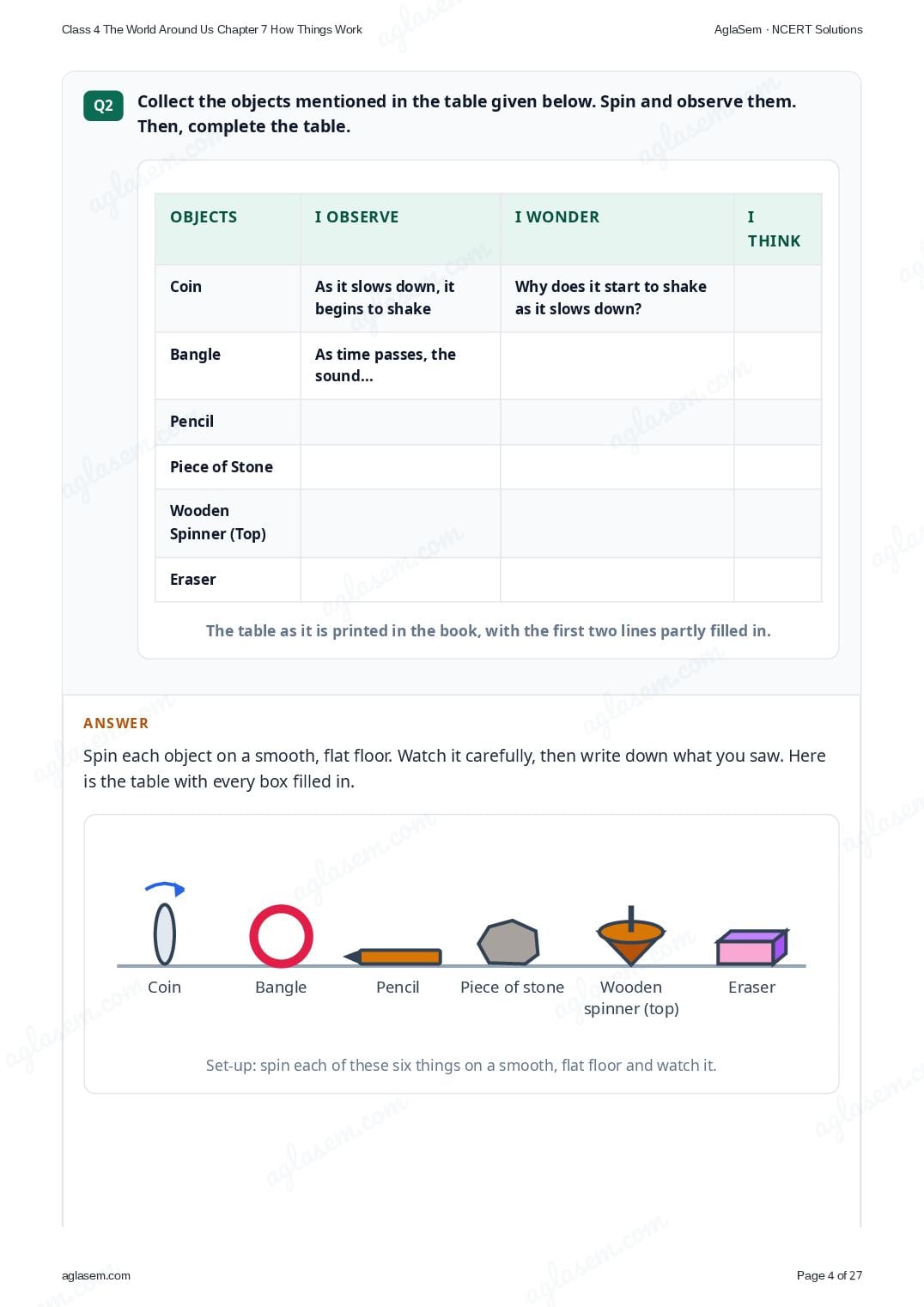
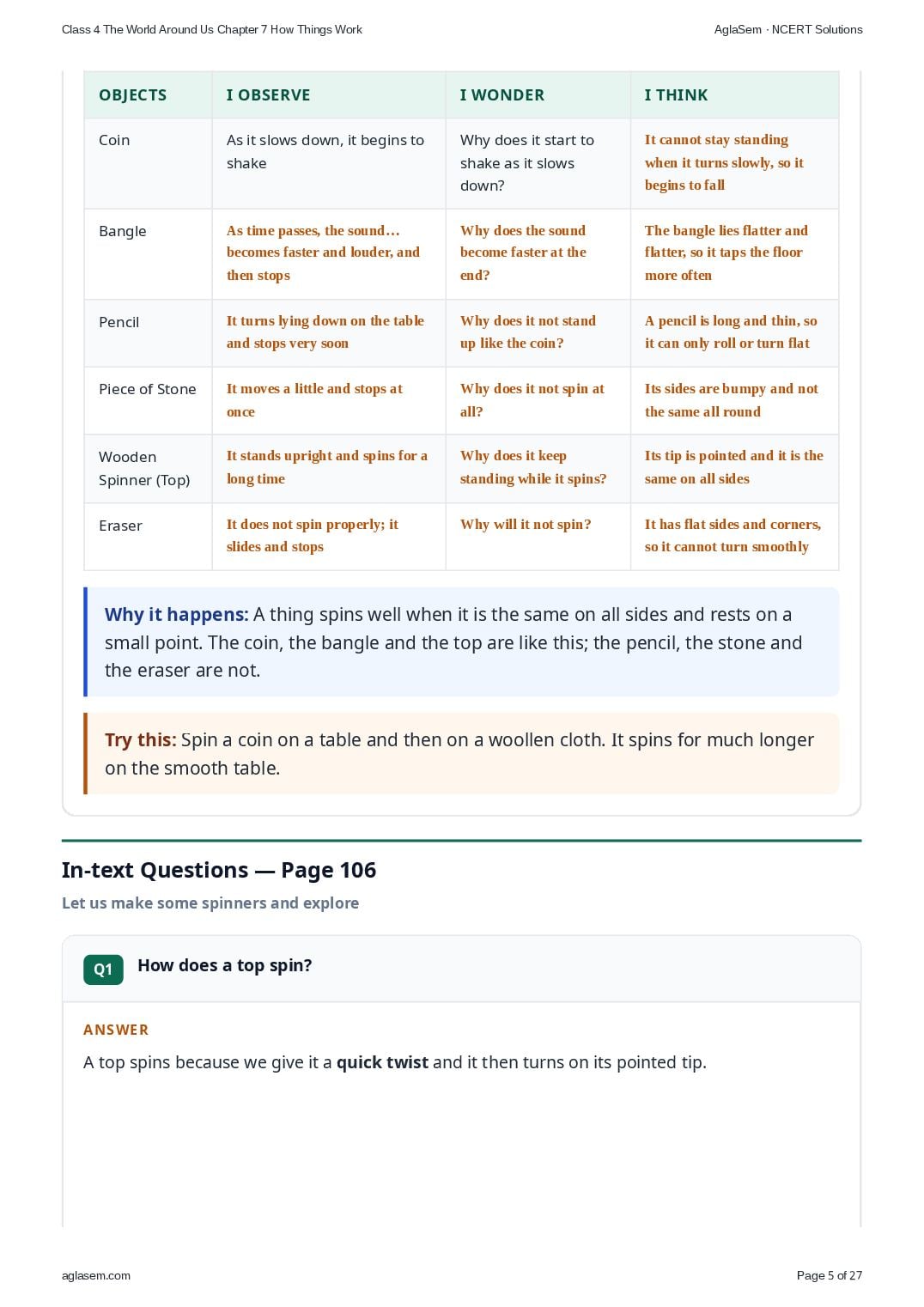
- Collect the objects mentioned in the table given below. Spin and observe them. Then, complete the table. ObjectsI observeI wonderI think CoinAs it slows down, it begins to shakeWhy does it start to shake as it slows down? BangleAs time passes, the sound… Pencil Piece of Stone Wooden Spinner (Top) Eraser The table as it is printed in the book, with the first two lines partly filled in.
- How does a top spin?
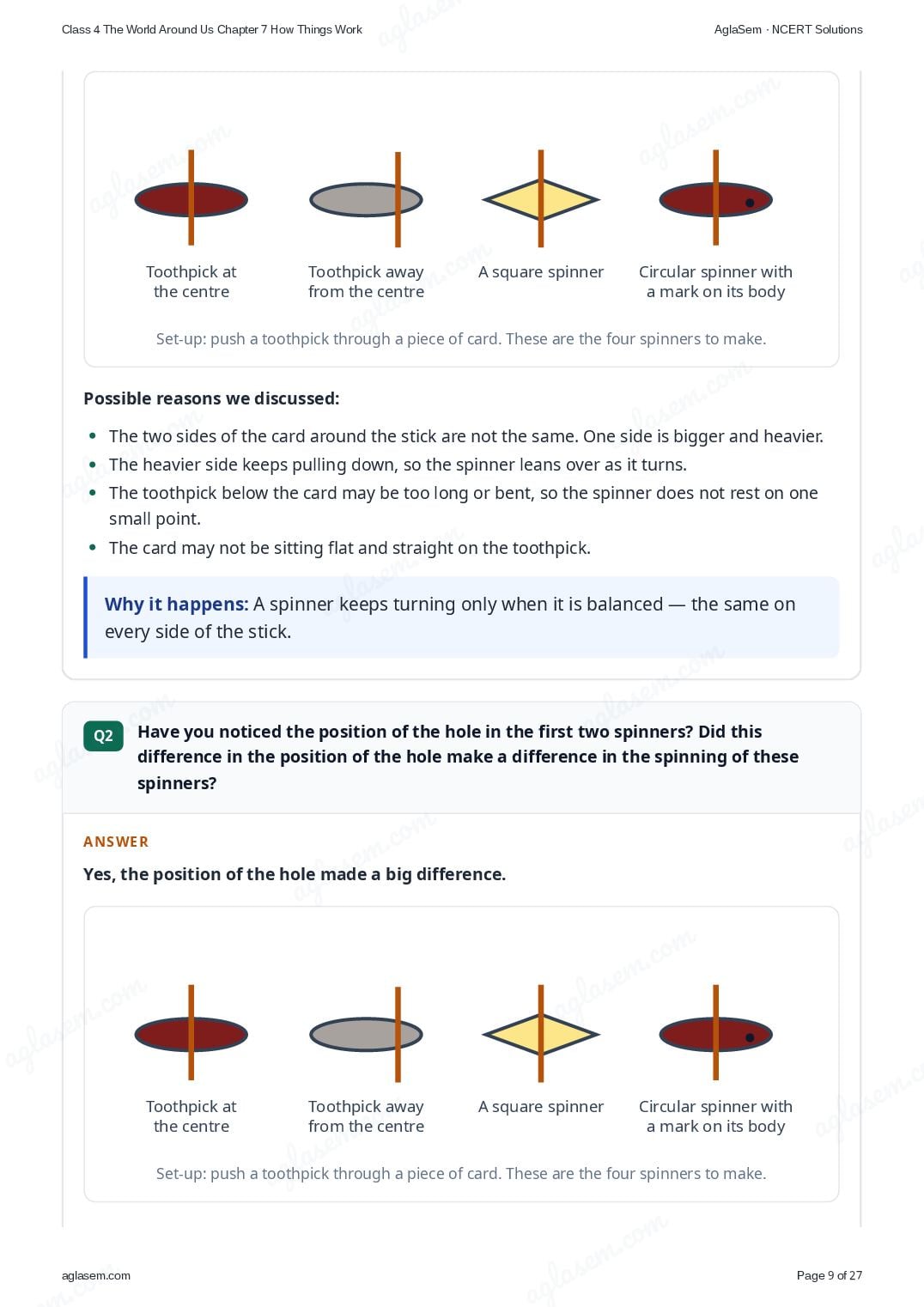
- Collect things, such as pieces of cardboard, toothpicks, an empty tube of a ballpoint pen, and other small objects. Make the following spinners. Spin them and record your observations.
- Which of the spinners did not spin properly? Discuss the possible reasons.
- Have you noticed the position of the hole in the first two spinners? Did this difference in the position of the hole make a difference in the spinning of these spinners?
- What other shapes can you try? Make spinners using different shapes of card pieces, spin them, and observe what happens.
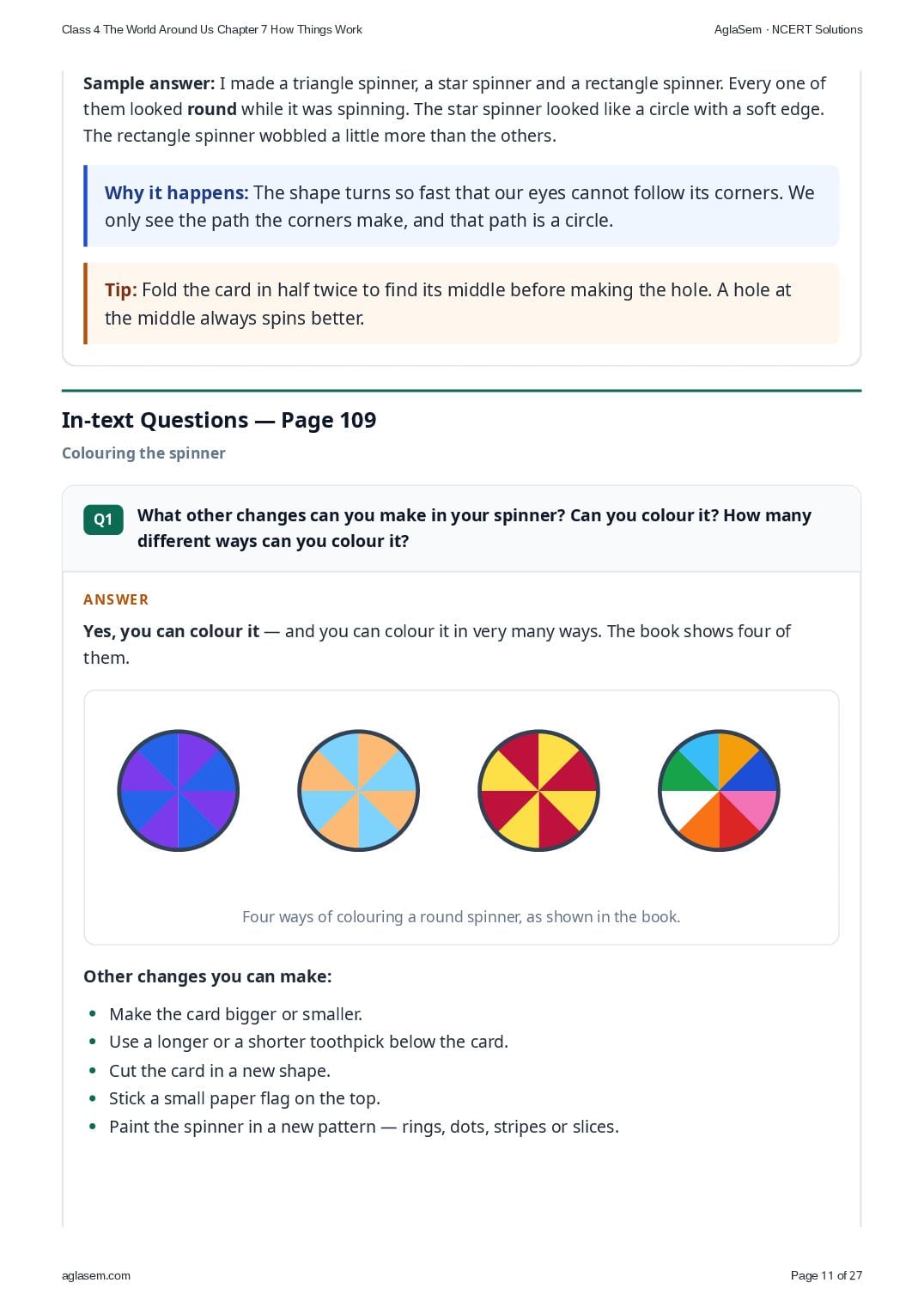
- What other changes can you make in your spinner? Can you colour it? How many different ways can you colour it?
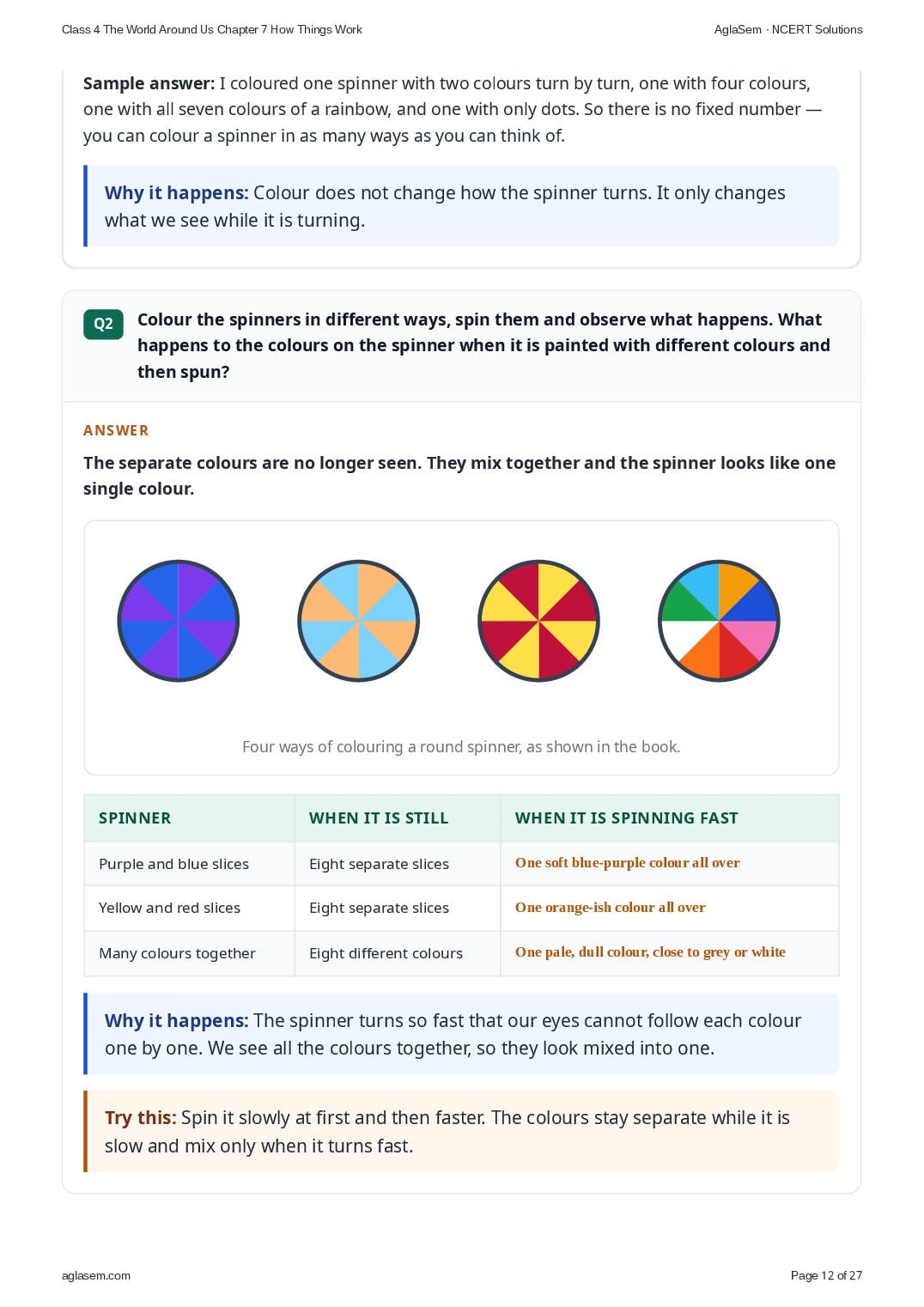
- Colour the spinners in different ways, spin them and observe what happens. What happens to the colours on the spinner when it is painted with different colours and then spun?
- Many things around us spin, such as ceiling fans and potter’s wheels. What other things have you observed spinning?
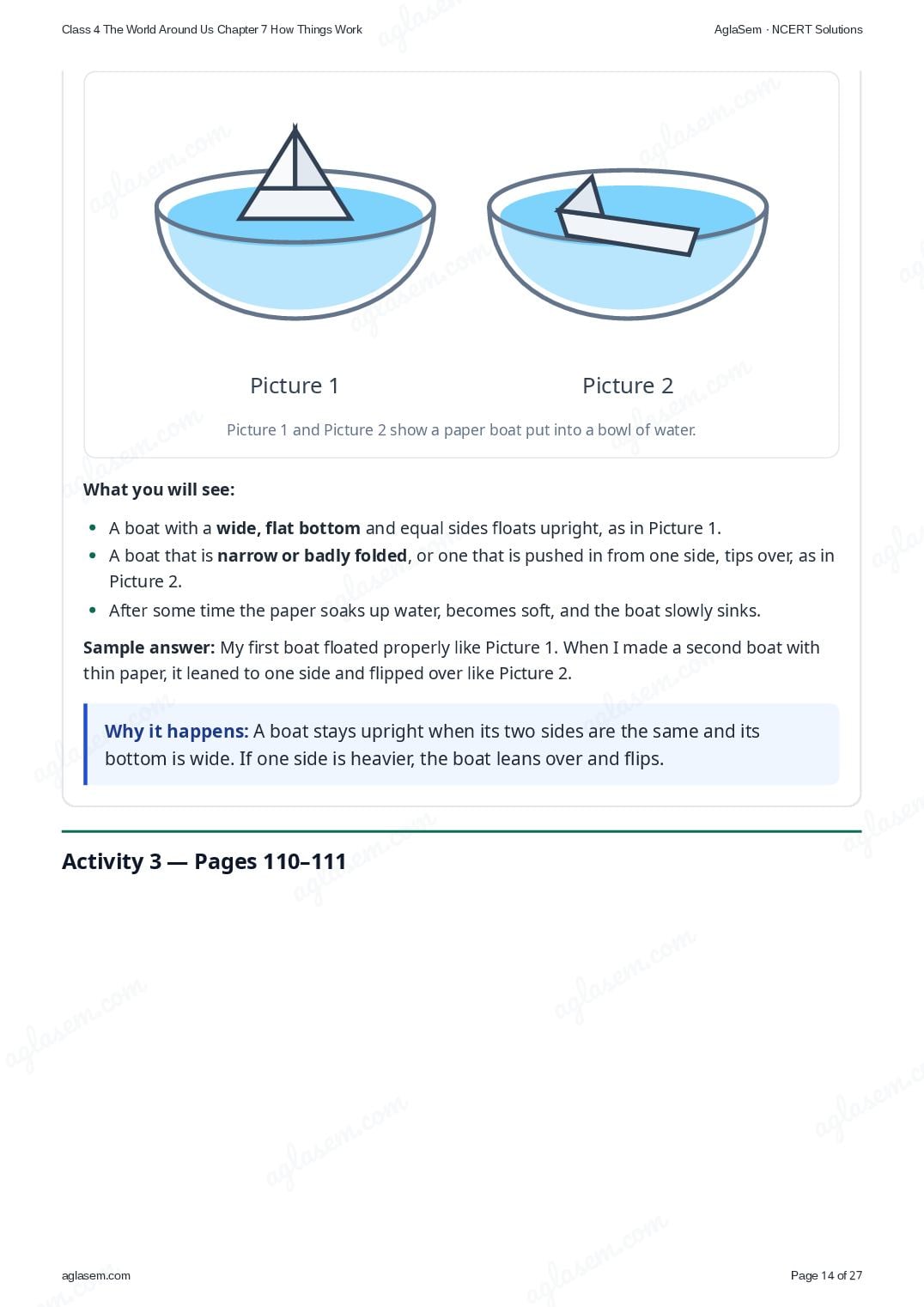
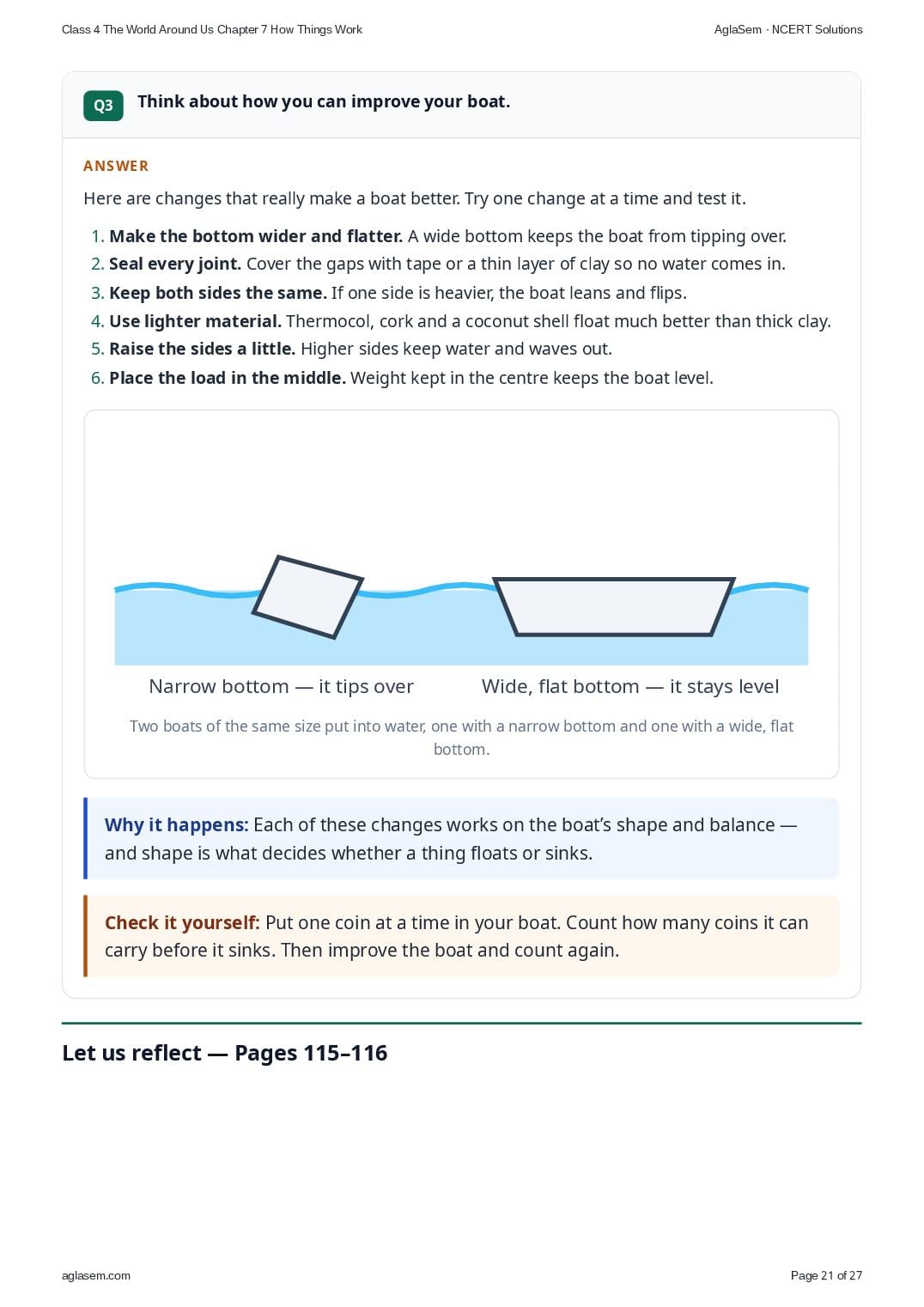
- You can try this out at home. Make a paper boat and float it in a bowl. Observe whether your boat floats properly like in Picture 1 or flips like in Picture 2?
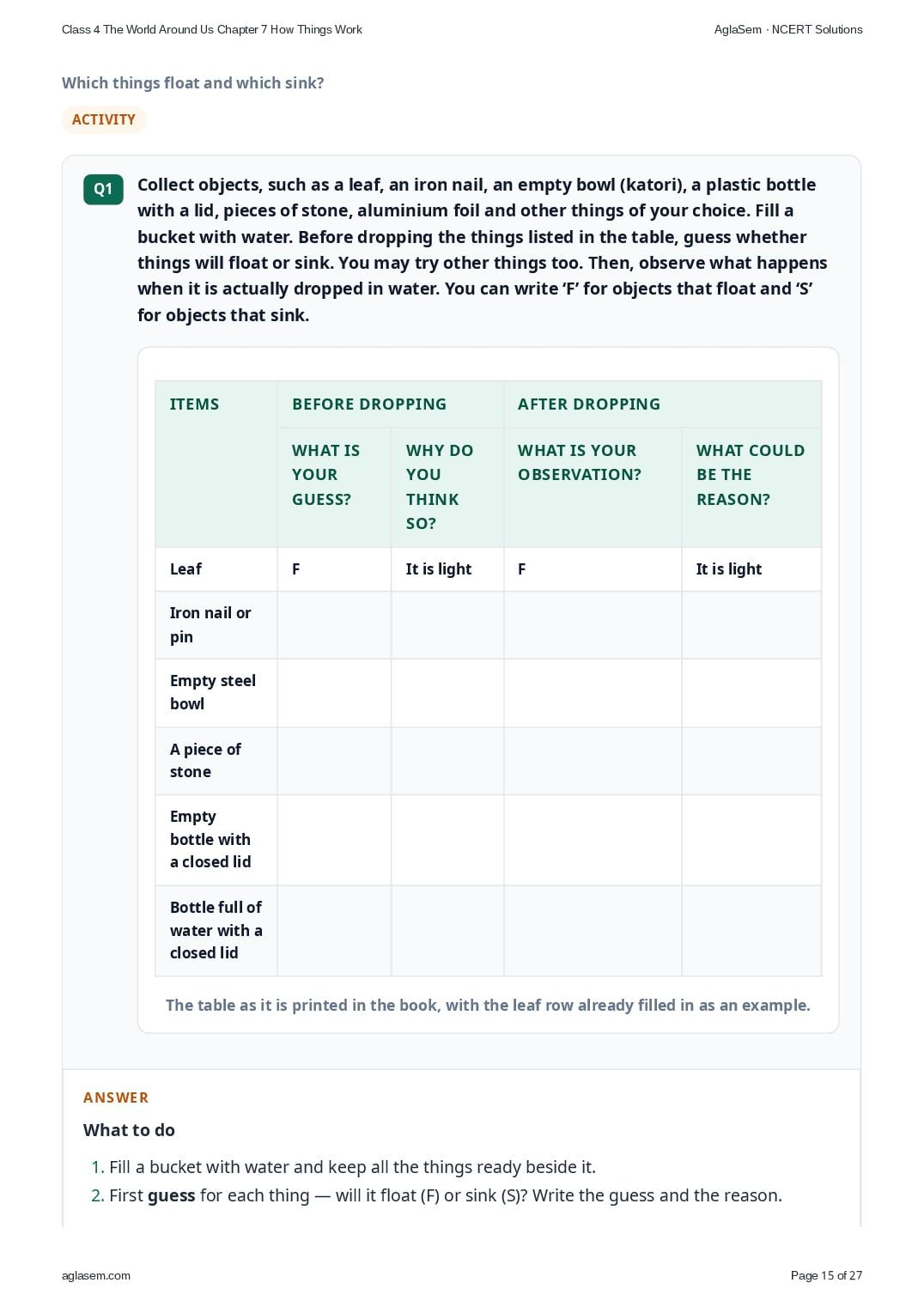
- Collect objects, such as a leaf, an iron nail, an empty bowl (katori), a plastic bottle with a lid, pieces of stone, aluminium foil and other things of your choice. Fill a bucket with water. Before dropping the things listed in the table, guess whether things will float or sink. You may try other things too. Then, observe what happens when it is actually dropped in water. You can write ‘F’ for objects that float and ‘S’ for objects that sink. ItemsBefore droppingAfter dropping What is your guess?Why do you think so?What is your observation?What could be the reason? LeafFIt is lightFIt is light Iron nail or pin Empty steel bowl A piece of stone Empty bottle with a closed lid Bottle full of water with a closed lid The table as it is printed in the book, with the leaf row already filled in as an example.
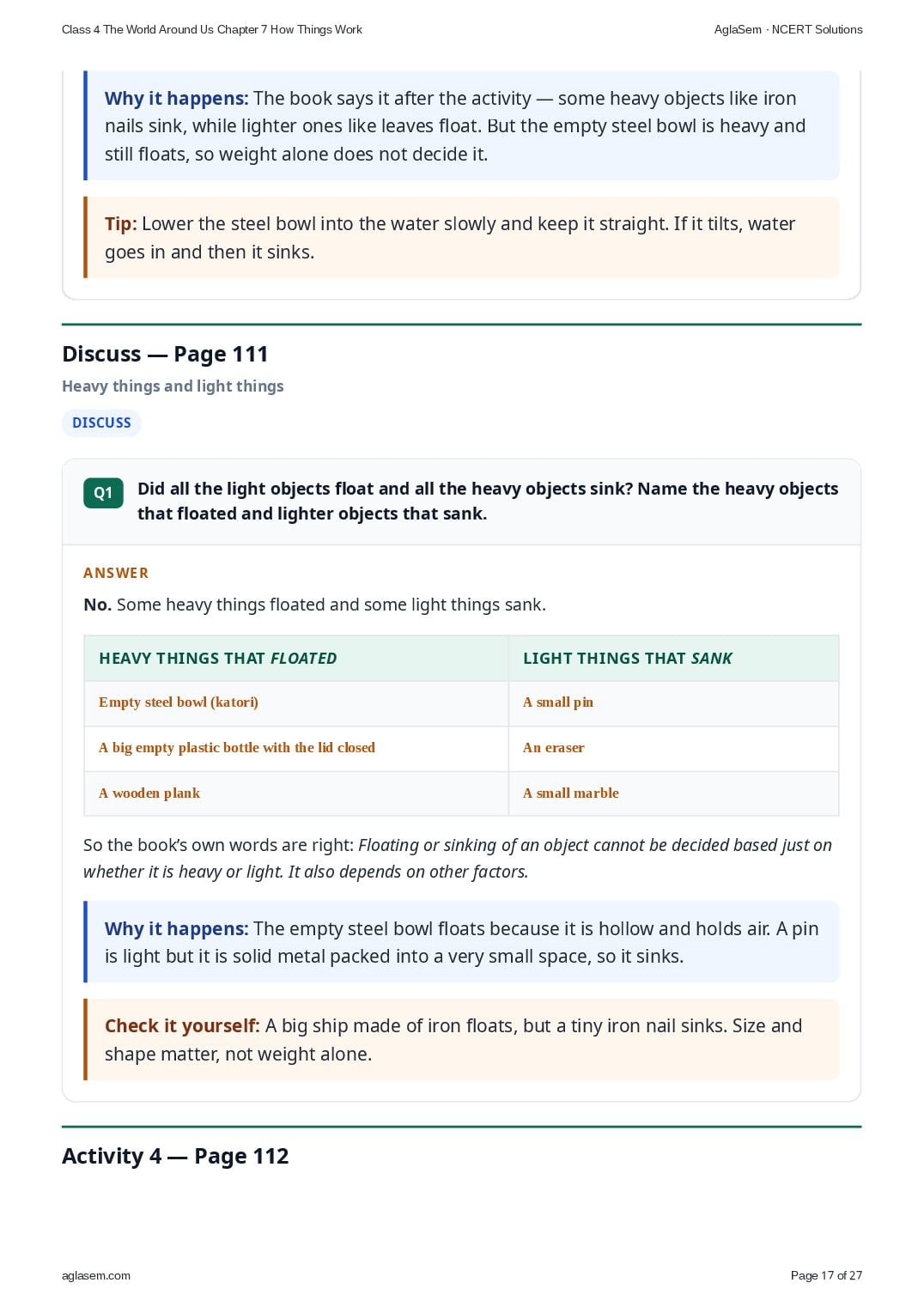
- Did all the light objects float and all the heavy objects sink? Name the heavy objects that floated and lighter objects that sank.
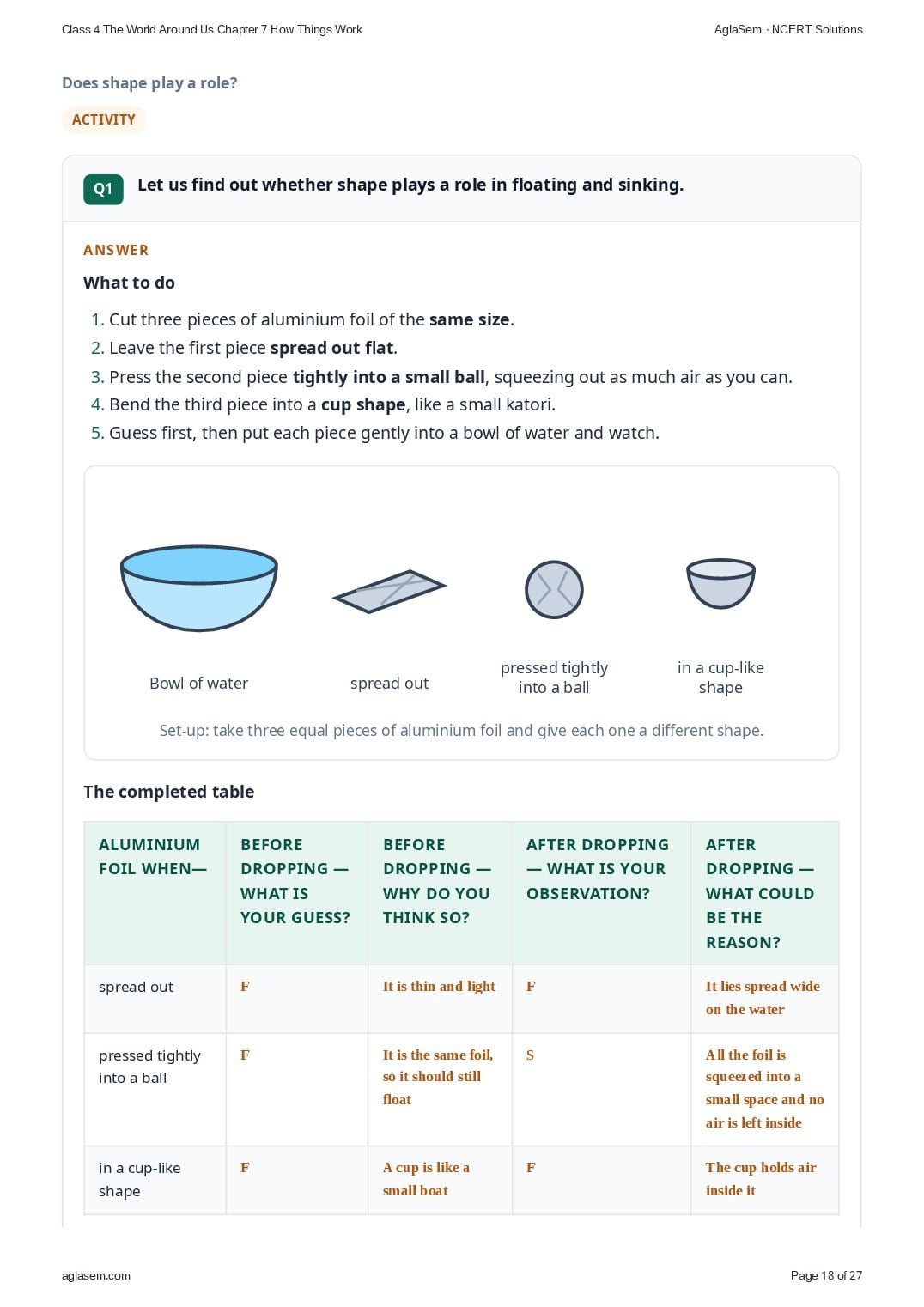
- Let us find out whether shape plays a role in floating and sinking.
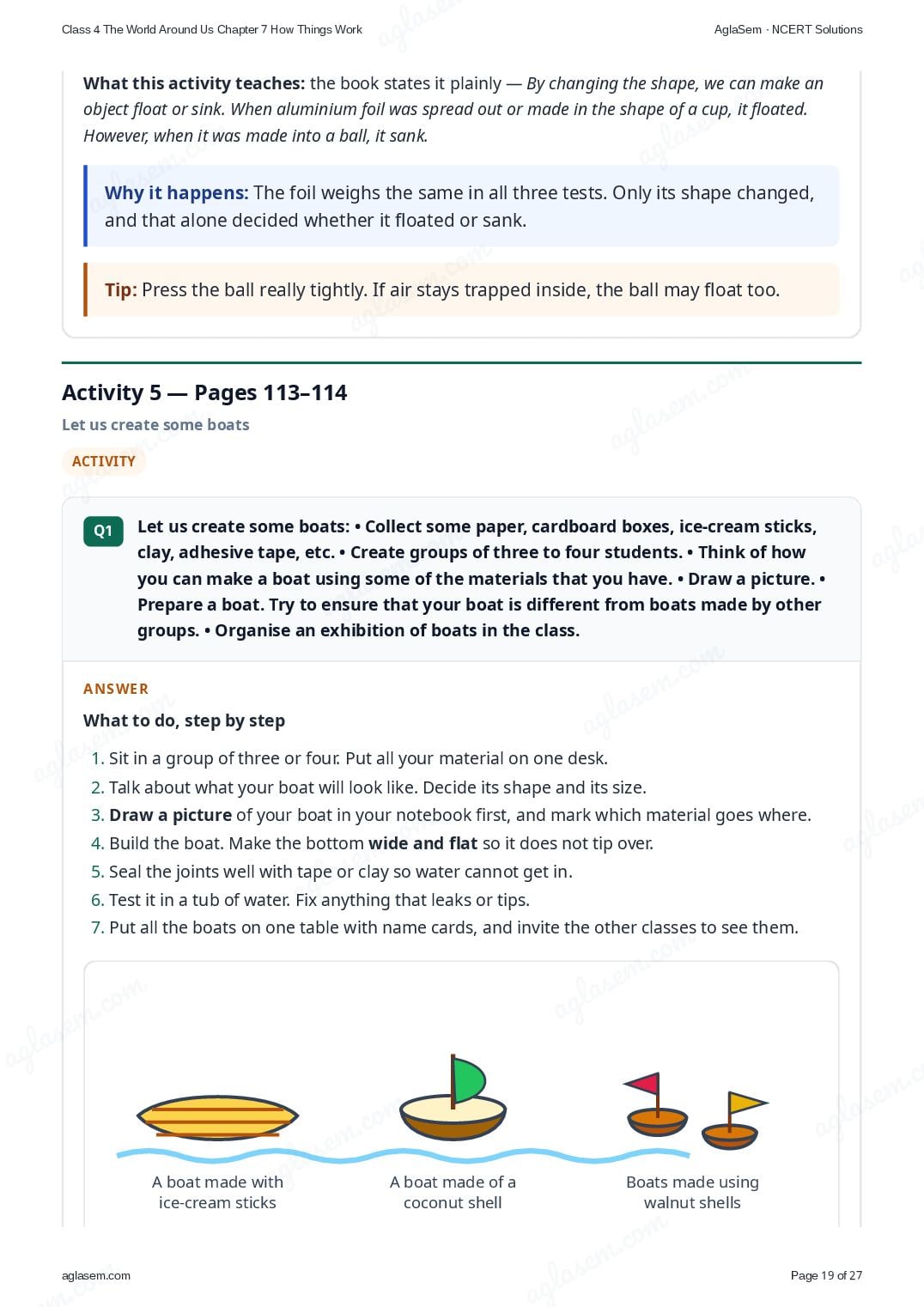
- Let us create some boats: • Collect some paper, cardboard boxes, ice-cream sticks, clay, adhesive tape, etc. • Create groups of three to four students. • Think of how you can make a boat using some of the materials that you have. • Draw a picture. • Prepare a boat. Try to ensure that your boat is different from boats made by other groups. • Organise an exhibition of boats in the class.
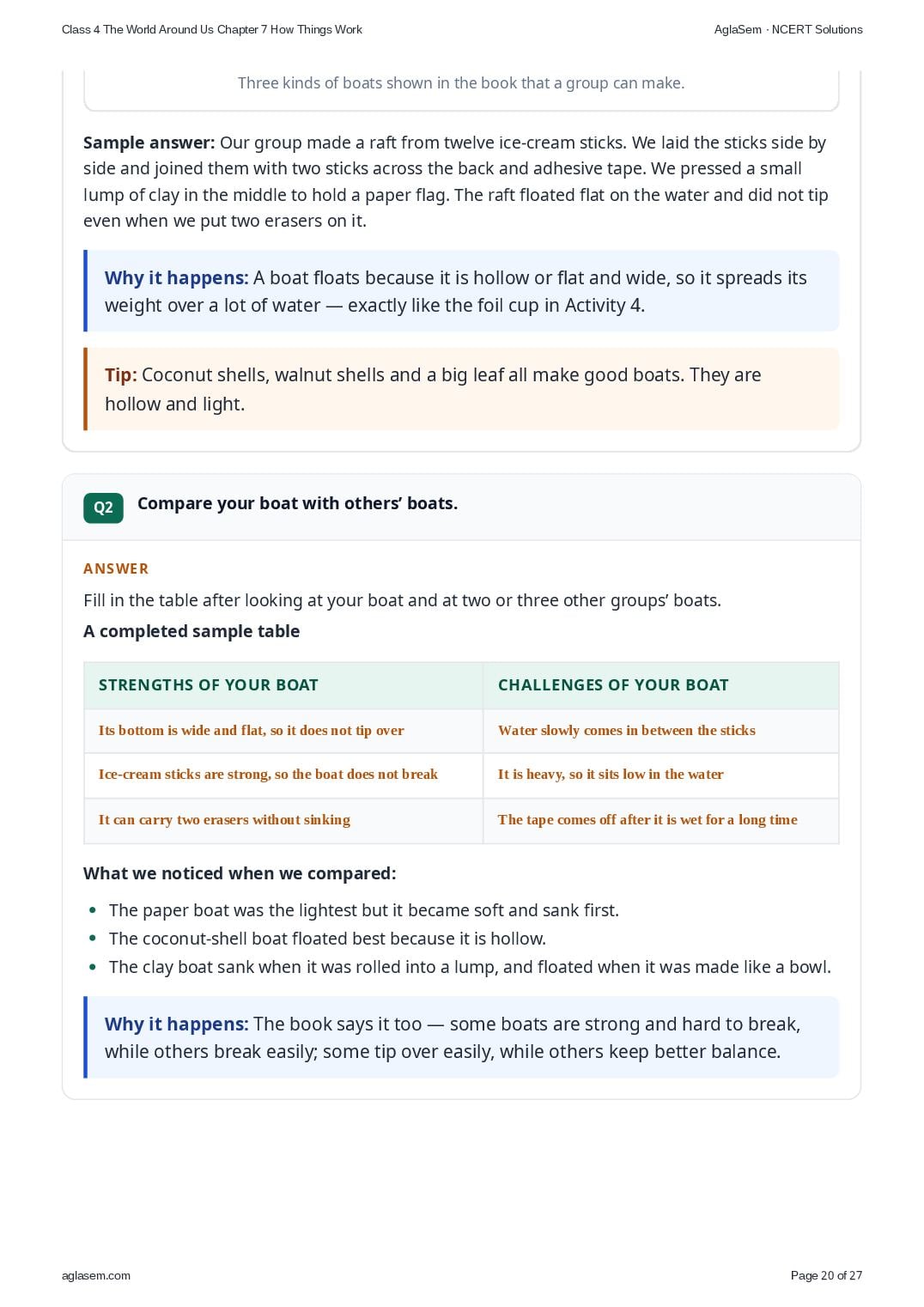
- Compare your boat with others’ boats.
- Think about how you can improve your boat.
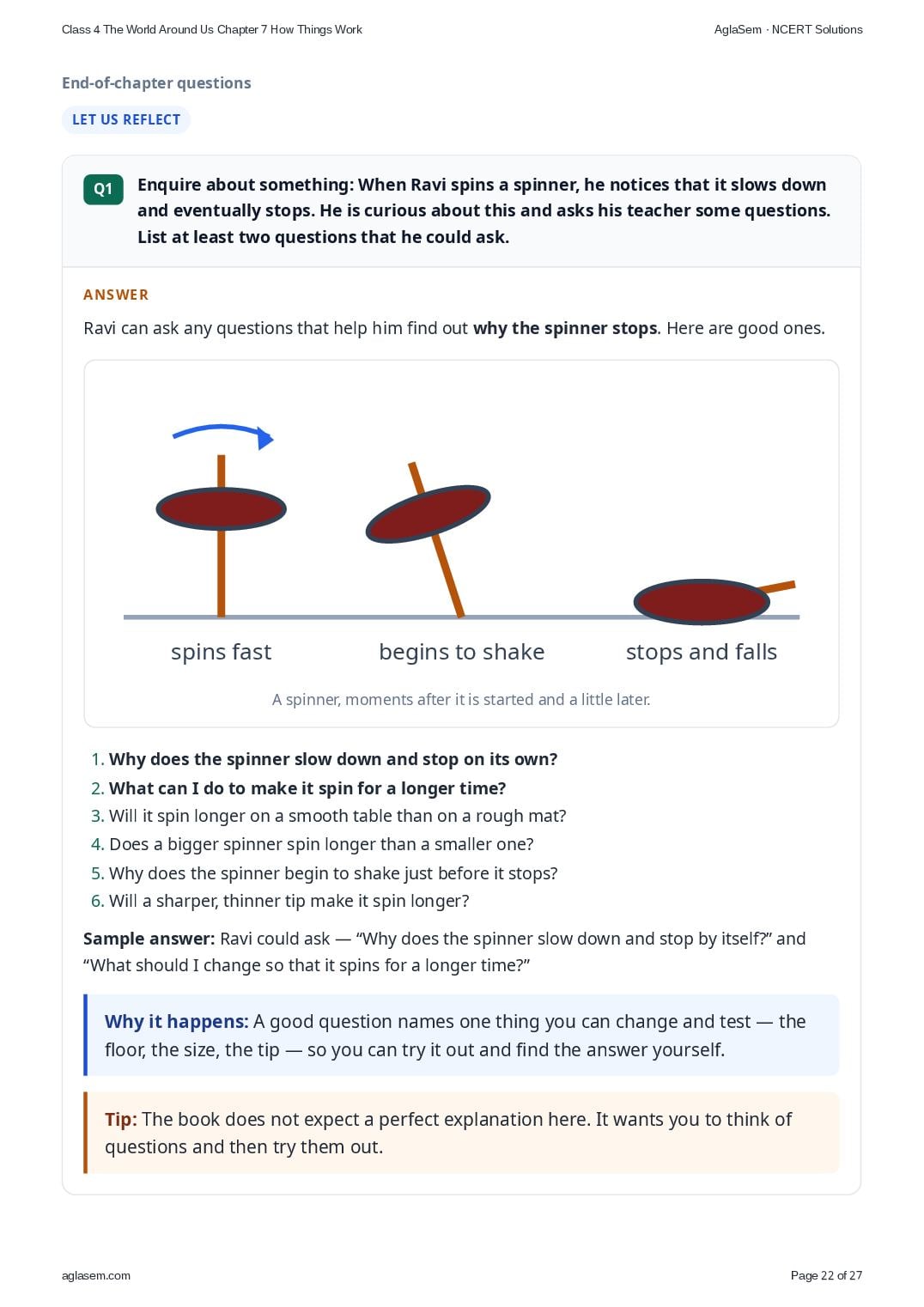
- Enquire about something: When Ravi spins a spinner, he notices that it slows down and eventually stops. He is curious about this and asks his teacher some questions. List at least two questions that he could ask.
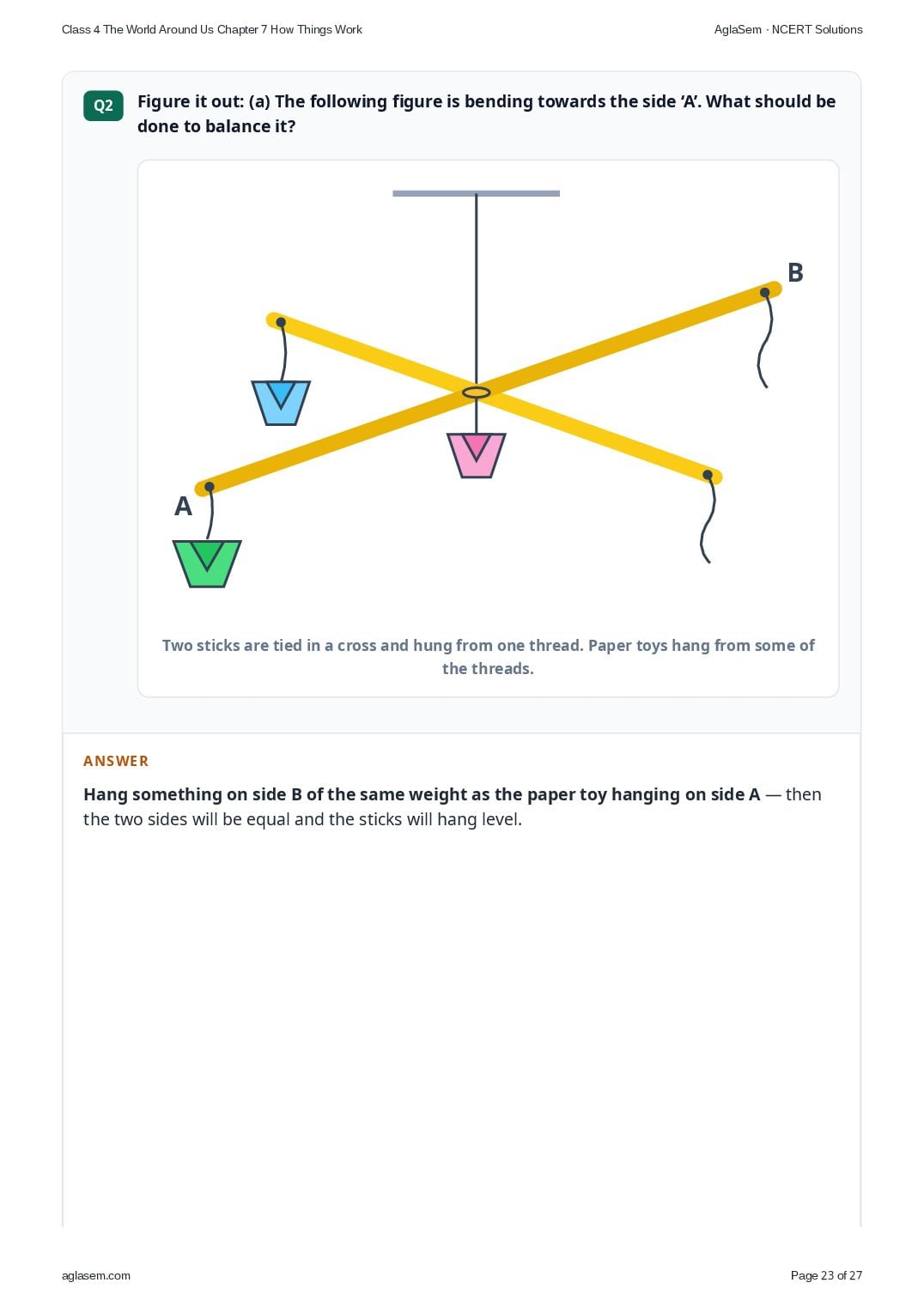
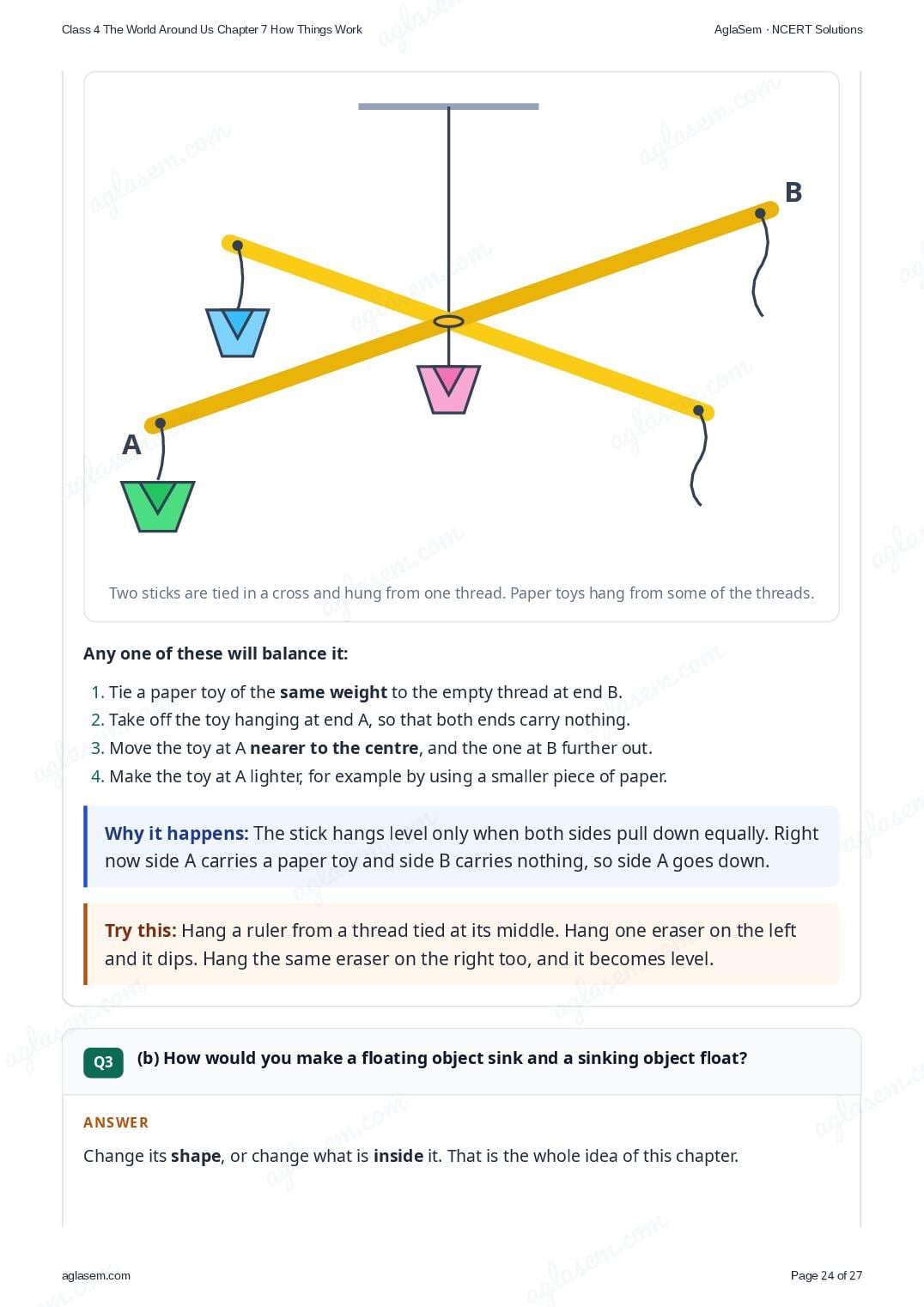
- Figure it out: (a) The following figure is bending towards the side ‘A’. What should be done to balance it? A B Two sticks are tied in a cross and hung from one thread. Paper toys hang from some of the threads.
- (b) How would you make a floating object sink and a sinking object float?
- Do an activity: Classify the objects below based on whether they float or sink in water. Wax, Marble, Thermocol, Candle, Coin, Cork, Leaf, Eraser, Spoon, Ice-cube, Potato, Tomato, Pumpkin, Lemon
Chapter at a Glance
- Some things spin well and some do not. A coin, a bangle and a wooden top spin; an eraser does not spin properly.
- A spinner spins best when the toothpick goes right through its centre. Then it looks the same from all sides and stays upright.
- A square spinner looks round while it is spinning, and many colours painted on a spinner mix into one colour.
- Some heavy things float and some light things sink. So floating cannot be decided by weight alone.
- Shape matters. Aluminium foil floats when it is spread out or shaped like a cup, but it sinks when it is pressed into a tight ball.
- Many things around us spin — ceiling fans, a potter’s wheel, the charkha and the lattu.
How to Download NCERT Solutions for Class 4 The World Around Us Chapter 7 PDF
Follow these simple steps to get the How Things Work questions-and-answers PDF from Our Wondrous World.
- Search NCERT Solutions for Class 4 The World Around Us Chapter 7 aglasem and open this page.
- Read the exercise questions with answers for How Things Work shown above.
- Click the Download PDF link to save the How Things Work solutions to your device.
NCERT Solutions for Class 4 The World Around Us – All Chapters
There are more chapters to study besides How Things Work in The World Around Us. Here are the NCERT Solutions for all chapters of Class 4 The World Around Us.
- Chapter 1 Living Together
- Chapter 2 Exploring Our Neighbourhood
- Chapter 3 Nature Trail
- Chapter 4 Growing Up with Nature
- Chapter 5 Food for Health
- Chapter 6 Happy and Healthy Living
- Chapter 7 How Things Work
- Chapter 8 How Things Are Made
- Chapter 9 Different Lands Different Lives
- Chapter 10 Our Sky
NCERT Solutions for Class 4 – All Subjects
Just like Chapter 7 of The World Around Us, you can get the exercise questions with answers for every other subject of Class 4. Here are the NCERT Solutions for all subjects of Class 4.
NCERT Solutions for Class 4 The World Around Us Chapter 7 – An Overview
The key highlights of this study material are as follows.
| Aspects | Details |
|---|---|
| Class | Class 4 |
| Subject | The World Around Us |
| Chapter Number | Chapter 7 |
| Chapter Name | How Things Work |
| Book Name | Our Wondrous World |
| Book By | NCERT (National Council of Educational Research and Training) |
| Educational Resource Here | NCERT Solutions of Class 4 The World Around Us Chapter 7 for all exercises |
| More Questions Answers of This Subject | NCERT Solutions for Class 4 The World Around Us |
| Download Book Chapter | NCERT Book Class 4 The World Around Us |
| All Questions Answers For This Class | NCERT Solutions for Class 4 |
| Complete Solutions | NCERT Solutions |
NCERT Solutions for Class 4 The World Around Us Chapter 7 How Things Work – FAQs
What are the NCERT Solutions for Class 4 The World Around Us Chapter 7 How Things Work?
They are the complete, step-by-step answers to all the exercise and in-text questions of Chapter 7 How Things Work from the NCERT Class 4 The World Around Us textbook Our Wondrous World, written by experts as per the latest NCERT syllabus.
How can I download the Class 4 The World Around Us Chapter 7 solutions PDF for free?
Open this page on aglasem, read the How Things Work questions with answers, and click the “Download Solutions PDF” link. The Class 4 The World Around Us Chapter 7 NCERT Solutions PDF is completely free to download.
Are these NCERT Solutions as per the latest 2026-27 syllabus?
Yes. The NCERT Solutions for Class 4 The World Around Us Chapter 7 are based on the latest NCERT textbook Our Wondrous World and the current 2026-27 CBSE syllabus, so the questions and answers match what you study in class.
Where can I get NCERT Solutions for the other chapters of Class 4 The World Around Us?
You can find the answers to every chapter on the NCERT Solutions for Class 4 The World Around Us page, and solutions for every subject on the NCERT Solutions for Class 4 page.
How do NCERT Solutions help in exam preparation?
They show the correct method to solve each question, help you write answers the way they are expected in exams, let you check and correct your own work, and save revision time — which together improve your marks in Class 4 The World Around Us.
If you have any queries on NCERT Solutions for Class 4 The World Around Us Chapter 7 How Things Work, then please ask in the comments below.