NCERT Solutions for Class 5 The World Around Us Chapter 1 Water the Essence of Life provide clear, step-by-step answers to every exercise and in-text question from the chapter Water the Essence of Life of the NCERT textbook Our Wondrous World. Prepared by subject experts as per the latest NCERT (CBSE) syllabus for 2026-27, these NCERT Solutions for Class 5 The World Around Us help you understand each concept, write exam-ready answers, and check your own solutions. You can read them online below or download the free Class 5 The World Around Us Chapter 1 question-answer PDF.
NCERT Solutions for Class 5 The World Around Us Chapter 1 Water the Essence of Life
- Class: Class 5
- Subject: The World Around Us
- Chapter: Chapter 1 – Water the Essence of Life
- Textbook: Our Wondrous World (NCERT)
- Study material: NCERT Solutions – questions with answers, free PDF
These solutions answer all the exercise questions of Chapter 1 Water the Essence of Life — including the in-text questions, short-answer and long-answer questions, and activities — with complete explanations so you can follow the method, not just the final answer. Read the full solutions below.
NCERT Solutions Class 5 The World Around Us Chapter 1 Water the Essence of Life View Download
NCERT Solutions for Class 5 The World Around Us Chapter 1 PDF Download
You can read the NCERT Solutions for Class 5 The World Around Us Chapter 1 online above, or download the complete question-answer PDF to study Water the Essence of Life offline at any time.
NCERT Solutions for Class 5 The World Around Us Chapter 1 PDF Download Link – Click Here to Download Solutions PDF
Questions Covered in This Chapter
These NCERT Solutions answer all 38 questions of this chapter. The questions solved are:
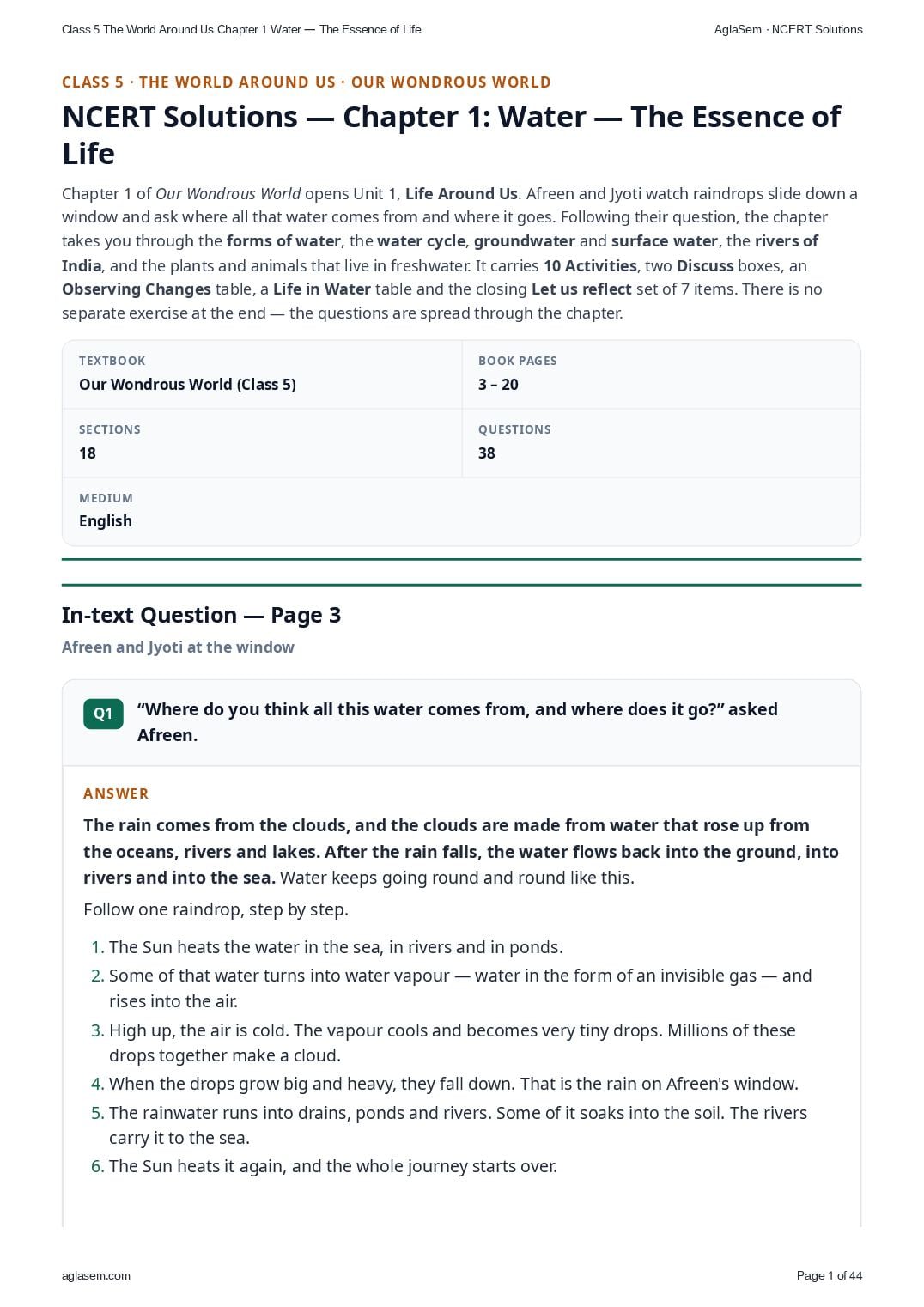
- “Where do you think all this water comes from, and where does it go?” asked Afreen.
- Do you think we can drink the water present in the oceans?
- What can ocean water be used for?
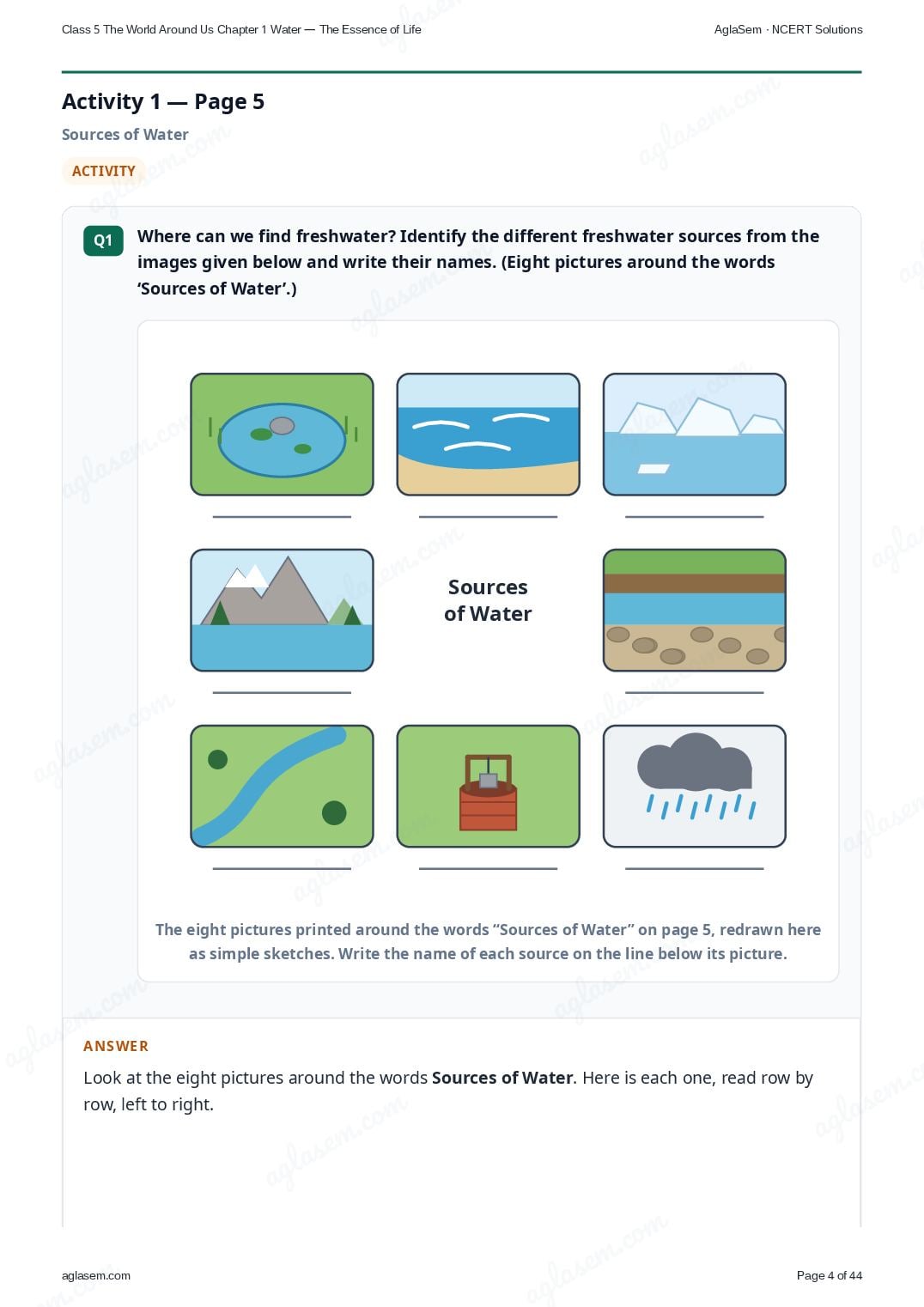
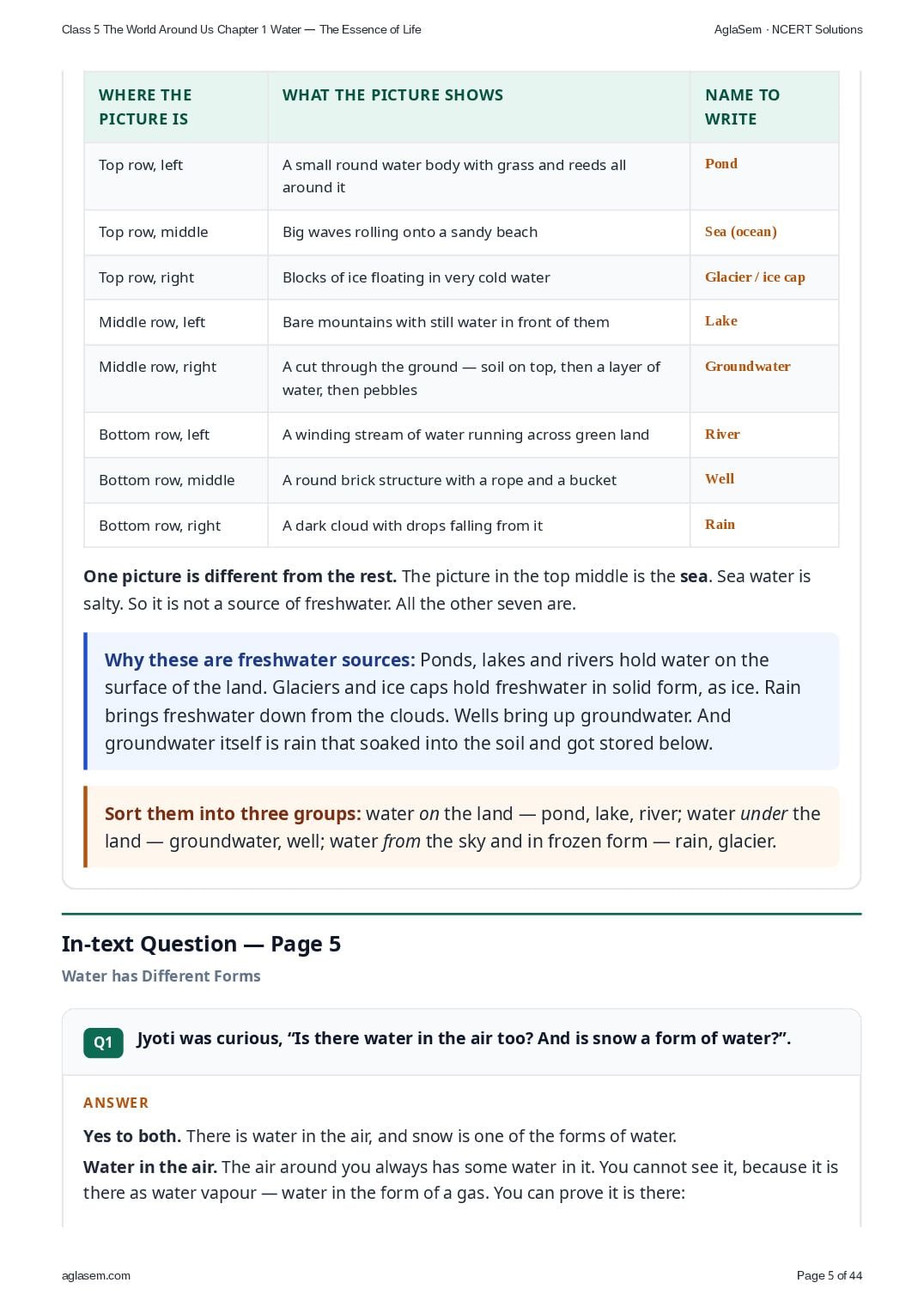
- Where can we find freshwater? Identify the different freshwater sources from the images given below and write their names. (Eight pictures around the words ‘Sources of Water’.)Sourcesof WaterThe eight pictures printed around the words “Sources of Water” on page 5, redrawn here as simple sketches. Write the name of each source on the line below its picture.
- Jyoti was curious, “Is there water in the air too? And is snow a form of water?”.
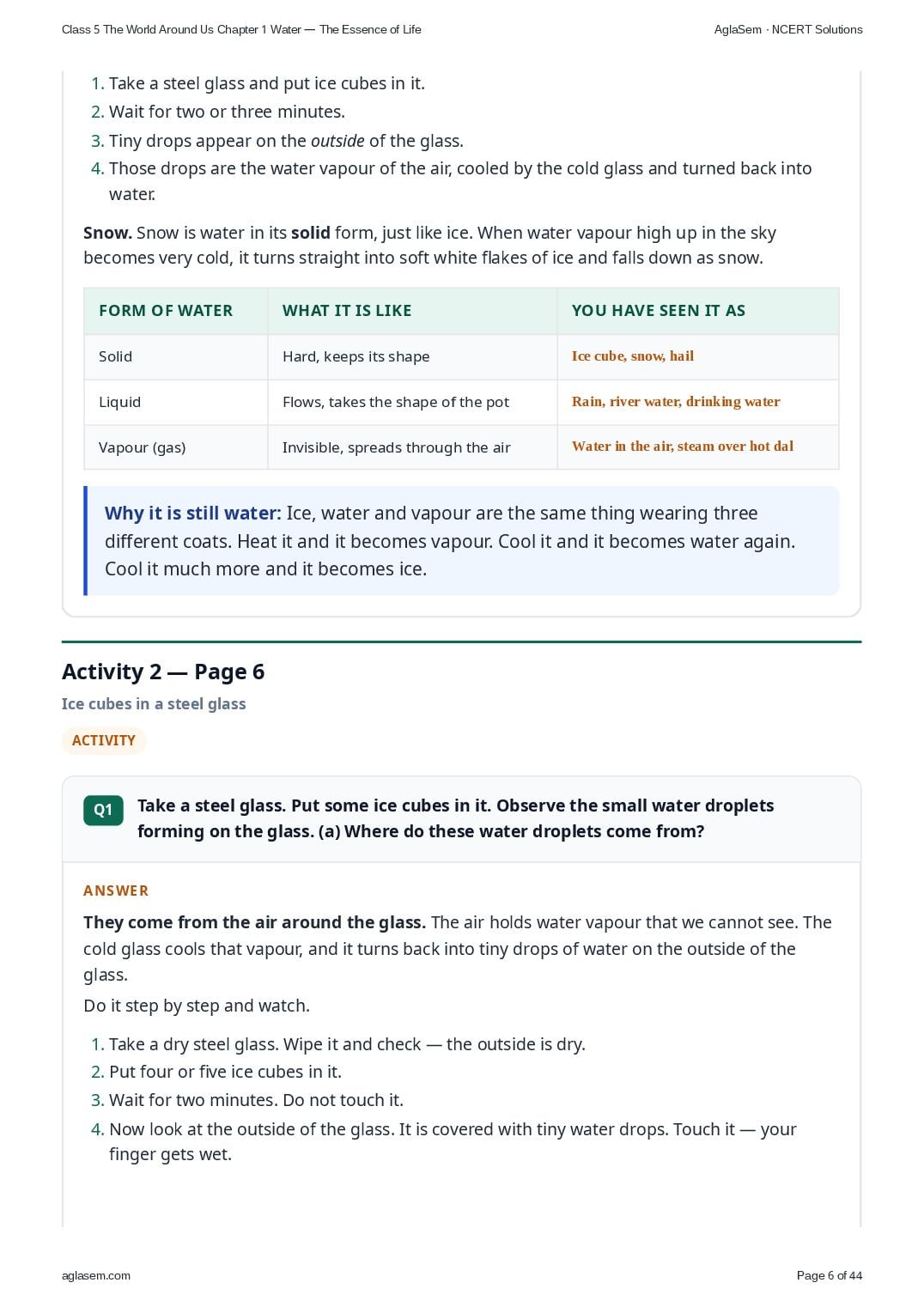
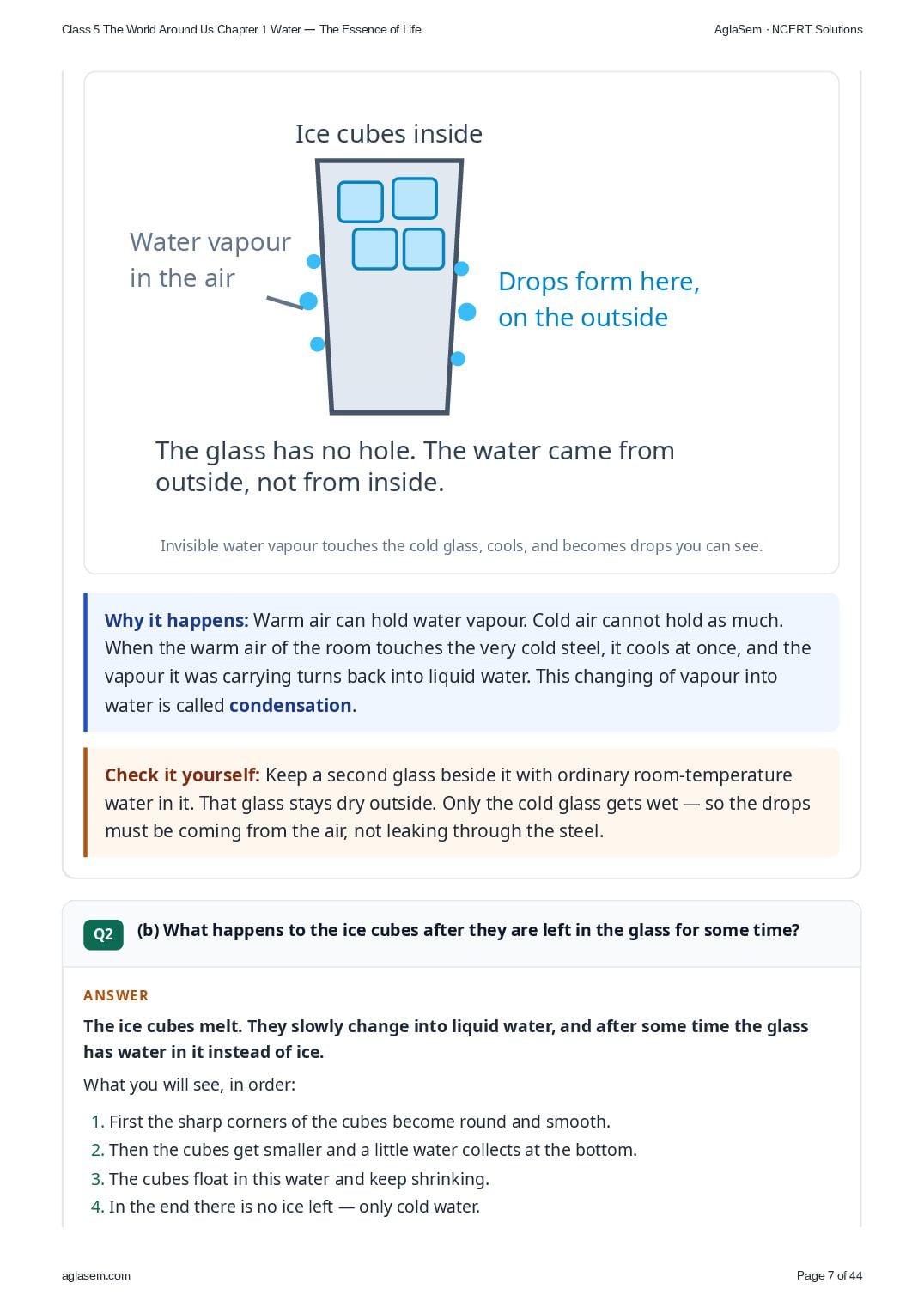
- Take a steel glass. Put some ice cubes in it. Observe the small water droplets forming on the glass. (a) Where do these water droplets come from?
- (b) What happens to the ice cubes after they are left in the glass for some time?
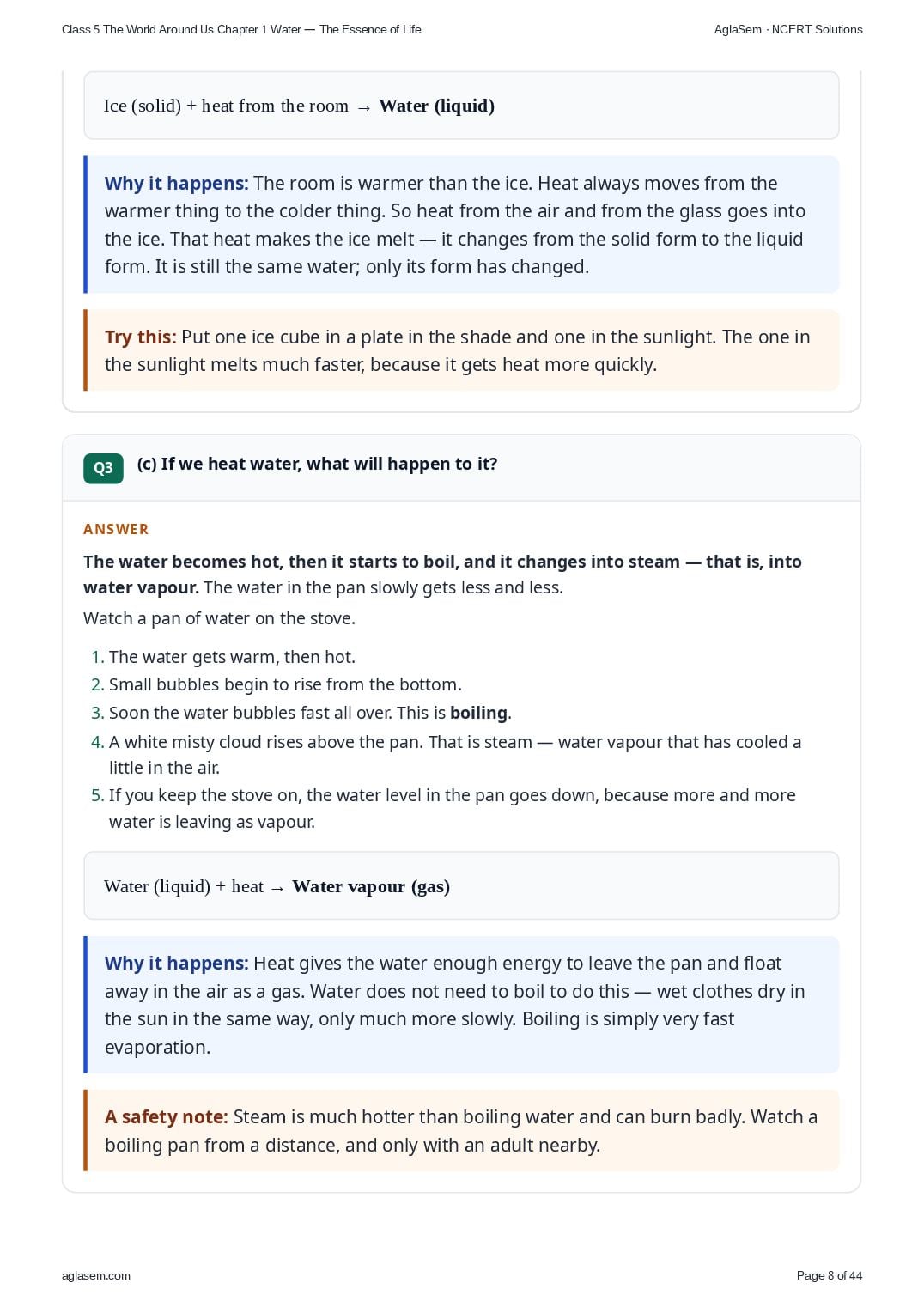
- (c) If we heat water, what will happen to it?
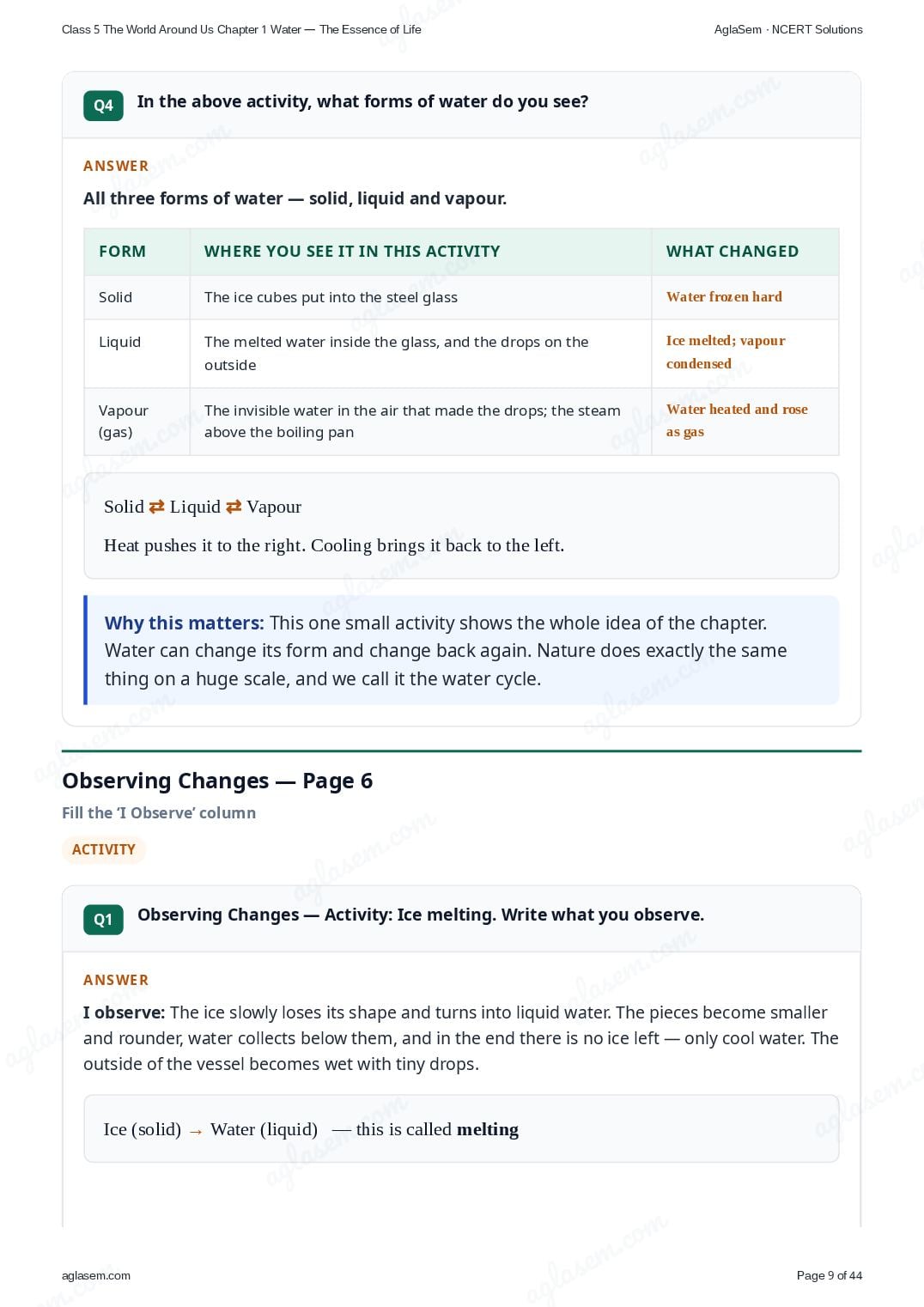
- In the above activity, what forms of water do you see?
- Observing Changes — Activity: Ice melting. Write what you observe.
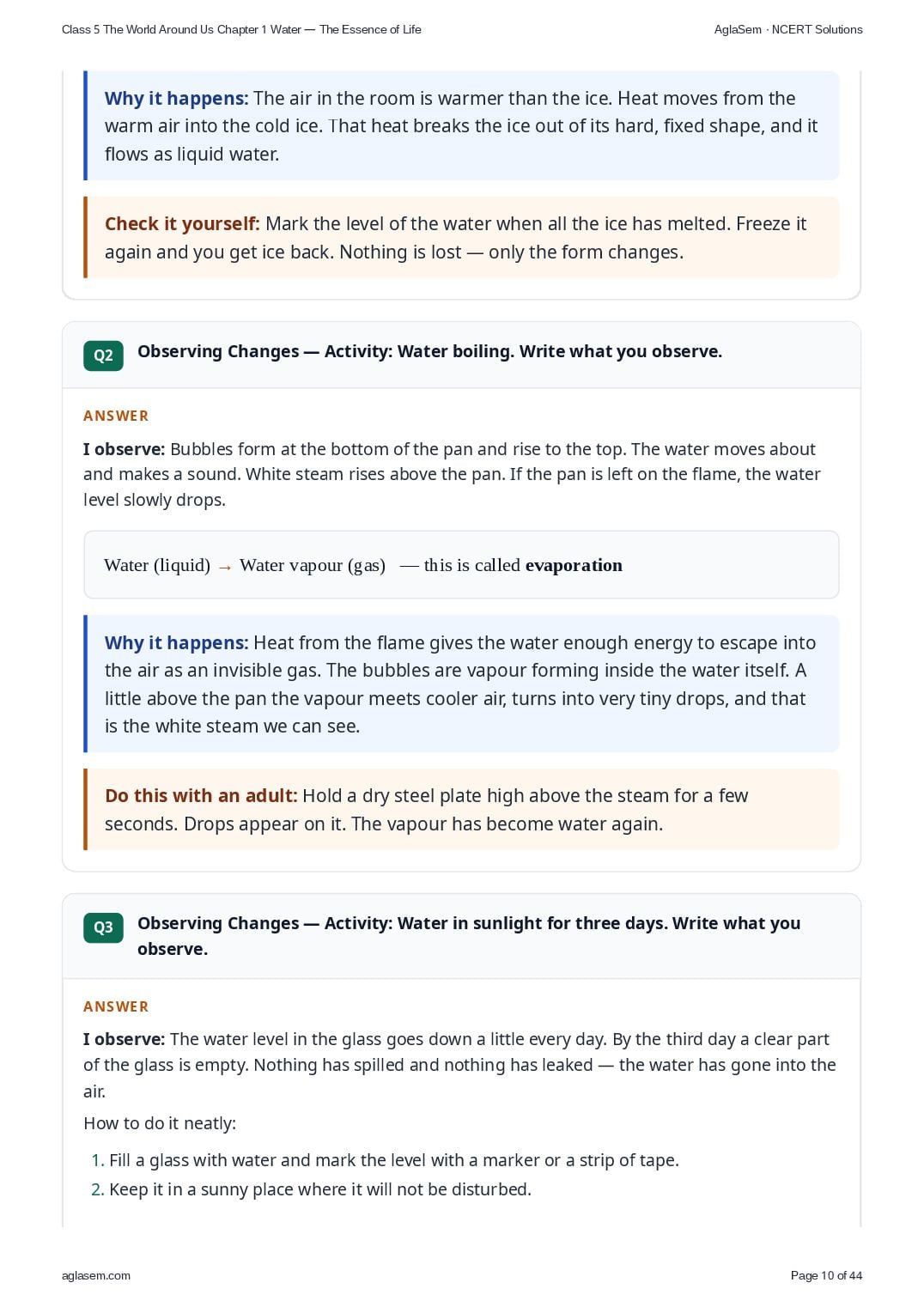
- Observing Changes — Activity: Water boiling. Write what you observe.
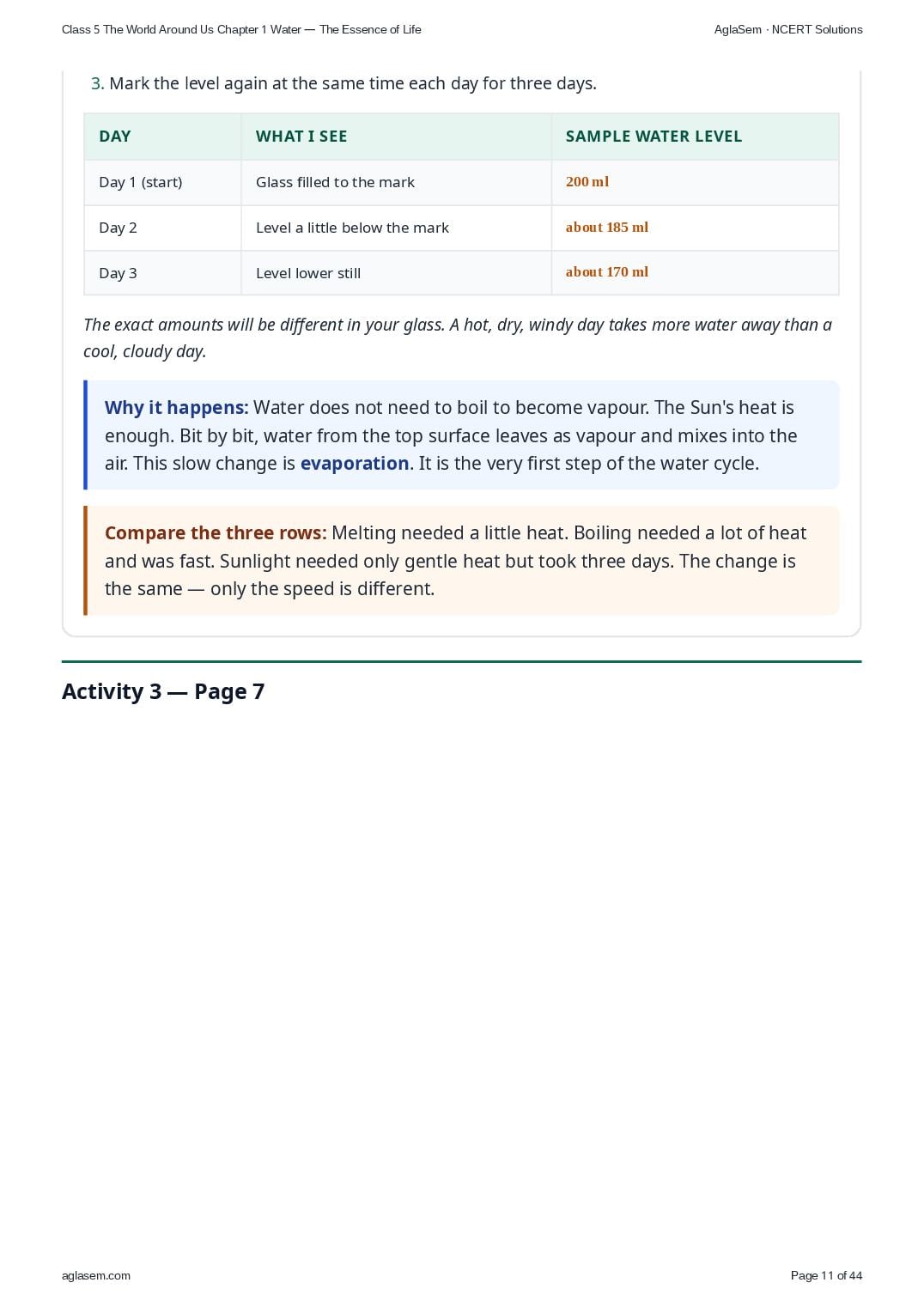
- Observing Changes — Activity: Water in sunlight for three days. Write what you observe.
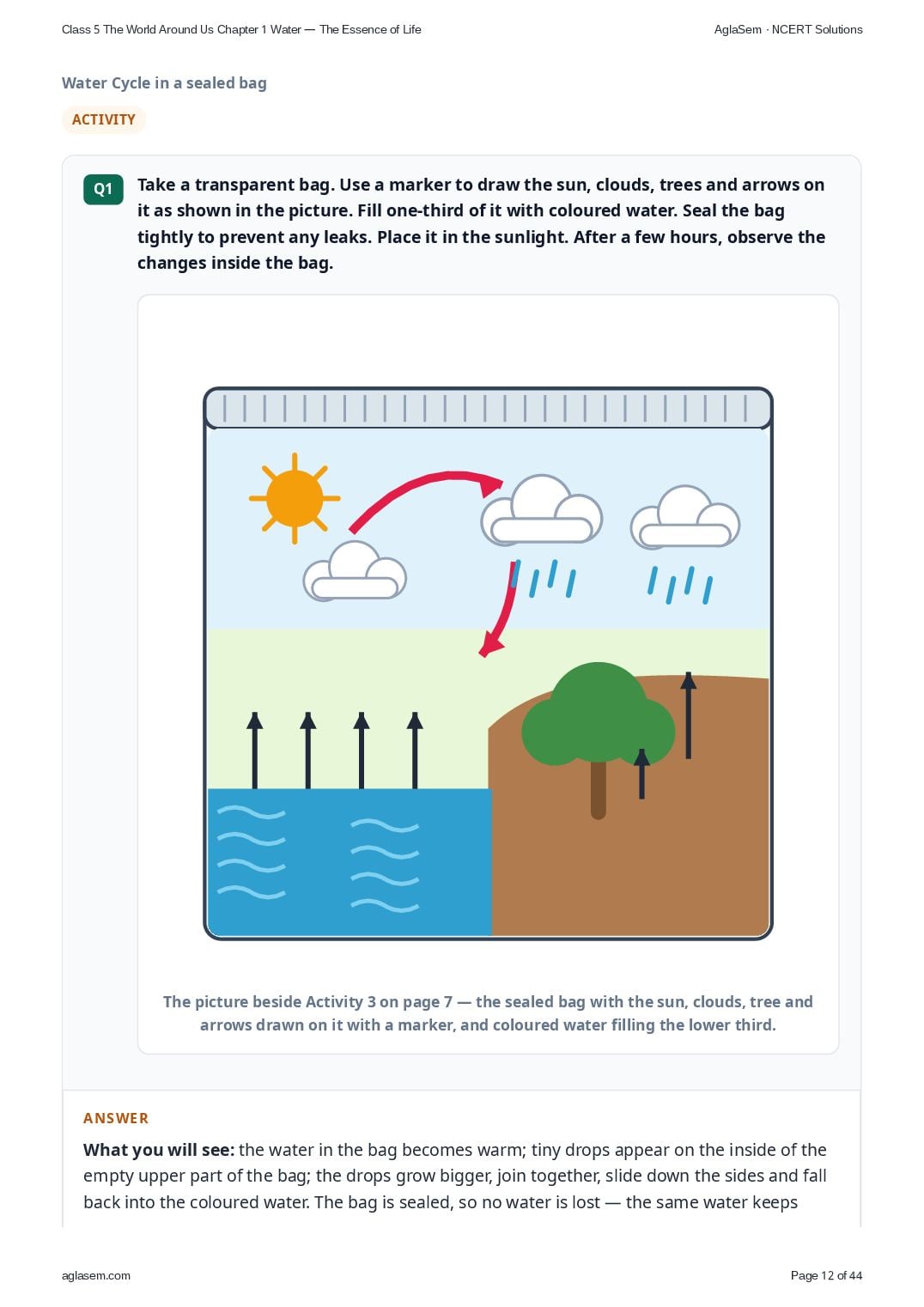
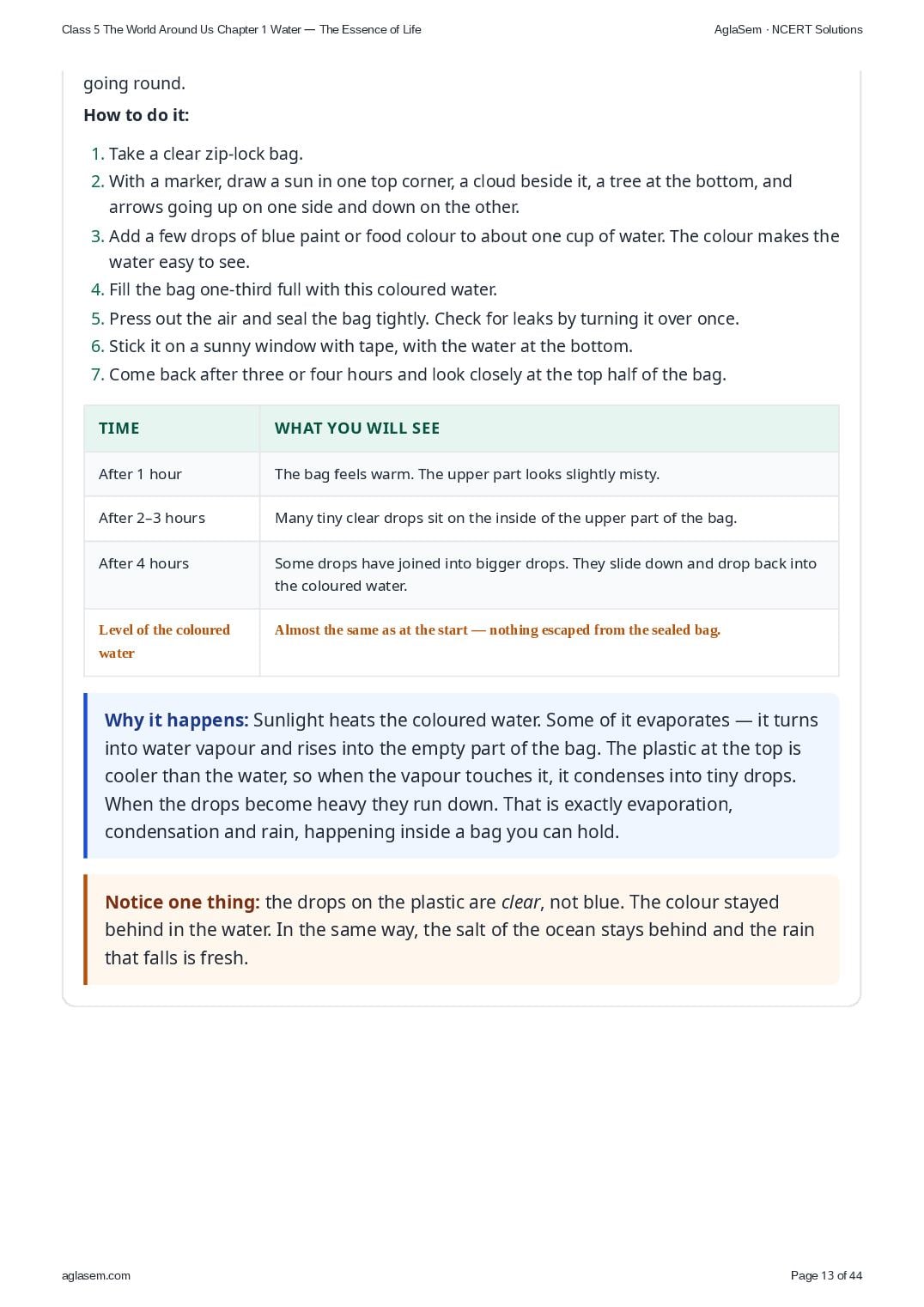
- Take a transparent bag. Use a marker to draw the sun, clouds, trees and arrows on it as shown in the picture. Fill one-third of it with coloured water. Seal the bag tightly to prevent any leaks. Place it in the sunlight. After a few hours, observe the changes inside the bag.The picture beside Activity 3 on page 7 — the sealed bag with the sun, clouds, tree and arrows drawn on it with a marker, and coloured water filling the lower third.
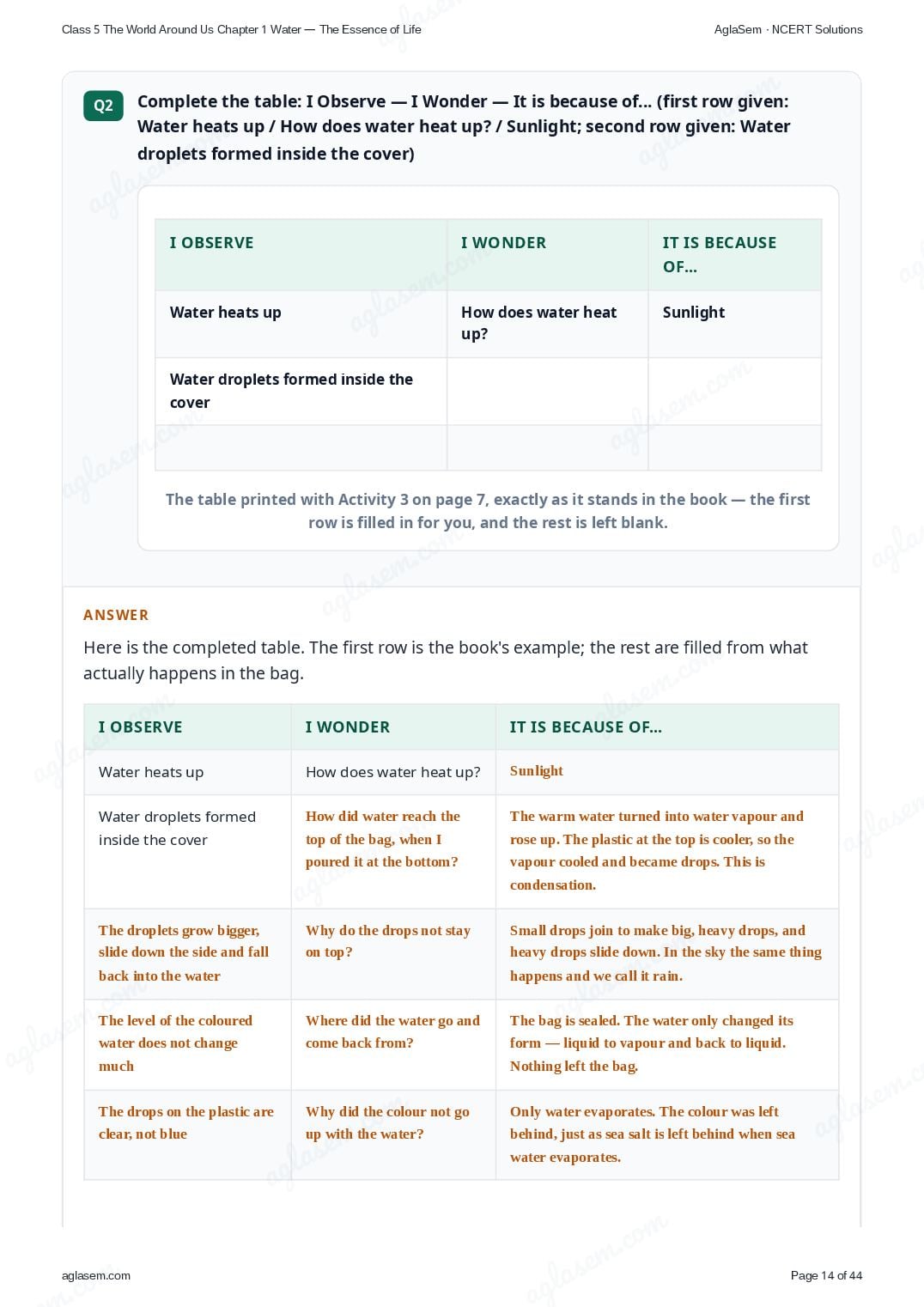
- Complete the table: I Observe — I Wonder — It is because of… (first row given: Water heats up / How does water heat up? / Sunlight; second row given: Water droplets formed inside the cover)I ObserveI WonderIt is because of…Water heats upHow does water heat up?SunlightWater droplets formed inside the cover The table printed with Activity 3 on page 7, exactly as it stands in the book — the first row is filled in for you, and the rest is left blank.
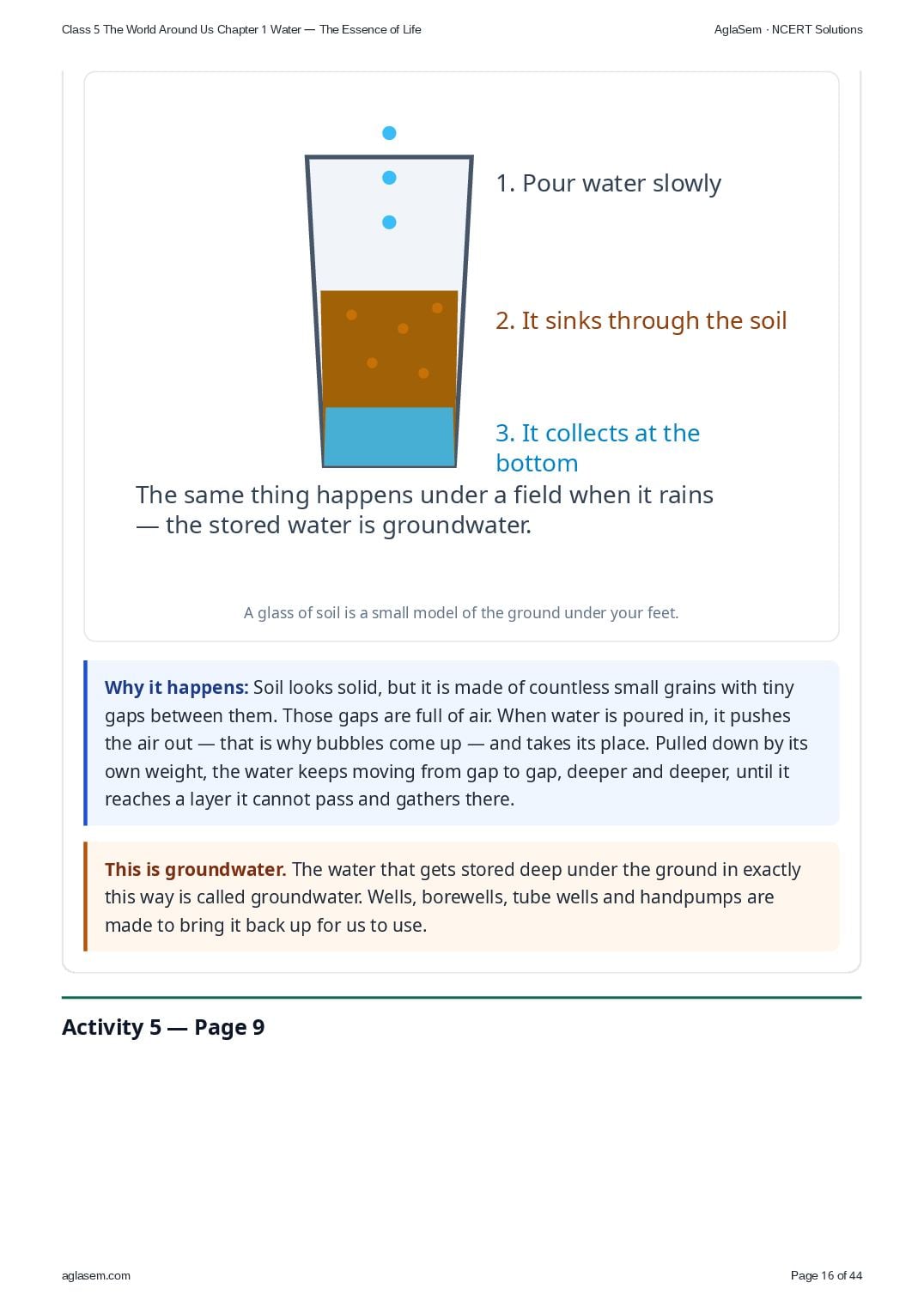
- Take a transparent glass. Fill half of it with soil. Slowly pour water into the soil using a spoon. Observe what happens.
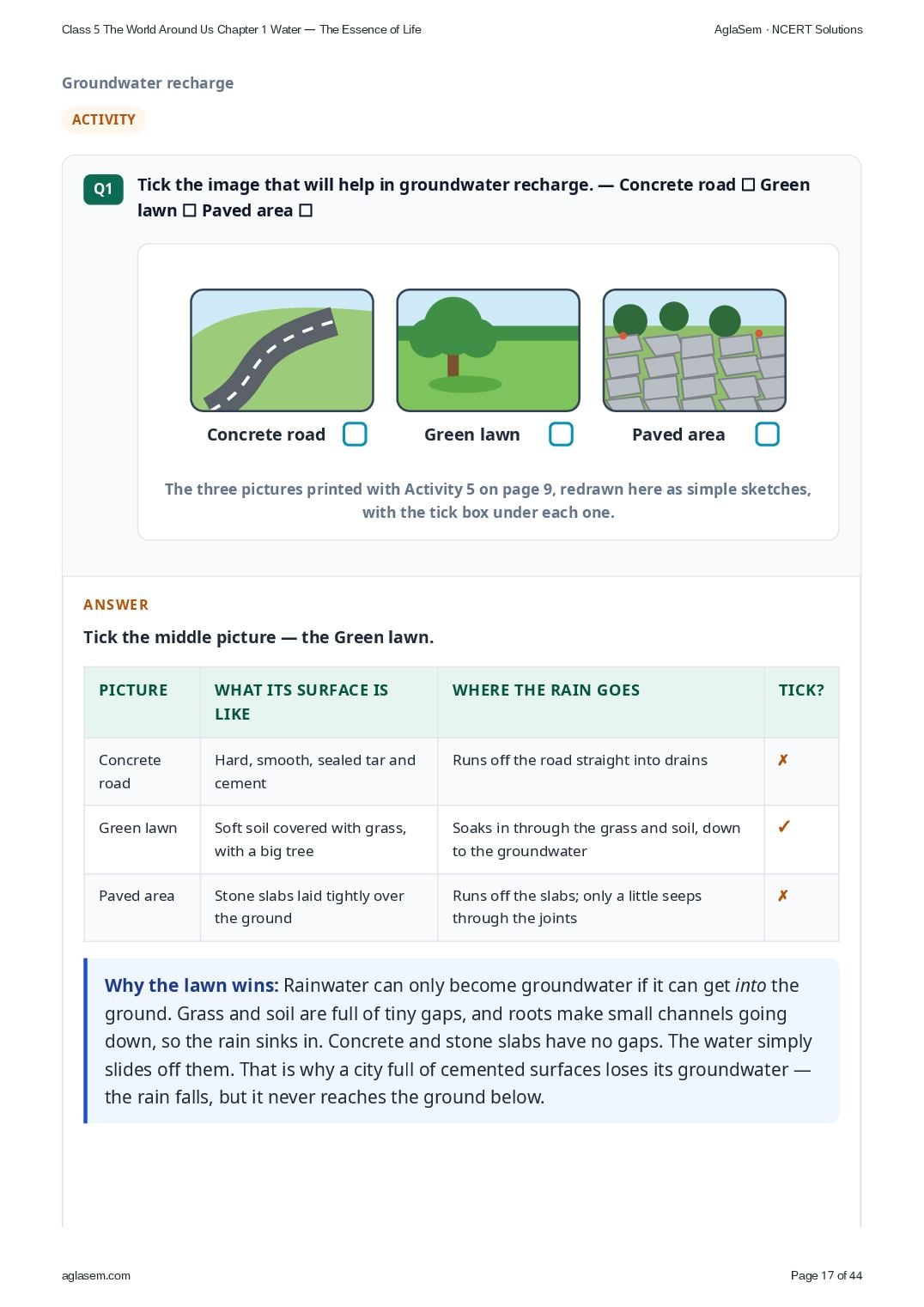
- Tick the image that will help in groundwater recharge. — Concrete road ☐ Green lawn ☐ Paved area ☐Concrete roadGreen lawnPaved areaThe three pictures printed with Activity 5 on page 9, redrawn here as simple sketches, with the tick box under each one.
- Do you ever wonder how river flows?
- What did you observe about the mustard seeds?
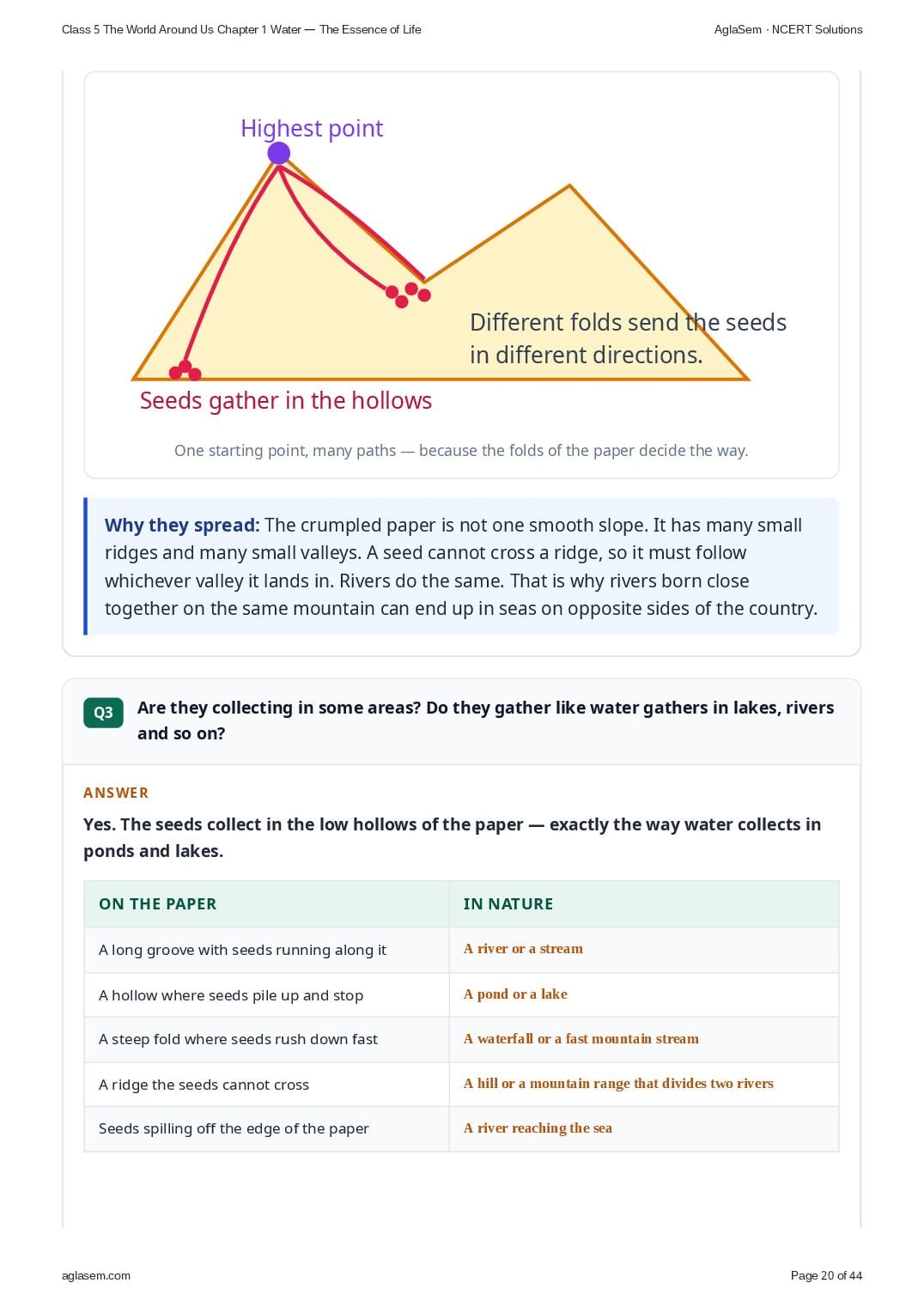
- Are they moving in a straight line, or do they spread out in different directions?
- Are they collecting in some areas? Do they gather like water gathers in lakes, rivers and so on?
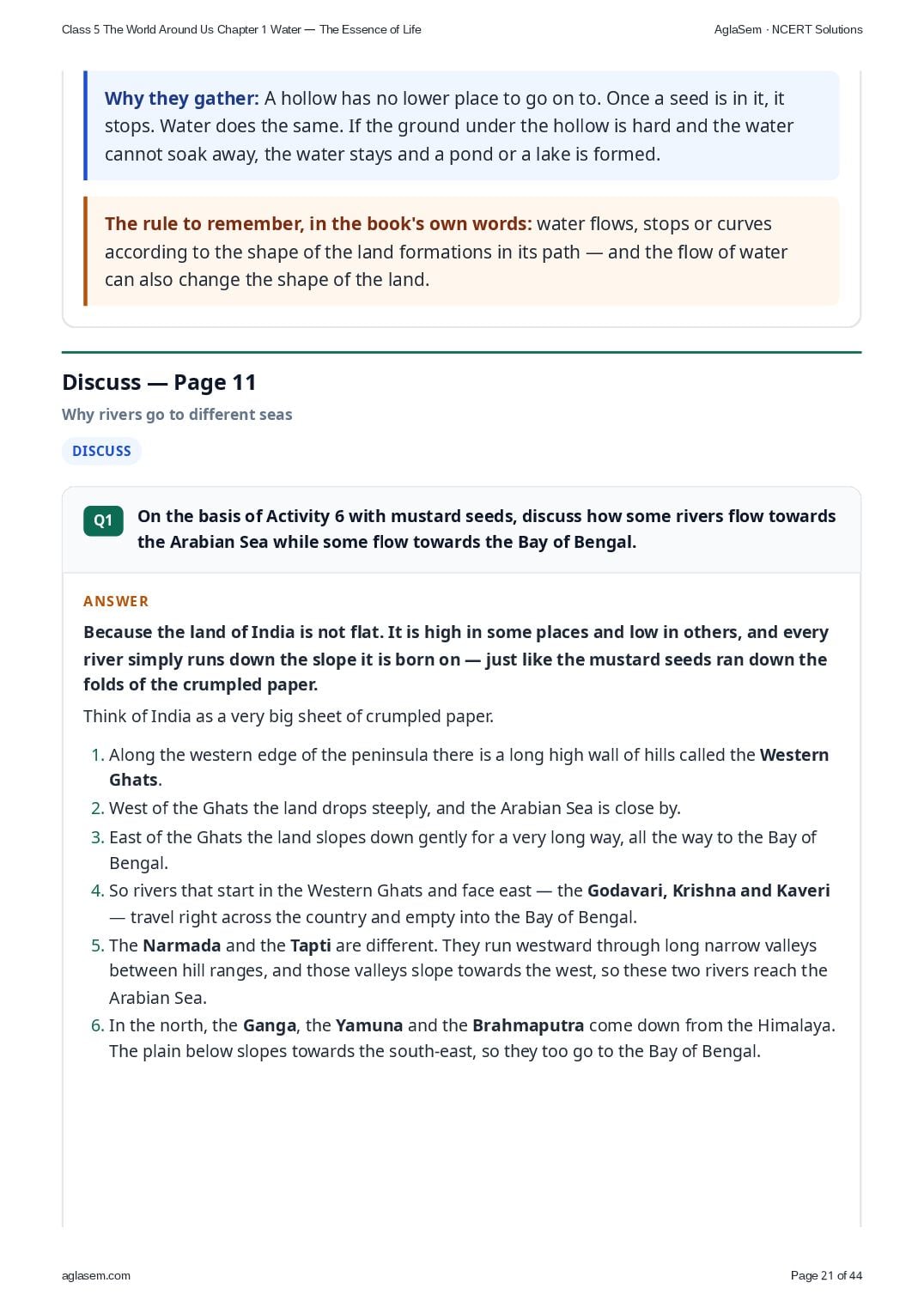
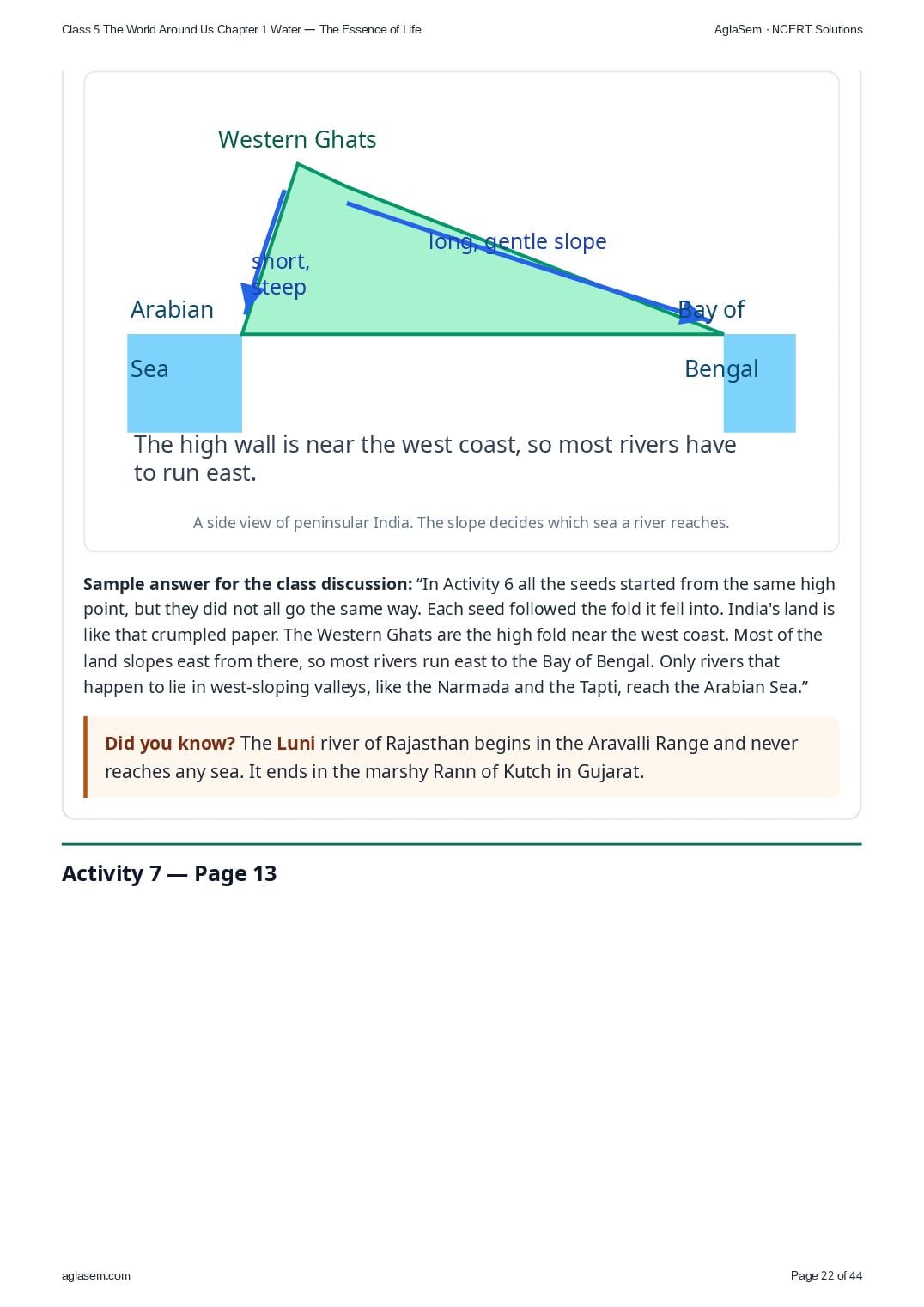
- On the basis of Activity 6 with mustard seeds, discuss how some rivers flow towards the Arabian Sea while some flow towards the Bay of Bengal.
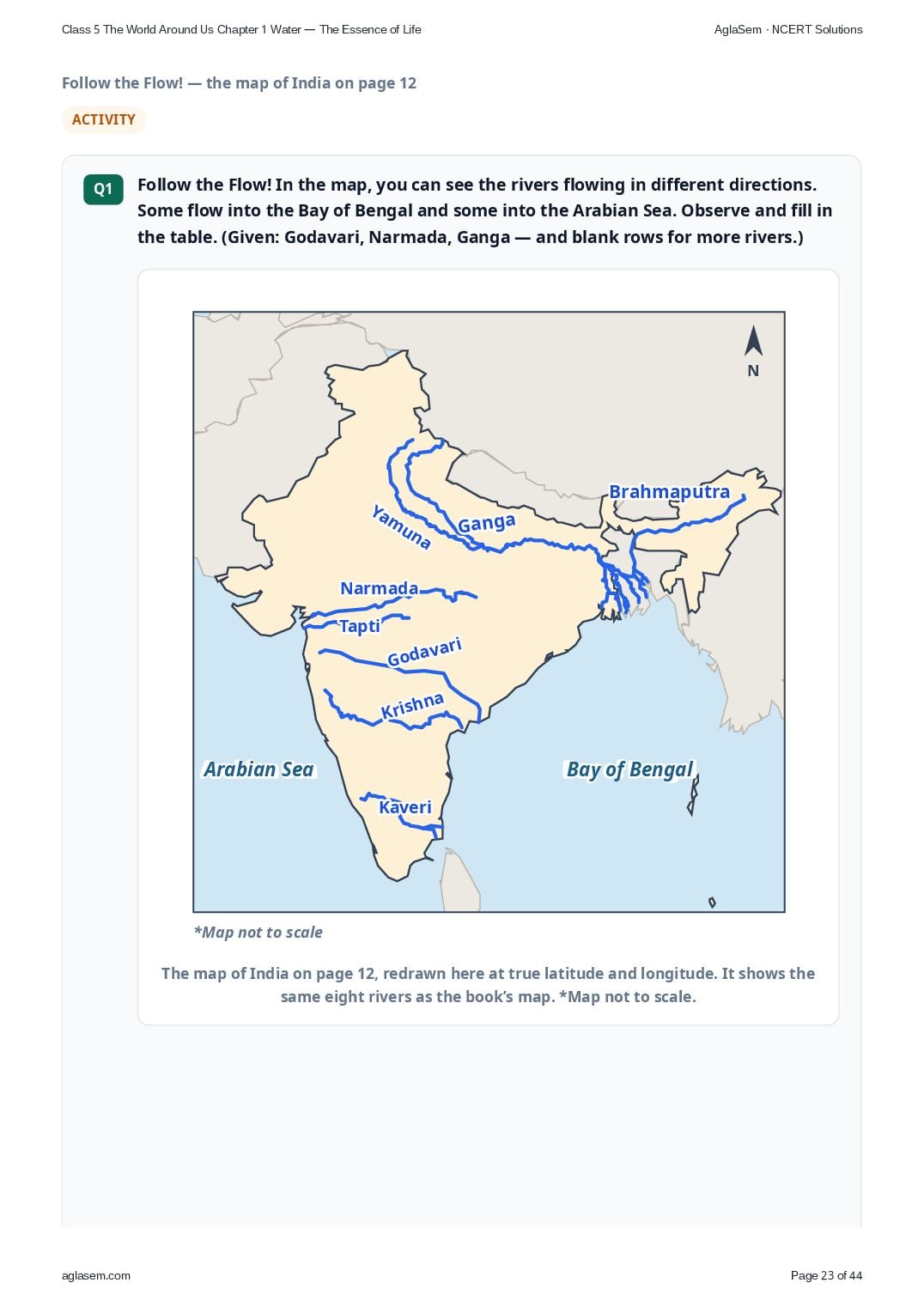
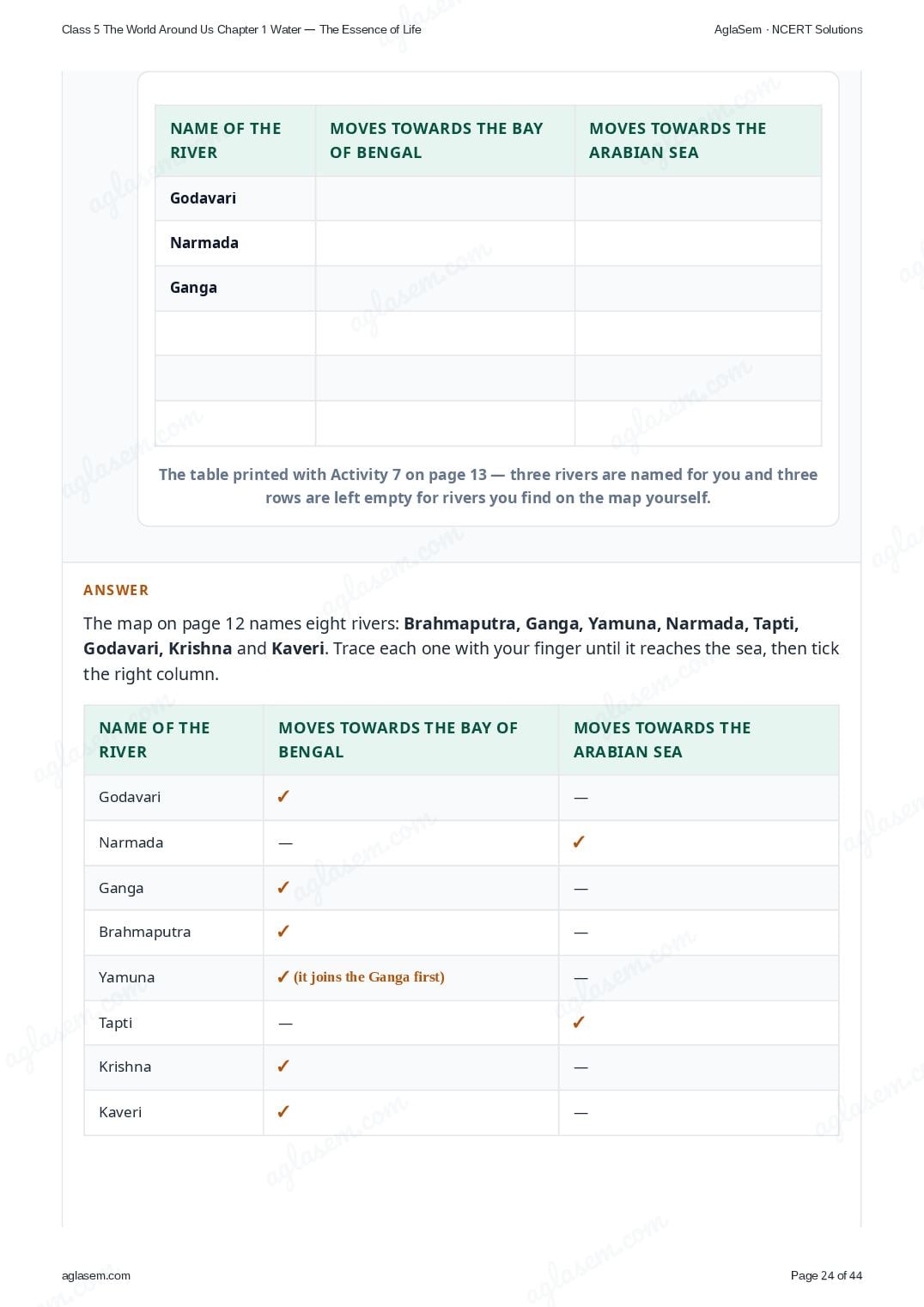
- Follow the Flow! In the map, you can see the rivers flowing in different directions. Some flow into the Bay of Bengal and some into the Arabian Sea. Observe and fill in the table. (Given: Godavari, Narmada, Ganga — and blank rows for more rivers.)BrahmaputraGangaYamunaNarmadaTaptiGodavariKrishnaKaveriArabian SeaBay of BengalBrahmaputraGangaYamunaNarmadaTaptiGodavariKrishnaKaveriArabian SeaBay of BengalN*Map not to scaleThe map of India on page 12, redrawn here at true latitude and longitude. It shows the same eight rivers as the book’s map. *Map not to scale.Name of the RiverMoves towards the Bay of BengalMoves towards the Arabian SeaGodavari Narmada Ganga The table printed with Activity 7 on page 13 — three rivers are named for you and three rows are left empty for rivers you find on the map yourself.
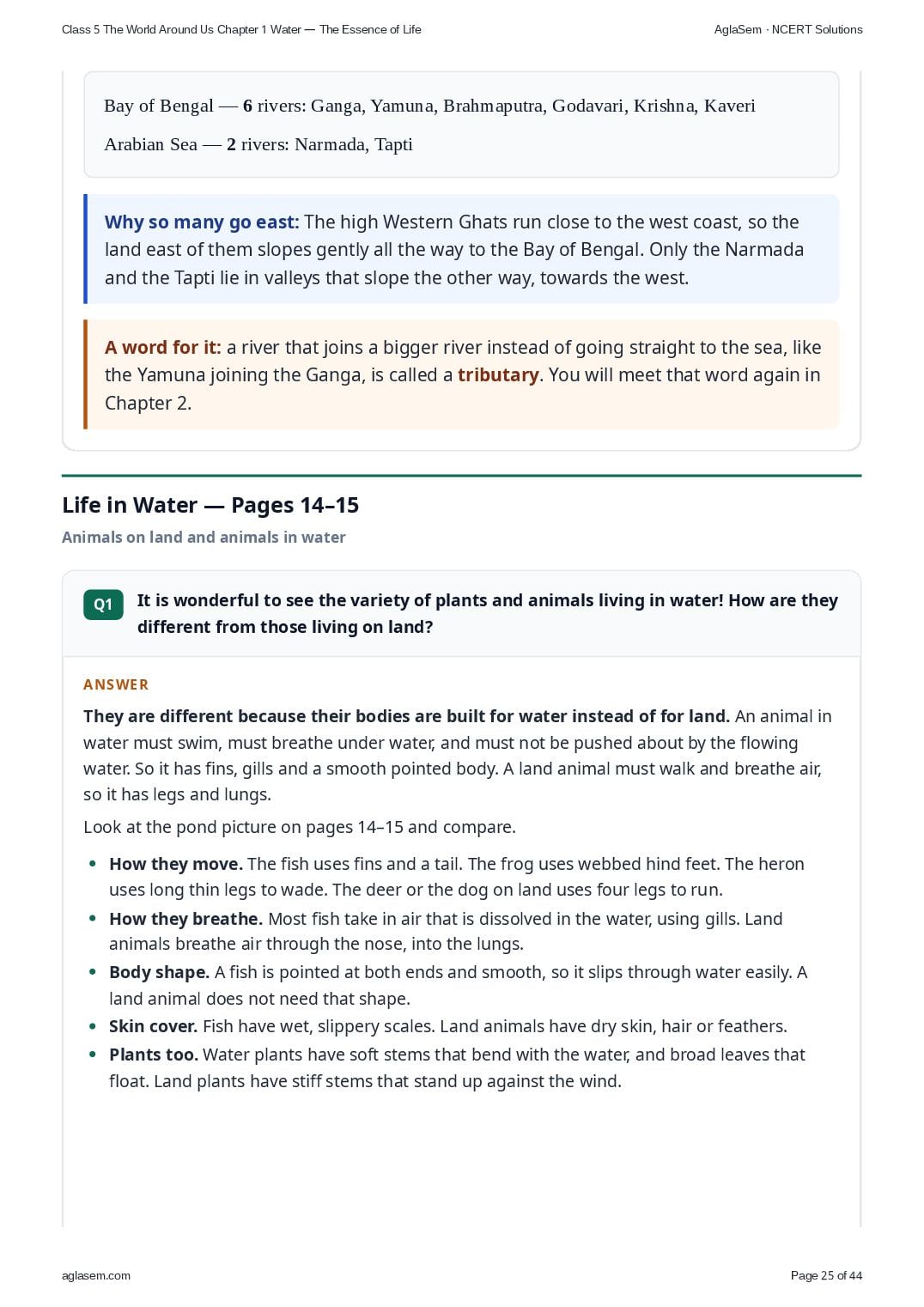
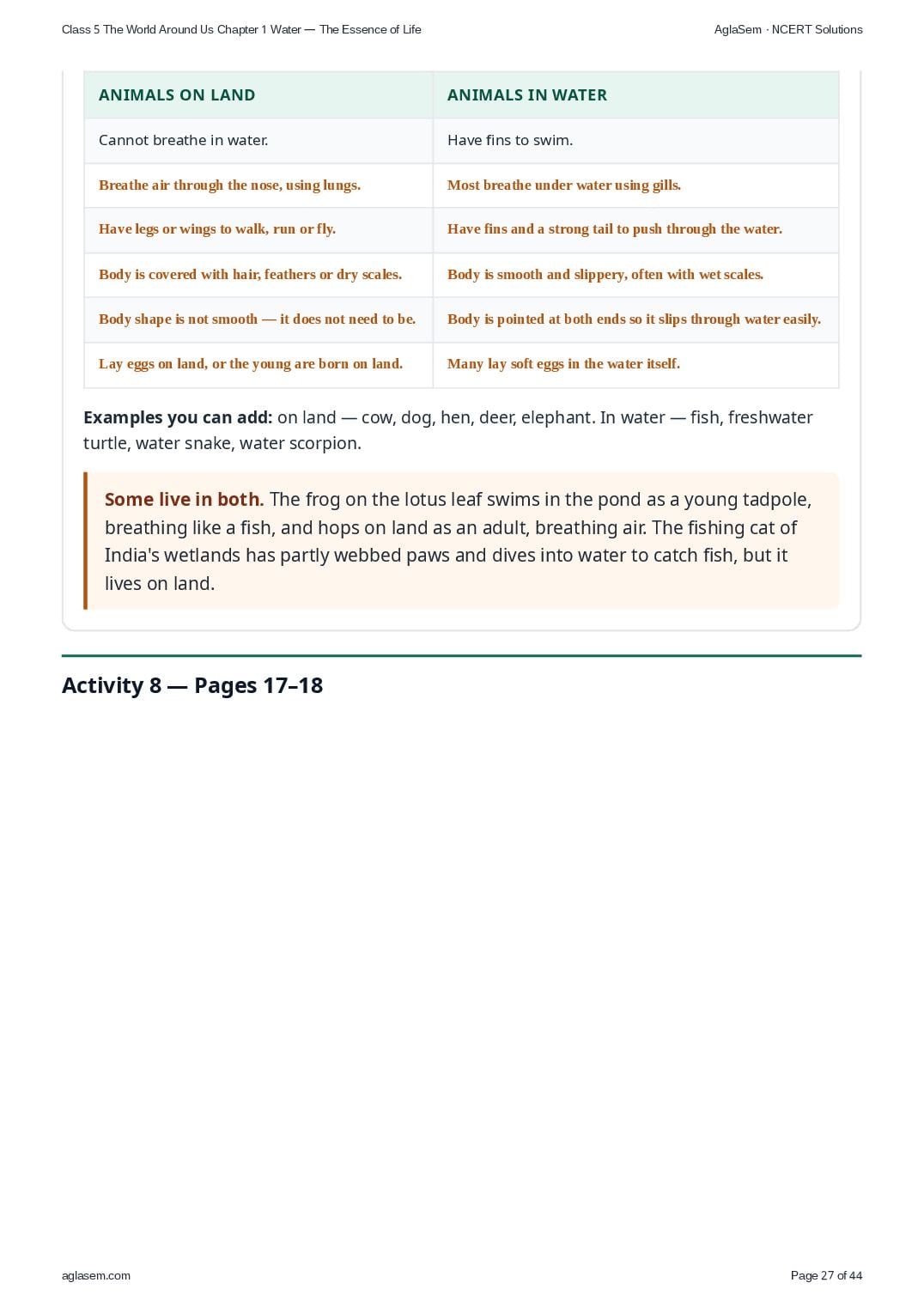
- It is wonderful to see the variety of plants and animals living in water! How are they different from those living on land?
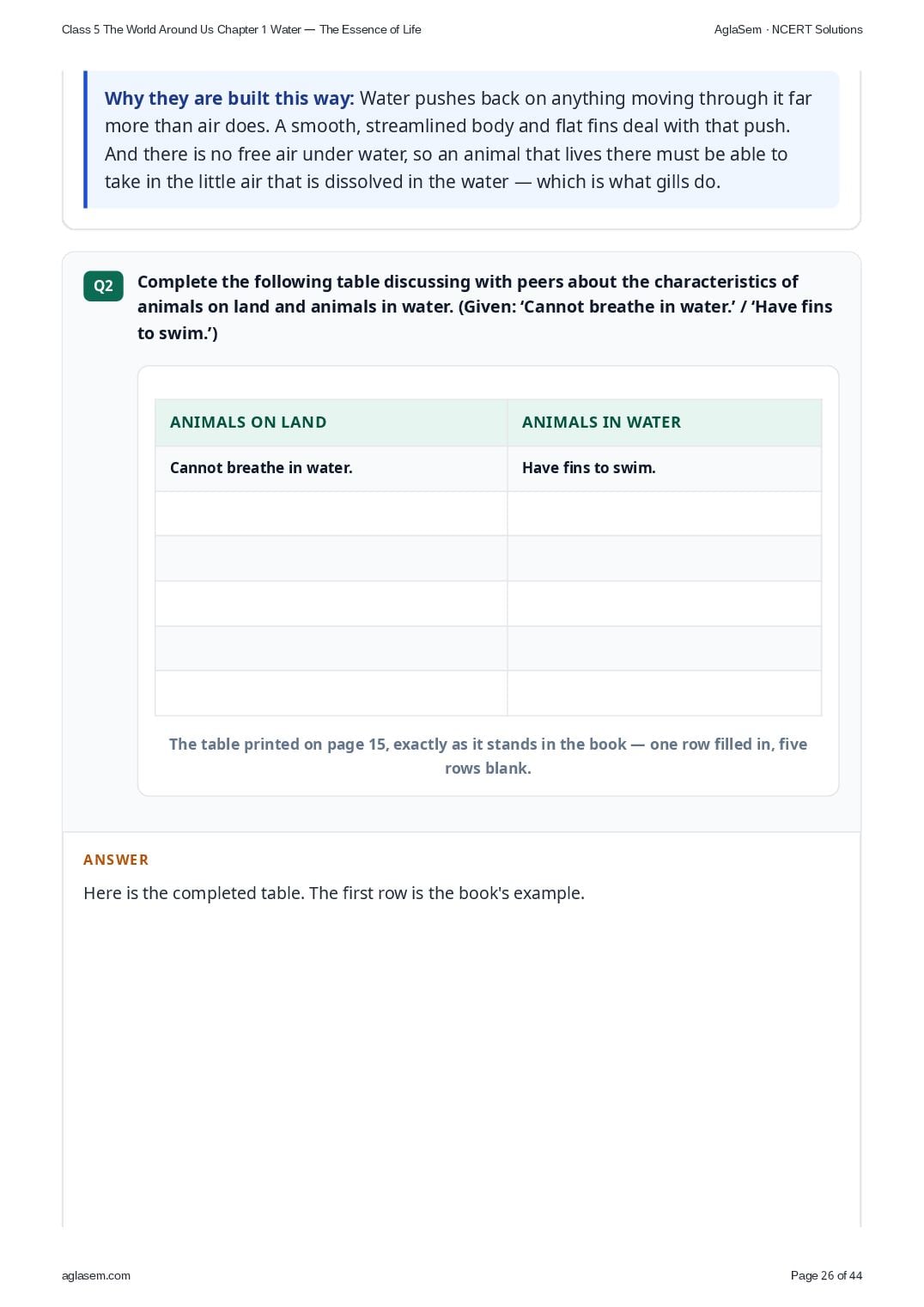
- Complete the following table discussing with peers about the characteristics of animals on land and animals in water. (Given: ‘Cannot breathe in water.’ / ‘Have fins to swim.’)Animals on LandAnimals in WaterCannot breathe in water.Have fins to swim. The table printed on page 15, exactly as it stands in the book — one row filled in, five rows blank.
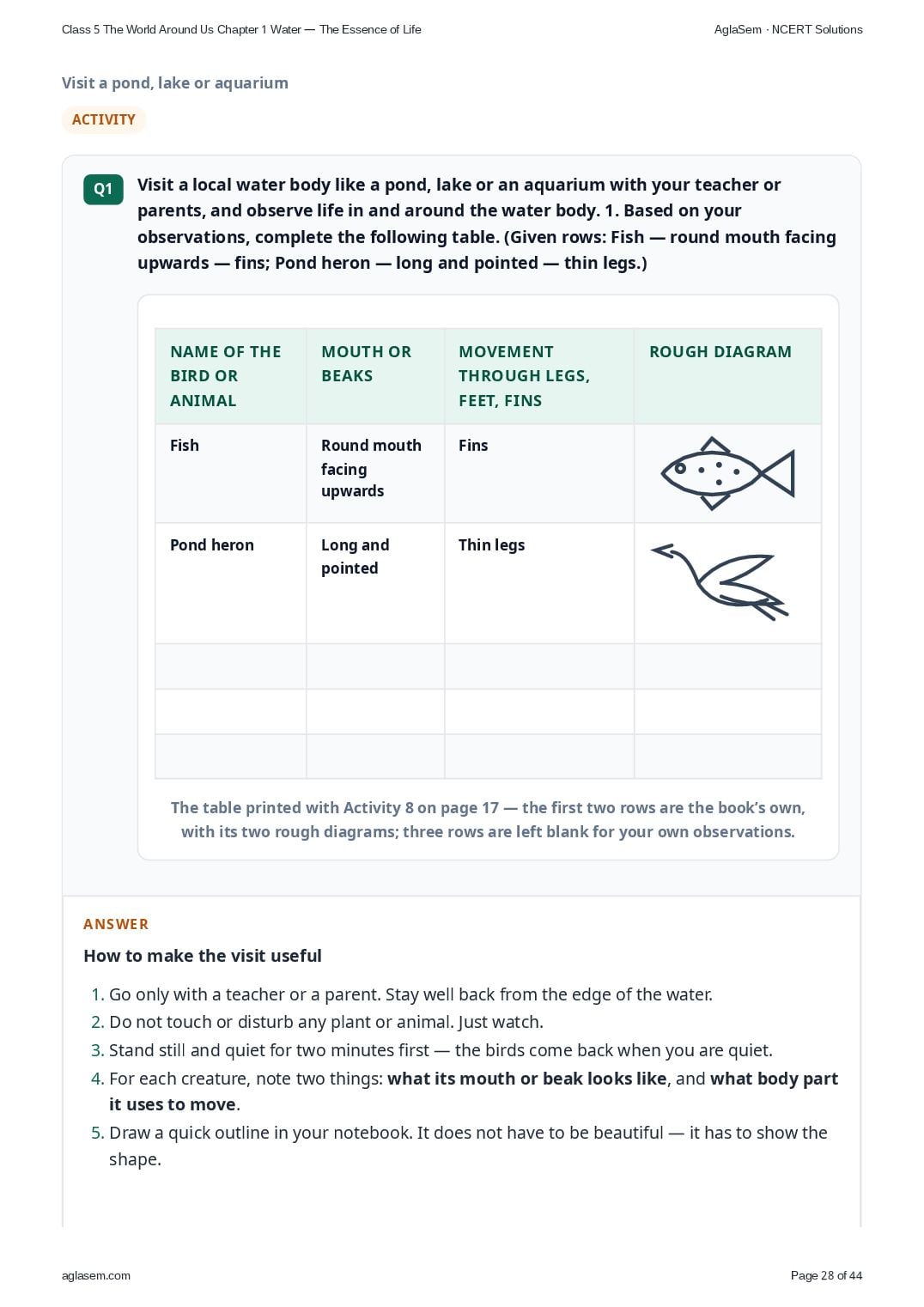
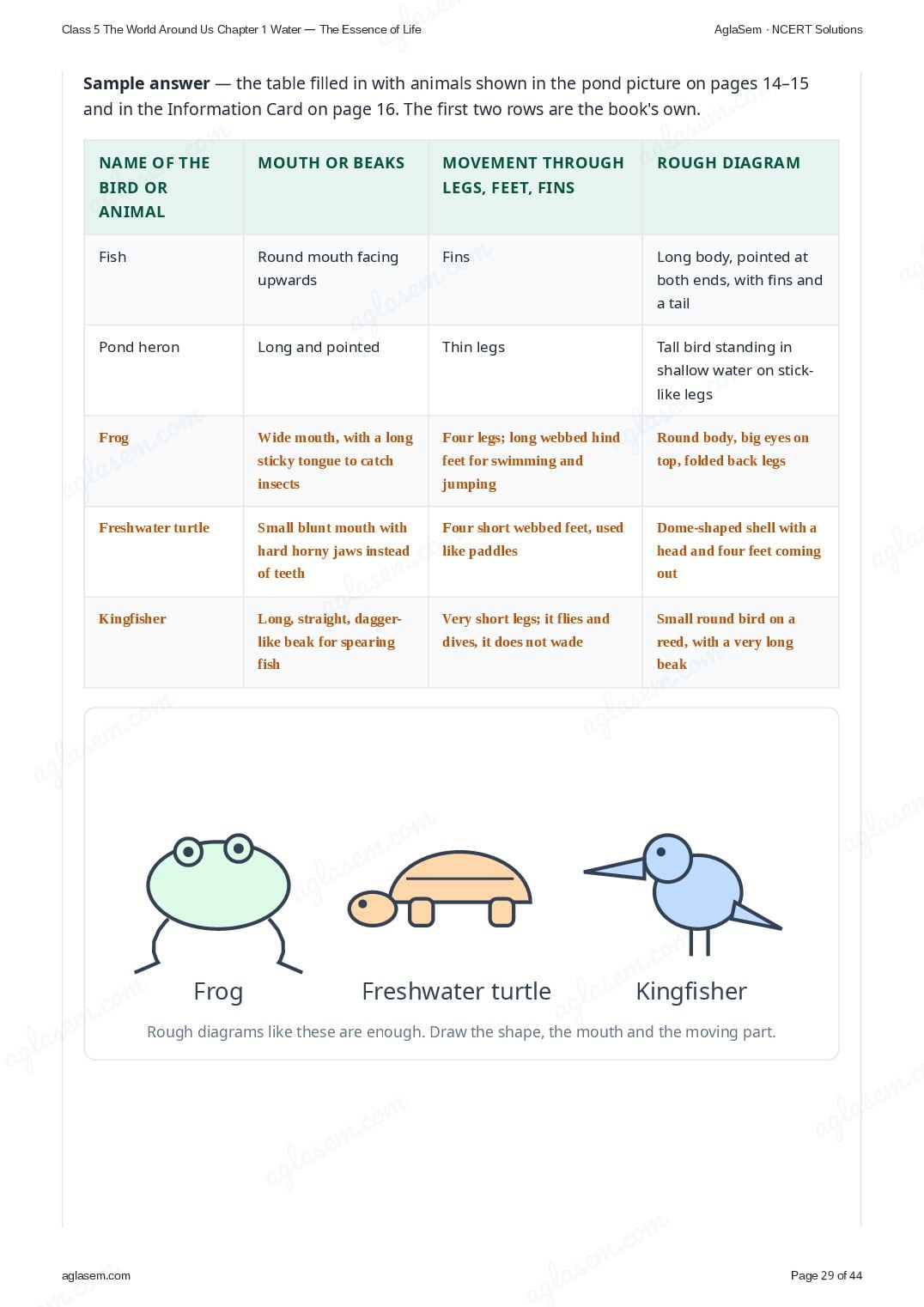
- Visit a local water body like a pond, lake or an aquarium with your teacher or parents, and observe life in and around the water body. 1. Based on your observations, complete the following table. (Given rows: Fish — round mouth facing upwards — fins; Pond heron — long and pointed — thin legs.)Name of the Bird or AnimalMouth or BeaksMovement through Legs, Feet, FinsRough DiagramFishRound mouth facing upwardsFinsPond heronLong and pointedThin legs The table printed with Activity 8 on page 17 — the first two rows are the book’s own, with its two rough diagrams; three rows are left blank for your own observations.
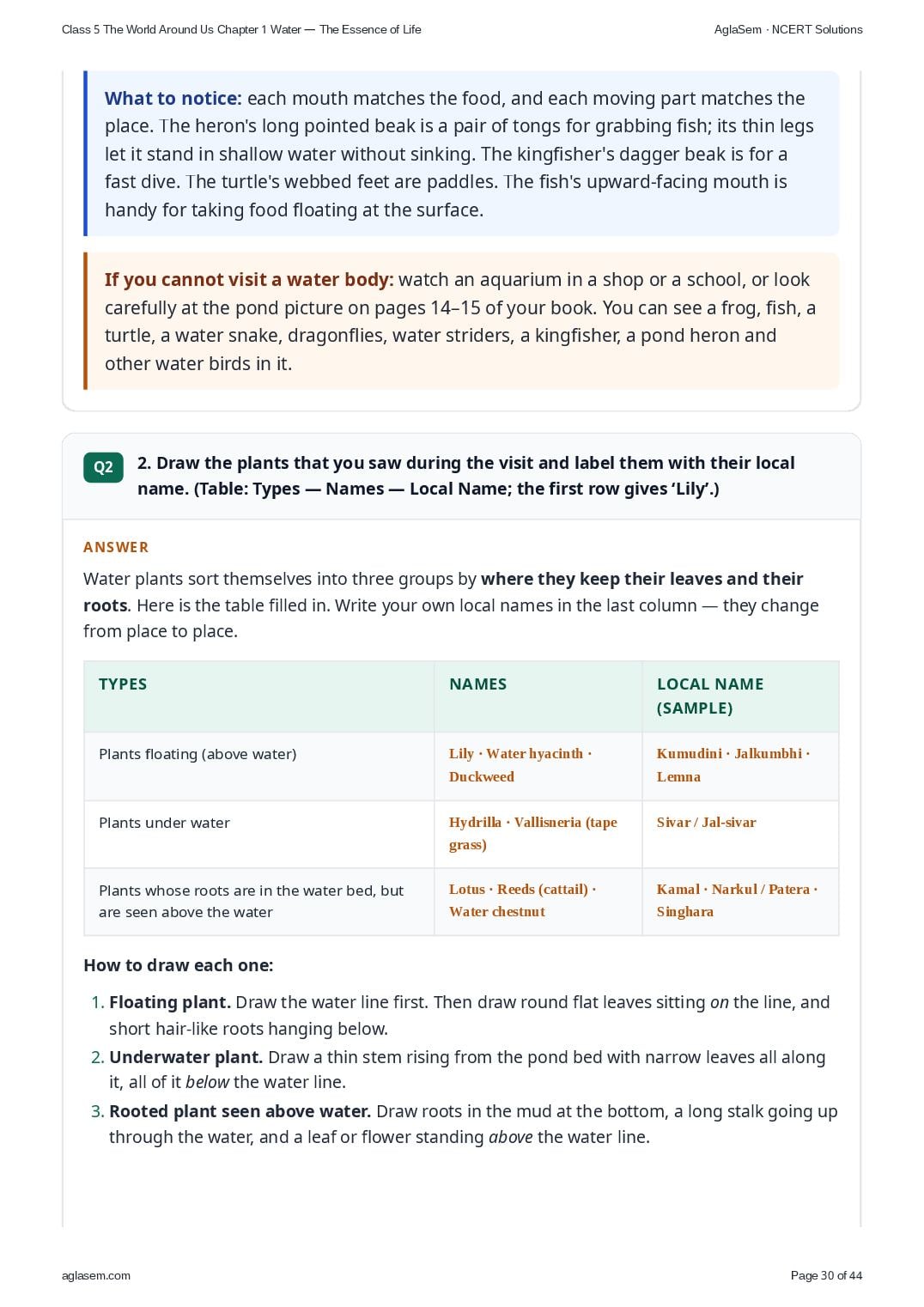
- 2. Draw the plants that you saw during the visit and label them with their local name. (Table: Types — Names — Local Name; the first row gives ‘Lily’.)
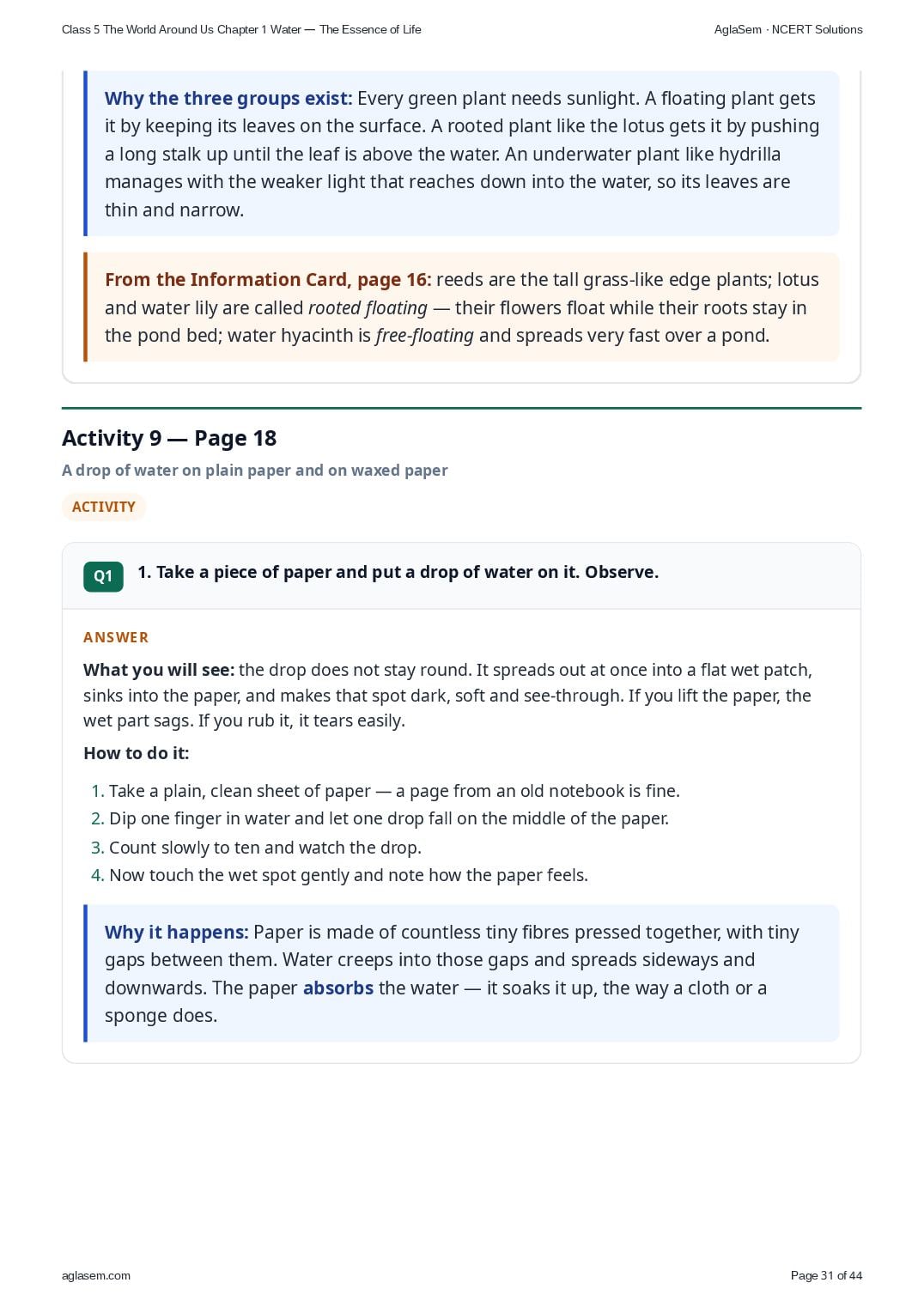
- 1. Take a piece of paper and put a drop of water on it. Observe.
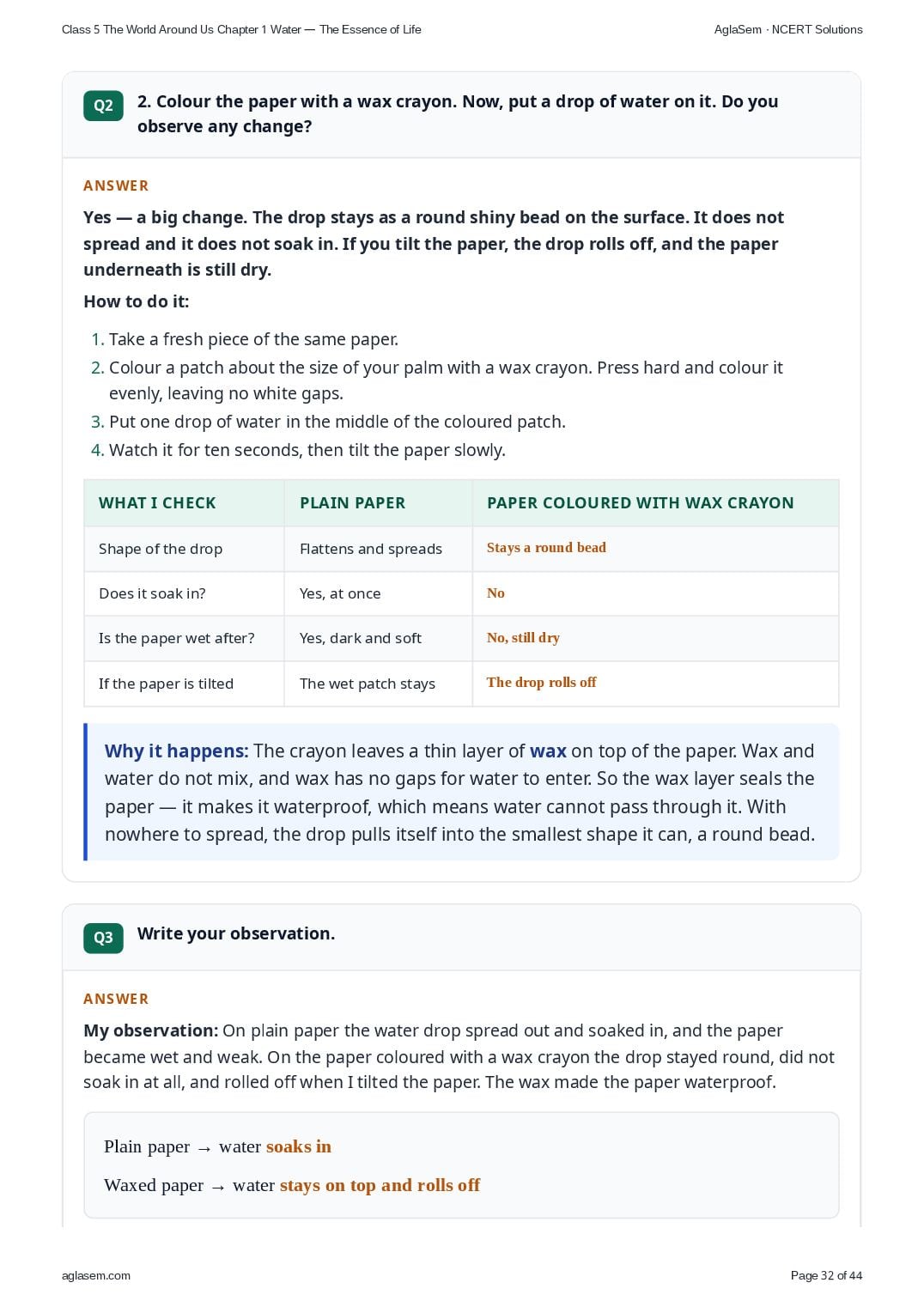
- 2. Colour the paper with a wax crayon. Now, put a drop of water on it. Do you observe any change?
- Write your observation.
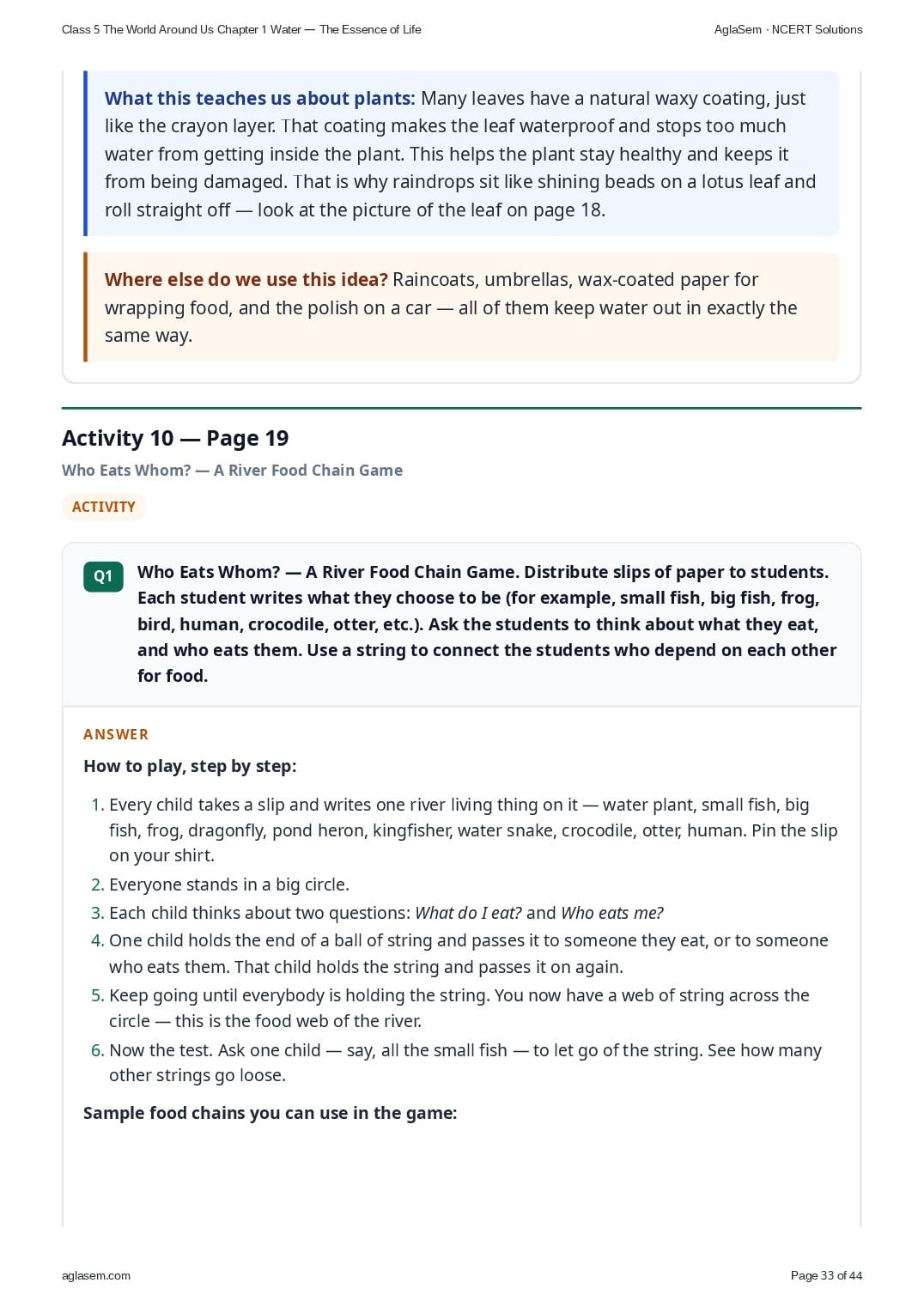
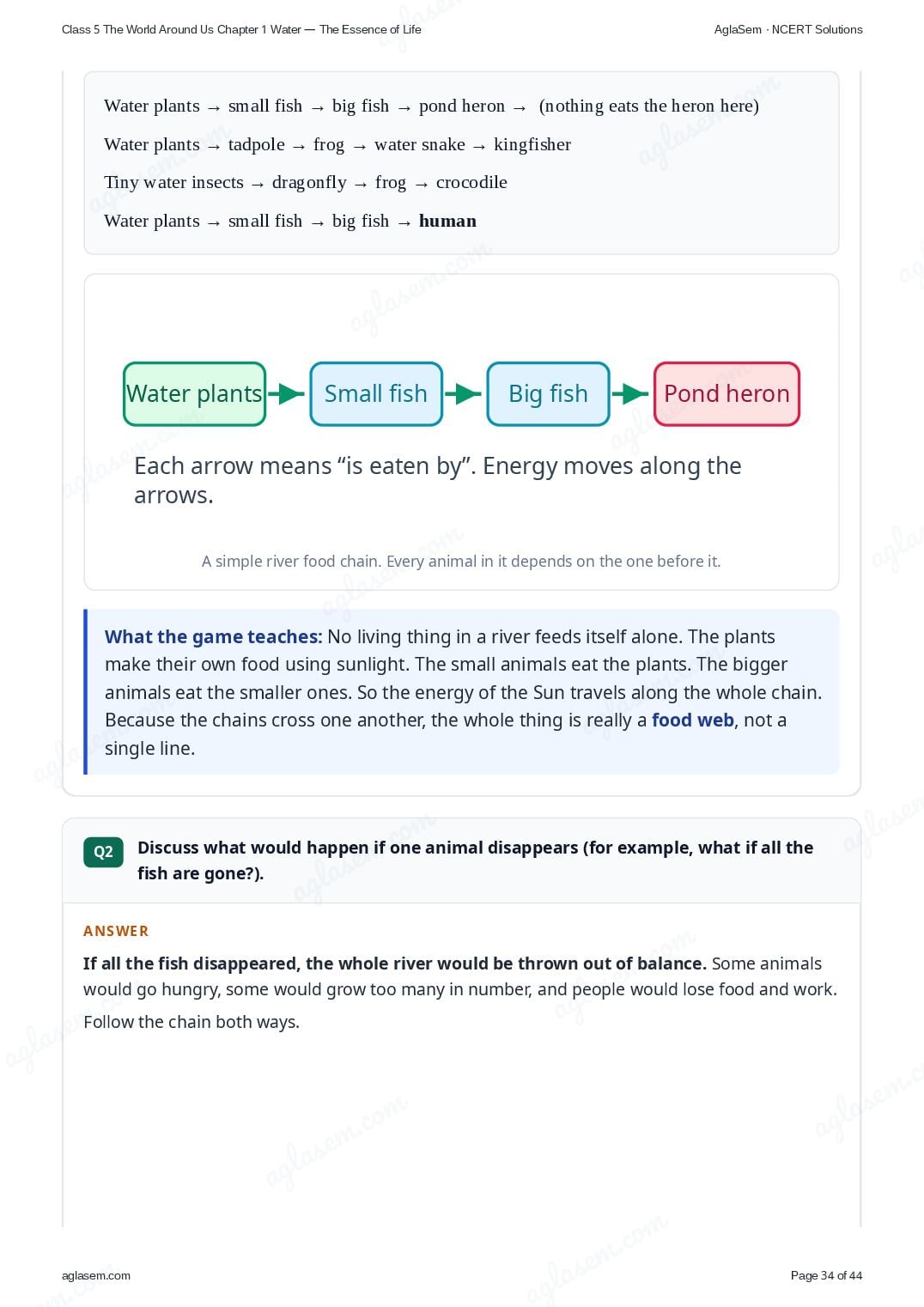
- Who Eats Whom? — A River Food Chain Game. Distribute slips of paper to students. Each student writes what they choose to be (for example, small fish, big fish, frog, bird, human, crocodile, otter, etc.). Ask the students to think about what they eat, and who eats them. Use a string to connect the students who depend on each other for food.
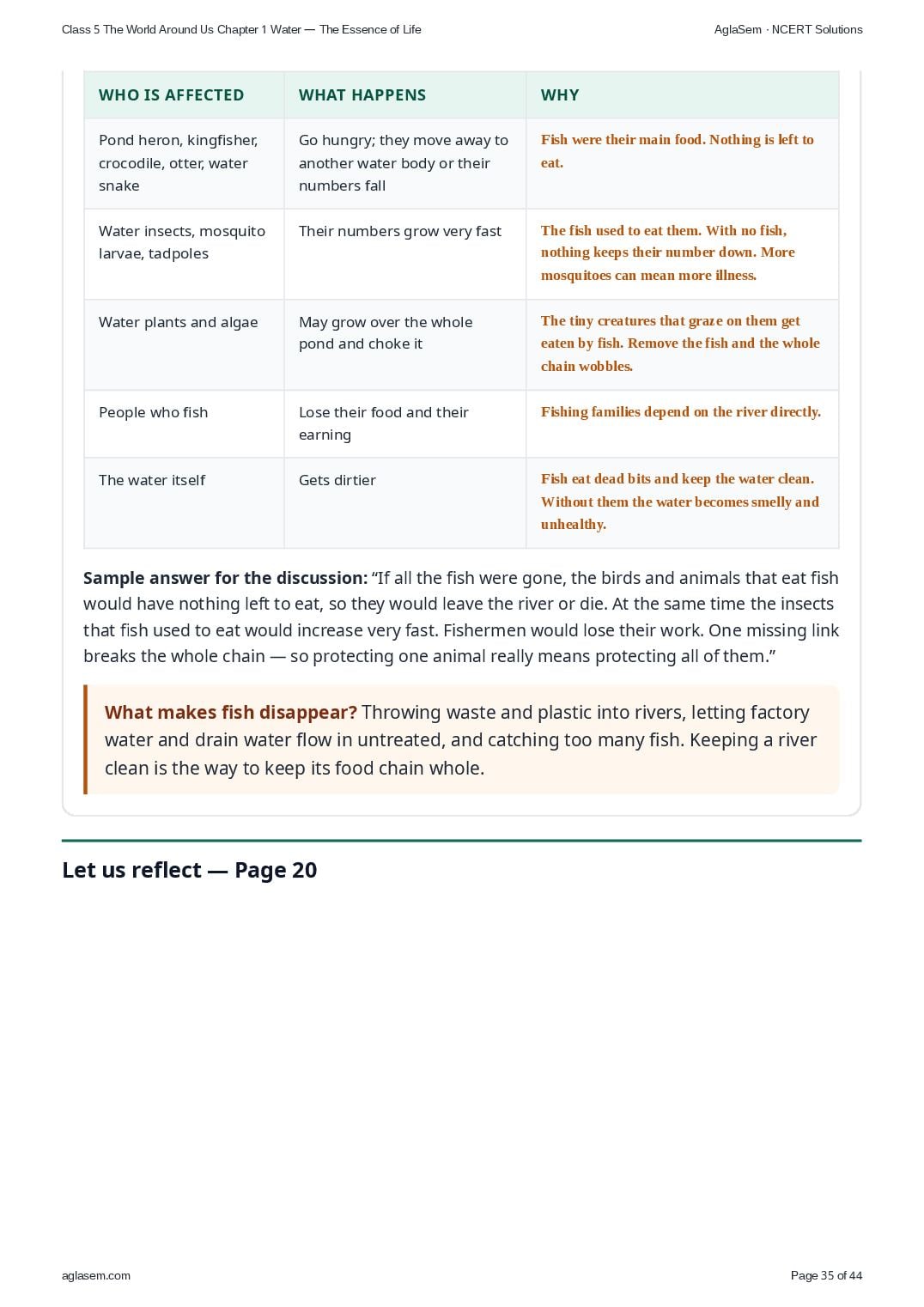
- Discuss what would happen if one animal disappears (for example, what if all the fish are gone?).
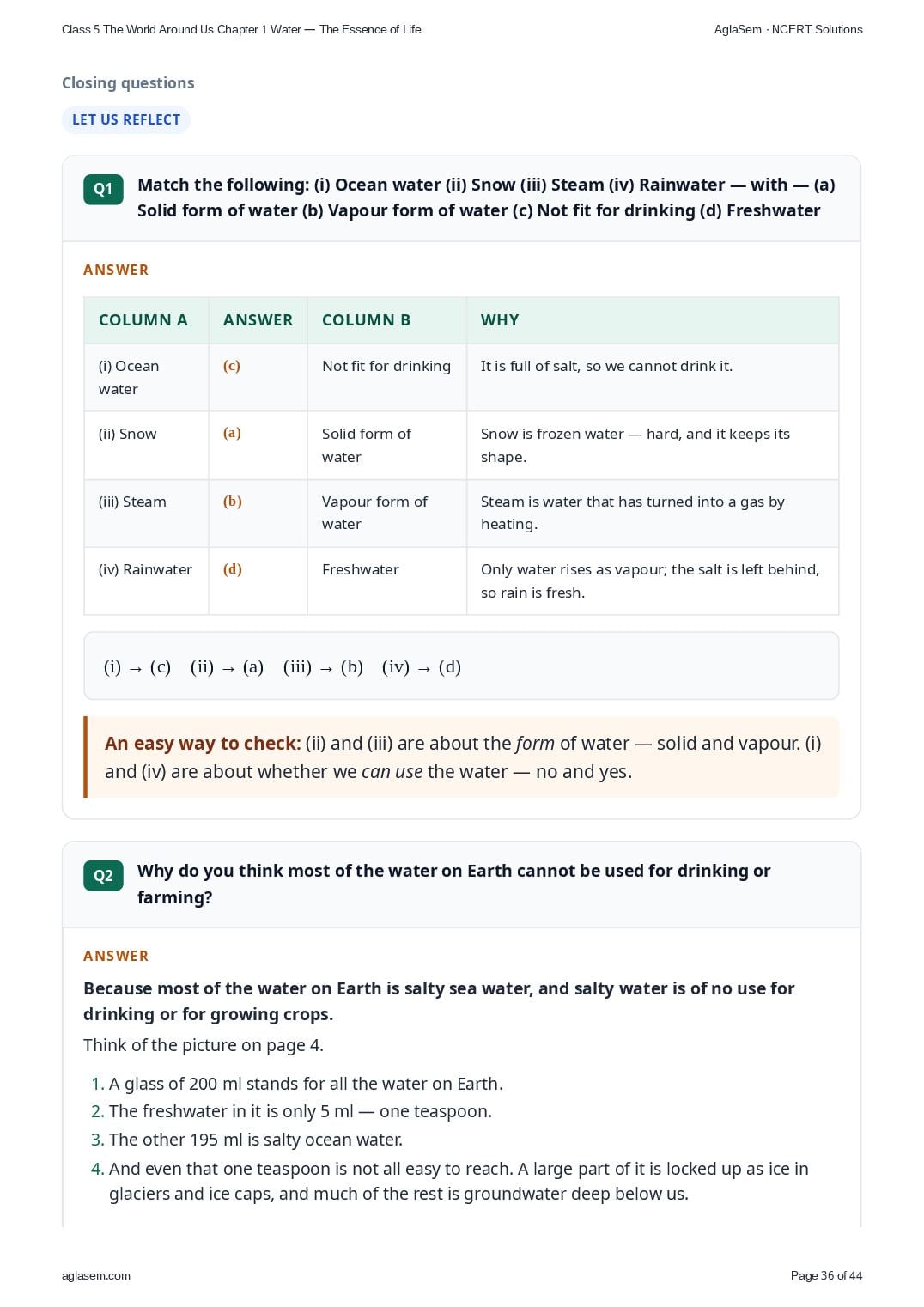
- Match the following: (i) Ocean water (ii) Snow (iii) Steam (iv) Rainwater — with — (a) Solid form of water (b) Vapour form of water (c) Not fit for drinking (d) Freshwater
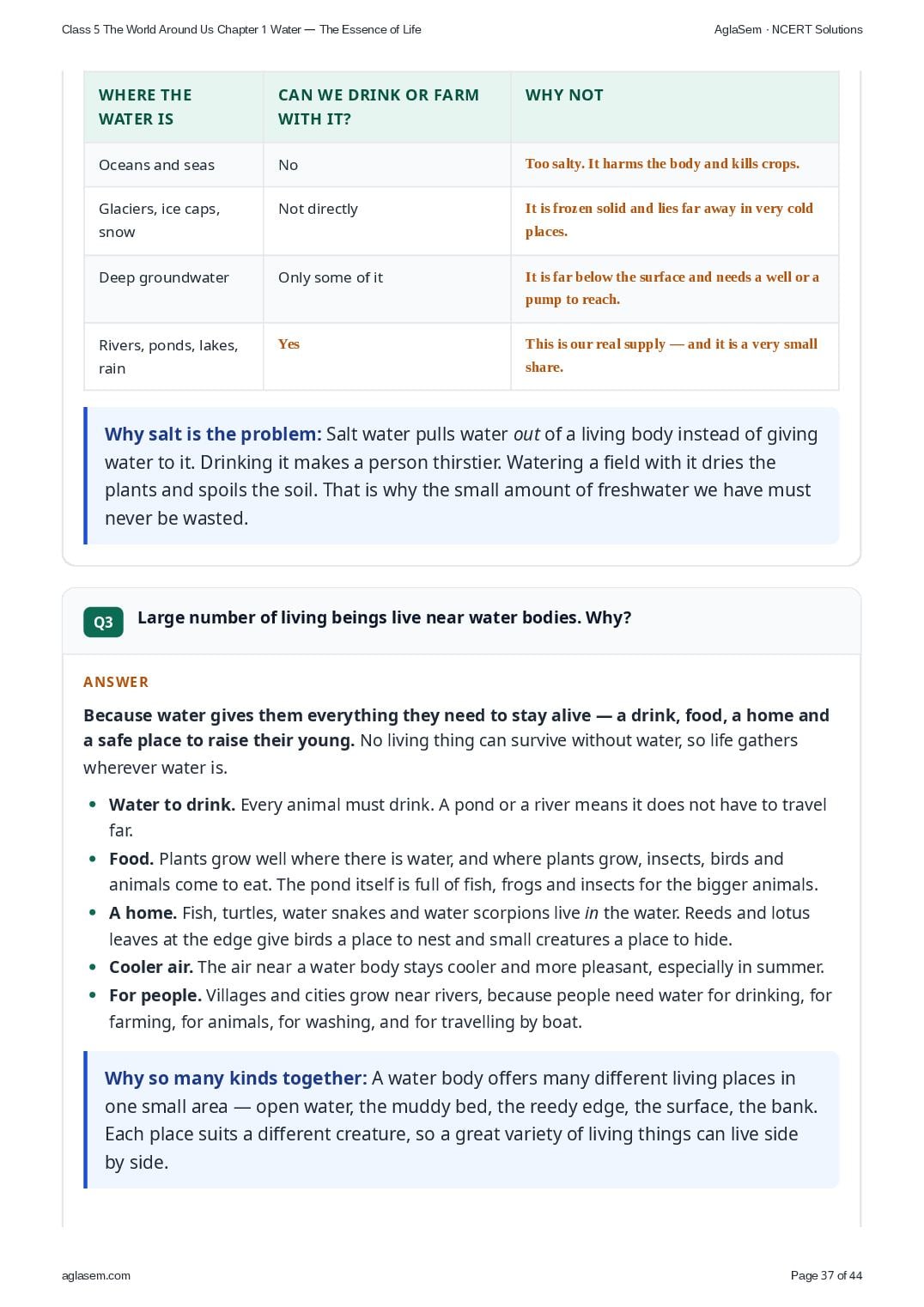
- Why do you think most of the water on Earth cannot be used for drinking or farming?
- Large number of living beings live near water bodies. Why?
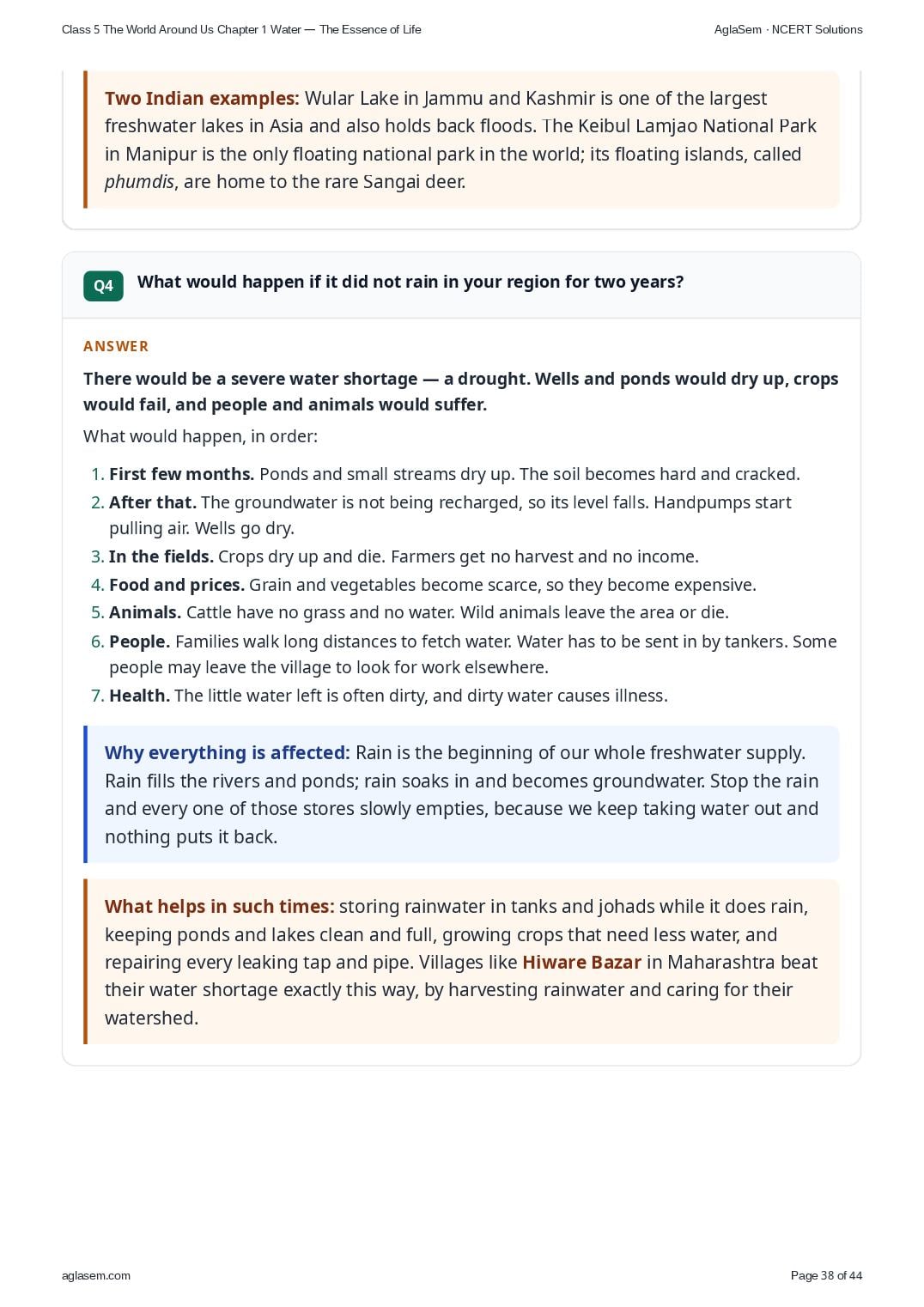
- What would happen if it did not rain in your region for two years?
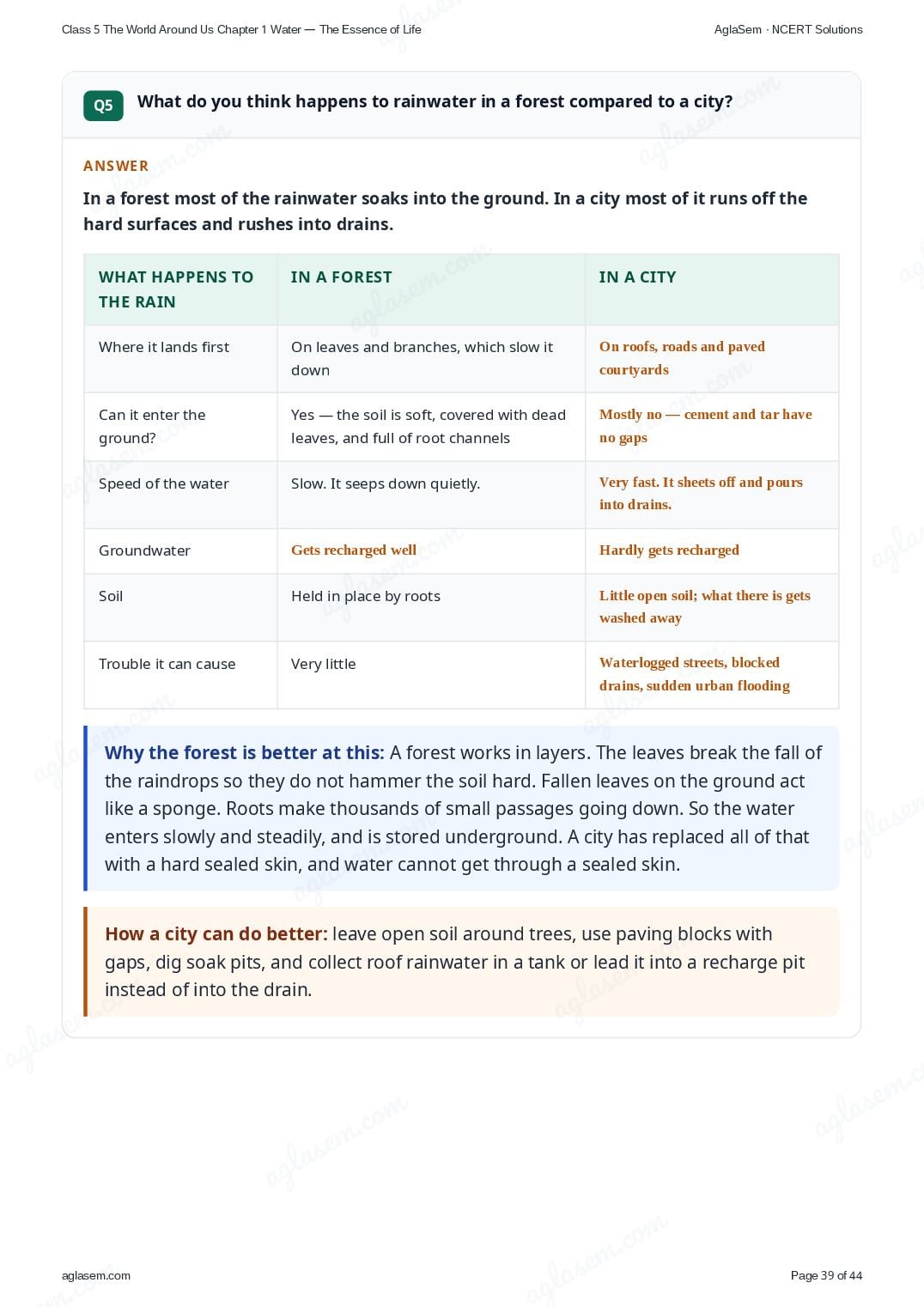
- What do you think happens to rainwater in a forest compared to a city?
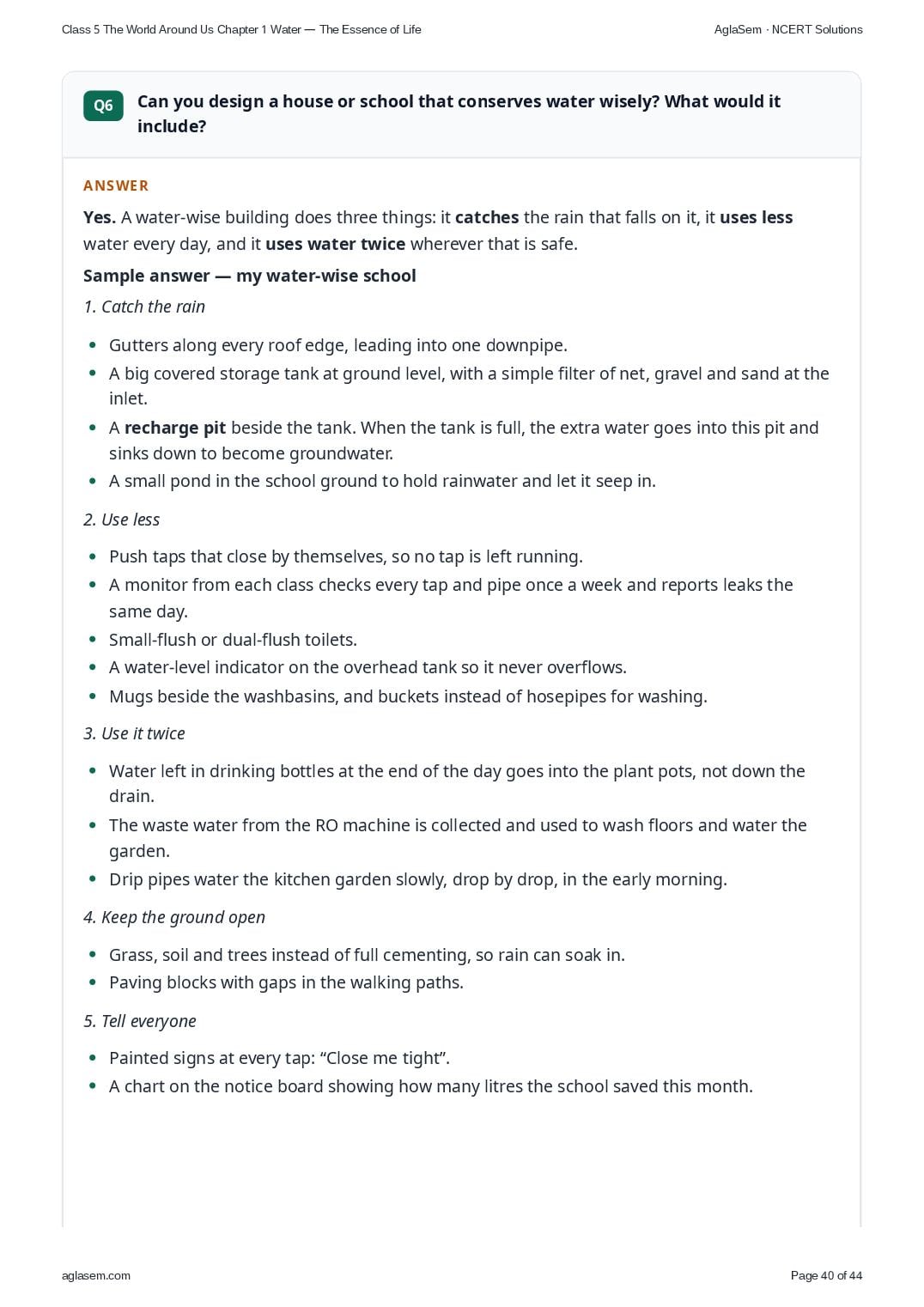
- Can you design a house or school that conserves water wisely? What would it include?
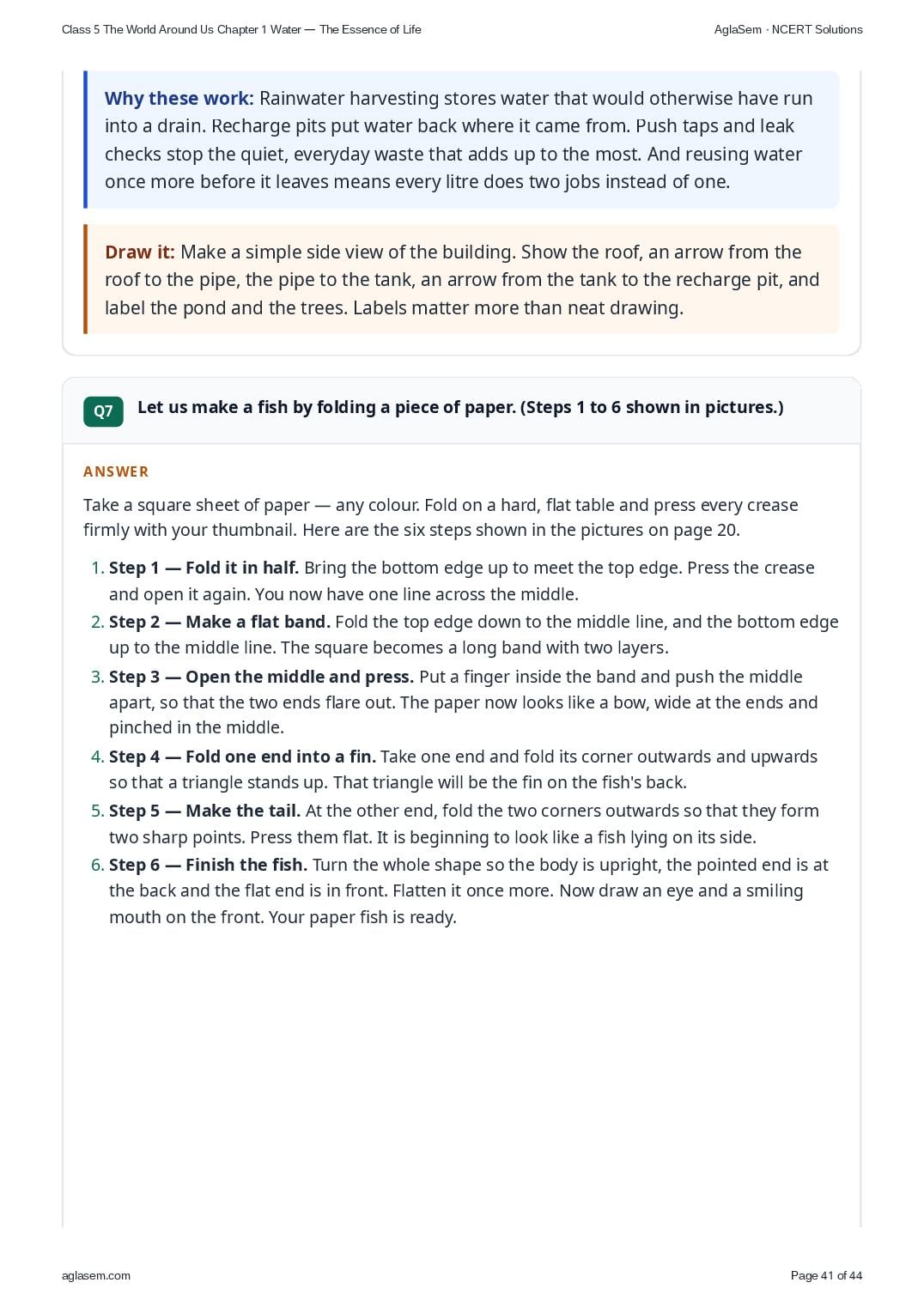
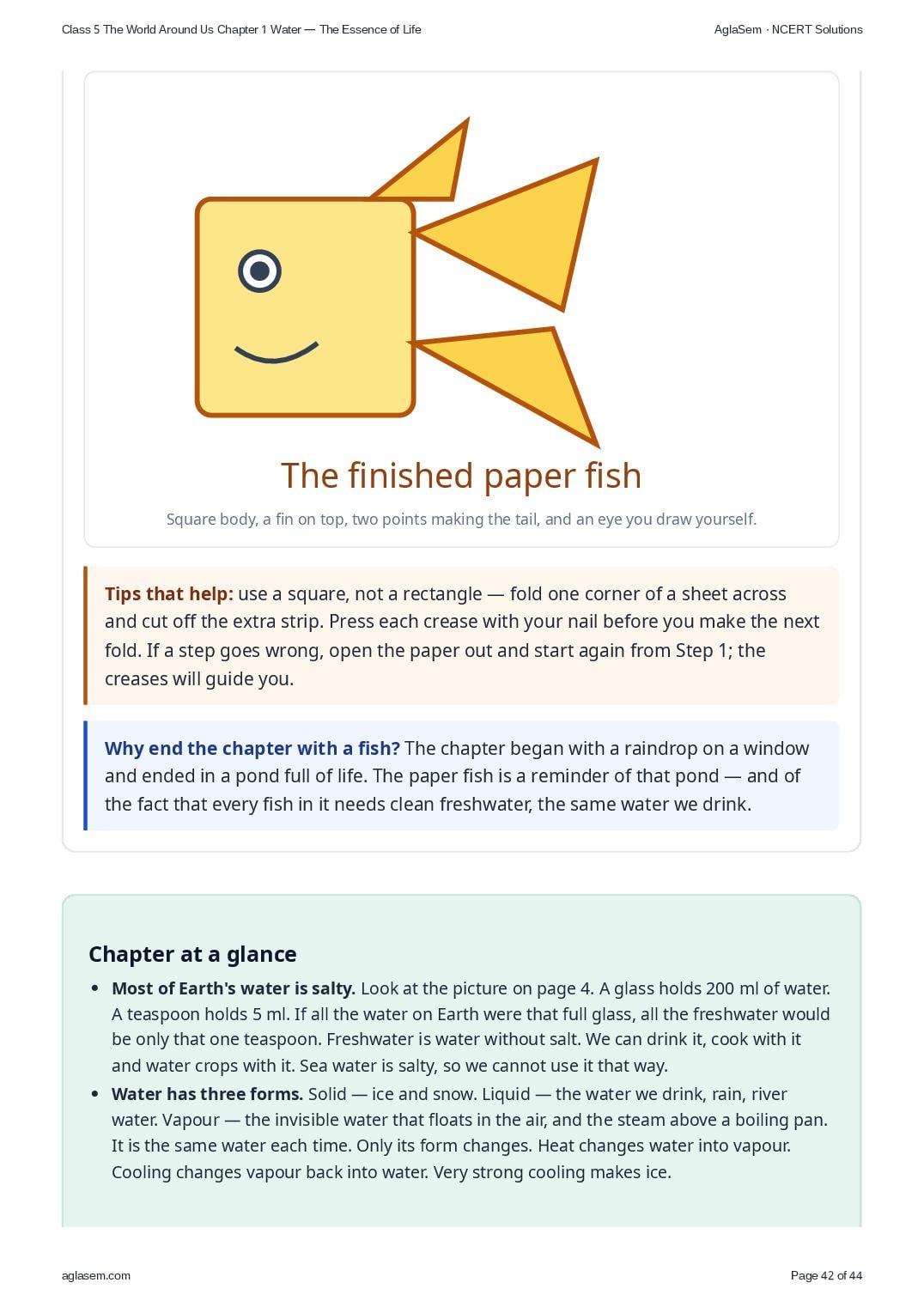
- Let us make a fish by folding a piece of paper. (Steps 1 to 6 shown in pictures.)
Chapter at a Glance
- Most of Earth’s water is salty. Look at the picture on page 4. A glass holds 200 ml of water. A teaspoon holds 5 ml. If all the water on Earth were that full glass, all the freshwater would be only that one teaspoon. Freshwater is water without salt. We can drink it, cook with it and water crops with it. Sea water is salty, so we cannot use it that way.
- Water has three forms. Solid — ice and snow. Liquid — the water we drink, rain, river water. Vapour — the invisible water that floats in the air, and the steam above a boiling pan. It is the same water each time. Only its form changes. Heat changes water into vapour. Cooling changes vapour back into water. Very strong cooling makes ice.
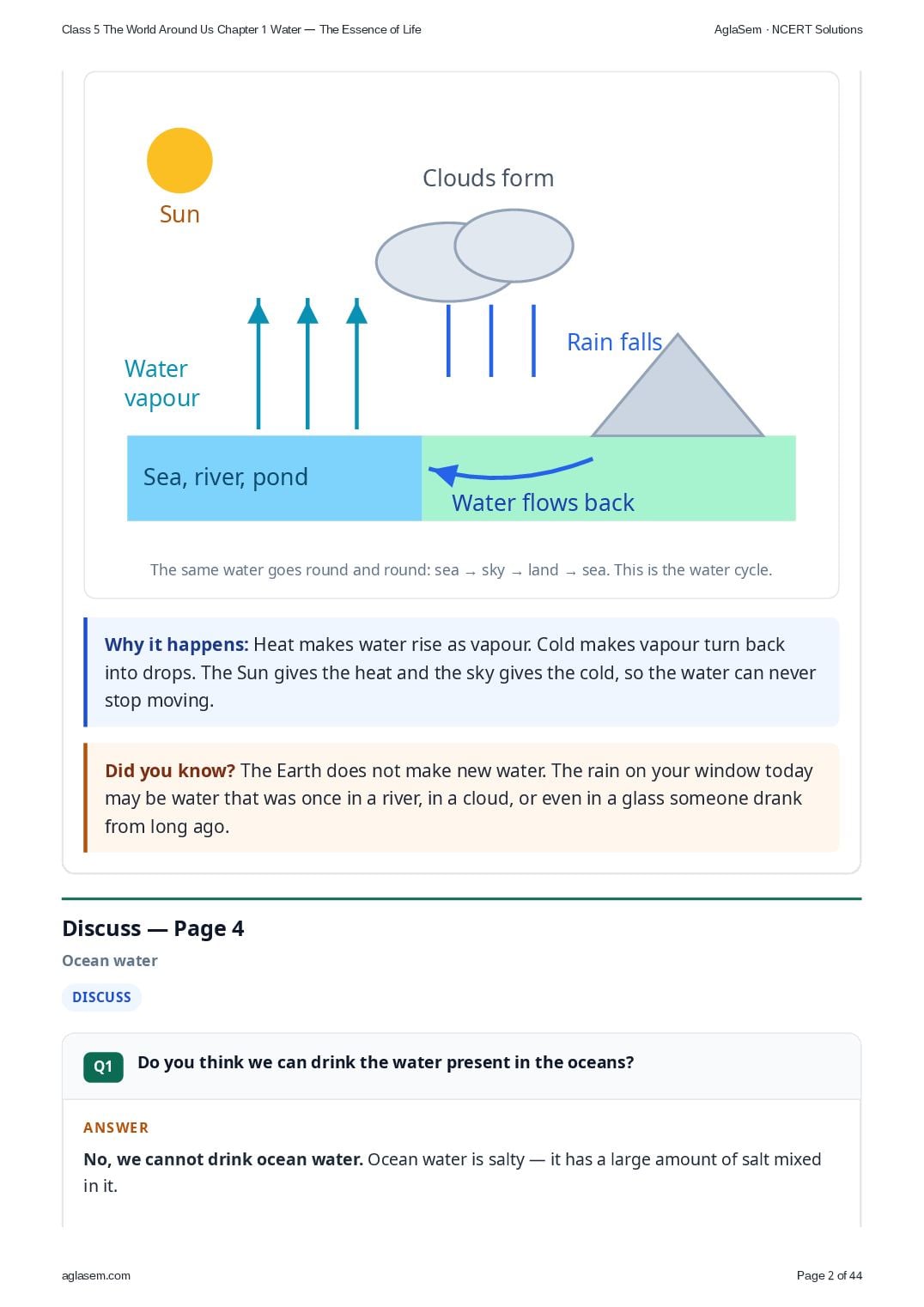
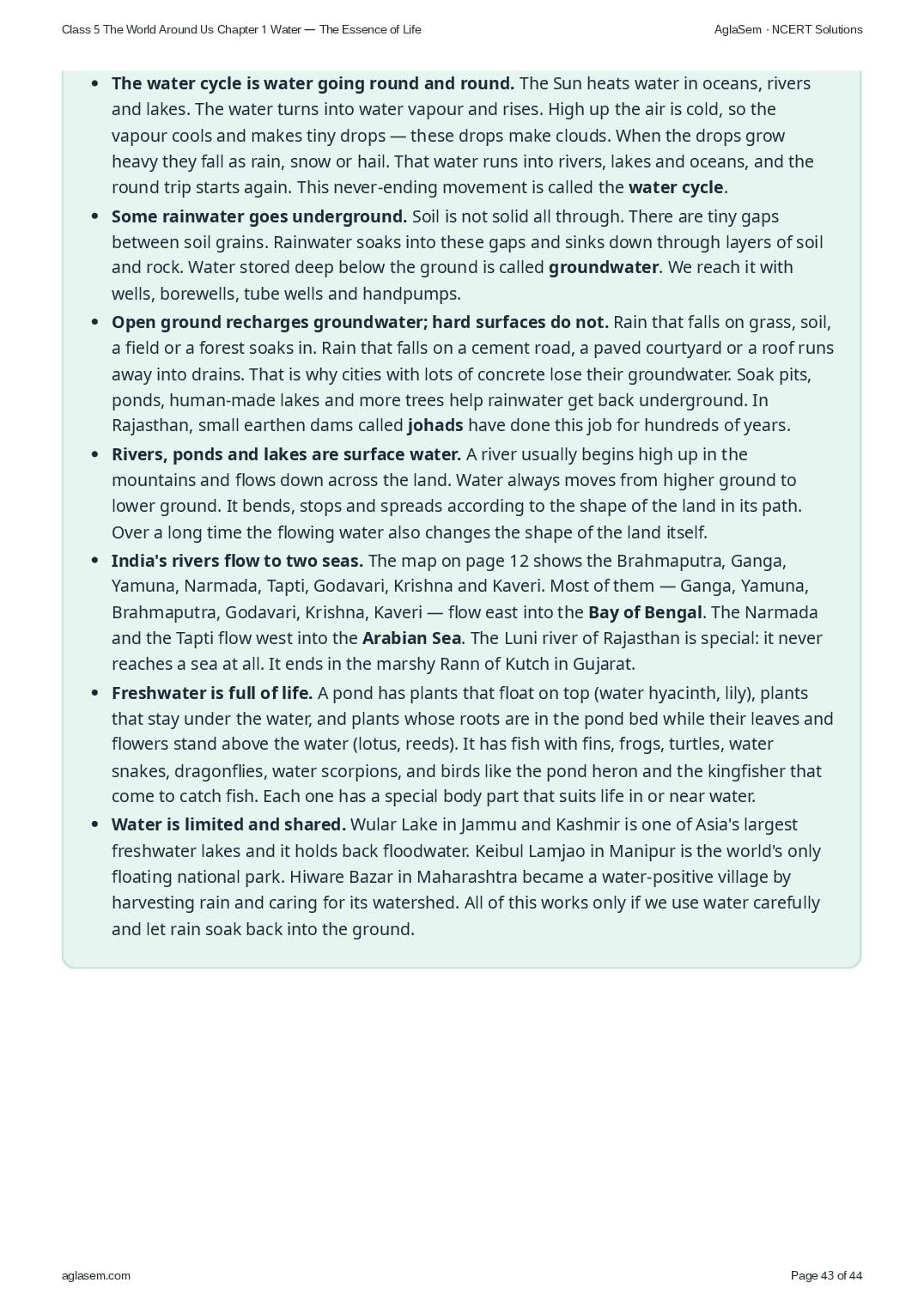
- The water cycle is water going round and round. The Sun heats water in oceans, rivers and lakes. The water turns into water vapour and rises. High up the air is cold, so the vapour cools and makes tiny drops — these drops make clouds. When the drops grow heavy they fall as rain, snow or hail. That water runs into rivers, lakes and oceans, and the round trip starts again. This never-ending movement is called the water cycle.
- Some rainwater goes underground. Soil is not solid all through. There are tiny gaps between soil grains. Rainwater soaks into these gaps and sinks down through layers of soil and rock. Water stored deep below the ground is called groundwater. We reach it with wells, borewells, tube wells and handpumps.
- Open ground recharges groundwater; hard surfaces do not. Rain that falls on grass, soil, a field or a forest soaks in. Rain that falls on a cement road, a paved courtyard or a roof runs away into drains. That is why cities with lots of concrete lose their groundwater. Soak pits, ponds, human-made lakes and more trees help rainwater get back underground. In Rajasthan, small earthen dams called johads have done this job for hundreds of years.
- Rivers, ponds and lakes are surface water. A river usually begins high up in the mountains and flows down across the land. Water always moves from higher ground to lower ground. It bends, stops and spreads according to the shape of the land in its path. Over a long time the flowing water also changes the shape of the land itself.
- India’s rivers flow to two seas. The map on page 12 shows the Brahmaputra, Ganga, Yamuna, Narmada, Tapti, Godavari, Krishna and Kaveri. Most of them — Ganga, Yamuna, Brahmaputra, Godavari, Krishna, Kaveri — flow east into the Bay of Bengal. The Narmada and the Tapti flow west into the Arabian Sea. The Luni river of Rajasthan is special: it never reaches a sea at all. It ends in the marshy Rann of Kutch in Gujarat.
- Freshwater is full of life. A pond has plants that float on top (water hyacinth, lily), plants that stay under the water, and plants whose roots are in the pond bed while their leaves and flowers stand above the water (lotus, reeds). It has fish with fins, frogs, turtles, water snakes, dragonflies, water scorpions, and birds like the pond heron and the kingfisher that come to catch fish. Each one has a special body part that suits life in or near water.
- Water is limited and shared. Wular Lake in Jammu and Kashmir is one of Asia’s largest freshwater lakes and it holds back floodwater. Keibul Lamjao in Manipur is the world’s only floating national park. Hiware Bazar in Maharashtra became a water-positive village by harvesting rain and caring for its watershed. All of this works only if we use water carefully and let rain soak back into the ground.
How to Download NCERT Solutions for Class 5 The World Around Us Chapter 1 PDF
Follow these simple steps to get the Water the Essence of Life questions-and-answers PDF from Our Wondrous World.
- Search NCERT Solutions for Class 5 The World Around Us Chapter 1 aglasem and open this page.
- Read the exercise questions with answers for Water the Essence of Life shown above.
- Click the Download PDF link to save the Water the Essence of Life solutions to your device.
NCERT Solutions for Class 5 The World Around Us – All Chapters
There are more chapters to study besides Water the Essence of Life in The World Around Us. Here are the NCERT Solutions for all chapters of Class 5 The World Around Us.
- Chapter 1 Water the Essence of Life
- Chapter 2 Journey of a River
- Chapter 3 the Mystery of Food
- Chapter 4 Our School a Happy Place
- Chapter 5 Our Vibrant Country
- Chapter 6 Some Unique Places
- Chapter 7 Energy How Things Work
- Chapter 8 Clothes How Things Are Made
- Chapter 9 Rhythms of Nature
- Chapter 10 Earth Our Shared Home
NCERT Solutions for Class 5 – All Subjects
Just like Chapter 1 of The World Around Us, you can get the exercise questions with answers for every other subject of Class 5. Here are the NCERT Solutions for all subjects of Class 5.
NCERT Solutions for Class 5 The World Around Us Chapter 1 – An Overview
The key highlights of this study material are as follows.
| Aspects | Details |
|---|---|
| Class | Class 5 |
| Subject | The World Around Us |
| Chapter Number | Chapter 1 |
| Chapter Name | Water the Essence of Life |
| Book Name | Our Wondrous World |
| Book By | NCERT (National Council of Educational Research and Training) |
| Educational Resource Here | NCERT Solutions of Class 5 The World Around Us Chapter 1 for all exercises |
| More Questions Answers of This Subject | NCERT Solutions for Class 5 The World Around Us |
| Download Book Chapter | NCERT Book Class 5 The World Around Us |
| All Questions Answers For This Class | NCERT Solutions for Class 5 |
| Complete Solutions | NCERT Solutions |
NCERT Solutions for Class 5 The World Around Us Chapter 1 Water the Essence of Life – FAQs
What are the NCERT Solutions for Class 5 The World Around Us Chapter 1 Water the Essence of Life?
They are the complete, step-by-step answers to all the exercise and in-text questions of Chapter 1 Water the Essence of Life from the NCERT Class 5 The World Around Us textbook Our Wondrous World, written by experts as per the latest NCERT syllabus.
How can I download the Class 5 The World Around Us Chapter 1 solutions PDF for free?
Open this page on aglasem, read the Water the Essence of Life questions with answers, and click the “Download Solutions PDF” link. The Class 5 The World Around Us Chapter 1 NCERT Solutions PDF is completely free to download.
Are these NCERT Solutions as per the latest 2026-27 syllabus?
Yes. The NCERT Solutions for Class 5 The World Around Us Chapter 1 are based on the latest NCERT textbook Our Wondrous World and the current 2026-27 CBSE syllabus, so the questions and answers match what you study in class.
Where can I get NCERT Solutions for the other chapters of Class 5 The World Around Us?
You can find the answers to every chapter on the NCERT Solutions for Class 5 The World Around Us page, and solutions for every subject on the NCERT Solutions for Class 5 page.
How do NCERT Solutions help in exam preparation?
They show the correct method to solve each question, help you write answers the way they are expected in exams, let you check and correct your own work, and save revision time — which together improve your marks in Class 5 The World Around Us.
If you have any queries on NCERT Solutions for Class 5 The World Around Us Chapter 1 Water the Essence of Life, then please ask in the comments below.