NCERT Solutions for Class 5 The World Around Us Chapter 2 Journey of a River provide clear, step-by-step answers to every exercise and in-text question from the chapter Journey of a River of the NCERT textbook Our Wondrous World. Prepared by subject experts as per the latest NCERT (CBSE) syllabus for 2026-27, these NCERT Solutions for Class 5 The World Around Us help you understand each concept, write exam-ready answers, and check your own solutions. You can read them online below or download the free Class 5 The World Around Us Chapter 2 question-answer PDF.
NCERT Solutions for Class 5 The World Around Us Chapter 2 Journey of a River
- Class: Class 5
- Subject: The World Around Us
- Chapter: Chapter 2 – Journey of a River
- Textbook: Our Wondrous World (NCERT)
- Study material: NCERT Solutions – questions with answers, free PDF
These solutions answer all the exercise questions of Chapter 2 Journey of a River — including the in-text questions, short-answer and long-answer questions, and activities — with complete explanations so you can follow the method, not just the final answer. Read the full solutions below.
NCERT Solutions Class 5 The World Around Us Chapter 2 Journey of a River View Download
NCERT Solutions for Class 5 The World Around Us Chapter 2 PDF Download
You can read the NCERT Solutions for Class 5 The World Around Us Chapter 2 online above, or download the complete question-answer PDF to study Journey of a River offline at any time.
NCERT Solutions for Class 5 The World Around Us Chapter 2 PDF Download Link – Click Here to Download Solutions PDF
Questions Covered in This Chapter
These NCERT Solutions answer all 37 questions of this chapter. The questions solved are:
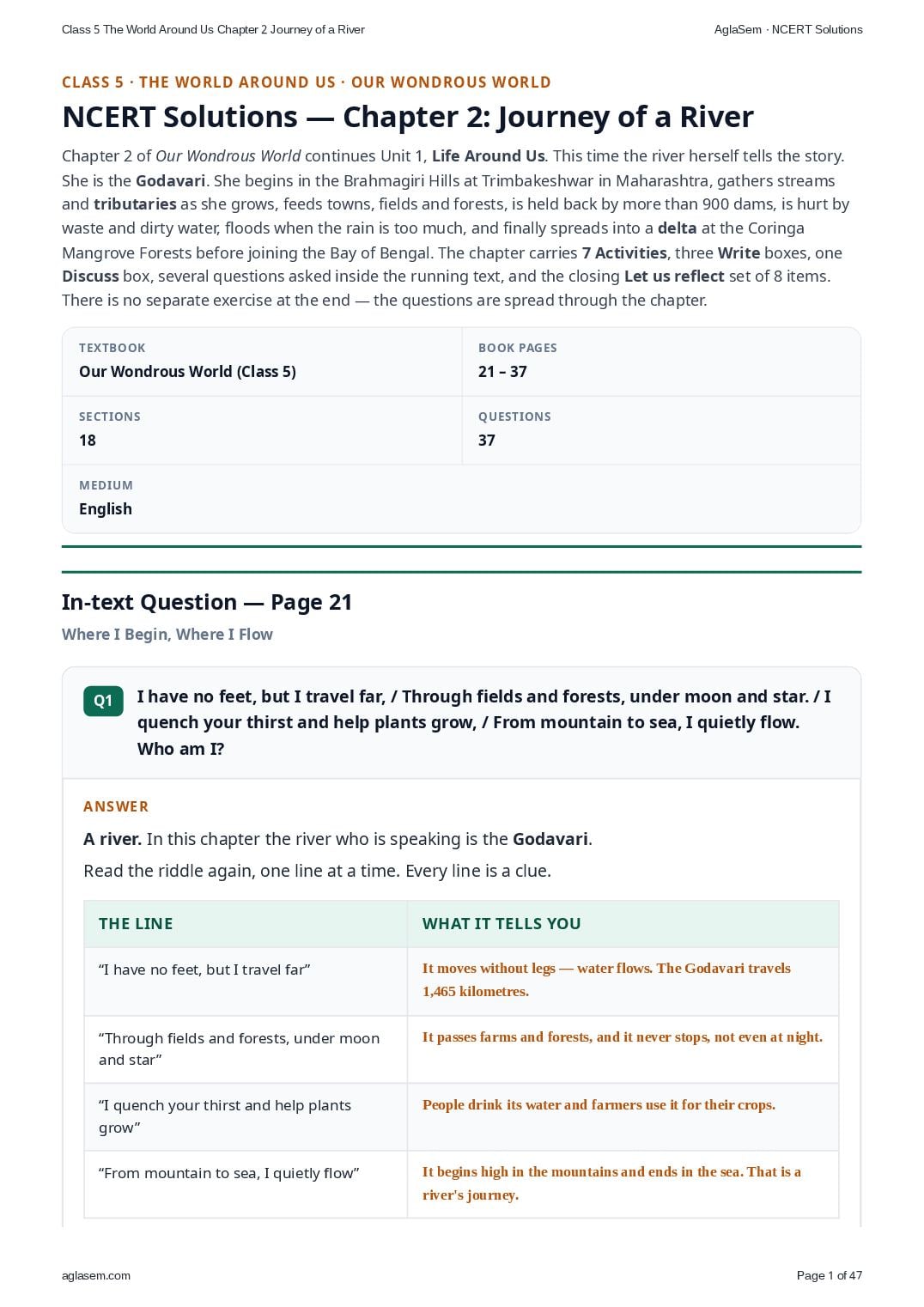
- I have no feet, but I travel far, / Through fields and forests, under moon and star. / I quench your thirst and help plants grow, / From mountain to sea, I quietly flow. Who am I?
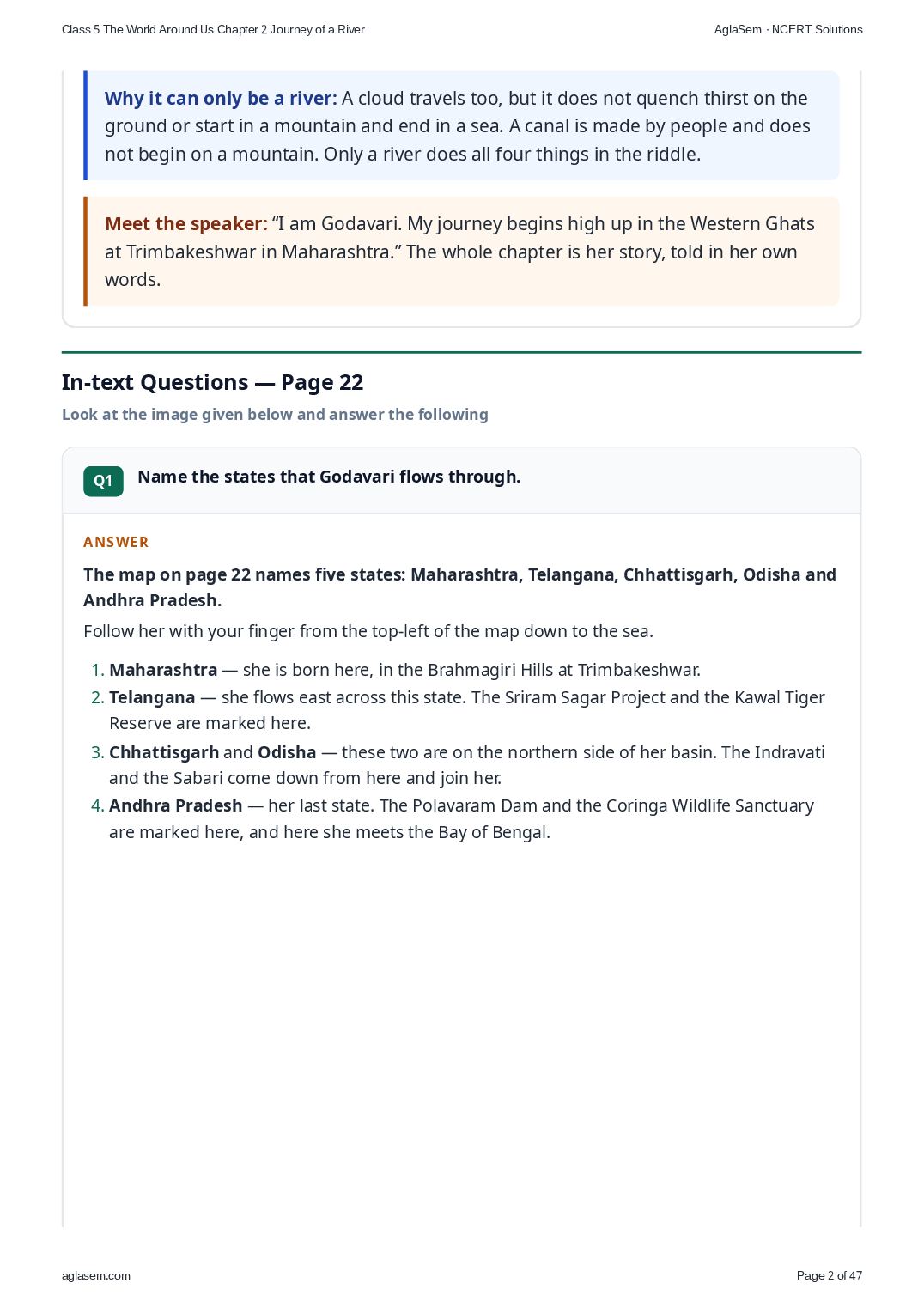
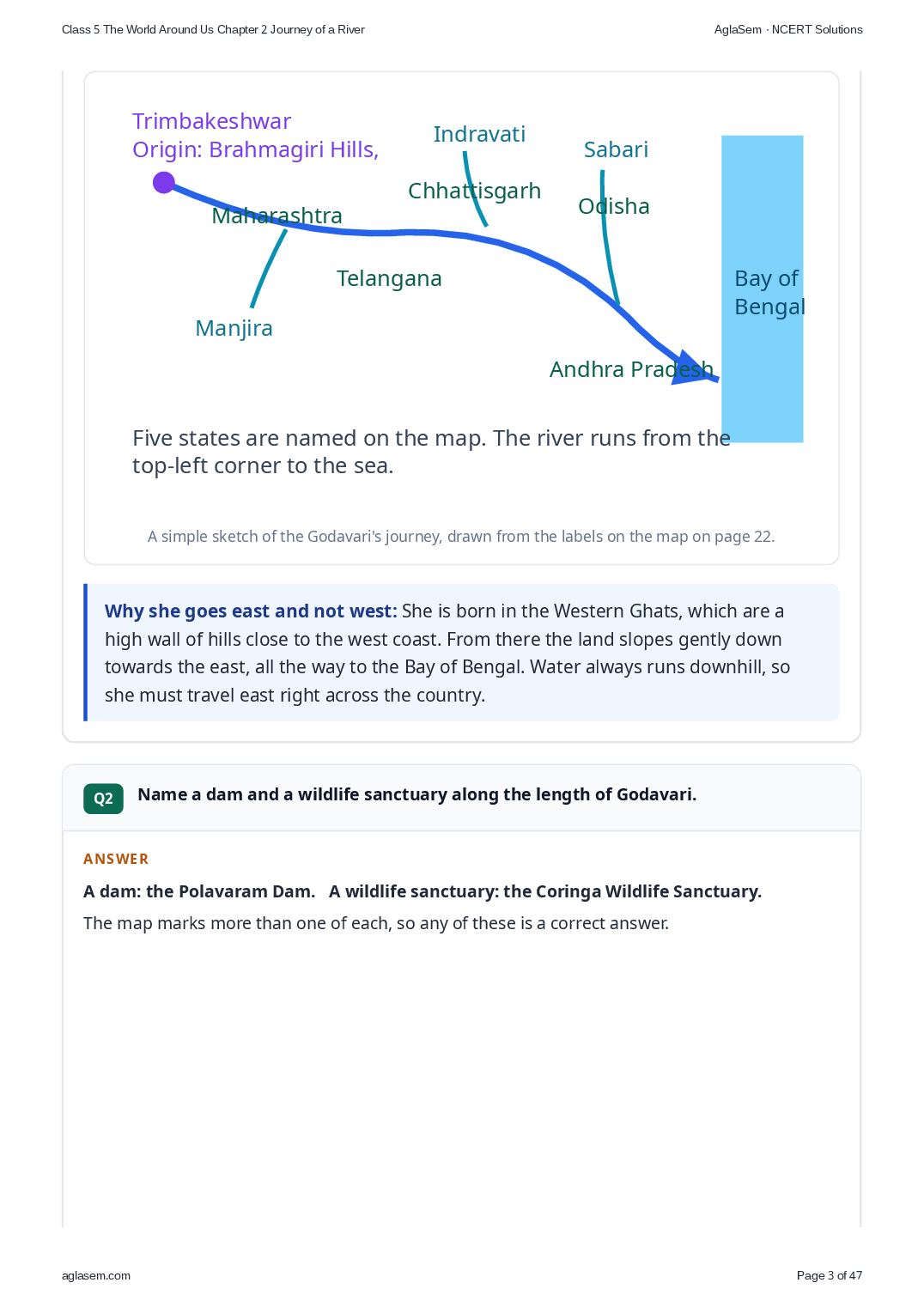
- Name the states that Godavari flows through.
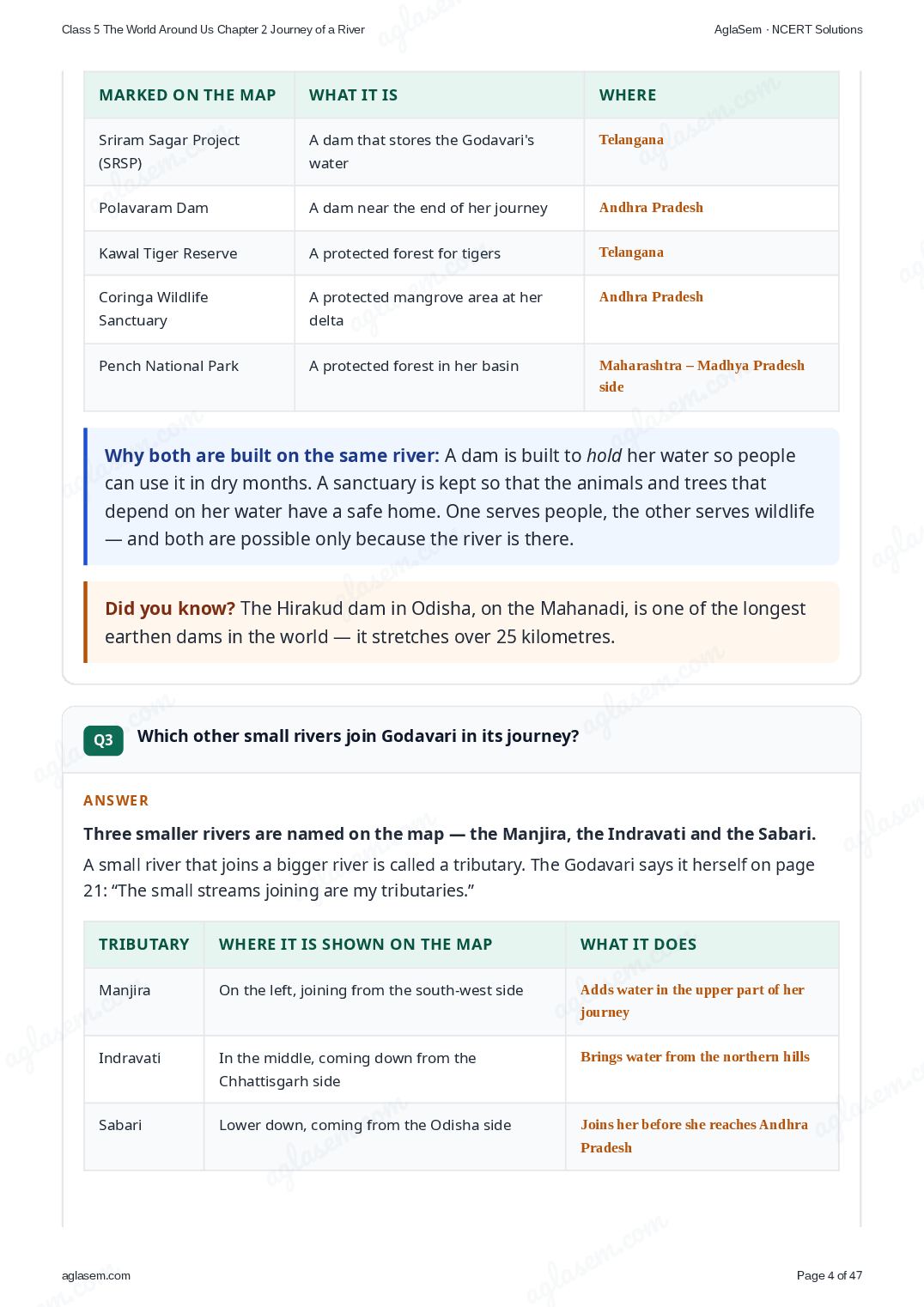
- Name a dam and a wildlife sanctuary along the length of Godavari.
- Which other small rivers join Godavari in its journey?
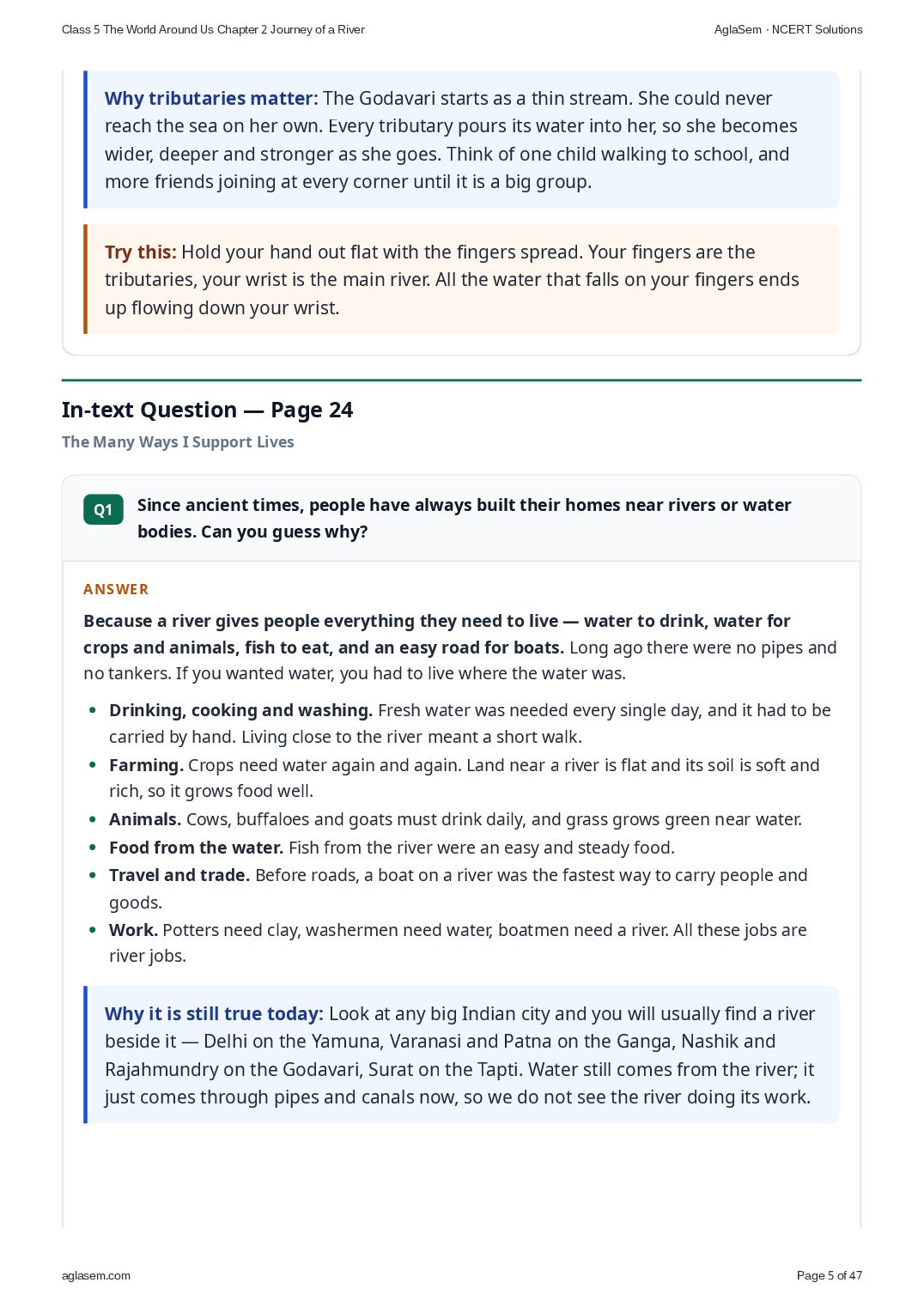
- Since ancient times, people have always built their homes near rivers or water bodies. Can you guess why?
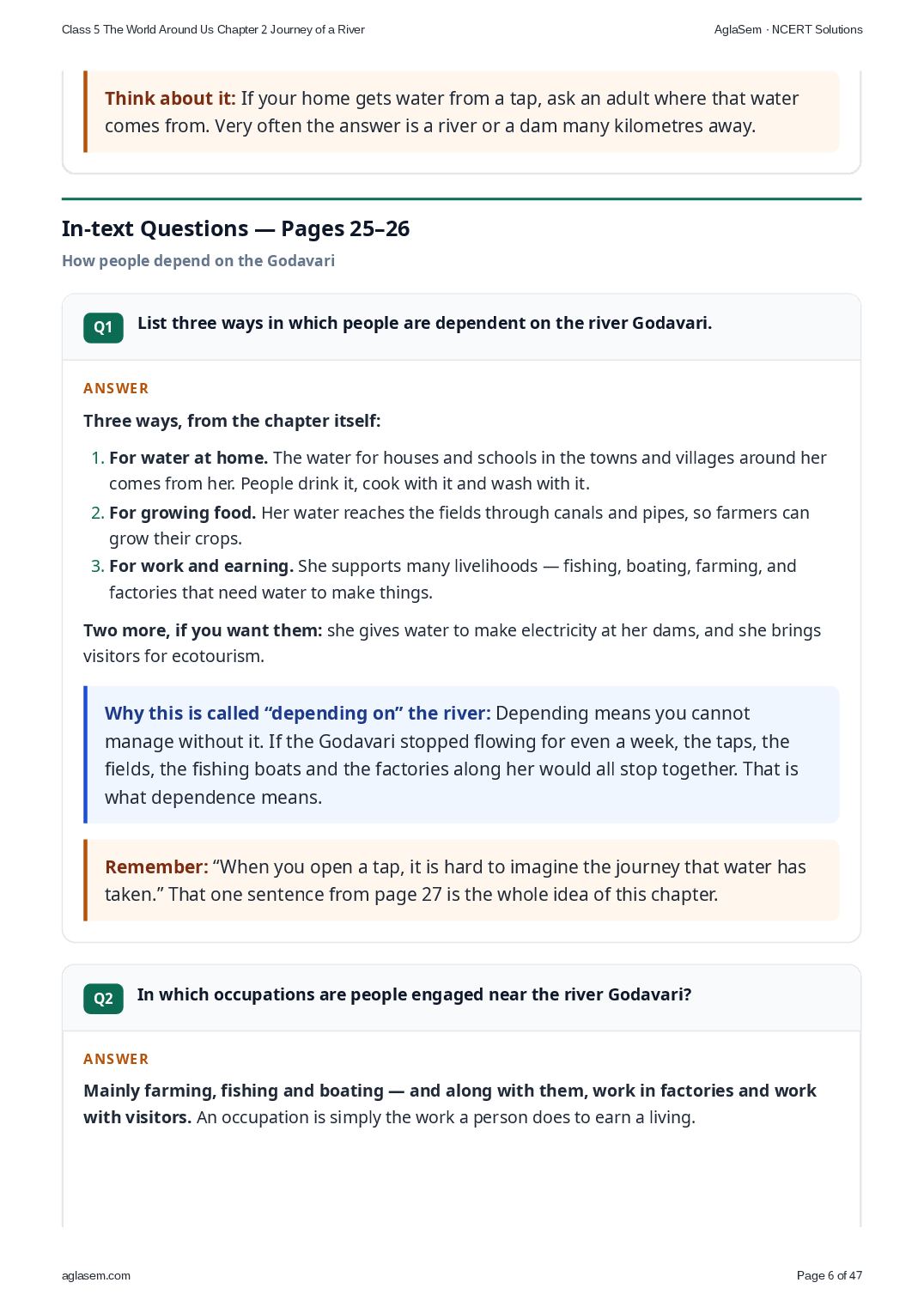
- List three ways in which people are dependent on the river Godavari.
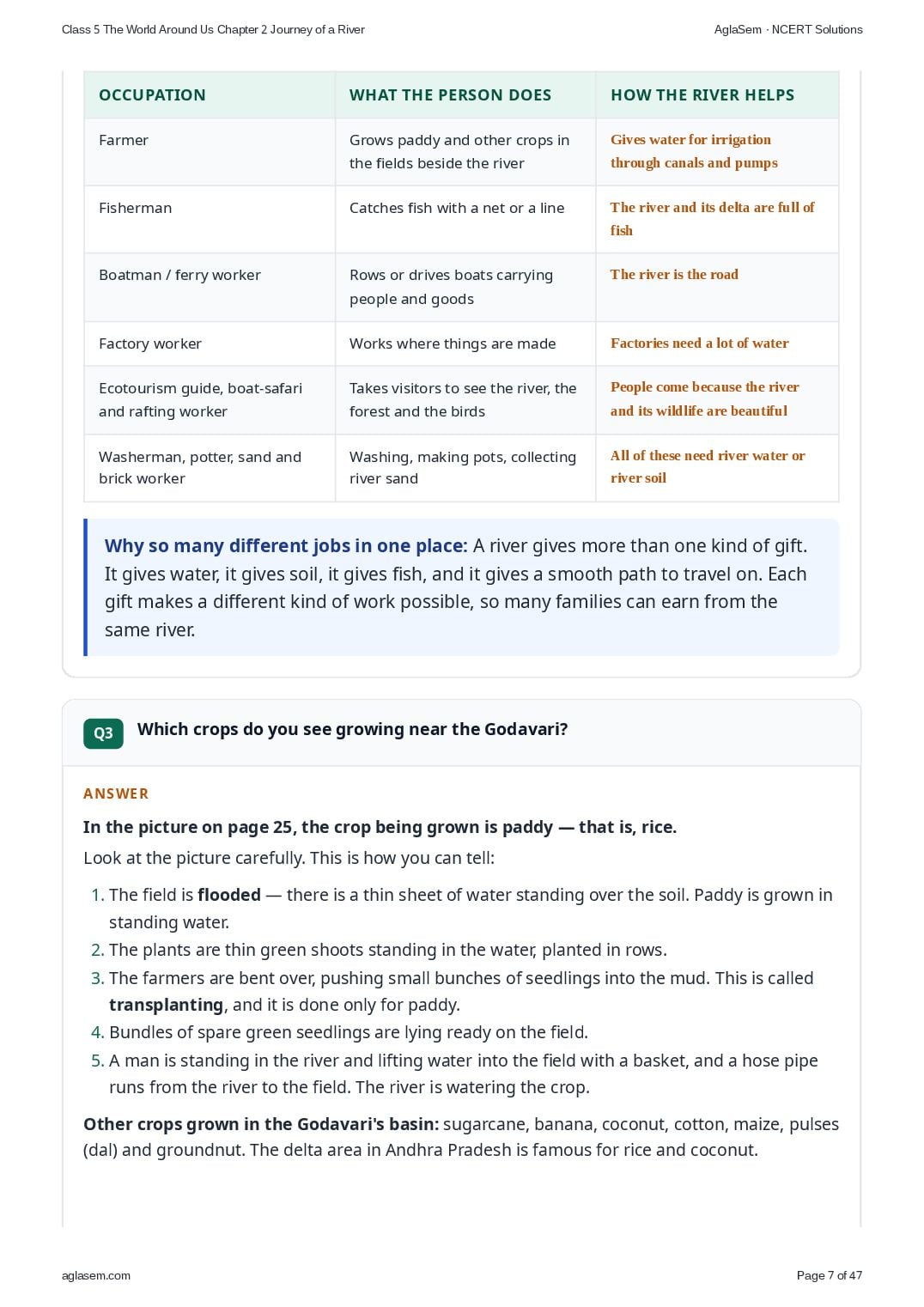
- In which occupations are people engaged near the river Godavari?
- Which crops do you see growing near the Godavari?
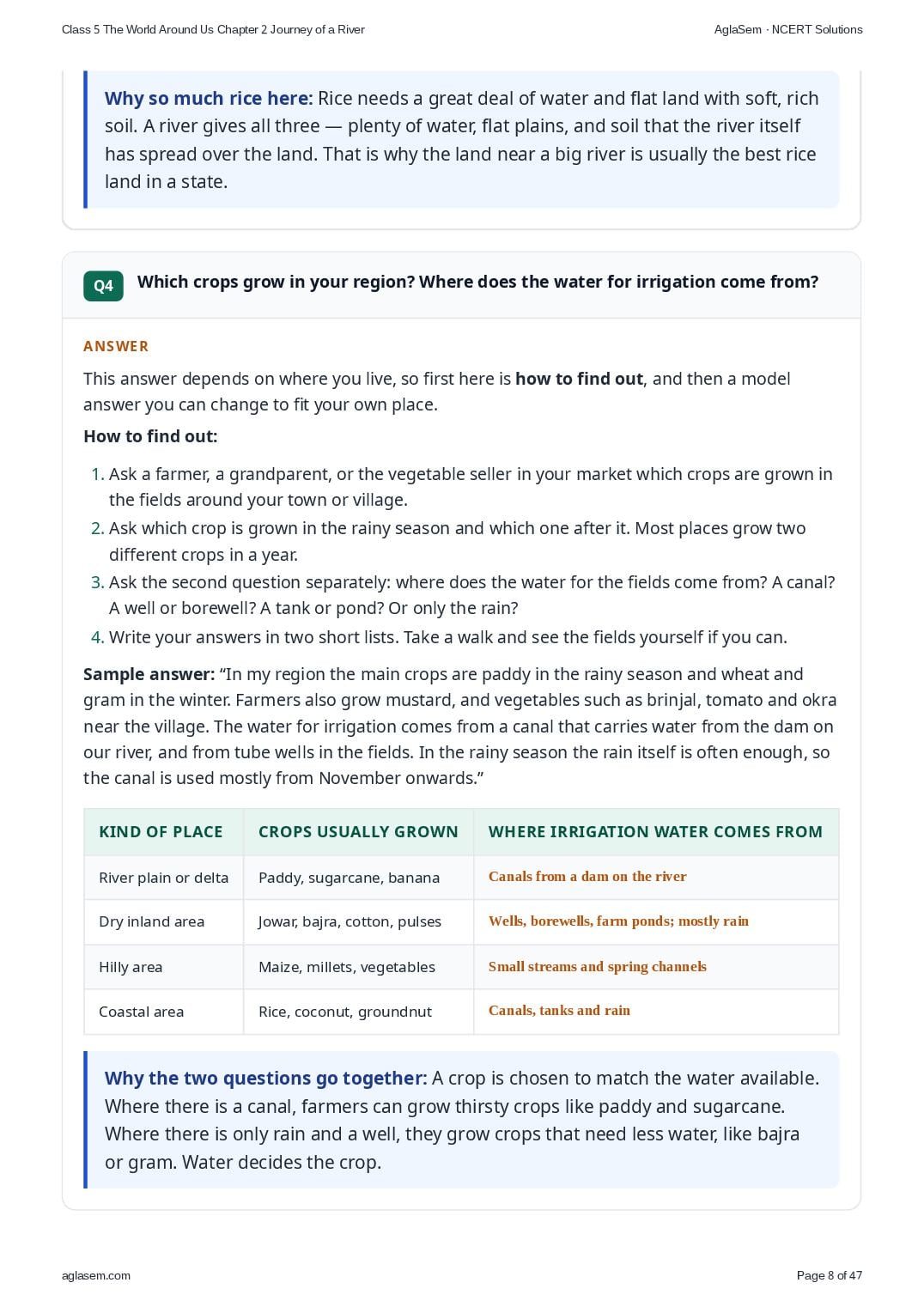
- Which crops grow in your region? Where does the water for irrigation come from?
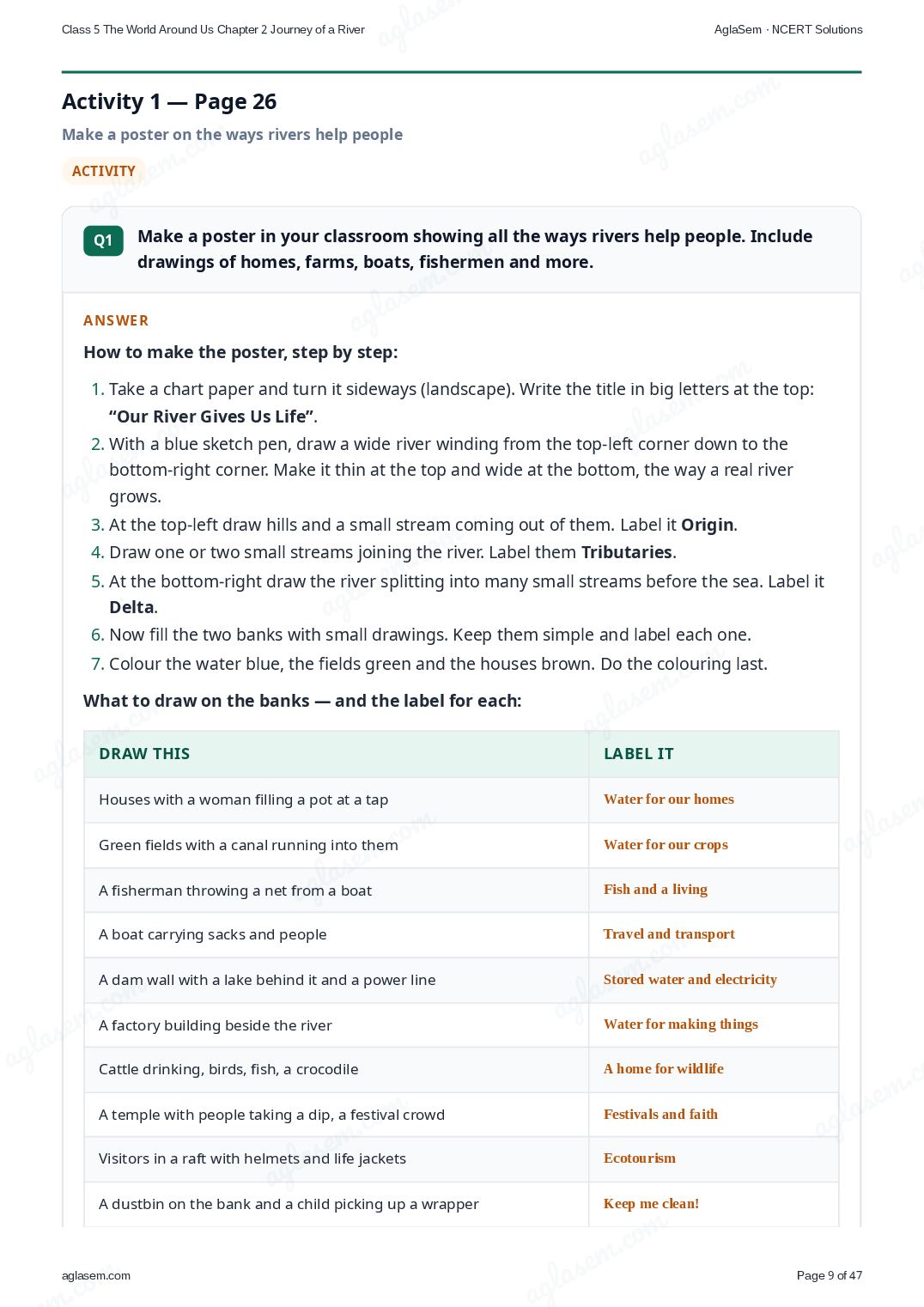
- Make a poster in your classroom showing all the ways rivers help people. Include drawings of homes, farms, boats, fishermen and more.
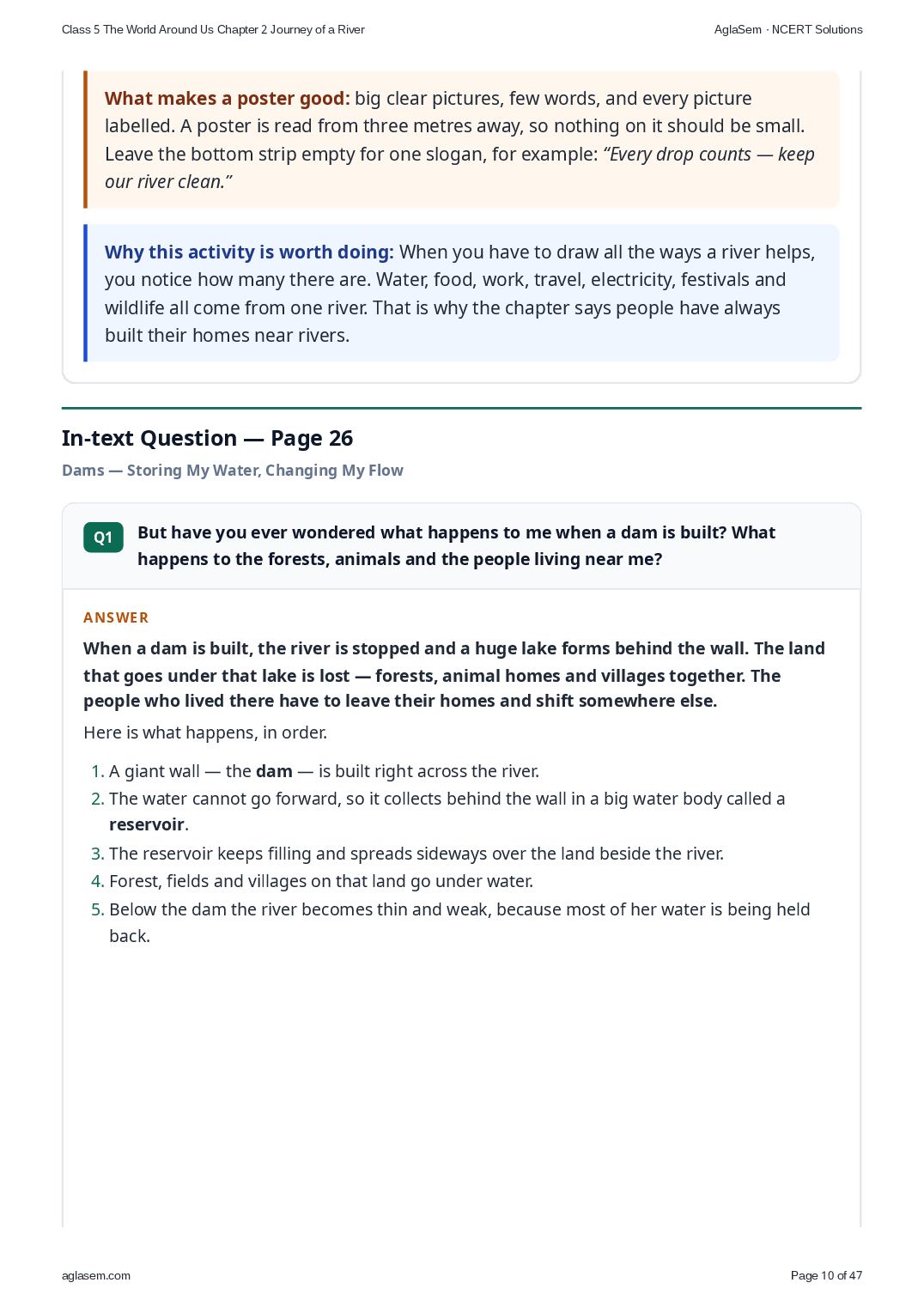
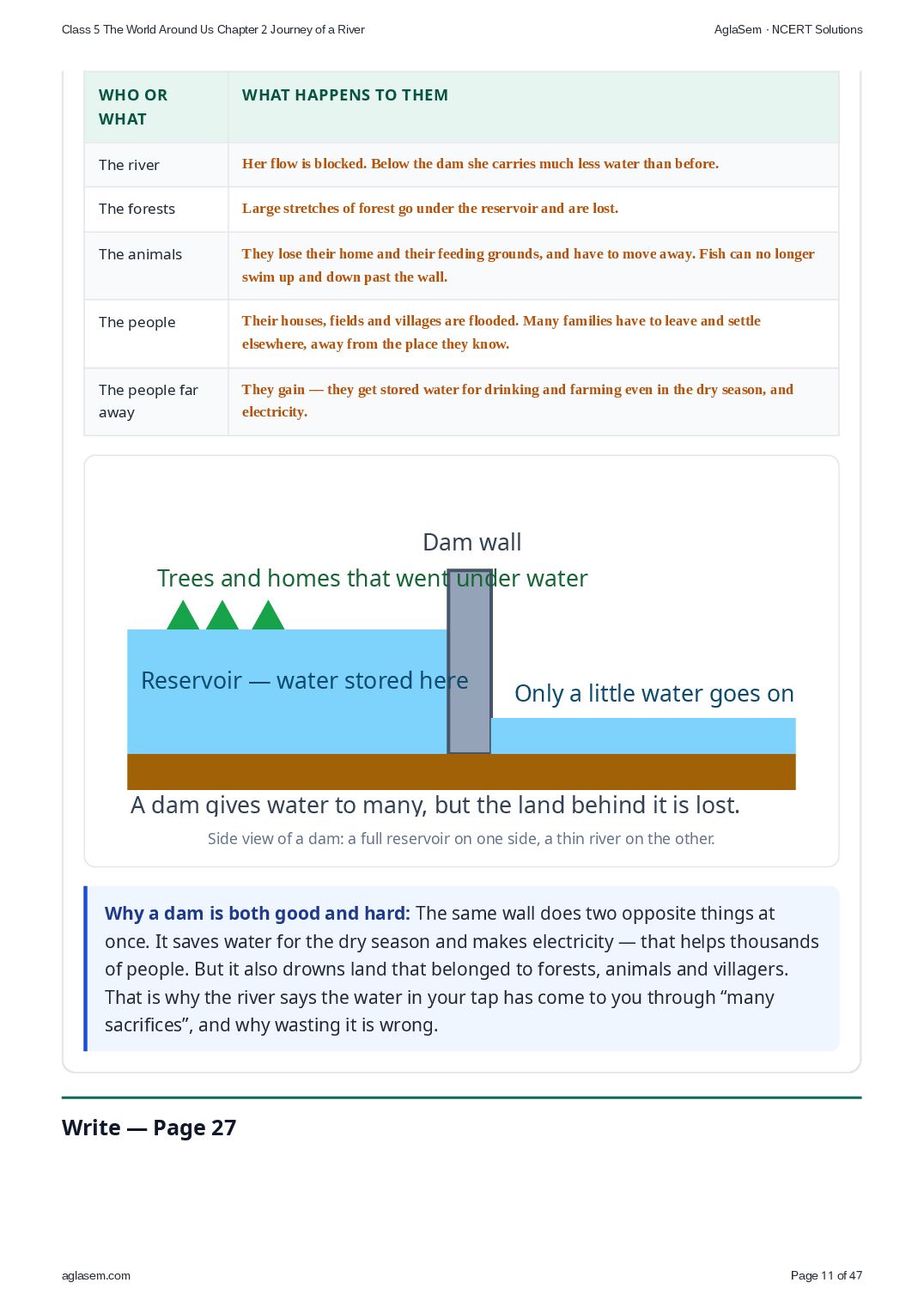
- But have you ever wondered what happens to me when a dam is built? What happens to the forests, animals and the people living near me?
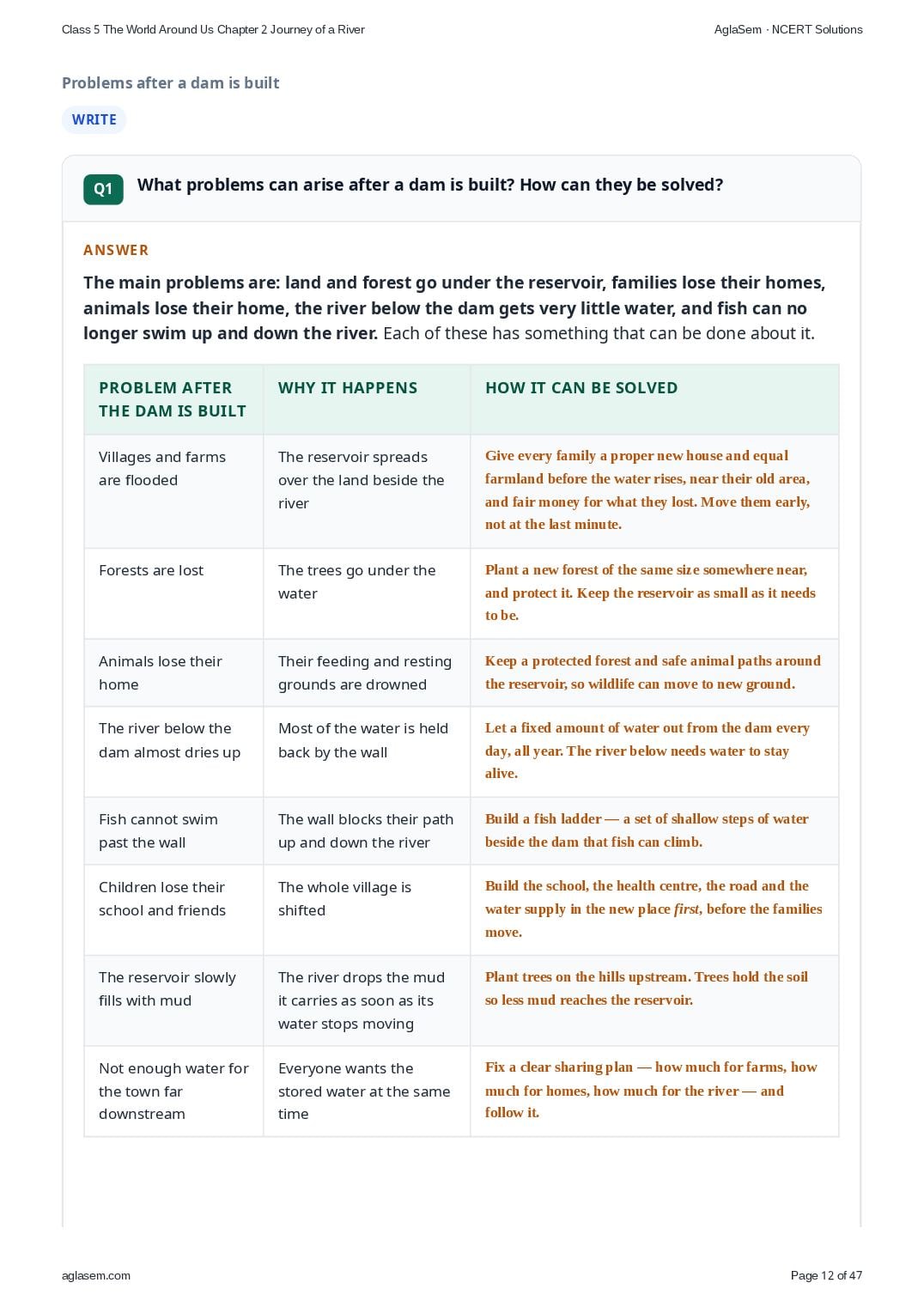
- What problems can arise after a dam is built? How can they be solved?
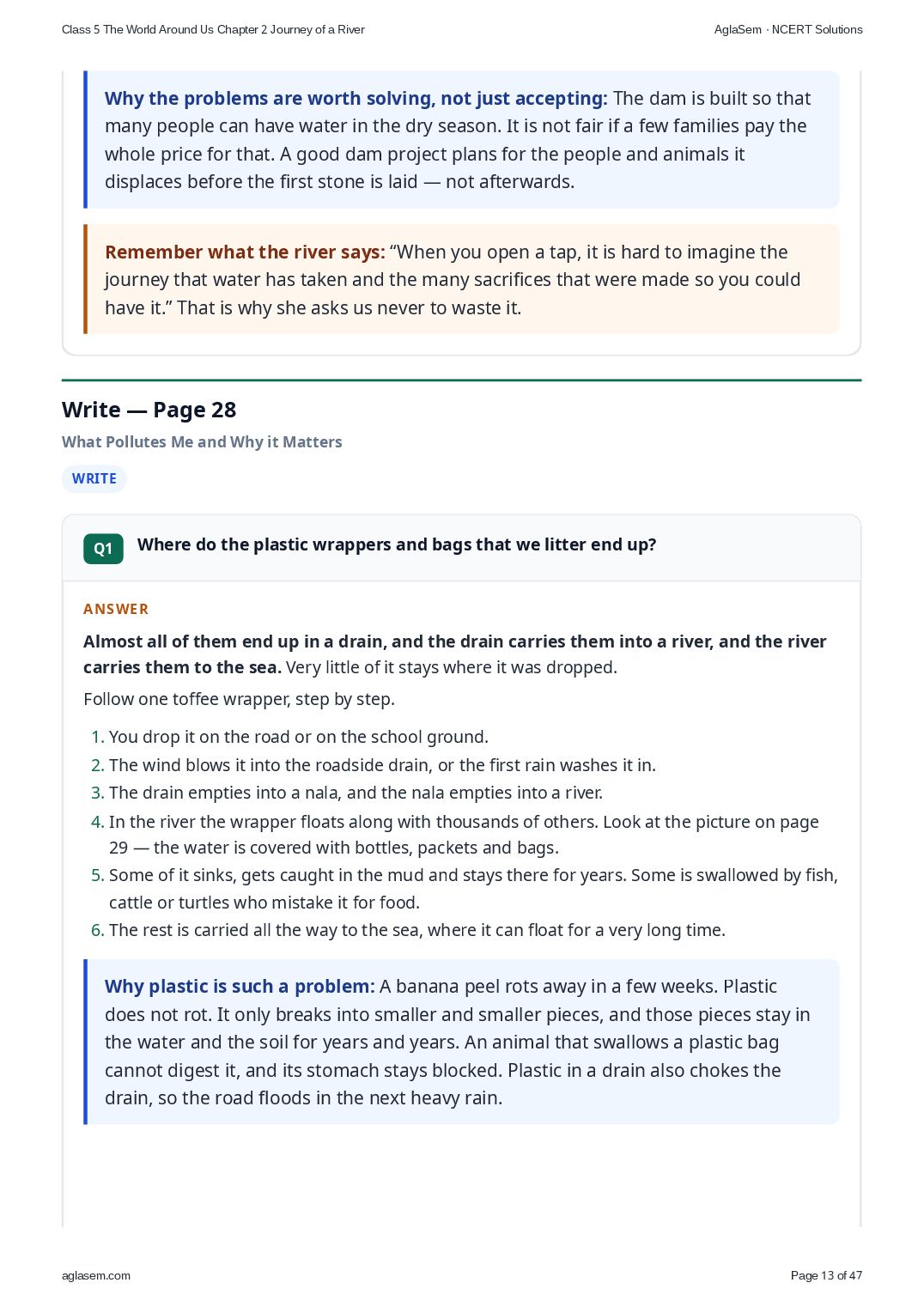
- Where do the plastic wrappers and bags that we litter end up?
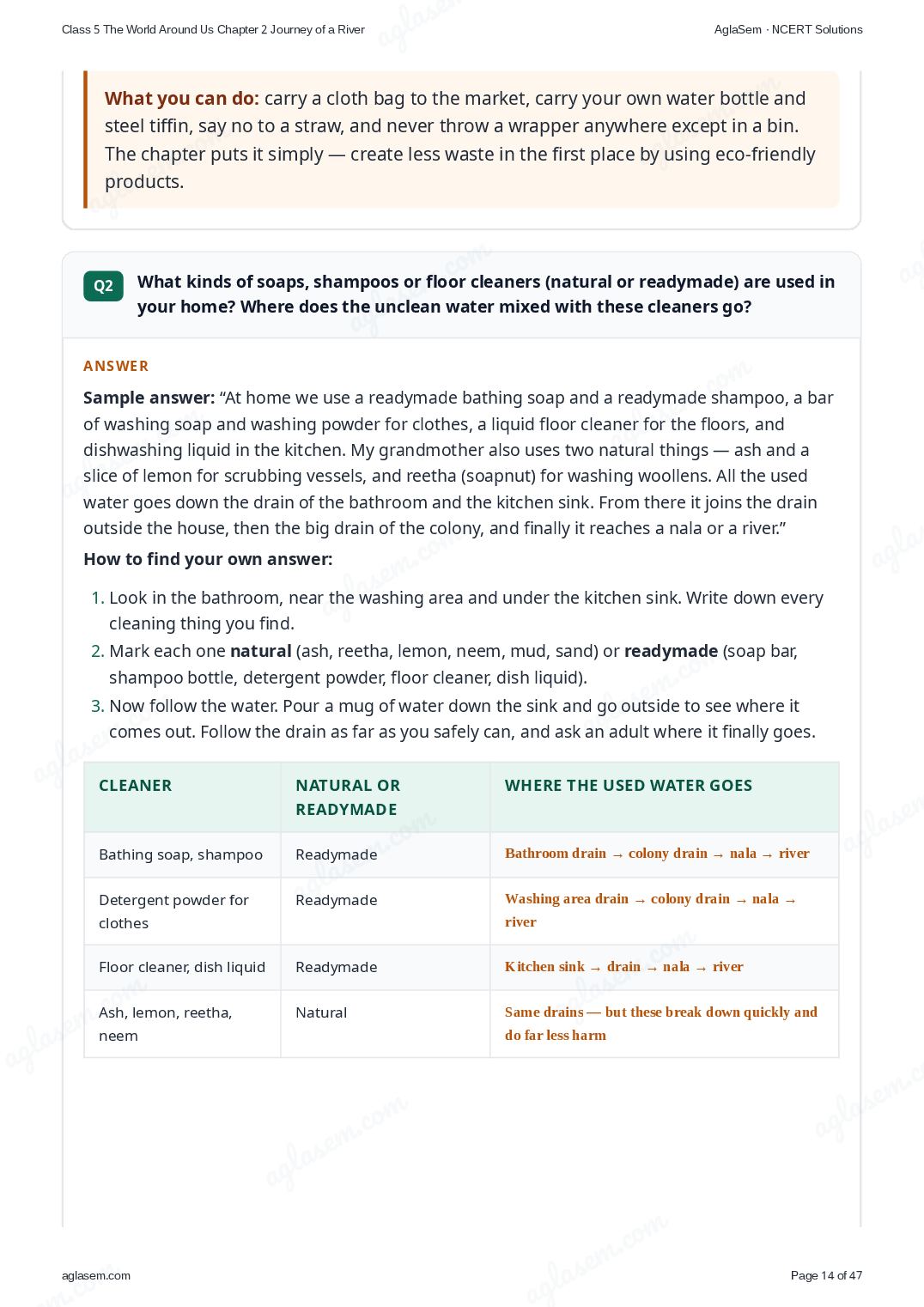
- What kinds of soaps, shampoos or floor cleaners (natural or readymade) are used in your home? Where does the unclean water mixed with these cleaners go?
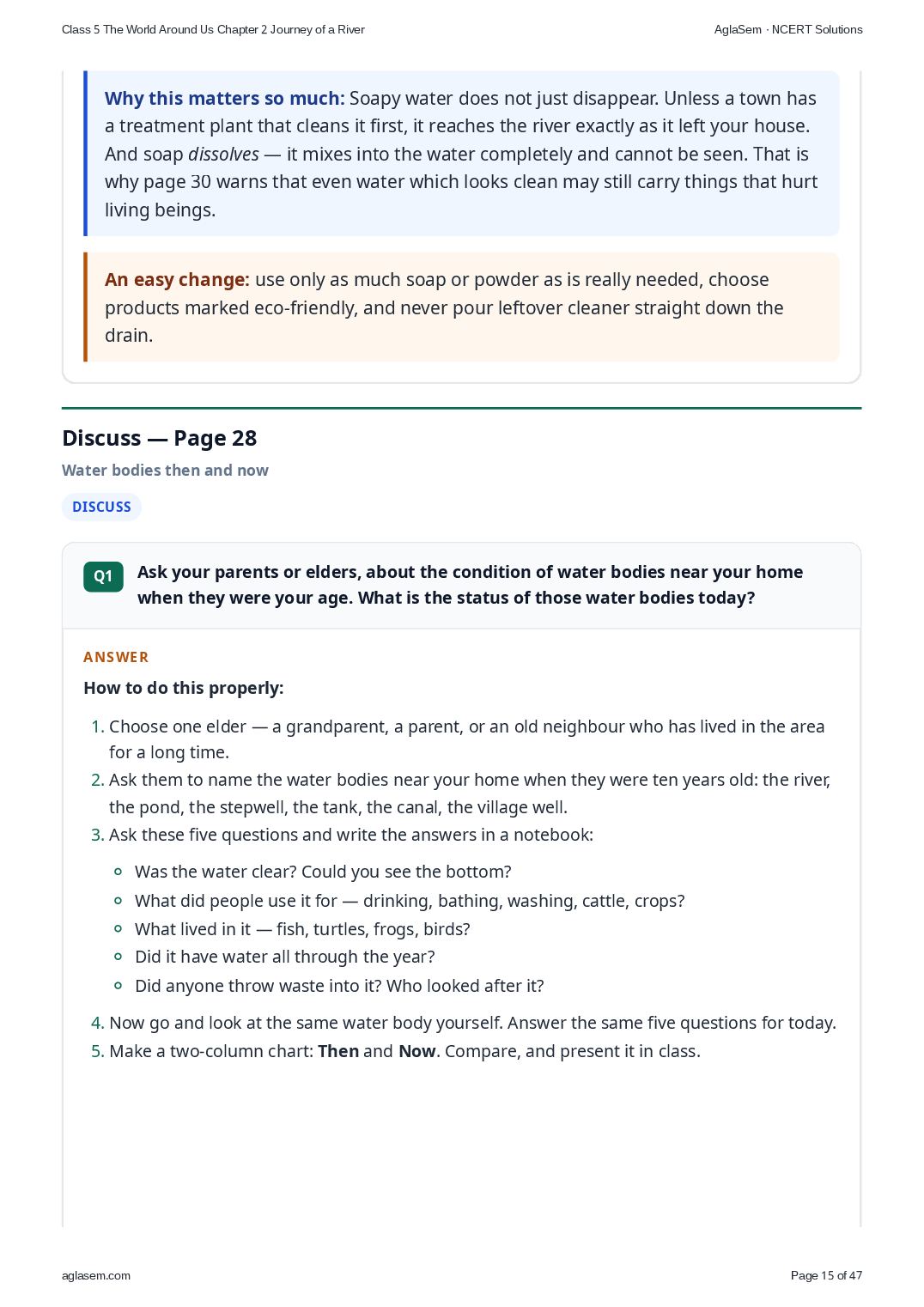
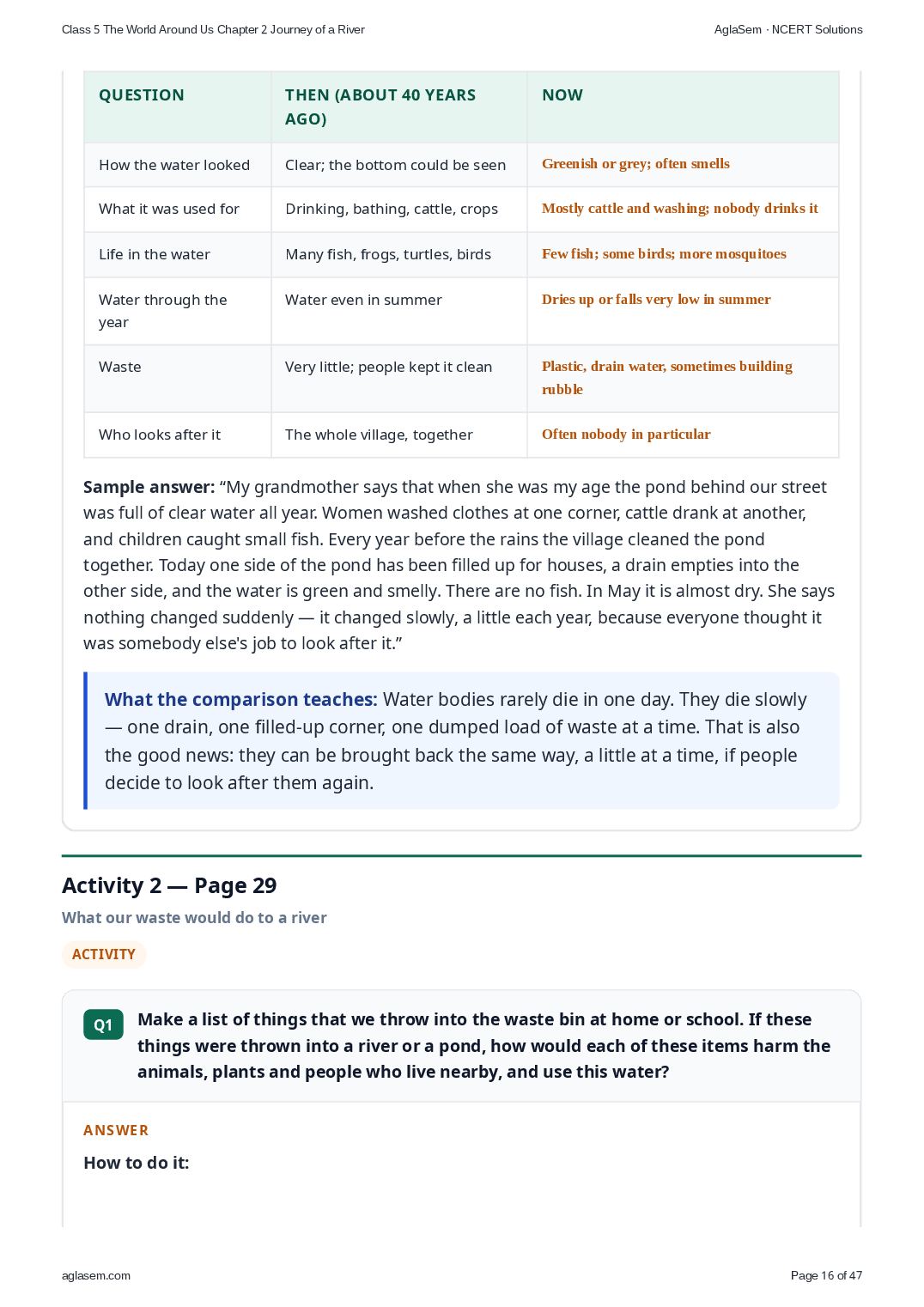
- Ask your parents or elders, about the condition of water bodies near your home when they were your age. What is the status of those water bodies today?
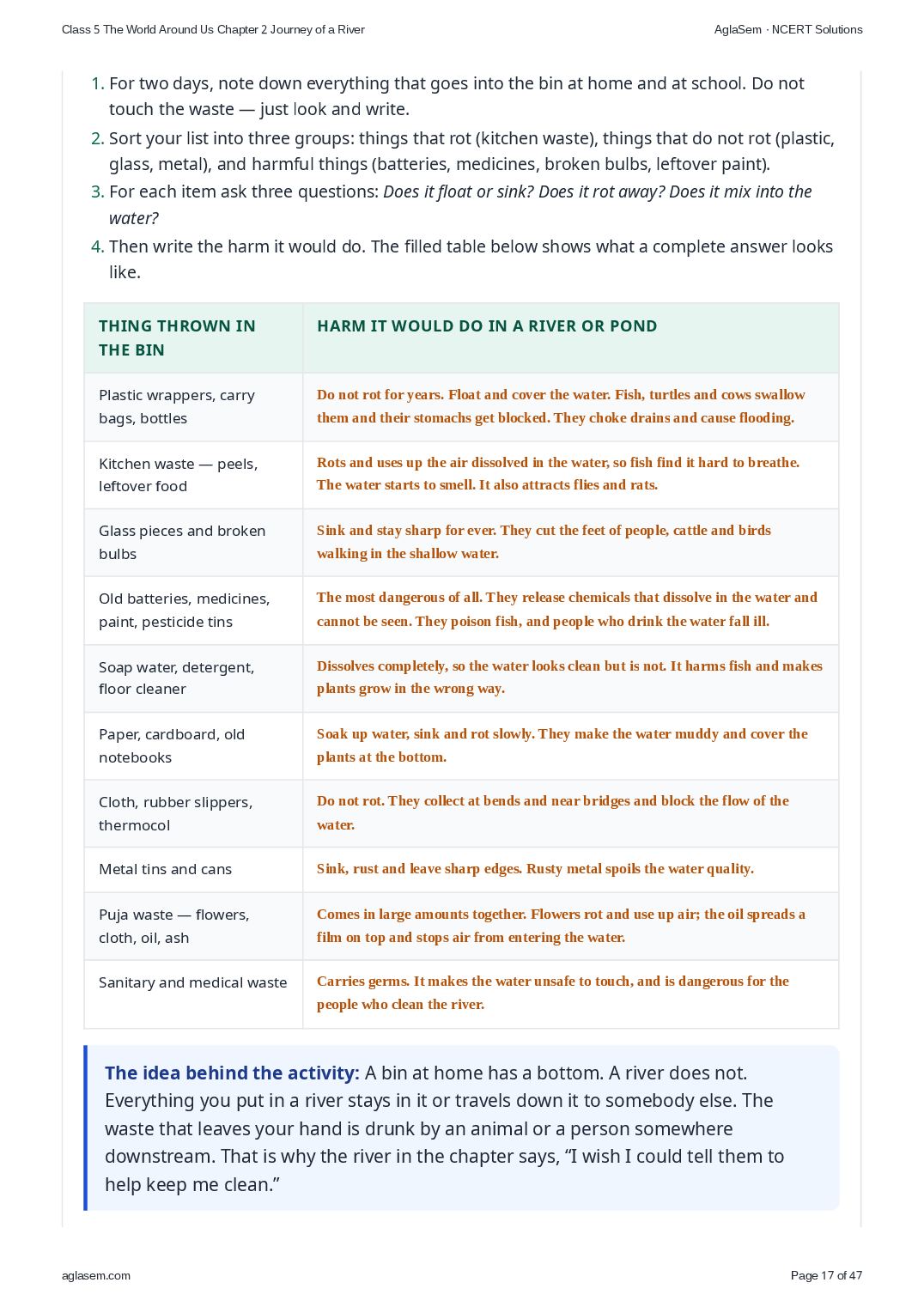
- Make a list of things that we throw into the waste bin at home or school. If these things were thrown into a river or a pond, how would each of these items harm the animals, plants and people who live nearby, and use this water?
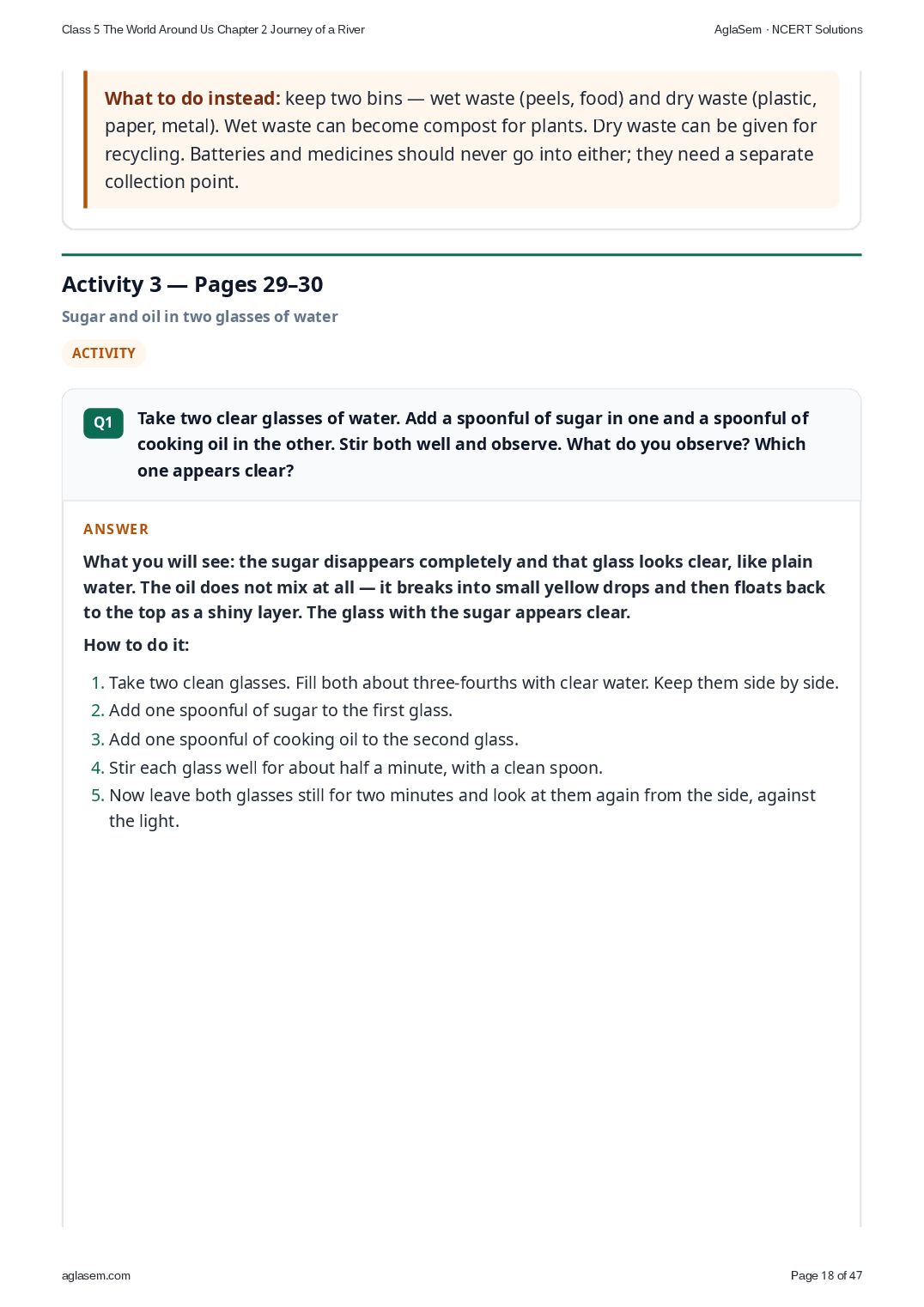
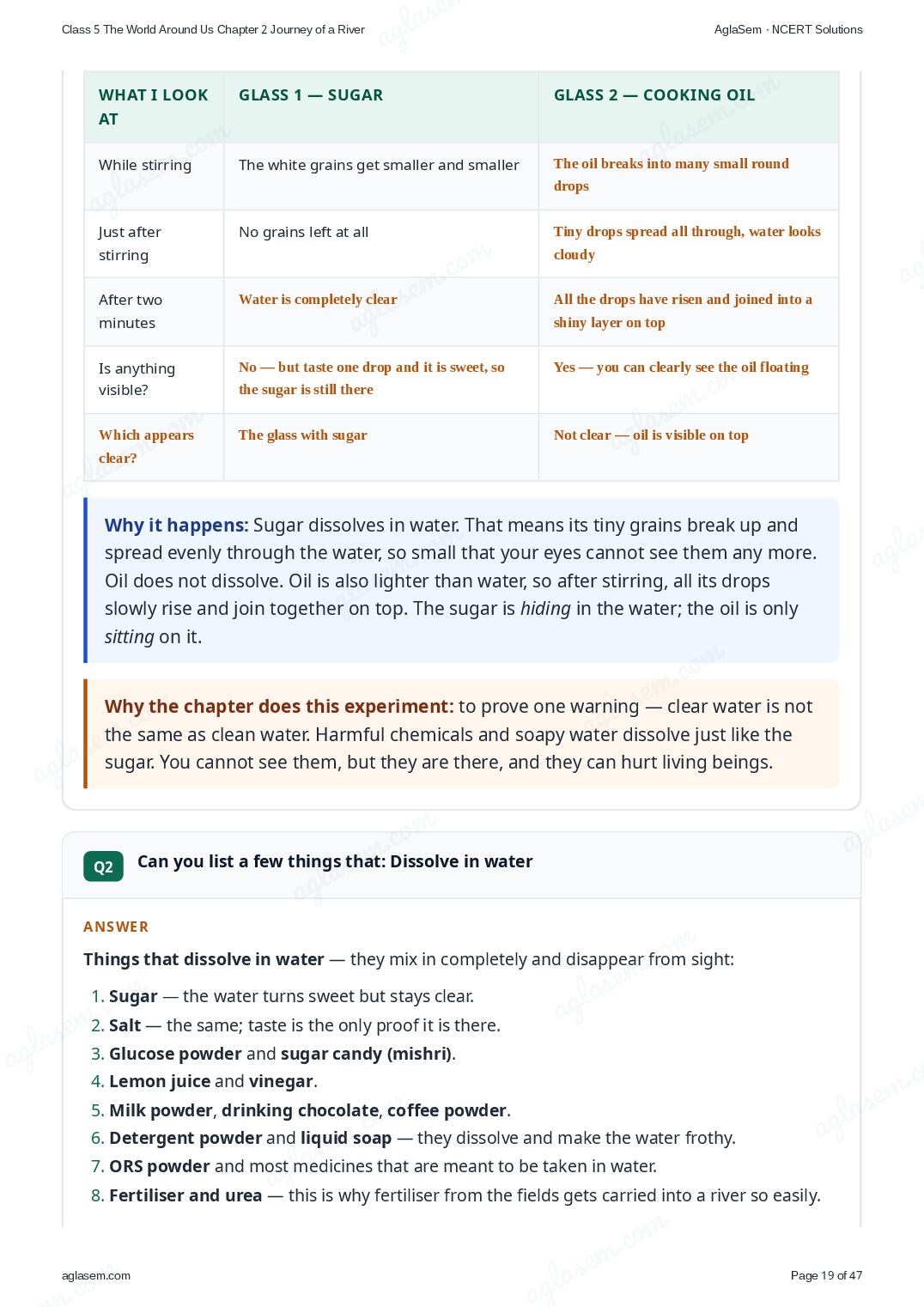
- Take two clear glasses of water. Add a spoonful of sugar in one and a spoonful of cooking oil in the other. Stir both well and observe. What do you observe? Which one appears clear?
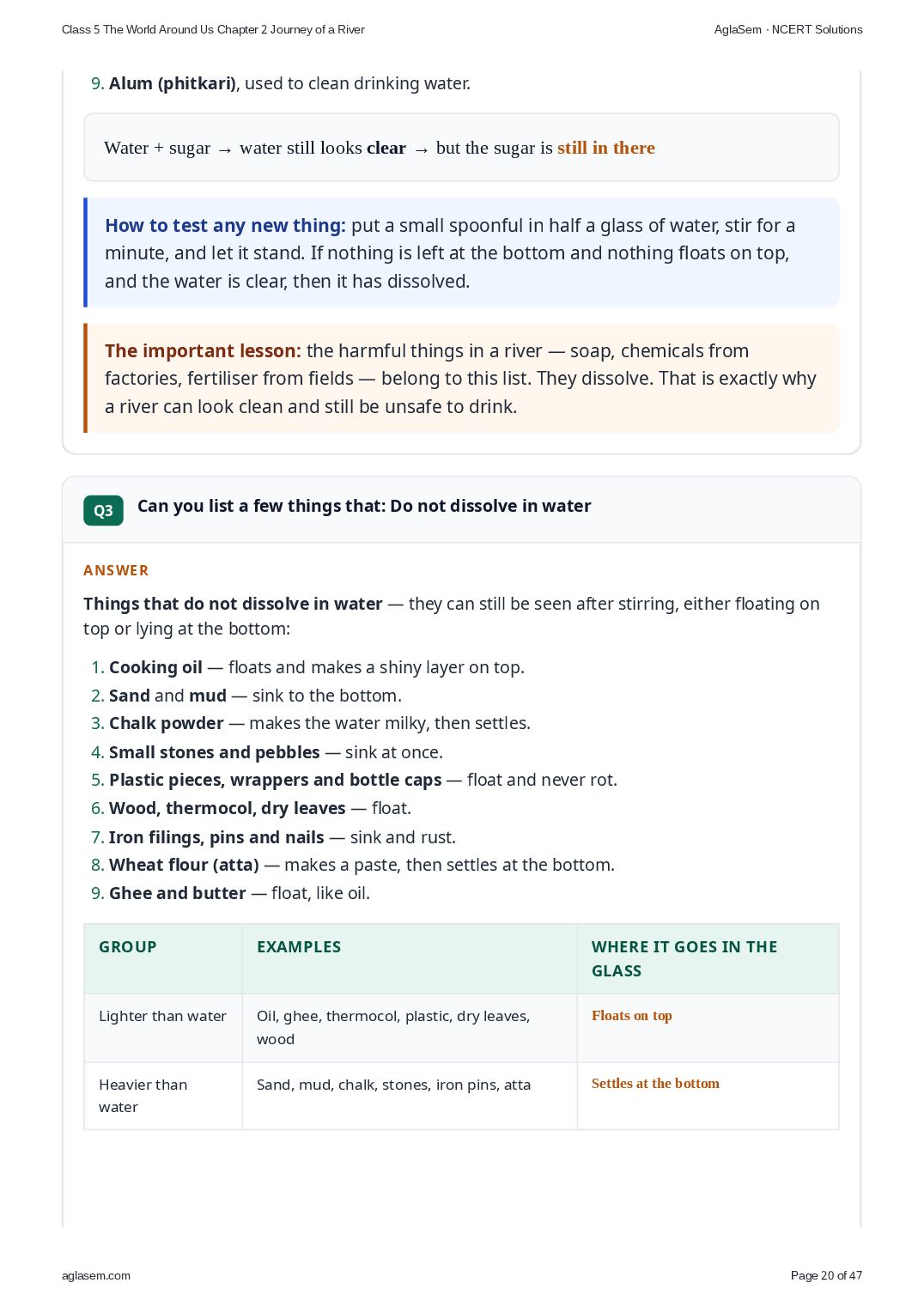
- Can you list a few things that: Dissolve in water
- Can you list a few things that: Do not dissolve in water
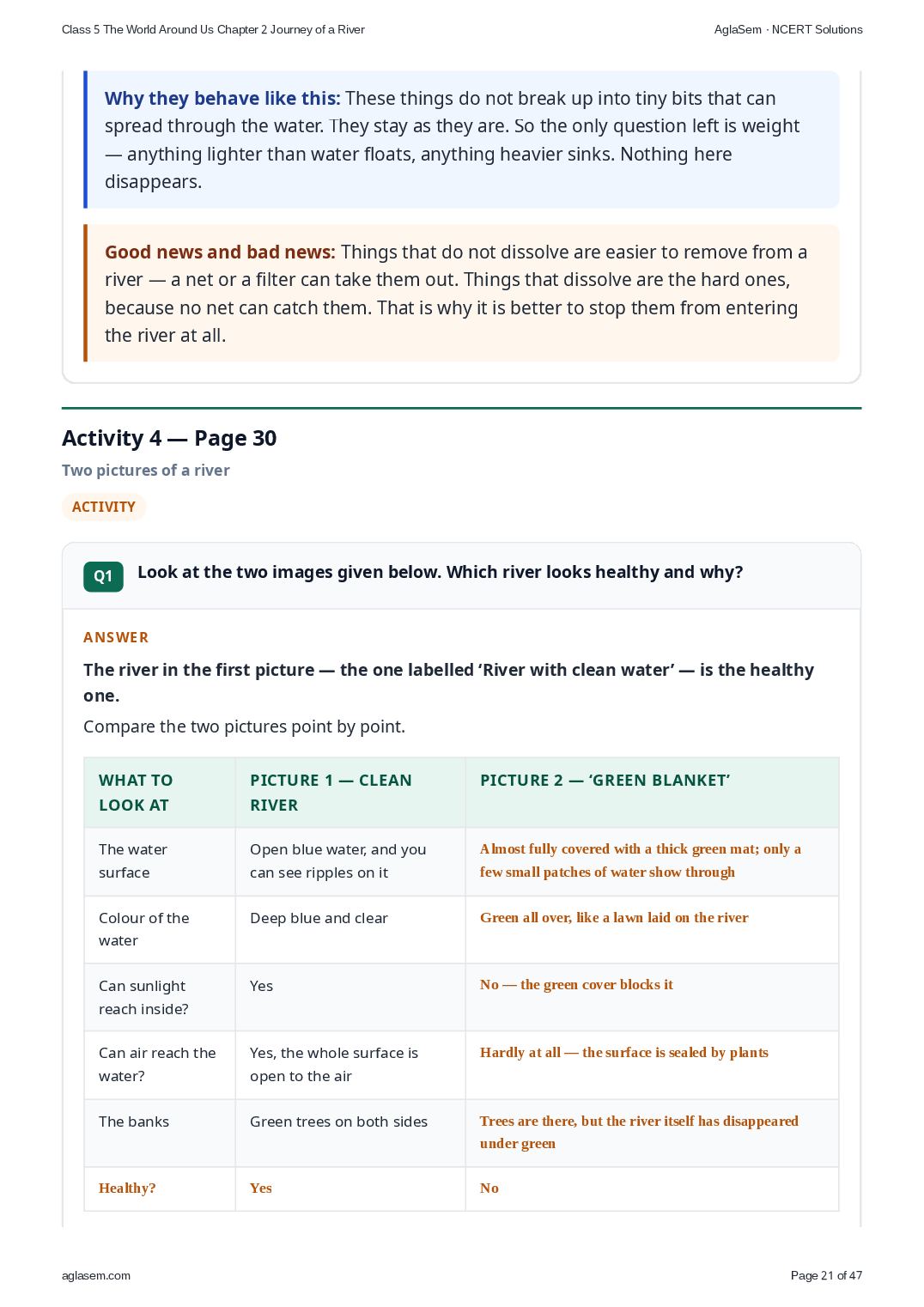
- Look at the two images given below. Which river looks healthy and why?
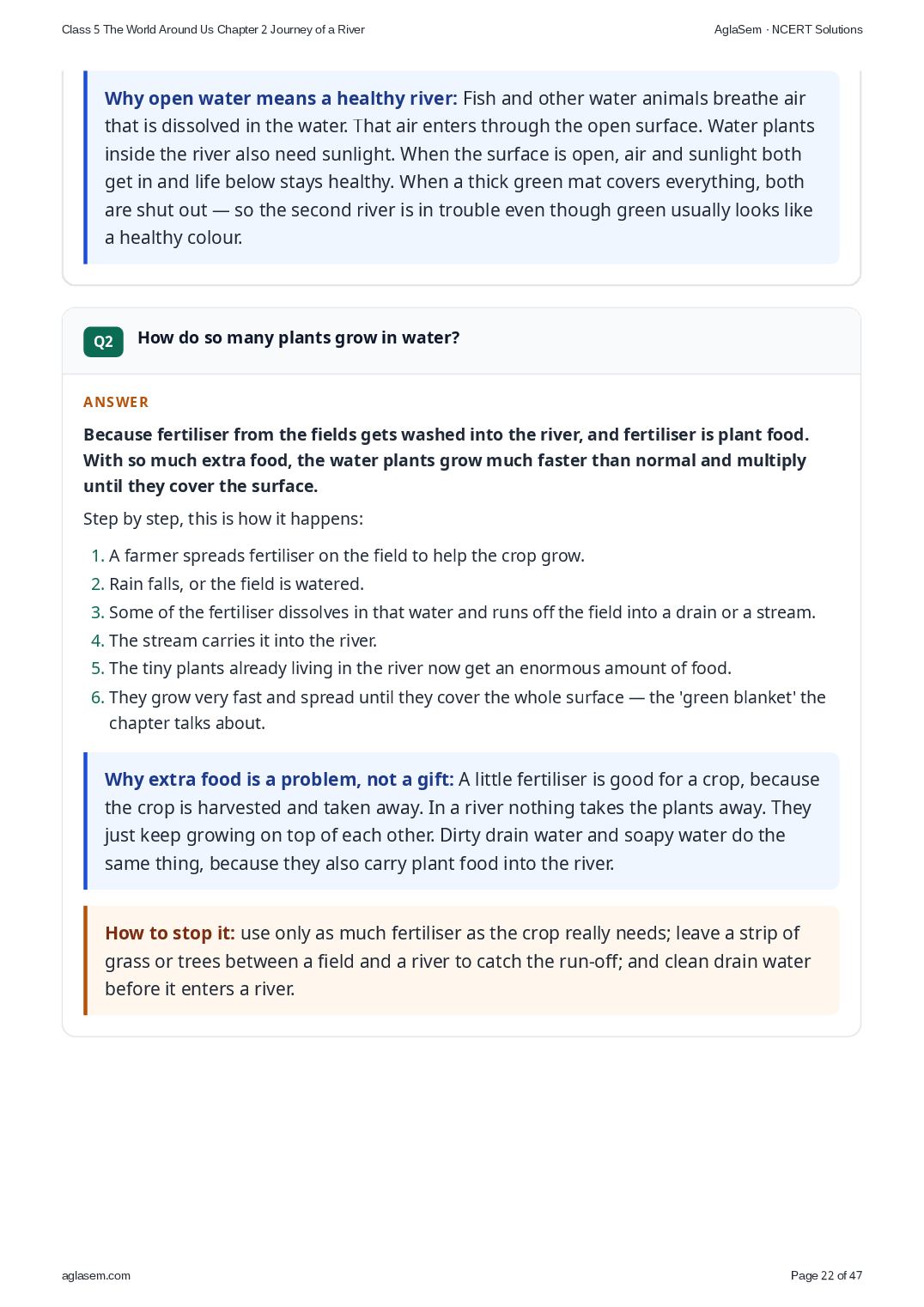
- How do so many plants grow in water?
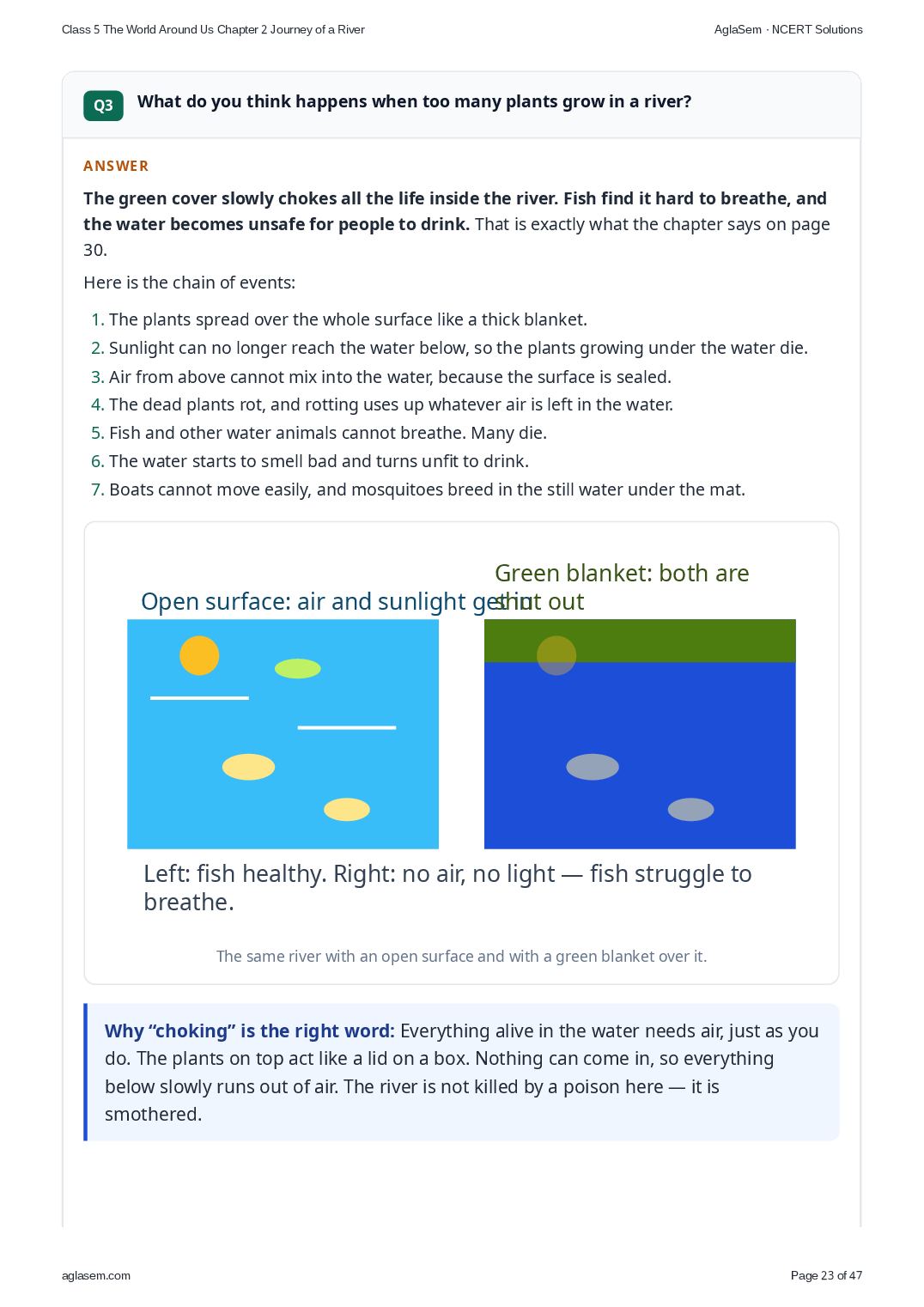
- What do you think happens when too many plants grow in a river?
- Can you list three things you can do to protect the water bodies near you? 1. ____ 2. ____ 3. ____
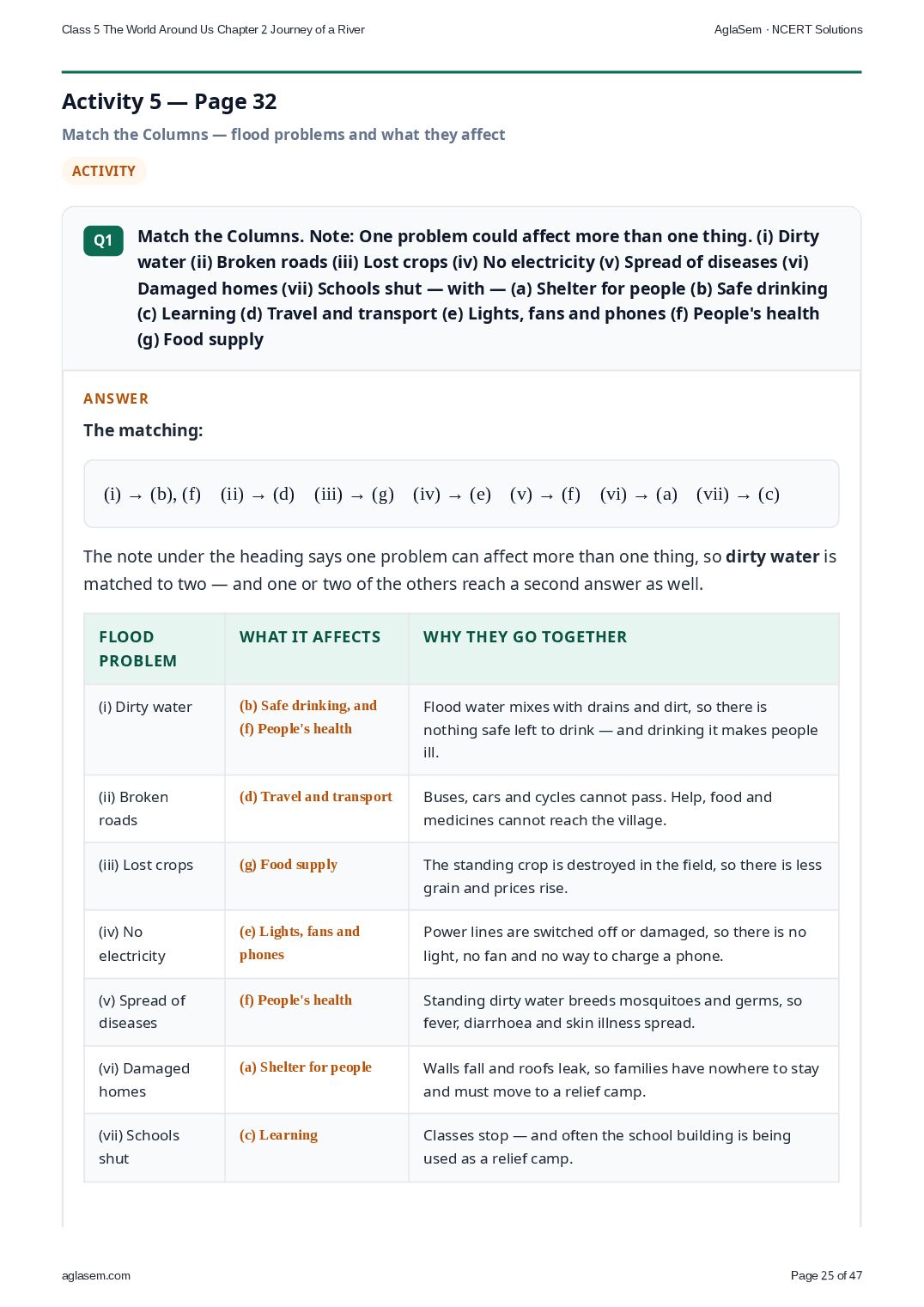
- Match the Columns. Note: One problem could affect more than one thing. (i) Dirty water (ii) Broken roads (iii) Lost crops (iv) No electricity (v) Spread of diseases (vi) Damaged homes (vii) Schools shut — with — (a) Shelter for people (b) Safe drinking (c) Learning (d) Travel and transport (e) Lights, fans and phones (f) People’s health (g) Food supply
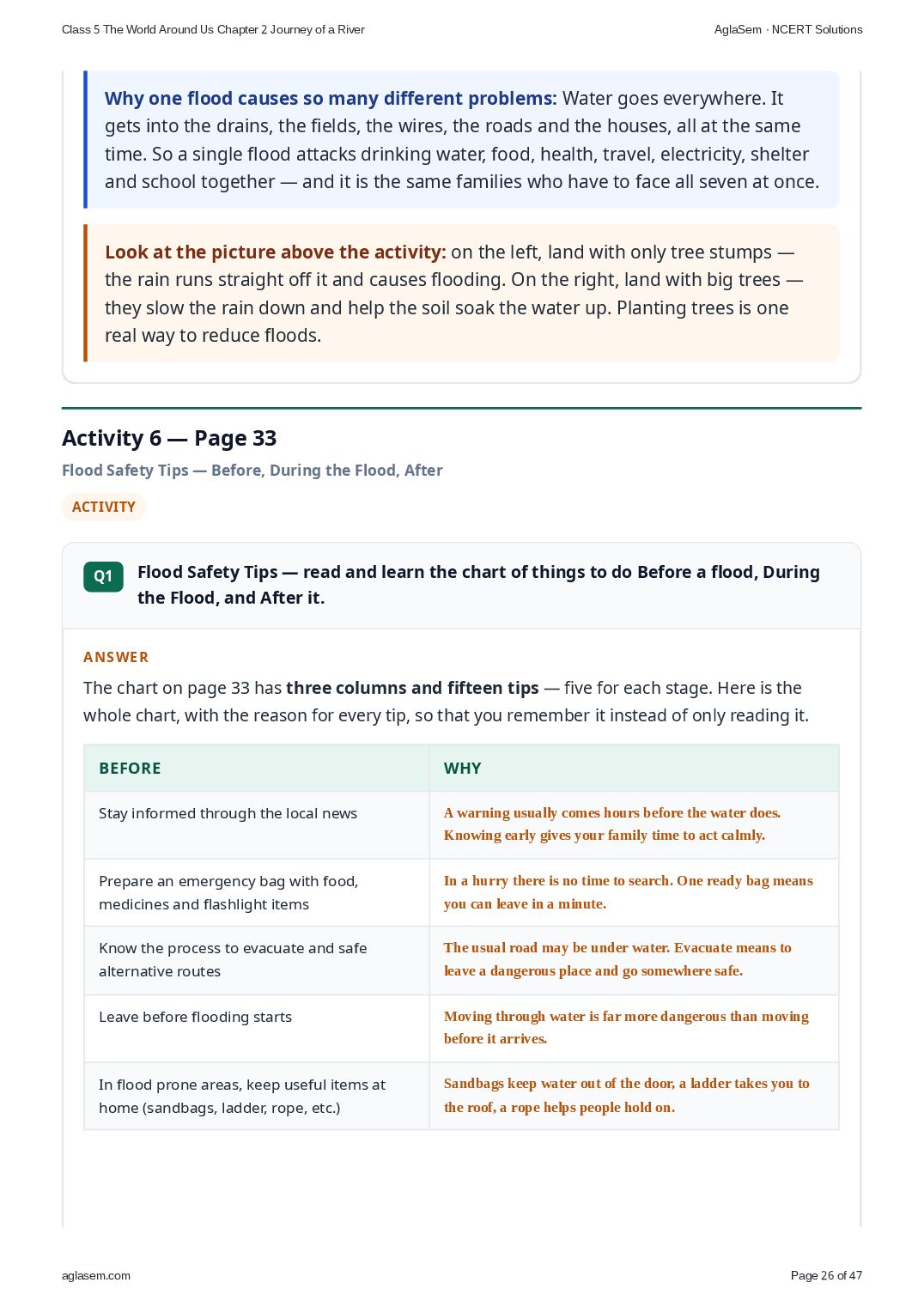
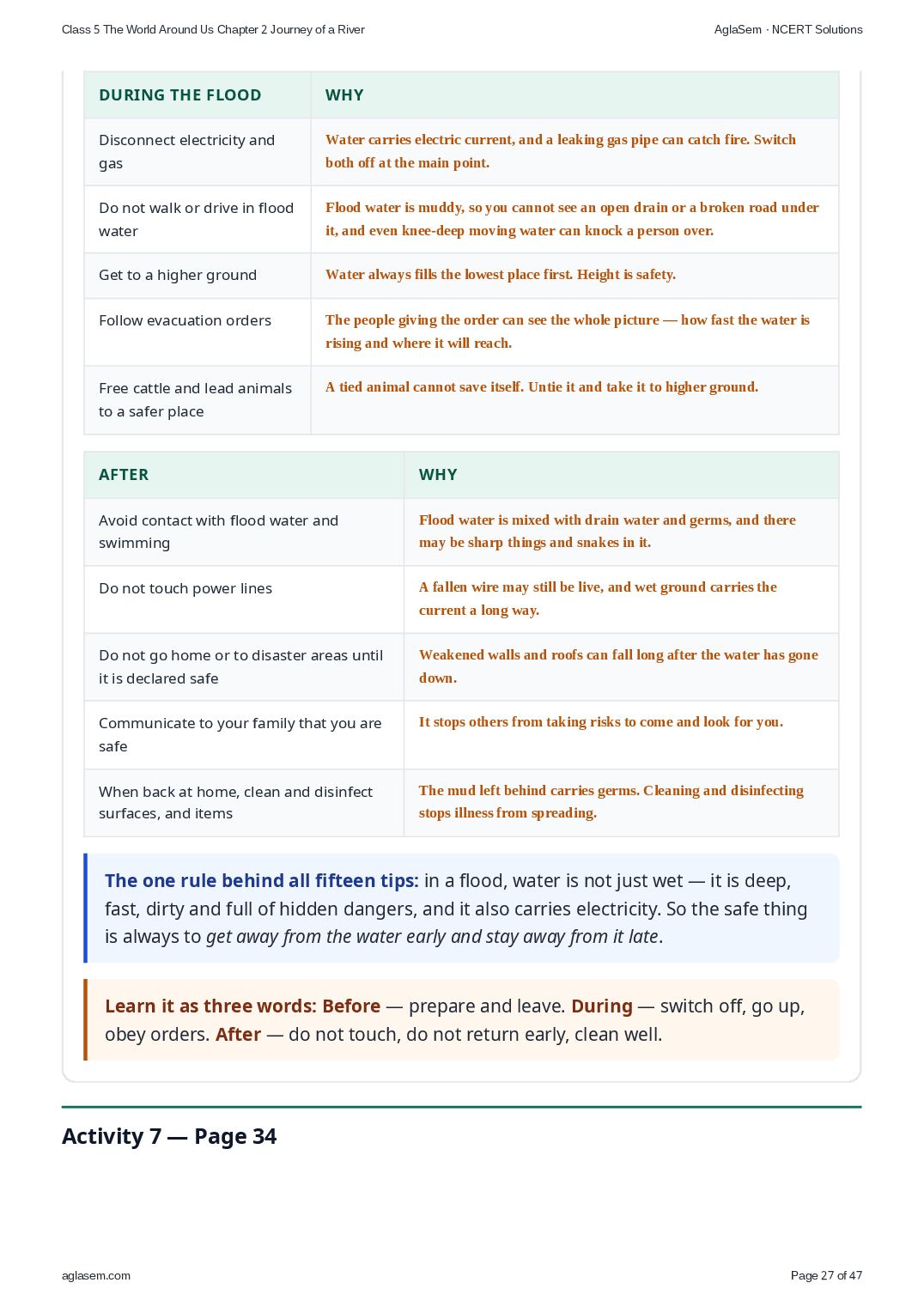
- Flood Safety Tips — read and learn the chart of things to do Before a flood, During the Flood, and After it.
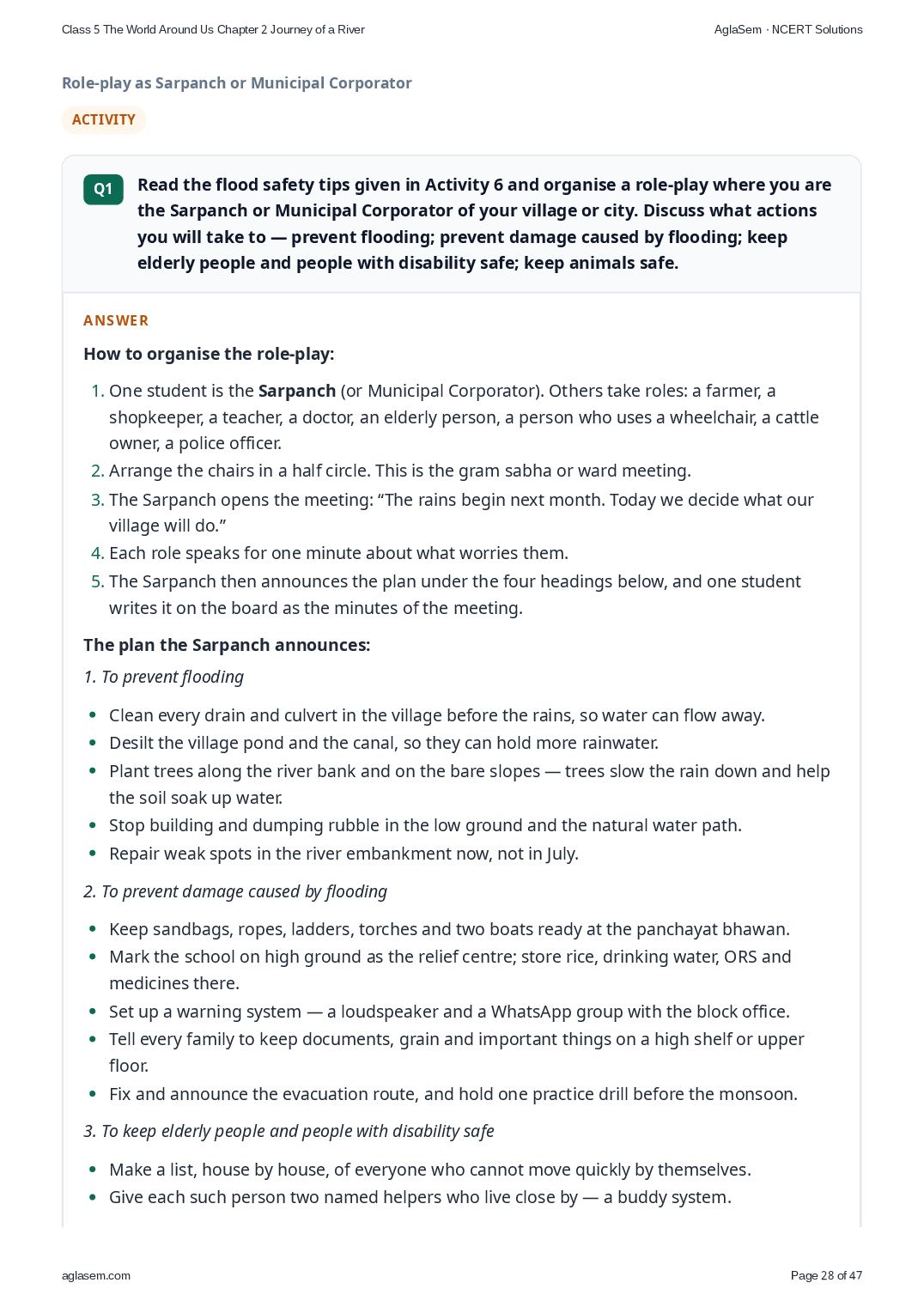
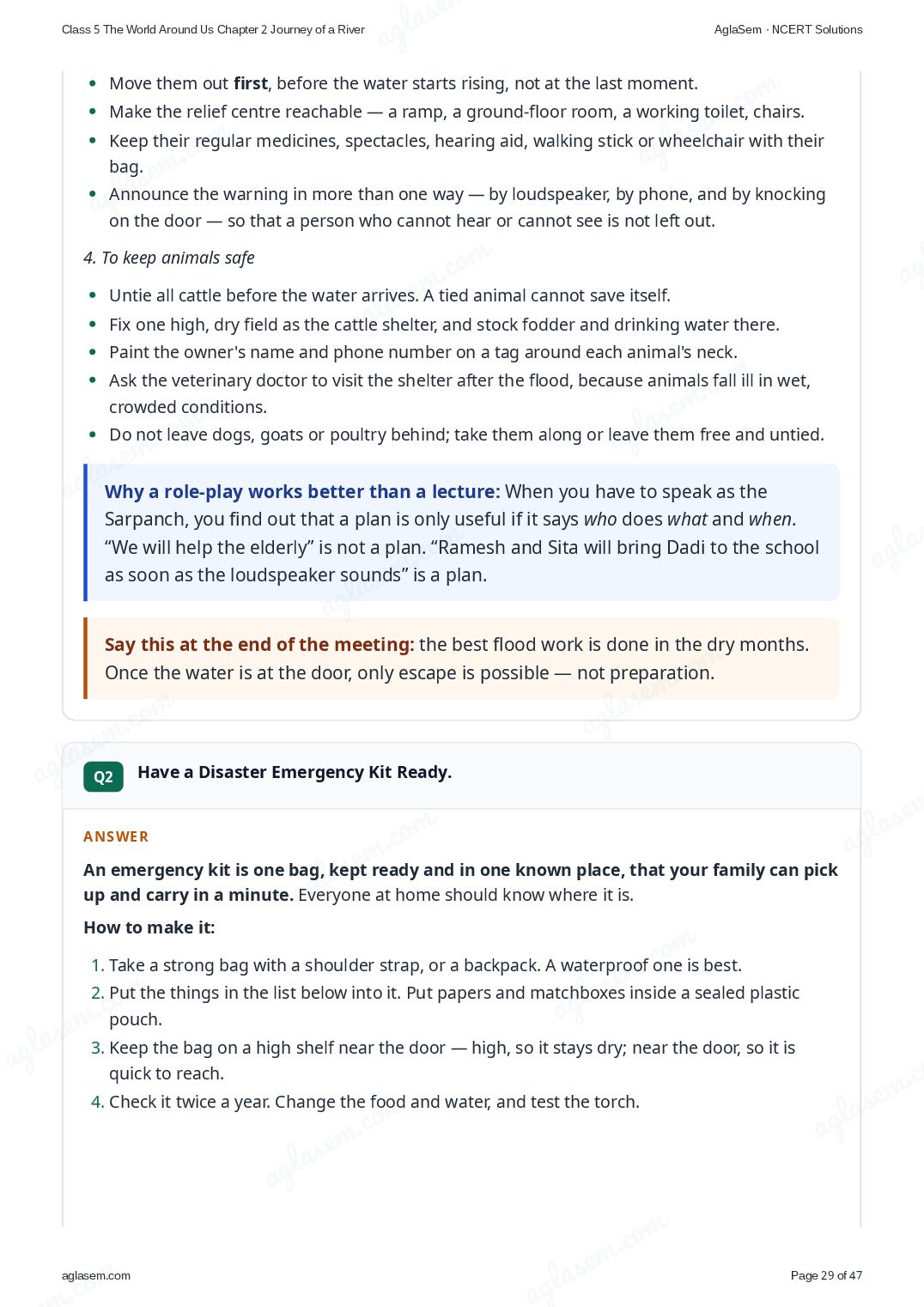
- Read the flood safety tips given in Activity 6 and organise a role-play where you are the Sarpanch or Municipal Corporator of your village or city. Discuss what actions you will take to — prevent flooding; prevent damage caused by flooding; keep elderly people and people with disability safe; keep animals safe.
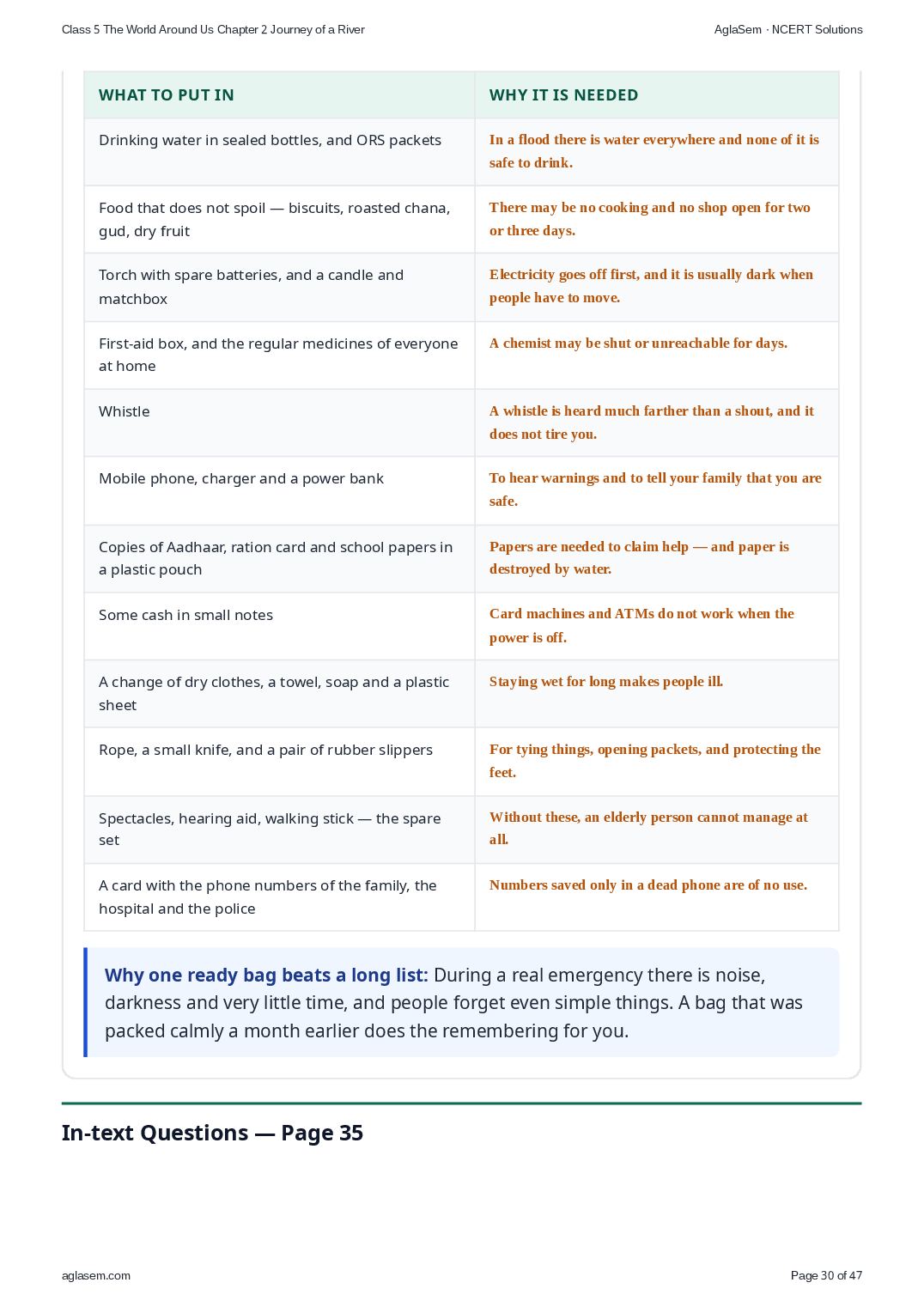
- Have a Disaster Emergency Kit Ready.
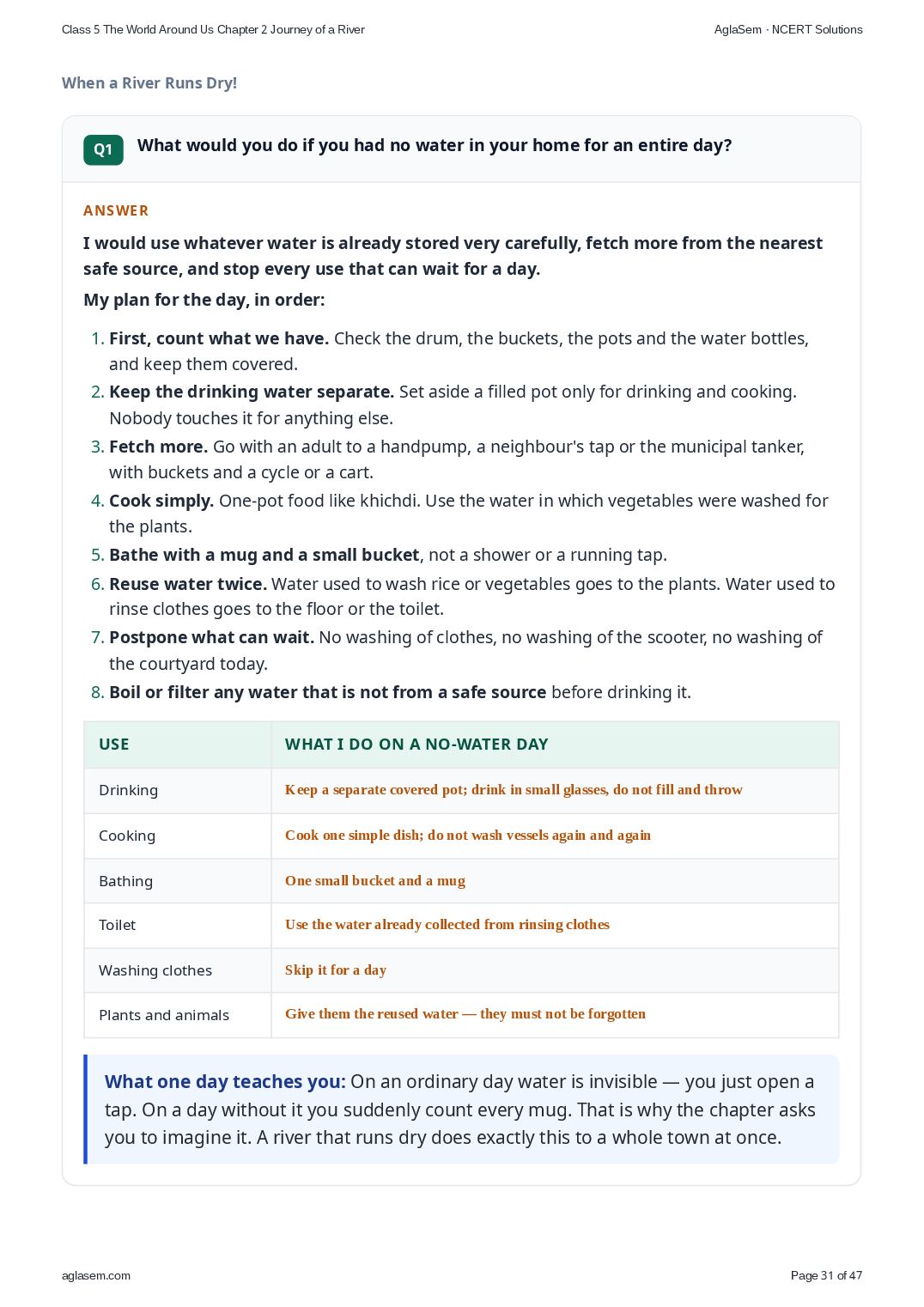
- What would you do if you had no water in your home for an entire day?
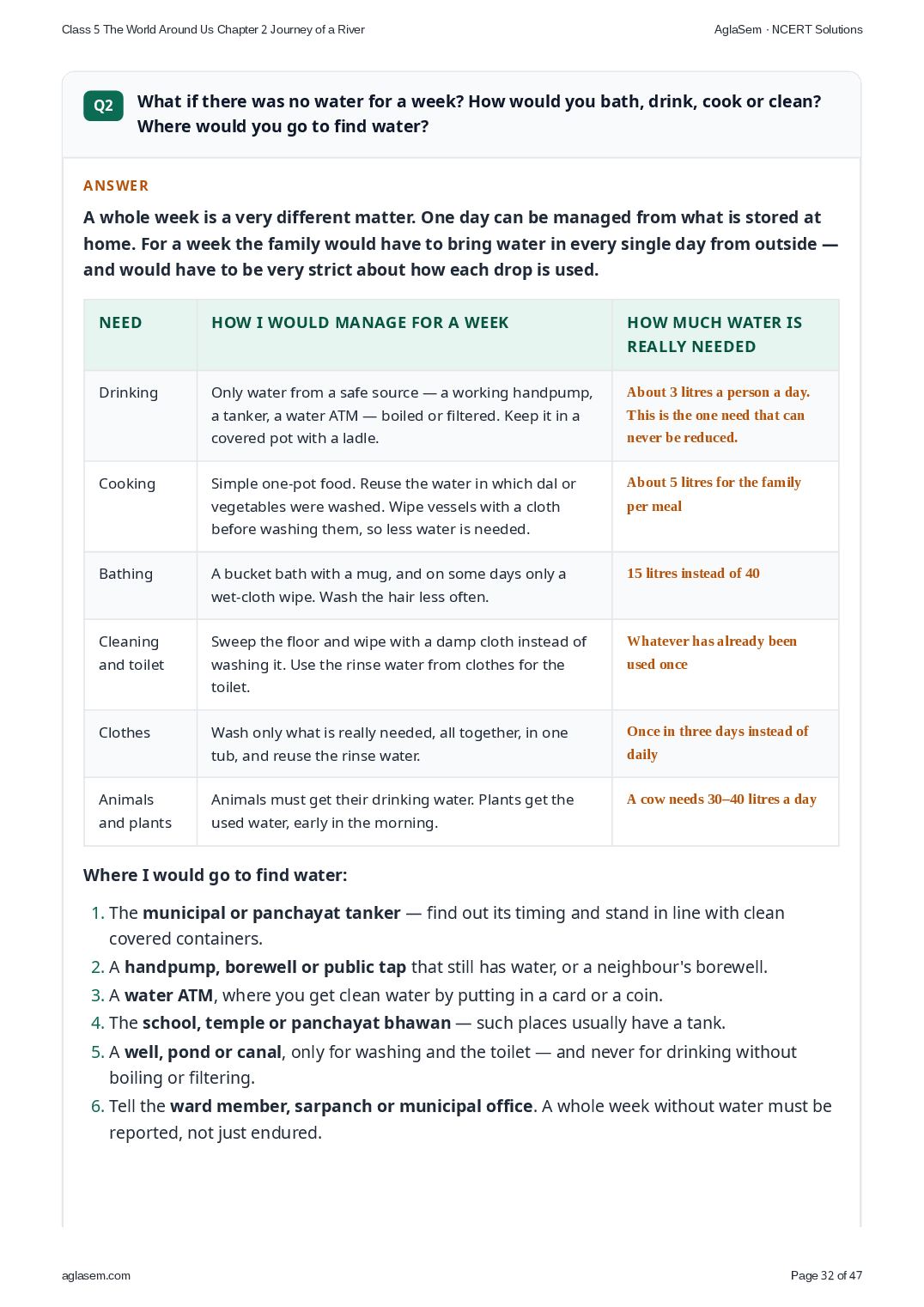
- What if there was no water for a week? How would you bath, drink, cook or clean? Where would you go to find water?
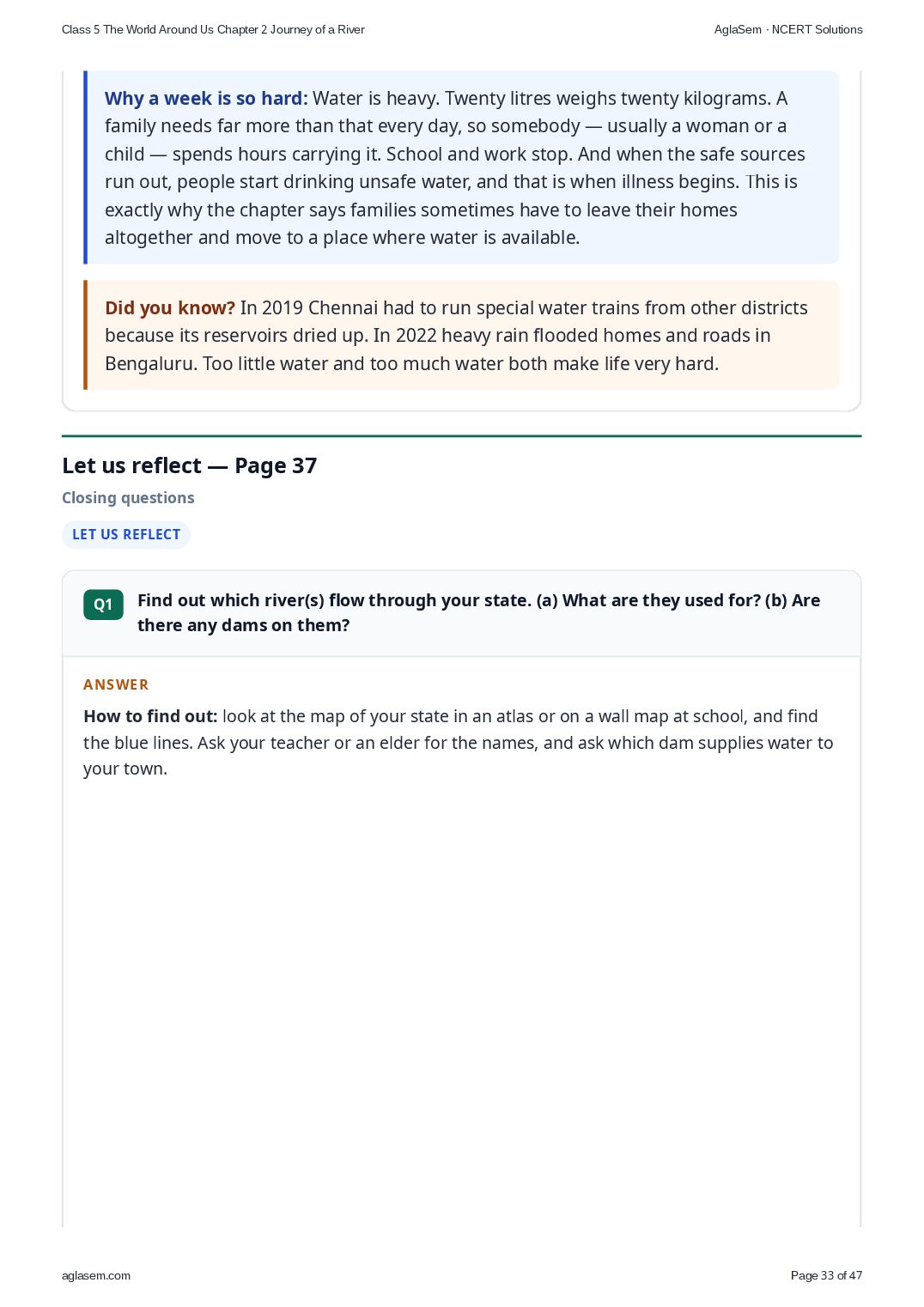
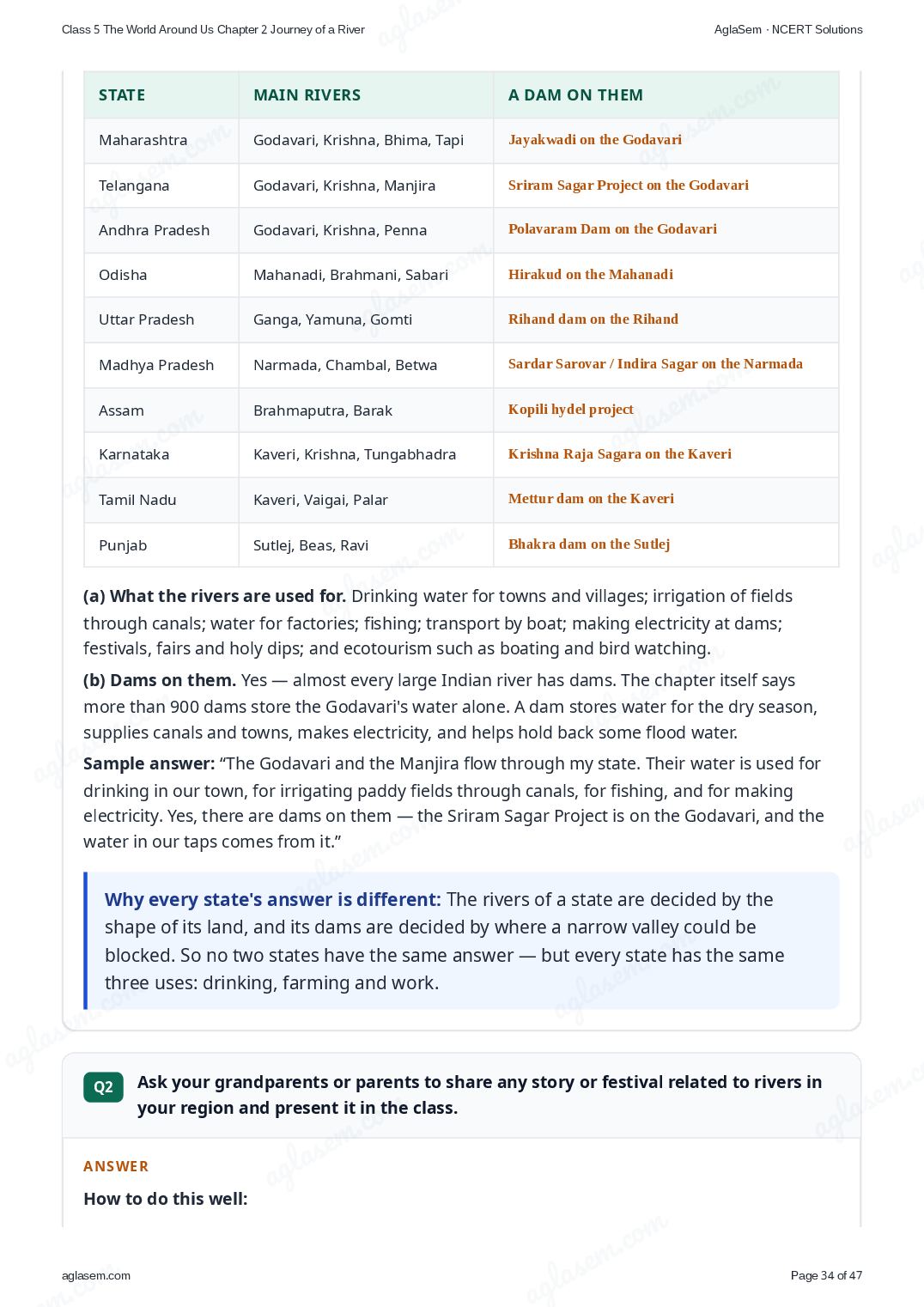
- Find out which river(s) flow through your state. (a) What are they used for? (b) Are there any dams on them?
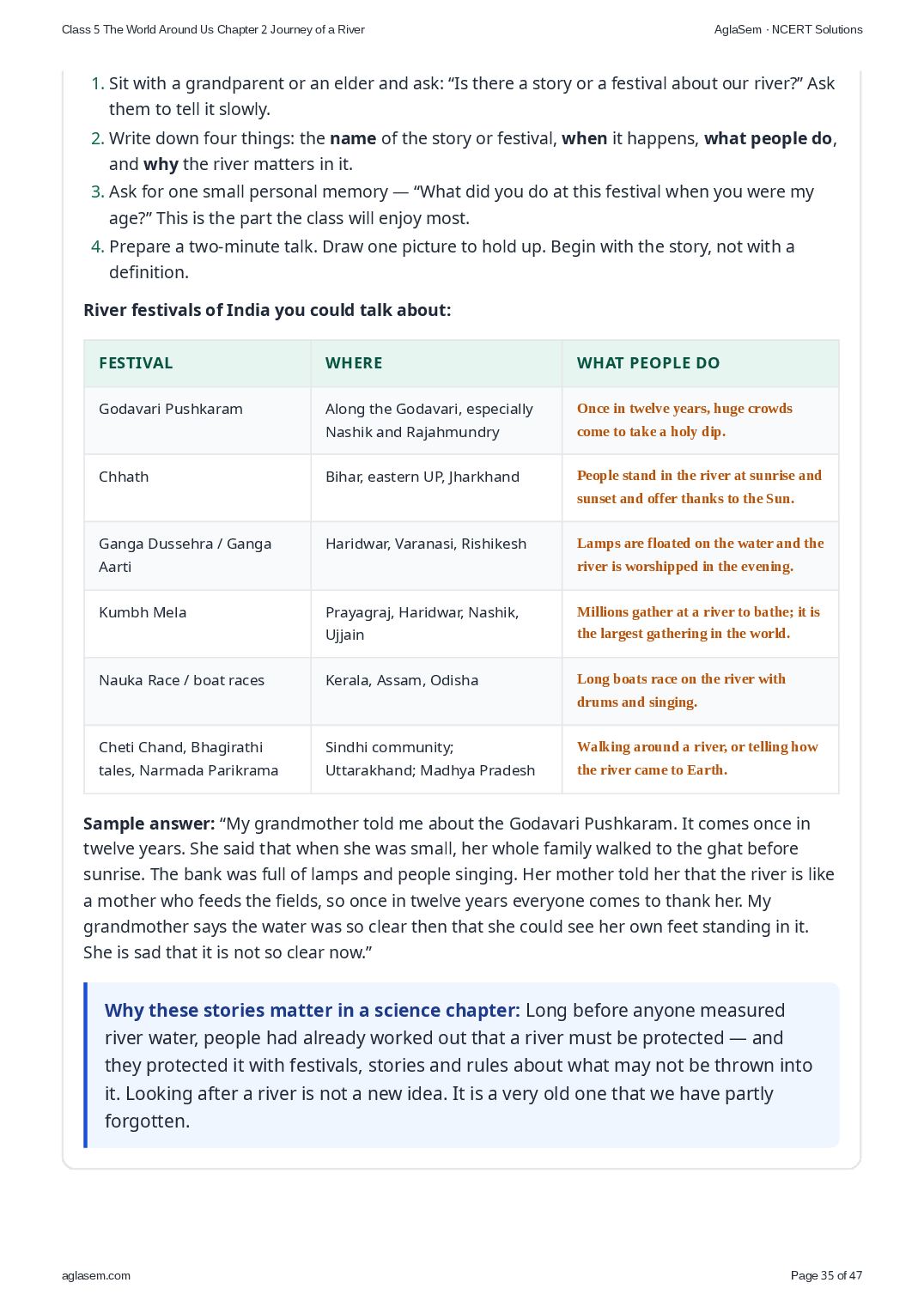
- Ask your grandparents or parents to share any story or festival related to rivers in your region and present it in the class.
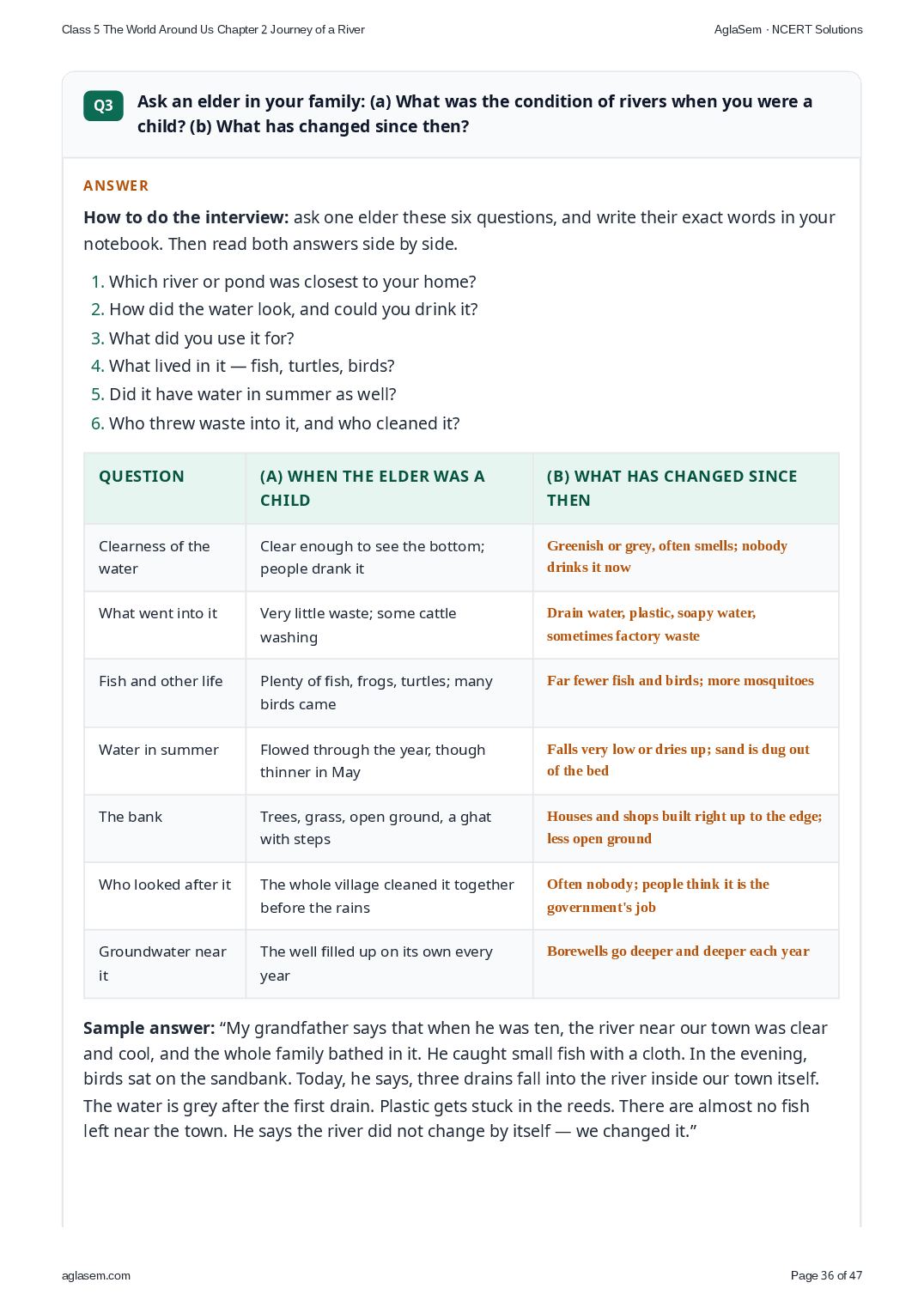
- Ask an elder in your family: (a) What was the condition of rivers when you were a child? (b) What has changed since then?
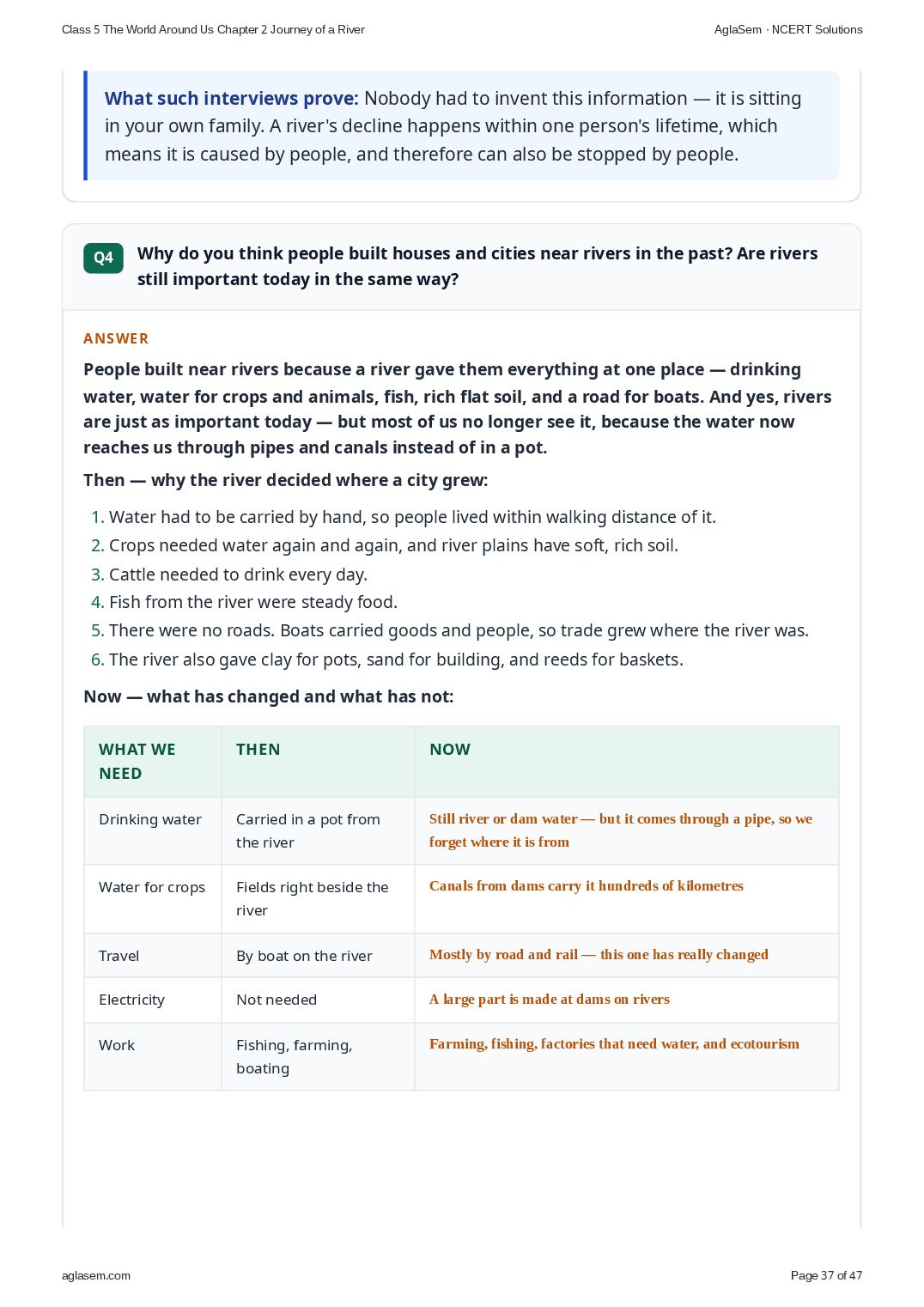
- Why do you think people built houses and cities near rivers in the past? Are rivers still important today in the same way?
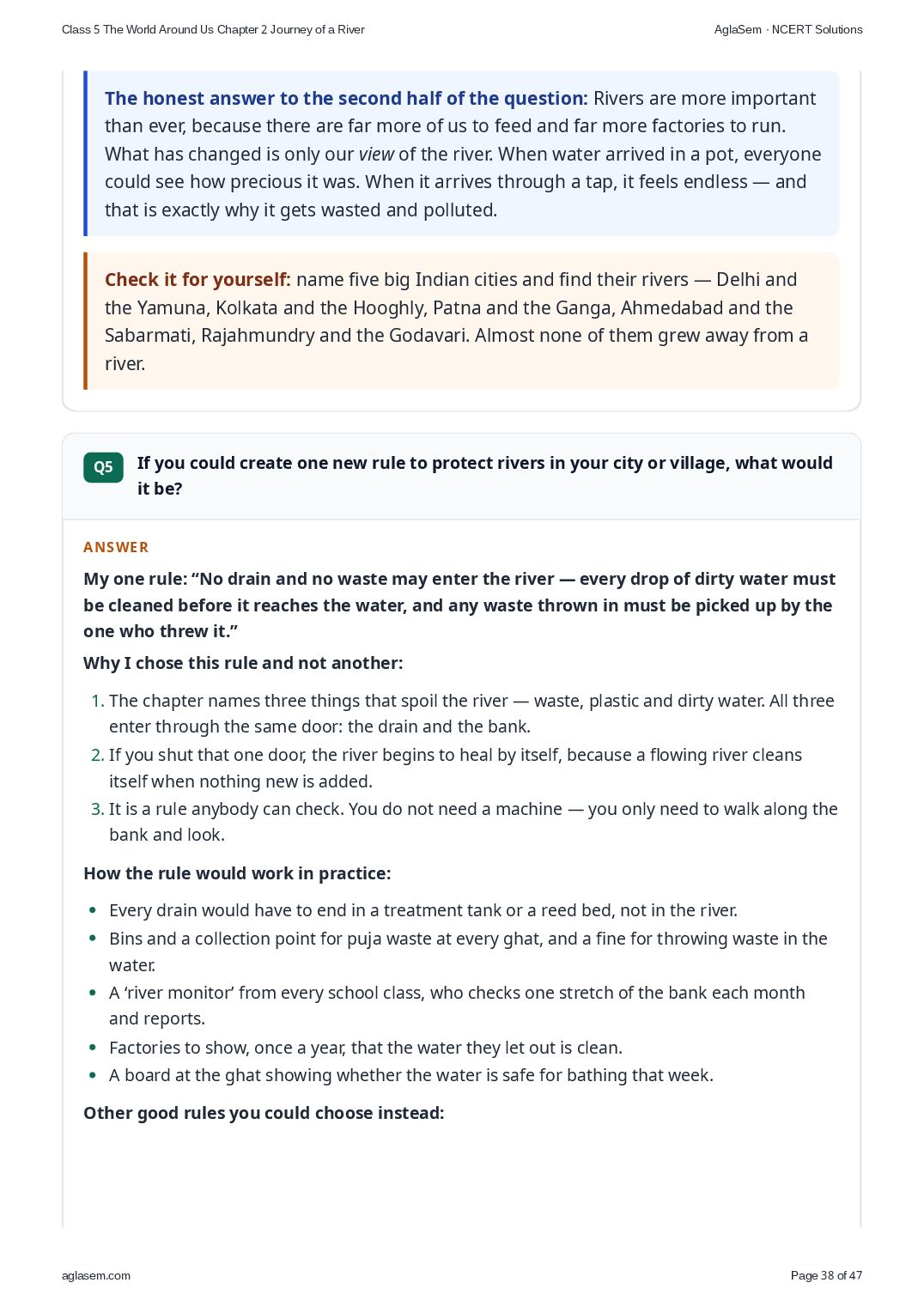
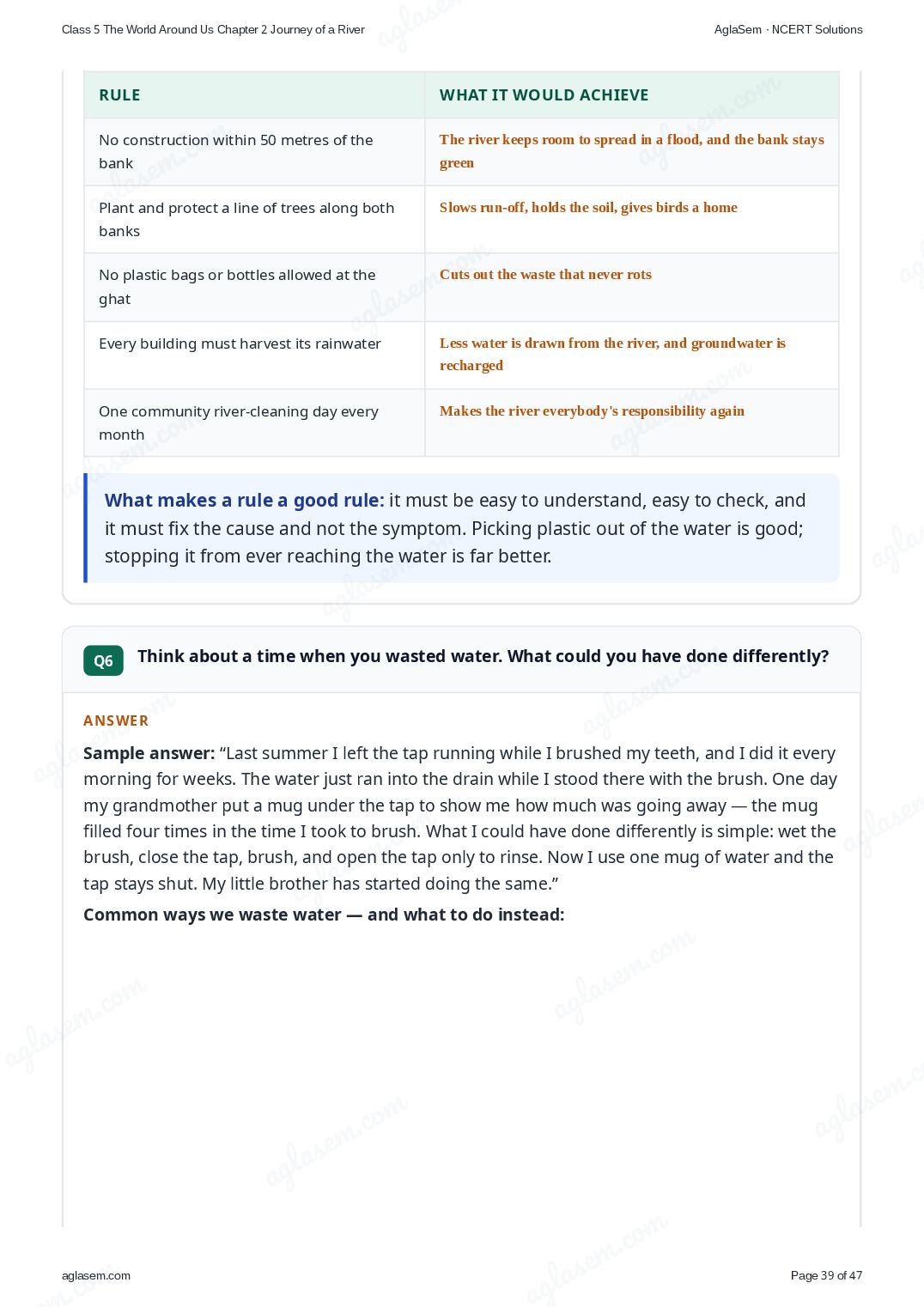
- If you could create one new rule to protect rivers in your city or village, what would it be?
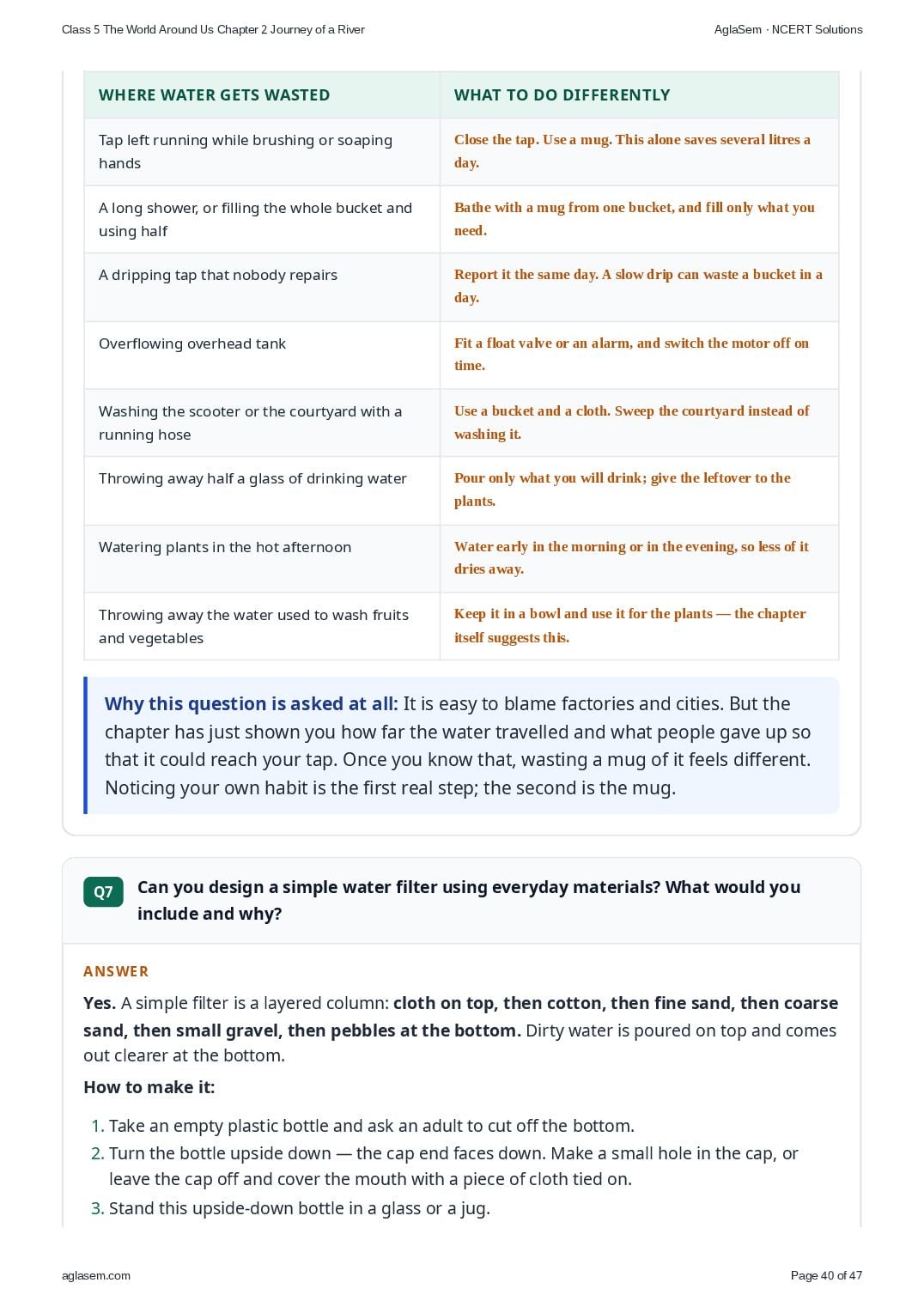
- Think about a time when you wasted water. What could you have done differently?
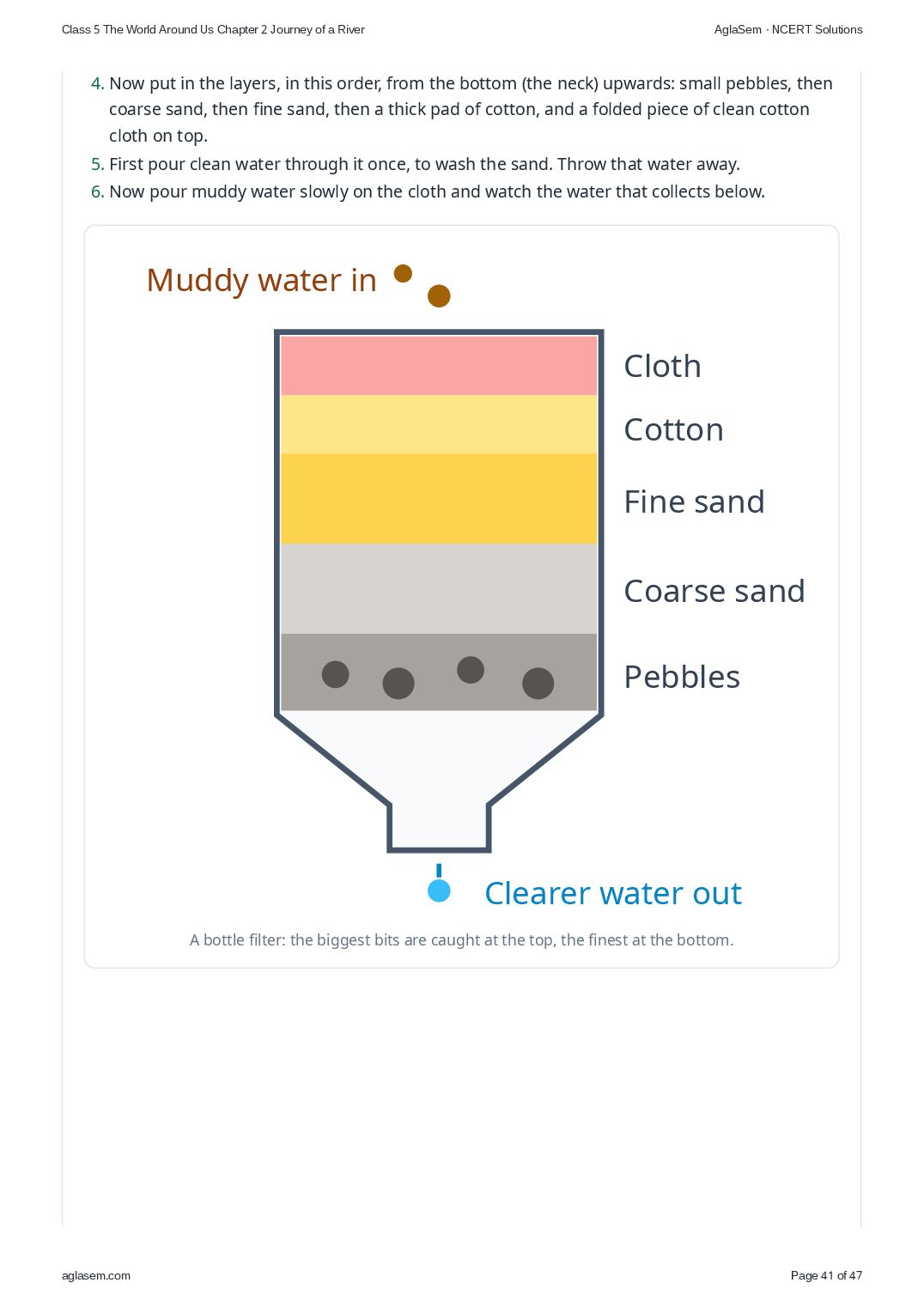
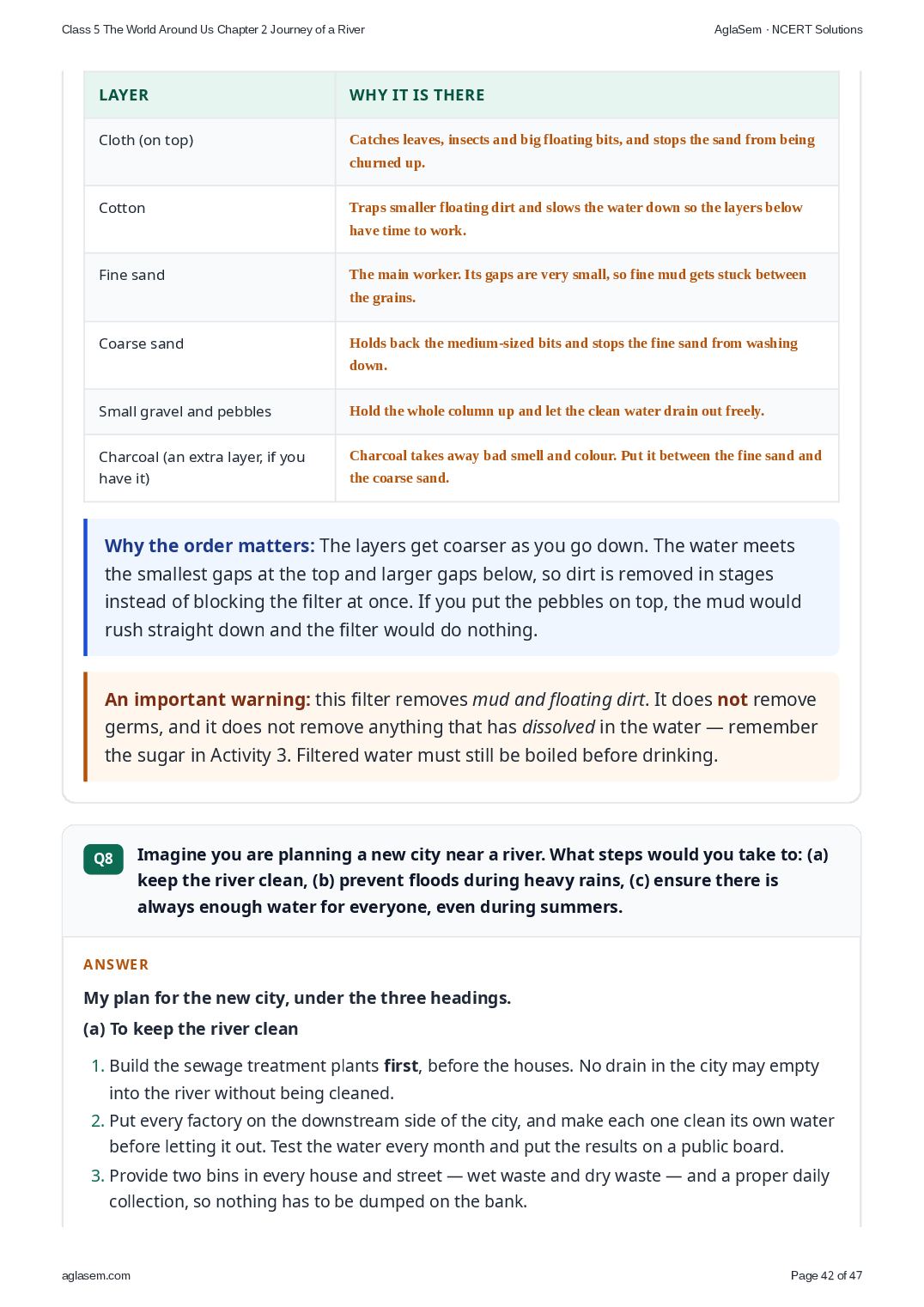
- Can you design a simple water filter using everyday materials? What would you include and why?
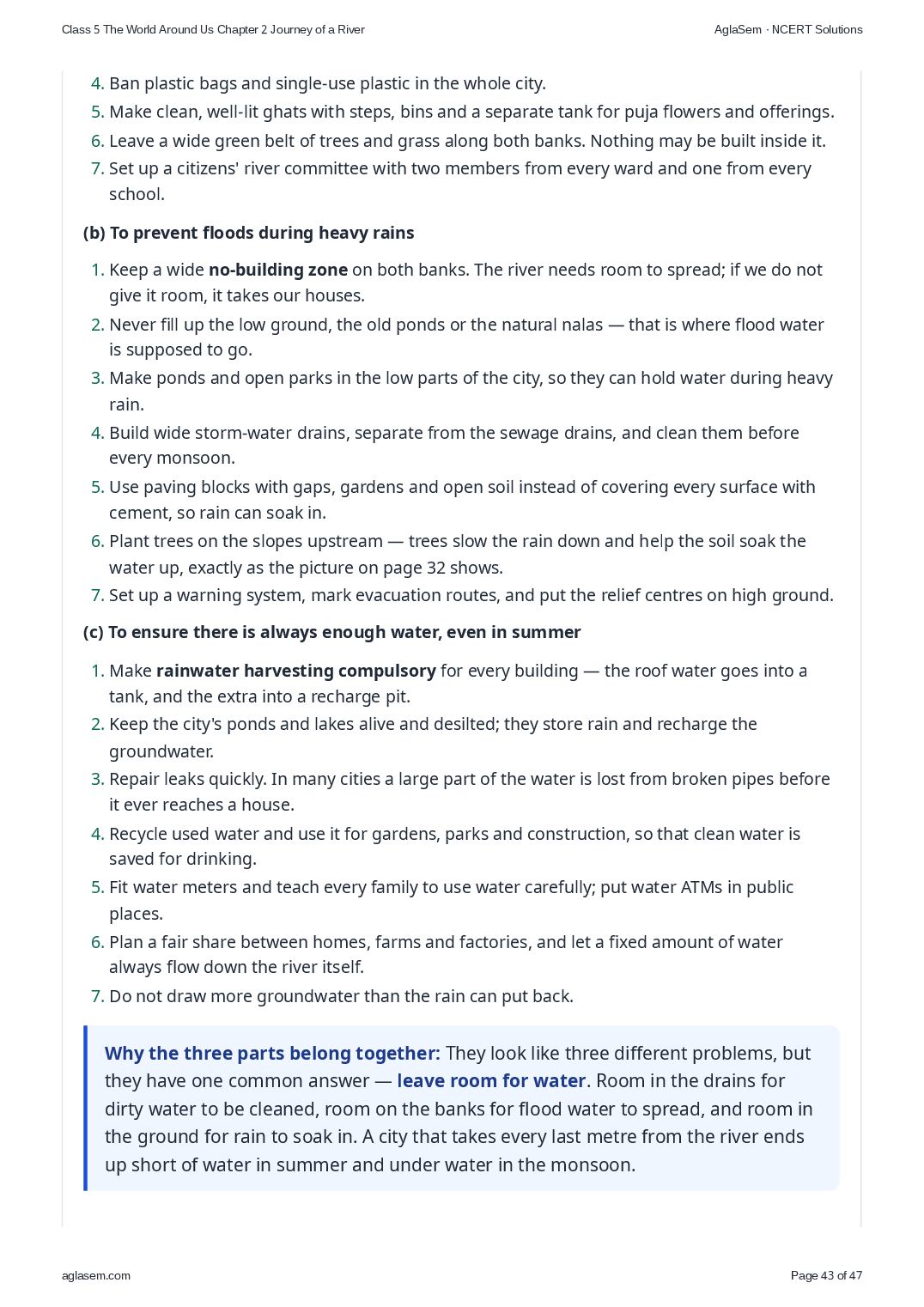
- Imagine you are planning a new city near a river. What steps would you take to: (a) keep the river clean, (b) prevent floods during heavy rains, (c) ensure there is always enough water for everyone, even during summers.
Chapter at a Glance
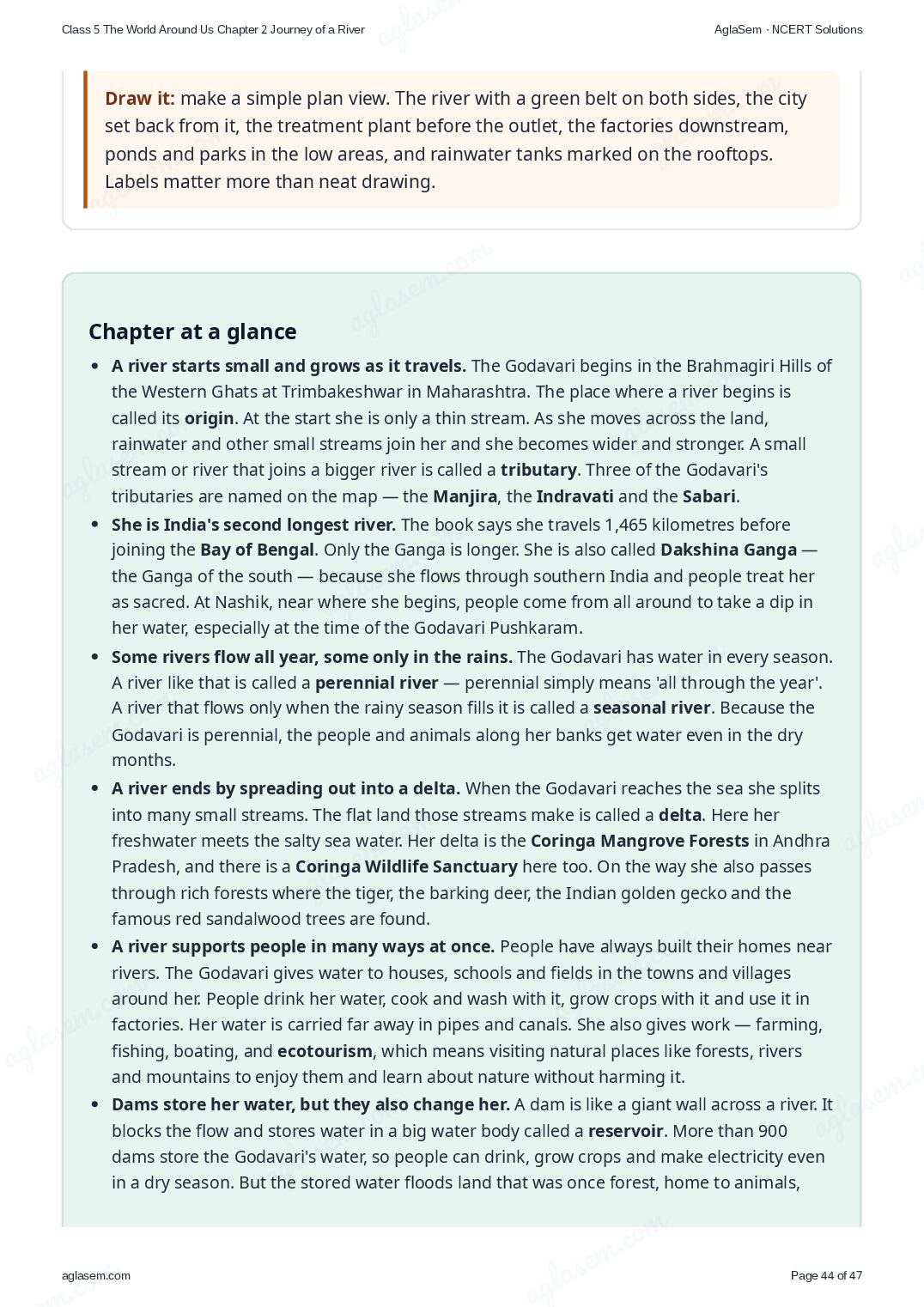
- A river starts small and grows as it travels. The Godavari begins in the Brahmagiri Hills of the Western Ghats at Trimbakeshwar in Maharashtra. The place where a river begins is called its origin. At the start she is only a thin stream. As she moves across the land, rainwater and other small streams join her and she becomes wider and stronger. A small stream or river that joins a bigger river is called a tributary. Three of the Godavari’s tributaries are named on the map — the Manjira, the Indravati and the Sabari.
- She is India’s second longest river. The book says she travels 1,465 kilometres before joining the Bay of Bengal. Only the Ganga is longer. She is also called Dakshina Ganga — the Ganga of the south — because she flows through southern India and people treat her as sacred. At Nashik, near where she begins, people come from all around to take a dip in her water, especially at the time of the Godavari Pushkaram.
- Some rivers flow all year, some only in the rains. The Godavari has water in every season. A river like that is called a perennial river — perennial simply means ‘all through the year’. A river that flows only when the rainy season fills it is called a seasonal river. Because the Godavari is perennial, the people and animals along her banks get water even in the dry months.
- A river ends by spreading out into a delta. When the Godavari reaches the sea she splits into many small streams. The flat land those streams make is called a delta. Here her freshwater meets the salty sea water. Her delta is the Coringa Mangrove Forests in Andhra Pradesh, and there is a Coringa Wildlife Sanctuary here too. On the way she also passes through rich forests where the tiger, the barking deer, the Indian golden gecko and the famous red sandalwood trees are found.
- A river supports people in many ways at once. People have always built their homes near rivers. The Godavari gives water to houses, schools and fields in the towns and villages around her. People drink her water, cook and wash with it, grow crops with it and use it in factories. Her water is carried far away in pipes and canals. She also gives work — farming, fishing, boating, and ecotourism, which means visiting natural places like forests, rivers and mountains to enjoy them and learn about nature without harming it.
- Dams store her water, but they also change her. A dam is like a giant wall across a river. It blocks the flow and stores water in a big water body called a reservoir. More than 900 dams store the Godavari’s water, so people can drink, grow crops and make electricity even in a dry season. But the stored water floods land that was once forest, home to animals, and home to people. Many families have to leave their homes and shift elsewhere. Two dams on her course are the Sriram Sagar Project (SRSP) and the Polavaram Dam.
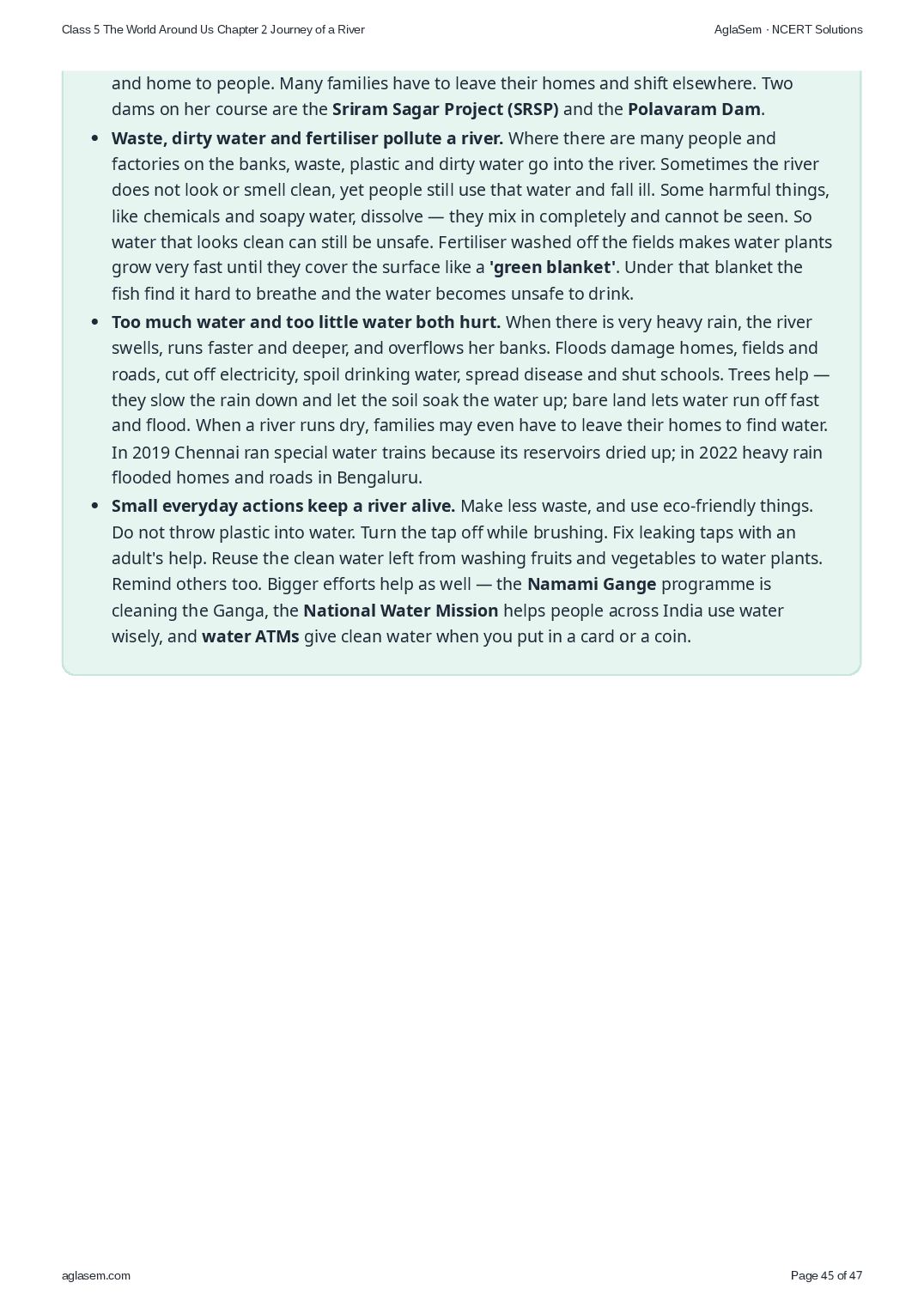
- Waste, dirty water and fertiliser pollute a river. Where there are many people and factories on the banks, waste, plastic and dirty water go into the river. Sometimes the river does not look or smell clean, yet people still use that water and fall ill. Some harmful things, like chemicals and soapy water, dissolve — they mix in completely and cannot be seen. So water that looks clean can still be unsafe. Fertiliser washed off the fields makes water plants grow very fast until they cover the surface like a ‘green blanket’. Under that blanket the fish find it hard to breathe and the water becomes unsafe to drink.
- Too much water and too little water both hurt. When there is very heavy rain, the river swells, runs faster and deeper, and overflows her banks. Floods damage homes, fields and roads, cut off electricity, spoil drinking water, spread disease and shut schools. Trees help — they slow the rain down and let the soil soak the water up; bare land lets water run off fast and flood. When a river runs dry, families may even have to leave their homes to find water. In 2019 Chennai ran special water trains because its reservoirs dried up; in 2022 heavy rain flooded homes and roads in Bengaluru.
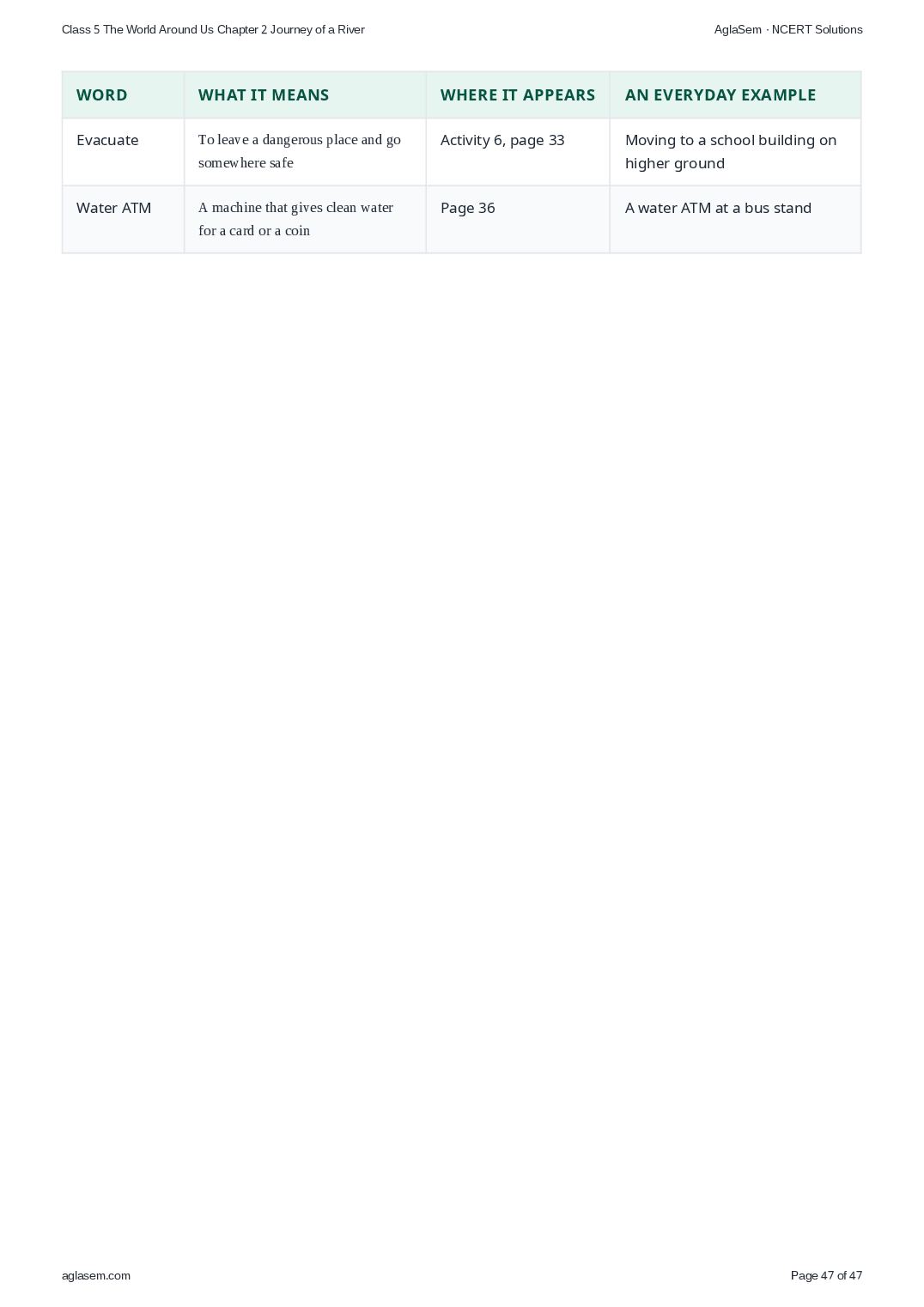
- Small everyday actions keep a river alive. Make less waste, and use eco-friendly things. Do not throw plastic into water. Turn the tap off while brushing. Fix leaking taps with an adult’s help. Reuse the clean water left from washing fruits and vegetables to water plants. Remind others too. Bigger efforts help as well — the Namami Gange programme is cleaning the Ganga, the National Water Mission helps people across India use water wisely, and water ATMs give clean water when you put in a card or a coin.
How to Download NCERT Solutions for Class 5 The World Around Us Chapter 2 PDF
Follow these simple steps to get the Journey of a River questions-and-answers PDF from Our Wondrous World.
- Search NCERT Solutions for Class 5 The World Around Us Chapter 2 aglasem and open this page.
- Read the exercise questions with answers for Journey of a River shown above.
- Click the Download PDF link to save the Journey of a River solutions to your device.
NCERT Solutions for Class 5 The World Around Us – All Chapters
There are more chapters to study besides Journey of a River in The World Around Us. Here are the NCERT Solutions for all chapters of Class 5 The World Around Us.
- Chapter 1 Water the Essence of Life
- Chapter 2 Journey of a River
- Chapter 3 the Mystery of Food
- Chapter 4 Our School a Happy Place
- Chapter 5 Our Vibrant Country
- Chapter 6 Some Unique Places
- Chapter 7 Energy How Things Work
- Chapter 8 Clothes How Things Are Made
- Chapter 9 Rhythms of Nature
- Chapter 10 Earth Our Shared Home
NCERT Solutions for Class 5 – All Subjects
Just like Chapter 2 of The World Around Us, you can get the exercise questions with answers for every other subject of Class 5. Here are the NCERT Solutions for all subjects of Class 5.
NCERT Solutions for Class 5 The World Around Us Chapter 2 – An Overview
The key highlights of this study material are as follows.
| Aspects | Details |
|---|---|
| Class | Class 5 |
| Subject | The World Around Us |
| Chapter Number | Chapter 2 |
| Chapter Name | Journey of a River |
| Book Name | Our Wondrous World |
| Book By | NCERT (National Council of Educational Research and Training) |
| Educational Resource Here | NCERT Solutions of Class 5 The World Around Us Chapter 2 for all exercises |
| More Questions Answers of This Subject | NCERT Solutions for Class 5 The World Around Us |
| Download Book Chapter | NCERT Book Class 5 The World Around Us |
| All Questions Answers For This Class | NCERT Solutions for Class 5 |
| Complete Solutions | NCERT Solutions |
NCERT Solutions for Class 5 The World Around Us Chapter 2 Journey of a River – FAQs
What are the NCERT Solutions for Class 5 The World Around Us Chapter 2 Journey of a River?
They are the complete, step-by-step answers to all the exercise and in-text questions of Chapter 2 Journey of a River from the NCERT Class 5 The World Around Us textbook Our Wondrous World, written by experts as per the latest NCERT syllabus.
How can I download the Class 5 The World Around Us Chapter 2 solutions PDF for free?
Open this page on aglasem, read the Journey of a River questions with answers, and click the “Download Solutions PDF” link. The Class 5 The World Around Us Chapter 2 NCERT Solutions PDF is completely free to download.
Are these NCERT Solutions as per the latest 2026-27 syllabus?
Yes. The NCERT Solutions for Class 5 The World Around Us Chapter 2 are based on the latest NCERT textbook Our Wondrous World and the current 2026-27 CBSE syllabus, so the questions and answers match what you study in class.
Where can I get NCERT Solutions for the other chapters of Class 5 The World Around Us?
You can find the answers to every chapter on the NCERT Solutions for Class 5 The World Around Us page, and solutions for every subject on the NCERT Solutions for Class 5 page.
How do NCERT Solutions help in exam preparation?
They show the correct method to solve each question, help you write answers the way they are expected in exams, let you check and correct your own work, and save revision time — which together improve your marks in Class 5 The World Around Us.
If you have any queries on NCERT Solutions for Class 5 The World Around Us Chapter 2 Journey of a River, then please ask in the comments below.