NCERT Solutions for Class 5 The World Around Us Chapter 5 Our Vibrant Country provide clear, step-by-step answers to every exercise and in-text question from the chapter Our Vibrant Country of the NCERT textbook Our Wondrous World. Prepared by subject experts as per the latest NCERT (CBSE) syllabus for 2026-27, these NCERT Solutions for Class 5 The World Around Us help you understand each concept, write exam-ready answers, and check your own solutions. You can read them online below or download the free Class 5 The World Around Us Chapter 5 question-answer PDF.
NCERT Solutions for Class 5 The World Around Us Chapter 5 Our Vibrant Country
- Class: Class 5
- Subject: The World Around Us
- Chapter: Chapter 5 – Our Vibrant Country
- Textbook: Our Wondrous World (NCERT)
- Study material: NCERT Solutions – questions with answers, free PDF
These solutions answer all the exercise questions of Chapter 5 Our Vibrant Country — including the in-text questions, short-answer and long-answer questions, and activities — with complete explanations so you can follow the method, not just the final answer. Read the full solutions below.
NCERT Solutions Class 5 The World Around Us Chapter 5 Our Vibrant Country View Download
NCERT Solutions for Class 5 The World Around Us Chapter 5 PDF Download
You can read the NCERT Solutions for Class 5 The World Around Us Chapter 5 online above, or download the complete question-answer PDF to study Our Vibrant Country offline at any time.
NCERT Solutions for Class 5 The World Around Us Chapter 5 PDF Download Link – Click Here to Download Solutions PDF
Questions Covered in This Chapter
These NCERT Solutions answer all 29 questions of this chapter. The questions solved are:
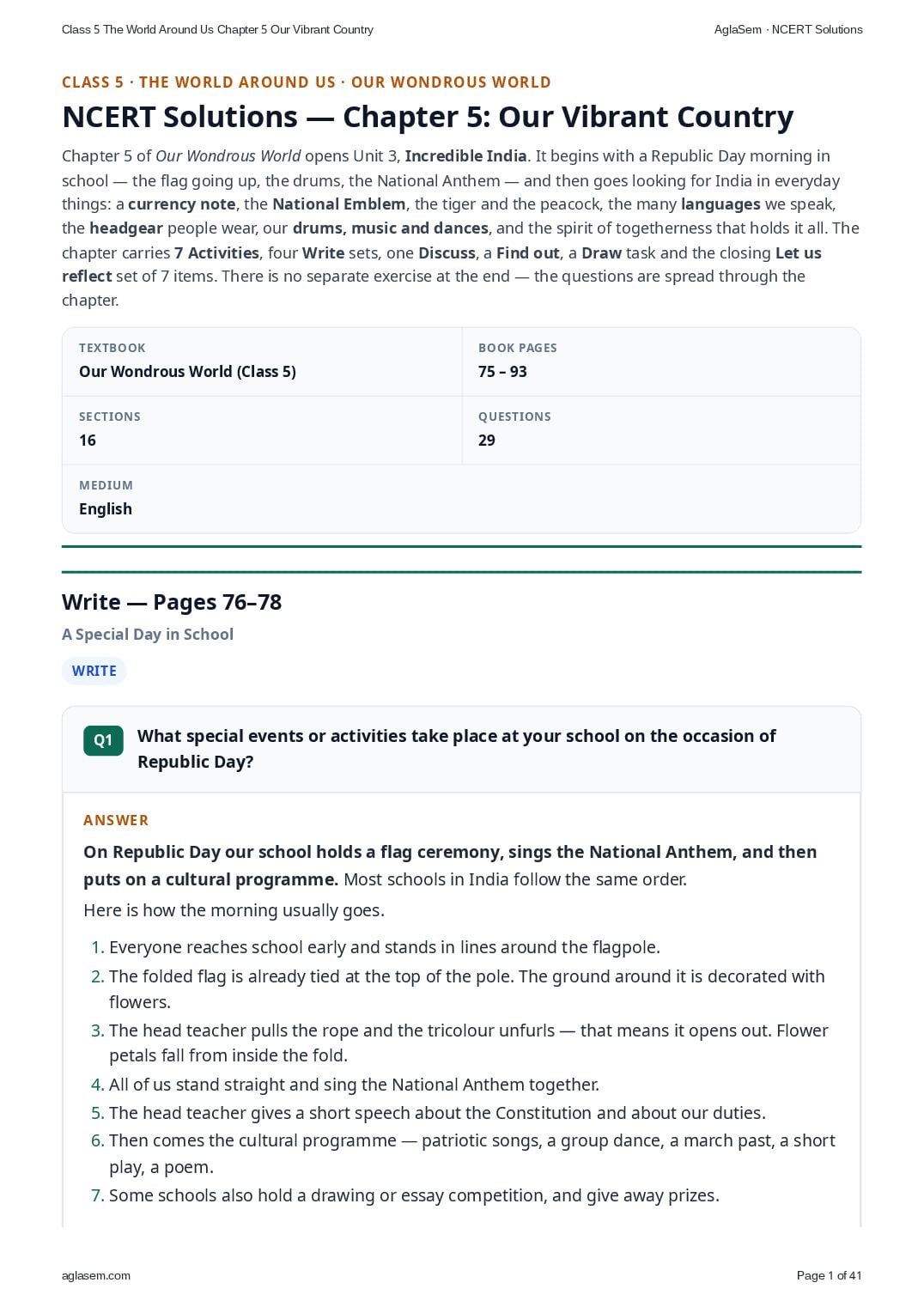
- What special events or activities take place at your school on the occasion of Republic Day?
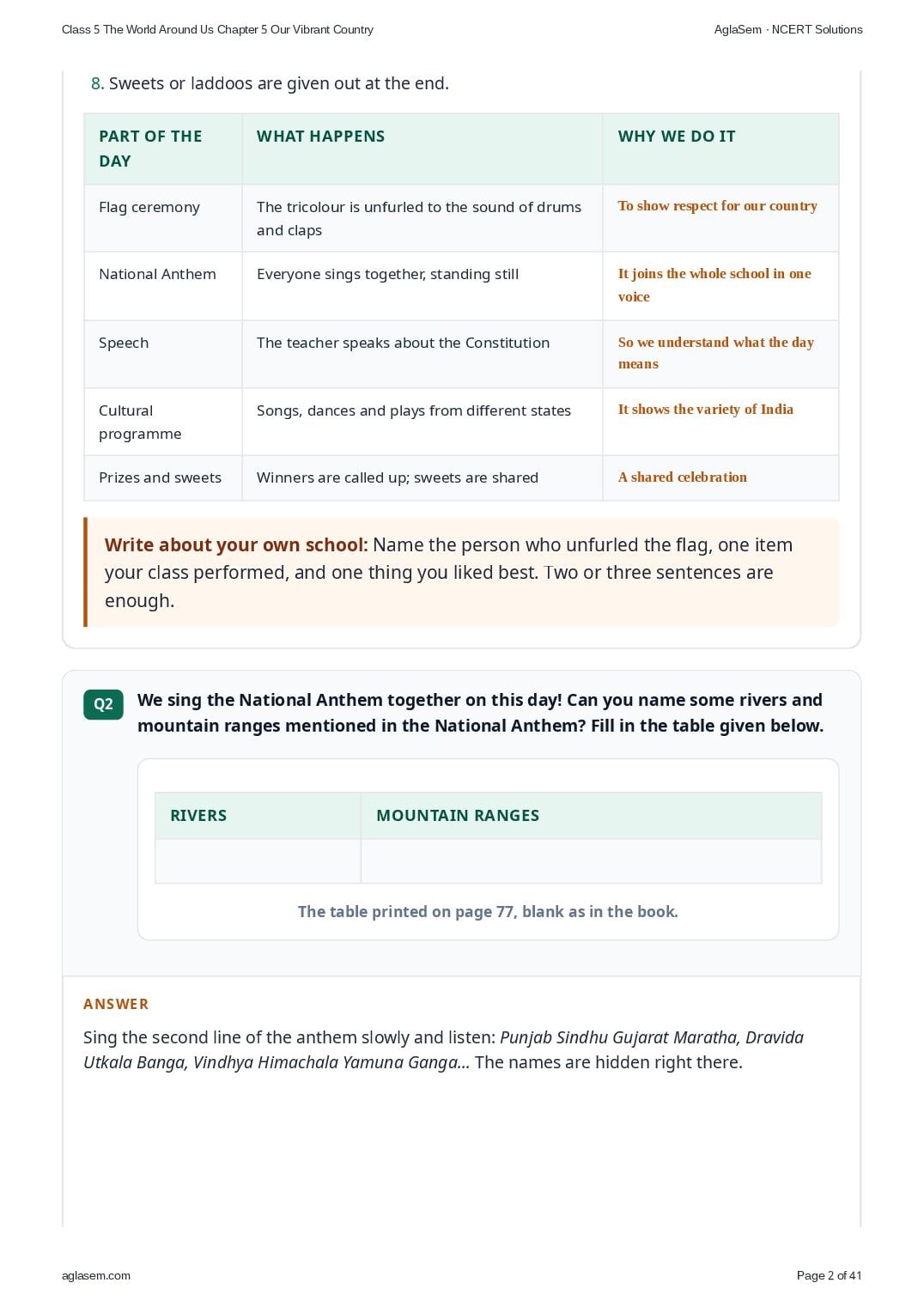
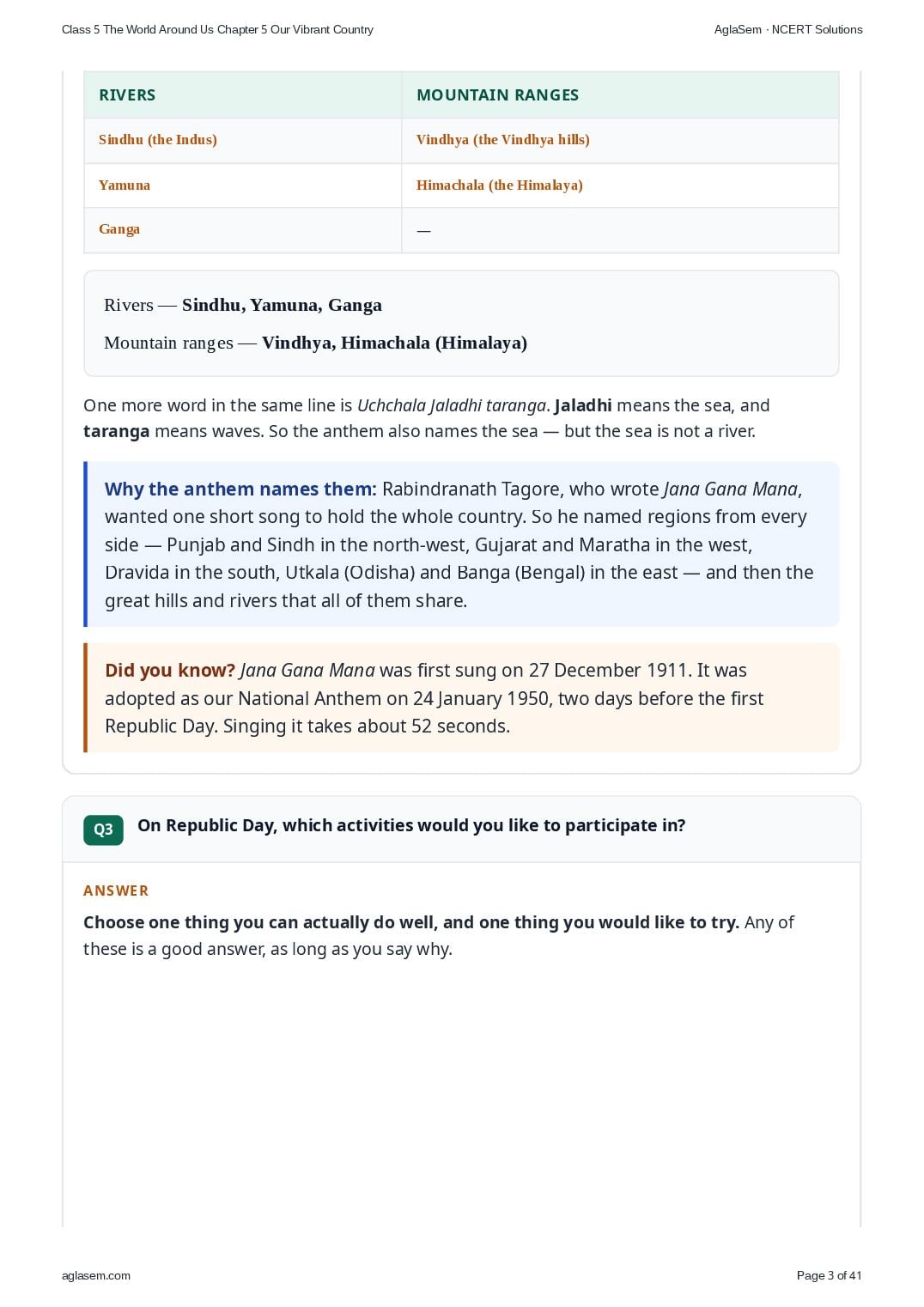
- We sing the National Anthem together on this day! Can you name some rivers and mountain ranges mentioned in the National Anthem? Fill in the table given below.RiversMountain Ranges The table printed on page 77, blank as in the book.
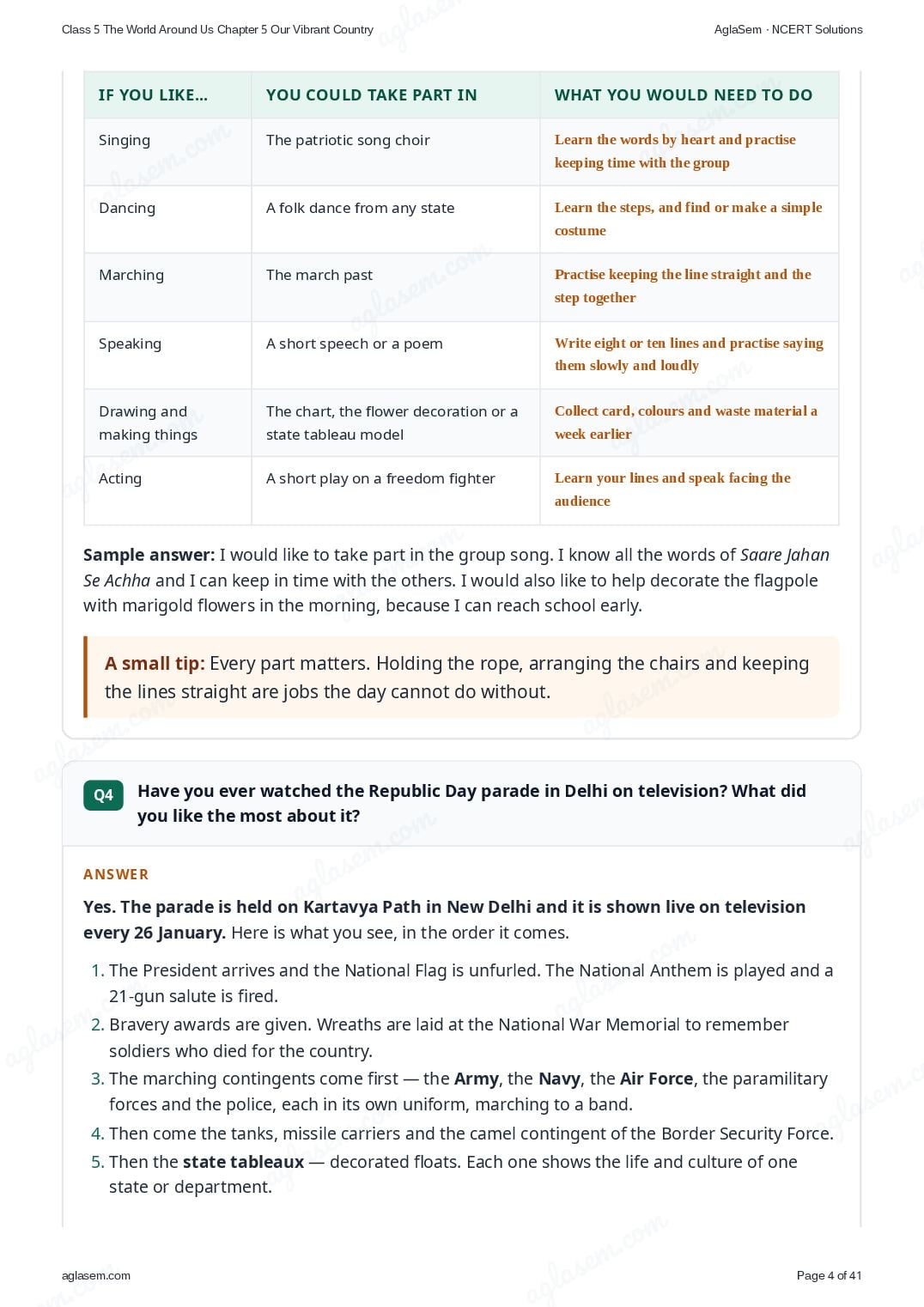
- On Republic Day, which activities would you like to participate in?
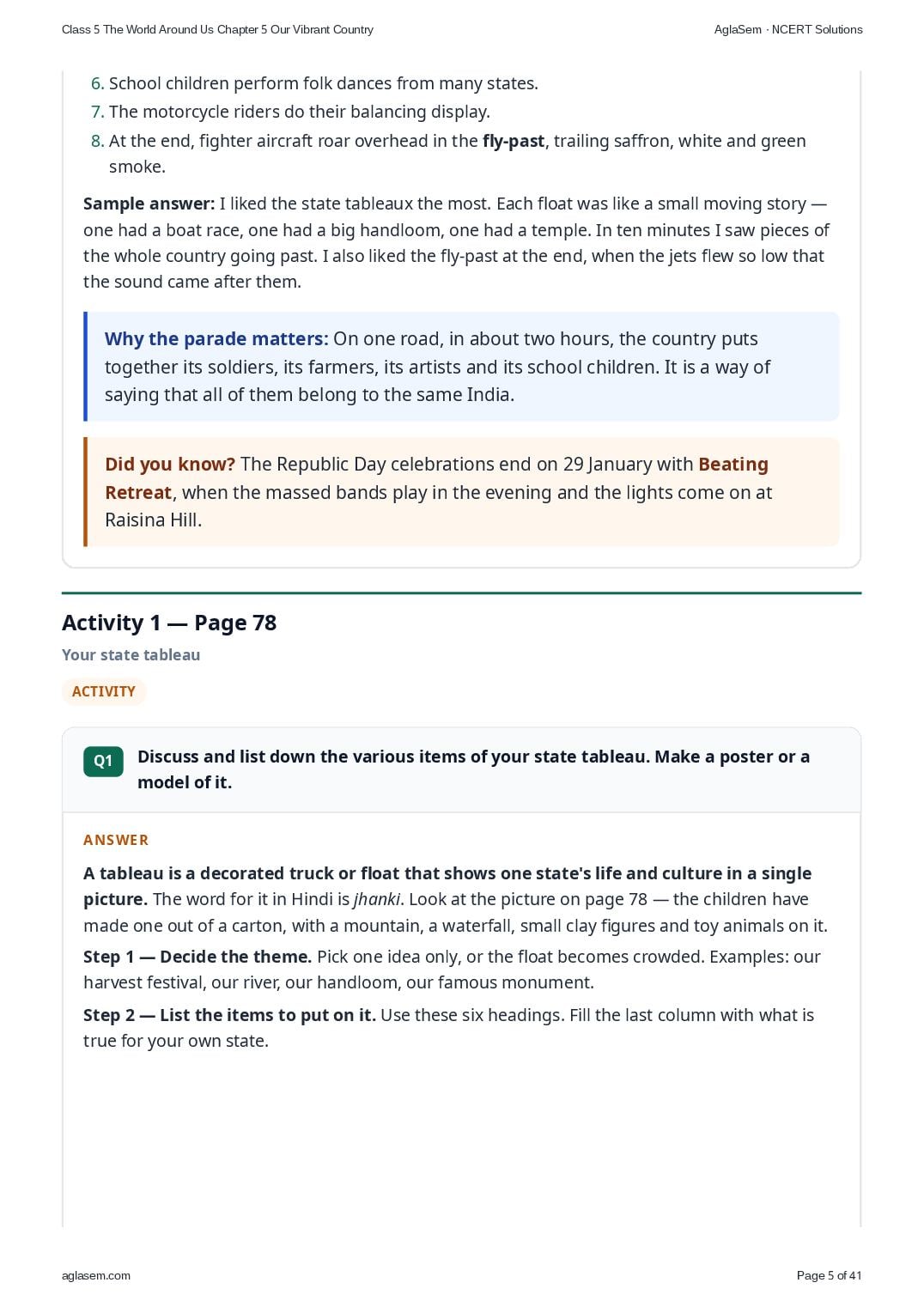
- Have you ever watched the Republic Day parade in Delhi on television? What did you like the most about it?
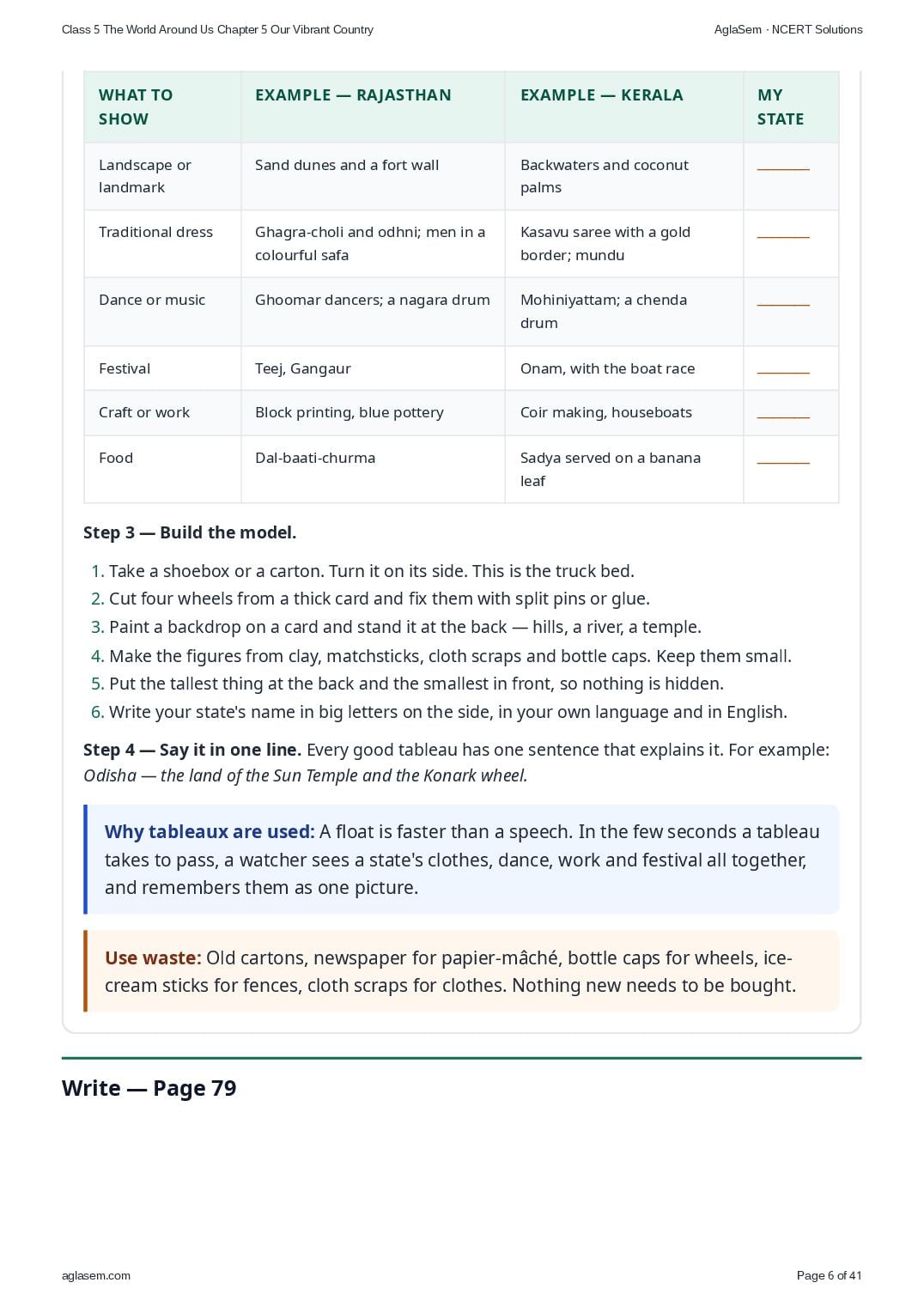
- Discuss and list down the various items of your state tableau. Make a poster or a model of it.
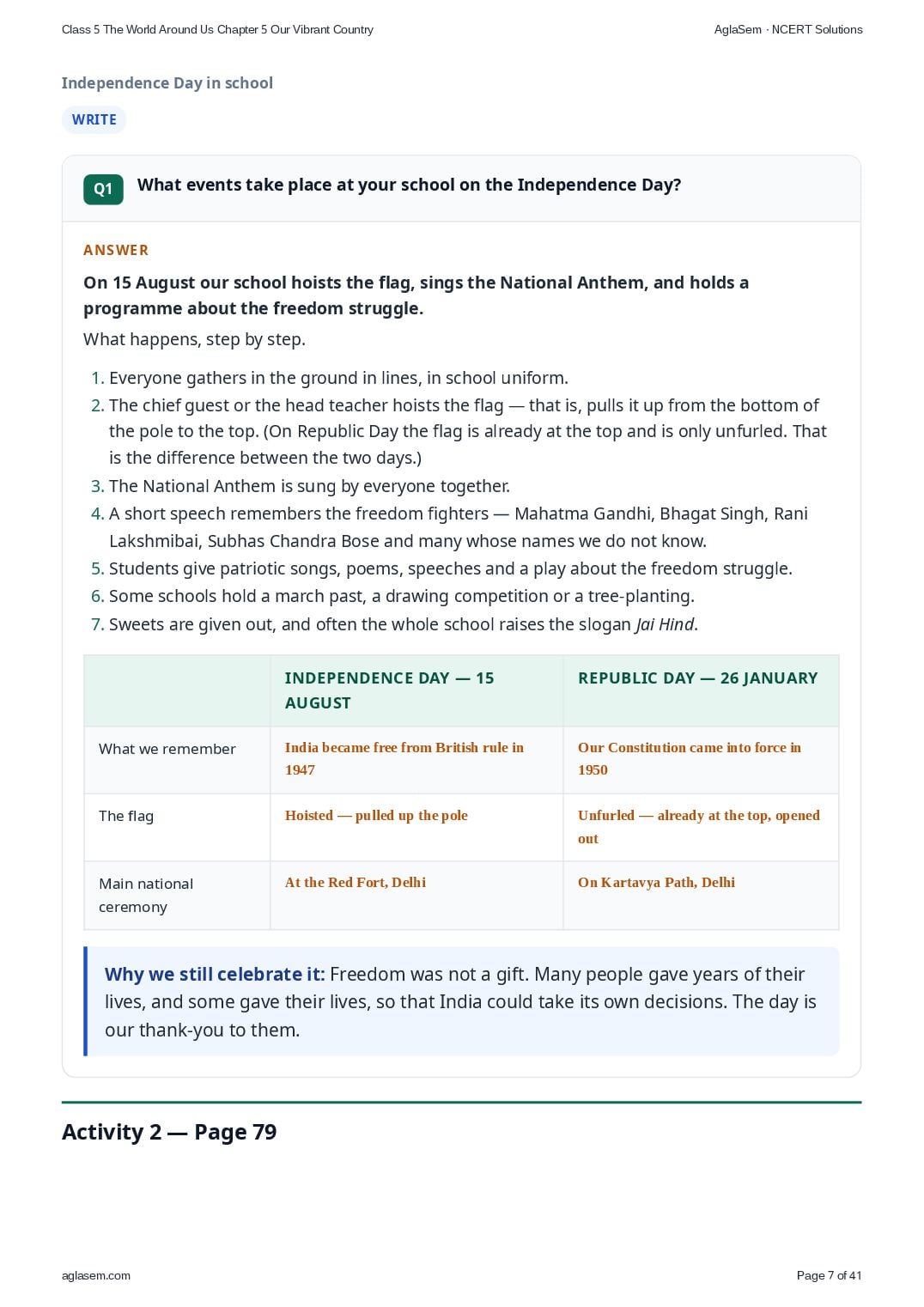
- What events take place at your school on the Independence Day?
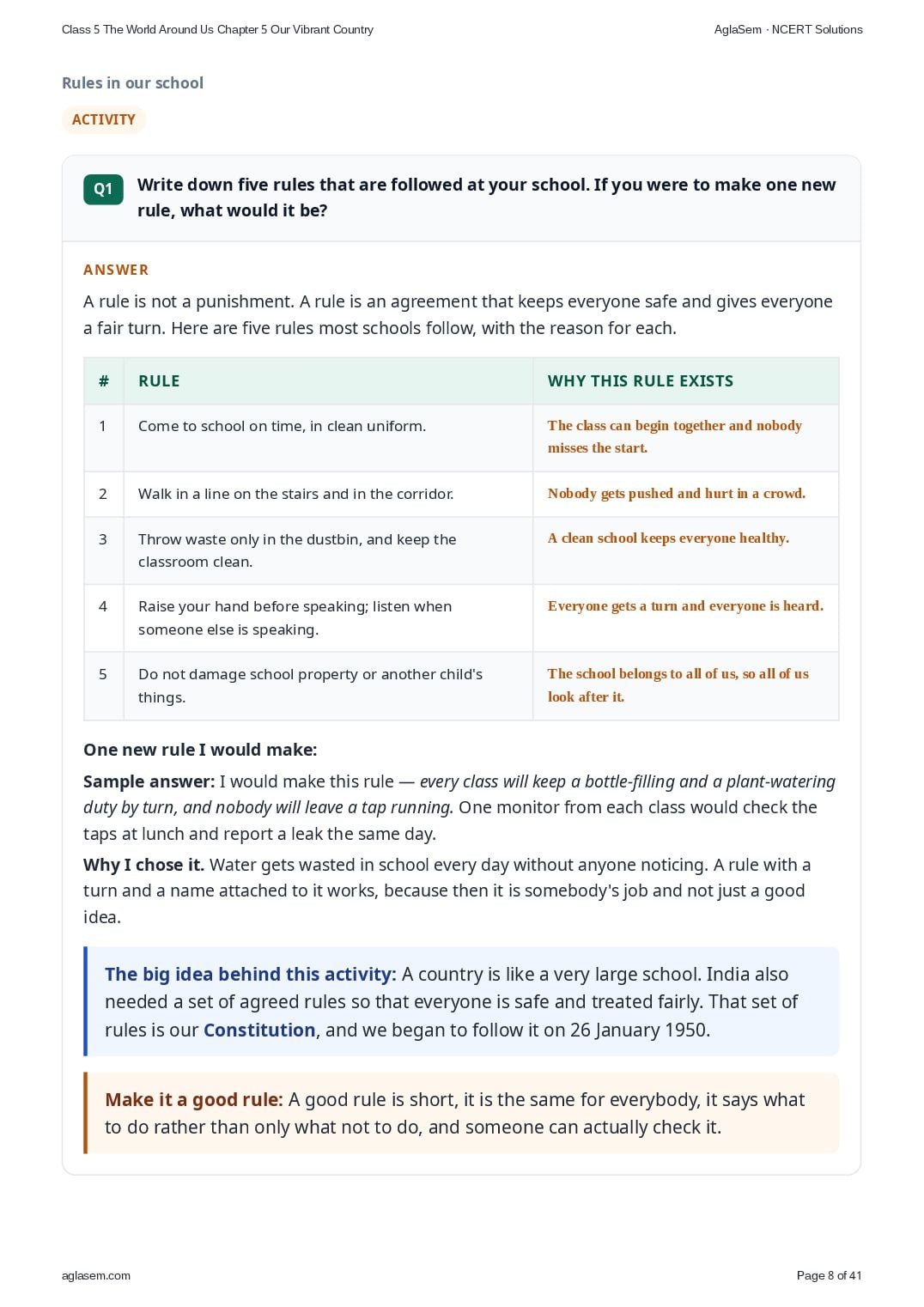
- Write down five rules that are followed at your school. If you were to make one new rule, what would it be?
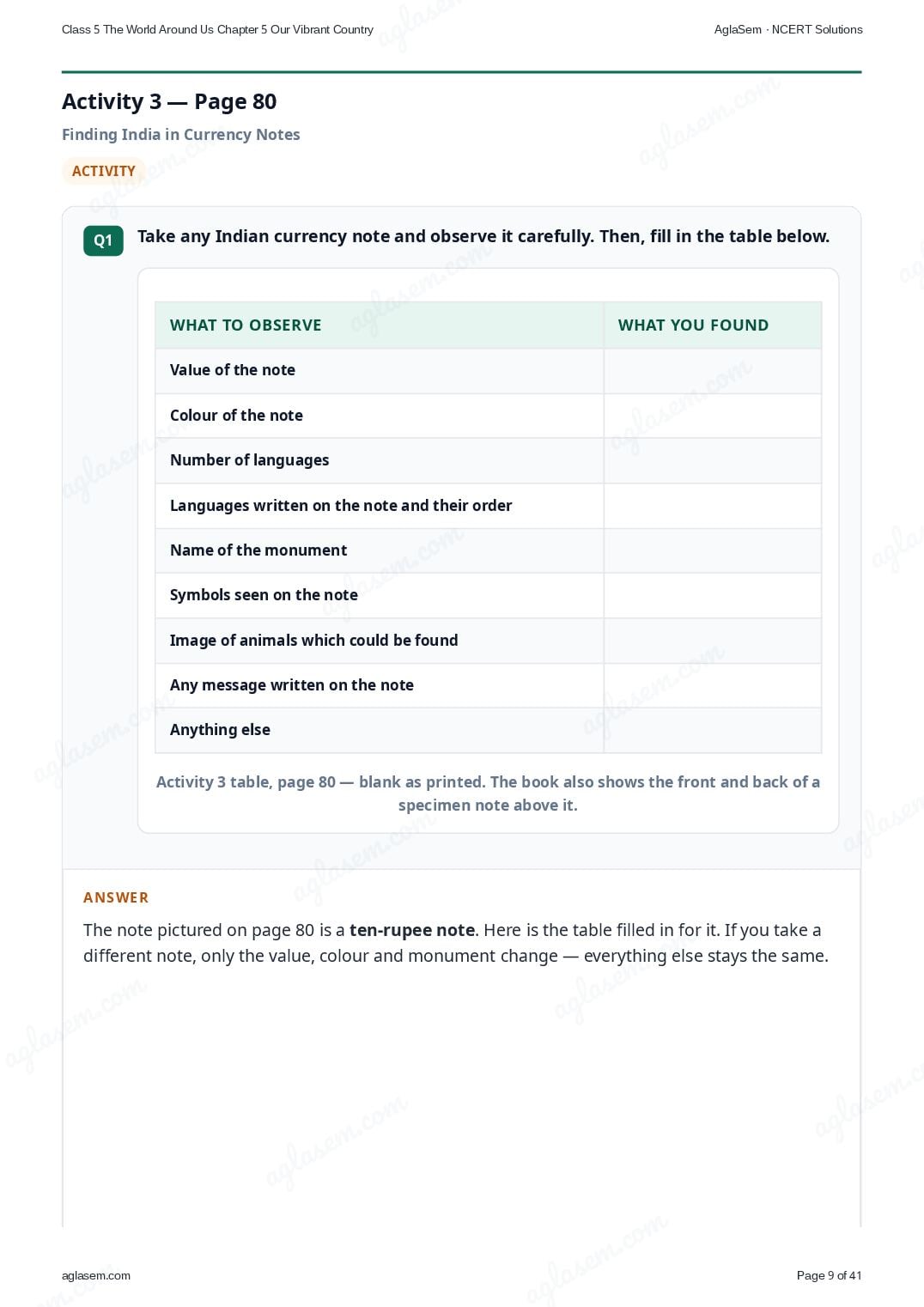
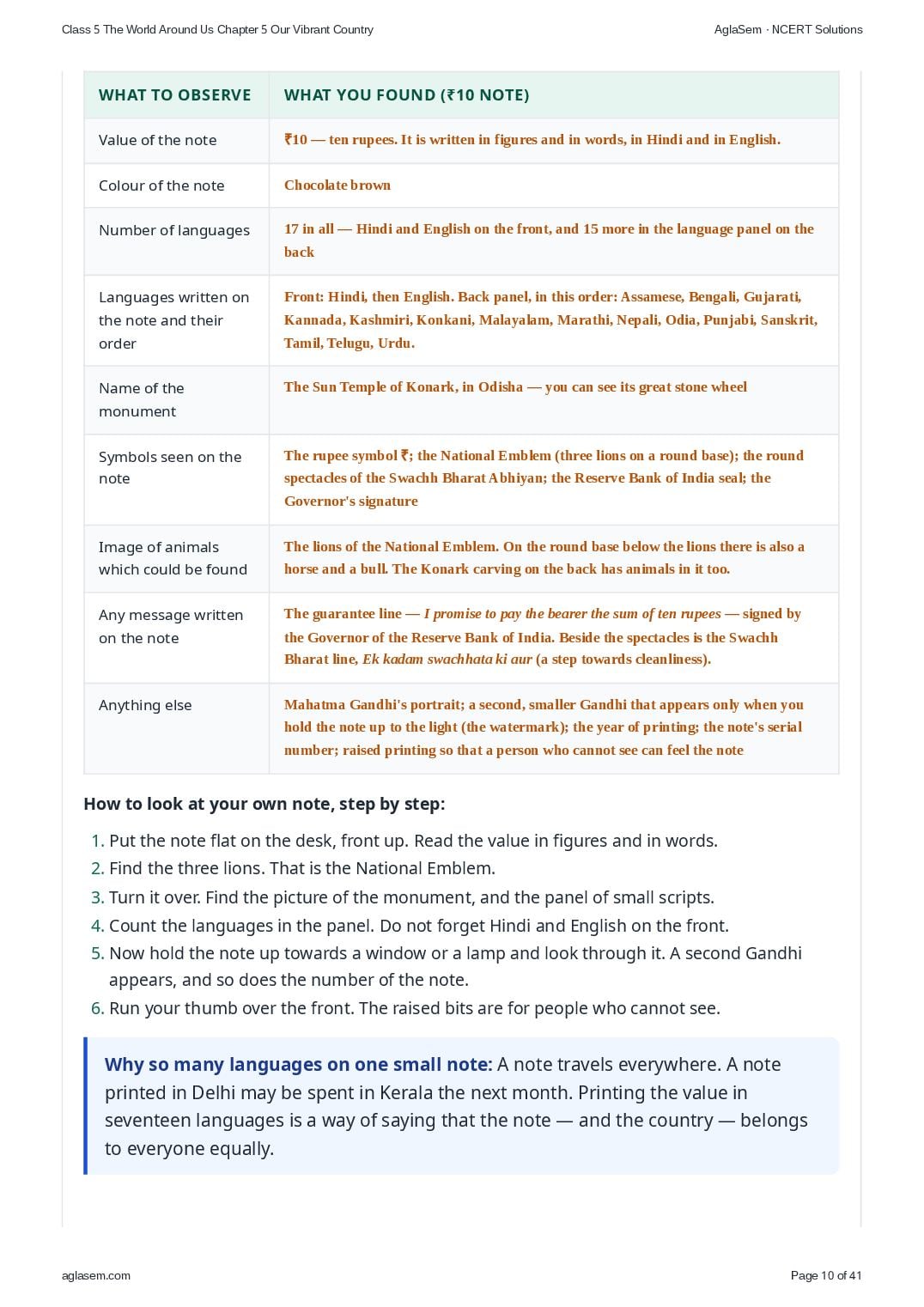
- Take any Indian currency note and observe it carefully. Then, fill in the table below.What to ObserveWhat You FoundValue of the note Colour of the note Number of languages Languages written on the note and their order Name of the monument Symbols seen on the note Image of animals which could be found Any message written on the note Anything else Activity 3 table, page 80 — blank as printed. The book also shows the front and back of a specimen note above it.
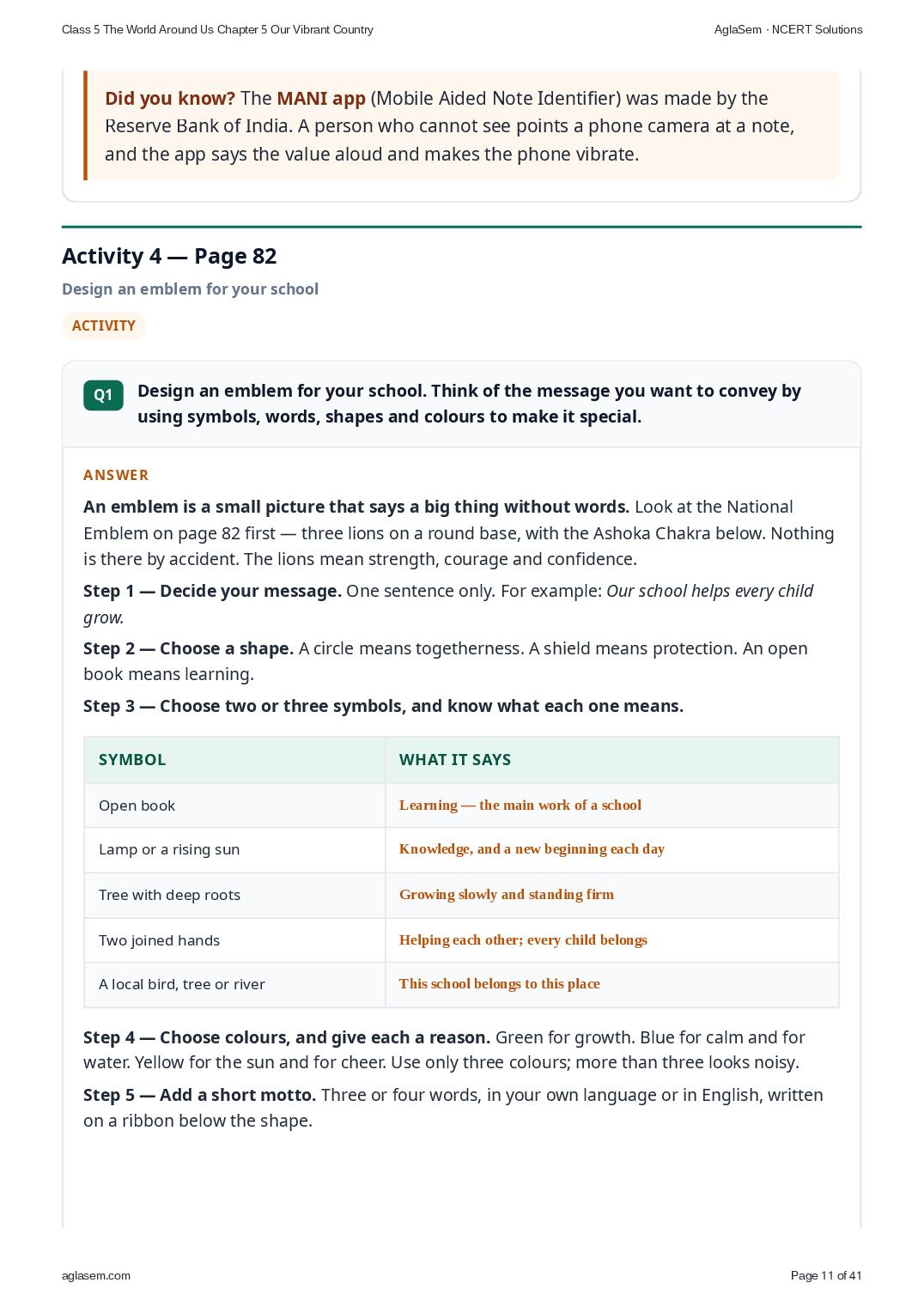
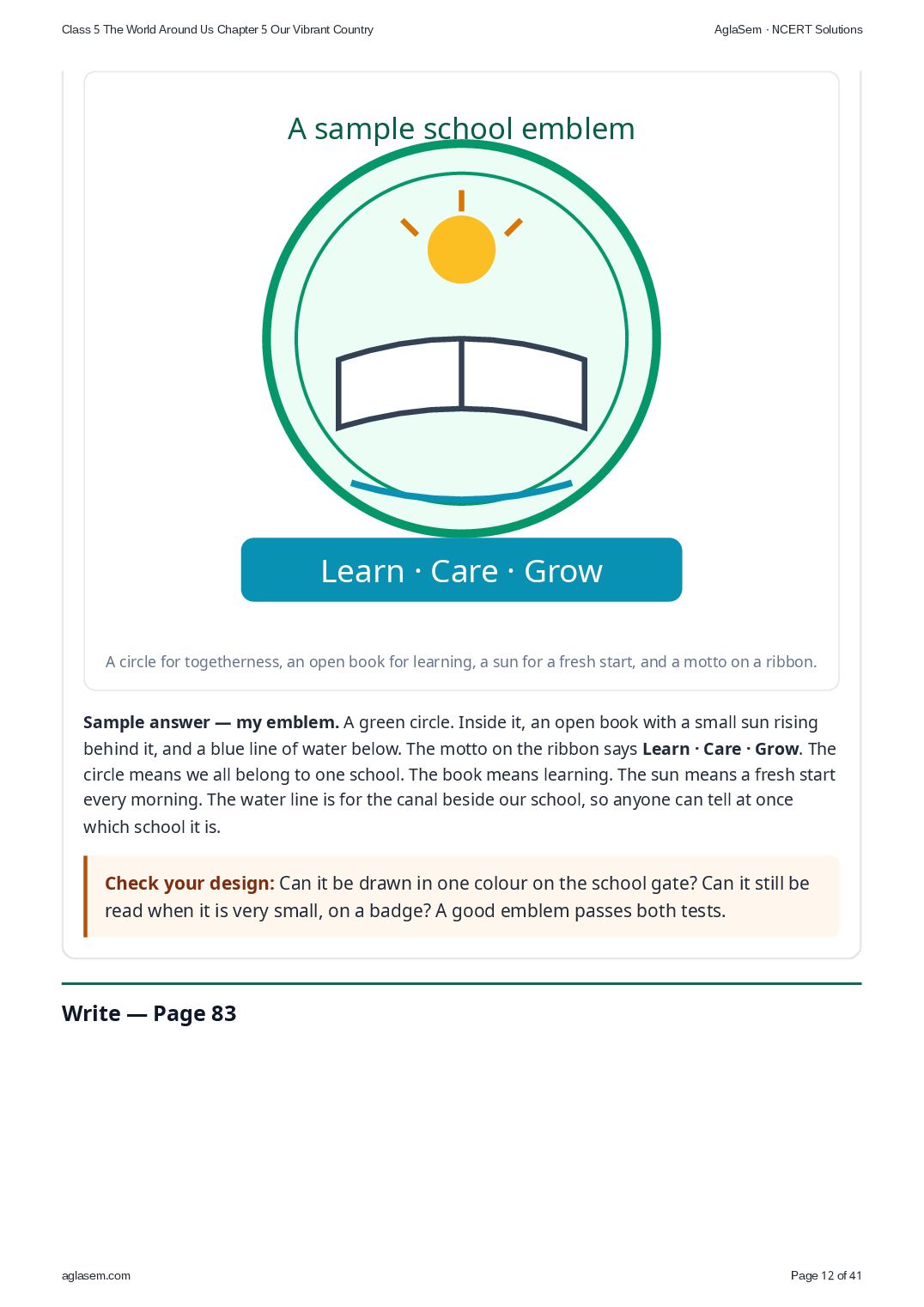
- Design an emblem for your school. Think of the message you want to convey by using symbols, words, shapes and colours to make it special.
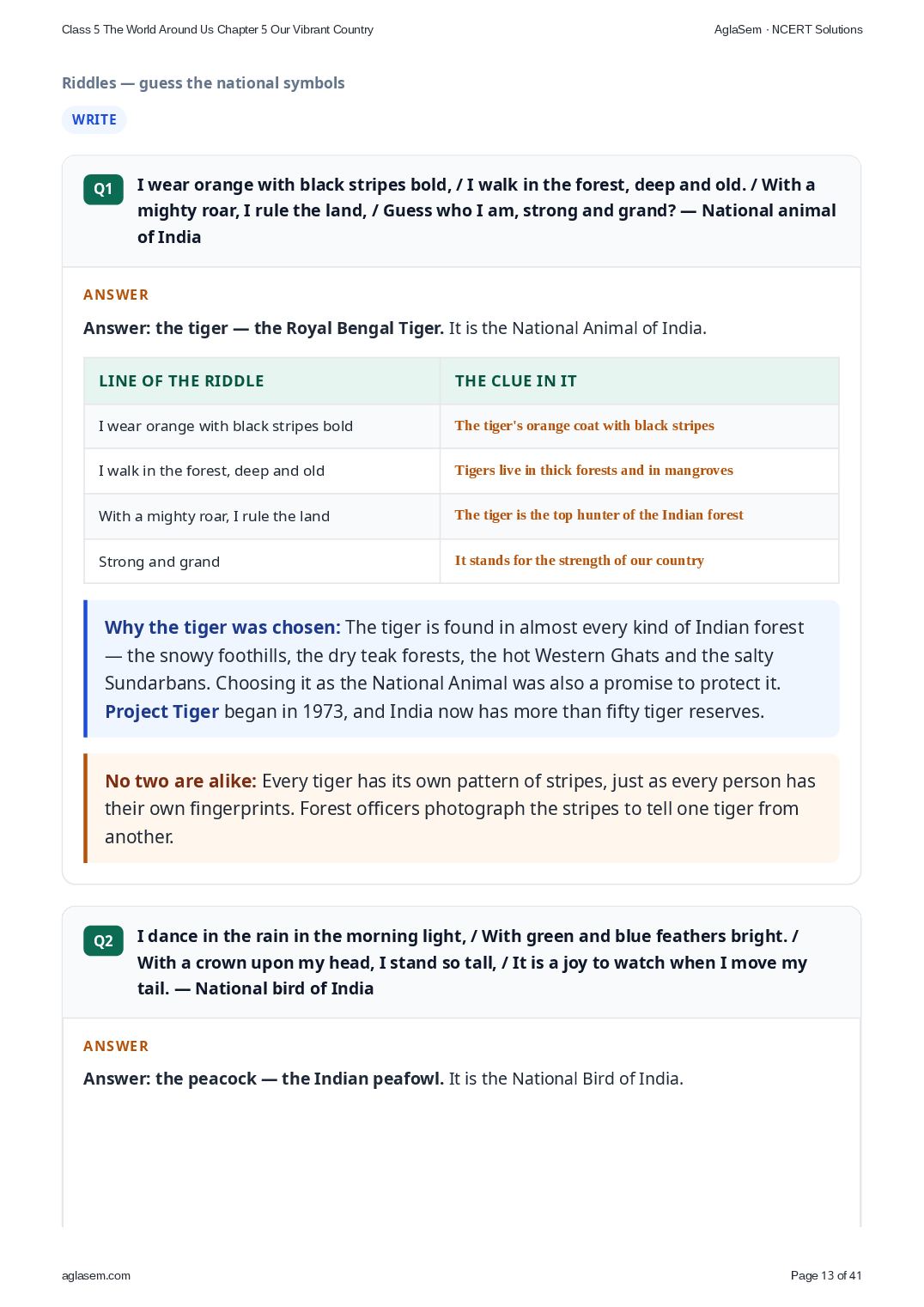
- I wear orange with black stripes bold, / I walk in the forest, deep and old. / With a mighty roar, I rule the land, / Guess who I am, strong and grand? — National animal of India
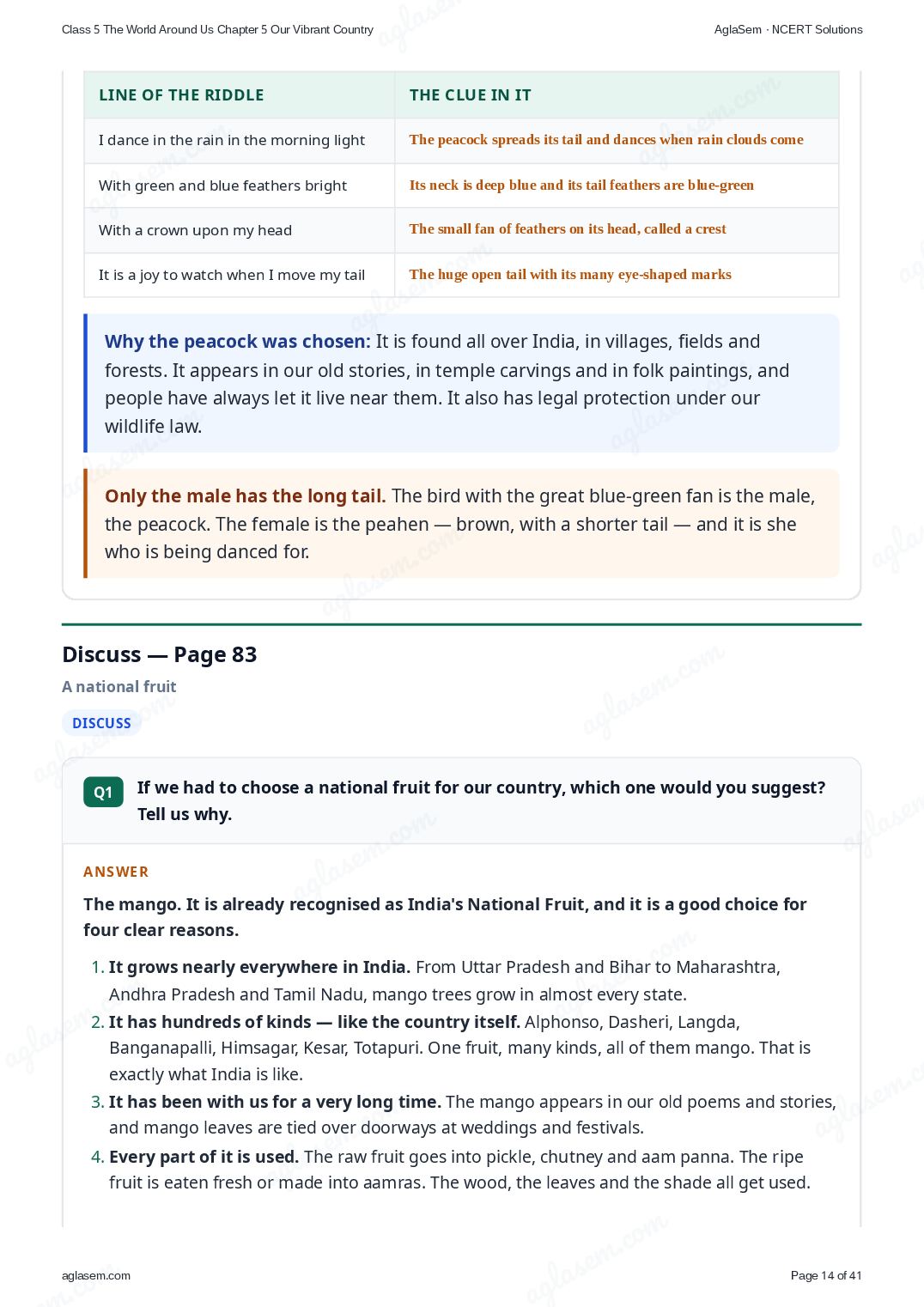
- I dance in the rain in the morning light, / With green and blue feathers bright. / With a crown upon my head, I stand so tall, / It is a joy to watch when I move my tail. — National bird of India
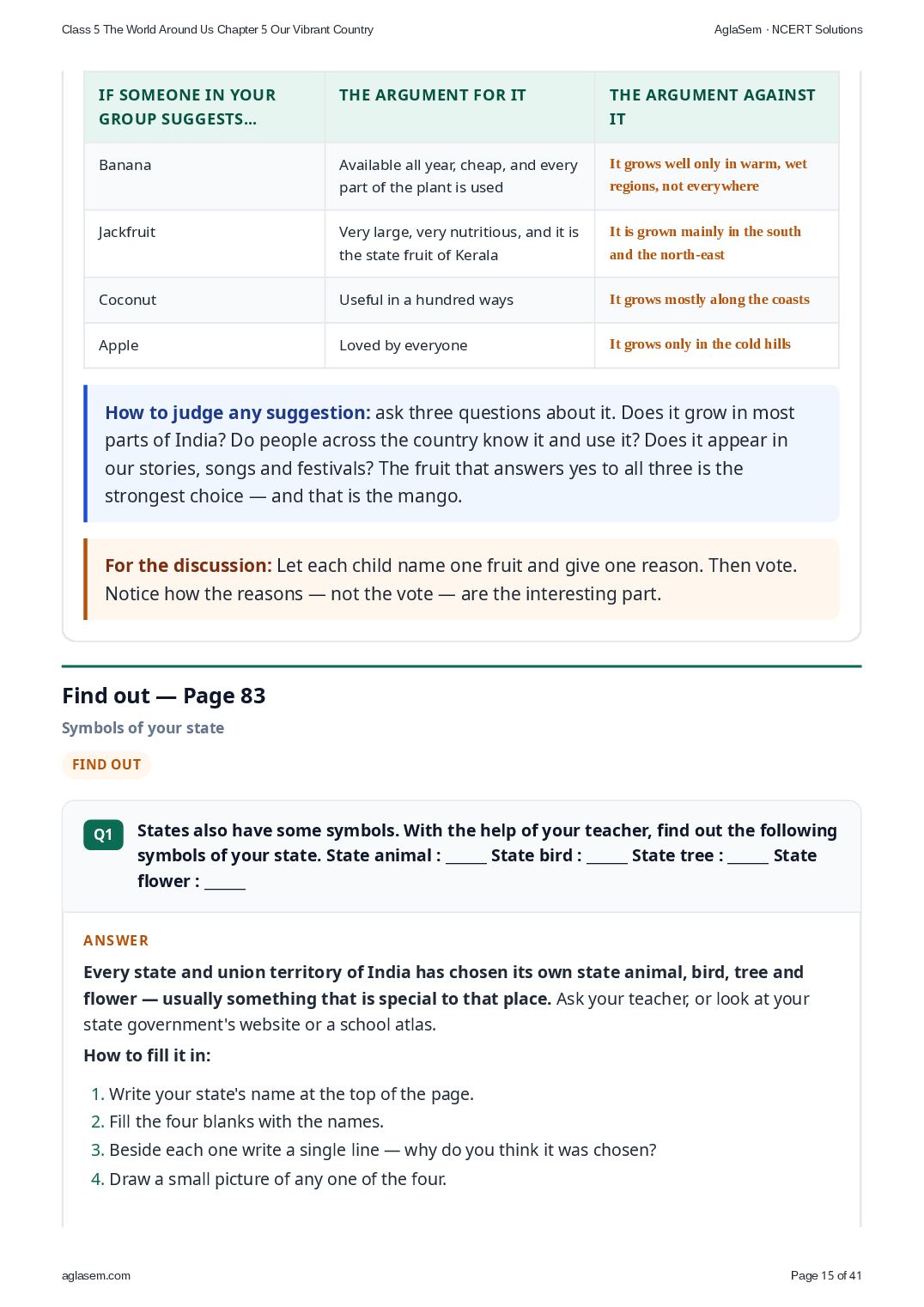
- If we had to choose a national fruit for our country, which one would you suggest? Tell us why.
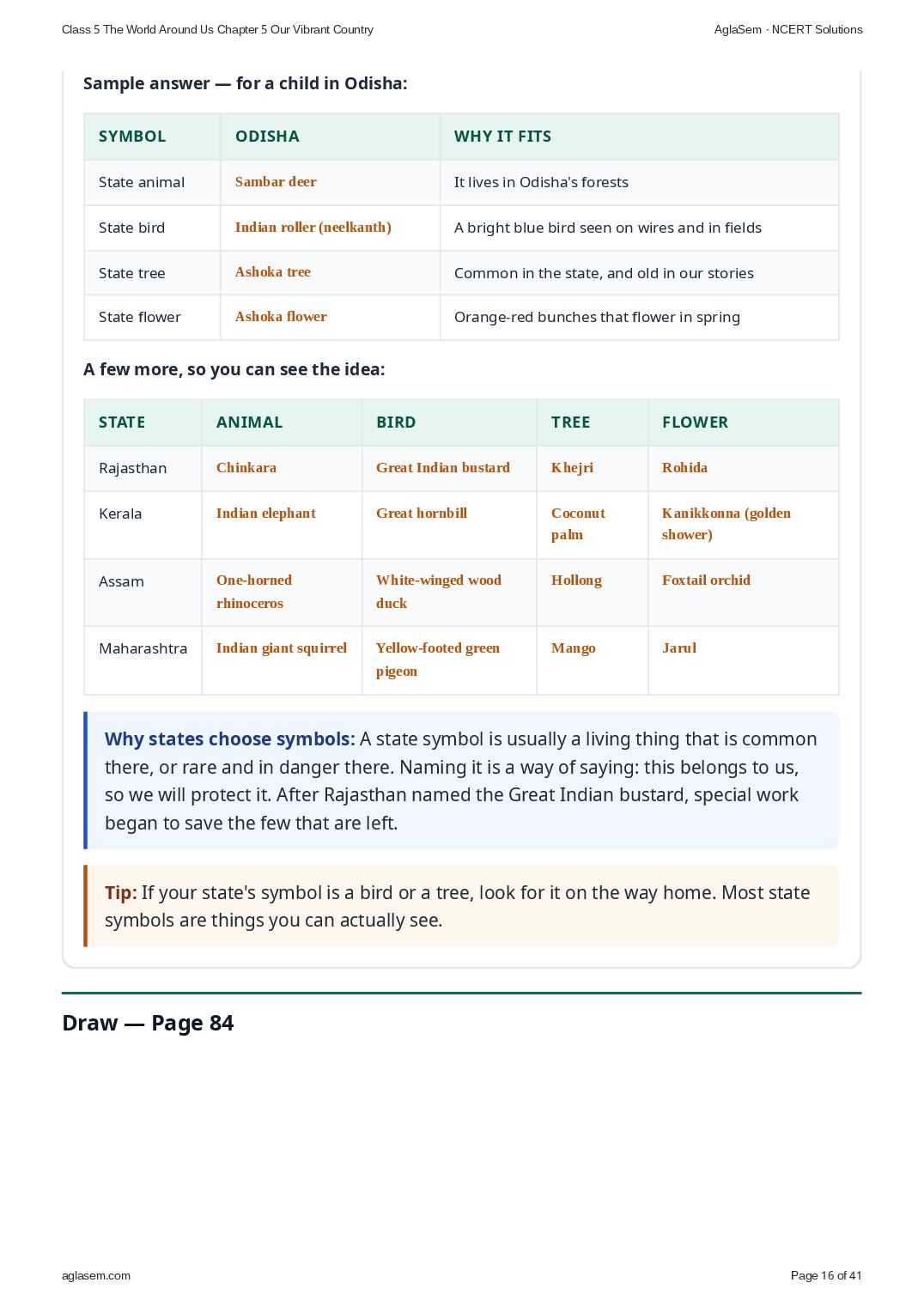
- States also have some symbols. With the help of your teacher, find out the following symbols of your state. State animal : ______ State bird : ______ State tree : ______ State flower : ______
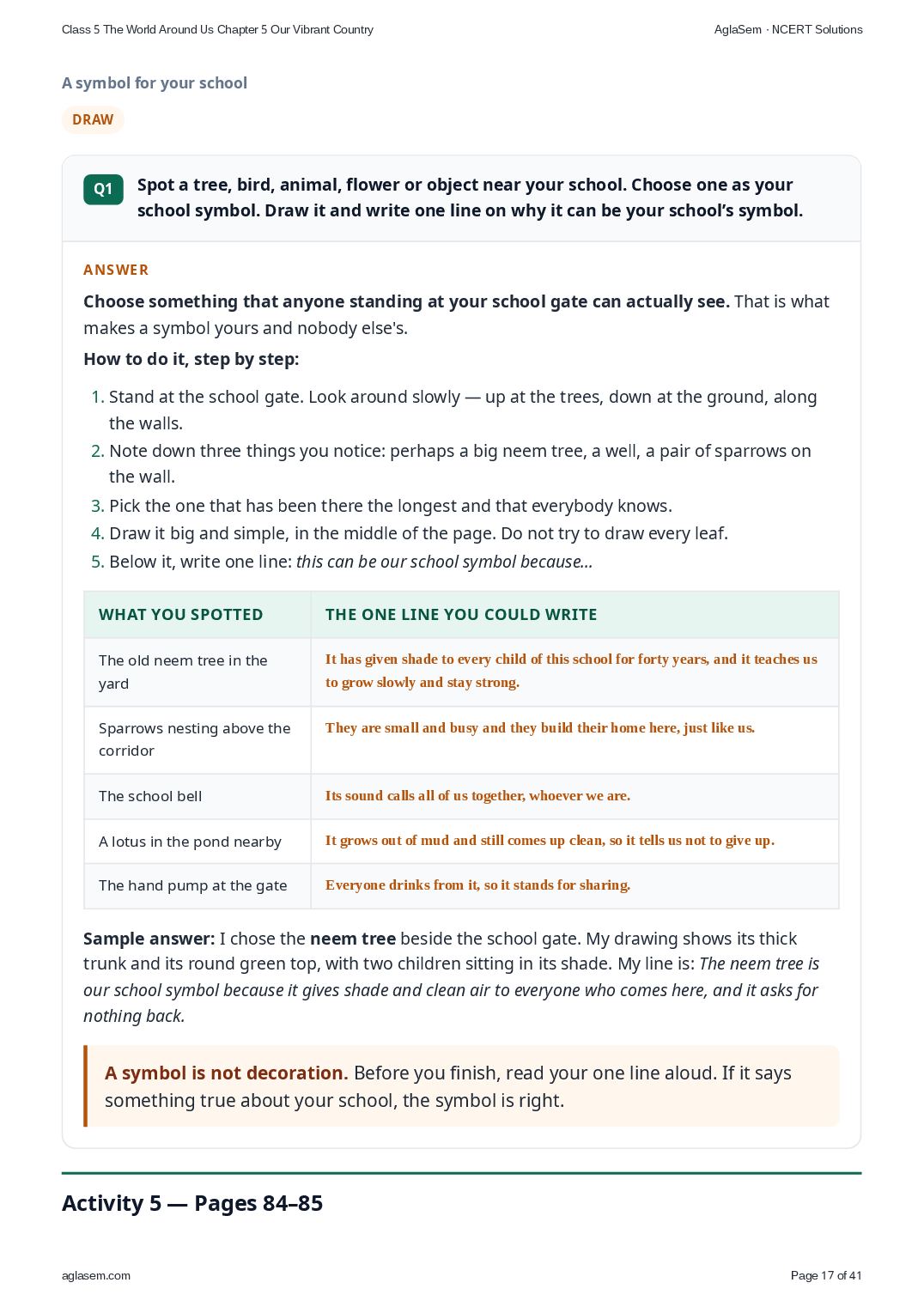
- Spot a tree, bird, animal, flower or object near your school. Choose one as your school symbol. Draw it and write one line on why it can be your school’s symbol.
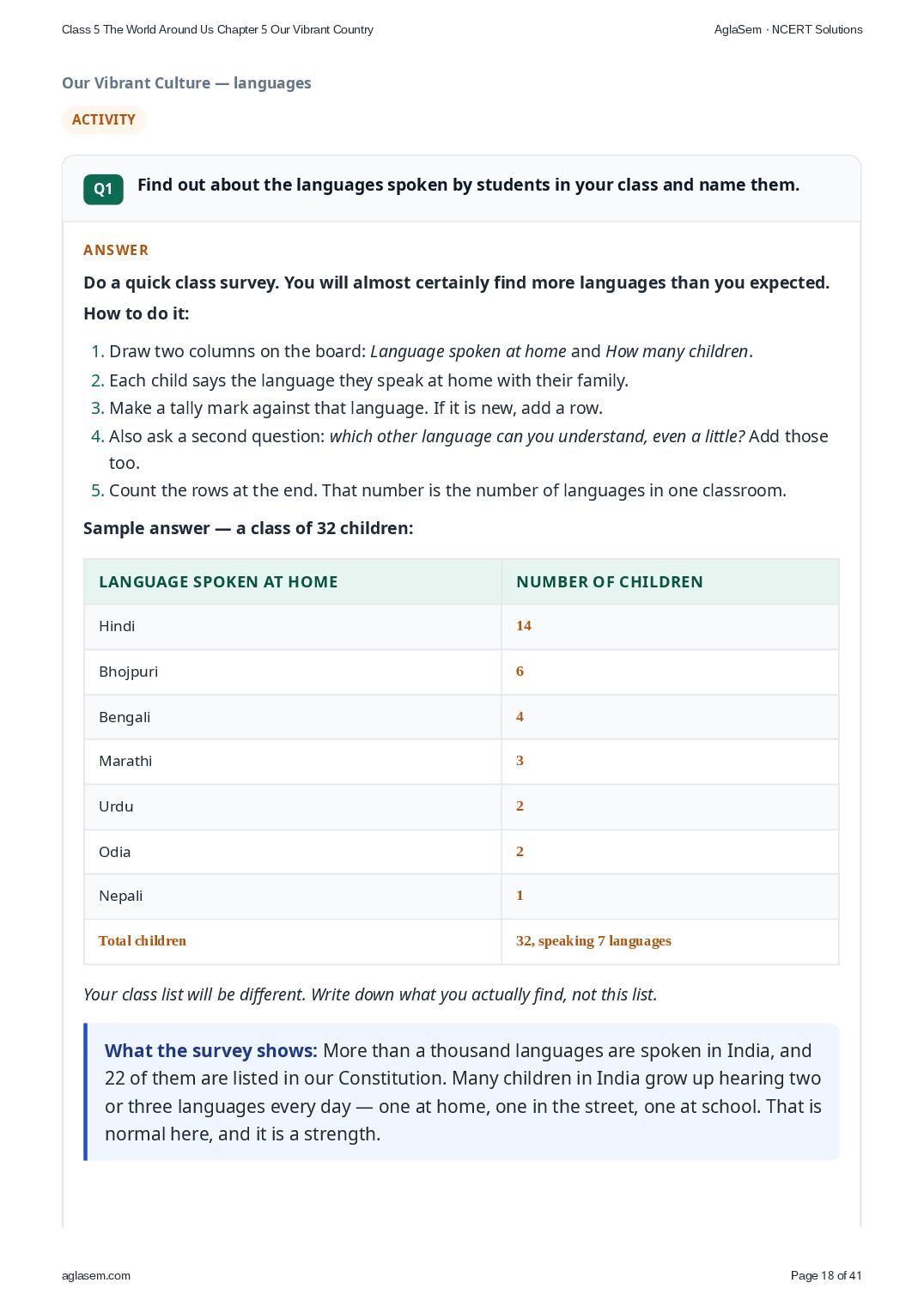
- Find out about the languages spoken by students in your class and name them.
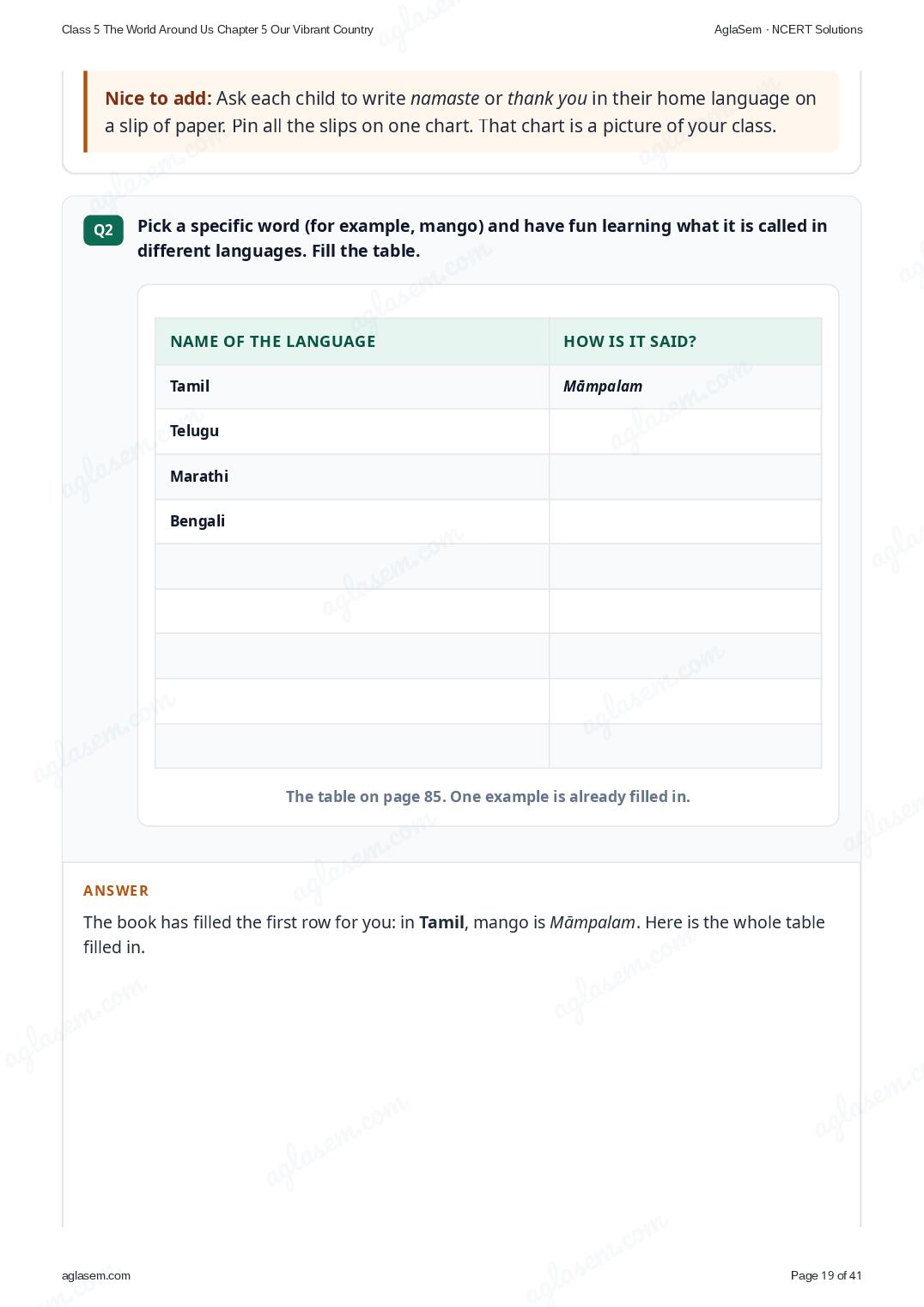
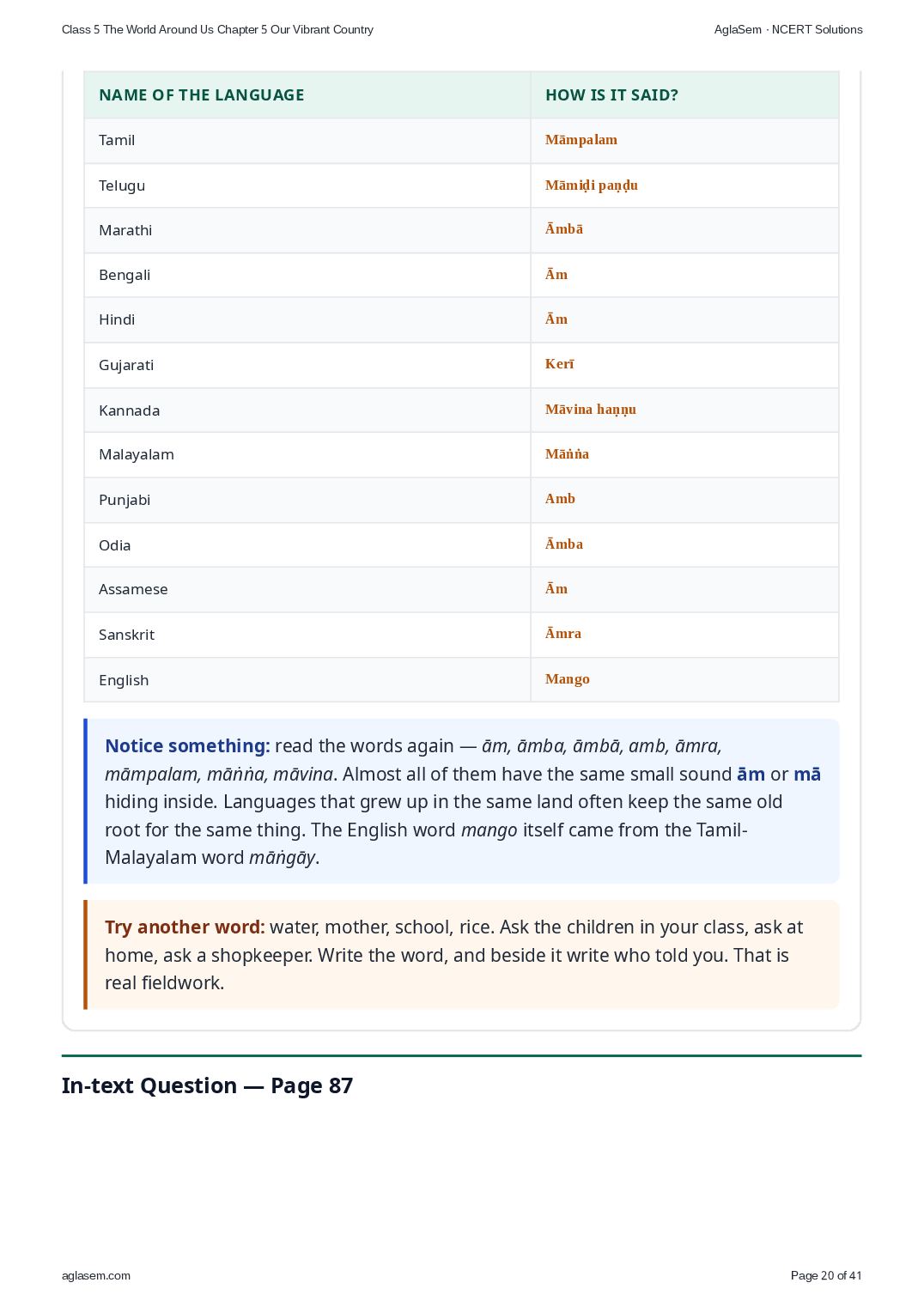
- Pick a specific word (for example, mango) and have fun learning what it is called in different languages. Fill the table.Name of the LanguageHow is it Said?TamilMāmpalamTelugu Marathi Bengali The table on page 85. One example is already filled in.
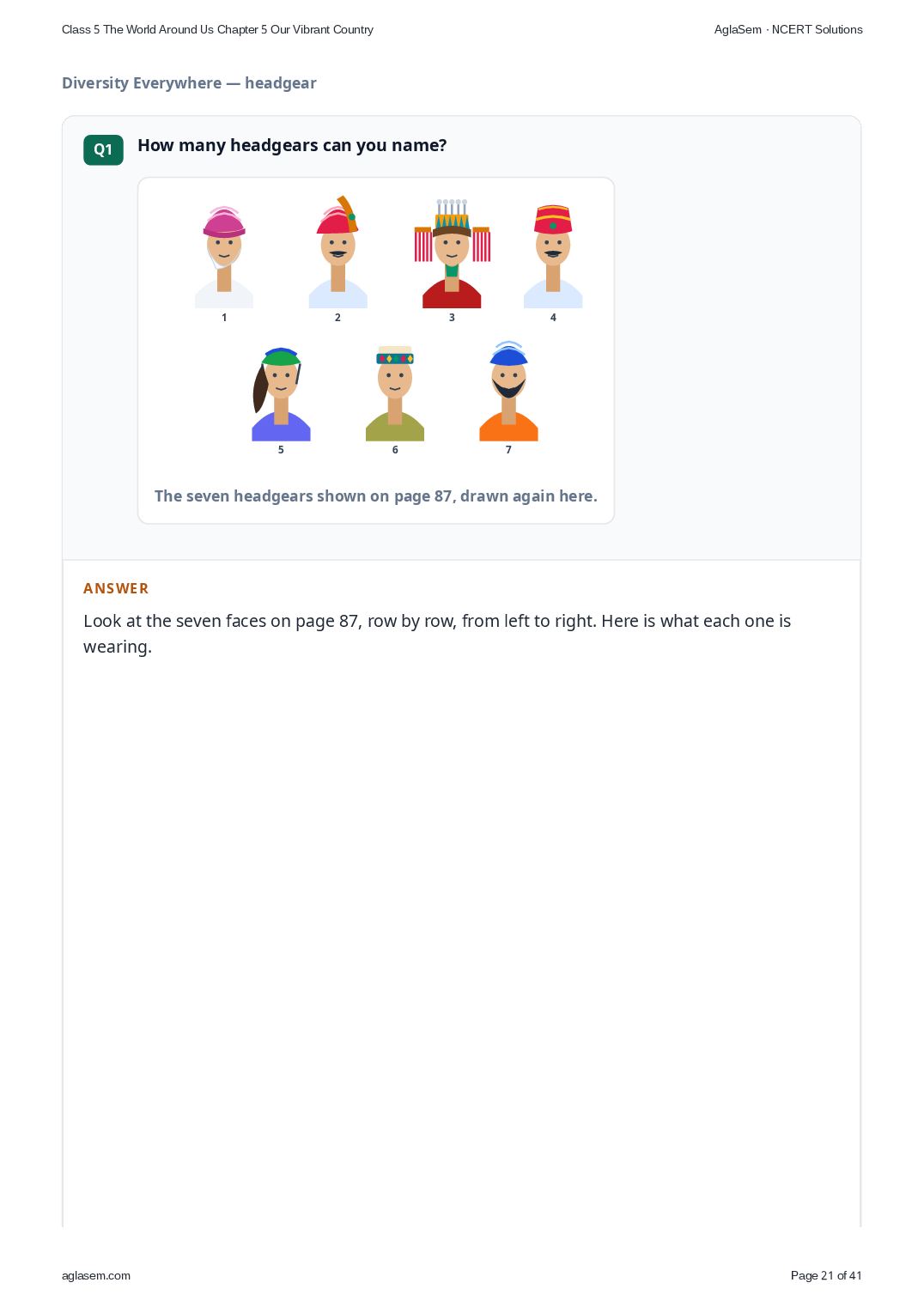
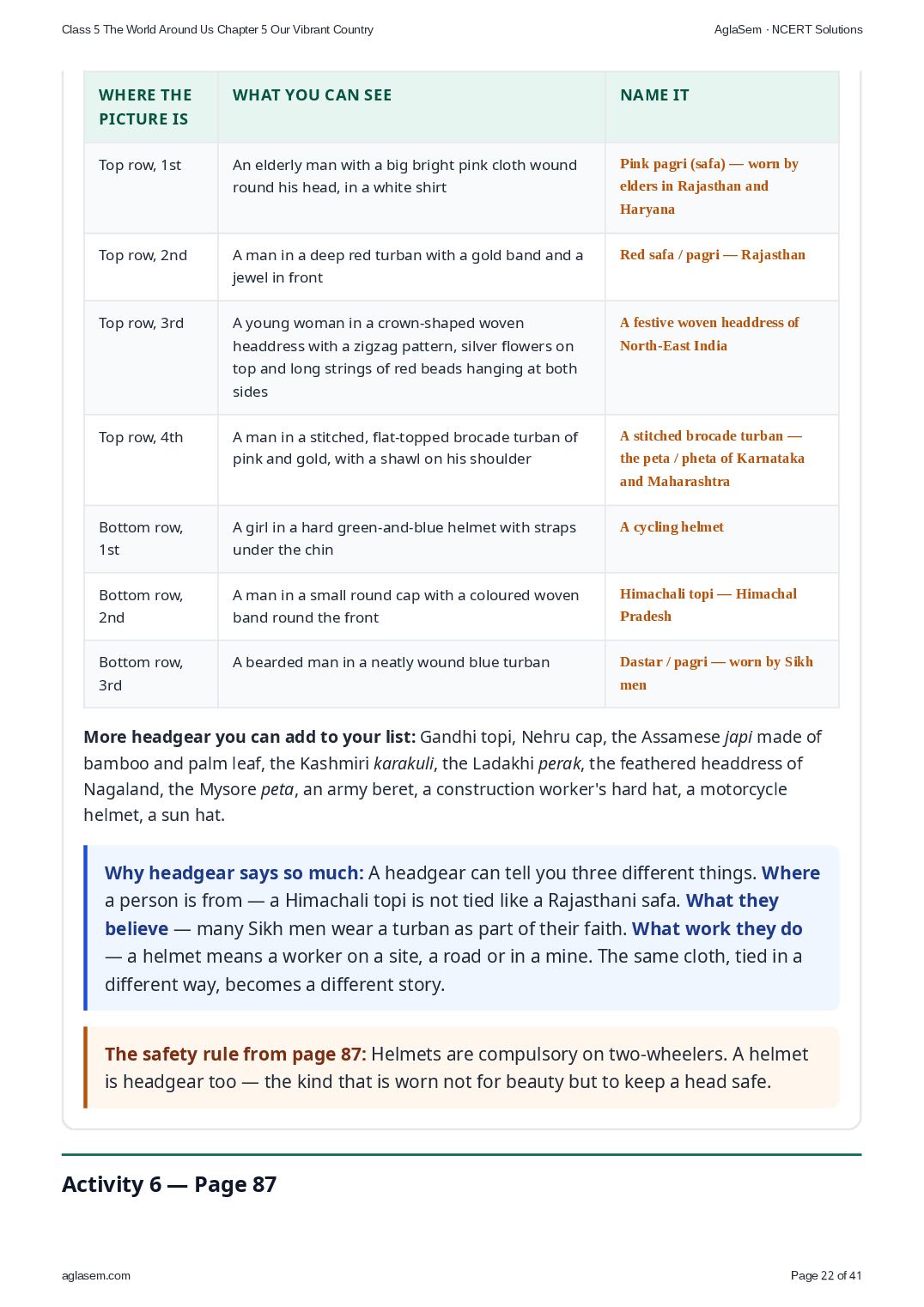
- How many headgears can you name?1234567The seven headgears shown on page 87, drawn again here.
- In small groups, take a dupatta or scarf and help each other make a traditional headgear.
- Create a headgear or cap using waste materials.
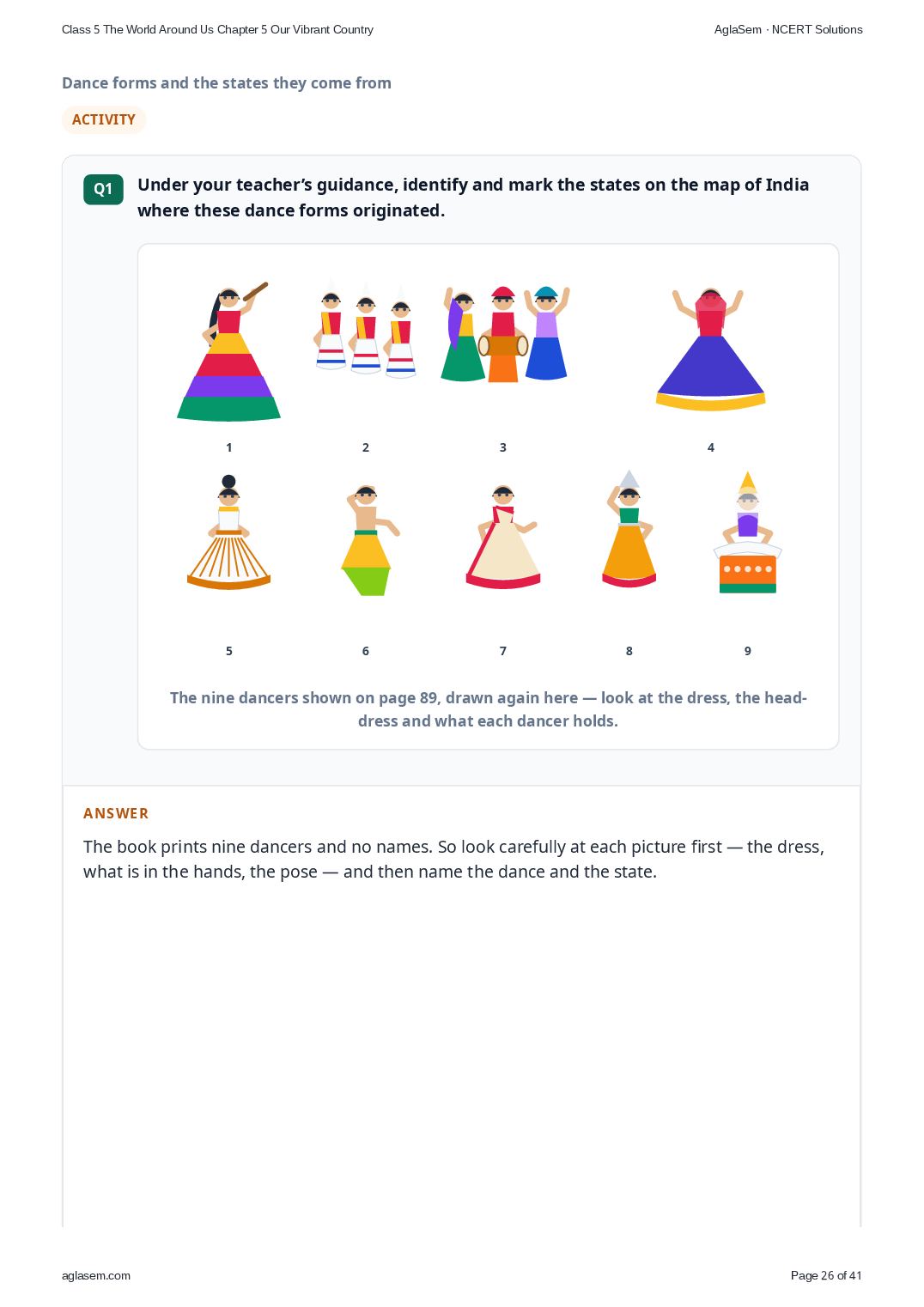
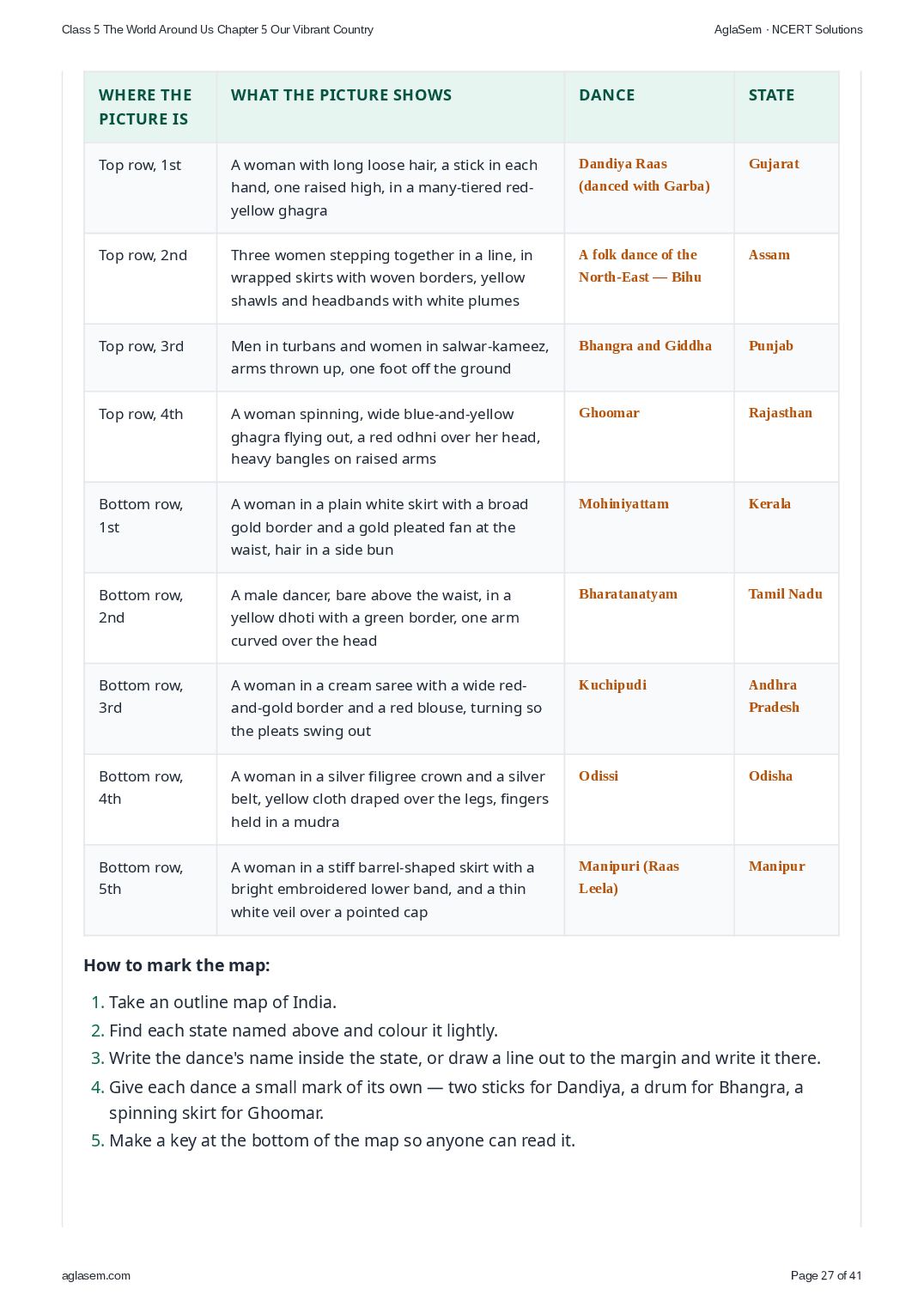
- Under your teacher’s guidance, identify and mark the states on the map of India where these dance forms originated.123456789The nine dancers shown on page 89, drawn again here — look at the dress, the head-dress and what each dancer holds.
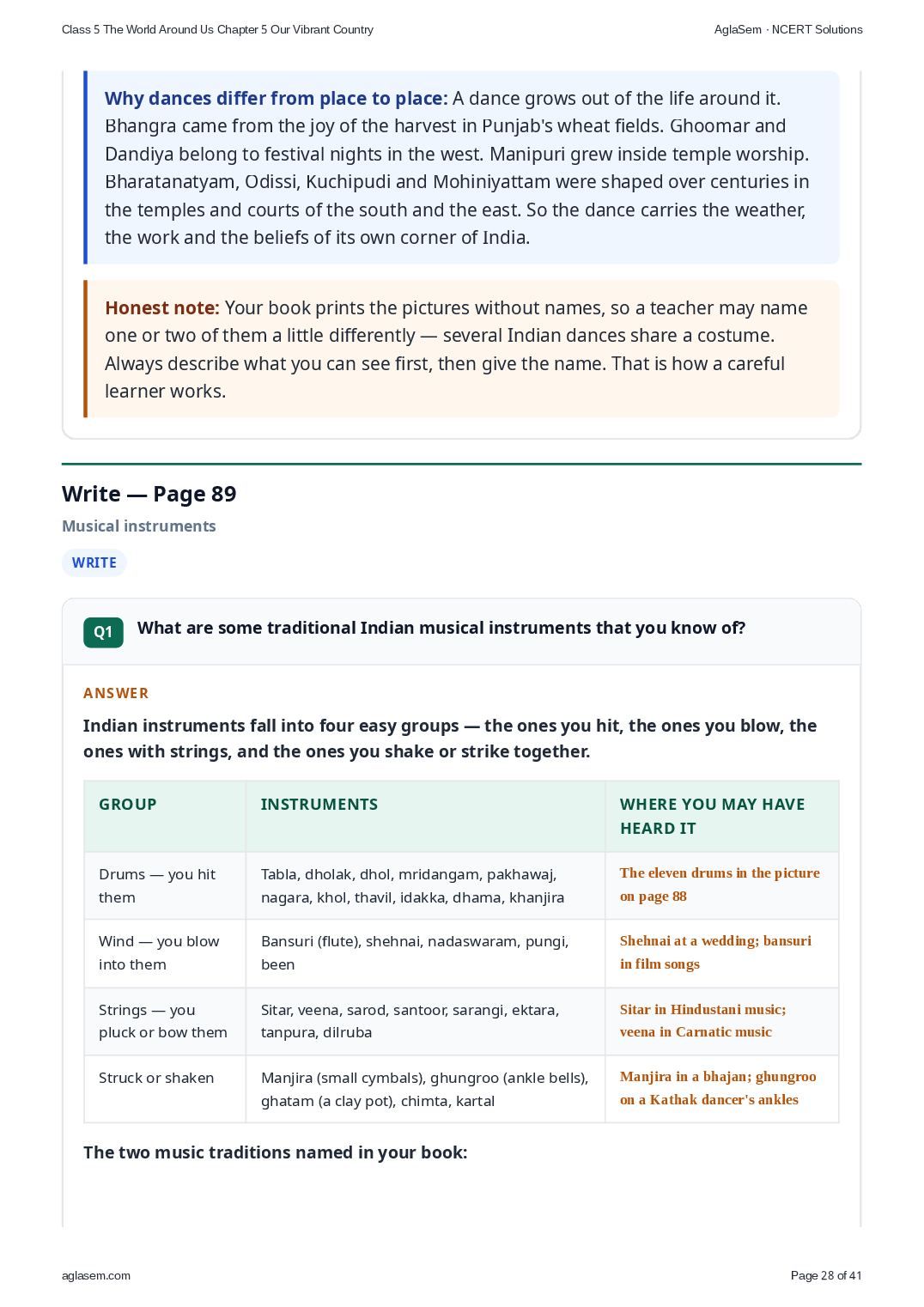
- What are some traditional Indian musical instruments that you know of?
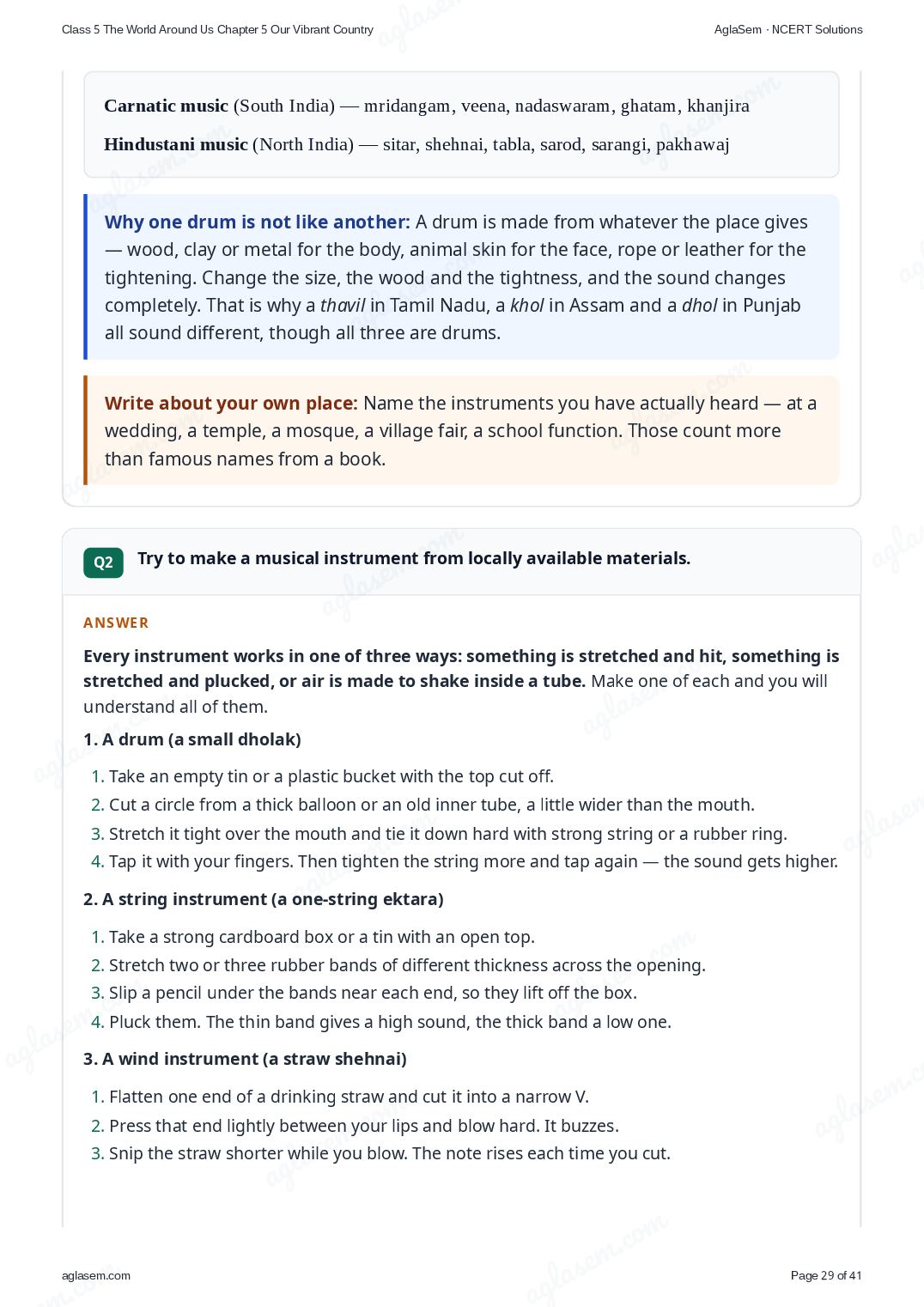
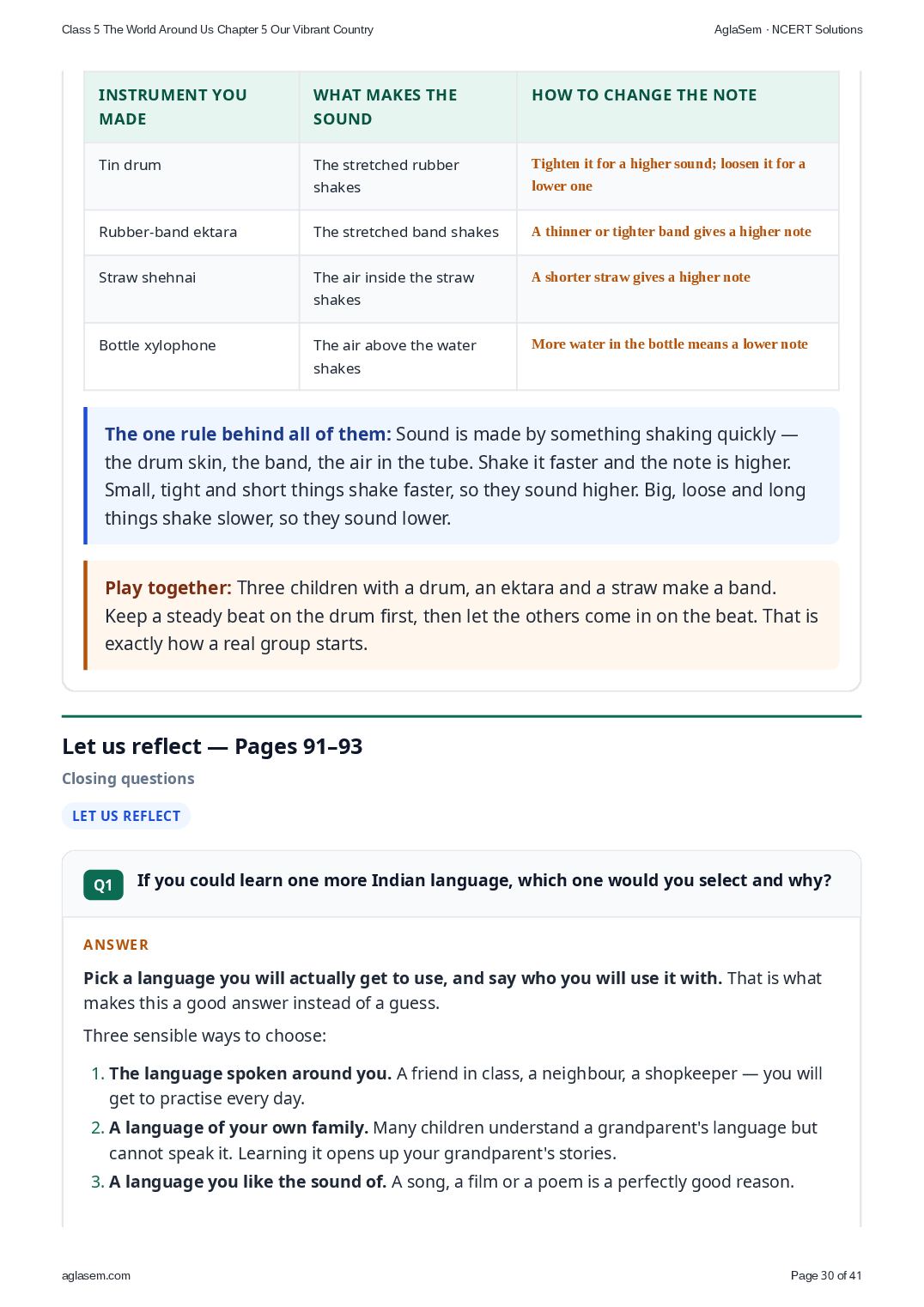
- Try to make a musical instrument from locally available materials.
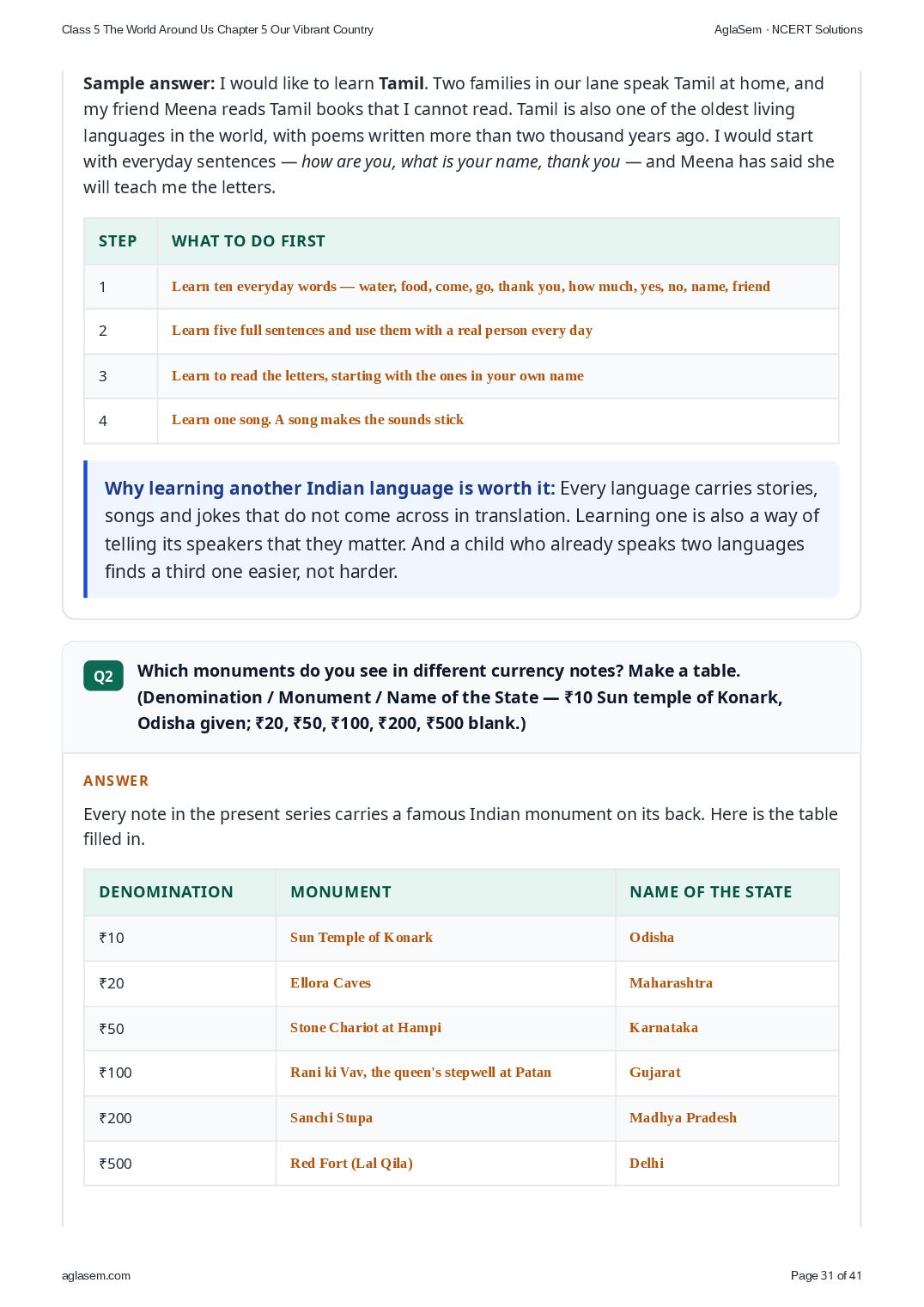
- If you could learn one more Indian language, which one would you select and why?
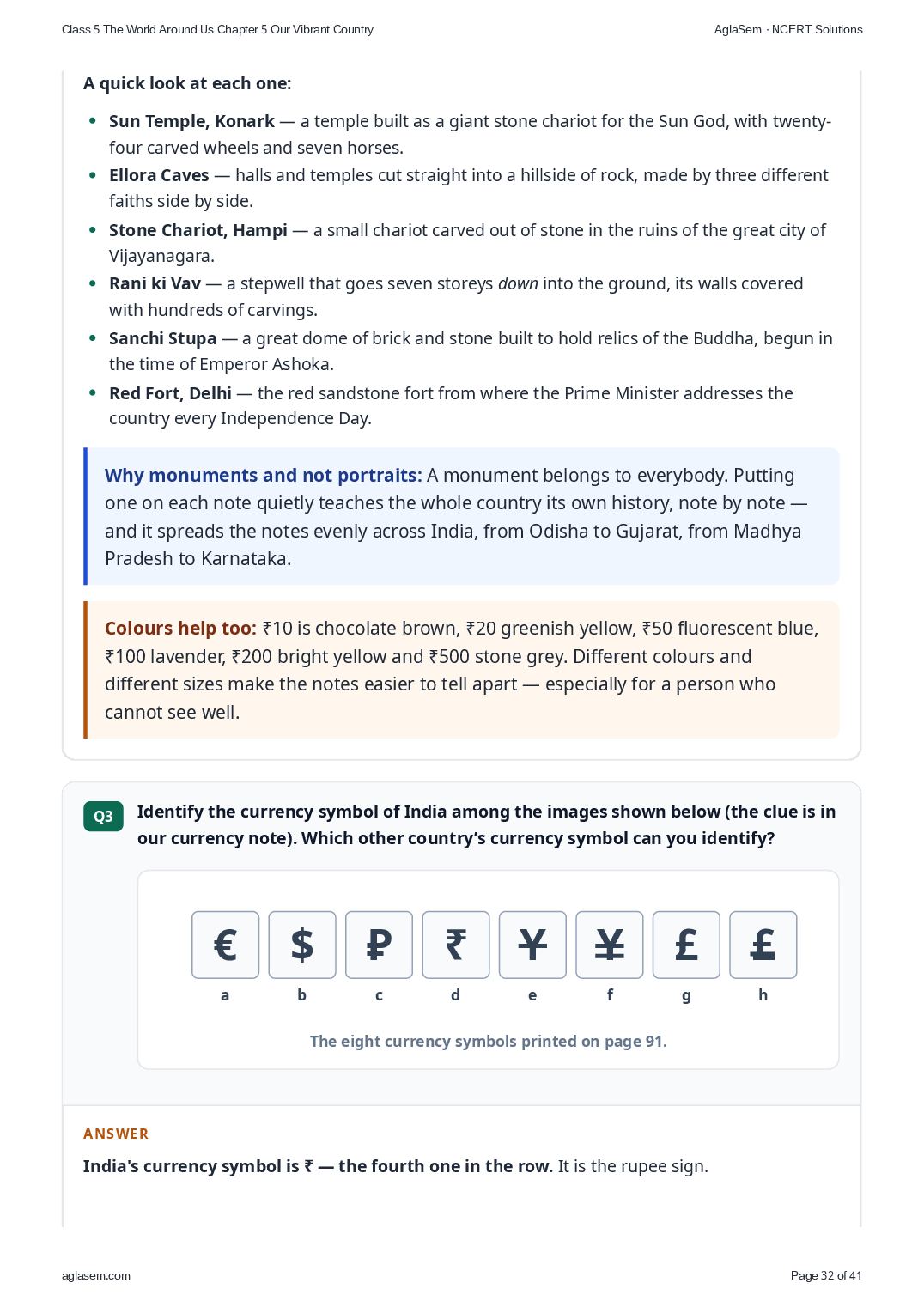
- Which monuments do you see in different currency notes? Make a table. (Denomination / Monument / Name of the State — ₹10 Sun temple of Konark, Odisha given; ₹20, ₹50, ₹100, ₹200, ₹500 blank.)
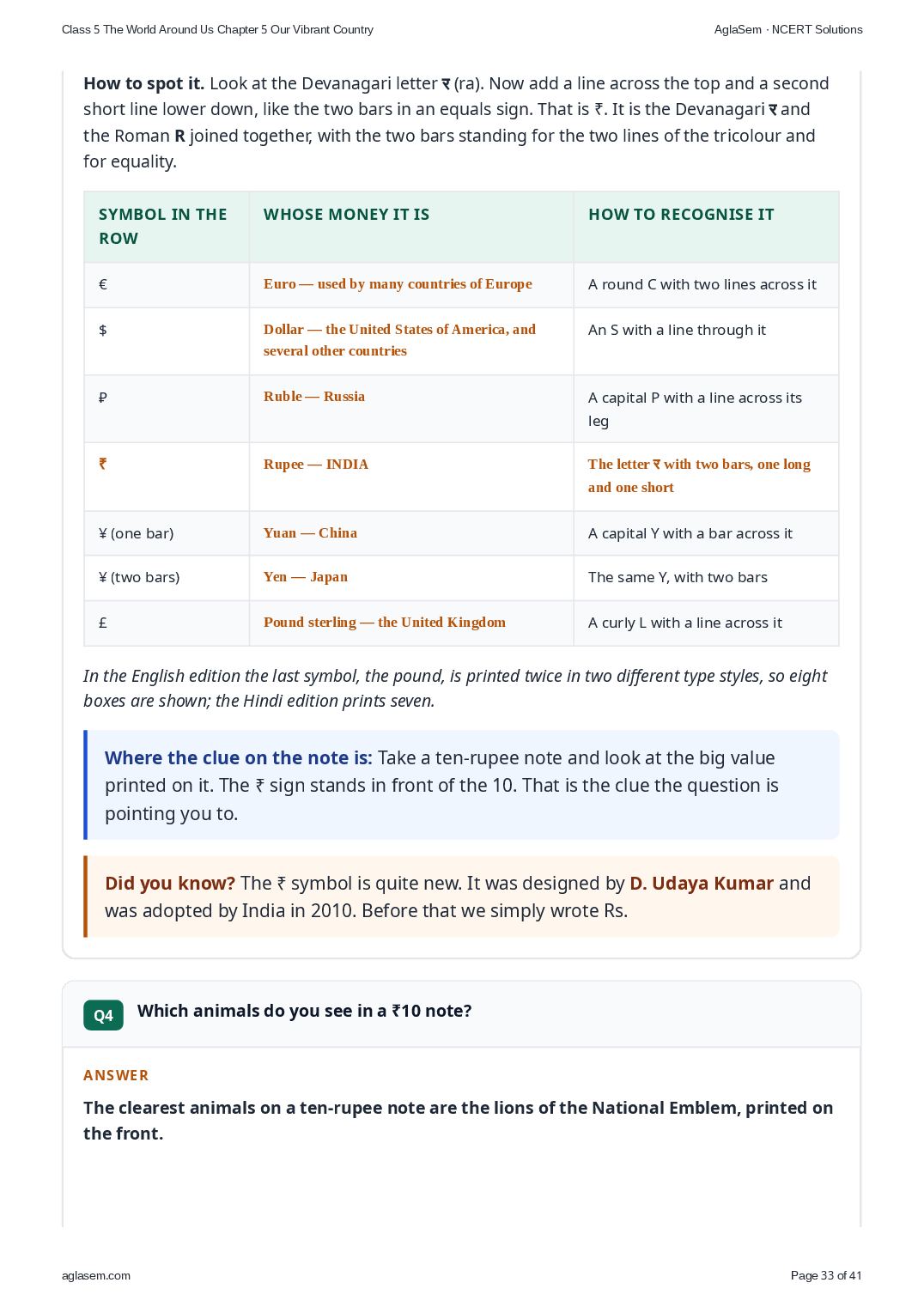
- Identify the currency symbol of India among the images shown below (the clue is in our currency note). Which other country’s currency symbol can you identify?abcdefgh€$₽₹YY££The eight currency symbols printed on page 91.
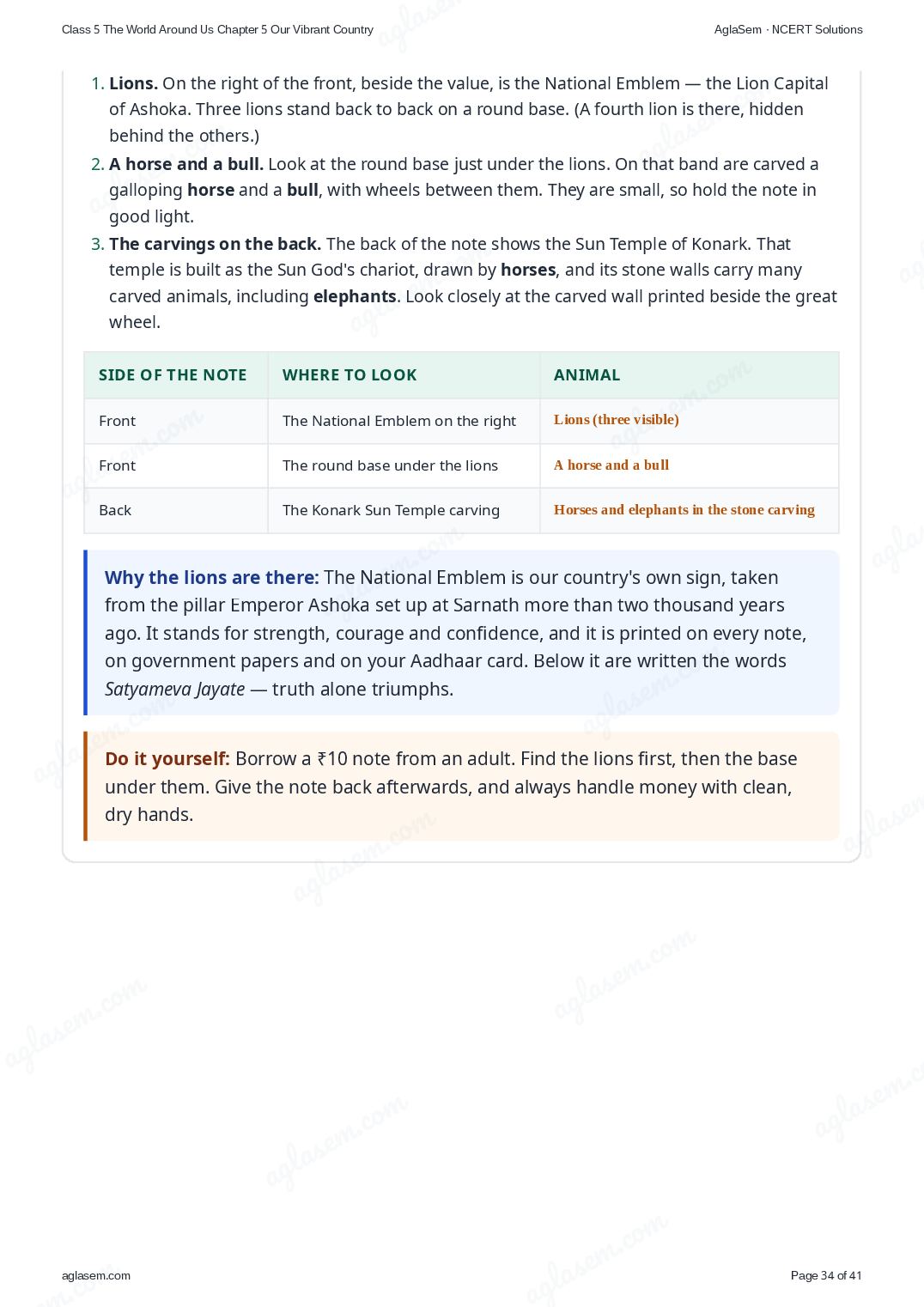
- Which animals do you see in a ₹10 note?
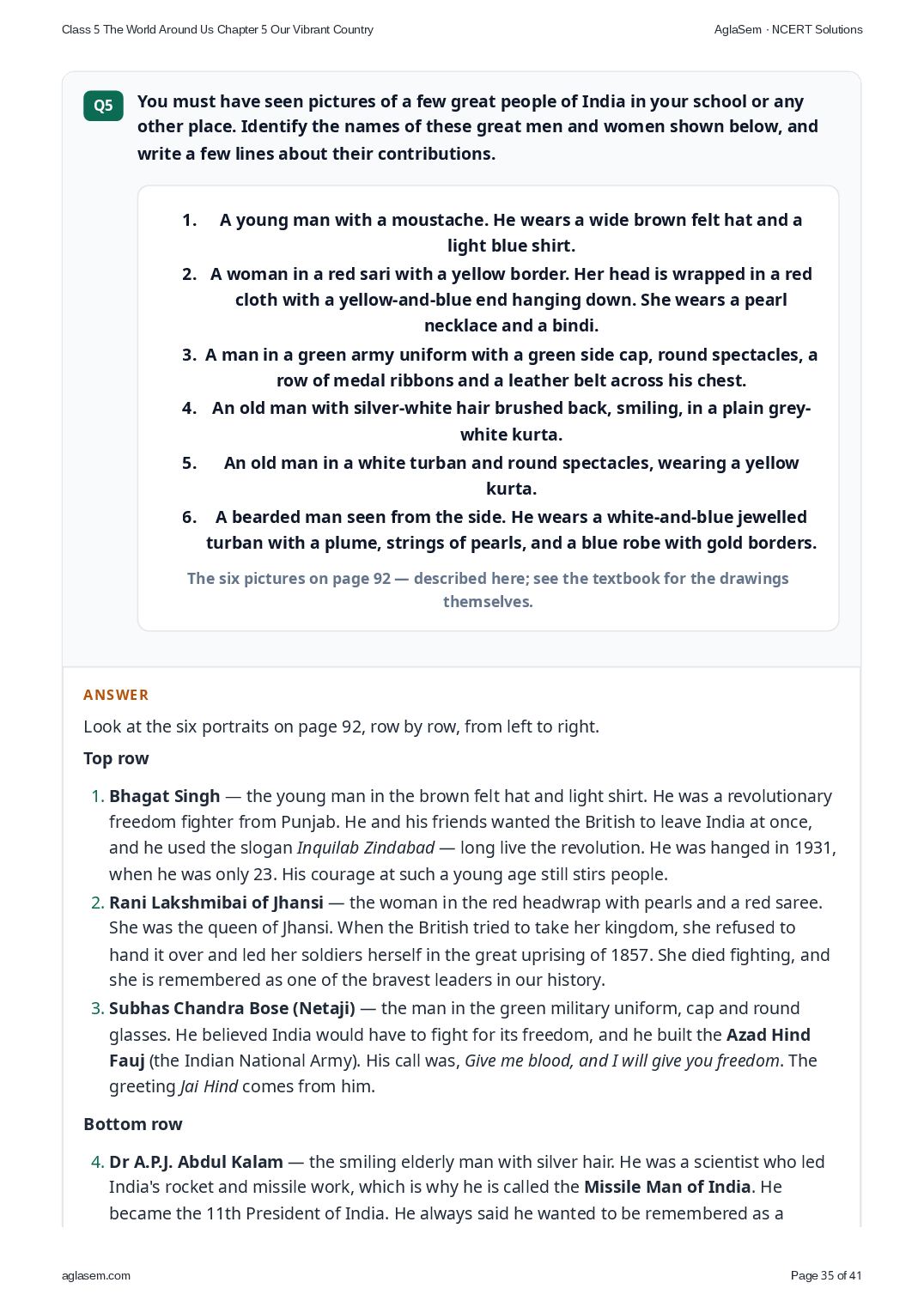
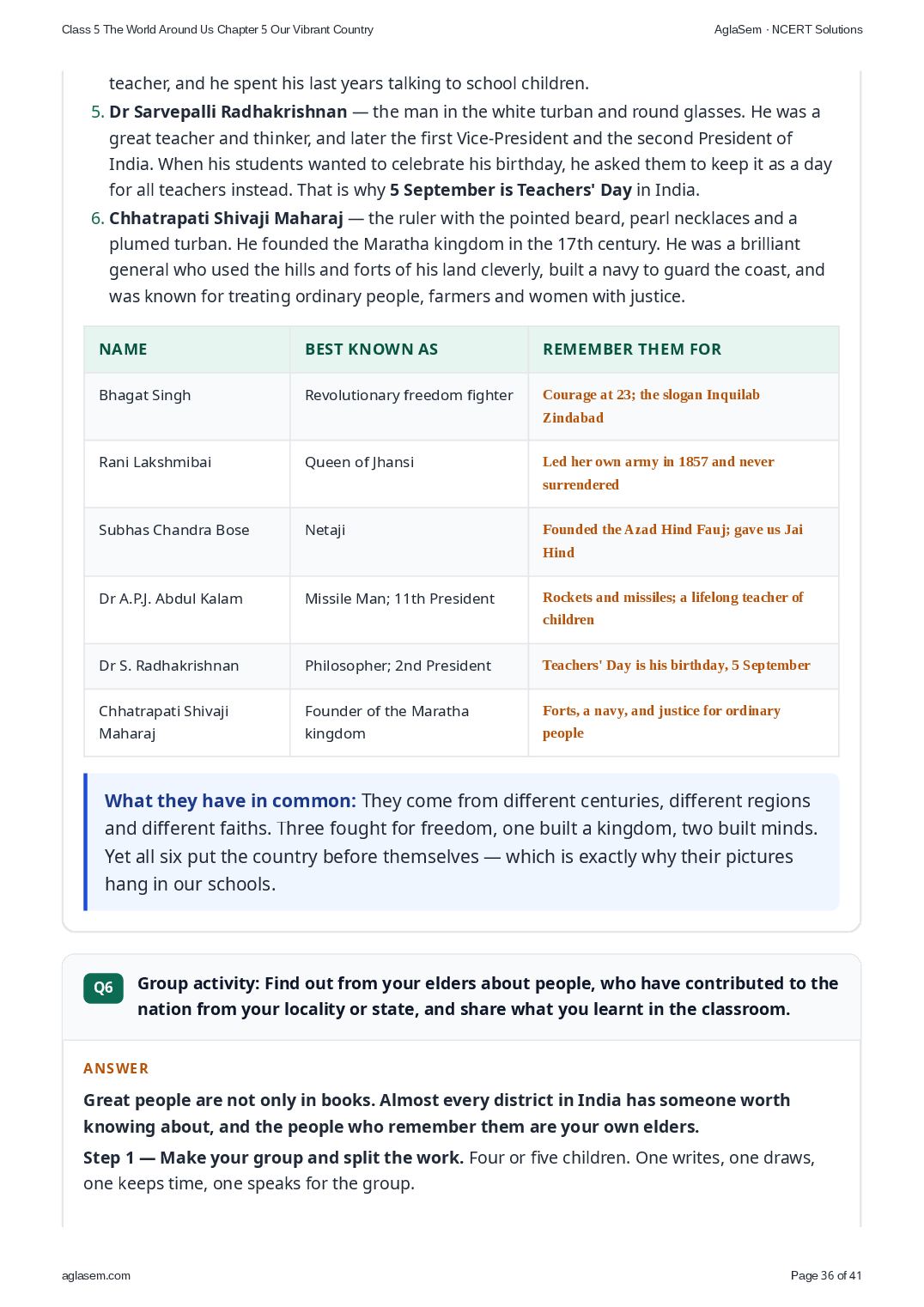
- You must have seen pictures of a few great people of India in your school or any other place. Identify the names of these great men and women shown below, and write a few lines about their contributions.A young man with a moustache. He wears a wide brown felt hat and a light blue shirt.A woman in a red sari with a yellow border. Her head is wrapped in a red cloth with a yellow-and-blue end hanging down. She wears a pearl necklace and a bindi.A man in a green army uniform with a green side cap, round spectacles, a row of medal ribbons and a leather belt across his chest.An old man with silver-white hair brushed back, smiling, in a plain grey-white kurta.An old man in a white turban and round spectacles, wearing a yellow kurta.A bearded man seen from the side. He wears a white-and-blue jewelled turban with a plume, strings of pearls, and a blue robe with gold borders.The six pictures on page 92 — described here; see the textbook for the drawings themselves.
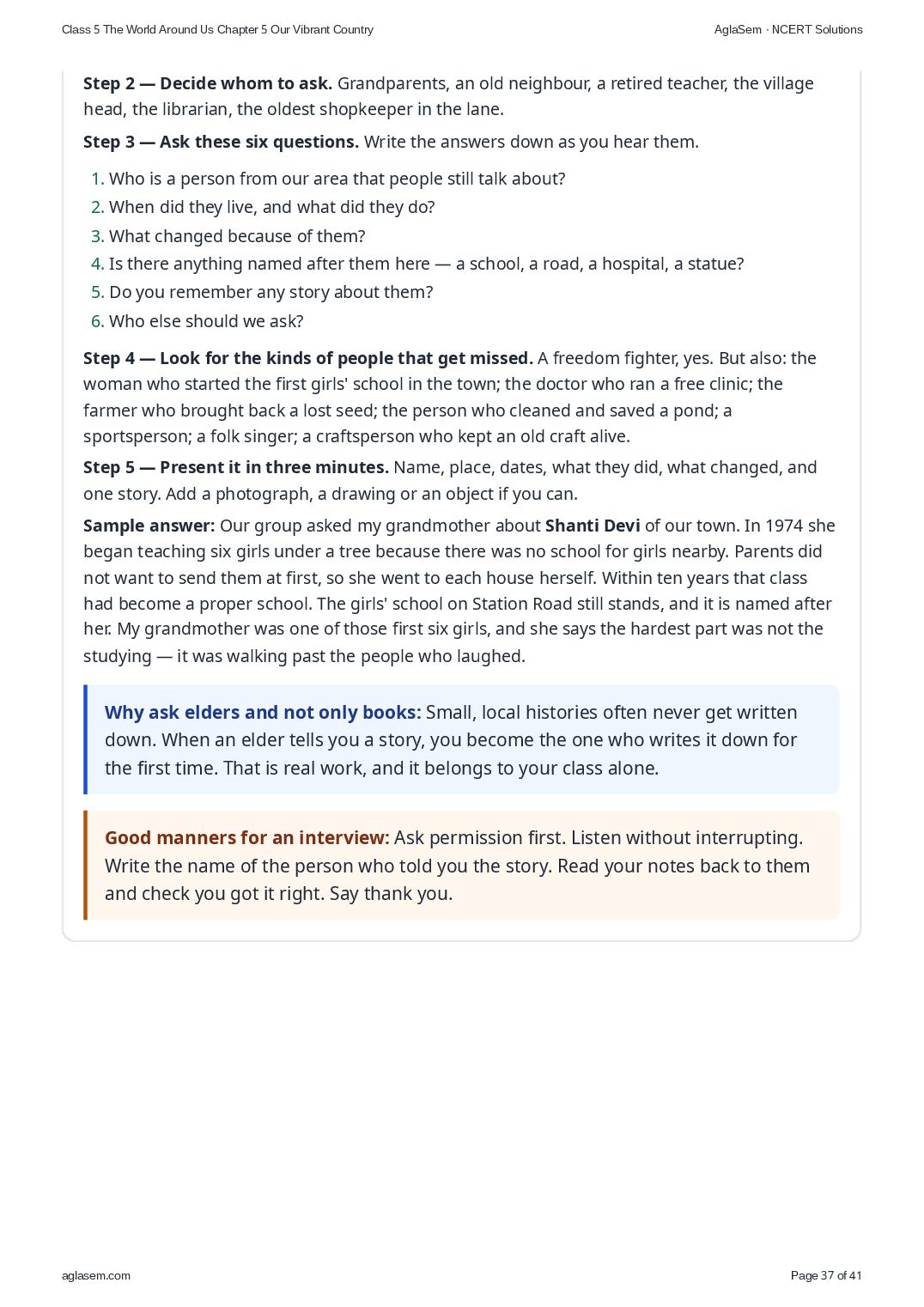
- Group activity: Find out from your elders about people, who have contributed to the nation from your locality or state, and share what you learnt in the classroom.
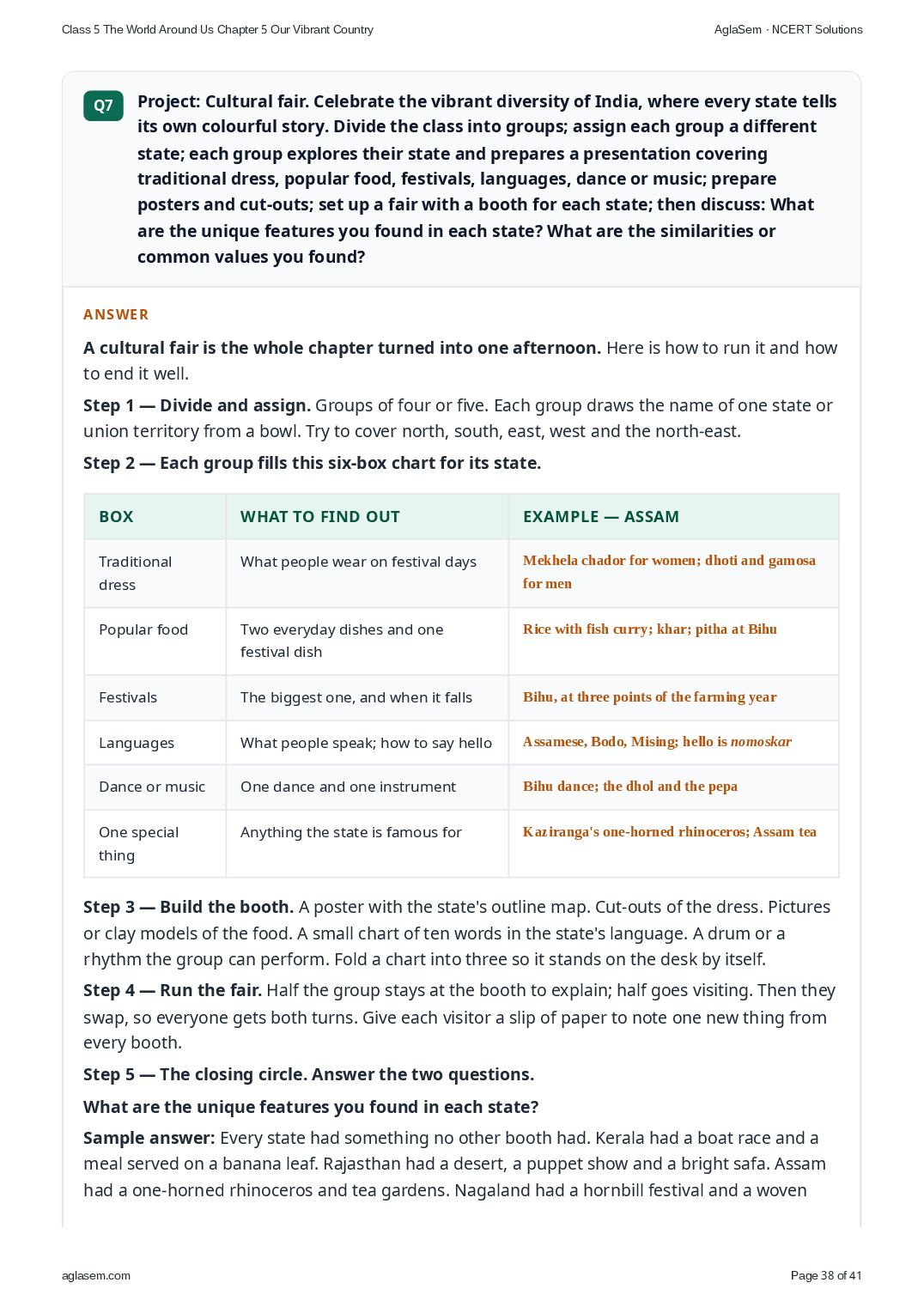
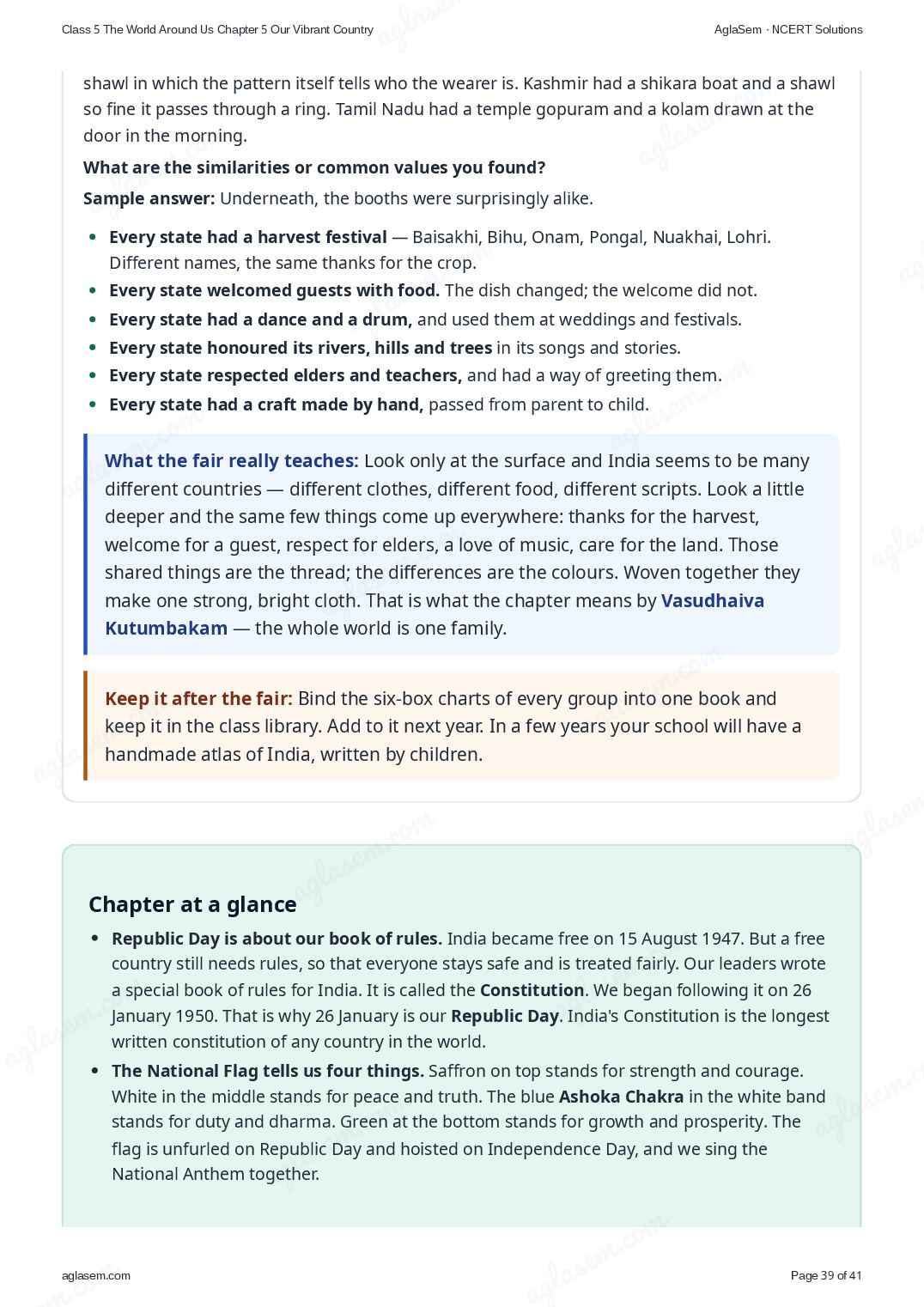
- Project: Cultural fair. Celebrate the vibrant diversity of India, where every state tells its own colourful story. Divide the class into groups; assign each group a different state; each group explores their state and prepares a presentation covering traditional dress, popular food, festivals, languages, dance or music; prepare posters and cut-outs; set up a fair with a booth for each state; then discuss: What are the unique features you found in each state? What are the similarities or common values you found?
Chapter at a Glance
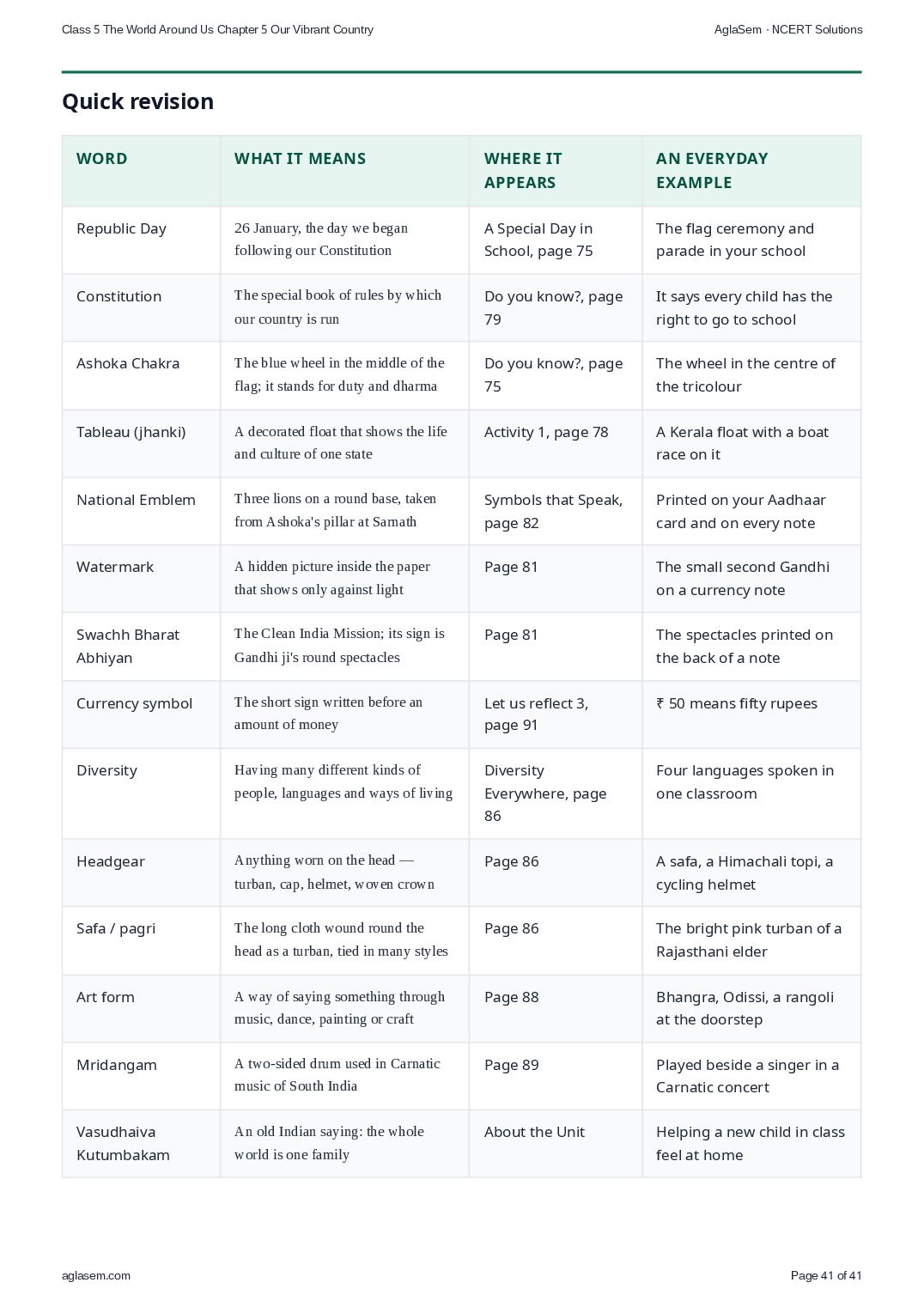
- Republic Day is about our book of rules. India became free on 15 August 1947. But a free country still needs rules, so that everyone stays safe and is treated fairly. Our leaders wrote a special book of rules for India. It is called the Constitution. We began following it on 26 January 1950. That is why 26 January is our Republic Day. India’s Constitution is the longest written constitution of any country in the world.
- The National Flag tells us four things. Saffron on top stands for strength and courage. White in the middle stands for peace and truth. The blue Ashoka Chakra in the white band stands for duty and dharma. Green at the bottom stands for growth and prosperity. The flag is unfurled on Republic Day and hoisted on Independence Day, and we sing the National Anthem together.
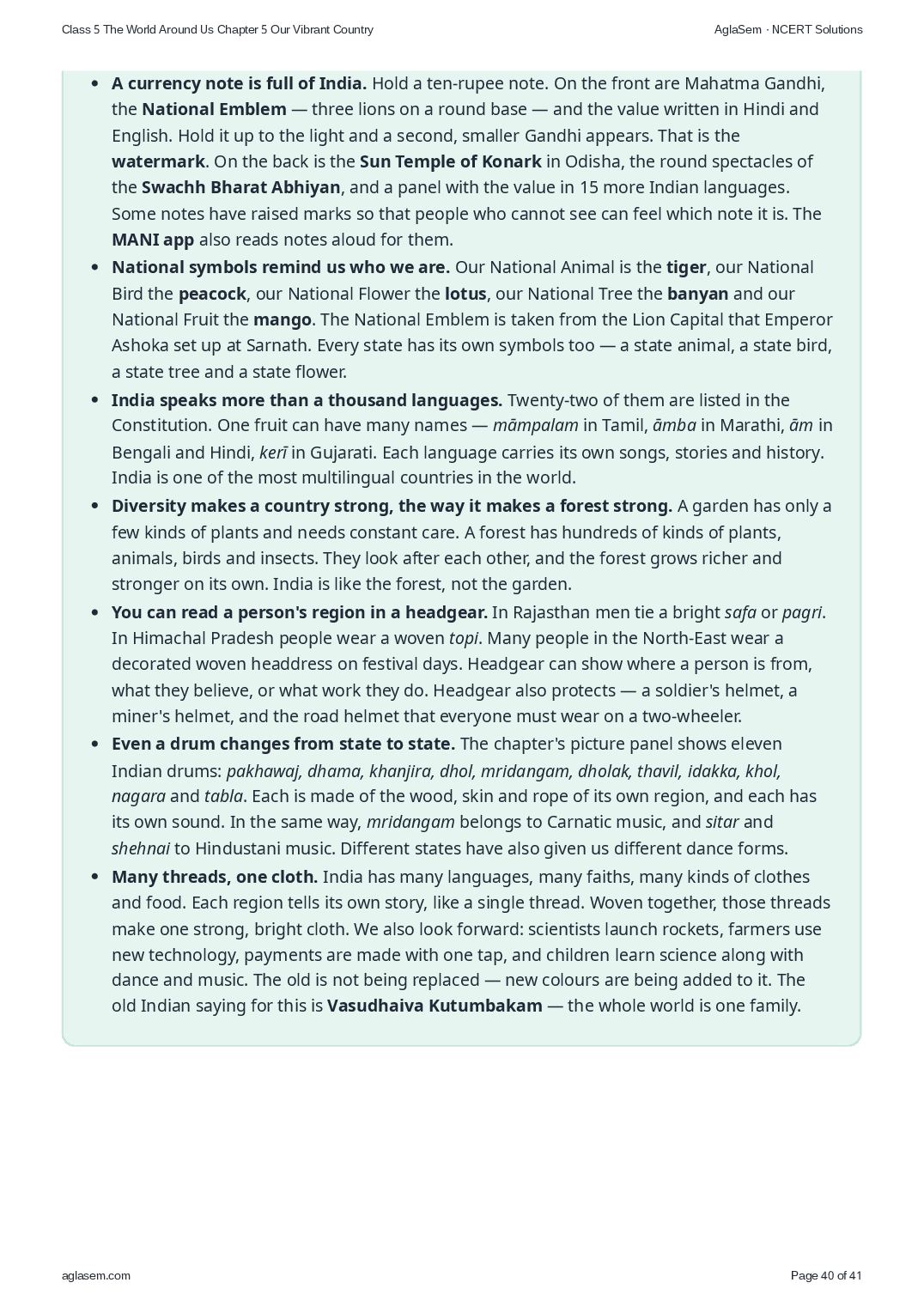
- A currency note is full of India. Hold a ten-rupee note. On the front are Mahatma Gandhi, the National Emblem — three lions on a round base — and the value written in Hindi and English. Hold it up to the light and a second, smaller Gandhi appears. That is the watermark. On the back is the Sun Temple of Konark in Odisha, the round spectacles of the Swachh Bharat Abhiyan, and a panel with the value in 15 more Indian languages. Some notes have raised marks so that people who cannot see can feel which note it is. The MANI app also reads notes aloud for them.
- National symbols remind us who we are. Our National Animal is the tiger, our National Bird the peacock, our National Flower the lotus, our National Tree the banyan and our National Fruit the mango. The National Emblem is taken from the Lion Capital that Emperor Ashoka set up at Sarnath. Every state has its own symbols too — a state animal, a state bird, a state tree and a state flower.
- India speaks more than a thousand languages. Twenty-two of them are listed in the Constitution. One fruit can have many names — māmpalam in Tamil, āmba in Marathi, ām in Bengali and Hindi, kerī in Gujarati. Each language carries its own songs, stories and history. India is one of the most multilingual countries in the world.
- Diversity makes a country strong, the way it makes a forest strong. A garden has only a few kinds of plants and needs constant care. A forest has hundreds of kinds of plants, animals, birds and insects. They look after each other, and the forest grows richer and stronger on its own. India is like the forest, not the garden.
- You can read a person’s region in a headgear. In Rajasthan men tie a bright safa or pagri. In Himachal Pradesh people wear a woven topi. Many people in the North-East wear a decorated woven headdress on festival days. Headgear can show where a person is from, what they believe, or what work they do. Headgear also protects — a soldier’s helmet, a miner’s helmet, and the road helmet that everyone must wear on a two-wheeler.
- Even a drum changes from state to state. The chapter’s picture panel shows eleven Indian drums: pakhawaj, dhama, khanjira, dhol, mridangam, dholak, thavil, idakka, khol, nagara and tabla. Each is made of the wood, skin and rope of its own region, and each has its own sound. In the same way, mridangam belongs to Carnatic music, and sitar and shehnai to Hindustani music. Different states have also given us different dance forms.
- Many threads, one cloth. India has many languages, many faiths, many kinds of clothes and food. Each region tells its own story, like a single thread. Woven together, those threads make one strong, bright cloth. We also look forward: scientists launch rockets, farmers use new technology, payments are made with one tap, and children learn science along with dance and music. The old is not being replaced — new colours are being added to it. The old Indian saying for this is Vasudhaiva Kutumbakam — the whole world is one family.
How to Download NCERT Solutions for Class 5 The World Around Us Chapter 5 PDF
Follow these simple steps to get the Our Vibrant Country questions-and-answers PDF from Our Wondrous World.
- Search NCERT Solutions for Class 5 The World Around Us Chapter 5 aglasem and open this page.
- Read the exercise questions with answers for Our Vibrant Country shown above.
- Click the Download PDF link to save the Our Vibrant Country solutions to your device.
NCERT Solutions for Class 5 The World Around Us – All Chapters
There are more chapters to study besides Our Vibrant Country in The World Around Us. Here are the NCERT Solutions for all chapters of Class 5 The World Around Us.
- Chapter 1 Water the Essence of Life
- Chapter 2 Journey of a River
- Chapter 3 the Mystery of Food
- Chapter 4 Our School a Happy Place
- Chapter 5 Our Vibrant Country
- Chapter 6 Some Unique Places
- Chapter 7 Energy How Things Work
- Chapter 8 Clothes How Things Are Made
- Chapter 9 Rhythms of Nature
- Chapter 10 Earth Our Shared Home
NCERT Solutions for Class 5 – All Subjects
Just like Chapter 5 of The World Around Us, you can get the exercise questions with answers for every other subject of Class 5. Here are the NCERT Solutions for all subjects of Class 5.
NCERT Solutions for Class 5 The World Around Us Chapter 5 – An Overview
The key highlights of this study material are as follows.
| Aspects | Details |
|---|---|
| Class | Class 5 |
| Subject | The World Around Us |
| Chapter Number | Chapter 5 |
| Chapter Name | Our Vibrant Country |
| Book Name | Our Wondrous World |
| Book By | NCERT (National Council of Educational Research and Training) |
| Educational Resource Here | NCERT Solutions of Class 5 The World Around Us Chapter 5 for all exercises |
| More Questions Answers of This Subject | NCERT Solutions for Class 5 The World Around Us |
| Download Book Chapter | NCERT Book Class 5 The World Around Us |
| All Questions Answers For This Class | NCERT Solutions for Class 5 |
| Complete Solutions | NCERT Solutions |
NCERT Solutions for Class 5 The World Around Us Chapter 5 Our Vibrant Country – FAQs
What are the NCERT Solutions for Class 5 The World Around Us Chapter 5 Our Vibrant Country?
They are the complete, step-by-step answers to all the exercise and in-text questions of Chapter 5 Our Vibrant Country from the NCERT Class 5 The World Around Us textbook Our Wondrous World, written by experts as per the latest NCERT syllabus.
How can I download the Class 5 The World Around Us Chapter 5 solutions PDF for free?
Open this page on aglasem, read the Our Vibrant Country questions with answers, and click the “Download Solutions PDF” link. The Class 5 The World Around Us Chapter 5 NCERT Solutions PDF is completely free to download.
Are these NCERT Solutions as per the latest 2026-27 syllabus?
Yes. The NCERT Solutions for Class 5 The World Around Us Chapter 5 are based on the latest NCERT textbook Our Wondrous World and the current 2026-27 CBSE syllabus, so the questions and answers match what you study in class.
Where can I get NCERT Solutions for the other chapters of Class 5 The World Around Us?
You can find the answers to every chapter on the NCERT Solutions for Class 5 The World Around Us page, and solutions for every subject on the NCERT Solutions for Class 5 page.
How do NCERT Solutions help in exam preparation?
They show the correct method to solve each question, help you write answers the way they are expected in exams, let you check and correct your own work, and save revision time — which together improve your marks in Class 5 The World Around Us.
If you have any queries on NCERT Solutions for Class 5 The World Around Us Chapter 5 Our Vibrant Country, then please ask in the comments below.