NCERT Solutions for Class 5 The World Around Us Chapter 9 Rhythms of Nature provide clear, step-by-step answers to every exercise and in-text question from the chapter Rhythms of Nature of the NCERT textbook Our Wondrous World. Prepared by subject experts as per the latest NCERT (CBSE) syllabus for 2026-27, these NCERT Solutions for Class 5 The World Around Us help you understand each concept, write exam-ready answers, and check your own solutions. You can read them online below or download the free Class 5 The World Around Us Chapter 9 question-answer PDF.
NCERT Solutions for Class 5 The World Around Us Chapter 9 Rhythms of Nature
- Class: Class 5
- Subject: The World Around Us
- Chapter: Chapter 9 – Rhythms of Nature
- Textbook: Our Wondrous World (NCERT)
- Study material: NCERT Solutions – questions with answers, free PDF
These solutions answer all the exercise questions of Chapter 9 Rhythms of Nature — including the in-text questions, short-answer and long-answer questions, and activities — with complete explanations so you can follow the method, not just the final answer. Read the full solutions below.
NCERT Solutions Class 5 The World Around Us Chapter 9 Rhythms of Nature View Download

NCERT Solutions for Class 5 The World Around Us Chapter 9 PDF Download
You can read the NCERT Solutions for Class 5 The World Around Us Chapter 9 online above, or download the complete question-answer PDF to study Rhythms of Nature offline at any time.
NCERT Solutions for Class 5 The World Around Us Chapter 9 PDF Download Link – Click Here to Download Solutions PDF
Questions Covered in This Chapter
These NCERT Solutions answer all 30 questions of this chapter. The questions solved are:
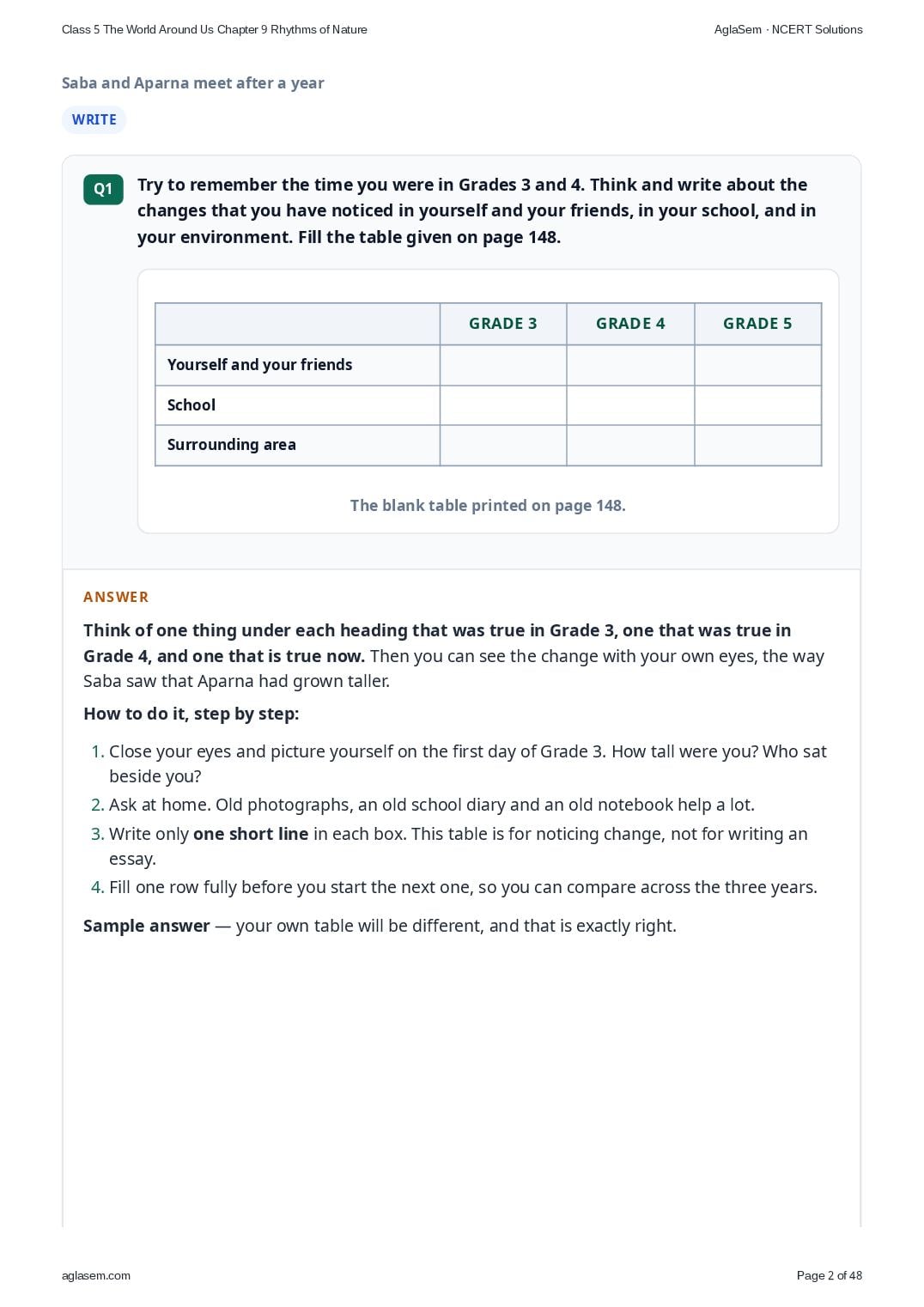
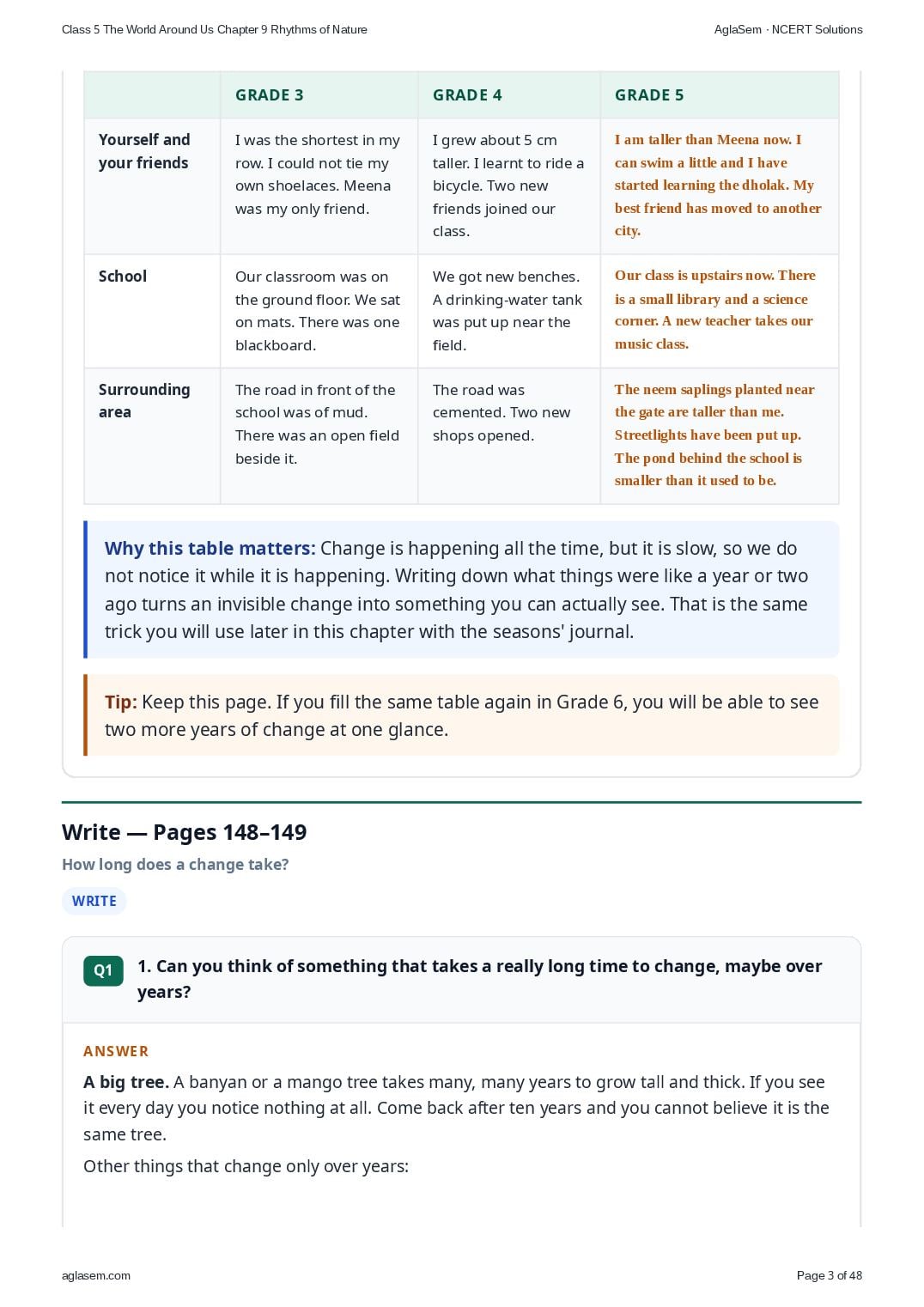
- Try to remember the time you were in Grades 3 and 4. Think and write about the changes that you have noticed in yourself and your friends, in your school, and in your environment. Fill the table given on page 148. Grade 3Grade 4Grade 5 Yourself and your friends School Surrounding area The blank table printed on page 148.
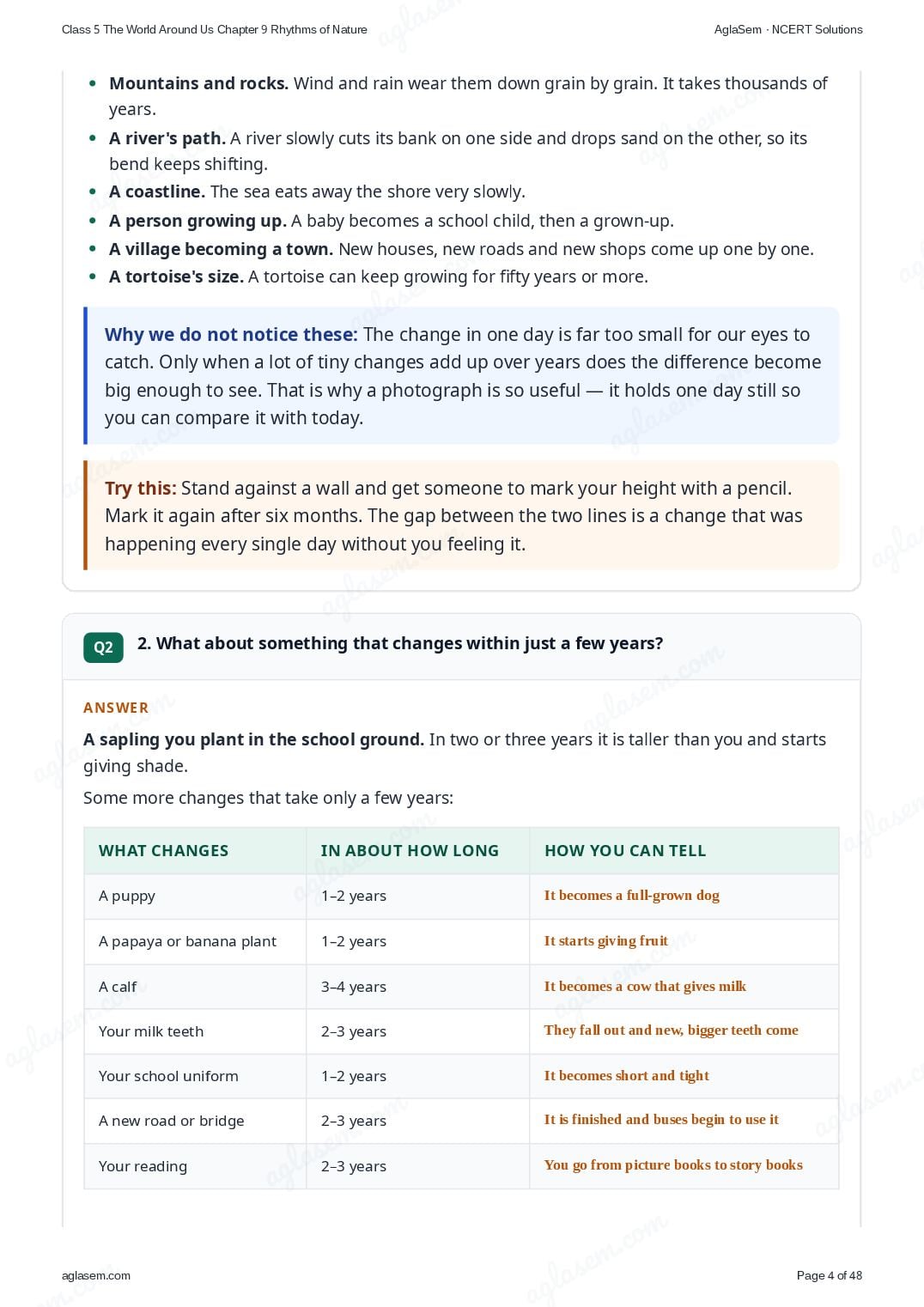
- 1. Can you think of something that takes a really long time to change, maybe over years?
- 2. What about something that changes within just a few years?
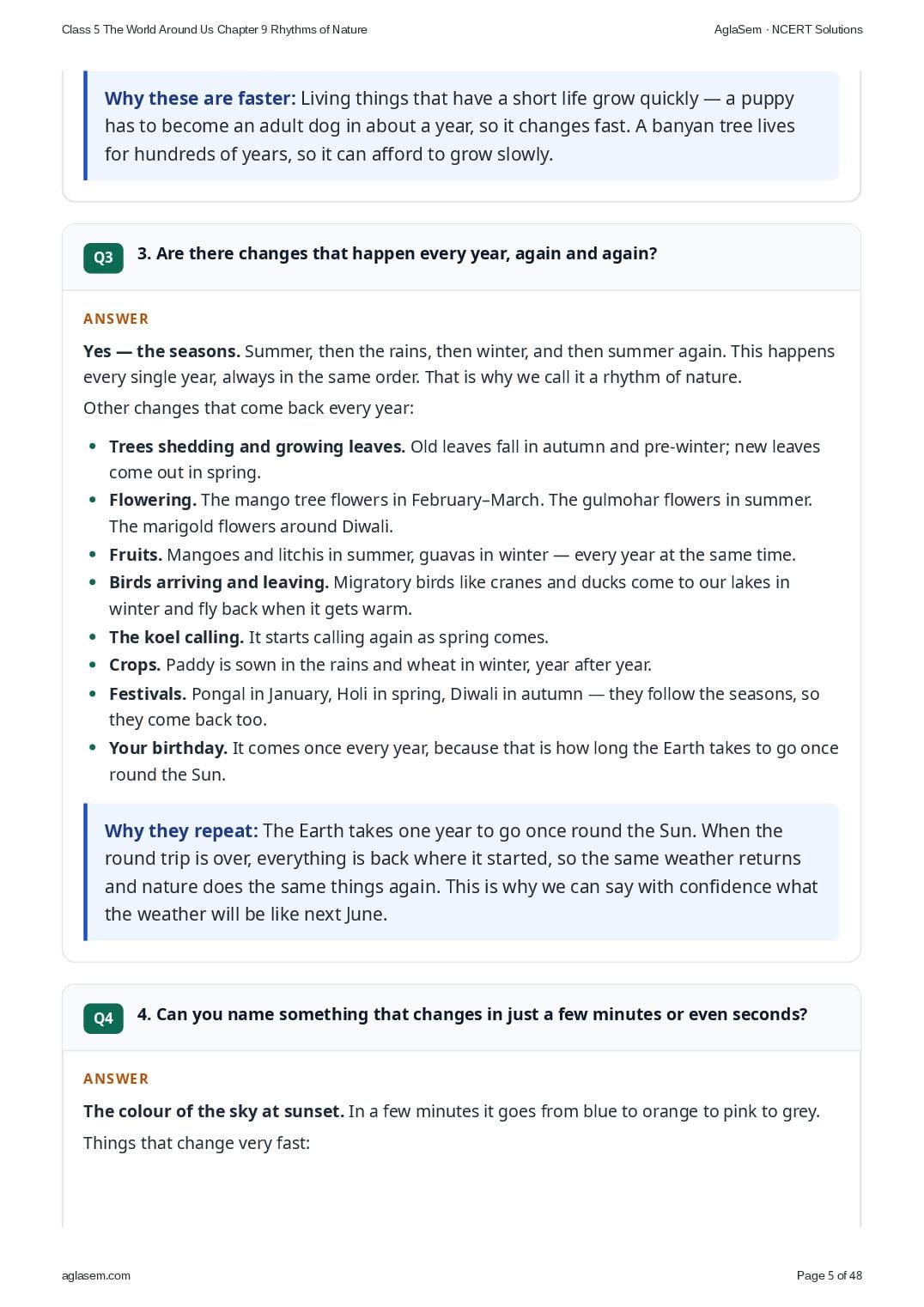
- 3. Are there changes that happen every year, again and again?
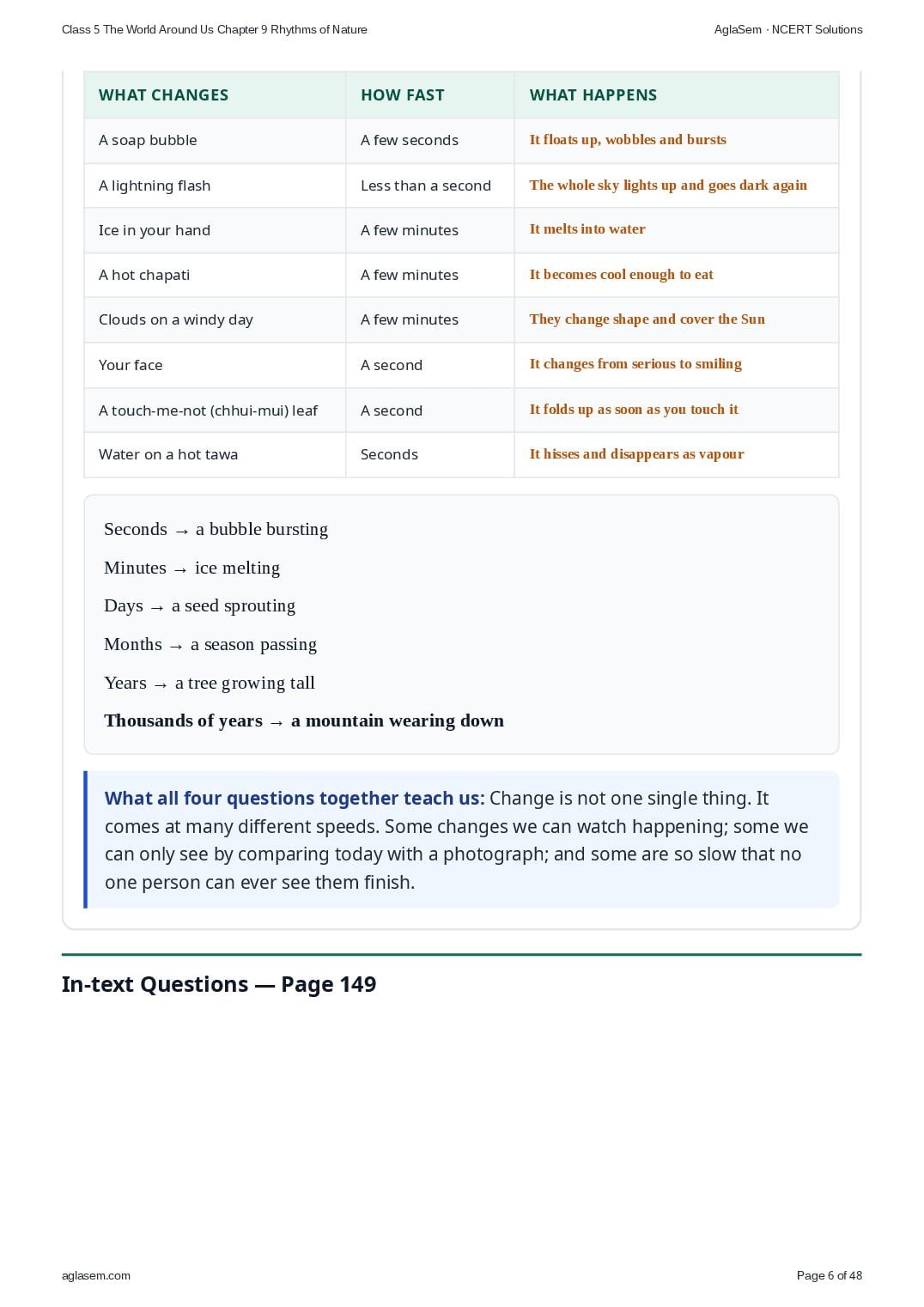
- 4. Can you name something that changes in just a few minutes or even seconds?
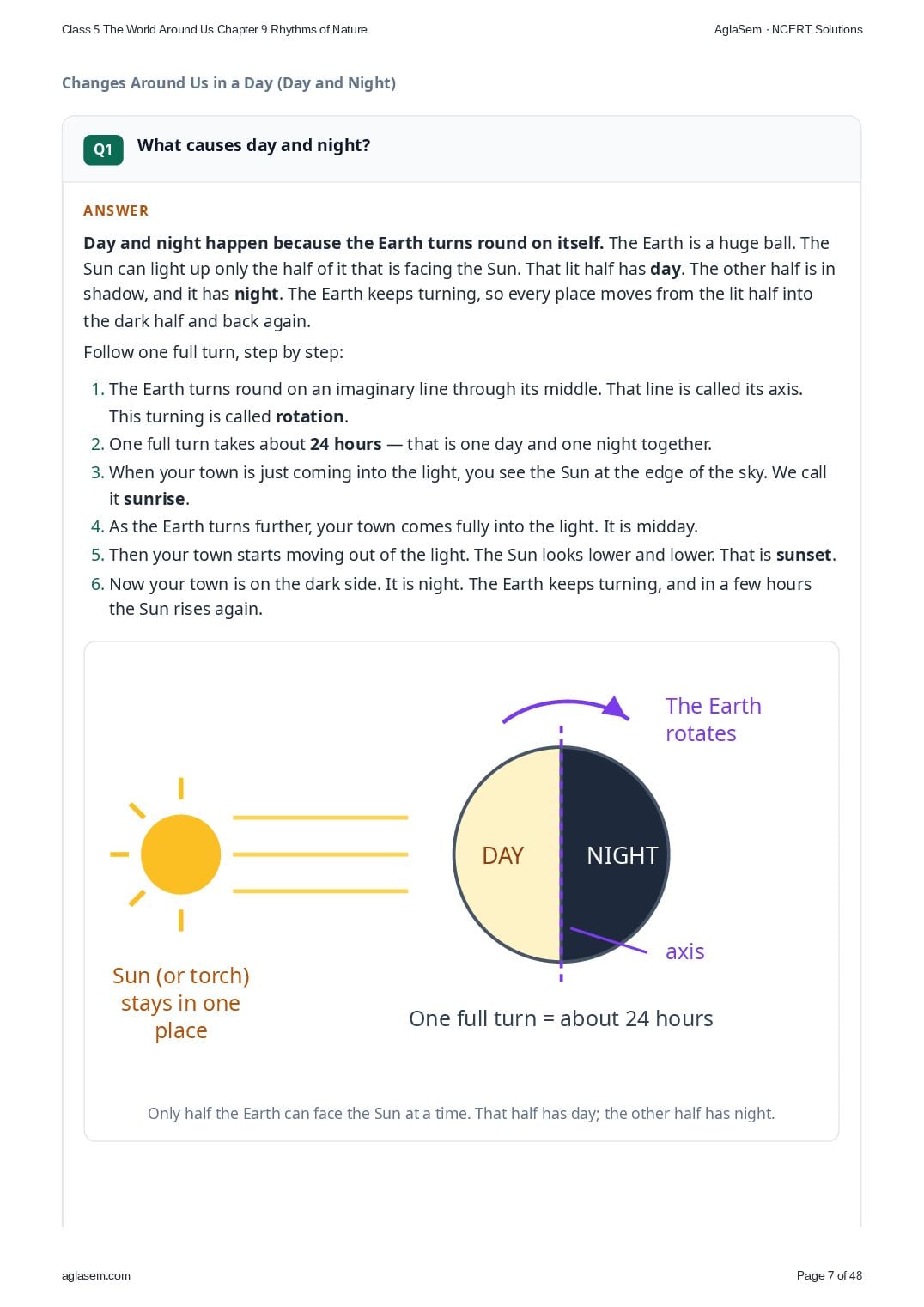
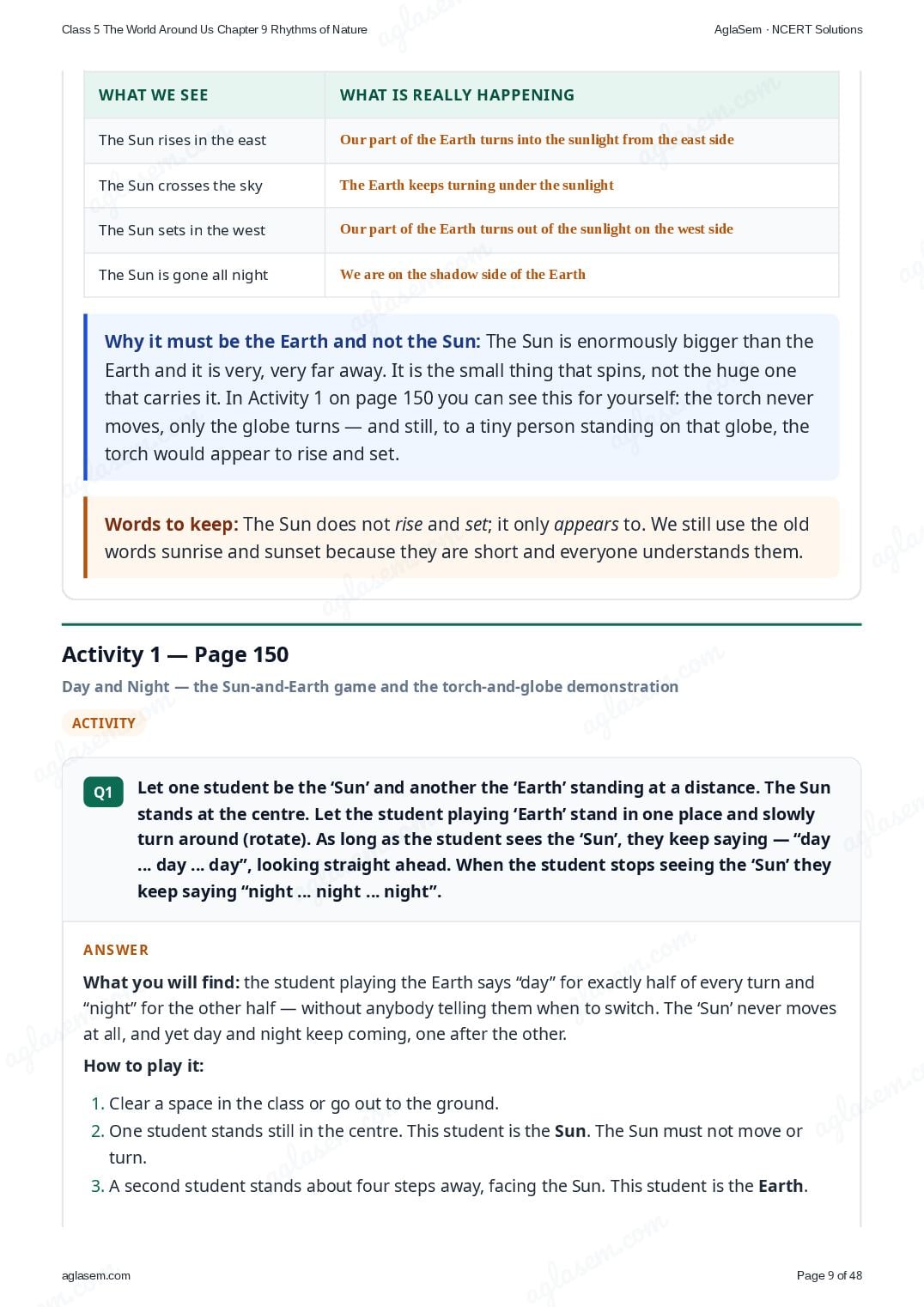
- What causes day and night?
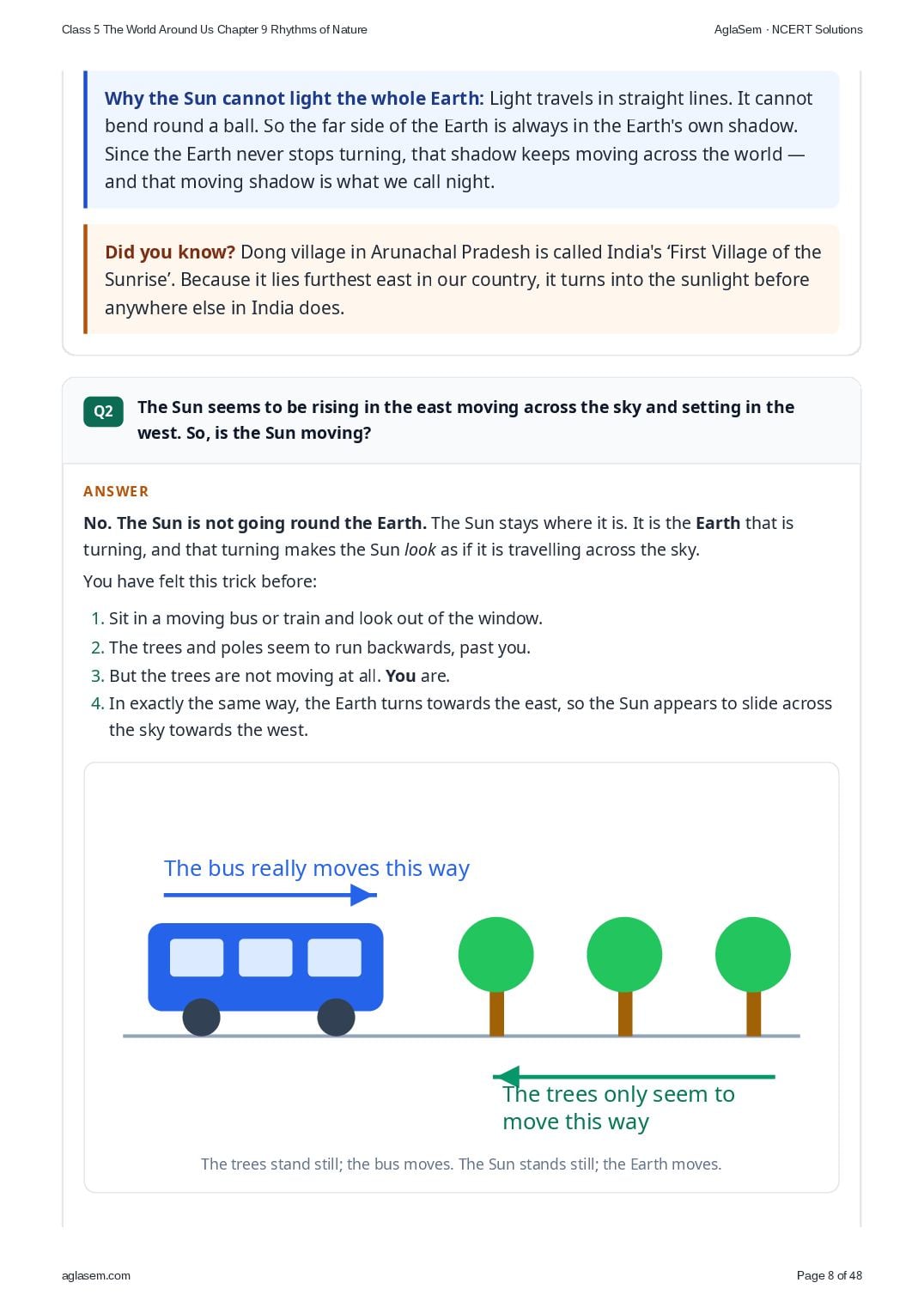
- The Sun seems to be rising in the east moving across the sky and setting in the west. So, is the Sun moving?
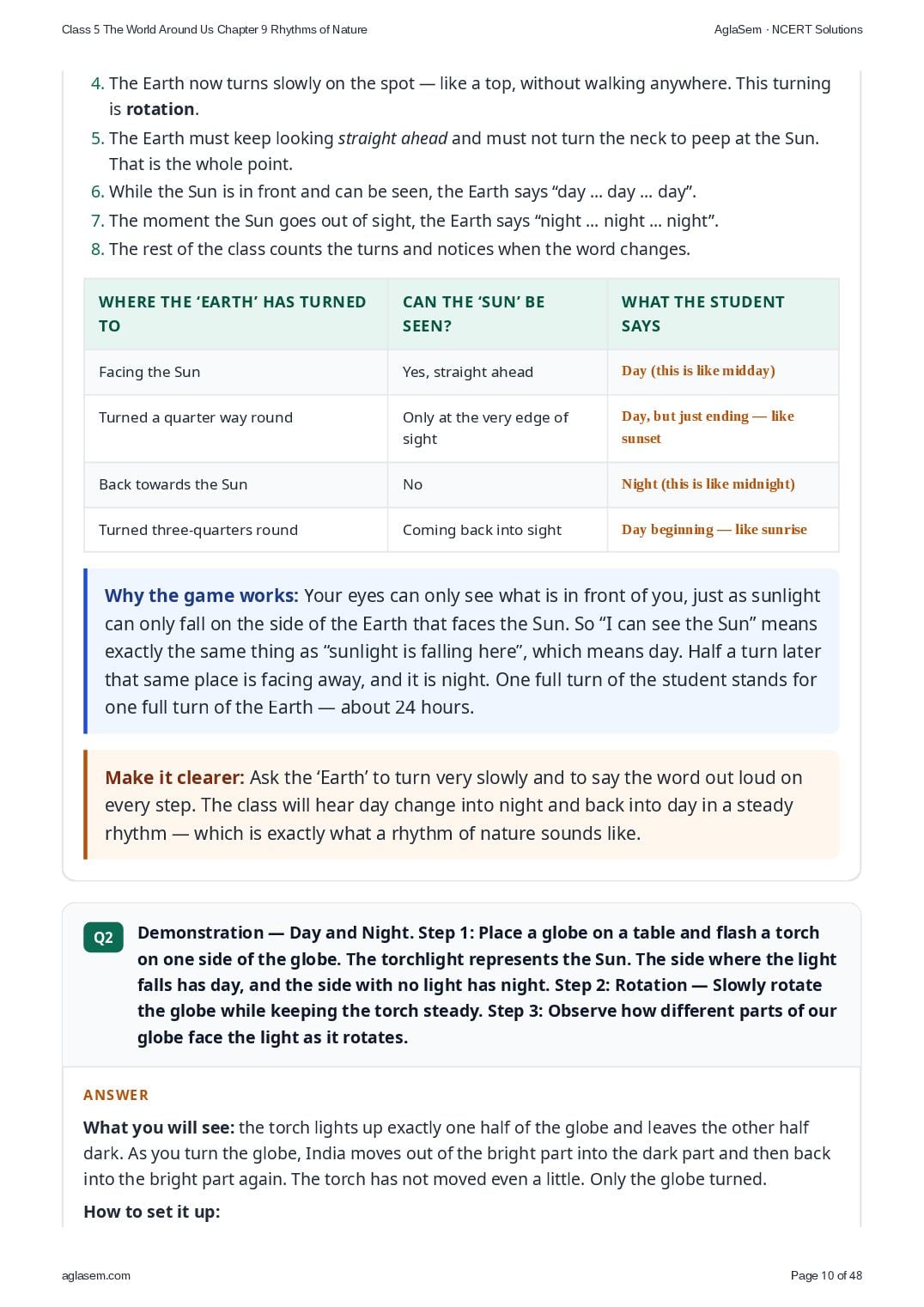
- Let one student be the ‘Sun’ and another the ‘Earth’ standing at a distance. The Sun stands at the centre. Let the student playing ‘Earth’ stand in one place and slowly turn around (rotate). As long as the student sees the ‘Sun’, they keep saying — “day … day … day”, looking straight ahead. When the student stops seeing the ‘Sun’ they keep saying “night … night … night”.
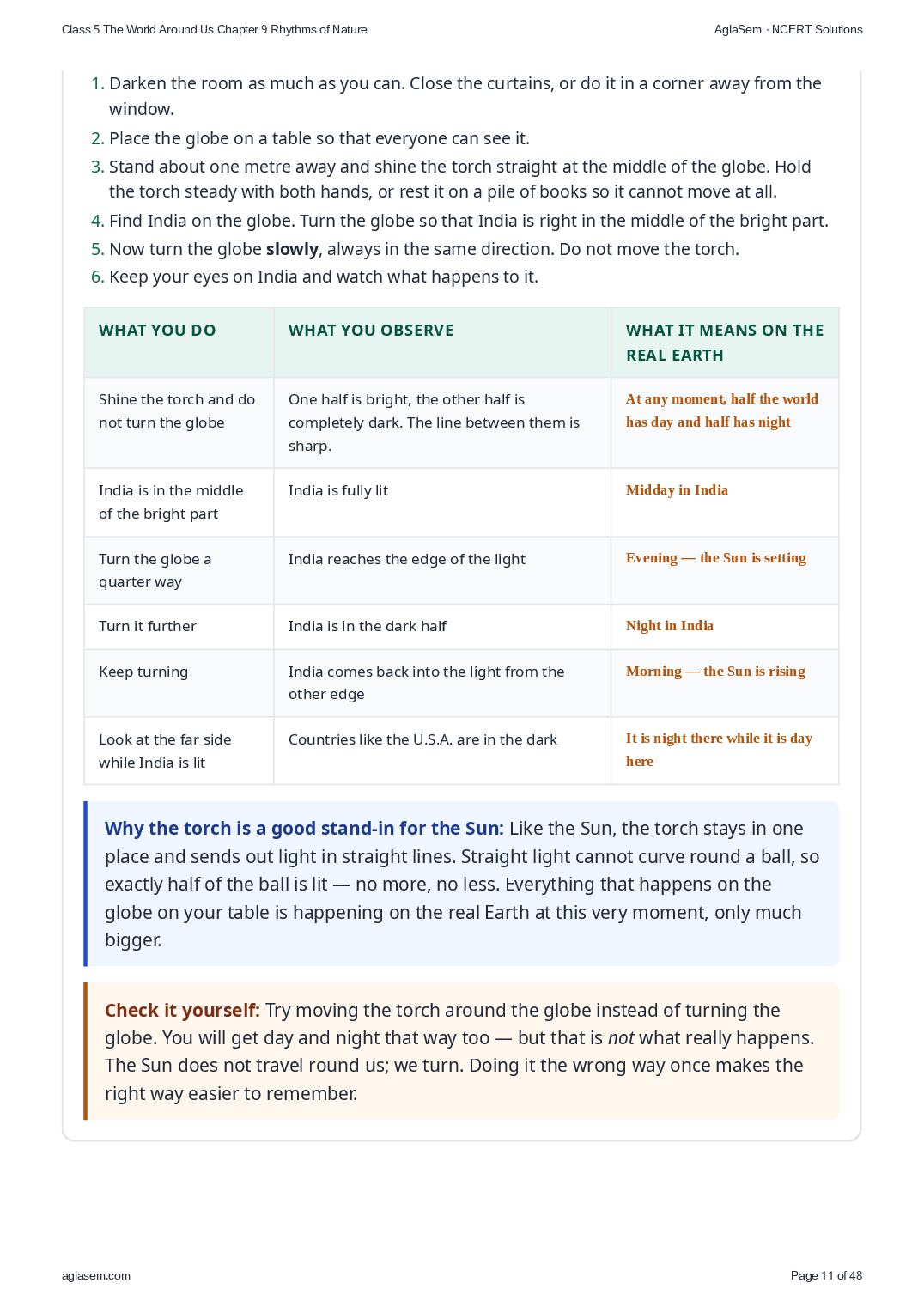
- Demonstration — Day and Night. Step 1: Place a globe on a table and flash a torch on one side of the globe. The torchlight represents the Sun. The side where the light falls has day, and the side with no light has night. Step 2: Rotation — Slowly rotate the globe while keeping the torch steady. Step 3: Observe how different parts of our globe face the light as it rotates.
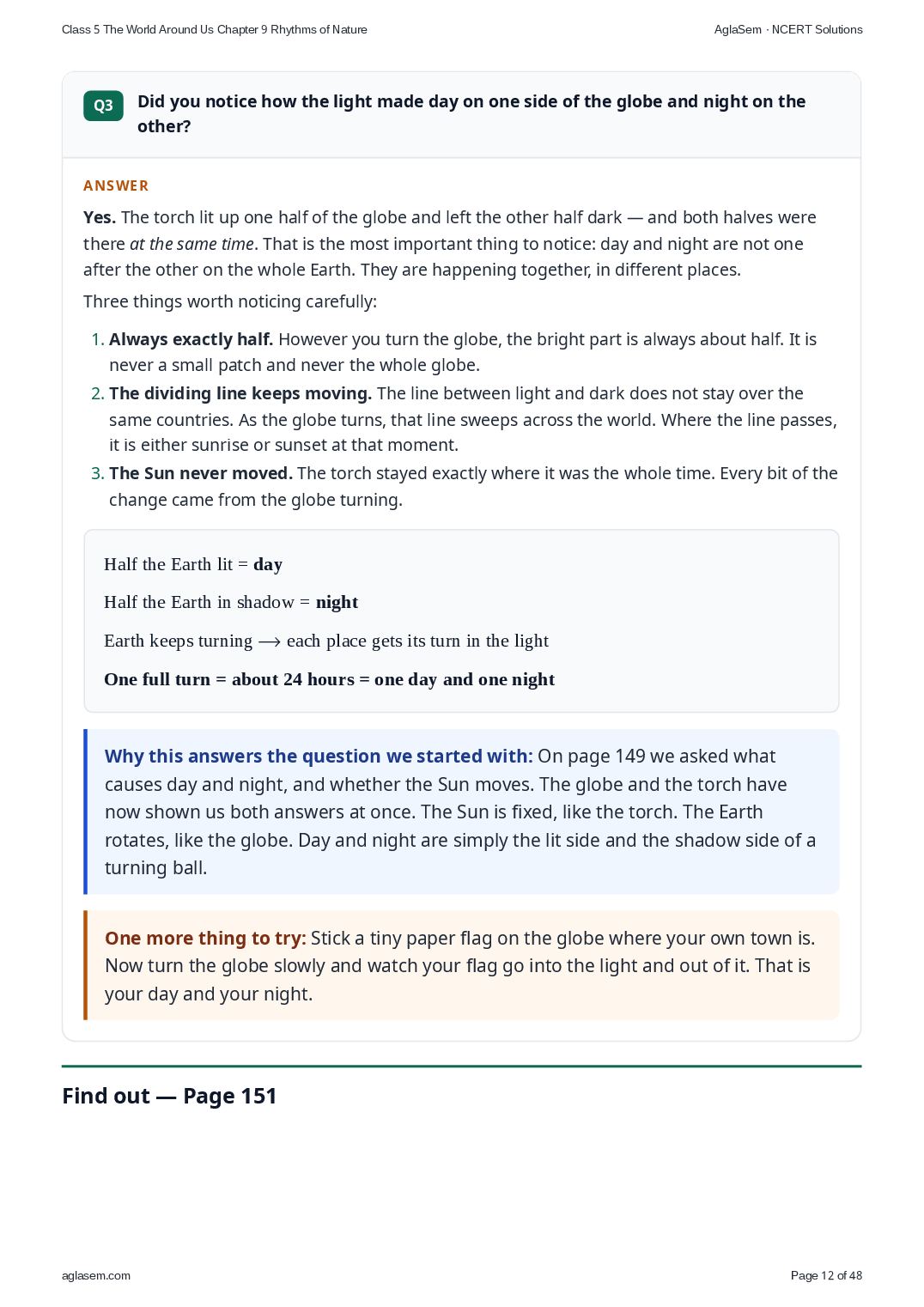
- Did you notice how the light made day on one side of the globe and night on the other?
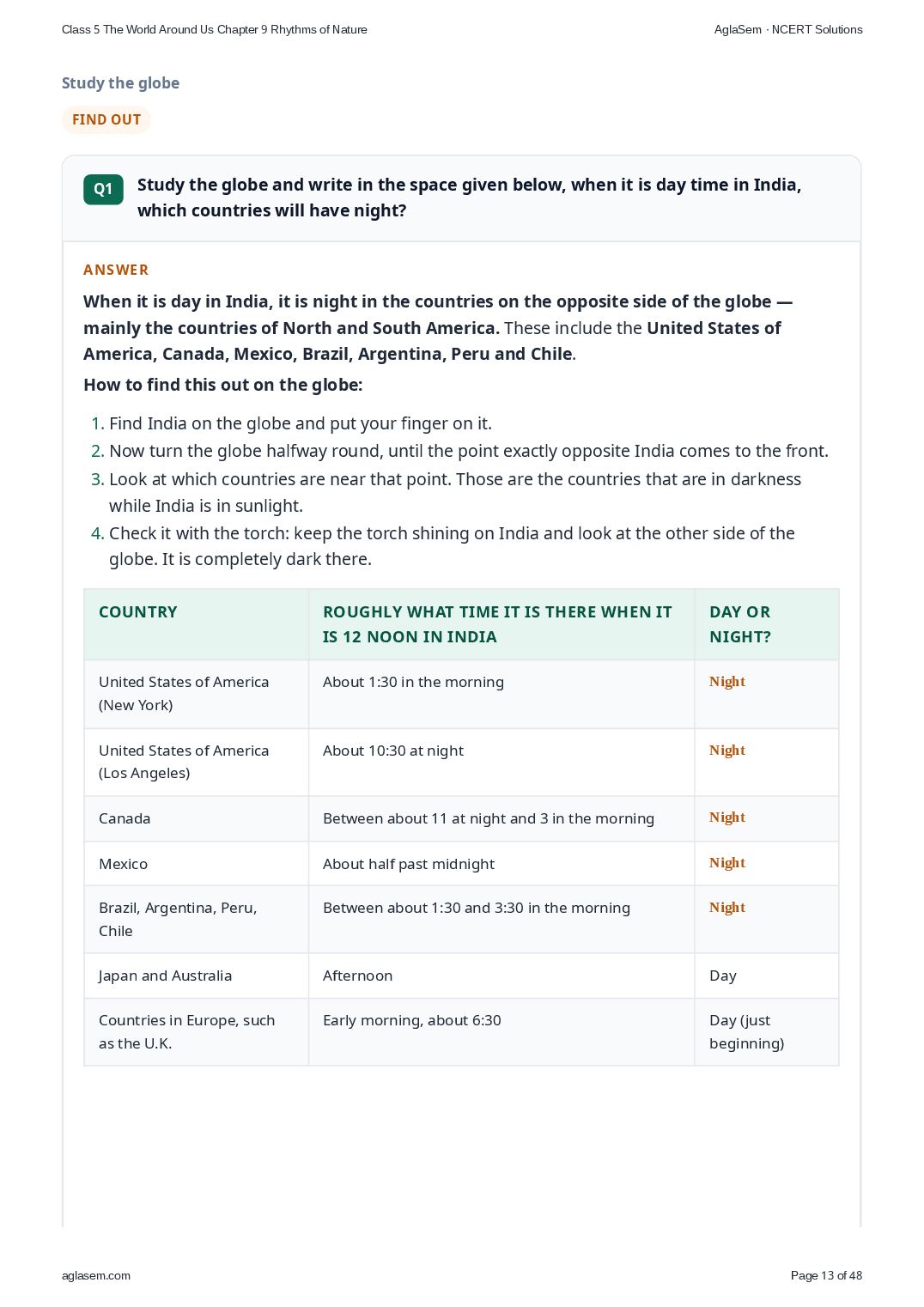
- Study the globe and write in the space given below, when it is day time in India, which countries will have night?
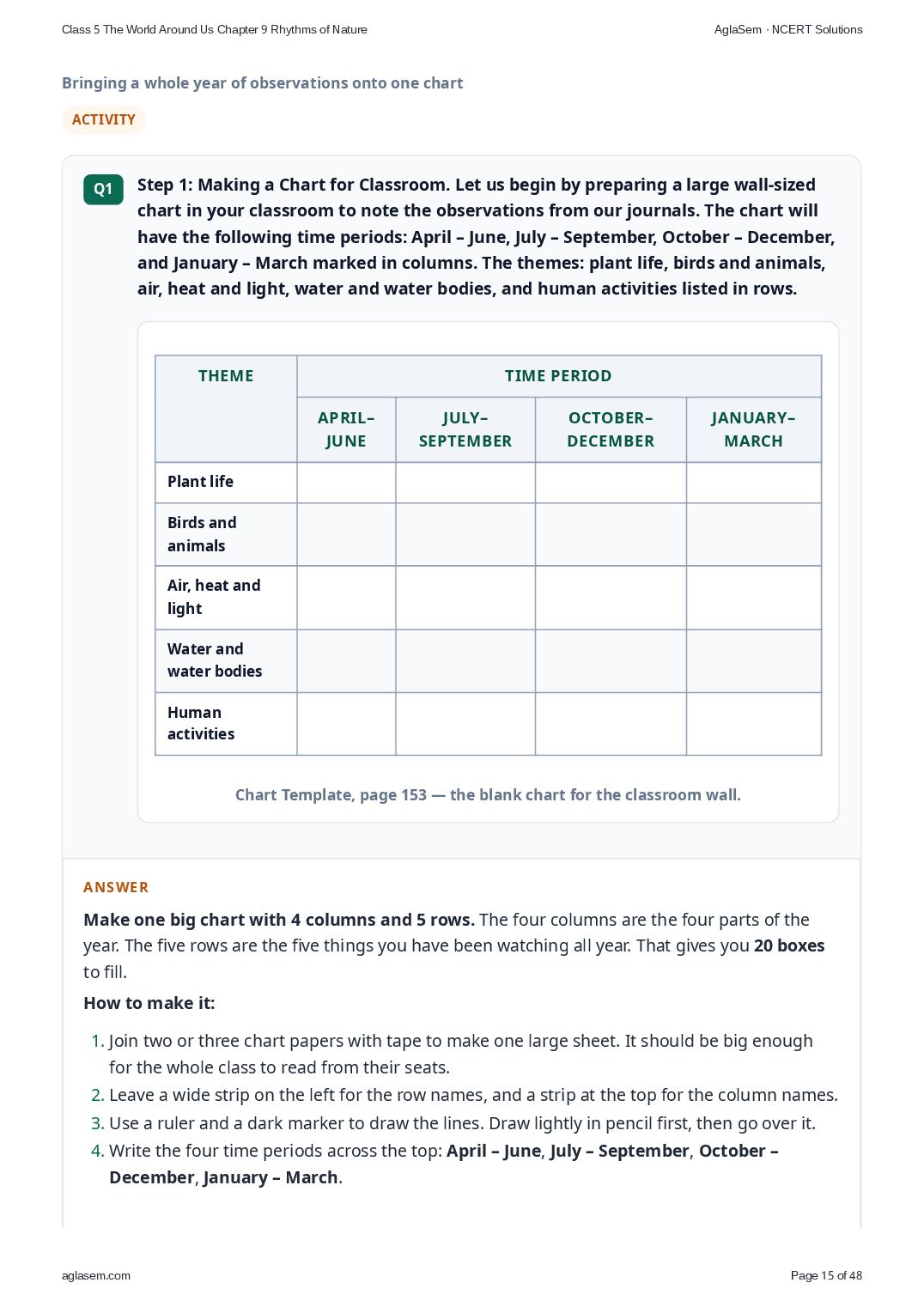
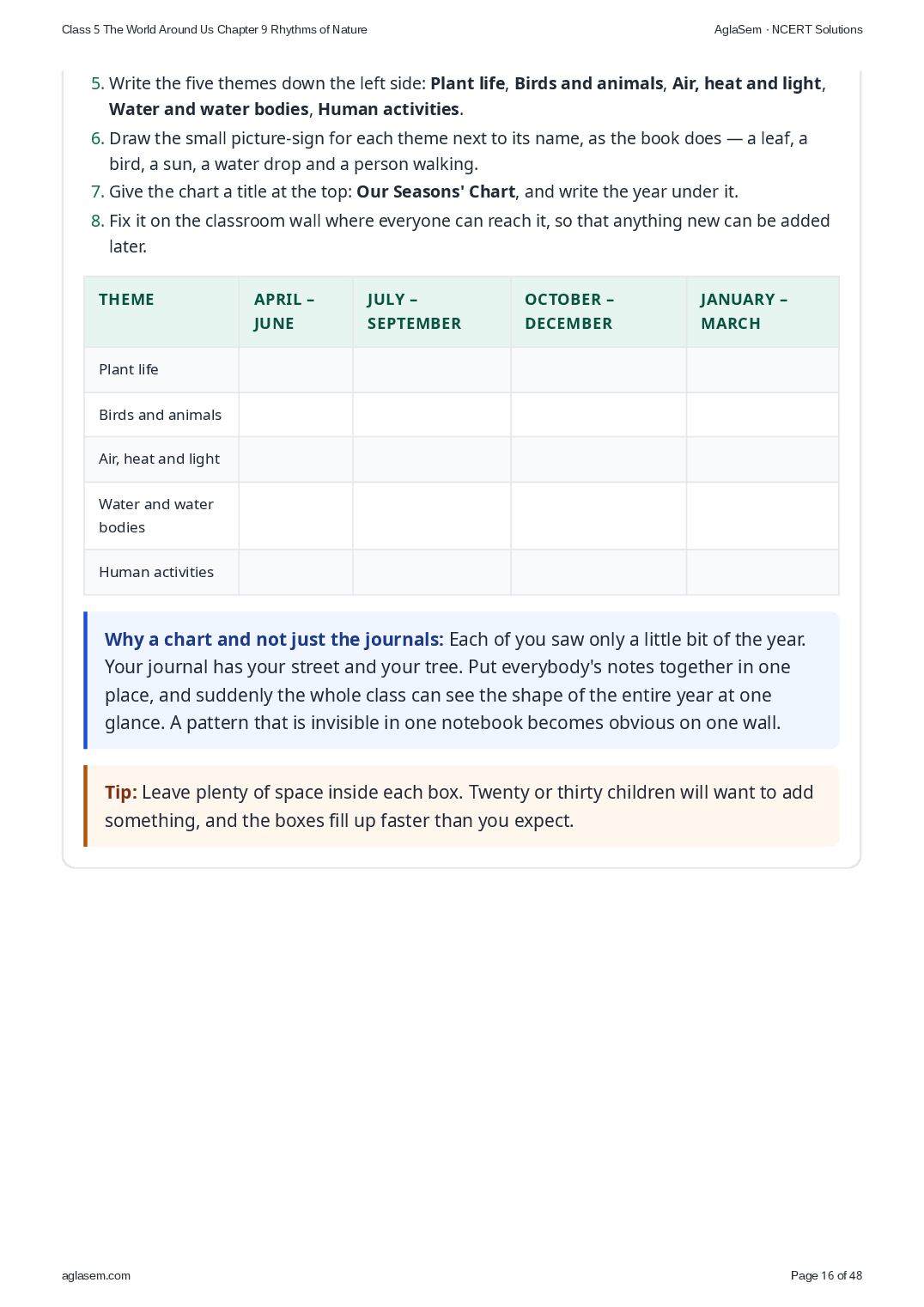
- Step 1: Making a Chart for Classroom. Let us begin by preparing a large wall-sized chart in your classroom to note the observations from our journals. The chart will have the following time periods: April – June, July – September, October – December, and January – March marked in columns. The themes: plant life, birds and animals, air, heat and light, water and water bodies, and human activities listed in rows. ThemeTime Period April–JuneJuly–SeptemberOctober–DecemberJanuary–March Plant life Birds and animals Air, heat and light Water and water bodies Human activities Chart Template, page 153 — the blank chart for the classroom wall.
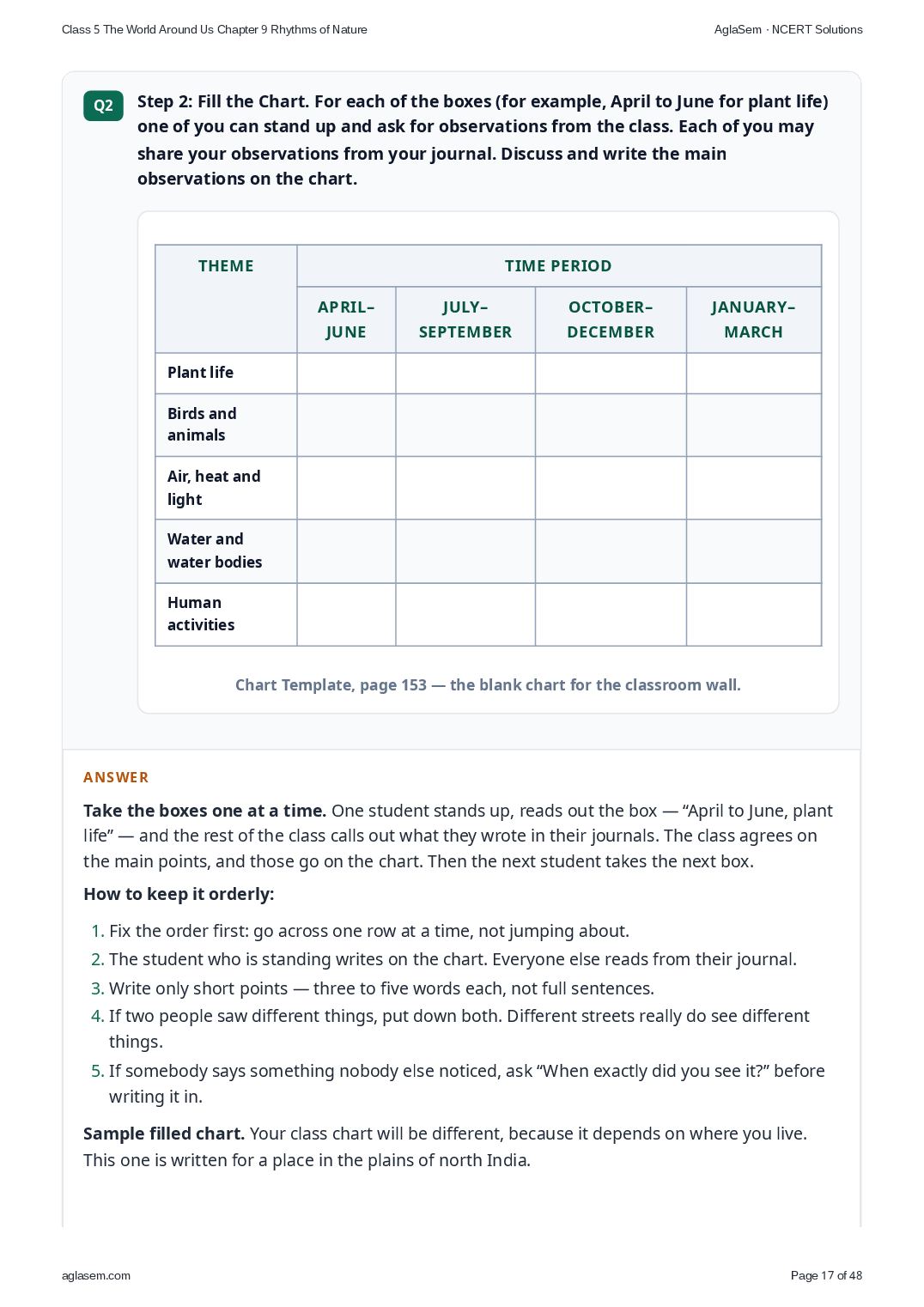
- Step 2: Fill the Chart. For each of the boxes (for example, April to June for plant life) one of you can stand up and ask for observations from the class. Each of you may share your observations from your journal. Discuss and write the main observations on the chart. ThemeTime Period April–JuneJuly–SeptemberOctober–DecemberJanuary–March Plant life Birds and animals Air, heat and light Water and water bodies Human activities Chart Template, page 153 — the blank chart for the classroom wall.
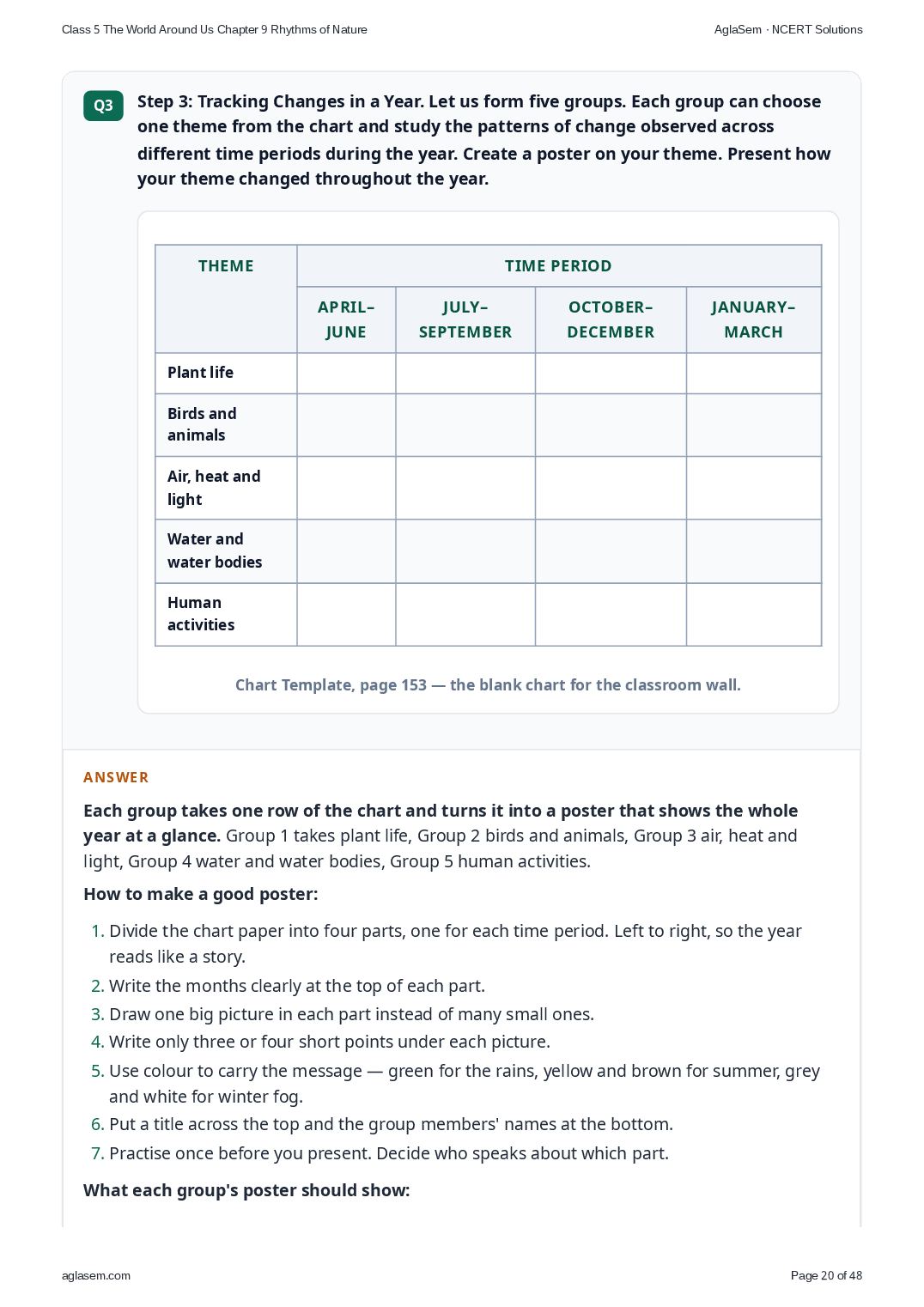
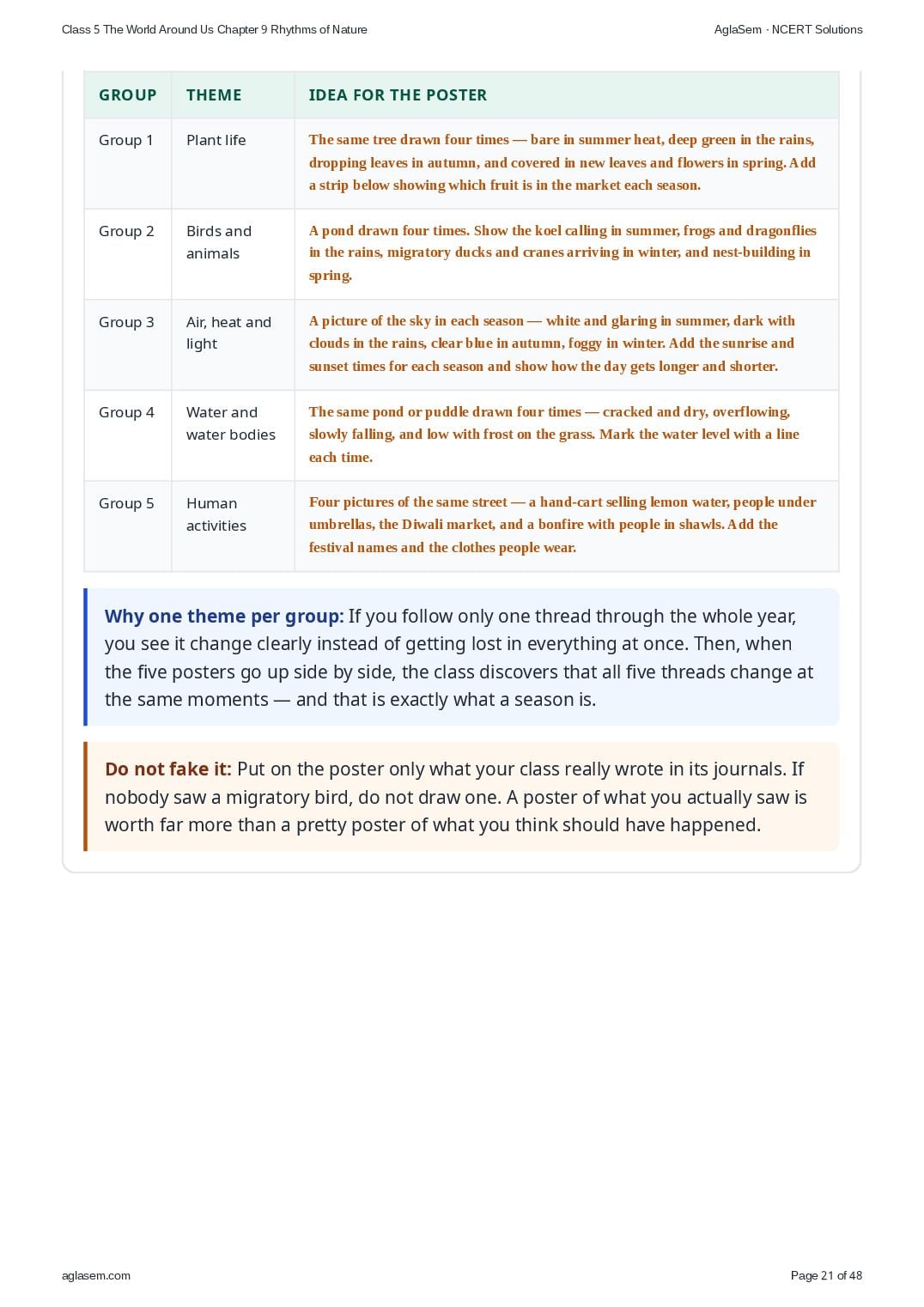
- Step 3: Tracking Changes in a Year. Let us form five groups. Each group can choose one theme from the chart and study the patterns of change observed across different time periods during the year. Create a poster on your theme. Present how your theme changed throughout the year. ThemeTime Period April–JuneJuly–SeptemberOctober–DecemberJanuary–March Plant life Birds and animals Air, heat and light Water and water bodies Human activities Chart Template, page 153 — the blank chart for the classroom wall.
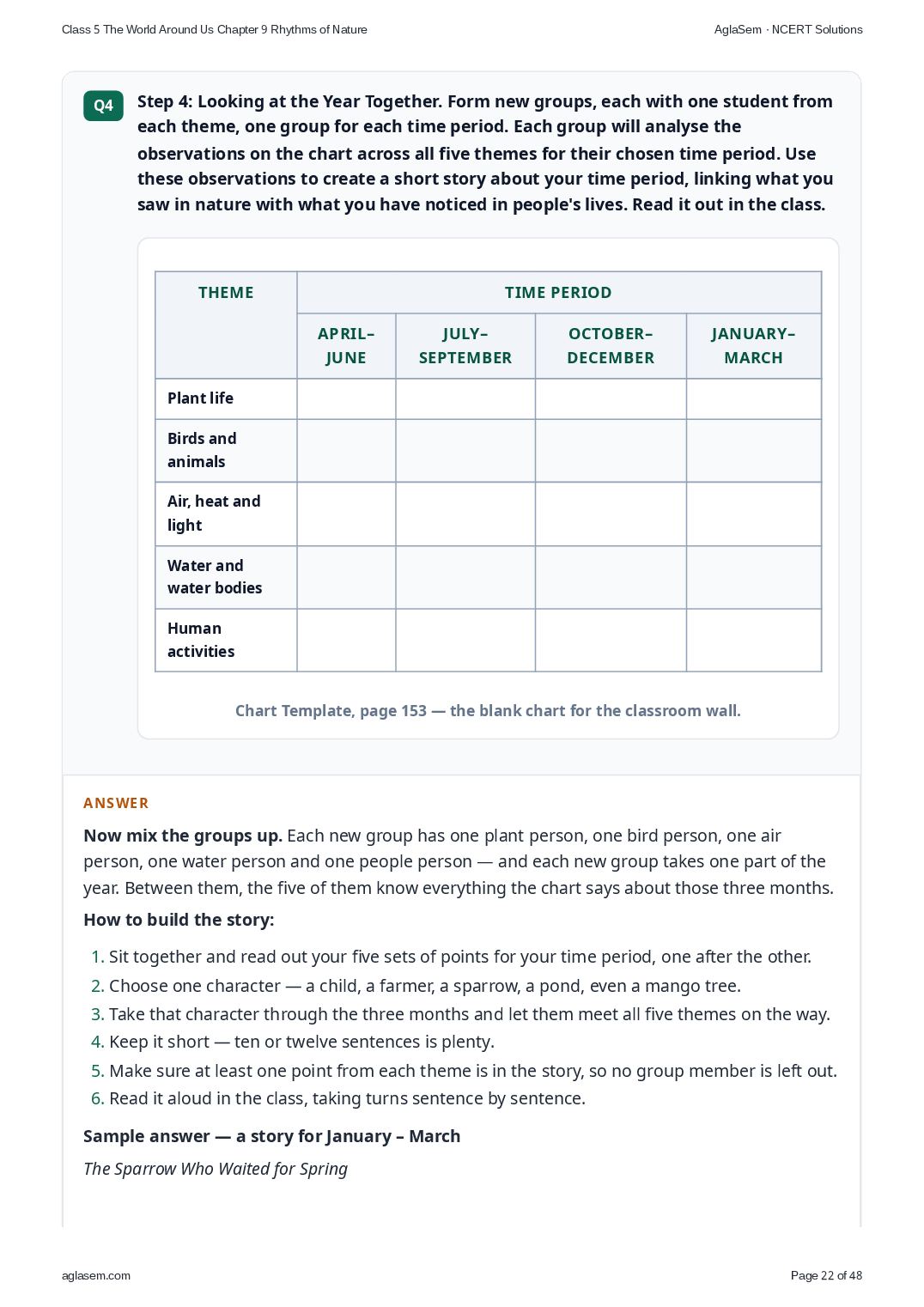
- Step 4: Looking at the Year Together. Form new groups, each with one student from each theme, one group for each time period. Each group will analyse the observations on the chart across all five themes for their chosen time period. Use these observations to create a short story about your time period, linking what you saw in nature with what you have noticed in people’s lives. Read it out in the class. ThemeTime Period April–JuneJuly–SeptemberOctober–DecemberJanuary–March Plant life Birds and animals Air, heat and light Water and water bodies Human activities Chart Template, page 153 — the blank chart for the classroom wall.
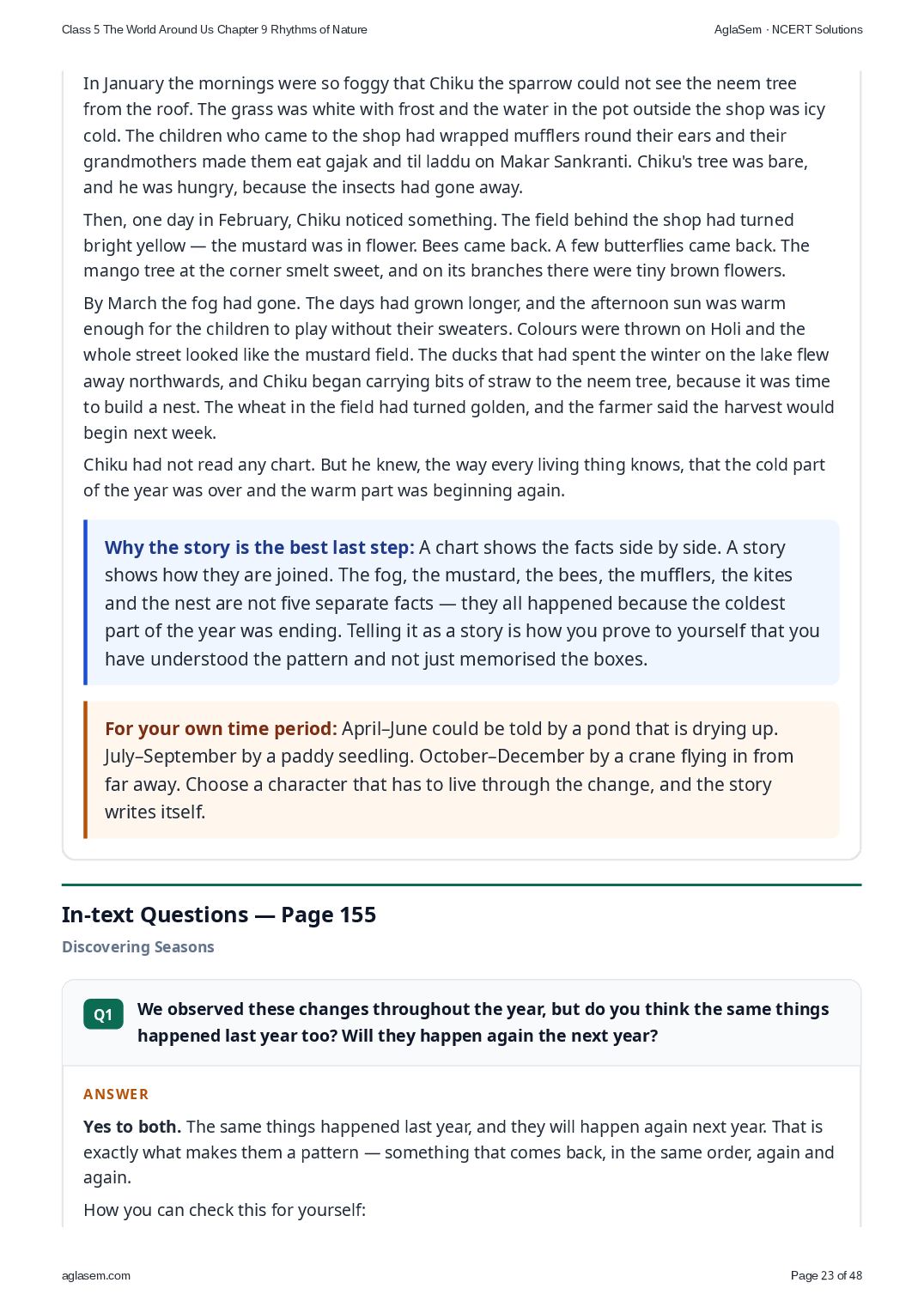
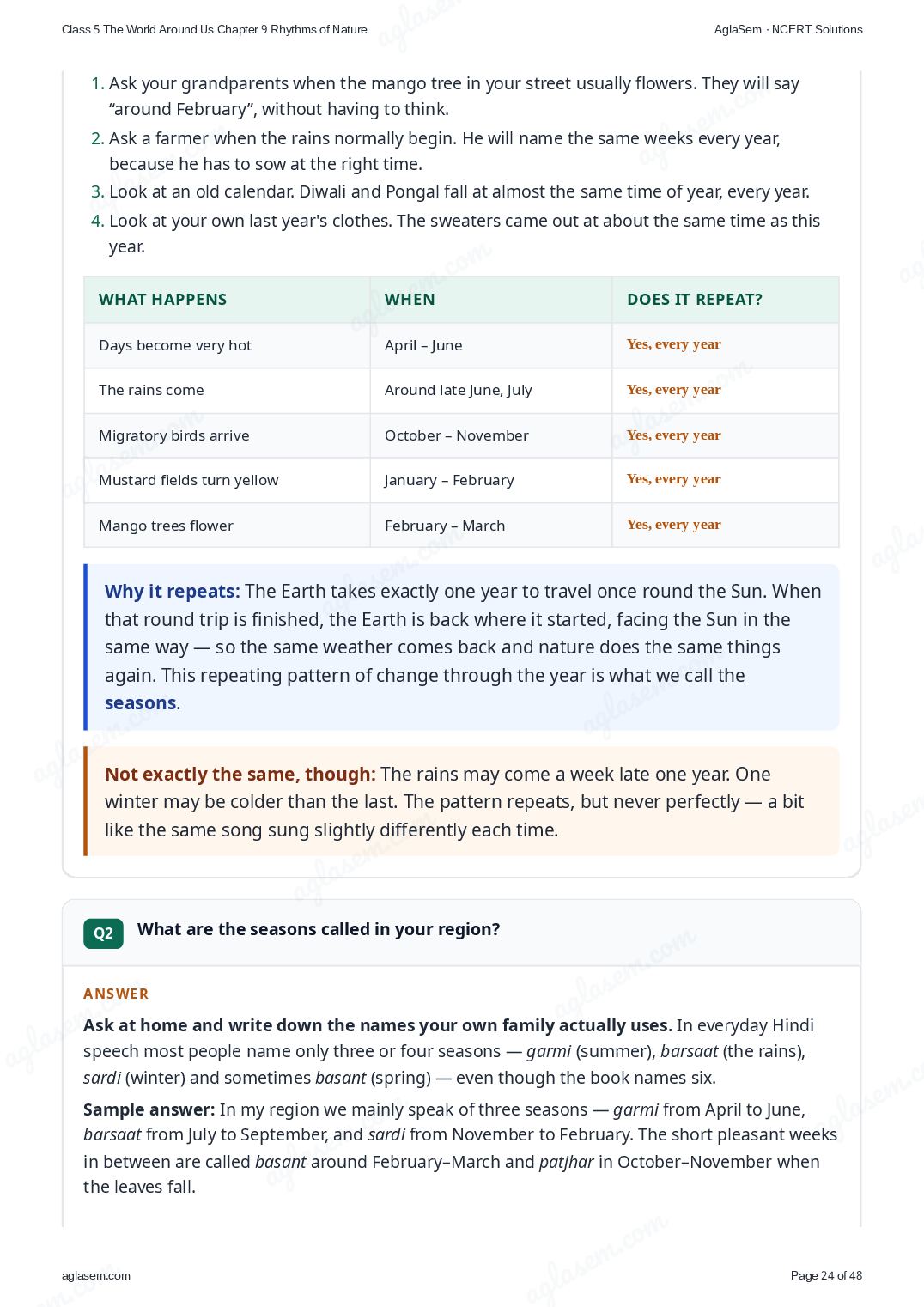
- We observed these changes throughout the year, but do you think the same things happened last year too? Will they happen again the next year?
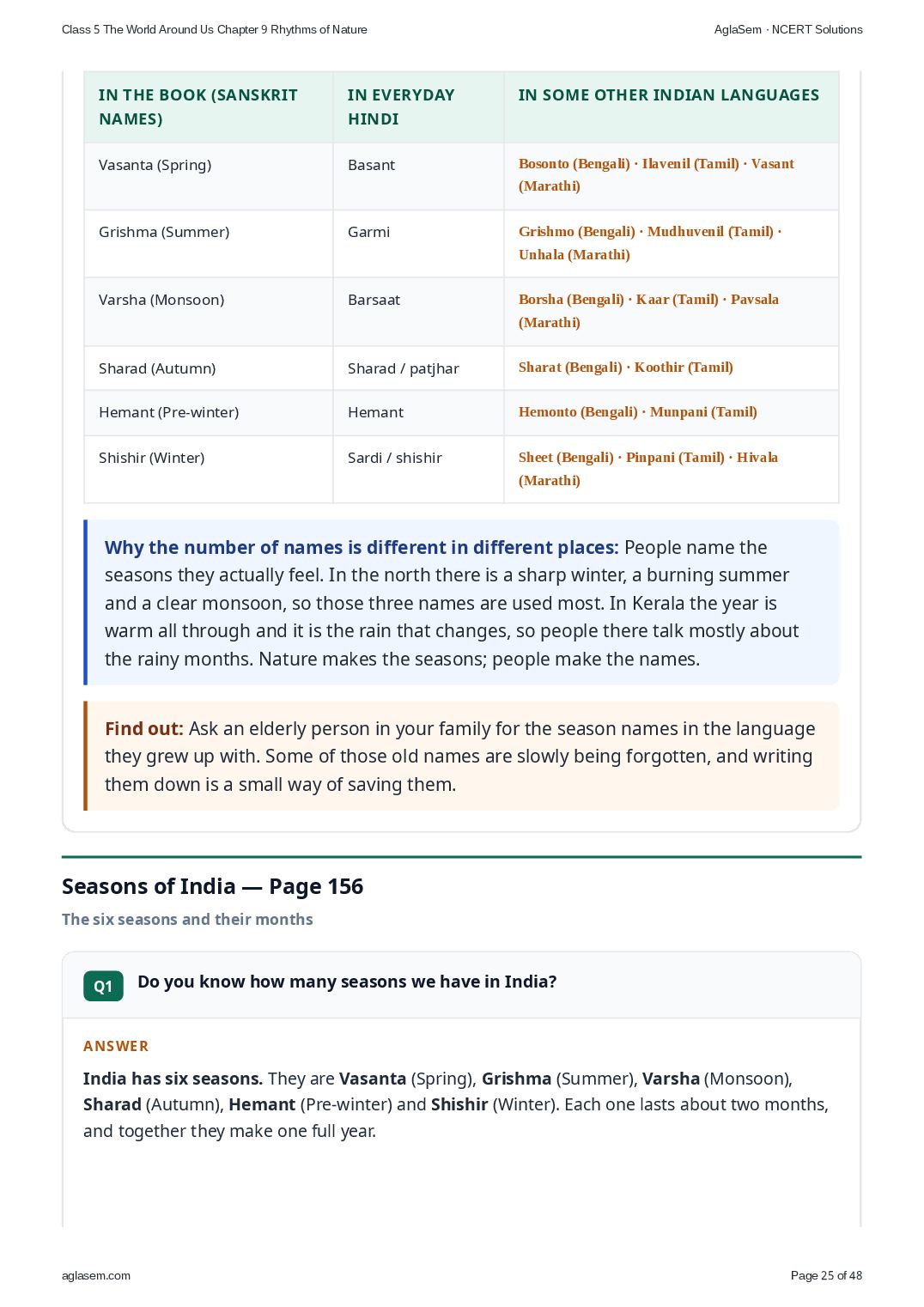
- What are the seasons called in your region?
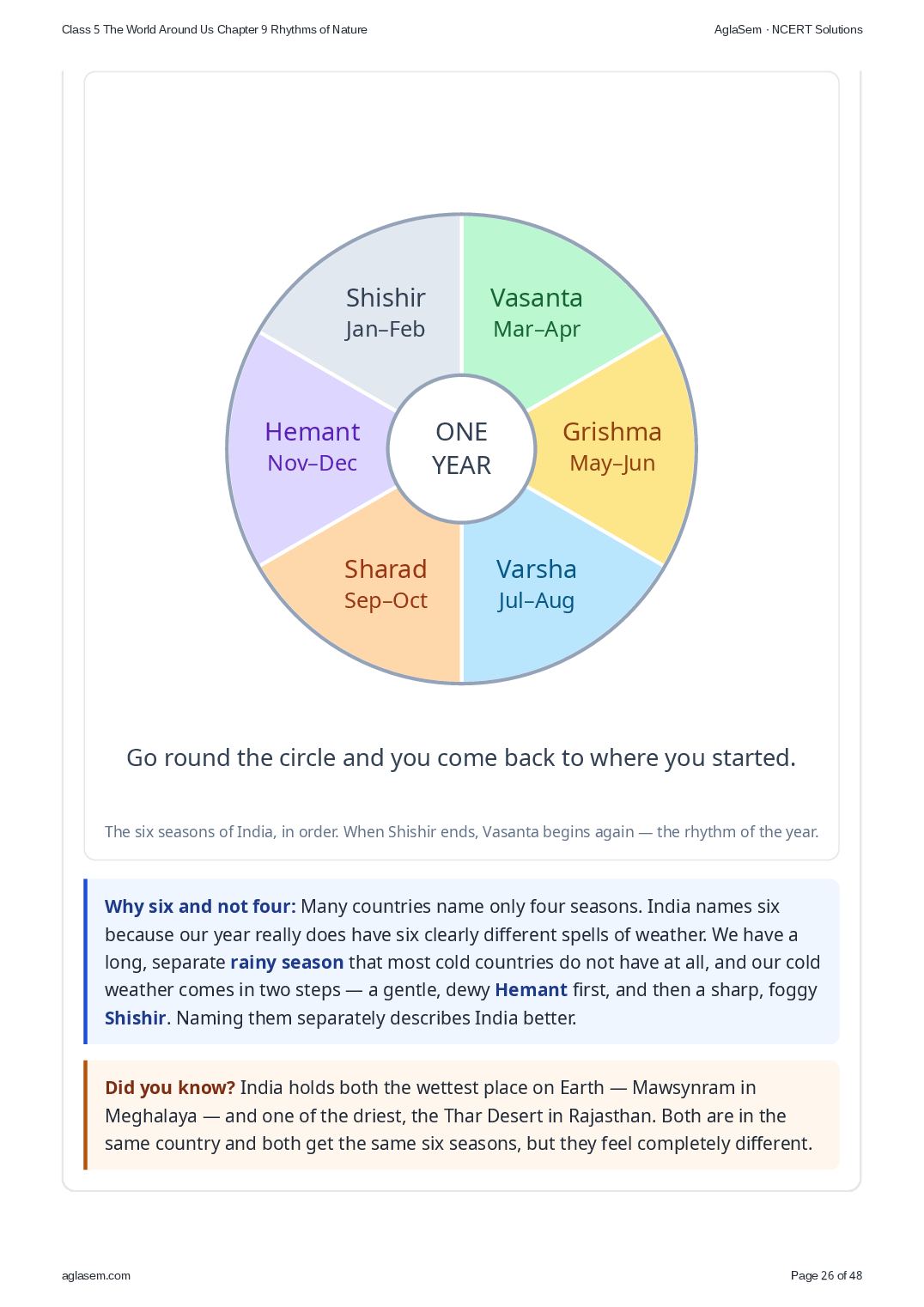
- Do you know how many seasons we have in India?
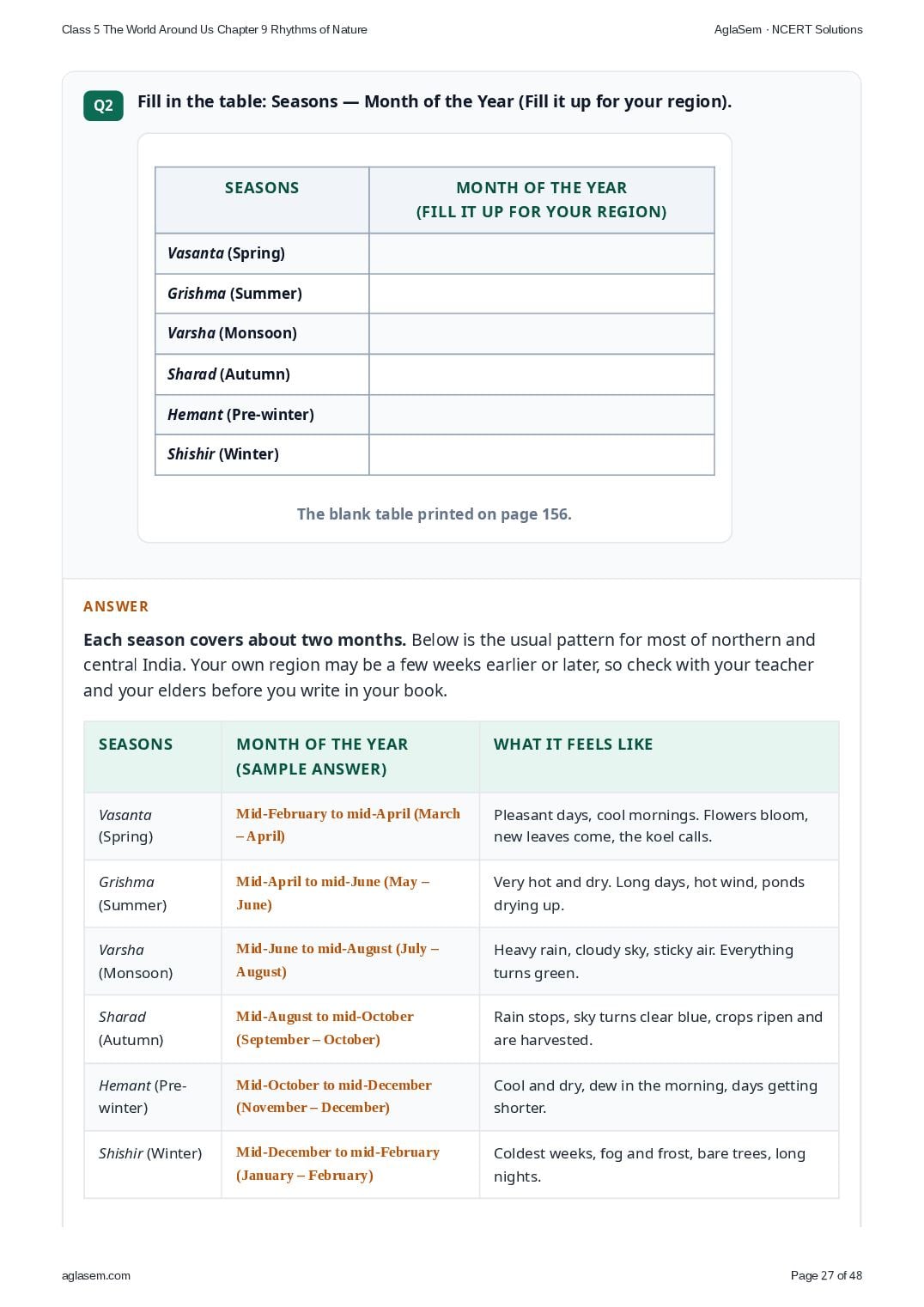
- Fill in the table: Seasons — Month of the Year (Fill it up for your region). SeasonsMonth of the Year(Fill it up for your region) Vasanta (Spring) Grishma (Summer) Varsha (Monsoon) Sharad (Autumn) Hemant (Pre-winter) Shishir (Winter) The blank table printed on page 156.
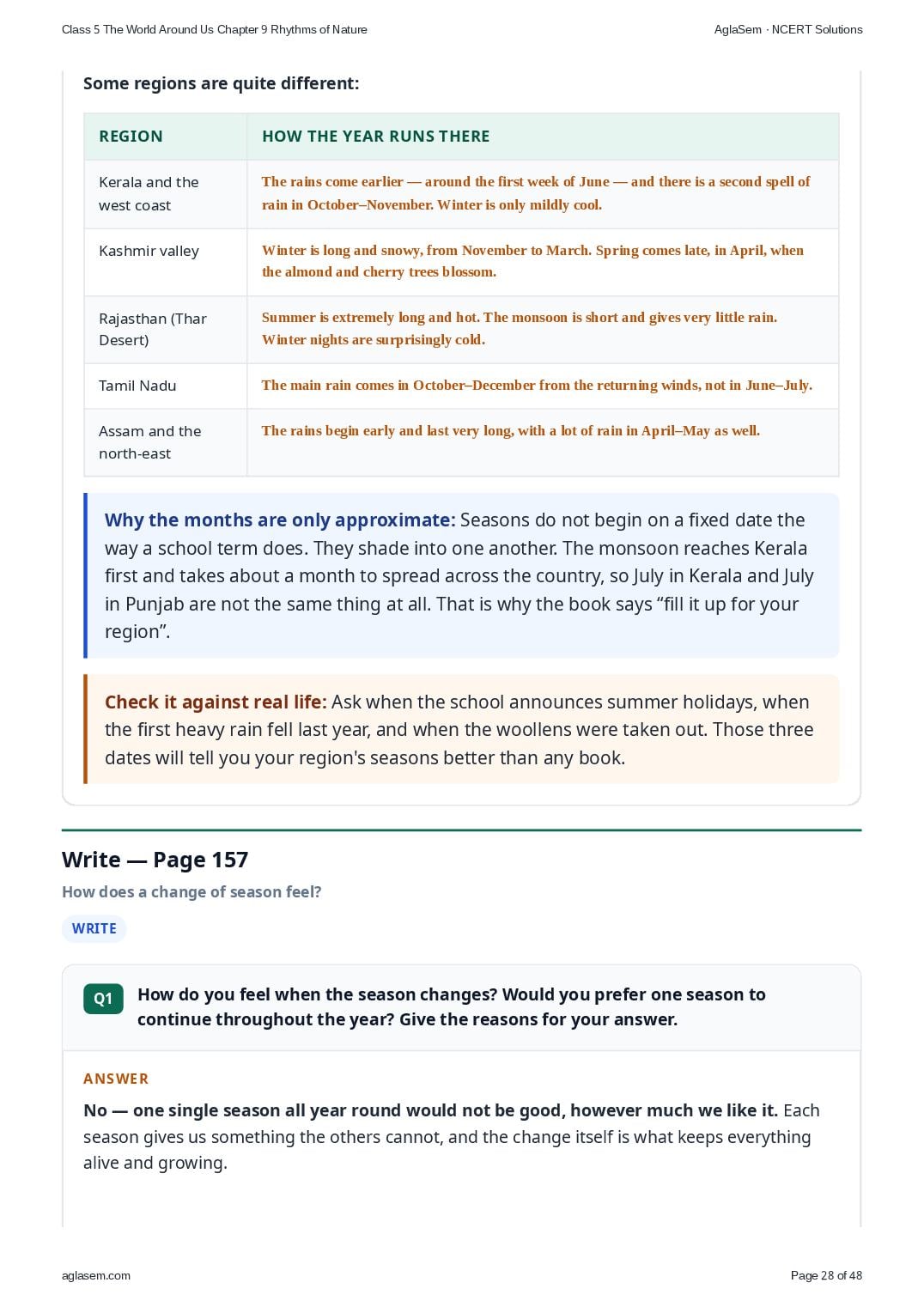
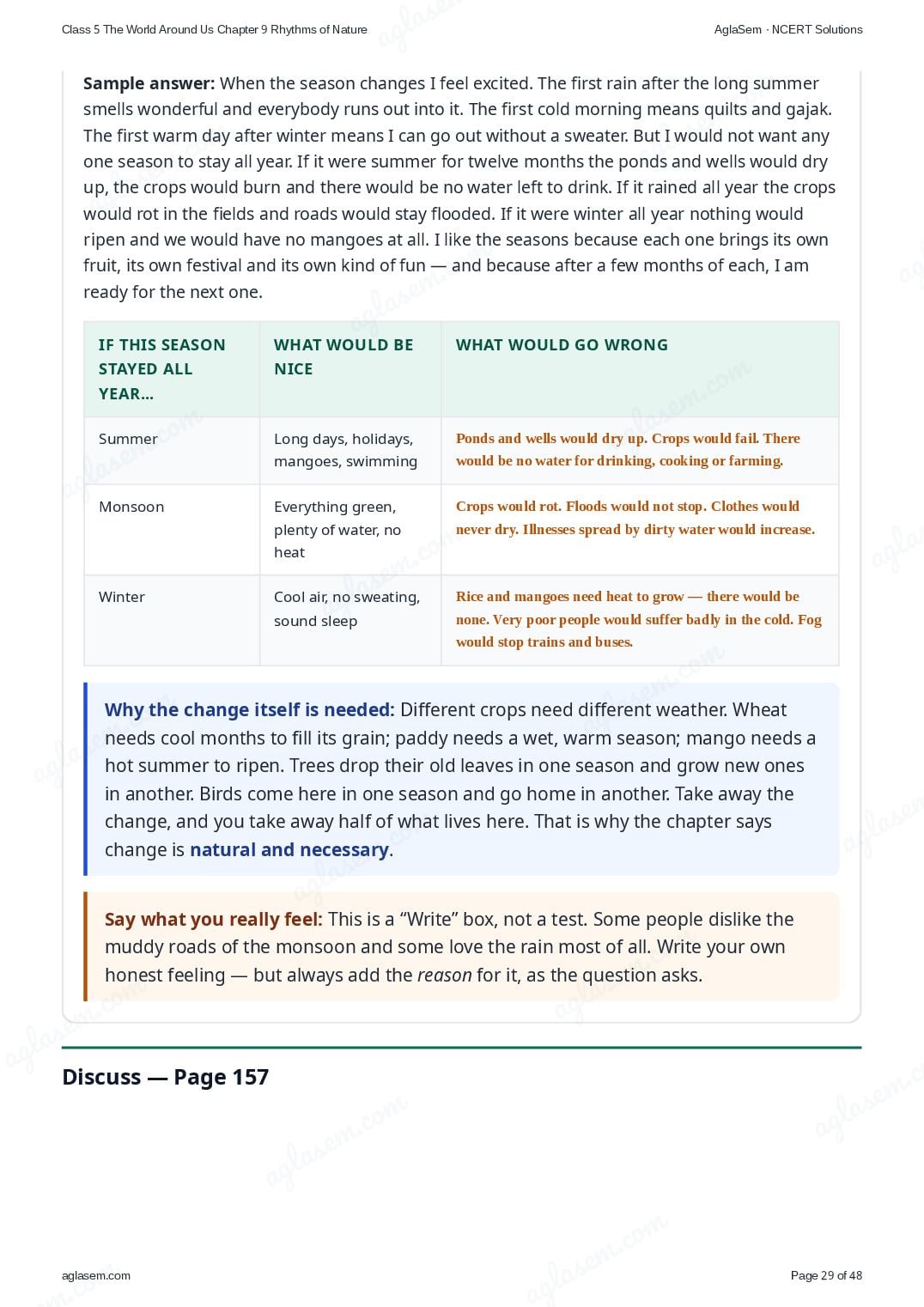
- How do you feel when the season changes? Would you prefer one season to continue throughout the year? Give the reasons for your answer.
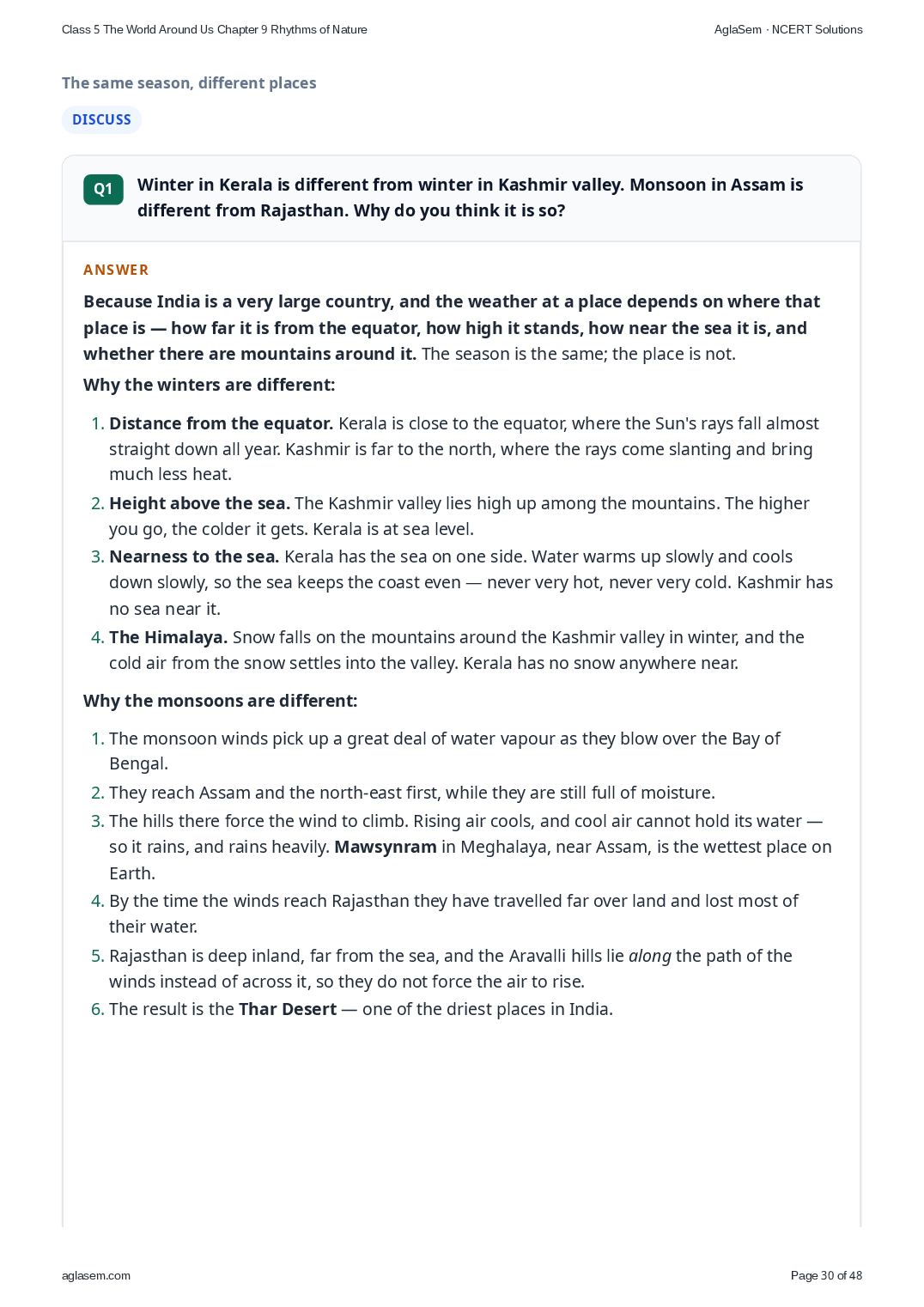
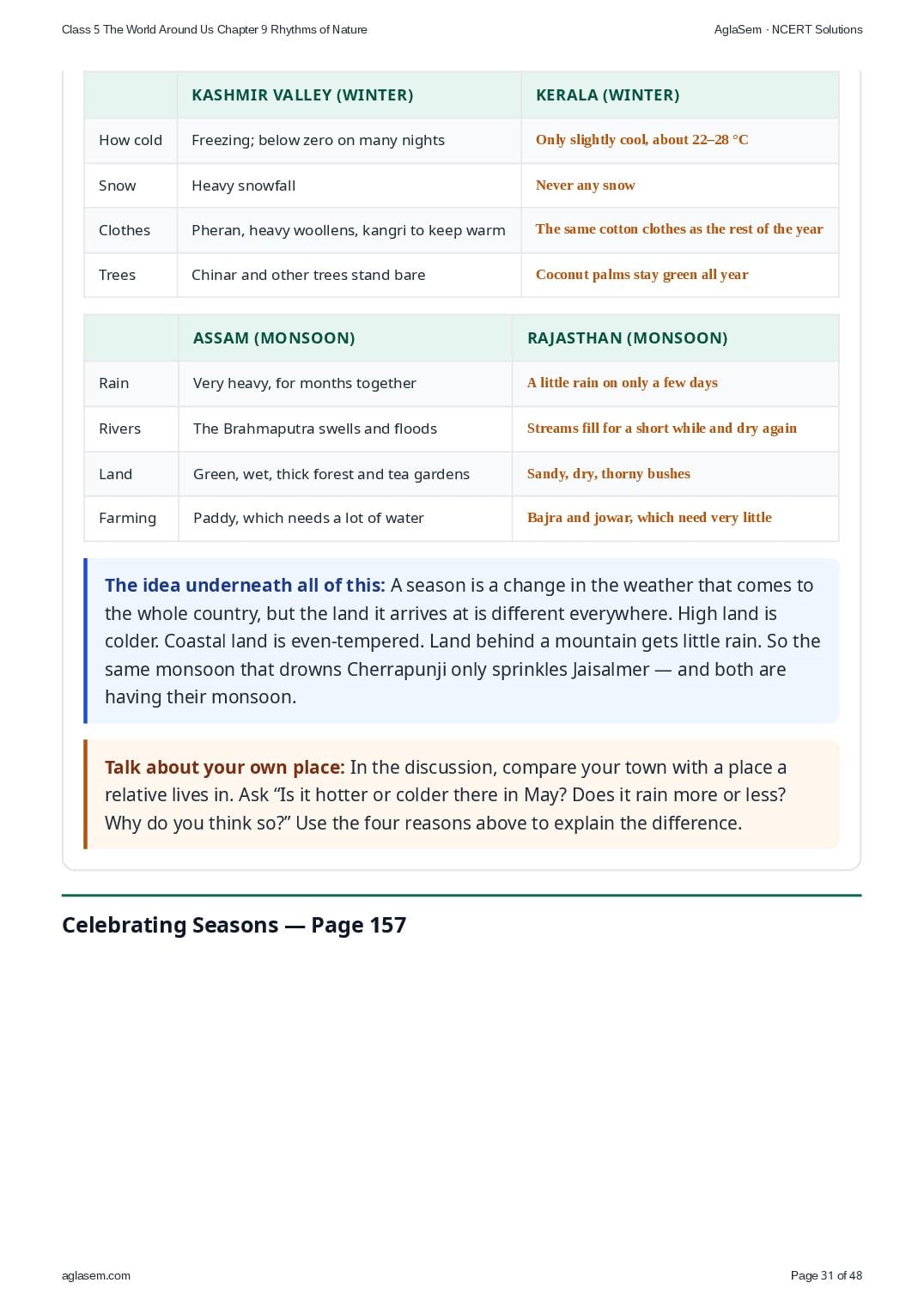
- Winter in Kerala is different from winter in Kashmir valley. Monsoon in Assam is different from Rajasthan. Why do you think it is so?
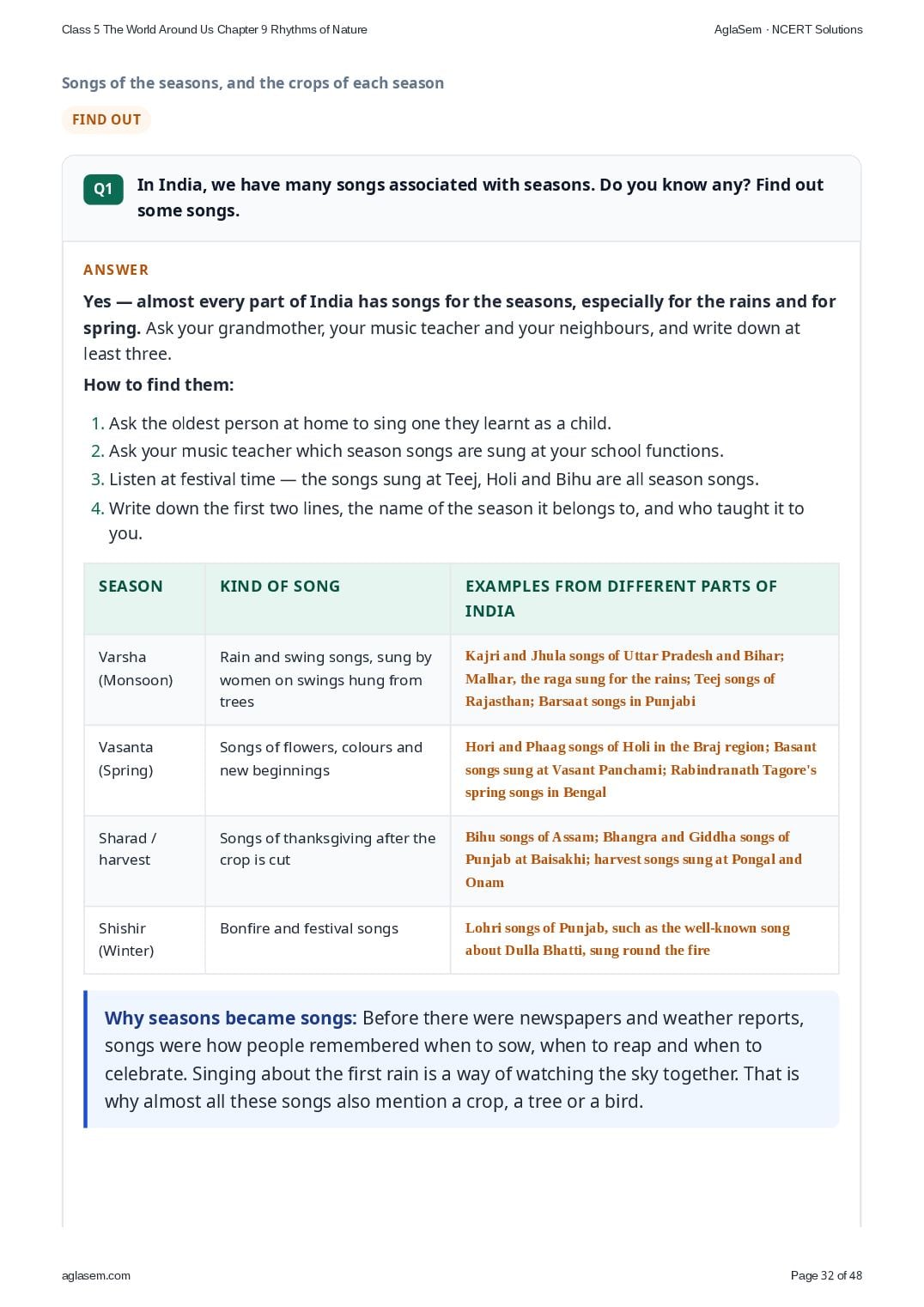
- In India, we have many songs associated with seasons. Do you know any? Find out some songs.
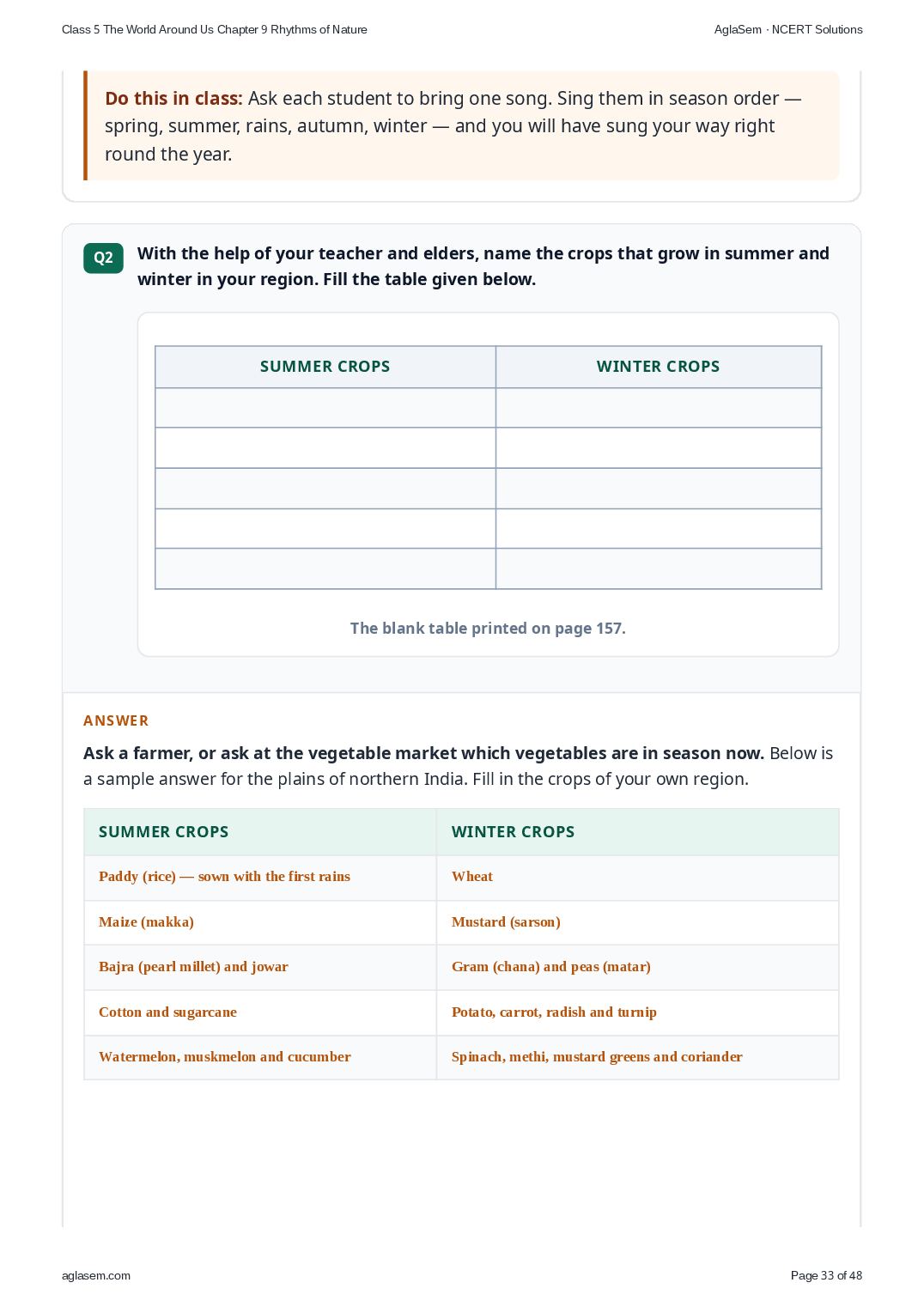
- With the help of your teacher and elders, name the crops that grow in summer and winter in your region. Fill the table given below. Summer CropsWinter Crops The blank table printed on page 157.
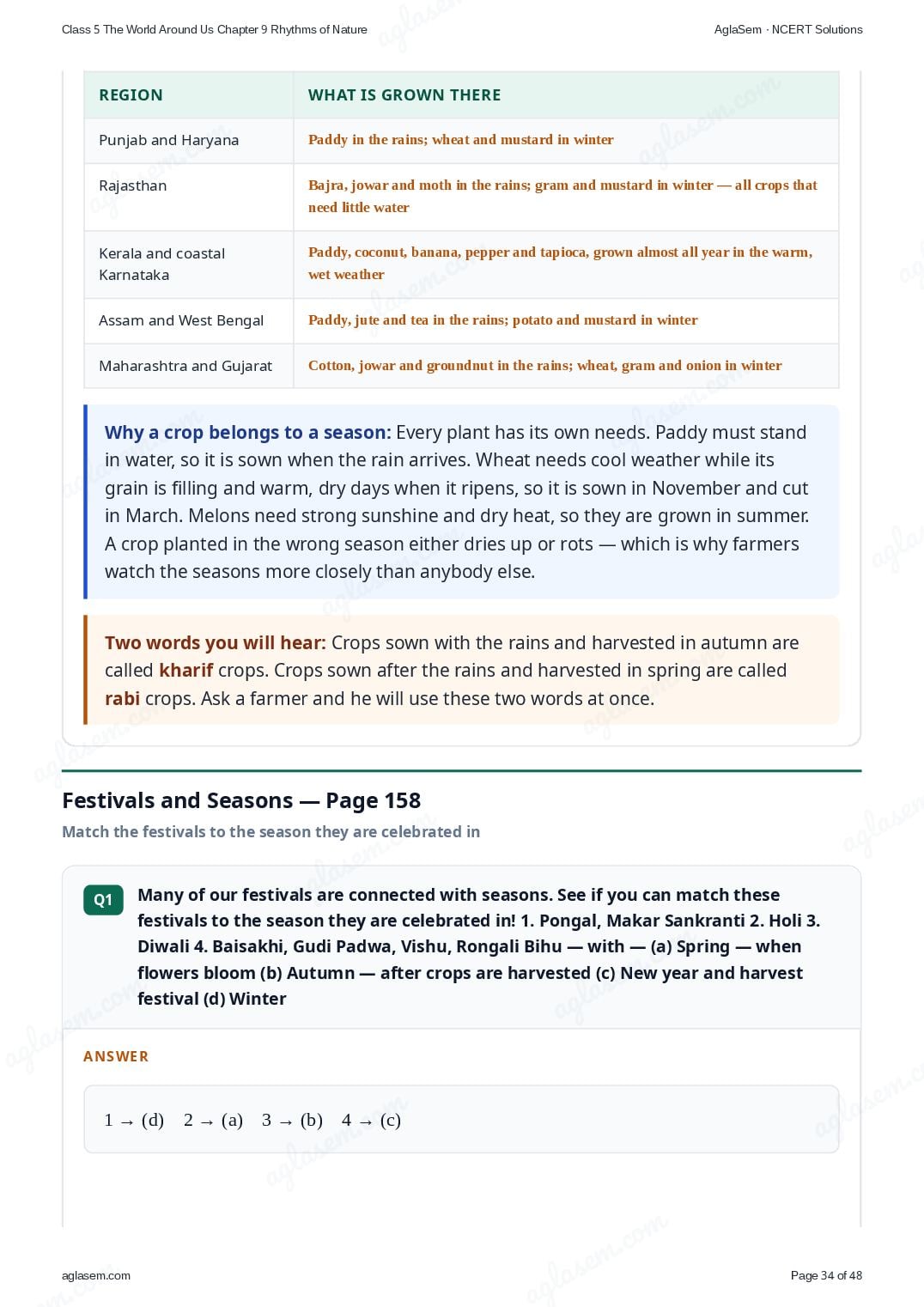
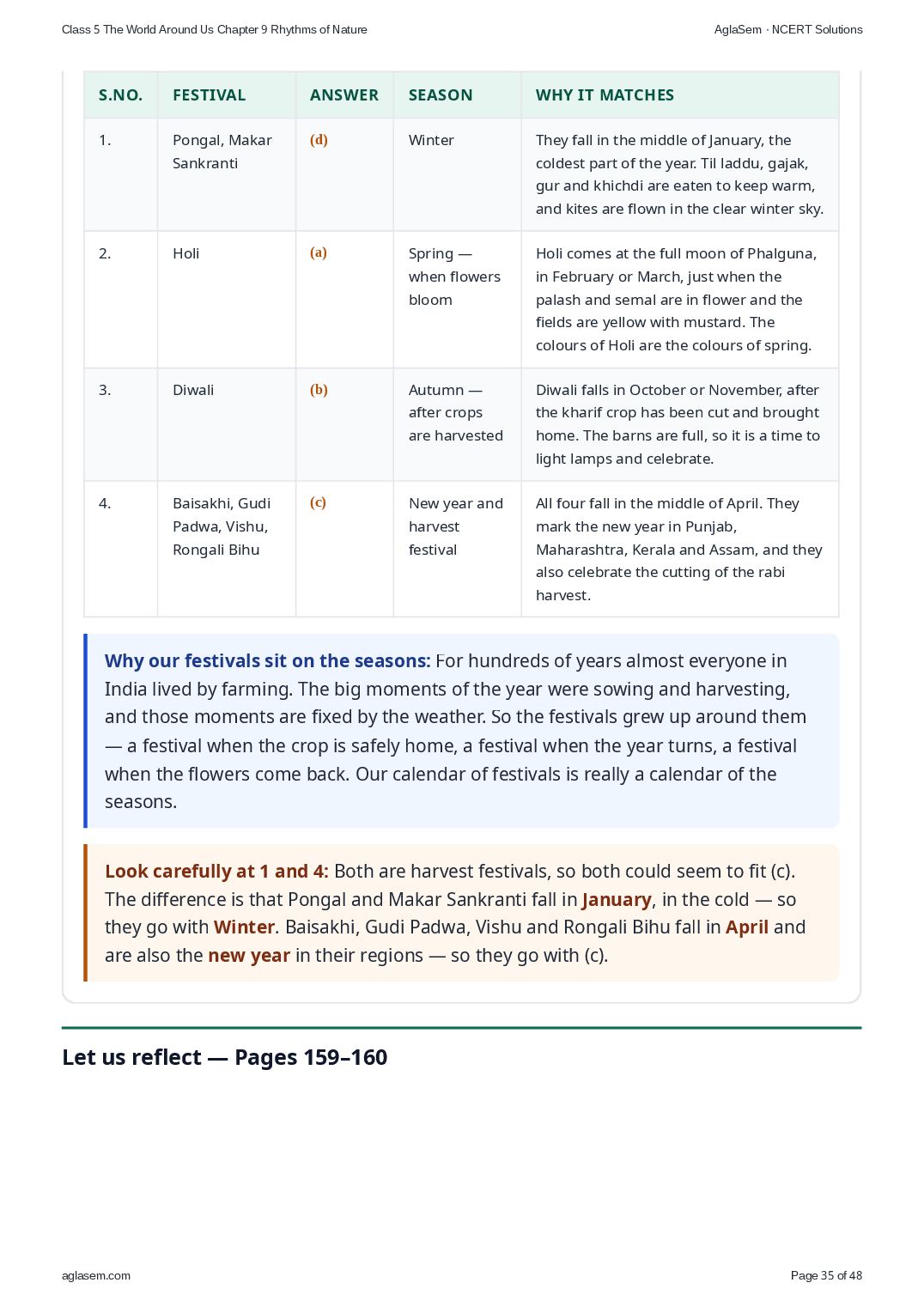
- Many of our festivals are connected with seasons. See if you can match these festivals to the season they are celebrated in! 1. Pongal, Makar Sankranti 2. Holi 3. Diwali 4. Baisakhi, Gudi Padwa, Vishu, Rongali Bihu — with — (a) Spring — when flowers bloom (b) Autumn — after crops are harvested (c) New year and harvest festival (d) Winter
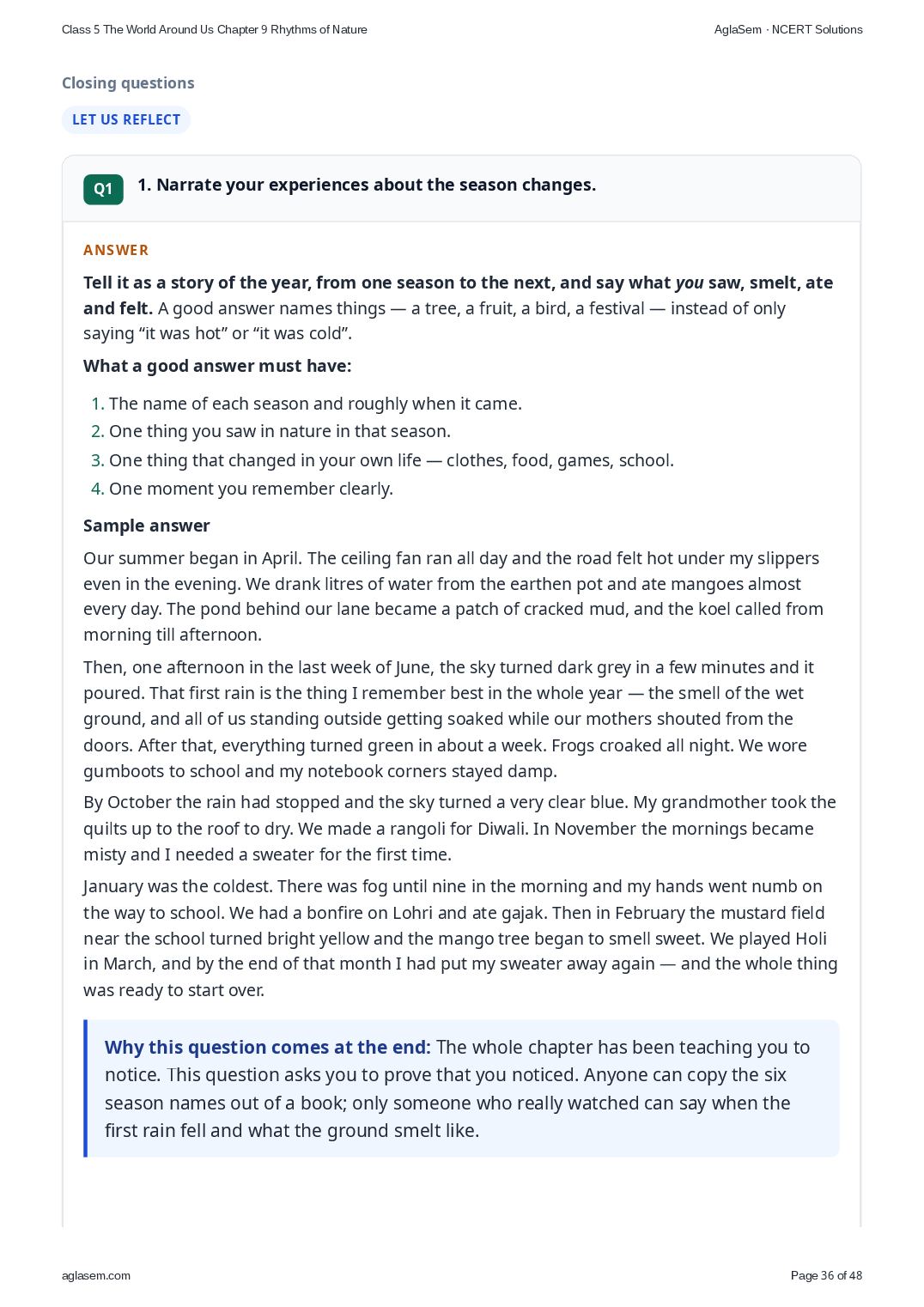
- 1. Narrate your experiences about the season changes.
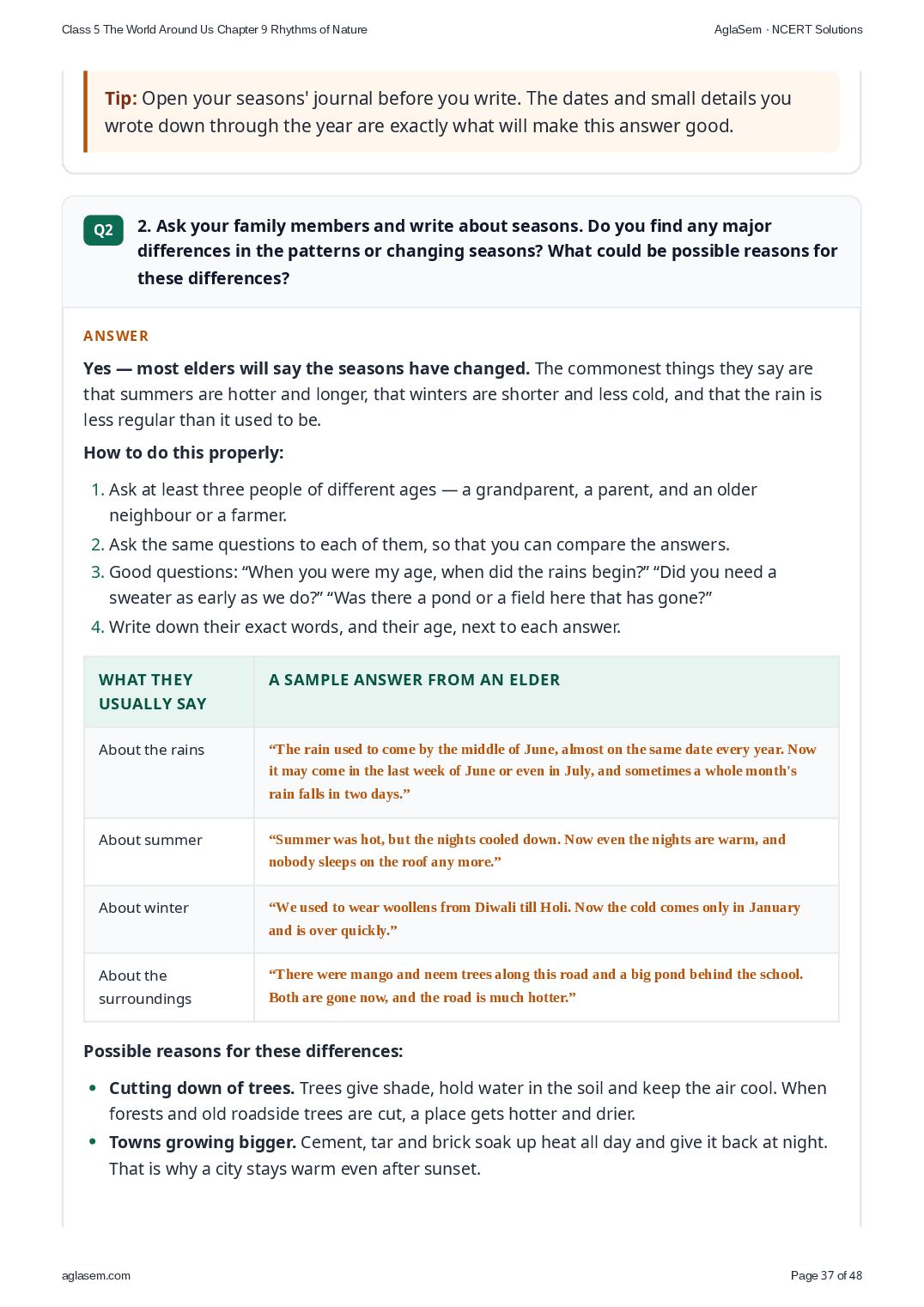
- 2. Ask your family members and write about seasons. Do you find any major differences in the patterns or changing seasons? What could be possible reasons for these differences?
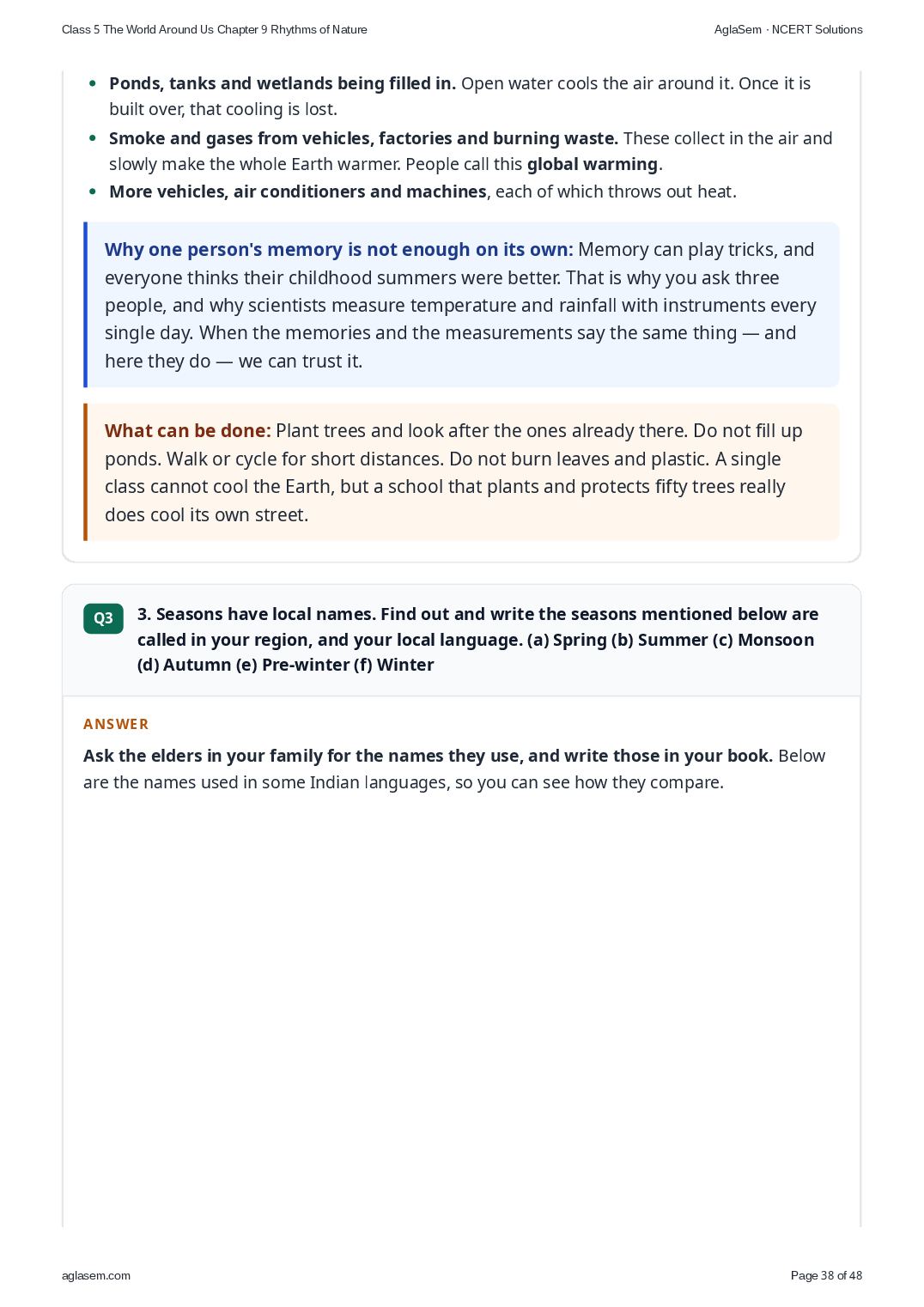
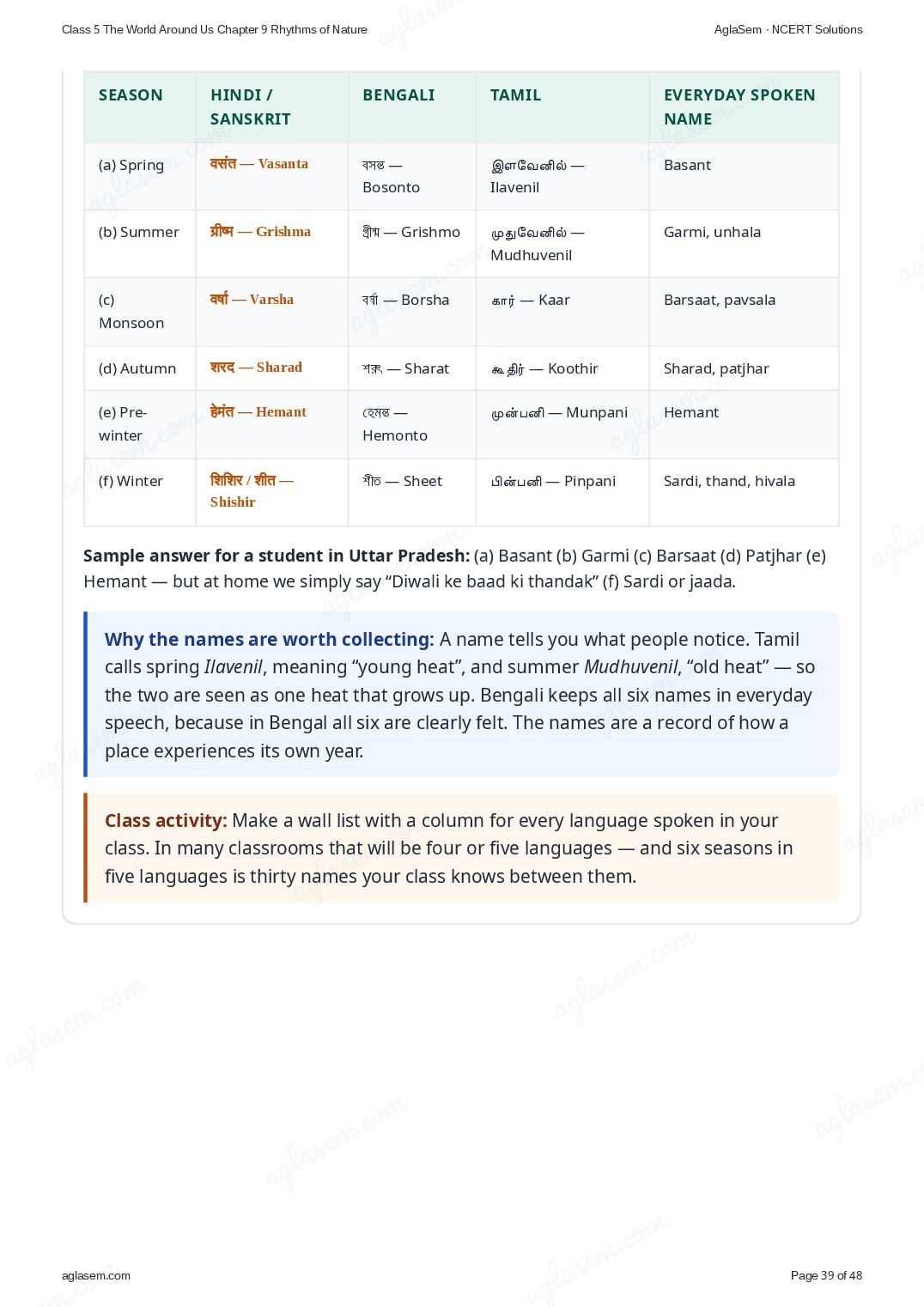
- 3. Seasons have local names. Find out and write the seasons mentioned below are called in your region, and your local language. (a) Spring (b) Summer (c) Monsoon (d) Autumn (e) Pre-winter (f) Winter
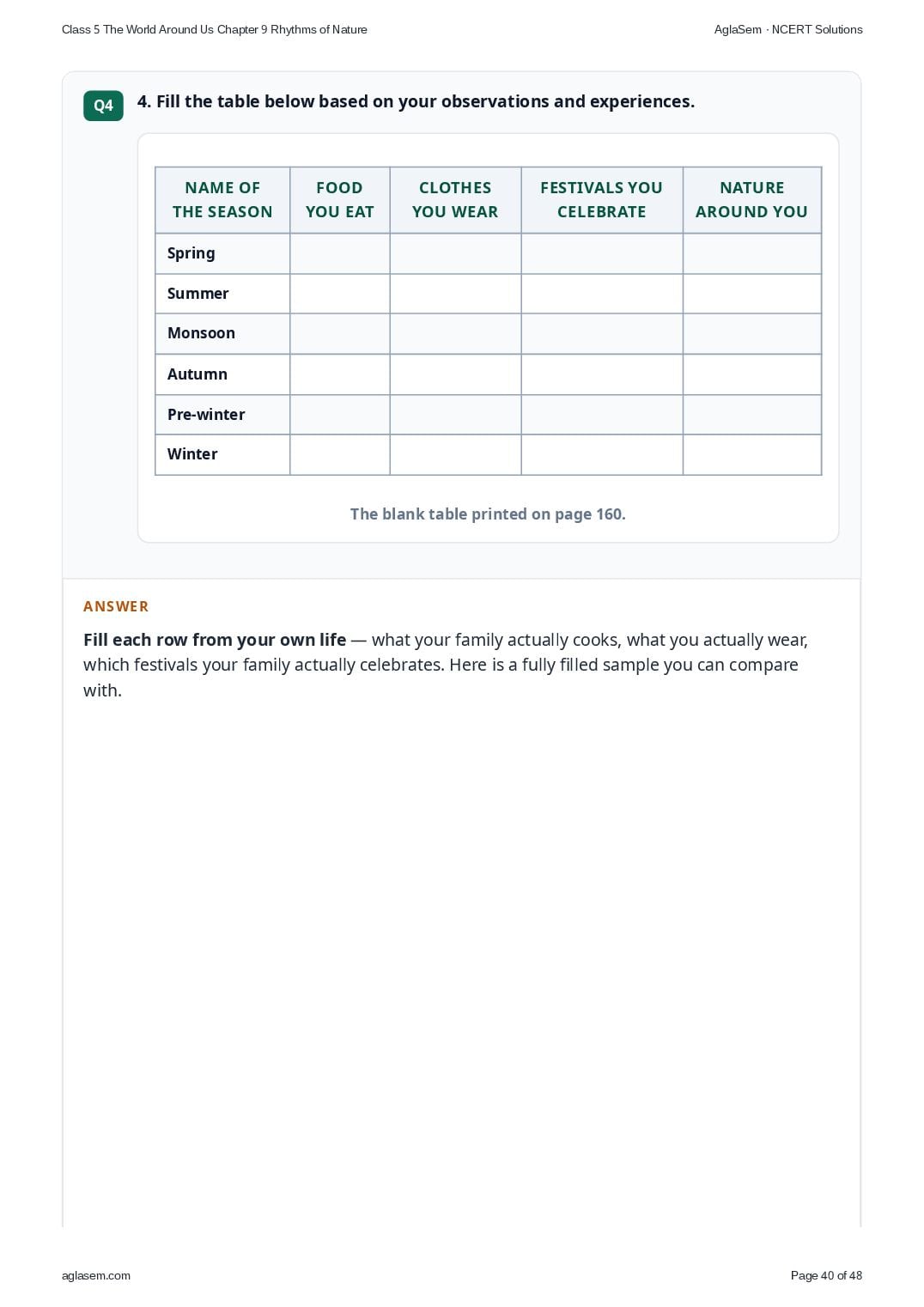
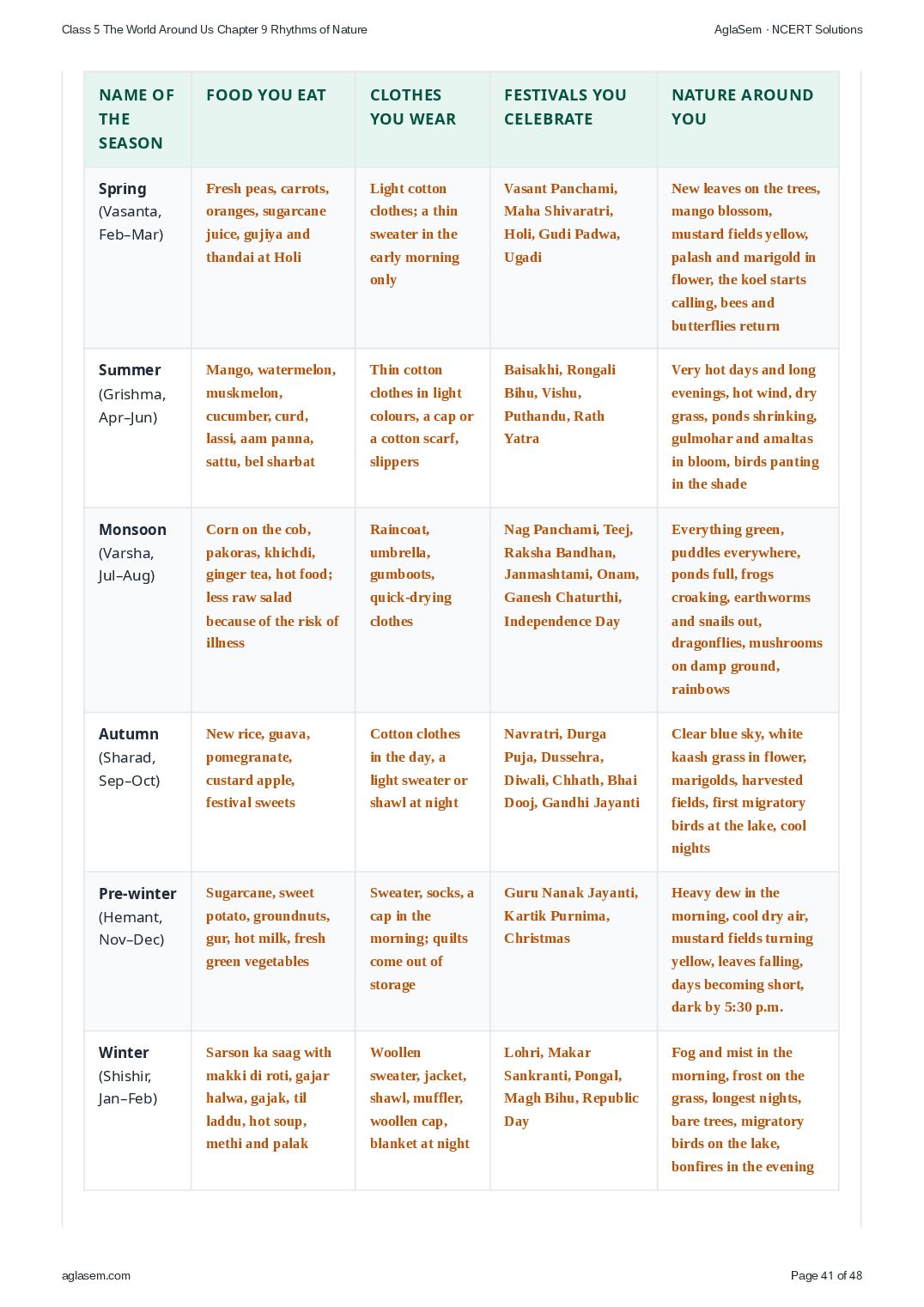
- 4. Fill the table below based on your observations and experiences. Name of the SeasonFood You EatClothes You WearFestivals You CelebrateNature Around You Spring Summer Monsoon Autumn Pre-winter Winter The blank table printed on page 160.
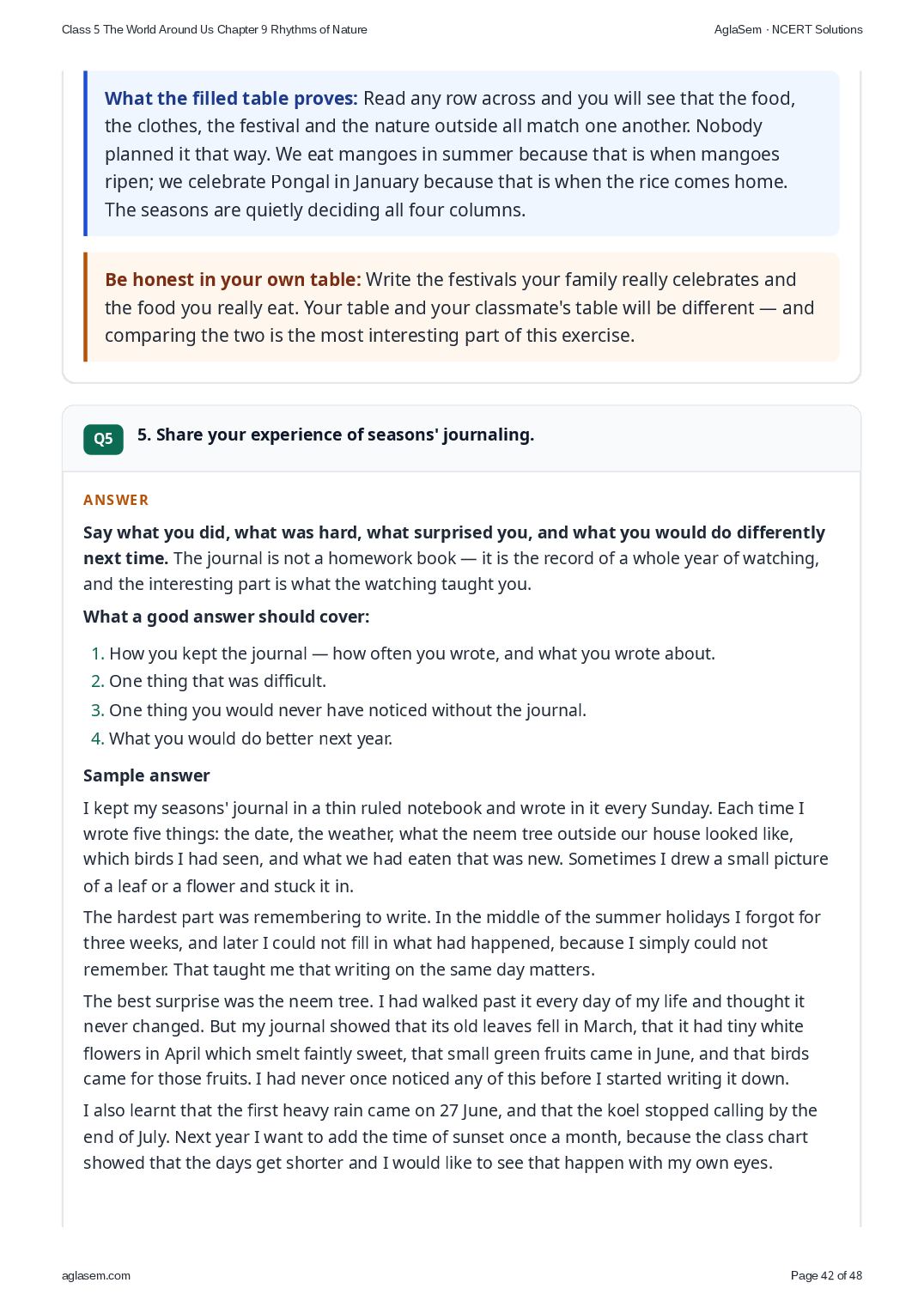
- 5. Share your experience of seasons’ journaling.
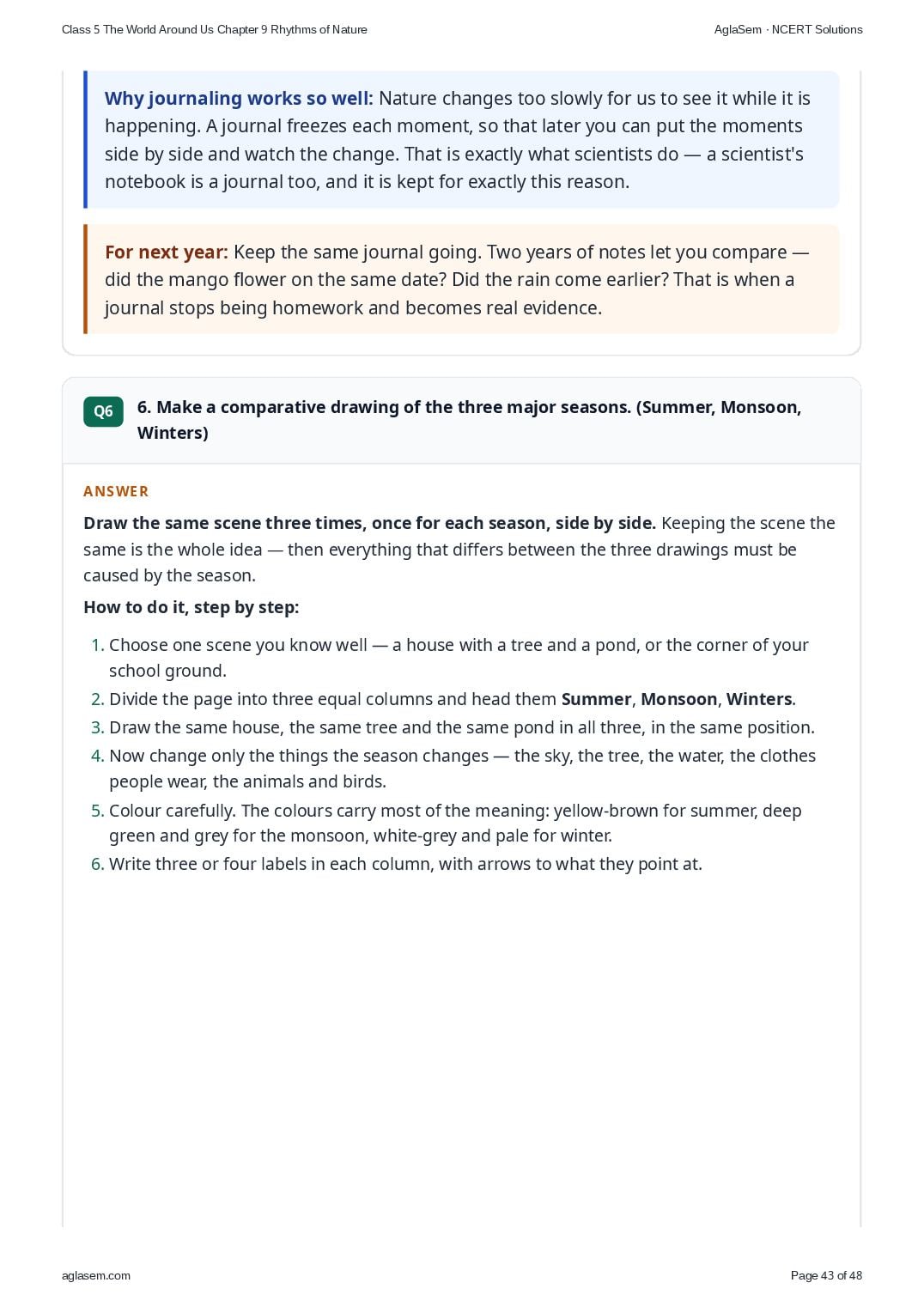
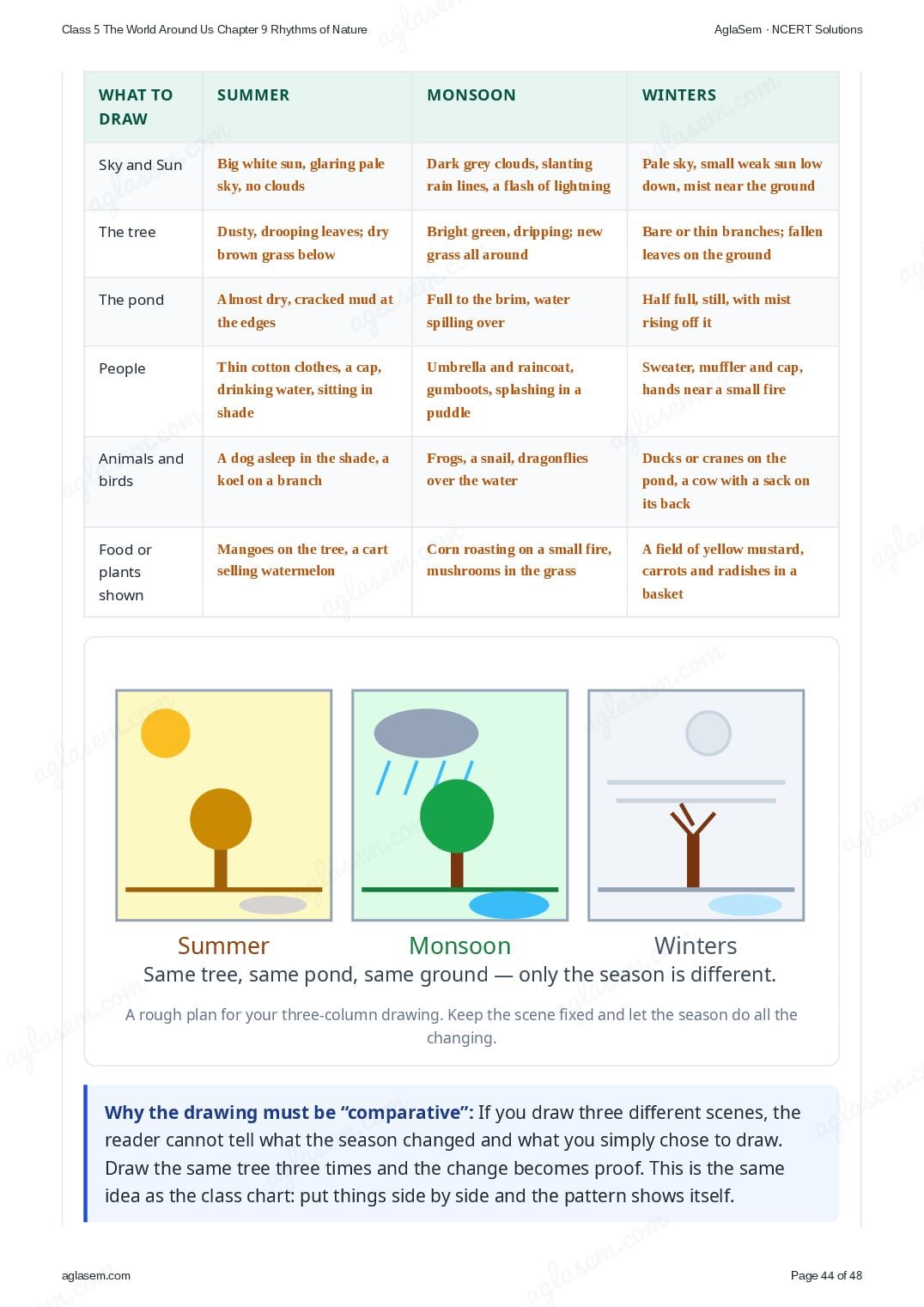
- 6. Make a comparative drawing of the three major seasons. (Summer, Monsoon, Winters)
Chapter at a Glance
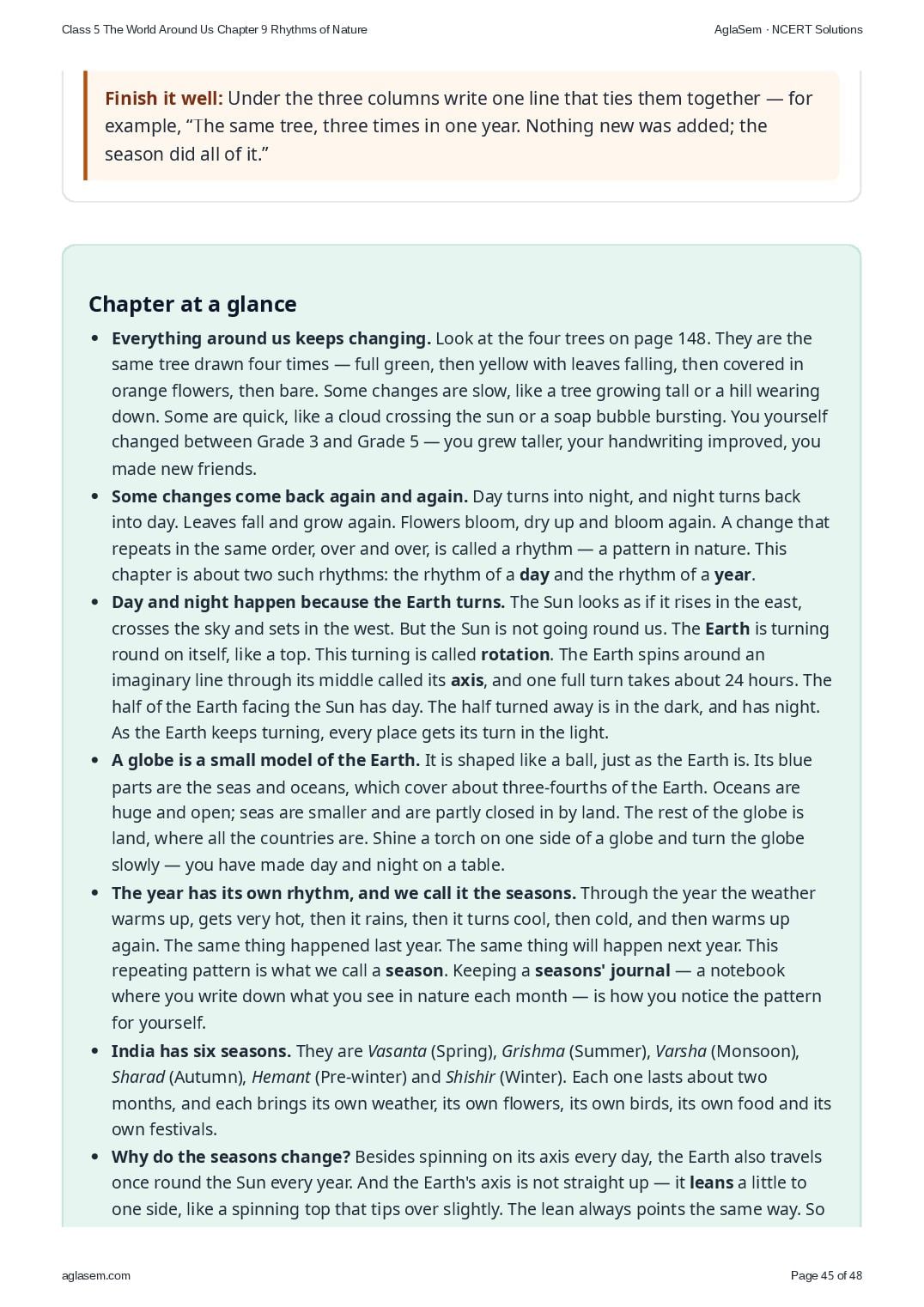
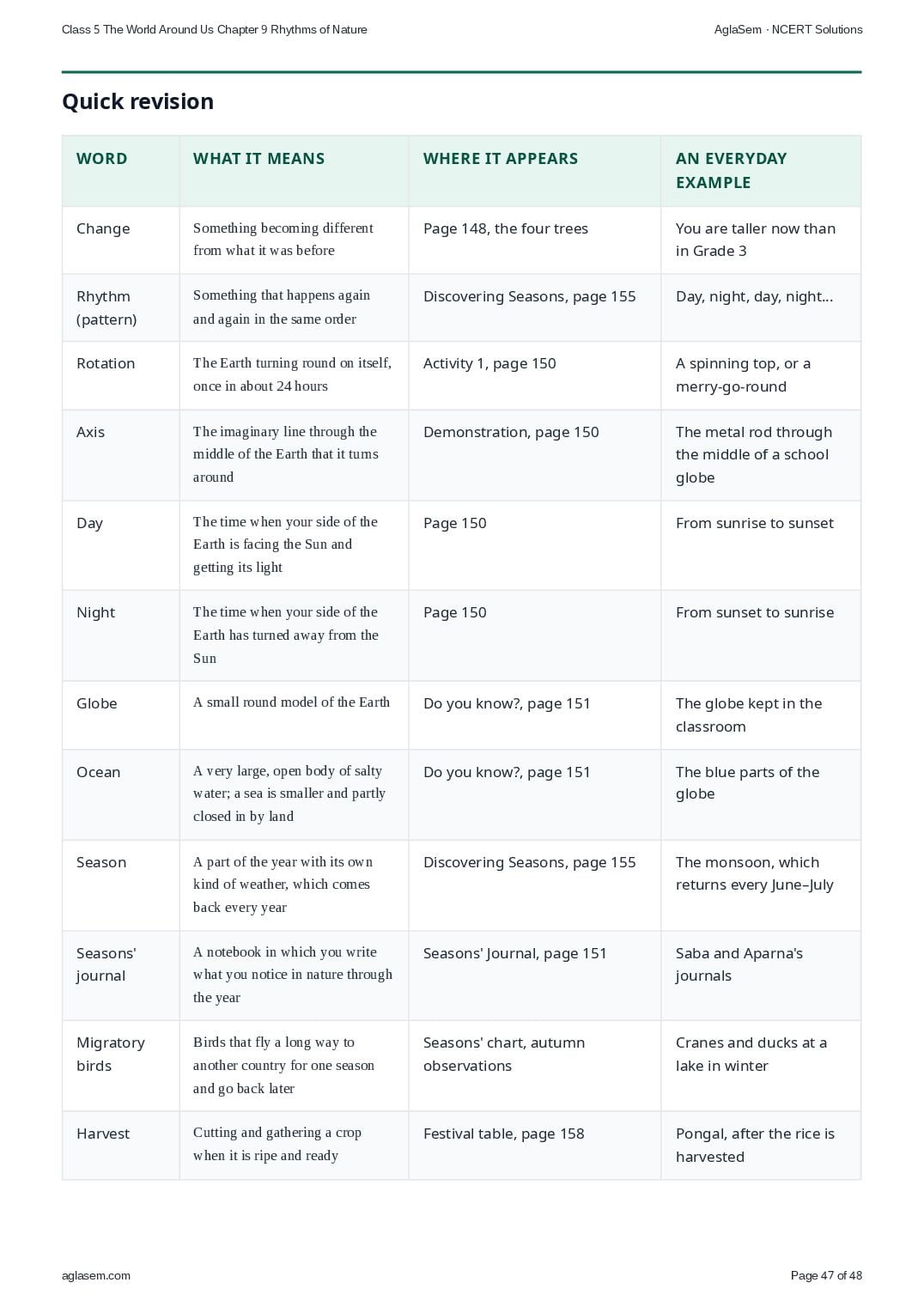
- Everything around us keeps changing. Look at the four trees on page 148. They are the same tree drawn four times — full green, then yellow with leaves falling, then covered in orange flowers, then bare. Some changes are slow, like a tree growing tall or a hill wearing down. Some are quick, like a cloud crossing the sun or a soap bubble bursting. You yourself changed between Grade 3 and Grade 5 — you grew taller, your handwriting improved, you made new friends.
- Some changes come back again and again. Day turns into night, and night turns back into day. Leaves fall and grow again. Flowers bloom, dry up and bloom again. A change that repeats in the same order, over and over, is called a rhythm — a pattern in nature. This chapter is about two such rhythms: the rhythm of a day and the rhythm of a year.
- Day and night happen because the Earth turns. The Sun looks as if it rises in the east, crosses the sky and sets in the west. But the Sun is not going round us. The Earth is turning round on itself, like a top. This turning is called rotation. The Earth spins around an imaginary line through its middle called its axis, and one full turn takes about 24 hours. The half of the Earth facing the Sun has day. The half turned away is in the dark, and has night. As the Earth keeps turning, every place gets its turn in the light.
- A globe is a small model of the Earth. It is shaped like a ball, just as the Earth is. Its blue parts are the seas and oceans, which cover about three-fourths of the Earth. Oceans are huge and open; seas are smaller and are partly closed in by land. The rest of the globe is land, where all the countries are. Shine a torch on one side of a globe and turn the globe slowly — you have made day and night on a table.
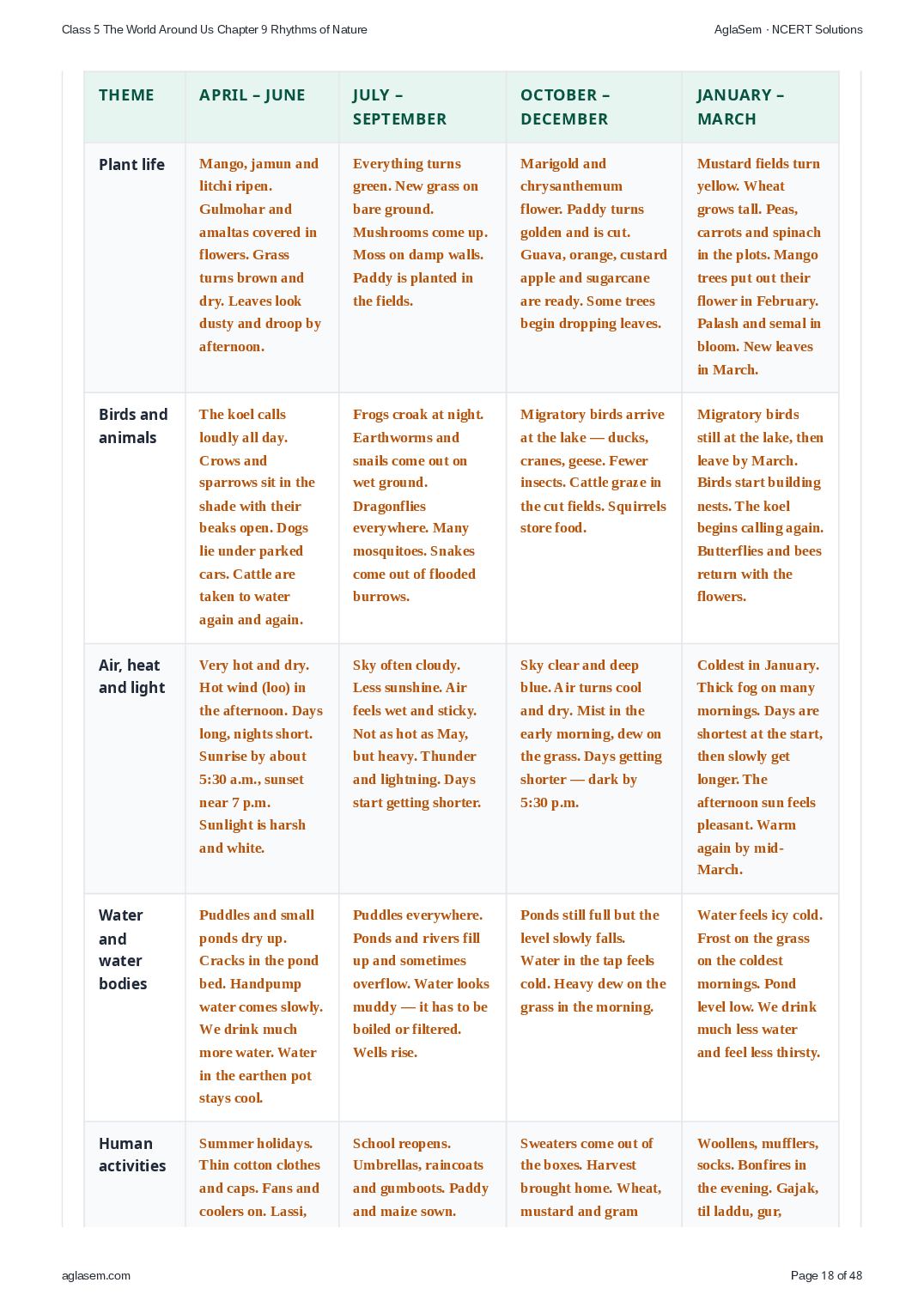
- The year has its own rhythm, and we call it the seasons. Through the year the weather warms up, gets very hot, then it rains, then it turns cool, then cold, and then warms up again. The same thing happened last year. The same thing will happen next year. This repeating pattern is what we call a season. Keeping a seasons’ journal — a notebook where you write down what you see in nature each month — is how you notice the pattern for yourself.
- India has six seasons. They are Vasanta (Spring), Grishma (Summer), Varsha (Monsoon), Sharad (Autumn), Hemant (Pre-winter) and Shishir (Winter). Each one lasts about two months, and each brings its own weather, its own flowers, its own birds, its own food and its own festivals.
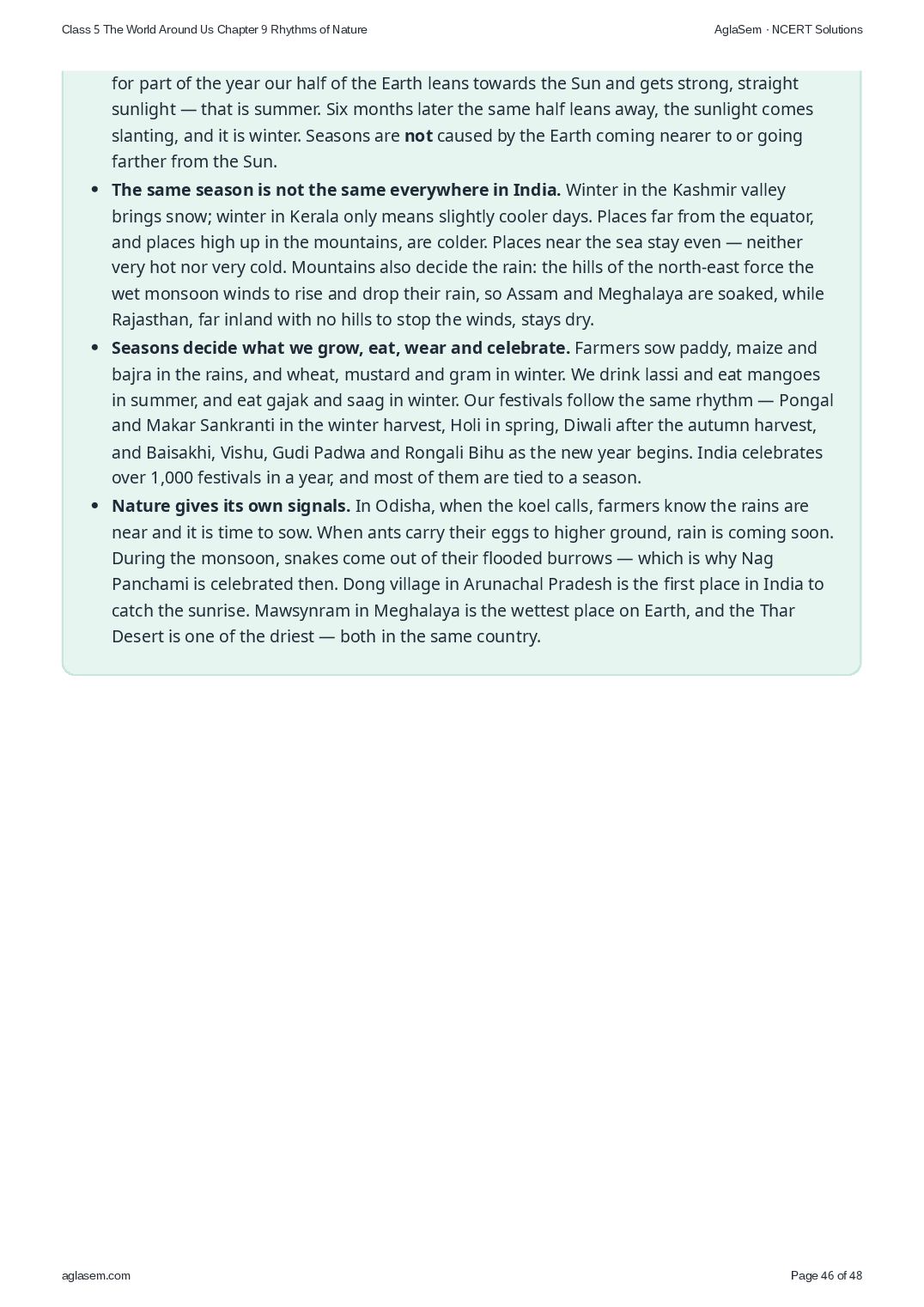
- Why do the seasons change? Besides spinning on its axis every day, the Earth also travels once round the Sun every year. And the Earth’s axis is not straight up — it leans a little to one side, like a spinning top that tips over slightly. The lean always points the same way. So for part of the year our half of the Earth leans towards the Sun and gets strong, straight sunlight — that is summer. Six months later the same half leans away, the sunlight comes slanting, and it is winter. Seasons are not caused by the Earth coming nearer to or going farther from the Sun.
- The same season is not the same everywhere in India. Winter in the Kashmir valley brings snow; winter in Kerala only means slightly cooler days. Places far from the equator, and places high up in the mountains, are colder. Places near the sea stay even — neither very hot nor very cold. Mountains also decide the rain: the hills of the north-east force the wet monsoon winds to rise and drop their rain, so Assam and Meghalaya are soaked, while Rajasthan, far inland with no hills to stop the winds, stays dry.
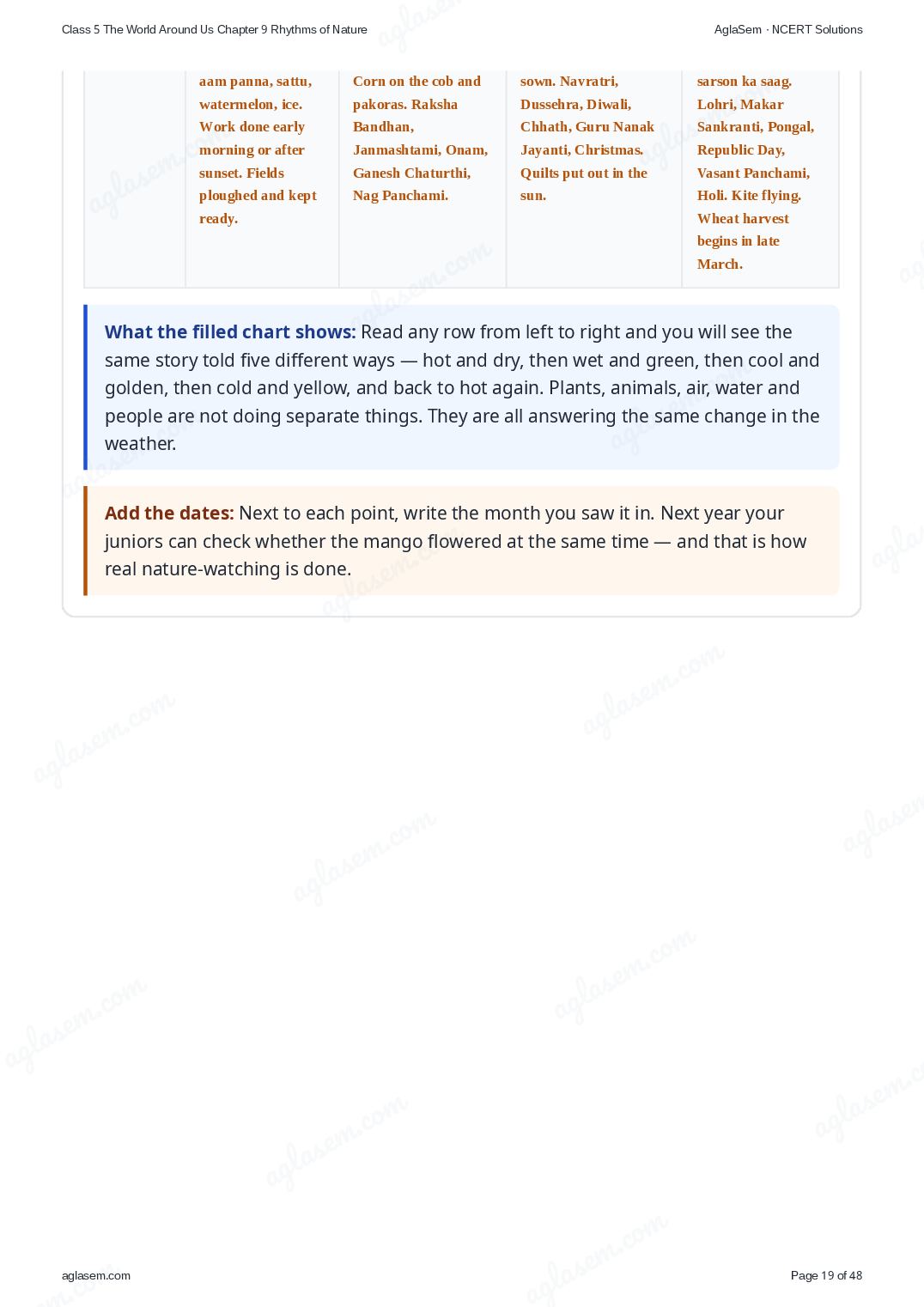
- Seasons decide what we grow, eat, wear and celebrate. Farmers sow paddy, maize and bajra in the rains, and wheat, mustard and gram in winter. We drink lassi and eat mangoes in summer, and eat gajak and saag in winter. Our festivals follow the same rhythm — Pongal and Makar Sankranti in the winter harvest, Holi in spring, Diwali after the autumn harvest, and Baisakhi, Vishu, Gudi Padwa and Rongali Bihu as the new year begins. India celebrates over 1,000 festivals in a year, and most of them are tied to a season.
- Nature gives its own signals. In Odisha, when the koel calls, farmers know the rains are near and it is time to sow. When ants carry their eggs to higher ground, rain is coming soon. During the monsoon, snakes come out of their flooded burrows — which is why Nag Panchami is celebrated then. Dong village in Arunachal Pradesh is the first place in India to catch the sunrise. Mawsynram in Meghalaya is the wettest place on Earth, and the Thar Desert is one of the driest — both in the same country.
How to Download NCERT Solutions for Class 5 The World Around Us Chapter 9 PDF
Follow these simple steps to get the Rhythms of Nature questions-and-answers PDF from Our Wondrous World.
- Search NCERT Solutions for Class 5 The World Around Us Chapter 9 aglasem and open this page.
- Read the exercise questions with answers for Rhythms of Nature shown above.
- Click the Download PDF link to save the Rhythms of Nature solutions to your device.
NCERT Solutions for Class 5 The World Around Us – All Chapters
There are more chapters to study besides Rhythms of Nature in The World Around Us. Here are the NCERT Solutions for all chapters of Class 5 The World Around Us.
- Chapter 1 Water the Essence of Life
- Chapter 2 Journey of a River
- Chapter 3 the Mystery of Food
- Chapter 4 Our School a Happy Place
- Chapter 5 Our Vibrant Country
- Chapter 6 Some Unique Places
- Chapter 7 Energy How Things Work
- Chapter 8 Clothes How Things Are Made
- Chapter 9 Rhythms of Nature
- Chapter 10 Earth Our Shared Home
NCERT Solutions for Class 5 – All Subjects
Just like Chapter 9 of The World Around Us, you can get the exercise questions with answers for every other subject of Class 5. Here are the NCERT Solutions for all subjects of Class 5.
NCERT Solutions for Class 5 The World Around Us Chapter 9 – An Overview
The key highlights of this study material are as follows.
| Aspects | Details |
|---|---|
| Class | Class 5 |
| Subject | The World Around Us |
| Chapter Number | Chapter 9 |
| Chapter Name | Rhythms of Nature |
| Book Name | Our Wondrous World |
| Book By | NCERT (National Council of Educational Research and Training) |
| Educational Resource Here | NCERT Solutions of Class 5 The World Around Us Chapter 9 for all exercises |
| More Questions Answers of This Subject | NCERT Solutions for Class 5 The World Around Us |
| Download Book Chapter | NCERT Book Class 5 The World Around Us |
| All Questions Answers For This Class | NCERT Solutions for Class 5 |
| Complete Solutions | NCERT Solutions |
NCERT Solutions for Class 5 The World Around Us Chapter 9 Rhythms of Nature – FAQs
What are the NCERT Solutions for Class 5 The World Around Us Chapter 9 Rhythms of Nature?
They are the complete, step-by-step answers to all the exercise and in-text questions of Chapter 9 Rhythms of Nature from the NCERT Class 5 The World Around Us textbook Our Wondrous World, written by experts as per the latest NCERT syllabus.
How can I download the Class 5 The World Around Us Chapter 9 solutions PDF for free?
Open this page on aglasem, read the Rhythms of Nature questions with answers, and click the “Download Solutions PDF” link. The Class 5 The World Around Us Chapter 9 NCERT Solutions PDF is completely free to download.
Are these NCERT Solutions as per the latest 2026-27 syllabus?
Yes. The NCERT Solutions for Class 5 The World Around Us Chapter 9 are based on the latest NCERT textbook Our Wondrous World and the current 2026-27 CBSE syllabus, so the questions and answers match what you study in class.
Where can I get NCERT Solutions for the other chapters of Class 5 The World Around Us?
You can find the answers to every chapter on the NCERT Solutions for Class 5 The World Around Us page, and solutions for every subject on the NCERT Solutions for Class 5 page.
How do NCERT Solutions help in exam preparation?
They show the correct method to solve each question, help you write answers the way they are expected in exams, let you check and correct your own work, and save revision time — which together improve your marks in Class 5 The World Around Us.
If you have any queries on NCERT Solutions for Class 5 The World Around Us Chapter 9 Rhythms of Nature, then please ask in the comments below.