NCERT Solutions for Class 5 The World Around Us Chapter 7 Energy How Things Work provide clear, step-by-step answers to every exercise and in-text question from the chapter Energy How Things Work of the NCERT textbook Our Wondrous World. Prepared by subject experts as per the latest NCERT (CBSE) syllabus for 2026-27, these NCERT Solutions for Class 5 The World Around Us help you understand each concept, write exam-ready answers, and check your own solutions. You can read them online below or download the free Class 5 The World Around Us Chapter 7 question-answer PDF.
NCERT Solutions for Class 5 The World Around Us Chapter 7 Energy How Things Work
- Class: Class 5
- Subject: The World Around Us
- Chapter: Chapter 7 – Energy How Things Work
- Textbook: Our Wondrous World (NCERT)
- Study material: NCERT Solutions – questions with answers, free PDF
These solutions answer all the exercise questions of Chapter 7 Energy How Things Work — including the in-text questions, short-answer and long-answer questions, and activities — with complete explanations so you can follow the method, not just the final answer. Read the full solutions below.
NCERT Solutions Class 5 The World Around Us Chapter 7 Energy How Things Work View Download
NCERT Solutions for Class 5 The World Around Us Chapter 7 PDF Download
You can read the NCERT Solutions for Class 5 The World Around Us Chapter 7 online above, or download the complete question-answer PDF to study Energy How Things Work offline at any time.
NCERT Solutions for Class 5 The World Around Us Chapter 7 PDF Download Link – Click Here to Download Solutions PDF
Questions Covered in This Chapter
These NCERT Solutions answer all 45 questions of this chapter. The questions solved are:
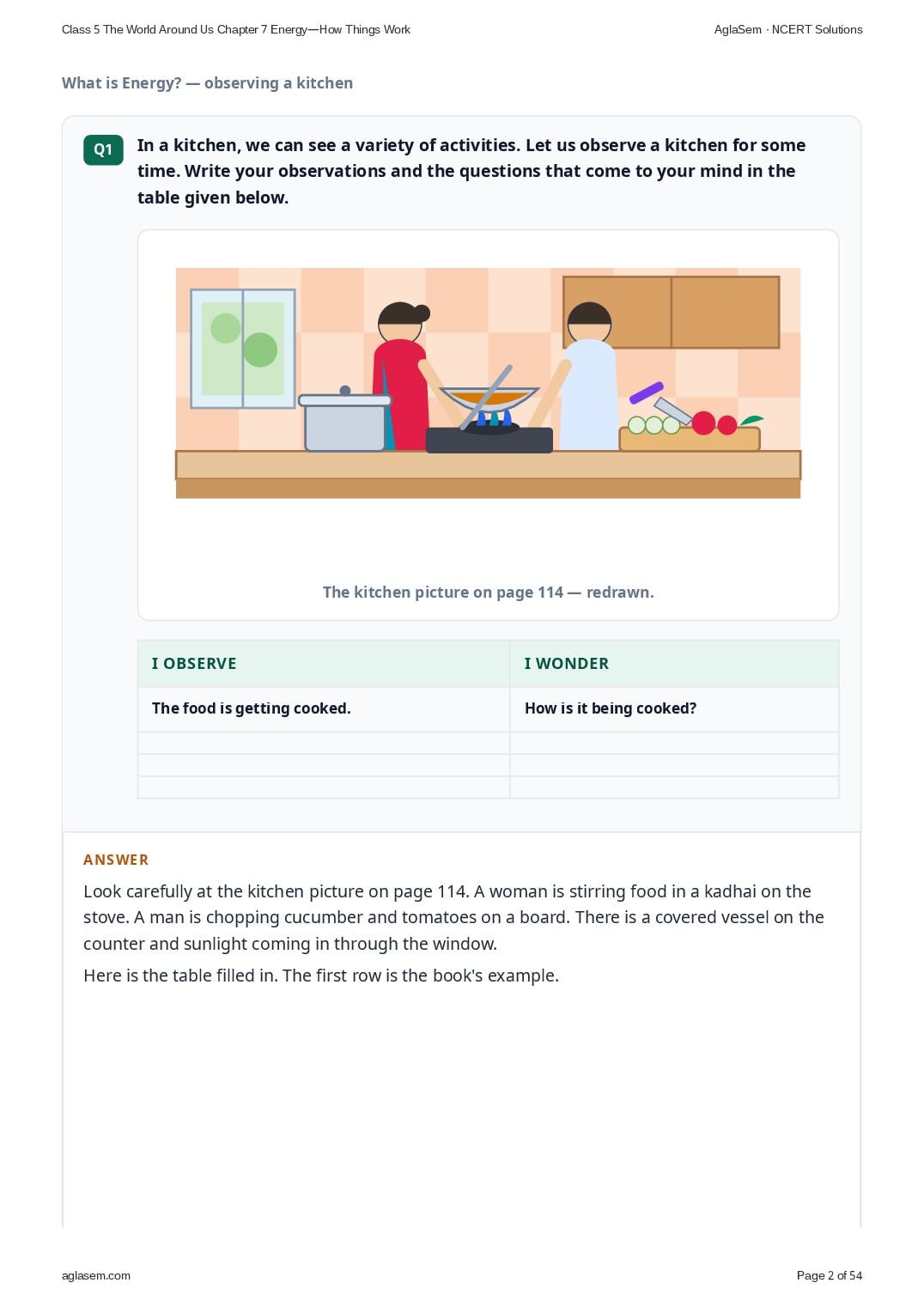
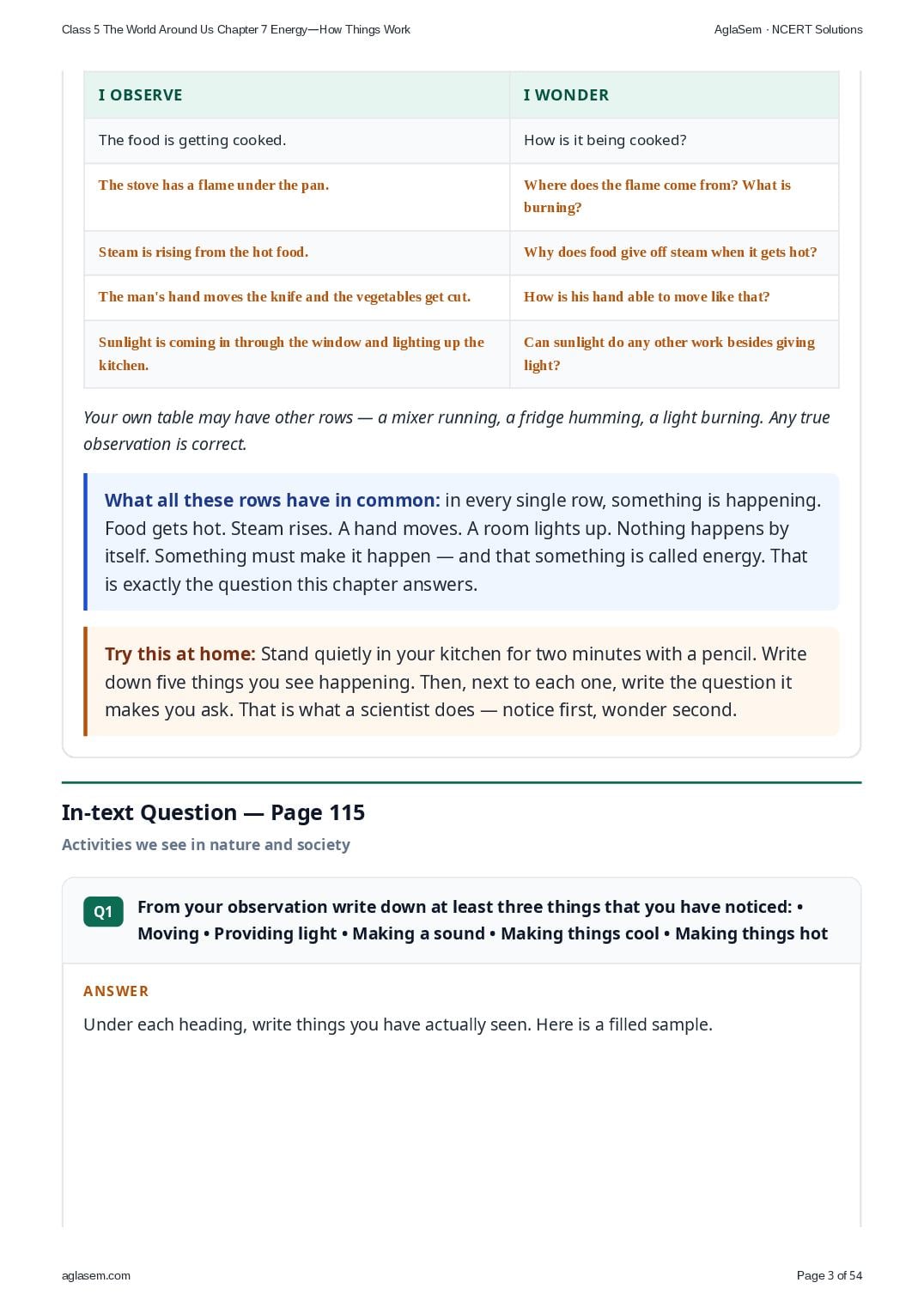
- In a kitchen, we can see a variety of activities. Let us observe a kitchen for some time. Write your observations and the questions that come to your mind in the table given below.The kitchen picture on page 114 — redrawn.I ObserveI WonderThe food is getting cooked.How is it being cooked?
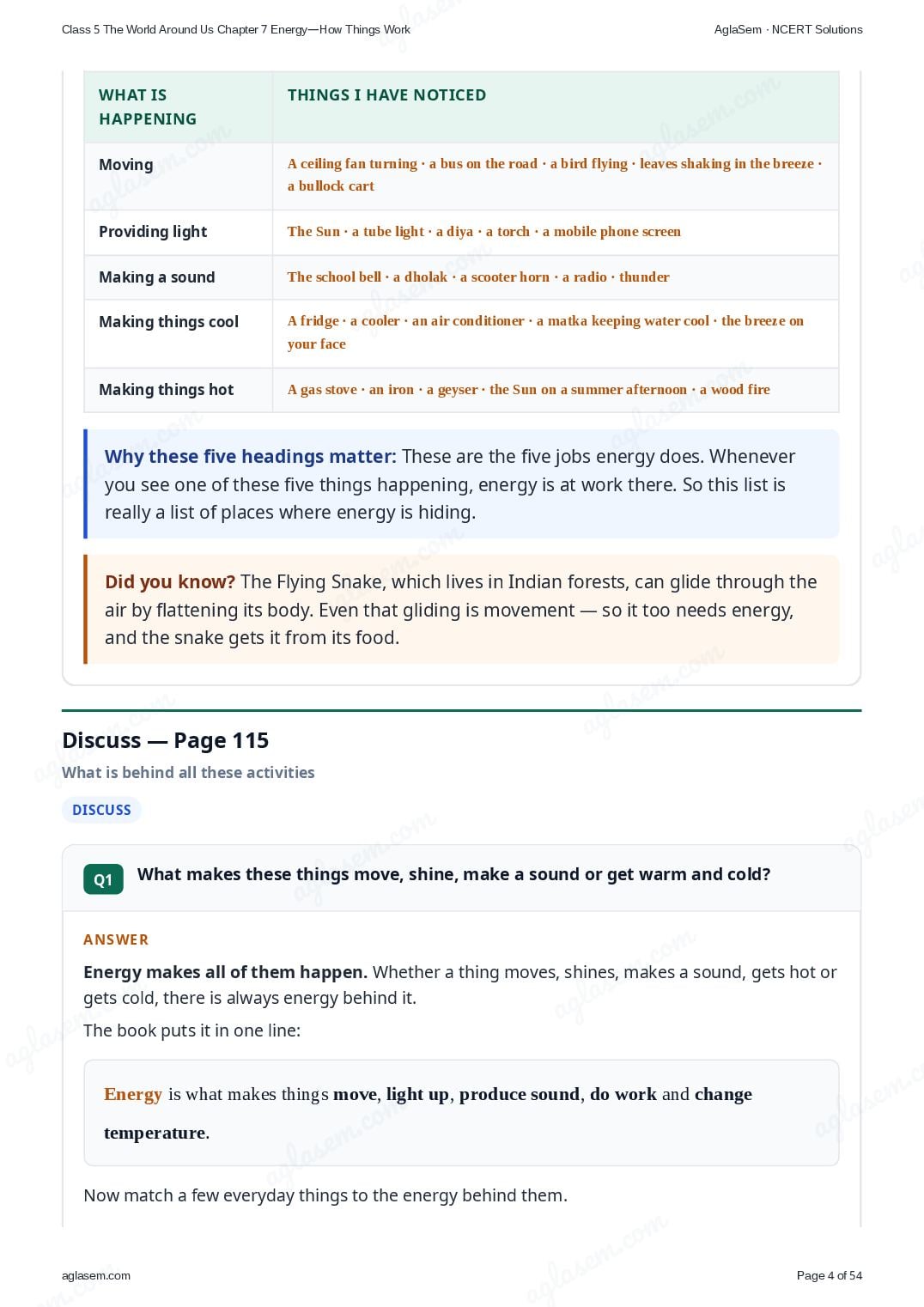
- From your observation write down at least three things that you have noticed: • Moving • Providing light • Making a sound • Making things cool • Making things hot
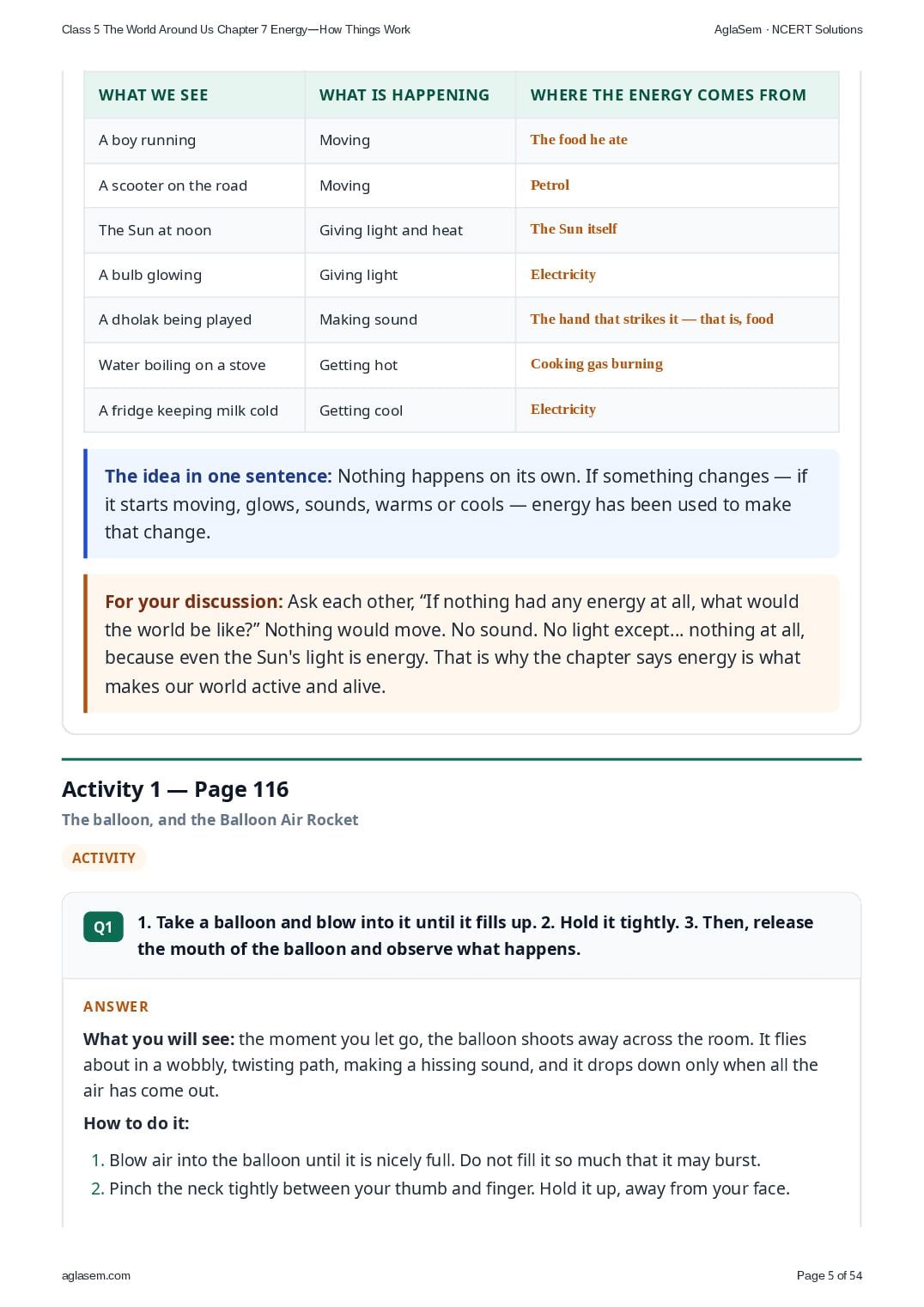
- What makes these things move, shine, make a sound or get warm and cold?
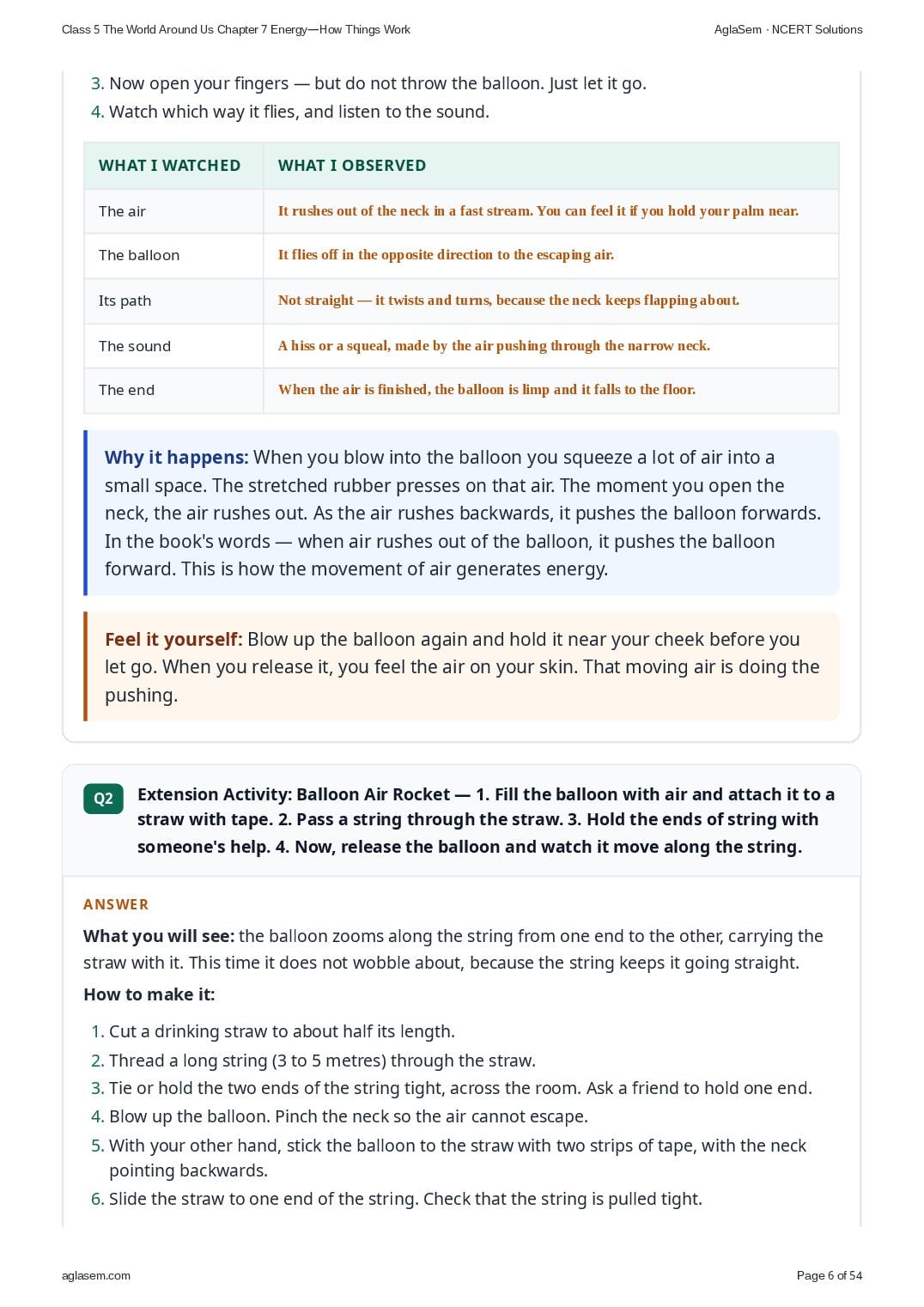
- 1. Take a balloon and blow into it until it fills up. 2. Hold it tightly. 3. Then, release the mouth of the balloon and observe what happens.
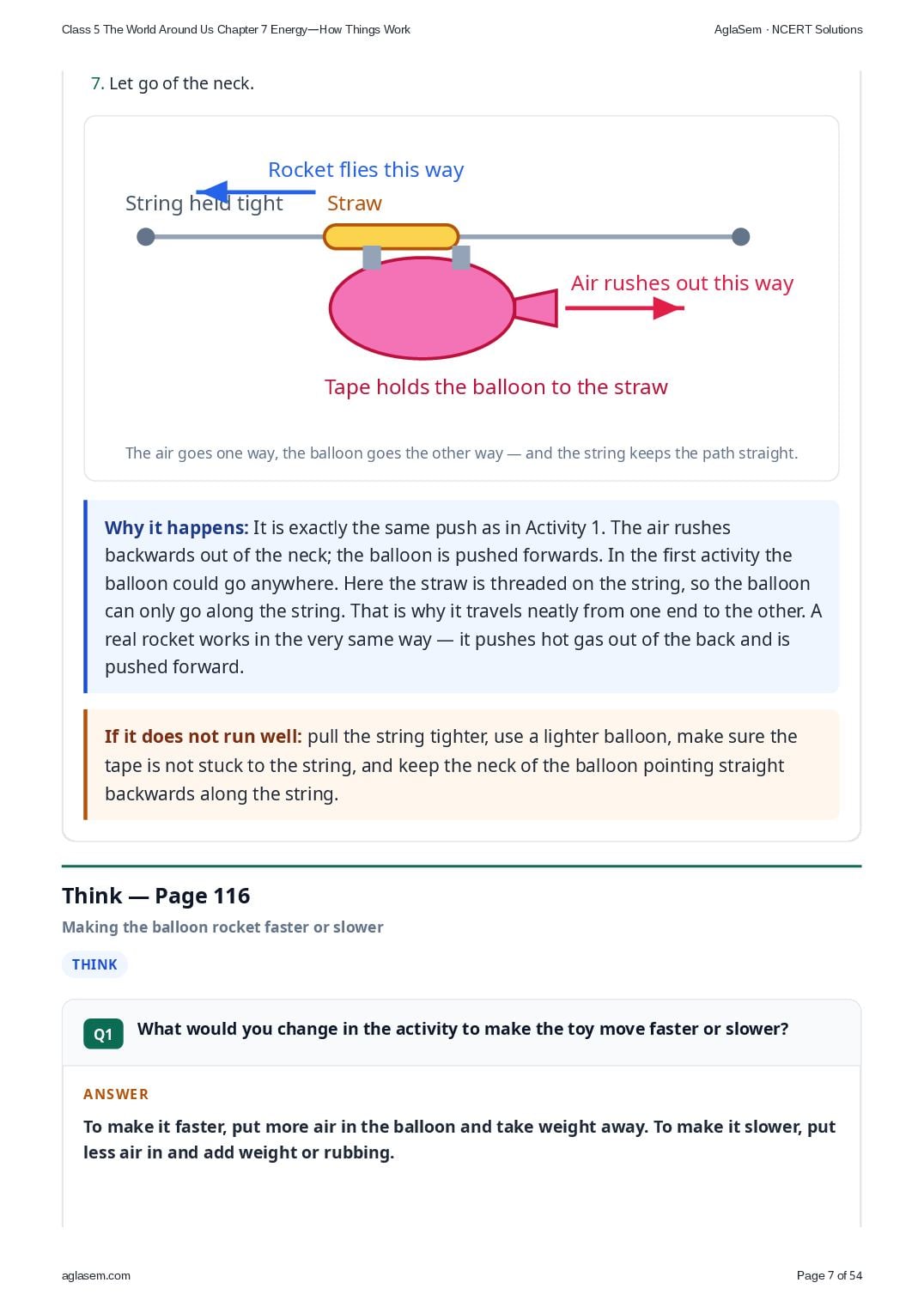
- Extension Activity: Balloon Air Rocket — 1. Fill the balloon with air and attach it to a straw with tape. 2. Pass a string through the straw. 3. Hold the ends of string with someone’s help. 4. Now, release the balloon and watch it move along the string.
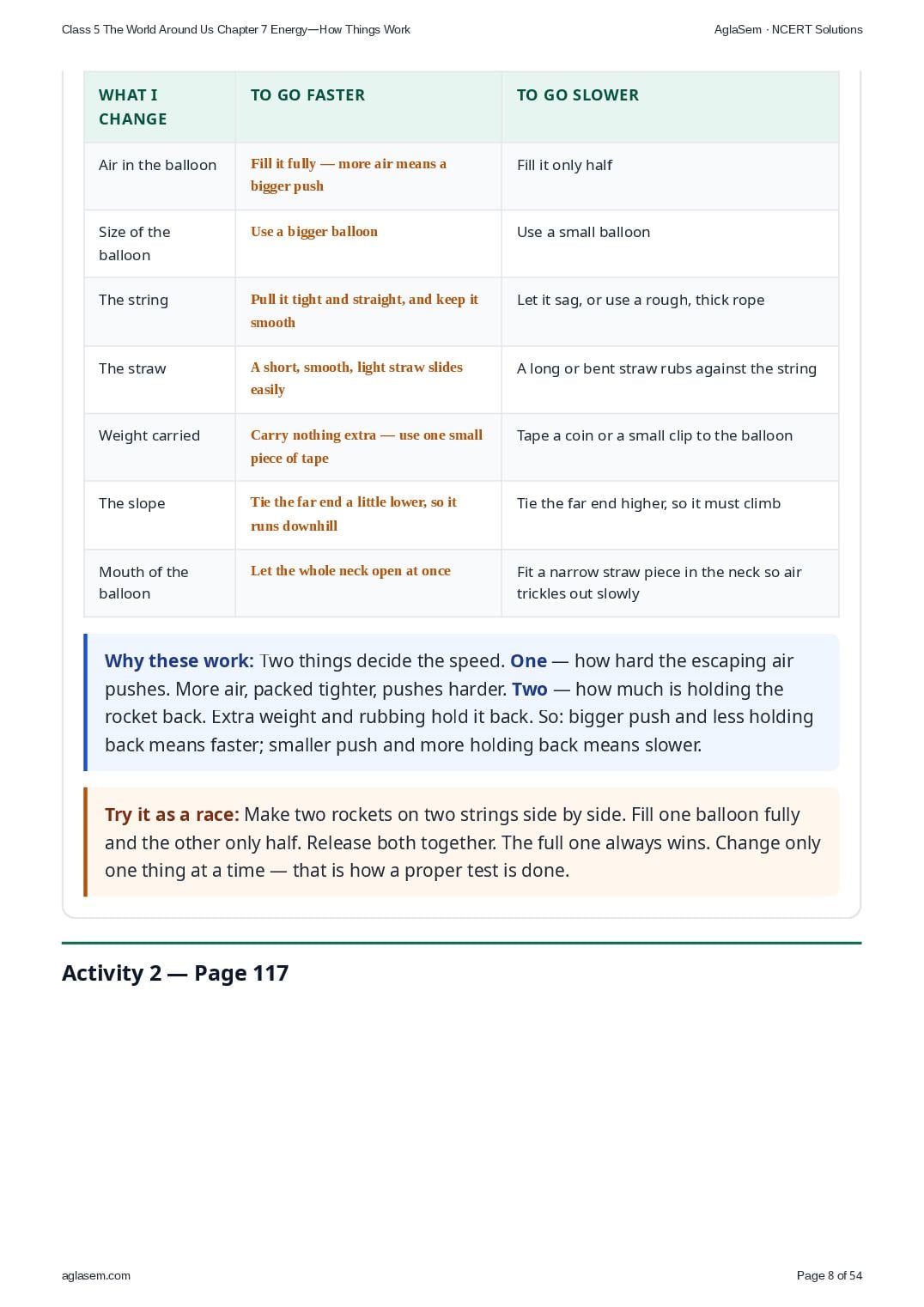
- What would you change in the activity to make the toy move faster or slower?
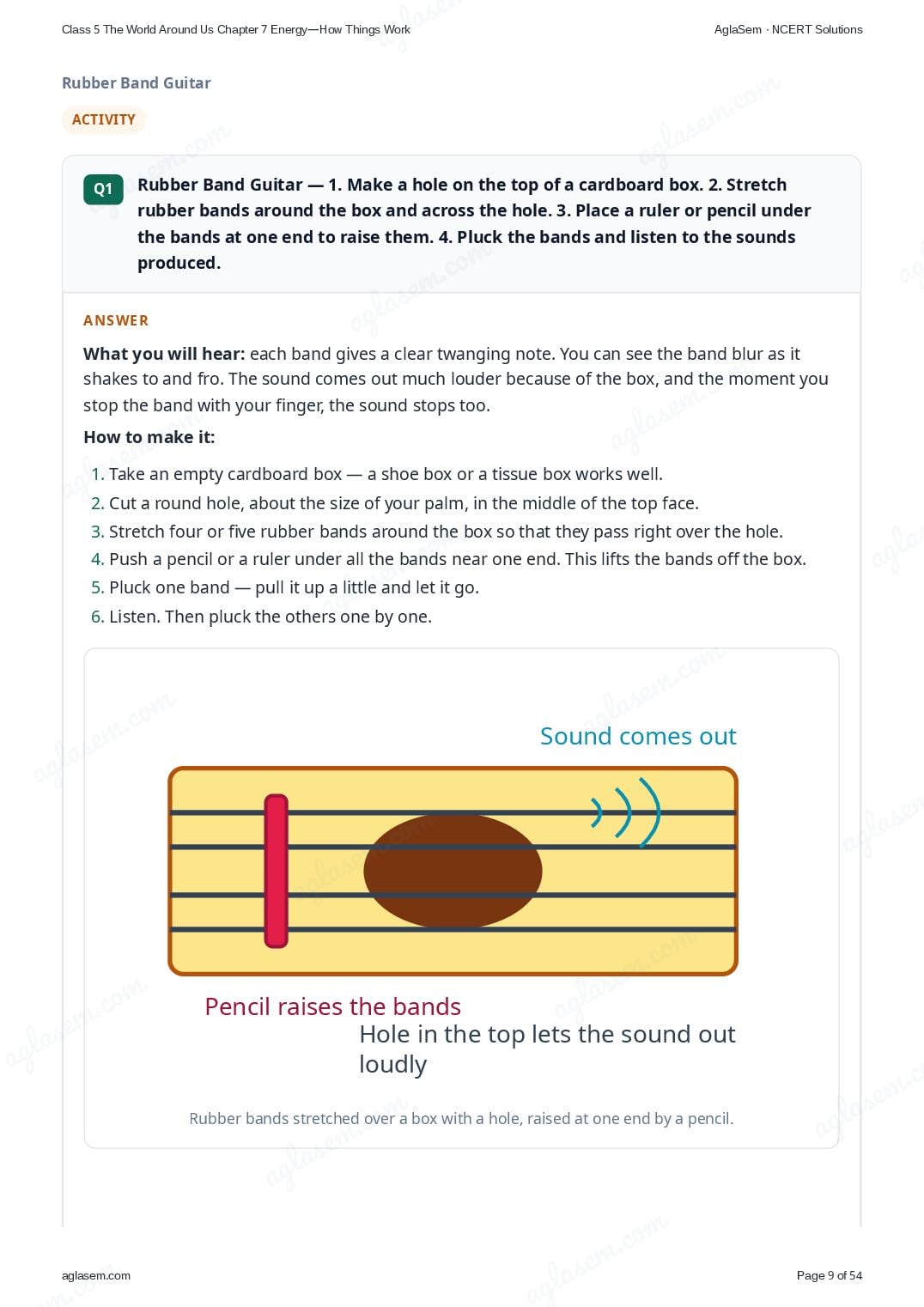
- Rubber Band Guitar — 1. Make a hole on the top of a cardboard box. 2. Stretch rubber bands around the box and across the hole. 3. Place a ruler or pencil under the bands at one end to raise them. 4. Pluck the bands and listen to the sounds produced.
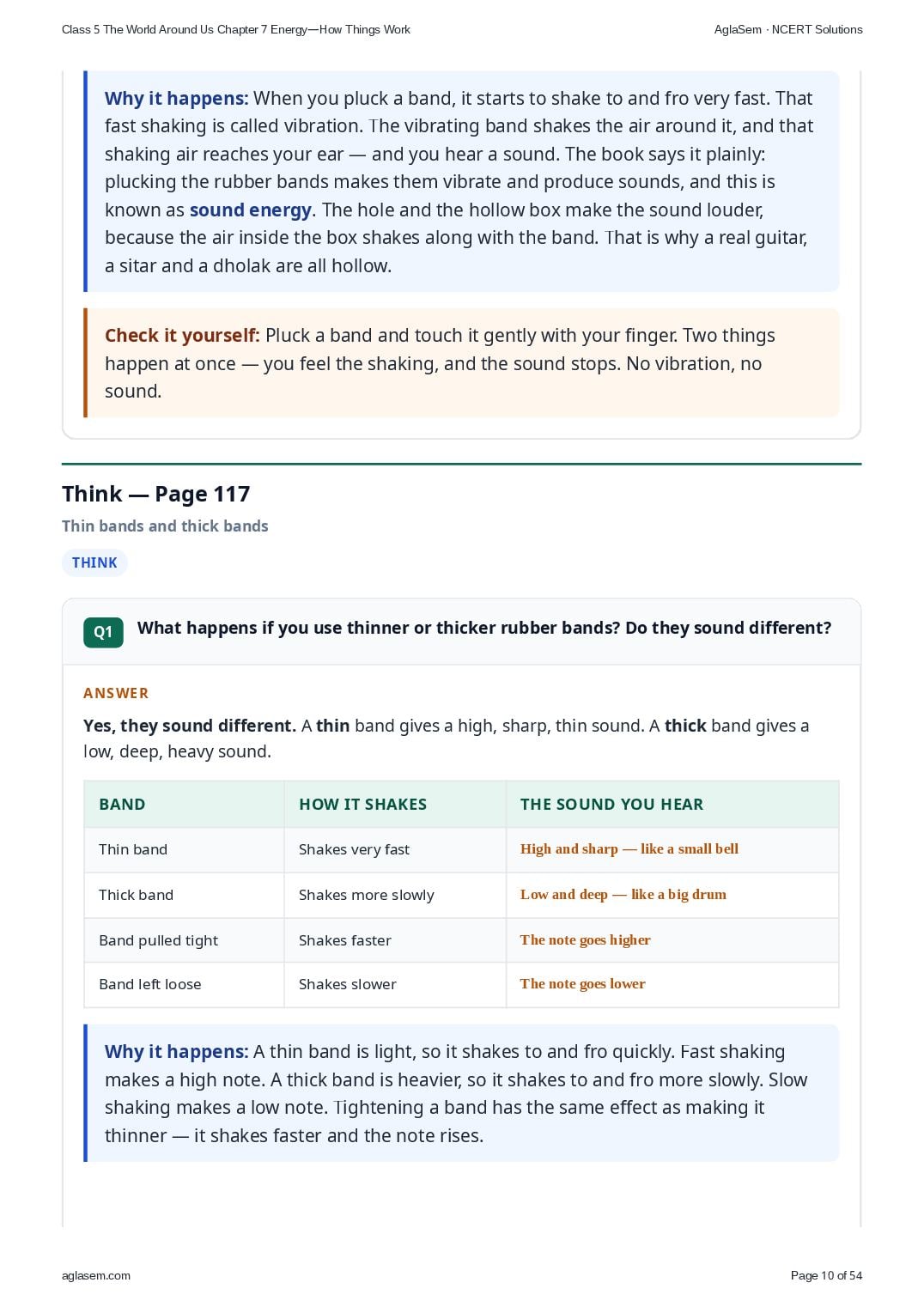
- What happens if you use thinner or thicker rubber bands? Do they sound different?
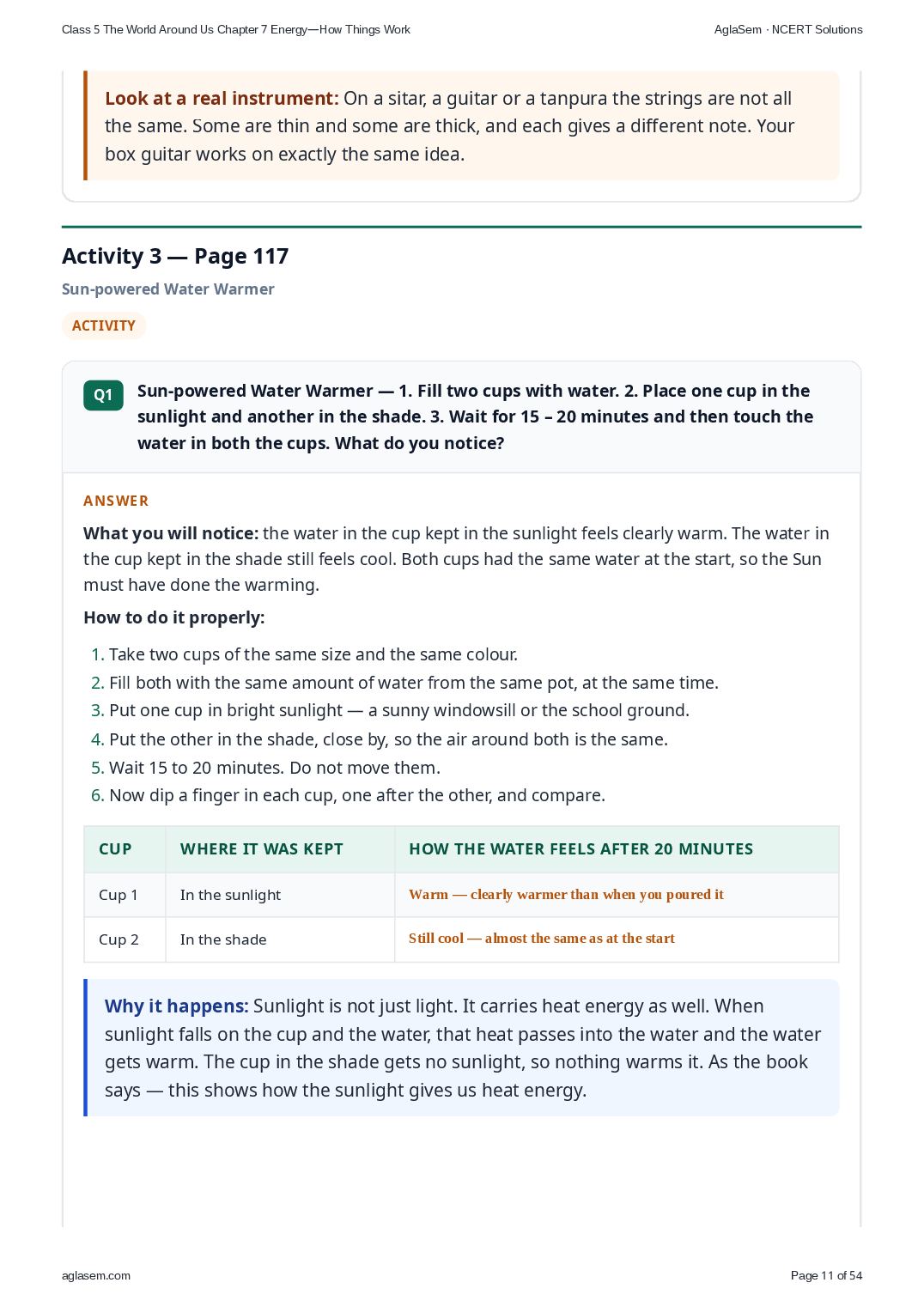
- Sun-powered Water Warmer — 1. Fill two cups with water. 2. Place one cup in the sunlight and another in the shade. 3. Wait for 15 – 20 minutes and then touch the water in both the cups. What do you notice?
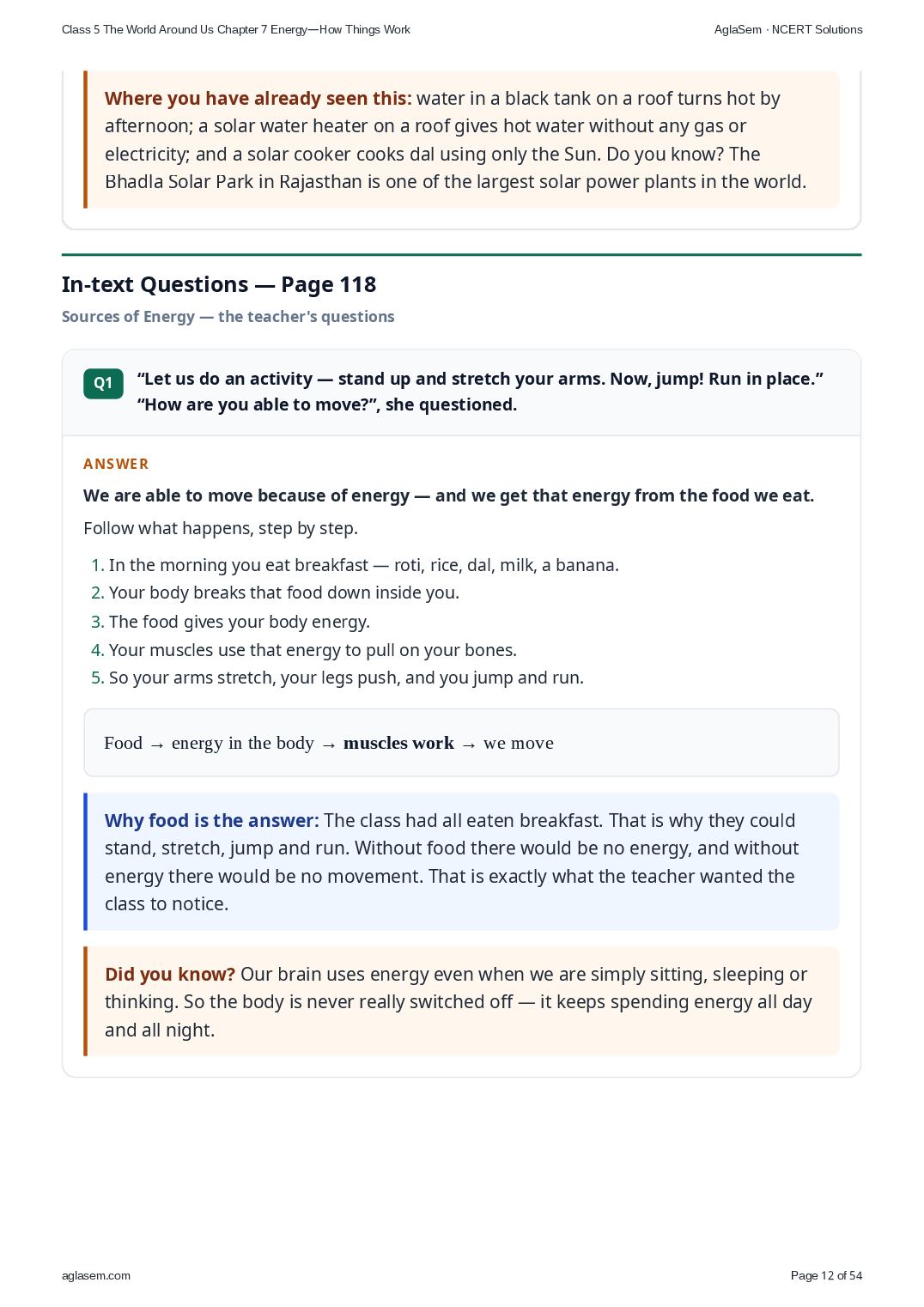
- “Let us do an activity — stand up and stretch your arms. Now, jump! Run in place.” “How are you able to move?”, she questioned.
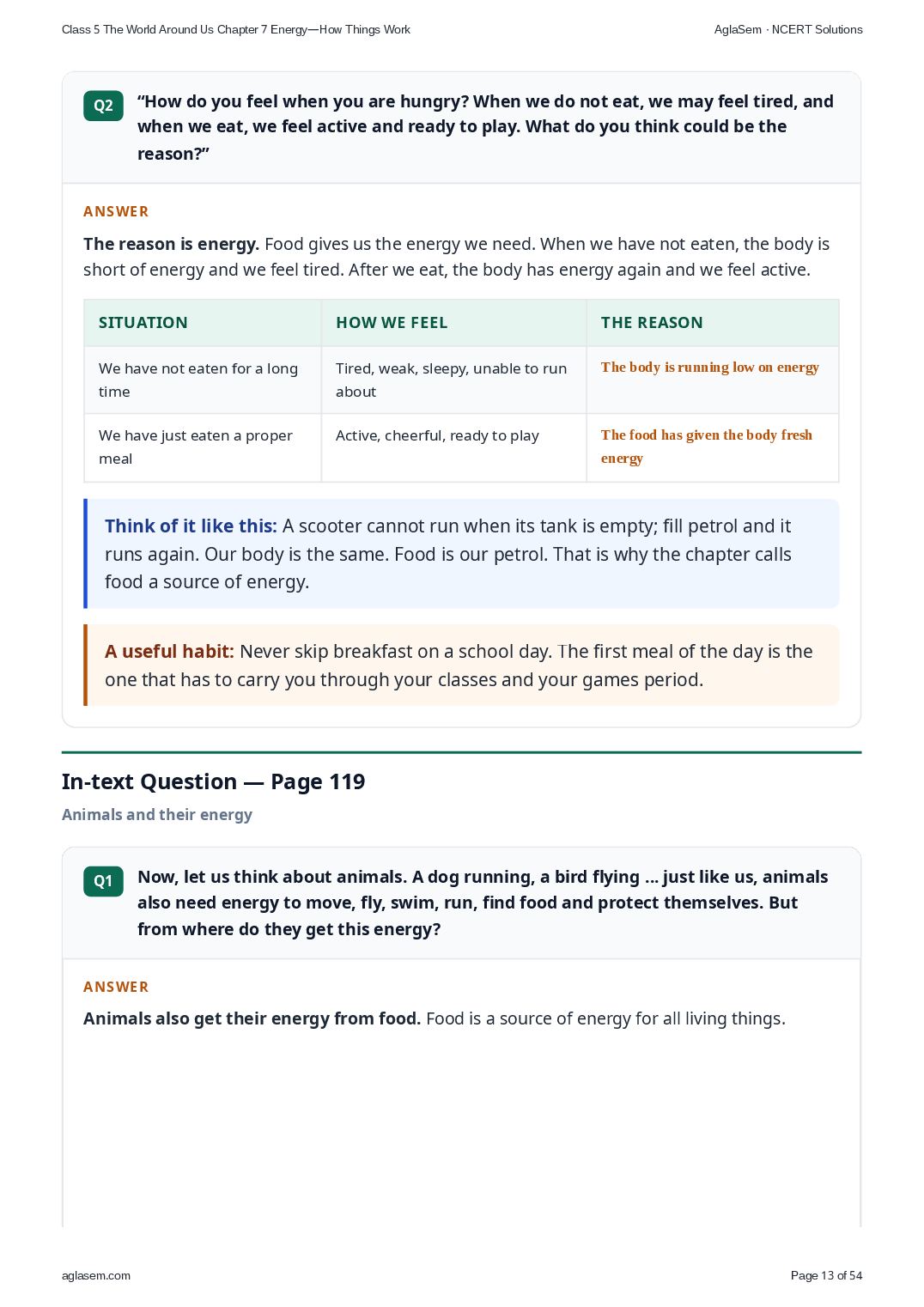
- “How do you feel when you are hungry? When we do not eat, we may feel tired, and when we eat, we feel active and ready to play. What do you think could be the reason?”
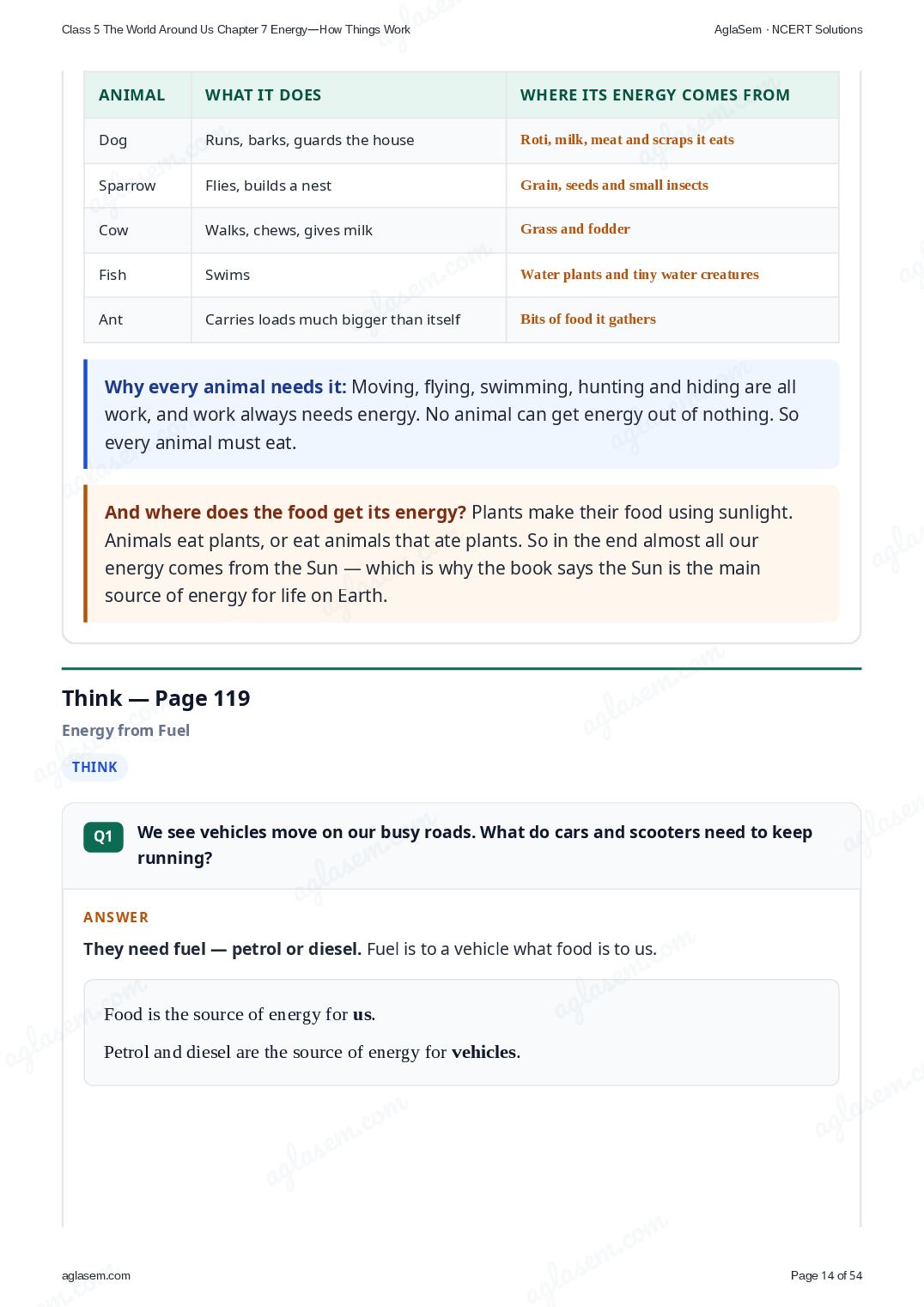
- Now, let us think about animals. A dog running, a bird flying … just like us, animals also need energy to move, fly, swim, run, find food and protect themselves. But from where do they get this energy?
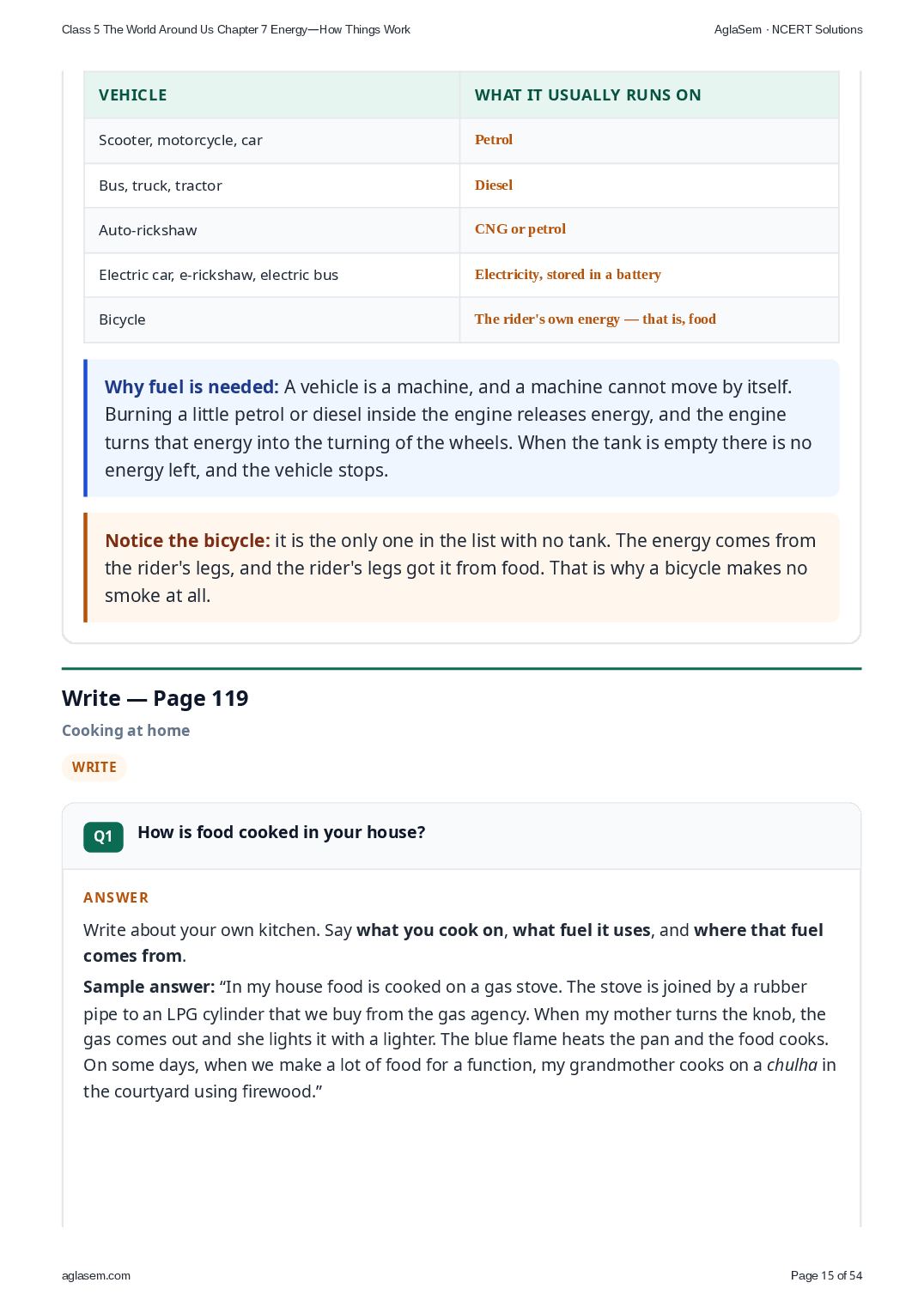
- We see vehicles move on our busy roads. What do cars and scooters need to keep running?
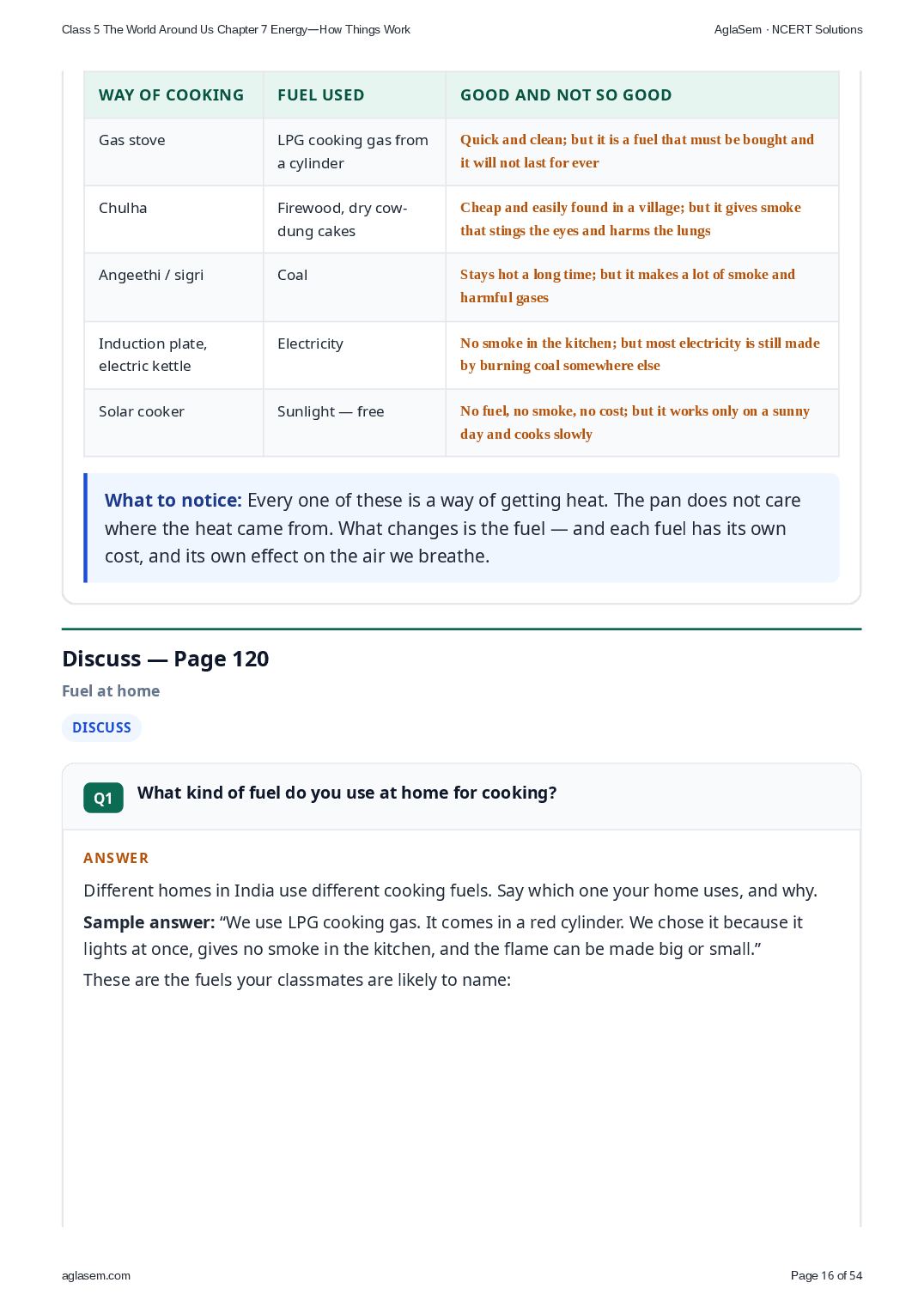
- How is food cooked in your house?
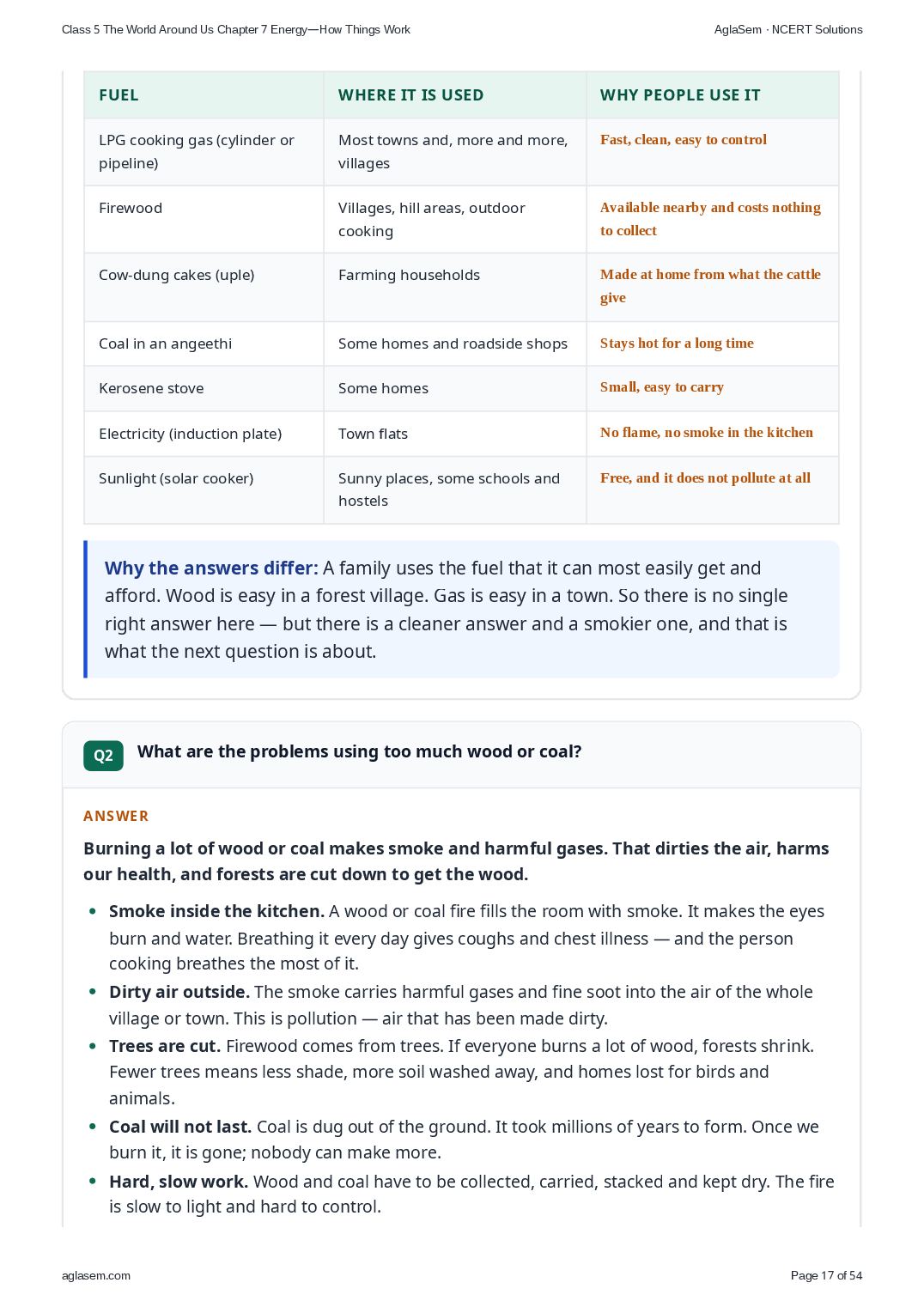
- What kind of fuel do you use at home for cooking?
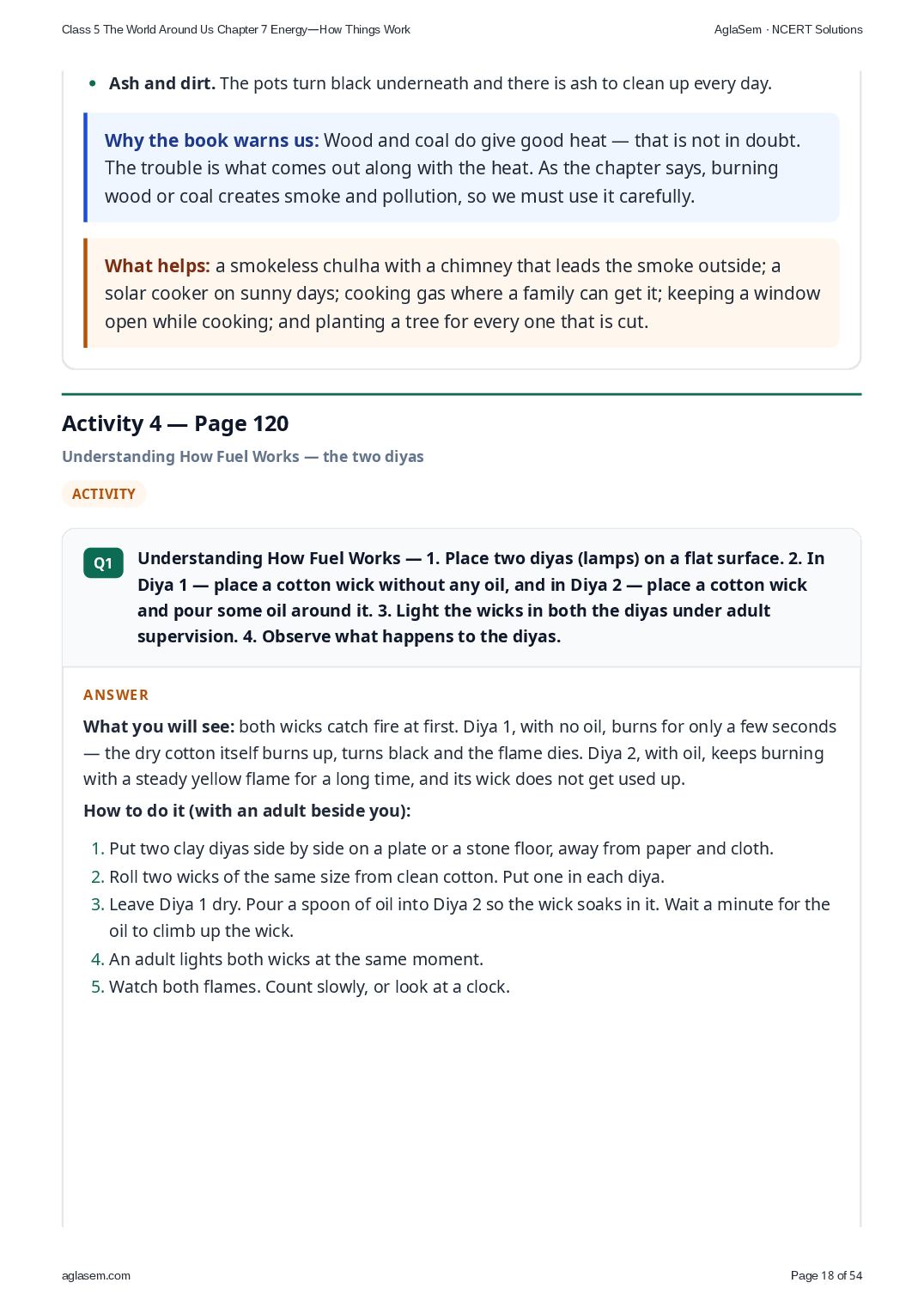
- What are the problems using too much wood or coal?
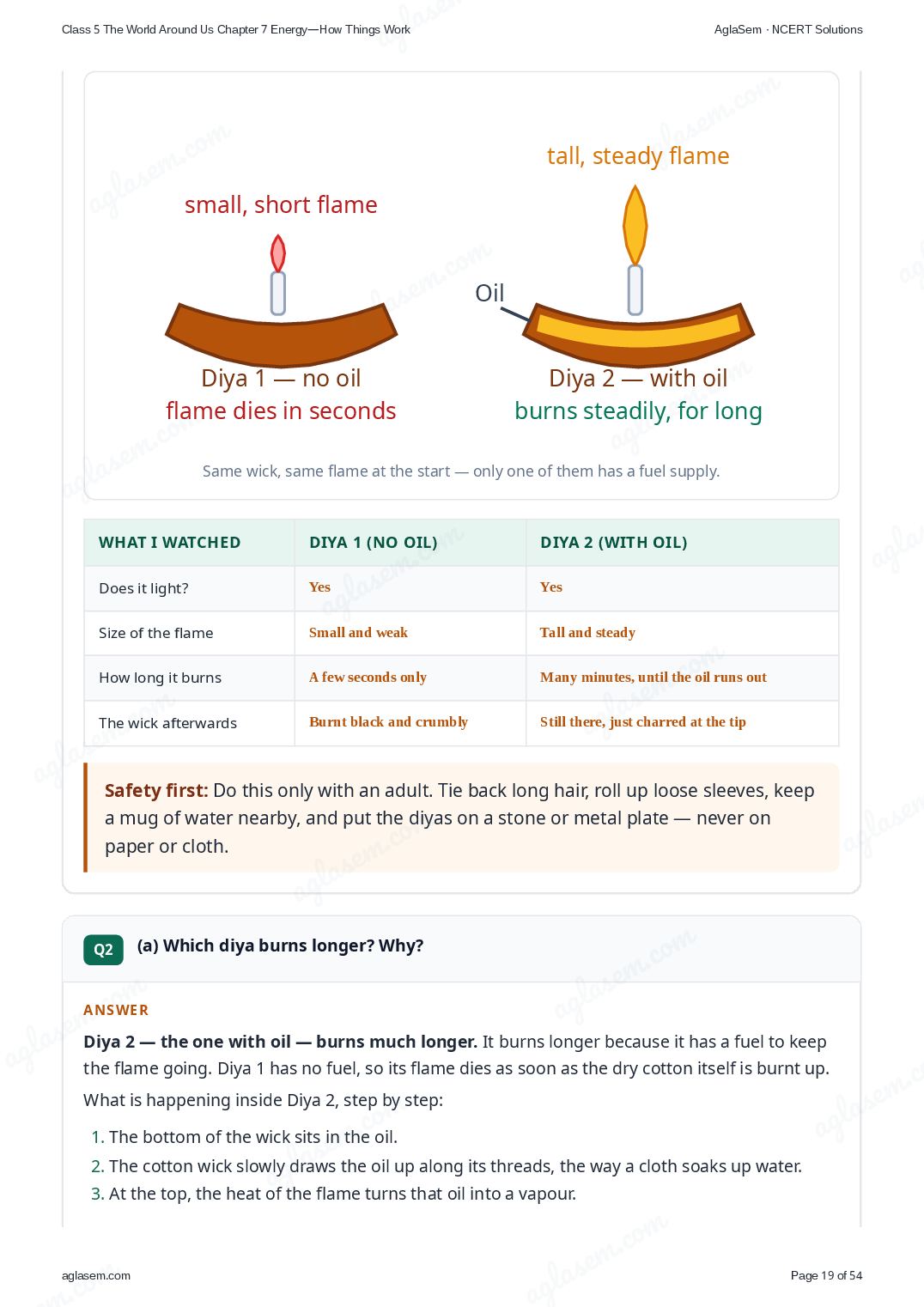
- Understanding How Fuel Works — 1. Place two diyas (lamps) on a flat surface. 2. In Diya 1 — place a cotton wick without any oil, and in Diya 2 — place a cotton wick and pour some oil around it. 3. Light the wicks in both the diyas under adult supervision. 4. Observe what happens to the diyas.
- (a) Which diya burns longer? Why?
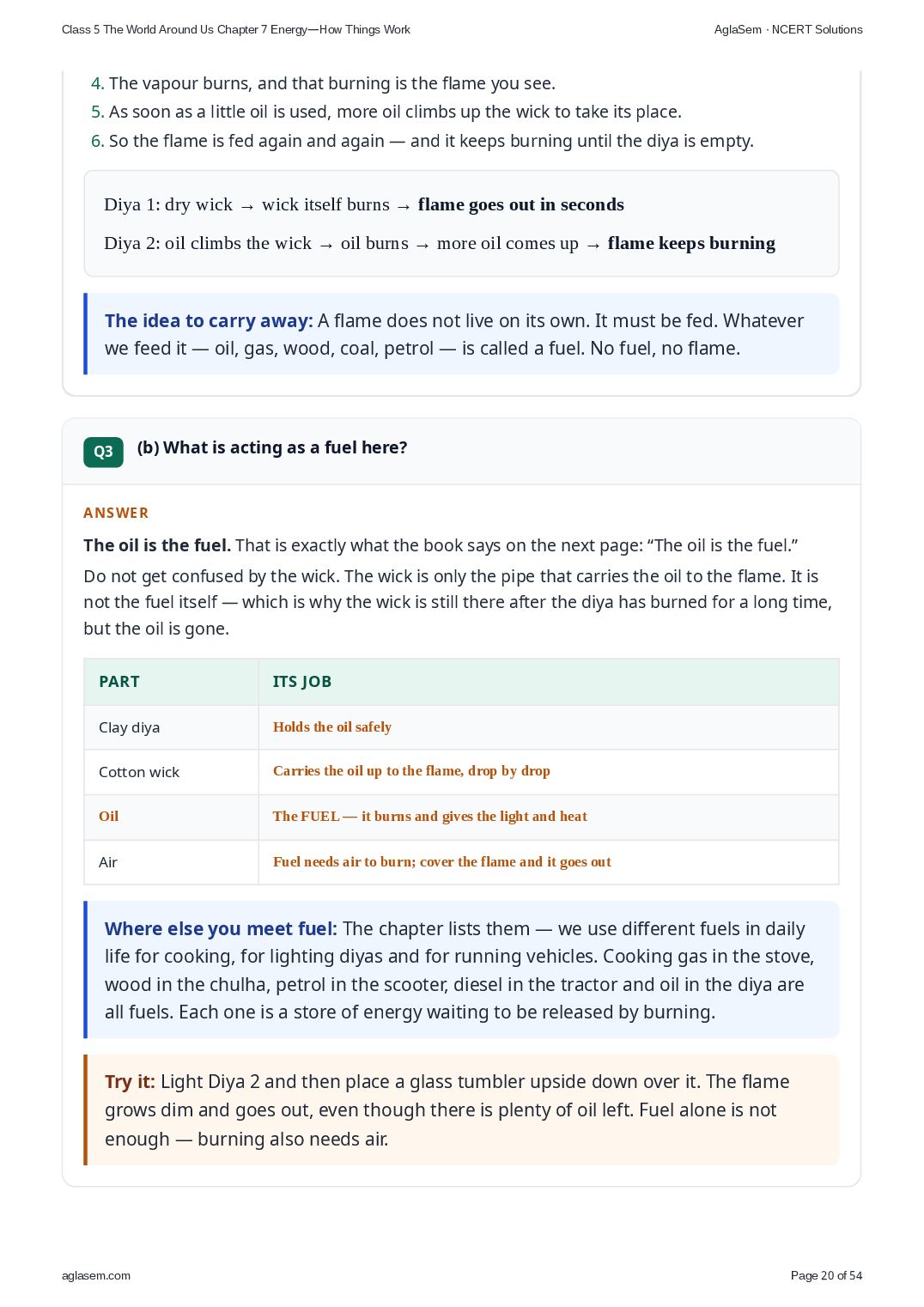
- (b) What is acting as a fuel here?
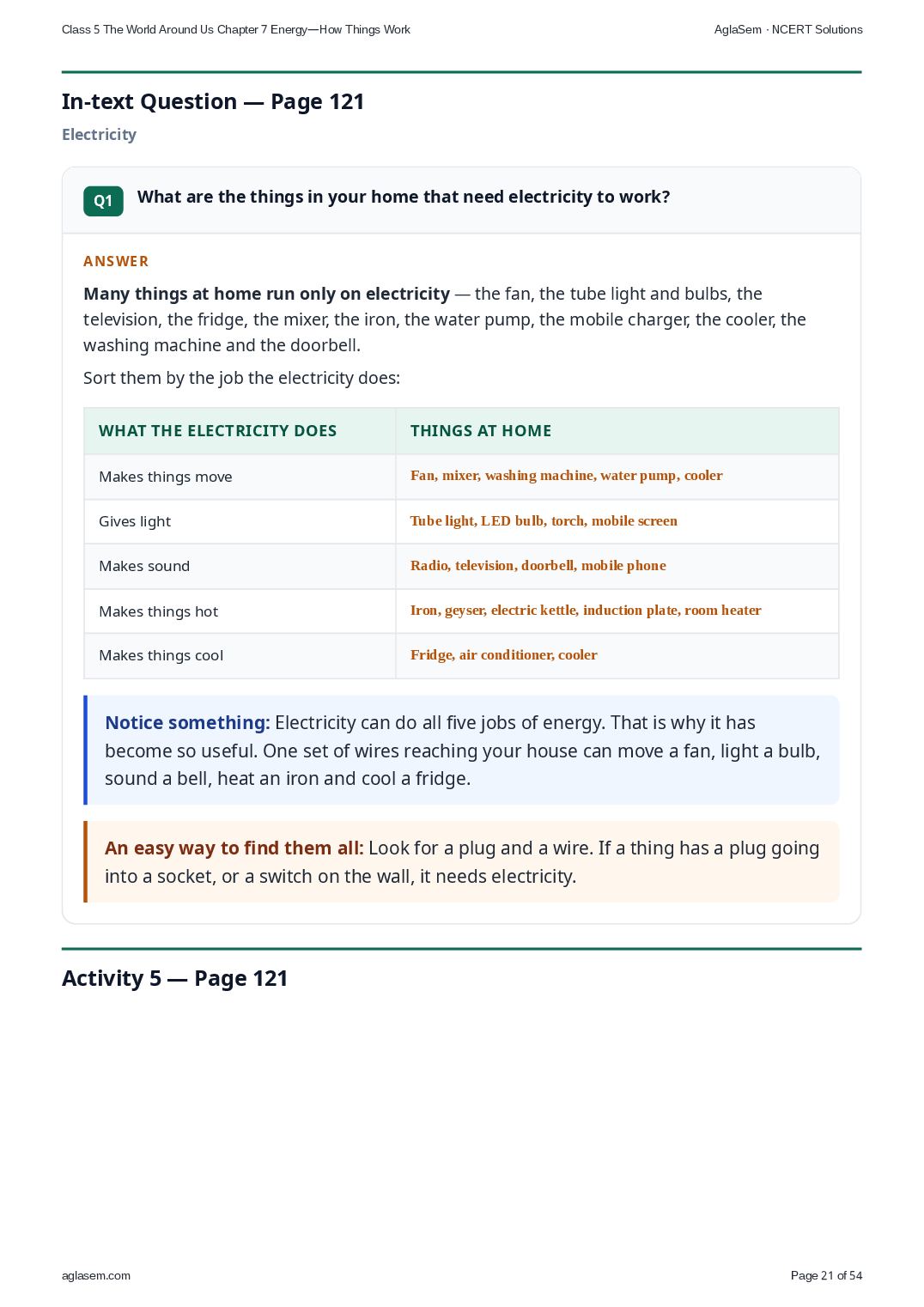
- What are the things in your home that need electricity to work?
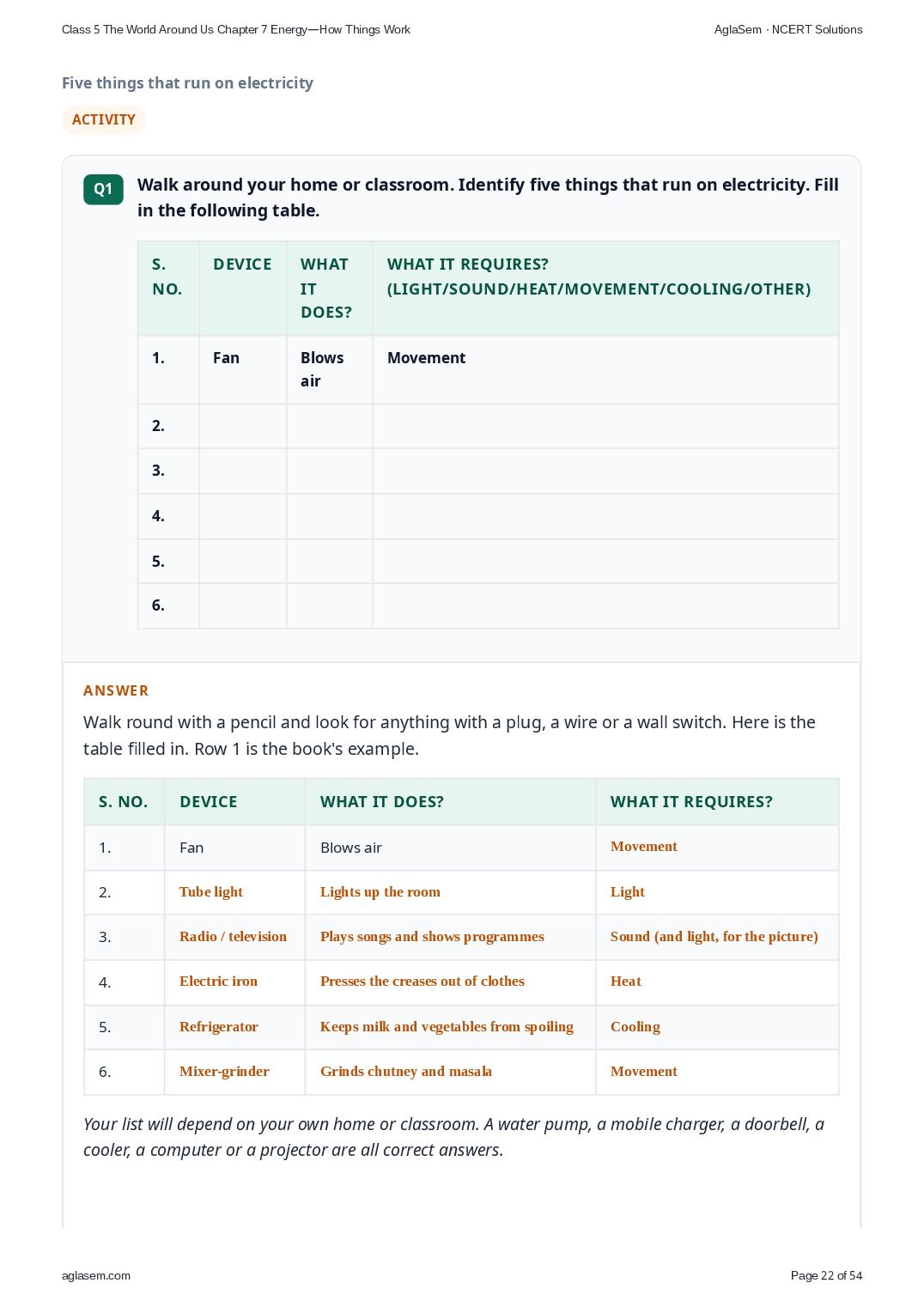
- Walk around your home or classroom. Identify five things that run on electricity. Fill in the following table.S. No.DeviceWhat it does?What it requires? (light/sound/heat/movement/cooling/other)1.FanBlows airMovement2.3.4.5.6.
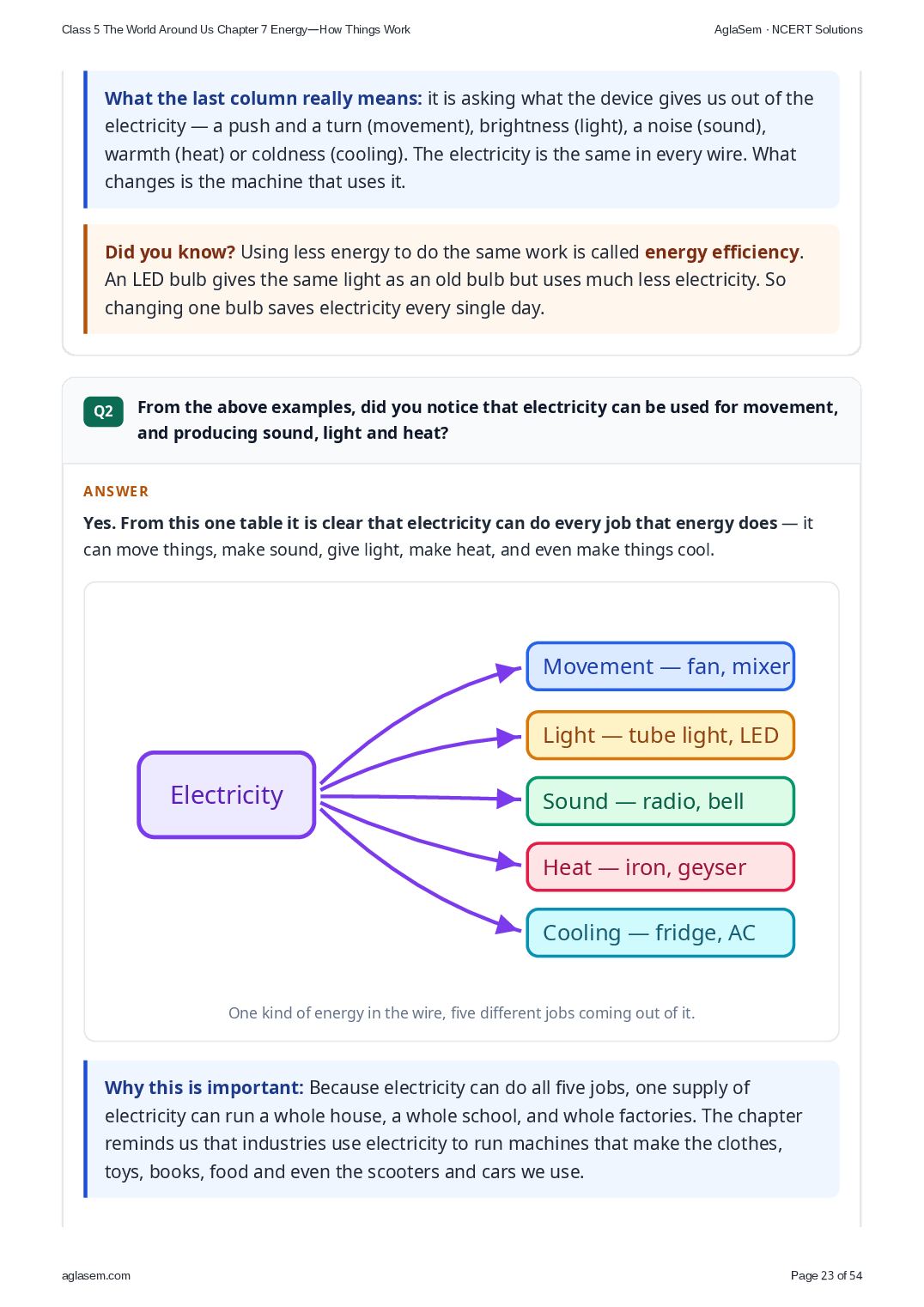
- From the above examples, did you notice that electricity can be used for movement, and producing sound, light and heat?
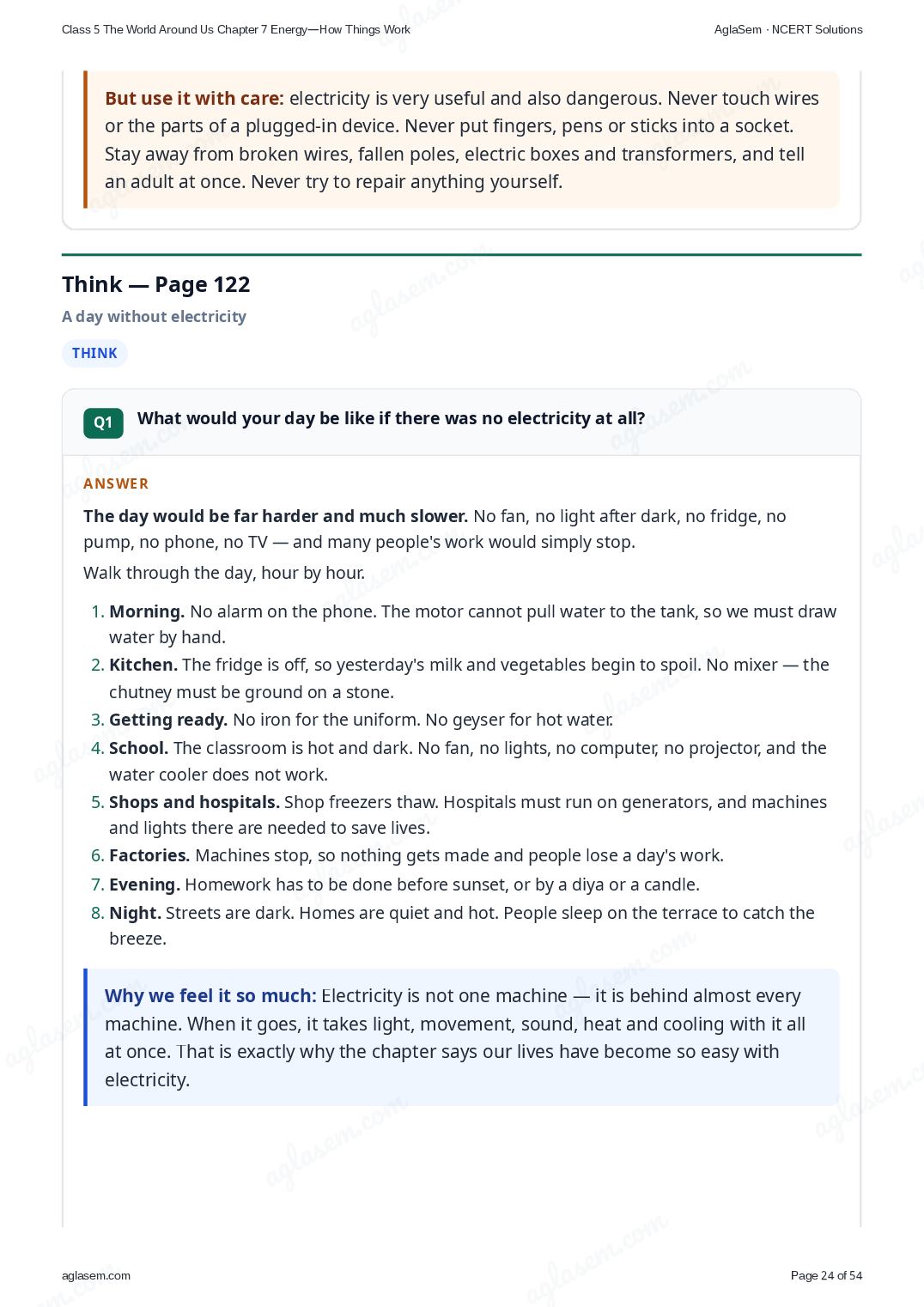
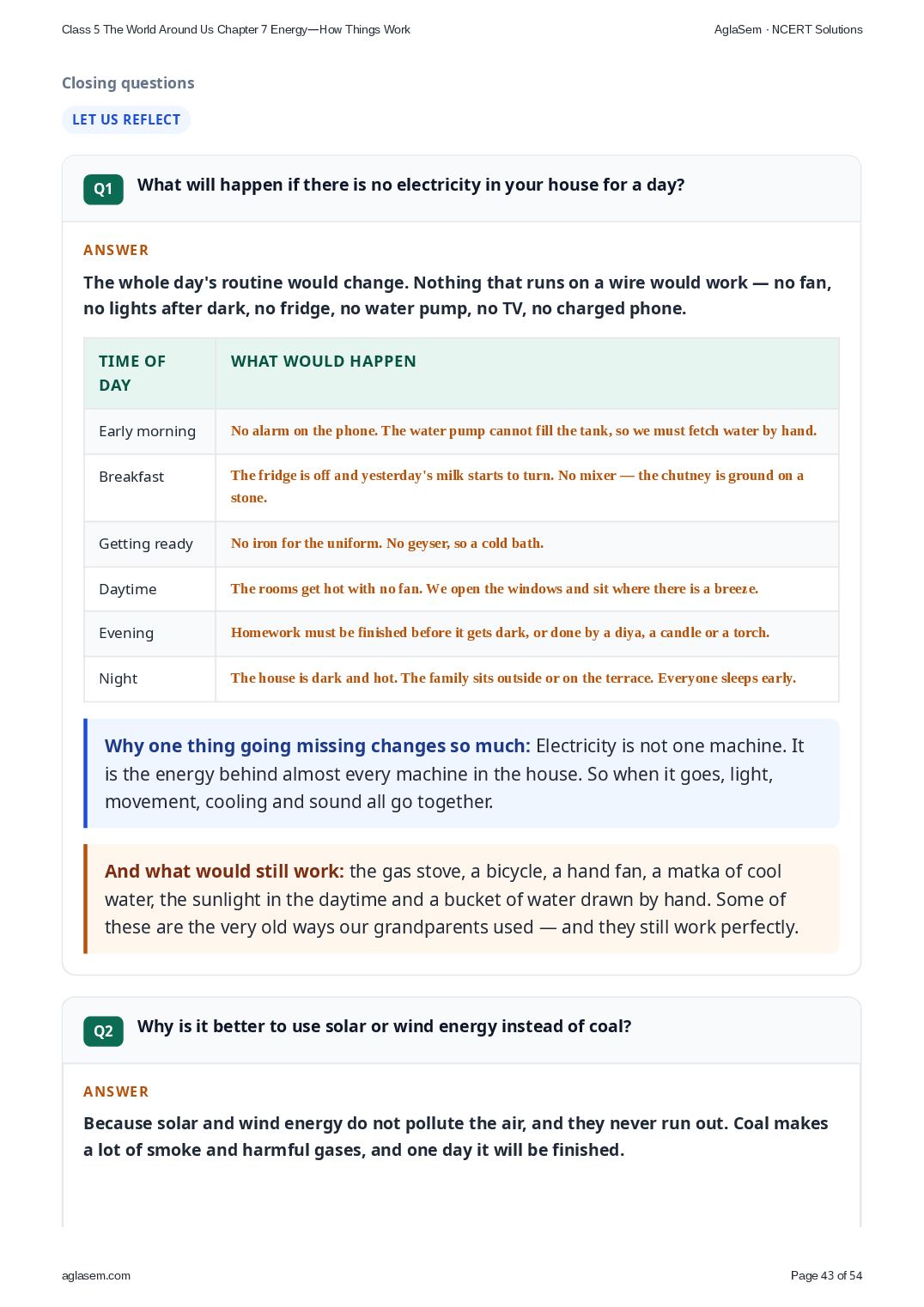
- What would your day be like if there was no electricity at all?
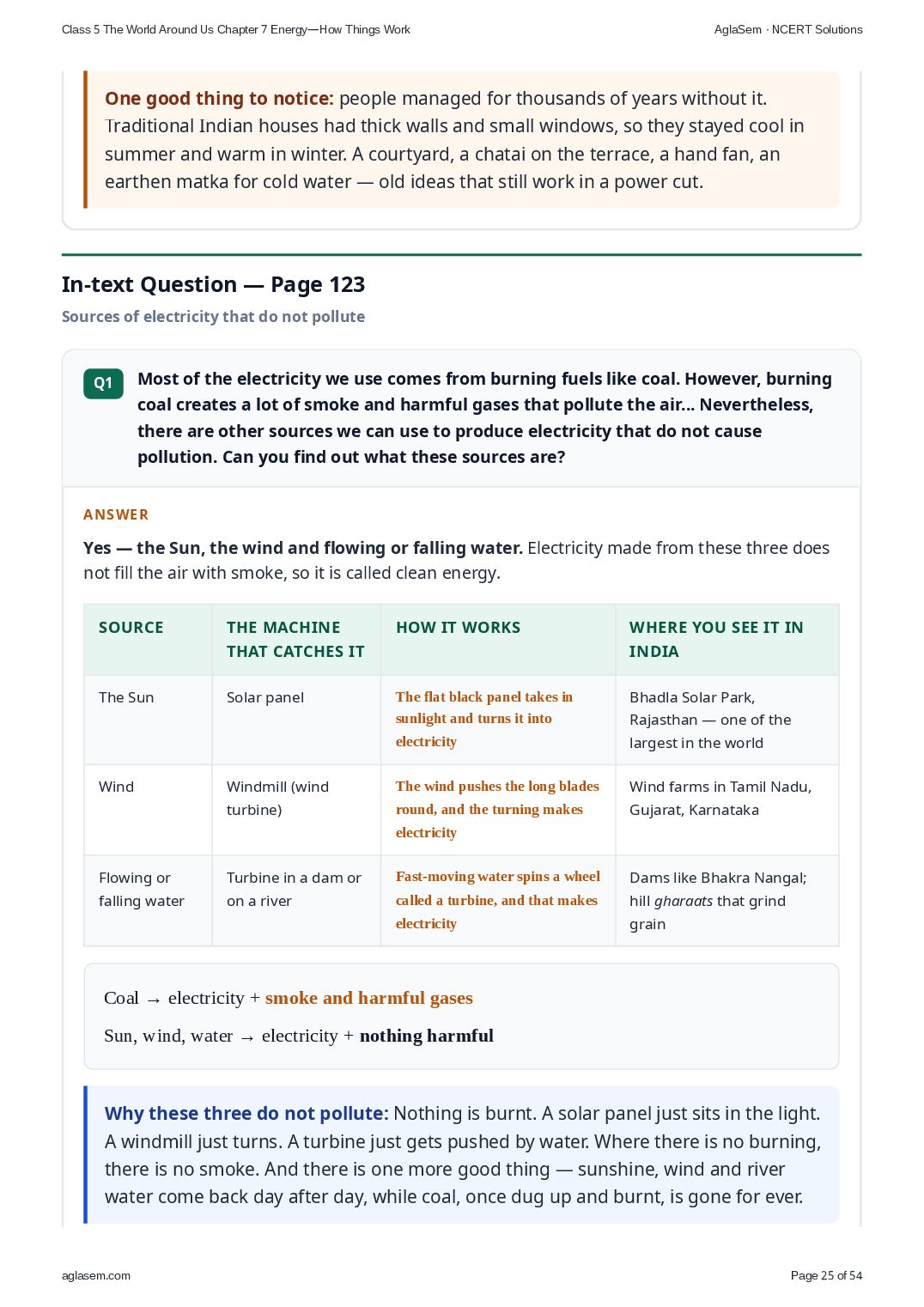
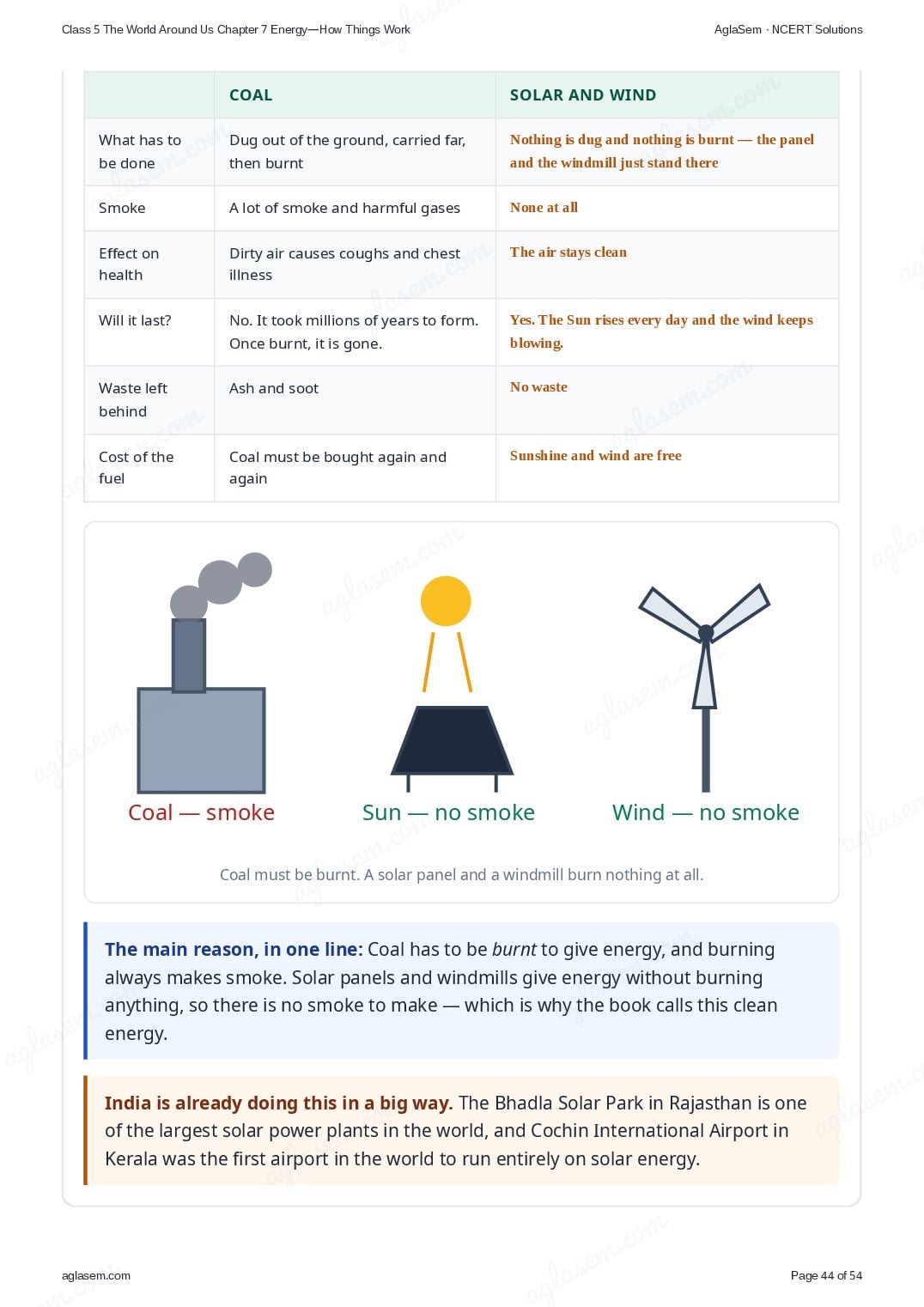
- Most of the electricity we use comes from burning fuels like coal. However, burning coal creates a lot of smoke and harmful gases that pollute the air… Nevertheless, there are other sources we can use to produce electricity that do not cause pollution. Can you find out what these sources are?
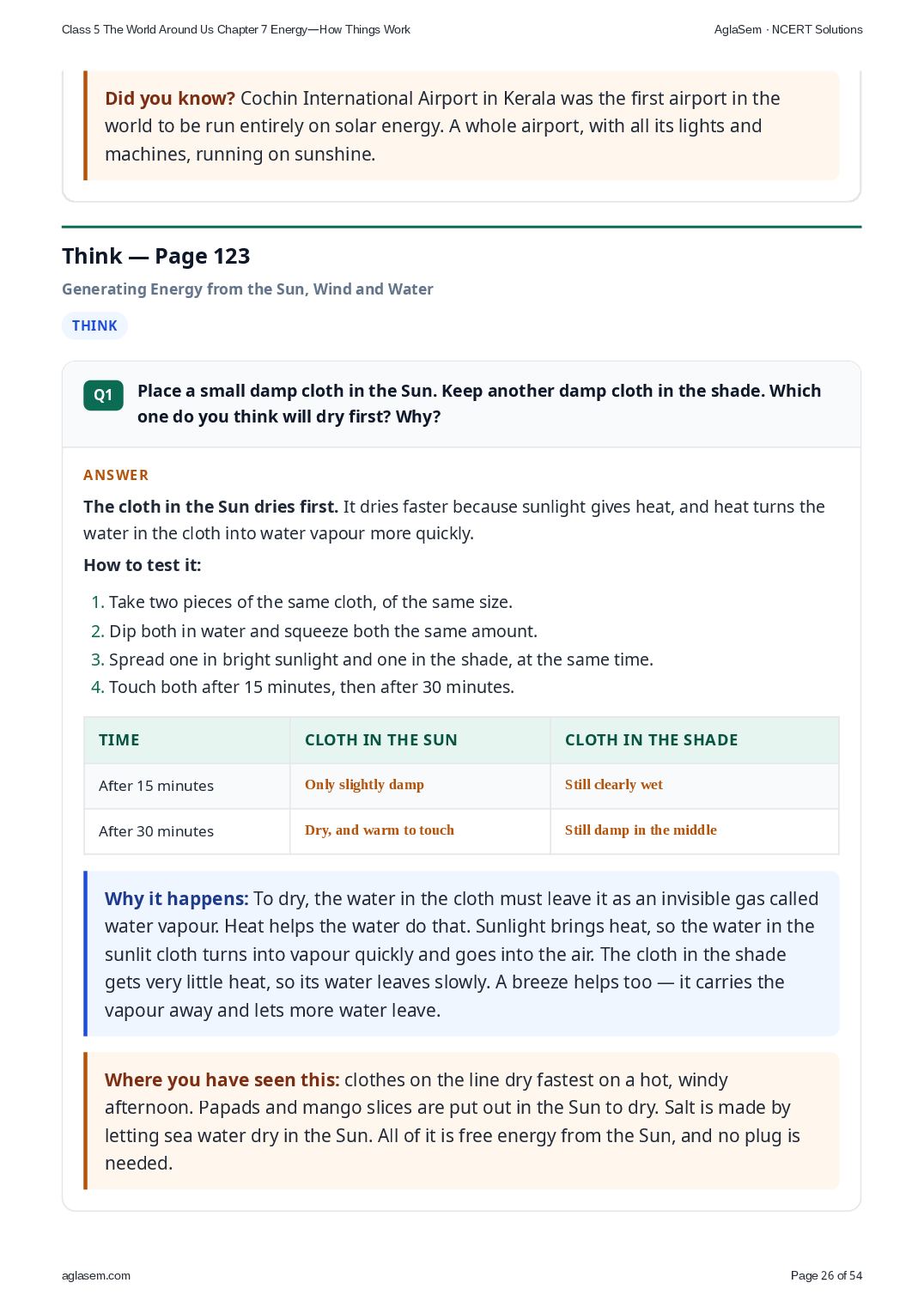
- Place a small damp cloth in the Sun. Keep another damp cloth in the shade. Which one do you think will dry first? Why?
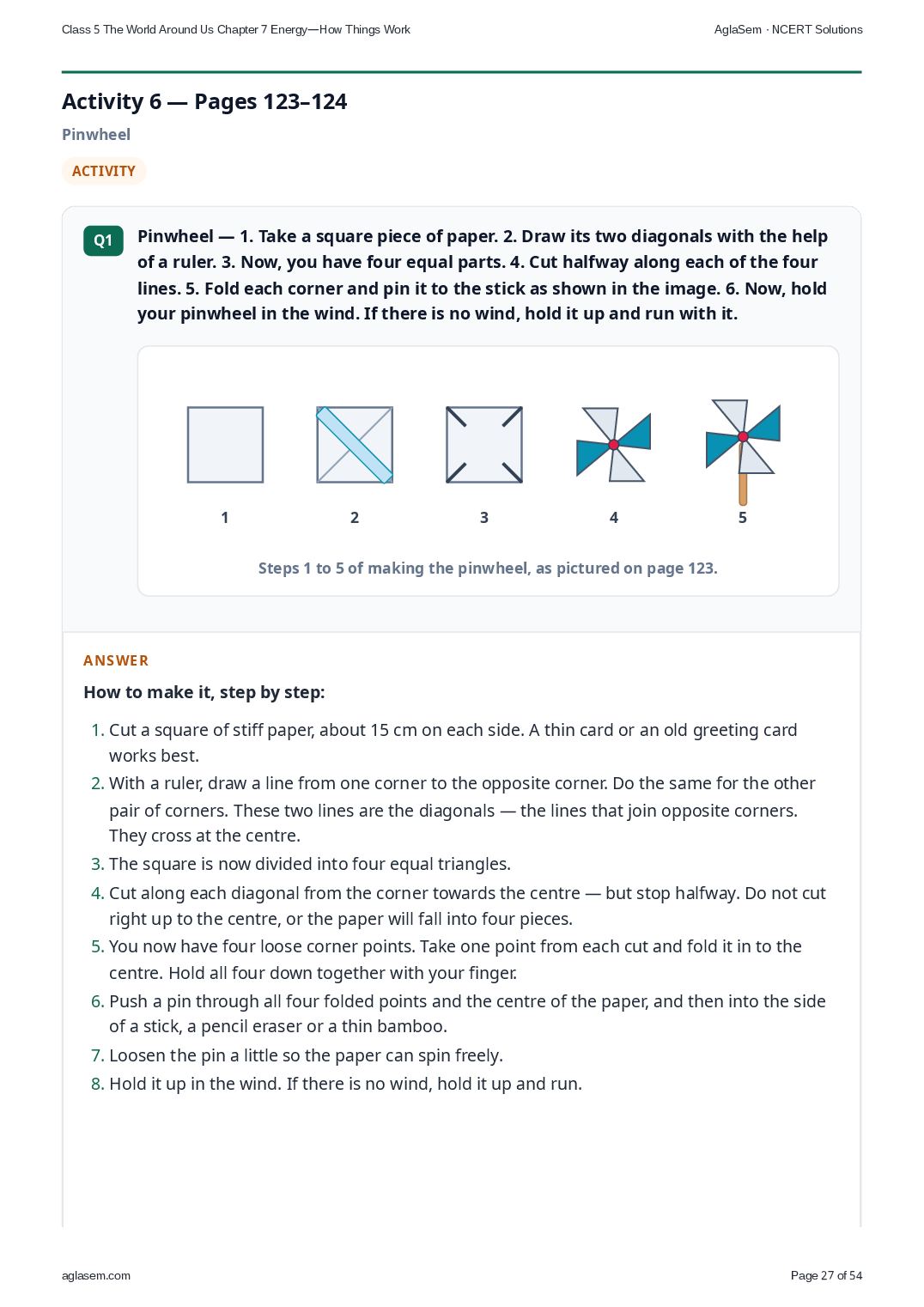
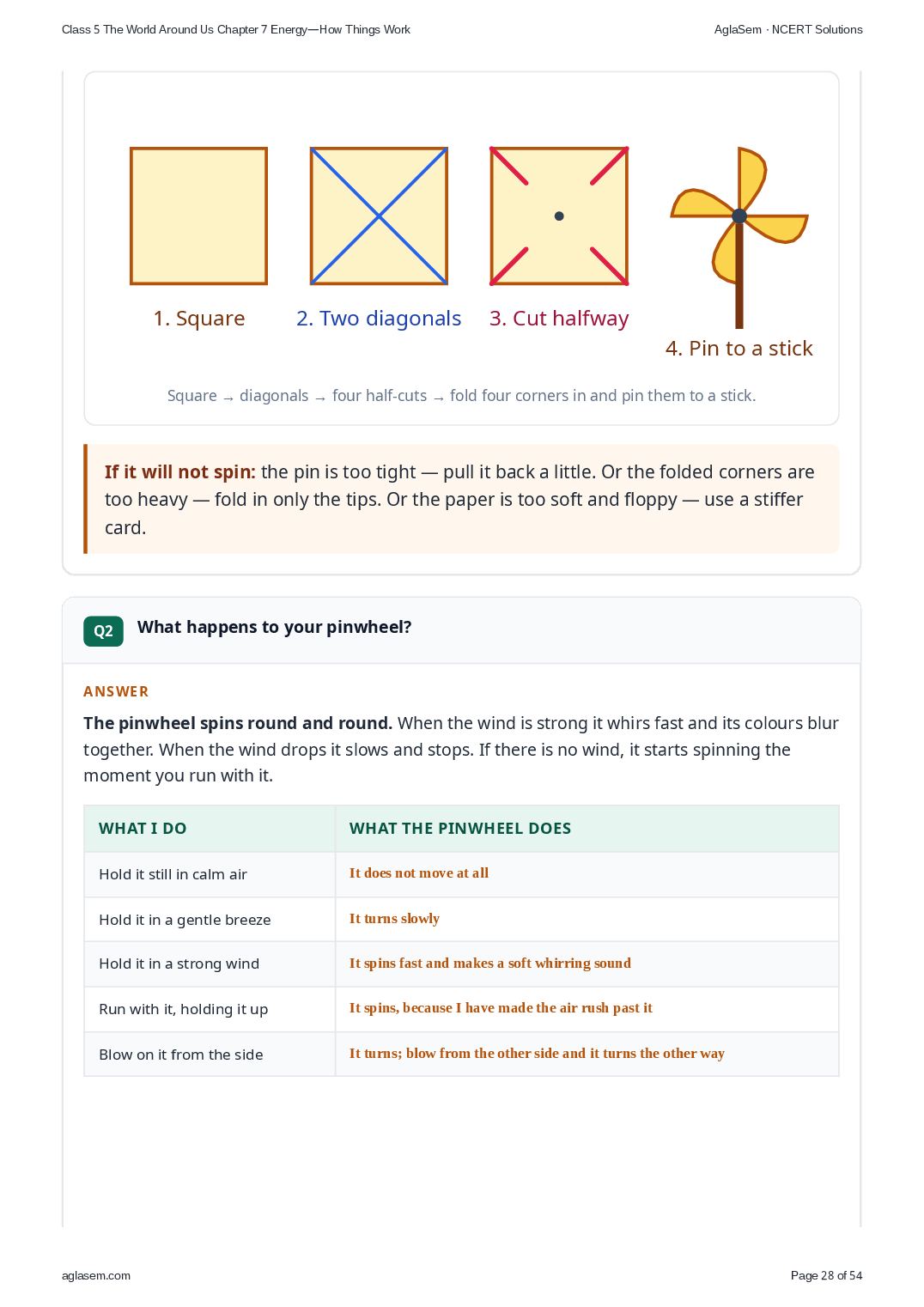
- Pinwheel — 1. Take a square piece of paper. 2. Draw its two diagonals with the help of a ruler. 3. Now, you have four equal parts. 4. Cut halfway along each of the four lines. 5. Fold each corner and pin it to the stick as shown in the image. 6. Now, hold your pinwheel in the wind. If there is no wind, hold it up and run with it.12345Steps 1 to 5 of making the pinwheel, as pictured on page 123.
- What happens to your pinwheel?
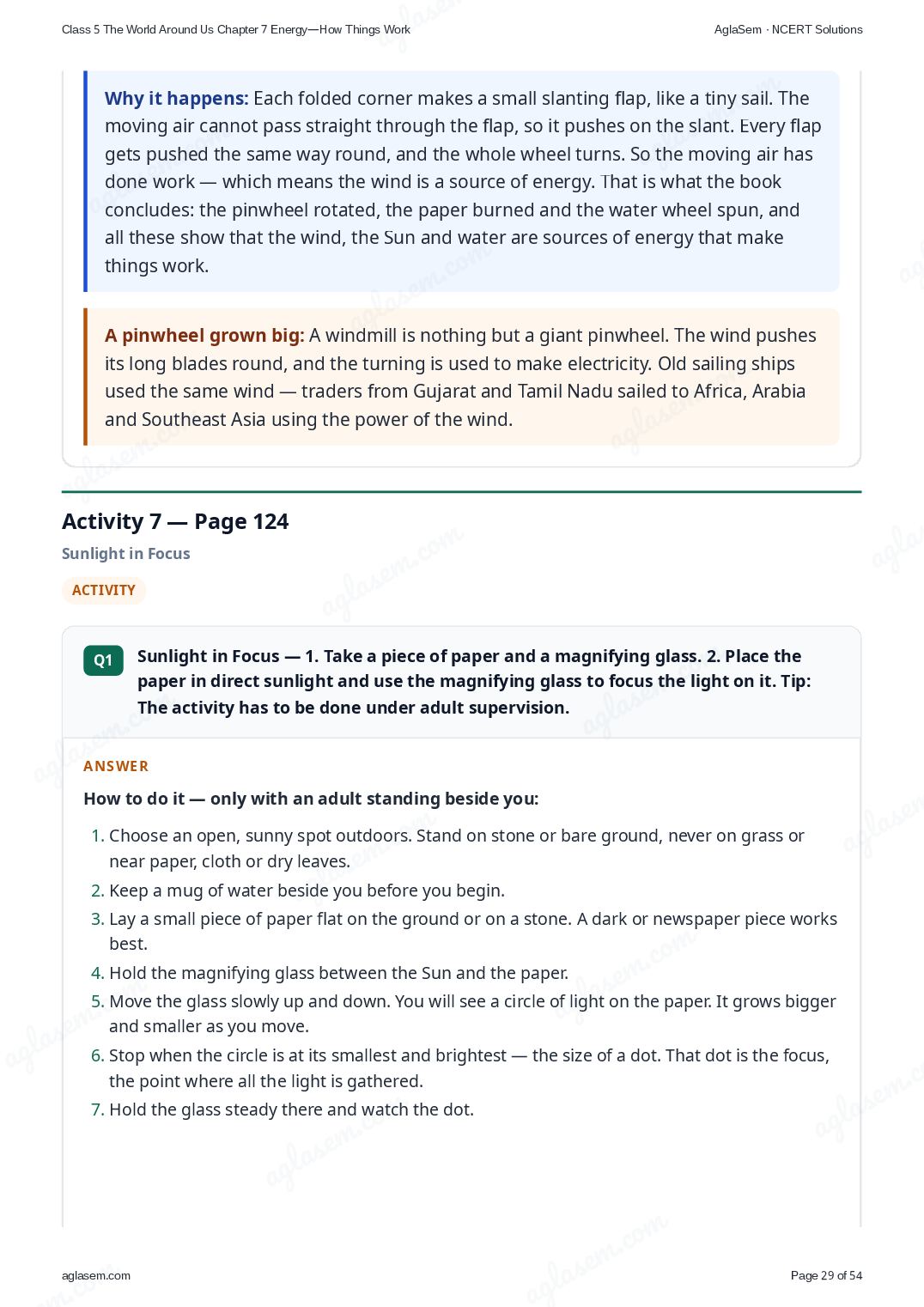
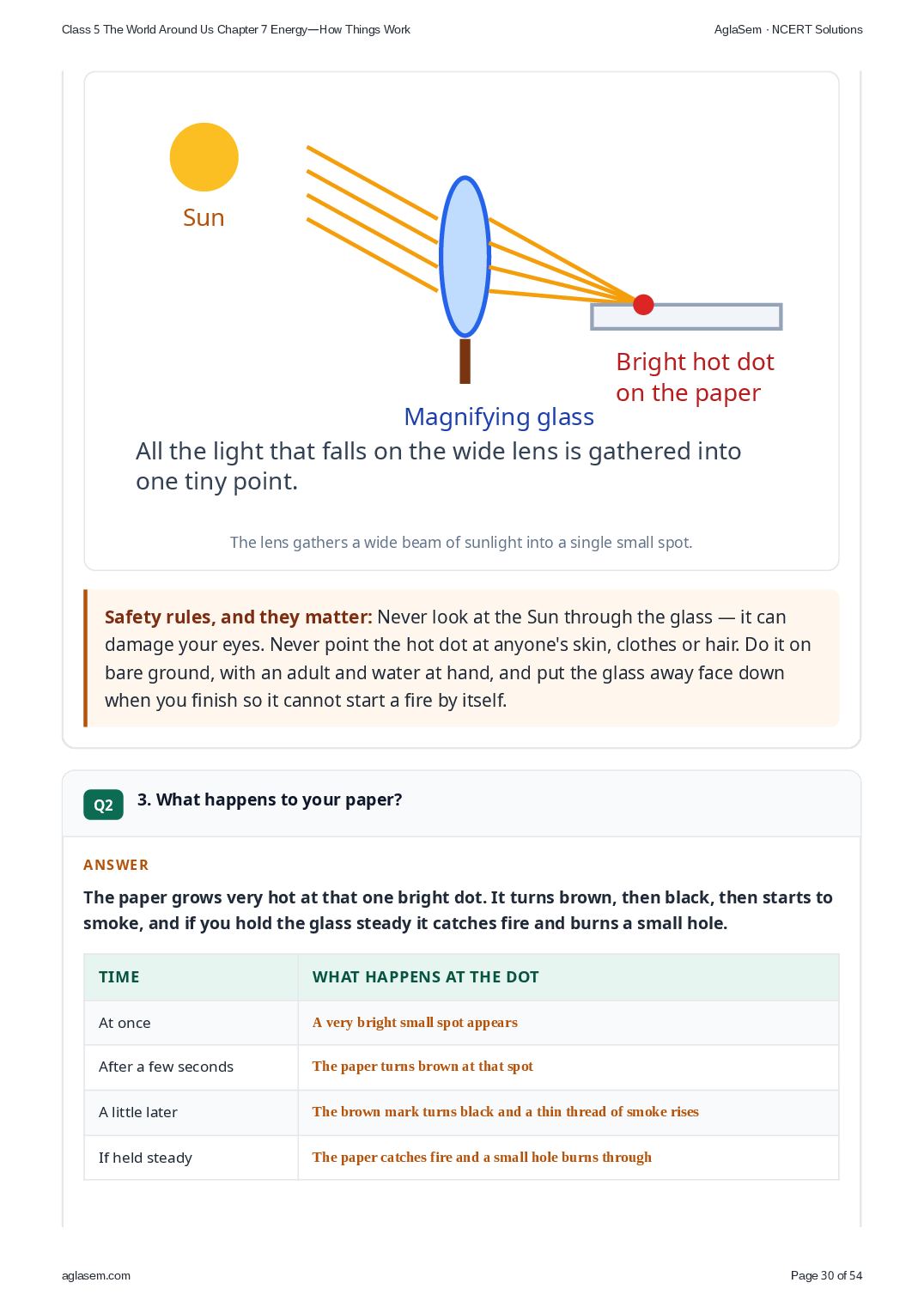
- Sunlight in Focus — 1. Take a piece of paper and a magnifying glass. 2. Place the paper in direct sunlight and use the magnifying glass to focus the light on it. Tip: The activity has to be done under adult supervision.
- 3. What happens to your paper?
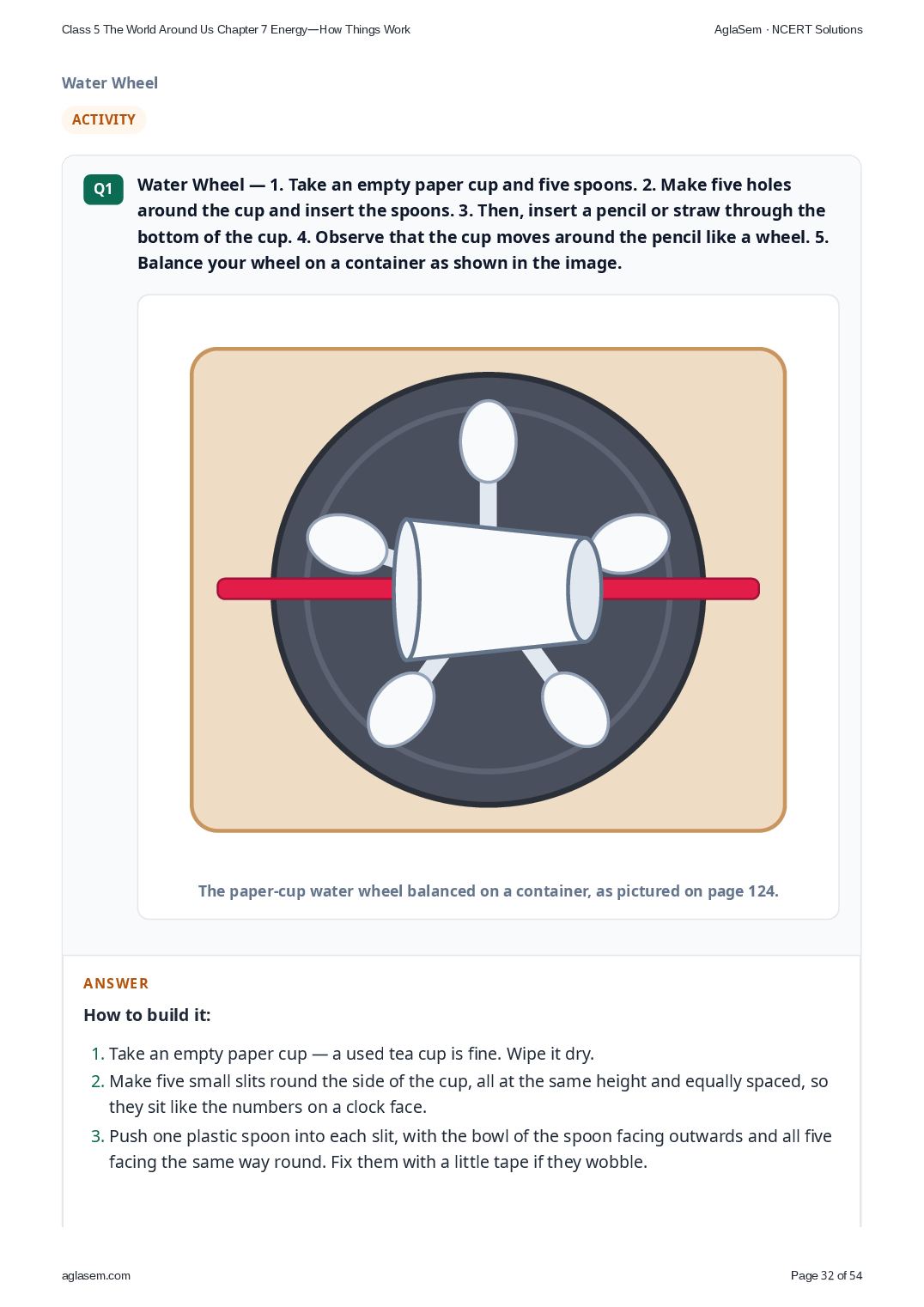
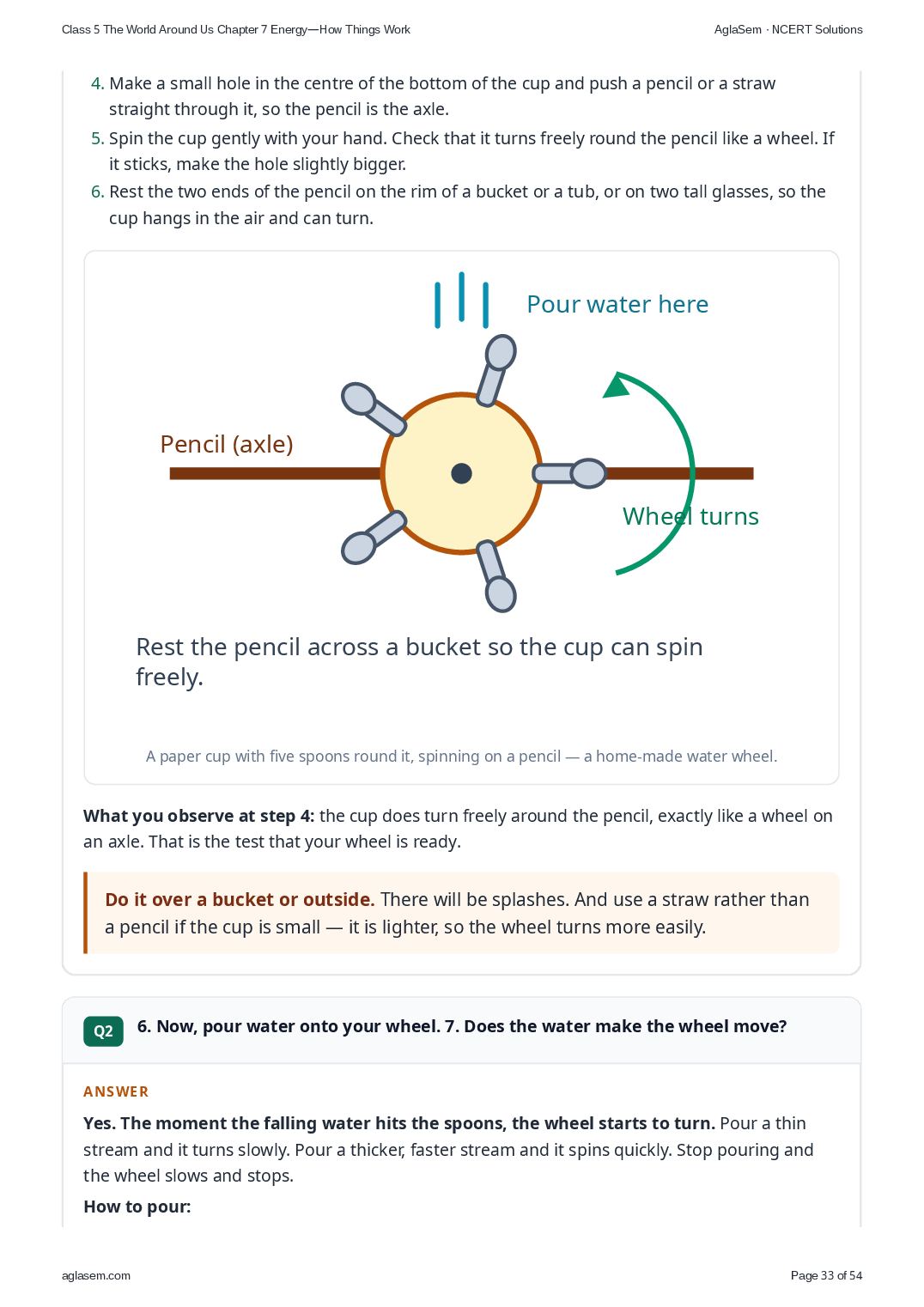
- Water Wheel — 1. Take an empty paper cup and five spoons. 2. Make five holes around the cup and insert the spoons. 3. Then, insert a pencil or straw through the bottom of the cup. 4. Observe that the cup moves around the pencil like a wheel. 5. Balance your wheel on a container as shown in the image.The paper-cup water wheel balanced on a container, as pictured on page 124.
- 6. Now, pour water onto your wheel. 7. Does the water make the wheel move?
- Have you ever seen papads being dried in the sunlight and clothes hung out to dry?
- Can you think of more examples where we use the Sun, the wind or the flowing water?
- Did you know that even our vehicles can run on electricity?
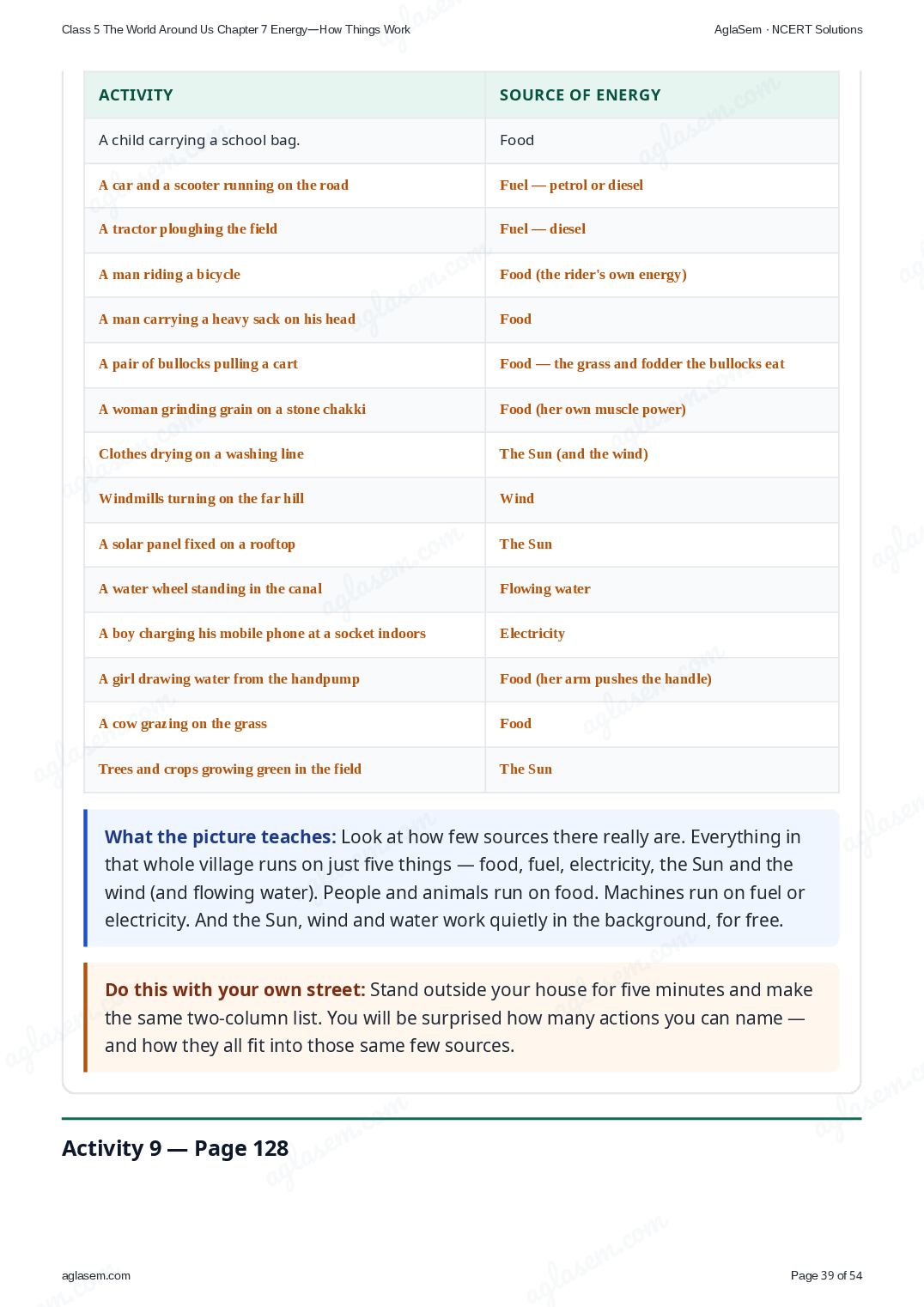
- Energy All Around Us — List actions that you see in the picture above and fill in the following table.The village picture on page 127 — redrawn.ActivitySource of EnergyA child carrying a school bag.Food
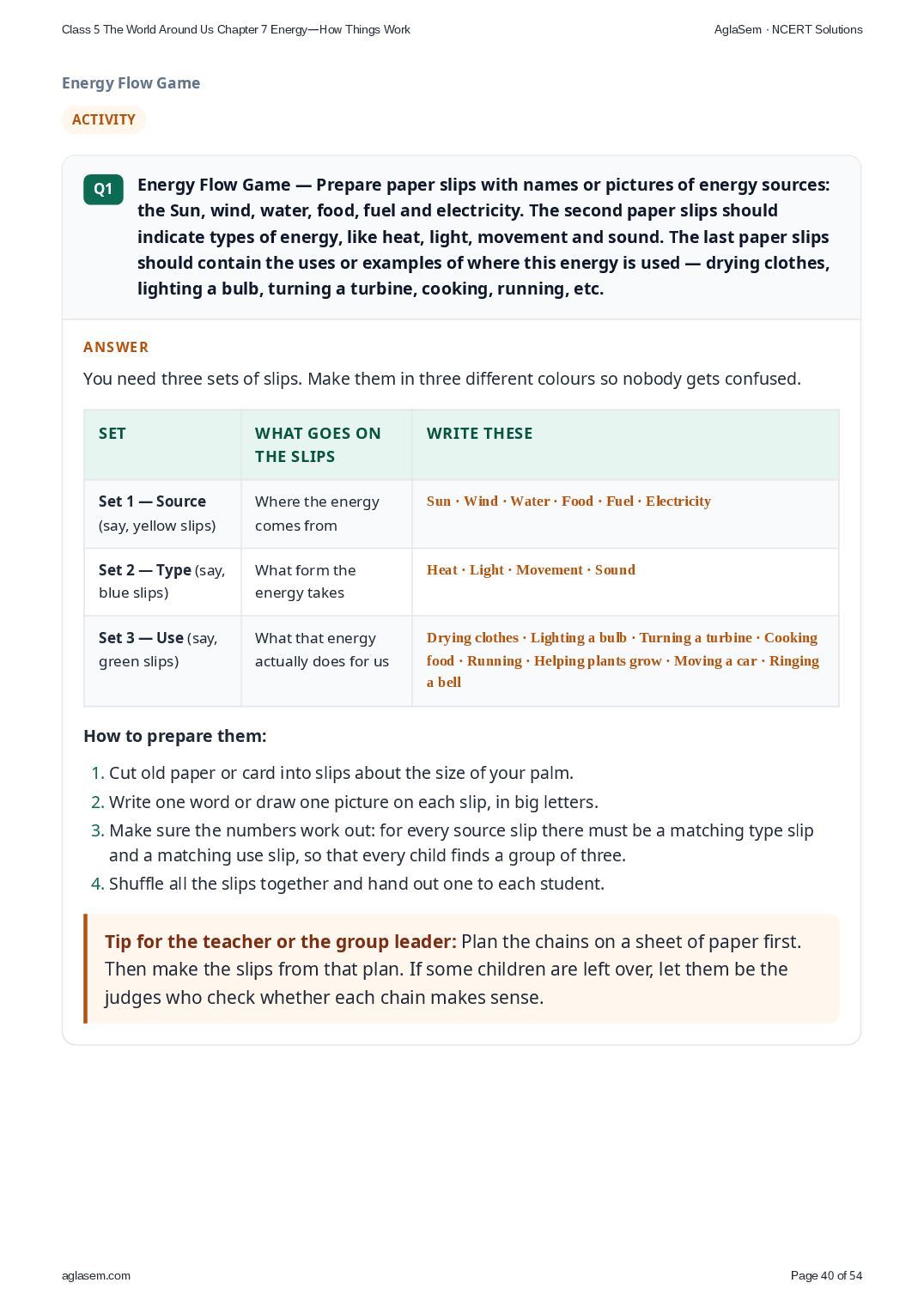
- Energy Flow Game — Prepare paper slips with names or pictures of energy sources: the Sun, wind, water, food, fuel and electricity. The second paper slips should indicate types of energy, like heat, light, movement and sound. The last paper slips should contain the uses or examples of where this energy is used — drying clothes, lighting a bulb, turning a turbine, cooking, running, etc.
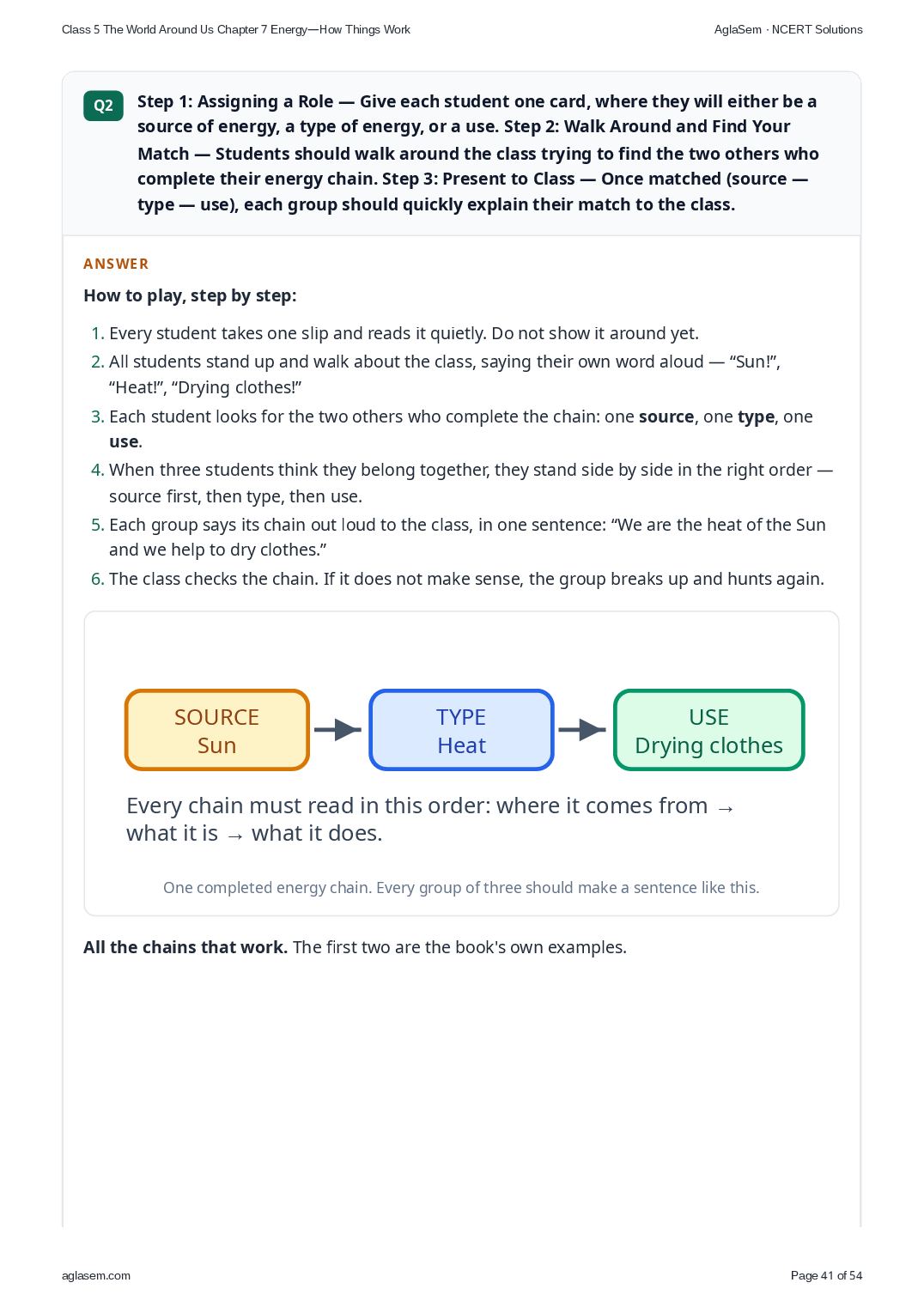
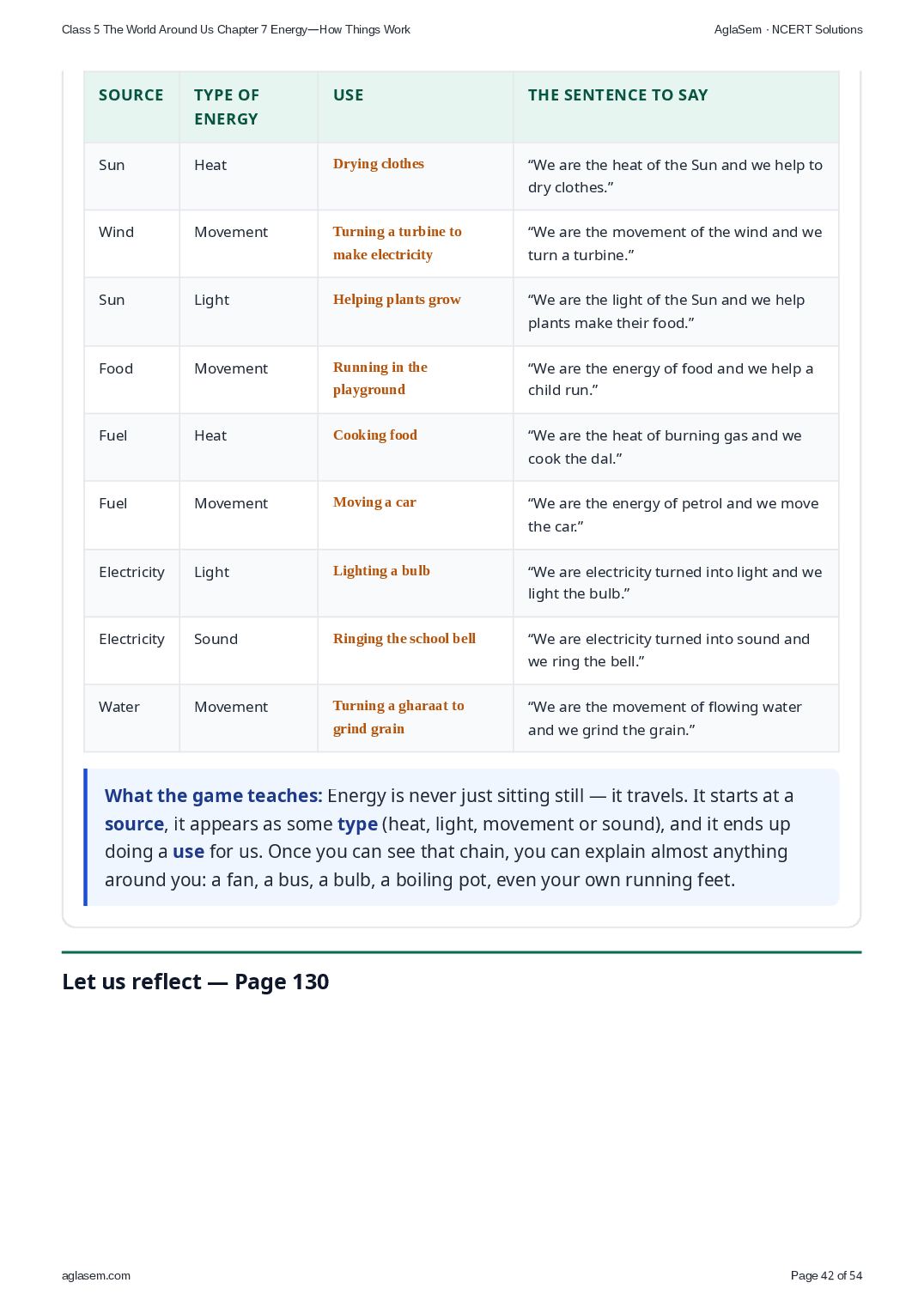
- Step 1: Assigning a Role — Give each student one card, where they will either be a source of energy, a type of energy, or a use. Step 2: Walk Around and Find Your Match — Students should walk around the class trying to find the two others who complete their energy chain. Step 3: Present to Class — Once matched (source — type — use), each group should quickly explain their match to the class.
- What will happen if there is no electricity in your house for a day?
- Why is it better to use solar or wind energy instead of coal?
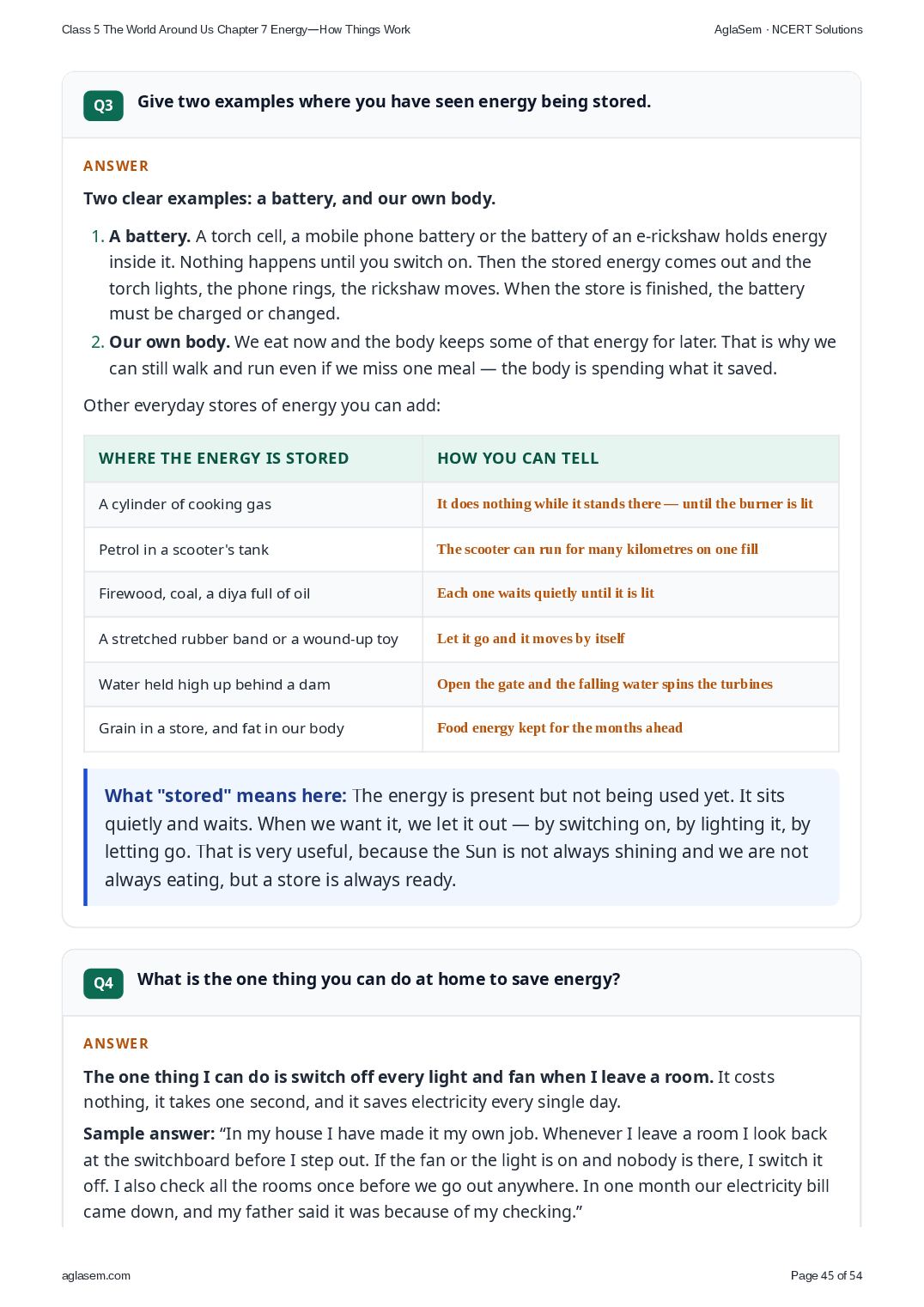
- Give two examples where you have seen energy being stored.
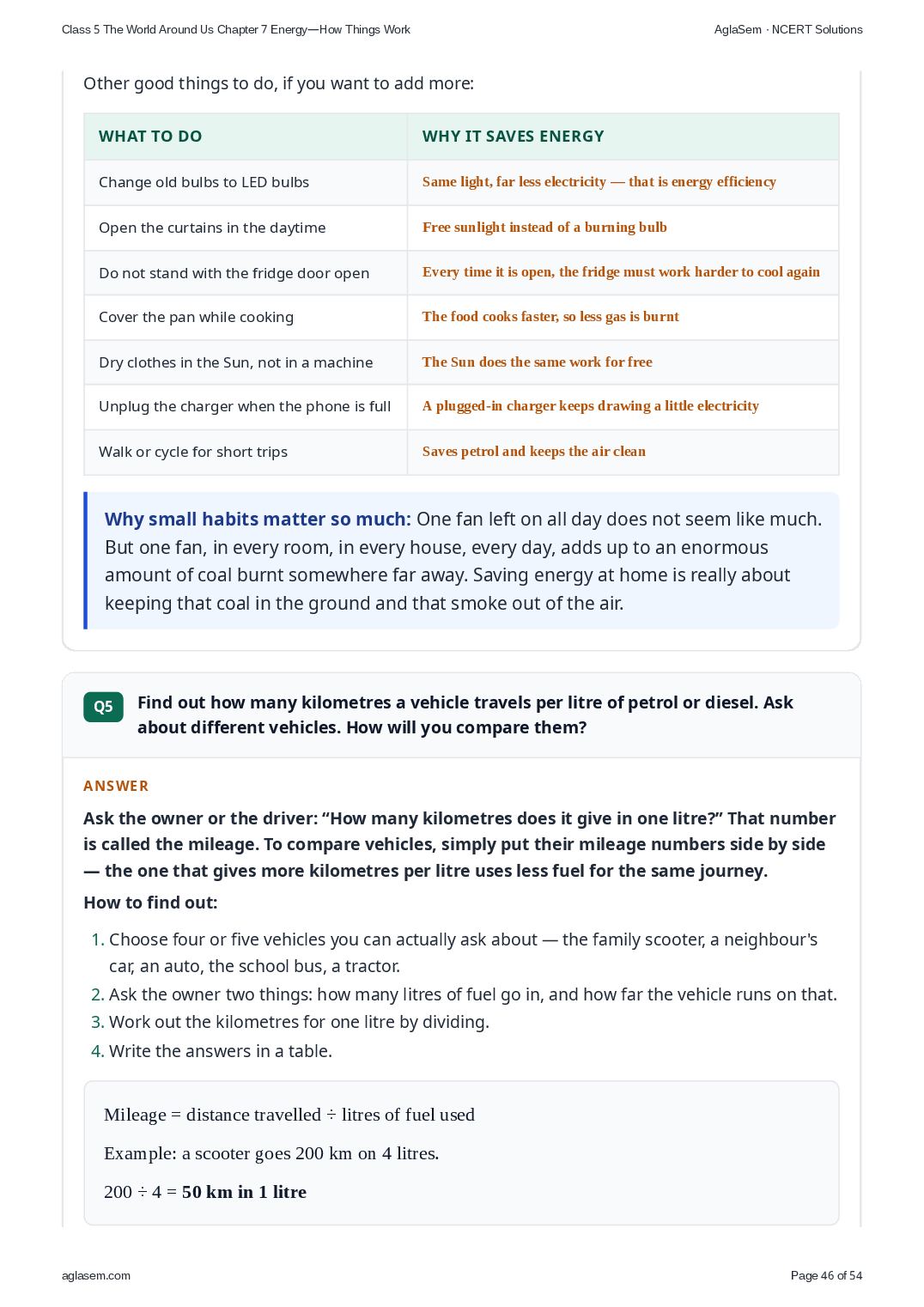
- What is the one thing you can do at home to save energy?
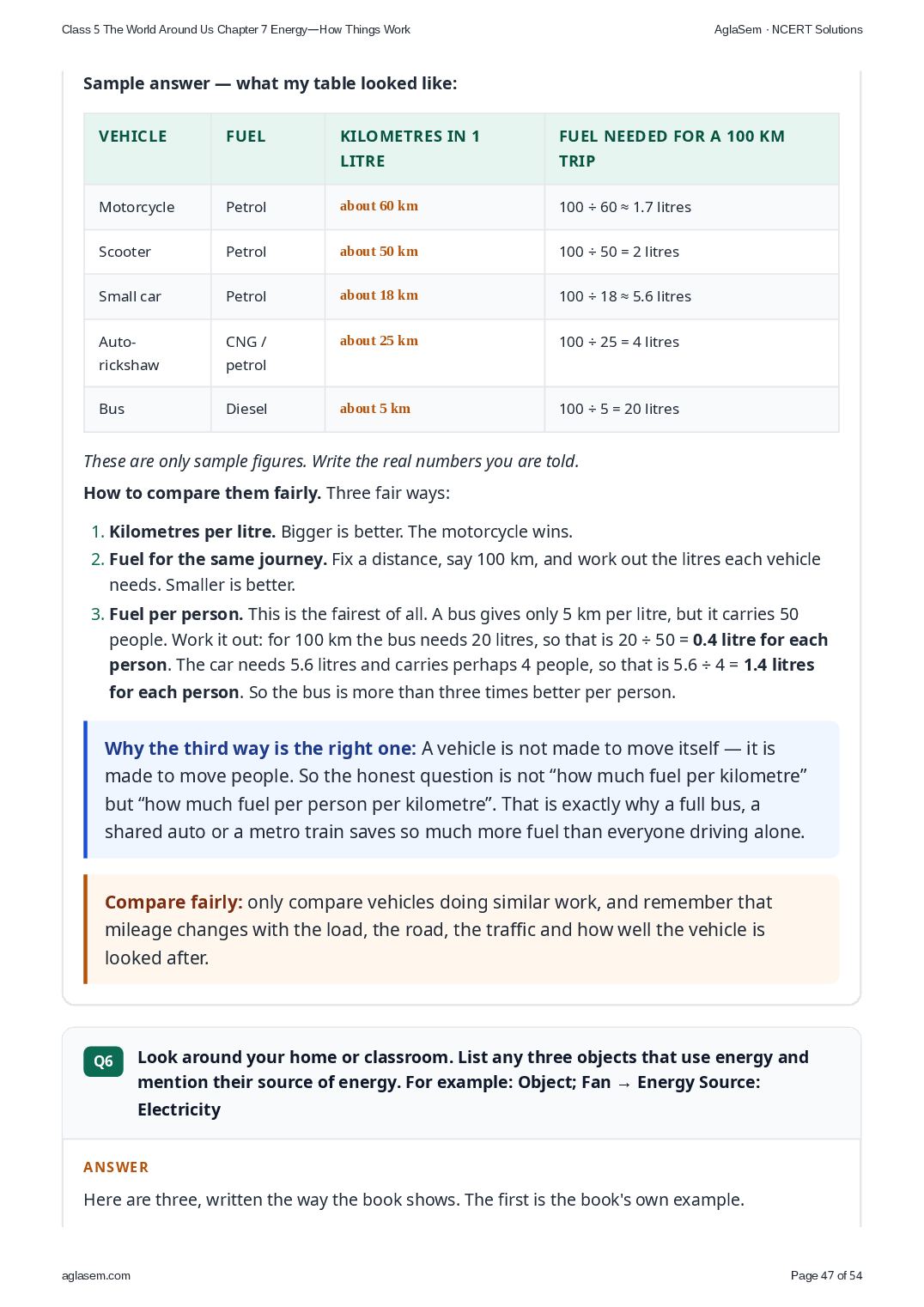
- Find out how many kilometres a vehicle travels per litre of petrol or diesel. Ask about different vehicles. How will you compare them?
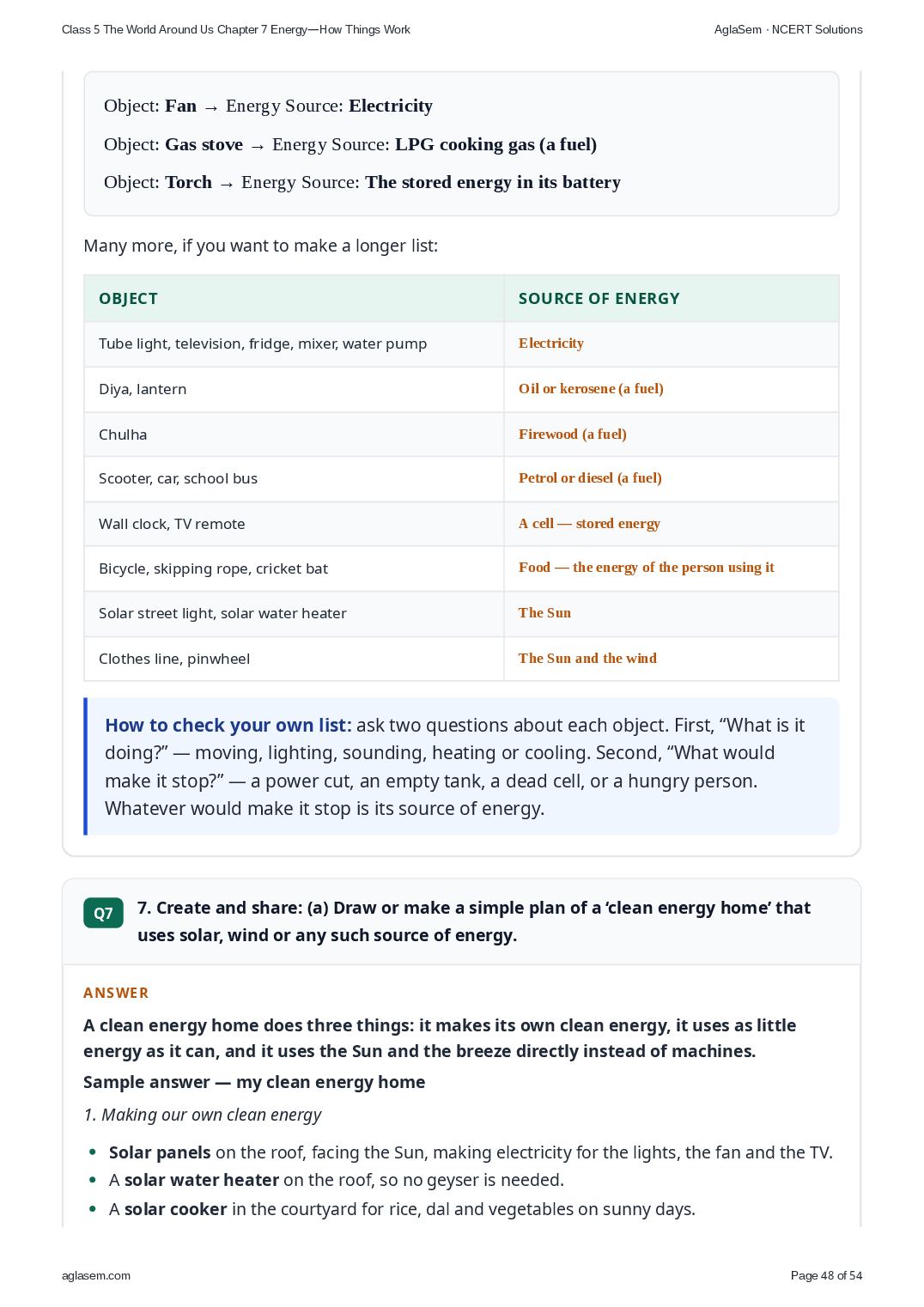
- Look around your home or classroom. List any three objects that use energy and mention their source of energy. For example: Object; Fan → Energy Source: Electricity
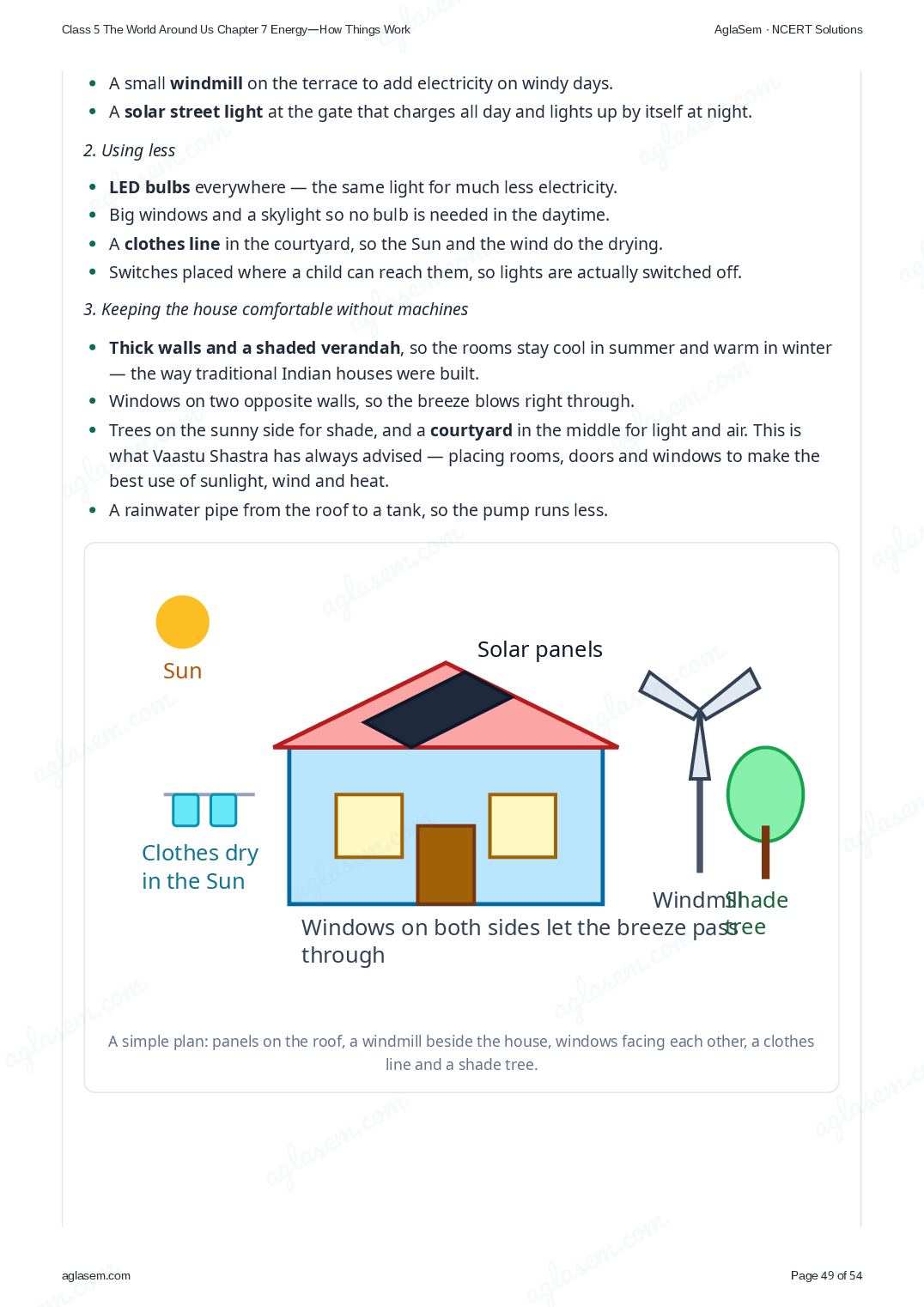
- 7. Create and share: (a) Draw or make a simple plan of a ‘clean energy home’ that uses solar, wind or any such source of energy.
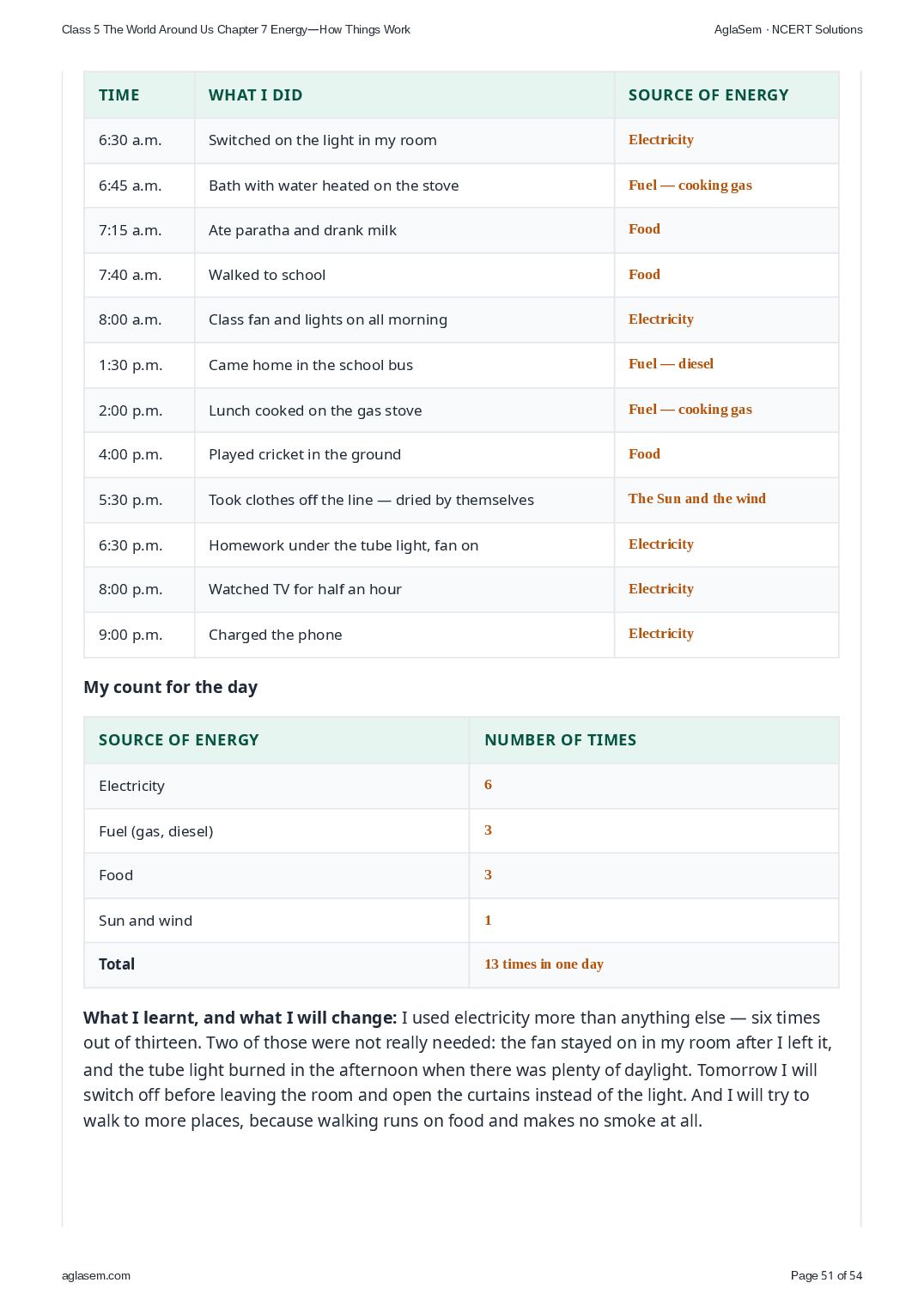
- 7. Create and share: (b) Make ‘my energy diary’ for one day, record the number of times you have used the electricity fuel and so on.
Chapter at a Glance
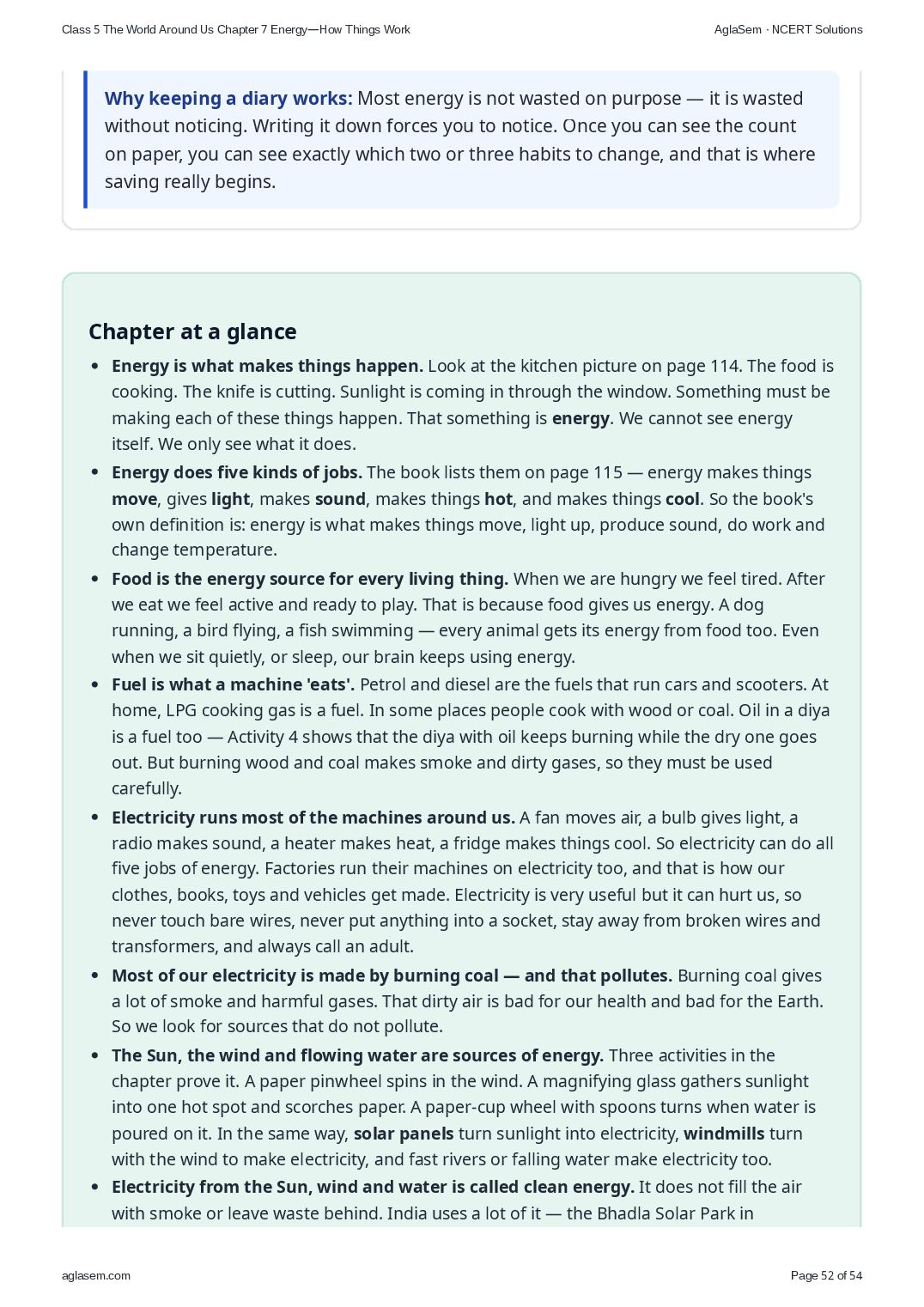
- Energy is what makes things happen. Look at the kitchen picture on page 114. The food is cooking. The knife is cutting. Sunlight is coming in through the window. Something must be making each of these things happen. That something is energy. We cannot see energy itself. We only see what it does.
- Energy does five kinds of jobs. The book lists them on page 115 — energy makes things move, gives light, makes sound, makes things hot, and makes things cool. So the book’s own definition is: energy is what makes things move, light up, produce sound, do work and change temperature.
- Food is the energy source for every living thing. When we are hungry we feel tired. After we eat we feel active and ready to play. That is because food gives us energy. A dog running, a bird flying, a fish swimming — every animal gets its energy from food too. Even when we sit quietly, or sleep, our brain keeps using energy.
- Fuel is what a machine ‘eats’. Petrol and diesel are the fuels that run cars and scooters. At home, LPG cooking gas is a fuel. In some places people cook with wood or coal. Oil in a diya is a fuel too — Activity 4 shows that the diya with oil keeps burning while the dry one goes out. But burning wood and coal makes smoke and dirty gases, so they must be used carefully.
- Electricity runs most of the machines around us. A fan moves air, a bulb gives light, a radio makes sound, a heater makes heat, a fridge makes things cool. So electricity can do all five jobs of energy. Factories run their machines on electricity too, and that is how our clothes, books, toys and vehicles get made. Electricity is very useful but it can hurt us, so never touch bare wires, never put anything into a socket, stay away from broken wires and transformers, and always call an adult.
- Most of our electricity is made by burning coal — and that pollutes. Burning coal gives a lot of smoke and harmful gases. That dirty air is bad for our health and bad for the Earth. So we look for sources that do not pollute.
- The Sun, the wind and flowing water are sources of energy. Three activities in the chapter prove it. A paper pinwheel spins in the wind. A magnifying glass gathers sunlight into one hot spot and scorches paper. A paper-cup wheel with spoons turns when water is poured on it. In the same way, solar panels turn sunlight into electricity, windmills turn with the wind to make electricity, and fast rivers or falling water make electricity too.
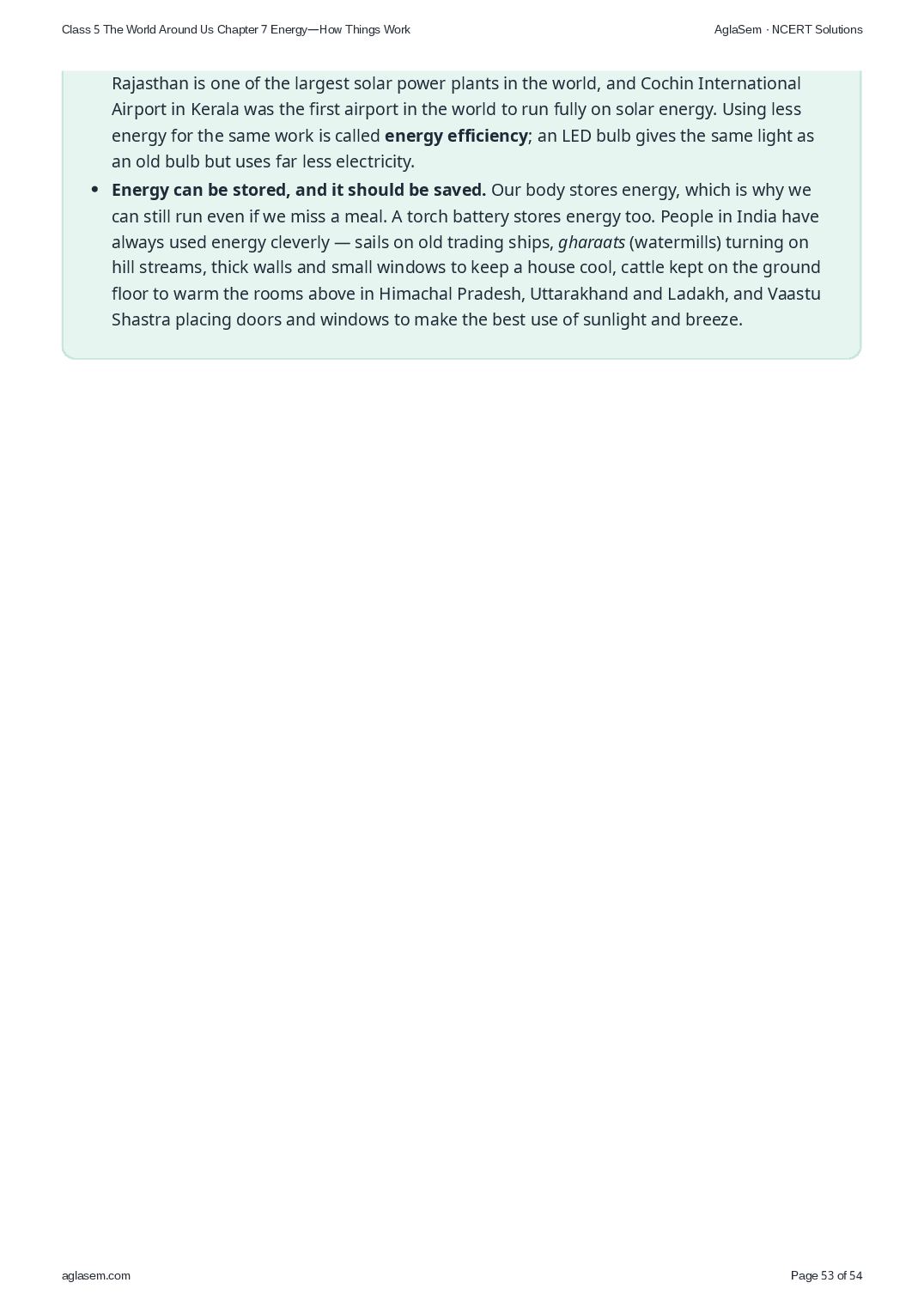
- Electricity from the Sun, wind and water is called clean energy. It does not fill the air with smoke or leave waste behind. India uses a lot of it — the Bhadla Solar Park in Rajasthan is one of the largest solar power plants in the world, and Cochin International Airport in Kerala was the first airport in the world to run fully on solar energy. Using less energy for the same work is called energy efficiency; an LED bulb gives the same light as an old bulb but uses far less electricity.
- Energy can be stored, and it should be saved. Our body stores energy, which is why we can still run even if we miss a meal. A torch battery stores energy too. People in India have always used energy cleverly — sails on old trading ships, gharaats (watermills) turning on hill streams, thick walls and small windows to keep a house cool, cattle kept on the ground floor to warm the rooms above in Himachal Pradesh, Uttarakhand and Ladakh, and Vaastu Shastra placing doors and windows to make the best use of sunlight and breeze.
How to Download NCERT Solutions for Class 5 The World Around Us Chapter 7 PDF
Follow these simple steps to get the Energy How Things Work questions-and-answers PDF from Our Wondrous World.
- Search NCERT Solutions for Class 5 The World Around Us Chapter 7 aglasem and open this page.
- Read the exercise questions with answers for Energy How Things Work shown above.
- Click the Download PDF link to save the Energy How Things Work solutions to your device.
NCERT Solutions for Class 5 The World Around Us – All Chapters
There are more chapters to study besides Energy How Things Work in The World Around Us. Here are the NCERT Solutions for all chapters of Class 5 The World Around Us.
- Chapter 1 Water the Essence of Life
- Chapter 2 Journey of a River
- Chapter 3 the Mystery of Food
- Chapter 4 Our School a Happy Place
- Chapter 5 Our Vibrant Country
- Chapter 6 Some Unique Places
- Chapter 7 Energy How Things Work
- Chapter 8 Clothes How Things Are Made
- Chapter 9 Rhythms of Nature
- Chapter 10 Earth Our Shared Home
NCERT Solutions for Class 5 – All Subjects
Just like Chapter 7 of The World Around Us, you can get the exercise questions with answers for every other subject of Class 5. Here are the NCERT Solutions for all subjects of Class 5.
NCERT Solutions for Class 5 The World Around Us Chapter 7 – An Overview
The key highlights of this study material are as follows.
| Aspects | Details |
|---|---|
| Class | Class 5 |
| Subject | The World Around Us |
| Chapter Number | Chapter 7 |
| Chapter Name | Energy How Things Work |
| Book Name | Our Wondrous World |
| Book By | NCERT (National Council of Educational Research and Training) |
| Educational Resource Here | NCERT Solutions of Class 5 The World Around Us Chapter 7 for all exercises |
| More Questions Answers of This Subject | NCERT Solutions for Class 5 The World Around Us |
| Download Book Chapter | NCERT Book Class 5 The World Around Us |
| All Questions Answers For This Class | NCERT Solutions for Class 5 |
| Complete Solutions | NCERT Solutions |
NCERT Solutions for Class 5 The World Around Us Chapter 7 Energy How Things Work – FAQs
What are the NCERT Solutions for Class 5 The World Around Us Chapter 7 Energy How Things Work?
They are the complete, step-by-step answers to all the exercise and in-text questions of Chapter 7 Energy How Things Work from the NCERT Class 5 The World Around Us textbook Our Wondrous World, written by experts as per the latest NCERT syllabus.
How can I download the Class 5 The World Around Us Chapter 7 solutions PDF for free?
Open this page on aglasem, read the Energy How Things Work questions with answers, and click the “Download Solutions PDF” link. The Class 5 The World Around Us Chapter 7 NCERT Solutions PDF is completely free to download.
Are these NCERT Solutions as per the latest 2026-27 syllabus?
Yes. The NCERT Solutions for Class 5 The World Around Us Chapter 7 are based on the latest NCERT textbook Our Wondrous World and the current 2026-27 CBSE syllabus, so the questions and answers match what you study in class.
Where can I get NCERT Solutions for the other chapters of Class 5 The World Around Us?
You can find the answers to every chapter on the NCERT Solutions for Class 5 The World Around Us page, and solutions for every subject on the NCERT Solutions for Class 5 page.
How do NCERT Solutions help in exam preparation?
They show the correct method to solve each question, help you write answers the way they are expected in exams, let you check and correct your own work, and save revision time — which together improve your marks in Class 5 The World Around Us.
If you have any queries on NCERT Solutions for Class 5 The World Around Us Chapter 7 Energy How Things Work, then please ask in the comments below.