NCERT Solutions for Class 5 The World Around Us Chapter 10 Earth Our Shared Home provide clear, step-by-step answers to every exercise and in-text question from the chapter Earth Our Shared Home of the NCERT textbook Our Wondrous World. Prepared by subject experts as per the latest NCERT (CBSE) syllabus for 2026-27, these NCERT Solutions for Class 5 The World Around Us help you understand each concept, write exam-ready answers, and check your own solutions. You can read them online below or download the free Class 5 The World Around Us Chapter 10 question-answer PDF.
NCERT Solutions for Class 5 The World Around Us Chapter 10 Earth Our Shared Home
- Class: Class 5
- Subject: The World Around Us
- Chapter: Chapter 10 – Earth Our Shared Home
- Textbook: Our Wondrous World (NCERT)
- Study material: NCERT Solutions – questions with answers, free PDF
These solutions answer all the exercise questions of Chapter 10 Earth Our Shared Home — including the in-text questions, short-answer and long-answer questions, and activities — with complete explanations so you can follow the method, not just the final answer. Read the full solutions below.
NCERT Solutions Class 5 The World Around Us Chapter 10 Earth Our Shared Home View Download
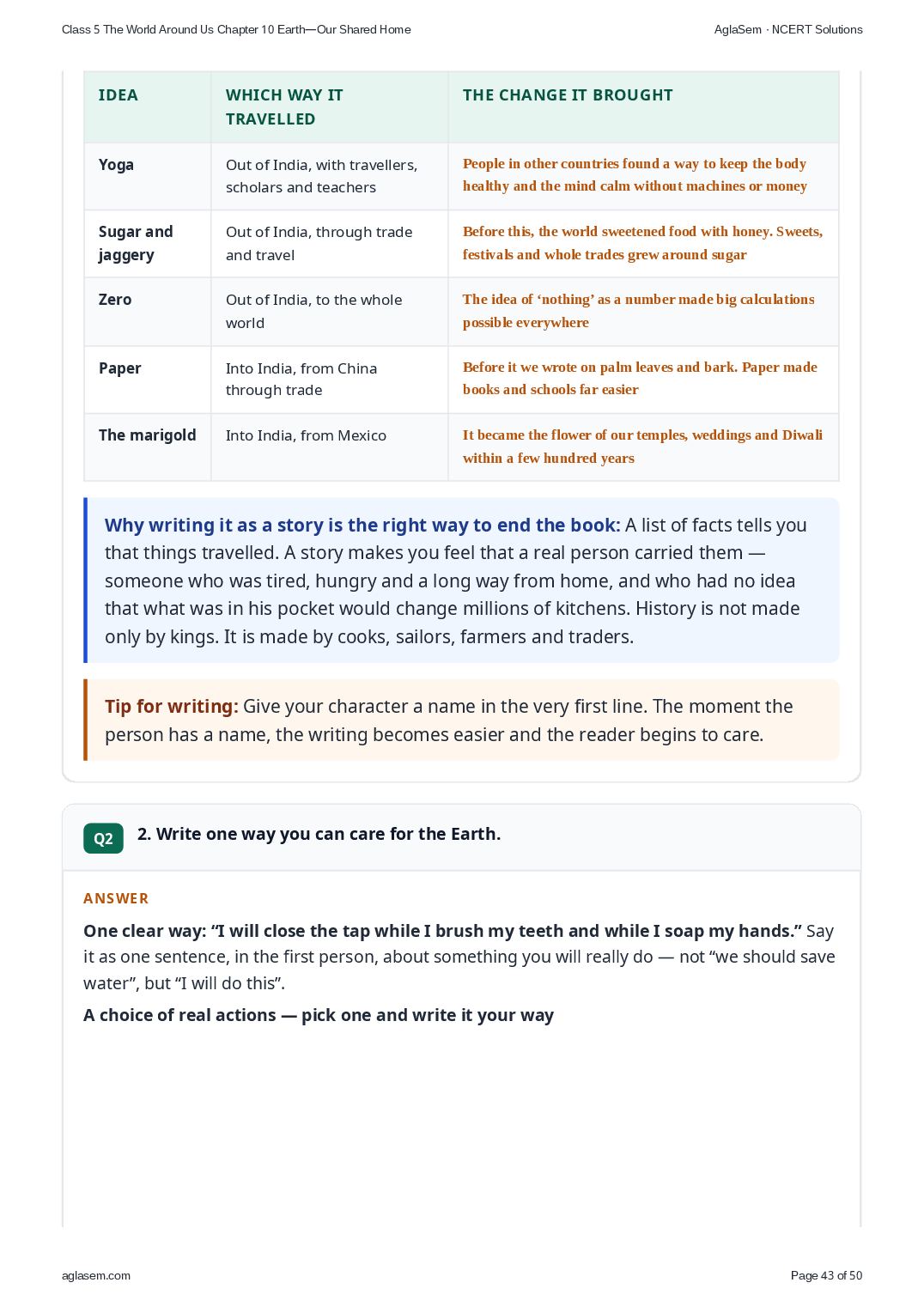
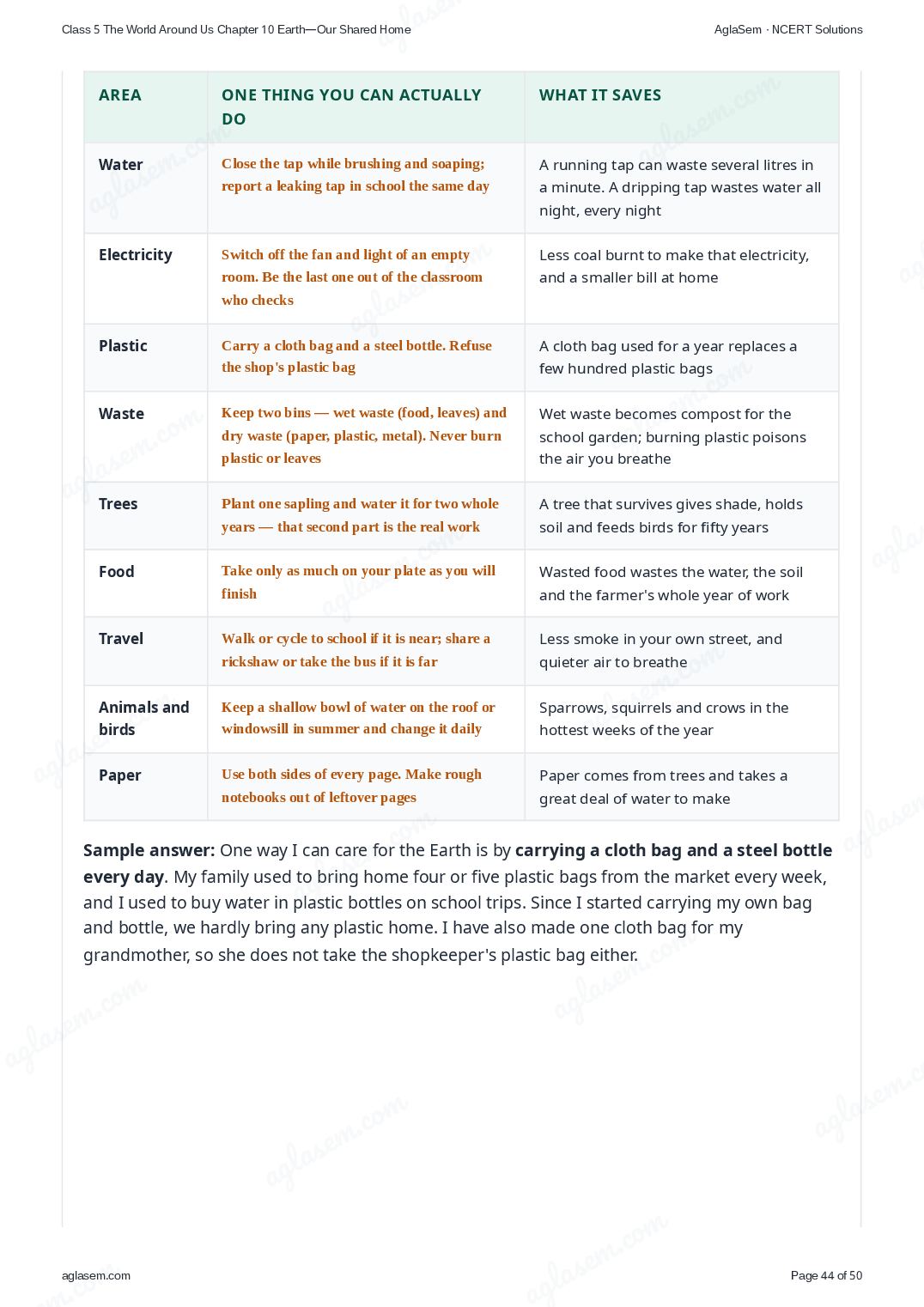
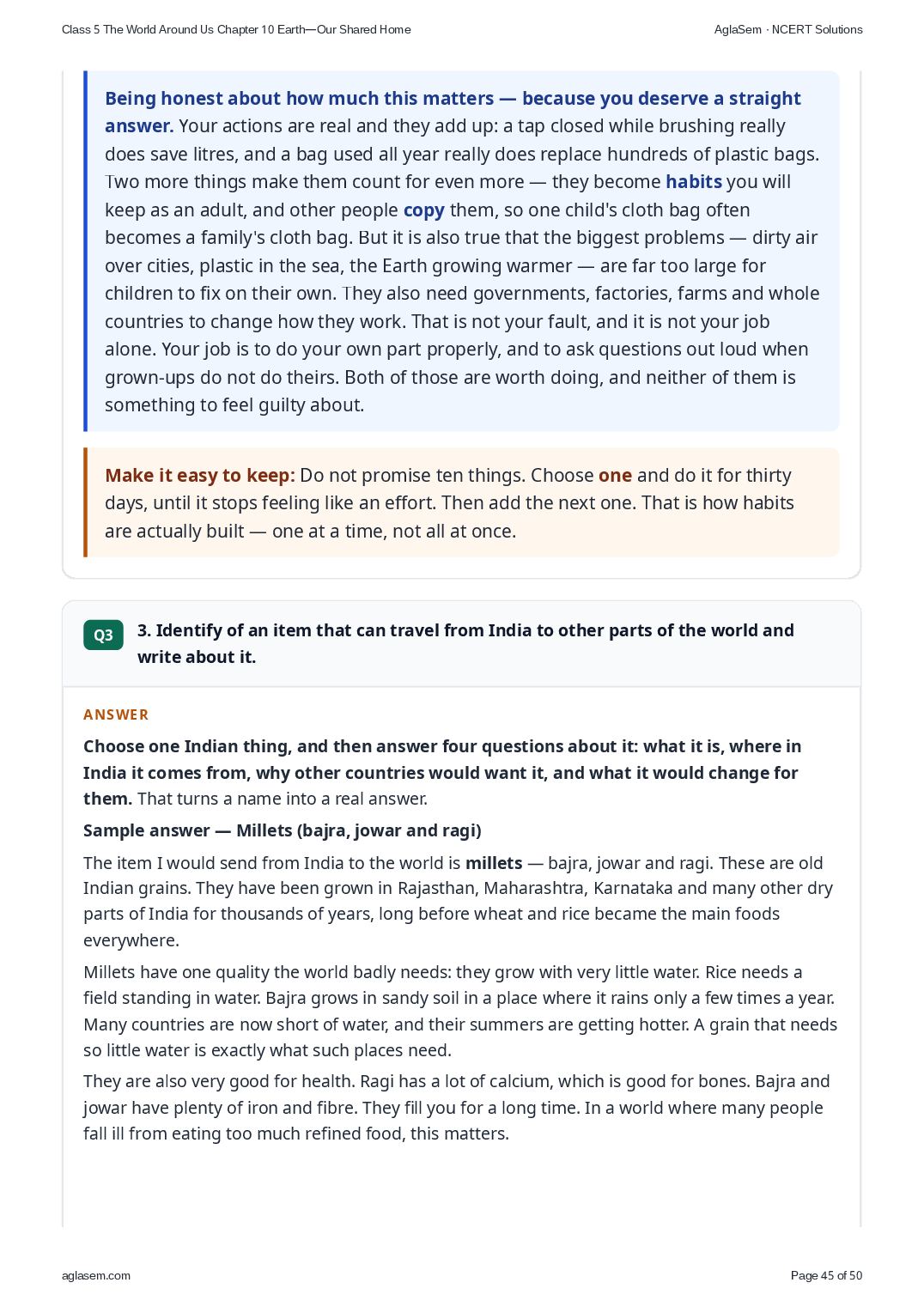
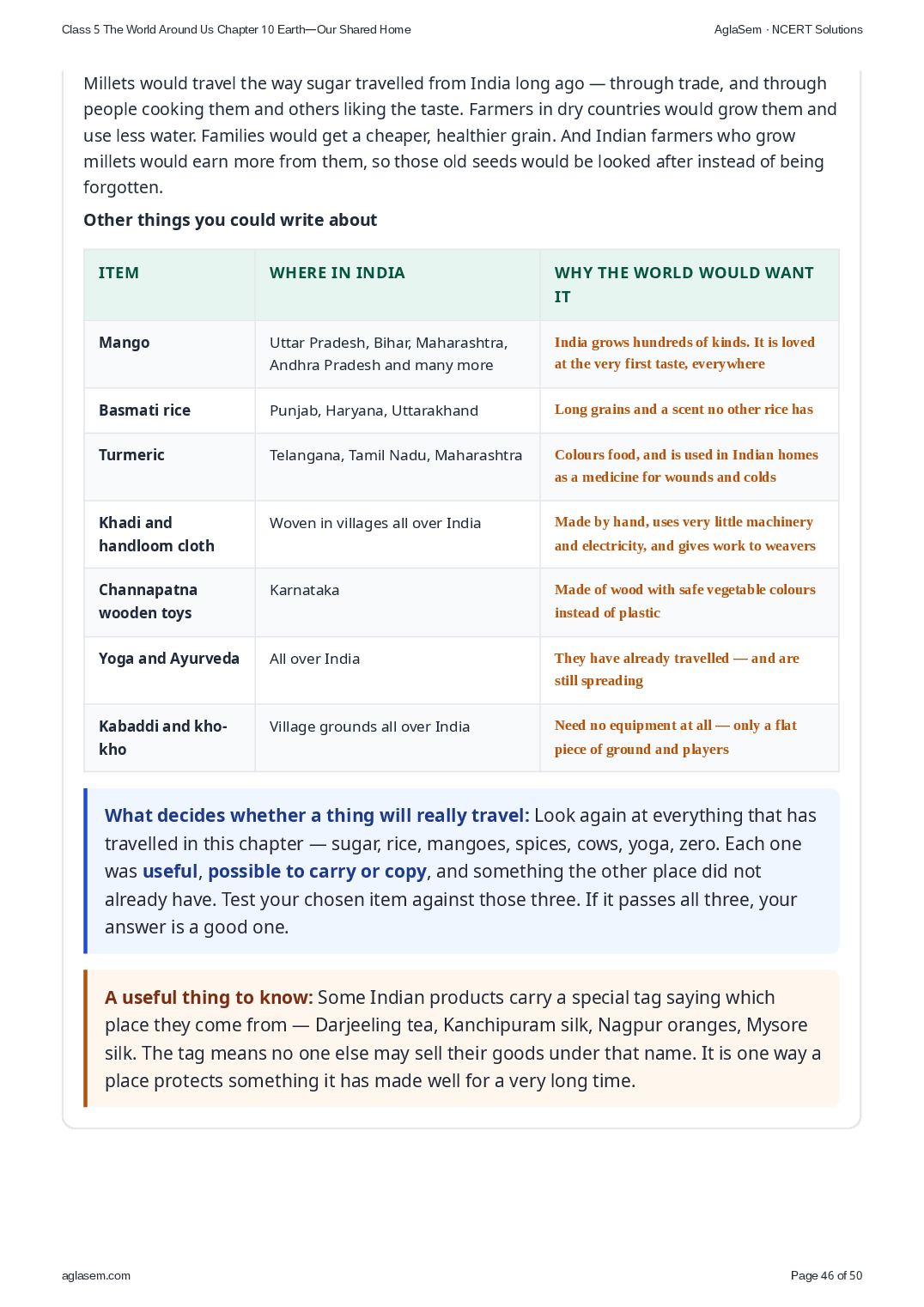
NCERT Solutions for Class 5 The World Around Us Chapter 10 PDF Download
You can read the NCERT Solutions for Class 5 The World Around Us Chapter 10 online above, or download the complete question-answer PDF to study Earth Our Shared Home offline at any time.
NCERT Solutions for Class 5 The World Around Us Chapter 10 PDF Download Link – Click Here to Download Solutions PDF
Questions Covered in This Chapter
These NCERT Solutions answer all 33 questions of this chapter. The questions solved are:
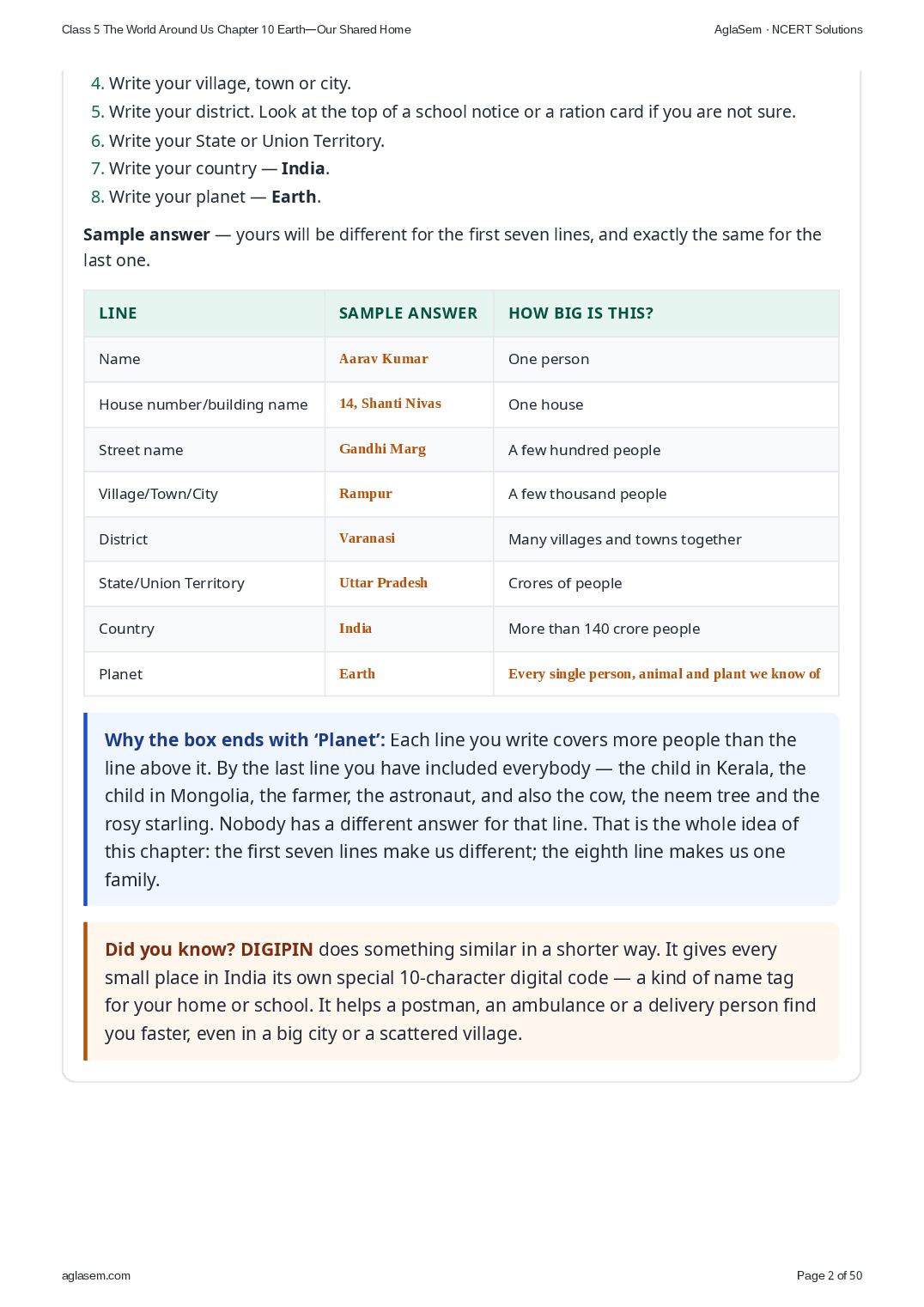
- 1. My address — Name: ___ House number/building name: ___ Street name: ___ Village/Town/City: ___ District: ___ State/Union Territory: ___ Country: ___ Planet: ___
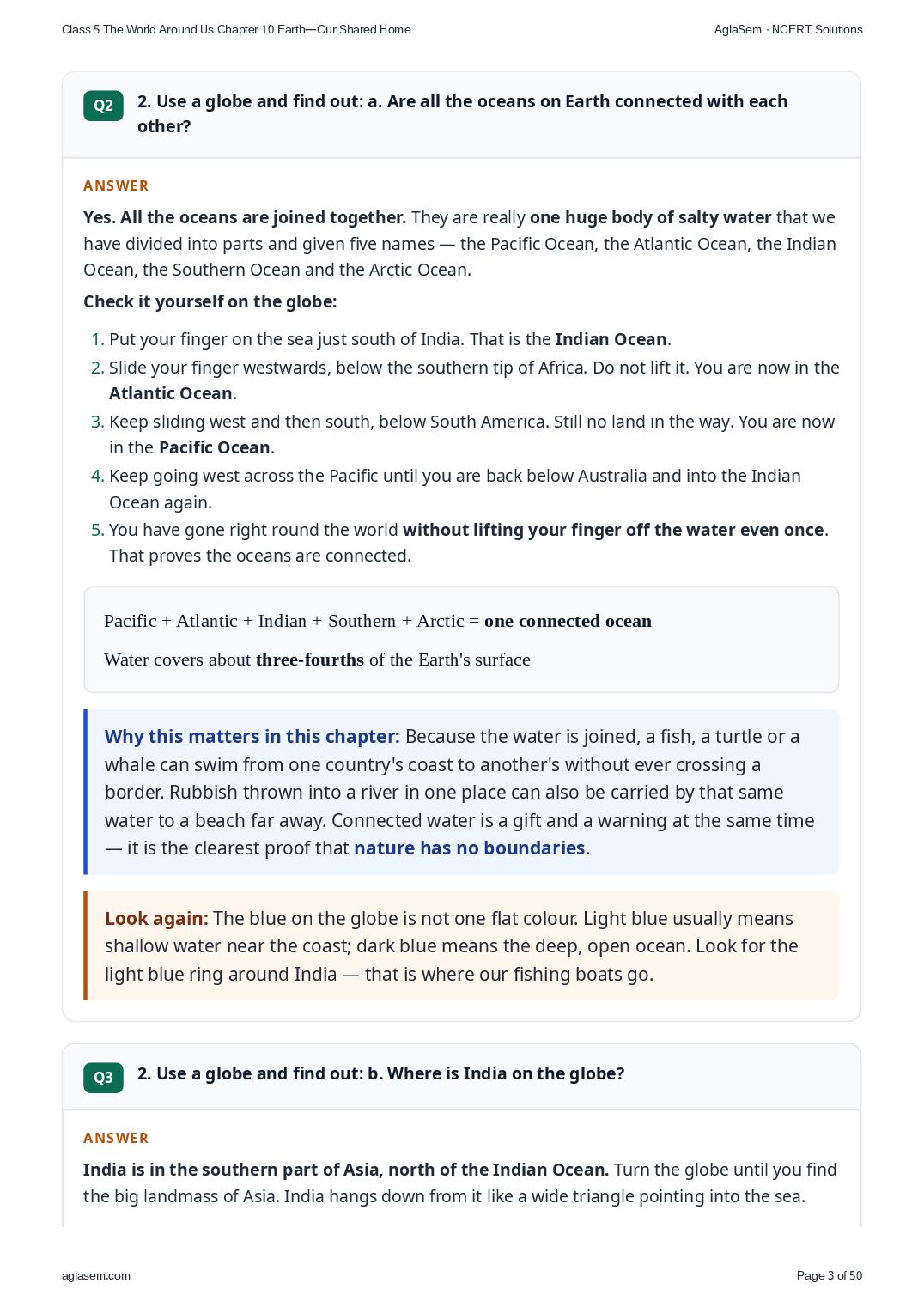
- 2. Use a globe and find out: a. Are all the oceans on Earth connected with each other?
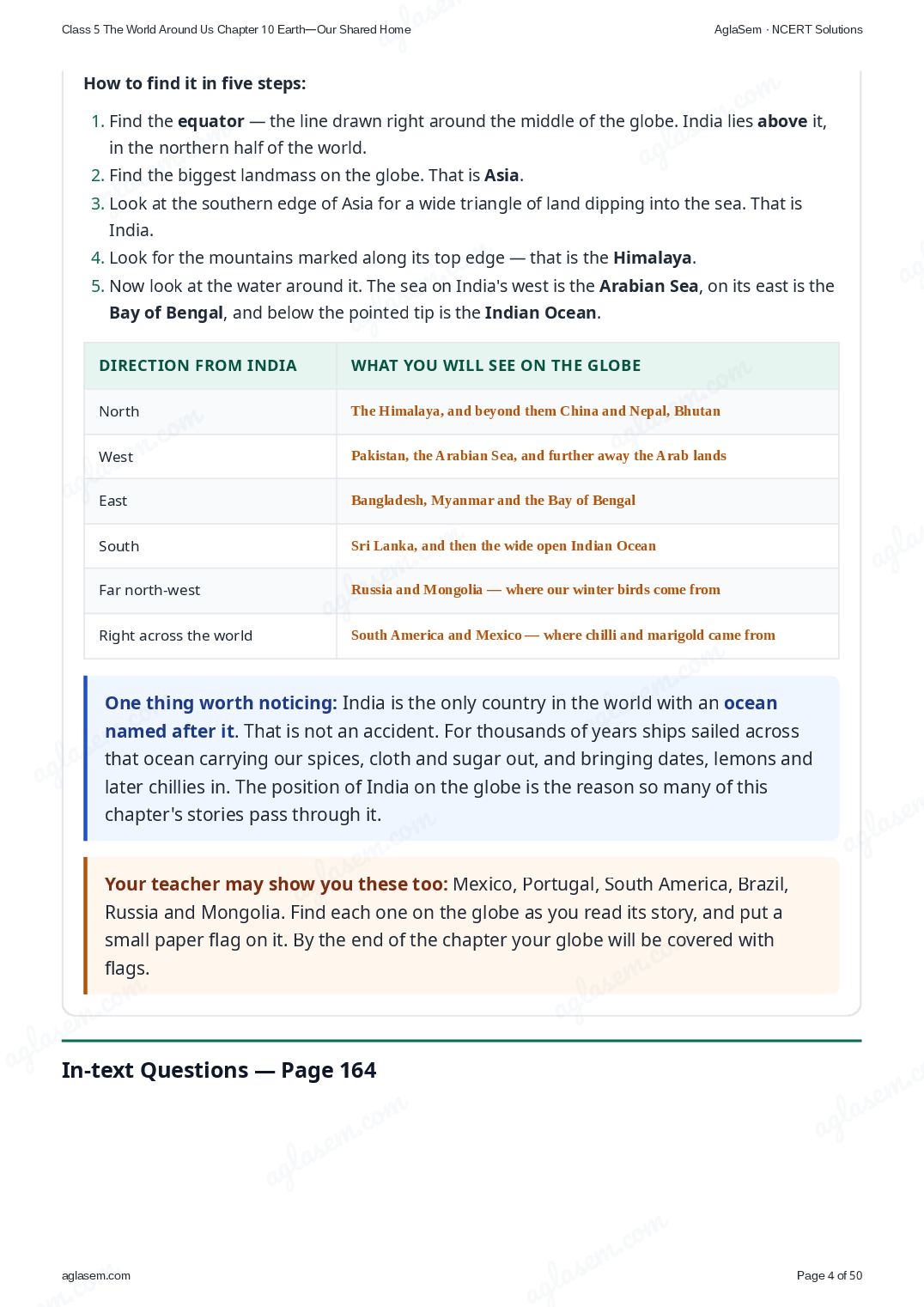
- 2. Use a globe and find out: b. Where is India on the globe?
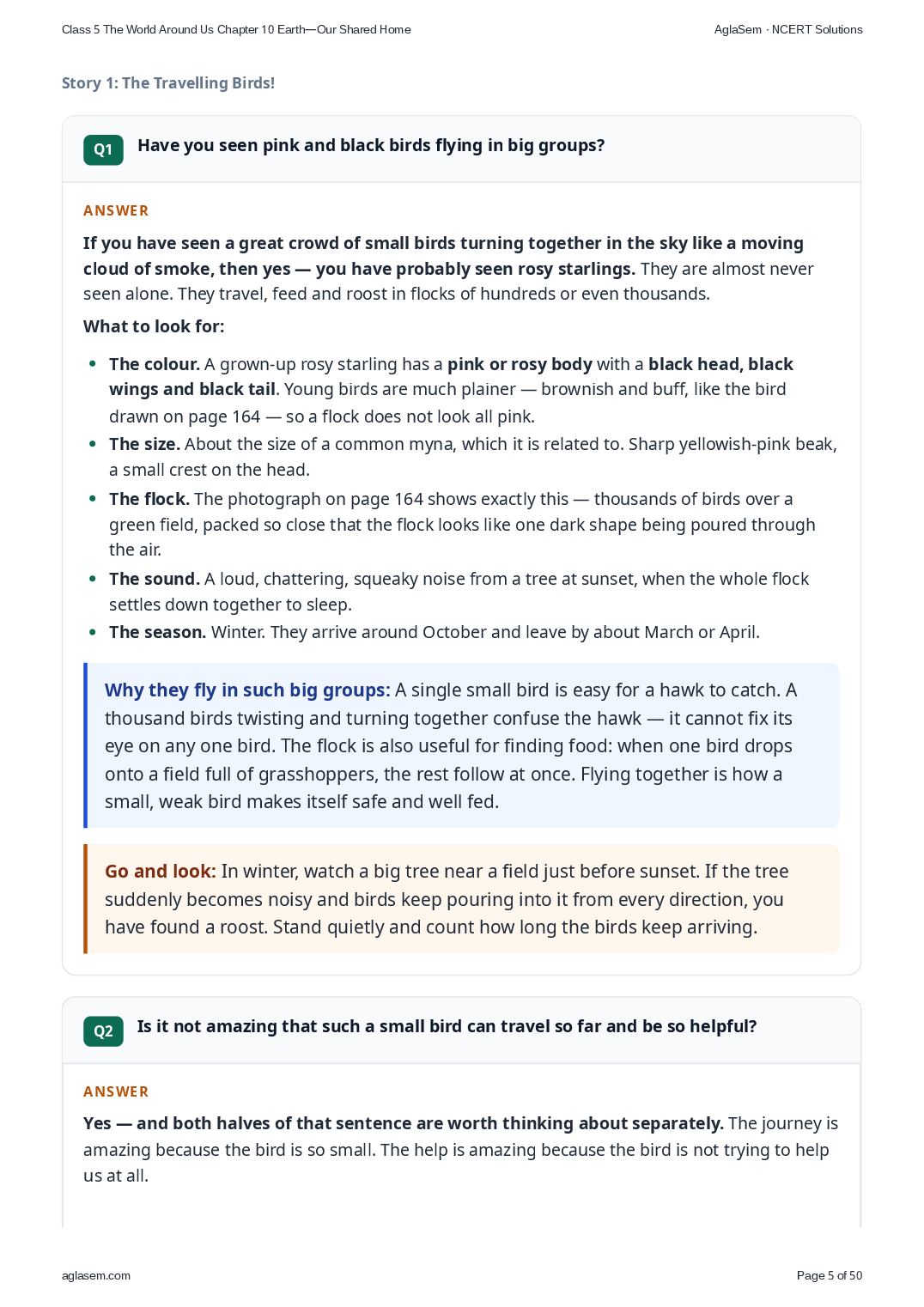
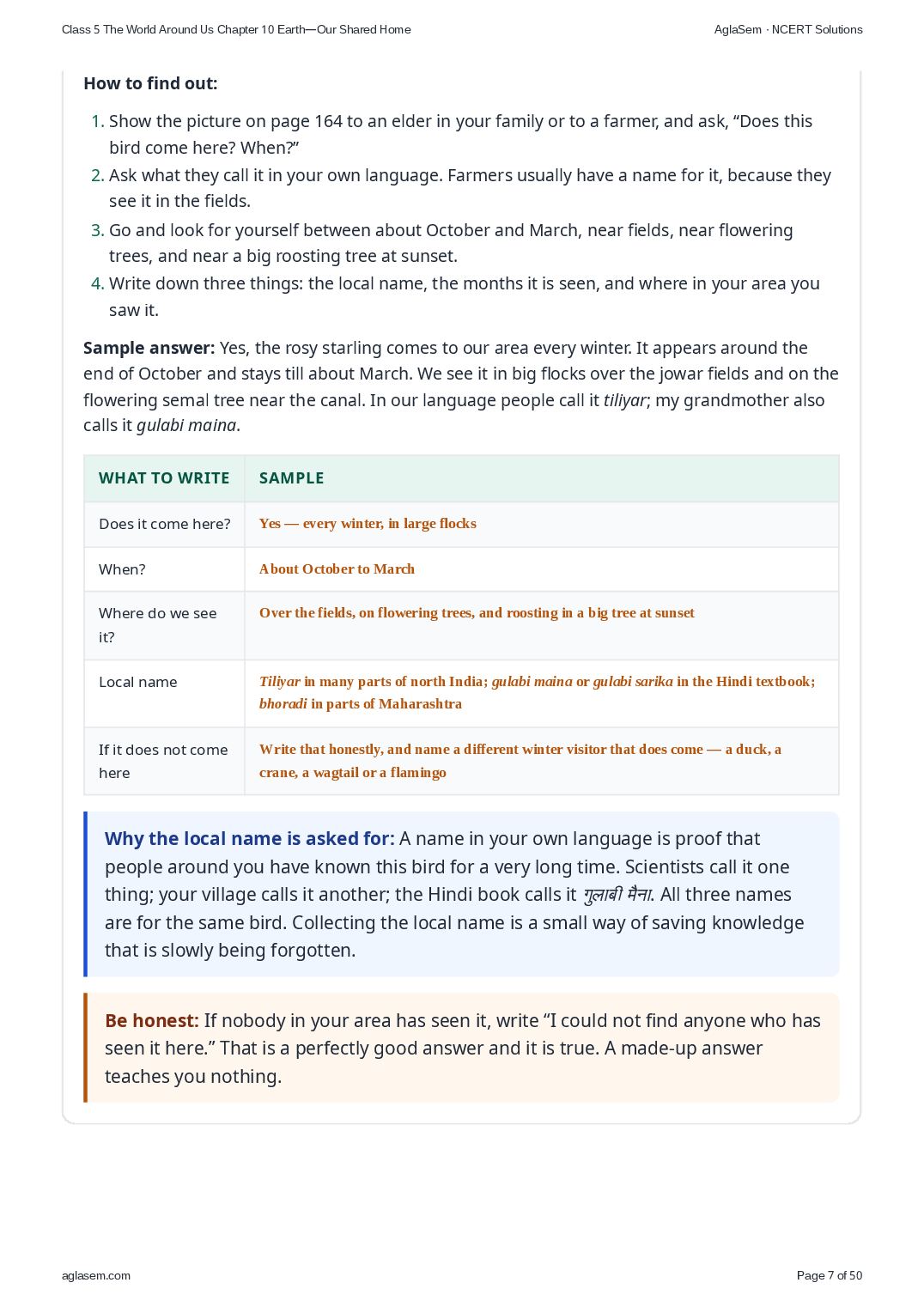
- Have you seen pink and black birds flying in big groups?
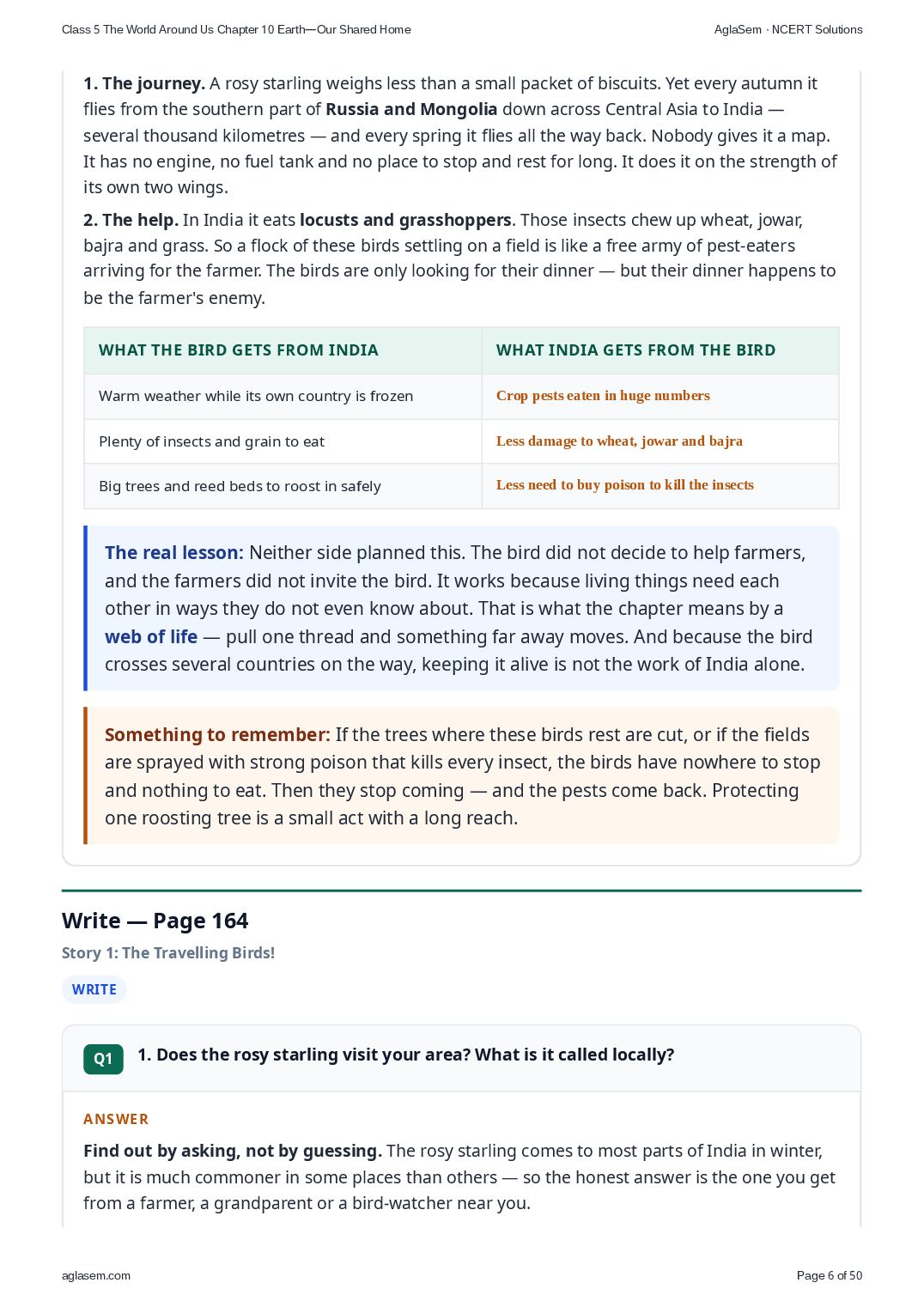
- Is it not amazing that such a small bird can travel so far and be so helpful?
- 1. Does the rosy starling visit your area? What is it called locally?
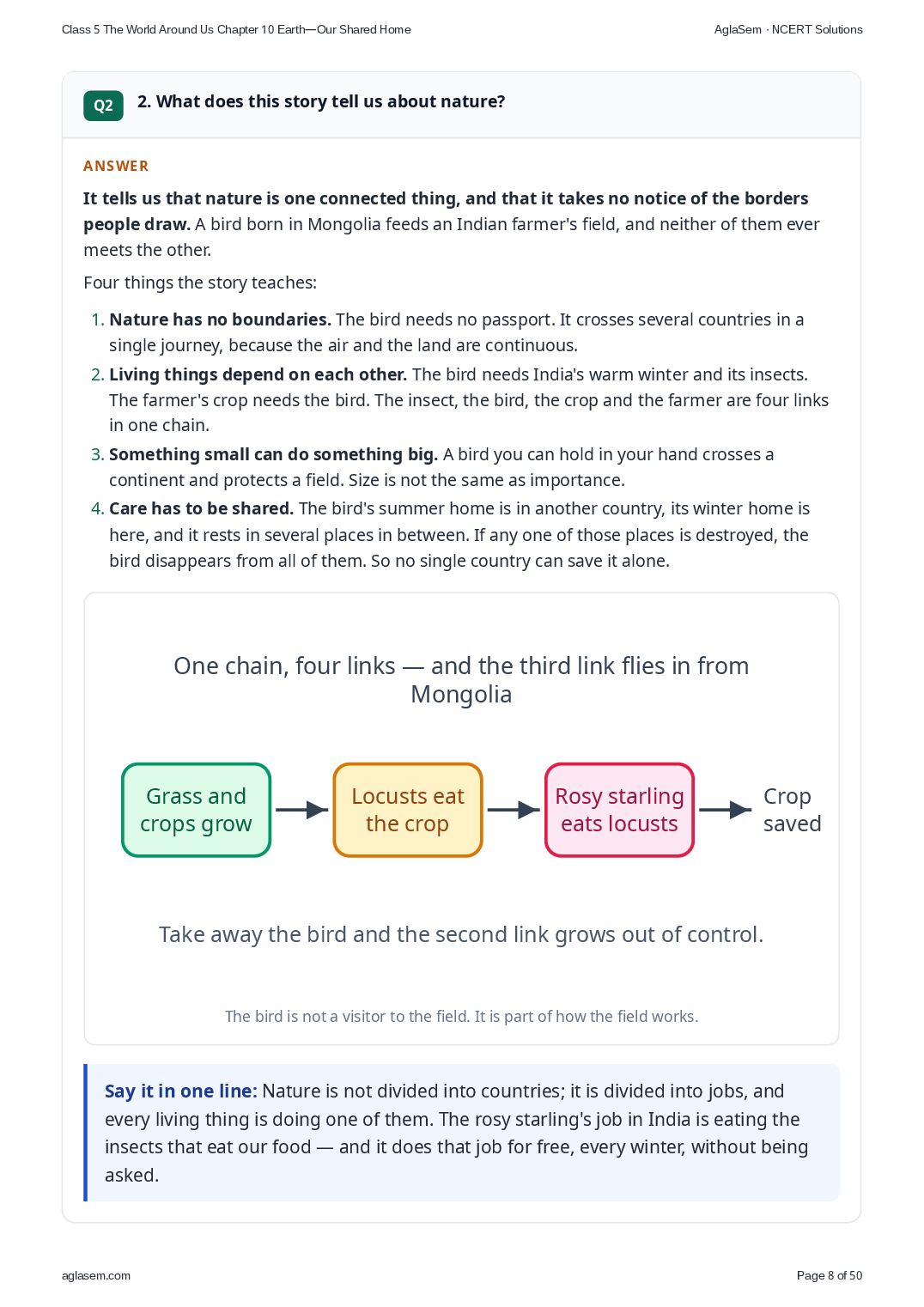
- 2. What does this story tell us about nature?
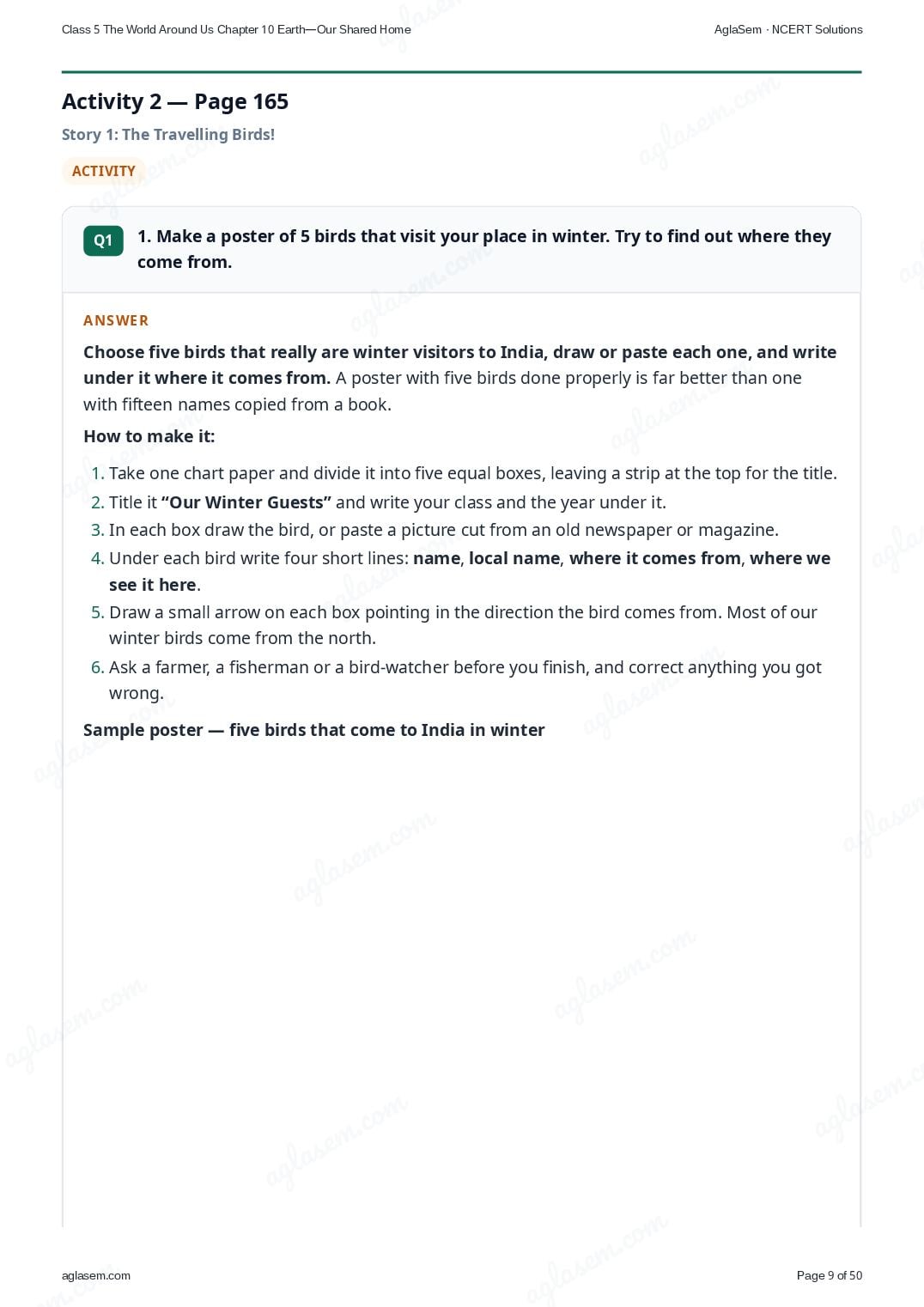
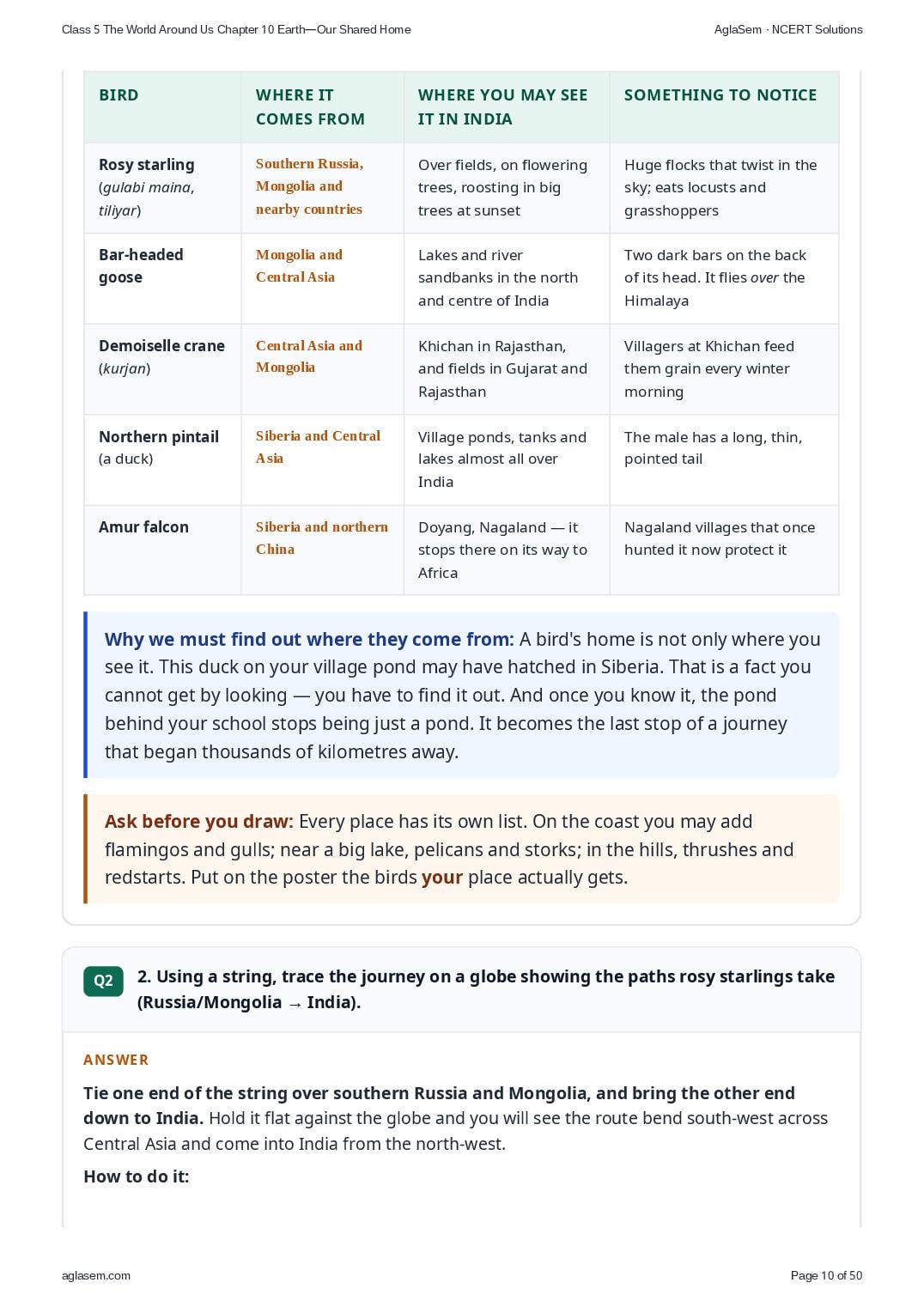
- 1. Make a poster of 5 birds that visit your place in winter. Try to find out where they come from.
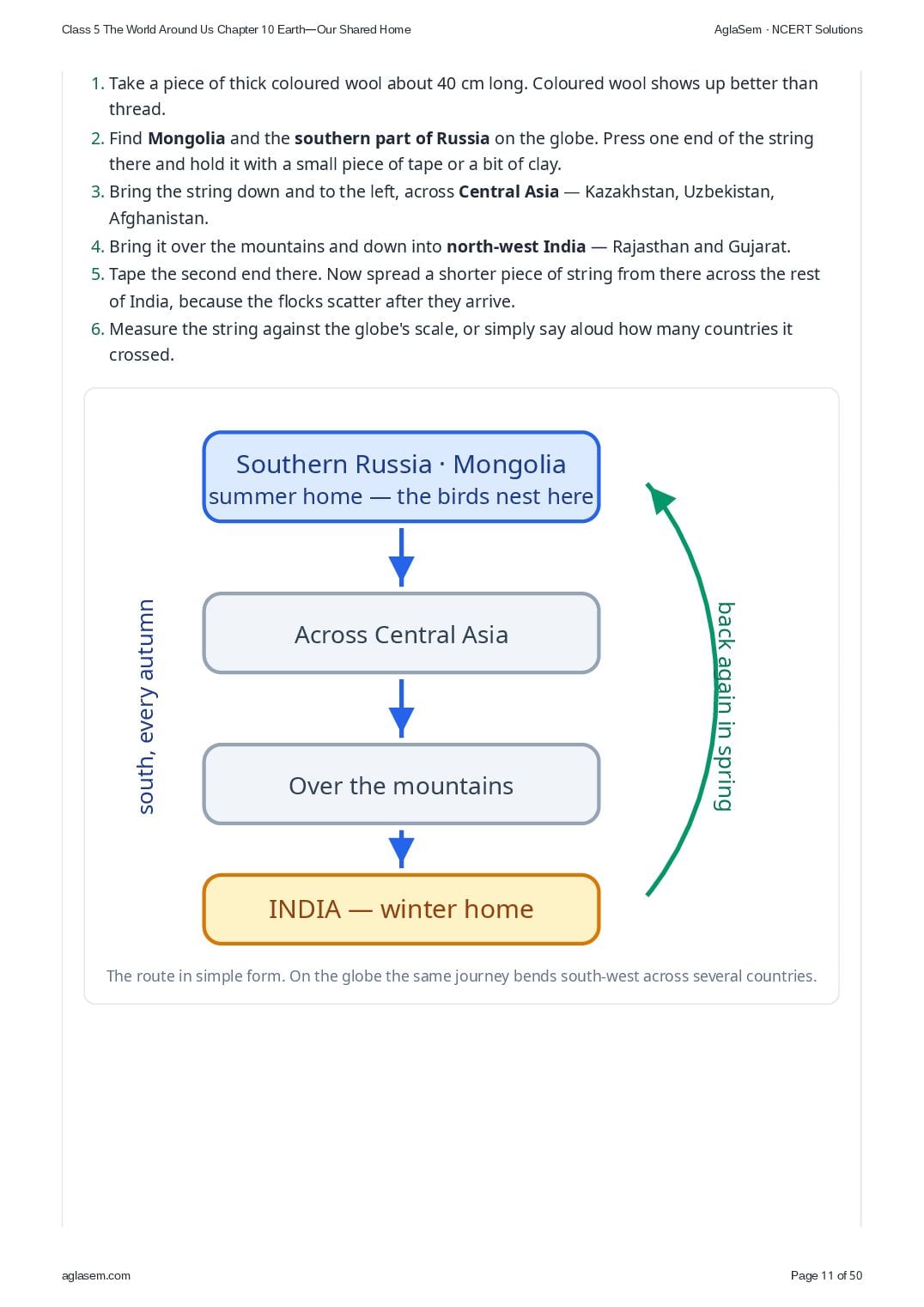
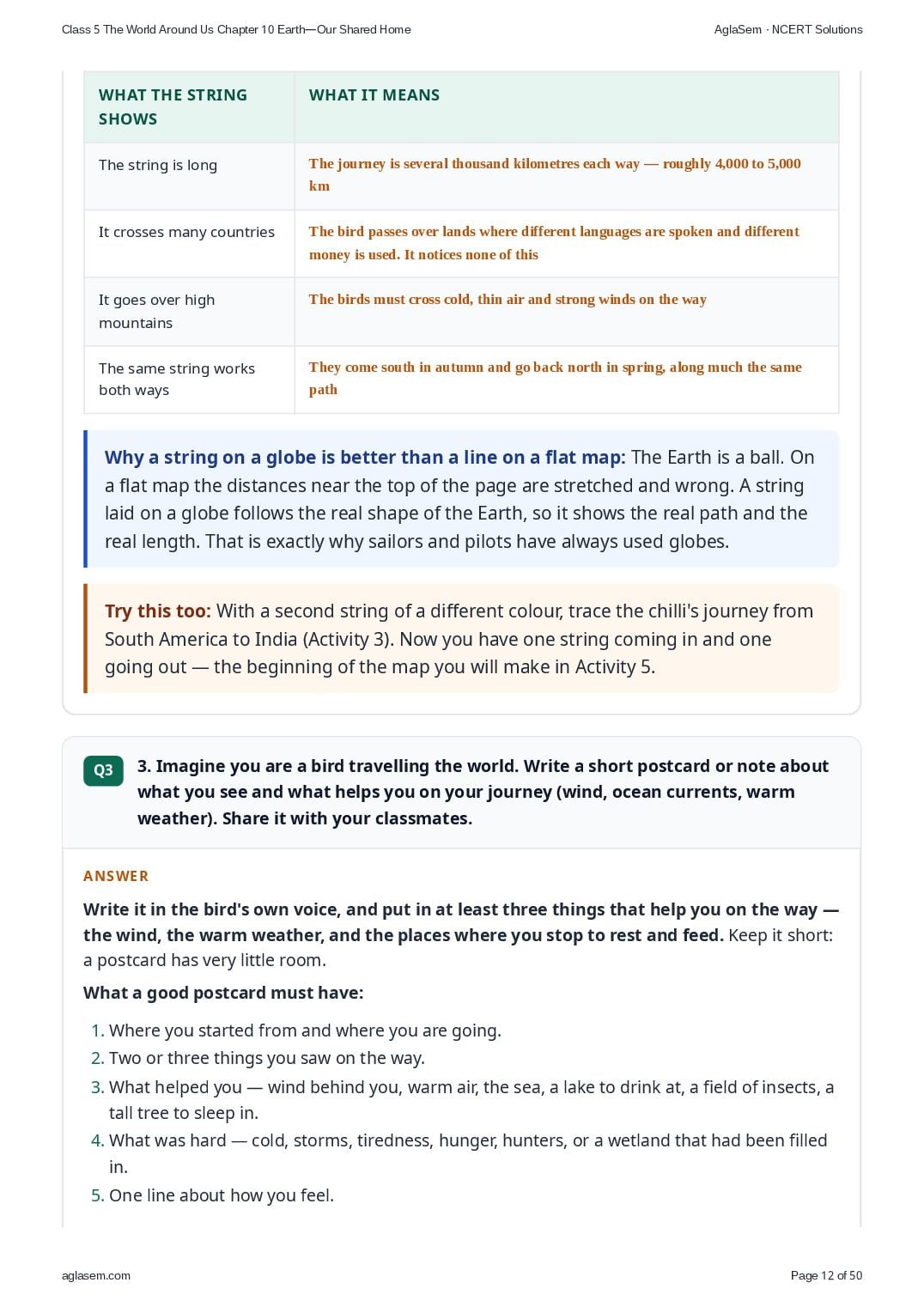
- 2. Using a string, trace the journey on a globe showing the paths rosy starlings take (Russia/Mongolia → India).
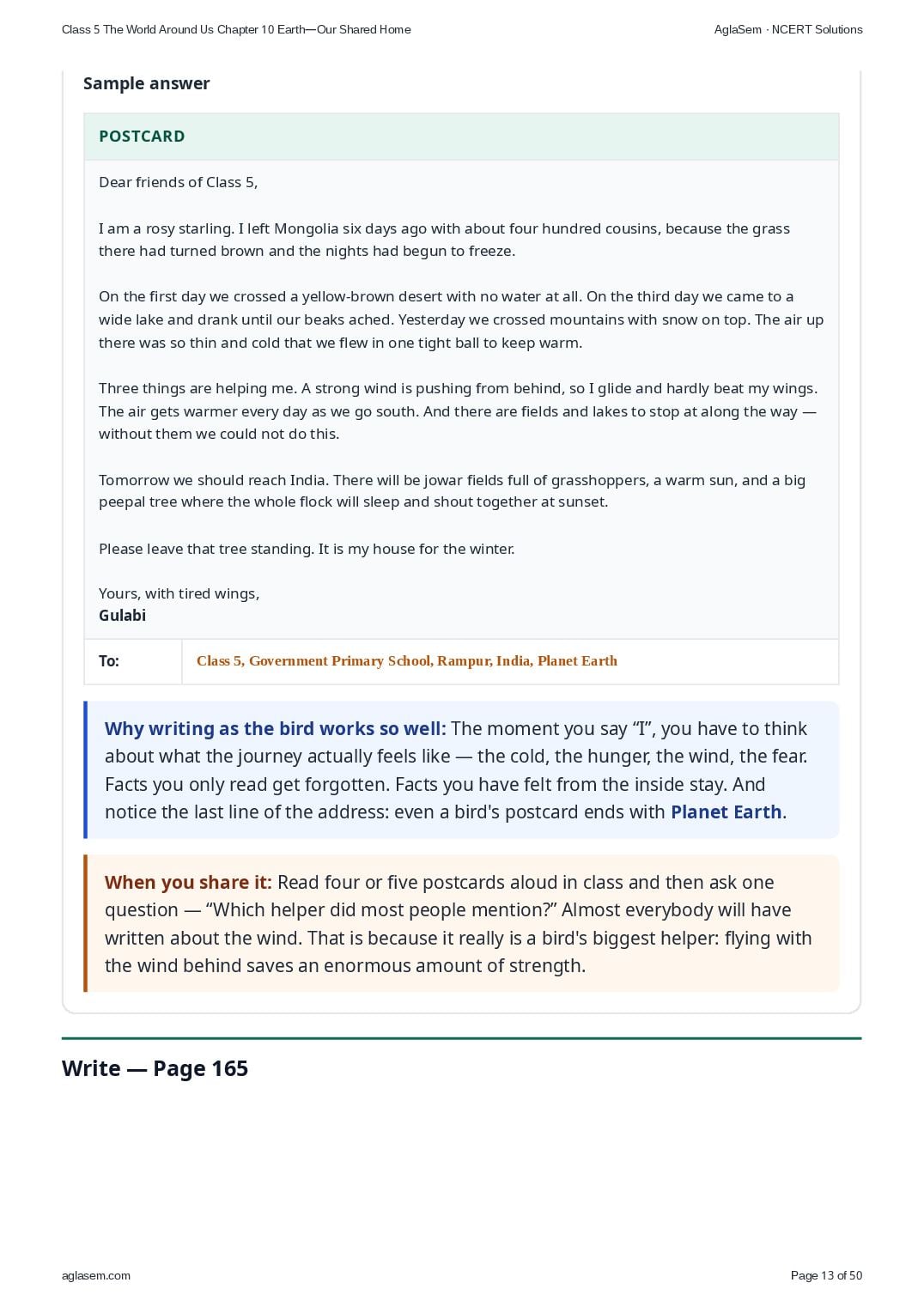
- 3. Imagine you are a bird travelling the world. Write a short postcard or note about what you see and what helps you on your journey (wind, ocean currents, warm weather). Share it with your classmates.
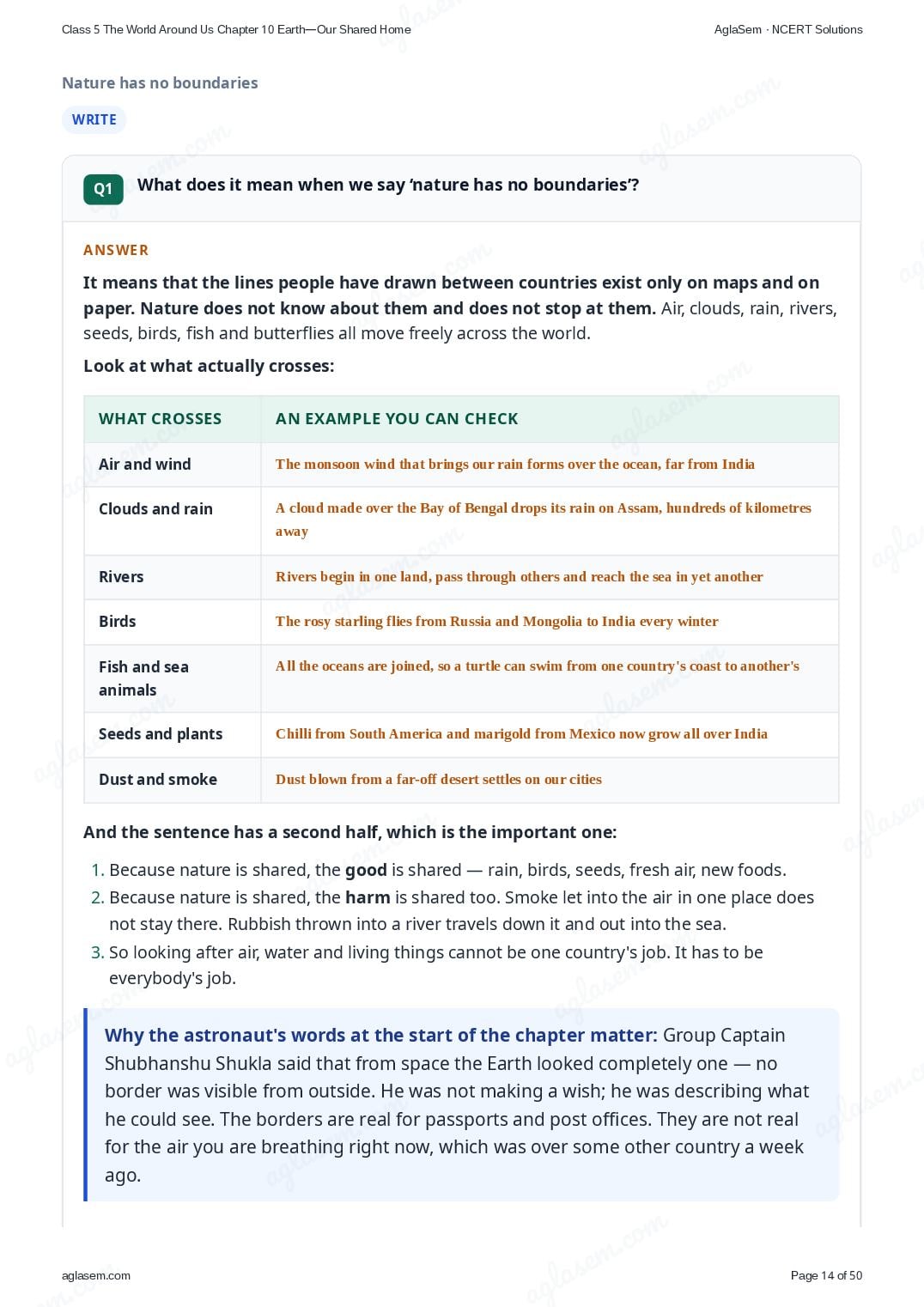
- What does it mean when we say ‘nature has no boundaries’?
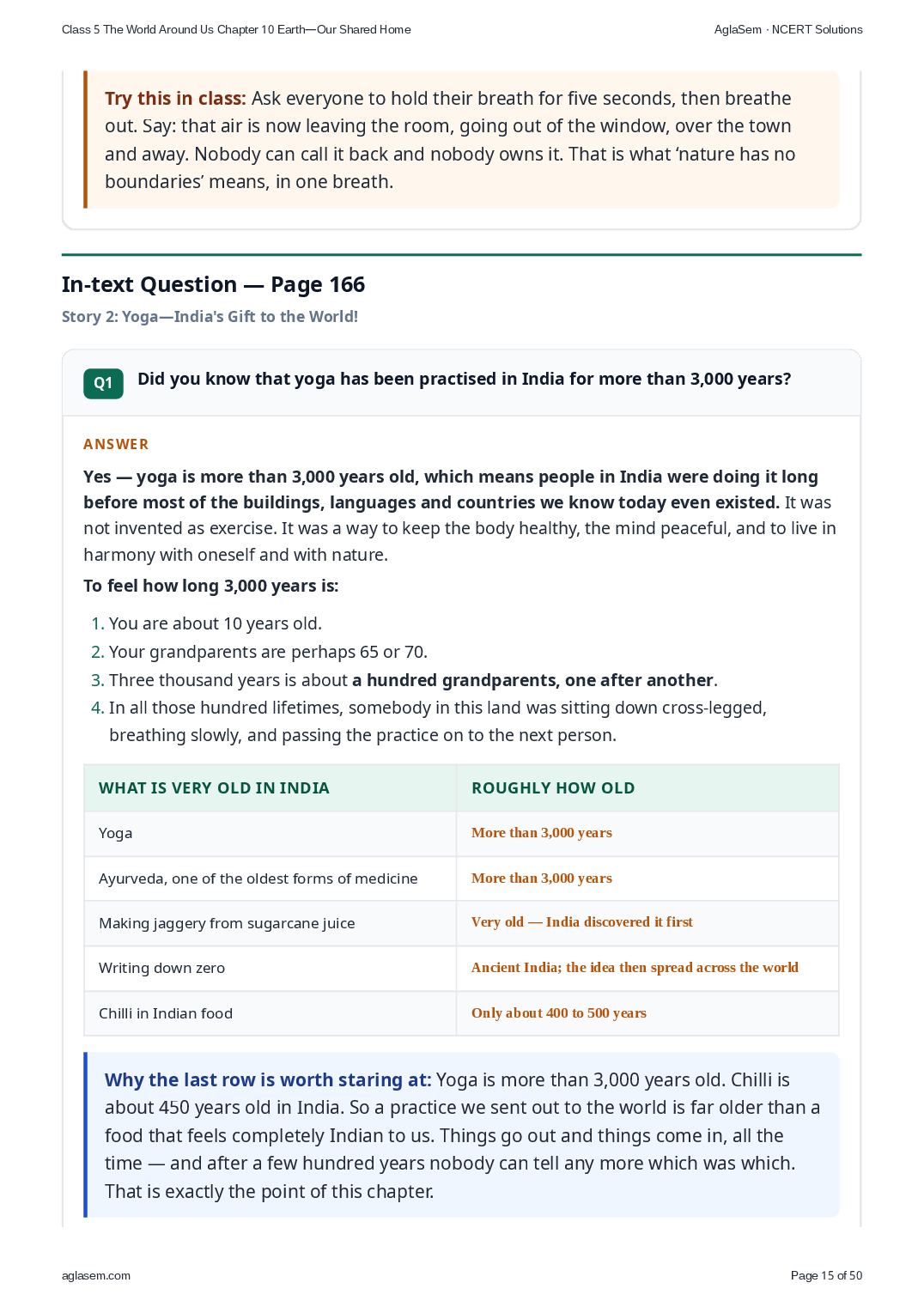
- Did you know that yoga has been practised in India for more than 3,000 years?
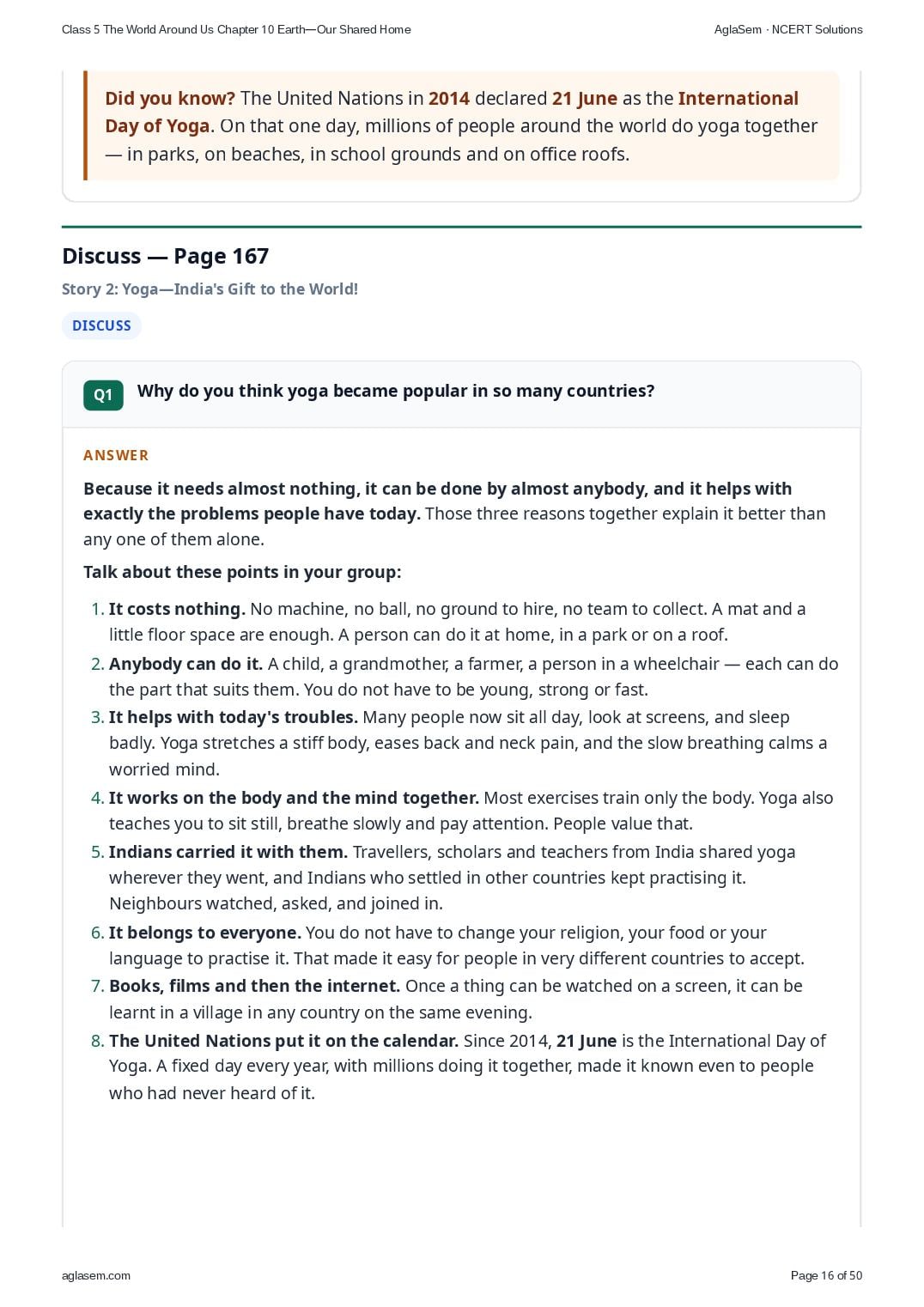
- Why do you think yoga became popular in so many countries?
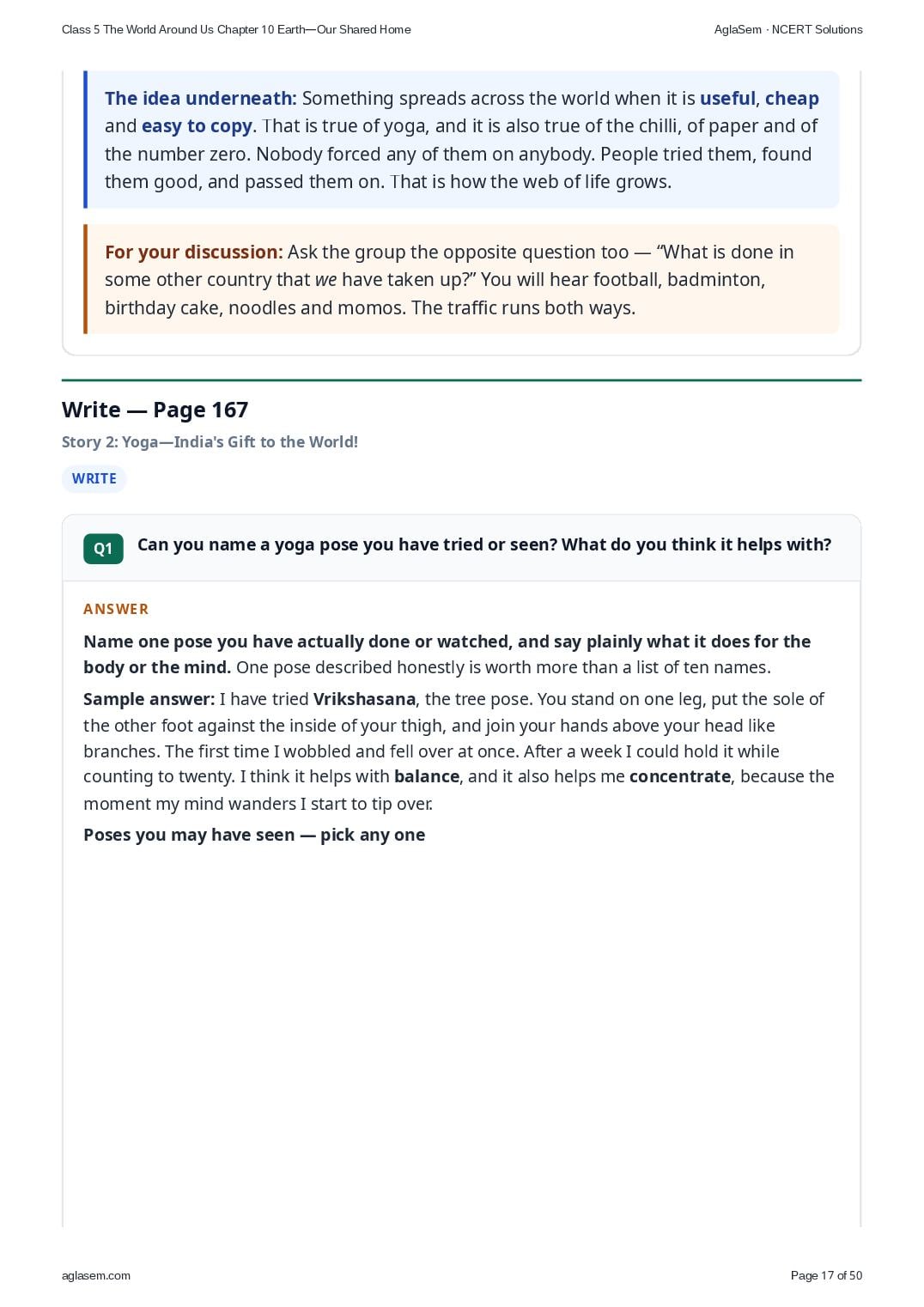
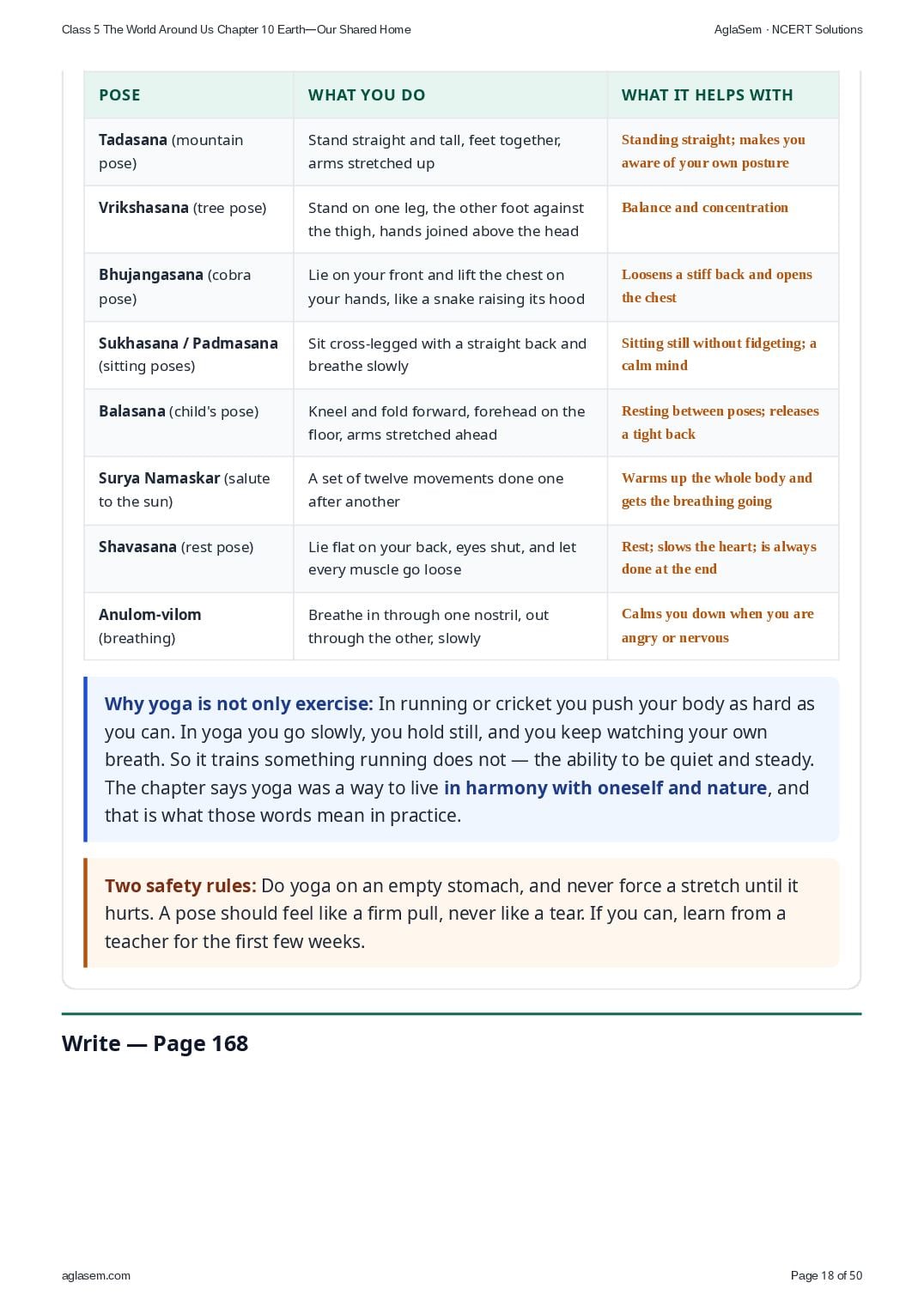
- Can you name a yoga pose you have tried or seen? What do you think it helps with?
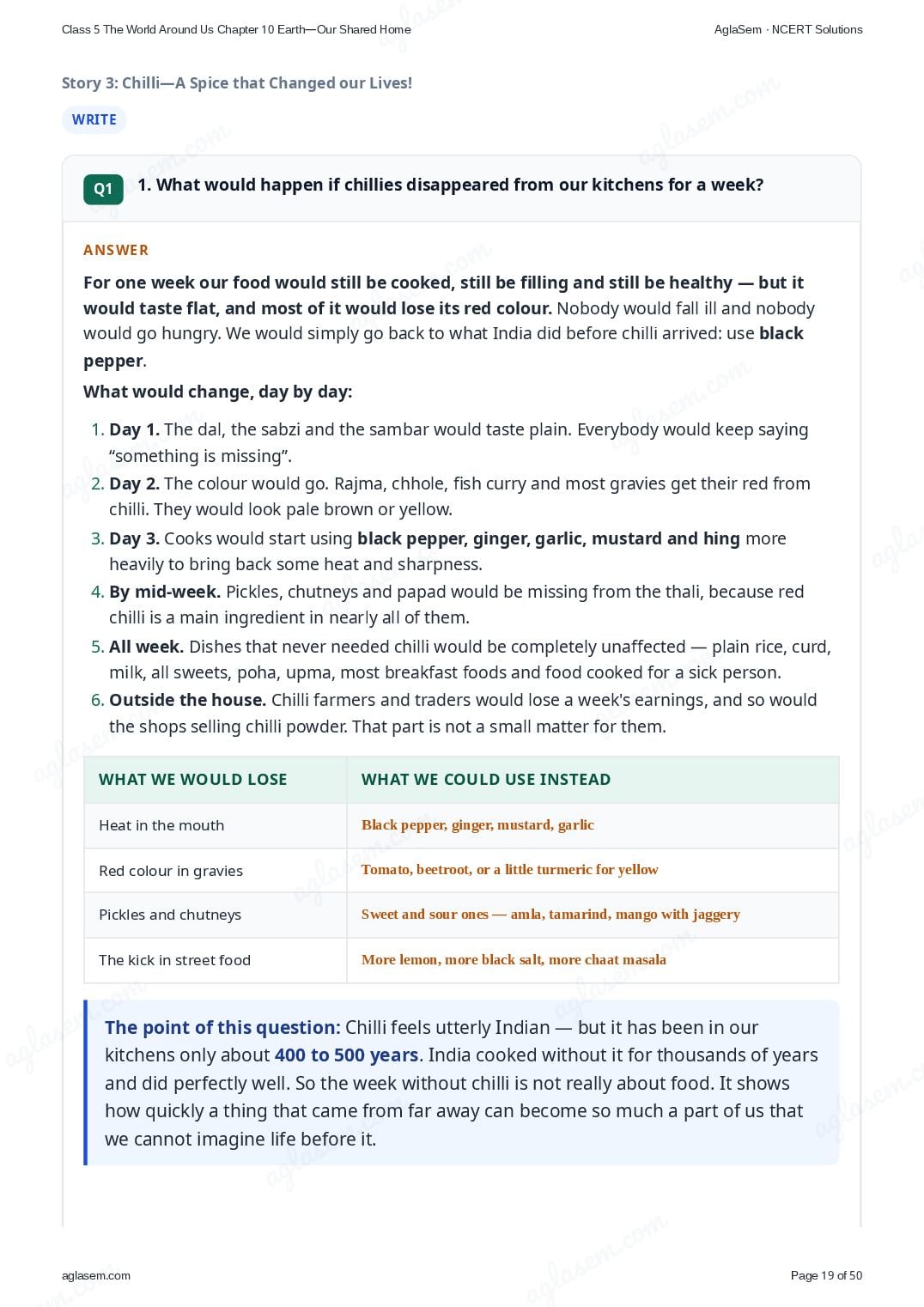
- 1. What would happen if chillies disappeared from our kitchens for a week?
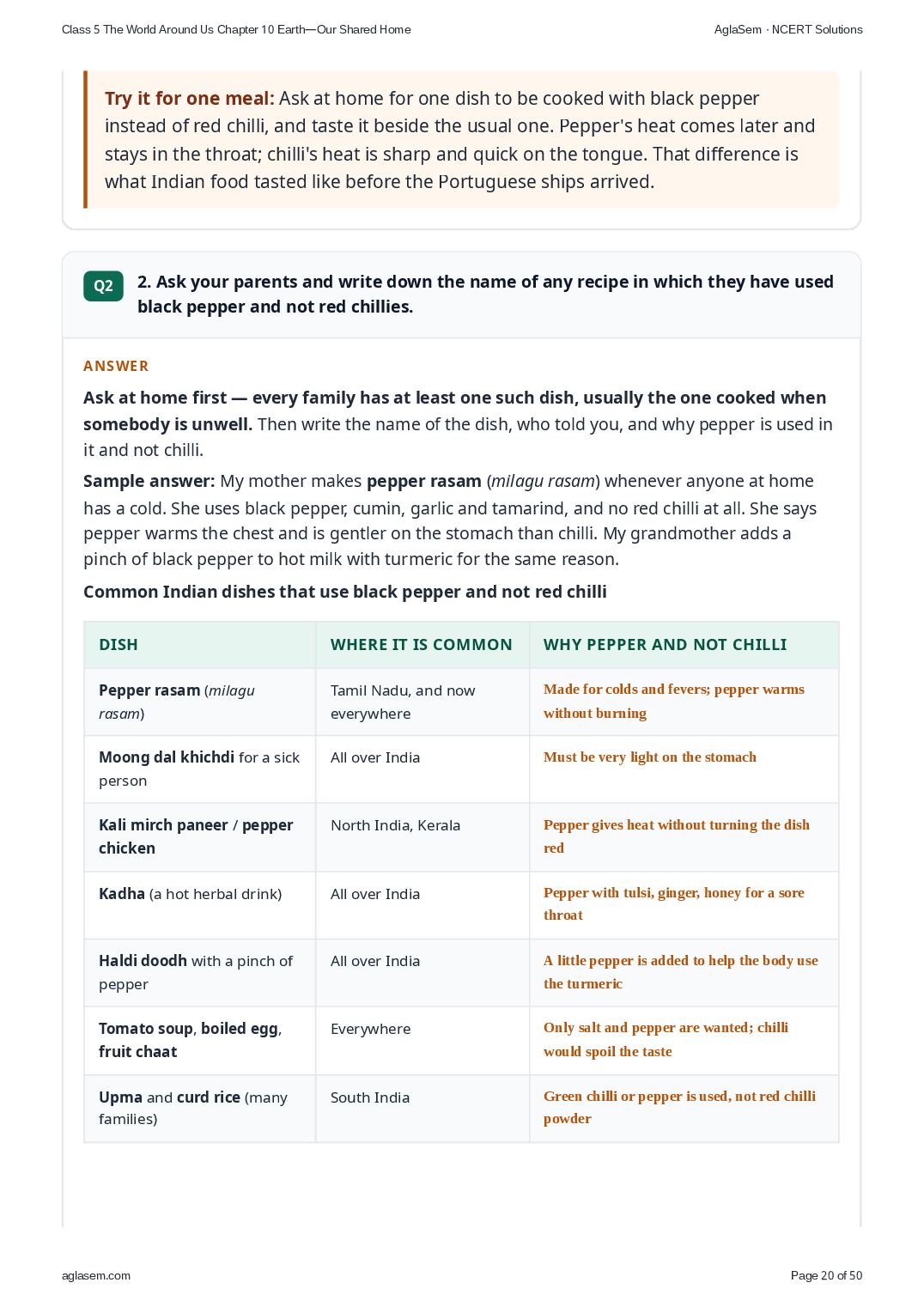
- 2. Ask your parents and write down the name of any recipe in which they have used black pepper and not red chillies.
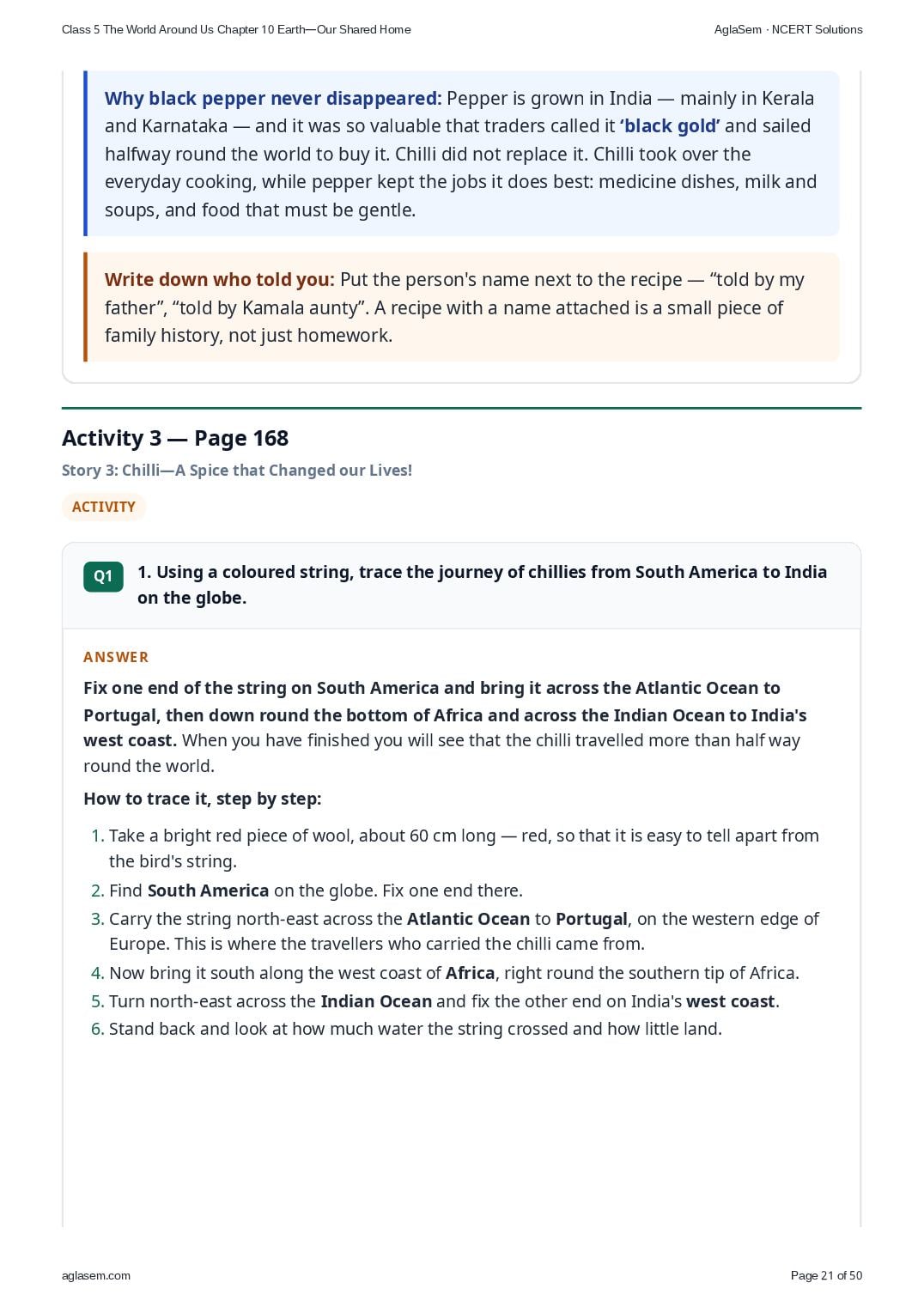
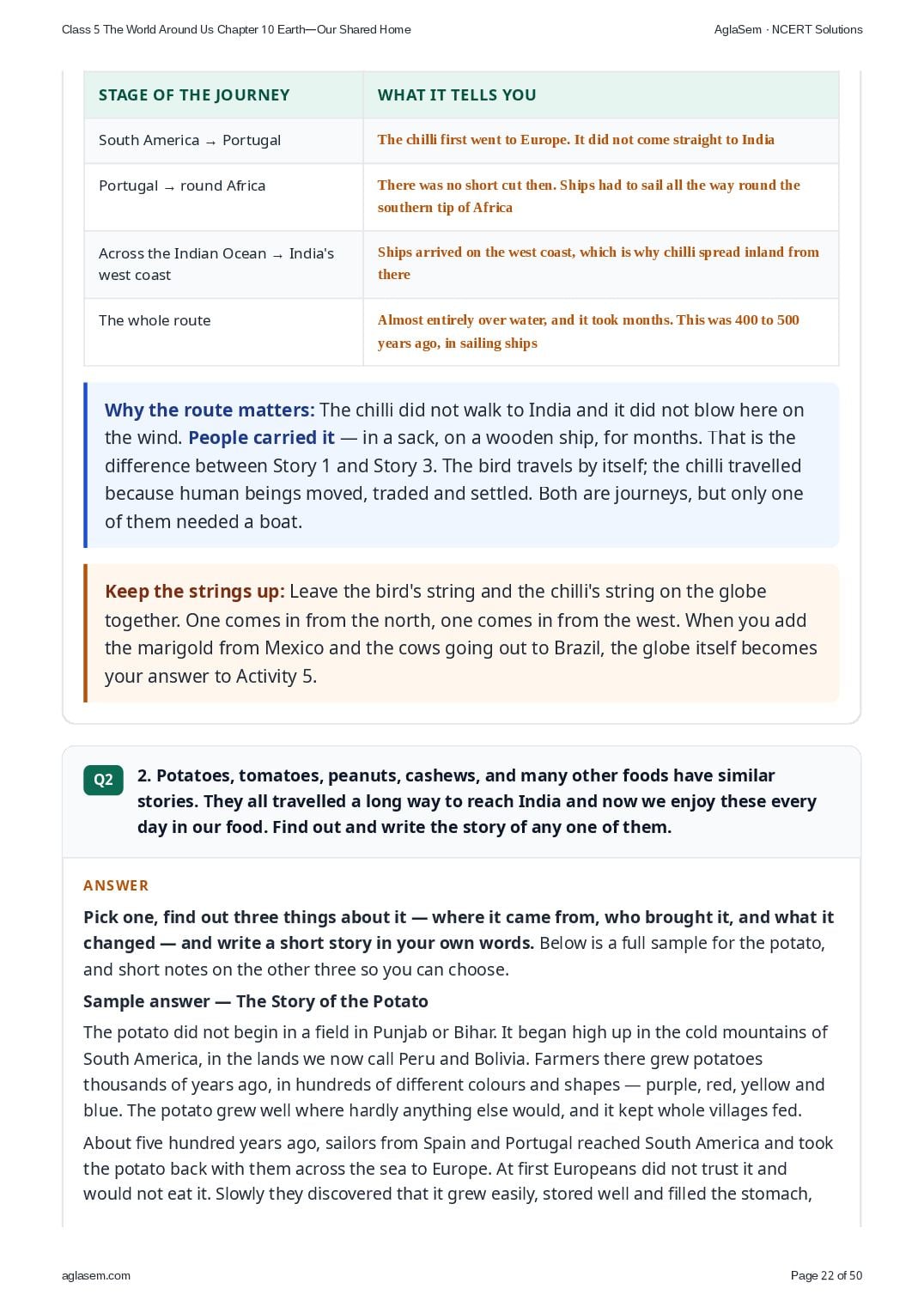
- 1. Using a coloured string, trace the journey of chillies from South America to India on the globe.
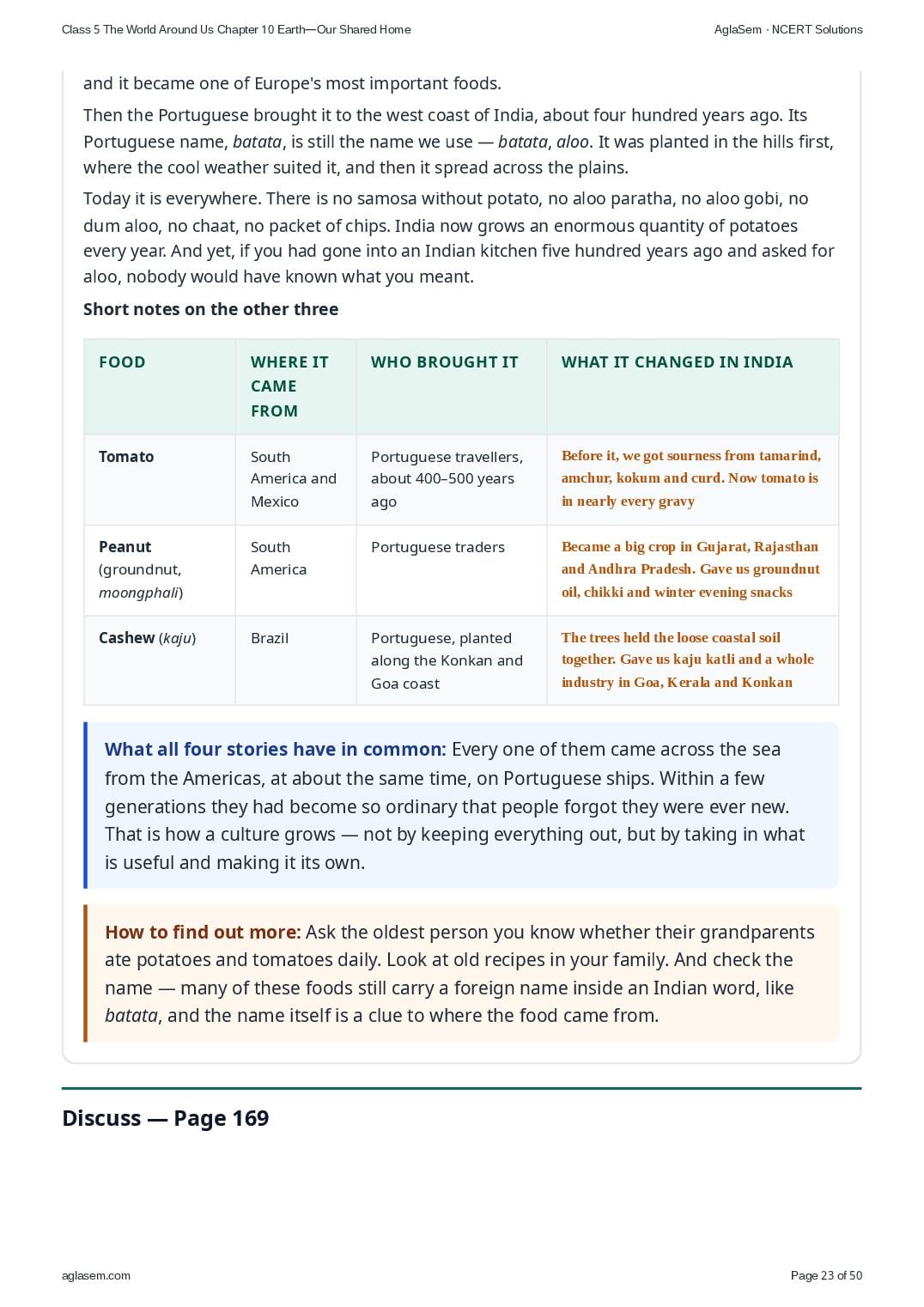
- 2. Potatoes, tomatoes, peanuts, cashews, and many other foods have similar stories. They all travelled a long way to reach India and now we enjoy these every day in our food. Find out and write the story of any one of them.
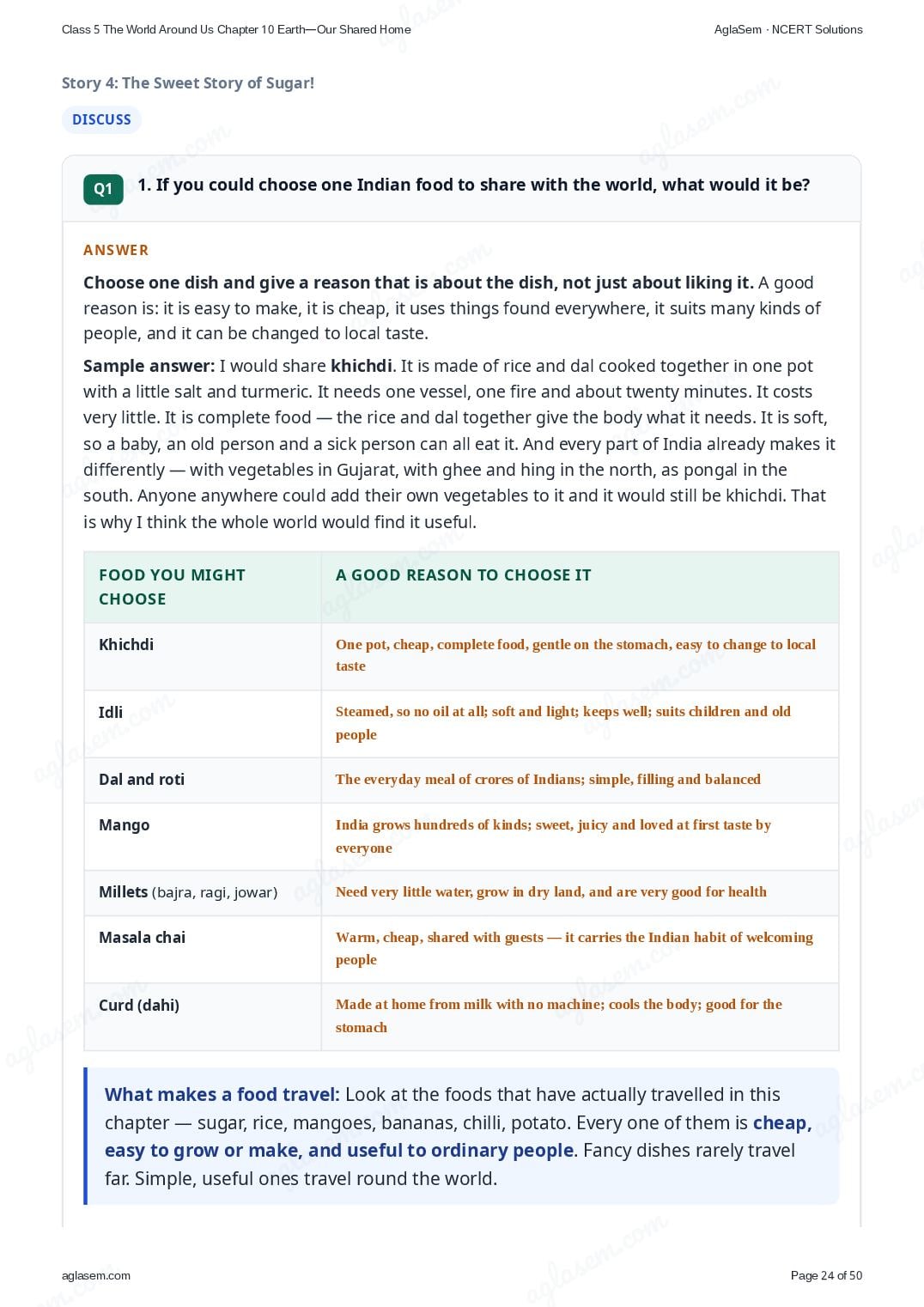
- 1. If you could choose one Indian food to share with the world, what would it be?
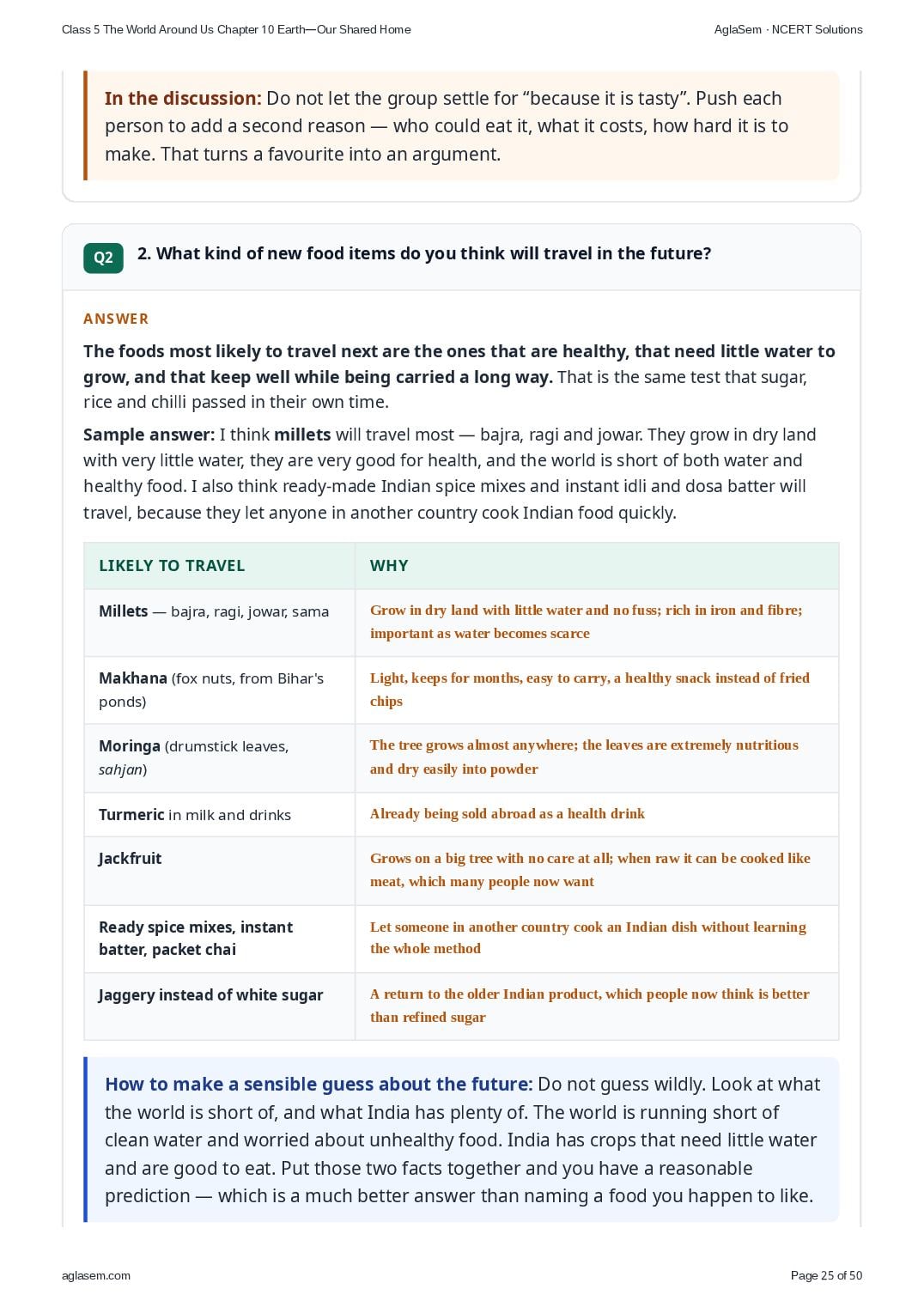
- 2. What kind of new food items do you think will travel in the future?
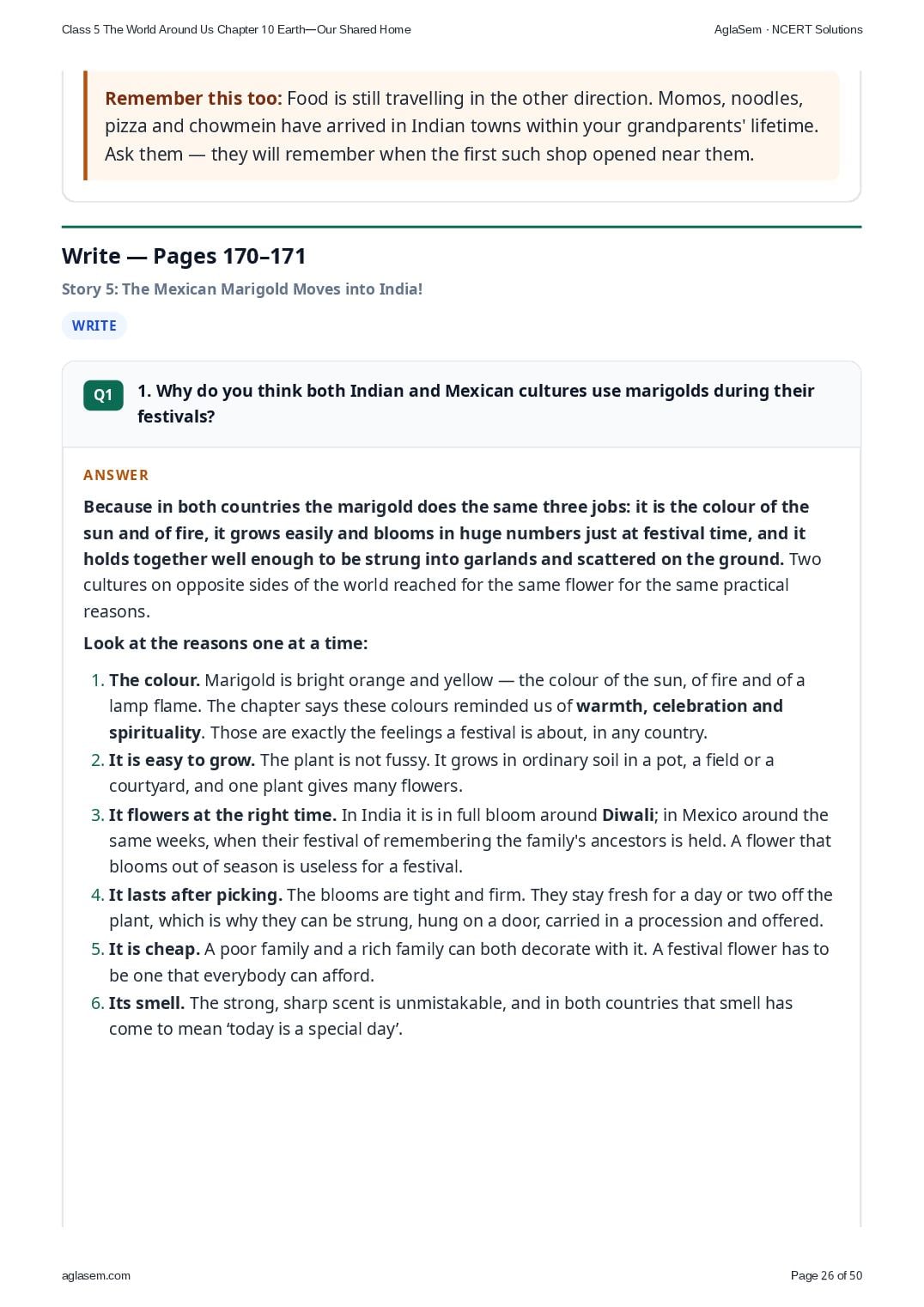
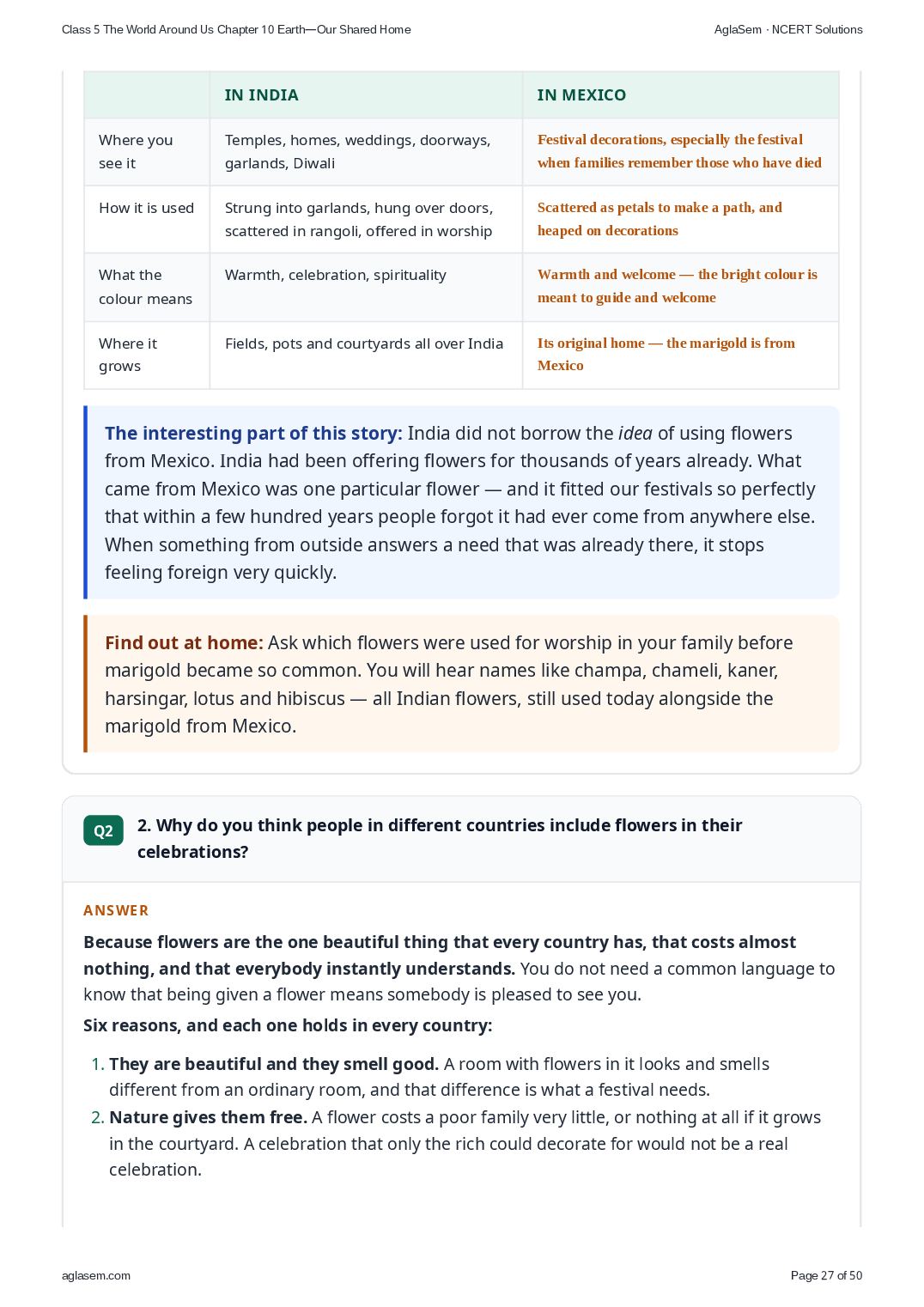
- 1. Why do you think both Indian and Mexican cultures use marigolds during their festivals?
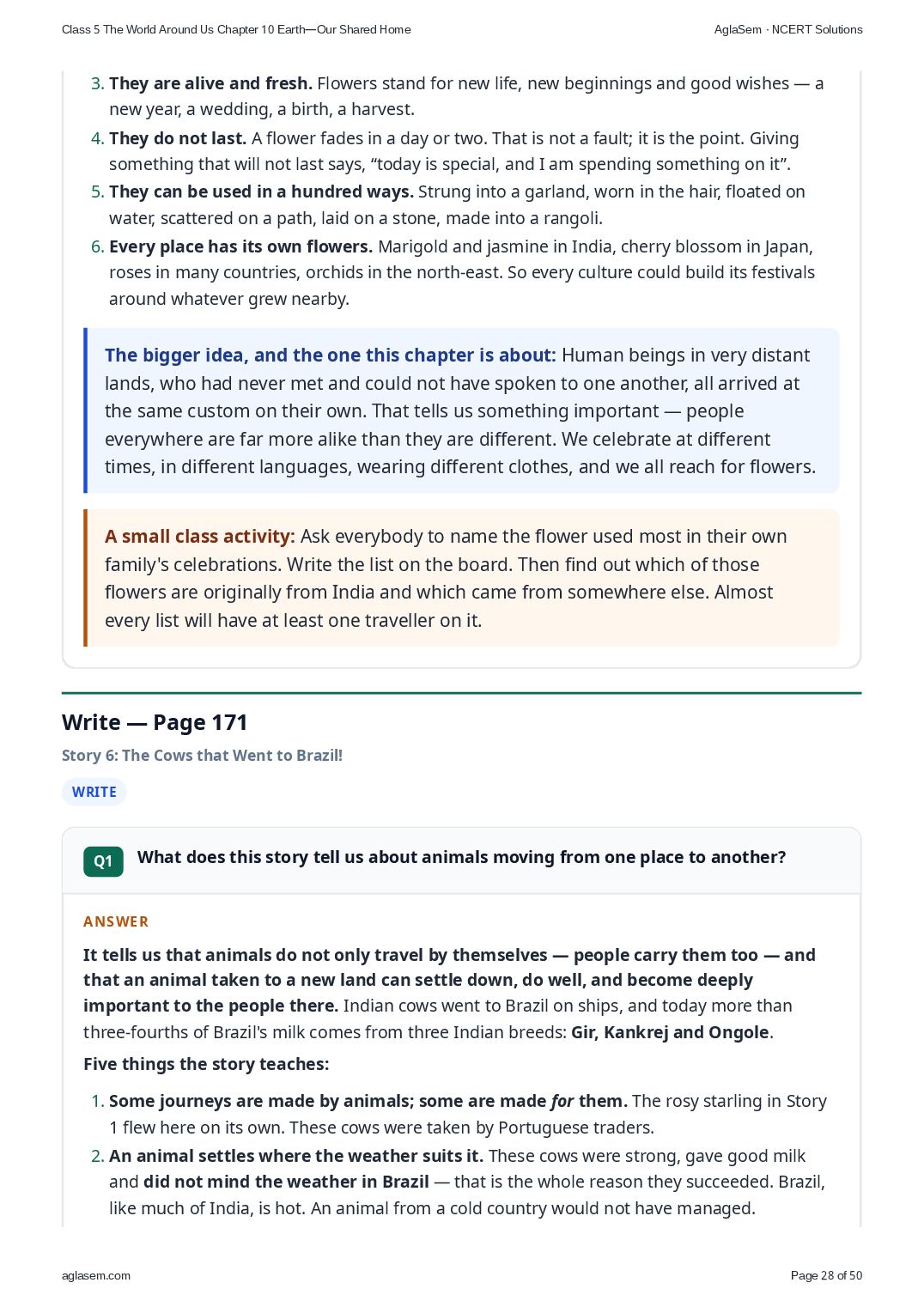
- 2. Why do you think people in different countries include flowers in their celebrations?
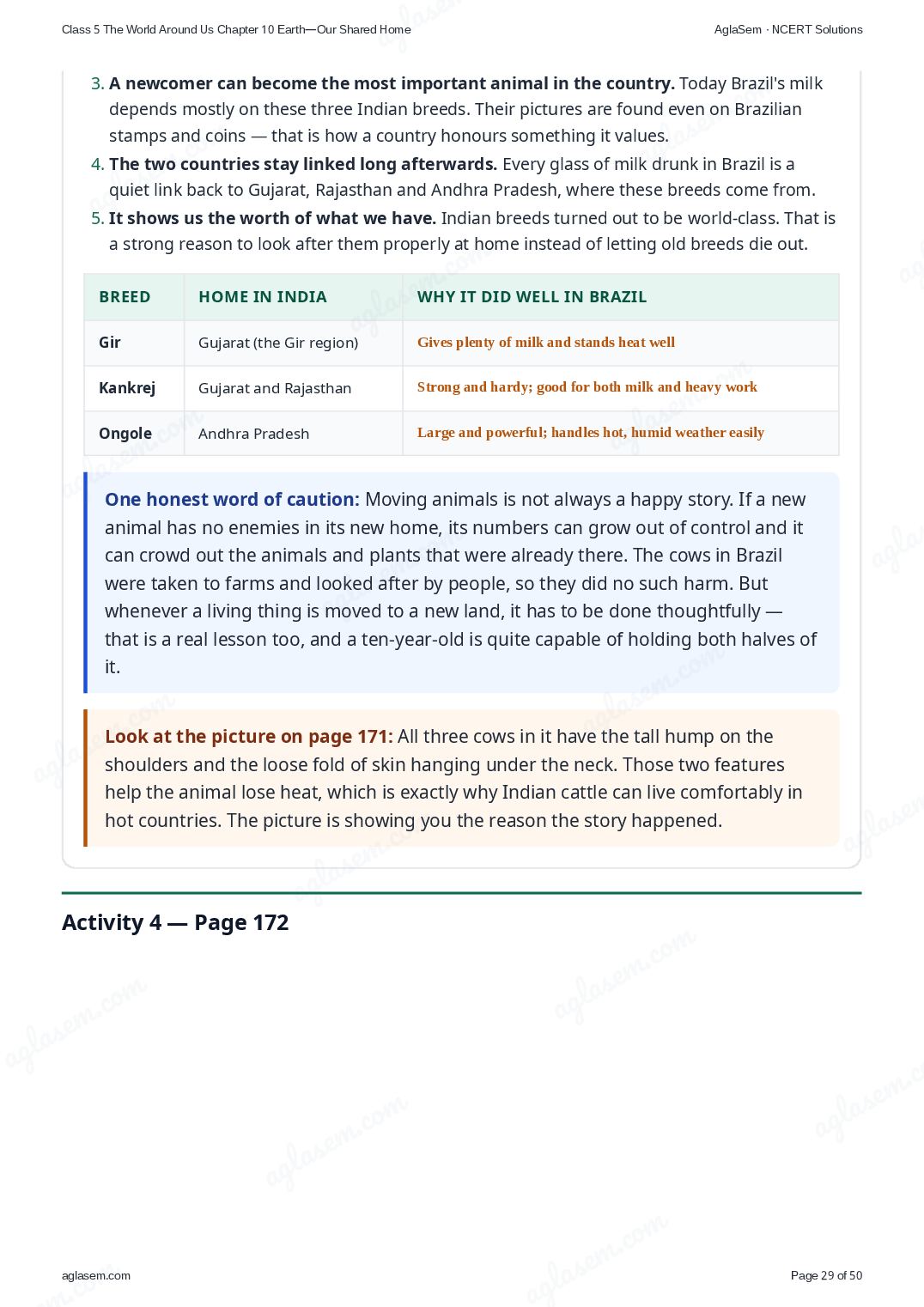
- What does this story tell us about animals moving from one place to another?
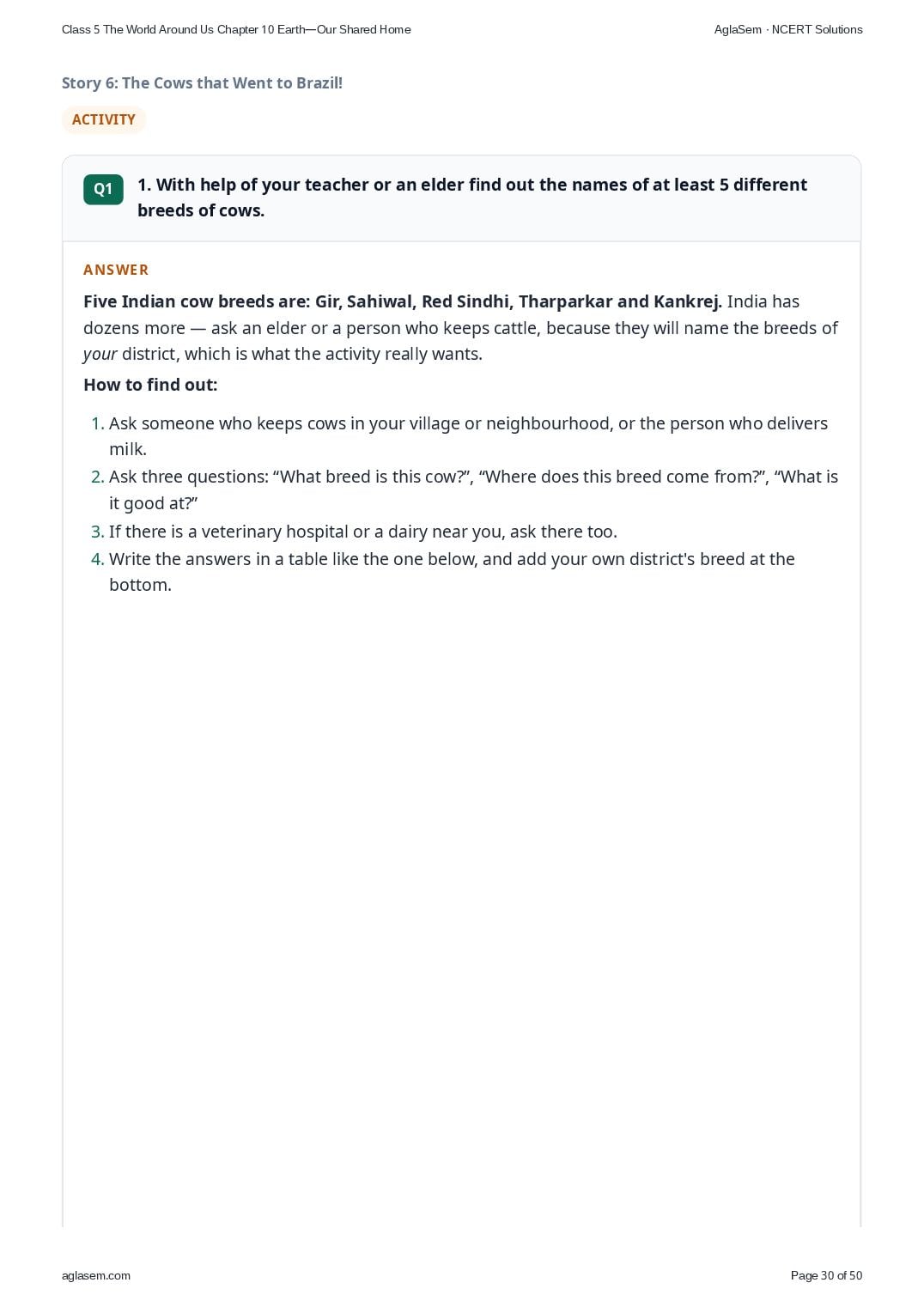
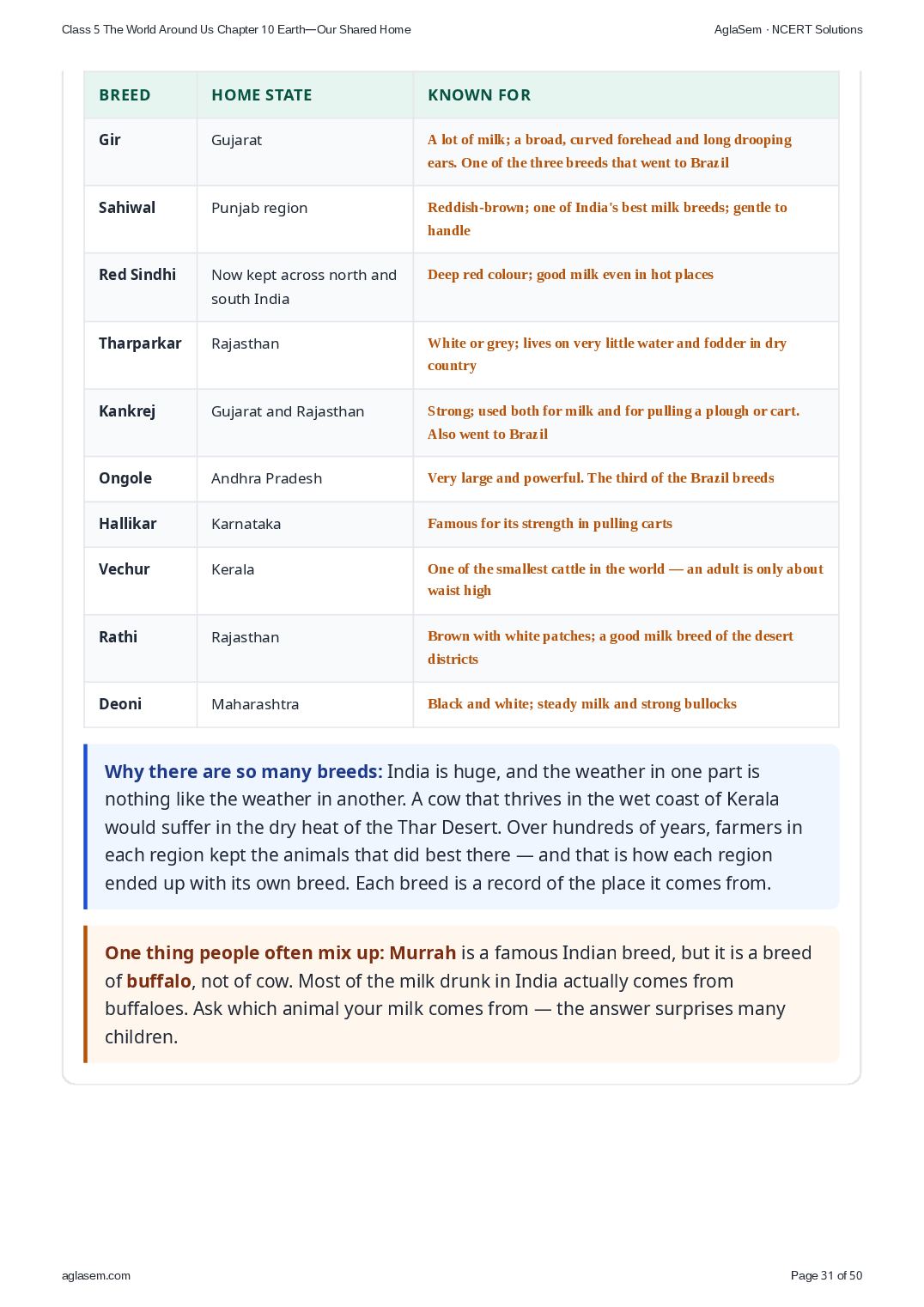
- 1. With help of your teacher or an elder find out the names of at least 5 different breeds of cows.
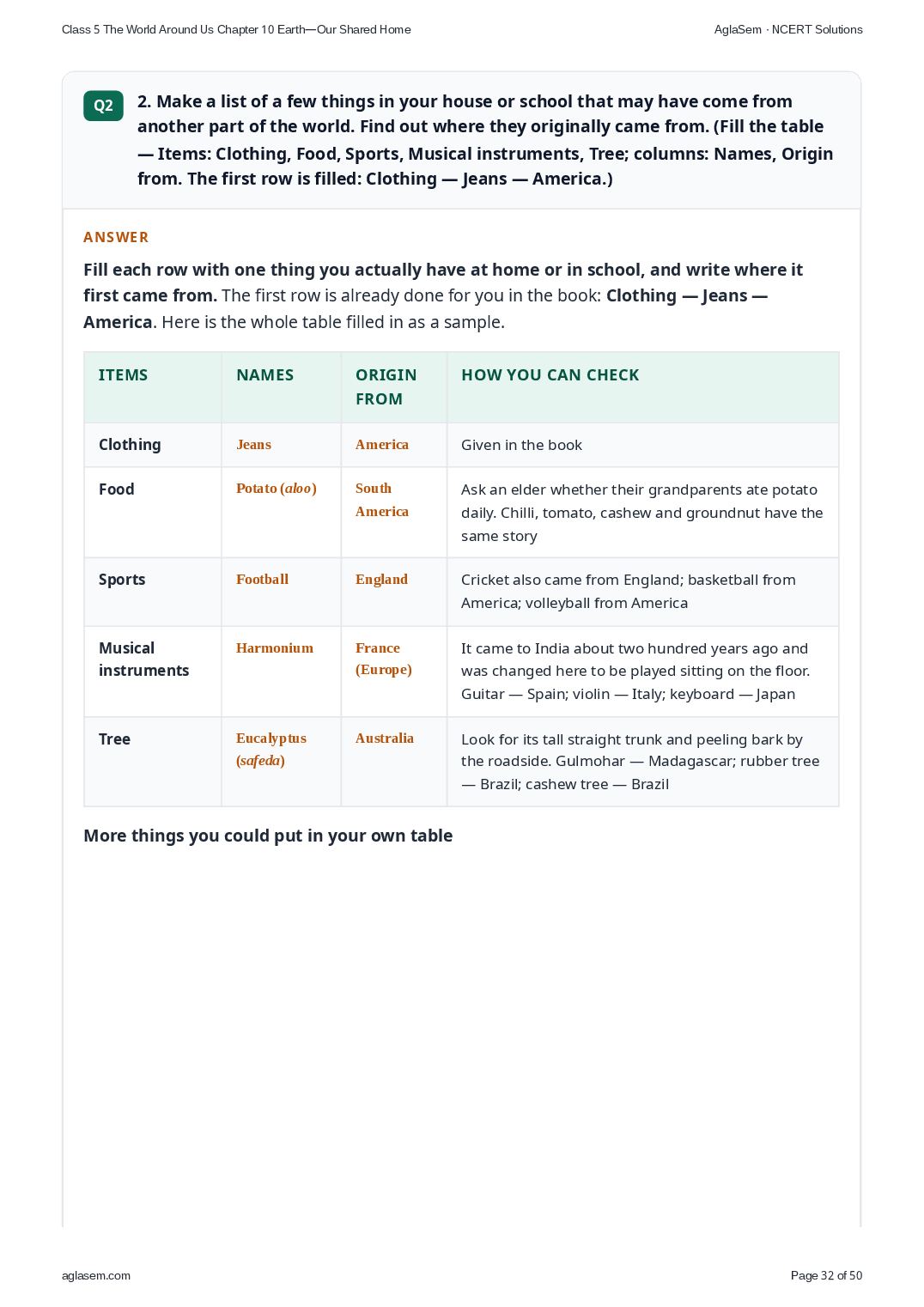
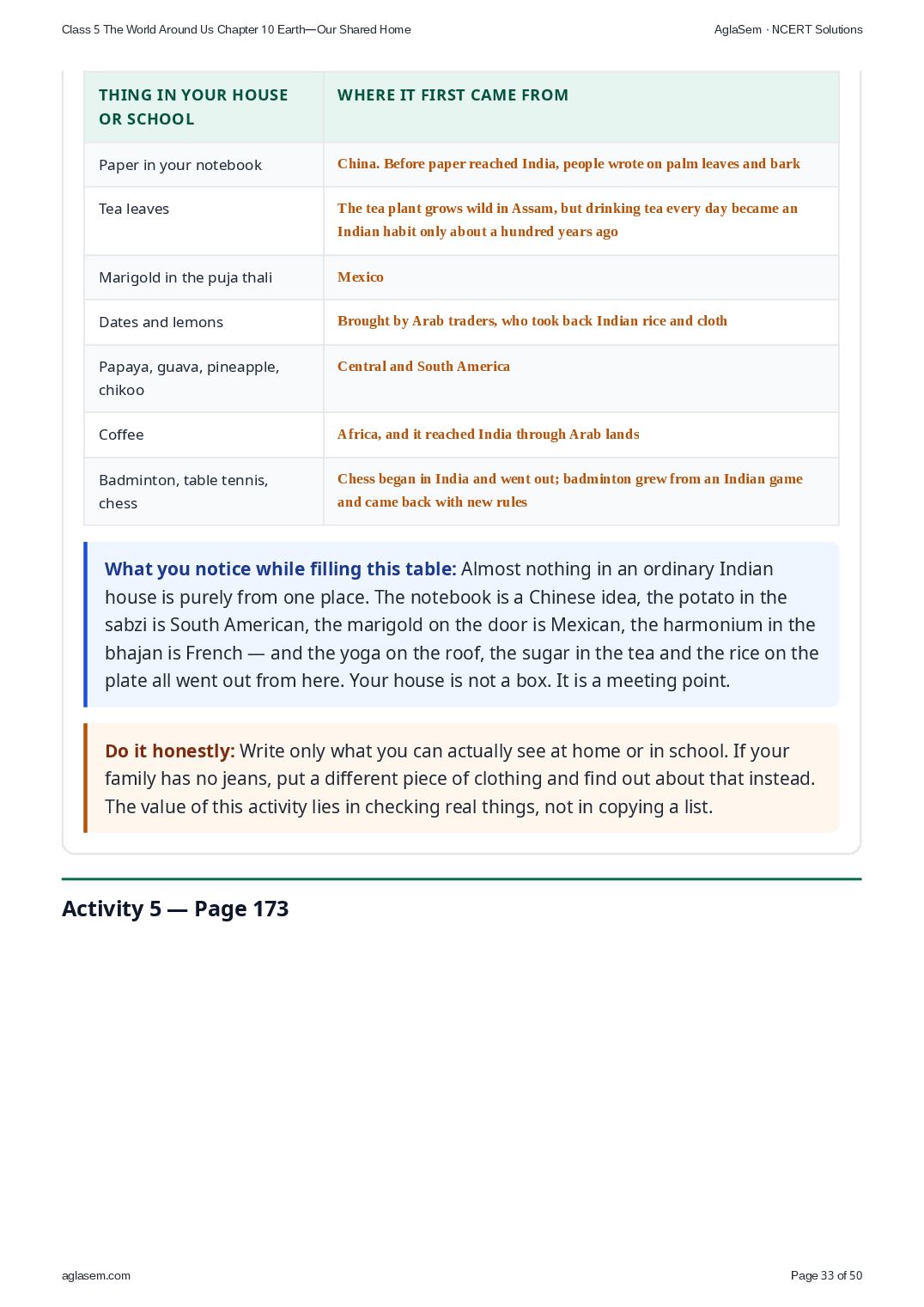
- 2. Make a list of a few things in your house or school that may have come from another part of the world. Find out where they originally came from. (Fill the table — Items: Clothing, Food, Sports, Musical instruments, Tree; columns: Names, Origin from. The first row is filled: Clothing — Jeans — America.)
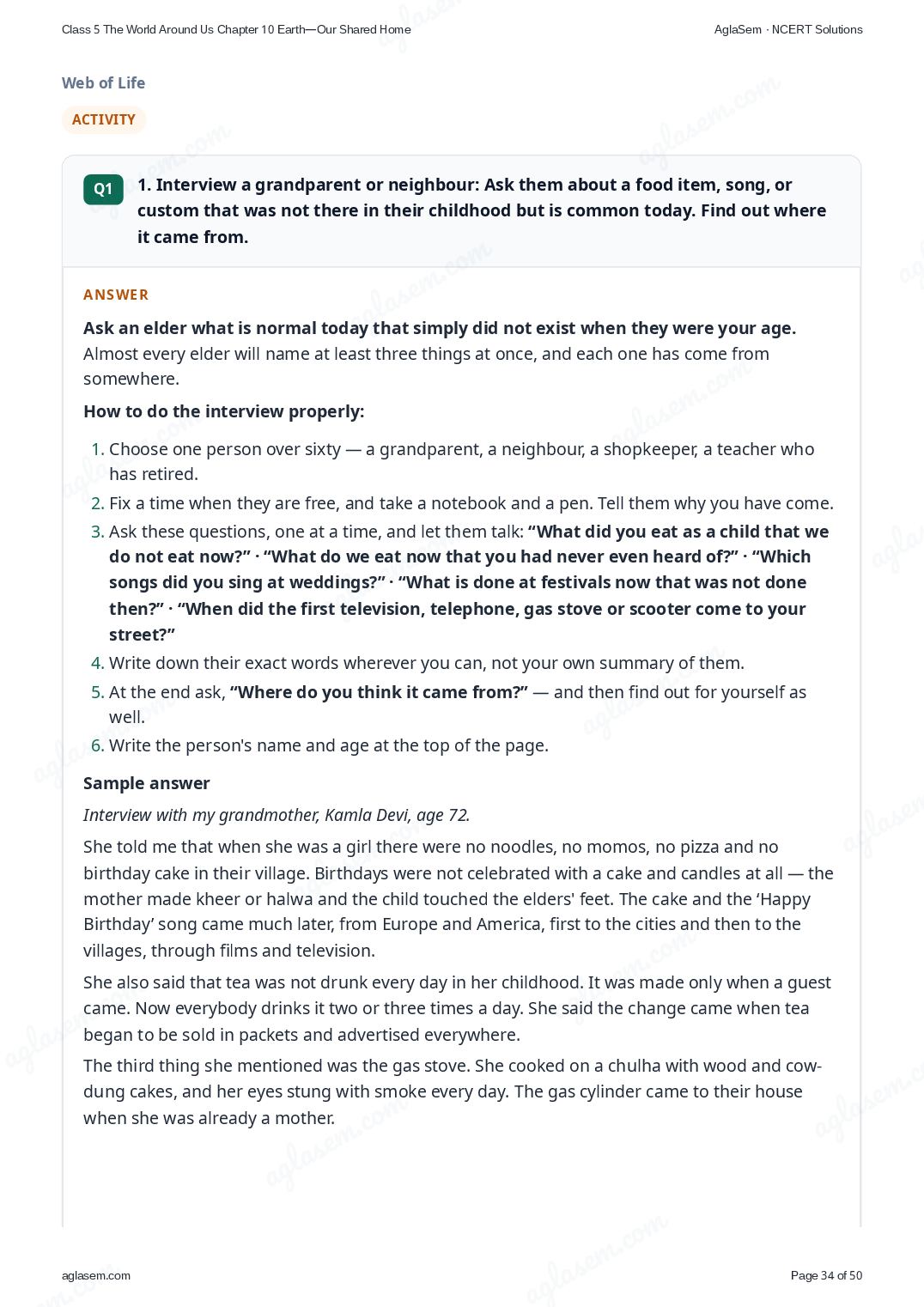
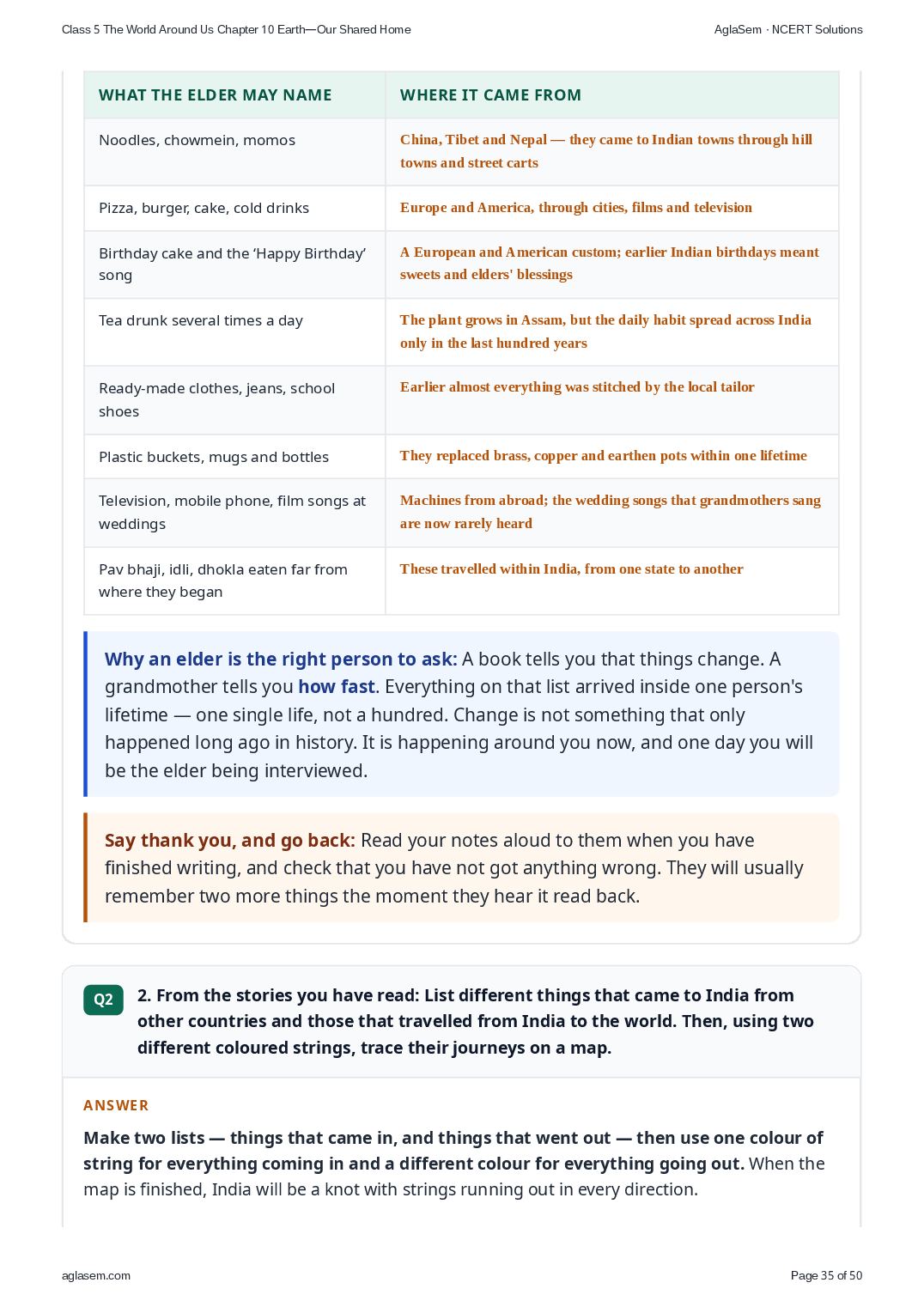
- 1. Interview a grandparent or neighbour: Ask them about a food item, song, or custom that was not there in their childhood but is common today. Find out where it came from.
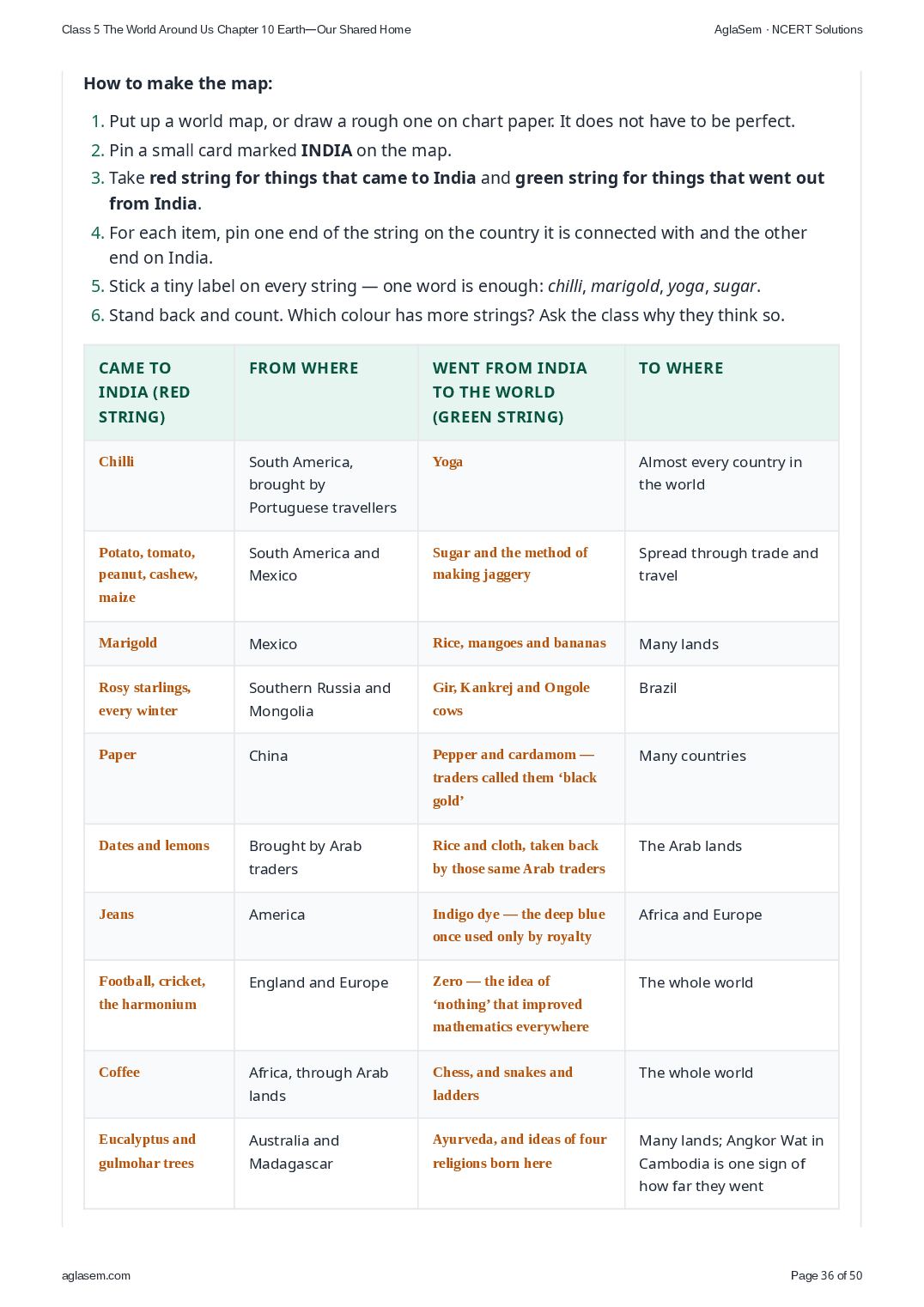
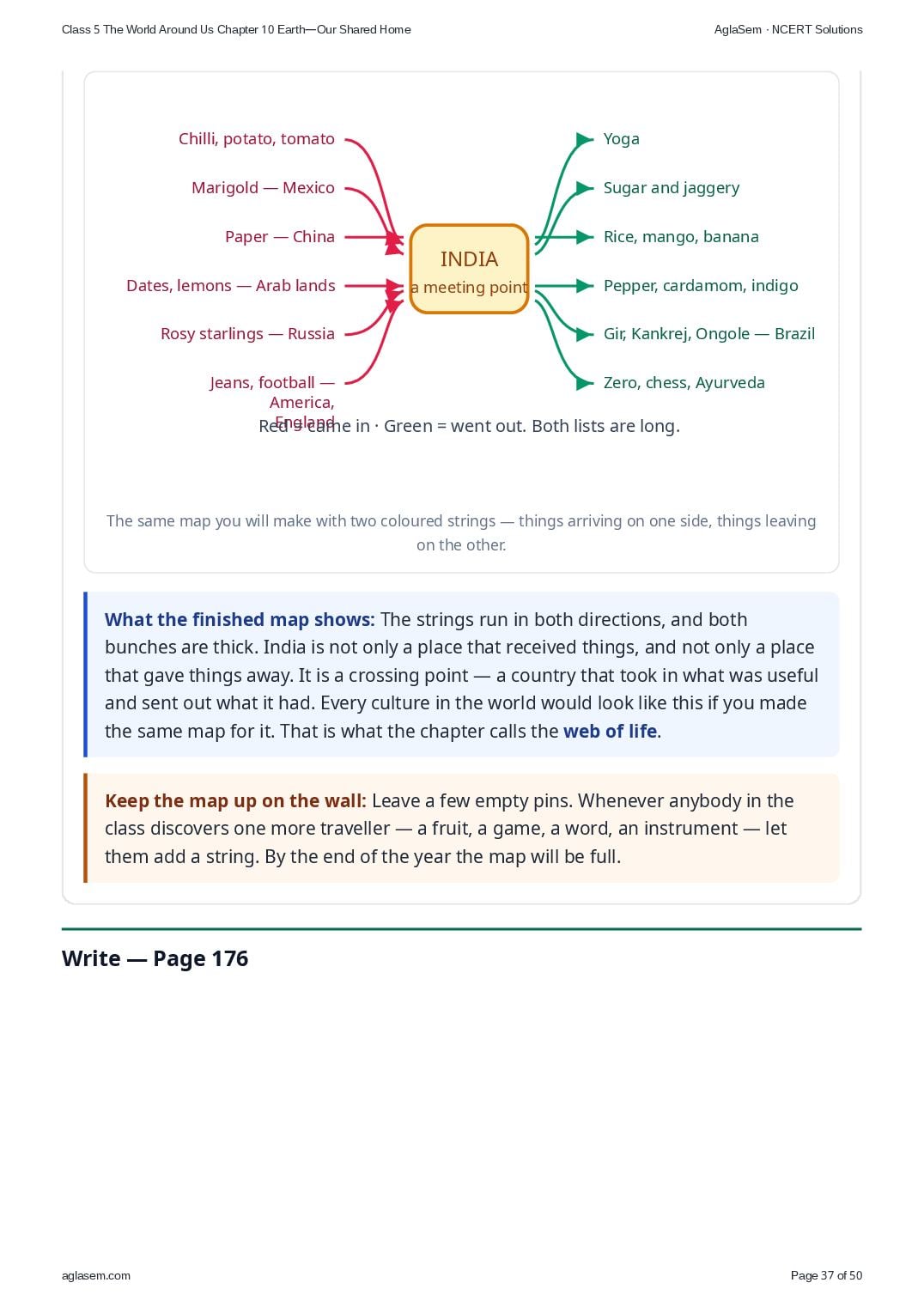
- 2. From the stories you have read: List different things that came to India from other countries and those that travelled from India to the world. Then, using two different coloured strings, trace their journeys on a map.
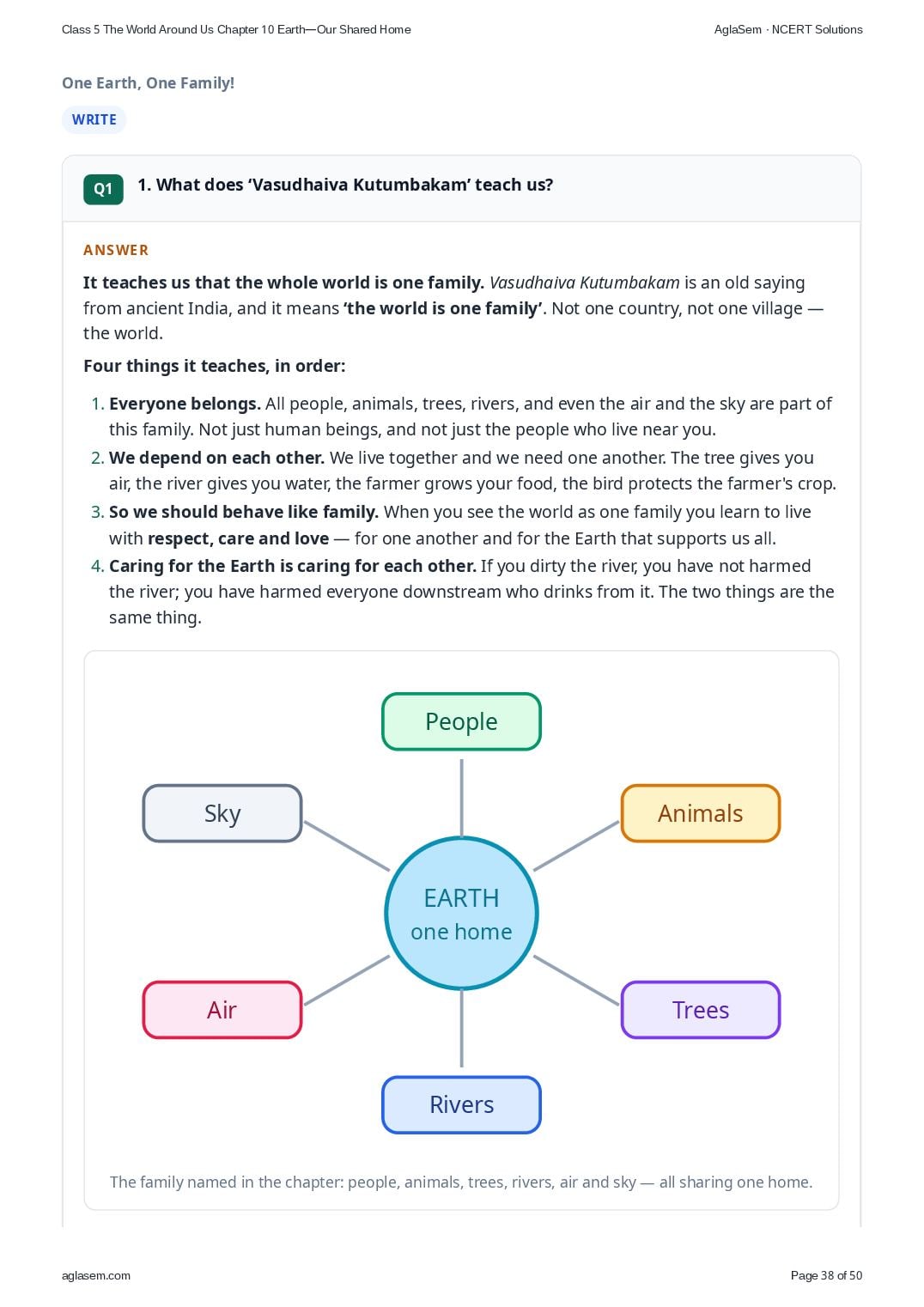
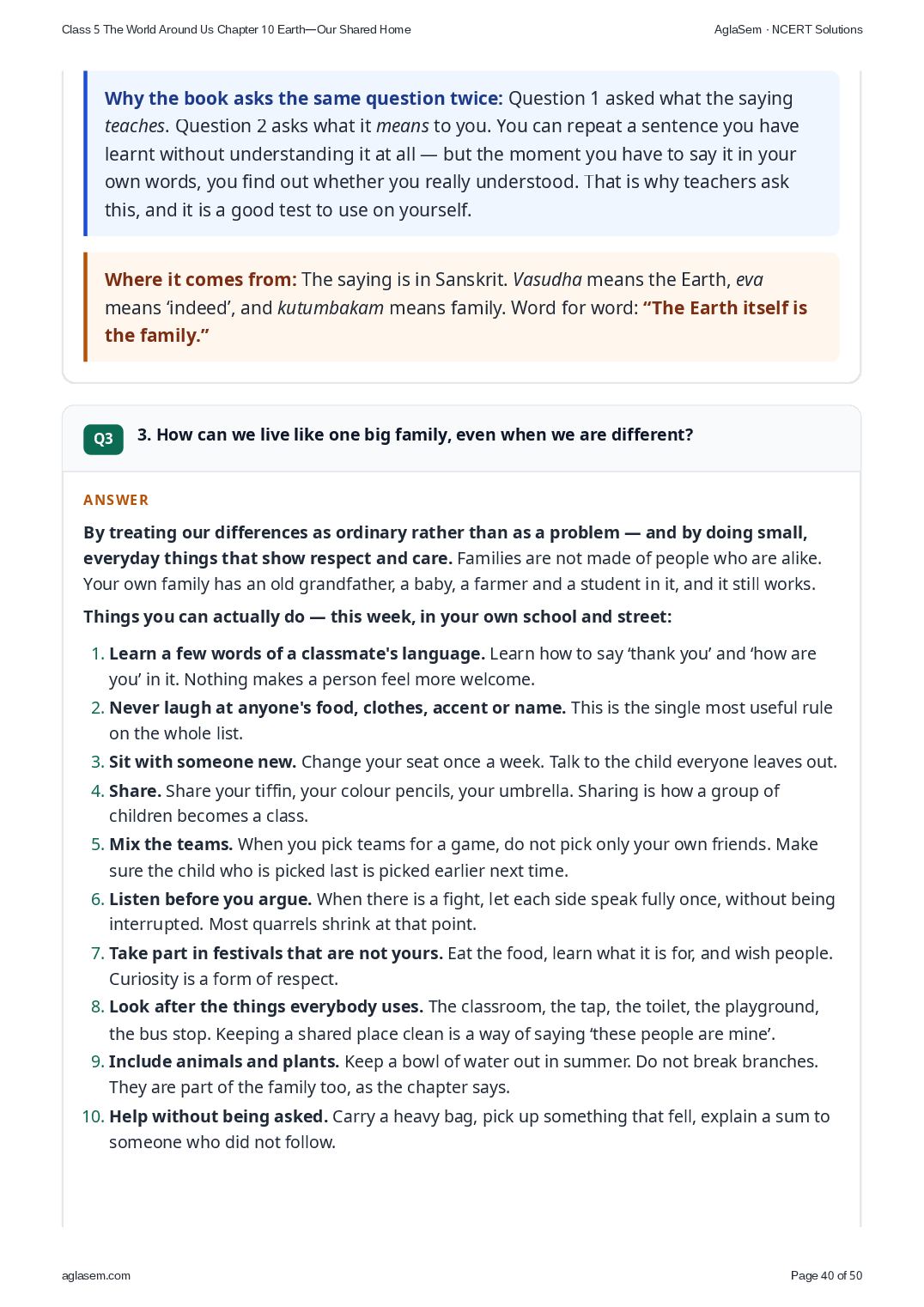
- 1. What does ‘Vasudhaiva Kutumbakam’ teach us?
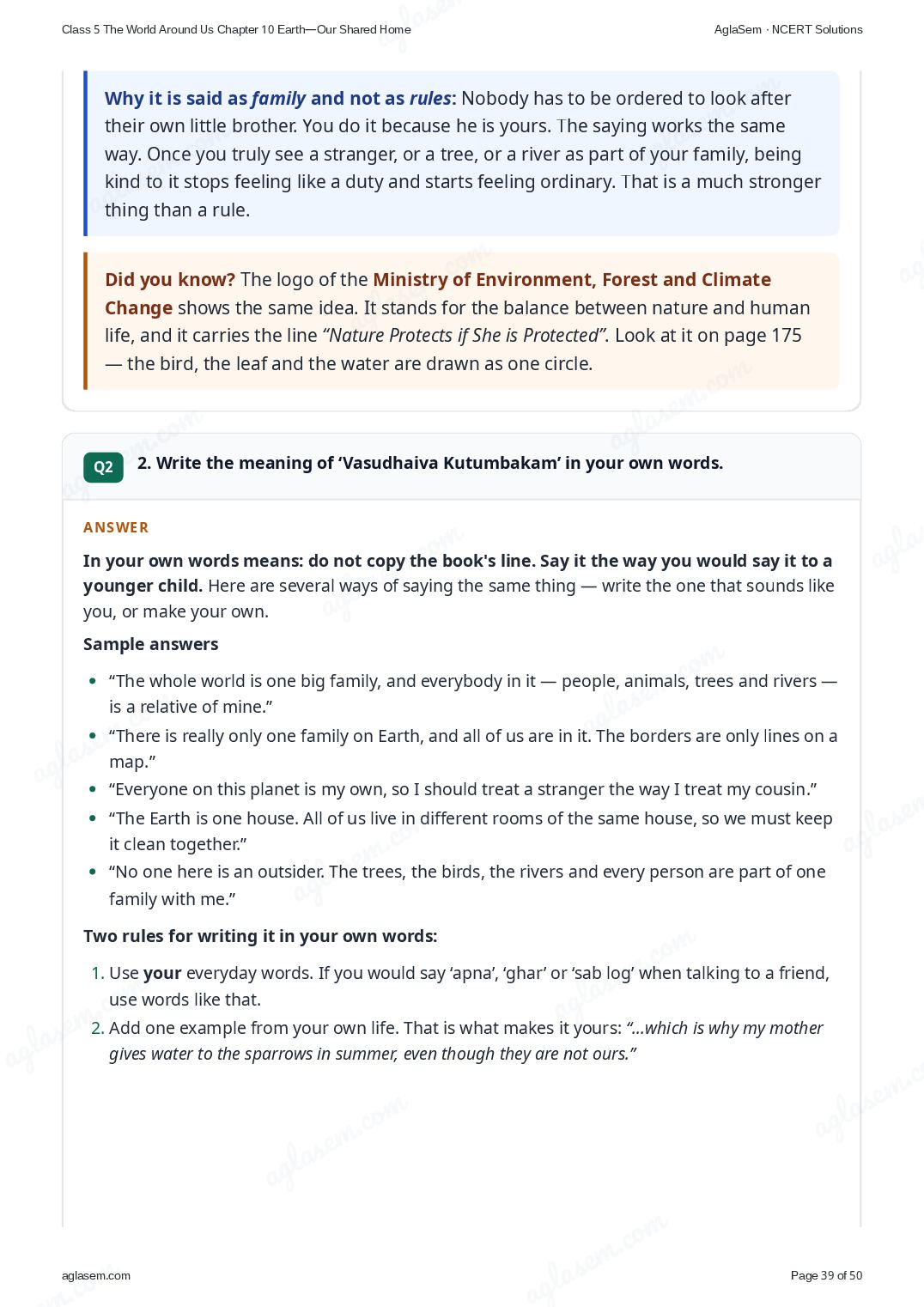
- 2. Write the meaning of ‘Vasudhaiva Kutumbakam’ in your own words.
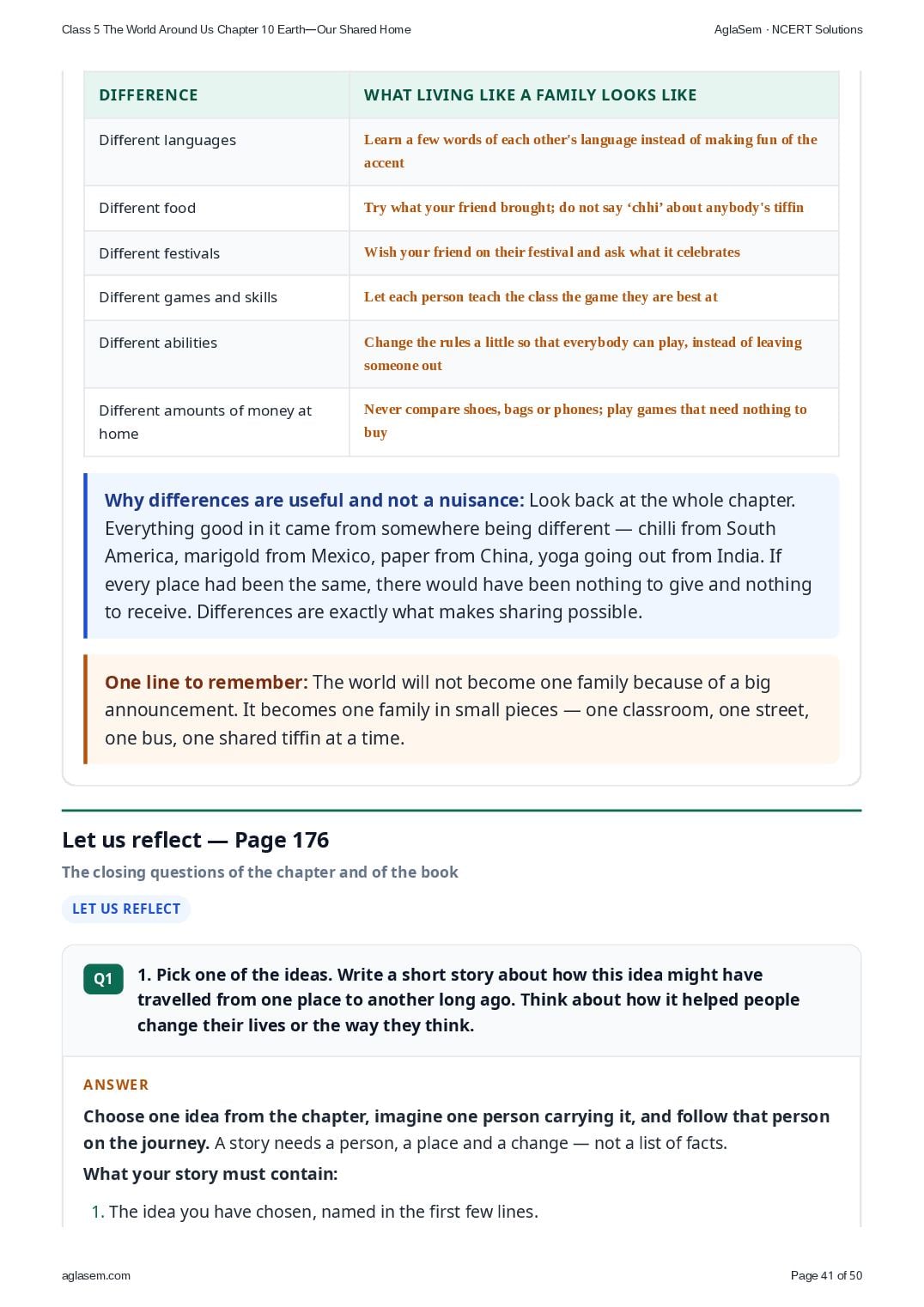
- 3. How can we live like one big family, even when we are different?
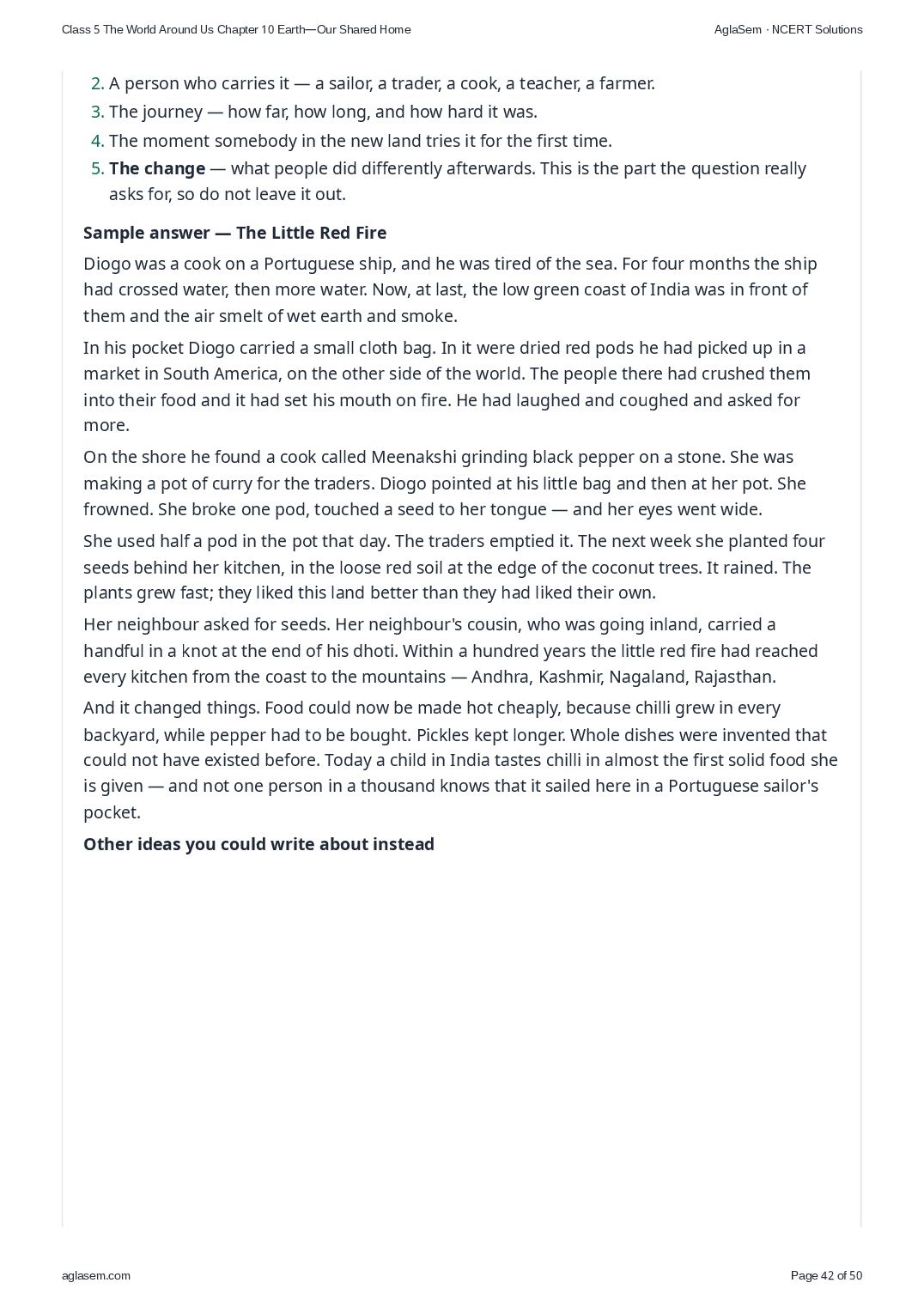
- 1. Pick one of the ideas. Write a short story about how this idea might have travelled from one place to another long ago. Think about how it helped people change their lives or the way they think.
- 2. Write one way you can care for the Earth.
- 3. Identify of an item that can travel from India to other parts of the world and write about it.
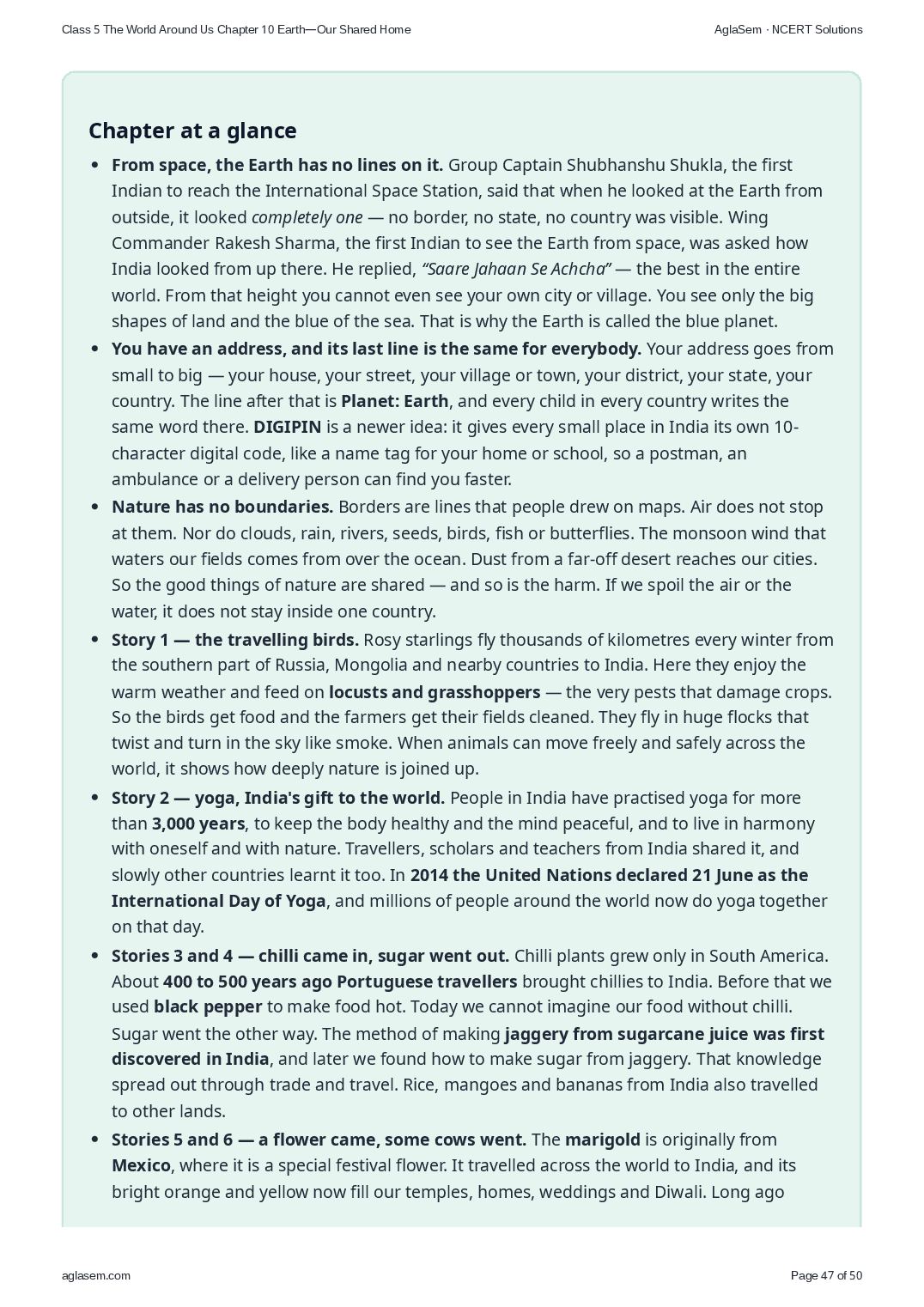
Chapter at a Glance
- From space, the Earth has no lines on it. Group Captain Shubhanshu Shukla, the first Indian to reach the International Space Station, said that when he looked at the Earth from outside, it looked completely one — no border, no state, no country was visible. Wing Commander Rakesh Sharma, the first Indian to see the Earth from space, was asked how India looked from up there. He replied, “Saare Jahaan Se Achcha” — the best in the entire world. From that height you cannot even see your own city or village. You see only the big shapes of land and the blue of the sea. That is why the Earth is called the blue planet.
- You have an address, and its last line is the same for everybody. Your address goes from small to big — your house, your street, your village or town, your district, your state, your country. The line after that is Planet: Earth, and every child in every country writes the same word there. DIGIPIN is a newer idea: it gives every small place in India its own 10-character digital code, like a name tag for your home or school, so a postman, an ambulance or a delivery person can find you faster.
- Nature has no boundaries. Borders are lines that people drew on maps. Air does not stop at them. Nor do clouds, rain, rivers, seeds, birds, fish or butterflies. The monsoon wind that waters our fields comes from over the ocean. Dust from a far-off desert reaches our cities. So the good things of nature are shared — and so is the harm. If we spoil the air or the water, it does not stay inside one country.
- Story 1 — the travelling birds. Rosy starlings fly thousands of kilometres every winter from the southern part of Russia, Mongolia and nearby countries to India. Here they enjoy the warm weather and feed on locusts and grasshoppers — the very pests that damage crops. So the birds get food and the farmers get their fields cleaned. They fly in huge flocks that twist and turn in the sky like smoke. When animals can move freely and safely across the world, it shows how deeply nature is joined up.
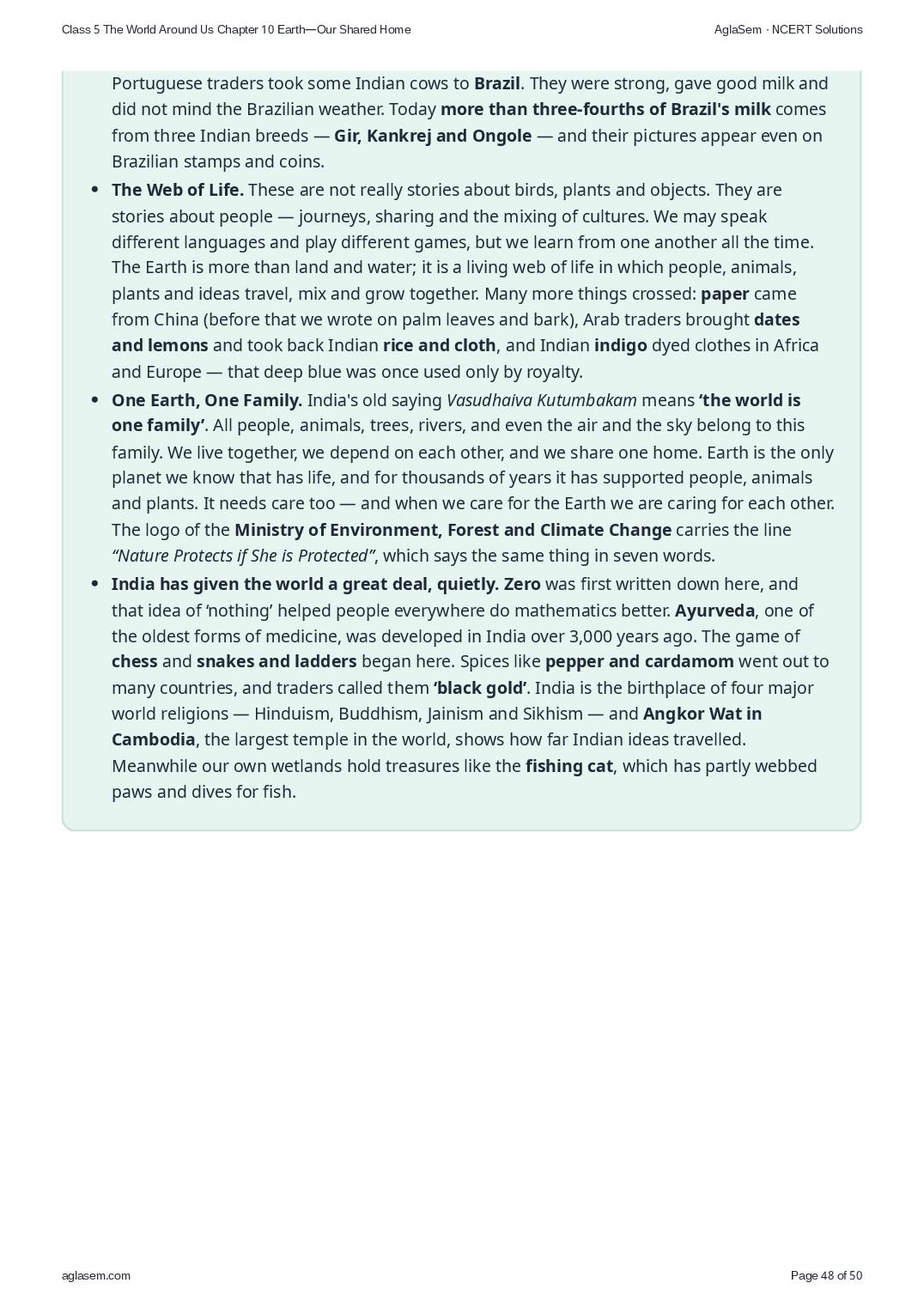
- Story 2 — yoga, India’s gift to the world. People in India have practised yoga for more than 3,000 years, to keep the body healthy and the mind peaceful, and to live in harmony with oneself and with nature. Travellers, scholars and teachers from India shared it, and slowly other countries learnt it too. In 2014 the United Nations declared 21 June as the International Day of Yoga, and millions of people around the world now do yoga together on that day.
- Stories 3 and 4 — chilli came in, sugar went out. Chilli plants grew only in South America. About 400 to 500 years ago Portuguese travellers brought chillies to India. Before that we used black pepper to make food hot. Today we cannot imagine our food without chilli. Sugar went the other way. The method of making jaggery from sugarcane juice was first discovered in India, and later we found how to make sugar from jaggery. That knowledge spread out through trade and travel. Rice, mangoes and bananas from India also travelled to other lands.
- Stories 5 and 6 — a flower came, some cows went. The marigold is originally from Mexico, where it is a special festival flower. It travelled across the world to India, and its bright orange and yellow now fill our temples, homes, weddings and Diwali. Long ago Portuguese traders took some Indian cows to Brazil. They were strong, gave good milk and did not mind the Brazilian weather. Today more than three-fourths of Brazil’s milk comes from three Indian breeds — Gir, Kankrej and Ongole — and their pictures appear even on Brazilian stamps and coins.
- The Web of Life. These are not really stories about birds, plants and objects. They are stories about people — journeys, sharing and the mixing of cultures. We may speak different languages and play different games, but we learn from one another all the time. The Earth is more than land and water; it is a living web of life in which people, animals, plants and ideas travel, mix and grow together. Many more things crossed: paper came from China (before that we wrote on palm leaves and bark), Arab traders brought dates and lemons and took back Indian rice and cloth, and Indian indigo dyed clothes in Africa and Europe — that deep blue was once used only by royalty.
- One Earth, One Family. India’s old saying Vasudhaiva Kutumbakam means ‘the world is one family’. All people, animals, trees, rivers, and even the air and the sky belong to this family. We live together, we depend on each other, and we share one home. Earth is the only planet we know that has life, and for thousands of years it has supported people, animals and plants. It needs care too — and when we care for the Earth we are caring for each other. The logo of the Ministry of Environment, Forest and Climate Change carries the line “Nature Protects if She is Protected”, which says the same thing in seven words.
- India has given the world a great deal, quietly. Zero was first written down here, and that idea of ‘nothing’ helped people everywhere do mathematics better. Ayurveda, one of the oldest forms of medicine, was developed in India over 3,000 years ago. The game of chess and snakes and ladders began here. Spices like pepper and cardamom went out to many countries, and traders called them ‘black gold’. India is the birthplace of four major world religions — Hinduism, Buddhism, Jainism and Sikhism — and Angkor Wat in Cambodia, the largest temple in the world, shows how far Indian ideas travelled. Meanwhile our own wetlands hold treasures like the fishing cat, which has partly webbed paws and dives for fish.
How to Download NCERT Solutions for Class 5 The World Around Us Chapter 10 PDF
Follow these simple steps to get the Earth Our Shared Home questions-and-answers PDF from Our Wondrous World.
- Search NCERT Solutions for Class 5 The World Around Us Chapter 10 aglasem and open this page.
- Read the exercise questions with answers for Earth Our Shared Home shown above.
- Click the Download PDF link to save the Earth Our Shared Home solutions to your device.
NCERT Solutions for Class 5 The World Around Us – All Chapters
There are more chapters to study besides Earth Our Shared Home in The World Around Us. Here are the NCERT Solutions for all chapters of Class 5 The World Around Us.
- Chapter 1 Water the Essence of Life
- Chapter 2 Journey of a River
- Chapter 3 the Mystery of Food
- Chapter 4 Our School a Happy Place
- Chapter 5 Our Vibrant Country
- Chapter 6 Some Unique Places
- Chapter 7 Energy How Things Work
- Chapter 8 Clothes How Things Are Made
- Chapter 9 Rhythms of Nature
- Chapter 10 Earth Our Shared Home
NCERT Solutions for Class 5 – All Subjects
Just like Chapter 10 of The World Around Us, you can get the exercise questions with answers for every other subject of Class 5. Here are the NCERT Solutions for all subjects of Class 5.
NCERT Solutions for Class 5 The World Around Us Chapter 10 – An Overview
The key highlights of this study material are as follows.
| Aspects | Details |
|---|---|
| Class | Class 5 |
| Subject | The World Around Us |
| Chapter Number | Chapter 10 |
| Chapter Name | Earth Our Shared Home |
| Book Name | Our Wondrous World |
| Book By | NCERT (National Council of Educational Research and Training) |
| Educational Resource Here | NCERT Solutions of Class 5 The World Around Us Chapter 10 for all exercises |
| More Questions Answers of This Subject | NCERT Solutions for Class 5 The World Around Us |
| Download Book Chapter | NCERT Book Class 5 The World Around Us |
| All Questions Answers For This Class | NCERT Solutions for Class 5 |
| Complete Solutions | NCERT Solutions |
NCERT Solutions for Class 5 The World Around Us Chapter 10 Earth Our Shared Home – FAQs
What are the NCERT Solutions for Class 5 The World Around Us Chapter 10 Earth Our Shared Home?
They are the complete, step-by-step answers to all the exercise and in-text questions of Chapter 10 Earth Our Shared Home from the NCERT Class 5 The World Around Us textbook Our Wondrous World, written by experts as per the latest NCERT syllabus.
How can I download the Class 5 The World Around Us Chapter 10 solutions PDF for free?
Open this page on aglasem, read the Earth Our Shared Home questions with answers, and click the “Download Solutions PDF” link. The Class 5 The World Around Us Chapter 10 NCERT Solutions PDF is completely free to download.
Are these NCERT Solutions as per the latest 2026-27 syllabus?
Yes. The NCERT Solutions for Class 5 The World Around Us Chapter 10 are based on the latest NCERT textbook Our Wondrous World and the current 2026-27 CBSE syllabus, so the questions and answers match what you study in class.
Where can I get NCERT Solutions for the other chapters of Class 5 The World Around Us?
You can find the answers to every chapter on the NCERT Solutions for Class 5 The World Around Us page, and solutions for every subject on the NCERT Solutions for Class 5 page.
How do NCERT Solutions help in exam preparation?
They show the correct method to solve each question, help you write answers the way they are expected in exams, let you check and correct your own work, and save revision time — which together improve your marks in Class 5 The World Around Us.
If you have any queries on NCERT Solutions for Class 5 The World Around Us Chapter 10 Earth Our Shared Home, then please ask in the comments below.