NCERT Solutions for Class 5 The World Around Us Chapter 3 the Mystery of Food provide clear, step-by-step answers to every exercise and in-text question from the chapter the Mystery of Food of the NCERT textbook Our Wondrous World. Prepared by subject experts as per the latest NCERT (CBSE) syllabus for 2026-27, these NCERT Solutions for Class 5 The World Around Us help you understand each concept, write exam-ready answers, and check your own solutions. You can read them online below or download the free Class 5 The World Around Us Chapter 3 question-answer PDF.
NCERT Solutions for Class 5 The World Around Us Chapter 3 the Mystery of Food
- Class: Class 5
- Subject: The World Around Us
- Chapter: Chapter 3 – the Mystery of Food
- Textbook: Our Wondrous World (NCERT)
- Study material: NCERT Solutions – questions with answers, free PDF
These solutions answer all the exercise questions of Chapter 3 the Mystery of Food — including the in-text questions, short-answer and long-answer questions, and activities — with complete explanations so you can follow the method, not just the final answer. Read the full solutions below.
NCERT Solutions Class 5 The World Around Us Chapter 3 the Mystery of Food View Download

NCERT Solutions for Class 5 The World Around Us Chapter 3 PDF Download
You can read the NCERT Solutions for Class 5 The World Around Us Chapter 3 online above, or download the complete question-answer PDF to study the Mystery of Food offline at any time.
NCERT Solutions for Class 5 The World Around Us Chapter 3 PDF Download Link – Click Here to Download Solutions PDF
Questions Covered in This Chapter
These NCERT Solutions answer all 33 questions of this chapter. The questions solved are:
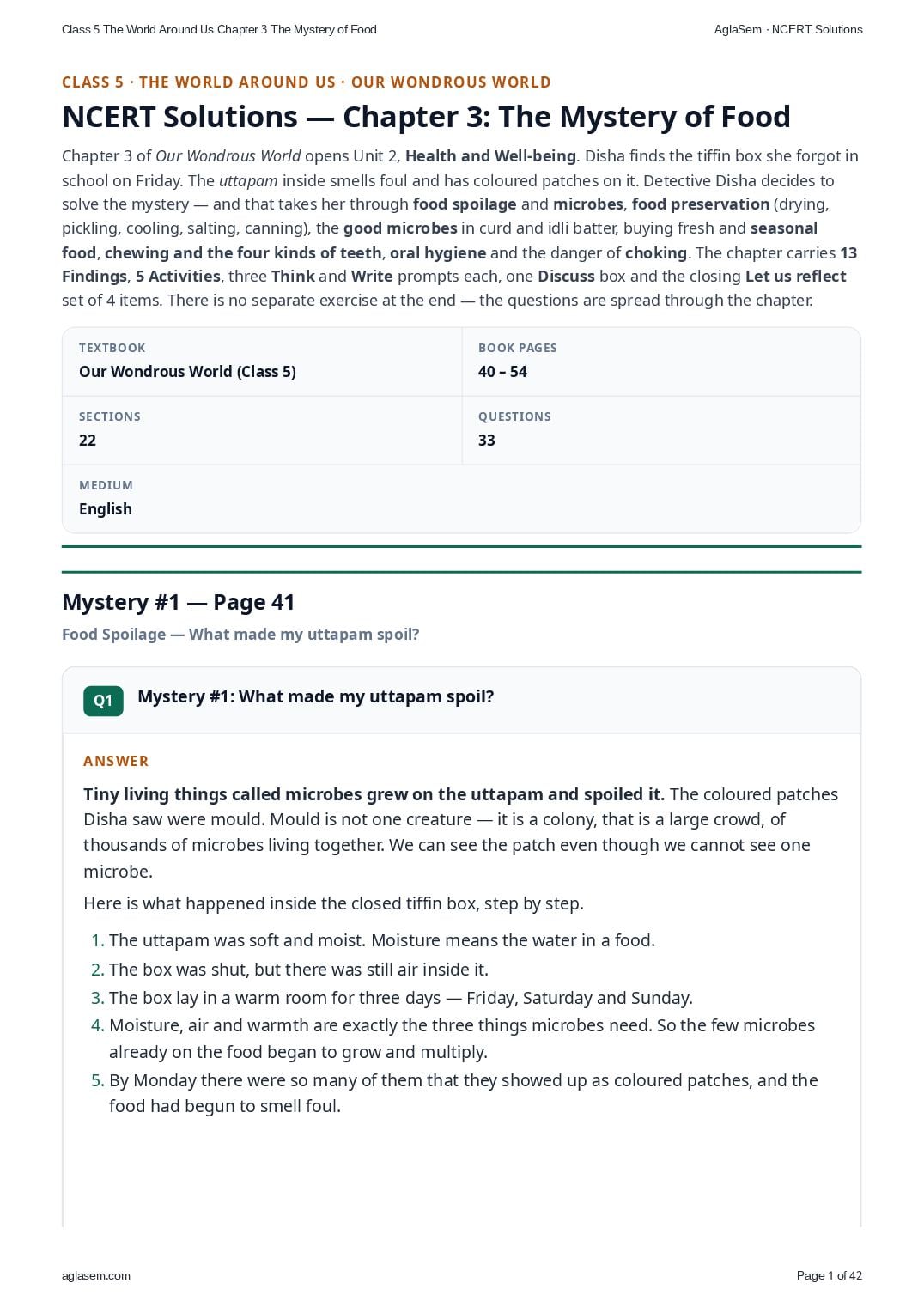
- Mystery #1: What made my uttapam spoil?
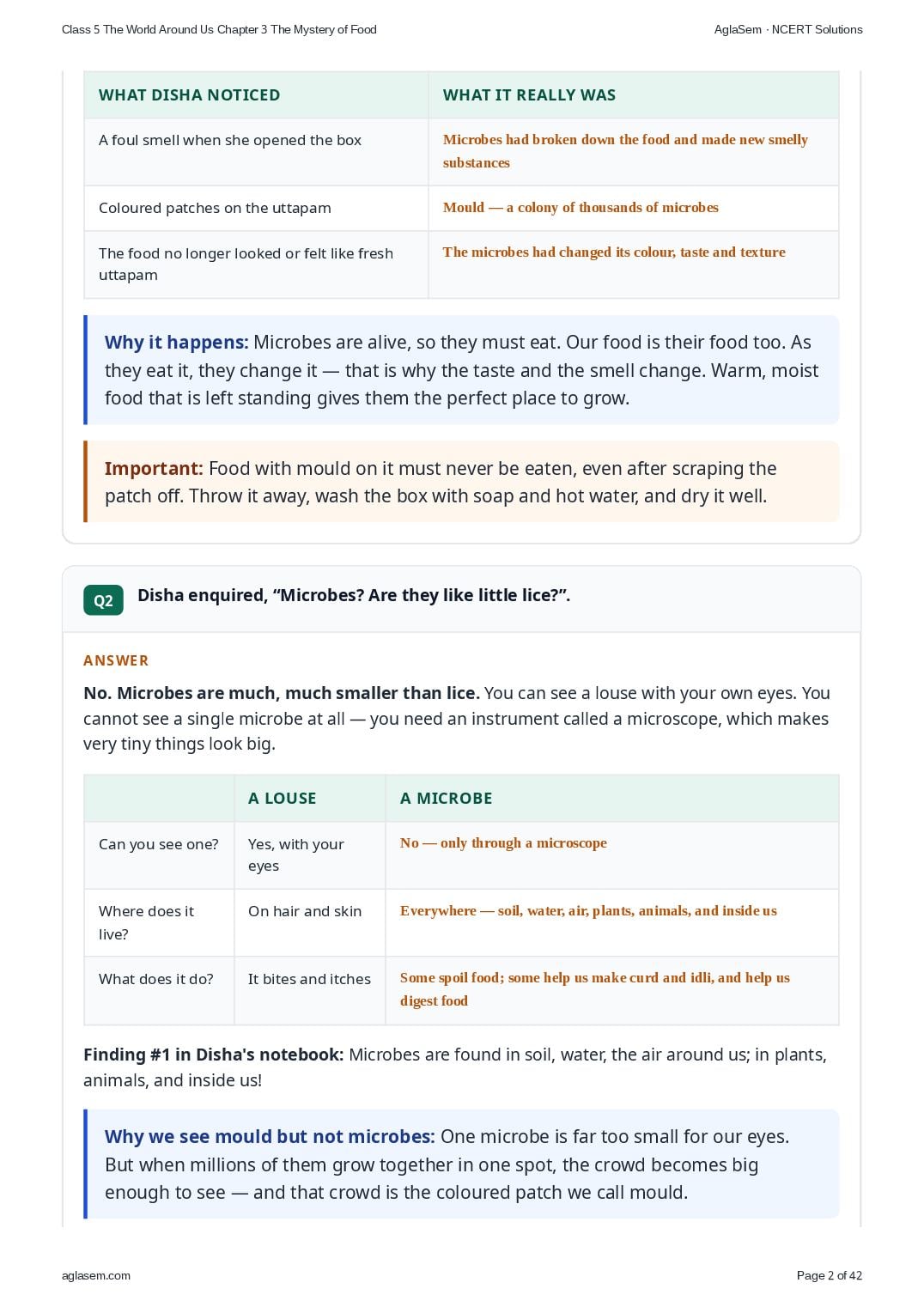
- Disha enquired, “Microbes? Are they like little lice?”.
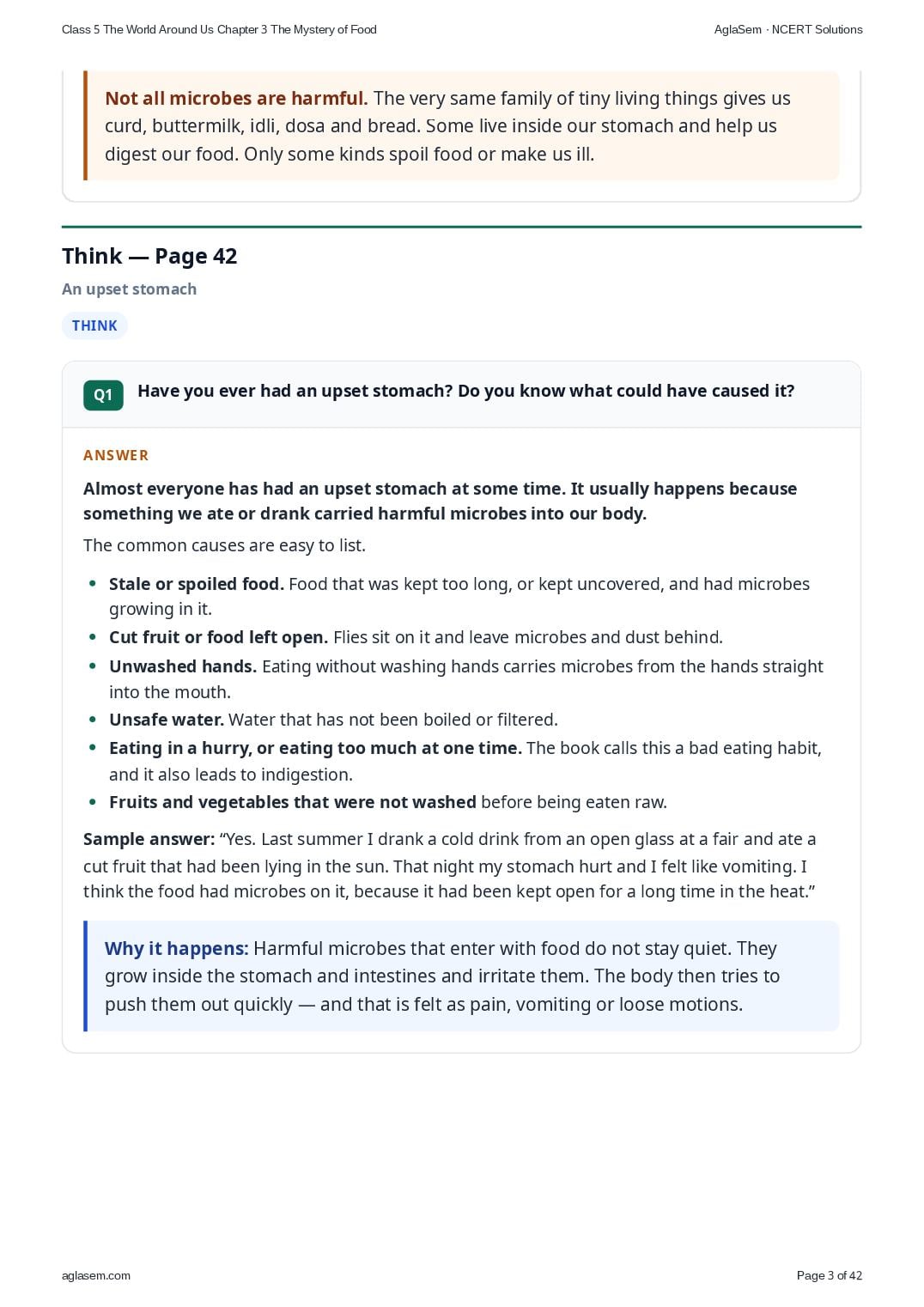
- Have you ever had an upset stomach? Do you know what could have caused it?
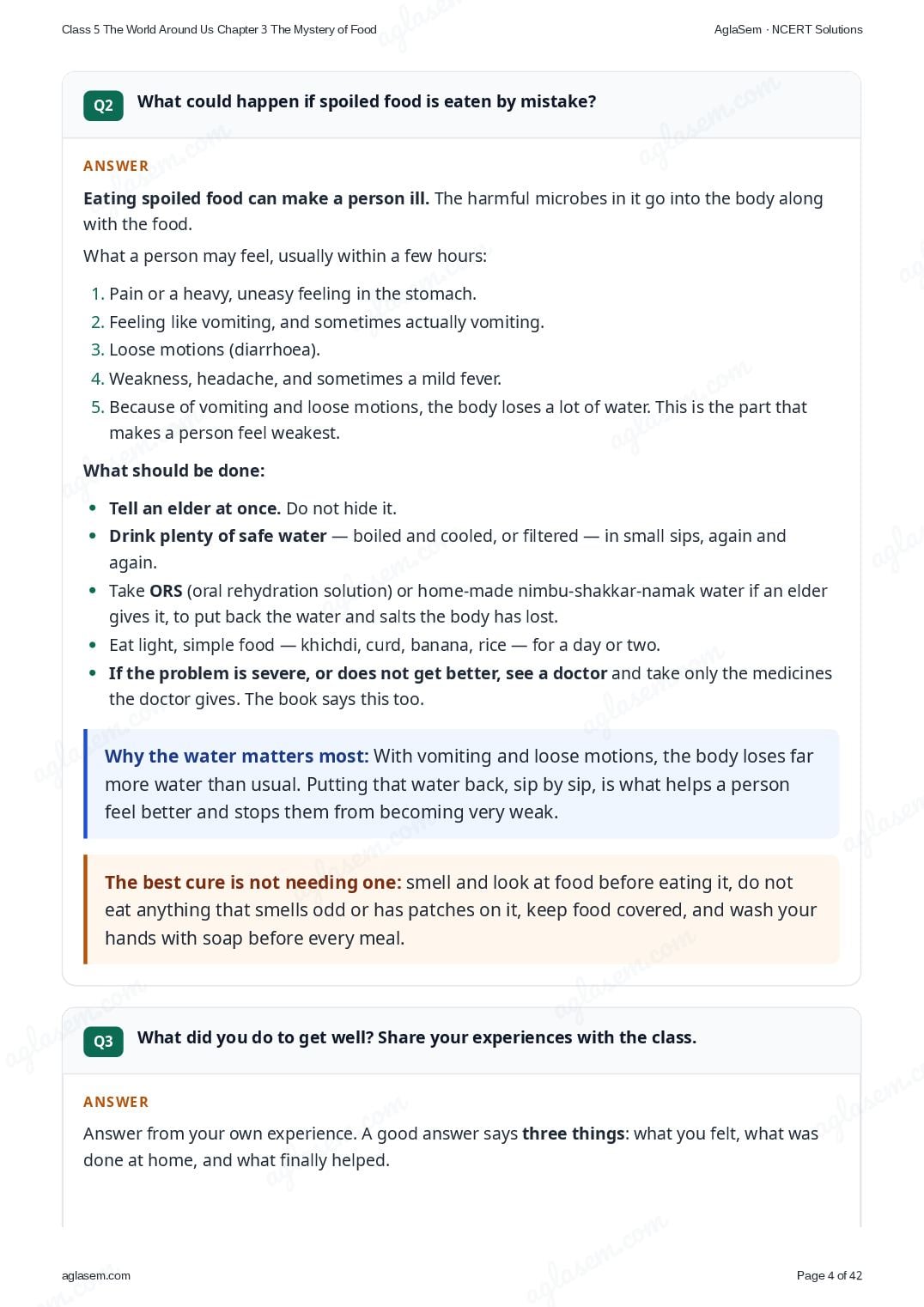
- What could happen if spoiled food is eaten by mistake?
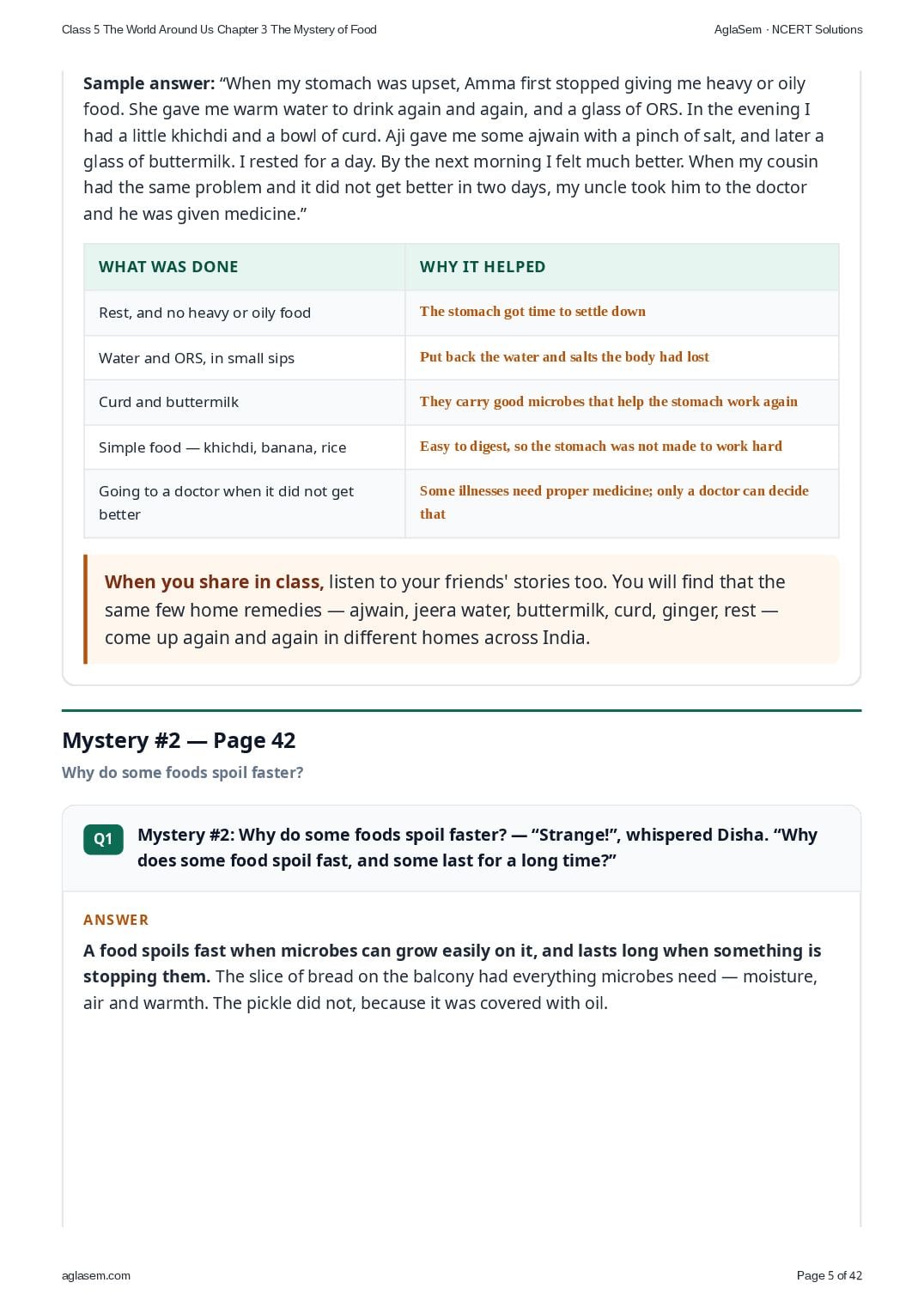
- What did you do to get well? Share your experiences with the class.
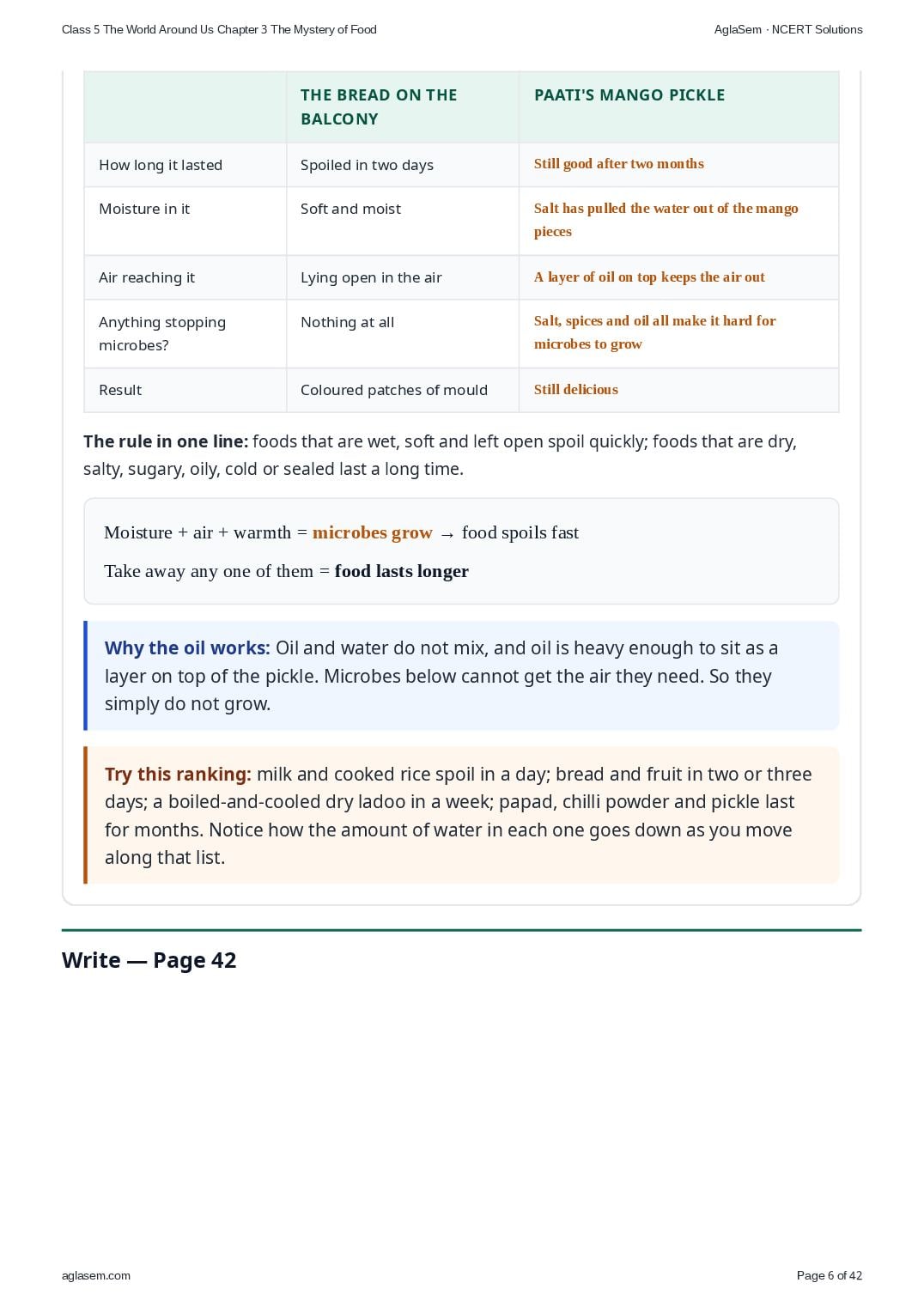
- Mystery #2: Why do some foods spoil faster? — “Strange!”, whispered Disha. “Why does some food spoil fast, and some last for a long time?”
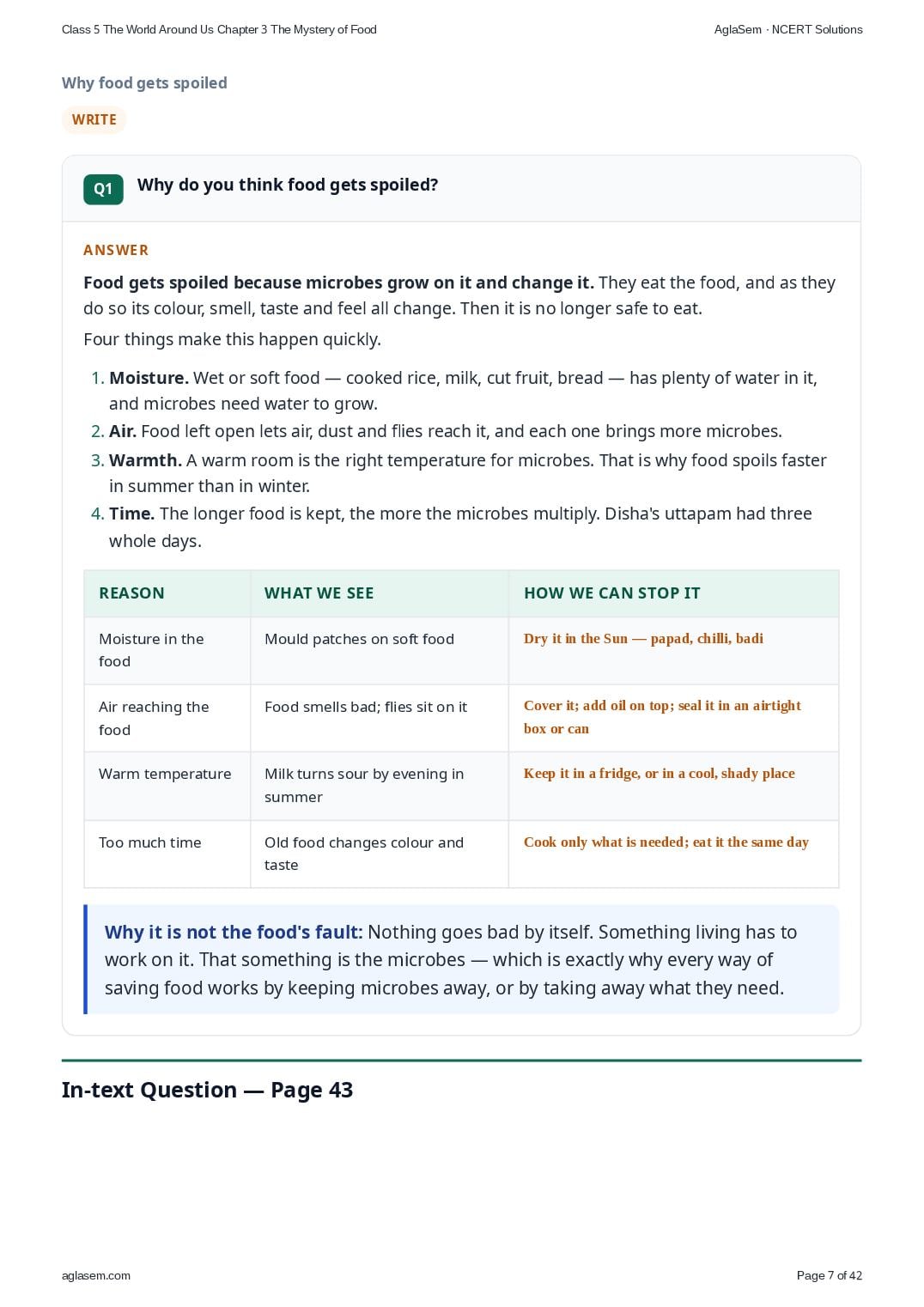
- Why do you think food gets spoiled?
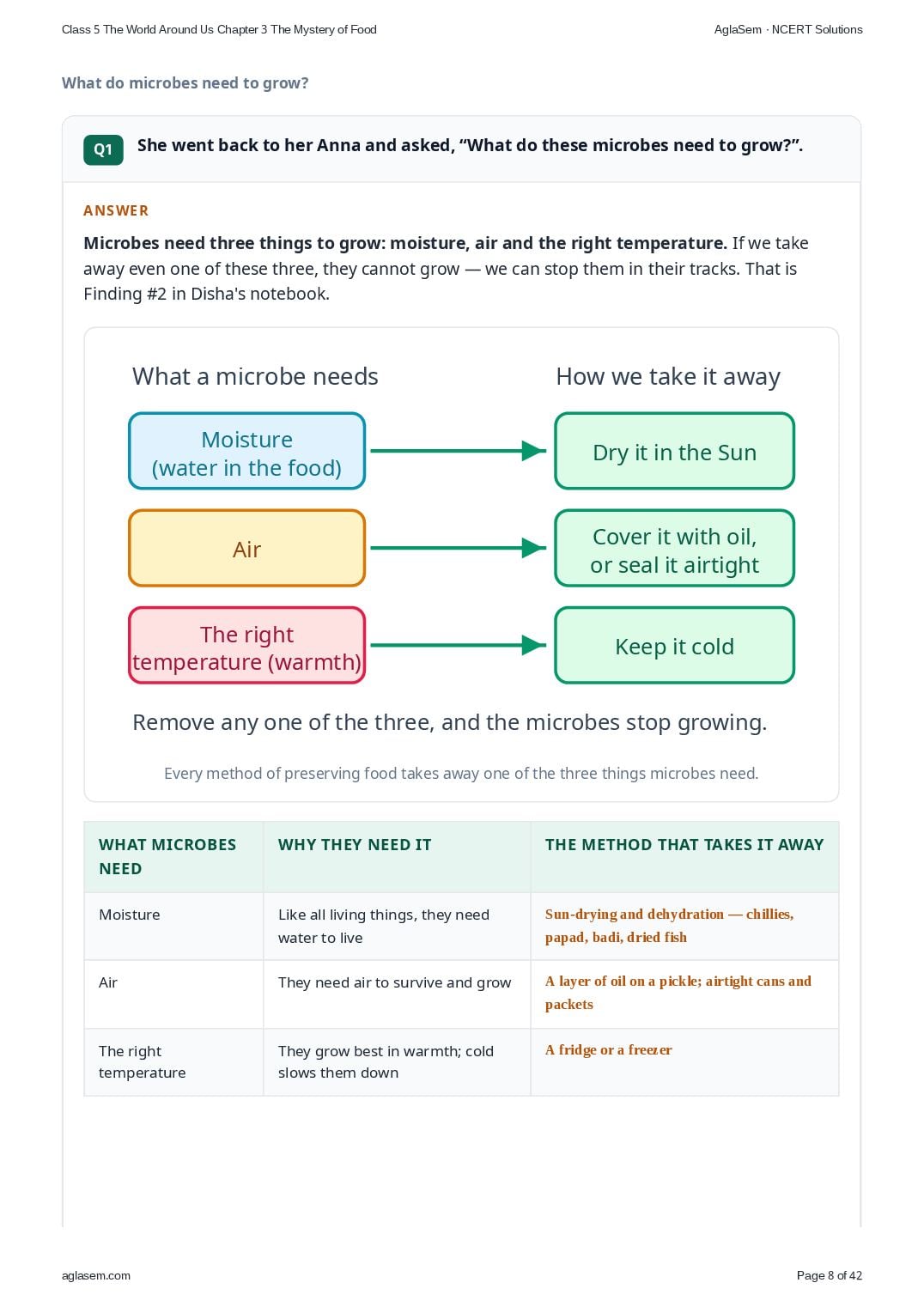
- She went back to her Anna and asked, “What do these microbes need to grow?”.
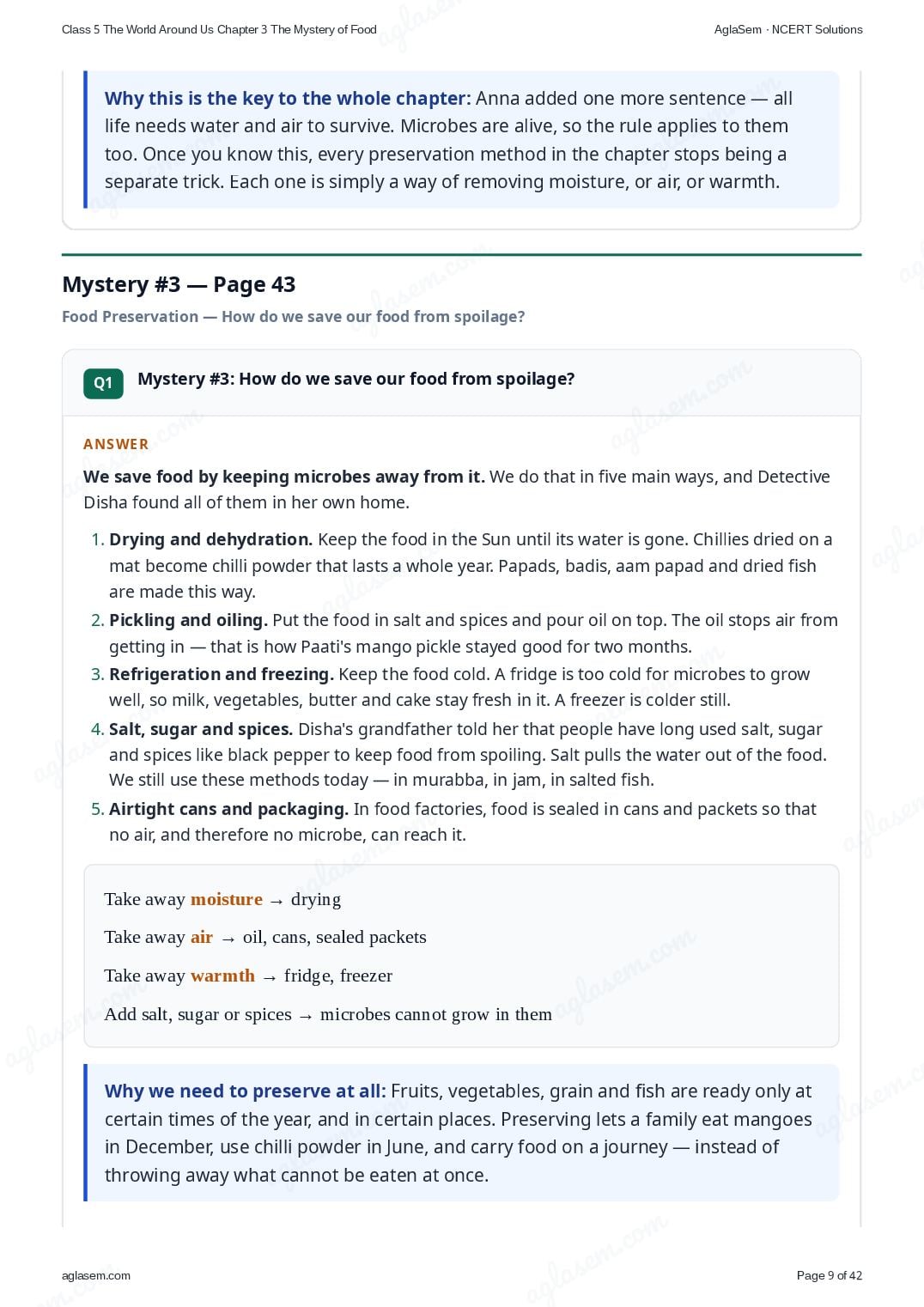
- Mystery #3: How do we save our food from spoilage?
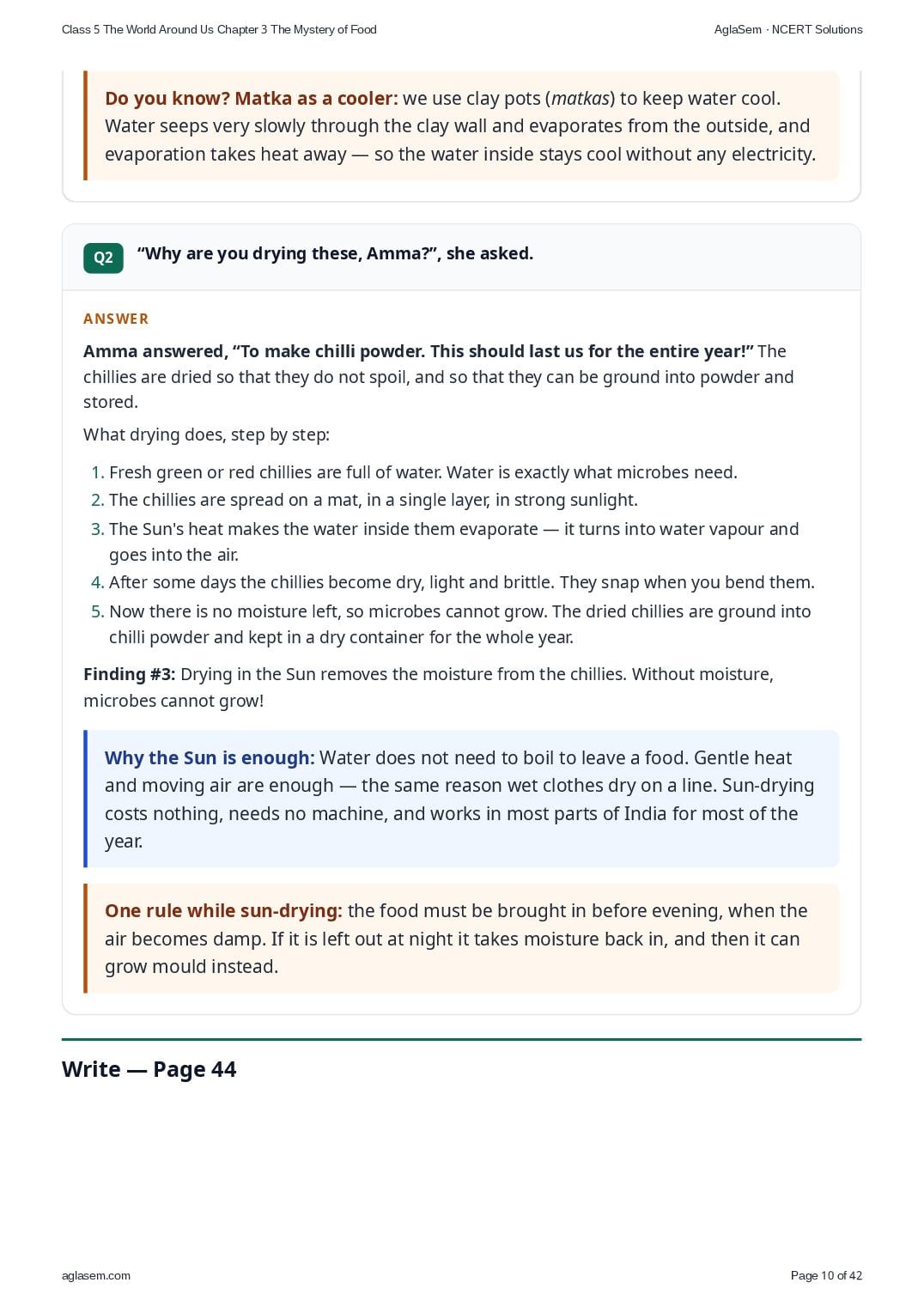
- “Why are you drying these, Amma?”, she asked.
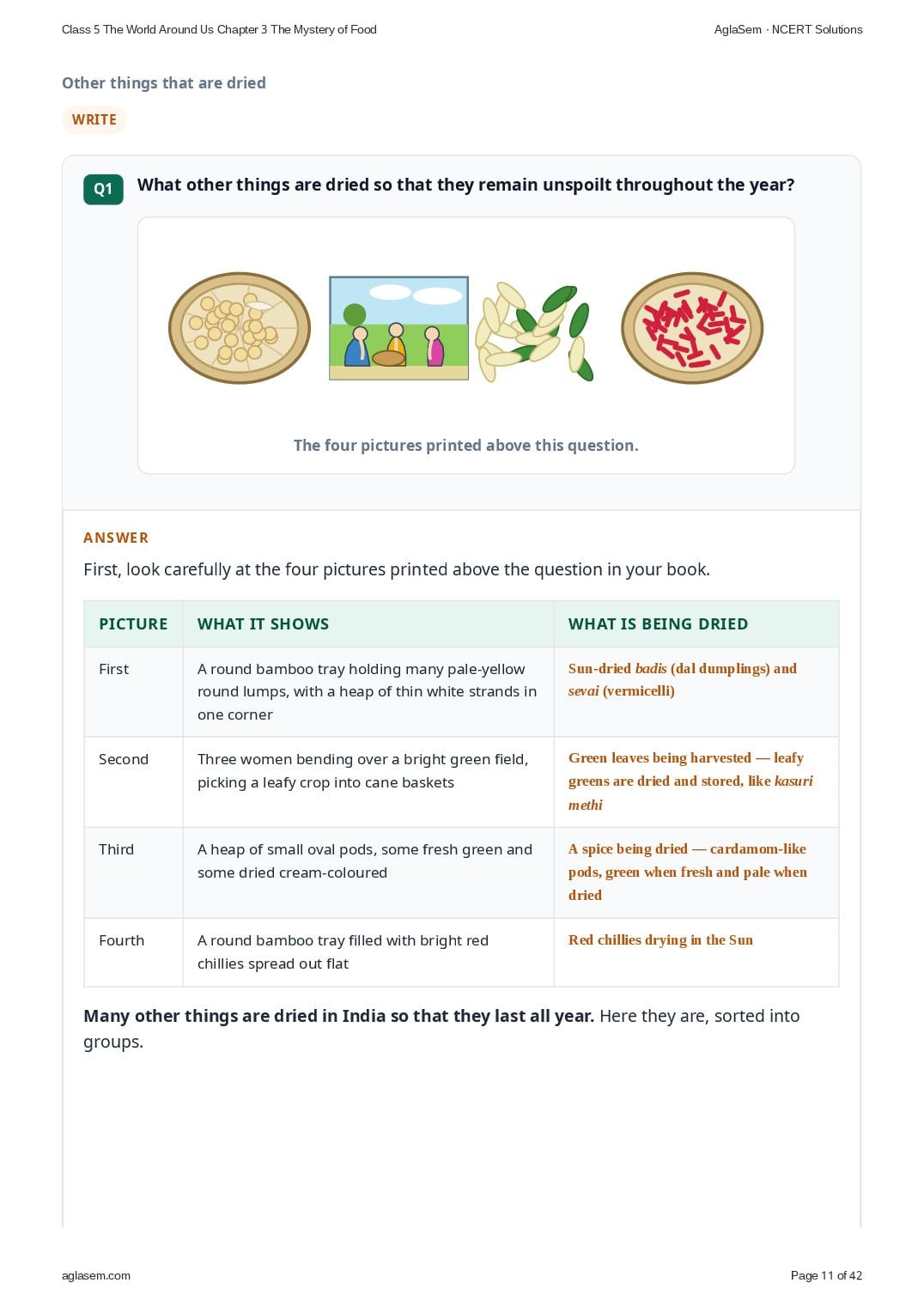
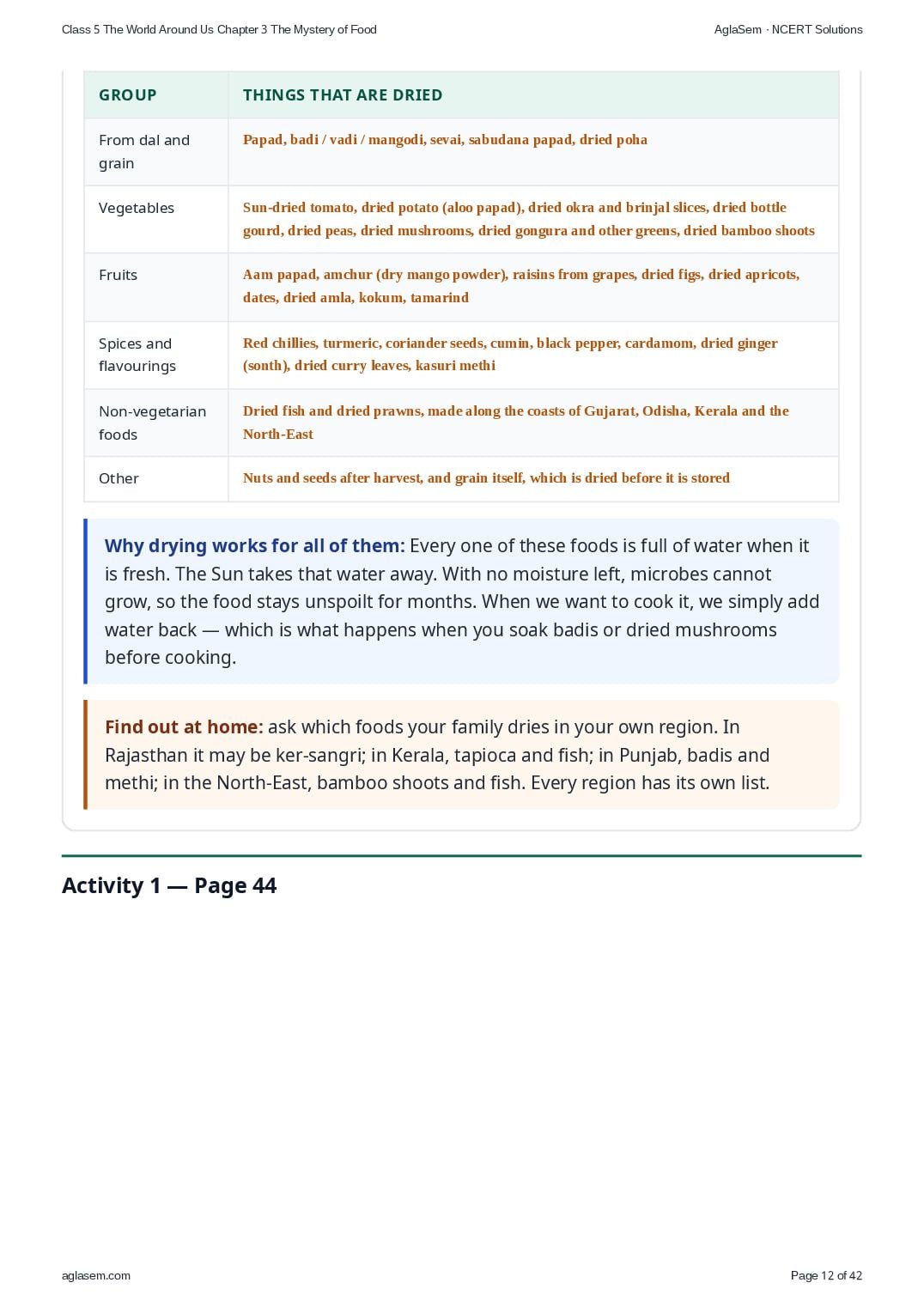
- What other things are dried so that they remain unspoilt throughout the year? The four pictures printed above this question.
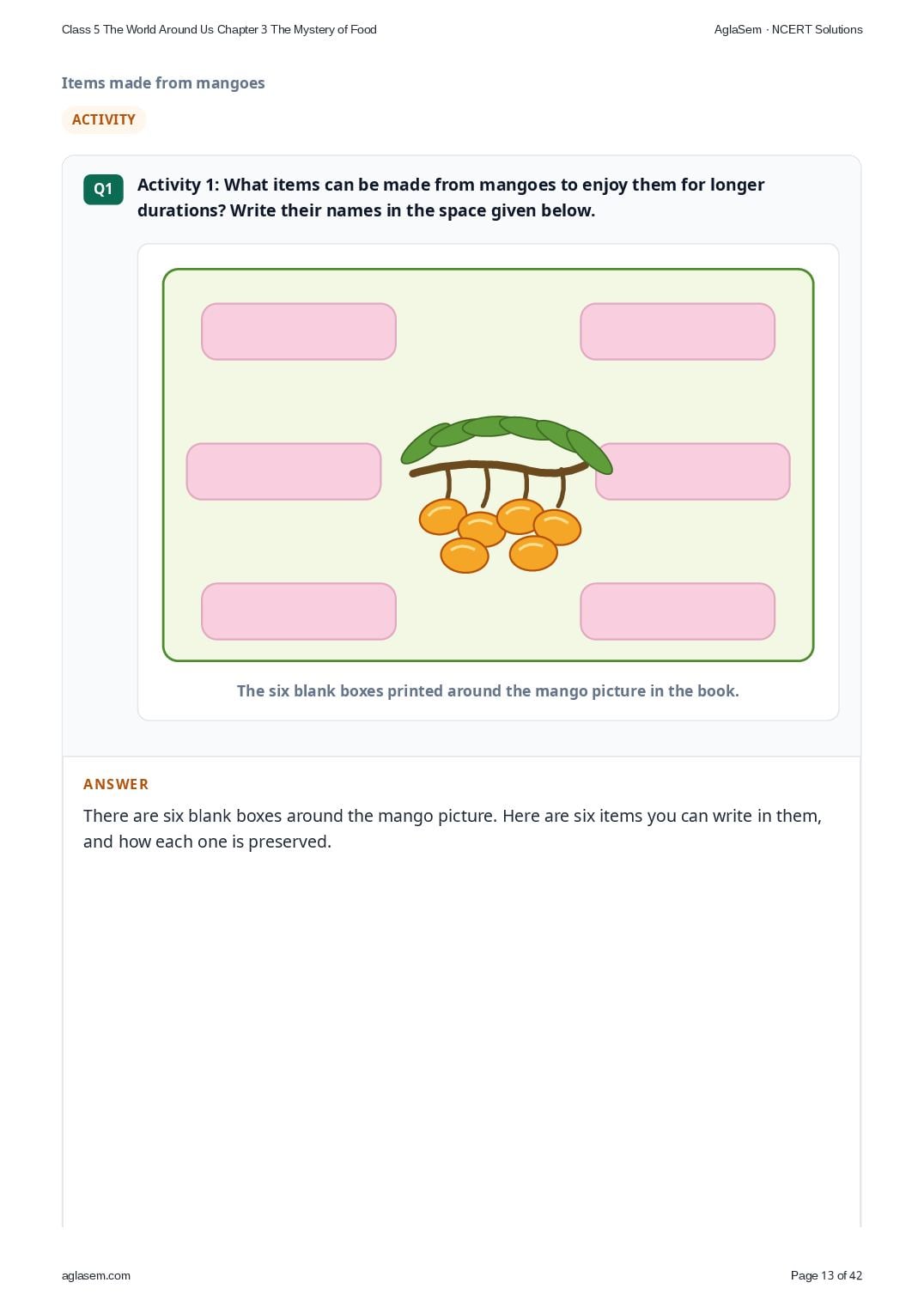
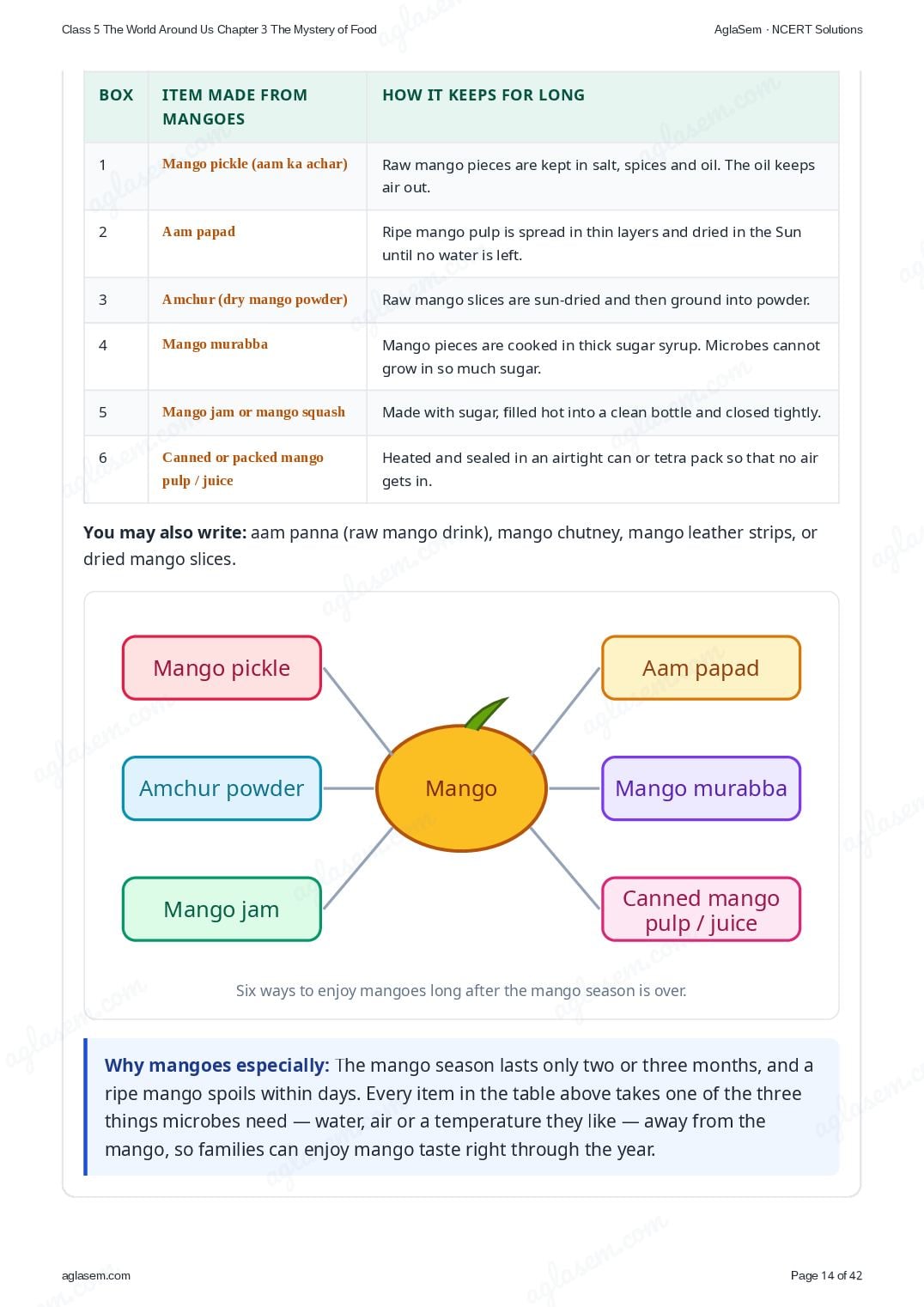
- Activity 1: What items can be made from mangoes to enjoy them for longer durations? Write their names in the space given below. The six blank boxes printed around the mango picture in the book.
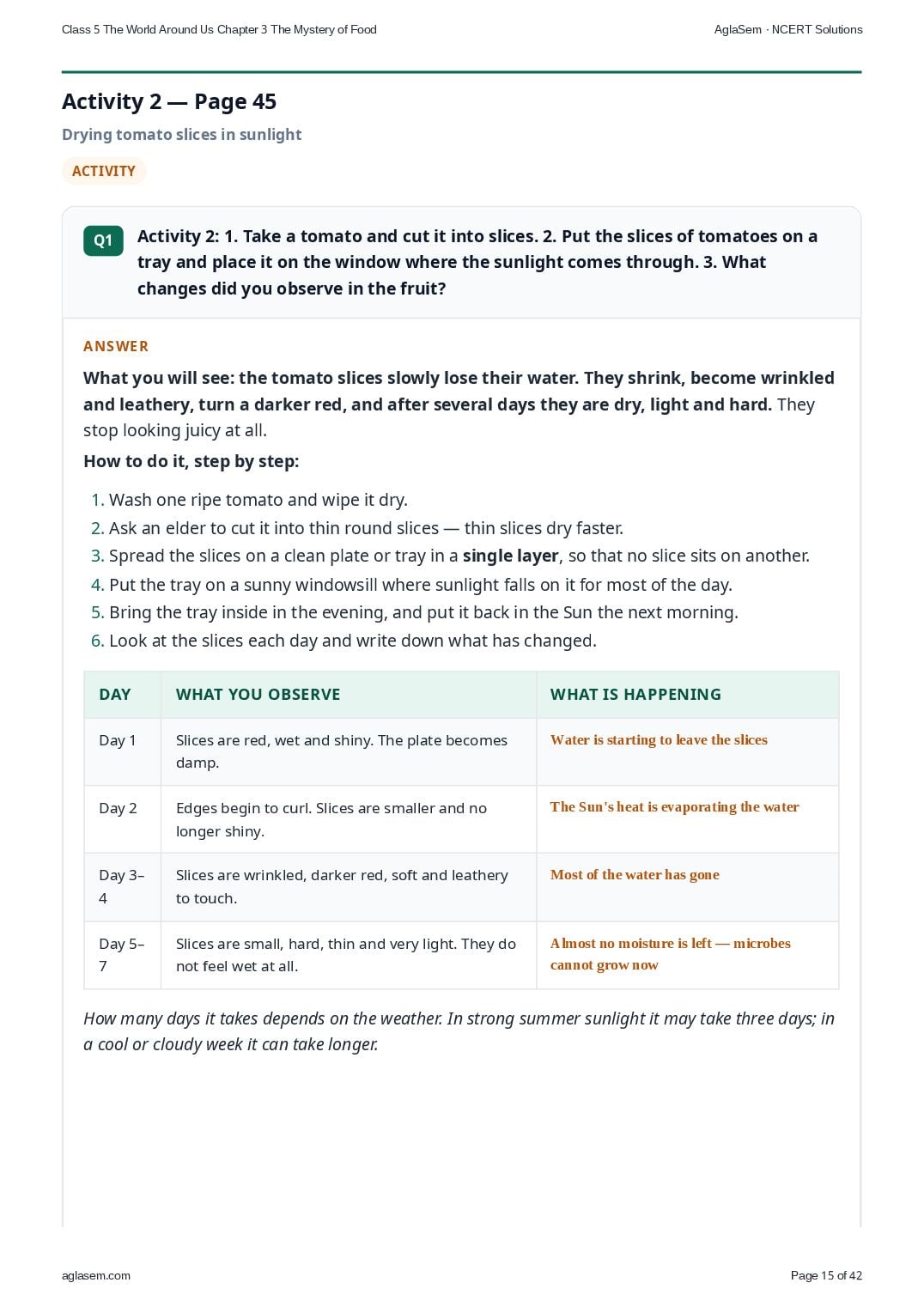
- Activity 2: 1. Take a tomato and cut it into slices. 2. Put the slices of tomatoes on a tray and place it on the window where the sunlight comes through. 3. What changes did you observe in the fruit?
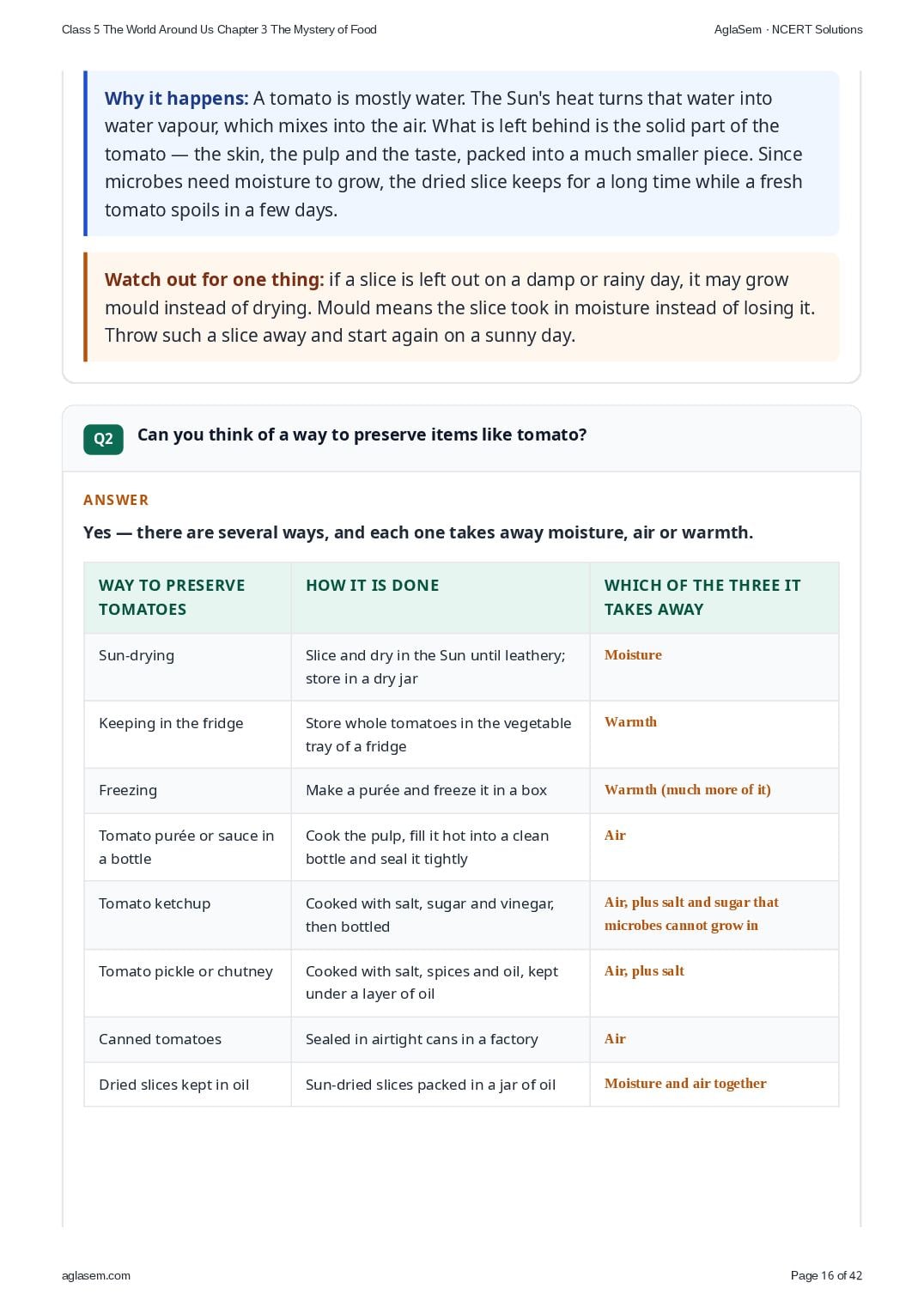
- Can you think of a way to preserve items like tomato?
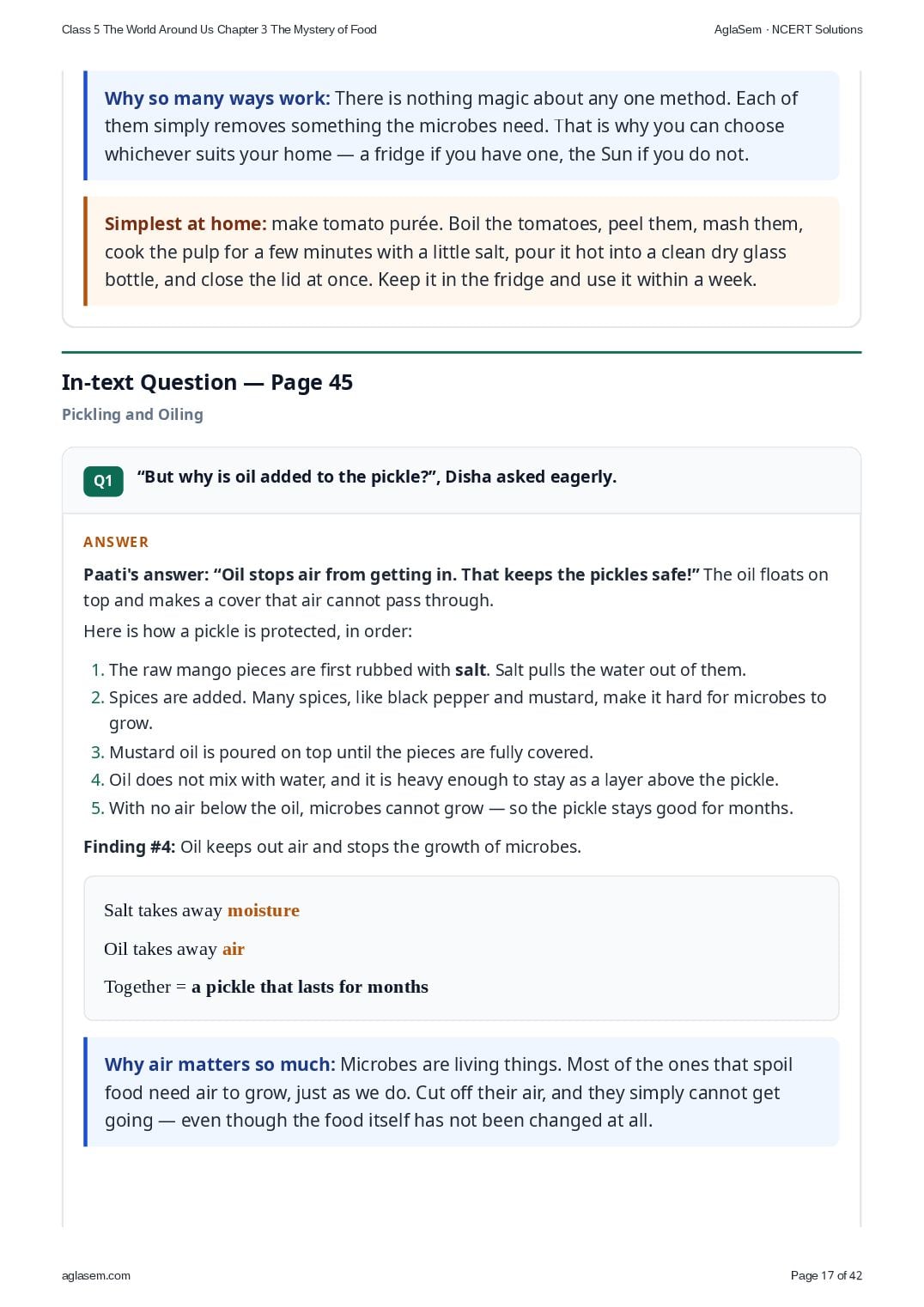
- “But why is oil added to the pickle?”, Disha asked eagerly.
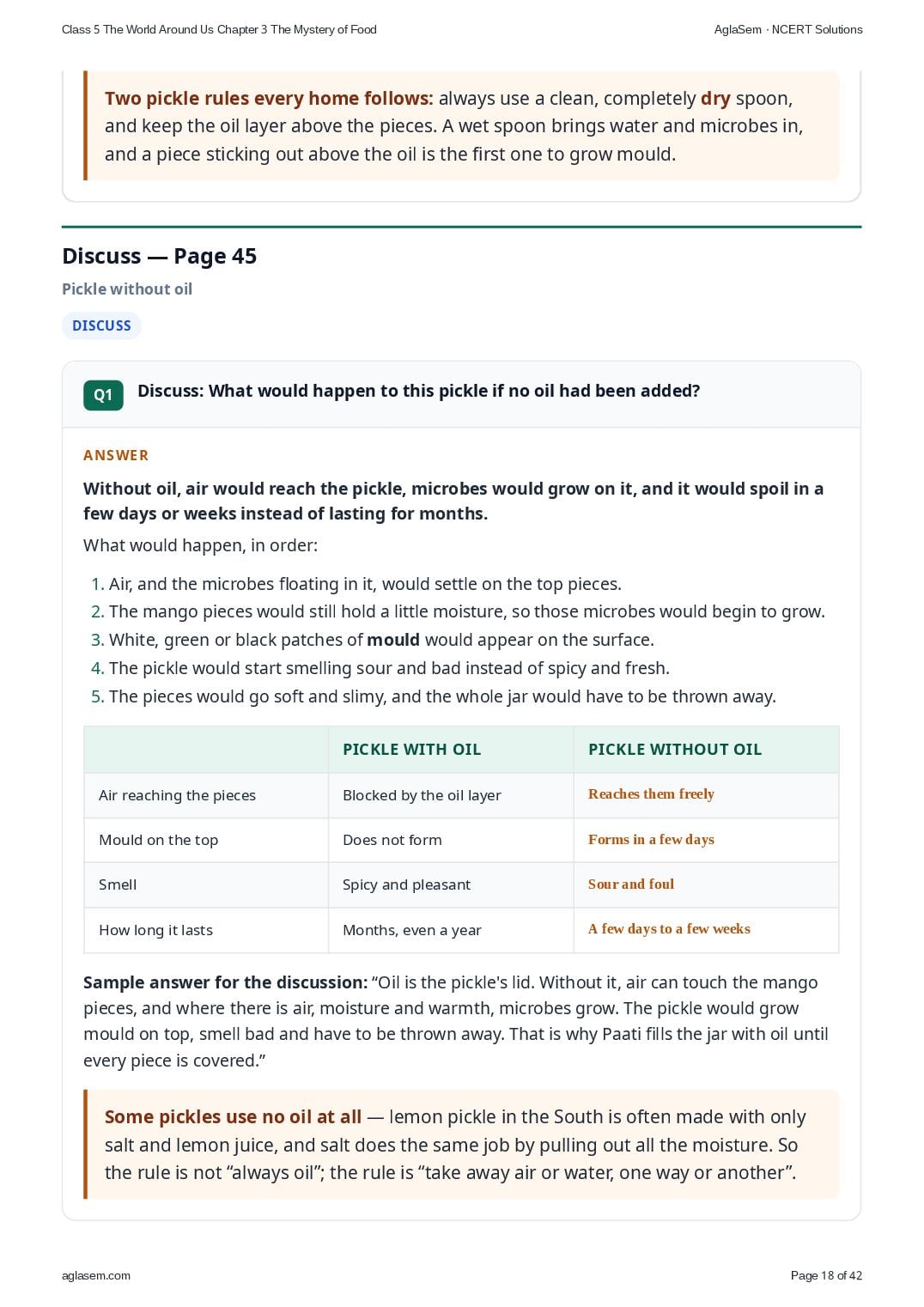
- Discuss: What would happen to this pickle if no oil had been added?
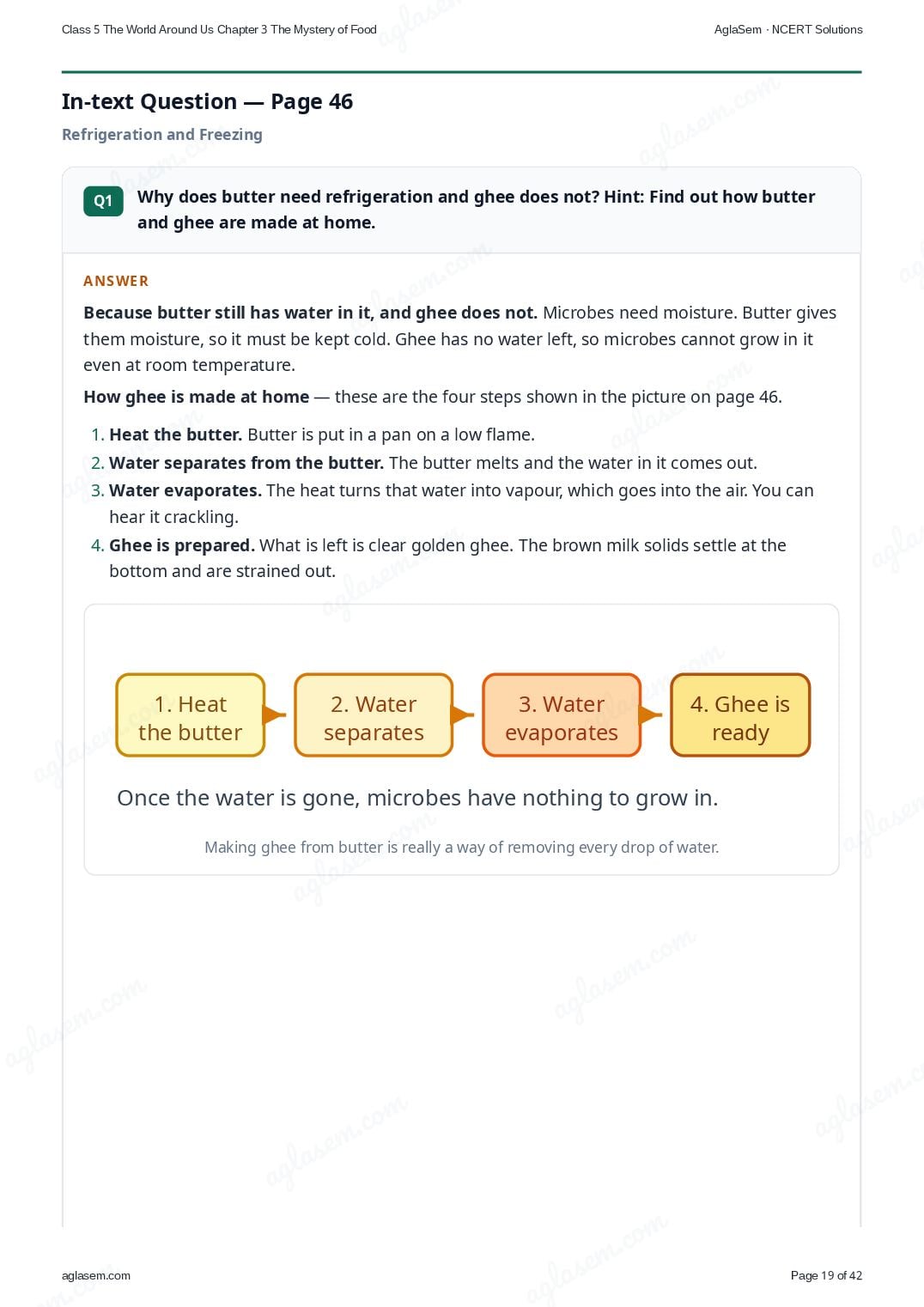
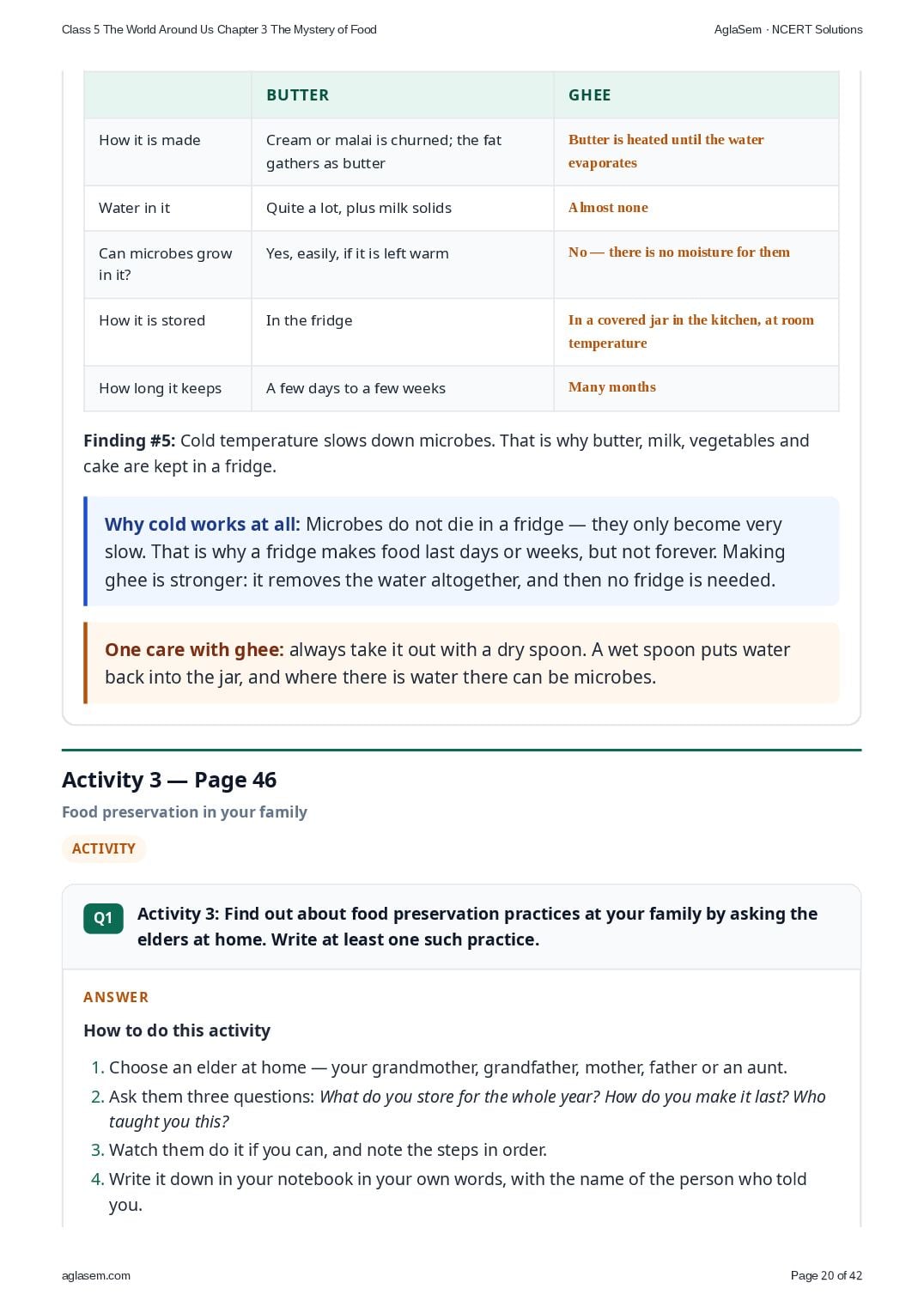
- Why does butter need refrigeration and ghee does not? Hint: Find out how butter and ghee are made at home.
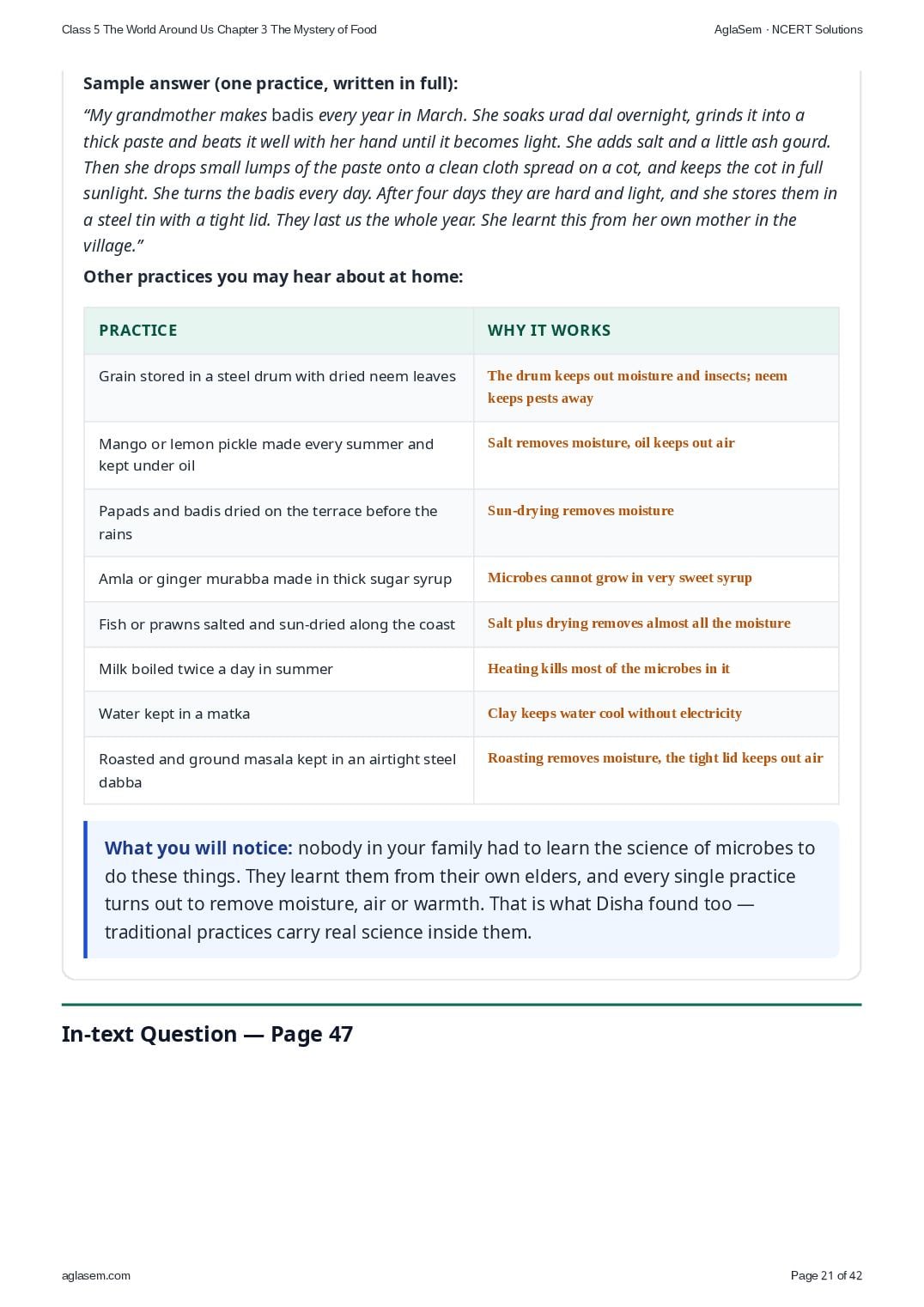
- Activity 3: Find out about food preservation practices at your family by asking the elders at home. Write at least one such practice.
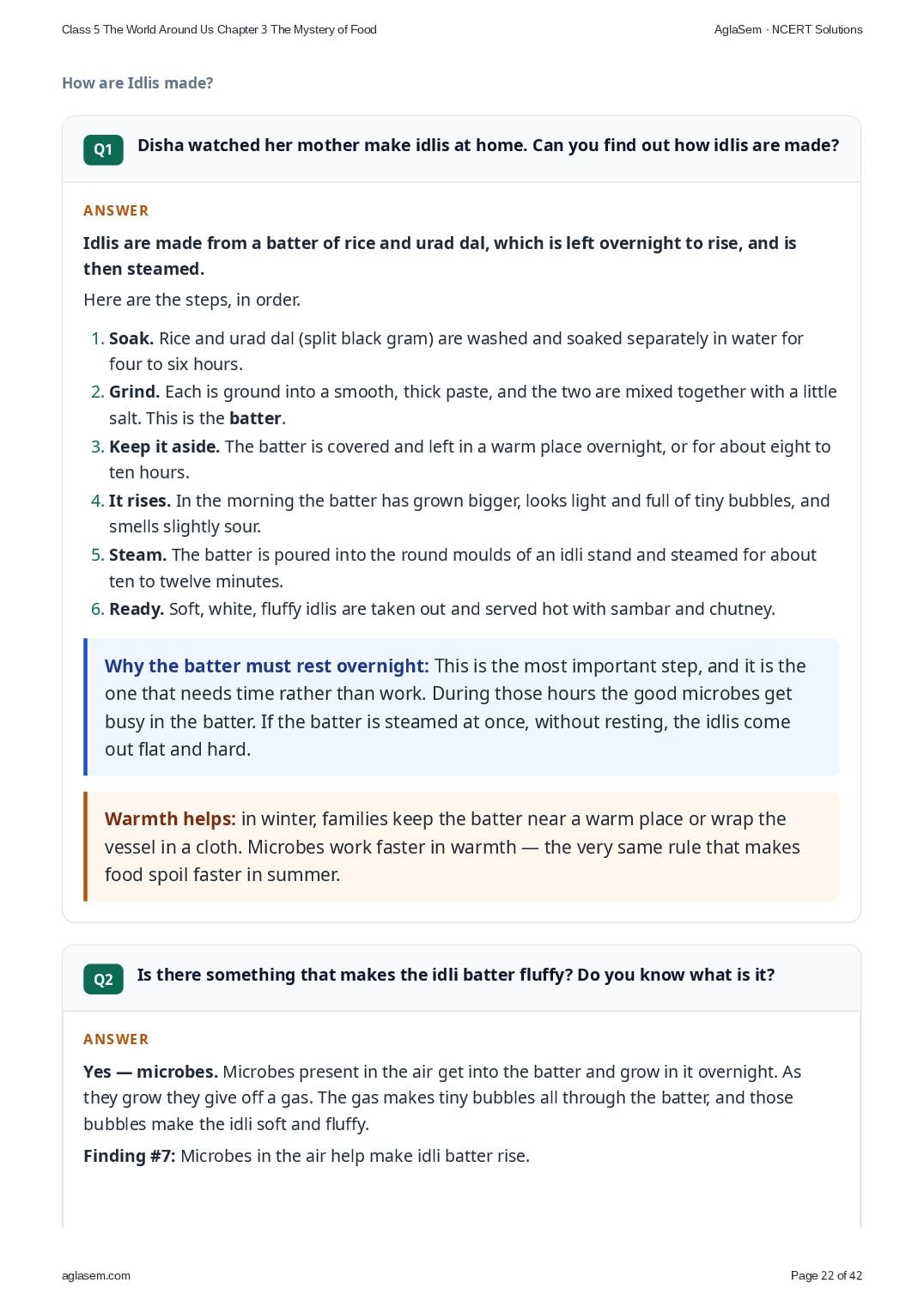
- Disha watched her mother make idlis at home. Can you find out how idlis are made?
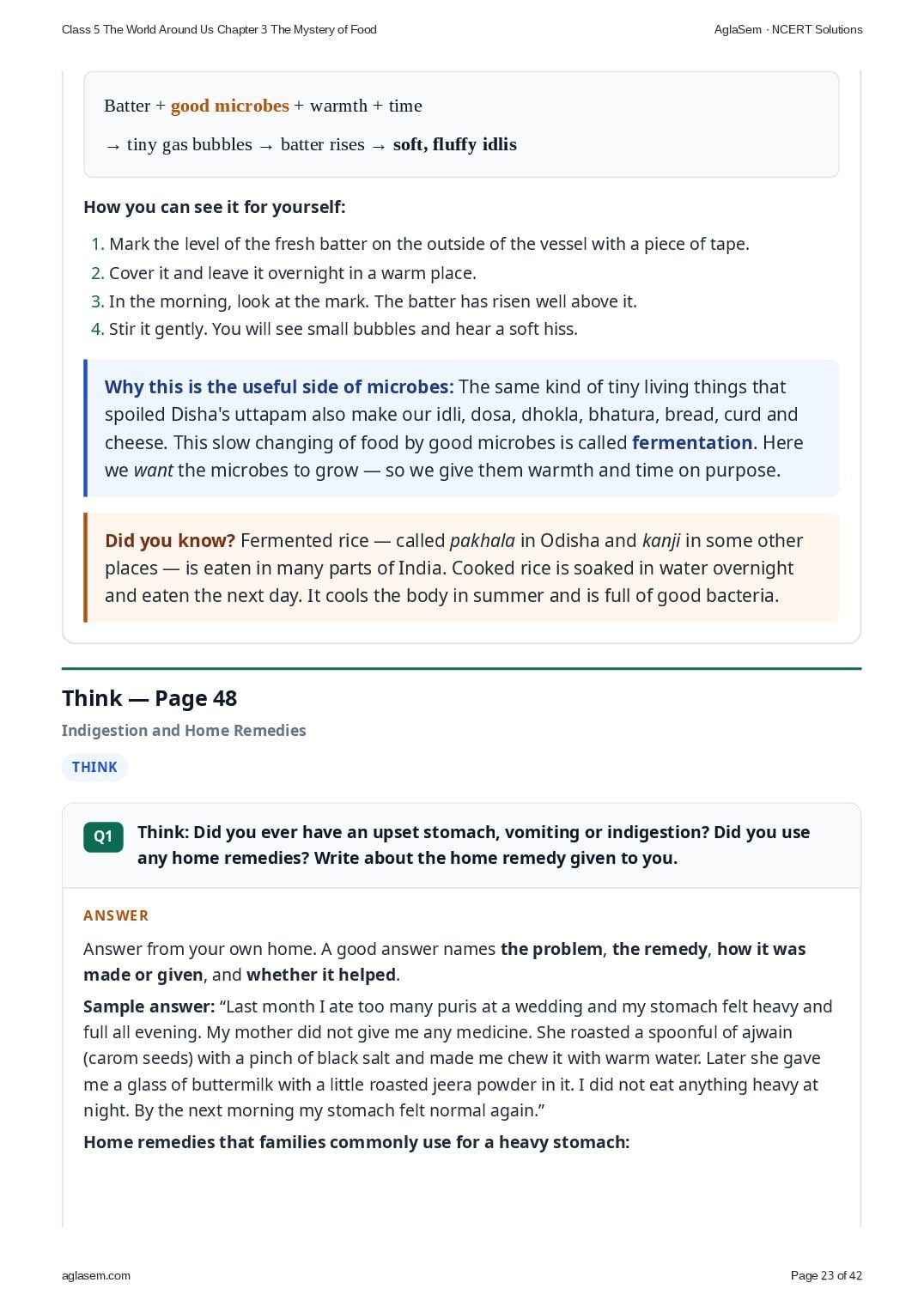
- Is there something that makes the idli batter fluffy? Do you know what is it?
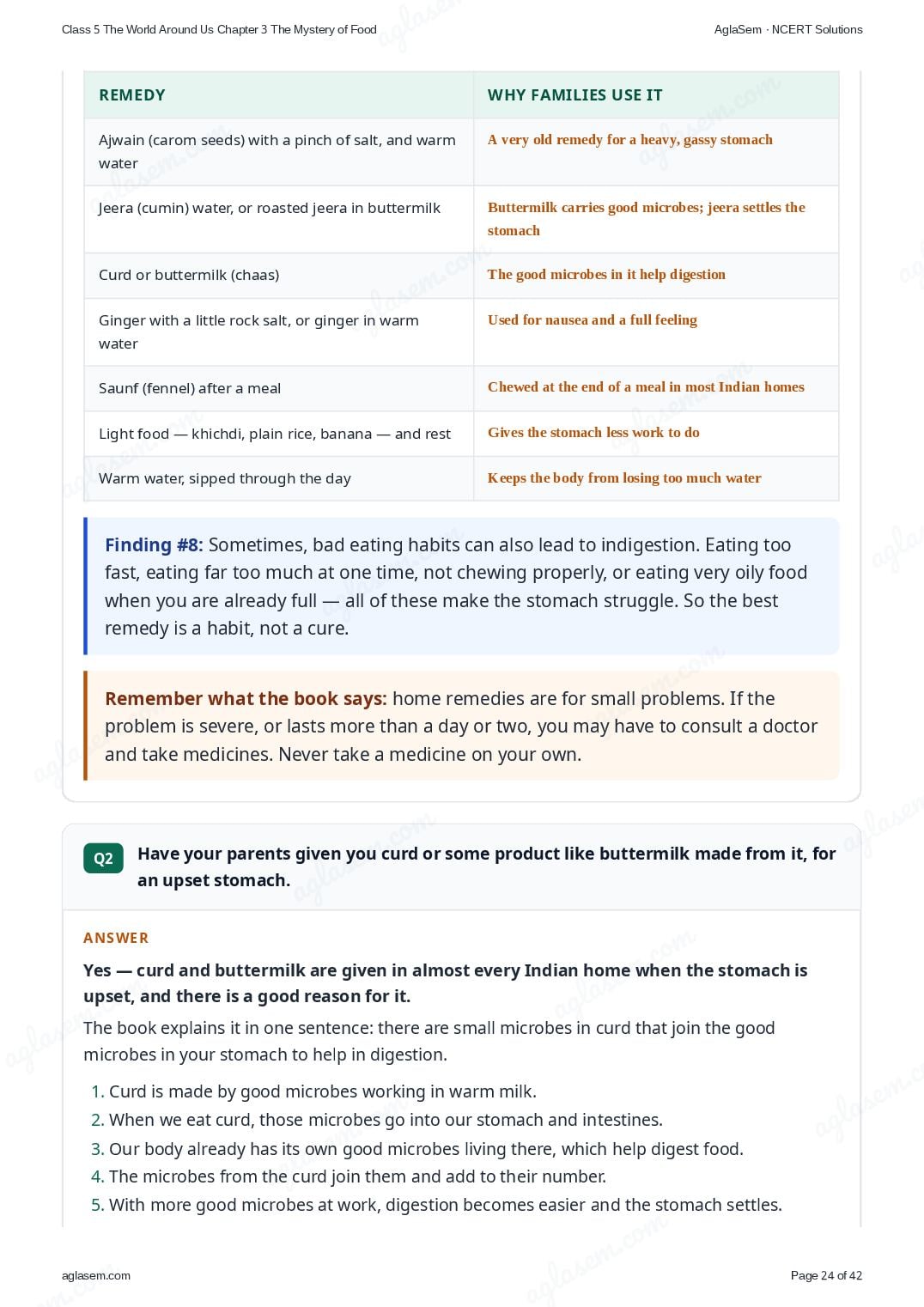
- Think: Did you ever have an upset stomach, vomiting or indigestion? Did you use any home remedies? Write about the home remedy given to you.
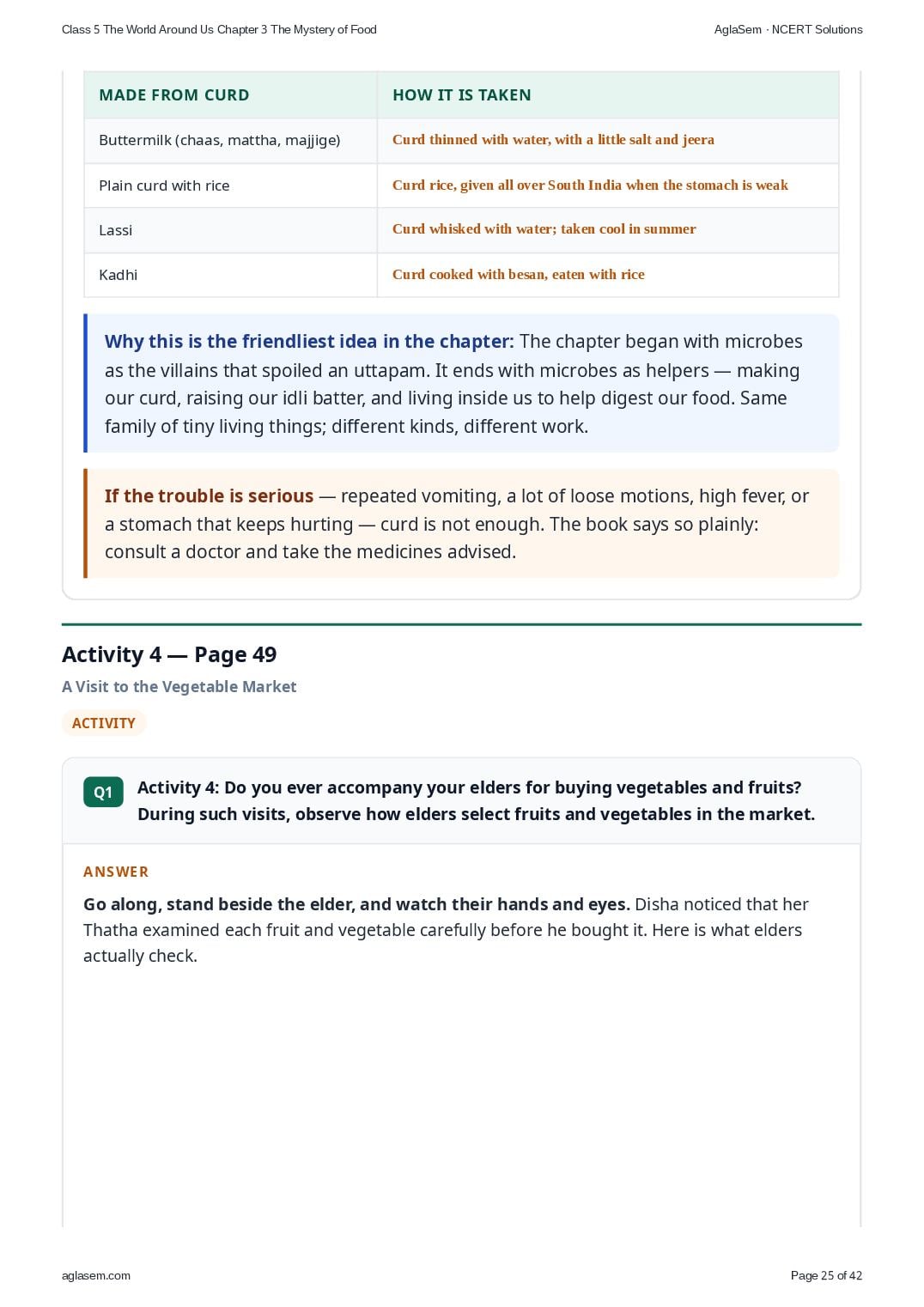
- Have your parents given you curd or some product like buttermilk made from it, for an upset stomach.
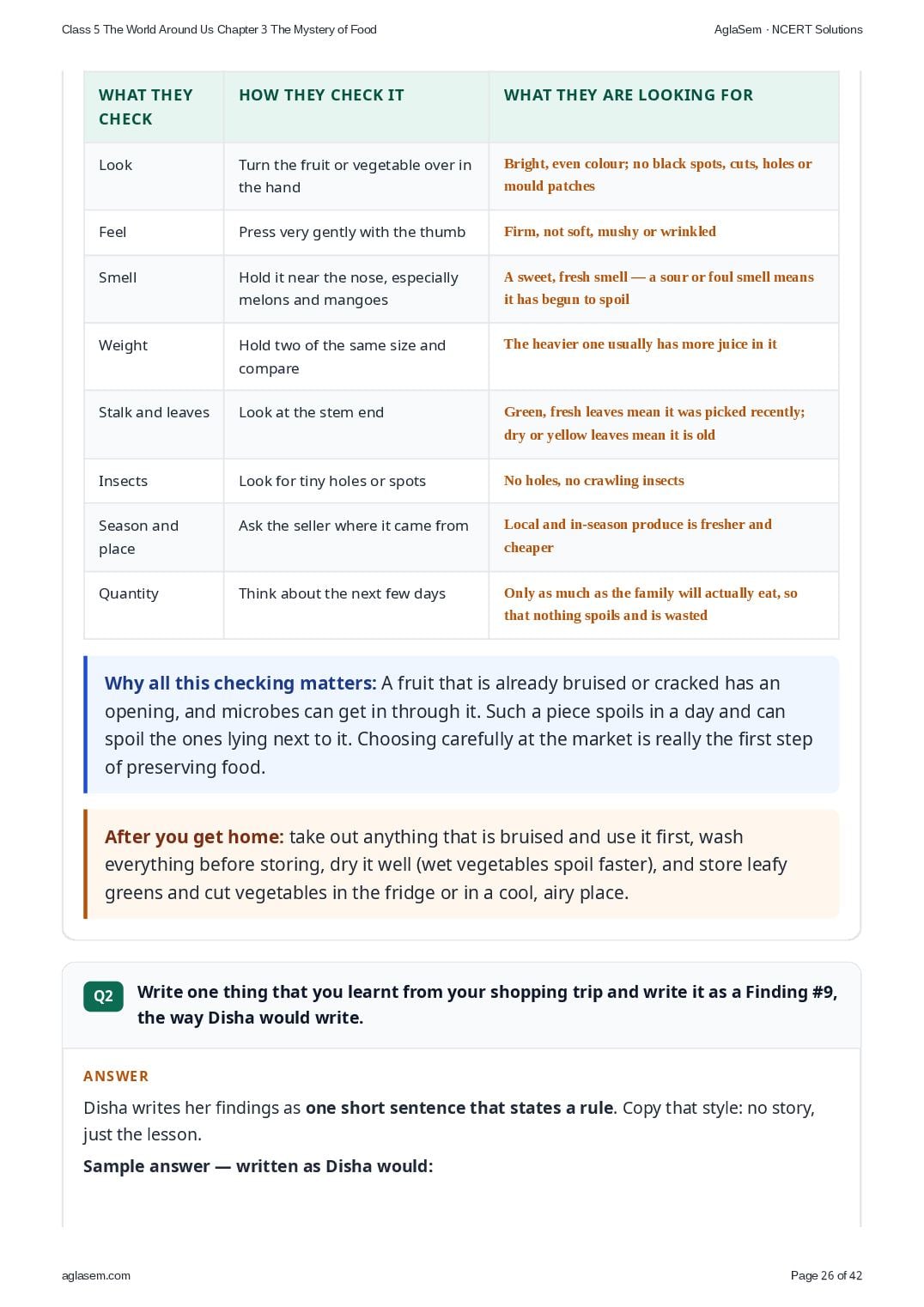
- Activity 4: Do you ever accompany your elders for buying vegetables and fruits? During such visits, observe how elders select fruits and vegetables in the market.
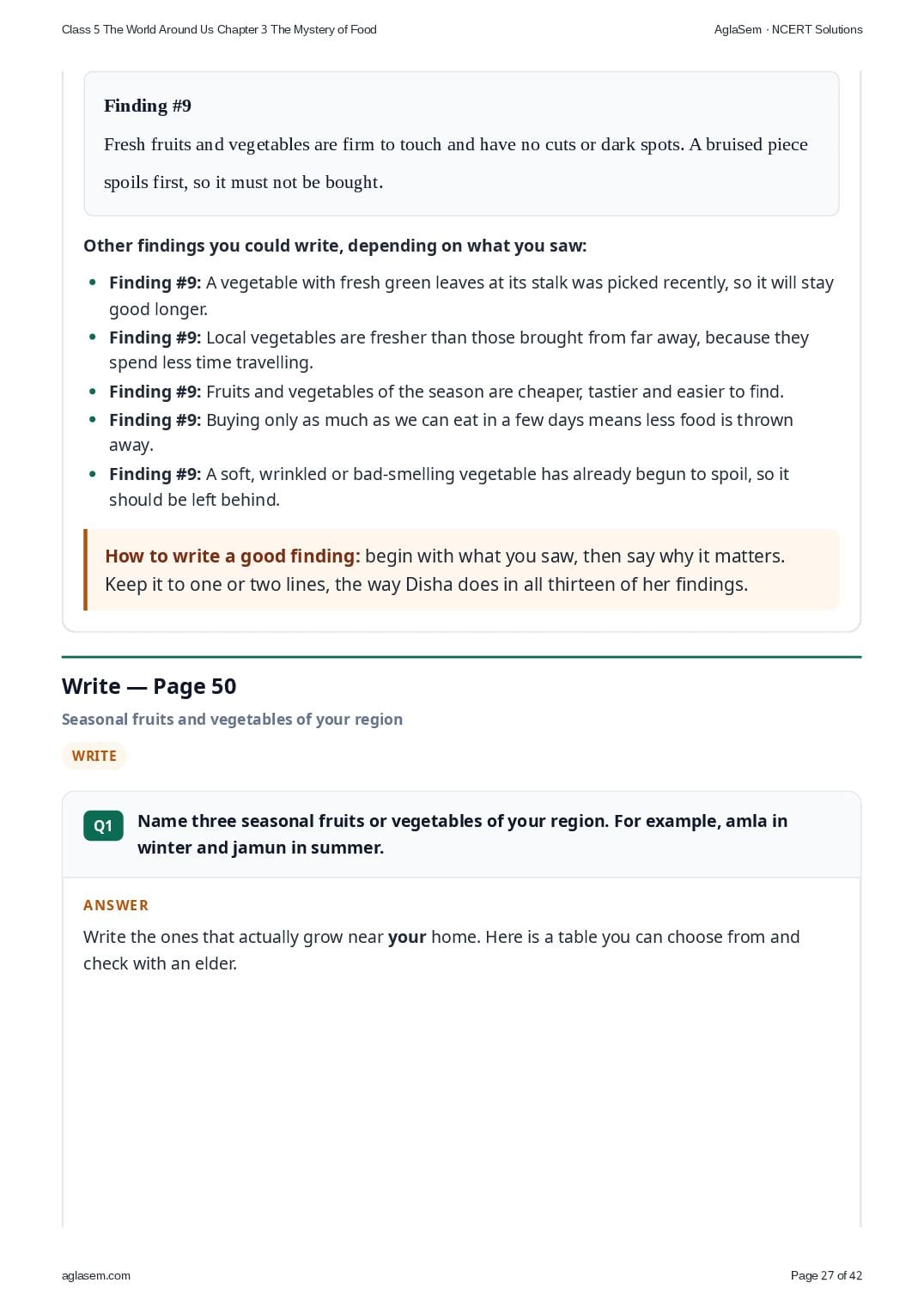
- Write one thing that you learnt from your shopping trip and write it as a Finding #9, the way Disha would write.
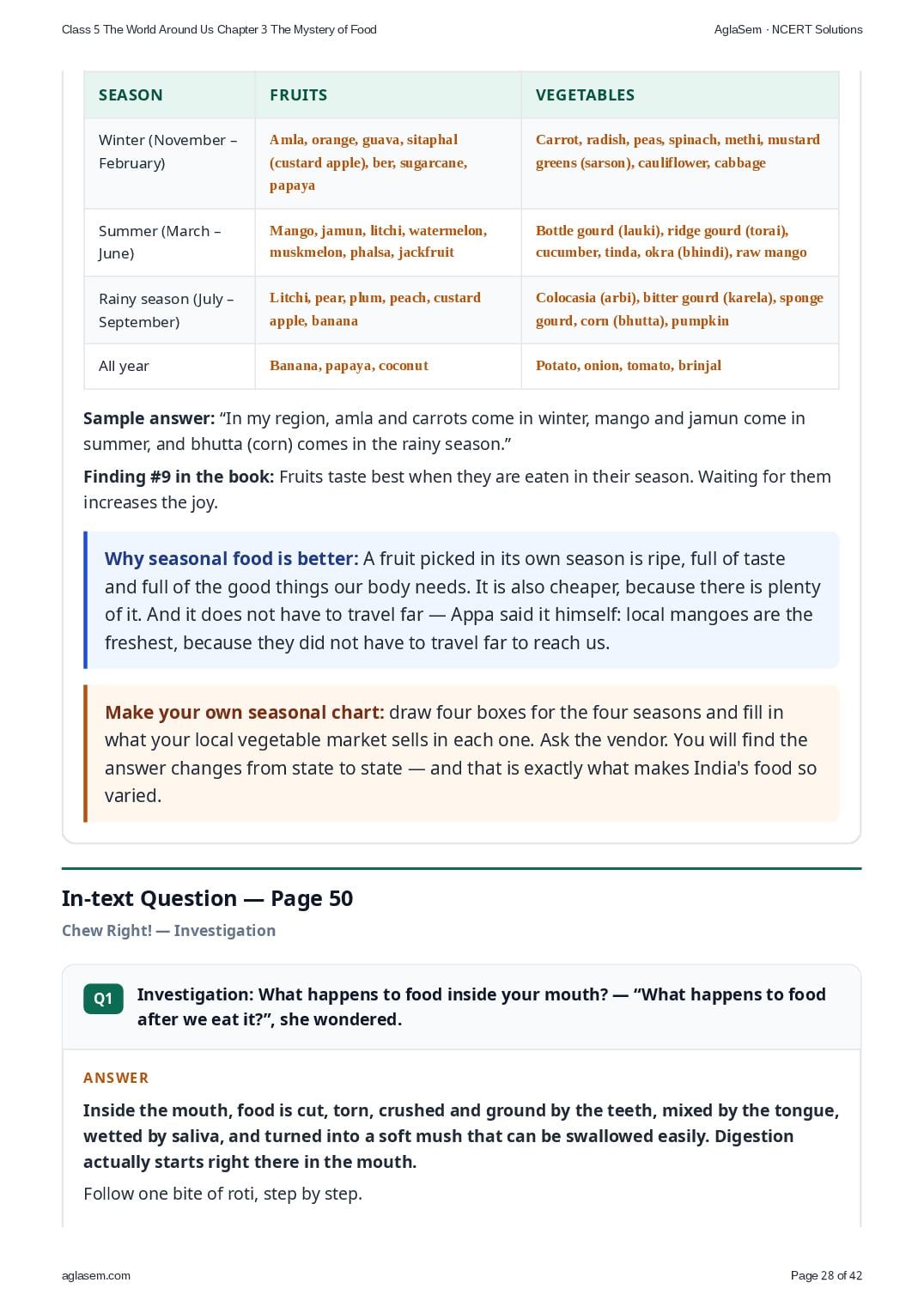
- Name three seasonal fruits or vegetables of your region. For example, amla in winter and jamun in summer.
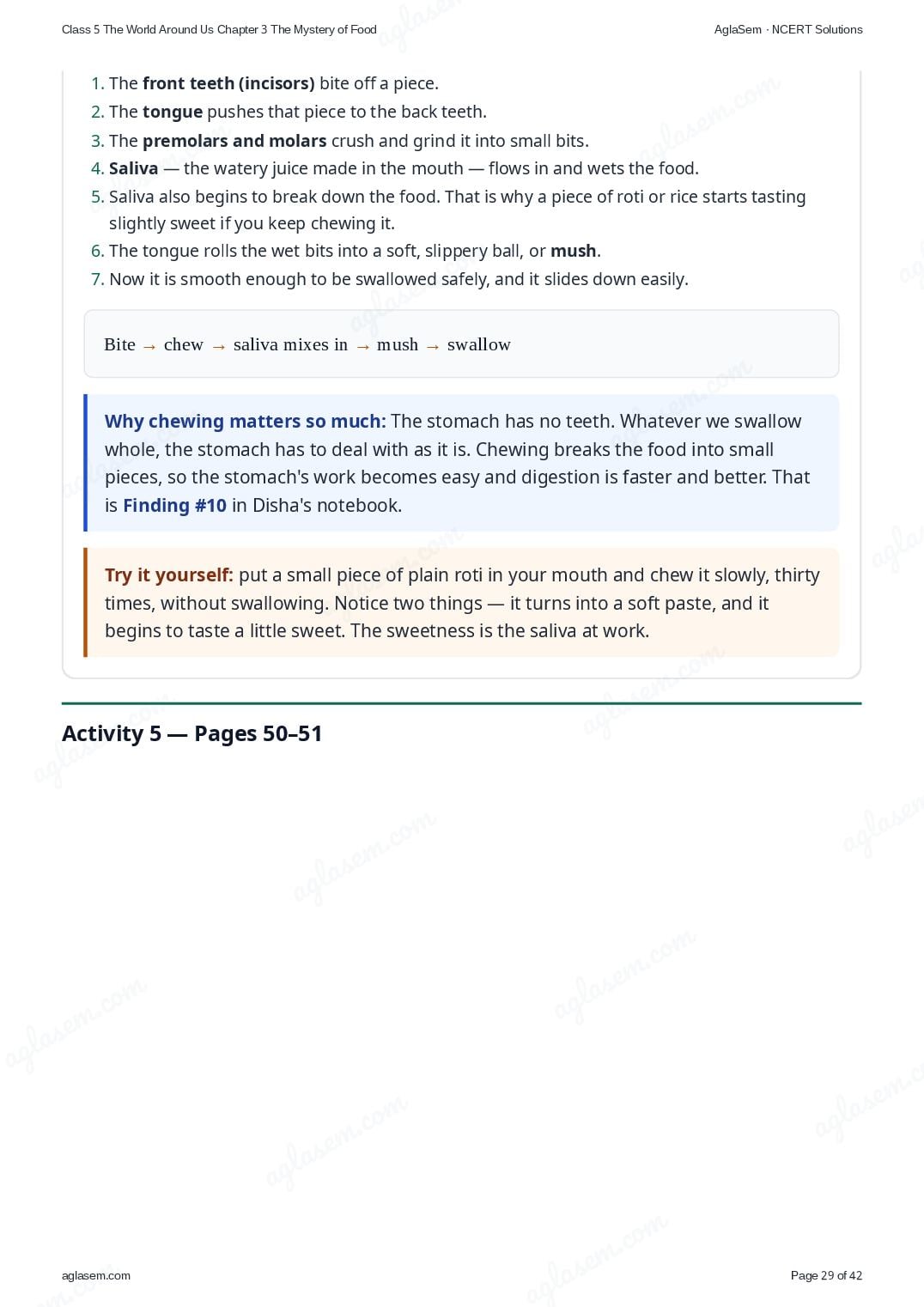
- Investigation: What happens to food inside your mouth? — “What happens to food after we eat it?”, she wondered.
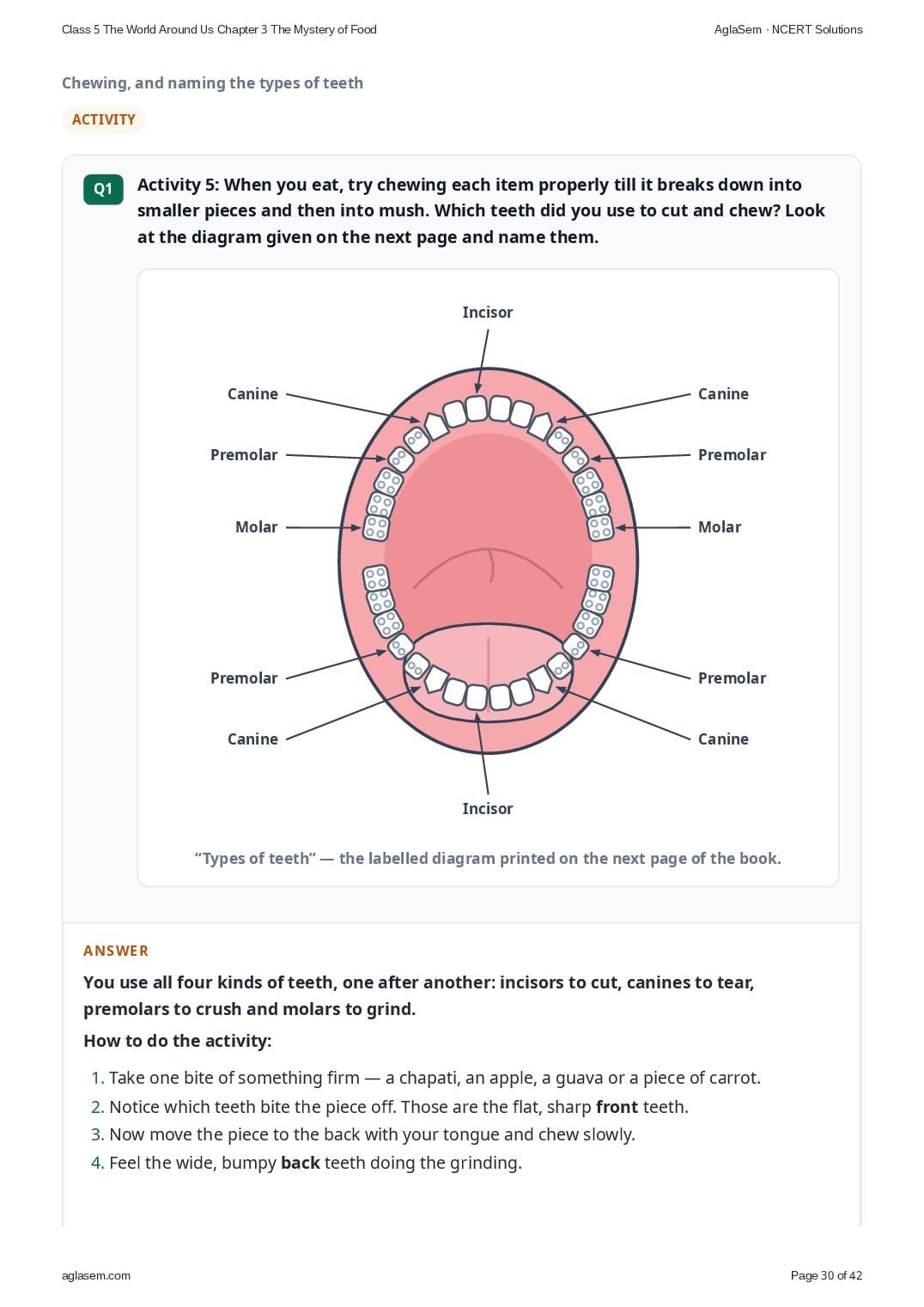
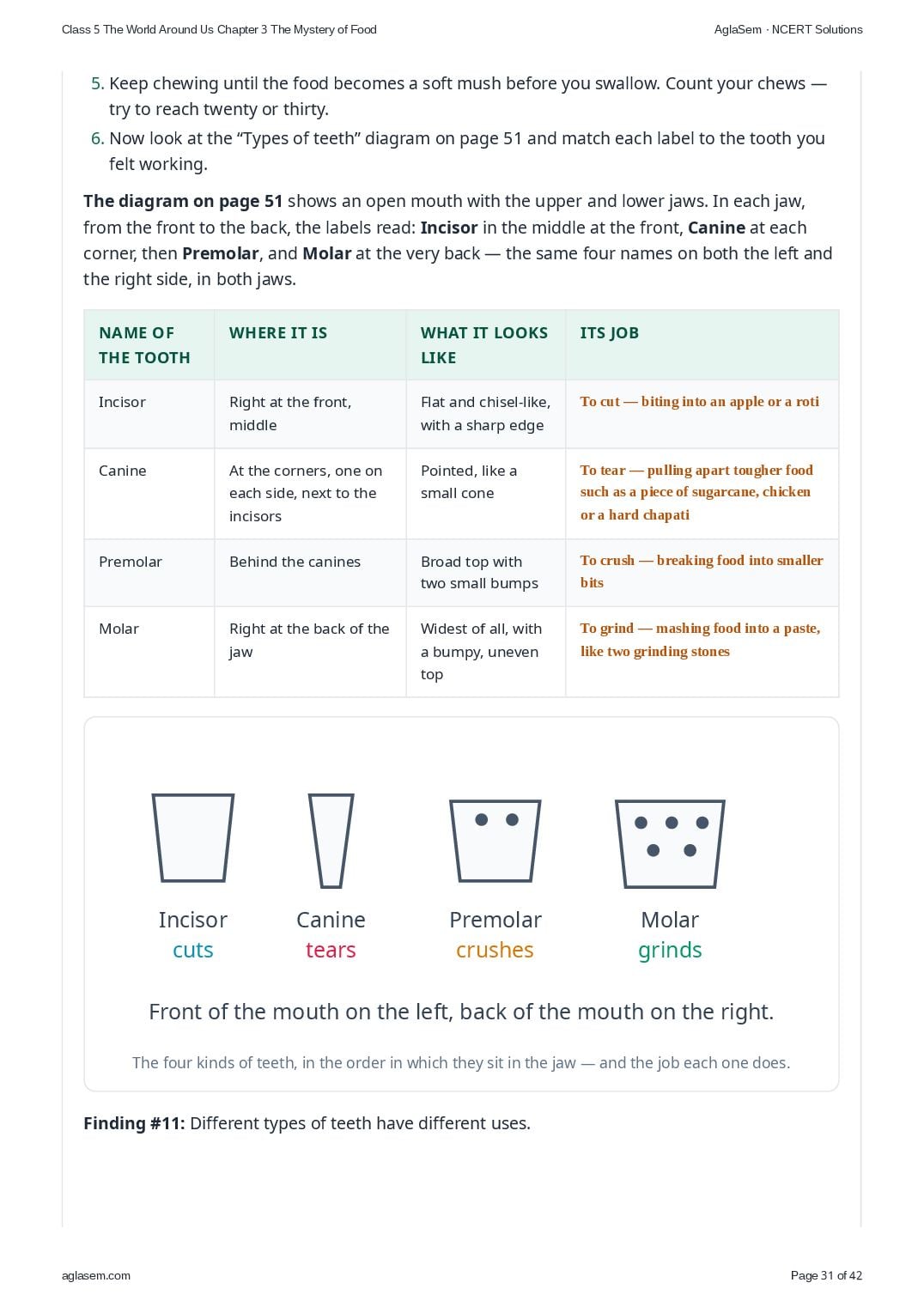
- Activity 5: When you eat, try chewing each item properly till it breaks down into smaller pieces and then into mush. Which teeth did you use to cut and chew? Look at the diagram given on the next page and name them. IncisorCaninePremolarMolarPremolarCanineCaninePremolarMolarPremolarCanineIncisor“Types of teeth” — the labelled diagram printed on the next page of the book.
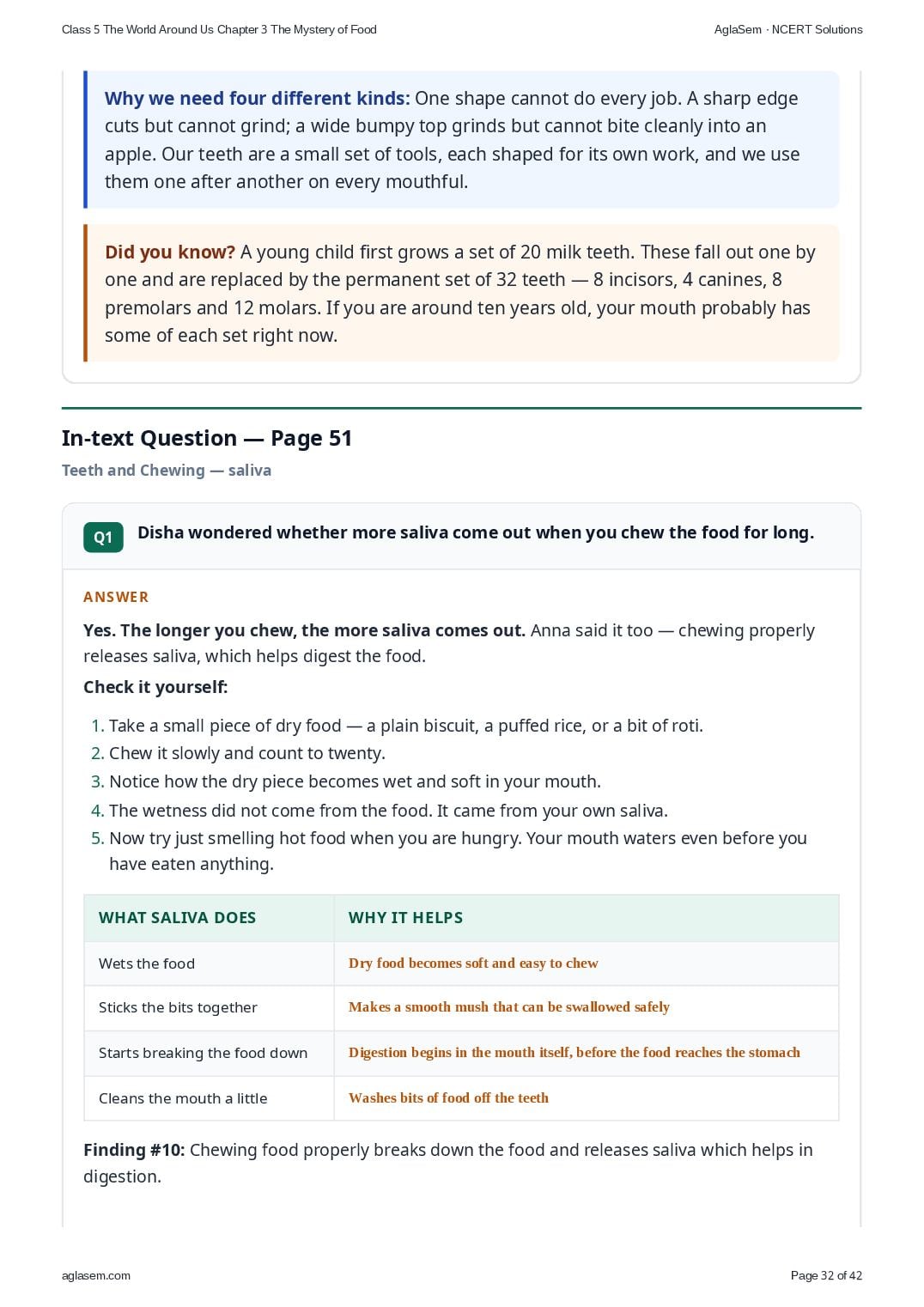
- Disha wondered whether more saliva come out when you chew the food for long.
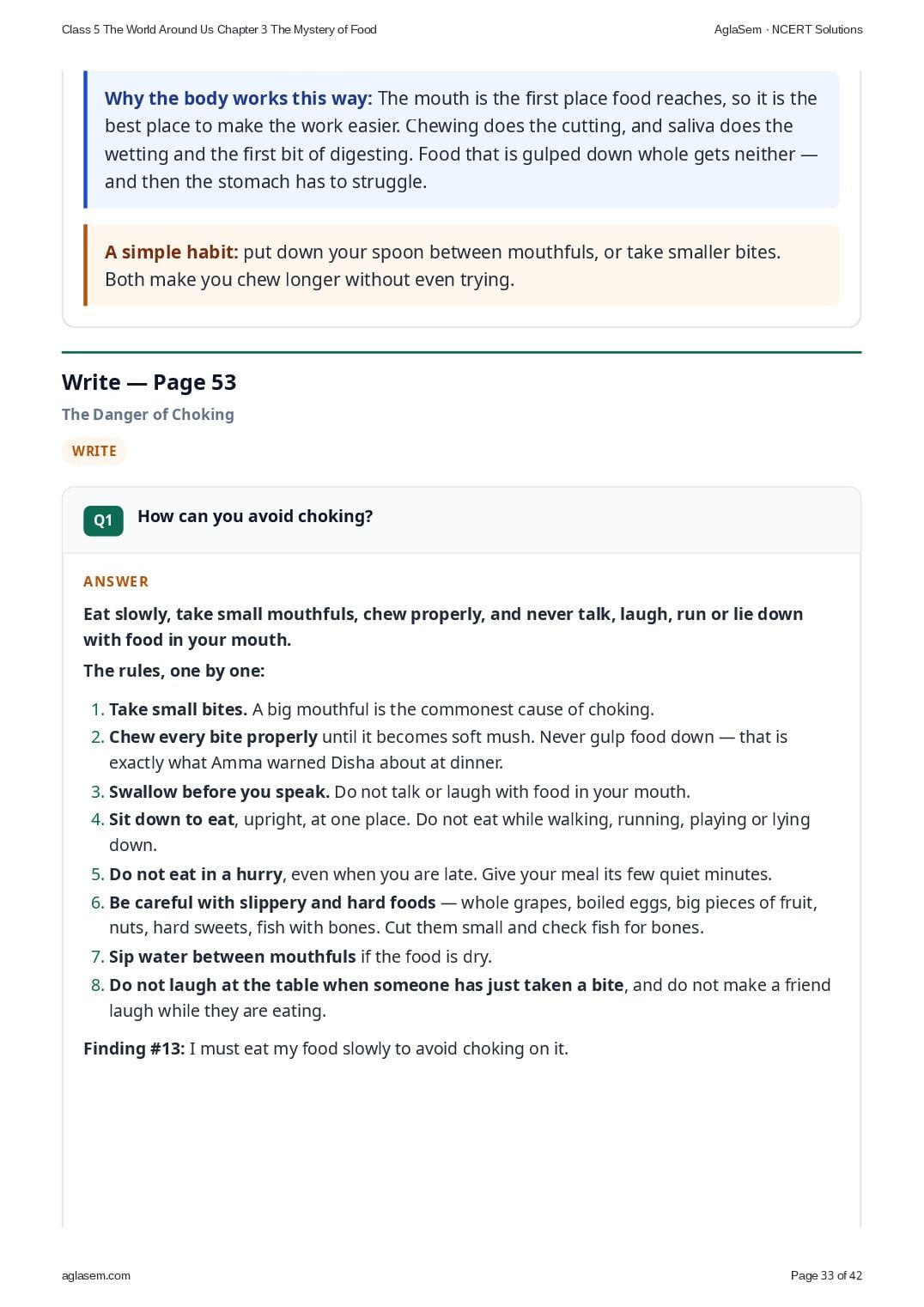
- How can you avoid choking?
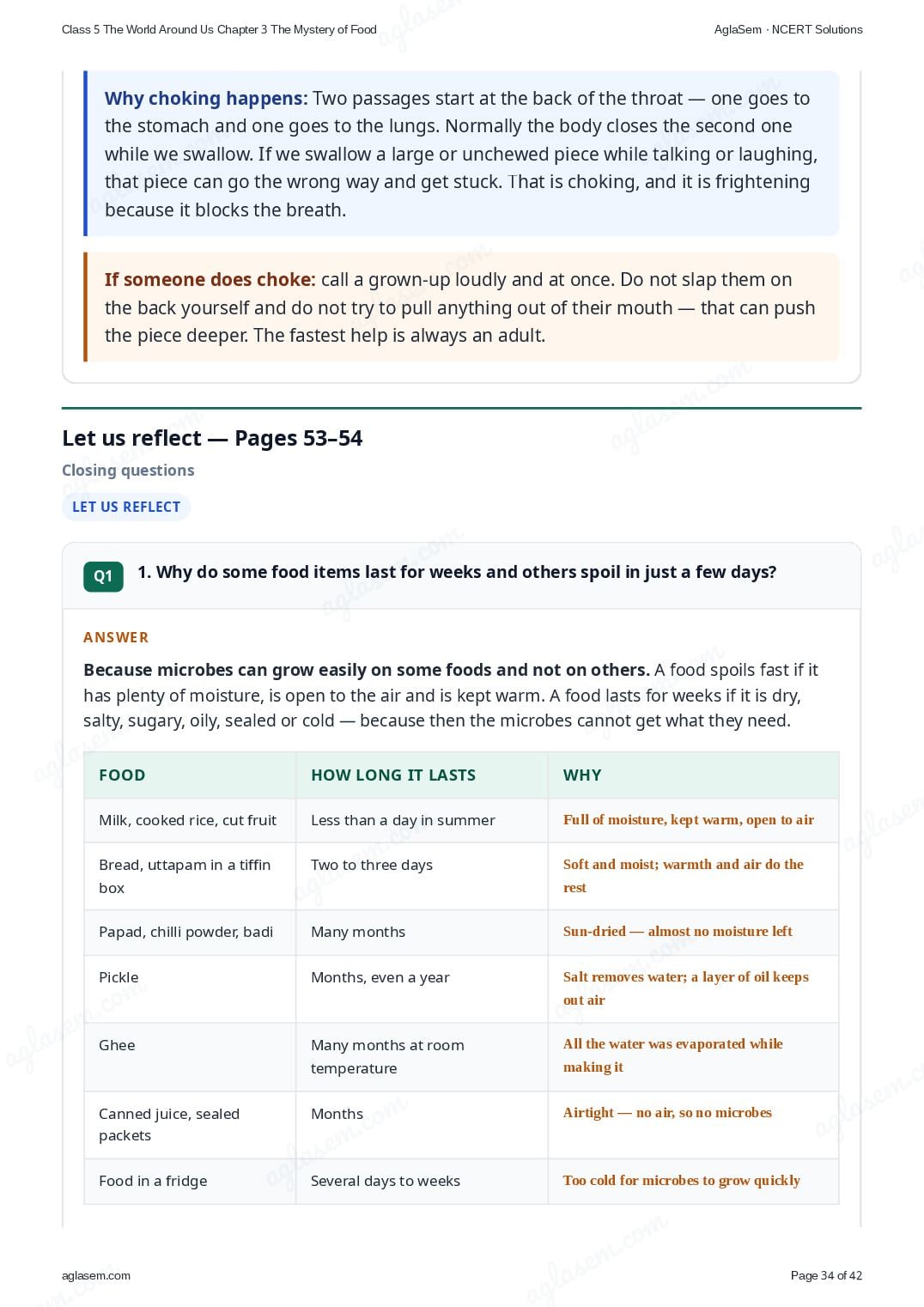
- 1. Why do some food items last for weeks and others spoil in just a few days?
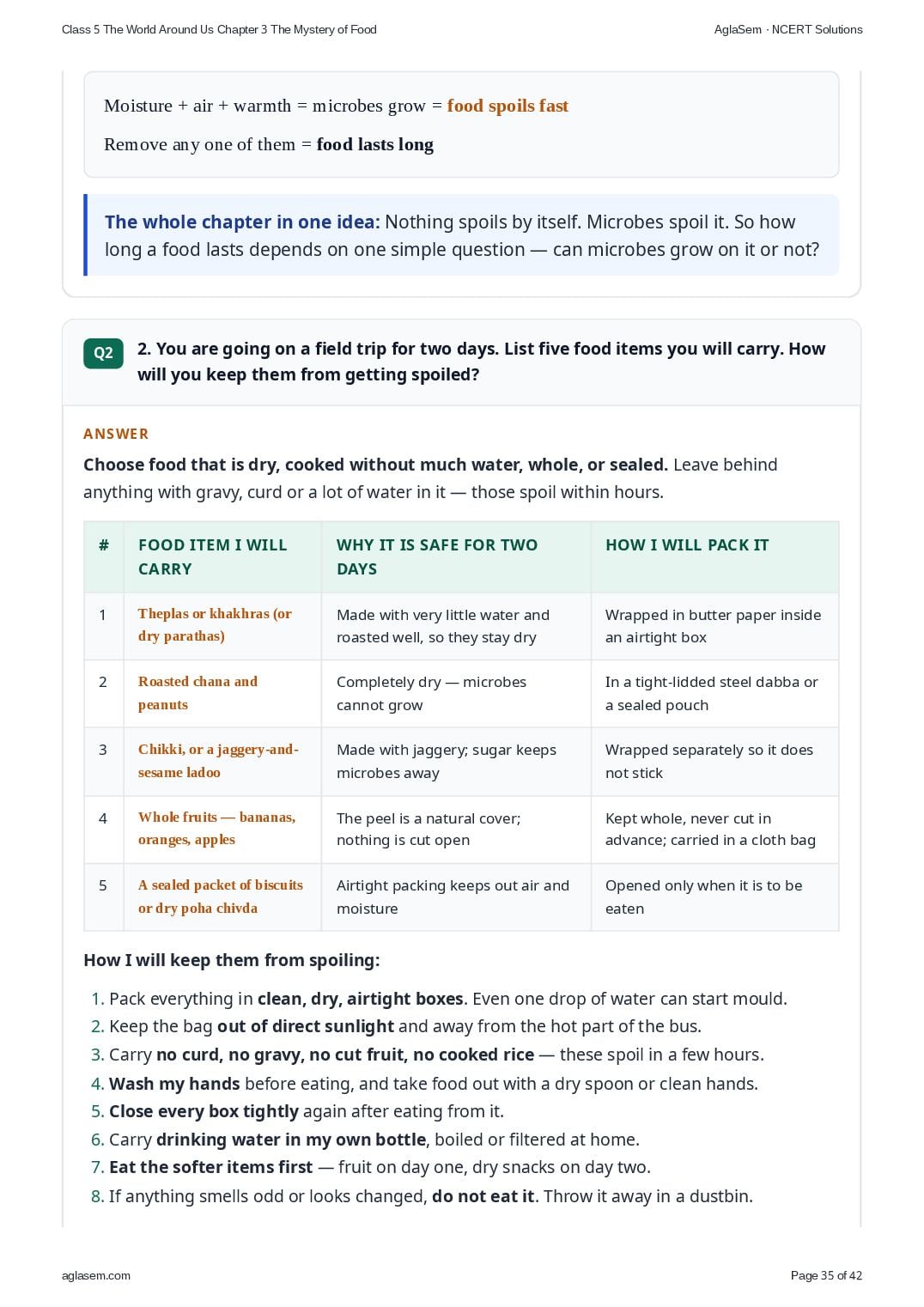
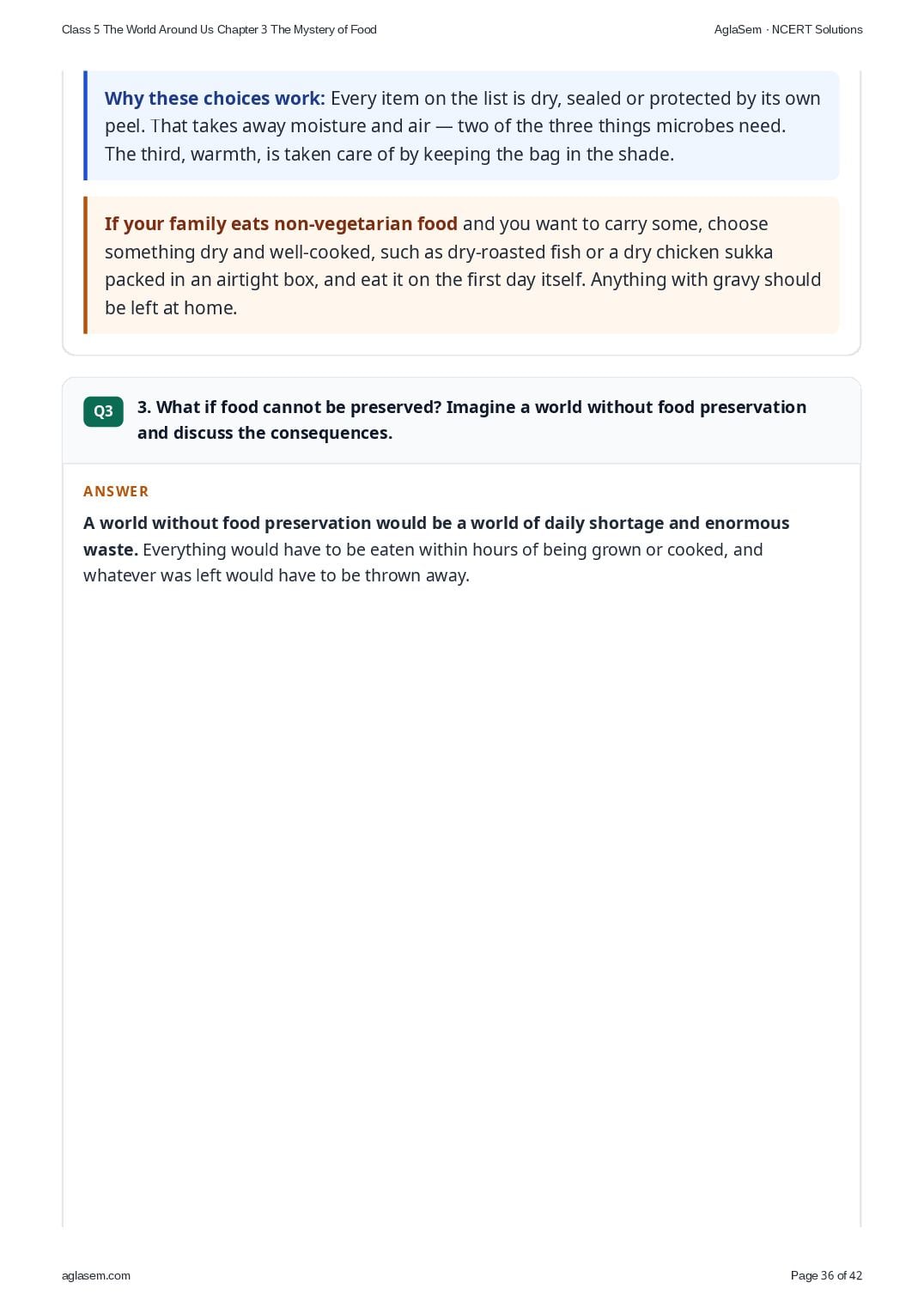
- 2. You are going on a field trip for two days. List five food items you will carry. How will you keep them from getting spoiled?
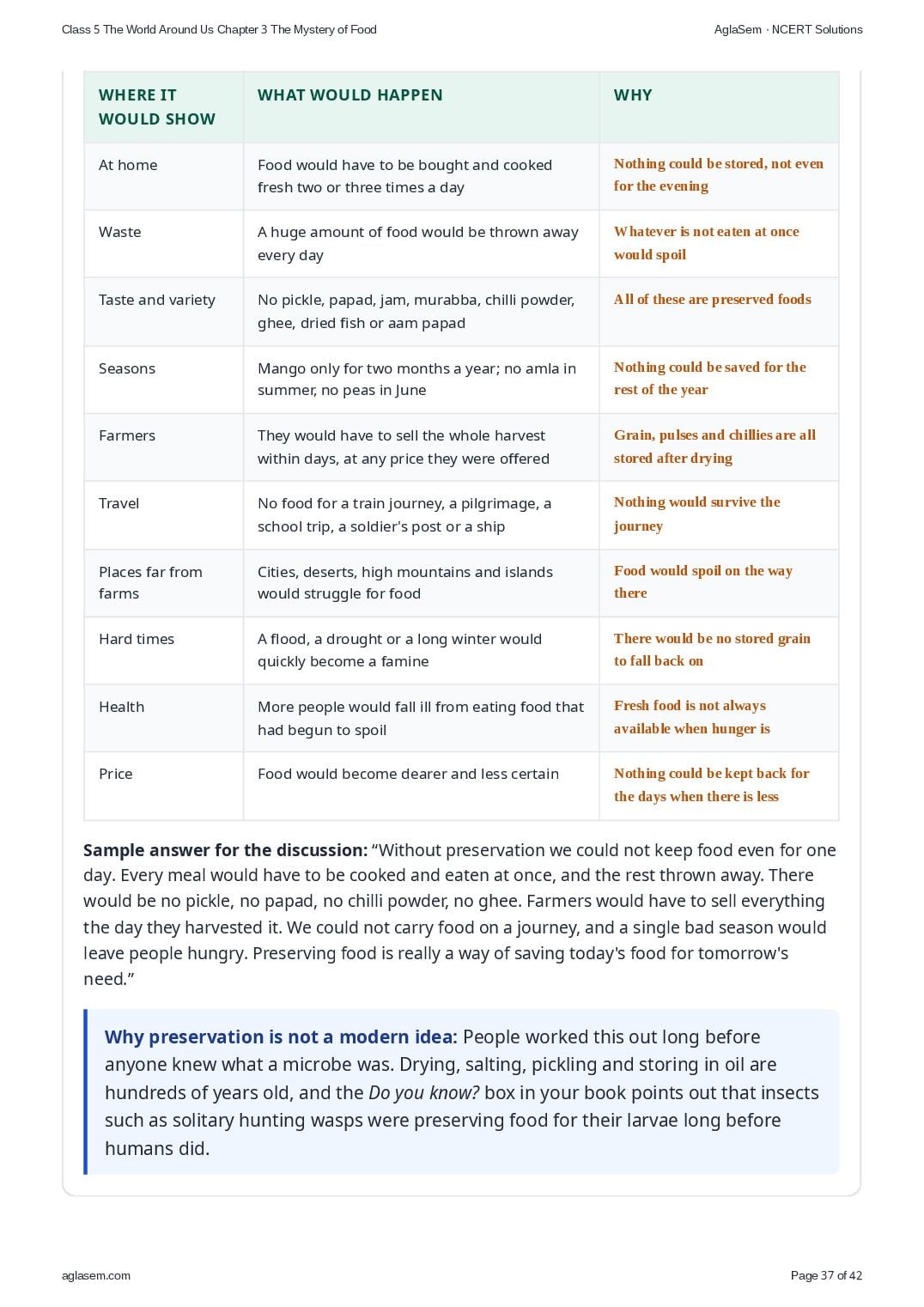
- 3. What if food cannot be preserved? Imagine a world without food preservation and discuss the consequences.
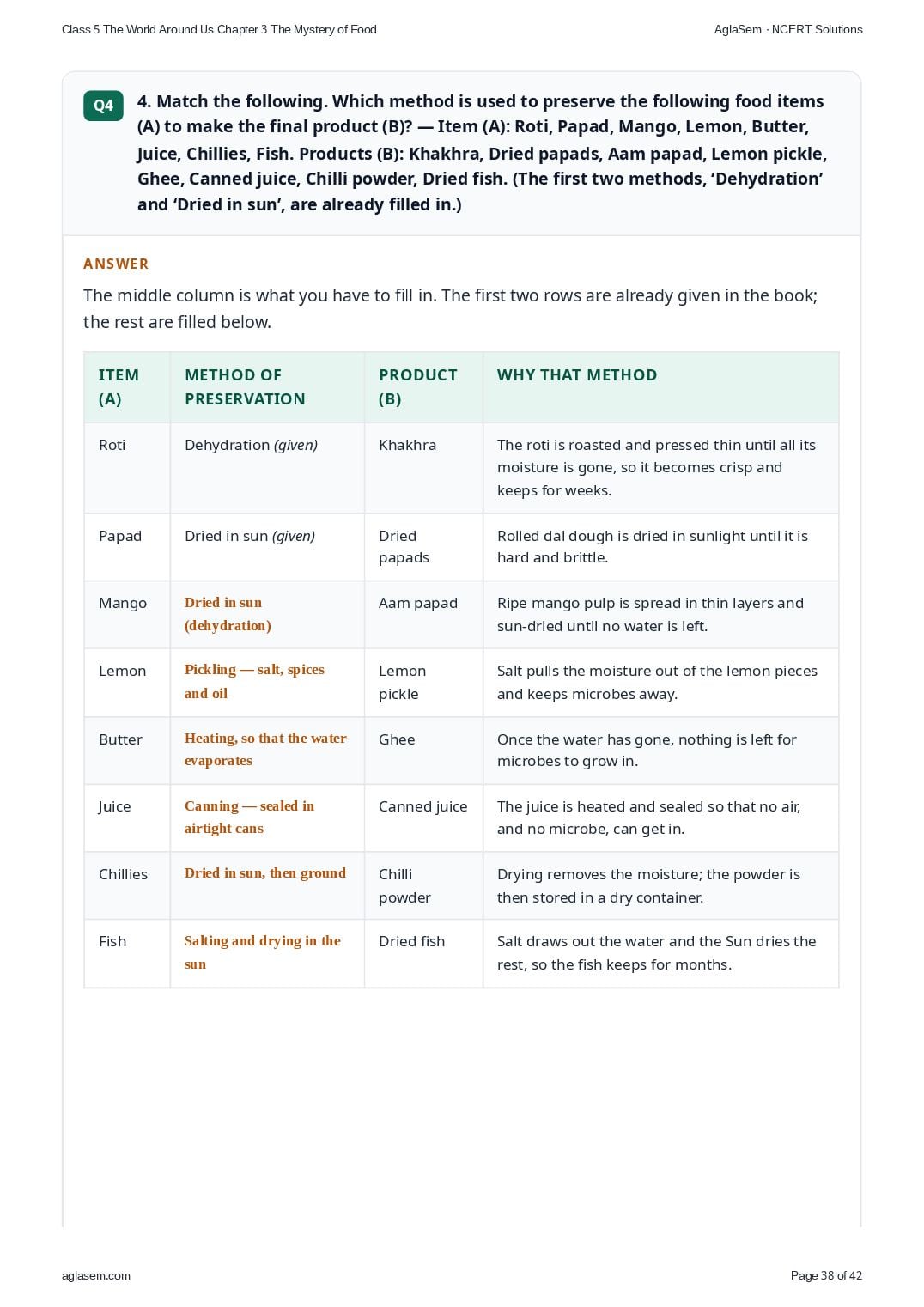
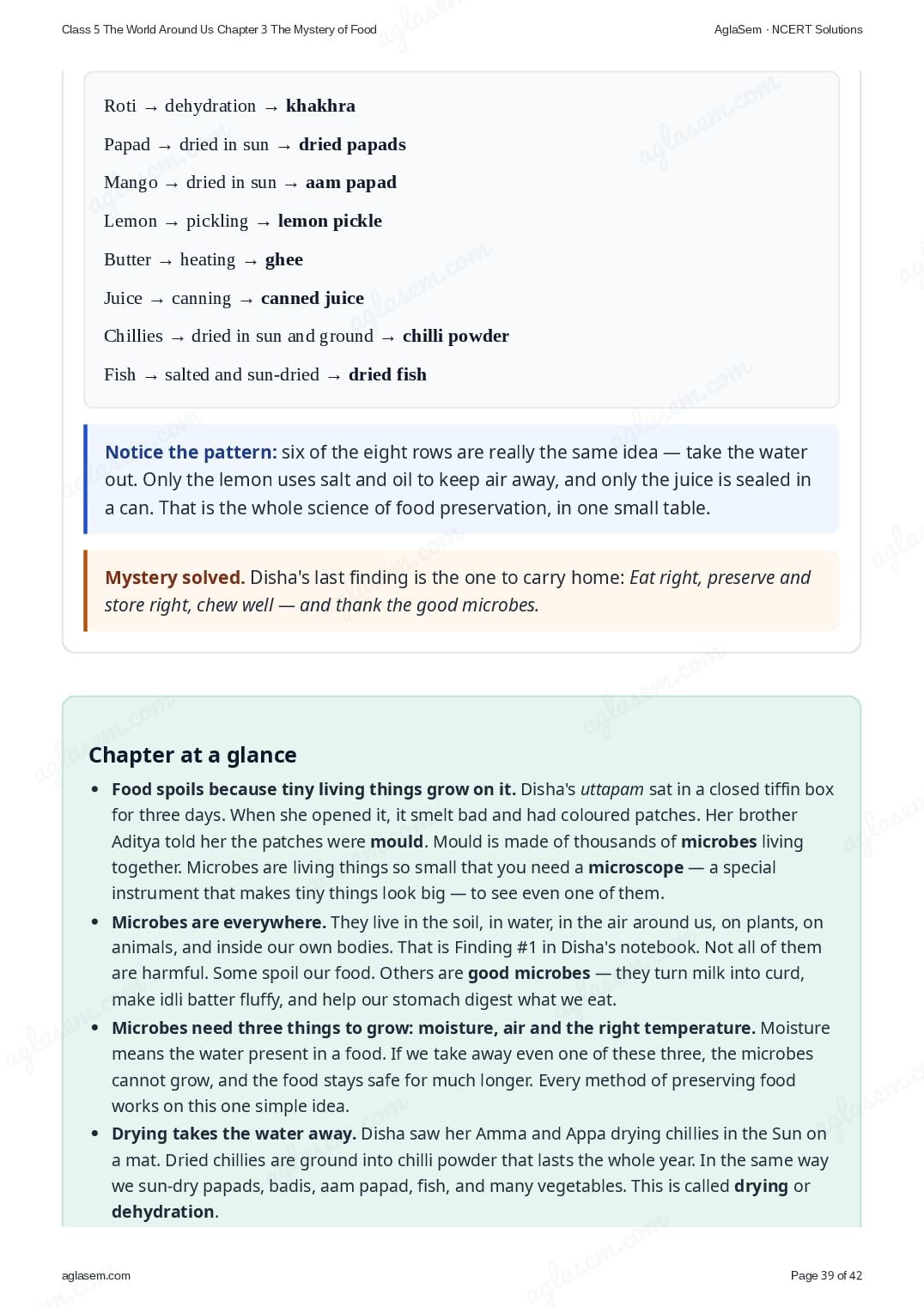
- 4. Match the following. Which method is used to preserve the following food items (A) to make the final product (B)? — Item (A): Roti, Papad, Mango, Lemon, Butter, Juice, Chillies, Fish. Products (B): Khakhra, Dried papads, Aam papad, Lemon pickle, Ghee, Canned juice, Chilli powder, Dried fish. (The first two methods, ‘Dehydration’ and ‘Dried in sun’, are already filled in.)
Chapter at a Glance
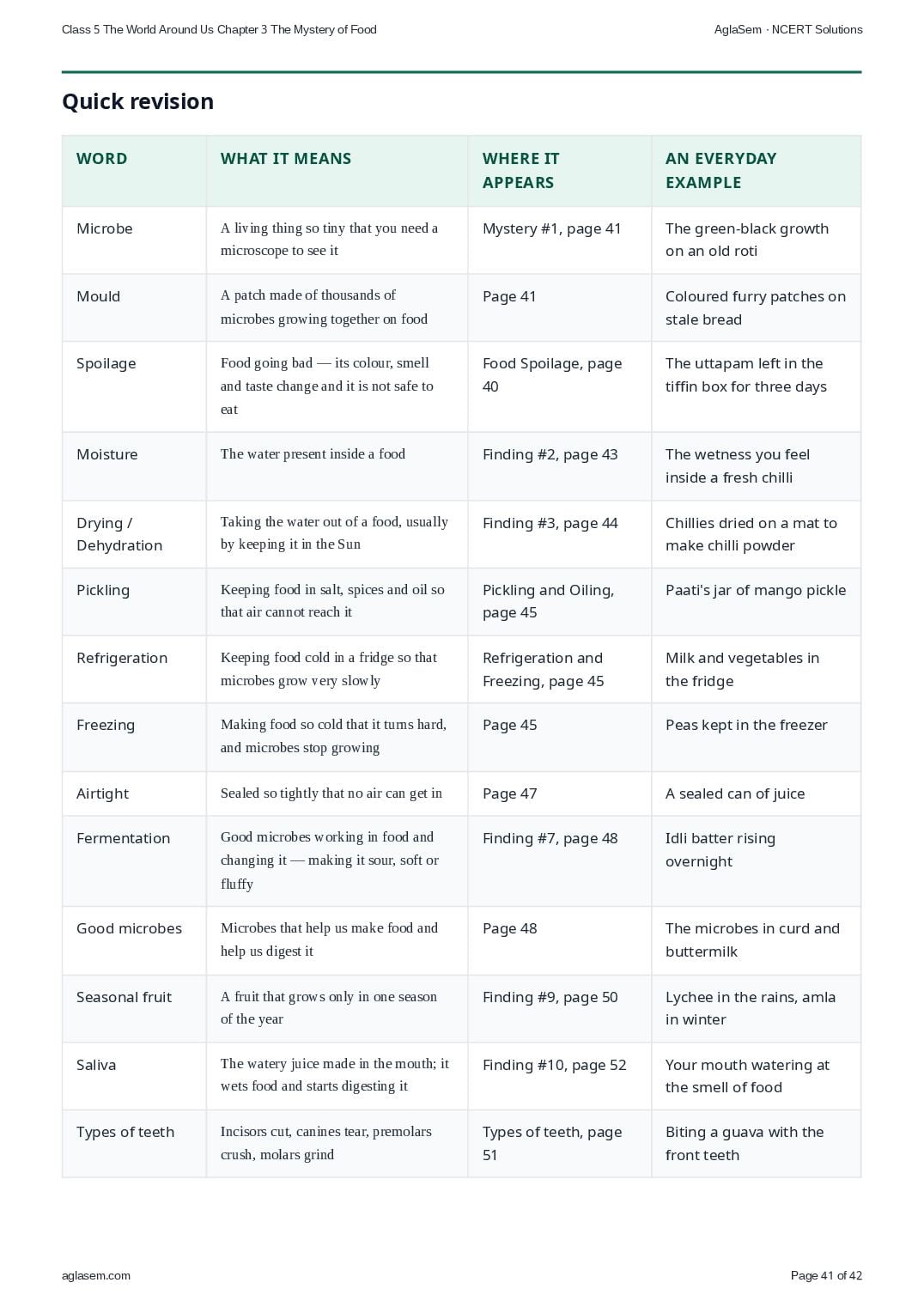
- Food spoils because tiny living things grow on it. Disha’s uttapam sat in a closed tiffin box for three days. When she opened it, it smelt bad and had coloured patches. Her brother Aditya told her the patches were mould. Mould is made of thousands of microbes living together. Microbes are living things so small that you need a microscope — a special instrument that makes tiny things look big — to see even one of them.
- Microbes are everywhere. They live in the soil, in water, in the air around us, on plants, on animals, and inside our own bodies. That is Finding #1 in Disha’s notebook. Not all of them are harmful. Some spoil our food. Others are good microbes — they turn milk into curd, make idli batter fluffy, and help our stomach digest what we eat.
- Microbes need three things to grow: moisture, air and the right temperature. Moisture means the water present in a food. If we take away even one of these three, the microbes cannot grow, and the food stays safe for much longer. Every method of preserving food works on this one simple idea.
- Drying takes the water away. Disha saw her Amma and Appa drying chillies in the Sun on a mat. Dried chillies are ground into chilli powder that lasts the whole year. In the same way we sun-dry papads, badis, aam papad, fish, and many vegetables. This is called drying or dehydration.
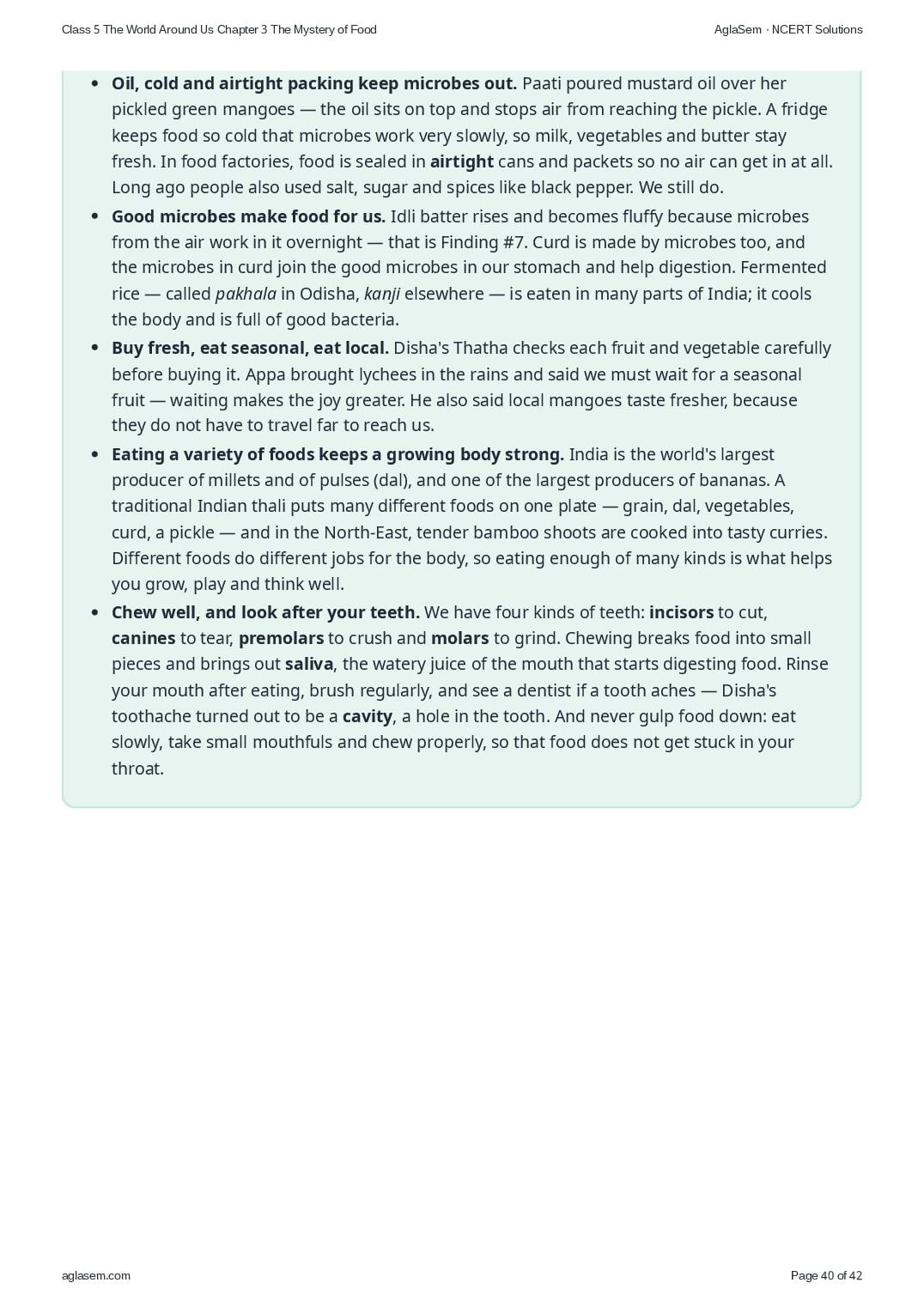
- Oil, cold and airtight packing keep microbes out. Paati poured mustard oil over her pickled green mangoes — the oil sits on top and stops air from reaching the pickle. A fridge keeps food so cold that microbes work very slowly, so milk, vegetables and butter stay fresh. In food factories, food is sealed in airtight cans and packets so no air can get in at all. Long ago people also used salt, sugar and spices like black pepper. We still do.
- Good microbes make food for us. Idli batter rises and becomes fluffy because microbes from the air work in it overnight — that is Finding #7. Curd is made by microbes too, and the microbes in curd join the good microbes in our stomach and help digestion. Fermented rice — called pakhala in Odisha, kanji elsewhere — is eaten in many parts of India; it cools the body and is full of good bacteria.
- Buy fresh, eat seasonal, eat local. Disha’s Thatha checks each fruit and vegetable carefully before buying it. Appa brought lychees in the rains and said we must wait for a seasonal fruit — waiting makes the joy greater. He also said local mangoes taste fresher, because they do not have to travel far to reach us.
- Eating a variety of foods keeps a growing body strong. India is the world’s largest producer of millets and of pulses (dal), and one of the largest producers of bananas. A traditional Indian thali puts many different foods on one plate — grain, dal, vegetables, curd, a pickle — and in the North-East, tender bamboo shoots are cooked into tasty curries. Different foods do different jobs for the body, so eating enough of many kinds is what helps you grow, play and think well.
- Chew well, and look after your teeth. We have four kinds of teeth: incisors to cut, canines to tear, premolars to crush and molars to grind. Chewing breaks food into small pieces and brings out saliva, the watery juice of the mouth that starts digesting food. Rinse your mouth after eating, brush regularly, and see a dentist if a tooth aches — Disha’s toothache turned out to be a cavity, a hole in the tooth. And never gulp food down: eat slowly, take small mouthfuls and chew properly, so that food does not get stuck in your throat.
How to Download NCERT Solutions for Class 5 The World Around Us Chapter 3 PDF
Follow these simple steps to get the the Mystery of Food questions-and-answers PDF from Our Wondrous World.
- Search NCERT Solutions for Class 5 The World Around Us Chapter 3 aglasem and open this page.
- Read the exercise questions with answers for the Mystery of Food shown above.
- Click the Download PDF link to save the the Mystery of Food solutions to your device.
NCERT Solutions for Class 5 The World Around Us – All Chapters
There are more chapters to study besides the Mystery of Food in The World Around Us. Here are the NCERT Solutions for all chapters of Class 5 The World Around Us.
- Chapter 1 Water the Essence of Life
- Chapter 2 Journey of a River
- Chapter 3 the Mystery of Food
- Chapter 4 Our School a Happy Place
- Chapter 5 Our Vibrant Country
- Chapter 6 Some Unique Places
- Chapter 7 Energy How Things Work
- Chapter 8 Clothes How Things Are Made
- Chapter 9 Rhythms of Nature
- Chapter 10 Earth Our Shared Home
NCERT Solutions for Class 5 – All Subjects
Just like Chapter 3 of The World Around Us, you can get the exercise questions with answers for every other subject of Class 5. Here are the NCERT Solutions for all subjects of Class 5.
NCERT Solutions for Class 5 The World Around Us Chapter 3 – An Overview
The key highlights of this study material are as follows.
| Aspects | Details |
|---|---|
| Class | Class 5 |
| Subject | The World Around Us |
| Chapter Number | Chapter 3 |
| Chapter Name | the Mystery of Food |
| Book Name | Our Wondrous World |
| Book By | NCERT (National Council of Educational Research and Training) |
| Educational Resource Here | NCERT Solutions of Class 5 The World Around Us Chapter 3 for all exercises |
| More Questions Answers of This Subject | NCERT Solutions for Class 5 The World Around Us |
| Download Book Chapter | NCERT Book Class 5 The World Around Us |
| All Questions Answers For This Class | NCERT Solutions for Class 5 |
| Complete Solutions | NCERT Solutions |
NCERT Solutions for Class 5 The World Around Us Chapter 3 the Mystery of Food – FAQs
What are the NCERT Solutions for Class 5 The World Around Us Chapter 3 the Mystery of Food?
They are the complete, step-by-step answers to all the exercise and in-text questions of Chapter 3 the Mystery of Food from the NCERT Class 5 The World Around Us textbook Our Wondrous World, written by experts as per the latest NCERT syllabus.
How can I download the Class 5 The World Around Us Chapter 3 solutions PDF for free?
Open this page on aglasem, read the the Mystery of Food questions with answers, and click the “Download Solutions PDF” link. The Class 5 The World Around Us Chapter 3 NCERT Solutions PDF is completely free to download.
Are these NCERT Solutions as per the latest 2026-27 syllabus?
Yes. The NCERT Solutions for Class 5 The World Around Us Chapter 3 are based on the latest NCERT textbook Our Wondrous World and the current 2026-27 CBSE syllabus, so the questions and answers match what you study in class.
Where can I get NCERT Solutions for the other chapters of Class 5 The World Around Us?
You can find the answers to every chapter on the NCERT Solutions for Class 5 The World Around Us page, and solutions for every subject on the NCERT Solutions for Class 5 page.
How do NCERT Solutions help in exam preparation?
They show the correct method to solve each question, help you write answers the way they are expected in exams, let you check and correct your own work, and save revision time — which together improve your marks in Class 5 The World Around Us.
If you have any queries on NCERT Solutions for Class 5 The World Around Us Chapter 3 the Mystery of Food, then please ask in the comments below.