NCERT Solutions for Class 5 The World Around Us Chapter 8 Clothes How Things Are Made provide clear, step-by-step answers to every exercise and in-text question from the chapter Clothes How Things Are Made of the NCERT textbook Our Wondrous World. Prepared by subject experts as per the latest NCERT (CBSE) syllabus for 2026-27, these NCERT Solutions for Class 5 The World Around Us help you understand each concept, write exam-ready answers, and check your own solutions. You can read them online below or download the free Class 5 The World Around Us Chapter 8 question-answer PDF.
NCERT Solutions for Class 5 The World Around Us Chapter 8 Clothes How Things Are Made
- Class: Class 5
- Subject: The World Around Us
- Chapter: Chapter 8 – Clothes How Things Are Made
- Textbook: Our Wondrous World (NCERT)
- Study material: NCERT Solutions – questions with answers, free PDF
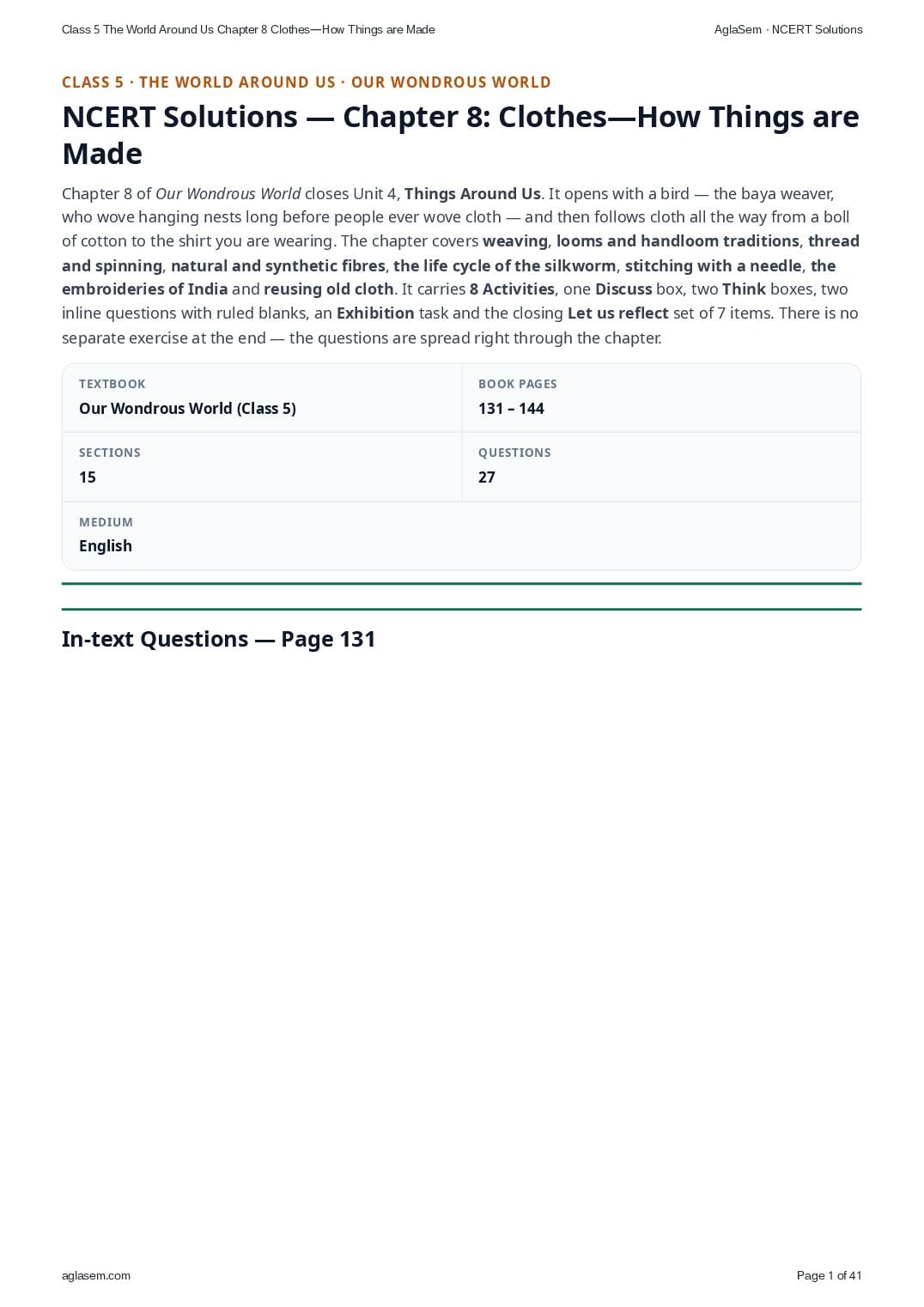
These solutions answer all the exercise questions of Chapter 8 Clothes How Things Are Made — including the in-text questions, short-answer and long-answer questions, and activities — with complete explanations so you can follow the method, not just the final answer. Read the full solutions below.
NCERT Solutions Class 5 The World Around Us Chapter 8 Clothes How Things Are Made View Download
NCERT Solutions for Class 5 The World Around Us Chapter 8 PDF Download
You can read the NCERT Solutions for Class 5 The World Around Us Chapter 8 online above, or download the complete question-answer PDF to study Clothes How Things Are Made offline at any time.
NCERT Solutions for Class 5 The World Around Us Chapter 8 PDF Download Link – Click Here to Download Solutions PDF
Questions Covered in This Chapter
These NCERT Solutions answer all 27 questions of this chapter. The questions solved are:
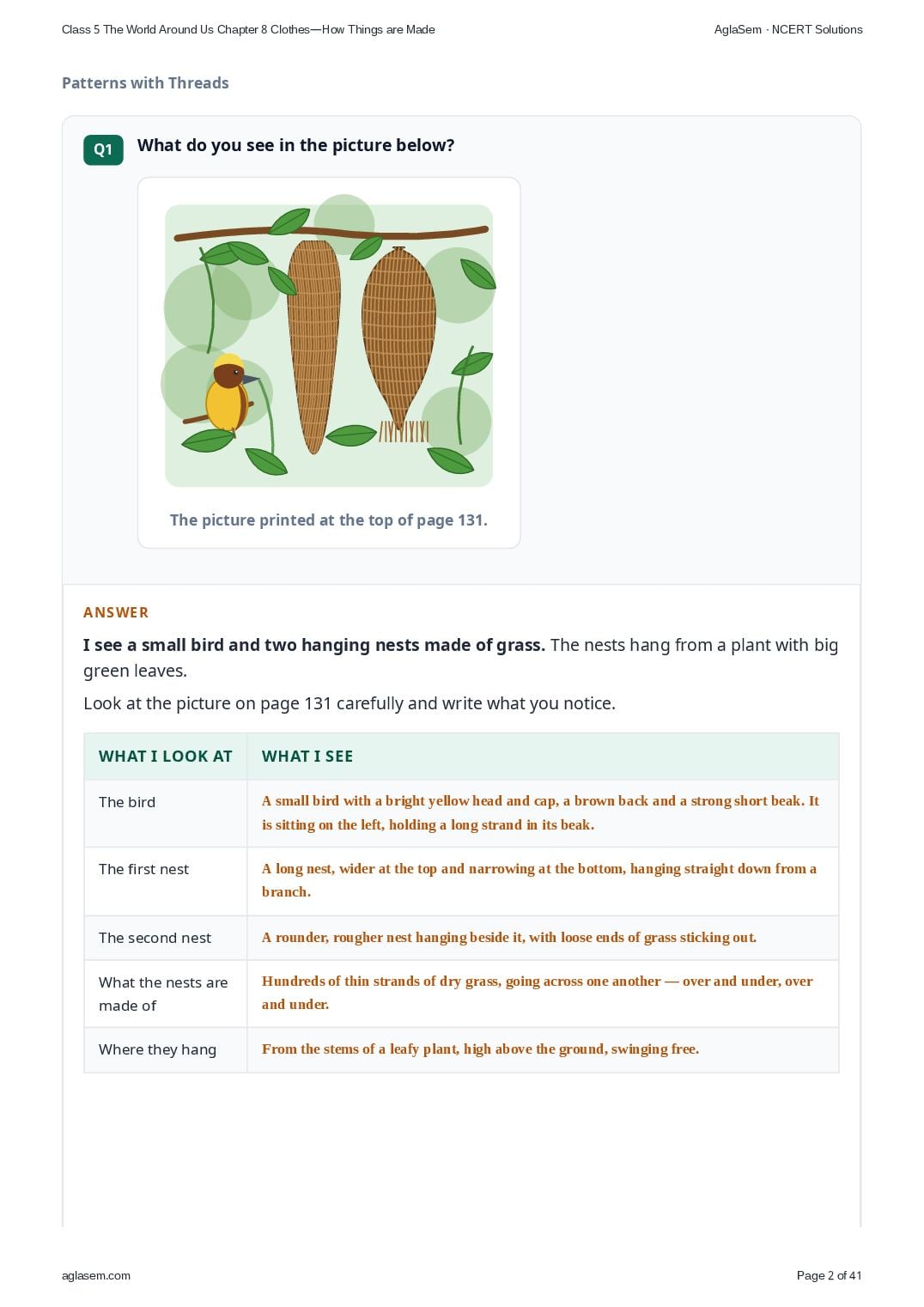
- What do you see in the picture below?The picture printed at the top of page 131.
- Did you know we have a hidden artist around us who has been weaving long before humans ever did?
- Have you seen products woven out of natural material at home or elsewhere? What are they?
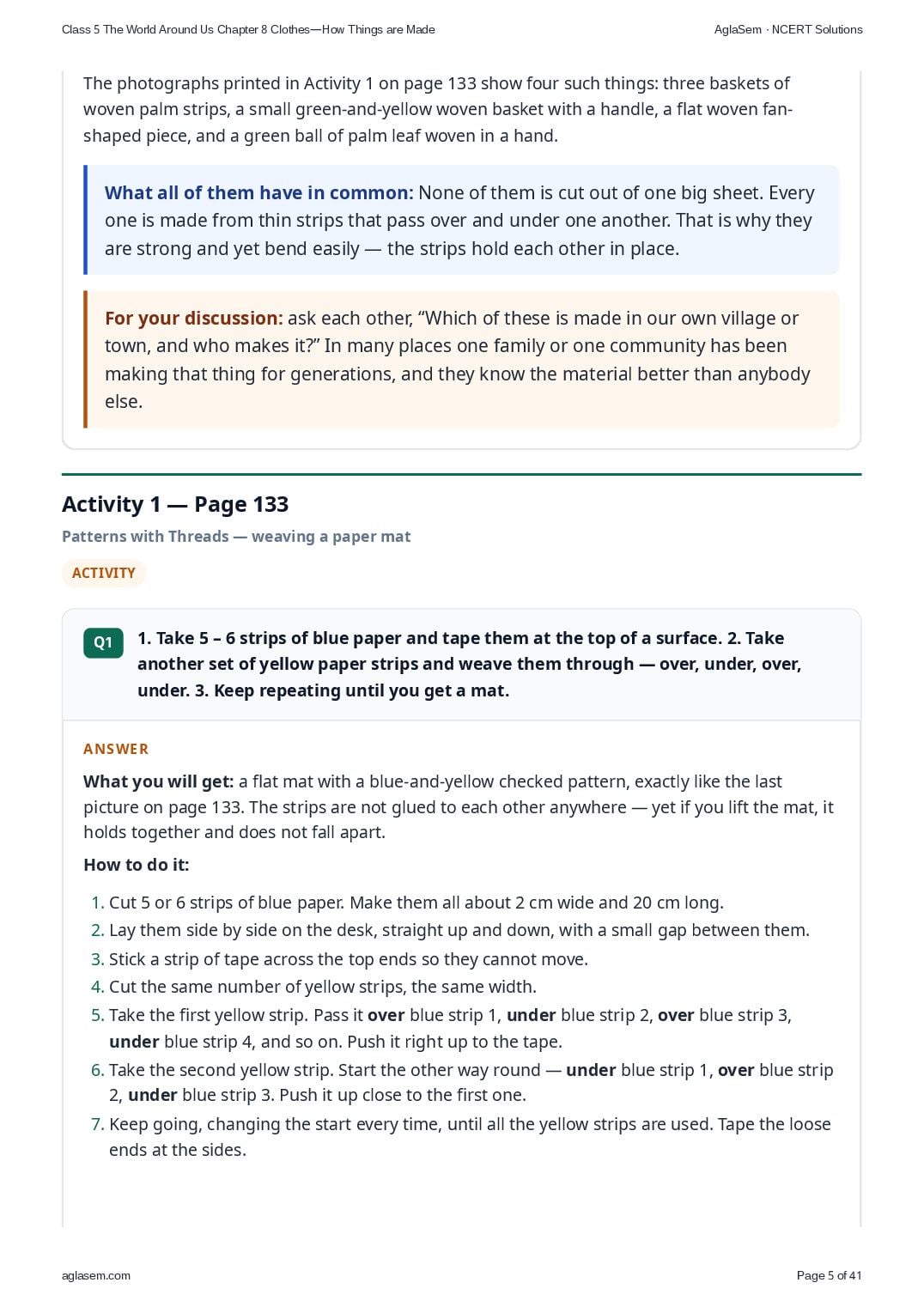
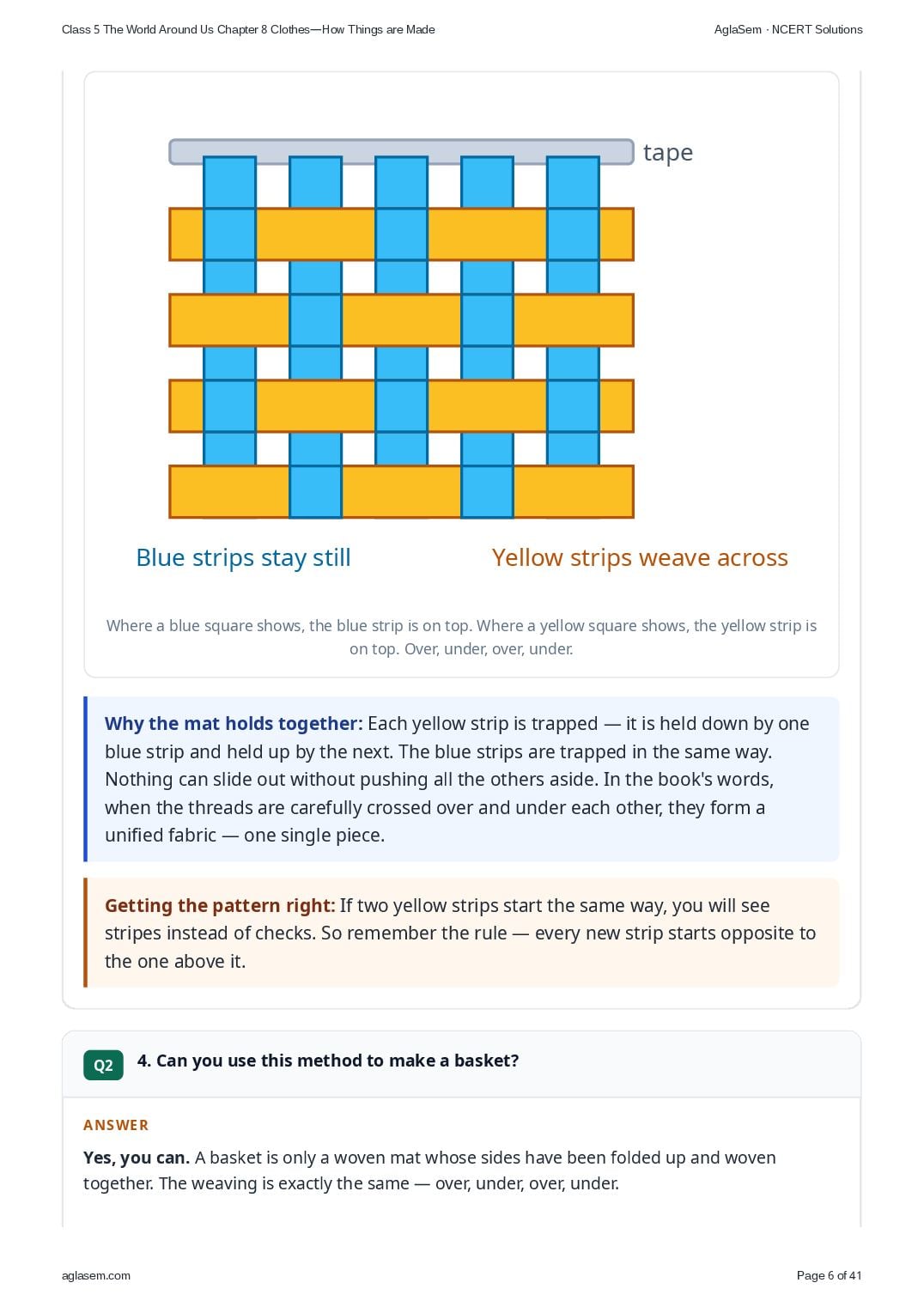
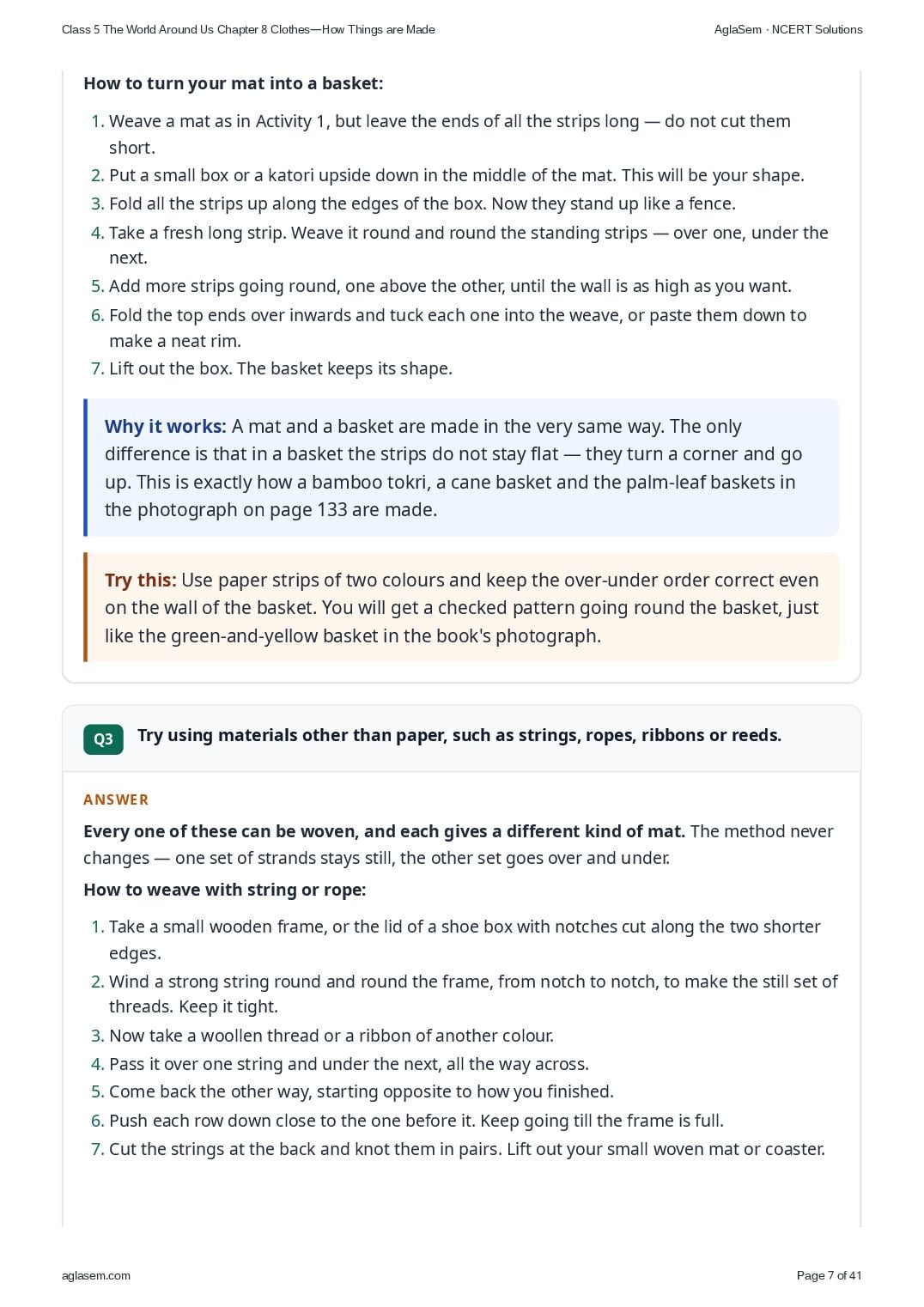
- 1. Take 5 – 6 strips of blue paper and tape them at the top of a surface. 2. Take another set of yellow paper strips and weave them through — over, under, over, under. 3. Keep repeating until you get a mat.
- 4. Can you use this method to make a basket?
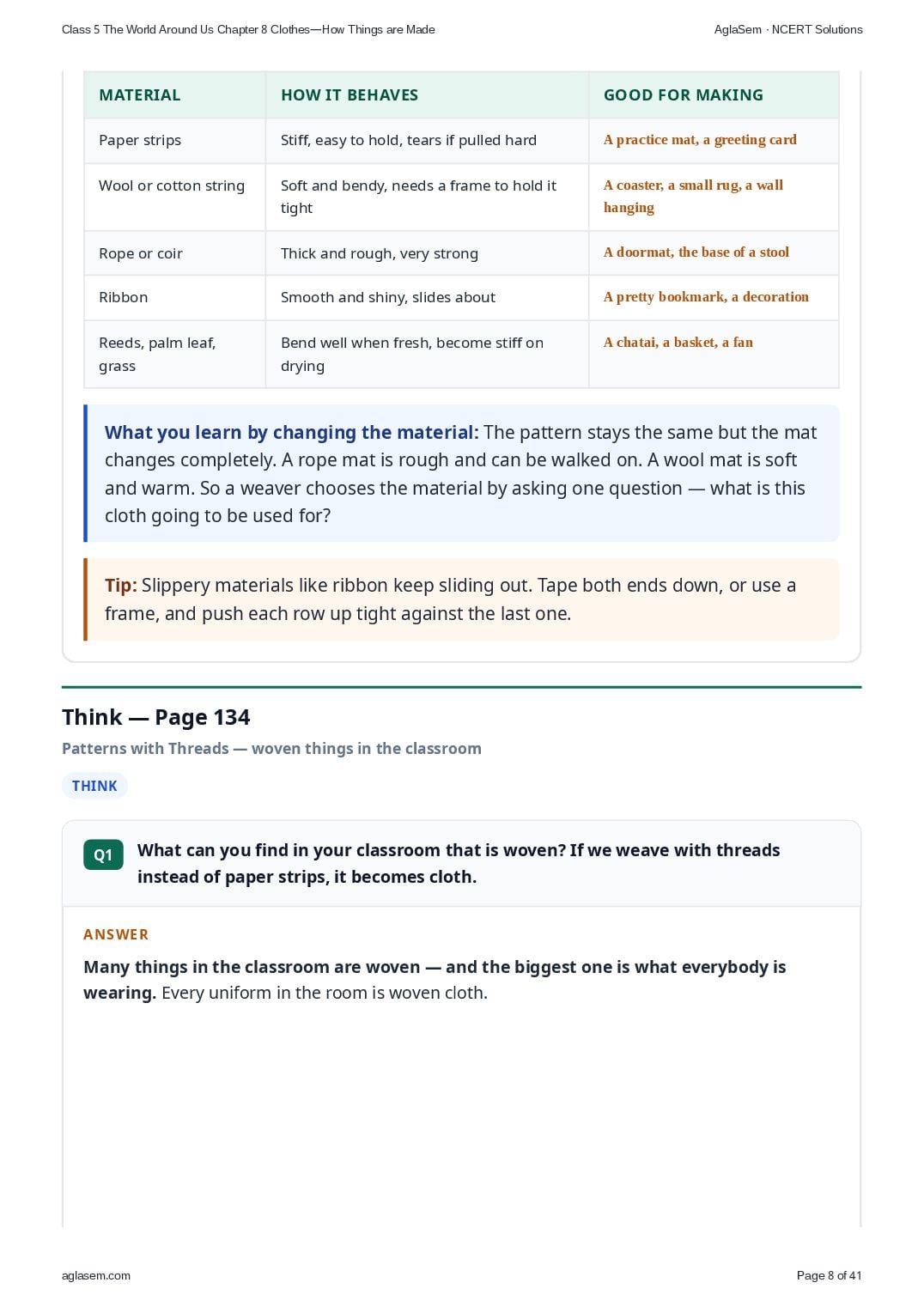
- Try using materials other than paper, such as strings, ropes, ribbons or reeds.
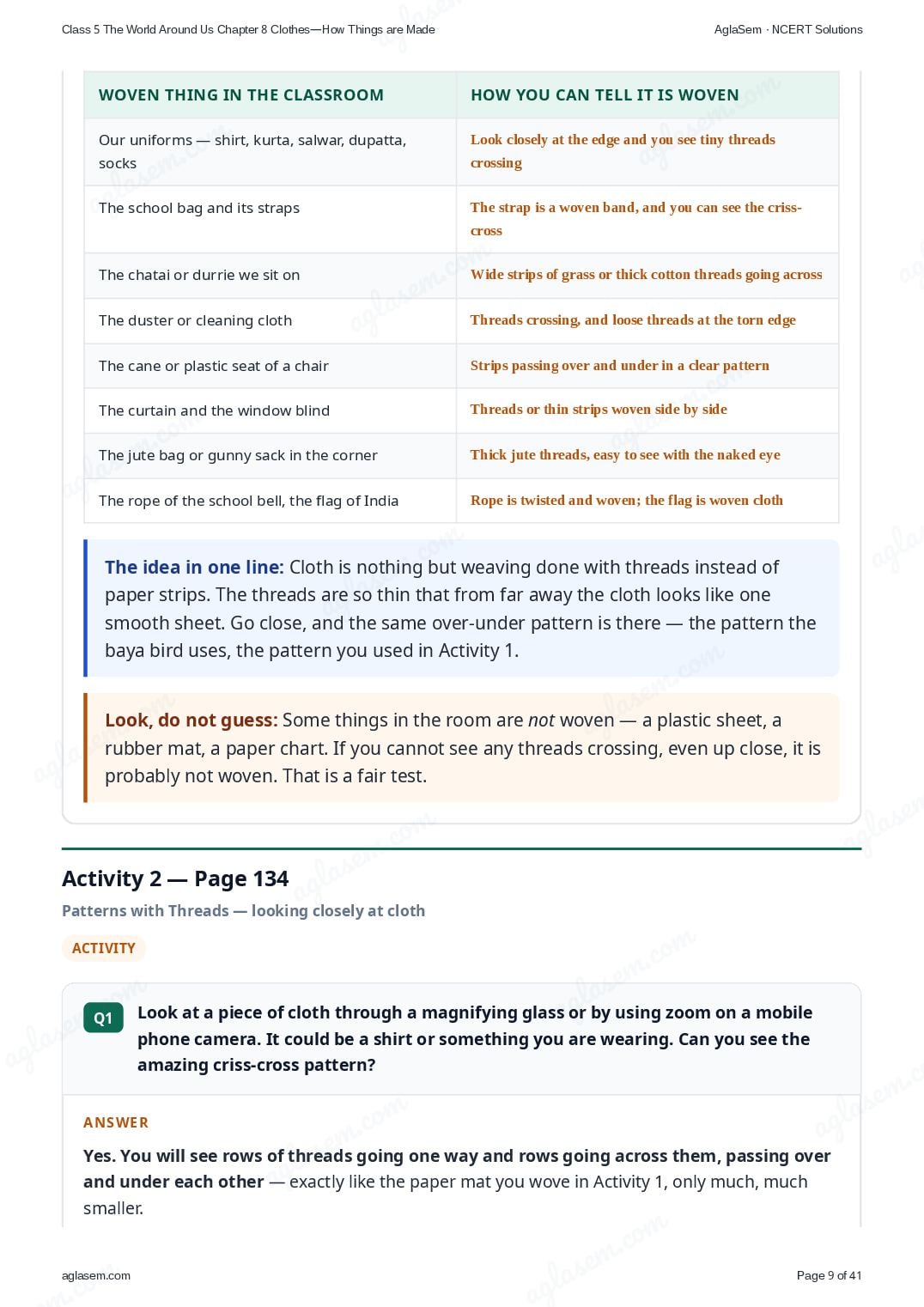
- What can you find in your classroom that is woven? If we weave with threads instead of paper strips, it becomes cloth.
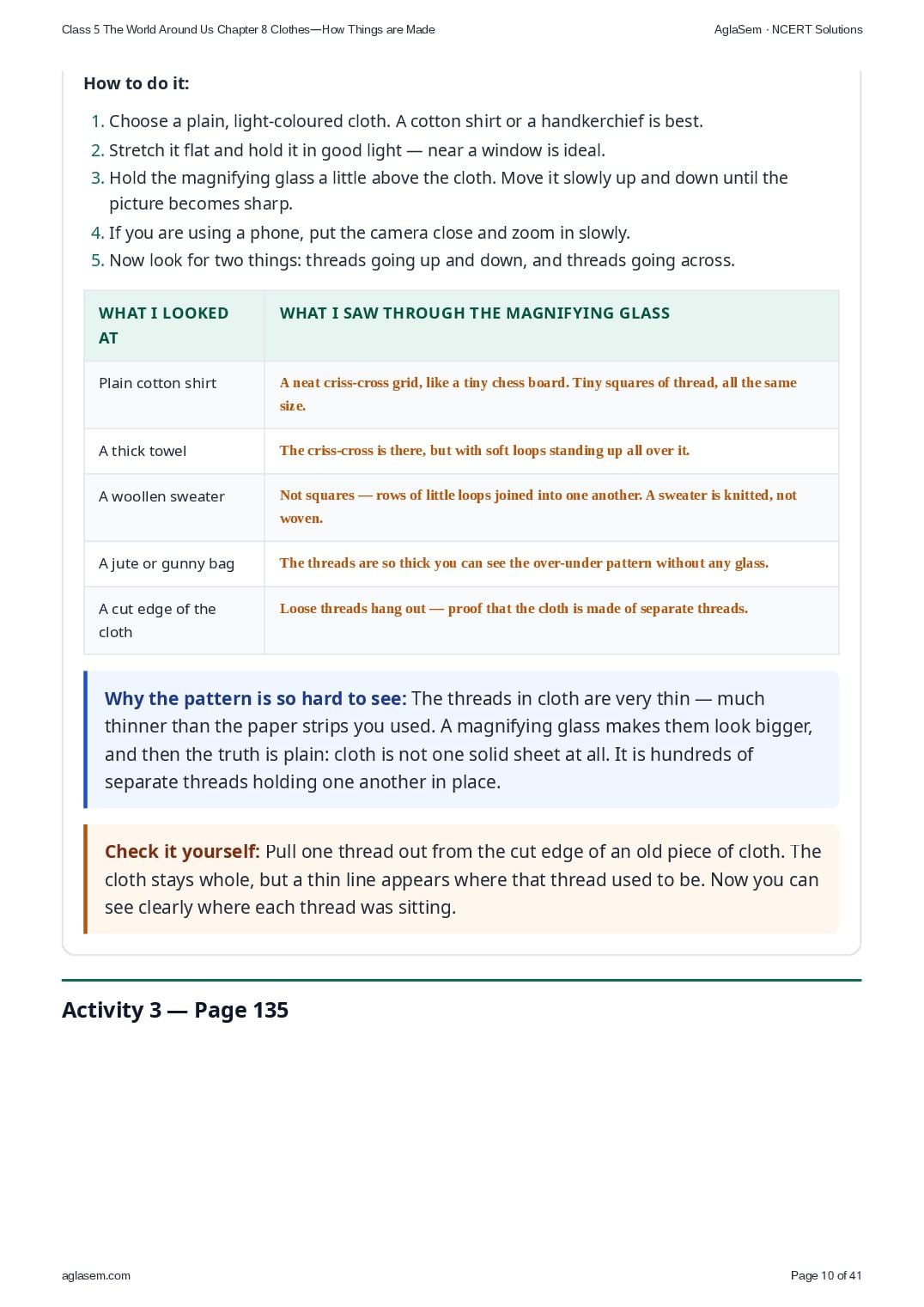
- Look at a piece of cloth through a magnifying glass or by using zoom on a mobile phone camera. It could be a shirt or something you are wearing. Can you see the amazing criss-cross pattern?
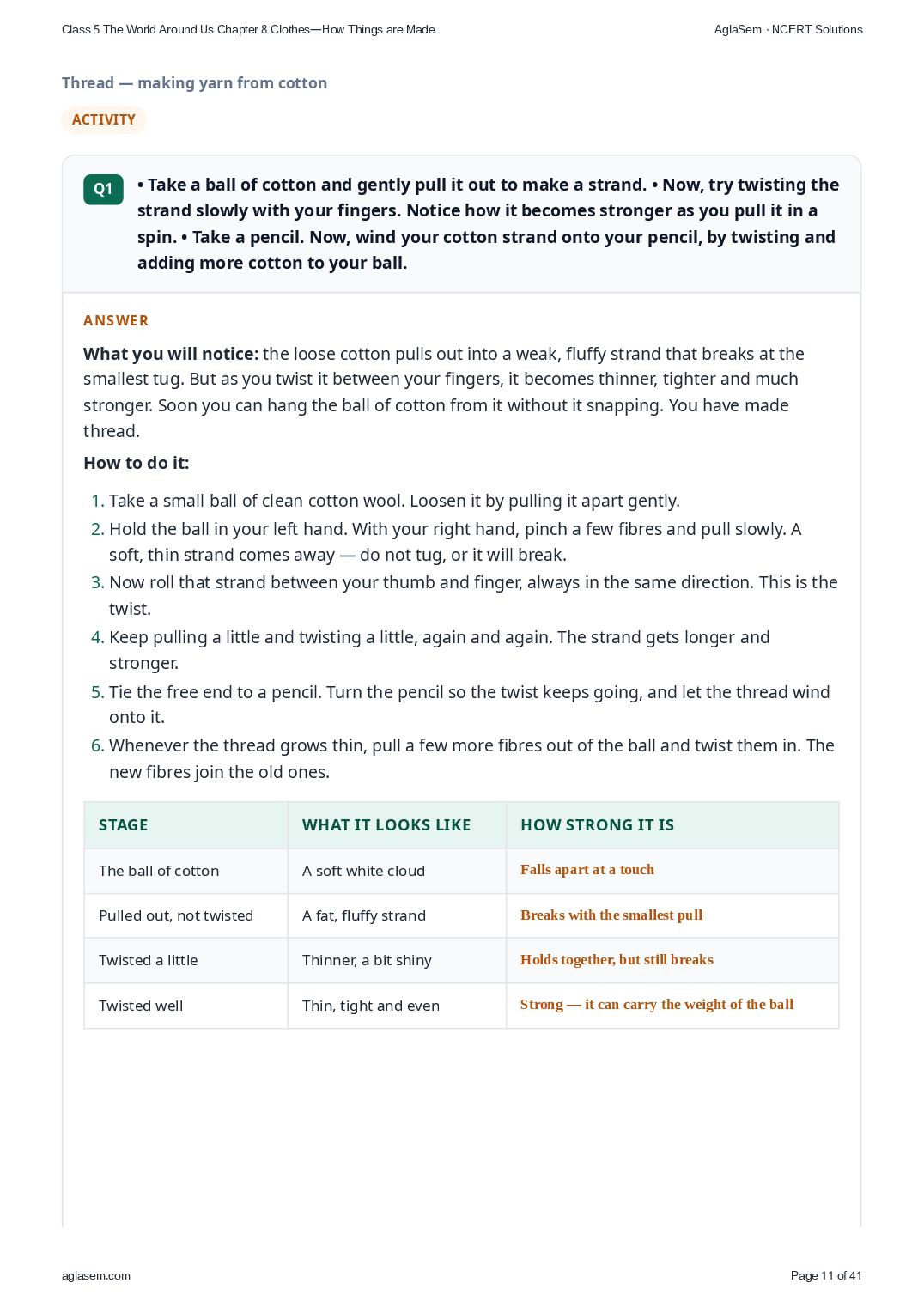
- • Take a ball of cotton and gently pull it out to make a strand. • Now, try twisting the strand slowly with your fingers. Notice how it becomes stronger as you pull it in a spin. • Take a pencil. Now, wind your cotton strand onto your pencil, by twisting and adding more cotton to your ball.
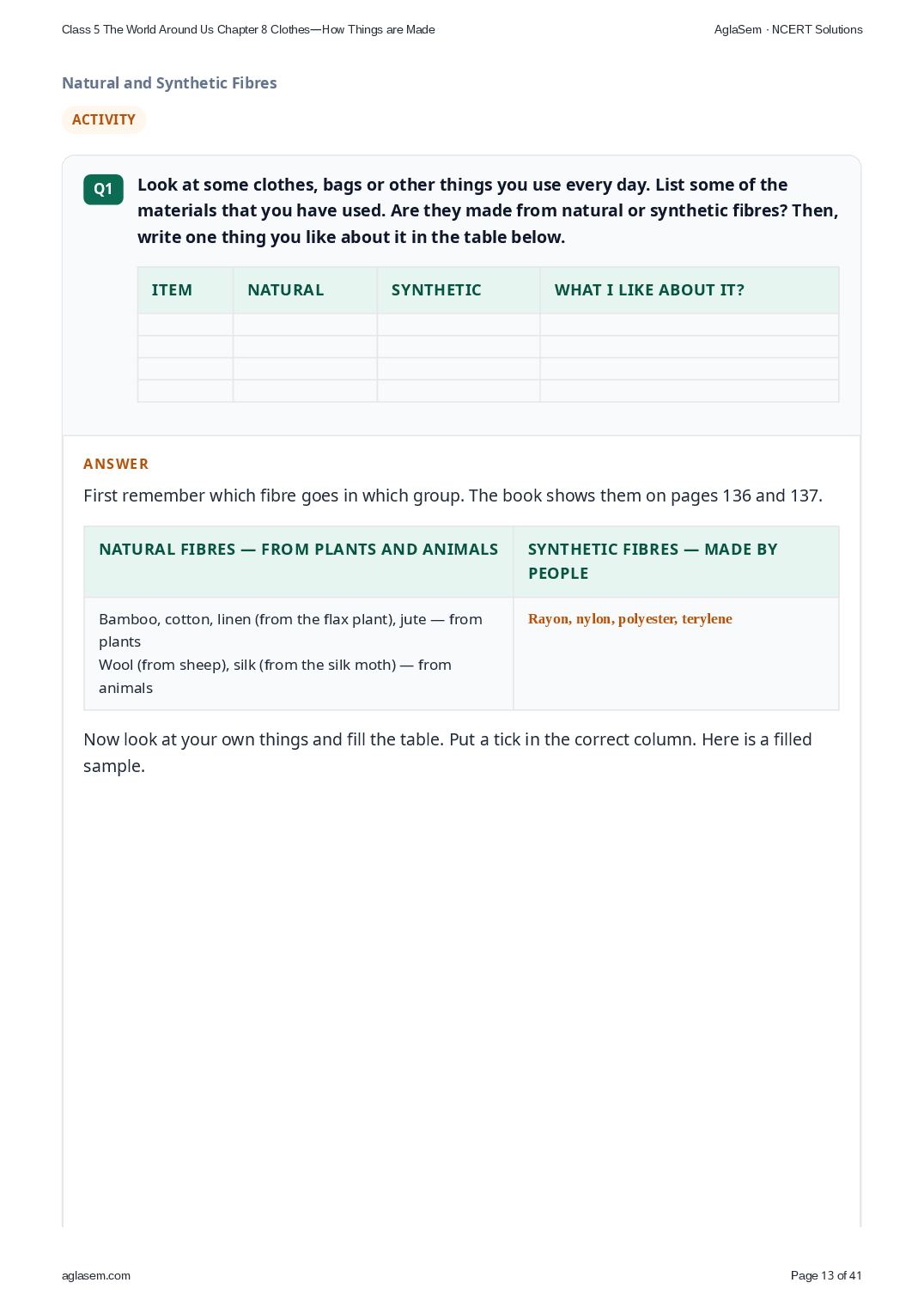
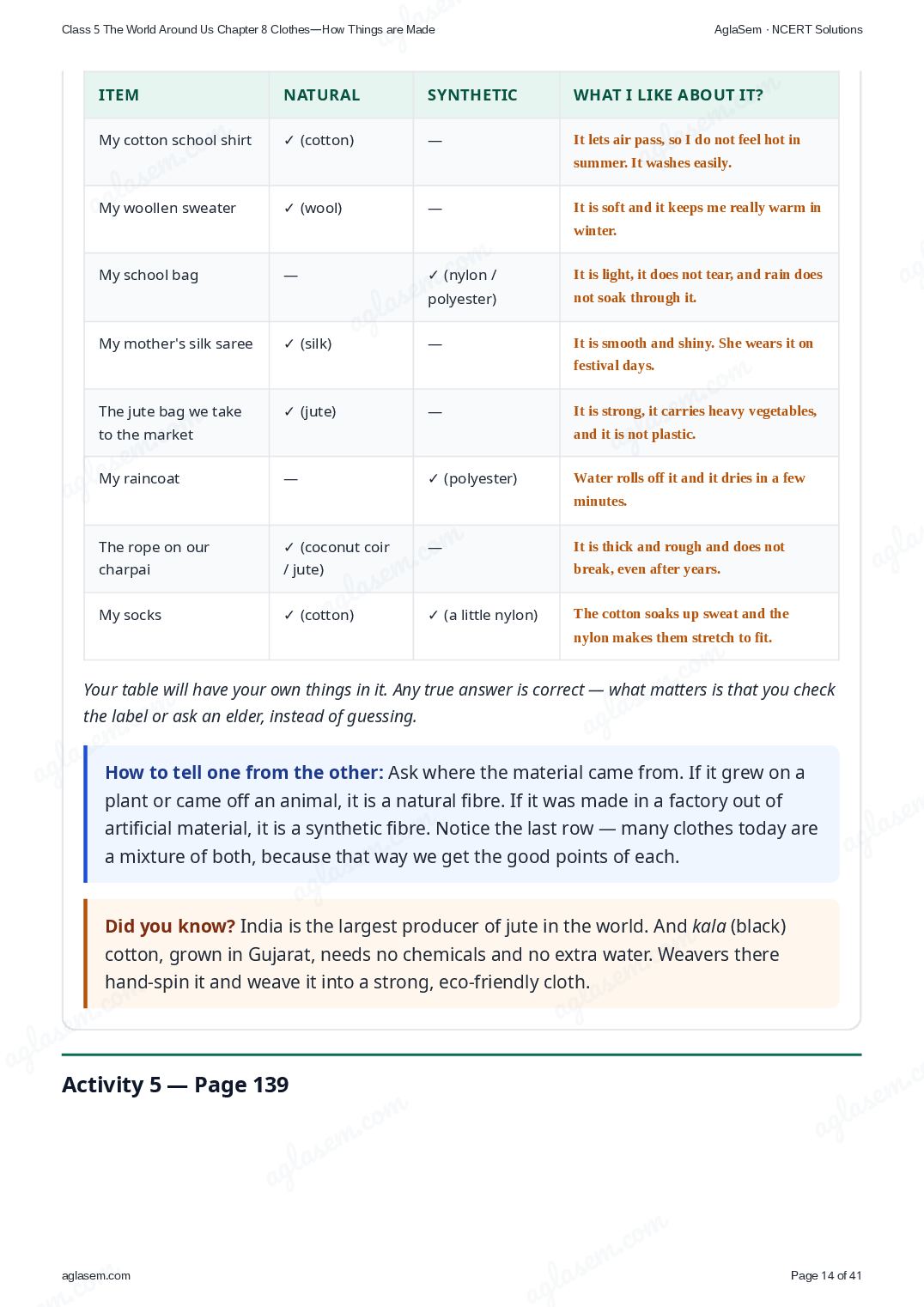
- Look at some clothes, bags or other things you use every day. List some of the materials that you have used. Are they made from natural or synthetic fibres? Then, write one thing you like about it in the table below.ItemNaturalSyntheticWhat I Like About It?
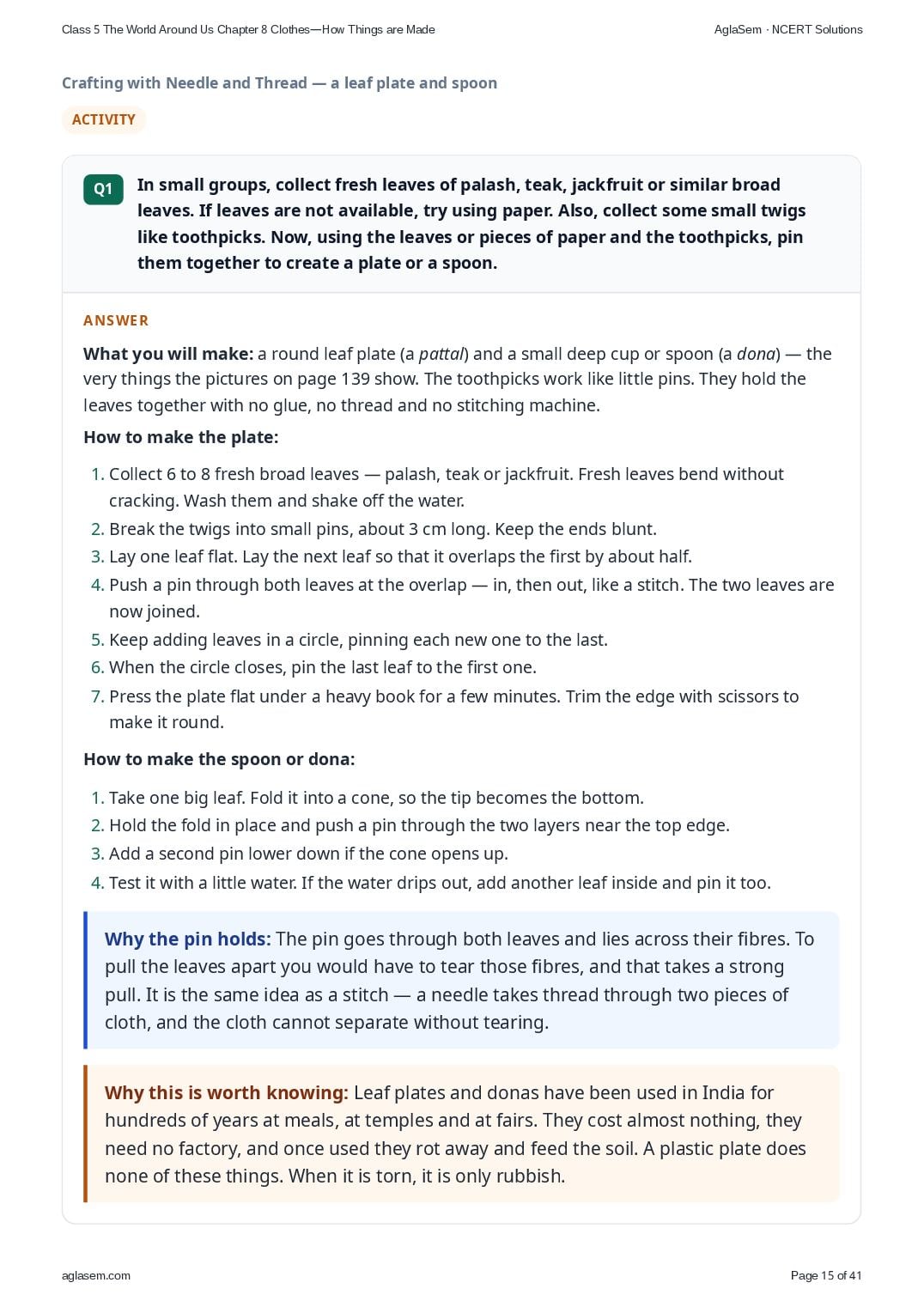
- In small groups, collect fresh leaves of palash, teak, jackfruit or similar broad leaves. If leaves are not available, try using paper. Also, collect some small twigs like toothpicks. Now, using the leaves or pieces of paper and the toothpicks, pin them together to create a plate or a spoon.
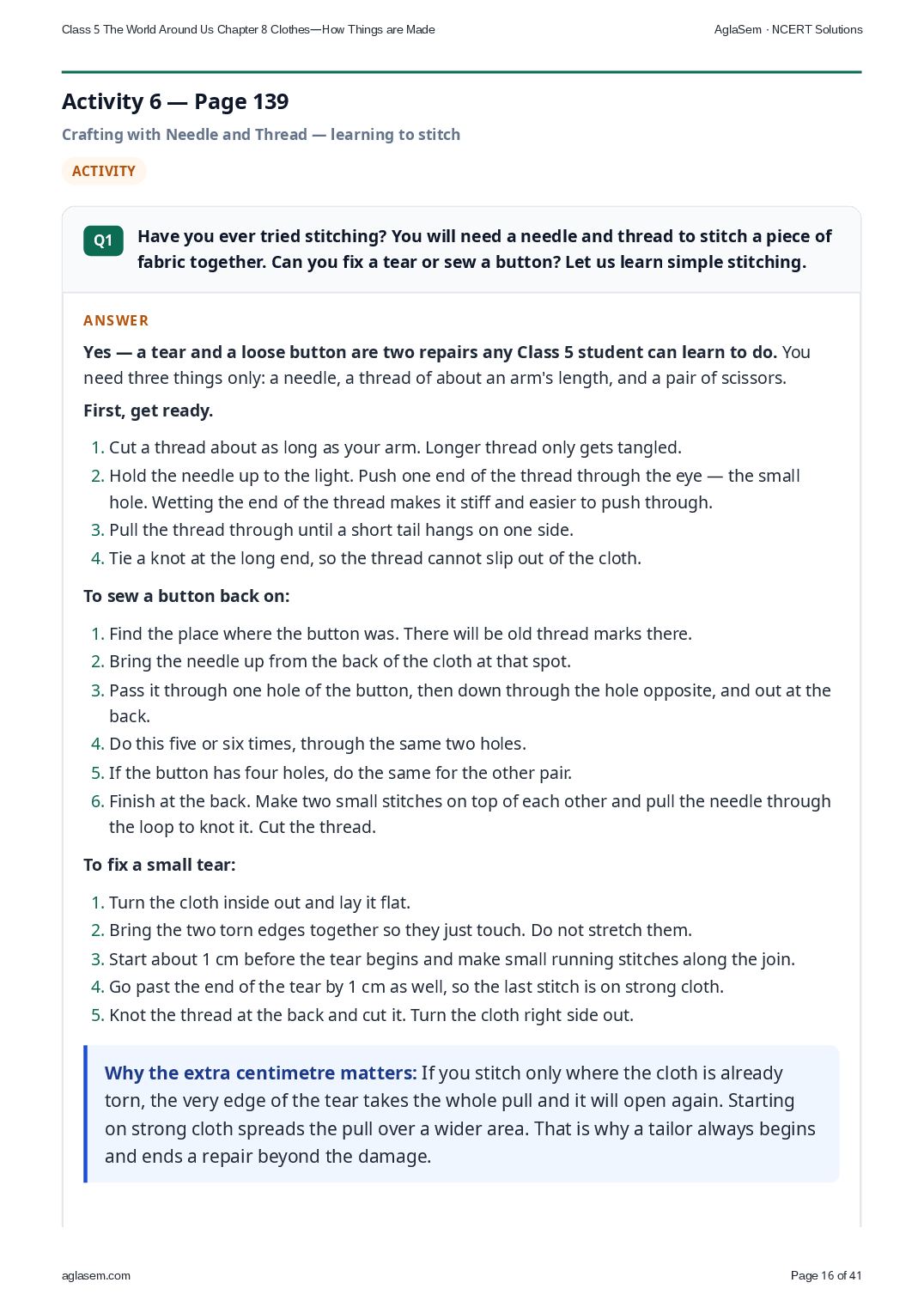
- Have you ever tried stitching? You will need a needle and thread to stitch a piece of fabric together. Can you fix a tear or sew a button? Let us learn simple stitching.
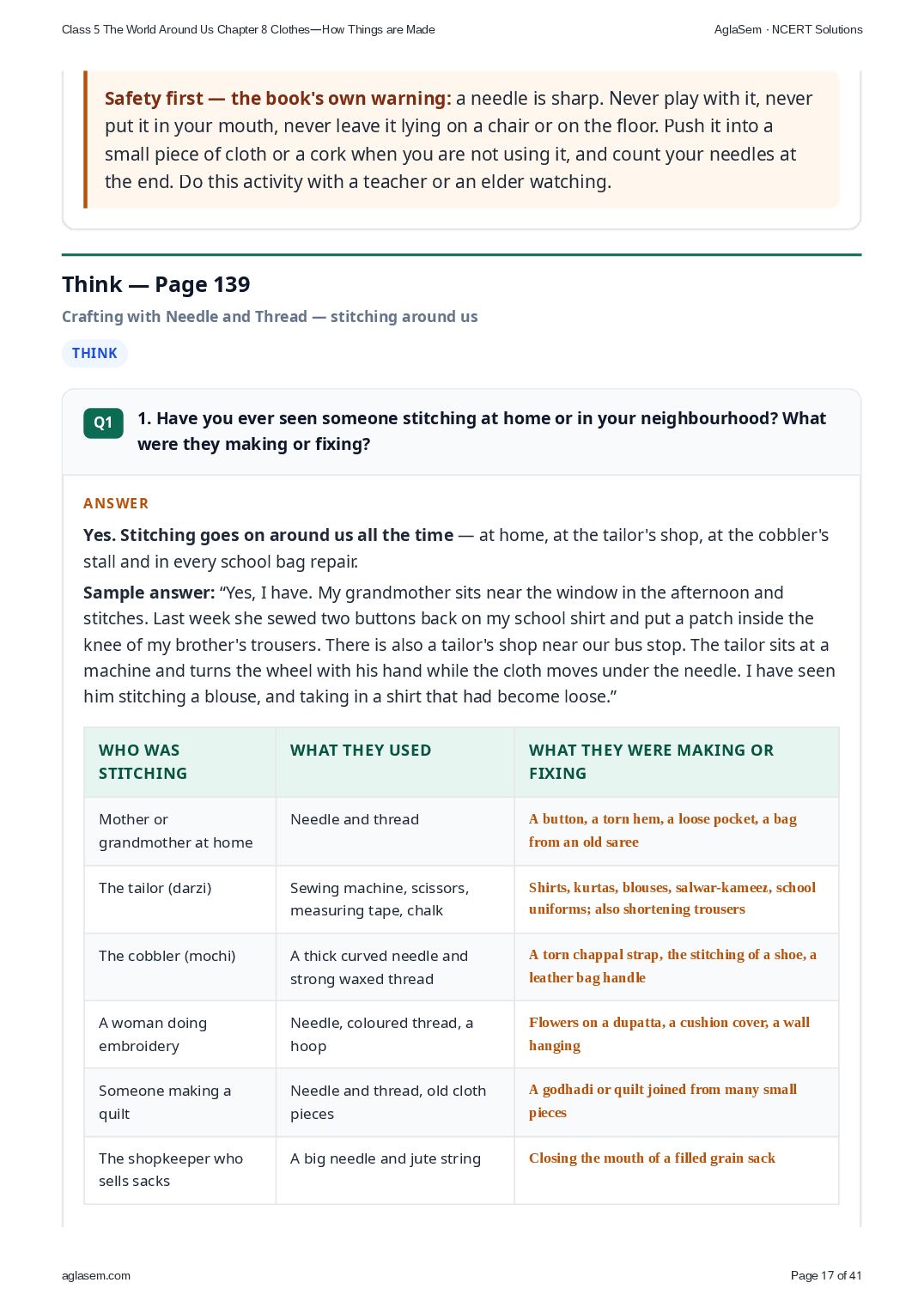
- 1. Have you ever seen someone stitching at home or in your neighbourhood? What were they making or fixing?
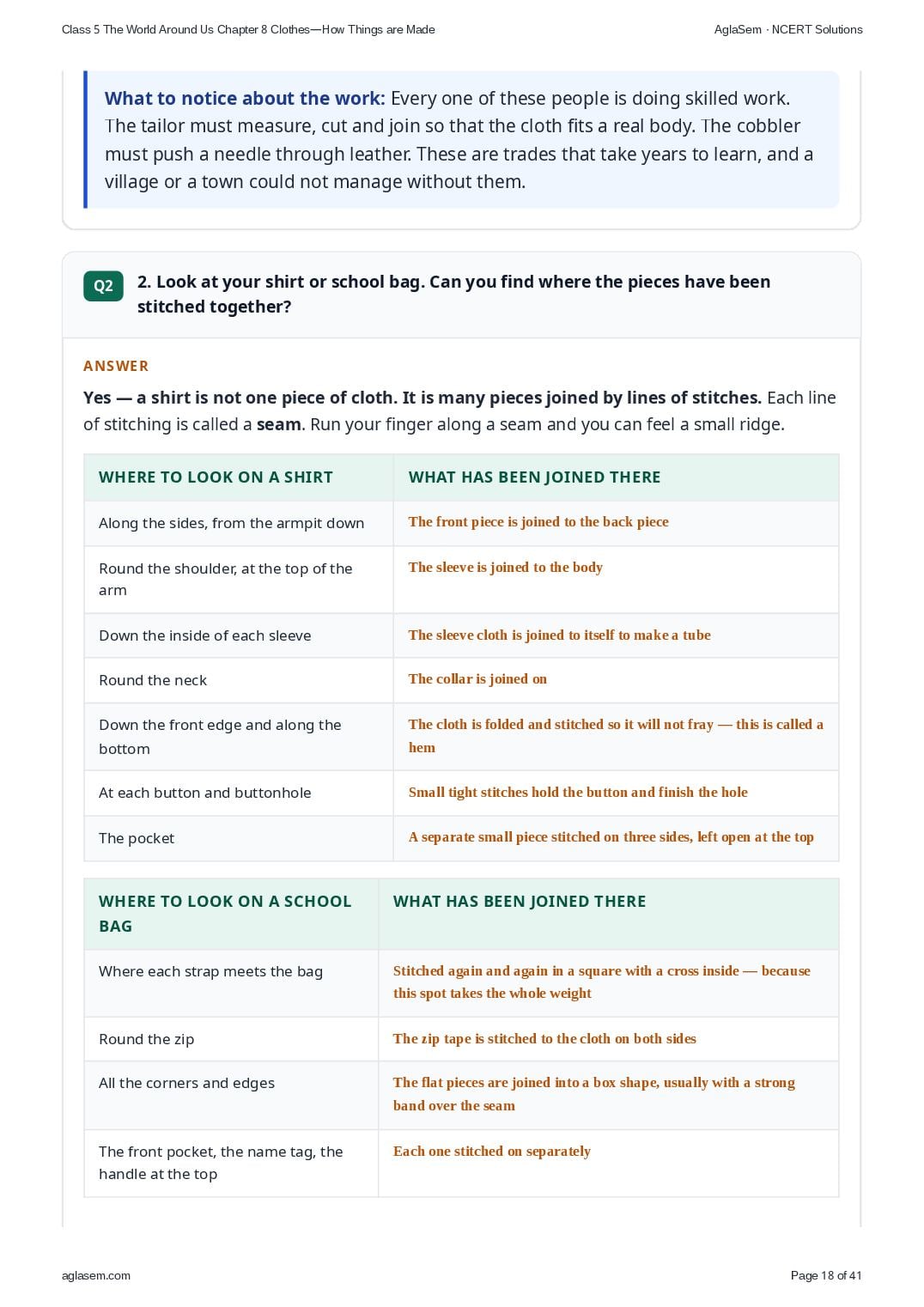
- 2. Look at your shirt or school bag. Can you find where the pieces have been stitched together?
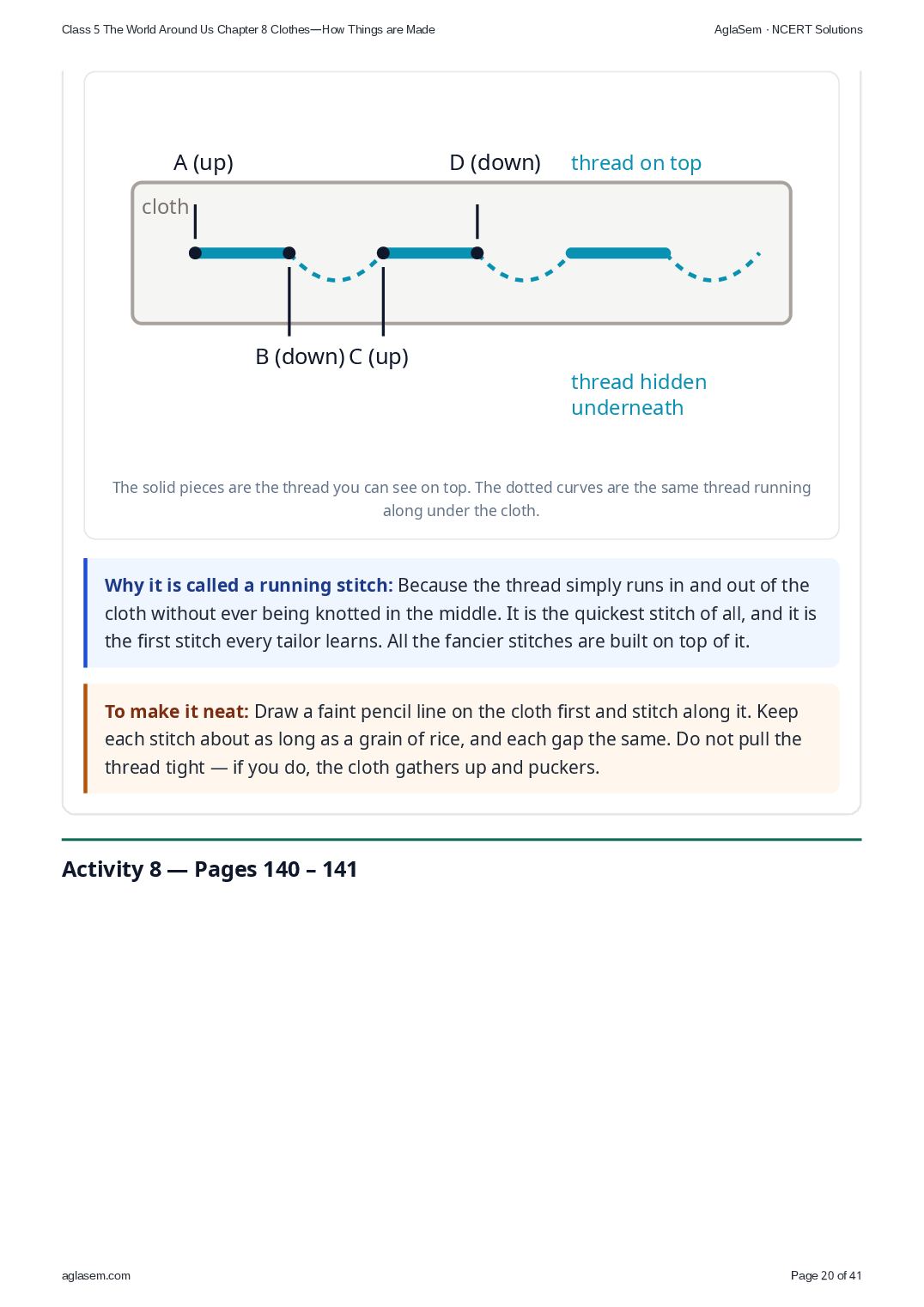
- Let us begin by learning the basic running stitch. 1. Take a piece of thread through a needle. Tie a knot at one end of the thread. 2. Start from the back of the cloth. Bring the needle up at Point A. 3. Push the needle down at Point B. 4. Bring it up at Point C, then down at Point D. 5. Keep going—up, down, up, down—in a straight line. 6. This is called a running stitch.
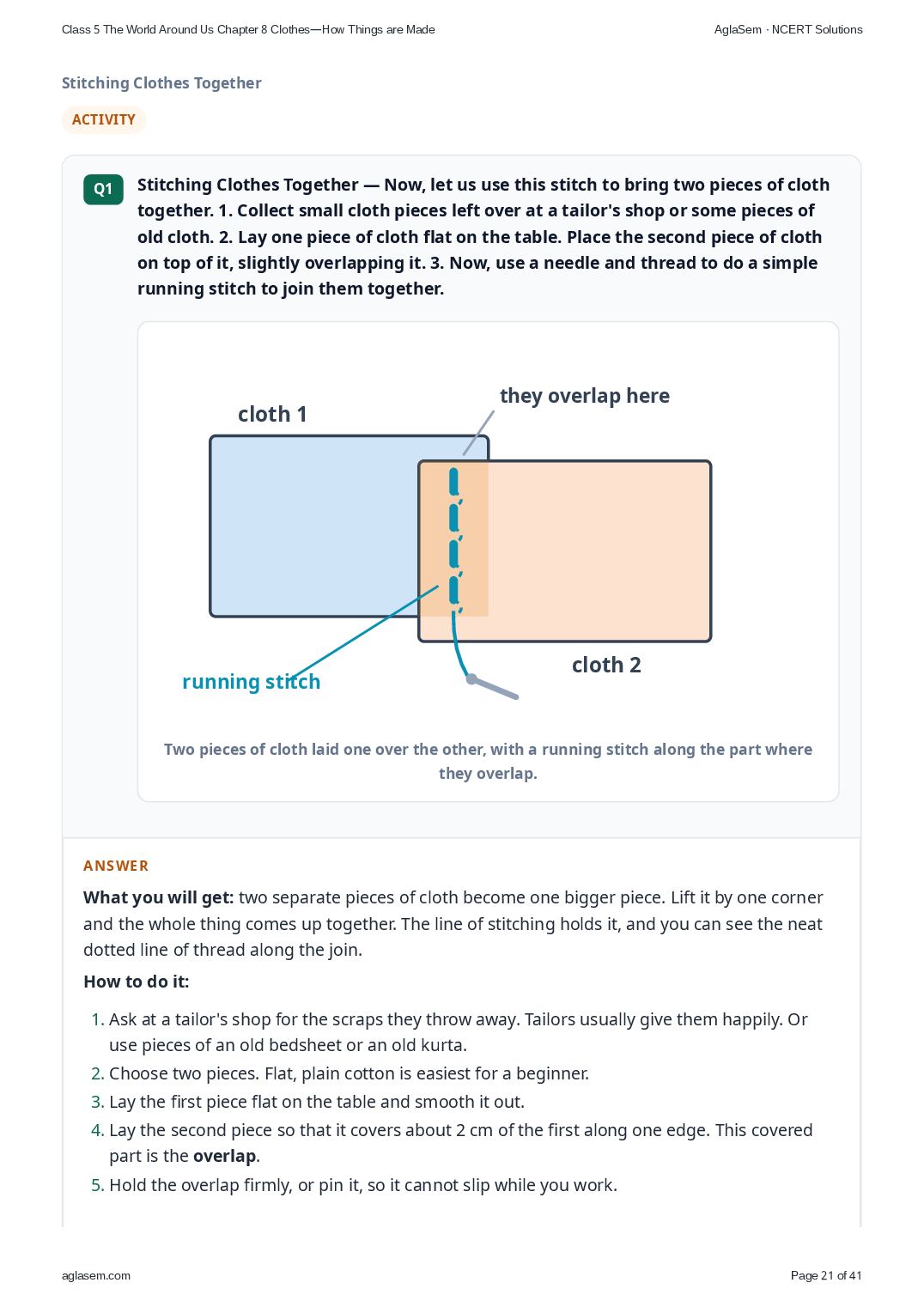
- Stitching Clothes Together — Now, let us use this stitch to bring two pieces of cloth together. 1. Collect small cloth pieces left over at a tailor’s shop or some pieces of old cloth. 2. Lay one piece of cloth flat on the table. Place the second piece of cloth on top of it, slightly overlapping it. 3. Now, use a needle and thread to do a simple running stitch to join them together.cloth 1cloth 2they overlap hererunning stitchTwo pieces of cloth laid one over the other, with a running stitch along the part where they overlap.
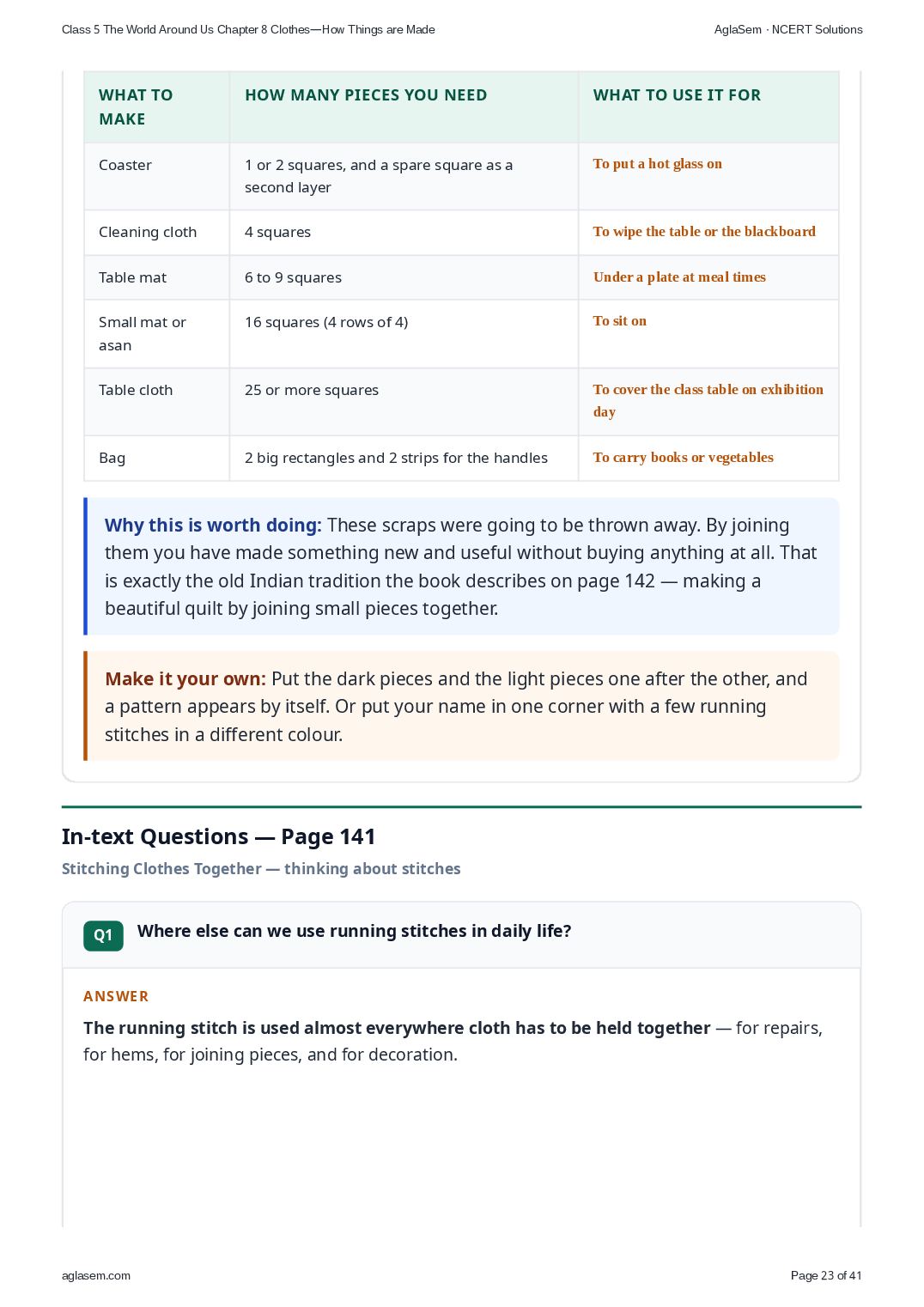
- 4. Add more pieces to create a table cloth, mat, coaster, cleaning cloth or any material of your interest.
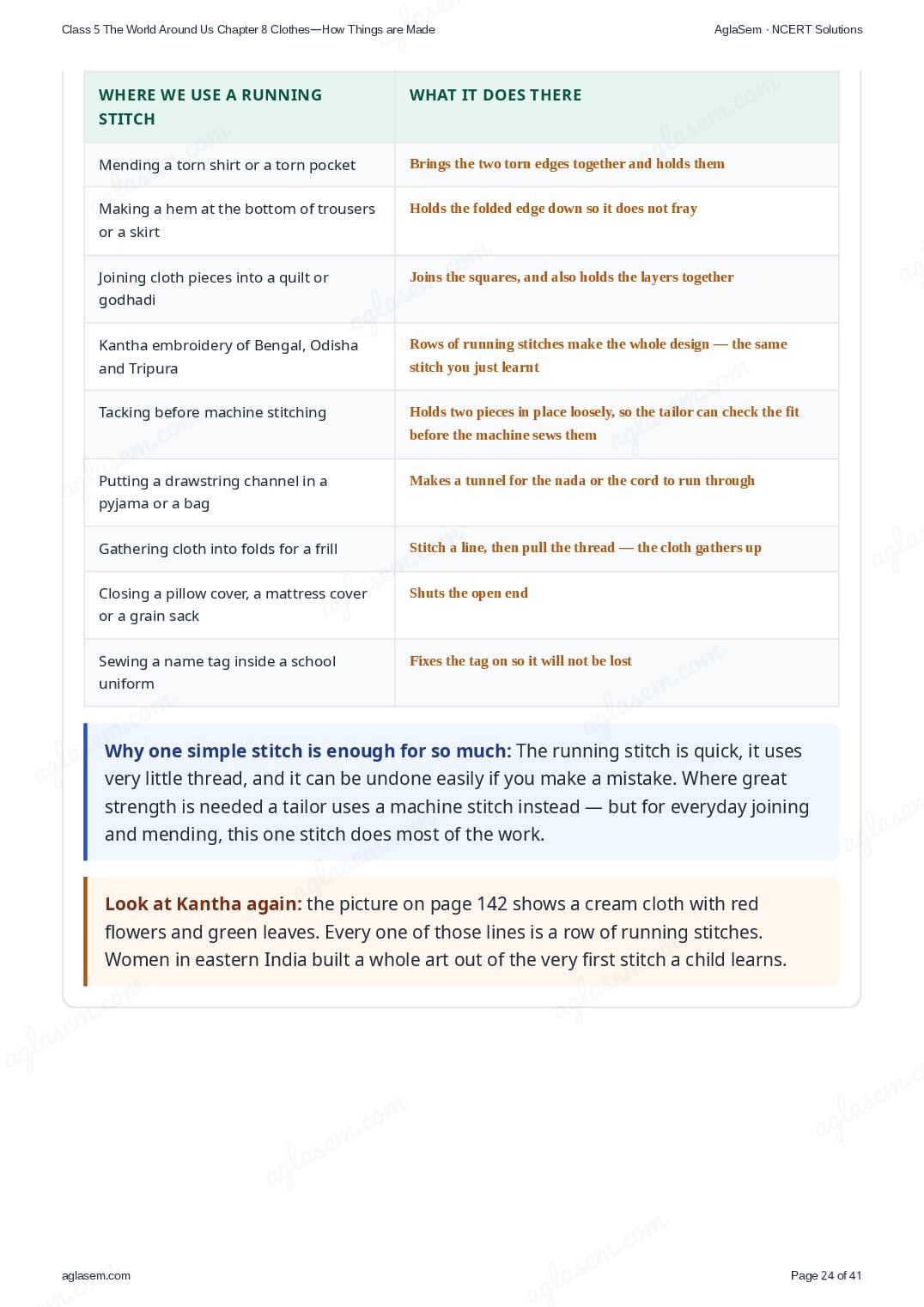
- Where else can we use running stitches in daily life?
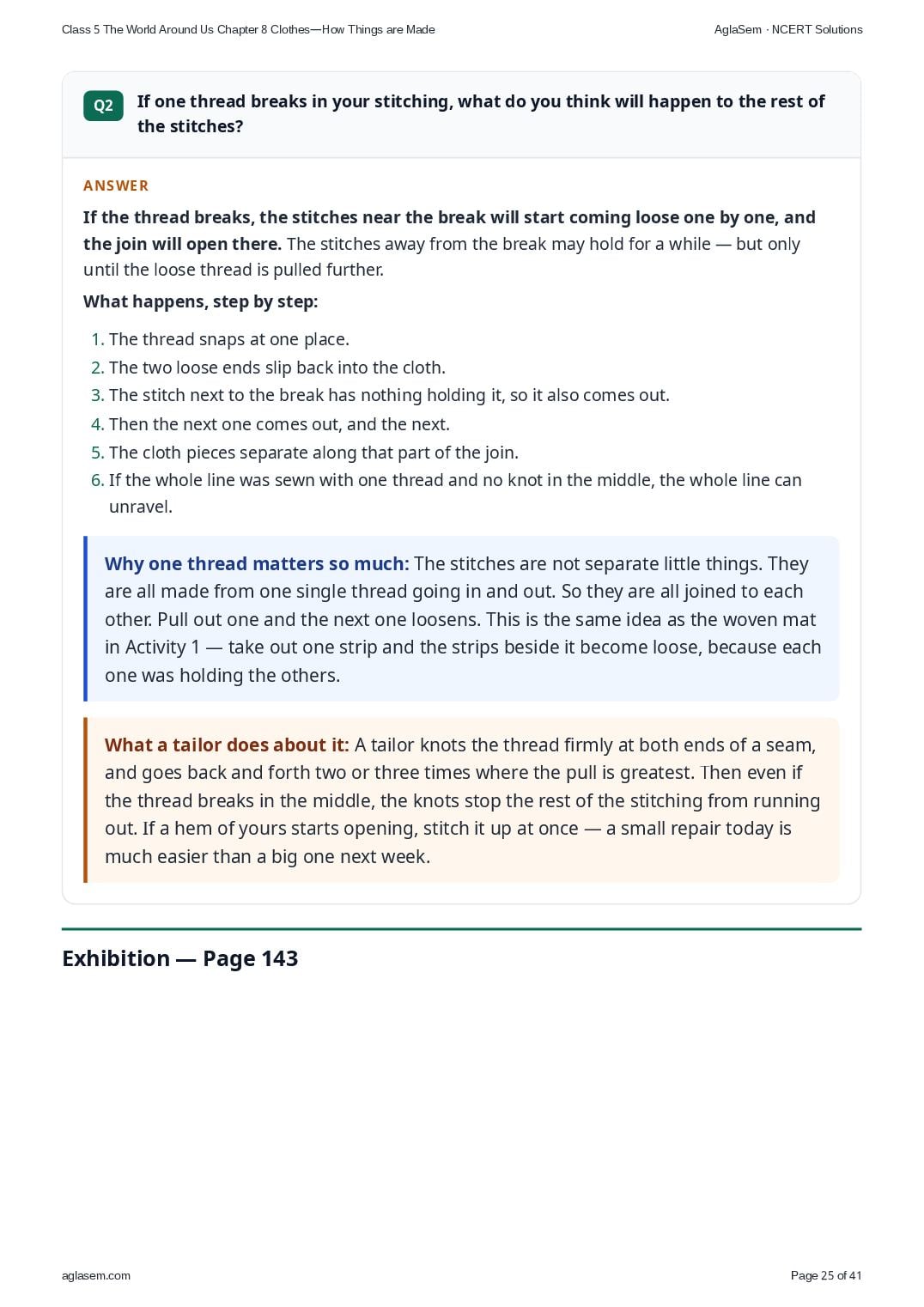
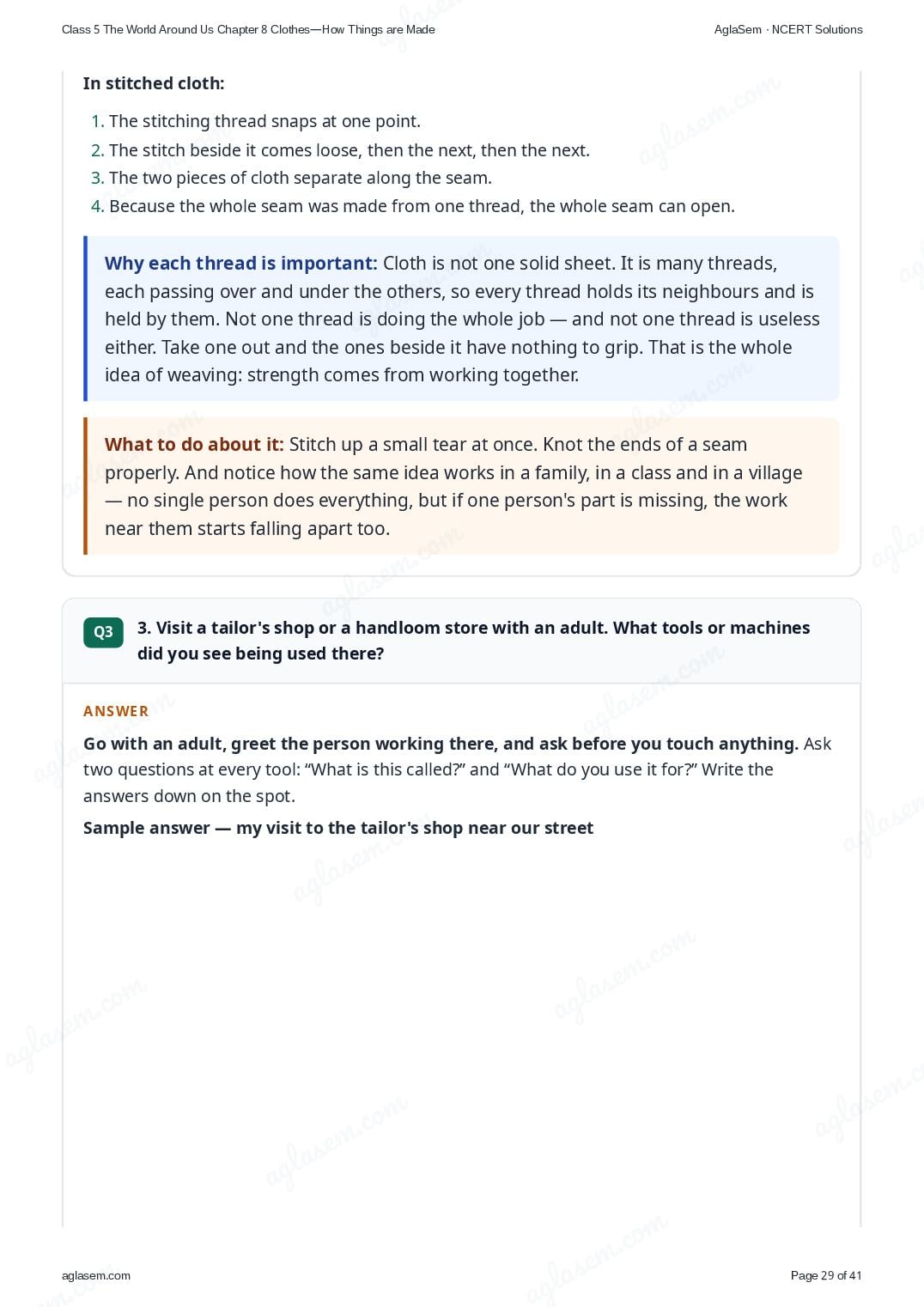
- If one thread breaks in your stitching, what do you think will happen to the rest of the stitches?
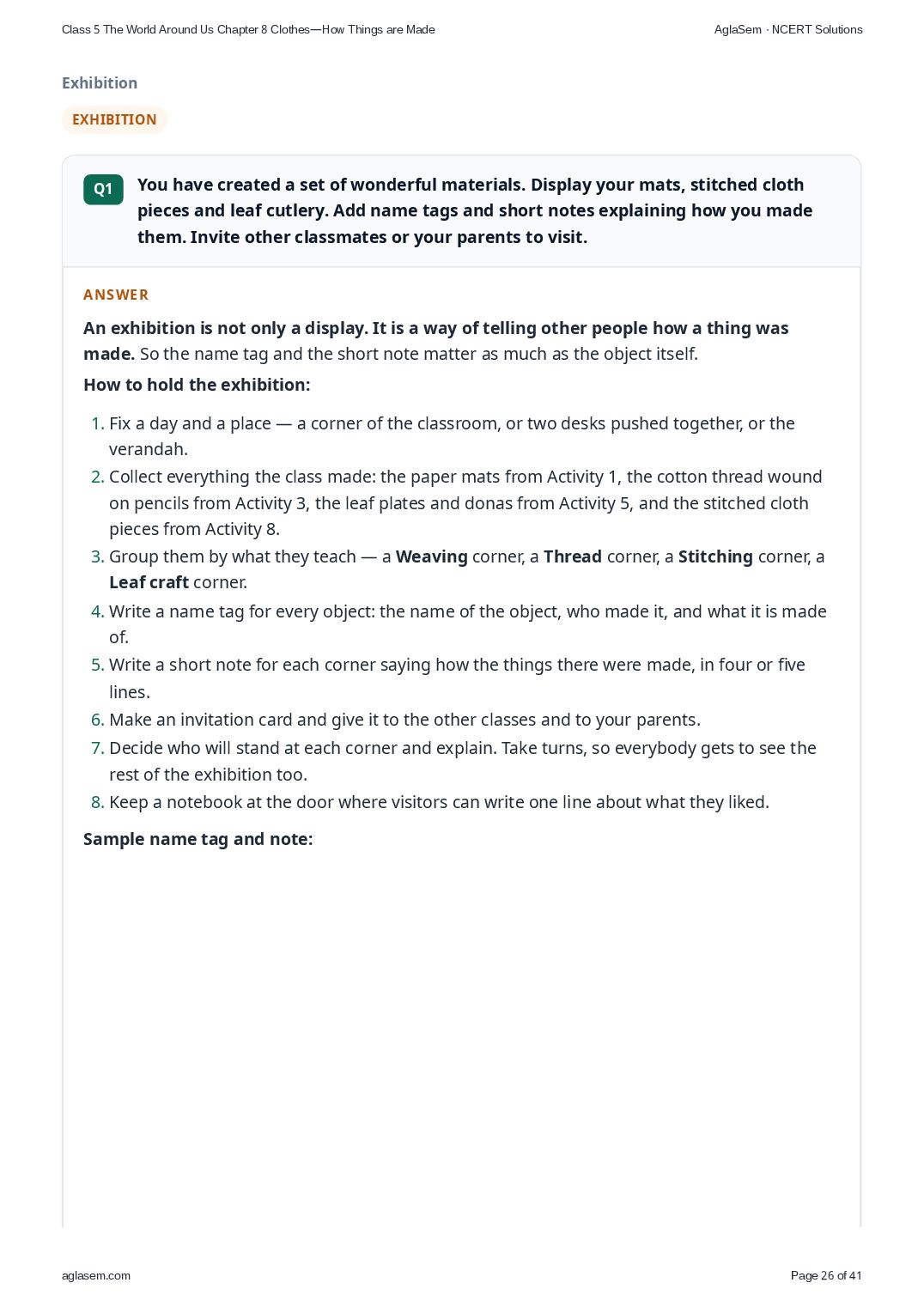
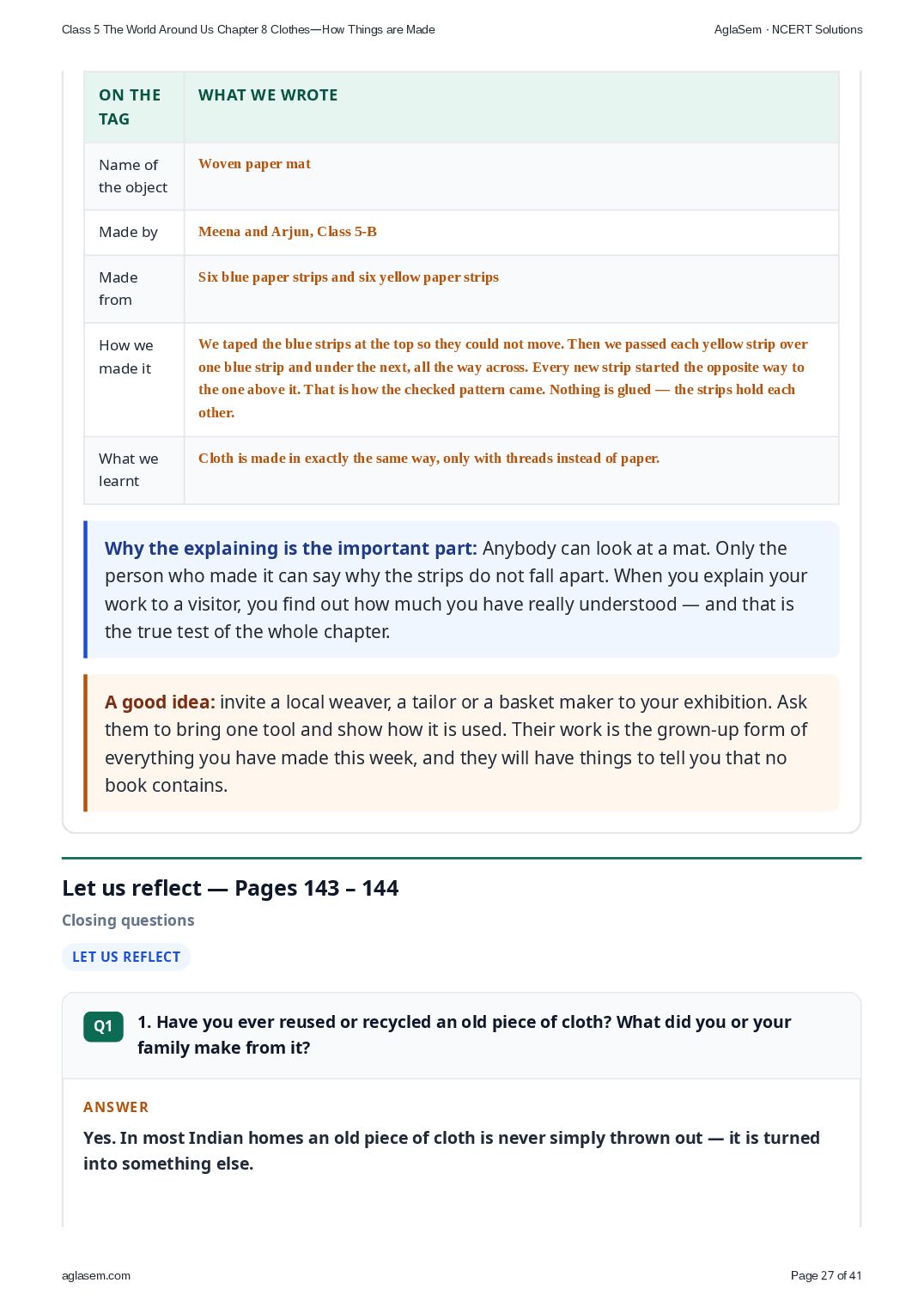
- You have created a set of wonderful materials. Display your mats, stitched cloth pieces and leaf cutlery. Add name tags and short notes explaining how you made them. Invite other classmates or your parents to visit.
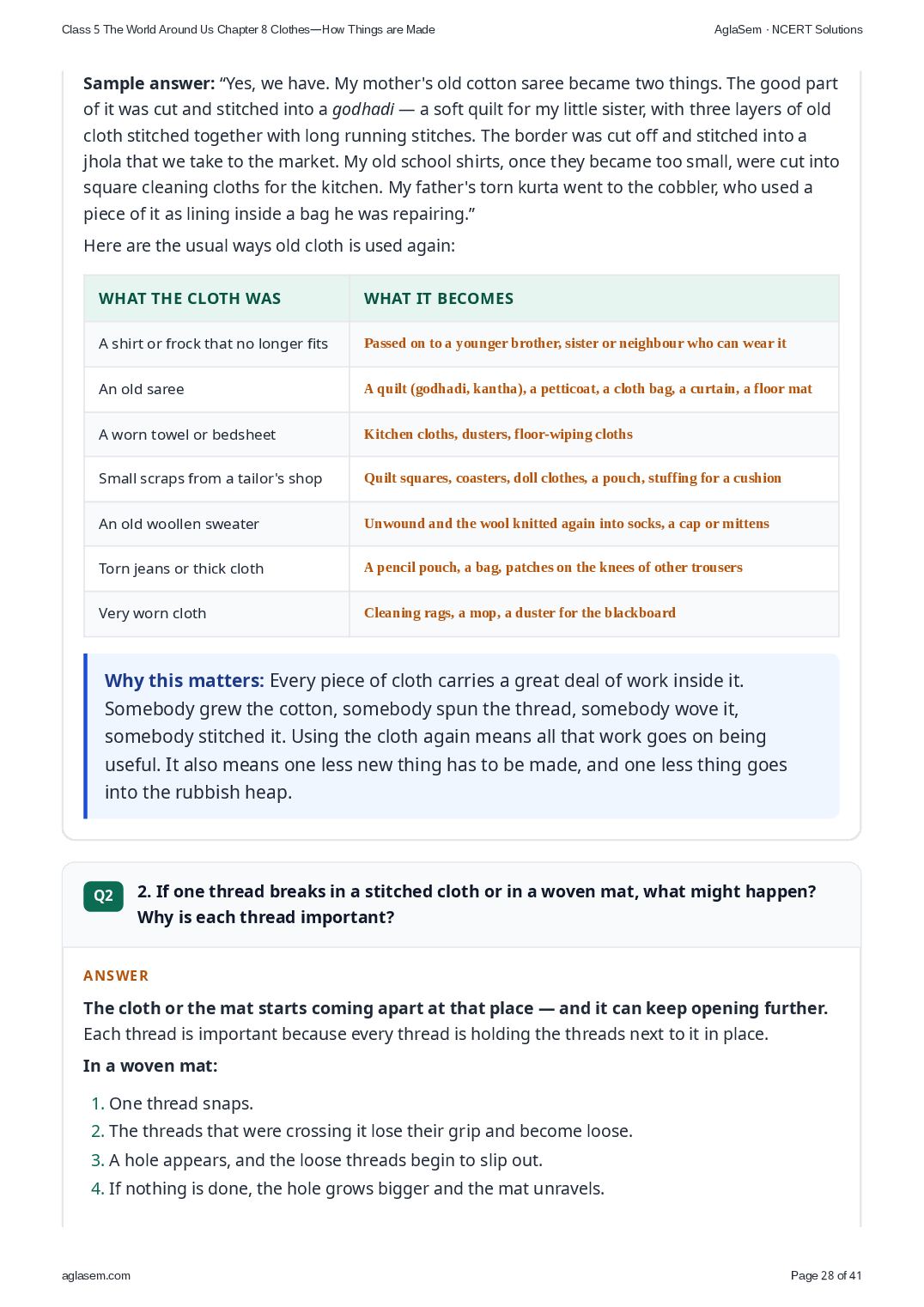
- 1. Have you ever reused or recycled an old piece of cloth? What did you or your family make from it?
- 2. If one thread breaks in a stitched cloth or in a woven mat, what might happen? Why is each thread important?
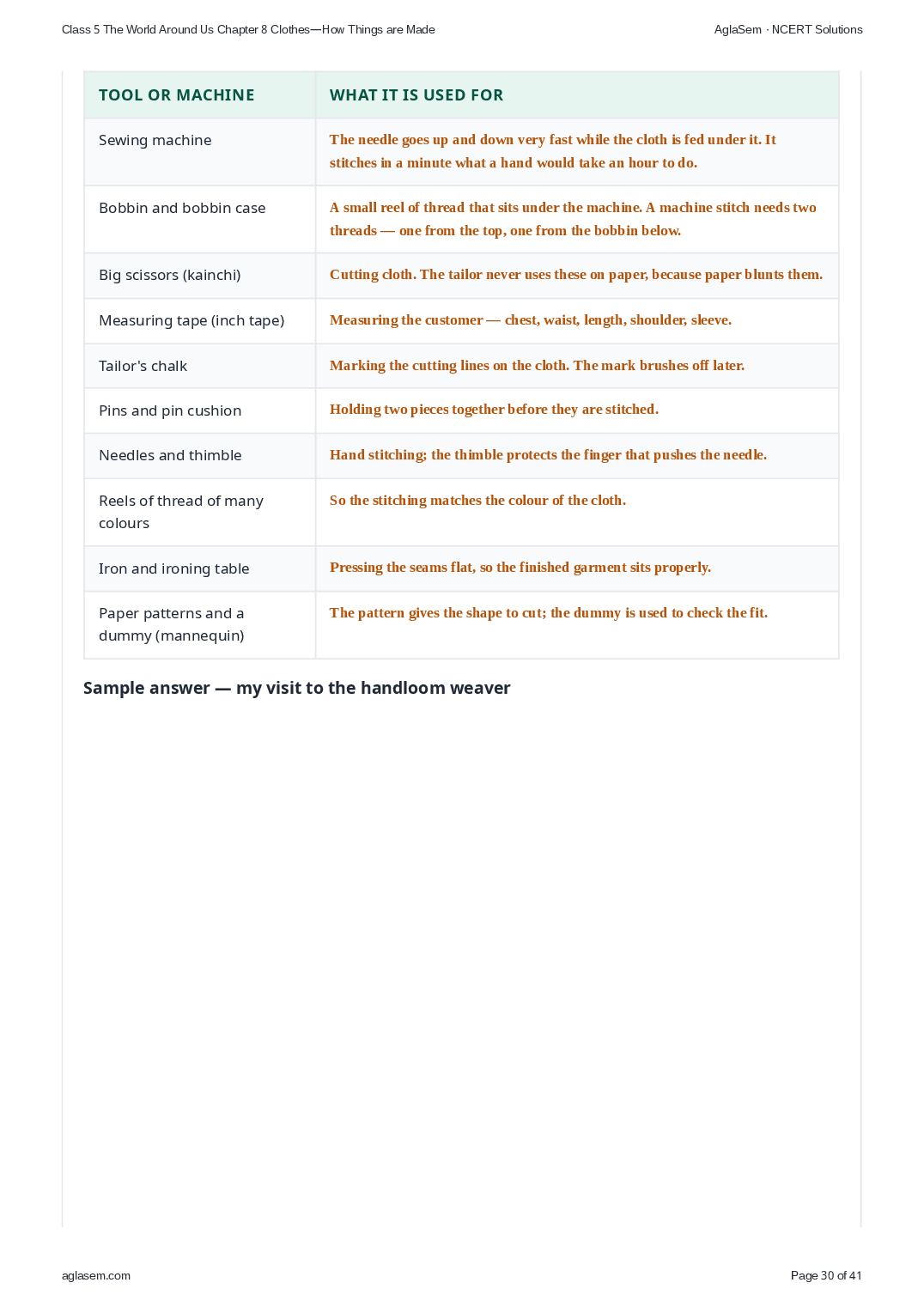
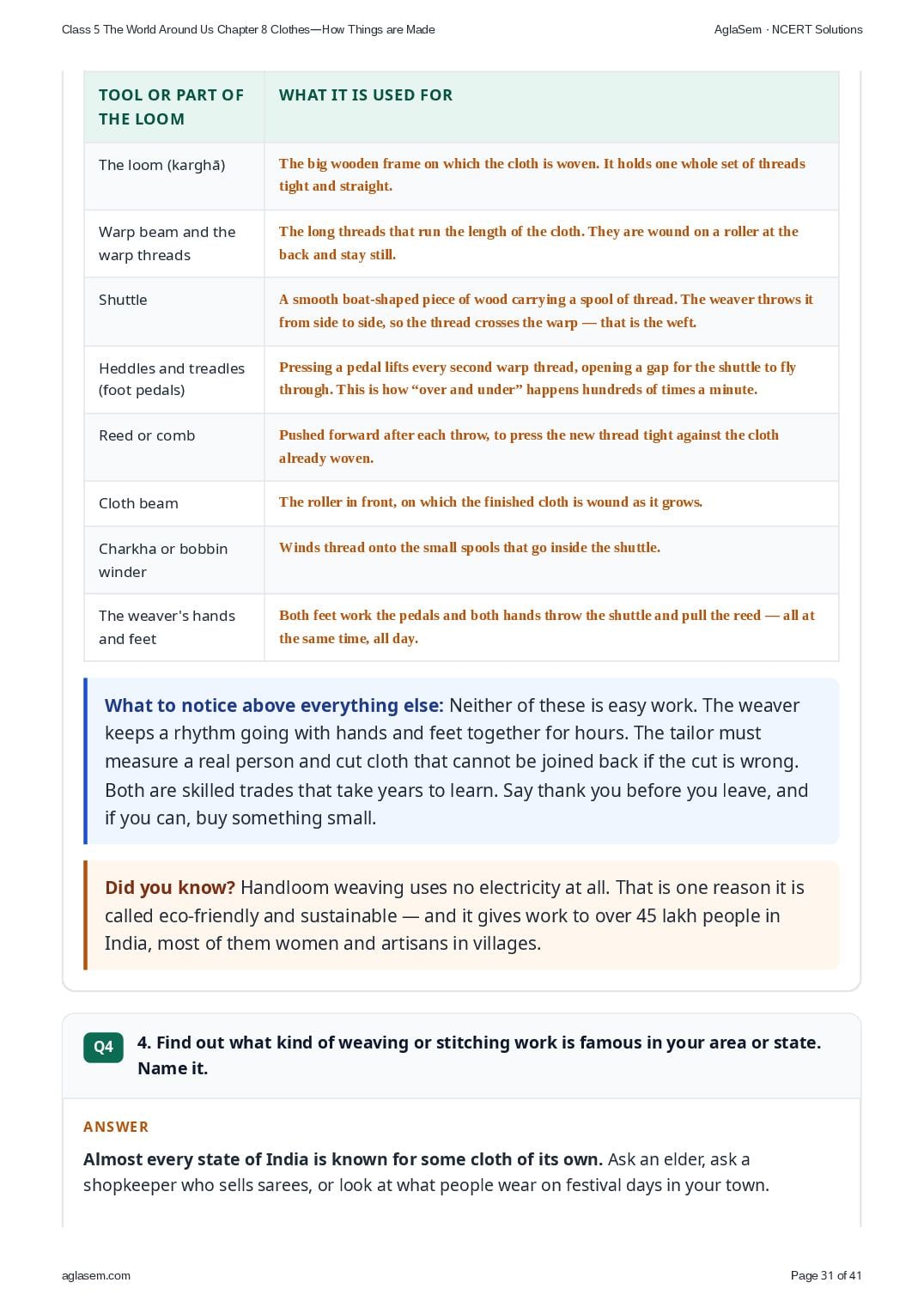
- 3. Visit a tailor’s shop or a handloom store with an adult. What tools or machines did you see being used there?
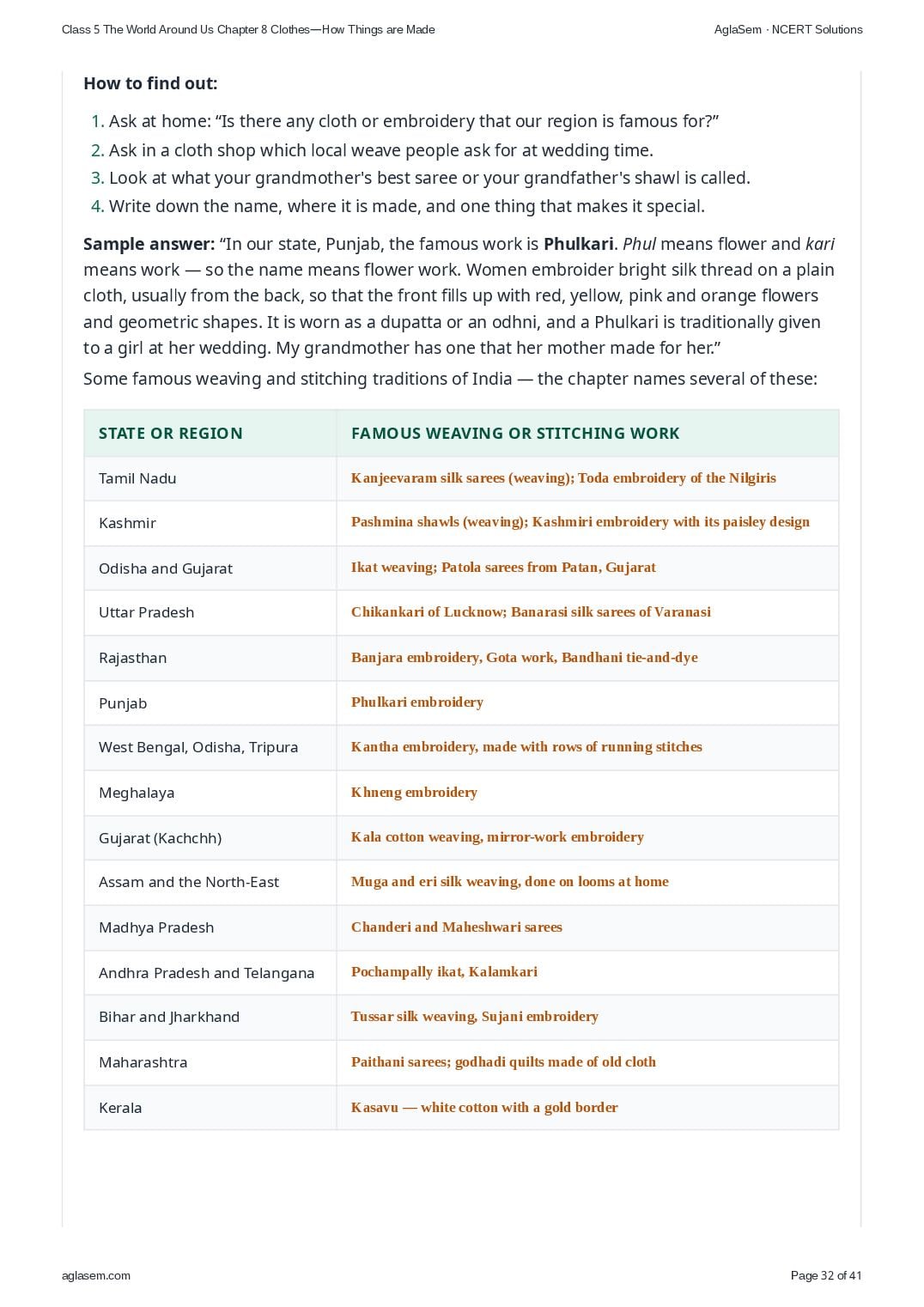
- 4. Find out what kind of weaving or stitching work is famous in your area or state. Name it.
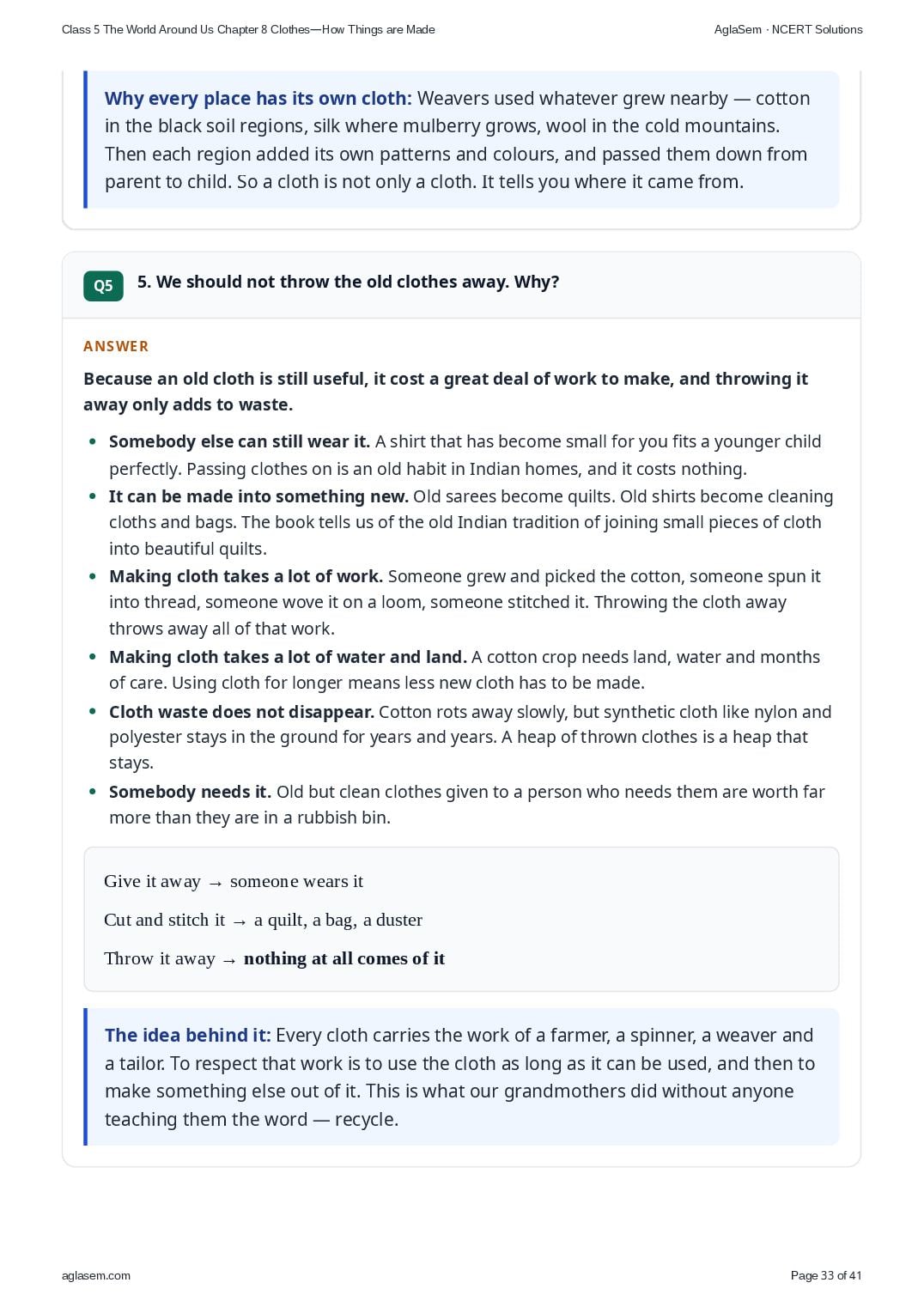
- 5. We should not throw the old clothes away. Why?
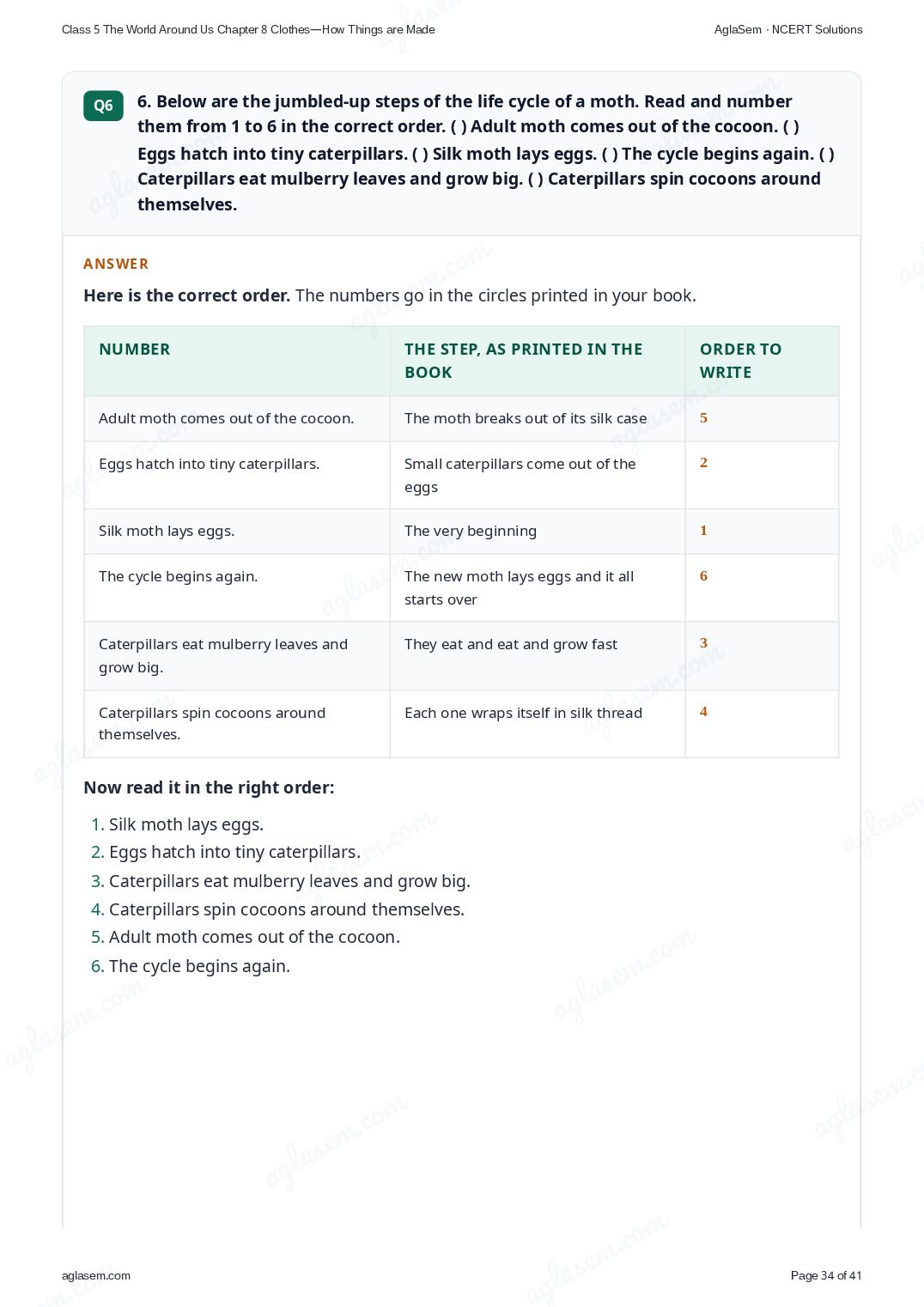
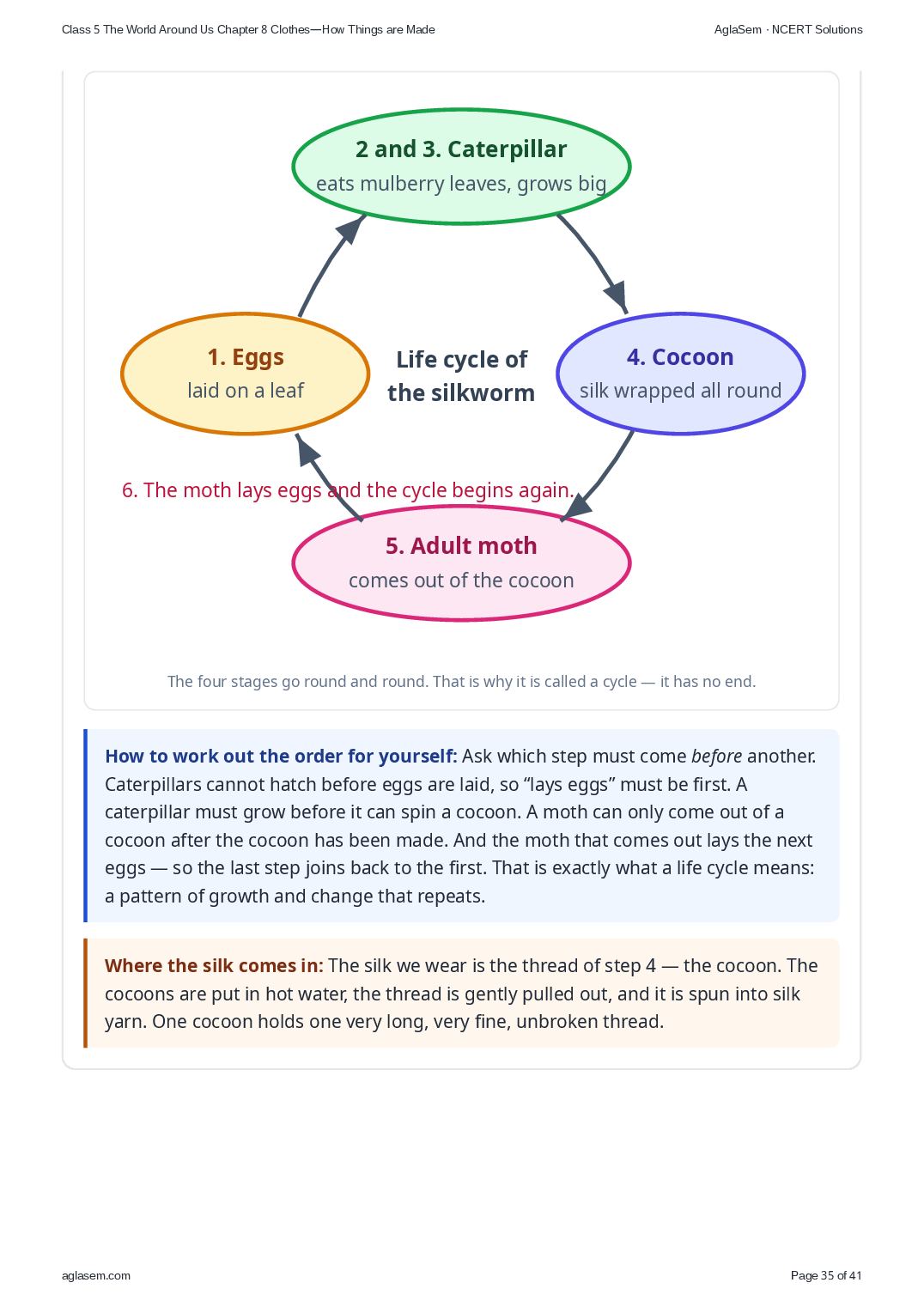
- 6. Below are the jumbled-up steps of the life cycle of a moth. Read and number them from 1 to 6 in the correct order. ( ) Adult moth comes out of the cocoon. ( ) Eggs hatch into tiny caterpillars. ( ) Silk moth lays eggs. ( ) The cycle begins again. ( ) Caterpillars eat mulberry leaves and grow big. ( ) Caterpillars spin cocoons around themselves.
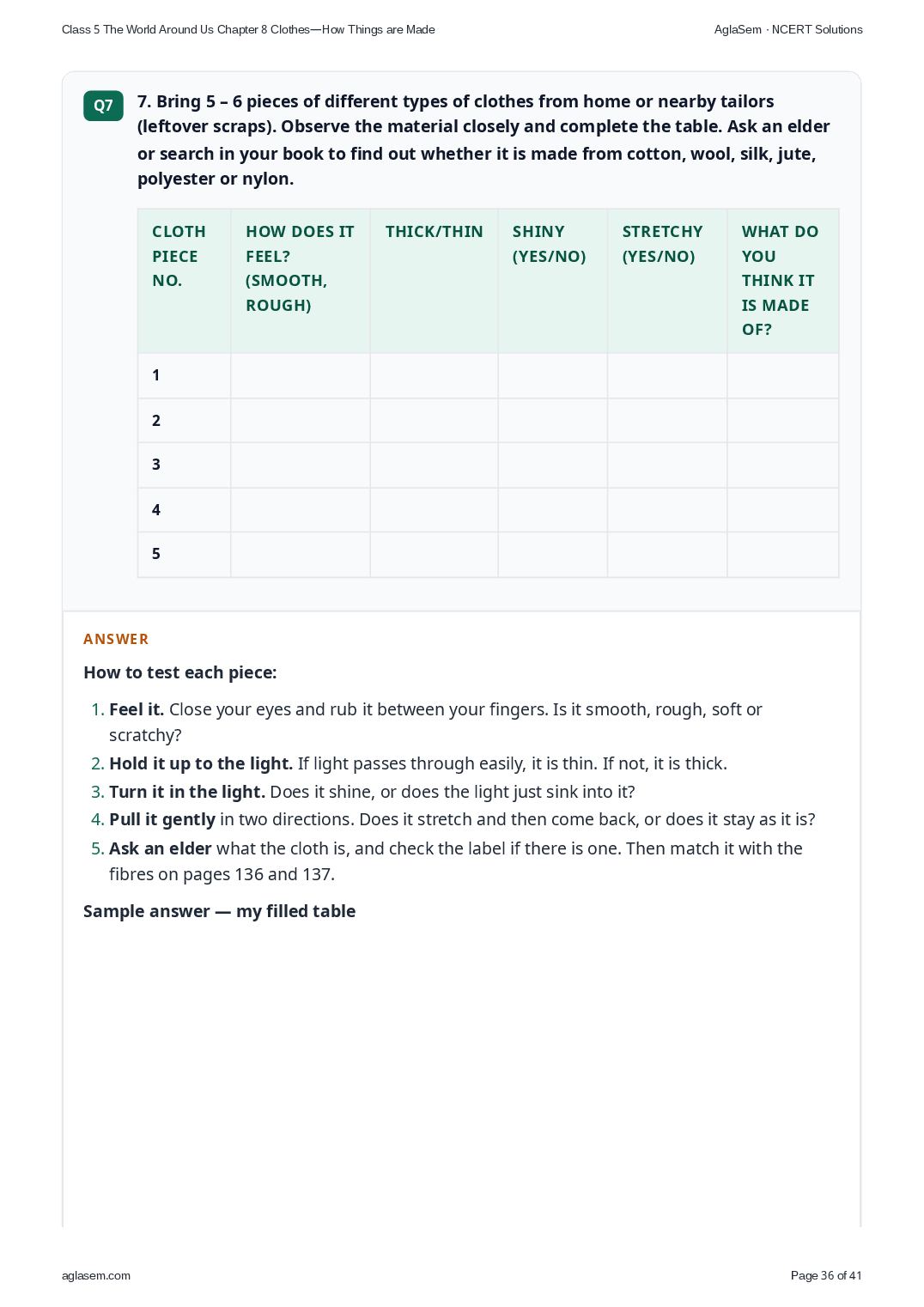
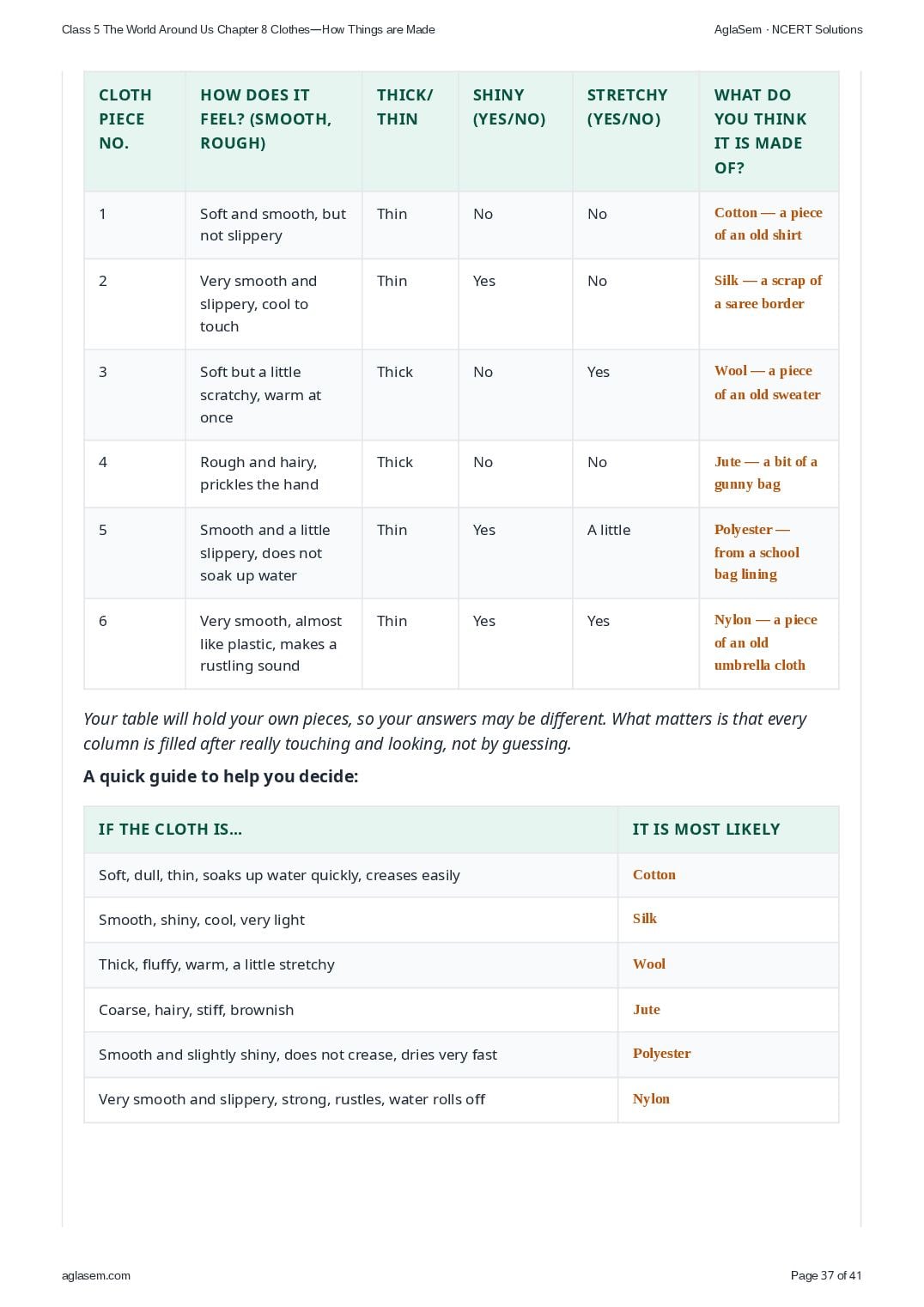
- 7. Bring 5 – 6 pieces of different types of clothes from home or nearby tailors (leftover scraps). Observe the material closely and complete the table. Ask an elder or search in your book to find out whether it is made from cotton, wool, silk, jute, polyester or nylon.Cloth Piece No.How does it feel? (smooth, rough)Thick/ThinShiny (Yes/No)Stretchy (Yes/No)What do you think it is made of?12345
Chapter at a Glance
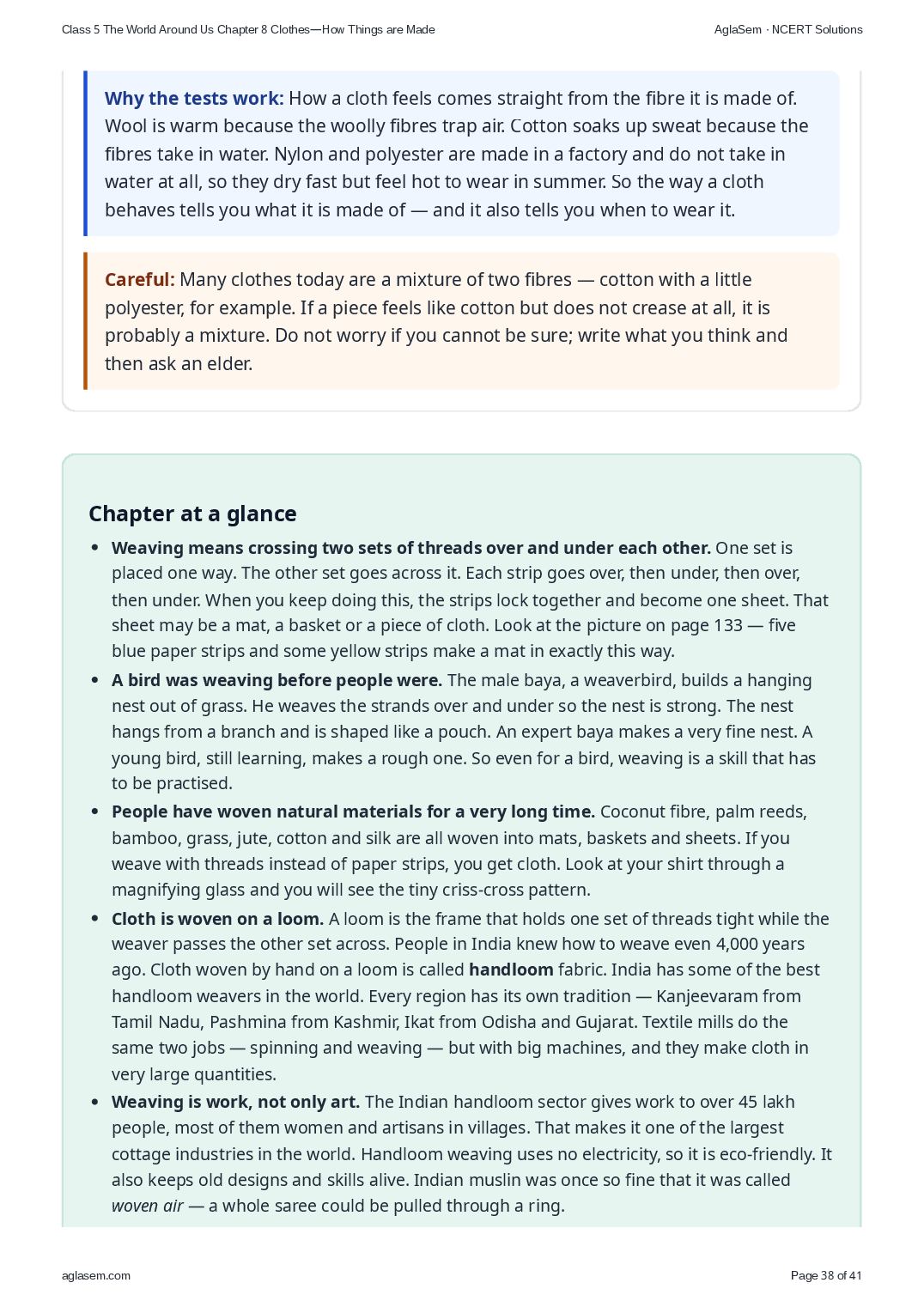
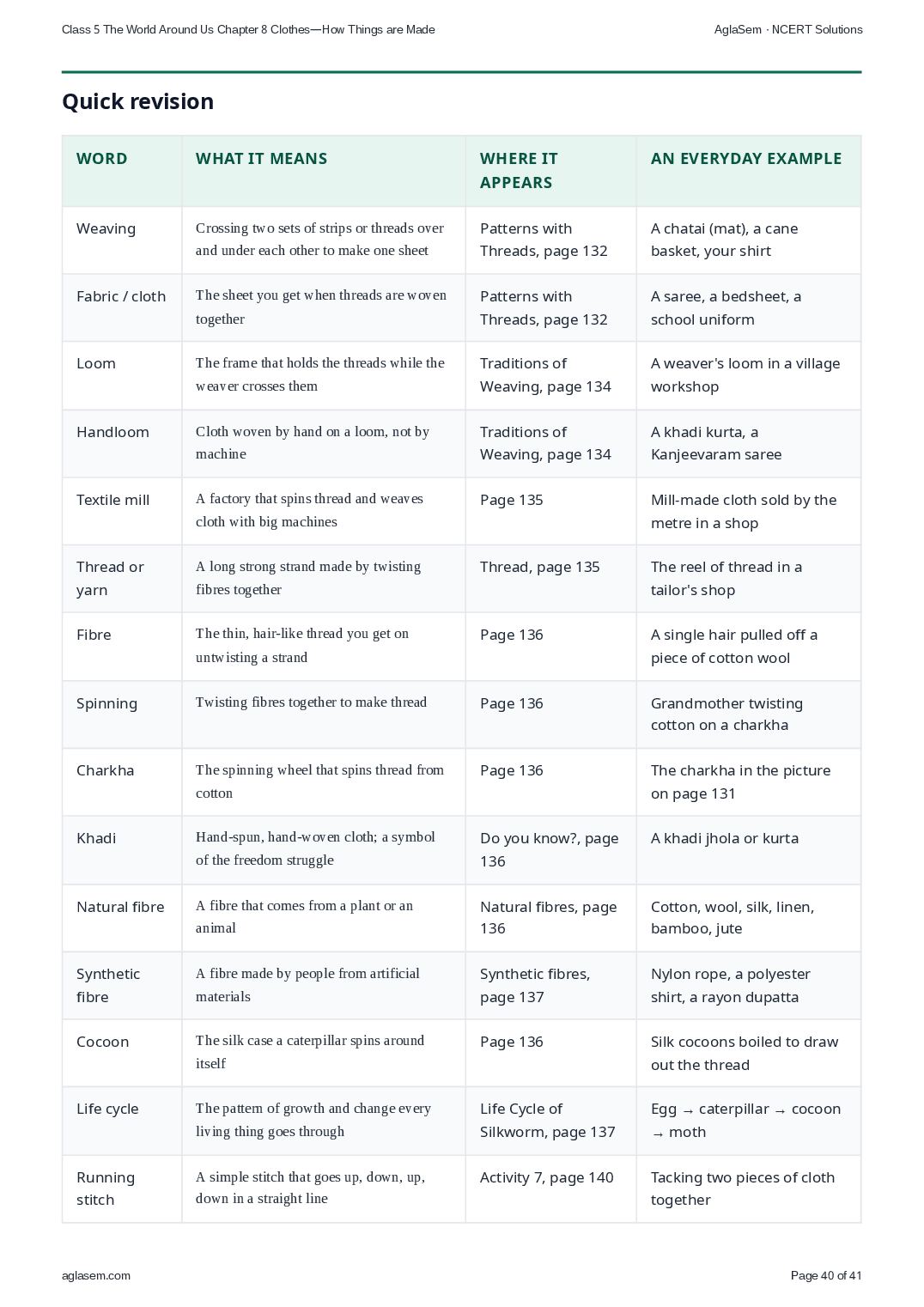
- Weaving means crossing two sets of threads over and under each other. One set is placed one way. The other set goes across it. Each strip goes over, then under, then over, then under. When you keep doing this, the strips lock together and become one sheet. That sheet may be a mat, a basket or a piece of cloth. Look at the picture on page 133 — five blue paper strips and some yellow strips make a mat in exactly this way.
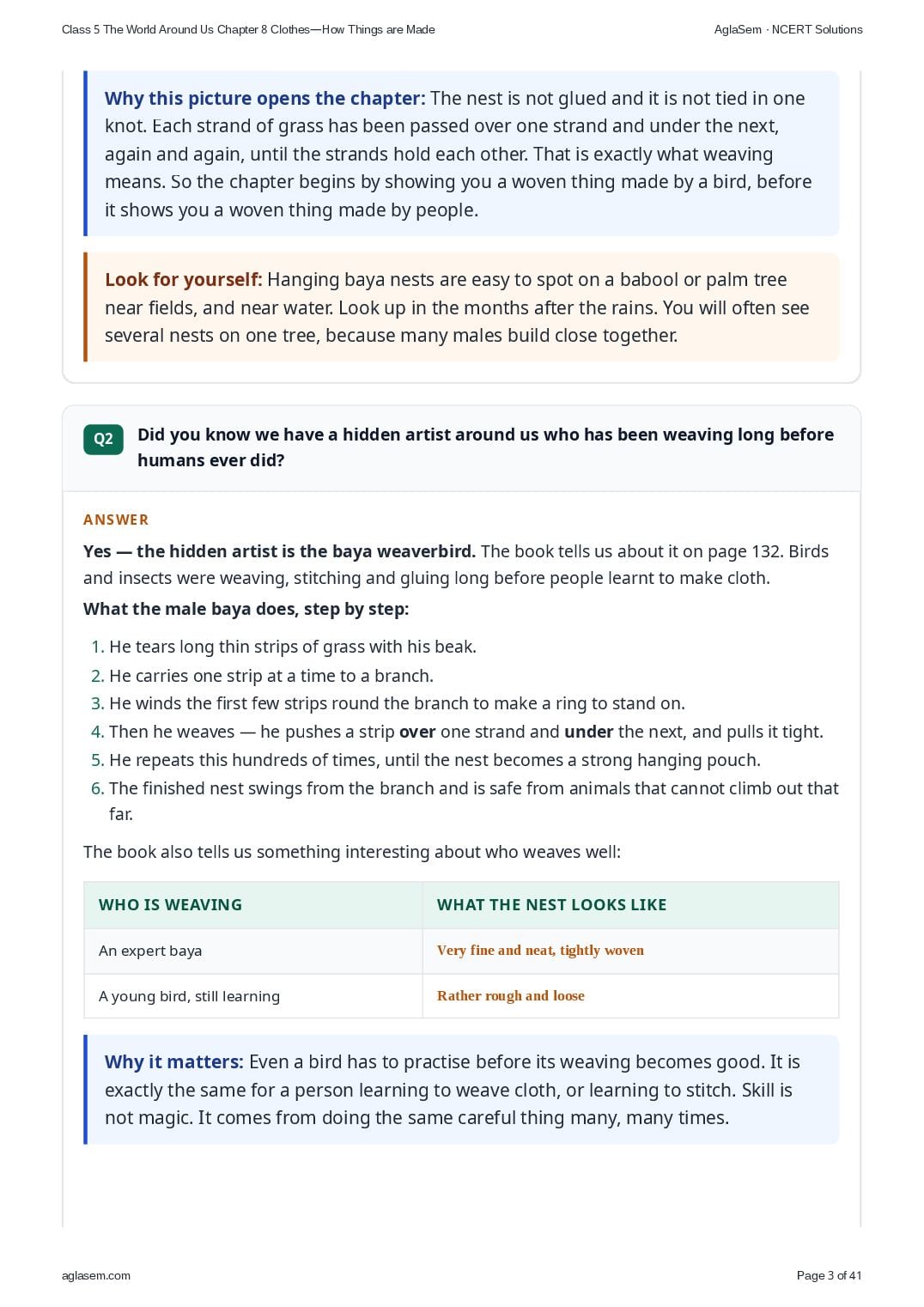
- A bird was weaving before people were. The male baya, a weaverbird, builds a hanging nest out of grass. He weaves the strands over and under so the nest is strong. The nest hangs from a branch and is shaped like a pouch. An expert baya makes a very fine nest. A young bird, still learning, makes a rough one. So even for a bird, weaving is a skill that has to be practised.
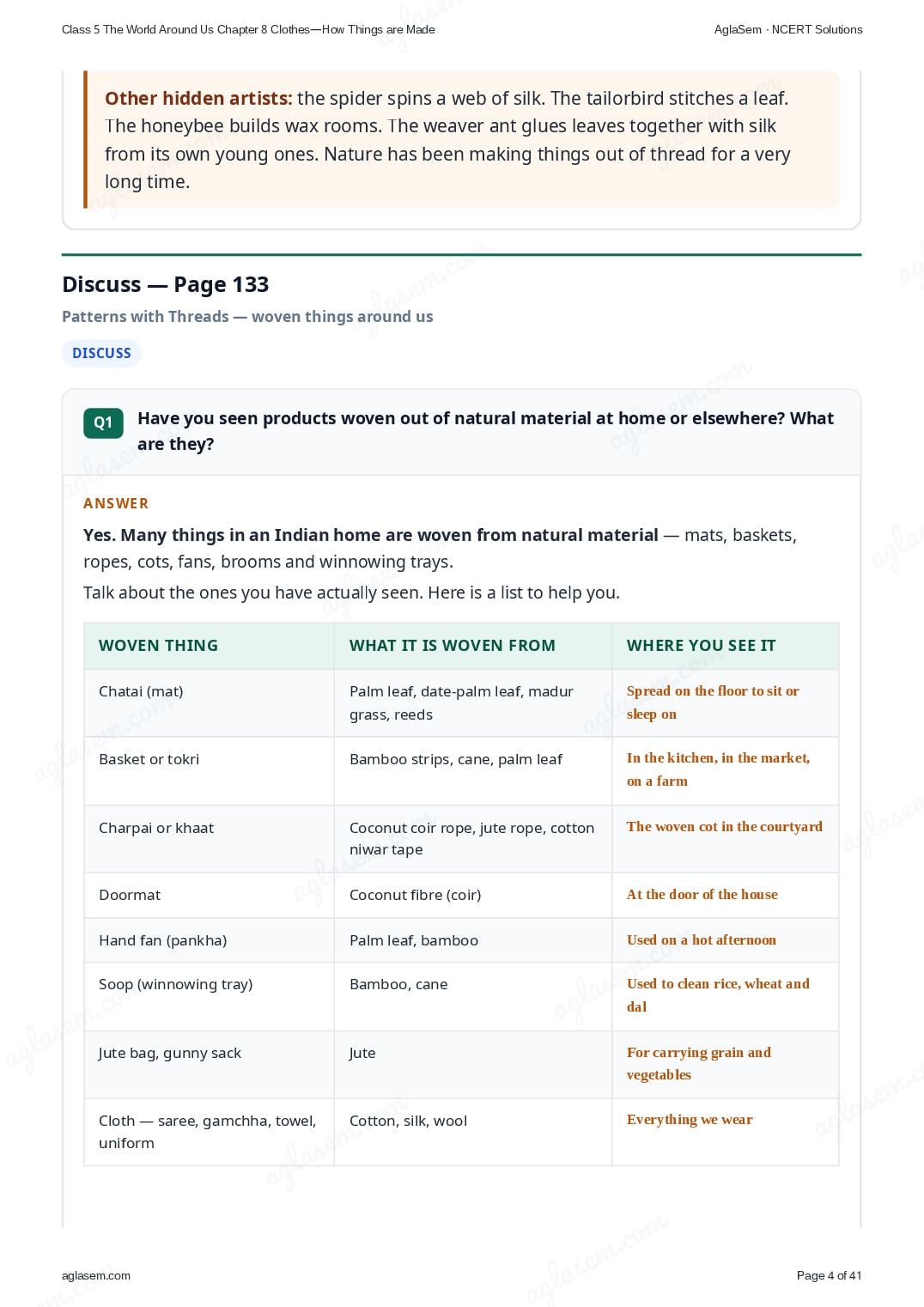
- People have woven natural materials for a very long time. Coconut fibre, palm reeds, bamboo, grass, jute, cotton and silk are all woven into mats, baskets and sheets. If you weave with threads instead of paper strips, you get cloth. Look at your shirt through a magnifying glass and you will see the tiny criss-cross pattern.
- Cloth is woven on a loom. A loom is the frame that holds one set of threads tight while the weaver passes the other set across. People in India knew how to weave even 4,000 years ago. Cloth woven by hand on a loom is called handloom fabric. India has some of the best handloom weavers in the world. Every region has its own tradition — Kanjeevaram from Tamil Nadu, Pashmina from Kashmir, Ikat from Odisha and Gujarat. Textile mills do the same two jobs — spinning and weaving — but with big machines, and they make cloth in very large quantities.
- Weaving is work, not only art. The Indian handloom sector gives work to over 45 lakh people, most of them women and artisans in villages. That makes it one of the largest cottage industries in the world. Handloom weaving uses no electricity, so it is eco-friendly. It also keeps old designs and skills alive. Indian muslin was once so fine that it was called woven air — a whole saree could be pulled through a ring.
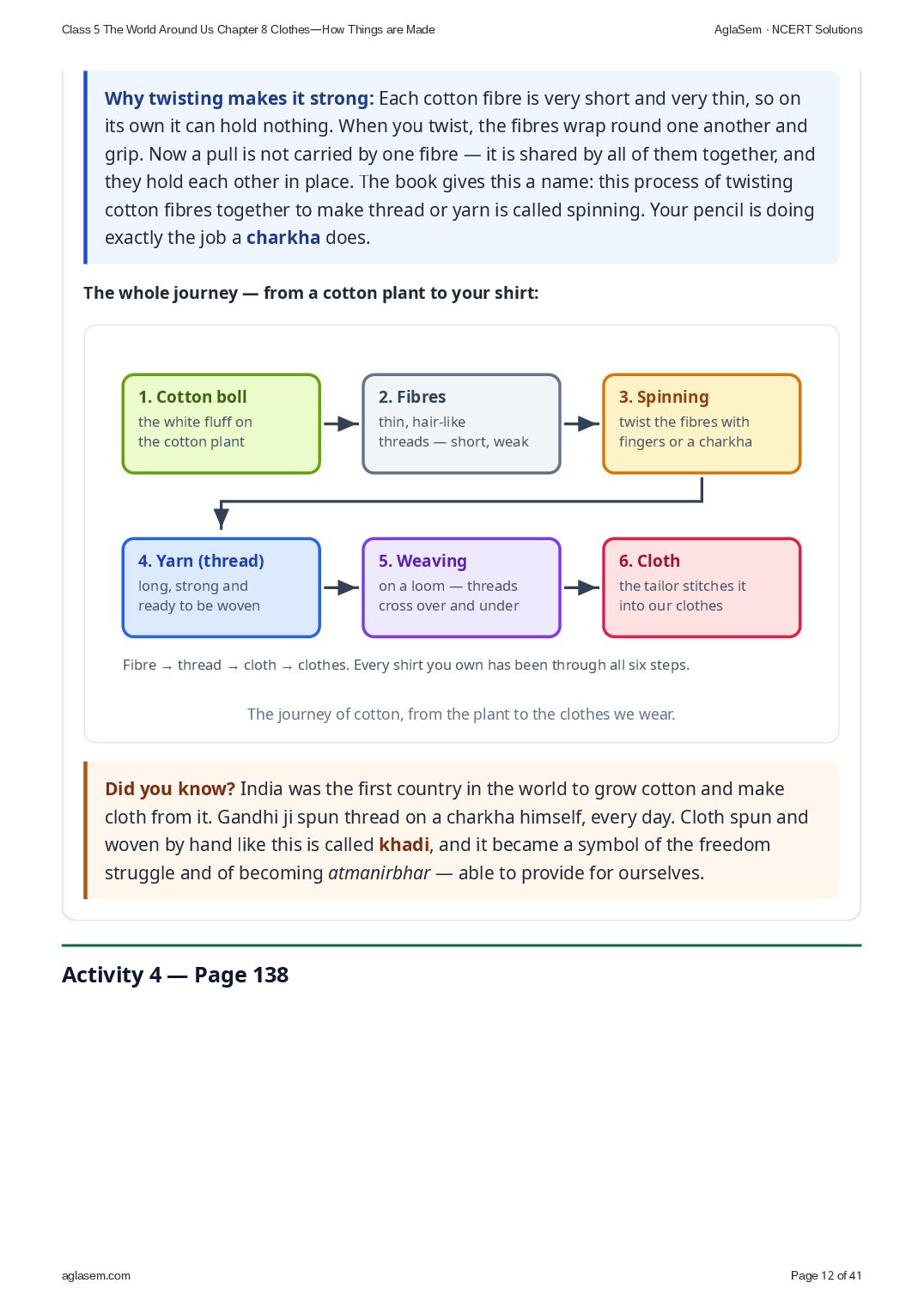
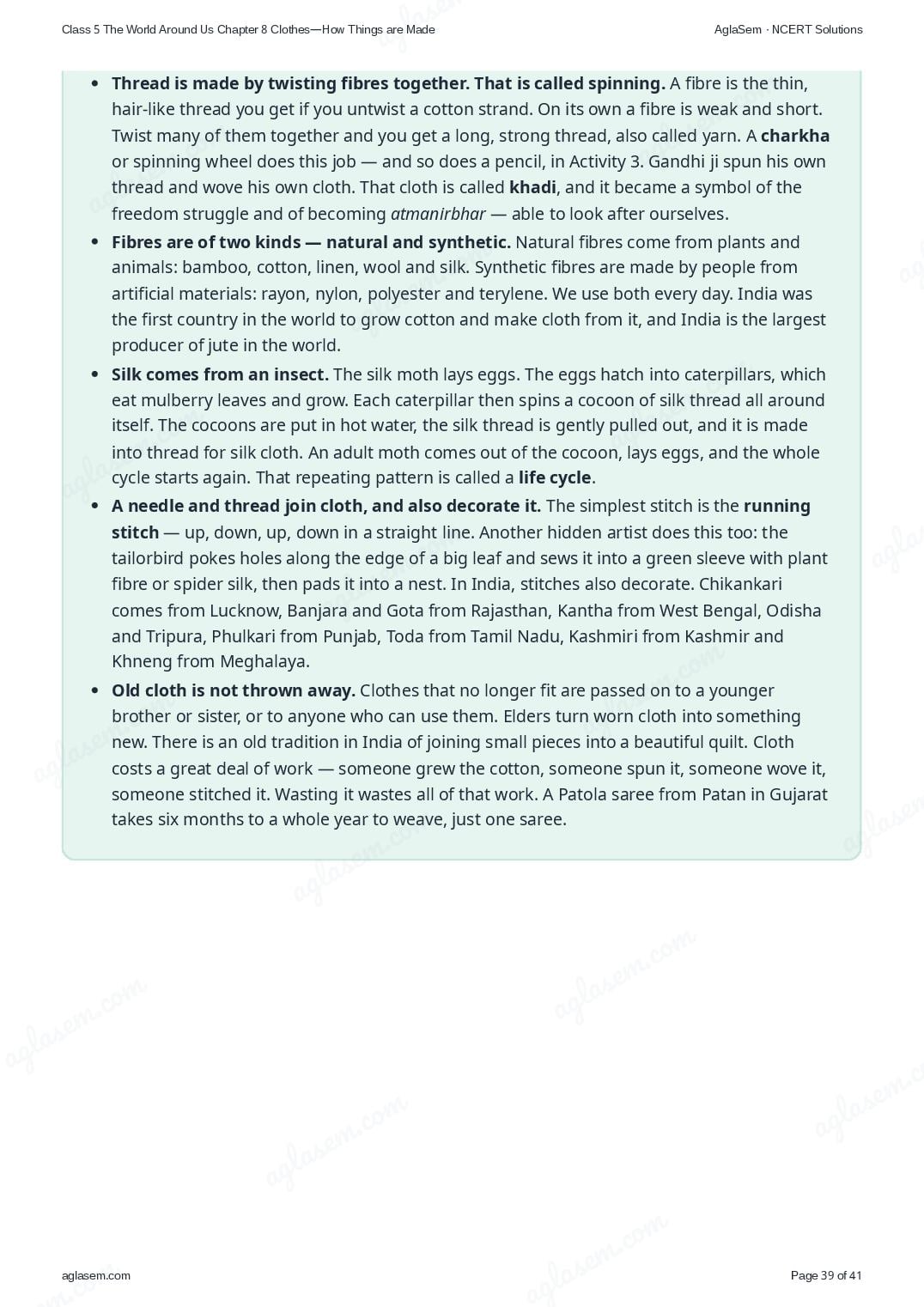
- Thread is made by twisting fibres together. That is called spinning. A fibre is the thin, hair-like thread you get if you untwist a cotton strand. On its own a fibre is weak and short. Twist many of them together and you get a long, strong thread, also called yarn. A charkha or spinning wheel does this job — and so does a pencil, in Activity 3. Gandhi ji spun his own thread and wove his own cloth. That cloth is called khadi, and it became a symbol of the freedom struggle and of becoming atmanirbhar — able to look after ourselves.
- Fibres are of two kinds — natural and synthetic. Natural fibres come from plants and animals: bamboo, cotton, linen, wool and silk. Synthetic fibres are made by people from artificial materials: rayon, nylon, polyester and terylene. We use both every day. India was the first country in the world to grow cotton and make cloth from it, and India is the largest producer of jute in the world.
- Silk comes from an insect. The silk moth lays eggs. The eggs hatch into caterpillars, which eat mulberry leaves and grow. Each caterpillar then spins a cocoon of silk thread all around itself. The cocoons are put in hot water, the silk thread is gently pulled out, and it is made into thread for silk cloth. An adult moth comes out of the cocoon, lays eggs, and the whole cycle starts again. That repeating pattern is called a life cycle.
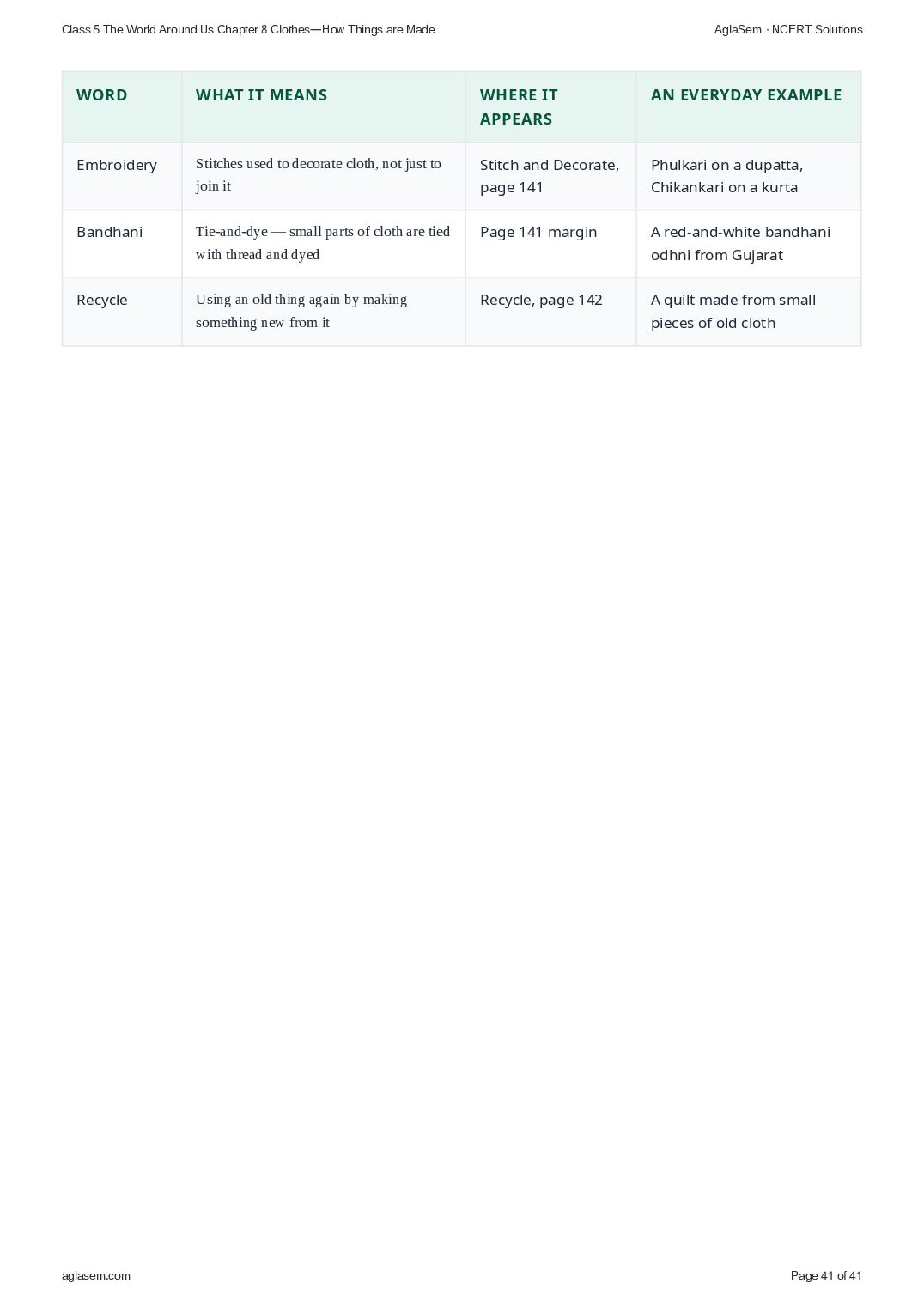
- A needle and thread join cloth, and also decorate it. The simplest stitch is the running stitch — up, down, up, down in a straight line. Another hidden artist does this too: the tailorbird pokes holes along the edge of a big leaf and sews it into a green sleeve with plant fibre or spider silk, then pads it into a nest. In India, stitches also decorate. Chikankari comes from Lucknow, Banjara and Gota from Rajasthan, Kantha from West Bengal, Odisha and Tripura, Phulkari from Punjab, Toda from Tamil Nadu, Kashmiri from Kashmir and Khneng from Meghalaya.
- Old cloth is not thrown away. Clothes that no longer fit are passed on to a younger brother or sister, or to anyone who can use them. Elders turn worn cloth into something new. There is an old tradition in India of joining small pieces into a beautiful quilt. Cloth costs a great deal of work — someone grew the cotton, someone spun it, someone wove it, someone stitched it. Wasting it wastes all of that work. A Patola saree from Patan in Gujarat takes six months to a whole year to weave, just one saree.
How to Download NCERT Solutions for Class 5 The World Around Us Chapter 8 PDF
Follow these simple steps to get the Clothes How Things Are Made questions-and-answers PDF from Our Wondrous World.
- Search NCERT Solutions for Class 5 The World Around Us Chapter 8 aglasem and open this page.
- Read the exercise questions with answers for Clothes How Things Are Made shown above.
- Click the Download PDF link to save the Clothes How Things Are Made solutions to your device.
NCERT Solutions for Class 5 The World Around Us – All Chapters
There are more chapters to study besides Clothes How Things Are Made in The World Around Us. Here are the NCERT Solutions for all chapters of Class 5 The World Around Us.
- Chapter 1 Water the Essence of Life
- Chapter 2 Journey of a River
- Chapter 3 the Mystery of Food
- Chapter 4 Our School a Happy Place
- Chapter 5 Our Vibrant Country
- Chapter 6 Some Unique Places
- Chapter 7 Energy How Things Work
- Chapter 8 Clothes How Things Are Made
- Chapter 9 Rhythms of Nature
- Chapter 10 Earth Our Shared Home
NCERT Solutions for Class 5 – All Subjects
Just like Chapter 8 of The World Around Us, you can get the exercise questions with answers for every other subject of Class 5. Here are the NCERT Solutions for all subjects of Class 5.
NCERT Solutions for Class 5 The World Around Us Chapter 8 – An Overview
The key highlights of this study material are as follows.
| Aspects | Details |
|---|---|
| Class | Class 5 |
| Subject | The World Around Us |
| Chapter Number | Chapter 8 |
| Chapter Name | Clothes How Things Are Made |
| Book Name | Our Wondrous World |
| Book By | NCERT (National Council of Educational Research and Training) |
| Educational Resource Here | NCERT Solutions of Class 5 The World Around Us Chapter 8 for all exercises |
| More Questions Answers of This Subject | NCERT Solutions for Class 5 The World Around Us |
| Download Book Chapter | NCERT Book Class 5 The World Around Us |
| All Questions Answers For This Class | NCERT Solutions for Class 5 |
| Complete Solutions | NCERT Solutions |
NCERT Solutions for Class 5 The World Around Us Chapter 8 Clothes How Things Are Made – FAQs
What are the NCERT Solutions for Class 5 The World Around Us Chapter 8 Clothes How Things Are Made?
They are the complete, step-by-step answers to all the exercise and in-text questions of Chapter 8 Clothes How Things Are Made from the NCERT Class 5 The World Around Us textbook Our Wondrous World, written by experts as per the latest NCERT syllabus.
How can I download the Class 5 The World Around Us Chapter 8 solutions PDF for free?
Open this page on aglasem, read the Clothes How Things Are Made questions with answers, and click the “Download Solutions PDF” link. The Class 5 The World Around Us Chapter 8 NCERT Solutions PDF is completely free to download.
Are these NCERT Solutions as per the latest 2026-27 syllabus?
Yes. The NCERT Solutions for Class 5 The World Around Us Chapter 8 are based on the latest NCERT textbook Our Wondrous World and the current 2026-27 CBSE syllabus, so the questions and answers match what you study in class.
Where can I get NCERT Solutions for the other chapters of Class 5 The World Around Us?
You can find the answers to every chapter on the NCERT Solutions for Class 5 The World Around Us page, and solutions for every subject on the NCERT Solutions for Class 5 page.
How do NCERT Solutions help in exam preparation?
They show the correct method to solve each question, help you write answers the way they are expected in exams, let you check and correct your own work, and save revision time — which together improve your marks in Class 5 The World Around Us.
If you have any queries on NCERT Solutions for Class 5 The World Around Us Chapter 8 Clothes How Things Are Made, then please ask in the comments below.