NCERT Solutions for Class 7 Science Chapter 9 Life Processes in Animals provide clear, step-by-step answers to every exercise and in-text question from the chapter Life Processes in Animals of the NCERT textbook Curiosity. Prepared by subject experts as per the latest NCERT (CBSE) syllabus for 2026-27, these NCERT Solutions for Class 7 Science help you understand each concept, write exam-ready answers, and check your own solutions. You can read them online below or download the free Class 7 Science Chapter 9 question-answer PDF.
NCERT Solutions for Class 7 Science Chapter 9 Life Processes in Animals
- Class: Class 7
- Subject: Science
- Chapter: Chapter 9 – Life Processes in Animals
- Textbook: Curiosity (NCERT)
- Study material: NCERT Solutions – questions with answers, free PDF
These solutions answer all the exercise questions of Chapter 9 Life Processes in Animals — including the in-text questions, short-answer and long-answer questions, and activities — with complete explanations so you can follow the method, not just the final answer. Read the full solutions below.
NCERT Solutions Class 7 Science Chapter 9 Life Processes in Animals View Download
NCERT Solutions for Class 7 Science Chapter 9 PDF Download
You can read the NCERT Solutions for Class 7 Science Chapter 9 online above, or download the complete question-answer PDF to study Life Processes in Animals offline at any time.
NCERT Solutions for Class 7 Science Chapter 9 PDF Download Link – Click Here to Download Solutions PDF
Questions Covered in This Chapter
These NCERT Solutions answer all 39 questions of this chapter. The questions solved are:
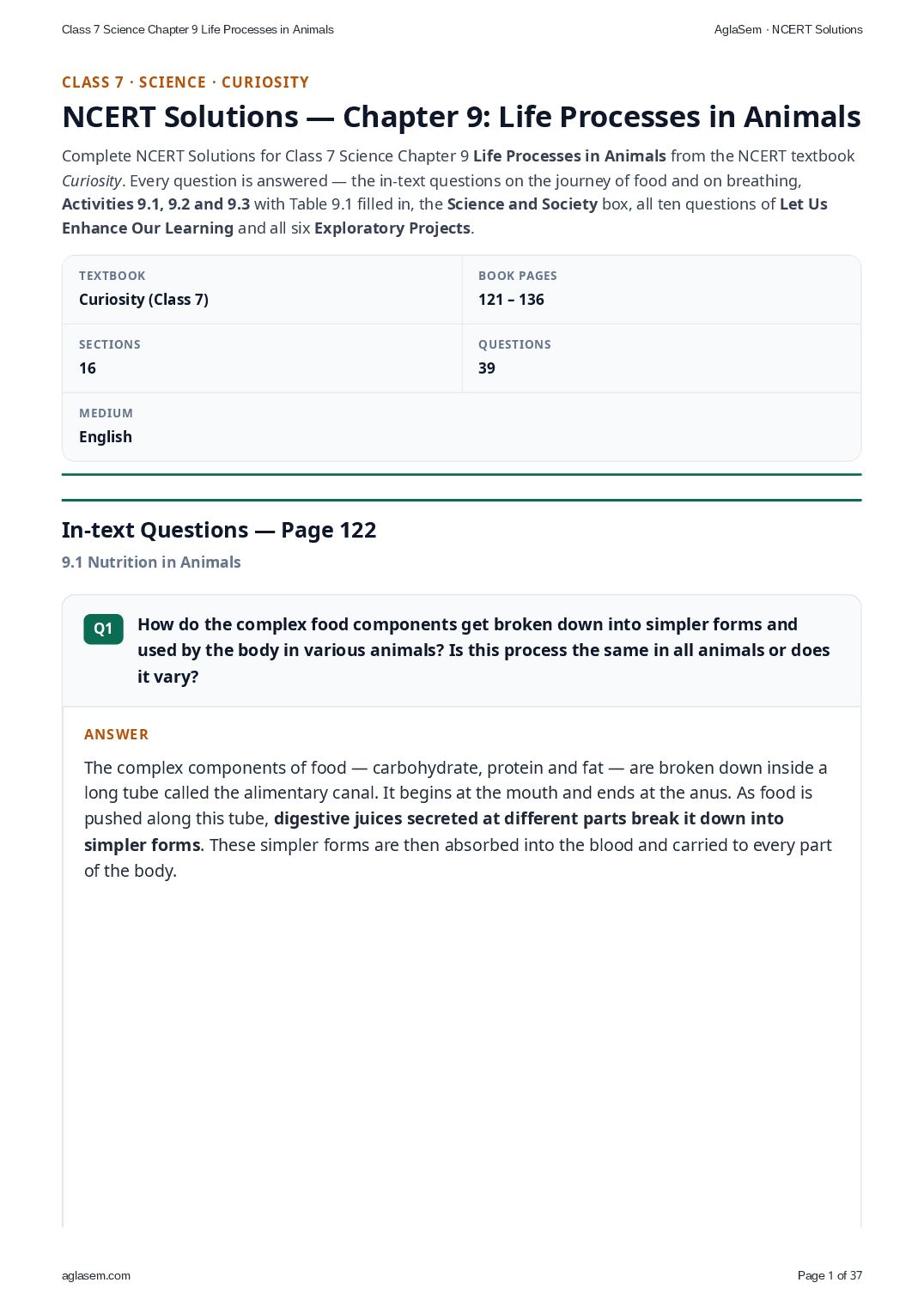
- How do the complex food components get broken down into simpler forms and used by the body in various animals? Is this process the same in all animals or does it vary?
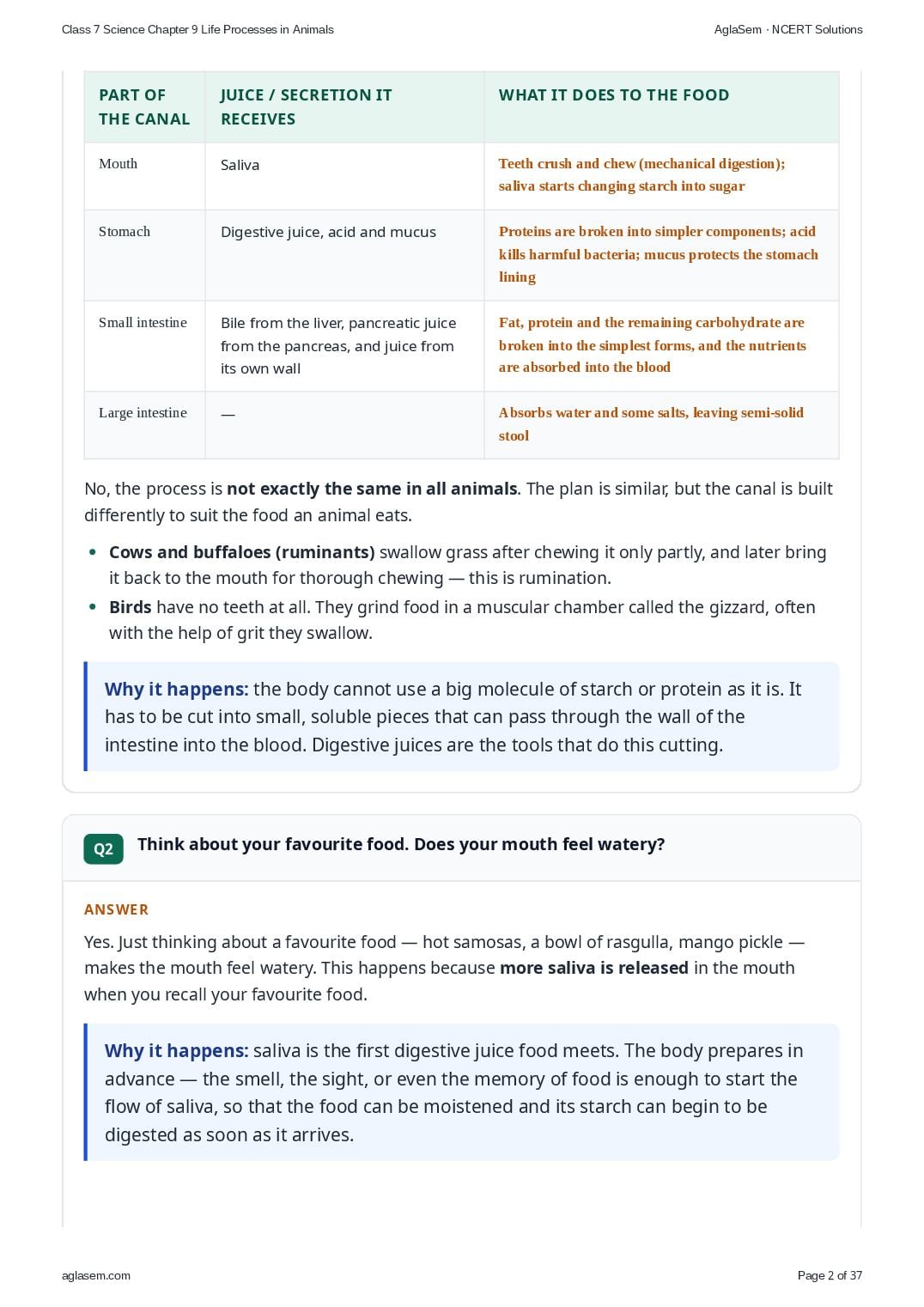
- Think about your favourite food. Does your mouth feel watery?
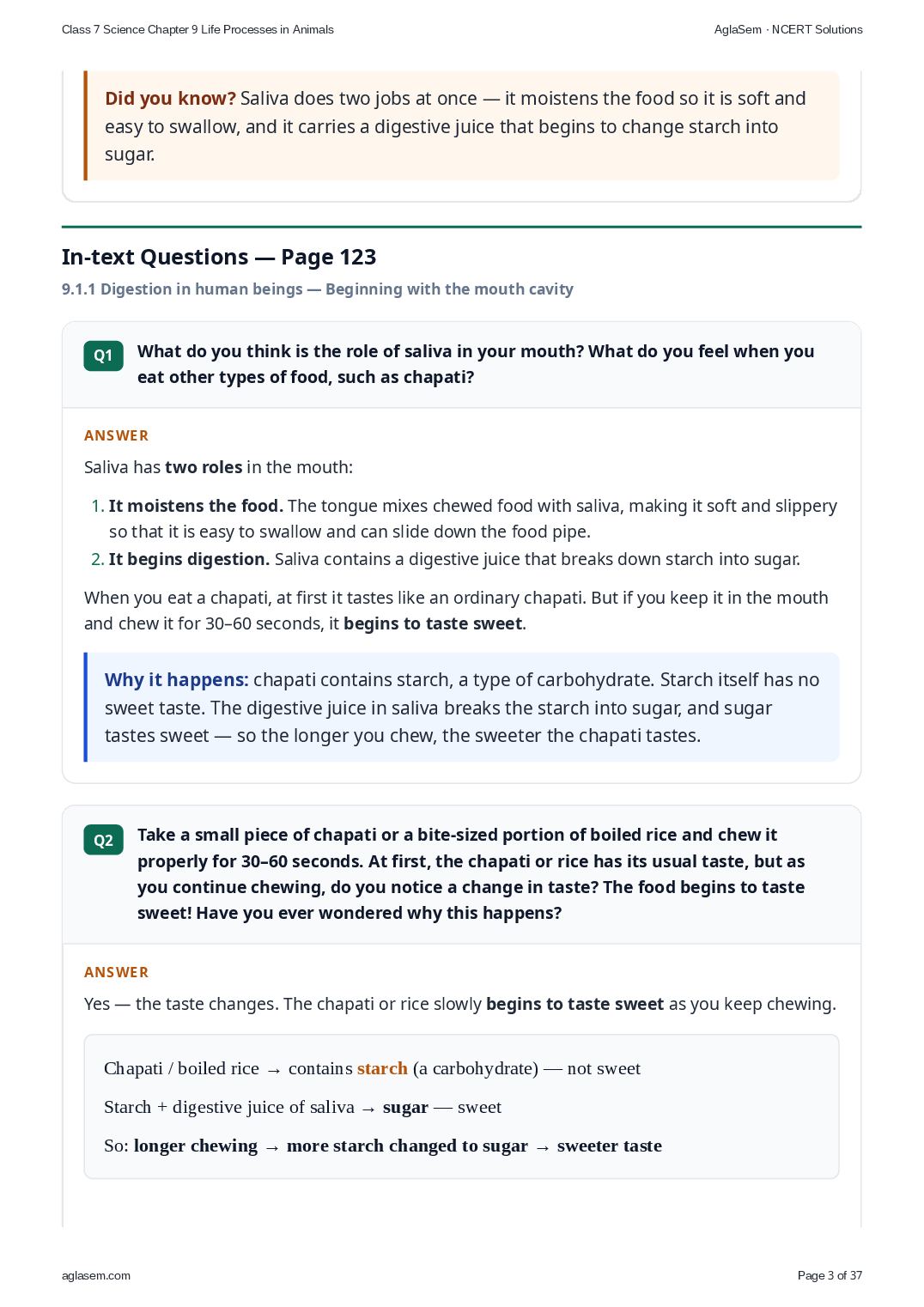
- What do you think is the role of saliva in your mouth? What do you feel when you eat other types of food, such as chapati?
- Take a small piece of chapati or a bite-sized portion of boiled rice and chew it properly for 30–60 seconds. At first, the chapati or rice has its usual taste, but as you continue chewing, do you notice a change in taste? The food begins to taste sweet! Have you ever wondered why this happens?
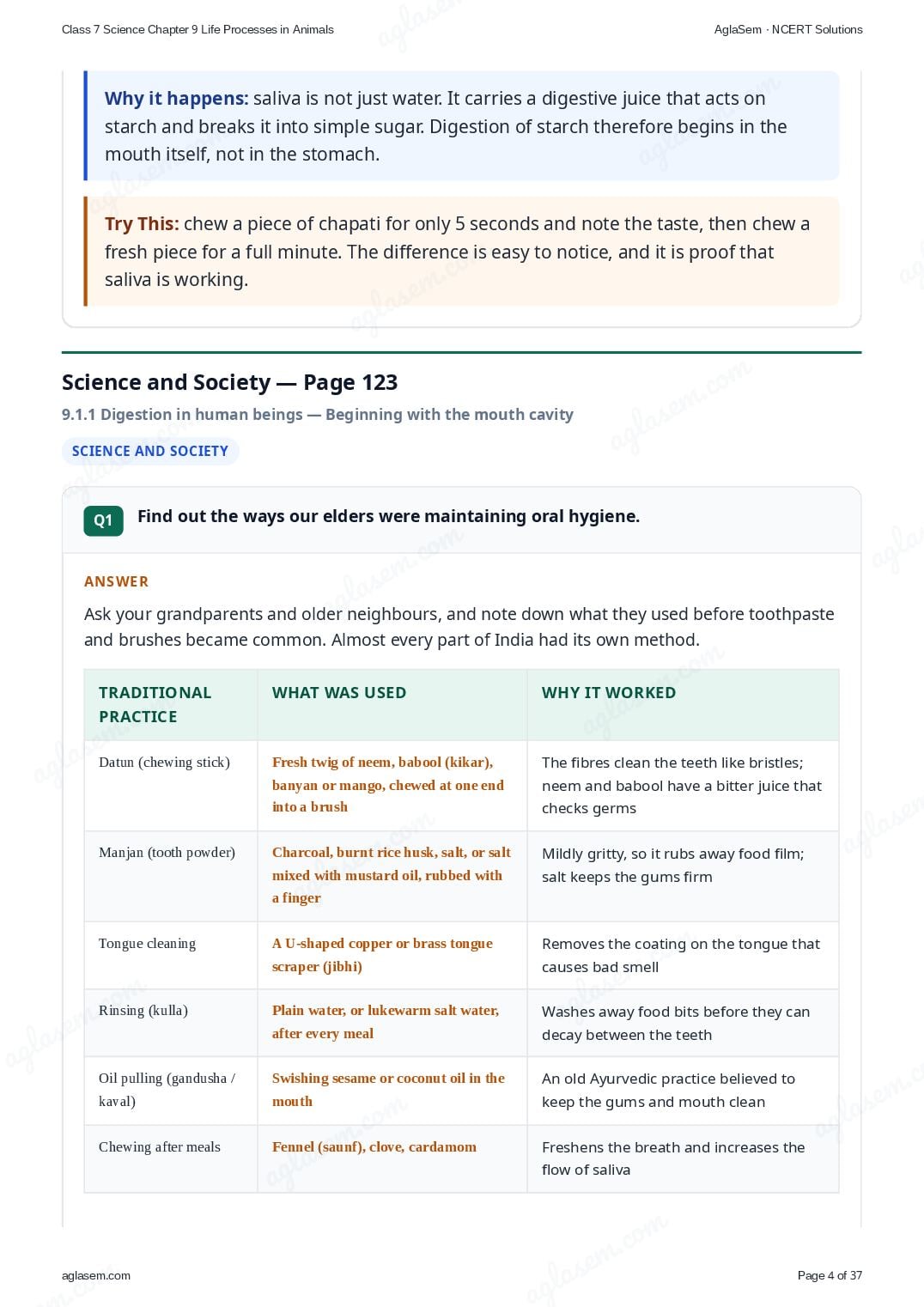
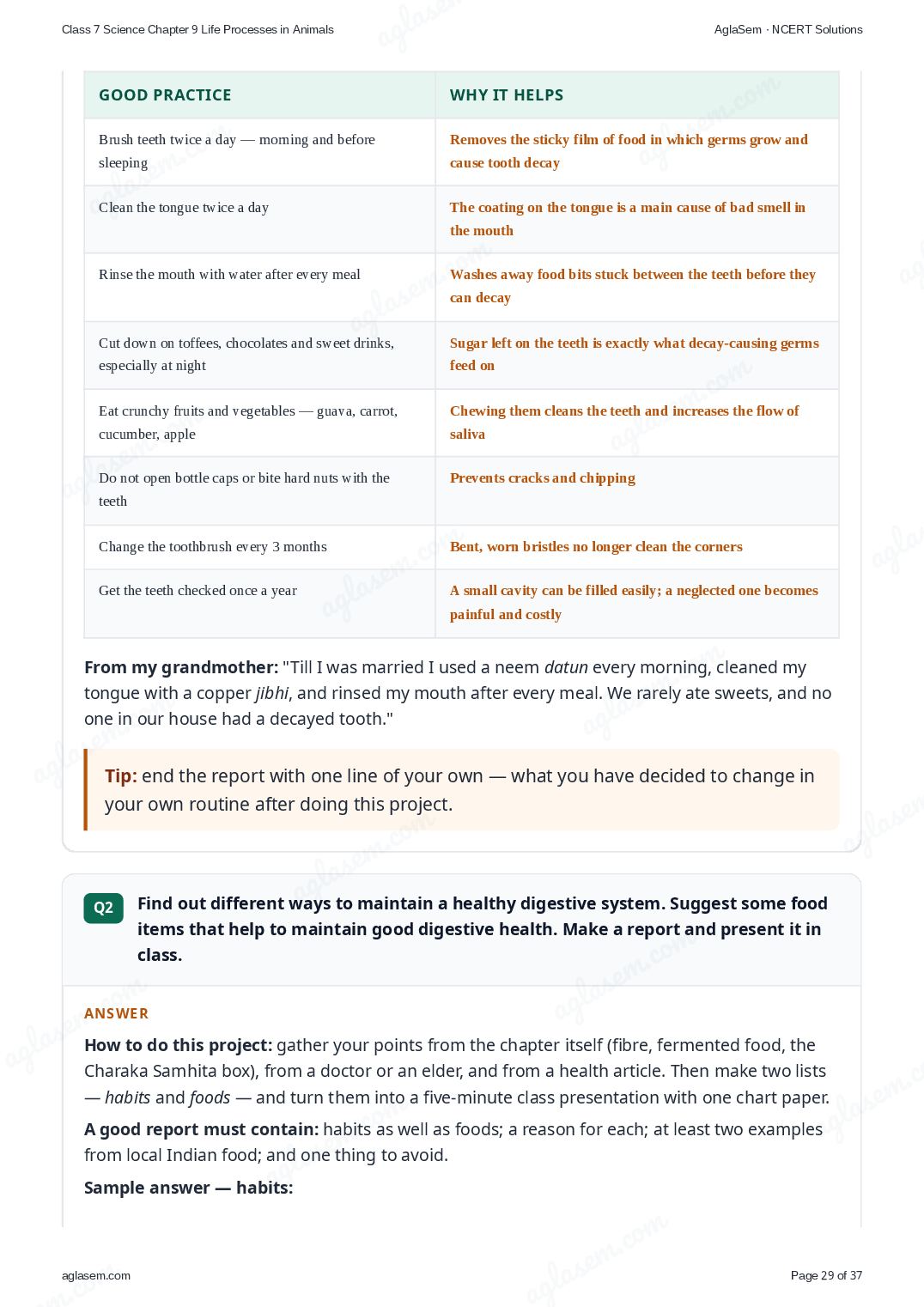
- Find out the ways our elders were maintaining oral hygiene.
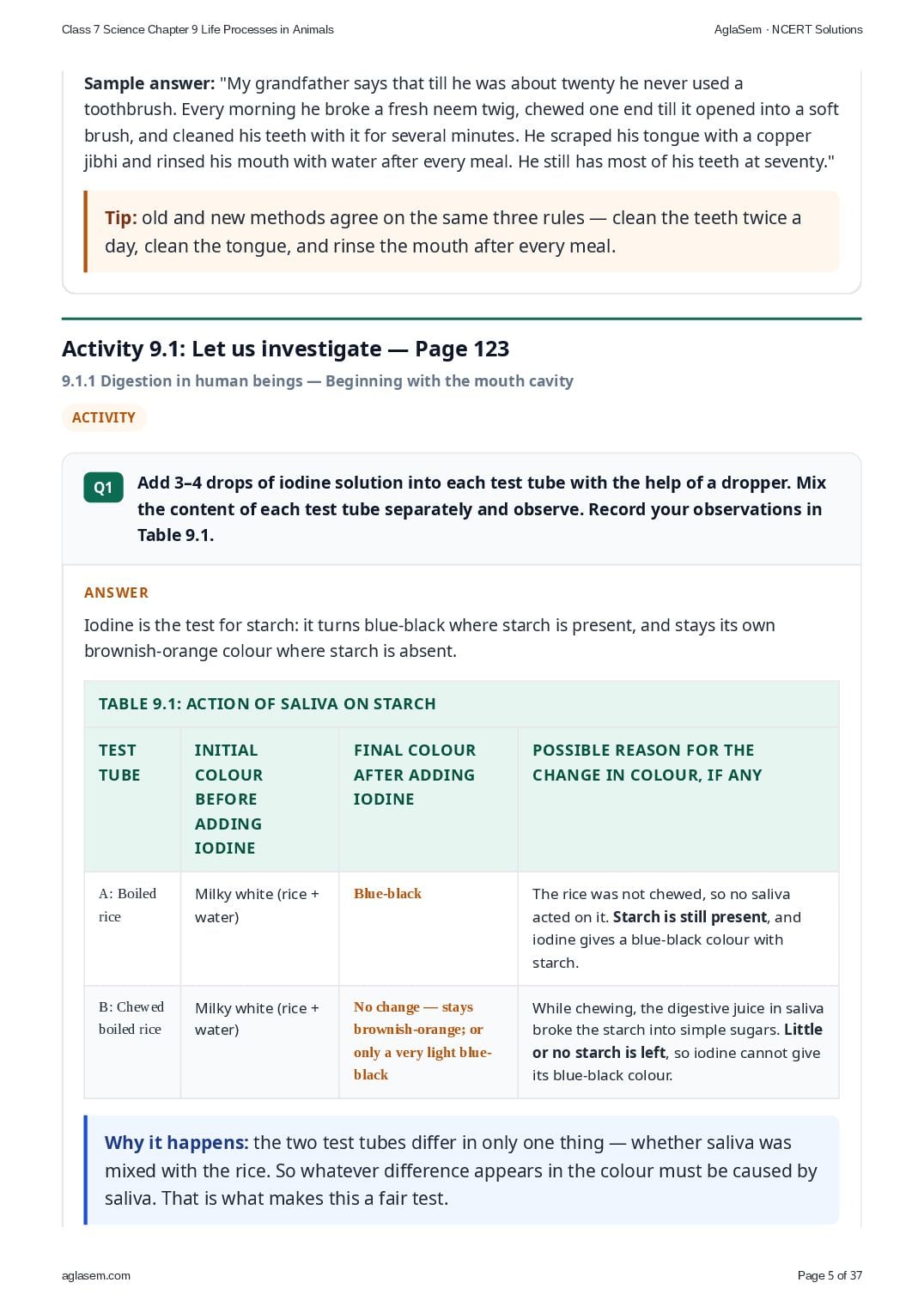
- Add 3–4 drops of iodine solution into each test tube with the help of a dropper. Mix the content of each test tube separately and observe. Record your observations in Table 9.1.
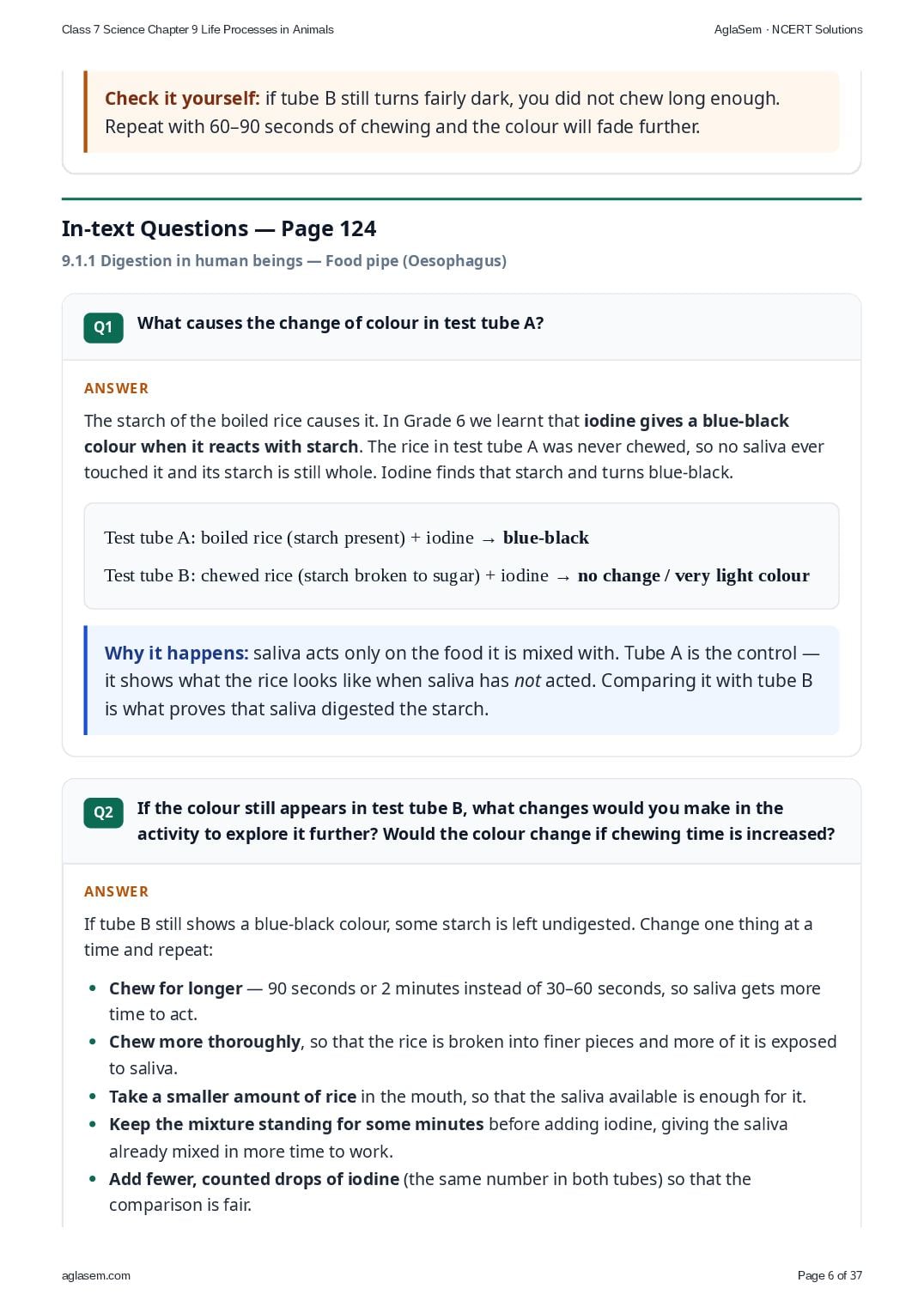
- What causes the change of colour in test tube A?
- If the colour still appears in test tube B, what changes would you make in the activity to explore it further? Would the colour change if chewing time is increased?
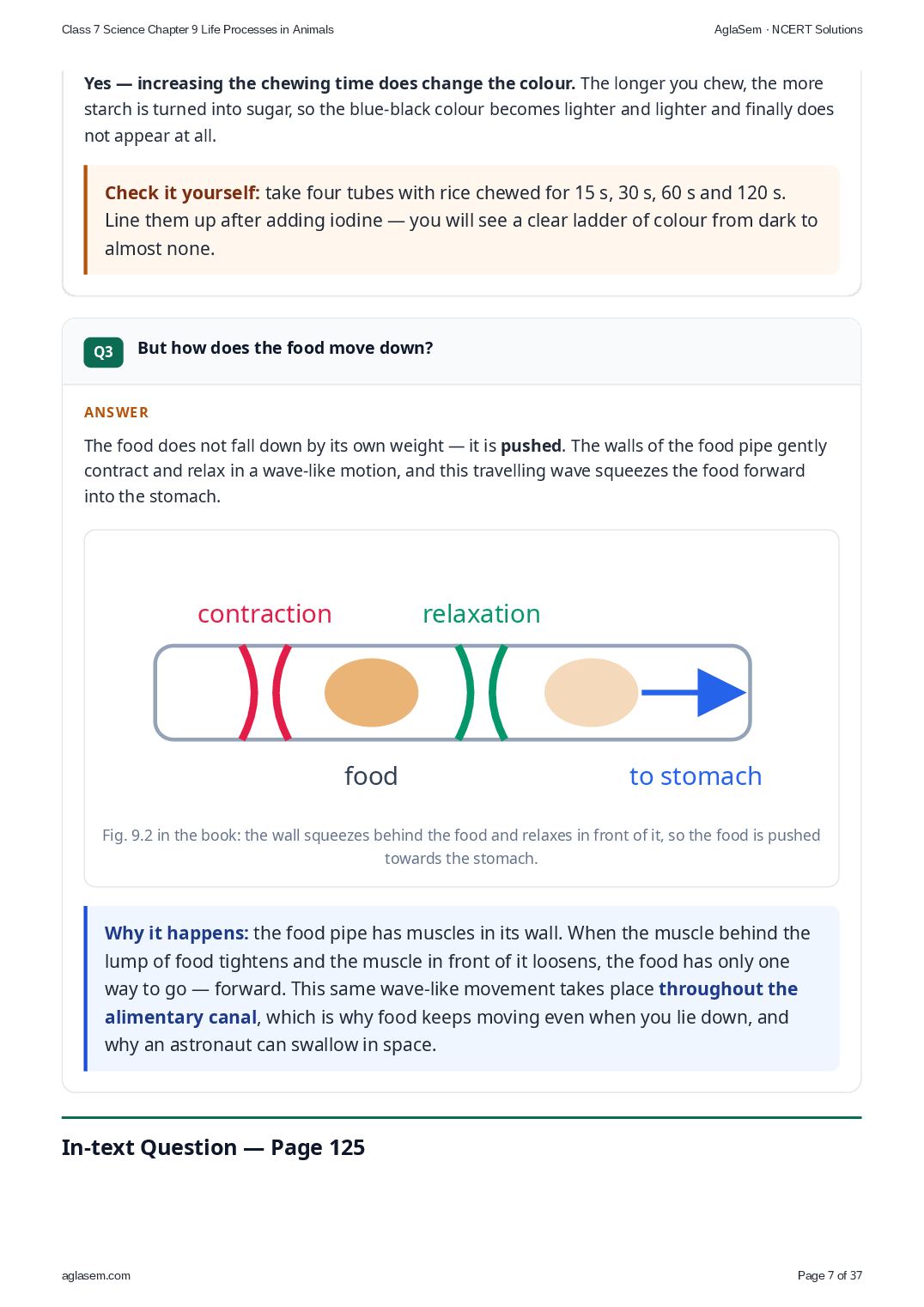
- But how does the food move down?
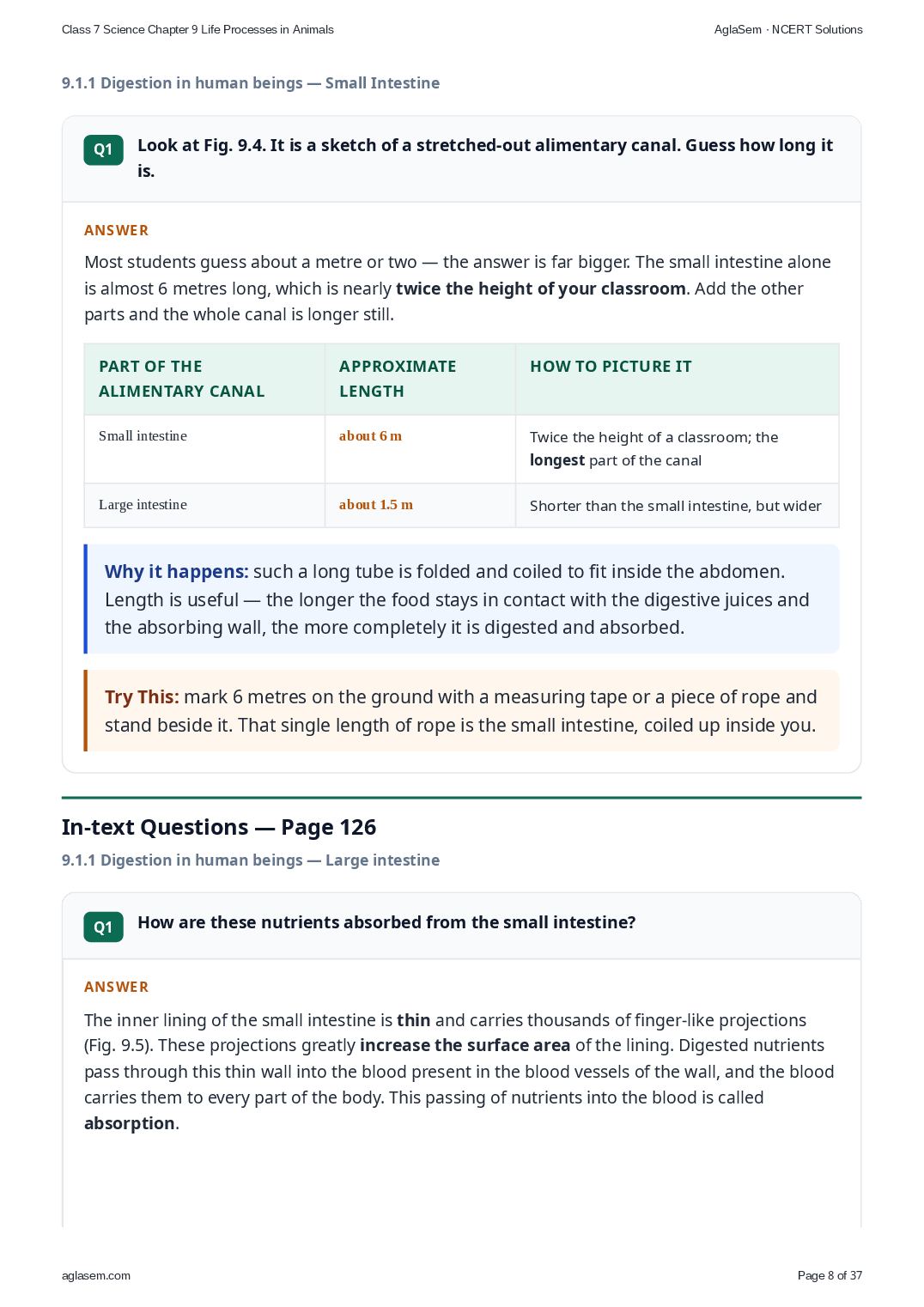
- Look at Fig. 9.4. It is a sketch of a stretched-out alimentary canal. Guess how long it is.
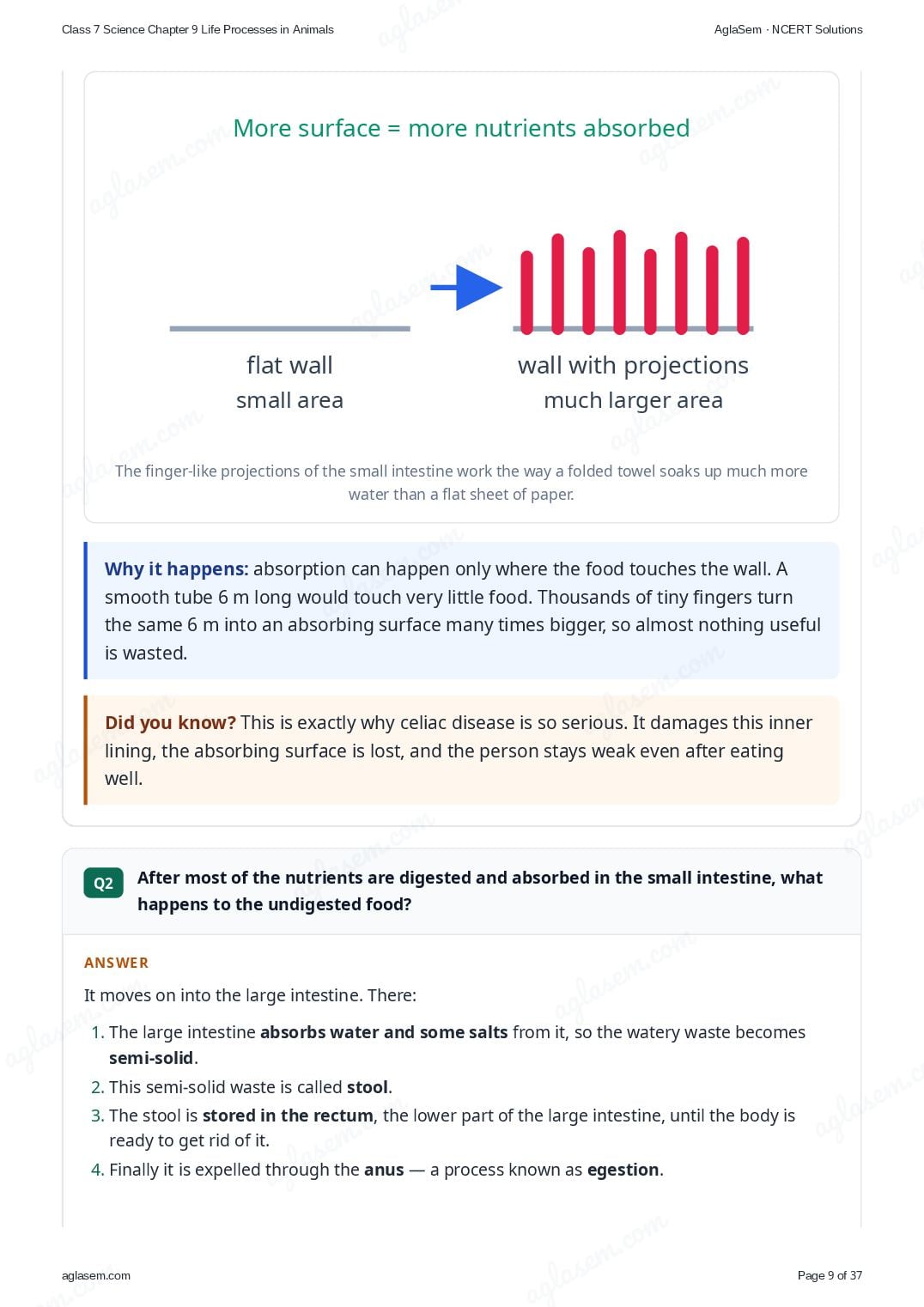
- How are these nutrients absorbed from the small intestine?
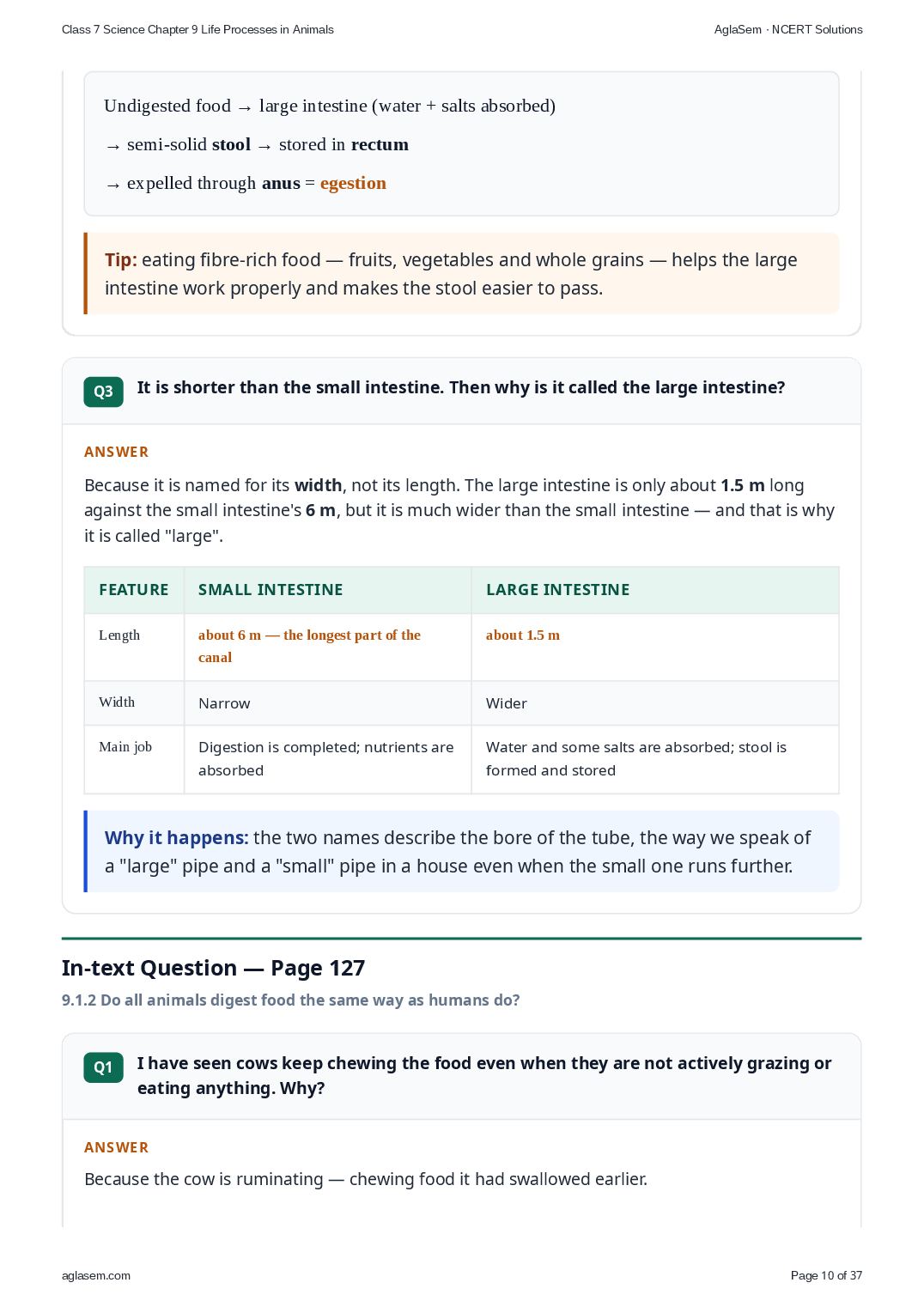
- After most of the nutrients are digested and absorbed in the small intestine, what happens to the undigested food?
- It is shorter than the small intestine. Then why is it called the large intestine?
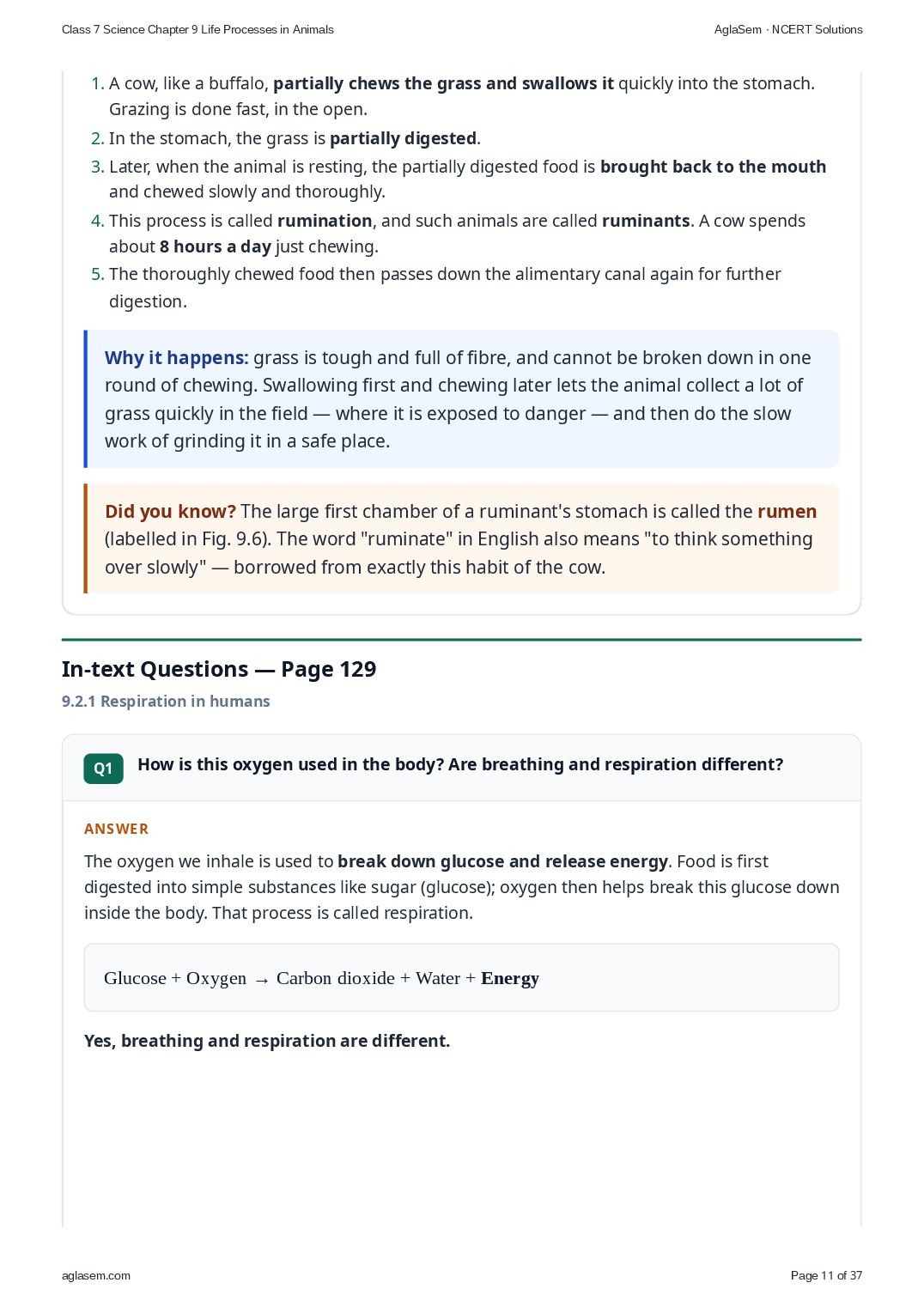
- I have seen cows keep chewing the food even when they are not actively grazing or eating anything. Why?
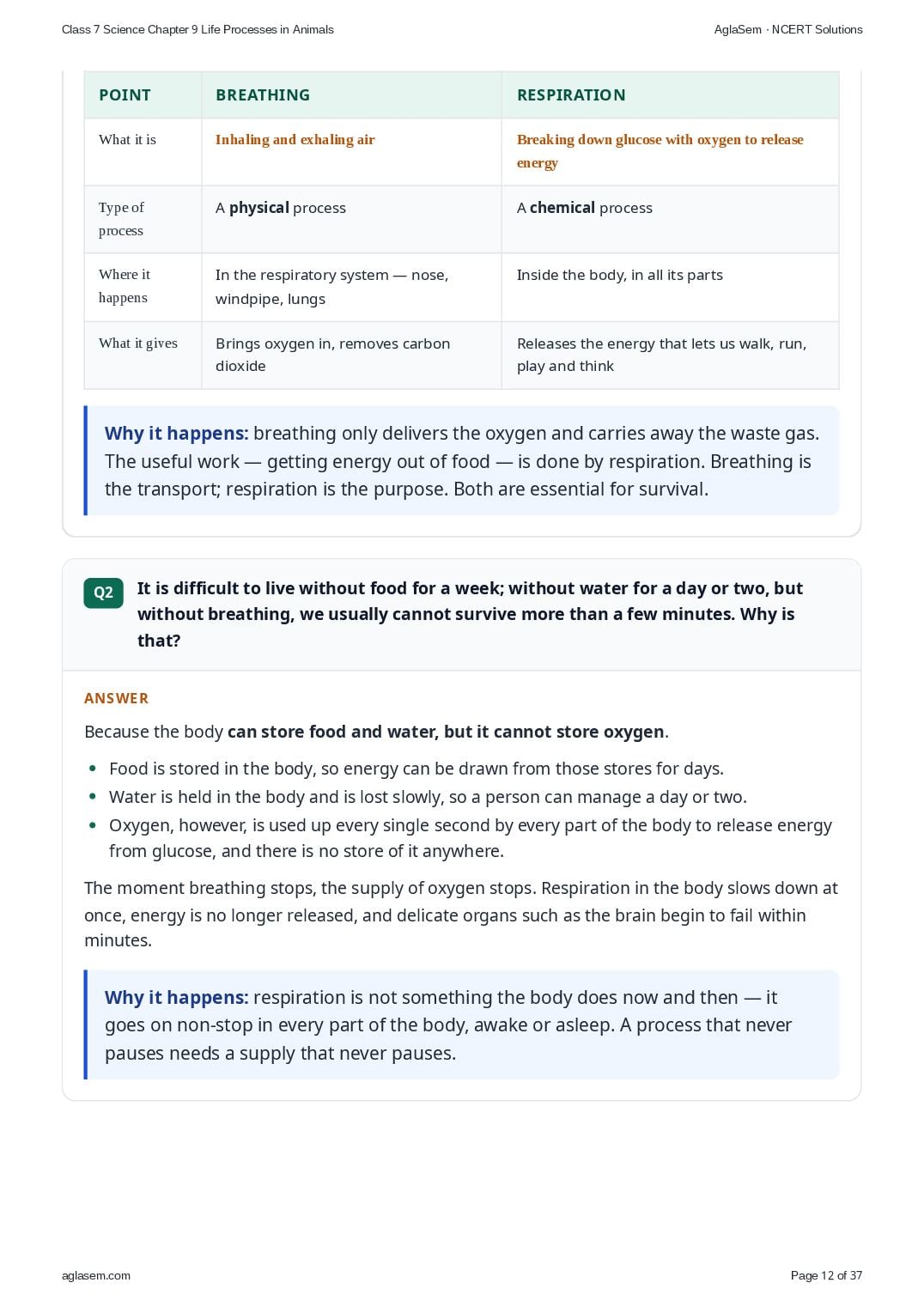
- How is this oxygen used in the body? Are breathing and respiration different?
- It is difficult to live without food for a week; without water for a day or two, but without breathing, we usually cannot survive more than a few minutes. Why is that?
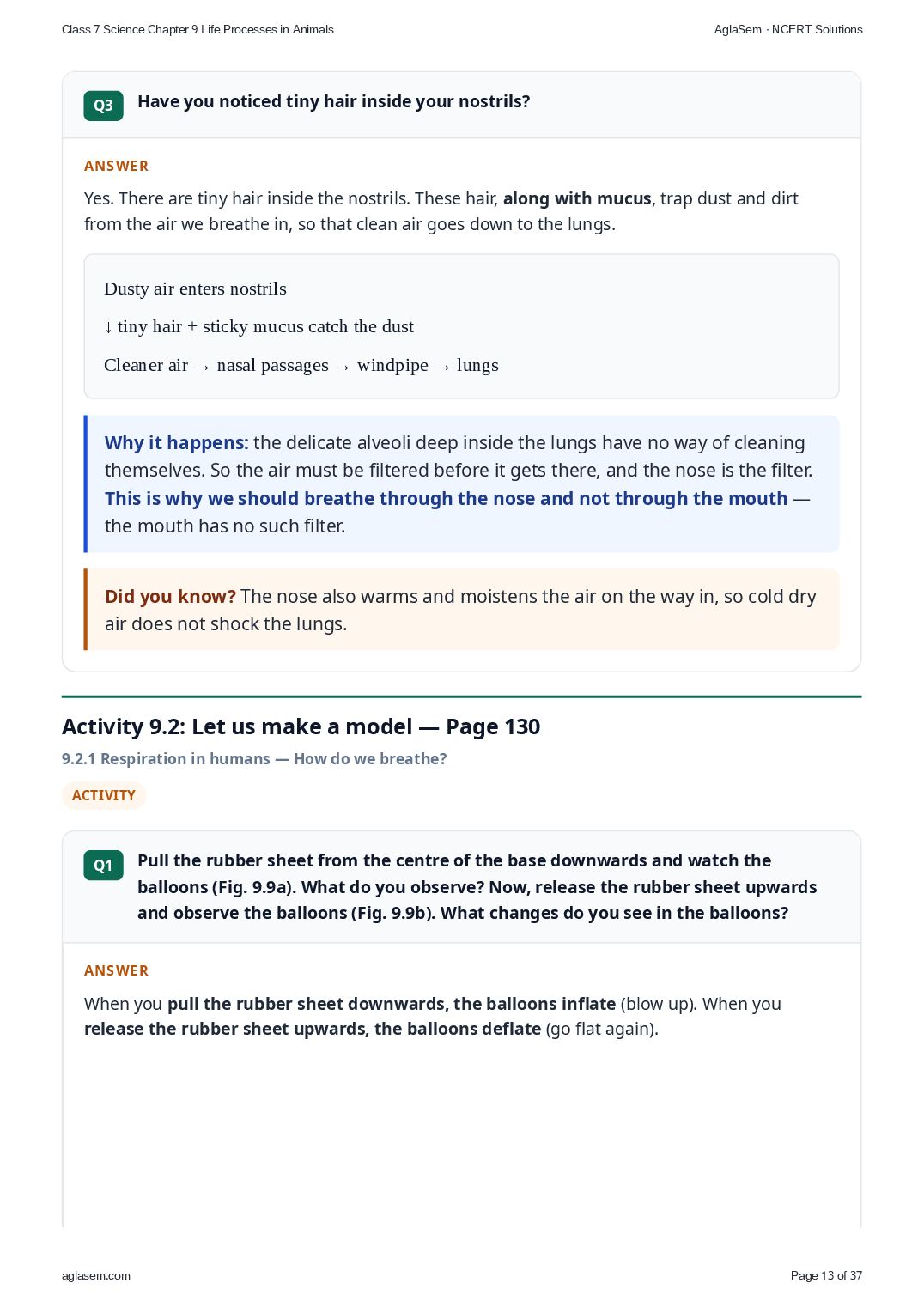
- Have you noticed tiny hair inside your nostrils?
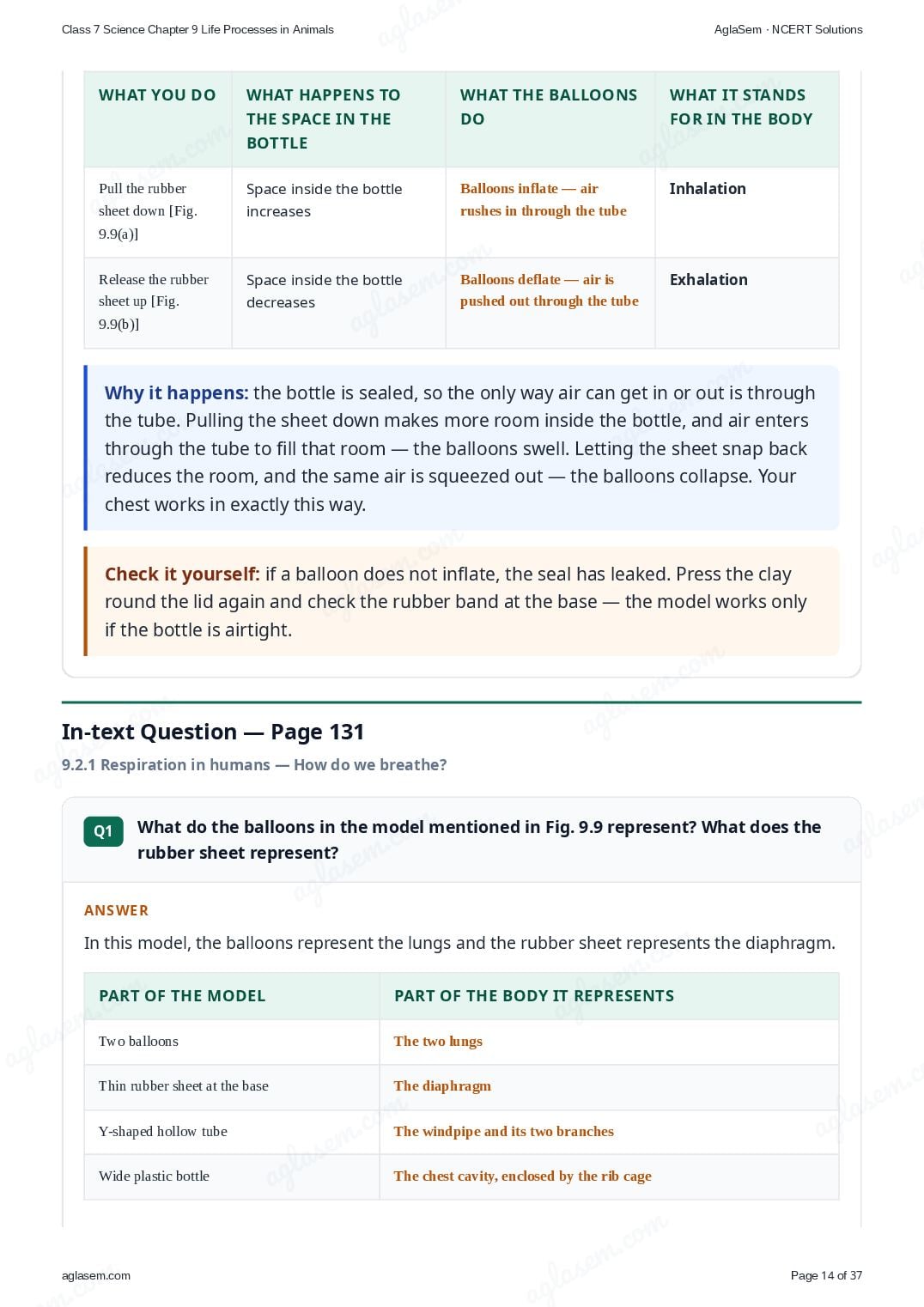
- Pull the rubber sheet from the centre of the base downwards and watch the balloons (Fig. 9.9a). What do you observe? Now, release the rubber sheet upwards and observe the balloons (Fig. 9.9b). What changes do you see in the balloons?
- What do the balloons in the model mentioned in Fig. 9.9 represent? What does the rubber sheet represent?
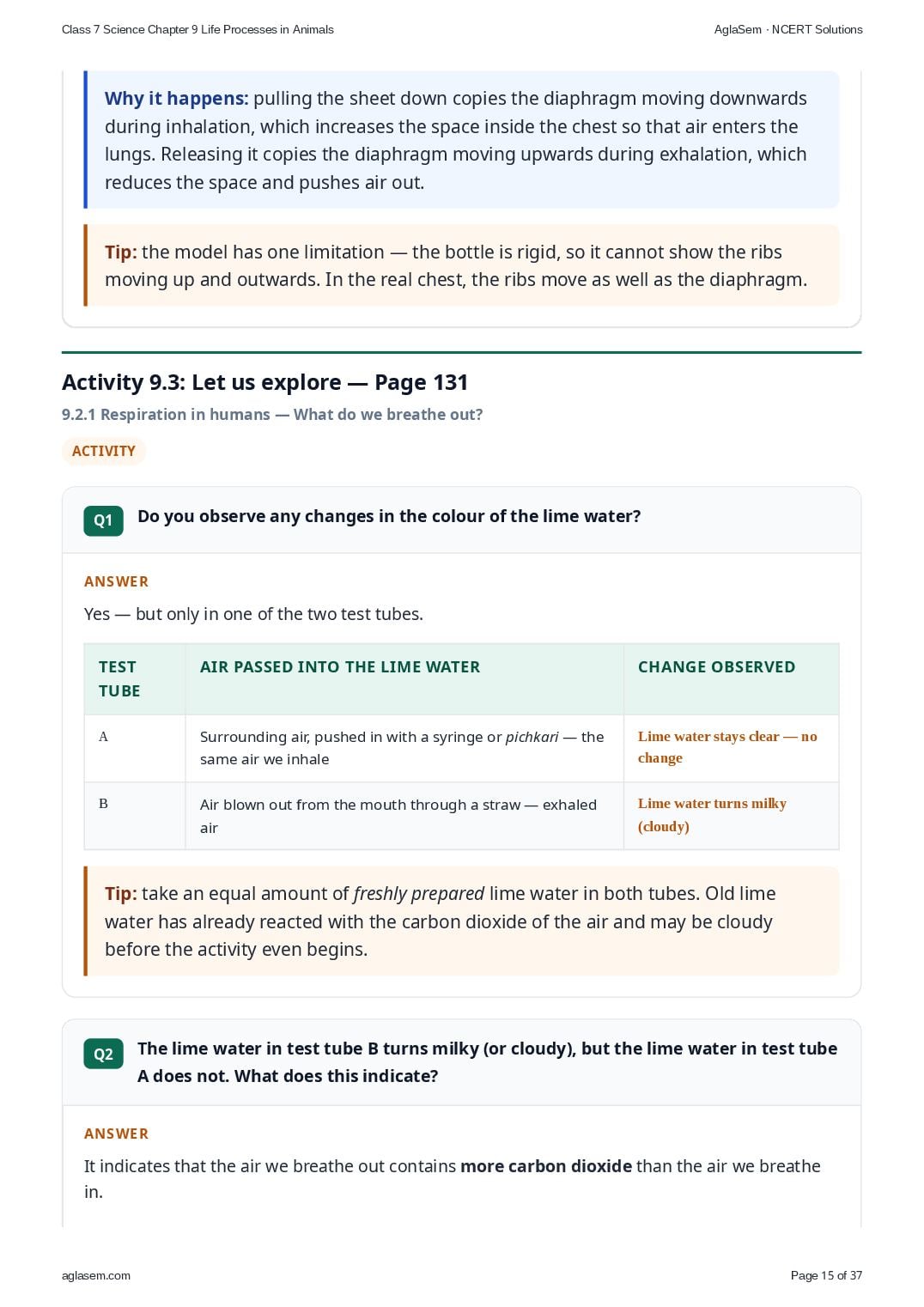
- Do you observe any changes in the colour of the lime water?
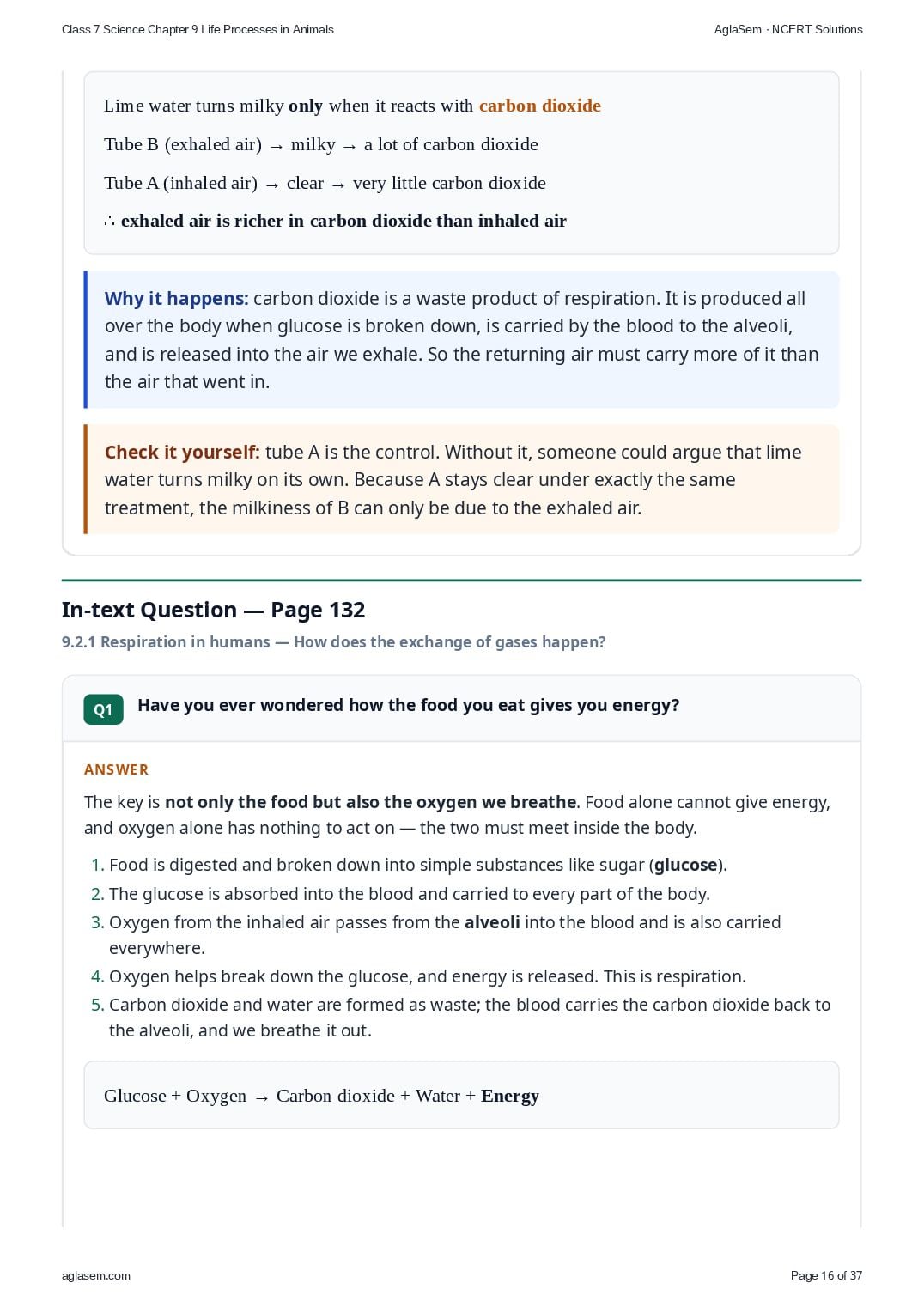
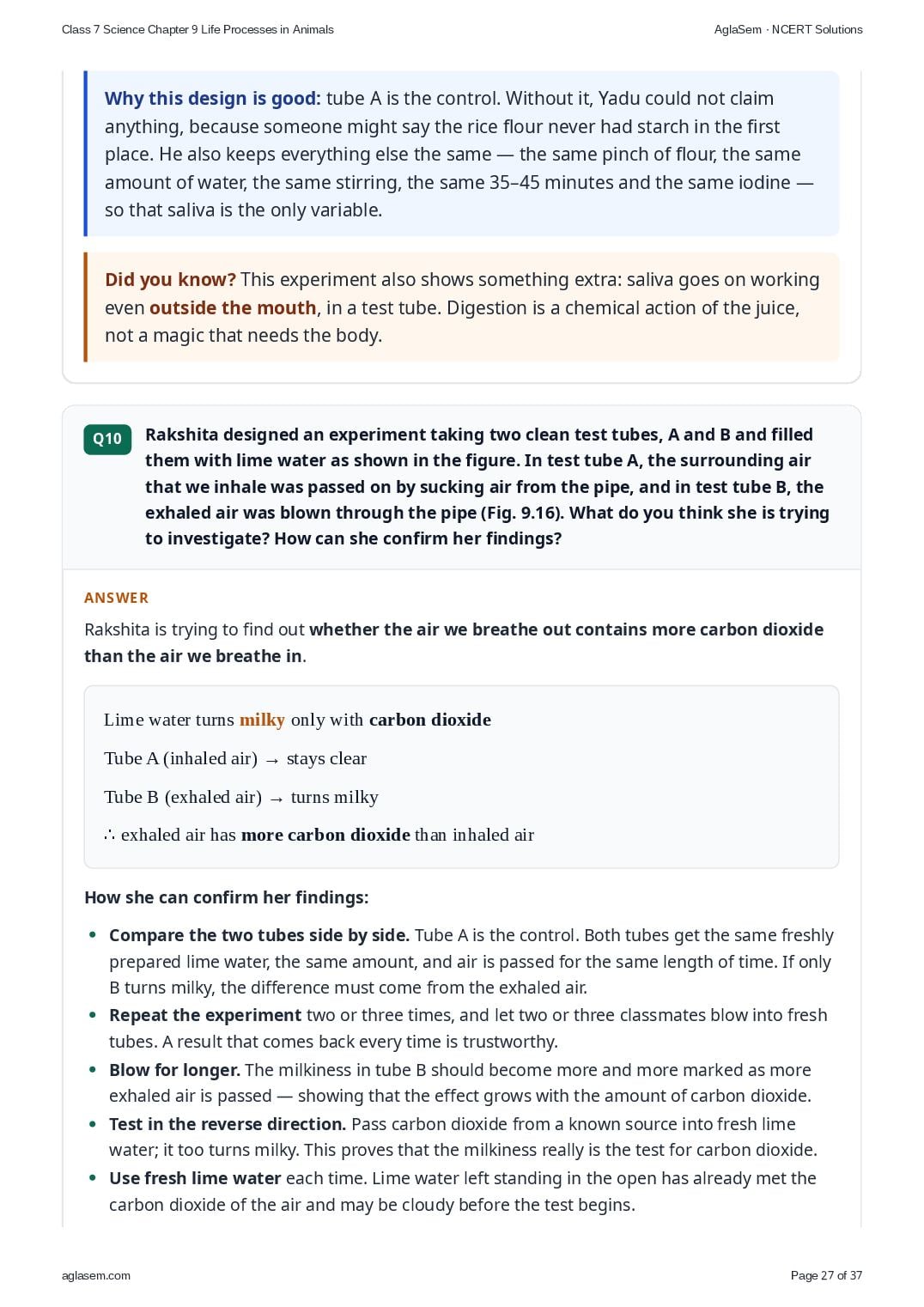
- The lime water in test tube B turns milky (or cloudy), but the lime water in test tube A does not. What does this indicate?
- Have you ever wondered how the food you eat gives you energy?
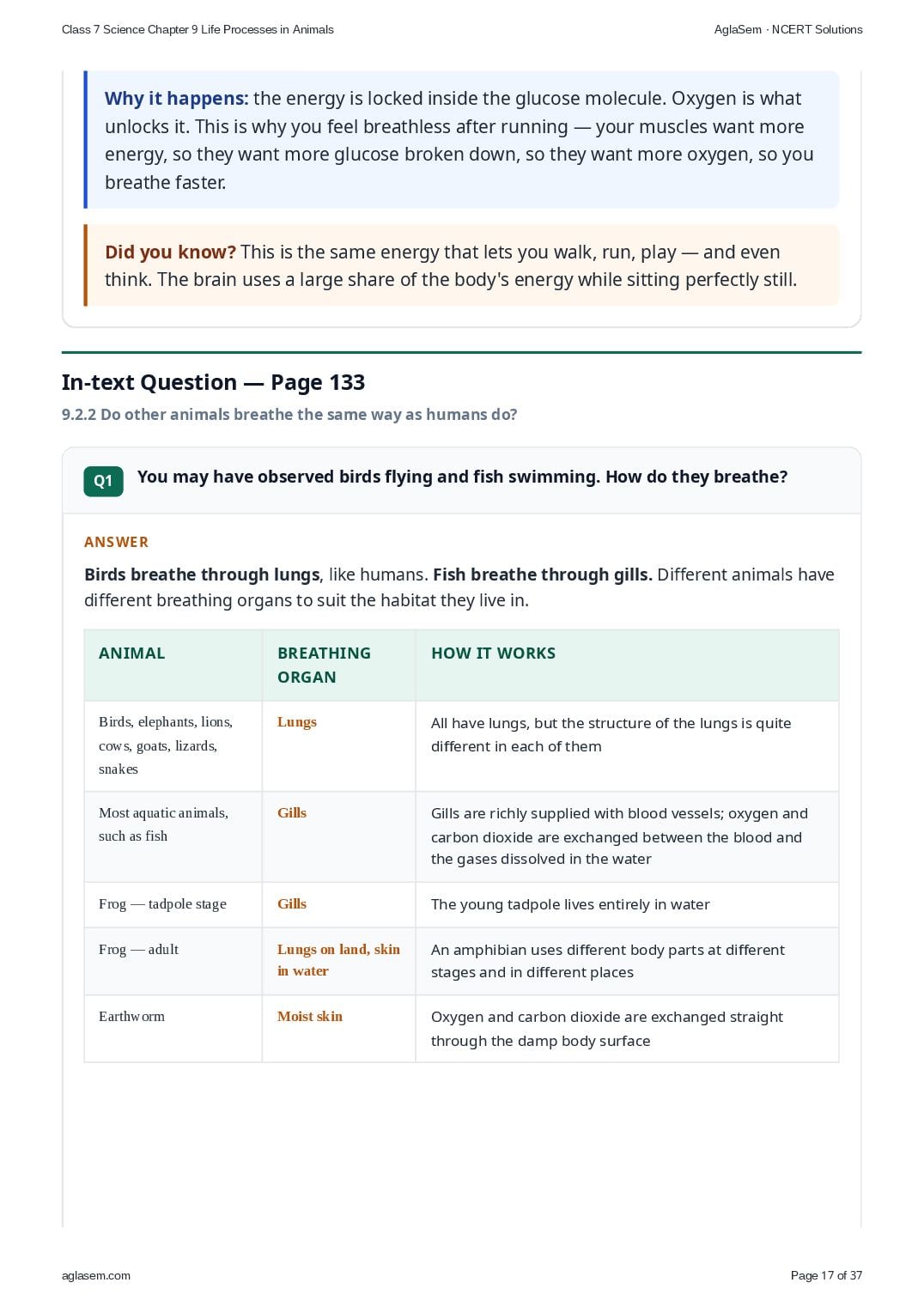
- You may have observed birds flying and fish swimming. How do they breathe?
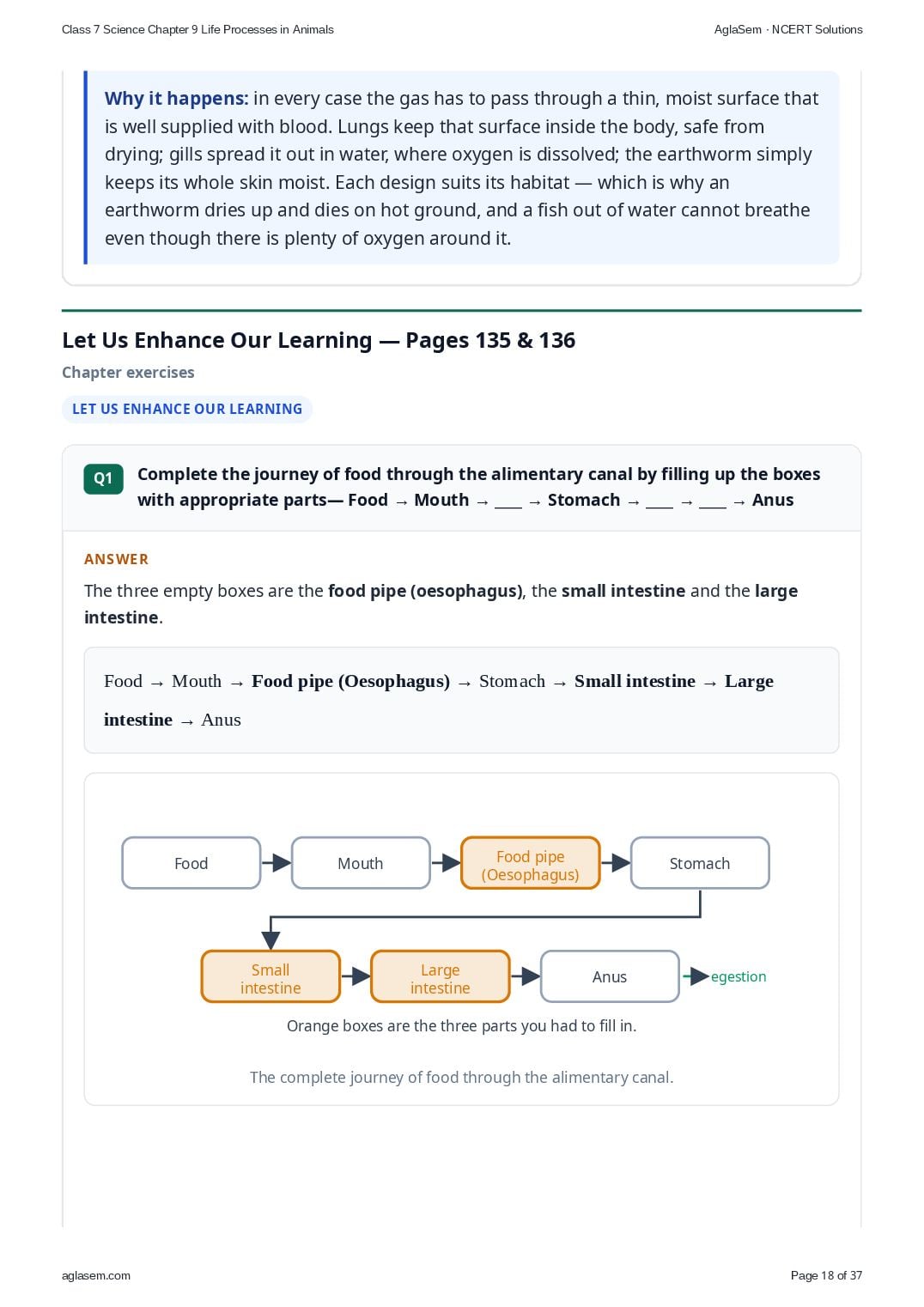
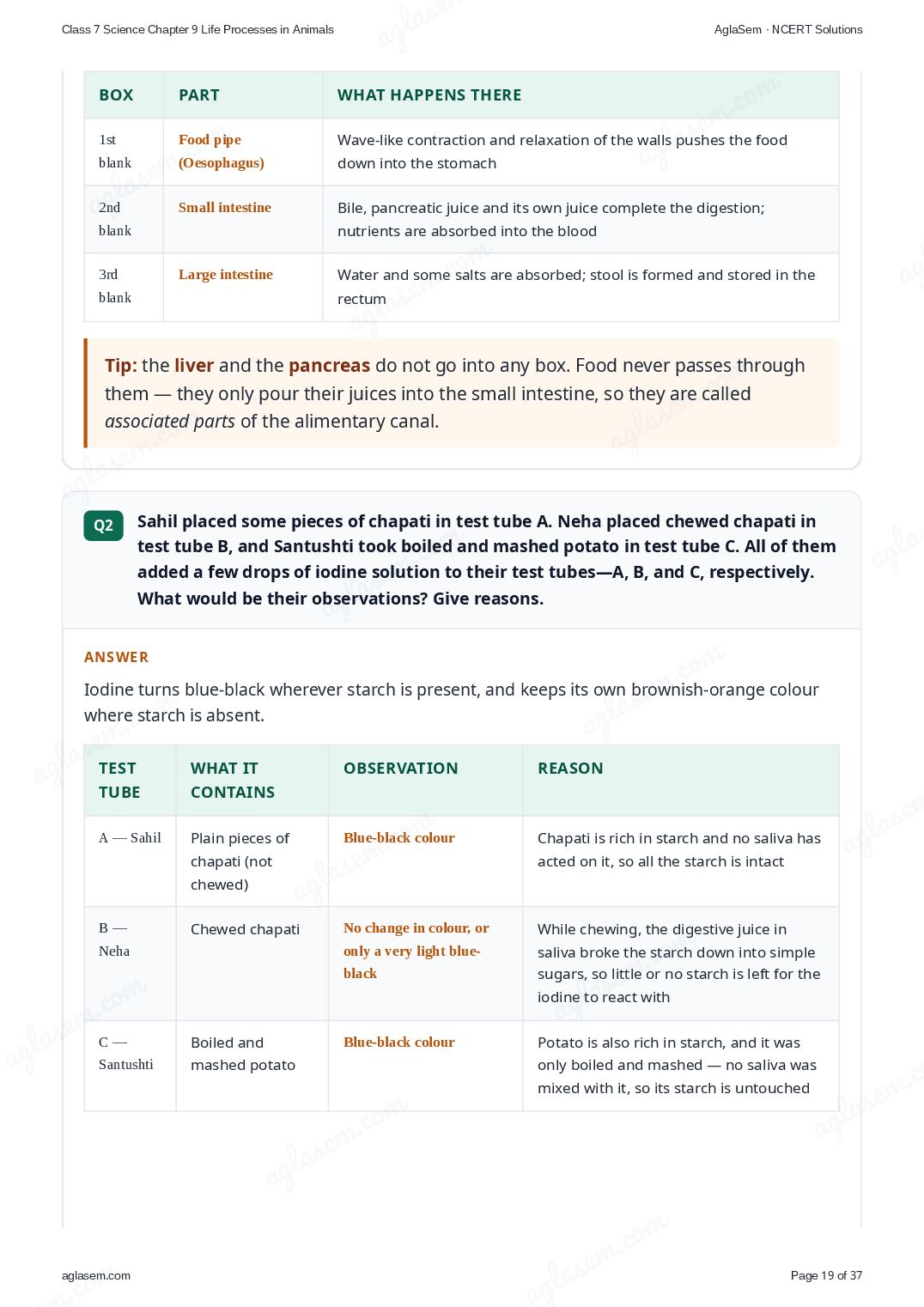
- Complete the journey of food through the alimentary canal by filling up the boxes with appropriate parts— Food → Mouth → ____ → Stomach → ____ → ____ → Anus
- Sahil placed some pieces of chapati in test tube A. Neha placed chewed chapati in test tube B, and Santushti took boiled and mashed potato in test tube C. All of them added a few drops of iodine solution to their test tubes—A, B, and C, respectively. What would be their observations? Give reasons.
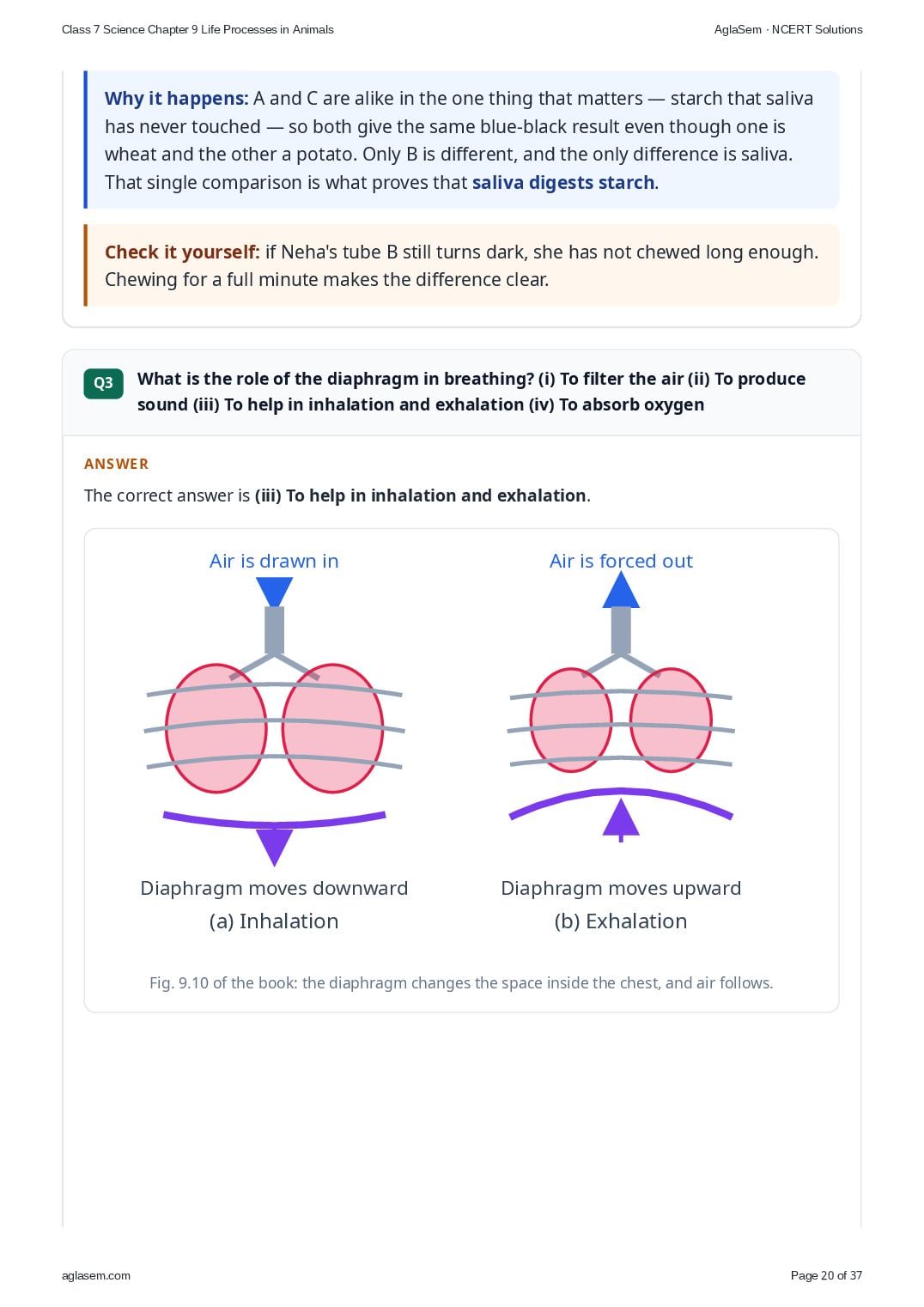
- What is the role of the diaphragm in breathing? (i) To filter the air (ii) To produce sound (iii) To help in inhalation and exhalation (iv) To absorb oxygen
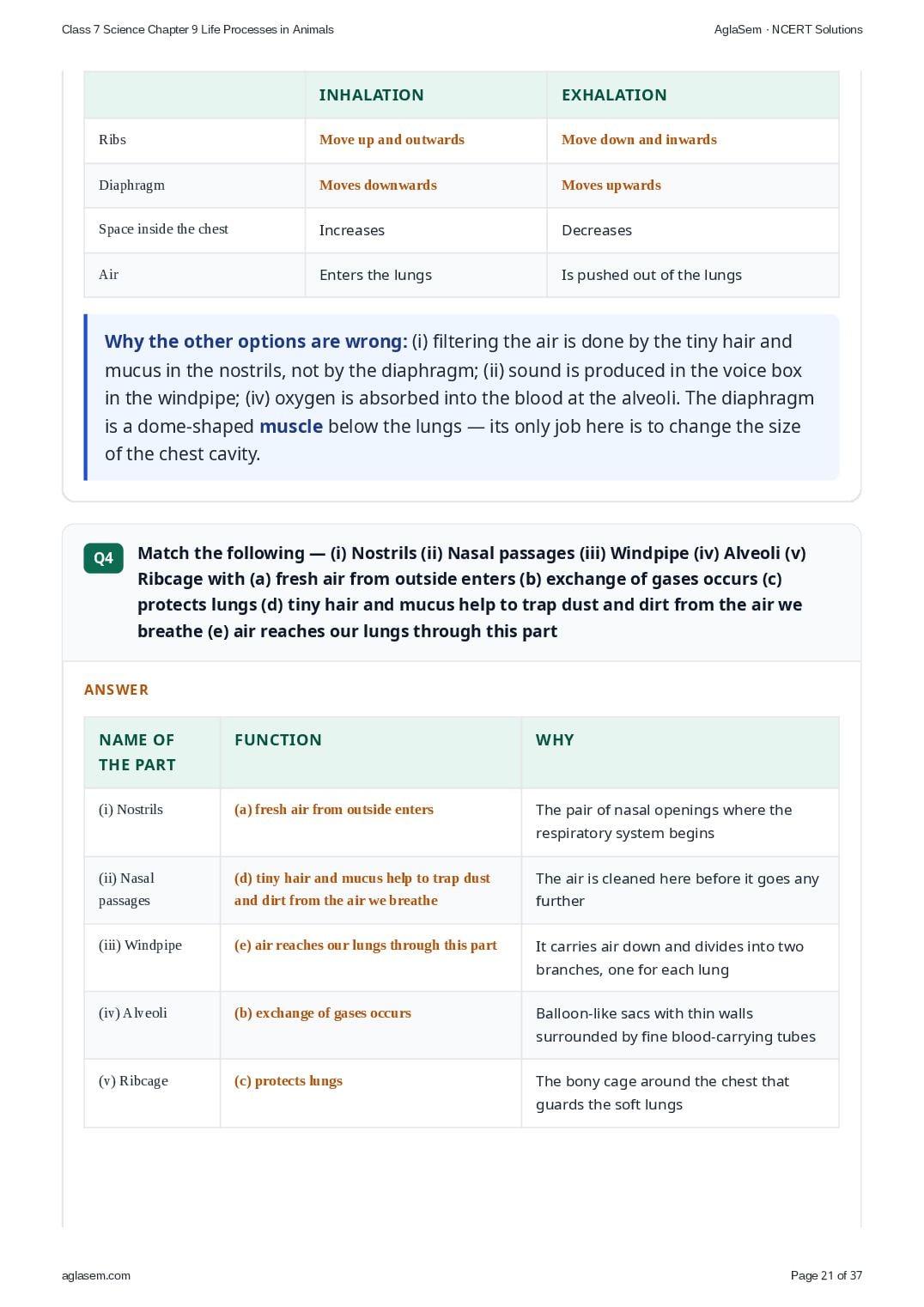
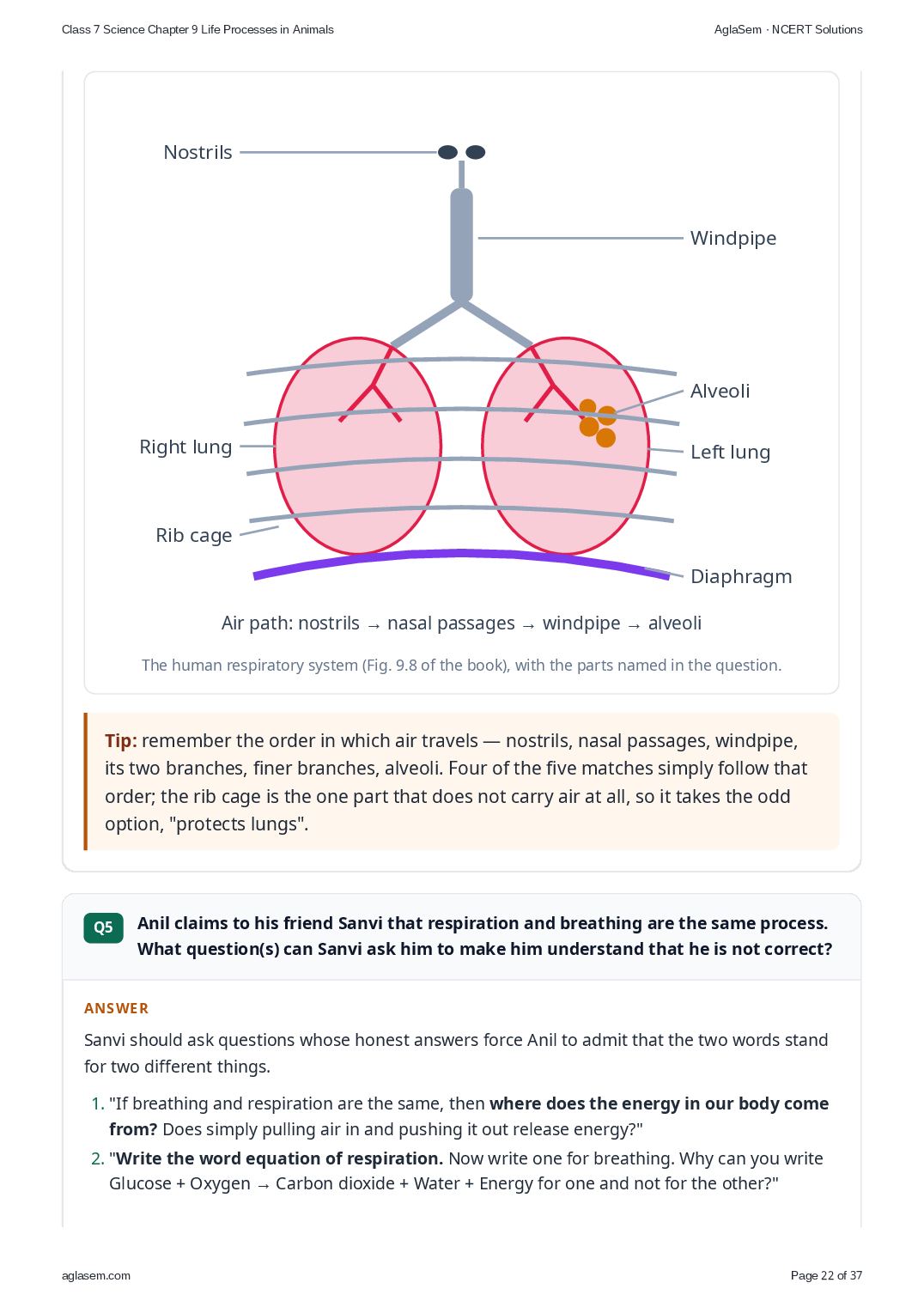
- Match the following — (i) Nostrils (ii) Nasal passages (iii) Windpipe (iv) Alveoli (v) Ribcage with (a) fresh air from outside enters (b) exchange of gases occurs (c) protects lungs (d) tiny hair and mucus help to trap dust and dirt from the air we breathe (e) air reaches our lungs through this part
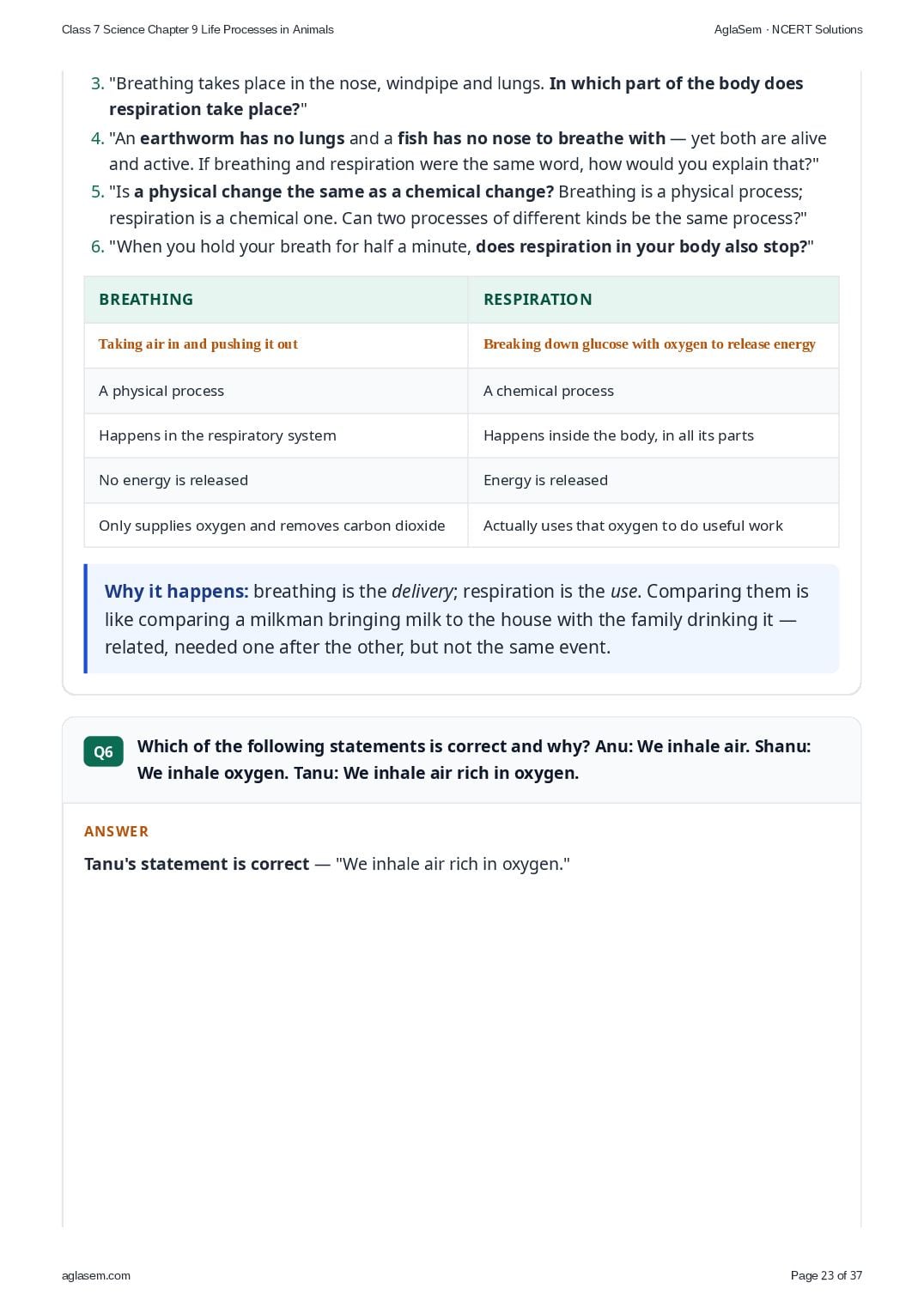
- Anil claims to his friend Sanvi that respiration and breathing are the same process. What question(s) can Sanvi ask him to make him understand that he is not correct?
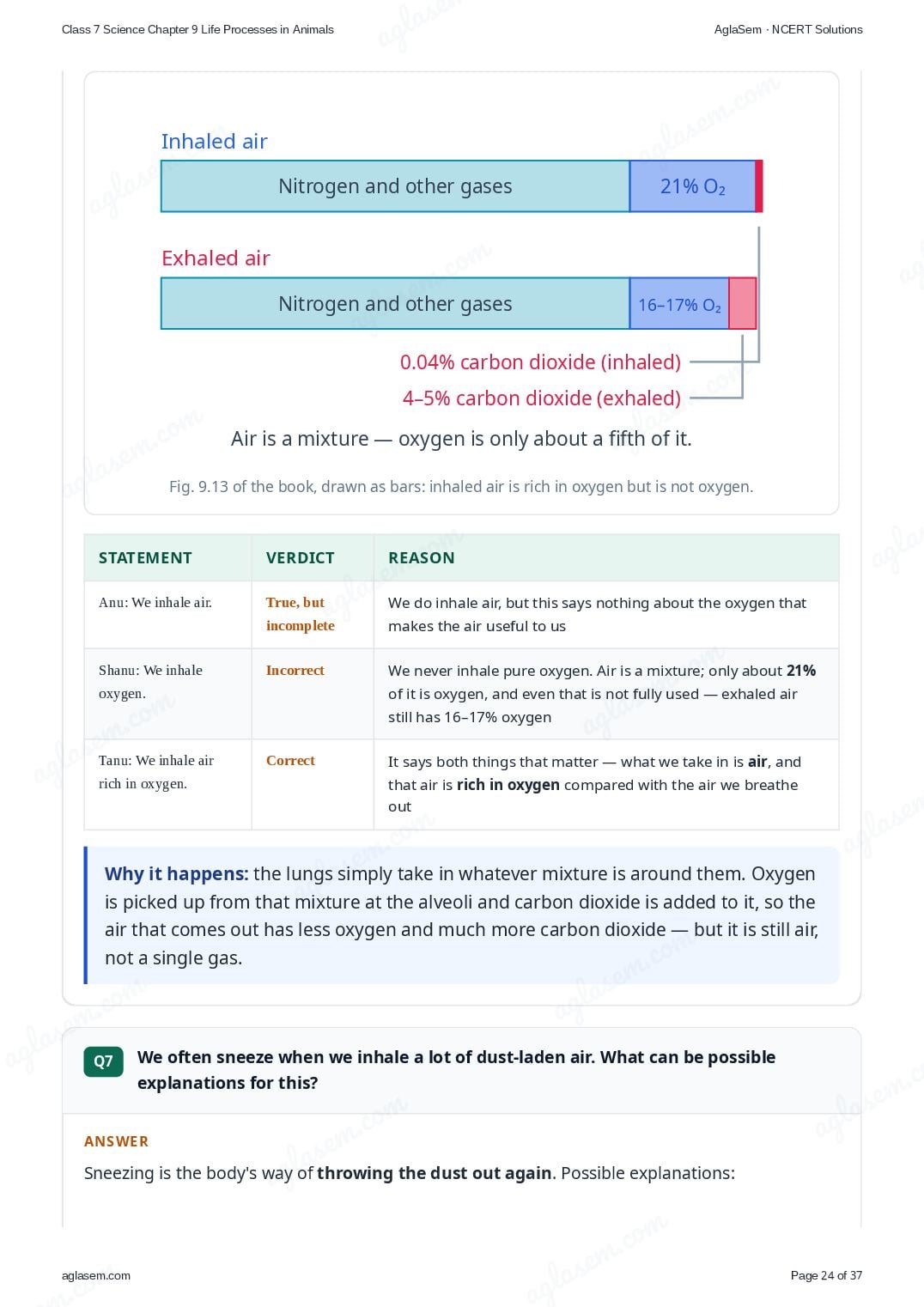
- Which of the following statements is correct and why? Anu: We inhale air. Shanu: We inhale oxygen. Tanu: We inhale air rich in oxygen.
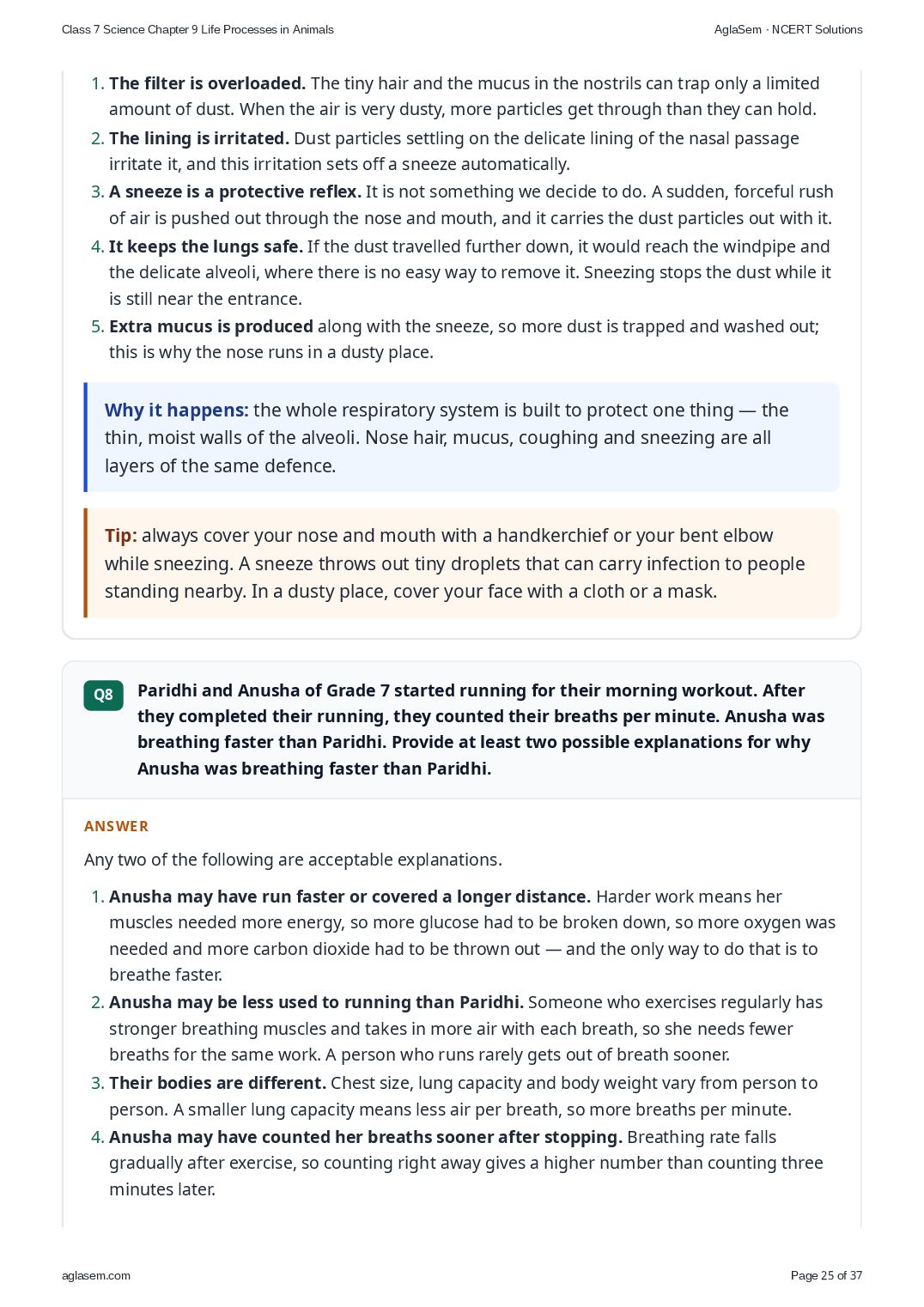
- We often sneeze when we inhale a lot of dust-laden air. What can be possible explanations for this?
- Paridhi and Anusha of Grade 7 started running for their morning workout. After they completed their running, they counted their breaths per minute. Anusha was breathing faster than Paridhi. Provide at least two possible explanations for why Anusha was breathing faster than Paridhi.
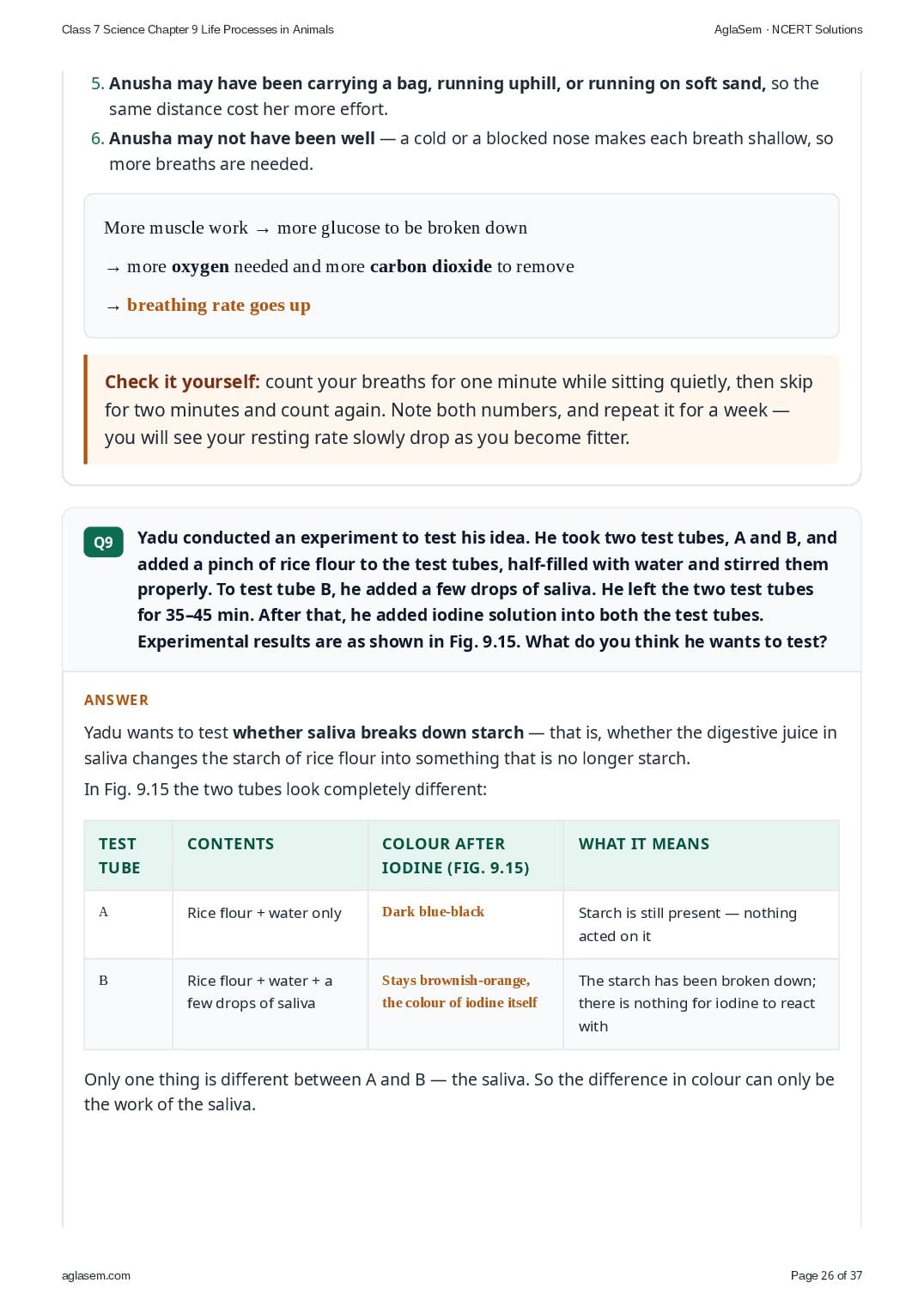
- Yadu conducted an experiment to test his idea. He took two test tubes, A and B, and added a pinch of rice flour to the test tubes, half-filled with water and stirred them properly. To test tube B, he added a few drops of saliva. He left the two test tubes for 35–45 min. After that, he added iodine solution into both the test tubes. Experimental results are as shown in Fig. 9.15. What do you think he wants to test?
- Rakshita designed an experiment taking two clean test tubes, A and B and filled them with lime water as shown in the figure. In test tube A, the surrounding air that we inhale was passed on by sucking air from the pipe, and in test tube B, the exhaled air was blown through the pipe (Fig. 9.16). What do you think she is trying to investigate? How can she confirm her findings?
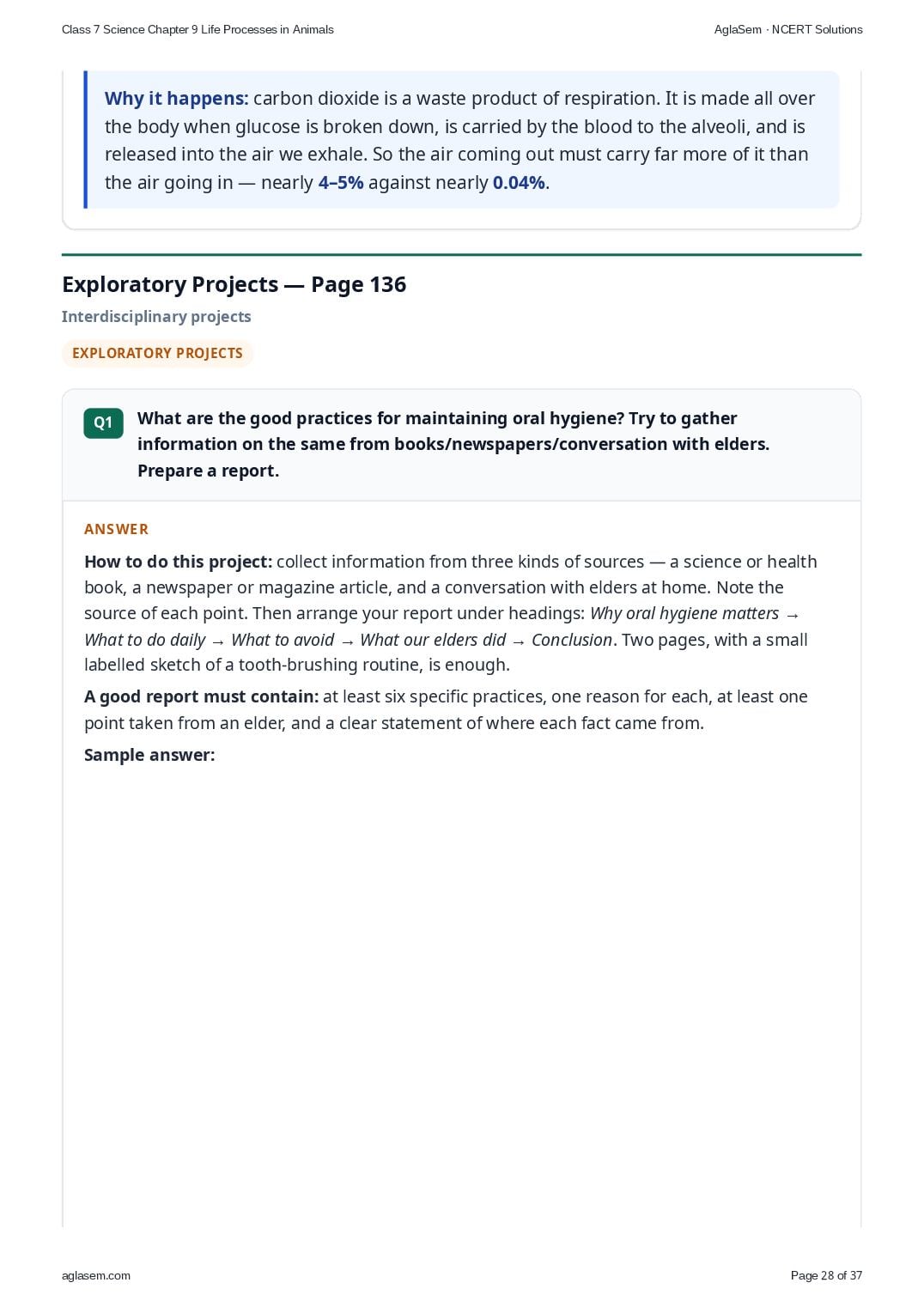
- What are the good practices for maintaining oral hygiene? Try to gather information on the same from books/newspapers/conversation with elders. Prepare a report.
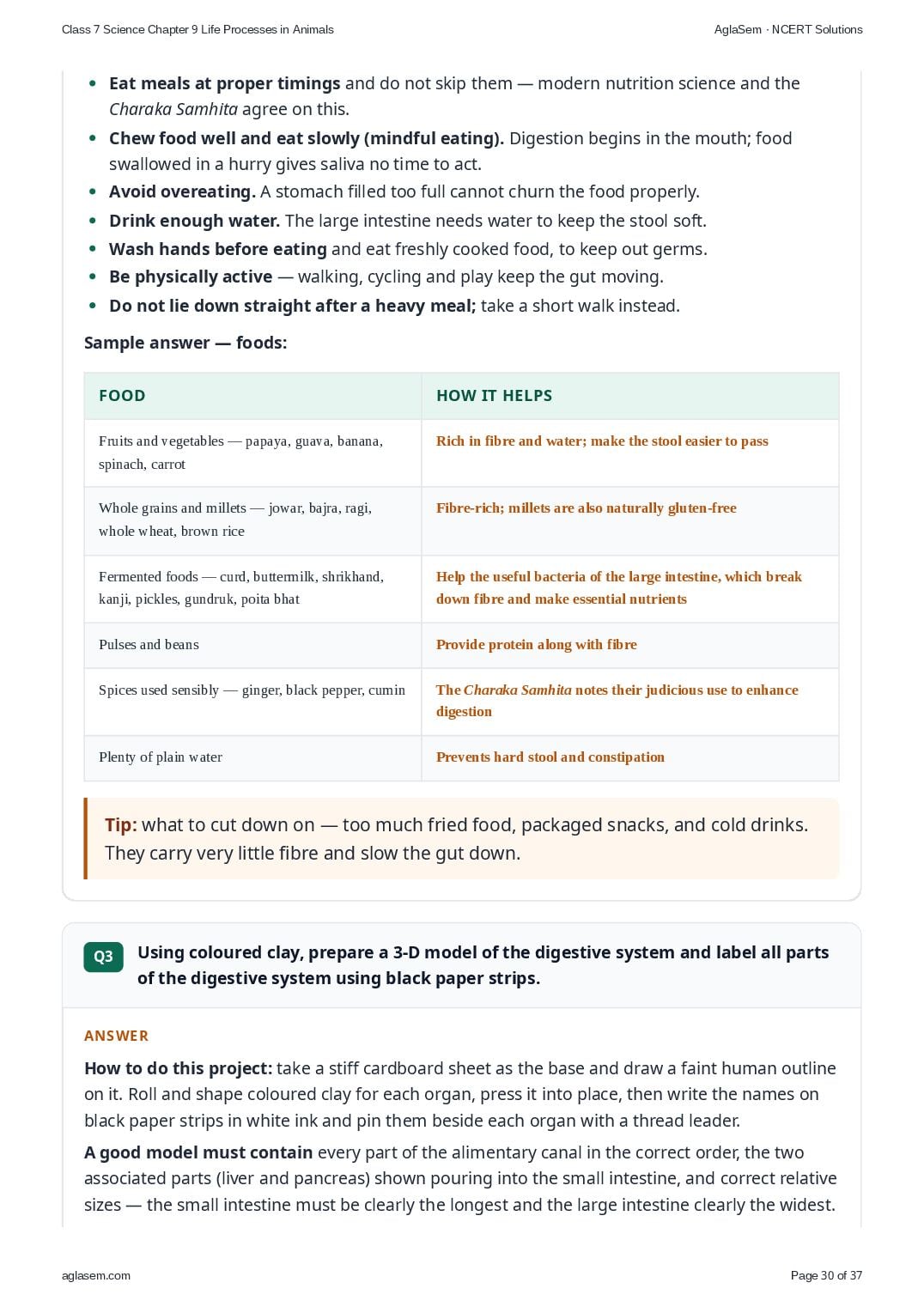
- Find out different ways to maintain a healthy digestive system. Suggest some food items that help to maintain good digestive health. Make a report and present it in class.
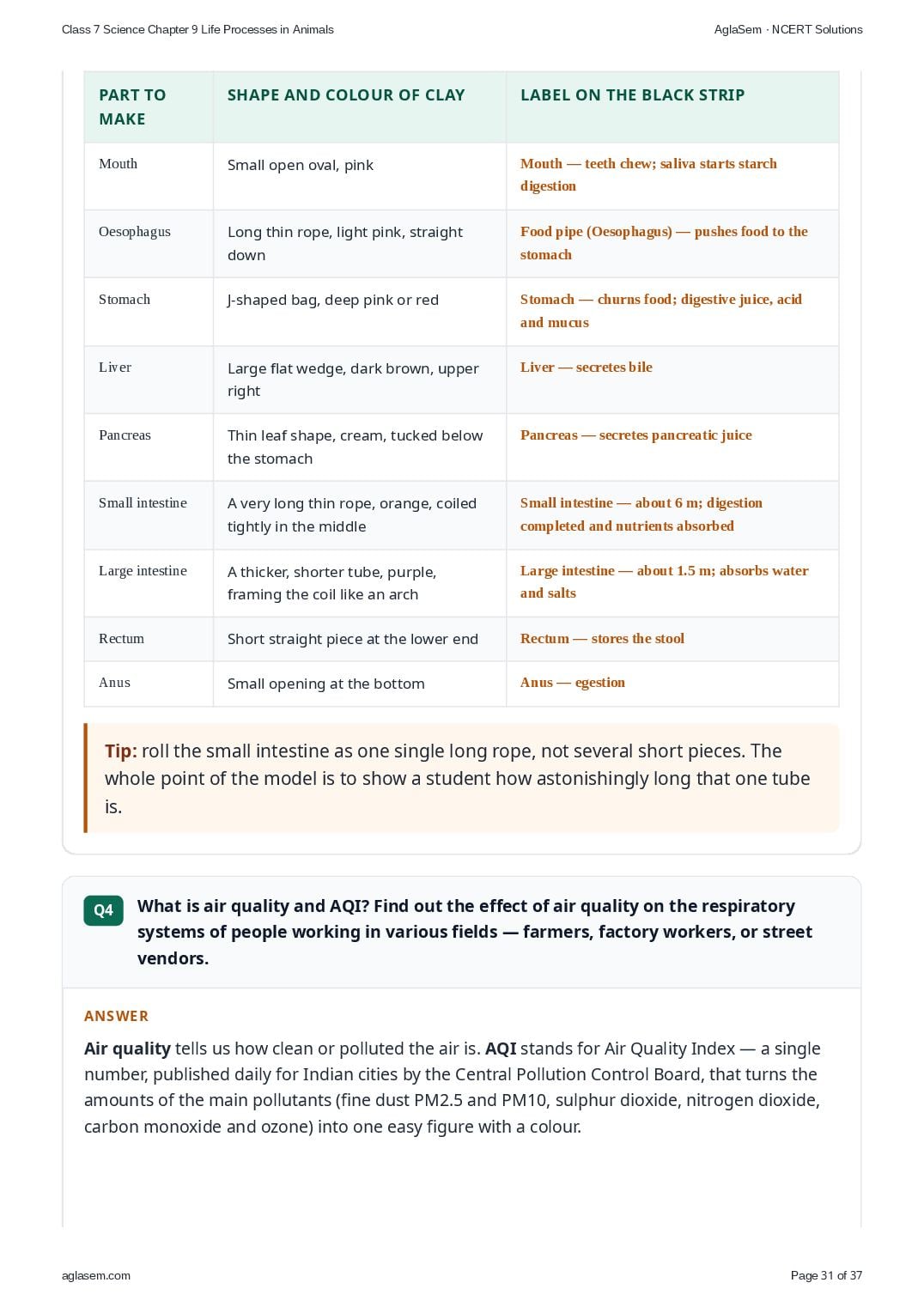
- Using coloured clay, prepare a 3-D model of the digestive system and label all parts of the digestive system using black paper strips.
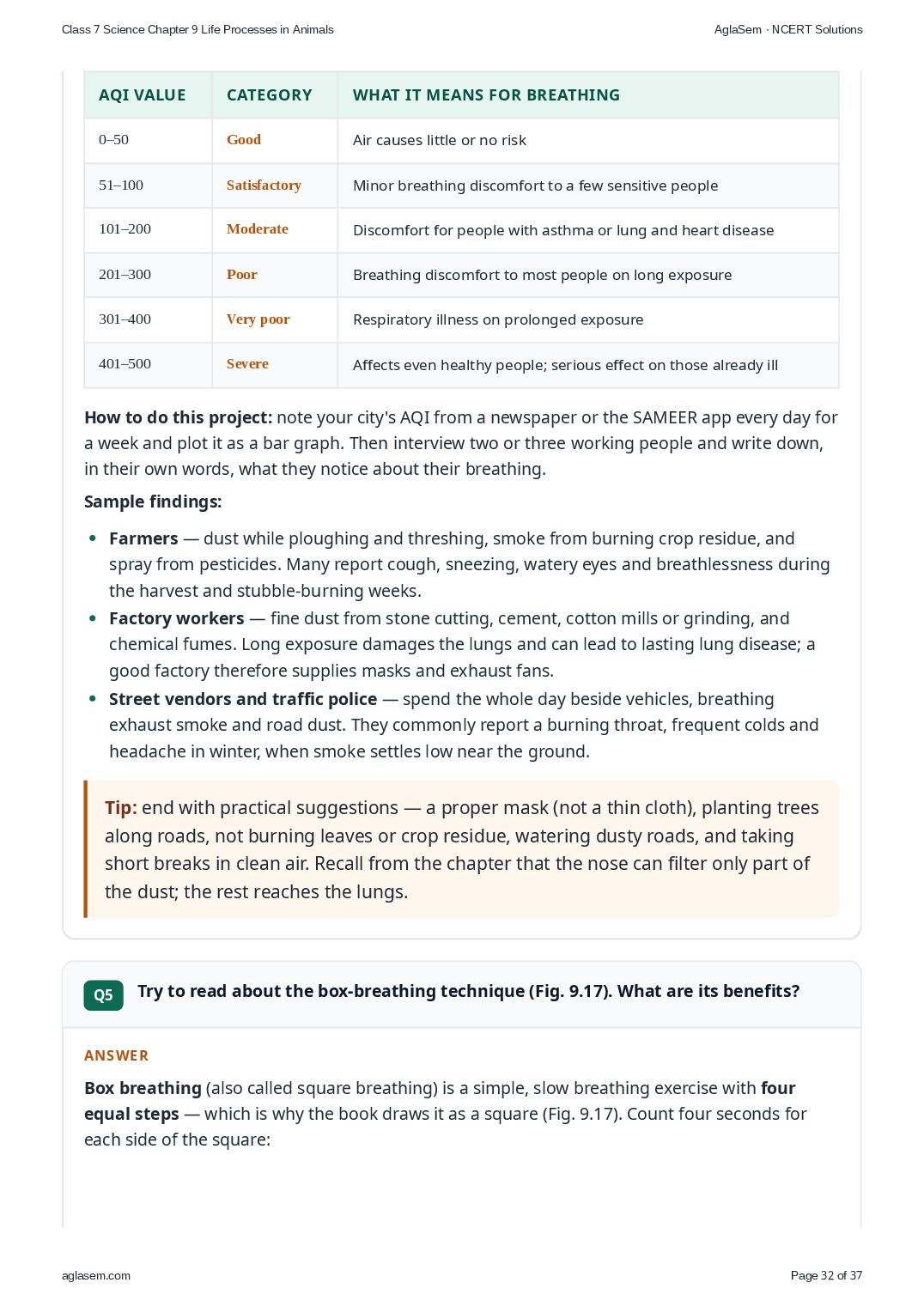
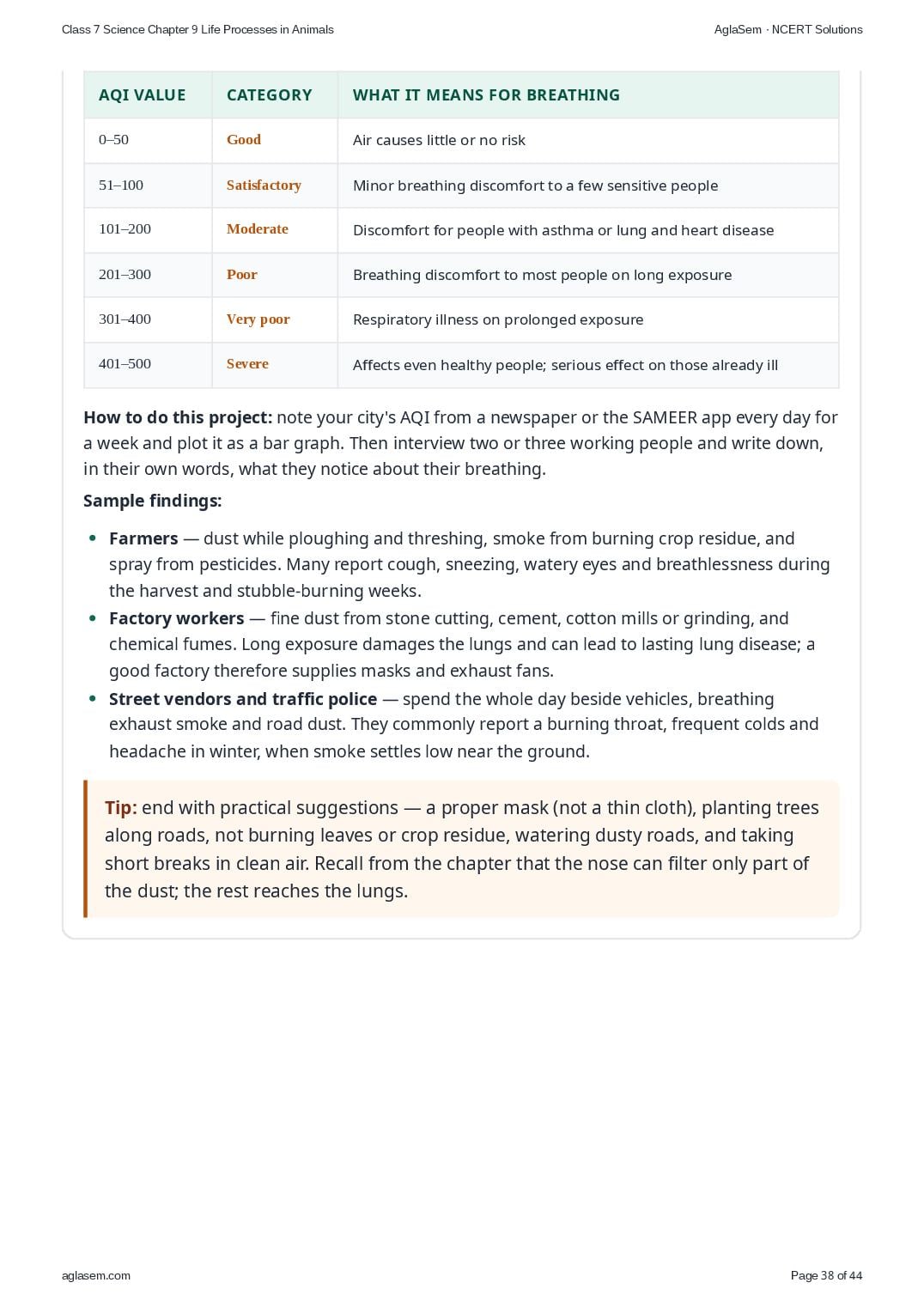
- What is air quality and AQI? Find out the effect of air quality on the respiratory systems of people working in various fields — farmers, factory workers, or street vendors.
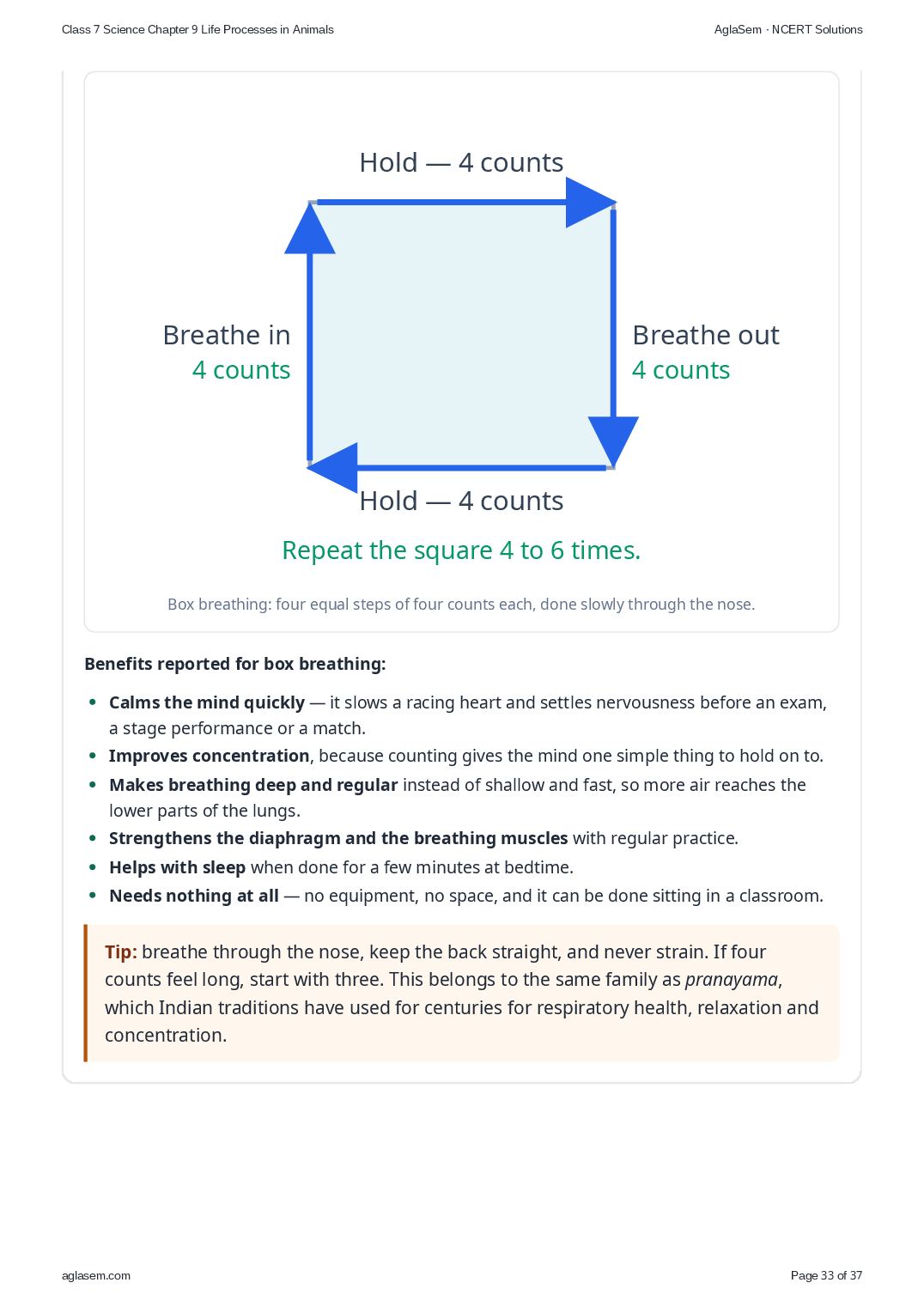
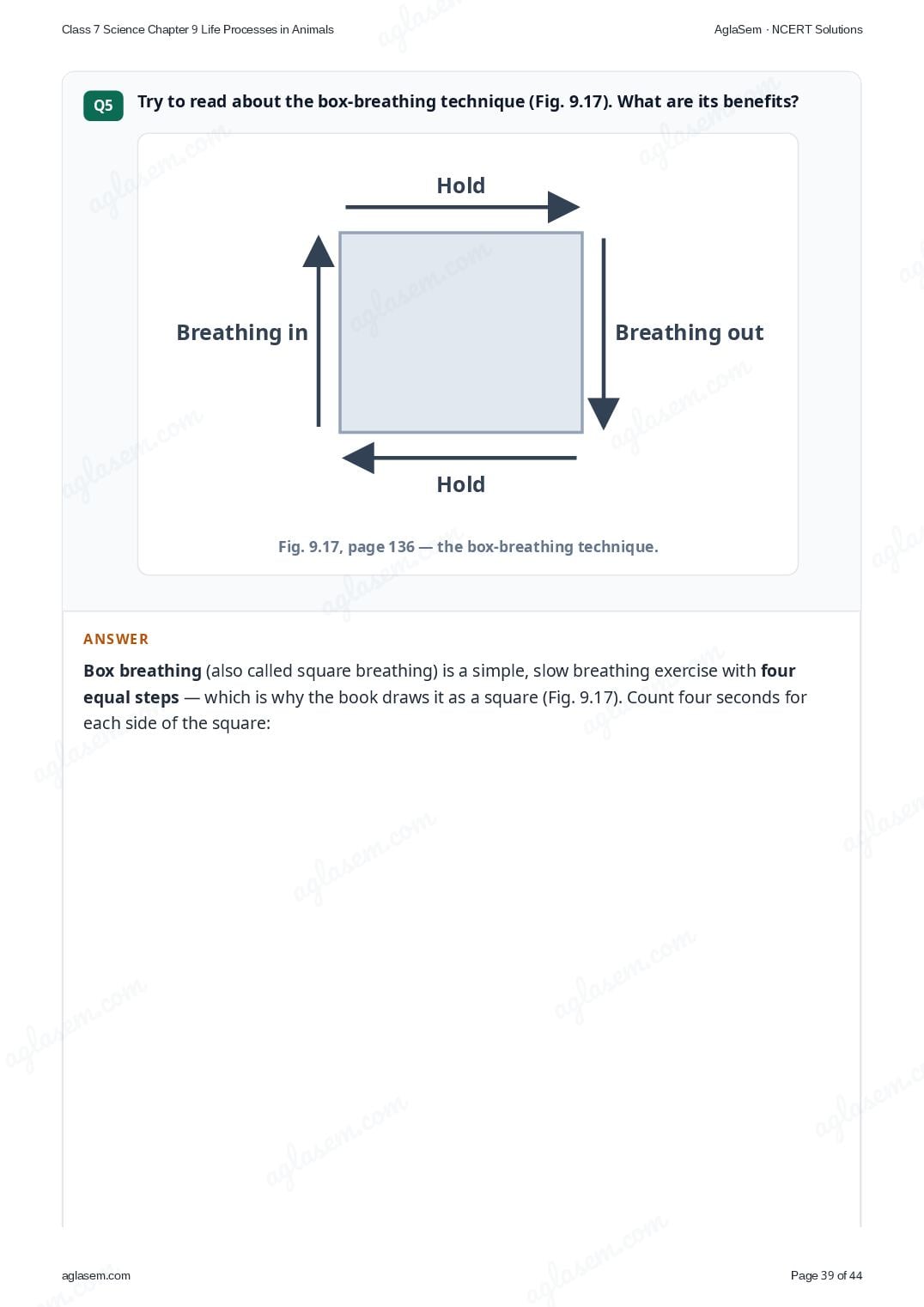
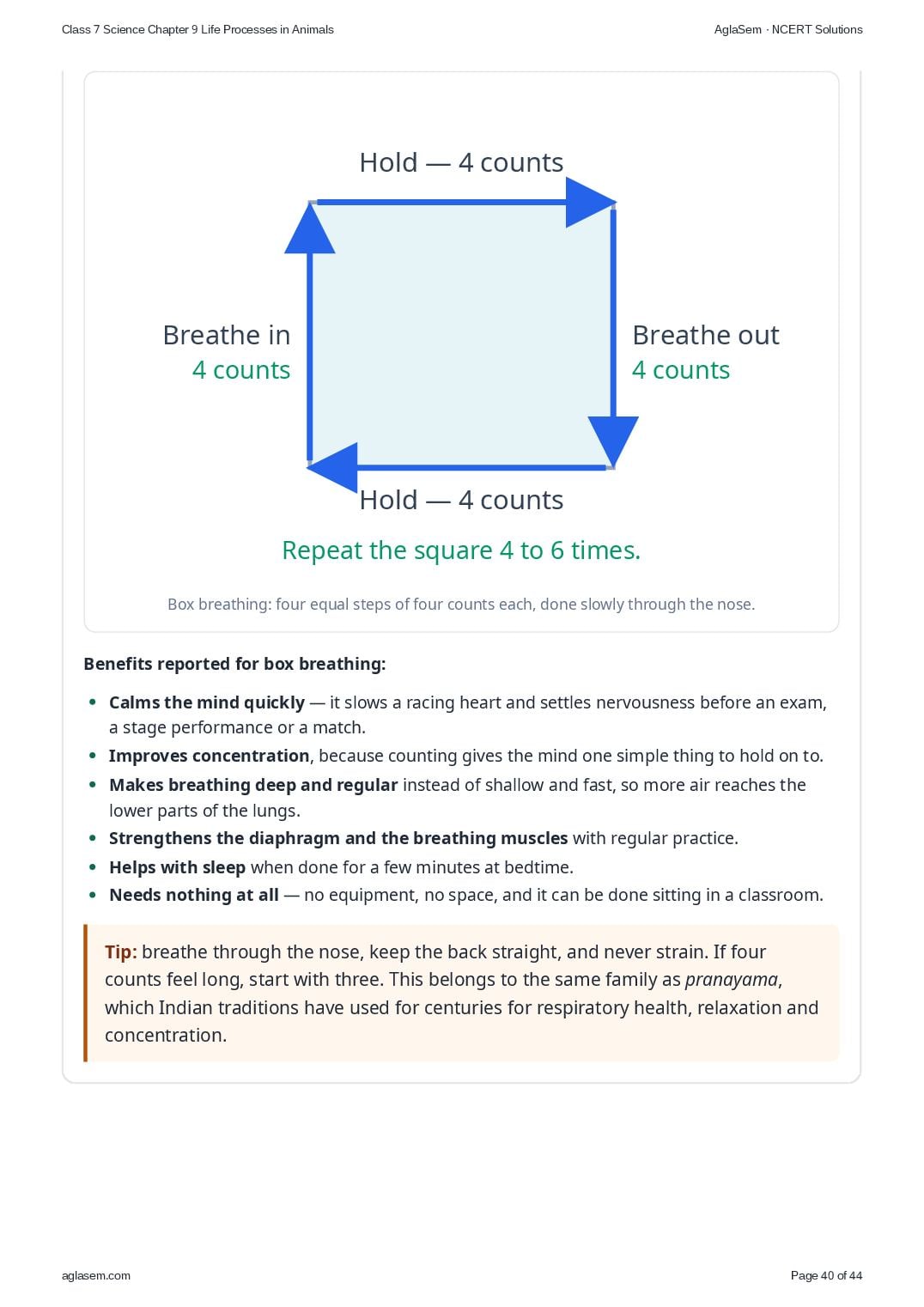
- Try to read about the box-breathing technique (Fig. 9.17). What are its benefits?
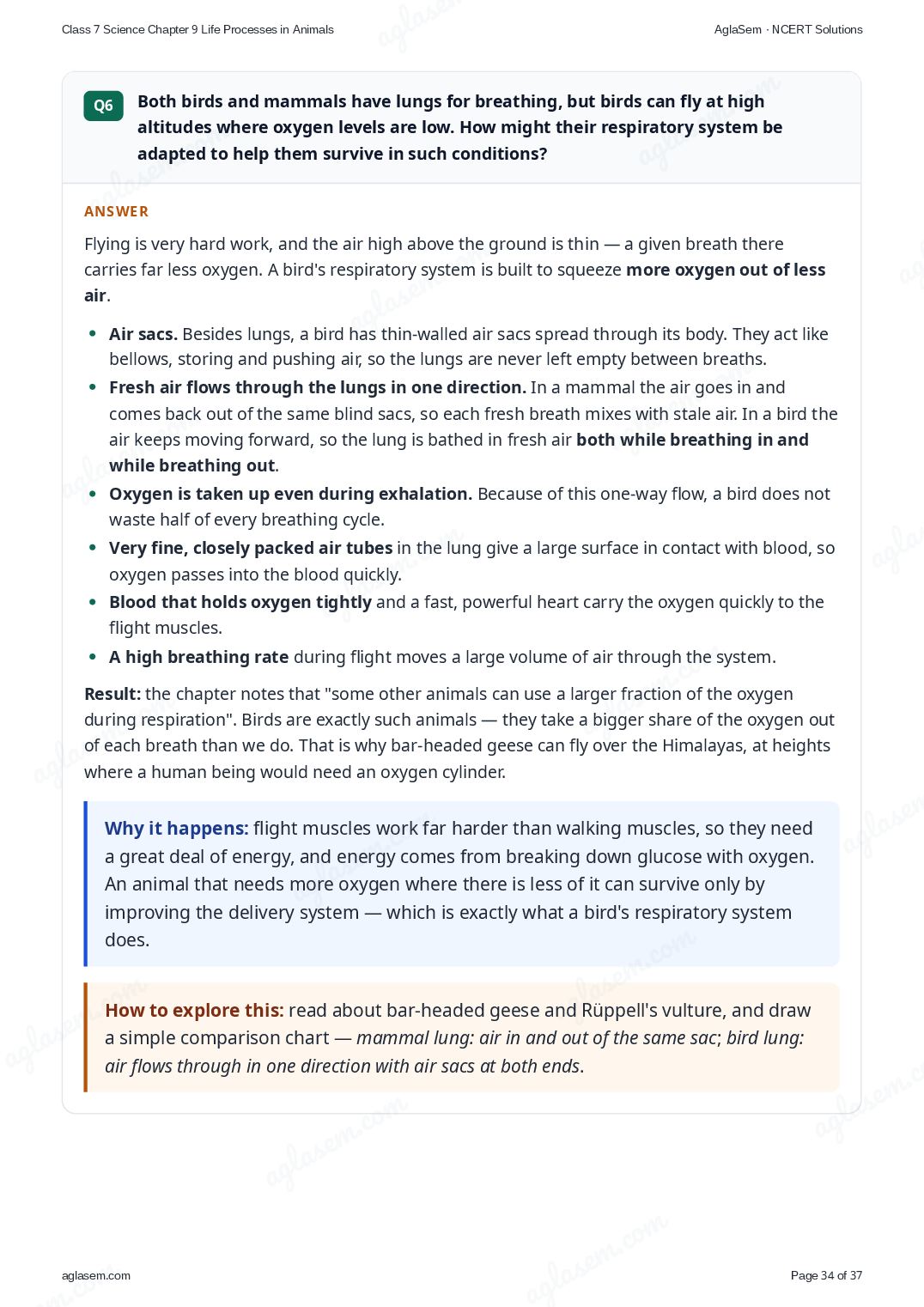
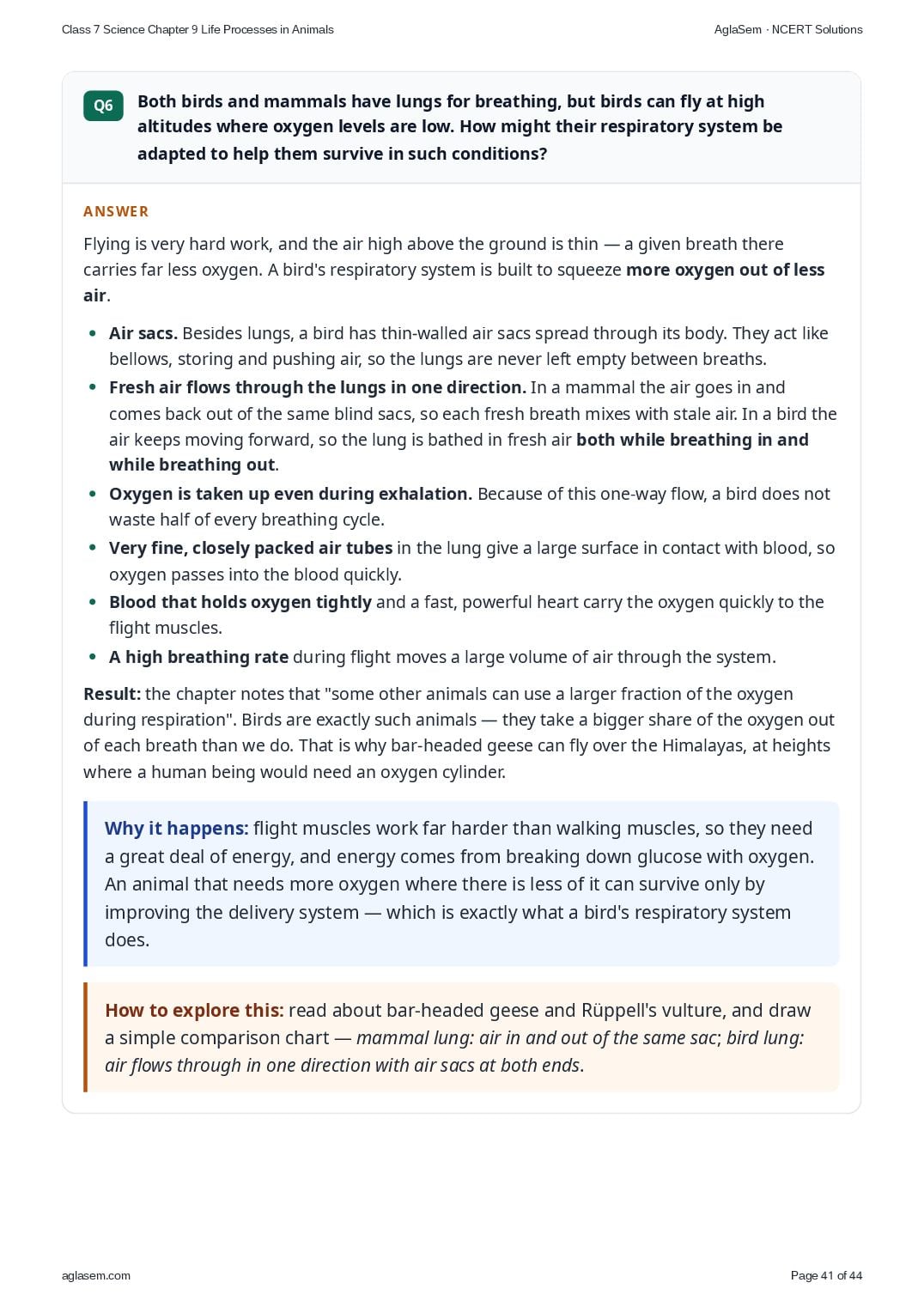
- Both birds and mammals have lungs for breathing, but birds can fly at high altitudes where oxygen levels are low. How might their respiratory system be adapted to help them survive in such conditions?
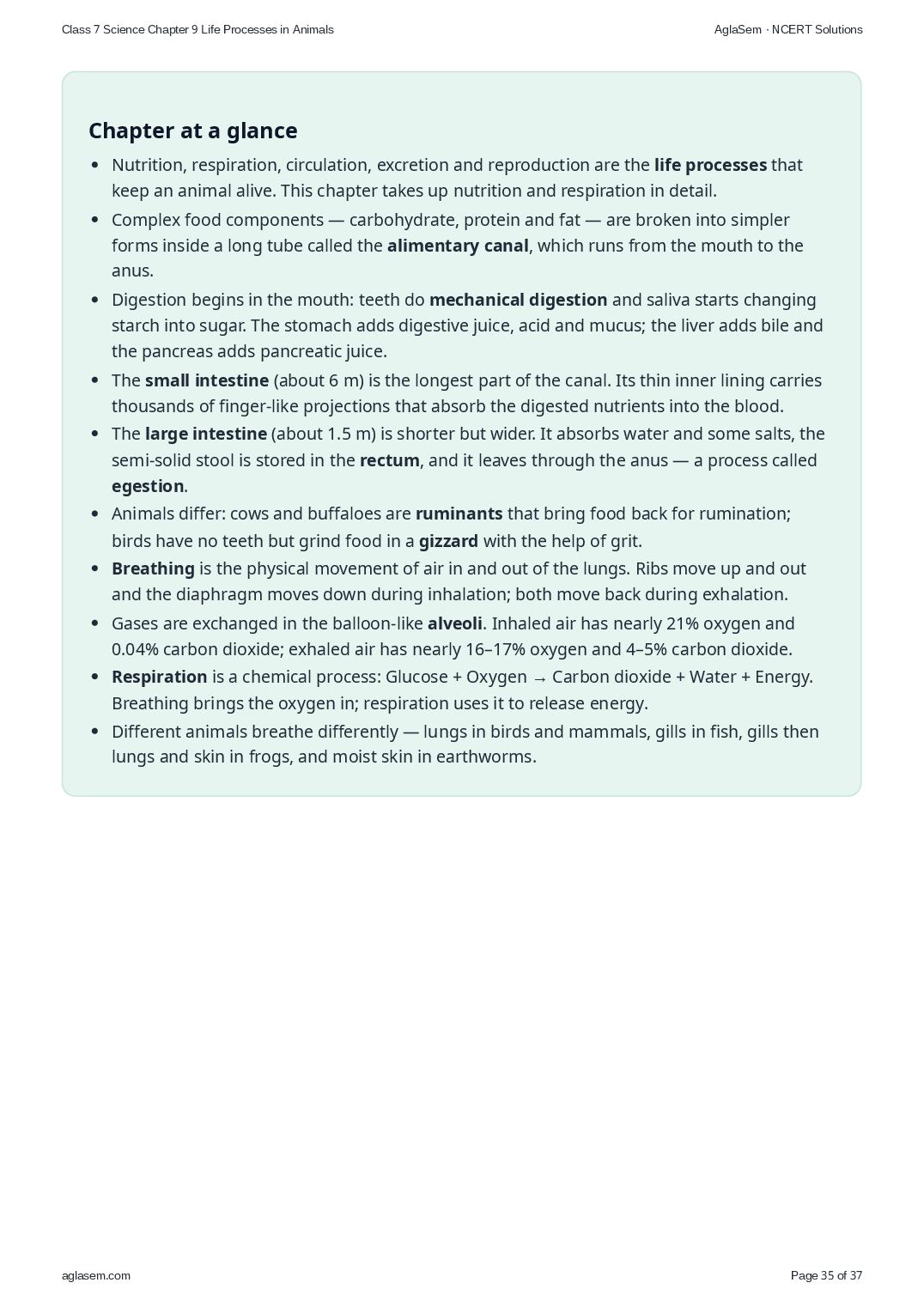
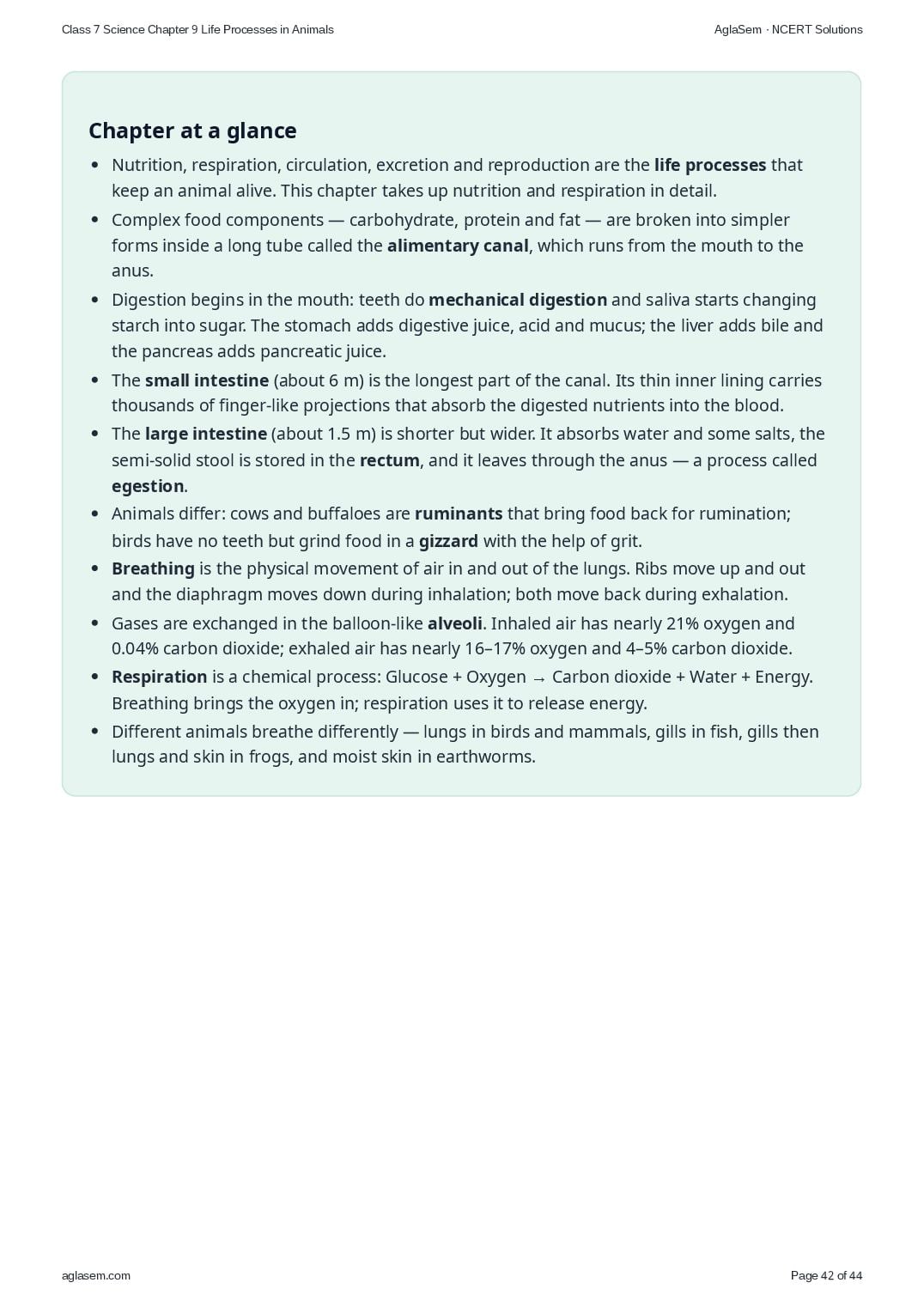
Chapter at a Glance
- Nutrition, respiration, circulation, excretion and reproduction are the life processes that keep an animal alive. This chapter takes up nutrition and respiration in detail.
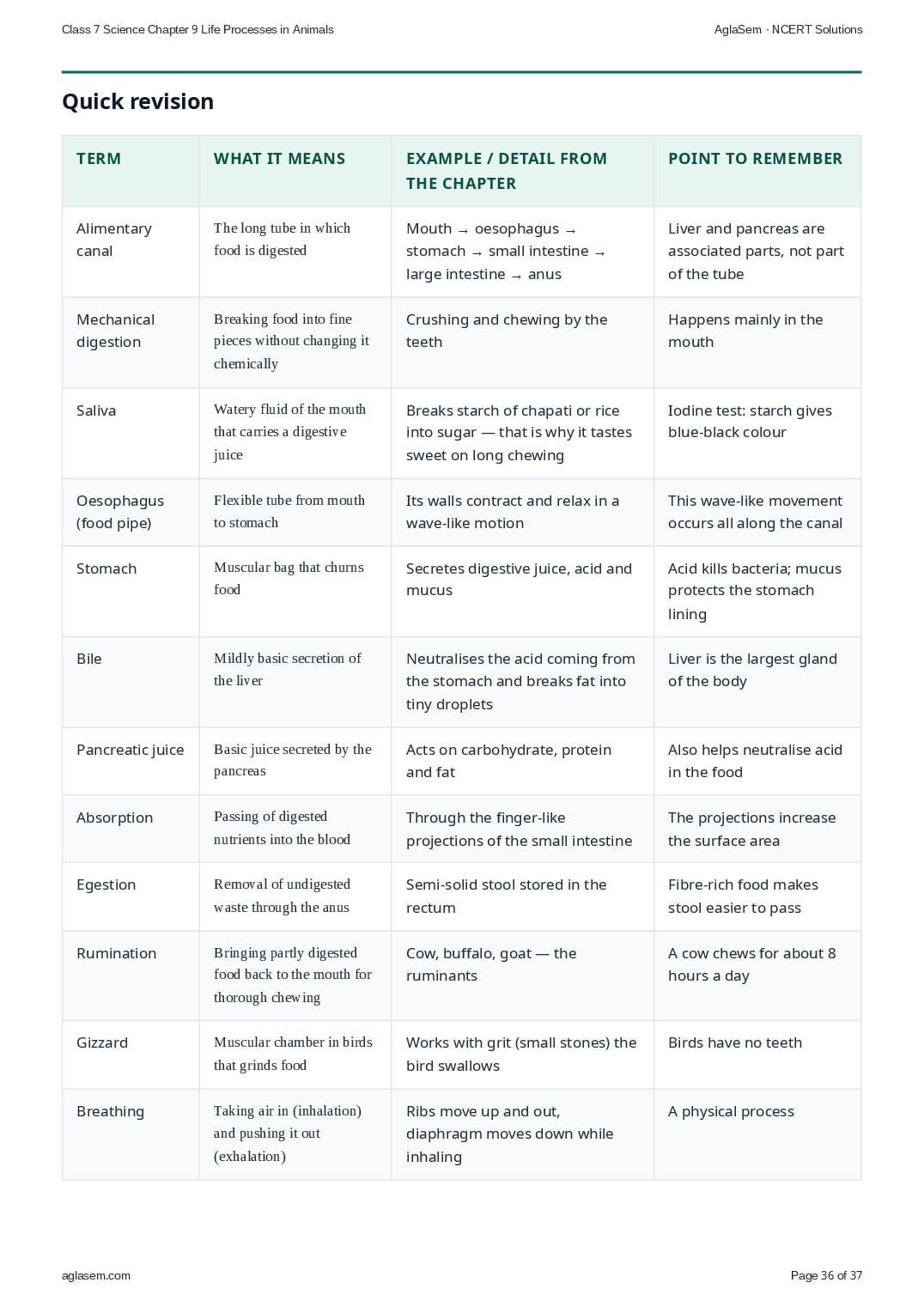
- Complex food components — carbohydrate, protein and fat — are broken into simpler forms inside a long tube called the alimentary canal , which runs from the mouth to the anus.
- Digestion begins in the mouth: teeth do mechanical digestion and saliva starts changing starch into sugar. The stomach adds digestive juice, acid and mucus; the liver adds bile and the pancreas adds pancreatic juice.
- The small intestine (about 6 m) is the longest part of the canal. Its thin inner lining carries thousands of finger-like projections that absorb the digested nutrients into the blood.
- The large intestine (about 1.5 m) is shorter but wider. It absorbs water and some salts, the semi-solid stool is stored in the rectum , and it leaves through the anus — a process called egestion .
- Animals differ: cows and buffaloes are ruminants that bring food back for rumination; birds have no teeth but grind food in a gizzard with the help of grit.
- Breathing is the physical movement of air in and out of the lungs. Ribs move up and out and the diaphragm moves down during inhalation; both move back during exhalation.
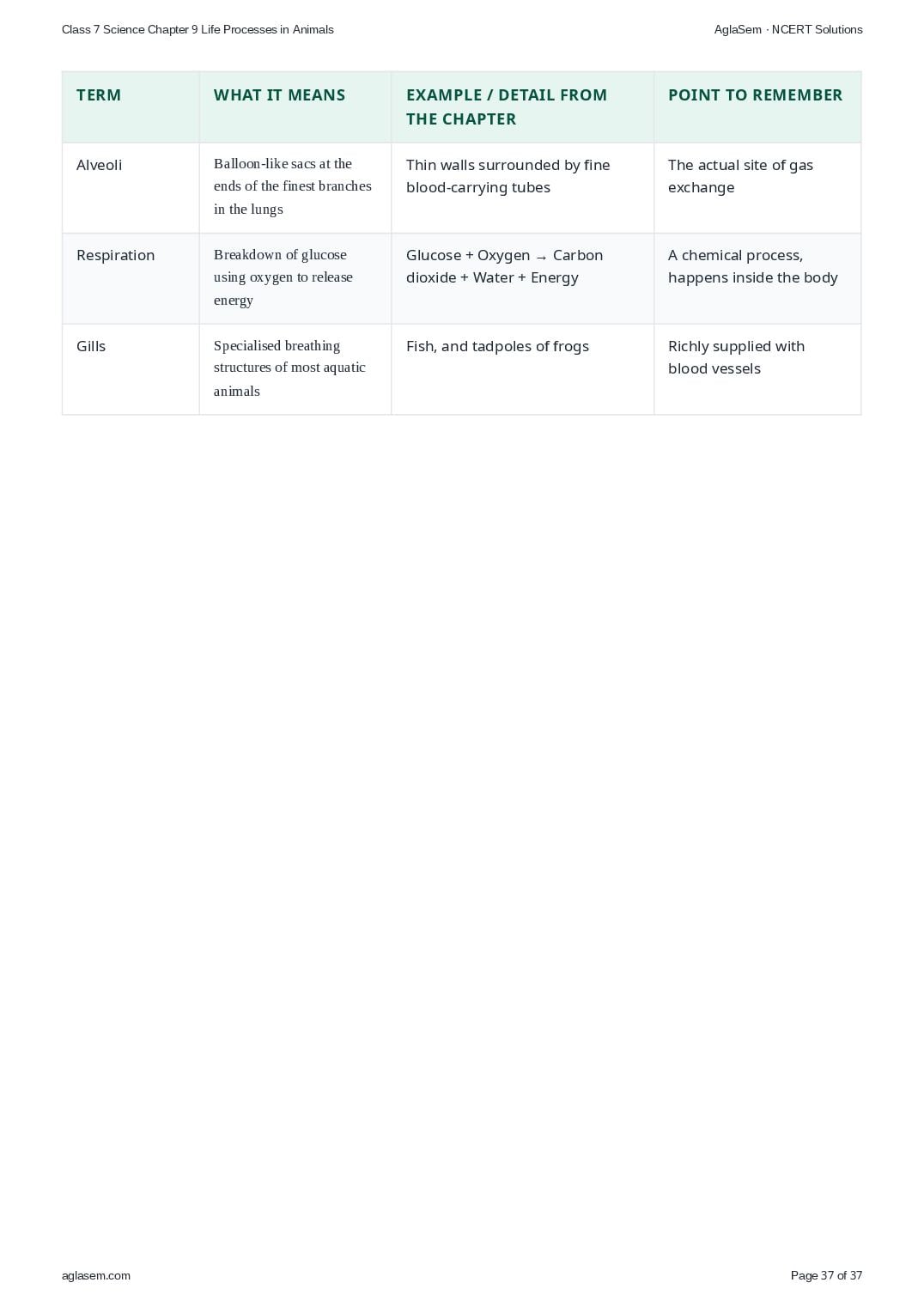
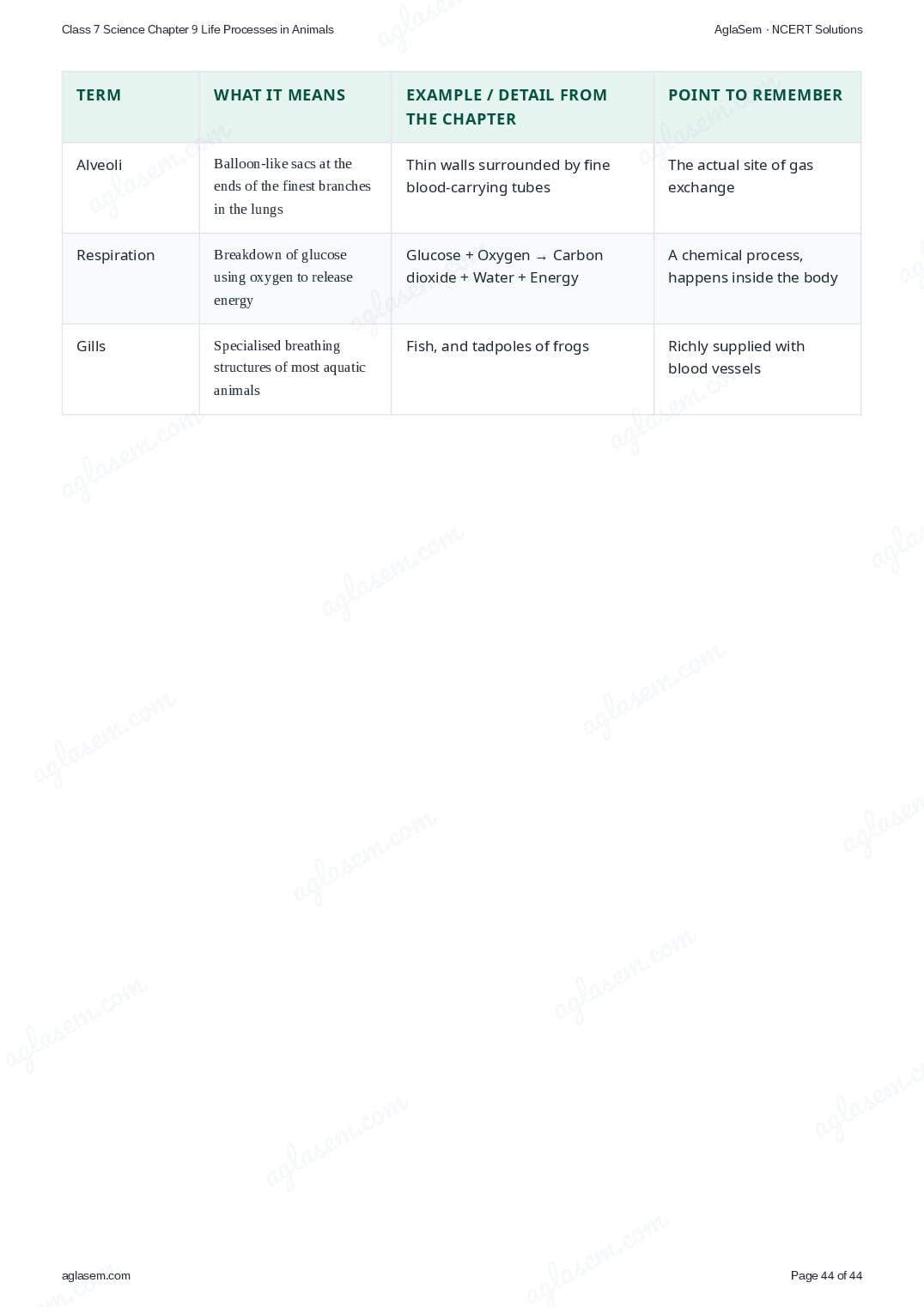
- Gases are exchanged in the balloon-like alveoli . Inhaled air has nearly 21% oxygen and 0.04% carbon dioxide; exhaled air has nearly 16–17% oxygen and 4–5% carbon dioxide.
- Respiration is a chemical process: Glucose + Oxygen → Carbon dioxide + Water + Energy. Breathing brings the oxygen in; respiration uses it to release energy.
- Different animals breathe differently — lungs in birds and mammals, gills in fish, gills then lungs and skin in frogs, and moist skin in earthworms.
How to Download NCERT Solutions for Class 7 Science Chapter 9 PDF
Follow these simple steps to get the Life Processes in Animals questions-and-answers PDF from Curiosity.
- Search NCERT Solutions for Class 7 Science Chapter 9 aglasem and open this page.
- Read the exercise questions with answers for Life Processes in Animals shown above.
- Click the Download PDF link to save the Life Processes in Animals solutions to your device.
NCERT Solutions for Class 7 Science – All Chapters
There are more chapters to study besides Life Processes in Animals in Science. Here are the NCERT Solutions for all chapters of Class 7 Science.
- Chapter 1 the Ever Evolving World of Science
- Chapter 2 Exploring Substances Acidic Basic and Neutral
- Chapter 3 Electricity Circuits and Their Components
- Chapter 4 the World of Metals and Non Metals
- Chapter 5 Changes Around Us Physical and Chemical
- Chapter 6 Adolescence a Stage of Growth and Change
- Chapter 7 Heat Transfer in Nature
- Chapter 8 Measurement of Time and Motion
- Chapter 9 Life Processes in Animals
- Chapter 10 Life Processes in Plants
- Chapter 11 Light Shadows and Reflections
- Chapter 12 Earth Moon and the Sun
NCERT Solutions for Class 7 – All Subjects
Just like Chapter 9 of Science, you can get the exercise questions with answers for every other subject of Class 7. Here are the NCERT Solutions for all subjects of Class 7.
NCERT Solutions for Class 7 Science Chapter 9 – An Overview
The key highlights of this study material are as follows.
| Aspects | Details |
|---|---|
| Class | Class 7 |
| Subject | Science |
| Chapter Number | Chapter 9 |
| Chapter Name | Life Processes in Animals |
| Book Name | Curiosity |
| Book By | NCERT (National Council of Educational Research and Training) |
| Educational Resource Here | NCERT Solutions of Class 7 Science Chapter 9 for all exercises |
| More Questions Answers of This Subject | NCERT Solutions for Class 7 Science |
| Download Book Chapter | NCERT Book Class 7 Science |
| All Questions Answers For This Class | NCERT Solutions for Class 7 |
| Complete Solutions | NCERT Solutions |
NCERT Solutions for Class 7 Science Chapter 9 Life Processes in Animals – FAQs
What are the NCERT Solutions for Class 7 Science Chapter 9 Life Processes in Animals?
They are the complete, step-by-step answers to all the exercise and in-text questions of Chapter 9 Life Processes in Animals from the NCERT Class 7 Science textbook Curiosity, written by experts as per the latest NCERT syllabus.
How can I download the Class 7 Science Chapter 9 solutions PDF for free?
Open this page on aglasem, read the Life Processes in Animals questions with answers, and click the “Download Solutions PDF” link. The Class 7 Science Chapter 9 NCERT Solutions PDF is completely free to download.
Are these NCERT Solutions as per the latest 2026-27 syllabus?
Yes. The NCERT Solutions for Class 7 Science Chapter 9 are based on the latest NCERT textbook Curiosity and the current 2026-27 CBSE syllabus, so the questions and answers match what you study in class.
Where can I get NCERT Solutions for the other chapters of Class 7 Science?
You can find the answers to every chapter on the NCERT Solutions for Class 7 Science page, and solutions for every subject on the NCERT Solutions for Class 7 page.
How do NCERT Solutions help in exam preparation?
They show the correct method to solve each question, help you write answers the way they are expected in exams, let you check and correct your own work, and save revision time — which together improve your marks in Class 7 Science.
If you have any queries on NCERT Solutions for Class 7 Science Chapter 9 Life Processes in Animals, then please ask in the comments below.