NCERT Solutions for Class 8 Maths Chapter 6 We Distribute Yet Things Multiply provide clear, step-by-step answers to every exercise and in-text question from the chapter We Distribute Yet Things Multiply of the NCERT textbook Ganita Prakash. Prepared by subject experts as per the latest NCERT (CBSE) syllabus for 2026-27, these NCERT Solutions for Class 8 Maths help you understand each concept, write exam-ready answers, and check your own solutions. You can read them online below or download the free Class 8 Maths Chapter 6 question-answer PDF.
NCERT Solutions for Class 8 Maths Chapter 6 We Distribute Yet Things Multiply
- Class: Class 8
- Subject: Maths
- Chapter: Chapter 6 – We Distribute Yet Things Multiply
- Textbook: Ganita Prakash (NCERT)
- Study material: NCERT Solutions – questions with answers, free PDF
These solutions answer all the exercise questions of Chapter 6 We Distribute Yet Things Multiply — including the in-text questions, short-answer and long-answer questions, and activities — with complete explanations so you can follow the method, not just the final answer. Read the full solutions below.
NCERT Solutions Class 8 Maths Chapter 6 We Distribute Yet Things Multiply View Download
NCERT Solutions for Class 8 Maths Chapter 6 PDF Download
You can read the NCERT Solutions for Class 8 Maths Chapter 6 online above, or download the complete question-answer PDF to study We Distribute Yet Things Multiply offline at any time.
NCERT Solutions for Class 8 Maths Chapter 6 PDF Download Link – Click Here to Download Solutions PDF
Questions Covered in This Chapter
These NCERT Solutions answer all 91 questions of this chapter. The questions solved are:
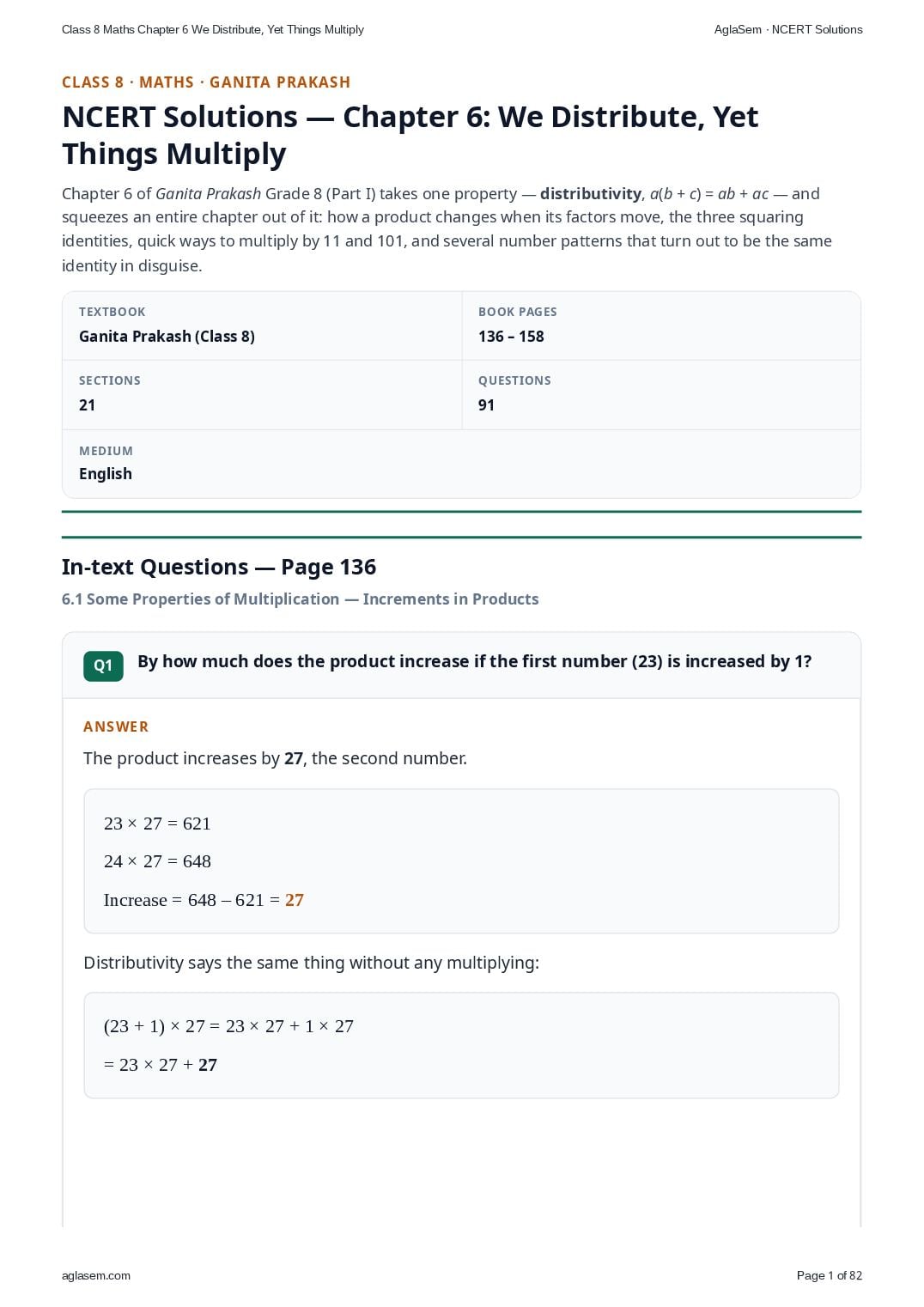
- By how much does the product increase if the first number (23) is increased by 1?
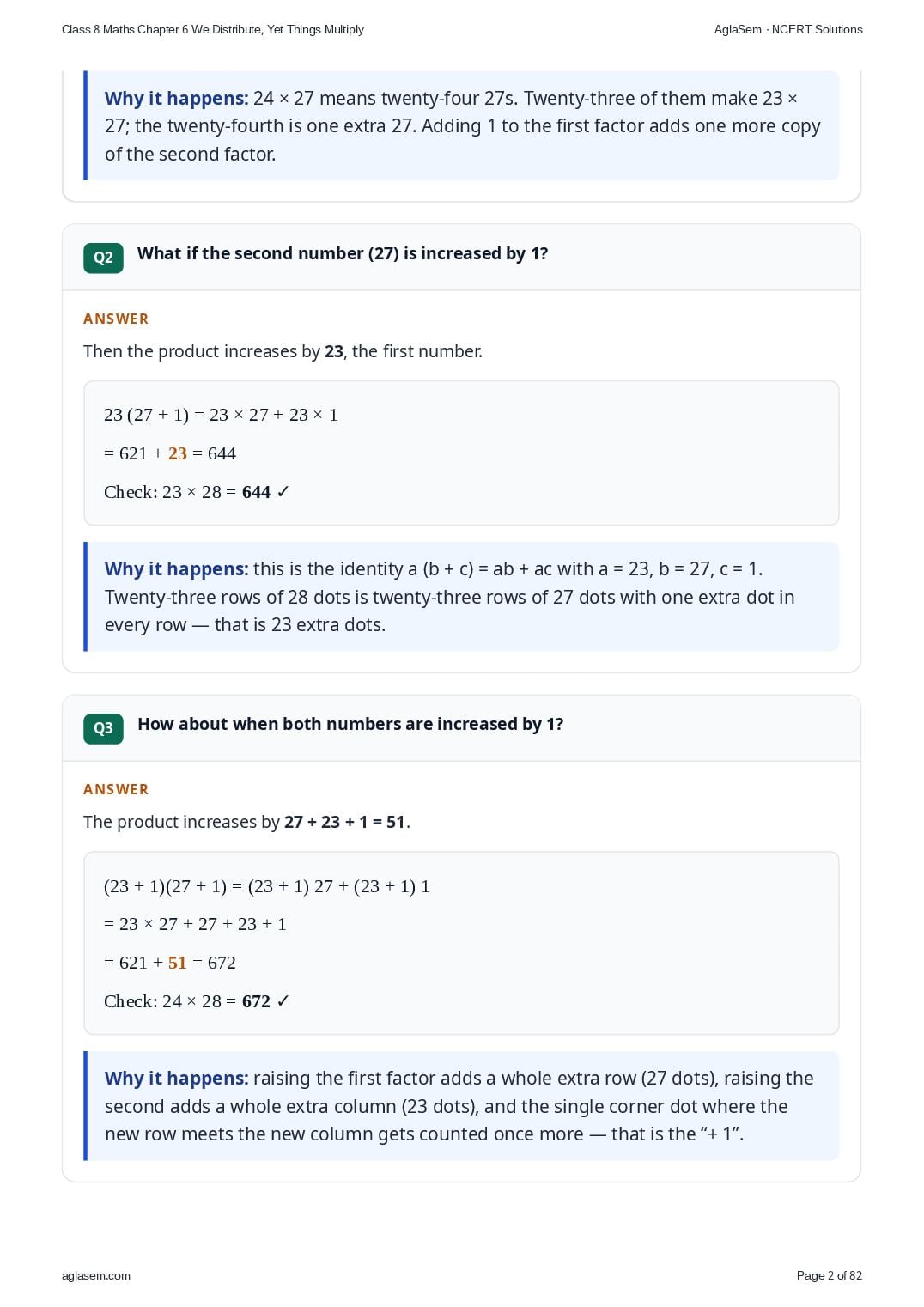
- What if the second number (27) is increased by 1?
- How about when both numbers are increased by 1?
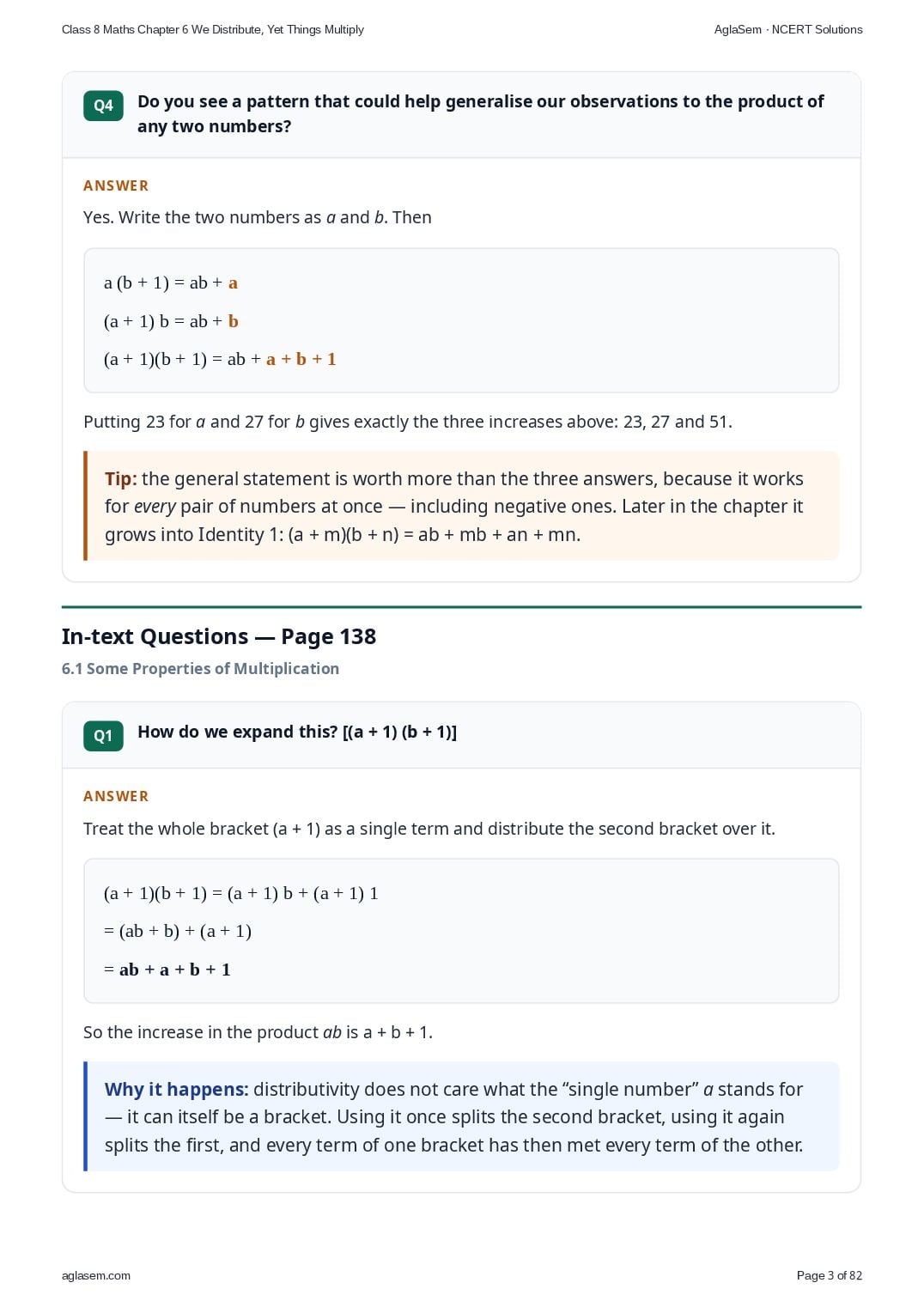
- Do you see a pattern that could help generalise our observations to the product of any two numbers?
- How do we expand this? [(a + 1) (b + 1)]
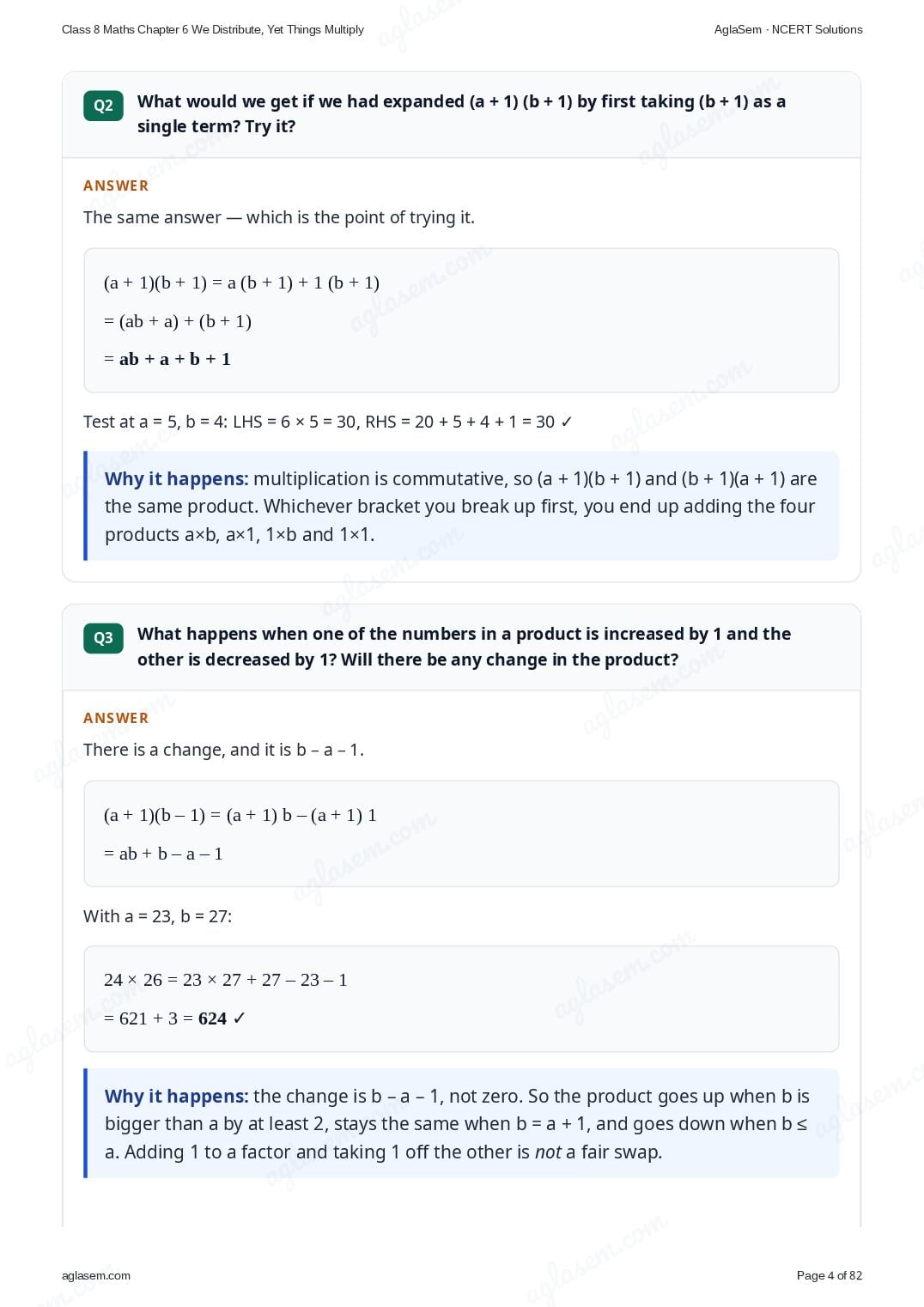
- What would we get if we had expanded (a + 1) (b + 1) by first taking (b + 1) as a single term? Try it?
- What happens when one of the numbers in a product is increased by 1 and the other is decreased by 1? Will there be any change in the product?
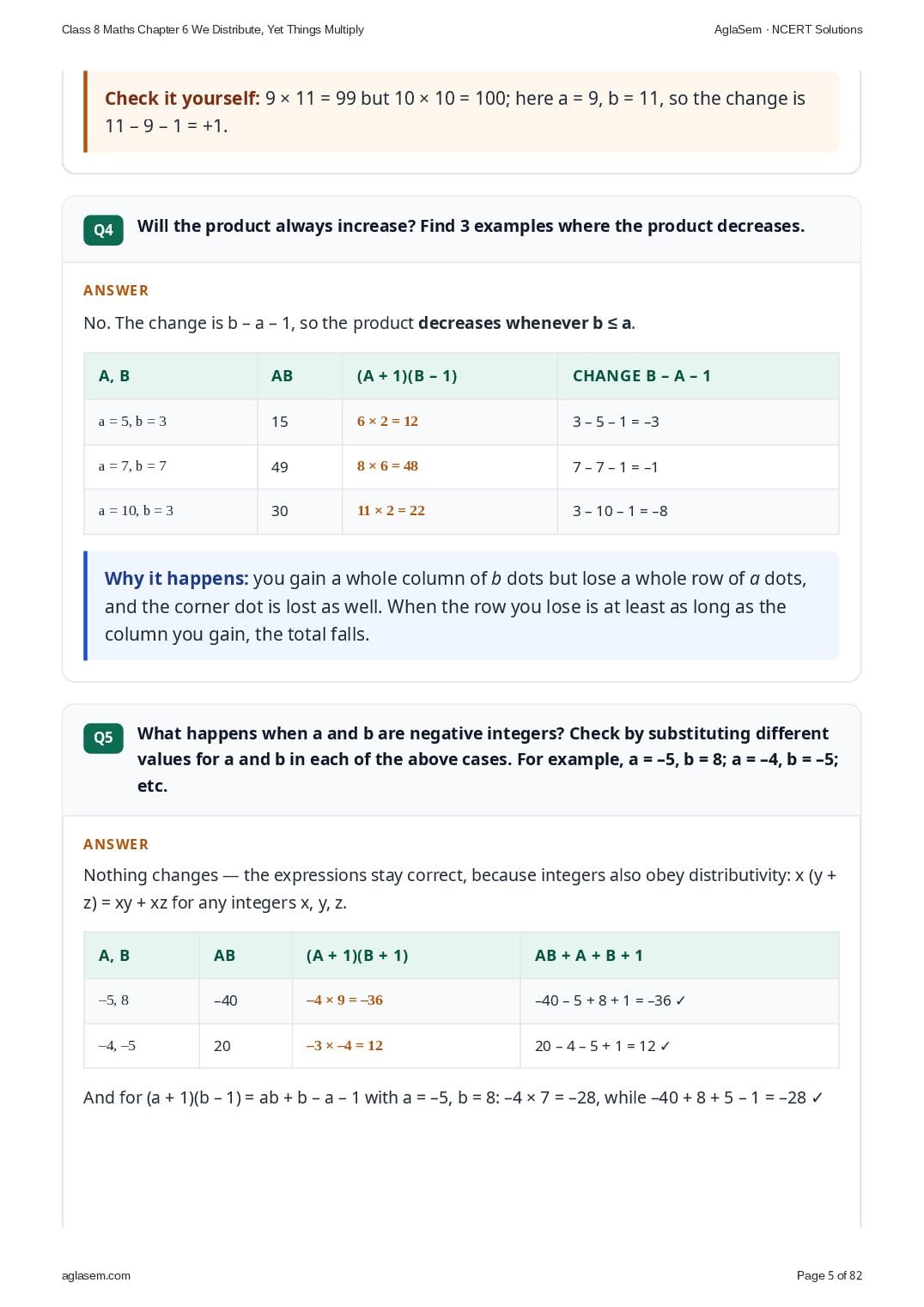
- Will the product always increase? Find 3 examples where the product decreases.
- What happens when a and b are negative integers? Check by substituting different values for a and b in each of the above cases. For example, a = –5, b = 8; a = –4, b = –5; etc.
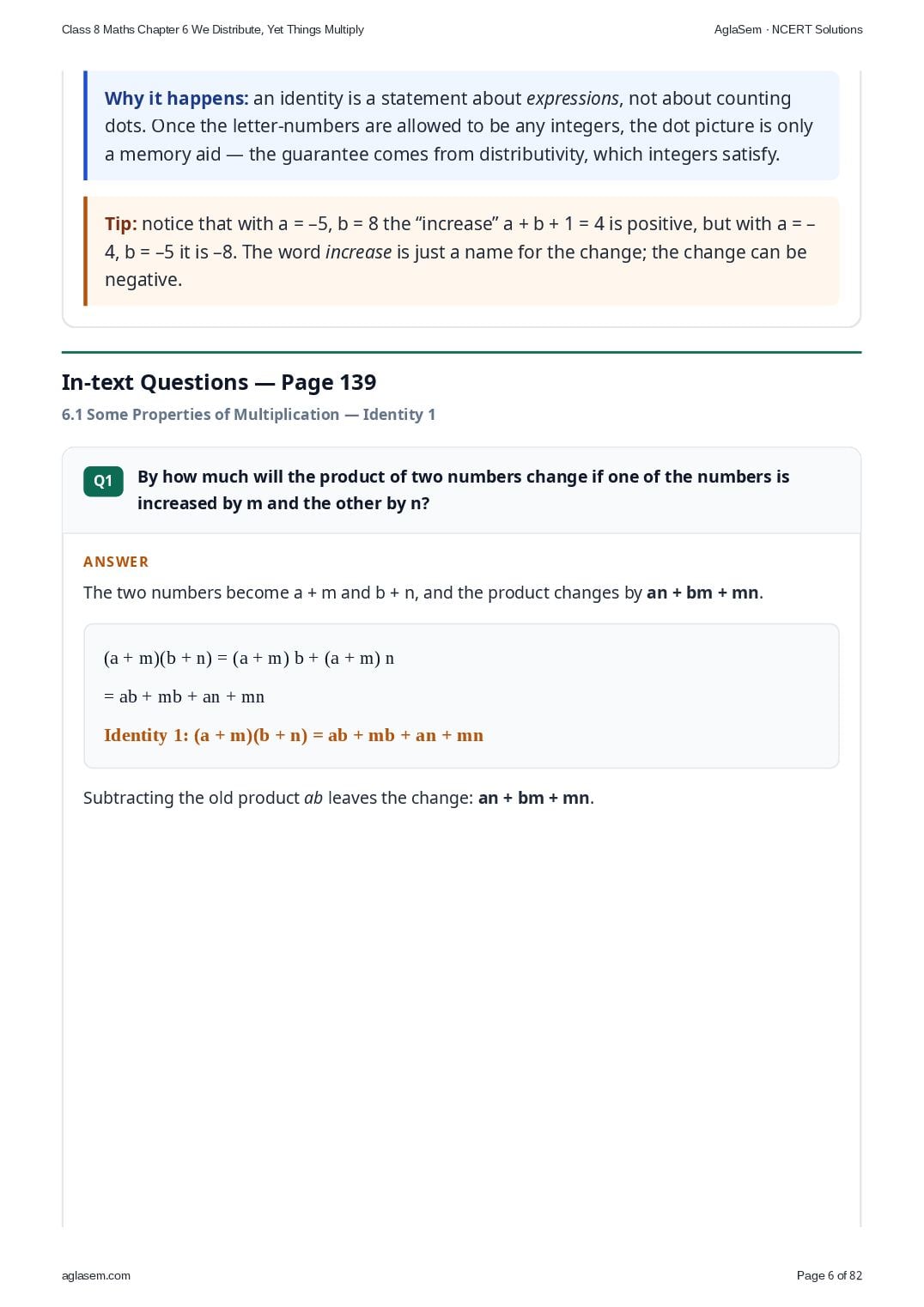
- By how much will the product of two numbers change if one of the numbers is increased by m and the other by n?
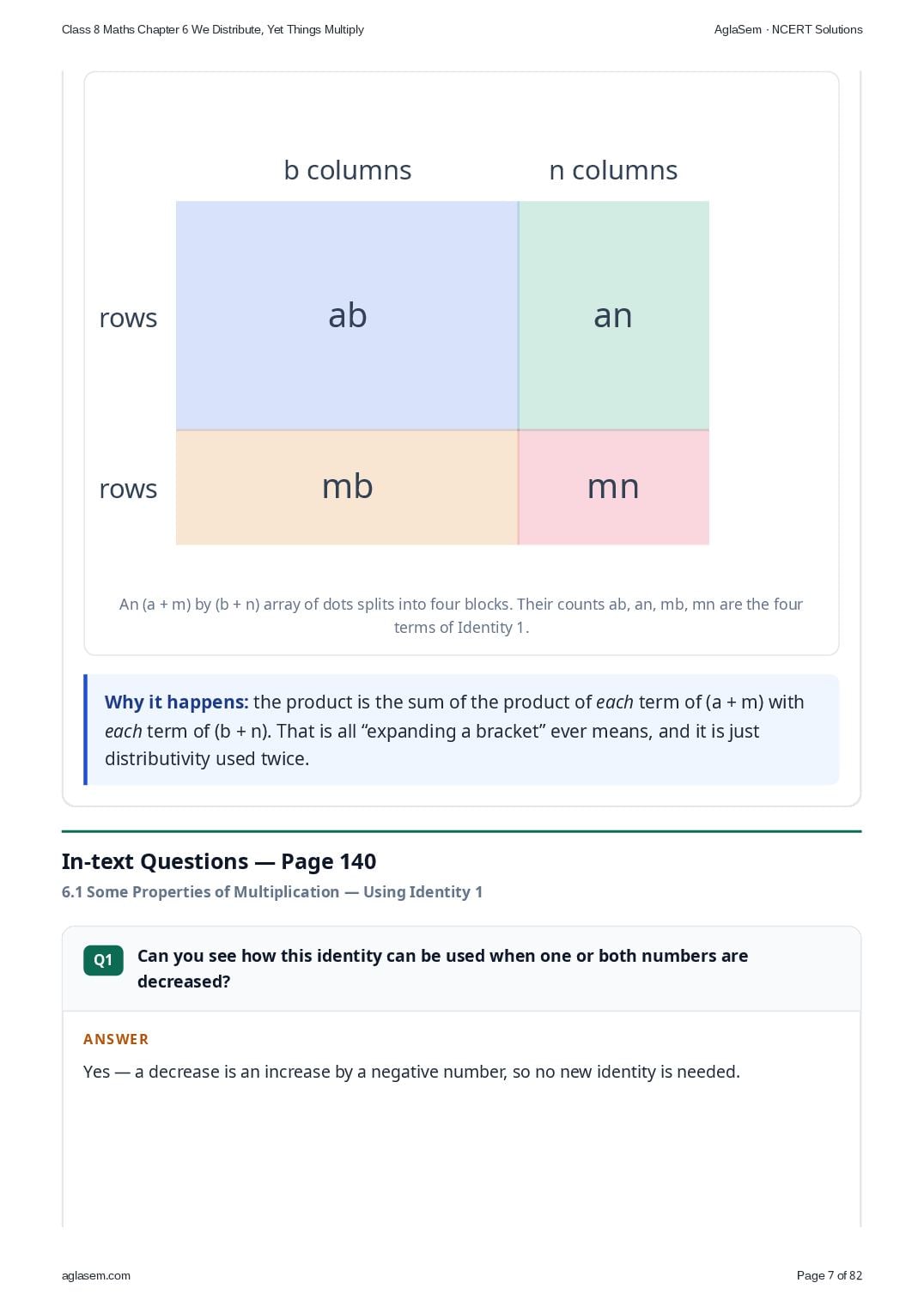
- Can you see how this identity can be used when one or both numbers are decreased?
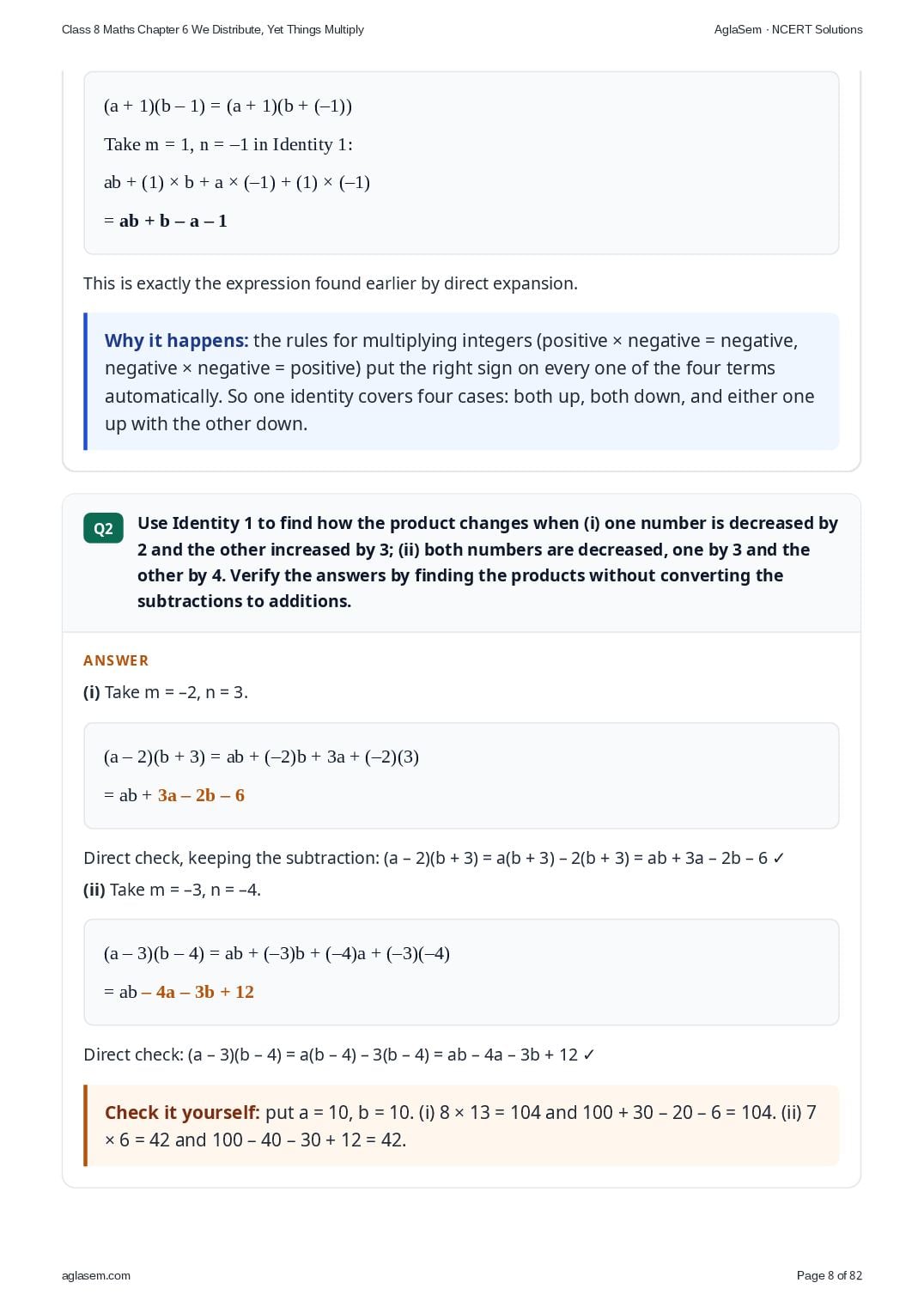
- Use Identity 1 to find how the product changes when (i) one number is decreased by 2 and the other increased by 3; (ii) both numbers are decreased, one by 3 and the other by 4. Verify the answers by finding the products without converting the subtractions to additions.
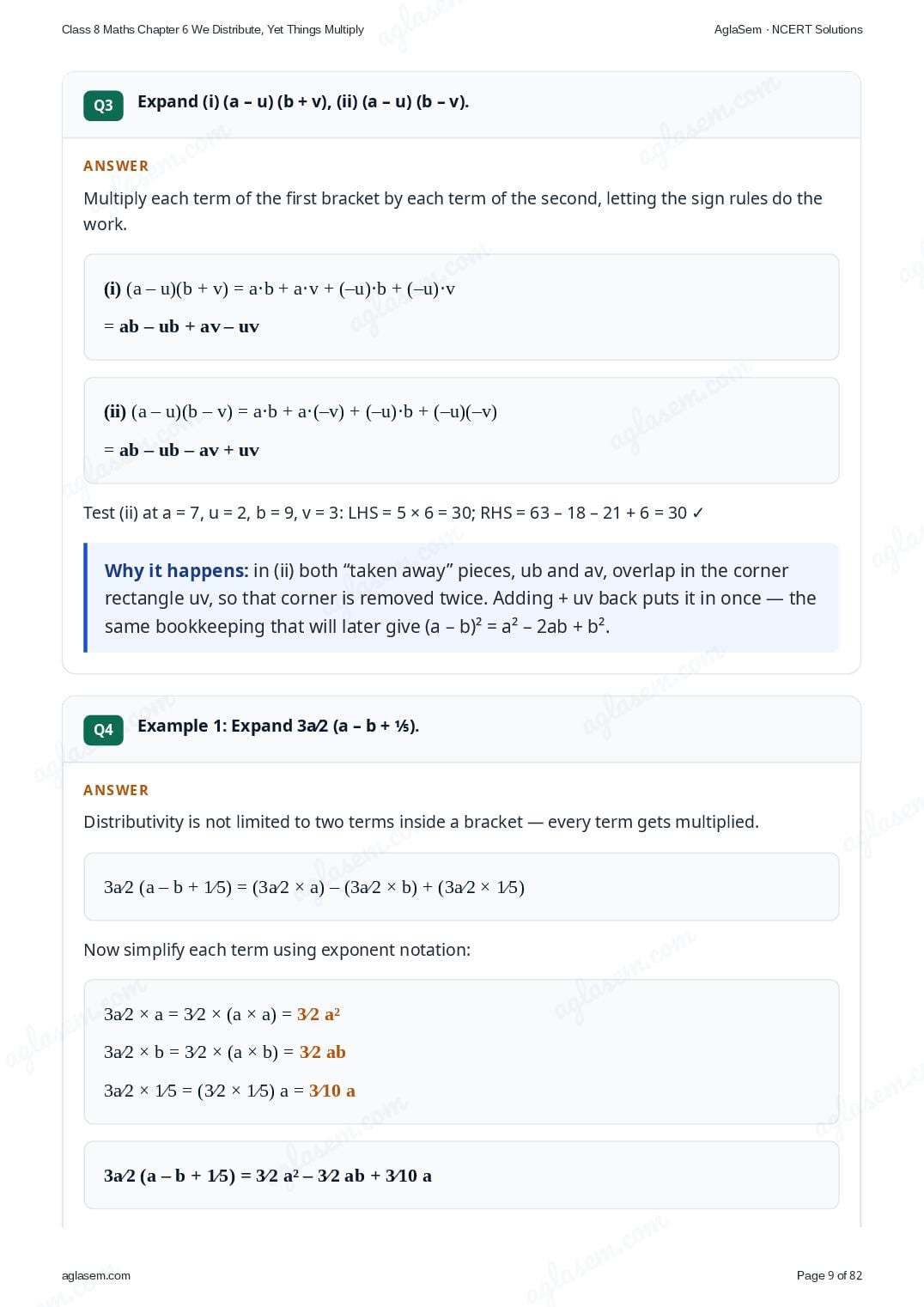
- Expand (i) (a – u) (b + v), (ii) (a – u) (b – v).
- Example 1: Expand 3a⁄2 (a – b + 1⁄5).
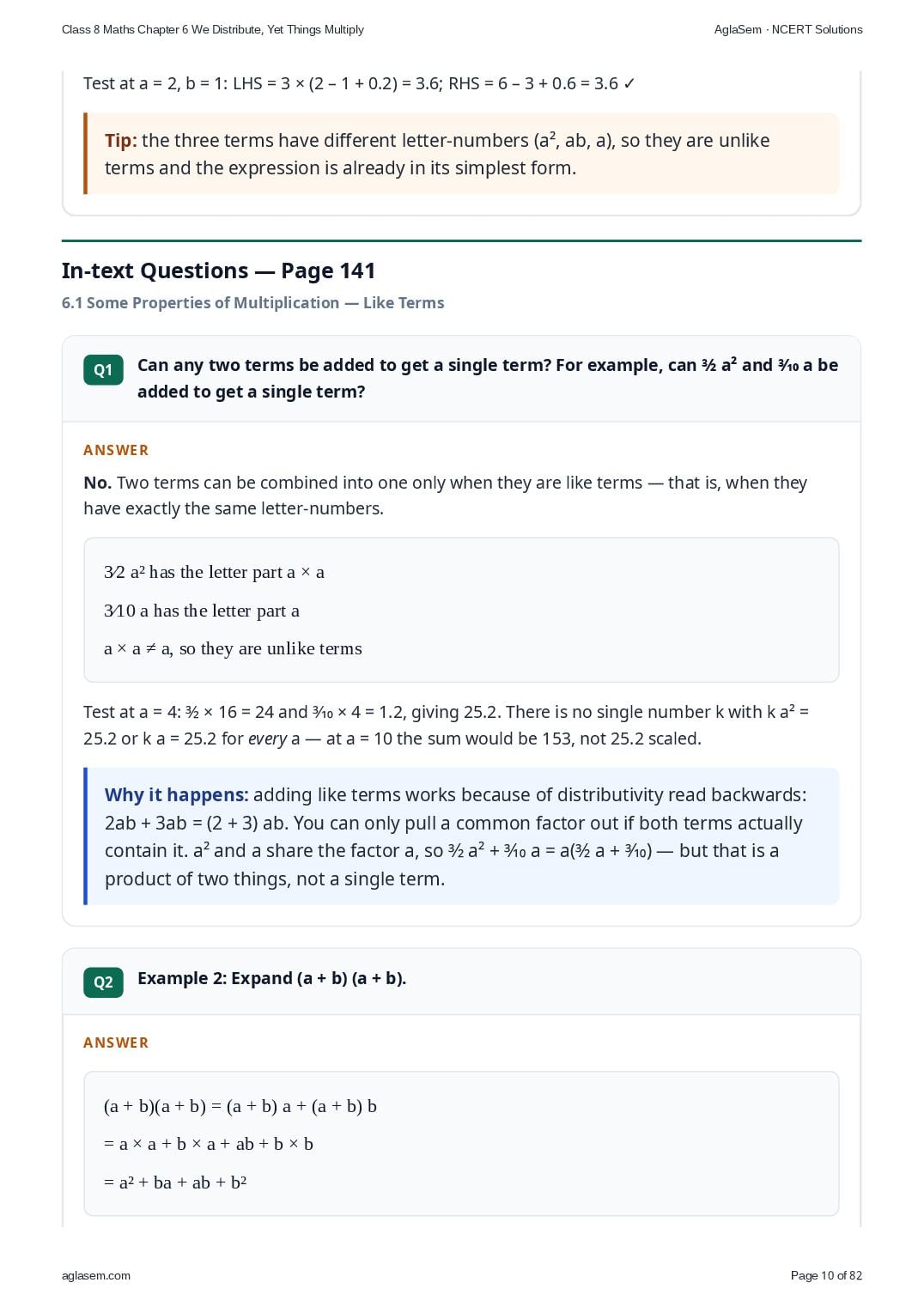
- Can any two terms be added to get a single term? For example, can 3⁄2 a² and 3⁄10 a be added to get a single term?
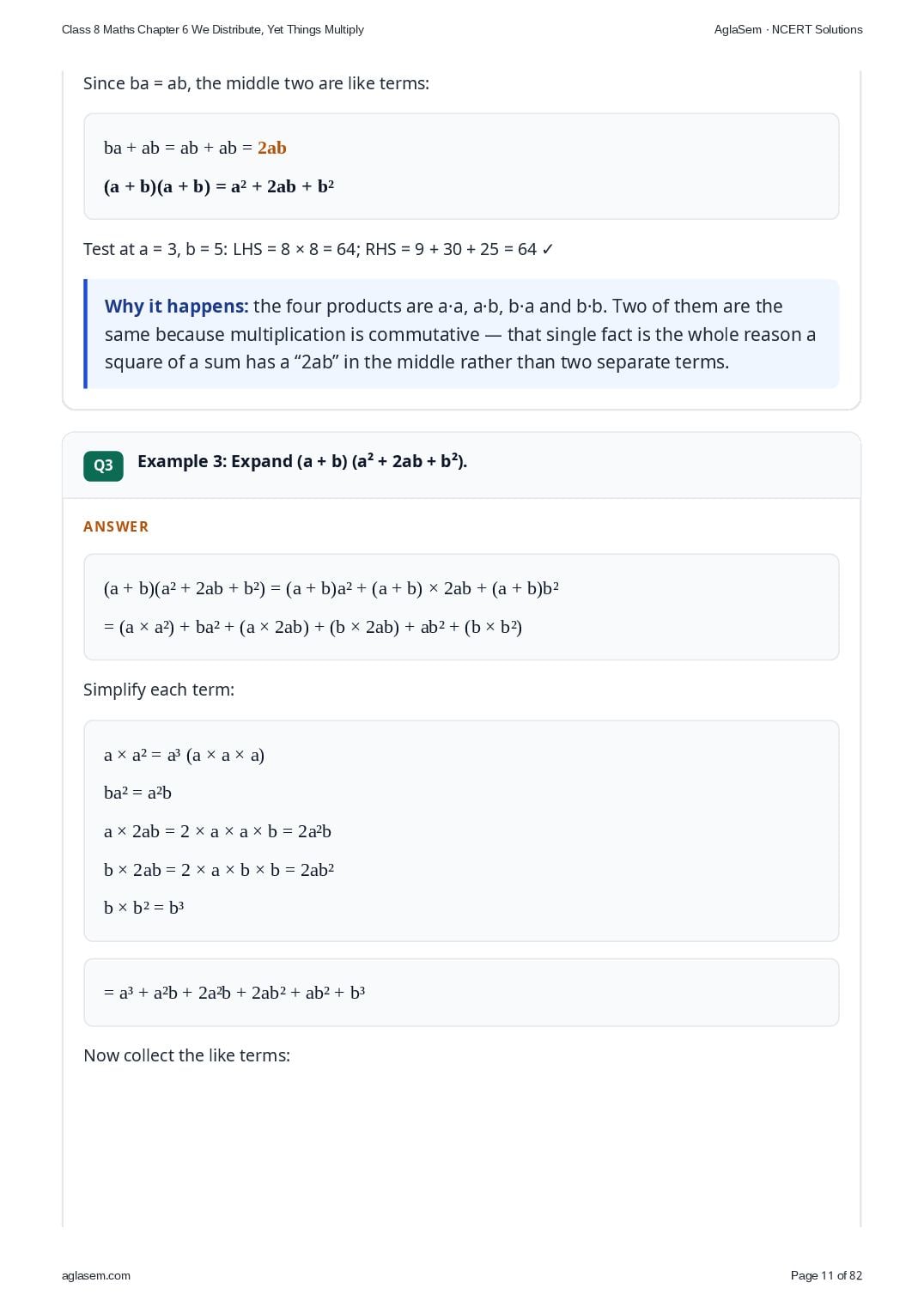
- Example 2: Expand (a + b) (a + b).
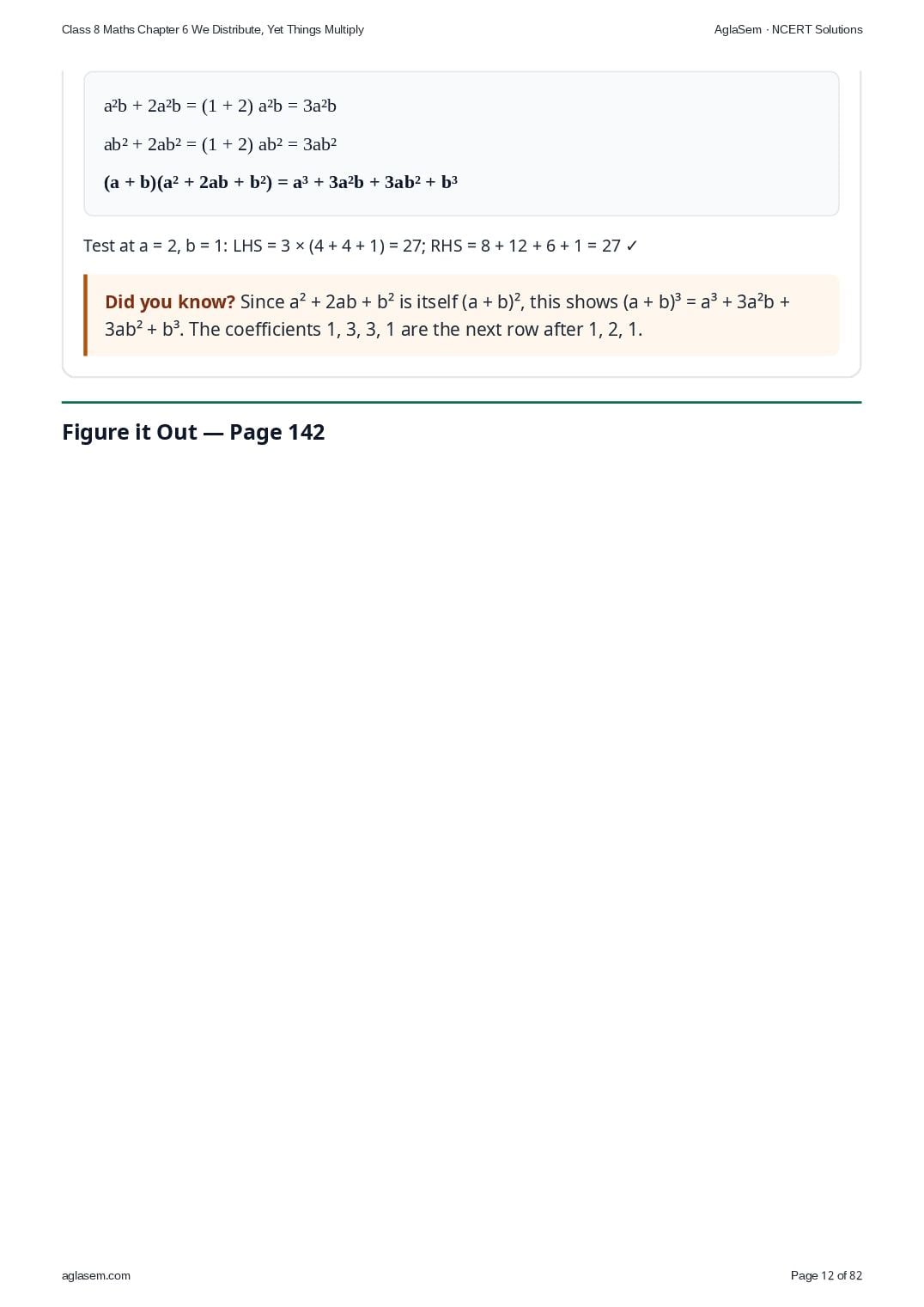
- Example 3: Expand (a + b) (a² + 2ab + b²).
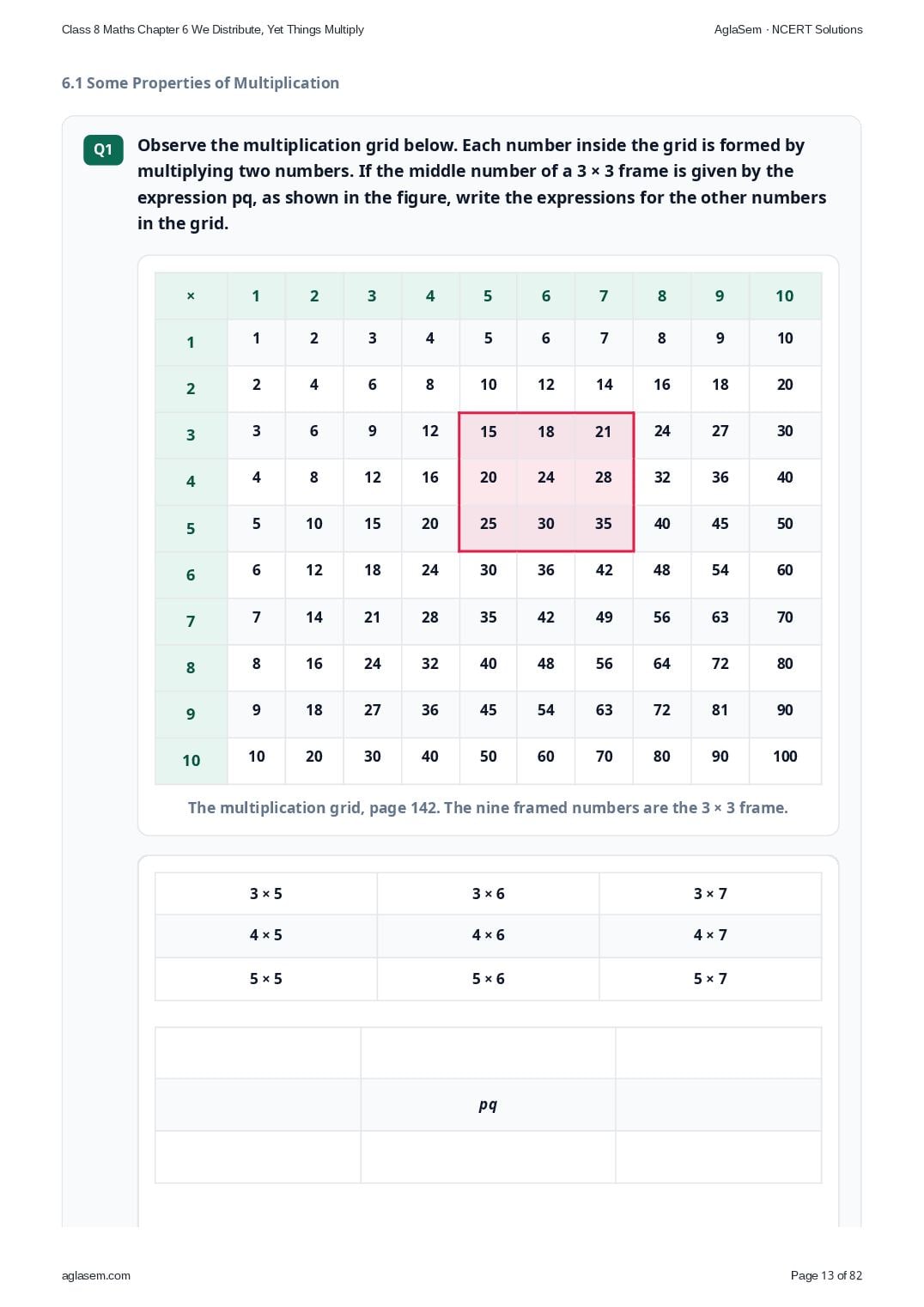
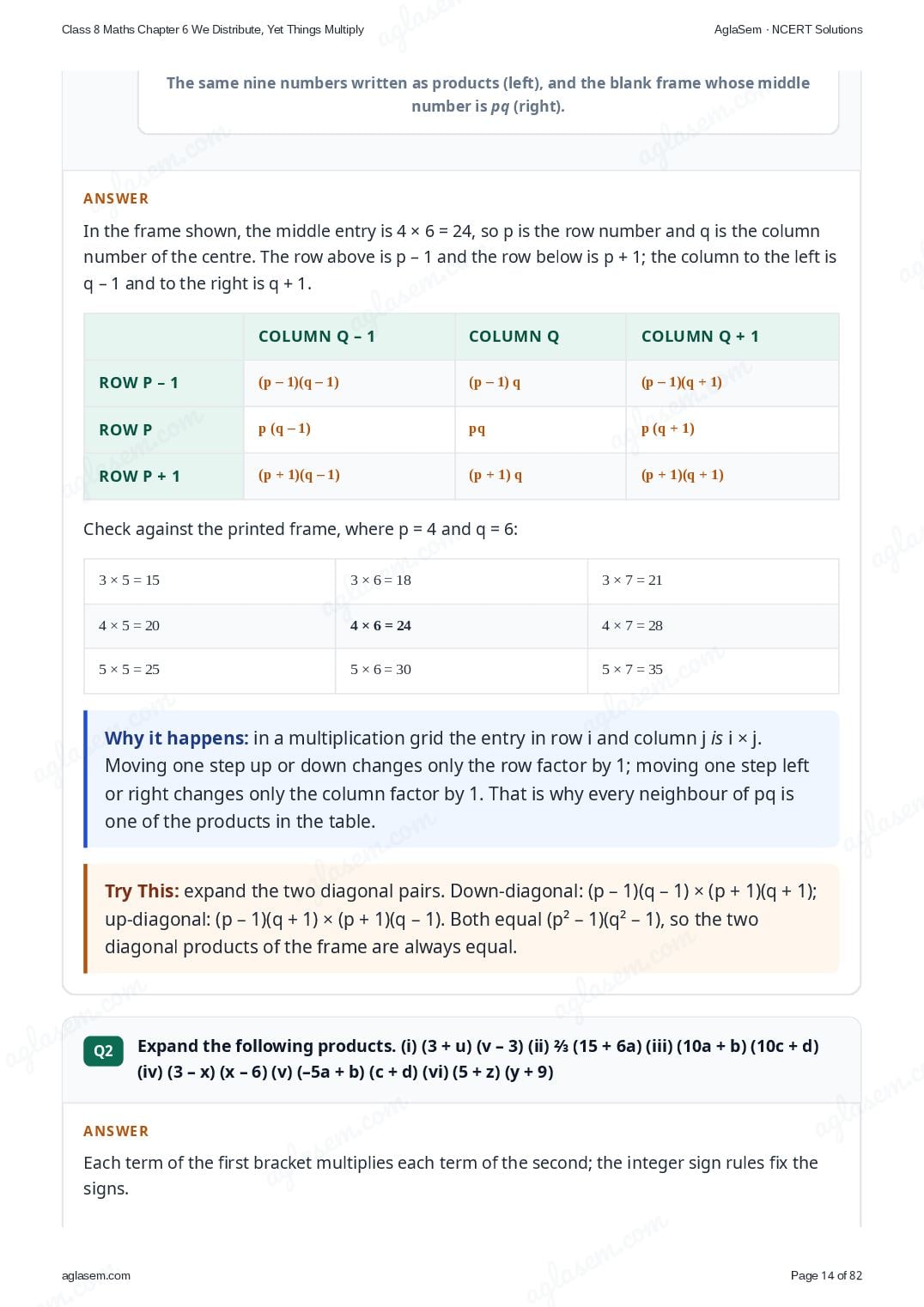
- Observe the multiplication grid below. Each number inside the grid is formed by multiplying two numbers. If the middle number of a 3 × 3 frame is given by the expression pq, as shown in the figure, write the expressions for the other numbers in the grid.
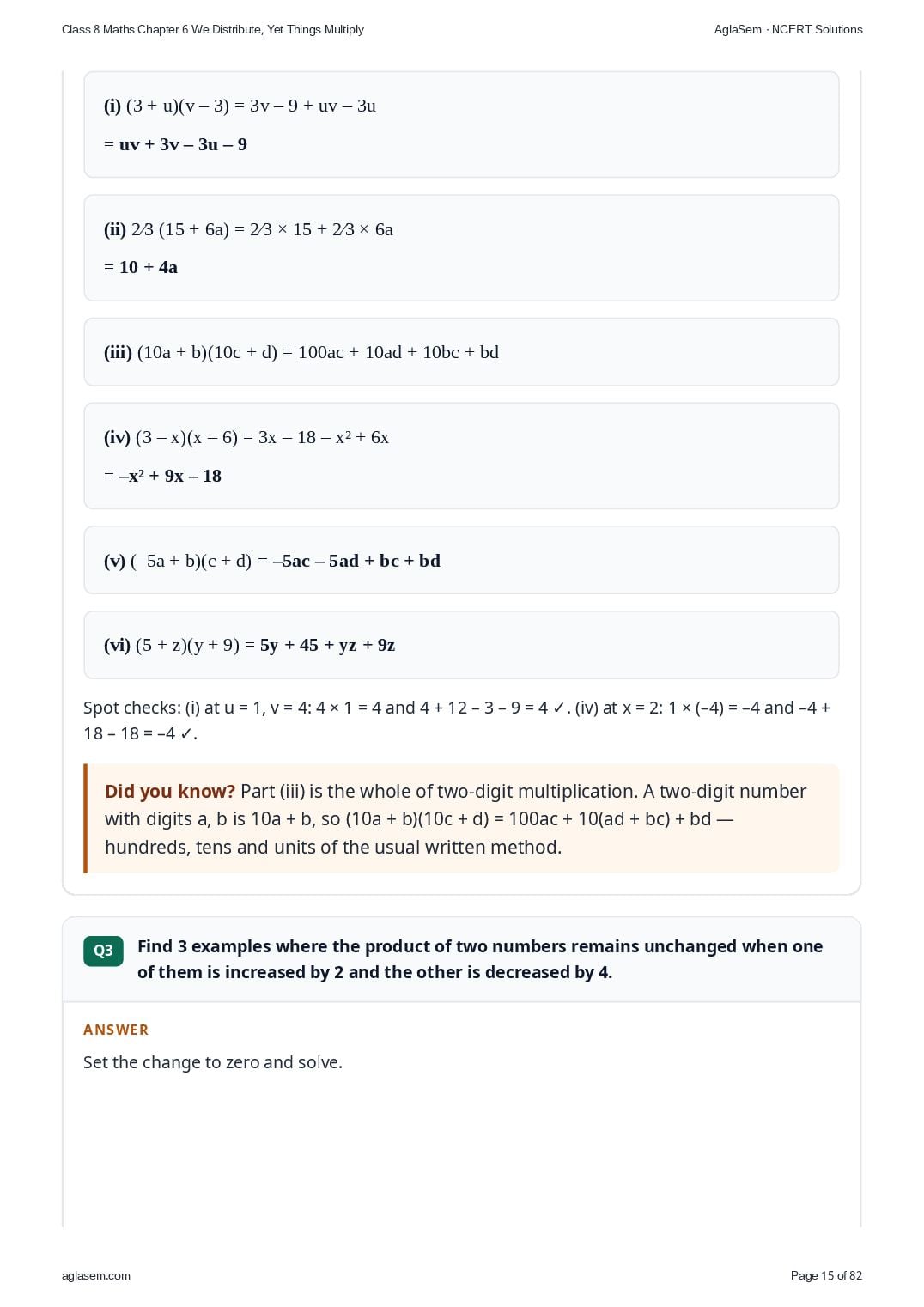
- Expand the following products. (i) (3 + u) (v – 3) (ii) 2⁄3 (15 + 6a) (iii) (10a + b) (10c + d) (iv) (3 – x) (x – 6) (v) (–5a + b) (c + d) (vi) (5 + z) (y + 9)
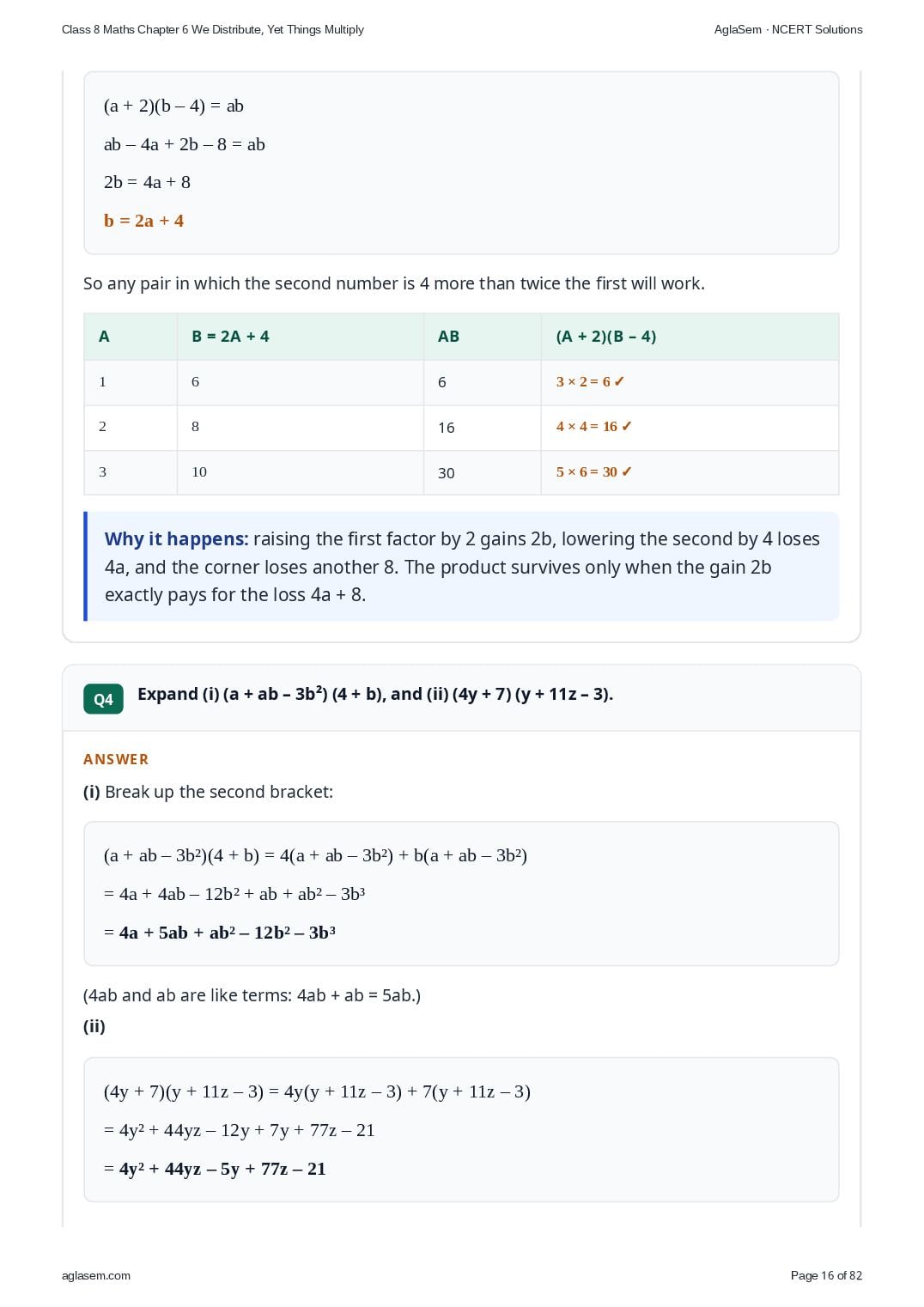
- Find 3 examples where the product of two numbers remains unchanged when one of them is increased by 2 and the other is decreased by 4.
- Expand (i) (a + ab – 3b²) (4 + b), and (ii) (4y + 7) (y + 11z – 3).
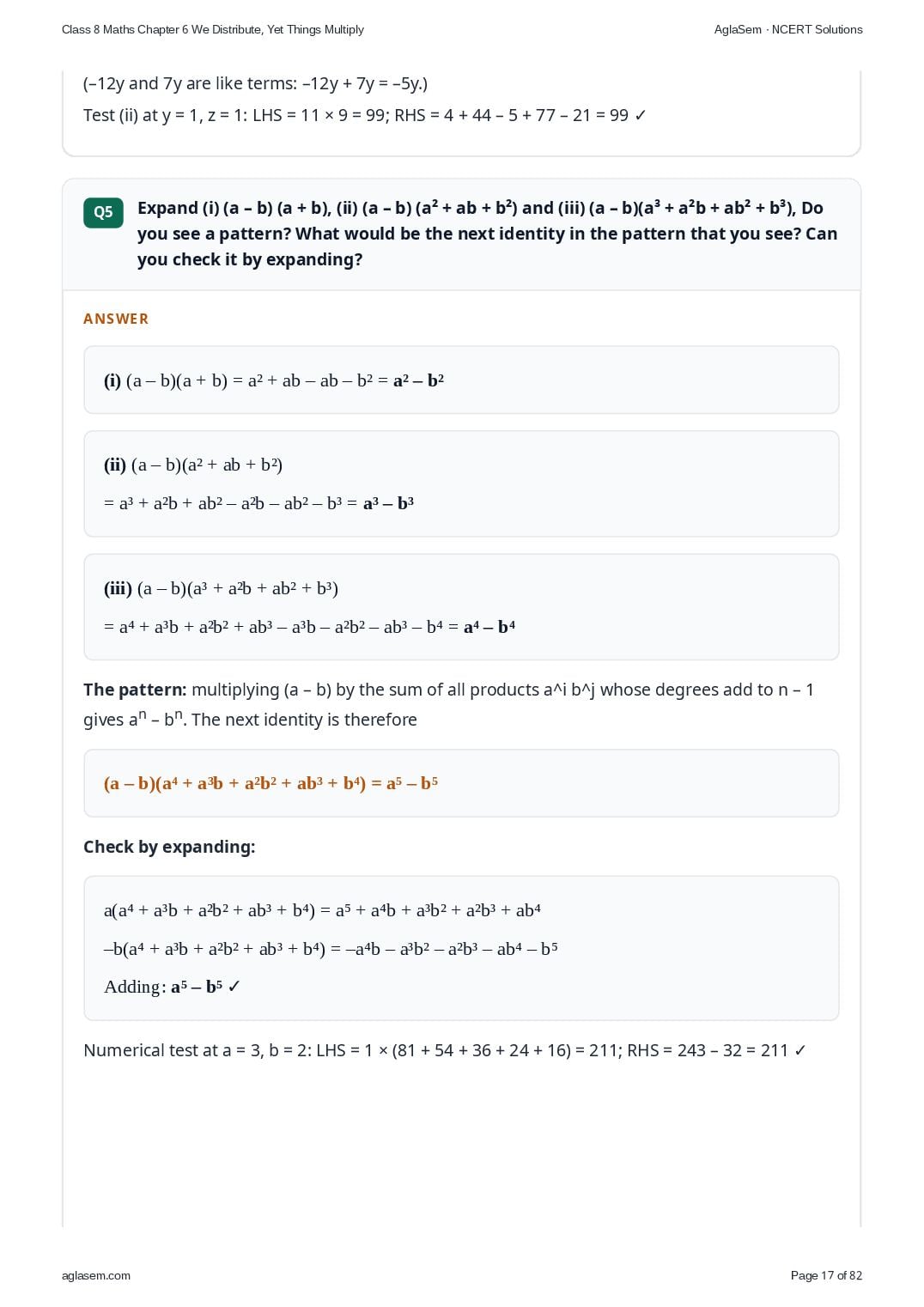
- Expand (i) (a – b) (a + b), (ii) (a – b) (a² + ab + b²) and (iii) (a – b)(a³ + a²b + ab² + b³), Do you see a pattern? What would be the next identity in the pattern that you see? Can you check it by expanding?
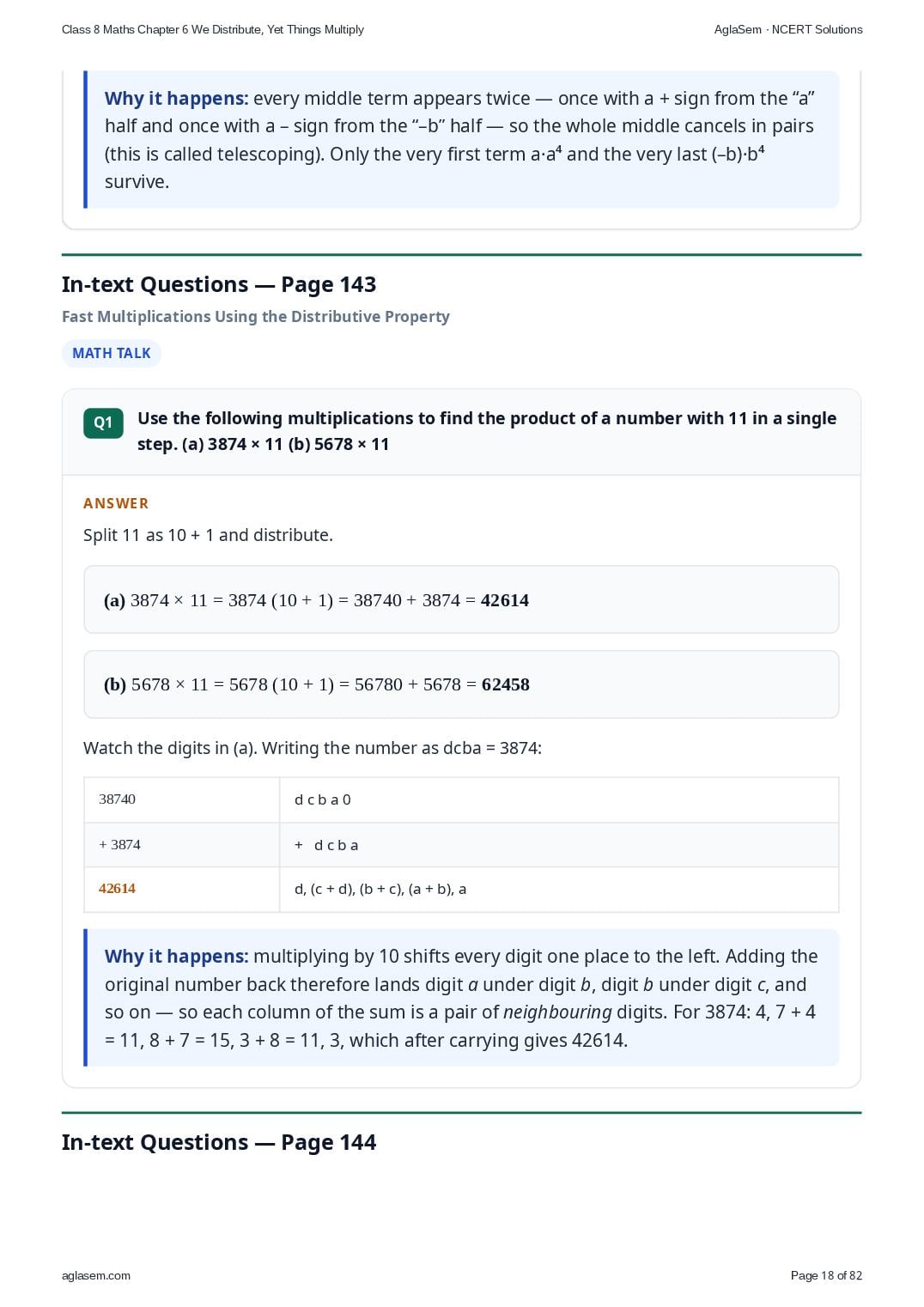
- Use the following multiplications to find the product of a number with 11 in a single step. (a) 3874 × 11 (b) 5678 × 11
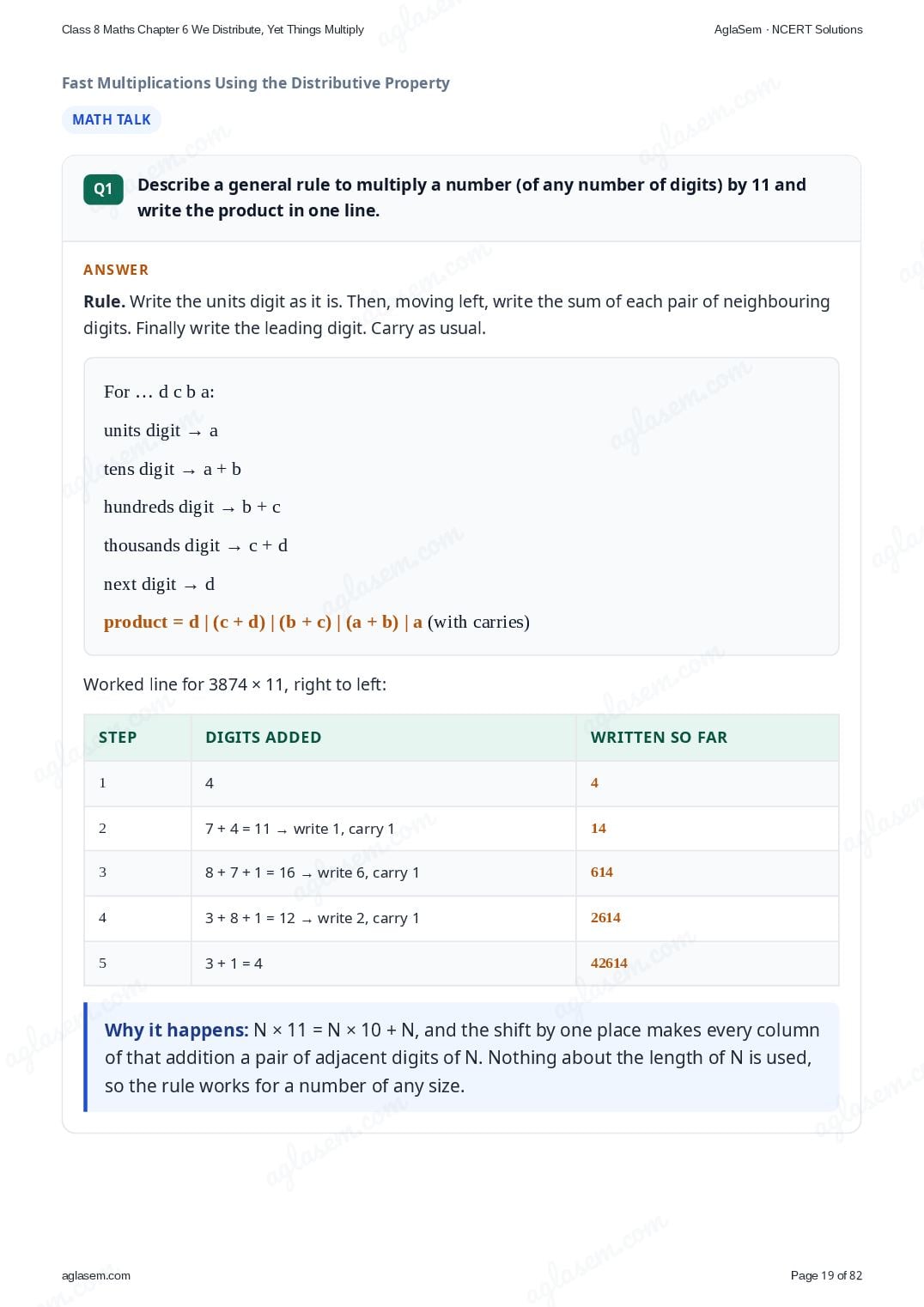
- Describe a general rule to multiply a number (of any number of digits) by 11 and write the product in one line.
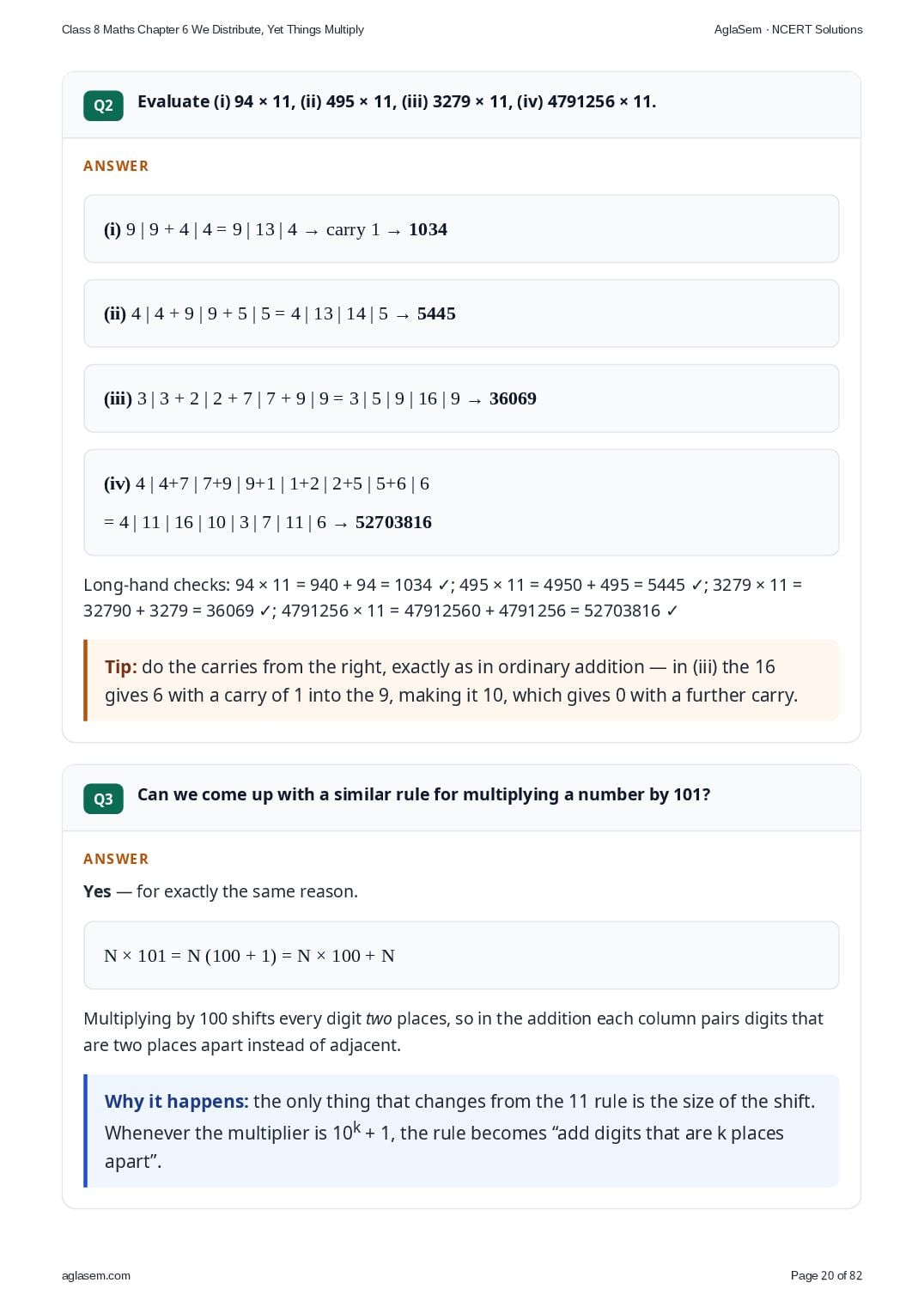
- Evaluate (i) 94 × 11, (ii) 495 × 11, (iii) 3279 × 11, (iv) 4791256 × 11.
- Can we come up with a similar rule for multiplying a number by 101?
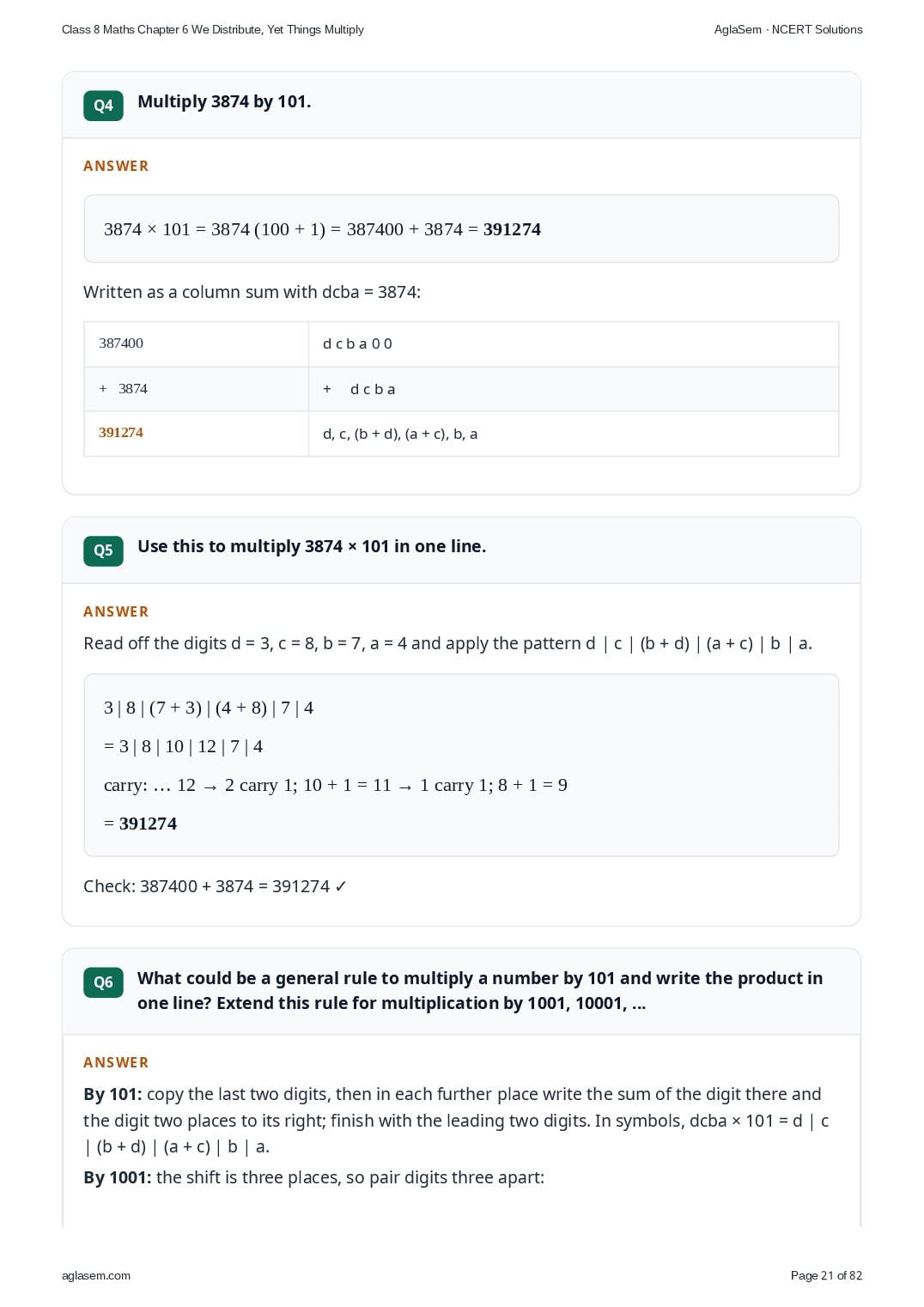
- Multiply 3874 by 101.
- Use this to multiply 3874 × 101 in one line.
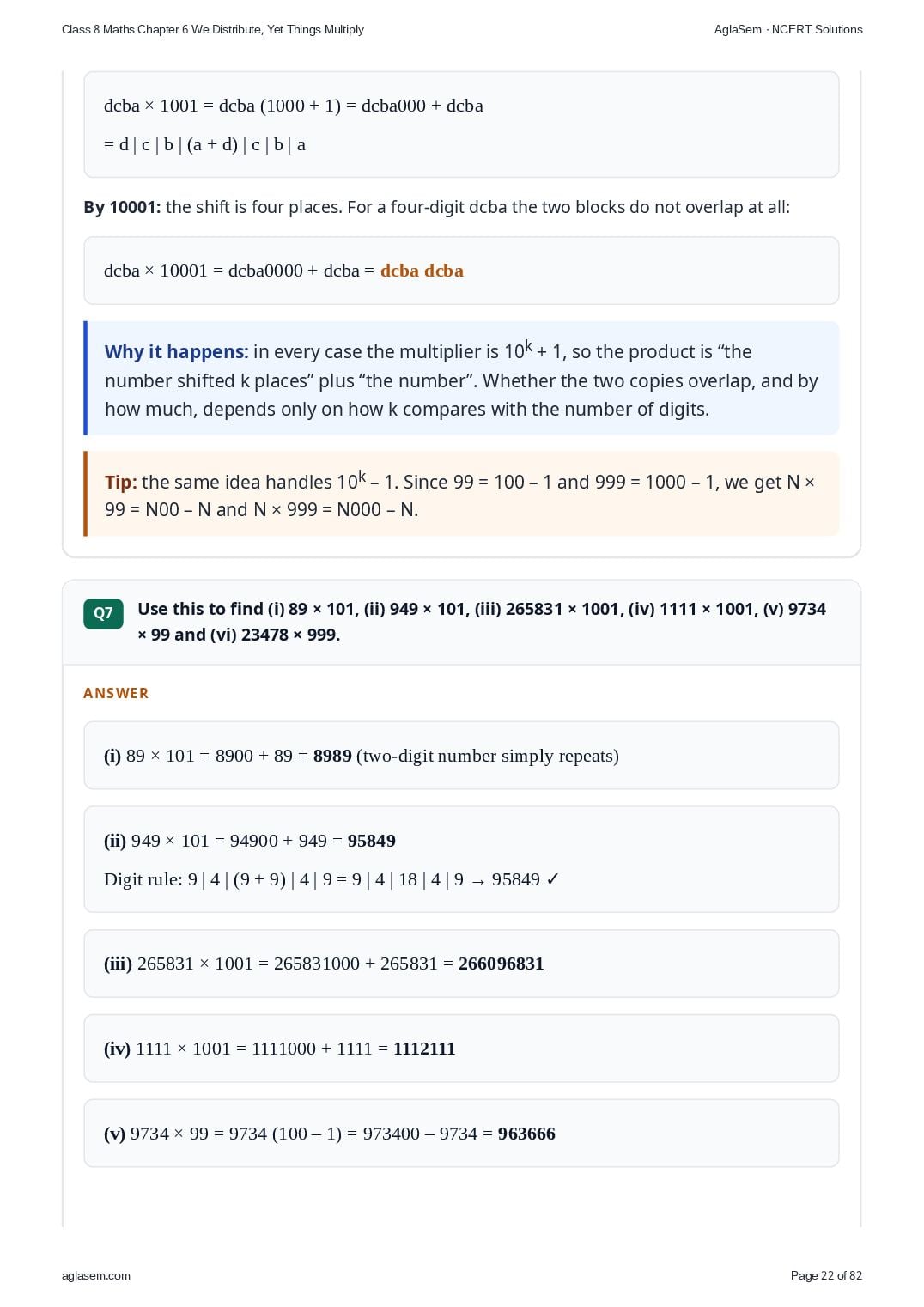
- What could be a general rule to multiply a number by 101 and write the product in one line? Extend this rule for multiplication by 1001, 10001, …
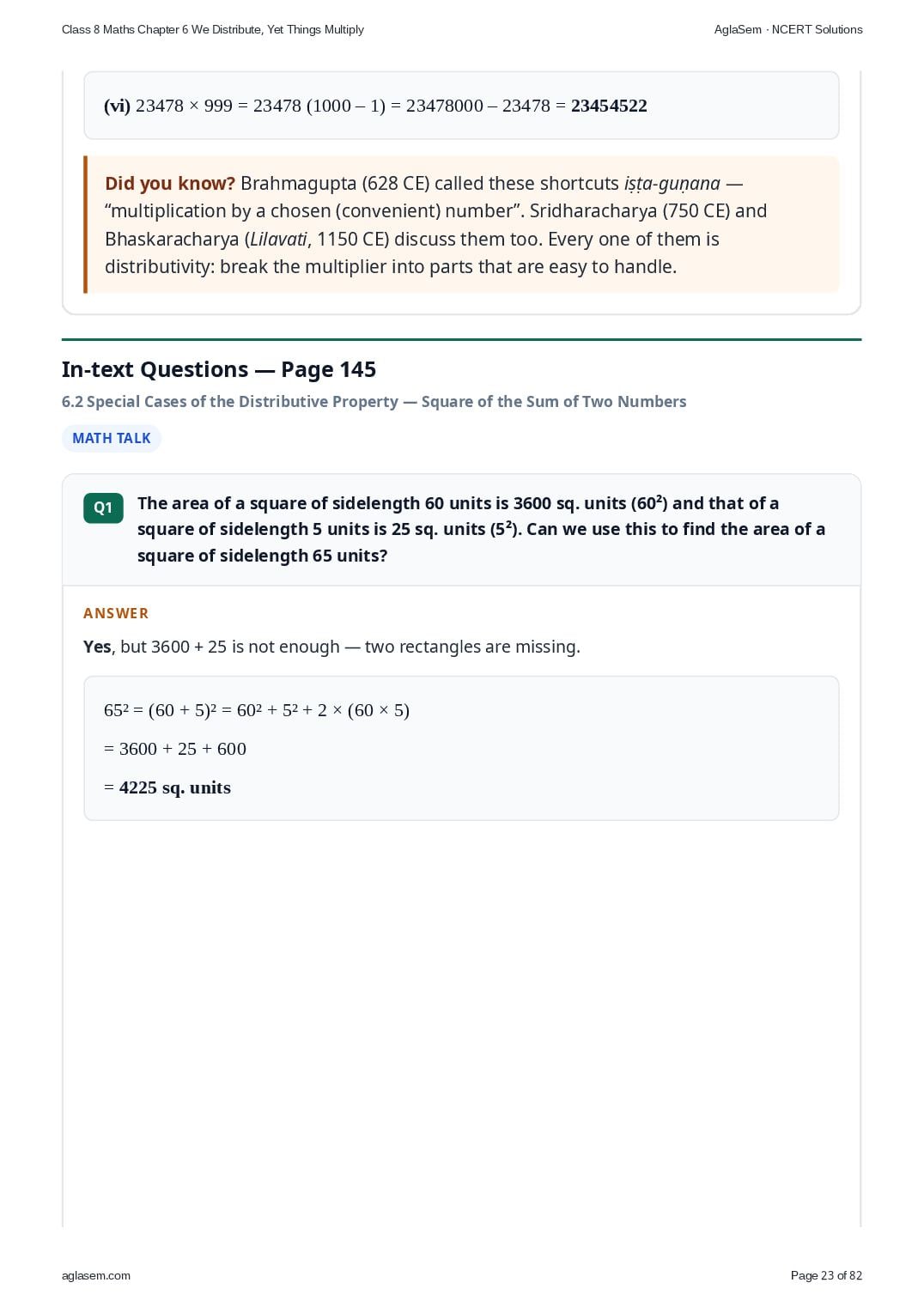
- Use this to find (i) 89 × 101, (ii) 949 × 101, (iii) 265831 × 1001, (iv) 1111 × 1001, (v) 9734 × 99 and (vi) 23478 × 999.
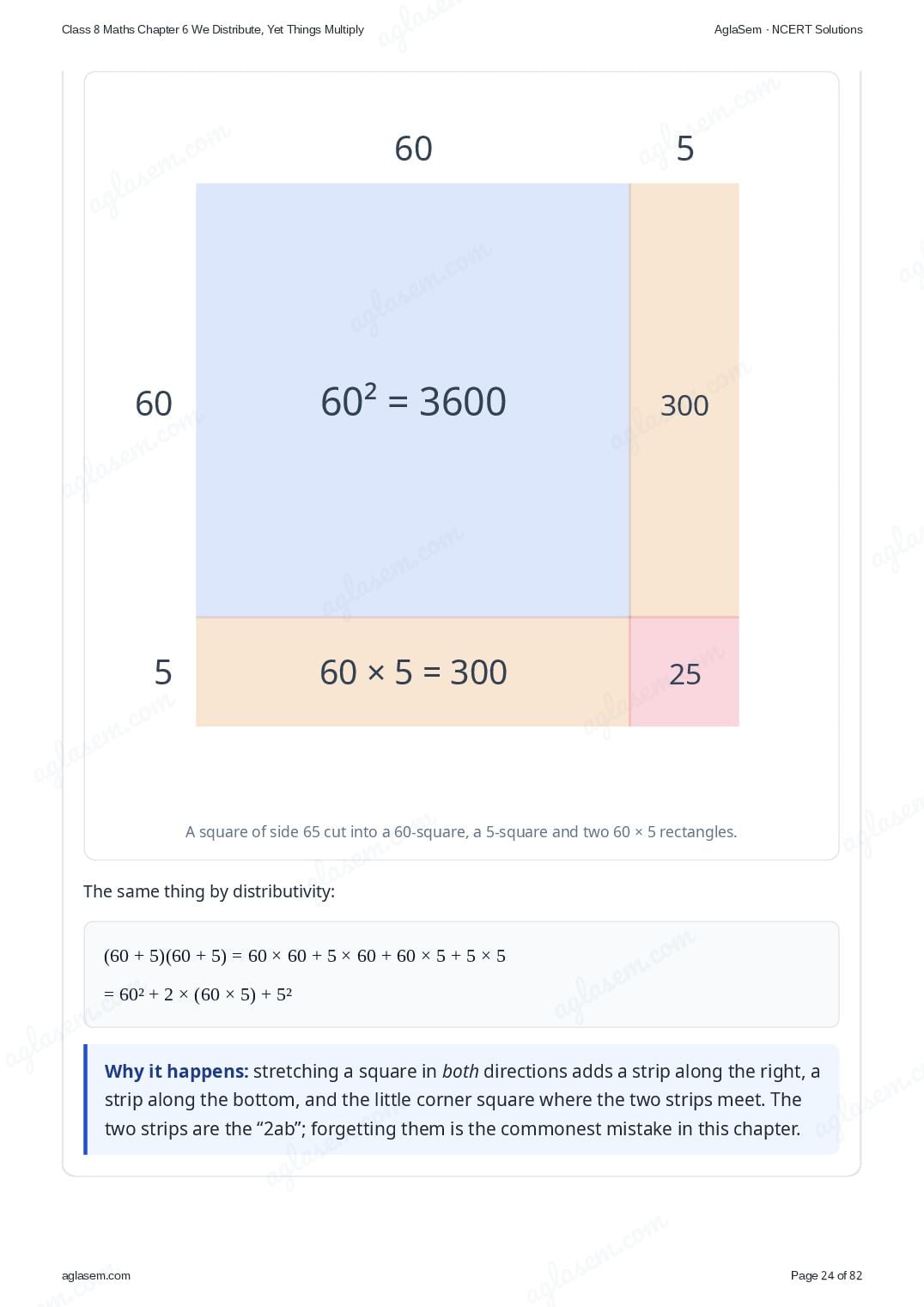
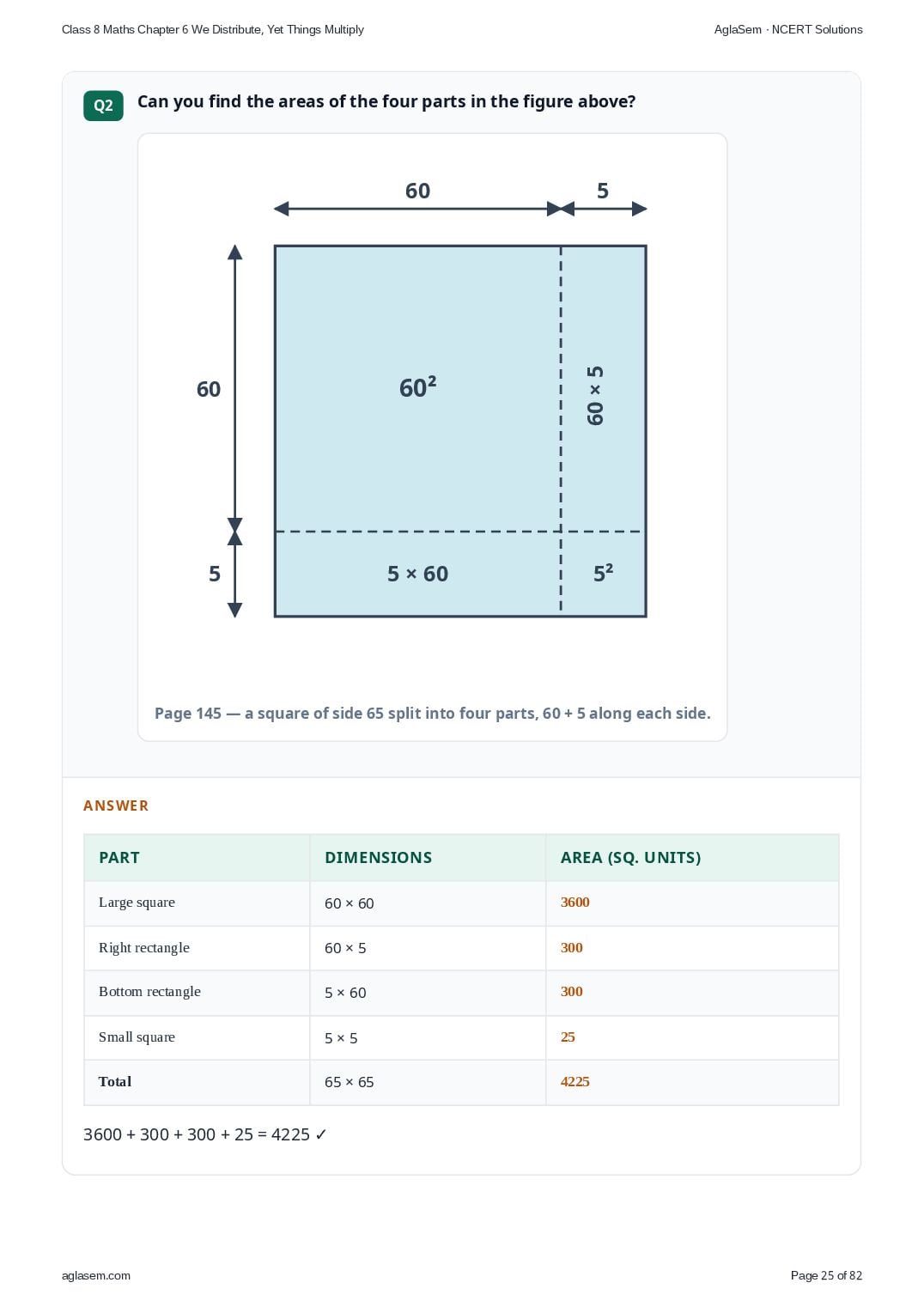
- The area of a square of sidelength 60 units is 3600 sq. units (60²) and that of a square of sidelength 5 units is 25 sq. units (5²). Can we use this to find the area of a square of sidelength 65 units?
- Can you find the areas of the four parts in the figure above?
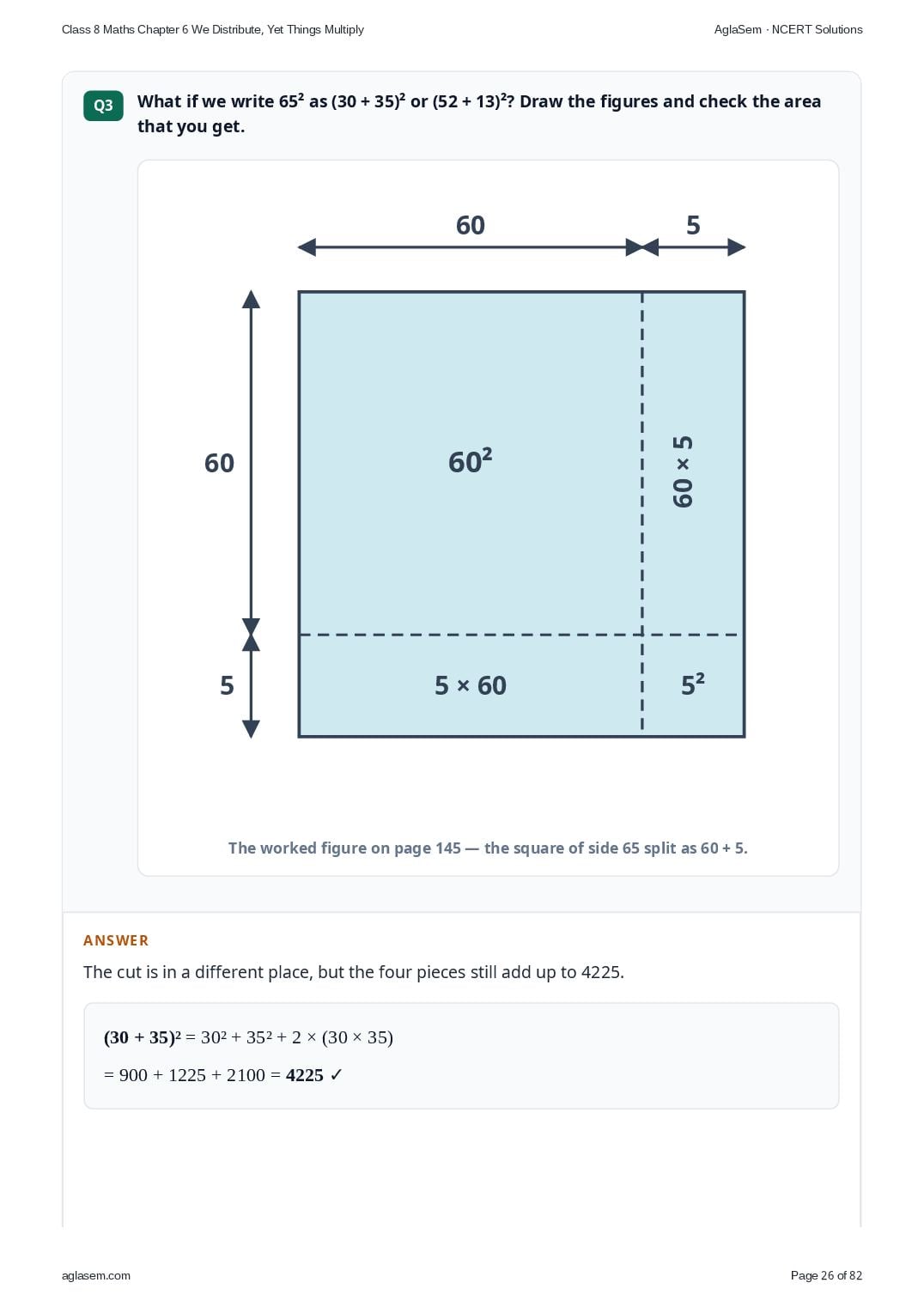
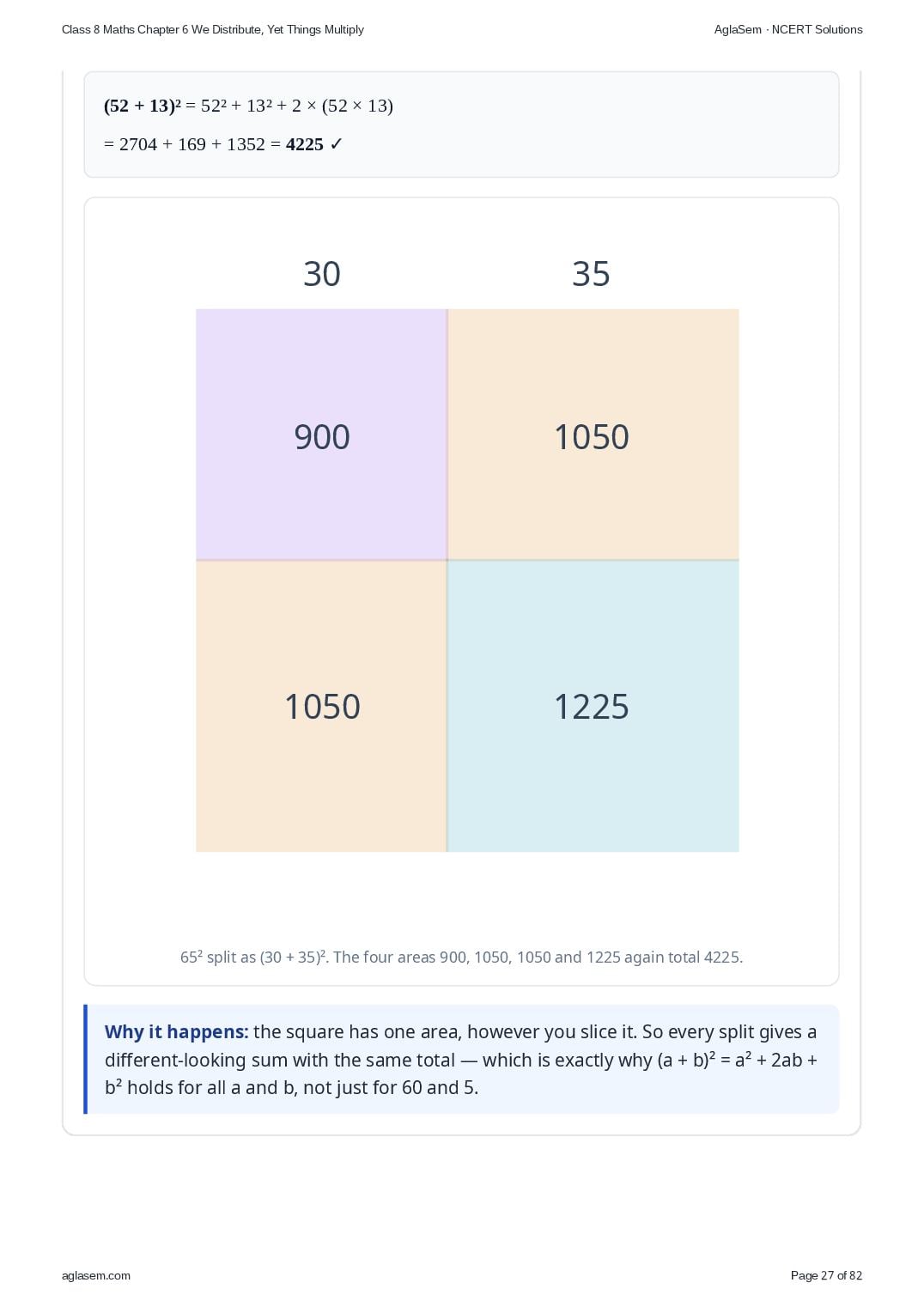
- What if we write 65² as (30 + 35)² or (52 + 13)²? Draw the figures and check the area that you get.
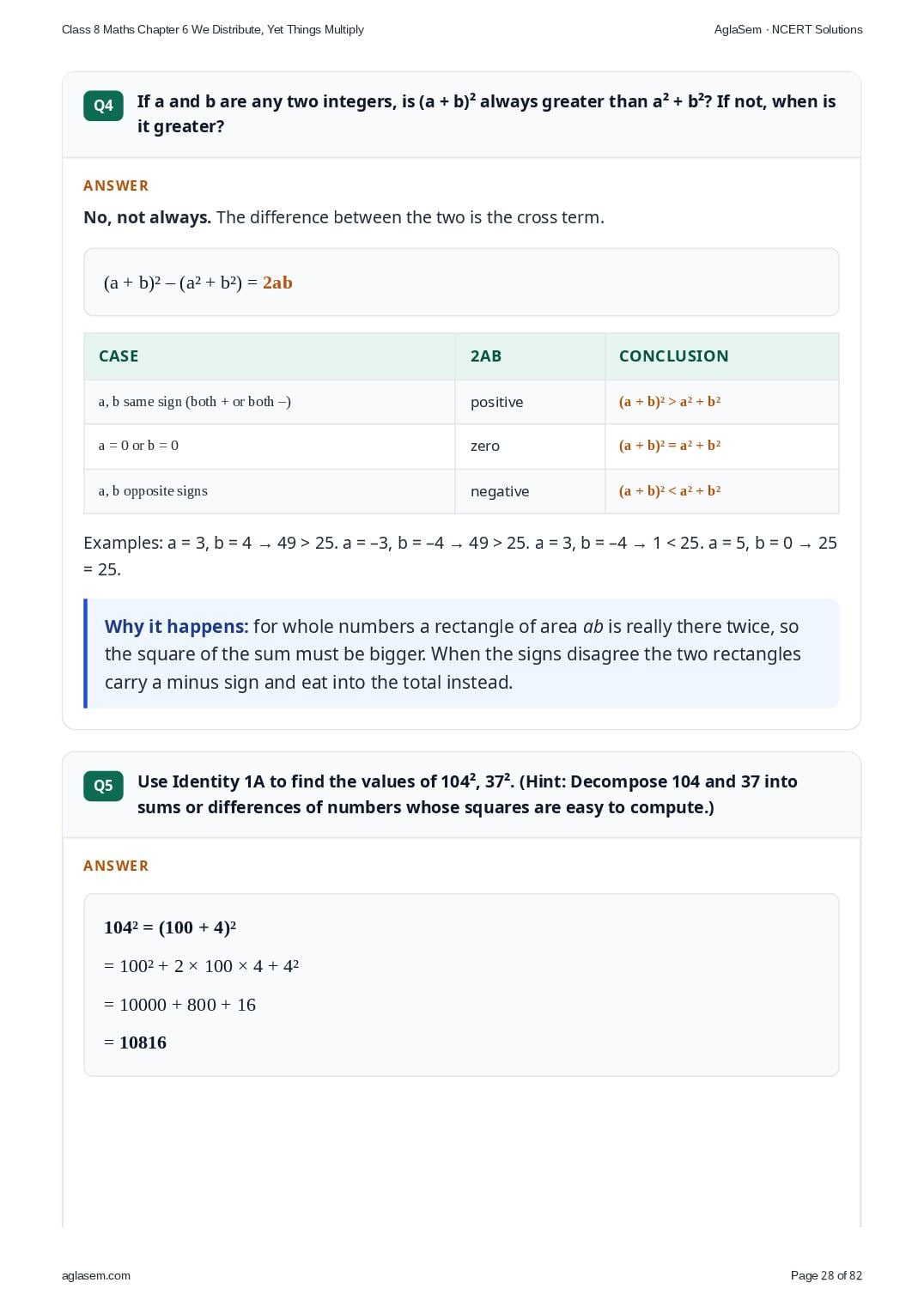
- If a and b are any two integers, is (a + b)² always greater than a² + b²? If not, when is it greater?
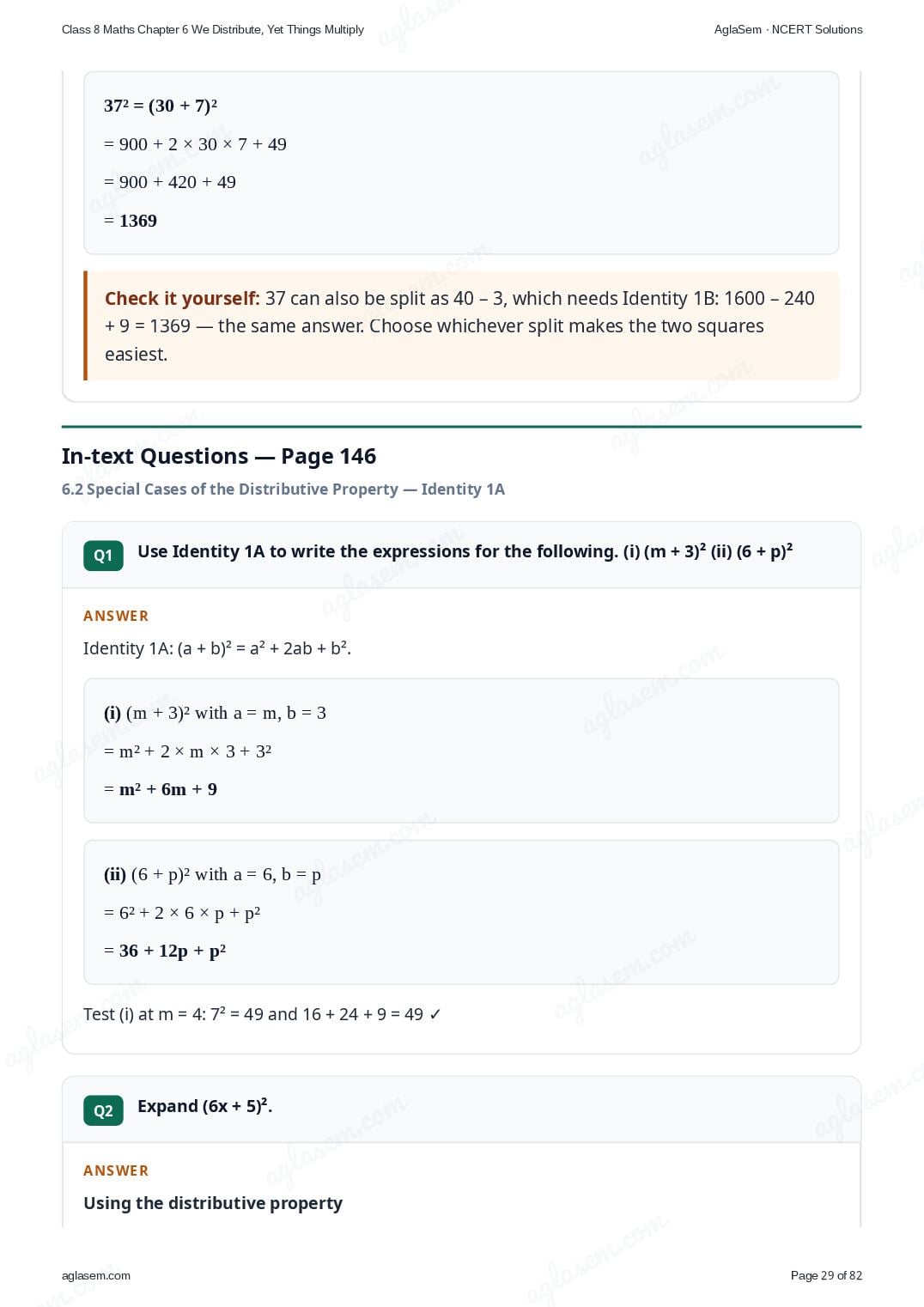
- Use Identity 1A to find the values of 104², 37². (Hint: Decompose 104 and 37 into sums or differences of numbers whose squares are easy to compute.)
- Use Identity 1A to write the expressions for the following. (i) (m + 3)² (ii) (6 + p)²
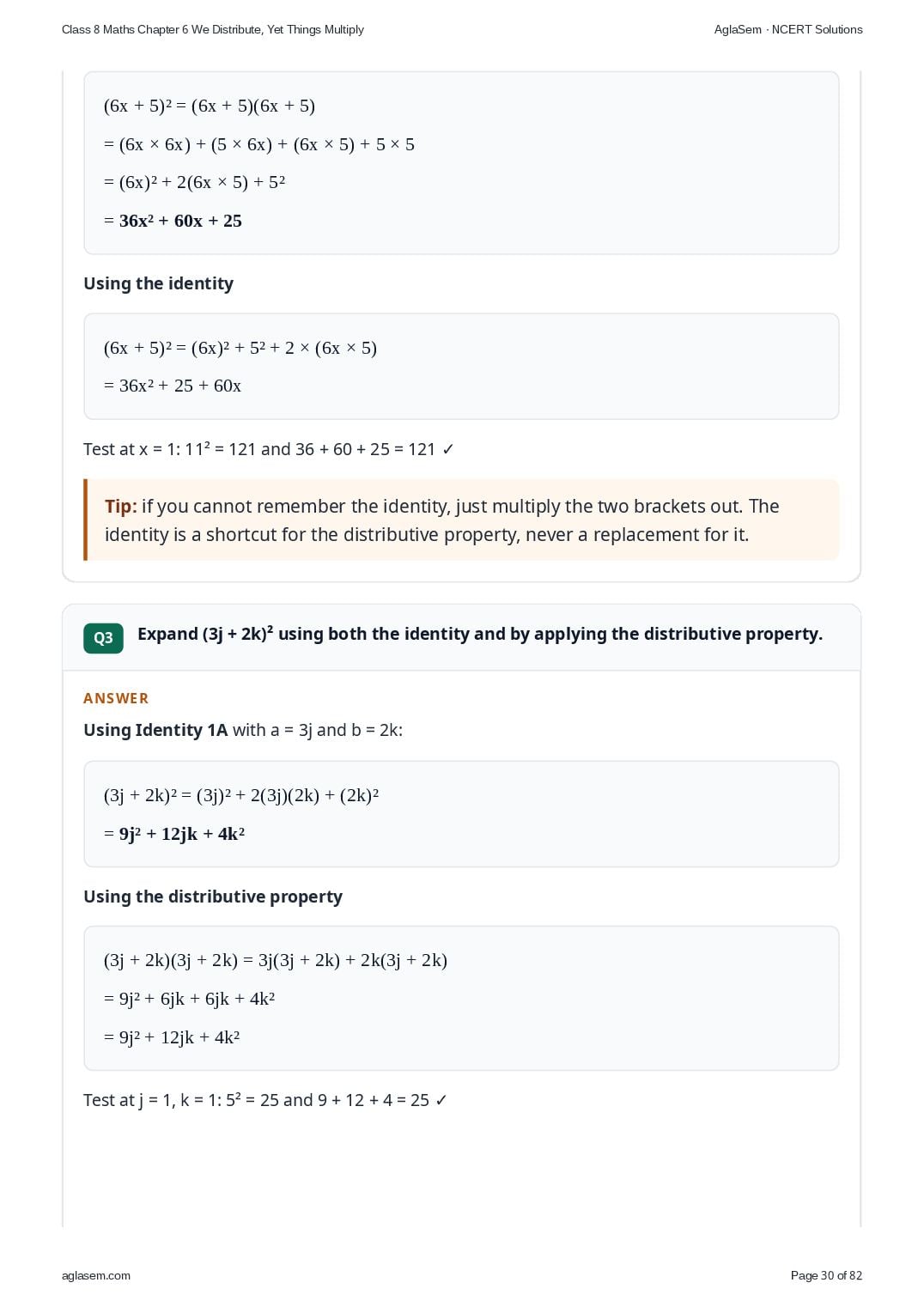
- Expand (6x + 5)².
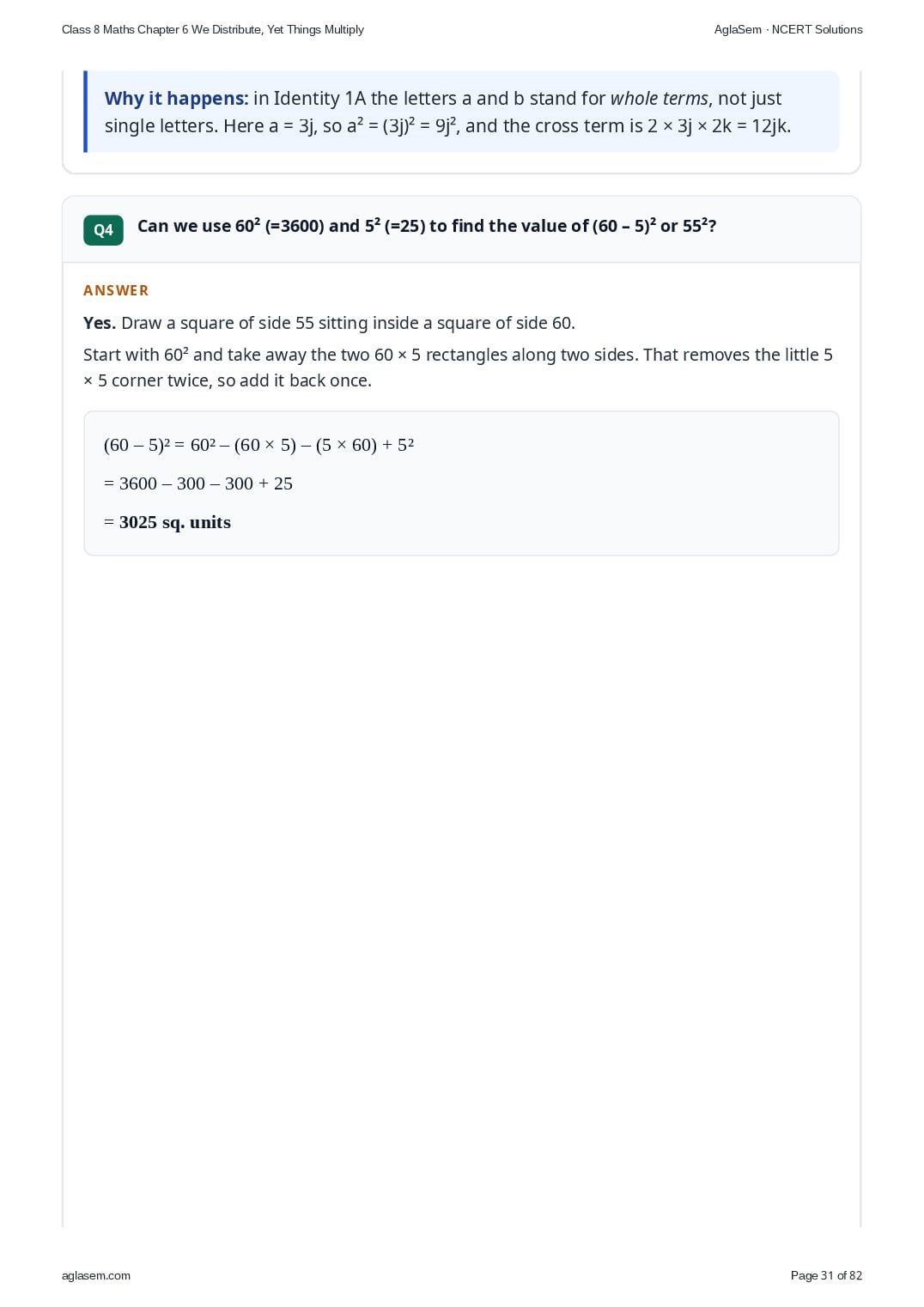
- Expand (3j + 2k)² using both the identity and by applying the distributive property.
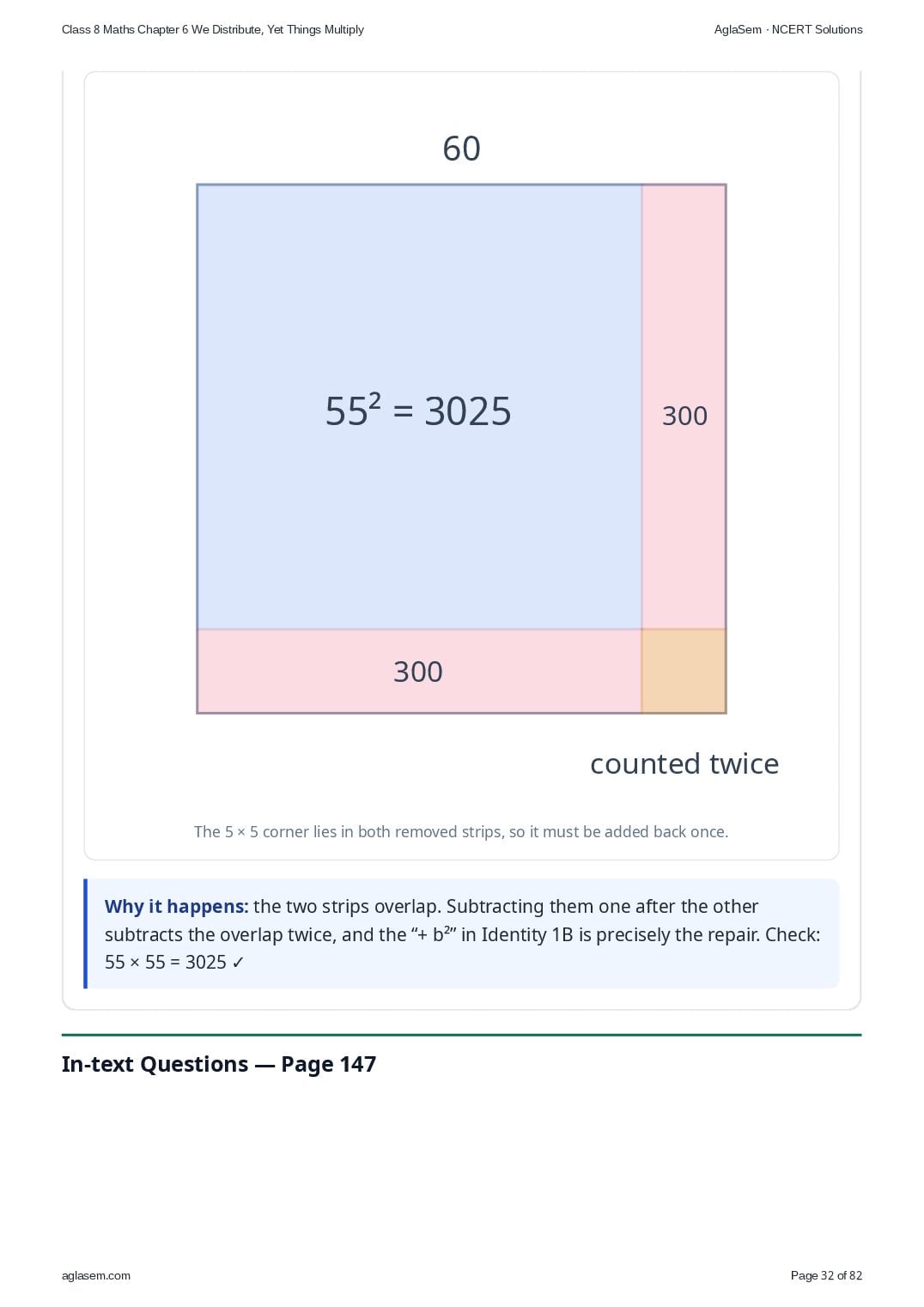
- Can we use 60² (=3600) and 5² (=25) to find the value of (60 – 5)² or 55²?
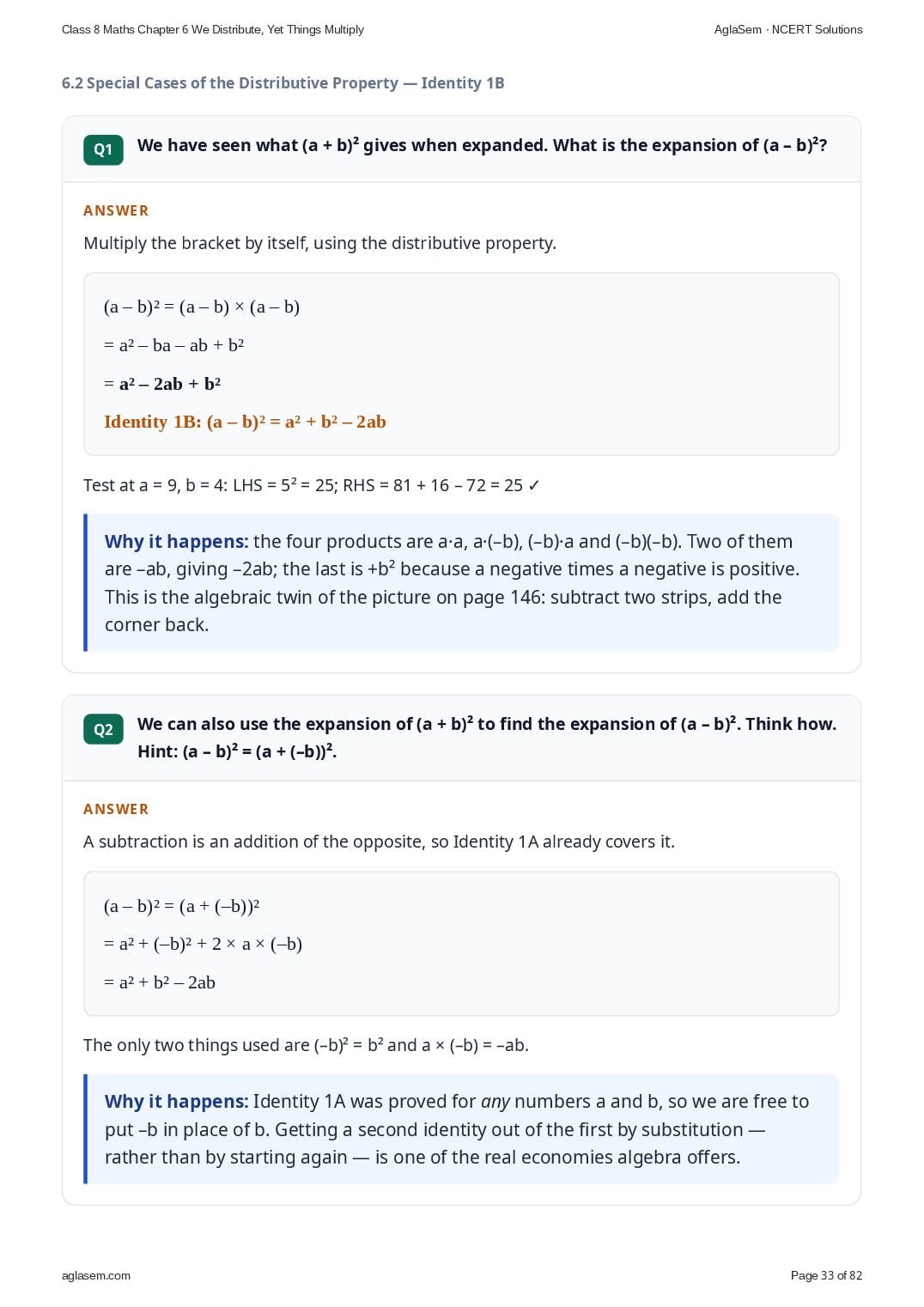
- We have seen what (a + b)² gives when expanded. What is the expansion of (a – b)²?
- We can also use the expansion of (a + b)² to find the expansion of (a – b)². Think how. Hint: (a – b)² = (a + (–b))².
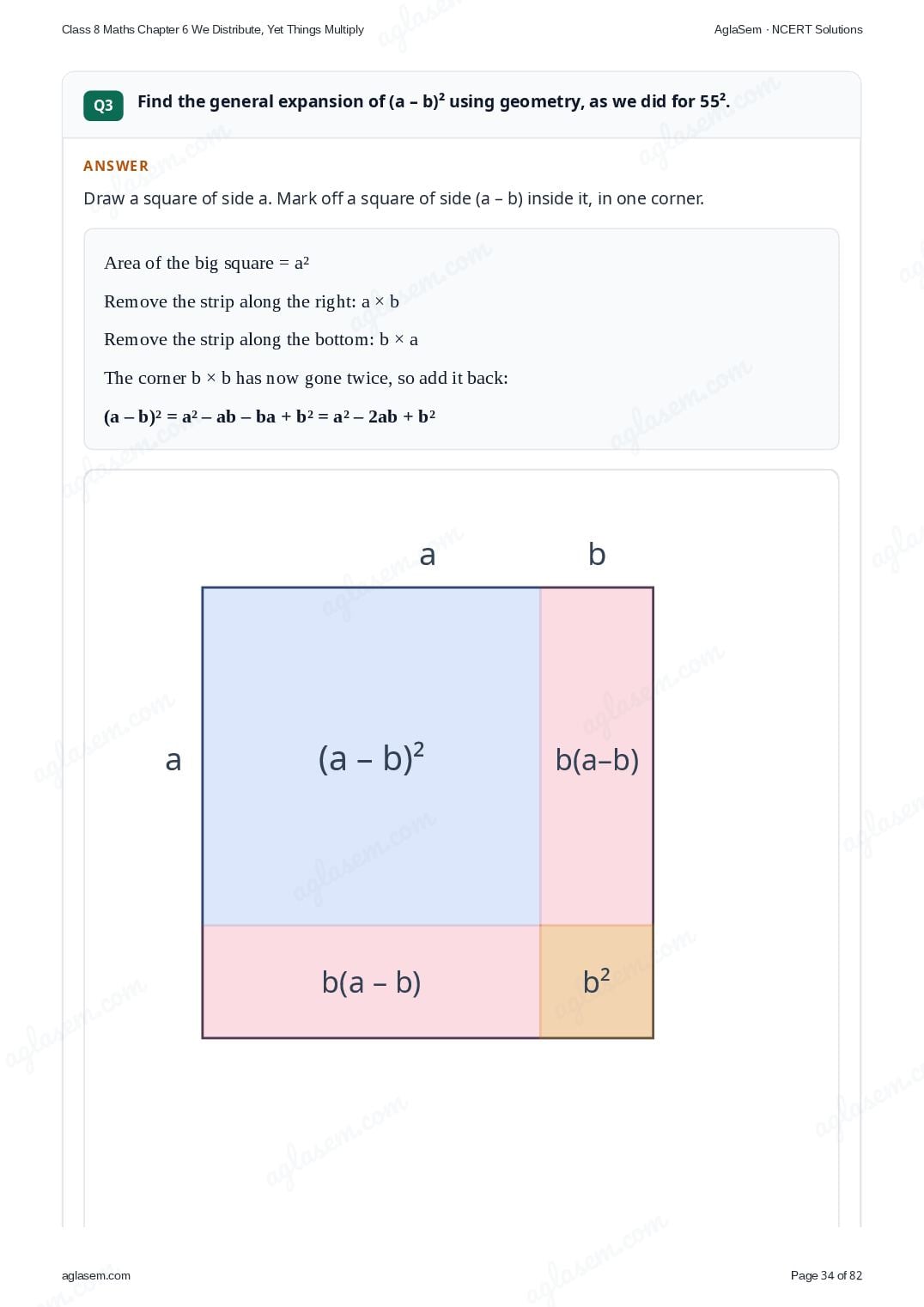
- Find the general expansion of (a – b)² using geometry, as we did for 55².
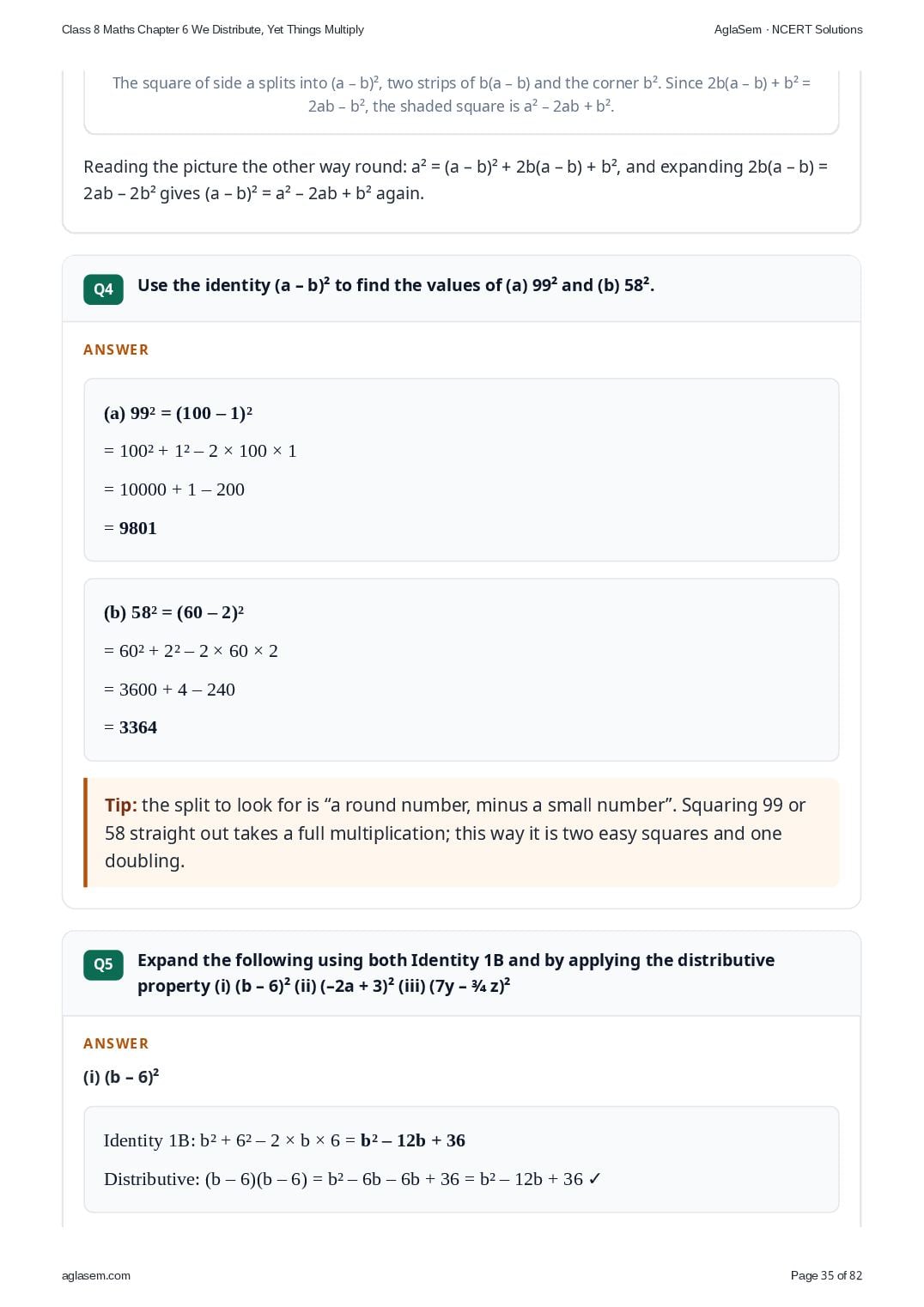
- Use the identity (a – b)² to find the values of (a) 99² and (b) 58².
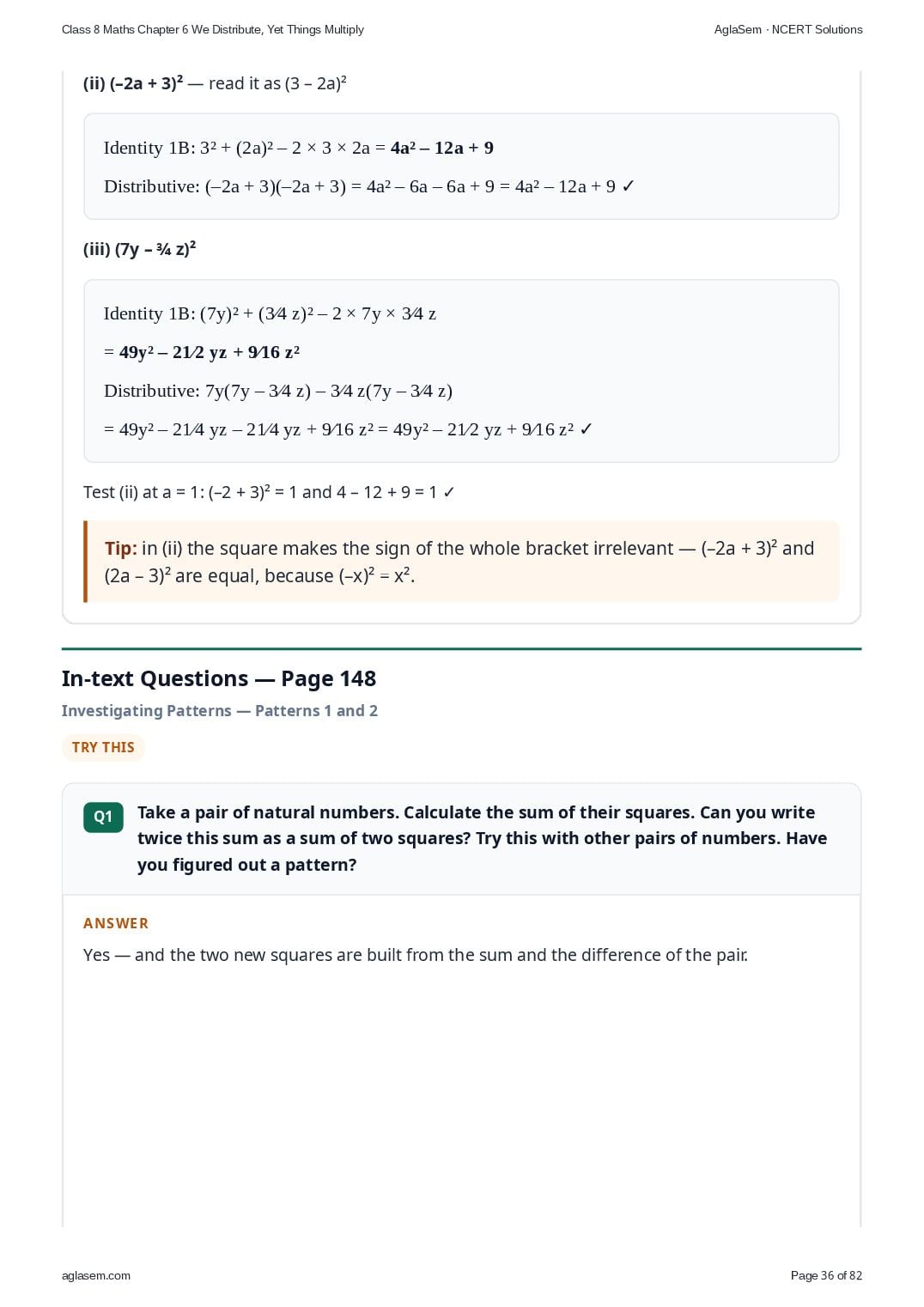
- Expand the following using both Identity 1B and by applying the distributive property (i) (b – 6)² (ii) (–2a + 3)² (iii) (7y – 3⁄4 z)²
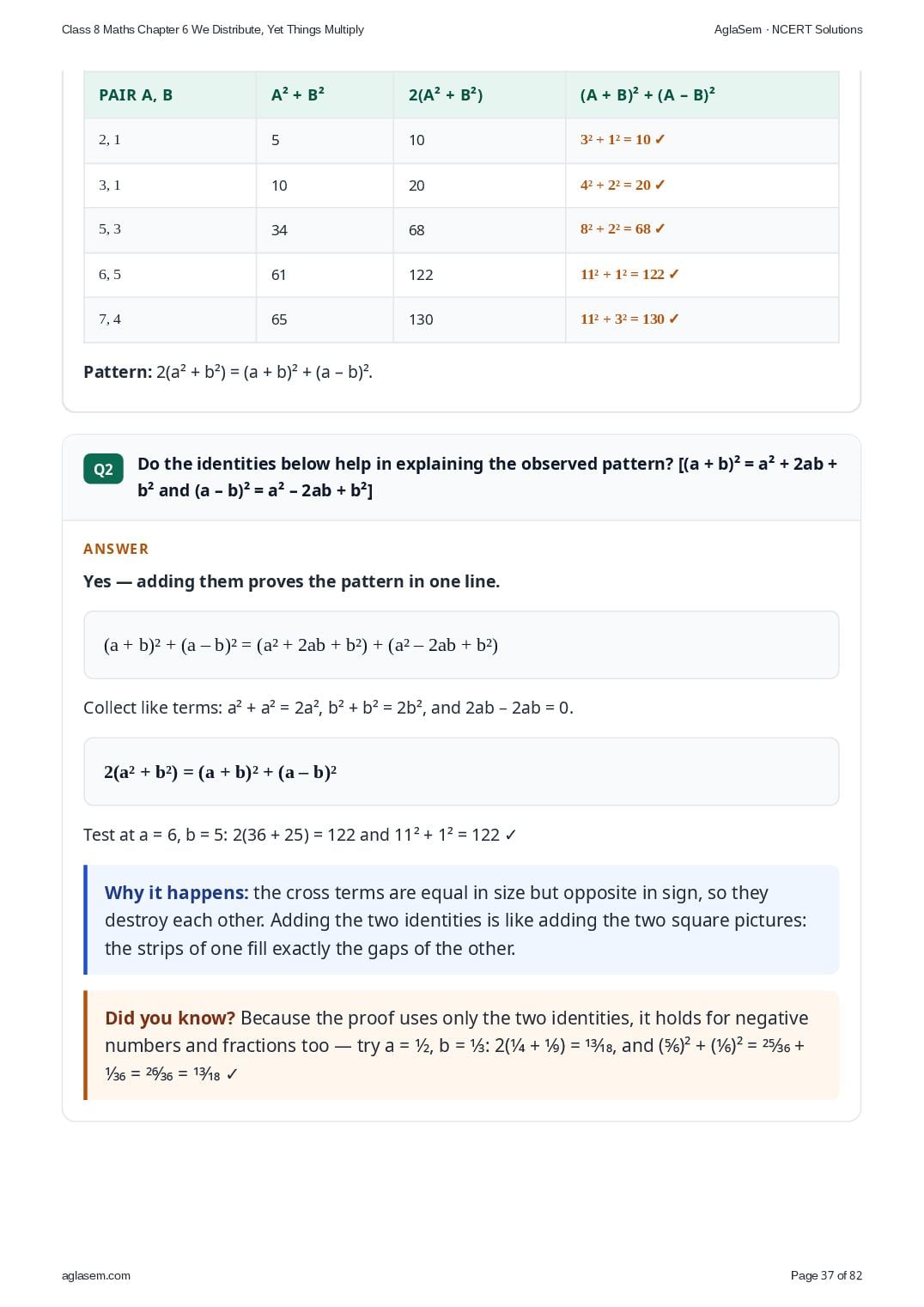
- Take a pair of natural numbers. Calculate the sum of their squares. Can you write twice this sum as a sum of two squares? Try this with other pairs of numbers. Have you figured out a pattern?
- Do the identities below help in explaining the observed pattern? [(a + b)² = a² + 2ab + b² and (a – b)² = a² – 2ab + b²]
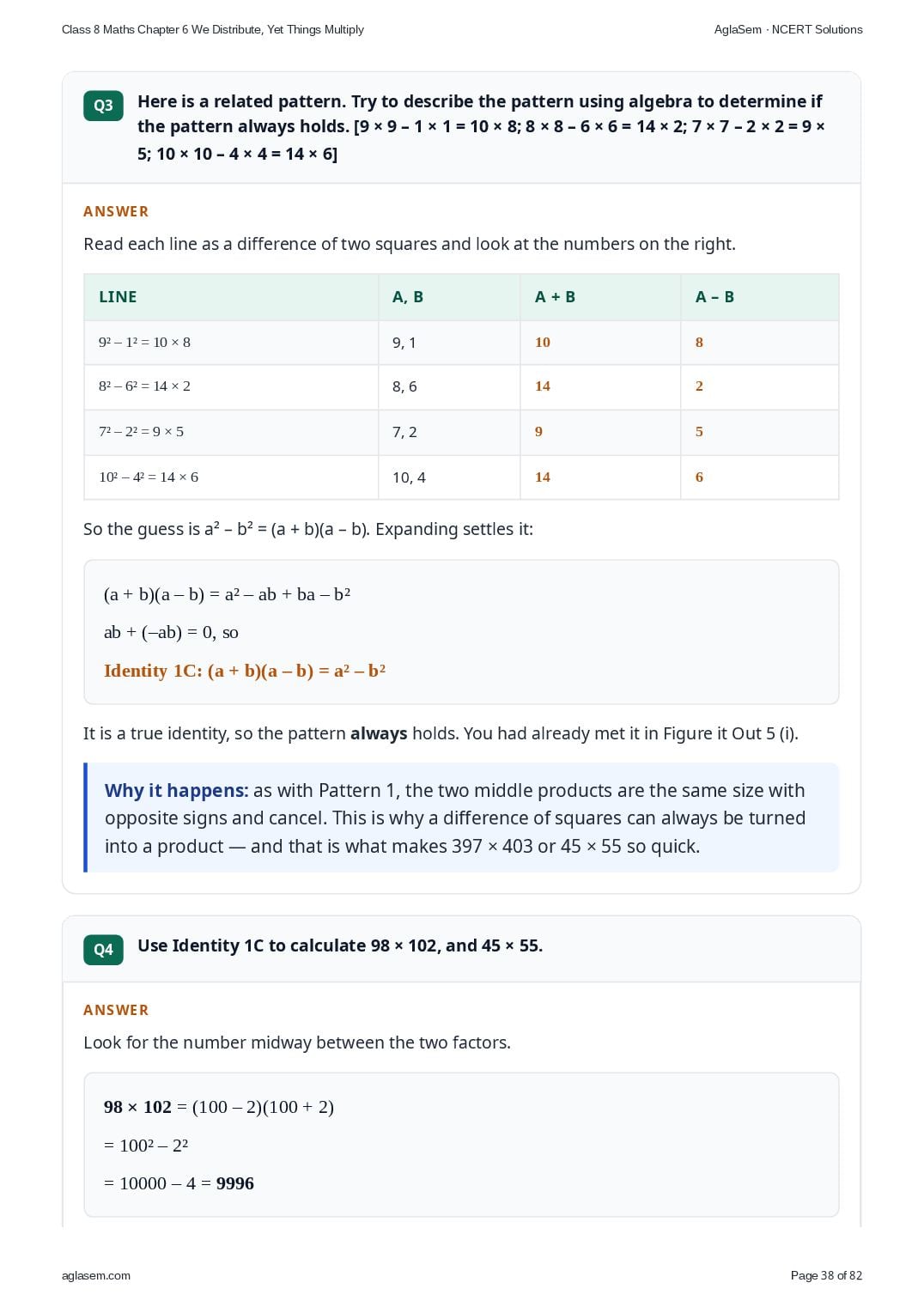
- Here is a related pattern. Try to describe the pattern using algebra to determine if the pattern always holds. [9 × 9 – 1 × 1 = 10 × 8; 8 × 8 – 6 × 6 = 14 × 2; 7 × 7 – 2 × 2 = 9 × 5; 10 × 10 – 4 × 4 = 14 × 6]
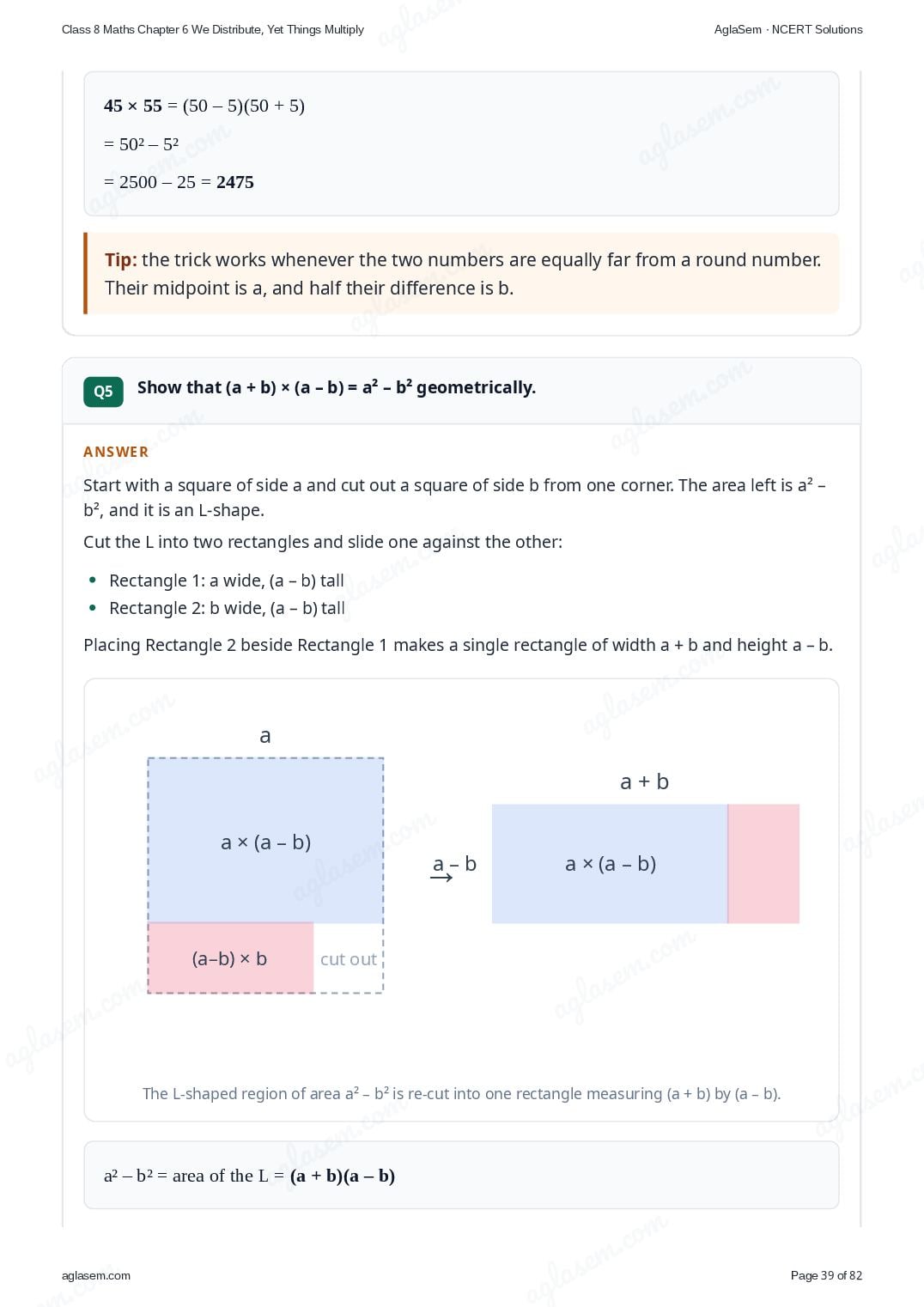
- Use Identity 1C to calculate 98 × 102, and 45 × 55.
- Show that (a + b) × (a – b) = a² – b² geometrically.
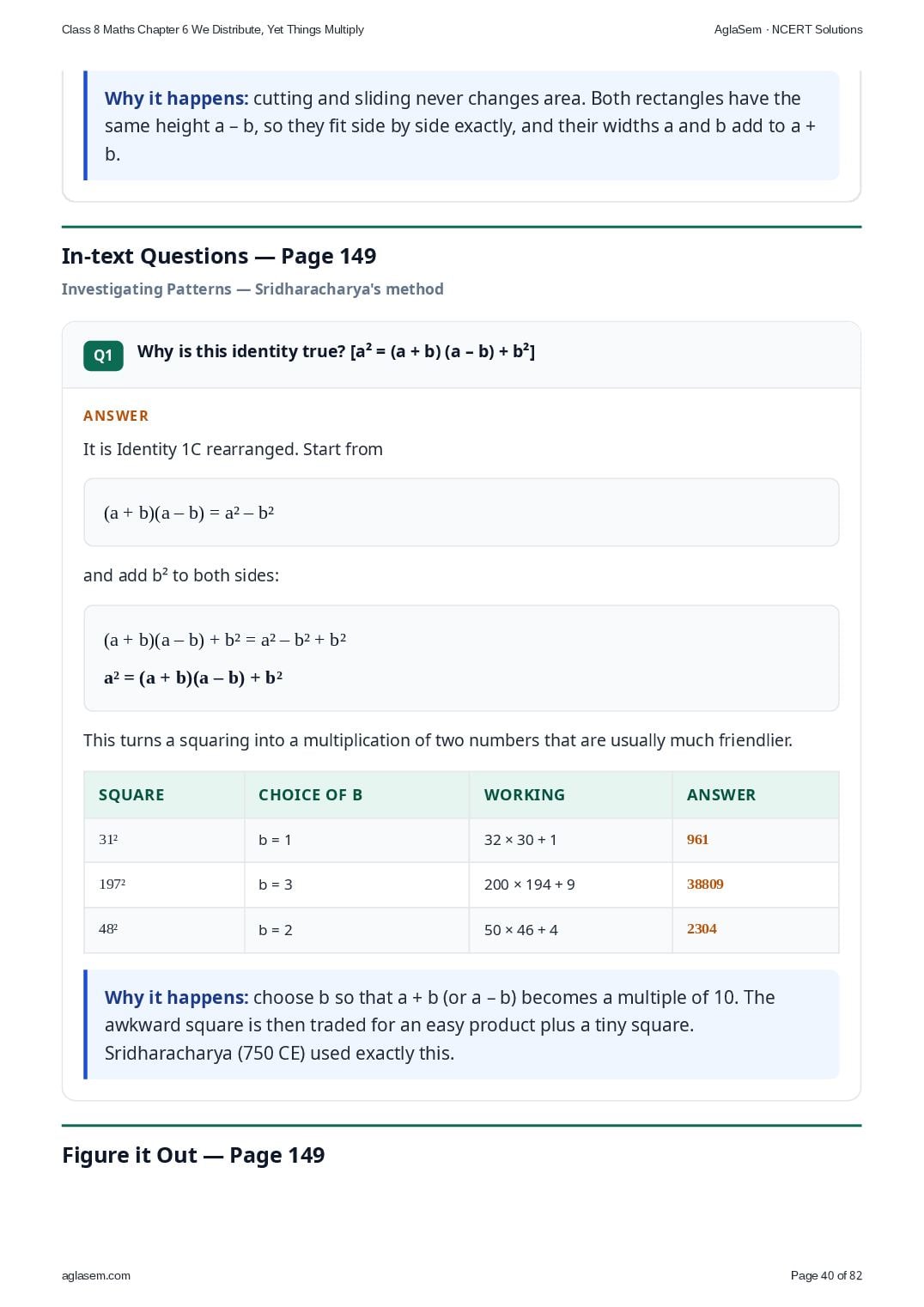
- Why is this identity true? [a² = (a + b) (a – b) + b²]
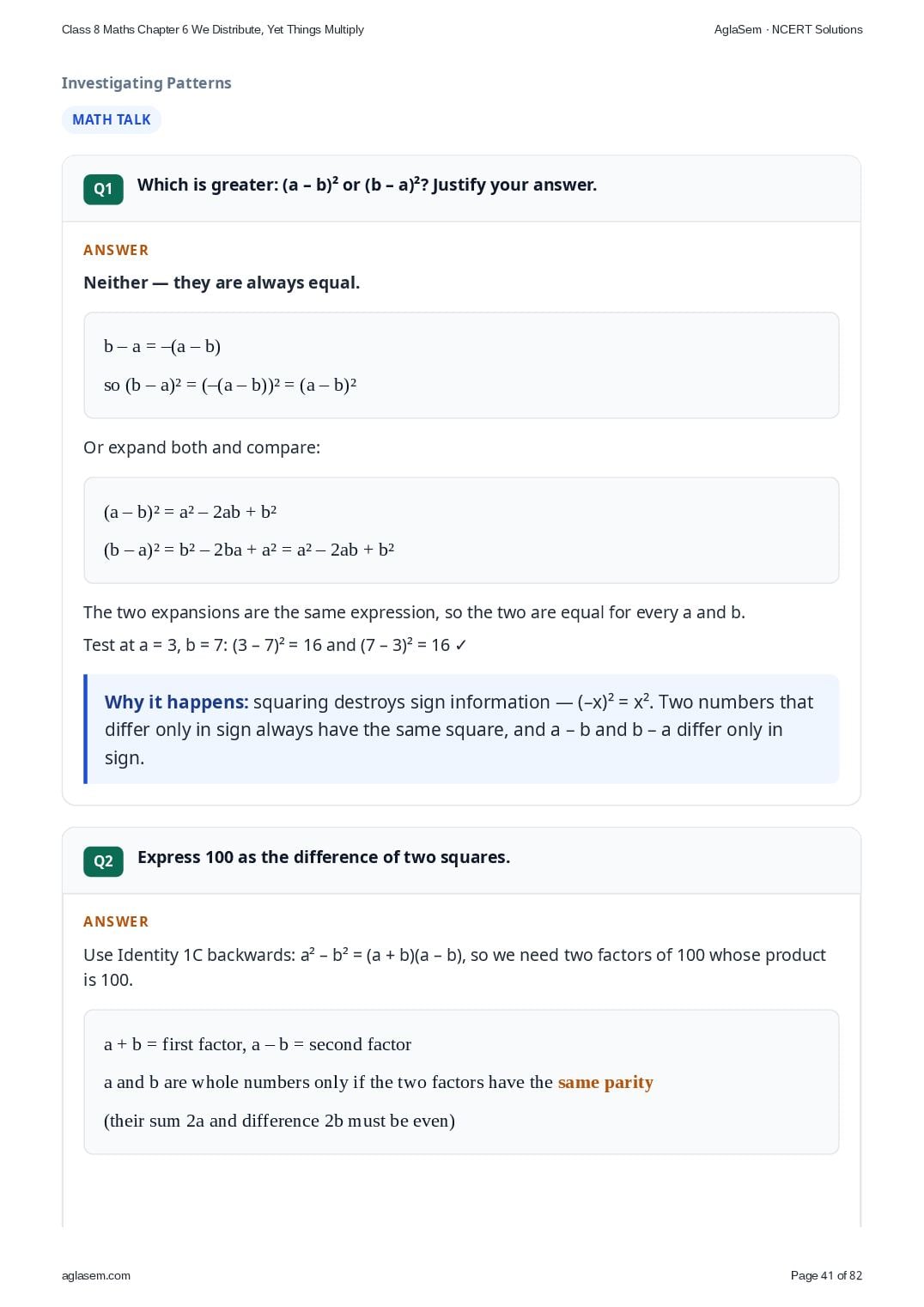
- Which is greater: (a – b)² or (b – a)²? Justify your answer.
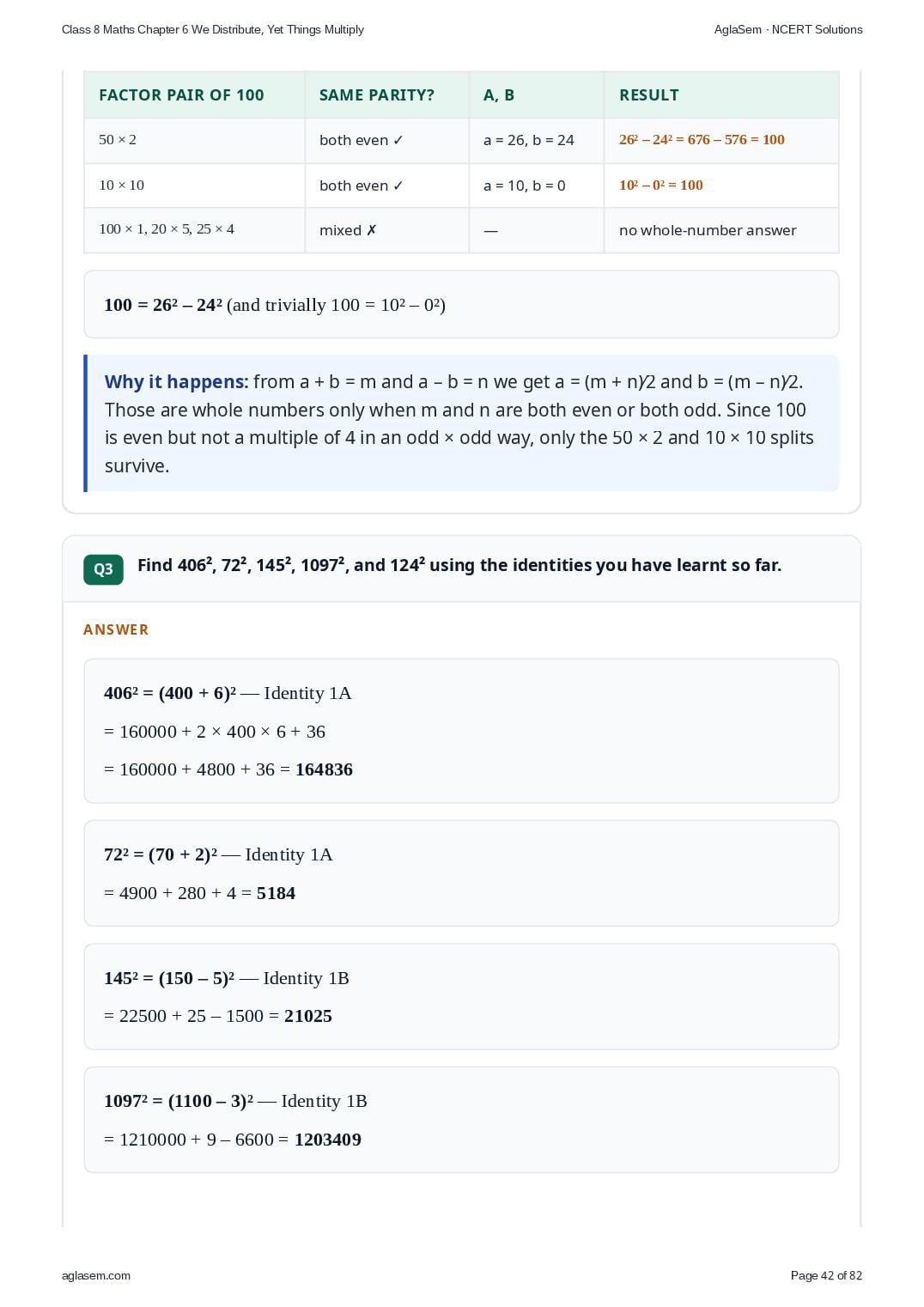
- Express 100 as the difference of two squares.
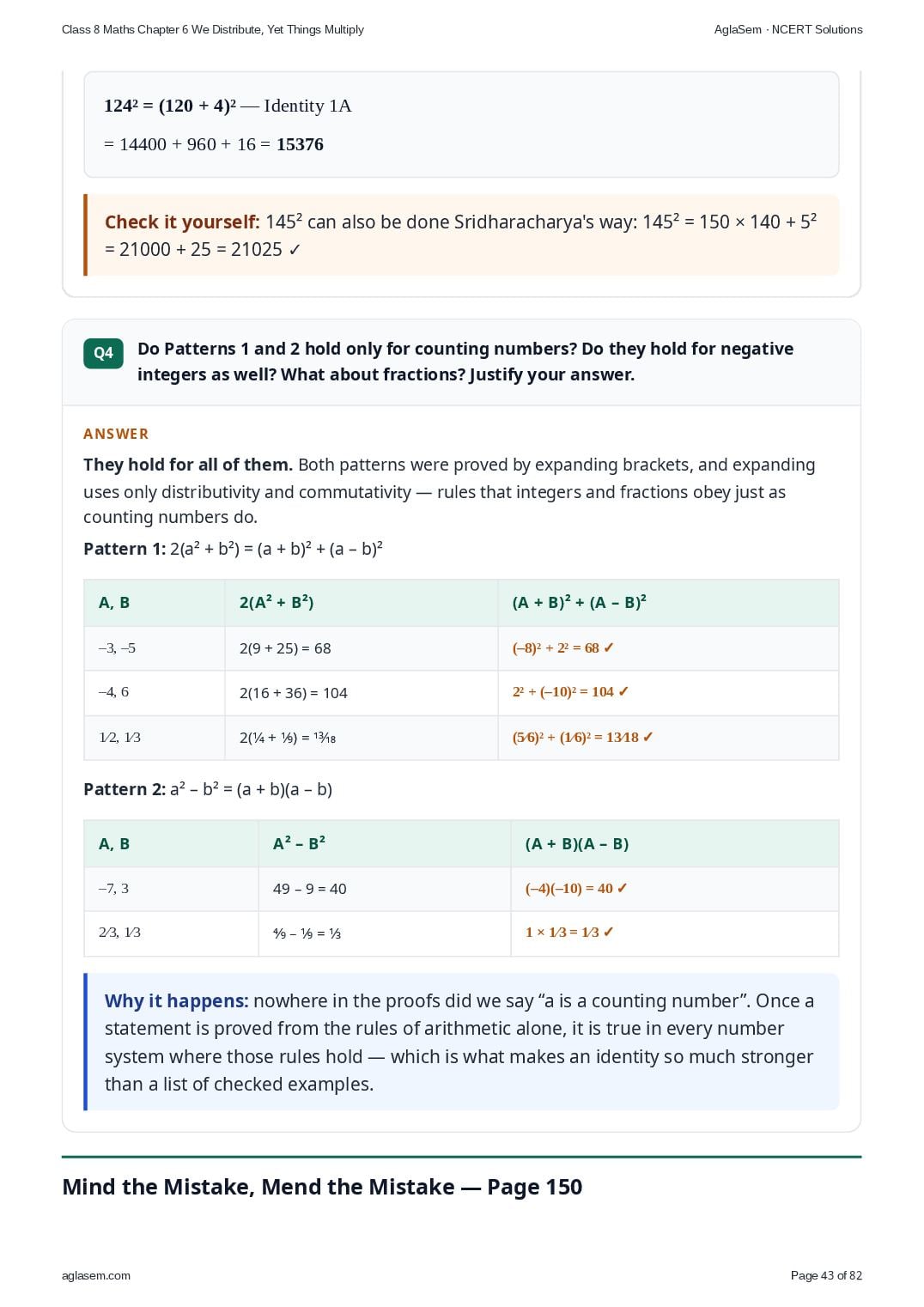
- Find 406², 72², 145², 1097², and 124² using the identities you have learnt so far.
- Do Patterns 1 and 2 hold only for counting numbers? Do they hold for negative integers as well? What about fractions? Justify your answer.
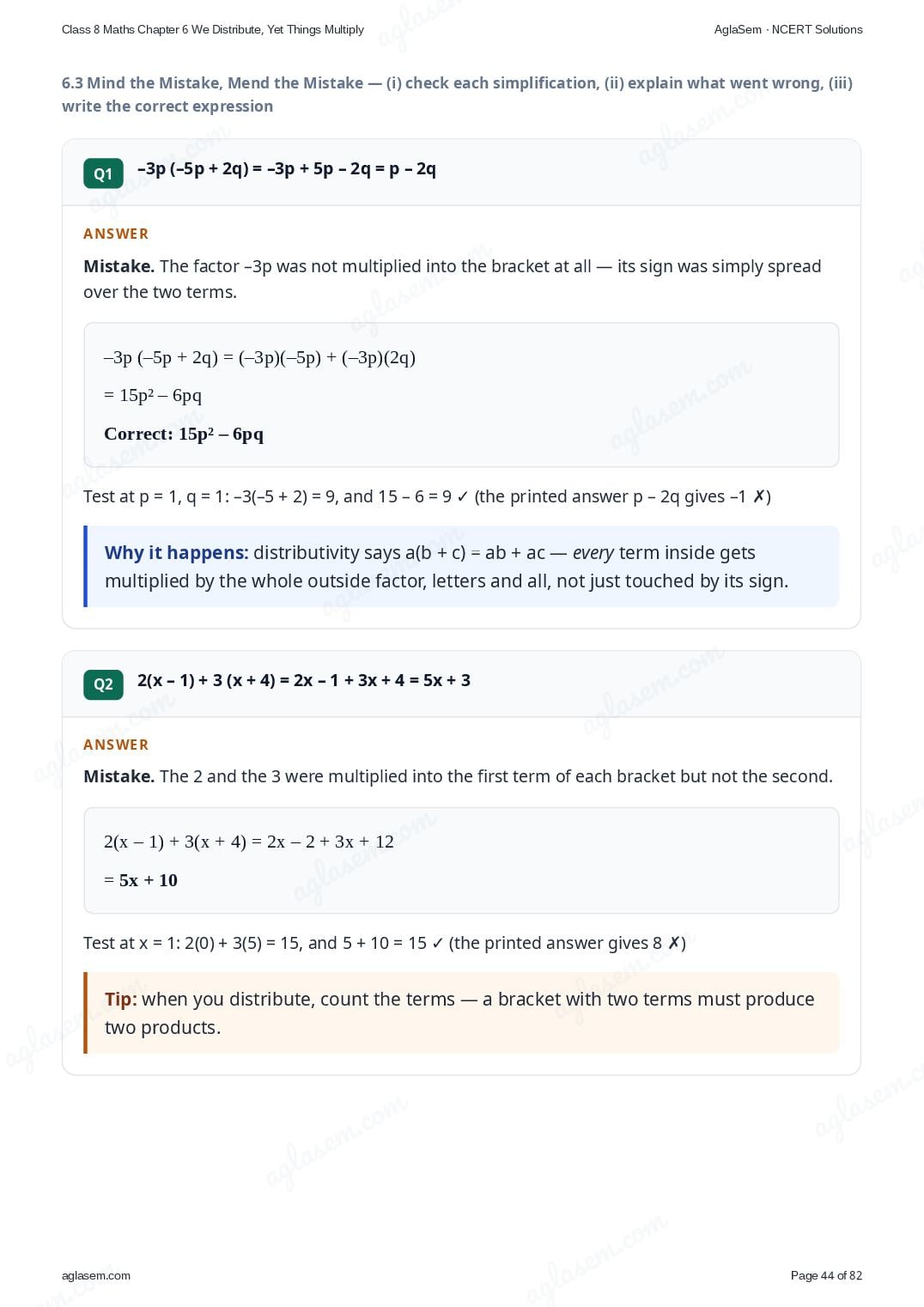
- –3p (–5p + 2q) = –3p + 5p – 2q = p – 2q
- 2(x – 1) + 3 (x + 4) = 2x – 1 + 3x + 4 = 5x + 3
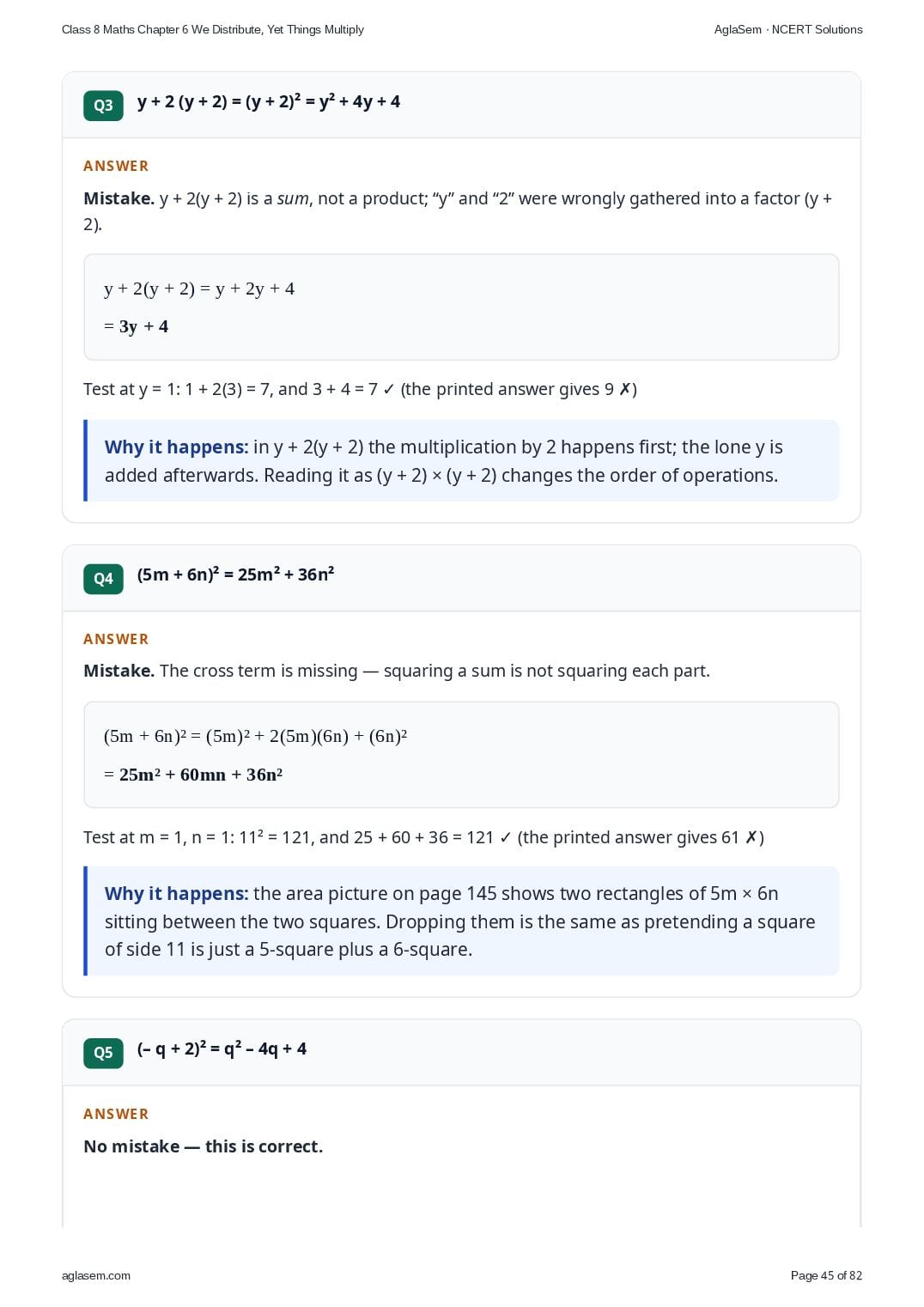
- y + 2 (y + 2) = (y + 2)² = y² + 4y + 4
- (5m + 6n)² = 25m² + 36n²
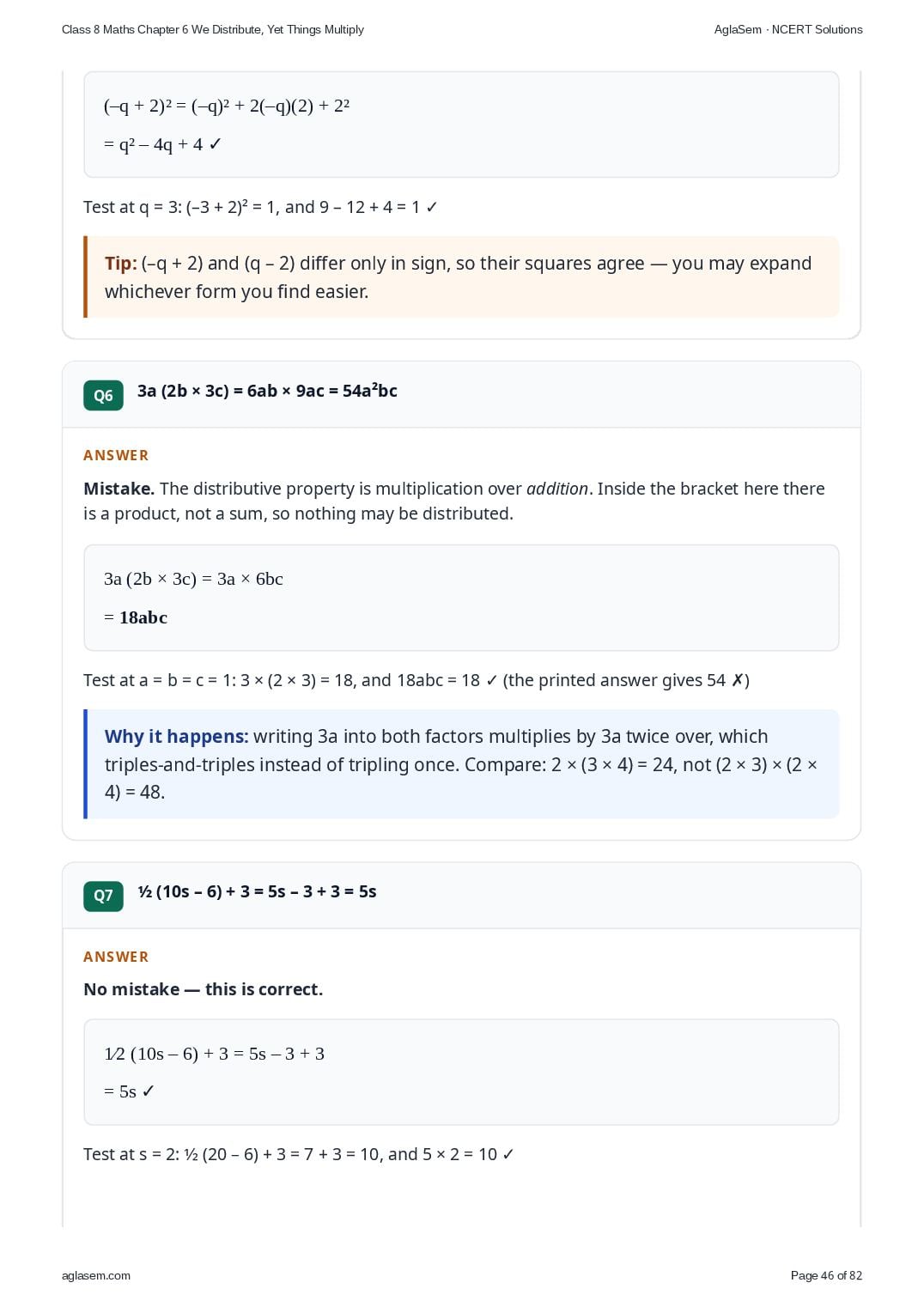
- (– q + 2)² = q² – 4q + 4
- 3a (2b × 3c) = 6ab × 9ac = 54a²bc
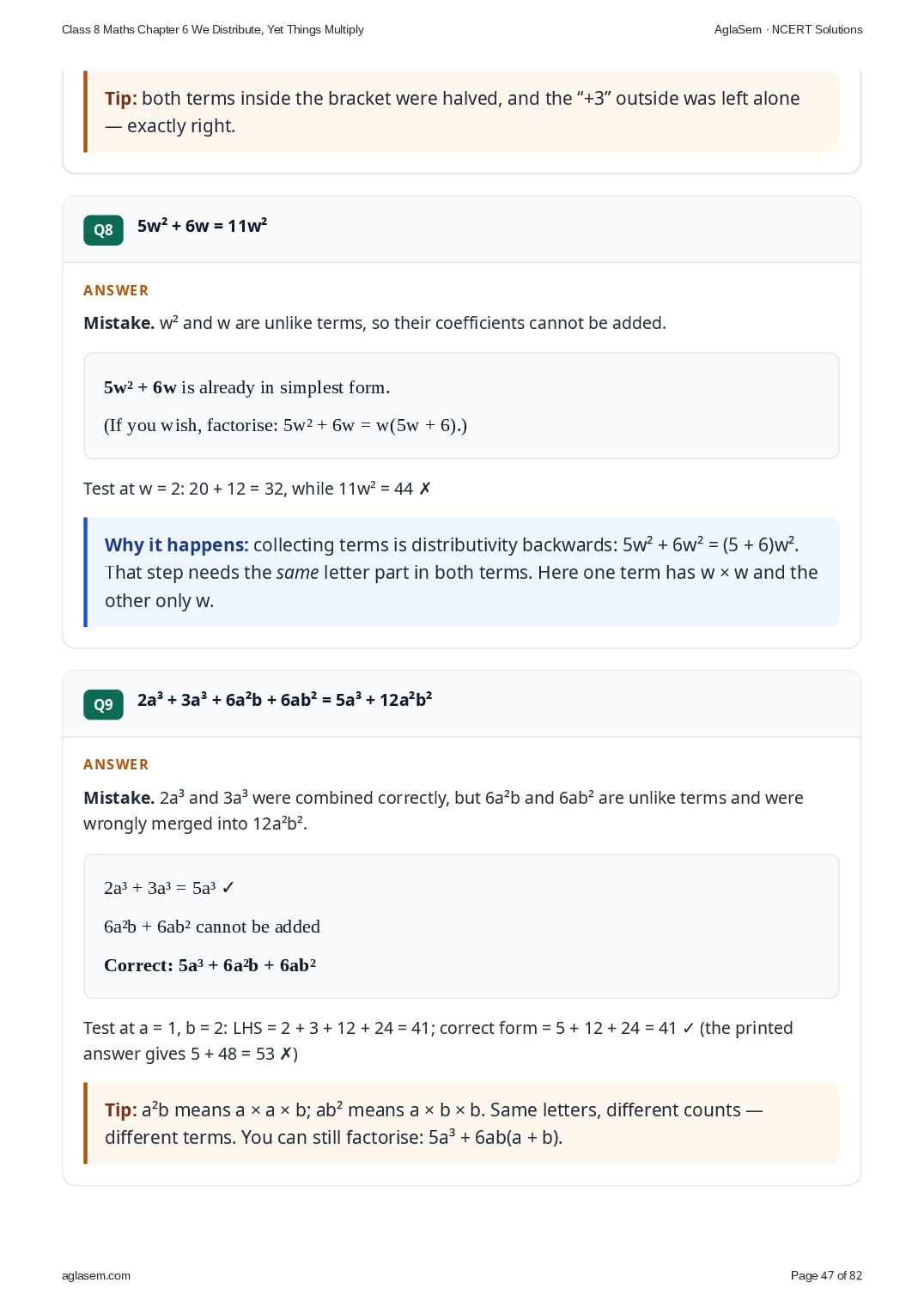
- 1⁄2 (10s – 6) + 3 = 5s – 3 + 3 = 5s
- 5w² + 6w = 11w²
- 2a³ + 3a³ + 6a²b + 6ab² = 5a³ + 12a²b²
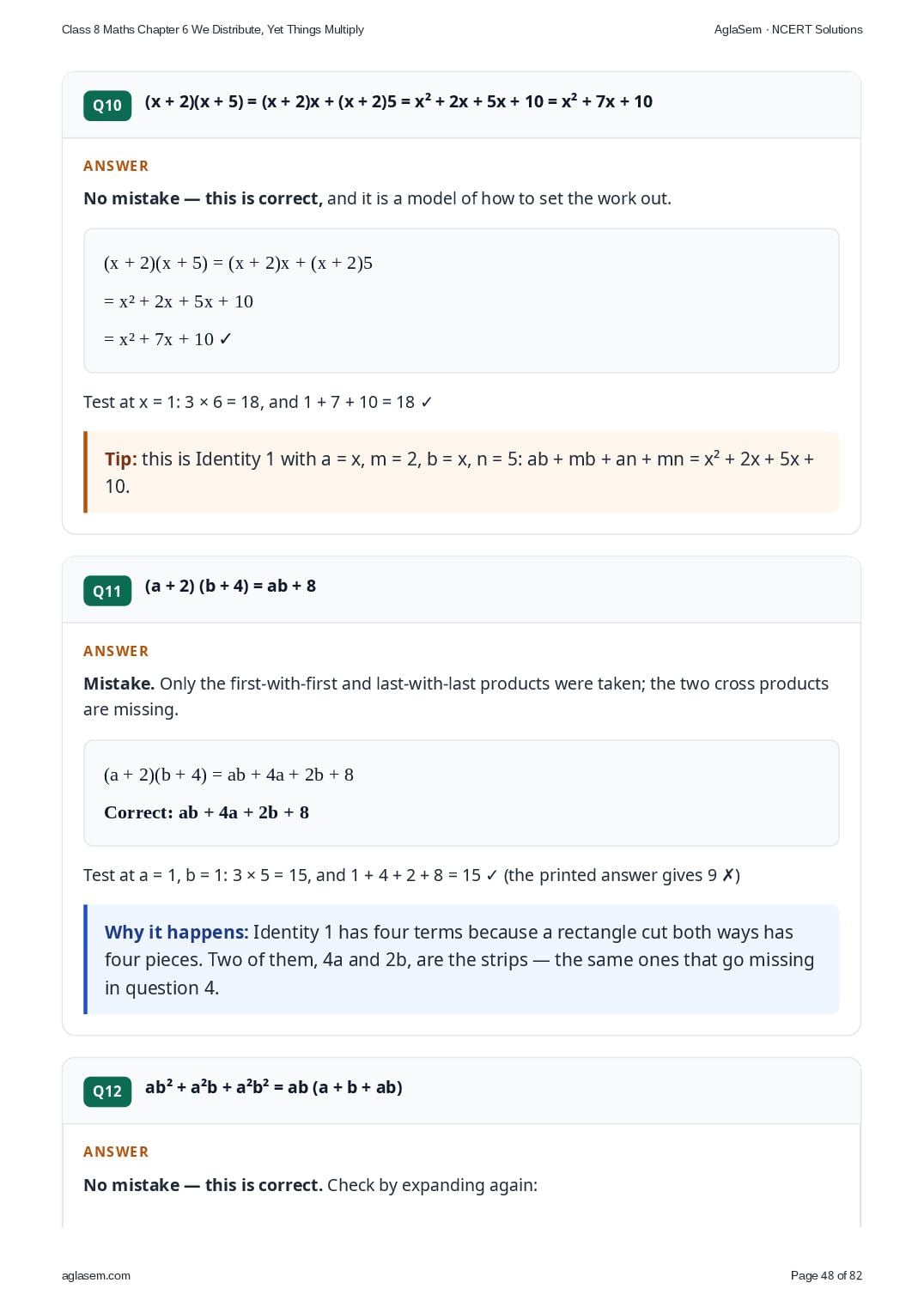
- (x + 2)(x + 5) = (x + 2)x + (x + 2)5 = x² + 2x + 5x + 10 = x² + 7x + 10
- (a + 2) (b + 4) = ab + 8
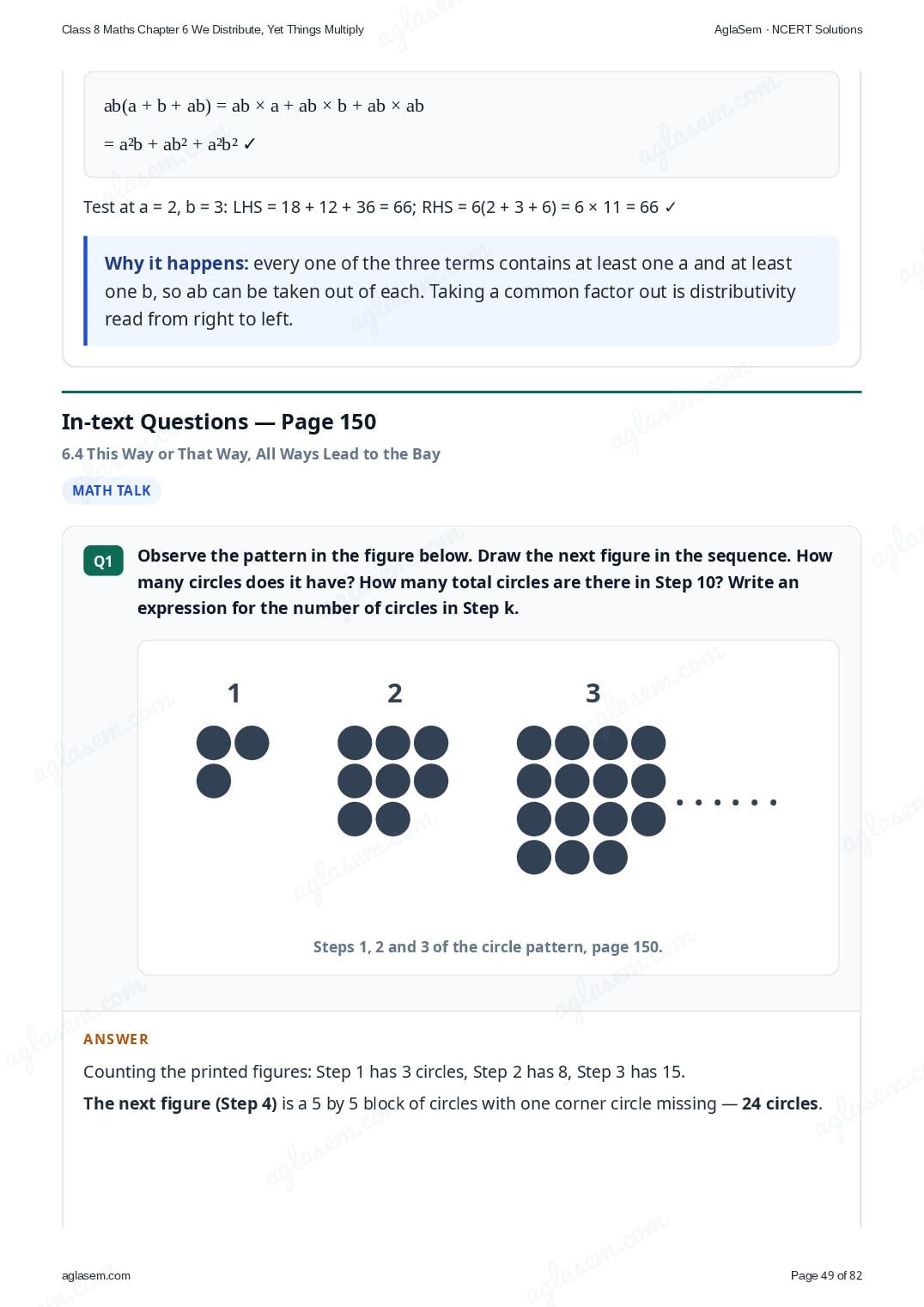
- ab² + a²b + a²b² = ab (a + b + ab)
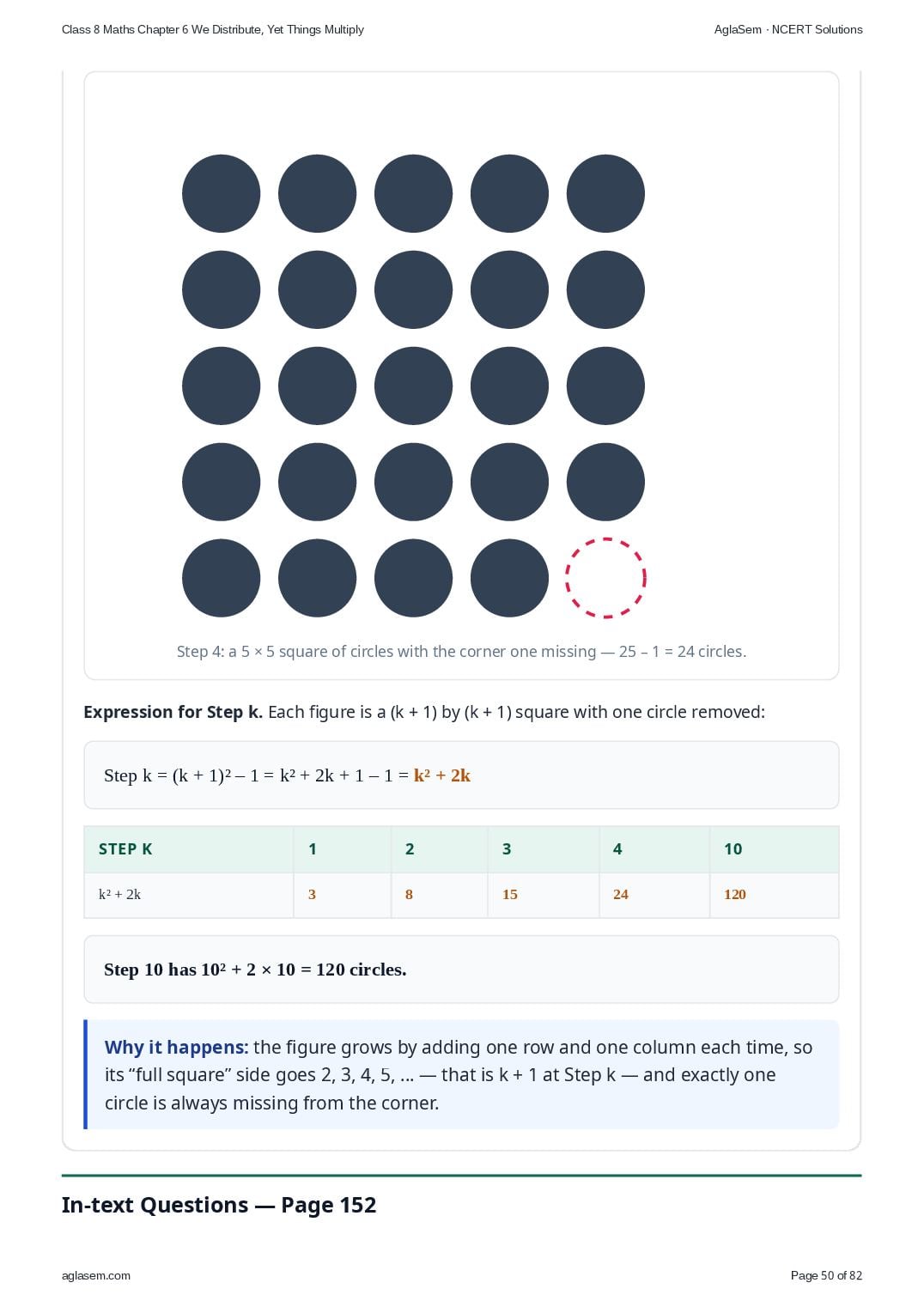
- Observe the pattern in the figure below. Draw the next figure in the sequence. How many circles does it have? How many total circles are there in Step 10? Write an expression for the number of circles in Step k.
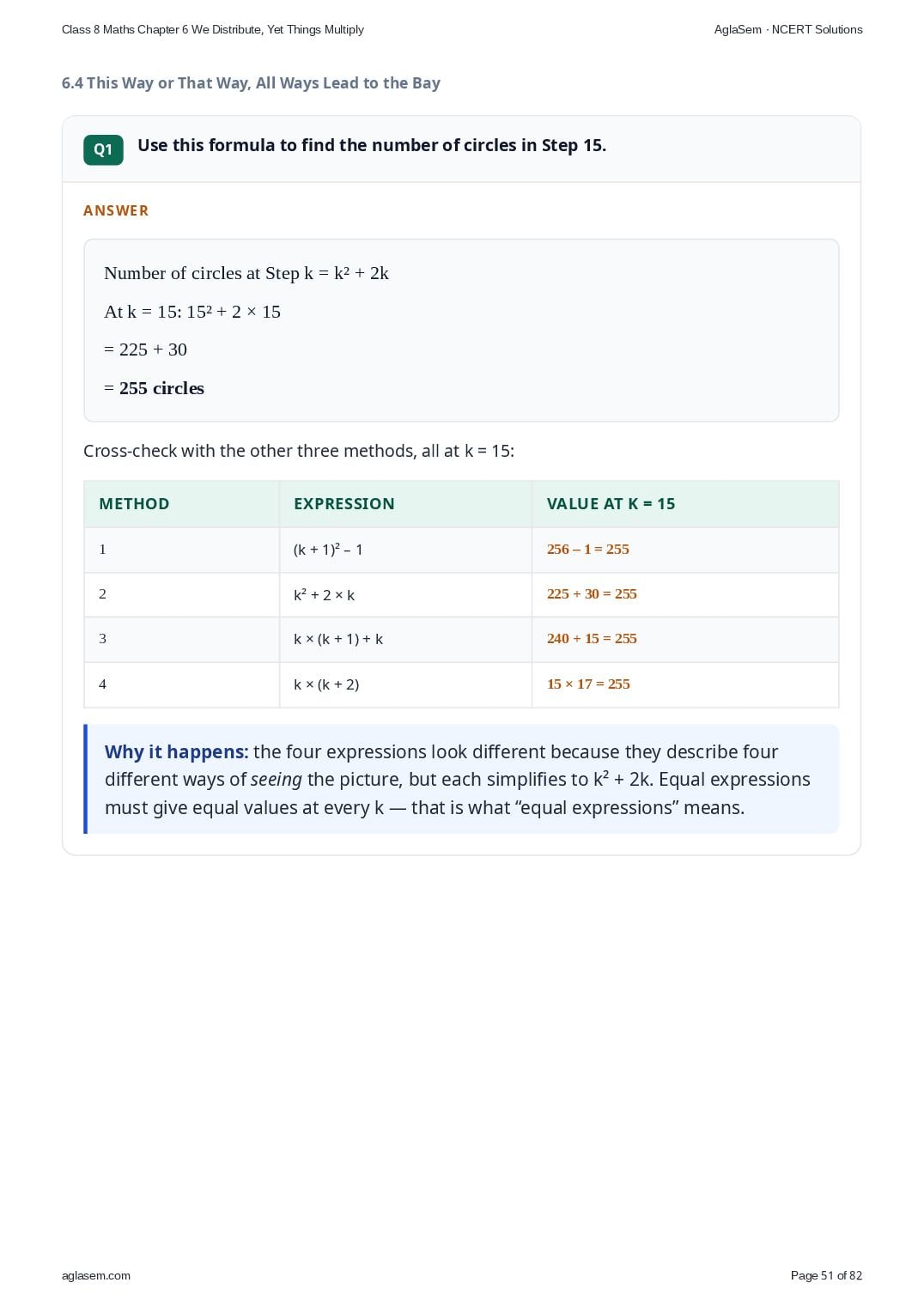
- Use this formula to find the number of circles in Step 15.
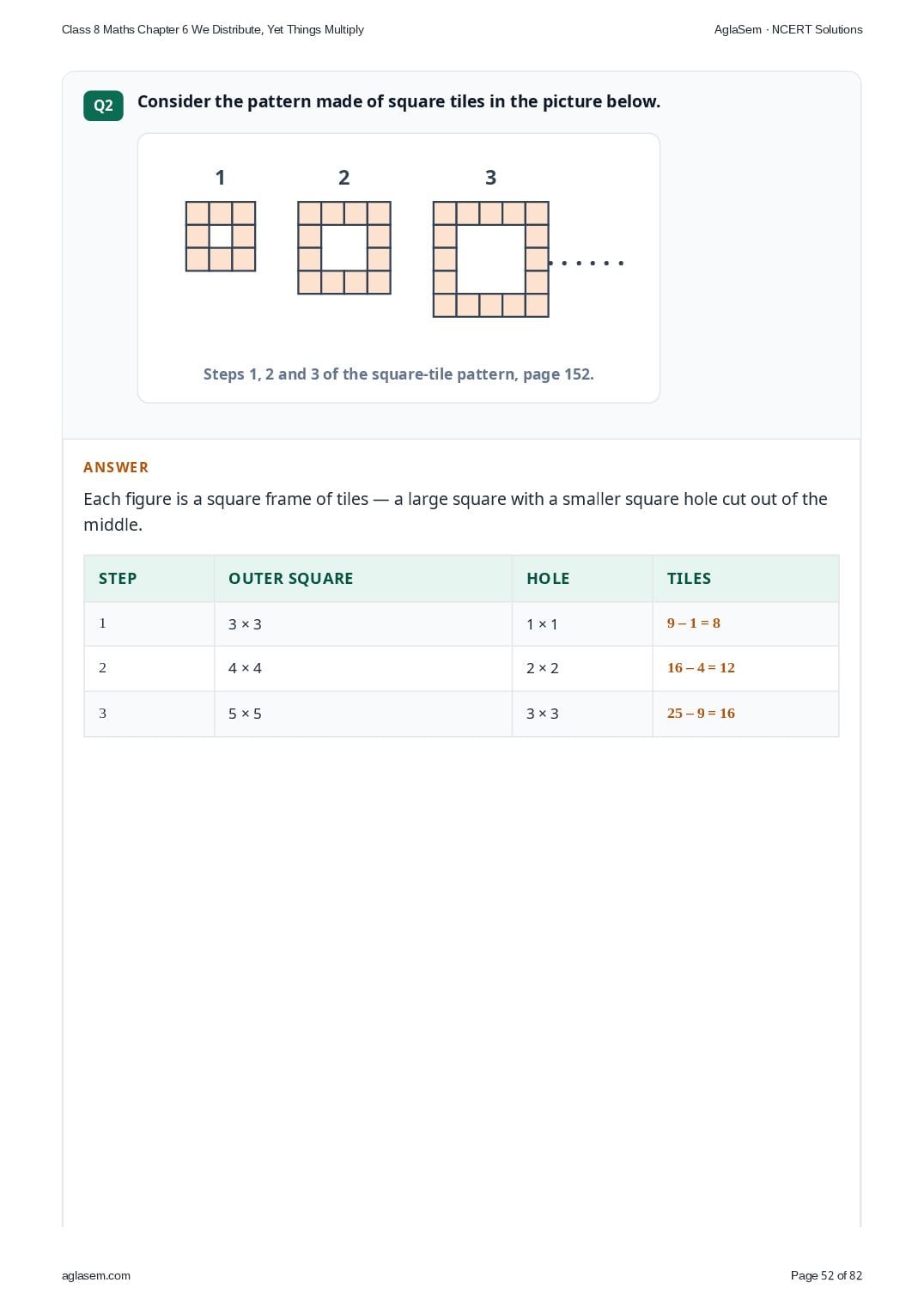
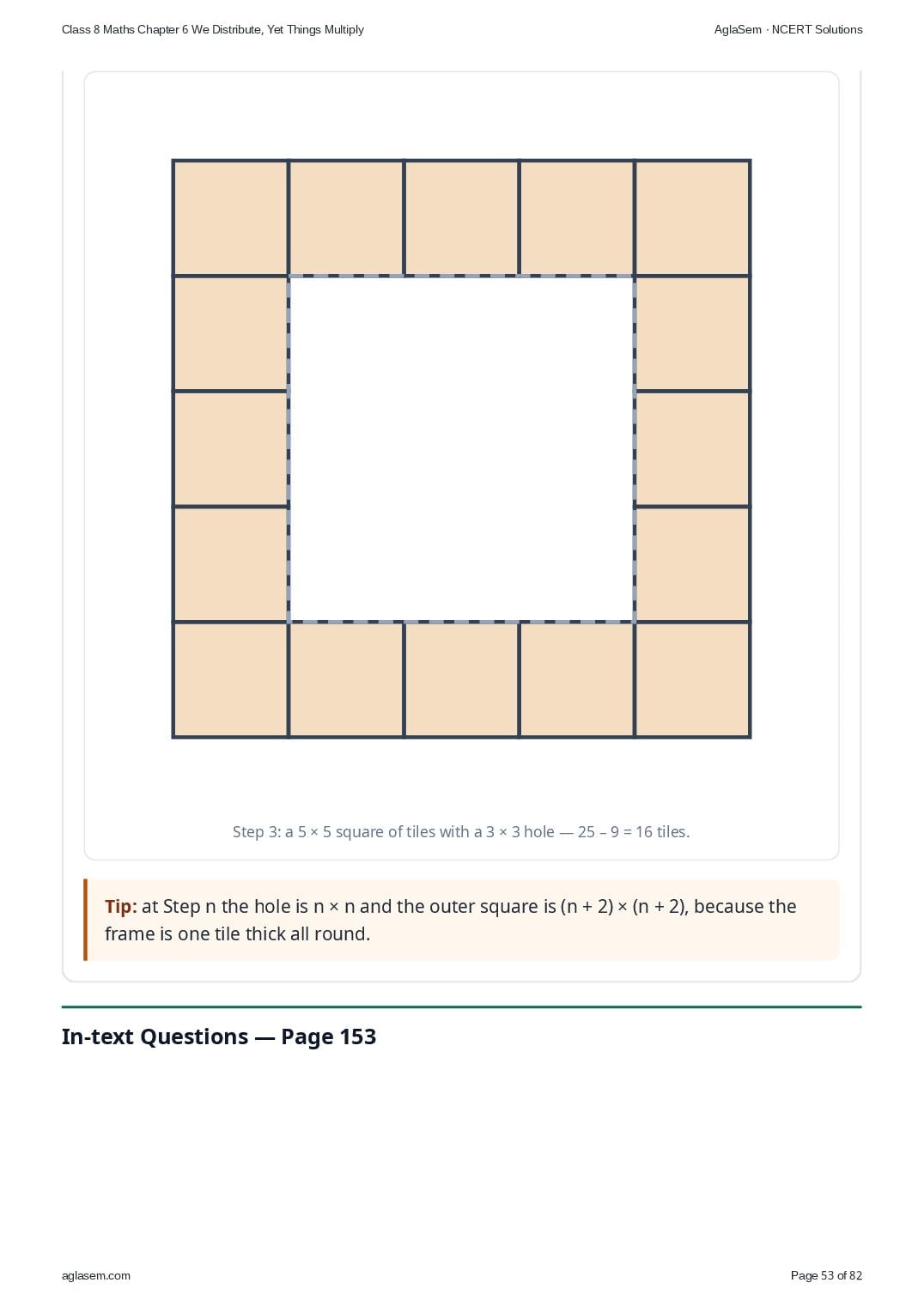
- Consider the pattern made of square tiles in the picture below.
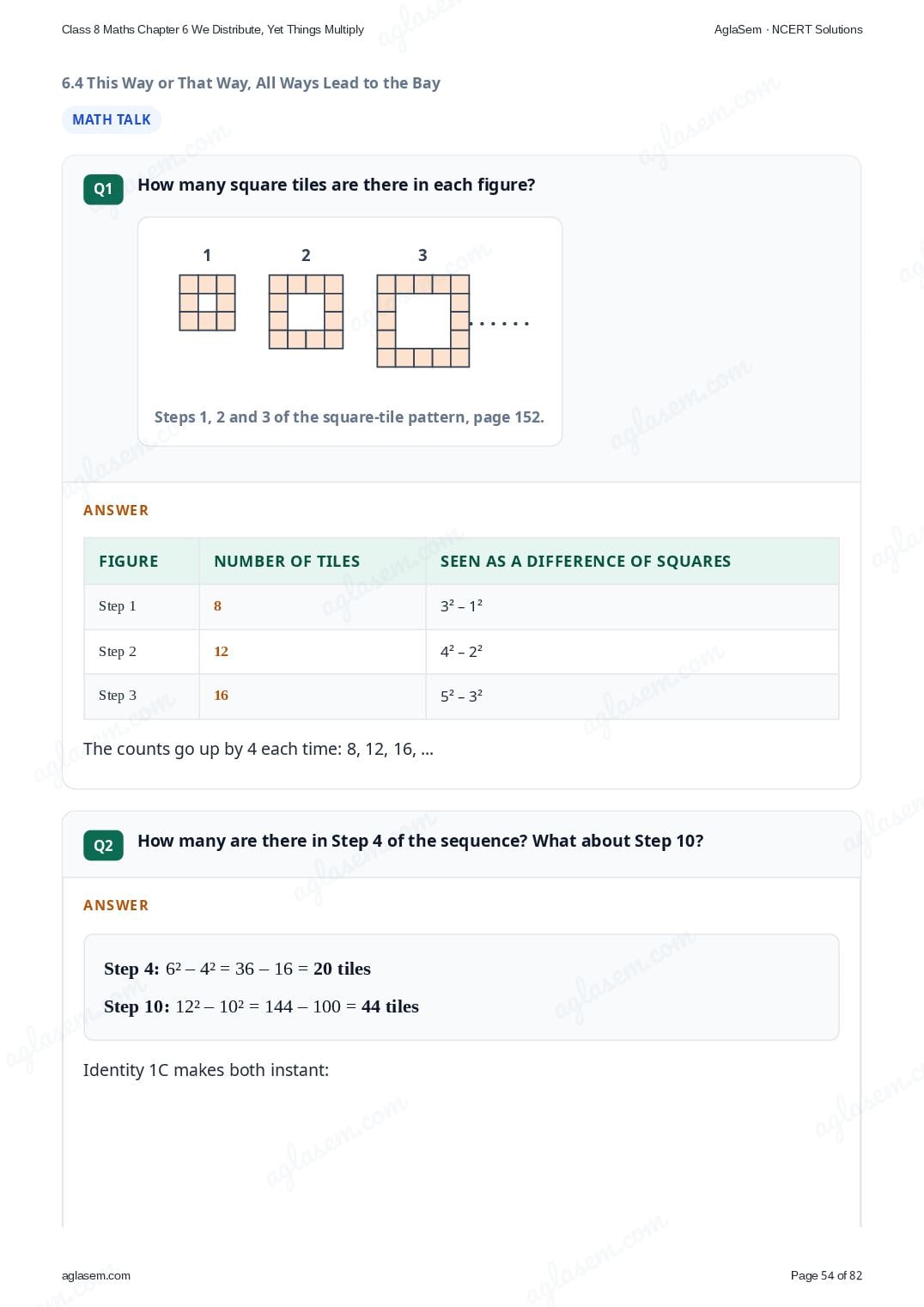
- How many square tiles are there in each figure?
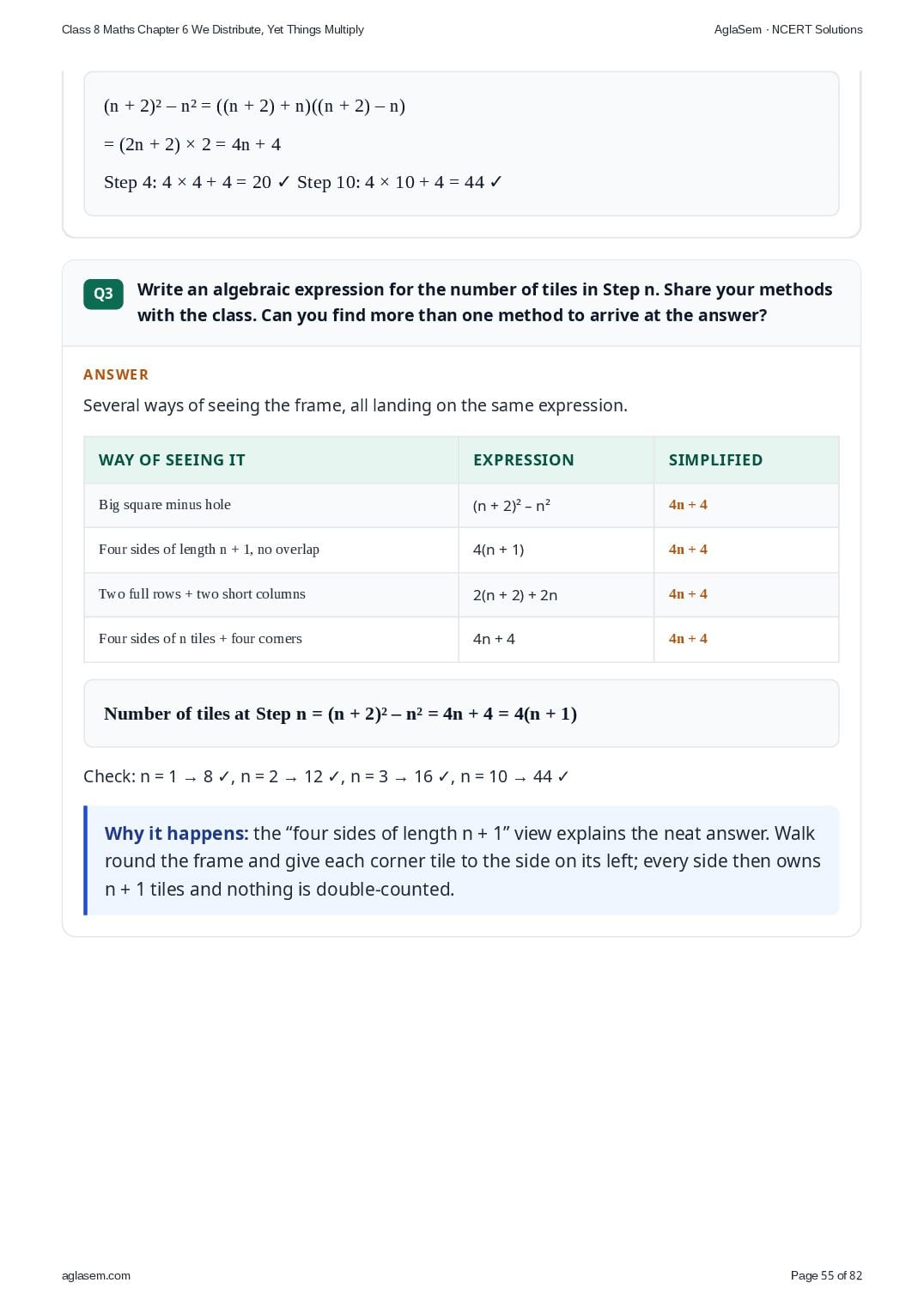
- How many are there in Step 4 of the sequence? What about Step 10?
- Write an algebraic expression for the number of tiles in Step n. Share your methods with the class. Can you find more than one method to arrive at the answer?
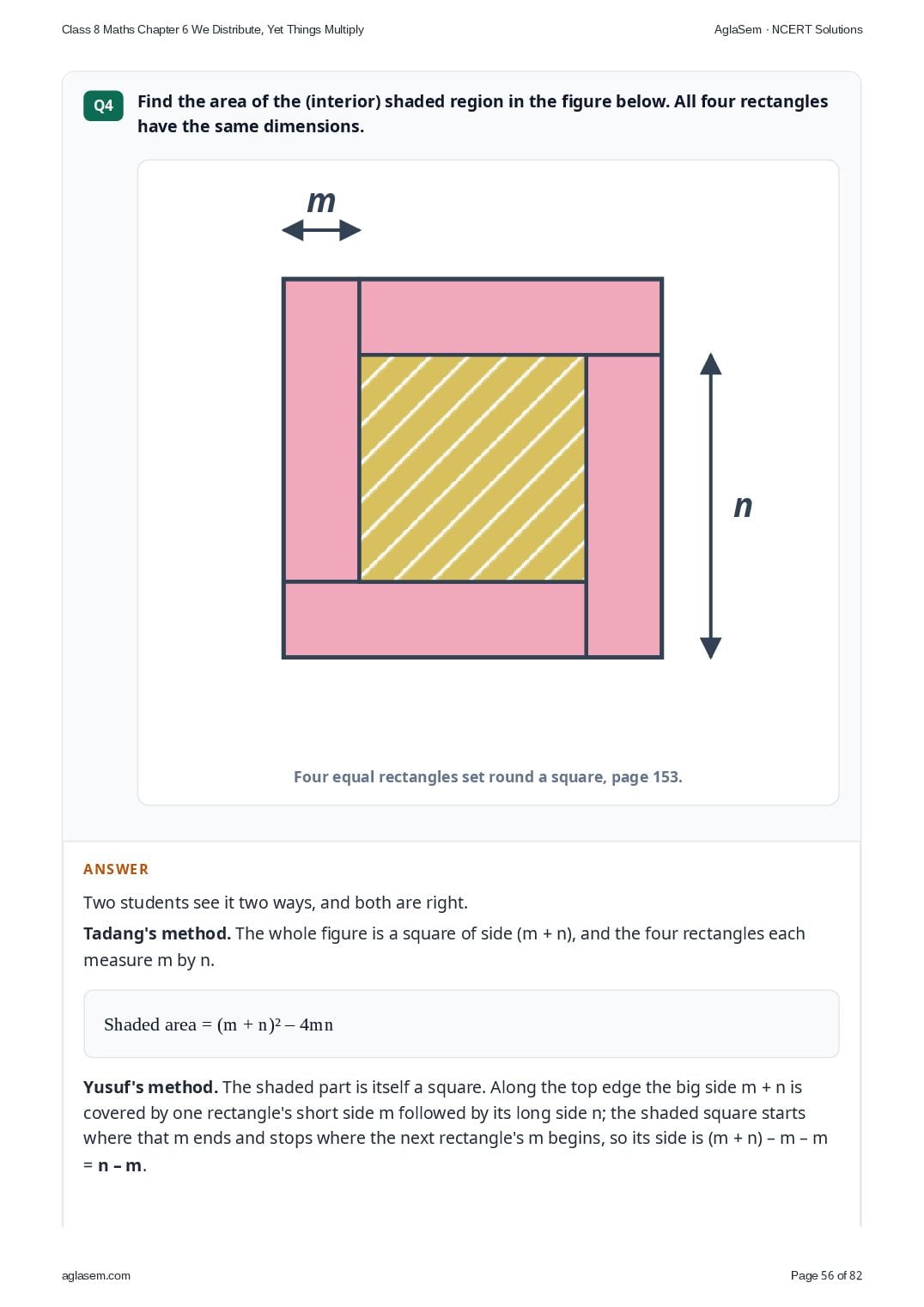
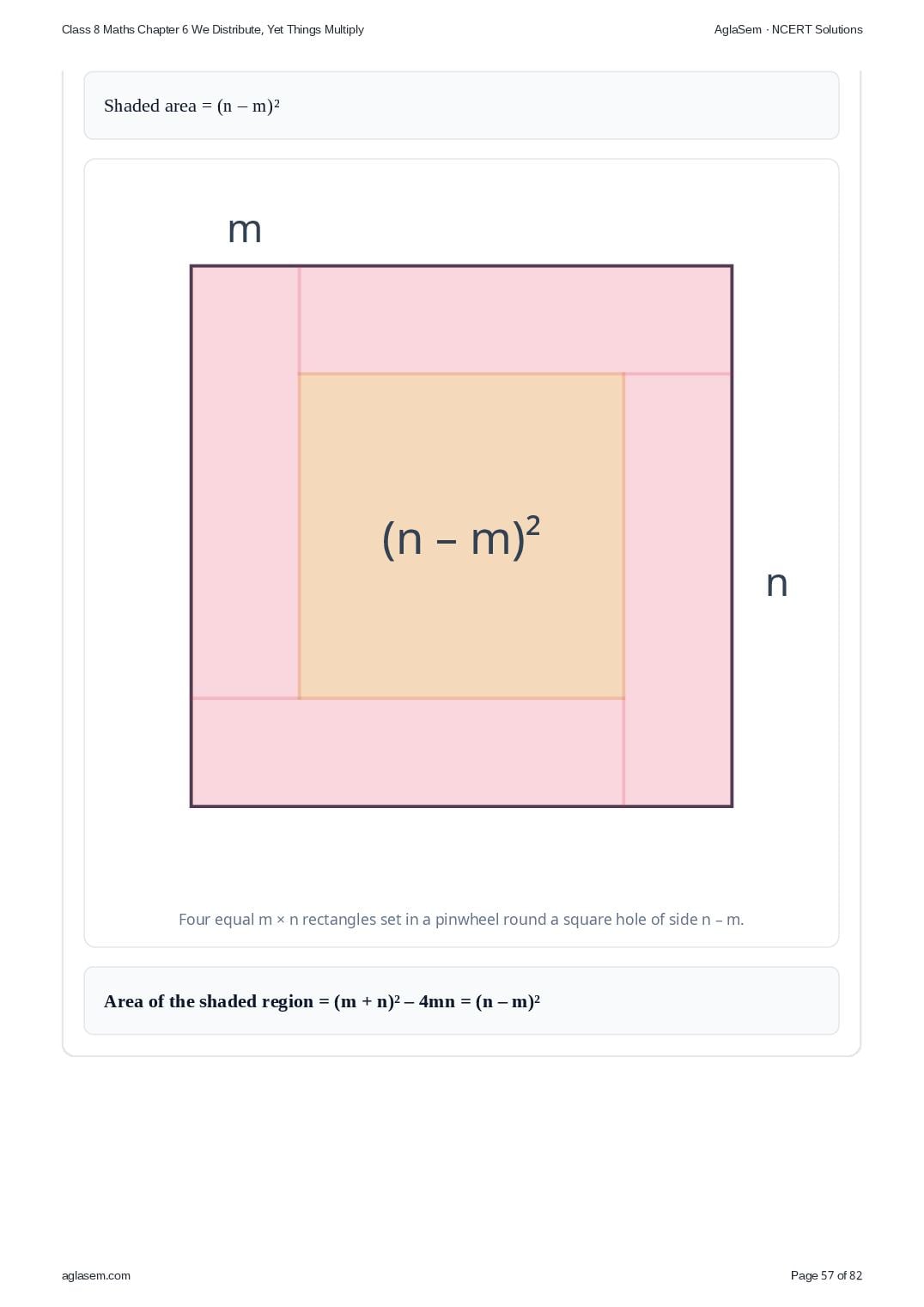
- Find the area of the (interior) shaded region in the figure below. All four rectangles have the same dimensions.
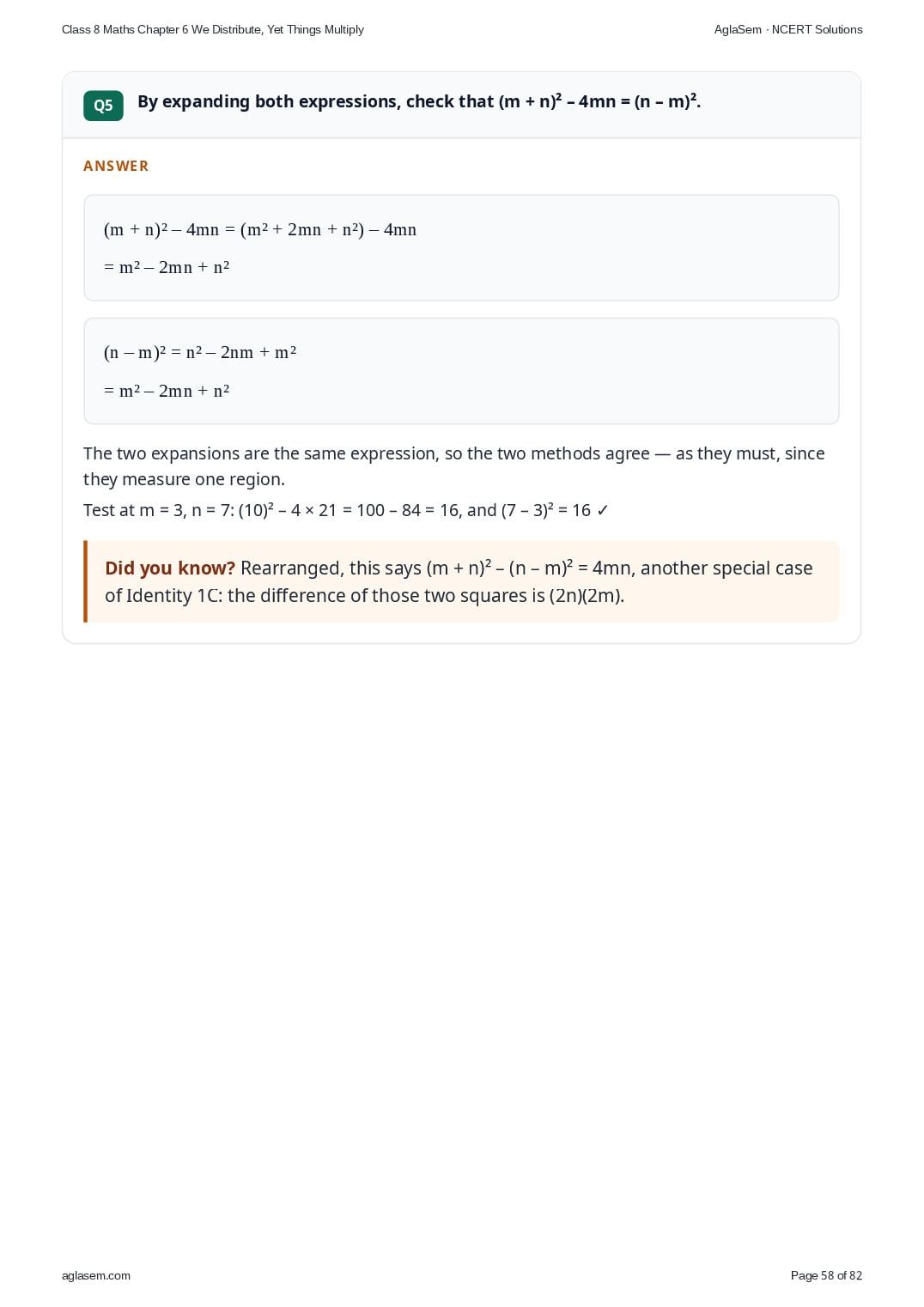
- By expanding both expressions, check that (m + n)² – 4mn = (n – m)².
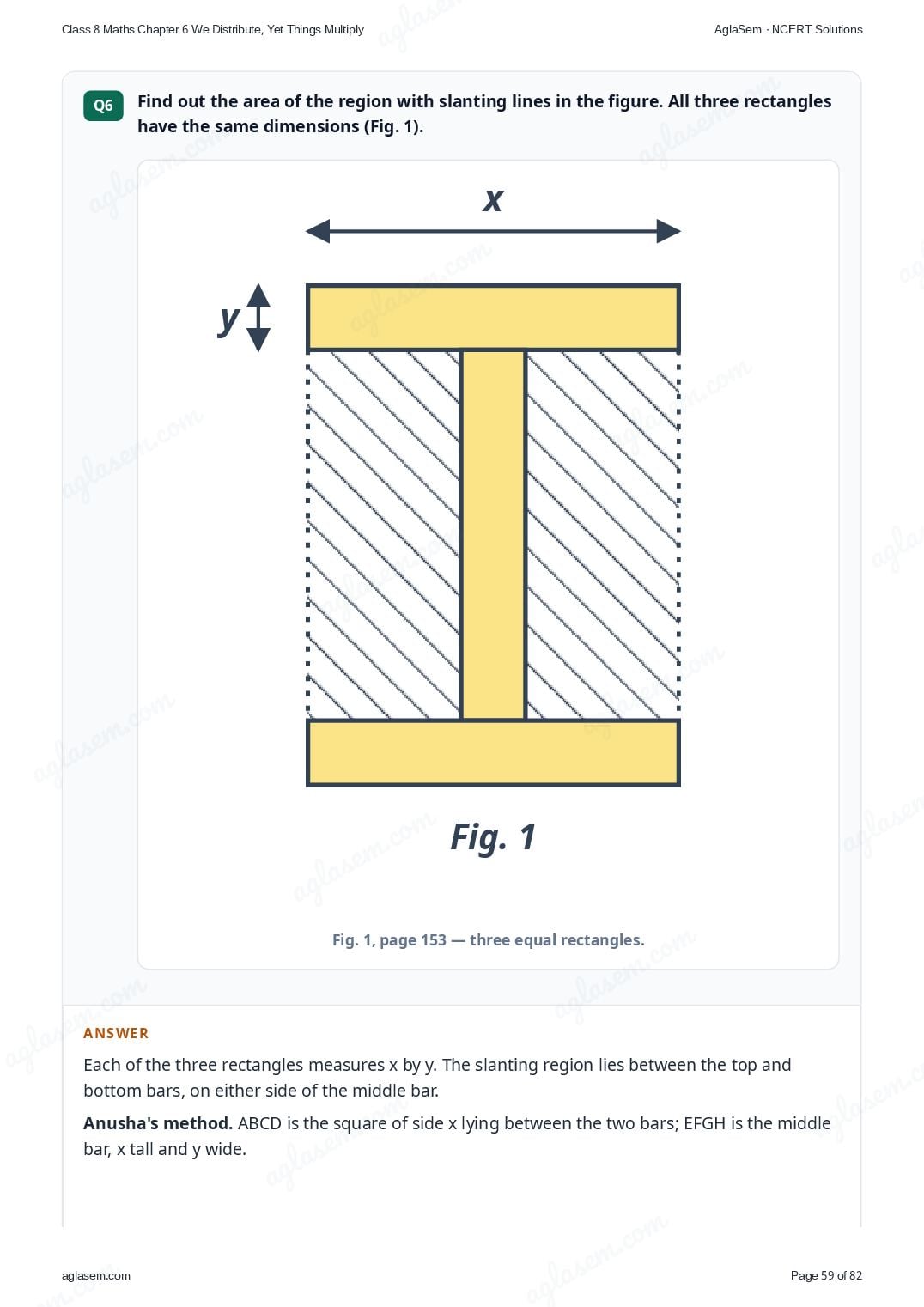
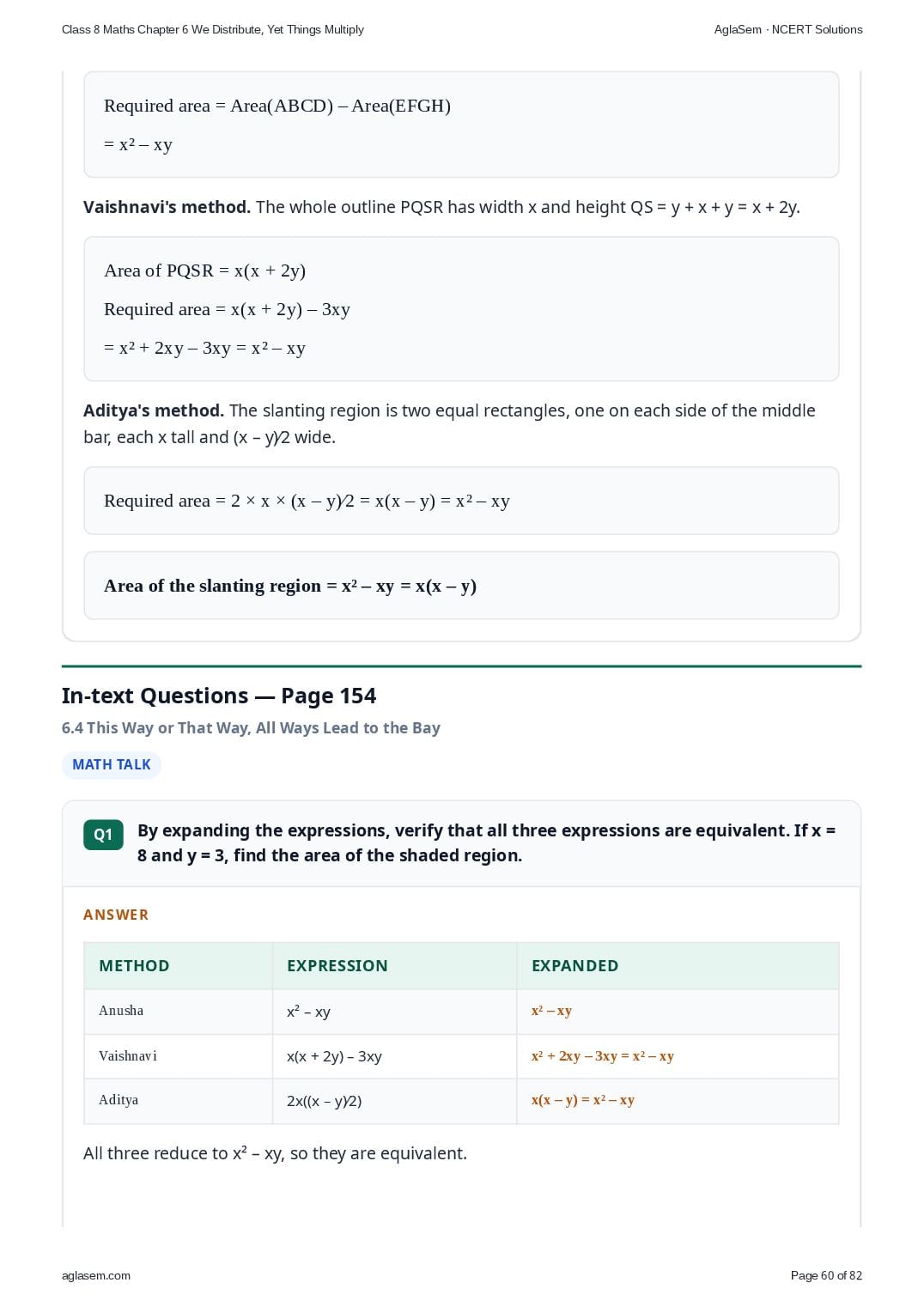
- Find out the area of the region with slanting lines in the figure. All three rectangles have the same dimensions (Fig. 1).
- By expanding the expressions, verify that all three expressions are equivalent. If x = 8 and y = 3, find the area of the shaded region.
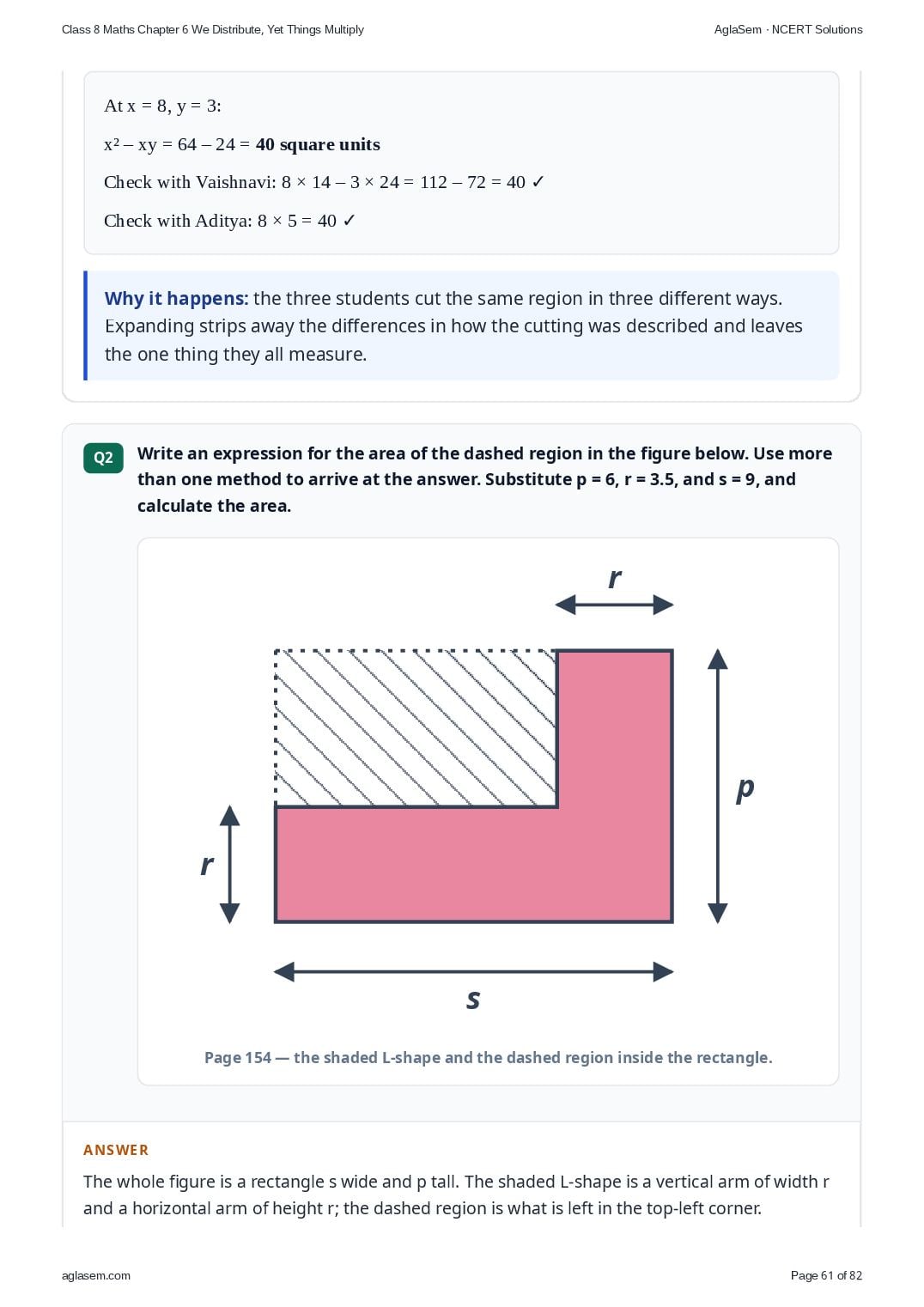
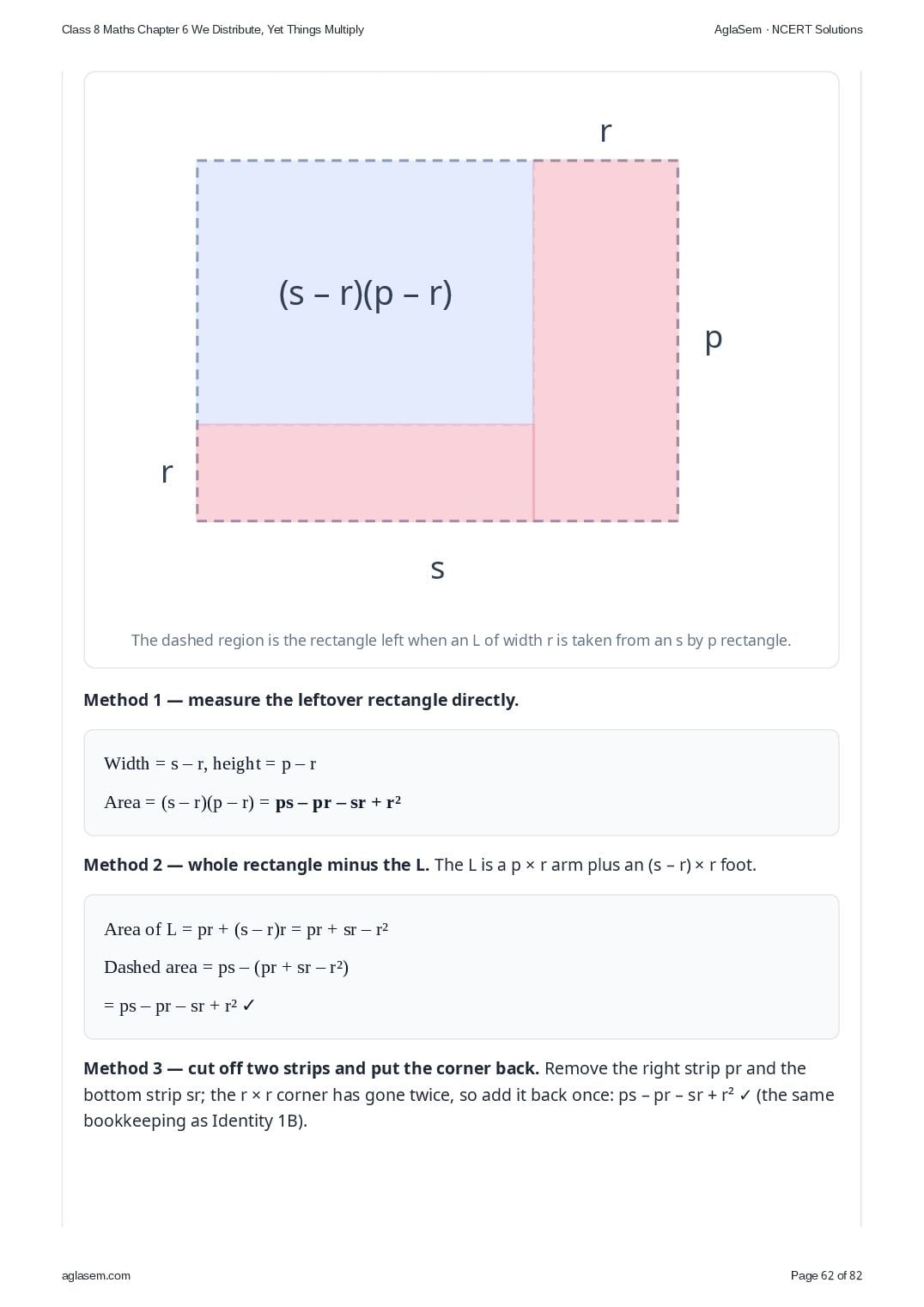
- Write an expression for the area of the dashed region in the figure below. Use more than one method to arrive at the answer. Substitute p = 6, r = 3.5, and s = 9, and calculate the area.
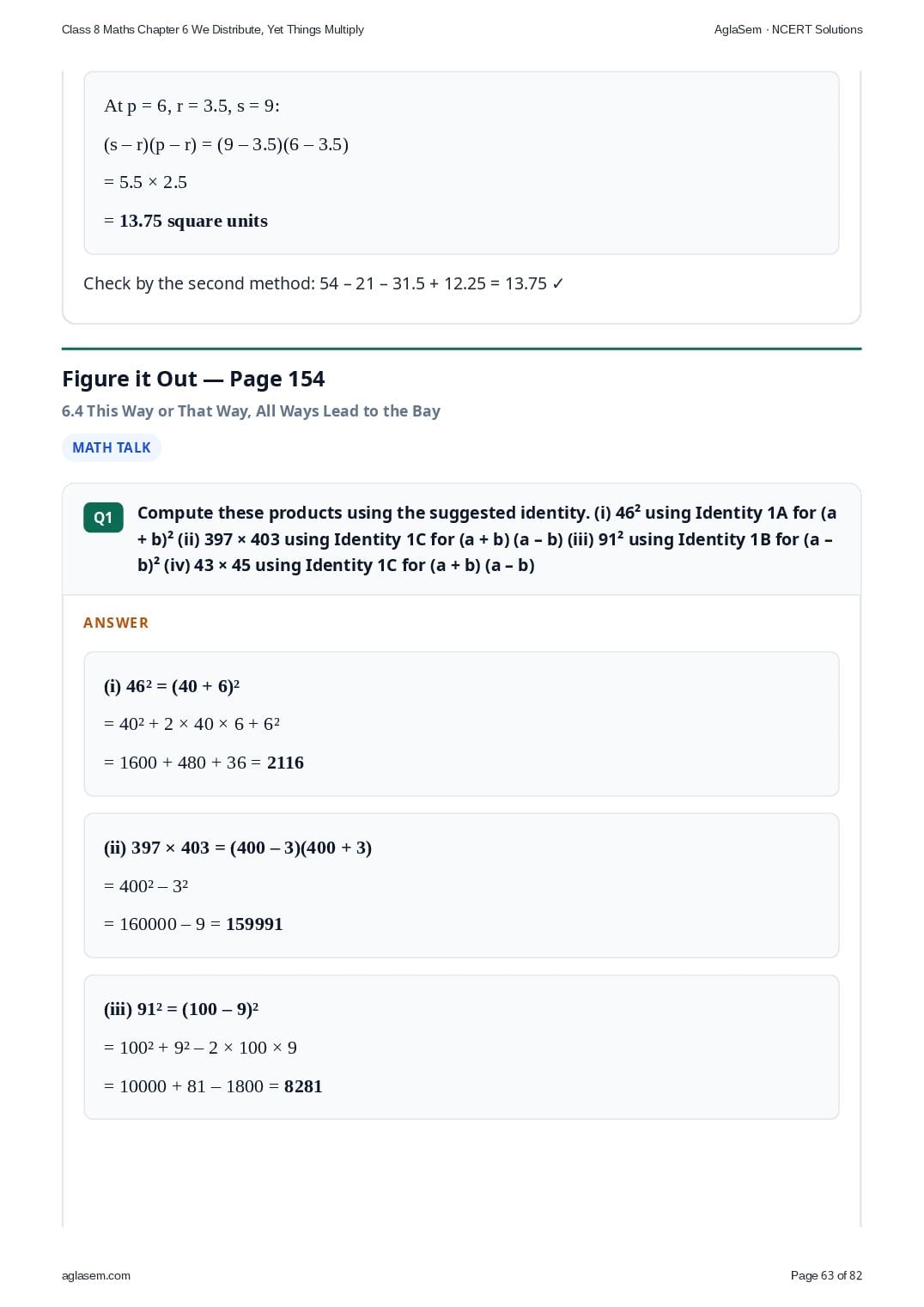
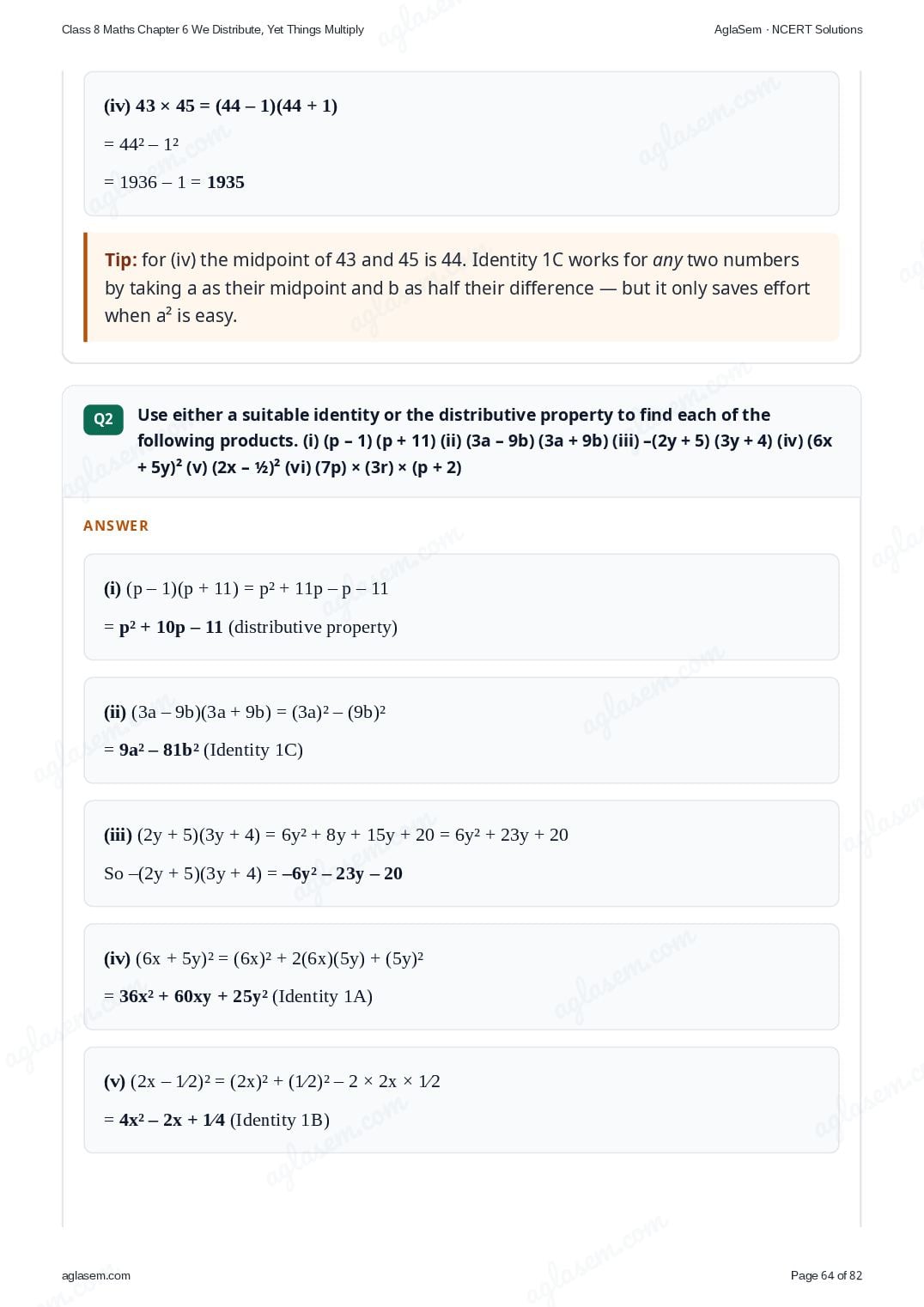
- Compute these products using the suggested identity. (i) 46² using Identity 1A for (a + b)² (ii) 397 × 403 using Identity 1C for (a + b) (a – b) (iii) 91² using Identity 1B for (a – b)² (iv) 43 × 45 using Identity 1C for (a + b) (a – b)
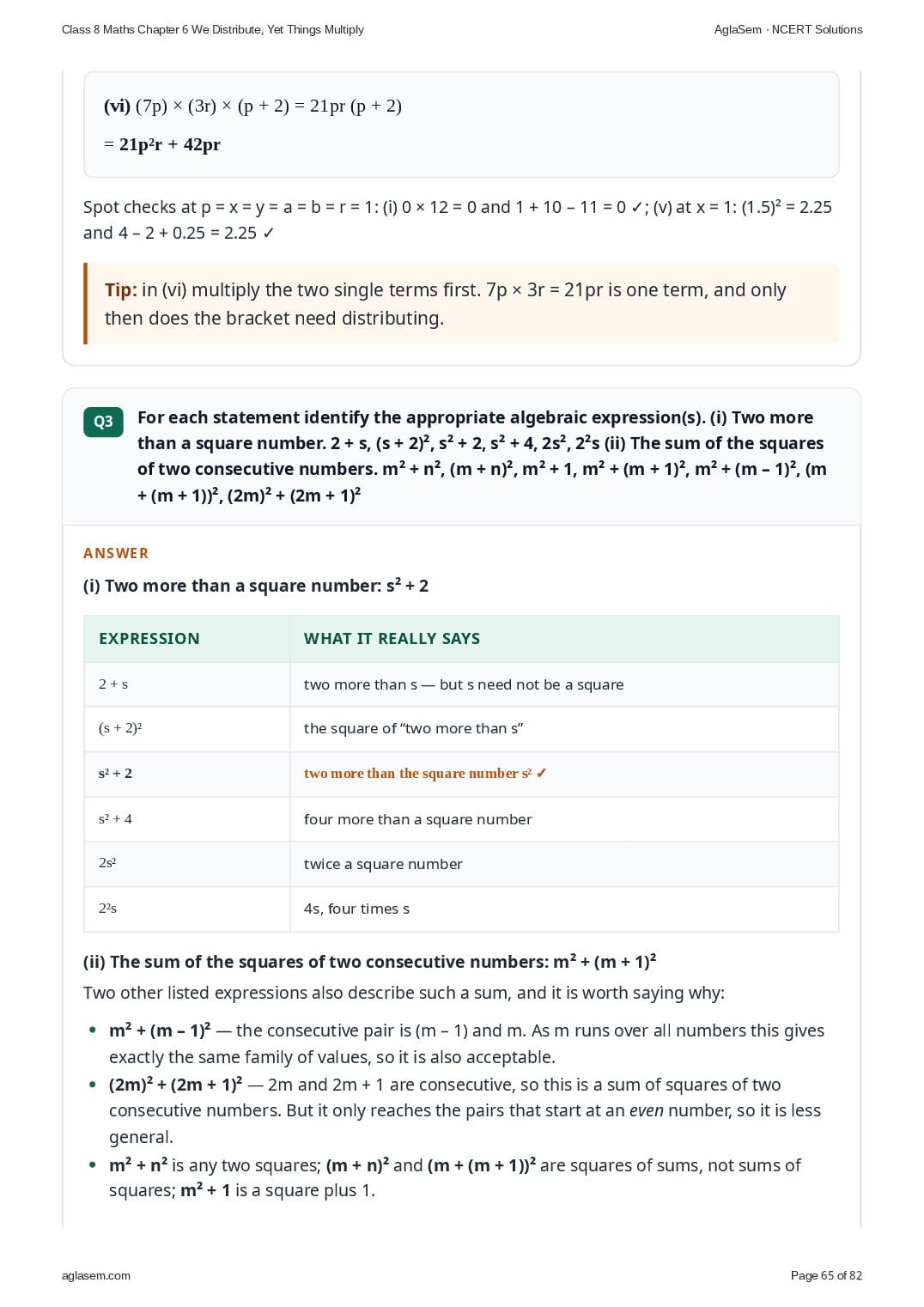
- Use either a suitable identity or the distributive property to find each of the following products. (i) (p – 1) (p + 11) (ii) (3a – 9b) (3a + 9b) (iii) –(2y + 5) (3y + 4) (iv) (6x + 5y)² (v) (2x – 1⁄2)² (vi) (7p) × (3r) × (p + 2)
- For each statement identify the appropriate algebraic expression(s). (i) Two more than a square number. 2 + s, (s + 2)², s² + 2, s² + 4, 2s², 2²s (ii) The sum of the squares of two consecutive numbers. m² + n², (m + n)², m² + 1, m² + (m + 1)², m² + (m – 1)², (m + (m + 1))², (2m)² + (2m + 1)²
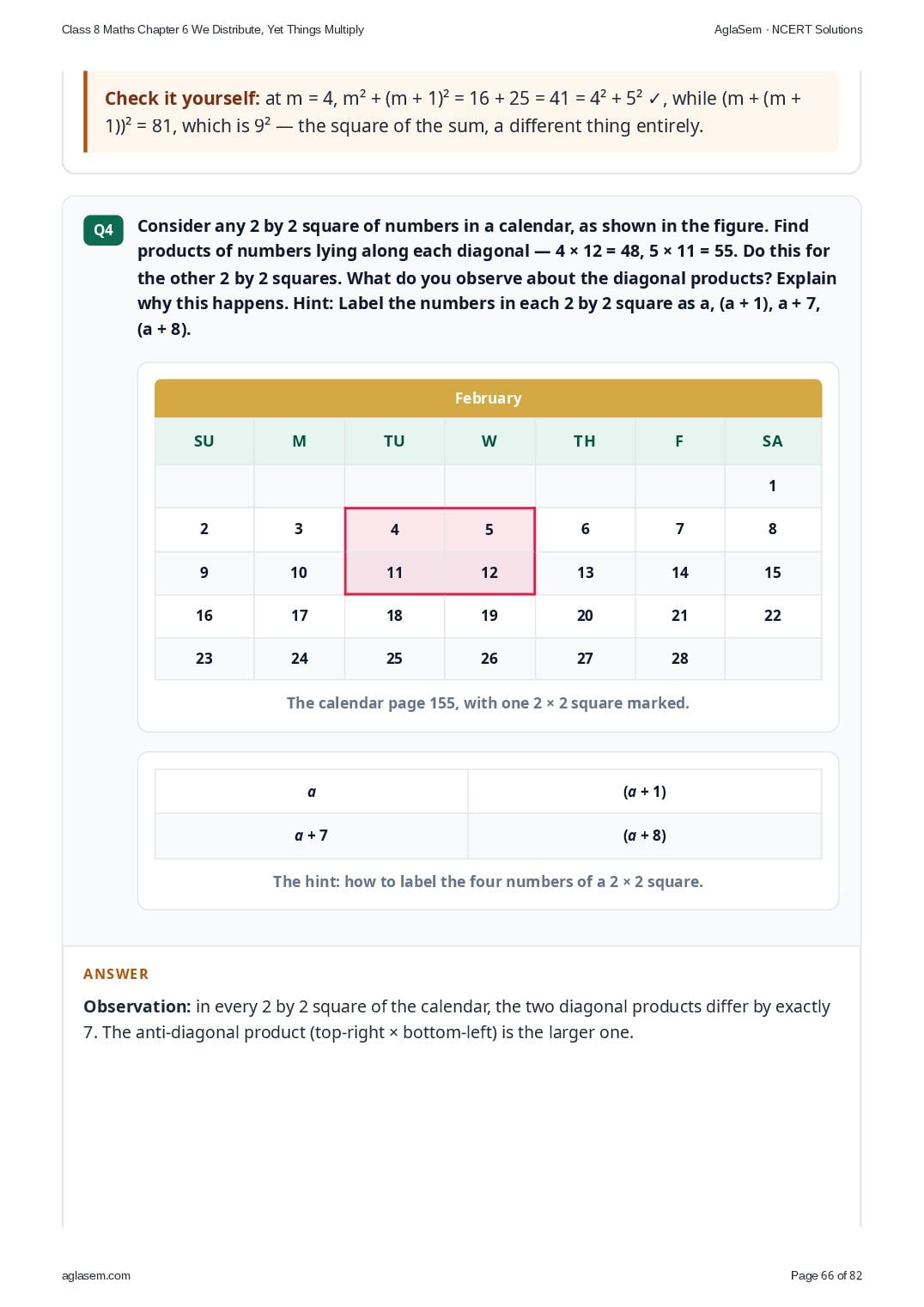
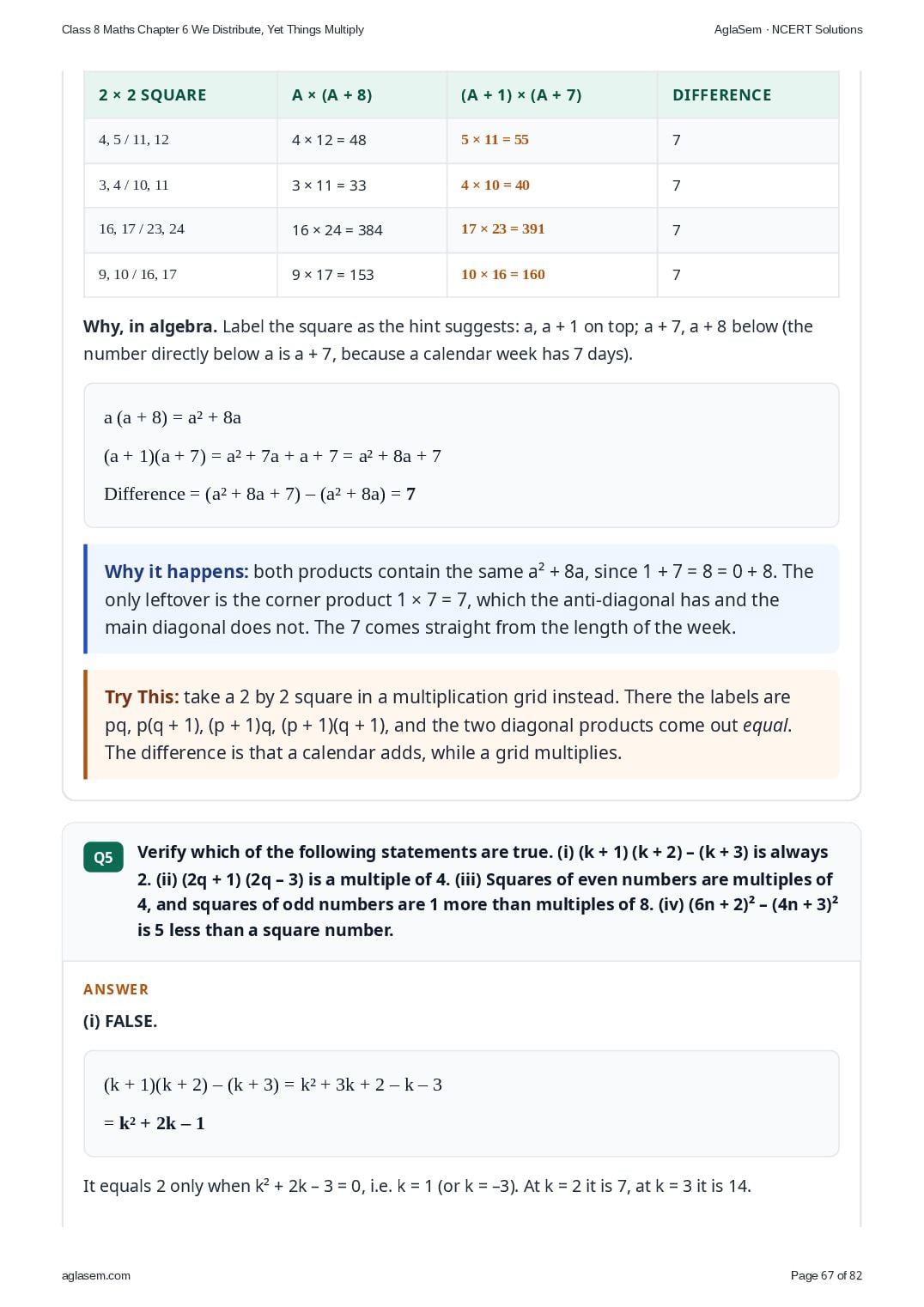
- Consider any 2 by 2 square of numbers in a calendar, as shown in the figure. Find products of numbers lying along each diagonal — 4 × 12 = 48, 5 × 11 = 55. Do this for the other 2 by 2 squares. What do you observe about the diagonal products? Explain why this happens. Hint: Label the numbers in each 2 by 2 square as a, (a + 1), a + 7, (a + 8).
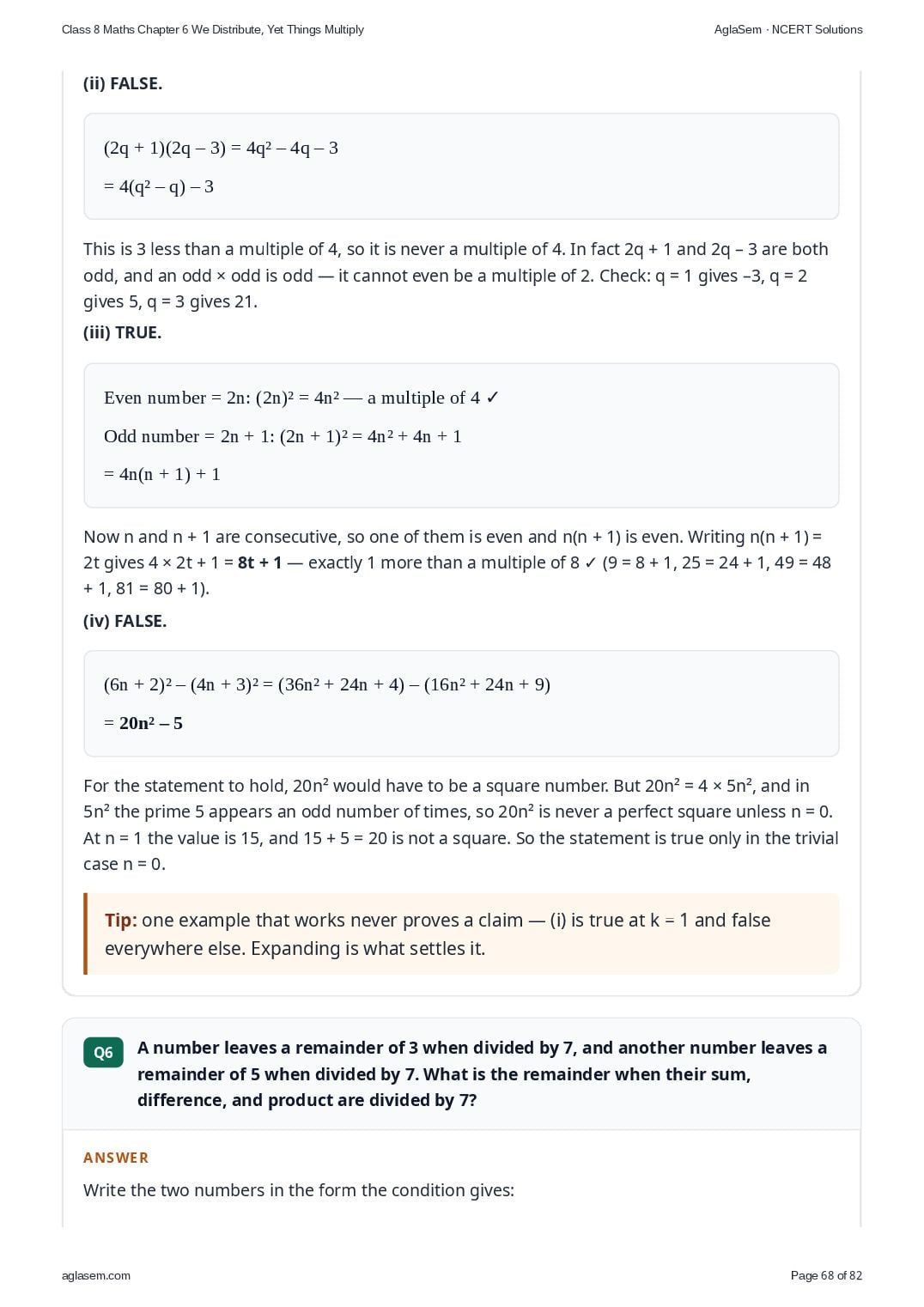
- Verify which of the following statements are true. (i) (k + 1) (k + 2) – (k + 3) is always 2. (ii) (2q + 1) (2q – 3) is a multiple of 4. (iii) Squares of even numbers are multiples of 4, and squares of odd numbers are 1 more than multiples of 8. (iv) (6n + 2)² – (4n + 3)² is 5 less than a square number.
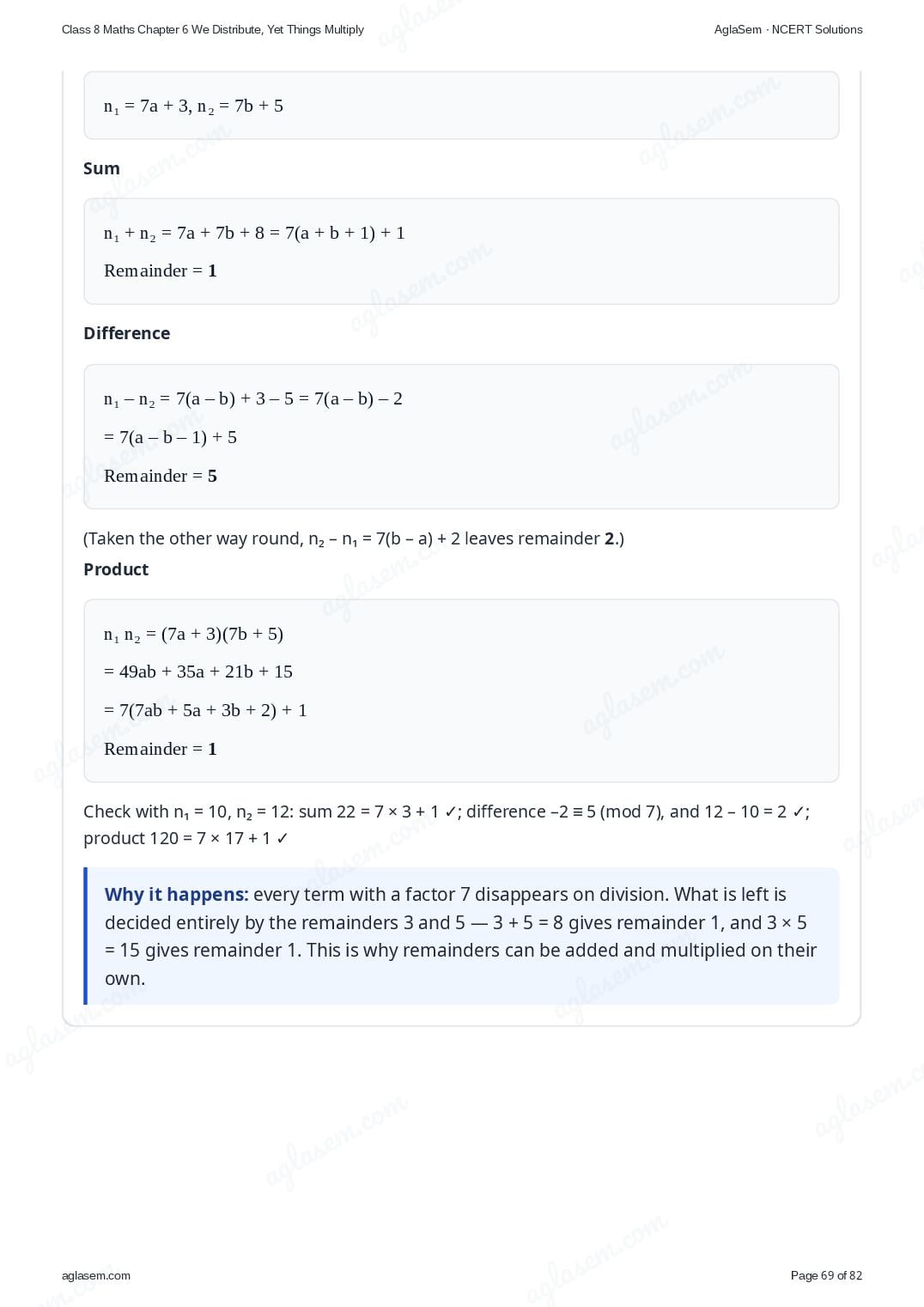
- A number leaves a remainder of 3 when divided by 7, and another number leaves a remainder of 5 when divided by 7. What is the remainder when their sum, difference, and product are divided by 7?
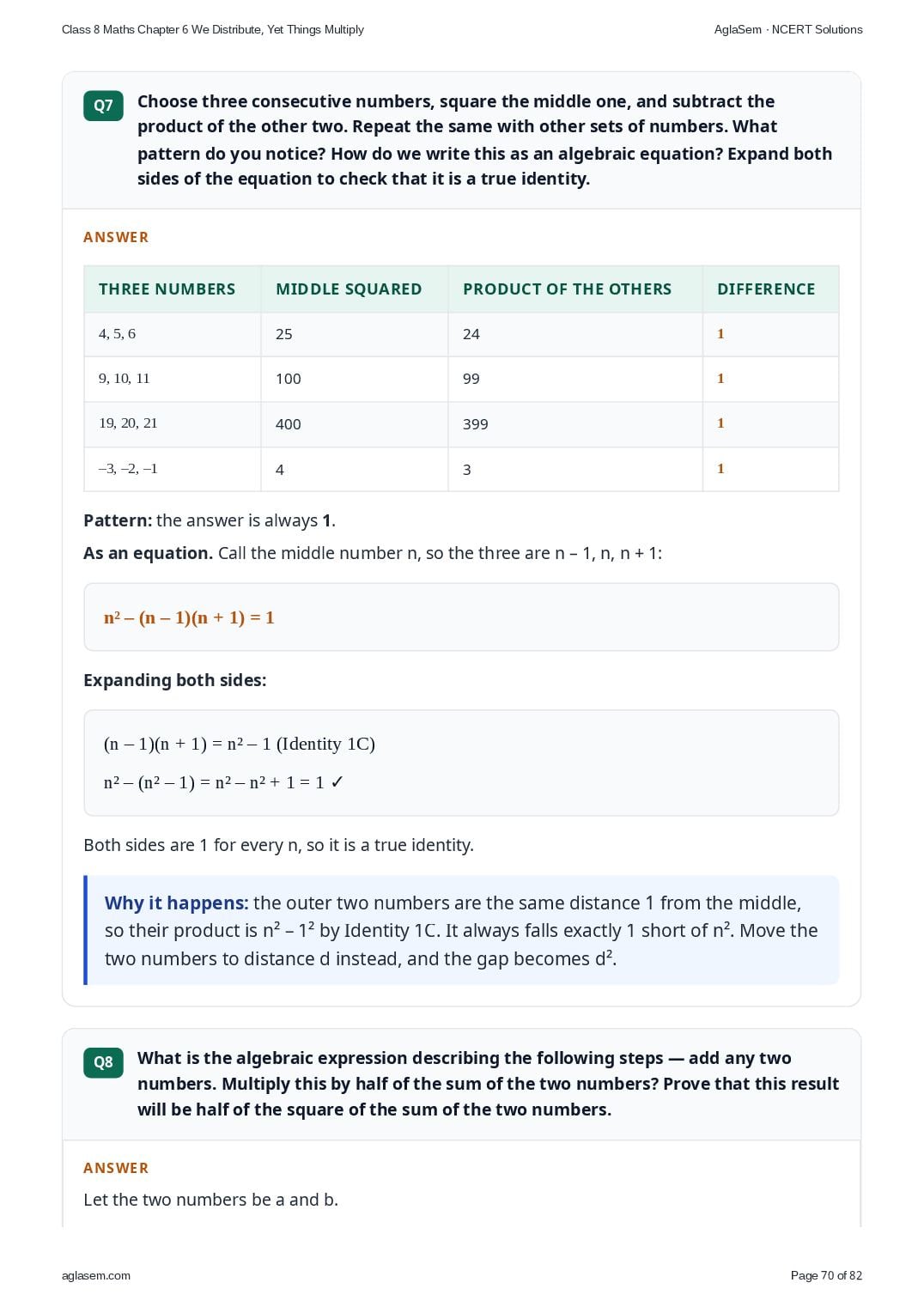
- Choose three consecutive numbers, square the middle one, and subtract the product of the other two. Repeat the same with other sets of numbers. What pattern do you notice? How do we write this as an algebraic equation? Expand both sides of the equation to check that it is a true identity.
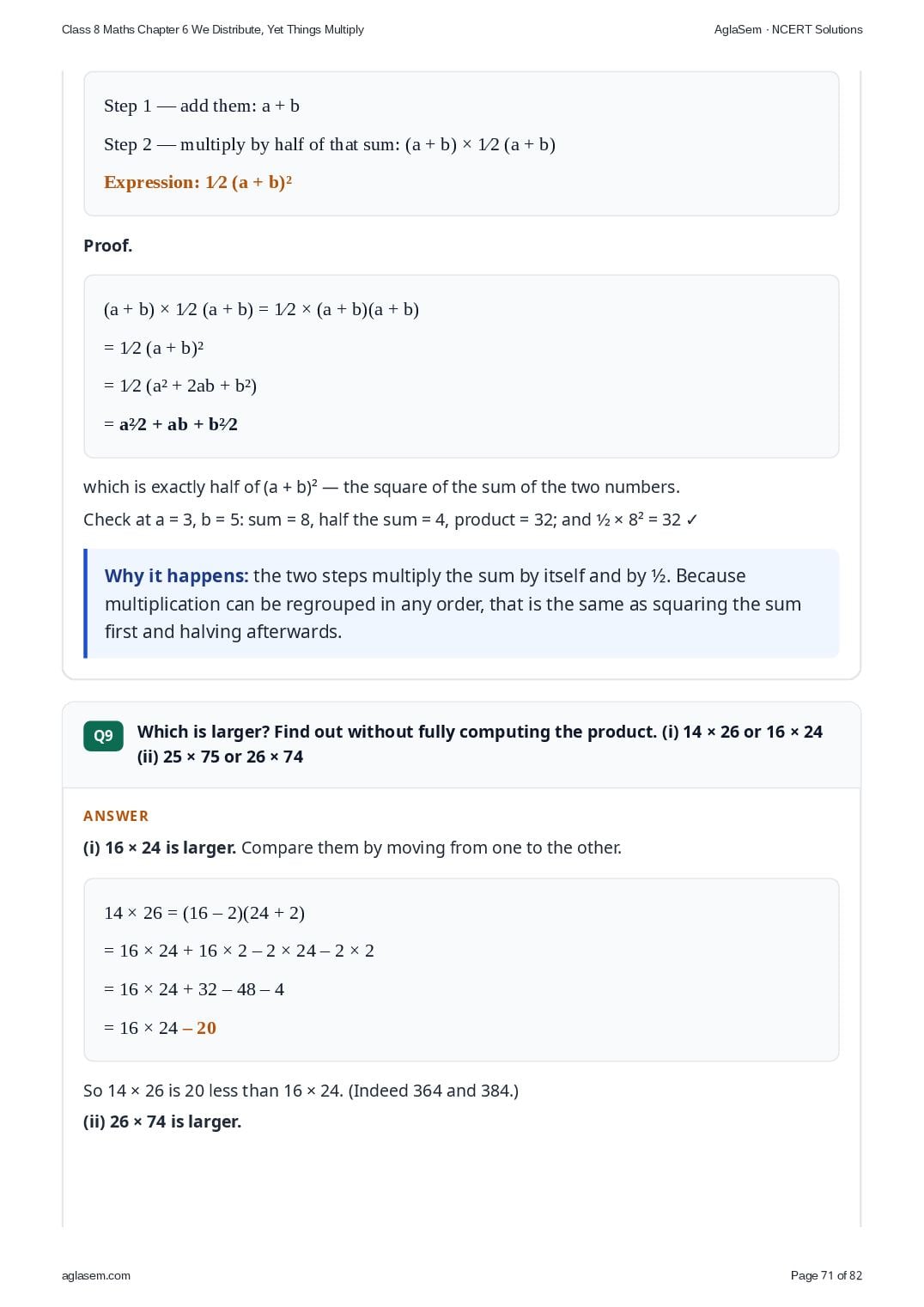
- What is the algebraic expression describing the following steps — add any two numbers. Multiply this by half of the sum of the two numbers? Prove that this result will be half of the square of the sum of the two numbers.
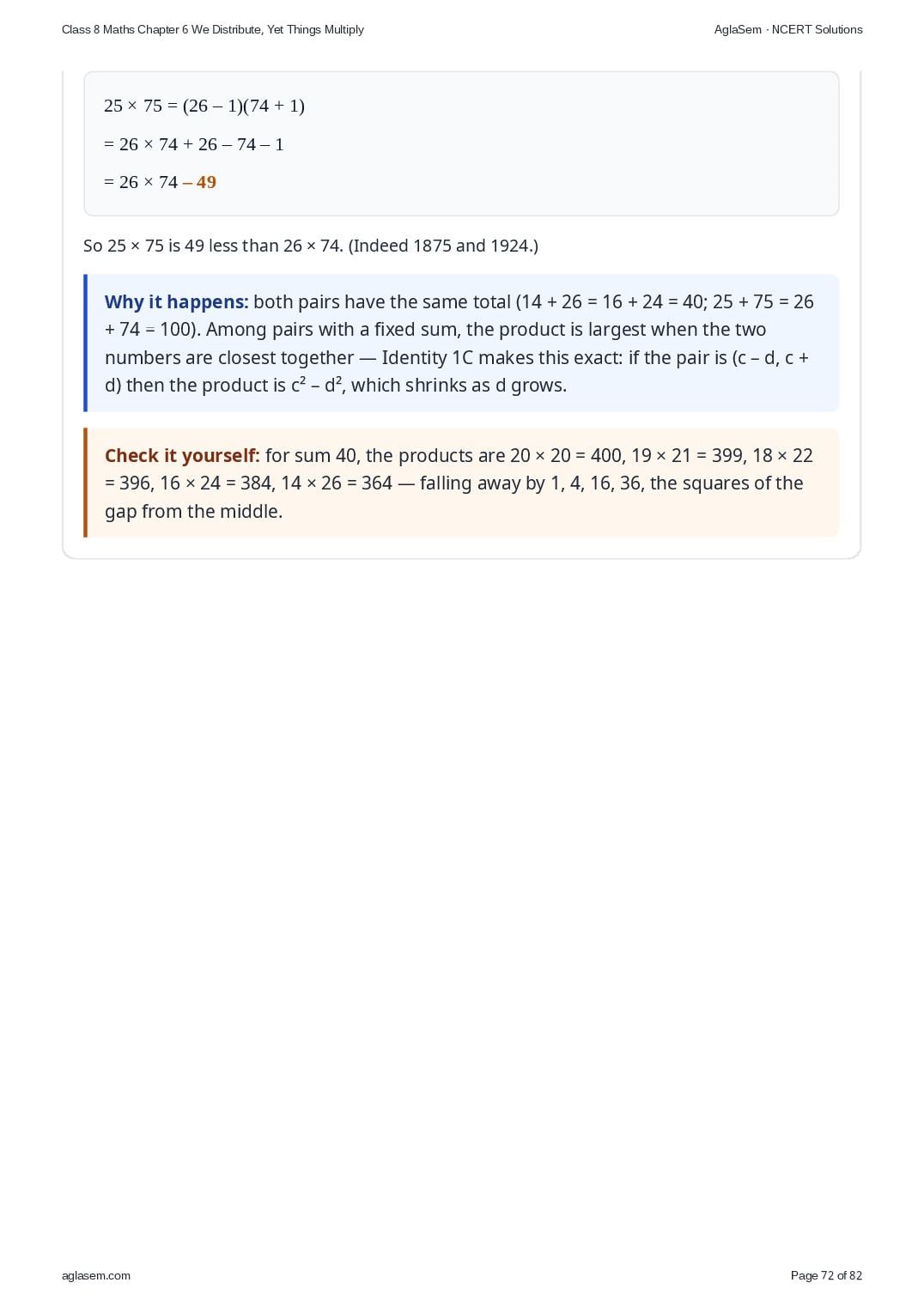
- Which is larger? Find out without fully computing the product. (i) 14 × 26 or 16 × 24 (ii) 25 × 75 or 26 × 74
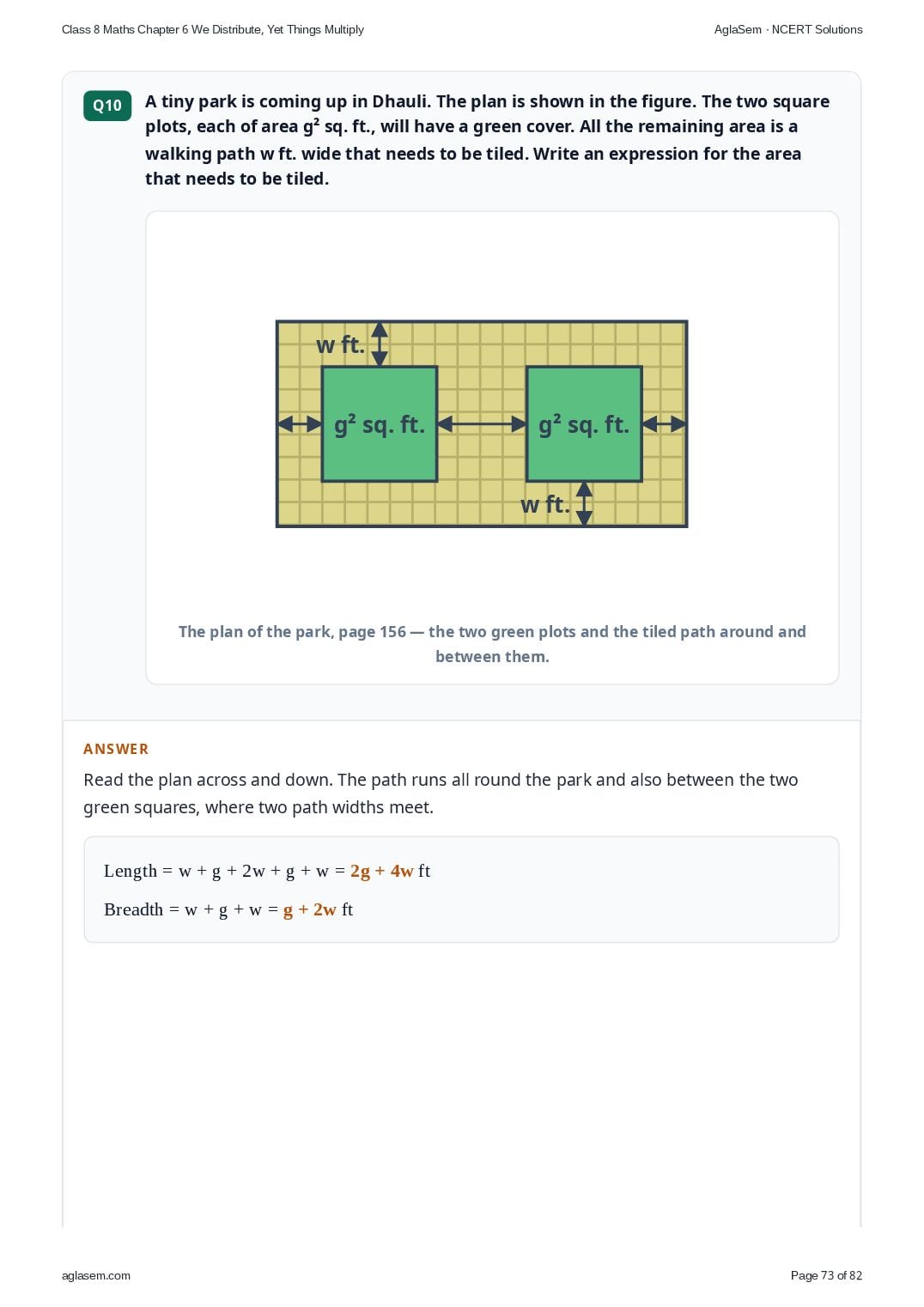
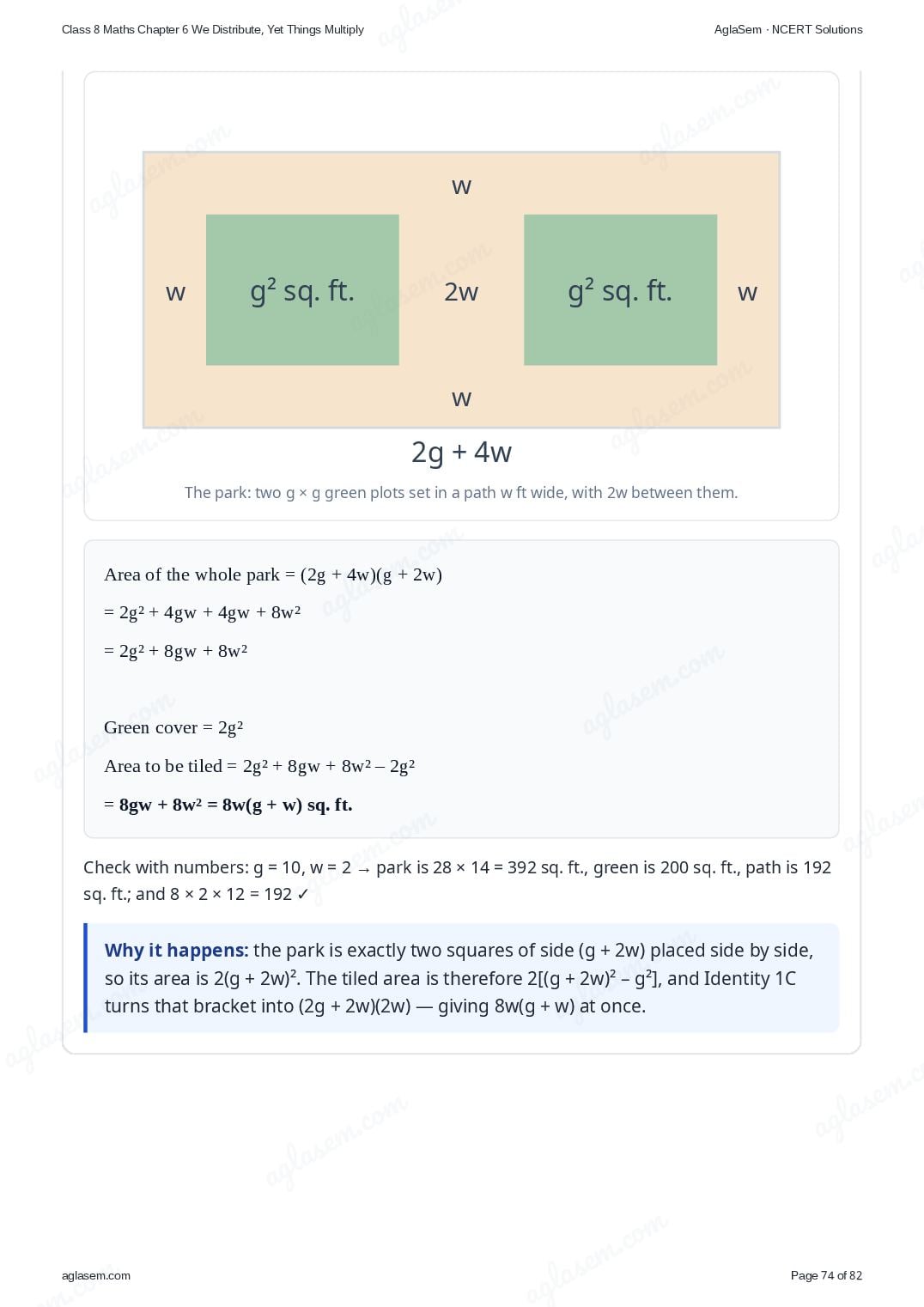
- A tiny park is coming up in Dhauli. The plan is shown in the figure. The two square plots, each of area g² sq. ft., will have a green cover. All the remaining area is a walking path w ft. wide that needs to be tiled. Write an expression for the area that needs to be tiled.
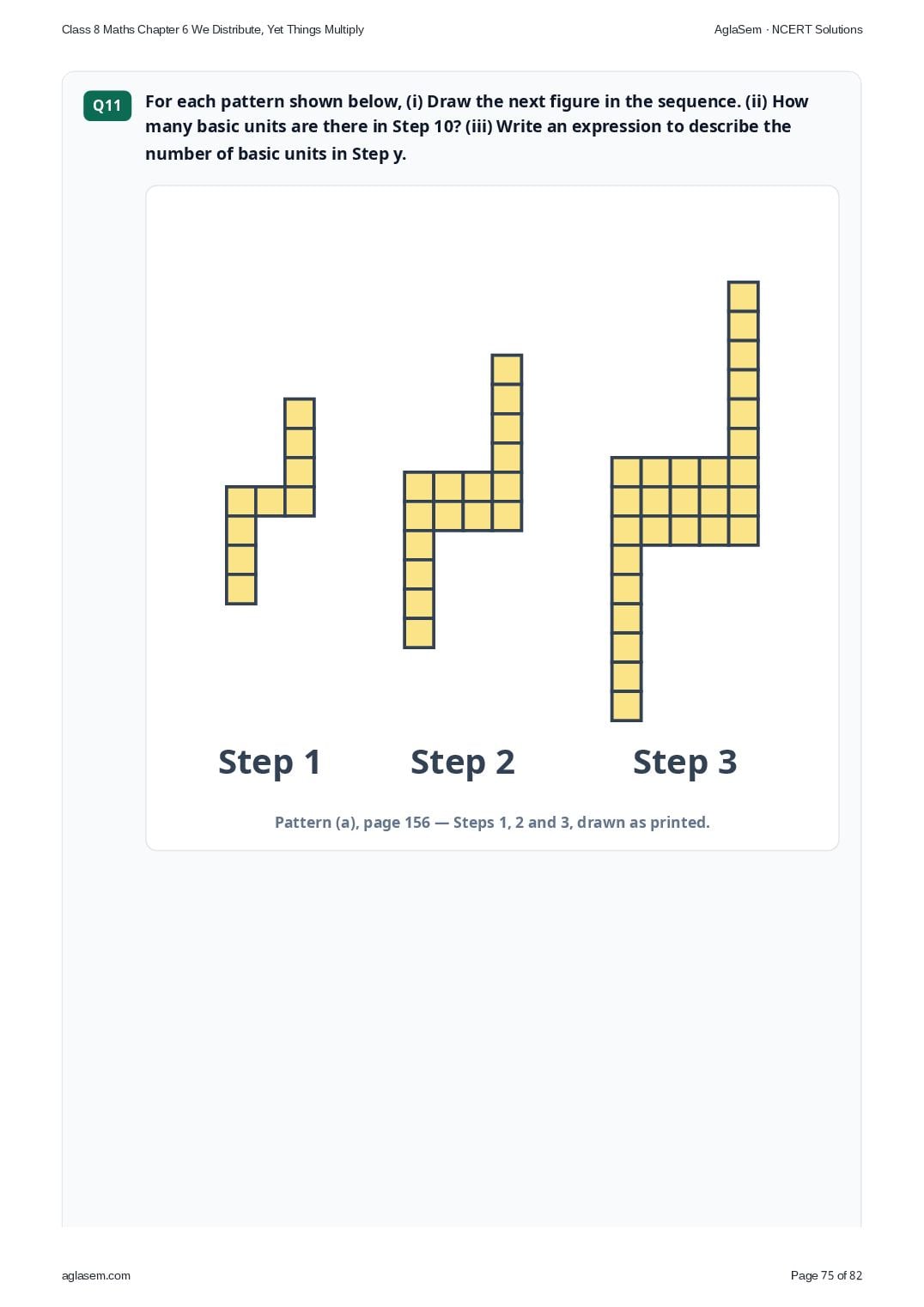
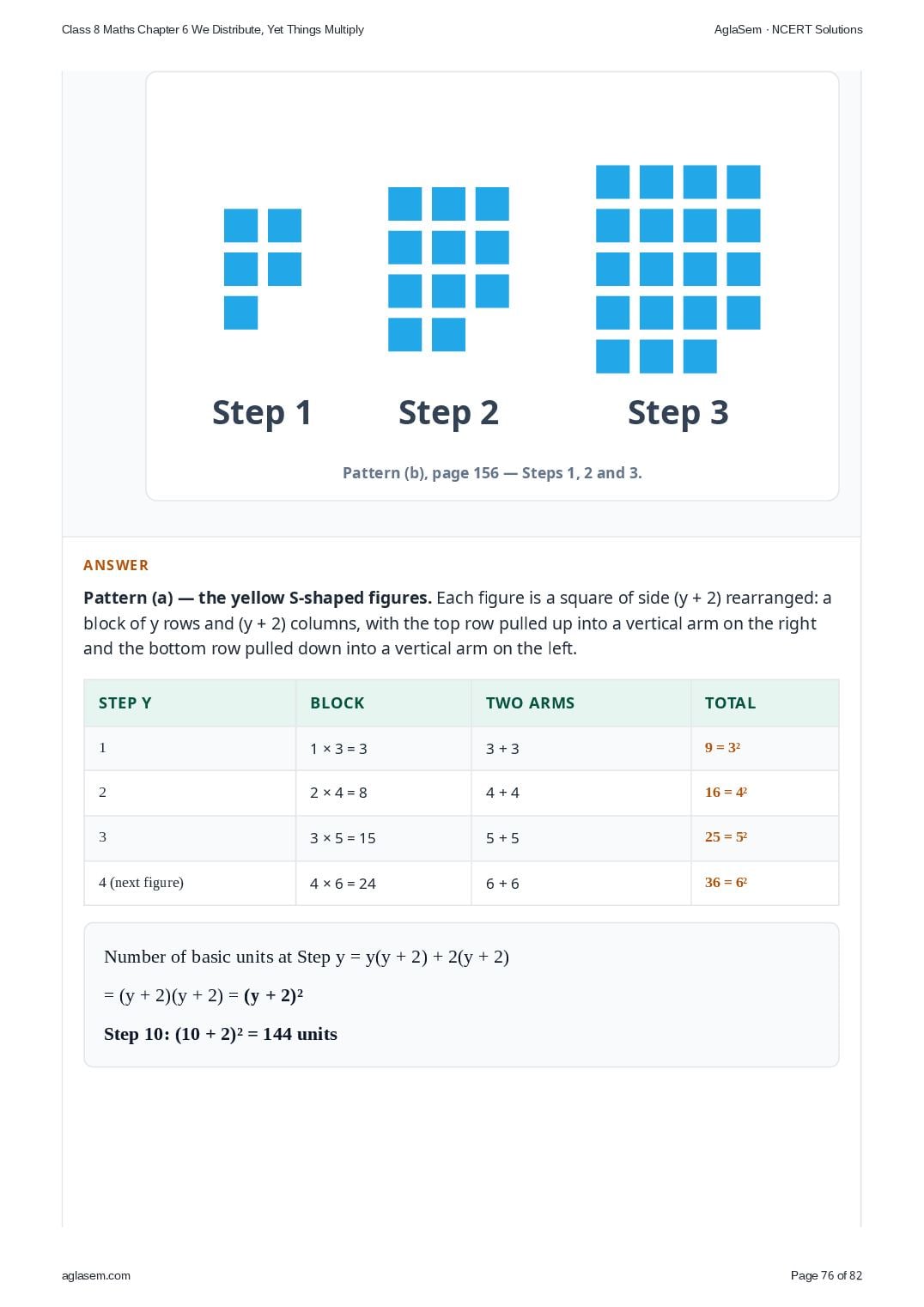
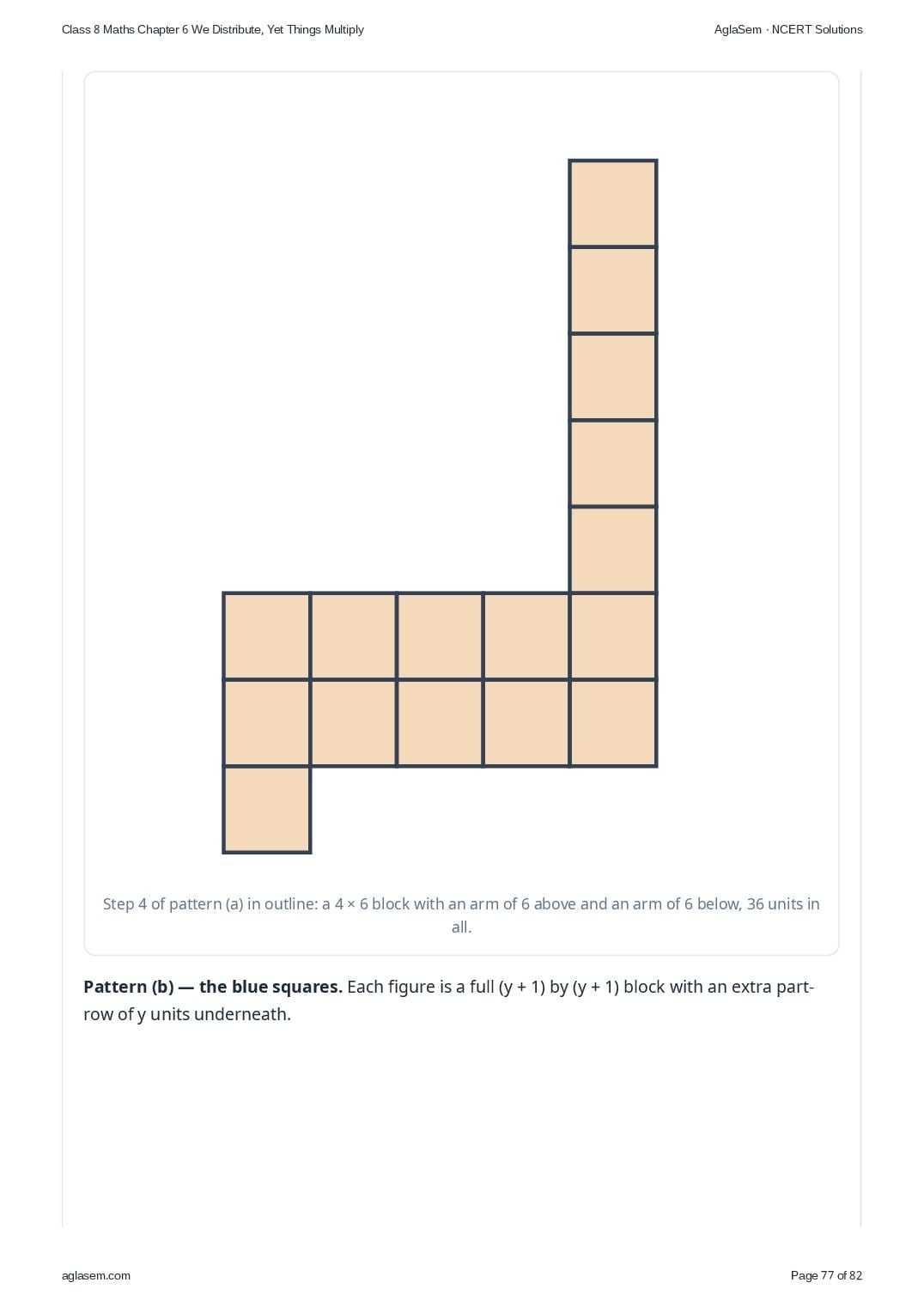
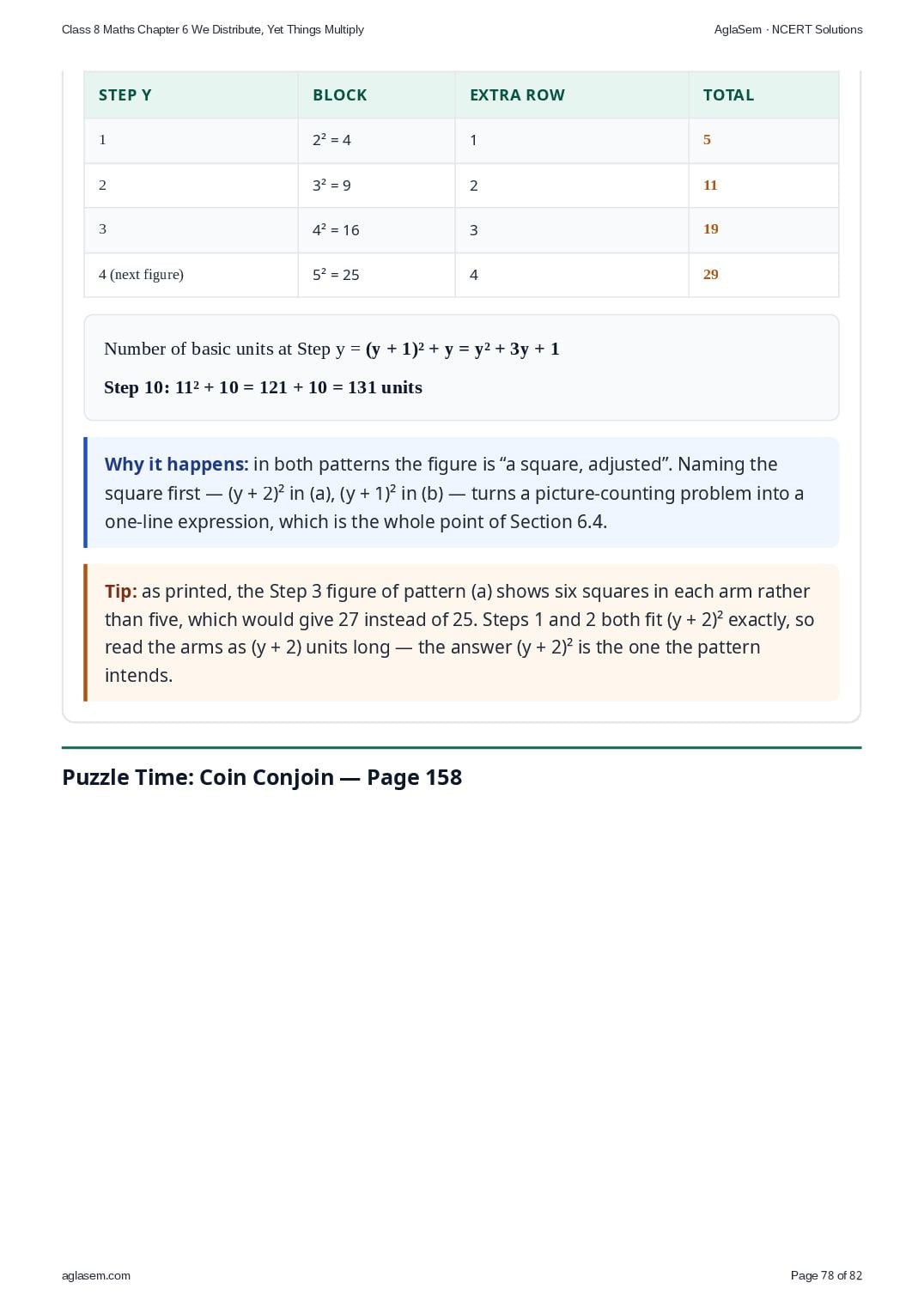
- For each pattern shown below, (i) Draw the next figure in the sequence. (ii) How many basic units are there in Step 10? (iii) Write an expression to describe the number of basic units in Step y.
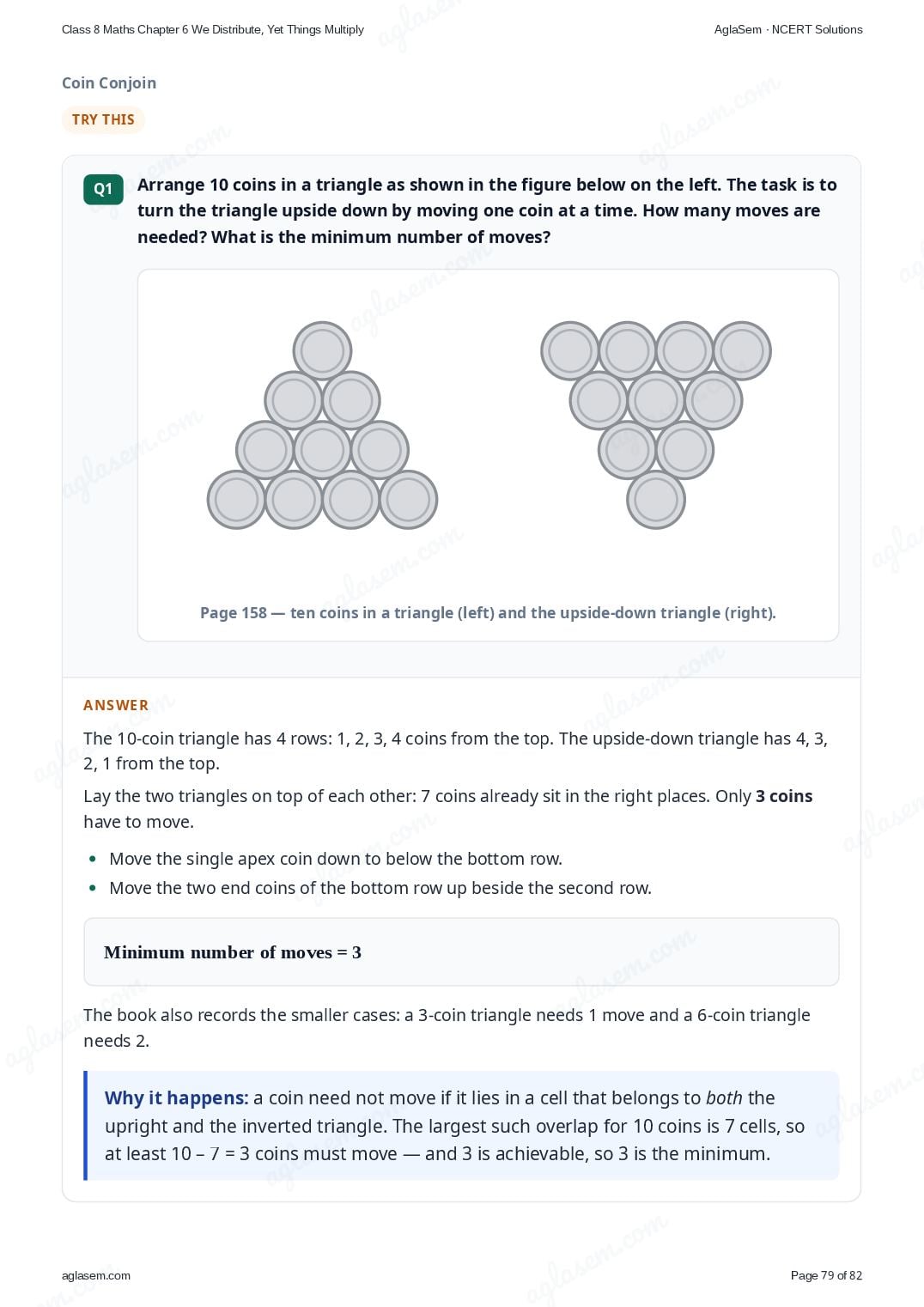
- Arrange 10 coins in a triangle as shown in the figure below on the left. The task is to turn the triangle upside down by moving one coin at a time. How many moves are needed? What is the minimum number of moves?
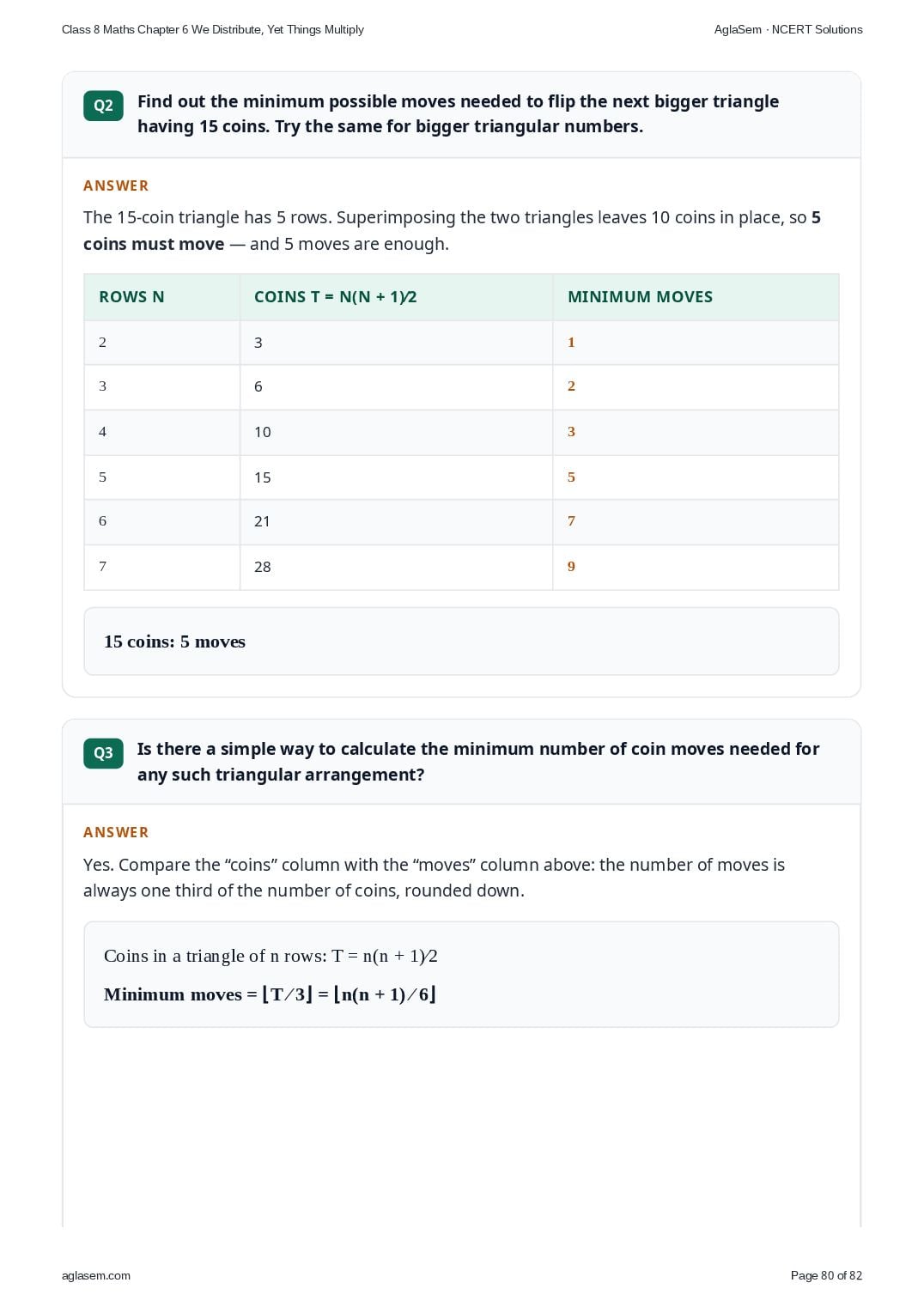
- Find out the minimum possible moves needed to flip the next bigger triangle having 15 coins. Try the same for bigger triangular numbers.
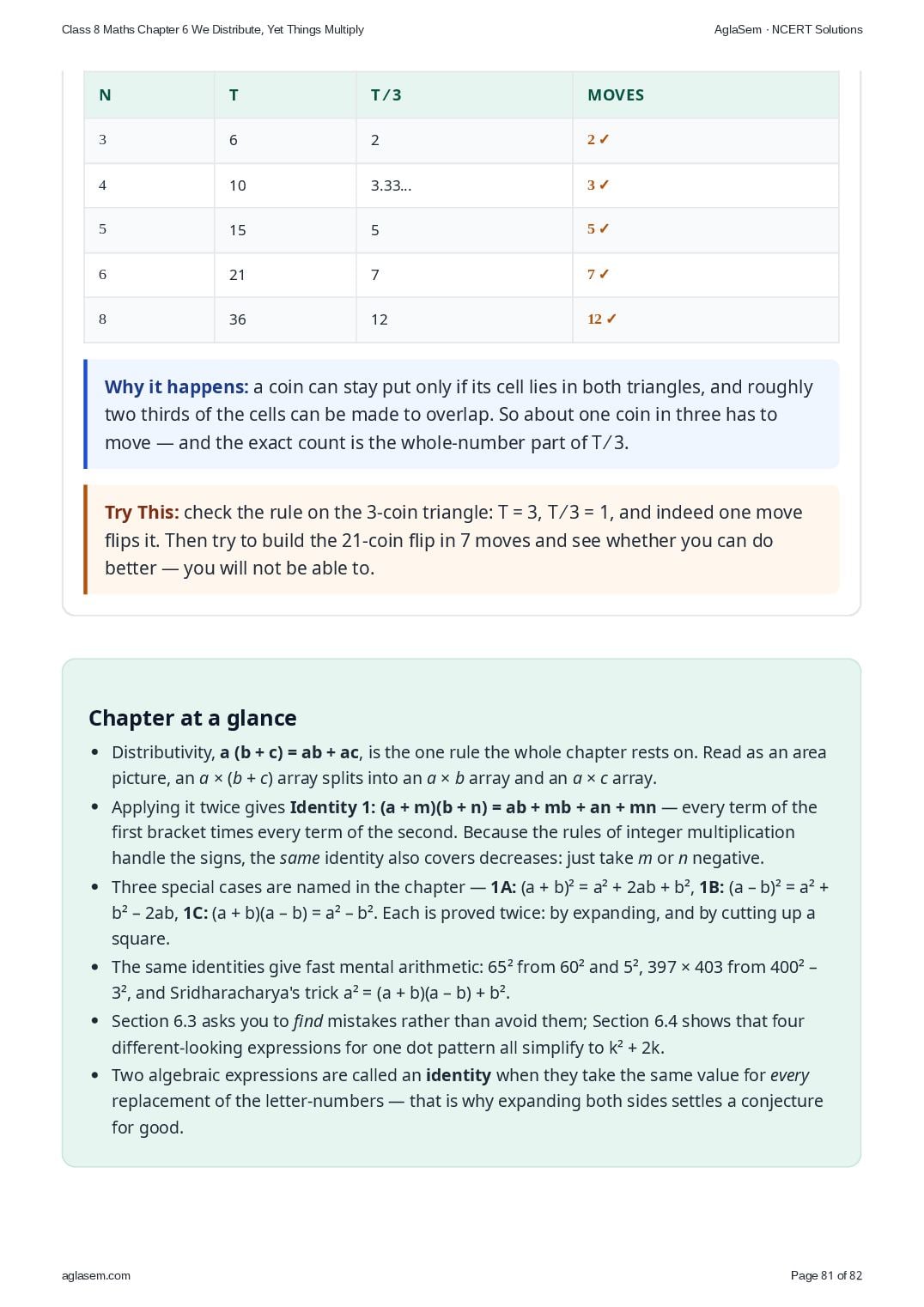
- Is there a simple way to calculate the minimum number of coin moves needed for any such triangular arrangement?
Chapter at a Glance
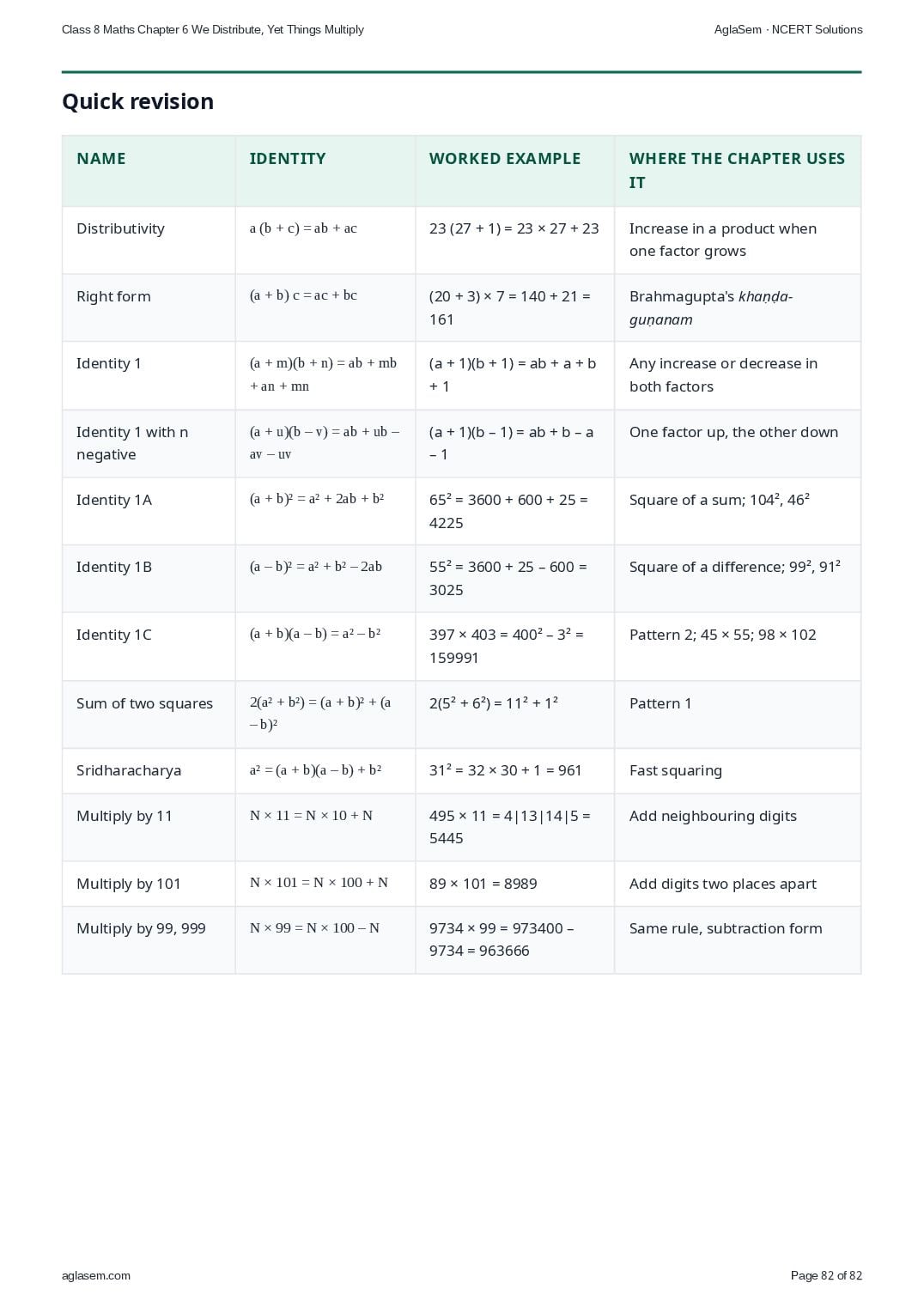
- Distributivity, a (b + c) = ab + ac , is the one rule the whole chapter rests on. Read as an area picture, an a × ( b + c ) array splits into an a × b array and an a × c array.
- Applying it twice gives Identity 1: (a + m)(b + n) = ab + mb + an + mn — every term of the first bracket times every term of the second. Because the rules of integer multiplication handle the signs, the same identity also covers decreases: just take m or n negative.
- Three special cases are named in the chapter — 1A: (a + b)² = a² + 2ab + b², 1B: (a – b)² = a² + b² – 2ab, 1C: (a + b)(a – b) = a² – b². Each is proved twice: by expanding, and by cutting up a square.
- The same identities give fast mental arithmetic: 65² from 60² and 5², 397 × 403 from 400² – 3², and Sridharacharya's trick a² = (a + b)(a – b) + b².
- Section 6.3 asks you to find mistakes rather than avoid them; Section 6.4 shows that four different-looking expressions for one dot pattern all simplify to k² + 2k.
- Two algebraic expressions are called an identity when they take the same value for every replacement of the letter-numbers — that is why expanding both sides settles a conjecture for good.
How to Download NCERT Solutions for Class 8 Maths Chapter 6 PDF
Follow these simple steps to get the We Distribute Yet Things Multiply questions-and-answers PDF from Ganita Prakash.
- Search NCERT Solutions for Class 8 Maths Chapter 6 aglasem and open this page.
- Read the exercise questions with answers for We Distribute Yet Things Multiply shown above.
- Click the Download PDF link to save the We Distribute Yet Things Multiply solutions to your device.
NCERT Solutions for Class 8 Maths – All Chapters
There are more chapters to study besides We Distribute Yet Things Multiply in Maths. Here are the NCERT Solutions for all chapters of Class 8 Maths.
- Chapter 1 A Square and a Cube
- Chapter 2 Power Play
- Chapter 3 A Story of Numbers
- Chapter 4 Quadrilaterals
- Chapter 5 Number Play
- Chapter 6 We Distribute Yet Things Multiply
- Chapter 7 Proportional Reasoning 1
- Chapter 8 Fractions in Disguise
- Chapter 9 The Baudh Yana Pythagoras Theorem
- Chapter 10 Proportional Reasoning 2
- Chapter 11 Exploring Some Geometric Themes
- Chapter 12 Tales By Dots and Lines
- Chapter 13 Algebra Play
- Chapter 14 Area
NCERT Solutions for Class 8 – All Subjects
Just like Chapter 6 of Maths, you can get the exercise questions with answers for every other subject of Class 8. Here are the NCERT Solutions for all subjects of Class 8.
NCERT Solutions for Class 8 Maths Chapter 6 – An Overview
The key highlights of this study material are as follows.
| Aspects | Details |
|---|---|
| Class | Class 8 |
| Subject | Maths |
| Chapter Number | Chapter 6 |
| Chapter Name | We Distribute Yet Things Multiply |
| Book Name | Ganita Prakash |
| Book By | NCERT (National Council of Educational Research and Training) |
| Educational Resource Here | NCERT Solutions of Class 8 Maths Chapter 6 for all exercises |
| More Questions Answers of This Subject | NCERT Solutions for Class 8 Maths |
| Download Book Chapter | NCERT Book Class 8 Maths |
| All Questions Answers For This Class | NCERT Solutions for Class 8 |
| Complete Solutions | NCERT Solutions |
NCERT Solutions for Class 8 Maths Chapter 6 We Distribute Yet Things Multiply – FAQs
What are the NCERT Solutions for Class 8 Maths Chapter 6 We Distribute Yet Things Multiply?
They are the complete, step-by-step answers to all the exercise and in-text questions of Chapter 6 We Distribute Yet Things Multiply from the NCERT Class 8 Maths textbook Ganita Prakash, written by experts as per the latest NCERT syllabus.
How can I download the Class 8 Maths Chapter 6 solutions PDF for free?
Open this page on aglasem, read the We Distribute Yet Things Multiply questions with answers, and click the “Download Solutions PDF” link. The Class 8 Maths Chapter 6 NCERT Solutions PDF is completely free to download.
Are these NCERT Solutions as per the latest 2026-27 syllabus?
Yes. The NCERT Solutions for Class 8 Maths Chapter 6 are based on the latest NCERT textbook Ganita Prakash and the current 2026-27 CBSE syllabus, so the questions and answers match what you study in class.
Where can I get NCERT Solutions for the other chapters of Class 8 Maths?
You can find the answers to every chapter on the NCERT Solutions for Class 8 Maths page, and solutions for every subject on the NCERT Solutions for Class 8 page.
How do NCERT Solutions help in exam preparation?
They show the correct method to solve each question, help you write answers the way they are expected in exams, let you check and correct your own work, and save revision time — which together improve your marks in Class 8 Maths.
If you have any queries on NCERT Solutions for Class 8 Maths Chapter 6 We Distribute Yet Things Multiply, then please ask in the comments below.