NCERT Solutions for Class 7 Science Chapter 2 Exploring Substances Acidic Basic and Neutral provide clear, step-by-step answers to every exercise and in-text question from the chapter Exploring Substances Acidic Basic and Neutral of the NCERT textbook Curiosity. Prepared by subject experts as per the latest NCERT (CBSE) syllabus for 2026-27, these NCERT Solutions for Class 7 Science help you understand each concept, write exam-ready answers, and check your own solutions. You can read them online below or download the free Class 7 Science Chapter 2 question-answer PDF.
NCERT Solutions for Class 7 Science Chapter 2 Exploring Substances Acidic Basic and Neutral
- Class: Class 7
- Subject: Science
- Chapter: Chapter 2 – Exploring Substances Acidic Basic and Neutral
- Textbook: Curiosity (NCERT)
- Study material: NCERT Solutions – questions with answers, free PDF
These solutions answer all the exercise questions of Chapter 2 Exploring Substances Acidic Basic and Neutral — including the in-text questions, short-answer and long-answer questions, and activities — with complete explanations so you can follow the method, not just the final answer. Read the full solutions below.
NCERT Solutions Class 7 Science Chapter 2 Exploring Substances Acidic Basic and Neutral View Download
NCERT Solutions for Class 7 Science Chapter 2 PDF Download
You can read the NCERT Solutions for Class 7 Science Chapter 2 online above, or download the complete question-answer PDF to study Exploring Substances Acidic Basic and Neutral offline at any time.
NCERT Solutions for Class 7 Science Chapter 2 PDF Download Link – Click Here to Download Solutions PDF
Questions Covered in This Chapter
These NCERT Solutions answer all 54 questions of this chapter. The questions solved are:
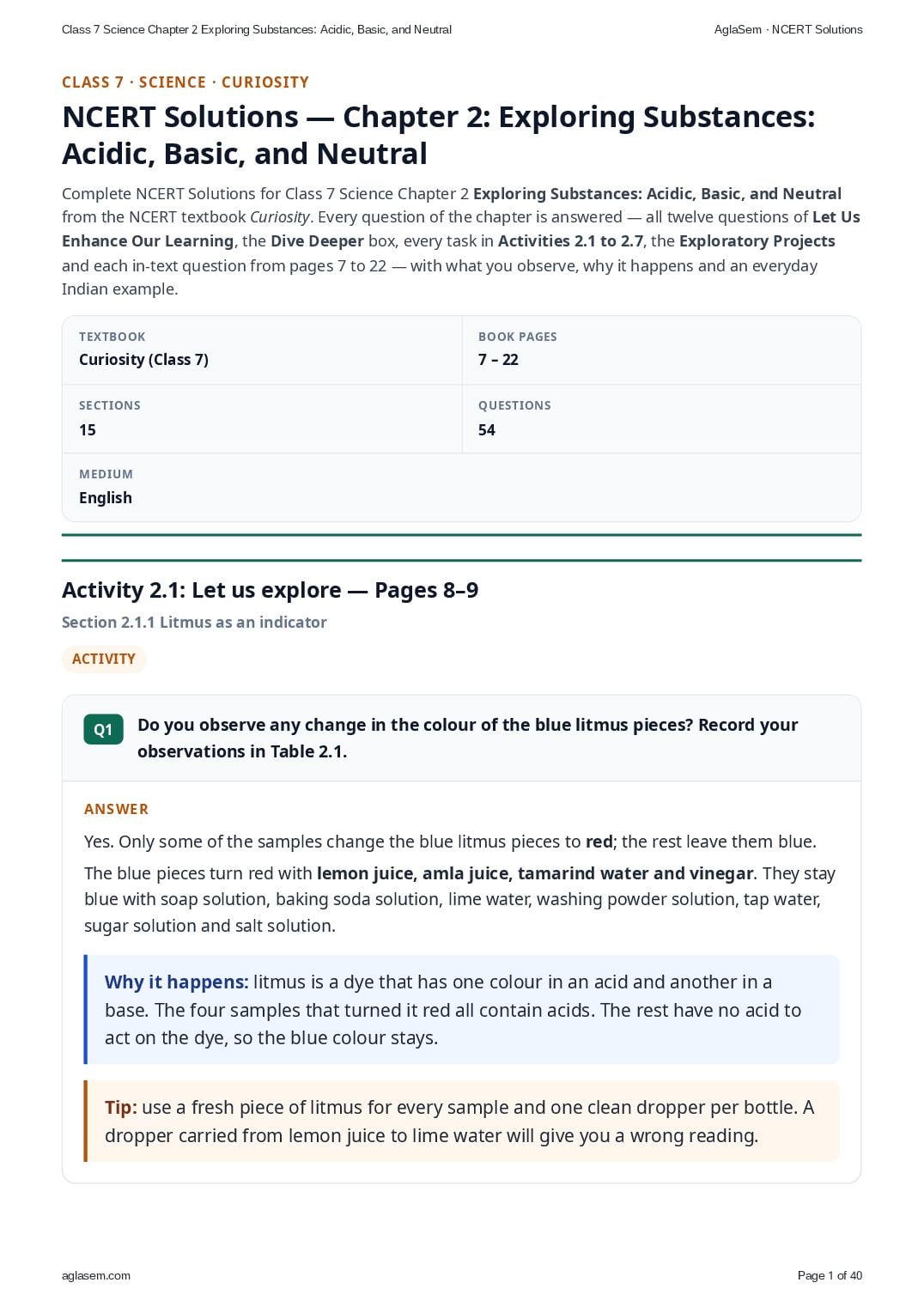
- Do you observe any change in the colour of the blue litmus pieces? Record your observations in Table 2.1.
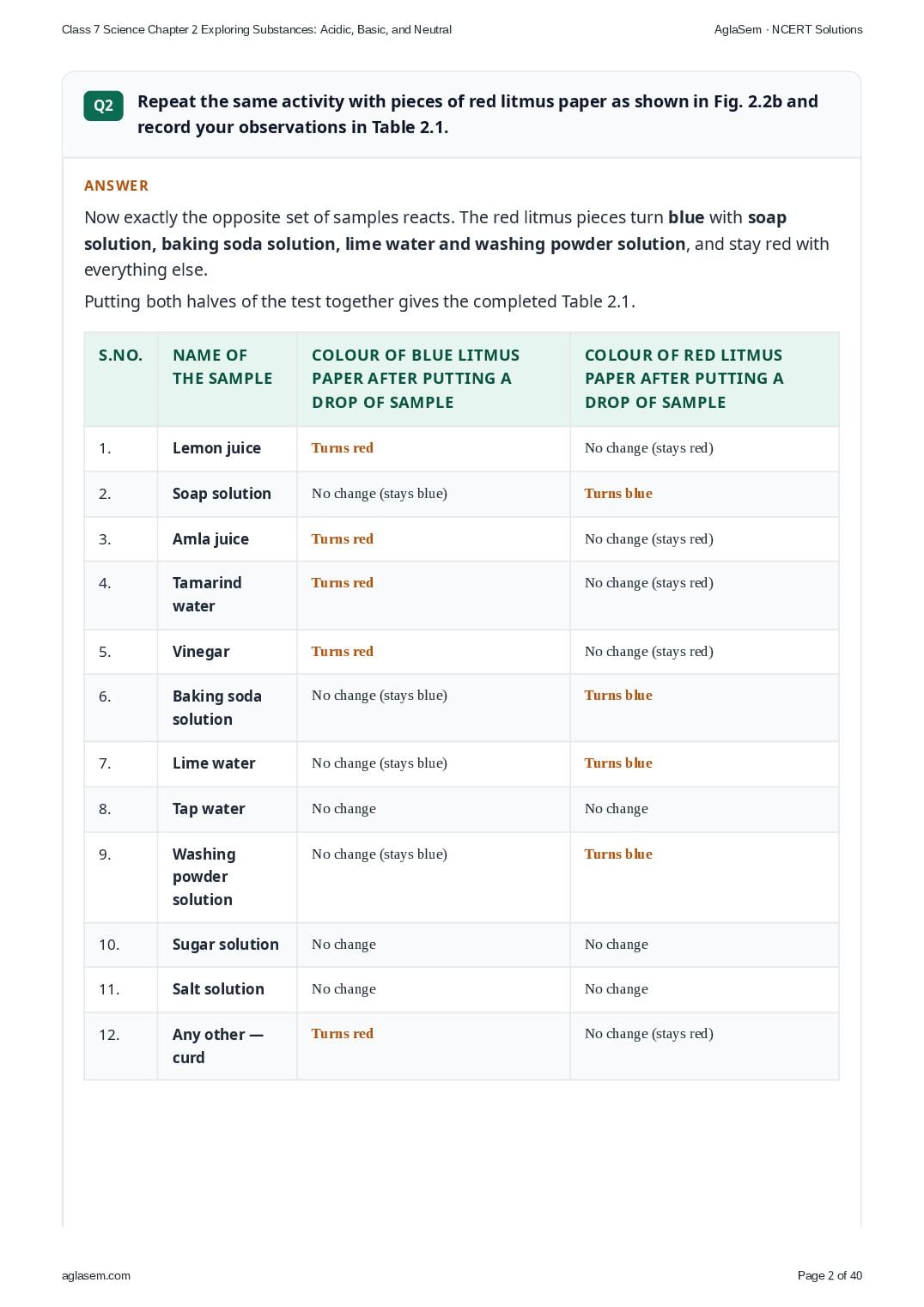
- Repeat the same activity with pieces of red litmus paper as shown in Fig. 2.2b and record your observations in Table 2.1.
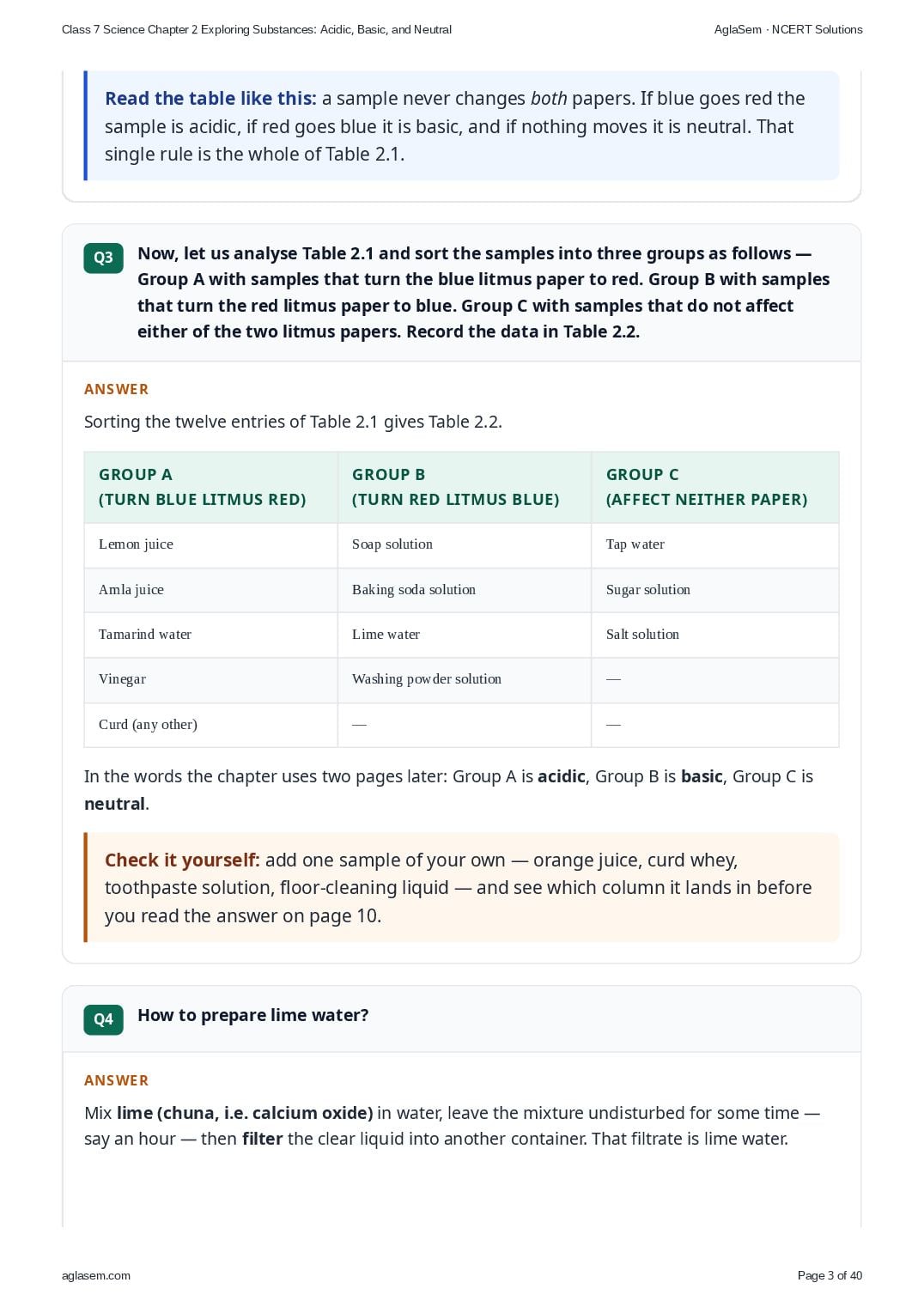
- Now, let us analyse Table 2.1 and sort the samples into three groups as follows — Group A with samples that turn the blue litmus paper to red. Group B with samples that turn the red litmus paper to blue. Group C with samples that do not affect either of the two litmus papers. Record the data in Table 2.2.
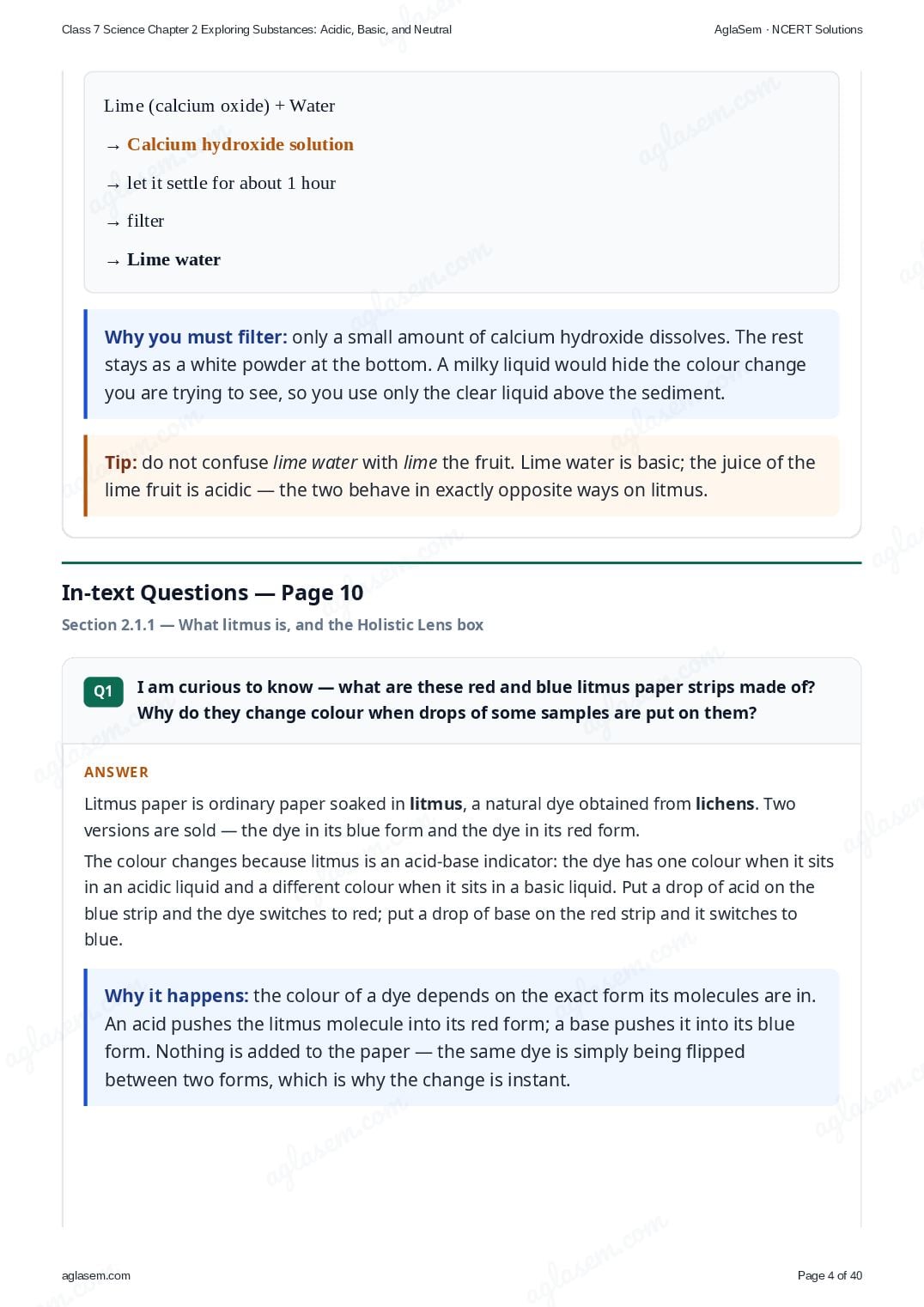
- How to prepare lime water?
- I am curious to know — what are these red and blue litmus paper strips made of? Why do they change colour when drops of some samples are put on them?
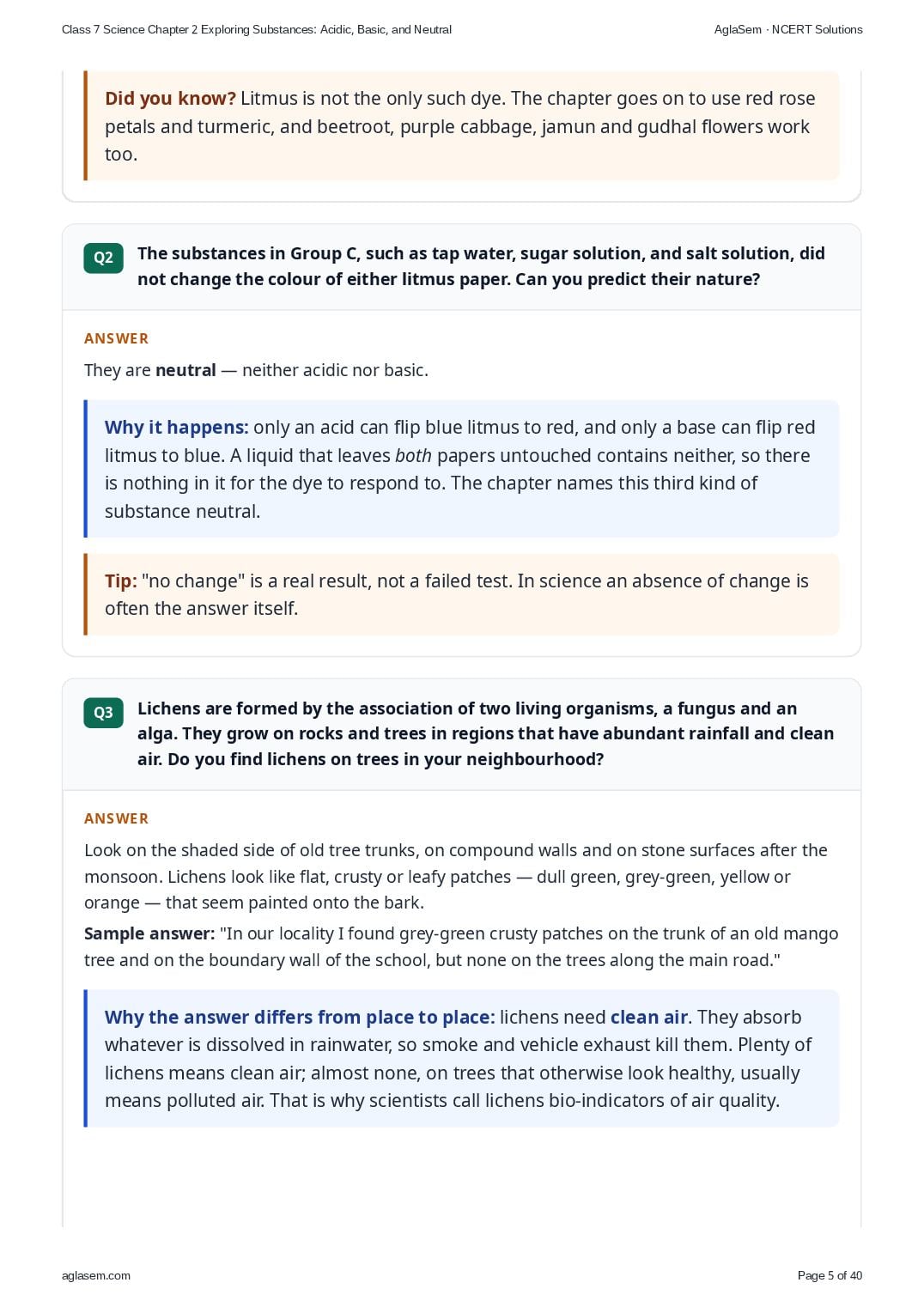
- The substances in Group C, such as tap water, sugar solution, and salt solution, did not change the colour of either litmus paper. Can you predict their nature?
- Lichens are formed by the association of two living organisms, a fungus and an alga. They grow on rocks and trees in regions that have abundant rainfall and clean air. Do you find lichens on trees in your neighbourhood?
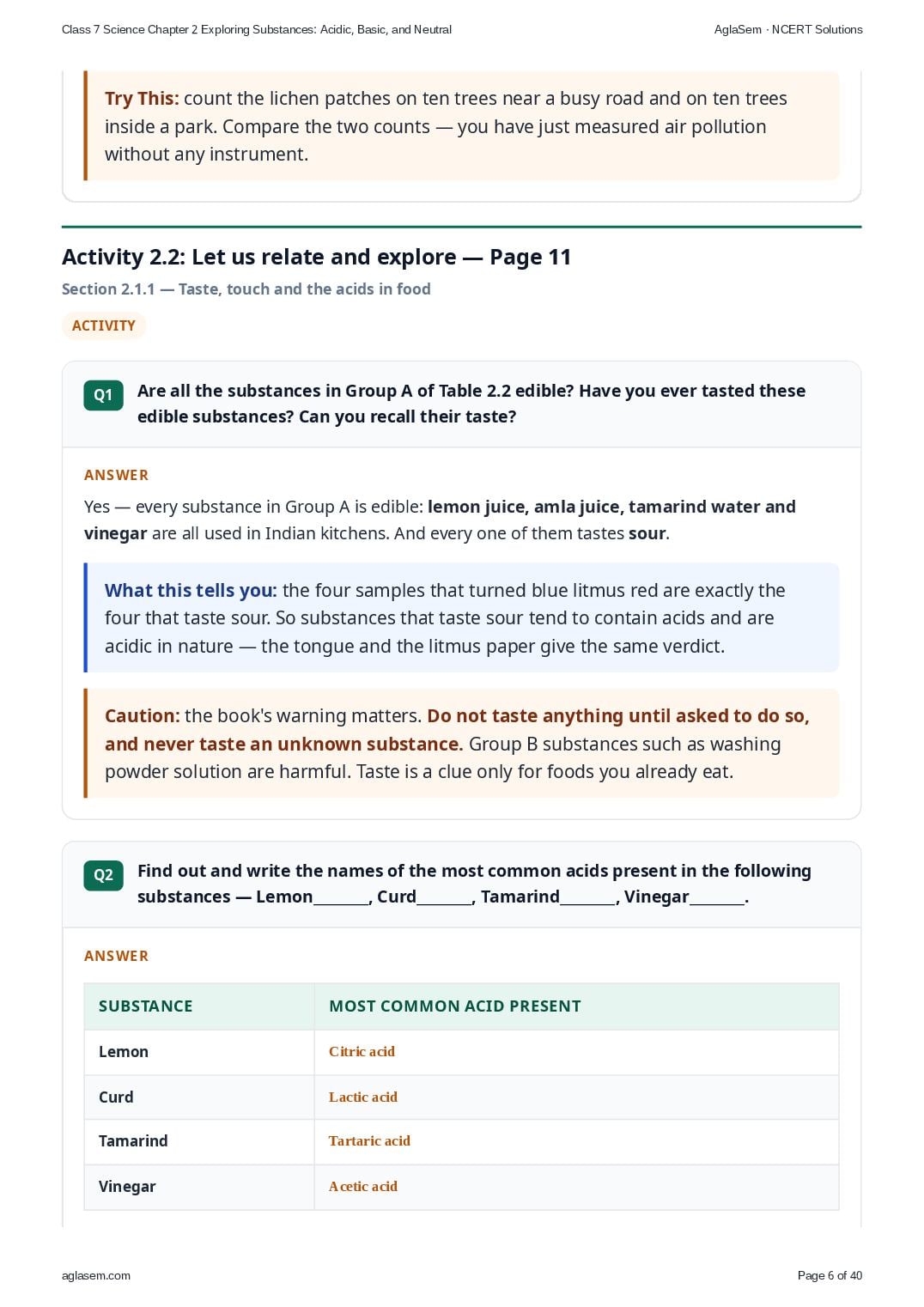
- Are all the substances in Group A of Table 2.2 edible? Have you ever tasted these edible substances? Can you recall their taste?
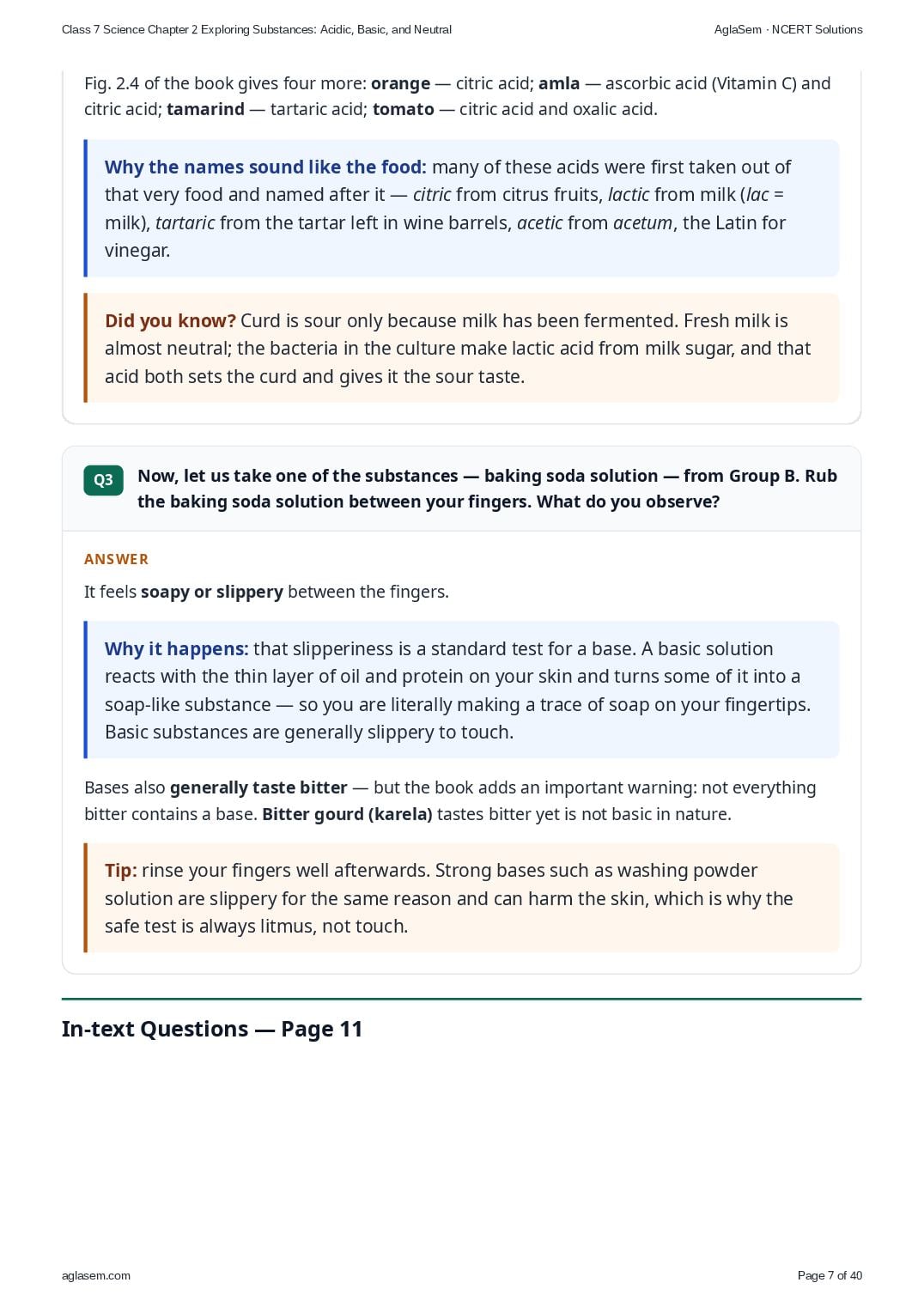
- Find out and write the names of the most common acids present in the following substances — Lemon________, Curd________, Tamarind________, Vinegar________.
- Now, let us take one of the substances — baking soda solution — from Group B. Rub the baking soda solution between your fingers. What do you observe?
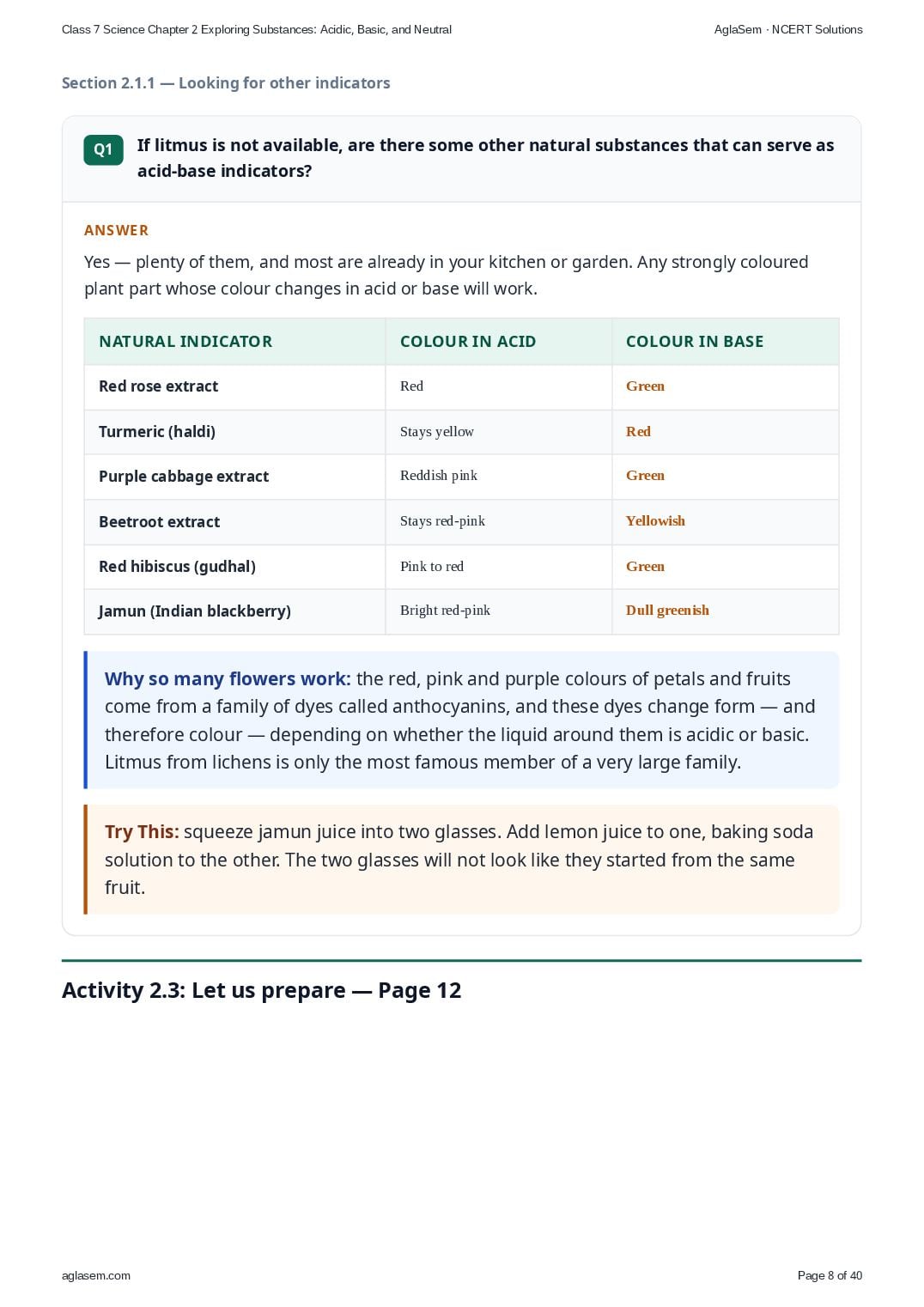
- If litmus is not available, are there some other natural substances that can serve as acid-base indicators?
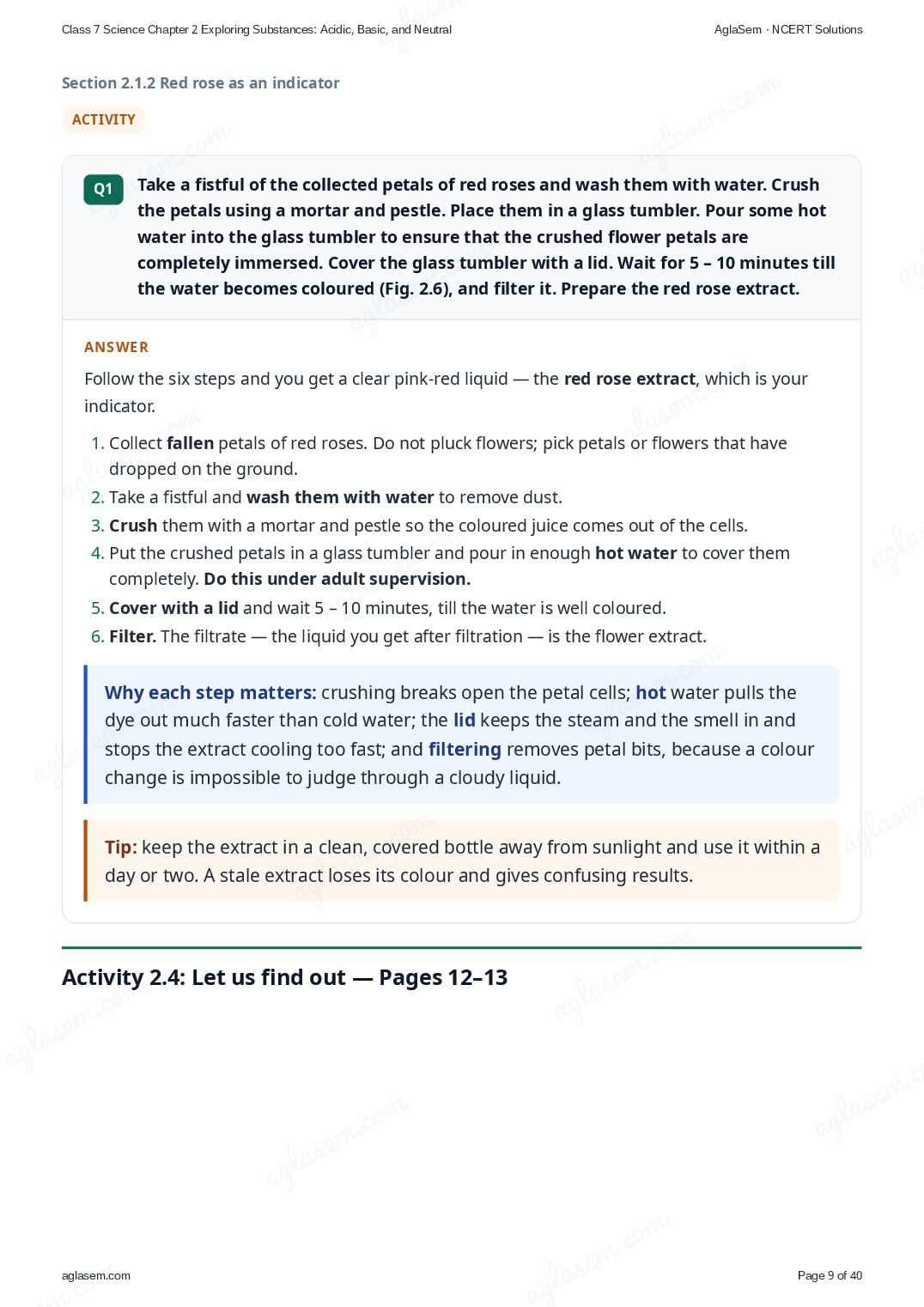
- Take a fistful of the collected petals of red roses and wash them with water. Crush the petals using a mortar and pestle. Place them in a glass tumbler. Pour some hot water into the glass tumbler to ensure that the crushed flower petals are completely immersed. Cover the glass tumbler with a lid. Wait for 5 – 10 minutes till the water becomes coloured (Fig. 2.6), and filter it. Prepare the red rose extract.
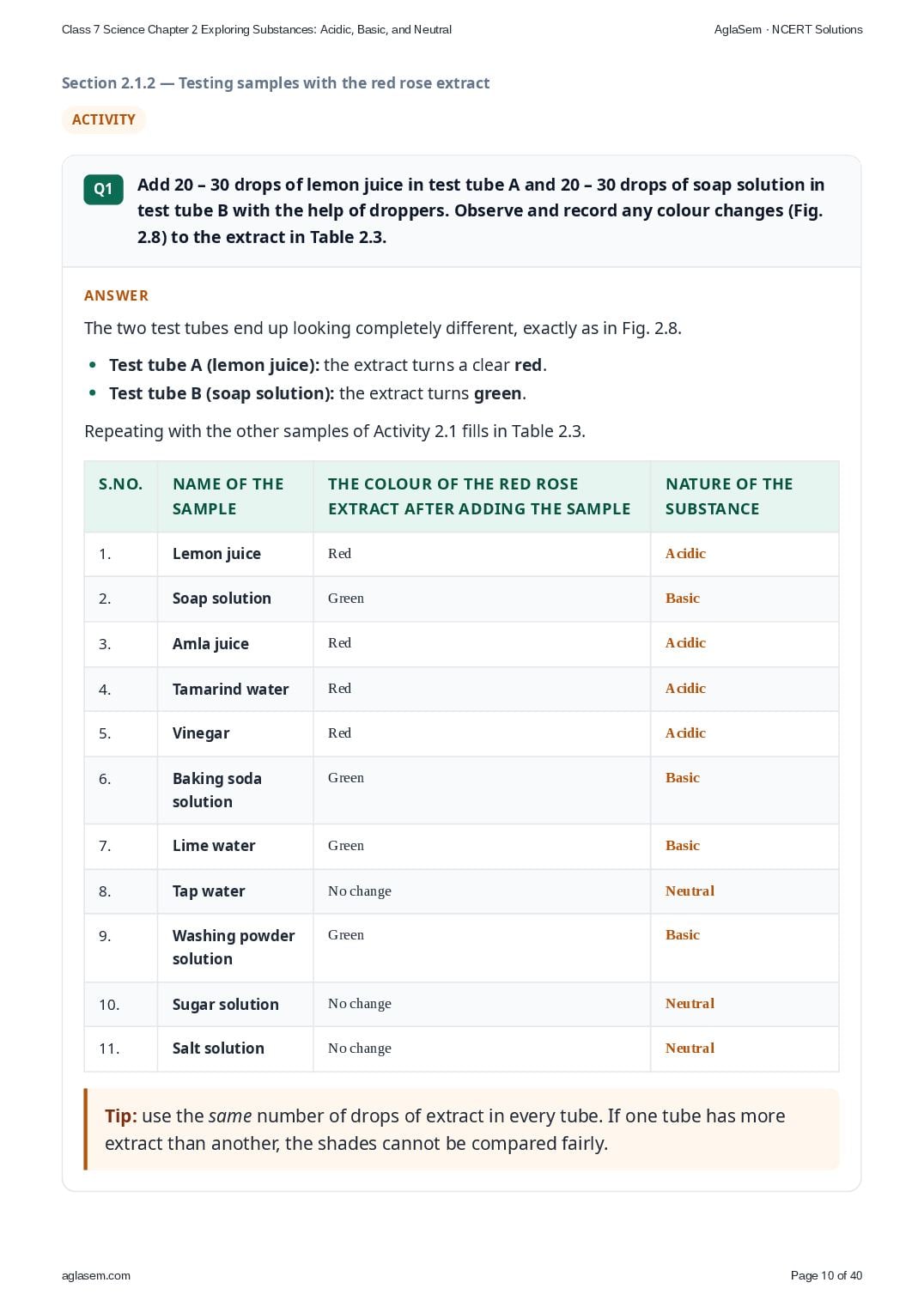
- Add 20 – 30 drops of lemon juice in test tube A and 20 – 30 drops of soap solution in test tube B with the help of droppers. Observe and record any colour changes (Fig. 2.8) to the extract in Table 2.3.
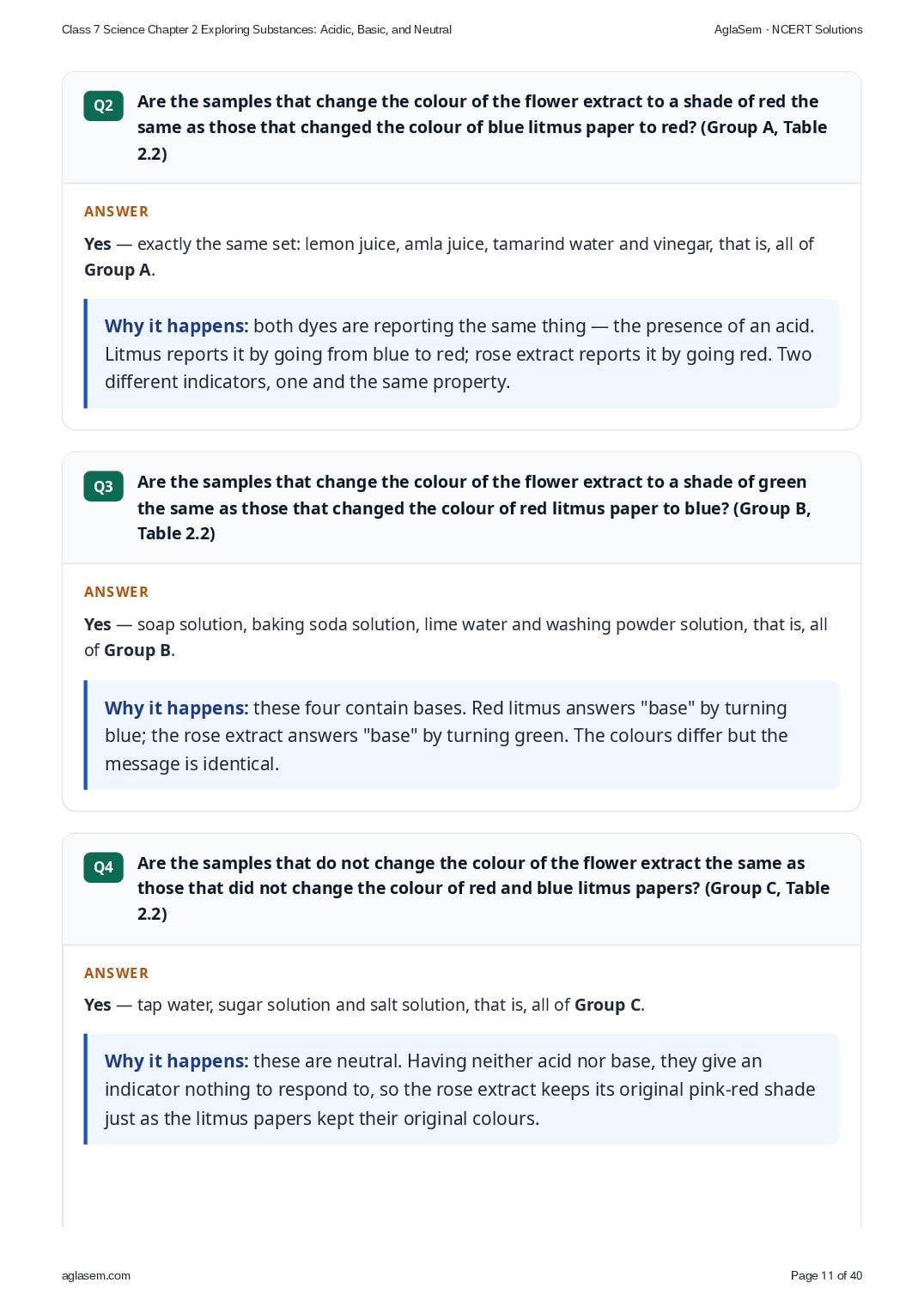
- Are the samples that change the colour of the flower extract to a shade of red the same as those that changed the colour of blue litmus paper to red? (Group A, Table 2.2)
- Are the samples that change the colour of the flower extract to a shade of green the same as those that changed the colour of red litmus paper to blue? (Group B, Table 2.2)
- Are the samples that do not change the colour of the flower extract the same as those that did not change the colour of red and blue litmus papers? (Group C, Table 2.2)
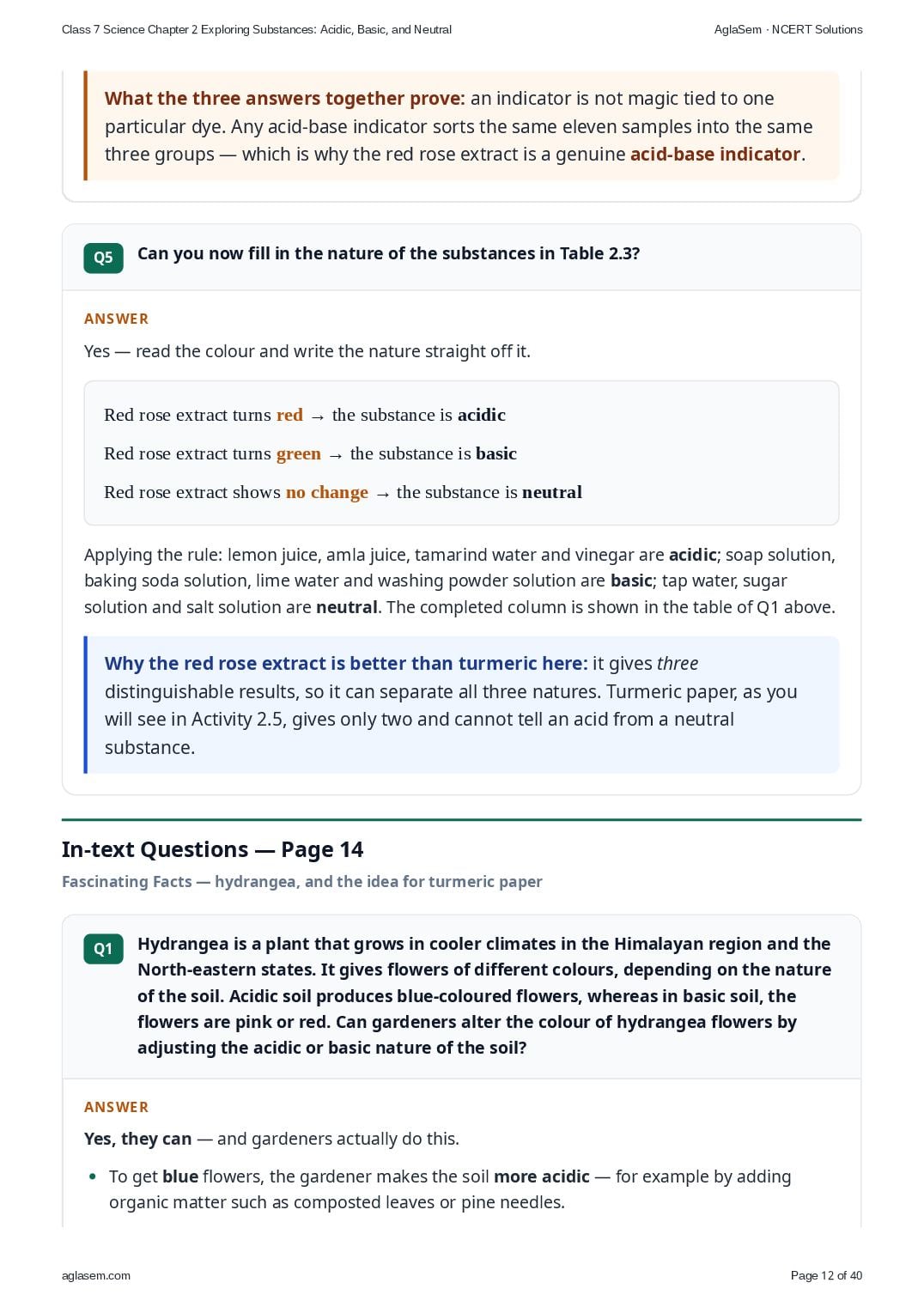
- Can you now fill in the nature of the substances in Table 2.3?
- Hydrangea is a plant that grows in cooler climates in the Himalayan region and the North-eastern states. It gives flowers of different colours, depending on the nature of the soil. Acidic soil produces blue-coloured flowers, whereas in basic soil, the flowers are pink or red. Can gardeners alter the colour of hydrangea flowers by adjusting the acidic or basic nature of the soil?
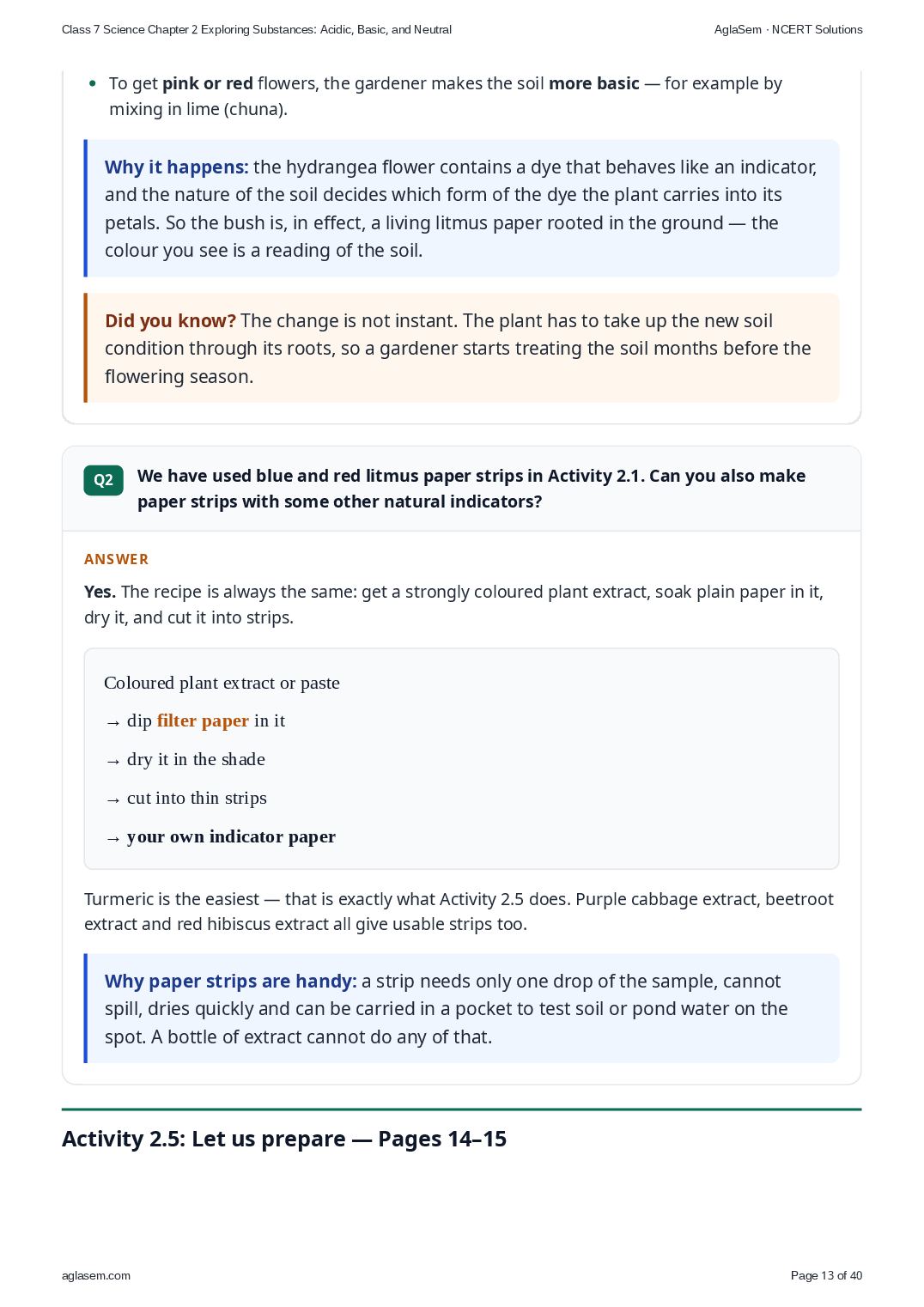
- We have used blue and red litmus paper strips in Activity 2.1. Can you also make paper strips with some other natural indicators?
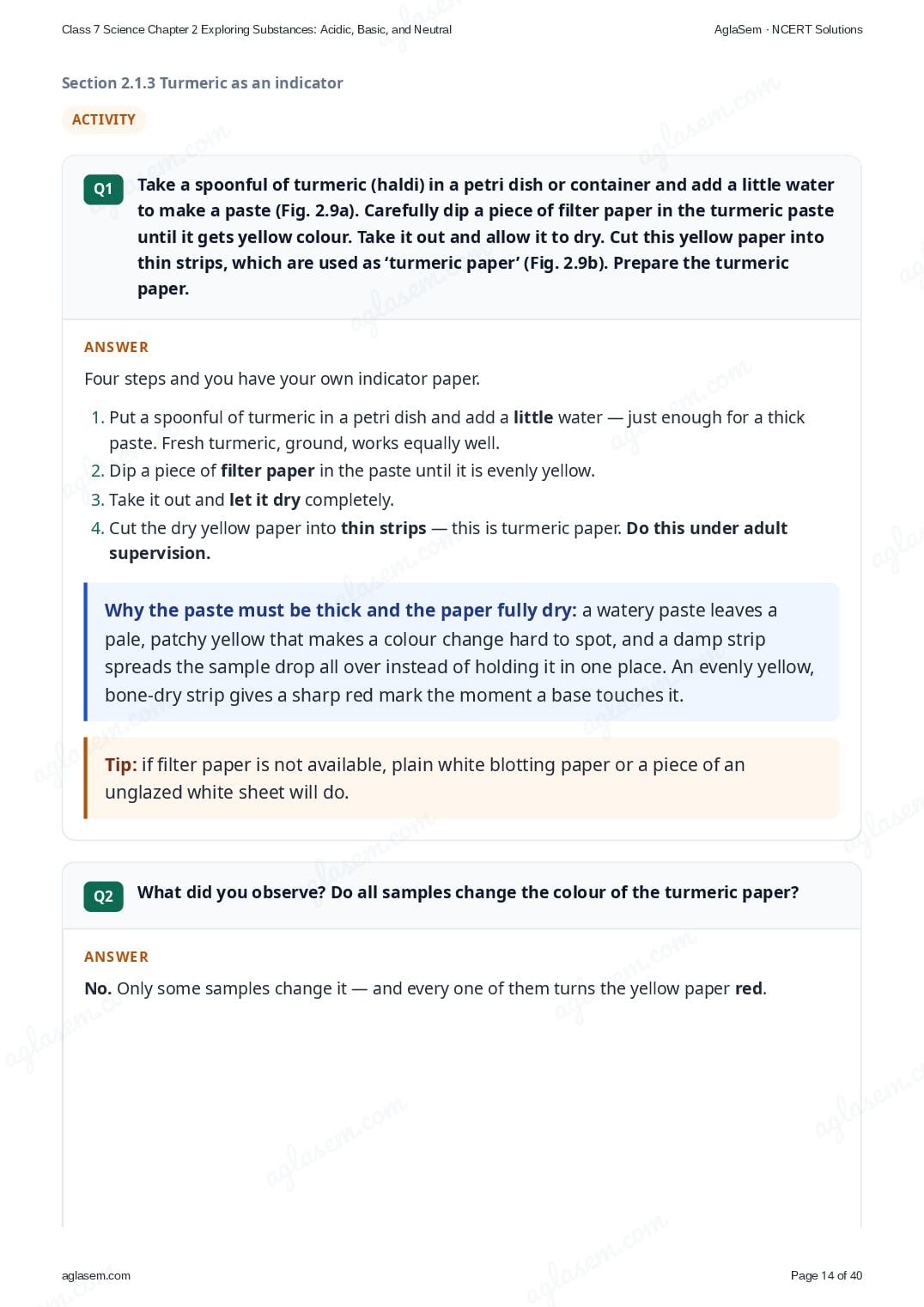
- Take a spoonful of turmeric (haldi) in a petri dish or container and add a little water to make a paste (Fig. 2.9a). Carefully dip a piece of filter paper in the turmeric paste until it gets yellow colour. Take it out and allow it to dry. Cut this yellow paper into thin strips, which are used as ‘turmeric paper’ (Fig. 2.9b). Prepare the turmeric paper.
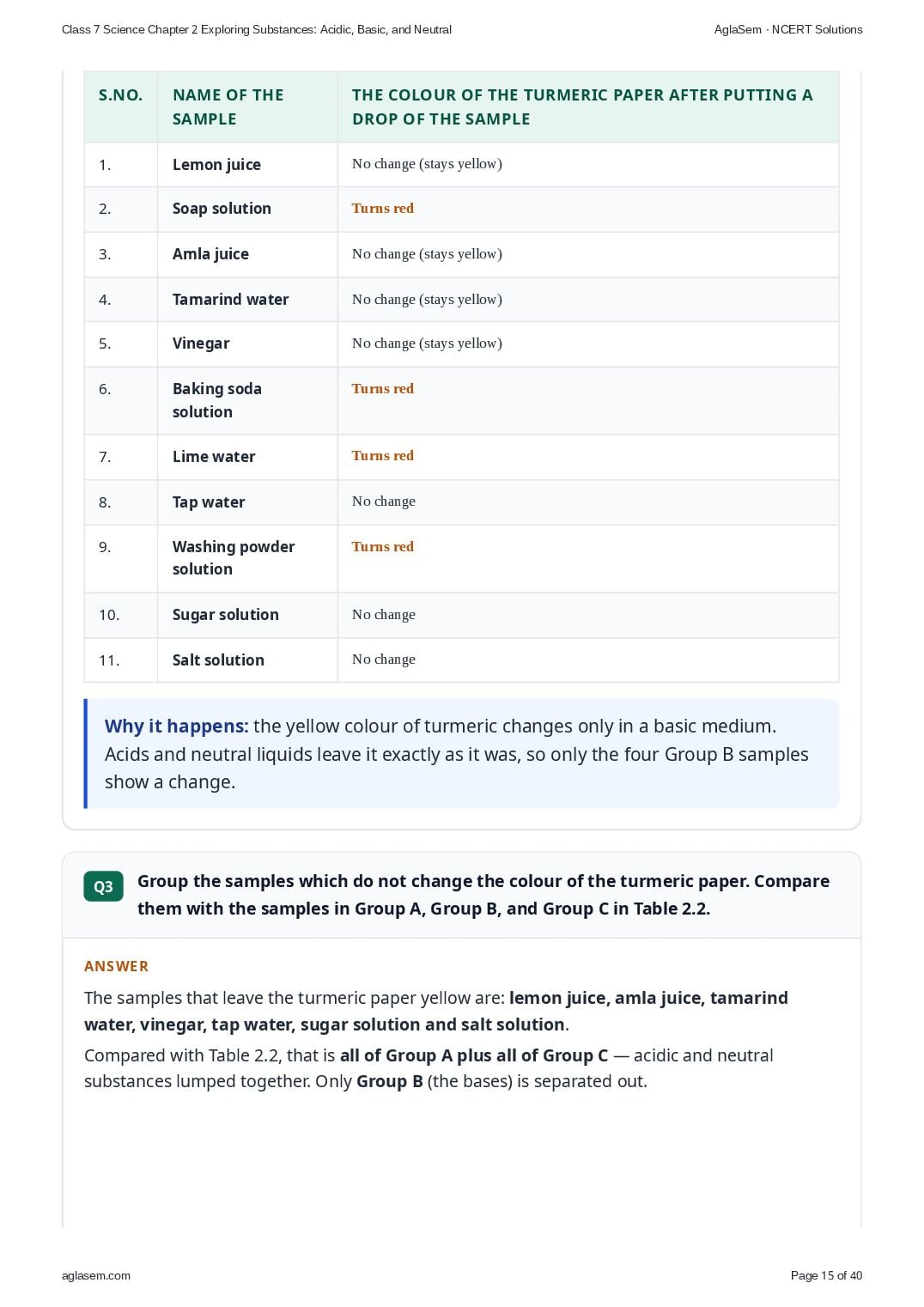
- What did you observe? Do all samples change the colour of the turmeric paper?
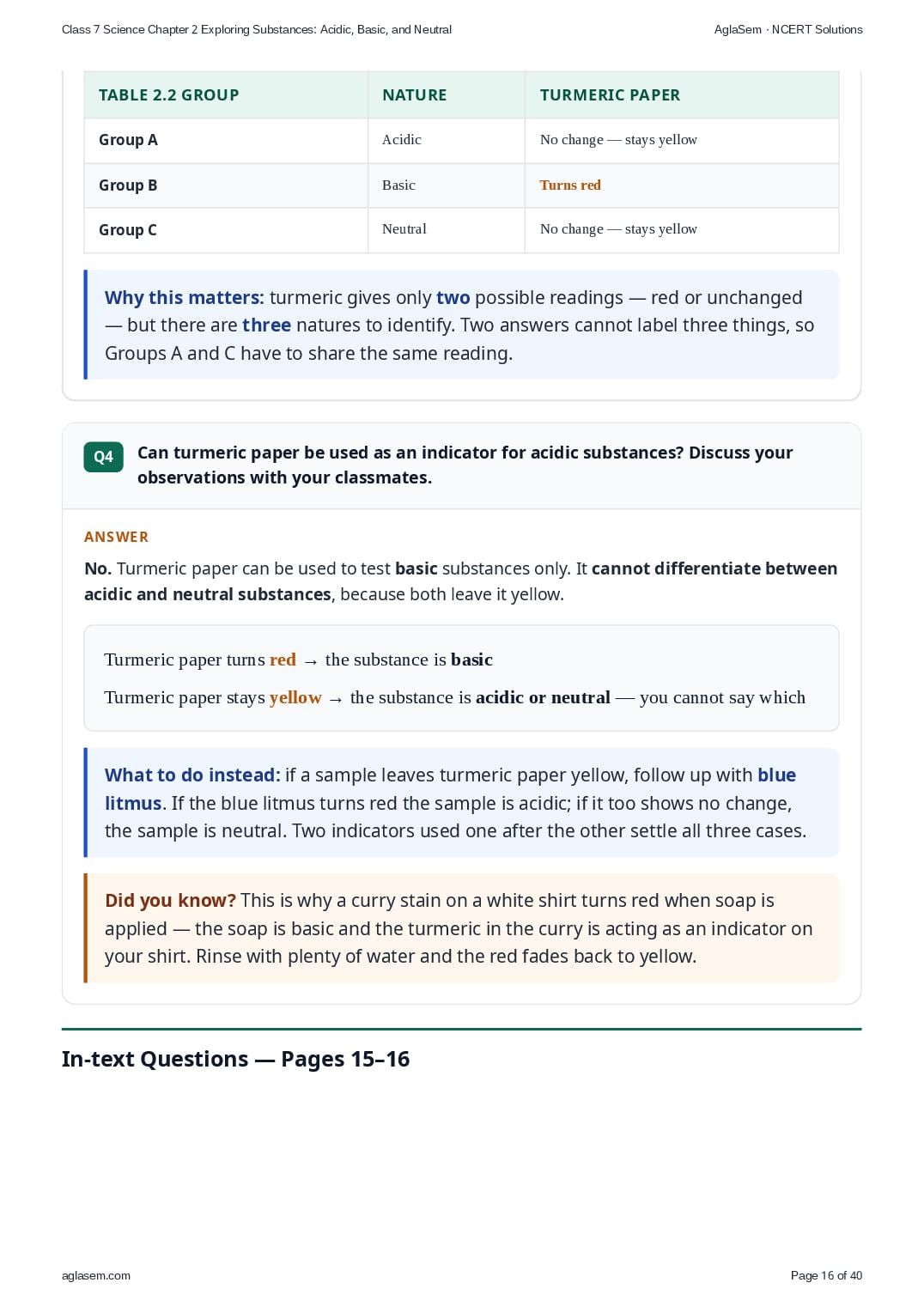
- Group the samples which do not change the colour of the turmeric paper. Compare them with the samples in Group A, Group B, and Group C in Table 2.2.
- Can turmeric paper be used as an indicator for acidic substances? Discuss your observations with your classmates.
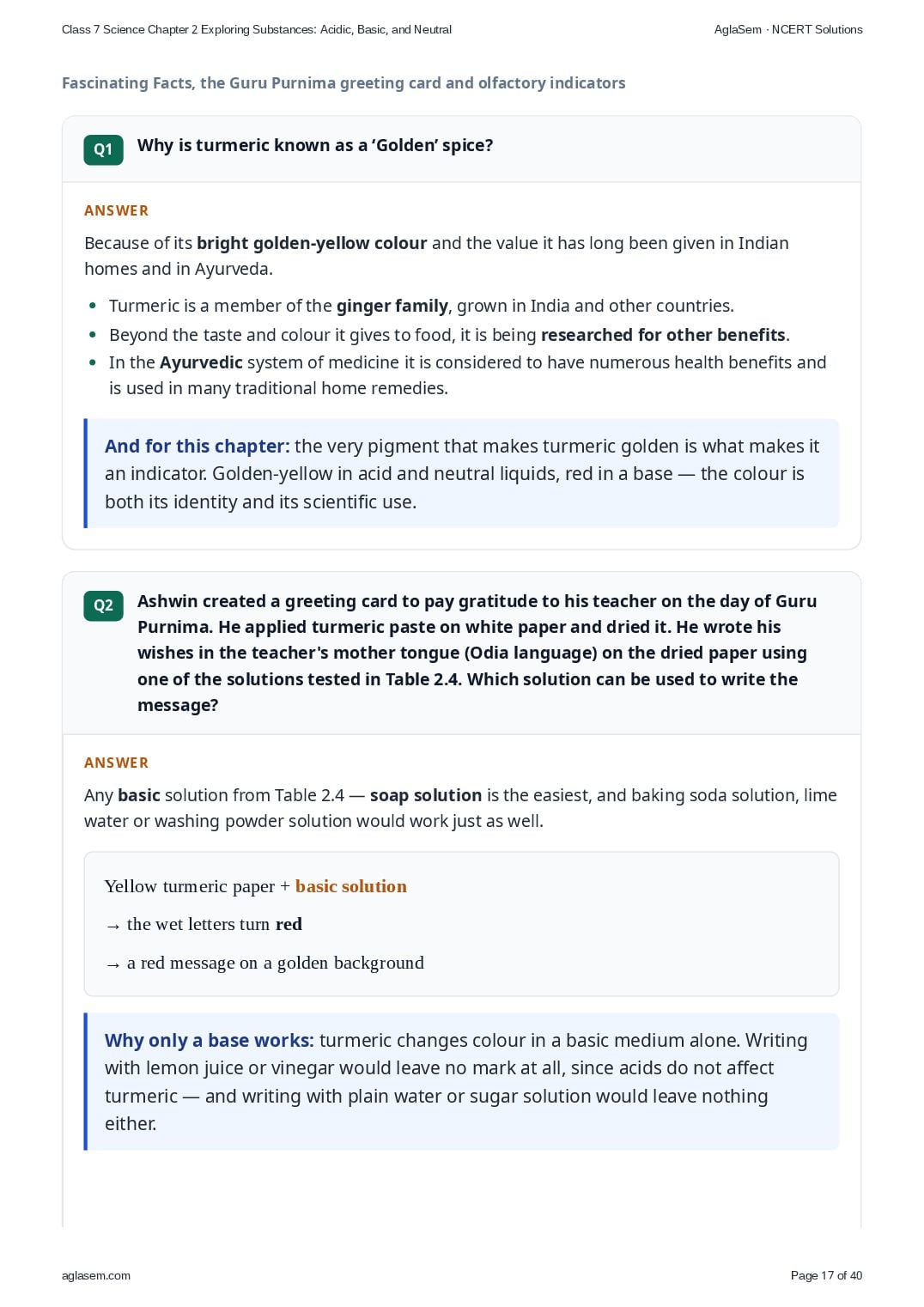
- Why is turmeric known as a ‘Golden’ spice?
- Ashwin created a greeting card to pay gratitude to his teacher on the day of Guru Purnima. He applied turmeric paste on white paper and dried it. He wrote his wishes in the teacher's mother tongue (Odia language) on the dried paper using one of the solutions tested in Table 2.4. Which solution can be used to write the message?
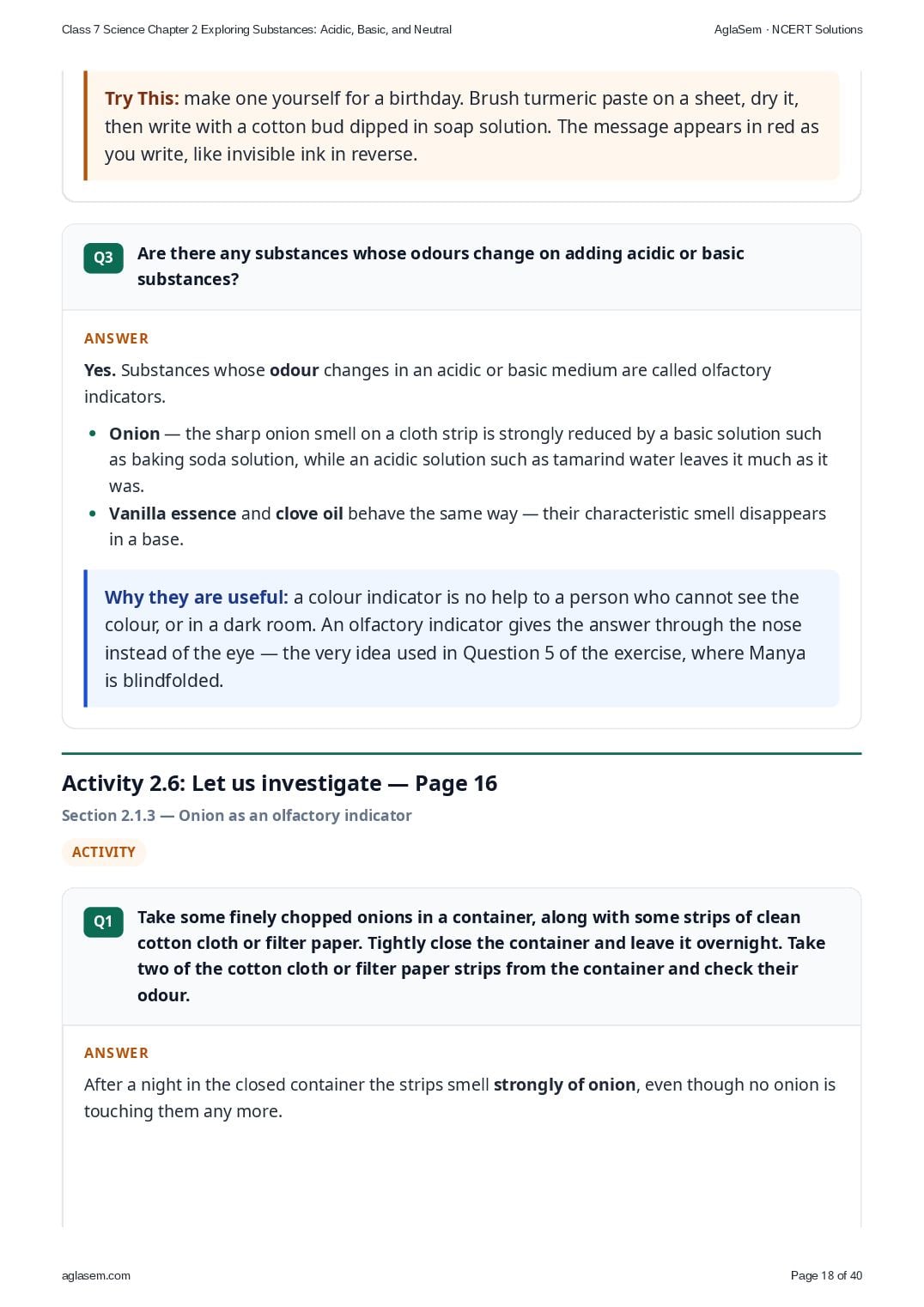
- Are there any substances whose odours change on adding acidic or basic substances?
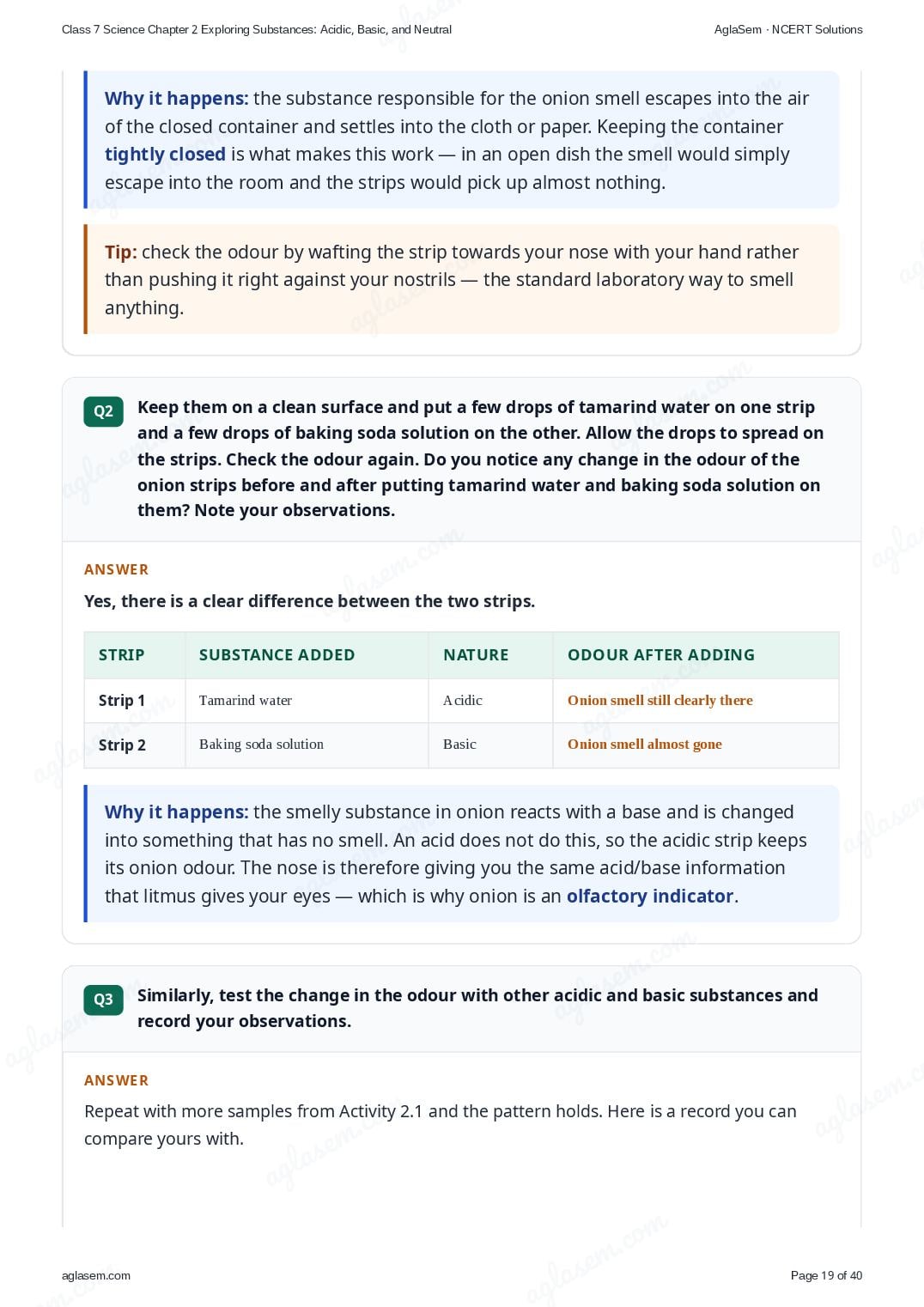
- Take some finely chopped onions in a container, along with some strips of clean cotton cloth or filter paper. Tightly close the container and leave it overnight. Take two of the cotton cloth or filter paper strips from the container and check their odour.
- Keep them on a clean surface and put a few drops of tamarind water on one strip and a few drops of baking soda solution on the other. Allow the drops to spread on the strips. Check the odour again. Do you notice any change in the odour of the onion strips before and after putting tamarind water and baking soda solution on them? Note your observations.
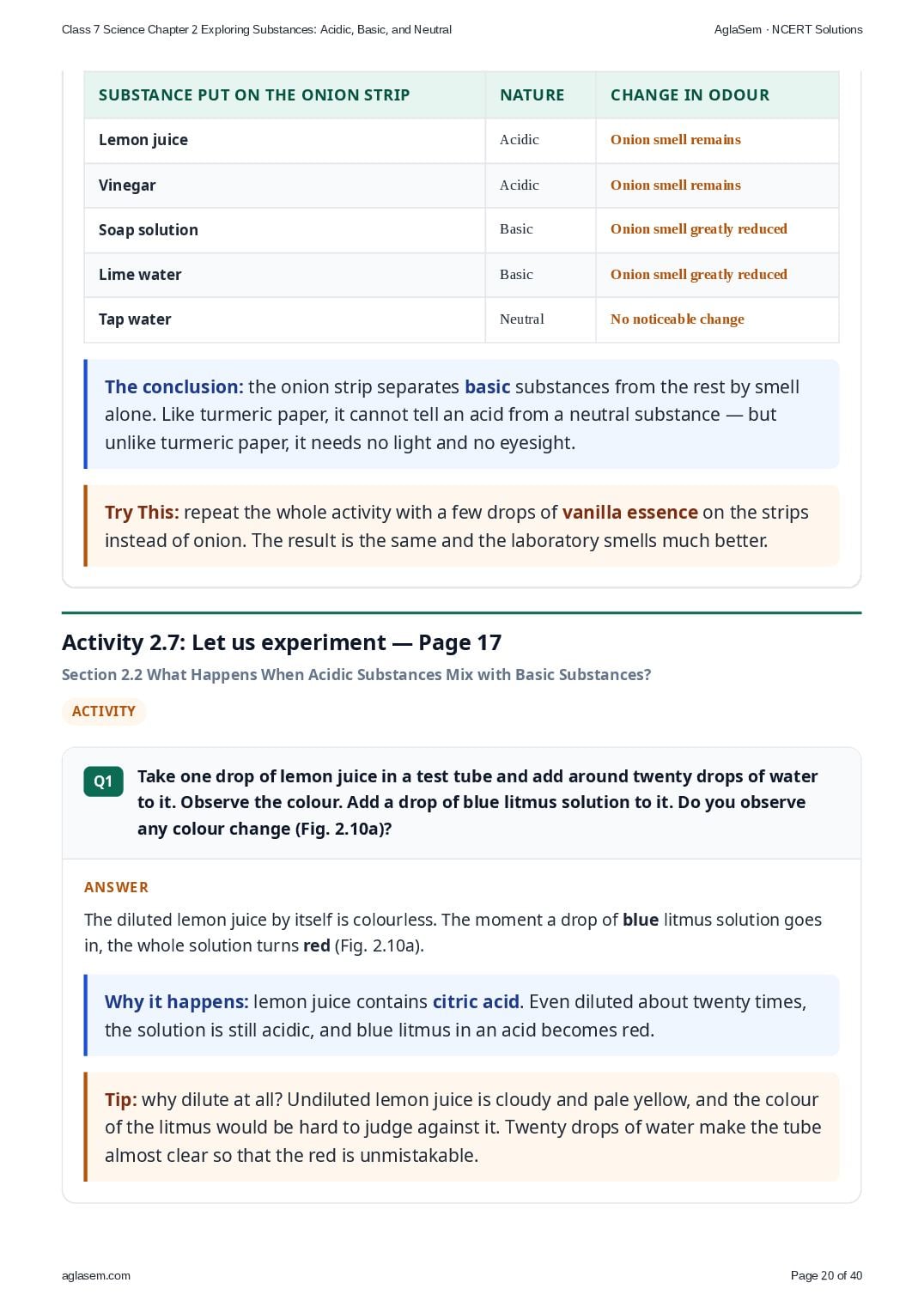
- Similarly, test the change in the odour with other acidic and basic substances and record your observations.
- Take one drop of lemon juice in a test tube and add around twenty drops of water to it. Observe the colour. Add a drop of blue litmus solution to it. Do you observe any colour change (Fig. 2.10a)?
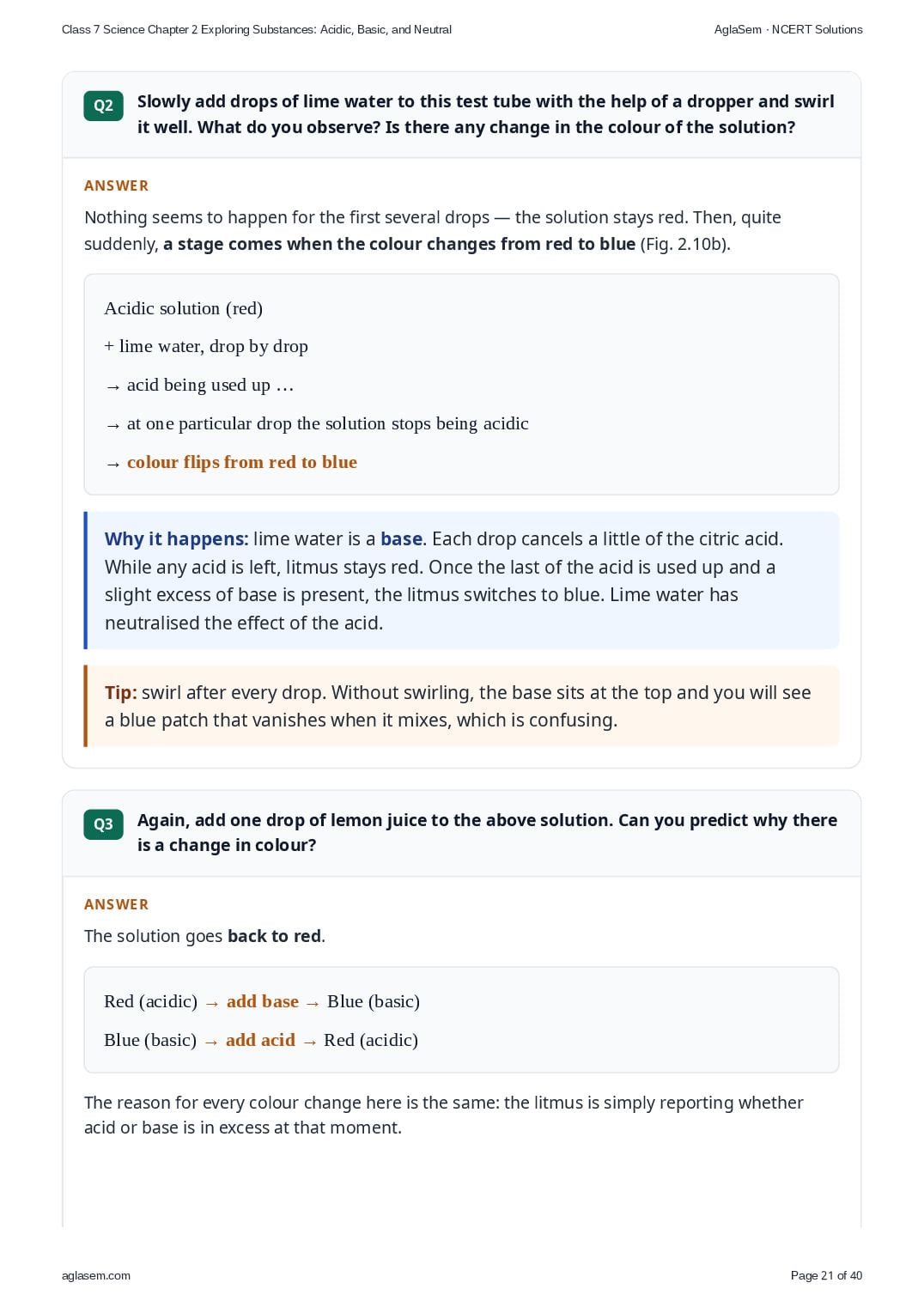
- Slowly add drops of lime water to this test tube with the help of a dropper and swirl it well. What do you observe? Is there any change in the colour of the solution?
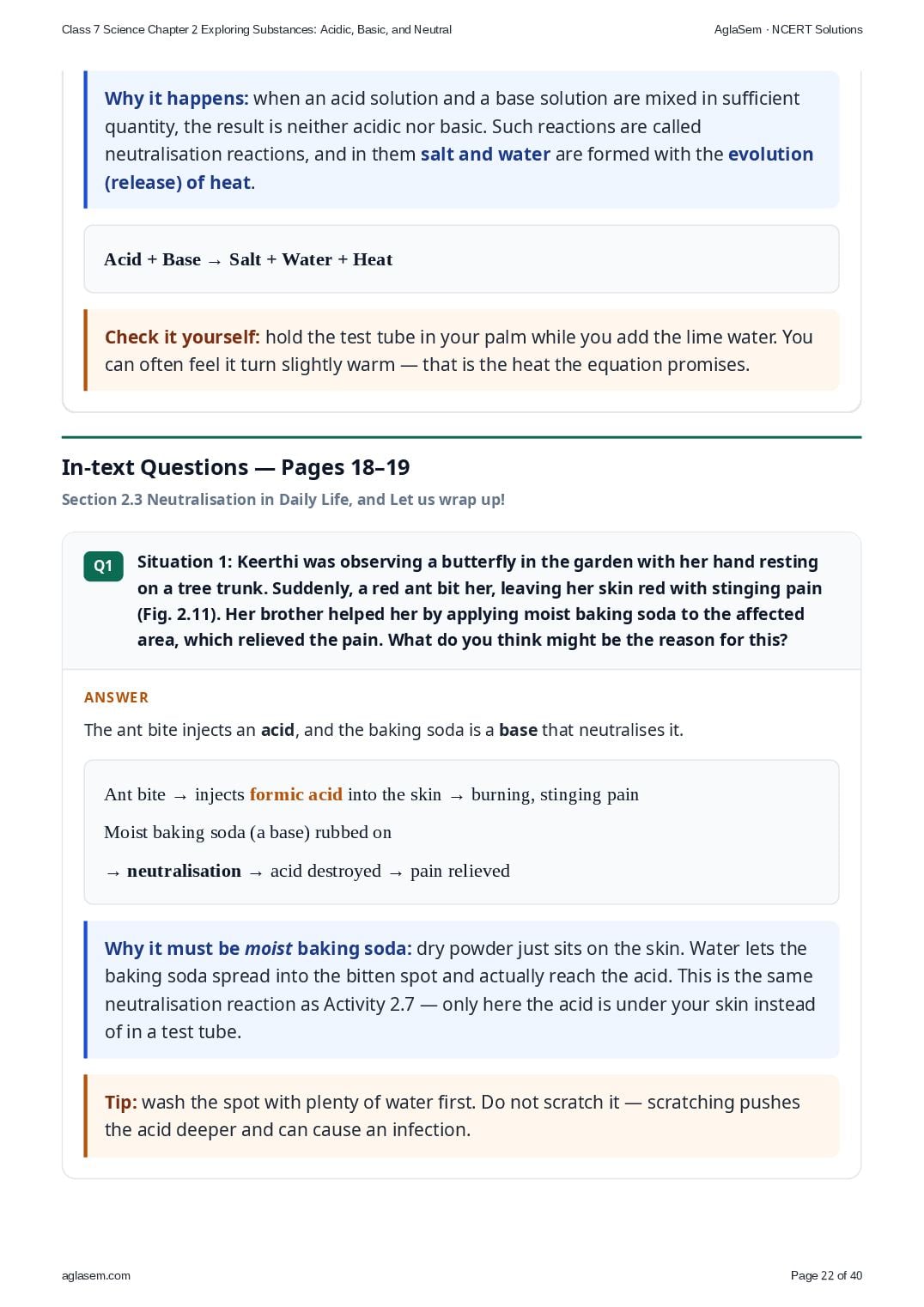
- Again, add one drop of lemon juice to the above solution. Can you predict why there is a change in colour?
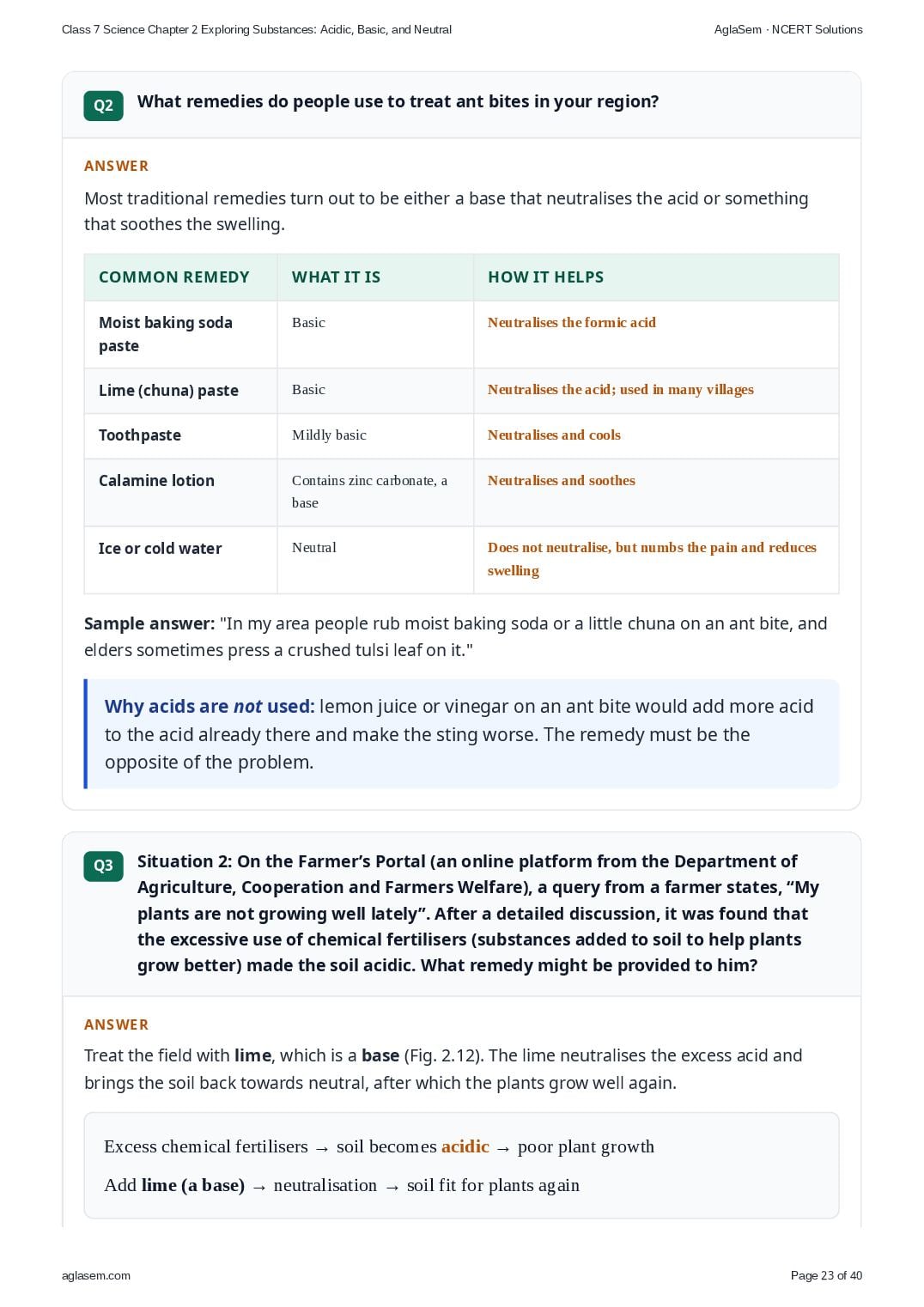
- Situation 1: Keerthi was observing a butterfly in the garden with her hand resting on a tree trunk. Suddenly, a red ant bit her, leaving her skin red with stinging pain (Fig. 2.11). Her brother helped her by applying moist baking soda to the affected area, which relieved the pain. What do you think might be the reason for this?
- What remedies do people use to treat ant bites in your region?
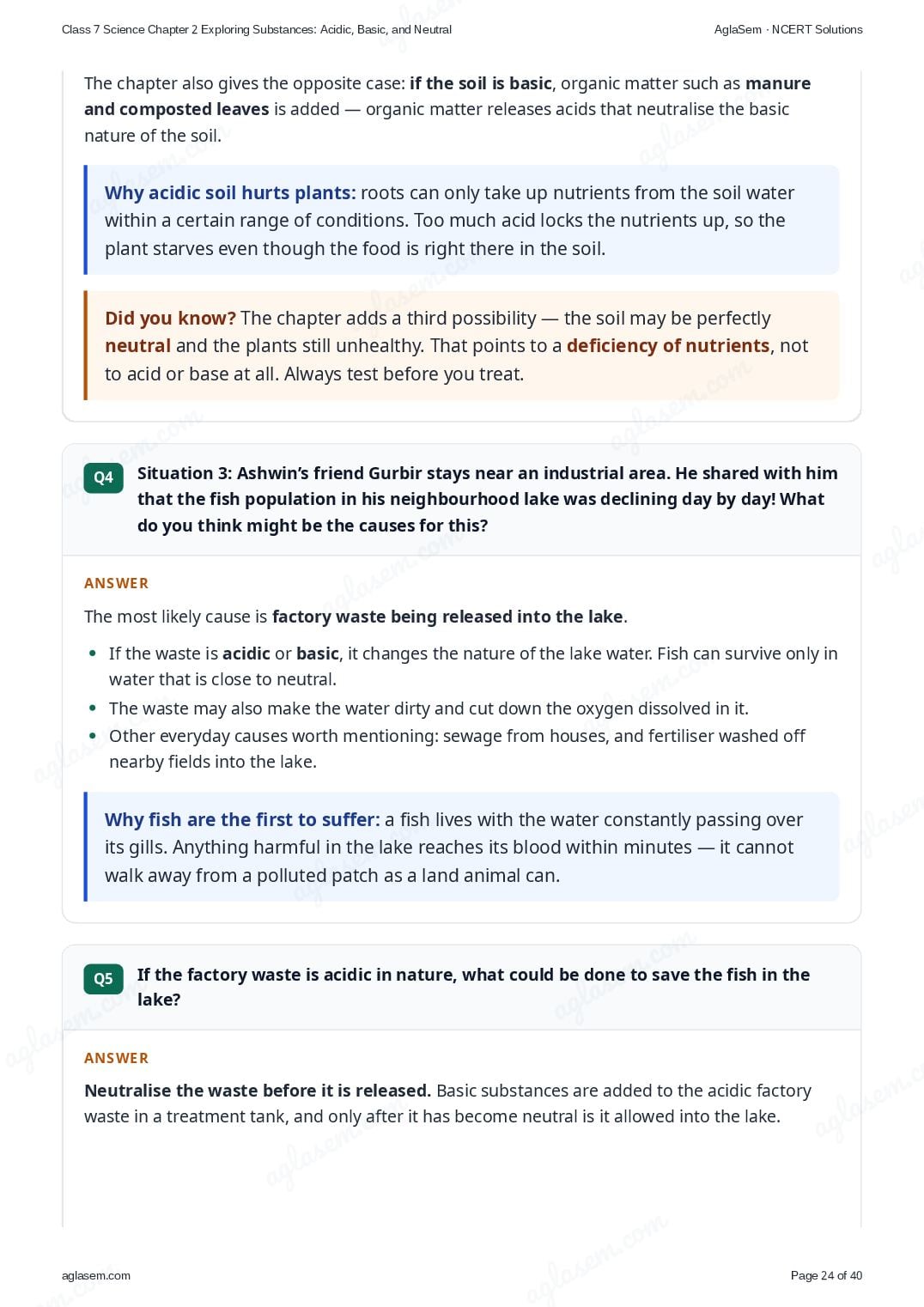
- Situation 2: On the Farmer’s Portal (an online platform from the Department of Agriculture, Cooperation and Farmers Welfare), a query from a farmer states, “My plants are not growing well lately”. After a detailed discussion, it was found that the excessive use of chemical fertilisers (substances added to soil to help plants grow better) made the soil acidic. What remedy might be provided to him?
- Situation 3: Ashwin’s friend Gurbir stays near an industrial area. He shared with him that the fish population in his neighbourhood lake was declining day by day! What do you think might be the causes for this?
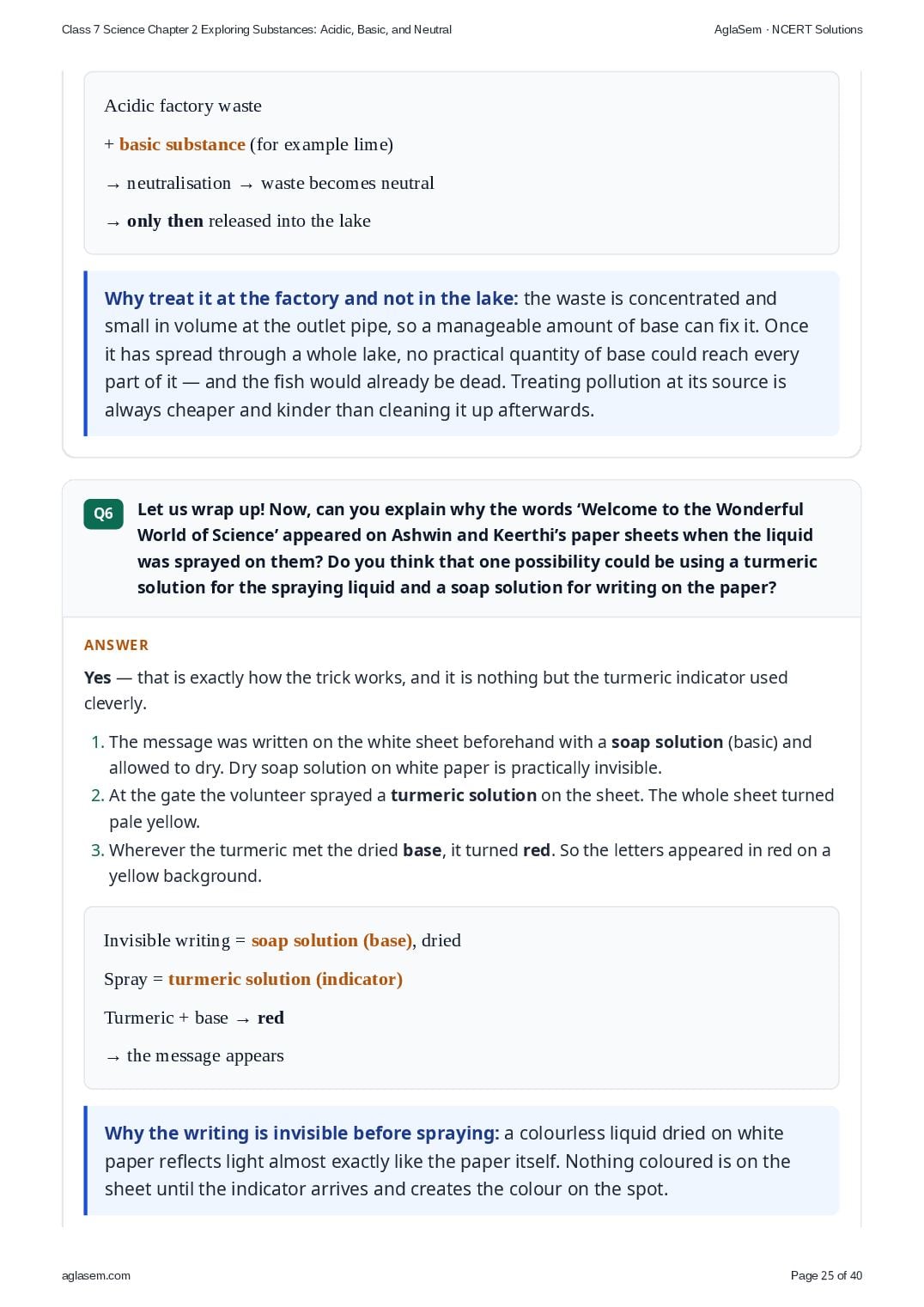
- If the factory waste is acidic in nature, what could be done to save the fish in the lake?
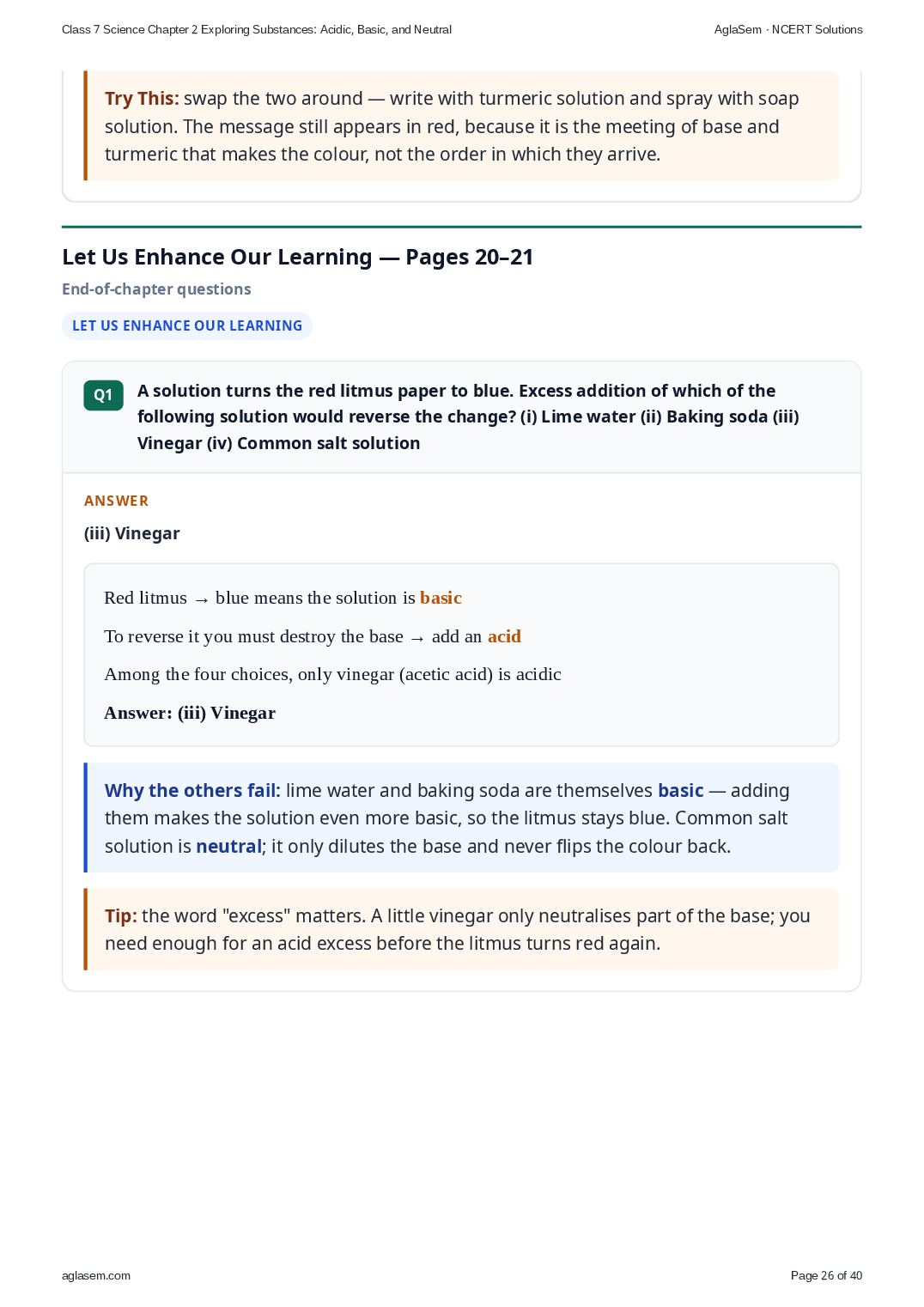
- Let us wrap up! Now, can you explain why the words ‘Welcome to the Wonderful World of Science’ appeared on Ashwin and Keerthi’s paper sheets when the liquid was sprayed on them? Do you think that one possibility could be using a turmeric solution for the spraying liquid and a soap solution for writing on the paper?
- A solution turns the red litmus paper to blue. Excess addition of which of the following solution would reverse the change? (i) Lime water (ii) Baking soda (iii) Vinegar (iv) Common salt solution
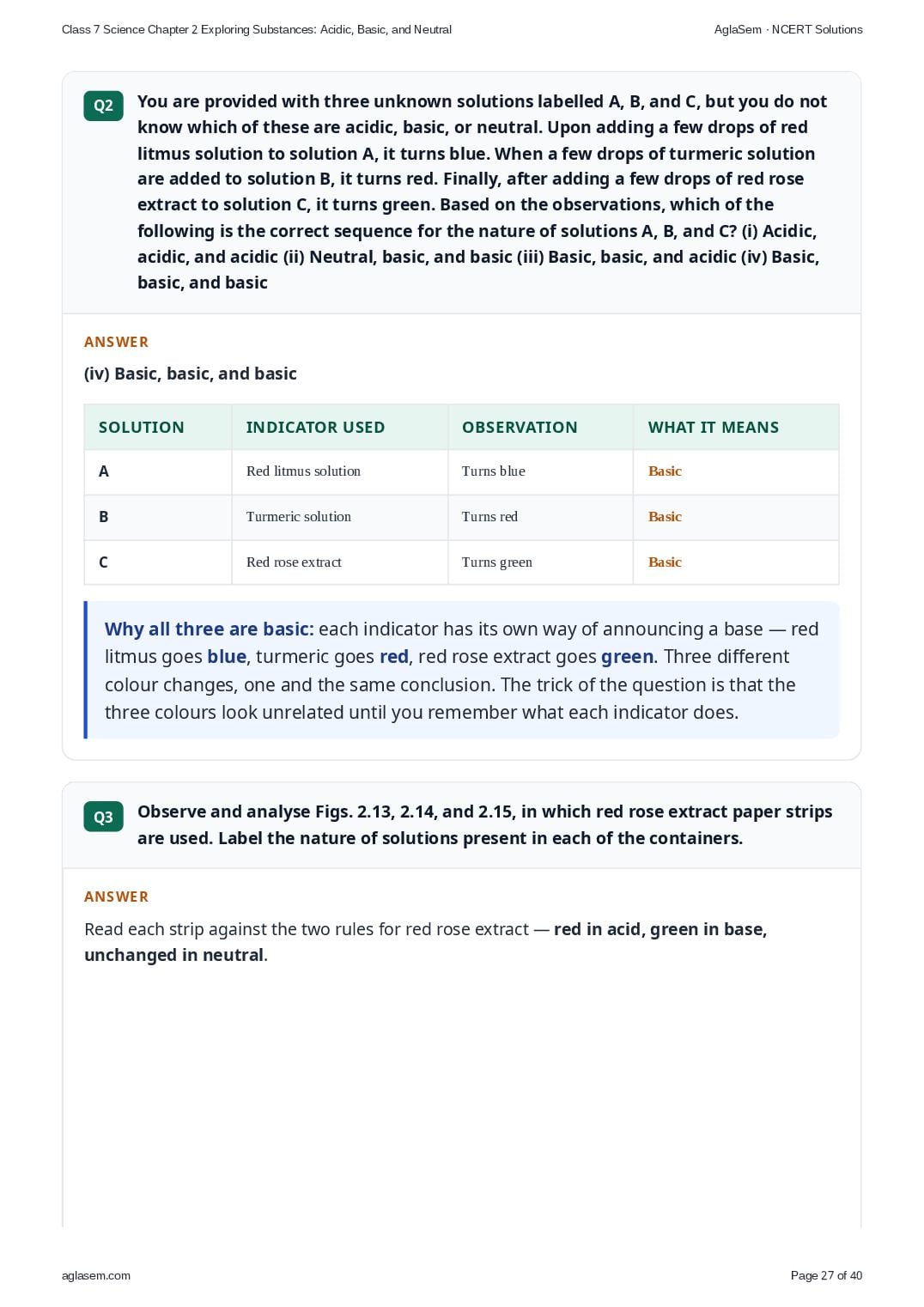
- You are provided with three unknown solutions labelled A, B, and C, but you do not know which of these are acidic, basic, or neutral. Upon adding a few drops of red litmus solution to solution A, it turns blue. When a few drops of turmeric solution are added to solution B, it turns red. Finally, after adding a few drops of red rose extract to solution C, it turns green. Based on the observations, which of the following is the correct sequence for the nature of solutions A, B, and C? (i) Acidic, acidic, and acidic (ii) Neutral, basic, and basic (iii) Basic, basic, and acidic (iv) Basic, basic, and basic
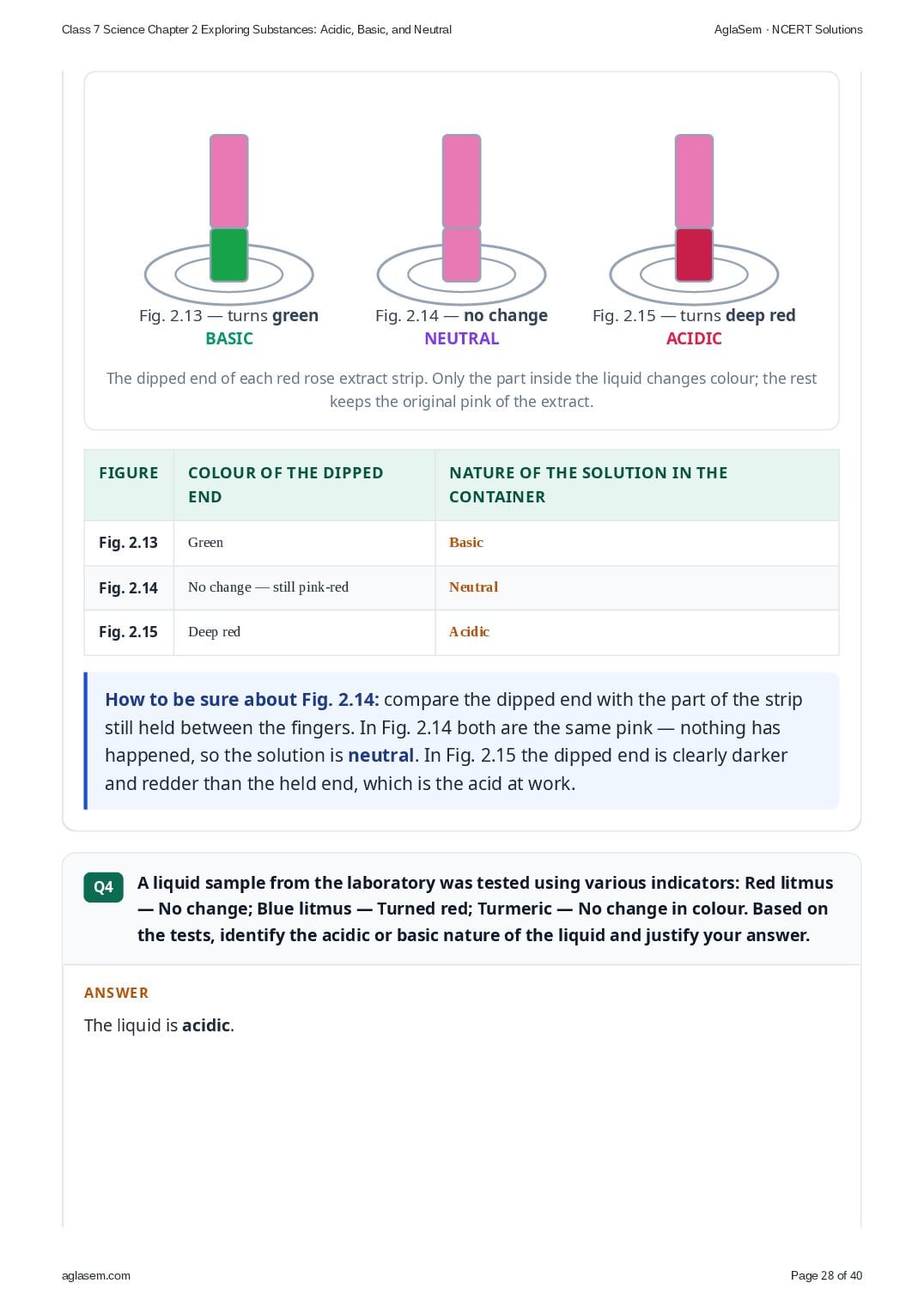
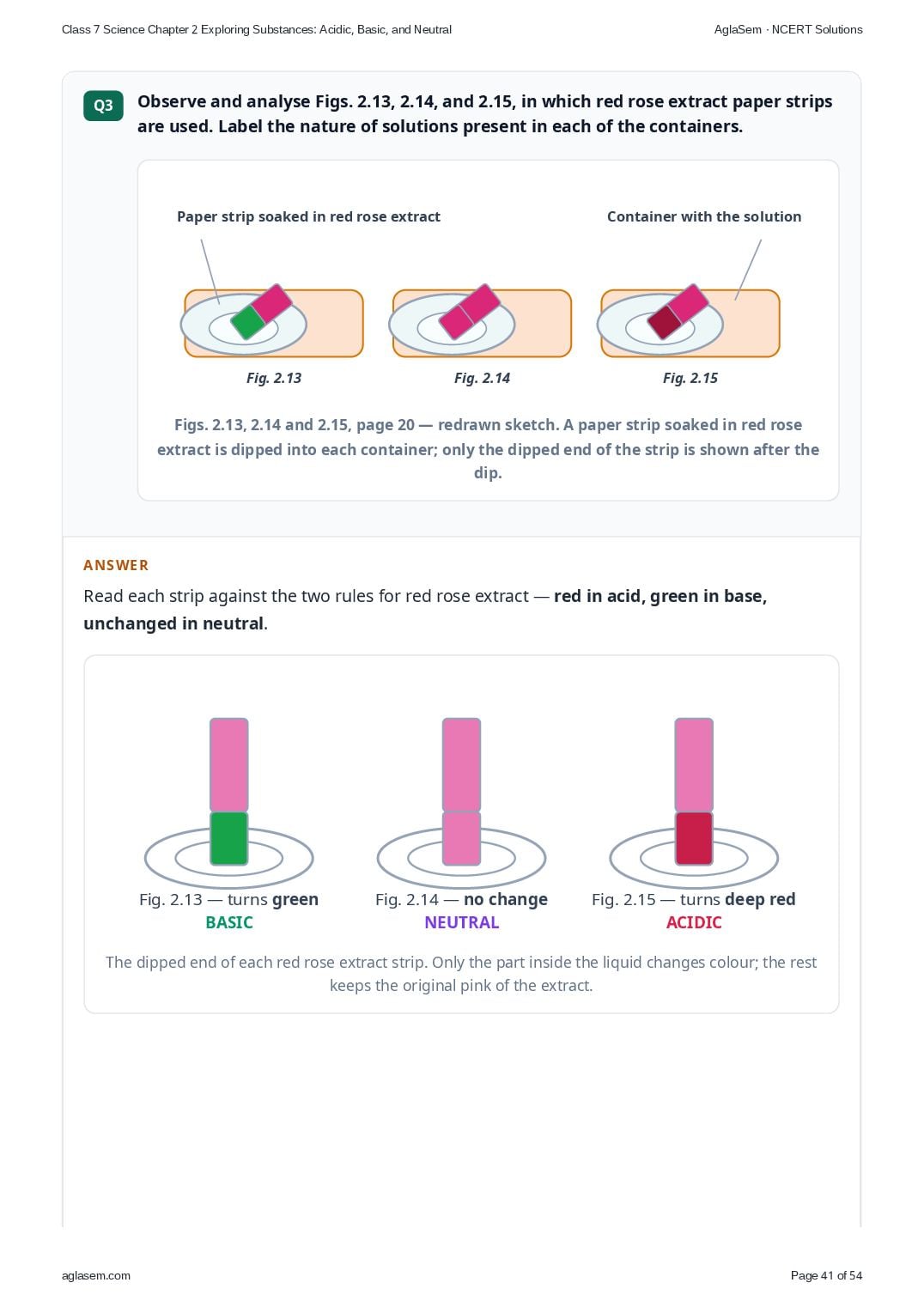
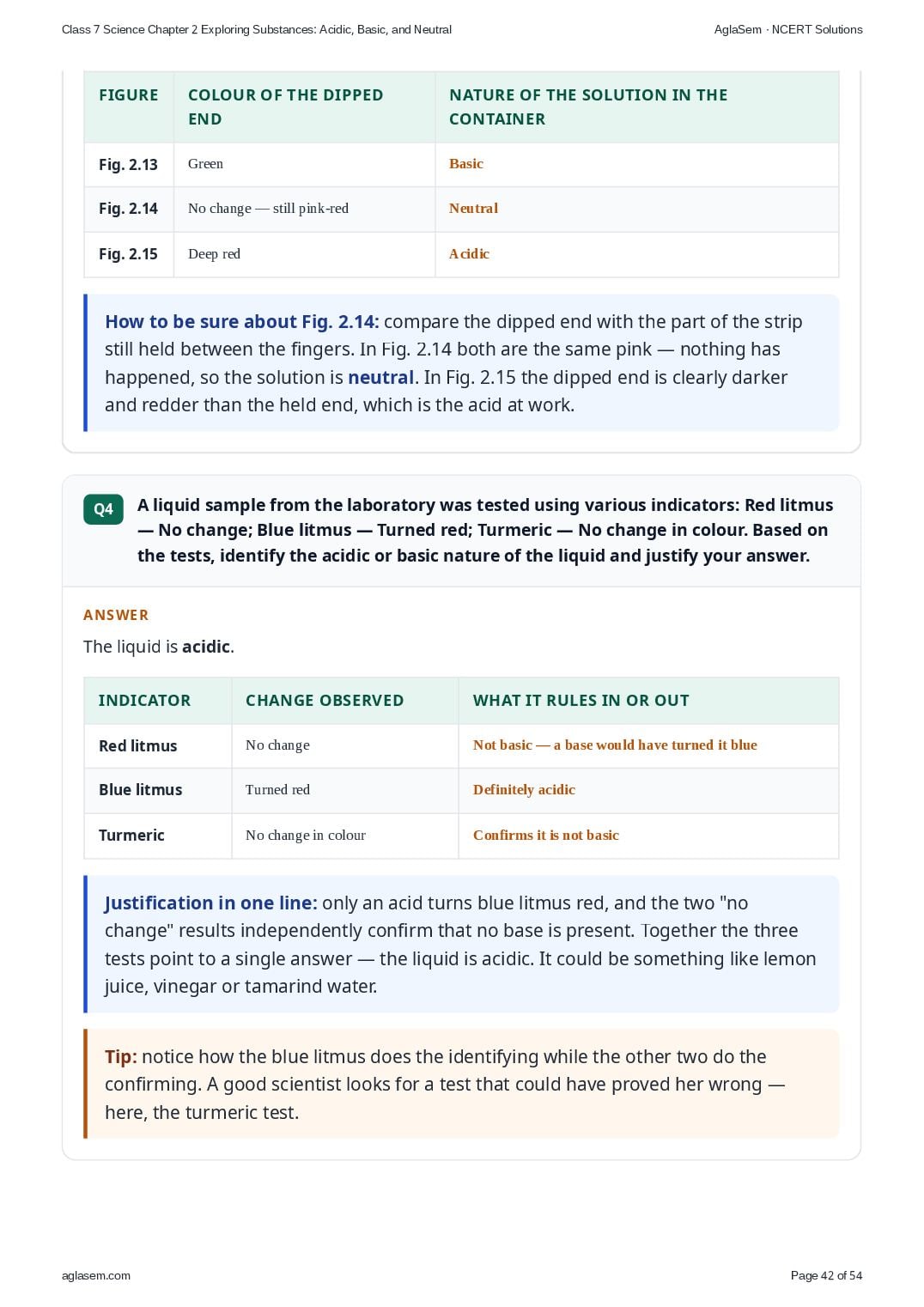
- Observe and analyse Figs. 2.13, 2.14, and 2.15, in which red rose extract paper strips are used. Label the nature of solutions present in each of the containers.
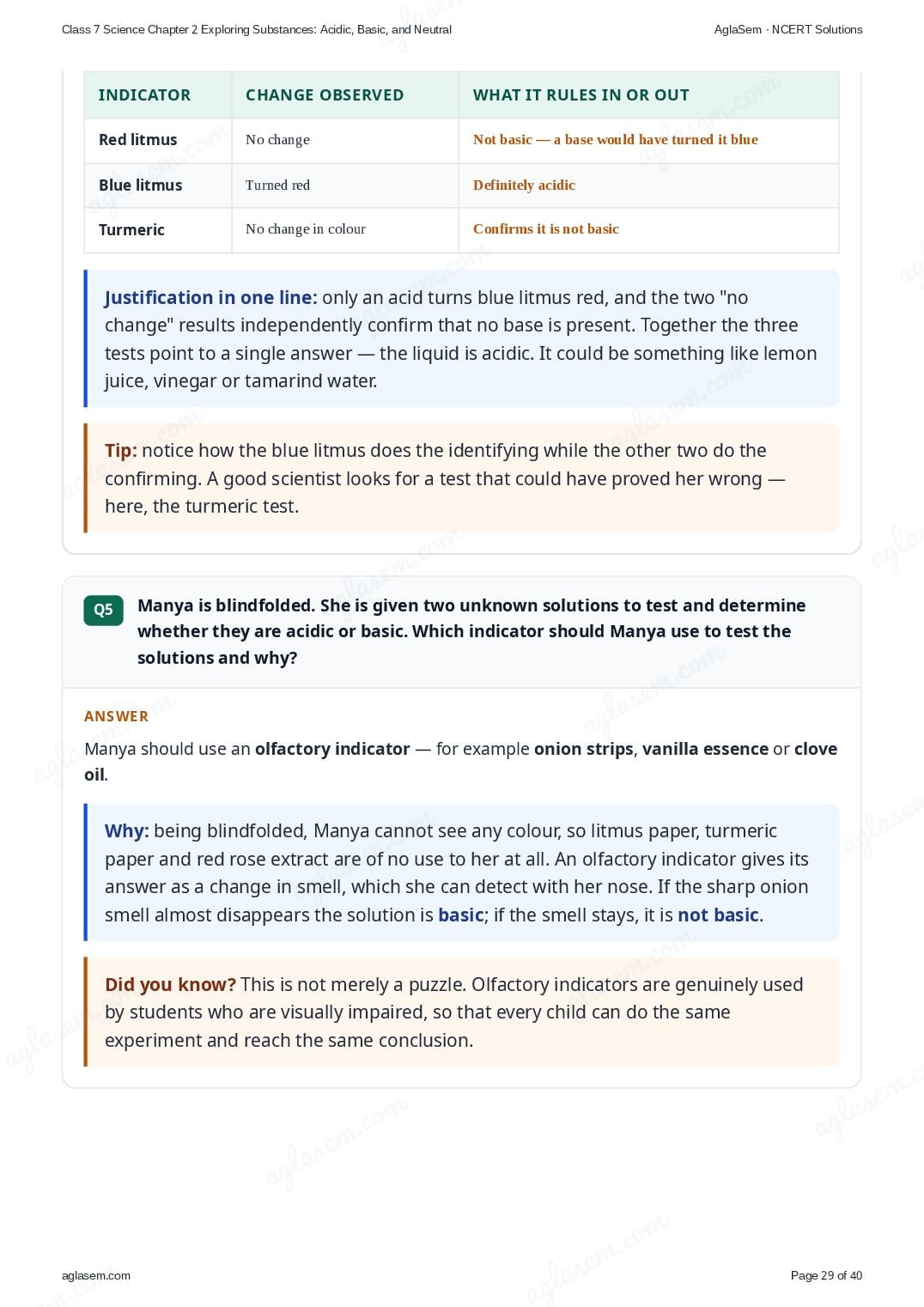
- A liquid sample from the laboratory was tested using various indicators: Red litmus — No change; Blue litmus — Turned red; Turmeric — No change in colour. Based on the tests, identify the acidic or basic nature of the liquid and justify your answer.
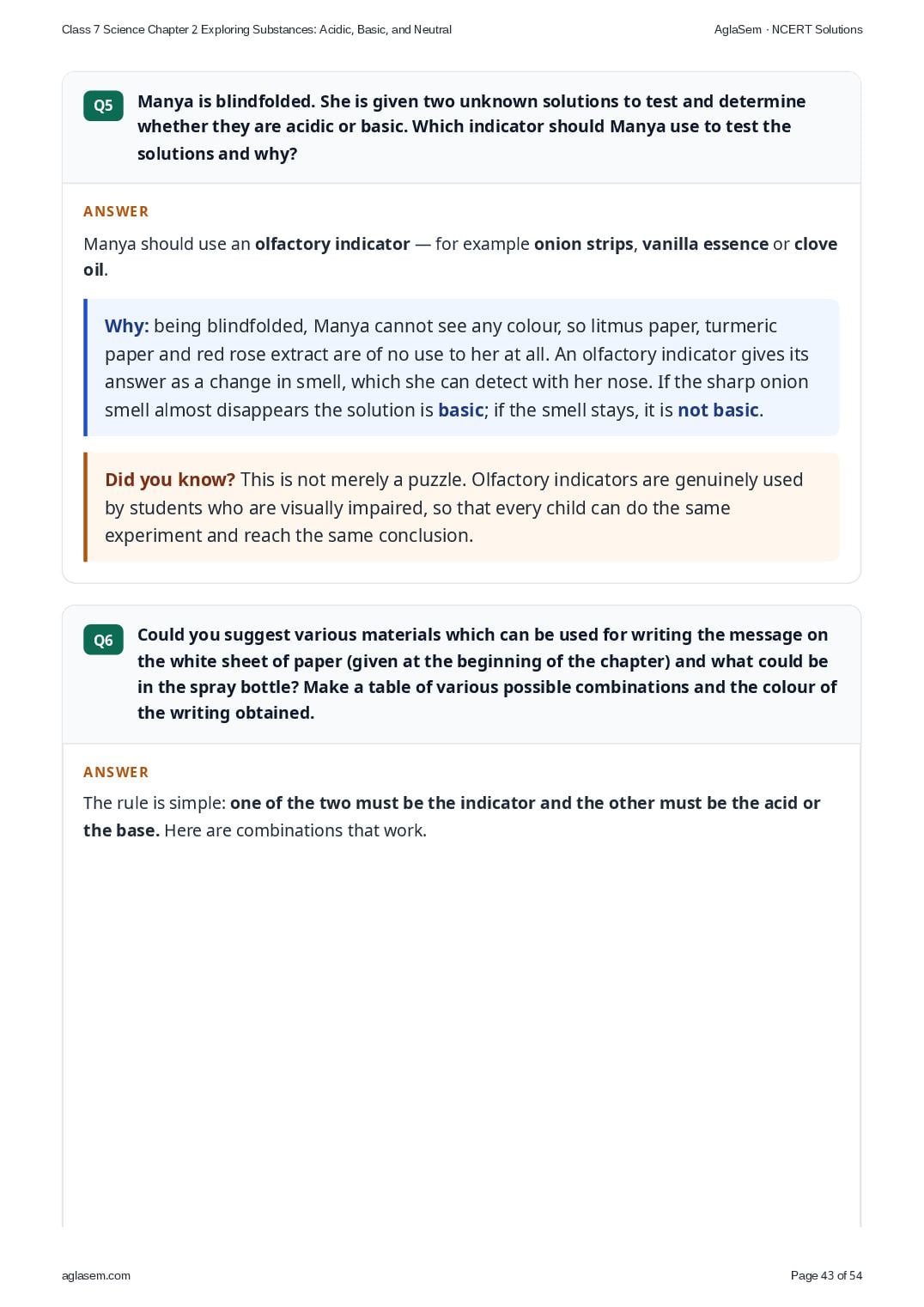
- Manya is blindfolded. She is given two unknown solutions to test and determine whether they are acidic or basic. Which indicator should Manya use to test the solutions and why?
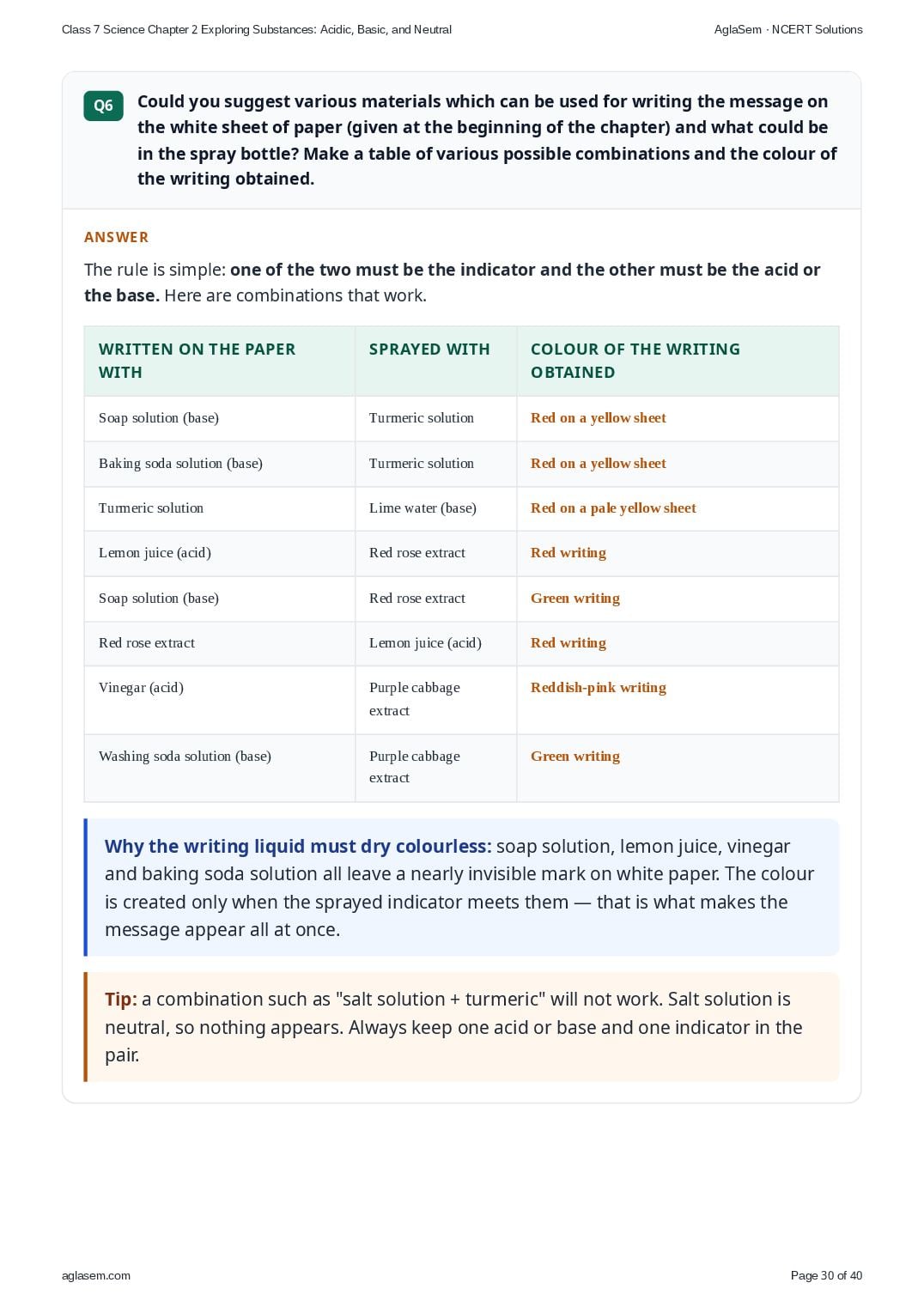
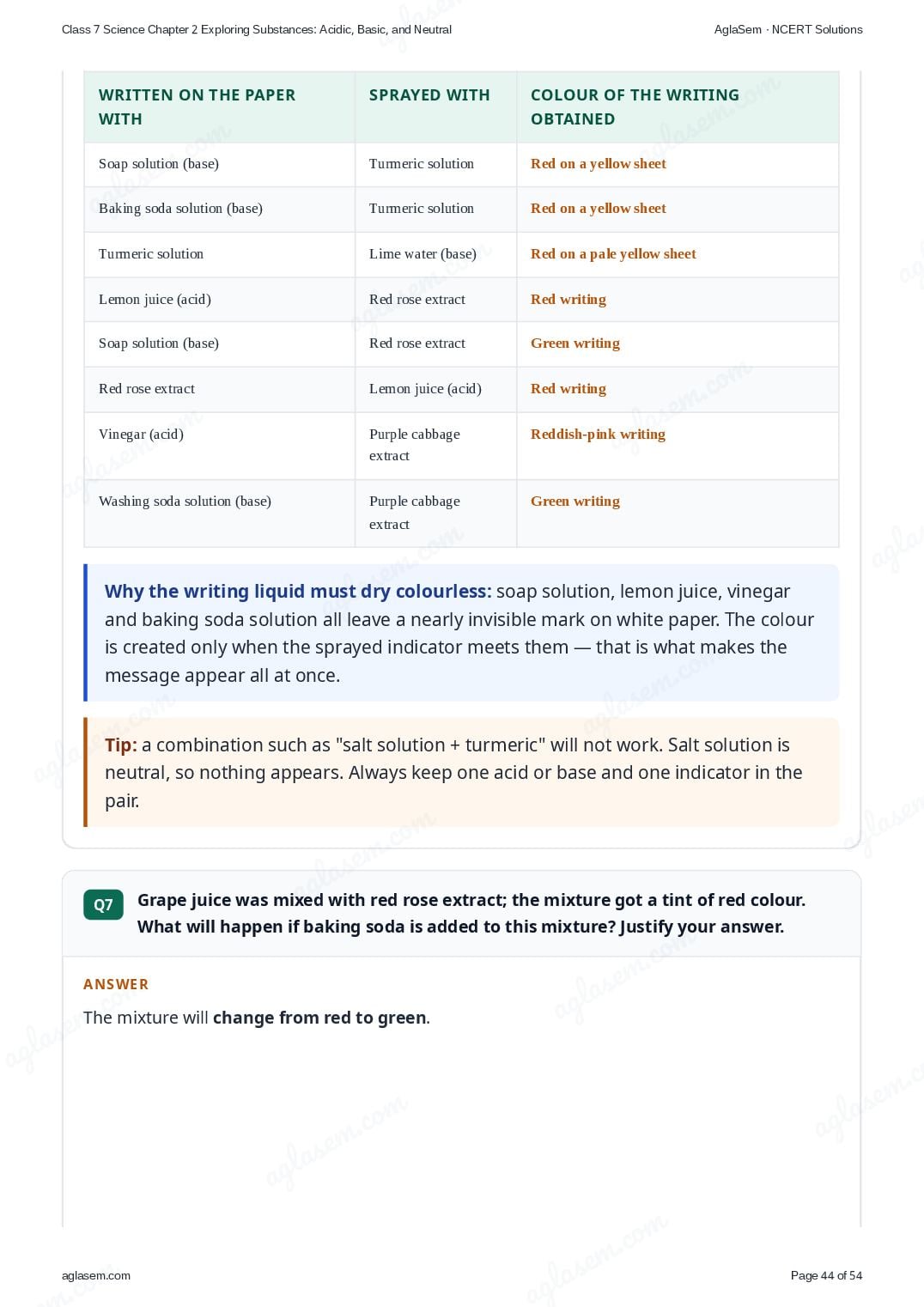
- Could you suggest various materials which can be used for writing the message on the white sheet of paper (given at the beginning of the chapter) and what could be in the spray bottle? Make a table of various possible combinations and the colour of the writing obtained.
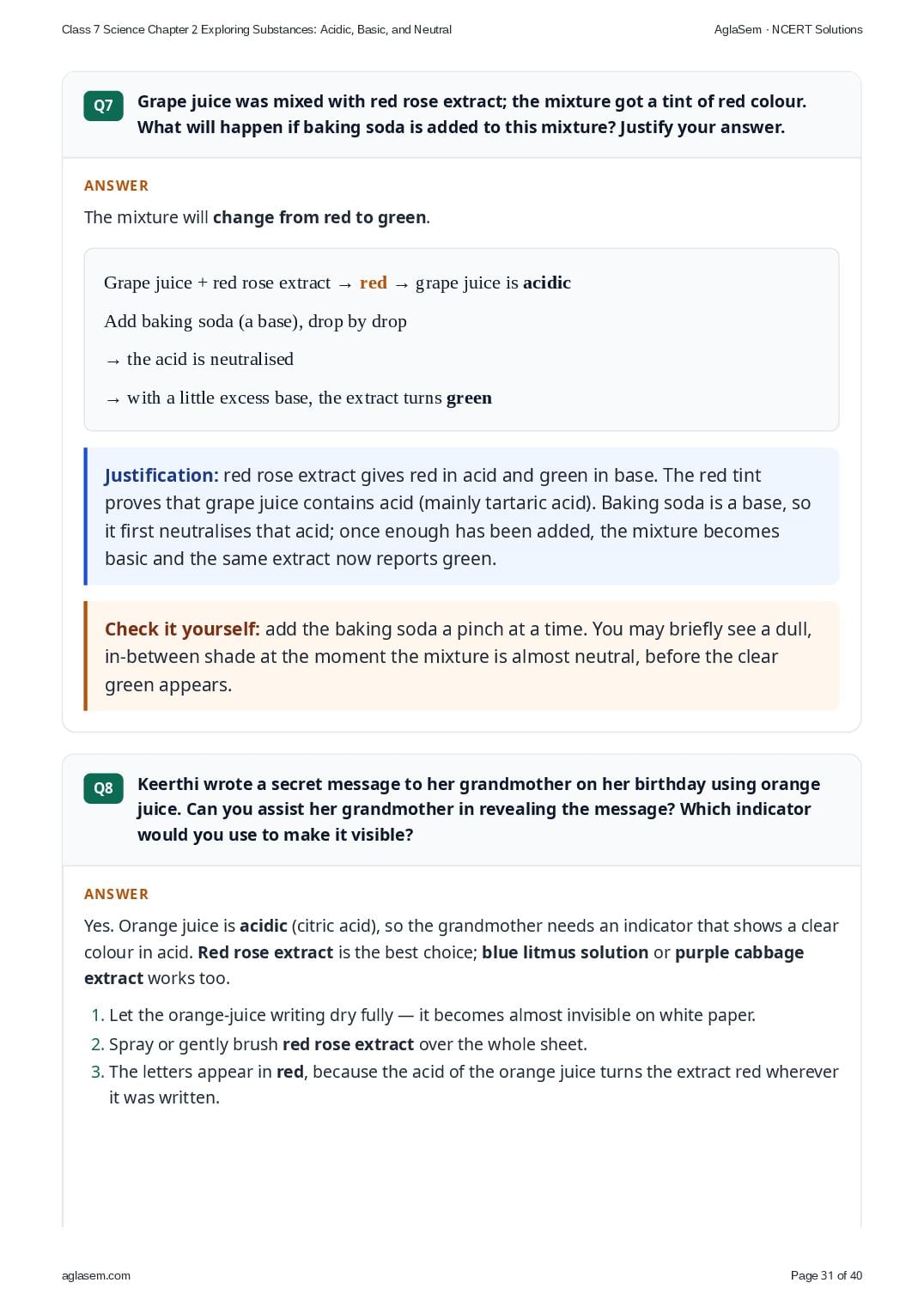
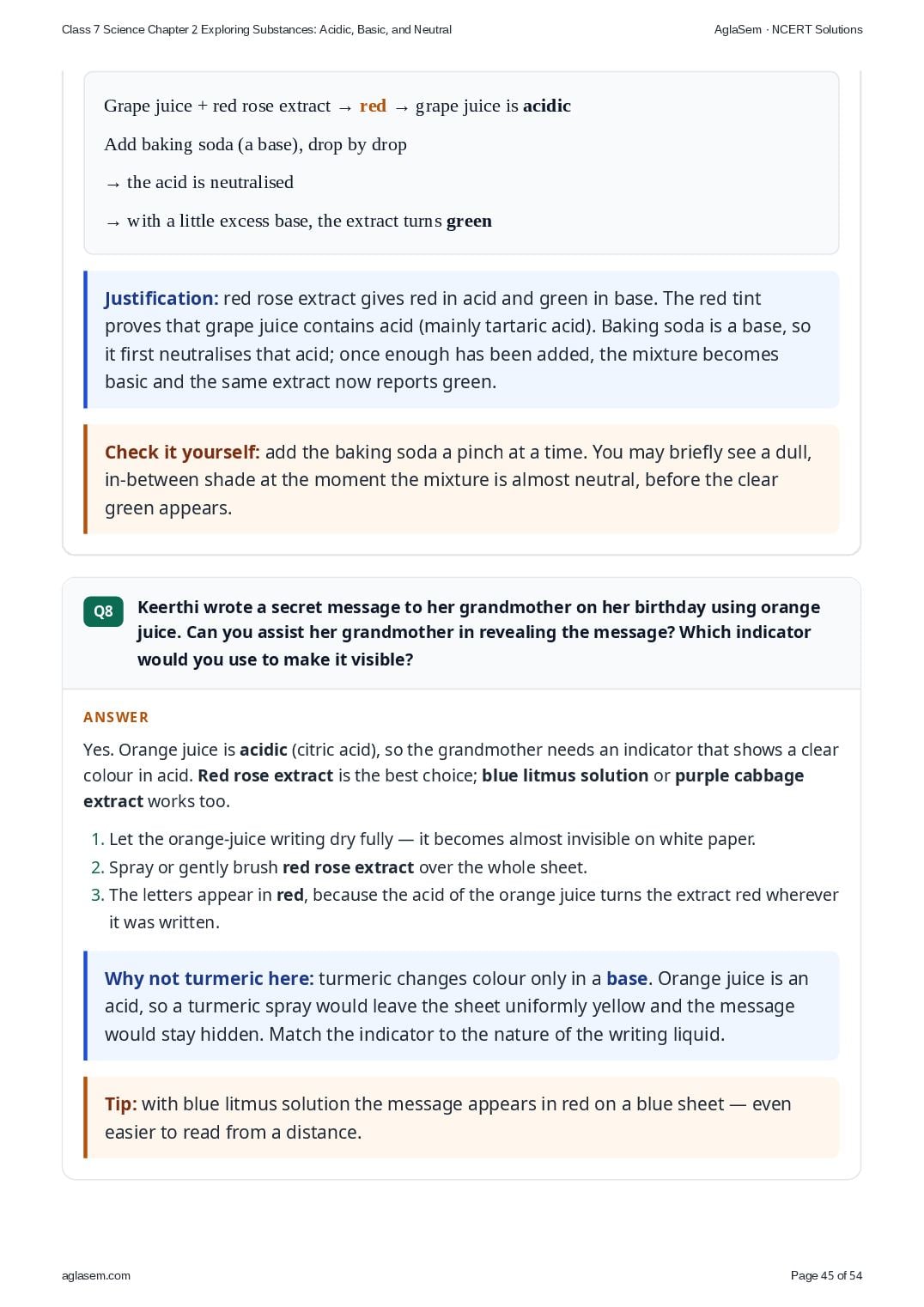
- Grape juice was mixed with red rose extract; the mixture got a tint of red colour. What will happen if baking soda is added to this mixture? Justify your answer.
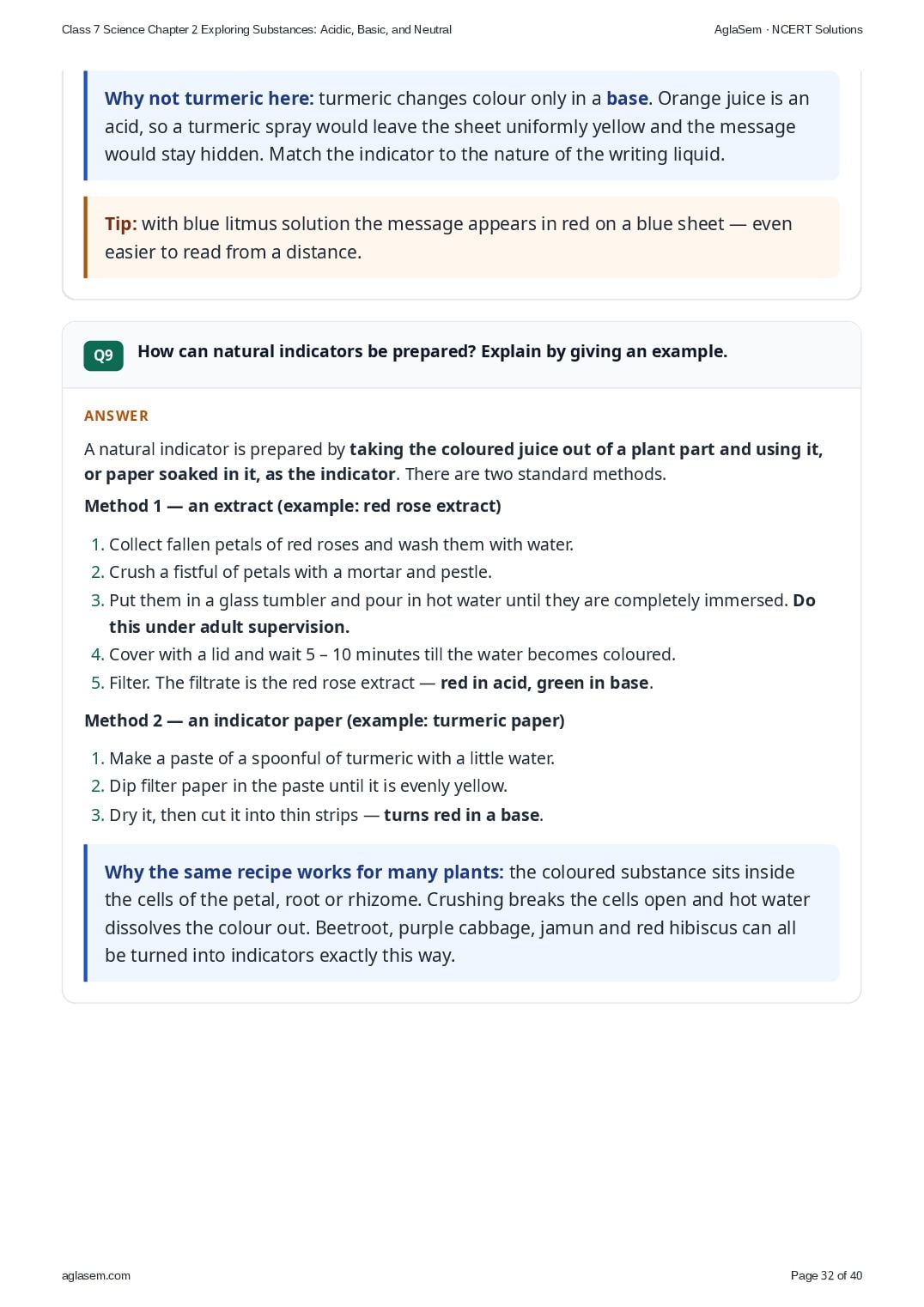
- Keerthi wrote a secret message to her grandmother on her birthday using orange juice. Can you assist her grandmother in revealing the message? Which indicator would you use to make it visible?
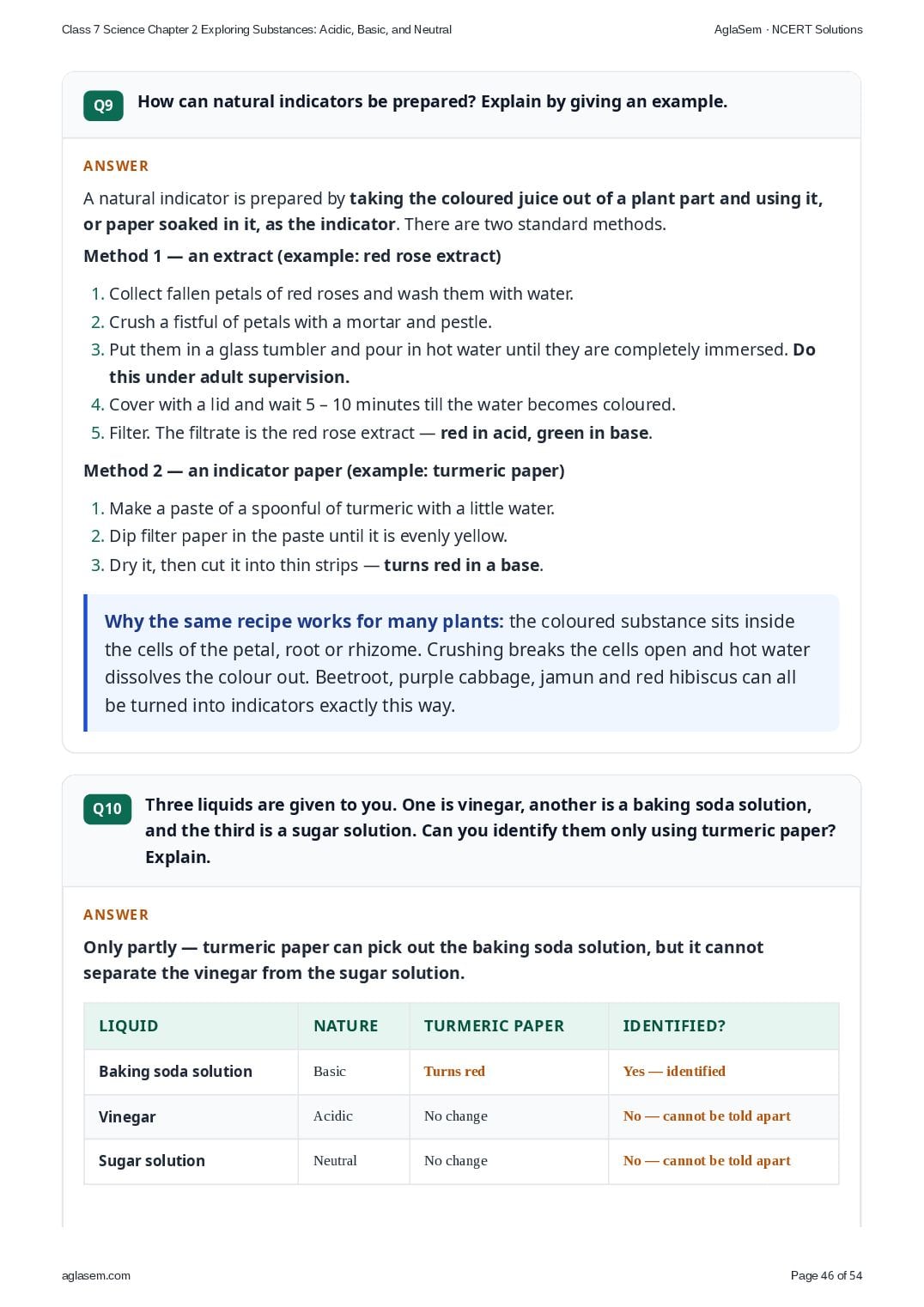
- How can natural indicators be prepared? Explain by giving an example.
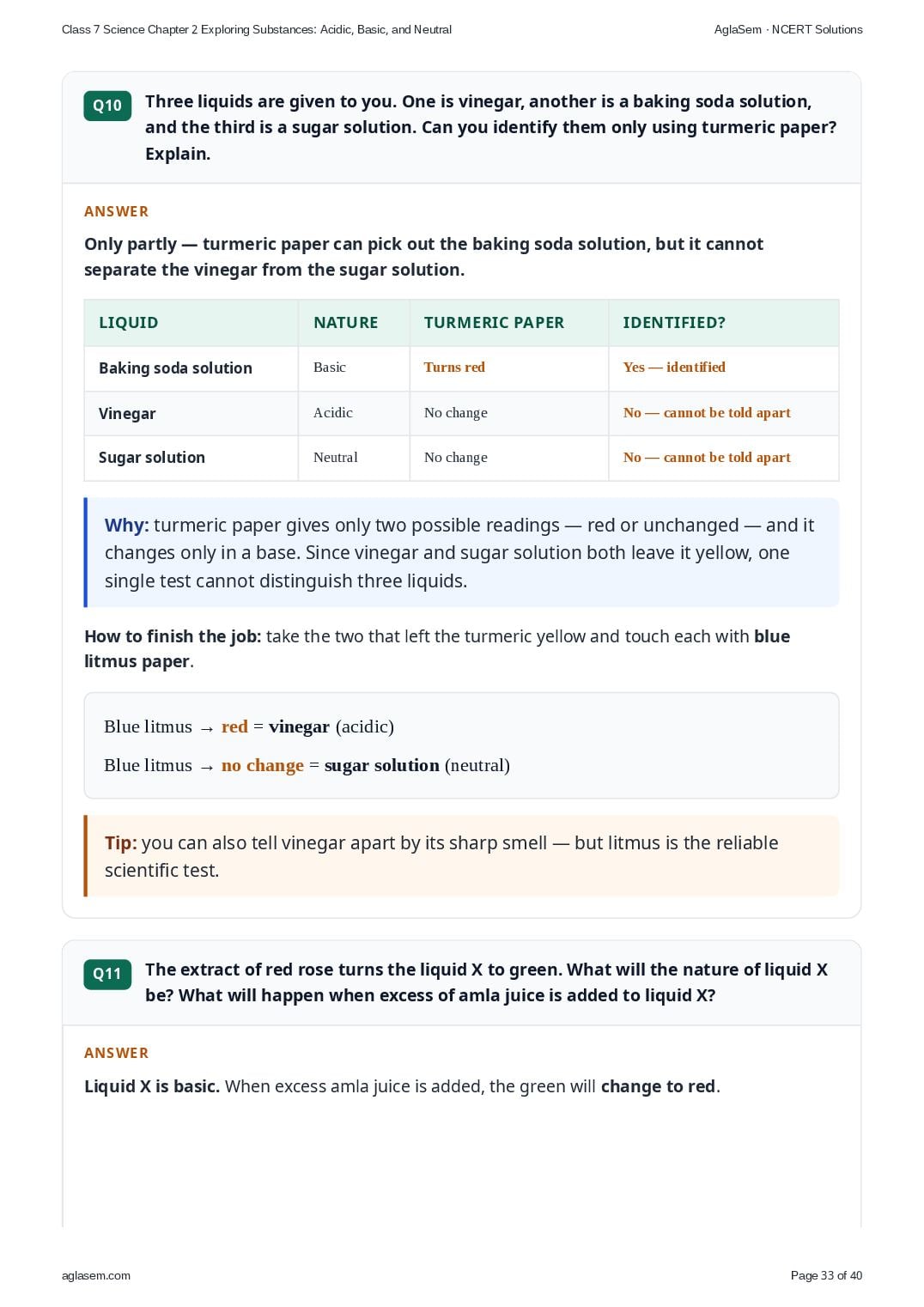
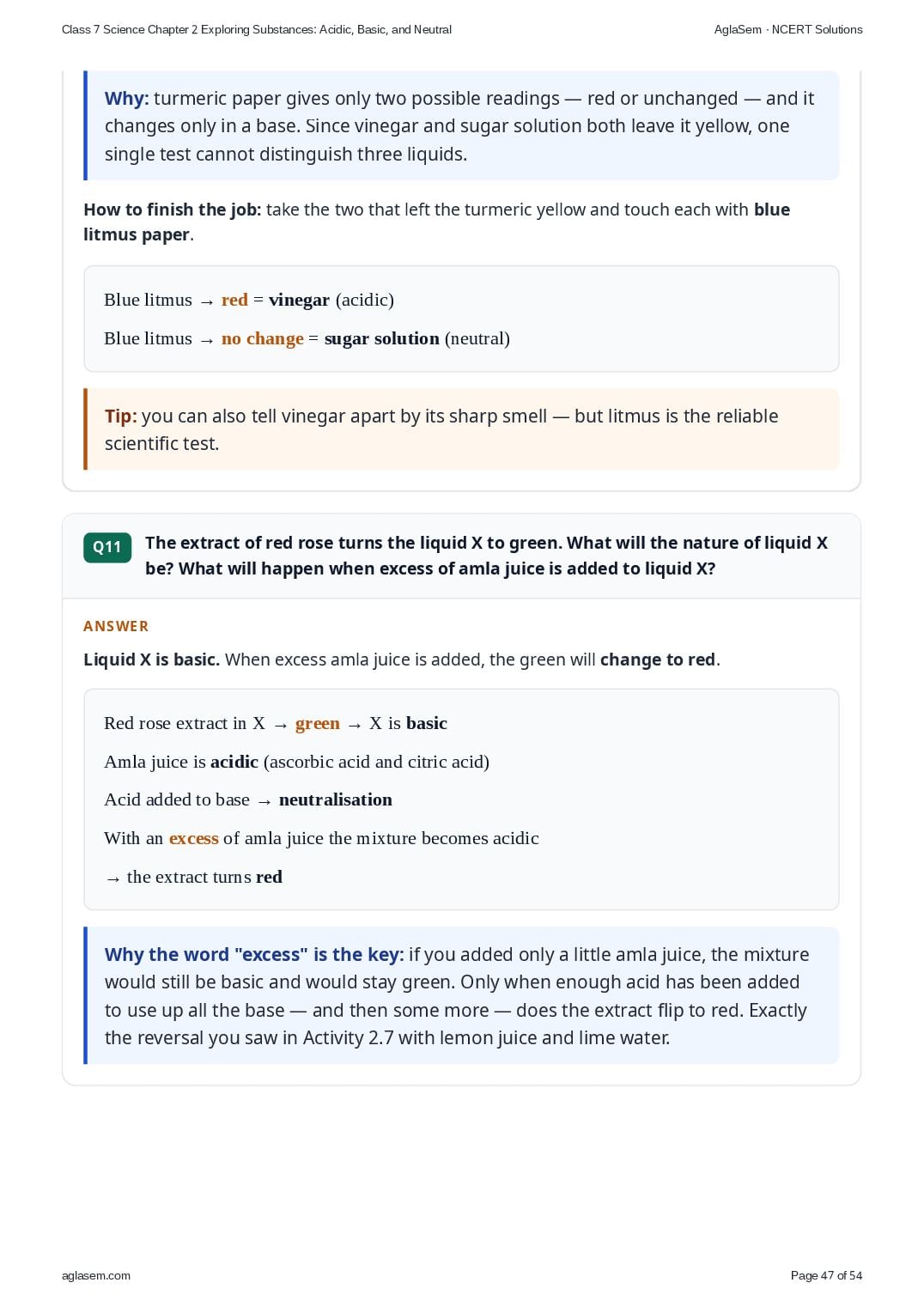
- Three liquids are given to you. One is vinegar, another is a baking soda solution, and the third is a sugar solution. Can you identify them only using turmeric paper? Explain.
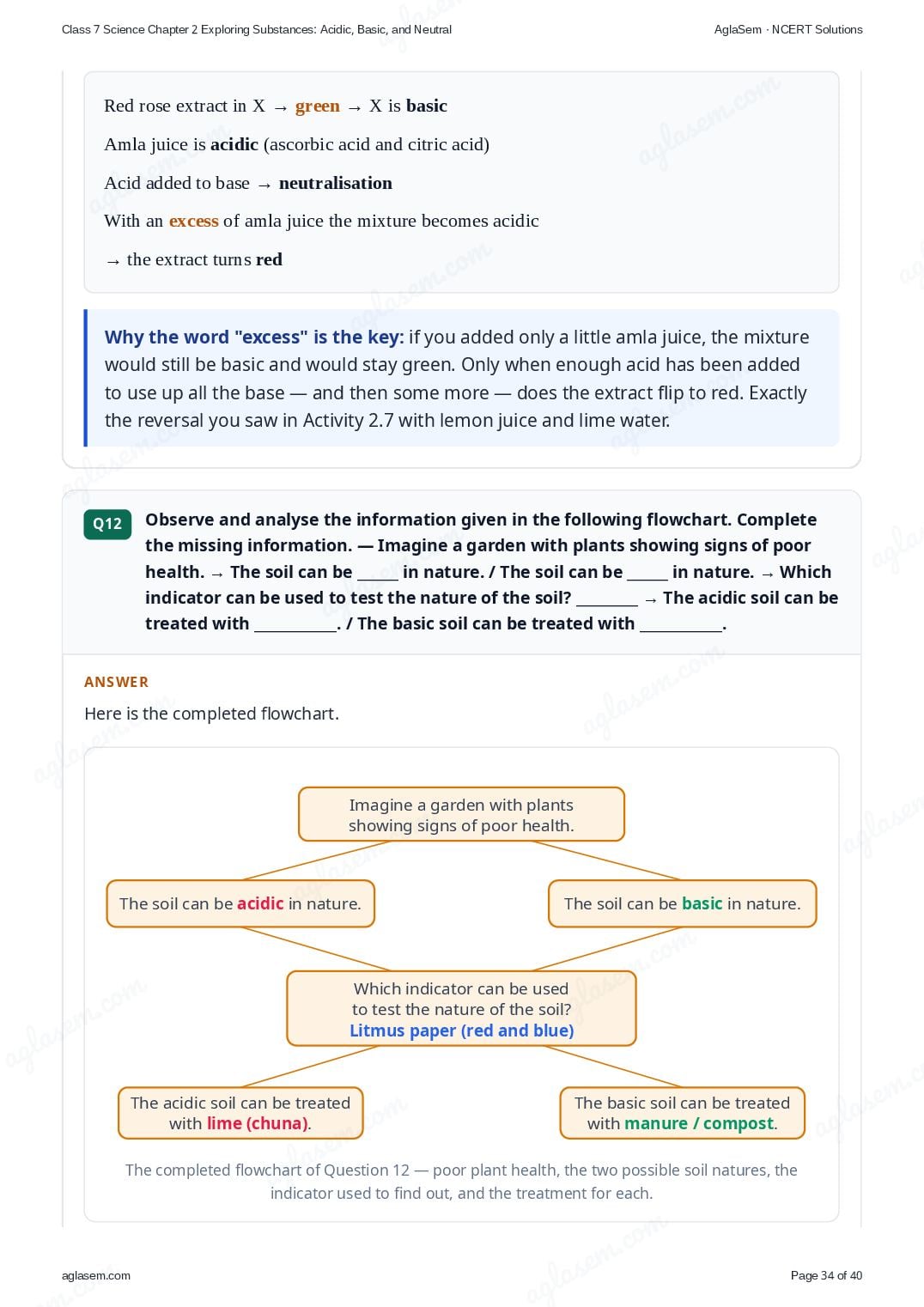
- The extract of red rose turns the liquid X to green. What will the nature of liquid X be? What will happen when excess of amla juice is added to liquid X?
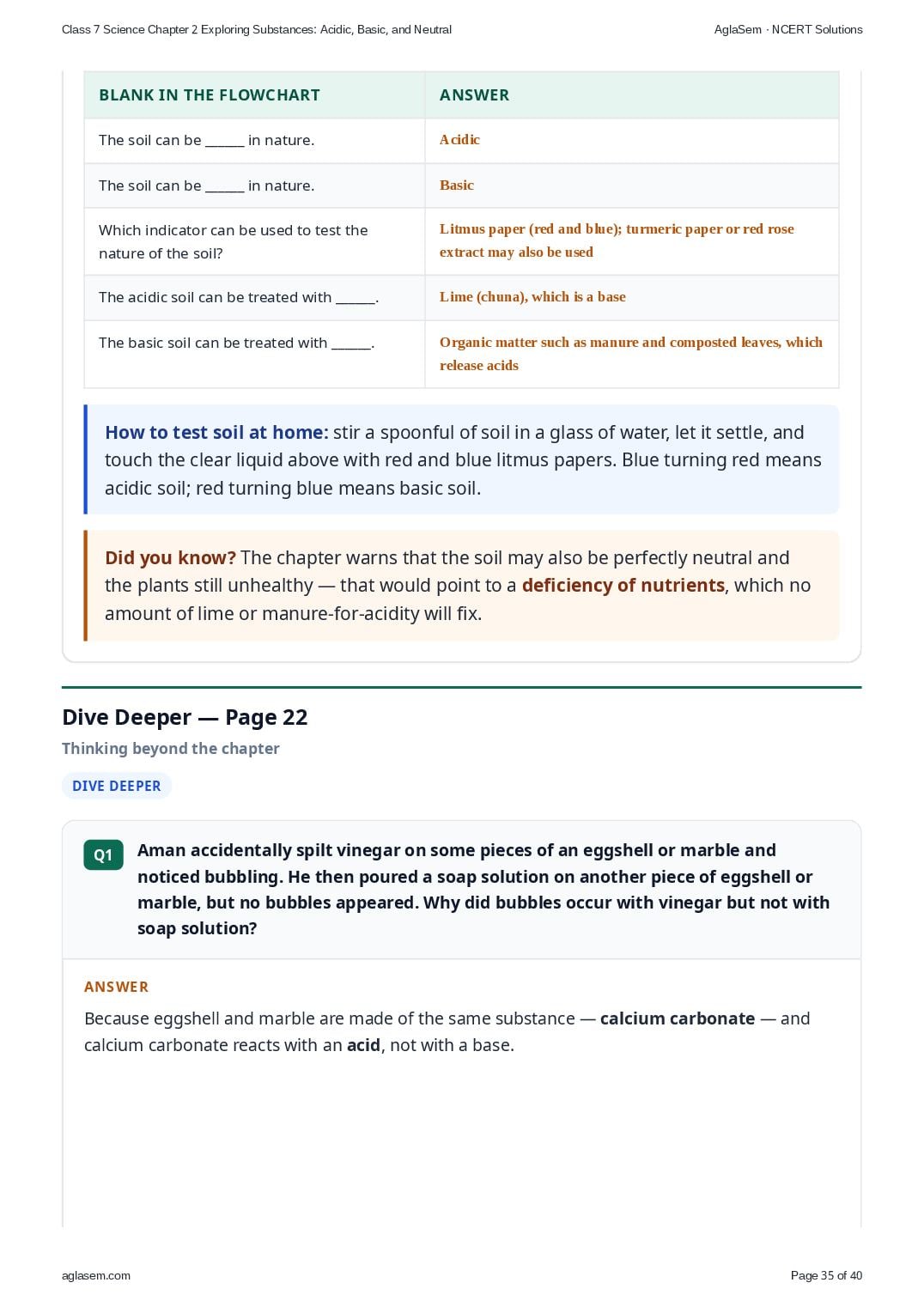
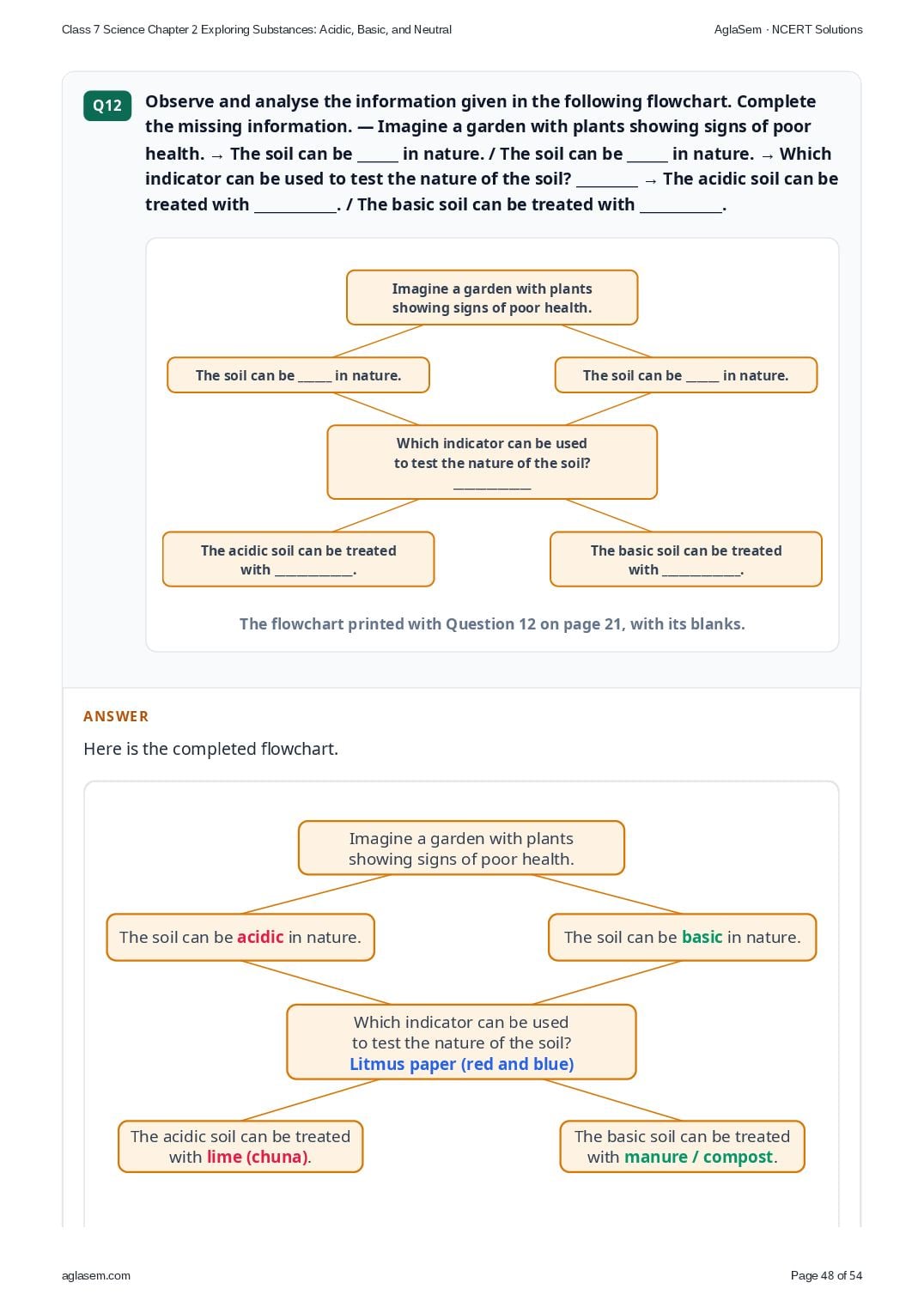
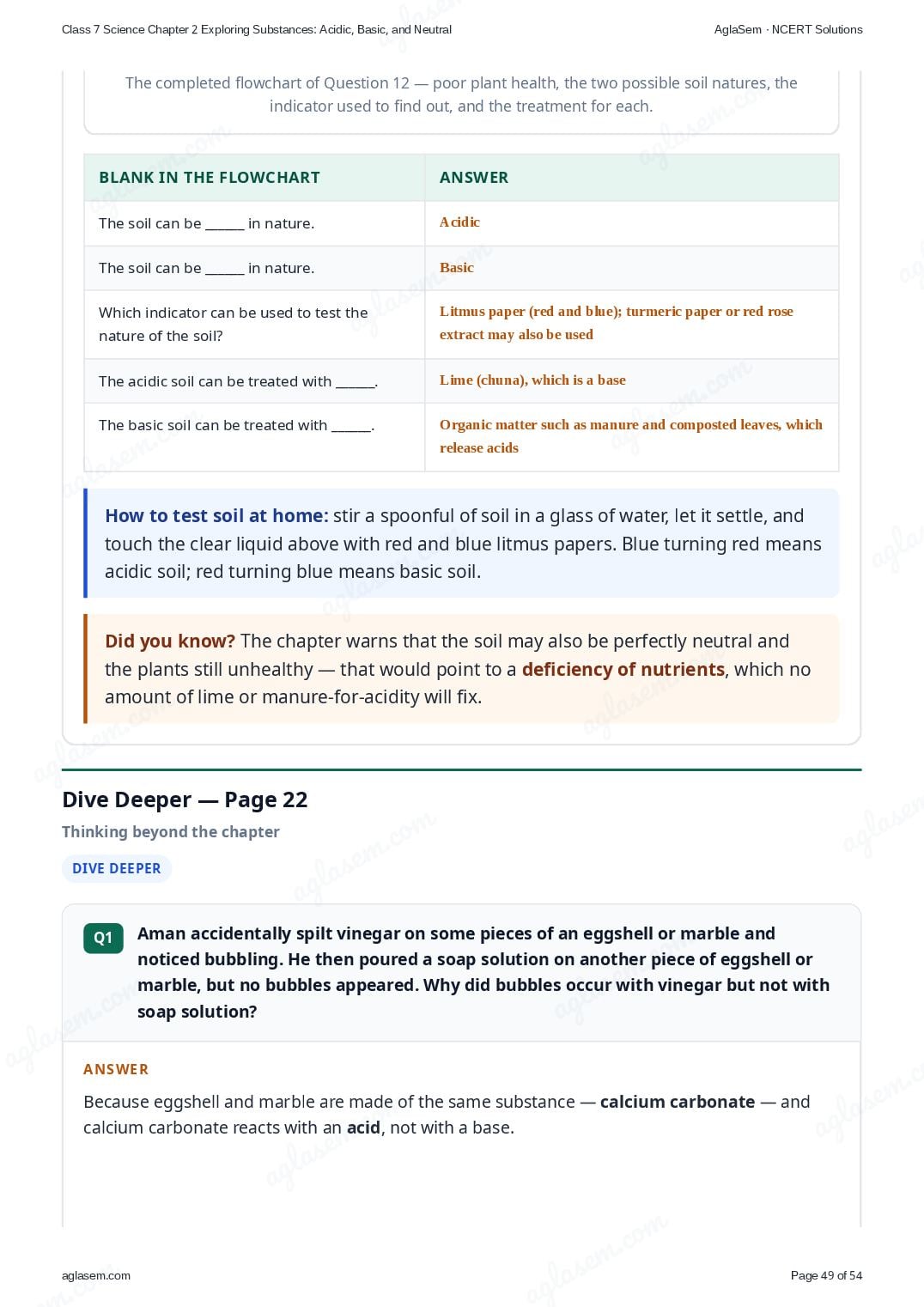
- Observe and analyse the information given in the following flowchart. Complete the missing information. — Imagine a garden with plants showing signs of poor health. → The soil can be ______ in nature. / The soil can be ______ in nature. → Which indicator can be used to test the nature of the soil? _________ → The acidic soil can be treated with ____________. / The basic soil can be treated with ____________.
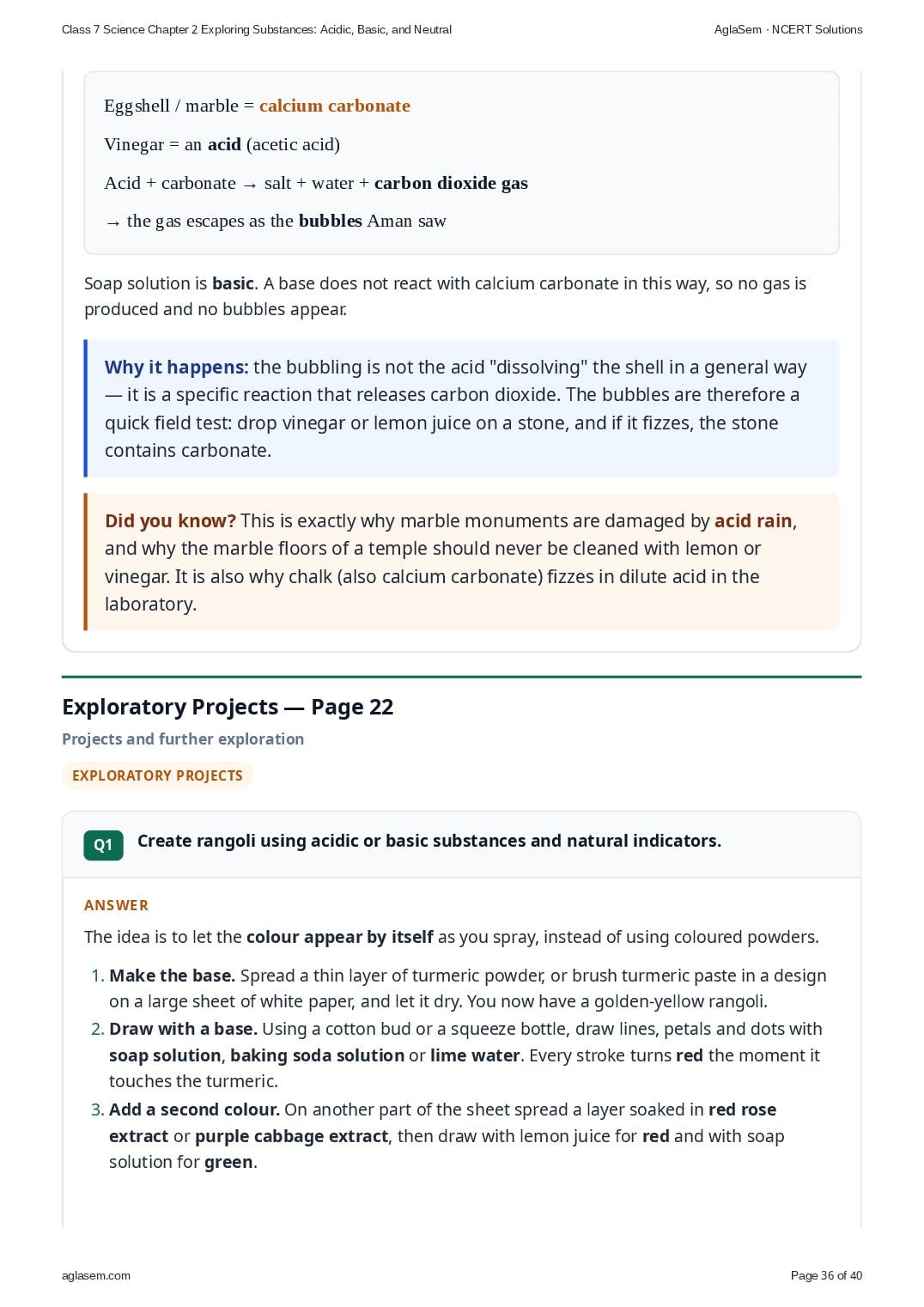
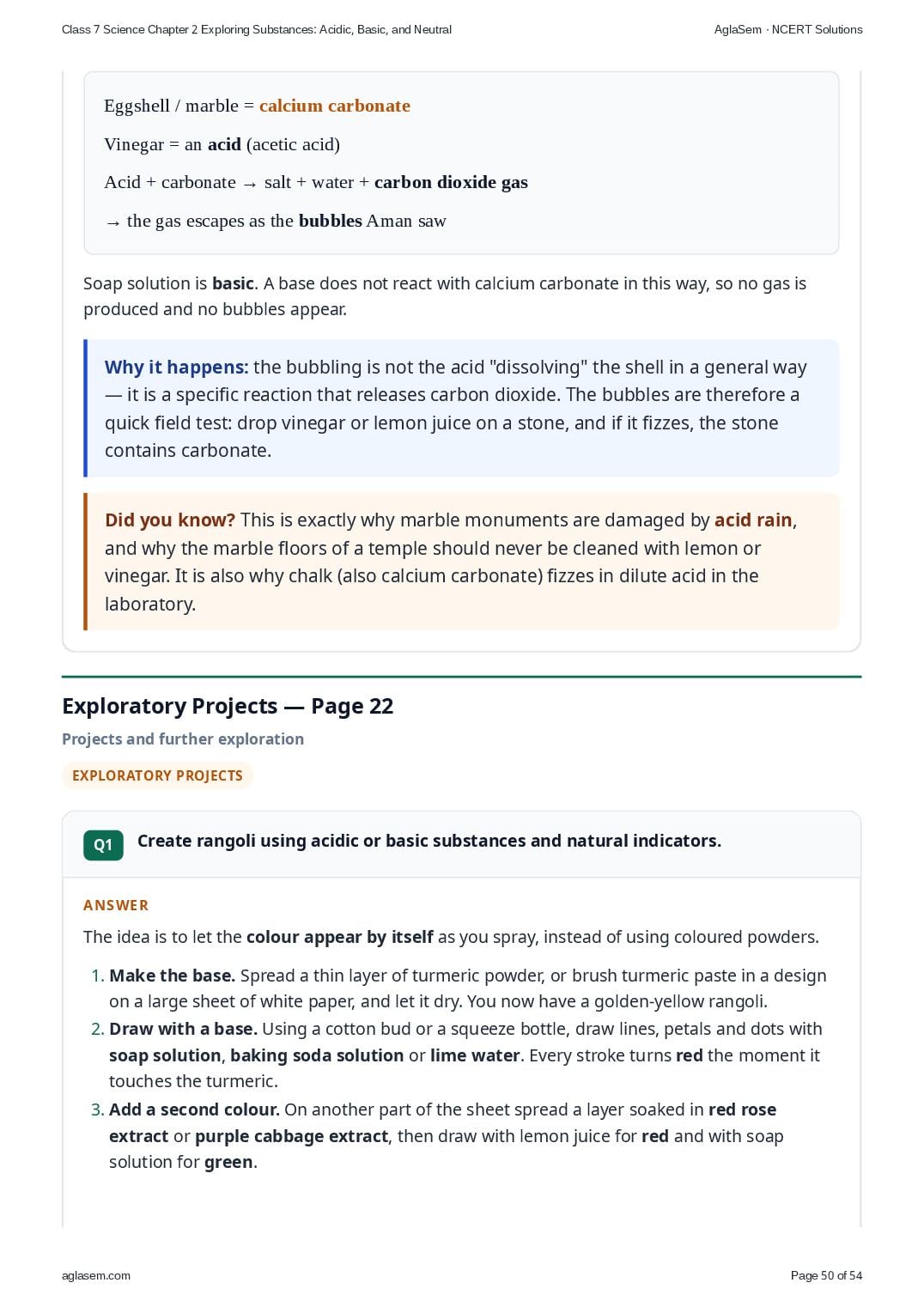
- Aman accidentally spilt vinegar on some pieces of an eggshell or marble and noticed bubbling. He then poured a soap solution on another piece of eggshell or marble, but no bubbles appeared. Why did bubbles occur with vinegar but not with soap solution?
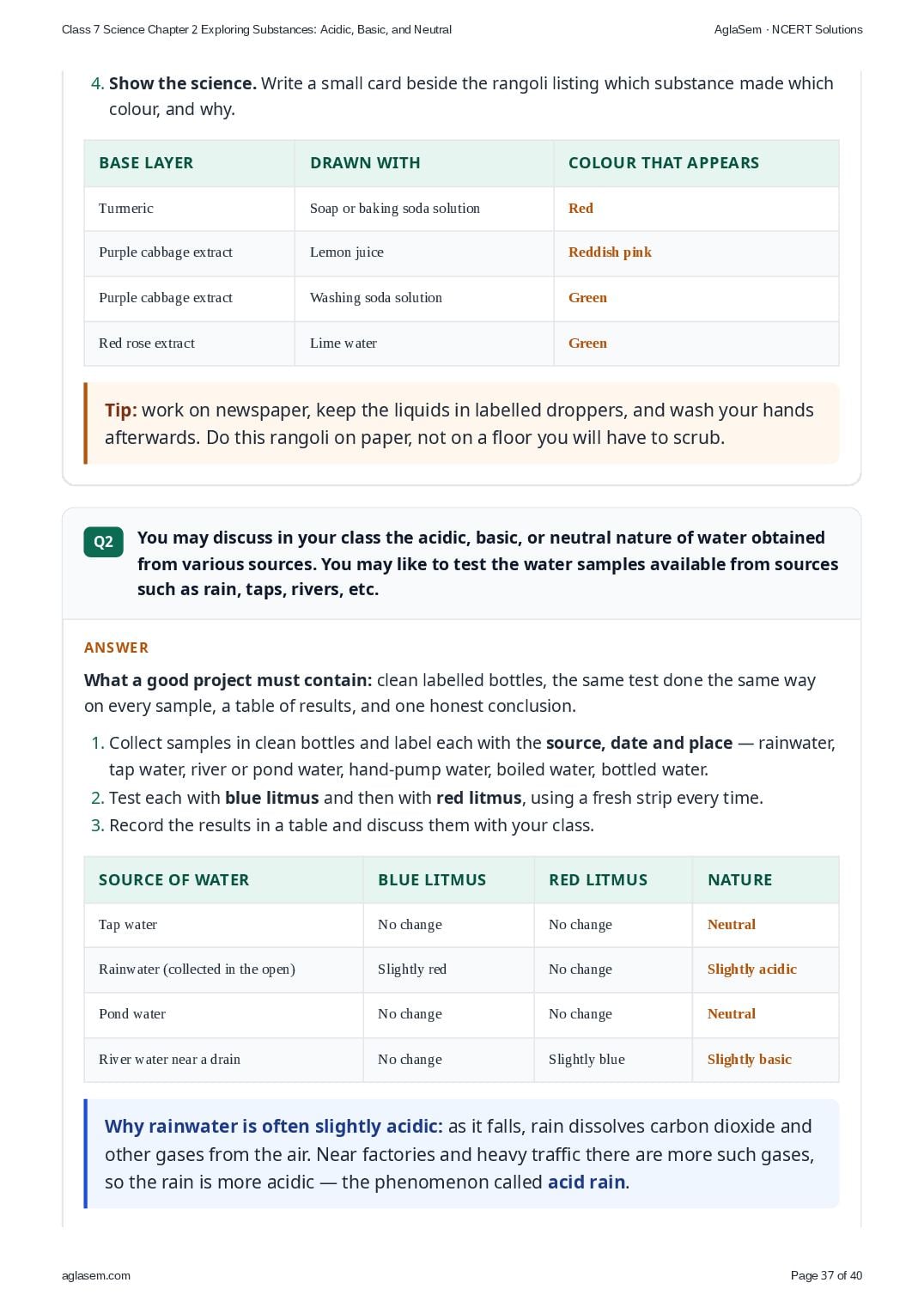
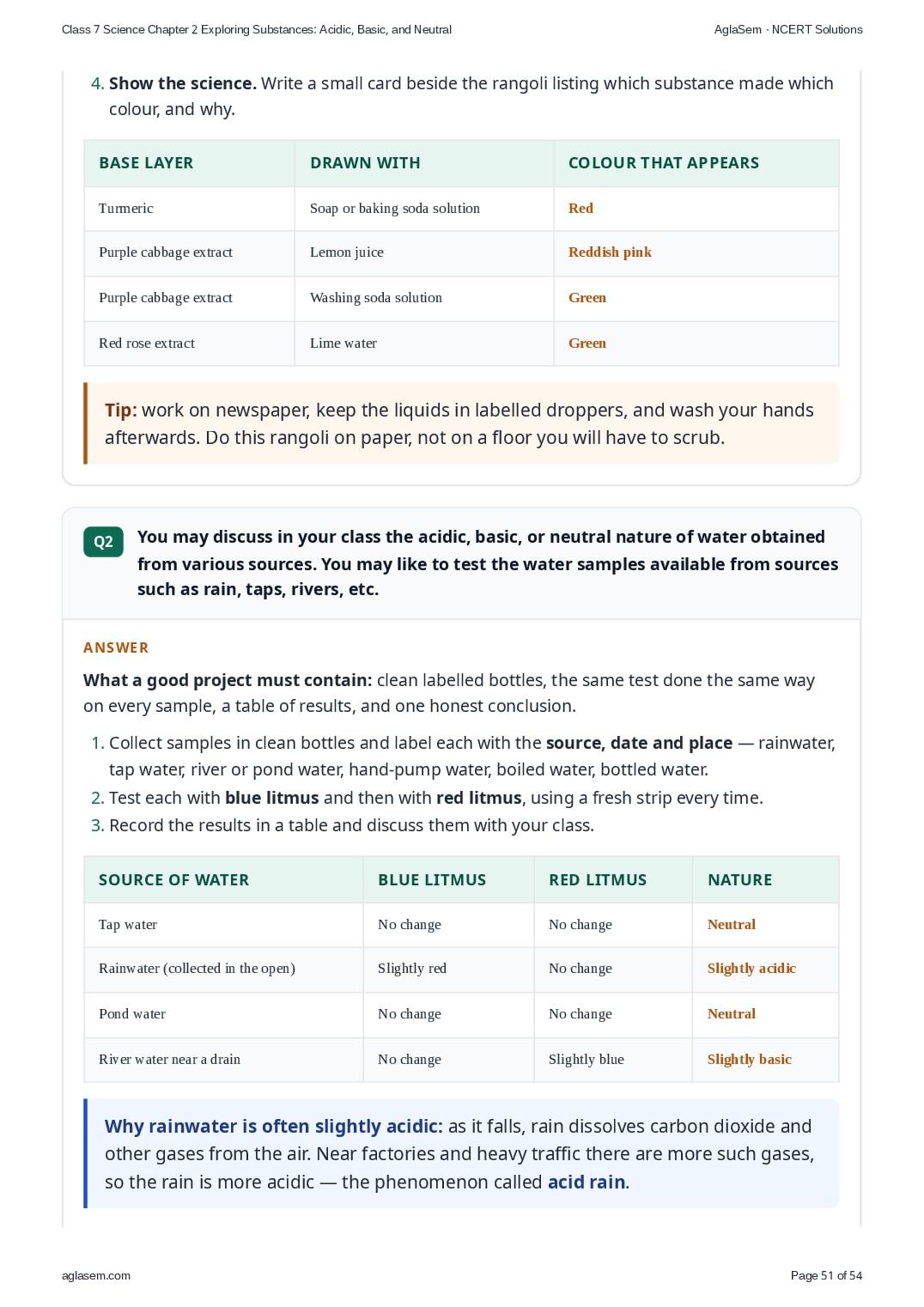
- Create rangoli using acidic or basic substances and natural indicators.
- You may discuss in your class the acidic, basic, or neutral nature of water obtained from various sources. You may like to test the water samples available from sources such as rain, taps, rivers, etc.
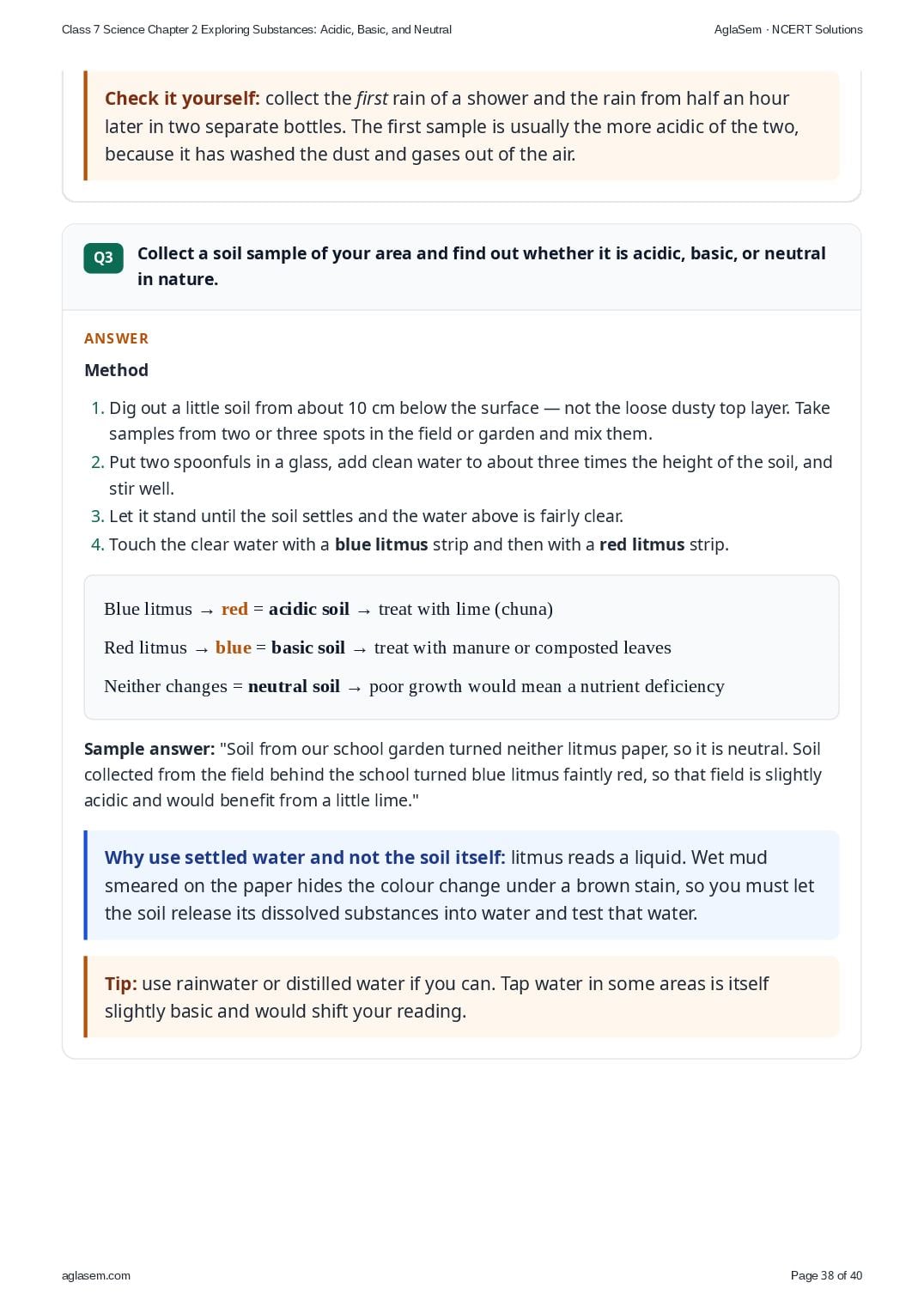
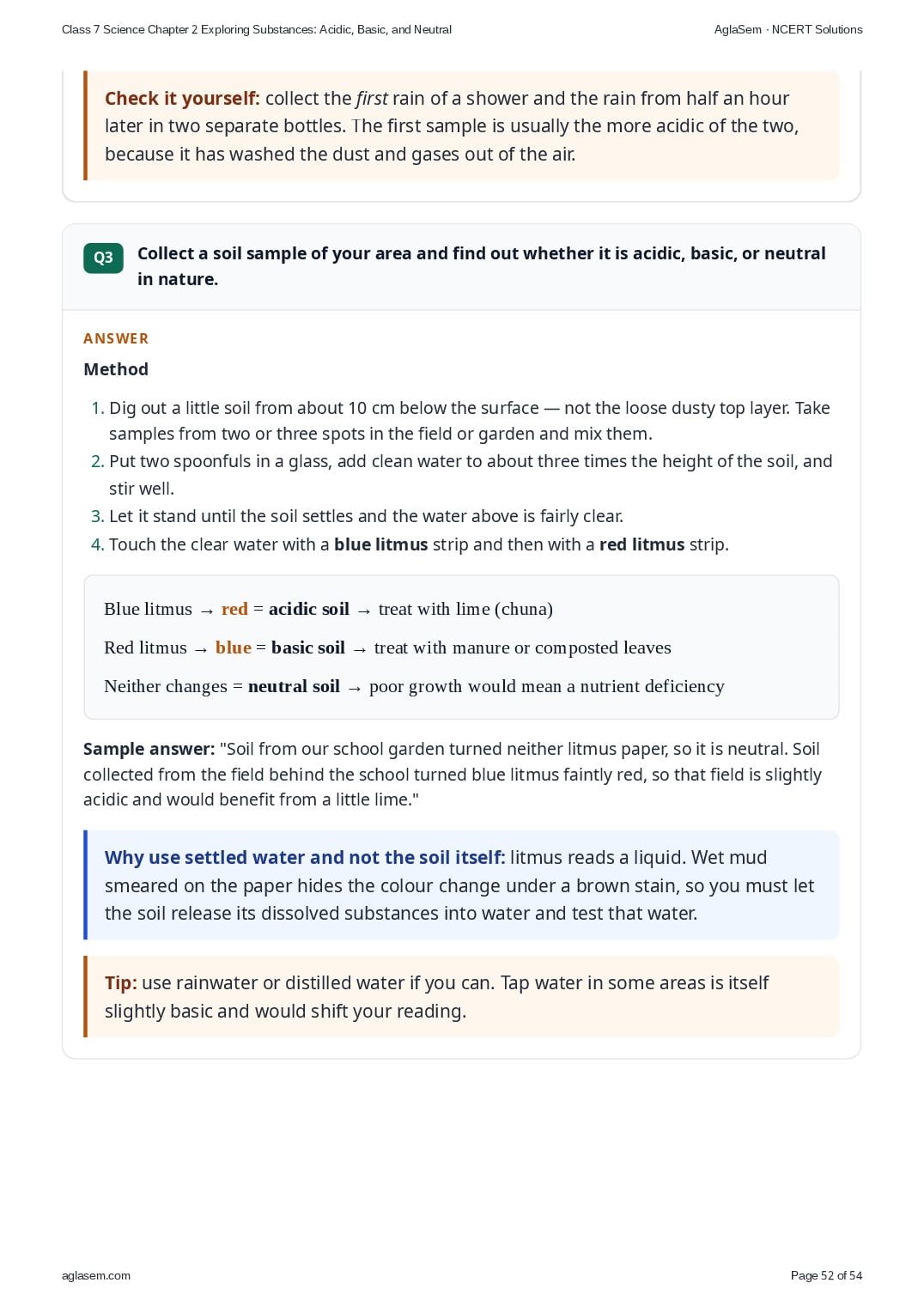
- Collect a soil sample of your area and find out whether it is acidic, basic, or neutral in nature.
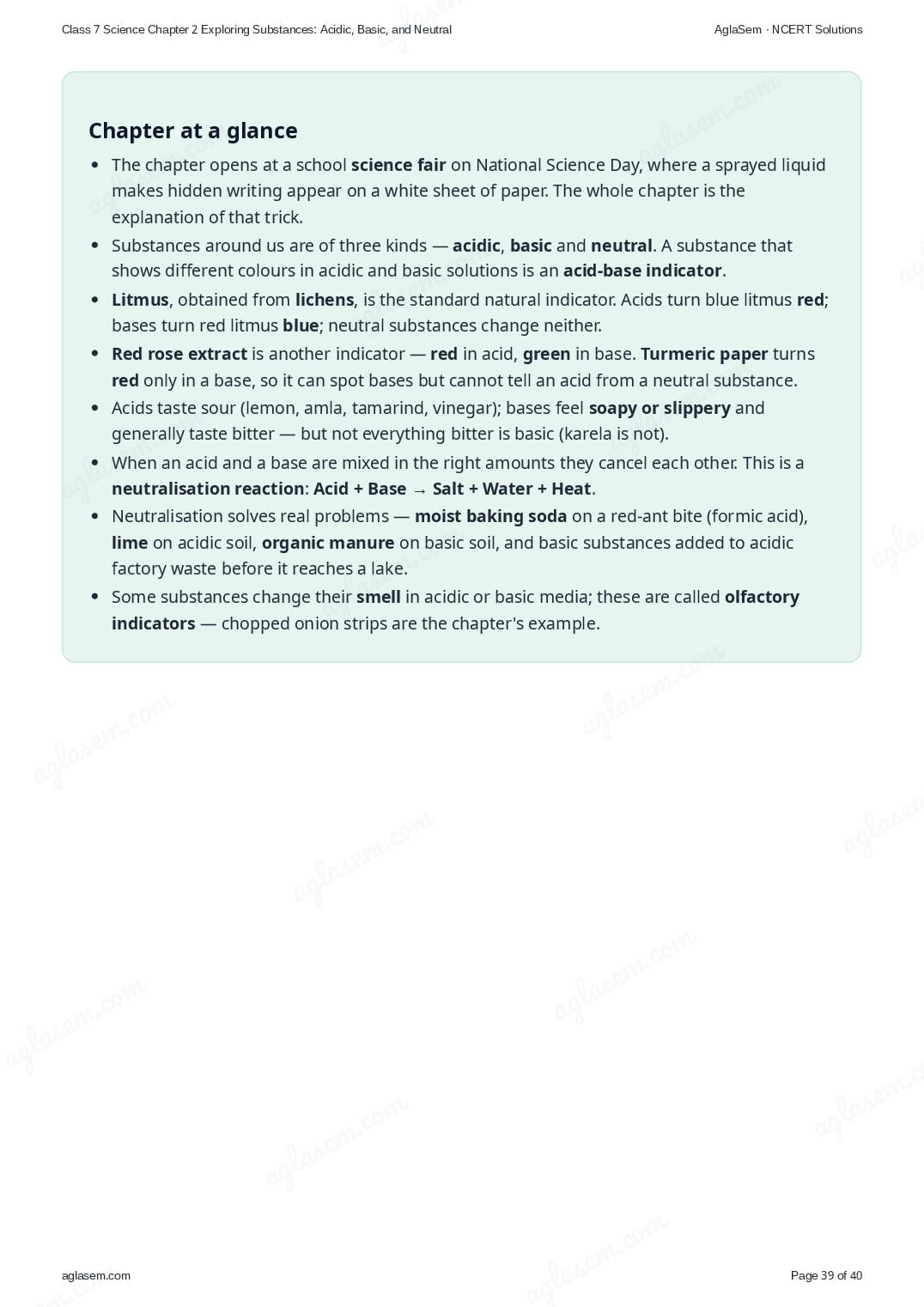
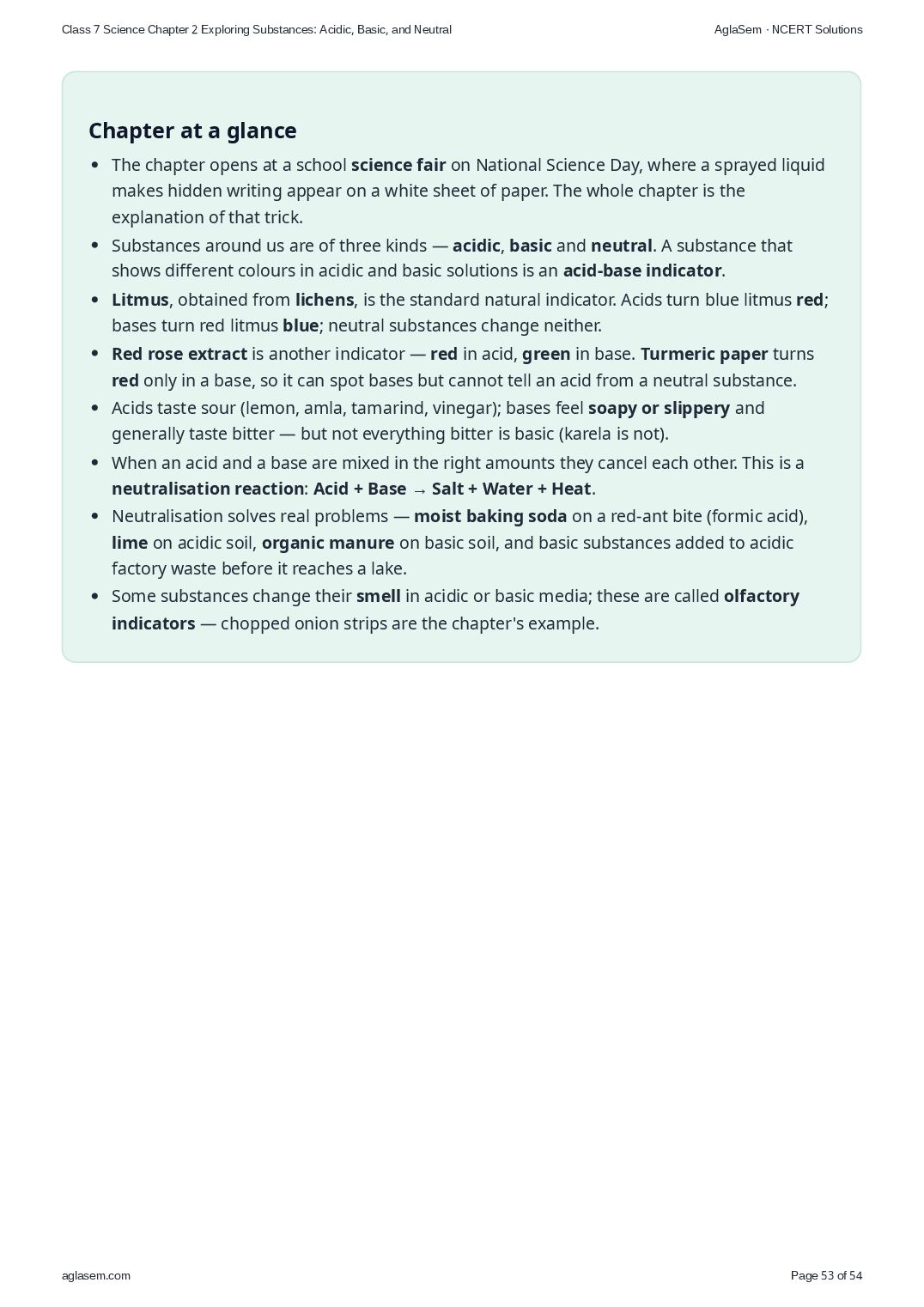
Chapter at a Glance
- The chapter opens at a school science fair on National Science Day, where a sprayed liquid makes hidden writing appear on a white sheet of paper. The whole chapter is the explanation of that trick.
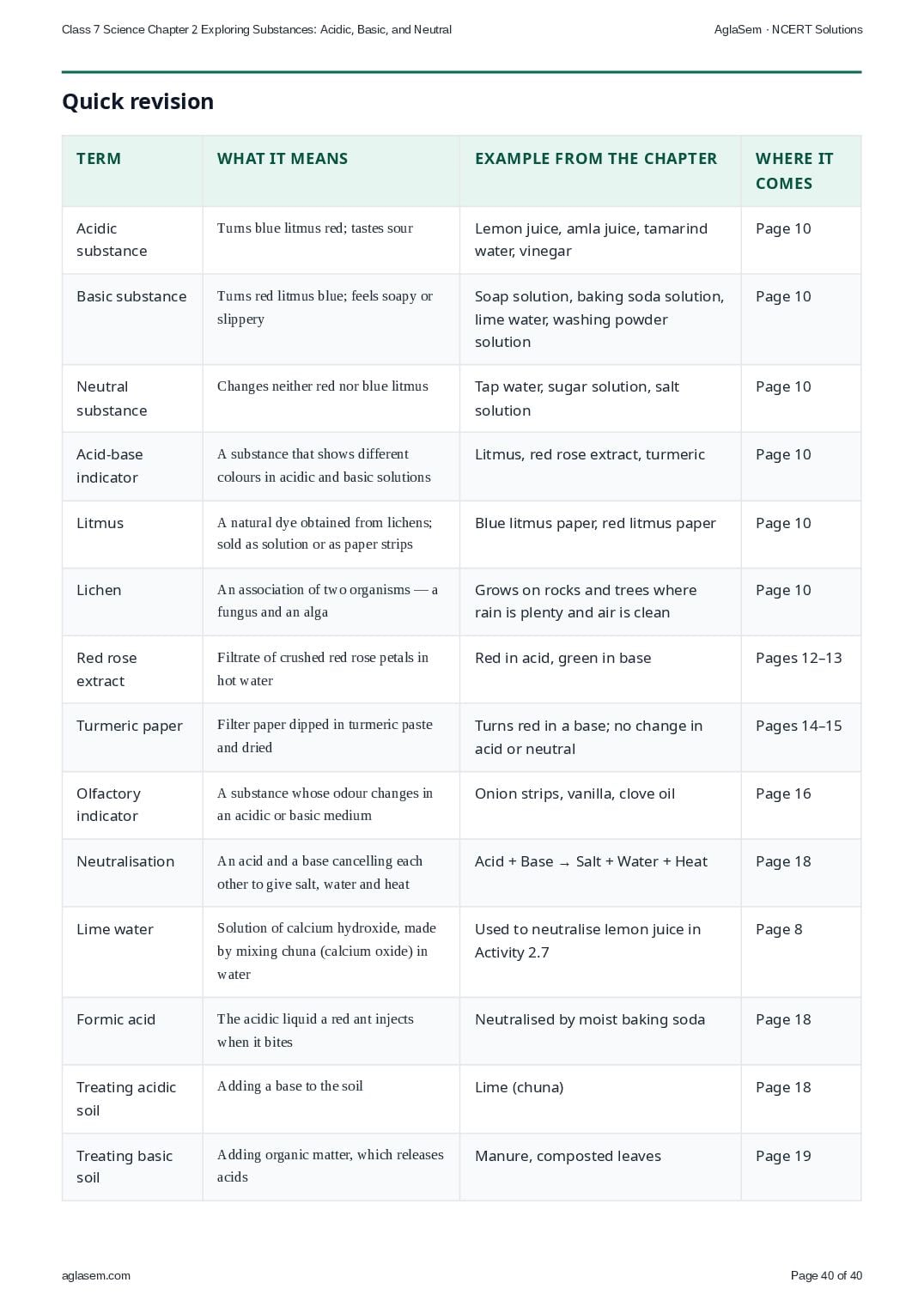
- Substances around us are of three kinds — acidic , basic and neutral . A substance that shows different colours in acidic and basic solutions is an acid-base indicator .
- Litmus , obtained from lichens , is the standard natural indicator. Acids turn blue litmus red ; bases turn red litmus blue ; neutral substances change neither.
- Red rose extract is another indicator — red in acid, green in base. Turmeric paper turns red only in a base, so it can spot bases but cannot tell an acid from a neutral substance.
- Acids taste sour (lemon, amla, tamarind, vinegar); bases feel soapy or slippery and generally taste bitter — but not everything bitter is basic (karela is not).
- When an acid and a base are mixed in the right amounts they cancel each other. This is a neutralisation reaction : Acid + Base → Salt + Water + Heat .
- Neutralisation solves real problems — moist baking soda on a red-ant bite (formic acid), lime on acidic soil, organic manure on basic soil, and basic substances added to acidic factory waste before it reaches a lake.
- Some substances change their smell in acidic or basic media; these are called olfactory indicators — chopped onion strips are the chapter's example.
How to Download NCERT Solutions for Class 7 Science Chapter 2 PDF
Follow these simple steps to get the Exploring Substances Acidic Basic and Neutral questions-and-answers PDF from Curiosity.
- Search NCERT Solutions for Class 7 Science Chapter 2 aglasem and open this page.
- Read the exercise questions with answers for Exploring Substances Acidic Basic and Neutral shown above.
- Click the Download PDF link to save the Exploring Substances Acidic Basic and Neutral solutions to your device.
NCERT Solutions for Class 7 Science – All Chapters
There are more chapters to study besides Exploring Substances Acidic Basic and Neutral in Science. Here are the NCERT Solutions for all chapters of Class 7 Science.
- Chapter 1 the Ever Evolving World of Science
- Chapter 2 Exploring Substances Acidic Basic and Neutral
- Chapter 3 Electricity Circuits and Their Components
- Chapter 4 the World of Metals and Non Metals
- Chapter 5 Changes Around Us Physical and Chemical
- Chapter 6 Adolescence a Stage of Growth and Change
- Chapter 7 Heat Transfer in Nature
- Chapter 8 Measurement of Time and Motion
- Chapter 9 Life Processes in Animals
- Chapter 10 Life Processes in Plants
- Chapter 11 Light Shadows and Reflections
- Chapter 12 Earth Moon and the Sun
NCERT Solutions for Class 7 – All Subjects
Just like Chapter 2 of Science, you can get the exercise questions with answers for every other subject of Class 7. Here are the NCERT Solutions for all subjects of Class 7.
NCERT Solutions for Class 7 Science Chapter 2 – An Overview
The key highlights of this study material are as follows.
| Aspects | Details |
|---|---|
| Class | Class 7 |
| Subject | Science |
| Chapter Number | Chapter 2 |
| Chapter Name | Exploring Substances Acidic Basic and Neutral |
| Book Name | Curiosity |
| Book By | NCERT (National Council of Educational Research and Training) |
| Educational Resource Here | NCERT Solutions of Class 7 Science Chapter 2 for all exercises |
| More Questions Answers of This Subject | NCERT Solutions for Class 7 Science |
| Download Book Chapter | NCERT Book Class 7 Science |
| All Questions Answers For This Class | NCERT Solutions for Class 7 |
| Complete Solutions | NCERT Solutions |
NCERT Solutions for Class 7 Science Chapter 2 Exploring Substances Acidic Basic and Neutral – FAQs
What are the NCERT Solutions for Class 7 Science Chapter 2 Exploring Substances Acidic Basic and Neutral?
They are the complete, step-by-step answers to all the exercise and in-text questions of Chapter 2 Exploring Substances Acidic Basic and Neutral from the NCERT Class 7 Science textbook Curiosity, written by experts as per the latest NCERT syllabus.
How can I download the Class 7 Science Chapter 2 solutions PDF for free?
Open this page on aglasem, read the Exploring Substances Acidic Basic and Neutral questions with answers, and click the “Download Solutions PDF” link. The Class 7 Science Chapter 2 NCERT Solutions PDF is completely free to download.
Are these NCERT Solutions as per the latest 2026-27 syllabus?
Yes. The NCERT Solutions for Class 7 Science Chapter 2 are based on the latest NCERT textbook Curiosity and the current 2026-27 CBSE syllabus, so the questions and answers match what you study in class.
Where can I get NCERT Solutions for the other chapters of Class 7 Science?
You can find the answers to every chapter on the NCERT Solutions for Class 7 Science page, and solutions for every subject on the NCERT Solutions for Class 7 page.
How do NCERT Solutions help in exam preparation?
They show the correct method to solve each question, help you write answers the way they are expected in exams, let you check and correct your own work, and save revision time — which together improve your marks in Class 7 Science.
If you have any queries on NCERT Solutions for Class 7 Science Chapter 2 Exploring Substances Acidic Basic and Neutral, then please ask in the comments below.