NCERT Solutions for Class 7 Science Chapter 6 Adolescence a Stage of Growth and Change provide clear, step-by-step answers to every exercise and in-text question from the chapter Adolescence a Stage of Growth and Change of the NCERT textbook Curiosity. Prepared by subject experts as per the latest NCERT (CBSE) syllabus for 2026-27, these NCERT Solutions for Class 7 Science help you understand each concept, write exam-ready answers, and check your own solutions. You can read them online below or download the free Class 7 Science Chapter 6 question-answer PDF.
NCERT Solutions for Class 7 Science Chapter 6 Adolescence a Stage of Growth and Change
- Class: Class 7
- Subject: Science
- Chapter: Chapter 6 – Adolescence a Stage of Growth and Change
- Textbook: Curiosity (NCERT)
- Study material: NCERT Solutions – questions with answers, free PDF
These solutions answer all the exercise questions of Chapter 6 Adolescence a Stage of Growth and Change — including the in-text questions, short-answer and long-answer questions, and activities — with complete explanations so you can follow the method, not just the final answer. Read the full solutions below.
NCERT Solutions Class 7 Science Chapter 6 Adolescence a Stage of Growth and Change View Download
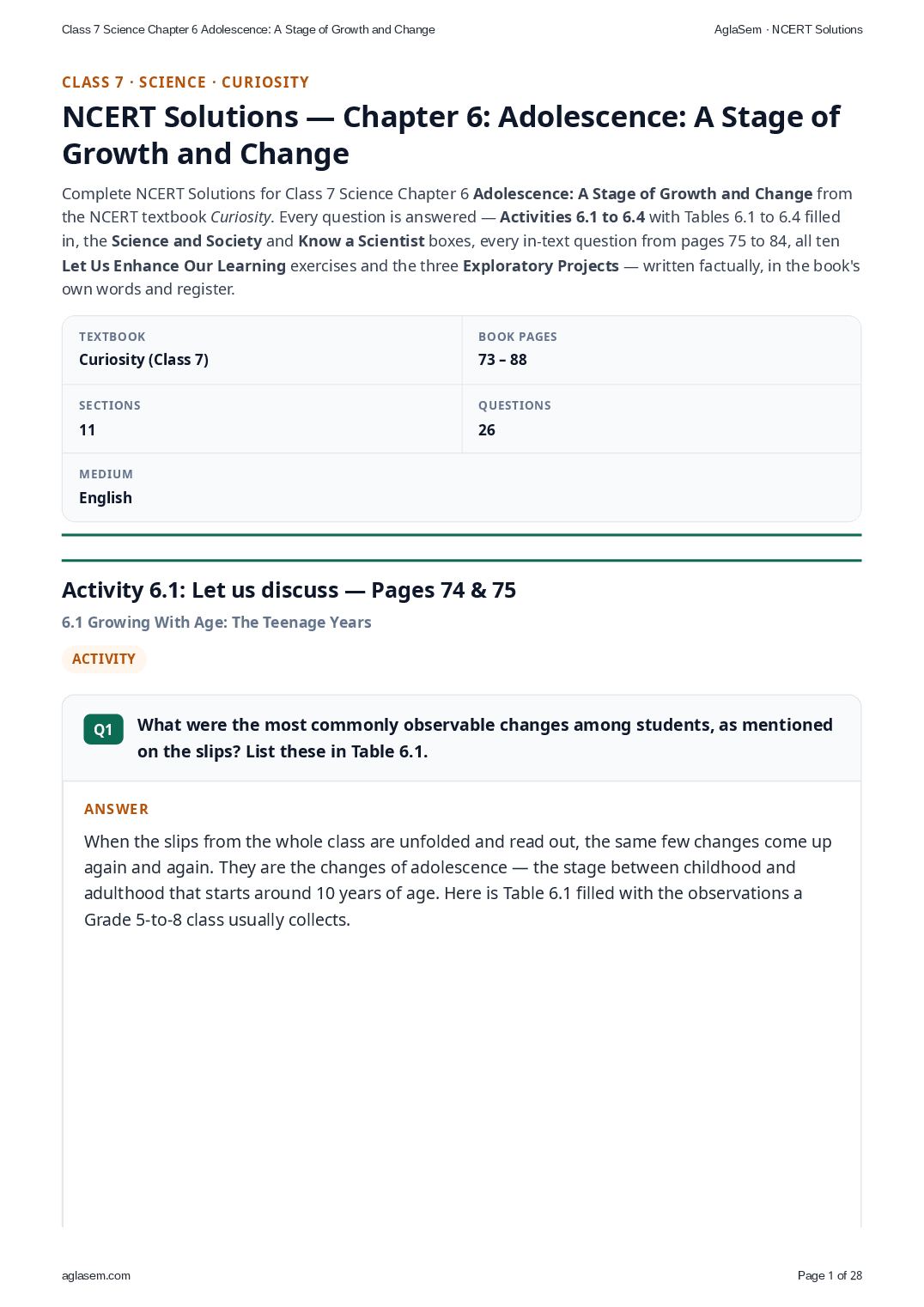
NCERT Solutions for Class 7 Science Chapter 6 PDF Download
You can read the NCERT Solutions for Class 7 Science Chapter 6 online above, or download the complete question-answer PDF to study Adolescence a Stage of Growth and Change offline at any time.
NCERT Solutions for Class 7 Science Chapter 6 PDF Download Link – Click Here to Download Solutions PDF
Questions Covered in This Chapter
These NCERT Solutions answer all 26 questions of this chapter. The questions solved are:
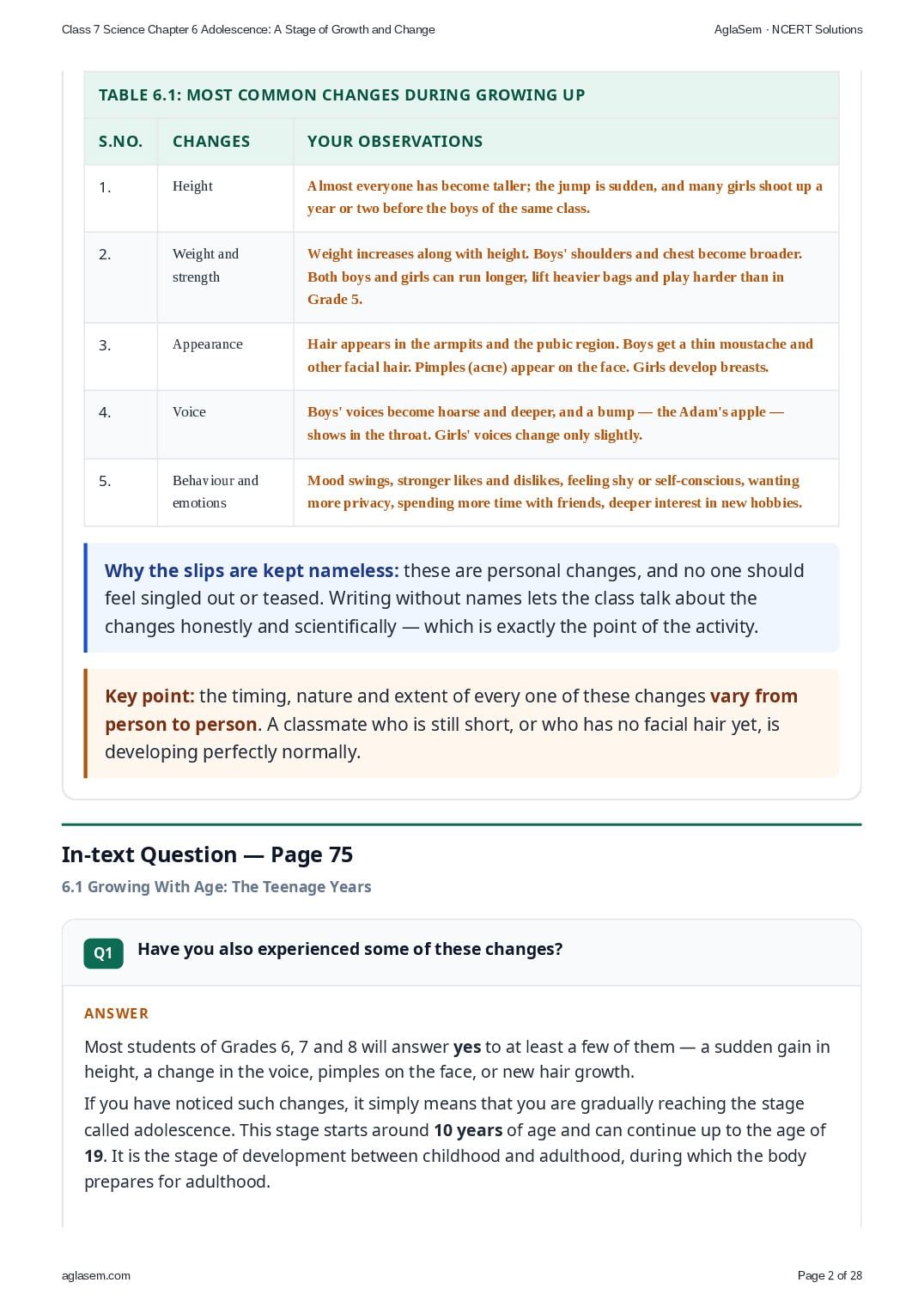
- What were the most commonly observable changes among students, as mentioned on the slips? List these in Table 6.1.
- Have you also experienced some of these changes?
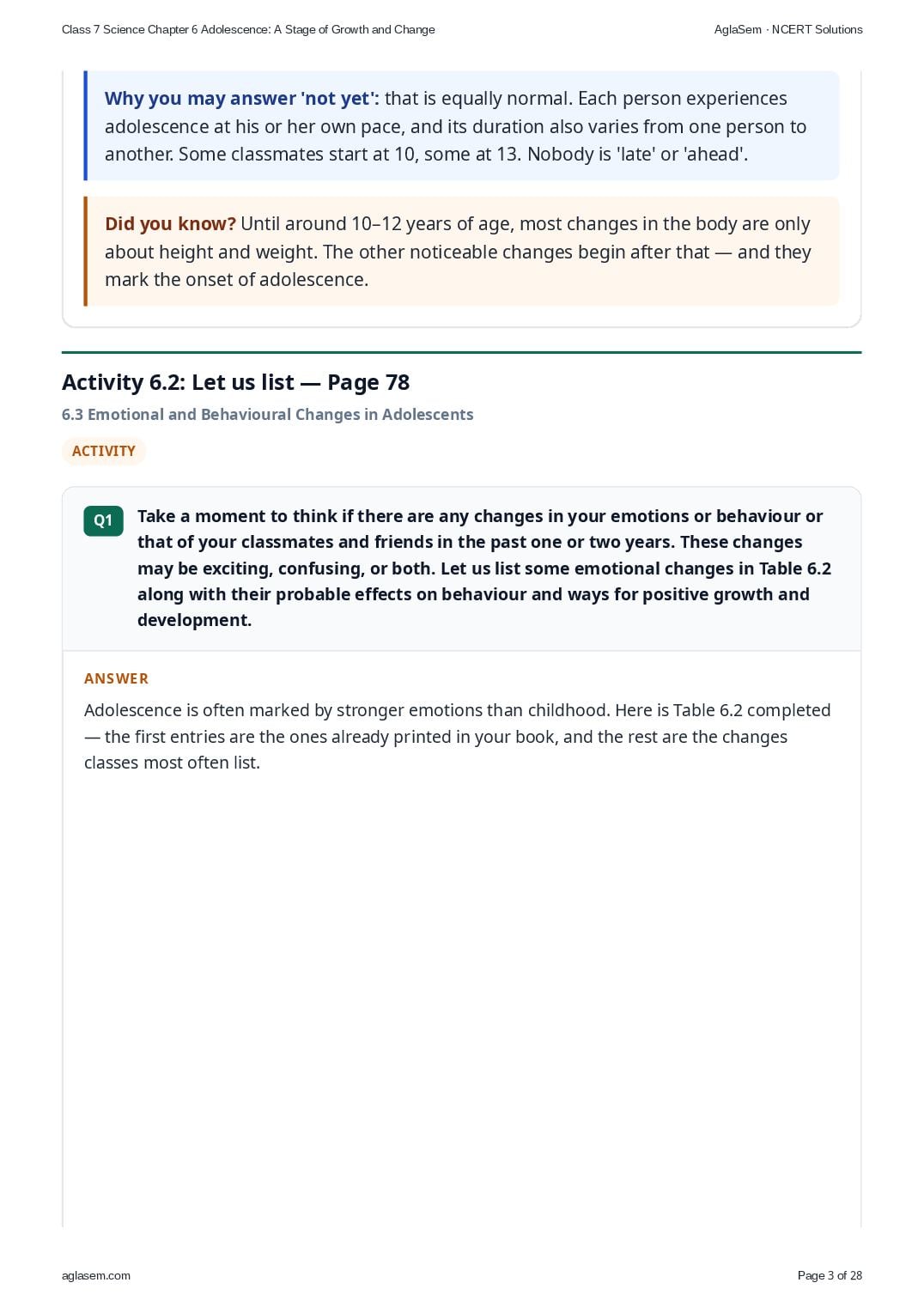
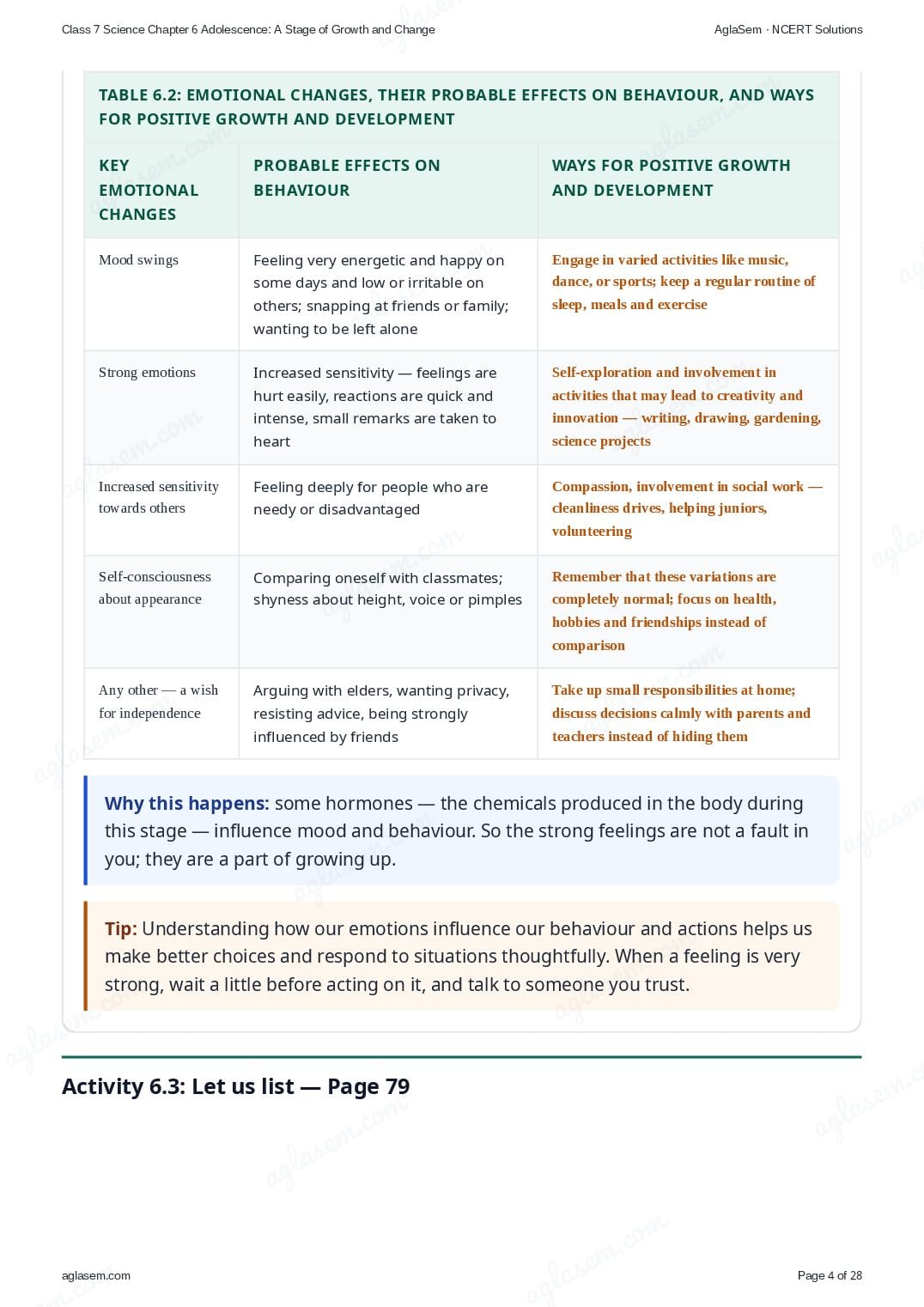
- Take a moment to think if there are any changes in your emotions or behaviour or that of your classmates and friends in the past one or two years. These changes may be exciting, confusing, or both. Let us list some emotional changes in Table 6.2 along with their probable effects on behaviour and ways for positive growth and development.
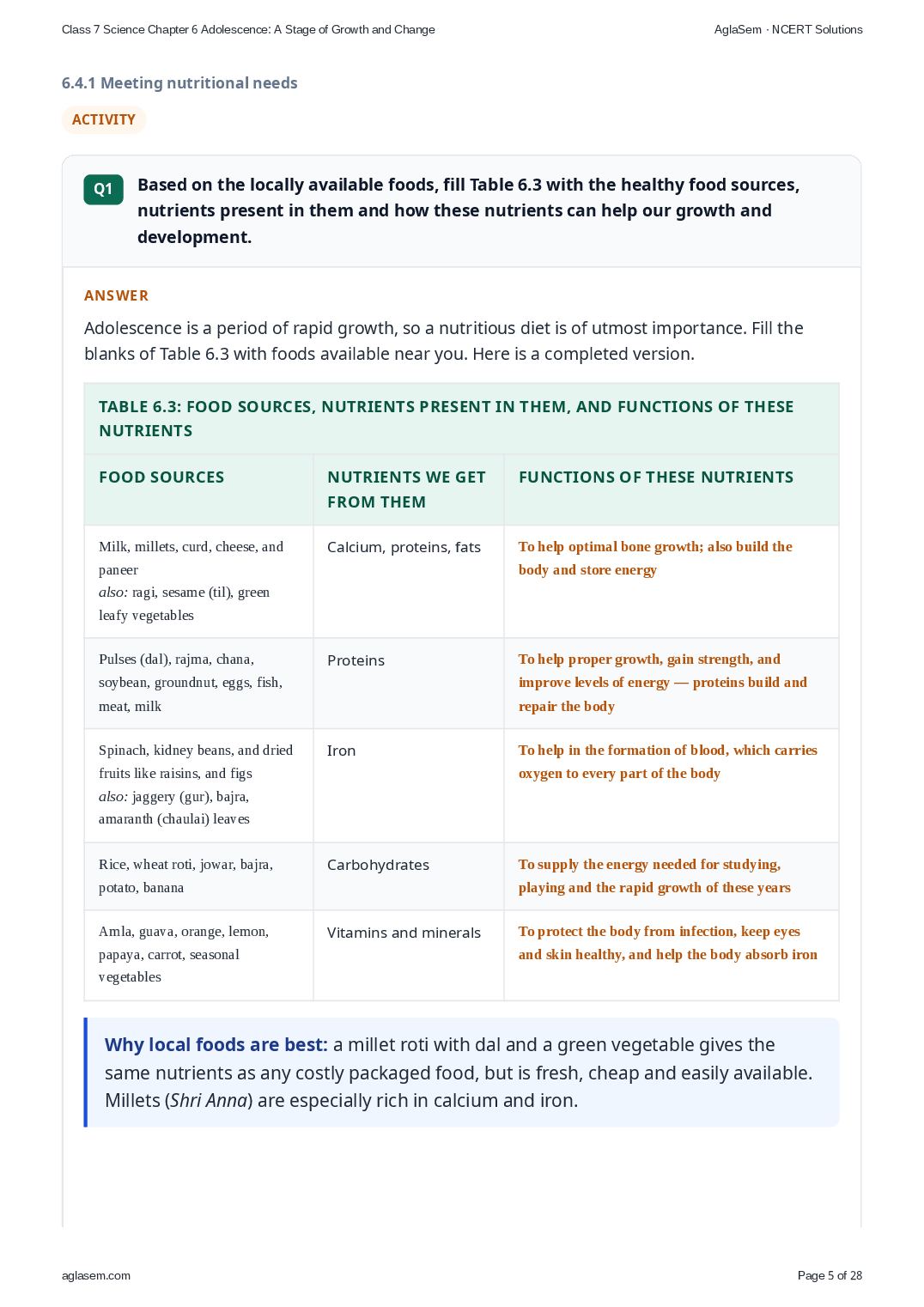
- Based on the locally available foods, fill Table 6.3 with the healthy food sources, nutrients present in them and how these nutrients can help our growth and development.
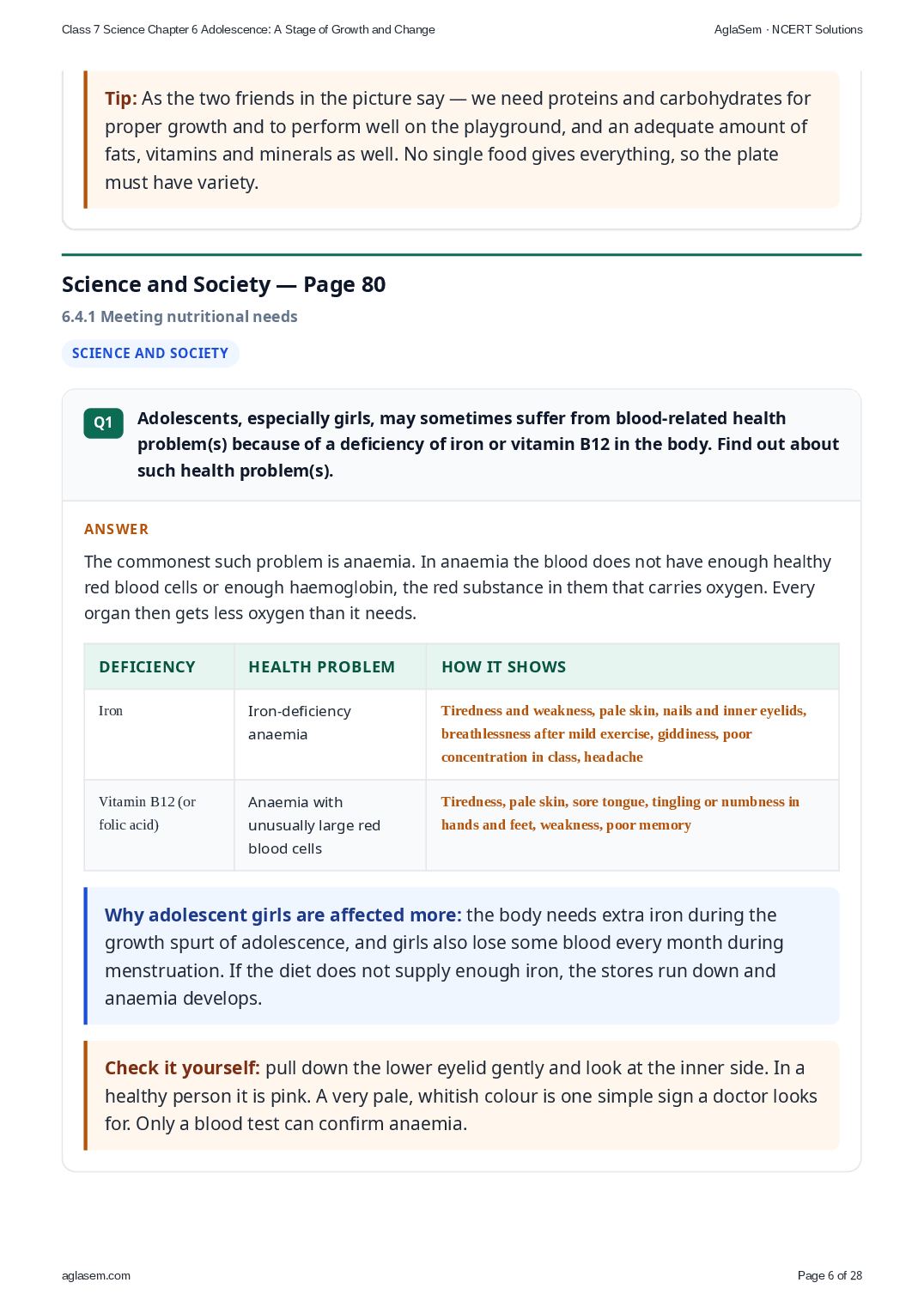
- Adolescents, especially girls, may sometimes suffer from blood-related health problem(s) because of a deficiency of iron or vitamin B12 in the body. Find out about such health problem(s).
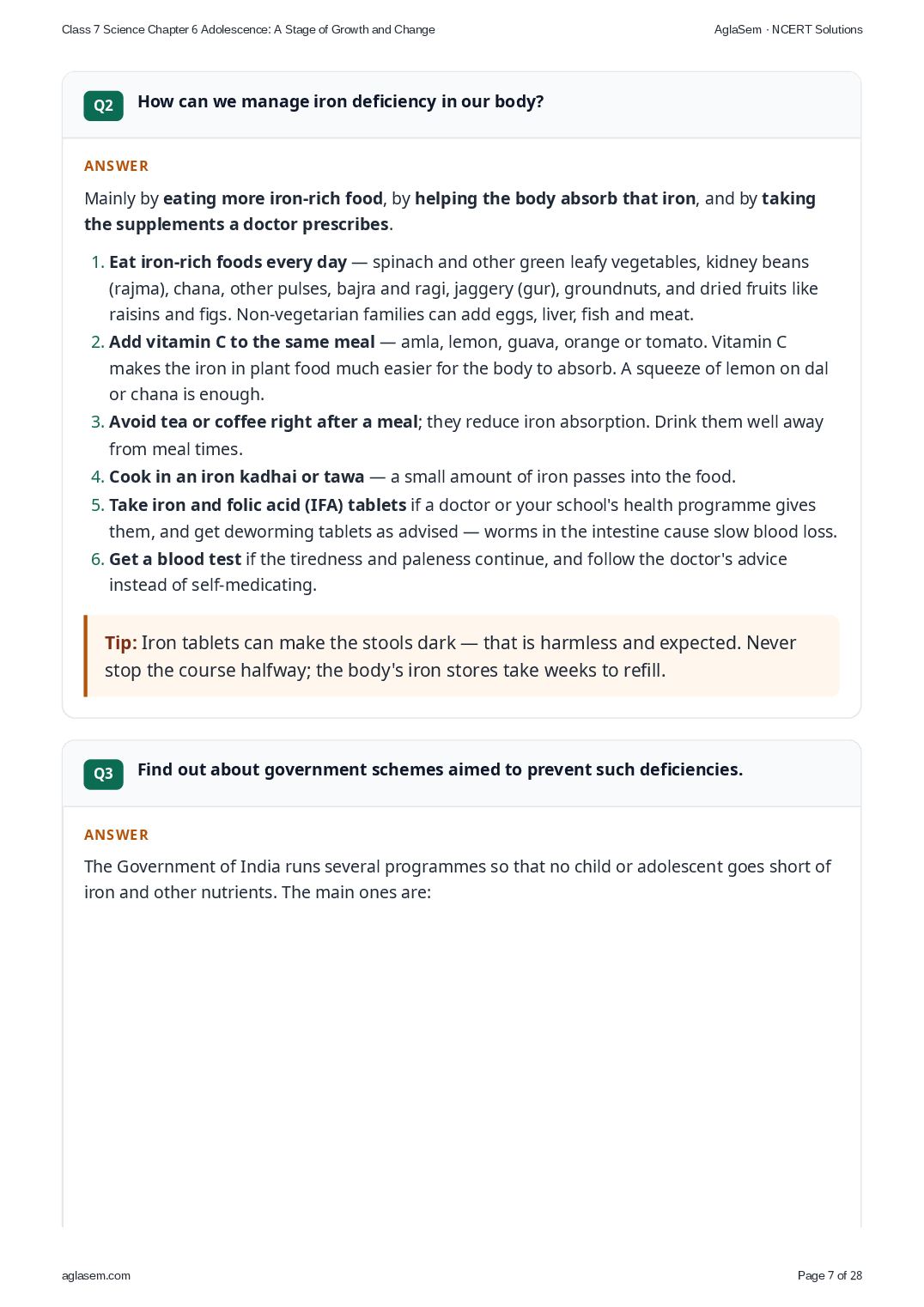
- How can we manage iron deficiency in our body?
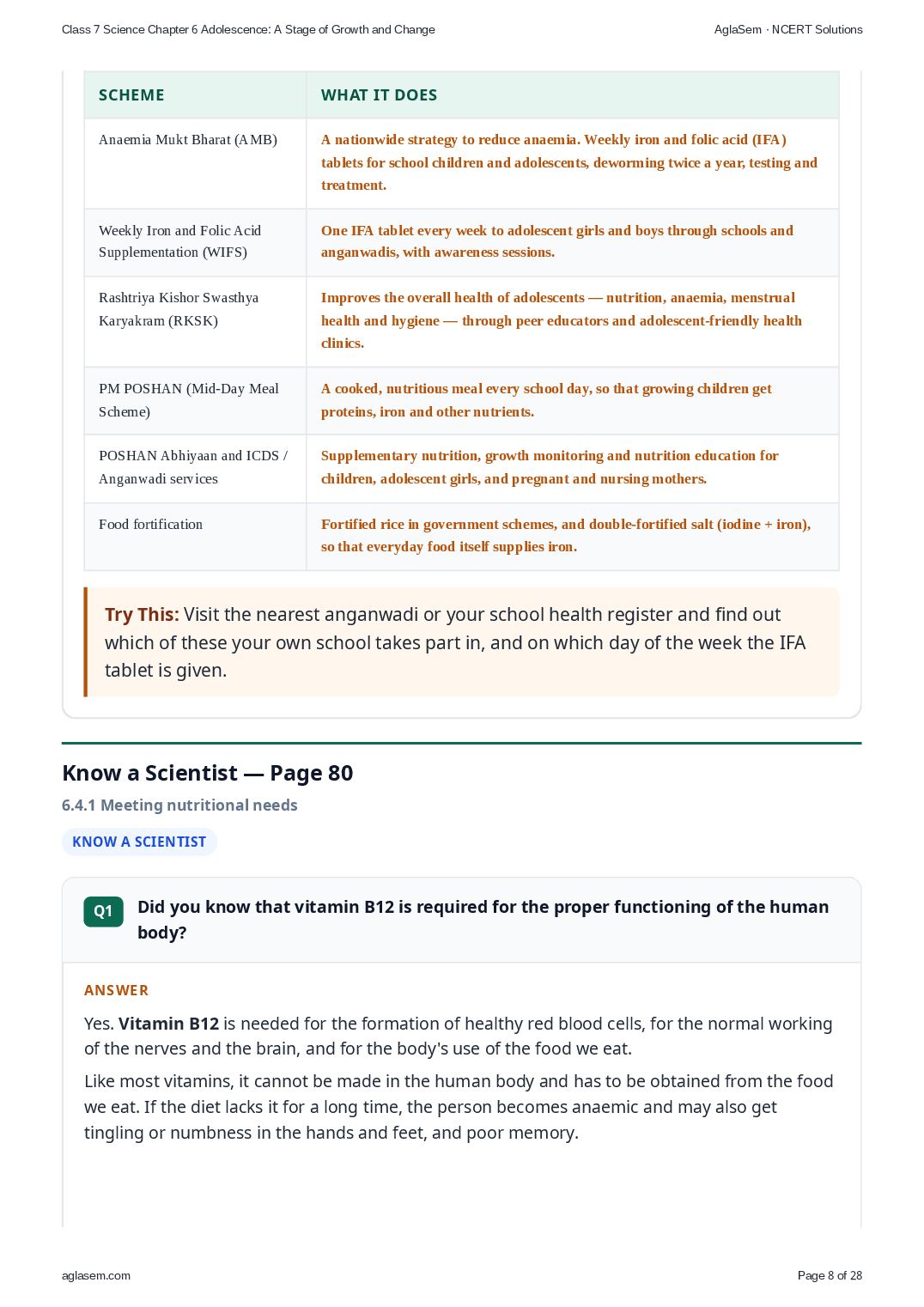
- Find out about government schemes aimed to prevent such deficiencies.
- Did you know that vitamin B12 is required for the proper functioning of the human body?
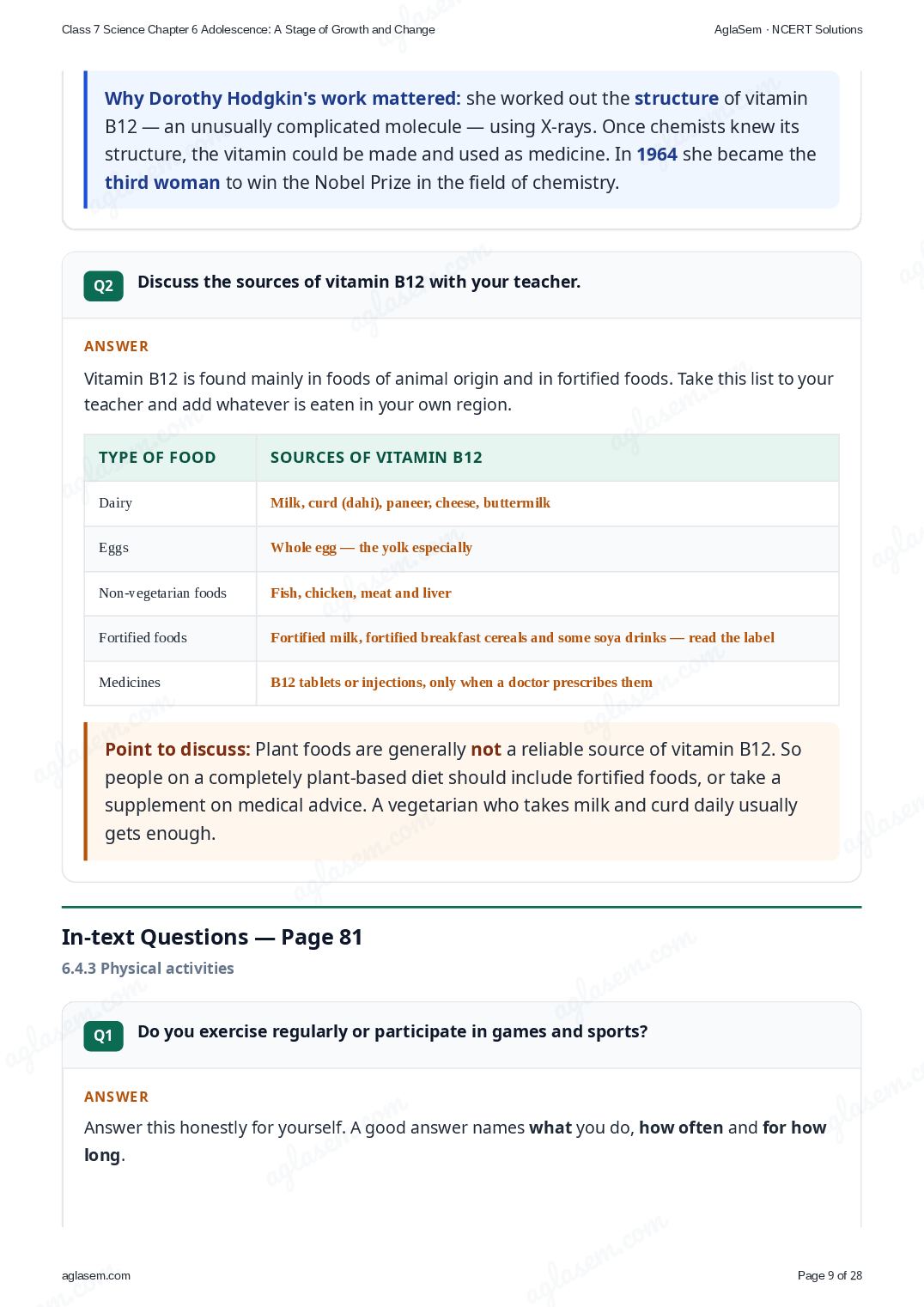
- Discuss the sources of vitamin B12 with your teacher.
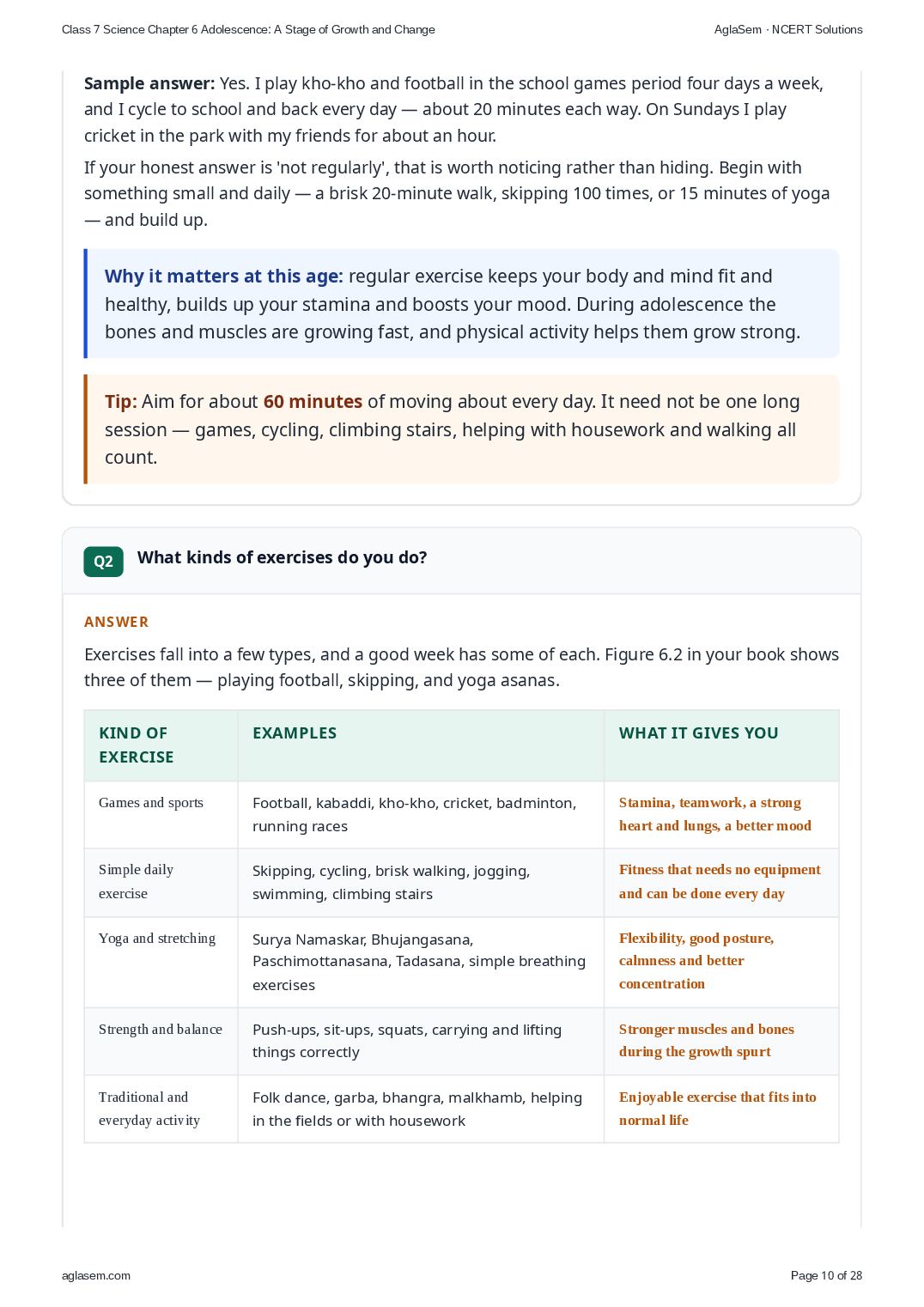
- Do you exercise regularly or participate in games and sports?
- What kinds of exercises do you do?
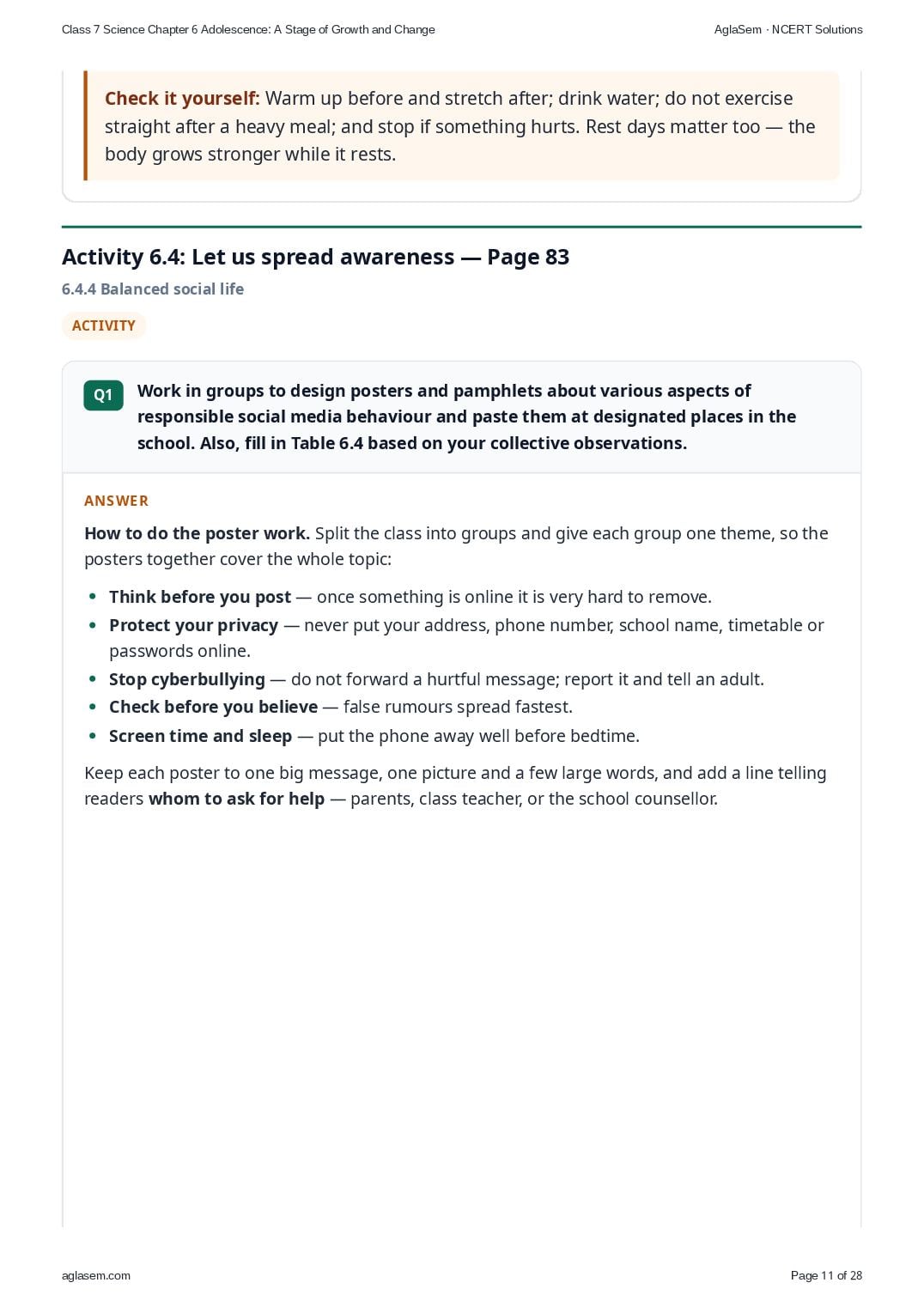
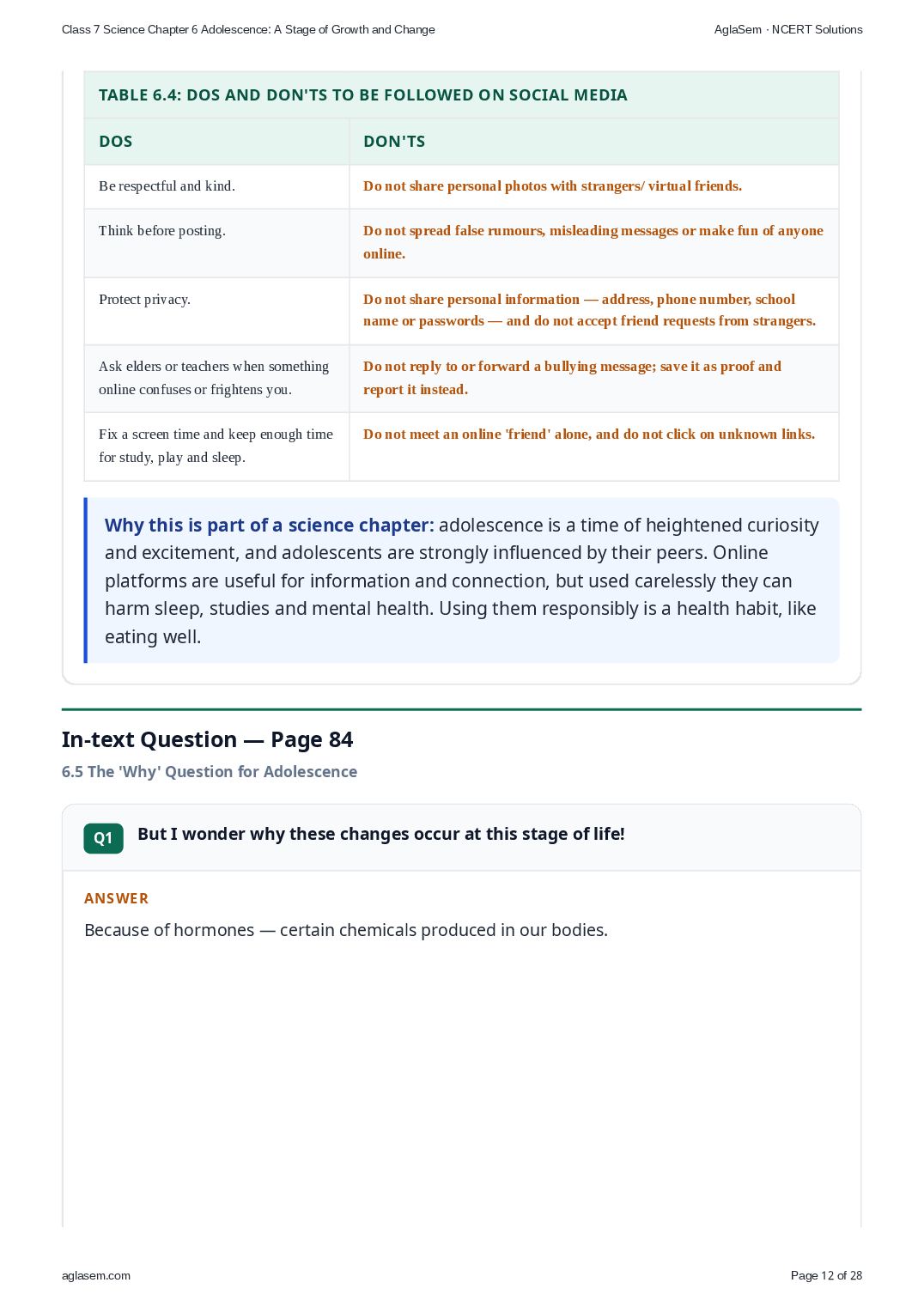
- Work in groups to design posters and pamphlets about various aspects of responsible social media behaviour and paste them at designated places in the school. Also, fill in Table 6.4 based on your collective observations.
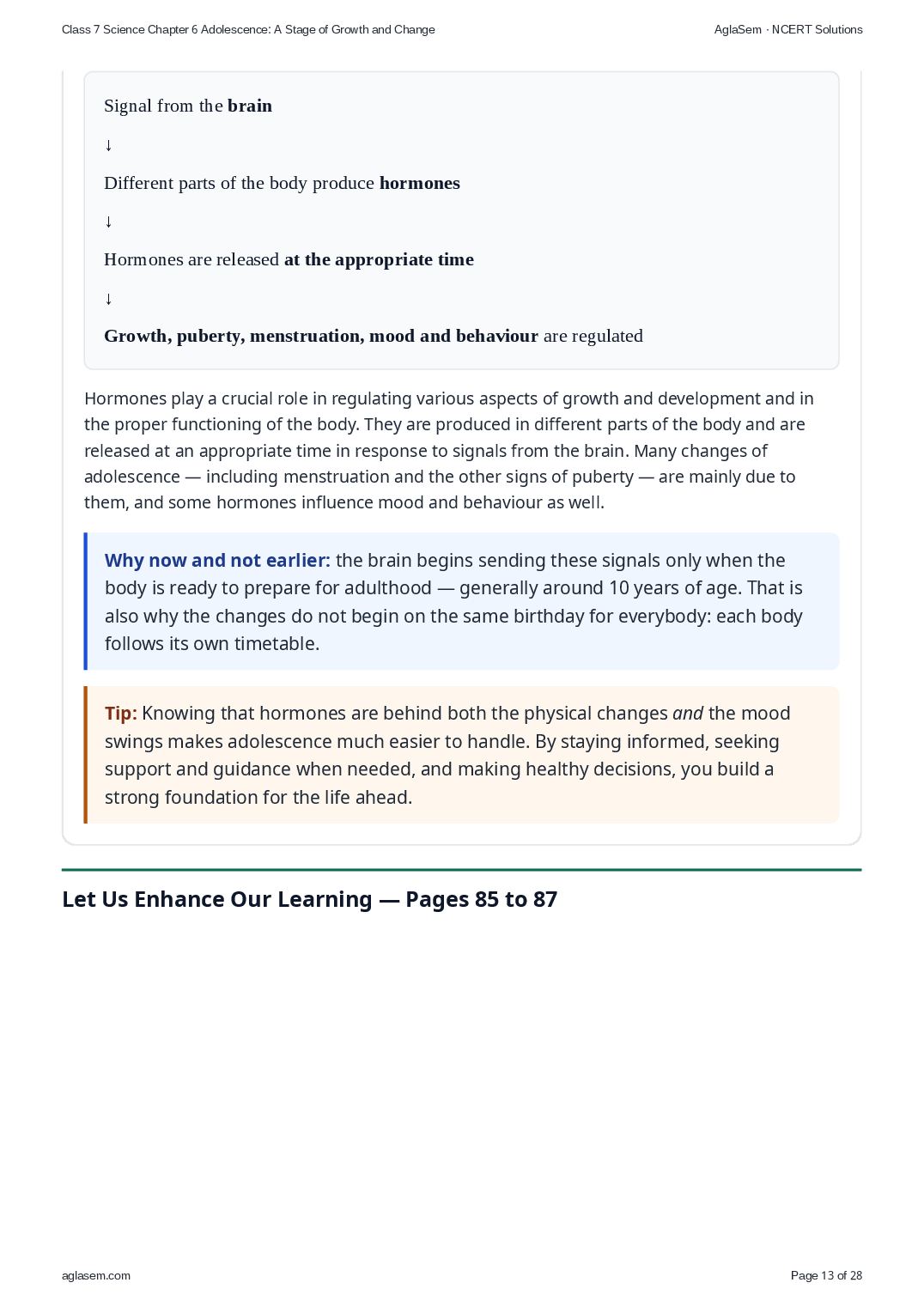
- But I wonder why these changes occur at this stage of life!
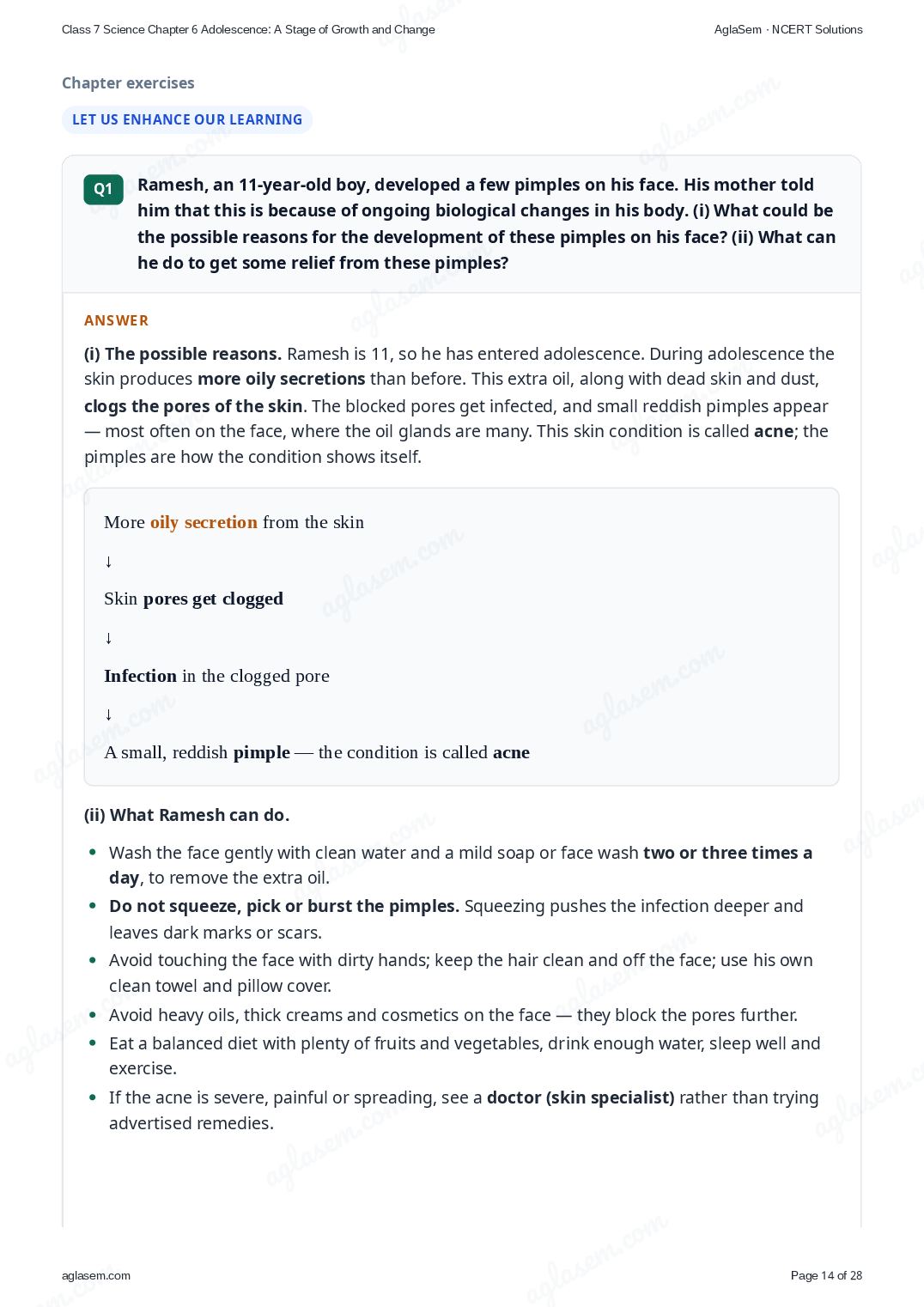
- Ramesh, an 11-year-old boy, developed a few pimples on his face. His mother told him that this is because of ongoing biological changes in his body. (i) What could be the possible reasons for the development of these pimples on his face? (ii) What can he do to get some relief from these pimples?
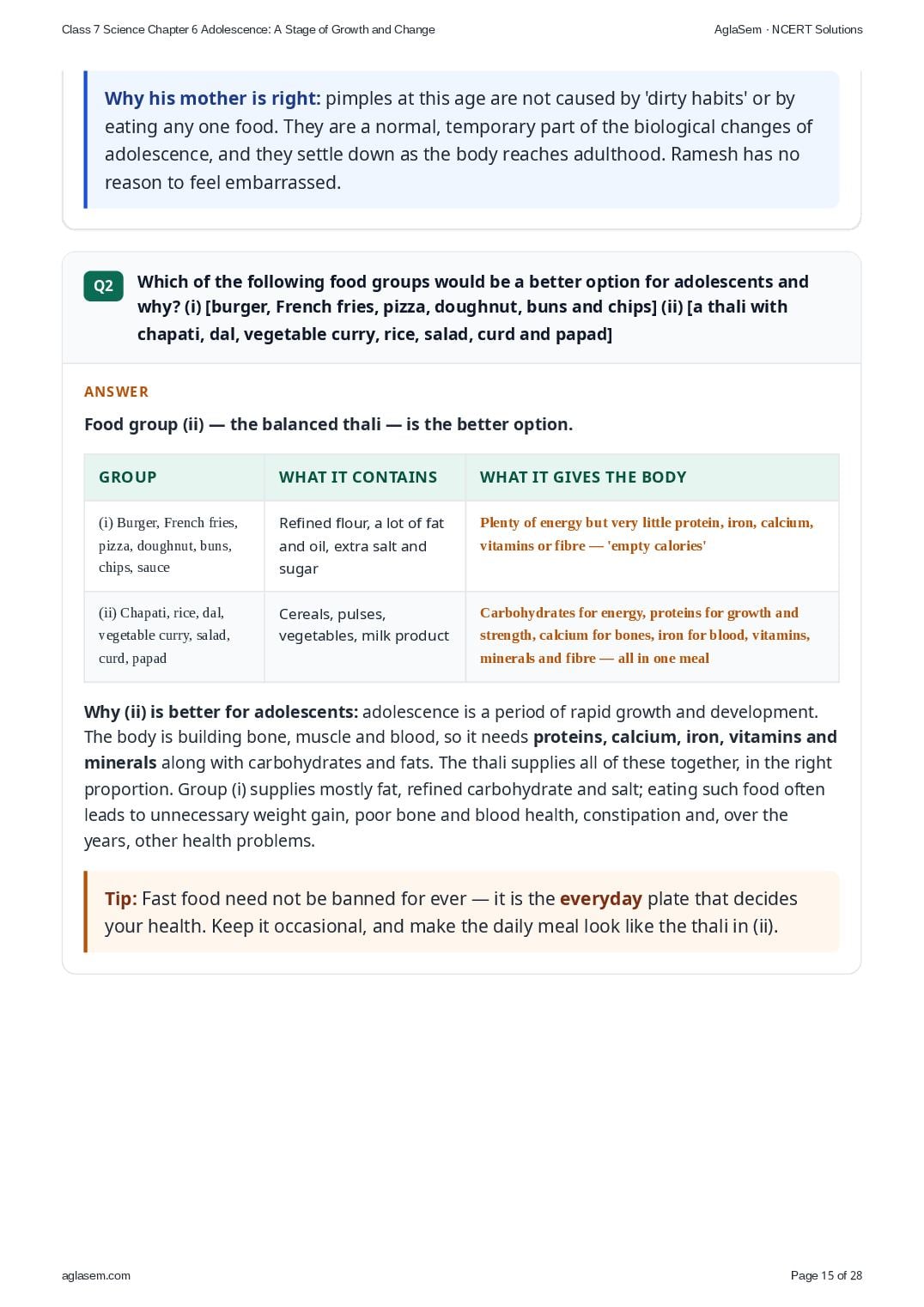
- Which of the following food groups would be a better option for adolescents and why? (i) [burger, French fries, pizza, doughnut, buns and chips] (ii) [a thali with chapati, dal, vegetable curry, rice, salad, curd and papad]
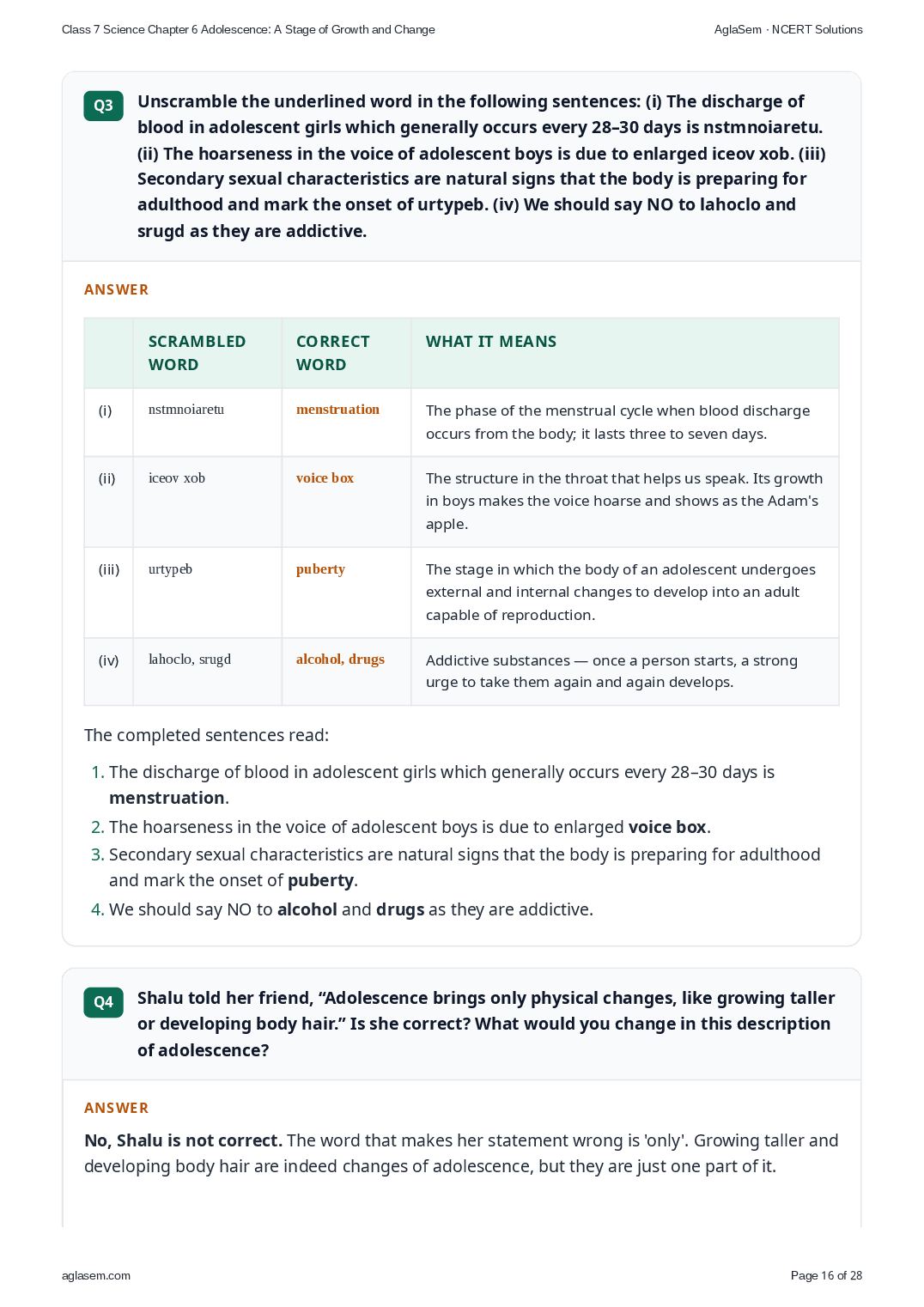
- Unscramble the underlined word in the following sentences: (i) The discharge of blood in adolescent girls which generally occurs every 28–30 days is nstmnoiaretu. (ii) The hoarseness in the voice of adolescent boys is due to enlarged iceov xob. (iii) Secondary sexual characteristics are natural signs that the body is preparing for adulthood and mark the onset of urtypeb. (iv) We should say NO to lahoclo and srugd as they are addictive.
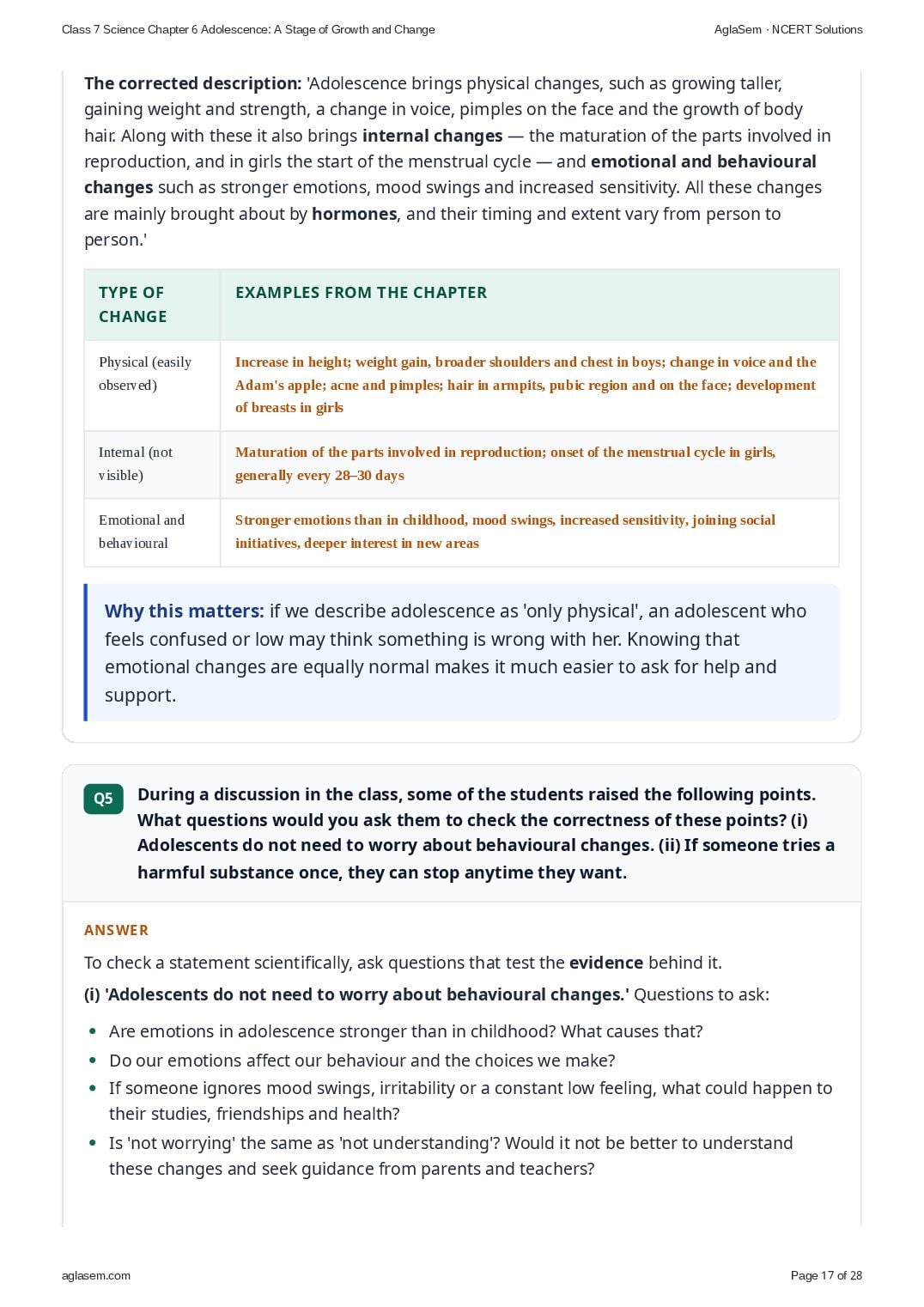
- Shalu told her friend, “Adolescence brings only physical changes, like growing taller or developing body hair.” Is she correct? What would you change in this description of adolescence?
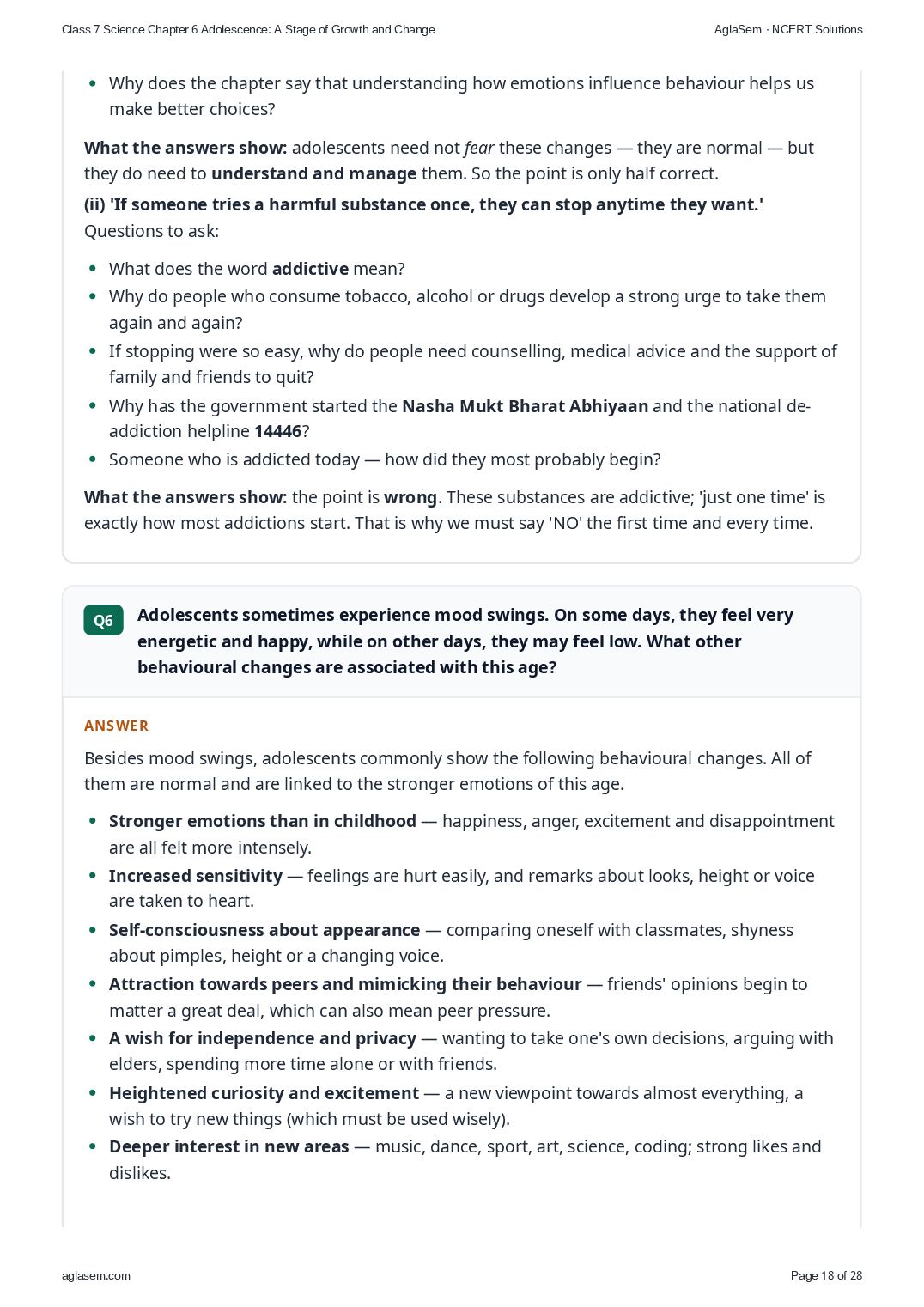
- During a discussion in the class, some of the students raised the following points. What questions would you ask them to check the correctness of these points? (i) Adolescents do not need to worry about behavioural changes. (ii) If someone tries a harmful substance once, they can stop anytime they want.
- Adolescents sometimes experience mood swings. On some days, they feel very energetic and happy, while on other days, they may feel low. What other behavioural changes are associated with this age?
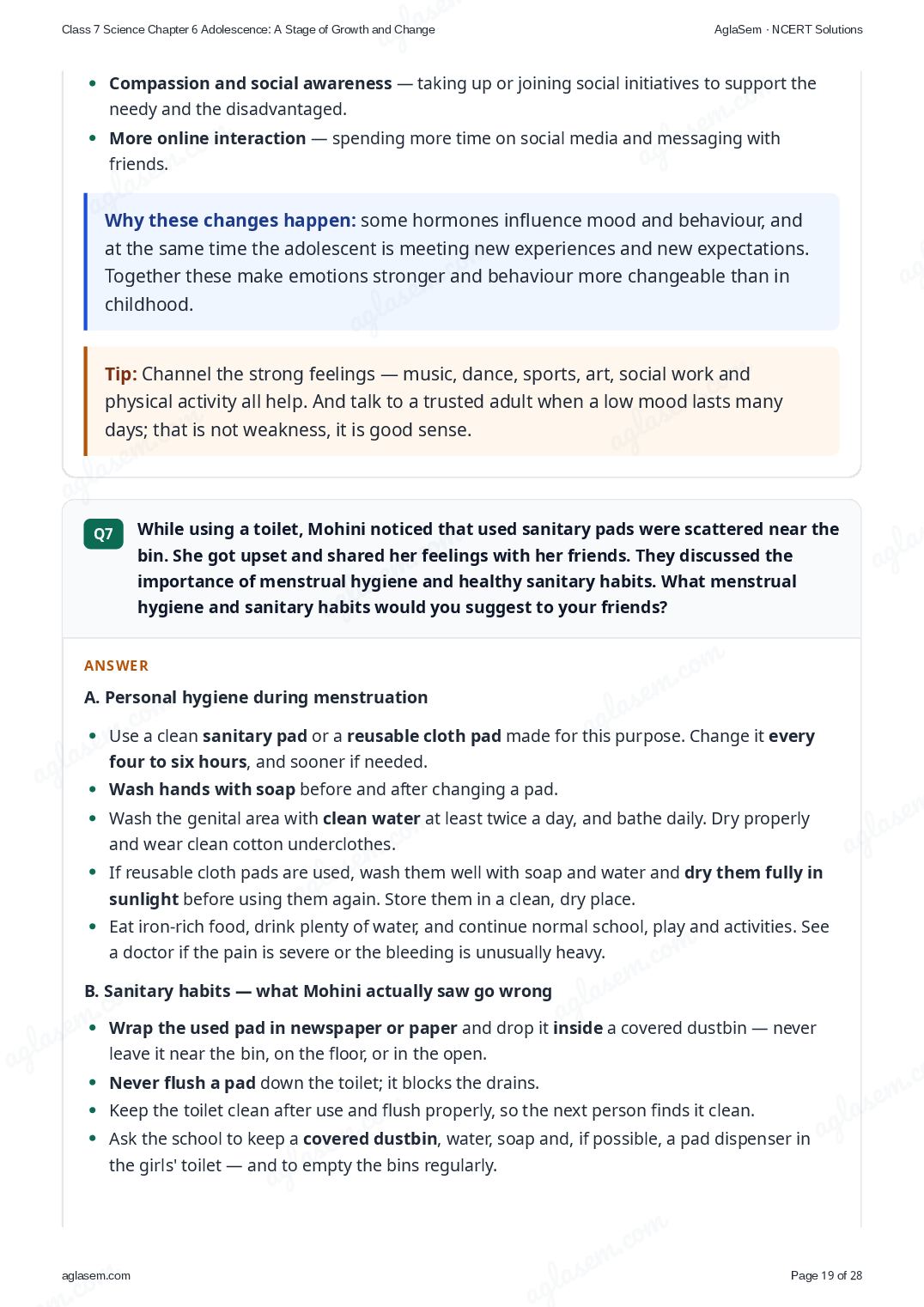
- While using a toilet, Mohini noticed that used sanitary pads were scattered near the bin. She got upset and shared her feelings with her friends. They discussed the importance of menstrual hygiene and healthy sanitary habits. What menstrual hygiene and sanitary habits would you suggest to your friends?
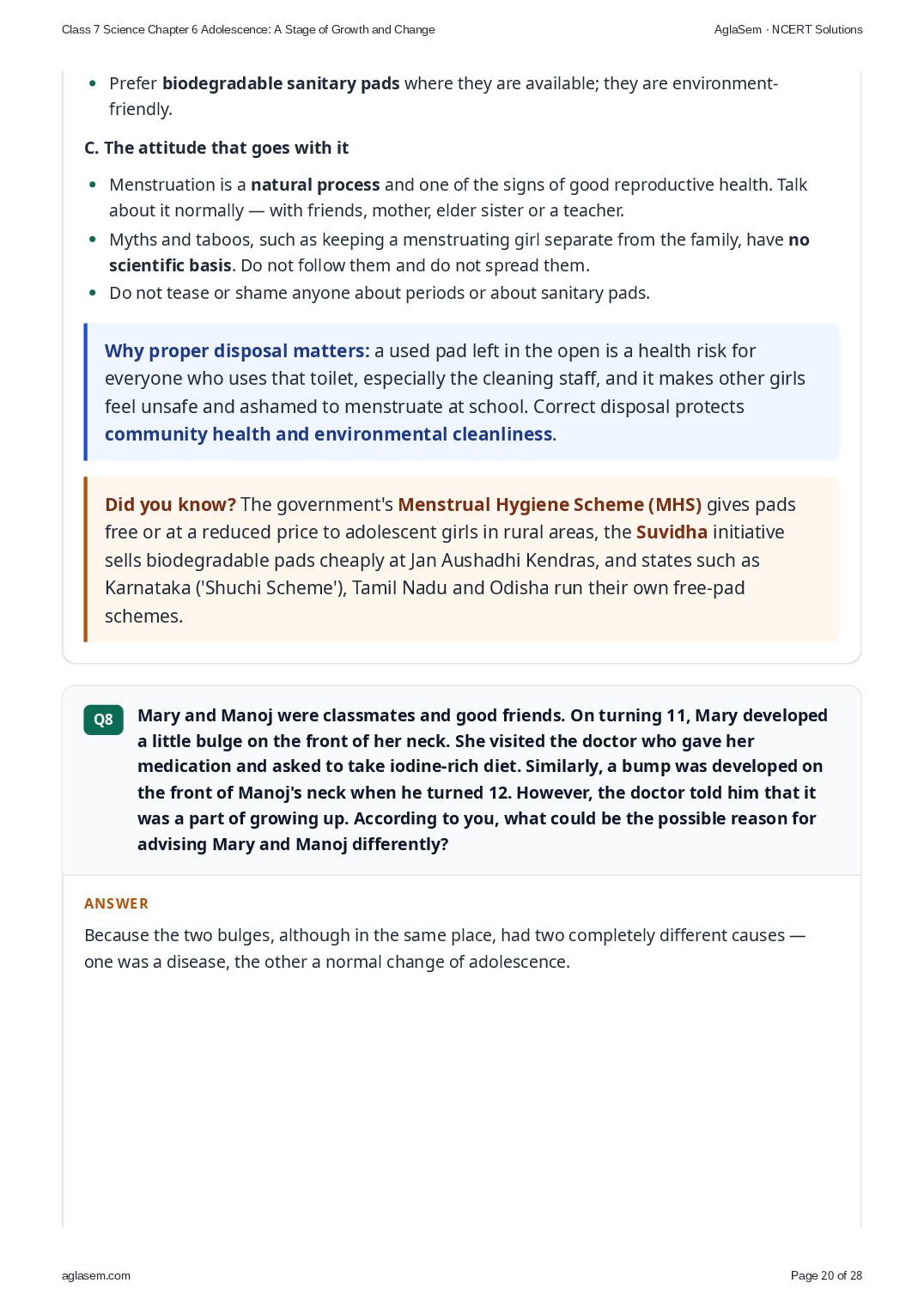
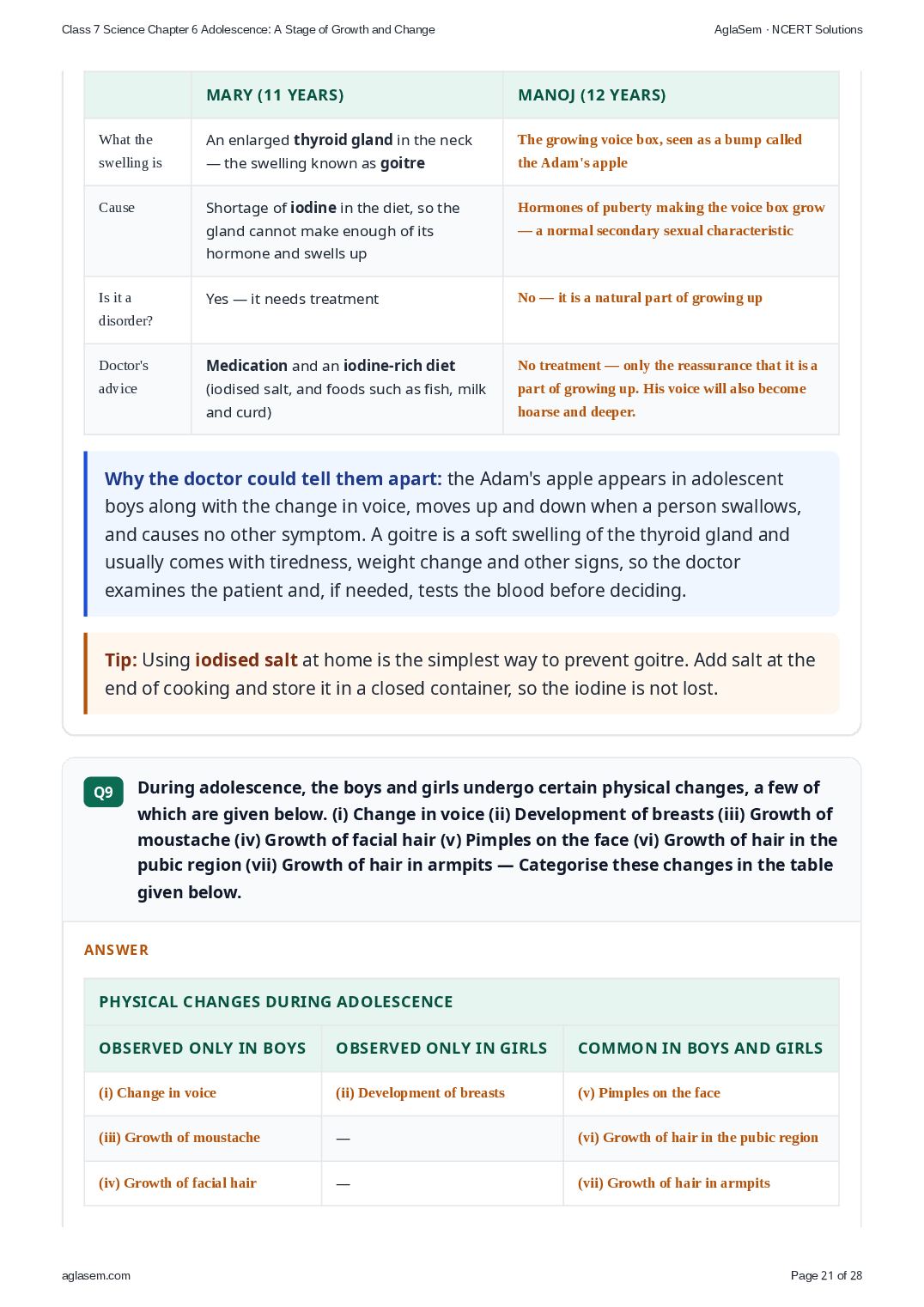
- Mary and Manoj were classmates and good friends. On turning 11, Mary developed a little bulge on the front of her neck. She visited the doctor who gave her medication and asked to take iodine-rich diet. Similarly, a bump was developed on the front of Manoj's neck when he turned 12. However, the doctor told him that it was a part of growing up. According to you, what could be the possible reason for advising Mary and Manoj differently?
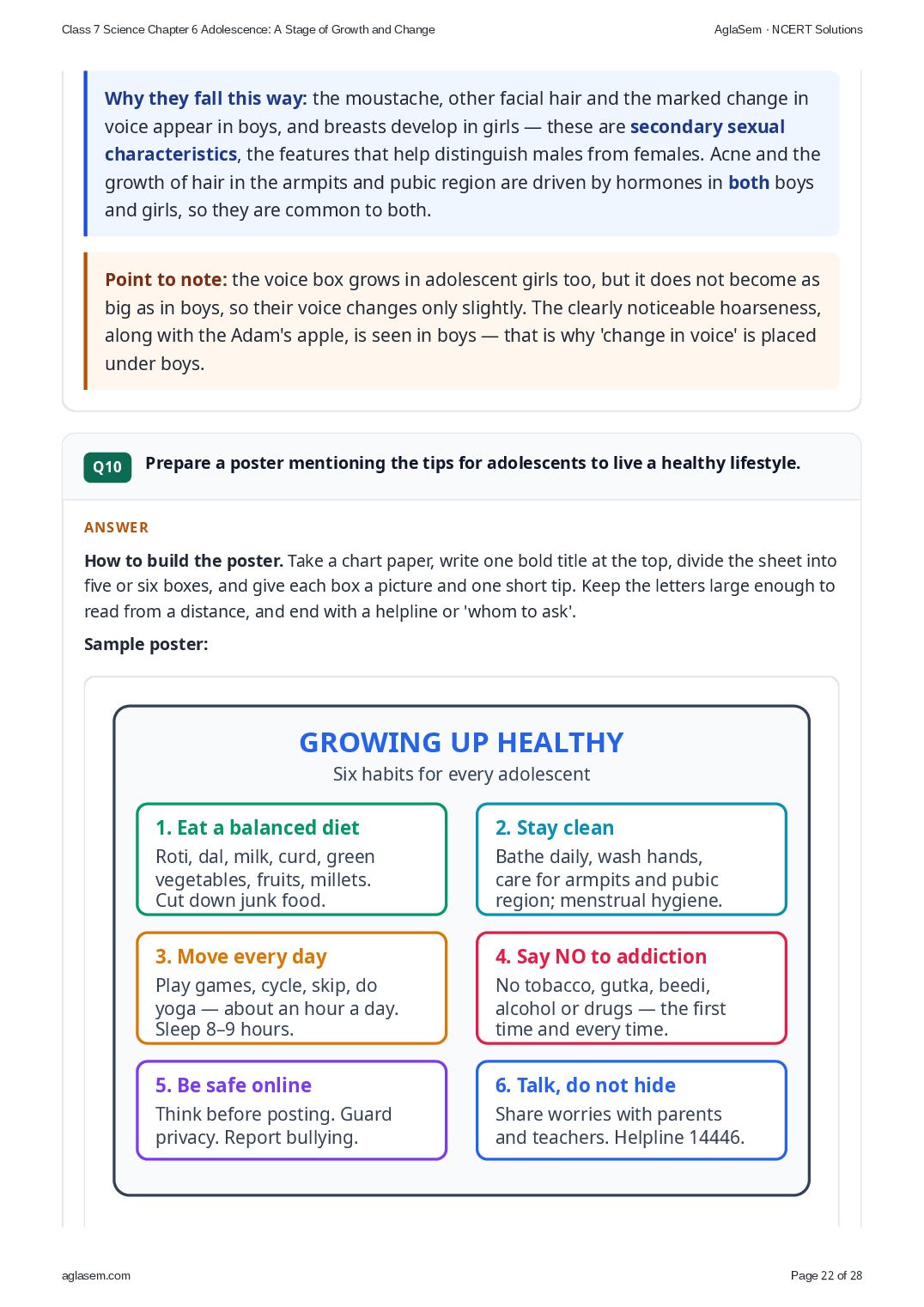
- During adolescence, the boys and girls undergo certain physical changes, a few of which are given below. (i) Change in voice (ii) Development of breasts (iii) Growth of moustache (iv) Growth of facial hair (v) Pimples on the face (vi) Growth of hair in the pubic region (vii) Growth of hair in armpits — Categorise these changes in the table given below.
- Prepare a poster mentioning the tips for adolescents to live a healthy lifestyle.
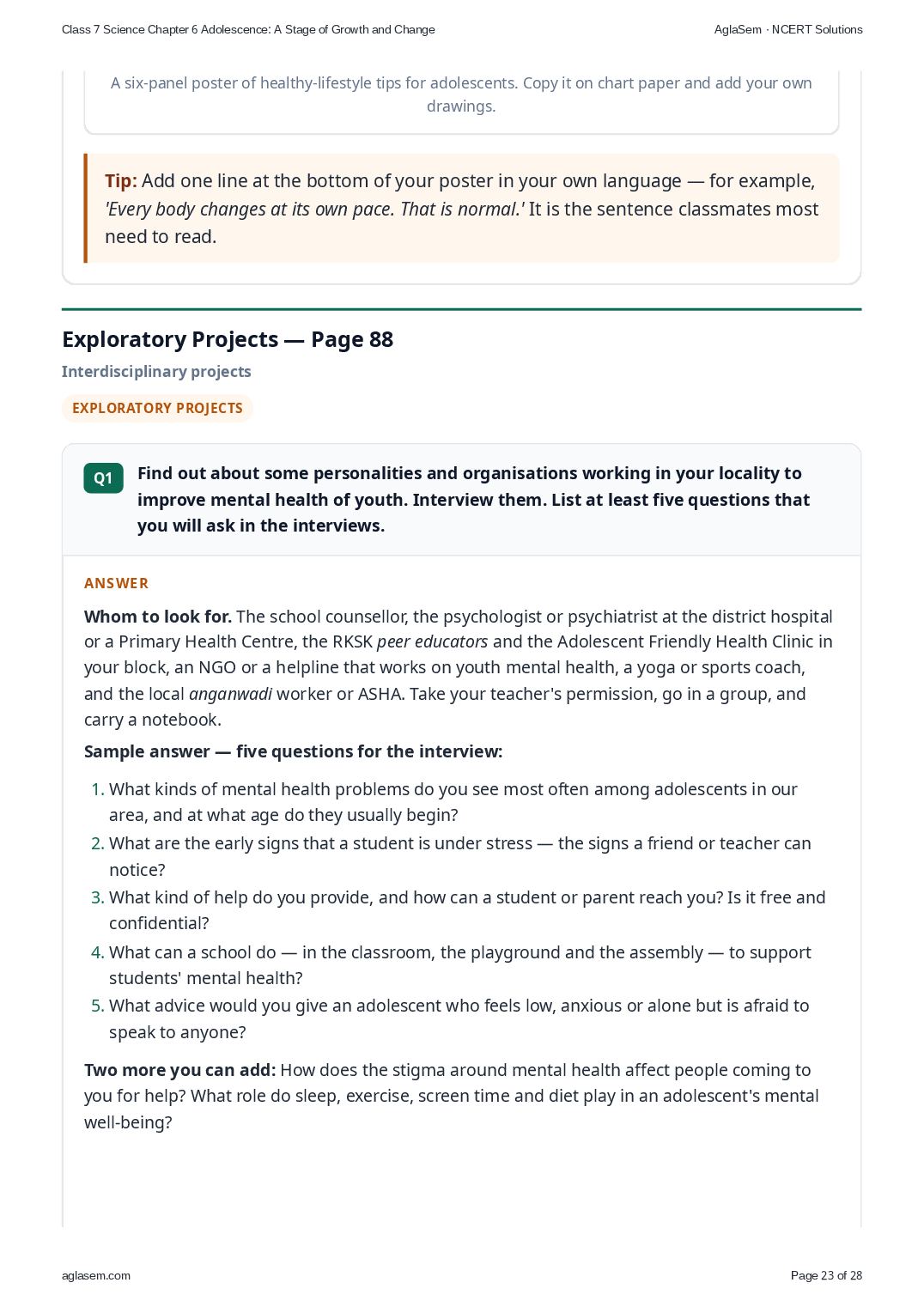
- Find out about some personalities and organisations working in your locality to improve mental health of youth. Interview them. List at least five questions that you will ask in the interviews.
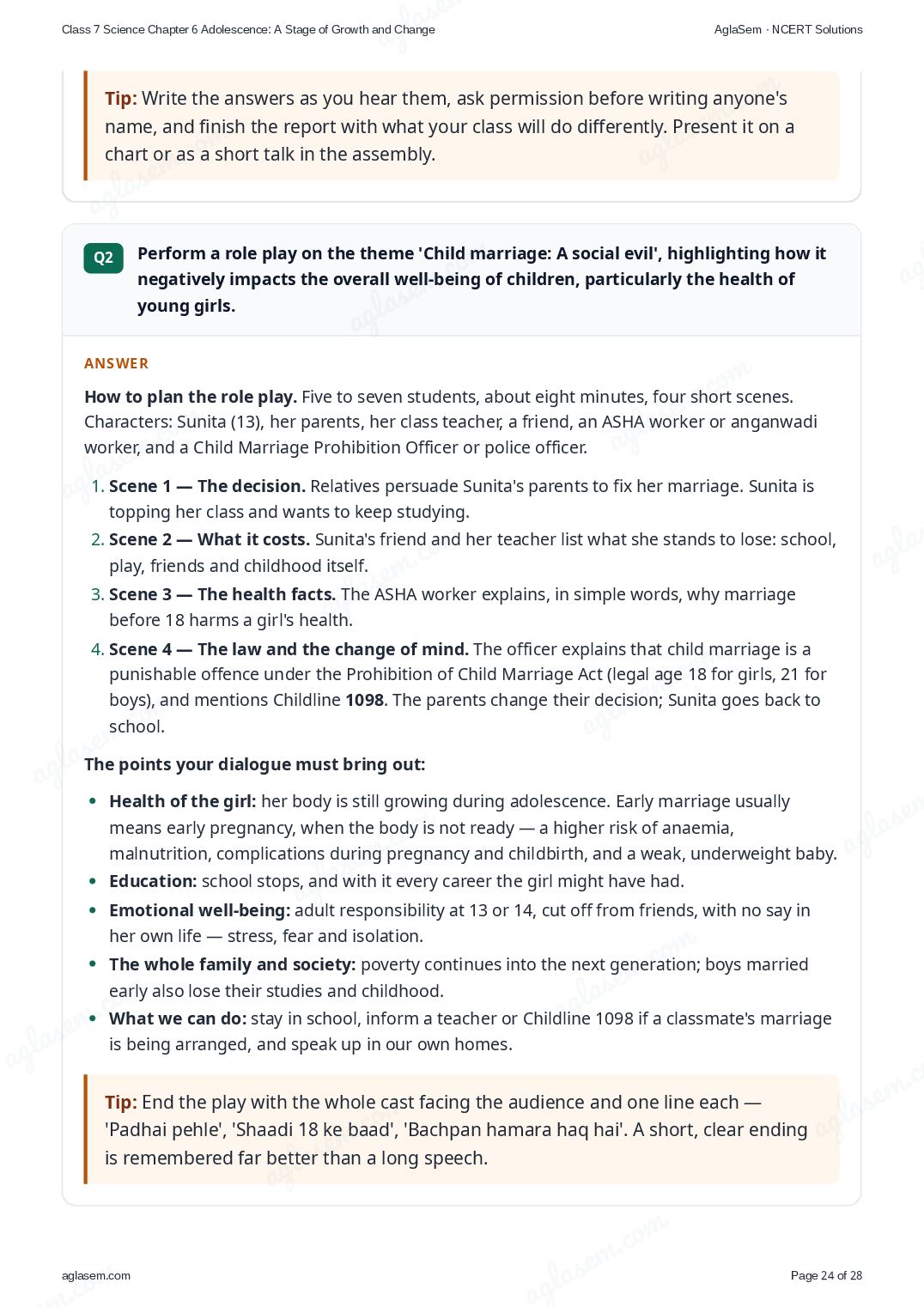
- Perform a role play on the theme 'Child marriage: A social evil', highlighting how it negatively impacts the overall well-being of children, particularly the health of young girls.
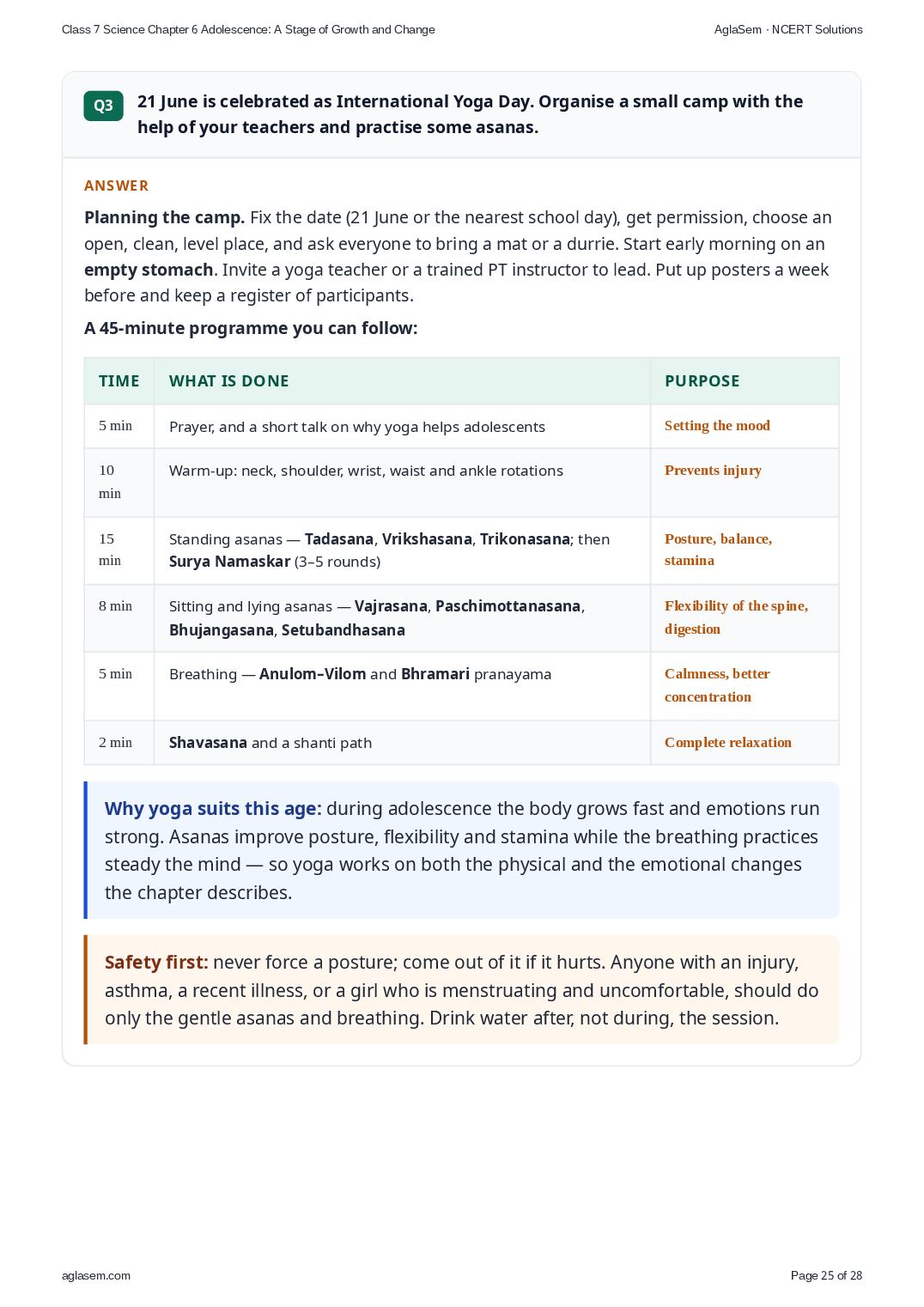
- 21 June is celebrated as International Yoga Day. Organise a small camp with the help of your teachers and practise some asanas.
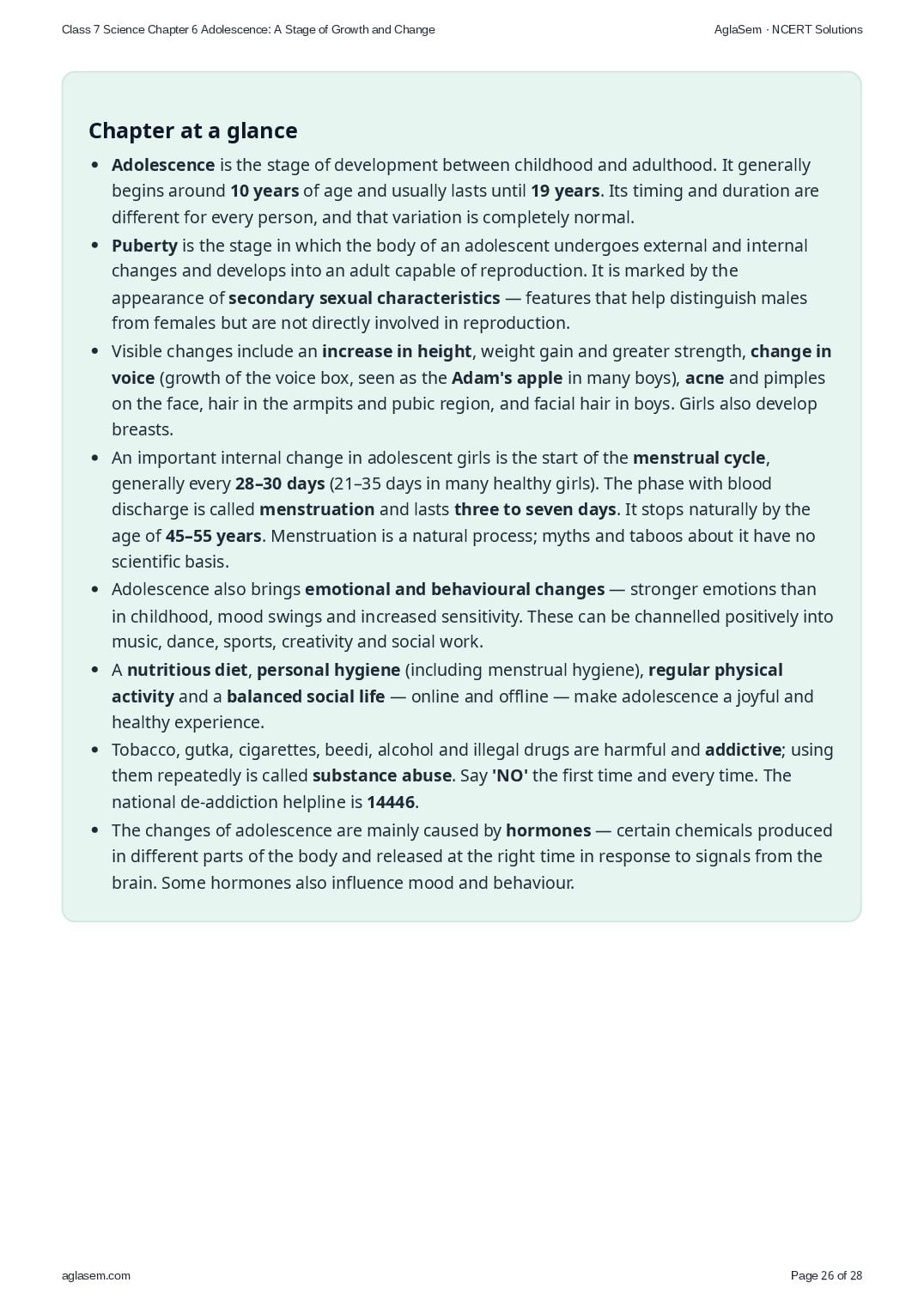
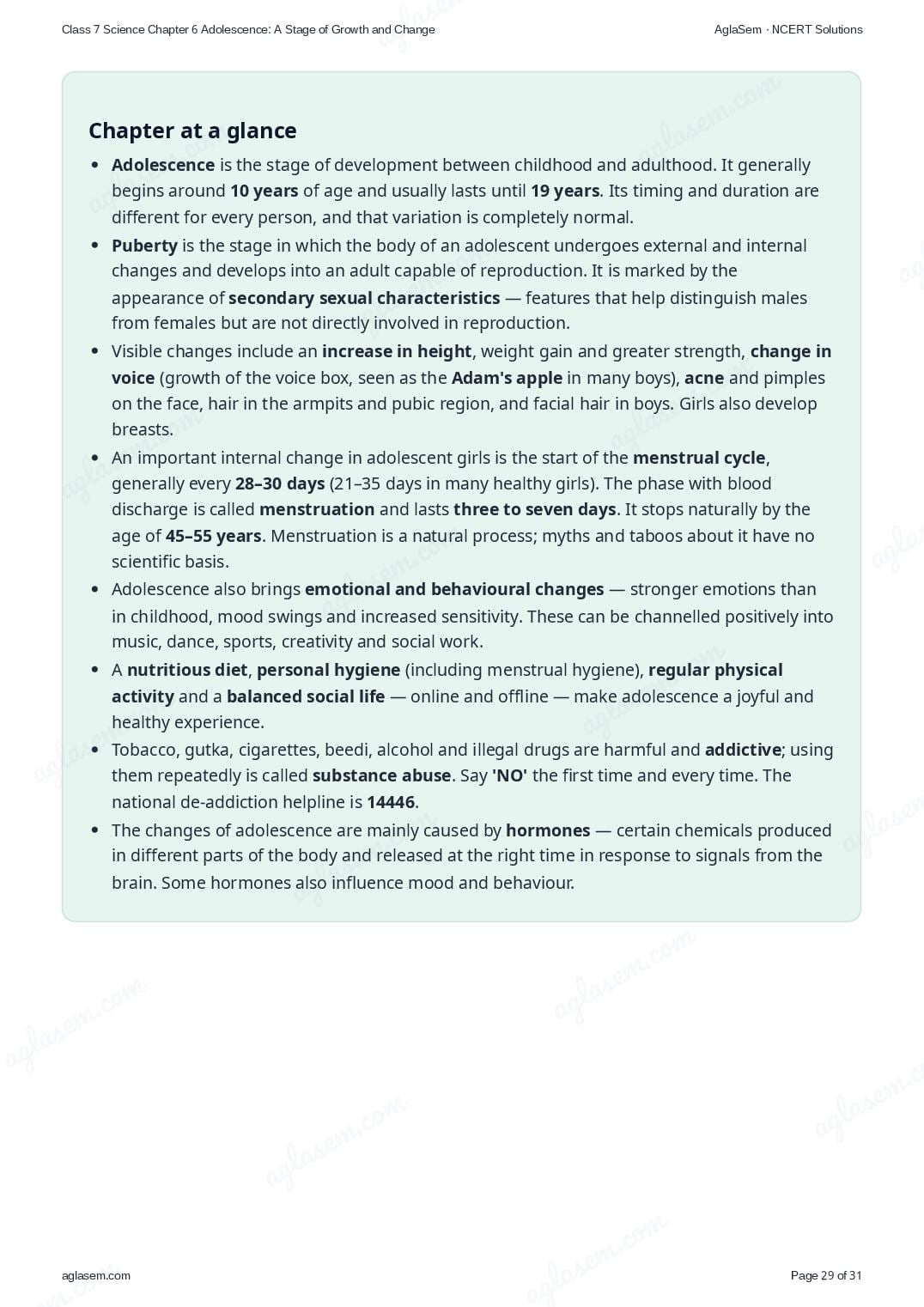
Chapter at a Glance
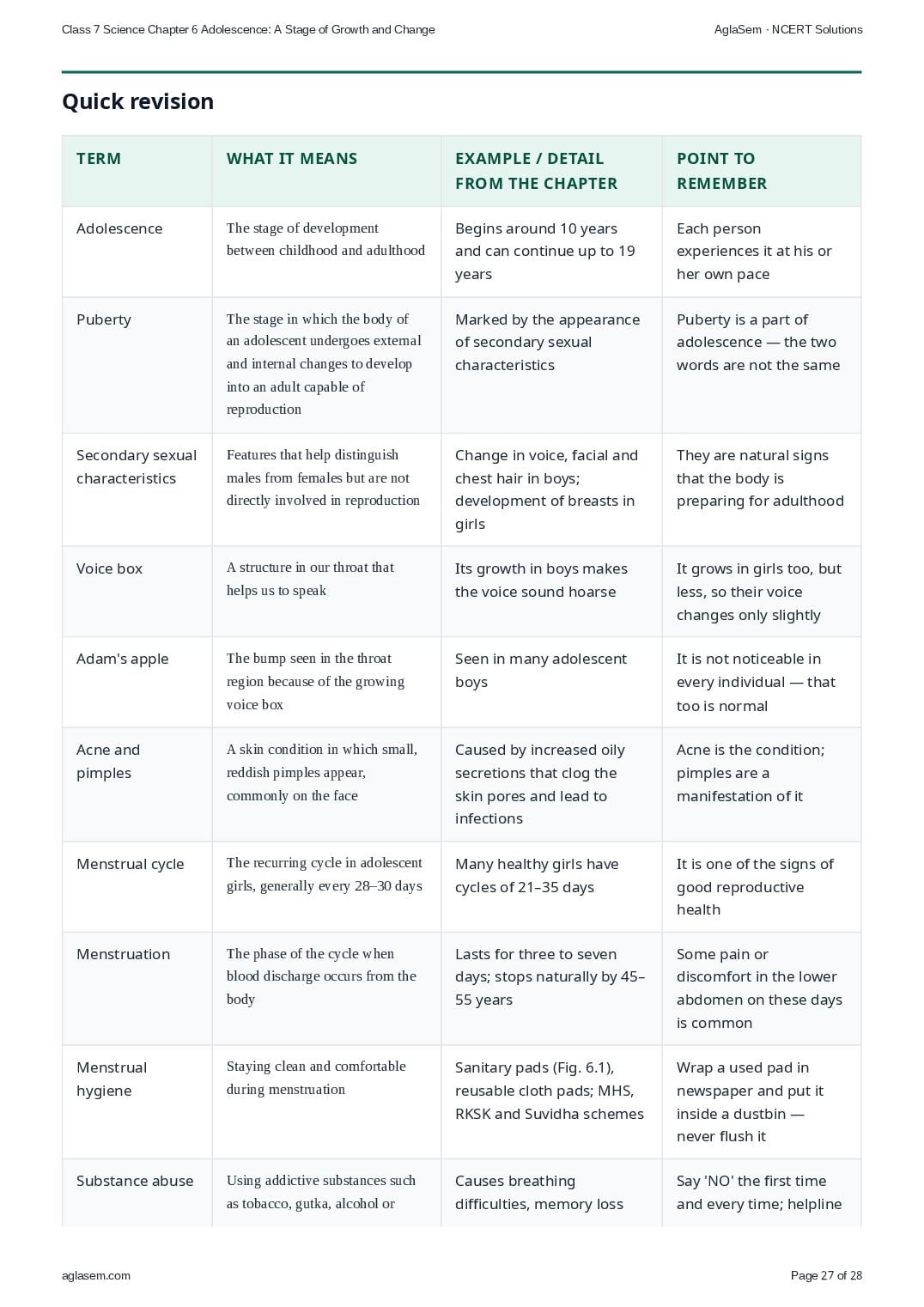
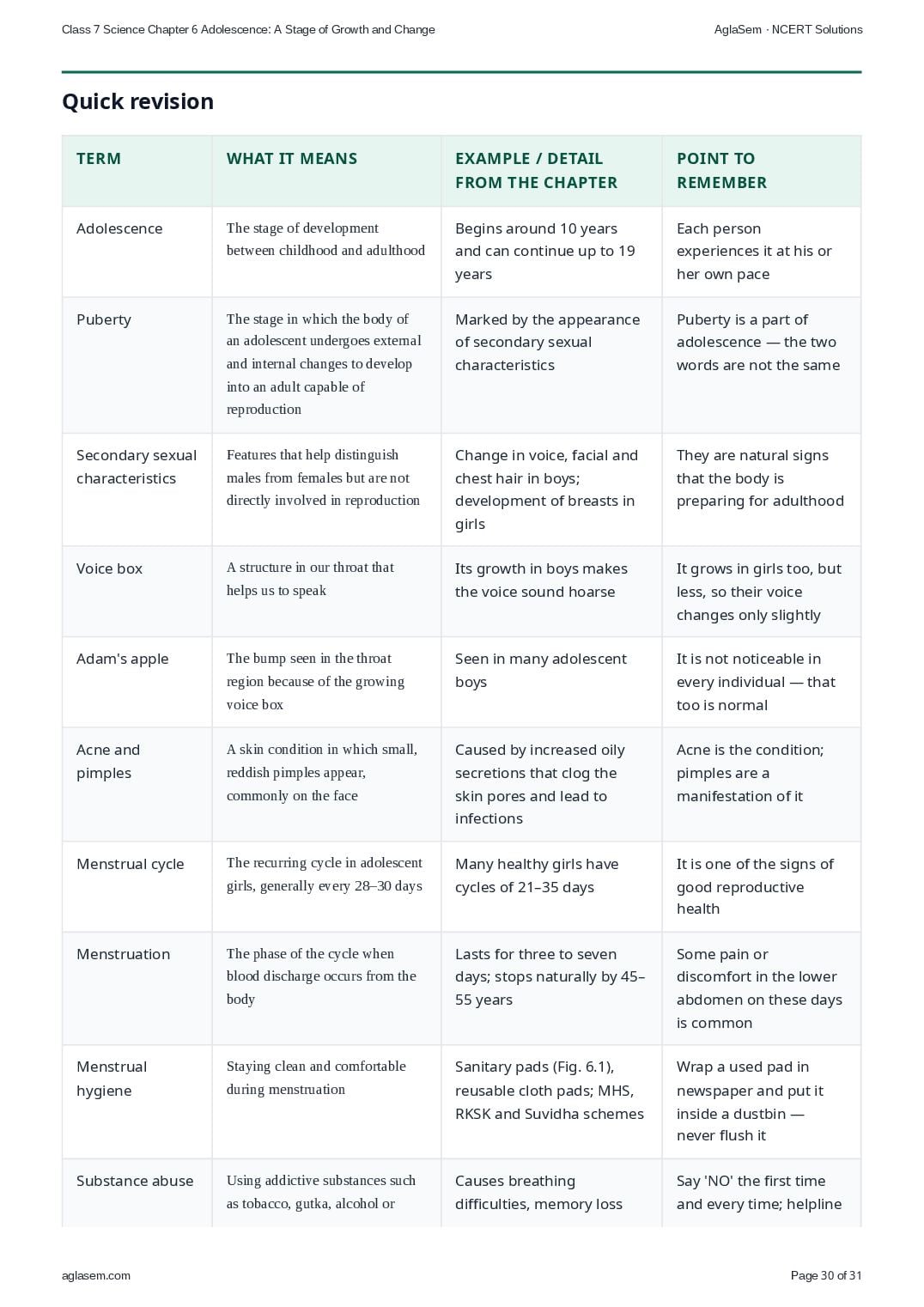
- Adolescence is the stage of development between childhood and adulthood. It generally begins around 10 years of age and usually lasts until 19 years . Its timing and duration are different for every person, and that variation is completely normal.
- Puberty is the stage in which the body of an adolescent undergoes external and internal changes and develops into an adult capable of reproduction. It is marked by the appearance of secondary sexual characteristics — features that help distinguish males from females but are not directly involved in reproduction.
- Visible changes include an increase in height , weight gain and greater strength, change in voice (growth of the voice box, seen as the Adam's apple in many boys), acne and pimples on the face, hair in the armpits and pubic region, and facial hair in boys. Girls also develop breasts.
- An important internal change in adolescent girls is the start of the menstrual cycle , generally every 28–30 days (21–35 days in many healthy girls). The phase with blood discharge is called menstruation and lasts three to seven days . It stops naturally by the age of 45–55 years . Menstruation is a natural process; myths and taboos about it have no scientific basis.
- Adolescence also brings emotional and behavioural changes — stronger emotions than in childhood, mood swings and increased sensitivity. These can be channelled positively into music, dance, sports, creativity and social work.
- A nutritious diet , personal hygiene (including menstrual hygiene), regular physical activity and a balanced social life — online and offline — make adolescence a joyful and healthy experience.
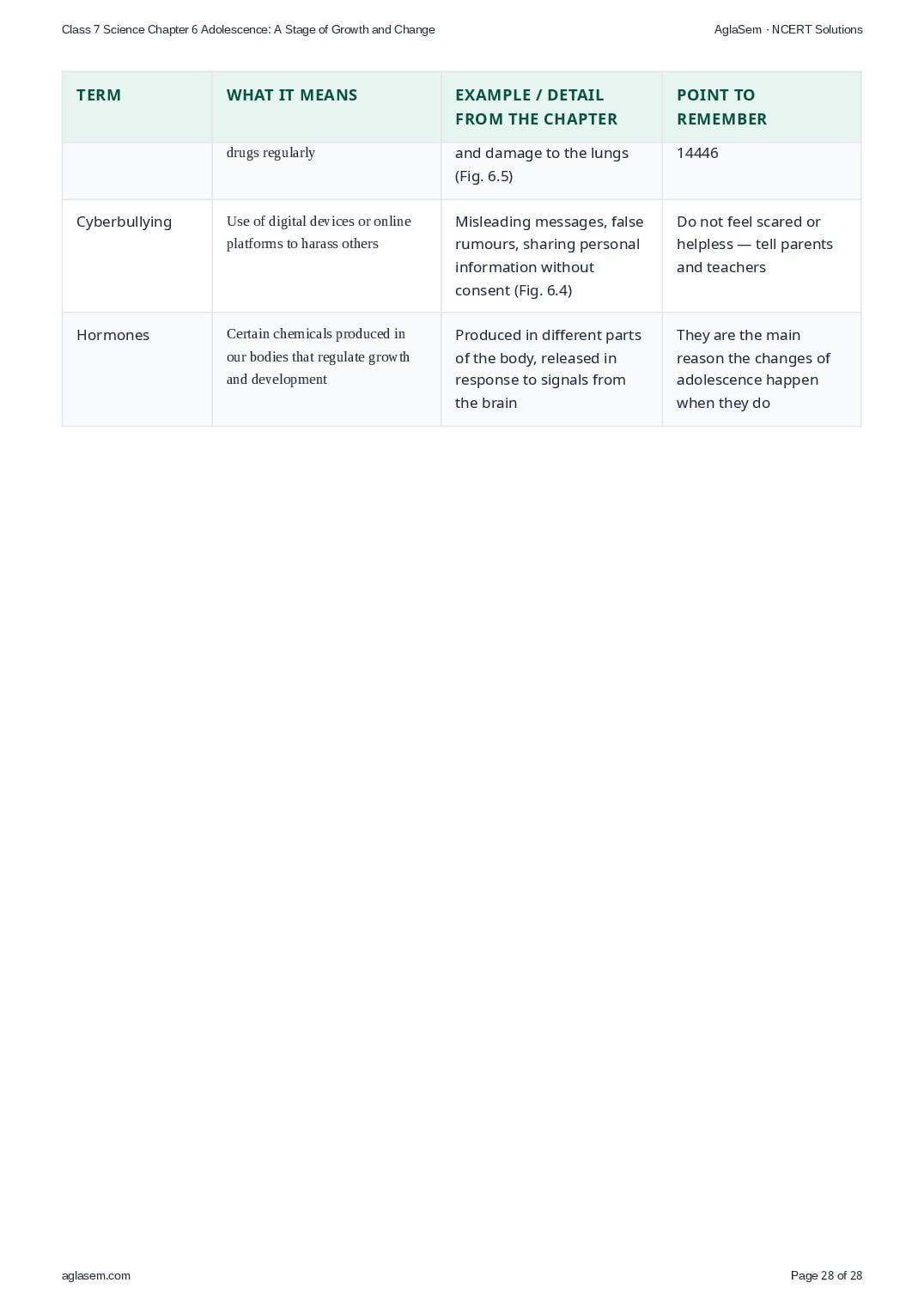
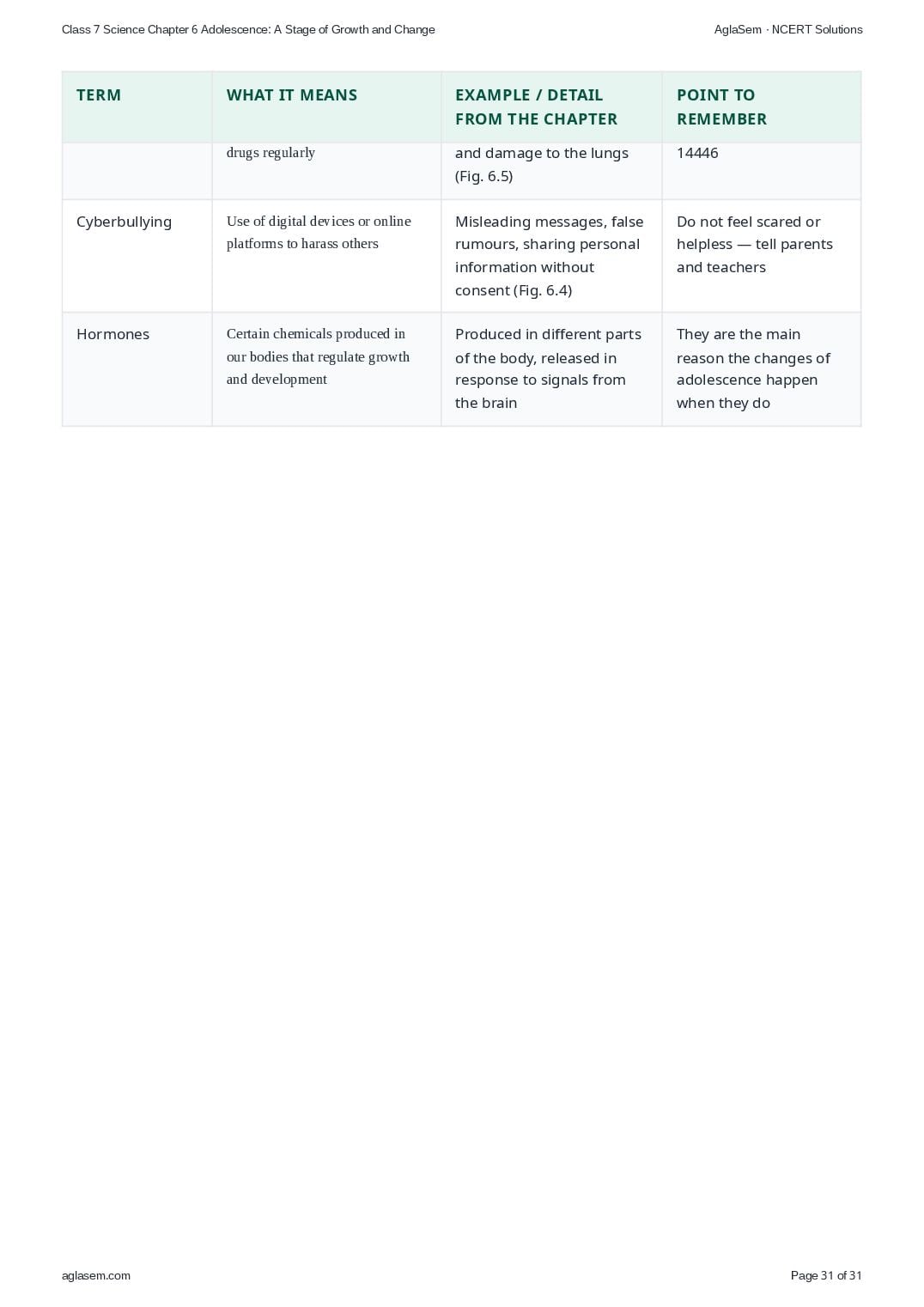
- Tobacco, gutka, cigarettes, beedi, alcohol and illegal drugs are harmful and addictive ; using them repeatedly is called substance abuse . Say 'NO' the first time and every time. The national de-addiction helpline is 14446 .
- The changes of adolescence are mainly caused by hormones — certain chemicals produced in different parts of the body and released at the right time in response to signals from the brain. Some hormones also influence mood and behaviour.
How to Download NCERT Solutions for Class 7 Science Chapter 6 PDF
Follow these simple steps to get the Adolescence a Stage of Growth and Change questions-and-answers PDF from Curiosity.
- Search NCERT Solutions for Class 7 Science Chapter 6 aglasem and open this page.
- Read the exercise questions with answers for Adolescence a Stage of Growth and Change shown above.
- Click the Download PDF link to save the Adolescence a Stage of Growth and Change solutions to your device.
NCERT Solutions for Class 7 Science – All Chapters
There are more chapters to study besides Adolescence a Stage of Growth and Change in Science. Here are the NCERT Solutions for all chapters of Class 7 Science.
- Chapter 1 the Ever Evolving World of Science
- Chapter 2 Exploring Substances Acidic Basic and Neutral
- Chapter 3 Electricity Circuits and Their Components
- Chapter 4 the World of Metals and Non Metals
- Chapter 5 Changes Around Us Physical and Chemical
- Chapter 6 Adolescence a Stage of Growth and Change
- Chapter 7 Heat Transfer in Nature
- Chapter 8 Measurement of Time and Motion
- Chapter 9 Life Processes in Animals
- Chapter 10 Life Processes in Plants
- Chapter 11 Light Shadows and Reflections
- Chapter 12 Earth Moon and the Sun
NCERT Solutions for Class 7 – All Subjects
Just like Chapter 6 of Science, you can get the exercise questions with answers for every other subject of Class 7. Here are the NCERT Solutions for all subjects of Class 7.
NCERT Solutions for Class 7 Science Chapter 6 – An Overview
The key highlights of this study material are as follows.
| Aspects | Details |
|---|---|
| Class | Class 7 |
| Subject | Science |
| Chapter Number | Chapter 6 |
| Chapter Name | Adolescence a Stage of Growth and Change |
| Book Name | Curiosity |
| Book By | NCERT (National Council of Educational Research and Training) |
| Educational Resource Here | NCERT Solutions of Class 7 Science Chapter 6 for all exercises |
| More Questions Answers of This Subject | NCERT Solutions for Class 7 Science |
| Download Book Chapter | NCERT Book Class 7 Science |
| All Questions Answers For This Class | NCERT Solutions for Class 7 |
| Complete Solutions | NCERT Solutions |
NCERT Solutions for Class 7 Science Chapter 6 Adolescence a Stage of Growth and Change – FAQs
What are the NCERT Solutions for Class 7 Science Chapter 6 Adolescence a Stage of Growth and Change?
They are the complete, step-by-step answers to all the exercise and in-text questions of Chapter 6 Adolescence a Stage of Growth and Change from the NCERT Class 7 Science textbook Curiosity, written by experts as per the latest NCERT syllabus.
How can I download the Class 7 Science Chapter 6 solutions PDF for free?
Open this page on aglasem, read the Adolescence a Stage of Growth and Change questions with answers, and click the “Download Solutions PDF” link. The Class 7 Science Chapter 6 NCERT Solutions PDF is completely free to download.
Are these NCERT Solutions as per the latest 2026-27 syllabus?
Yes. The NCERT Solutions for Class 7 Science Chapter 6 are based on the latest NCERT textbook Curiosity and the current 2026-27 CBSE syllabus, so the questions and answers match what you study in class.
Where can I get NCERT Solutions for the other chapters of Class 7 Science?
You can find the answers to every chapter on the NCERT Solutions for Class 7 Science page, and solutions for every subject on the NCERT Solutions for Class 7 page.
How do NCERT Solutions help in exam preparation?
They show the correct method to solve each question, help you write answers the way they are expected in exams, let you check and correct your own work, and save revision time — which together improve your marks in Class 7 Science.
If you have any queries on NCERT Solutions for Class 7 Science Chapter 6 Adolescence a Stage of Growth and Change, then please ask in the comments below.