NCERT Solutions for Class 7 Science Chapter 4 the World of Metals and Non Metals provide clear, step-by-step answers to every exercise and in-text question from the chapter the World of Metals and Non Metals of the NCERT textbook Curiosity. Prepared by subject experts as per the latest NCERT (CBSE) syllabus for 2026-27, these NCERT Solutions for Class 7 Science help you understand each concept, write exam-ready answers, and check your own solutions. You can read them online below or download the free Class 7 Science Chapter 4 question-answer PDF.
NCERT Solutions for Class 7 Science Chapter 4 the World of Metals and Non Metals
- Class: Class 7
- Subject: Science
- Chapter: Chapter 4 – the World of Metals and Non Metals
- Textbook: Curiosity (NCERT)
- Study material: NCERT Solutions – questions with answers, free PDF
These solutions answer all the exercise questions of Chapter 4 the World of Metals and Non Metals — including the in-text questions, short-answer and long-answer questions, and activities — with complete explanations so you can follow the method, not just the final answer. Read the full solutions below.
NCERT Solutions Class 7 Science Chapter 4 the World of Metals and Non Metals View Download
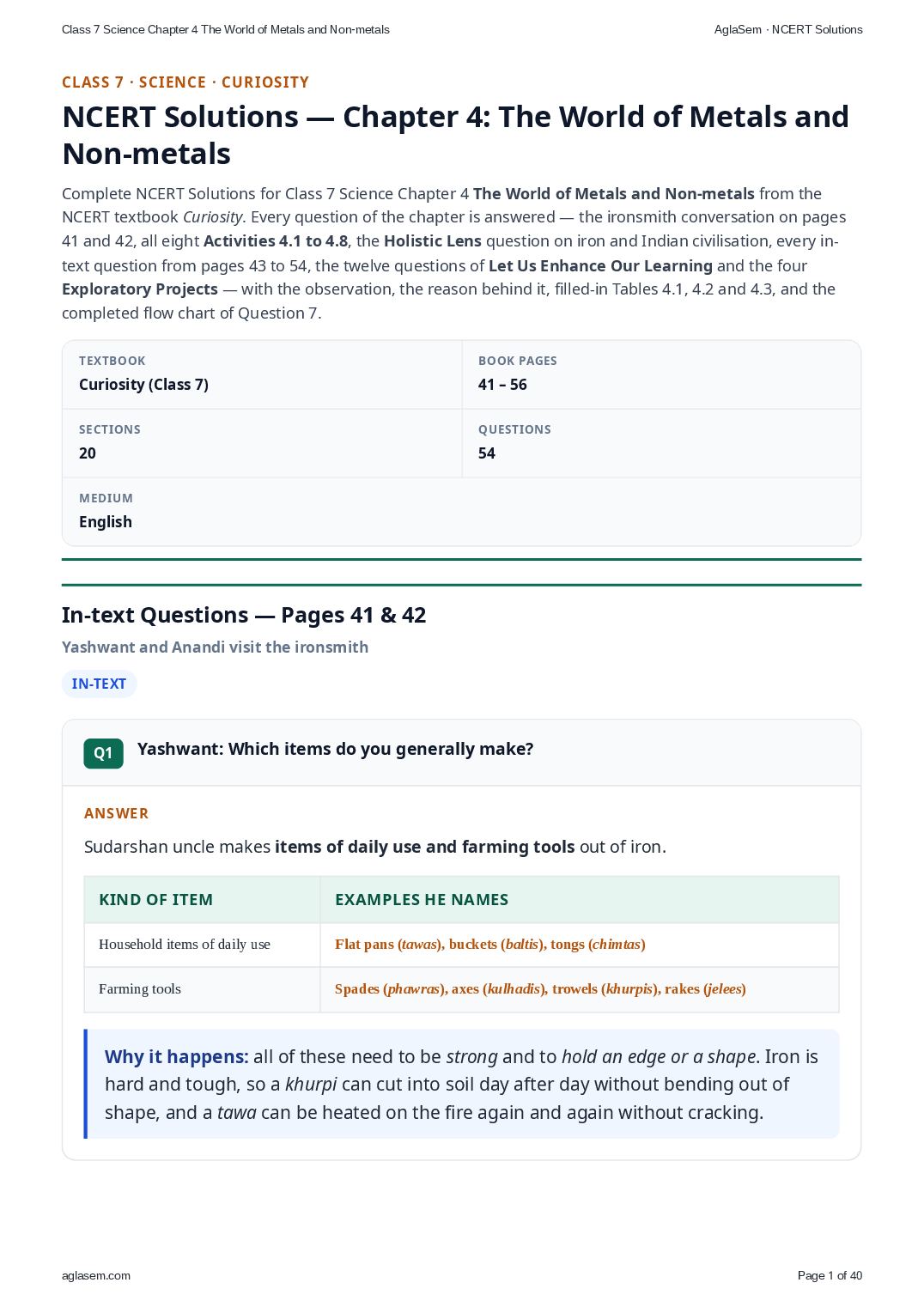
NCERT Solutions for Class 7 Science Chapter 4 PDF Download
You can read the NCERT Solutions for Class 7 Science Chapter 4 online above, or download the complete question-answer PDF to study the World of Metals and Non Metals offline at any time.
NCERT Solutions for Class 7 Science Chapter 4 PDF Download Link – Click Here to Download Solutions PDF
Questions Covered in This Chapter
These NCERT Solutions answer all 54 questions of this chapter. The questions solved are:
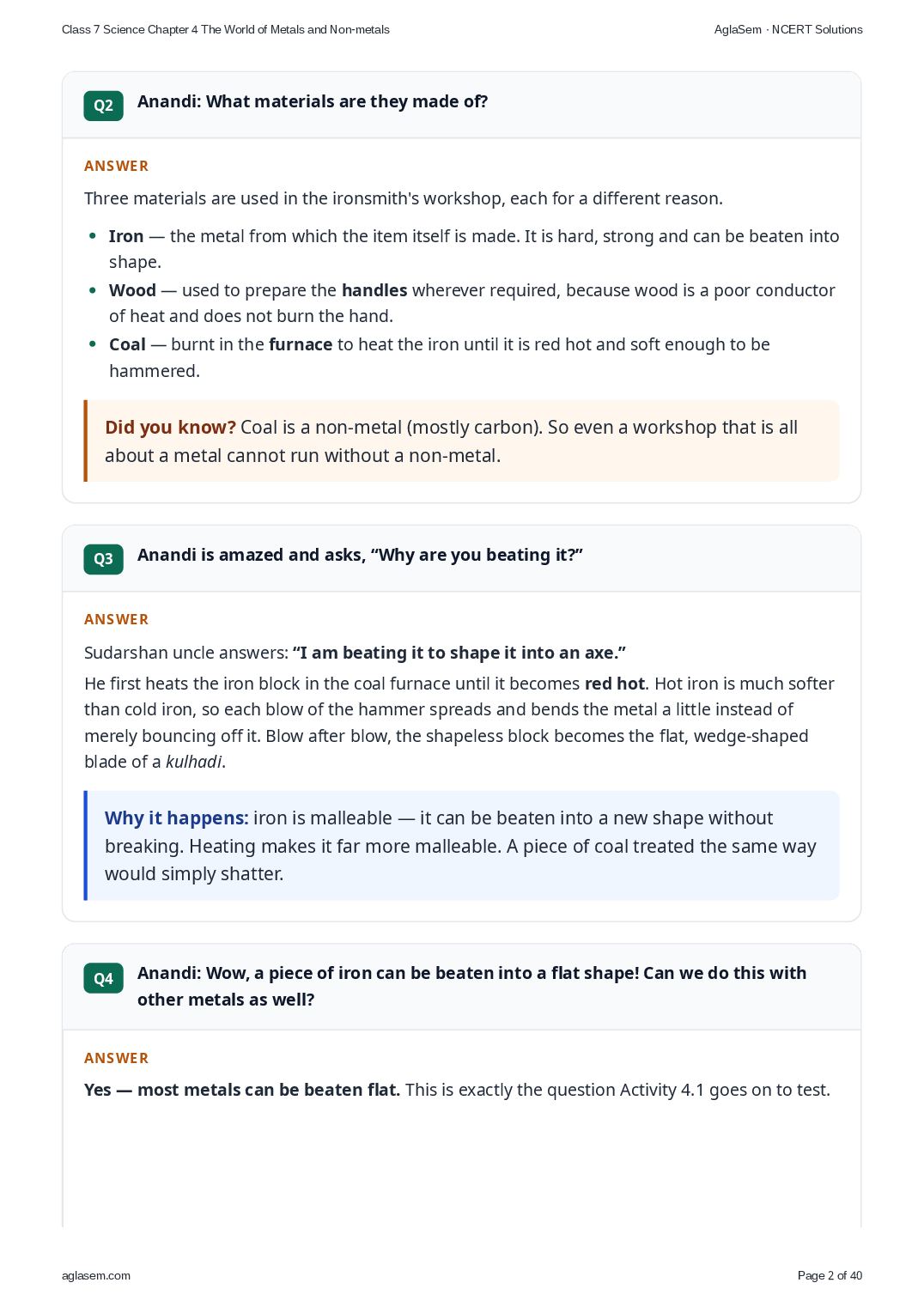
- Yashwant: Which items do you generally make?
- Anandi: What materials are they made of?
- Anandi is amazed and asks, “Why are you beating it?”
- Anandi: Wow, a piece of iron can be beaten into a flat shape! Can we do this with other metals as well?
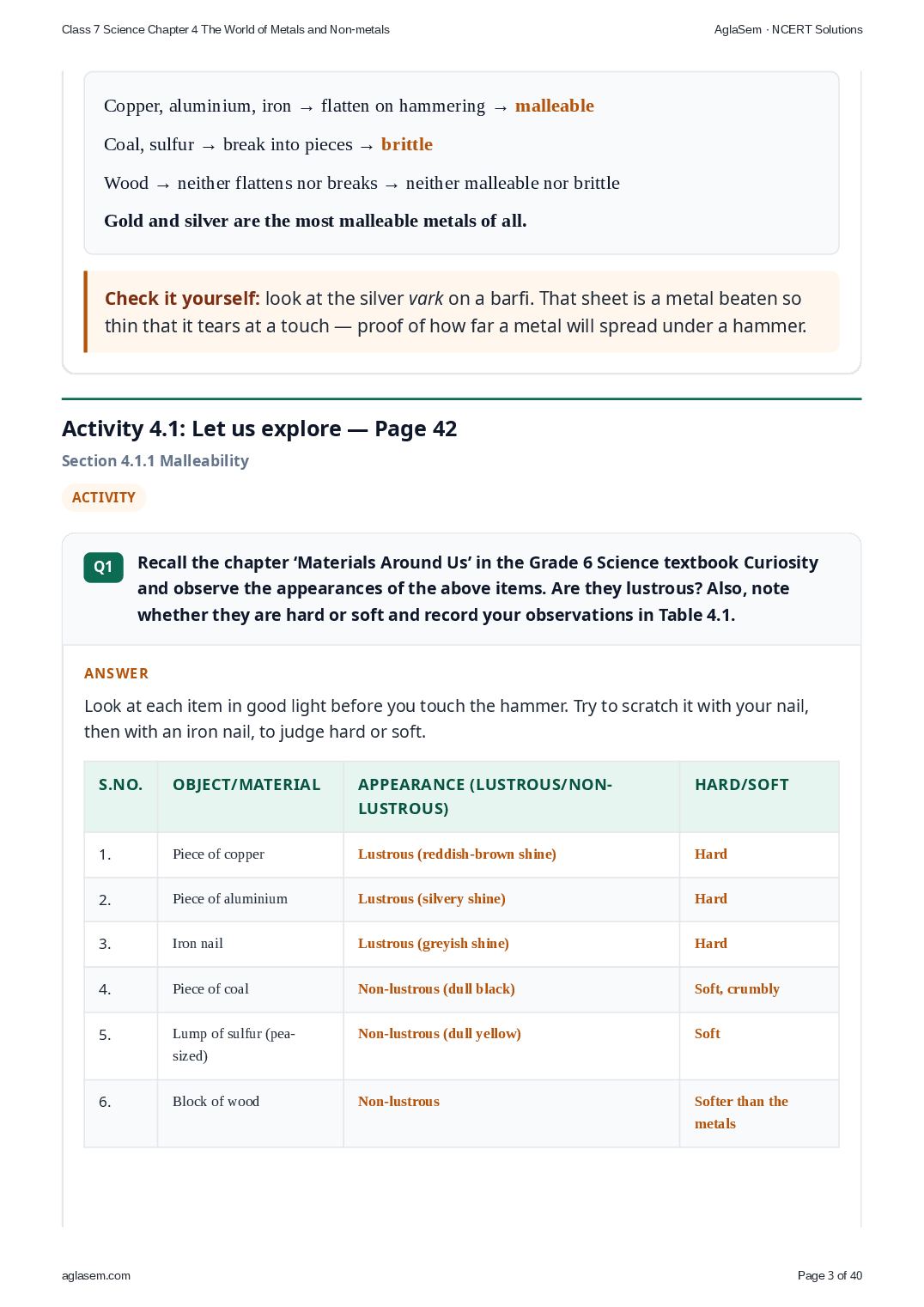
- Recall the chapter ‘Materials Around Us’ in the Grade 6 Science textbook Curiosity and observe the appearances of the above items. Are they lustrous? Also, note whether they are hard or soft and record your observations in Table 4.1.
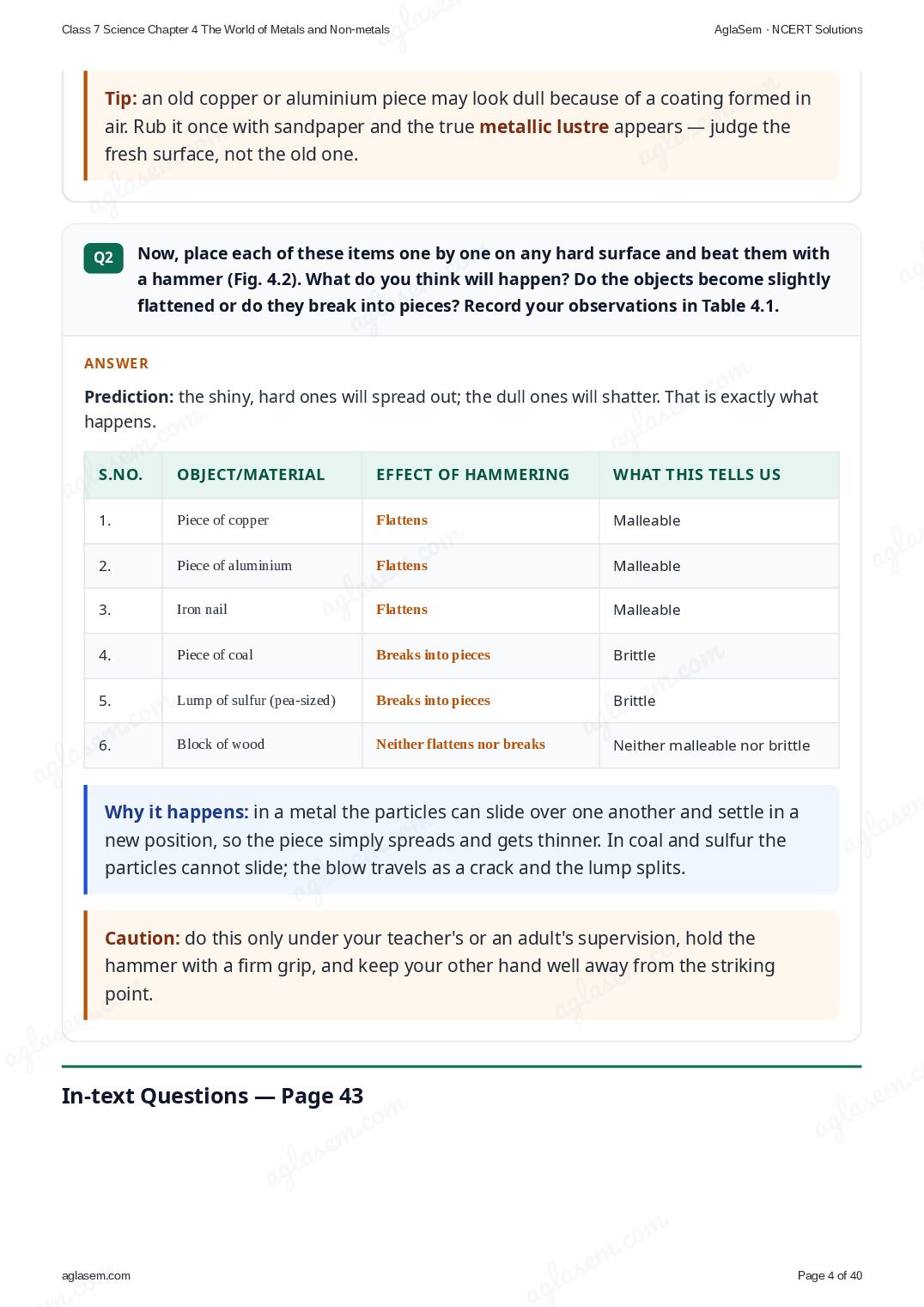
- Now, place each of these items one by one on any hard surface and beat them with a hammer (Fig. 4.2). What do you think will happen? Do the objects become slightly flattened or do they break into pieces? Record your observations in Table 4.1.
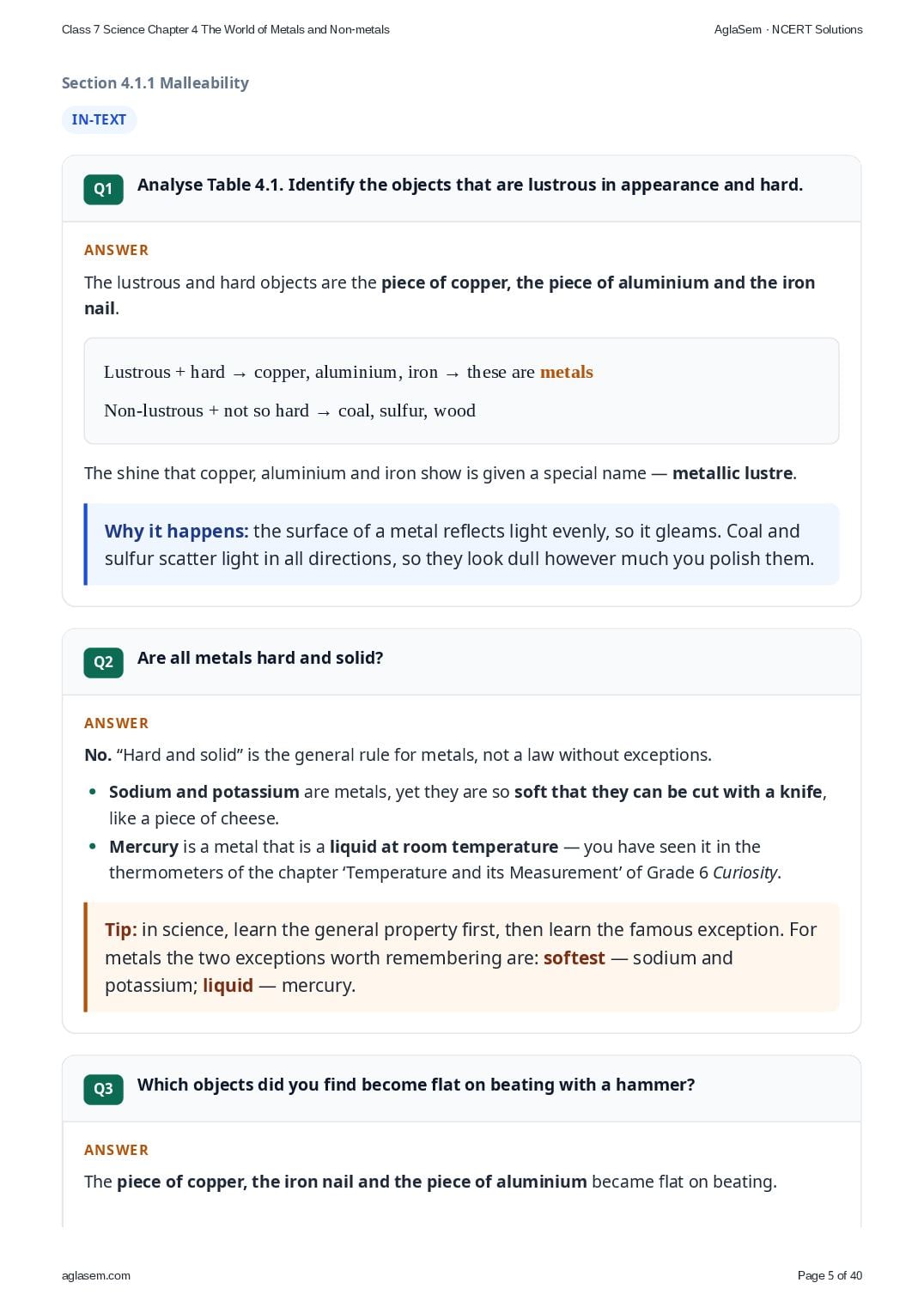
- Analyse Table 4.1. Identify the objects that are lustrous in appearance and hard.
- Are all metals hard and solid?
- Which objects did you find become flat on beating with a hammer?
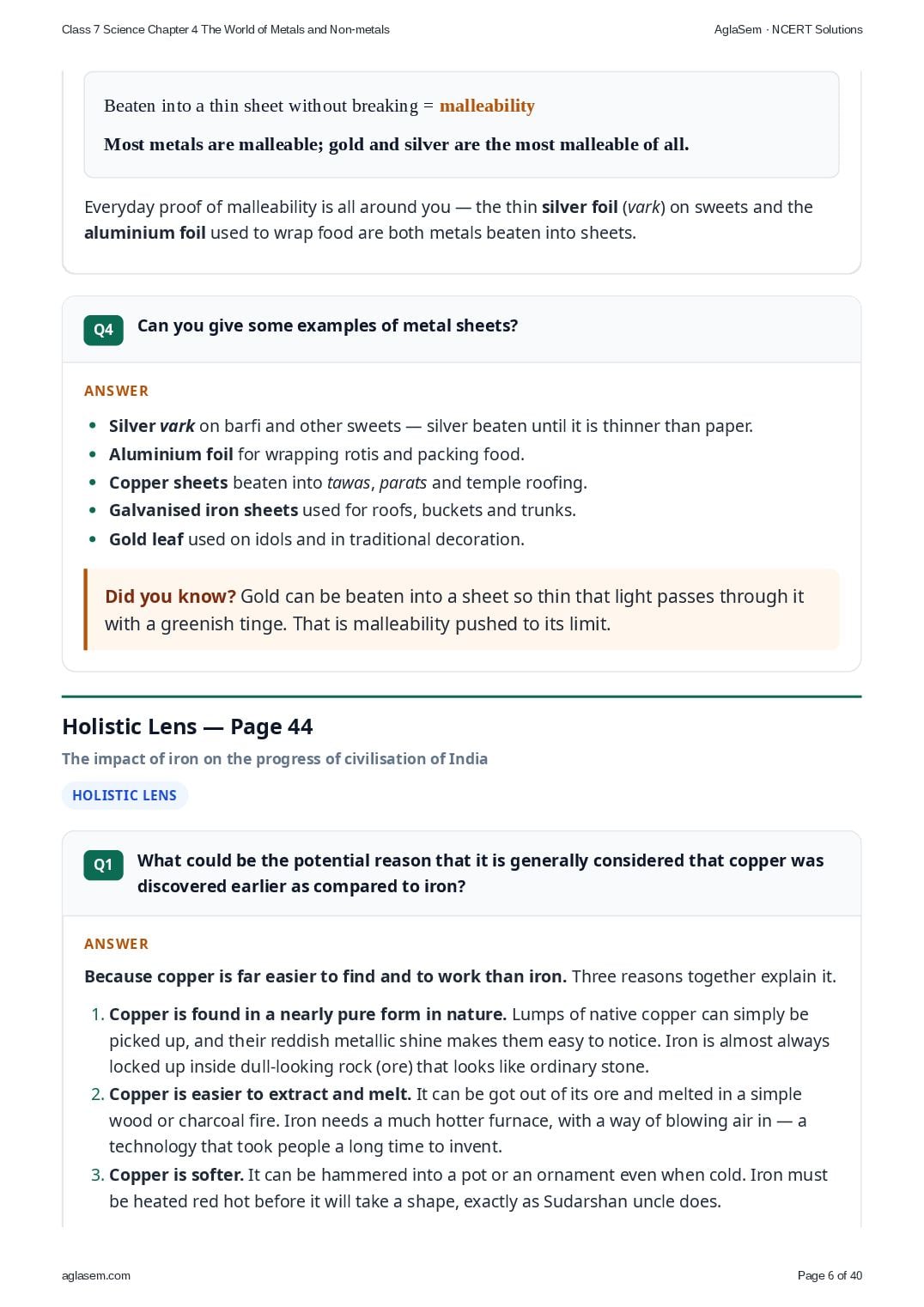
- Can you give some examples of metal sheets?
- What could be the potential reason that it is generally considered that copper was discovered earlier as compared to iron?
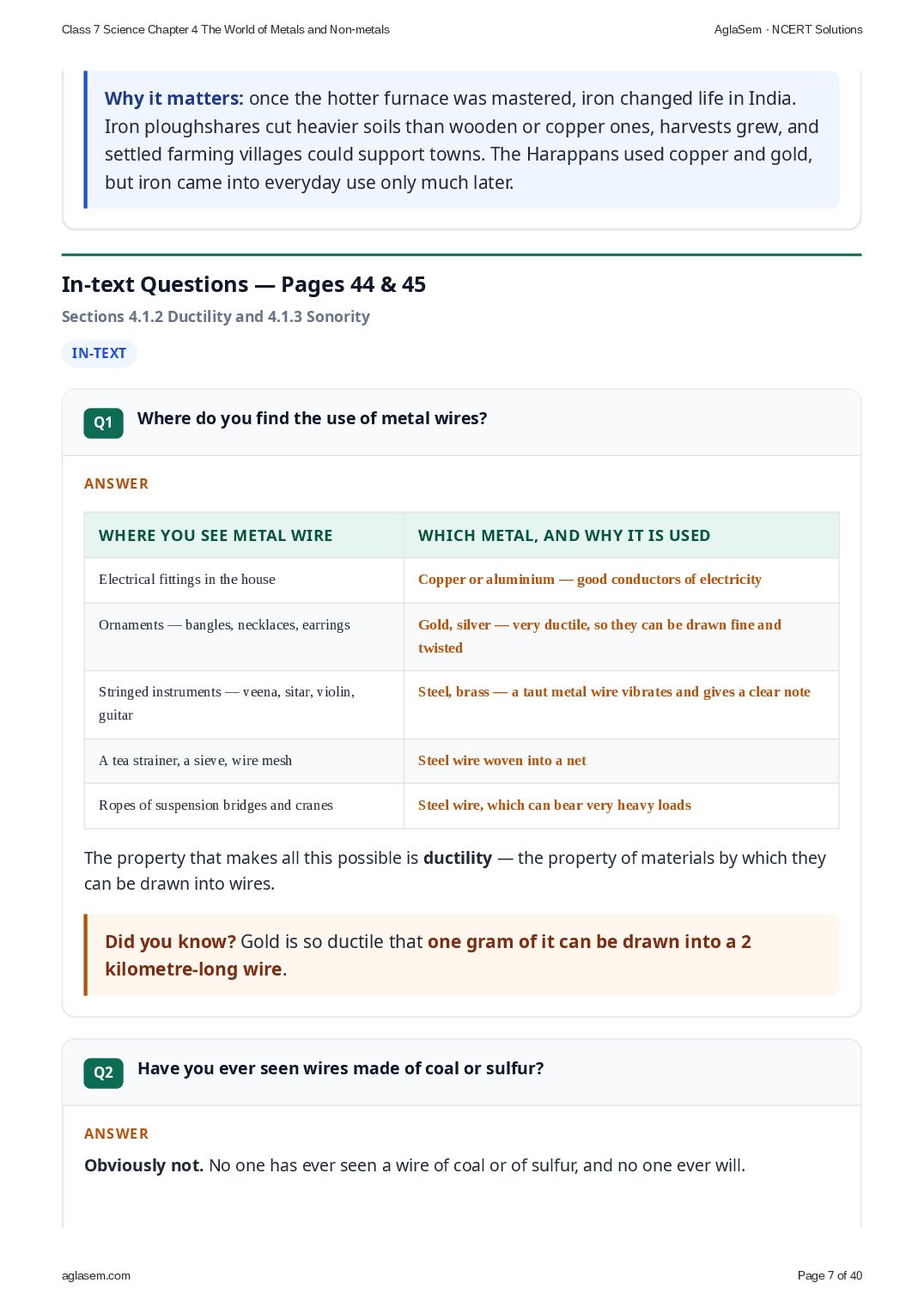
- Where do you find the use of metal wires?
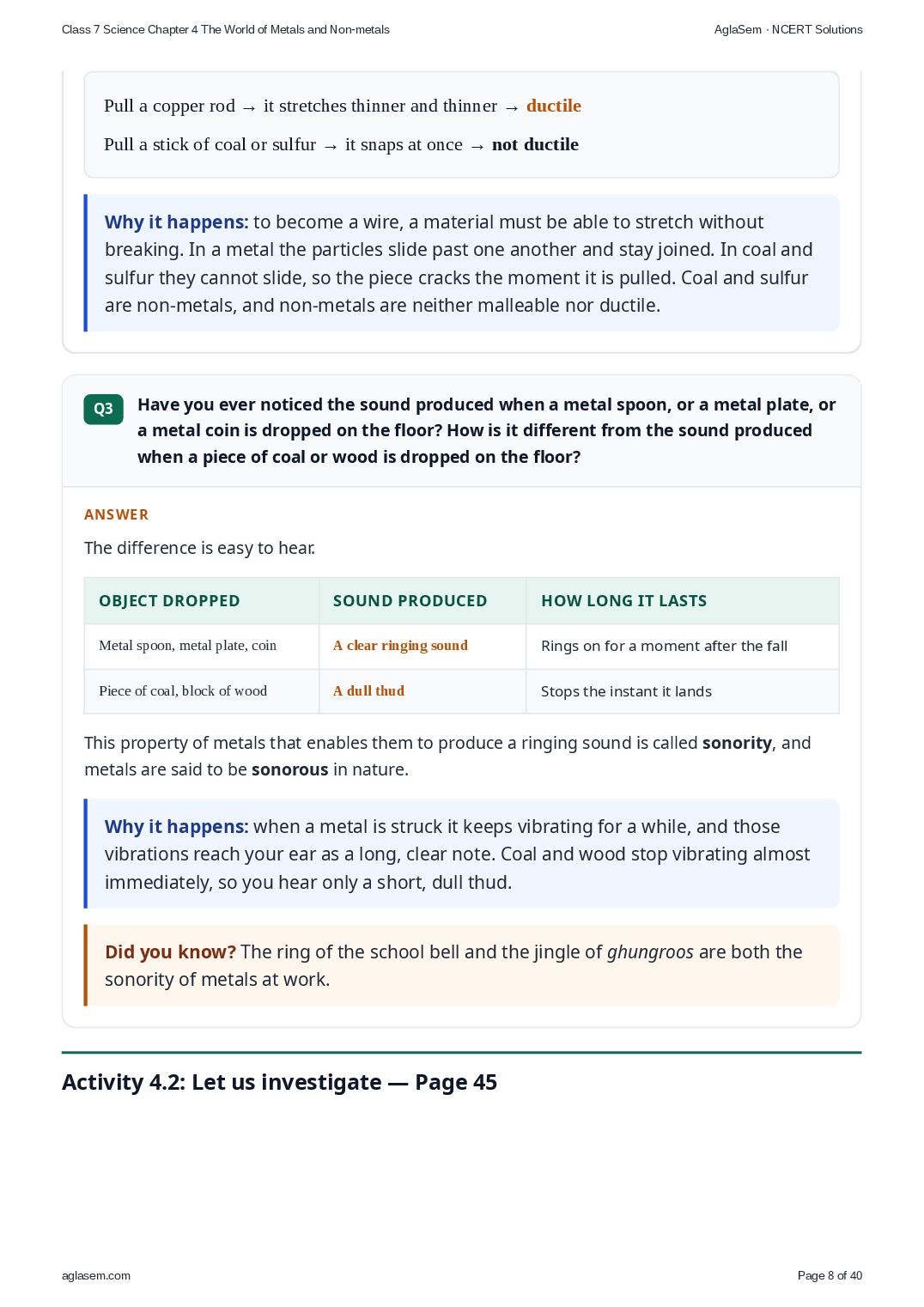
- Have you ever seen wires made of coal or sulfur?
- Have you ever noticed the sound produced when a metal spoon, or a metal plate, or a metal coin is dropped on the floor? How is it different from the sound produced when a piece of coal or wood is dropped on the floor?
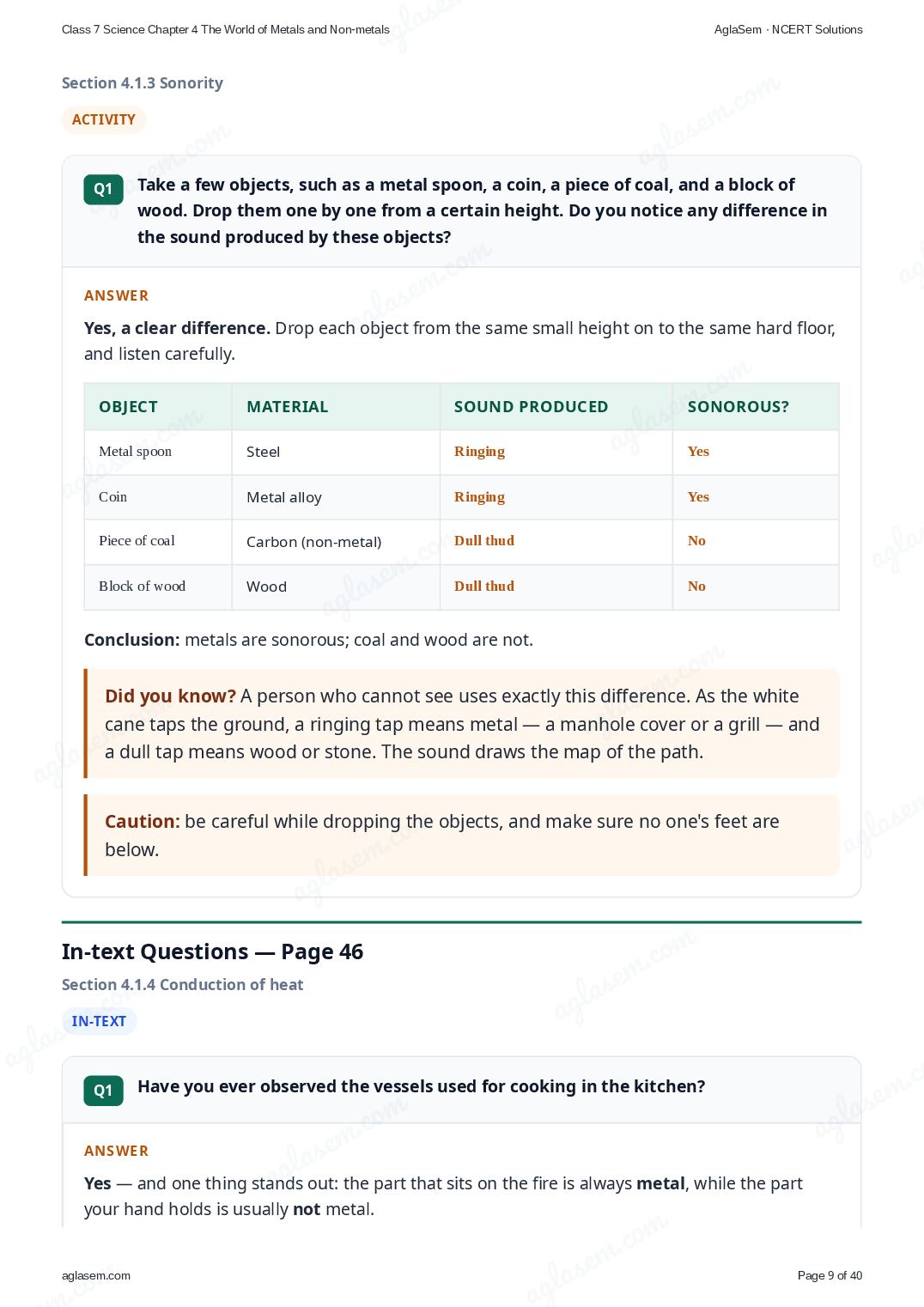
- Take a few objects, such as a metal spoon, a coin, a piece of coal, and a block of wood. Drop them one by one from a certain height. Do you notice any difference in the sound produced by these objects?
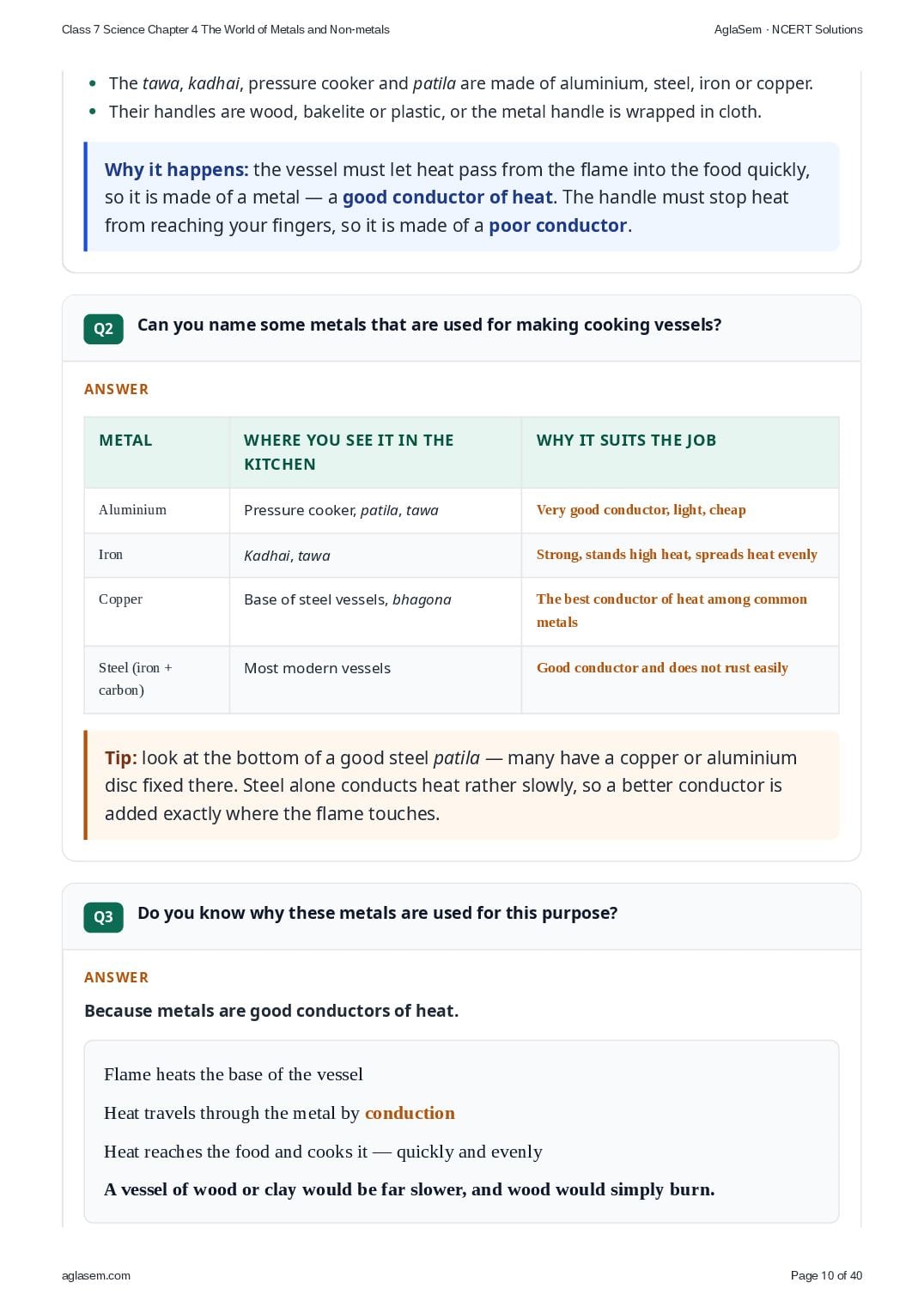
- Have you ever observed the vessels used for cooking in the kitchen?
- Can you name some metals that are used for making cooking vessels?
- Do you know why these metals are used for this purpose?
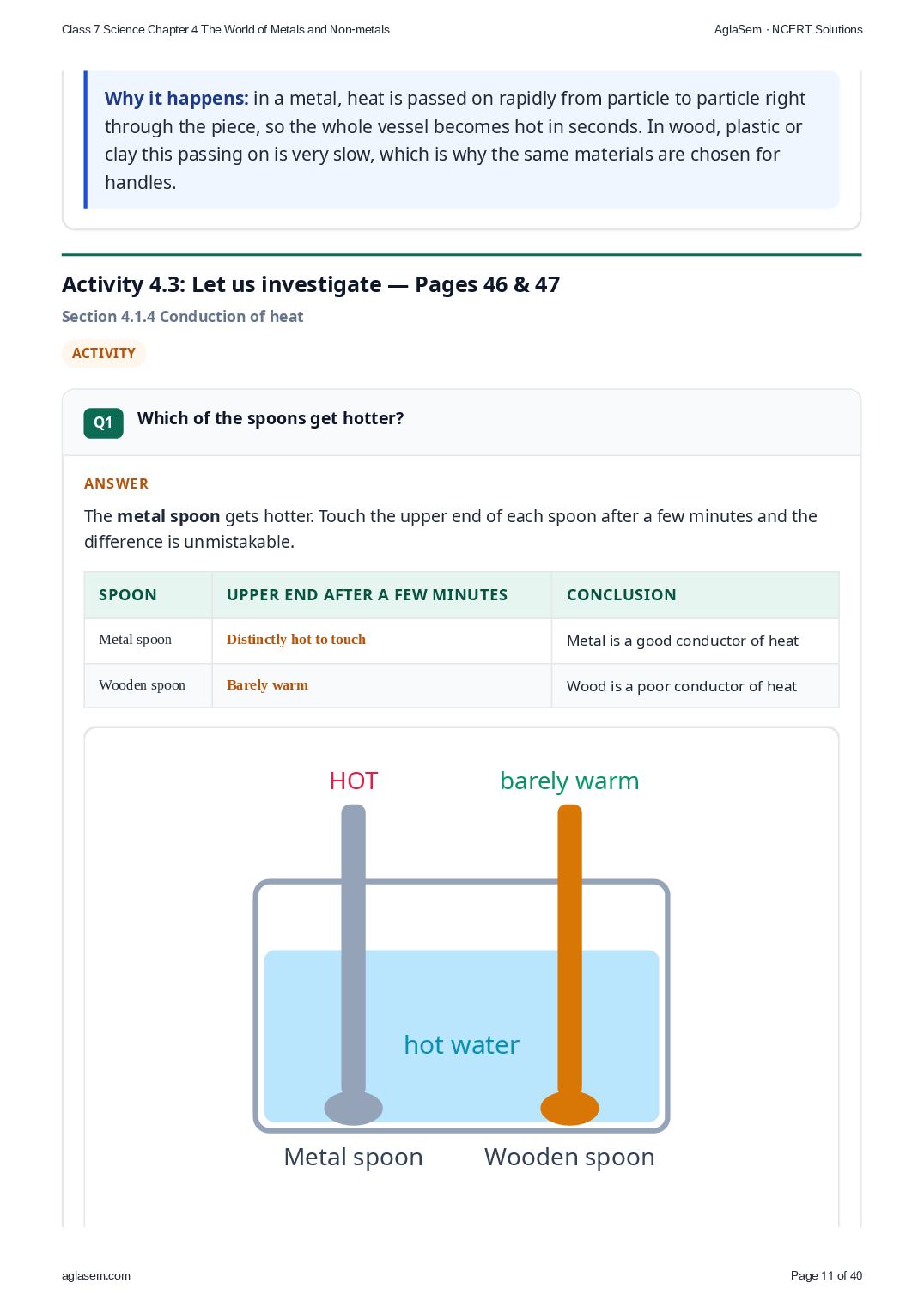
- Which of the spoons get hotter?
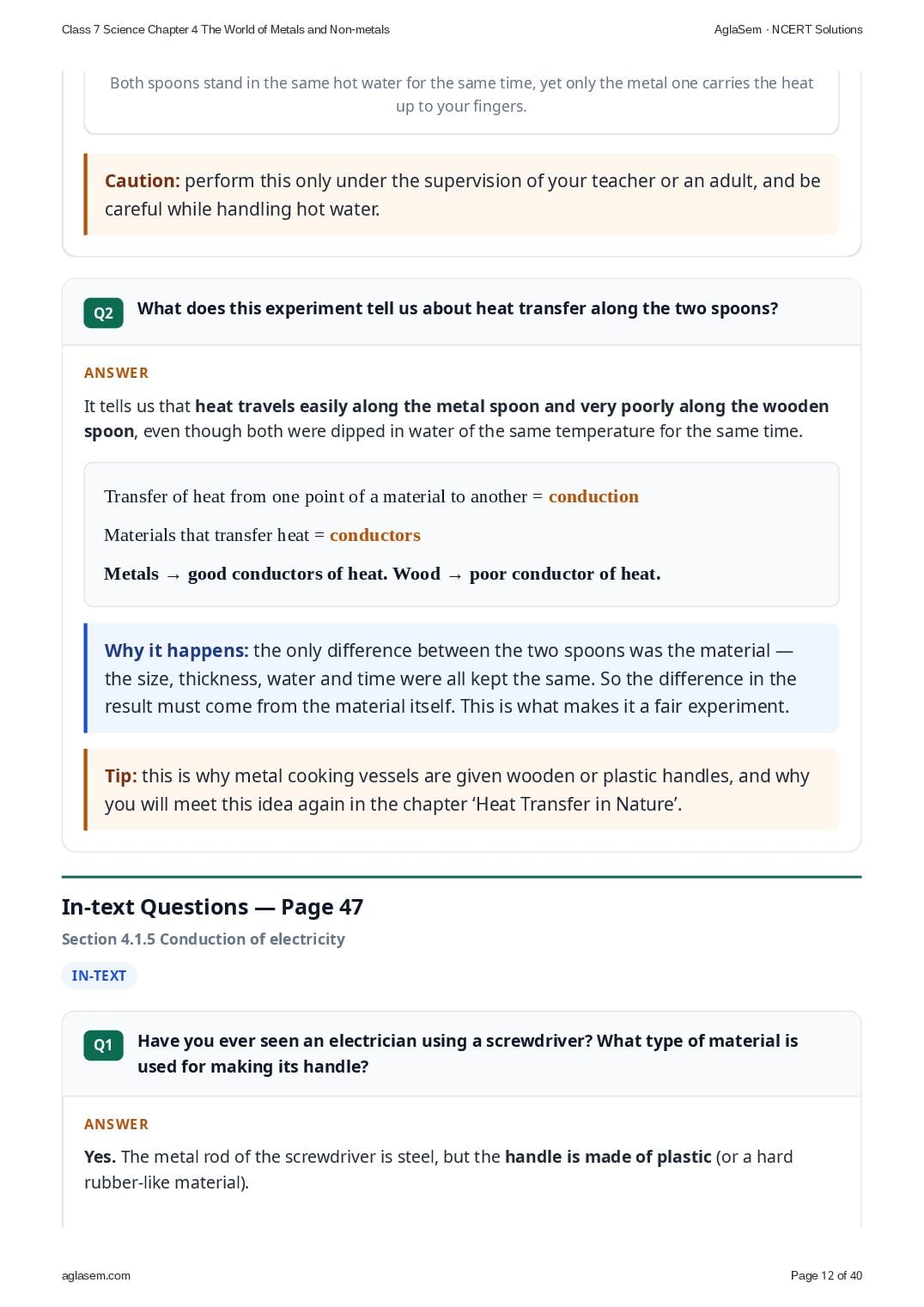
- What does this experiment tell us about heat transfer along the two spoons?
- Have you ever seen an electrician using a screwdriver? What type of material is used for making its handle?
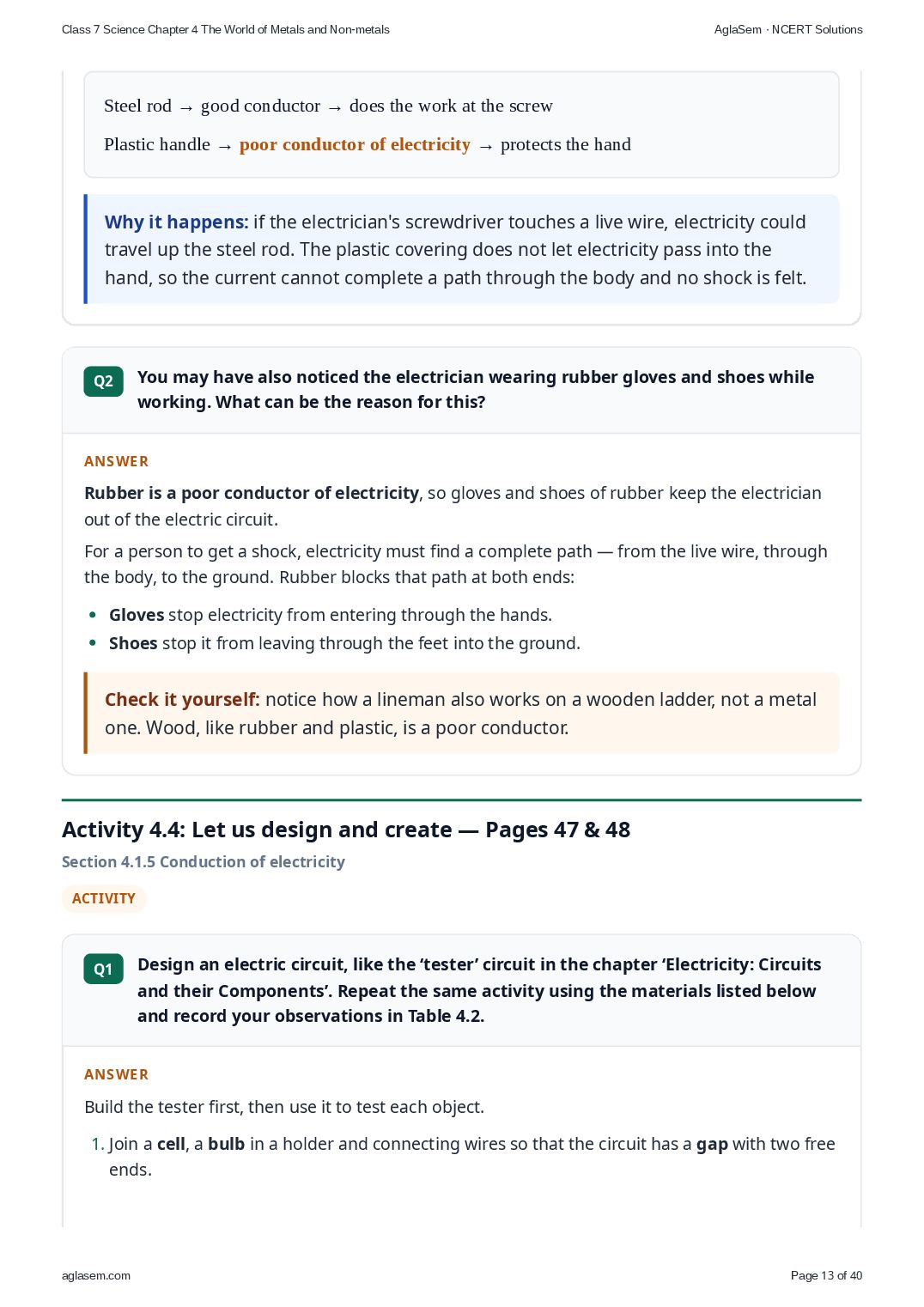
- You may have also noticed the electrician wearing rubber gloves and shoes while working. What can be the reason for this?
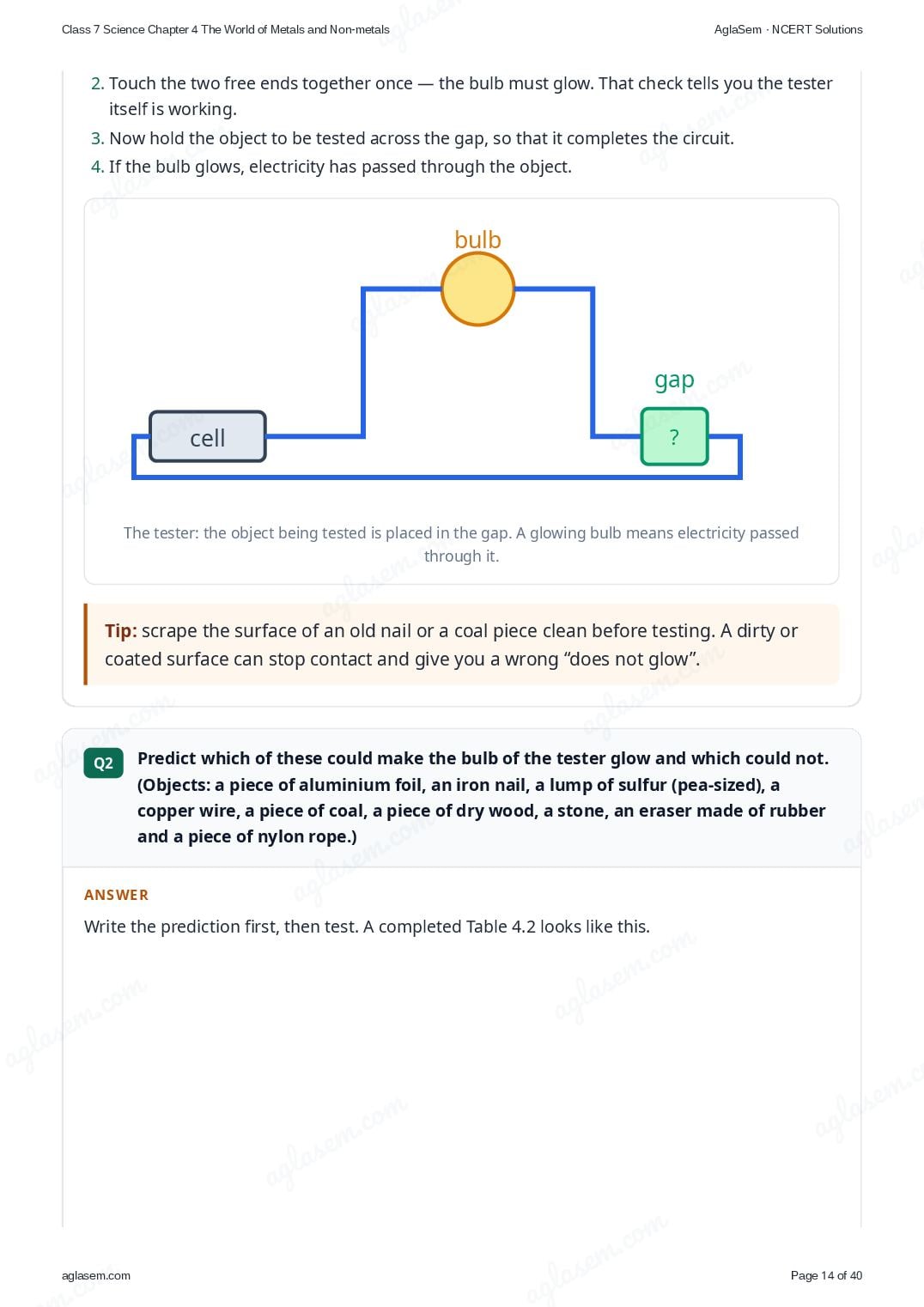
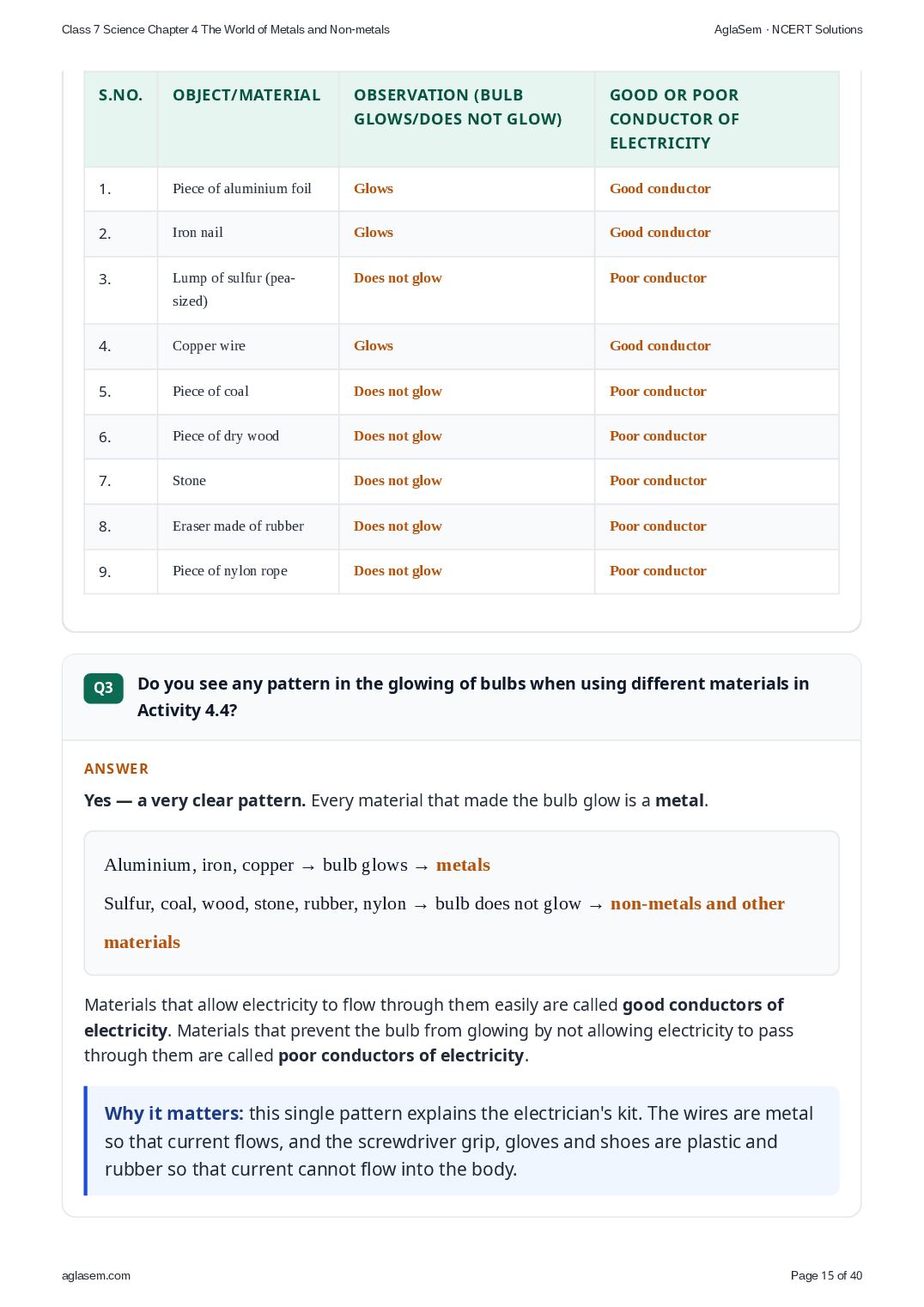
- Design an electric circuit, like the ‘tester’ circuit in the chapter ‘Electricity: Circuits and their Components’. Repeat the same activity using the materials listed below and record your observations in Table 4.2.
- Predict which of these could make the bulb of the tester glow and which could not. (Objects: a piece of aluminium foil, an iron nail, a lump of sulfur (pea-sized), a copper wire, a piece of coal, a piece of dry wood, a stone, an eraser made of rubber and a piece of nylon rope.)
- Do you see any pattern in the glowing of bulbs when using different materials in Activity 4.4?
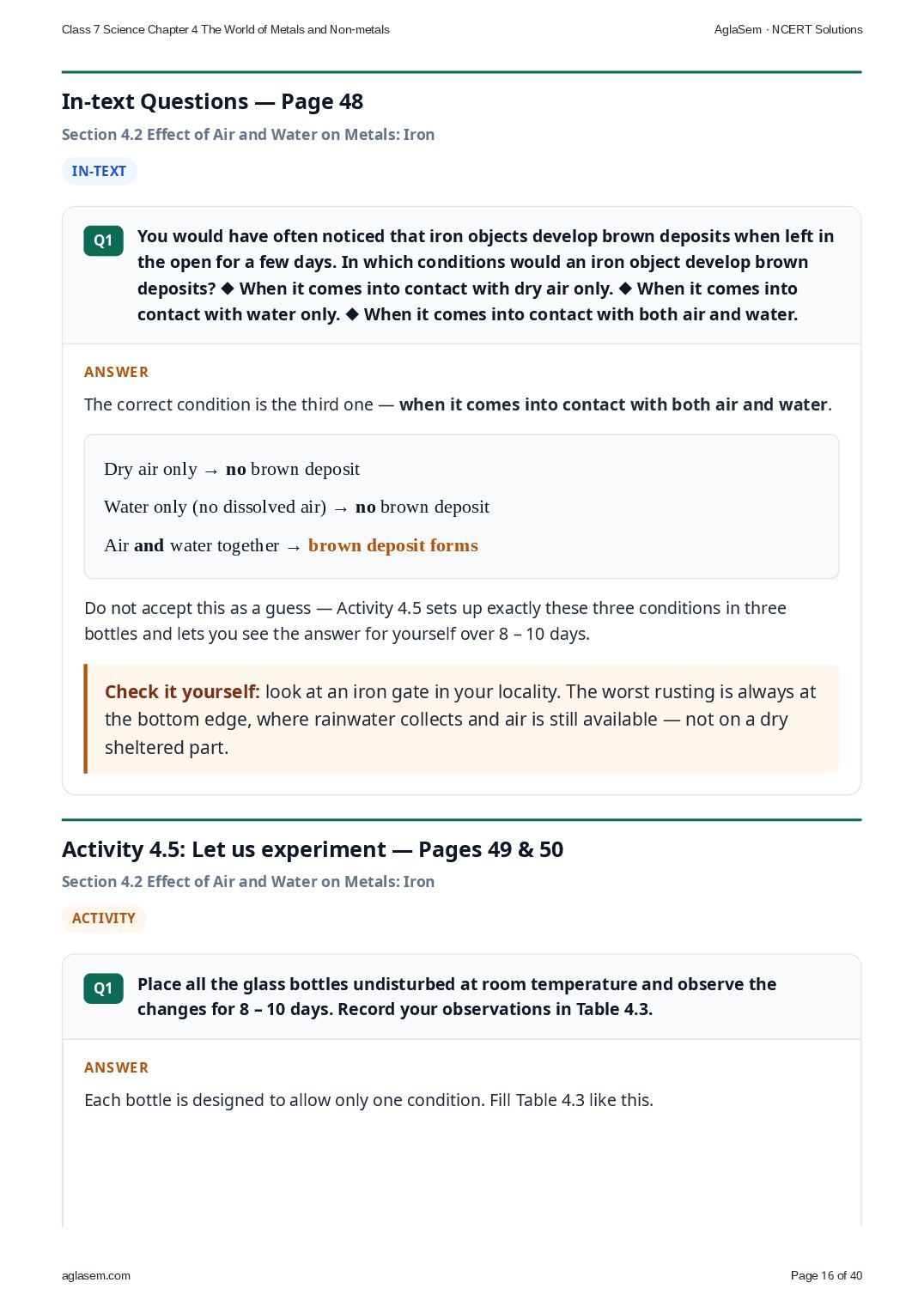
- You would have often noticed that iron objects develop brown deposits when left in the open for a few days. In which conditions would an iron object develop brown deposits? ❖ When it comes into contact with dry air only. ❖ When it comes into contact with water only. ❖ When it comes into contact with both air and water.
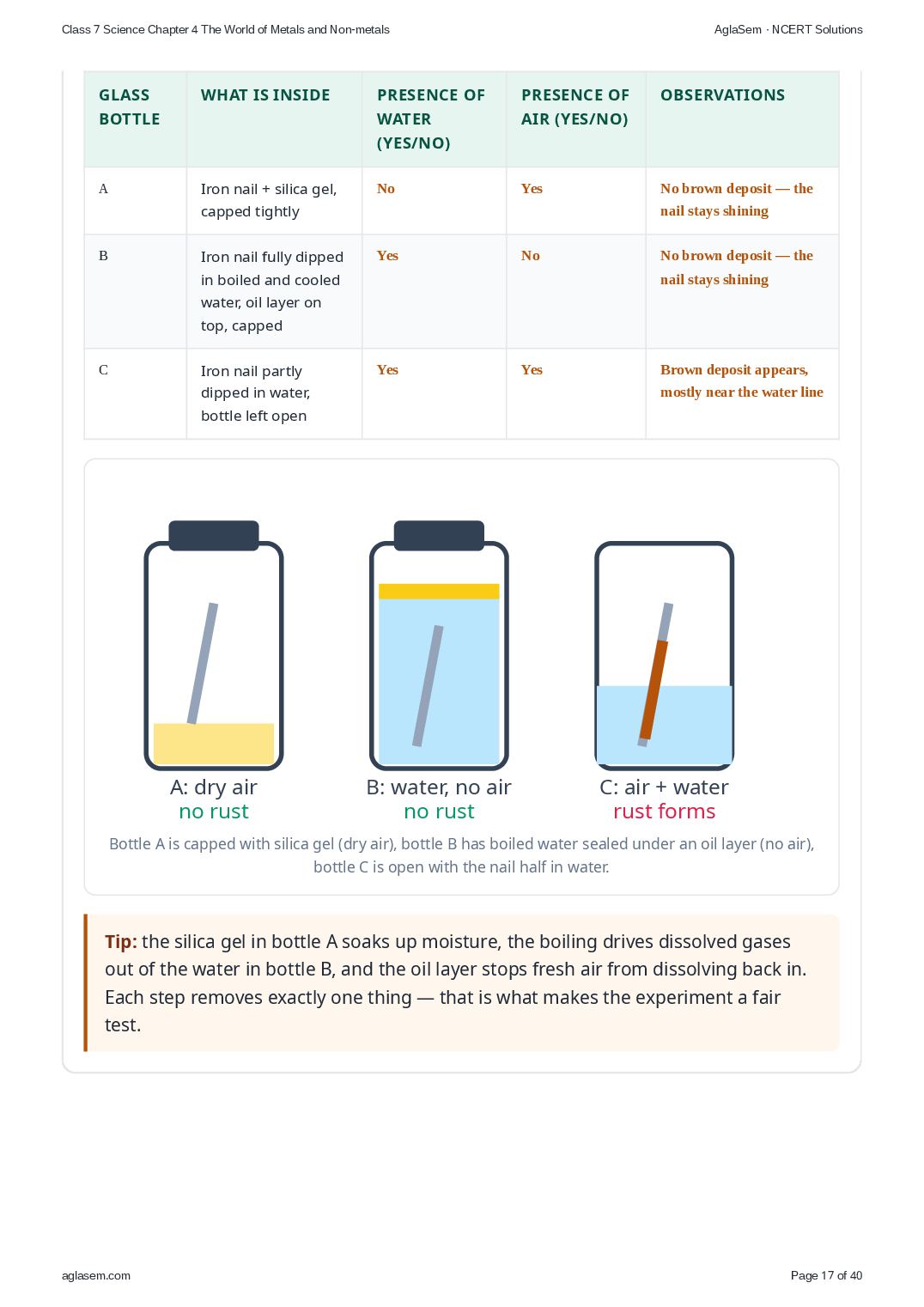
- Place all the glass bottles undisturbed at room temperature and observe the changes for 8 – 10 days. Record your observations in Table 4.3.
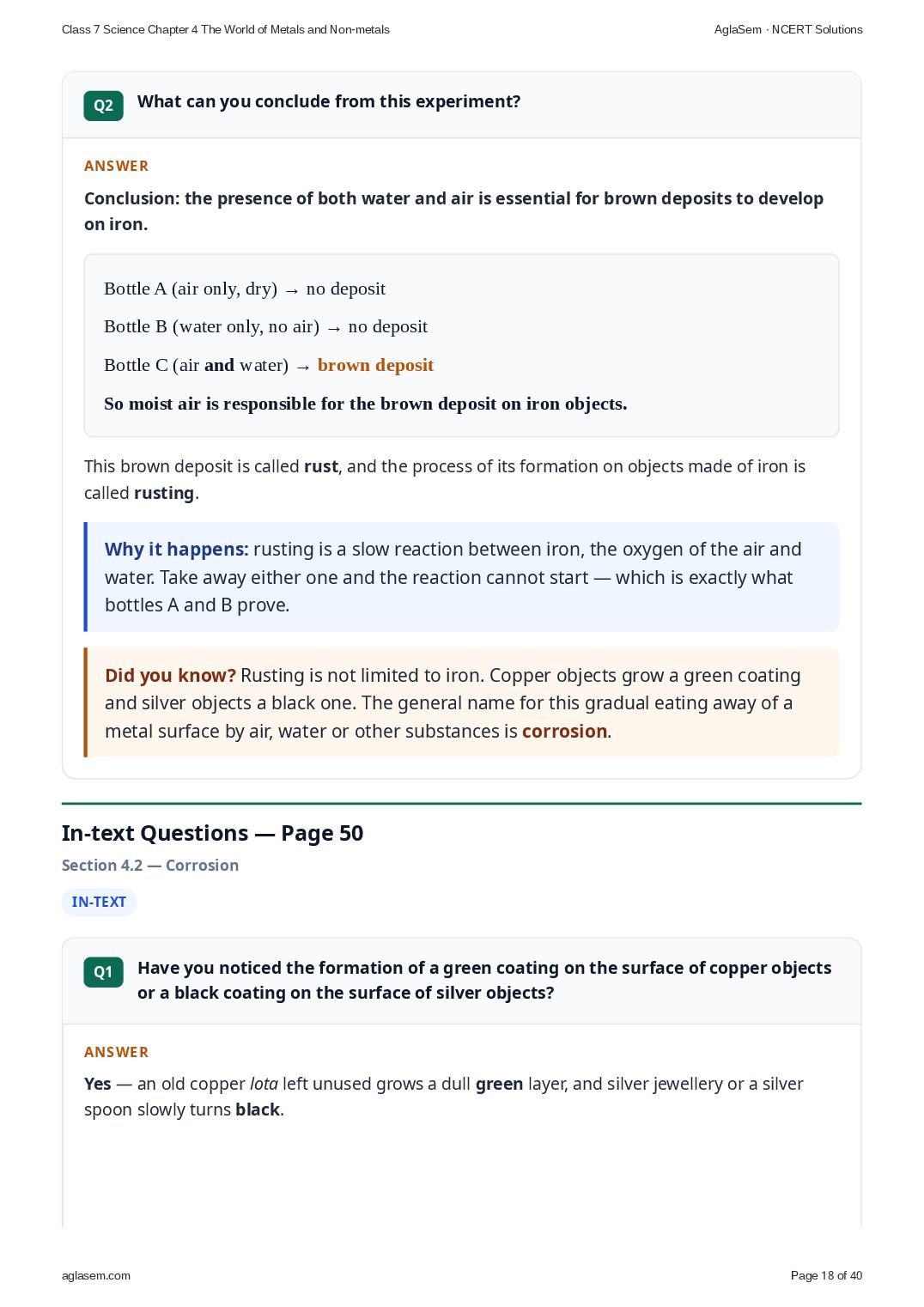
- What can you conclude from this experiment?
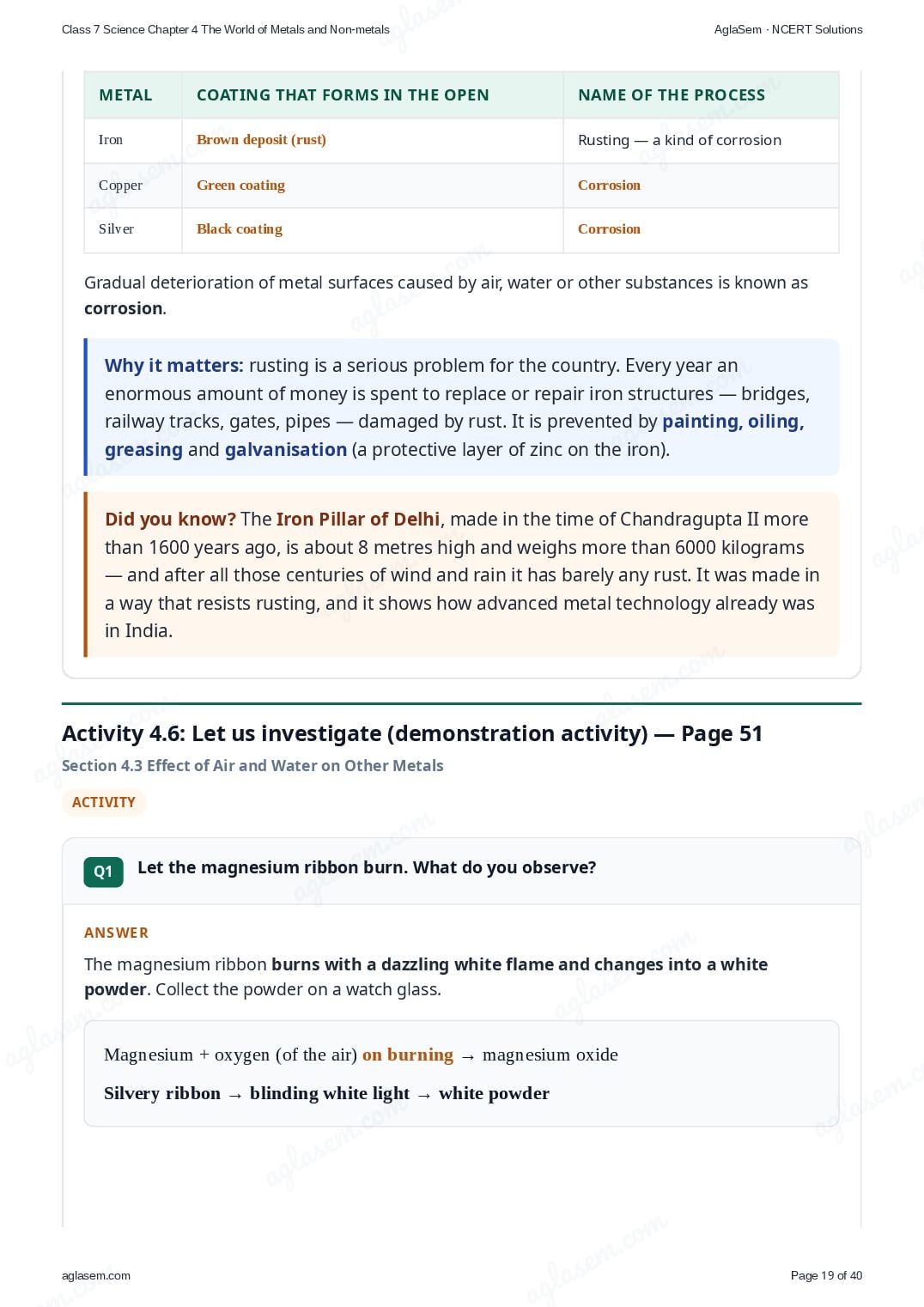
- Have you noticed the formation of a green coating on the surface of copper objects or a black coating on the surface of silver objects?
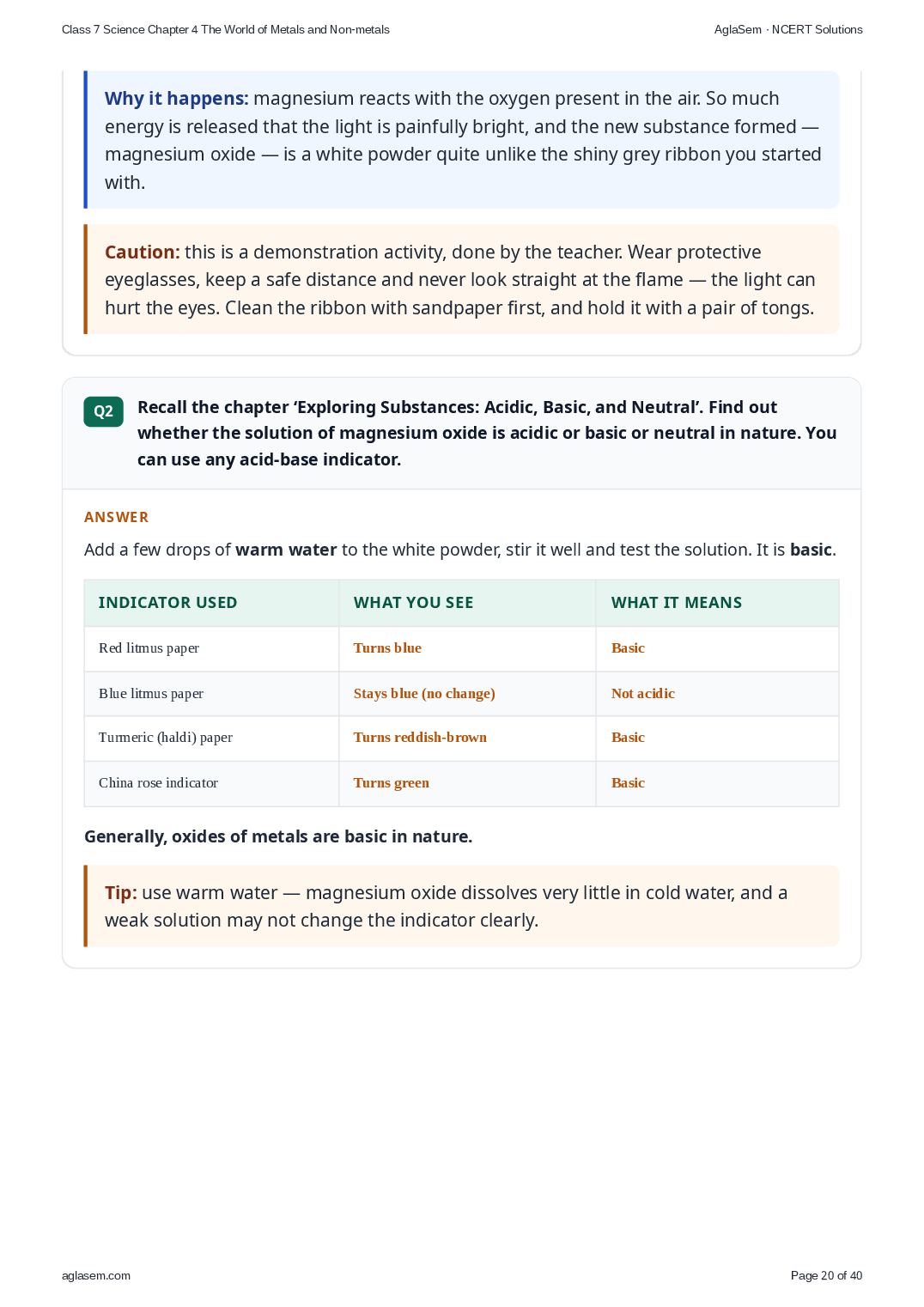
- Let the magnesium ribbon burn. What do you observe?
- Recall the chapter ‘Exploring Substances: Acidic, Basic, and Neutral’. Find out whether the solution of magnesium oxide is acidic or basic or neutral in nature. You can use any acid-base indicator.
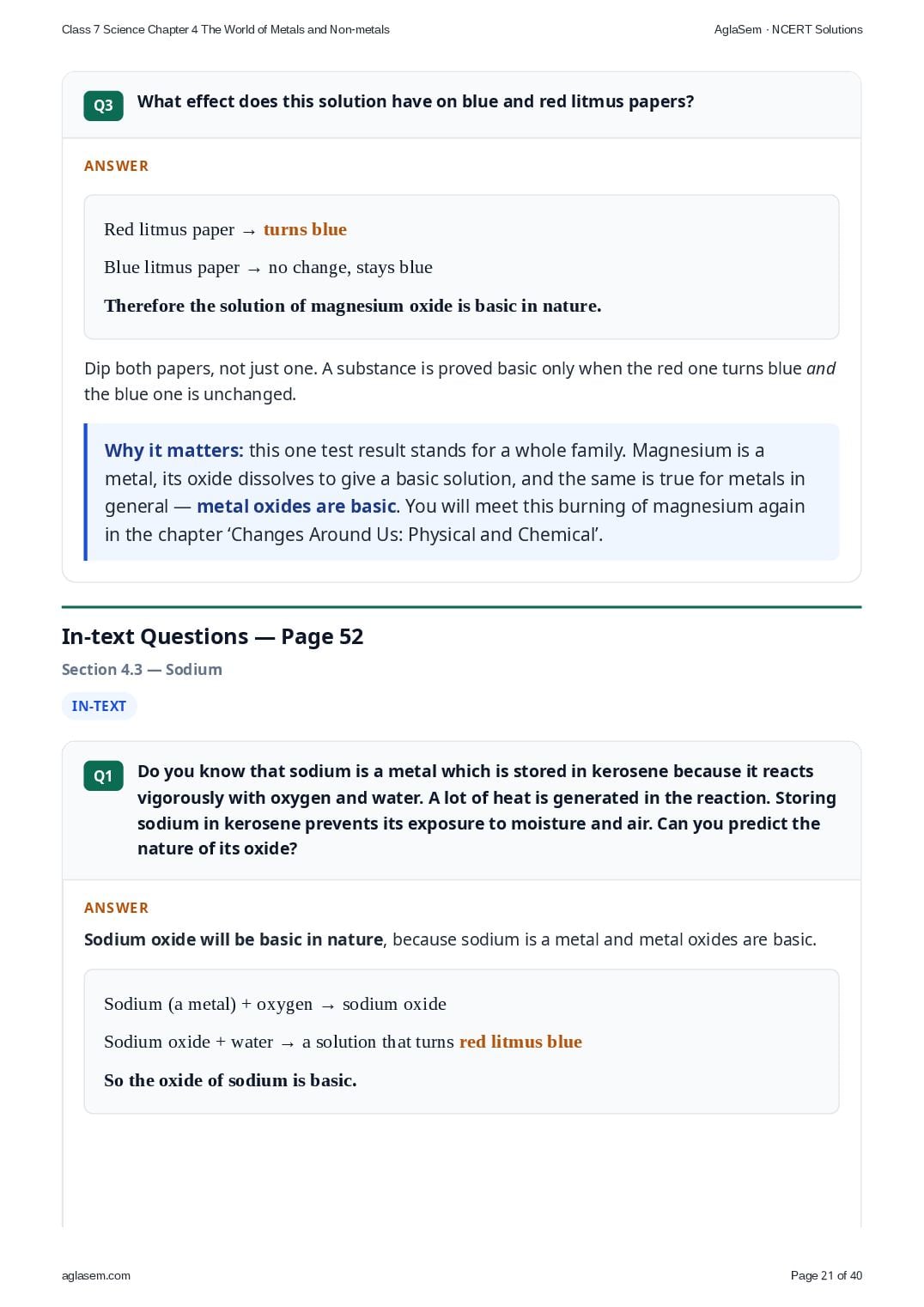
- What effect does this solution have on blue and red litmus papers?
- Do you know that sodium is a metal which is stored in kerosene because it reacts vigorously with oxygen and water. A lot of heat is generated in the reaction. Storing sodium in kerosene prevents its exposure to moisture and air. Can you predict the nature of its oxide?
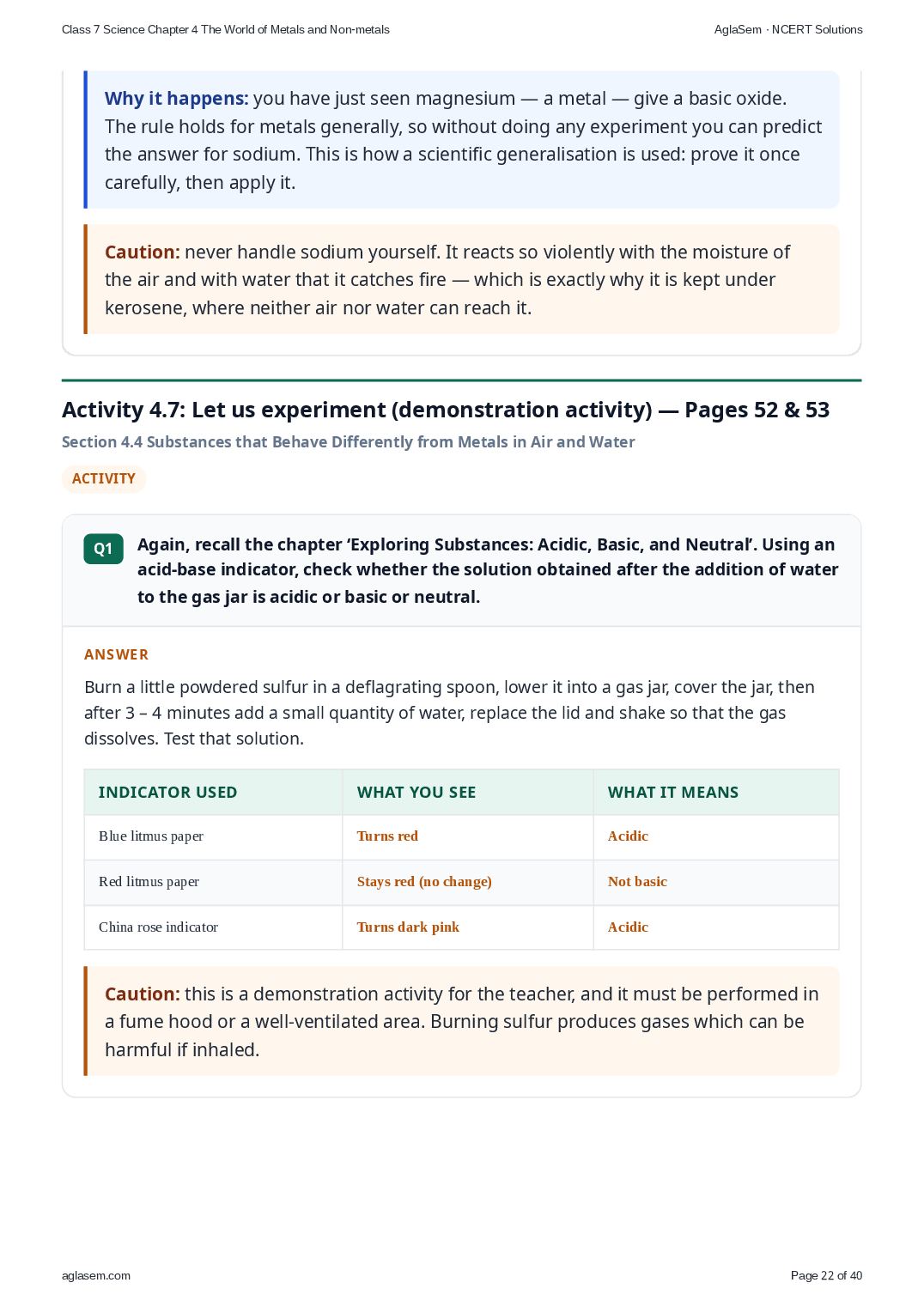
- Again, recall the chapter ‘Exploring Substances: Acidic, Basic, and Neutral’. Using an acid-base indicator, check whether the solution obtained after the addition of water to the gas jar is acidic or basic or neutral.
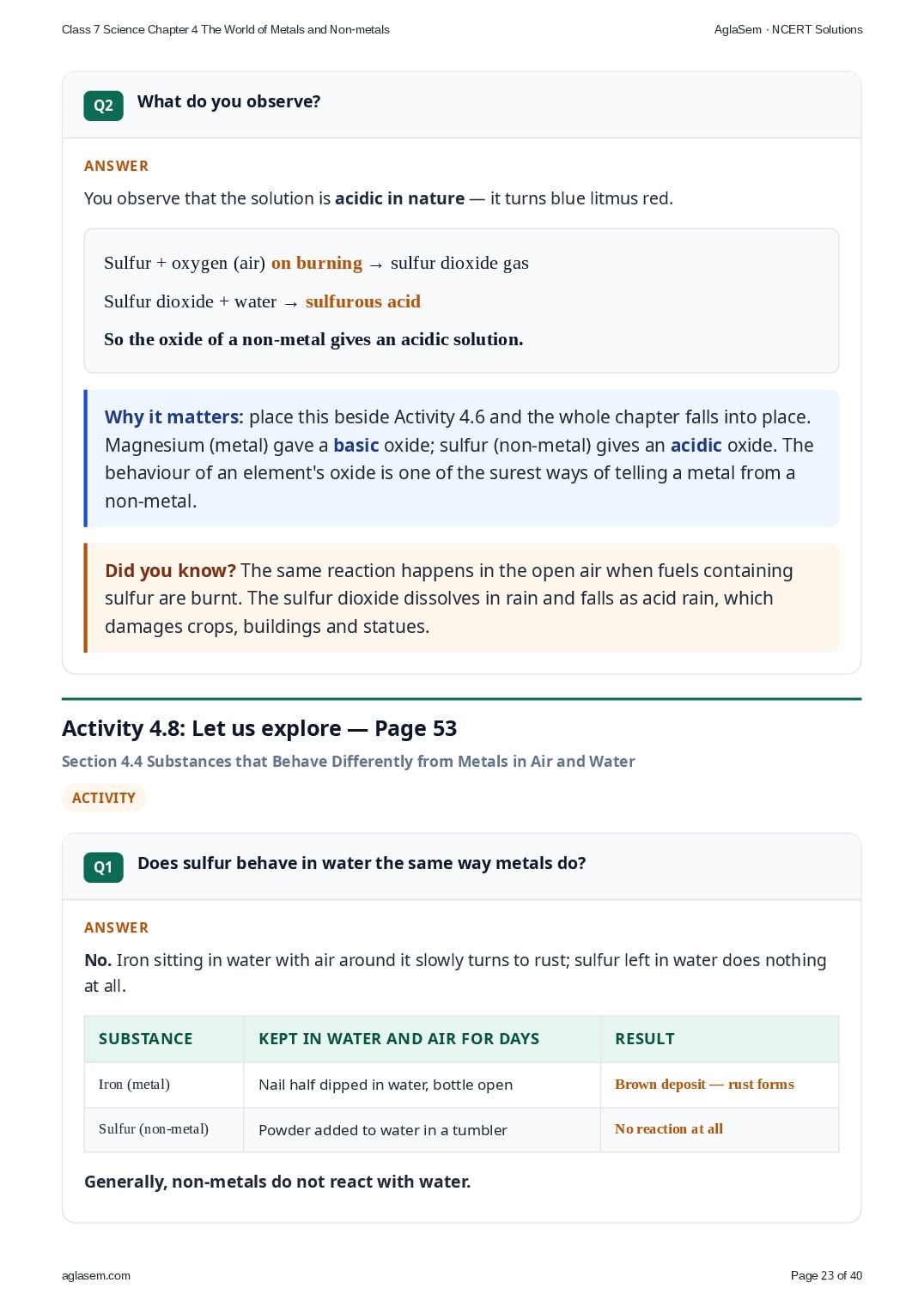
- What do you observe?
- Does sulfur behave in water the same way metals do?
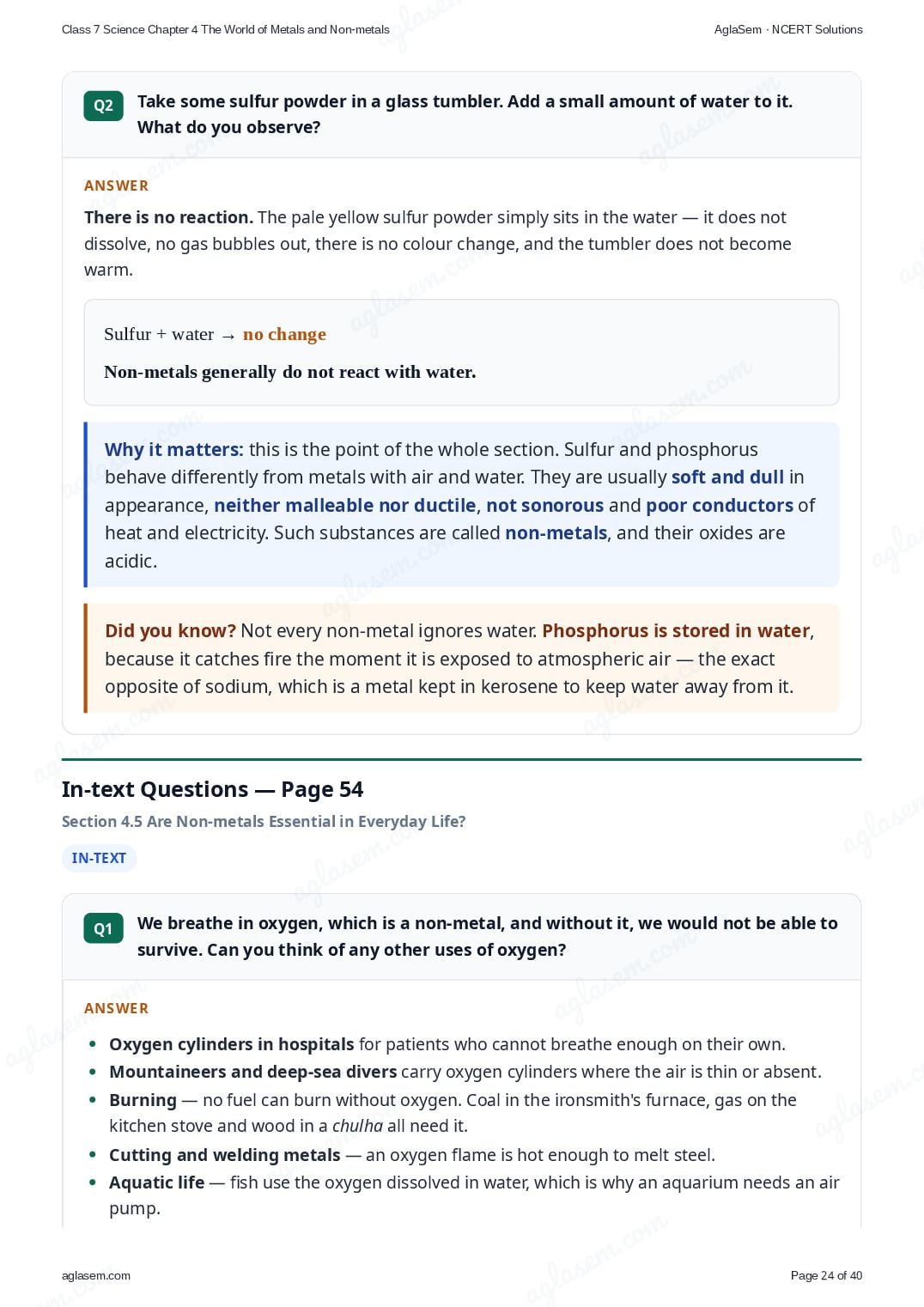
- Take some sulfur powder in a glass tumbler. Add a small amount of water to it. What do you observe?
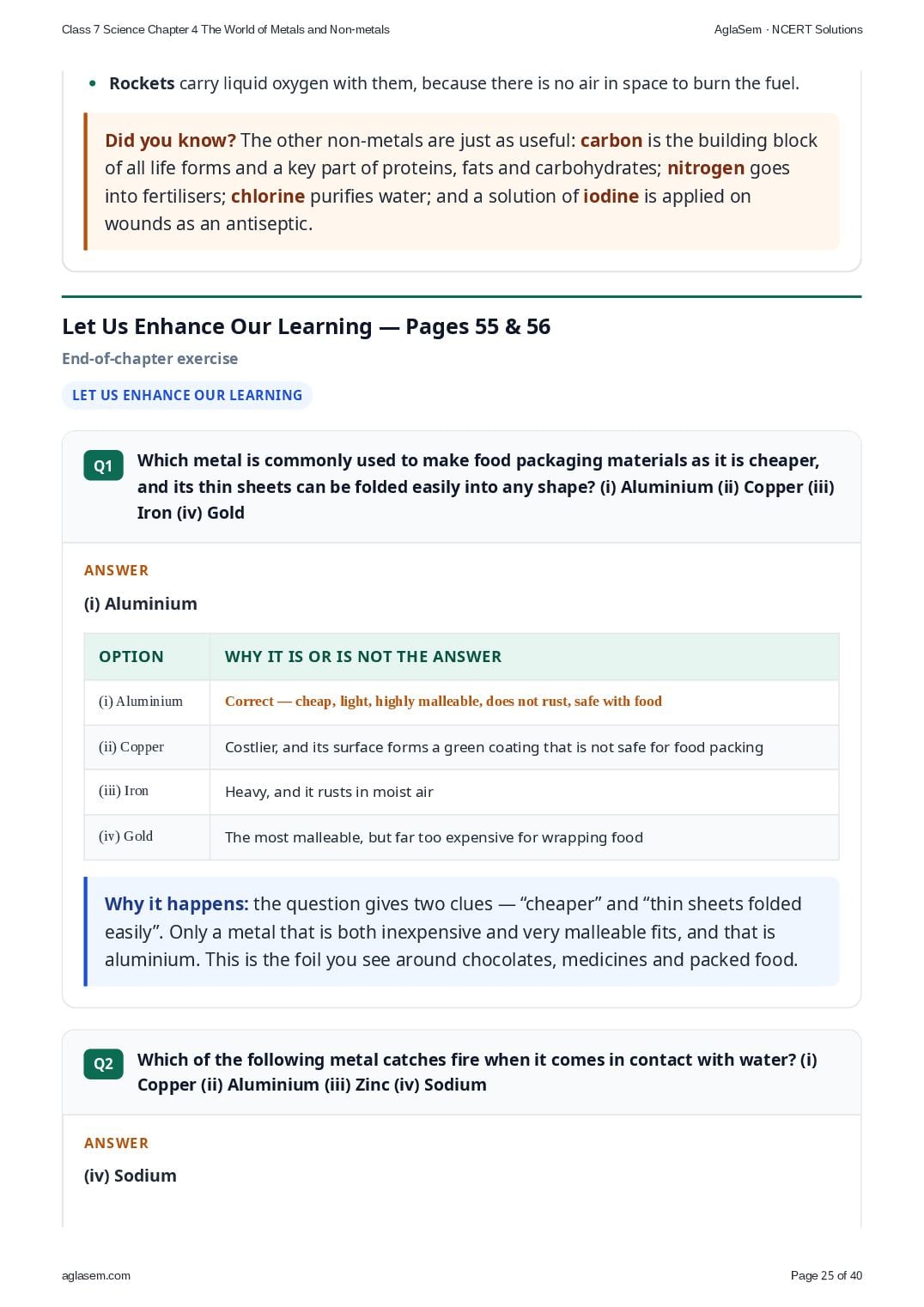
- We breathe in oxygen, which is a non-metal, and without it, we would not be able to survive. Can you think of any other uses of oxygen?
- Which metal is commonly used to make food packaging materials as it is cheaper, and its thin sheets can be folded easily into any shape? (i) Aluminium (ii) Copper (iii) Iron (iv) Gold
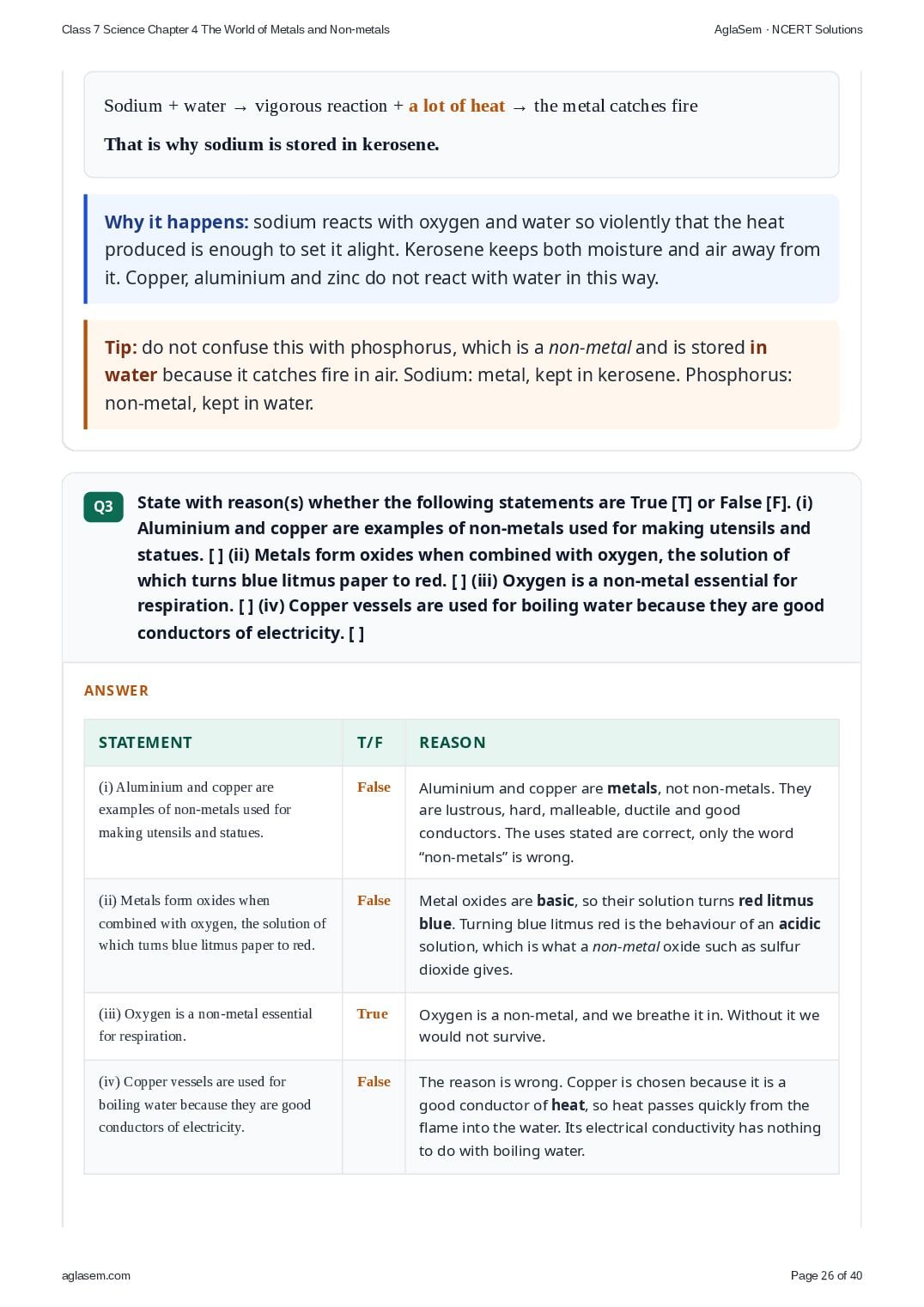
- Which of the following metal catches fire when it comes in contact with water? (i) Copper (ii) Aluminium (iii) Zinc (iv) Sodium
- State with reason(s) whether the following statements are True [T] or False [F]. (i) Aluminium and copper are examples of non-metals used for making utensils and statues. [ ] (ii) Metals form oxides when combined with oxygen, the solution of which turns blue litmus paper to red. [ ] (iii) Oxygen is a non-metal essential for respiration. [ ] (iv) Copper vessels are used for boiling water because they are good conductors of electricity. [ ]
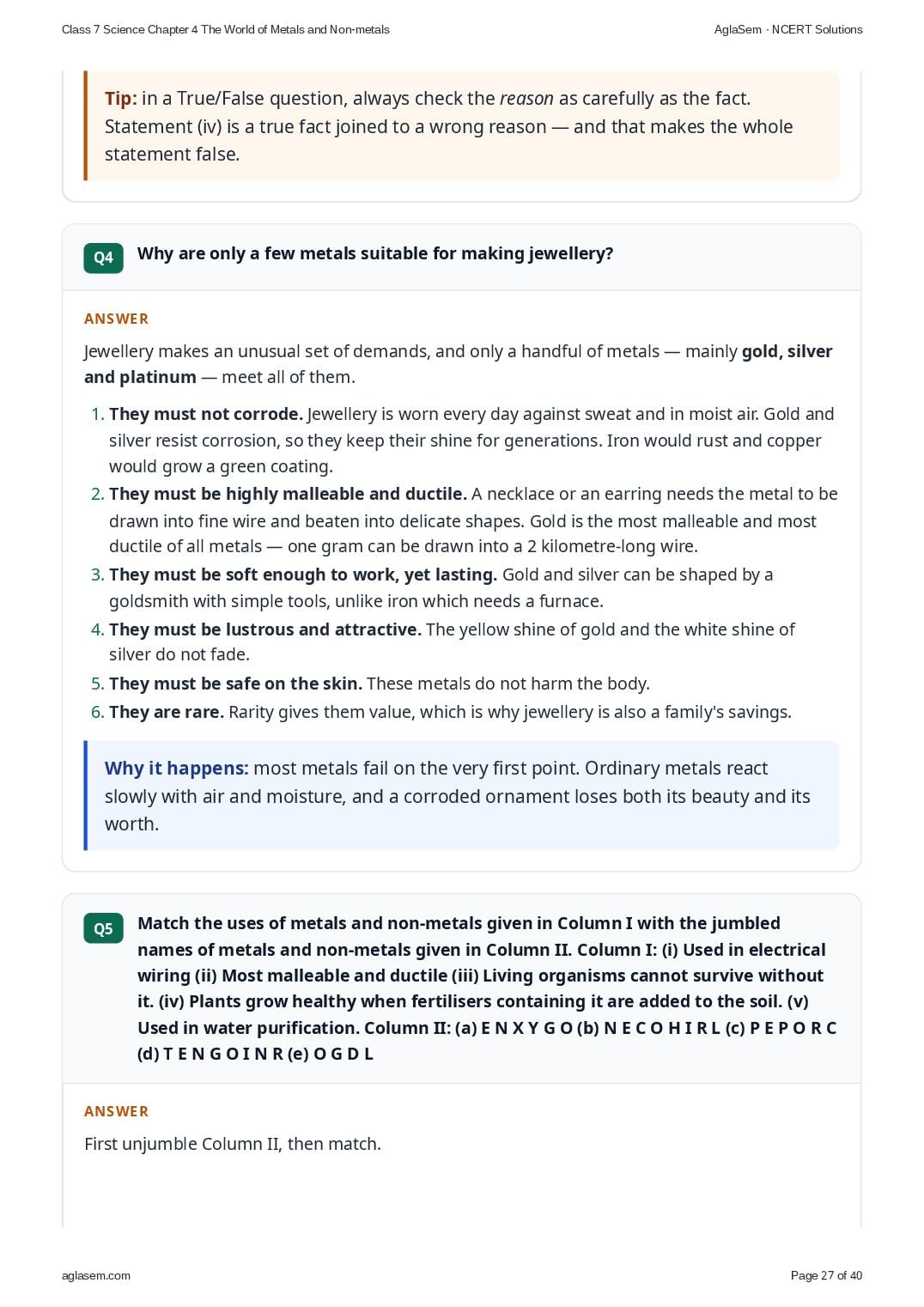
- Why are only a few metals suitable for making jewellery?
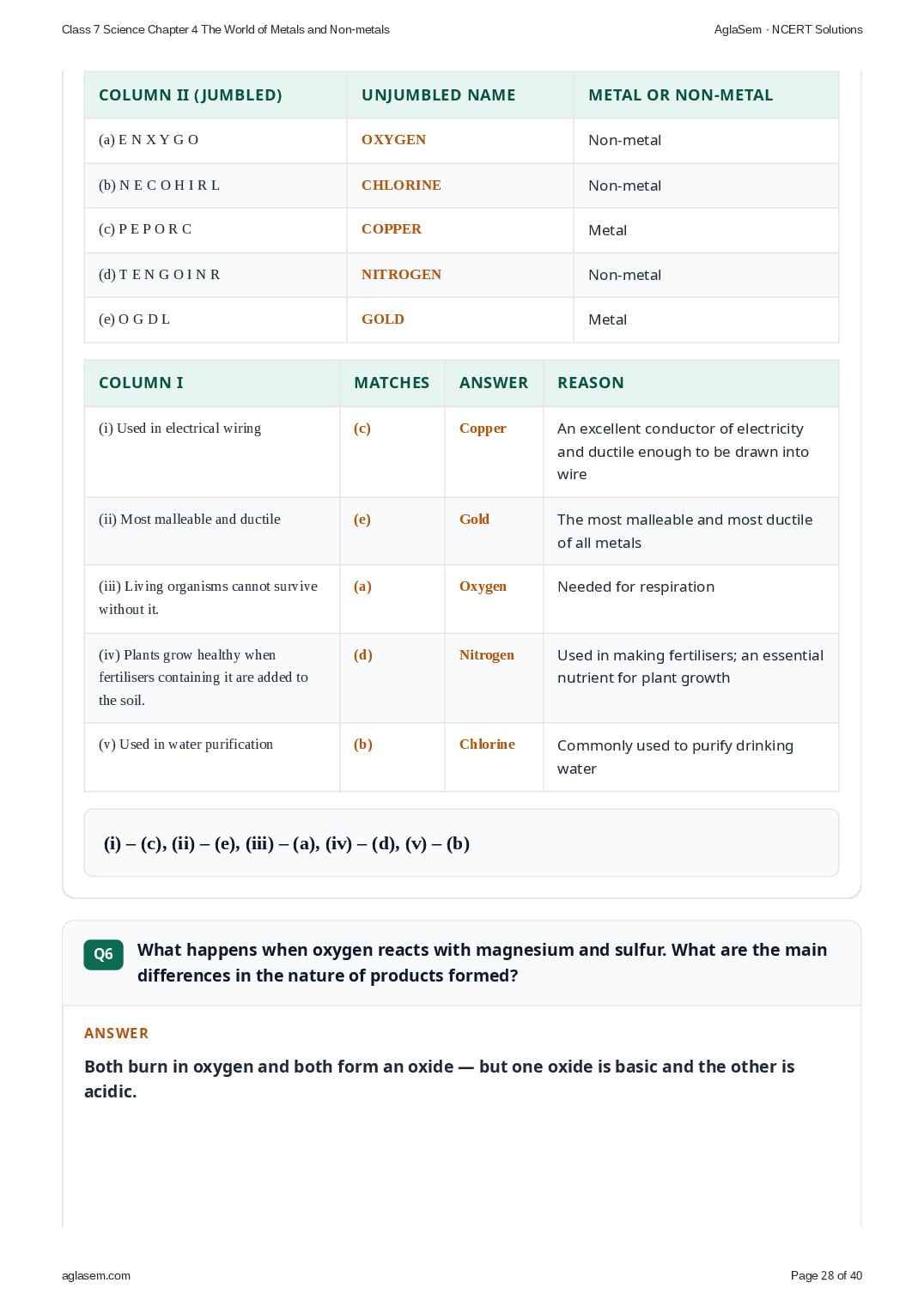
- Match the uses of metals and non-metals given in Column I with the jumbled names of metals and non-metals given in Column II. Column I: (i) Used in electrical wiring (ii) Most malleable and ductile (iii) Living organisms cannot survive without it. (iv) Plants grow healthy when fertilisers containing it are added to the soil. (v) Used in water purification. Column II: (a) E N X Y G O (b) N E C O H I R L (c) P E P O R C (d) T E N G O I N R (e) O G D L
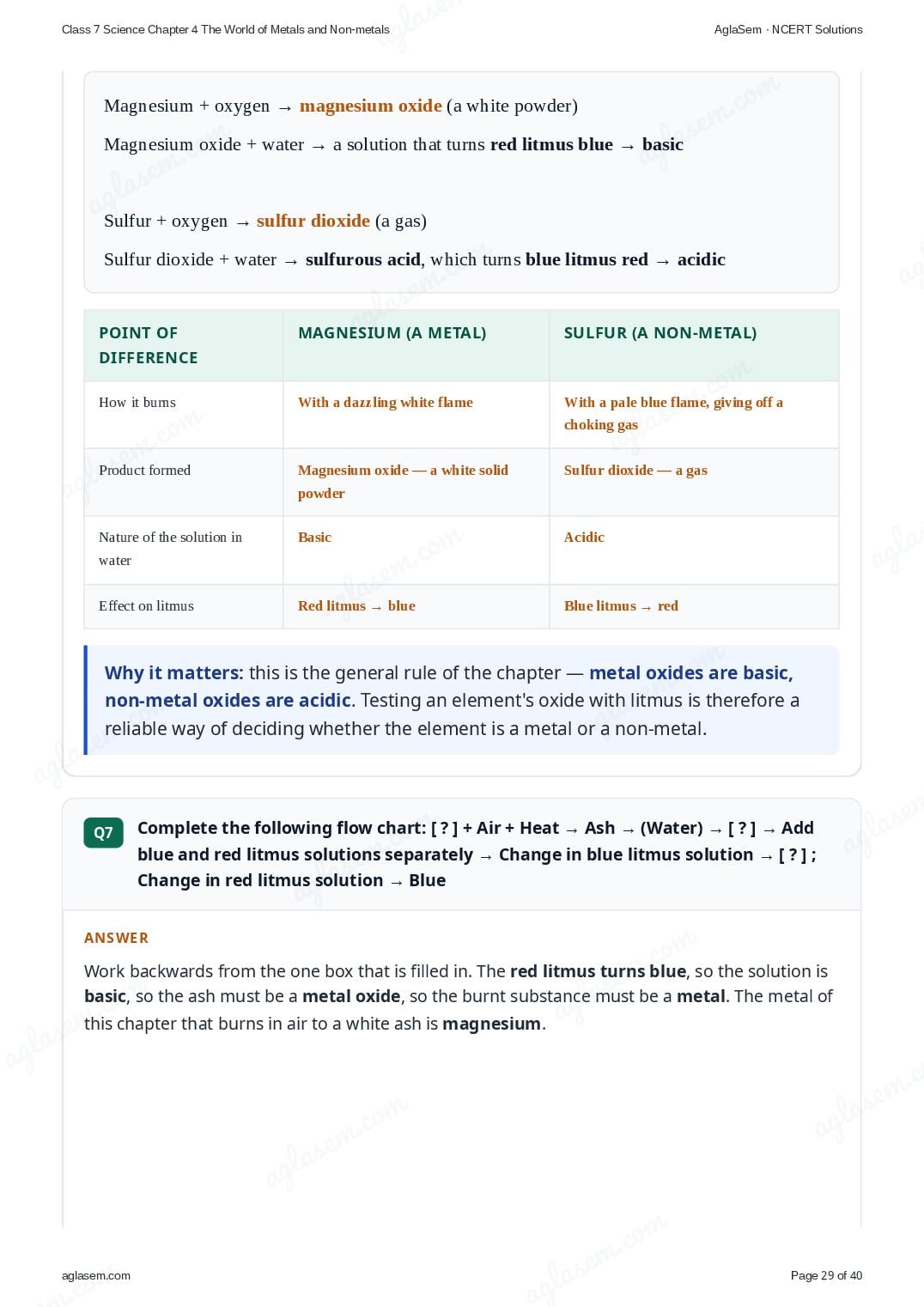
- What happens when oxygen reacts with magnesium and sulfur. What are the main differences in the nature of products formed?
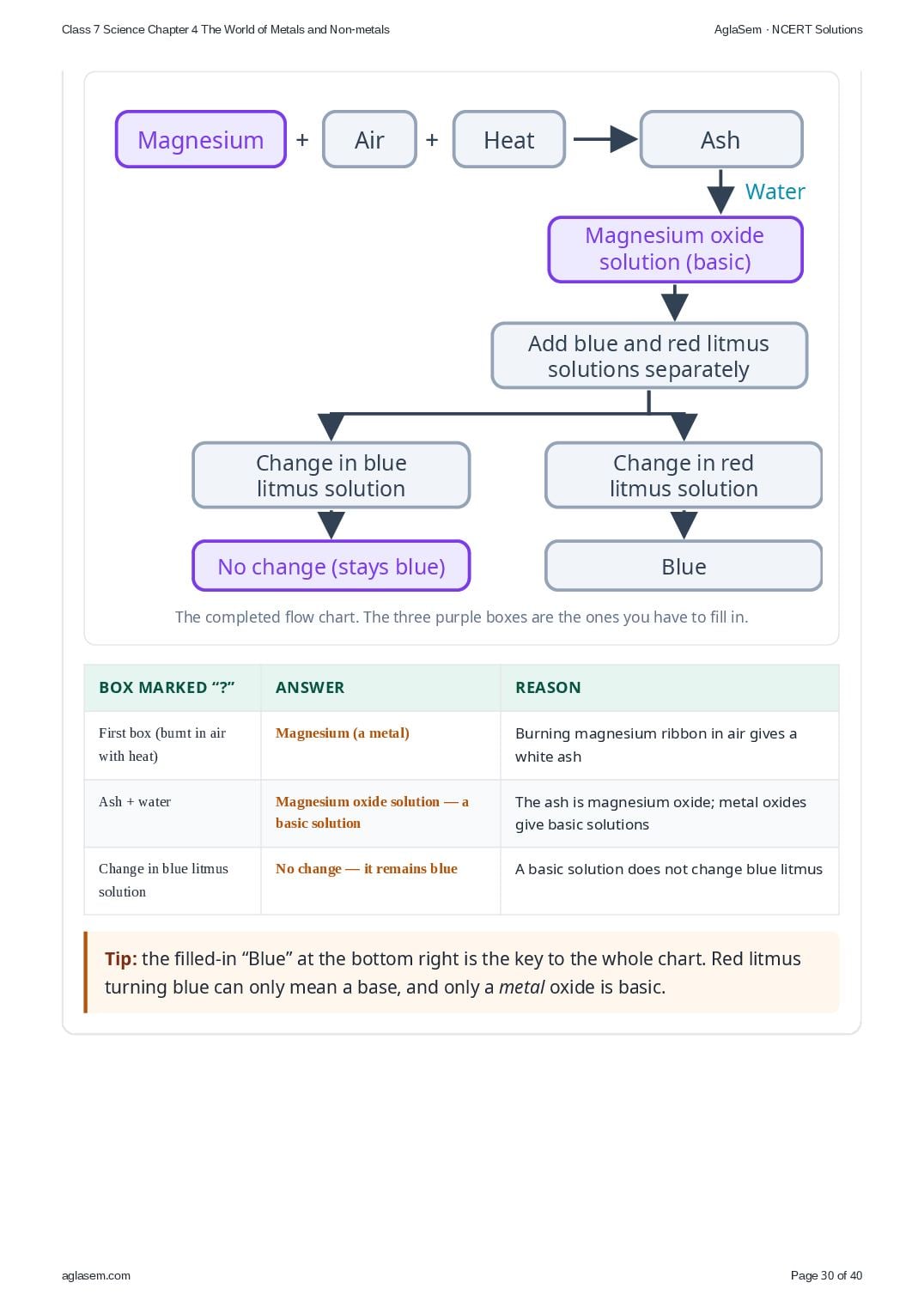
- Complete the following flow chart: [ ? ] + Air + Heat → Ash → (Water) → [ ? ] → Add blue and red litmus solutions separately → Change in blue litmus solution → [ ? ] ; Change in red litmus solution → Blue
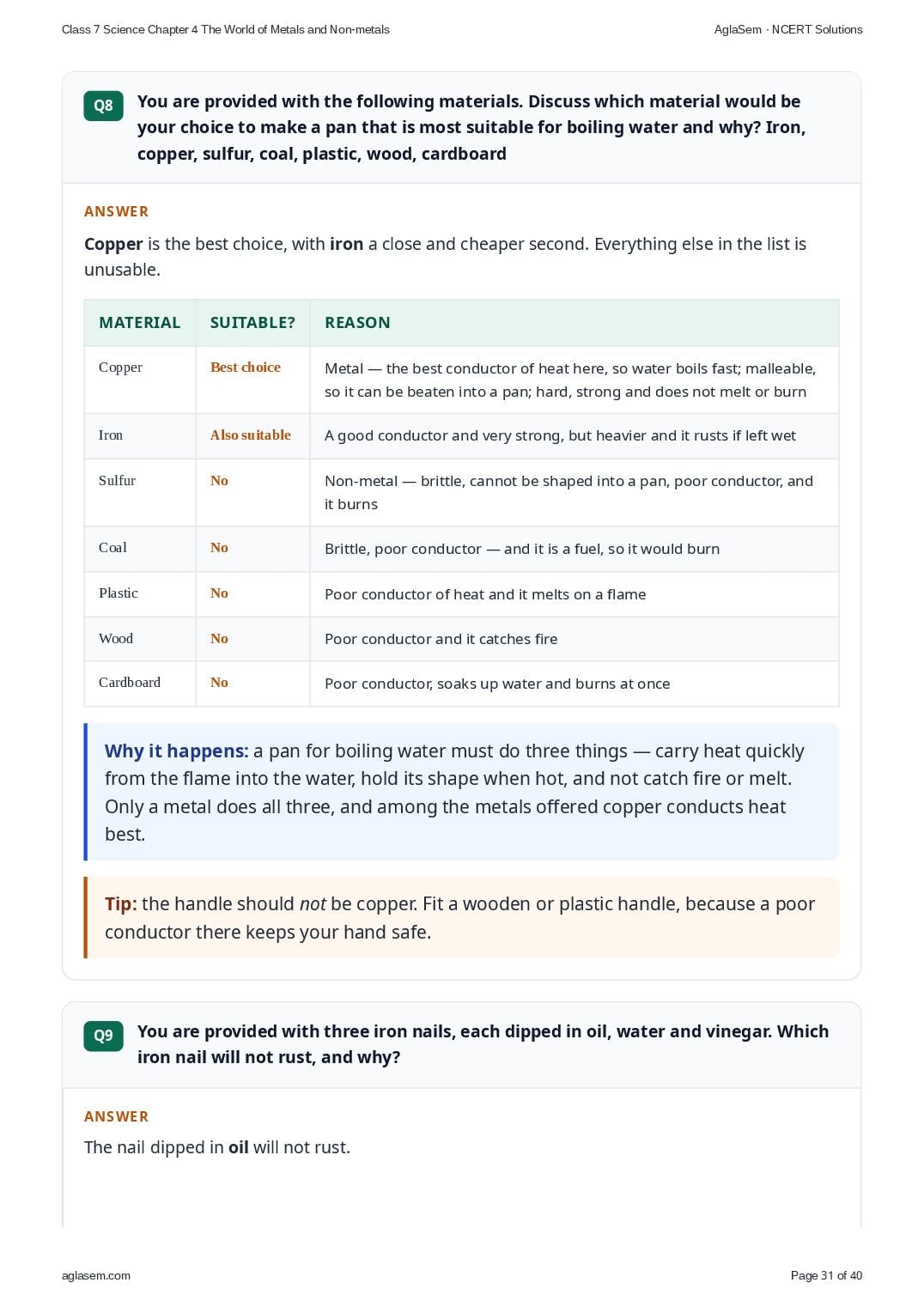
- You are provided with the following materials. Discuss which material would be your choice to make a pan that is most suitable for boiling water and why? Iron, copper, sulfur, coal, plastic, wood, cardboard
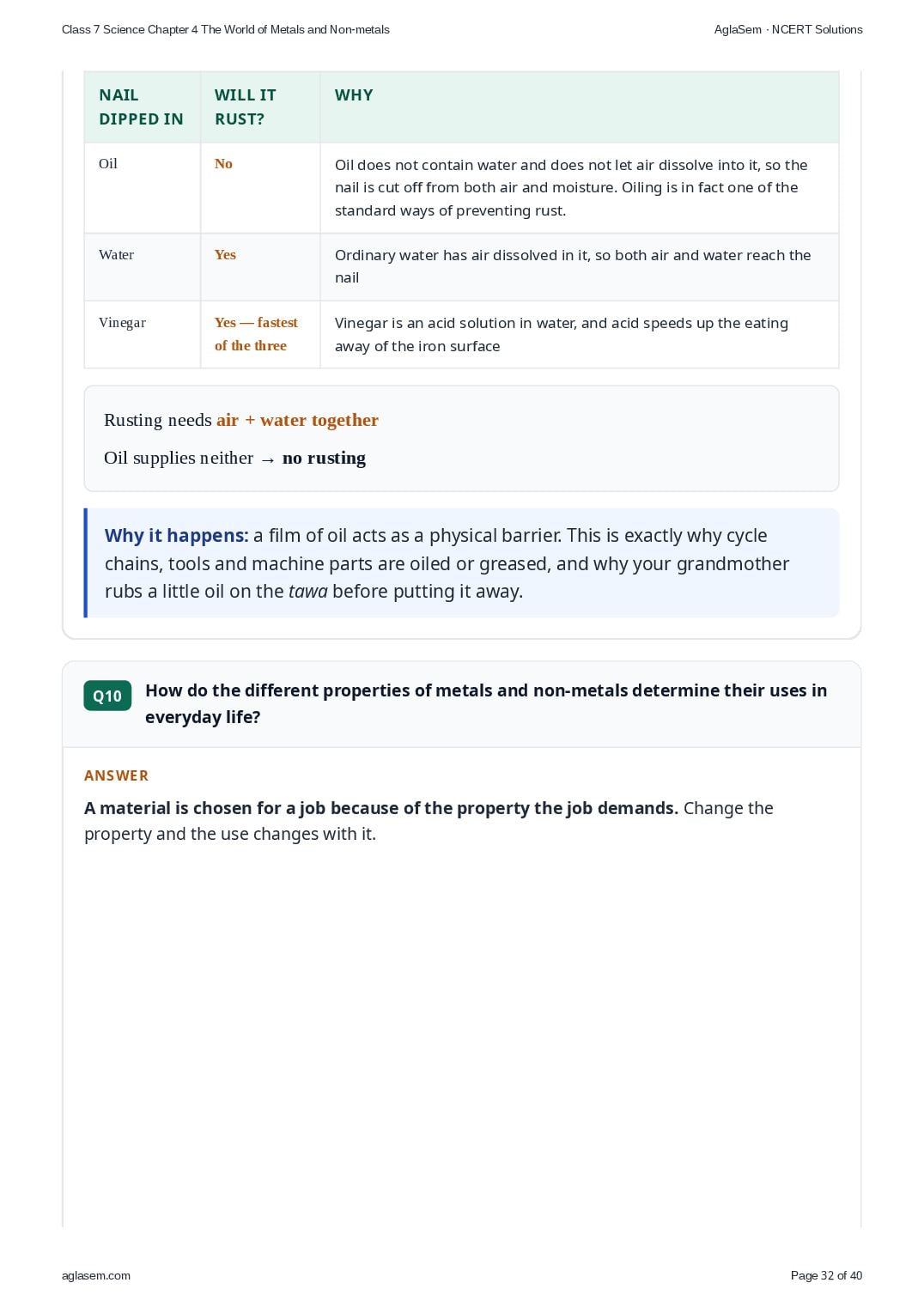
- You are provided with three iron nails, each dipped in oil, water and vinegar. Which iron nail will not rust, and why?
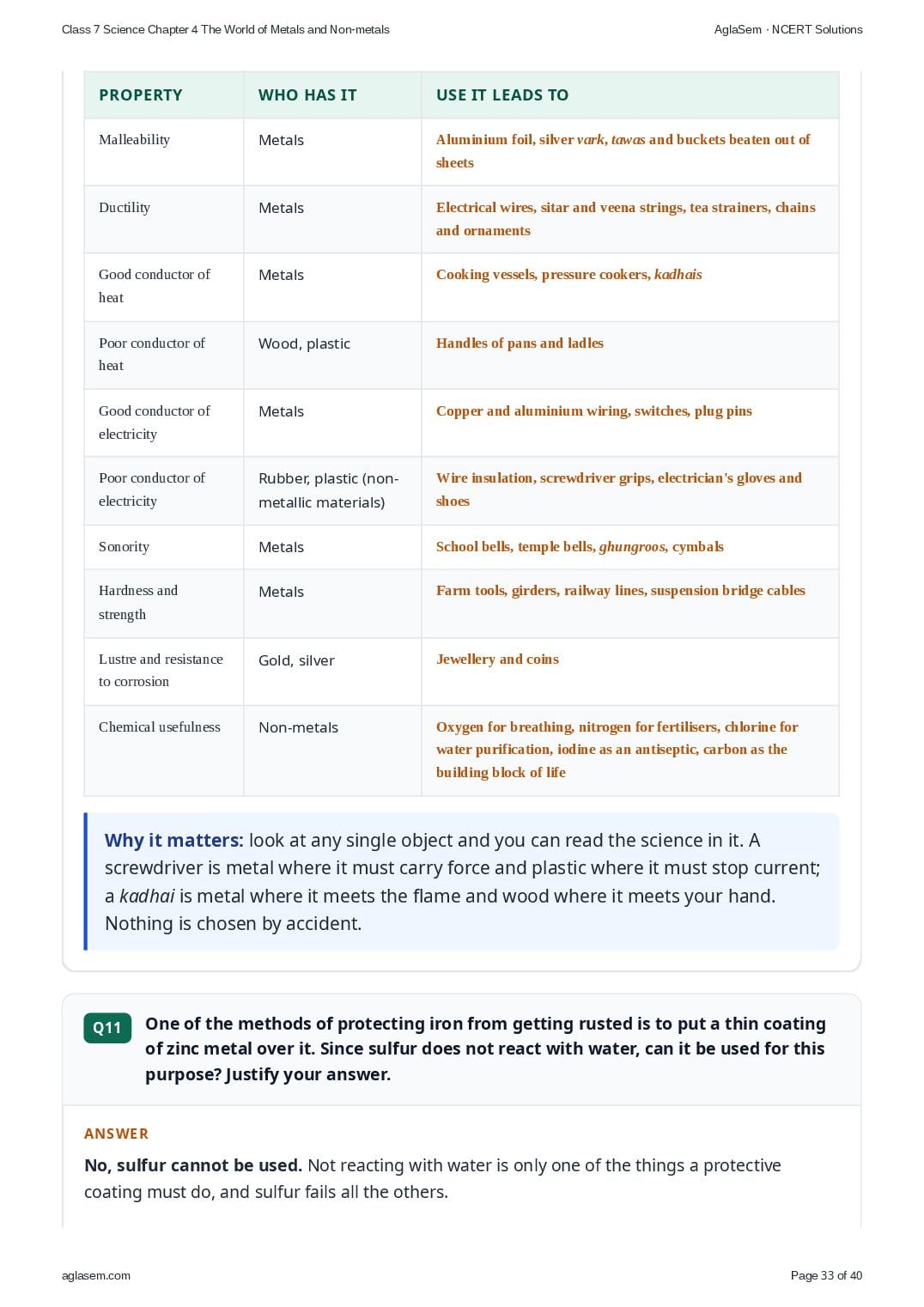
- How do the different properties of metals and non-metals determine their uses in everyday life?
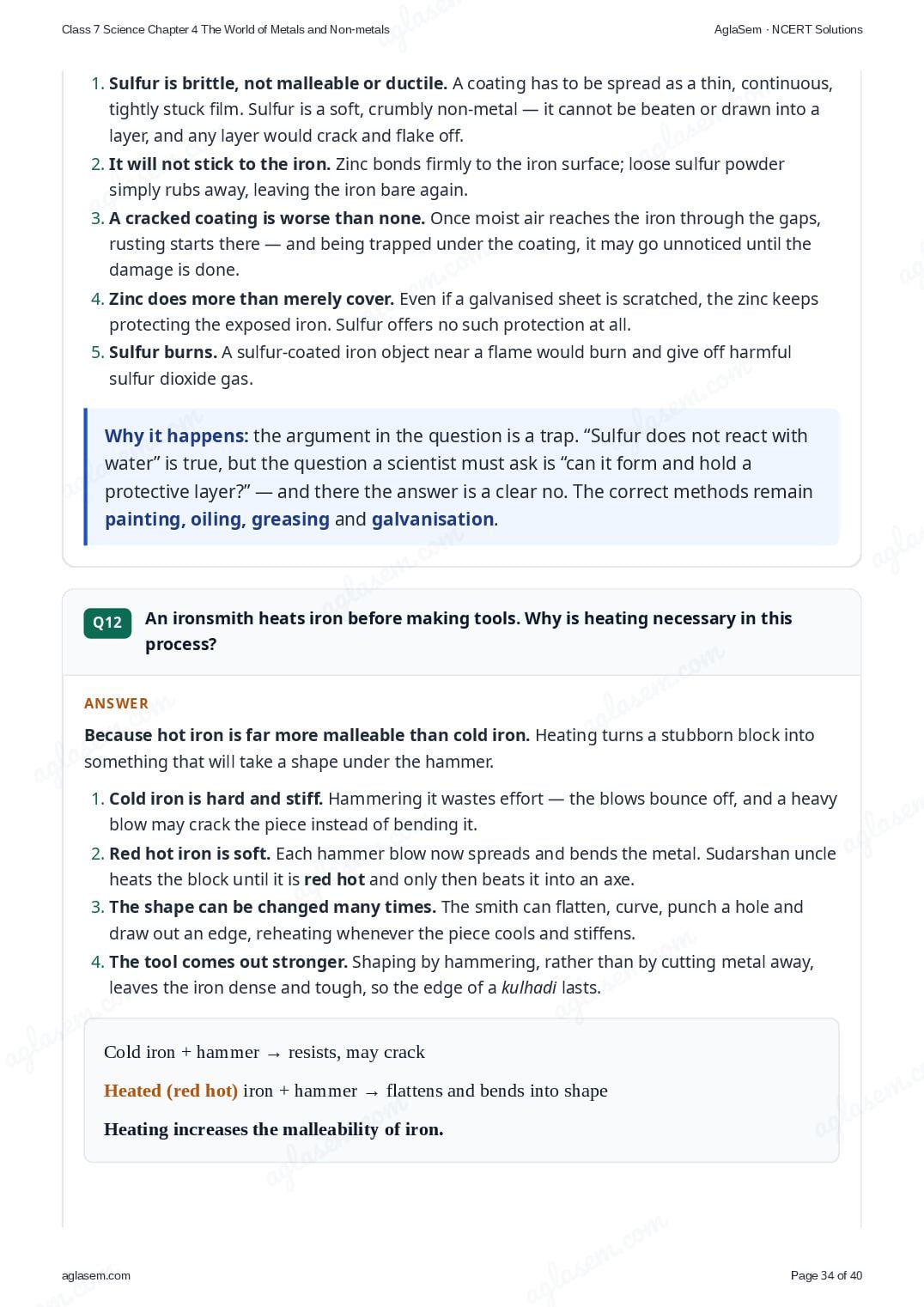
- One of the methods of protecting iron from getting rusted is to put a thin coating of zinc metal over it. Since sulfur does not react with water, can it be used for this purpose? Justify your answer.
- An ironsmith heats iron before making tools. Why is heating necessary in this process?
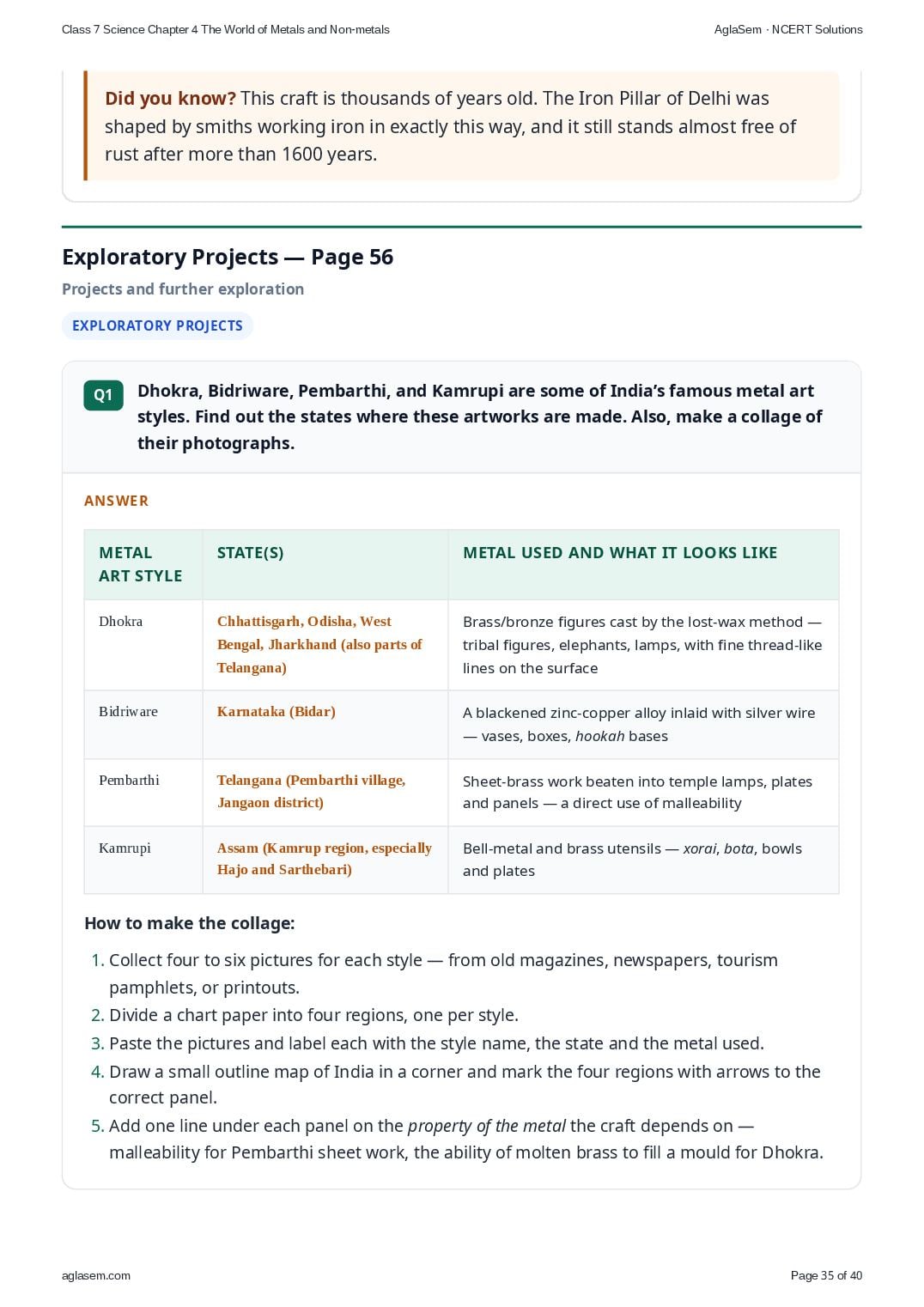
- Dhokra, Bidriware, Pembarthi, and Kamrupi are some of India’s famous metal art styles. Find out the states where these artworks are made. Also, make a collage of their photographs.
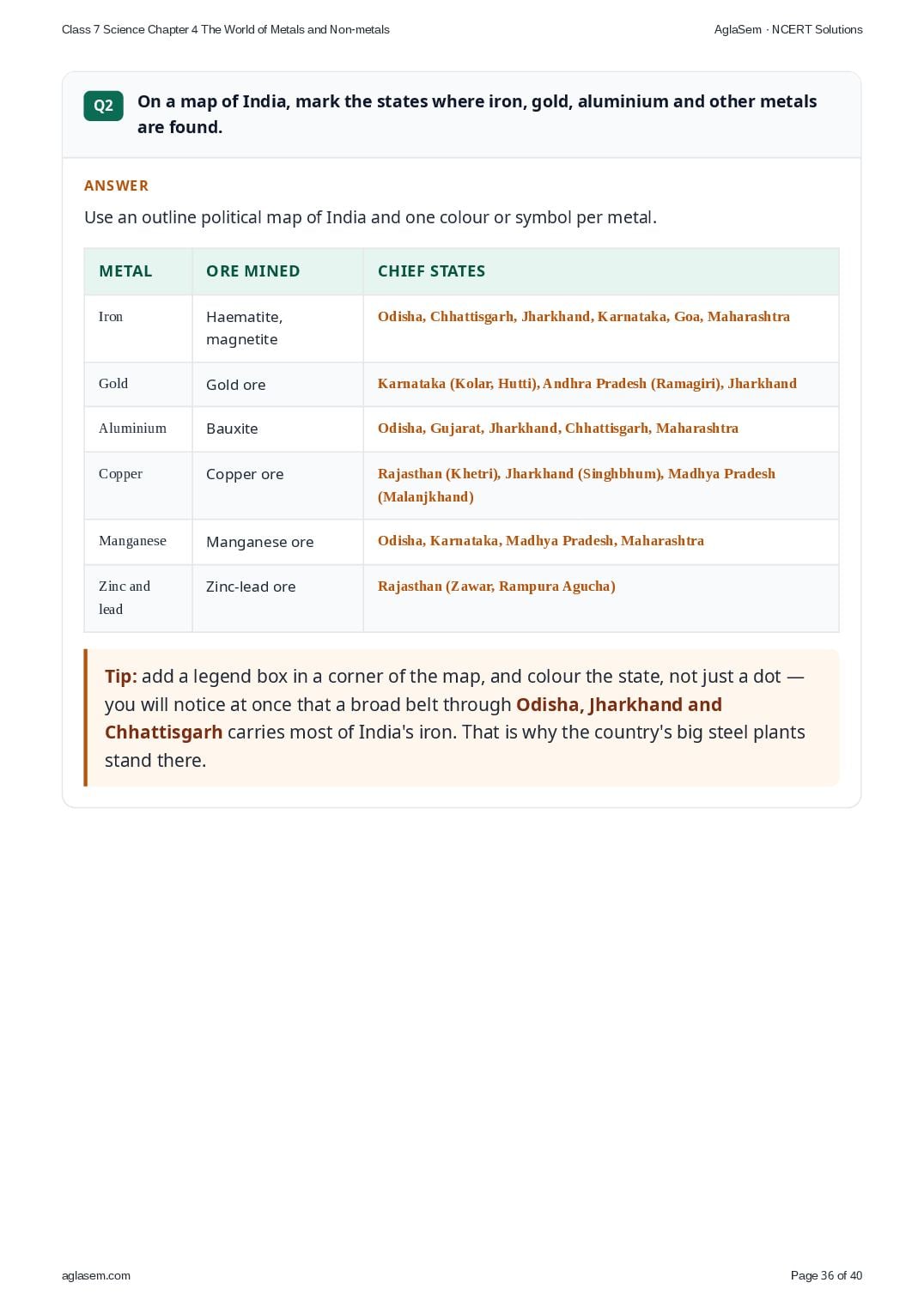
- On a map of India, mark the states where iron, gold, aluminium and other metals are found.
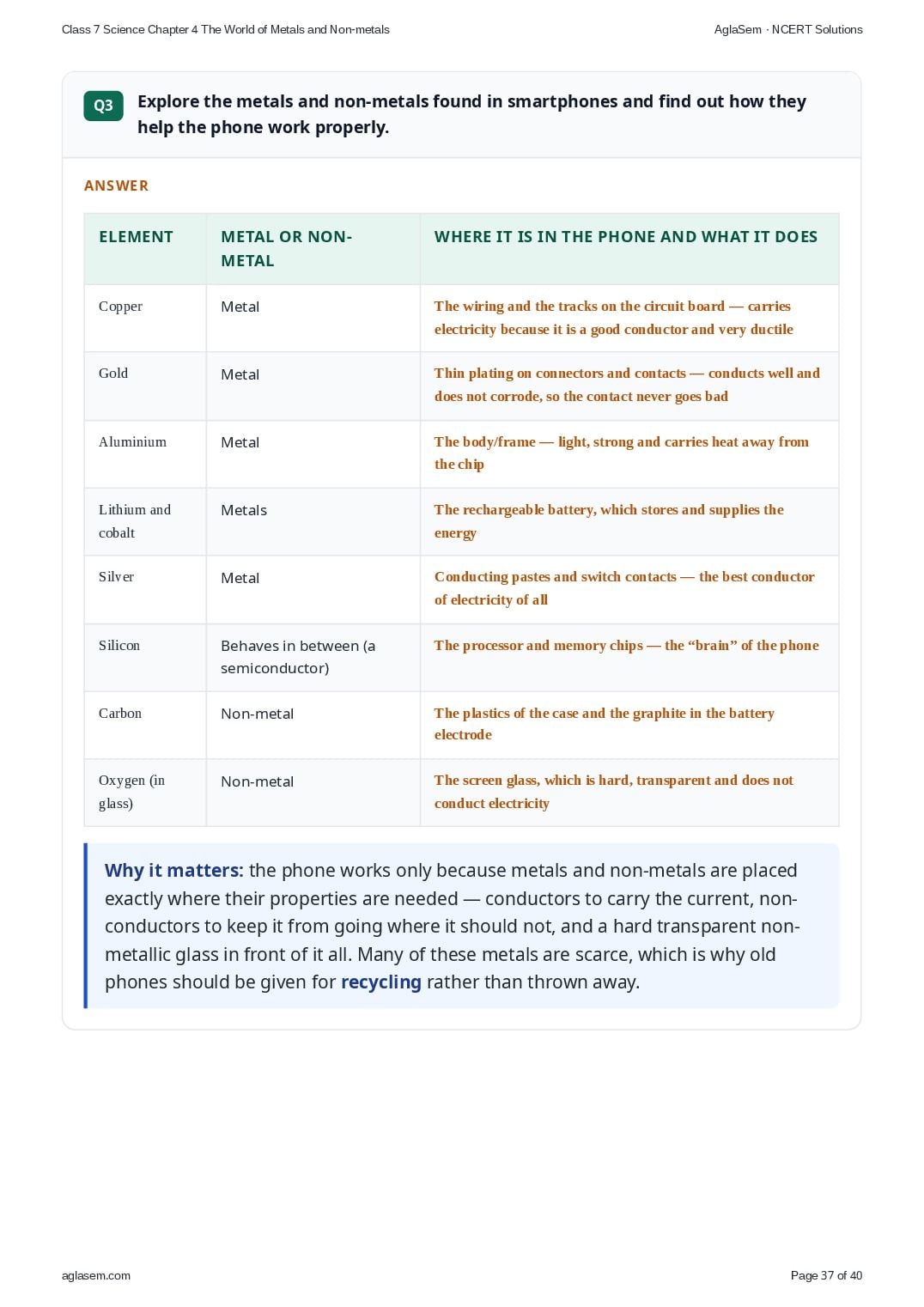
- Explore the metals and non-metals found in smartphones and find out how they help the phone work properly.
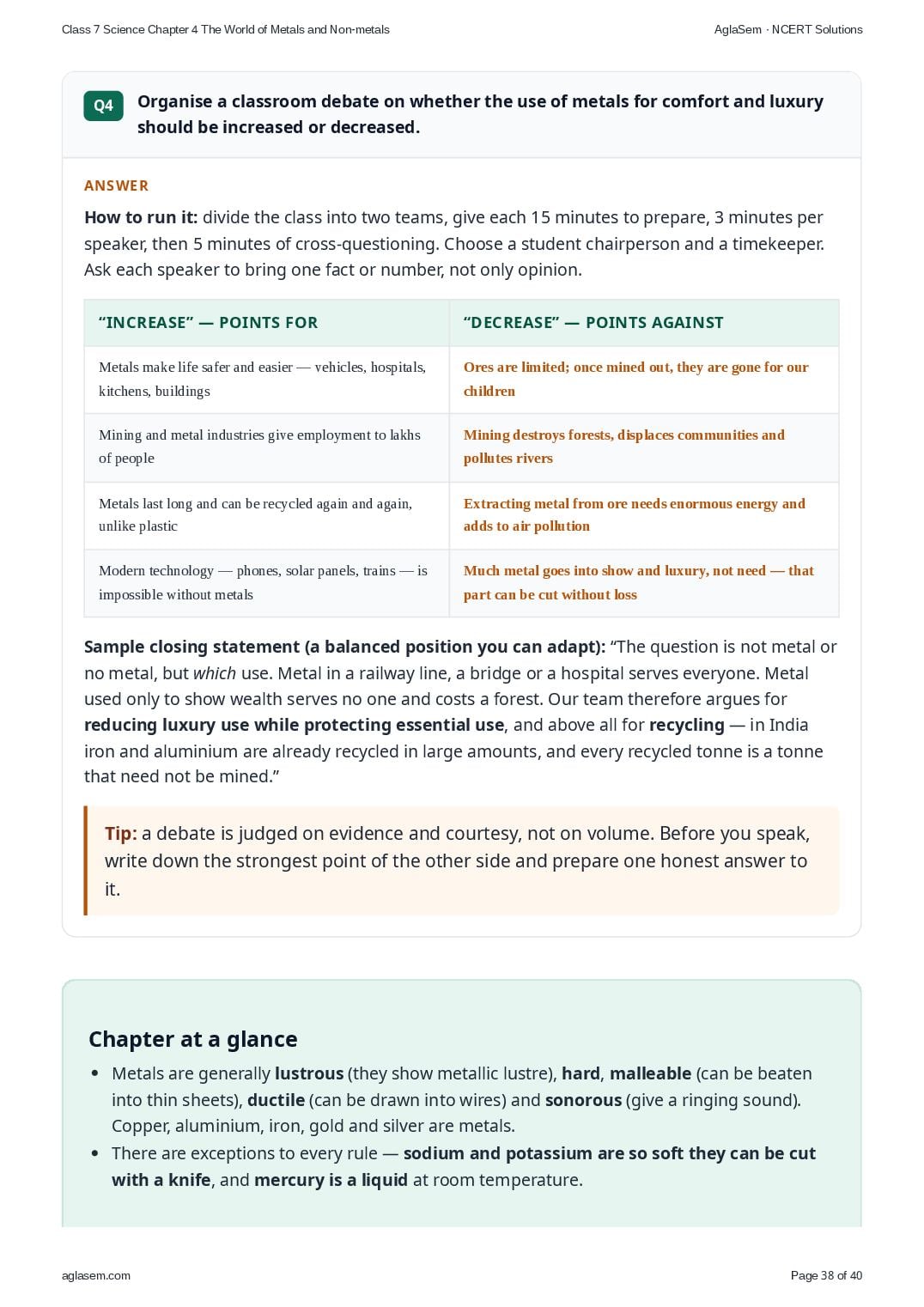
- Organise a classroom debate on whether the use of metals for comfort and luxury should be increased or decreased.
Chapter at a Glance
- Metals are generally lustrous (they show metallic lustre), hard , malleable (can be beaten into thin sheets), ductile (can be drawn into wires) and sonorous (give a ringing sound). Copper, aluminium, iron, gold and silver are metals.
- There are exceptions to every rule — sodium and potassium are so soft they can be cut with a knife , and mercury is a liquid at room temperature.
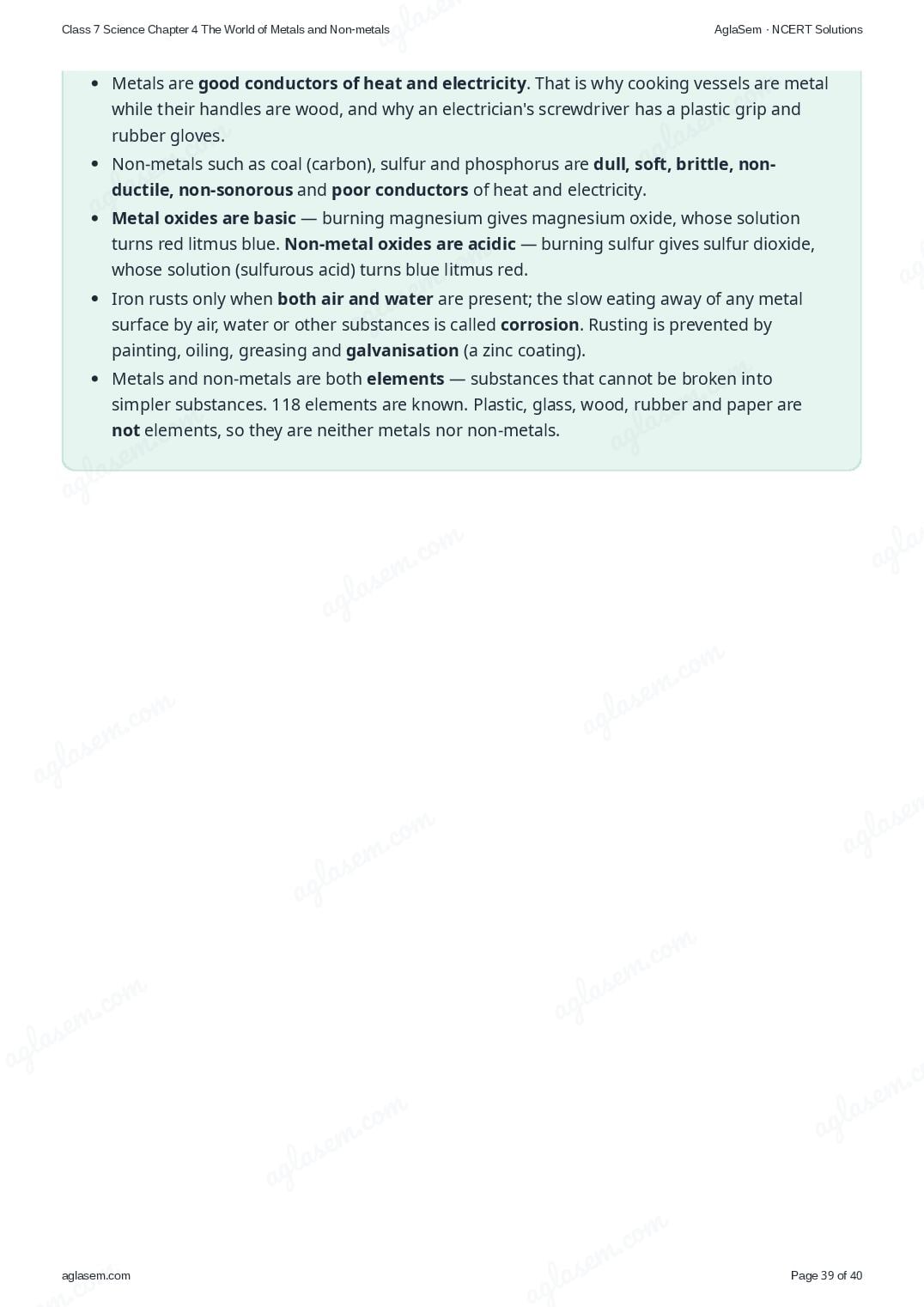
- Metals are good conductors of heat and electricity . That is why cooking vessels are metal while their handles are wood, and why an electrician's screwdriver has a plastic grip and rubber gloves.
- Non-metals such as coal (carbon), sulfur and phosphorus are dull, soft, brittle, non-ductile, non-sonorous and poor conductors of heat and electricity.
- Metal oxides are basic — burning magnesium gives magnesium oxide, whose solution turns red litmus blue. Non-metal oxides are acidic — burning sulfur gives sulfur dioxide, whose solution (sulfurous acid) turns blue litmus red.
- Iron rusts only when both air and water are present; the slow eating away of any metal surface by air, water or other substances is called corrosion . Rusting is prevented by painting, oiling, greasing and galvanisation (a zinc coating).
- Metals and non-metals are both elements — substances that cannot be broken into simpler substances. 118 elements are known. Plastic, glass, wood, rubber and paper are not elements, so they are neither metals nor non-metals.
How to Download NCERT Solutions for Class 7 Science Chapter 4 PDF
Follow these simple steps to get the the World of Metals and Non Metals questions-and-answers PDF from Curiosity.
- Search NCERT Solutions for Class 7 Science Chapter 4 aglasem and open this page.
- Read the exercise questions with answers for the World of Metals and Non Metals shown above.
- Click the Download PDF link to save the the World of Metals and Non Metals solutions to your device.
NCERT Solutions for Class 7 Science – All Chapters
There are more chapters to study besides the World of Metals and Non Metals in Science. Here are the NCERT Solutions for all chapters of Class 7 Science.
- Chapter 1 the Ever Evolving World of Science
- Chapter 2 Exploring Substances Acidic Basic and Neutral
- Chapter 3 Electricity Circuits and Their Components
- Chapter 4 the World of Metals and Non Metals
- Chapter 5 Changes Around Us Physical and Chemical
- Chapter 6 Adolescence a Stage of Growth and Change
- Chapter 7 Heat Transfer in Nature
- Chapter 8 Measurement of Time and Motion
- Chapter 9 Life Processes in Animals
- Chapter 10 Life Processes in Plants
- Chapter 11 Light Shadows and Reflections
- Chapter 12 Earth Moon and the Sun
NCERT Solutions for Class 7 – All Subjects
Just like Chapter 4 of Science, you can get the exercise questions with answers for every other subject of Class 7. Here are the NCERT Solutions for all subjects of Class 7.
NCERT Solutions for Class 7 Science Chapter 4 – An Overview
The key highlights of this study material are as follows.
| Aspects | Details |
|---|---|
| Class | Class 7 |
| Subject | Science |
| Chapter Number | Chapter 4 |
| Chapter Name | the World of Metals and Non Metals |
| Book Name | Curiosity |
| Book By | NCERT (National Council of Educational Research and Training) |
| Educational Resource Here | NCERT Solutions of Class 7 Science Chapter 4 for all exercises |
| More Questions Answers of This Subject | NCERT Solutions for Class 7 Science |
| Download Book Chapter | NCERT Book Class 7 Science |
| All Questions Answers For This Class | NCERT Solutions for Class 7 |
| Complete Solutions | NCERT Solutions |
NCERT Solutions for Class 7 Science Chapter 4 the World of Metals and Non Metals – FAQs
What are the NCERT Solutions for Class 7 Science Chapter 4 the World of Metals and Non Metals?
They are the complete, step-by-step answers to all the exercise and in-text questions of Chapter 4 the World of Metals and Non Metals from the NCERT Class 7 Science textbook Curiosity, written by experts as per the latest NCERT syllabus.
How can I download the Class 7 Science Chapter 4 solutions PDF for free?
Open this page on aglasem, read the the World of Metals and Non Metals questions with answers, and click the “Download Solutions PDF” link. The Class 7 Science Chapter 4 NCERT Solutions PDF is completely free to download.
Are these NCERT Solutions as per the latest 2026-27 syllabus?
Yes. The NCERT Solutions for Class 7 Science Chapter 4 are based on the latest NCERT textbook Curiosity and the current 2026-27 CBSE syllabus, so the questions and answers match what you study in class.
Where can I get NCERT Solutions for the other chapters of Class 7 Science?
You can find the answers to every chapter on the NCERT Solutions for Class 7 Science page, and solutions for every subject on the NCERT Solutions for Class 7 page.
How do NCERT Solutions help in exam preparation?
They show the correct method to solve each question, help you write answers the way they are expected in exams, let you check and correct your own work, and save revision time — which together improve your marks in Class 7 Science.
If you have any queries on NCERT Solutions for Class 7 Science Chapter 4 the World of Metals and Non Metals, then please ask in the comments below.