NCERT Solutions for Class 8 Science Chapter 8 Nature of Matter Elements Compounds and Mixtures provide clear, step-by-step answers to every exercise and in-text question from the chapter Nature of Matter Elements Compounds and Mixtures of the NCERT textbook Curiosity. Prepared by subject experts as per the latest NCERT (CBSE) syllabus for 2026-27, these NCERT Solutions for Class 8 Science help you understand each concept, write exam-ready answers, and check your own solutions. You can read them online below or download the free Class 8 Science Chapter 8 question-answer PDF.
NCERT Solutions for Class 8 Science Chapter 8 Nature of Matter Elements Compounds and Mixtures
- Class: Class 8
- Subject: Science
- Chapter: Chapter 8 – Nature of Matter Elements Compounds and Mixtures
- Textbook: Curiosity (NCERT)
- Study material: NCERT Solutions – questions with answers, free PDF
These solutions answer all the exercise questions of Chapter 8 Nature of Matter Elements Compounds and Mixtures — including the in-text questions, short-answer and long-answer questions, and activities — with complete explanations so you can follow the method, not just the final answer. Read the full solutions below.
NCERT Solutions Class 8 Science Chapter 8 Nature of Matter Elements Compounds and Mixtures View Download

NCERT Solutions for Class 8 Science Chapter 8 PDF Download
You can read the NCERT Solutions for Class 8 Science Chapter 8 online above, or download the complete question-answer PDF to study Nature of Matter Elements Compounds and Mixtures offline at any time.
NCERT Solutions for Class 8 Science Chapter 8 PDF Download Link – Click Here to Download Solutions PDF
Questions Covered in This Chapter
These NCERT Solutions answer all 57 questions of this chapter. The questions solved are:
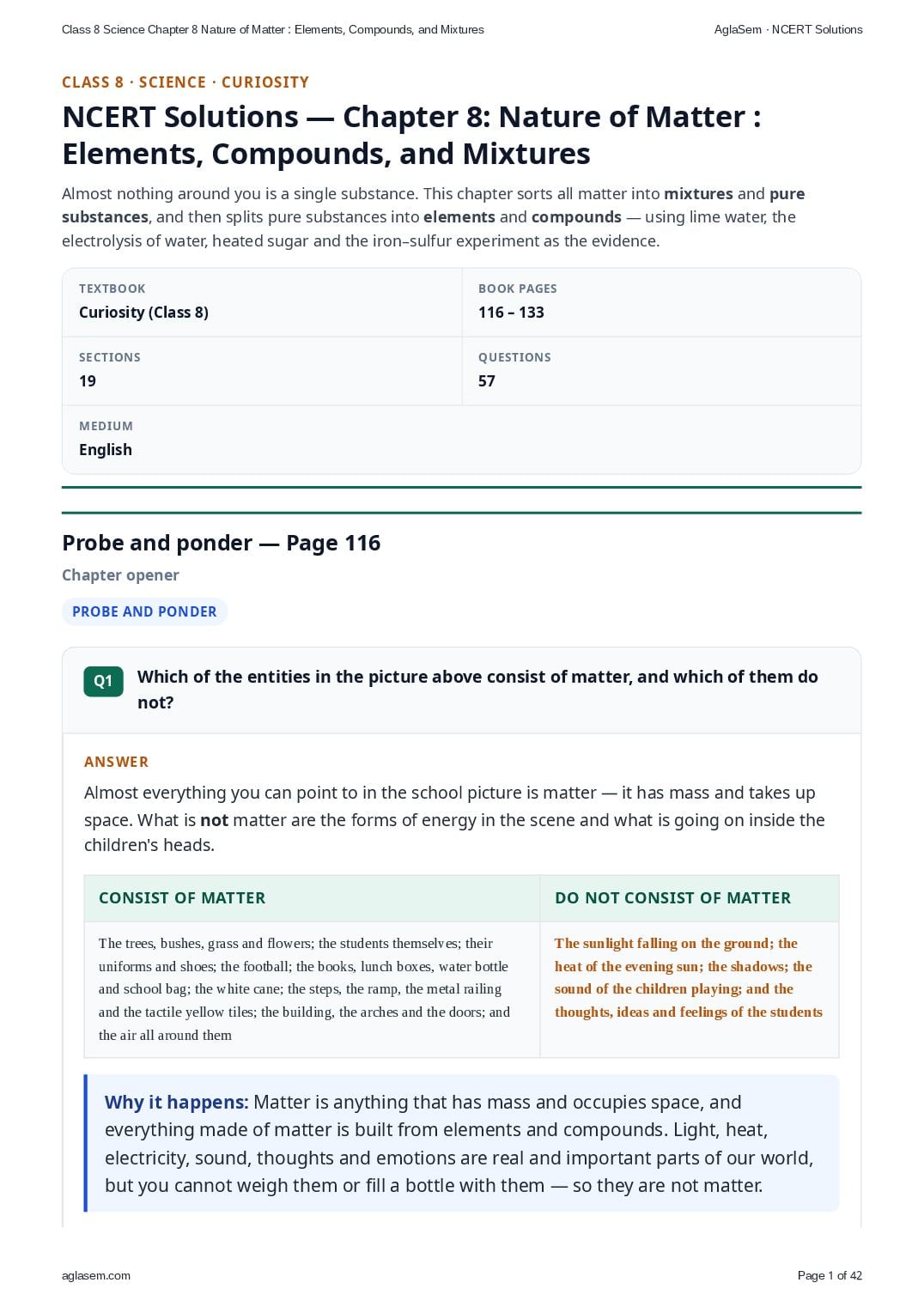
- Which of the entities in the picture above consist of matter, and which of them do not?
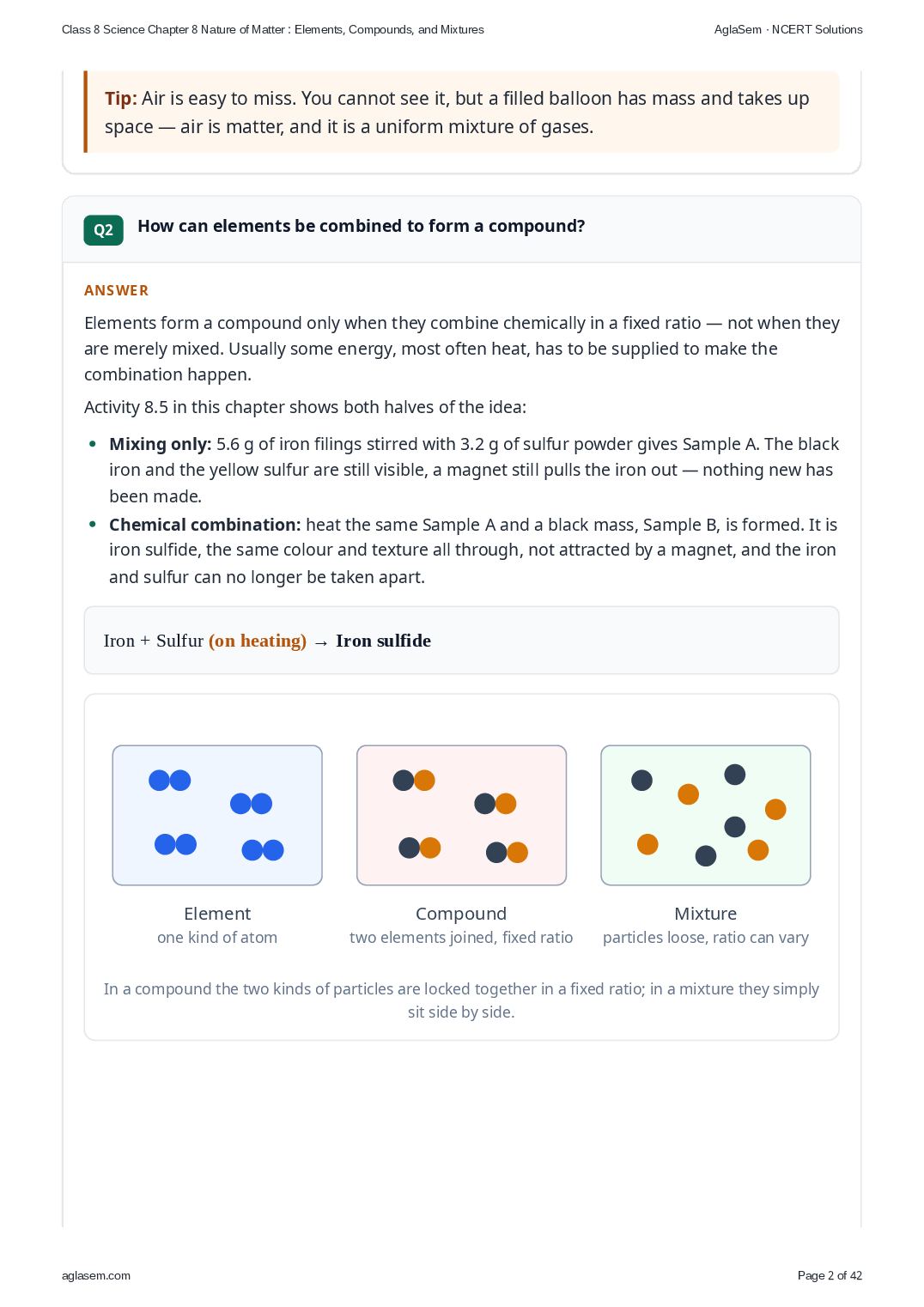
- How can elements be combined to form a compound?
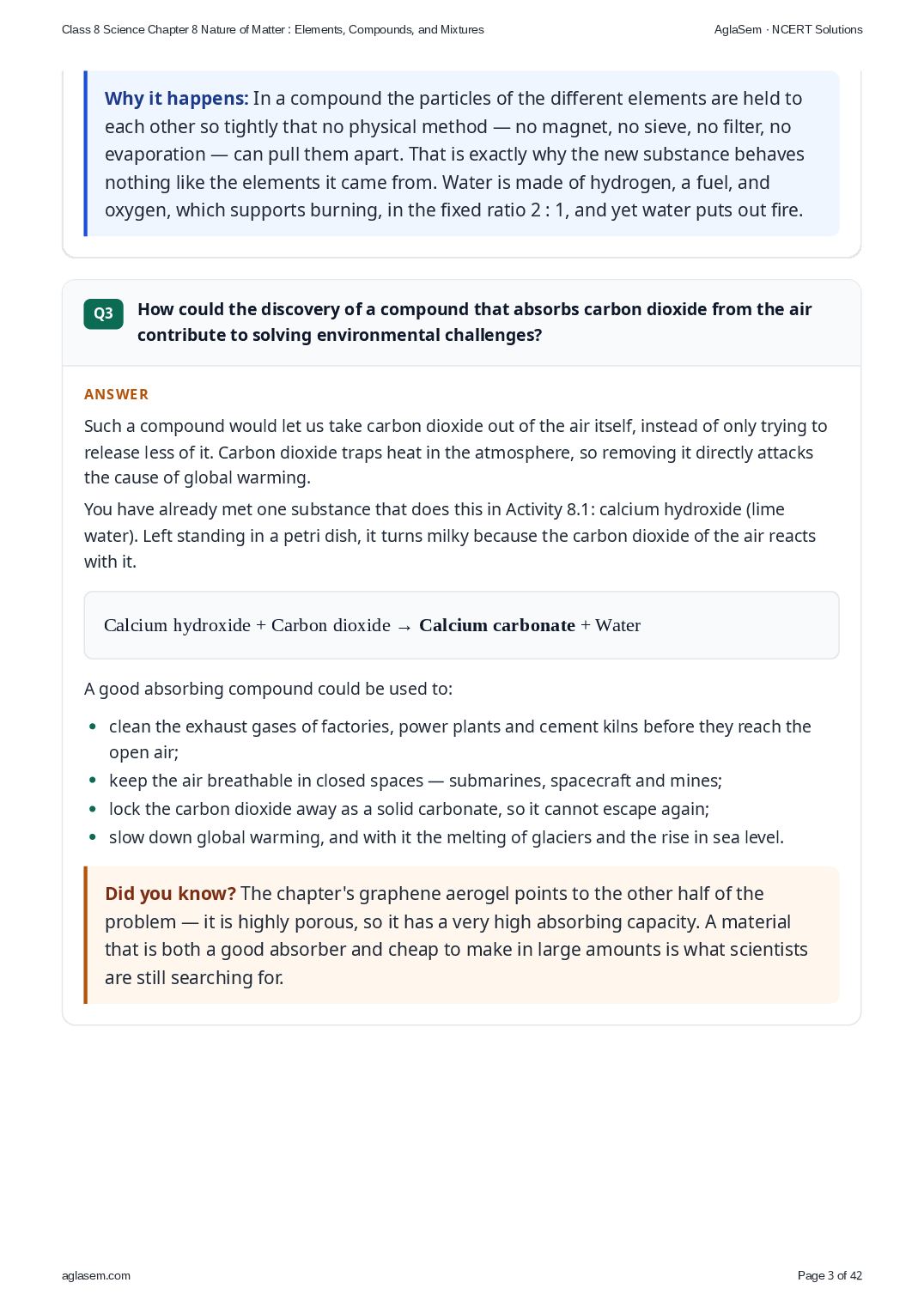
- How could the discovery of a compound that absorbs carbon dioxide from the air contribute to solving environmental challenges?
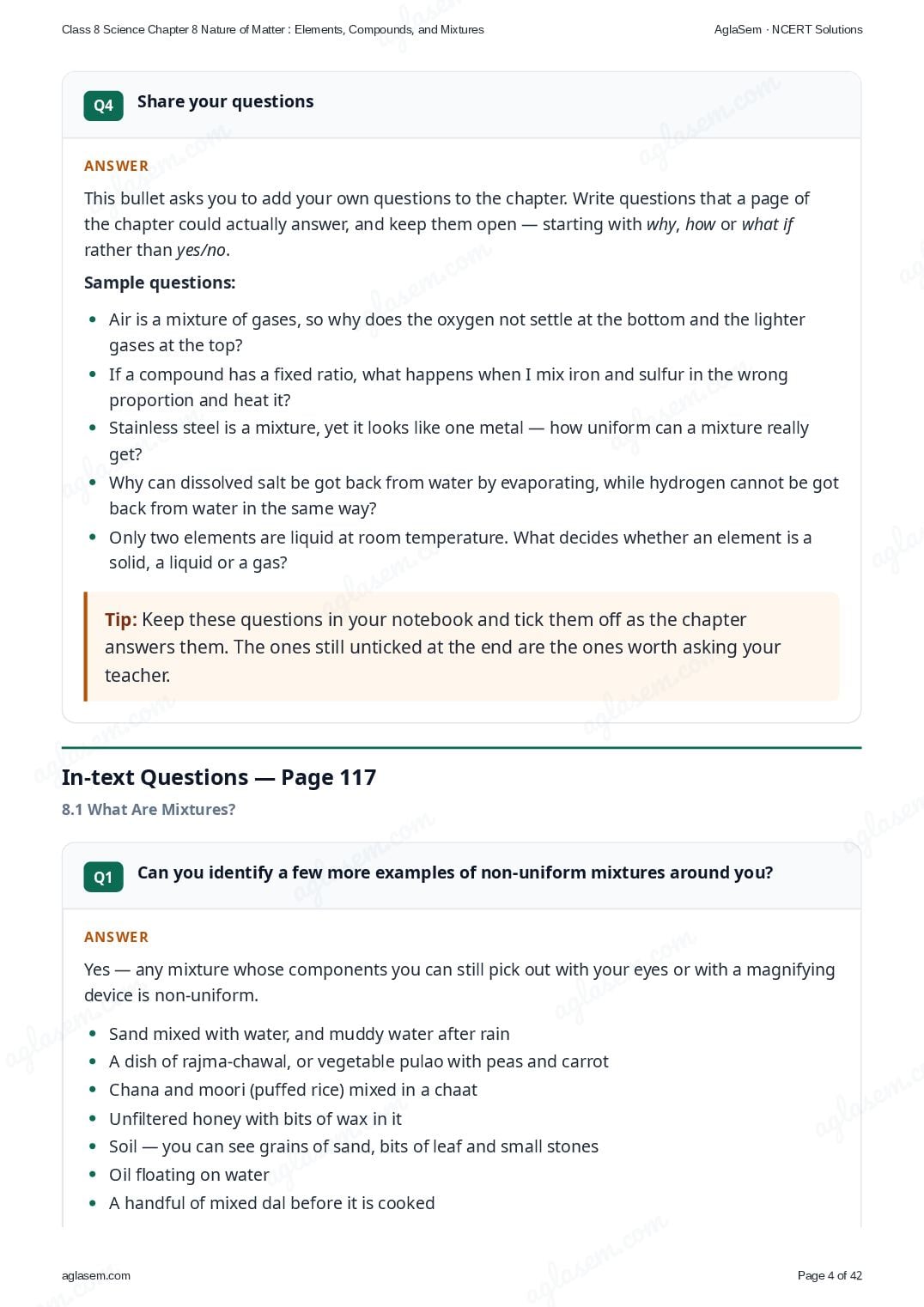
- Share your questions
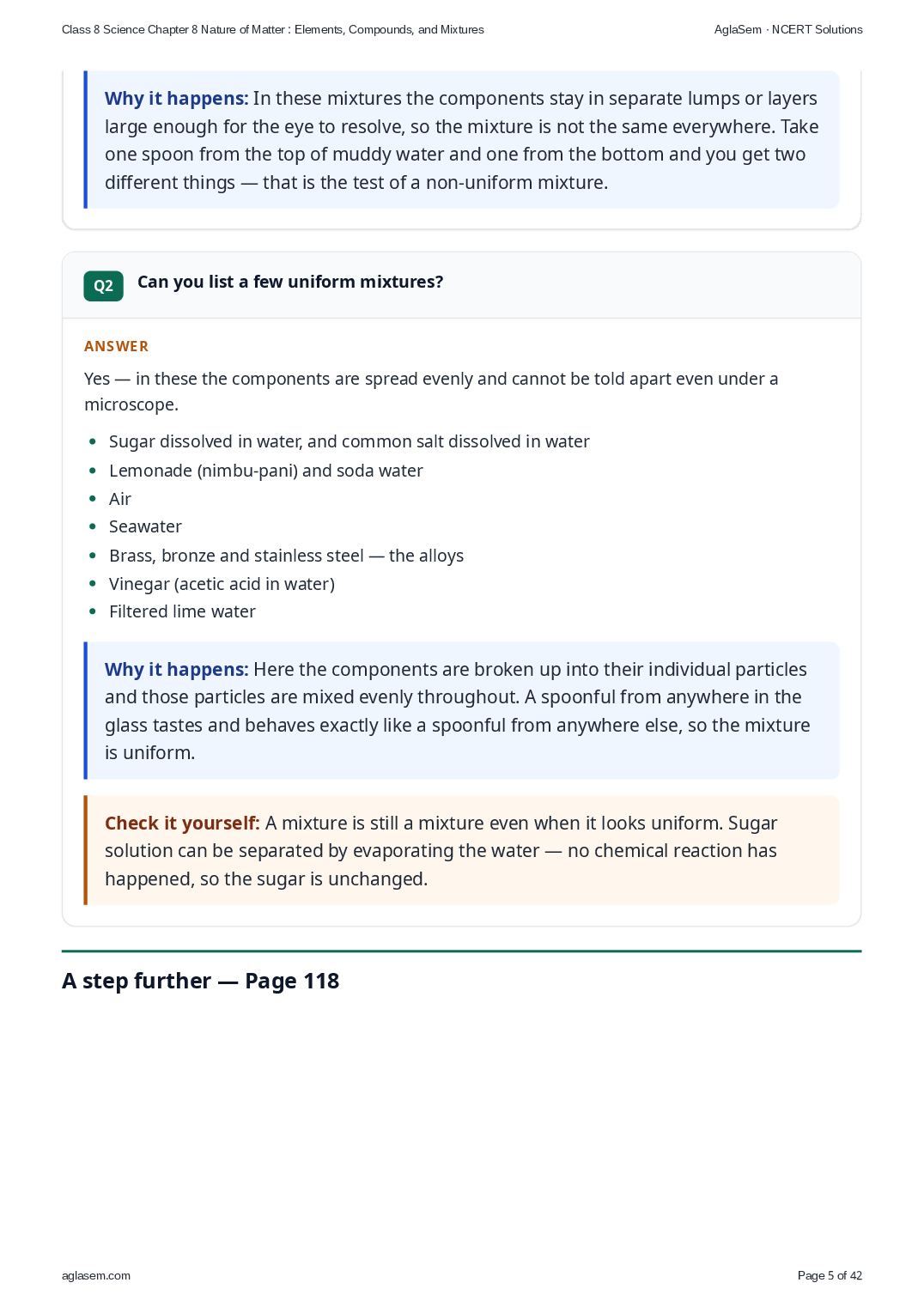
- Can you identify a few more examples of non-uniform mixtures around you?
- Can you list a few uniform mixtures?
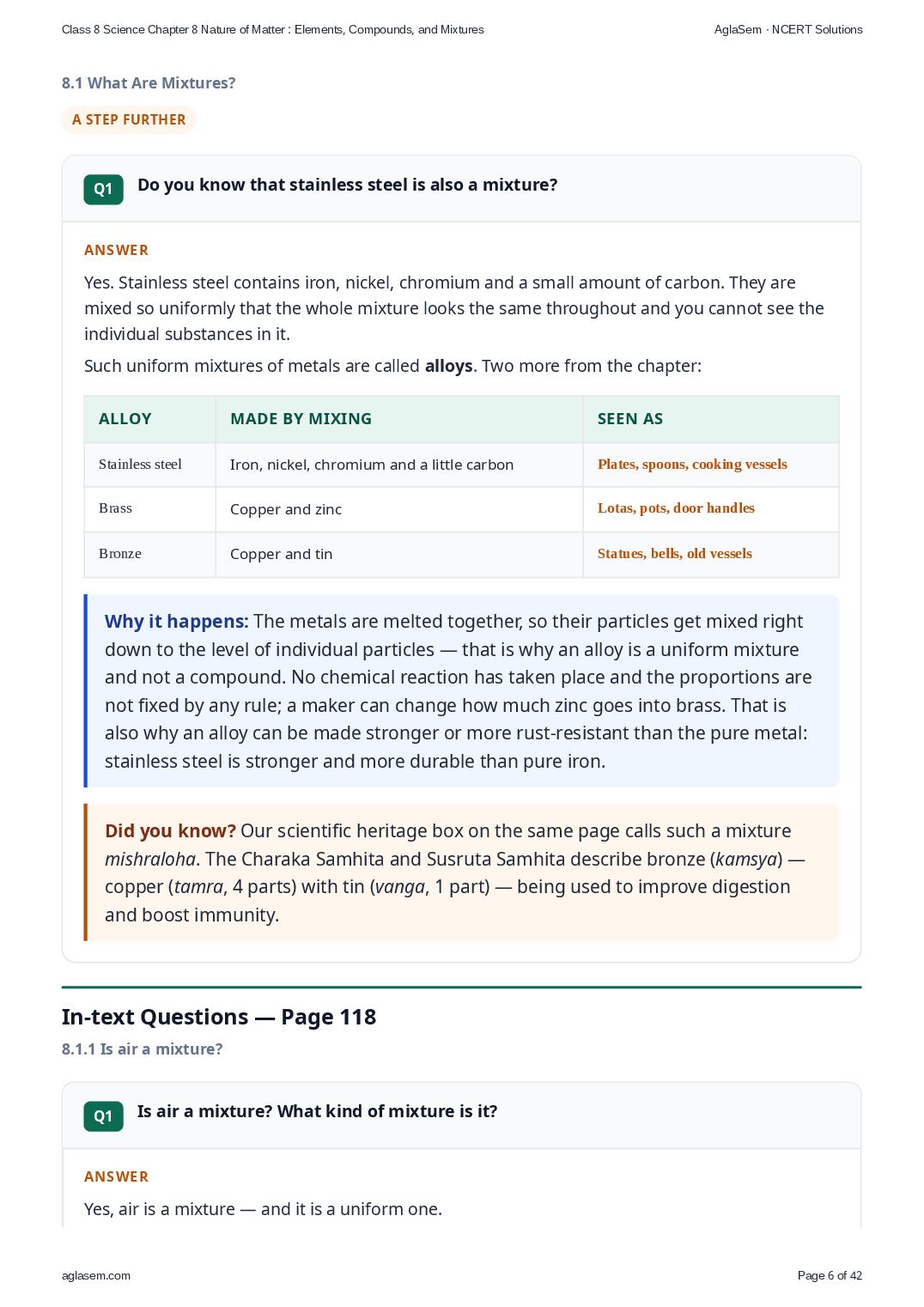
- Do you know that stainless steel is also a mixture?
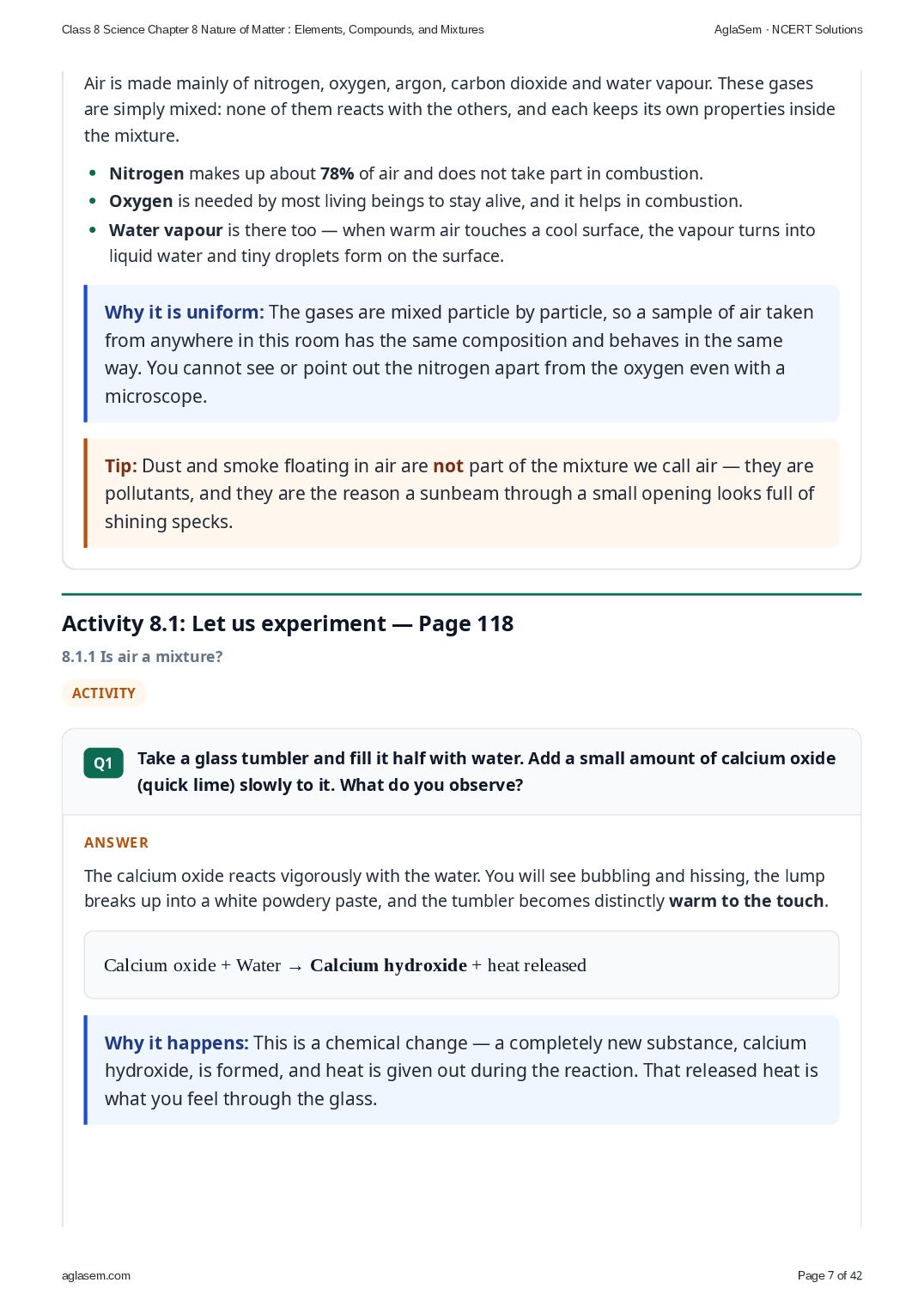
- Is air a mixture? What kind of mixture is it?
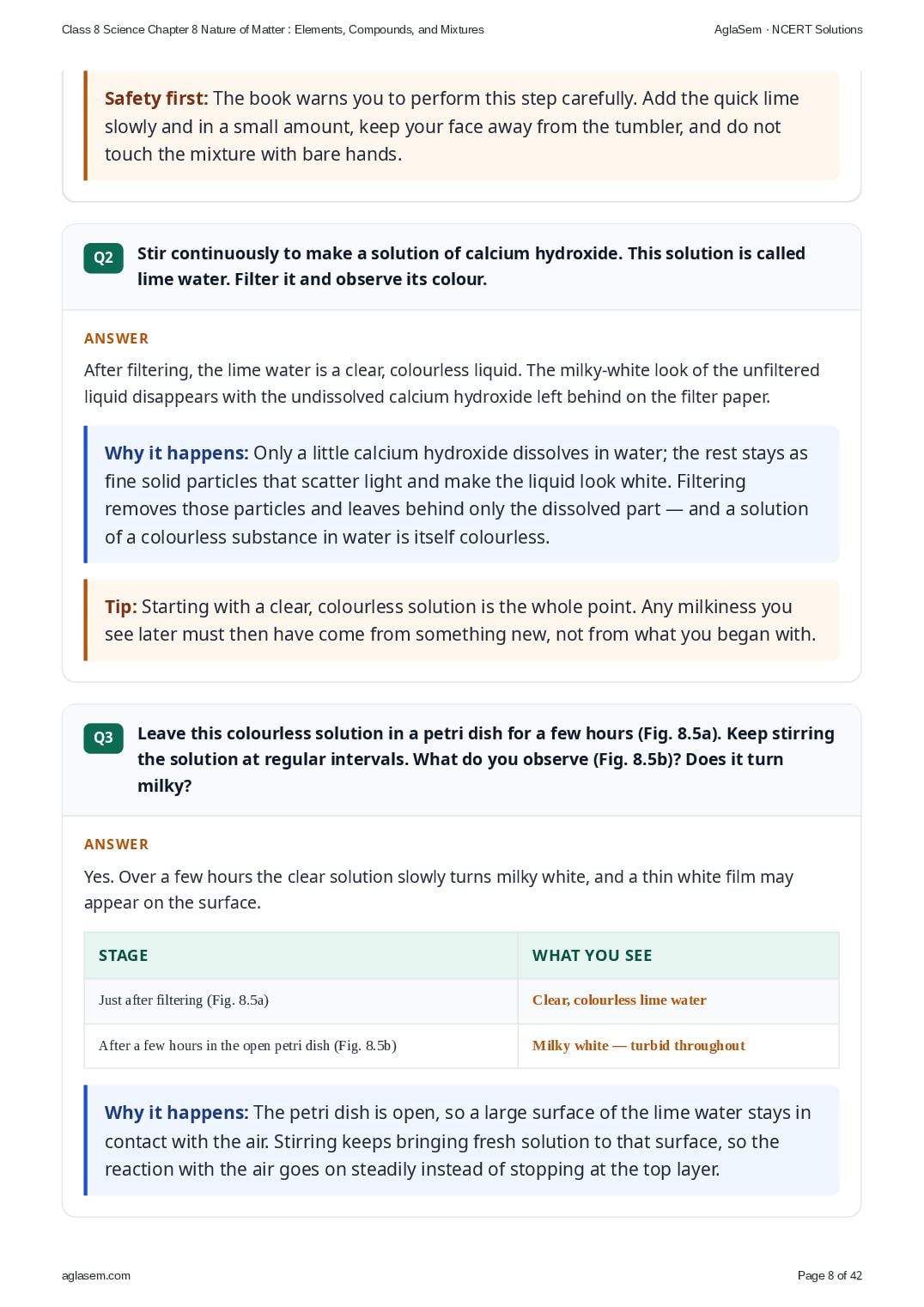
- Take a glass tumbler and fill it half with water. Add a small amount of calcium oxide (quick lime) slowly to it. What do you observe?
- Stir continuously to make a solution of calcium hydroxide. This solution is called lime water. Filter it and observe its colour.
- Leave this colourless solution in a petri dish for a few hours (Fig. 8.5a). Keep stirring the solution at regular intervals. What do you observe (Fig. 8.5b)? Does it turn milky?
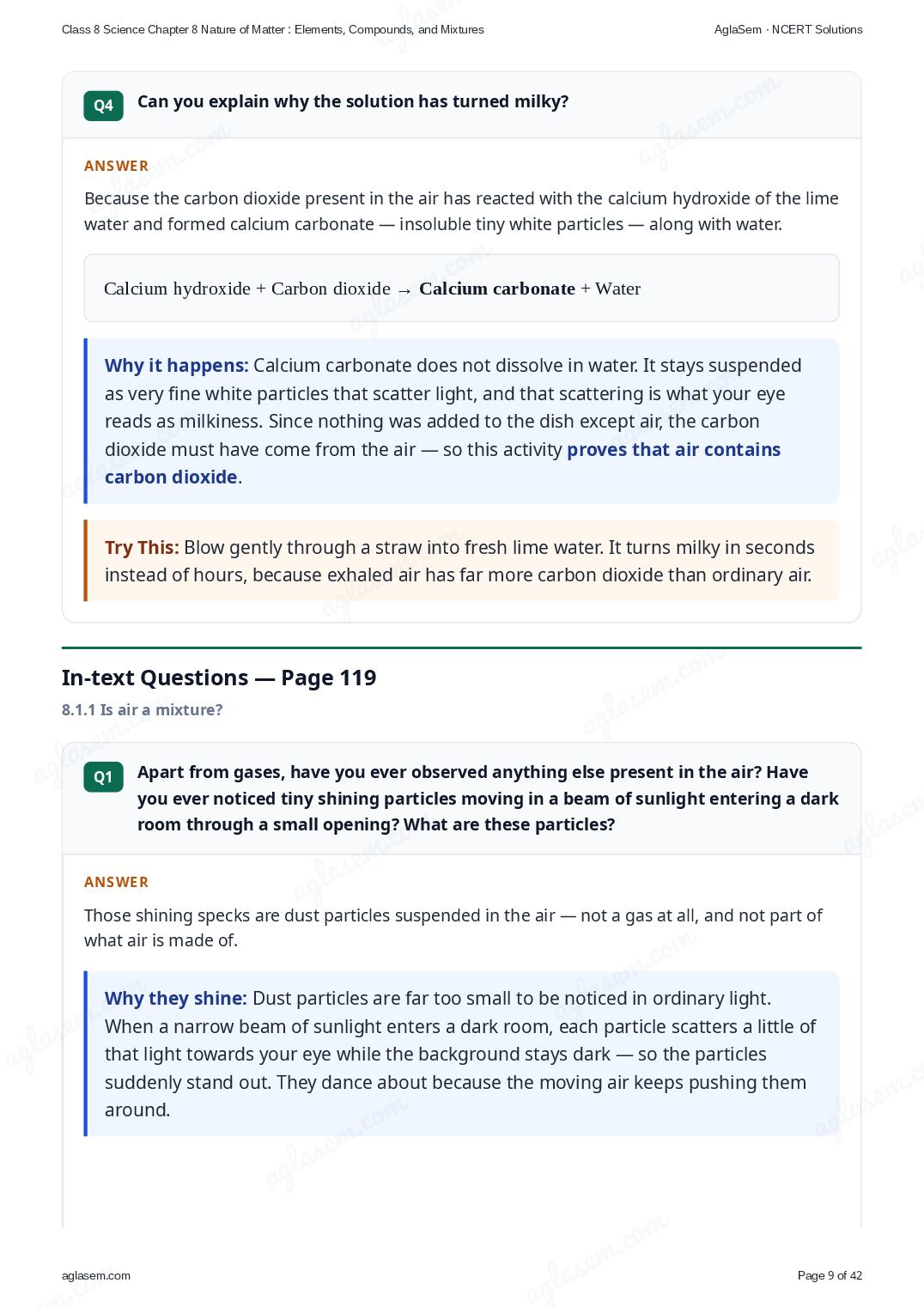
- Can you explain why the solution has turned milky?
- Apart from gases, have you ever observed anything else present in the air? Have you ever noticed tiny shining particles moving in a beam of sunlight entering a dark room through a small opening? What are these particles?
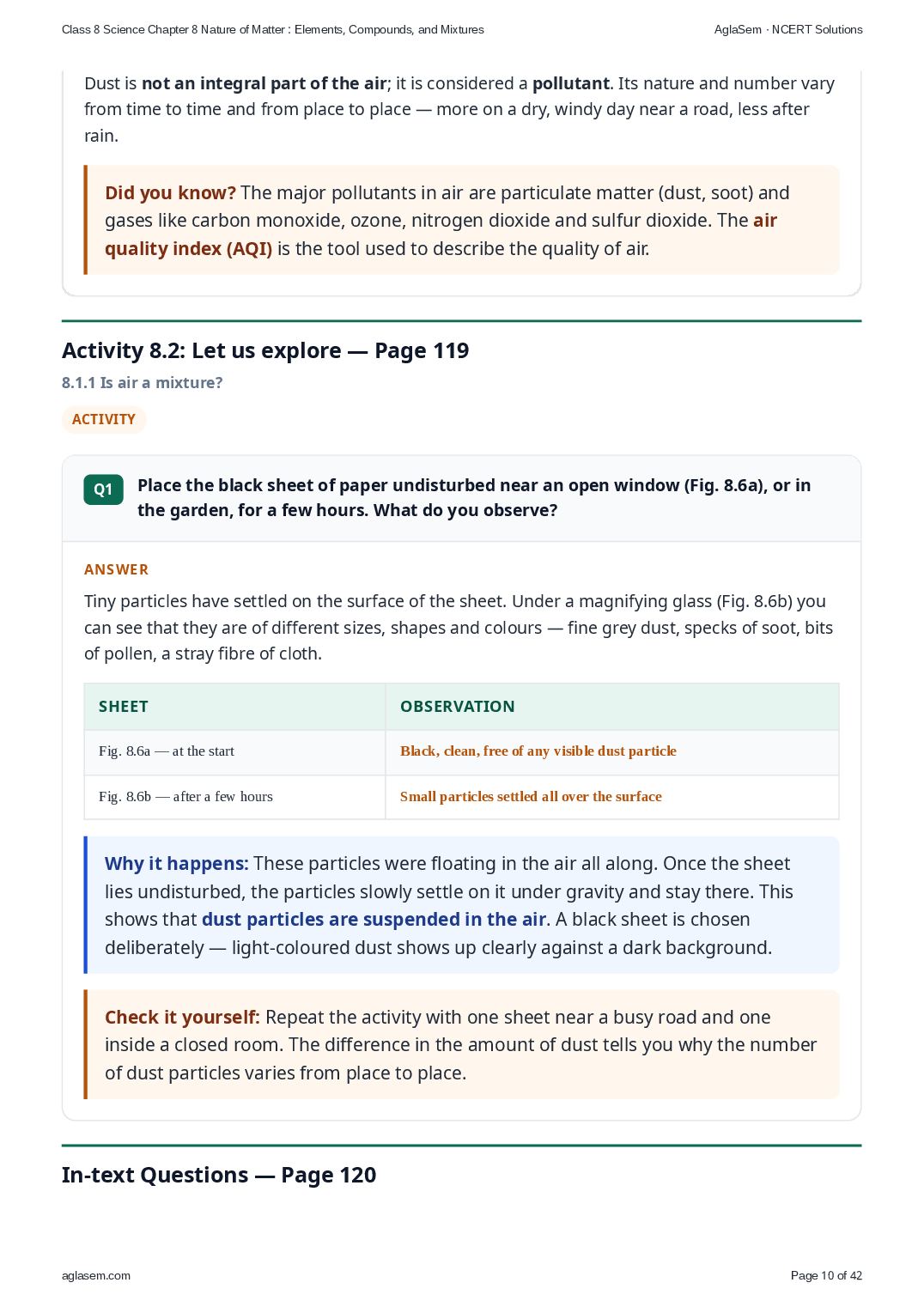
- Place the black sheet of paper undisturbed near an open window (Fig. 8.6a), or in the garden, for a few hours. What do you observe?
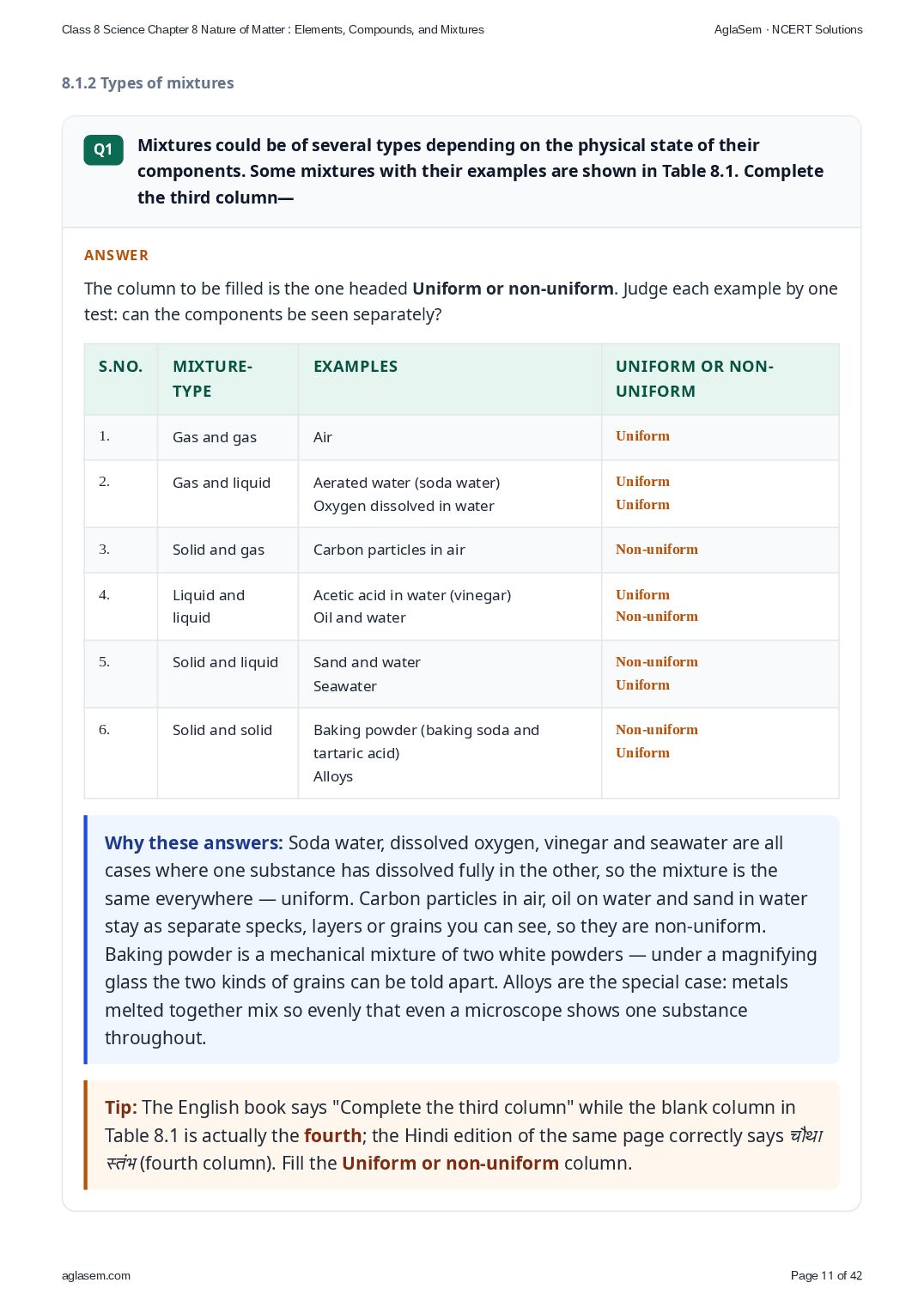
- Mixtures could be of several types depending on the physical state of their components. Some mixtures with their examples are shown in Table 8.1. Complete the third column—
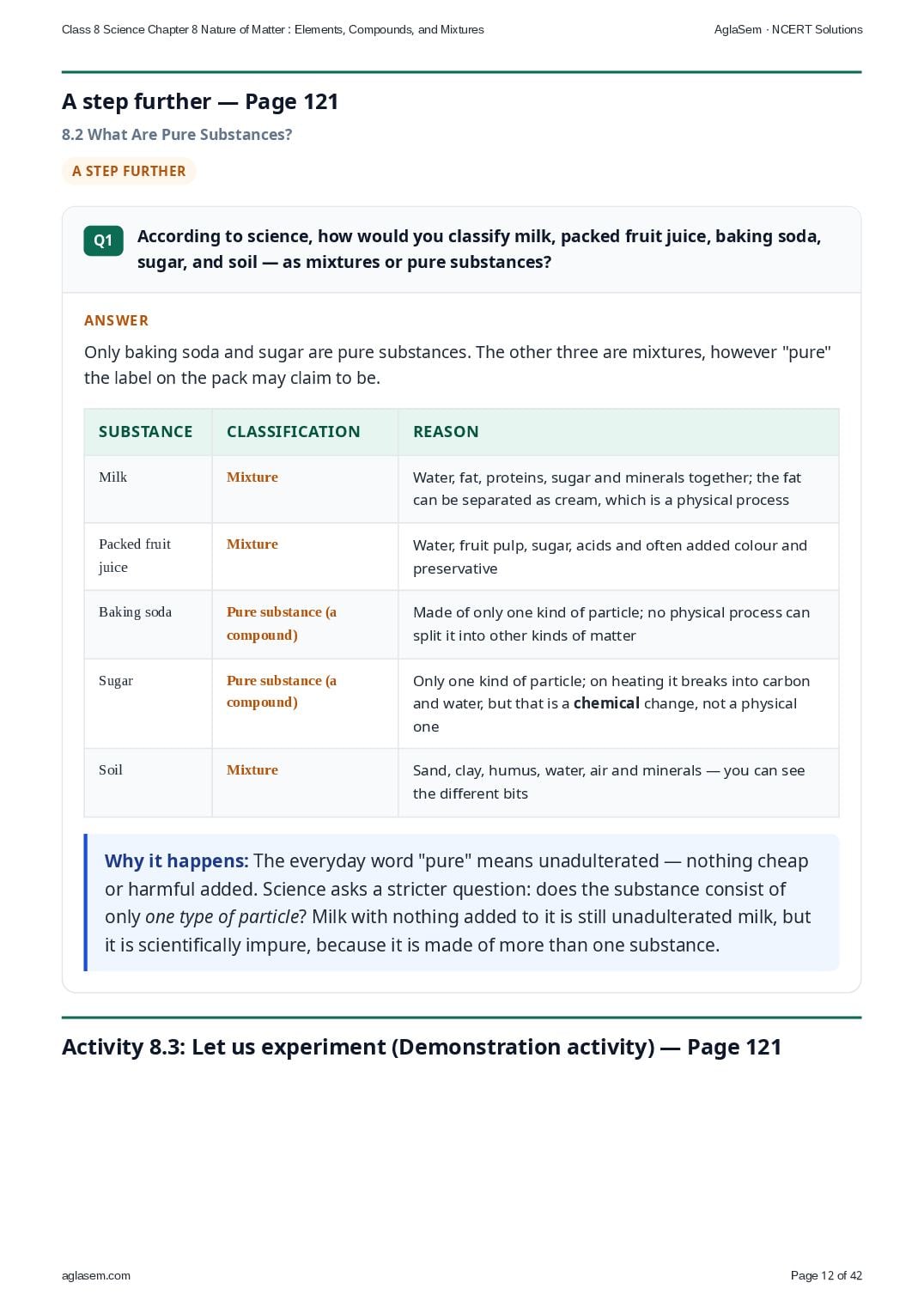
- According to science, how would you classify milk, packed fruit juice, baking soda, sugar, and soil — as mixtures or pure substances?
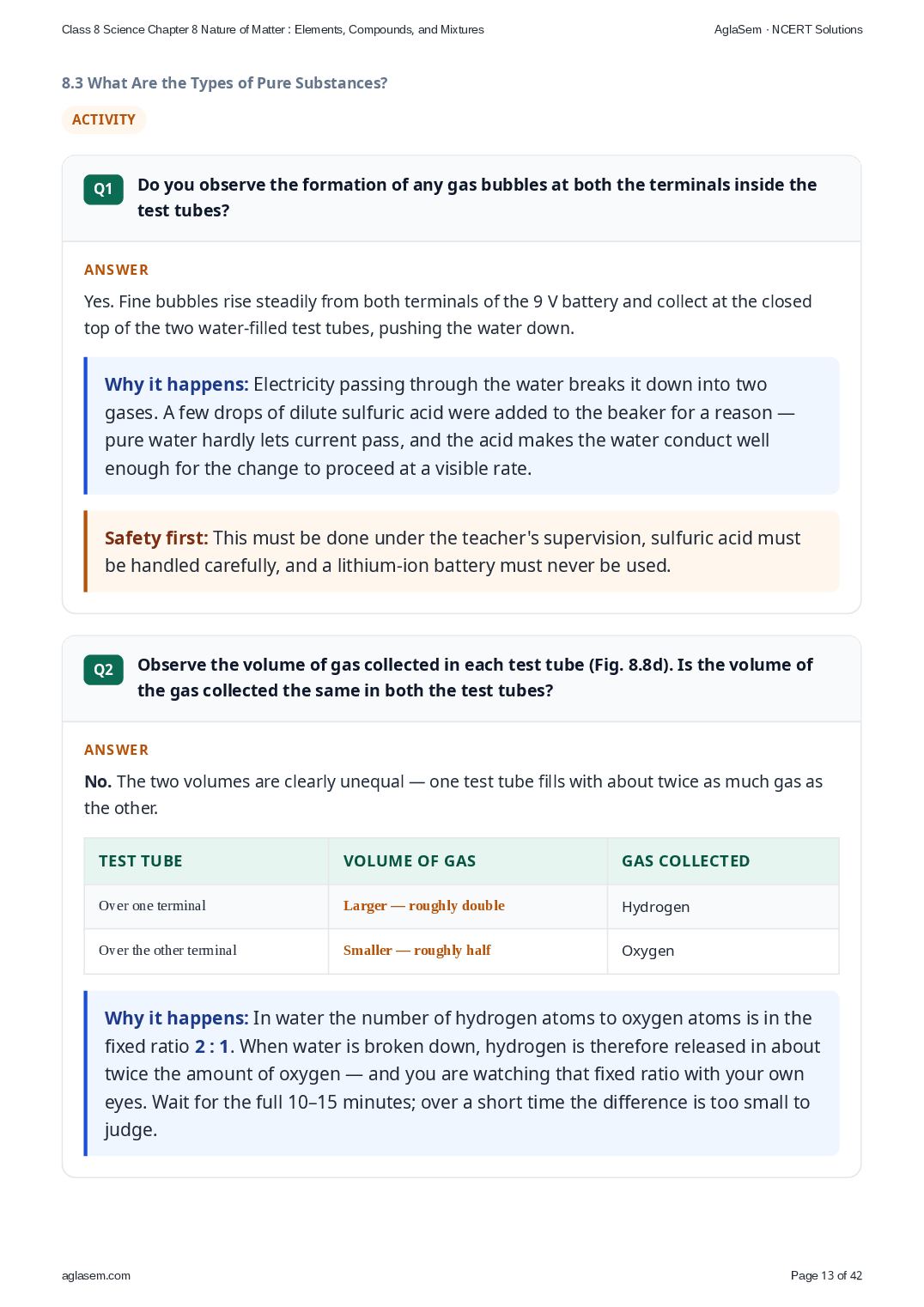
- Do you observe the formation of any gas bubbles at both the terminals inside the test tubes?
- Observe the volume of gas collected in each test tube (Fig. 8.8d). Is the volume of the gas collected the same in both the test tubes?
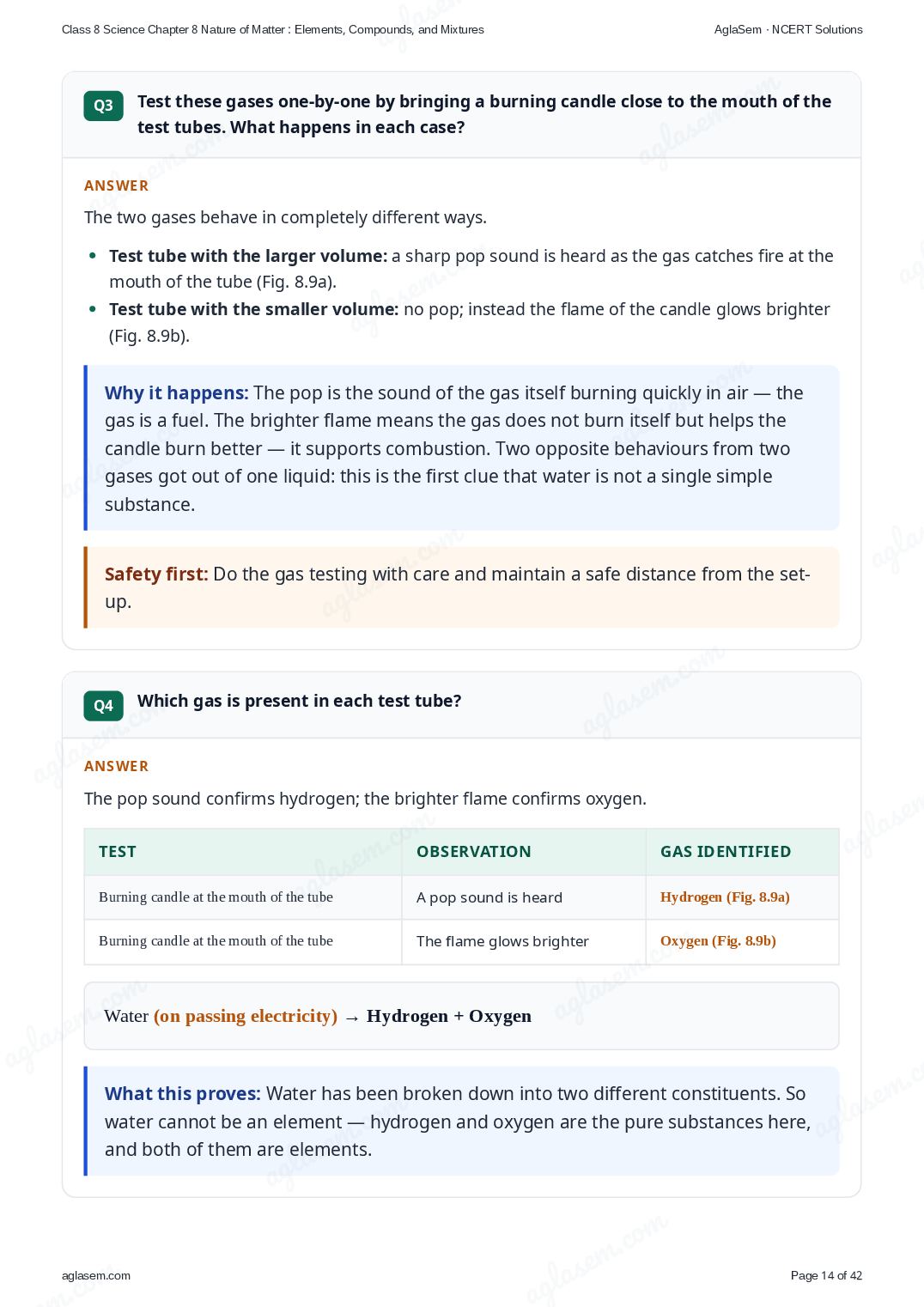
- Test these gases one-by-one by bringing a burning candle close to the mouth of the test tubes. What happens in each case?
- Which gas is present in each test tube?
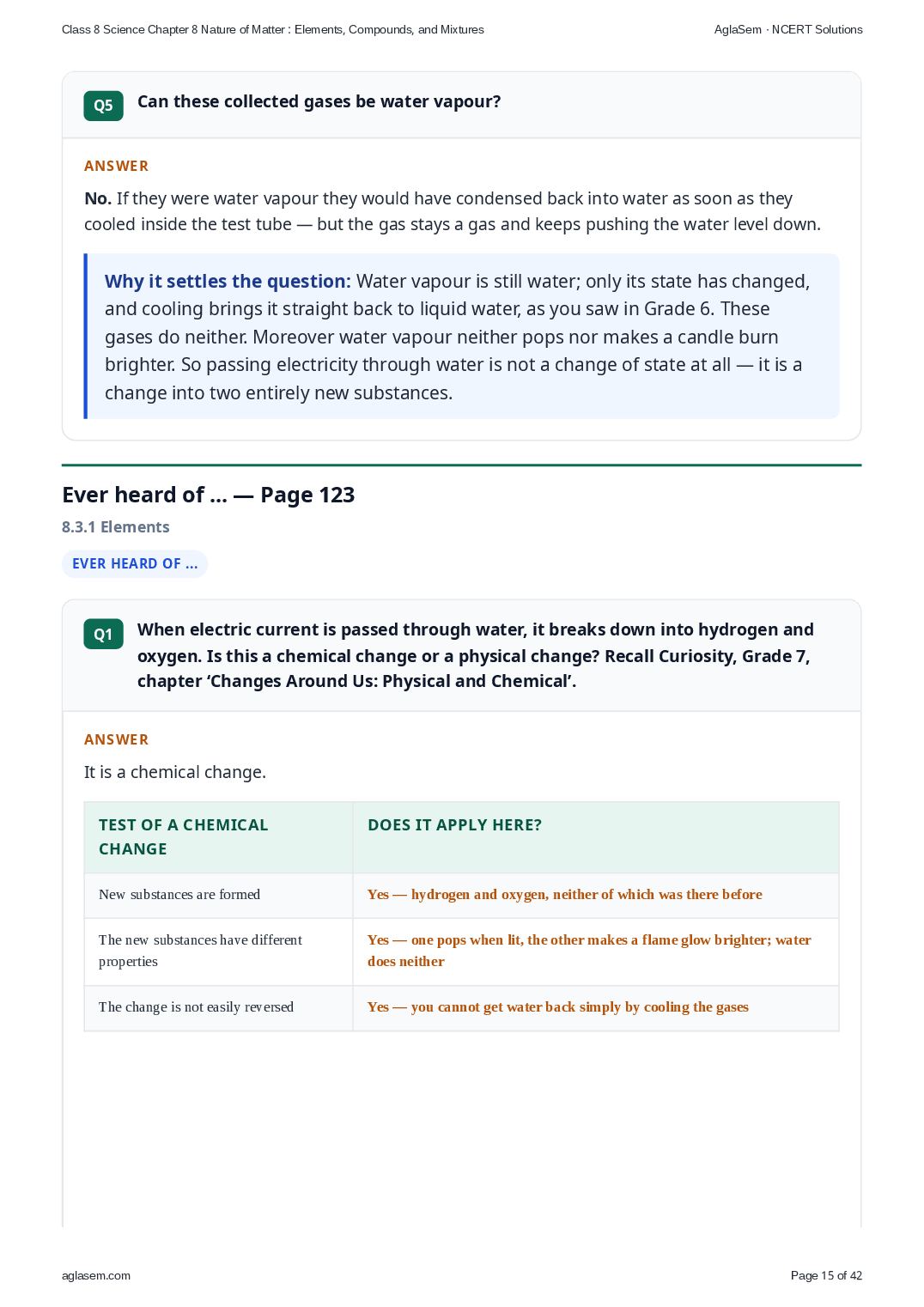
- Can these collected gases be water vapour?
- When electric current is passed through water, it breaks down into hydrogen and oxygen. Is this a chemical change or a physical change? Recall Curiosity, Grade 7, chapter ‘Changes Around Us: Physical and Chemical’.
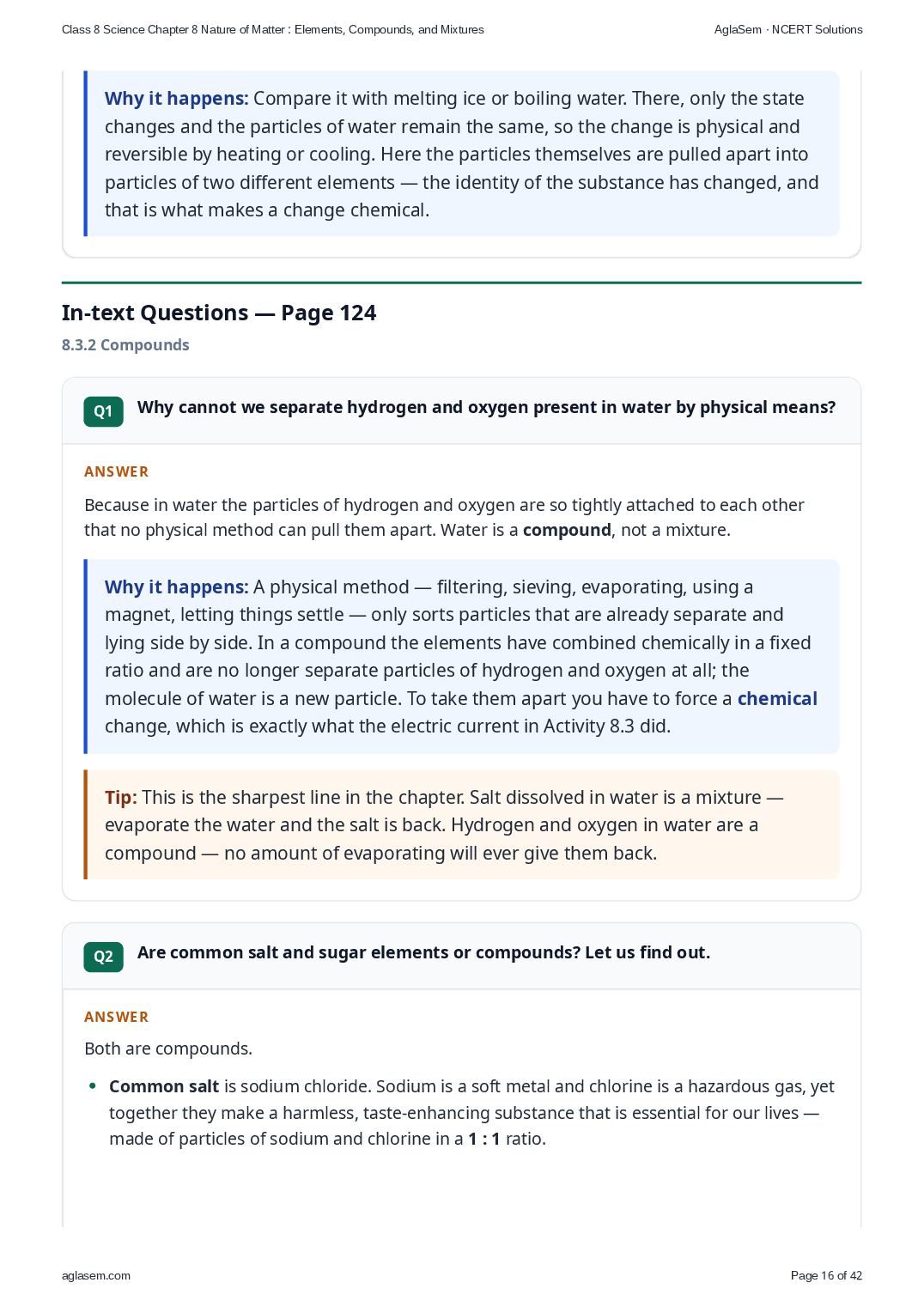
- Why cannot we separate hydrogen and oxygen present in water by physical means?
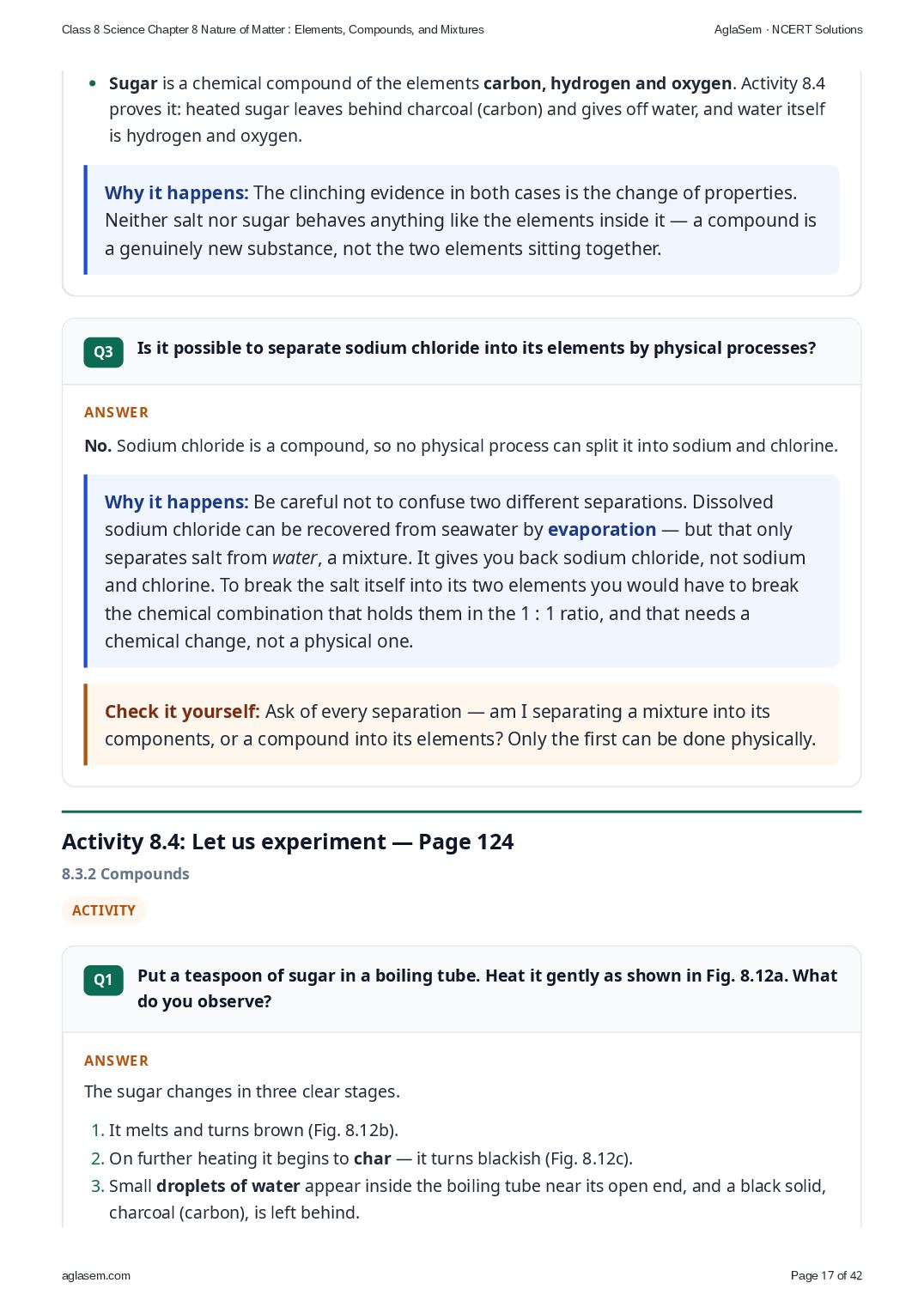
- Are common salt and sugar elements or compounds? Let us find out.
- Is it possible to separate sodium chloride into its elements by physical processes?
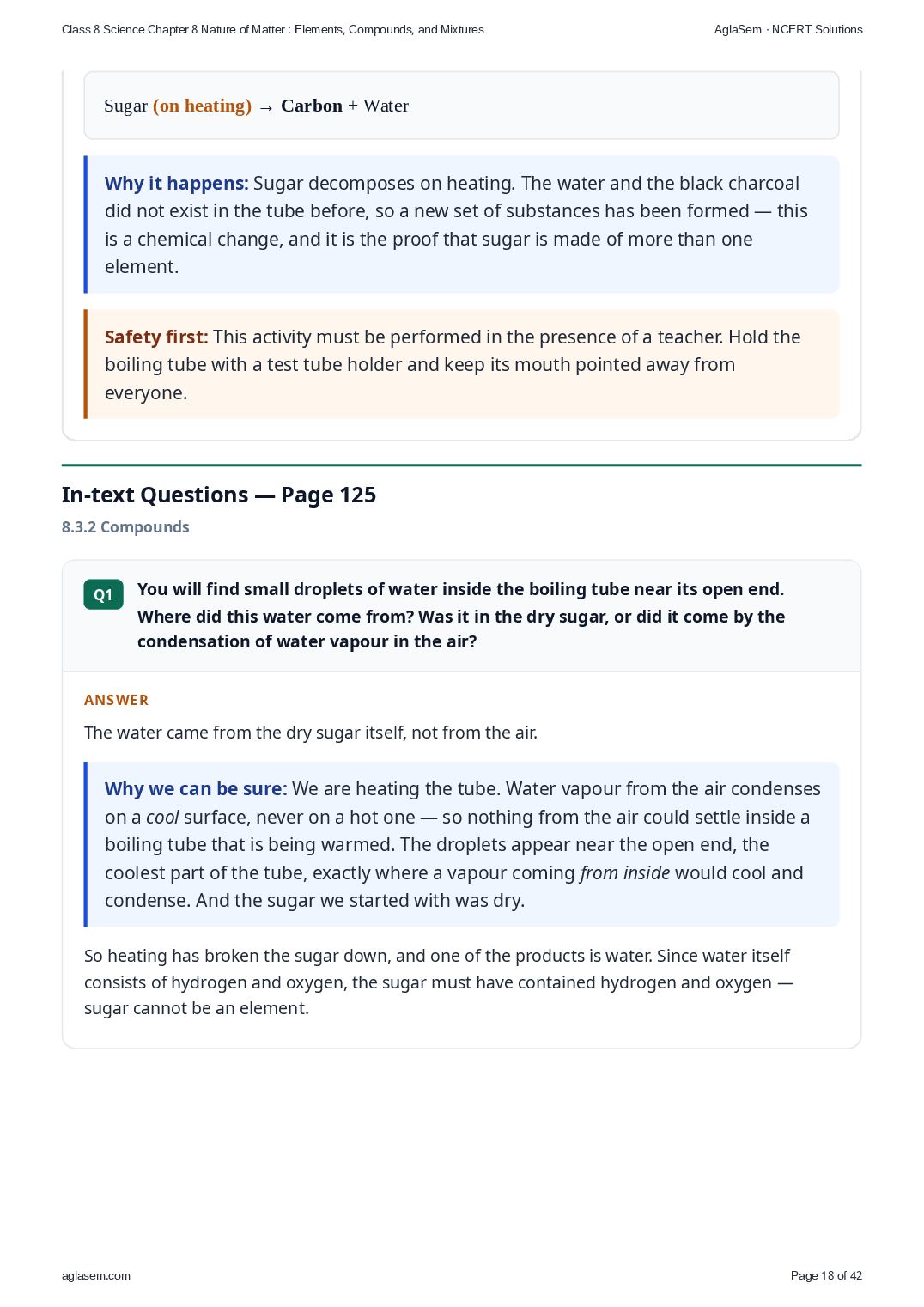
- Put a teaspoon of sugar in a boiling tube. Heat it gently as shown in Fig. 8.12a. What do you observe?
- You will find small droplets of water inside the boiling tube near its open end. Where did this water come from? Was it in the dry sugar, or did it come by the condensation of water vapour in the air?
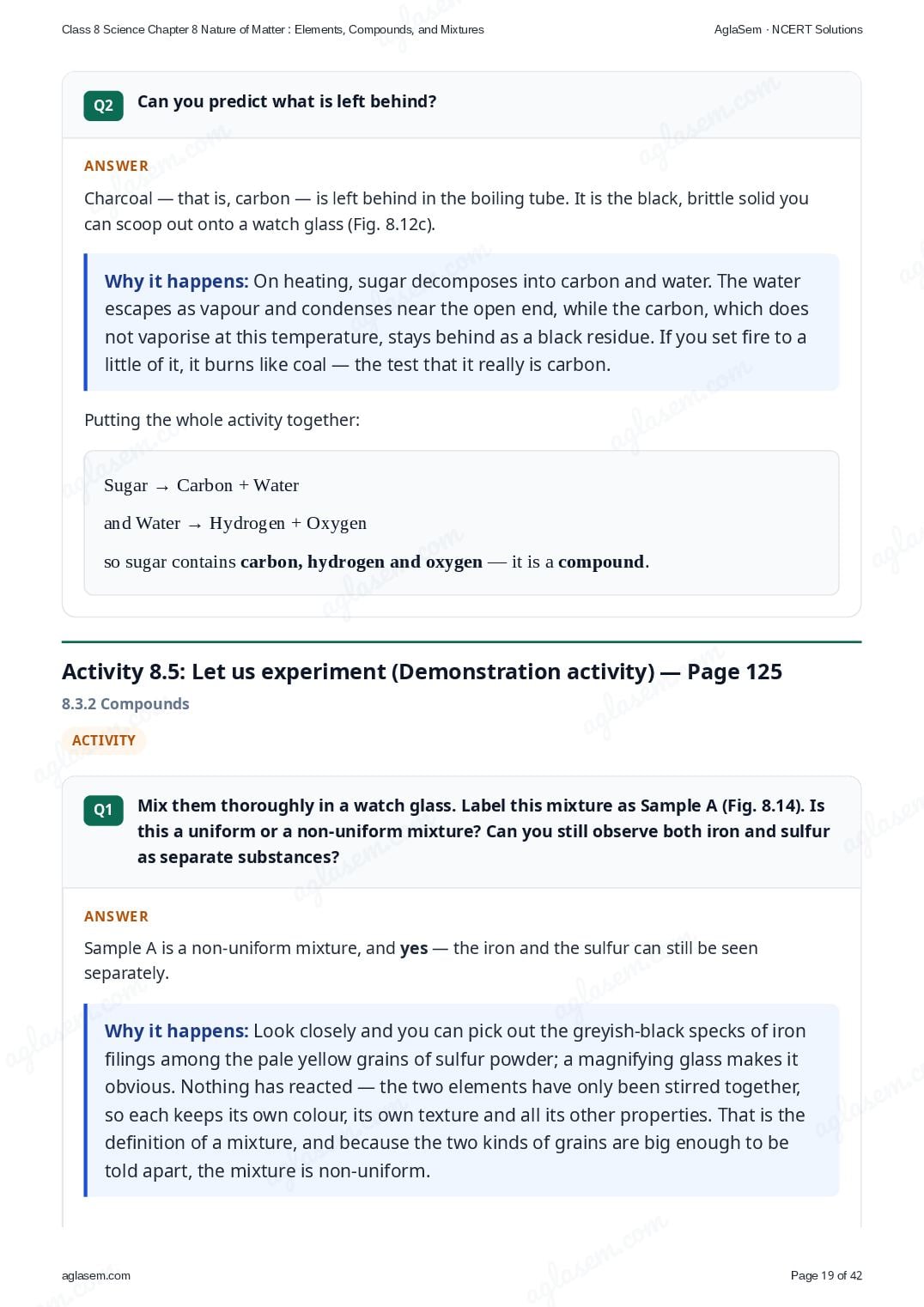
- Can you predict what is left behind?
- Mix them thoroughly in a watch glass. Label this mixture as Sample A (Fig. 8.14). Is this a uniform or a non-uniform mixture? Can you still observe both iron and sulfur as separate substances?
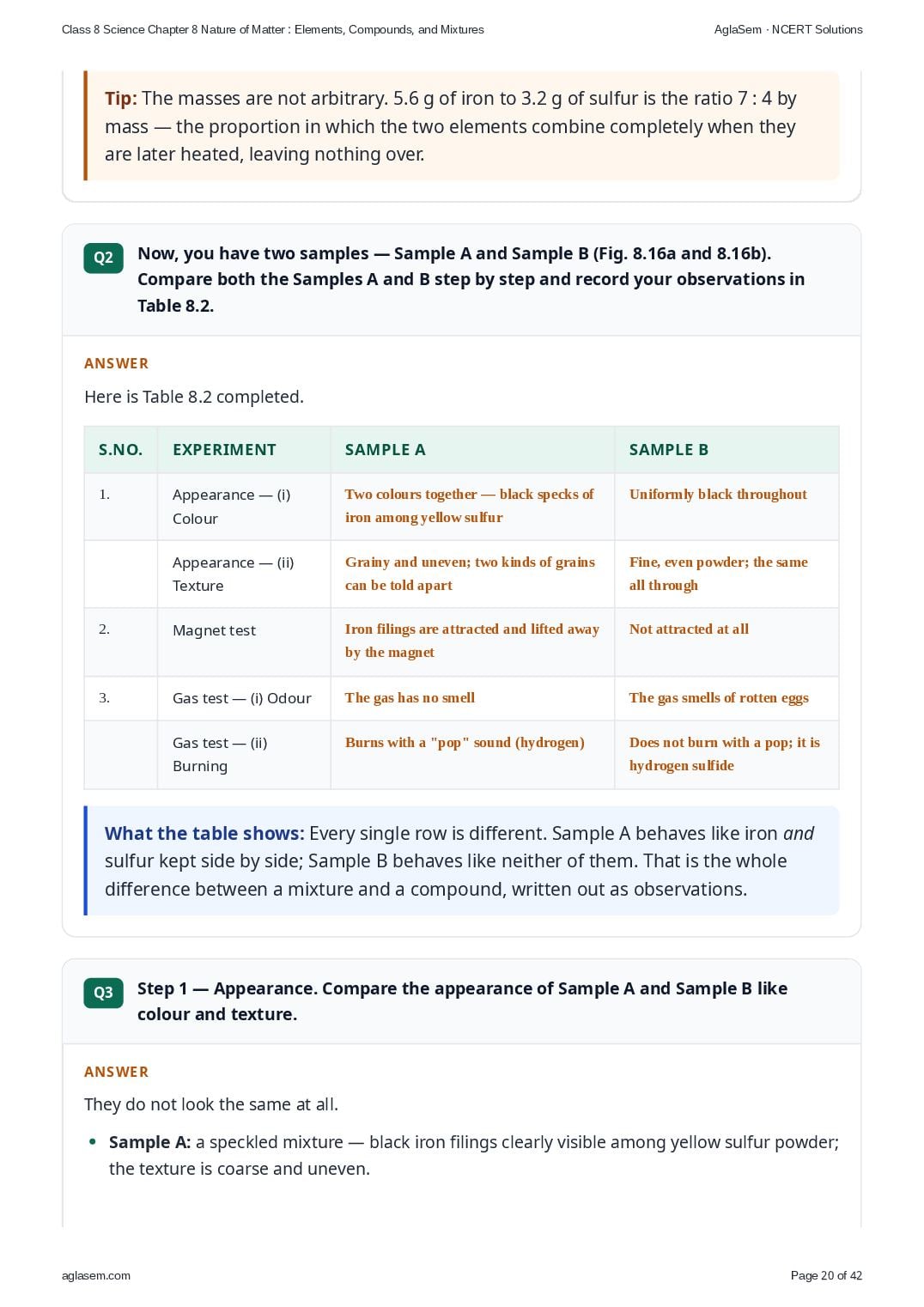
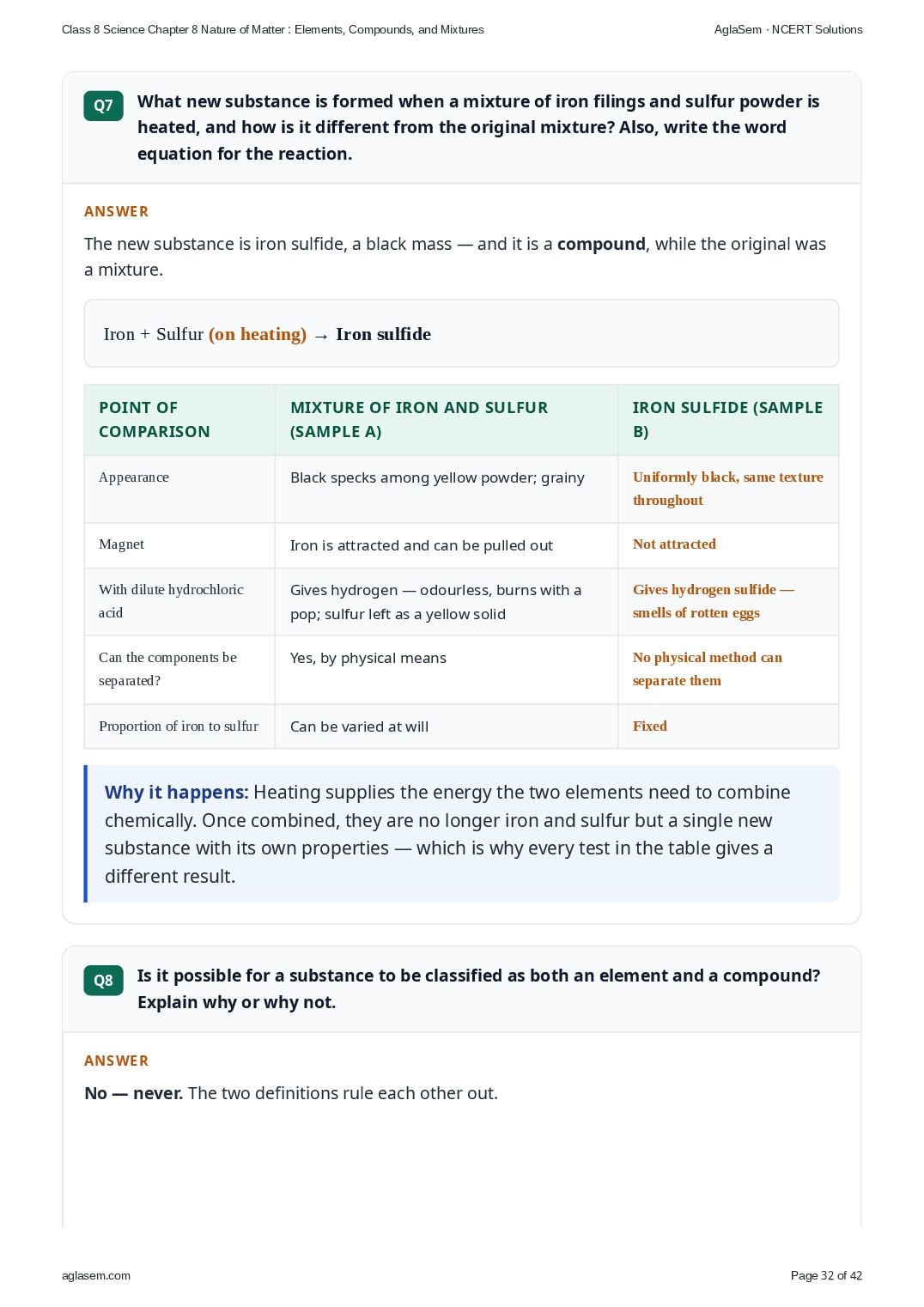
- Now, you have two samples — Sample A and Sample B (Fig. 8.16a and 8.16b). Compare both the Samples A and B step by step and record your observations in Table 8.2.
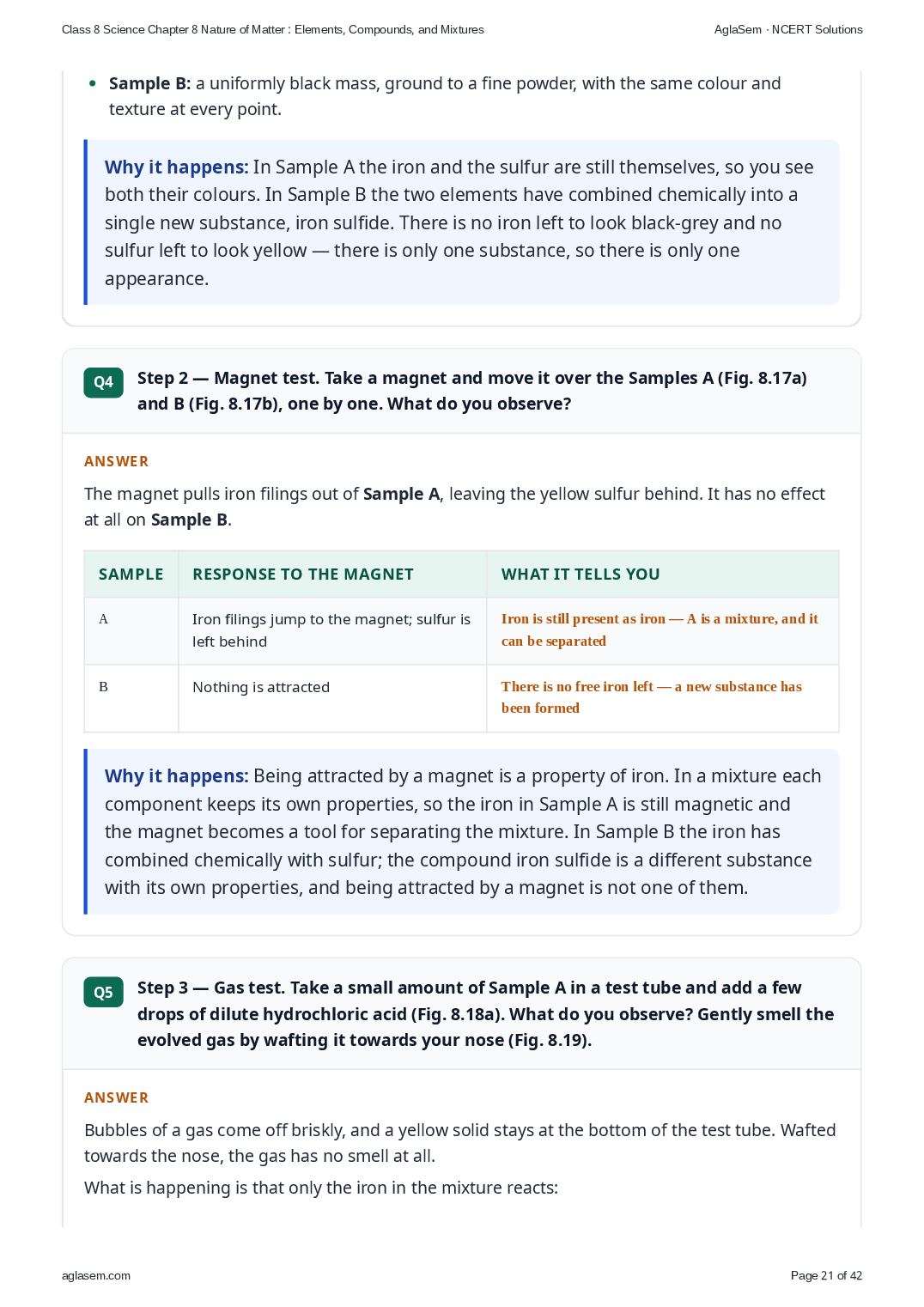
- Step 1 — Appearance. Compare the appearance of Sample A and Sample B like colour and texture.
- Step 2 — Magnet test. Take a magnet and move it over the Samples A (Fig. 8.17a) and B (Fig. 8.17b), one by one. What do you observe?
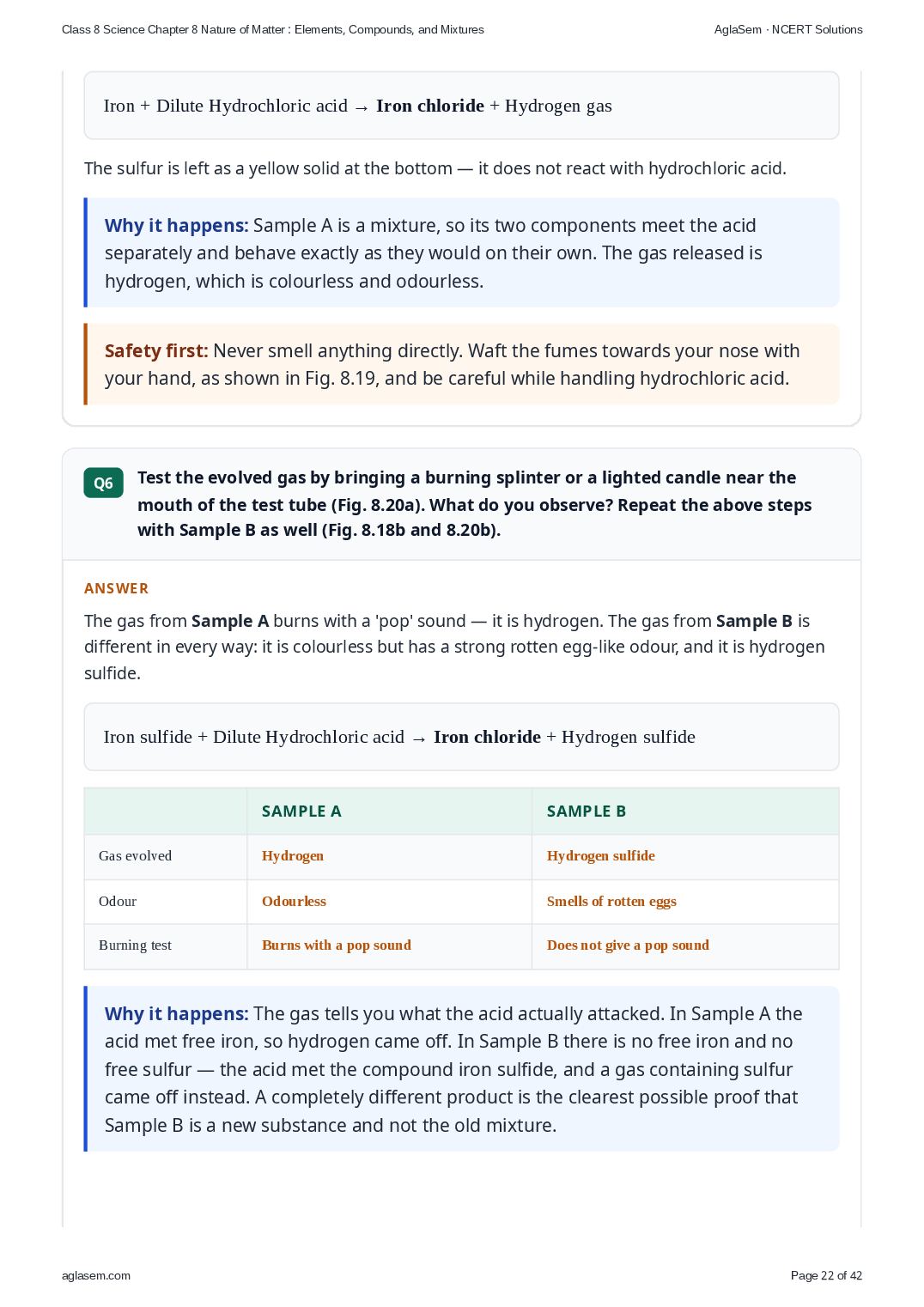
- Step 3 — Gas test. Take a small amount of Sample A in a test tube and add a few drops of dilute hydrochloric acid (Fig. 8.18a). What do you observe? Gently smell the evolved gas by wafting it towards your nose (Fig. 8.19).
- Test the evolved gas by bringing a burning splinter or a lighted candle near the mouth of the test tube (Fig. 8.20a). What do you observe? Repeat the above steps with Sample B as well (Fig. 8.18b and 8.20b).
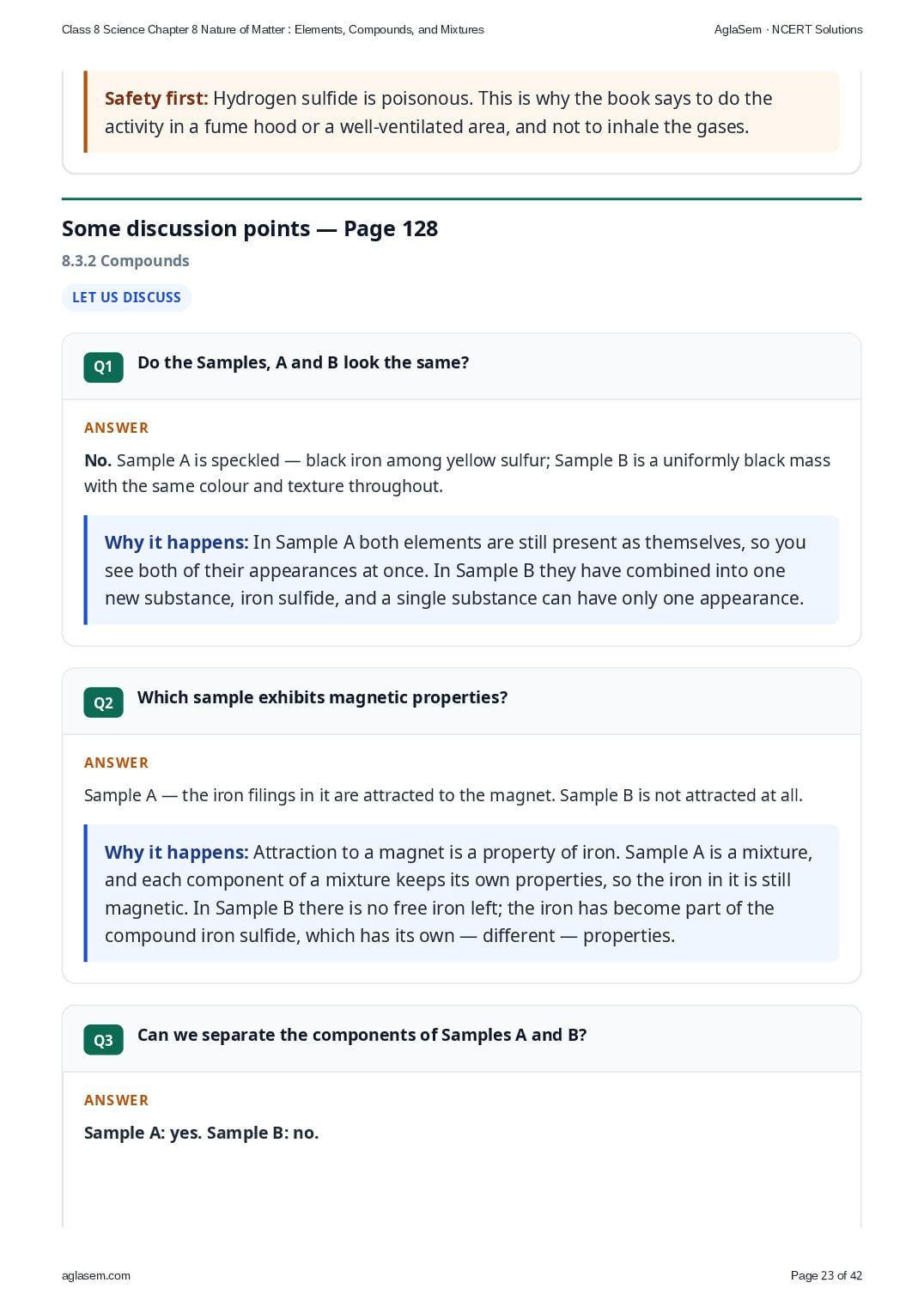
- Do the Samples, A and B look the same?
- Which sample exhibits magnetic properties?
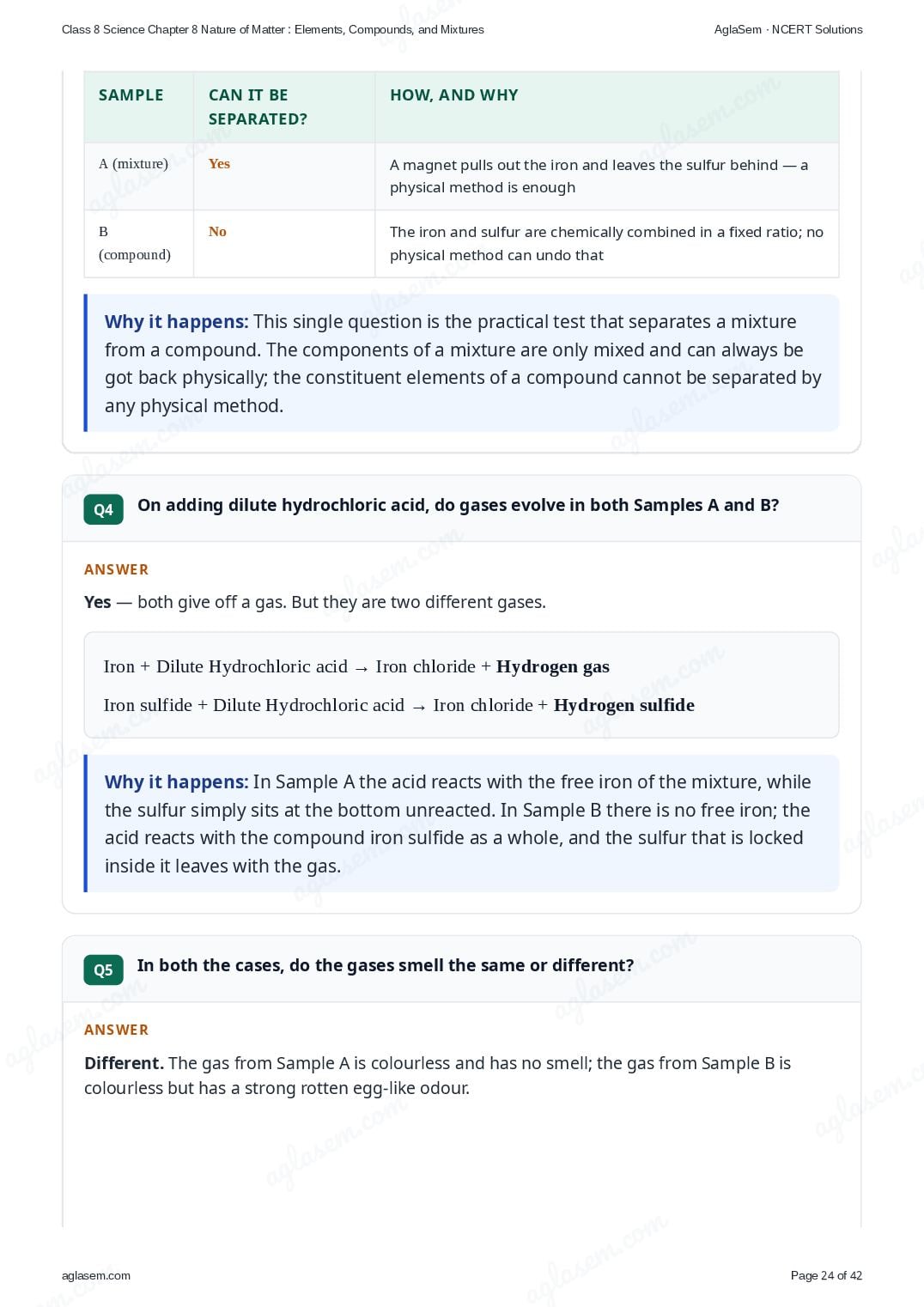
- Can we separate the components of Samples A and B?
- On adding dilute hydrochloric acid, do gases evolve in both Samples A and B?
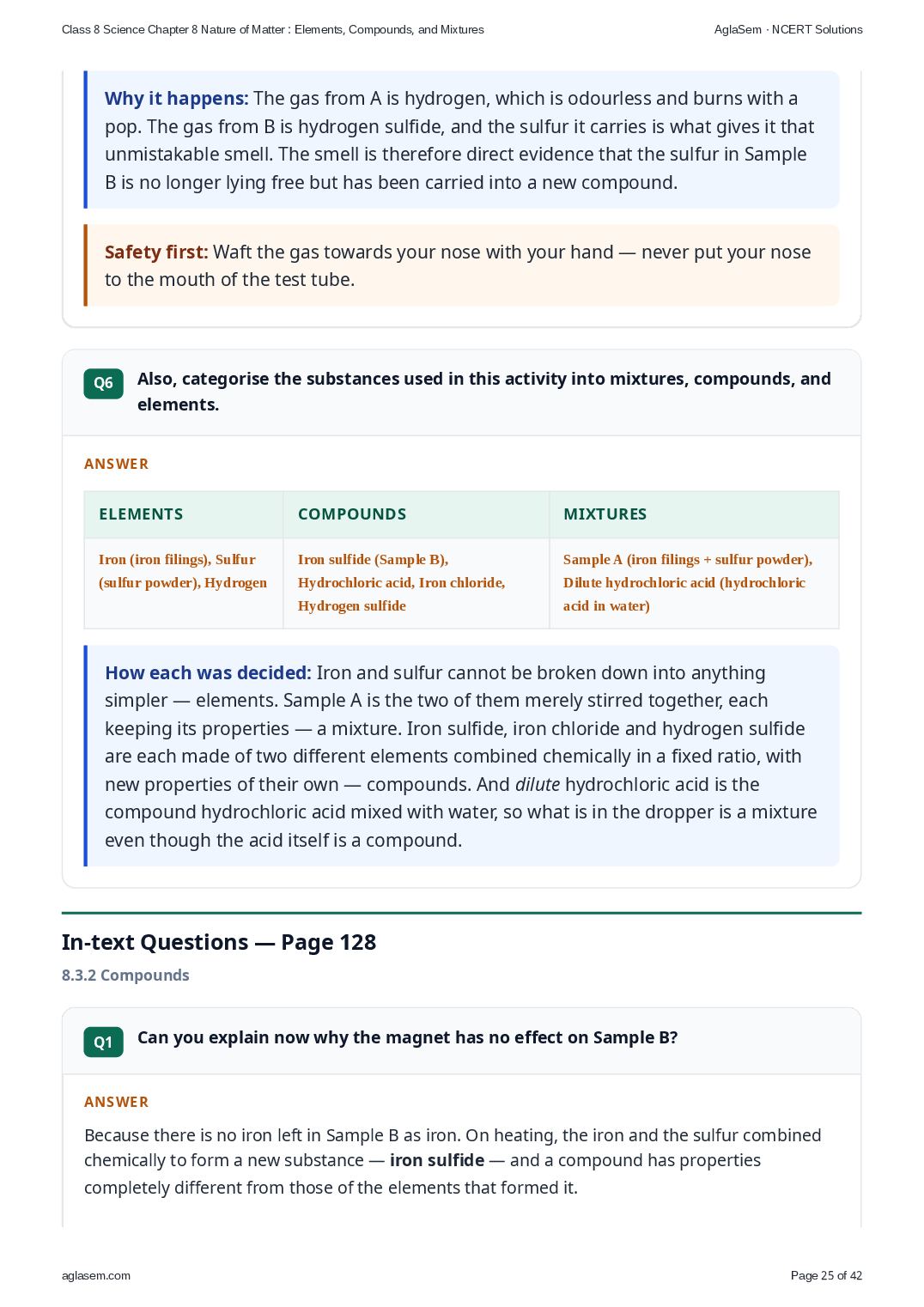
- In both the cases, do the gases smell the same or different?
- Also, categorise the substances used in this activity into mixtures, compounds, and elements.
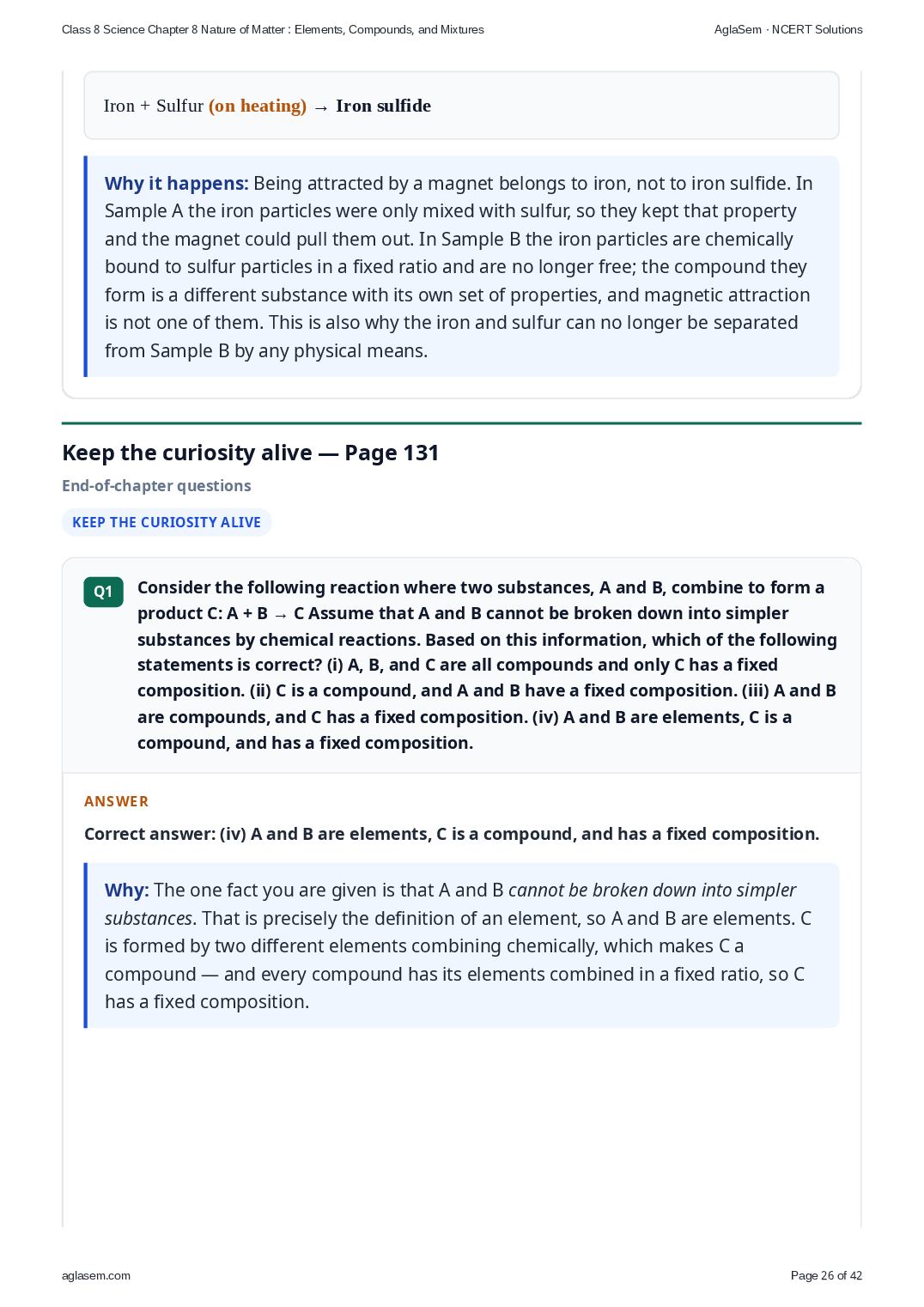
- Can you explain now why the magnet has no effect on Sample B?
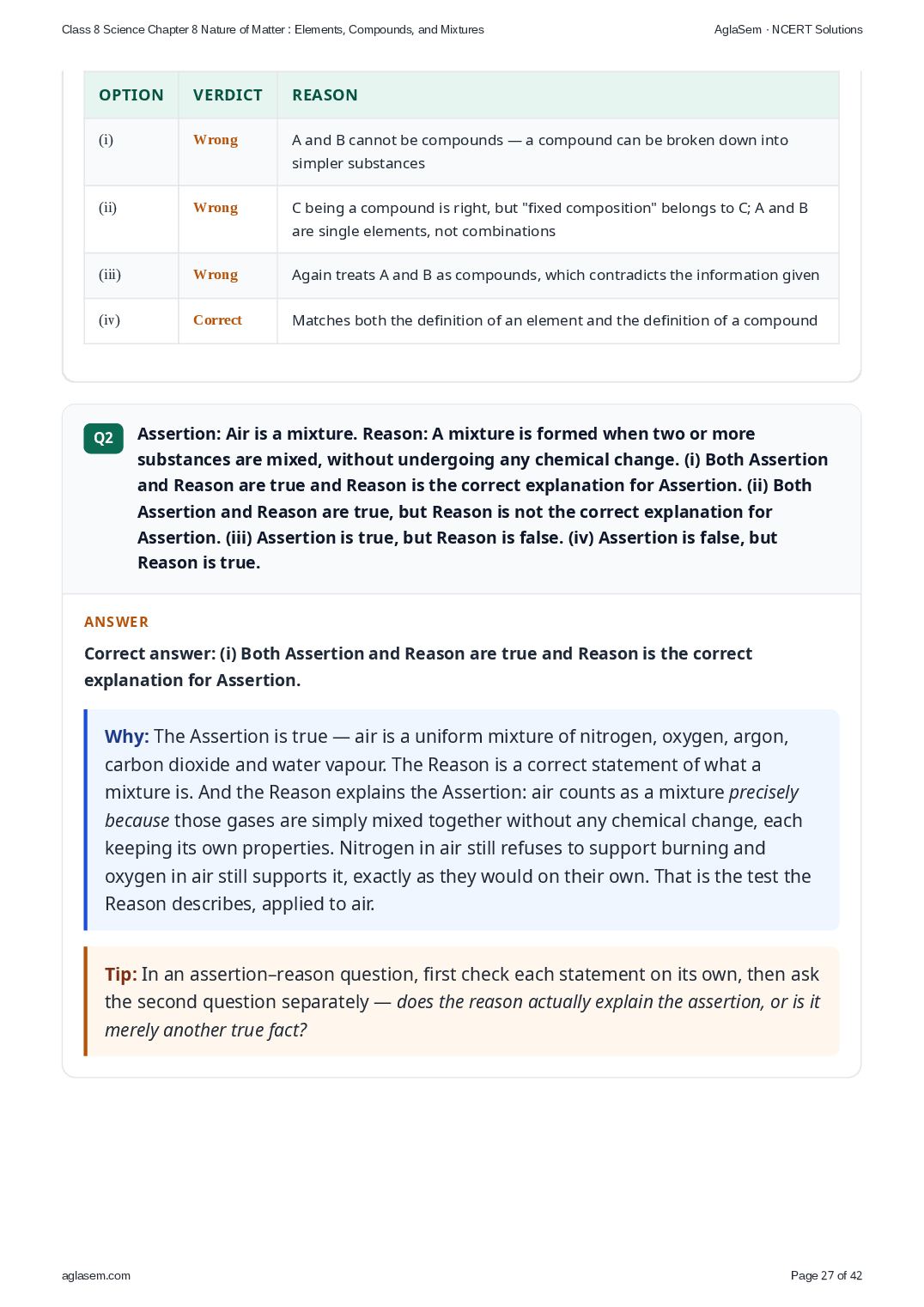
- Consider the following reaction where two substances, A and B, combine to form a product C: A + B → C Assume that A and B cannot be broken down into simpler substances by chemical reactions. Based on this information, which of the following statements is correct? (i) A, B, and C are all compounds and only C has a fixed composition. (ii) C is a compound, and A and B have a fixed composition. (iii) A and B are compounds, and C has a fixed composition. (iv) A and B are elements, C is a compound, and has a fixed composition.
- Assertion: Air is a mixture. Reason: A mixture is formed when two or more substances are mixed, without undergoing any chemical change. (i) Both Assertion and Reason are true and Reason is the correct explanation for Assertion. (ii) Both Assertion and Reason are true, but Reason is not the correct explanation for Assertion. (iii) Assertion is true, but Reason is false. (iv) Assertion is false, but Reason is true.
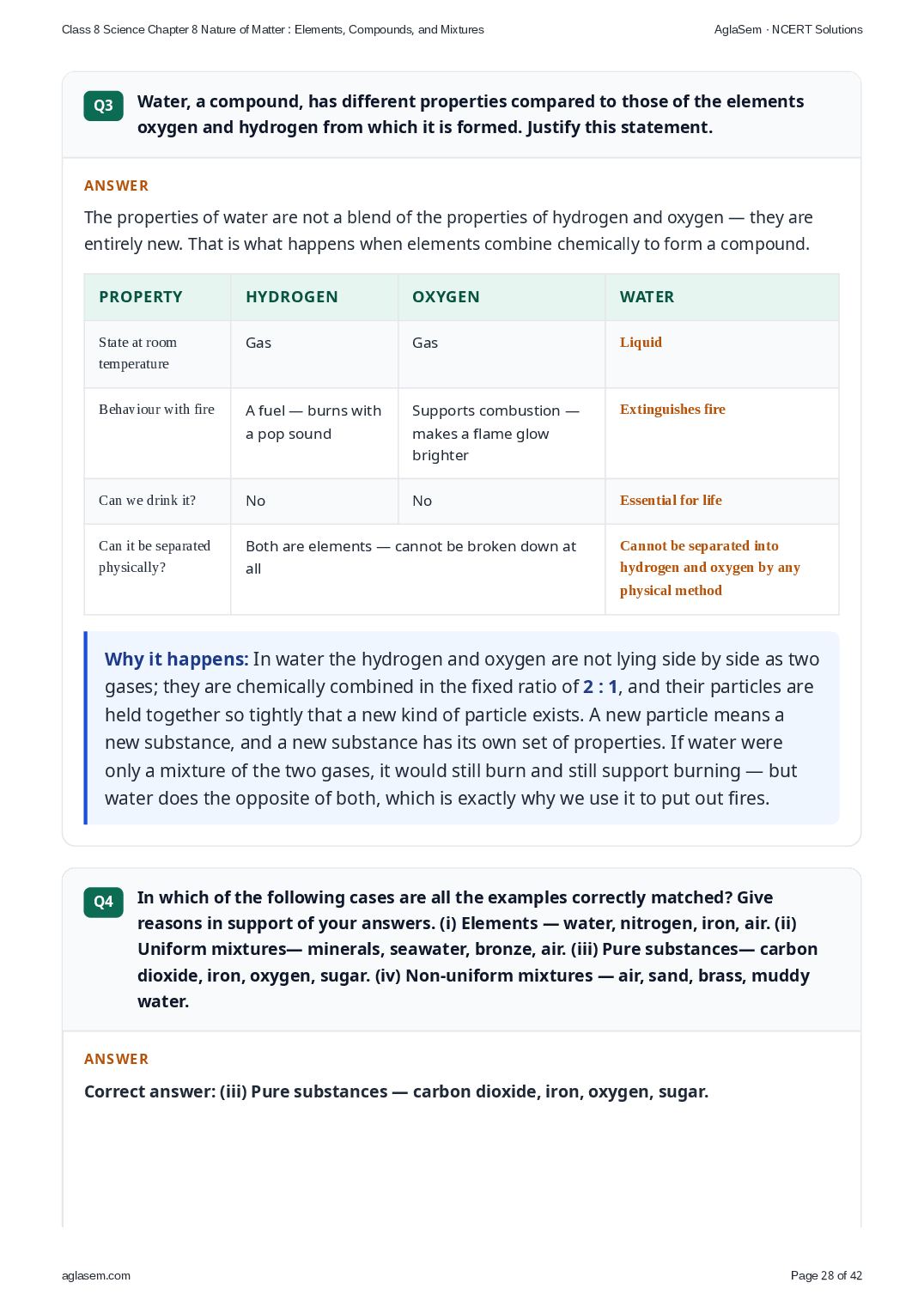
- Water, a compound, has different properties compared to those of the elements oxygen and hydrogen from which it is formed. Justify this statement.
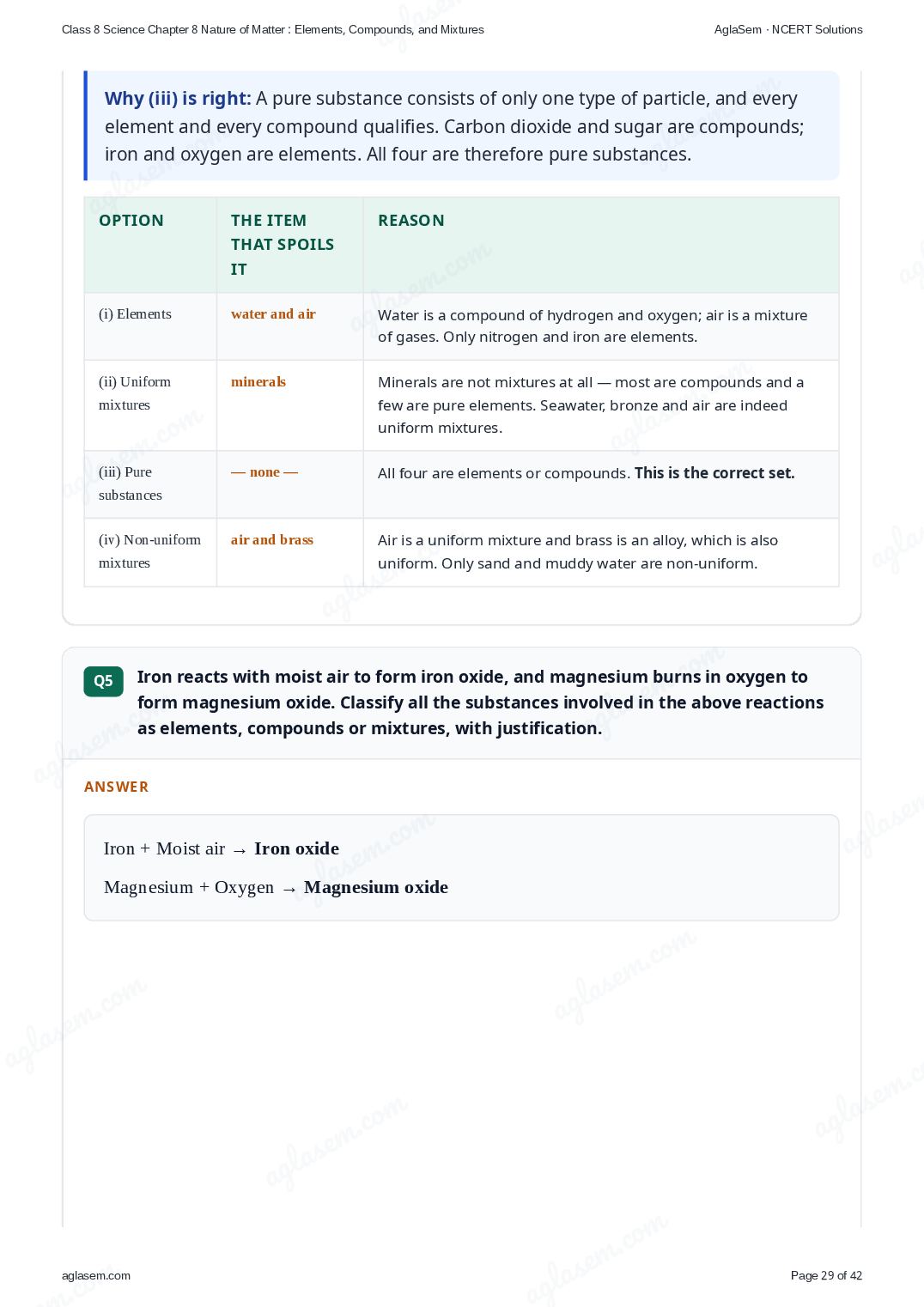
- In which of the following cases are all the examples correctly matched? Give reasons in support of your answers. (i) Elements — water, nitrogen, iron, air. (ii) Uniform mixtures— minerals, seawater, bronze, air. (iii) Pure substances— carbon dioxide, iron, oxygen, sugar. (iv) Non-uniform mixtures — air, sand, brass, muddy water.
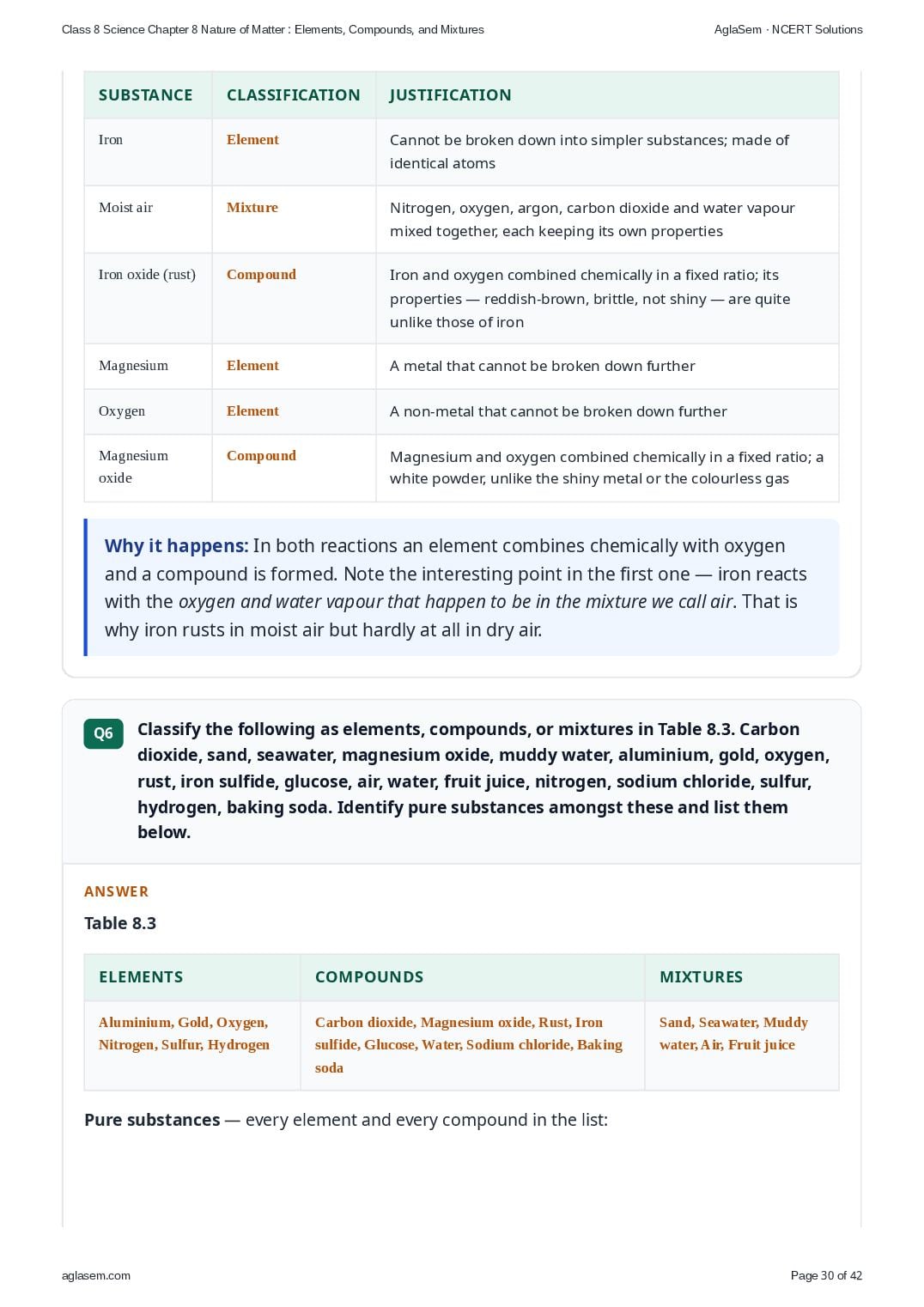
- Iron reacts with moist air to form iron oxide, and magnesium burns in oxygen to form magnesium oxide. Classify all the substances involved in the above reactions as elements, compounds or mixtures, with justification.
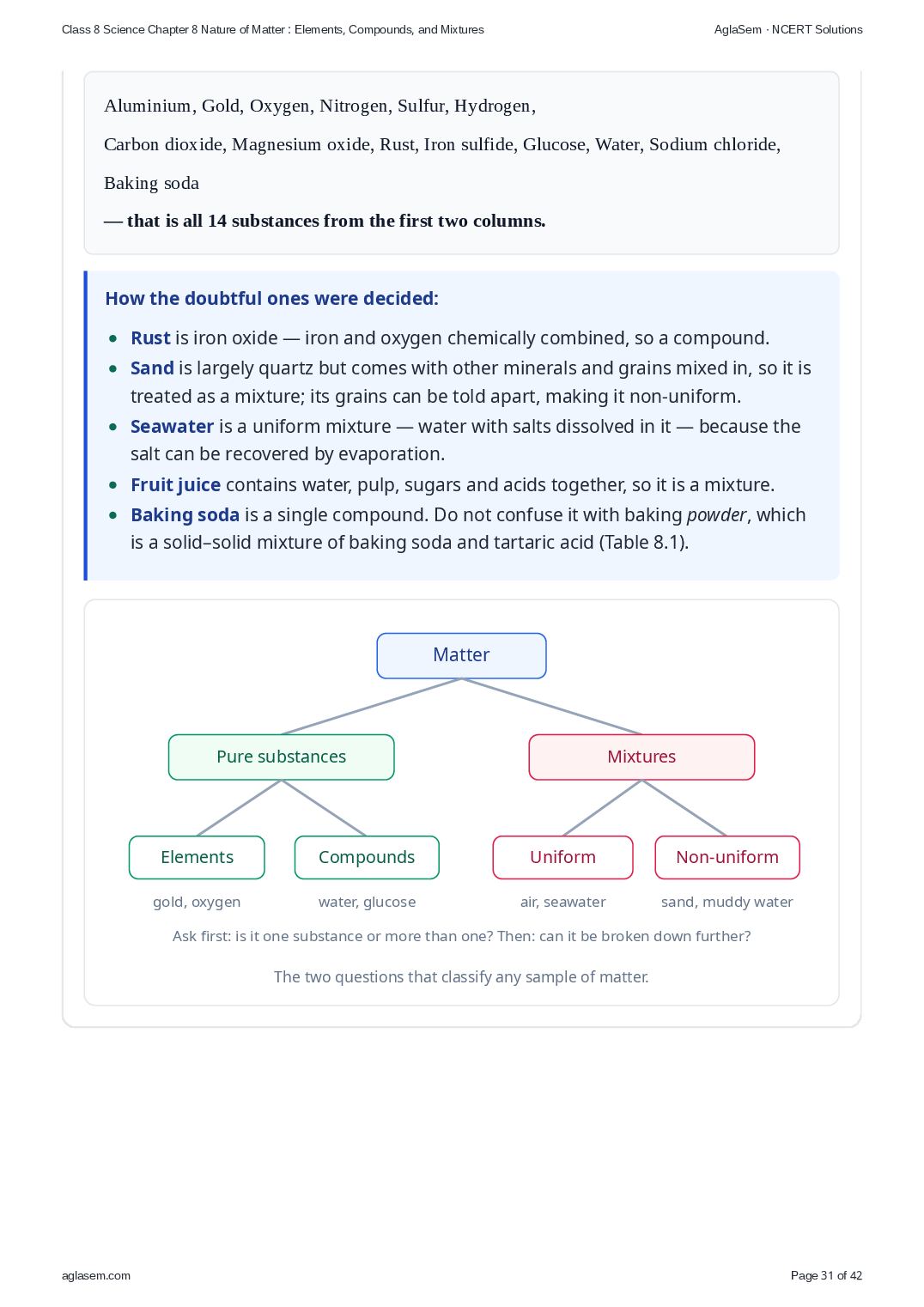
- Classify the following as elements, compounds, or mixtures in Table 8.3. Carbon dioxide, sand, seawater, magnesium oxide, muddy water, aluminium, gold, oxygen, rust, iron sulfide, glucose, air, water, fruit juice, nitrogen, sodium chloride, sulfur, hydrogen, baking soda. Identify pure substances amongst these and list them below.
- What new substance is formed when a mixture of iron filings and sulfur powder is heated, and how is it different from the original mixture? Also, write the word equation for the reaction.
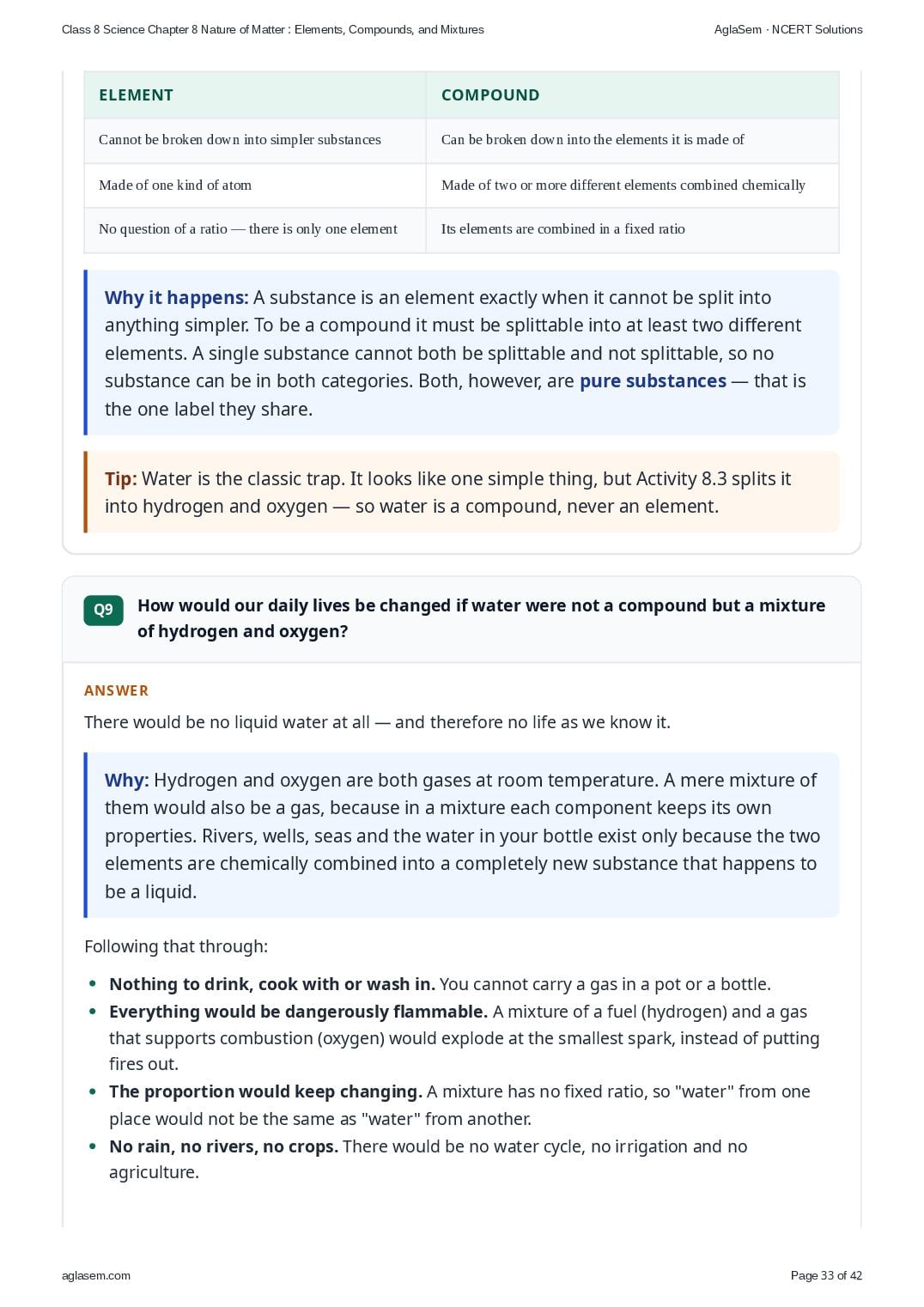
- Is it possible for a substance to be classified as both an element and a compound? Explain why or why not.
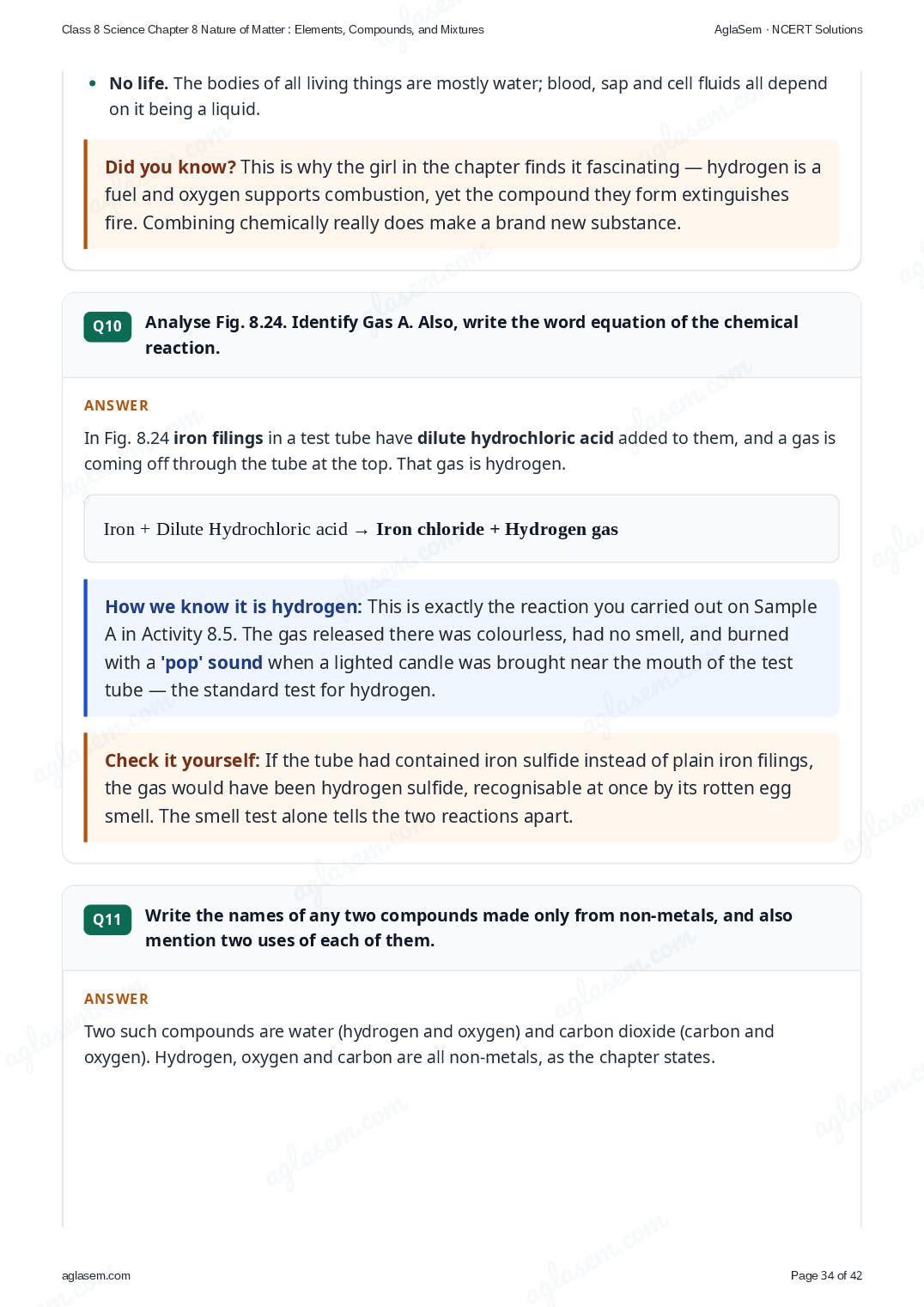
- How would our daily lives be changed if water were not a compound but a mixture of hydrogen and oxygen?
- Analyse Fig. 8.24. Identify Gas A. Also, write the word equation of the chemical reaction.
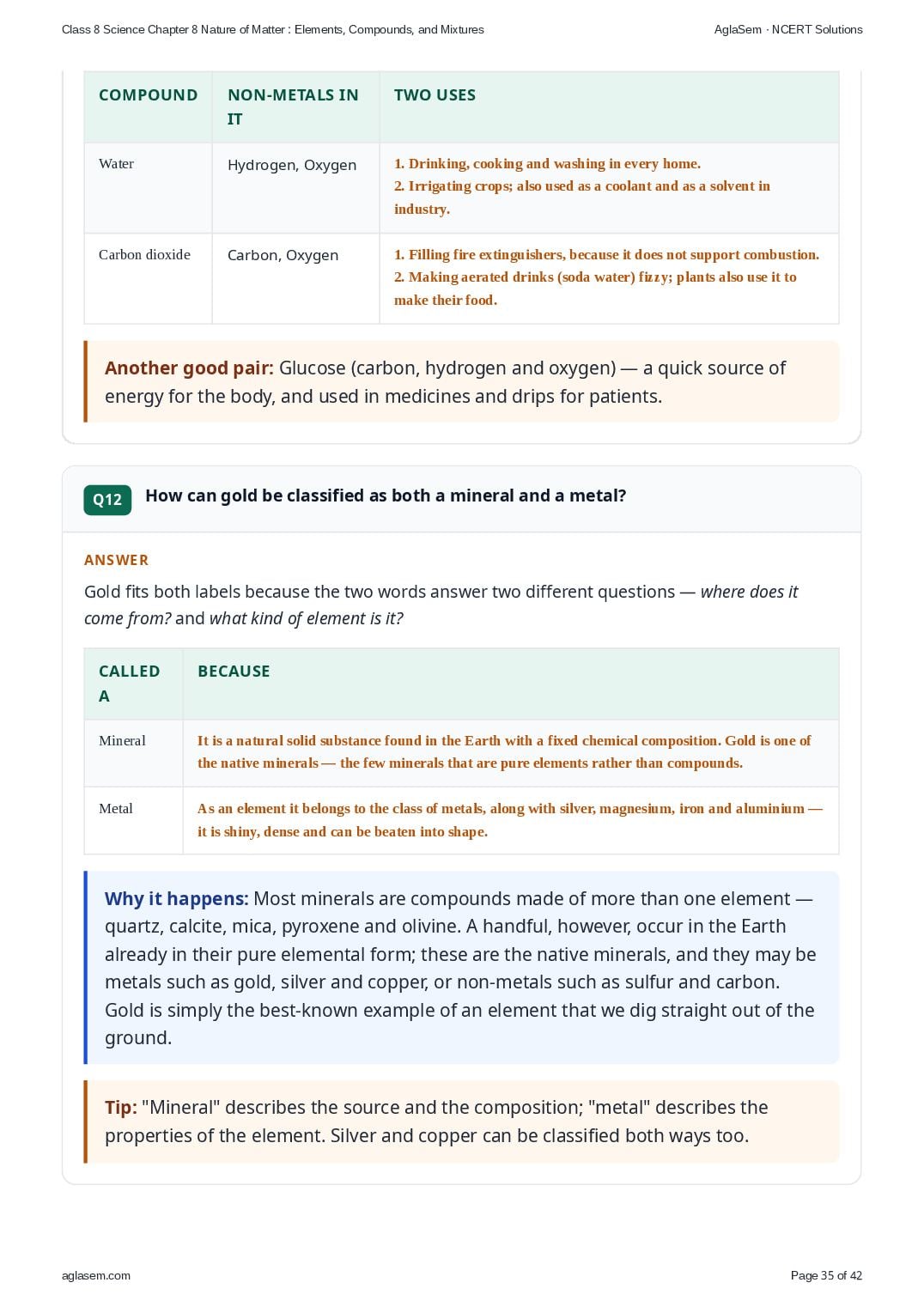
- Write the names of any two compounds made only from non-metals, and also mention two uses of each of them.
- How can gold be classified as both a mineral and a metal?
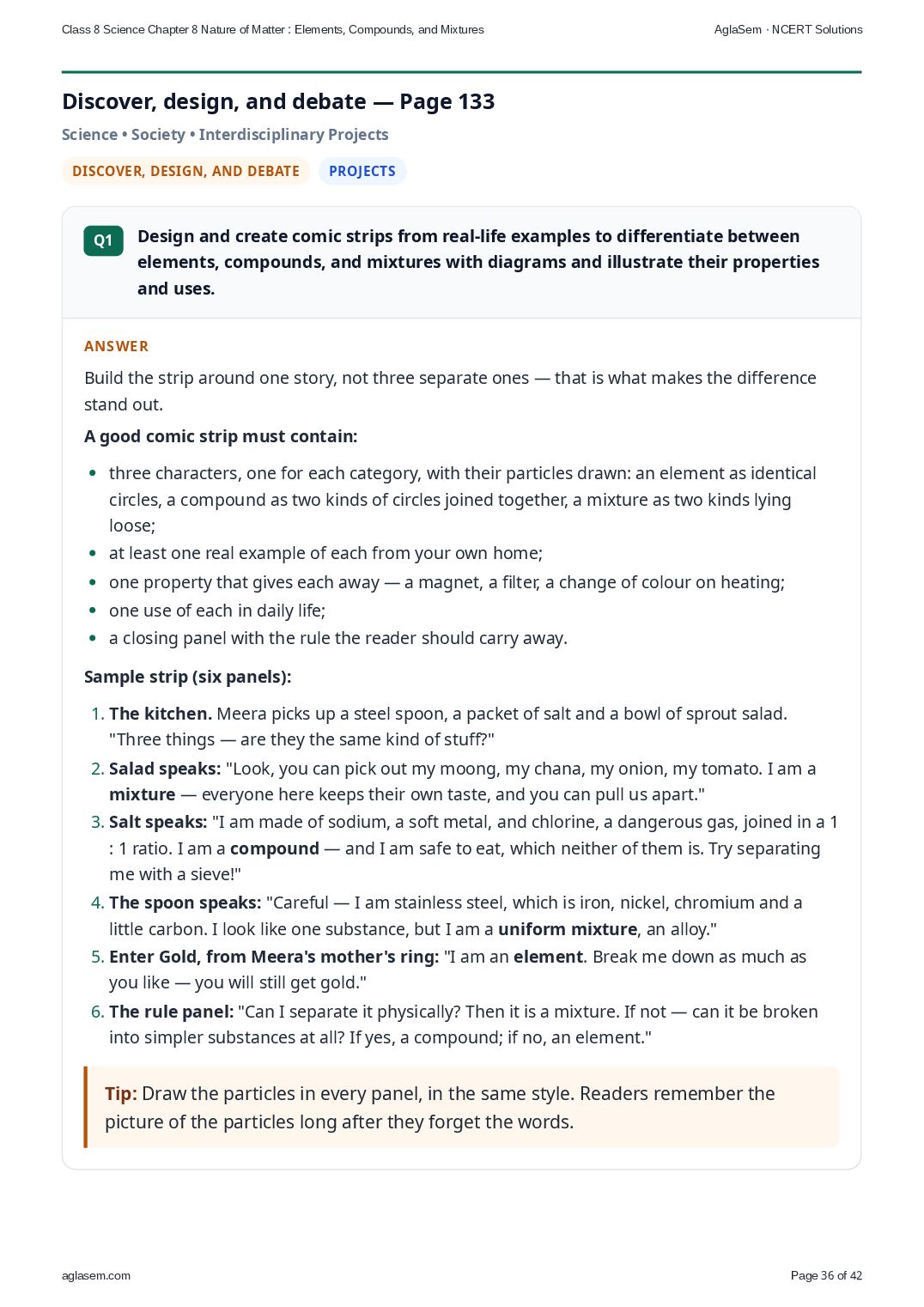
- Design and create comic strips from real-life examples to differentiate between elements, compounds, and mixtures with diagrams and illustrate their properties and uses.
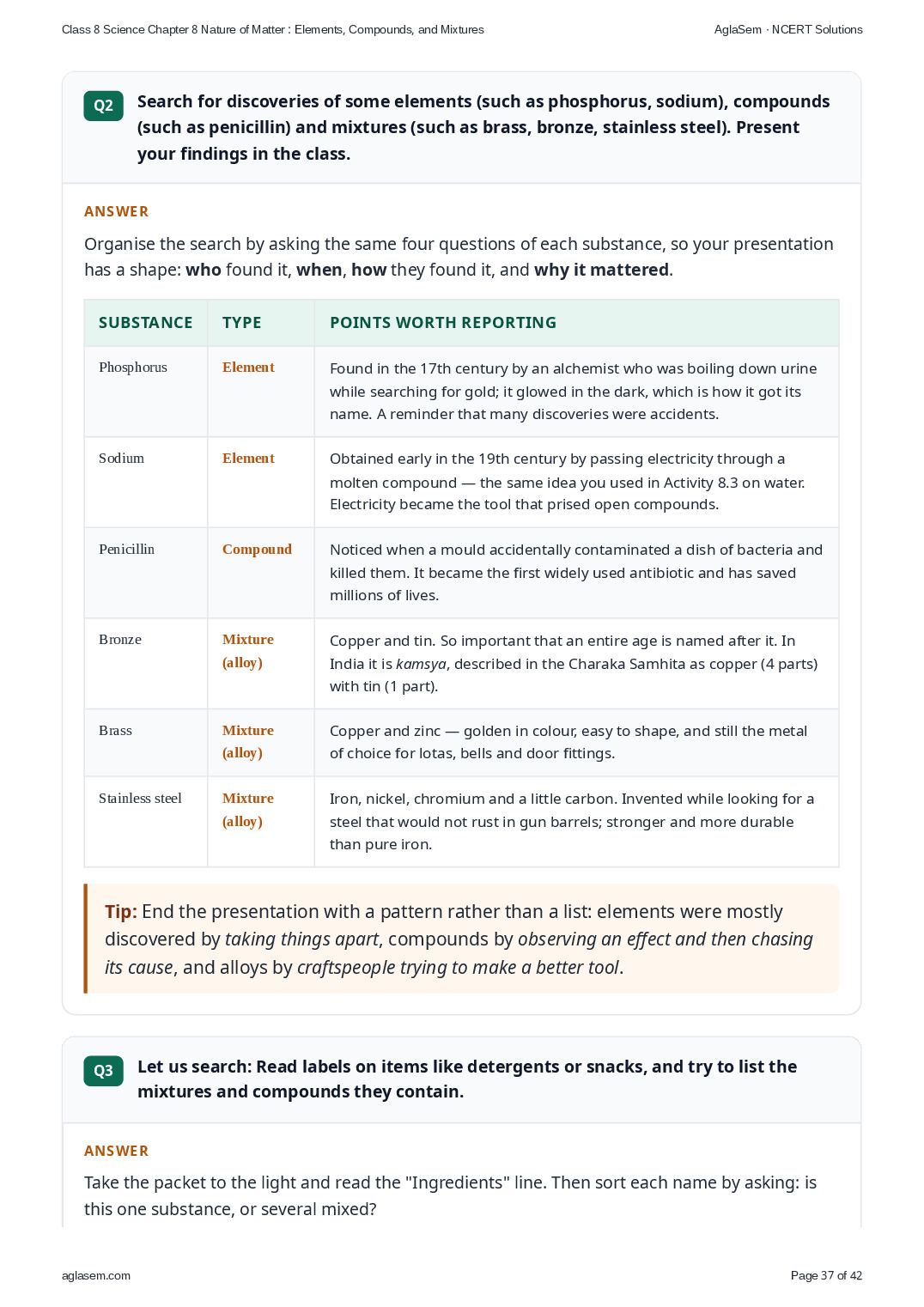
- Search for discoveries of some elements (such as phosphorus, sodium), compounds (such as penicillin) and mixtures (such as brass, bronze, stainless steel). Present your findings in the class.
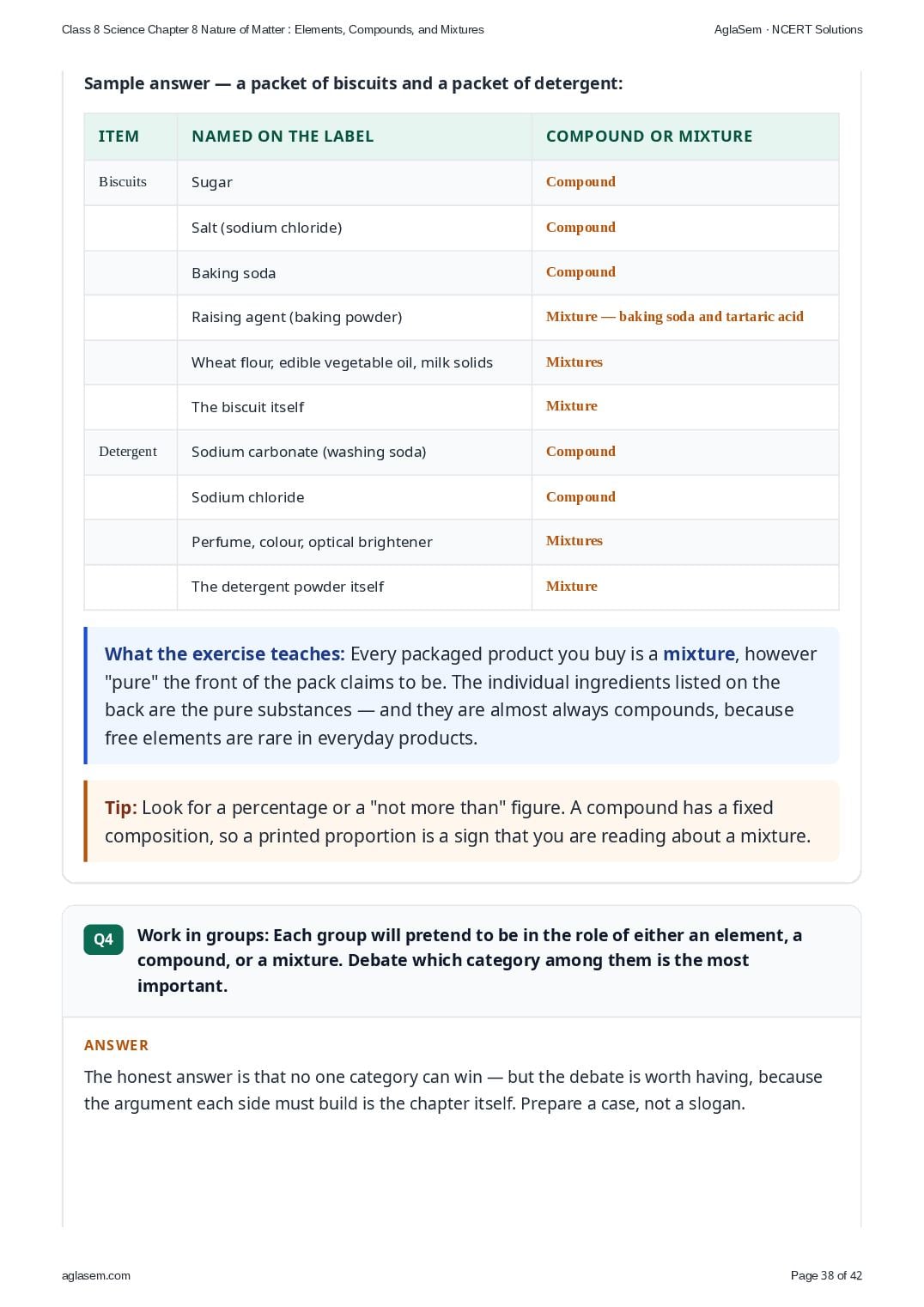
- Let us search: Read labels on items like detergents or snacks, and try to list the mixtures and compounds they contain.
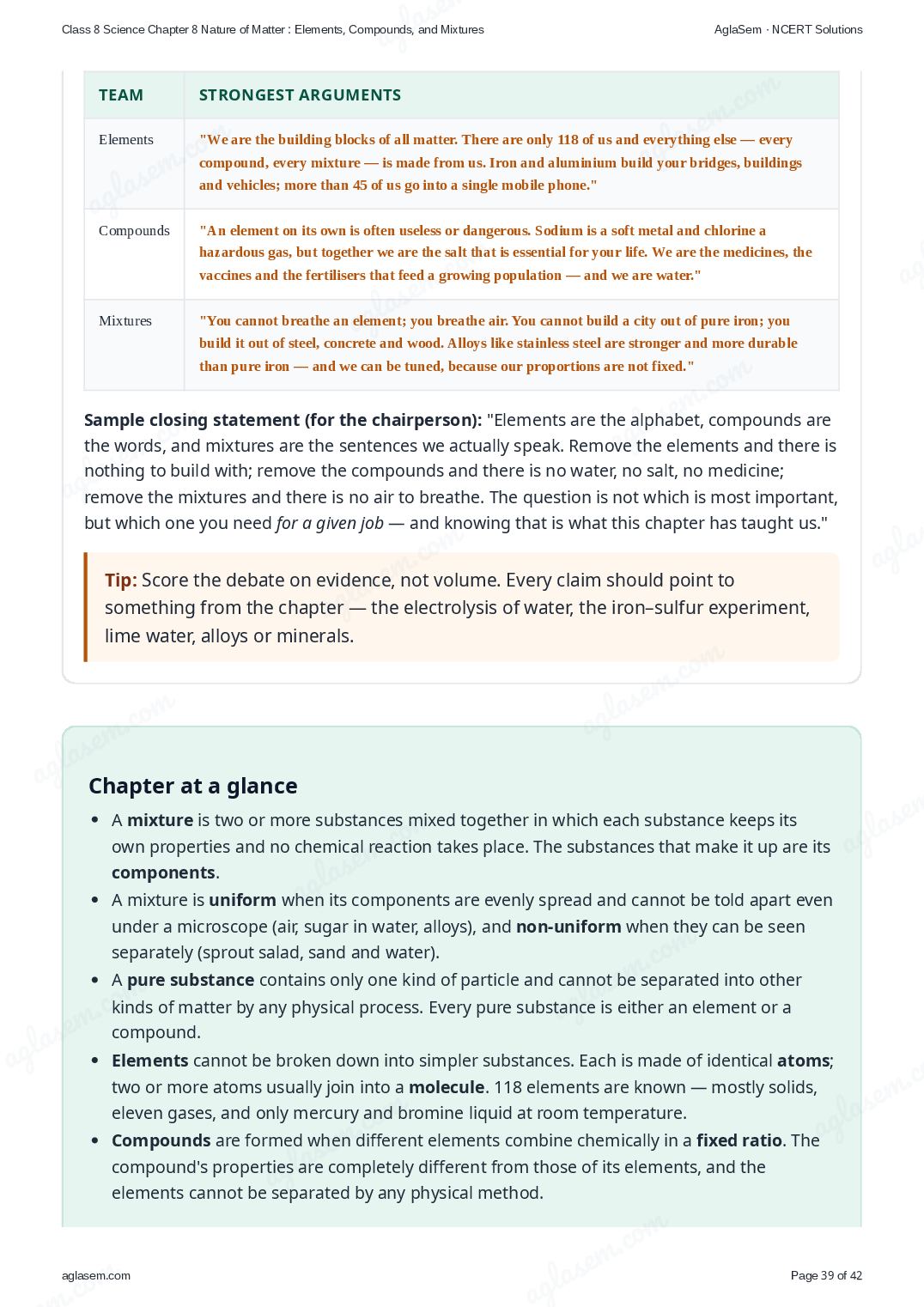
- Work in groups: Each group will pretend to be in the role of either an element, a compound, or a mixture. Debate which category among them is the most important.
Chapter at a Glance
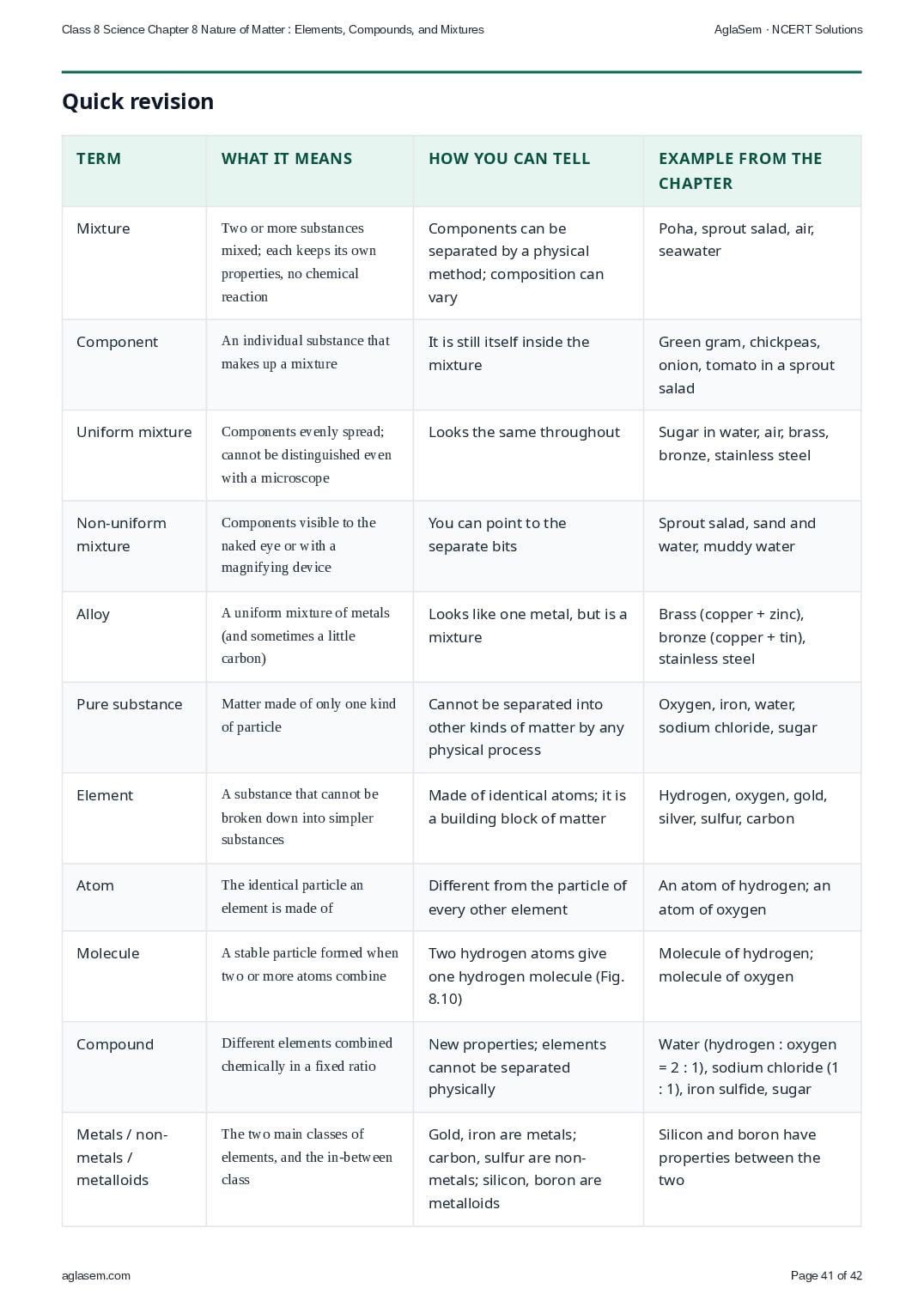
- A mixture is two or more substances mixed together in which each substance keeps its own properties and no chemical reaction takes place. The substances that make it up are its components .
- A mixture is uniform when its components are evenly spread and cannot be told apart even under a microscope (air, sugar in water, alloys), and non-uniform when they can be seen separately (sprout salad, sand and water).
- A pure substance contains only one kind of particle and cannot be separated into other kinds of matter by any physical process. Every pure substance is either an element or a compound.
- Elements cannot be broken down into simpler substances. Each is made of identical atoms ; two or more atoms usually join into a molecule . 118 elements are known — mostly solids, eleven gases, and only mercury and bromine liquid at room temperature.
- Compounds are formed when different elements combine chemically in a fixed ratio . The compound's properties are completely different from those of its elements, and the elements cannot be separated by any physical method.
- Minerals are natural solids of the Earth with a fixed chemical composition — mostly compounds (quartz, calcite, mica), but a few, the native minerals such as gold and sulfur, are pure elements.
How to Download NCERT Solutions for Class 8 Science Chapter 8 PDF
Follow these simple steps to get the Nature of Matter Elements Compounds and Mixtures questions-and-answers PDF from Curiosity.
- Search NCERT Solutions for Class 8 Science Chapter 8 aglasem and open this page.
- Read the exercise questions with answers for Nature of Matter Elements Compounds and Mixtures shown above.
- Click the Download PDF link to save the Nature of Matter Elements Compounds and Mixtures solutions to your device.
NCERT Solutions for Class 8 Science – All Chapters
There are more chapters to study besides Nature of Matter Elements Compounds and Mixtures in Science. Here are the NCERT Solutions for all chapters of Class 8 Science.
- Chapter 1 Exploring the Investigative World of Science
- Chapter 2 The Invisible Living World Beyond Our Naked Eye
- Chapter 3 Health the Ultimate Treasure
- Chapter 4 Electricity Magnetic and Heating Effects
- Chapter 5 Exploring Forces
- Chapter 6 Pressure Winds Storms and Cyclones
- Chapter 7 Particulate Nature of Matter
- Chapter 8 Nature of Matter Elements Compounds and Mixtures
- Chapter 9 The Amazing World of Solutes Solvents and Solutions
- Chapter 10 Light Mirrors and Lenses
- Chapter 11 Keeping Time with the Skies
- Chapter 12 How Nature Works in Harmony
- Chapter 13 Our Home Earth a Unique Life Sustaining Planet
NCERT Solutions for Class 8 – All Subjects
Just like Chapter 8 of Science, you can get the exercise questions with answers for every other subject of Class 8. Here are the NCERT Solutions for all subjects of Class 8.
NCERT Solutions for Class 8 Science Chapter 8 – An Overview
The key highlights of this study material are as follows.
| Aspects | Details |
|---|---|
| Class | Class 8 |
| Subject | Science |
| Chapter Number | Chapter 8 |
| Chapter Name | Nature of Matter Elements Compounds and Mixtures |
| Book Name | Curiosity |
| Book By | NCERT (National Council of Educational Research and Training) |
| Educational Resource Here | NCERT Solutions of Class 8 Science Chapter 8 for all exercises |
| More Questions Answers of This Subject | NCERT Solutions for Class 8 Science |
| Download Book Chapter | NCERT Book Class 8 Science |
| All Questions Answers For This Class | NCERT Solutions for Class 8 |
| Complete Solutions | NCERT Solutions |
NCERT Solutions for Class 8 Science Chapter 8 Nature of Matter Elements Compounds and Mixtures – FAQs
What are the NCERT Solutions for Class 8 Science Chapter 8 Nature of Matter Elements Compounds and Mixtures?
They are the complete, step-by-step answers to all the exercise and in-text questions of Chapter 8 Nature of Matter Elements Compounds and Mixtures from the NCERT Class 8 Science textbook Curiosity, written by experts as per the latest NCERT syllabus.
How can I download the Class 8 Science Chapter 8 solutions PDF for free?
Open this page on aglasem, read the Nature of Matter Elements Compounds and Mixtures questions with answers, and click the “Download Solutions PDF” link. The Class 8 Science Chapter 8 NCERT Solutions PDF is completely free to download.
Are these NCERT Solutions as per the latest 2026-27 syllabus?
Yes. The NCERT Solutions for Class 8 Science Chapter 8 are based on the latest NCERT textbook Curiosity and the current 2026-27 CBSE syllabus, so the questions and answers match what you study in class.
Where can I get NCERT Solutions for the other chapters of Class 8 Science?
You can find the answers to every chapter on the NCERT Solutions for Class 8 Science page, and solutions for every subject on the NCERT Solutions for Class 8 page.
How do NCERT Solutions help in exam preparation?
They show the correct method to solve each question, help you write answers the way they are expected in exams, let you check and correct your own work, and save revision time — which together improve your marks in Class 8 Science.
If you have any queries on NCERT Solutions for Class 8 Science Chapter 8 Nature of Matter Elements Compounds and Mixtures, then please ask in the comments below.