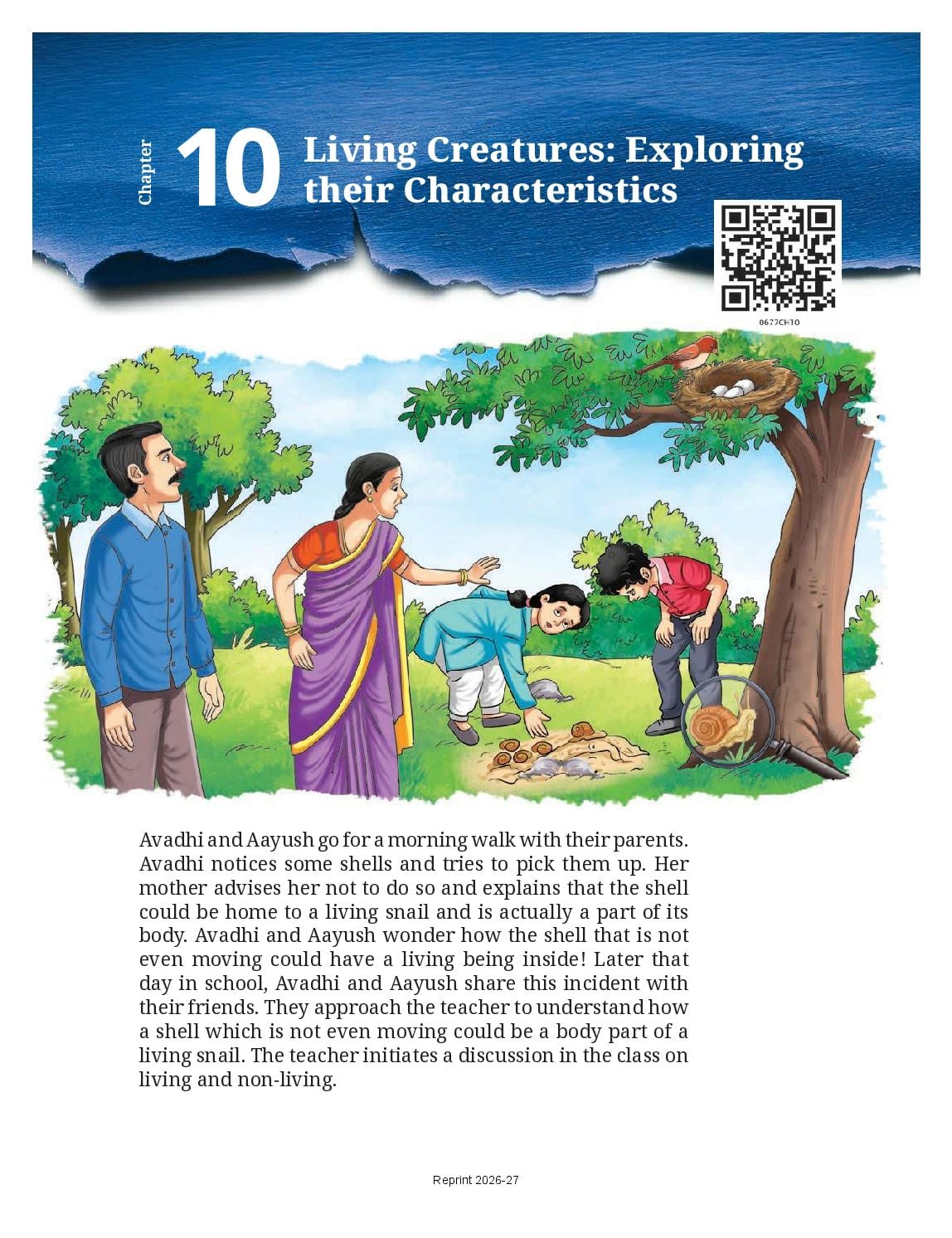
Download Living Creatures: Exploring their Characteristics – NCERT Class 6 Science Chapter 10 PDF from the new NCERT Class 6 Science book Curiosity (2026-27). Read the chapter online or download the free PDF. A living being shows a whole set of characteristics together: it moves, needs food, grows, respires, excretes, responds to stimuli, reproduces and finally dies. If even one of these is missing, the thing is non-living.
Living Creatures: Exploring their Characteristics PDF – Chapter 10 of Curiosity
Read the chapter online or download the PDF.
| Chapter | Download | |
|---|---|---|
| Chapter 10 PDF | Living Creatures: Exploring their Characteristics | View PDF |
| Full book | NCERT Class 6 Science – Curiosity | View Book |
Read Online
What Is in Living Creatures: Exploring their Characteristics? (Class 6 Science Chapter 10)
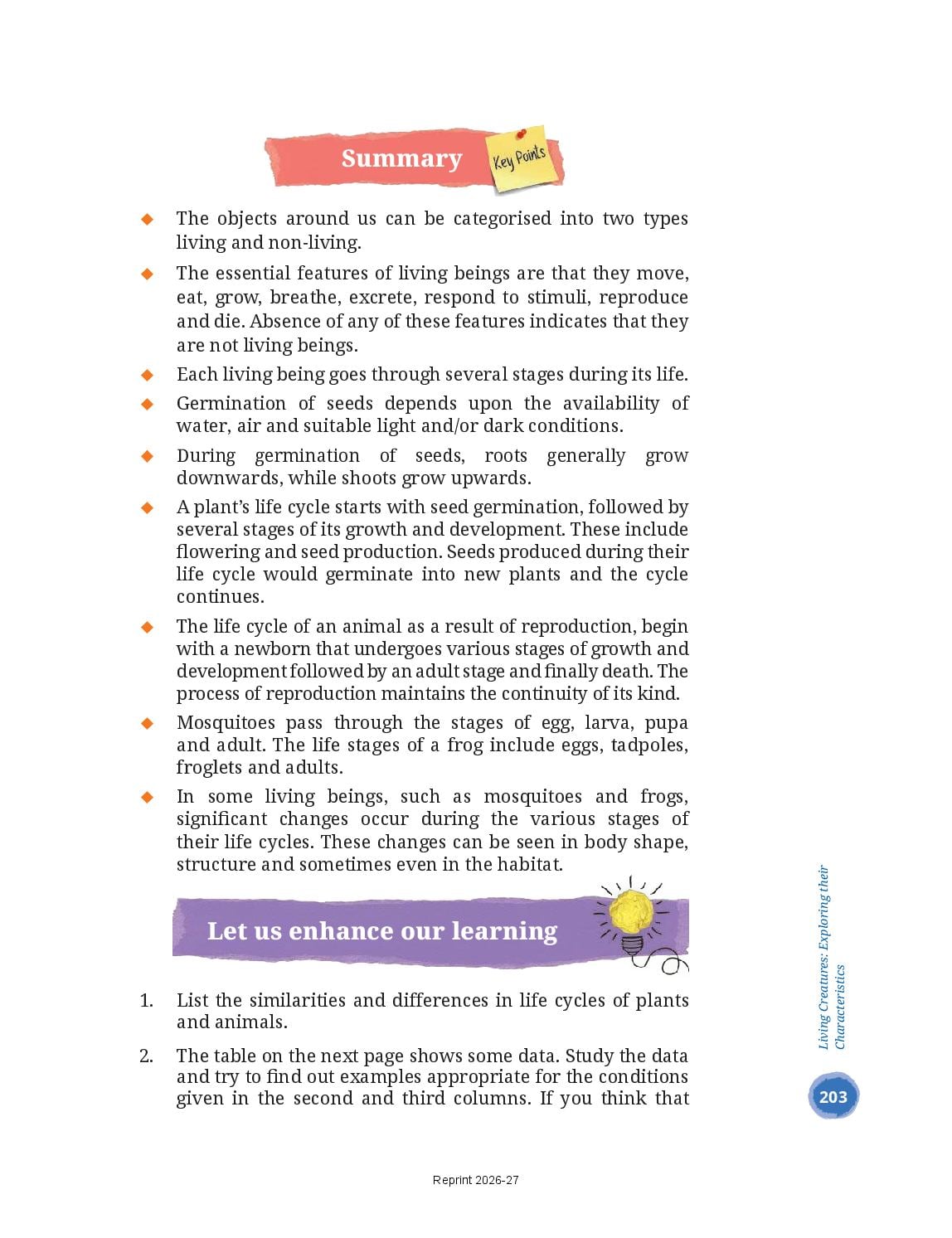
- A living being shows a whole set of characteristics together: it moves, needs food, grows, respires, excretes, responds to stimuli, reproduces and finally dies. If even one of these is missing, the thing is non-living.
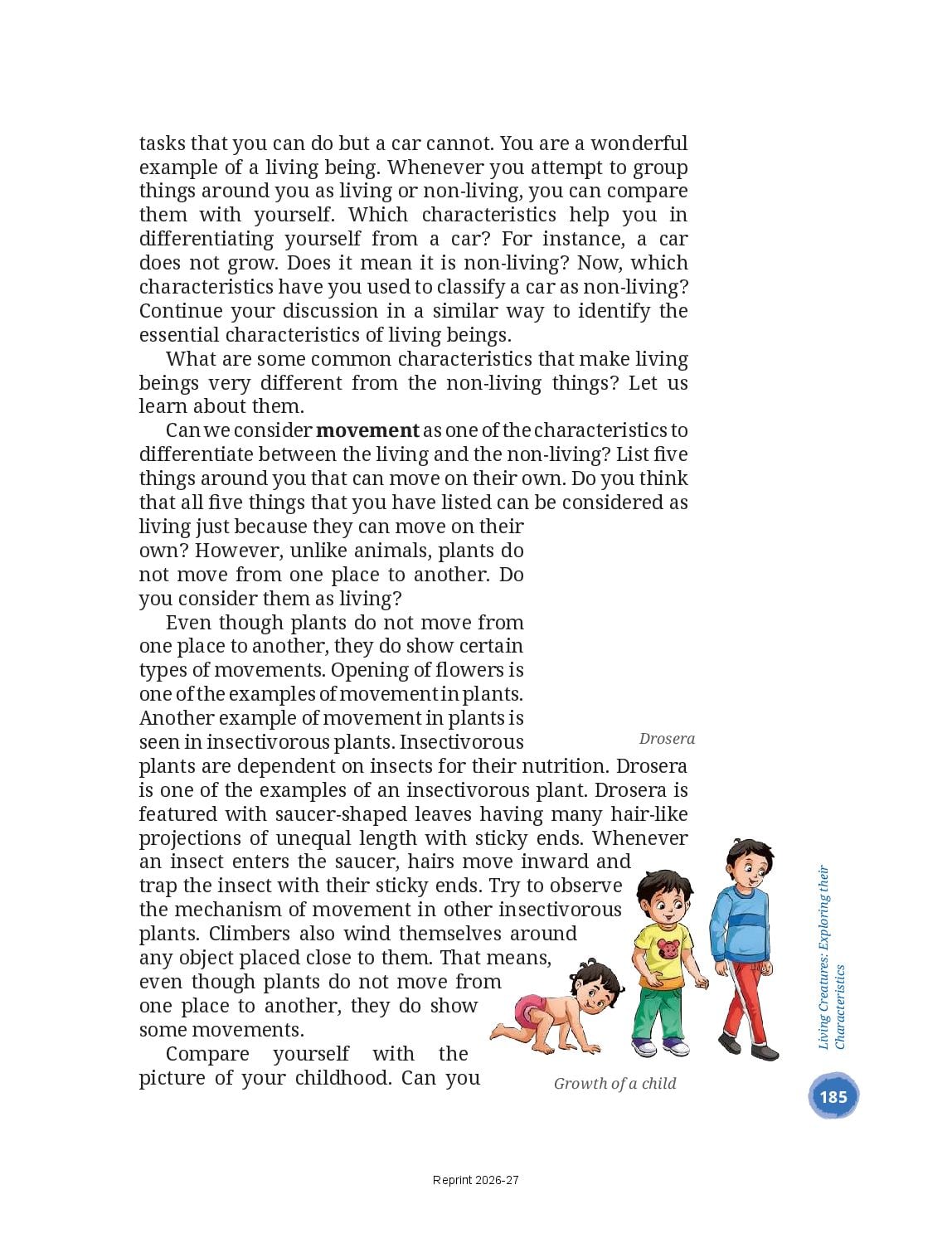
- No single characteristic is enough by itself. A car moves but is non-living; a banyan tree never walks anywhere but is very much alive. Plants do move — flowers open, Drosera traps insects, climbers wind around a support.
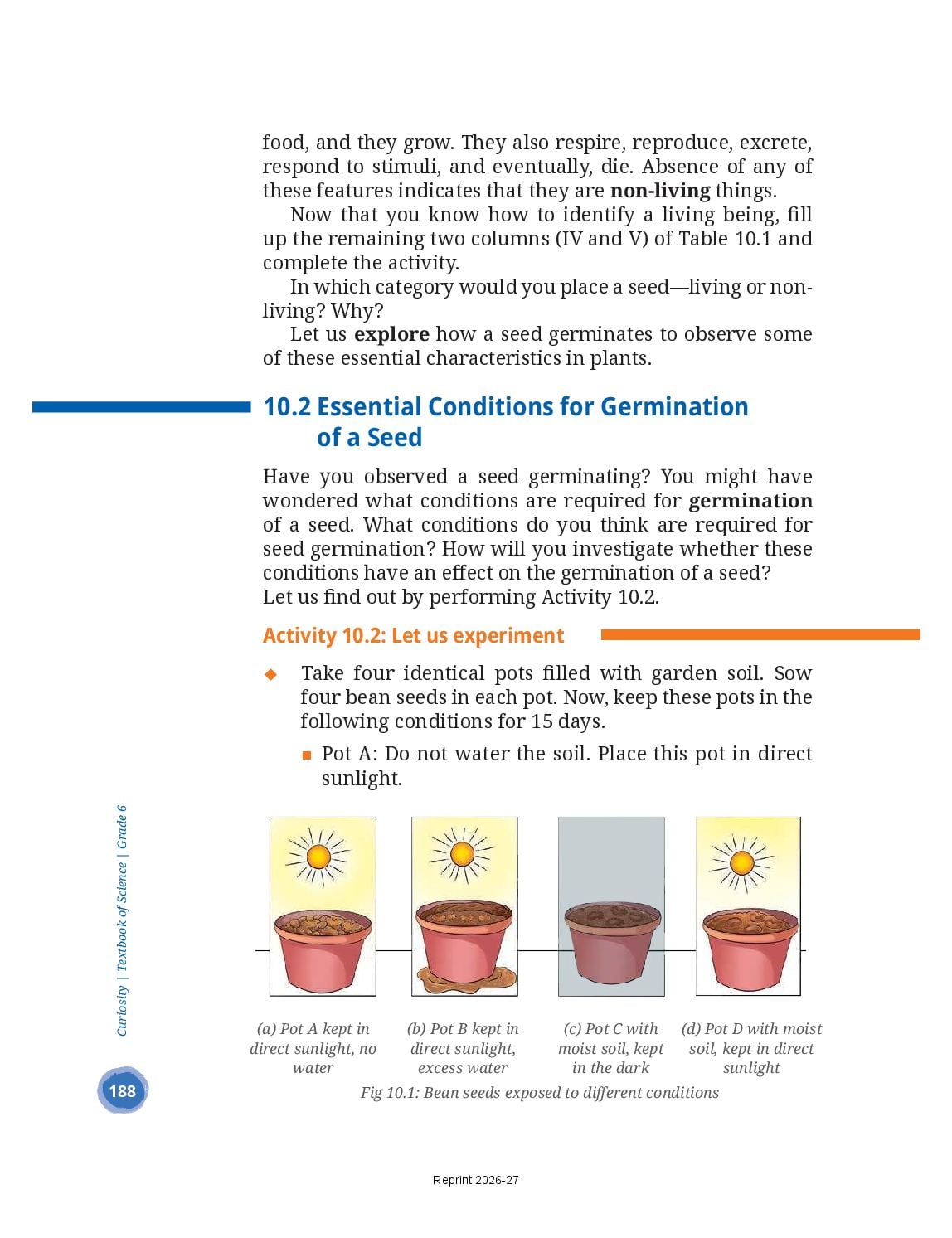
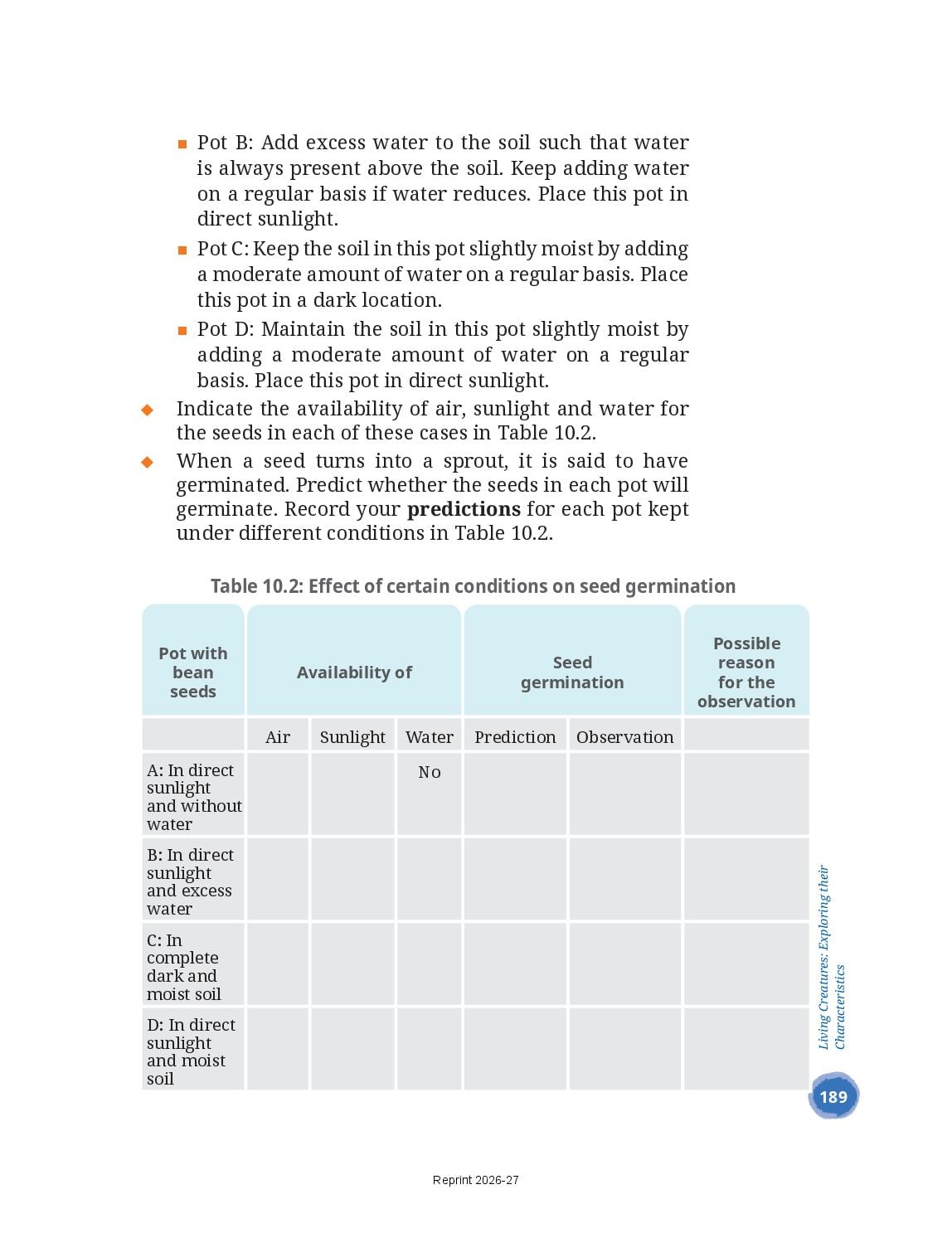
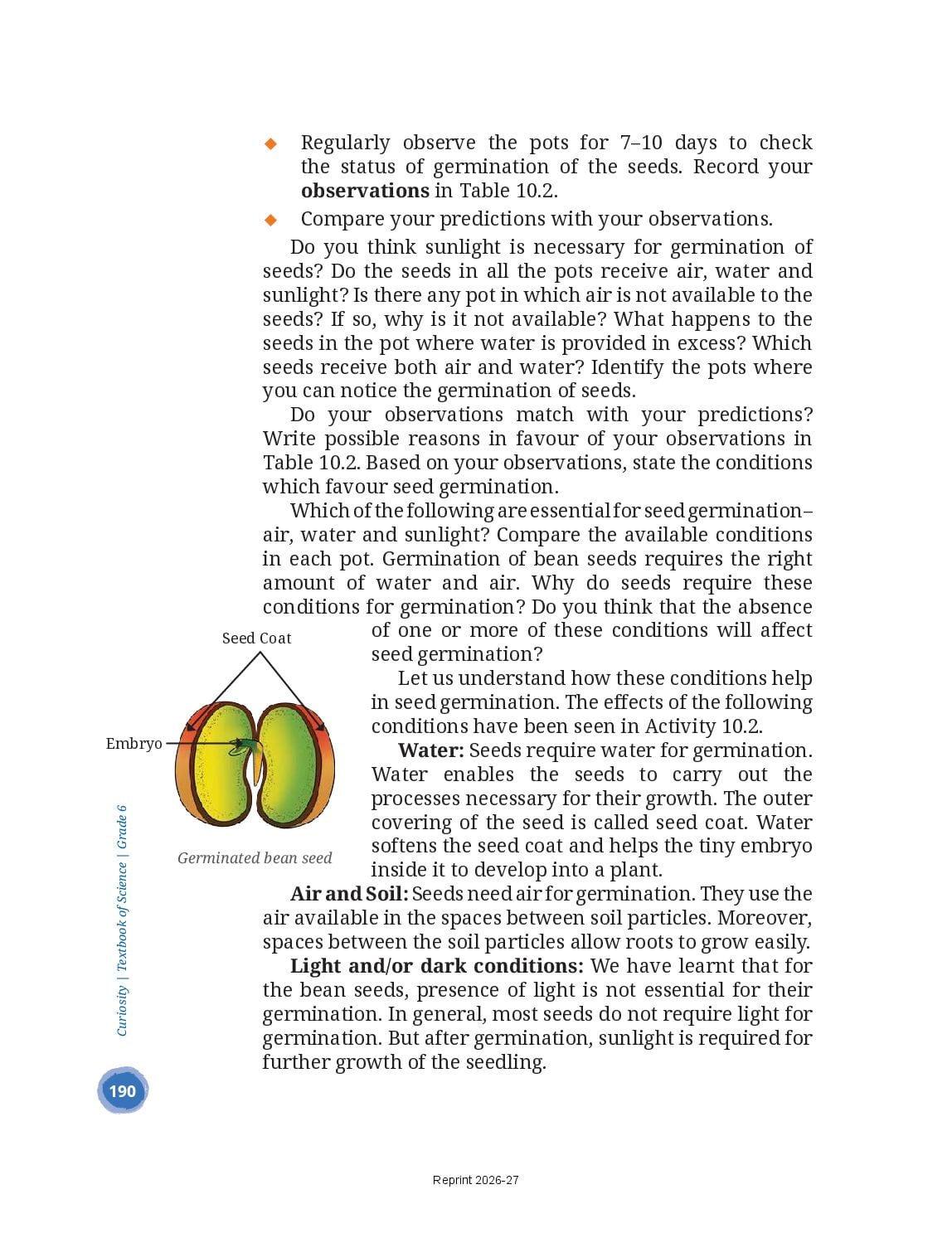
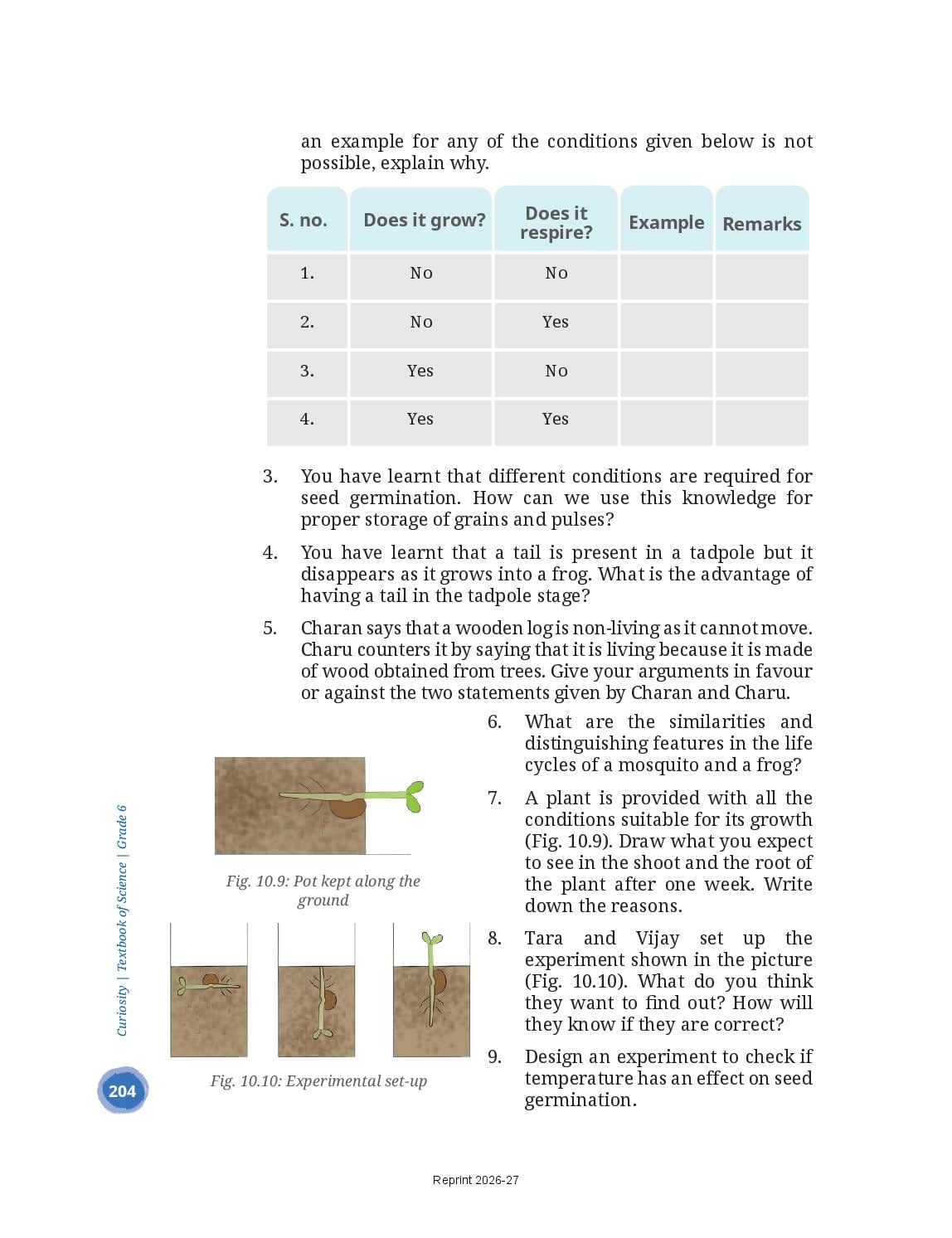
- A seed germinates when it gets the right amount of water and air. Sunlight is not needed for the germination of bean seeds, though the seedling needs it to grow afterwards. Water softens the seed coat so the tiny embryo inside can develop.
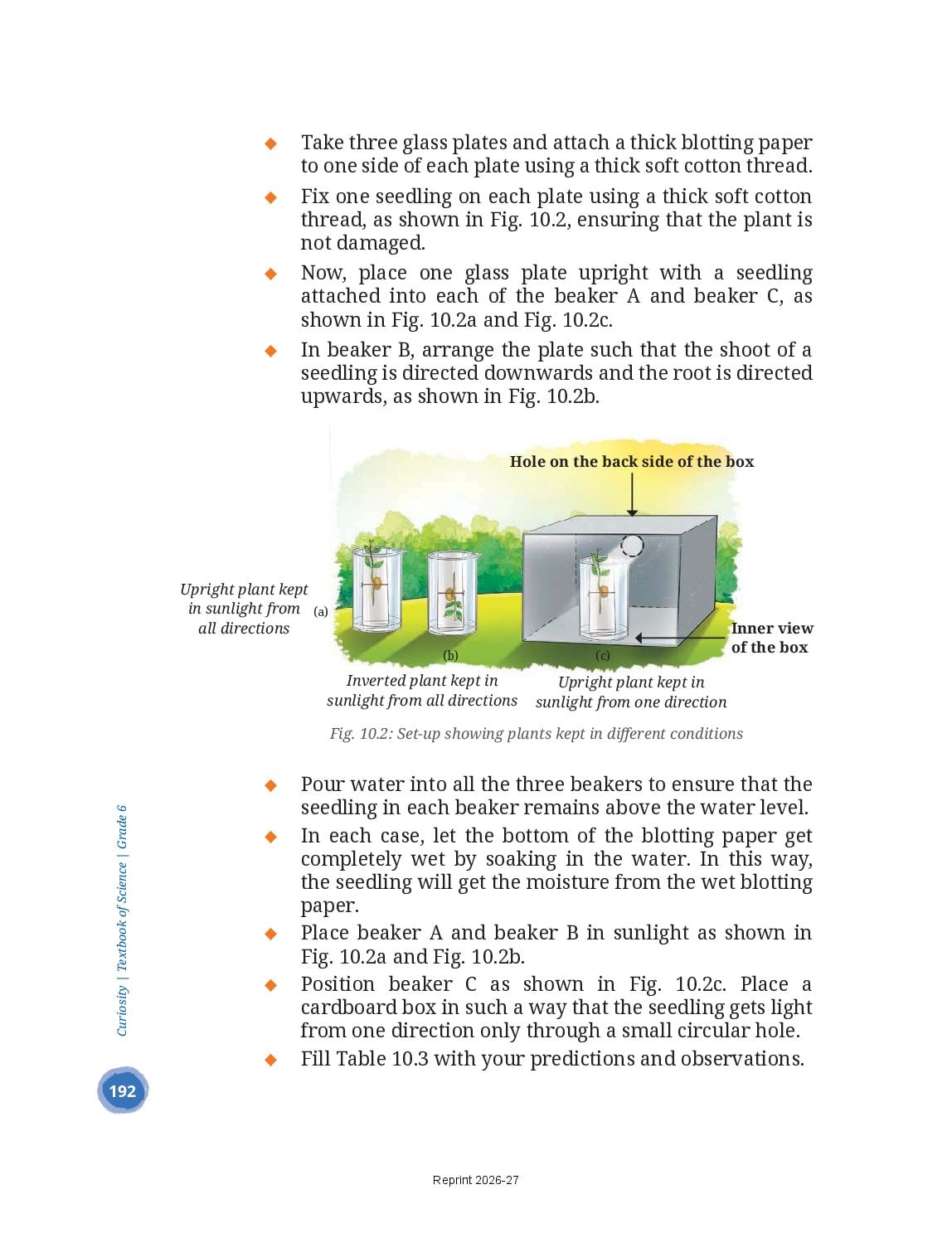
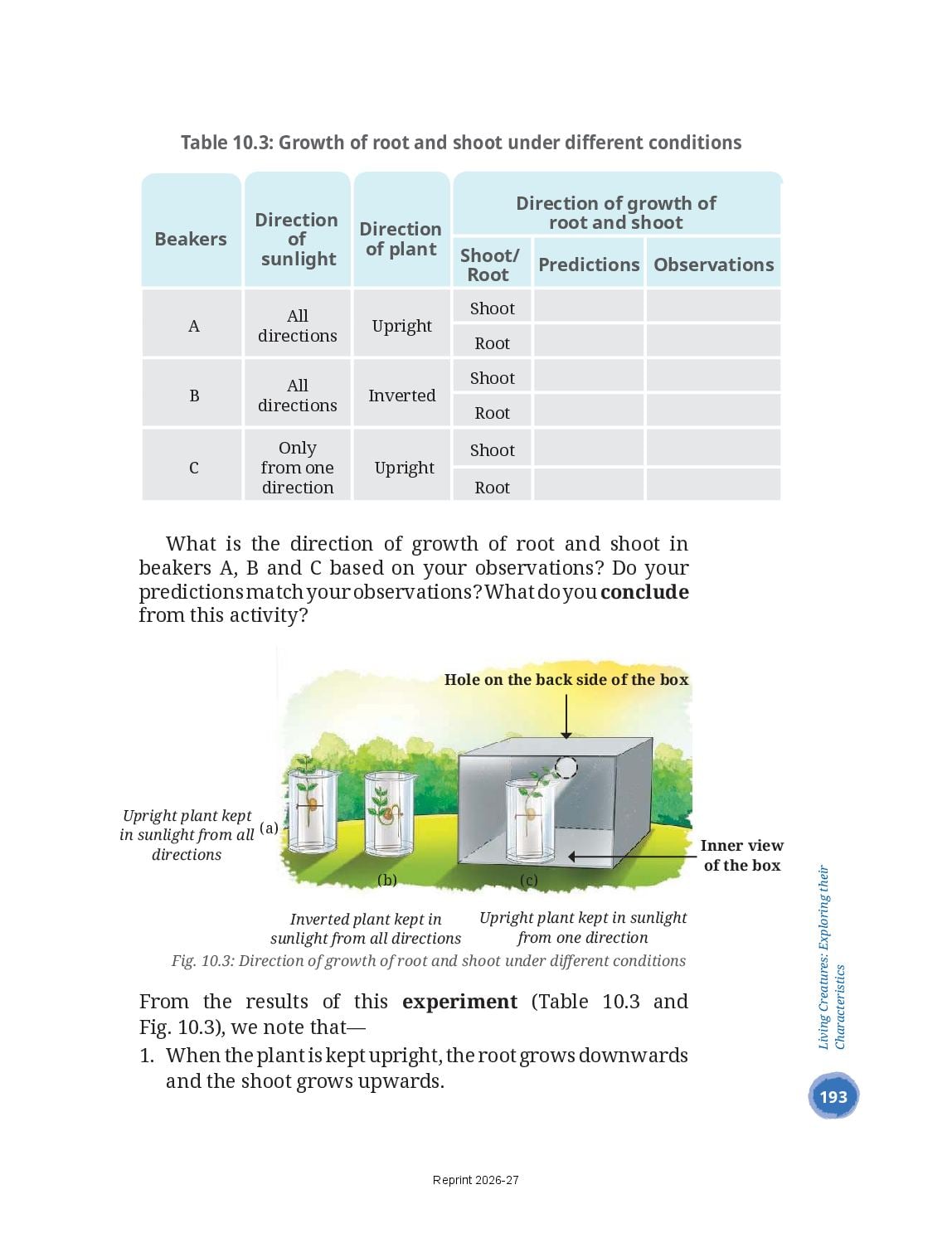
- Activity 10.3 shows that a root always grows downwards and a shoot always grows upwards, even if the plant is turned upside down. When light comes from one side only, the shoot bends towards the light.
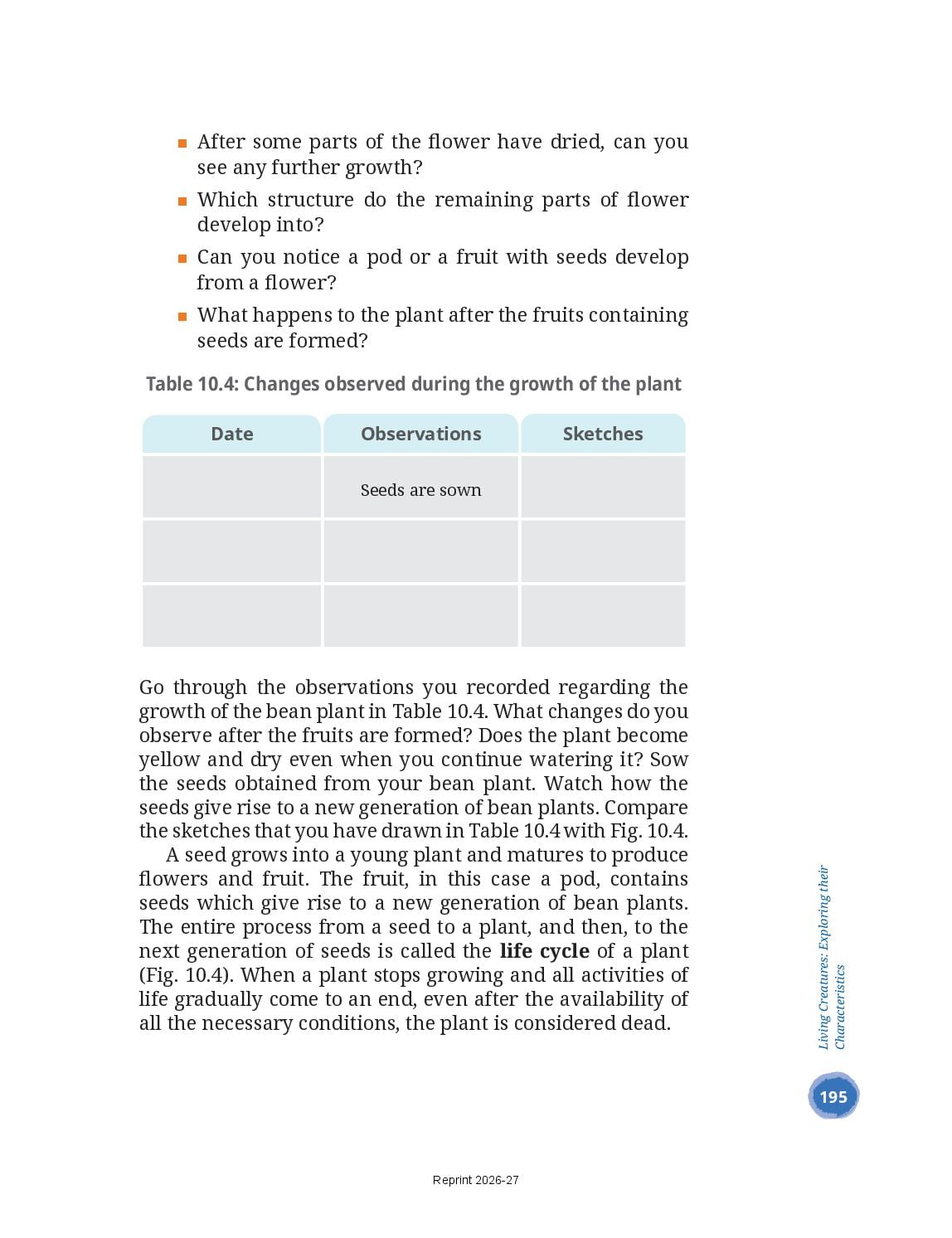
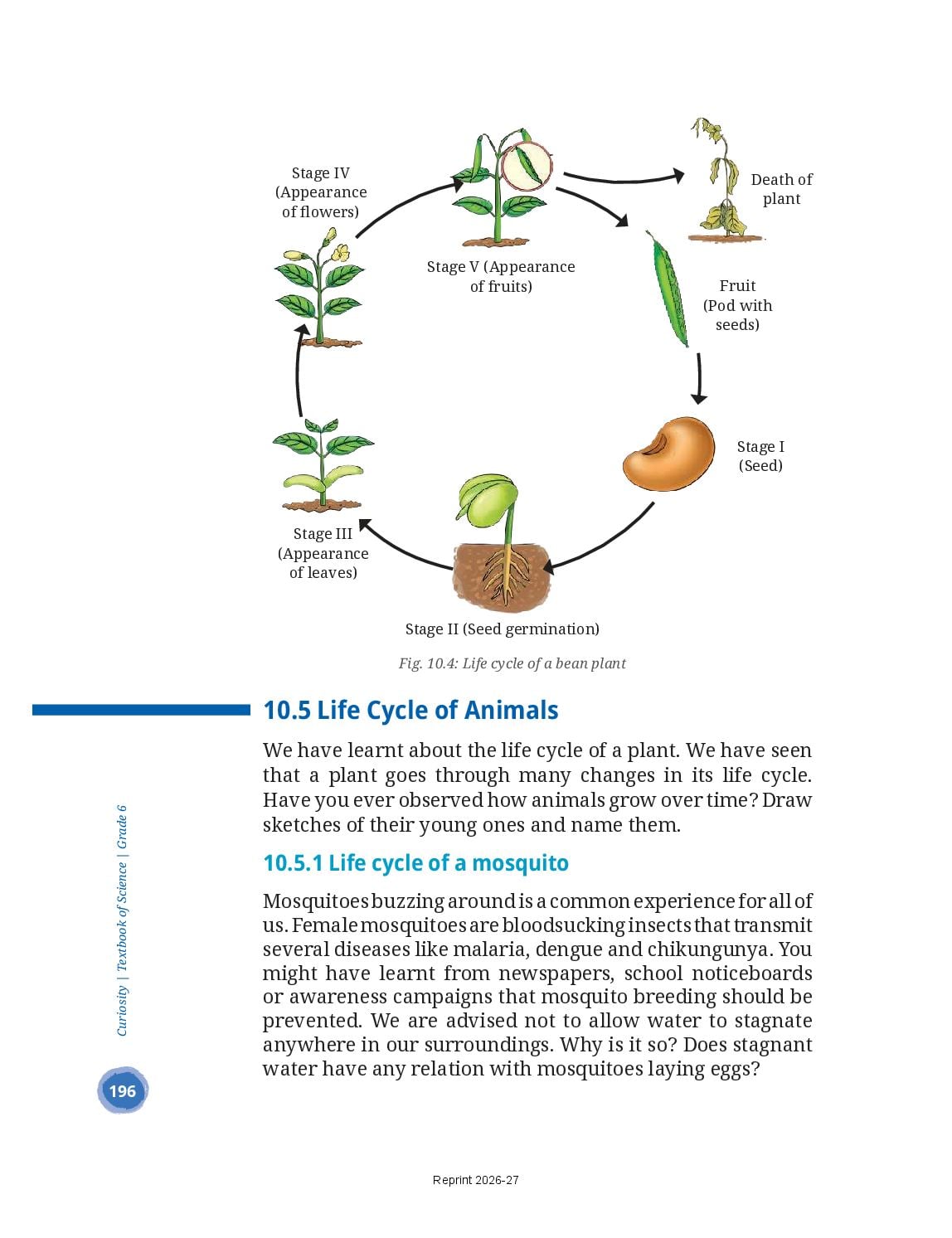
- The whole journey from a seed to a plant and back to the next seeds is the life cycle of a plant — germination → leaves → flowers → fruits with seeds → death.
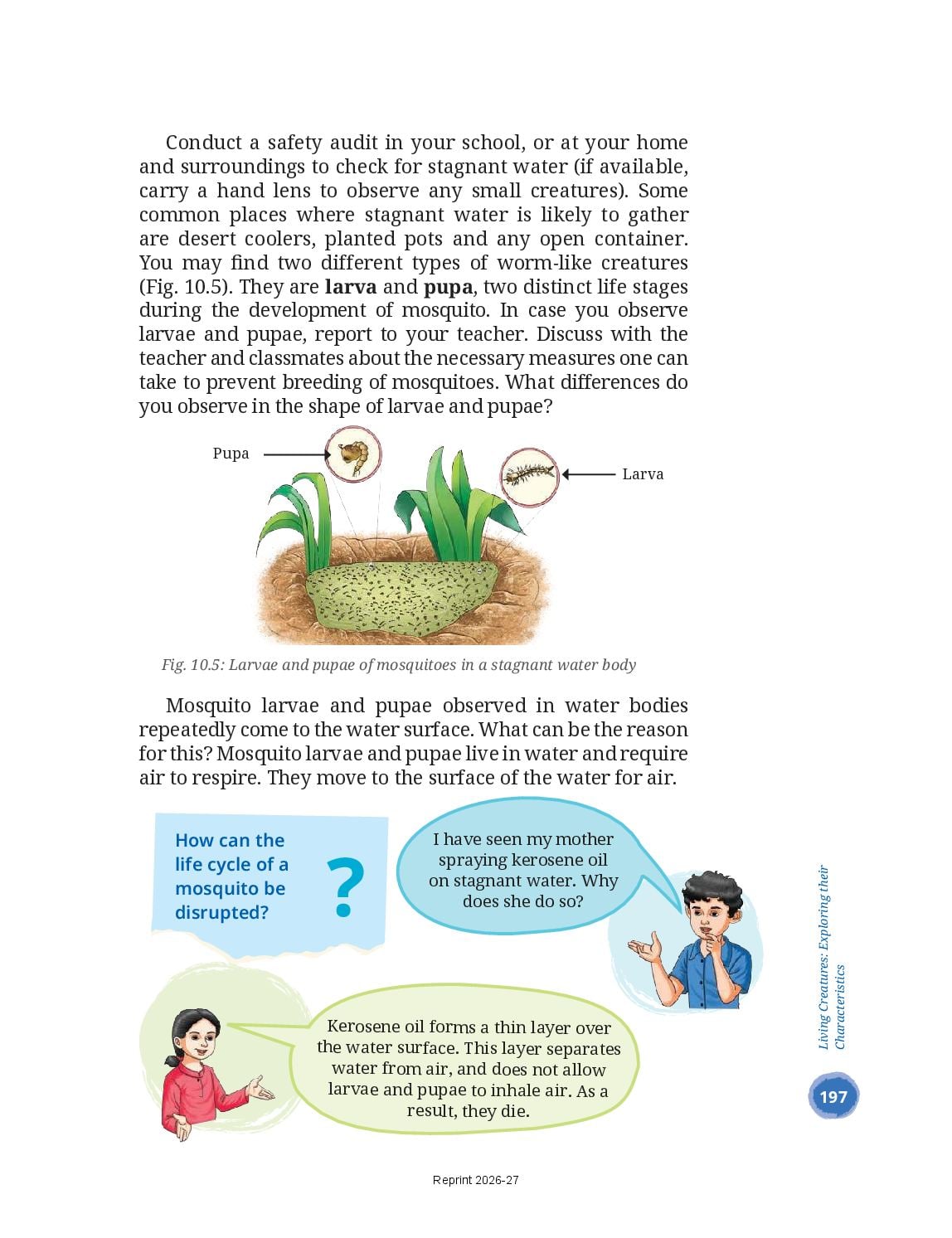
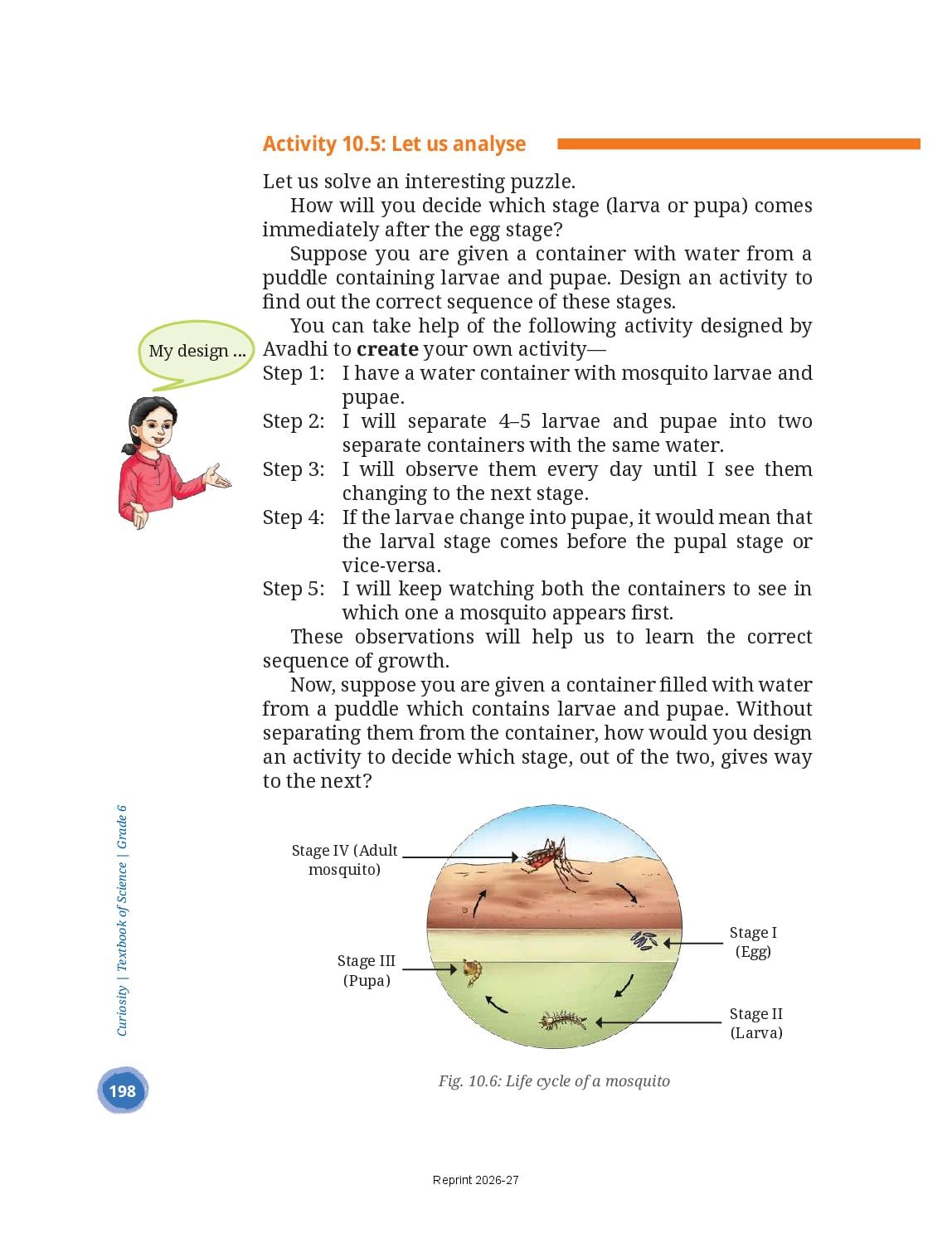
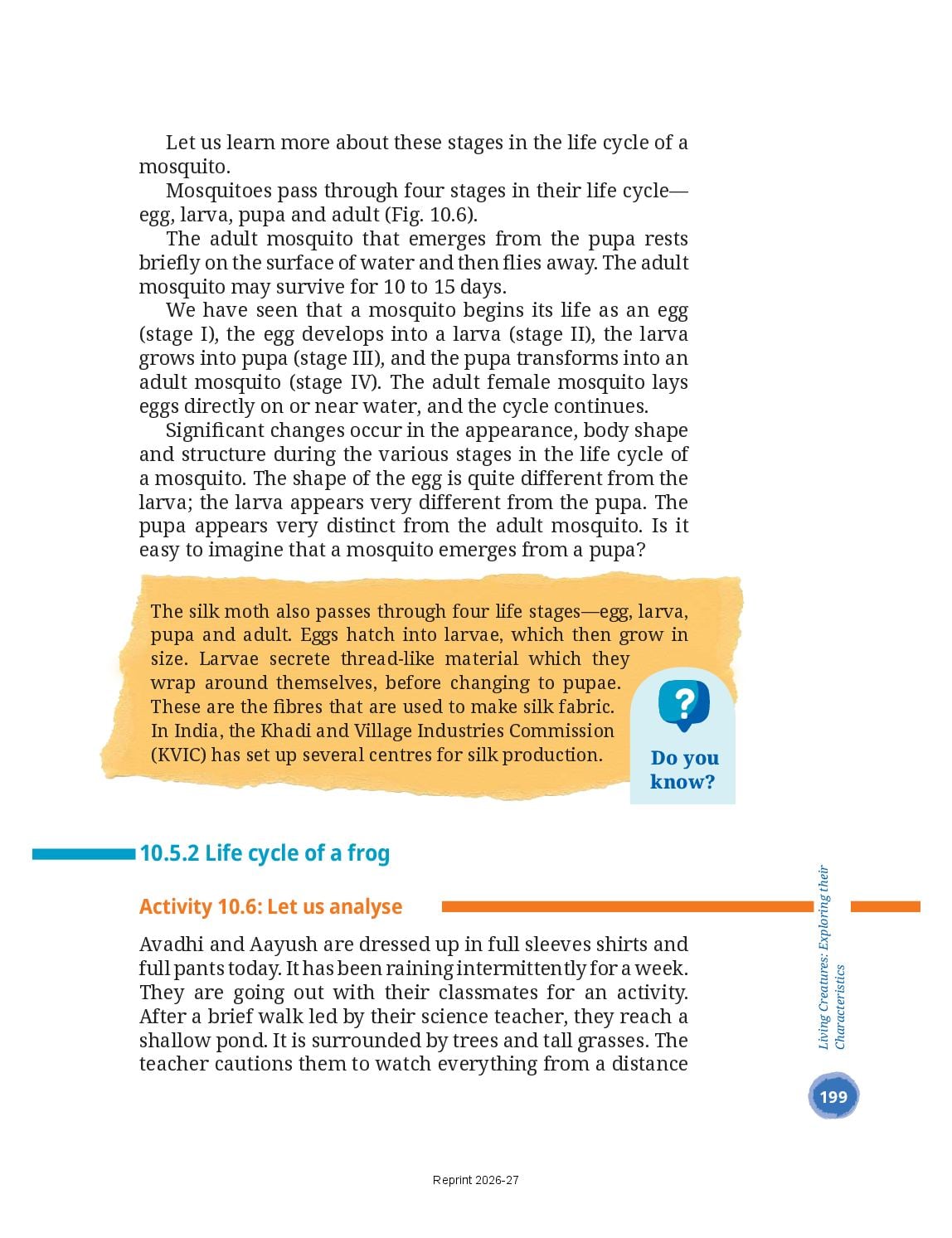
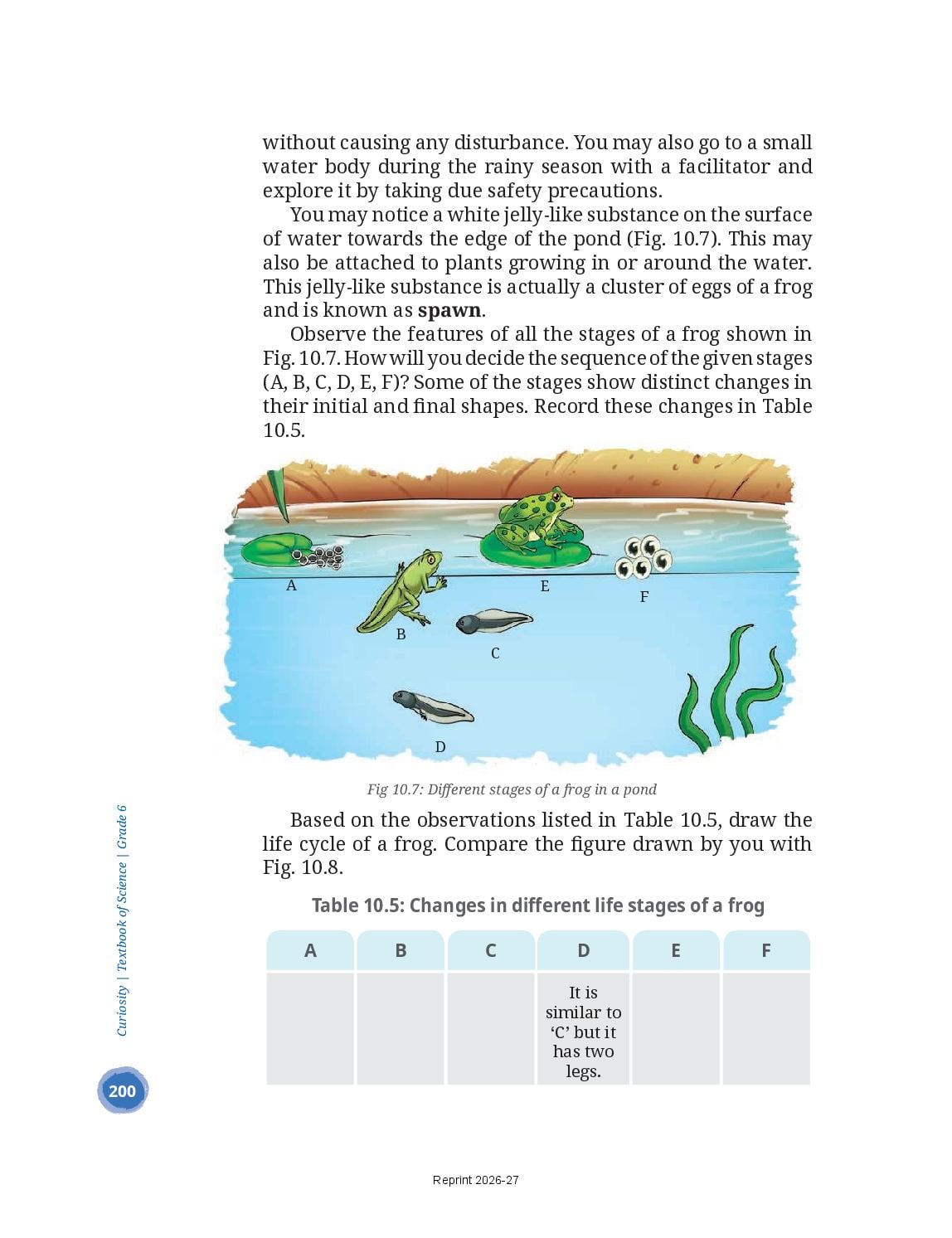
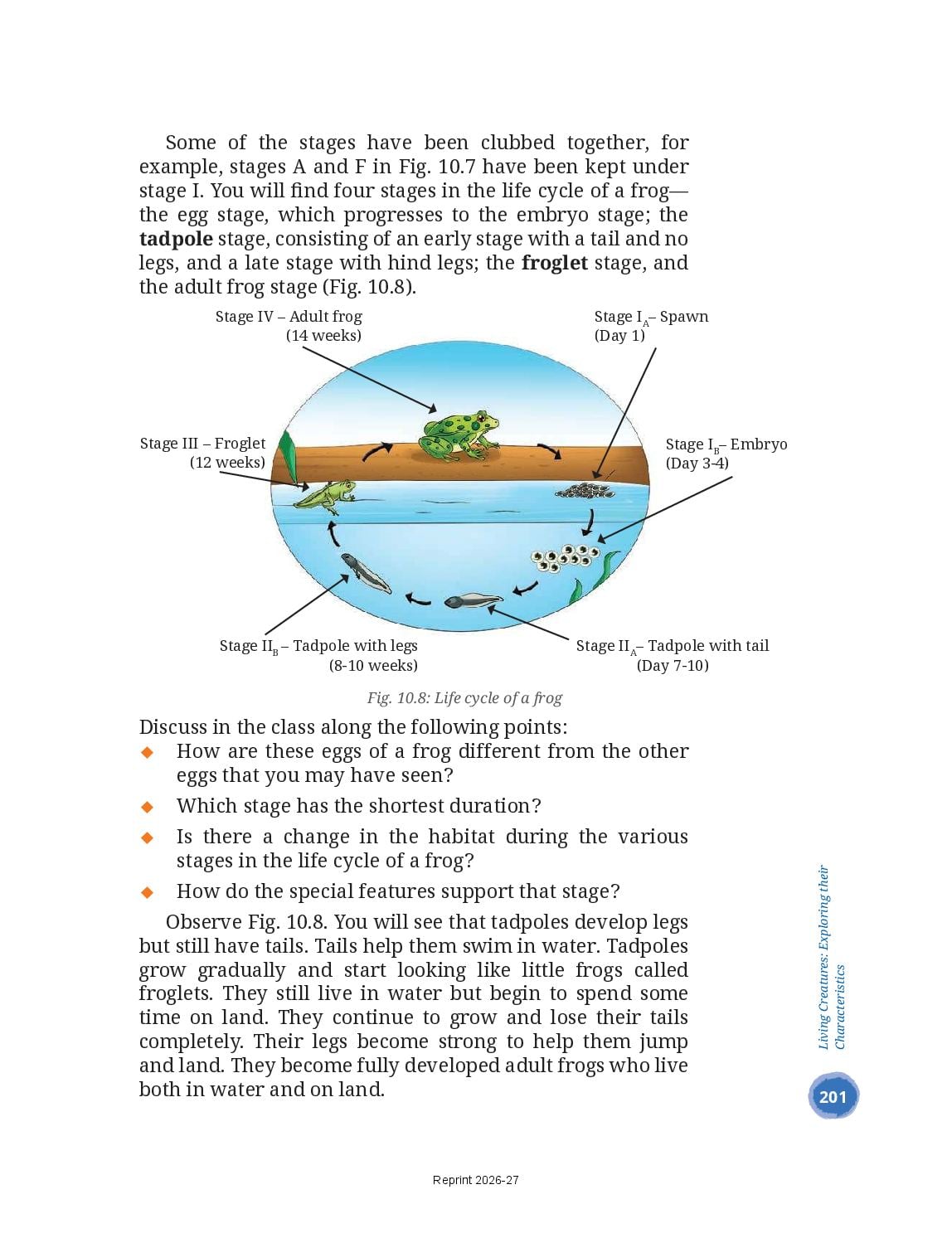
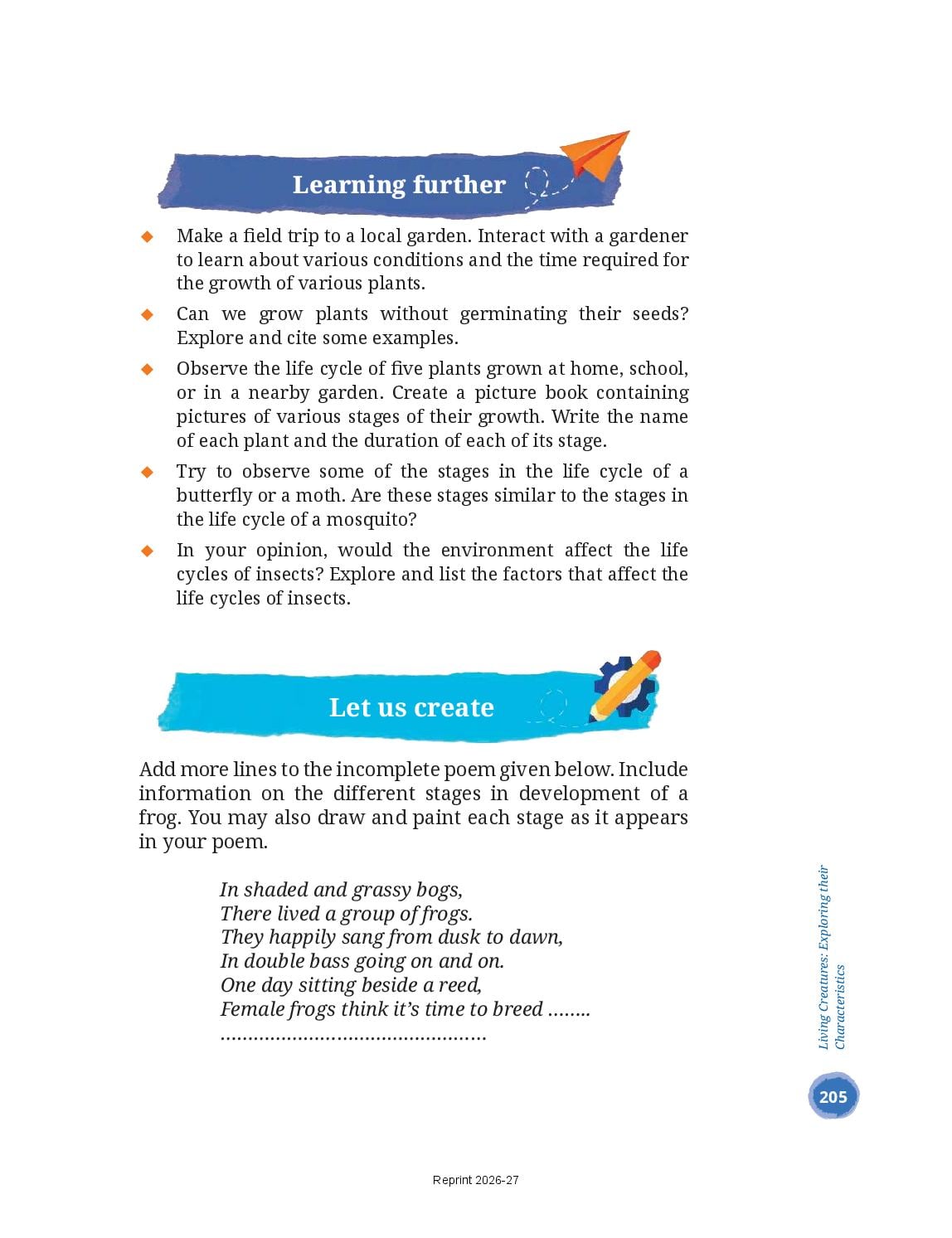
- A mosquito passes through egg → larva → pupa → adult, all in about two weeks. A frog passes through spawn (egg) → tadpole → froglet → adult frog in about 14 weeks, changing its home from water to both water and land.
Quick revision – Living Creatures: Exploring their Characteristics
| Term | What it means | Where it comes in the chapter | Example you can see |
|---|---|---|---|
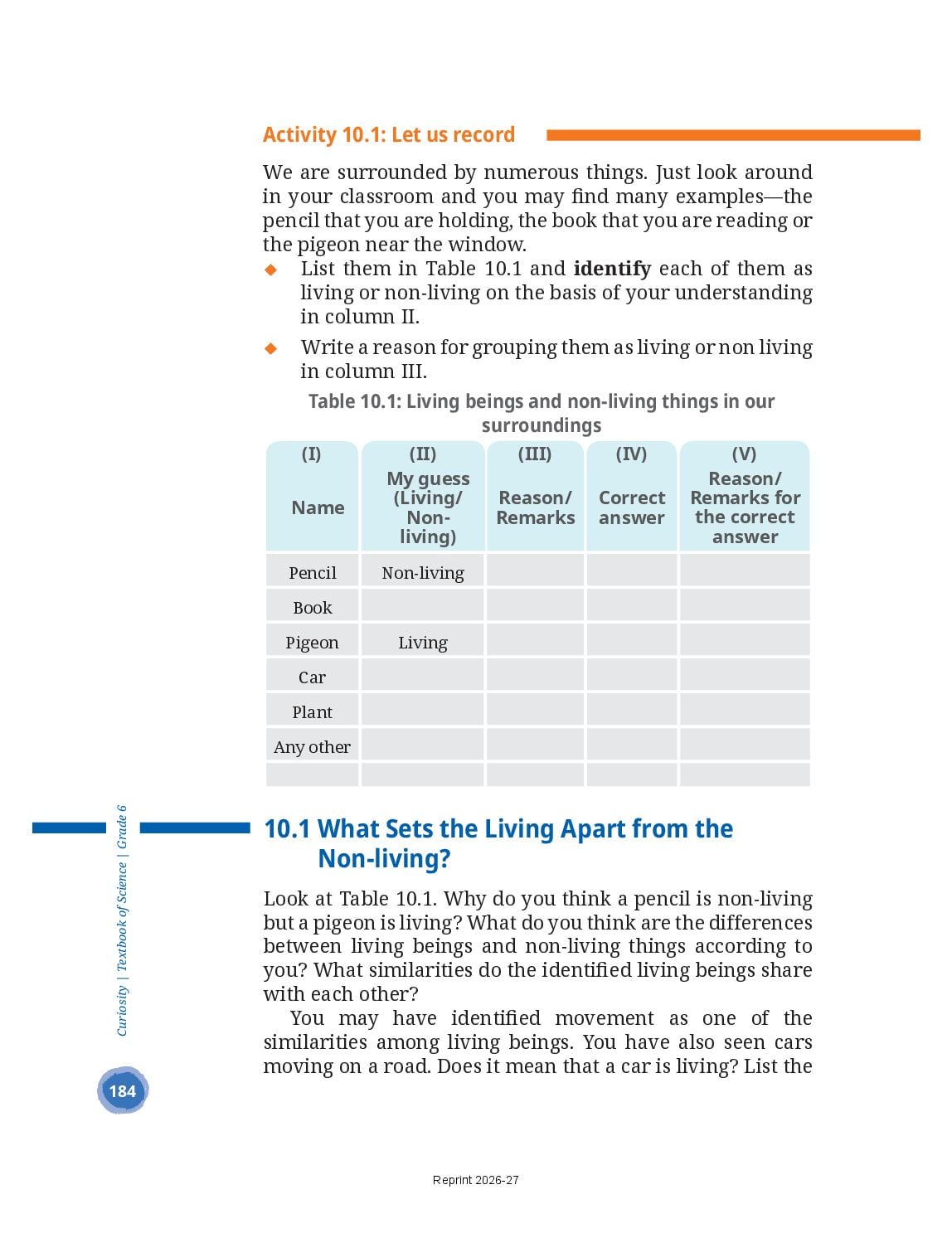
| Living being | Something that moves, eats, grows, respires, excretes, responds to stimuli, reproduces and dies | Section 10.1, page 184 | A pigeon at the classroom window |
| Non-living thing | Something in which one or more of these characteristics is absent | Section 10.1, page 188 | A pencil, a chair, a car |
| Movement | Change of position of the whole body or of a part of it | Page 185 | Leaves of Drosera folding over an insect |
| Growth | A permanent increase in size, from inside the body itself | Page 185 | Last year’s school dress no longer fits |
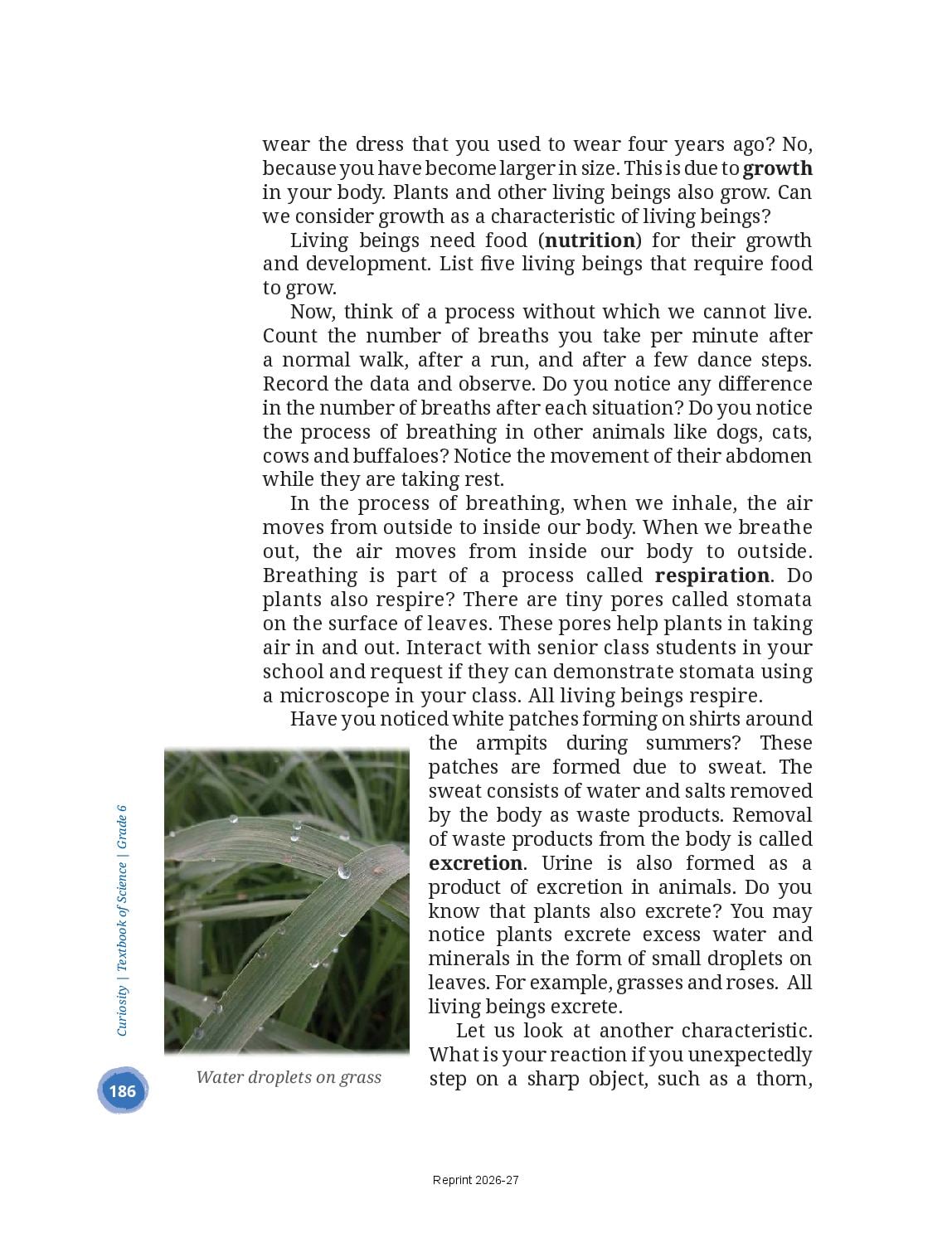
| Nutrition | Taking in food for growth, repair and energy | Page 186 | A cow chewing fodder; a plant making food in its leaves |
| Respiration | The life process that releases energy from food; breathing is a part of it | Page 186 | Counting your breaths after running |
| Stomata | Tiny pores on the surface of a leaf through which air moves in and out | Page 186 | Seen on a leaf peel under a microscope |
| Excretion | Removal of waste products from the body | Page 186 | Sweat patches on a shirt; dew-like droplets on grass |
| Stimulus | Anything or any event that makes a living being respond | Page 187 | Stepping on a thorn; touching a hot cup |
| Reproduction | Producing new ones of one’s own kind — it keeps life continuing | Page 187 | A cat with her kittens; a bean pod full of seeds |
| Germination | A seed turning into a sprout | Section 10.2, page 189 | Soaked chana sprouting on wet cloth |
| Seed coat and embryo | The outer covering of a seed, and the tiny plant inside it | Page 190 | Split a soaked rajma seed and look |
| Life cycle | The whole path from a seed (or an egg) to the next generation of seeds (or eggs) | Sections 10.4 and 10.5 | Bean plant; mosquito; frog |
| Larva and pupa | Two worm-like stages in the development of a mosquito, both living in water | Page 197 | Wrigglers in a cooler or an open drum |
Old NCERT vs New – Class 6 Science
This chapter is from Curiosity, the new NCERT Class 6 Science book (NCF-SE 2023, used from 2024-25). It replaced the old book “Science”, so chapter numbers and names differ from older PDFs.
Solutions and All Chapters
Answers to the exercises and the full chapter list of Curiosity:
Living Creatures: Exploring their Characteristics – Overview
| Class | Class 6 |
| Subject | Science |
| Book | Curiosity – new NCERT book |
| Chapter | 10 of 12 – Living Creatures: Exploring their Characteristics |
| Book pages | 183 – 205 |
| Edition | NCERT Reprint 2026-27 |
| Session | 2026-27 |
| Free – read online or download |
Class 6 Science Chapter 10 – FAQs
Where can I download Living Creatures: Exploring their Characteristics Class 6 PDF?
From the download table on this page – the chapter PDF is free, and the full book is linked too.
What is Class 6 Science Chapter 10 about?
A living being shows a whole set of characteristics together: it moves, needs food, grows, respires, excretes, responds to stimuli, reproduces and finally dies. If even one of these is missing, the thing is non-living.
Is Living Creatures: Exploring their Characteristics from the new NCERT Class 6 Science book?
Yes. It is chapter 10 of curiosity, the new NCERT Class 6 Science book for 2026-27.
Is this the latest NCERT edition for 2026-27?
Yes – the PDF is NCERT’s latest edition for the 2026-27 session.
Where are the NCERT Solutions for Class 6 Science Chapter 10?
Open the NCERT Solutions link above for answers to the exercise questions.