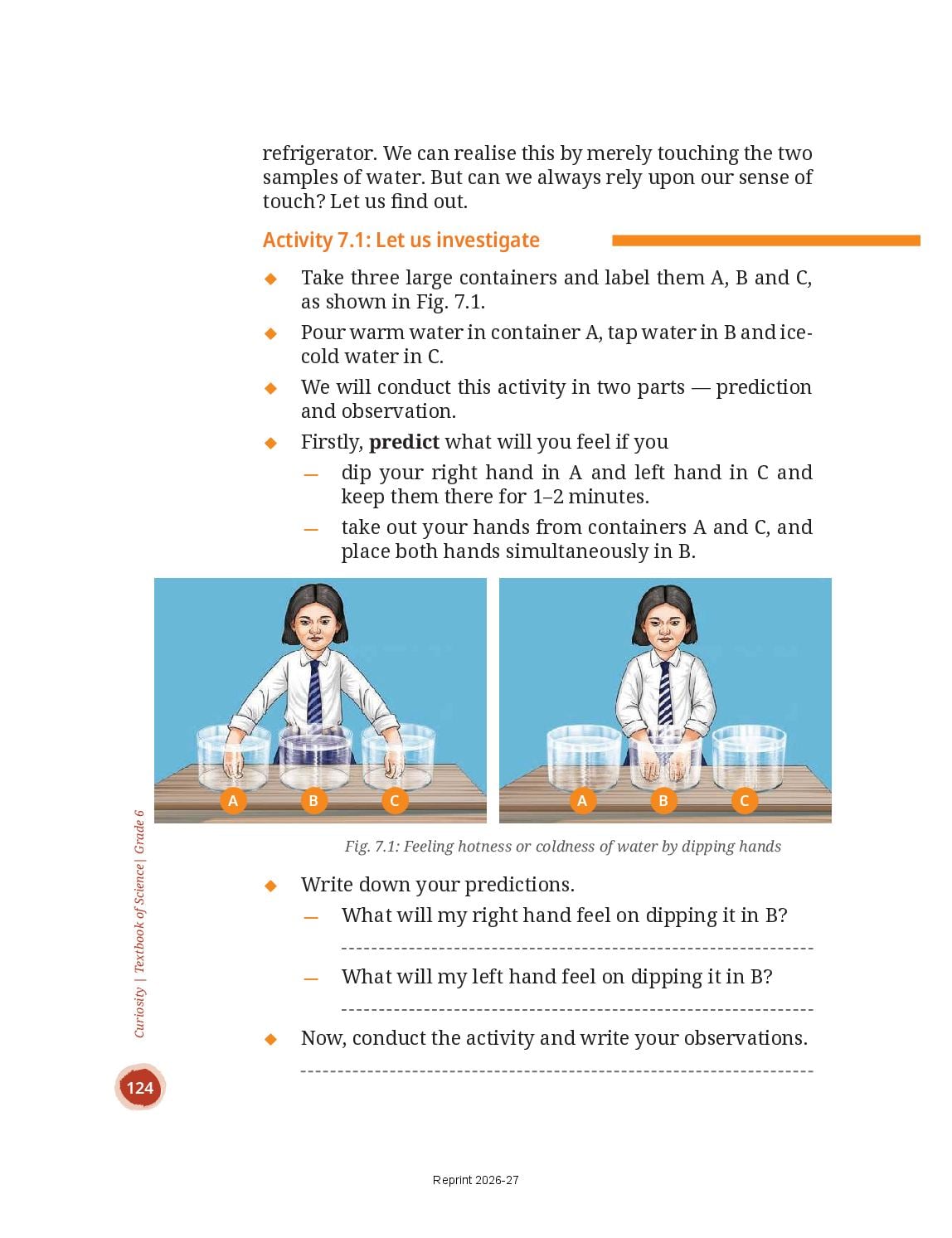
Download Temperature and its Measurement – NCERT Class 6 Science Chapter 7 PDF from the new NCERT Class 6 Science book Curiosity (2026-27). Read the chapter online or download the free PDF. The temperature of a body is a reliable measure of how hot or cold it is. Our sense of touch is not reliable — the same water in container B feels cool to a hand coming out of warm water and warm to a hand coming out of ice-cold water.
Temperature and its Measurement PDF – Chapter 7 of Curiosity
Read the chapter online or download the PDF.
| Chapter | Download | |
|---|---|---|
| Chapter 7 PDF | Temperature and its Measurement | View PDF |
| Full book | NCERT Class 6 Science – Curiosity | View Book |
Read Online
What Is in Temperature and its Measurement? (Class 6 Science Chapter 7)
- The temperature of a body is a reliable measure of how hot or cold it is. Our sense of touch is not reliable — the same water in container B feels cool to a hand coming out of warm water and warm to a hand coming out of ice-cold water.
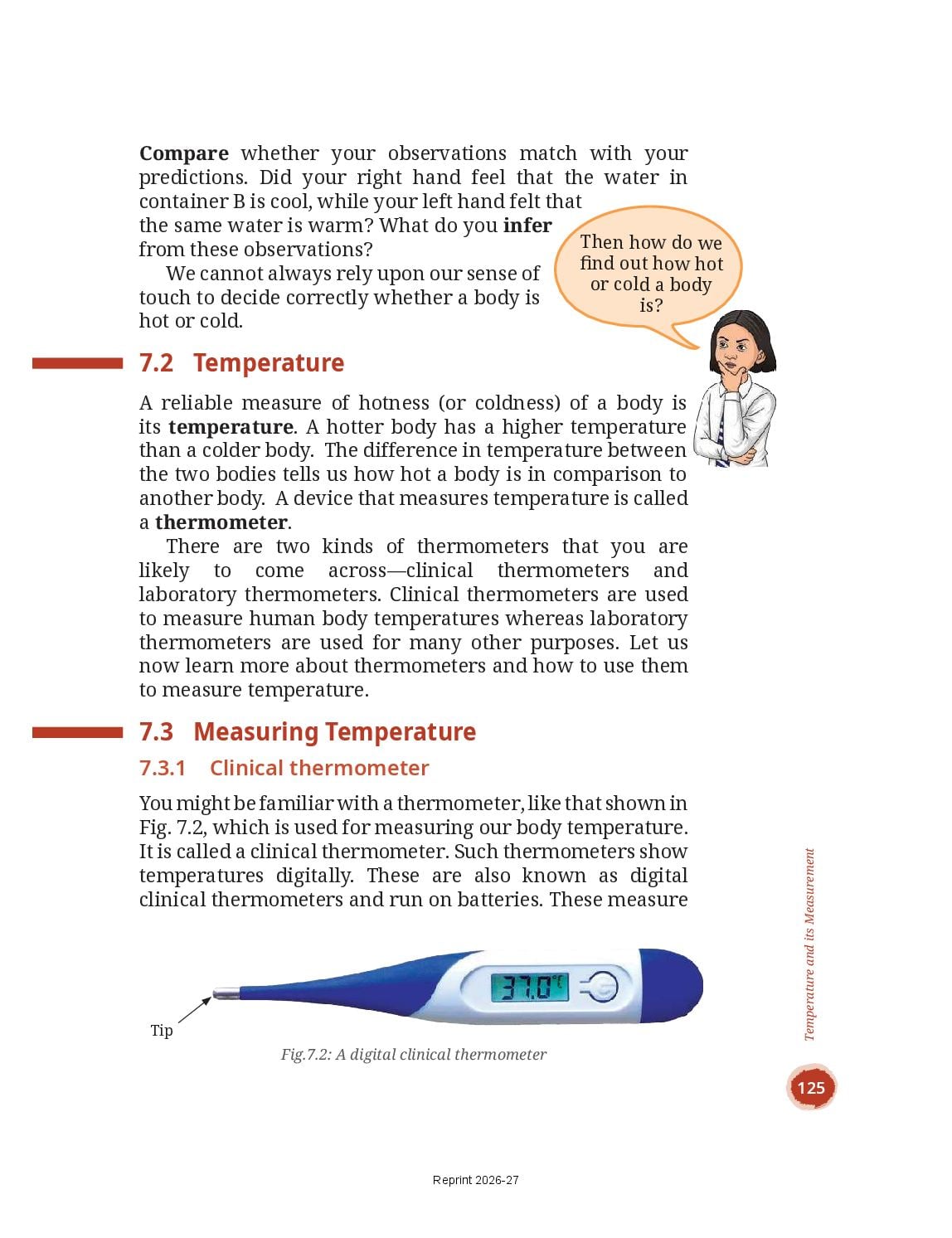
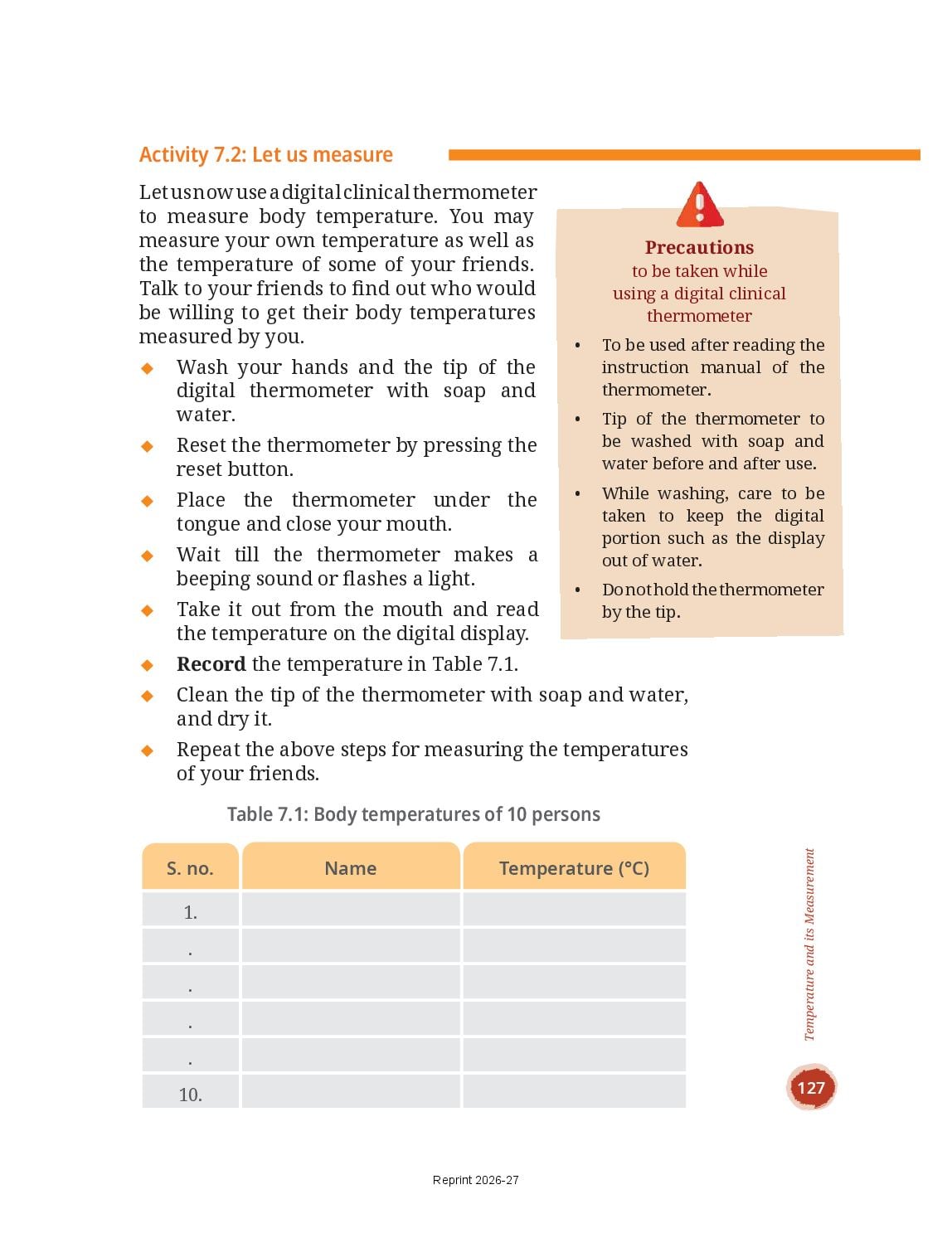
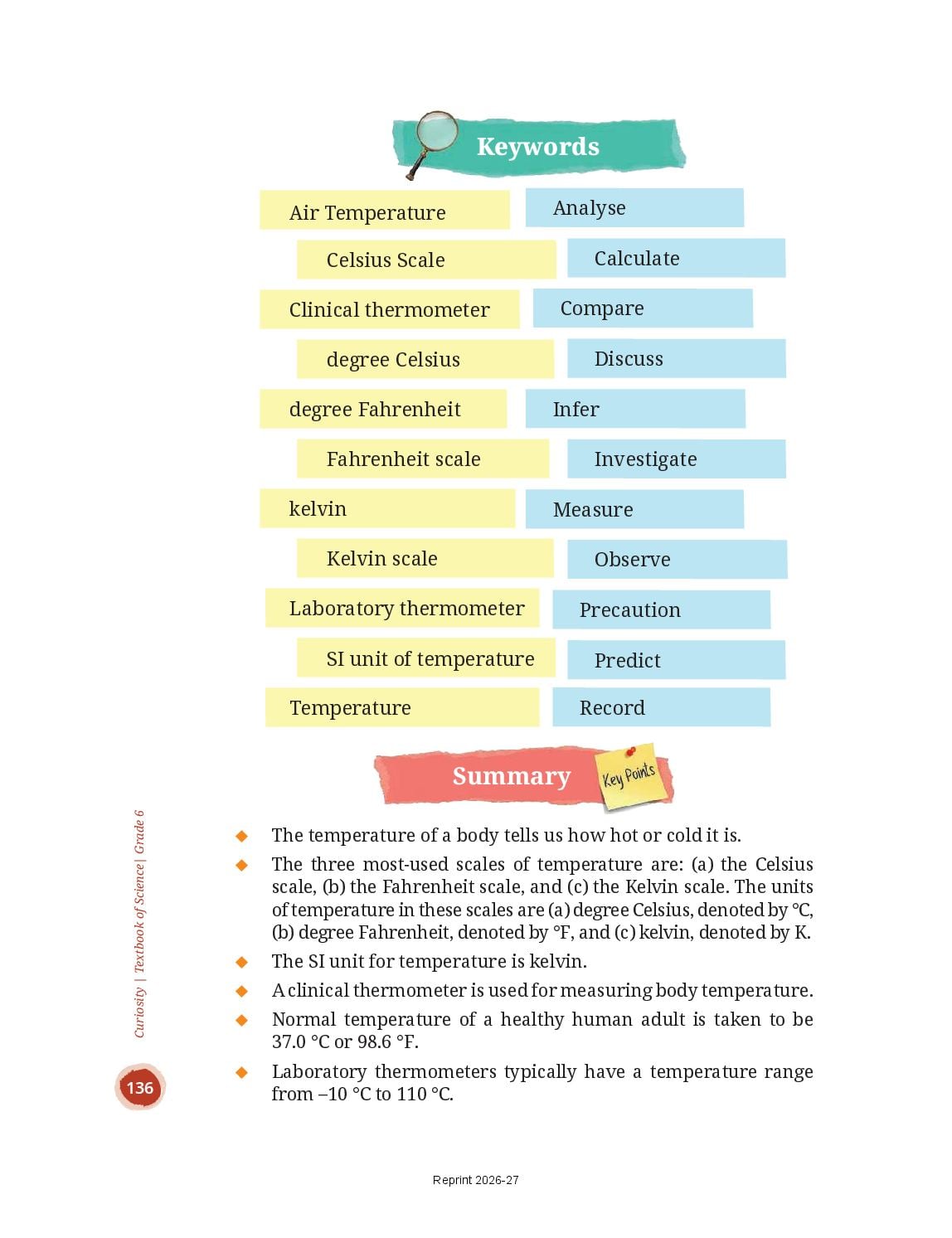
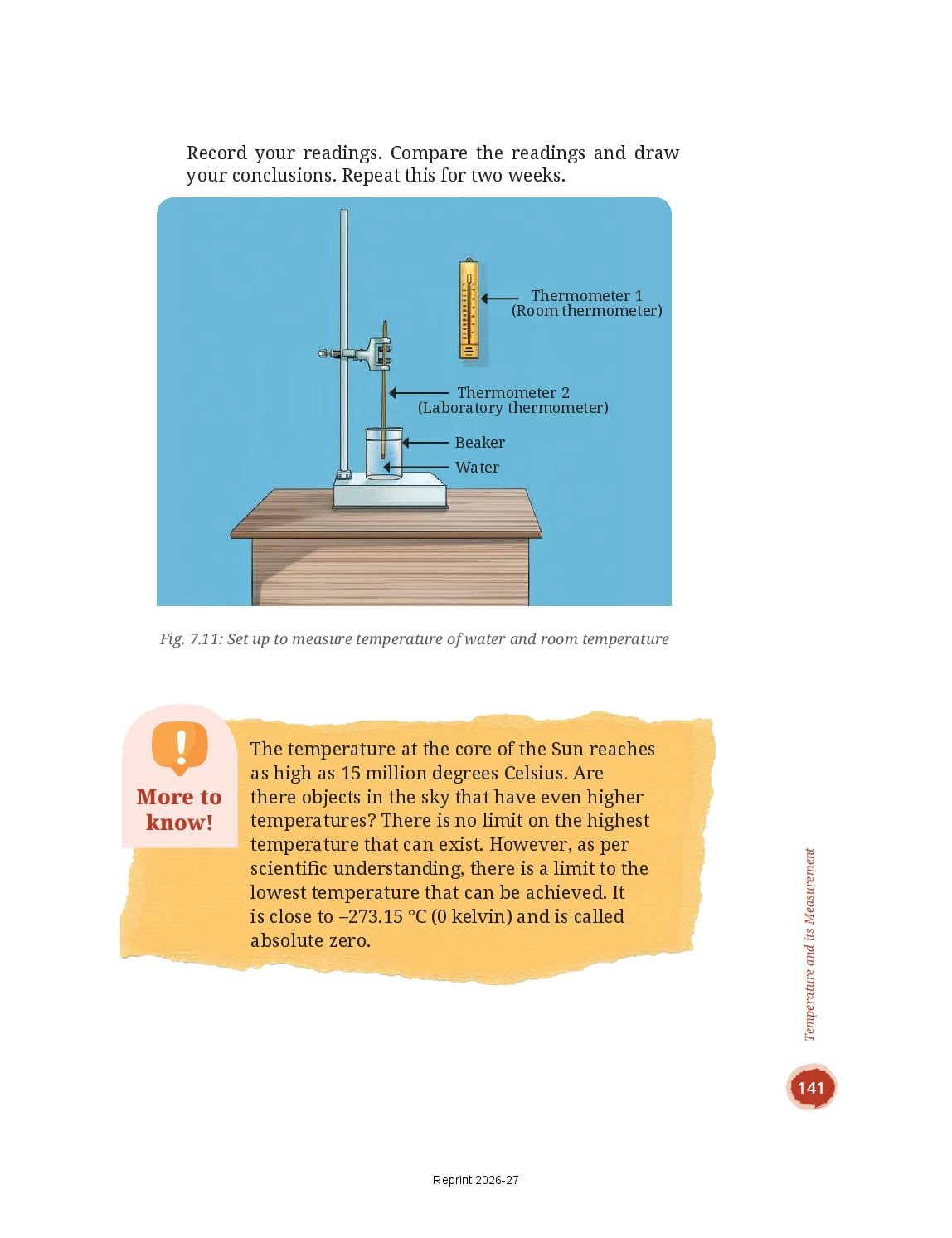
- A thermometer is the device that measures temperature. A clinical thermometer (today usually a digital one) measures human body temperature; a laboratory thermometer is used for everything else.
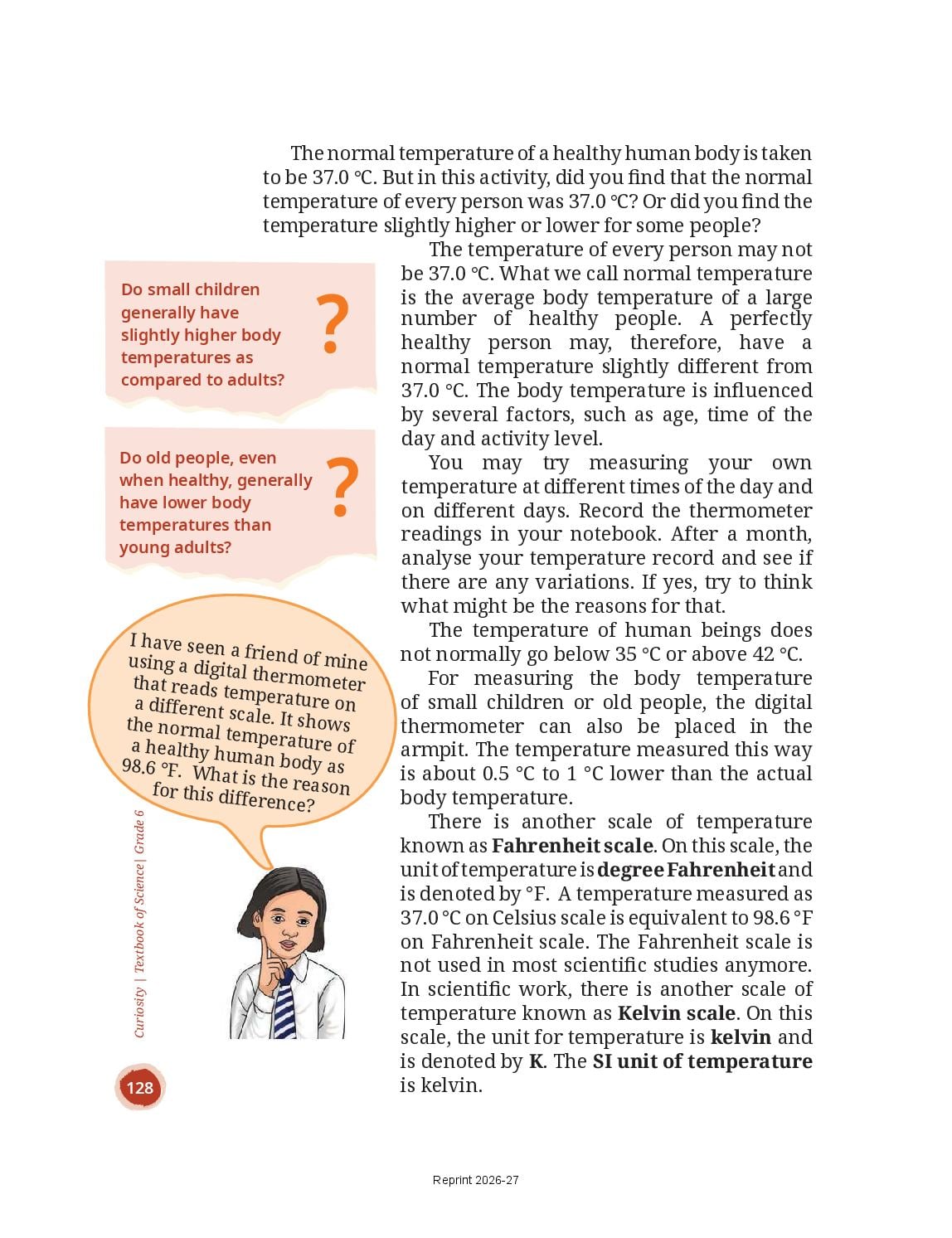
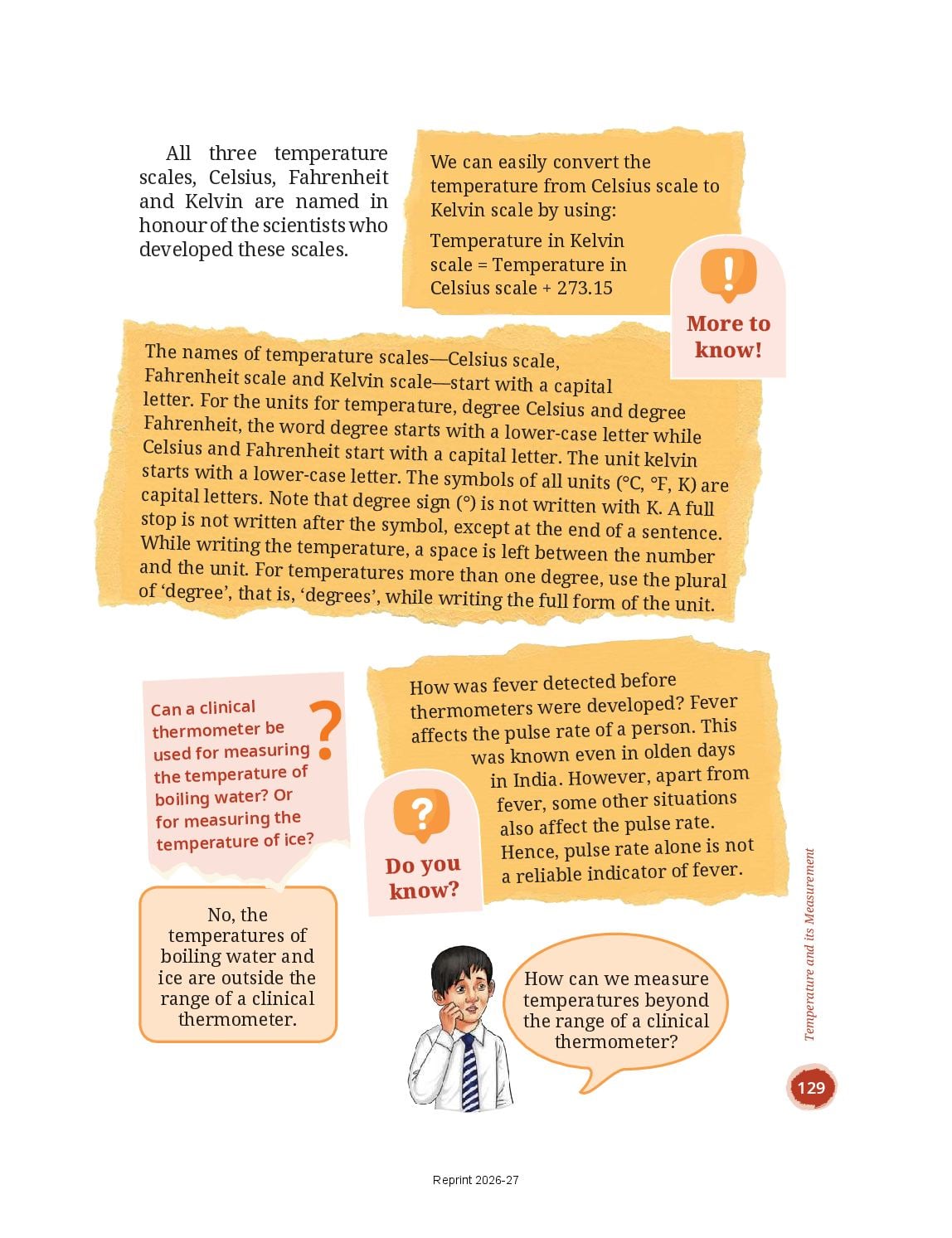
- The three common scales are the Celsius scale (unit degree Celsius, °C), the Fahrenheit scale (unit degree Fahrenheit, °F) and the Kelvin scale (unit kelvin, K). The SI unit of temperature is kelvin, and temperature in K = temperature in °C + 273.15.
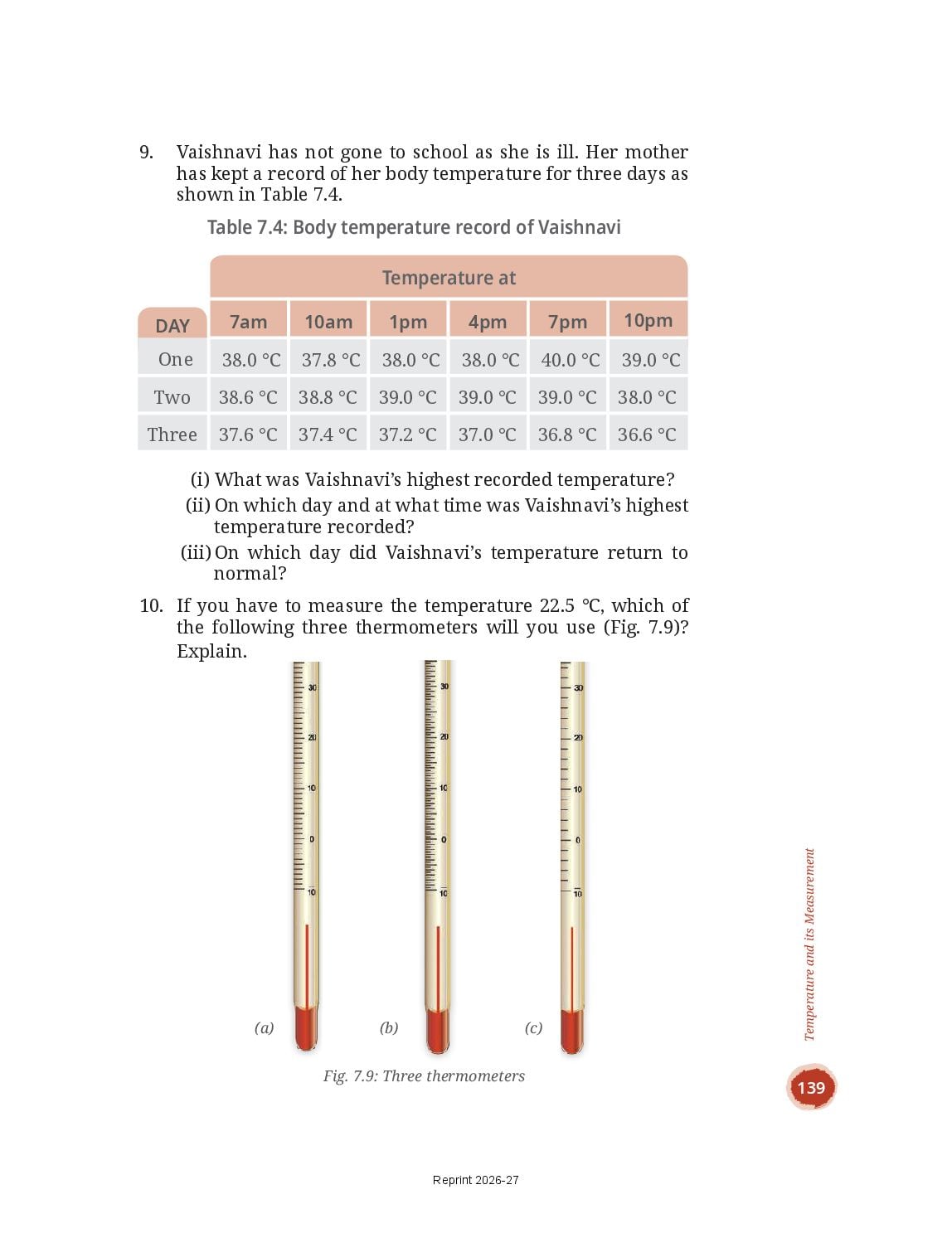
- The normal temperature of a healthy human body is taken to be 37.0 °C, which is the same as 98.6 °F. It is an average, so a perfectly healthy person may read a little above or below it. Human body temperature does not normally go below 35 °C or above 42 °C.
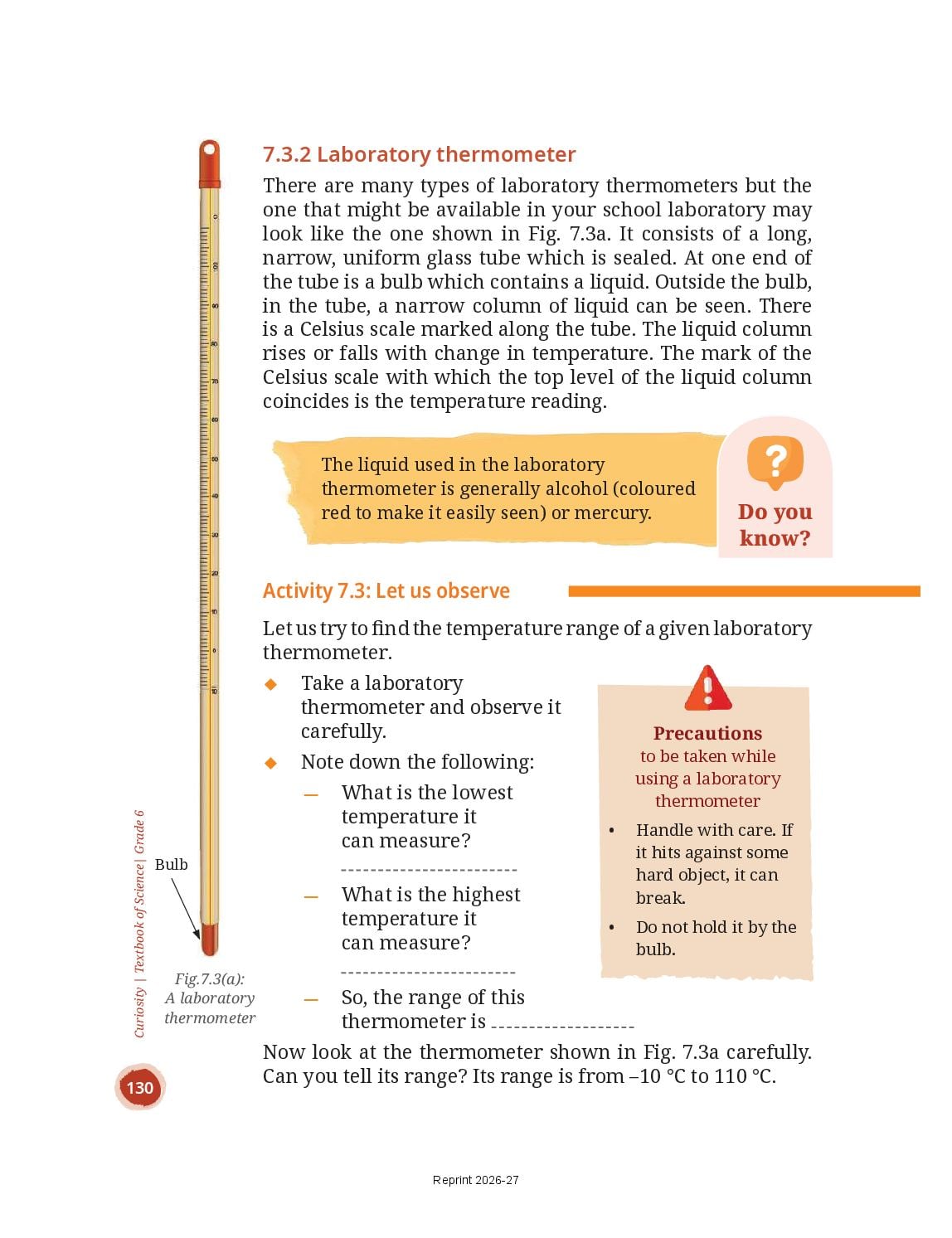
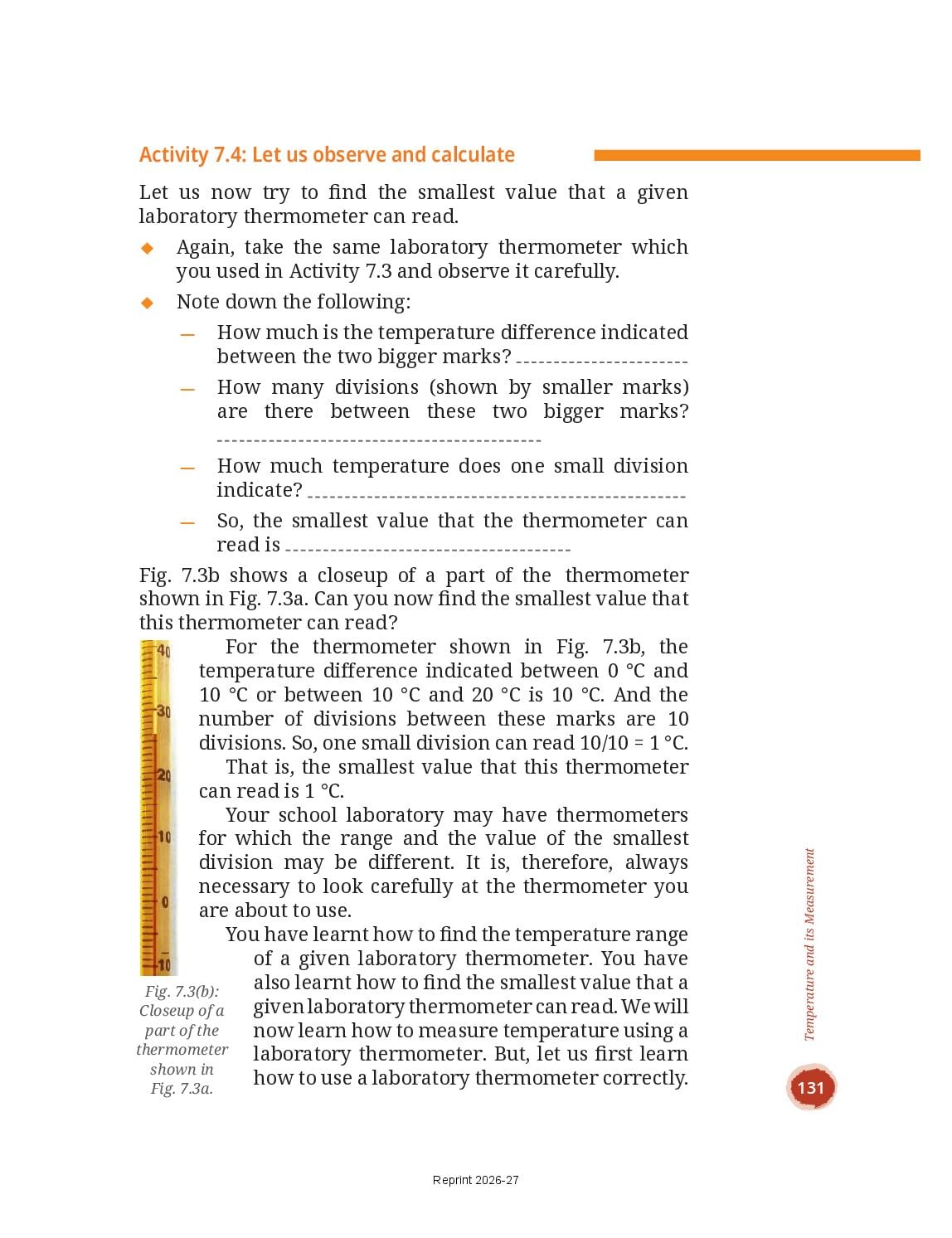
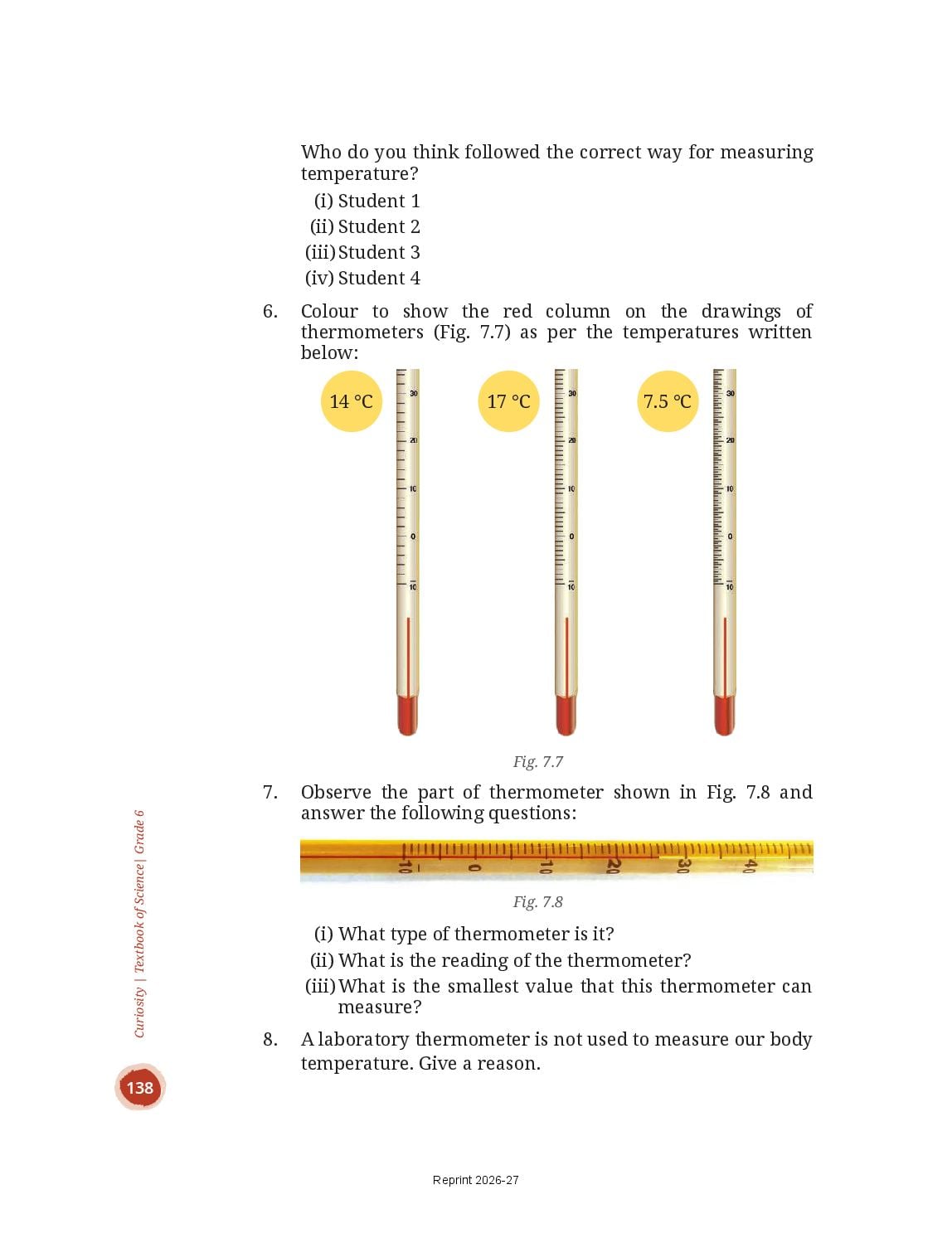
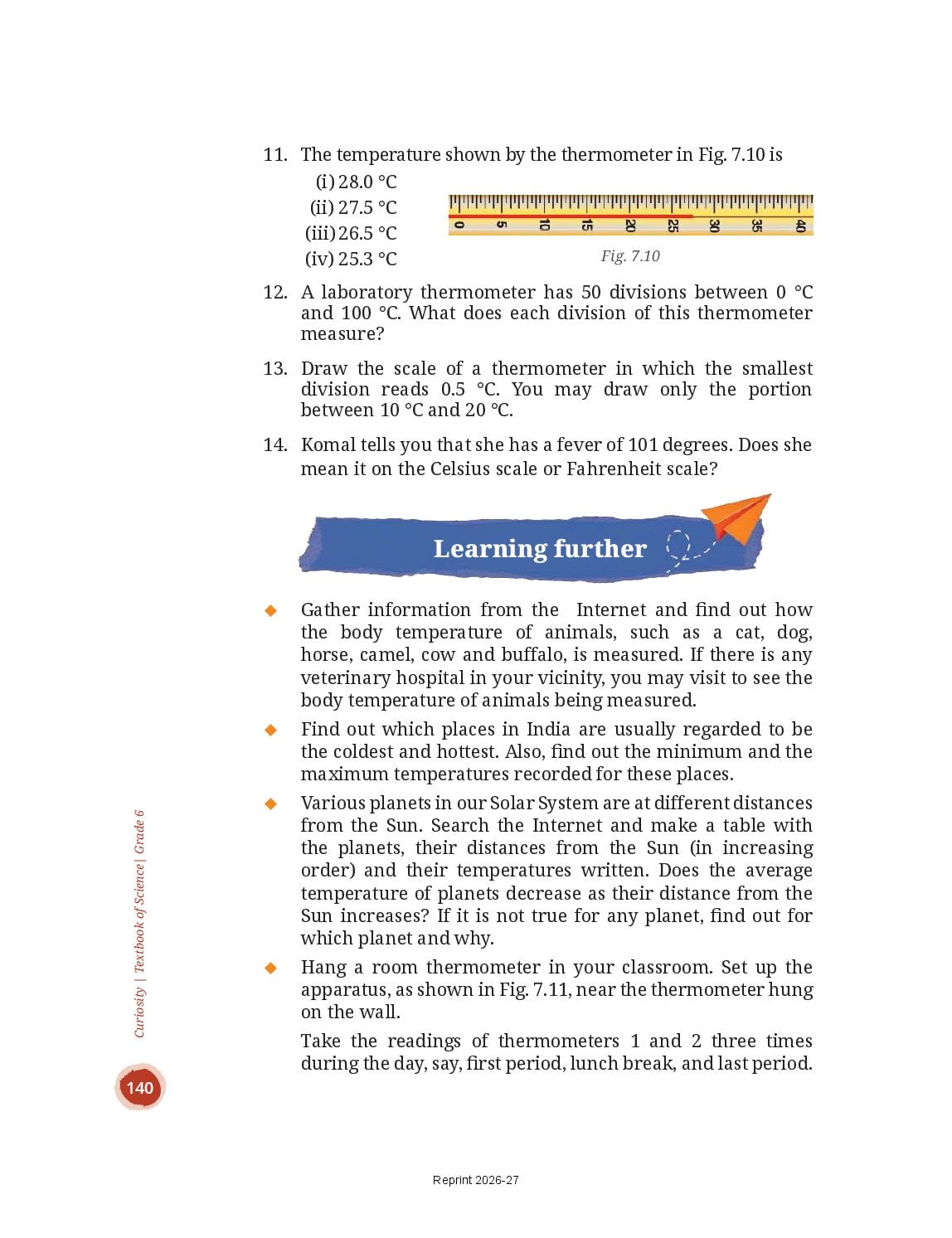
- A laboratory thermometer usually has a range of –10 °C to 110 °C. Its smallest division is found by dividing the difference between two big marks by the number of small divisions between them — for the thermometer in Fig. 7.3b, 10 °C ÷ 10 = 1 °C.
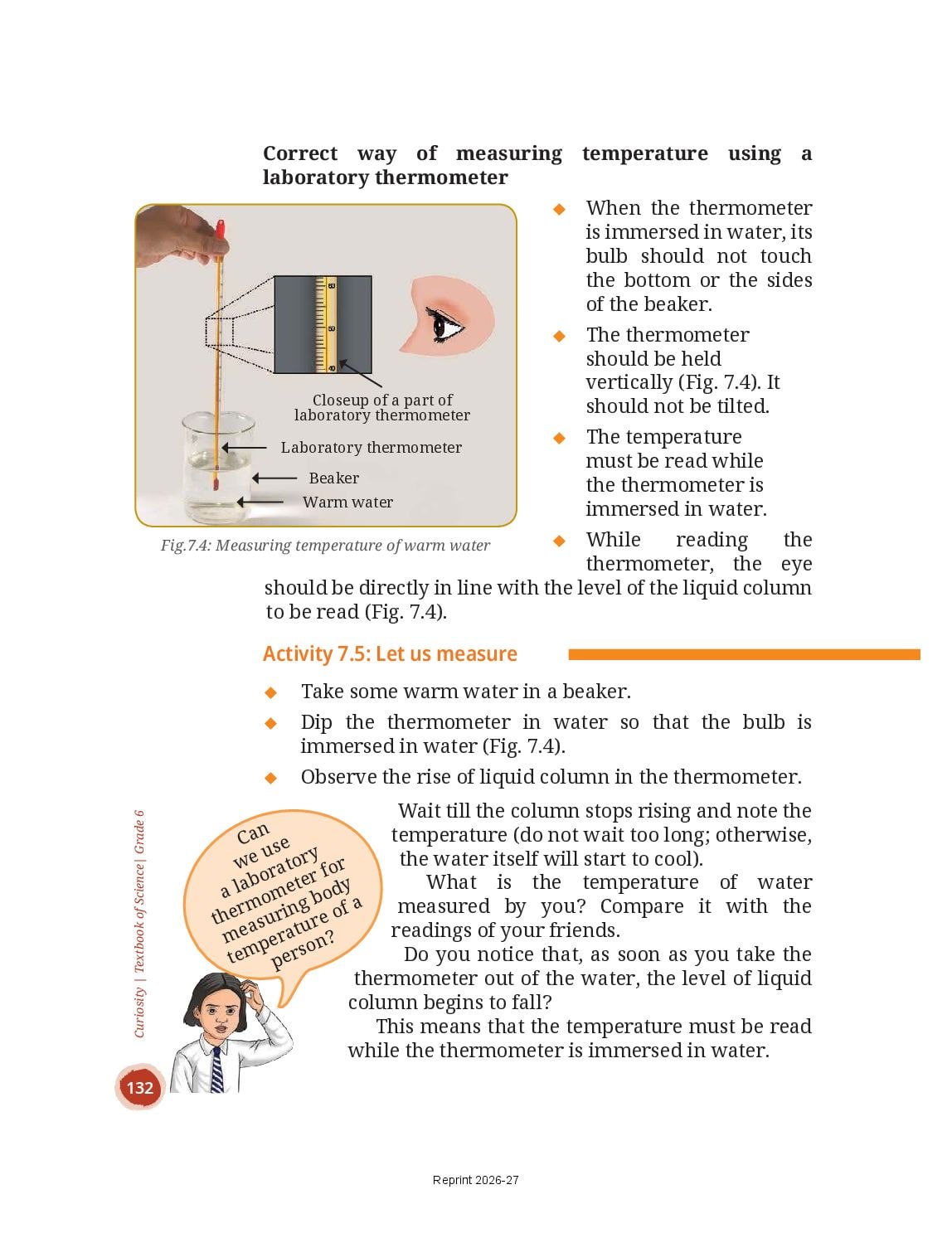
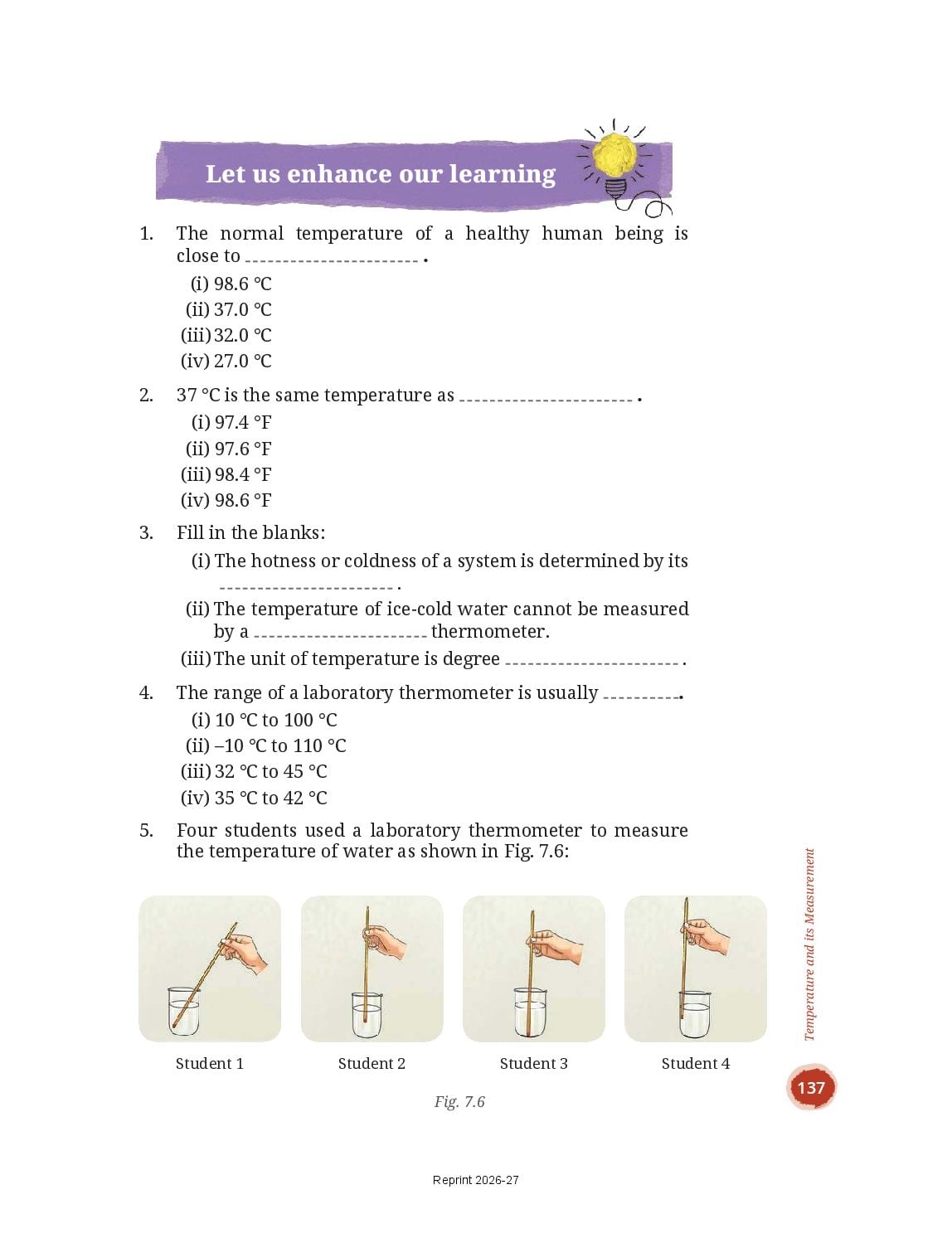
- Reading correctly matters: hold the thermometer vertically, keep the bulb fully in the liquid but away from the bottom and sides, read while it is still immersed, and keep your eye exactly in line with the top of the liquid column.
Quick revision – Temperature and its Measurement
| Term | What it means | Key value / unit | Where it comes in the chapter |
|---|---|---|---|
| Temperature | A reliable measure of the hotness or coldness of a body | SI unit: kelvin (K) | Section 7.2, page 125 |
| Thermometer | A device that measures temperature | — | Section 7.2, page 125 |
| Clinical thermometer | Thermometer used to measure human body temperature; today mostly digital | Body range only, about 35 °C to 42 °C | Section 7.3.1, page 125 |
| Laboratory thermometer | Glass tube with a bulb of liquid (alcohol or mercury) and a Celsius scale, used for all other purposes | Range –10 °C to 110 °C | Section 7.3.2, page 130 |
| Celsius scale | The everyday temperature scale used on thermometers in India | Unit: degree Celsius, °C | Page 126 |
| Fahrenheit scale | An older scale, still printed on some digital thermometers | Unit: degree Fahrenheit, °F | Page 128 |
| Kelvin scale | The scale used in scientific work | Unit: kelvin, K; temperature in K = temperature in °C + 273.15 | Pages 128 and 129 |
| Normal body temperature | The average body temperature of a large number of healthy people | 37.0 °C = 98.6 °F | Page 128 |
| Range of a thermometer | From its lowest to its highest marked temperature | Lab thermometer: –10 °C to 110 °C | Activity 7.3, page 130 |
| Smallest value (least count) | The smallest temperature difference the thermometer can show = value between two big marks ÷ number of divisions | Fig. 7.3b: 10 °C ÷ 10 = 1 °C | Activity 7.4, page 131 |
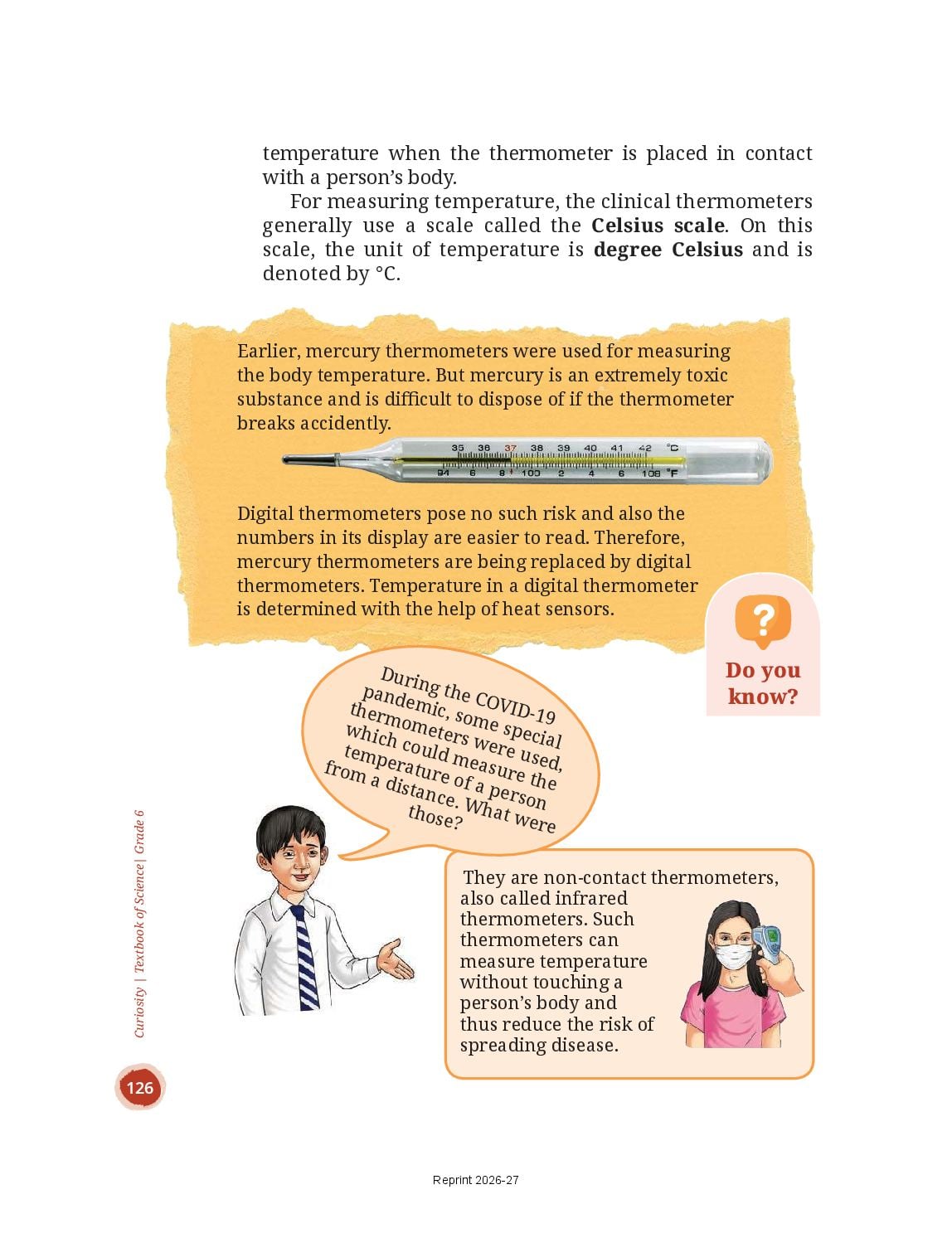
| Non-contact (infrared) thermometer | Measures body temperature without touching the body | Used widely during COVID-19 | Page 126 |
| Absolute zero | The lowest temperature that can be achieved | –273.15 °C = 0 K | Page 141 |
Old NCERT vs New – Class 6 Science
This chapter is from Curiosity, the new NCERT Class 6 Science book (NCF-SE 2023, used from 2024-25). It replaced the old book “Science”, so chapter numbers and names differ from older PDFs.
Solutions and All Chapters
Answers to the exercises and the full chapter list of Curiosity:
Temperature and its Measurement – Overview
| Class | Class 6 |
| Subject | Science |
| Book | Curiosity – new NCERT book |
| Chapter | 7 of 12 – Temperature and its Measurement |
| Book pages | 123 – 141 |
| Edition | NCERT Reprint 2026-27 |
| Session | 2026-27 |
| Free – read online or download |
Class 6 Science Chapter 7 – FAQs
Where can I download Temperature and its Measurement Class 6 PDF?
From the download table on this page – the chapter PDF is free, and the full book is linked too.
What is Class 6 Science Chapter 7 about?
The temperature of a body is a reliable measure of how hot or cold it is. Our sense of touch is not reliable — the same water in container B feels cool to a hand coming out of warm water and warm to a hand coming out of ice-cold water.
Is Temperature and its Measurement from the new NCERT Class 6 Science book?
Yes. It is chapter 7 of curiosity, the new NCERT Class 6 Science book for 2026-27.
Is this the latest NCERT edition for 2026-27?
Yes – the PDF is NCERT’s latest edition for the 2026-27 session.
Where are the NCERT Solutions for Class 6 Science Chapter 7?
Open the NCERT Solutions link above for answers to the exercise questions.