Download A Journey through States of Water – NCERT Class 6 Science Chapter 8 PDF from the new NCERT Class 6 Science book Curiosity (2026-27). Read the chapter online or download the free PDF. Ice, water and water vapour are the same substance in three different states — solid, liquid and gas. Ice keeps its own shape and does not flow; water takes the shape of its vessel and flows; water vapour has no shape at all and spreads through the…
A Journey through States of Water PDF – Chapter 8 of Curiosity
Read the chapter online or download the PDF.
| Chapter | Download | |
|---|---|---|
| Chapter 8 PDF | A Journey through States of Water | View PDF |
| Full book | NCERT Class 6 Science – Curiosity | View Book |
Read Online
What Is in A Journey through States of Water? (Class 6 Science Chapter 8)
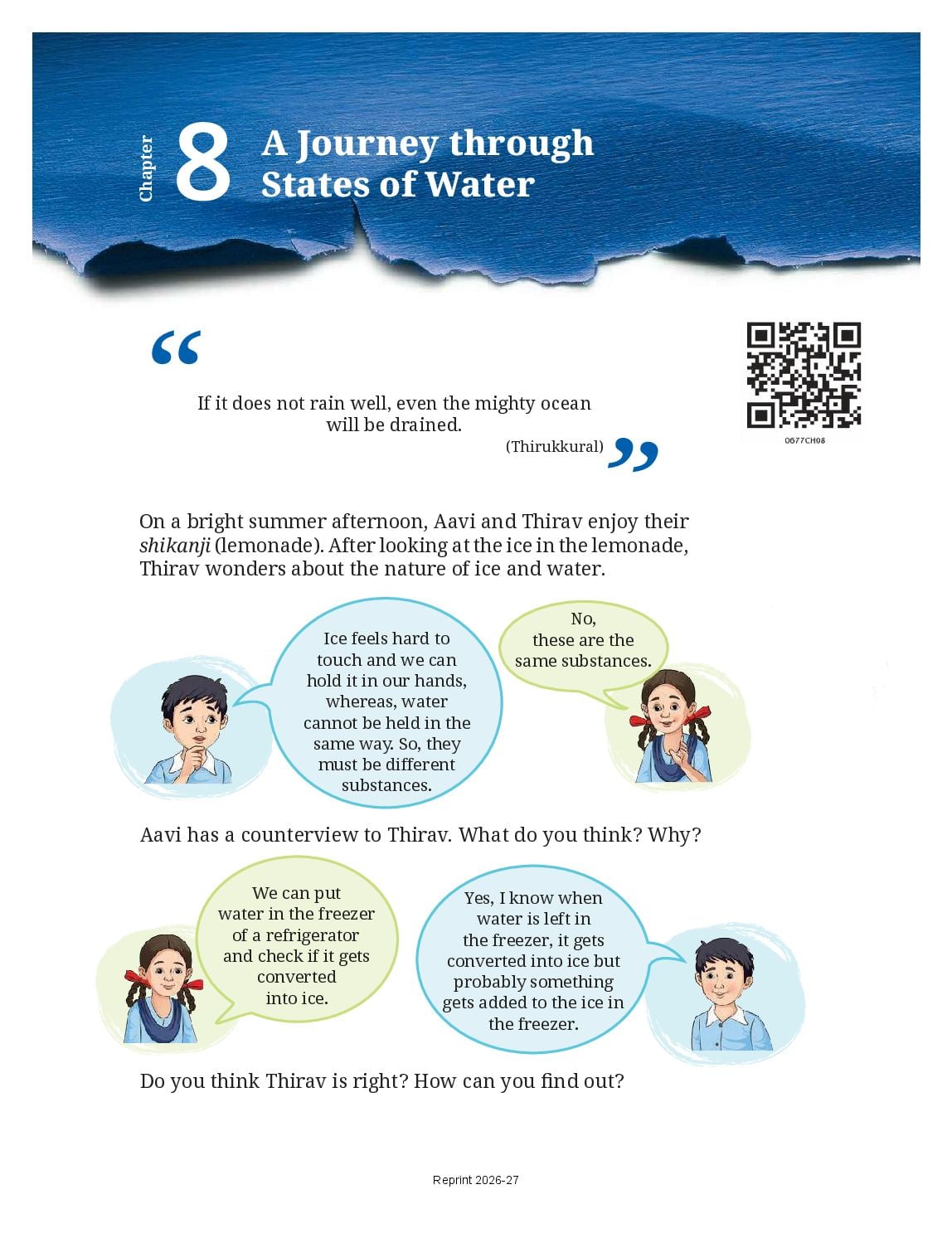
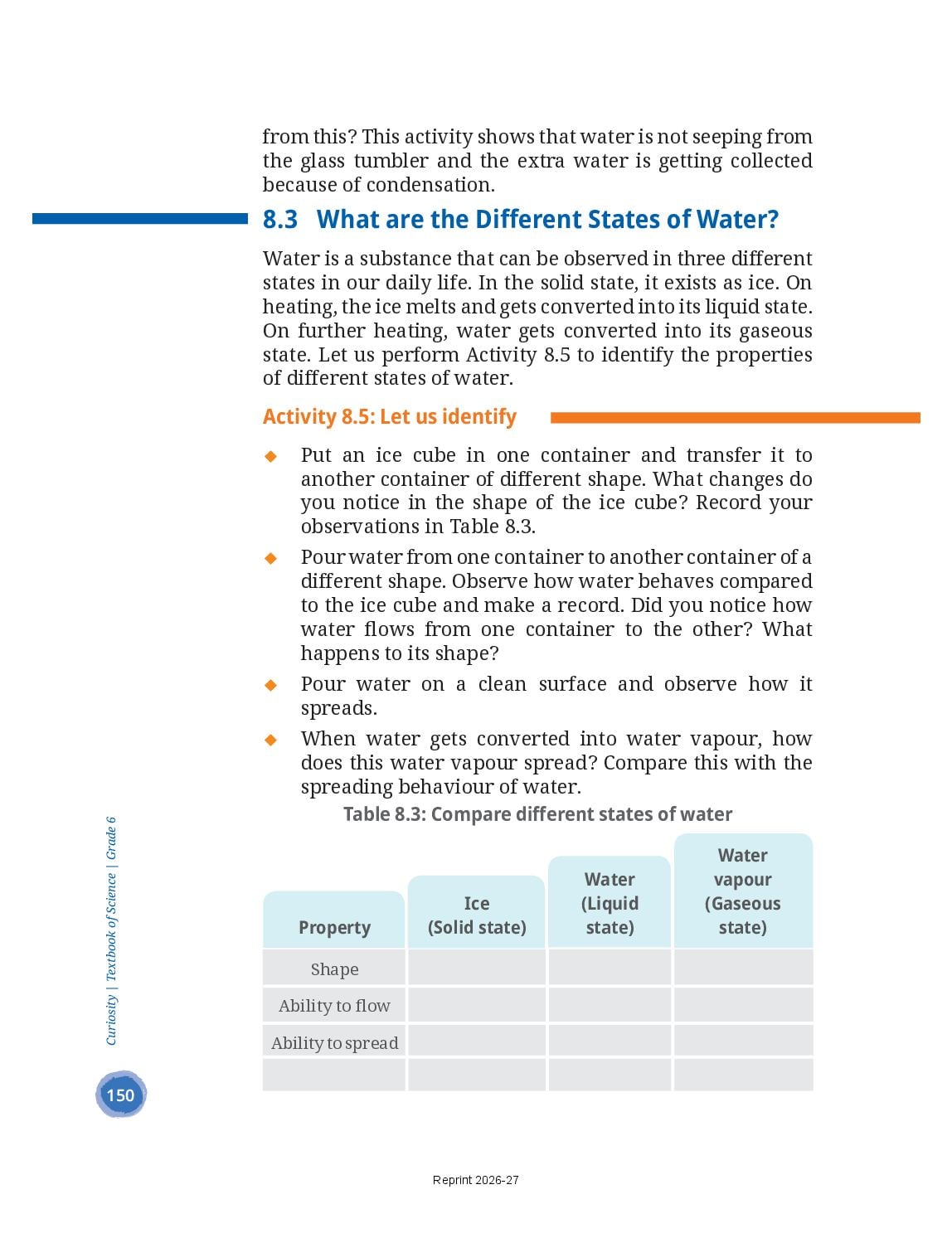
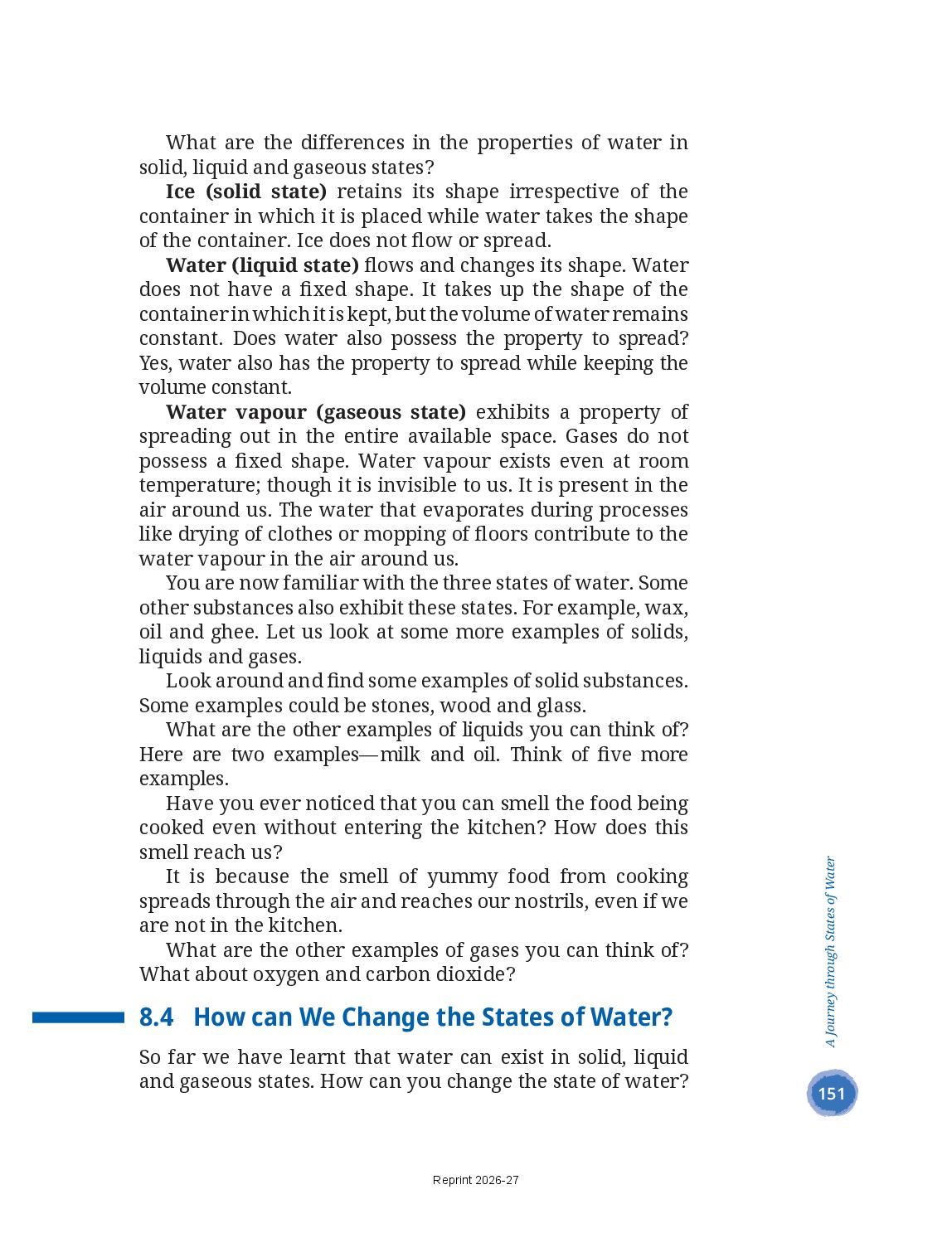
- Ice, water and water vapour are the same substance in three different states — solid, liquid and gas. Ice keeps its own shape and does not flow; water takes the shape of its vessel and flows; water vapour has no shape at all and spreads through the whole space available.
- Evaporation is the change of water into water vapour. It goes on all the time, at every temperature — even at room temperature — and only from the surface. Boiling is different: it happens only at a fixed temperature, 100 °C for water, throughout the liquid, with bubbles.
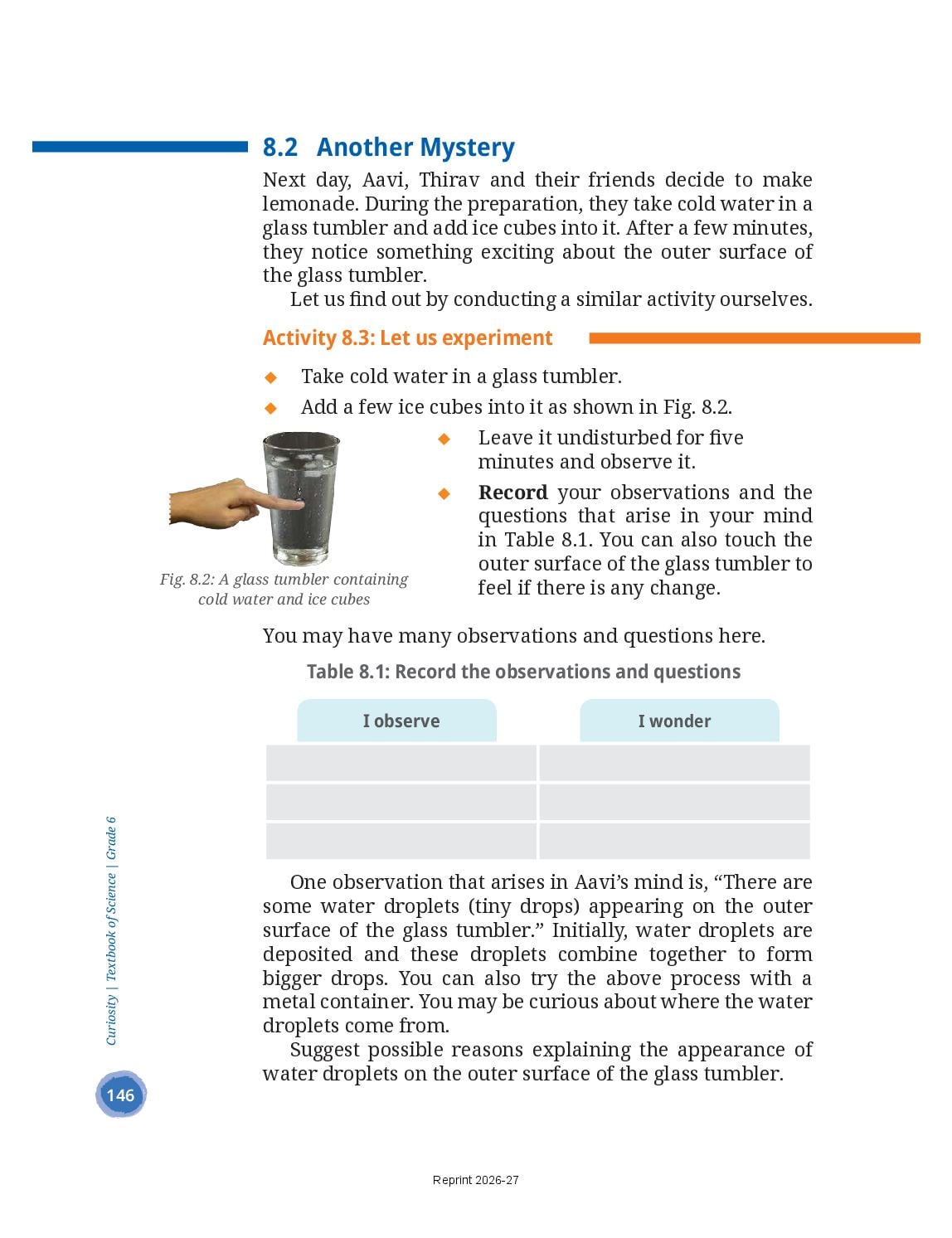
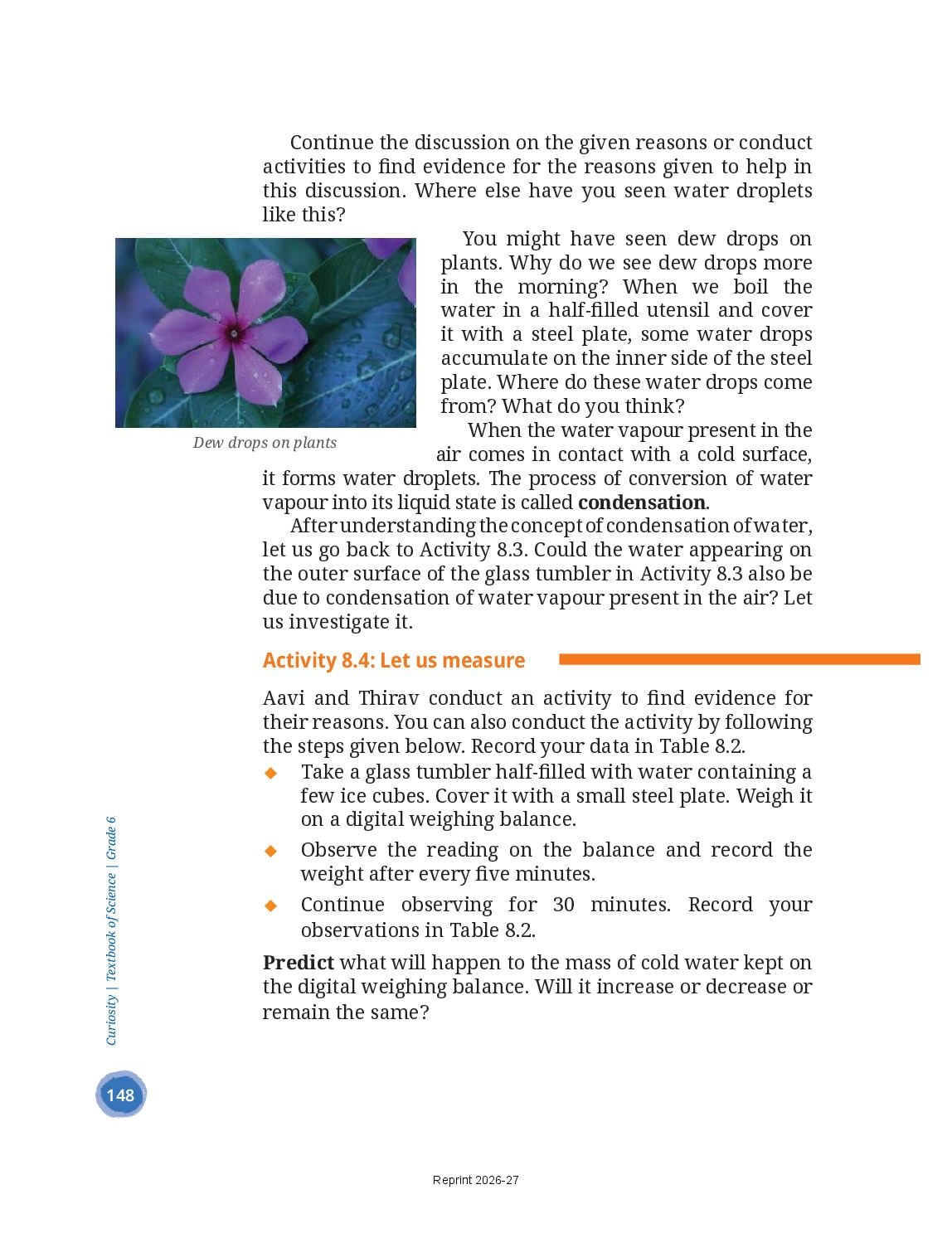
- Condensation is the reverse change — water vapour turning back into liquid water. It happens whenever moist air touches a cold surface: droplets on a glass of cold water, dew on leaves, drops under the lid of a boiling pot.
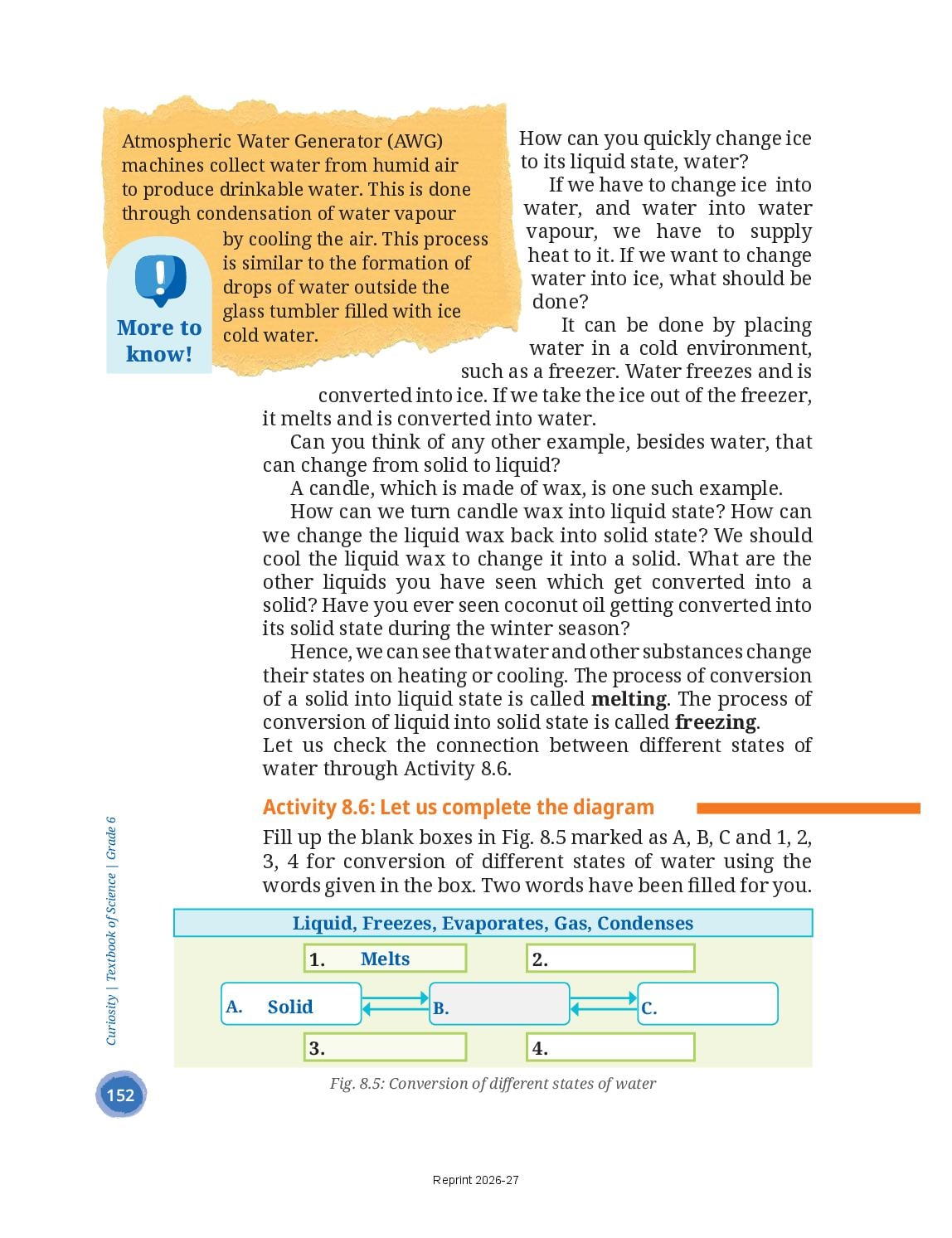
- Heating and cooling change the state. Ice melts at 0 °C, water freezes at 0 °C, water boils at 100 °C. To go solid → liquid → gas we must supply heat; to go gas → liquid → solid we must take heat away.
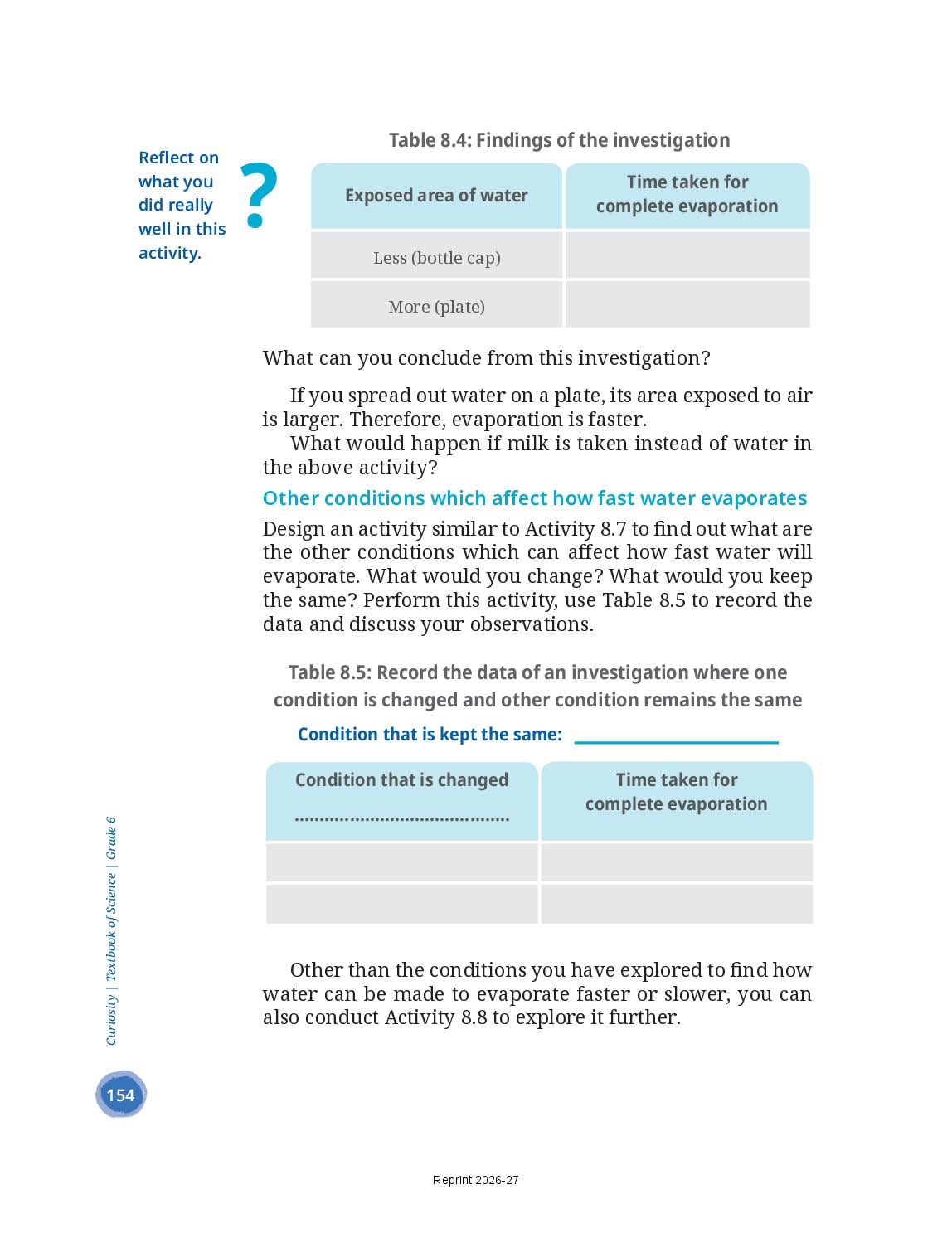
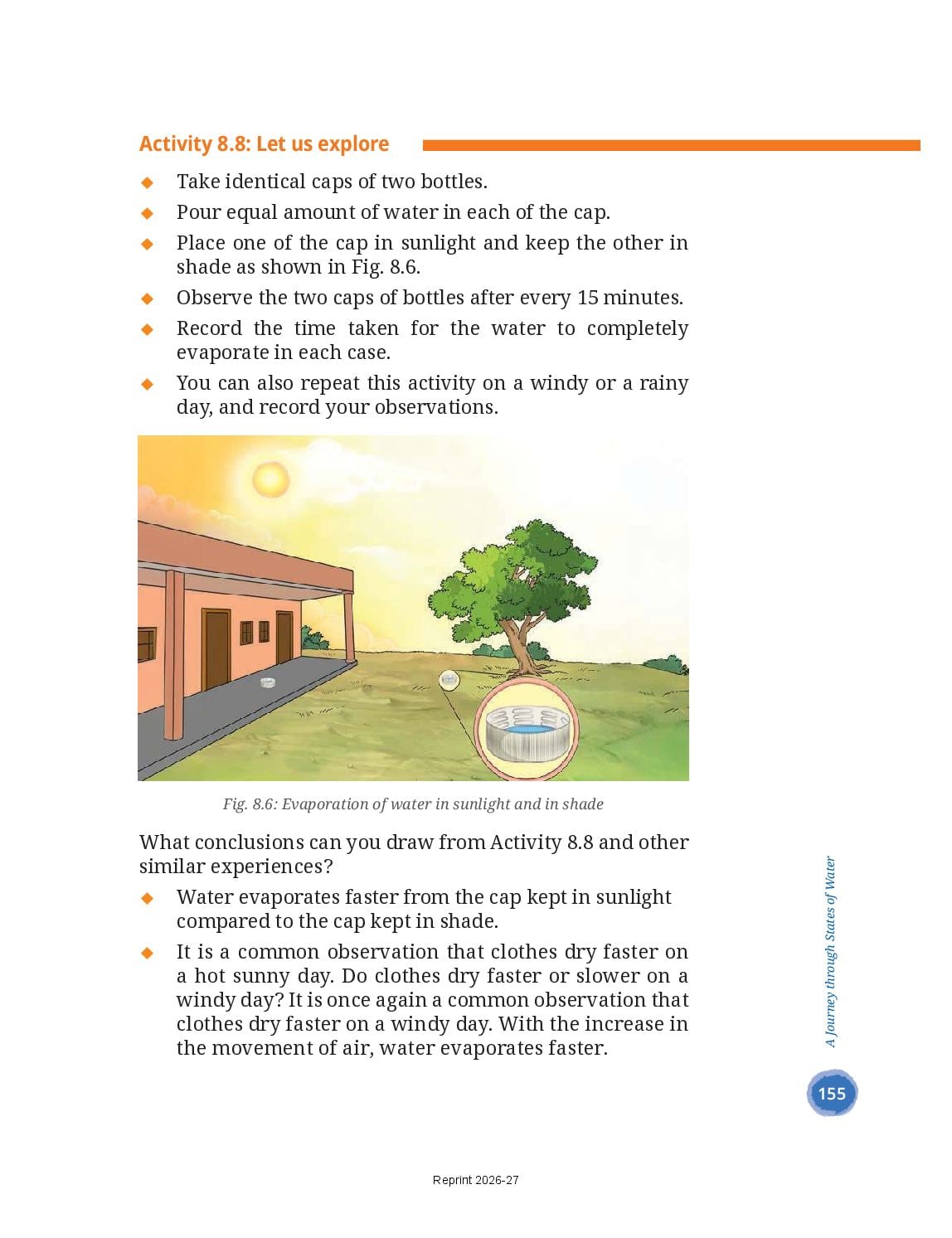
- Evaporation is faster when the exposed area is larger, the day is hotter or sunnier, the air moves faster (wind or fan), and the humidity is lower. On a rainy, humid day clothes dry slowly.
- Evaporating water takes heat from whatever it leaves behind — this is the cooling effect. It cools water in a matka or surahi, cools our body when sweat dries, and cools a room when water is sprinkled on the floor or roof.
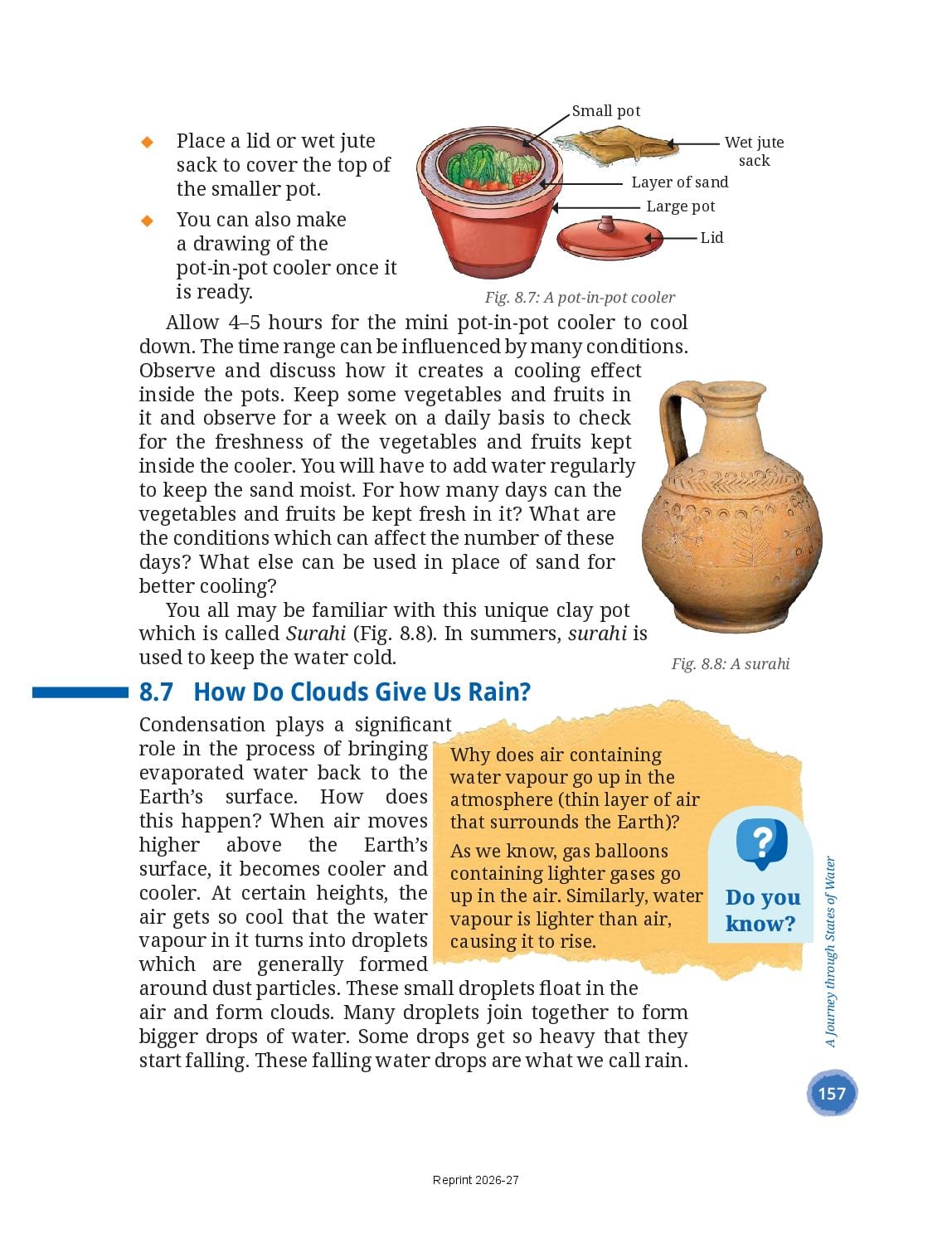
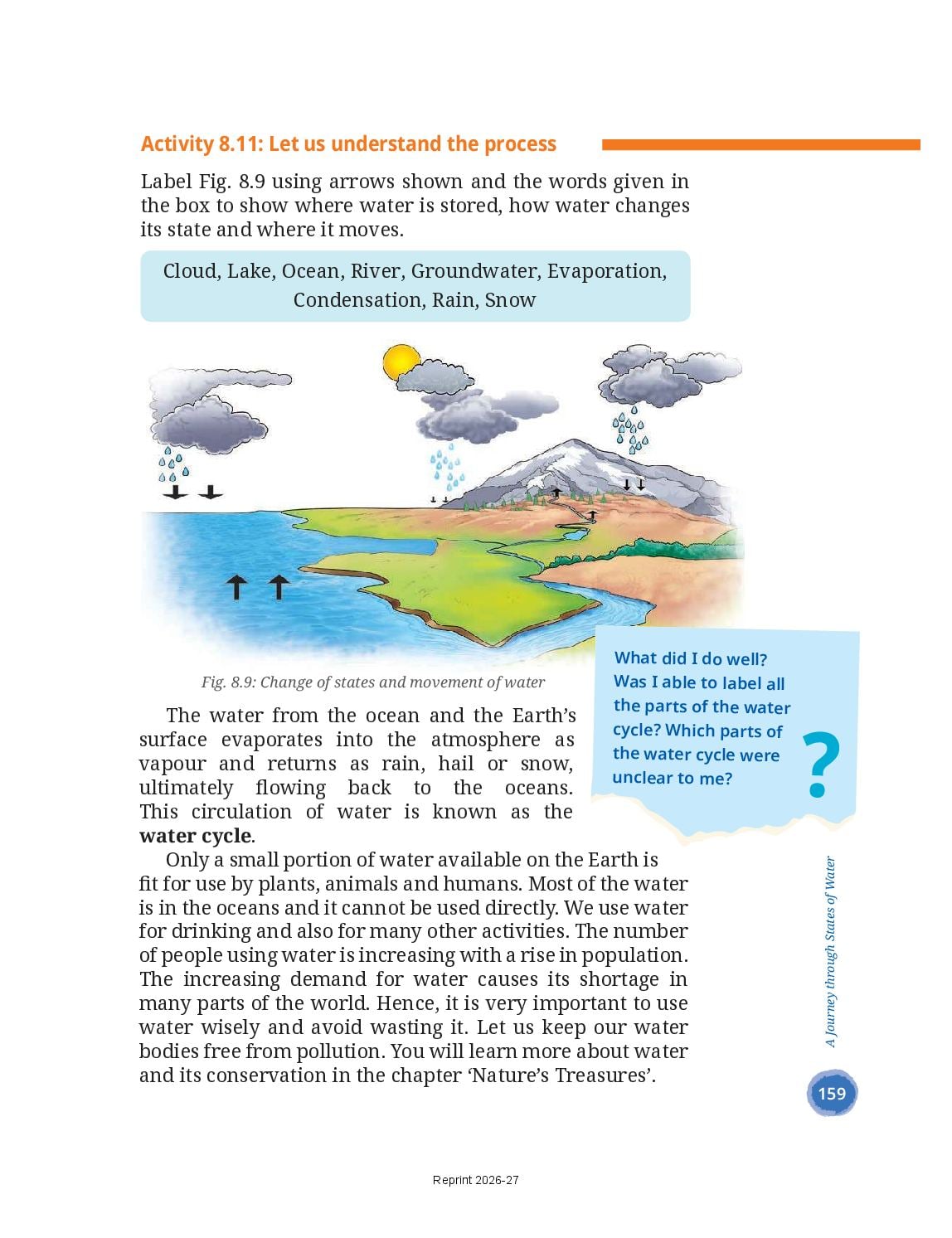
- Water evaporates from oceans and land, rises, condenses around dust particles high up to form clouds, and returns as rain, hail or snow, finally flowing back to the sea. This never-ending circulation is the water cycle.
Quick revision – A Journey through States of Water
| Term | What it means | Key value / everyday example | Where it comes in the chapter |
|---|---|---|---|
| States of water | The three forms of the same substance — solid, liquid and gas | Ice, water, water vapour | Activity 8.1 and Section 8.3, pages 144 and 150 |
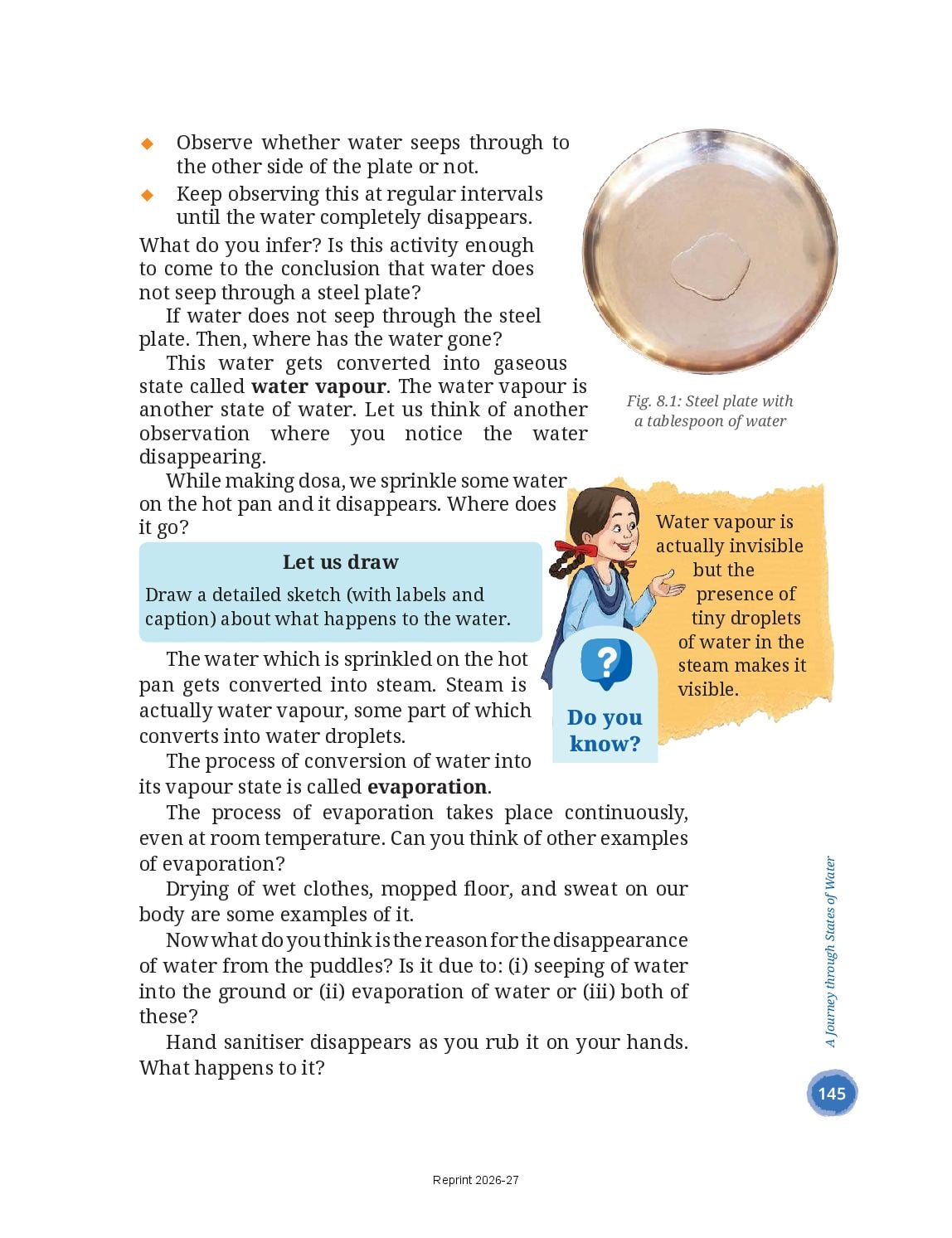
| Water vapour | Water in its gaseous state; invisible, present in the air around us | Air in a room always contains some | Activity 8.2, page 145 |
| Steam | Water vapour in which some of the vapour has already turned into tiny droplets, which is why it is visible | The white cloud above a kettle | Page 145, Do you know? |
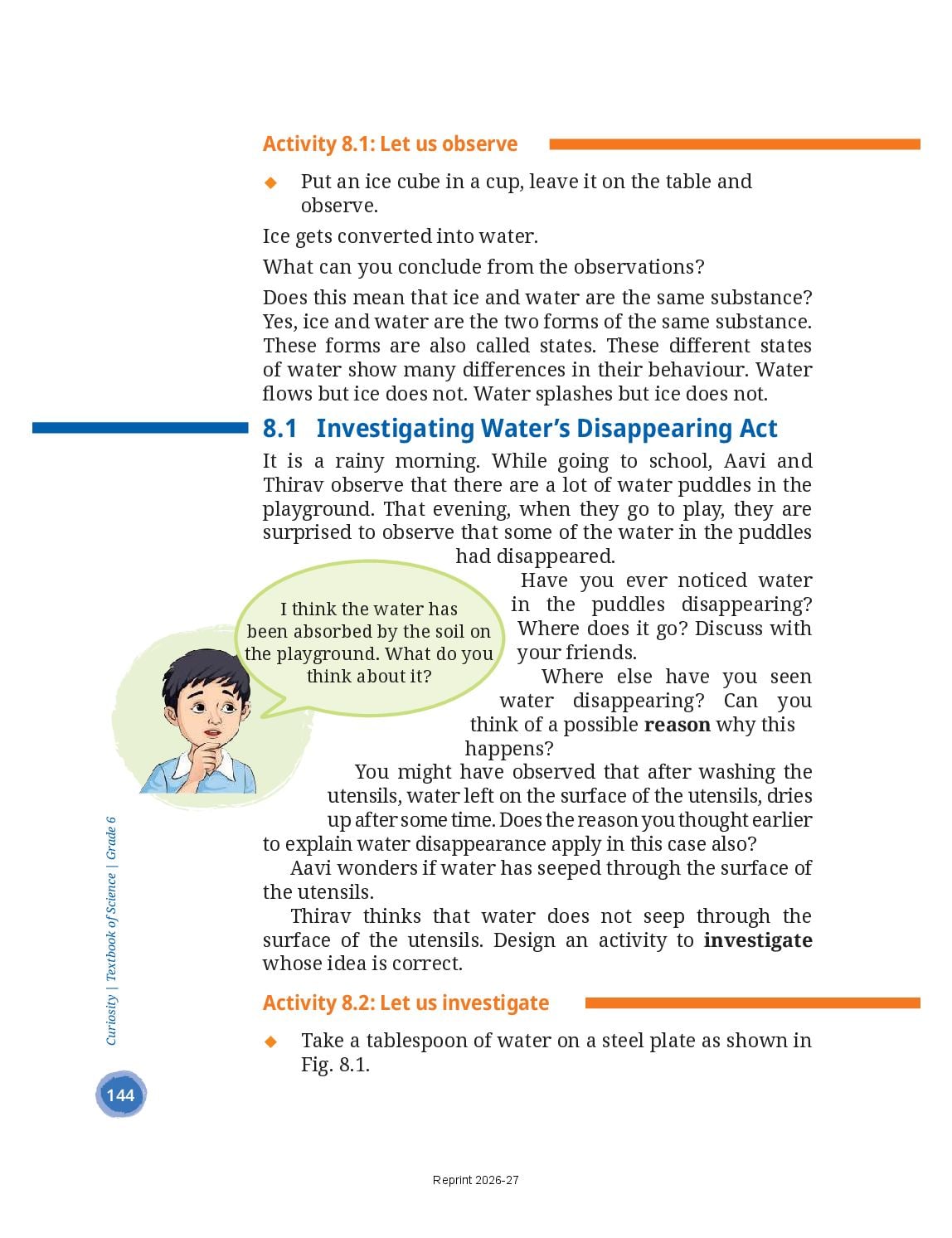
| Evaporation | The conversion of water into its vapour state, from the surface, at any temperature | Wet clothes drying; a mopped floor drying | Section 8.1, page 145 |
| Boiling | Rapid change into vapour from the whole liquid, at one fixed temperature | Water boils at 100 °C at sea level | Page 148 (boiling in a covered utensil) |
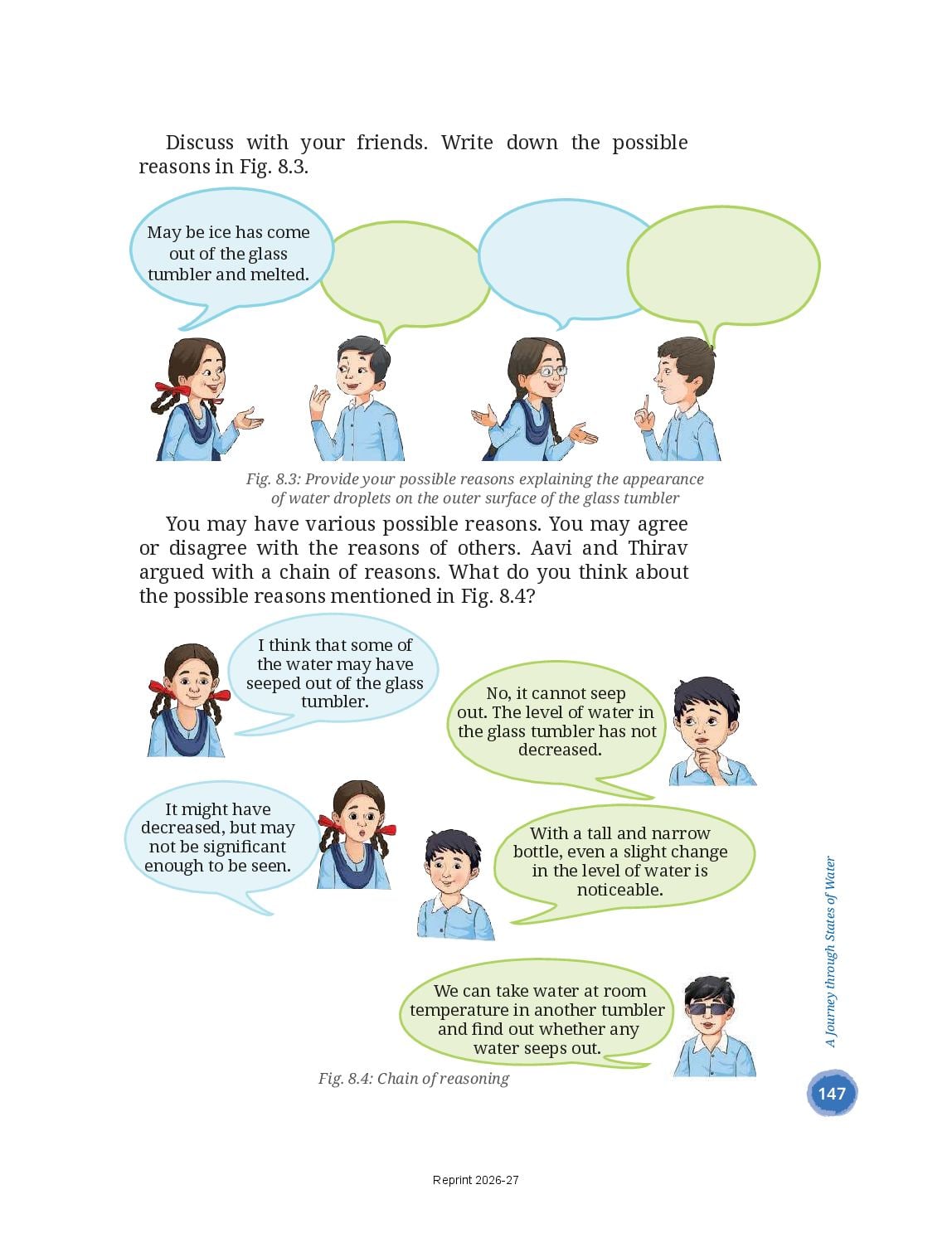
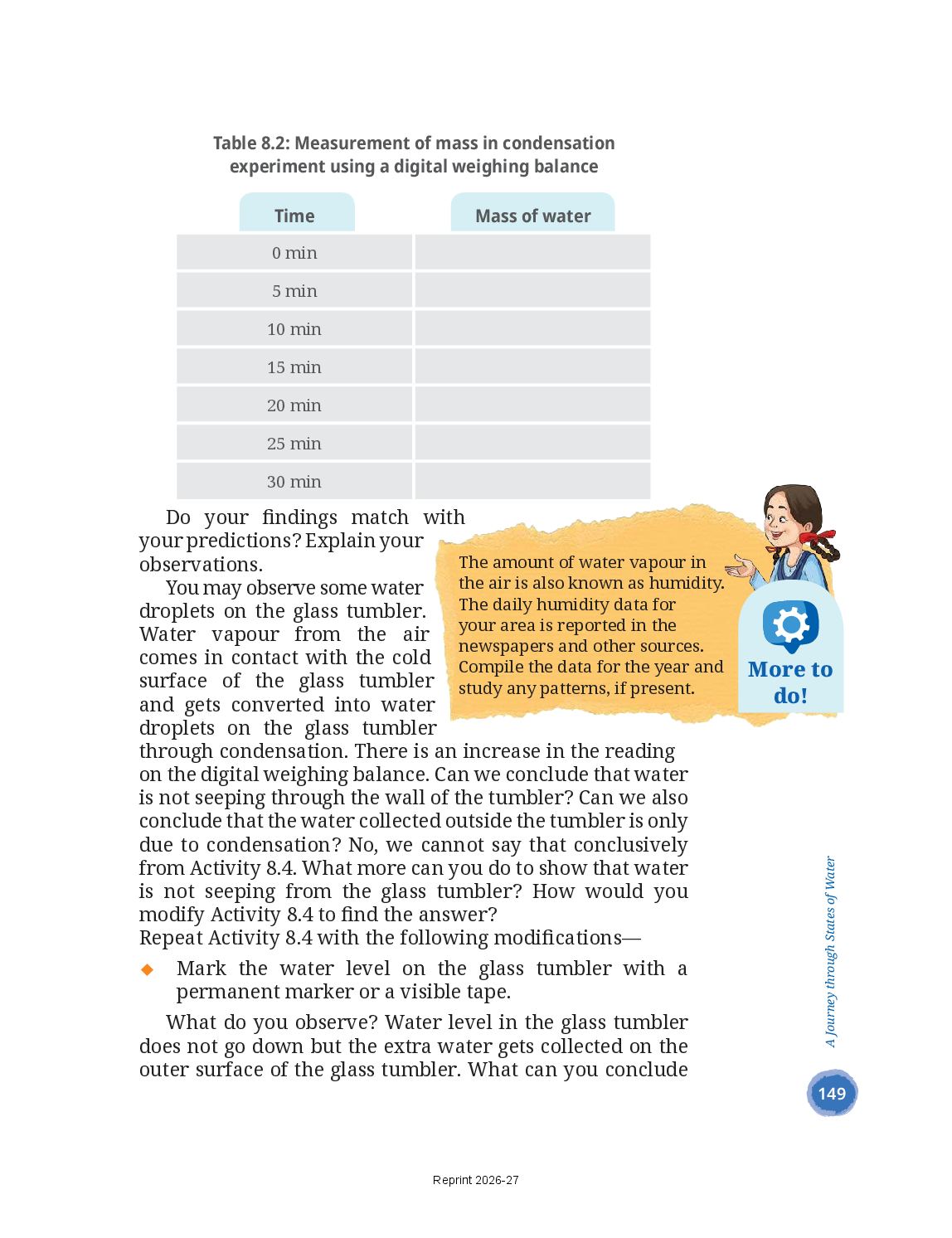
| Condensation | The conversion of water vapour into its liquid state | Droplets on a cold glass tumbler; dew | Section 8.2, page 148 |
| Melting | The conversion of a solid into the liquid state | Ice melts at 0 °C; candle wax melts | Section 8.4, page 152 |
| Freezing | The conversion of a liquid into the solid state | Water freezes at 0 °C in a freezer | Section 8.4, page 152 |
| Humidity | The amount of water vapour present in the air | High on a rainy day, low on a dry summer day | Pages 149 and 156 |
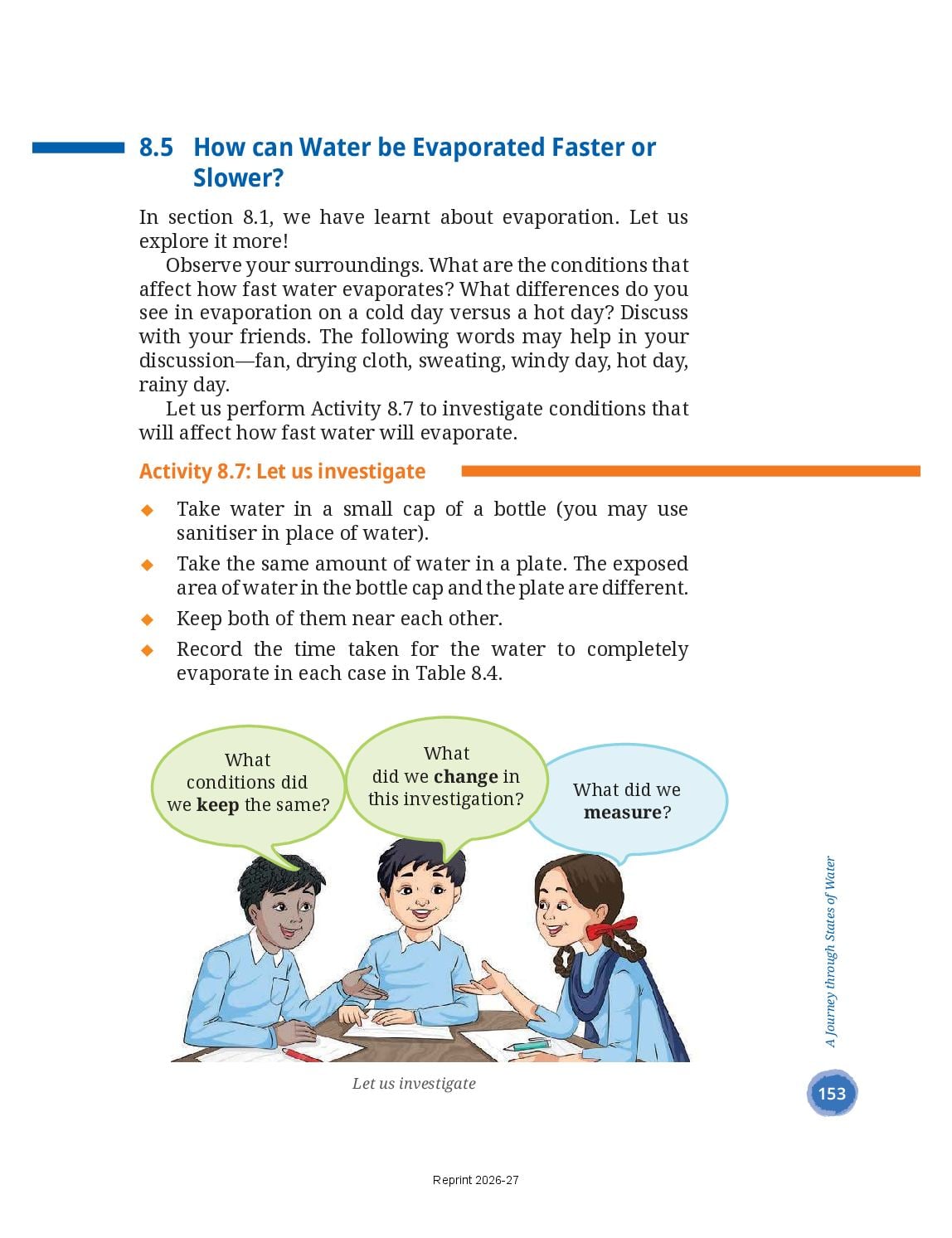
| Exposed area | The area of water in contact with air — larger area, faster evaporation | Water in a plate dries before water in a bottle cap | Activity 8.7, pages 153–154 |
| Cooling effect | The fall in temperature caused when water evaporates and takes heat away | Matka, surahi, sweat, sanitiser on the palm | Section 8.6, page 156 |
| Water cycle | The circulation of water between the Earth’s surface and the atmosphere | Ocean → vapour → cloud → rain → river → ocean | Activity 8.11, page 159 |
Old NCERT vs New – Class 6 Science
This chapter is from Curiosity, the new NCERT Class 6 Science book (NCF-SE 2023, used from 2024-25). It replaced the old book “Science”, so chapter numbers and names differ from older PDFs.
Solutions and All Chapters
Answers to the exercises and the full chapter list of Curiosity:
A Journey through States of Water – Overview
| Class | Class 6 |
| Subject | Science |
| Book | Curiosity – new NCERT book |
| Chapter | 8 of 12 – A Journey through States of Water |
| Book pages | 143 – 162 |
| Edition | NCERT Reprint 2026-27 |
| Session | 2026-27 |
| Free – read online or download |
Class 6 Science Chapter 8 – FAQs
Where can I download A Journey through States of Water Class 6 PDF?
From the download table on this page – the chapter PDF is free, and the full book is linked too.
What is Class 6 Science Chapter 8 about?
Ice, water and water vapour are the same substance in three different states — solid, liquid and gas. Ice keeps its own shape and does not flow; water takes the shape of its vessel and flows; water vapour has no shape at all and spreads through the whole space available.
Is A Journey through States of Water from the new NCERT Class 6 Science book?
Yes. It is chapter 8 of curiosity, the new NCERT Class 6 Science book for 2026-27.
Is this the latest NCERT edition for 2026-27?
Yes – the PDF is NCERT’s latest edition for the 2026-27 session.
Where are the NCERT Solutions for Class 6 Science Chapter 8?
Open the NCERT Solutions link above for answers to the exercise questions.