NCERT Solutions for Class 6 Science Chapter 8 a Journey Through States of Water provide clear, step-by-step answers to every exercise and in-text question from the chapter a Journey Through States of Water of the NCERT textbook Curiosity. Prepared by subject experts as per the latest NCERT (CBSE) syllabus for 2026-27, these NCERT Solutions for Class 6 Science help you understand each concept, write exam-ready answers, and check your own solutions. You can read them online below or download the free Class 6 Science Chapter 8 question-answer PDF.
NCERT Solutions for Class 6 Science Chapter 8 a Journey Through States of Water
- Class: Class 6
- Subject: Science
- Chapter: Chapter 8 – a Journey Through States of Water
- Textbook: Curiosity (NCERT)
- Study material: NCERT Solutions – questions with answers, free PDF
These solutions answer all the exercise questions of Chapter 8 a Journey Through States of Water — including the in-text questions, short-answer and long-answer questions, and activities — with complete explanations so you can follow the method, not just the final answer. Read the full solutions below.
NCERT Solutions Class 6 Science Chapter 8 a Journey Through States of Water View Download
NCERT Solutions for Class 6 Science Chapter 8 PDF Download
You can read the NCERT Solutions for Class 6 Science Chapter 8 online above, or download the complete question-answer PDF to study a Journey Through States of Water offline at any time.
NCERT Solutions for Class 6 Science Chapter 8 PDF Download Link – Click Here to Download Solutions PDF
Questions Covered in This Chapter
These NCERT Solutions answer all 71 questions of this chapter. The questions solved are:
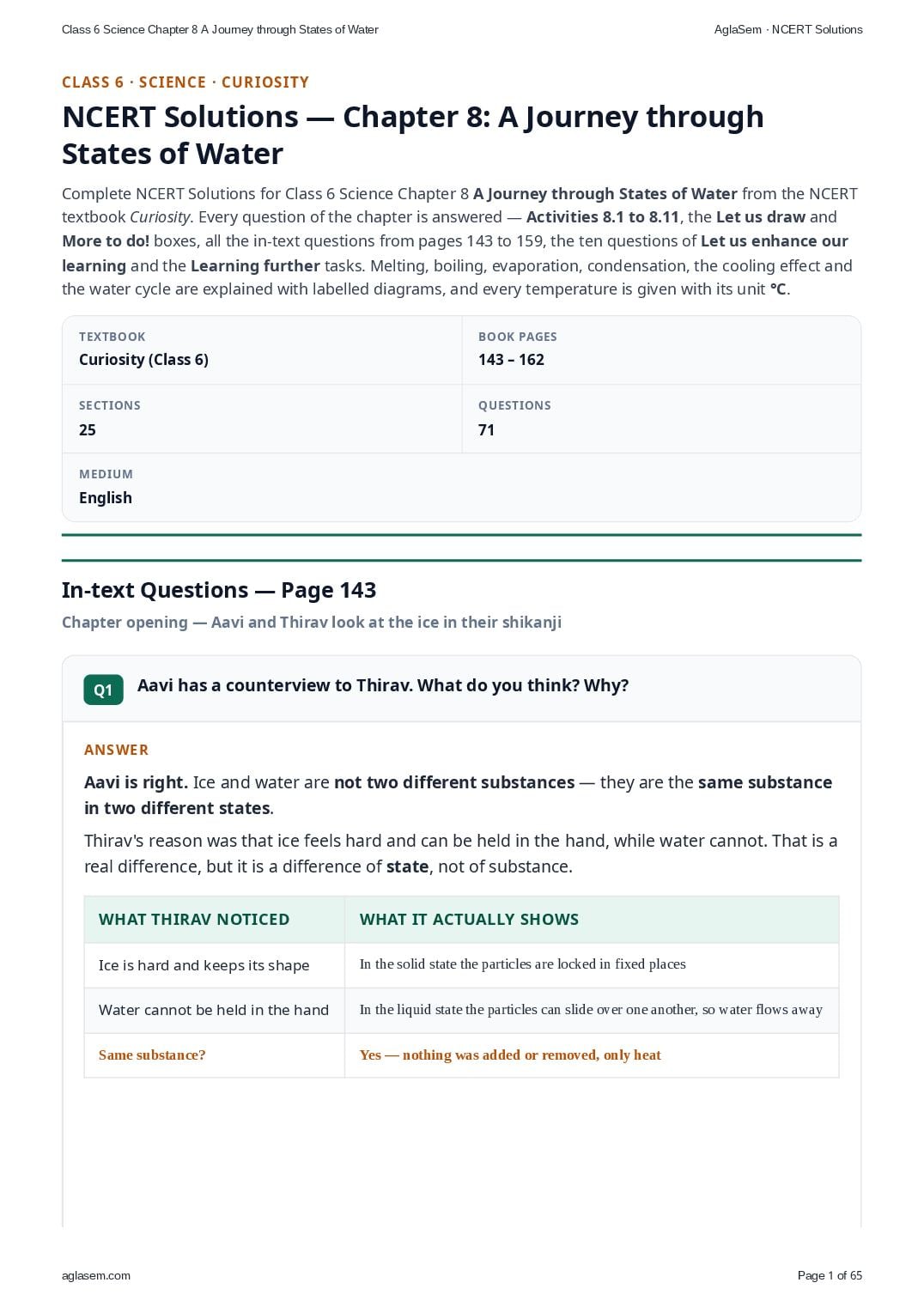
- Aavi has a counterview to Thirav. What do you think? Why?
- Do you think Thirav is right? How can you find out?
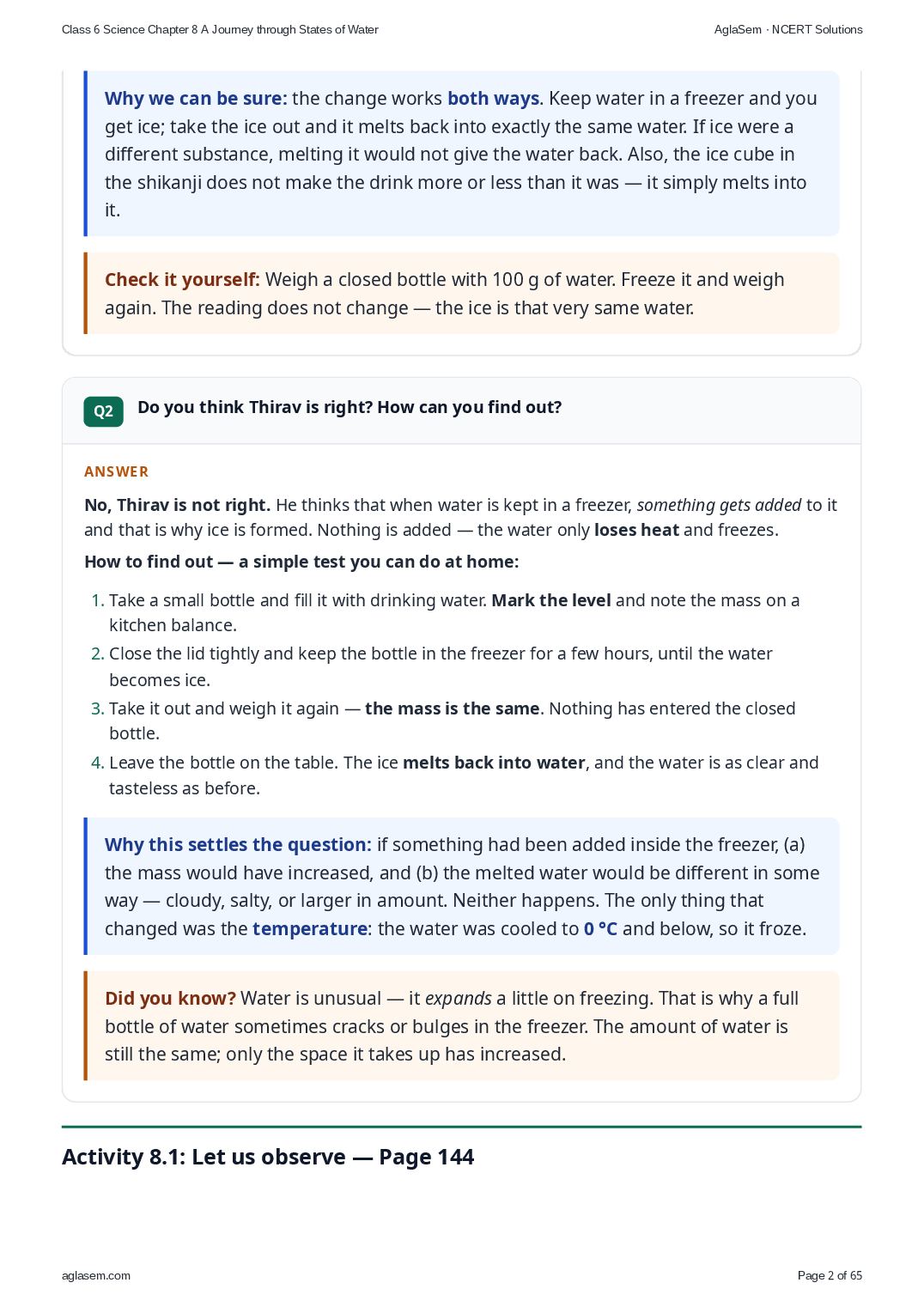
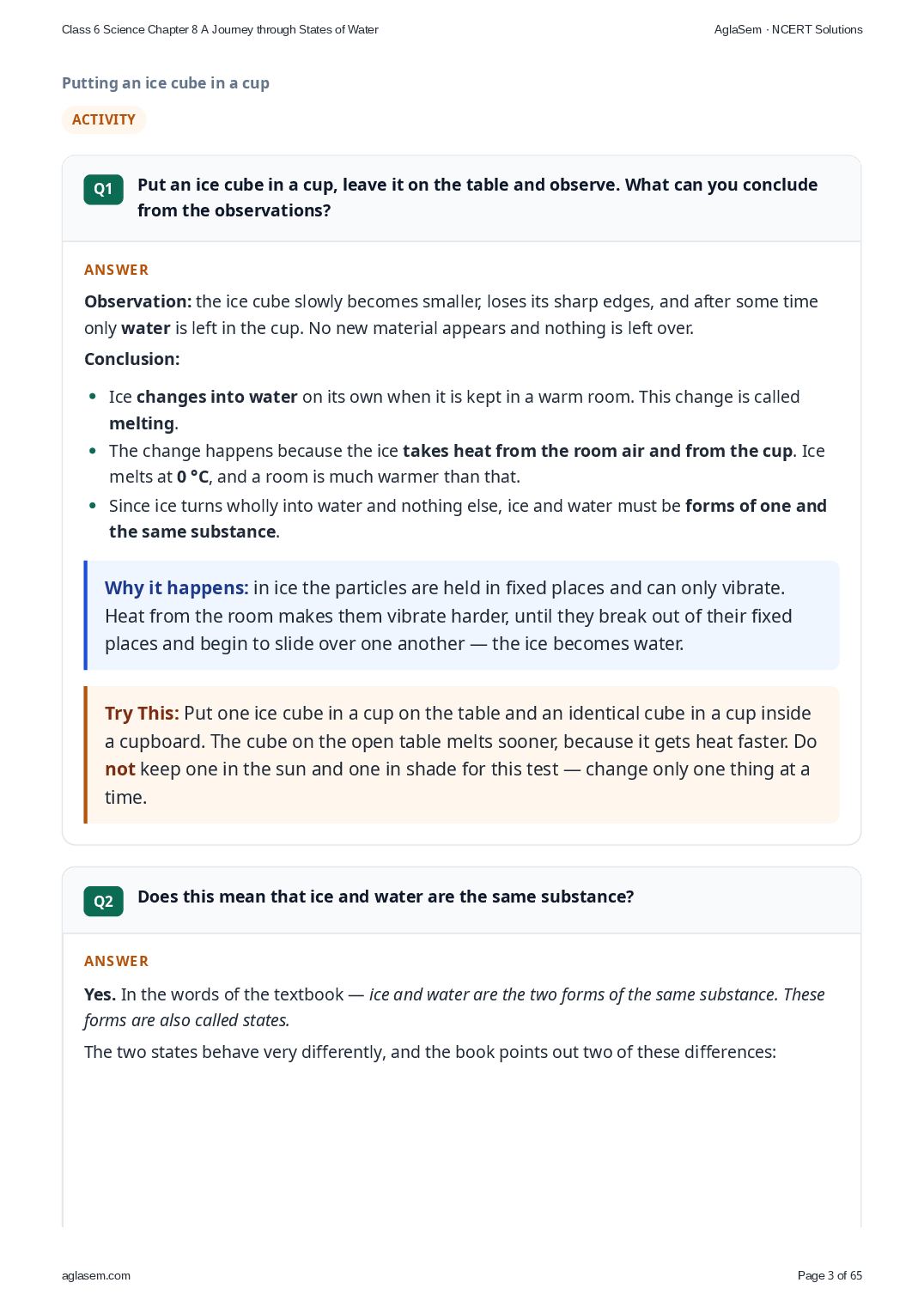
- Put an ice cube in a cup, leave it on the table and observe. What can you conclude from the observations?
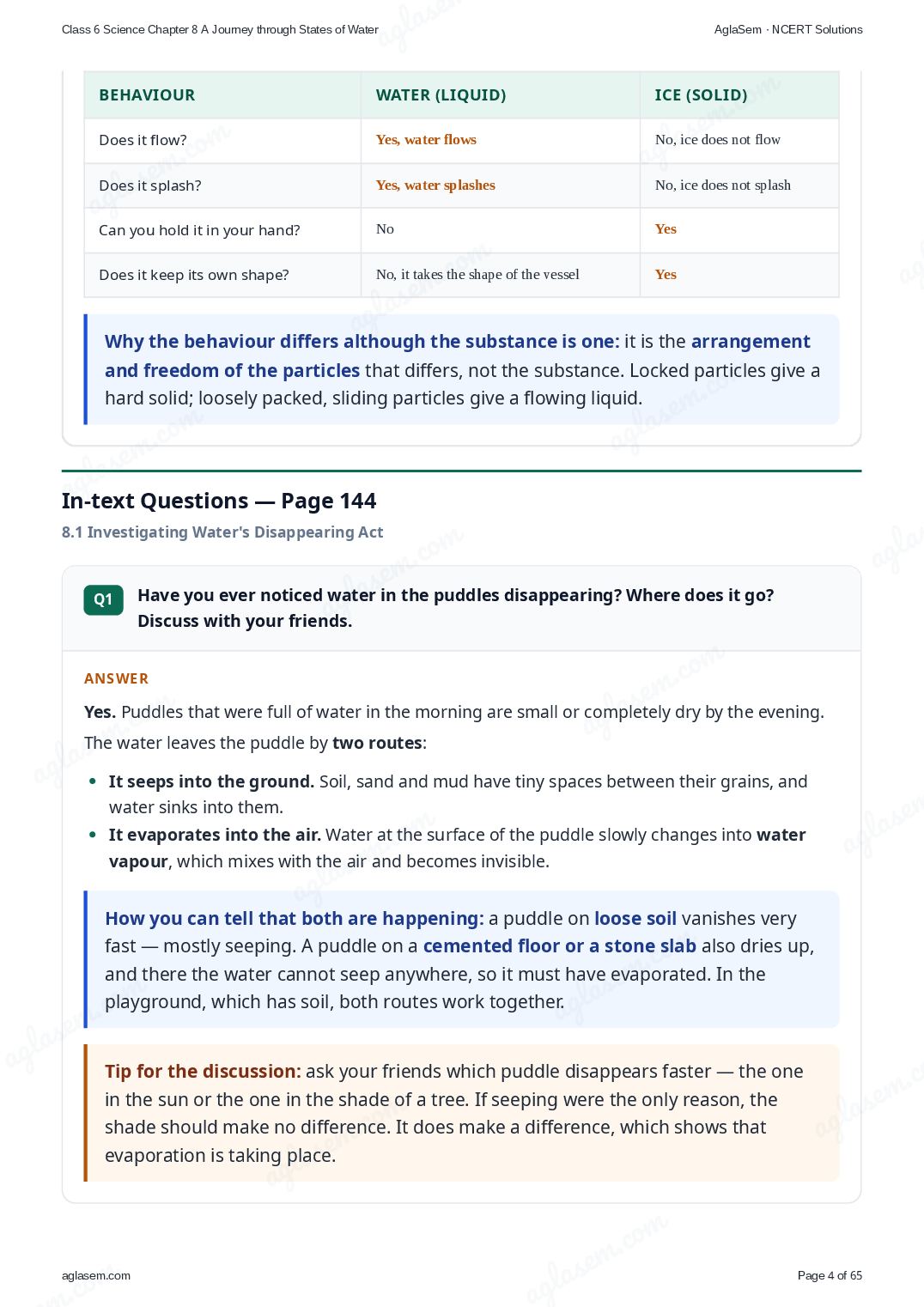
- Does this mean that ice and water are the same substance?
- Have you ever noticed water in the puddles disappearing? Where does it go? Discuss with your friends.
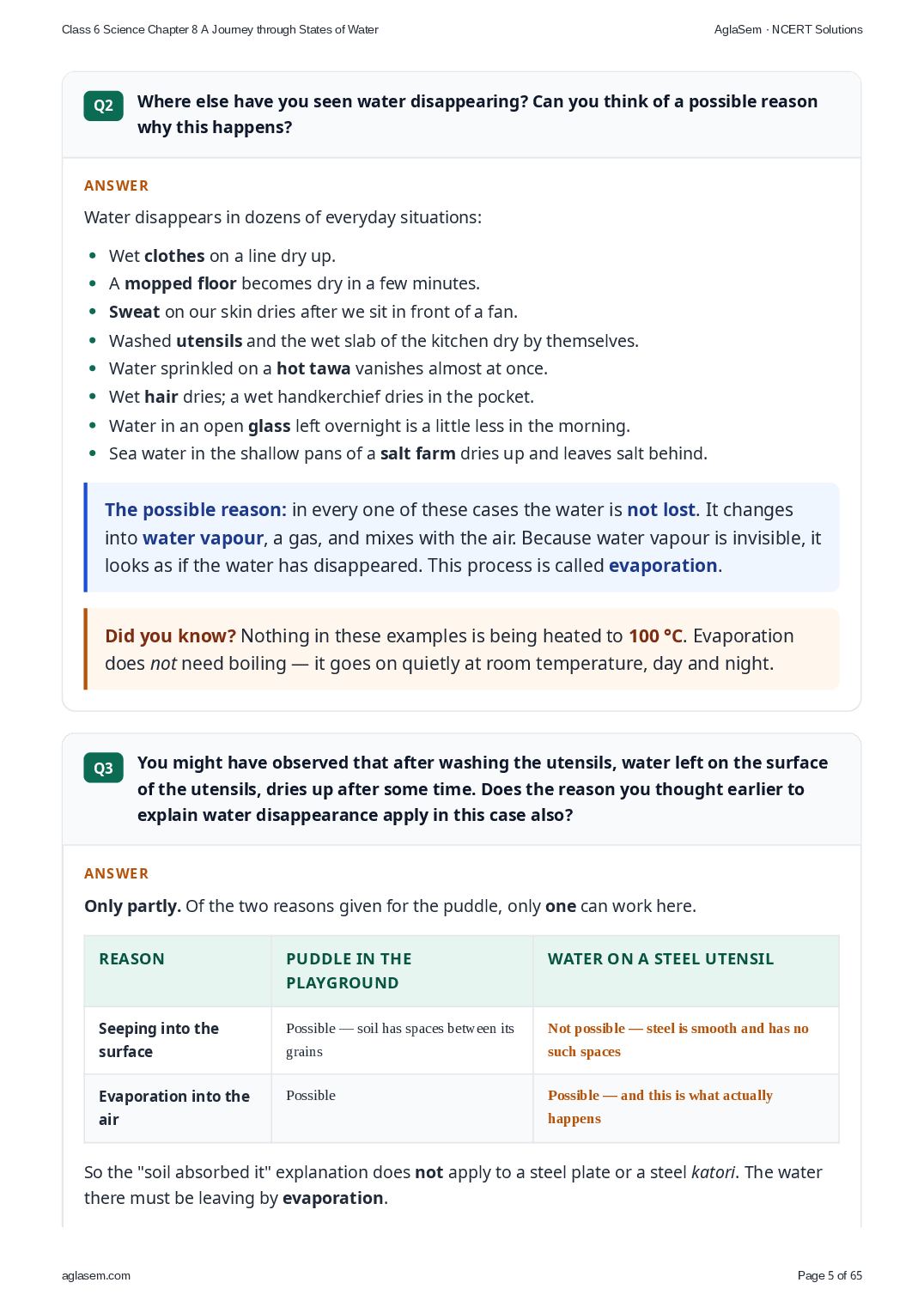
- Where else have you seen water disappearing? Can you think of a possible reason why this happens?
- You might have observed that after washing the utensils, water left on the surface of the utensils, dries up after some time. Does the reason you thought earlier to explain water disappearance apply in this case also?
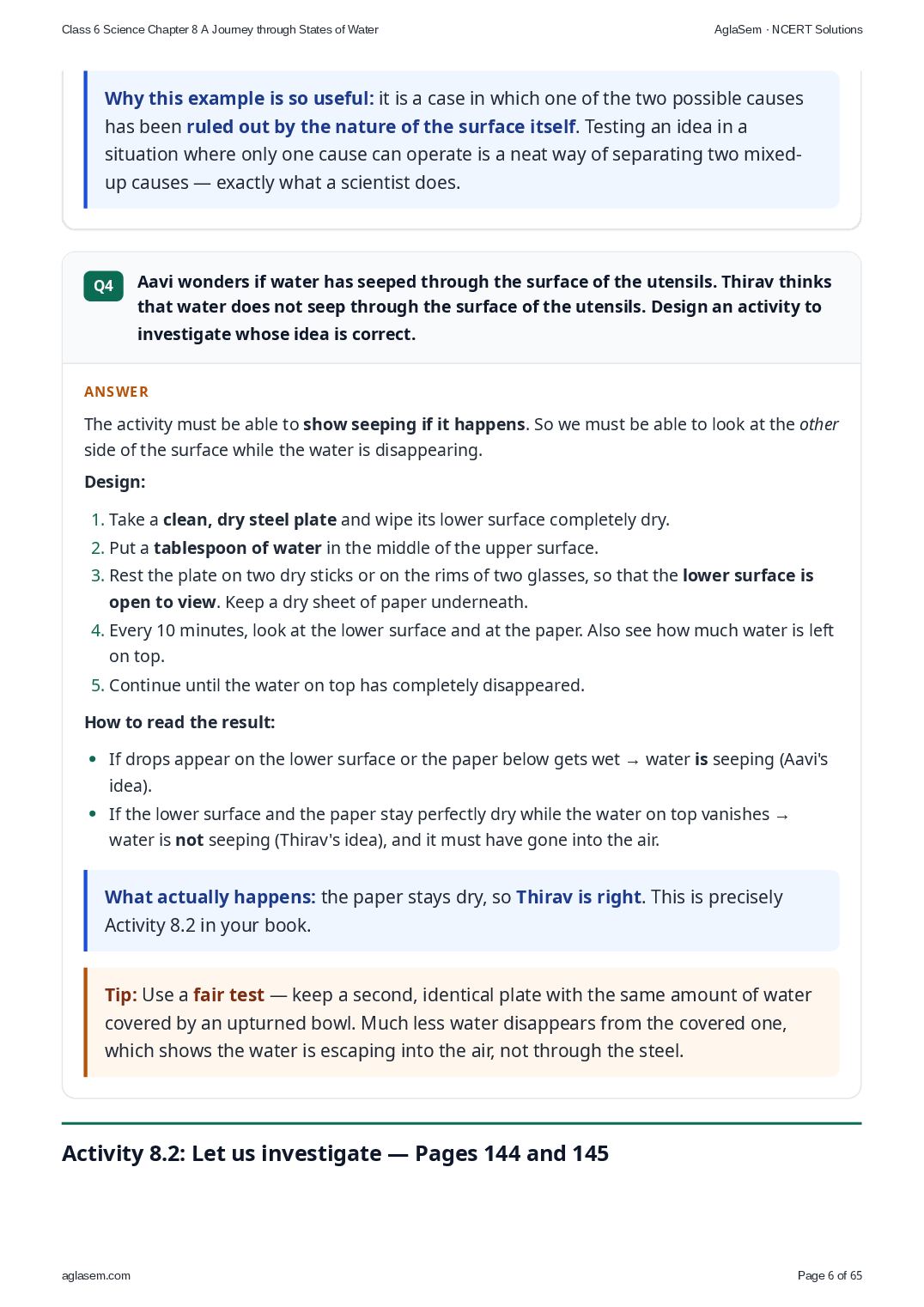
- Aavi wonders if water has seeped through the surface of the utensils. Thirav thinks that water does not seep through the surface of the utensils. Design an activity to investigate whose idea is correct.
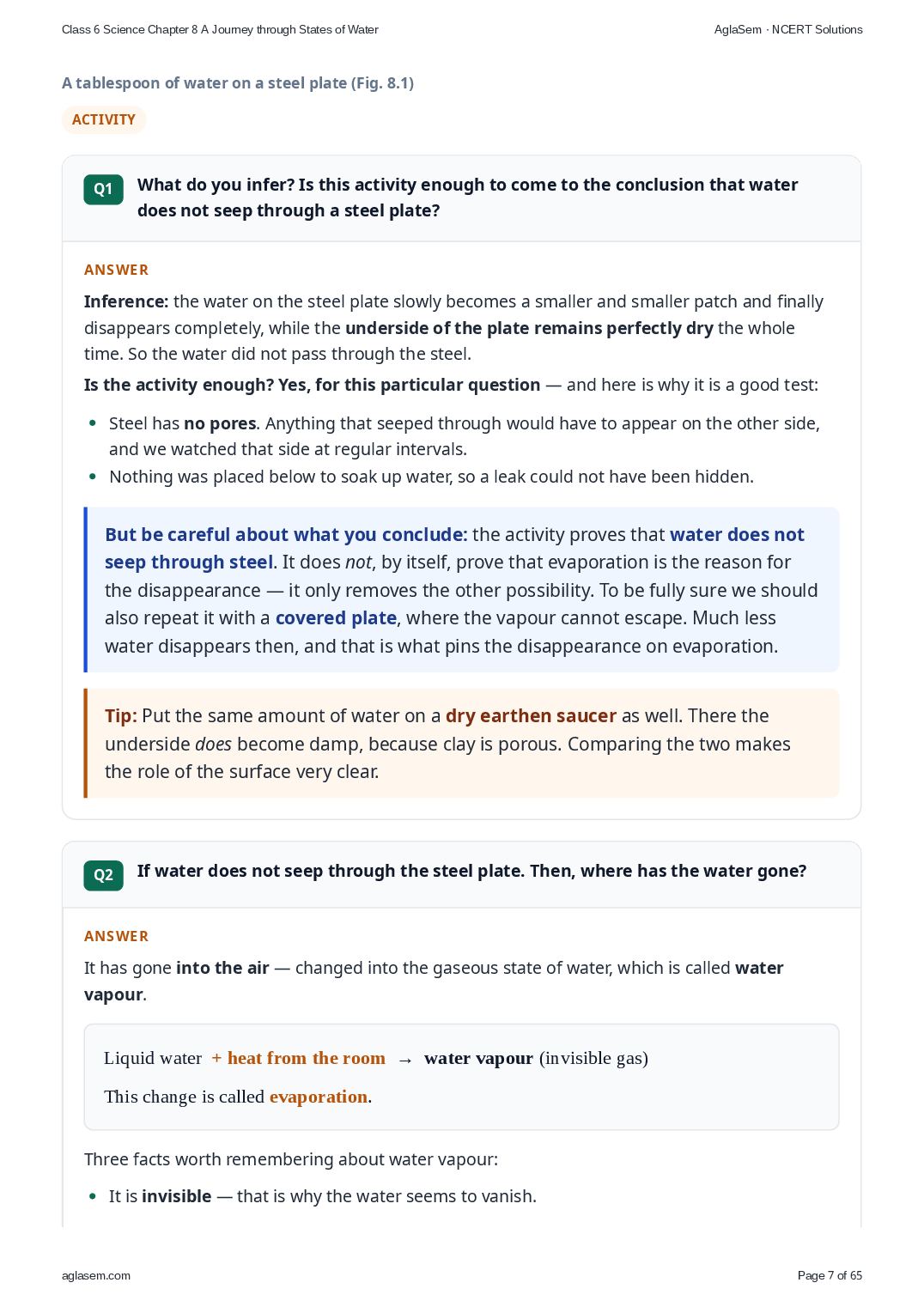
- What do you infer? Is this activity enough to come to the conclusion that water does not seep through a steel plate?
- If water does not seep through the steel plate. Then, where has the water gone?
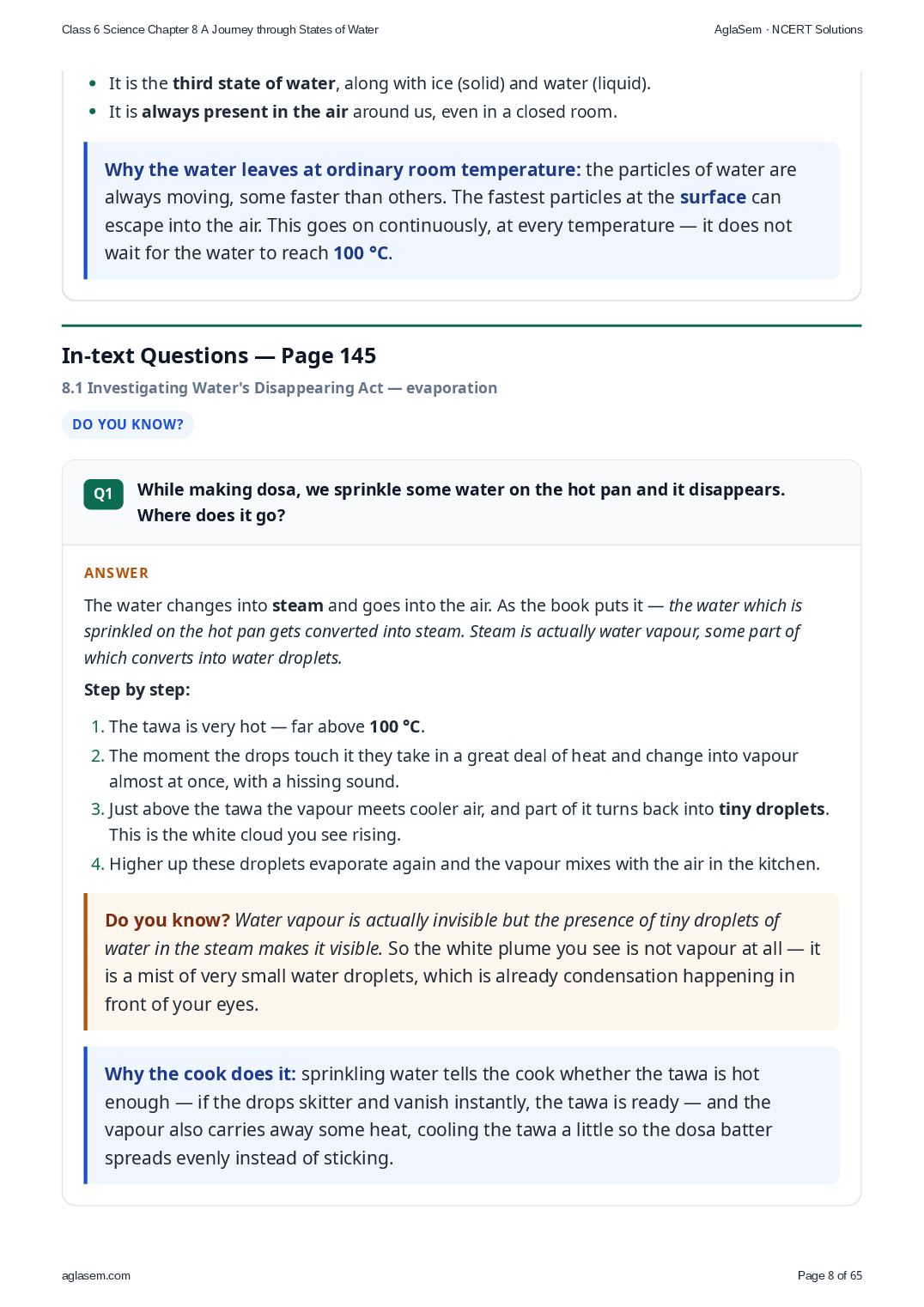
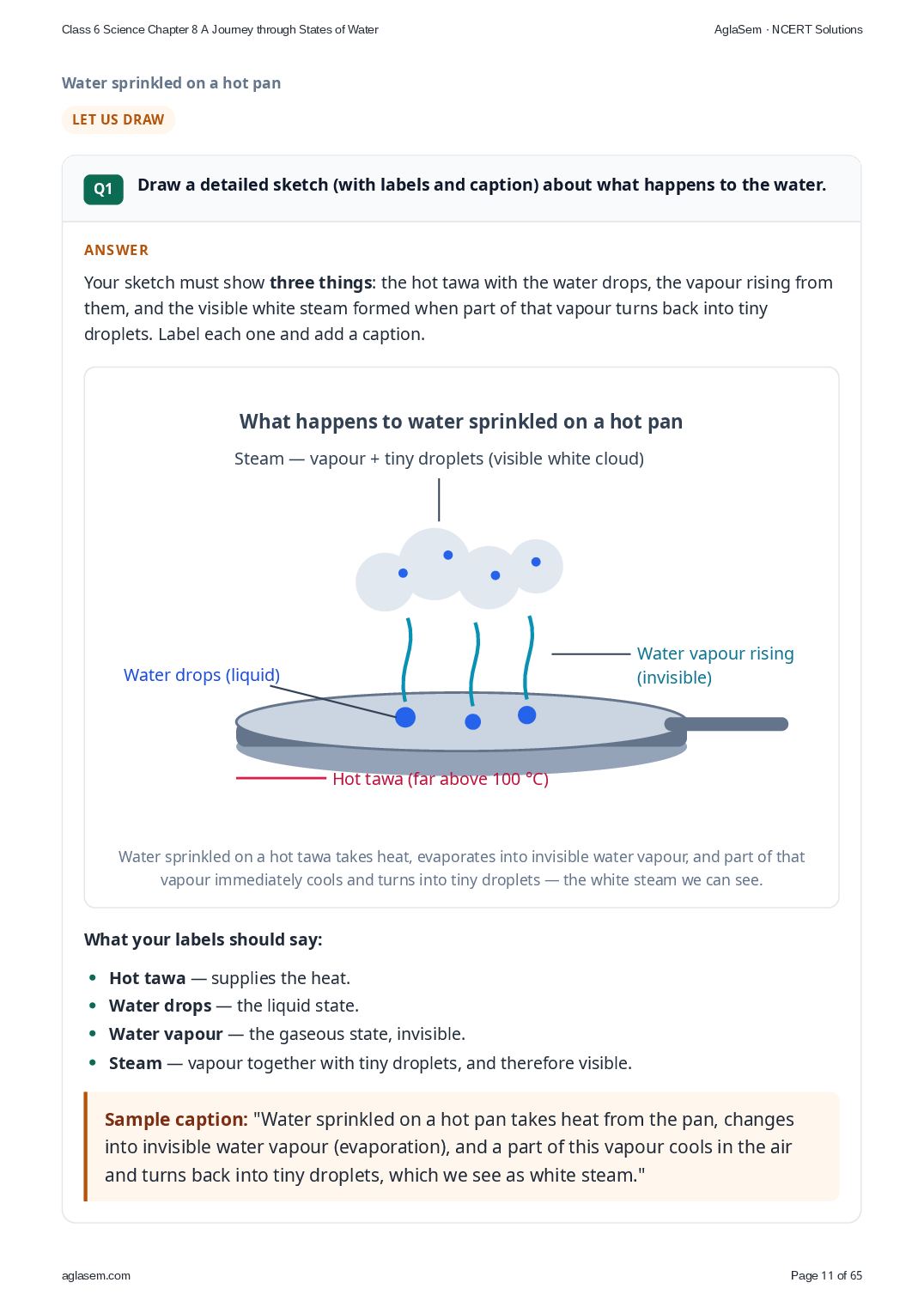
- While making dosa, we sprinkle some water on the hot pan and it disappears. Where does it go?
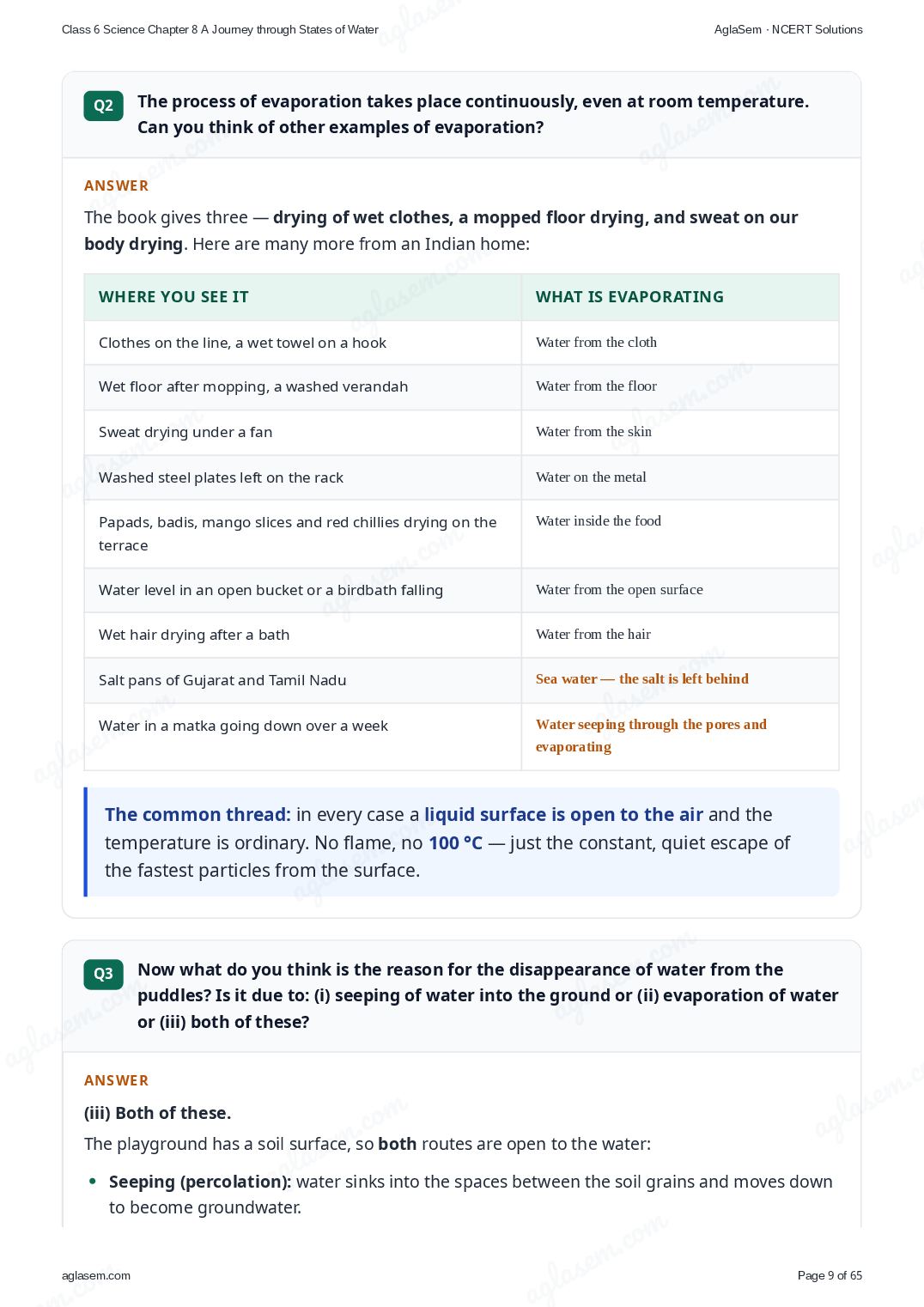
- The process of evaporation takes place continuously, even at room temperature. Can you think of other examples of evaporation?
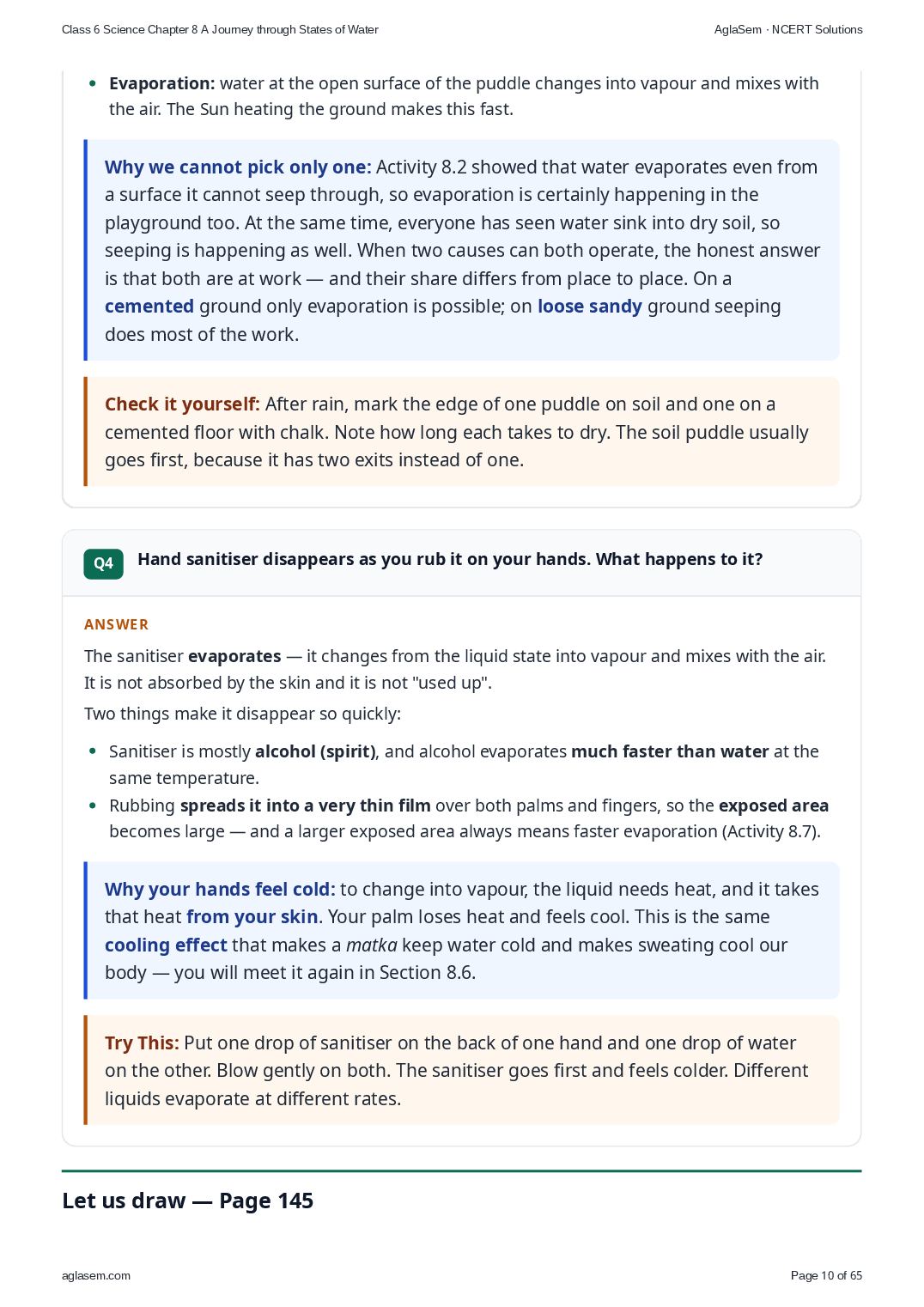
- Now what do you think is the reason for the disappearance of water from the puddles? Is it due to: (i) seeping of water into the ground or (ii) evaporation of water or (iii) both of these?
- Hand sanitiser disappears as you rub it on your hands. What happens to it?
- Draw a detailed sketch (with labels and caption) about what happens to the water.
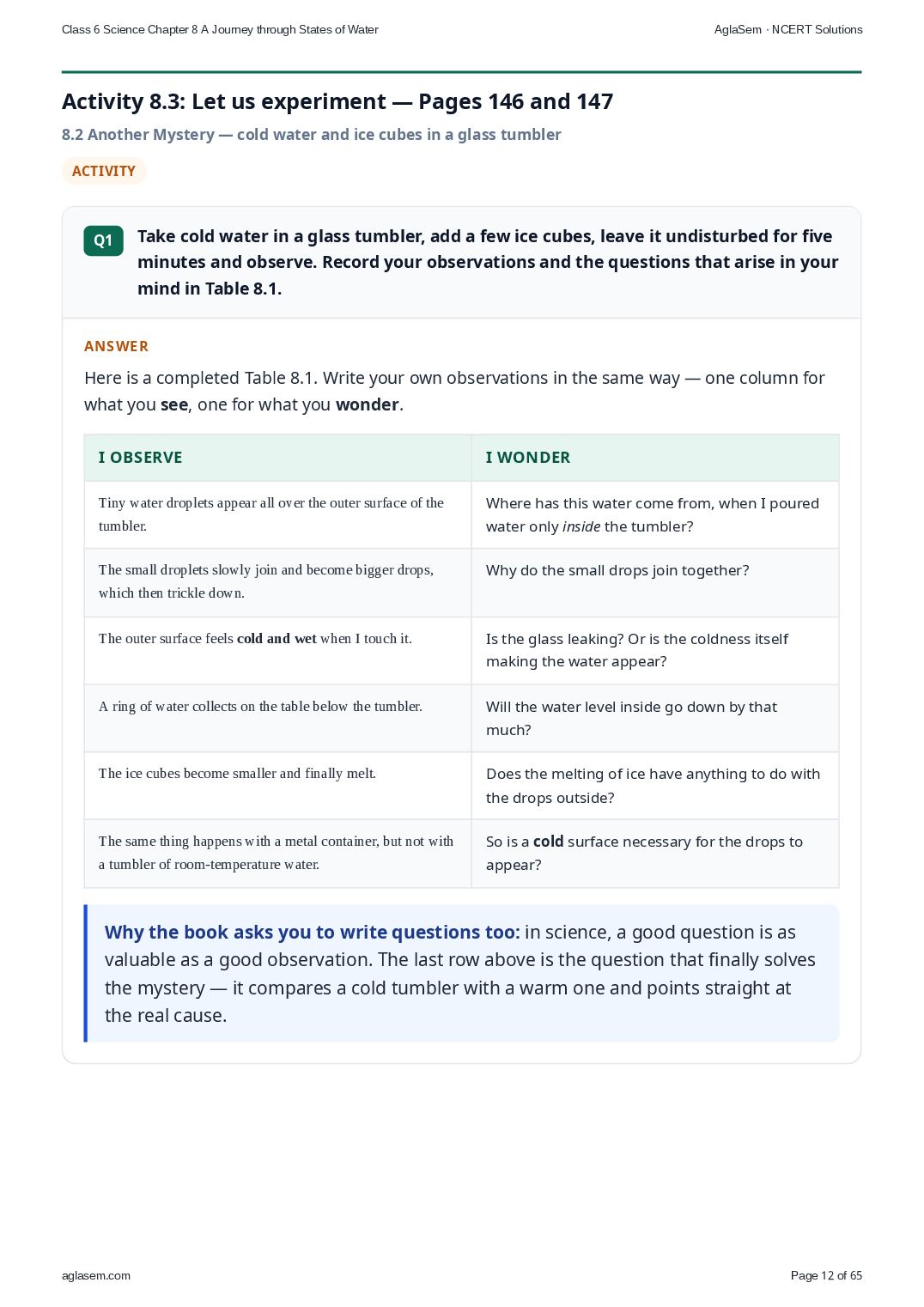
- Take cold water in a glass tumbler, add a few ice cubes, leave it undisturbed for five minutes and observe. Record your observations and the questions that arise in your mind in Table 8.1.
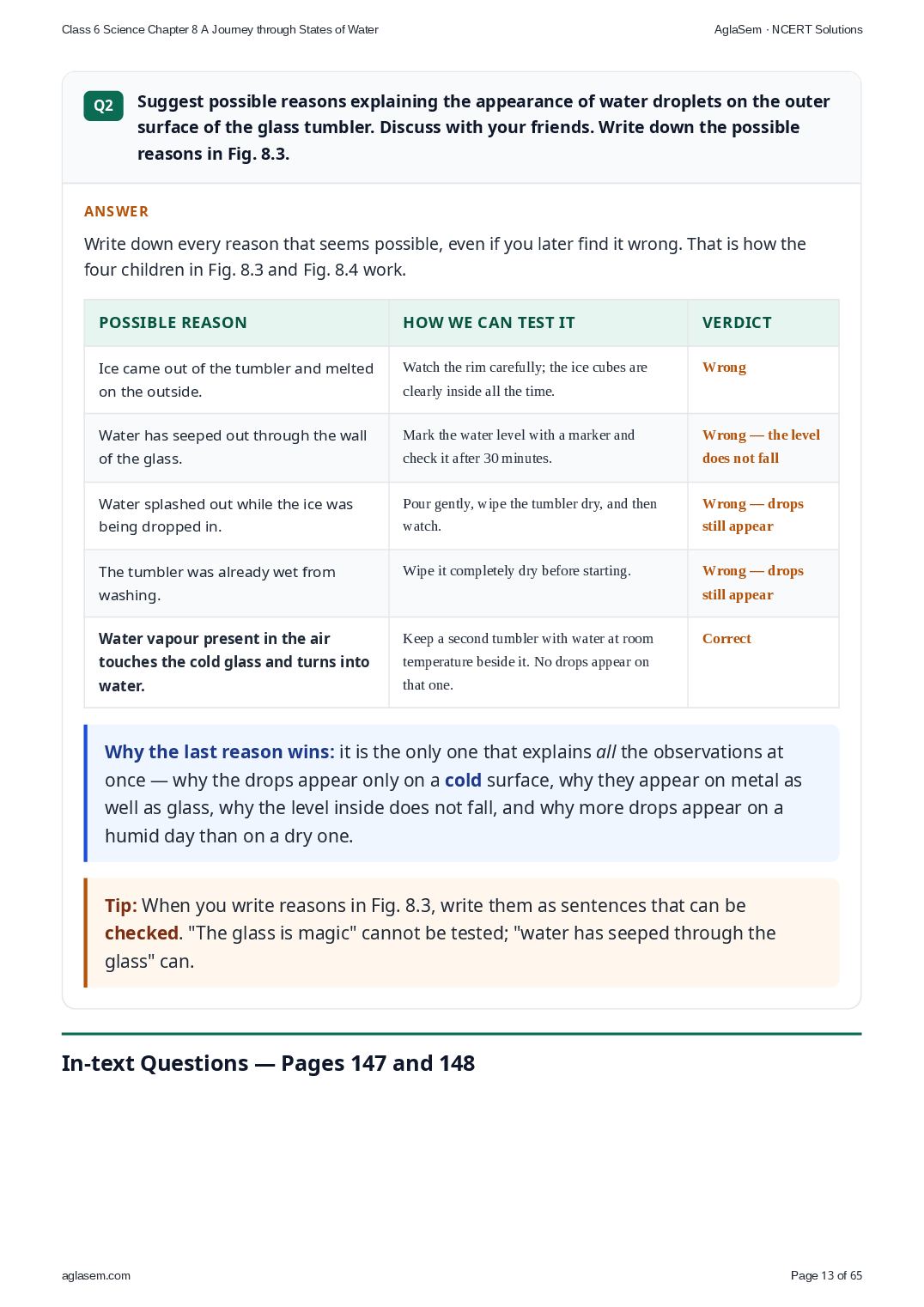
- Suggest possible reasons explaining the appearance of water droplets on the outer surface of the glass tumbler. Discuss with your friends. Write down the possible reasons in Fig. 8.3.
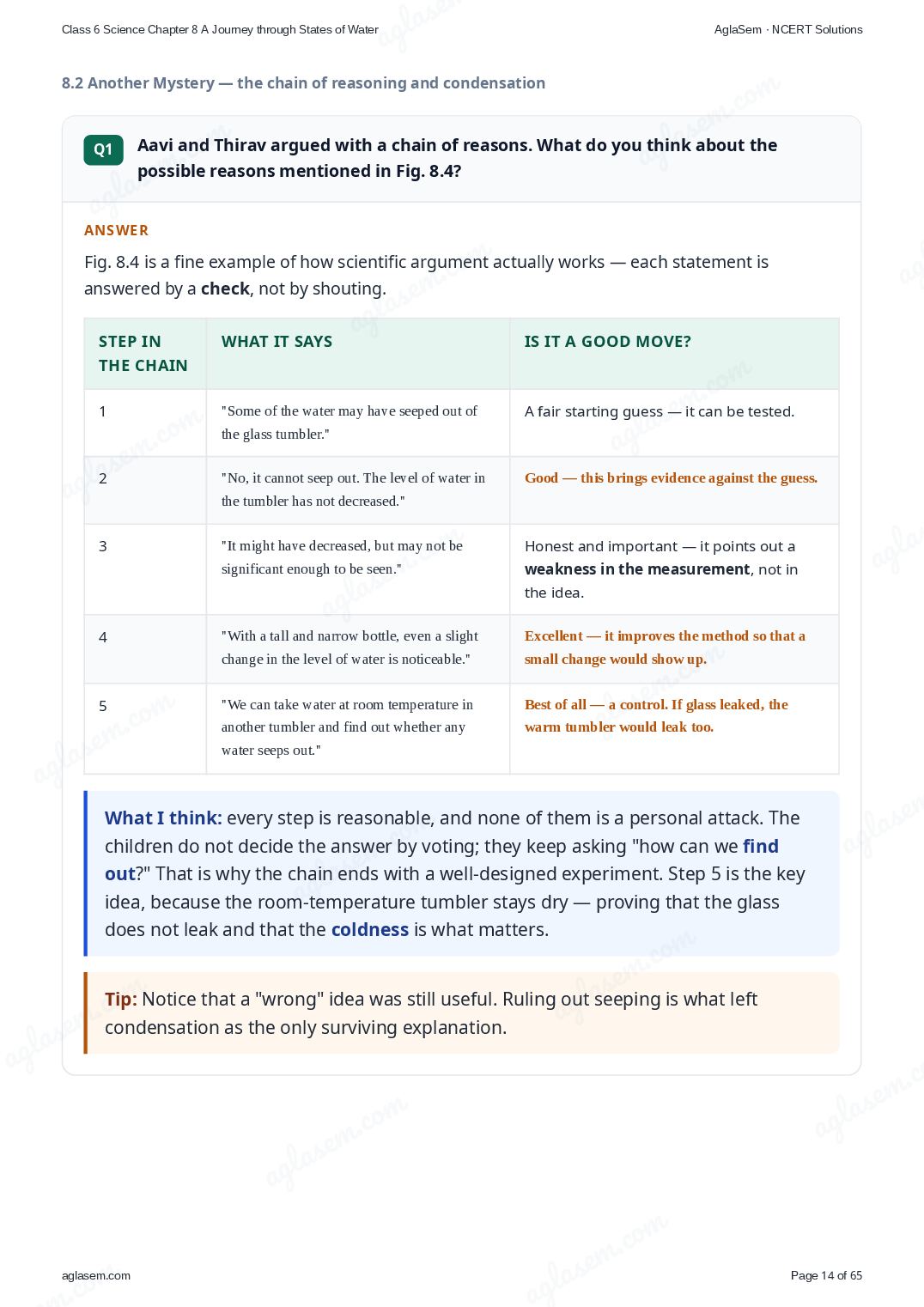
- Aavi and Thirav argued with a chain of reasons. What do you think about the possible reasons mentioned in Fig. 8.4?
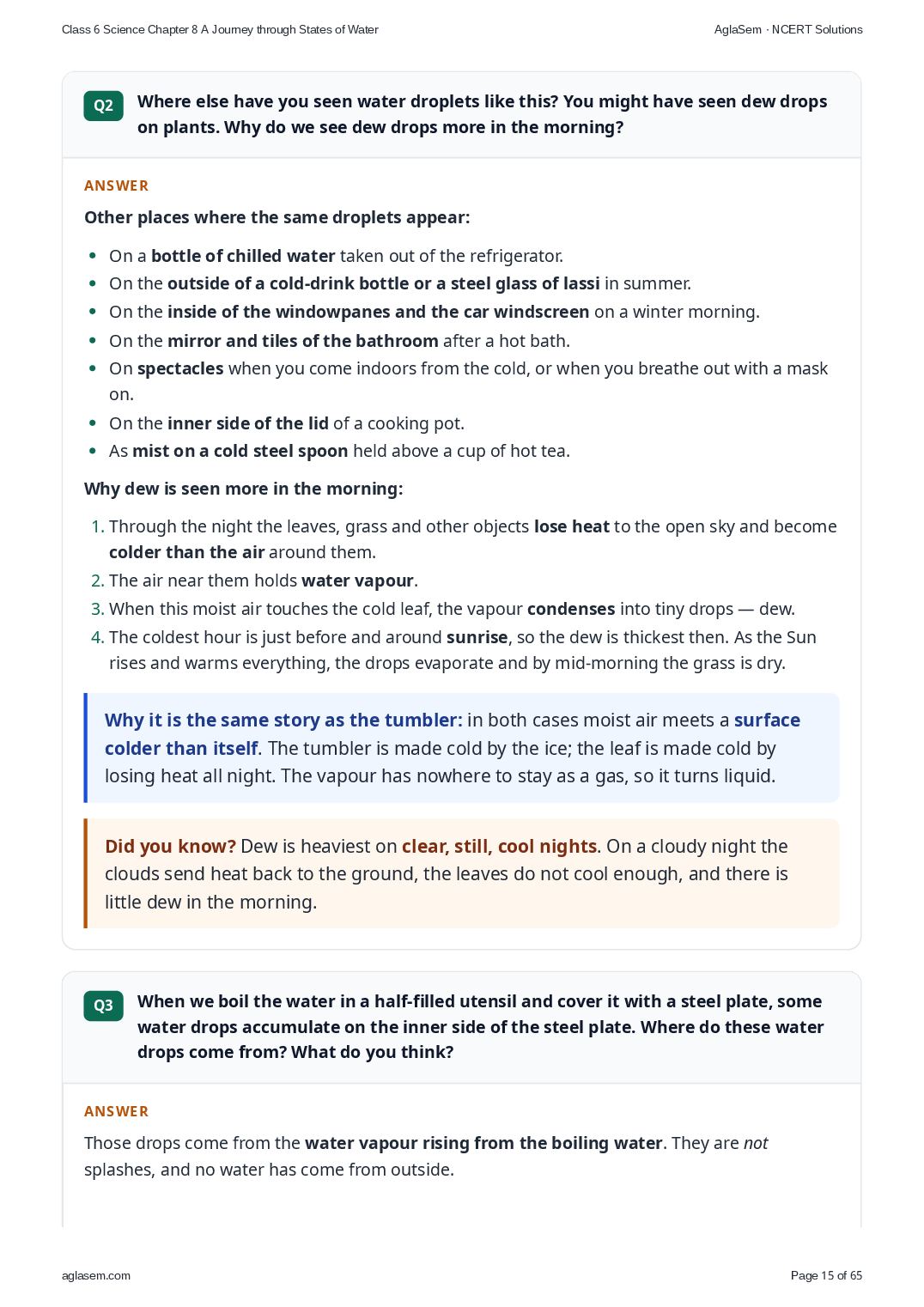
- Where else have you seen water droplets like this? You might have seen dew drops on plants. Why do we see dew drops more in the morning?
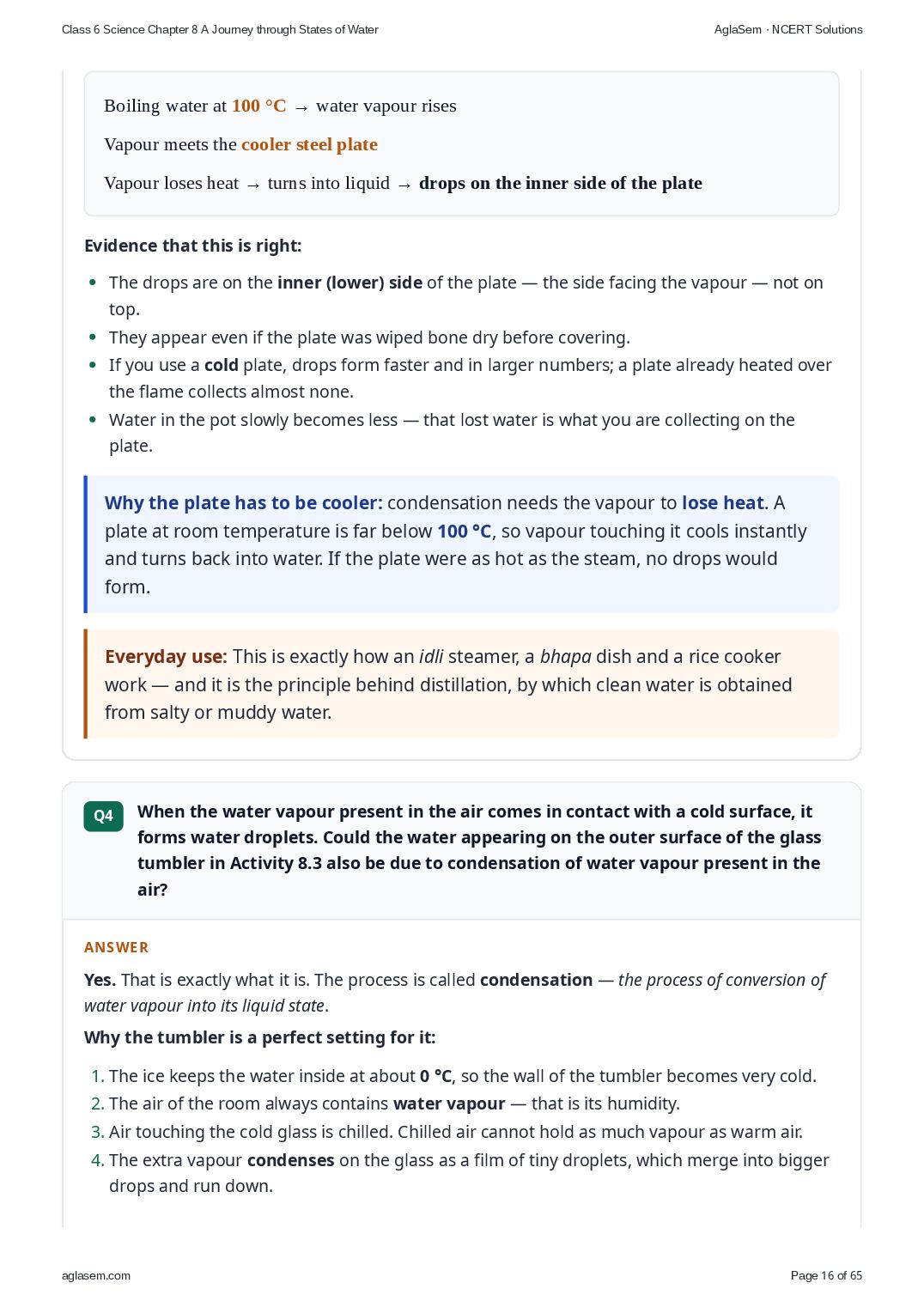
- When we boil the water in a half-filled utensil and cover it with a steel plate, some water drops accumulate on the inner side of the steel plate. Where do these water drops come from? What do you think?
- When the water vapour present in the air comes in contact with a cold surface, it forms water droplets. Could the water appearing on the outer surface of the glass tumbler in Activity 8.3 also be due to condensation of water vapour present in the air?
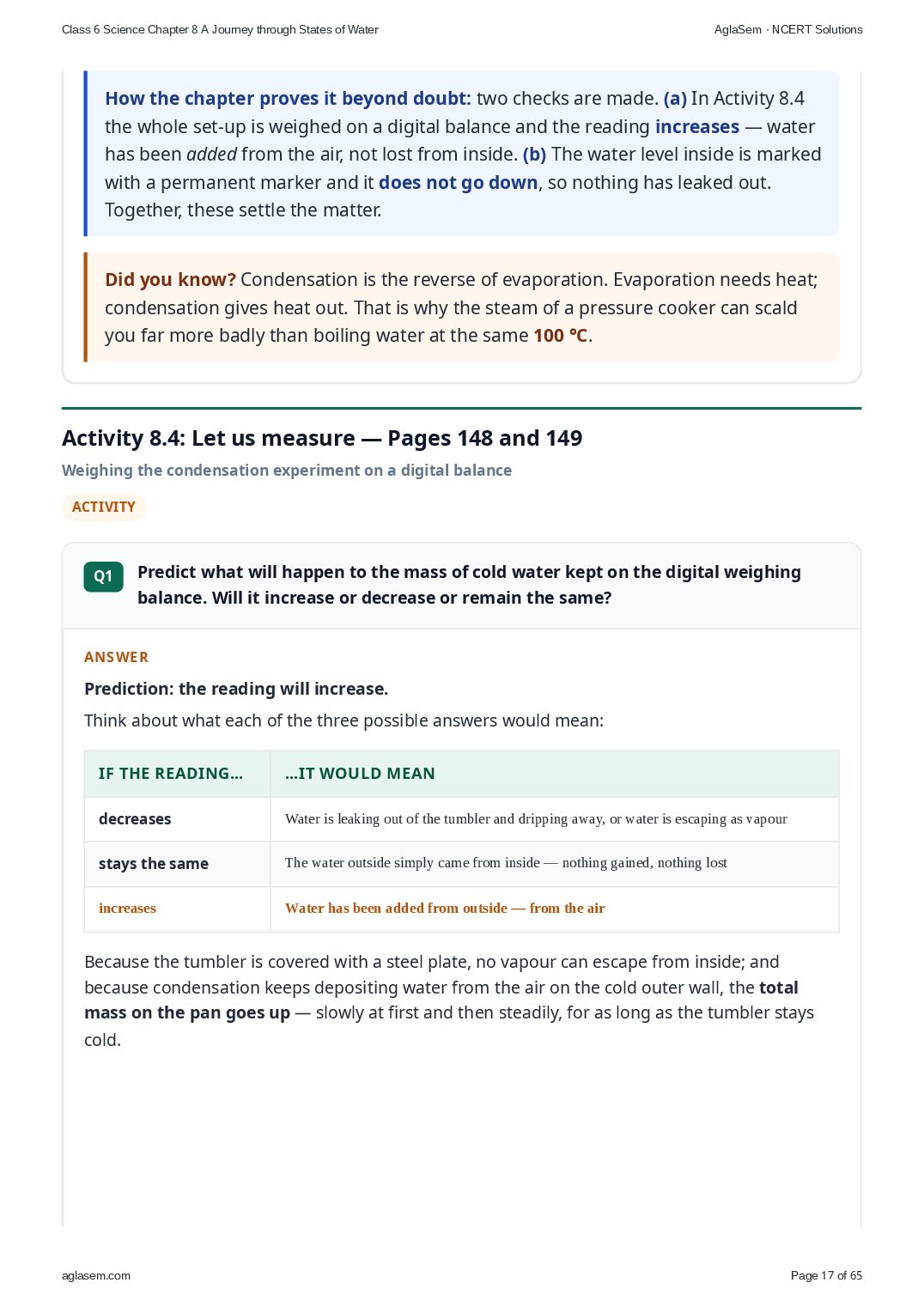
- Predict what will happen to the mass of cold water kept on the digital weighing balance. Will it increase or decrease or remain the same?
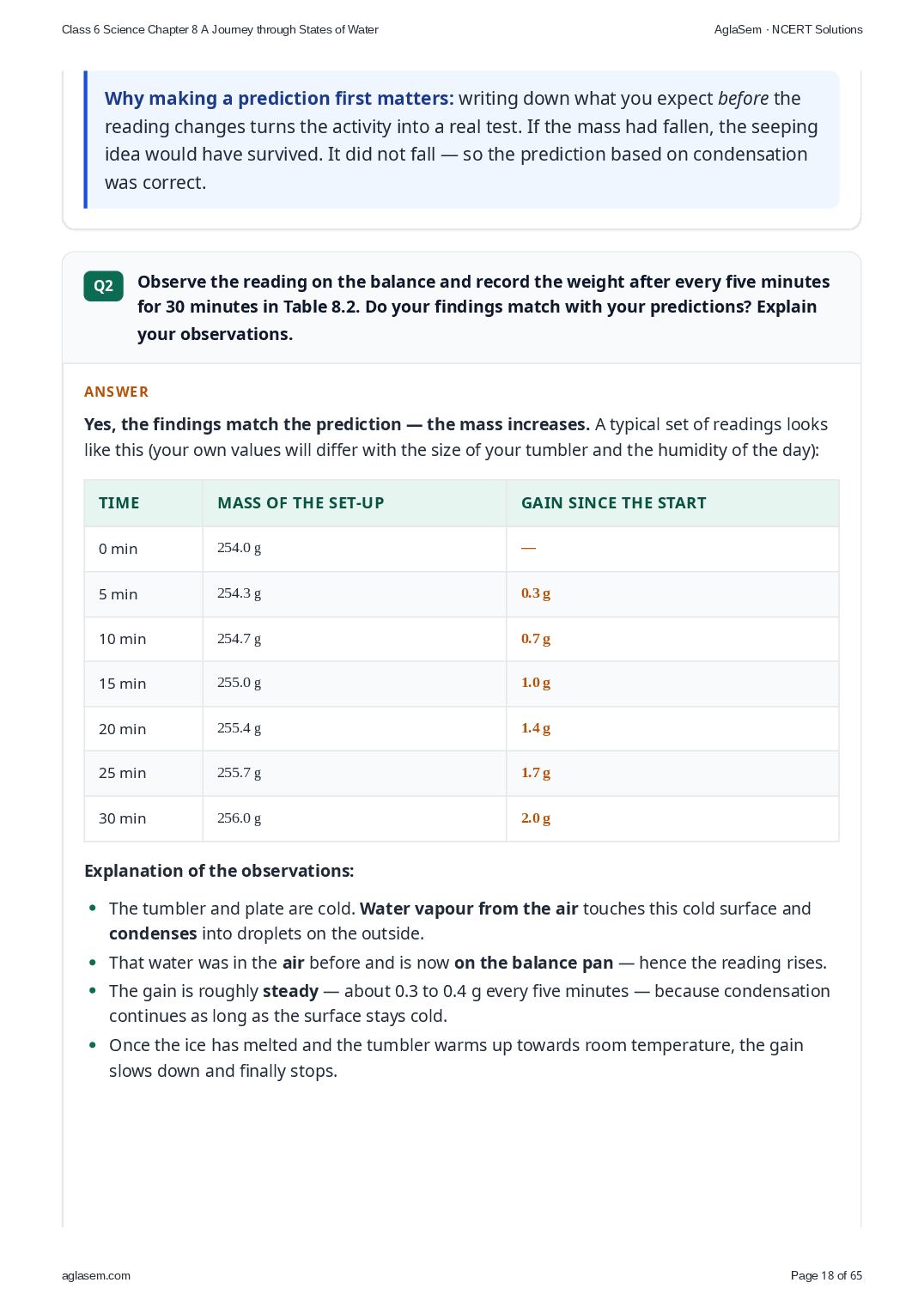
- Observe the reading on the balance and record the weight after every five minutes for 30 minutes in Table 8.2. Do your findings match with your predictions? Explain your observations.
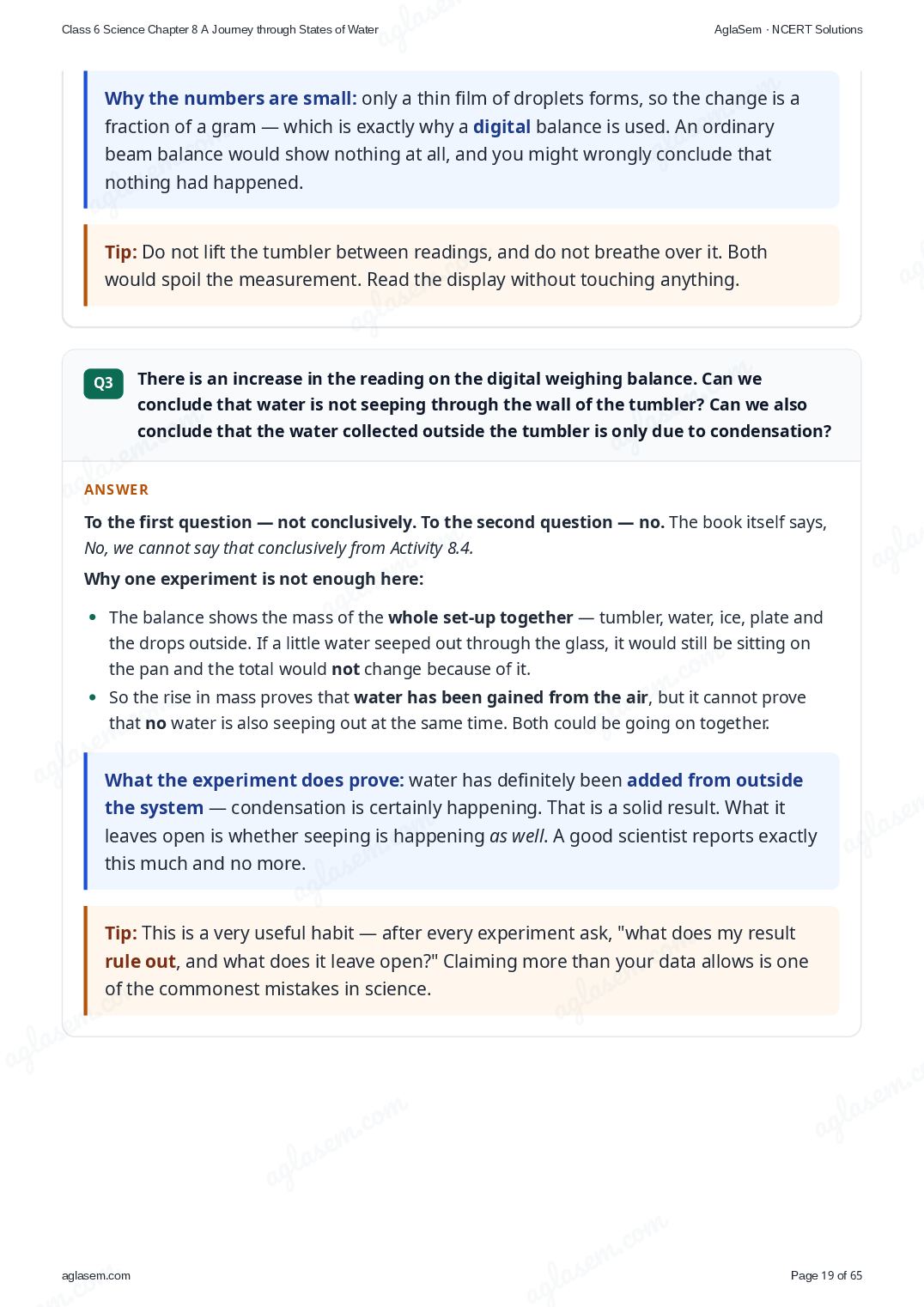
- There is an increase in the reading on the digital weighing balance. Can we conclude that water is not seeping through the wall of the tumbler? Can we also conclude that the water collected outside the tumbler is only due to condensation?
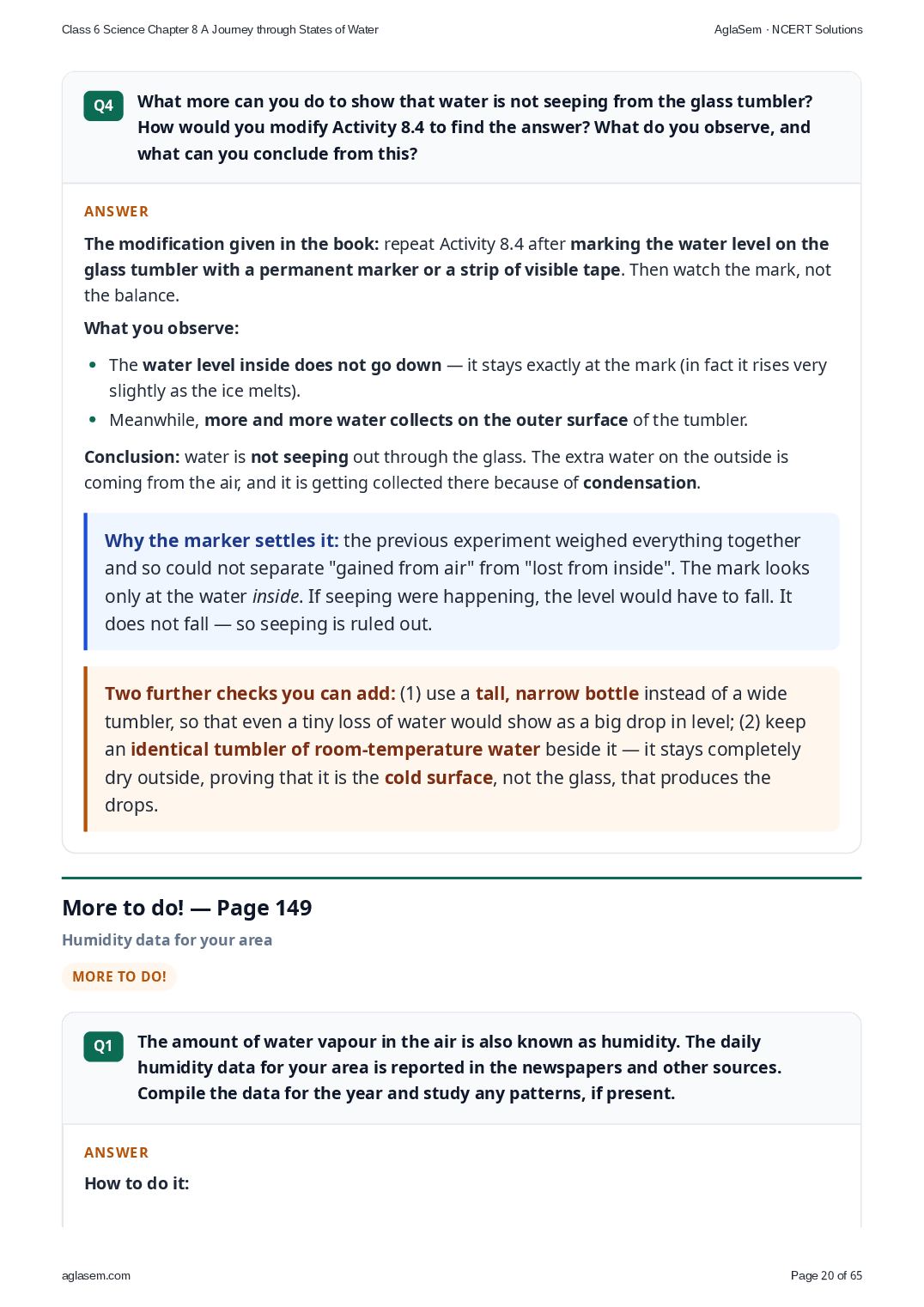
- What more can you do to show that water is not seeping from the glass tumbler? How would you modify Activity 8.4 to find the answer? What do you observe, and what can you conclude from this?
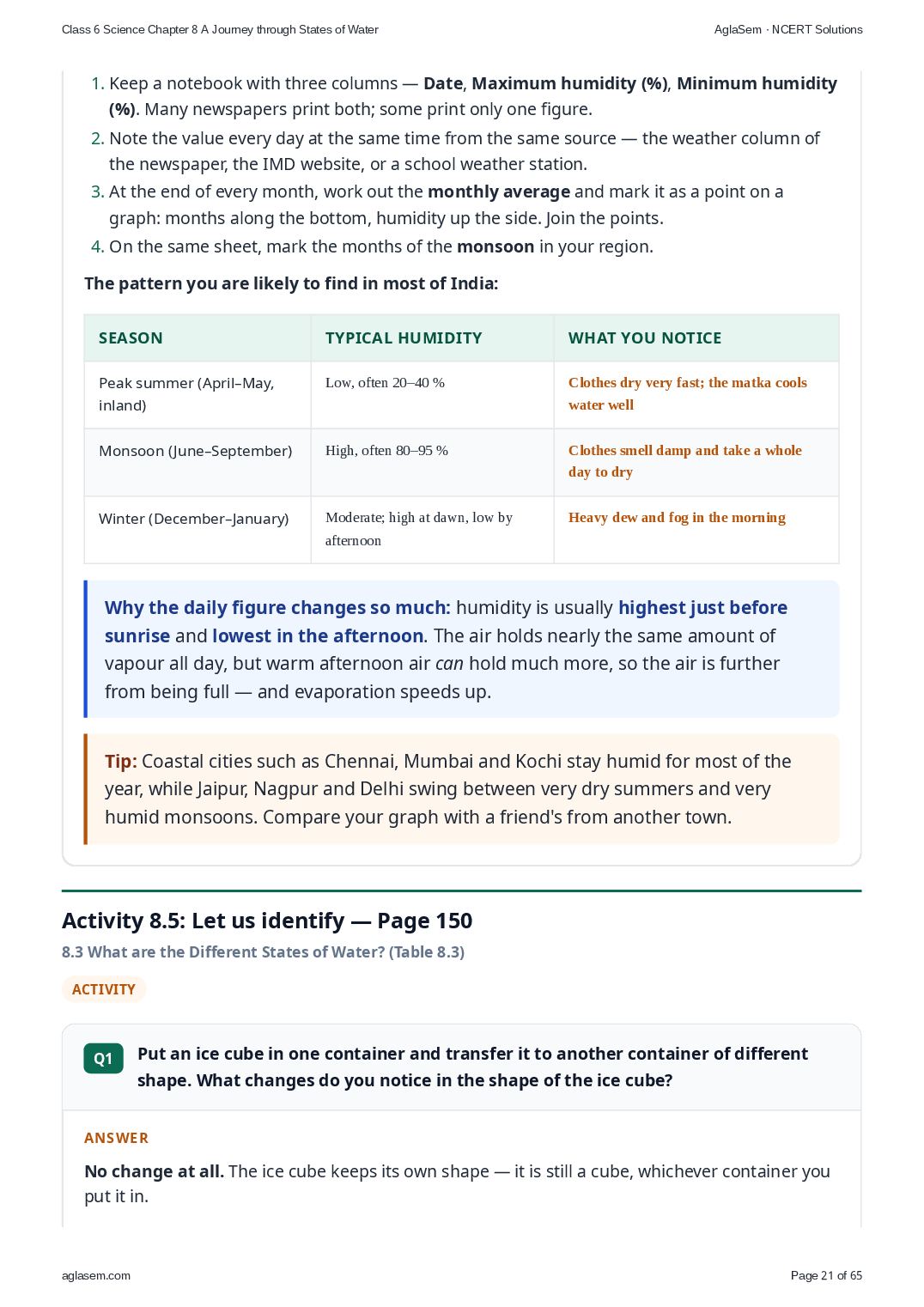
- The amount of water vapour in the air is also known as humidity. The daily humidity data for your area is reported in the newspapers and other sources. Compile the data for the year and study any patterns, if present.
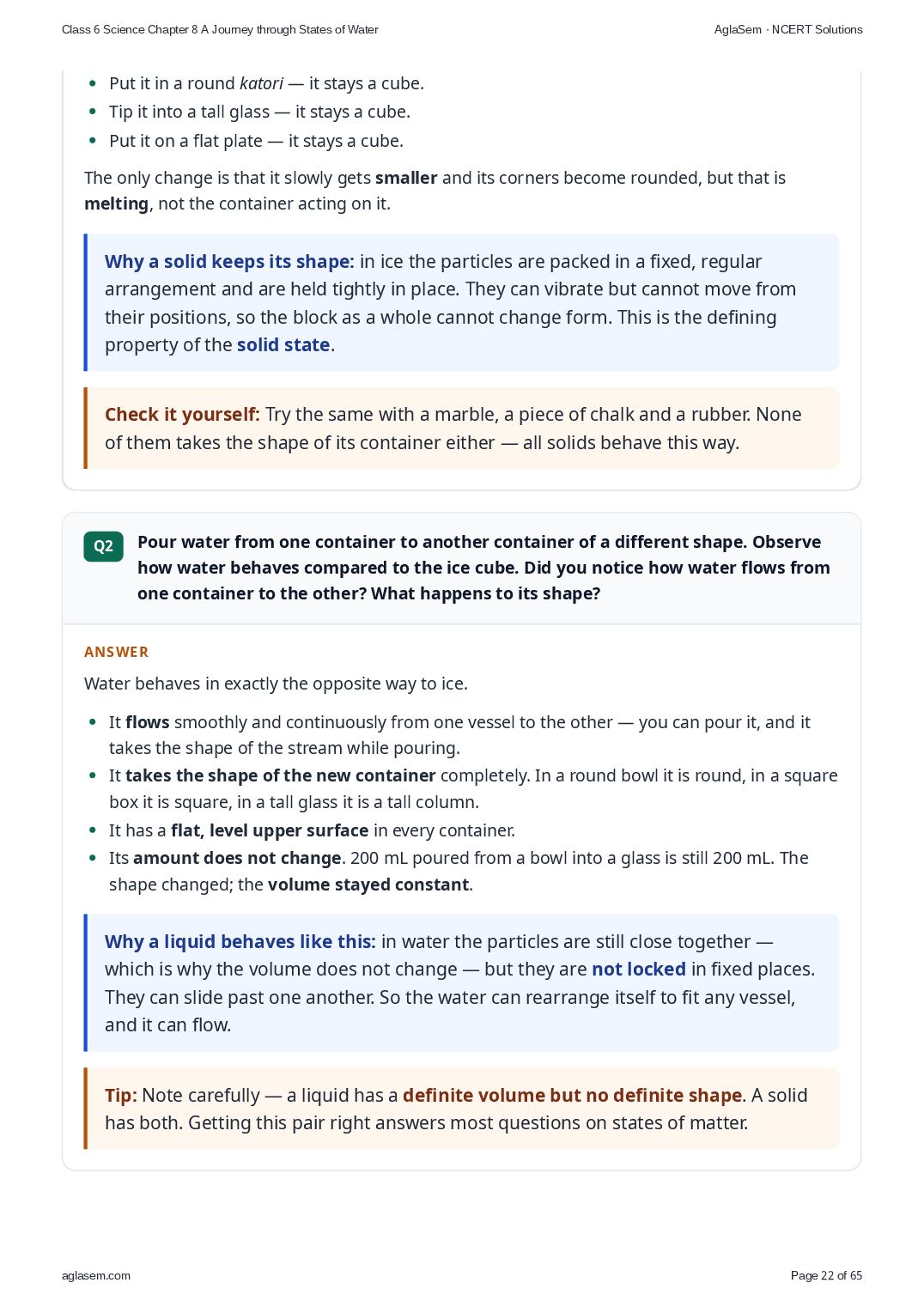
- Put an ice cube in one container and transfer it to another container of different shape. What changes do you notice in the shape of the ice cube?
- Pour water from one container to another container of a different shape. Observe how water behaves compared to the ice cube. Did you notice how water flows from one container to the other? What happens to its shape?
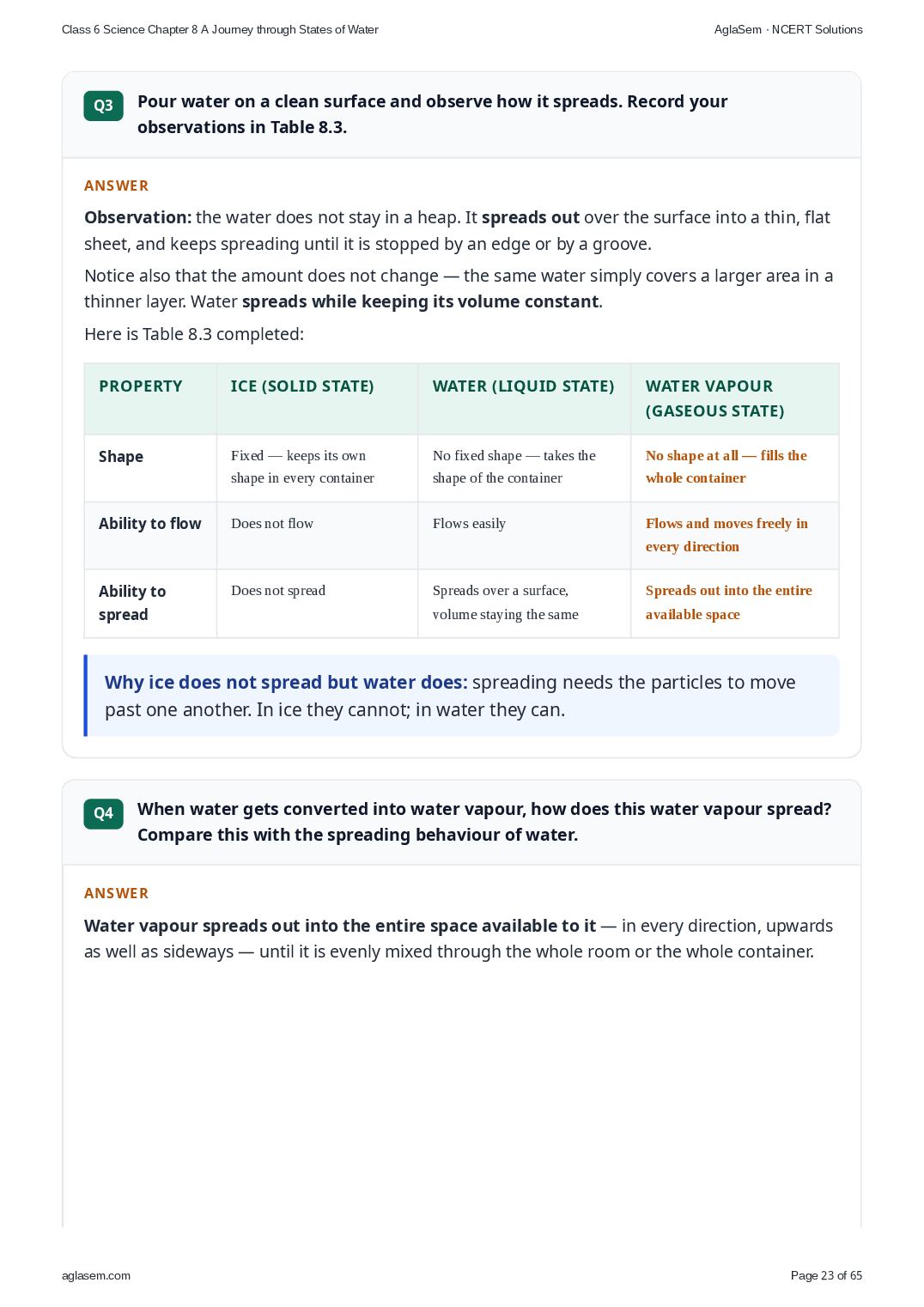
- Pour water on a clean surface and observe how it spreads. Record your observations in Table 8.3.
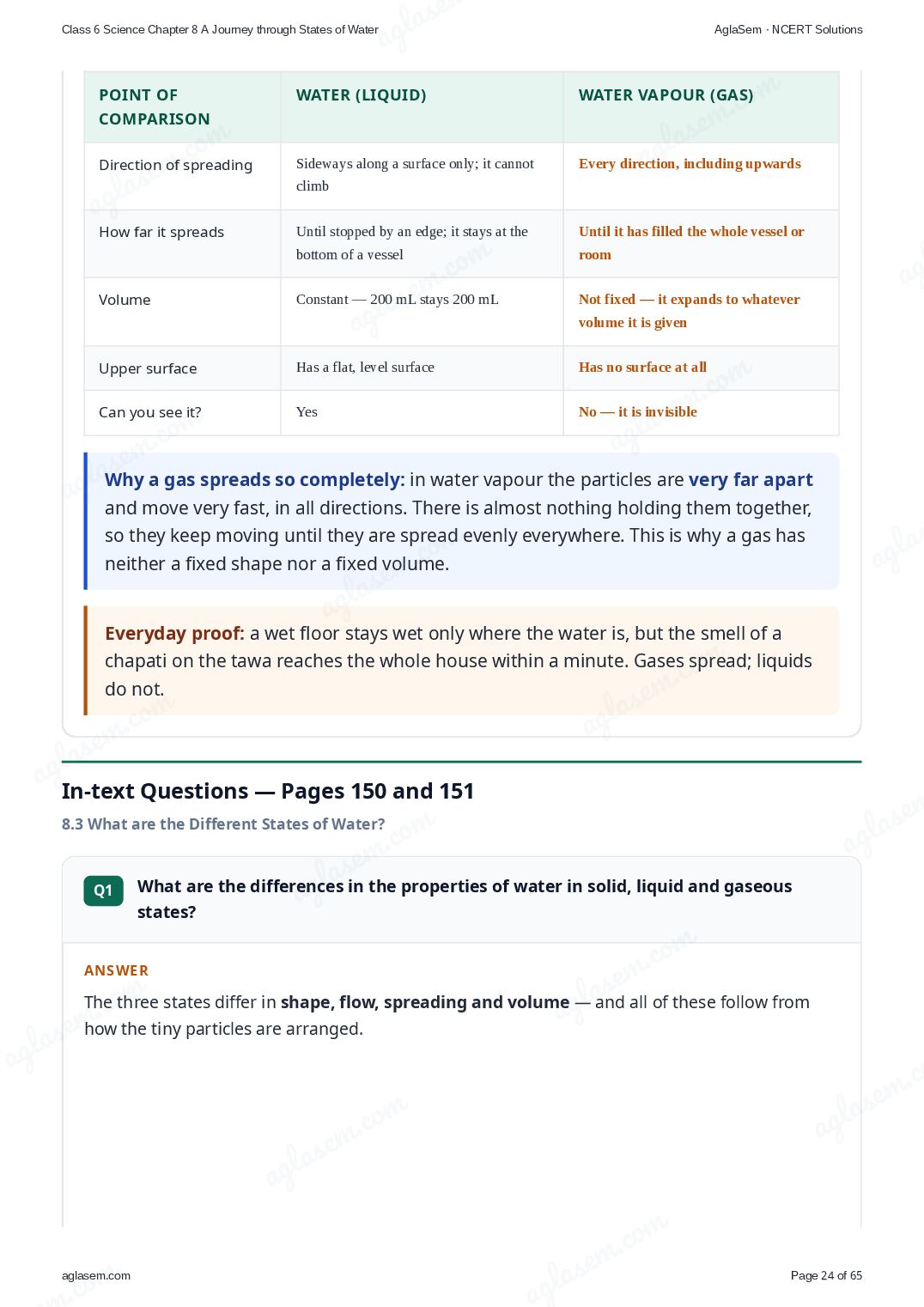
- When water gets converted into water vapour, how does this water vapour spread? Compare this with the spreading behaviour of water.
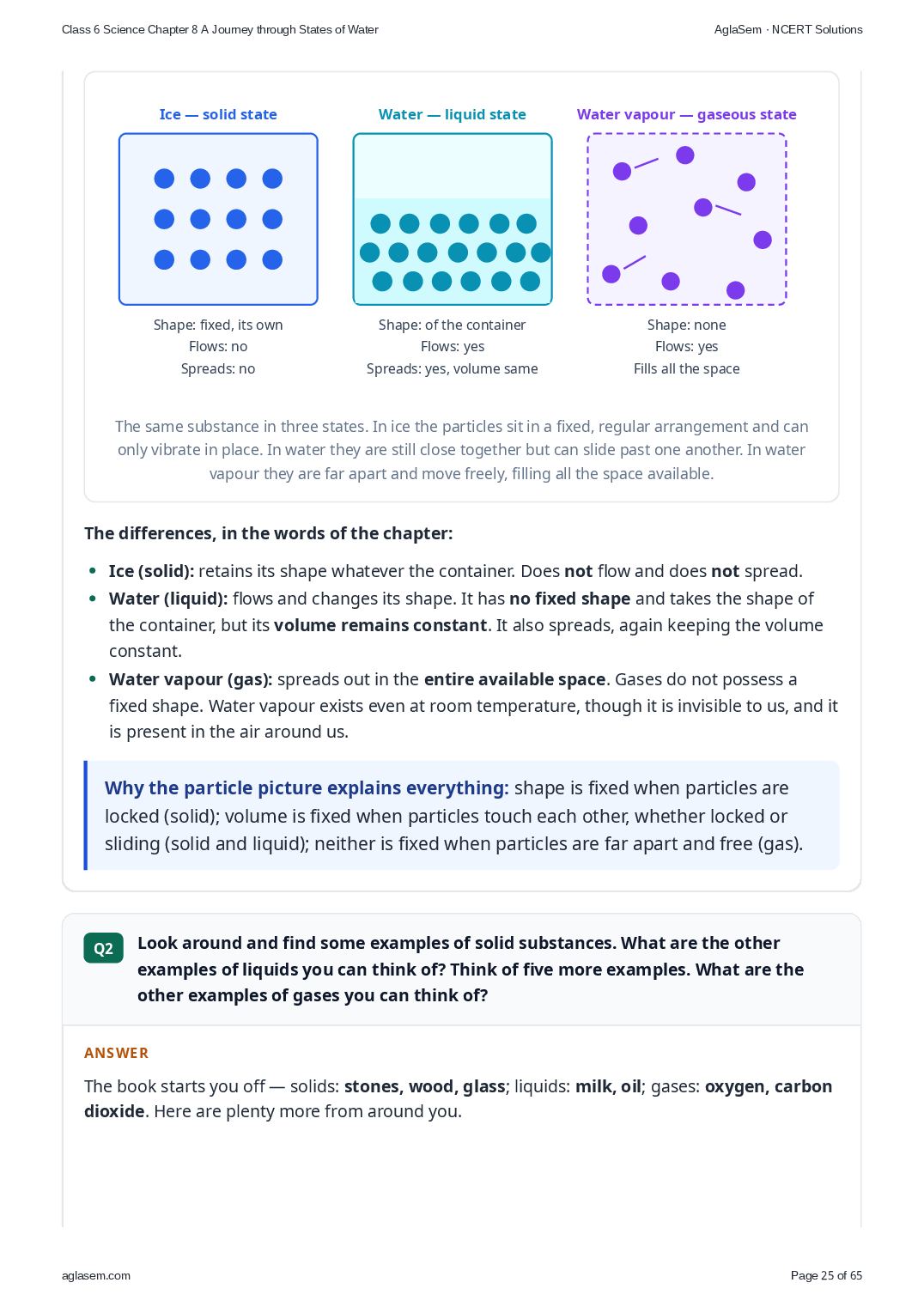
- What are the differences in the properties of water in solid, liquid and gaseous states?
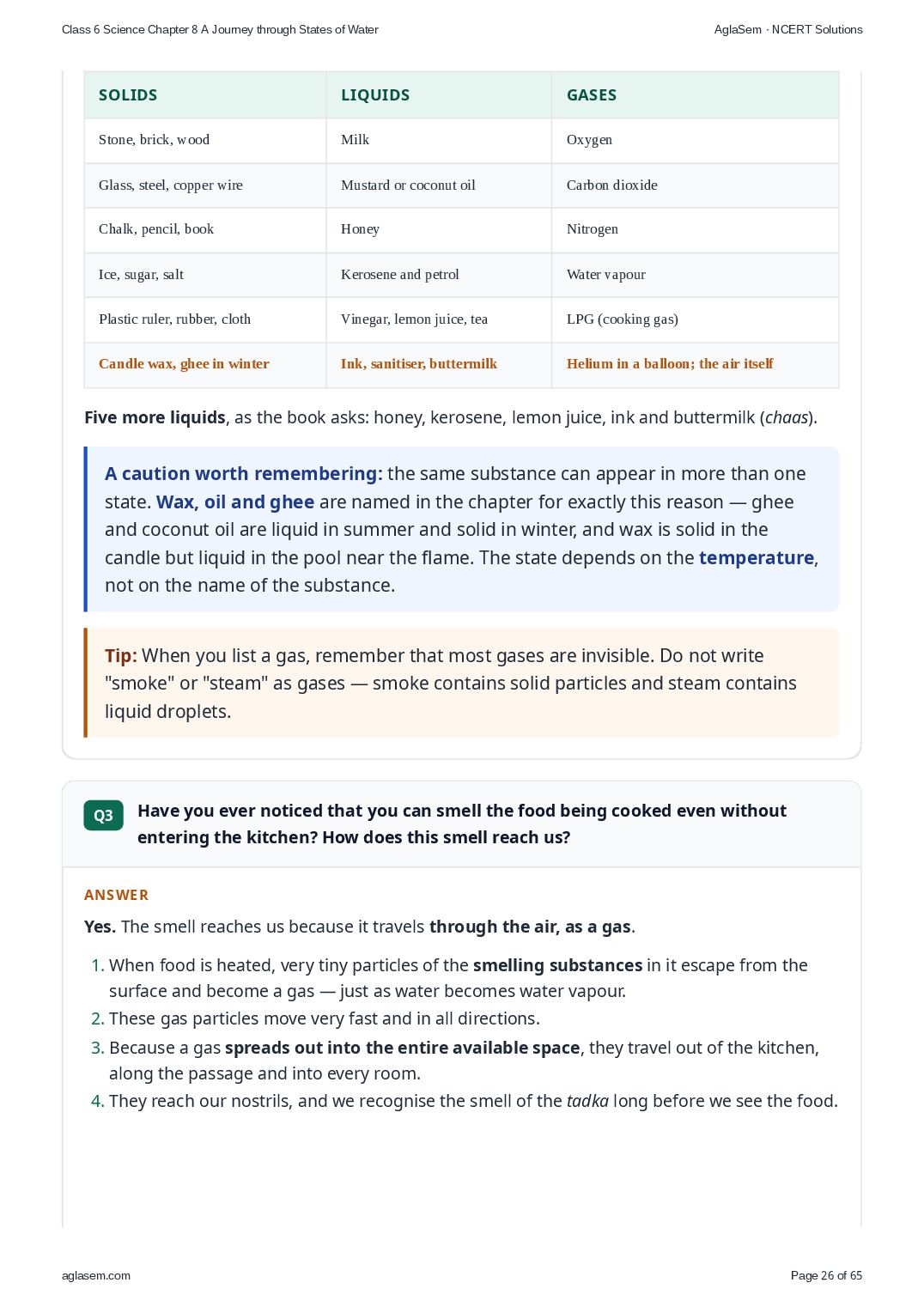
- Look around and find some examples of solid substances. What are the other examples of liquids you can think of? Think of five more examples. What are the other examples of gases you can think of?
- Have you ever noticed that you can smell the food being cooked even without entering the kitchen? How does this smell reach us?
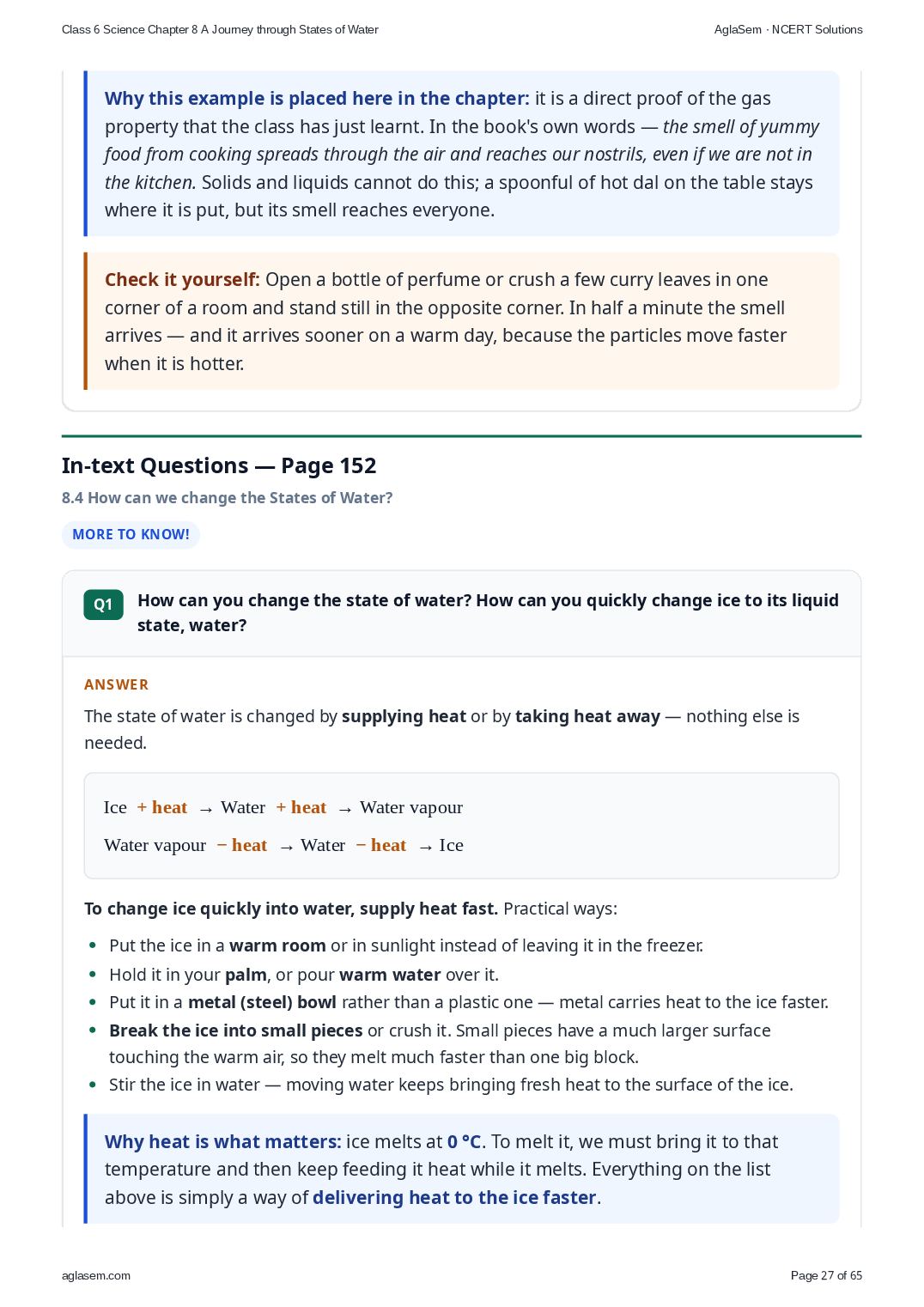
- How can you change the state of water? How can you quickly change ice to its liquid state, water?
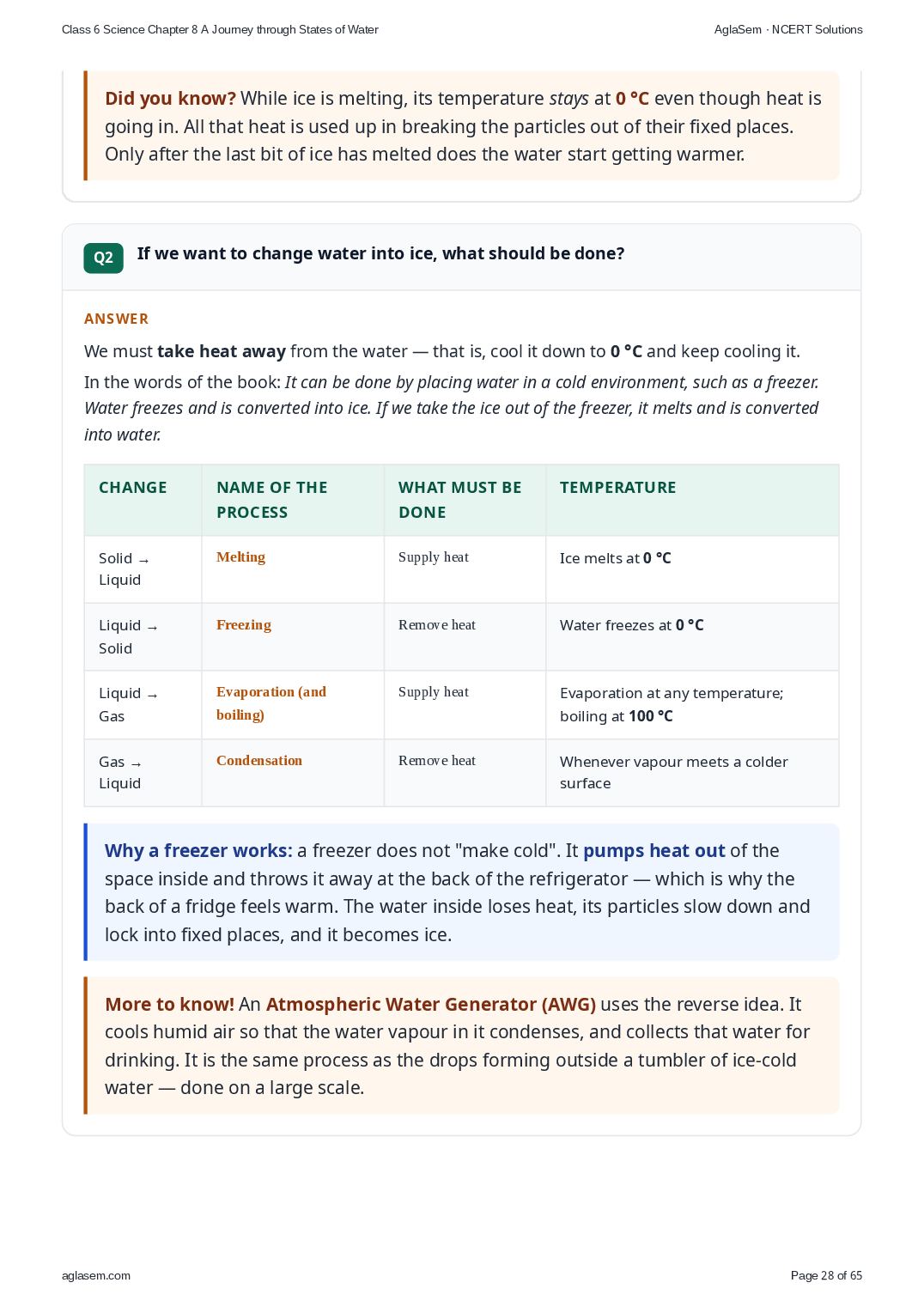
- If we want to change water into ice, what should be done?
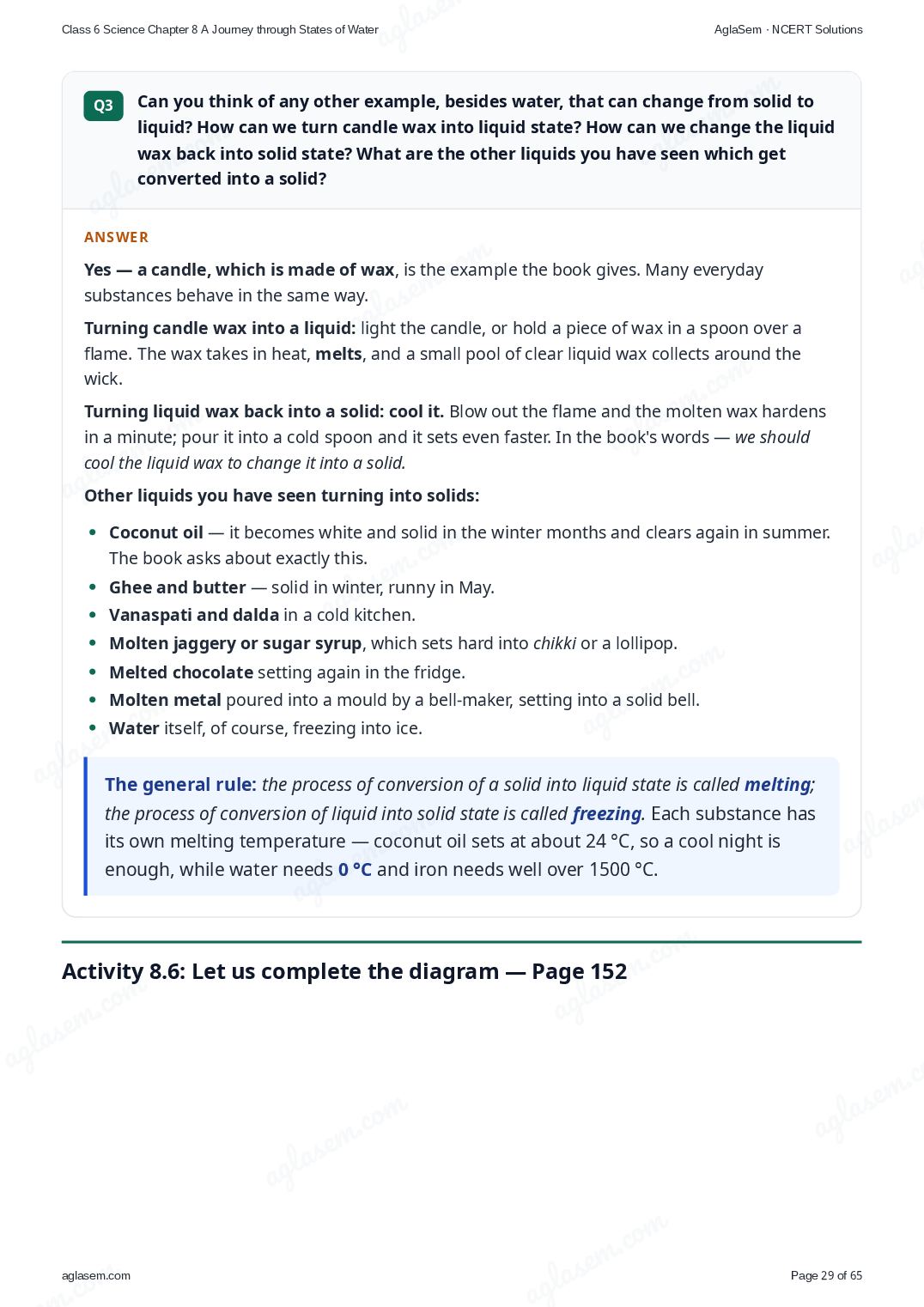
- Can you think of any other example, besides water, that can change from solid to liquid? How can we turn candle wax into liquid state? How can we change the liquid wax back into solid state? What are the other liquids you have seen which get converted into a solid?
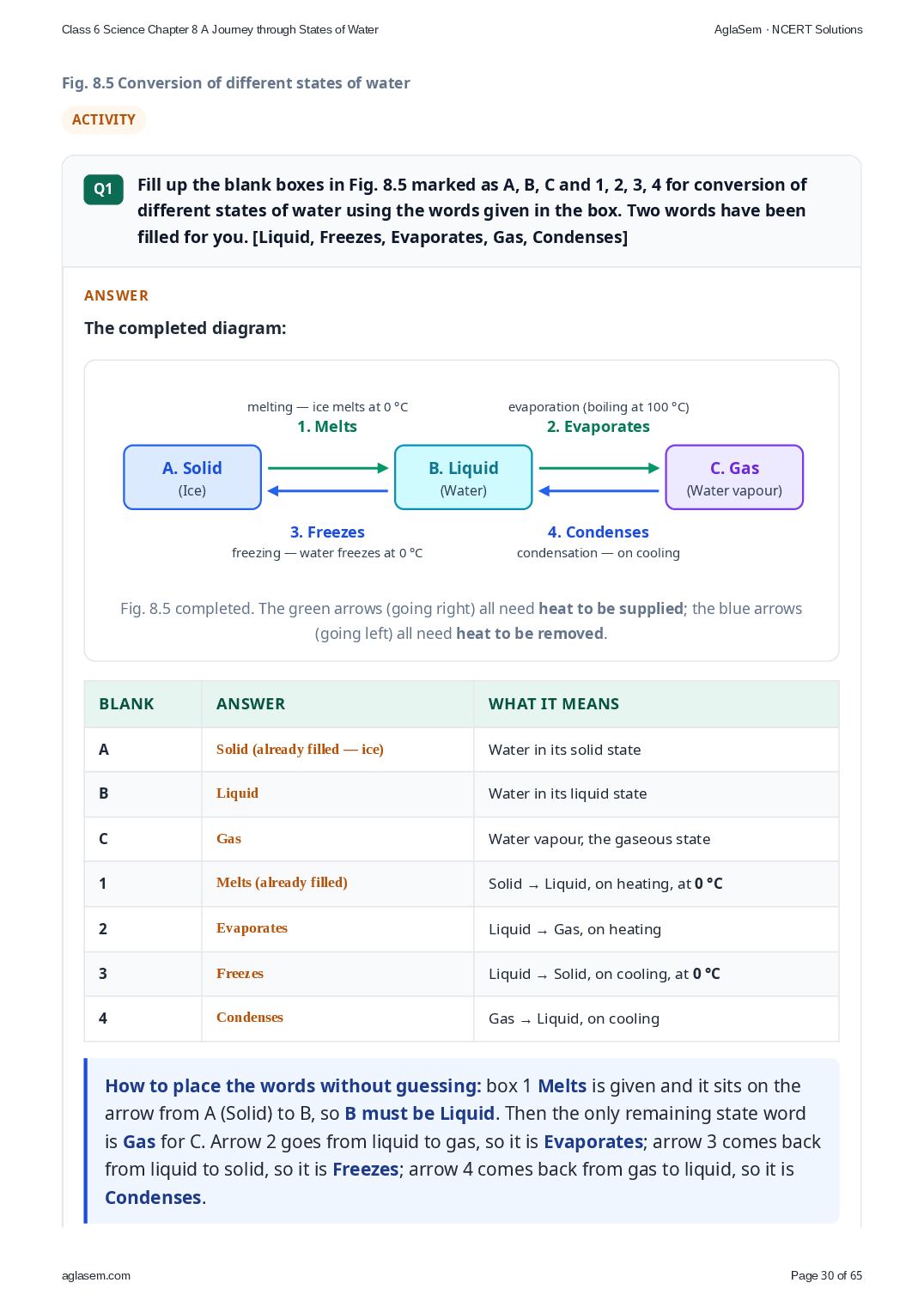
- Fill up the blank boxes in Fig. 8.5 marked as A, B, C and 1, 2, 3, 4 for conversion of different states of water using the words given in the box. Two words have been filled for you. [Liquid, Freezes, Evaporates, Gas, Condenses]
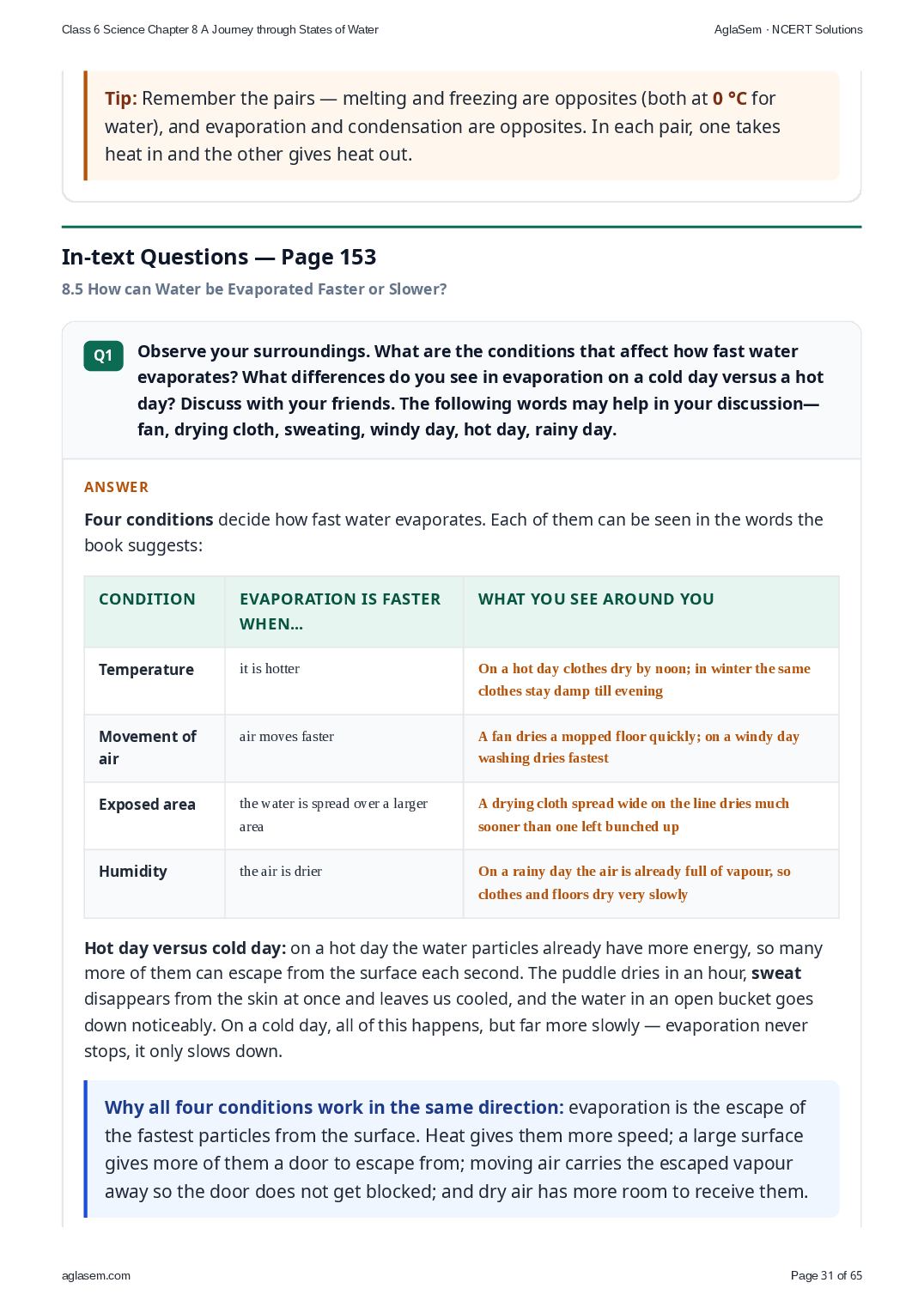
- Observe your surroundings. What are the conditions that affect how fast water evaporates? What differences do you see in evaporation on a cold day versus a hot day? Discuss with your friends. The following words may help in your discussion—fan, drying cloth, sweating, windy day, hot day, rainy day.
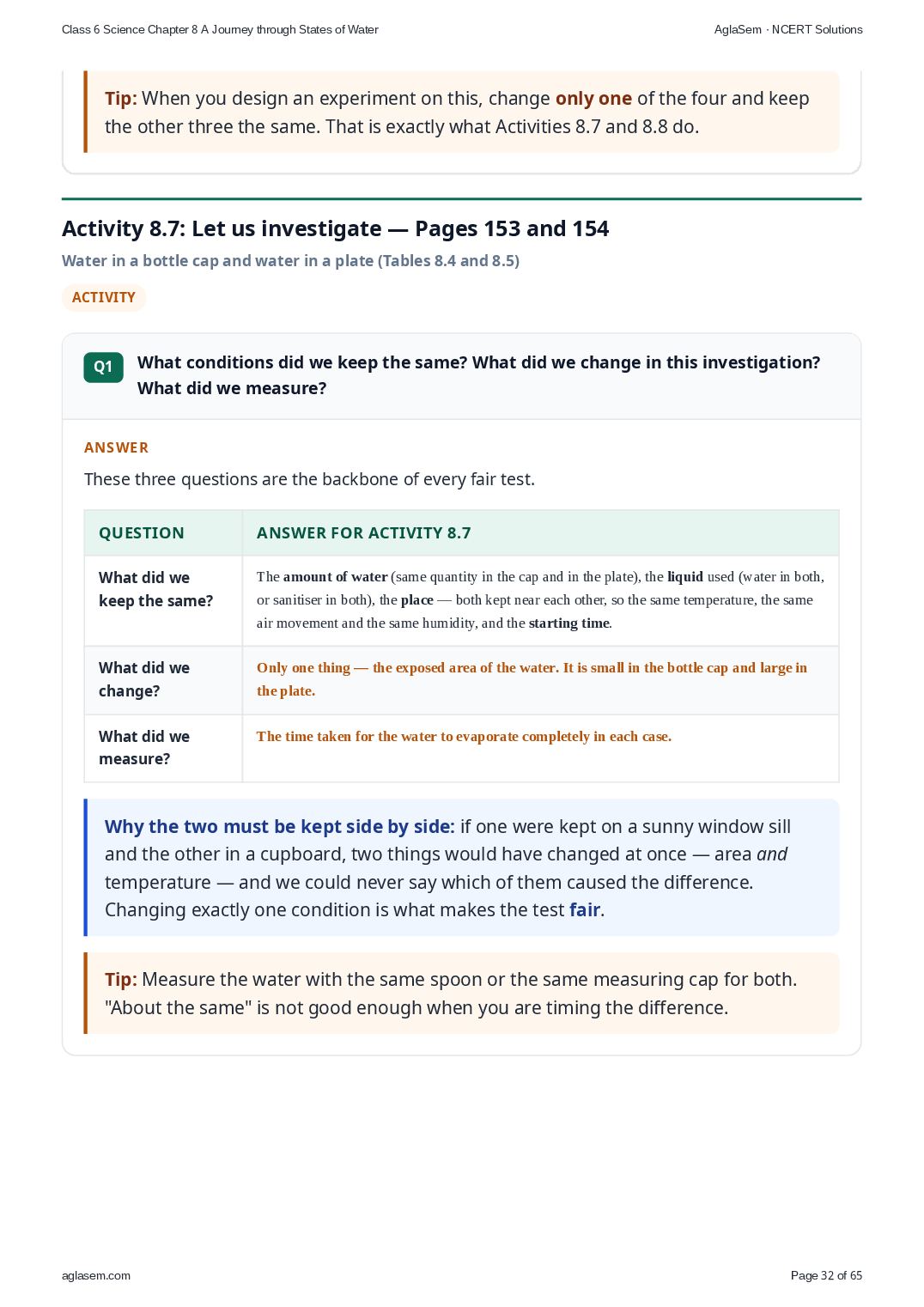
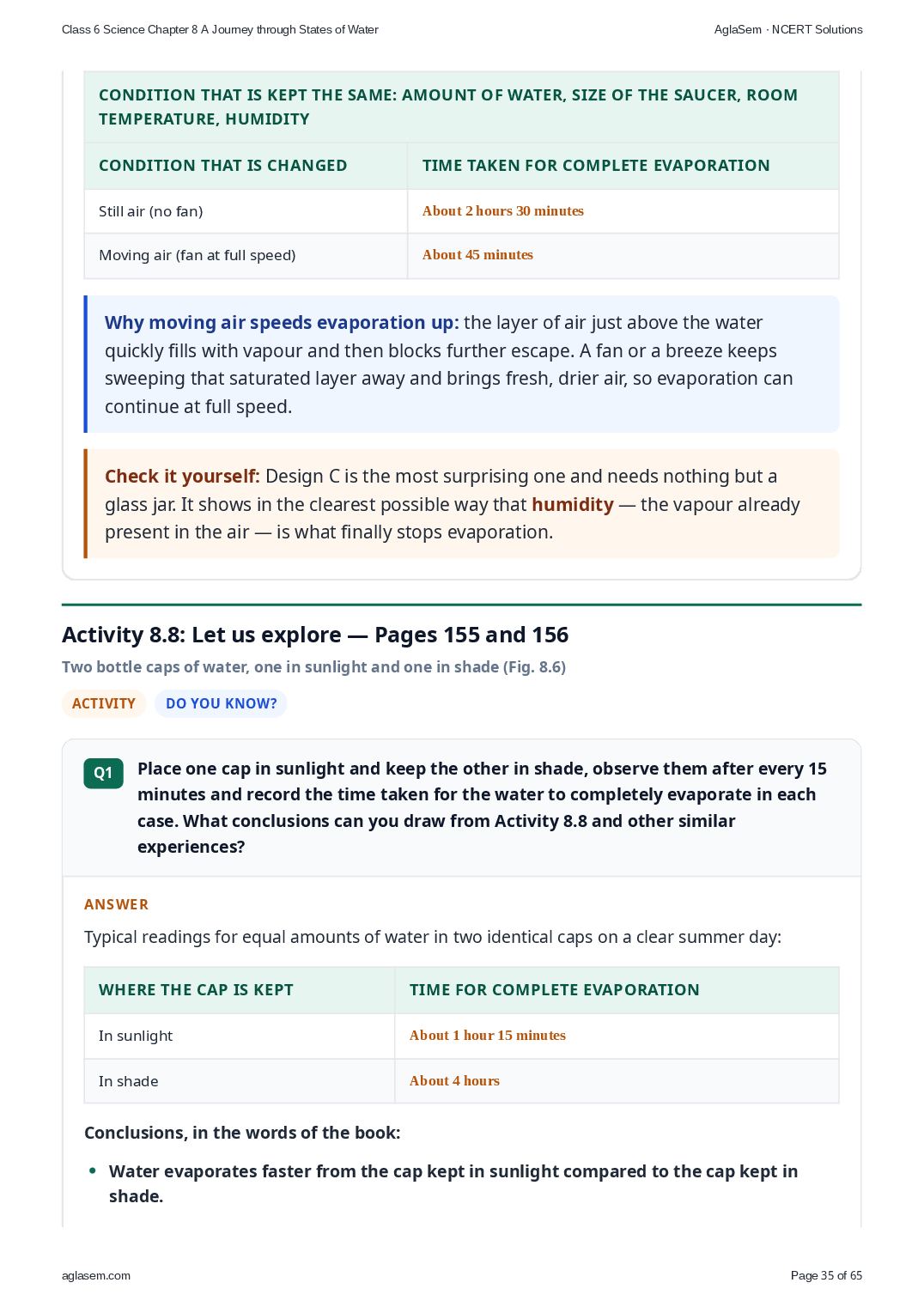
- What conditions did we keep the same? What did we change in this investigation? What did we measure?
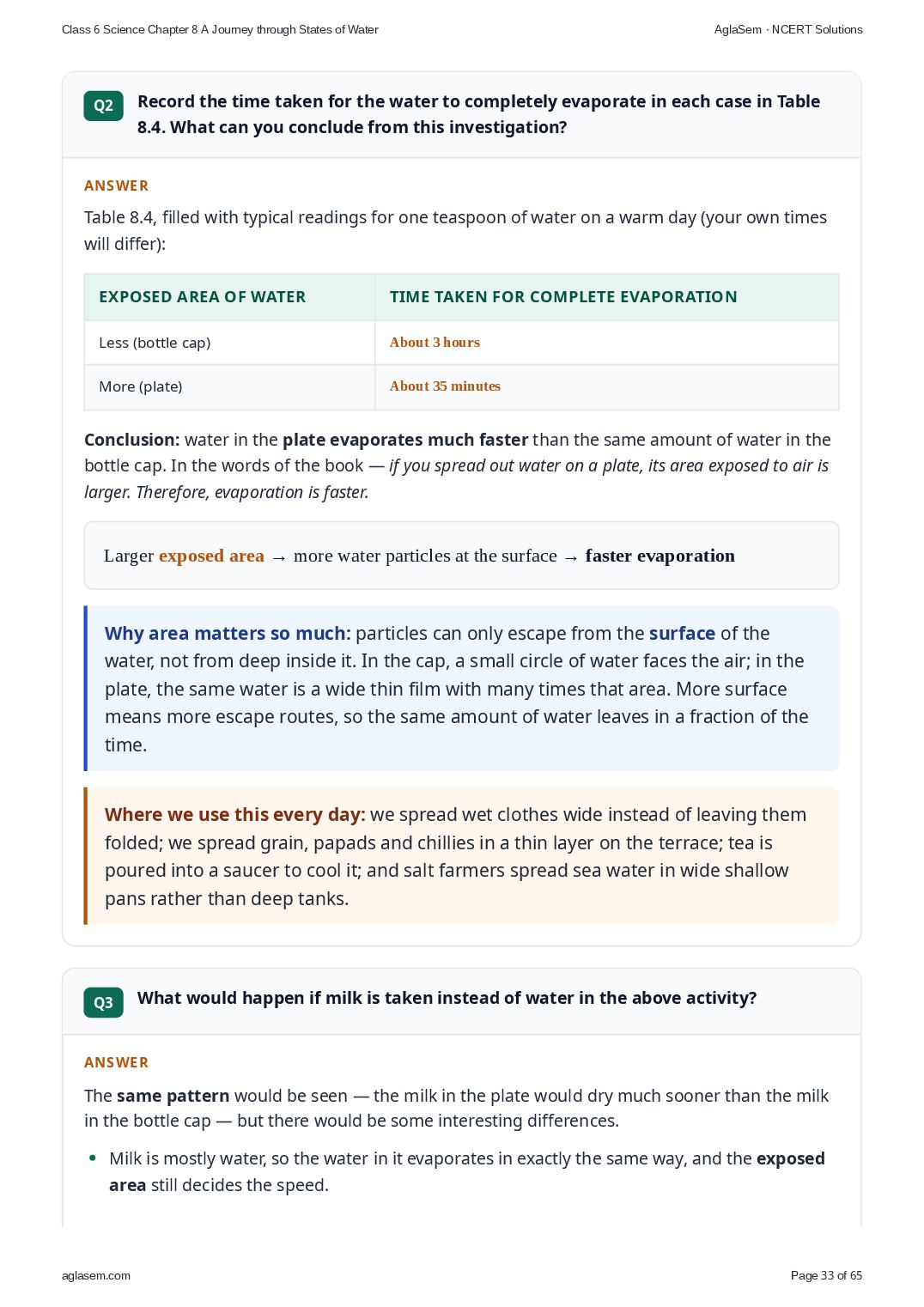
- Record the time taken for the water to completely evaporate in each case in Table 8.4. What can you conclude from this investigation?
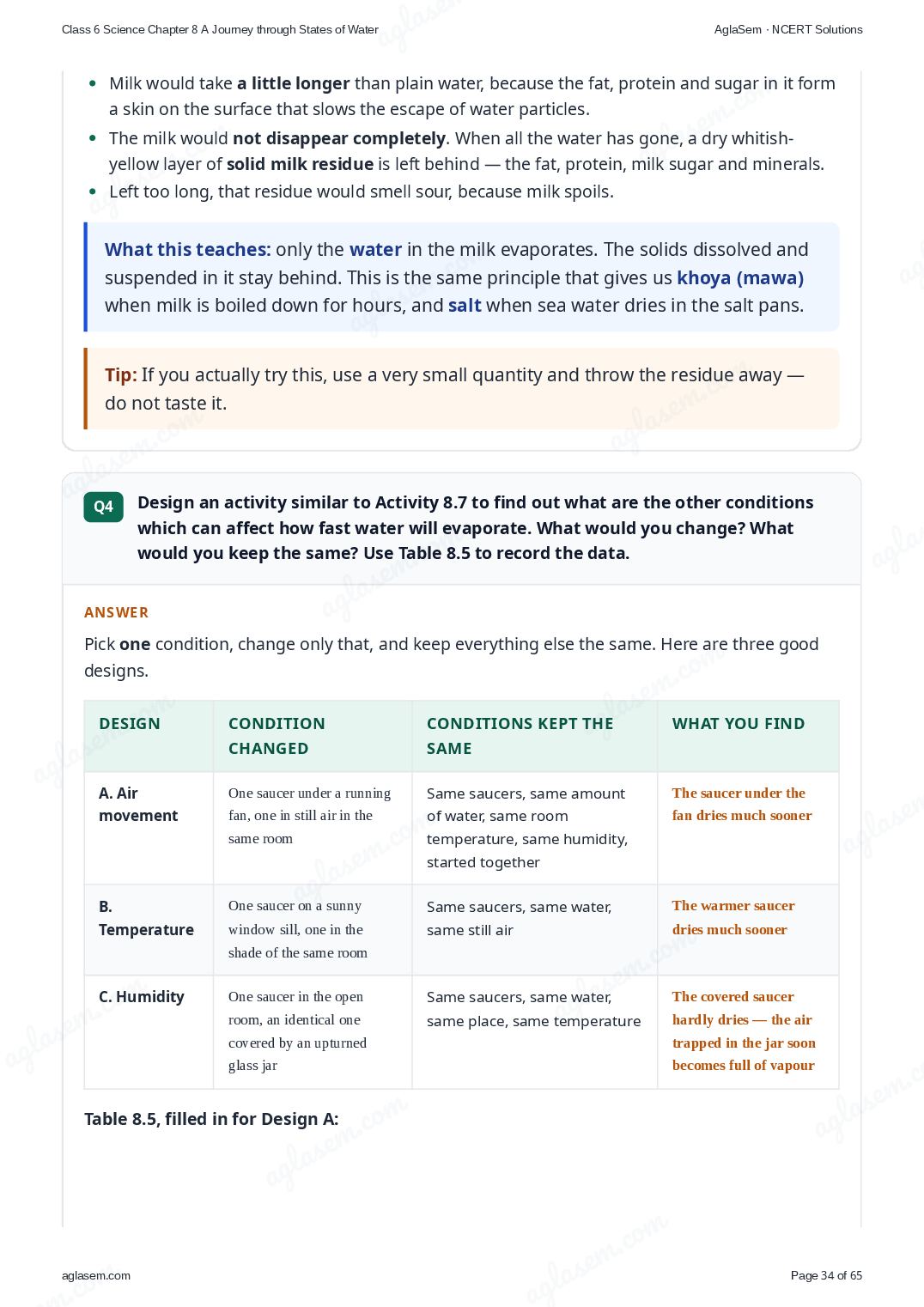
- What would happen if milk is taken instead of water in the above activity?
- Design an activity similar to Activity 8.7 to find out what are the other conditions which can affect how fast water will evaporate. What would you change? What would you keep the same? Use Table 8.5 to record the data.
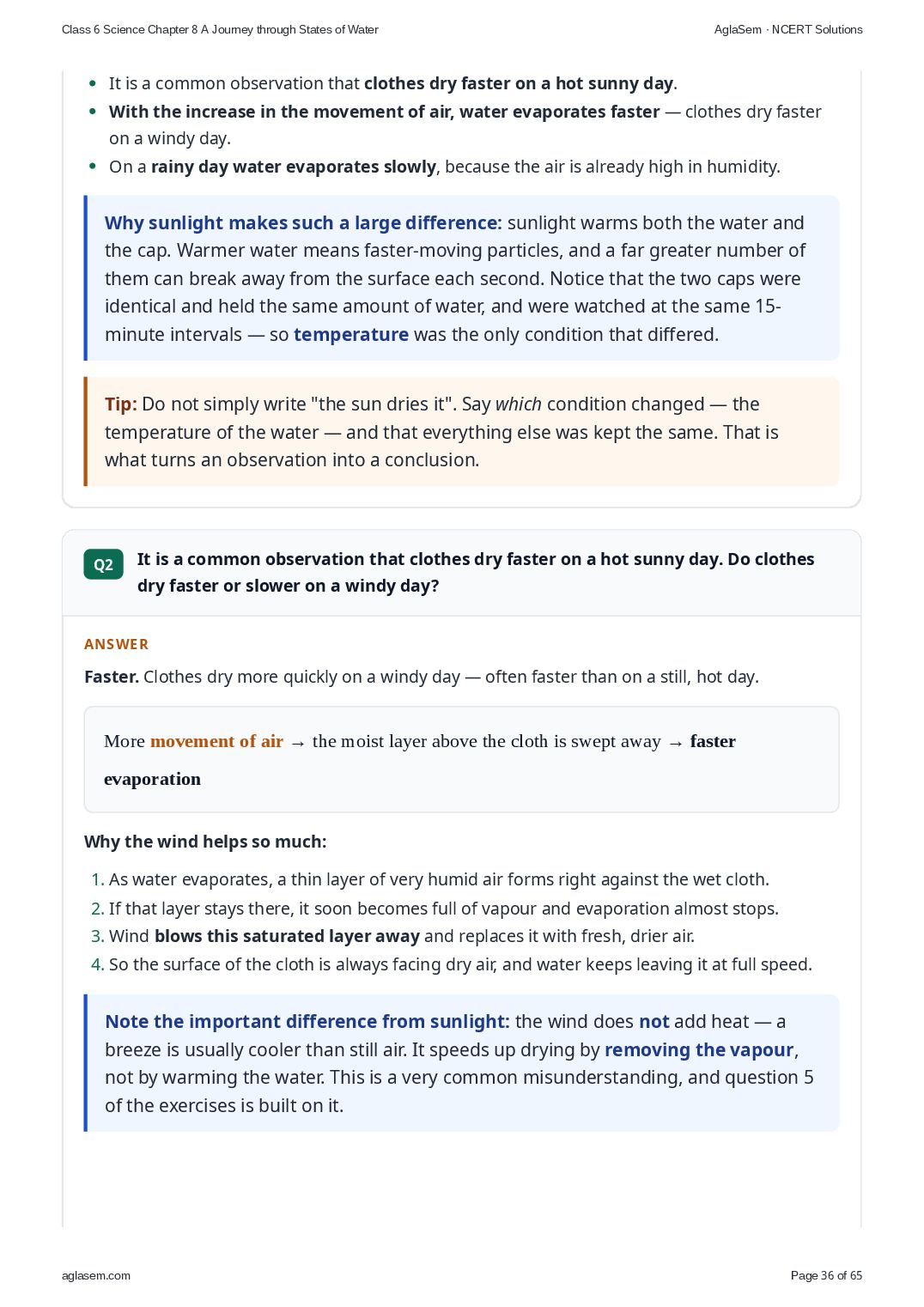
- Place one cap in sunlight and keep the other in shade, observe them after every 15 minutes and record the time taken for the water to completely evaporate in each case. What conclusions can you draw from Activity 8.8 and other similar experiences?
- It is a common observation that clothes dry faster on a hot sunny day. Do clothes dry faster or slower on a windy day?
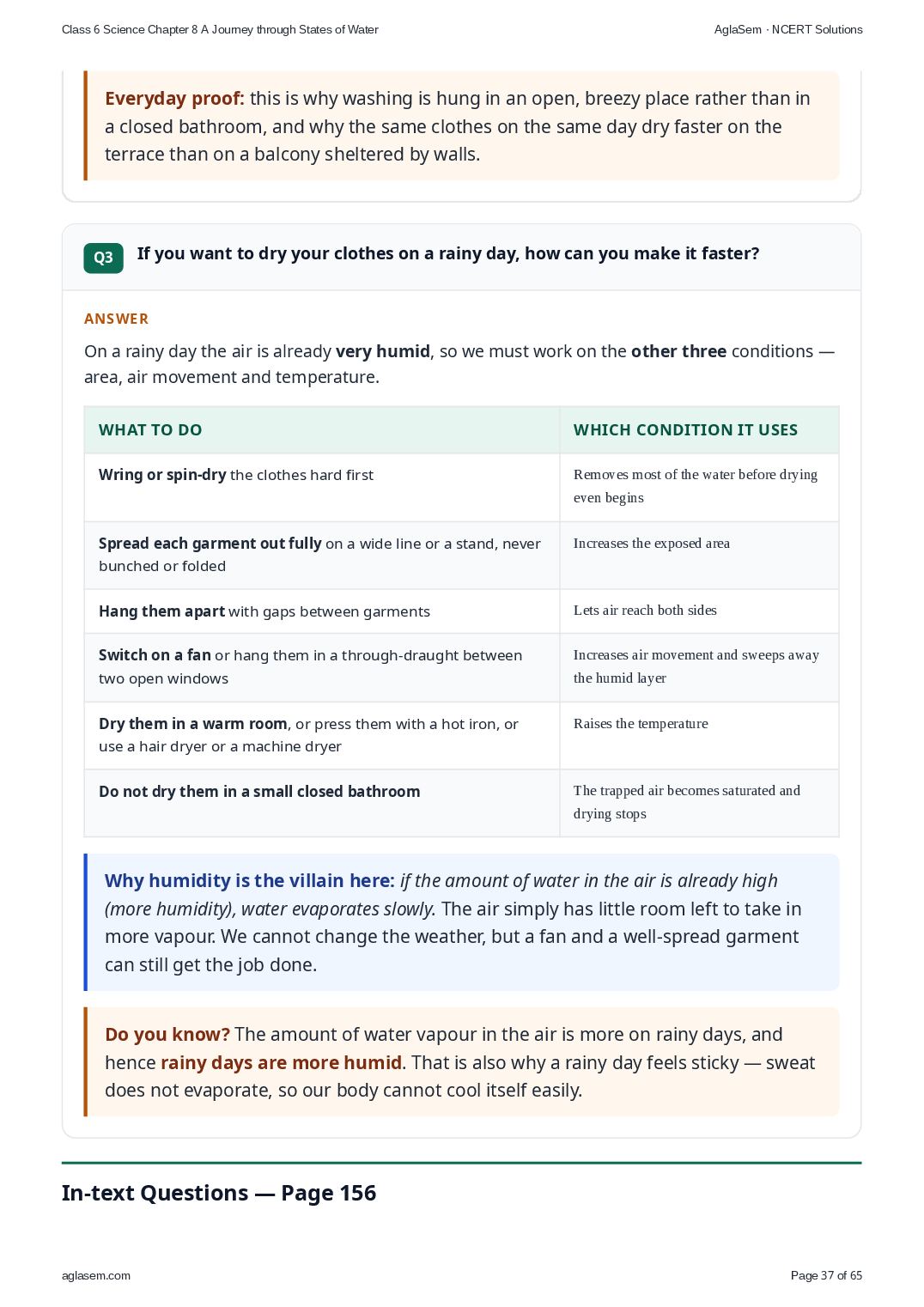
- If you want to dry your clothes on a rainy day, how can you make it faster?
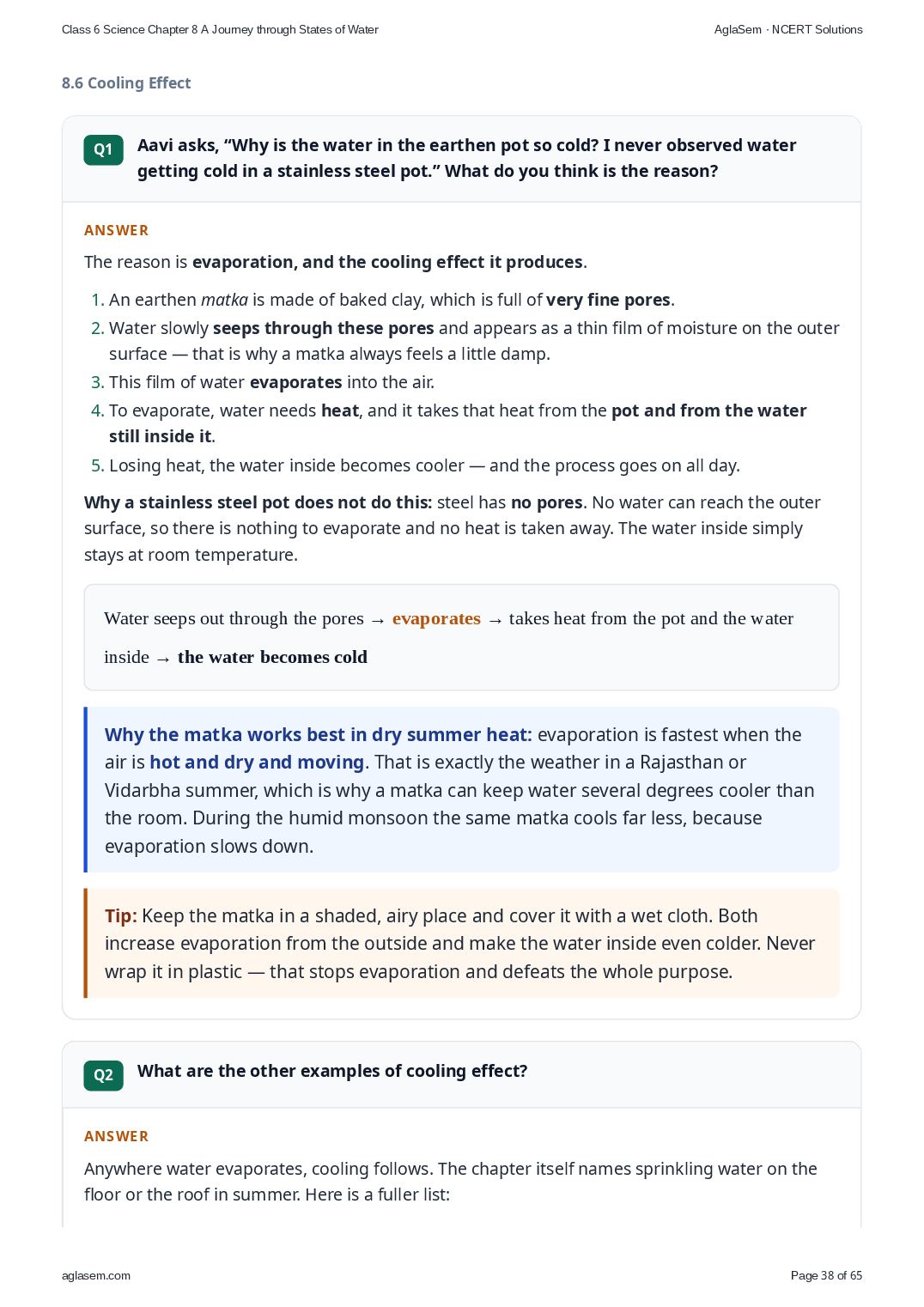
- Aavi asks, “Why is the water in the earthen pot so cold? I never observed water getting cold in a stainless steel pot.” What do you think is the reason?
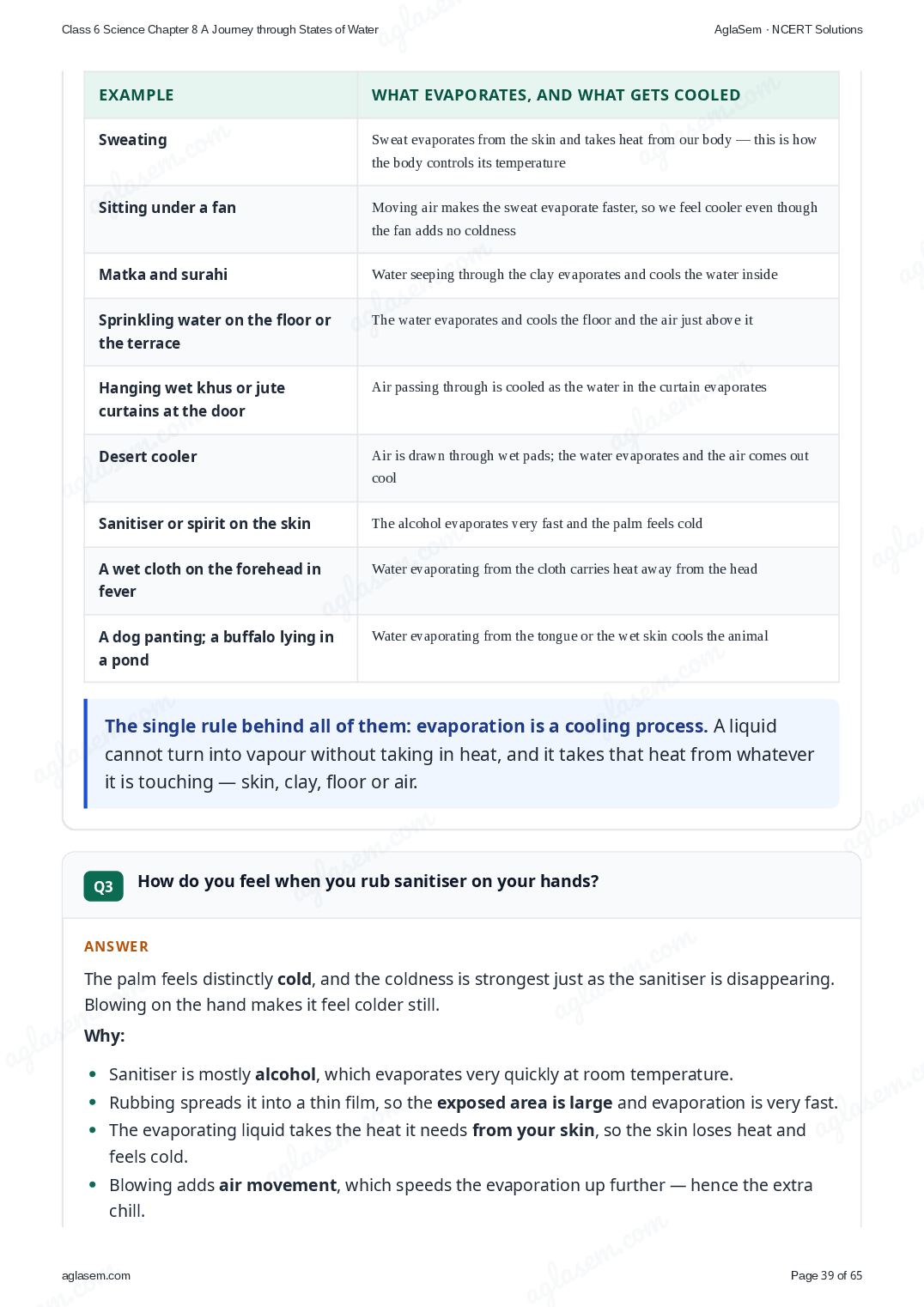
- What are the other examples of cooling effect?
- How do you feel when you rub sanitiser on your hands?
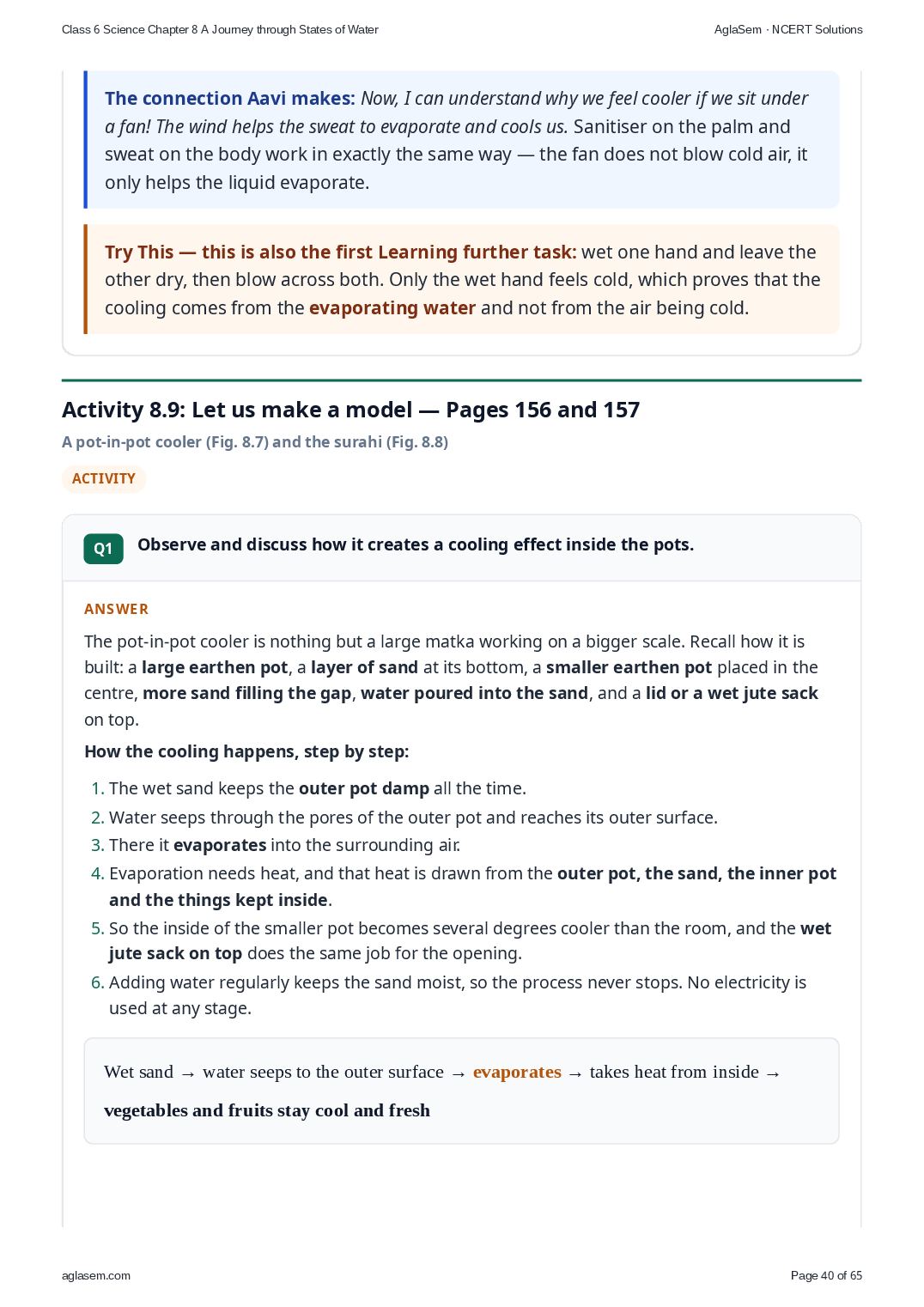
- Observe and discuss how it creates a cooling effect inside the pots.
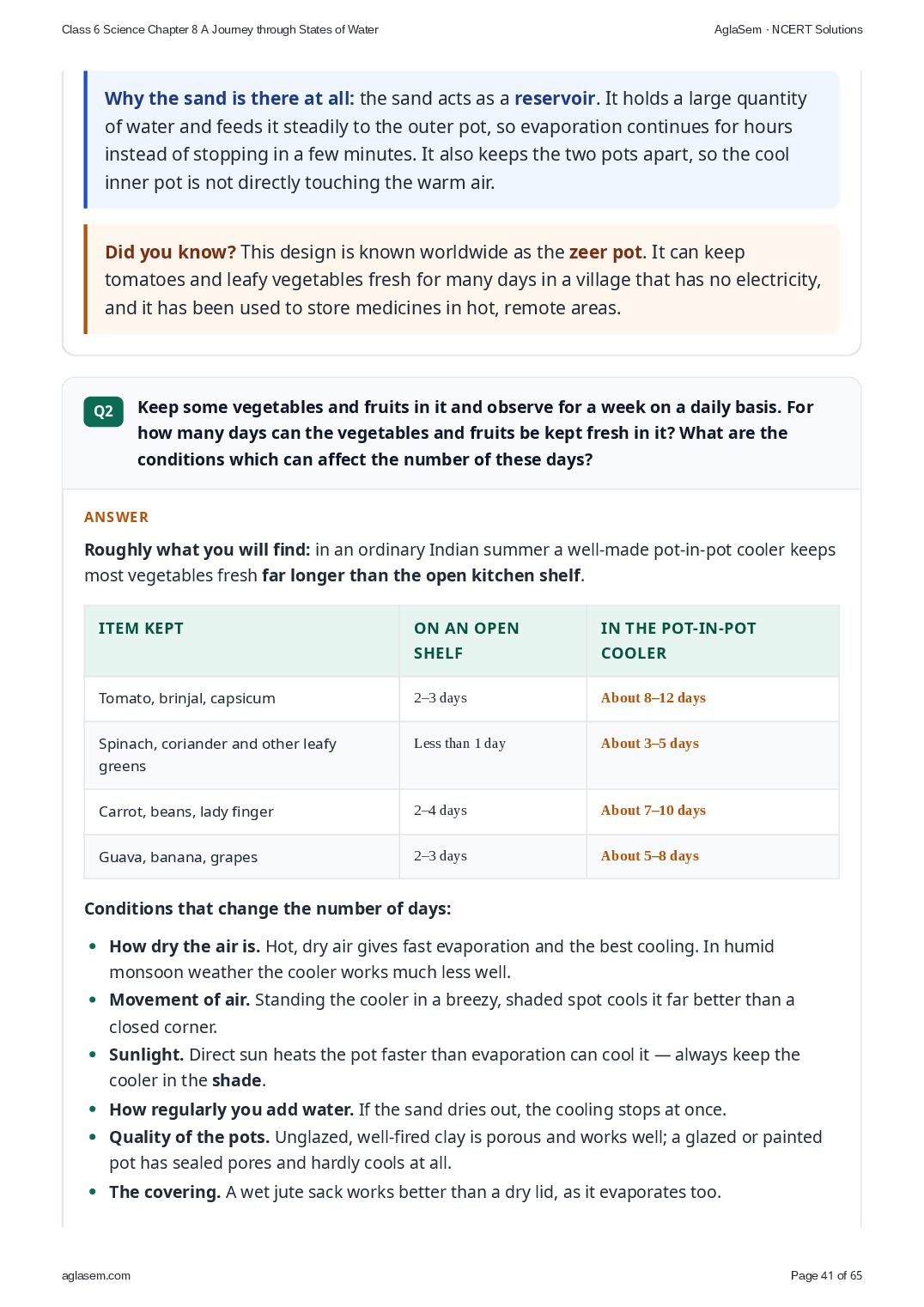
- Keep some vegetables and fruits in it and observe for a week on a daily basis. For how many days can the vegetables and fruits be kept fresh in it? What are the conditions which can affect the number of these days?
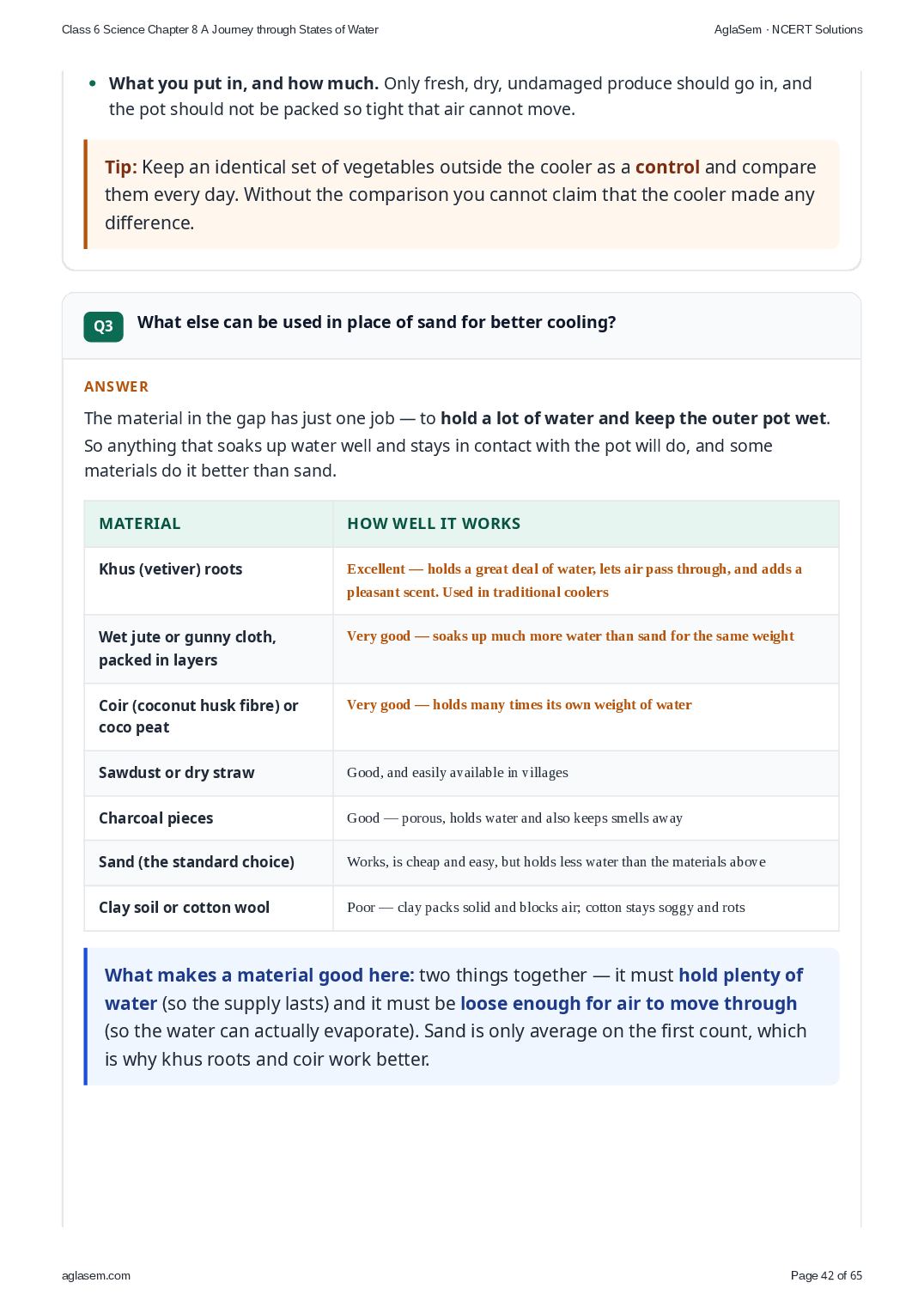
- What else can be used in place of sand for better cooling?
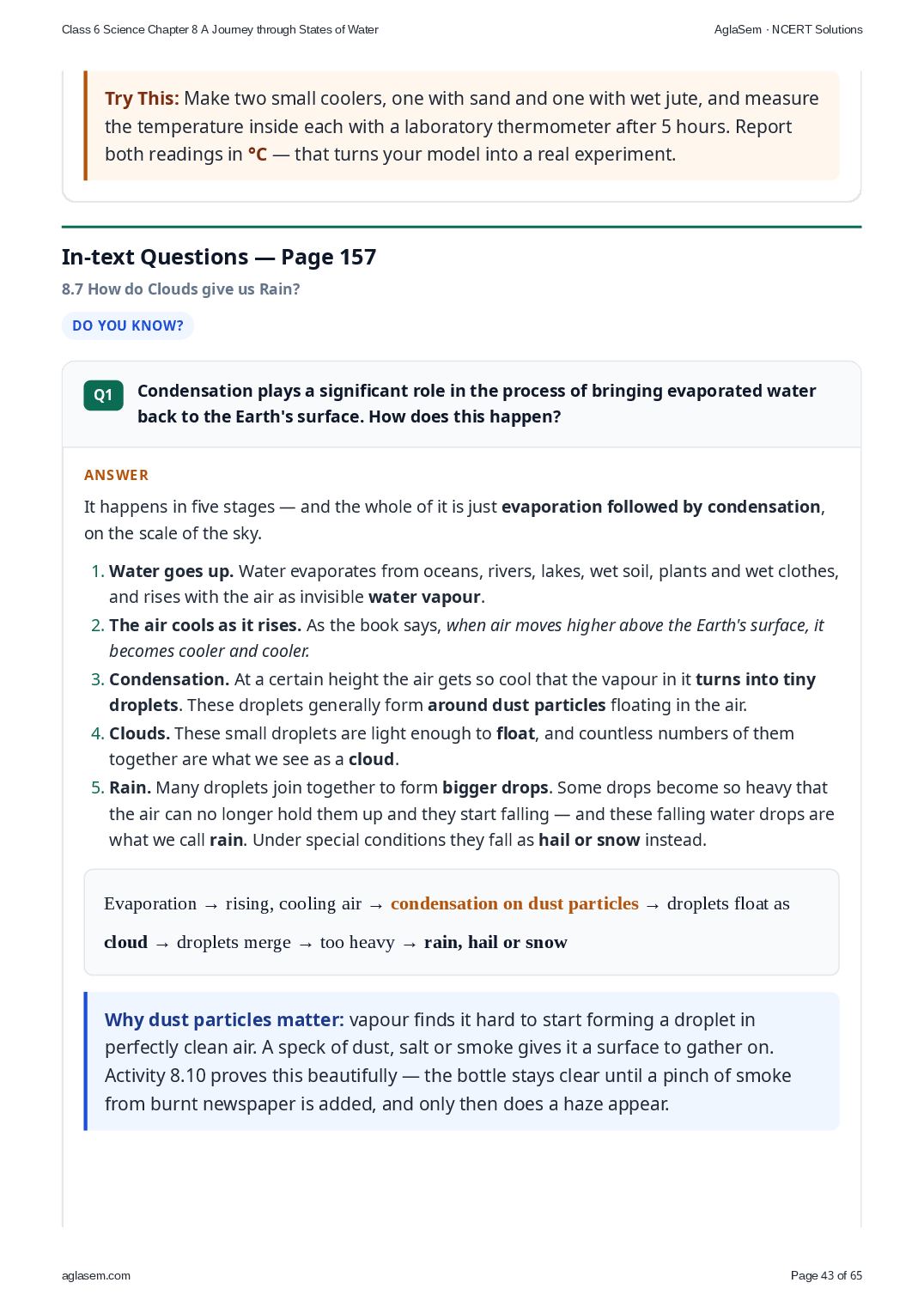
- Condensation plays a significant role in the process of bringing evaporated water back to the Earth's surface. How does this happen?
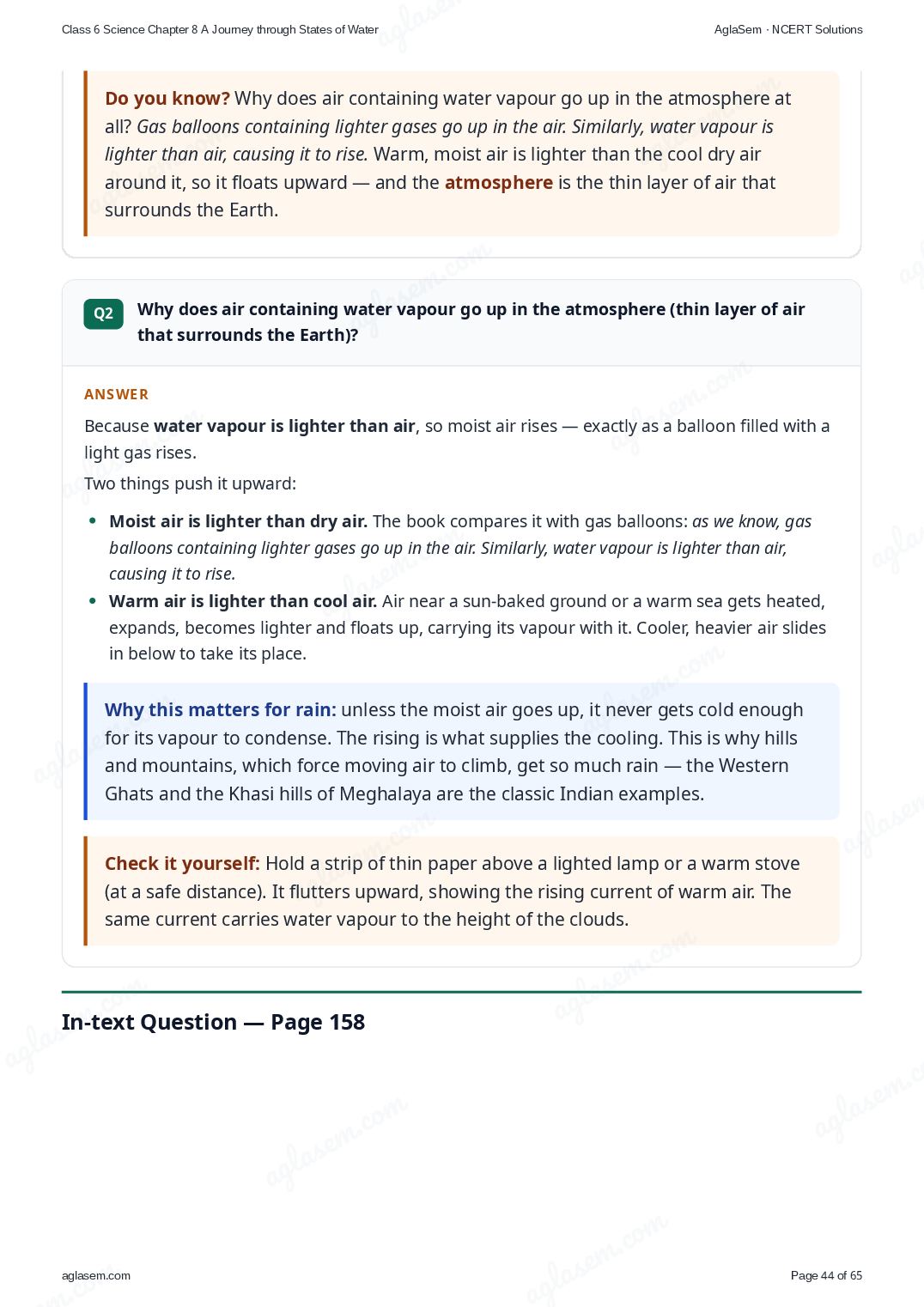
- Why does air containing water vapour go up in the atmosphere (thin layer of air that surrounds the Earth)?
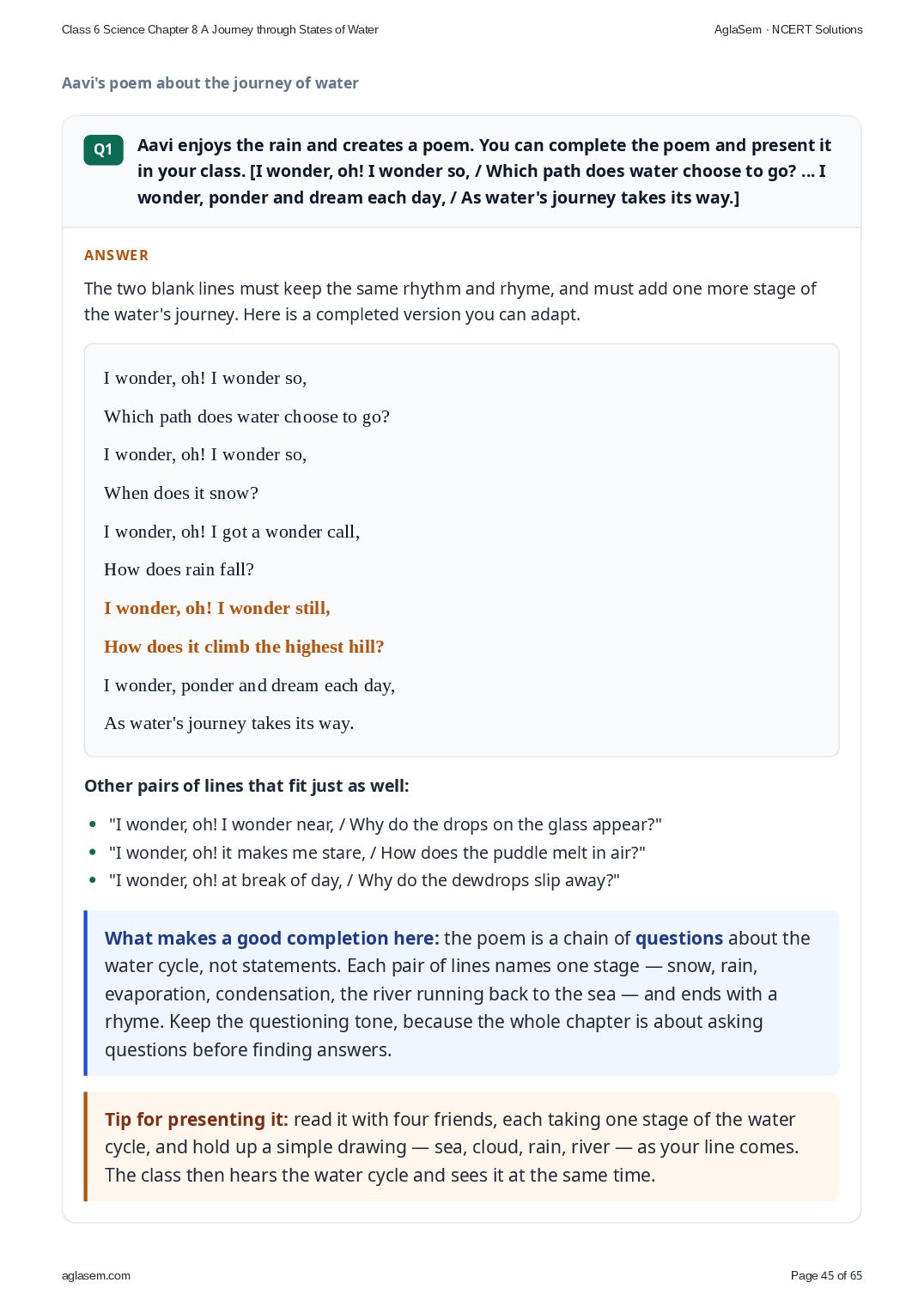
- Aavi enjoys the rain and creates a poem. You can complete the poem and present it in your class. [I wonder, oh! I wonder so, / Which path does water choose to go? … I wonder, ponder and dream each day, / As water's journey takes its way.]
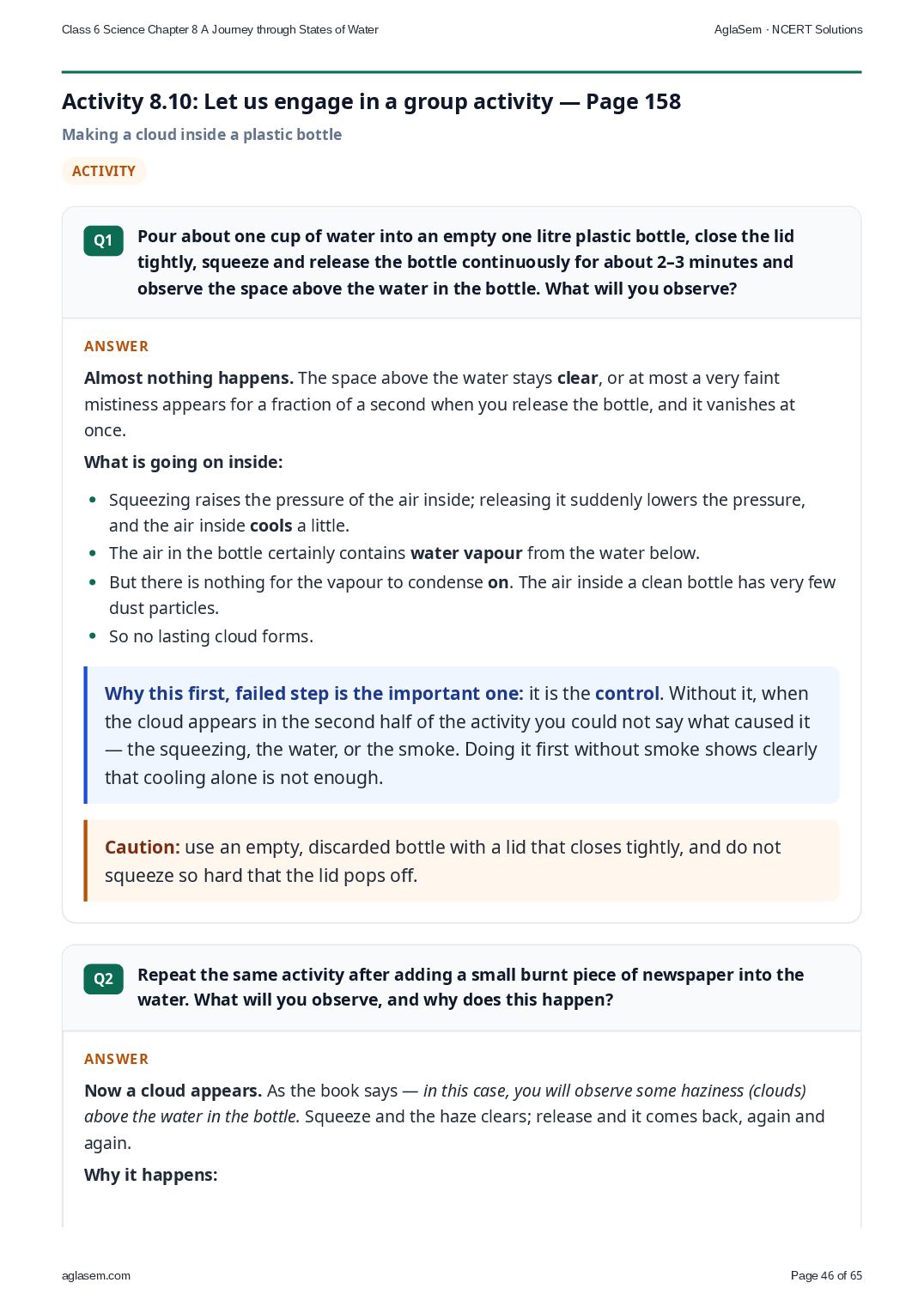
- Pour about one cup of water into an empty one litre plastic bottle, close the lid tightly, squeeze and release the bottle continuously for about 2–3 minutes and observe the space above the water in the bottle. What will you observe?
- Repeat the same activity after adding a small burnt piece of newspaper into the water. What will you observe, and why does this happen?
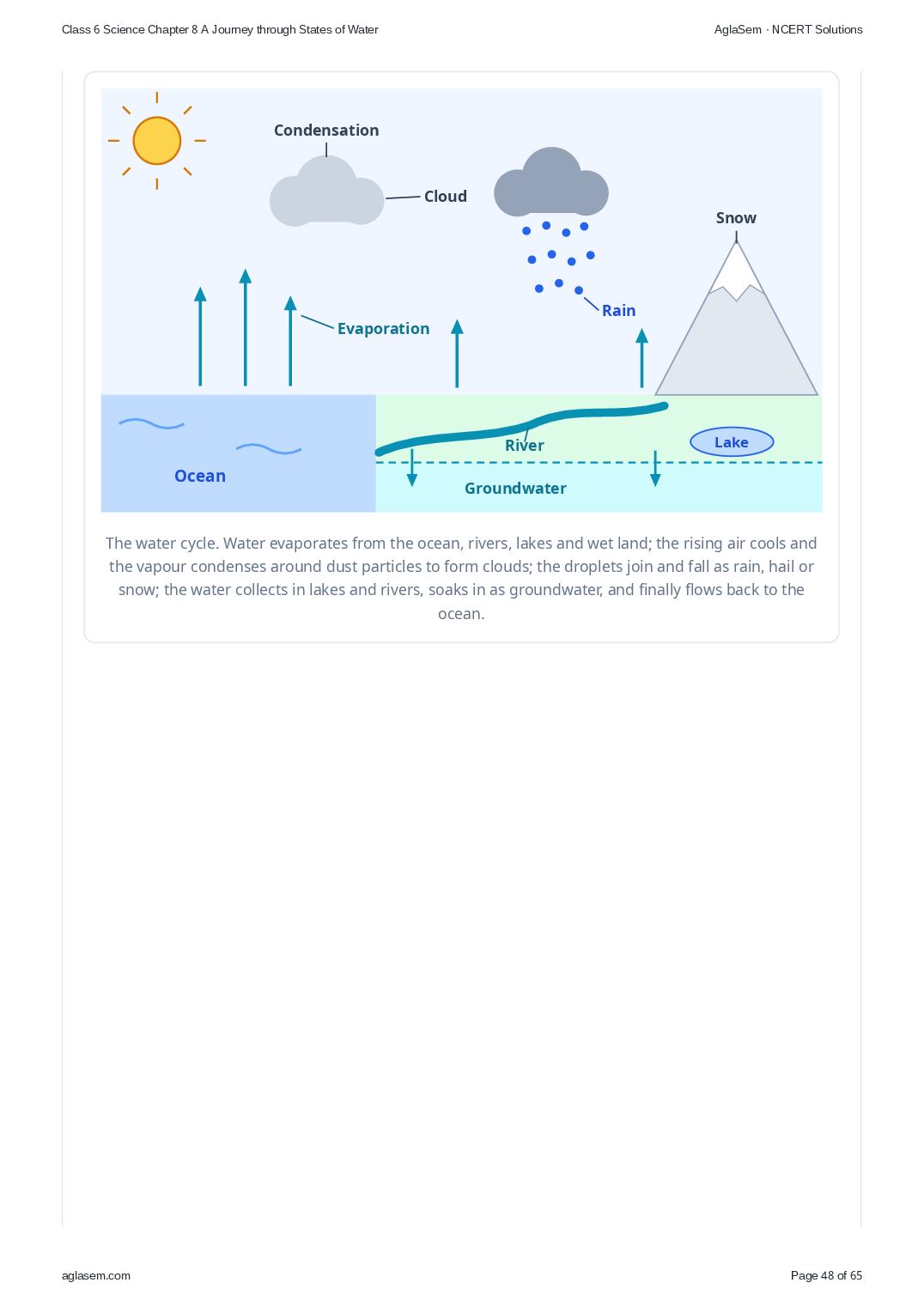
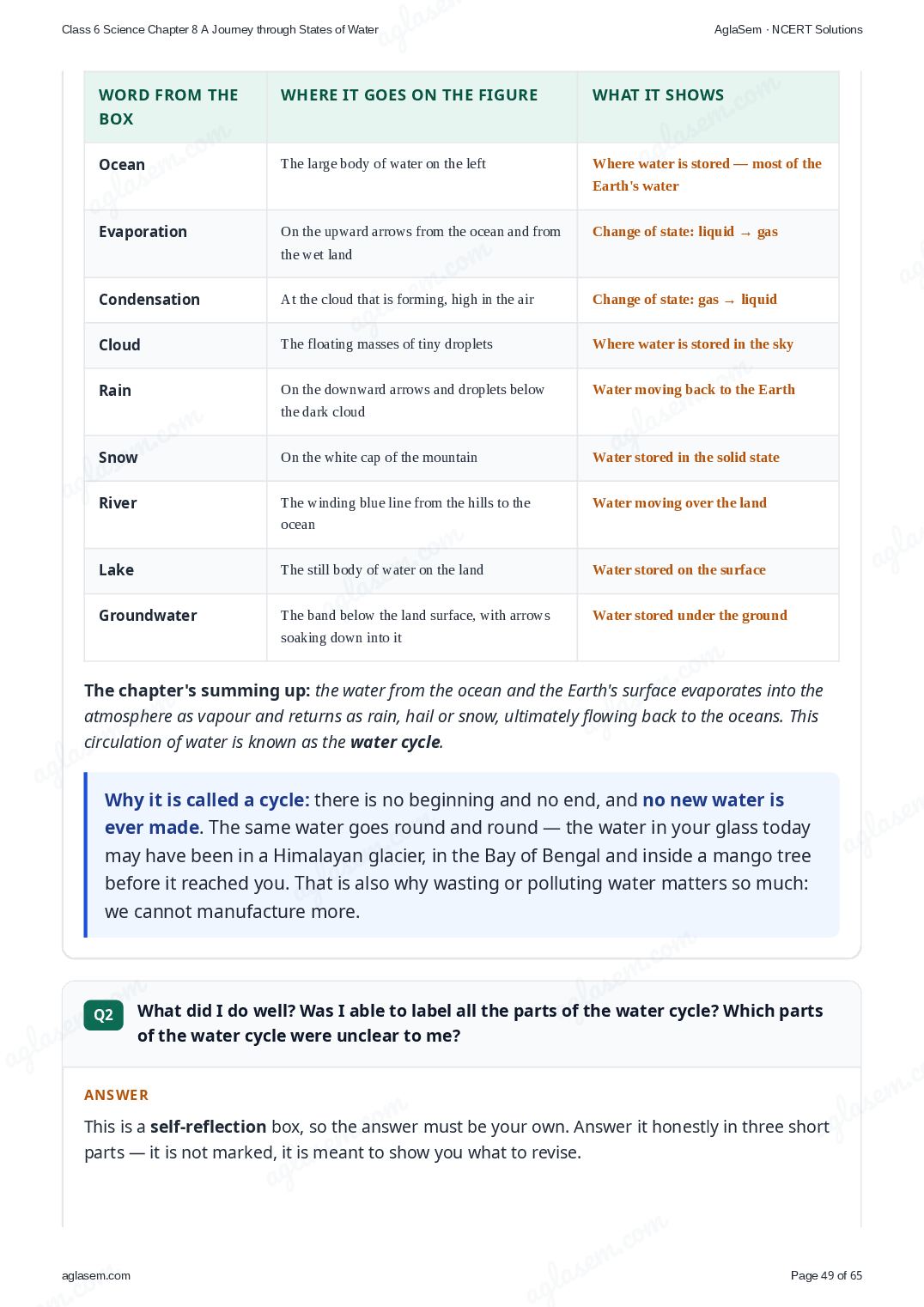
- Label Fig. 8.9 using arrows shown and the words given in the box to show where water is stored, how water changes its state and where it moves. [Cloud, Lake, Ocean, River, Groundwater, Evaporation, Condensation, Rain, Snow]
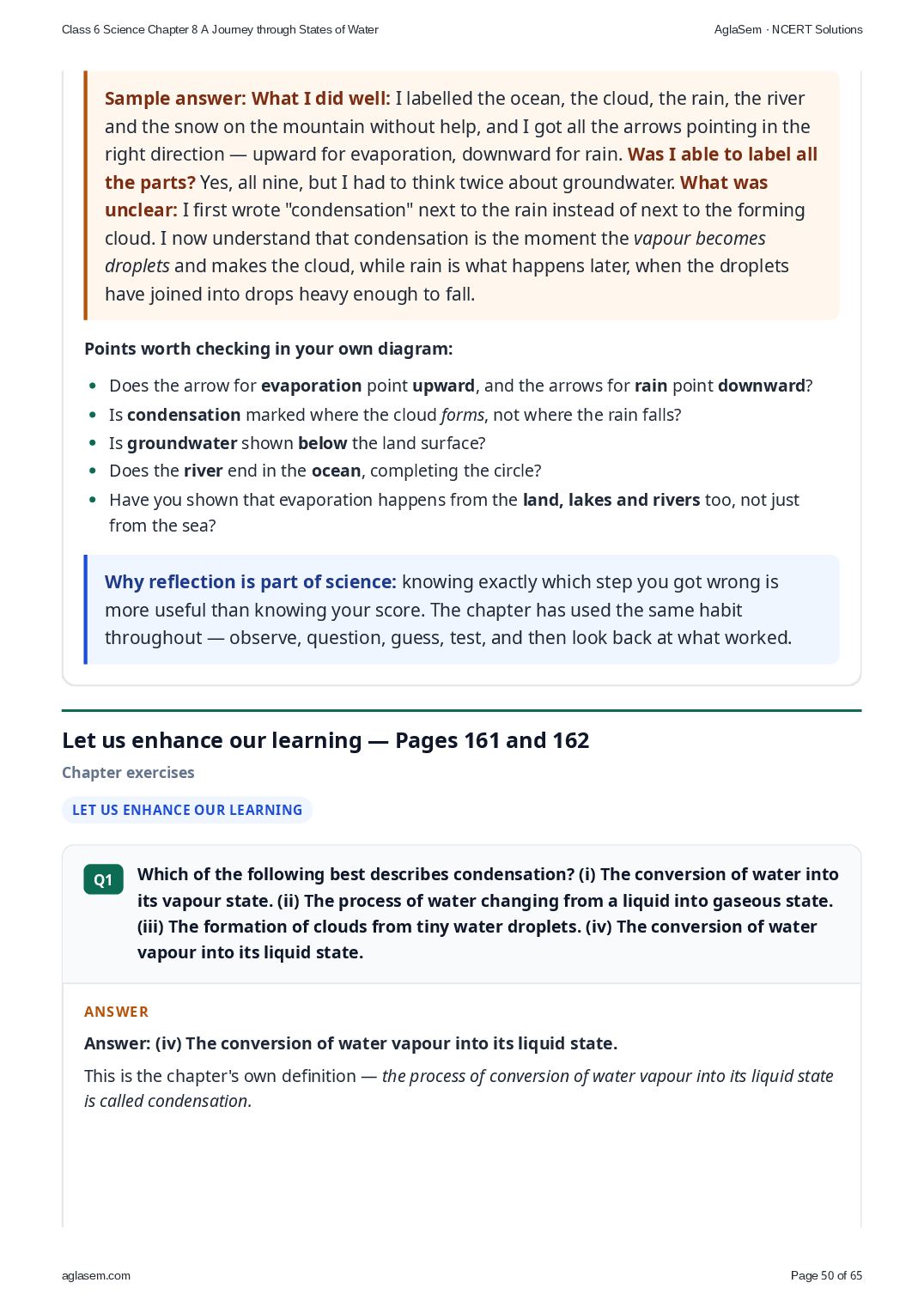
- What did I do well? Was I able to label all the parts of the water cycle? Which parts of the water cycle were unclear to me?
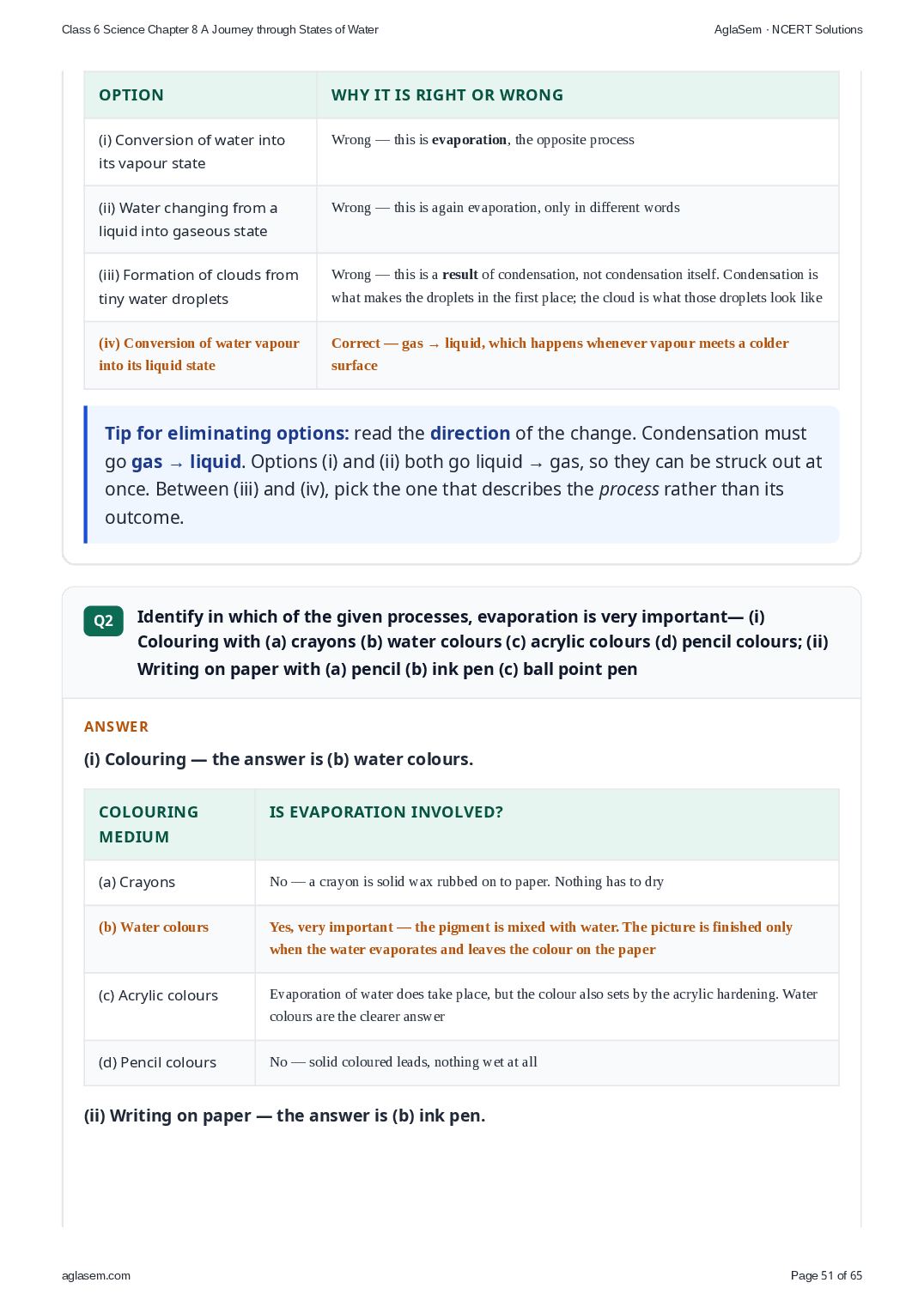
- Which of the following best describes condensation? (i) The conversion of water into its vapour state. (ii) The process of water changing from a liquid into gaseous state. (iii) The formation of clouds from tiny water droplets. (iv) The conversion of water vapour into its liquid state.
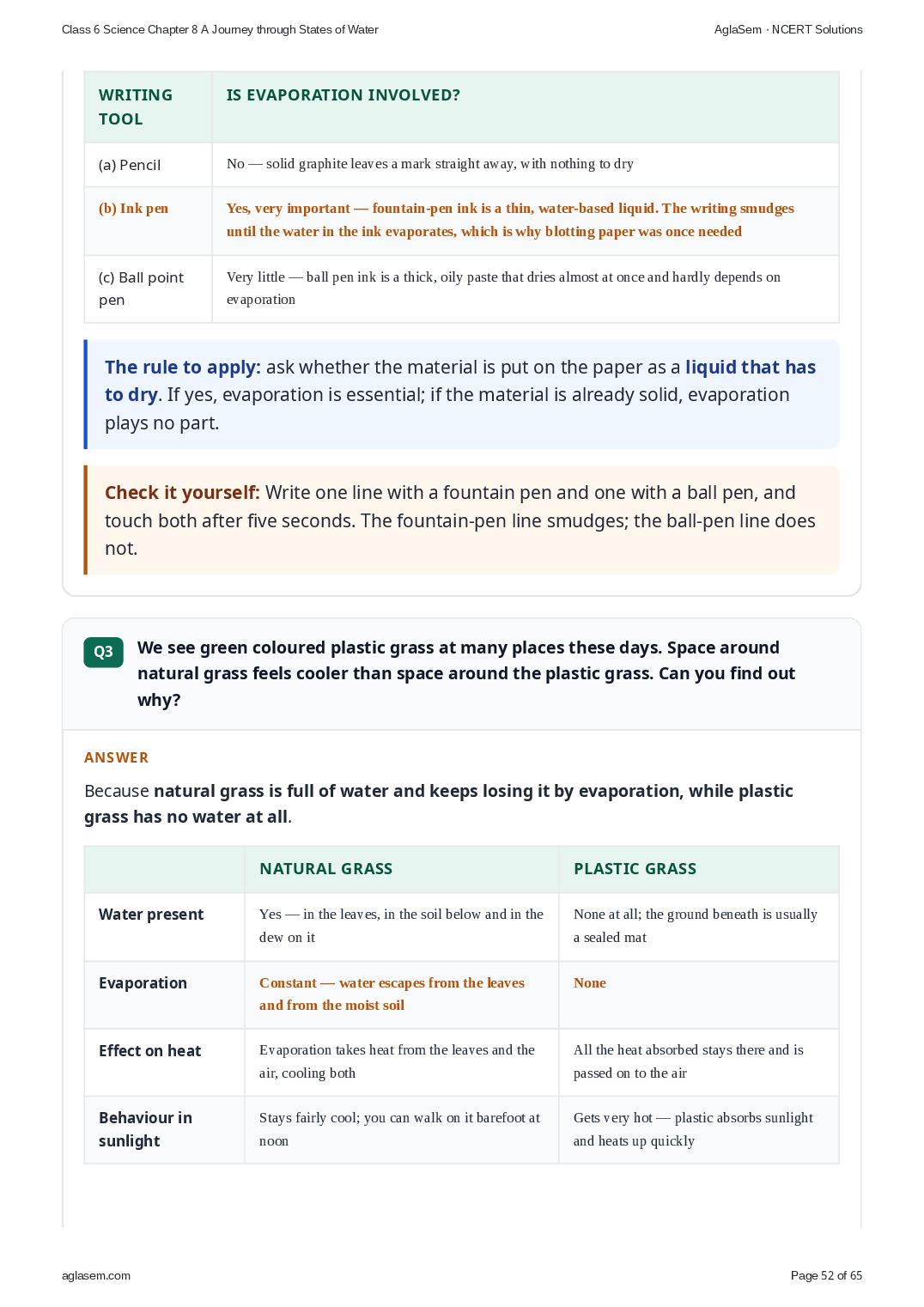
- Identify in which of the given processes, evaporation is very important— (i) Colouring with (a) crayons (b) water colours (c) acrylic colours (d) pencil colours; (ii) Writing on paper with (a) pencil (b) ink pen (c) ball point pen
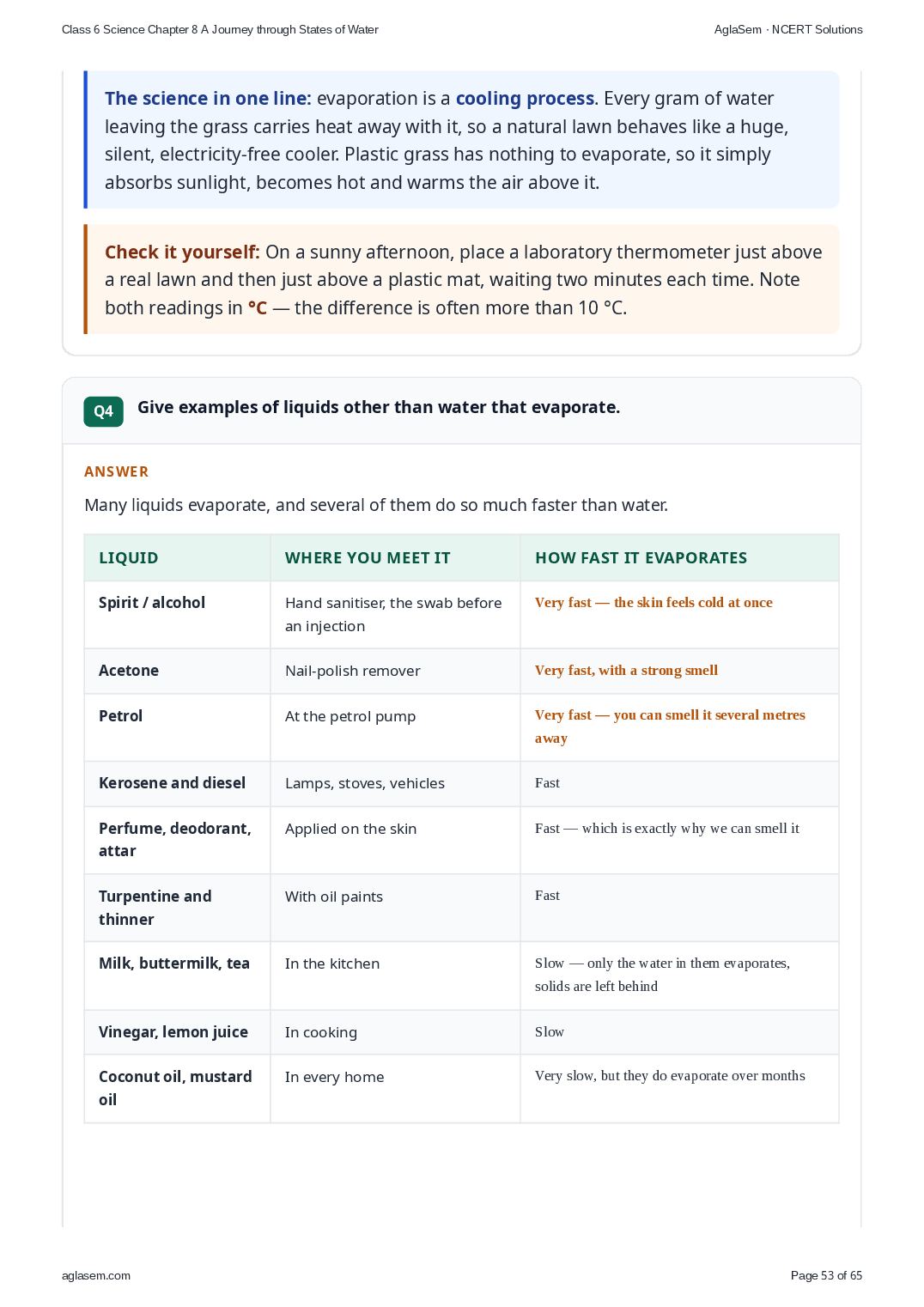
- We see green coloured plastic grass at many places these days. Space around natural grass feels cooler than space around the plastic grass. Can you find out why?
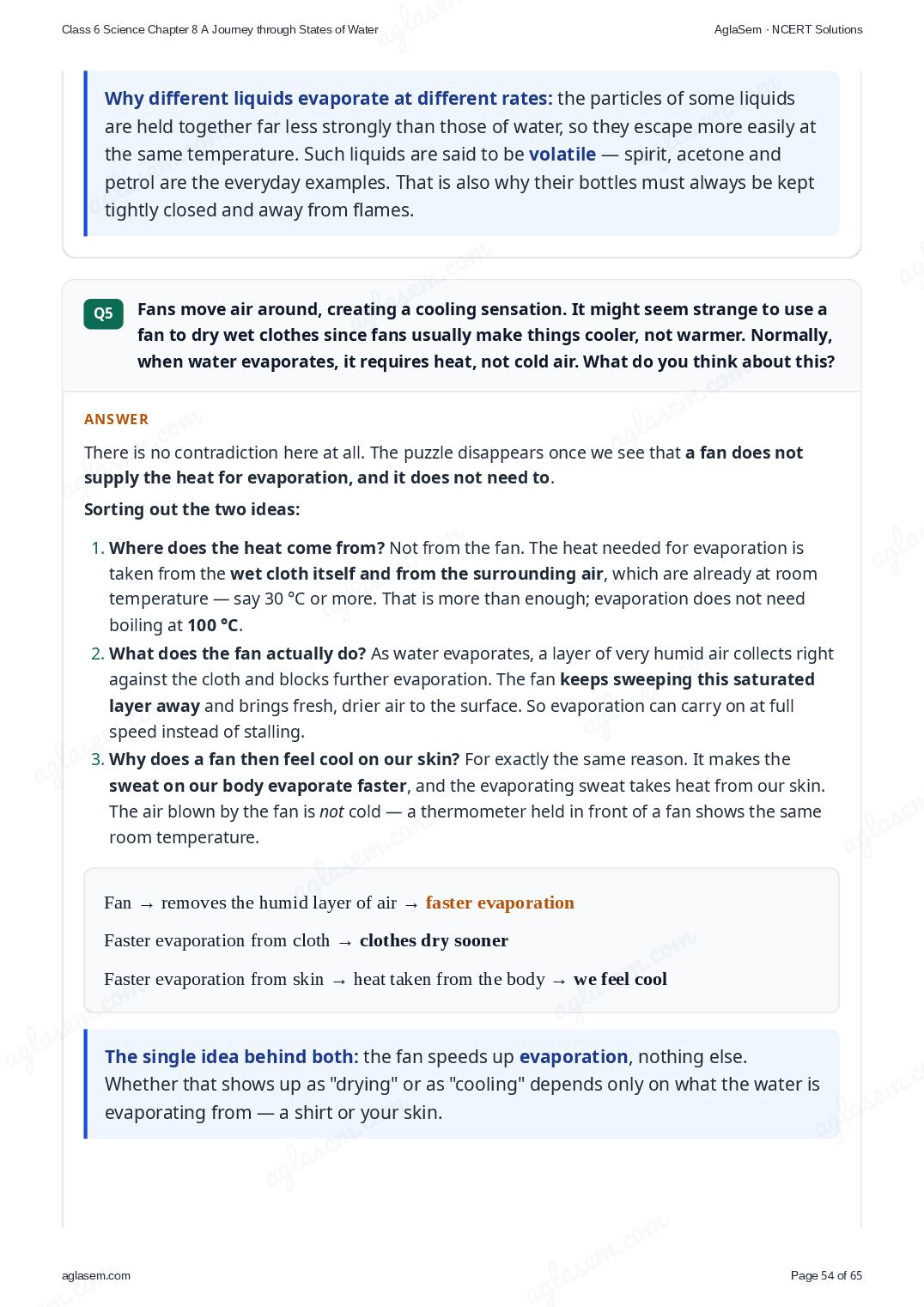
- Give examples of liquids other than water that evaporate.
- Fans move air around, creating a cooling sensation. It might seem strange to use a fan to dry wet clothes since fans usually make things cooler, not warmer. Normally, when water evaporates, it requires heat, not cold air. What do you think about this?
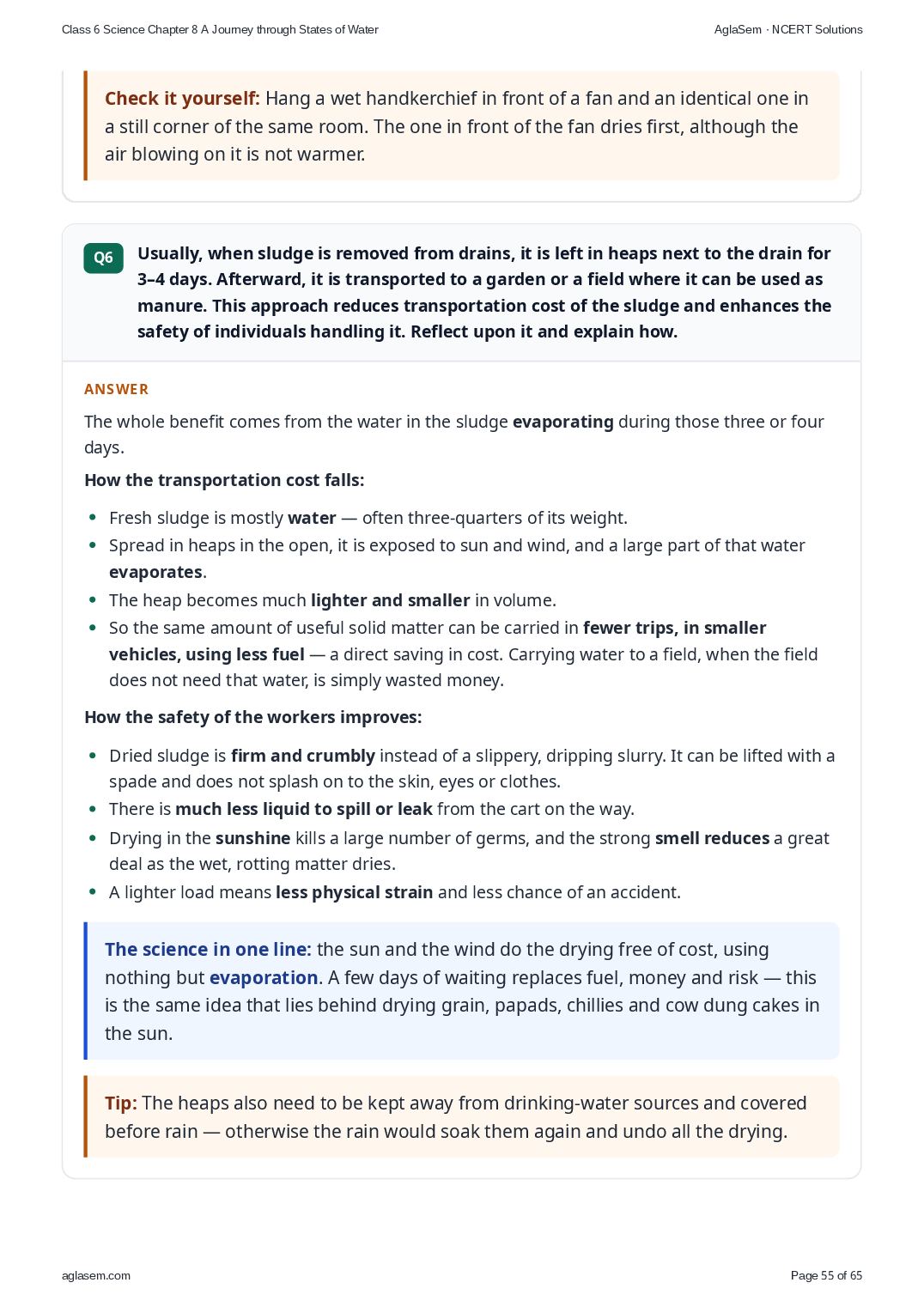
- Usually, when sludge is removed from drains, it is left in heaps next to the drain for 3–4 days. Afterward, it is transported to a garden or a field where it can be used as manure. This approach reduces transportation cost of the sludge and enhances the safety of individuals handling it. Reflect upon it and explain how.
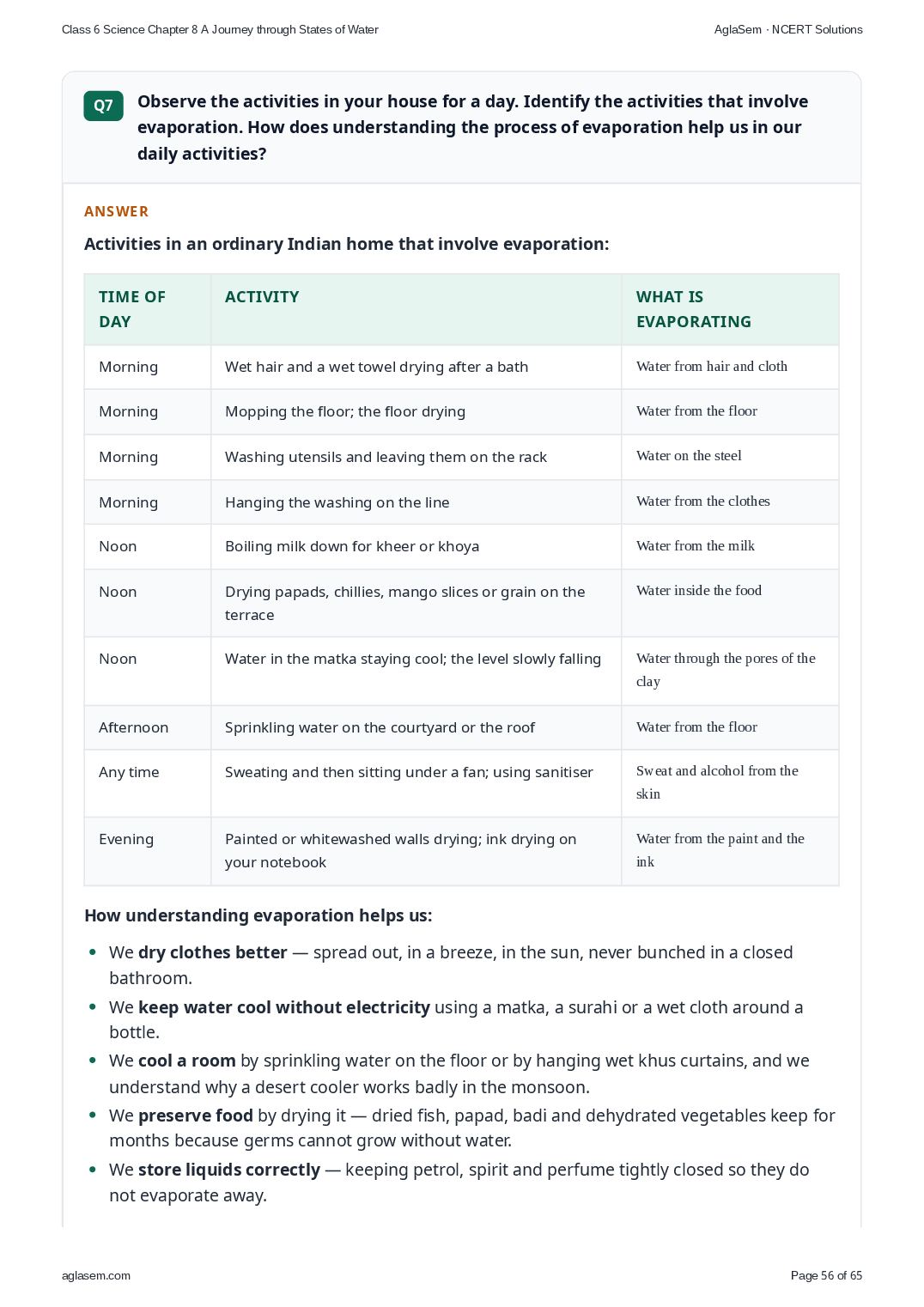
- Observe the activities in your house for a day. Identify the activities that involve evaporation. How does understanding the process of evaporation help us in our daily activities?
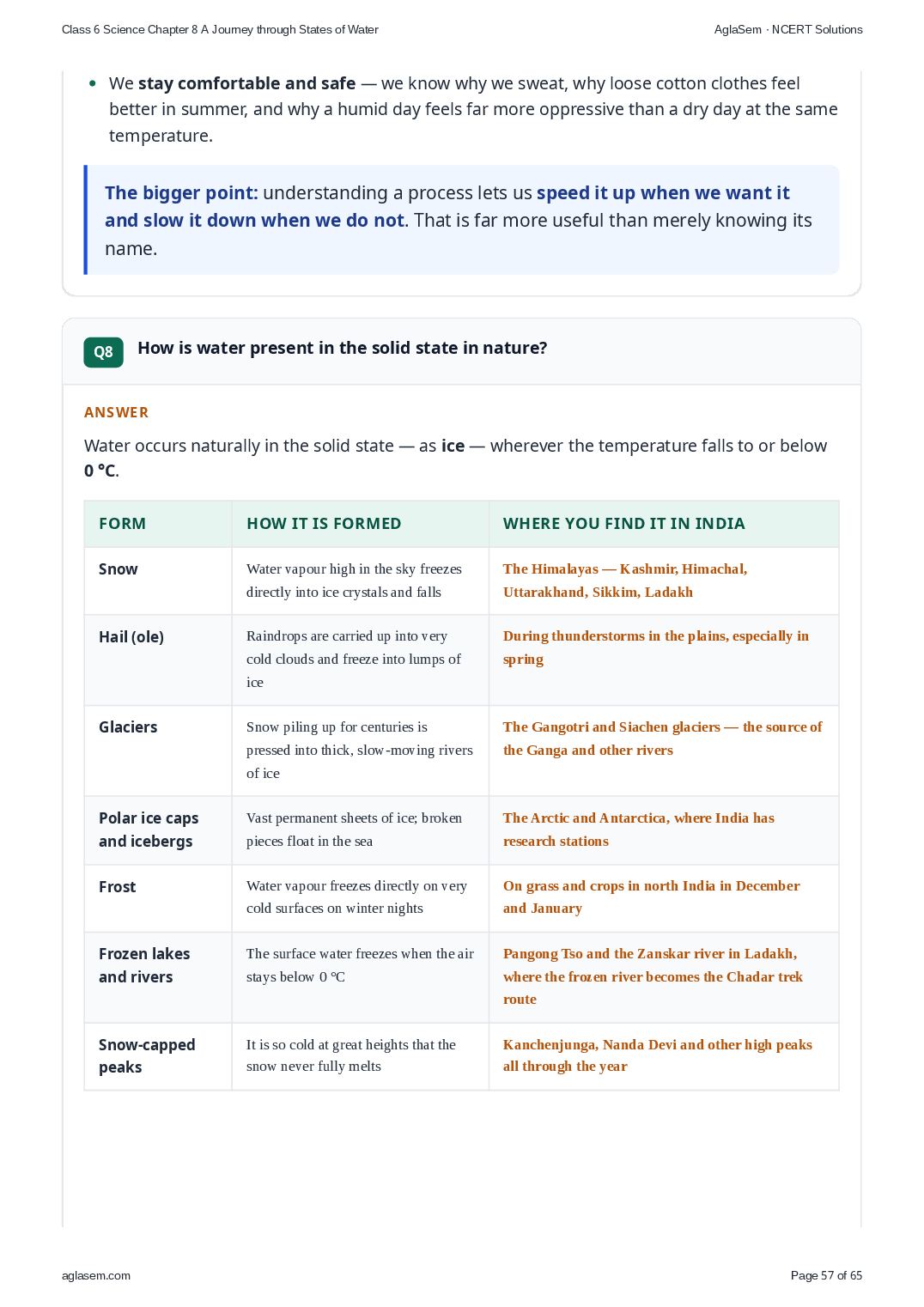
- How is water present in the solid state in nature?
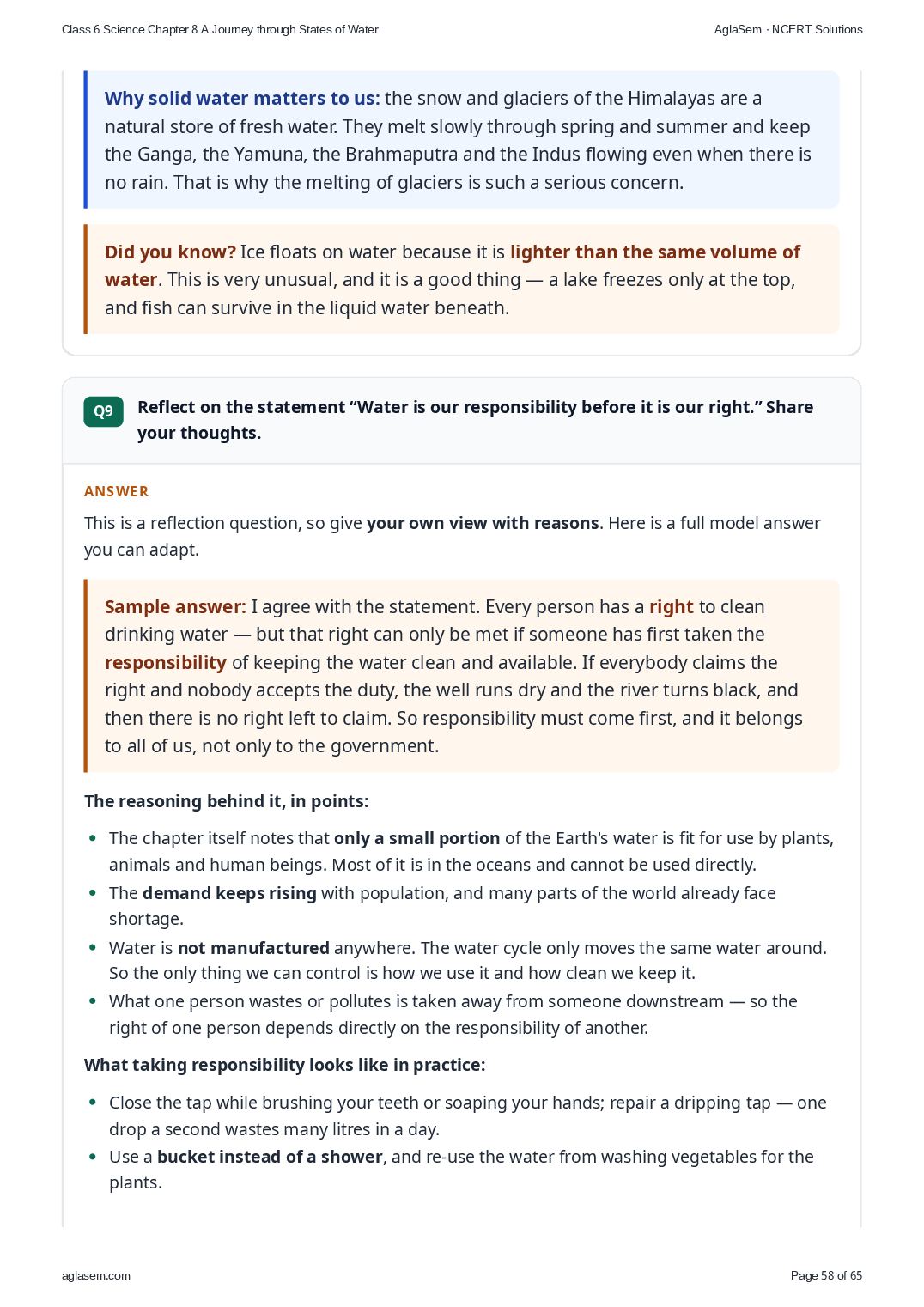
- Reflect on the statement “Water is our responsibility before it is our right.” Share your thoughts.
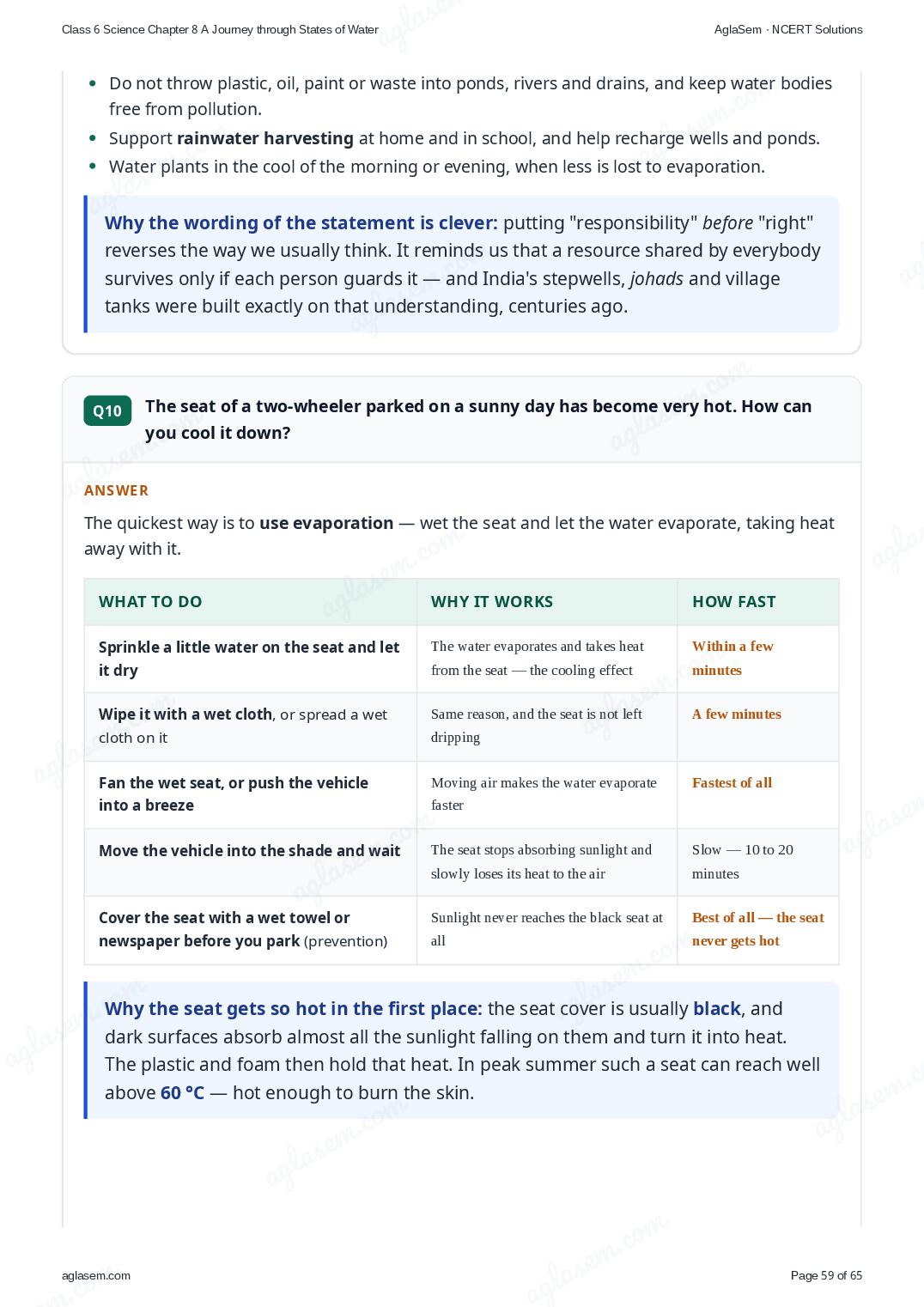
- The seat of a two-wheeler parked on a sunny day has become very hot. How can you cool it down?
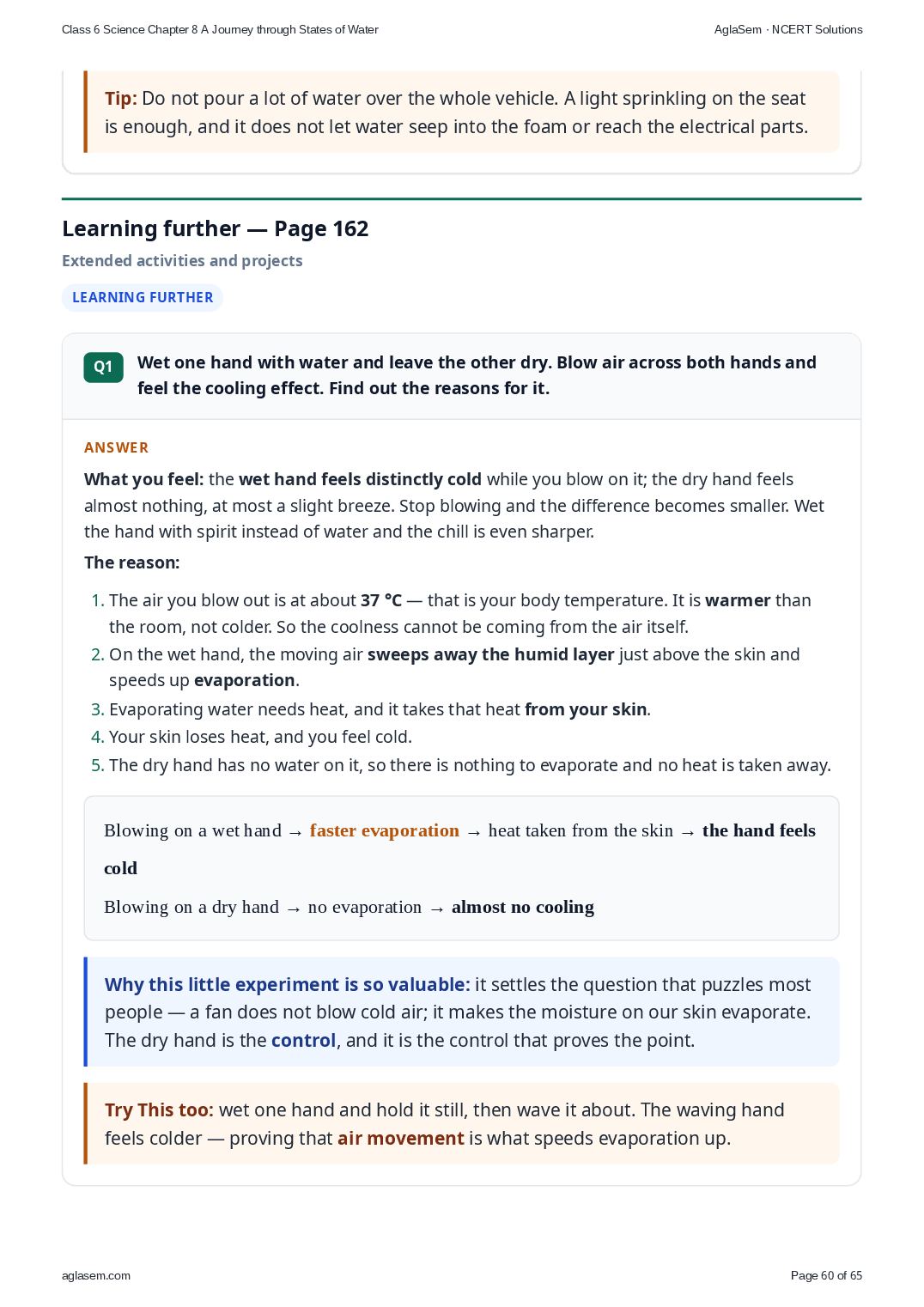
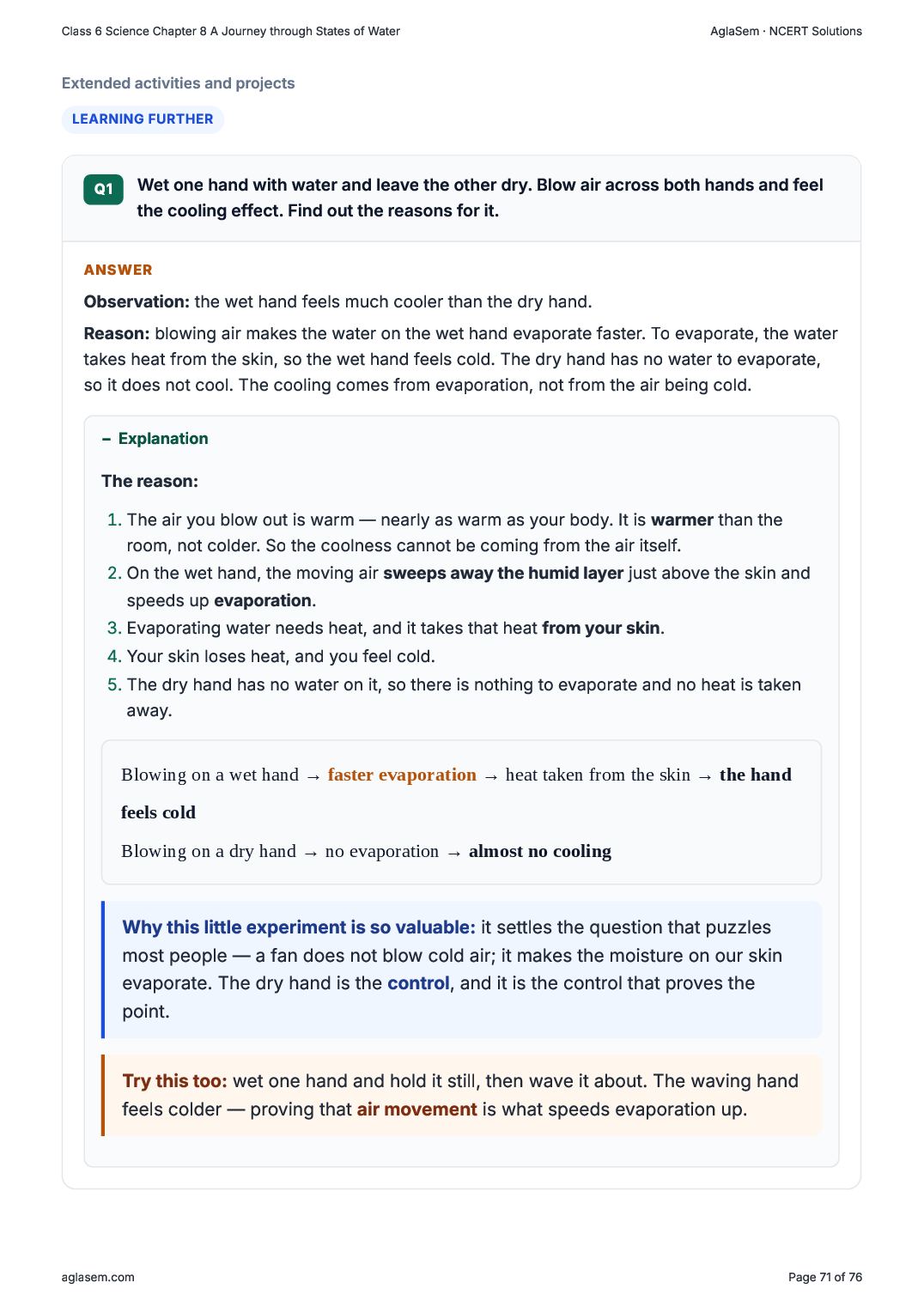
- Wet one hand with water and leave the other dry. Blow air across both hands and feel the cooling effect. Find out the reasons for it.
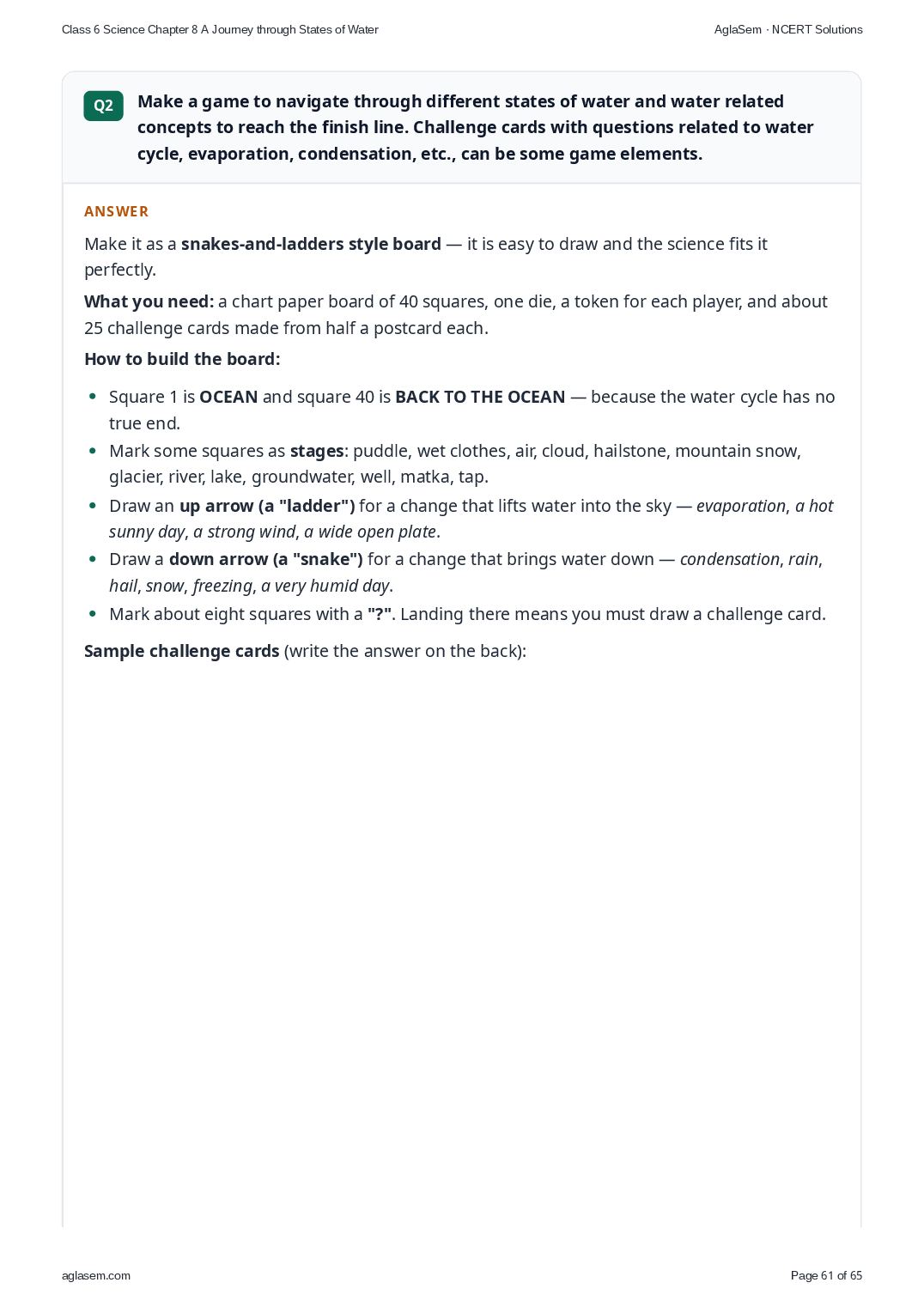
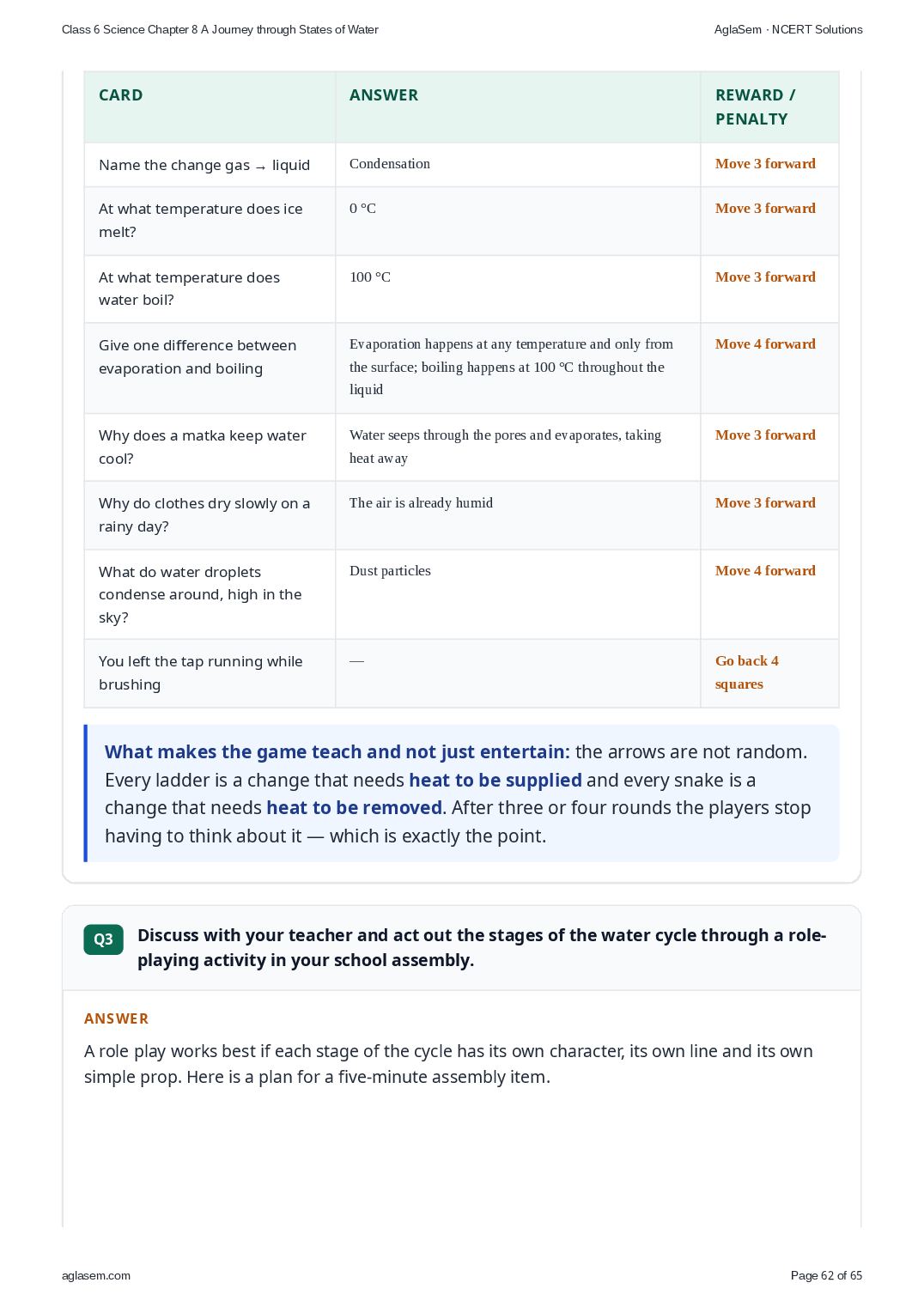
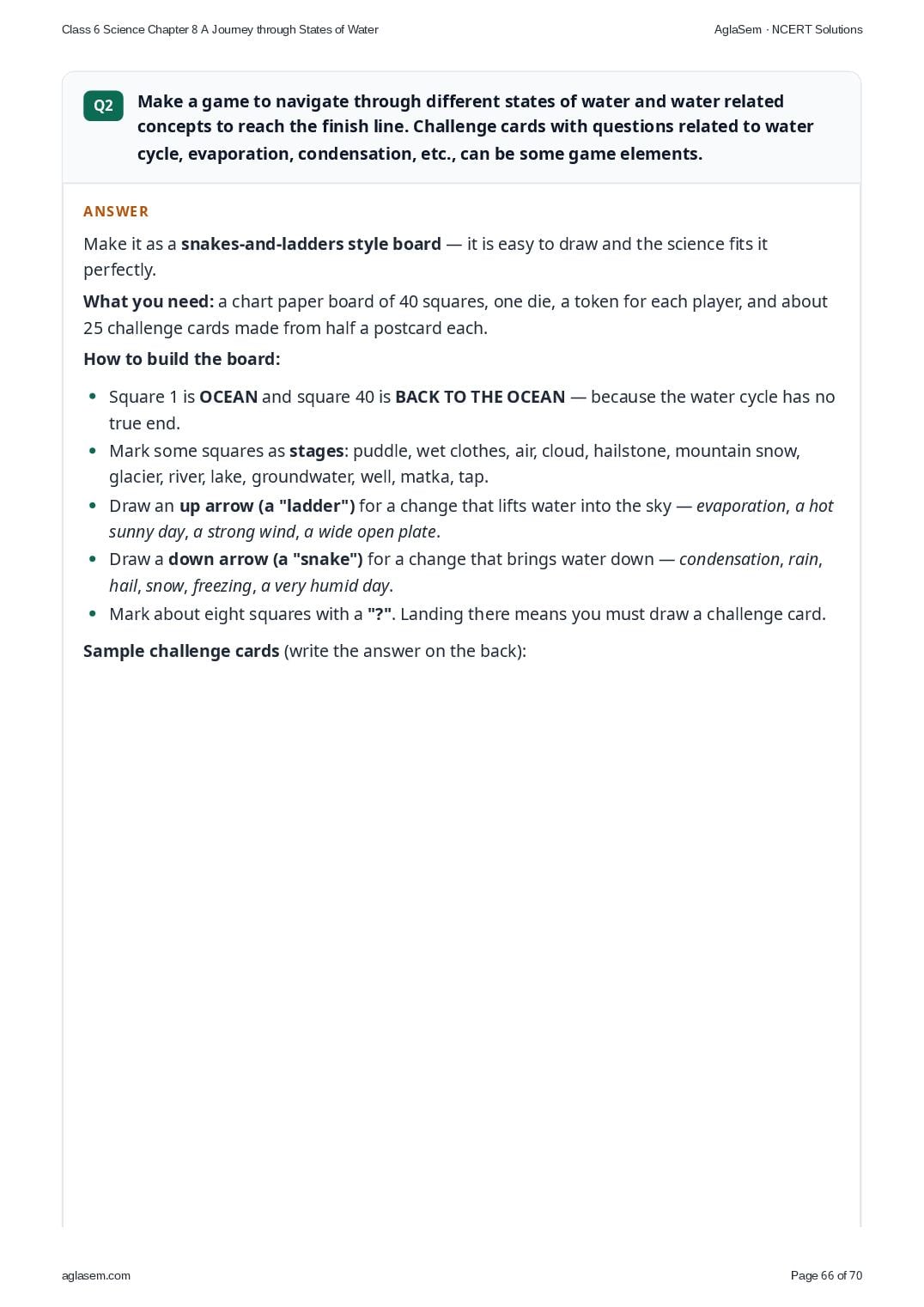
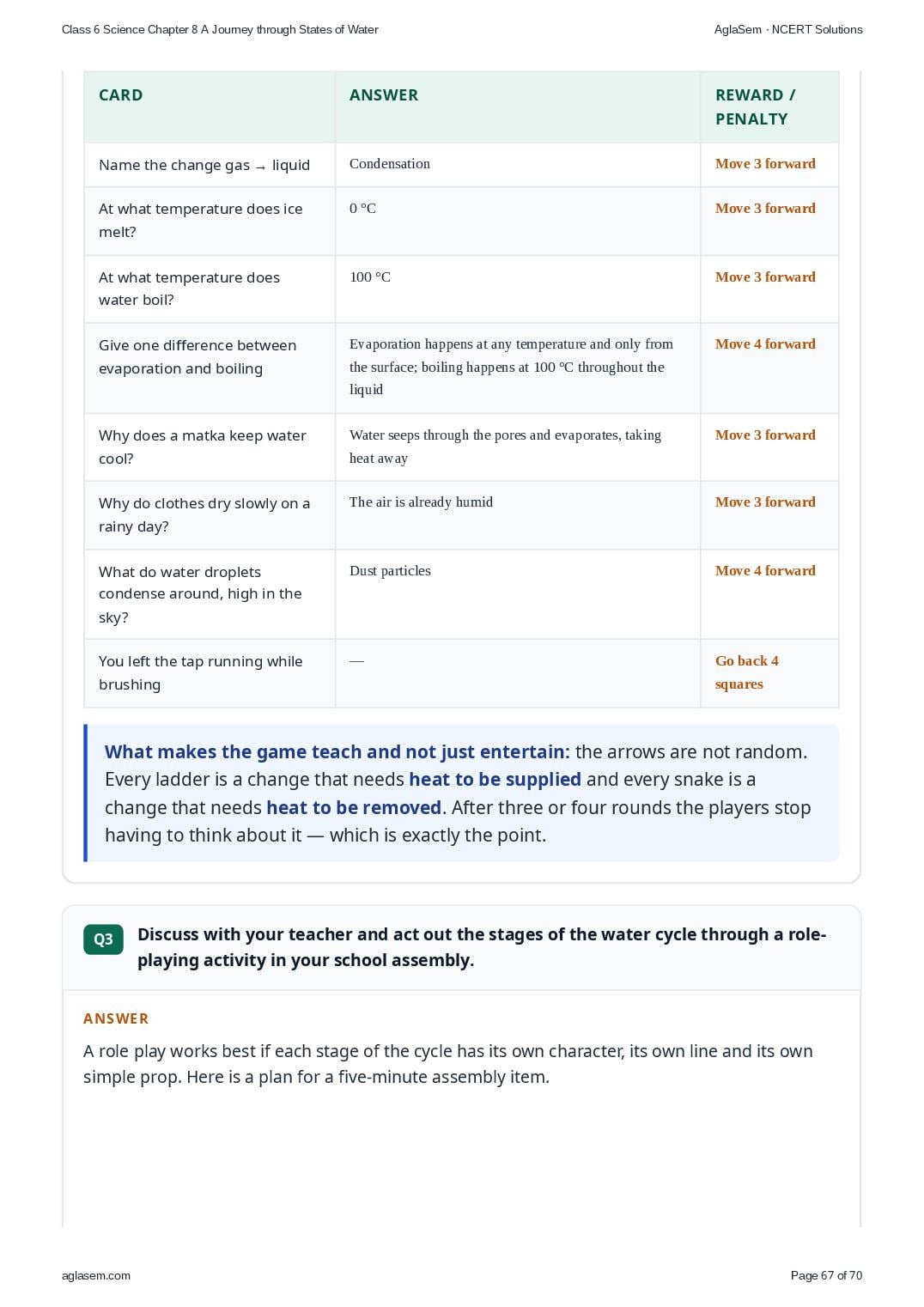
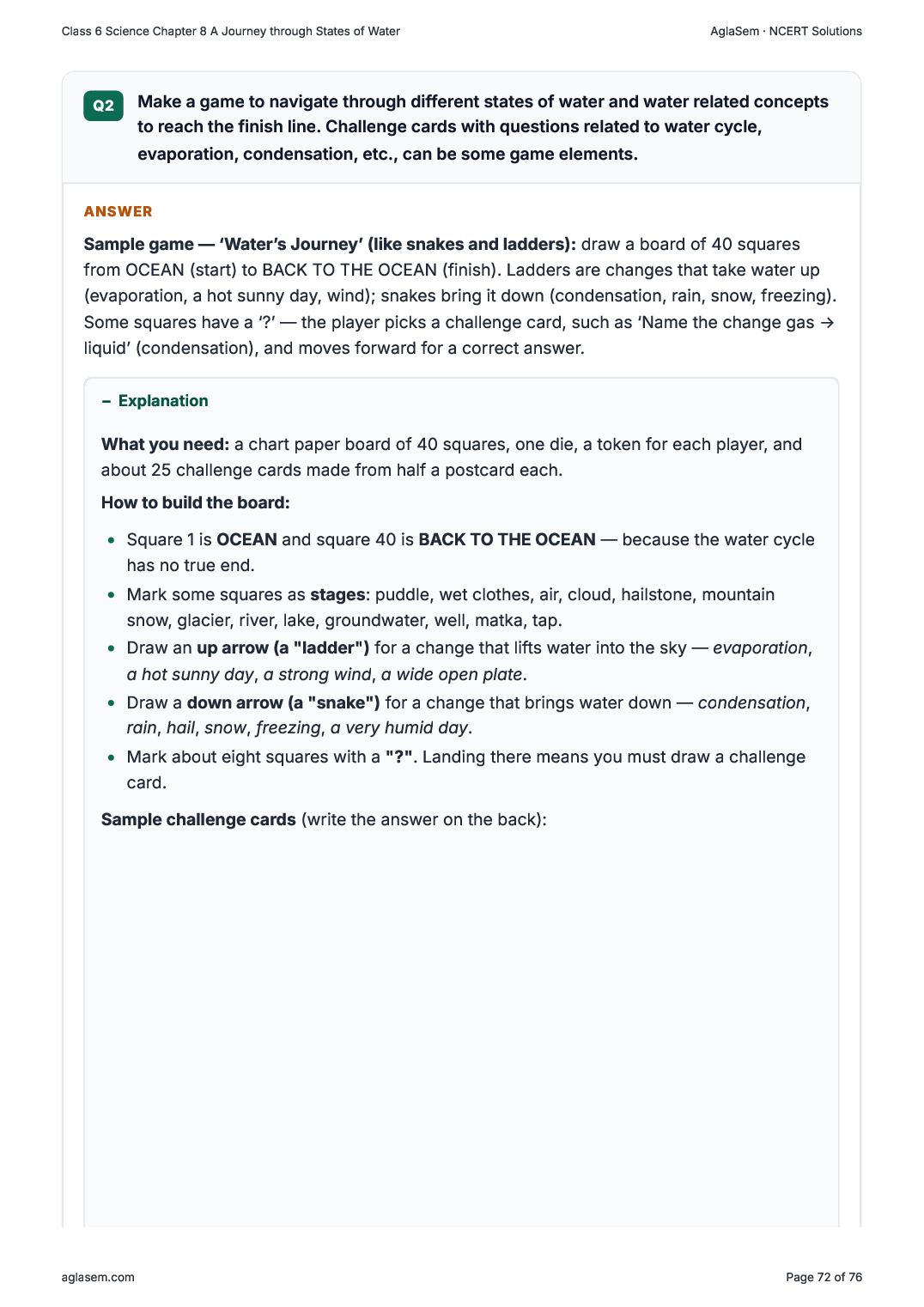
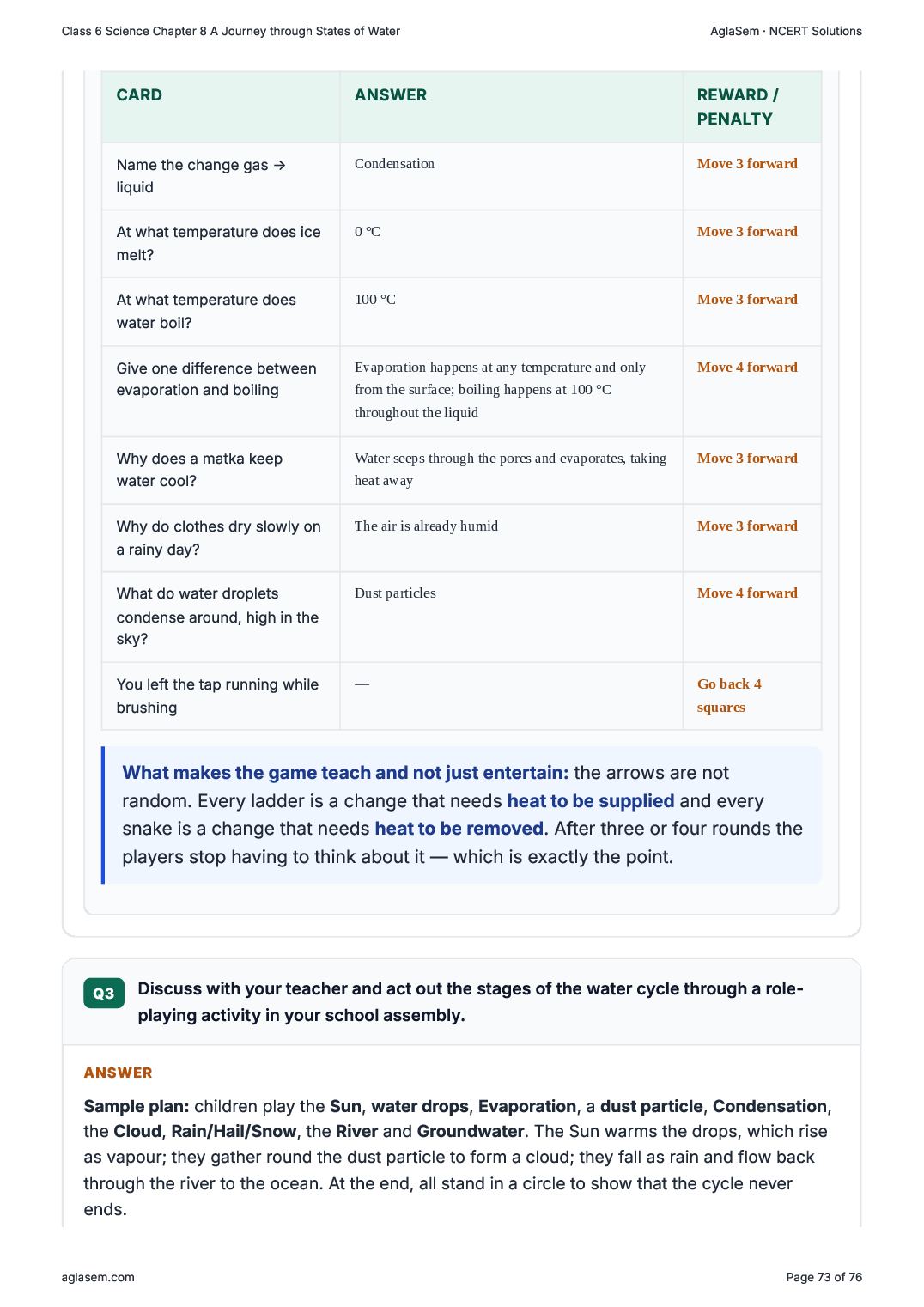
- Make a game to navigate through different states of water and water related concepts to reach the finish line. Challenge cards with questions related to water cycle, evaporation, condensation, etc., can be some game elements.
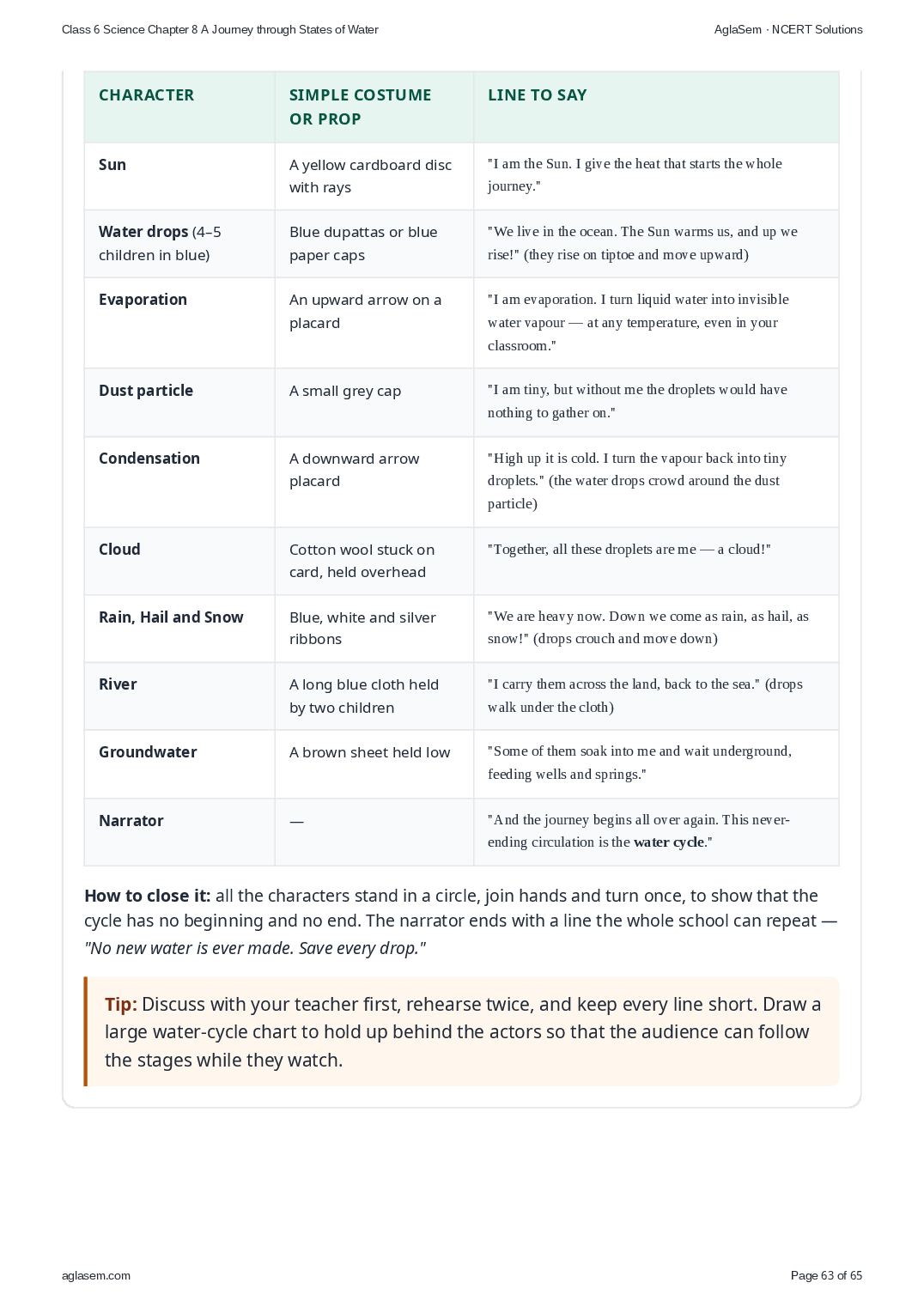
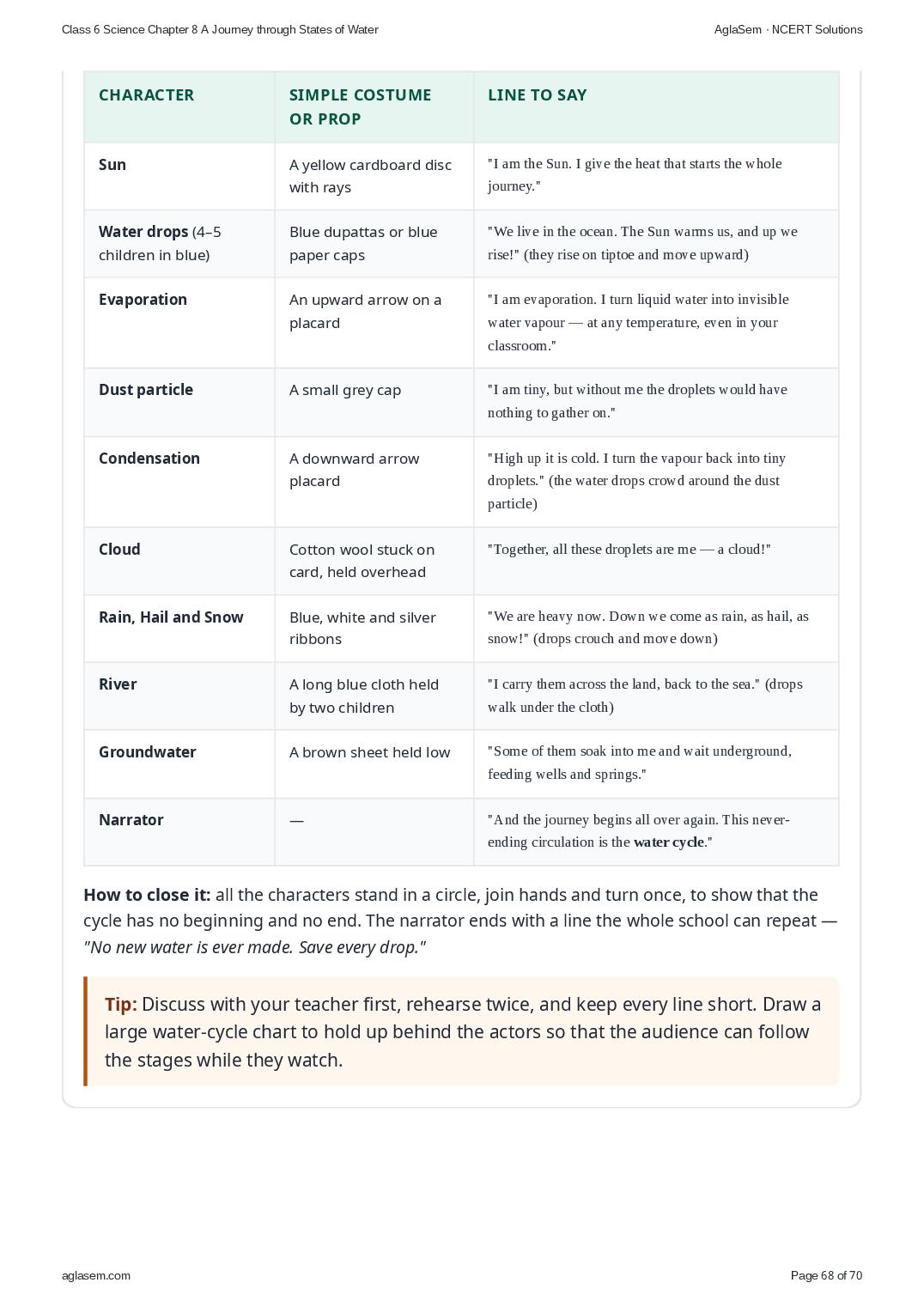
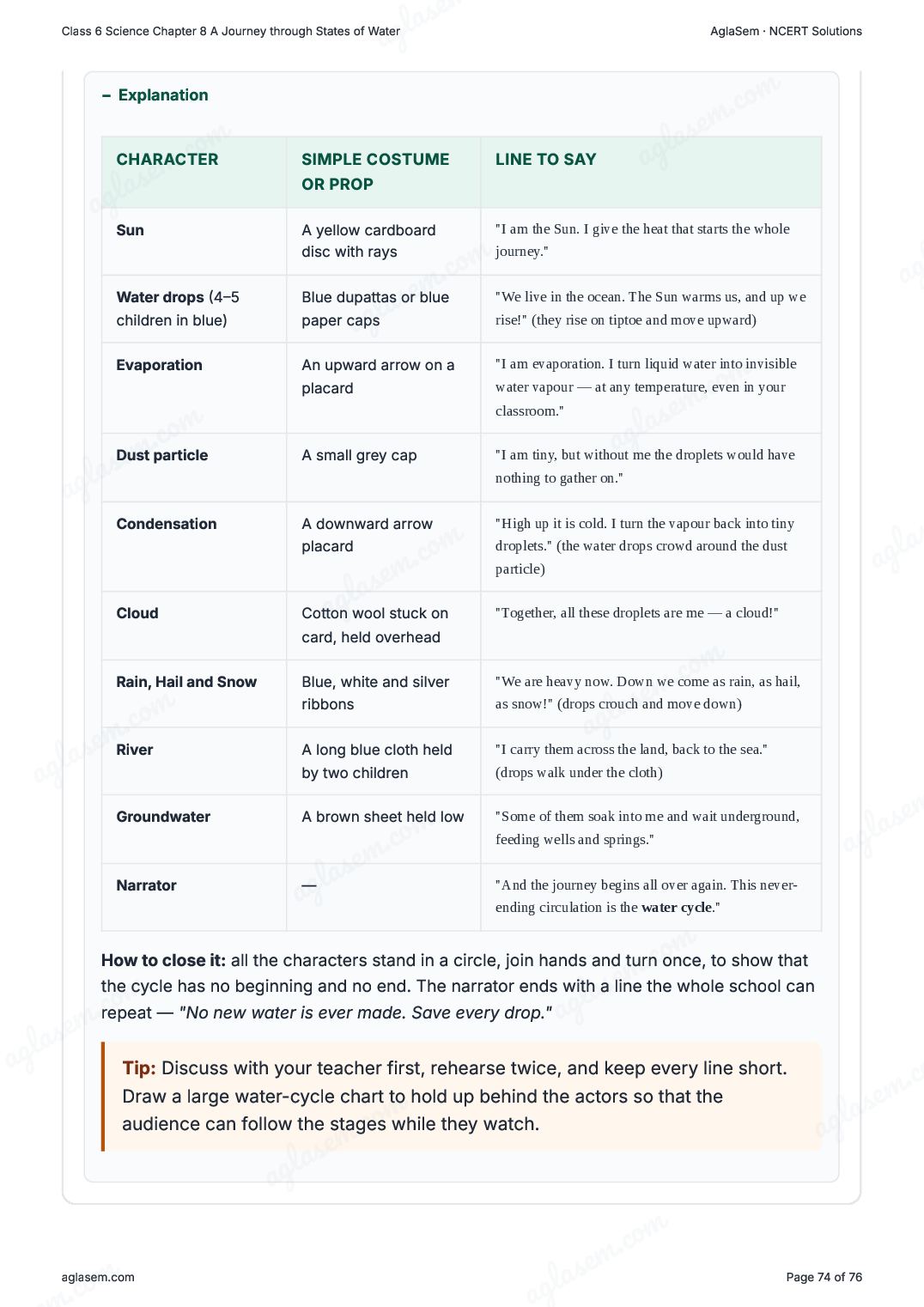
- Discuss with your teacher and act out the stages of the water cycle through a role-playing activity in your school assembly.
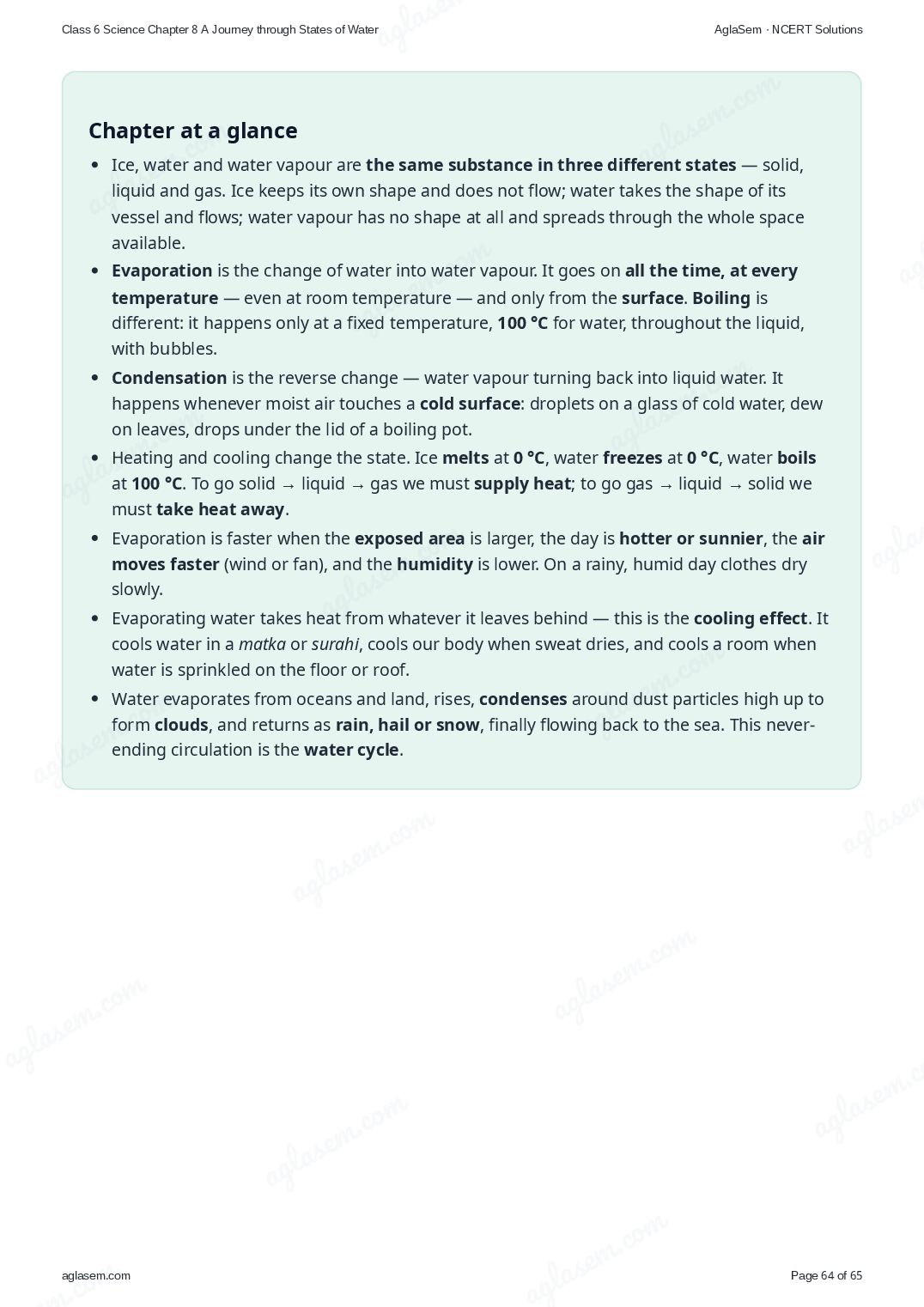
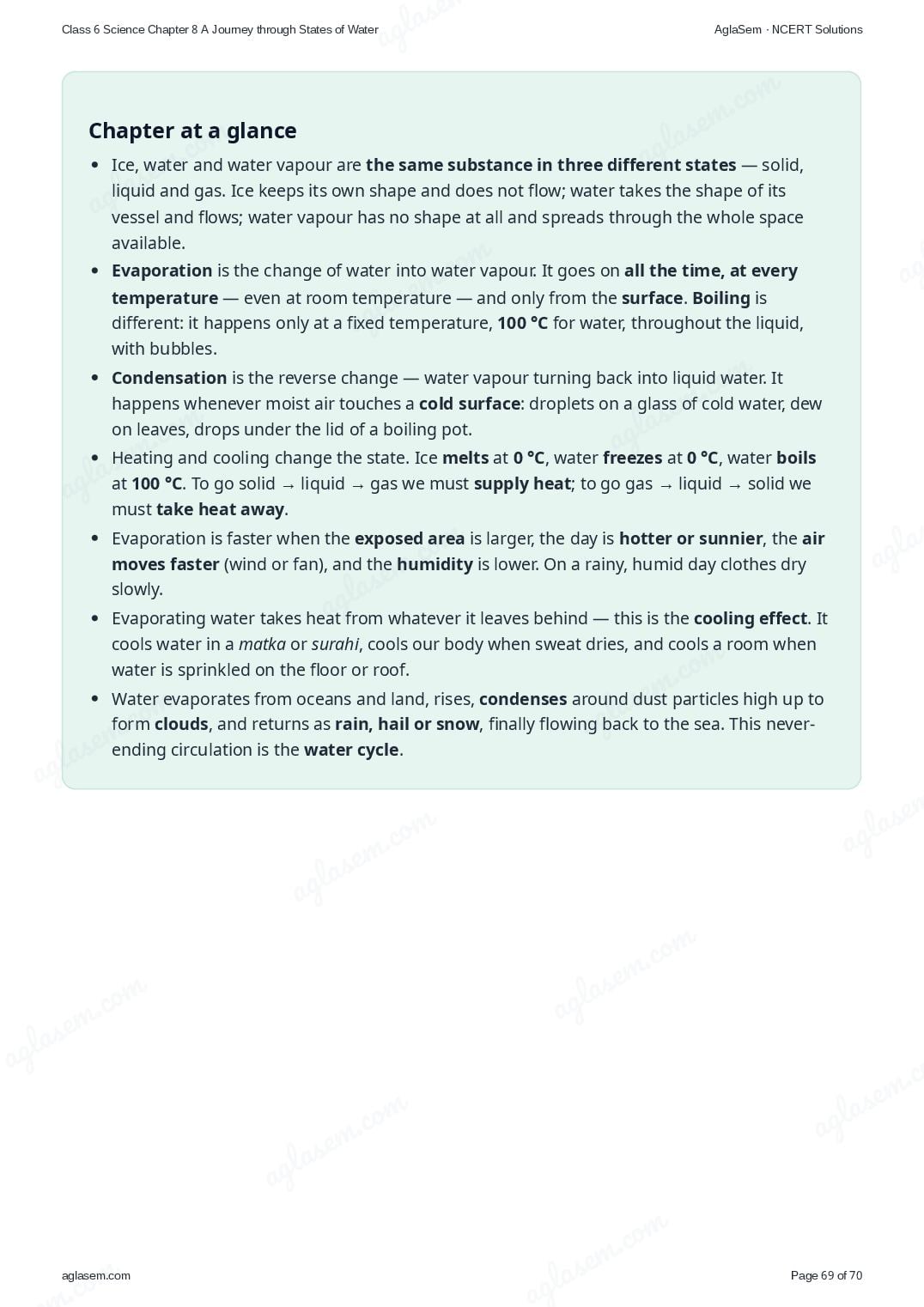
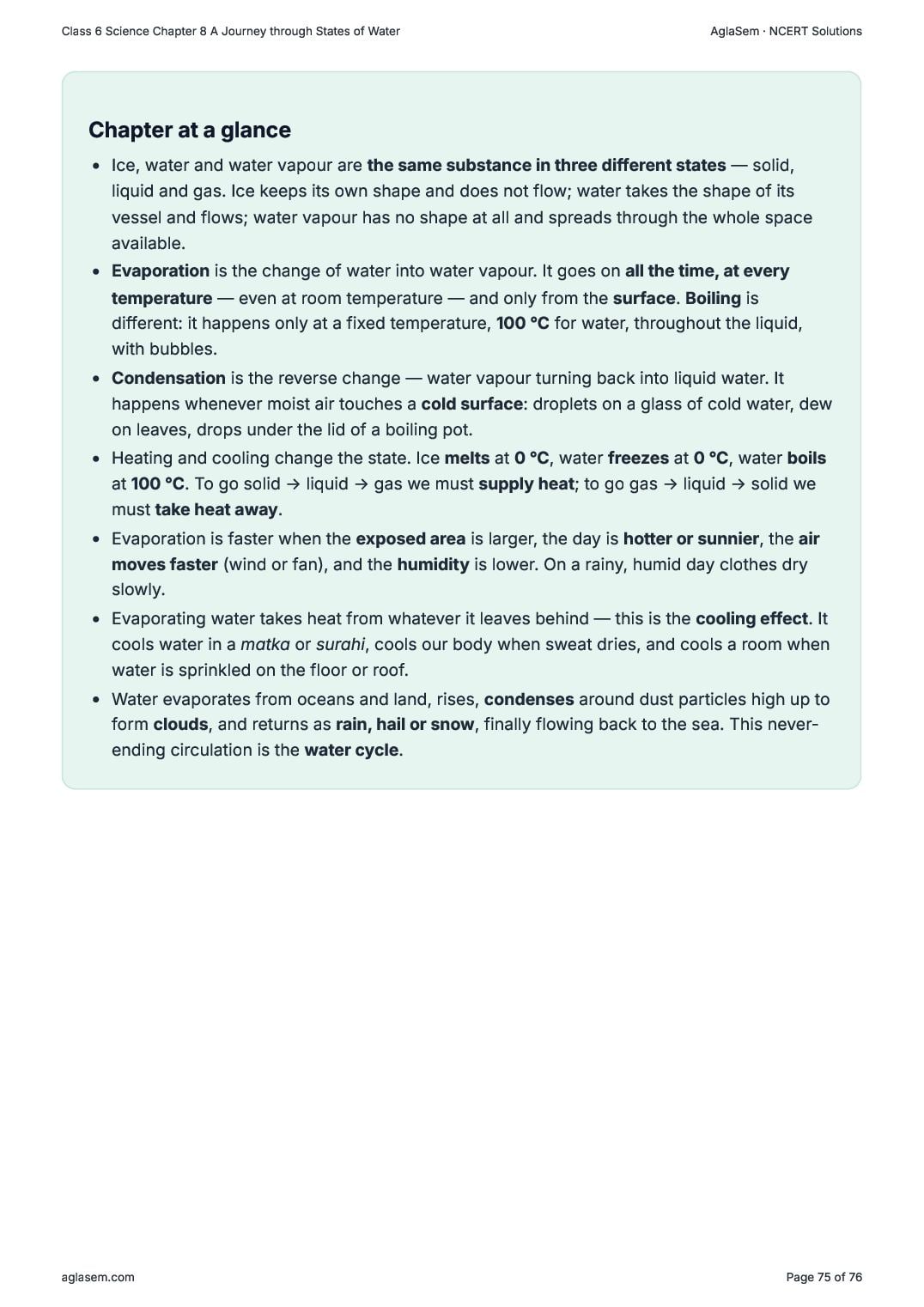
Chapter at a Glance
- Ice, water and water vapour are the same substance in three different states — solid, liquid and gas. Ice keeps its own shape and does not flow; water takes the shape of its vessel and flows; water vapour has no shape at all and spreads through the whole space available.
- Evaporation is the change of water into water vapour. It goes on all the time, at every temperature — even at room temperature — and only from the surface . Boiling is different: it happens only at a fixed temperature, 100 °C for water, throughout the liquid, with bubbles.
- Condensation is the reverse change — water vapour turning back into liquid water. It happens whenever moist air touches a cold surface : droplets on a glass of cold water, dew on leaves, drops under the lid of a boiling pot.
- Heating and cooling change the state. Ice melts at 0 °C , water freezes at 0 °C , water boils at 100 °C . To go solid → liquid → gas we must supply heat ; to go gas → liquid → solid we must take heat away .
- Evaporation is faster when the exposed area is larger, the day is hotter or sunnier , the air moves faster (wind or fan), and the humidity is lower. On a rainy, humid day clothes dry slowly.
- Evaporating water takes heat from whatever it leaves behind — this is the cooling effect . It cools water in a matka or surahi , cools our body when sweat dries, and cools a room when water is sprinkled on the floor or roof.
- Water evaporates from oceans and land, rises, condenses around dust particles high up to form clouds , and returns as rain, hail or snow , finally flowing back to the sea. This never-ending circulation is the water cycle .
How to Download NCERT Solutions for Class 6 Science Chapter 8 PDF
Follow these simple steps to get the a Journey Through States of Water questions-and-answers PDF from Curiosity.
- Search NCERT Solutions for Class 6 Science Chapter 8 aglasem and open this page.
- Read the exercise questions with answers for a Journey Through States of Water shown above.
- Click the Download PDF link to save the a Journey Through States of Water solutions to your device.
NCERT Solutions for Class 6 Science – All Chapters
There are more chapters to study besides a Journey Through States of Water in Science. Here are the NCERT Solutions for all chapters of Class 6 Science.
- Chapter 1 the Wonderful World of Science
- Chapter 2 Diversity in the Living World
- Chapter 3 Mindful Eating a Path to a Healthy Body
- Chapter 4 Exploring Magnets
- Chapter 5 Measurement of Length and Motion
- Chapter 6 Materials Around Us
- Chapter 7 Temperature and Its Measurement
- Chapter 8 a Journey Through States of Water
- Chapter 9 Methods of Separation in Everyday Life
- Chapter 10 Living Creatures Exploring Their Characteristics
- Chapter 11 Nature’s Treasures
- Chapter 12 Beyond Earth
NCERT Solutions for Class 6 – All Subjects
Just like Chapter 8 of Science, you can get the exercise questions with answers for every other subject of Class 6. Here are the NCERT Solutions for all subjects of Class 6.
NCERT Solutions for Class 6 Science Chapter 8 – An Overview
The key highlights of this study material are as follows.
| Aspects | Details |
|---|---|
| Class | Class 6 |
| Subject | Science |
| Chapter Number | Chapter 8 |
| Chapter Name | a Journey Through States of Water |
| Book Name | Curiosity |
| Book By | NCERT (National Council of Educational Research and Training) |
| Educational Resource Here | NCERT Solutions of Class 6 Science Chapter 8 for all exercises |
| More Questions Answers of This Subject | NCERT Solutions for Class 6 Science |
| Download Book Chapter | NCERT Book Class 6 Science |
| All Questions Answers For This Class | NCERT Solutions for Class 6 |
| Complete Solutions | NCERT Solutions |
NCERT Solutions for Class 6 Science Chapter 8 a Journey Through States of Water – FAQs
What are the NCERT Solutions for Class 6 Science Chapter 8 a Journey Through States of Water?
They are the complete, step-by-step answers to all the exercise and in-text questions of Chapter 8 a Journey Through States of Water from the NCERT Class 6 Science textbook Curiosity, written by experts as per the latest NCERT syllabus.
How can I download the Class 6 Science Chapter 8 solutions PDF for free?
Open this page on aglasem, read the a Journey Through States of Water questions with answers, and click the “Download Solutions PDF” link. The Class 6 Science Chapter 8 NCERT Solutions PDF is completely free to download.
Are these NCERT Solutions as per the latest 2026-27 syllabus?
Yes. The NCERT Solutions for Class 6 Science Chapter 8 are based on the latest NCERT textbook Curiosity and the current 2026-27 CBSE syllabus, so the questions and answers match what you study in class.
Where can I get NCERT Solutions for the other chapters of Class 6 Science?
You can find the answers to every chapter on the NCERT Solutions for Class 6 Science page, and solutions for every subject on the NCERT Solutions for Class 6 page.
How do NCERT Solutions help in exam preparation?
They show the correct method to solve each question, help you write answers the way they are expected in exams, let you check and correct your own work, and save revision time — which together improve your marks in Class 6 Science.
If you have any queries on NCERT Solutions for Class 6 Science Chapter 8 a Journey Through States of Water, then please ask in the comments below.