NCERT Solutions for Class 6 Science Chapter 10 Living Creatures Exploring Their Characteristics provide clear, step-by-step answers to every exercise and in-text question from the chapter Living Creatures Exploring Their Characteristics of the NCERT textbook Curiosity. Prepared by subject experts as per the latest NCERT (CBSE) syllabus for 2026-27, these NCERT Solutions for Class 6 Science help you understand each concept, write exam-ready answers, and check your own solutions. You can read them online below or download the free Class 6 Science Chapter 10 question-answer PDF.
NCERT Solutions for Class 6 Science Chapter 10 Living Creatures Exploring Their Characteristics
- Class: Class 6
- Subject: Science
- Chapter: Chapter 10 – Living Creatures Exploring Their Characteristics
- Textbook: Curiosity (NCERT)
- Study material: NCERT Solutions – questions with answers, free PDF
These solutions answer all the exercise questions of Chapter 10 Living Creatures Exploring Their Characteristics — including the in-text questions, short-answer and long-answer questions, and activities — with complete explanations so you can follow the method, not just the final answer. Read the full solutions below.
NCERT Solutions Class 6 Science Chapter 10 Living Creatures Exploring Their Characteristics View Download
NCERT Solutions for Class 6 Science Chapter 10 PDF Download
You can read the NCERT Solutions for Class 6 Science Chapter 10 online above, or download the complete question-answer PDF to study Living Creatures Exploring Their Characteristics offline at any time.
NCERT Solutions for Class 6 Science Chapter 10 PDF Download Link – Click Here to Download Solutions PDF
Questions Covered in This Chapter
These NCERT Solutions answer all 78 questions of this chapter. The questions solved are:
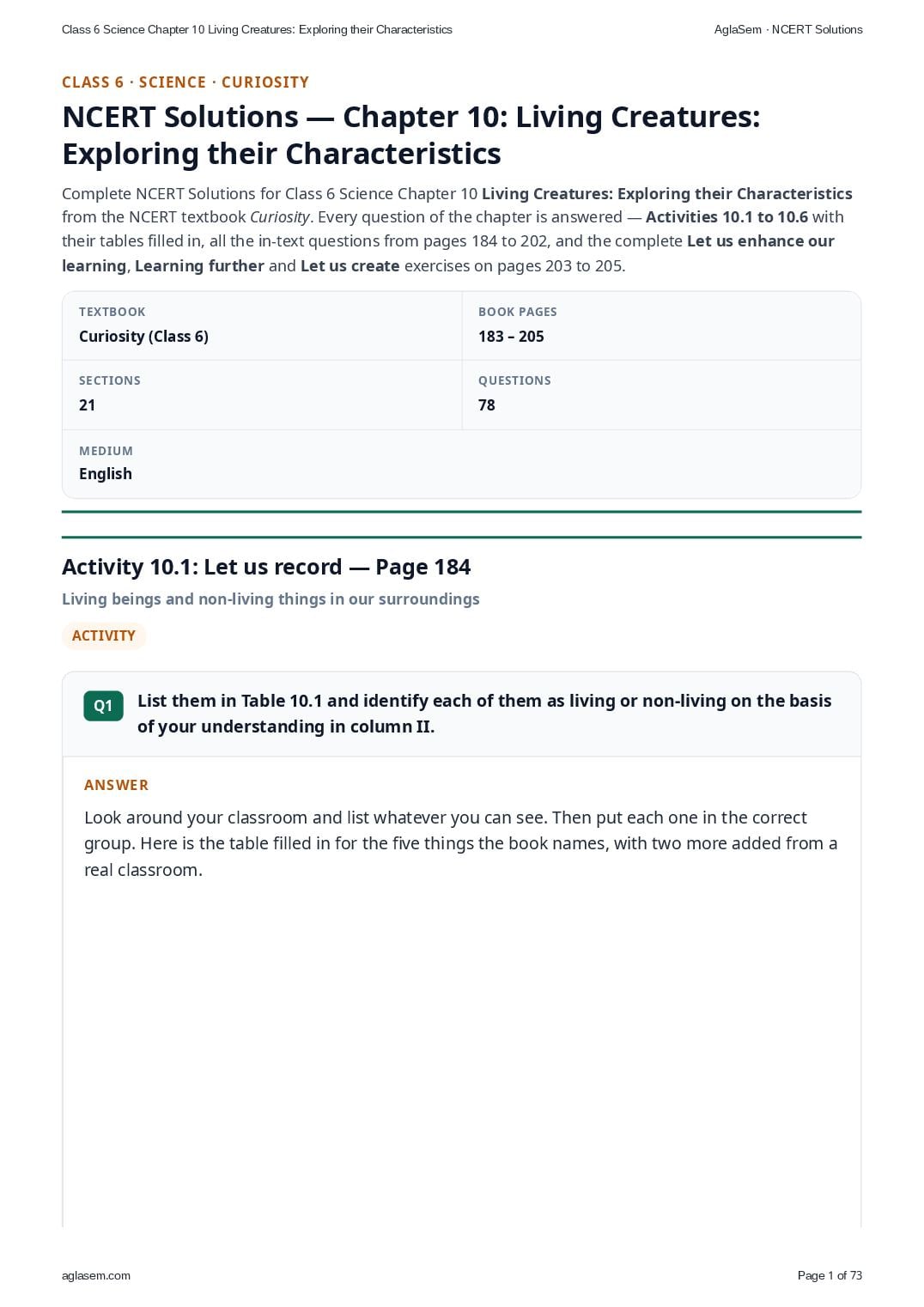
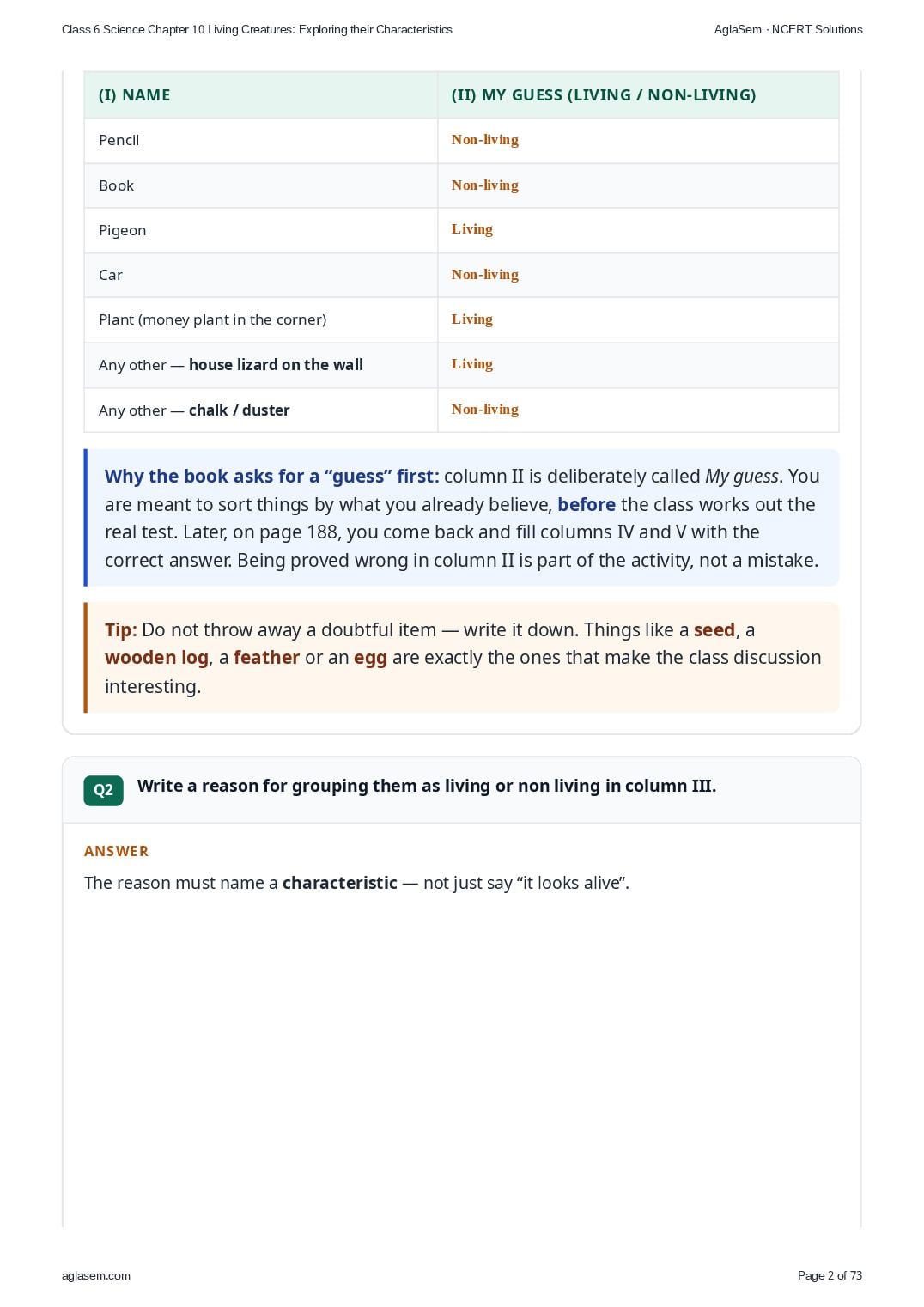
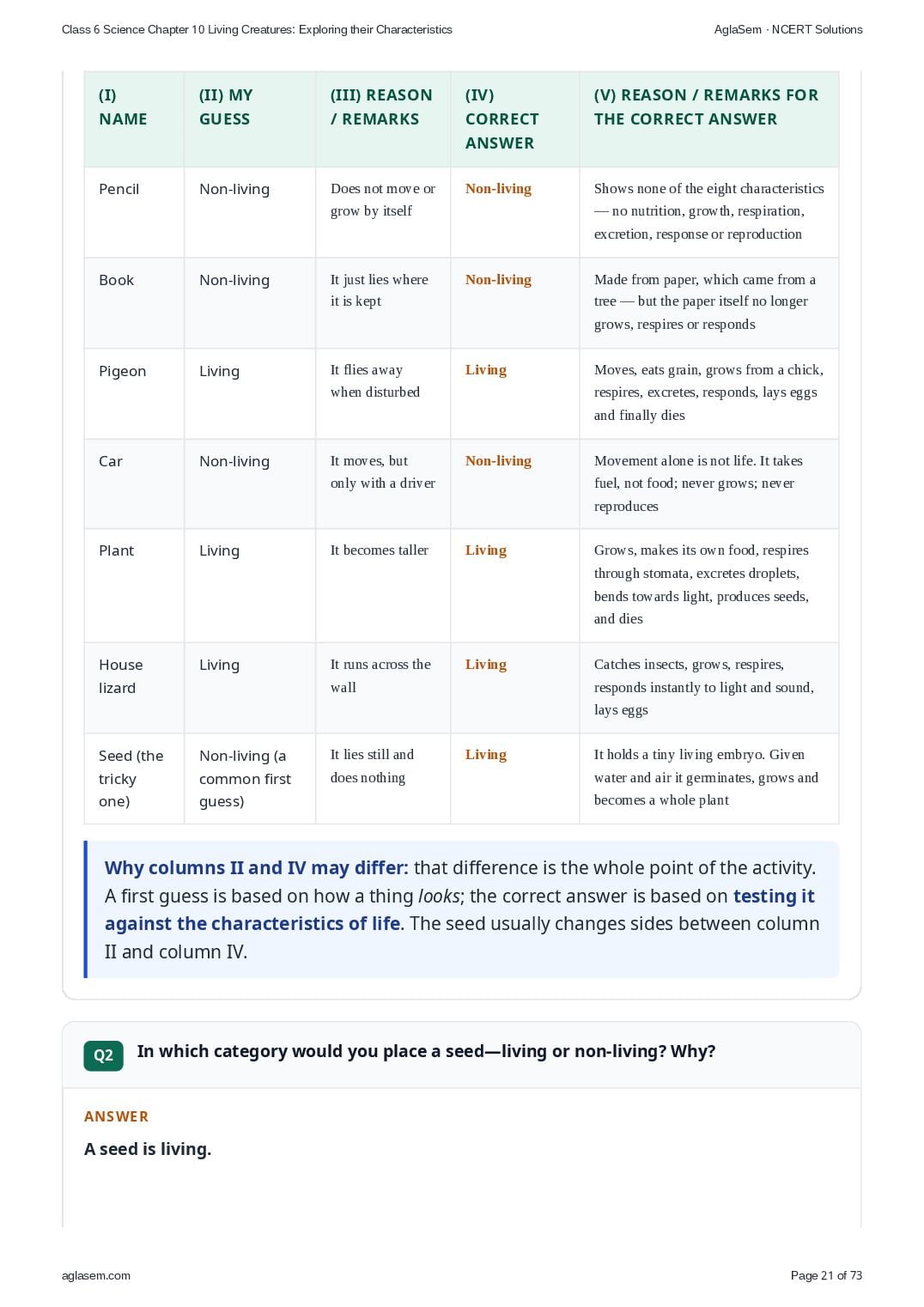
- List them in Table 10.1 and identify each of them as living or non-living on the basis of your understanding in column II.
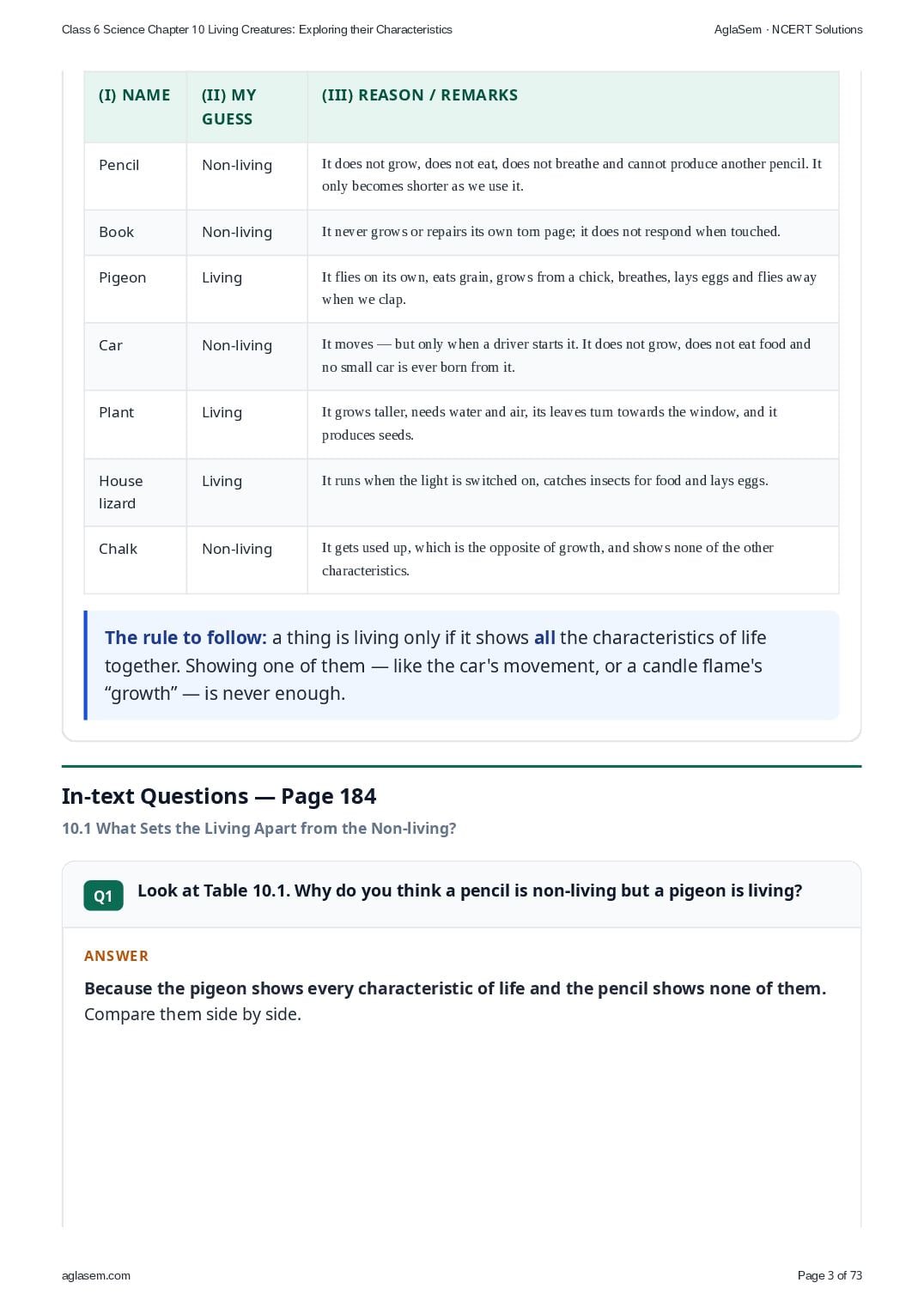
- Write a reason for grouping them as living or non living in column III.
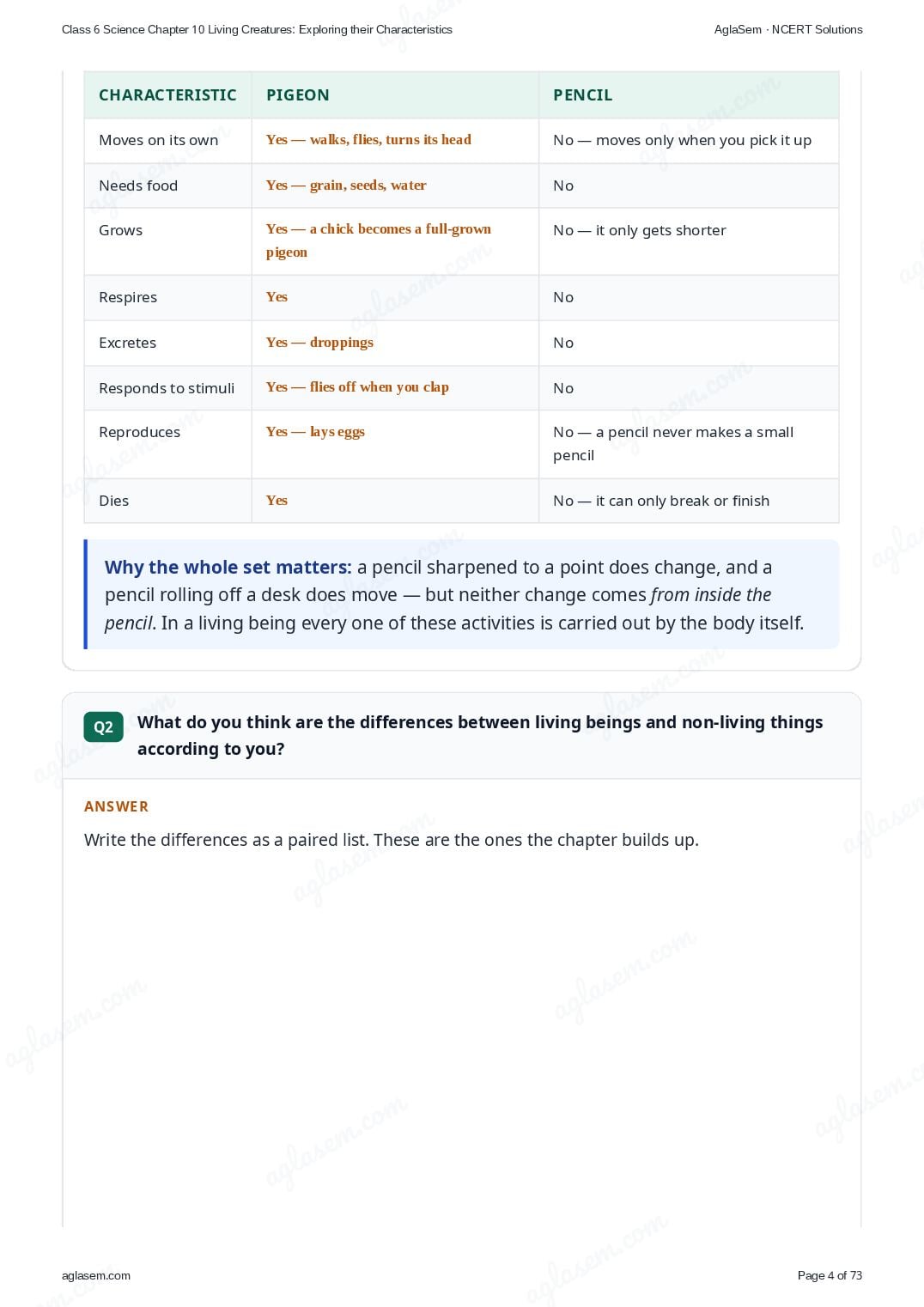
- Look at Table 10.1. Why do you think a pencil is non-living but a pigeon is living?
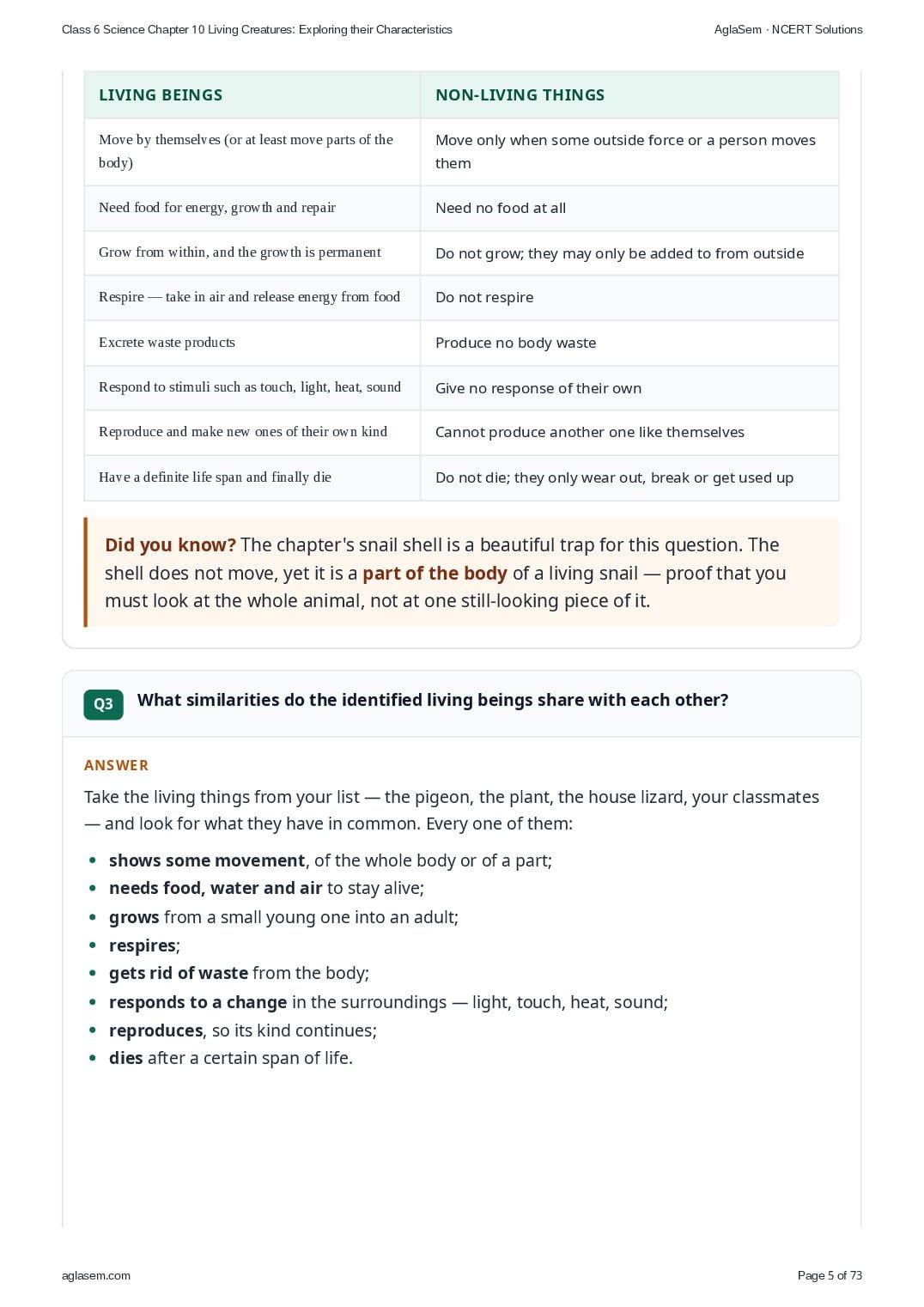
- What do you think are the differences between living beings and non-living things according to you?
- What similarities do the identified living beings share with each other?
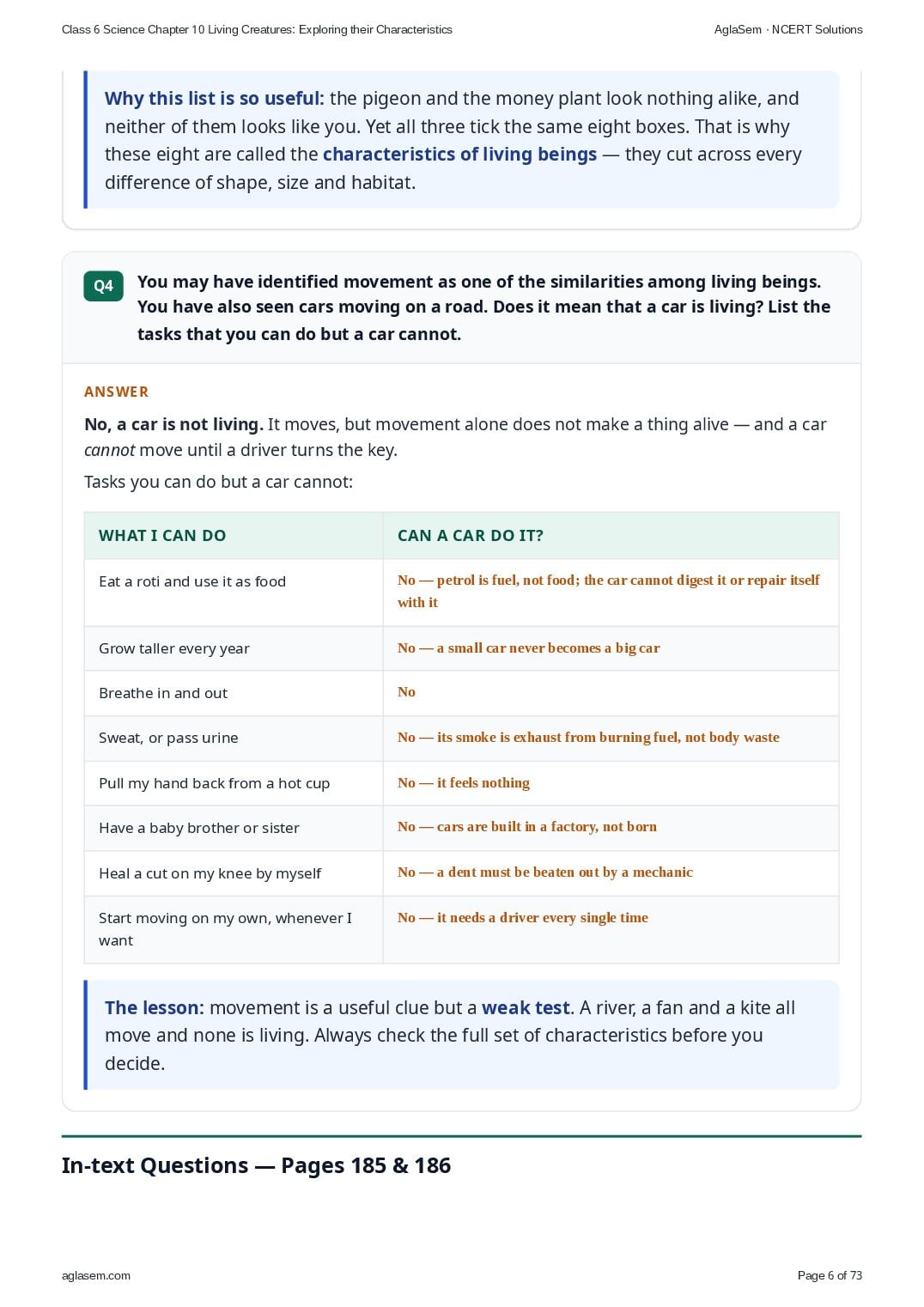
- You may have identified movement as one of the similarities among living beings. You have also seen cars moving on a road. Does it mean that a car is living? List the tasks that you can do but a car cannot.
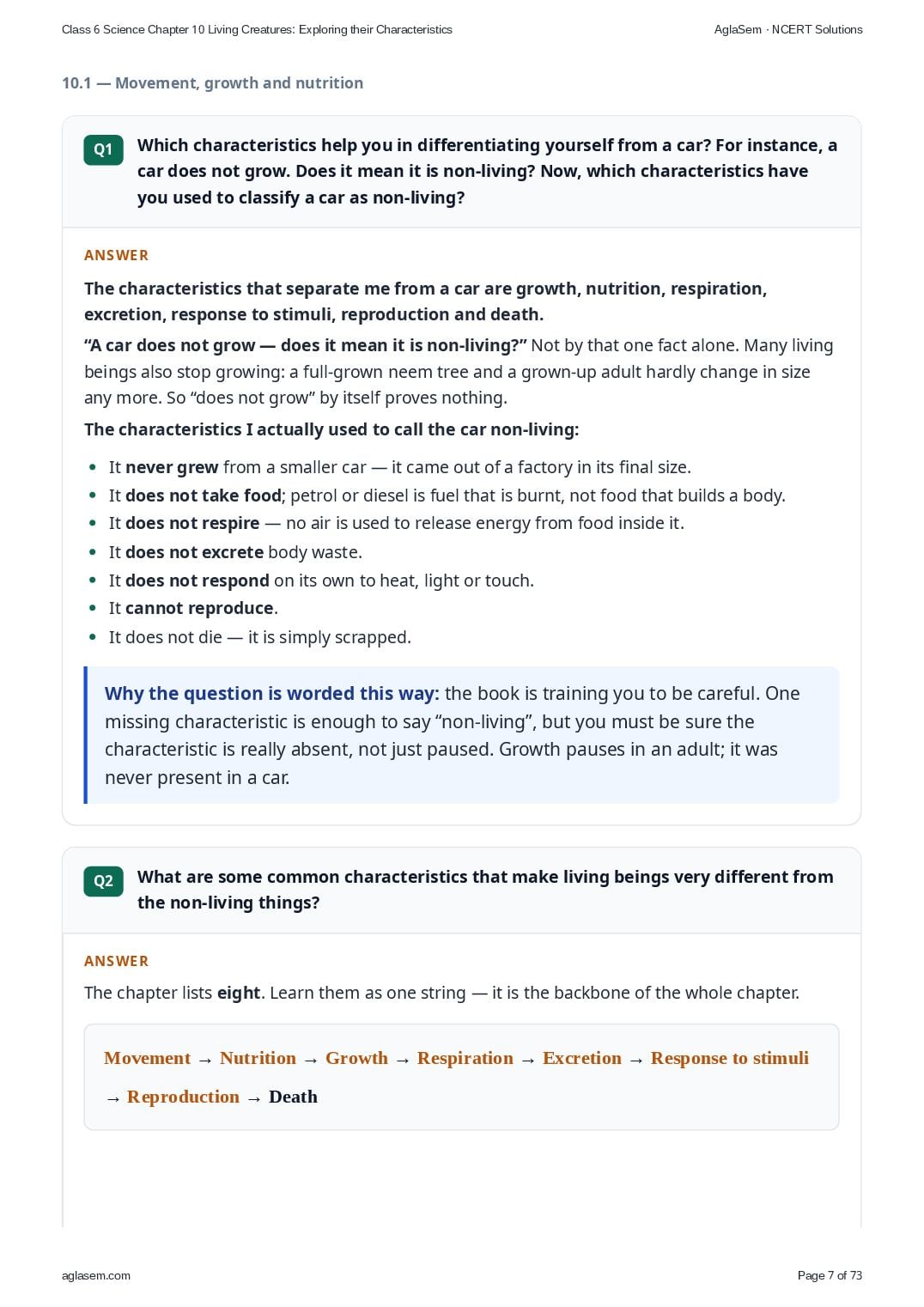
- Which characteristics help you in differentiating yourself from a car? For instance, a car does not grow. Does it mean it is non-living? Now, which characteristics have you used to classify a car as non-living?
- What are some common characteristics that make living beings very different from the non-living things?
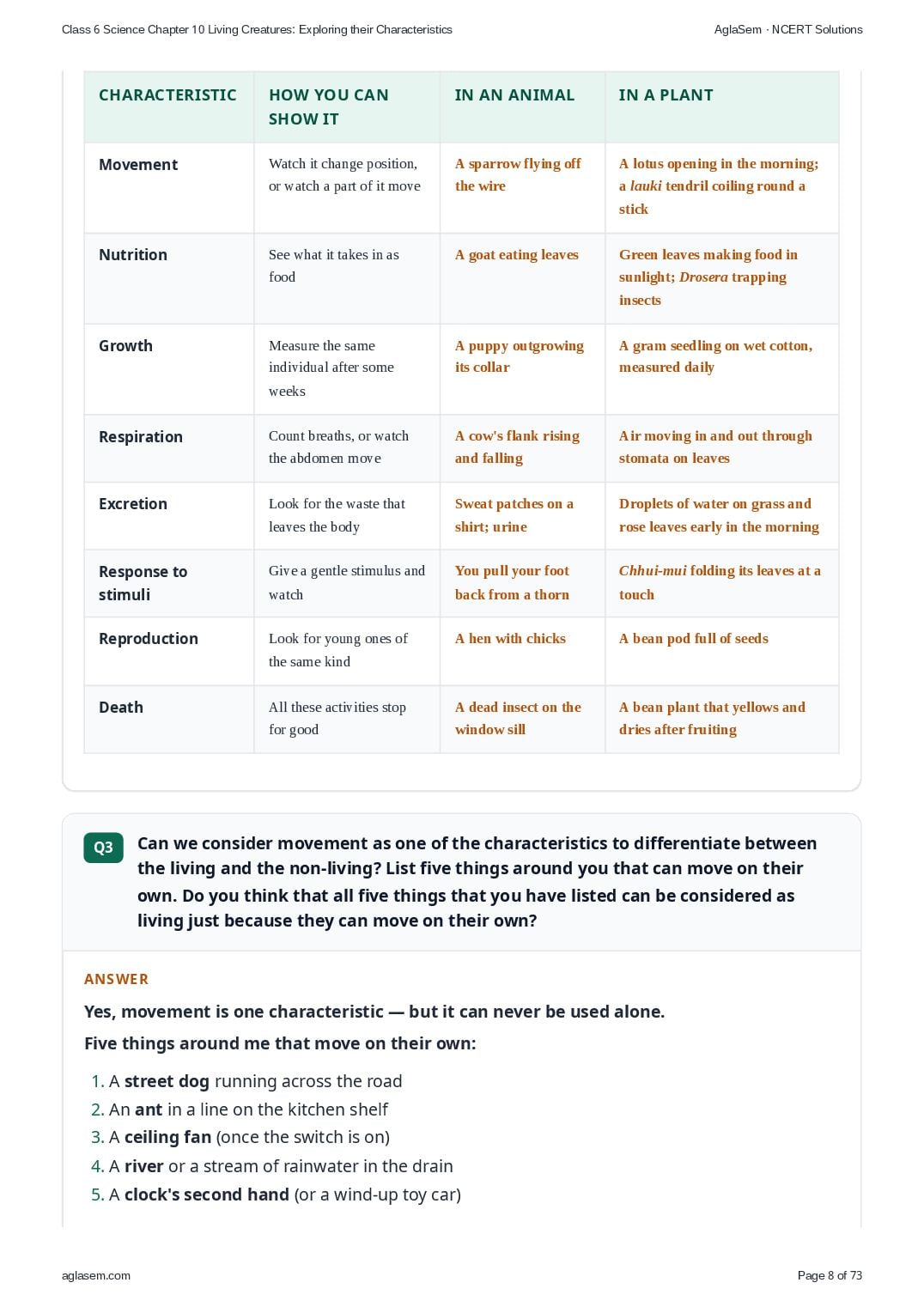
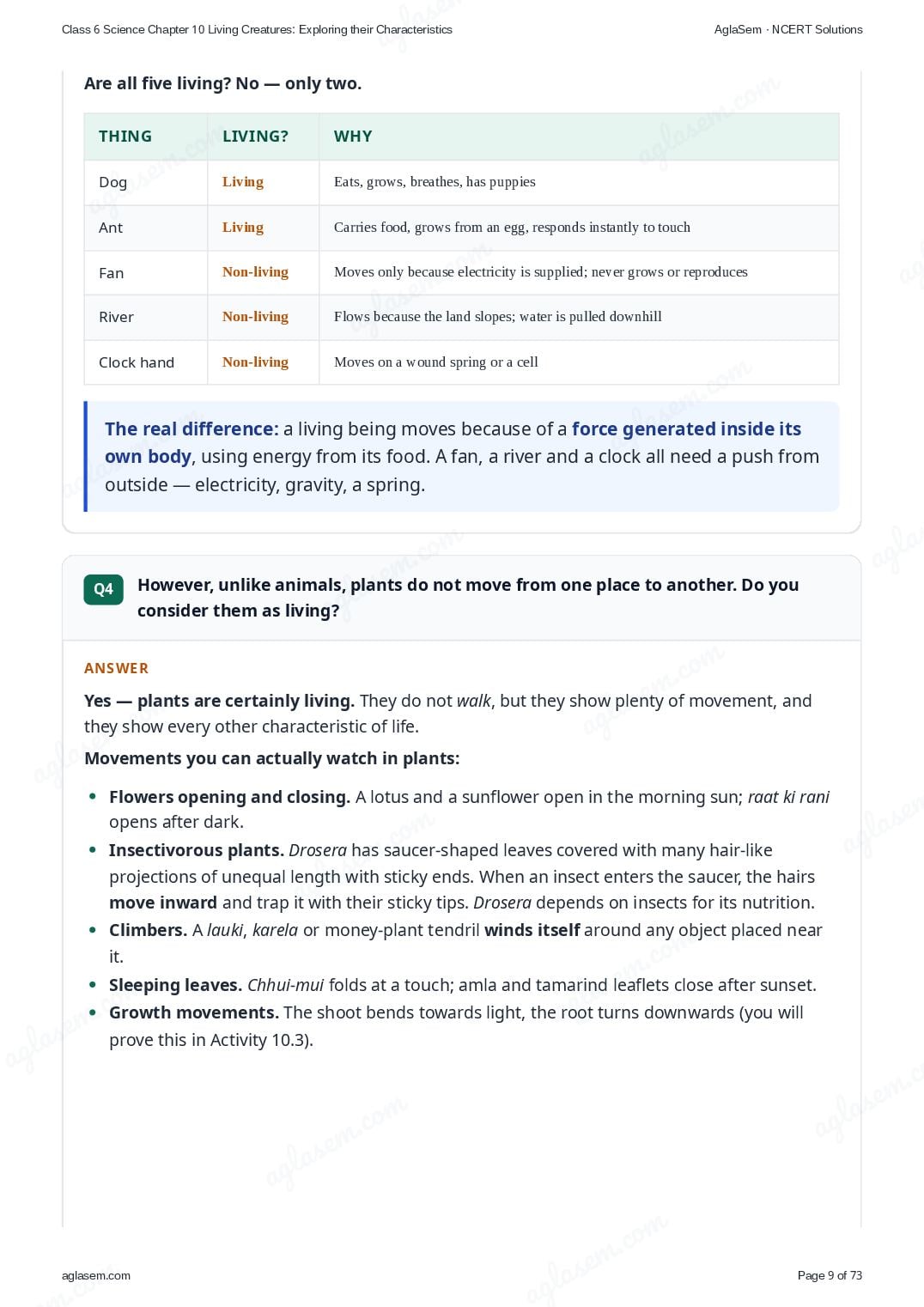
- Can we consider movement as one of the characteristics to differentiate between the living and the non-living? List five things around you that can move on their own. Do you think that all five things that you have listed can be considered as living just because they can move on their own?
- However, unlike animals, plants do not move from one place to another. Do you consider them as living?
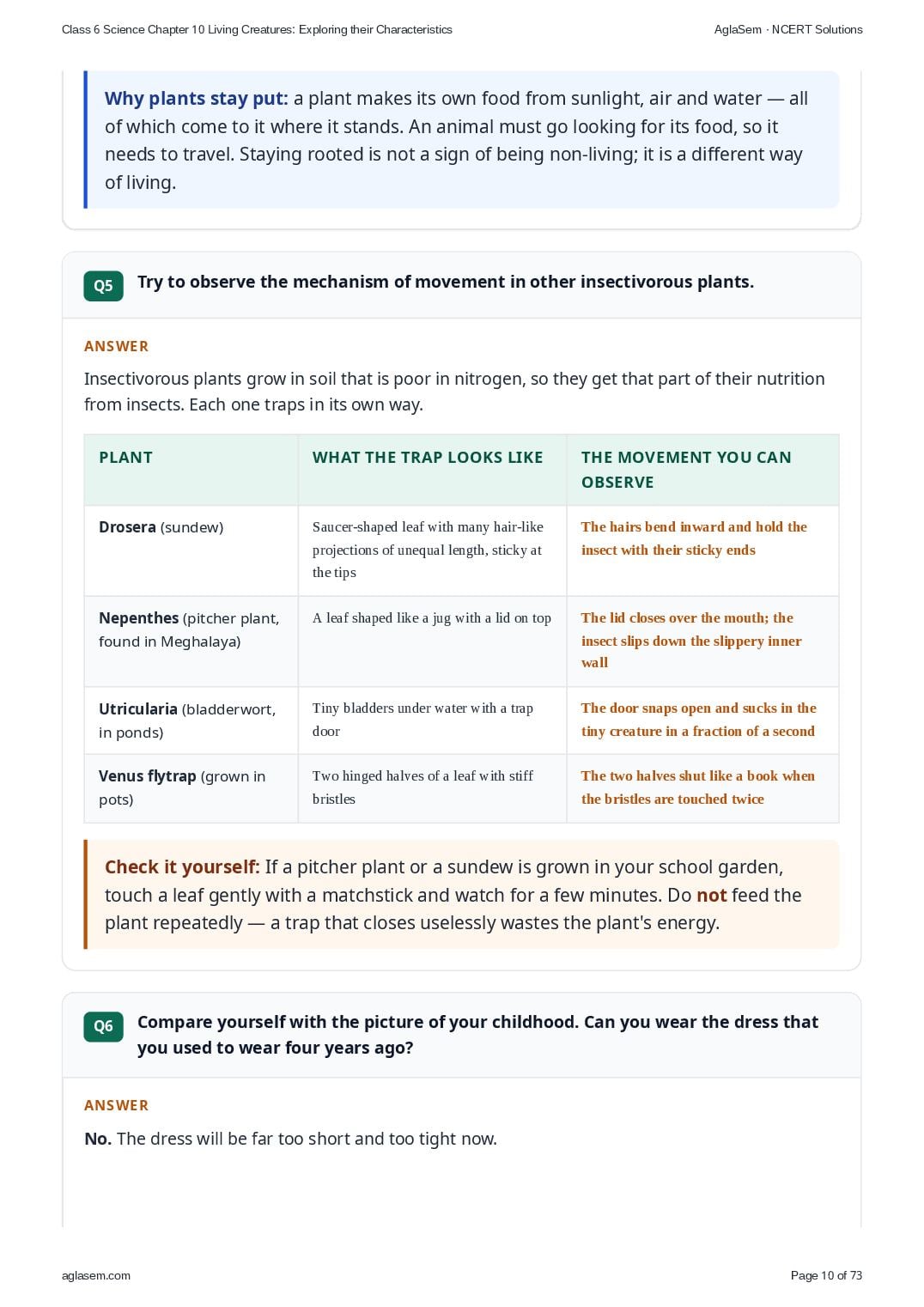
- Try to observe the mechanism of movement in other insectivorous plants.
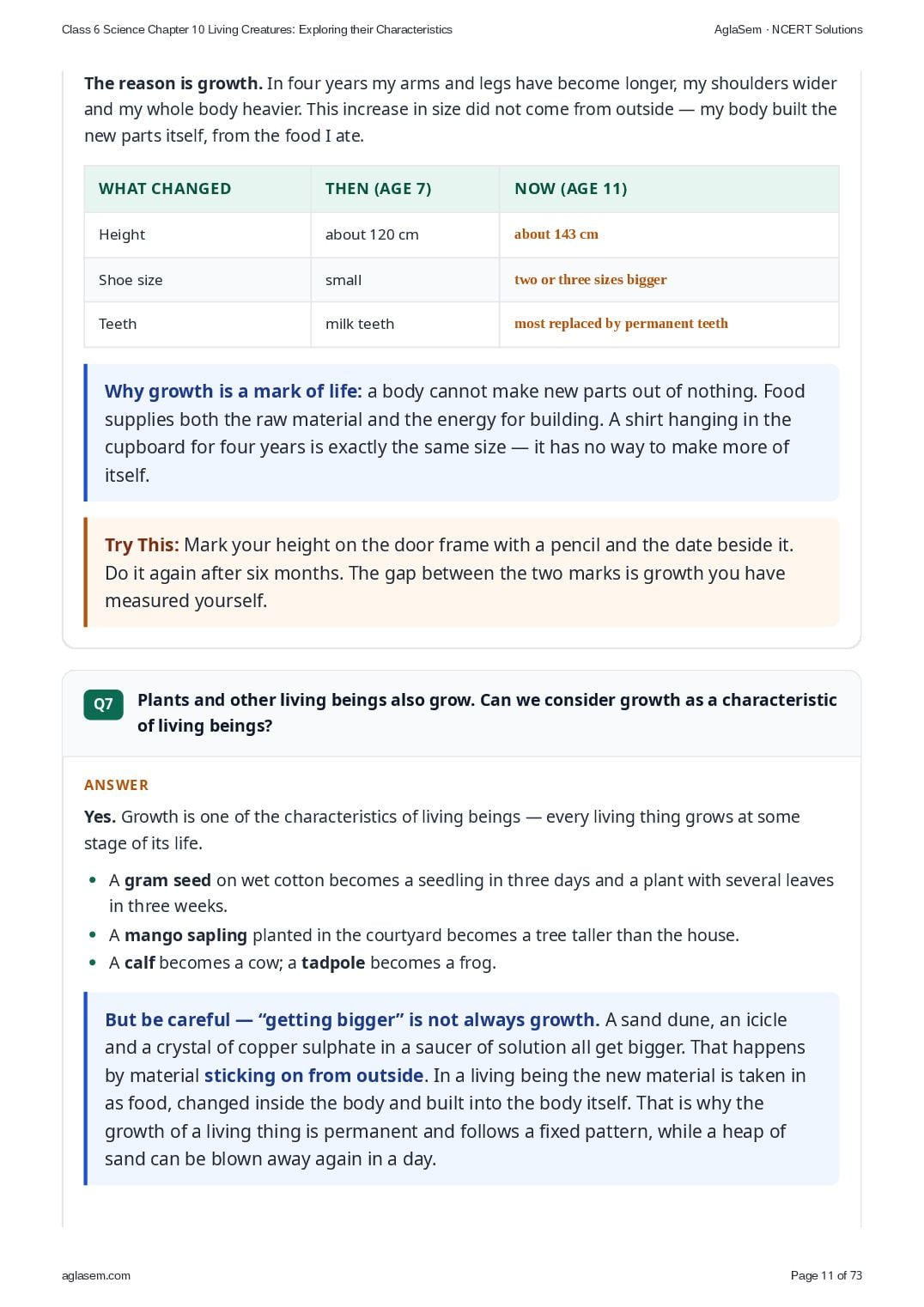
- Compare yourself with the picture of your childhood. Can you wear the dress that you used to wear four years ago?
- Plants and other living beings also grow. Can we consider growth as a characteristic of living beings?
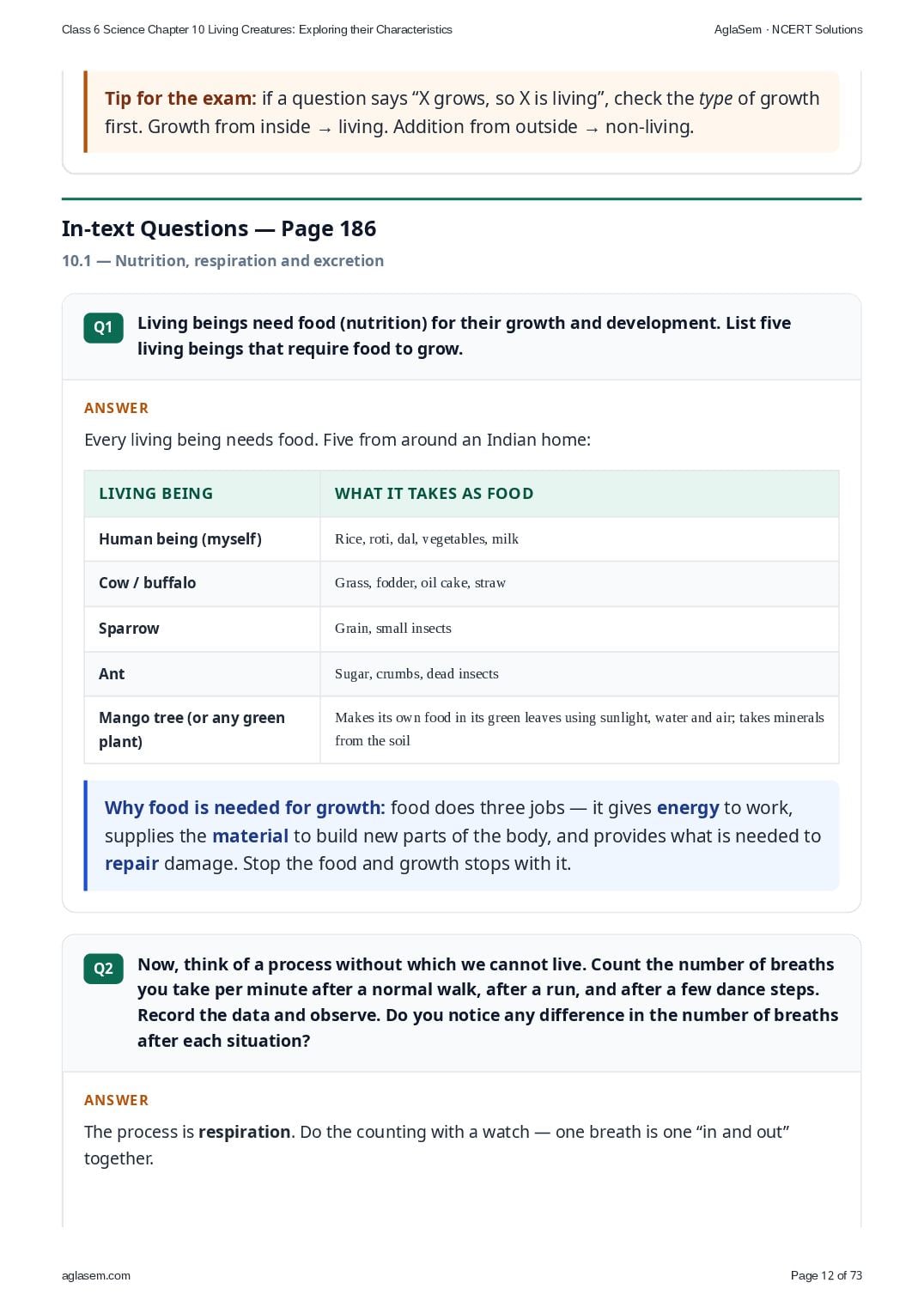
- Living beings need food (nutrition) for their growth and development. List five living beings that require food to grow.
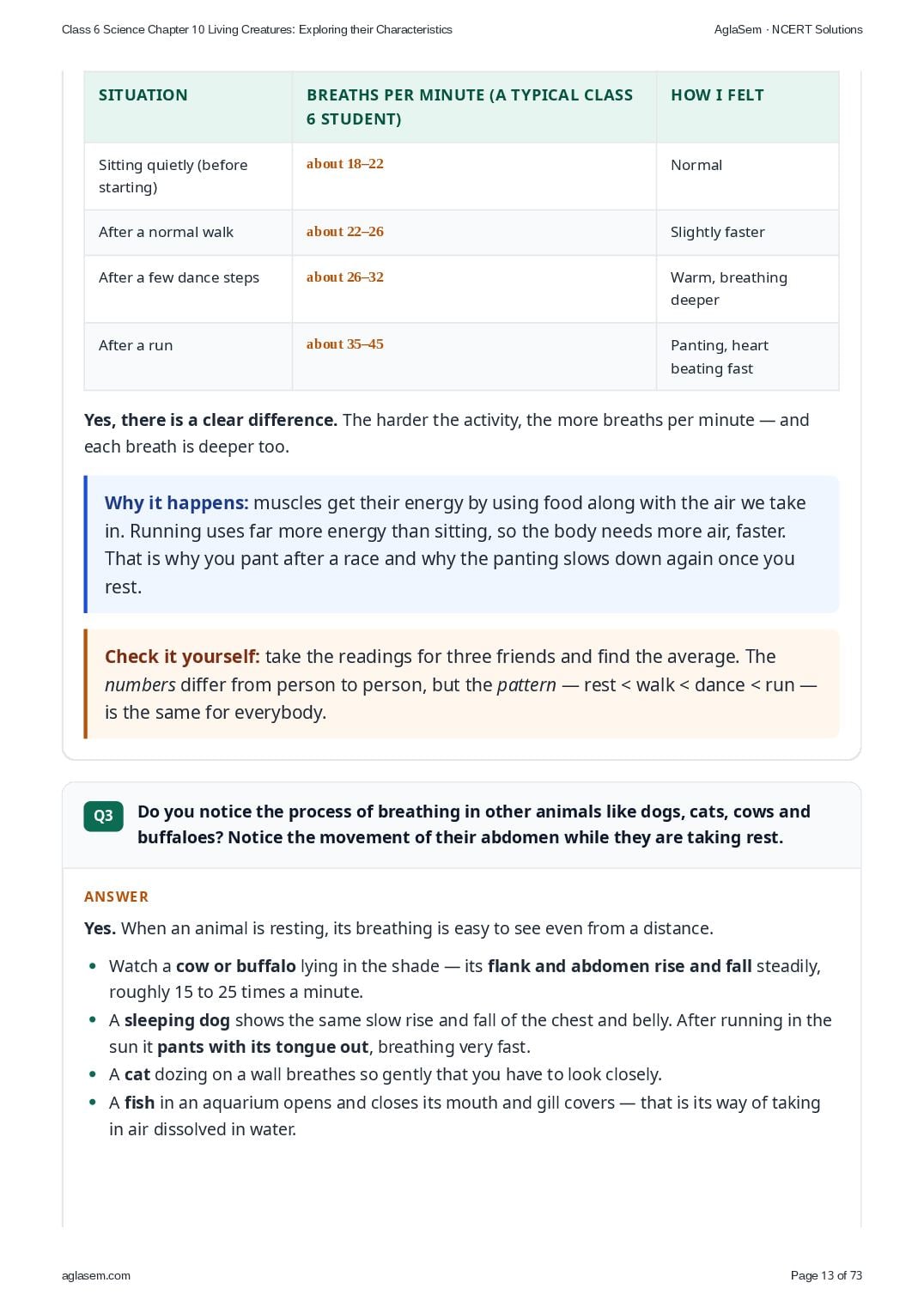
- Now, think of a process without which we cannot live. Count the number of breaths you take per minute after a normal walk, after a run, and after a few dance steps. Record the data and observe. Do you notice any difference in the number of breaths after each situation?
- Do you notice the process of breathing in other animals like dogs, cats, cows and buffaloes? Notice the movement of their abdomen while they are taking rest.
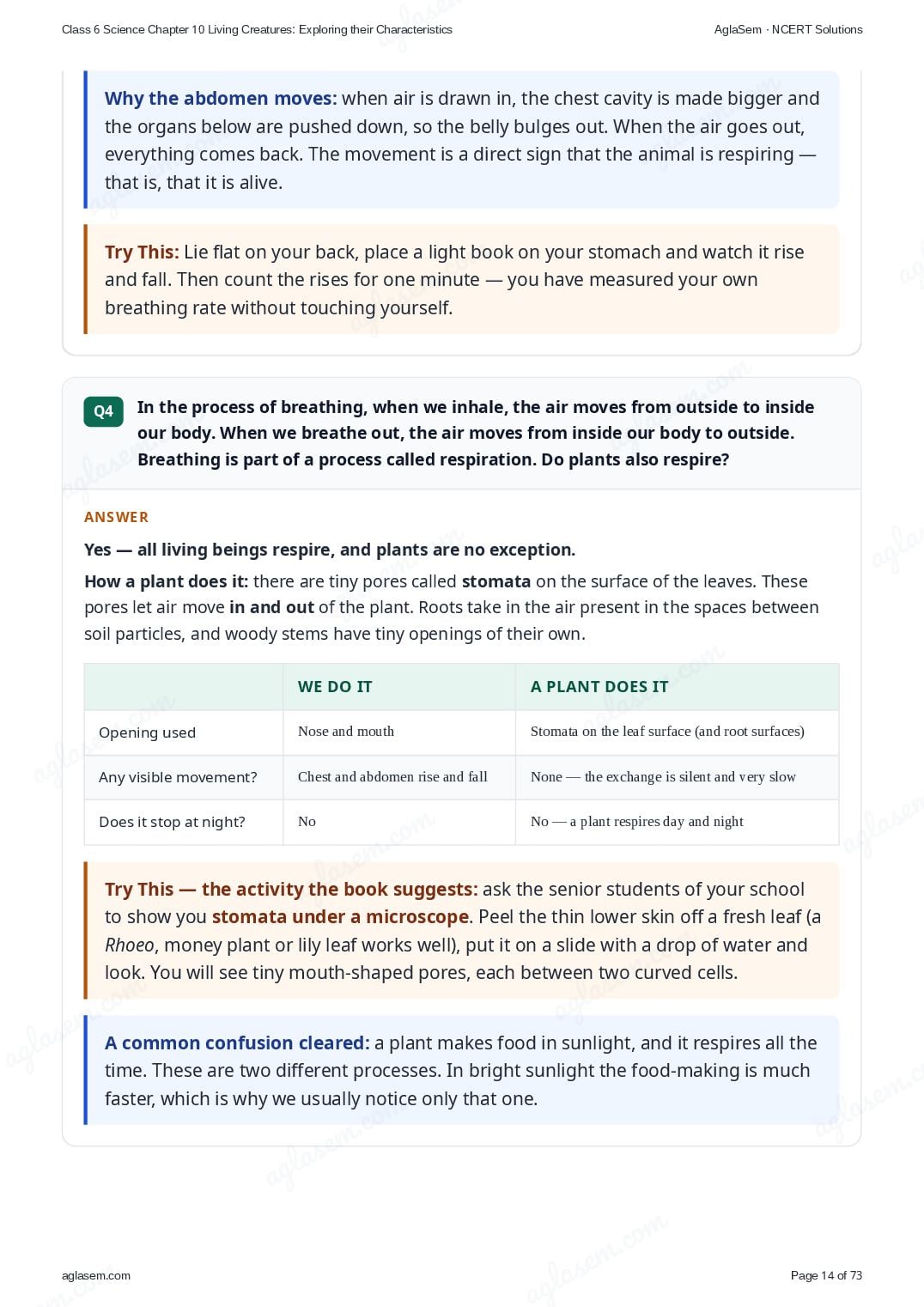
- In the process of breathing, when we inhale, the air moves from outside to inside our body. When we breathe out, the air moves from inside our body to outside. Breathing is part of a process called respiration. Do plants also respire?
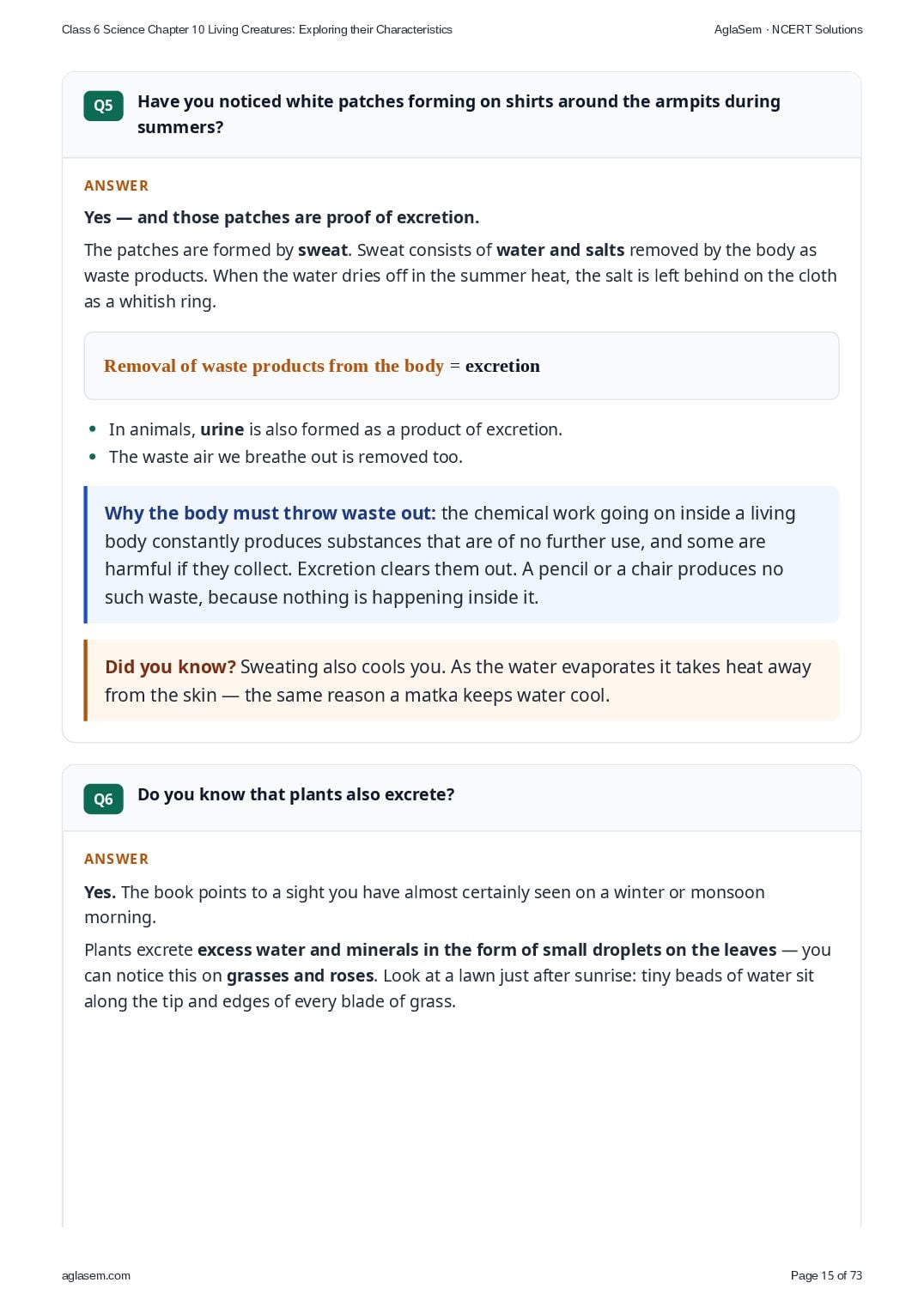
- Have you noticed white patches forming on shirts around the armpits during summers?
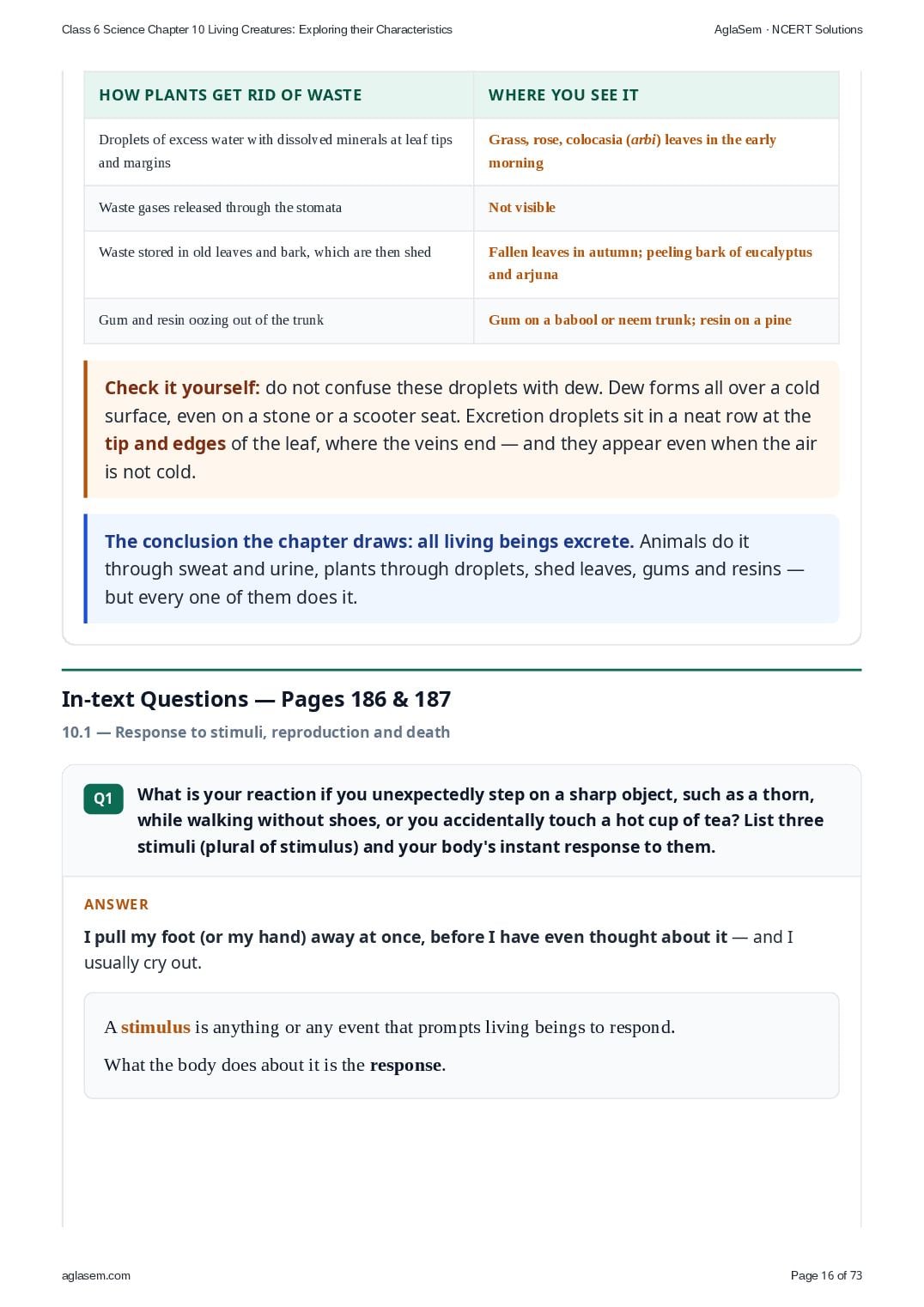
- Do you know that plants also excrete?
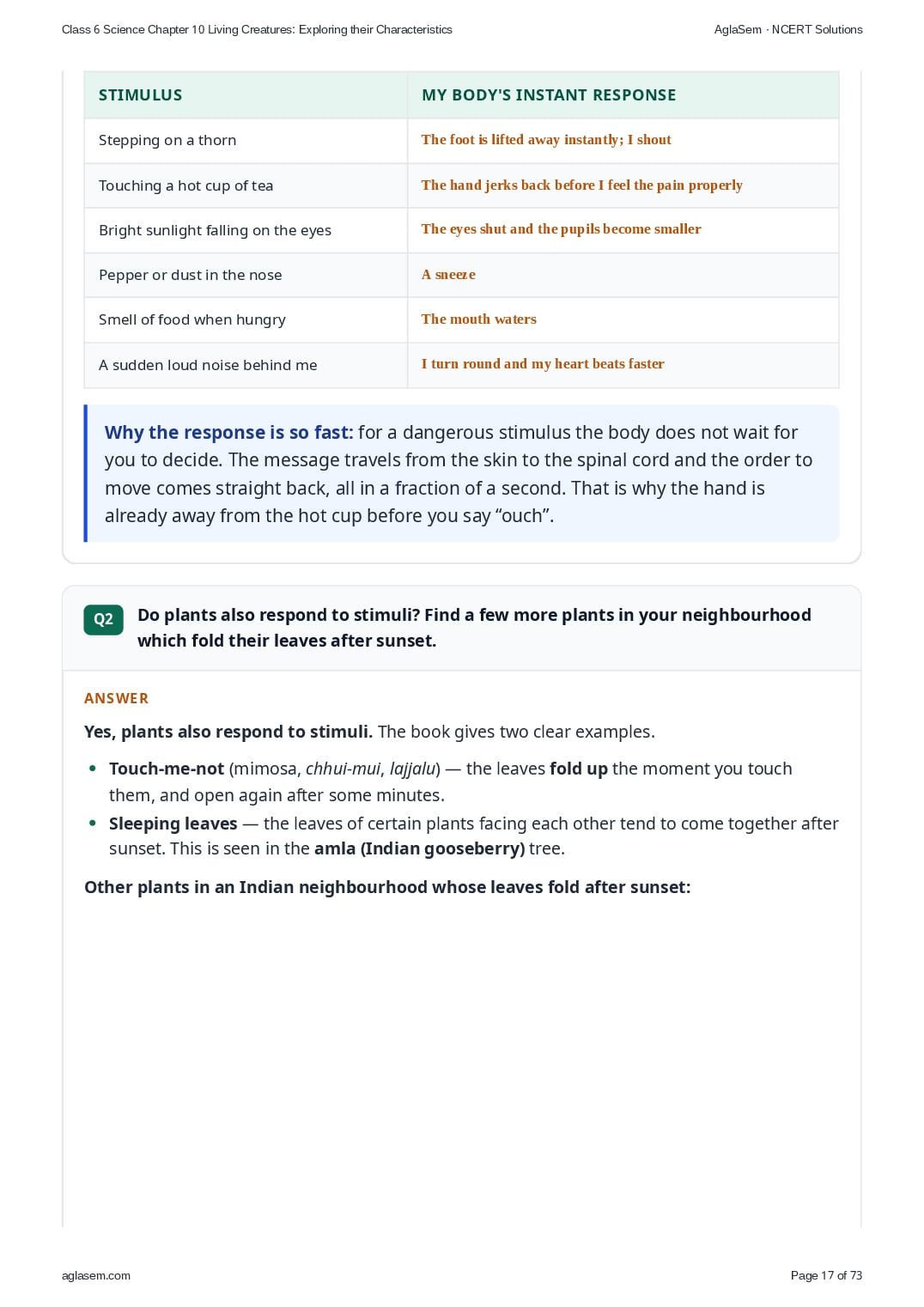
- What is your reaction if you unexpectedly step on a sharp object, such as a thorn, while walking without shoes, or you accidentally touch a hot cup of tea? List three stimuli (plural of stimulus) and your body's instant response to them.
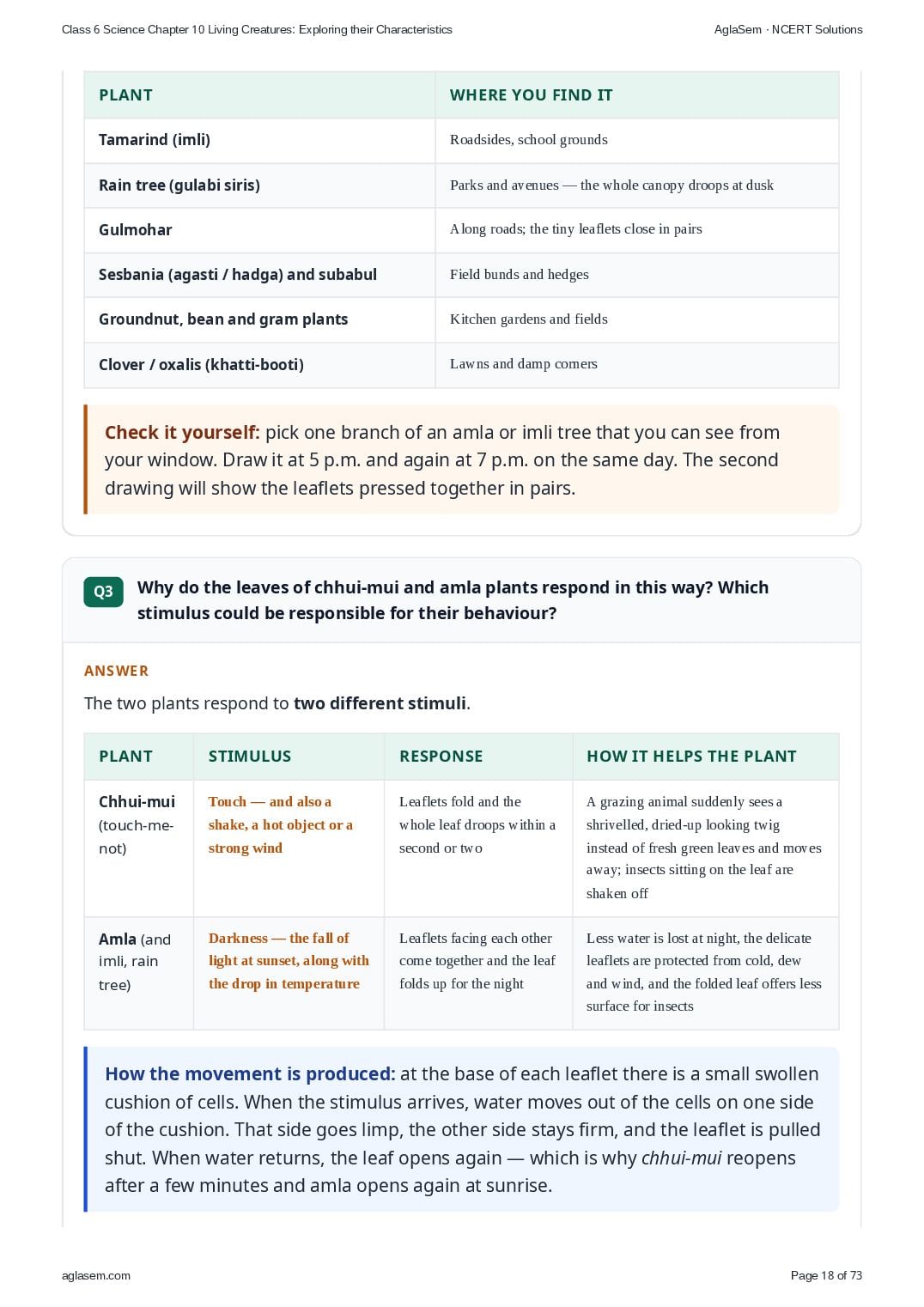
- Do plants also respond to stimuli? Find a few more plants in your neighbourhood which fold their leaves after sunset.
- Why do the leaves of chhui-mui and amla plants respond in this way? Which stimulus could be responsible for their behaviour?
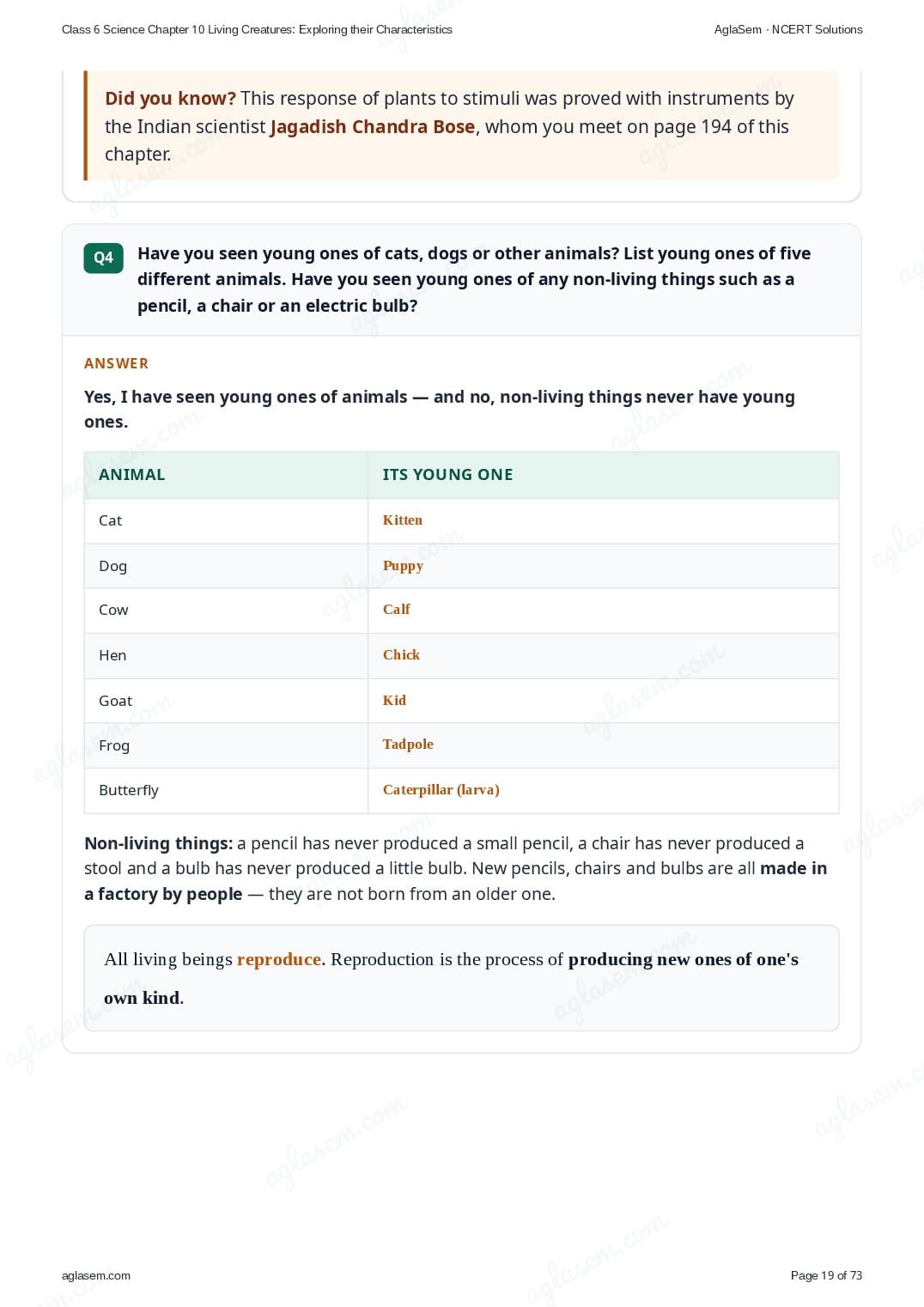
- Have you seen young ones of cats, dogs or other animals? List young ones of five different animals. Have you seen young ones of any non-living things such as a pencil, a chair or an electric bulb?
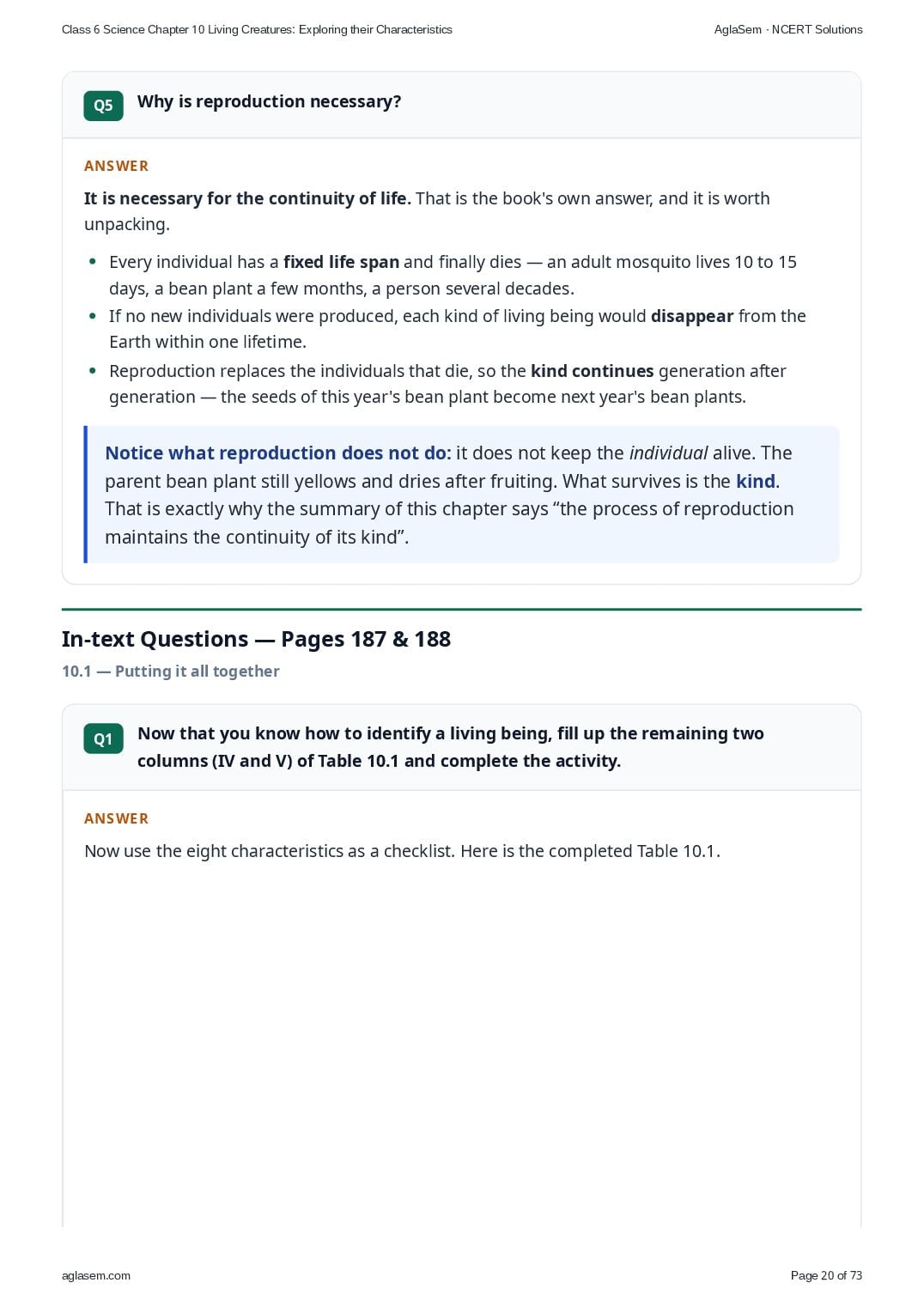
- Why is reproduction necessary?
- Now that you know how to identify a living being, fill up the remaining two columns (IV and V) of Table 10.1 and complete the activity.
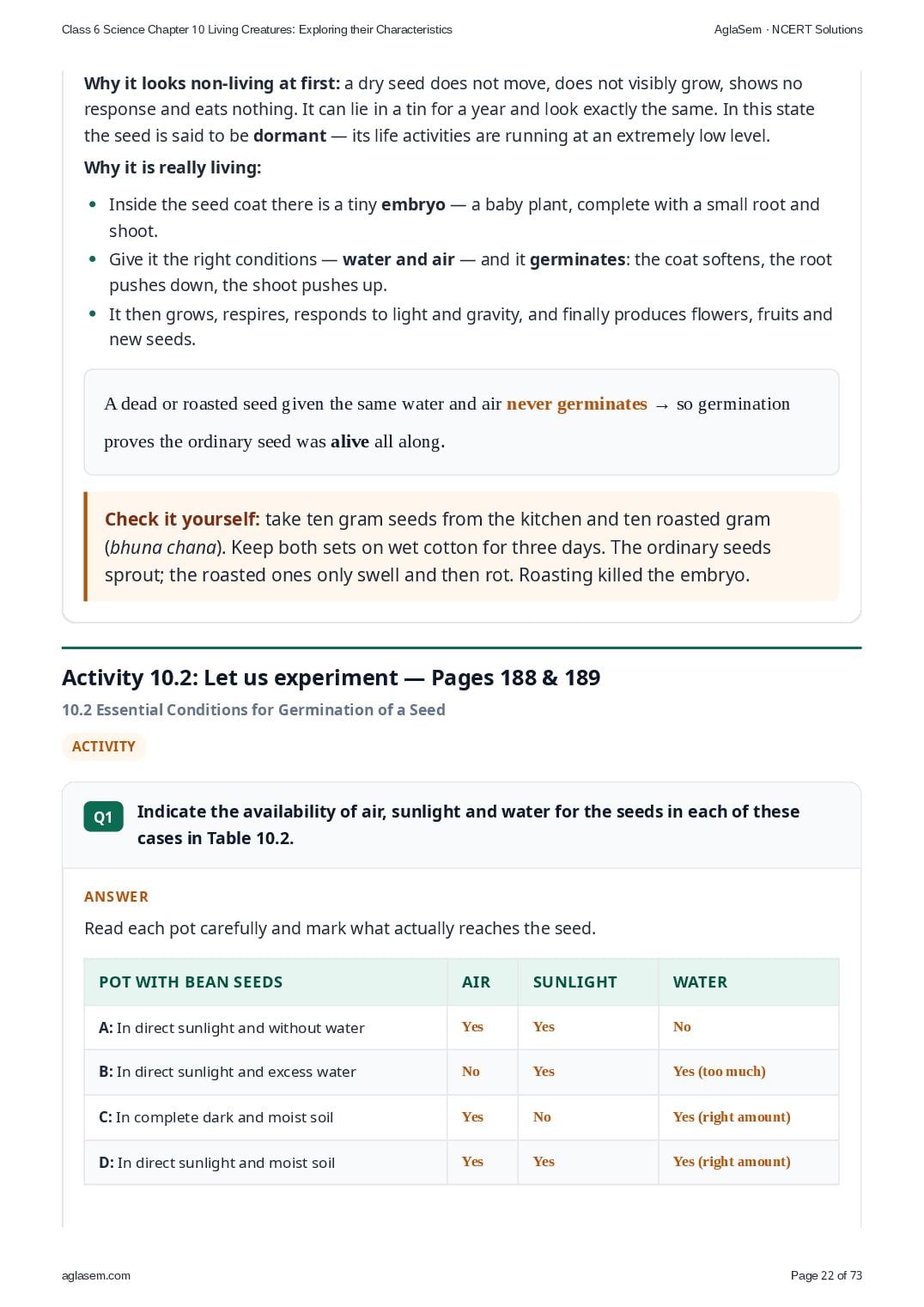
- In which category would you place a seed—living or non-living? Why?
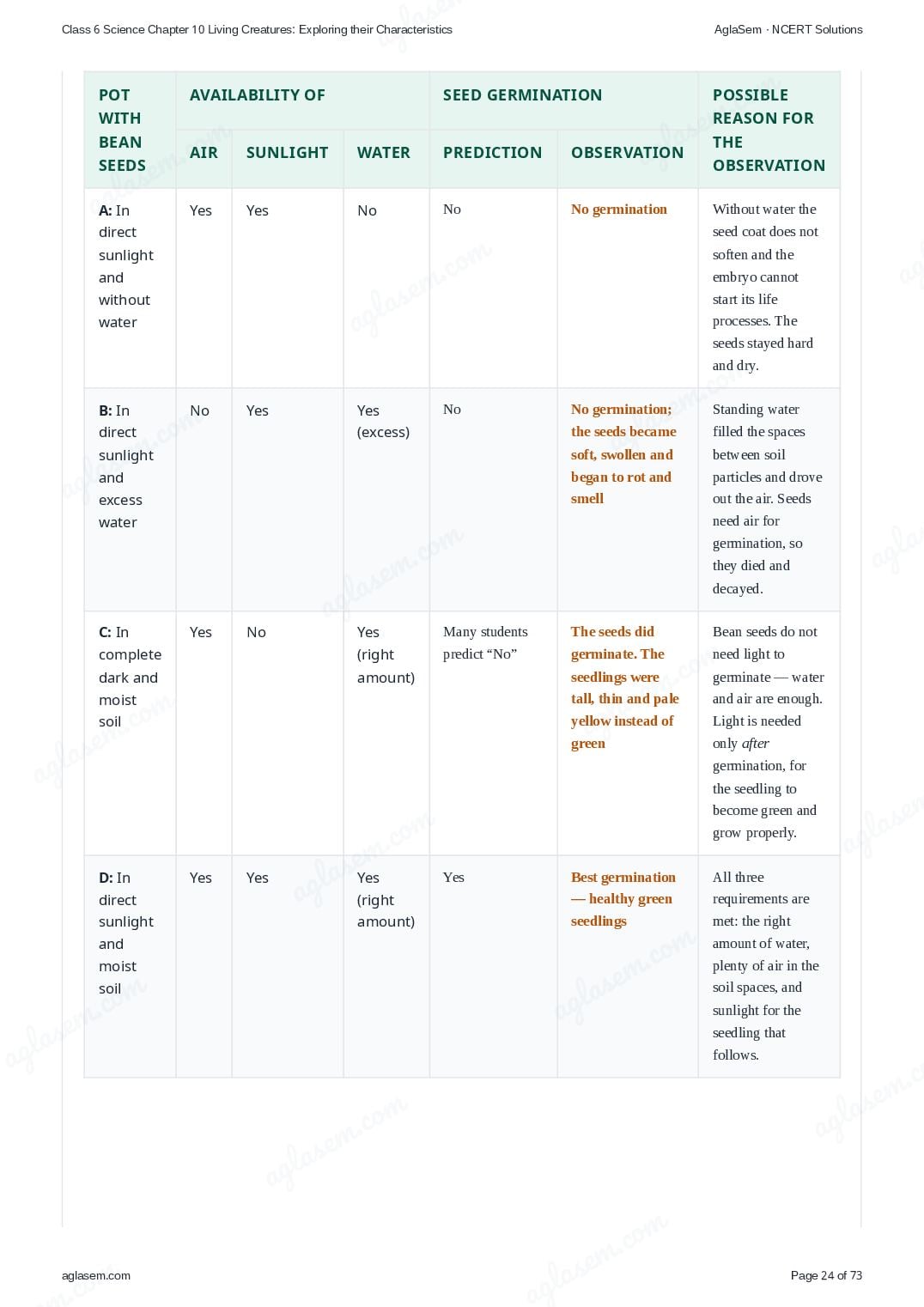
- Indicate the availability of air, sunlight and water for the seeds in each of these cases in Table 10.2.
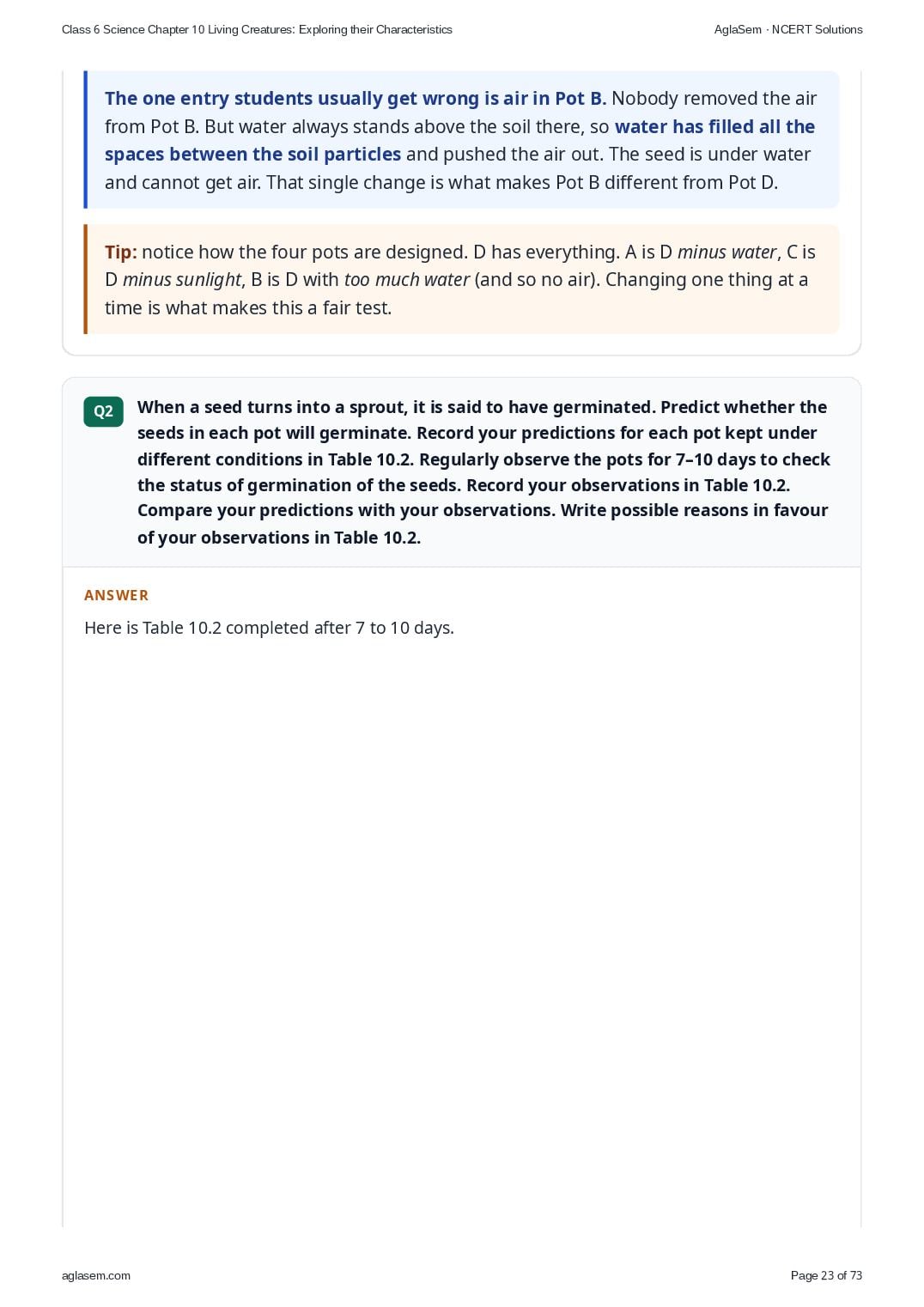
- When a seed turns into a sprout, it is said to have germinated. Predict whether the seeds in each pot will germinate. Record your predictions for each pot kept under different conditions in Table 10.2. Regularly observe the pots for 7–10 days to check the status of germination of the seeds. Record your observations in Table 10.2. Compare your predictions with your observations. Write possible reasons in favour of your observations in Table 10.2.
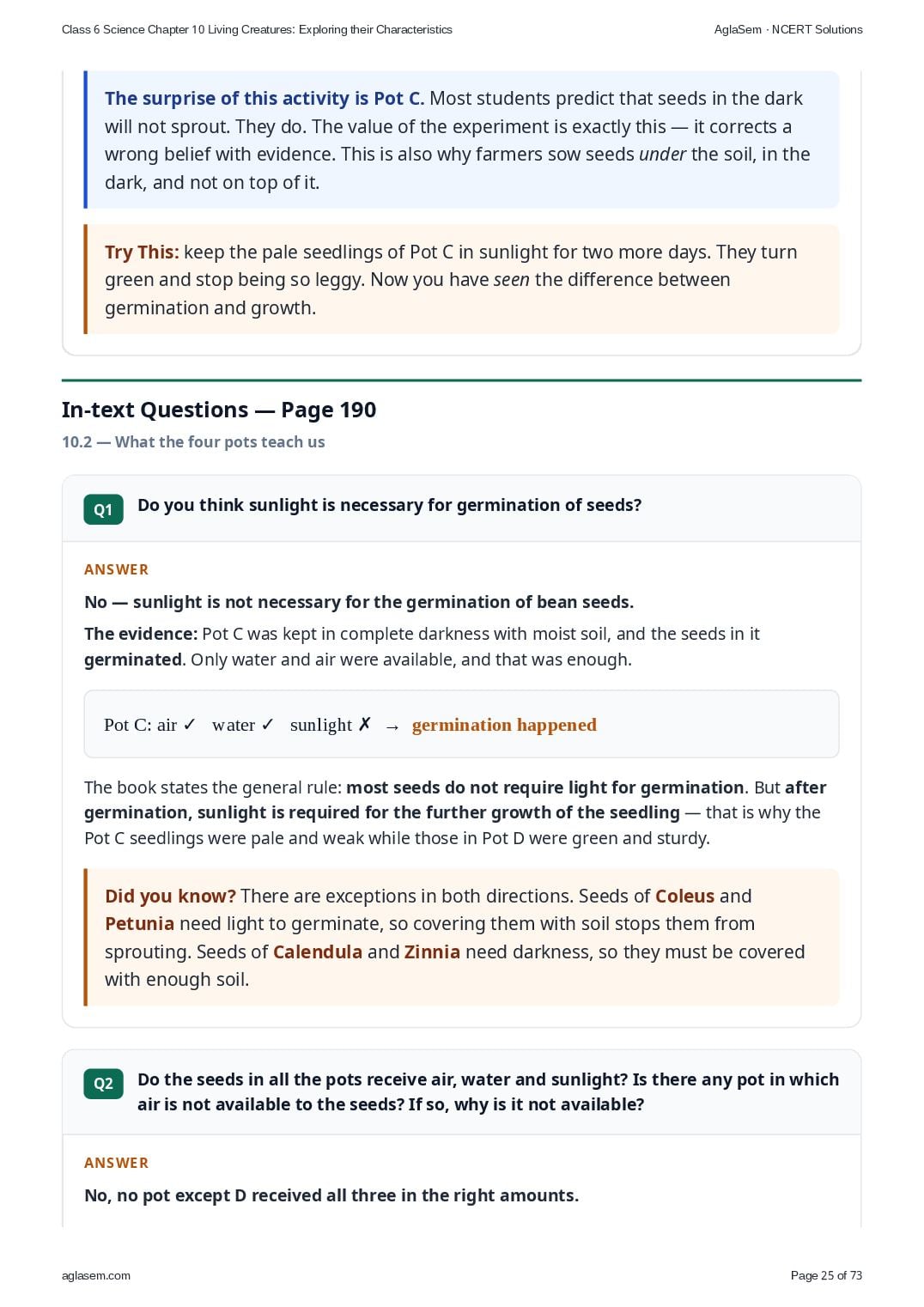
- Do you think sunlight is necessary for germination of seeds?
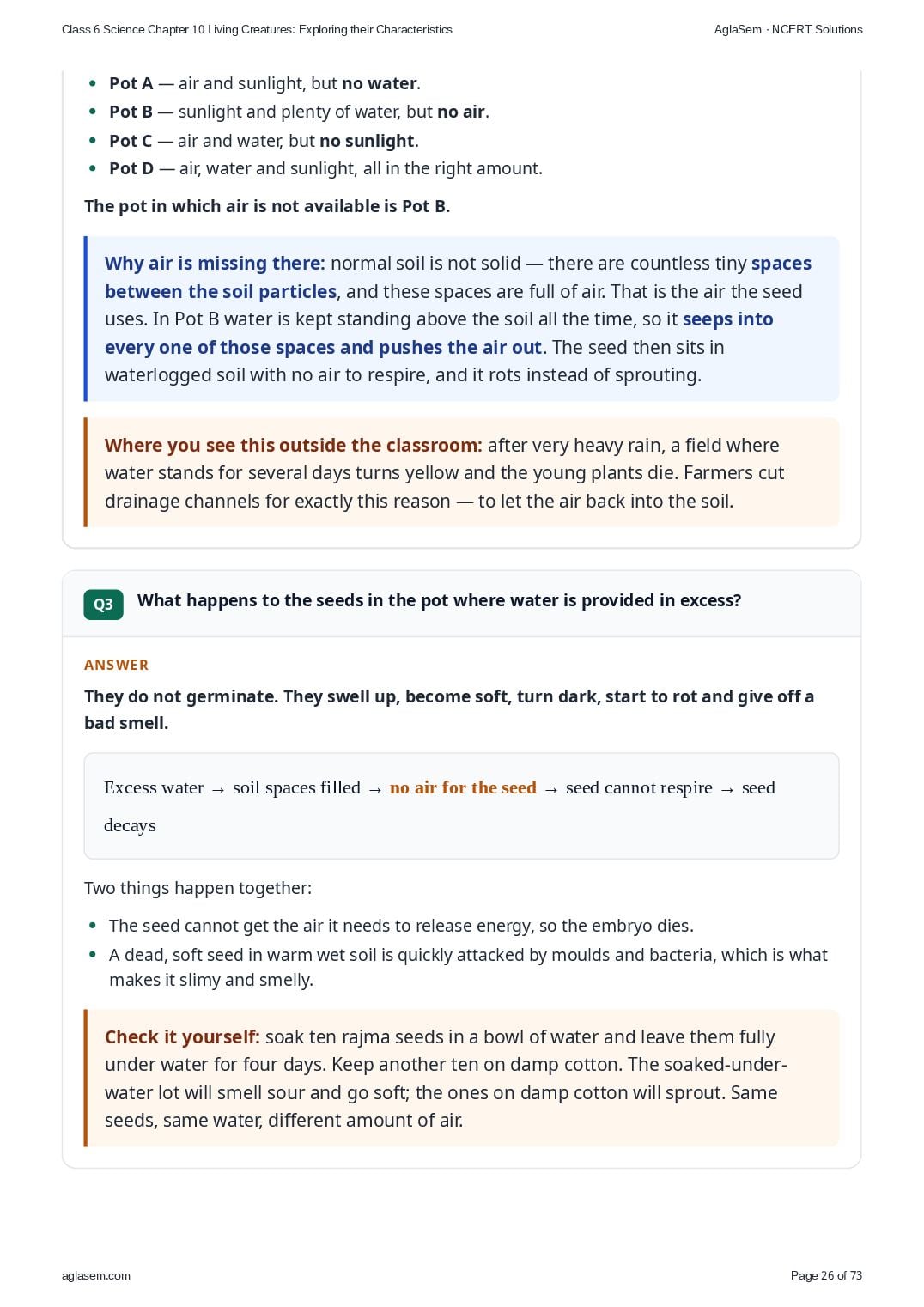
- Do the seeds in all the pots receive air, water and sunlight? Is there any pot in which air is not available to the seeds? If so, why is it not available?
- What happens to the seeds in the pot where water is provided in excess?
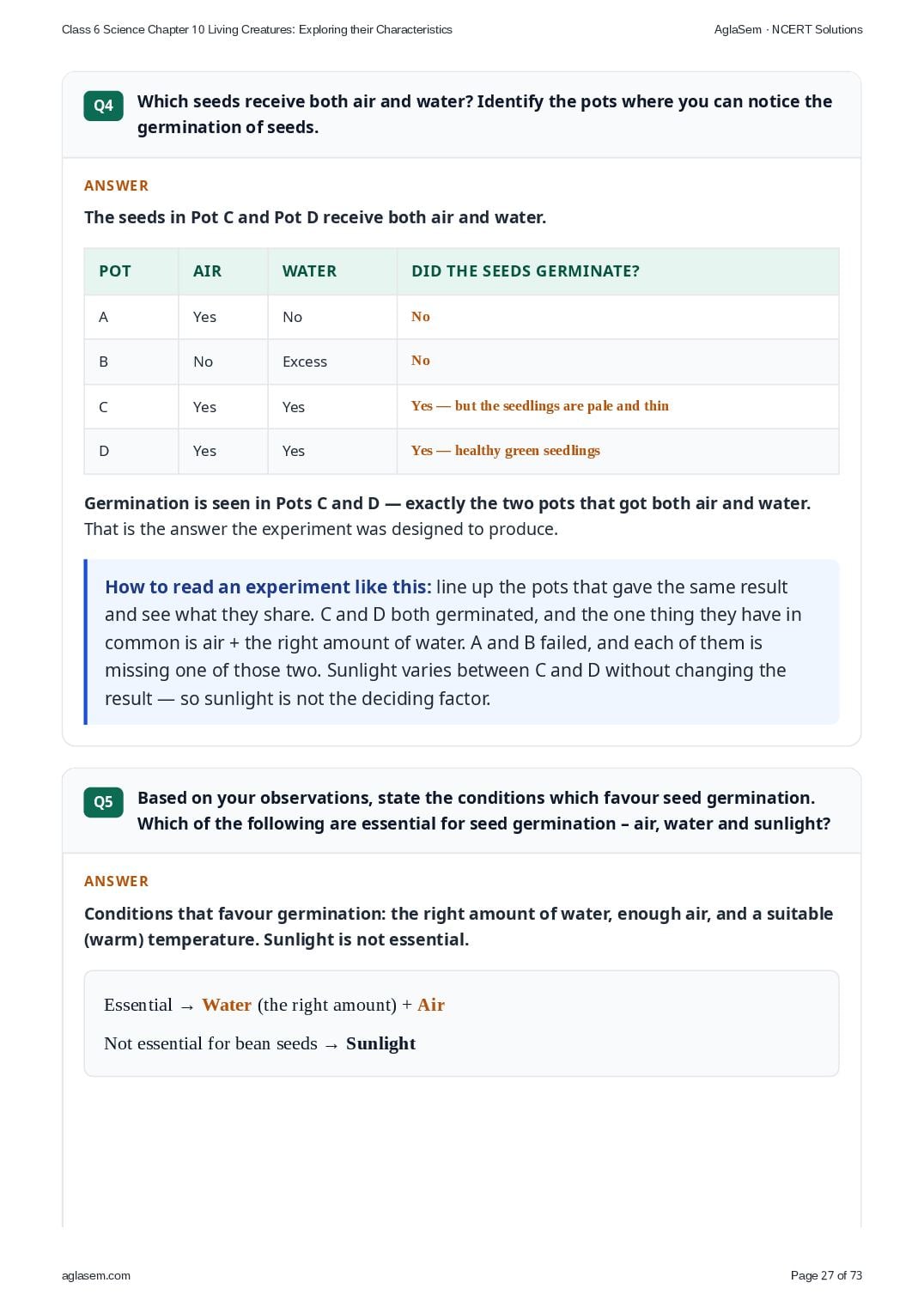
- Which seeds receive both air and water? Identify the pots where you can notice the germination of seeds.
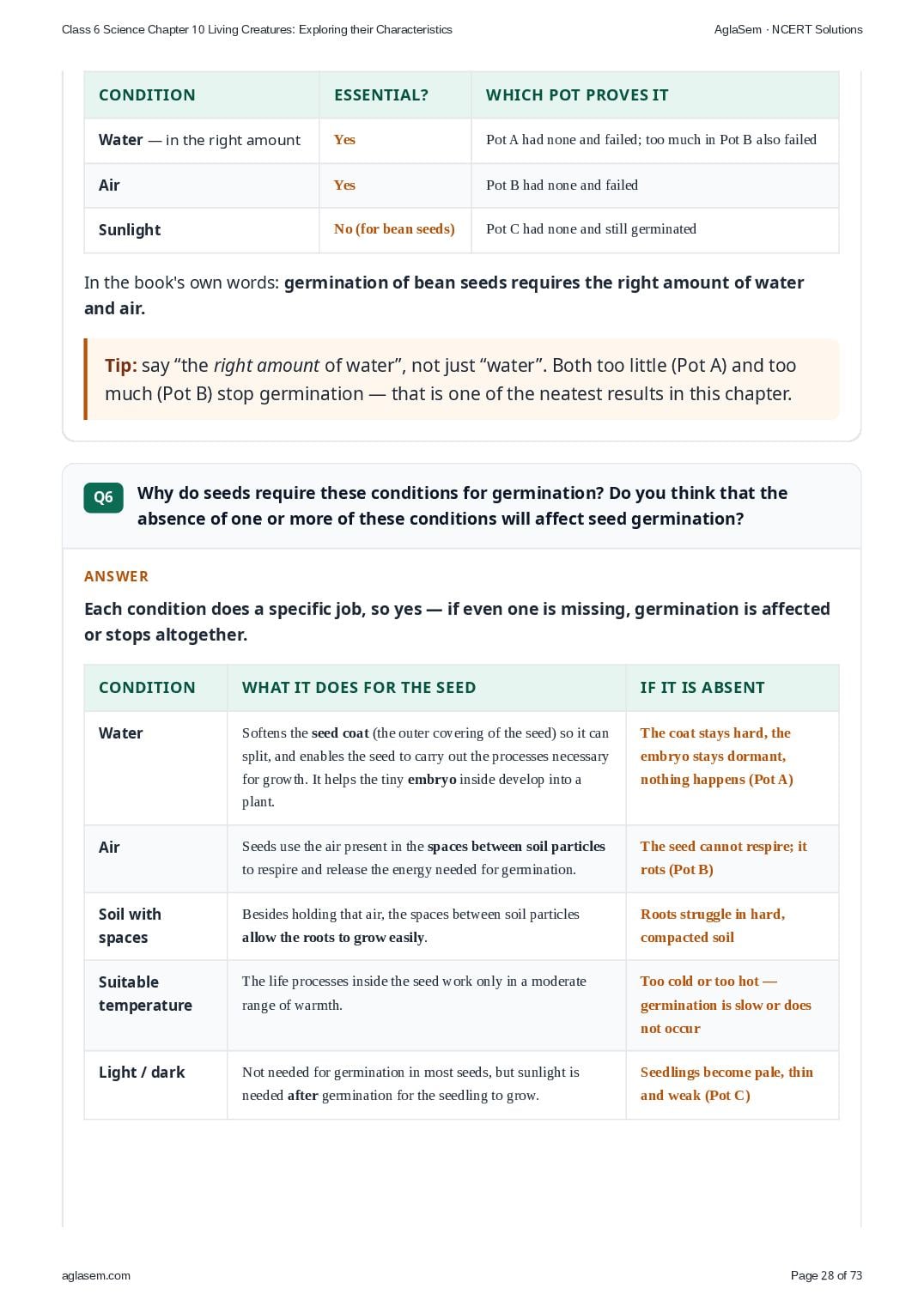
- Based on your observations, state the conditions which favour seed germination. Which of the following are essential for seed germination – air, water and sunlight?
- Why do seeds require these conditions for germination? Do you think that the absence of one or more of these conditions will affect seed germination?
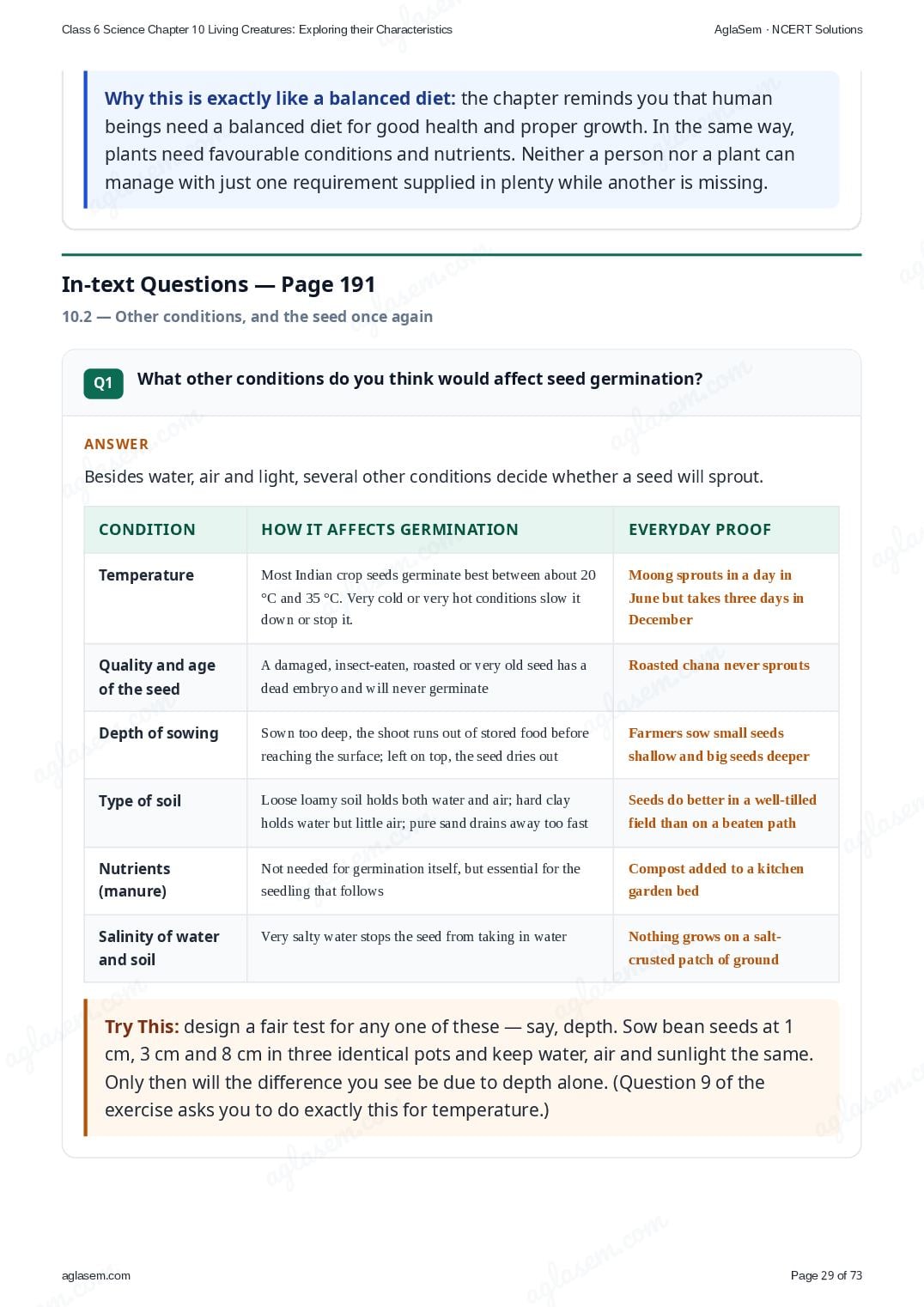
- What other conditions do you think would affect seed germination?
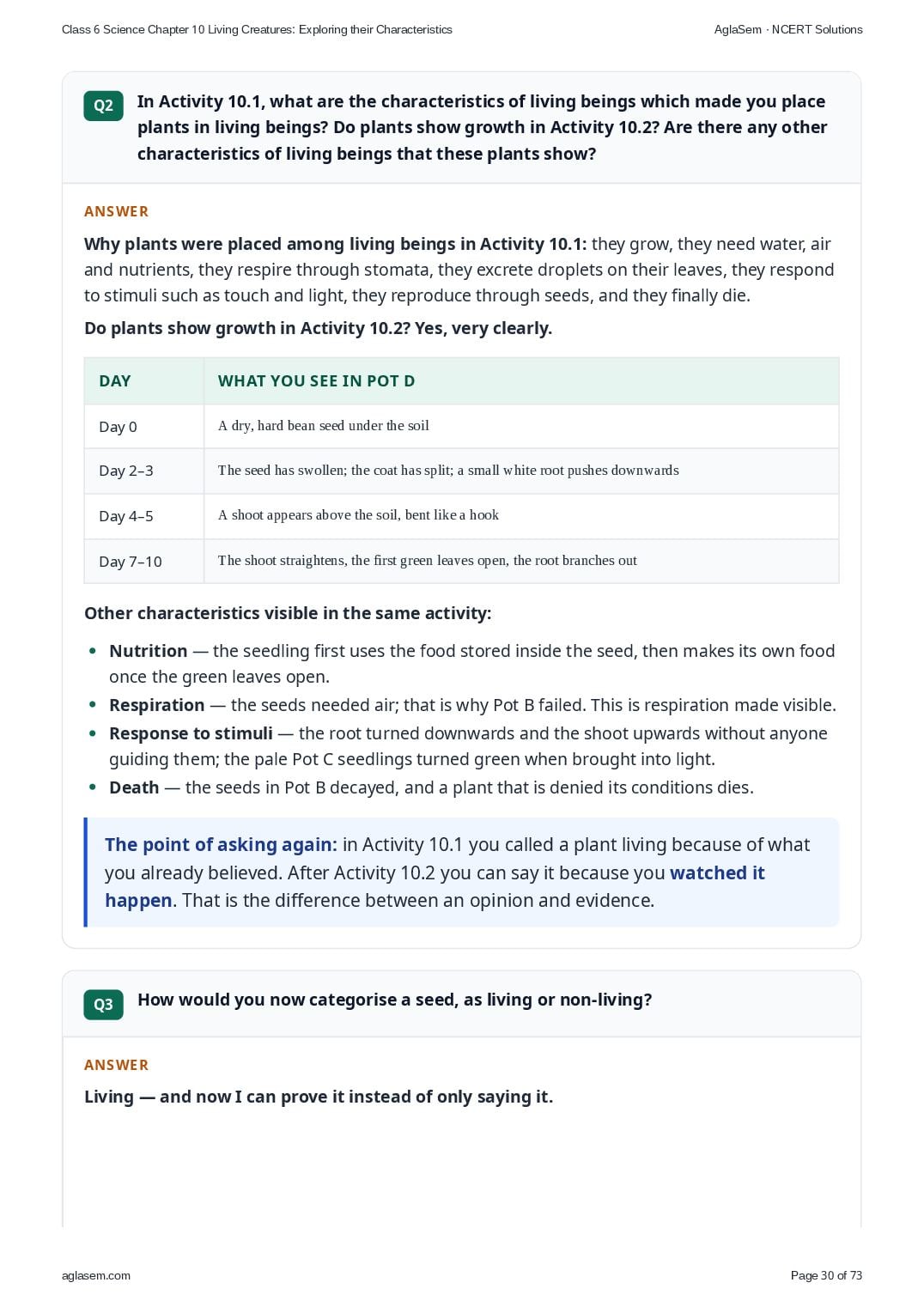
- In Activity 10.1, what are the characteristics of living beings which made you place plants in living beings? Do plants show growth in Activity 10.2? Are there any other characteristics of living beings that these plants show?
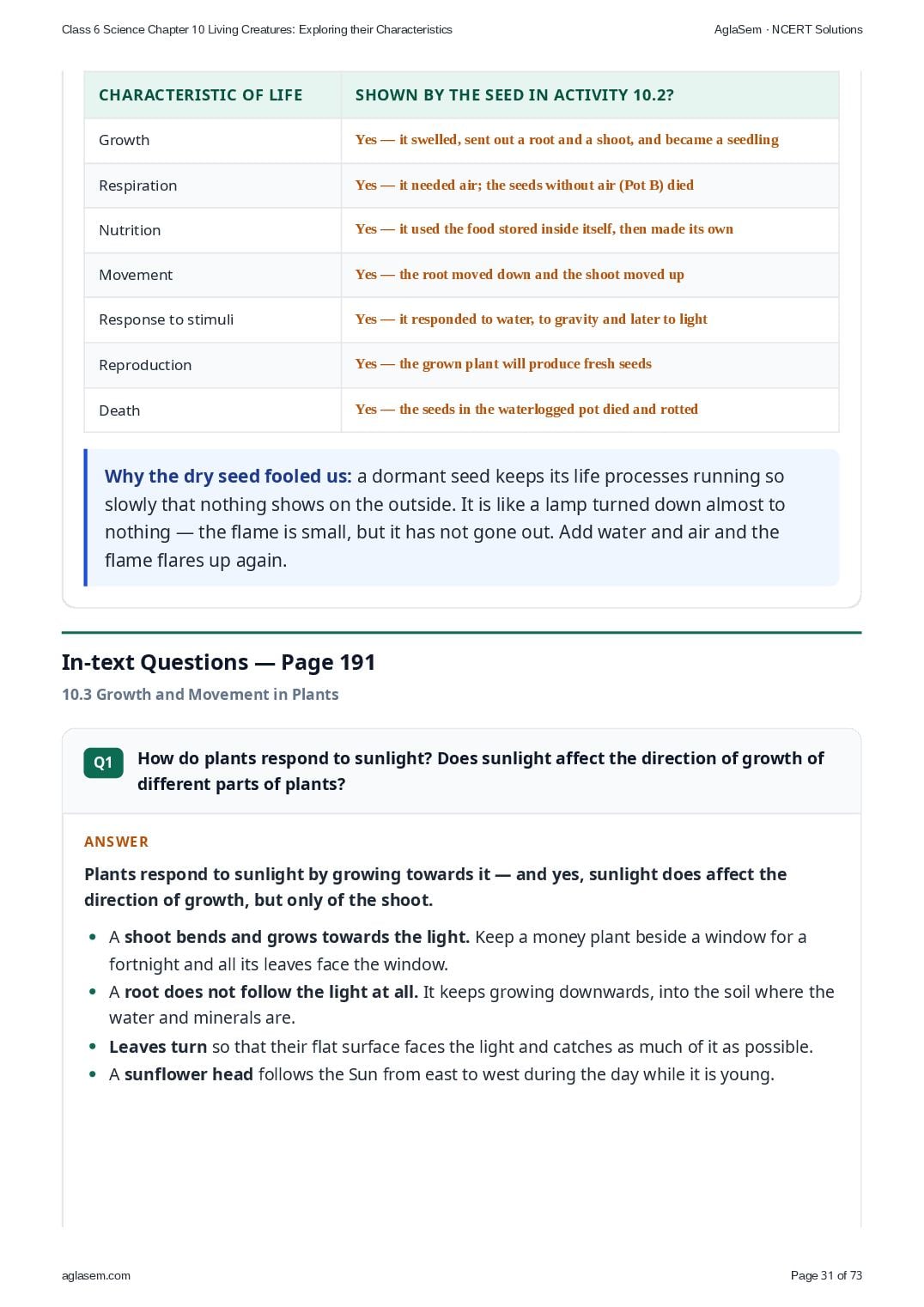
- How would you now categorise a seed, as living or non-living?
- How do plants respond to sunlight? Does sunlight affect the direction of growth of different parts of plants?
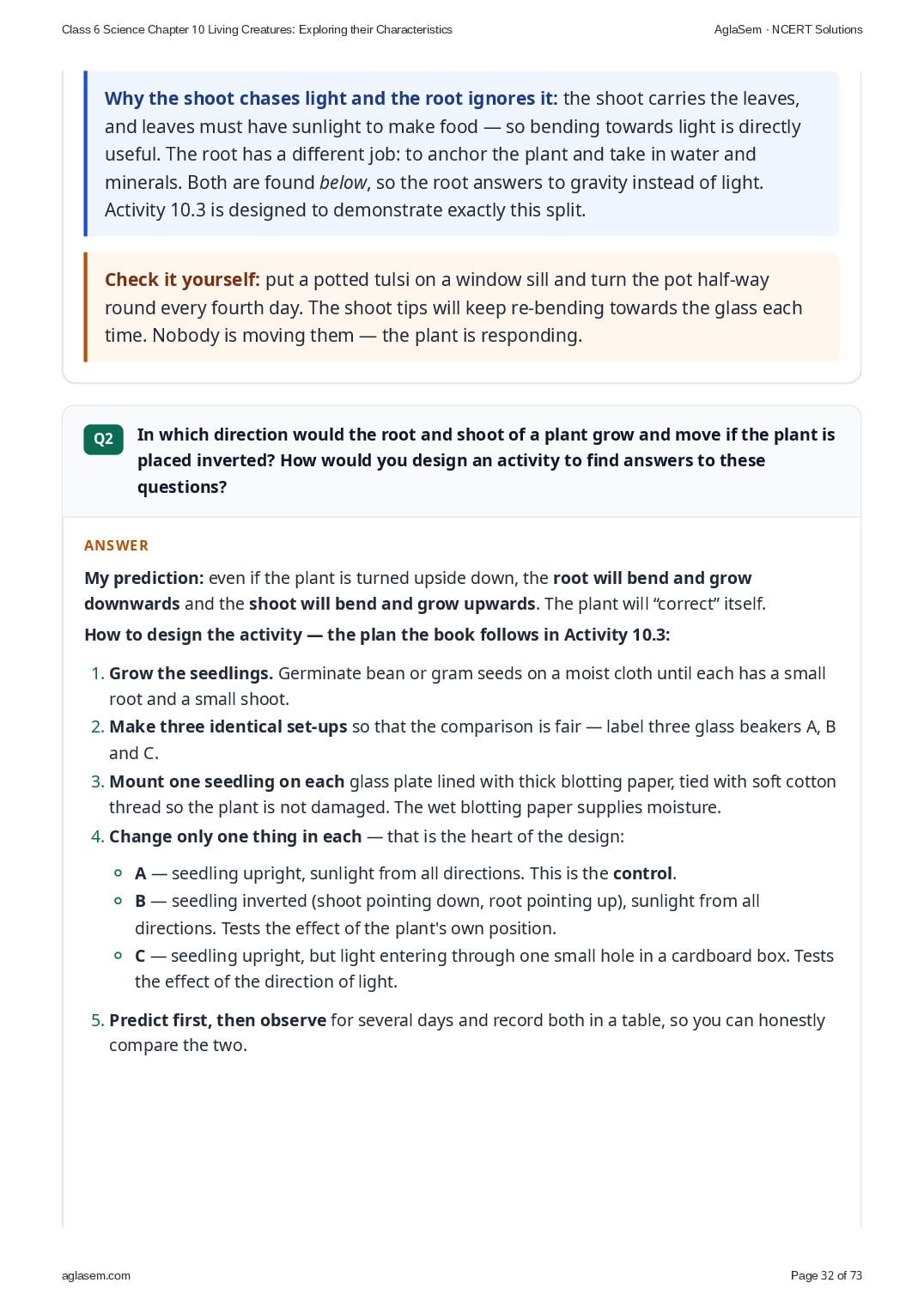
- In which direction would the root and shoot of a plant grow and move if the plant is placed inverted? How would you design an activity to find answers to these questions?
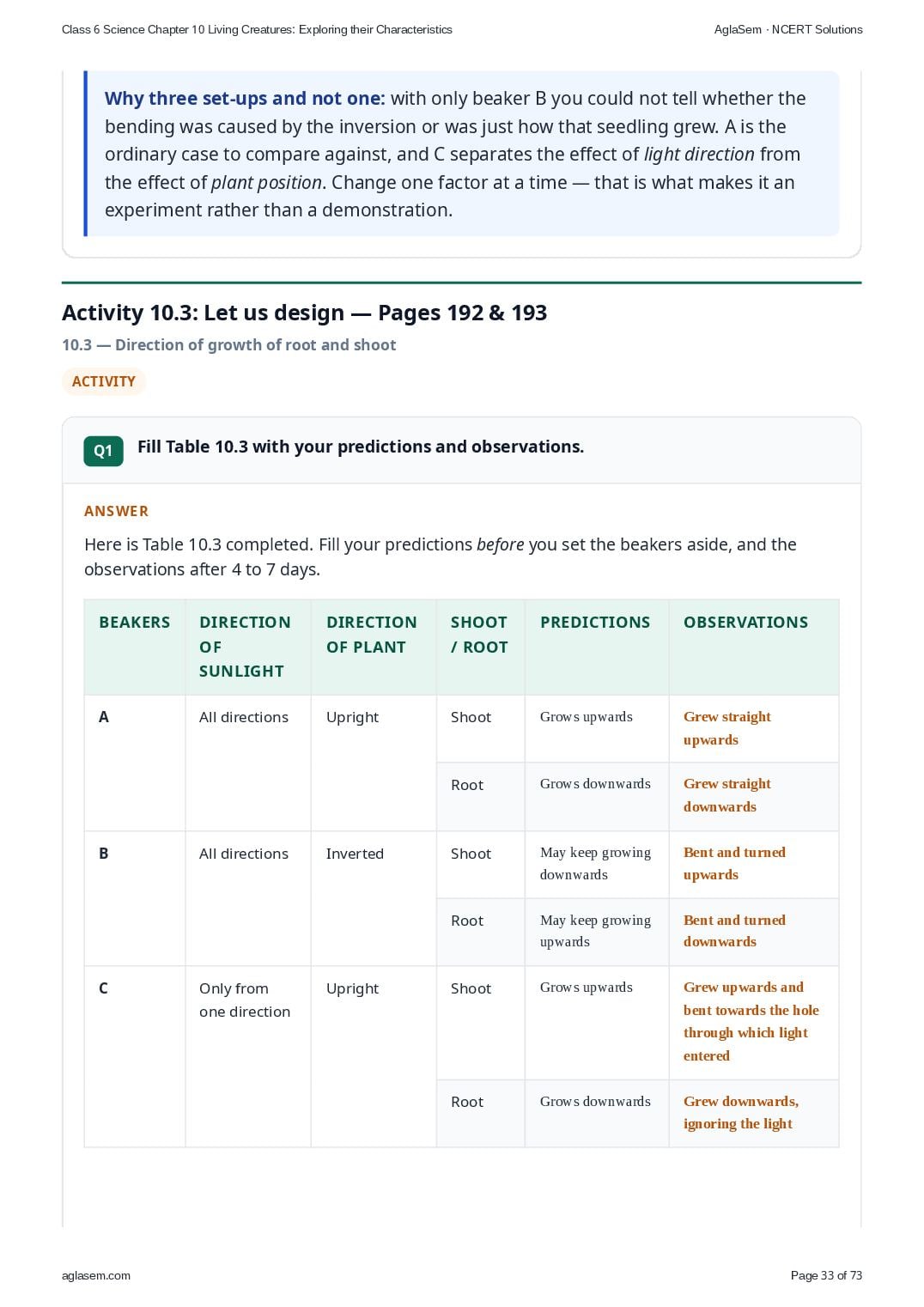
- Fill Table 10.3 with your predictions and observations.
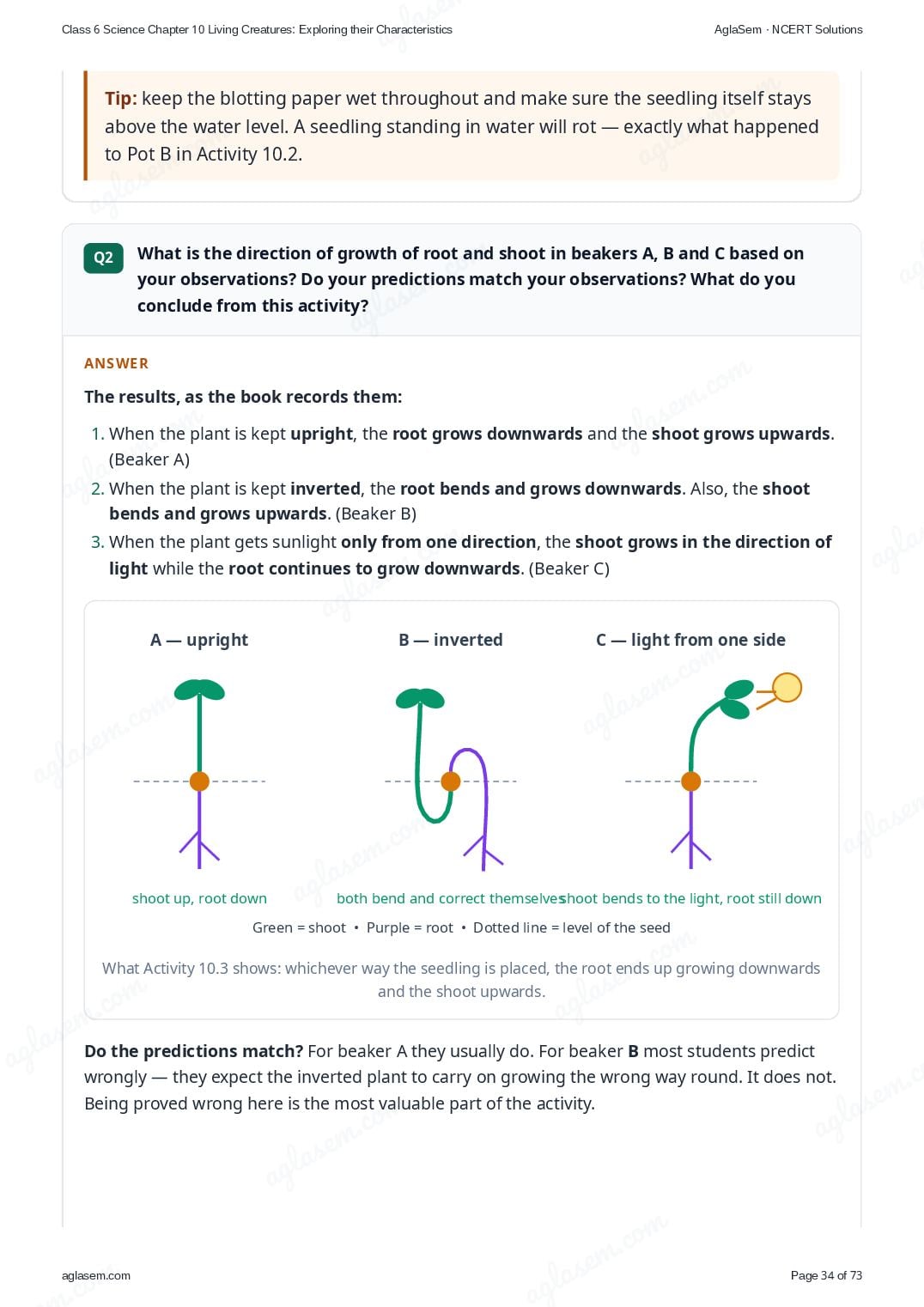
- What is the direction of growth of root and shoot in beakers A, B and C based on your observations? Do your predictions match your observations? What do you conclude from this activity?
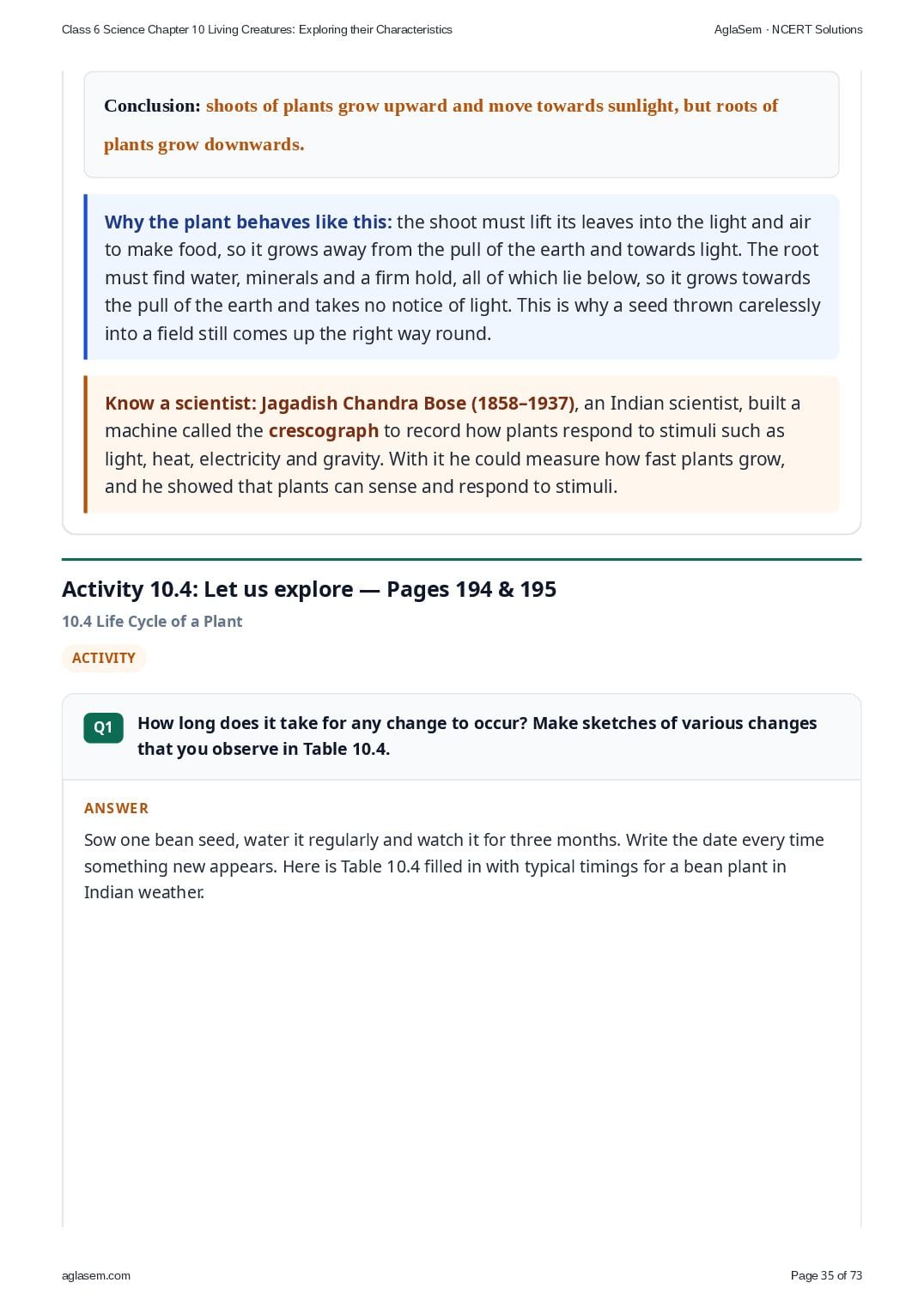
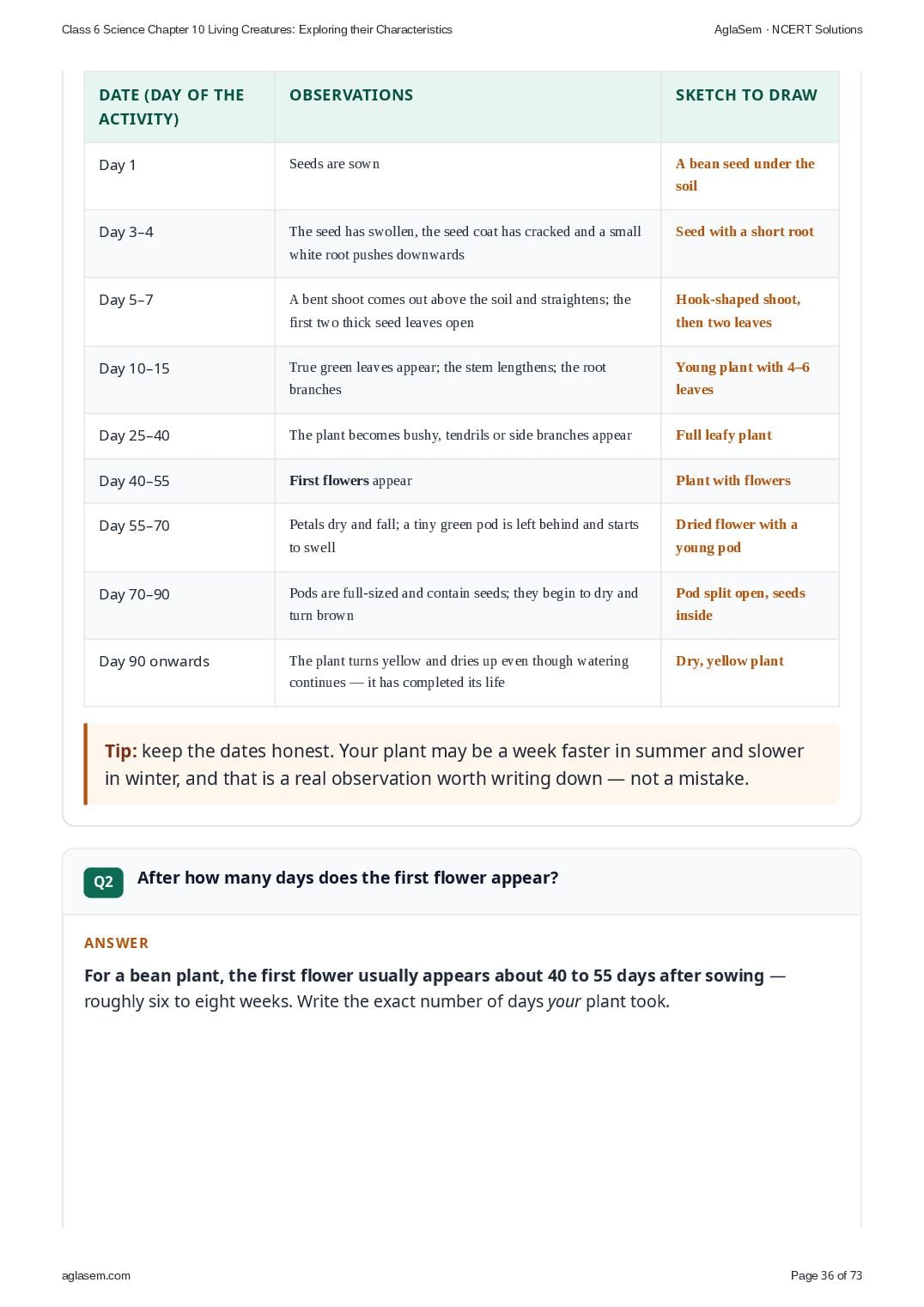
- How long does it take for any change to occur? Make sketches of various changes that you observe in Table 10.4.
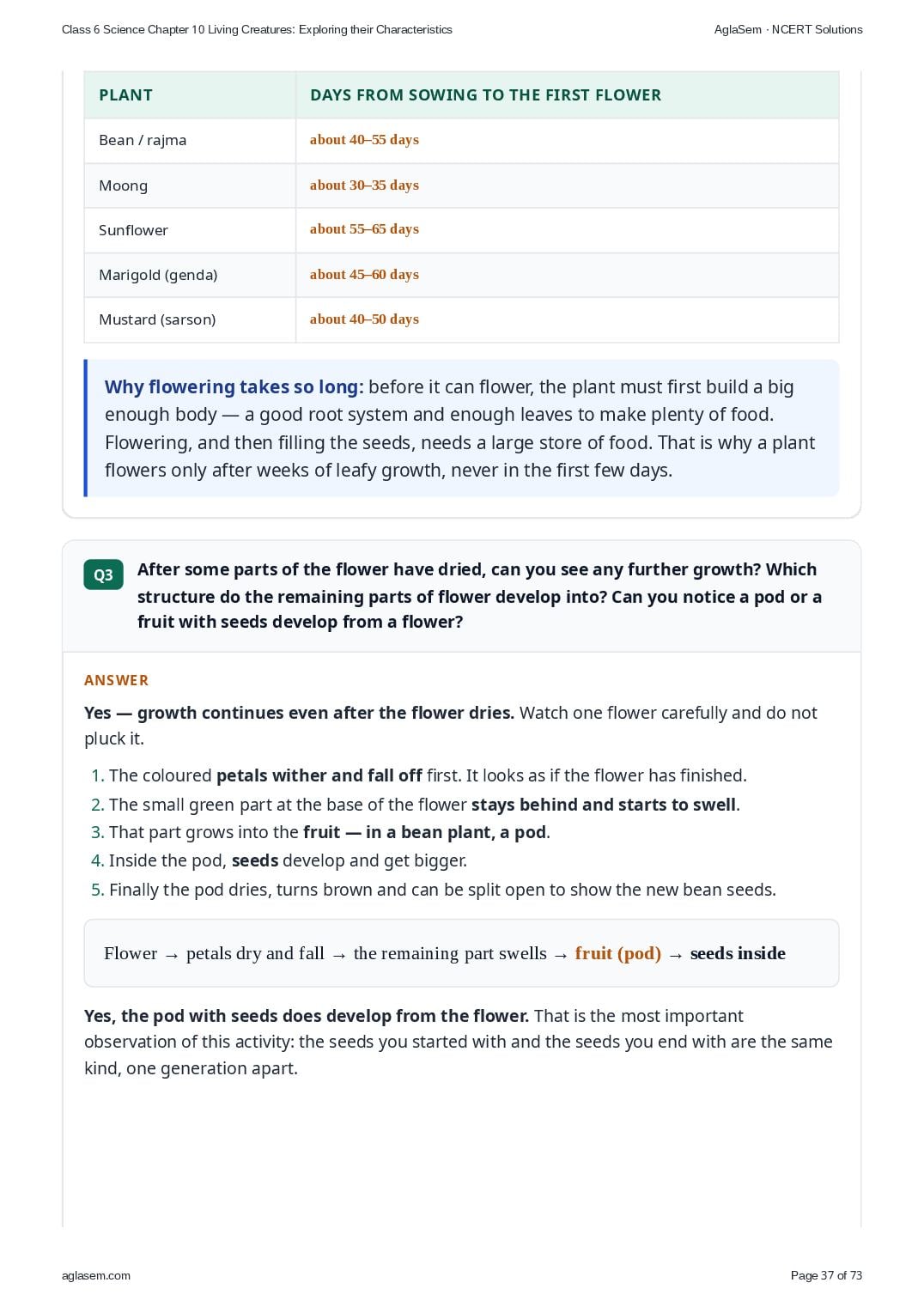
- After how many days does the first flower appear?
- After some parts of the flower have dried, can you see any further growth? Which structure do the remaining parts of flower develop into? Can you notice a pod or a fruit with seeds develop from a flower?
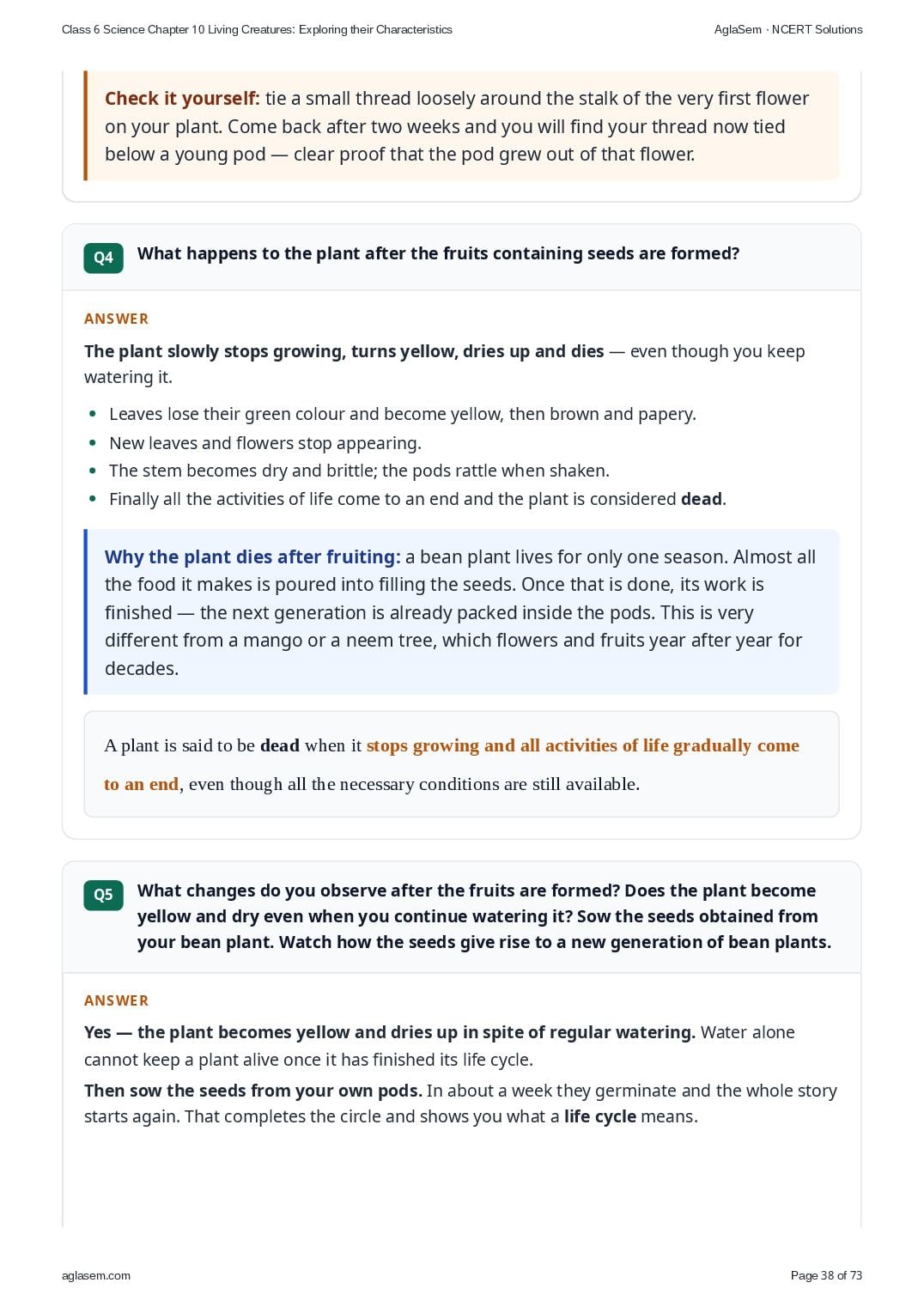
- What happens to the plant after the fruits containing seeds are formed?
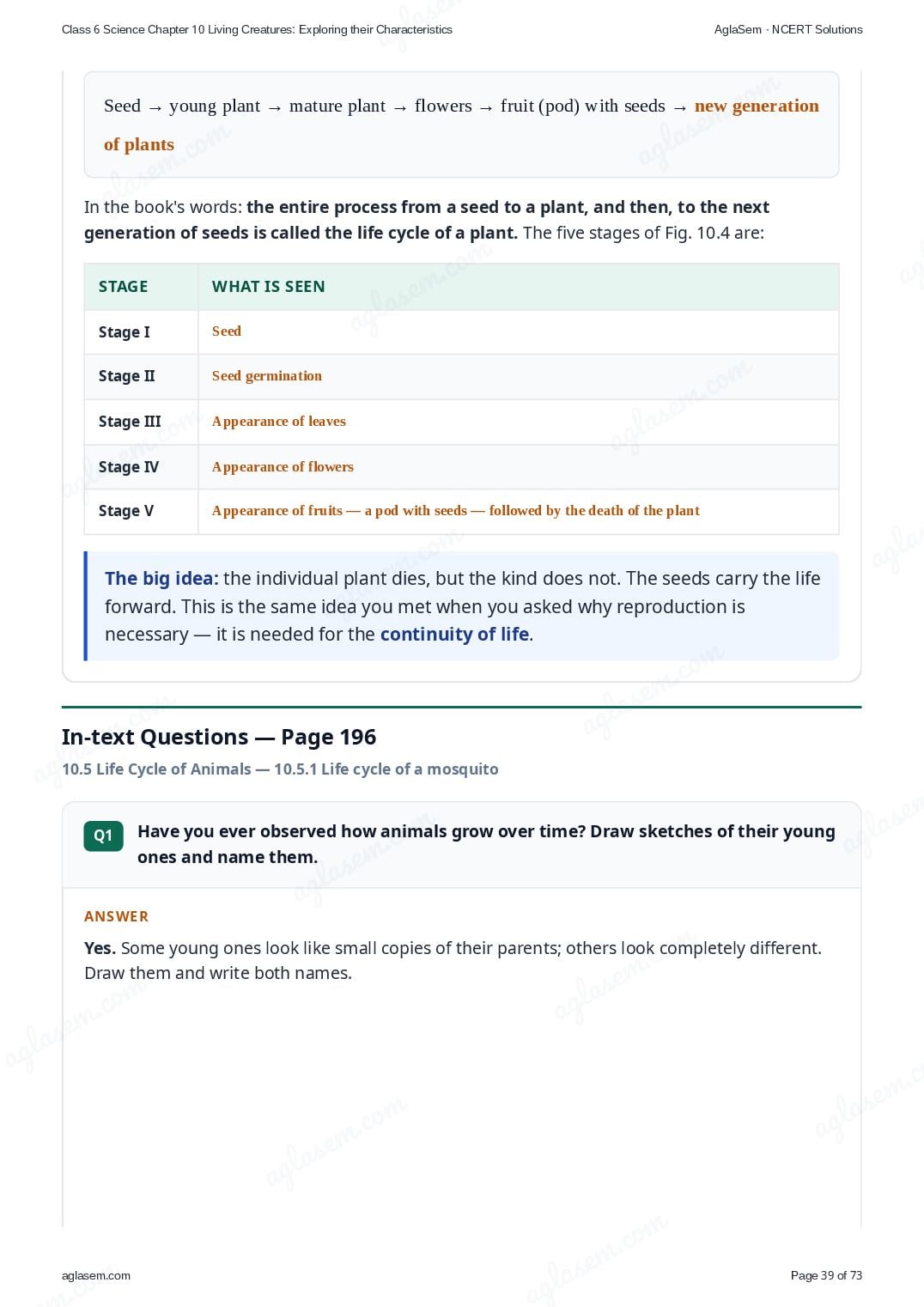
- What changes do you observe after the fruits are formed? Does the plant become yellow and dry even when you continue watering it? Sow the seeds obtained from your bean plant. Watch how the seeds give rise to a new generation of bean plants.
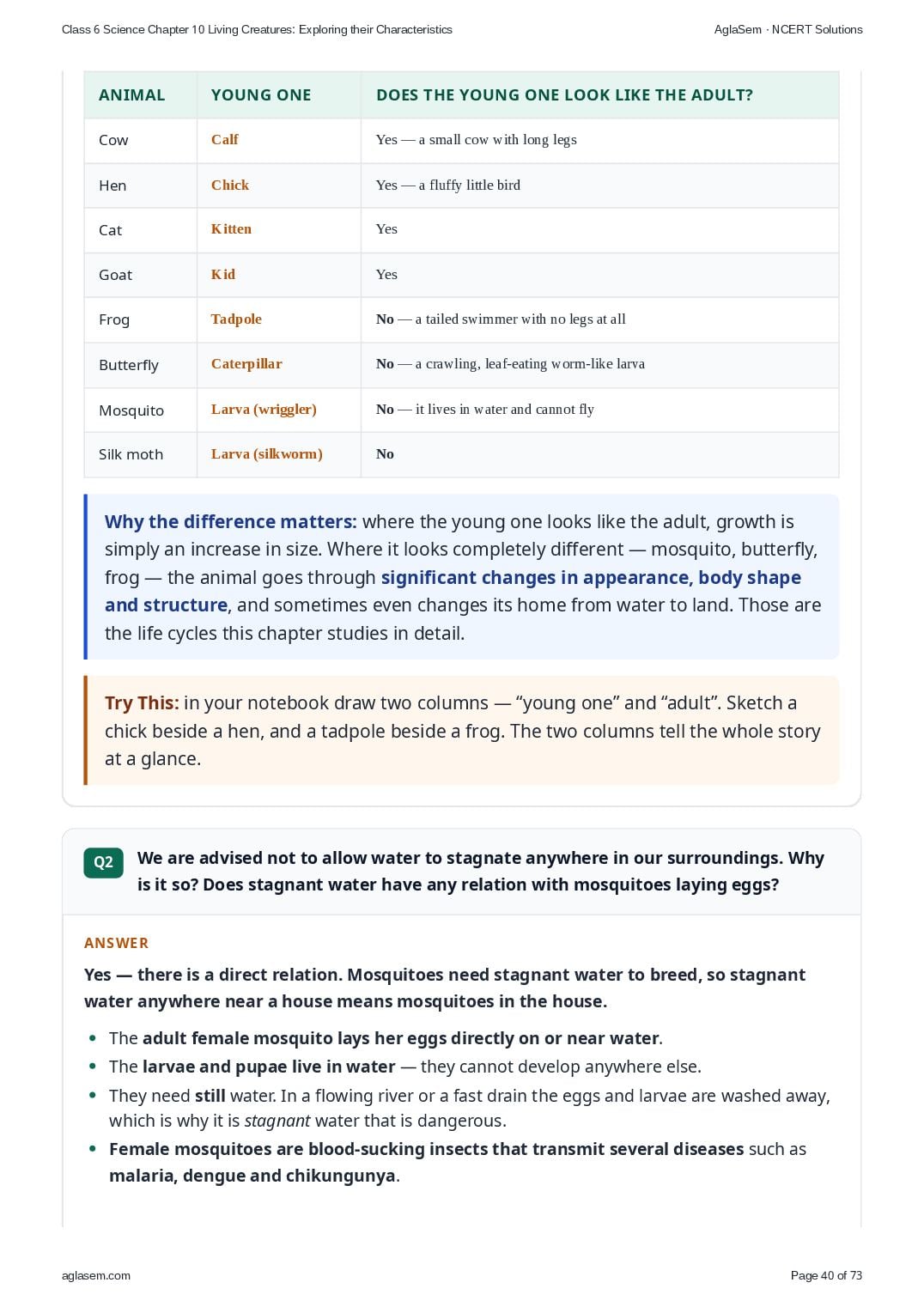
- Have you ever observed how animals grow over time? Draw sketches of their young ones and name them.
- We are advised not to allow water to stagnate anywhere in our surroundings. Why is it so? Does stagnant water have any relation with mosquitoes laying eggs?
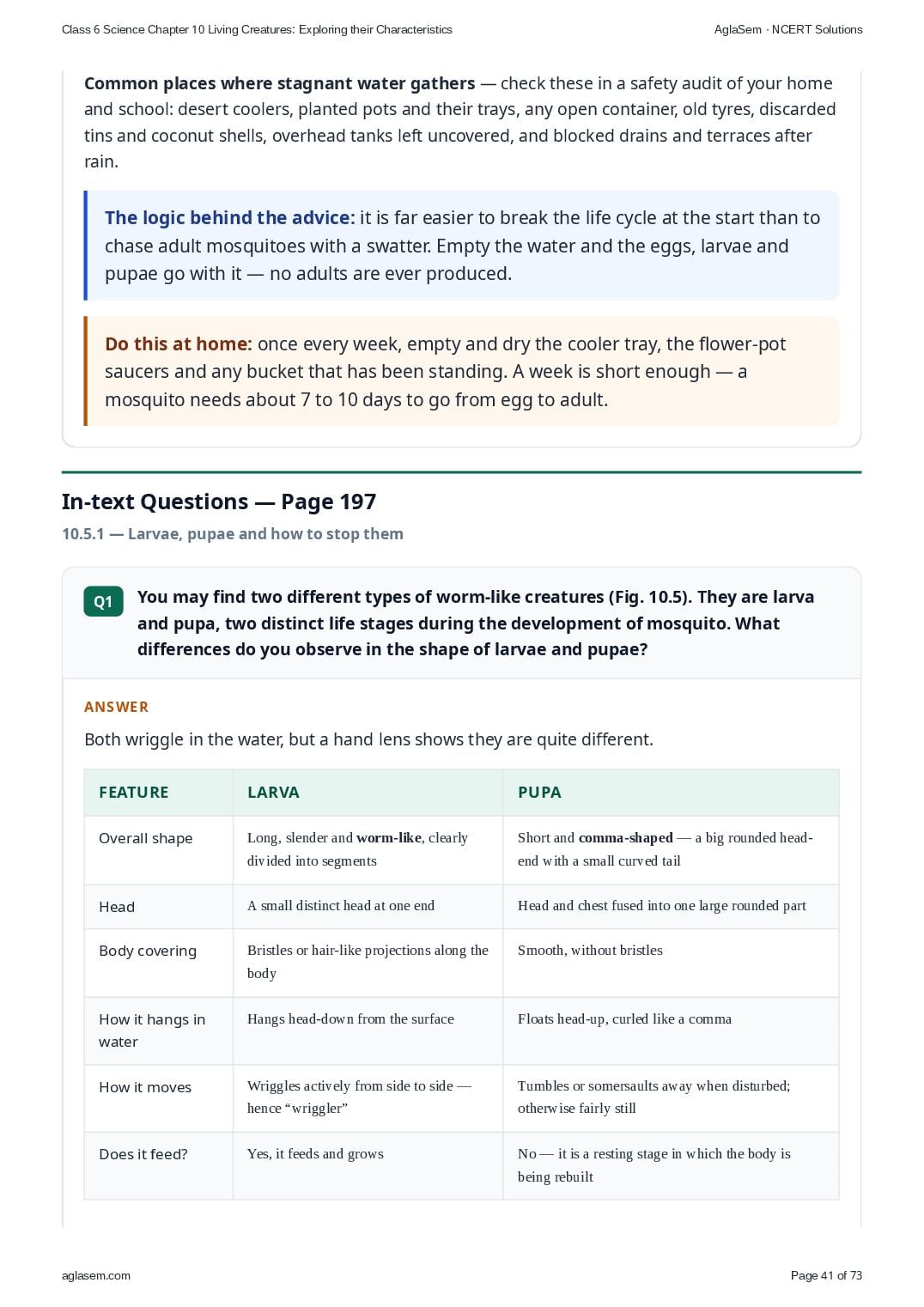
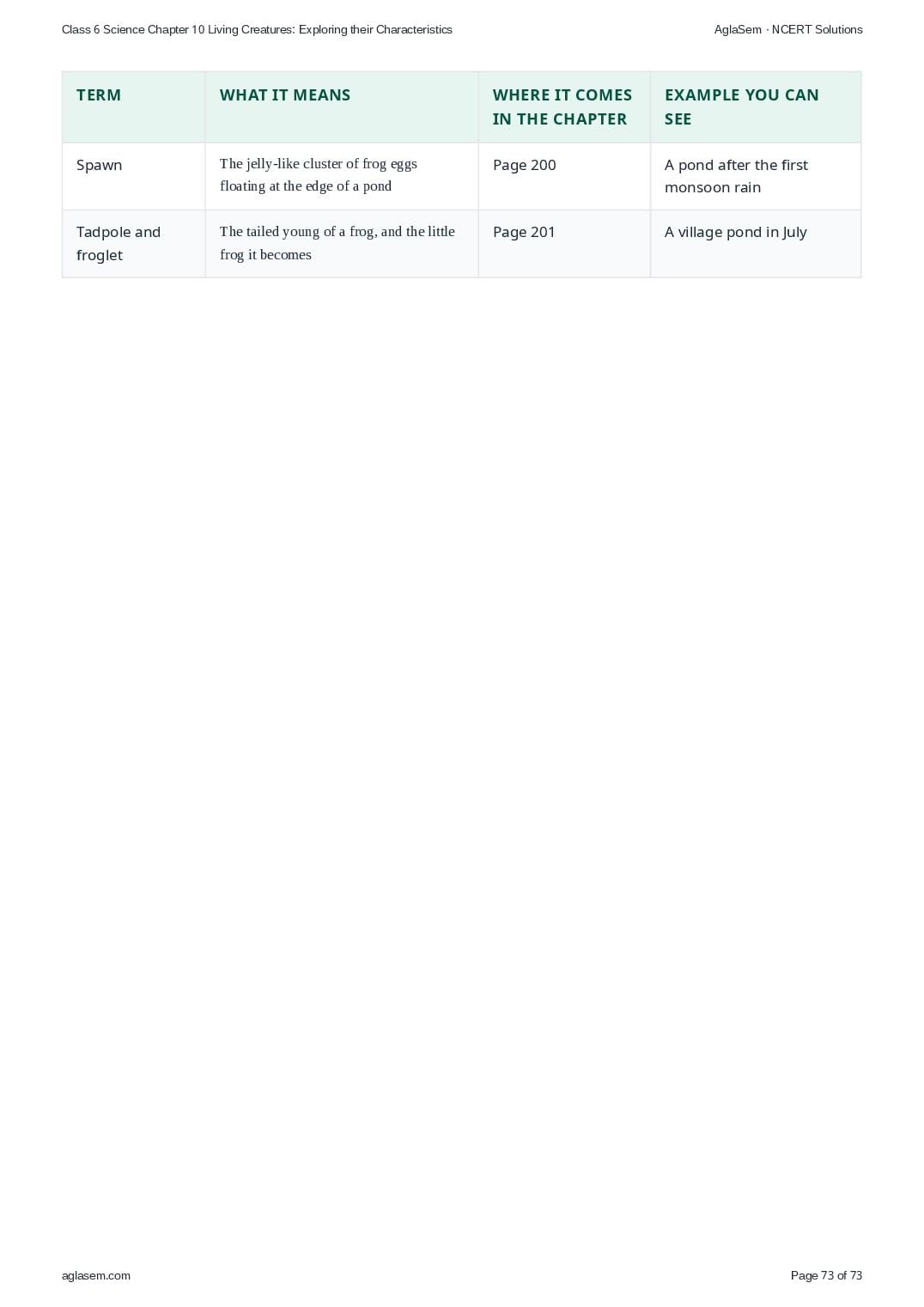
- You may find two different types of worm-like creatures (Fig. 10.5). They are larva and pupa, two distinct life stages during the development of mosquito. What differences do you observe in the shape of larvae and pupae?
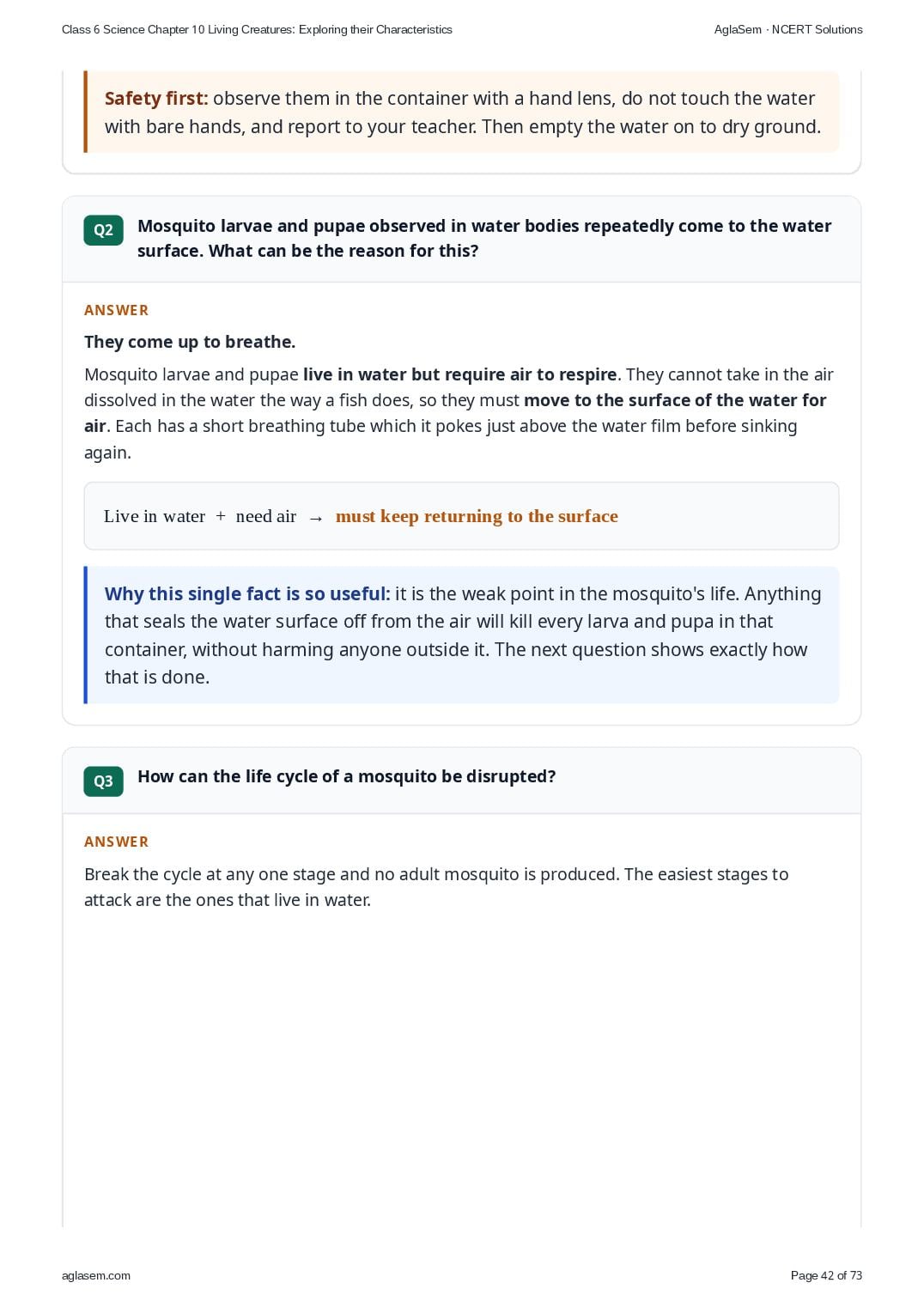
- Mosquito larvae and pupae observed in water bodies repeatedly come to the water surface. What can be the reason for this?
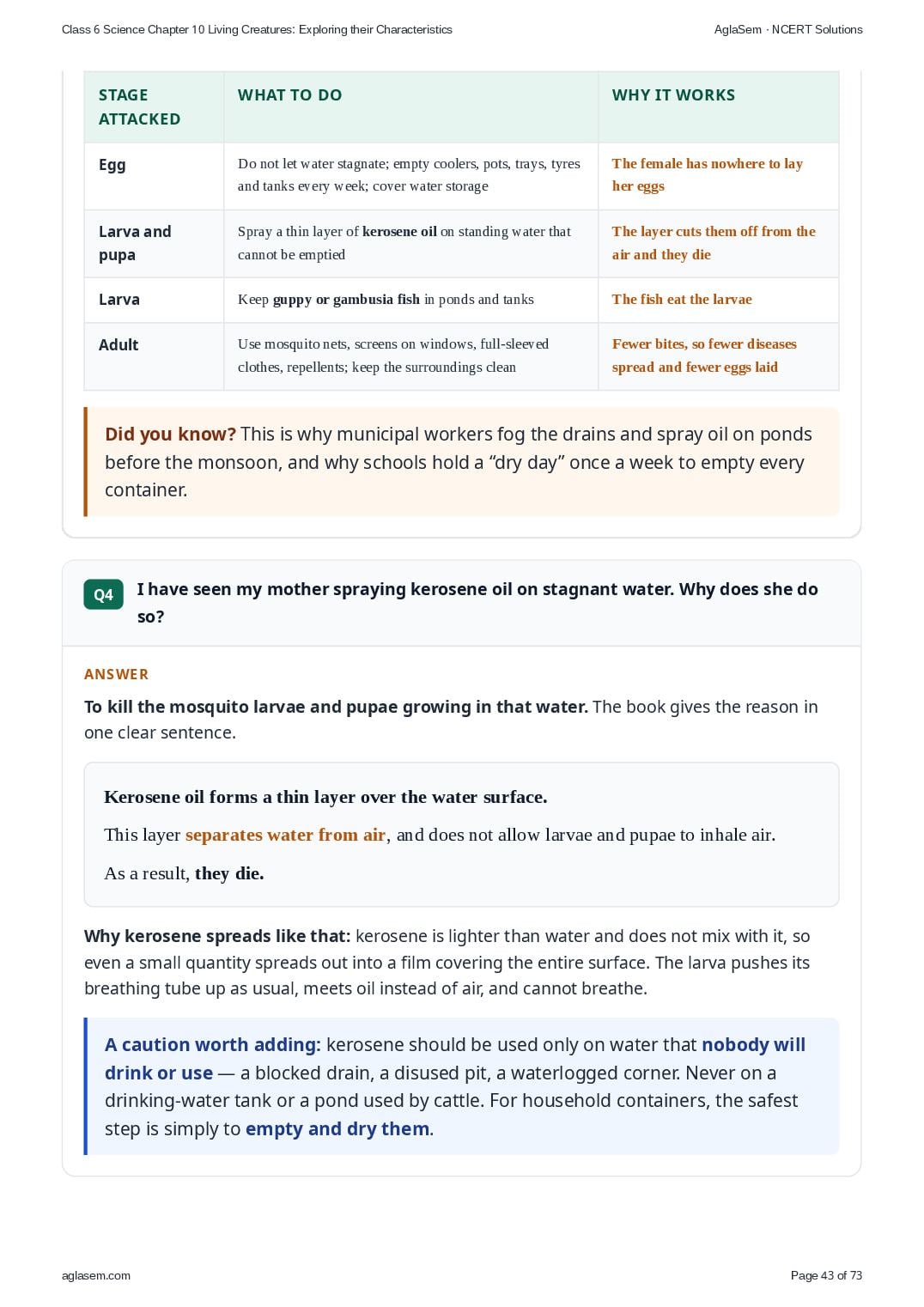
- How can the life cycle of a mosquito be disrupted?
- I have seen my mother spraying kerosene oil on stagnant water. Why does she do so?
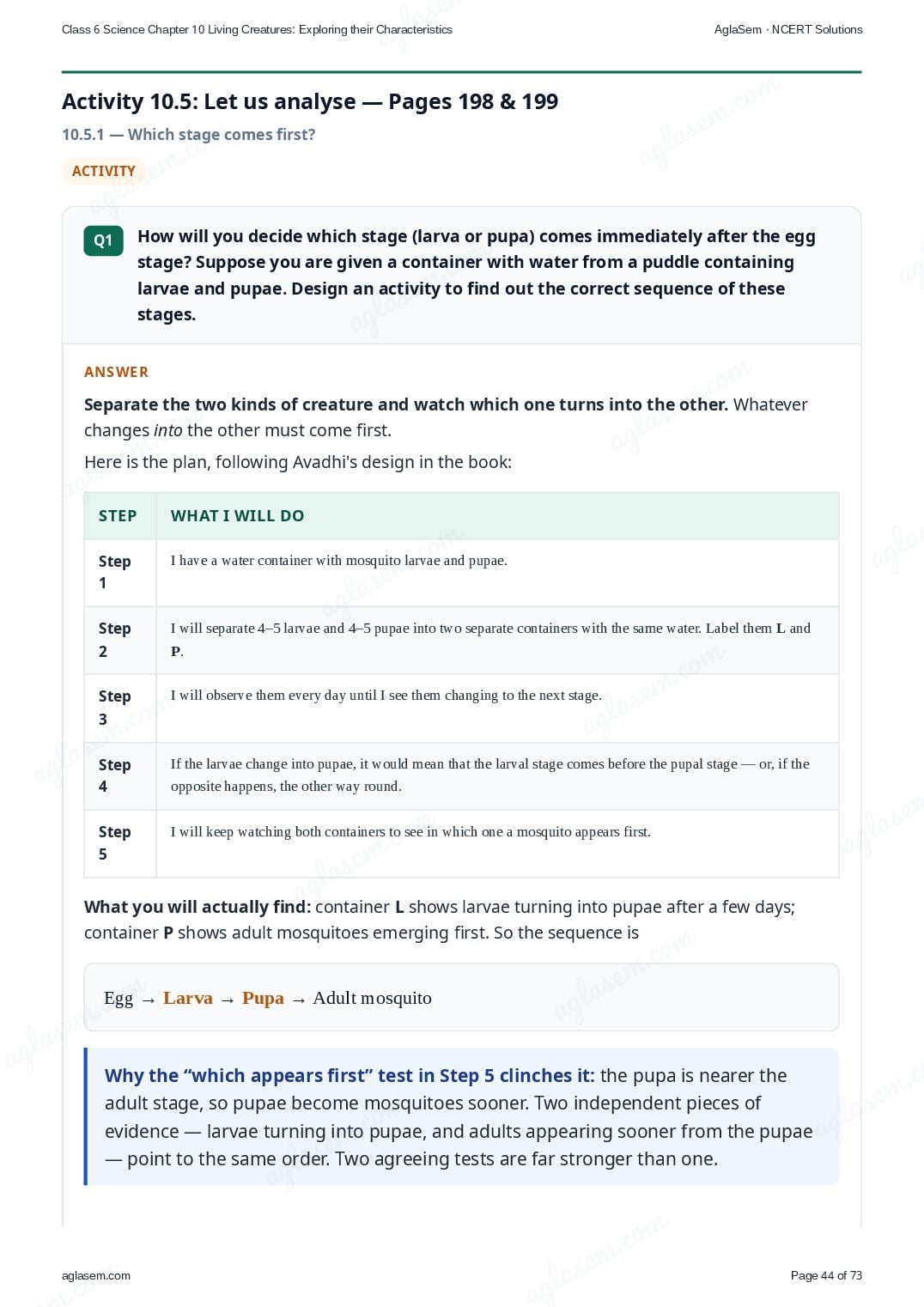
- How will you decide which stage (larva or pupa) comes immediately after the egg stage? Suppose you are given a container with water from a puddle containing larvae and pupae. Design an activity to find out the correct sequence of these stages.
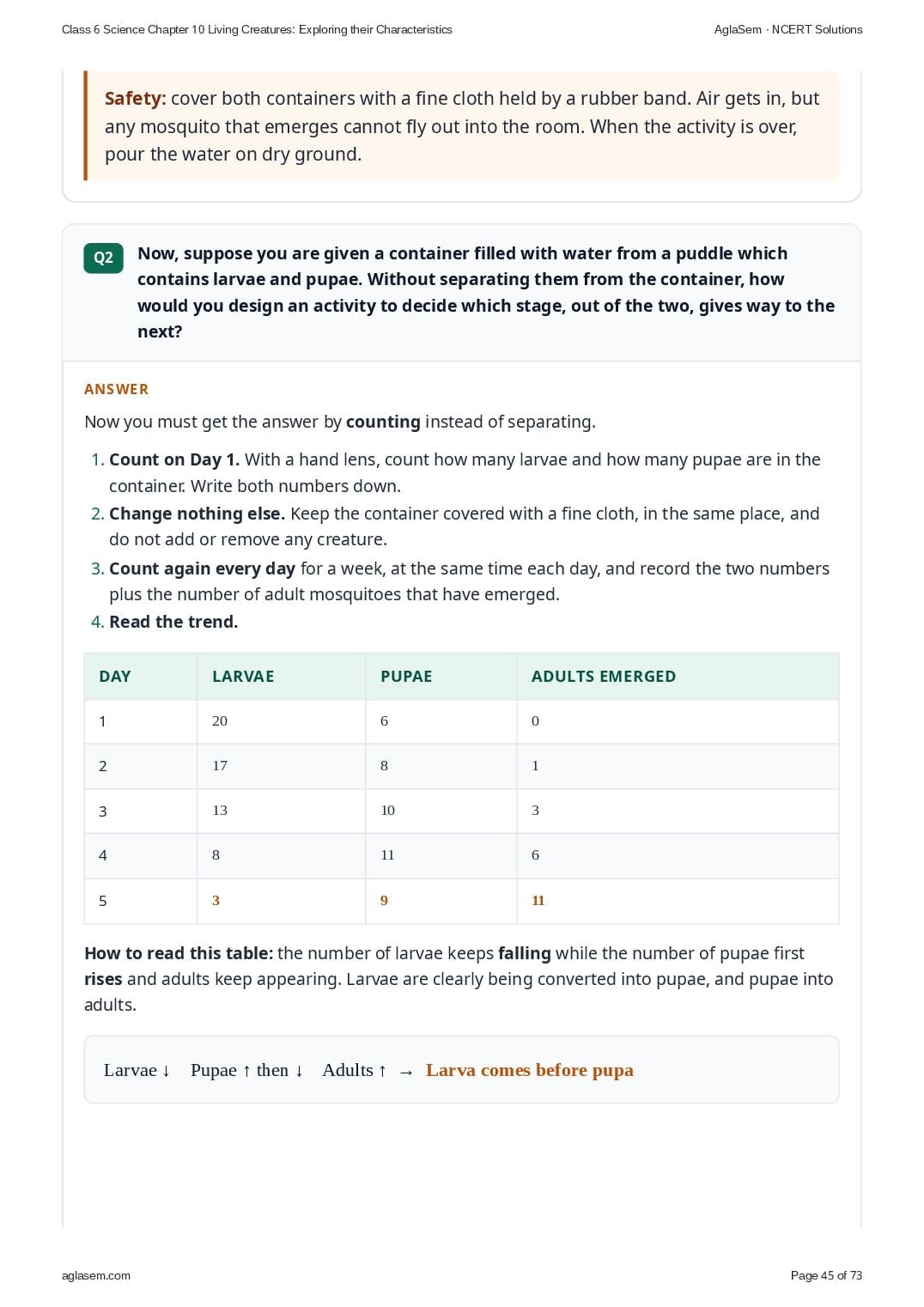
- Now, suppose you are given a container filled with water from a puddle which contains larvae and pupae. Without separating them from the container, how would you design an activity to decide which stage, out of the two, gives way to the next?
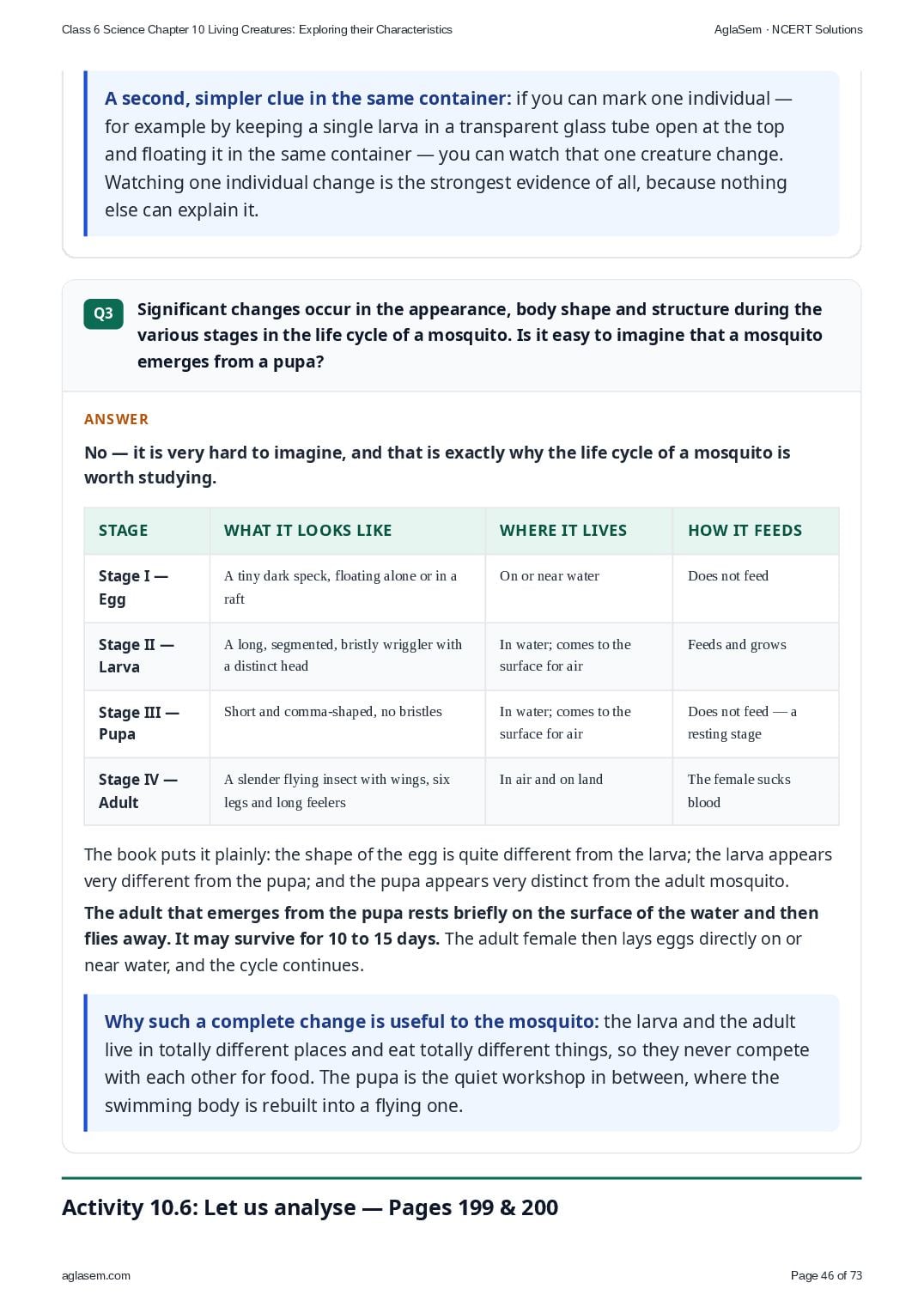
- Significant changes occur in the appearance, body shape and structure during the various stages in the life cycle of a mosquito. Is it easy to imagine that a mosquito emerges from a pupa?
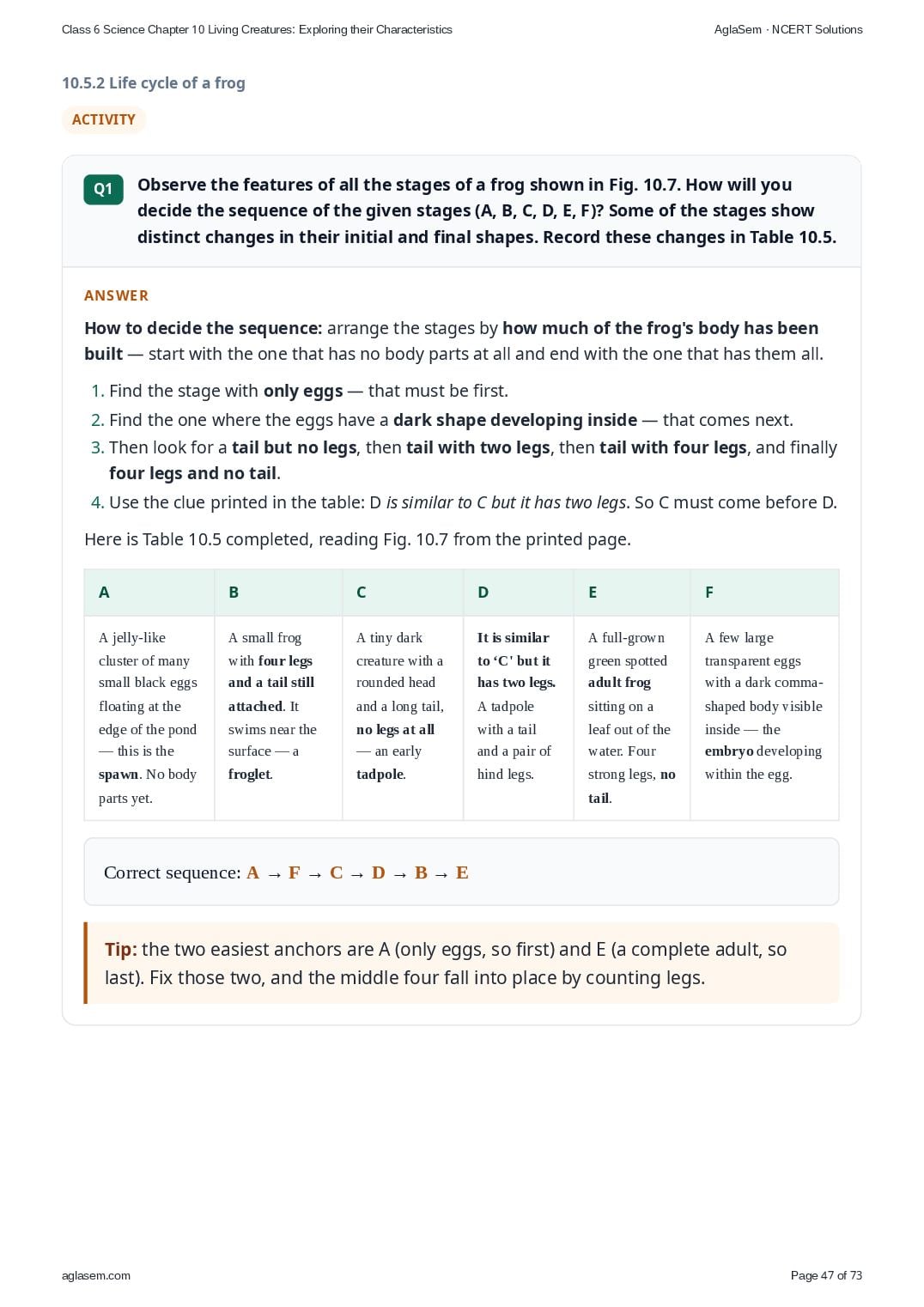
- Observe the features of all the stages of a frog shown in Fig. 10.7. How will you decide the sequence of the given stages (A, B, C, D, E, F)? Some of the stages show distinct changes in their initial and final shapes. Record these changes in Table 10.5.
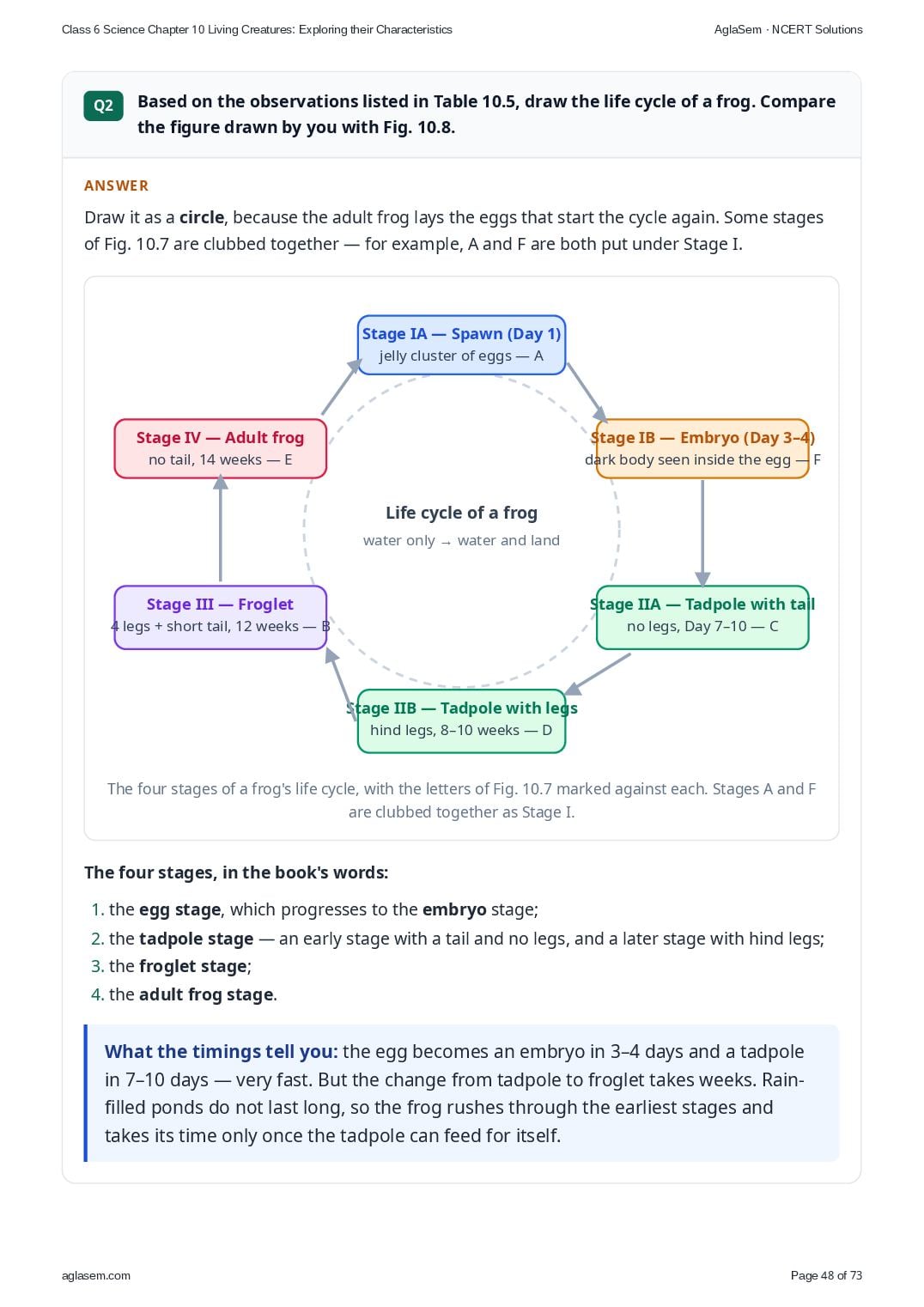
- Based on the observations listed in Table 10.5, draw the life cycle of a frog. Compare the figure drawn by you with Fig. 10.8.
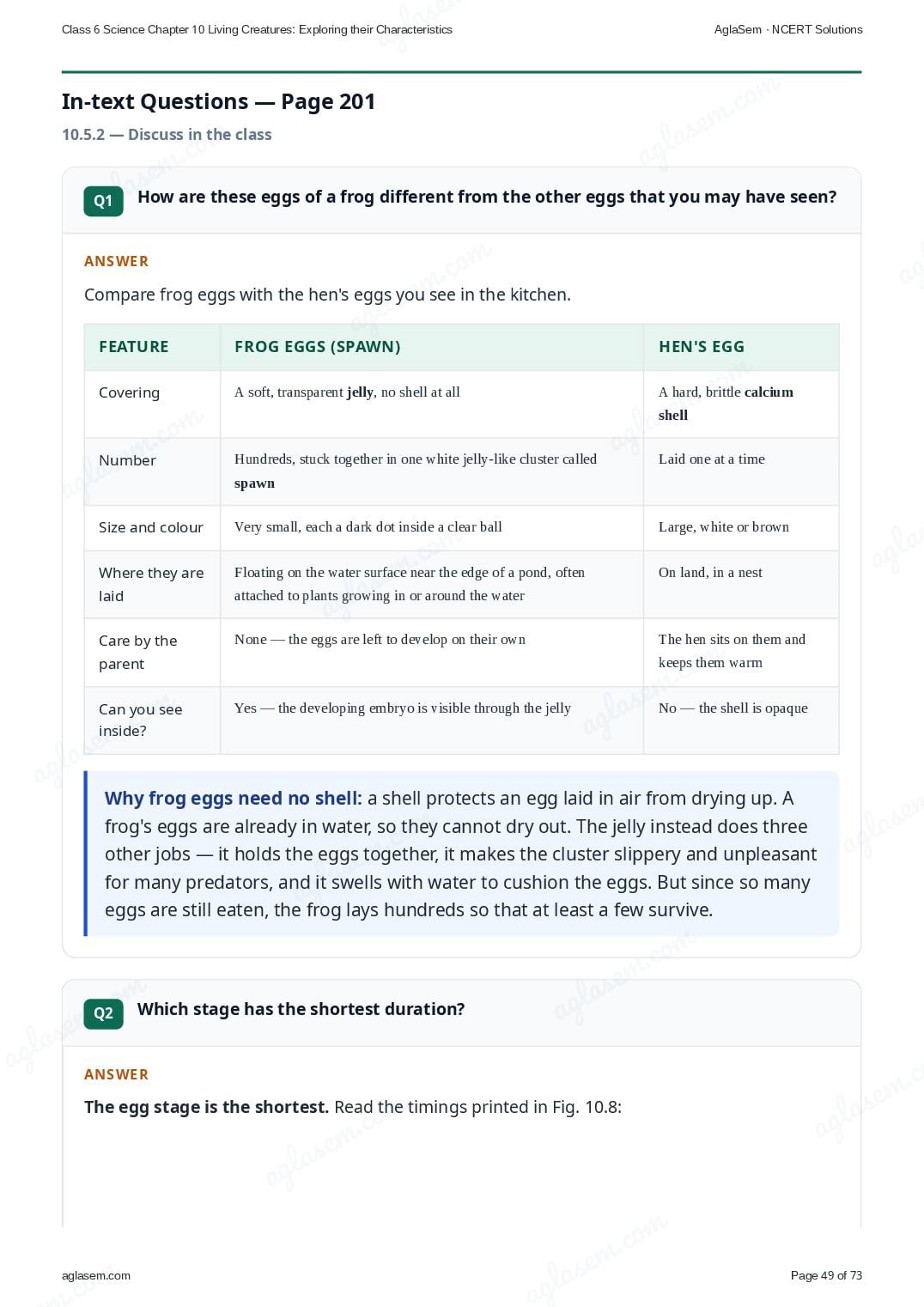
- How are these eggs of a frog different from the other eggs that you may have seen?
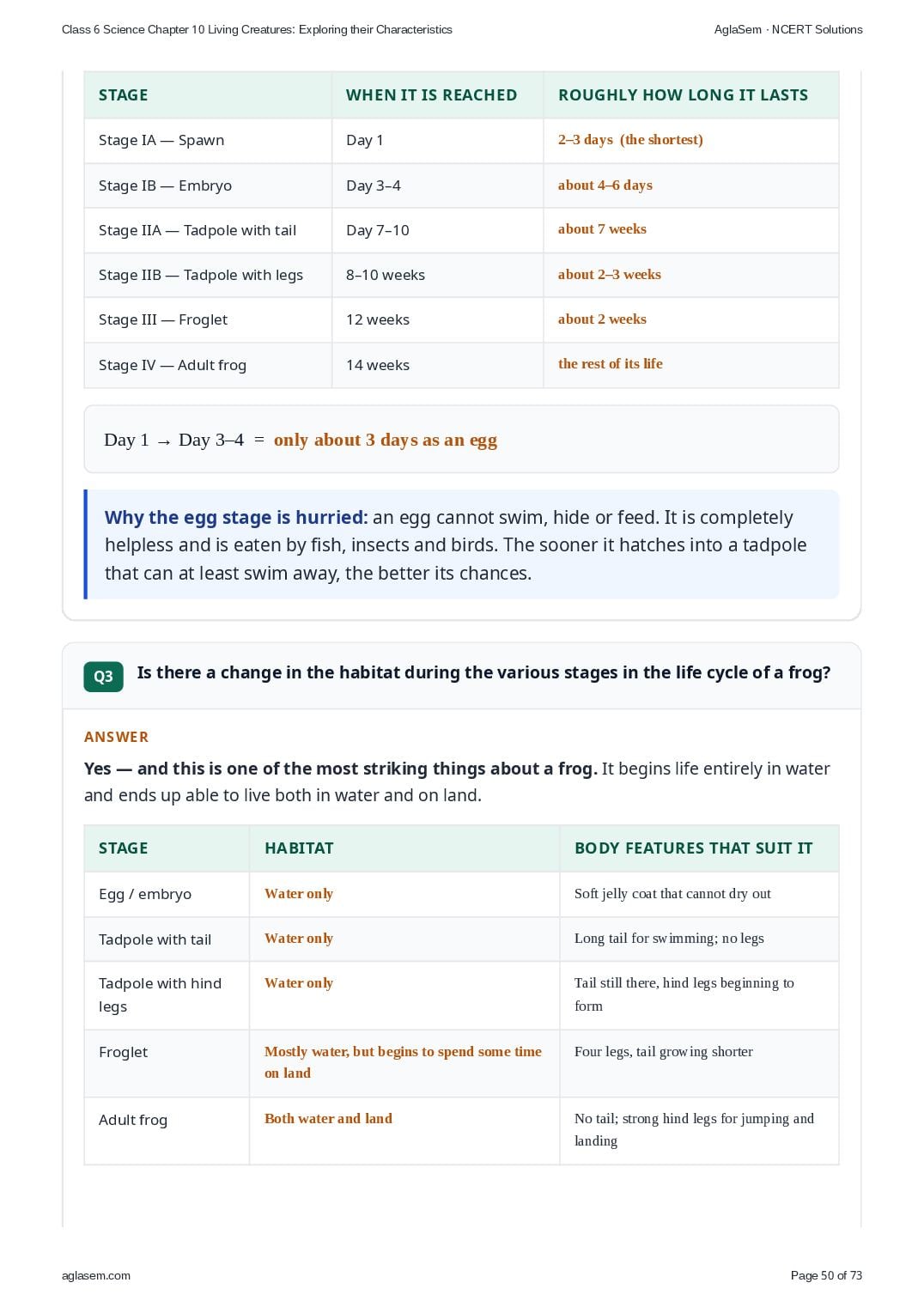
- Which stage has the shortest duration?
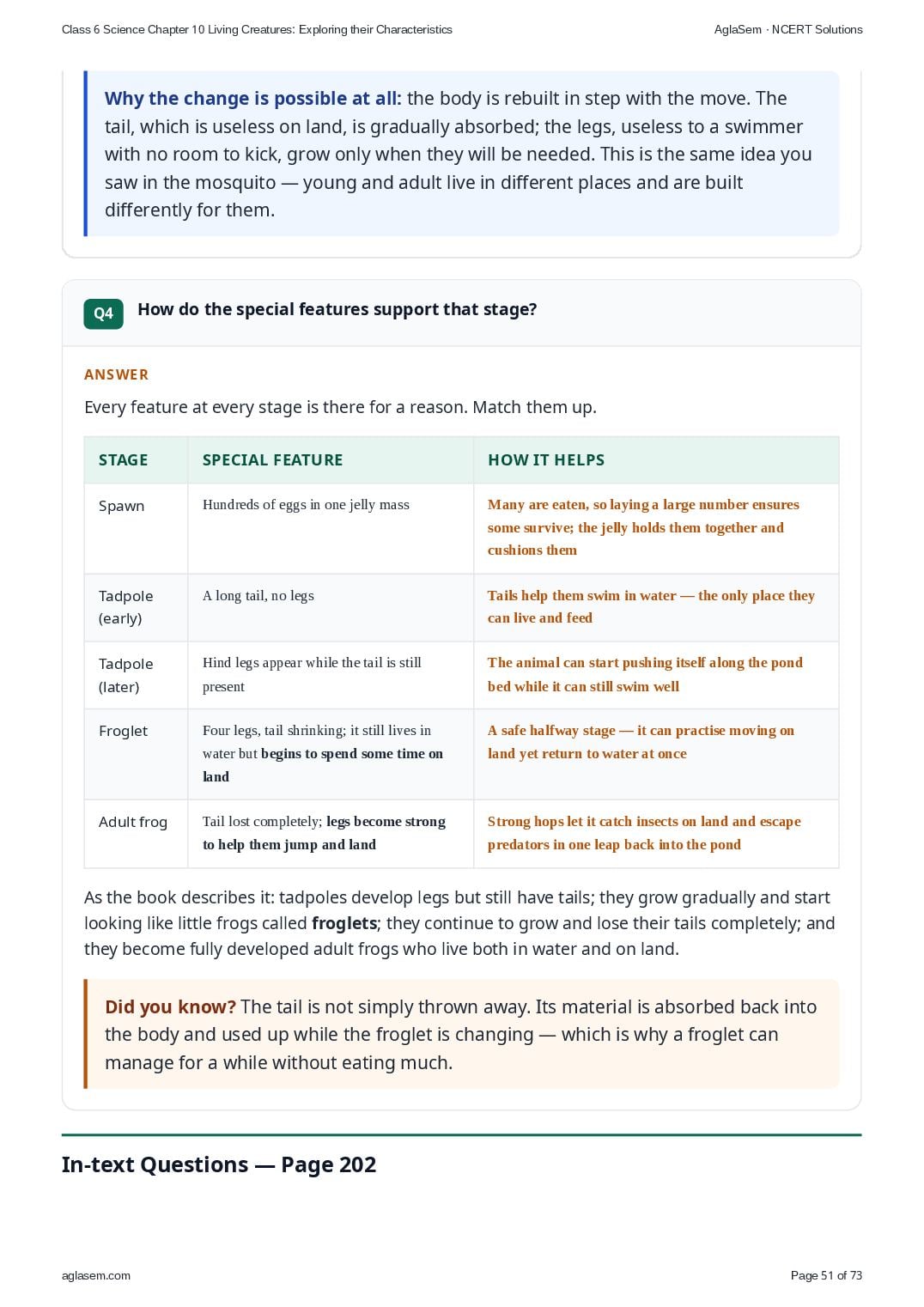
- Is there a change in the habitat during the various stages in the life cycle of a frog?
- How do the special features support that stage?
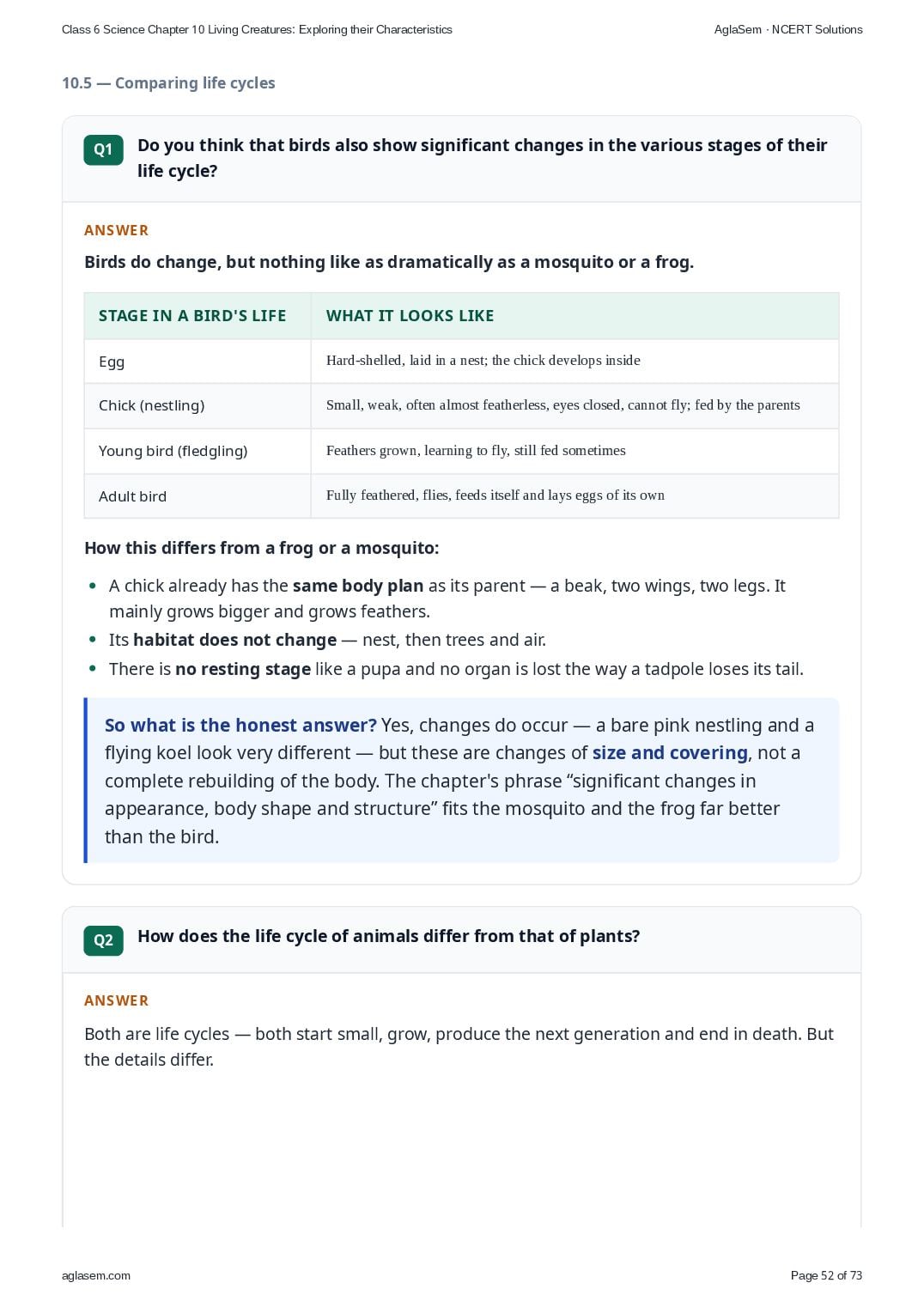
- Do you think that birds also show significant changes in the various stages of their life cycle?
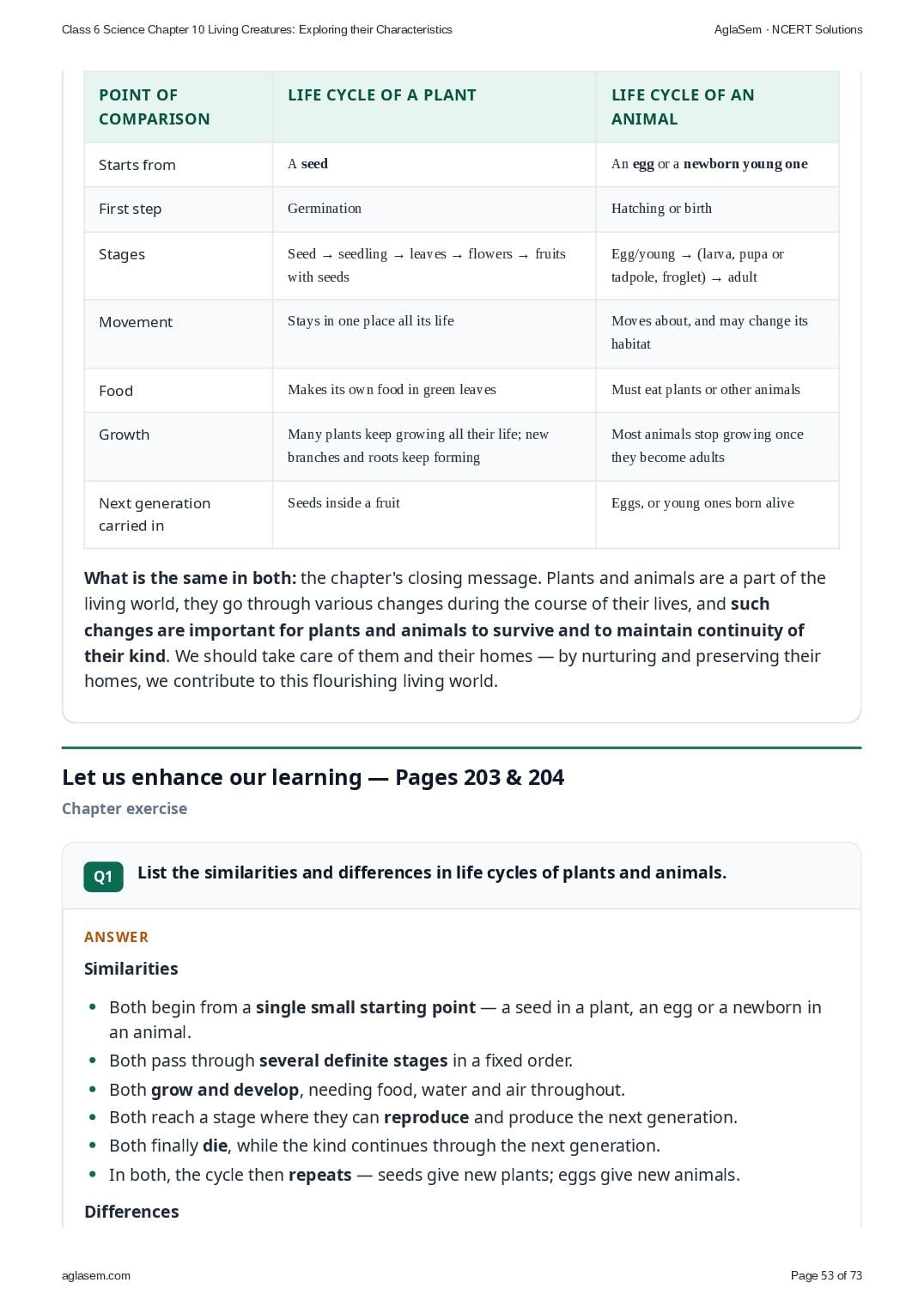
- How does the life cycle of animals differ from that of plants?
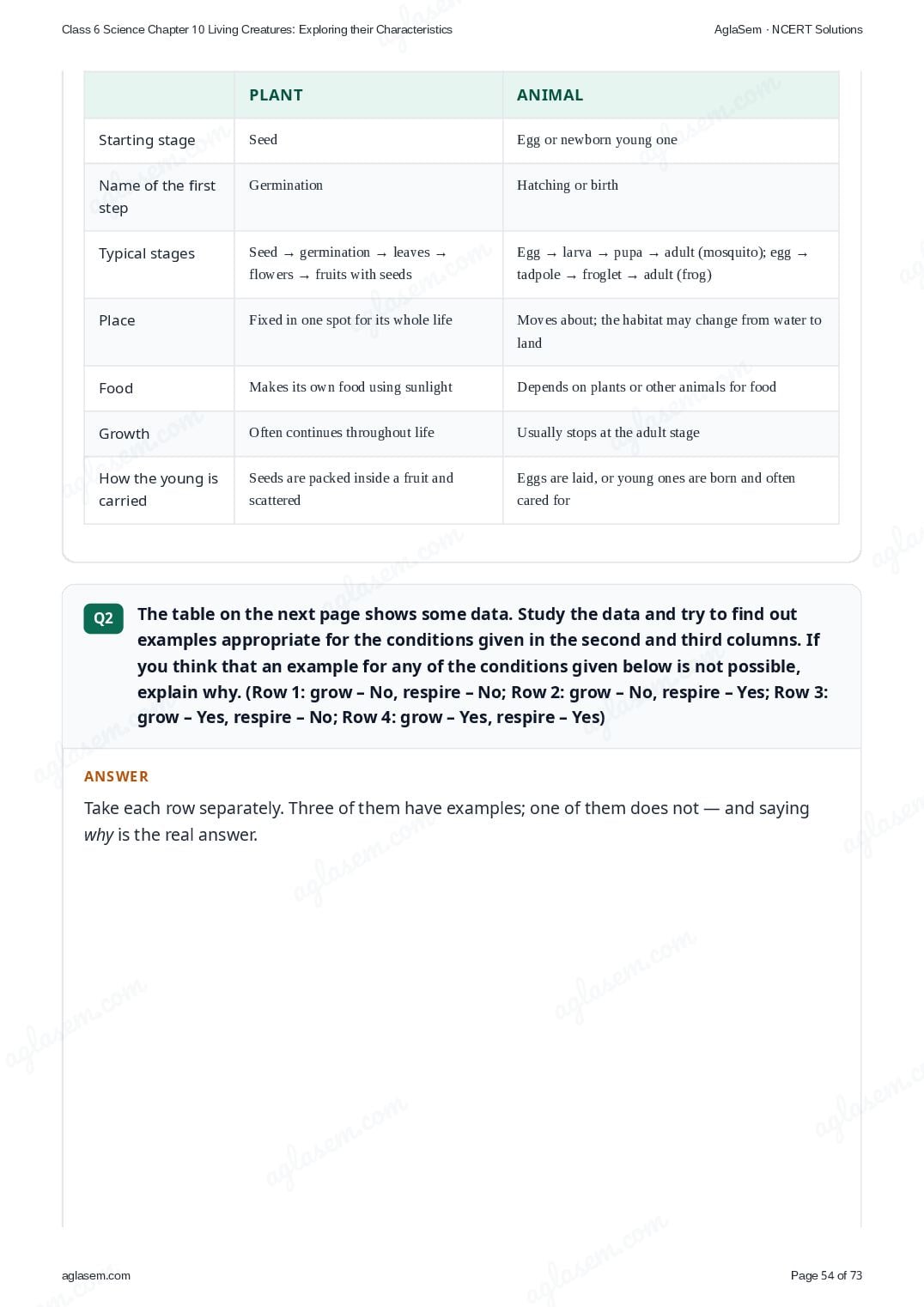
- List the similarities and differences in life cycles of plants and animals.
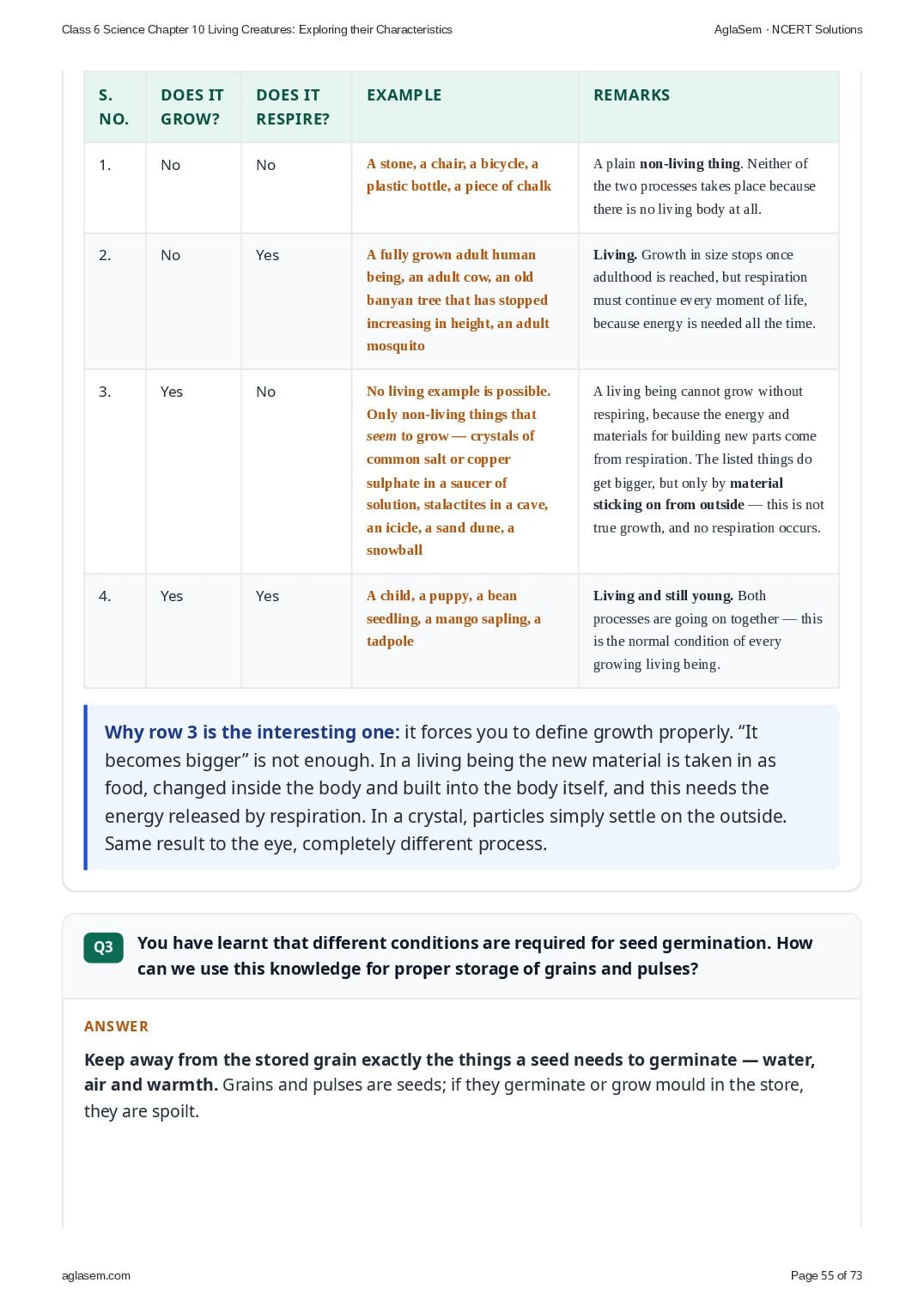
- The table on the next page shows some data. Study the data and try to find out examples appropriate for the conditions given in the second and third columns. If you think that an example for any of the conditions given below is not possible, explain why. (Row 1: grow – No, respire – No; Row 2: grow – No, respire – Yes; Row 3: grow – Yes, respire – No; Row 4: grow – Yes, respire – Yes)
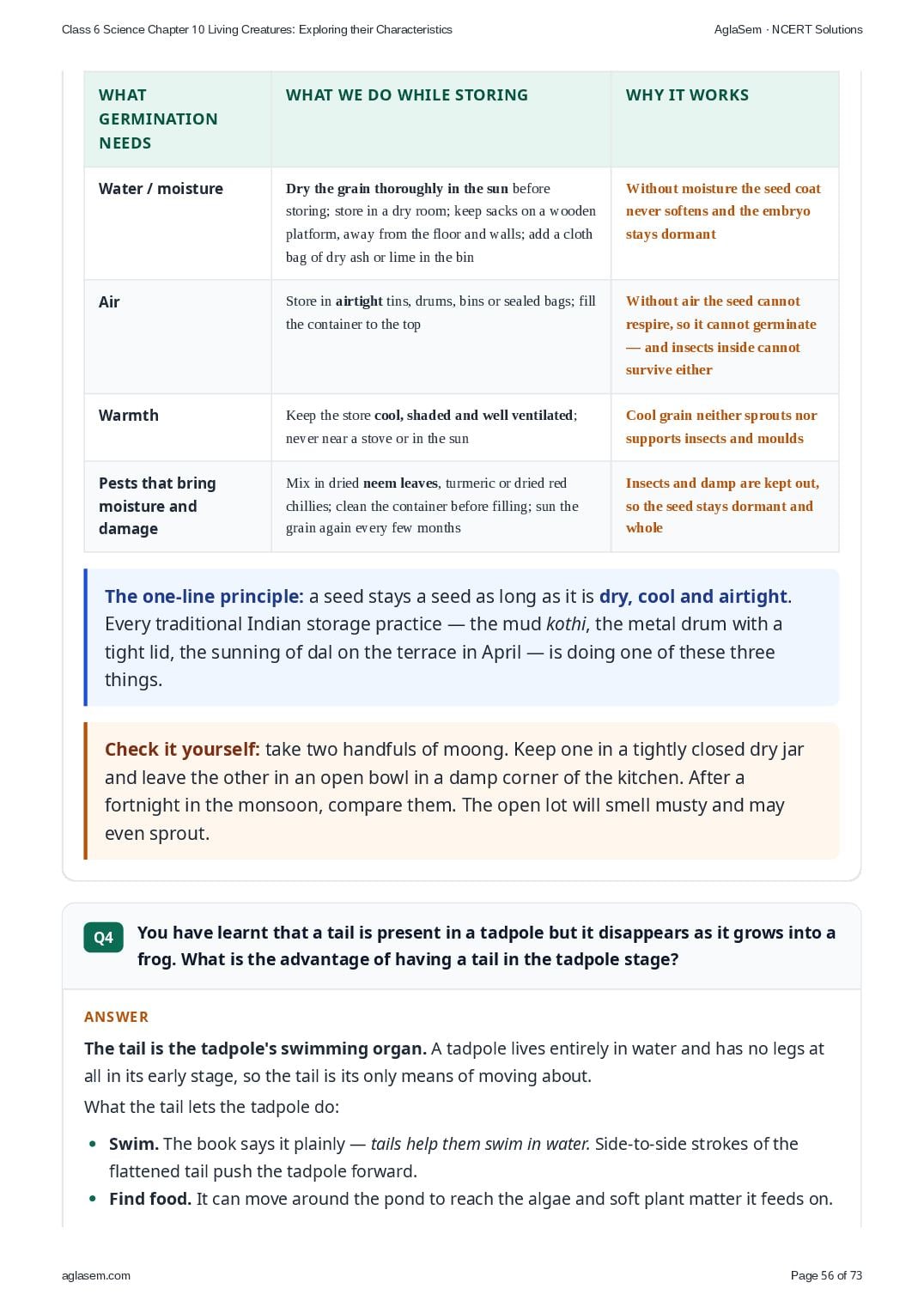
- You have learnt that different conditions are required for seed germination. How can we use this knowledge for proper storage of grains and pulses?
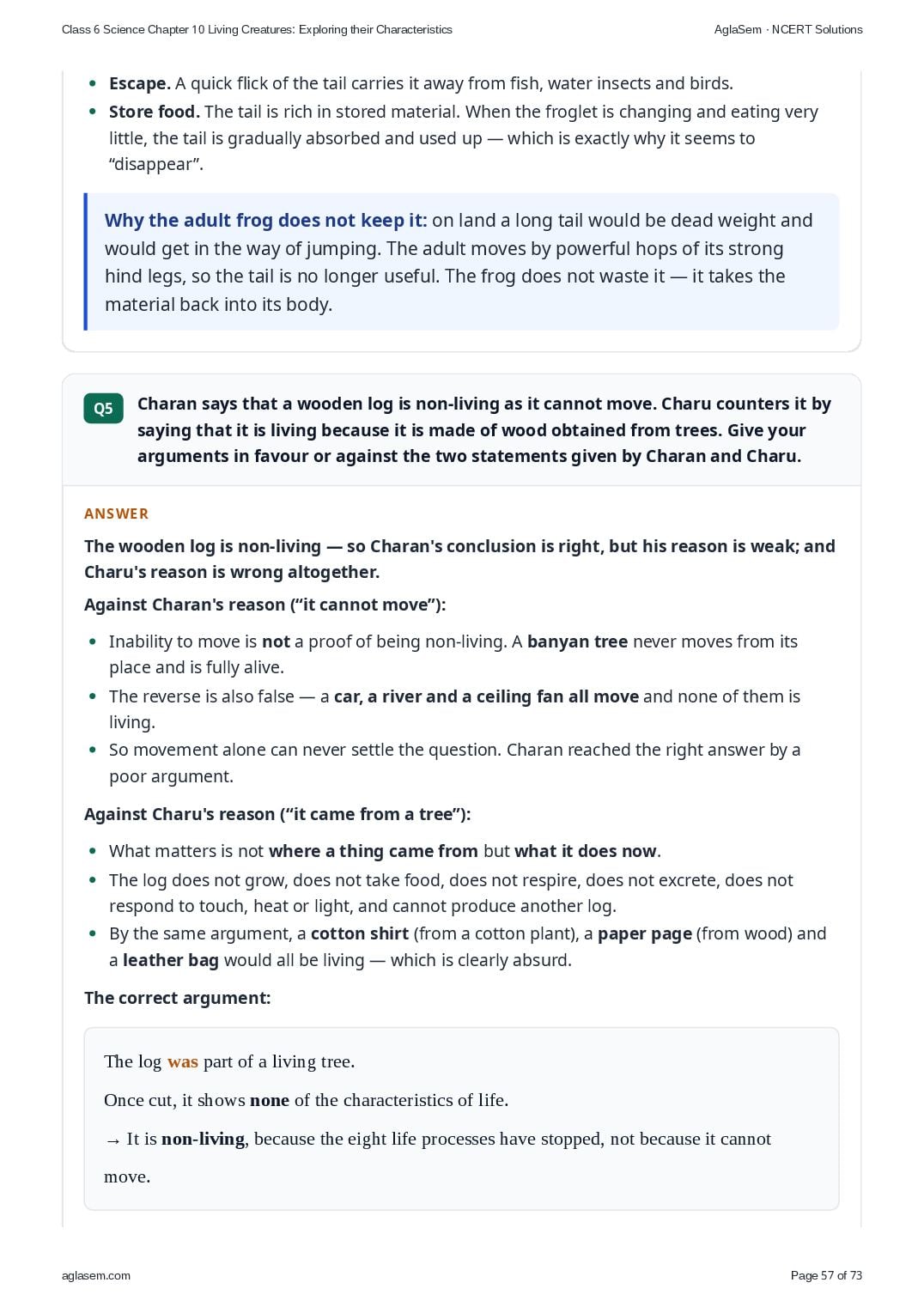
- You have learnt that a tail is present in a tadpole but it disappears as it grows into a frog. What is the advantage of having a tail in the tadpole stage?
- Charan says that a wooden log is non-living as it cannot move. Charu counters it by saying that it is living because it is made of wood obtained from trees. Give your arguments in favour or against the two statements given by Charan and Charu.
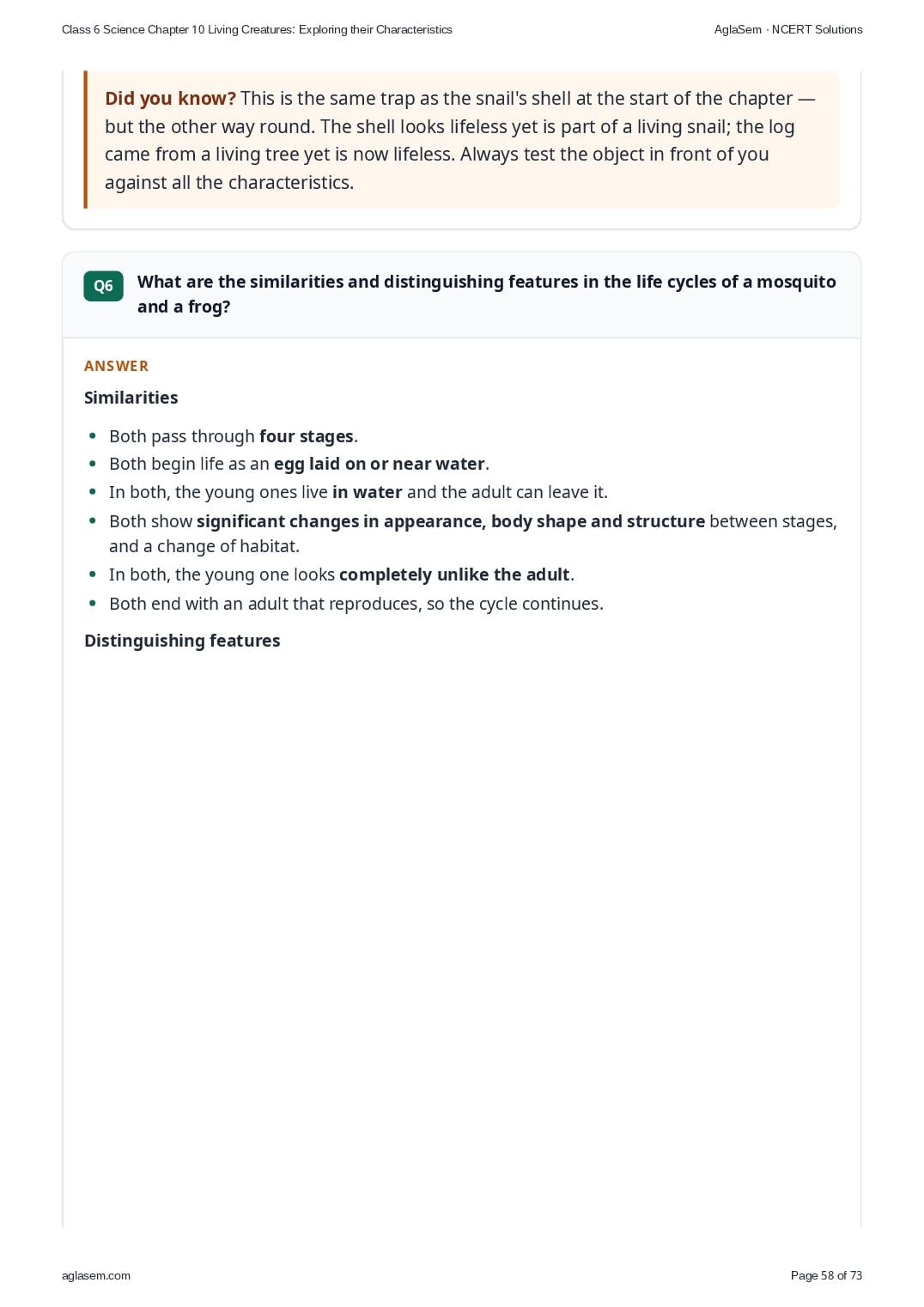
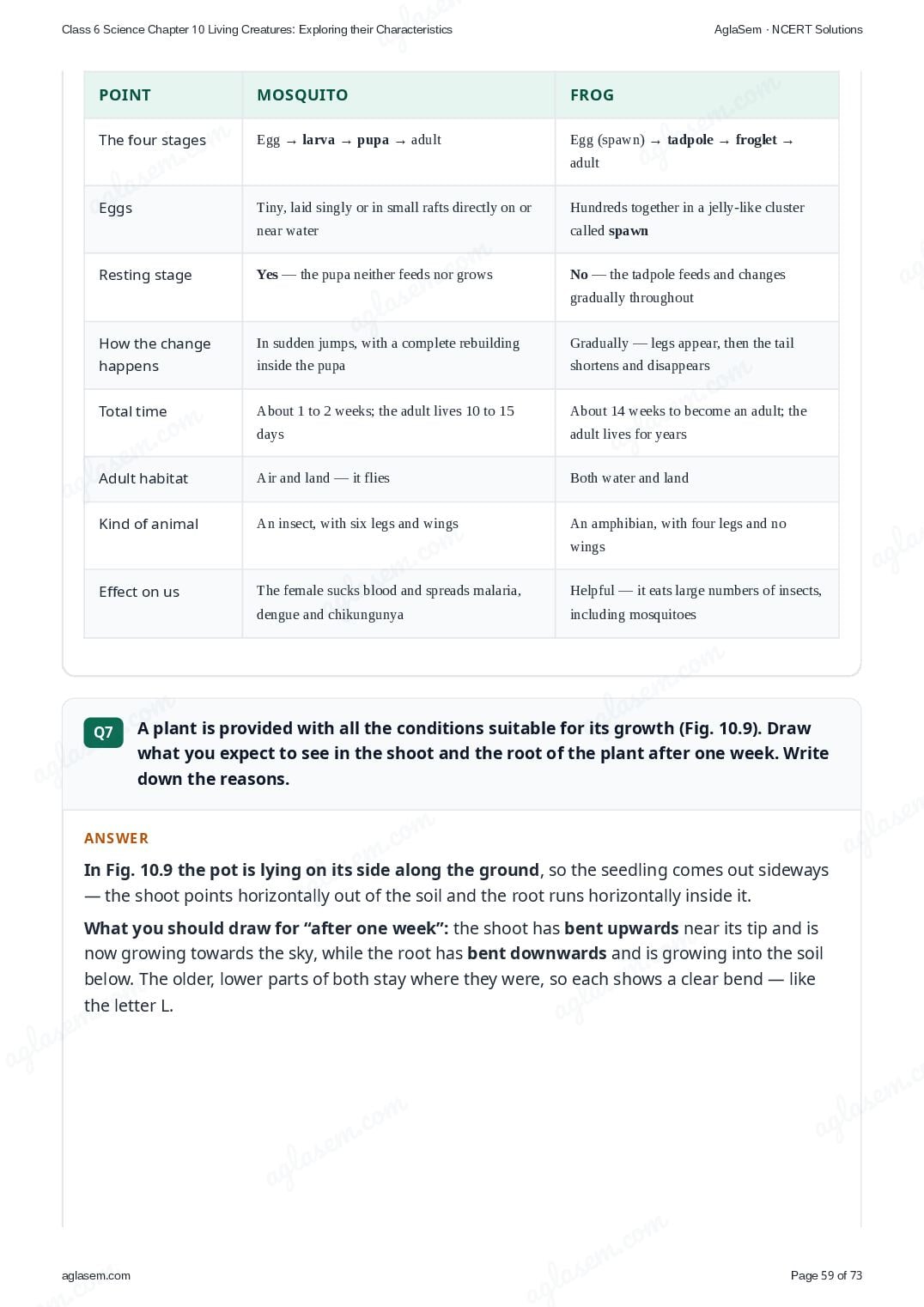
- What are the similarities and distinguishing features in the life cycles of a mosquito and a frog?
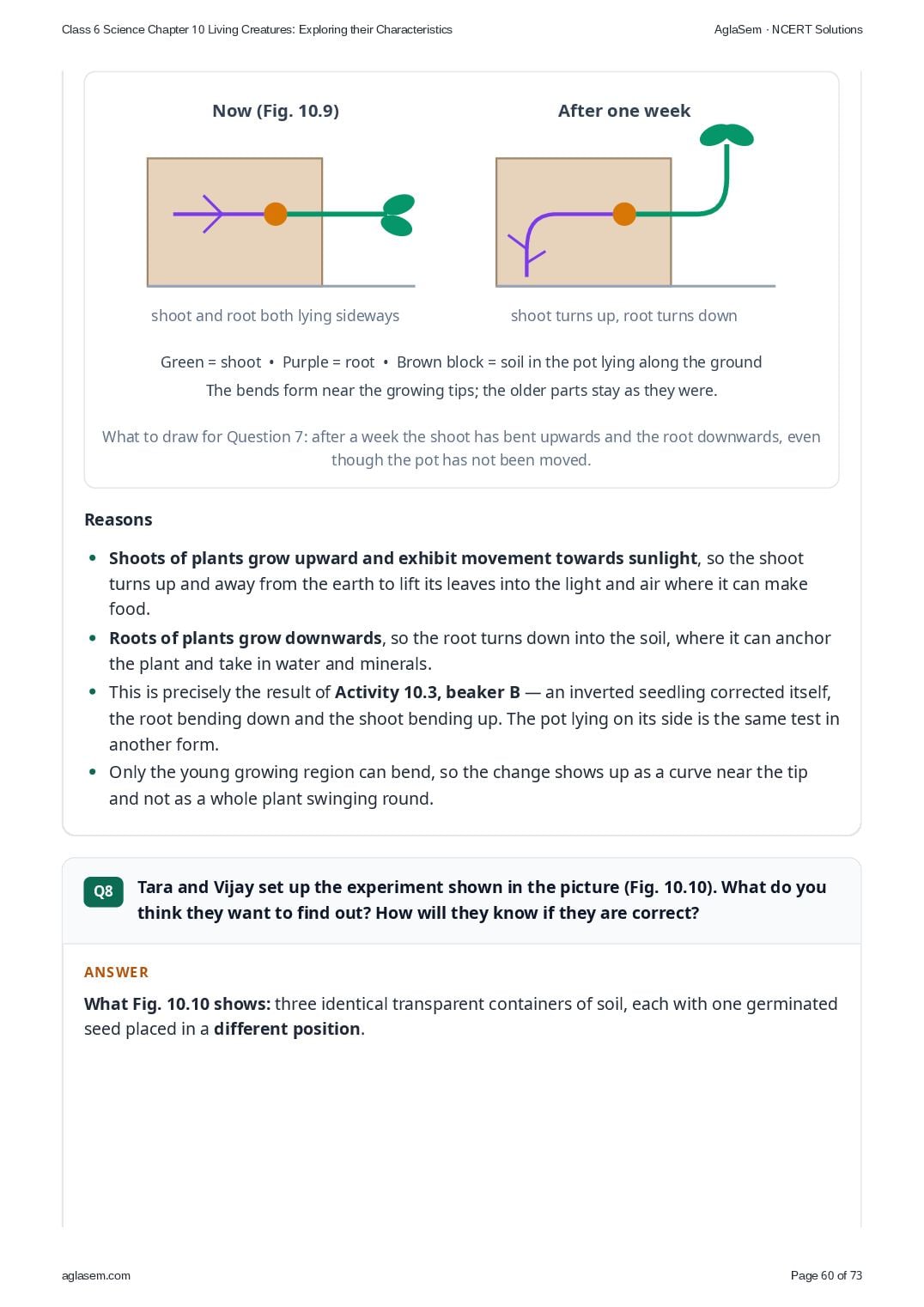
- A plant is provided with all the conditions suitable for its growth (Fig. 10.9). Draw what you expect to see in the shoot and the root of the plant after one week. Write down the reasons.
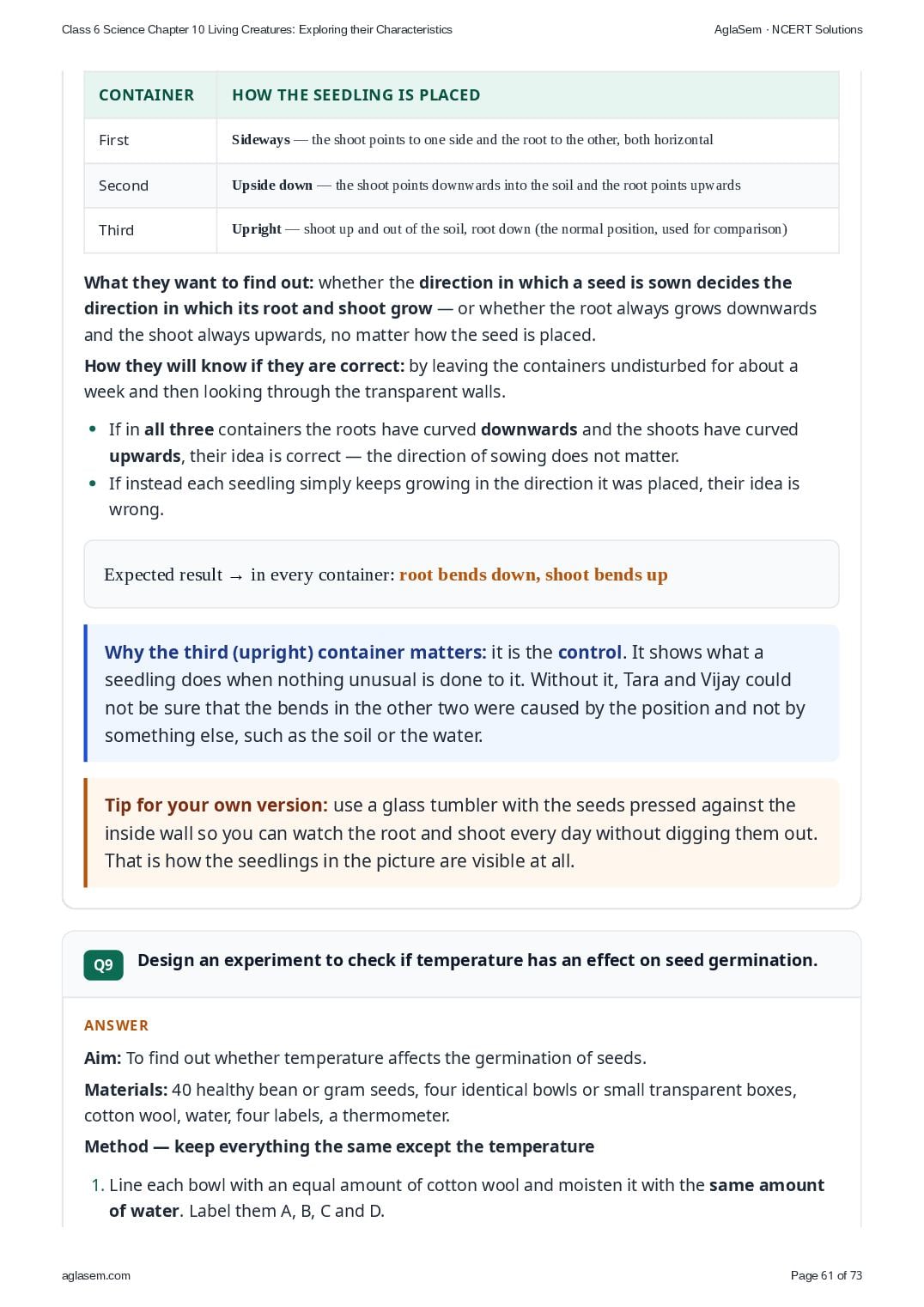
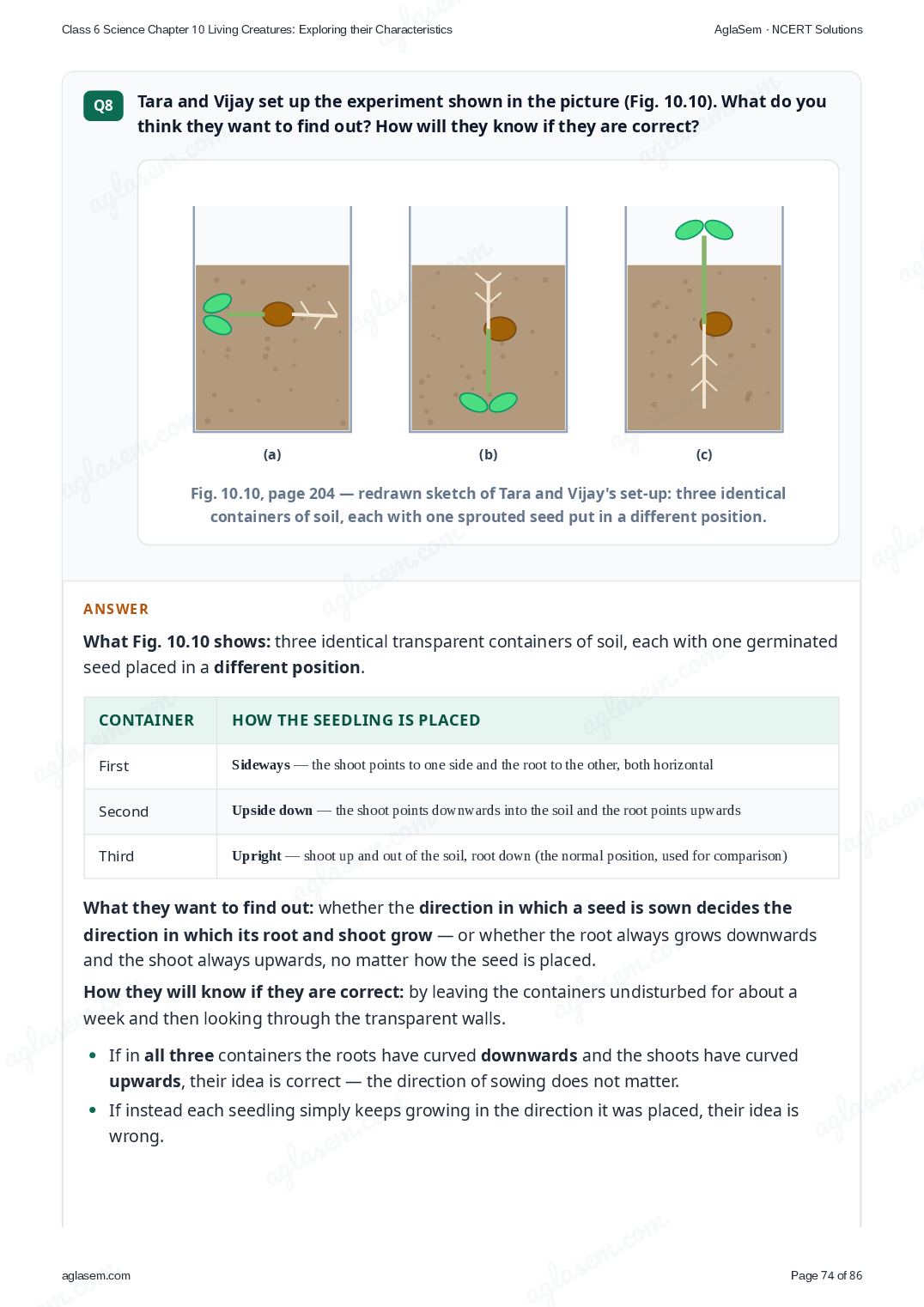
- Tara and Vijay set up the experiment shown in the picture (Fig. 10.10). What do you think they want to find out? How will they know if they are correct?
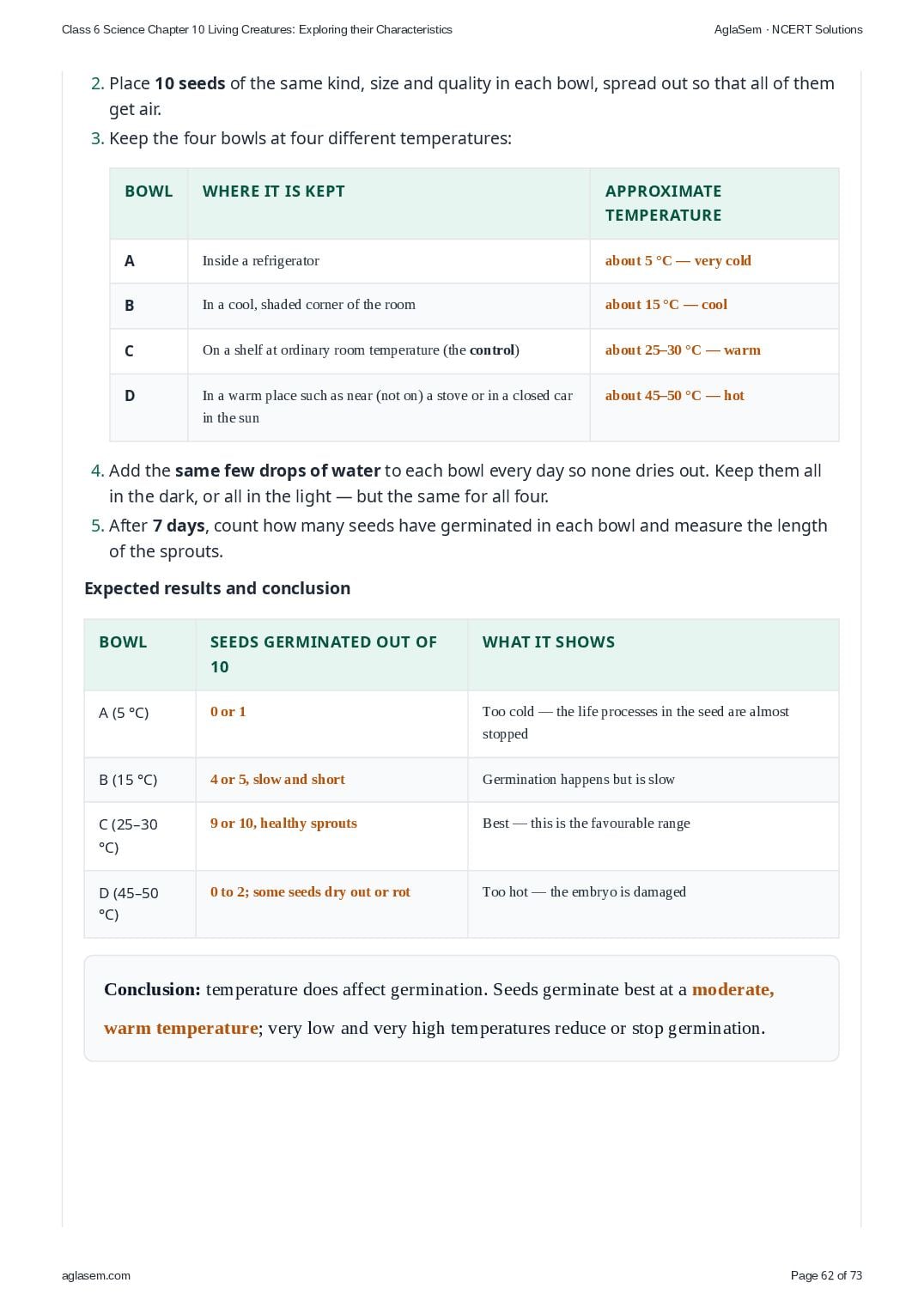
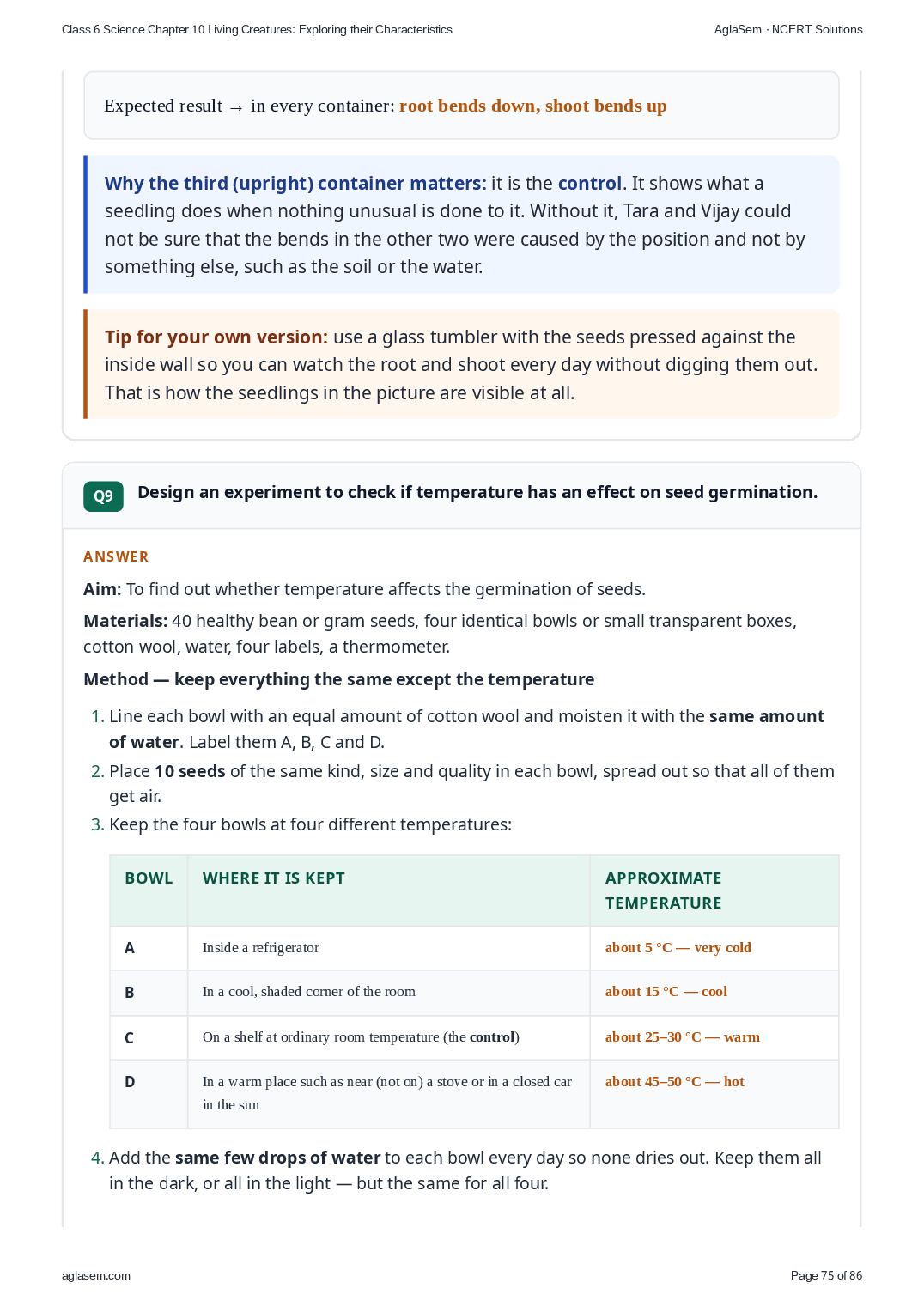
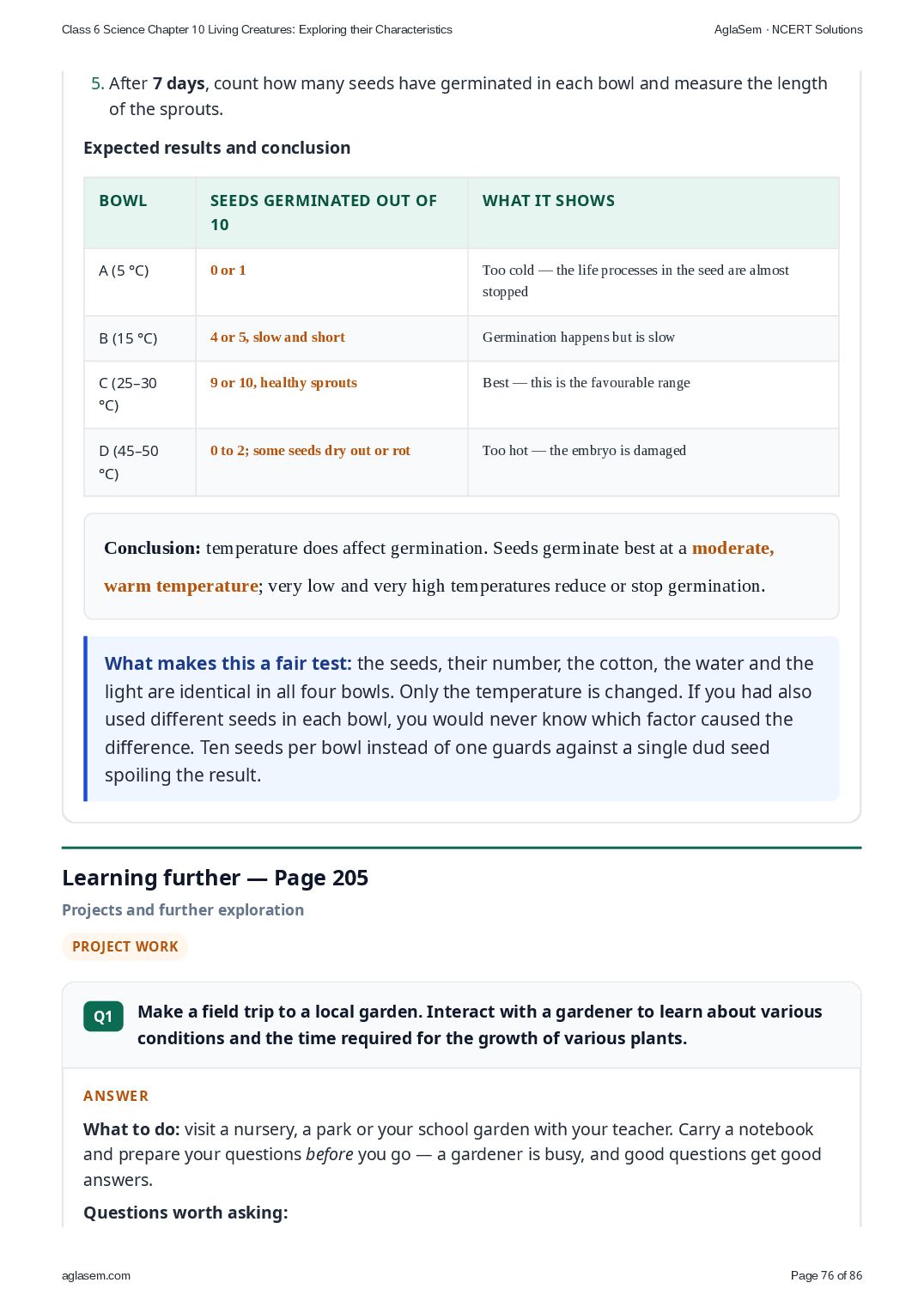
- Design an experiment to check if temperature has an effect on seed germination.
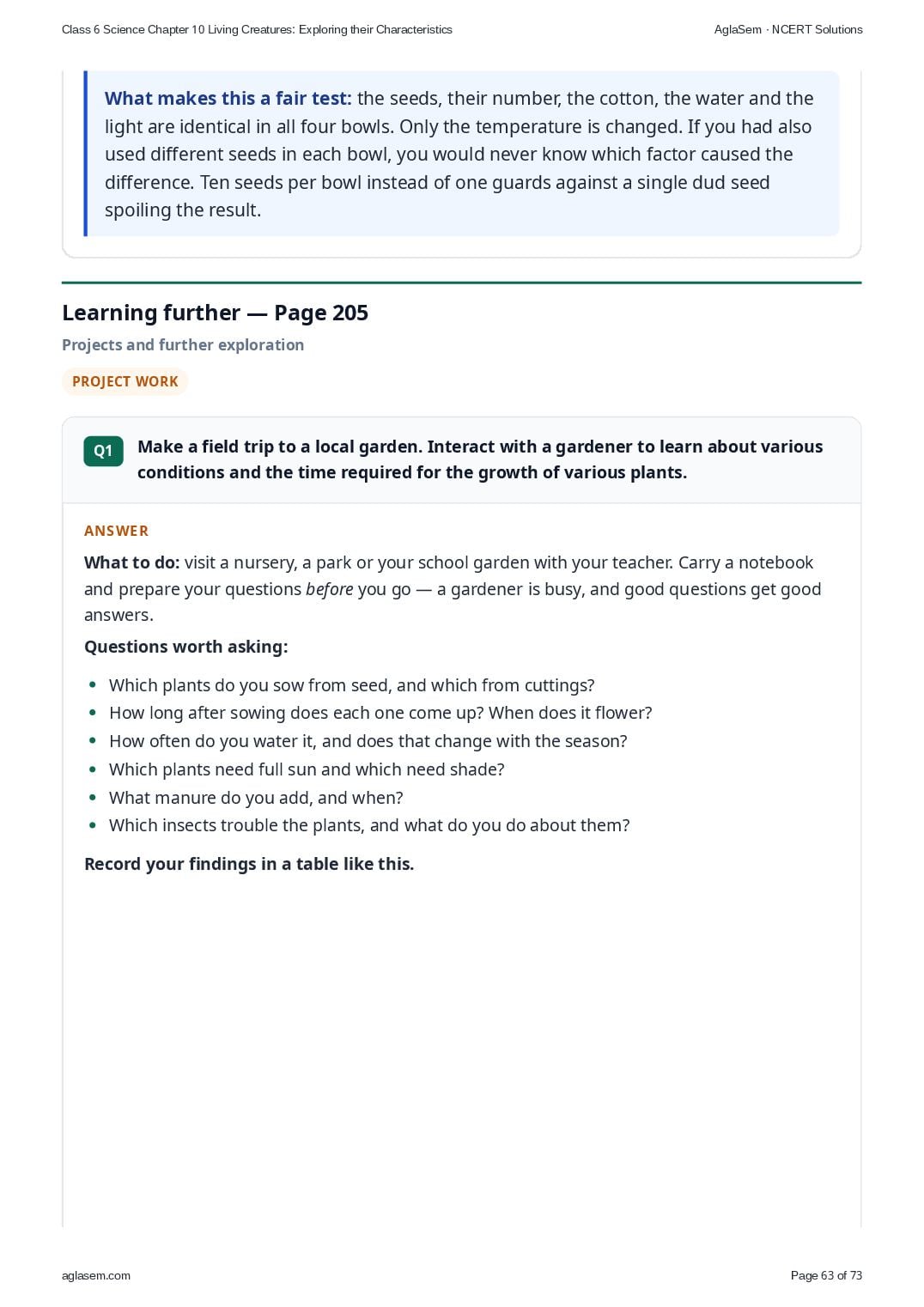
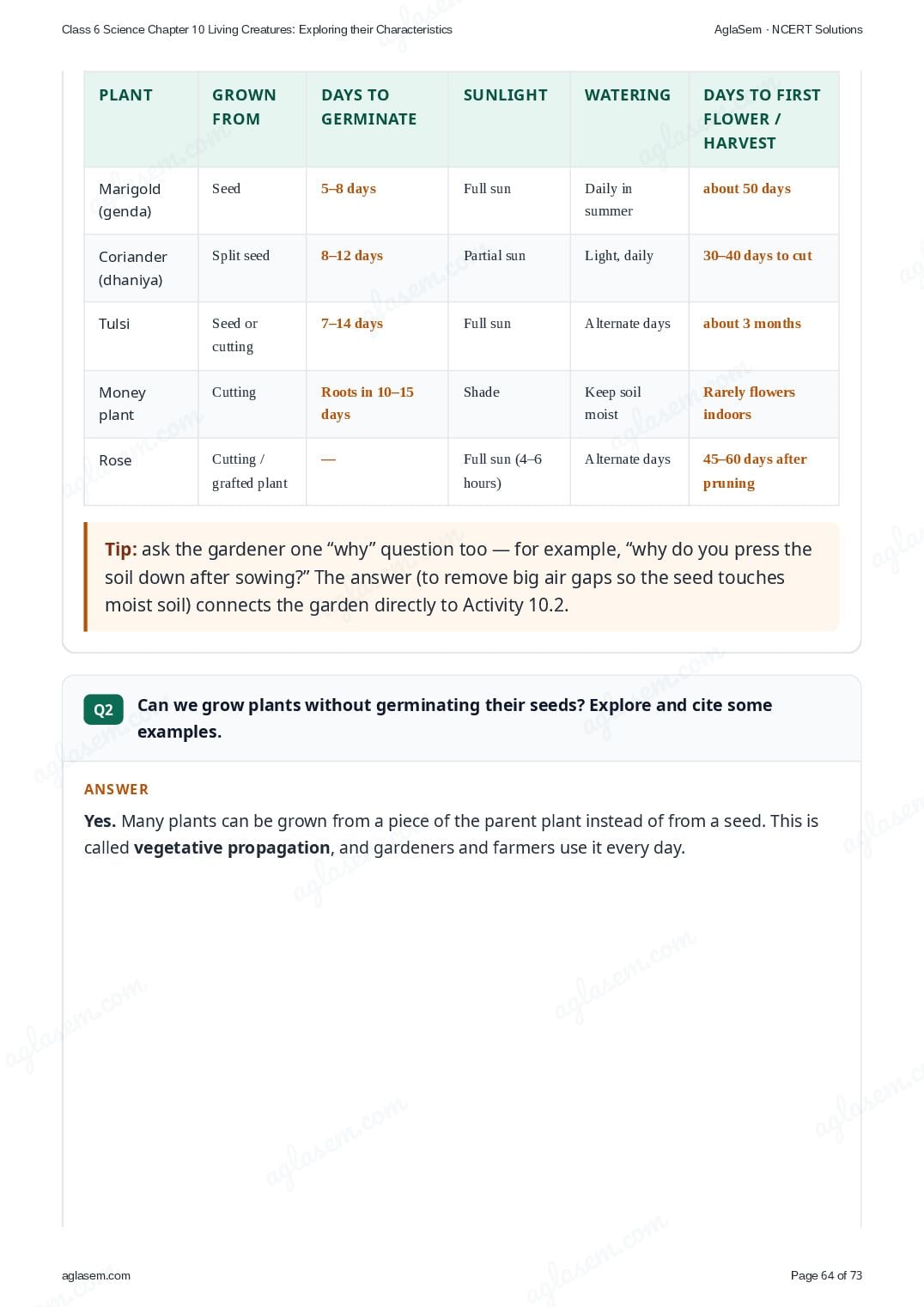
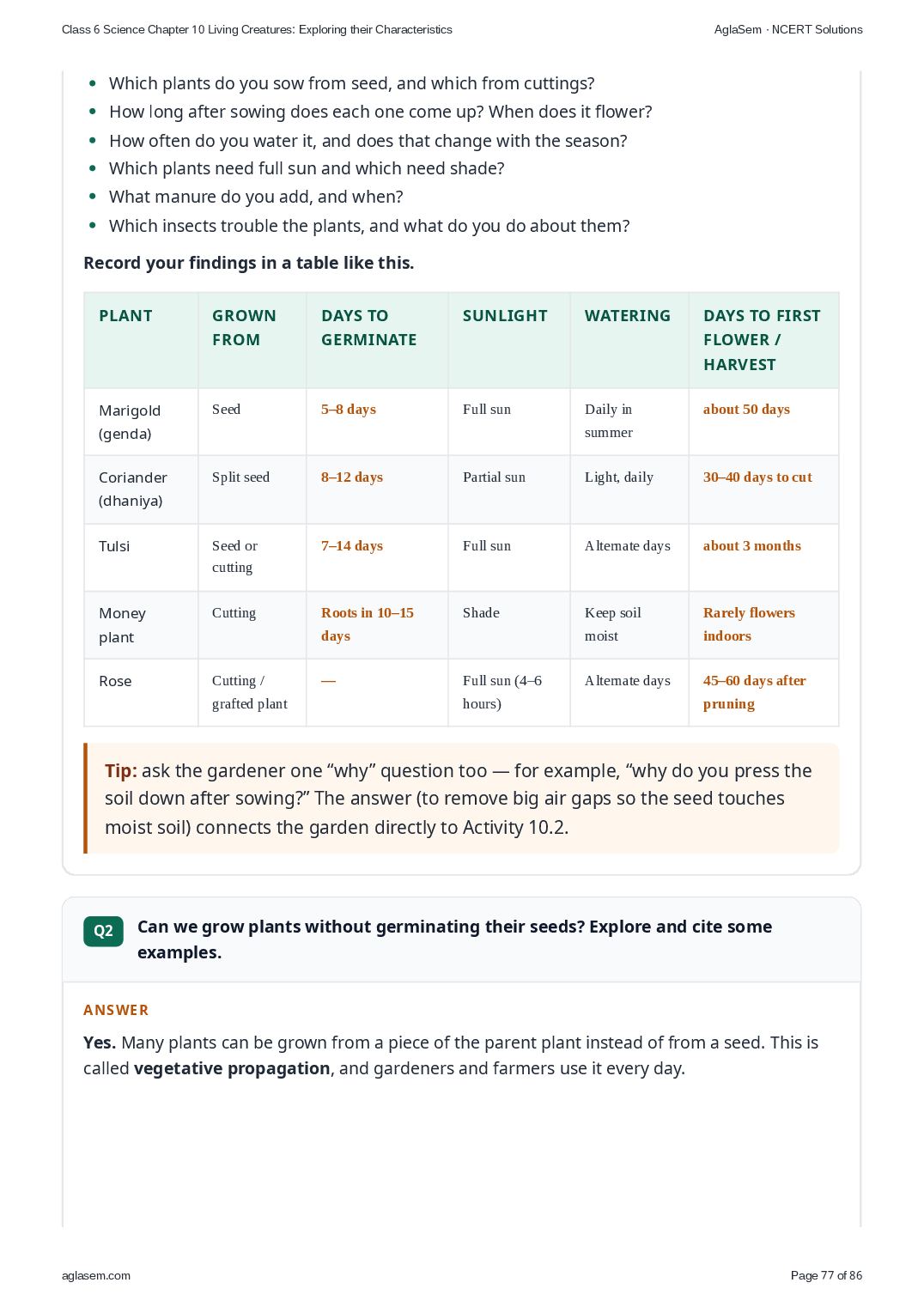
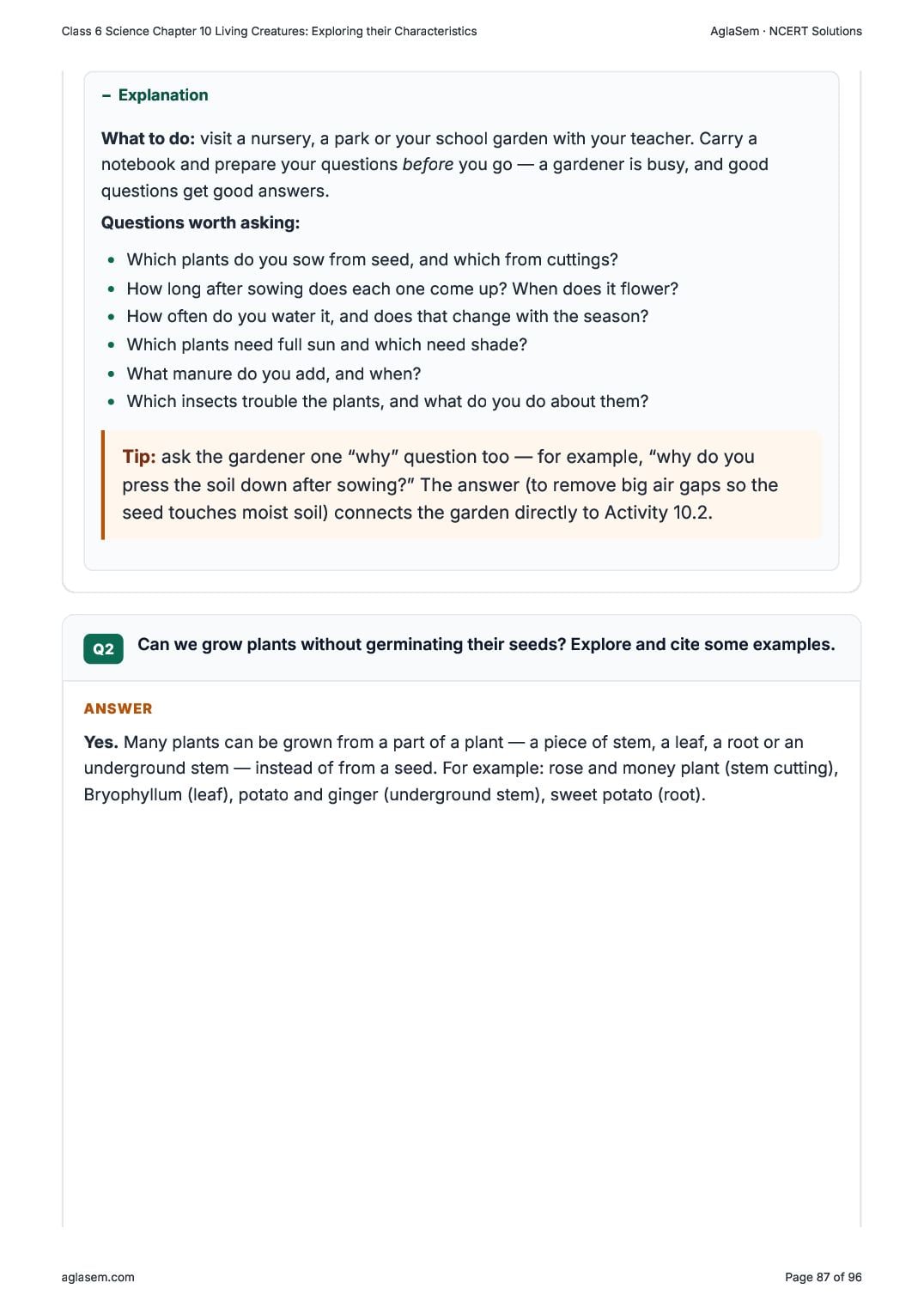
- Make a field trip to a local garden. Interact with a gardener to learn about various conditions and the time required for the growth of various plants.
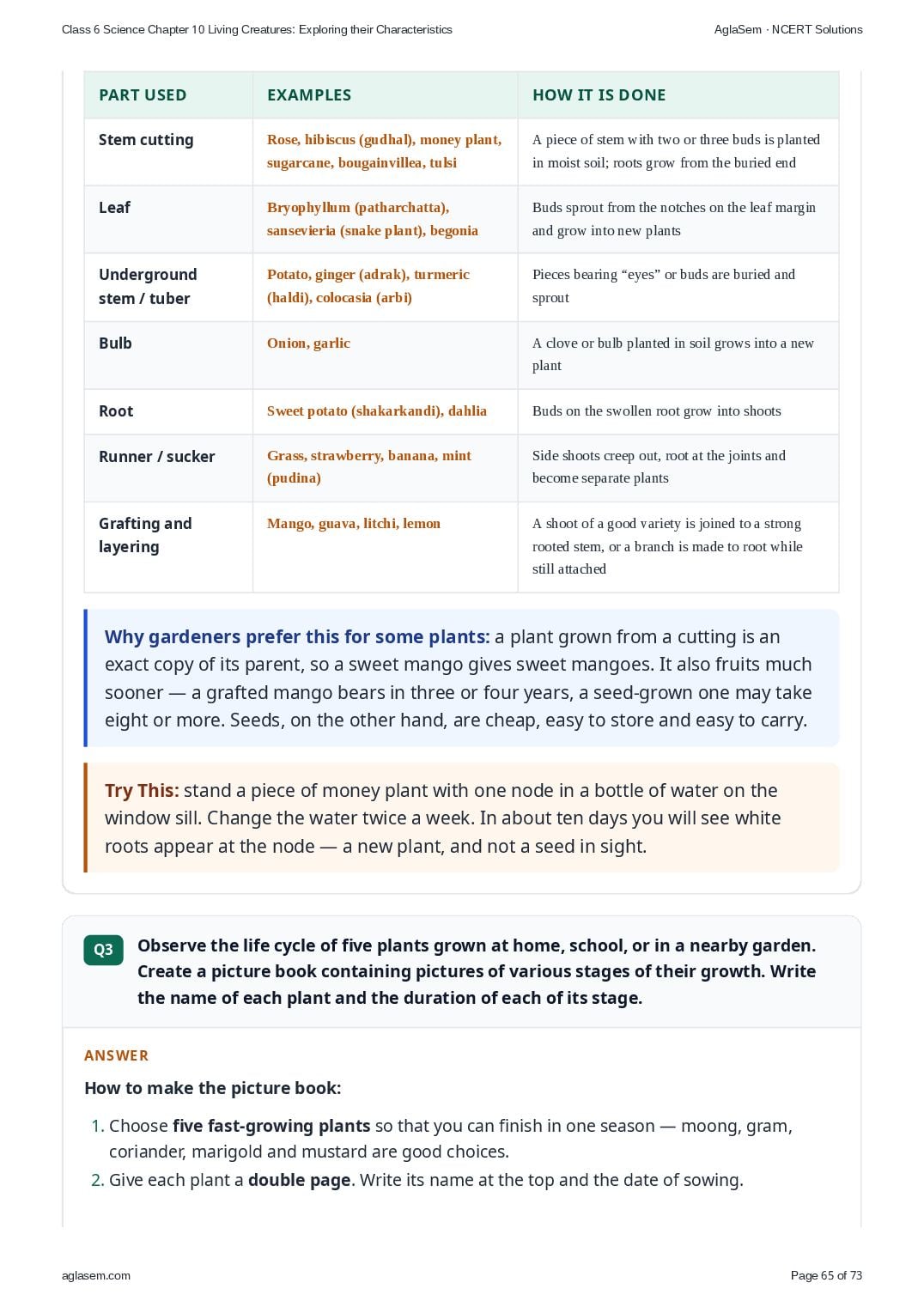
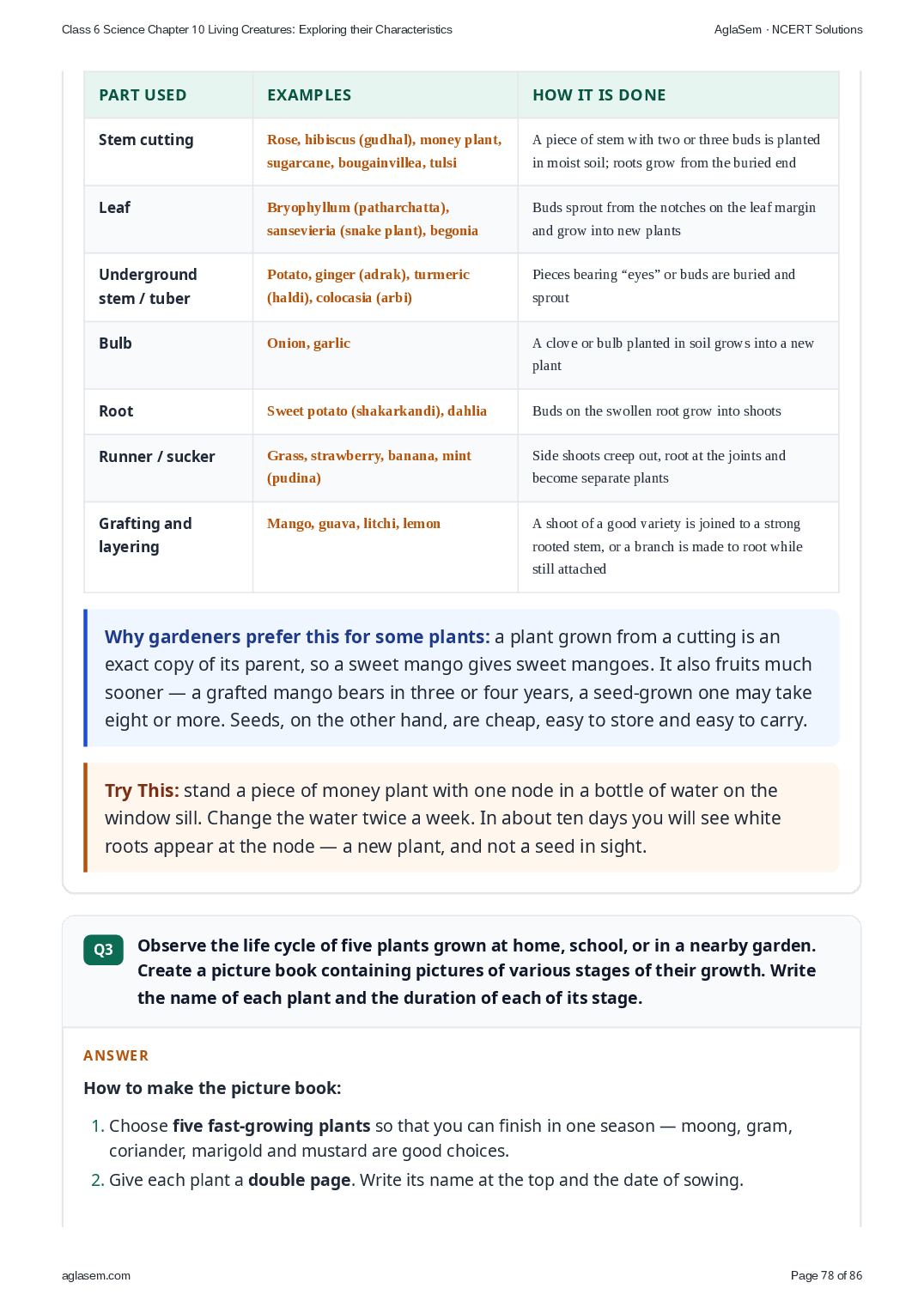
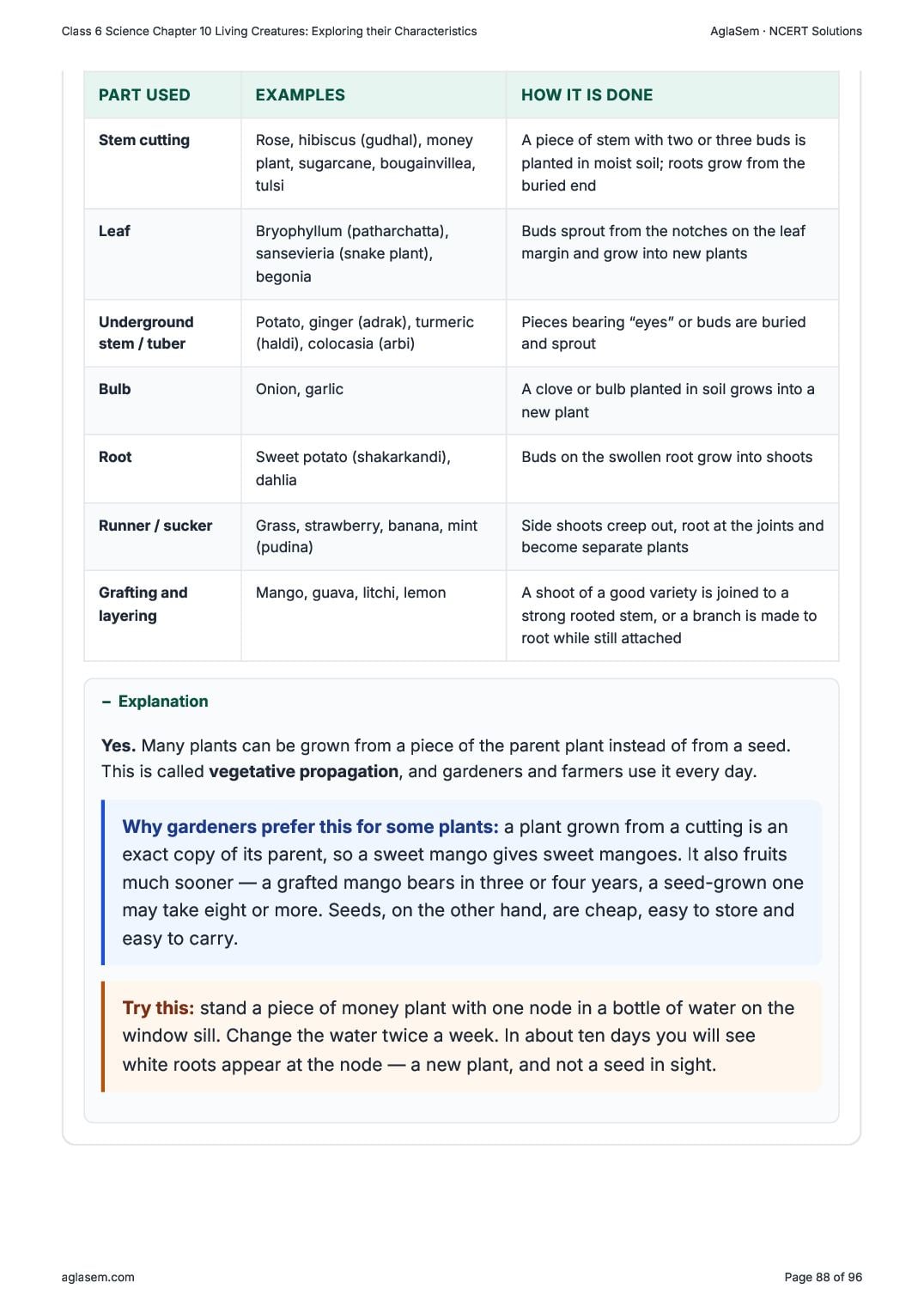
- Can we grow plants without germinating their seeds? Explore and cite some examples.
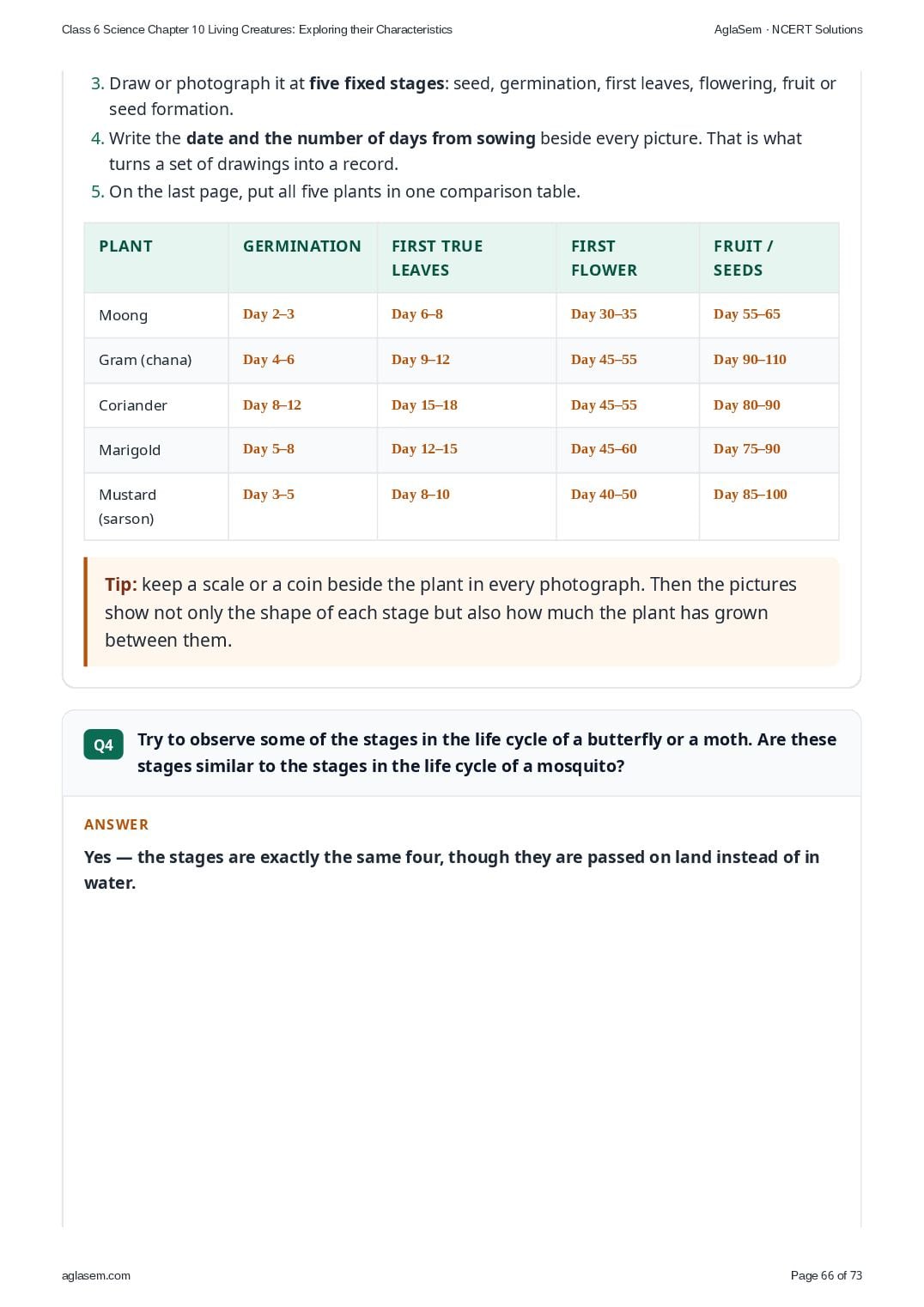
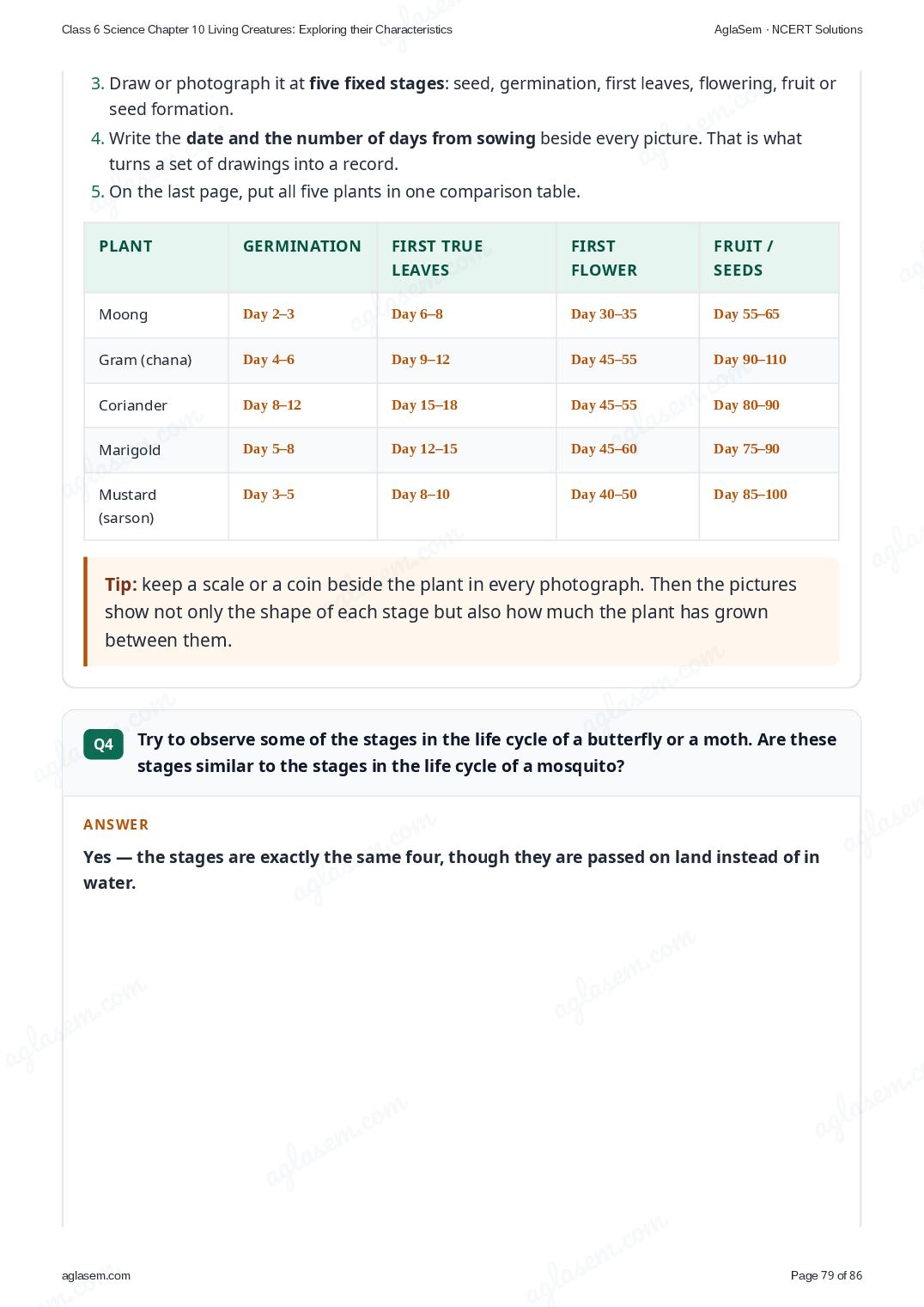
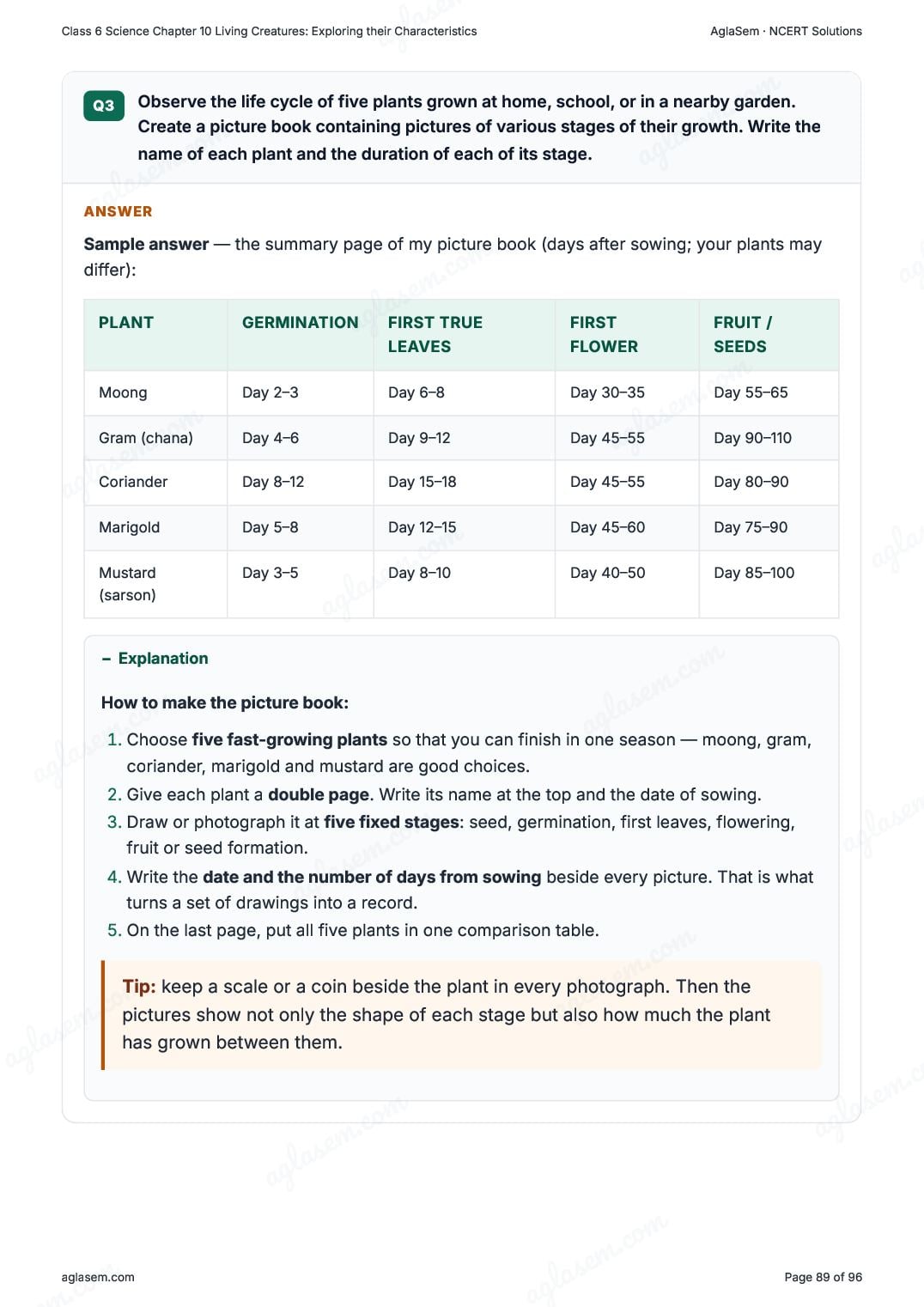
- Observe the life cycle of five plants grown at home, school, or in a nearby garden. Create a picture book containing pictures of various stages of their growth. Write the name of each plant and the duration of each of its stage.
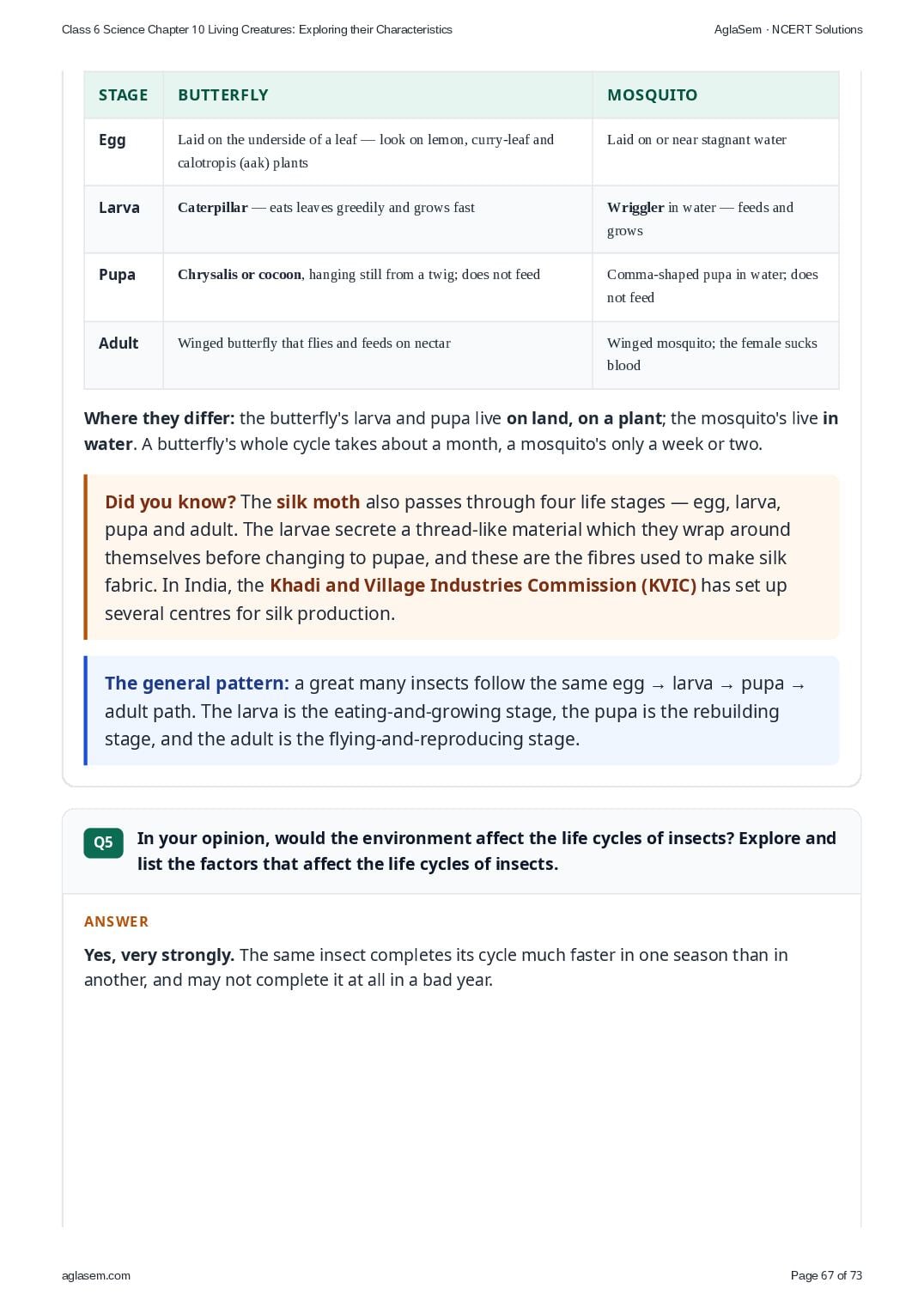
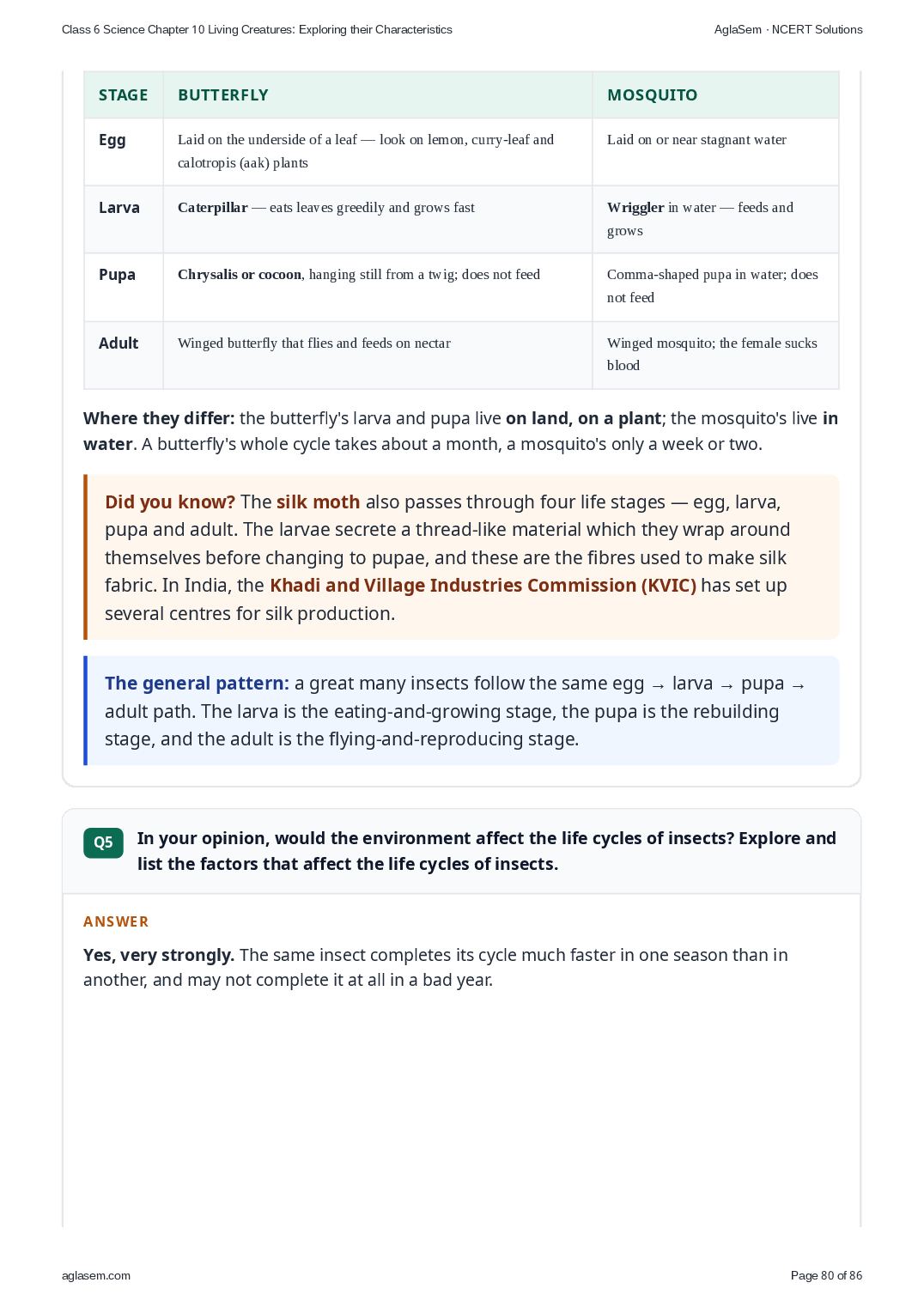
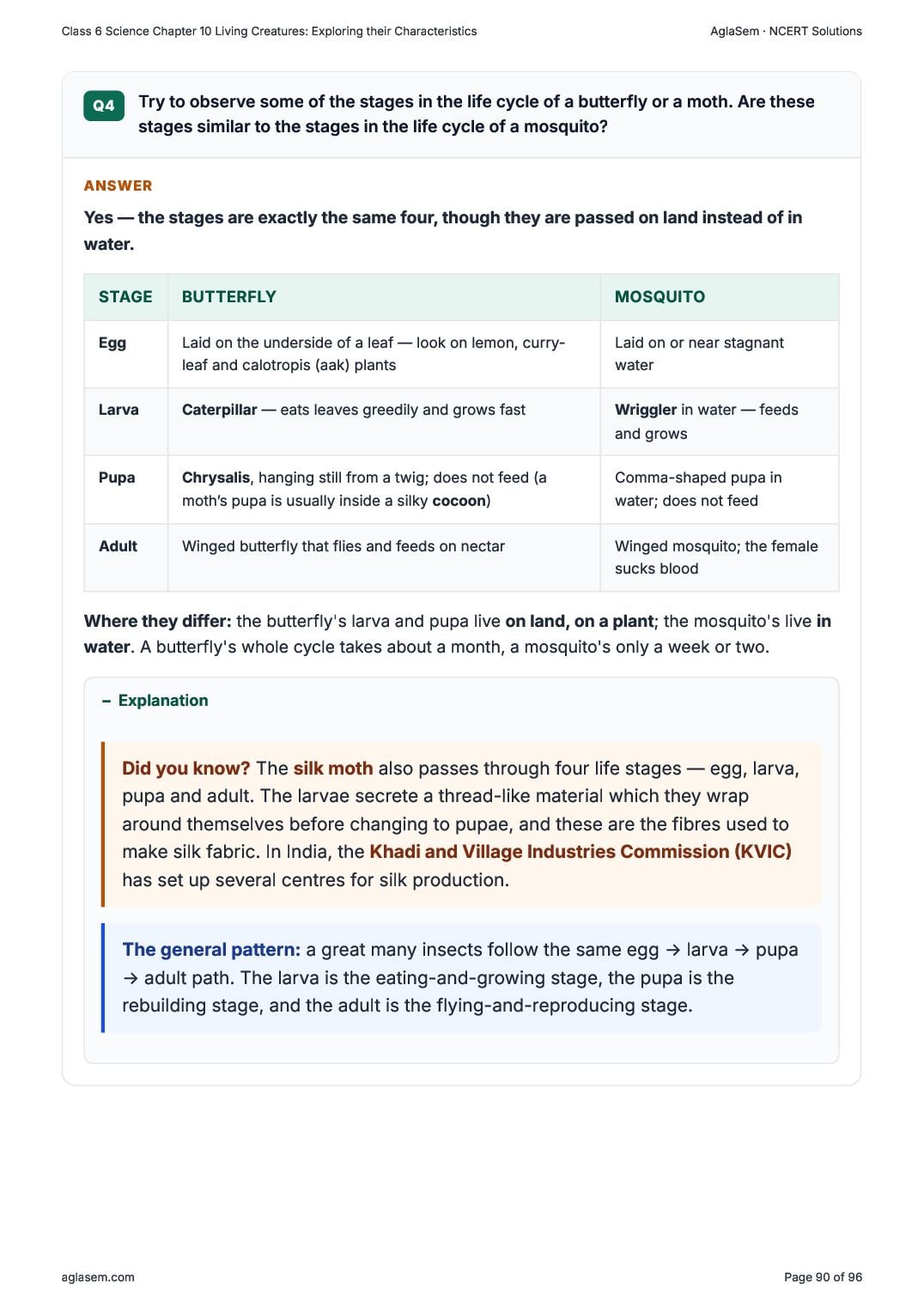
- Try to observe some of the stages in the life cycle of a butterfly or a moth. Are these stages similar to the stages in the life cycle of a mosquito?
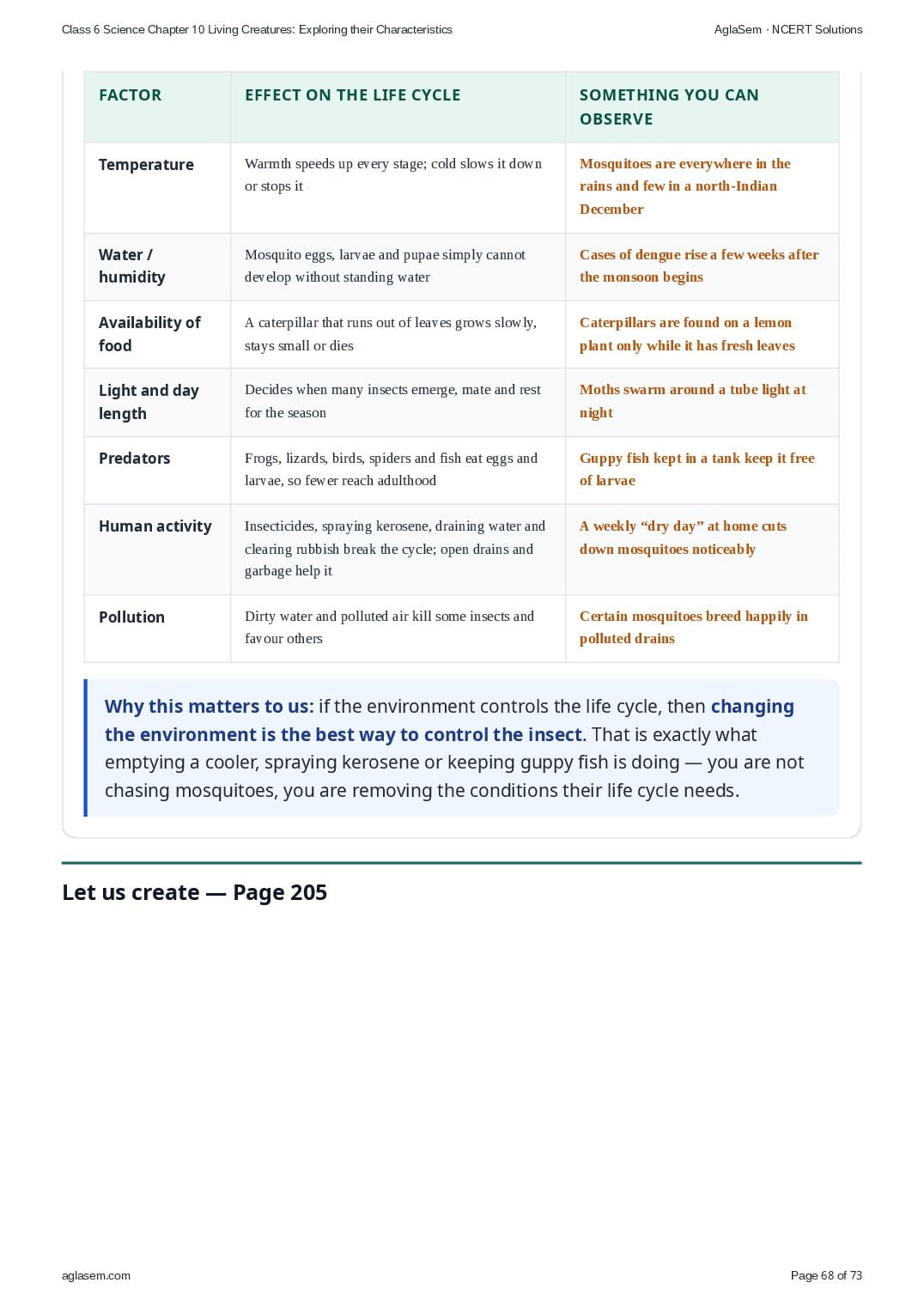
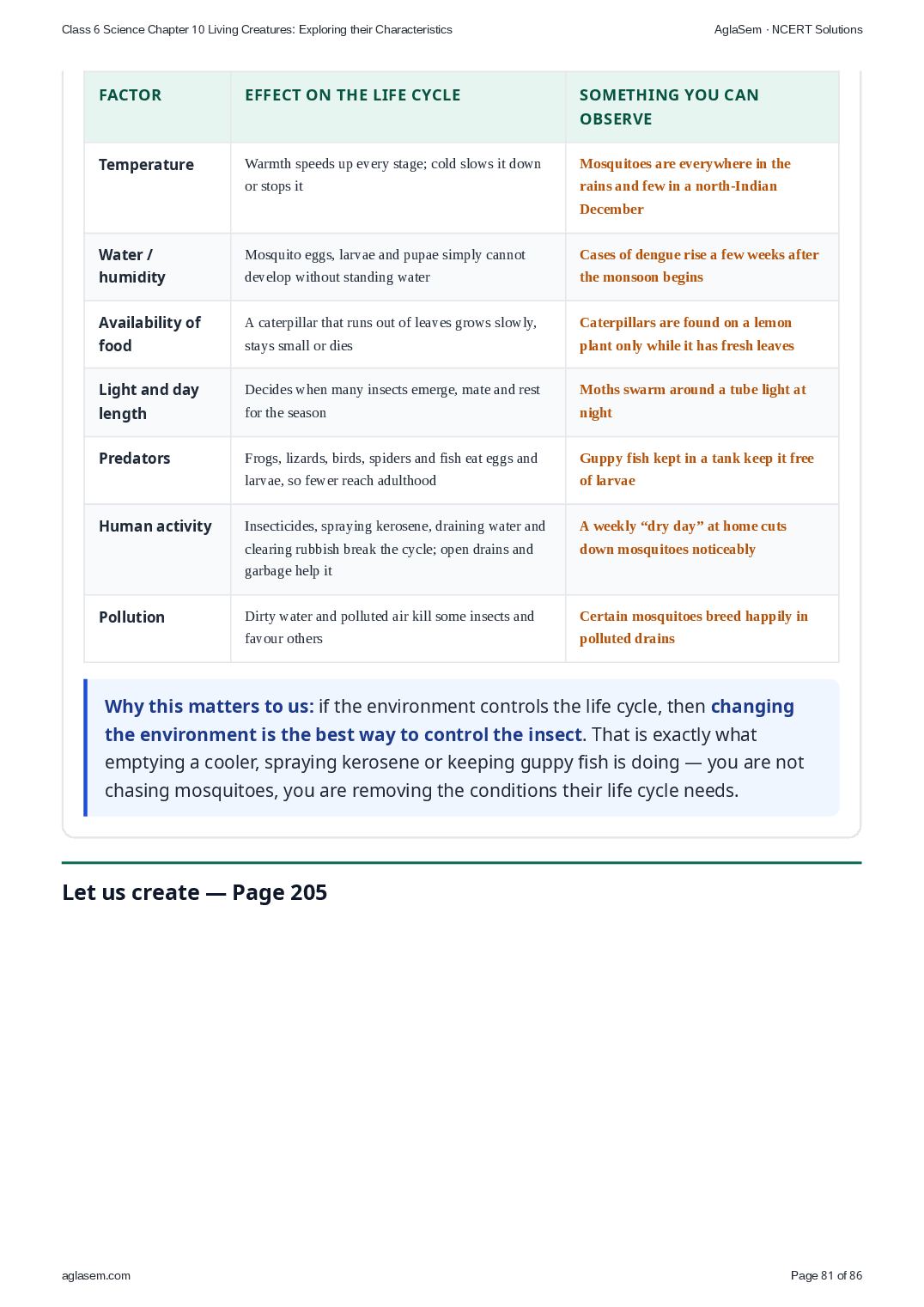
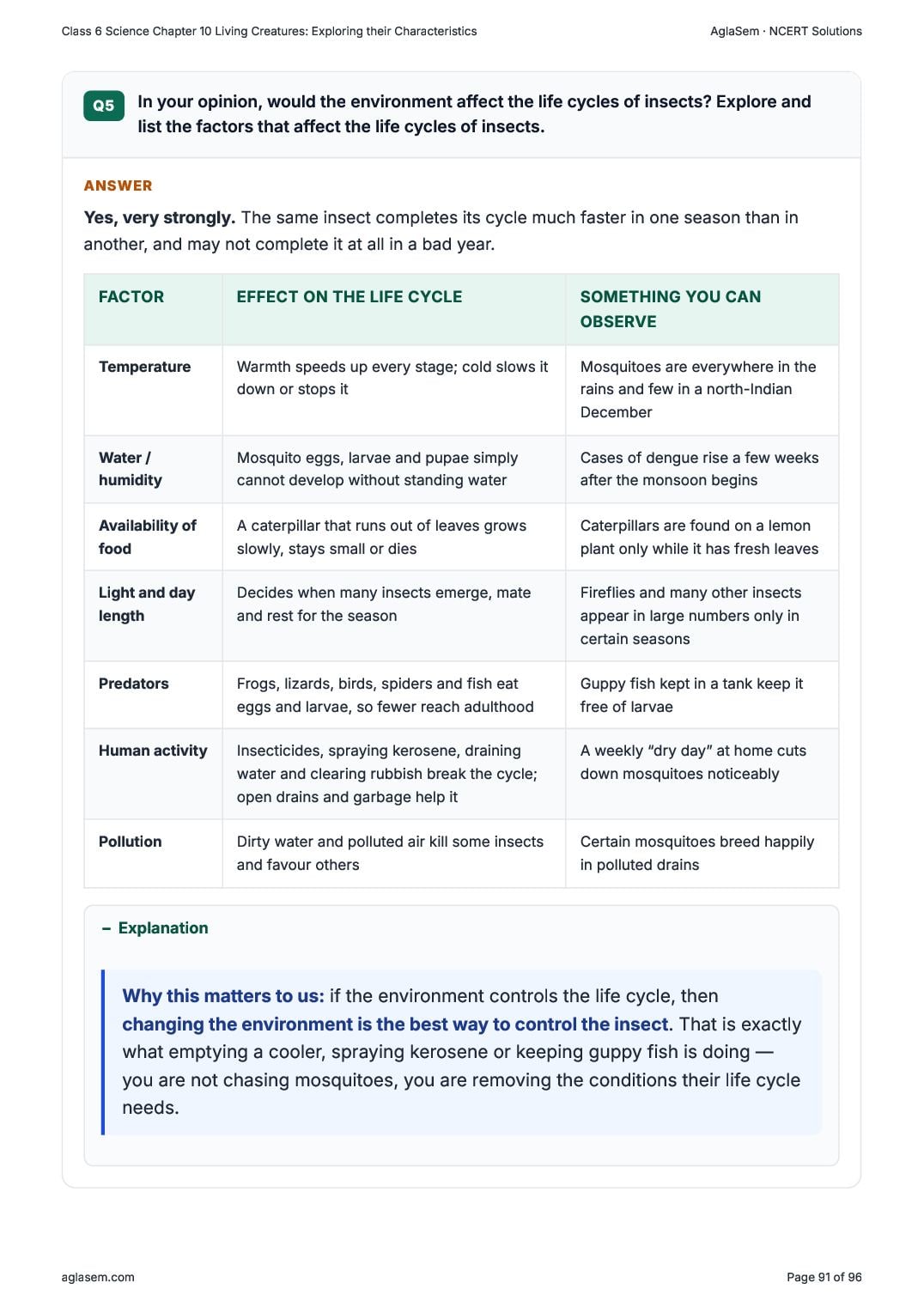
- In your opinion, would the environment affect the life cycles of insects? Explore and list the factors that affect the life cycles of insects.
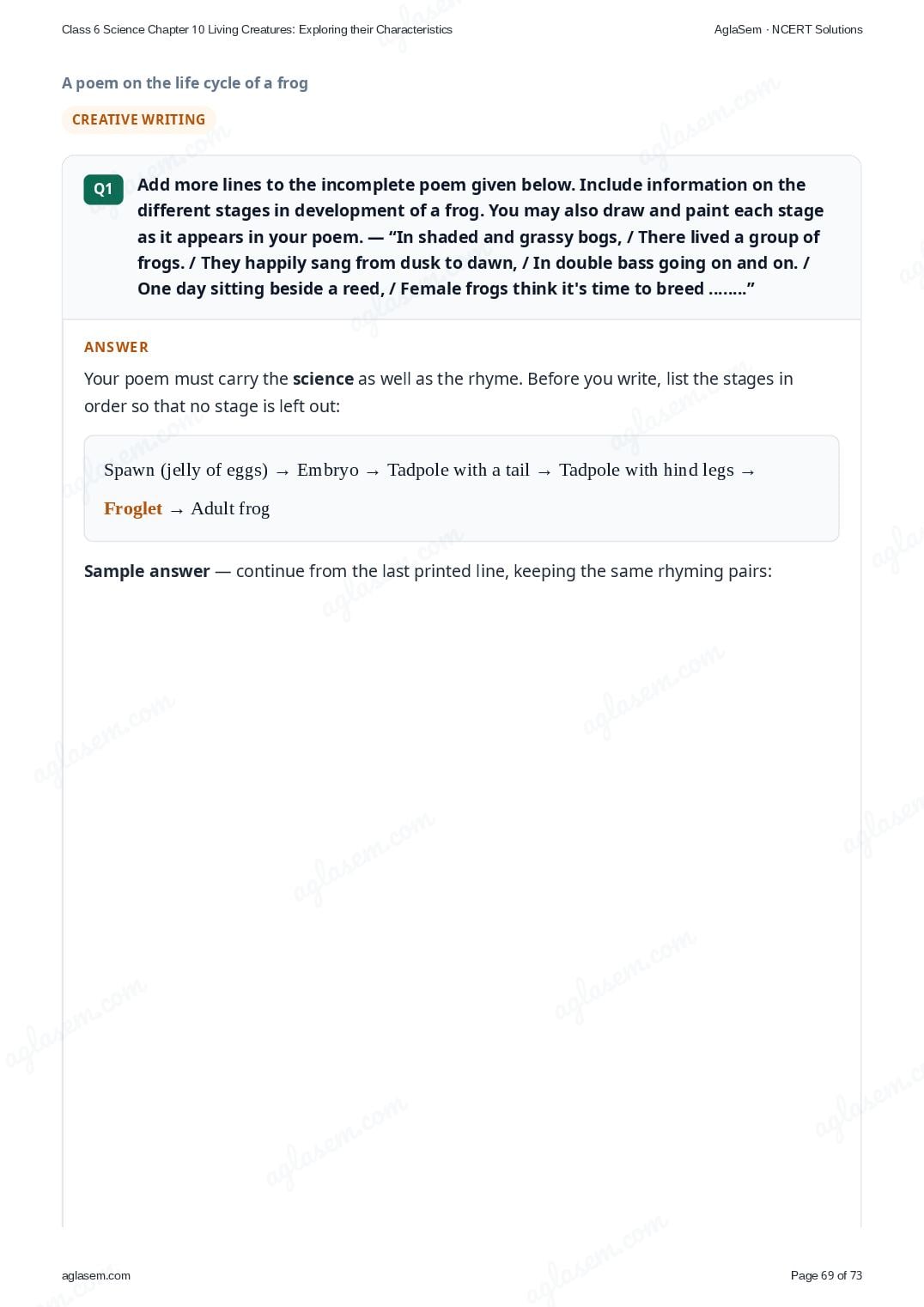
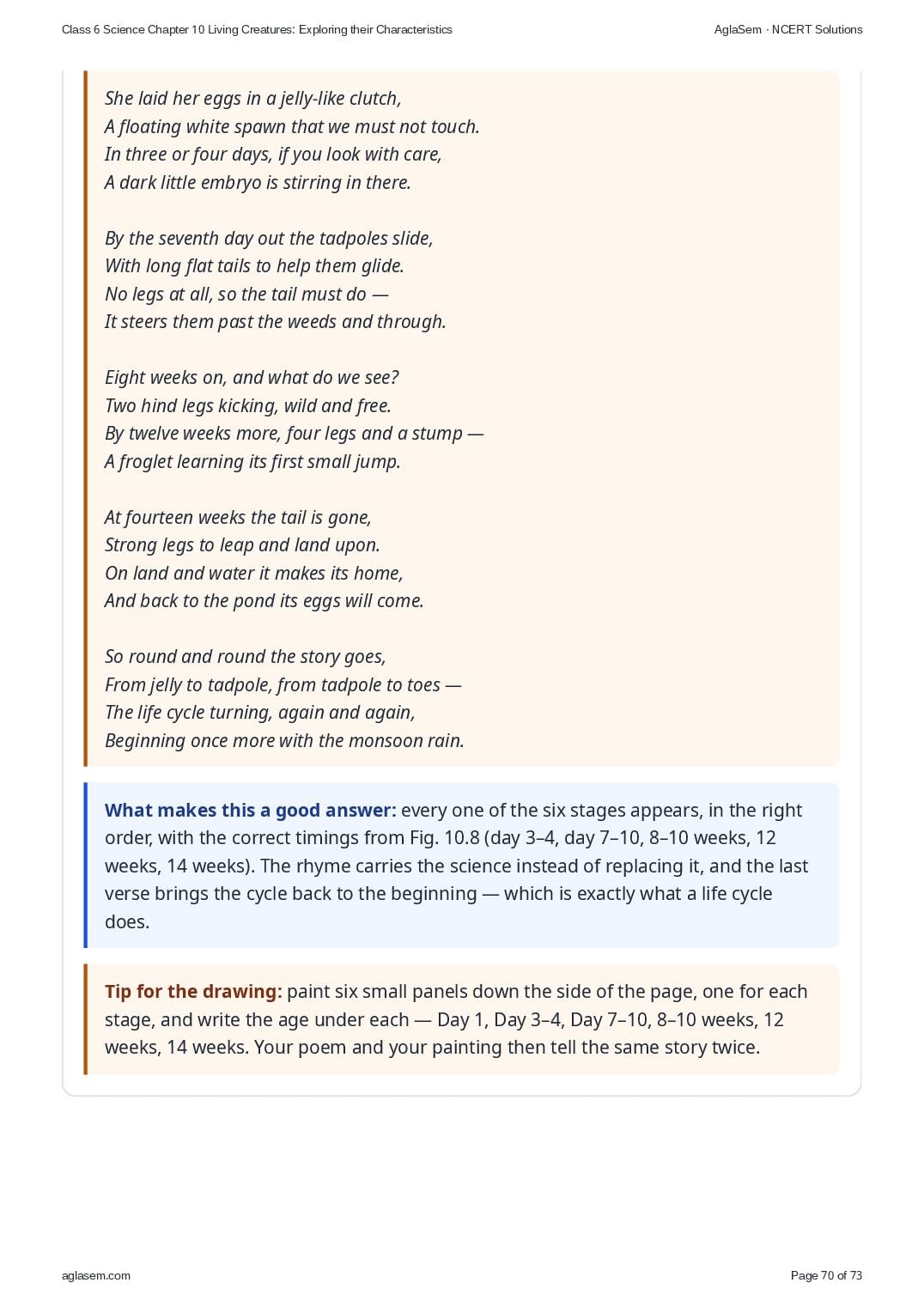
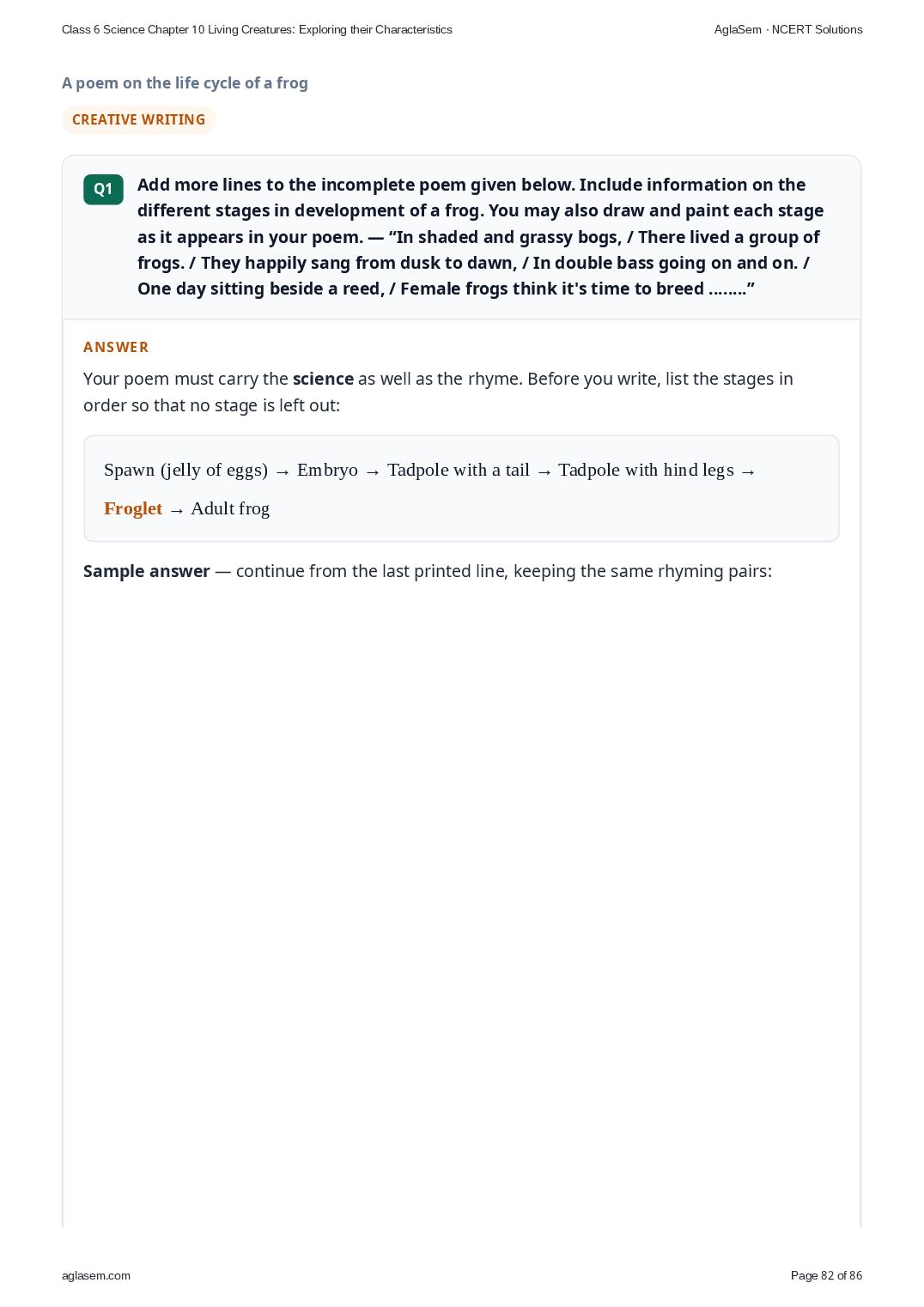
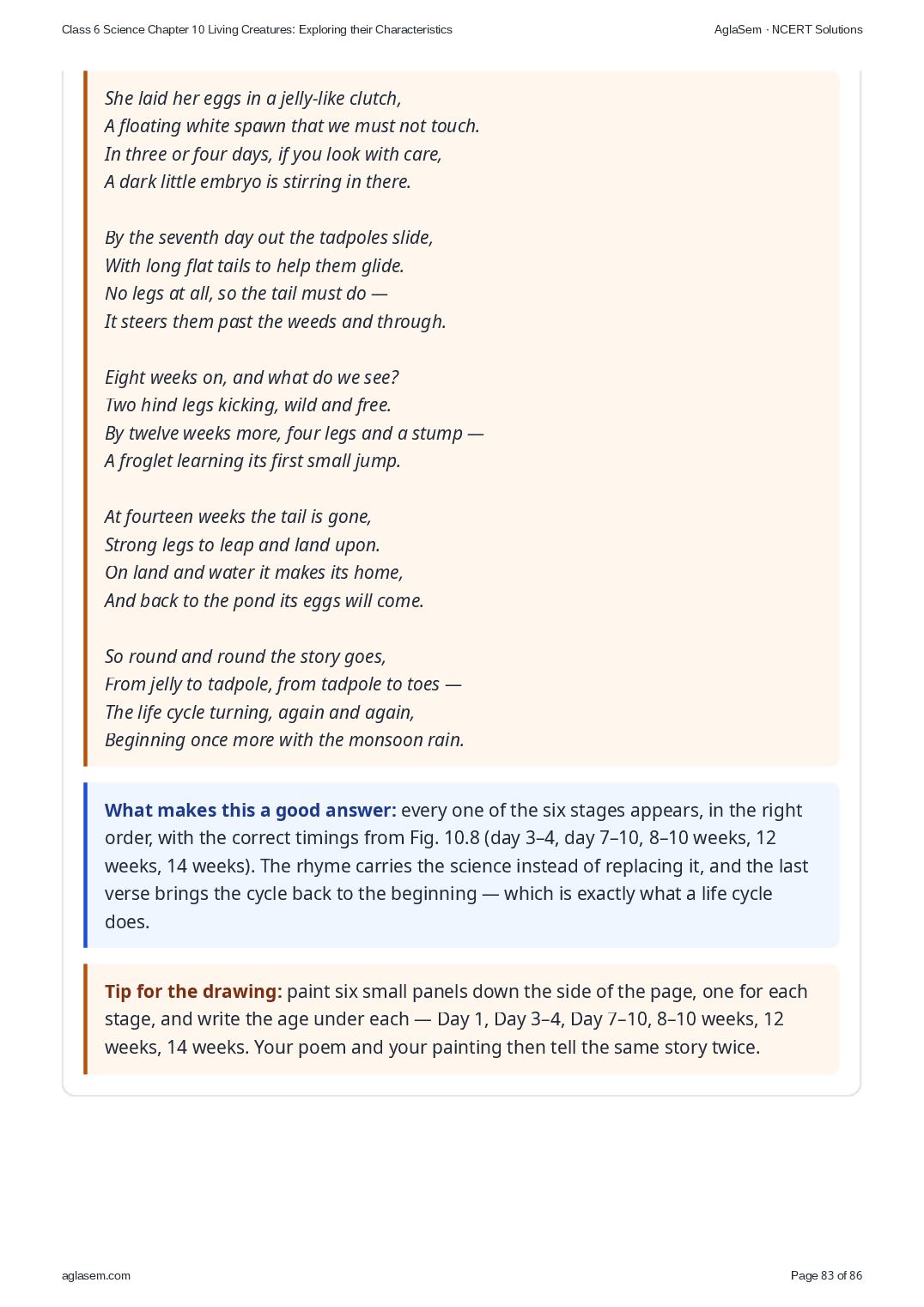
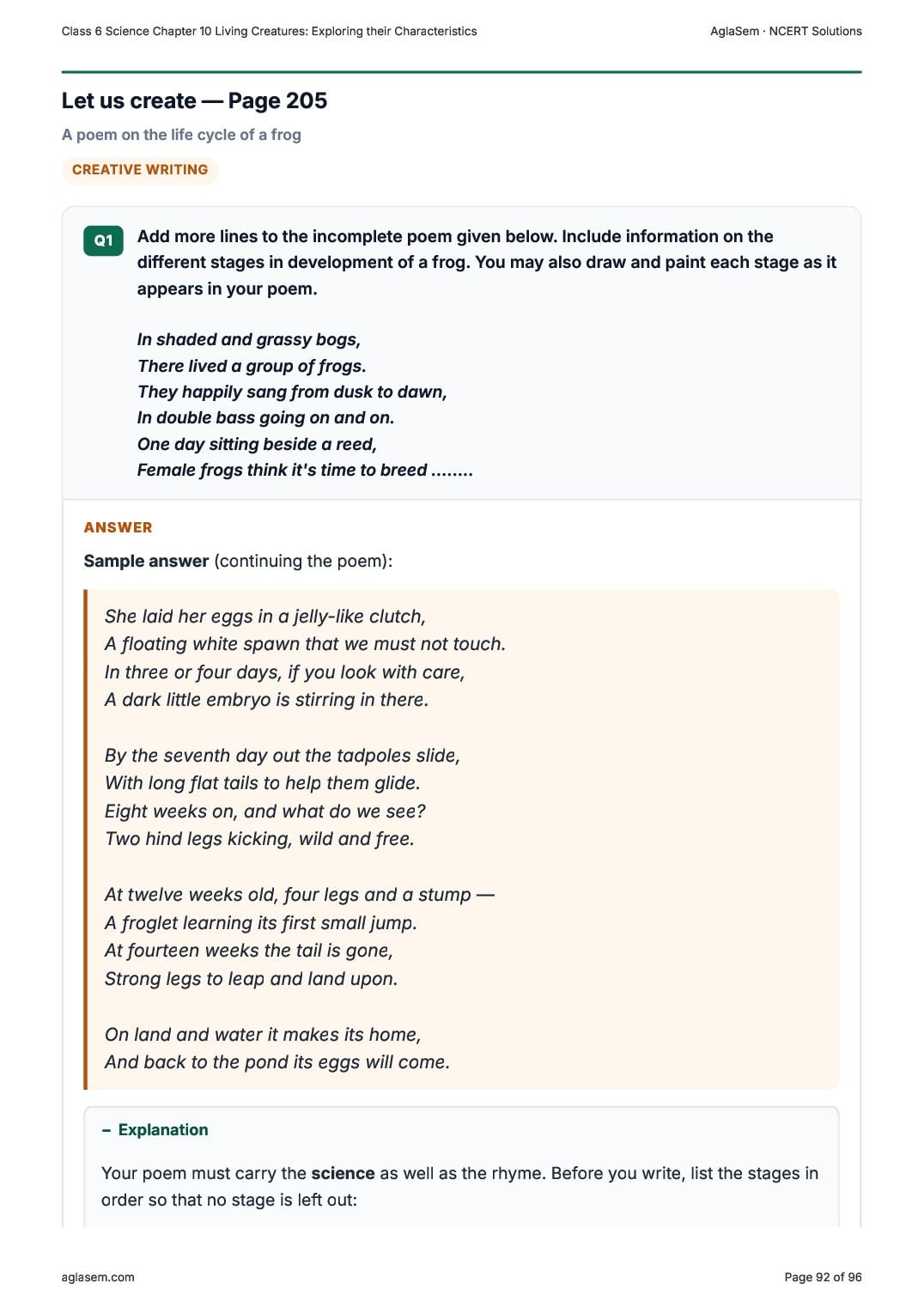
- Add more lines to the incomplete poem given below. Include information on the different stages in development of a frog. You may also draw and paint each stage as it appears in your poem. — “In shaded and grassy bogs, / There lived a group of frogs. / They happily sang from dusk to dawn, / In double bass going on and on. / One day sitting beside a reed, / Female frogs think it's time to breed ……..”
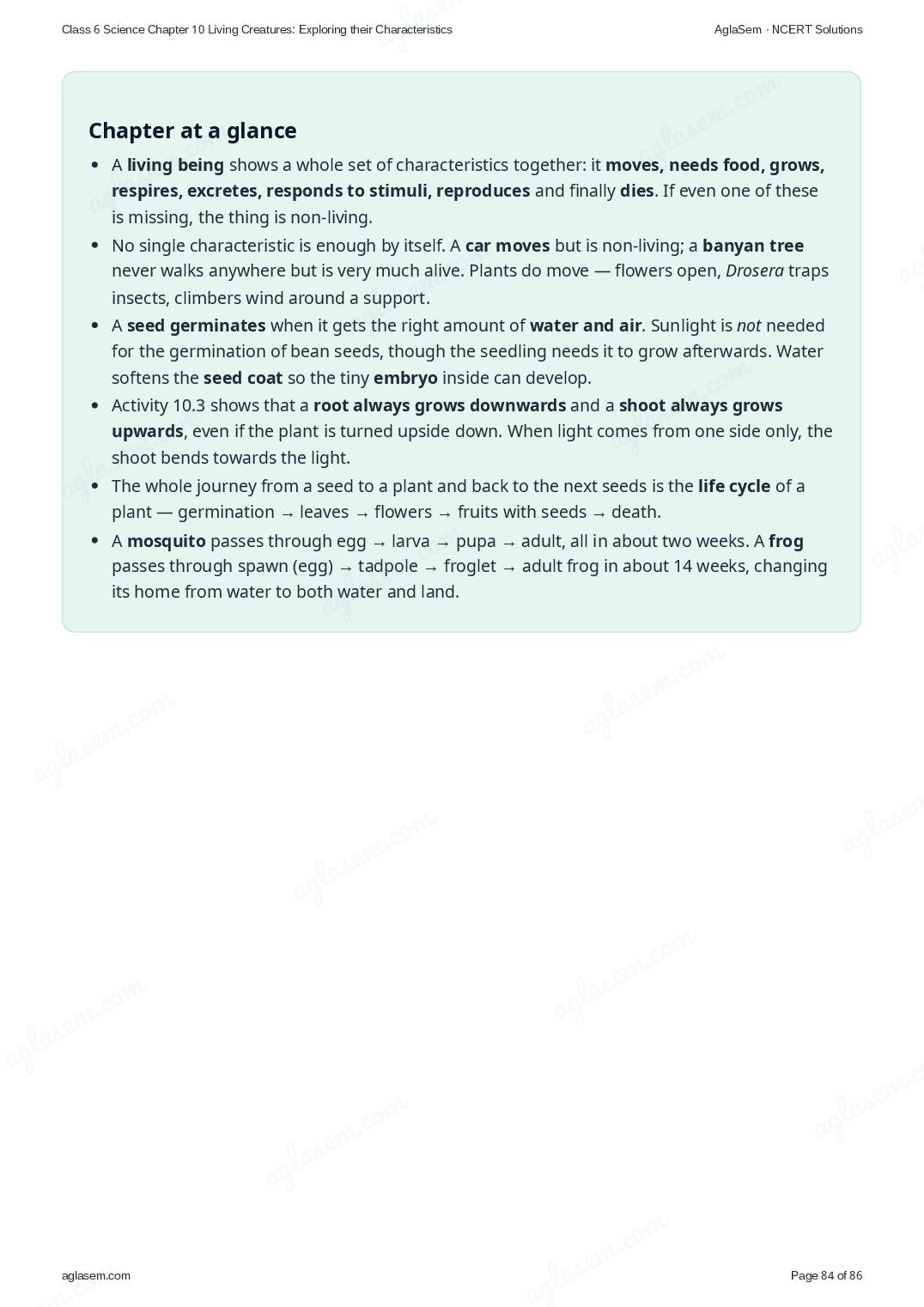
Chapter at a Glance
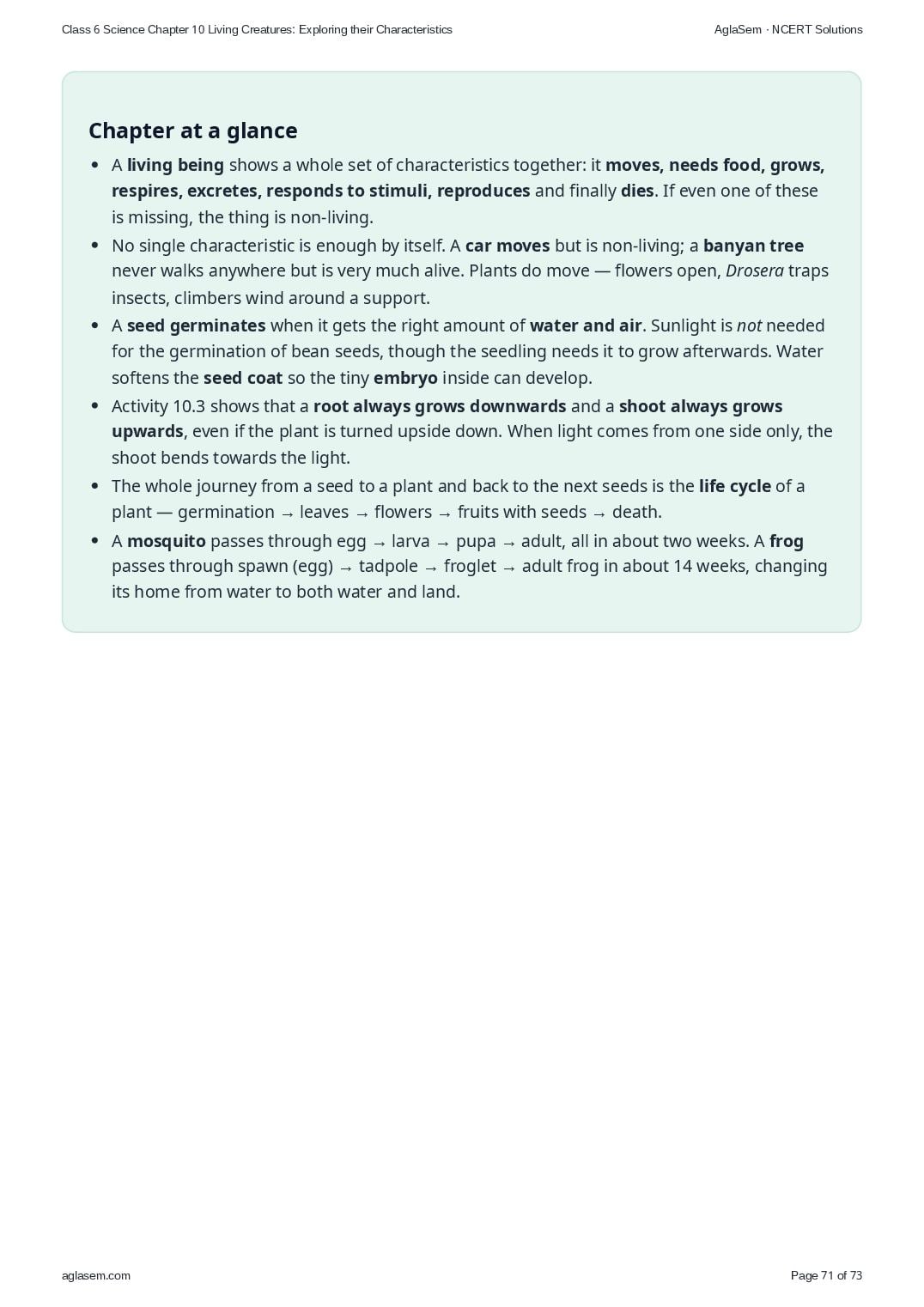
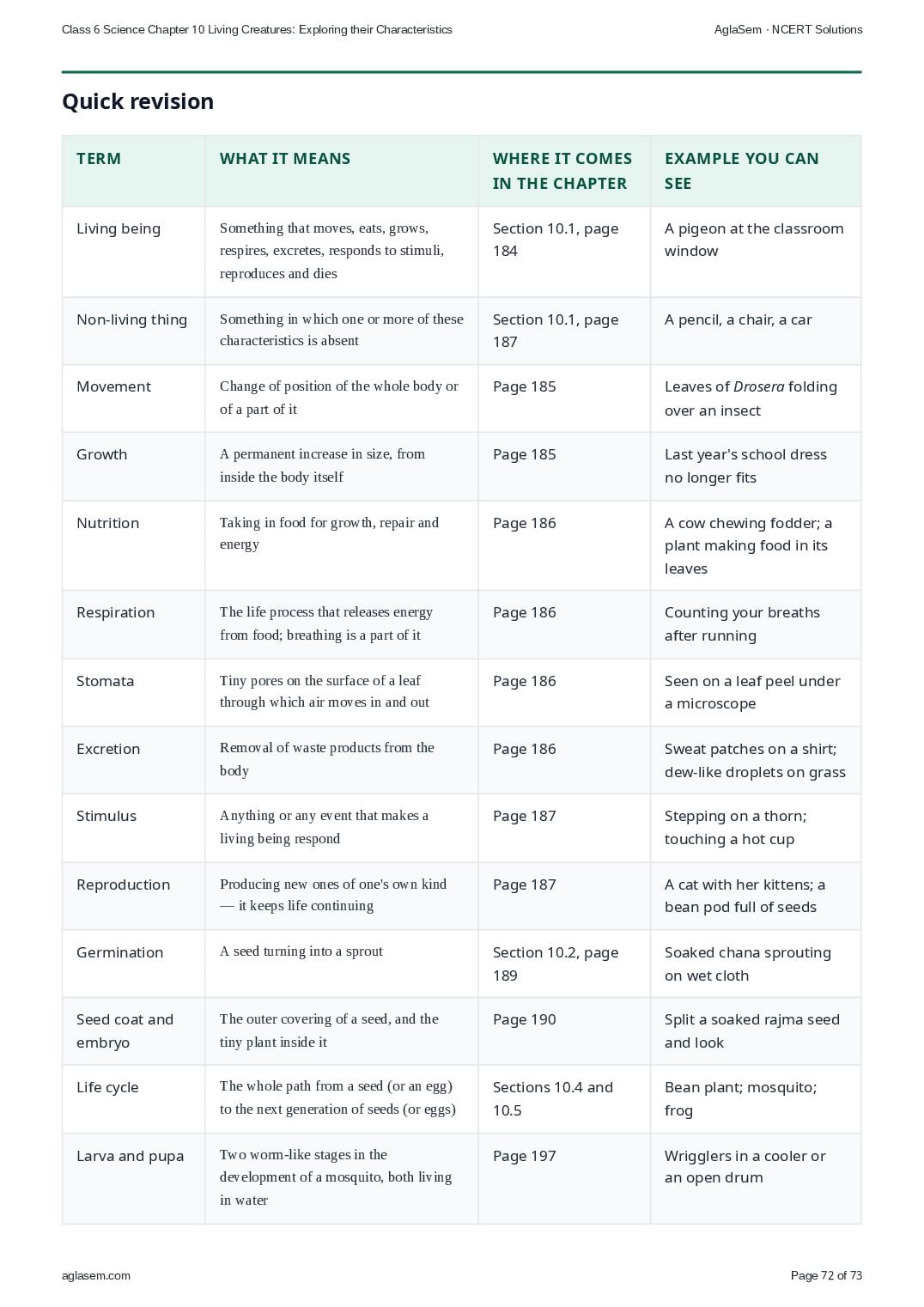
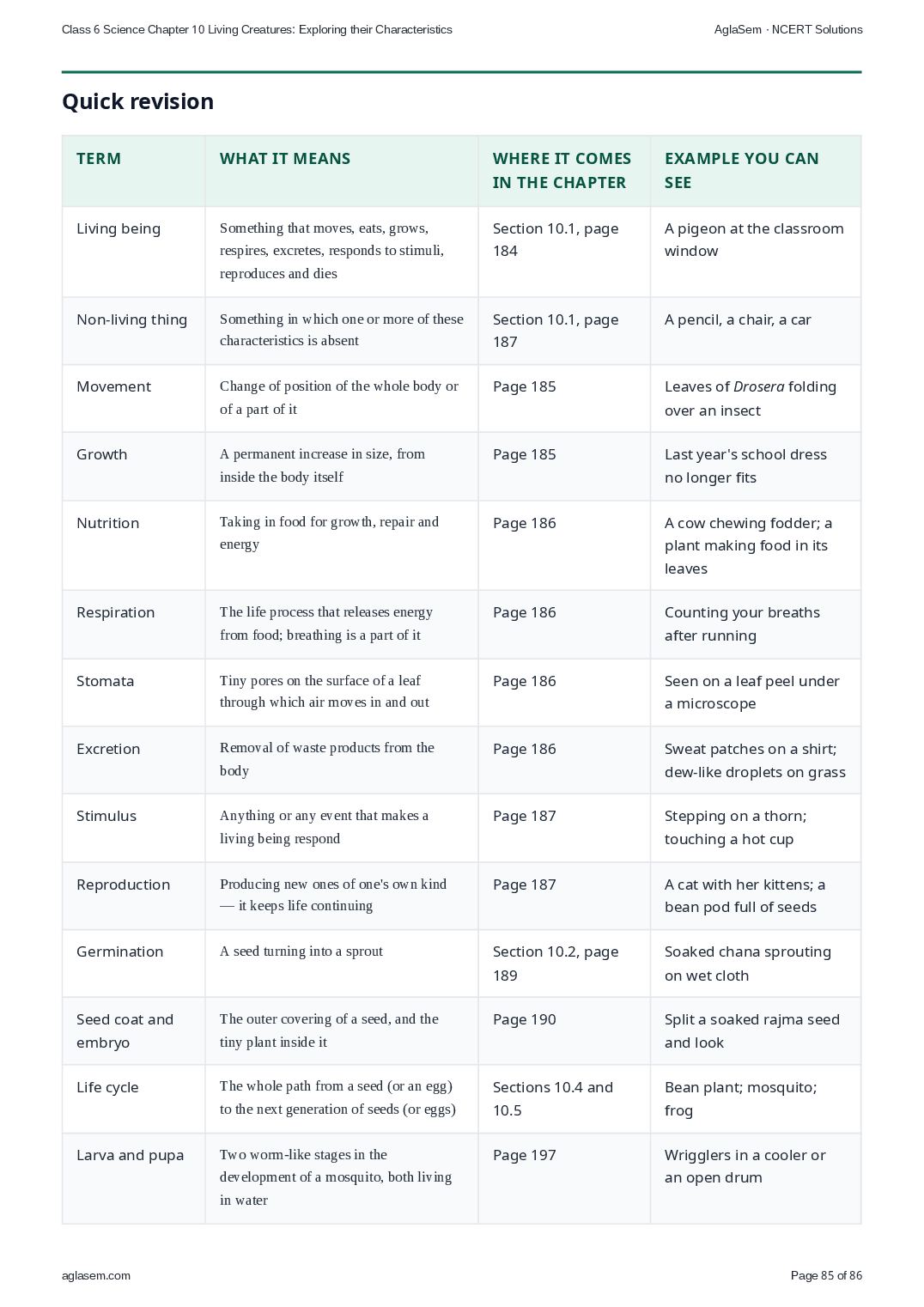
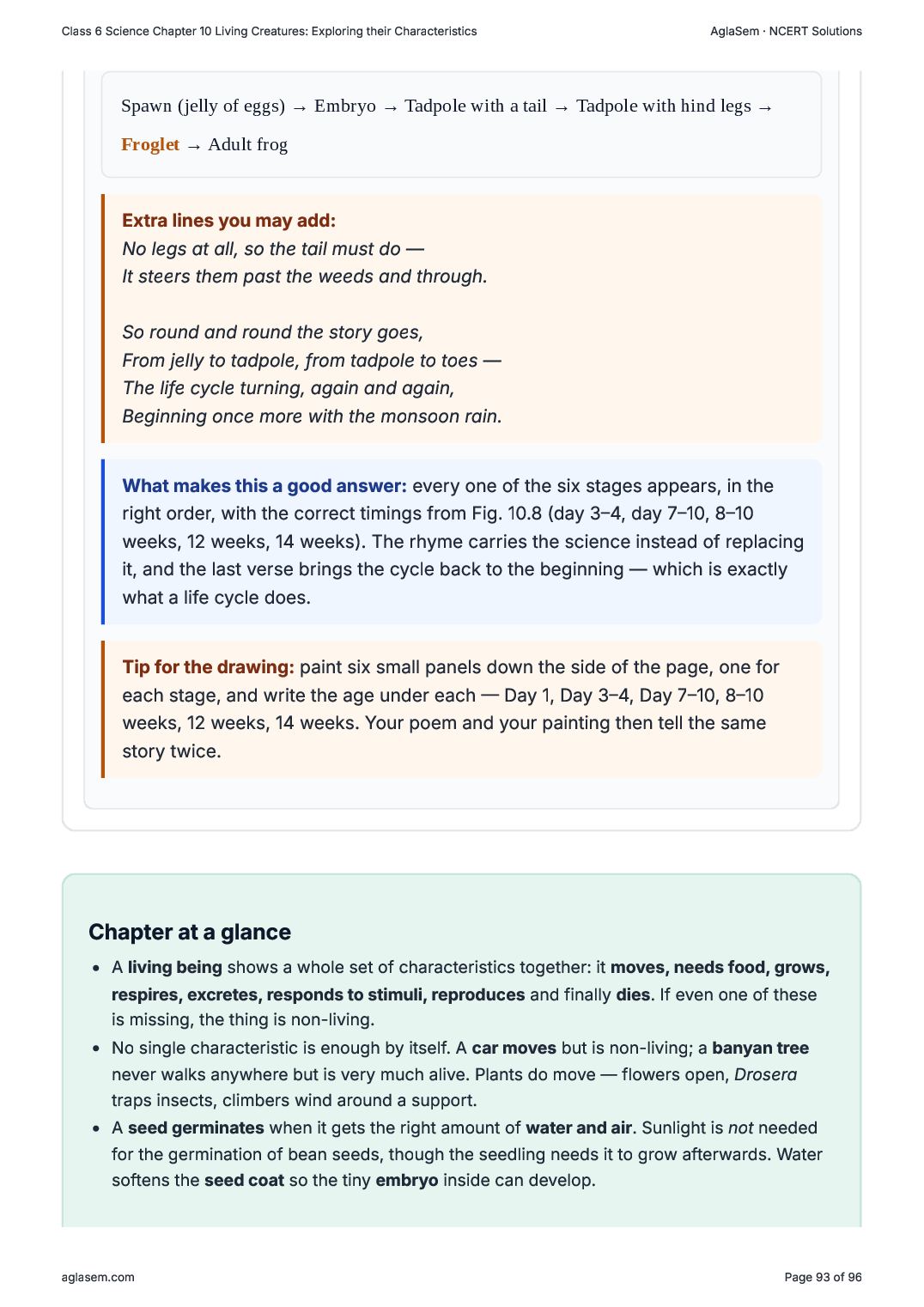
- A living being shows a whole set of characteristics together: it moves, needs food, grows, respires, excretes, responds to stimuli, reproduces and finally dies . If even one of these is missing, the thing is non-living.
- No single characteristic is enough by itself. A car moves but is non-living; a banyan tree never walks anywhere but is very much alive. Plants do move — flowers open, Drosera traps insects, climbers wind around a support.
- A seed germinates when it gets the right amount of water and air . Sunlight is not needed for the germination of bean seeds, though the seedling needs it to grow afterwards. Water softens the seed coat so the tiny embryo inside can develop.
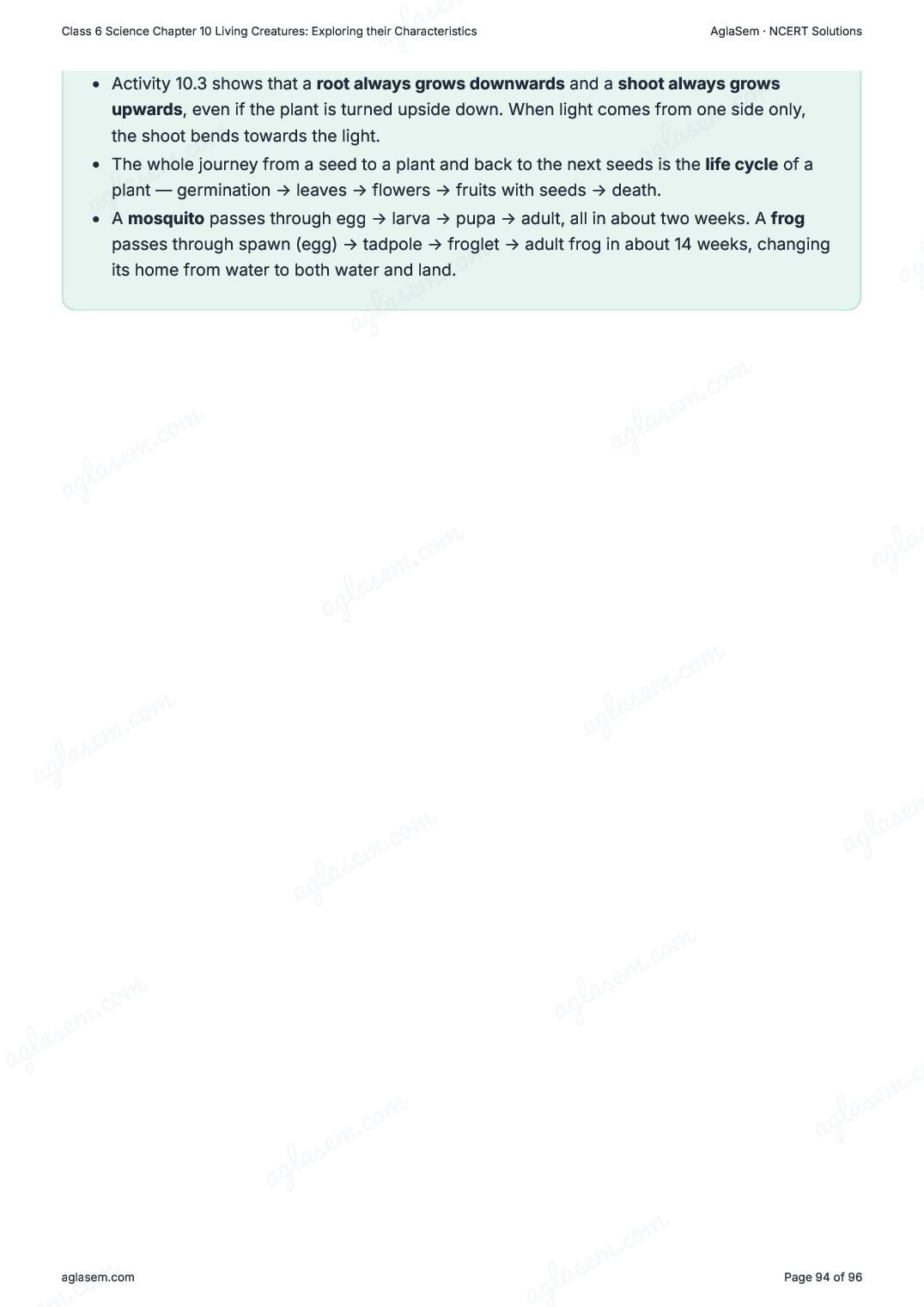
- Activity 10.3 shows that a root always grows downwards and a shoot always grows upwards , even if the plant is turned upside down. When light comes from one side only, the shoot bends towards the light.
- The whole journey from a seed to a plant and back to the next seeds is the life cycle of a plant — germination → leaves → flowers → fruits with seeds → death.
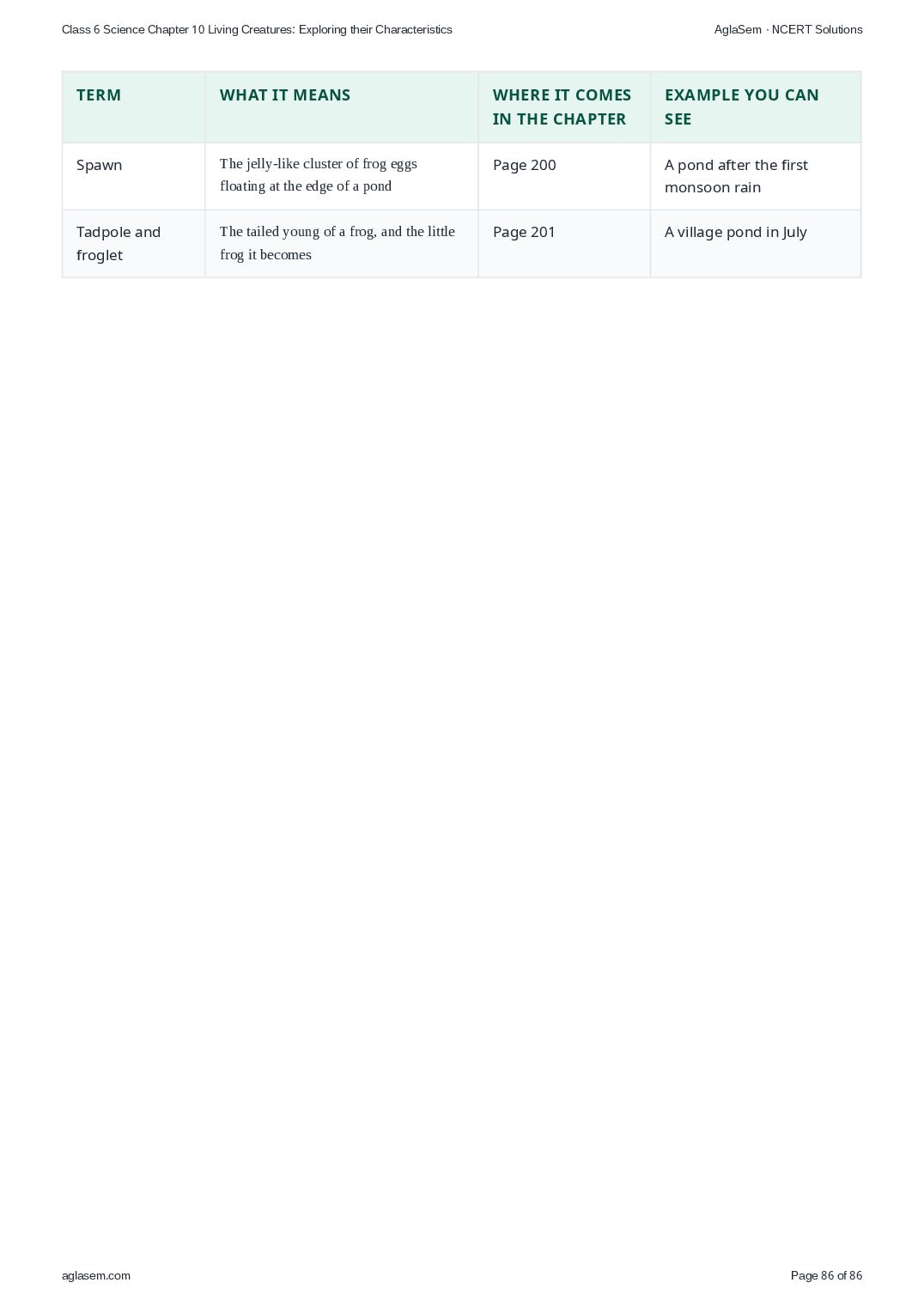
- A mosquito passes through egg → larva → pupa → adult, all in about two weeks. A frog passes through spawn (egg) → tadpole → froglet → adult frog in about 14 weeks, changing its home from water to both water and land.
How to Download NCERT Solutions for Class 6 Science Chapter 10 PDF
Follow these simple steps to get the Living Creatures Exploring Their Characteristics questions-and-answers PDF from Curiosity.
- Search NCERT Solutions for Class 6 Science Chapter 10 aglasem and open this page.
- Read the exercise questions with answers for Living Creatures Exploring Their Characteristics shown above.
- Click the Download PDF link to save the Living Creatures Exploring Their Characteristics solutions to your device.
NCERT Solutions for Class 6 Science – All Chapters
There are more chapters to study besides Living Creatures Exploring Their Characteristics in Science. Here are the NCERT Solutions for all chapters of Class 6 Science.
- Chapter 1 the Wonderful World of Science
- Chapter 2 Diversity in the Living World
- Chapter 3 Mindful Eating a Path to a Healthy Body
- Chapter 4 Exploring Magnets
- Chapter 5 Measurement of Length and Motion
- Chapter 6 Materials Around Us
- Chapter 7 Temperature and Its Measurement
- Chapter 8 a Journey Through States of Water
- Chapter 9 Methods of Separation in Everyday Life
- Chapter 10 Living Creatures Exploring Their Characteristics
- Chapter 11 Nature’s Treasures
- Chapter 12 Beyond Earth
NCERT Solutions for Class 6 – All Subjects
Just like Chapter 10 of Science, you can get the exercise questions with answers for every other subject of Class 6. Here are the NCERT Solutions for all subjects of Class 6.
NCERT Solutions for Class 6 Science Chapter 10 – An Overview
The key highlights of this study material are as follows.
| Aspects | Details |
|---|---|
| Class | Class 6 |
| Subject | Science |
| Chapter Number | Chapter 10 |
| Chapter Name | Living Creatures Exploring Their Characteristics |
| Book Name | Curiosity |
| Book By | NCERT (National Council of Educational Research and Training) |
| Educational Resource Here | NCERT Solutions of Class 6 Science Chapter 10 for all exercises |
| More Questions Answers of This Subject | NCERT Solutions for Class 6 Science |
| Download Book Chapter | NCERT Book Class 6 Science |
| All Questions Answers For This Class | NCERT Solutions for Class 6 |
| Complete Solutions | NCERT Solutions |
NCERT Solutions for Class 6 Science Chapter 10 Living Creatures Exploring Their Characteristics – FAQs
What are the NCERT Solutions for Class 6 Science Chapter 10 Living Creatures Exploring Their Characteristics?
They are the complete, step-by-step answers to all the exercise and in-text questions of Chapter 10 Living Creatures Exploring Their Characteristics from the NCERT Class 6 Science textbook Curiosity, written by experts as per the latest NCERT syllabus.
How can I download the Class 6 Science Chapter 10 solutions PDF for free?
Open this page on aglasem, read the Living Creatures Exploring Their Characteristics questions with answers, and click the “Download Solutions PDF” link. The Class 6 Science Chapter 10 NCERT Solutions PDF is completely free to download.
Are these NCERT Solutions as per the latest 2026-27 syllabus?
Yes. The NCERT Solutions for Class 6 Science Chapter 10 are based on the latest NCERT textbook Curiosity and the current 2026-27 CBSE syllabus, so the questions and answers match what you study in class.
Where can I get NCERT Solutions for the other chapters of Class 6 Science?
You can find the answers to every chapter on the NCERT Solutions for Class 6 Science page, and solutions for every subject on the NCERT Solutions for Class 6 page.
How do NCERT Solutions help in exam preparation?
They show the correct method to solve each question, help you write answers the way they are expected in exams, let you check and correct your own work, and save revision time — which together improve your marks in Class 6 Science.
If you have any queries on NCERT Solutions for Class 6 Science Chapter 10 Living Creatures Exploring Their Characteristics, then please ask in the comments below.