NCERT Solutions for Class 6 Science Chapter 4 Exploring Magnets provide clear, step-by-step answers to every exercise and in-text question from the chapter Exploring Magnets of the NCERT textbook Curiosity. Prepared by subject experts as per the latest NCERT (CBSE) syllabus for 2026-27, these NCERT Solutions for Class 6 Science help you understand each concept, write exam-ready answers, and check your own solutions. You can read them online below or download the free Class 6 Science Chapter 4 question-answer PDF.
NCERT Solutions for Class 6 Science Chapter 4 Exploring Magnets
- Class: Class 6
- Subject: Science
- Chapter: Chapter 4 – Exploring Magnets
- Textbook: Curiosity (NCERT)
- Study material: NCERT Solutions – questions with answers, free PDF
These solutions answer all the exercise questions of Chapter 4 Exploring Magnets — including the in-text questions, short-answer and long-answer questions, and activities — with complete explanations so you can follow the method, not just the final answer. Read the full solutions below.
NCERT Solutions Class 6 Science Chapter 4 Exploring Magnets View Download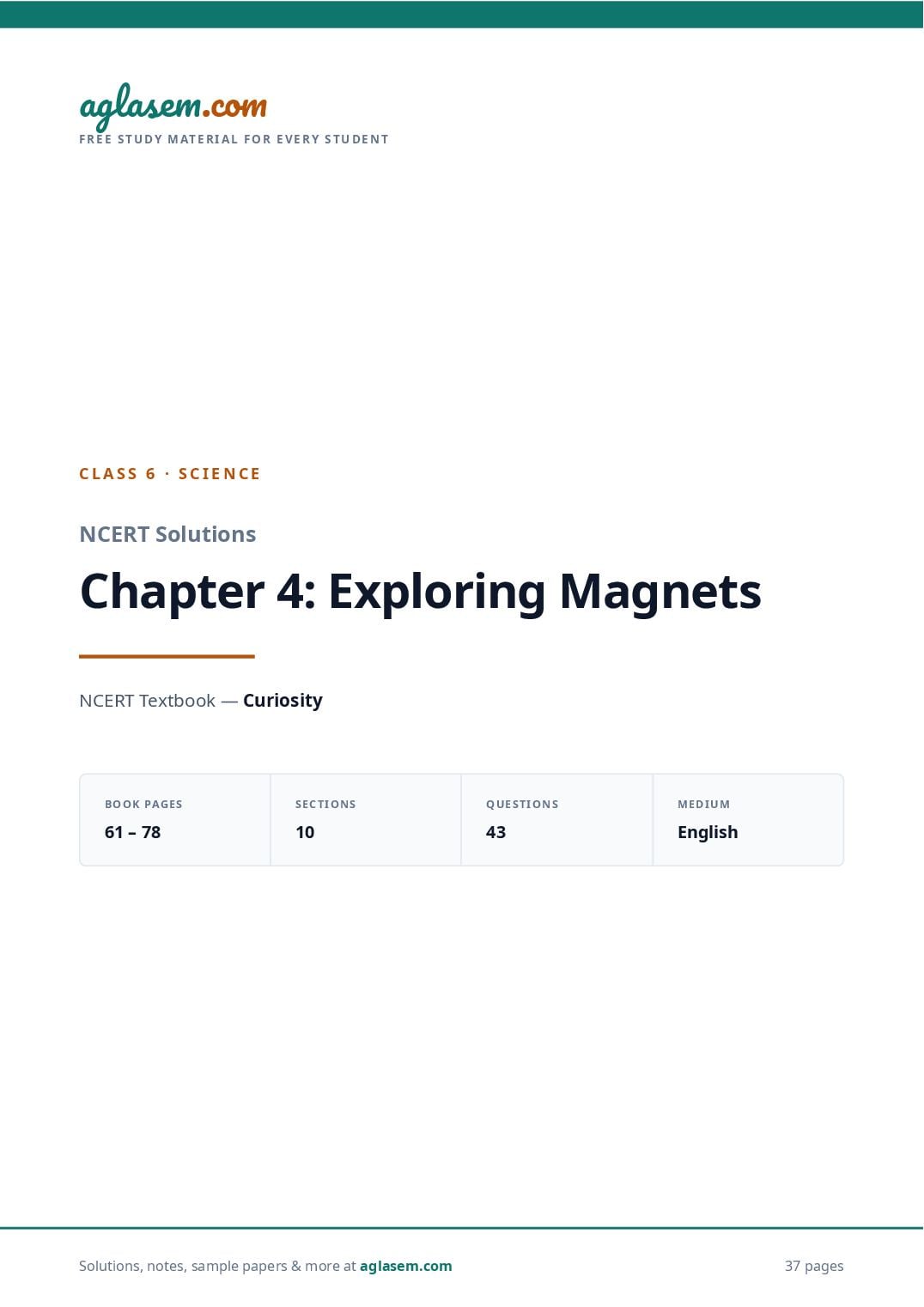
NCERT Solutions for Class 6 Science Chapter 4 PDF Download
You can read the NCERT Solutions for Class 6 Science Chapter 4 online above, or download the complete question-answer PDF to study Exploring Magnets offline at any time.
NCERT Solutions for Class 6 Science Chapter 4 PDF Download Link – Click Here to Download Solutions PDF
Questions Covered in This Chapter
These NCERT Solutions answer all 43 questions of this chapter. The questions solved are:
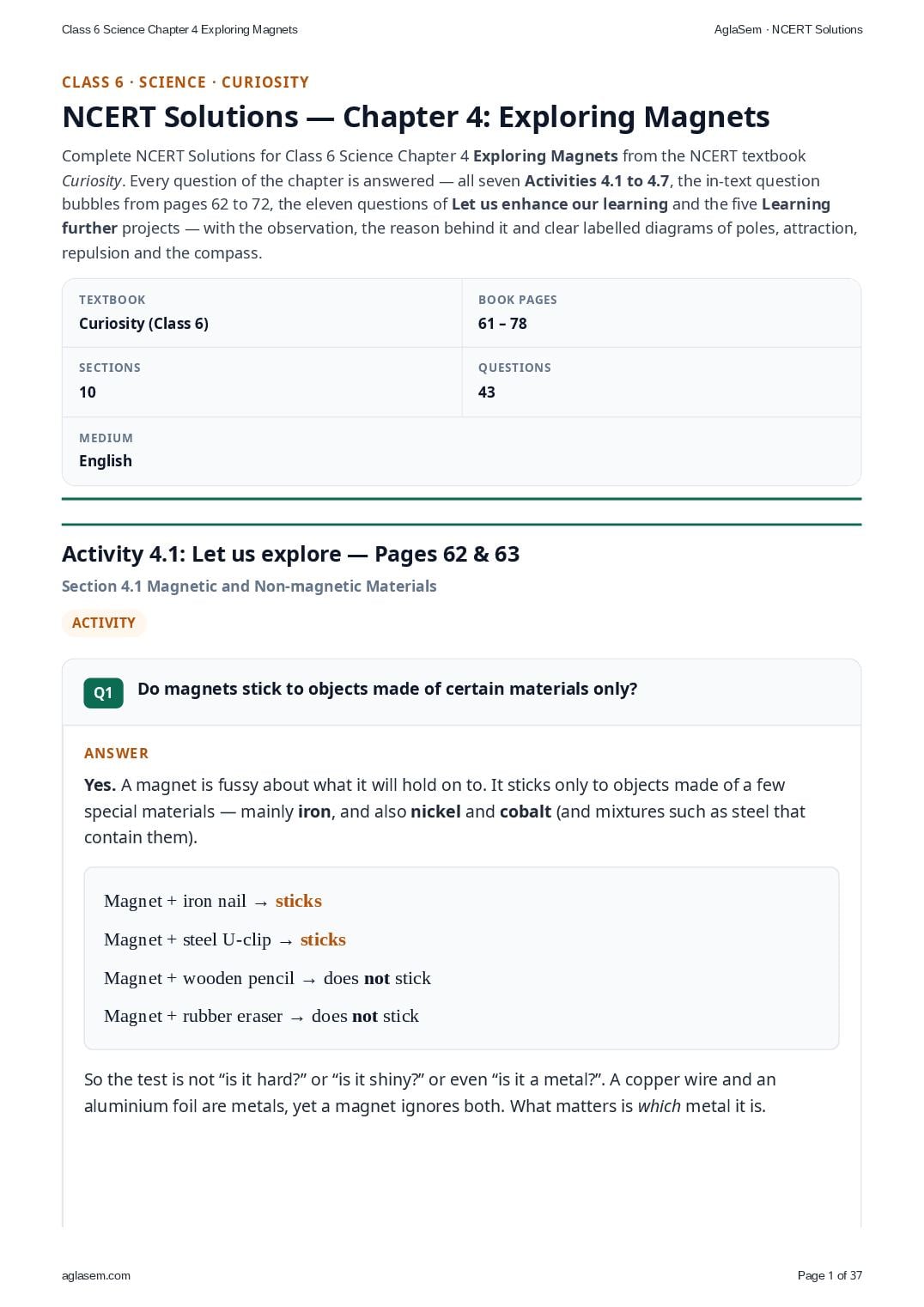
- Do magnets stick to objects made of certain materials only?
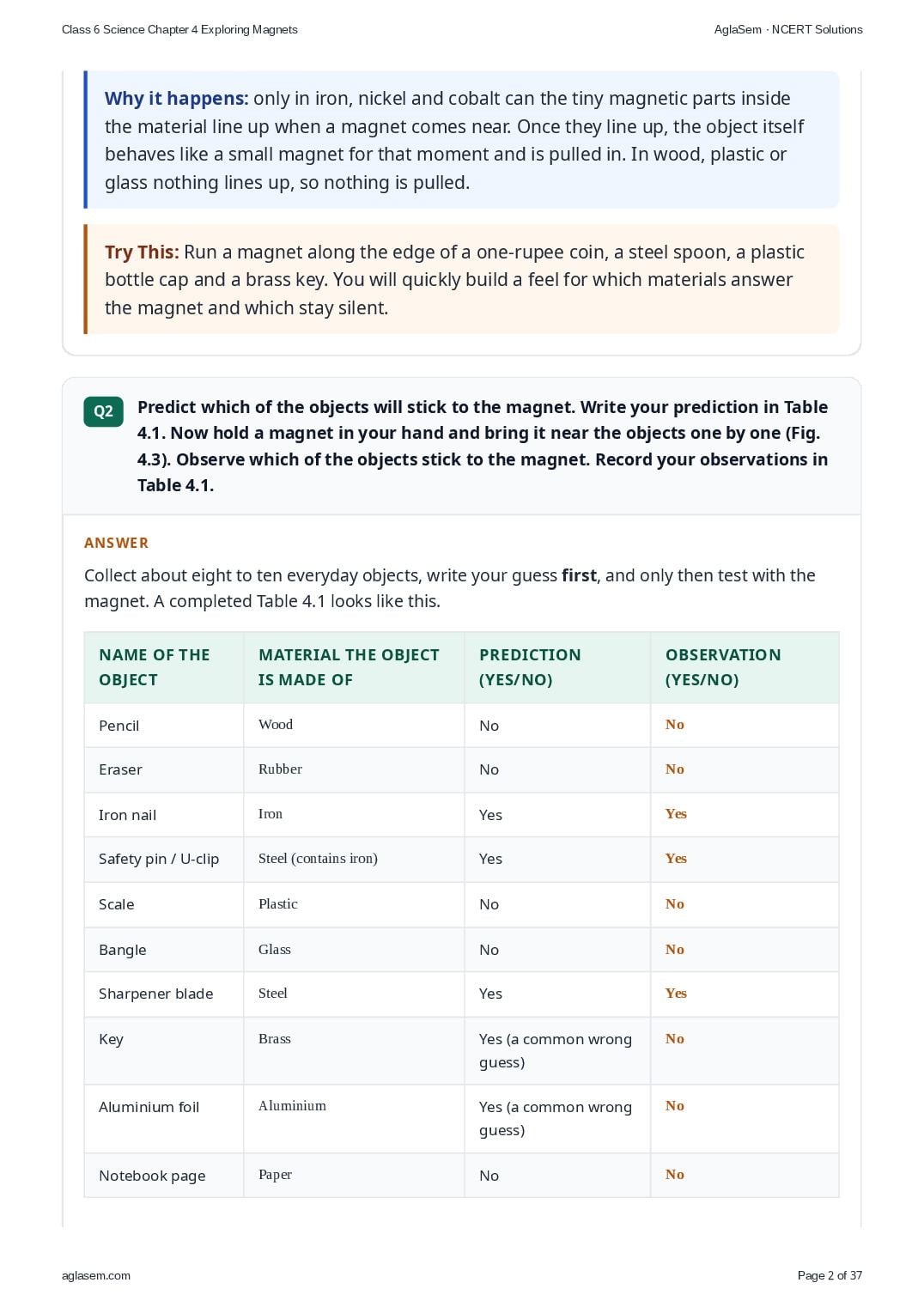
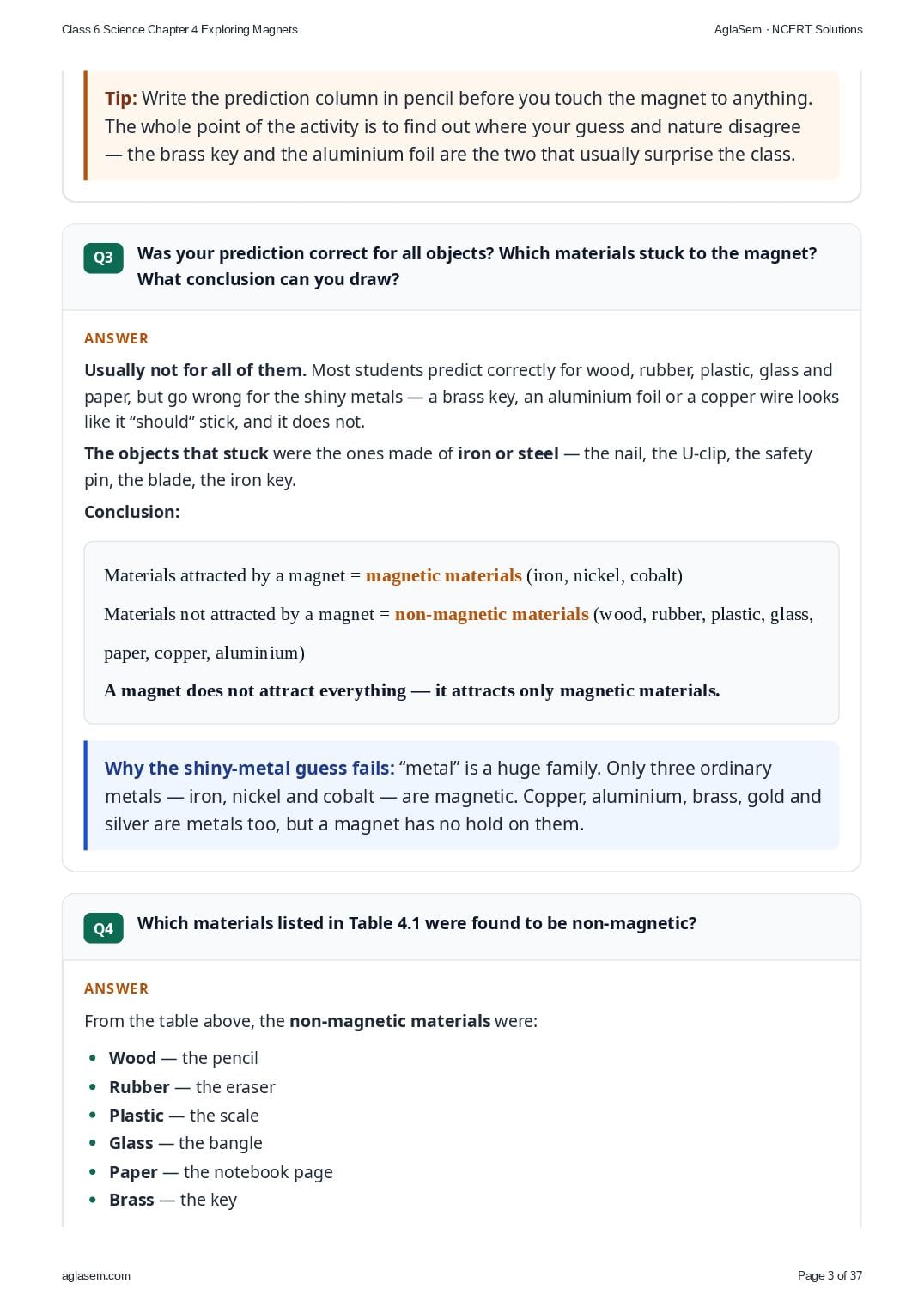
- Predict which of the objects will stick to the magnet. Write your prediction in Table 4.1. Now hold a magnet in your hand and bring it near the objects one by one (Fig. 4.3). Observe which of the objects stick to the magnet. Record your observations in Table 4.1.
- Was your prediction correct for all objects? Which materials stuck to the magnet? What conclusion can you draw?
- Which materials listed in Table 4.1 were found to be non-magnetic?
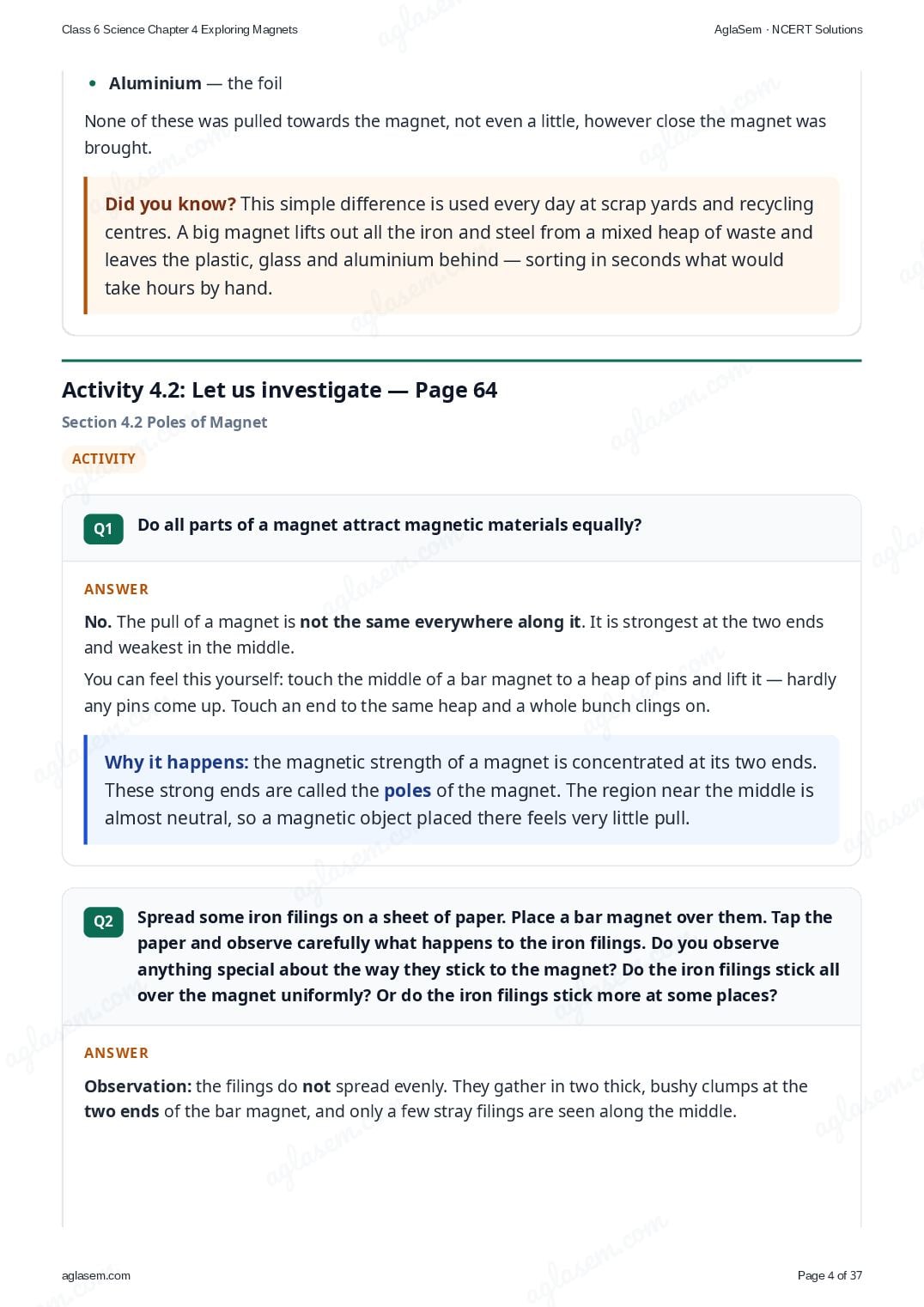
- Do all parts of a magnet attract magnetic materials equally?
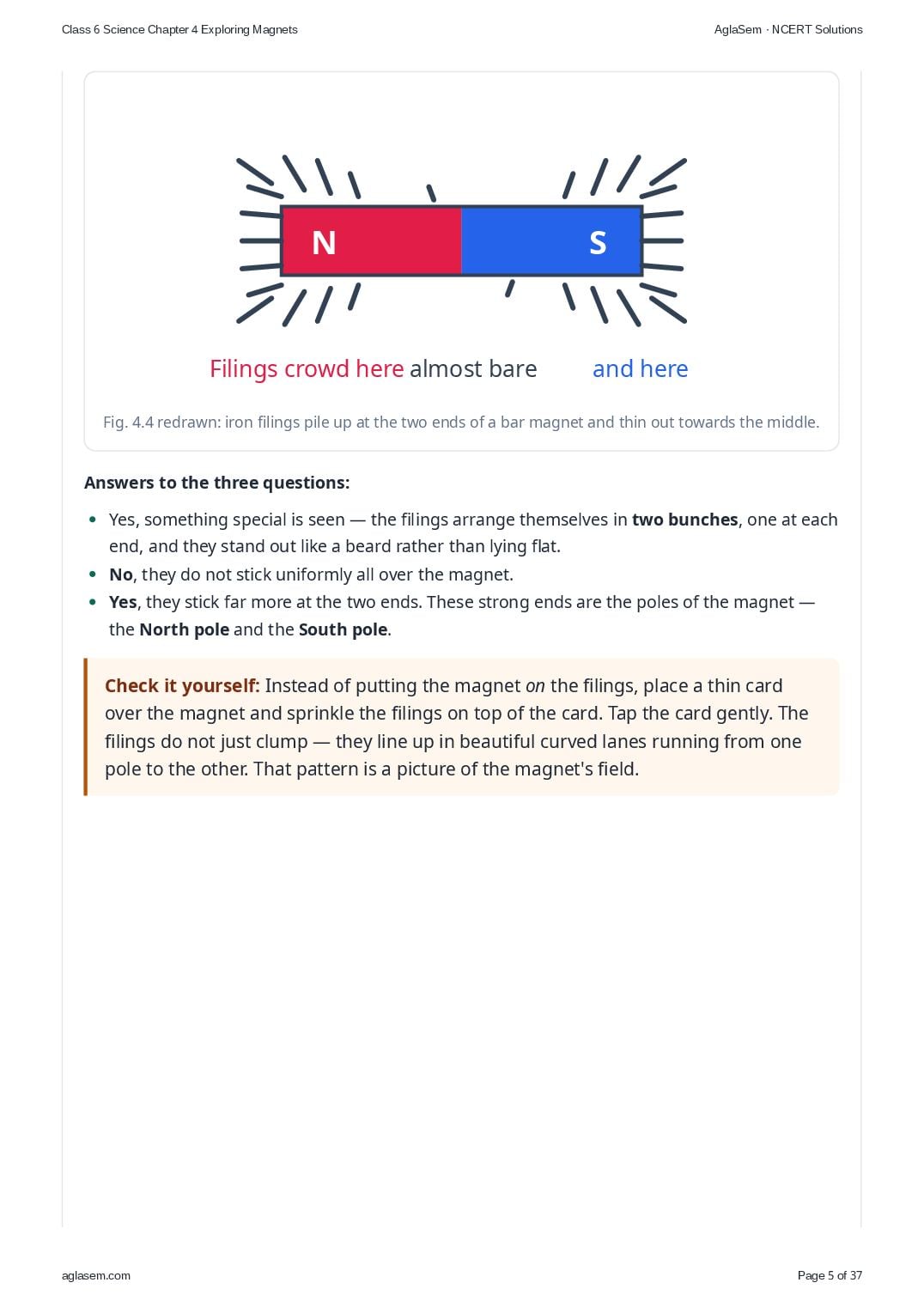
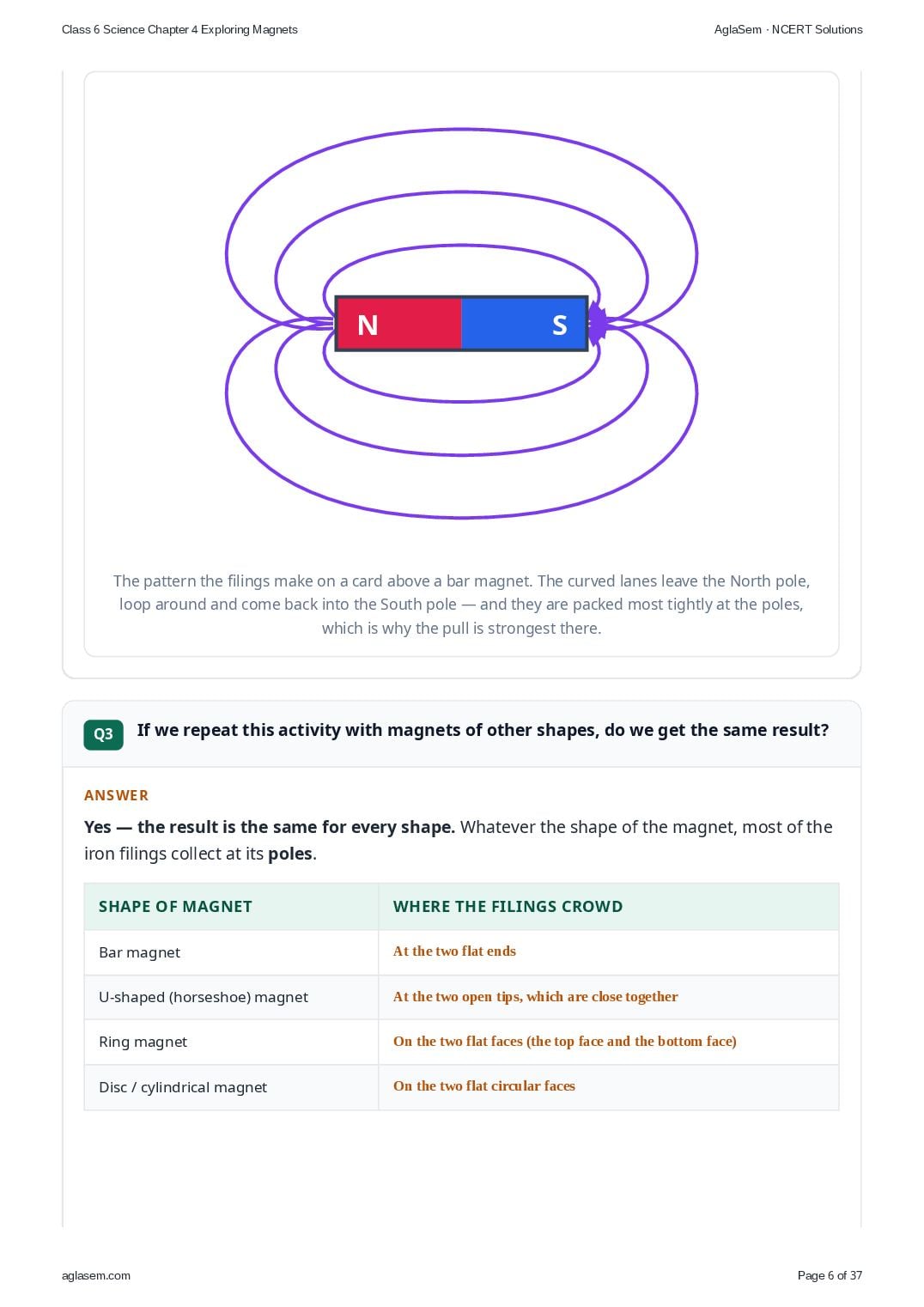
- Spread some iron filings on a sheet of paper. Place a bar magnet over them. Tap the paper and observe carefully what happens to the iron filings. Do you observe anything special about the way they stick to the magnet? Do the iron filings stick all over the magnet uniformly? Or do the iron filings stick more at some places?
- If we repeat this activity with magnets of other shapes, do we get the same result?
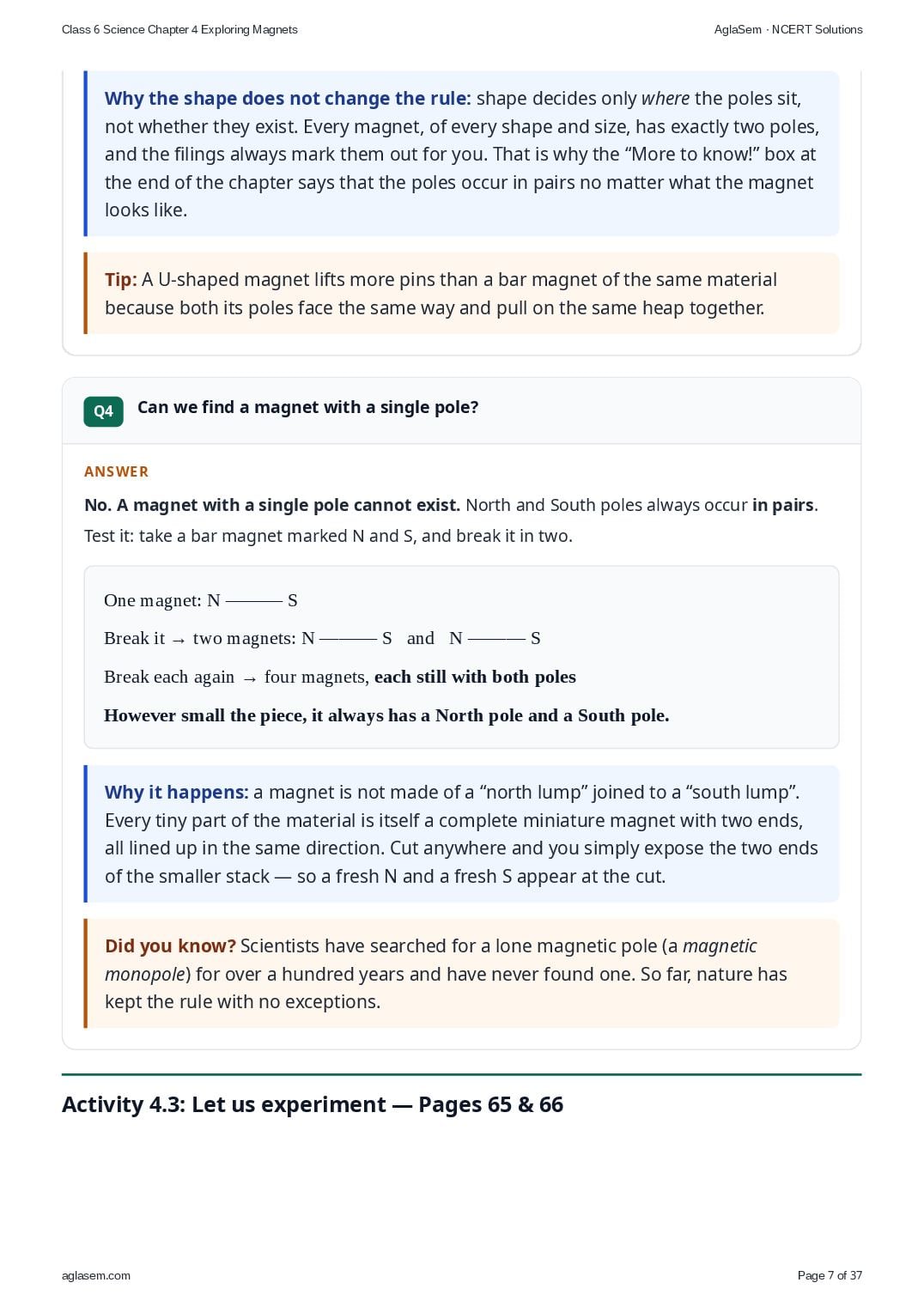
- Can we find a magnet with a single pole?
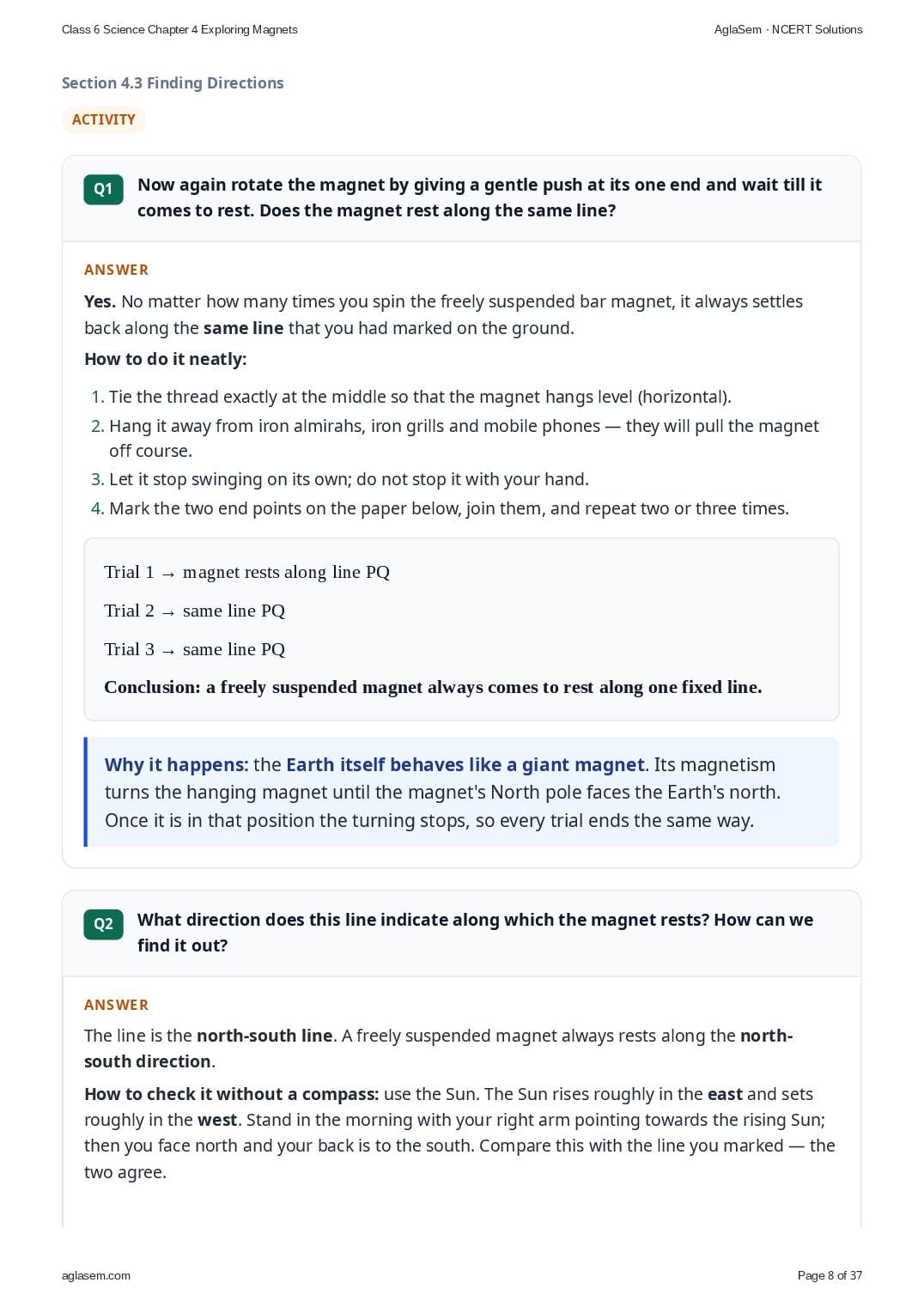
- Now again rotate the magnet by giving a gentle push at its one end and wait till it comes to rest. Does the magnet rest along the same line?
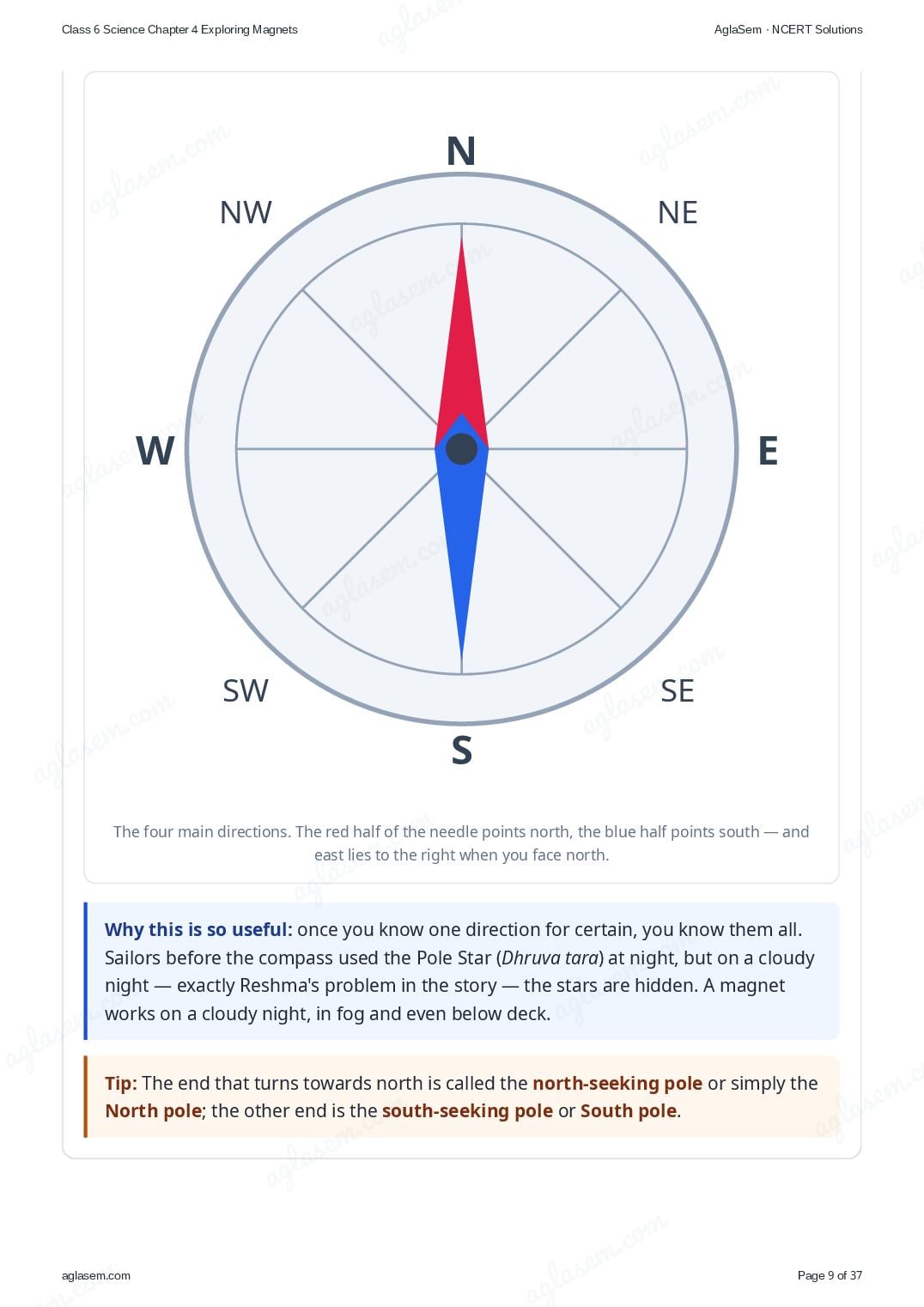
- What direction does this line indicate along which the magnet rests? How can we find it out?
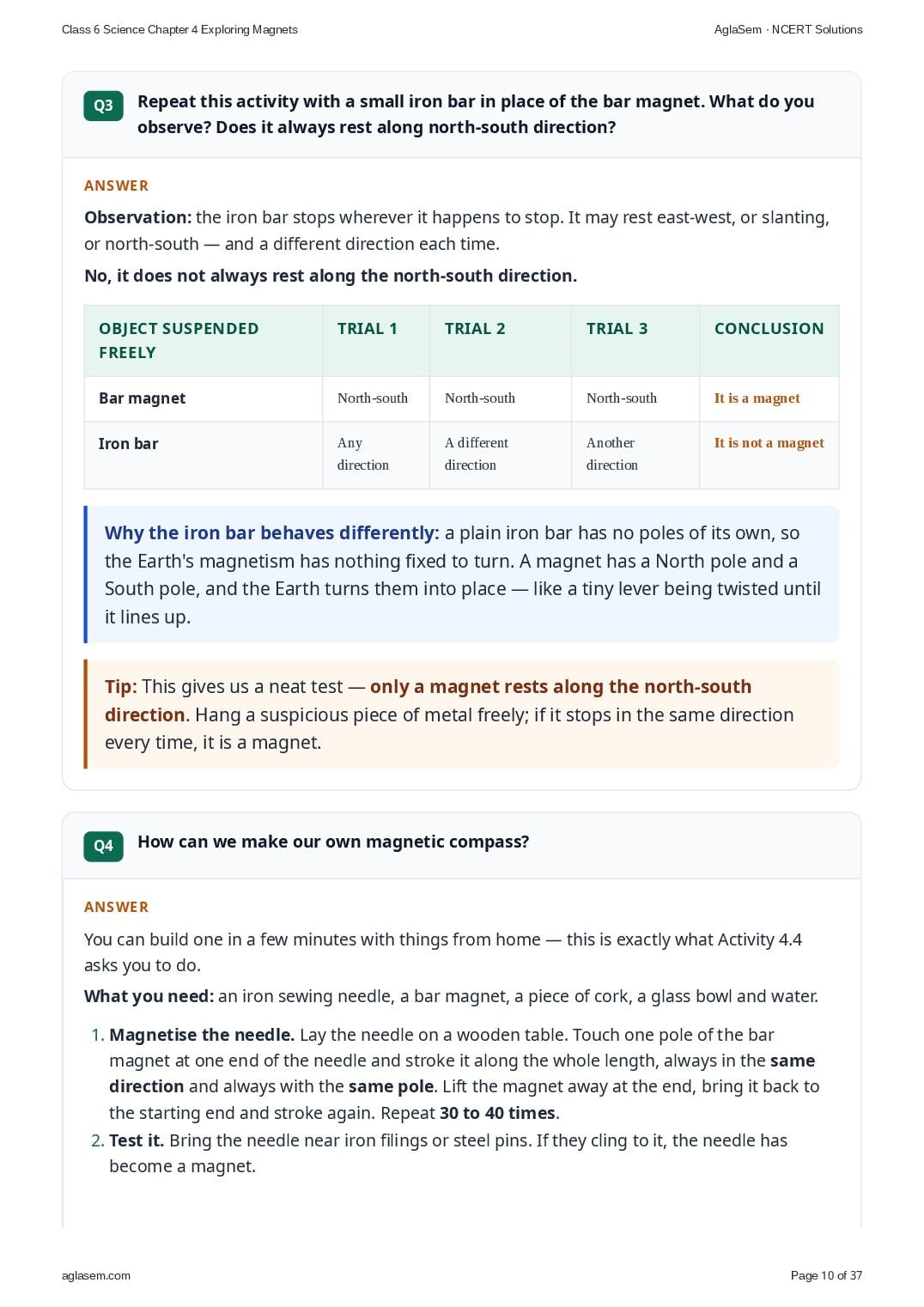
- Repeat this activity with a small iron bar in place of the bar magnet. What do you observe? Does it always rest along north-south direction?
- How can we make our own magnetic compass?
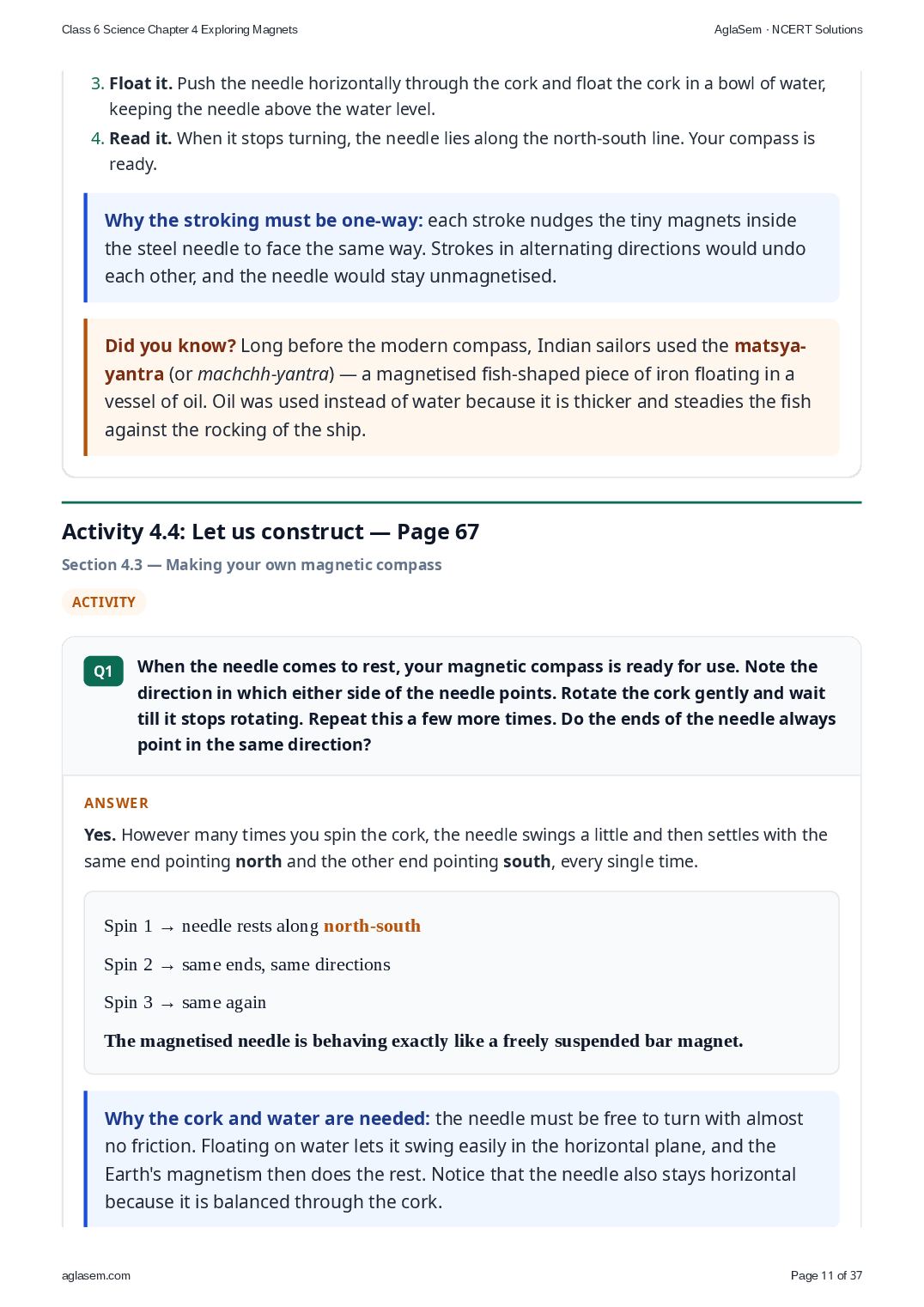
- When the needle comes to rest, your magnetic compass is ready for use. Note the direction in which either side of the needle points. Rotate the cork gently and wait till it stops rotating. Repeat this a few more times. Do the ends of the needle always point in the same direction?
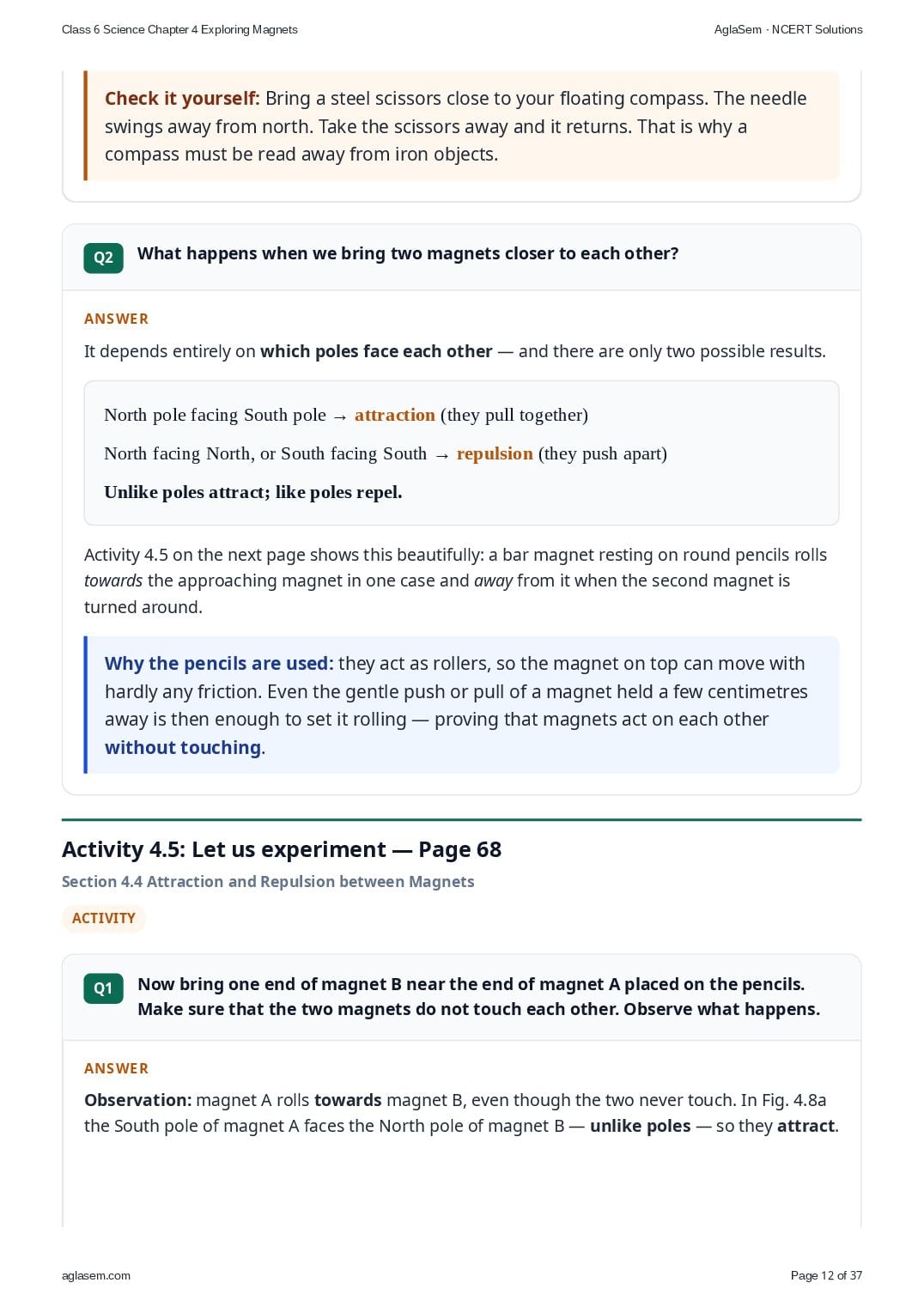
- What happens when we bring two magnets closer to each other?
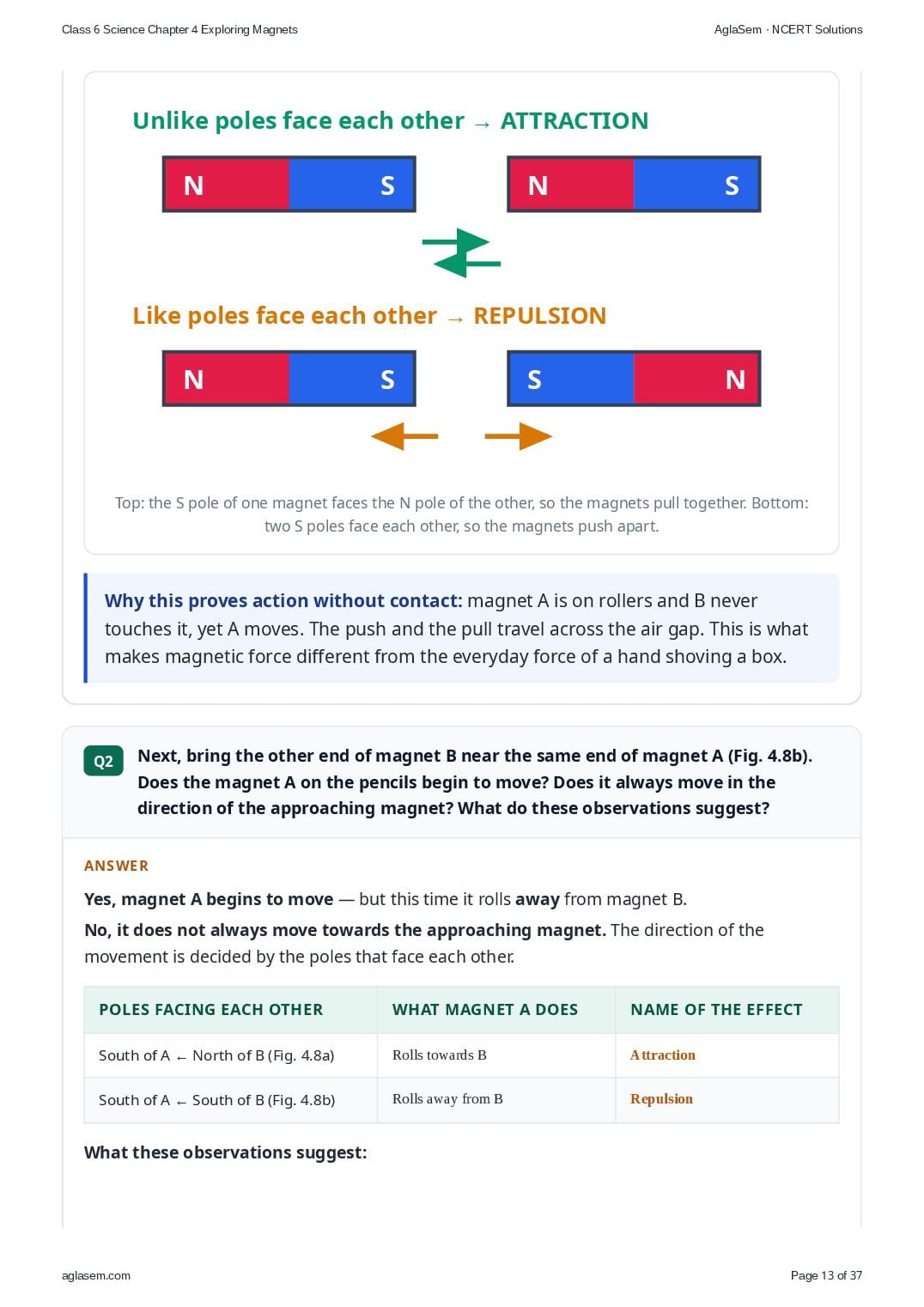
- Now bring one end of magnet B near the end of magnet A placed on the pencils. Make sure that the two magnets do not touch each other. Observe what happens.
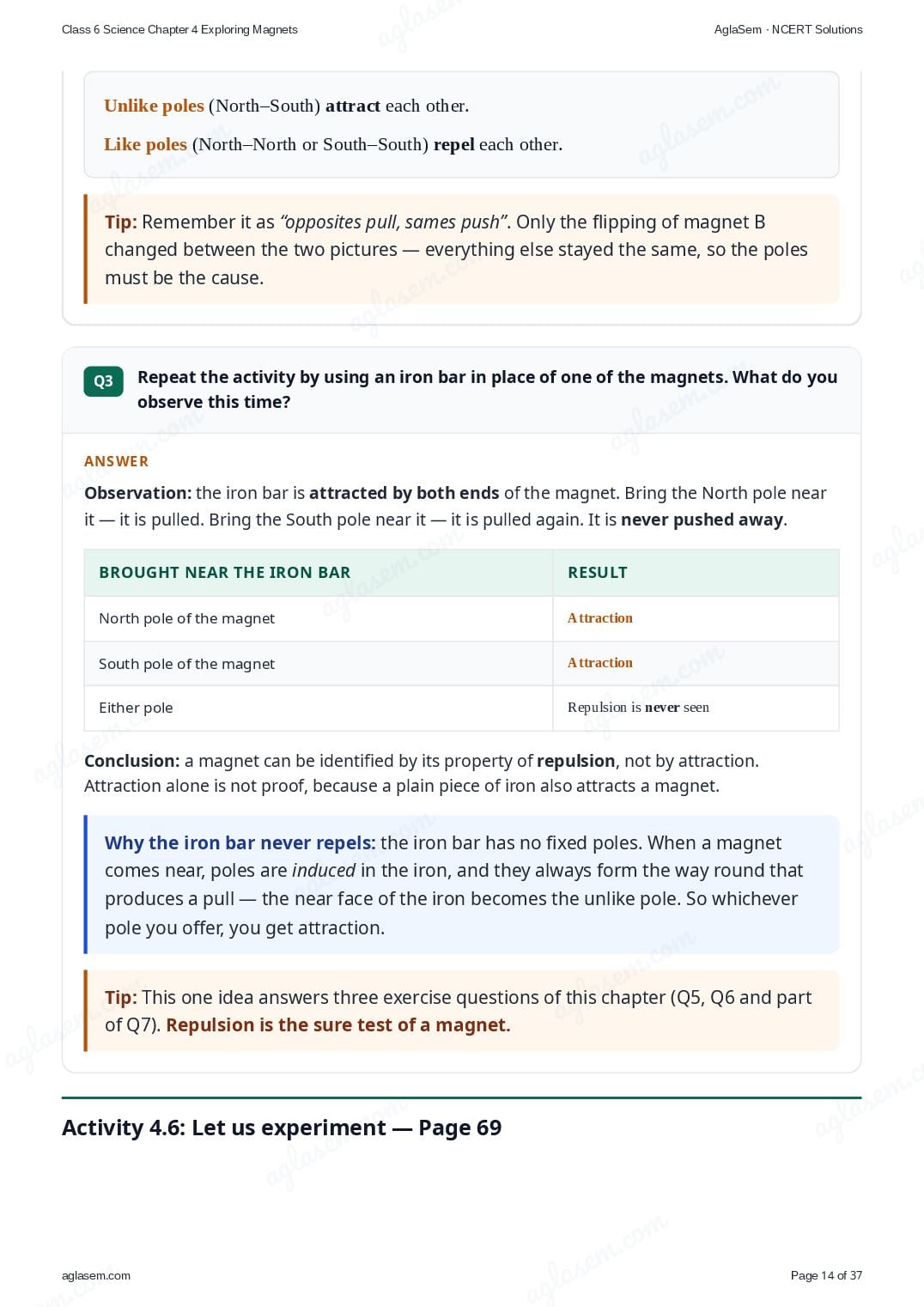
- Next, bring the other end of magnet B near the same end of magnet A (Fig. 4.8b). Does the magnet A on the pencils begin to move? Does it always move in the direction of the approaching magnet? What do these observations suggest?
- Repeat the activity by using an iron bar in place of one of the magnets. What do you observe this time?
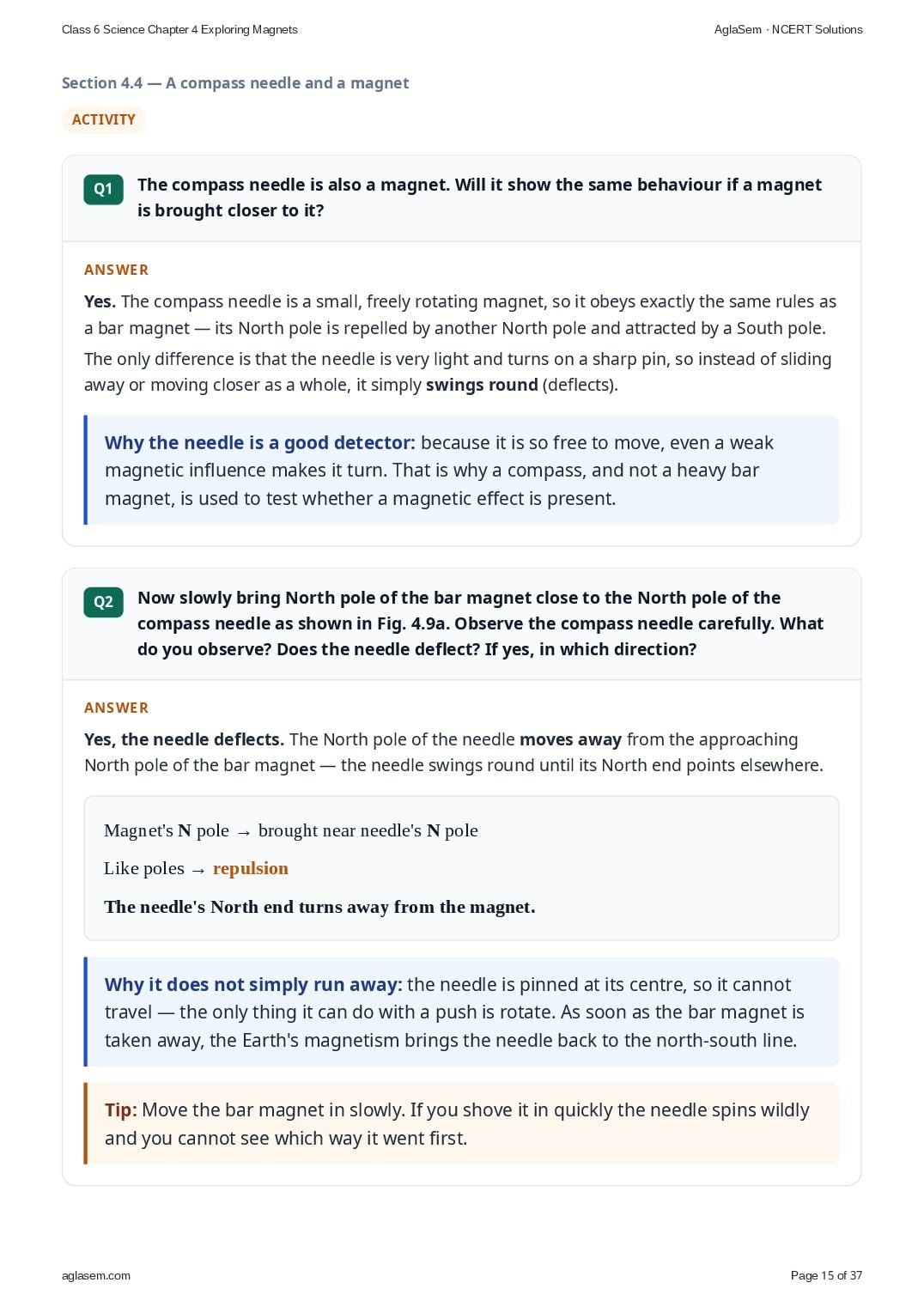
- The compass needle is also a magnet. Will it show the same behaviour if a magnet is brought closer to it?
- Now slowly bring North pole of the bar magnet close to the North pole of the compass needle as shown in Fig. 4.9a. Observe the compass needle carefully. What do you observe? Does the needle deflect? If yes, in which direction?
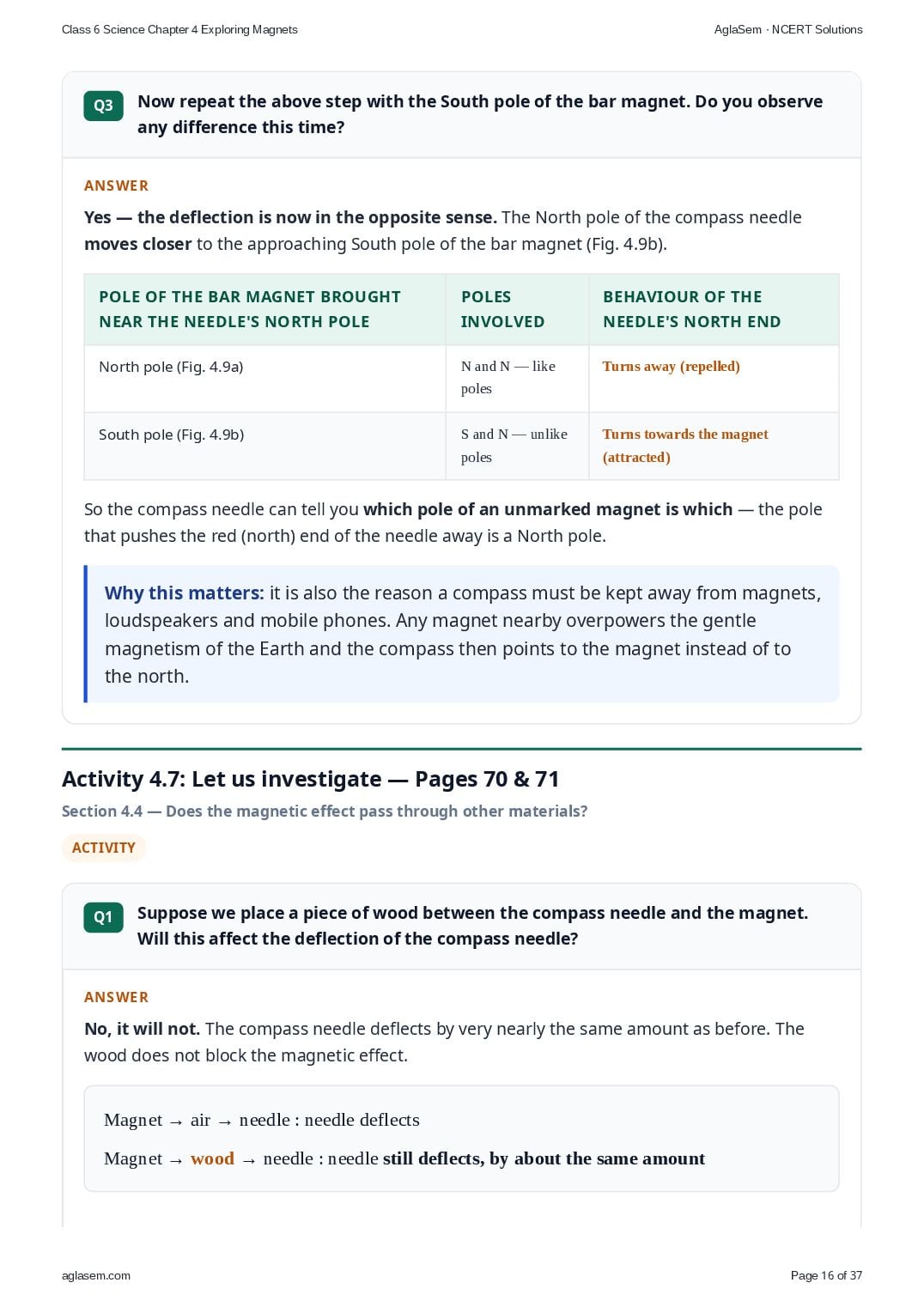
- Now repeat the above step with the South pole of the bar magnet. Do you observe any difference this time?
- Suppose we place a piece of wood between the compass needle and the magnet. Will this affect the deflection of the compass needle?
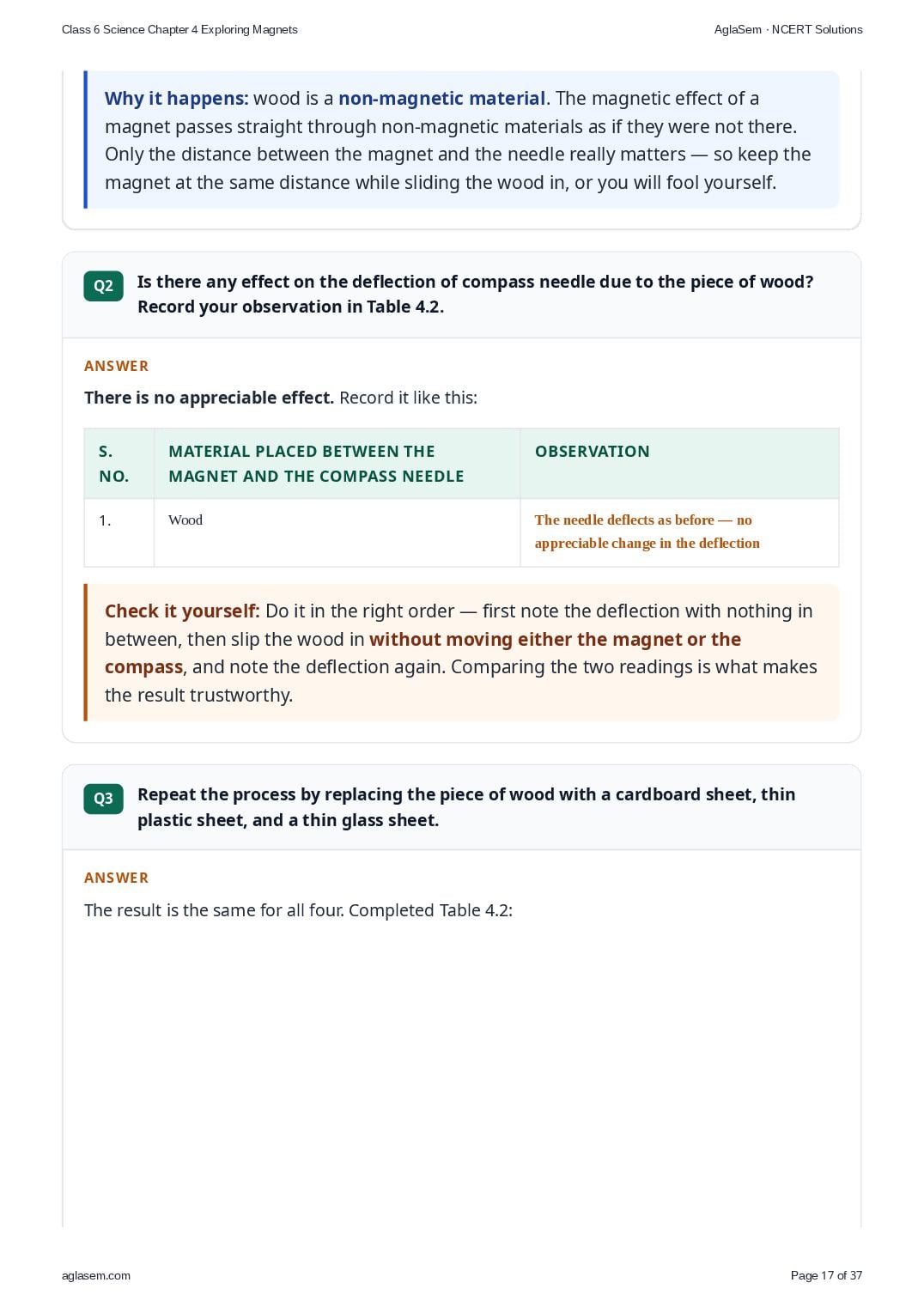
- Is there any effect on the deflection of compass needle due to the piece of wood? Record your observation in Table 4.2.
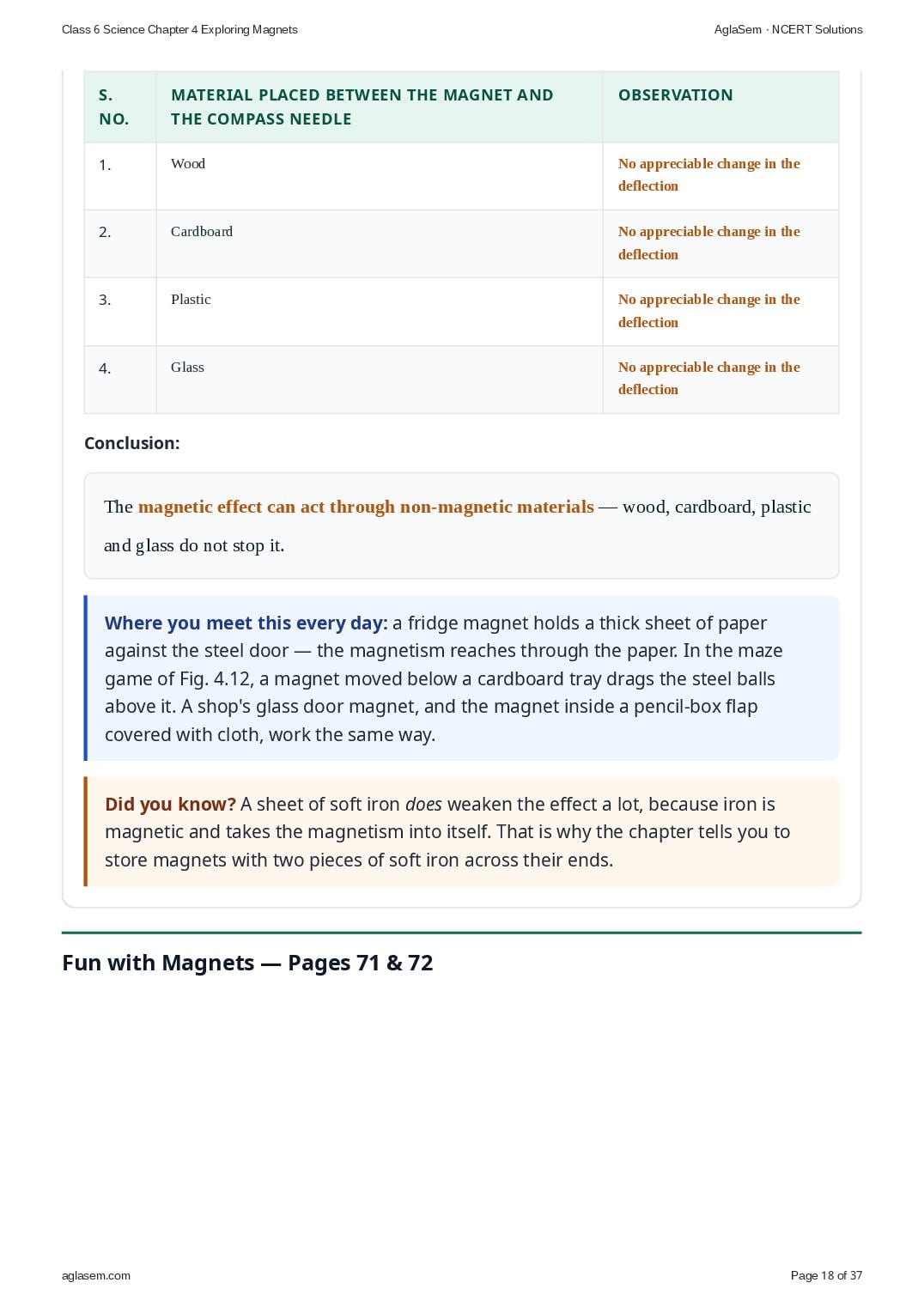
- Repeat the process by replacing the piece of wood with a cardboard sheet, thin plastic sheet, and a thin glass sheet.
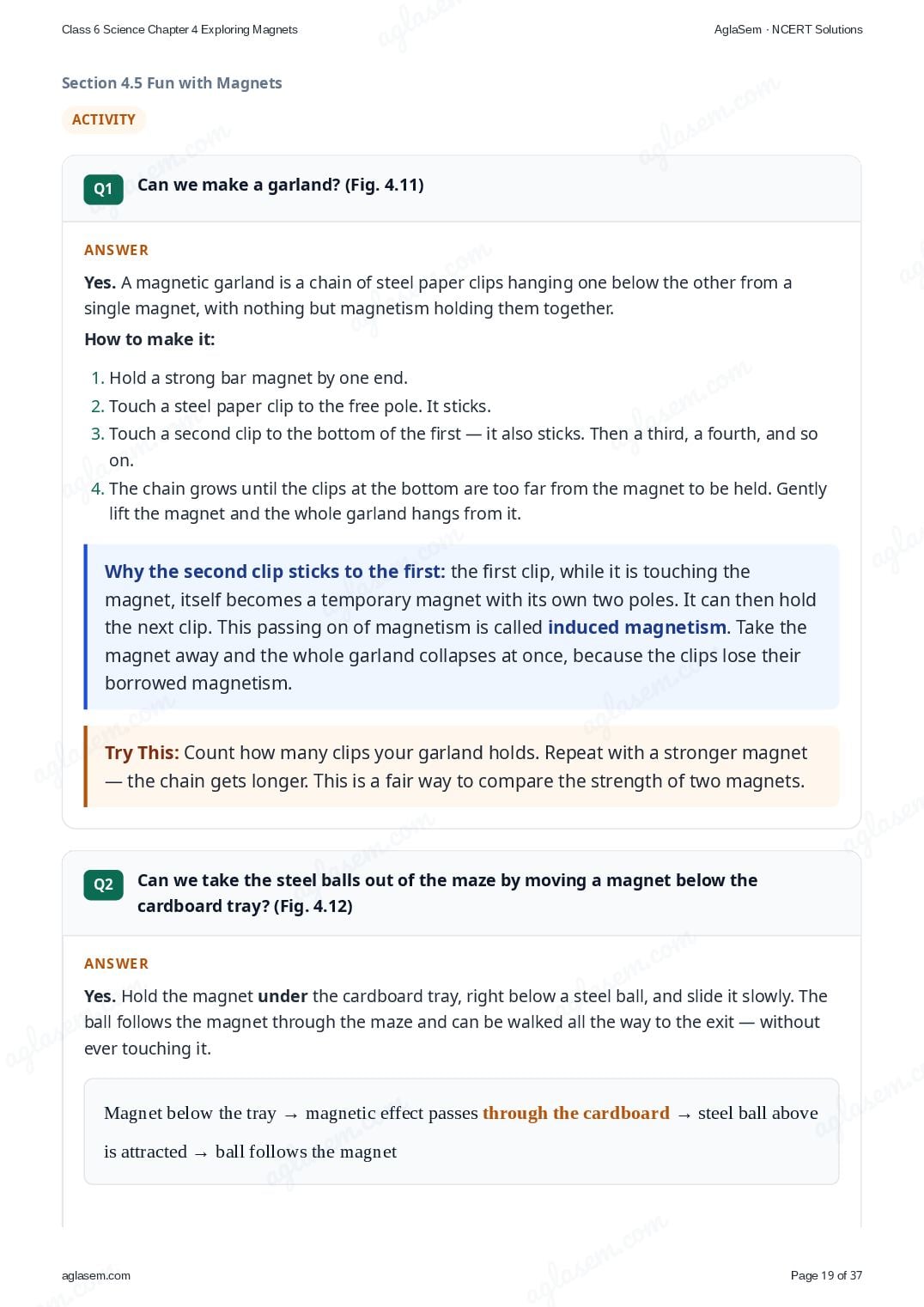
- Can we make a garland? (Fig. 4.11)
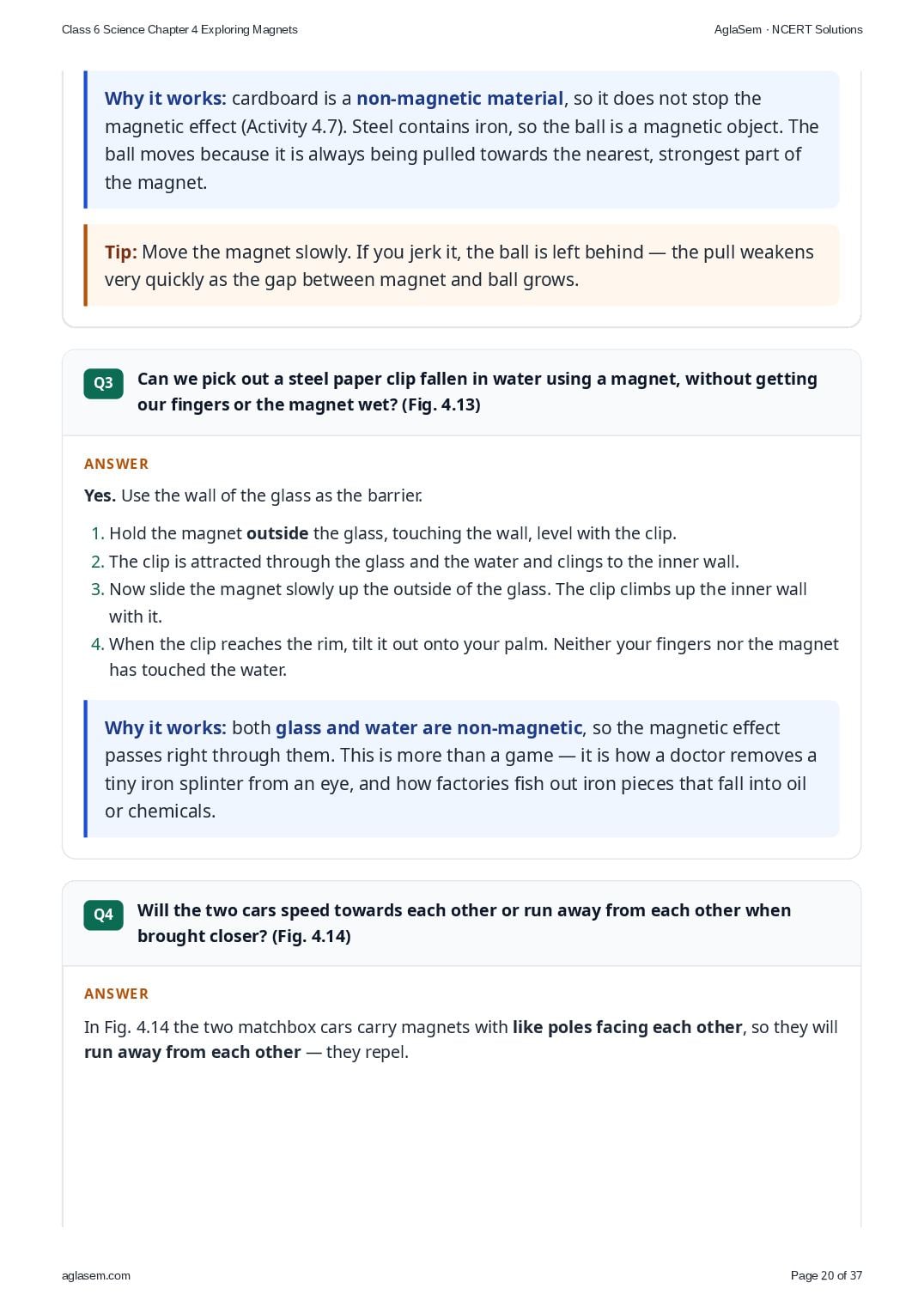
- Can we take the steel balls out of the maze by moving a magnet below the cardboard tray? (Fig. 4.12)
- Can we pick out a steel paper clip fallen in water using a magnet, without getting our fingers or the magnet wet? (Fig. 4.13)
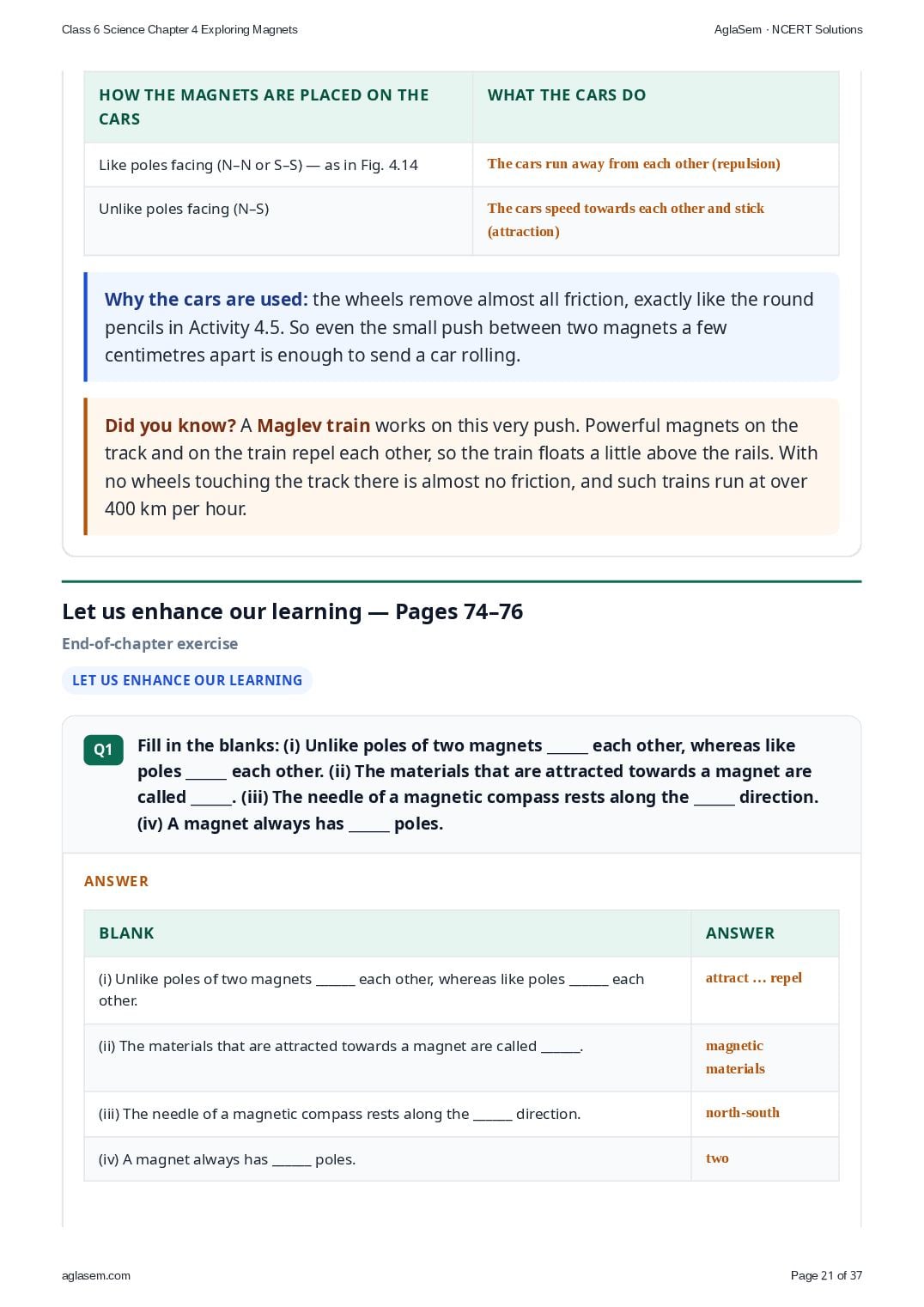
- Will the two cars speed towards each other or run away from each other when brought closer? (Fig. 4.14)
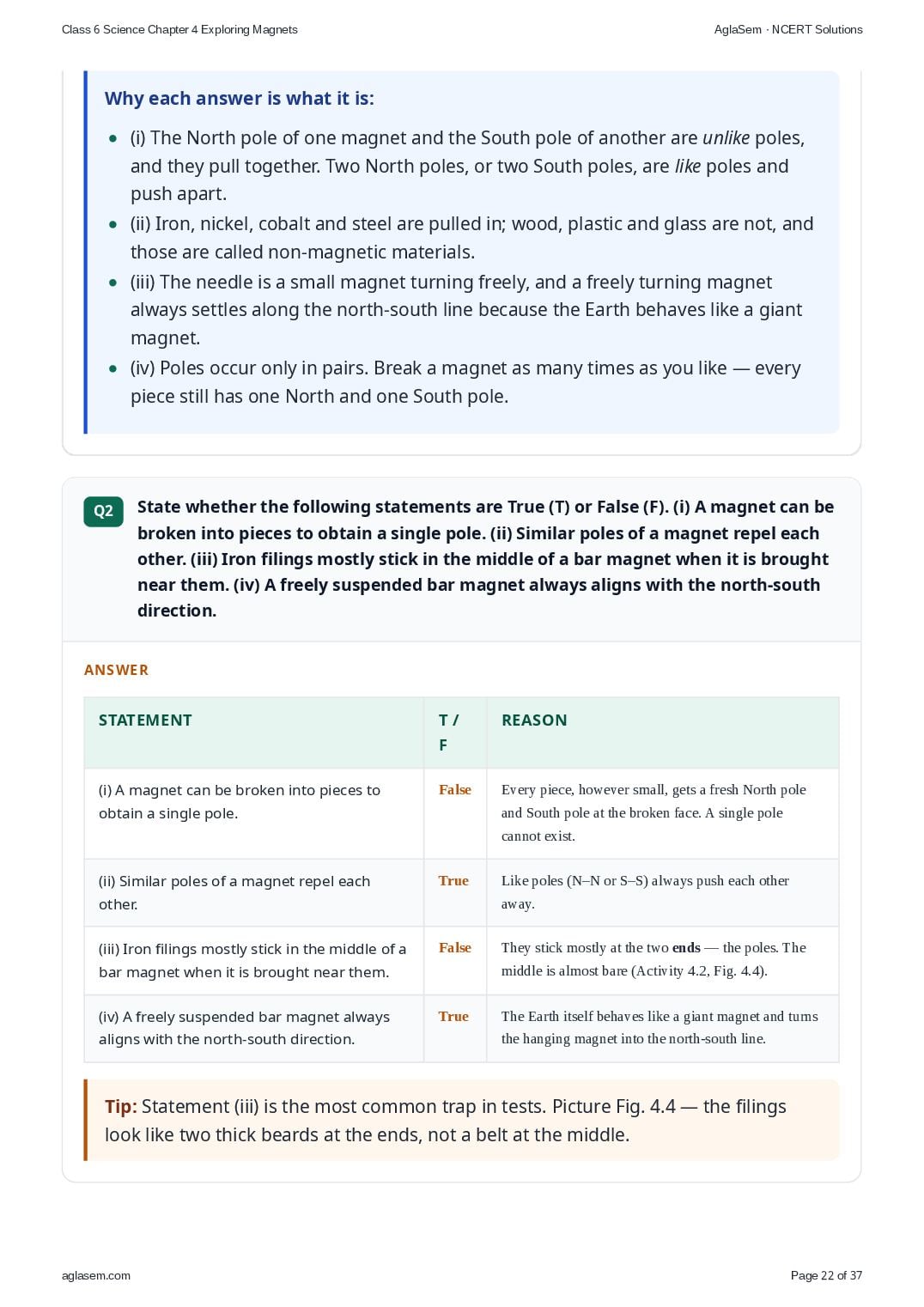
- Fill in the blanks: (i) Unlike poles of two magnets ______ each other, whereas like poles ______ each other. (ii) The materials that are attracted towards a magnet are called ______. (iii) The needle of a magnetic compass rests along the ______ direction. (iv) A magnet always has ______ poles.
- State whether the following statements are True (T) or False (F). (i) A magnet can be broken into pieces to obtain a single pole. (ii) Similar poles of a magnet repel each other. (iii) Iron filings mostly stick in the middle of a bar magnet when it is brought near them. (iv) A freely suspended bar magnet always aligns with the north-south direction.
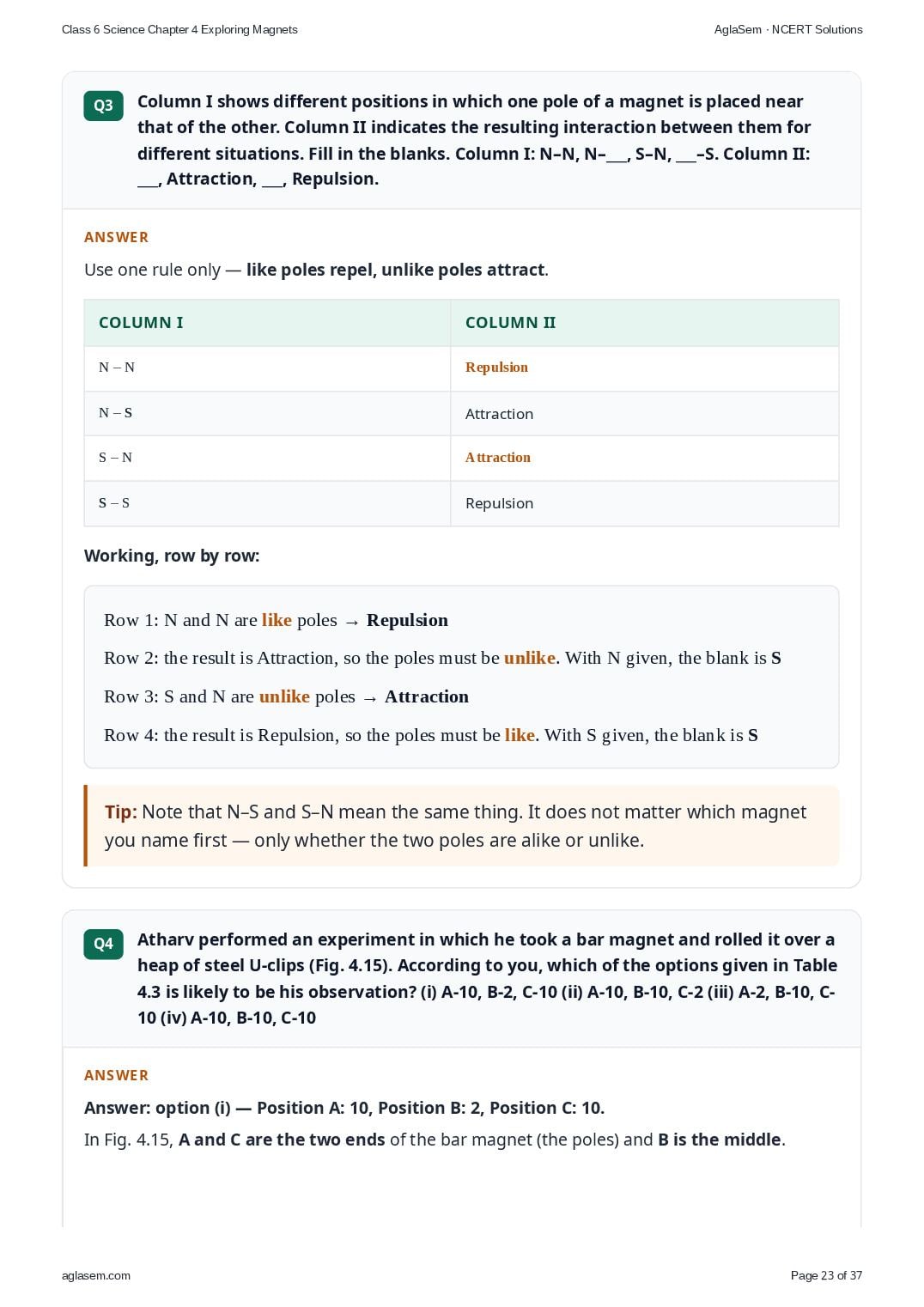
- Column I shows different positions in which one pole of a magnet is placed near that of the other. Column II indicates the resulting interaction between them for different situations. Fill in the blanks. Column I: N–N, N–___, S–N, ___–S. Column II: ___, Attraction, ___, Repulsion.
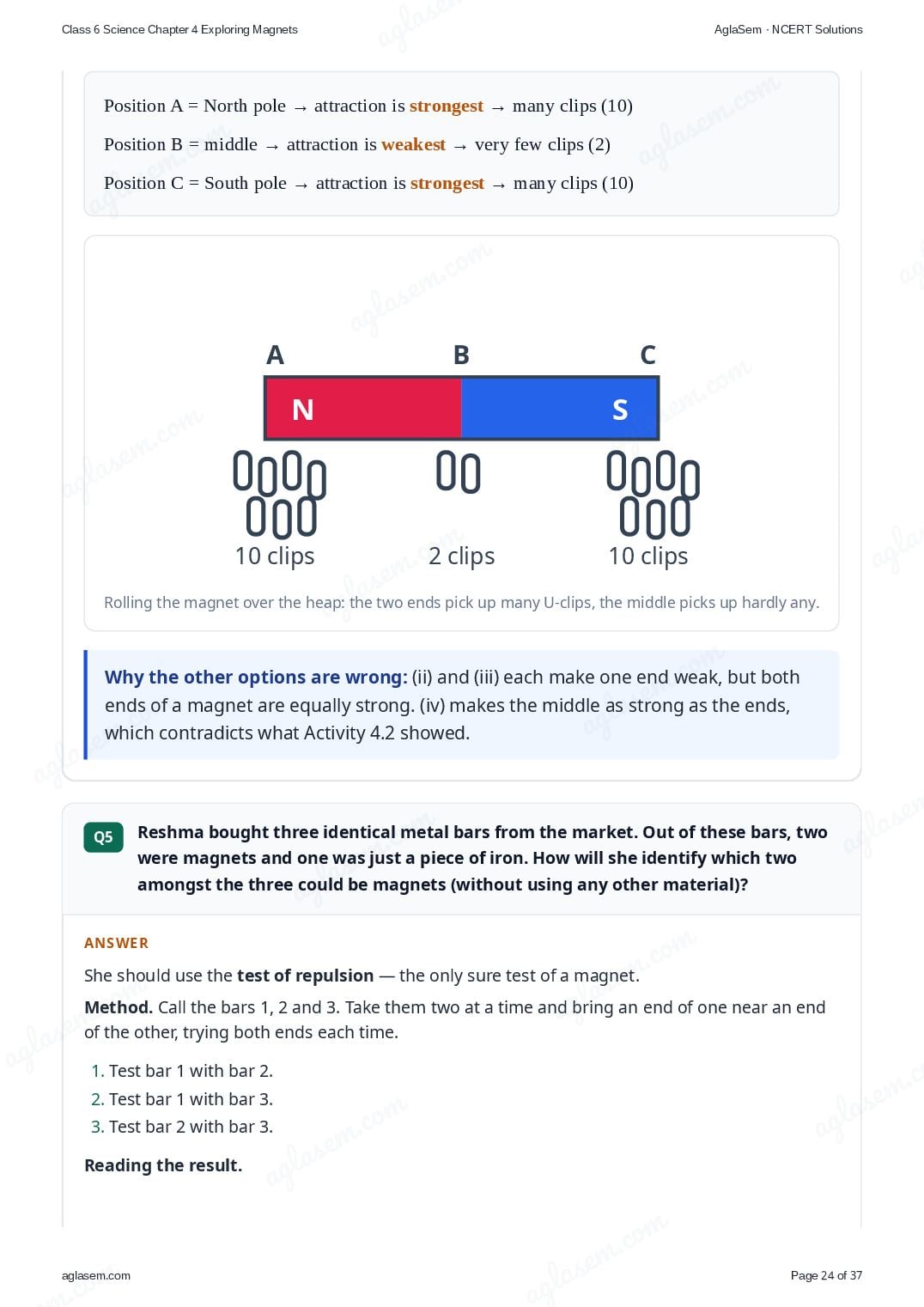
- Atharv performed an experiment in which he took a bar magnet and rolled it over a heap of steel U-clips (Fig. 4.15). According to you, which of the options given in Table 4.3 is likely to be his observation? (i) A-10, B-2, C-10 (ii) A-10, B-10, C-2 (iii) A-2, B-10, C-10 (iv) A-10, B-10, C-10
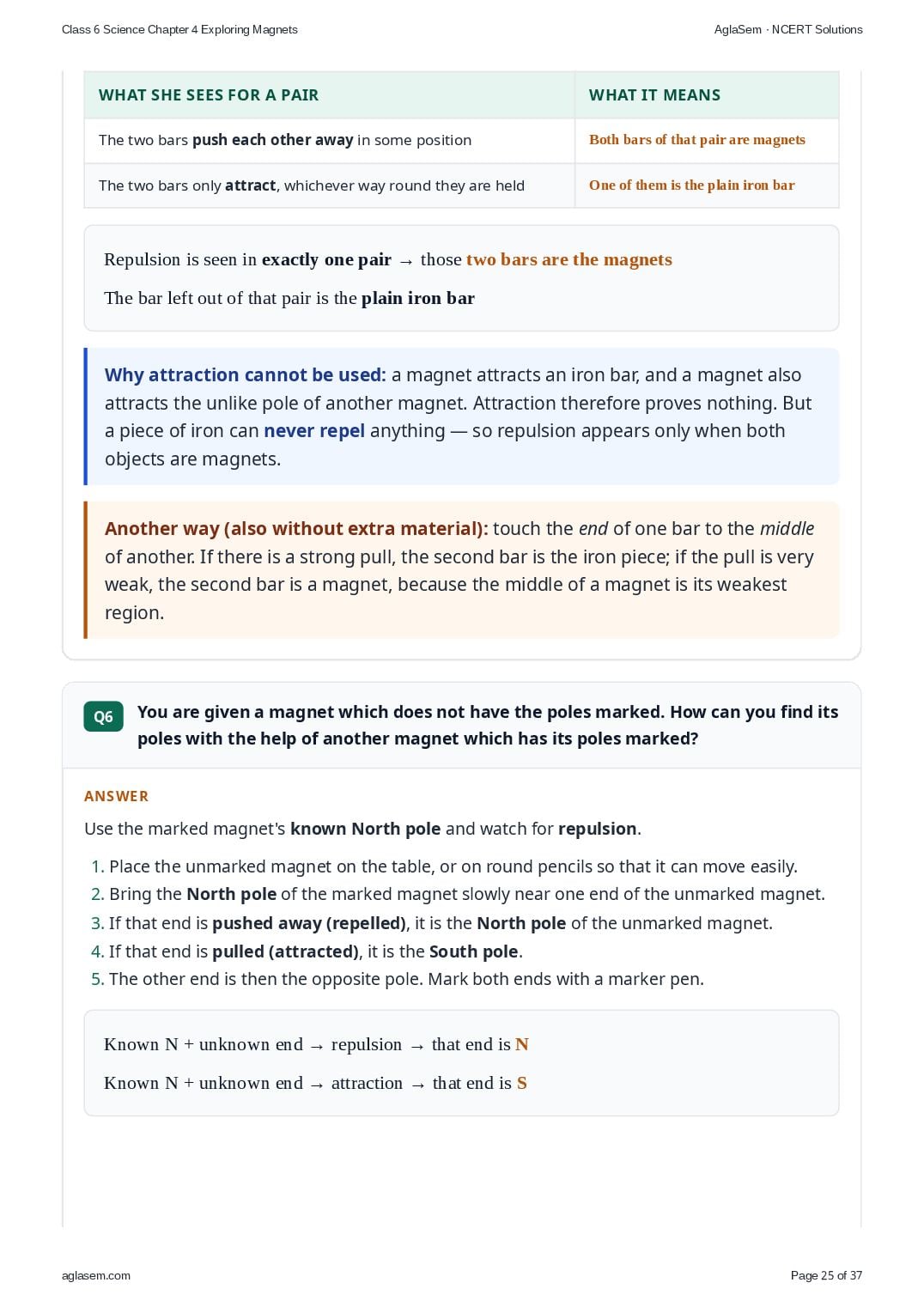
- Reshma bought three identical metal bars from the market. Out of these bars, two were magnets and one was just a piece of iron. How will she identify which two amongst the three could be magnets (without using any other material)?
- You are given a magnet which does not have the poles marked. How can you find its poles with the help of another magnet which has its poles marked?
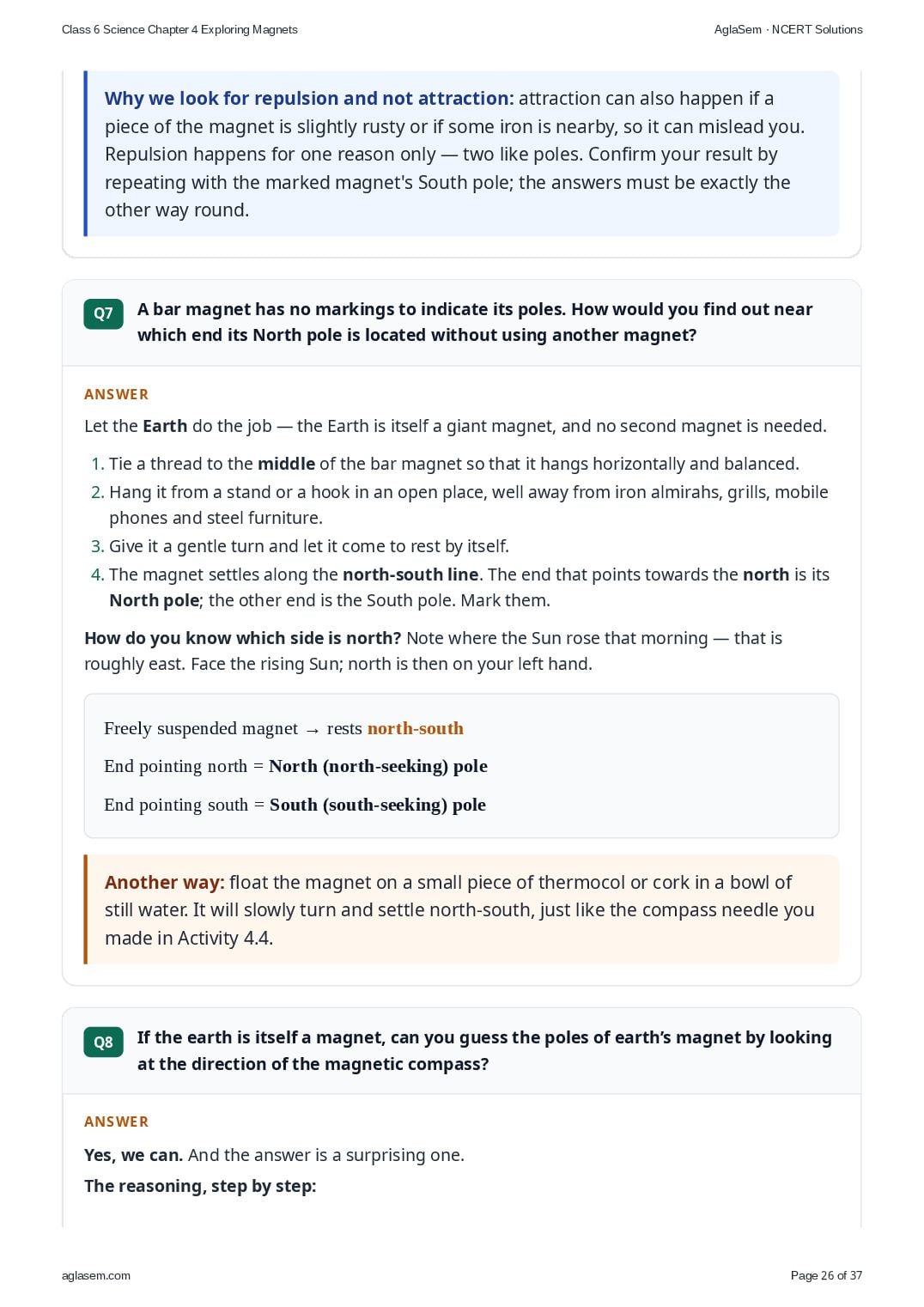
- A bar magnet has no markings to indicate its poles. How would you find out near which end its North pole is located without using another magnet?
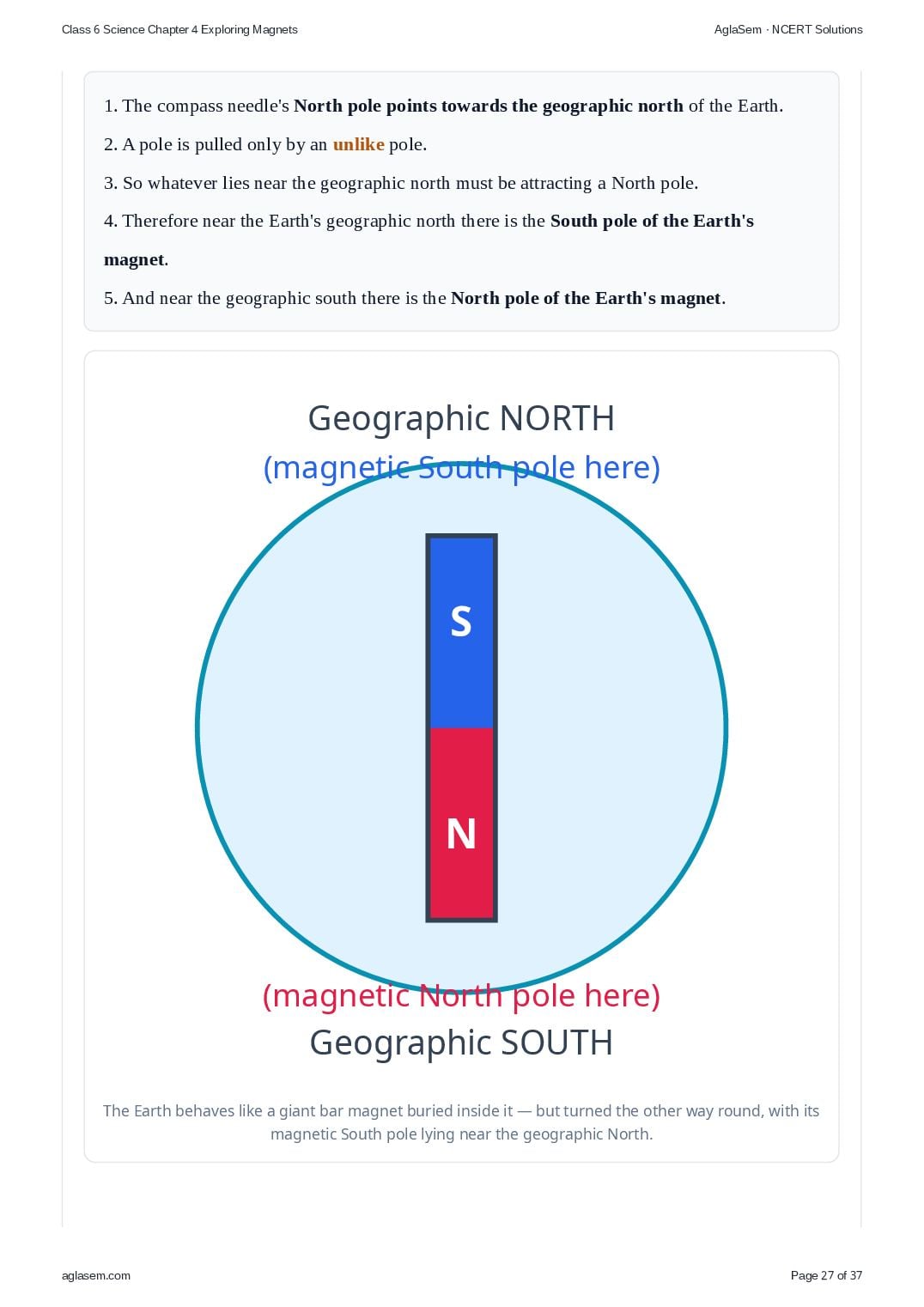
- If the earth is itself a magnet, can you guess the poles of earth’s magnet by looking at the direction of the magnetic compass?
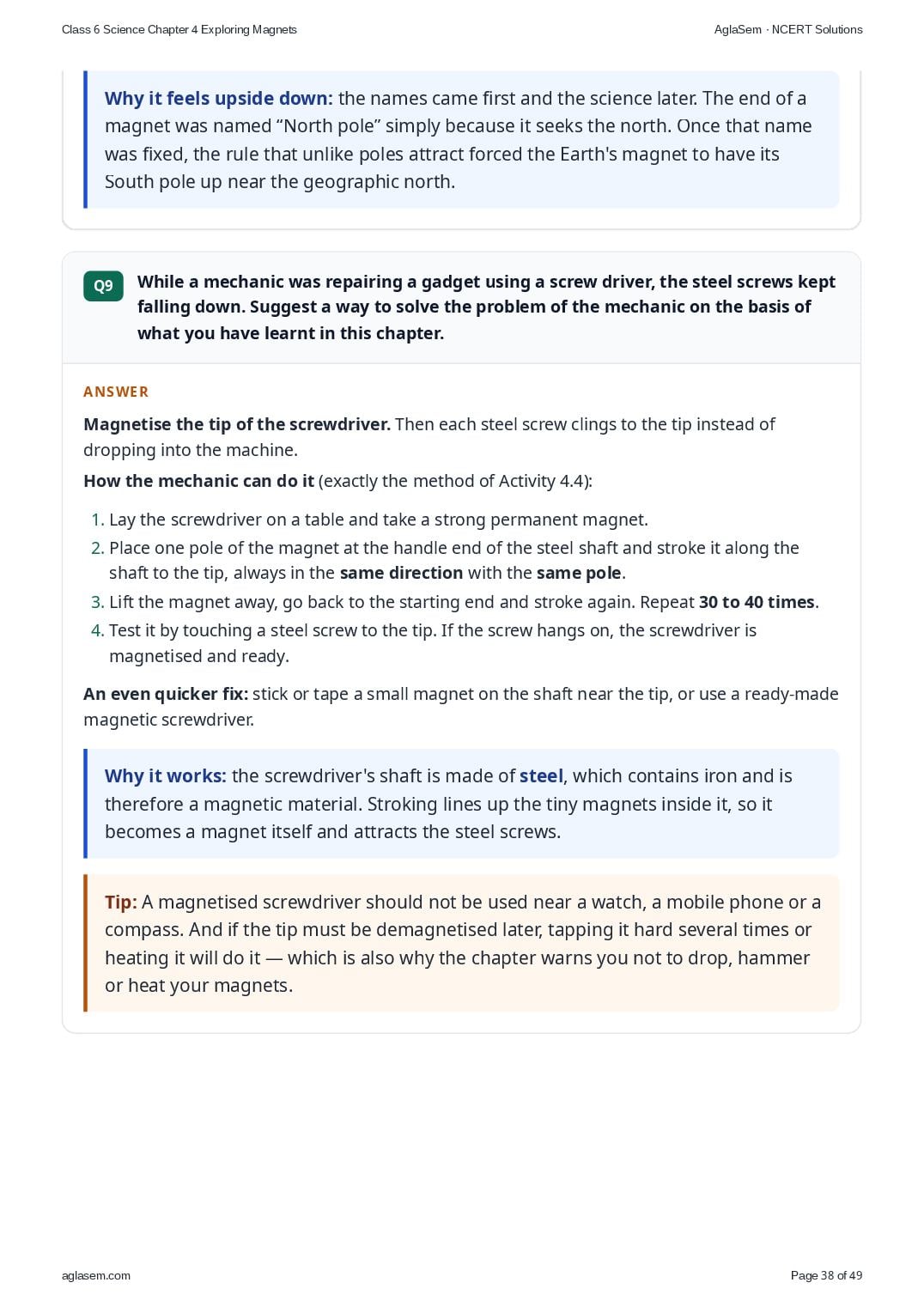
- While a mechanic was repairing a gadget using a screw driver, the steel screws kept falling down. Suggest a way to solve the problem of the mechanic on the basis of what you have learnt in this chapter.
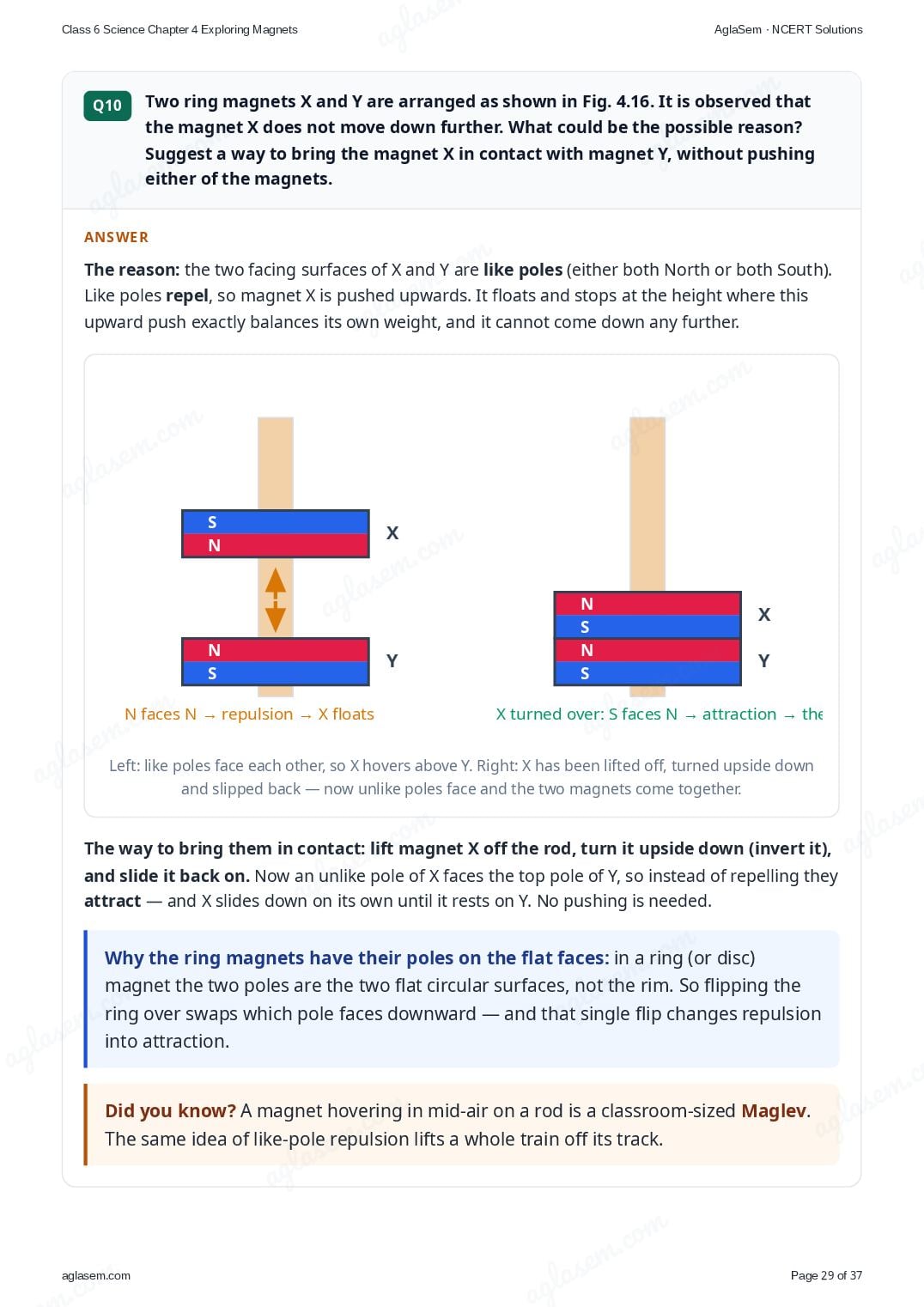
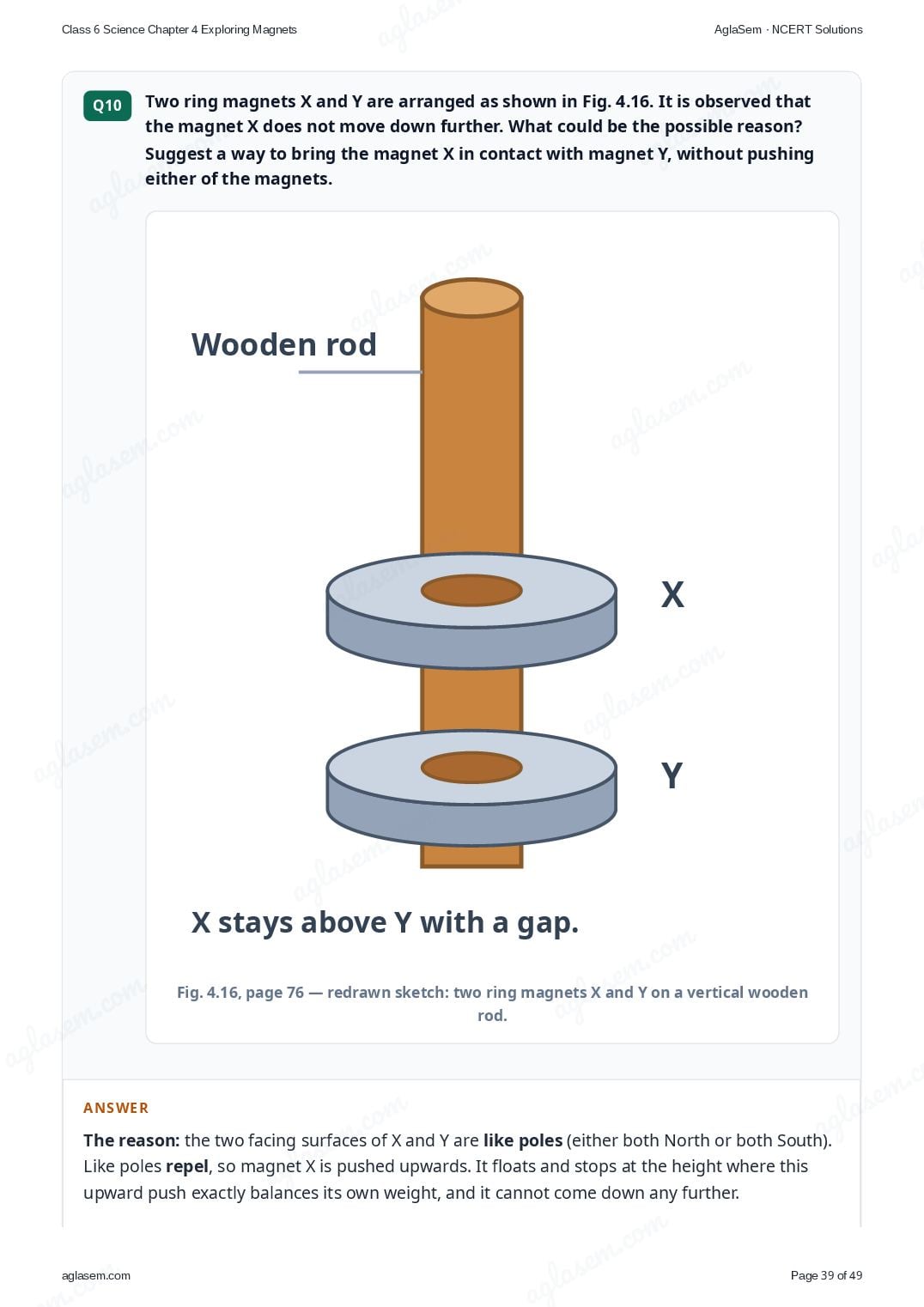
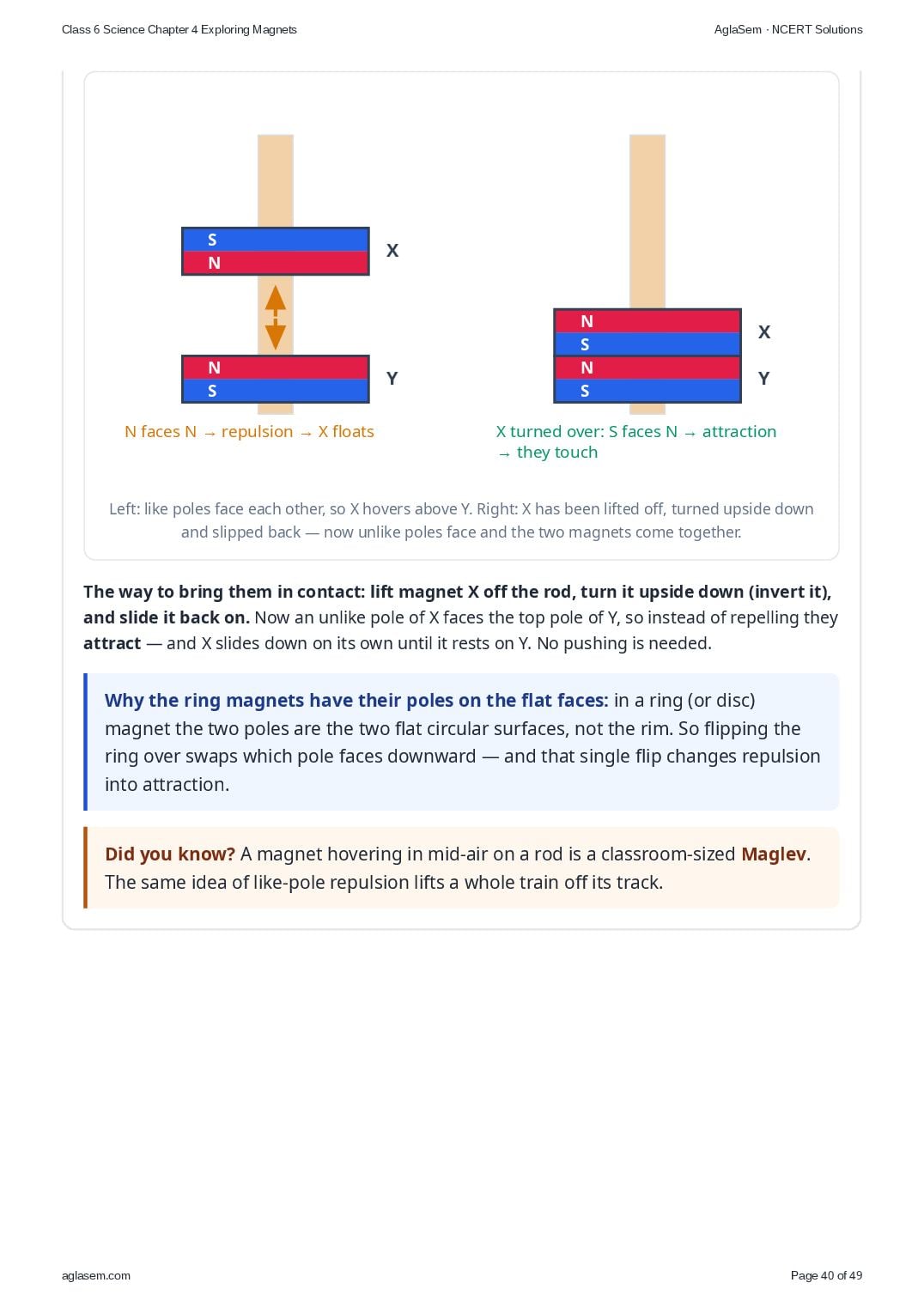
- Two ring magnets X and Y are arranged as shown in Fig. 4.16. It is observed that the magnet X does not move down further. What could be the possible reason? Suggest a way to bring the magnet X in contact with magnet Y, without pushing either of the magnets.
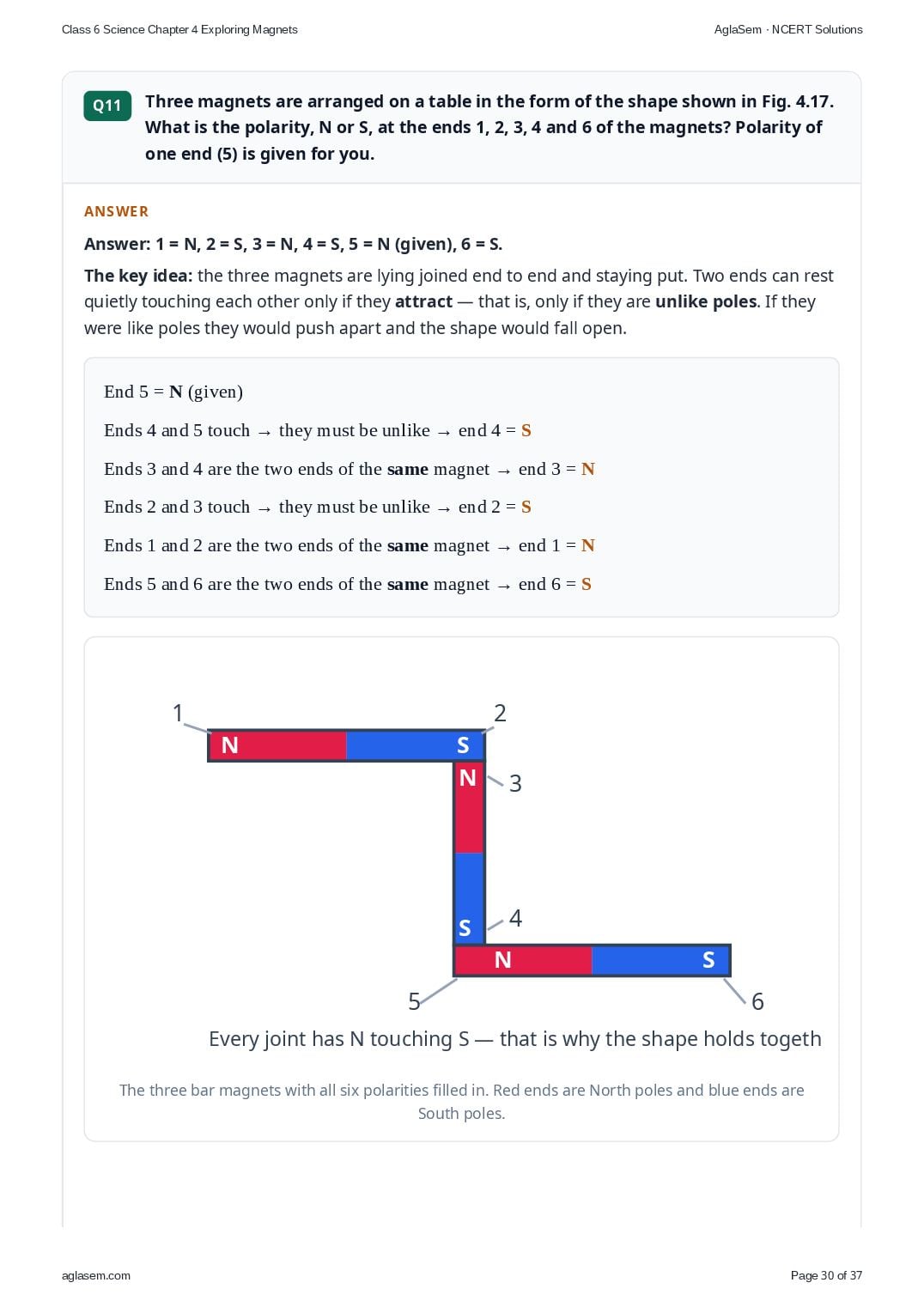
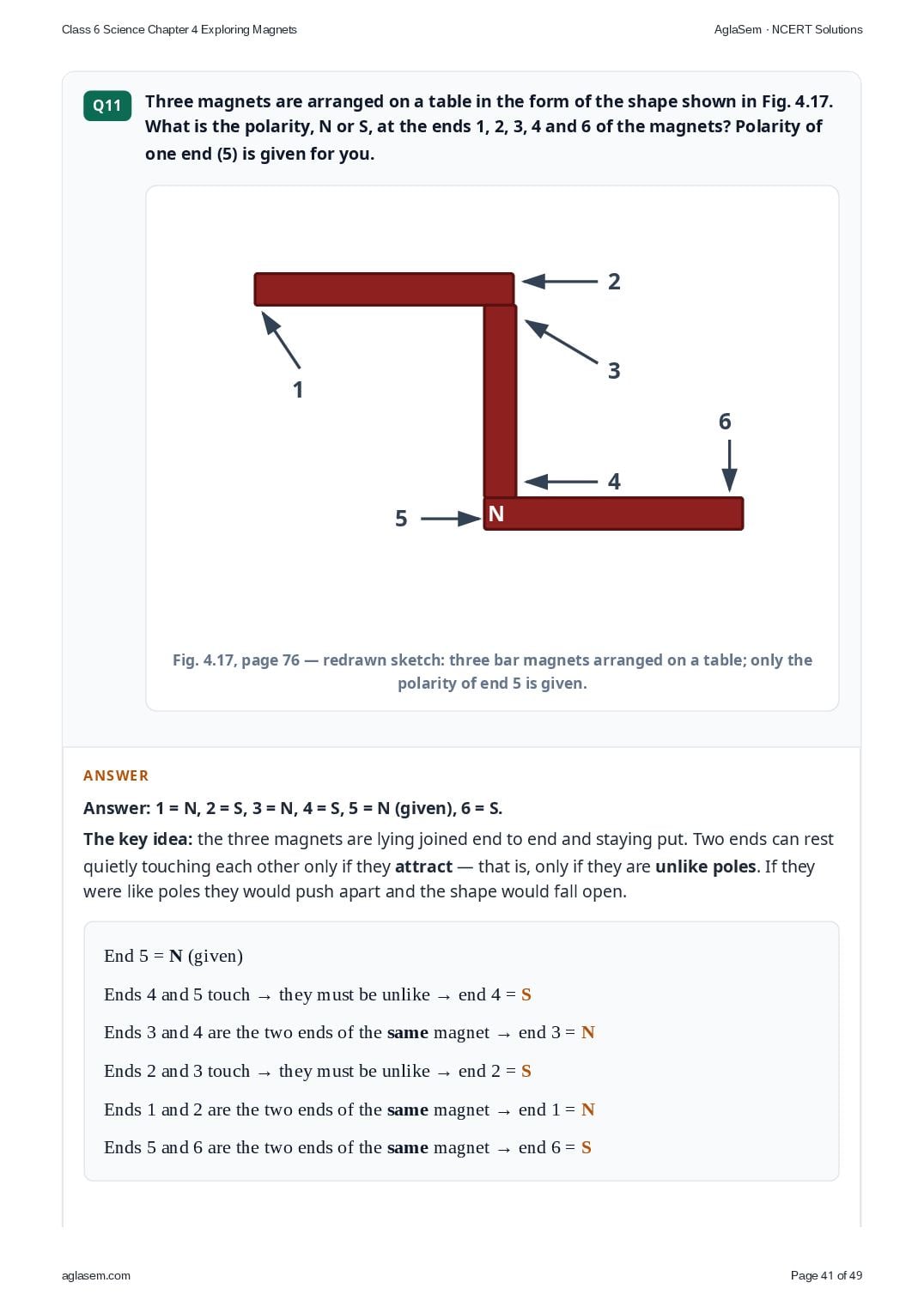
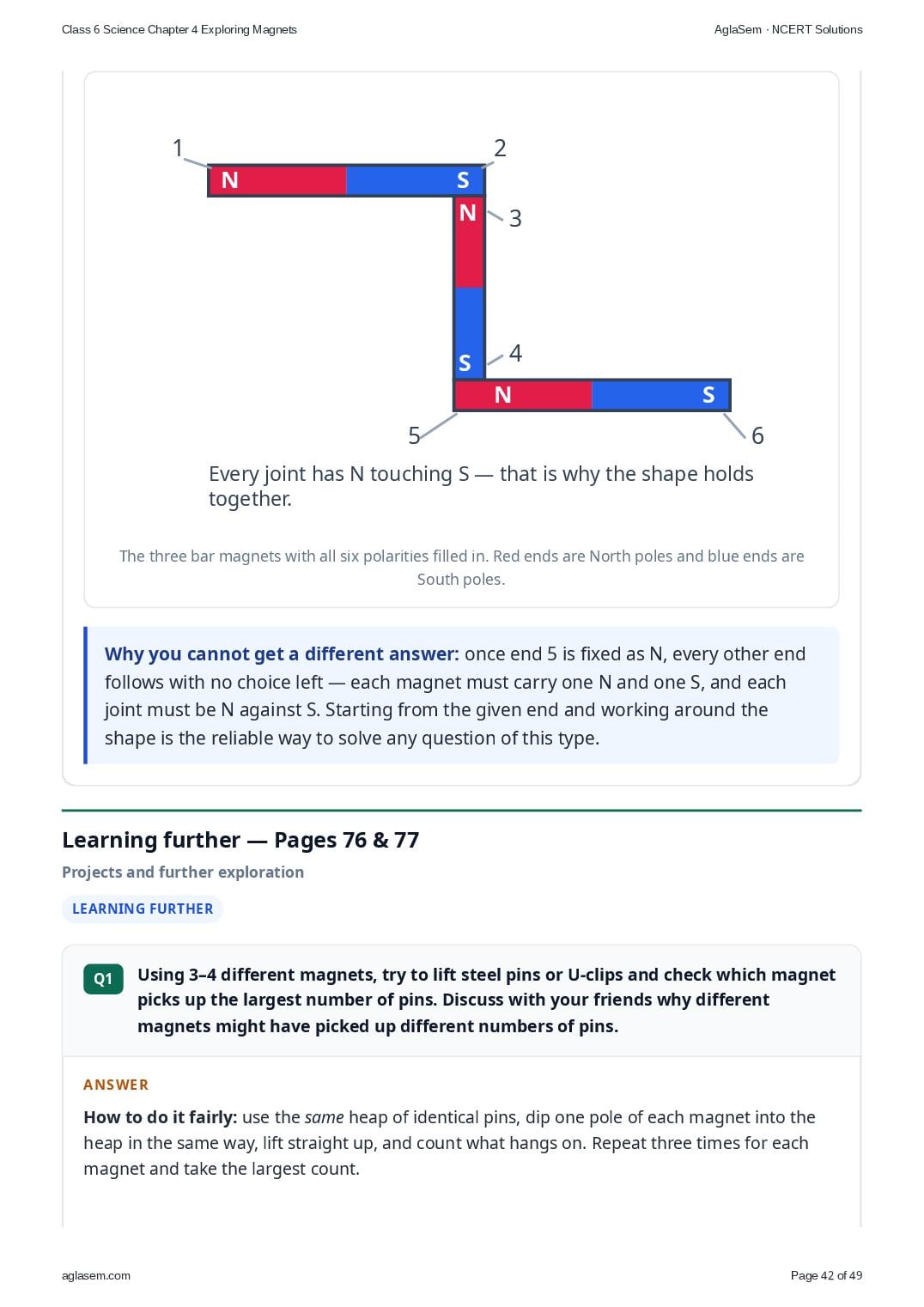
- Three magnets are arranged on a table in the form of the shape shown in Fig. 4.17. What is the polarity, N or S, at the ends 1, 2, 3, 4 and 6 of the magnets? Polarity of one end (5) is given for you.
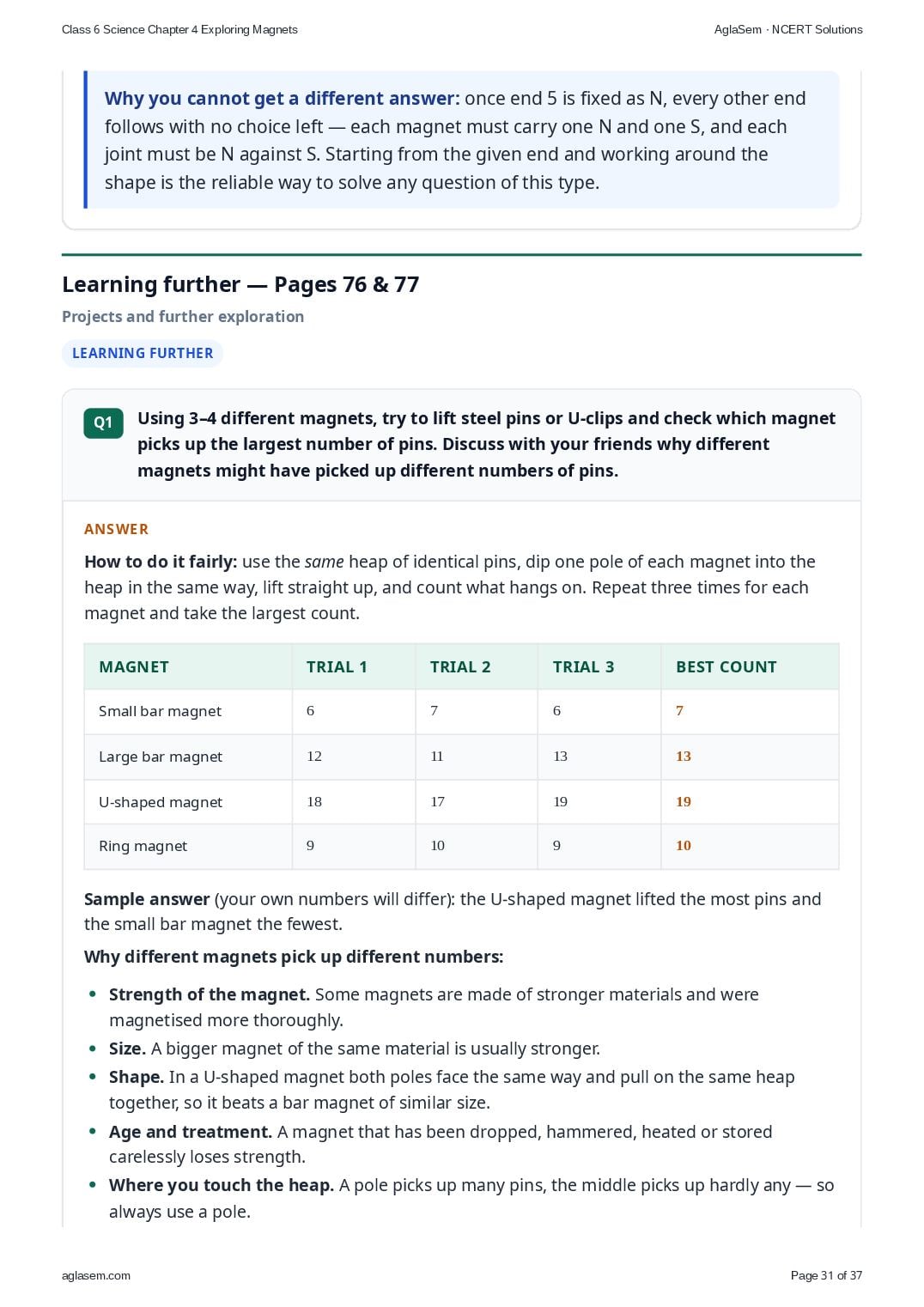
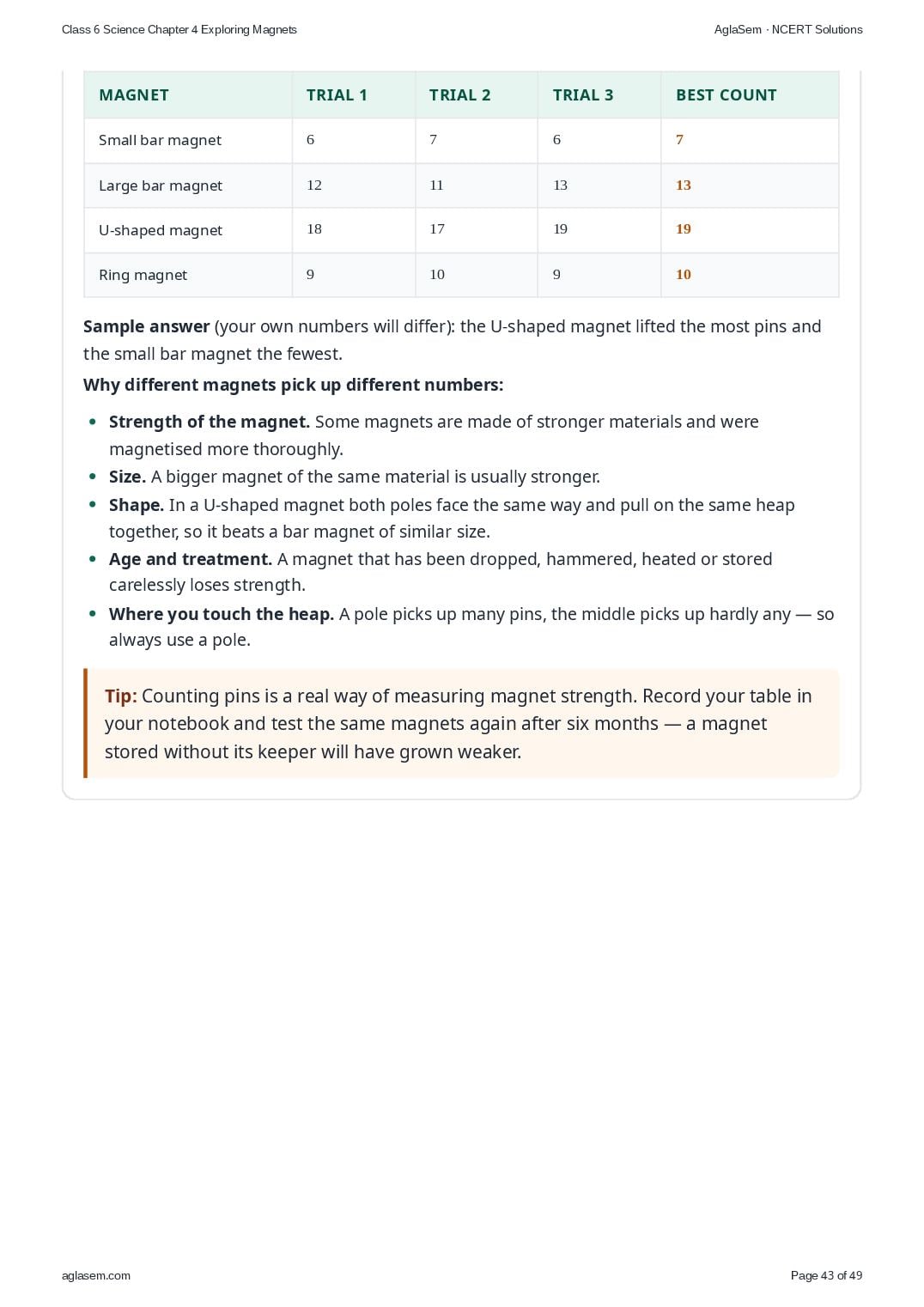
- Using 3–4 different magnets, try to lift steel pins or U-clips and check which magnet picks up the largest number of pins. Discuss with your friends why different magnets might have picked up different numbers of pins.
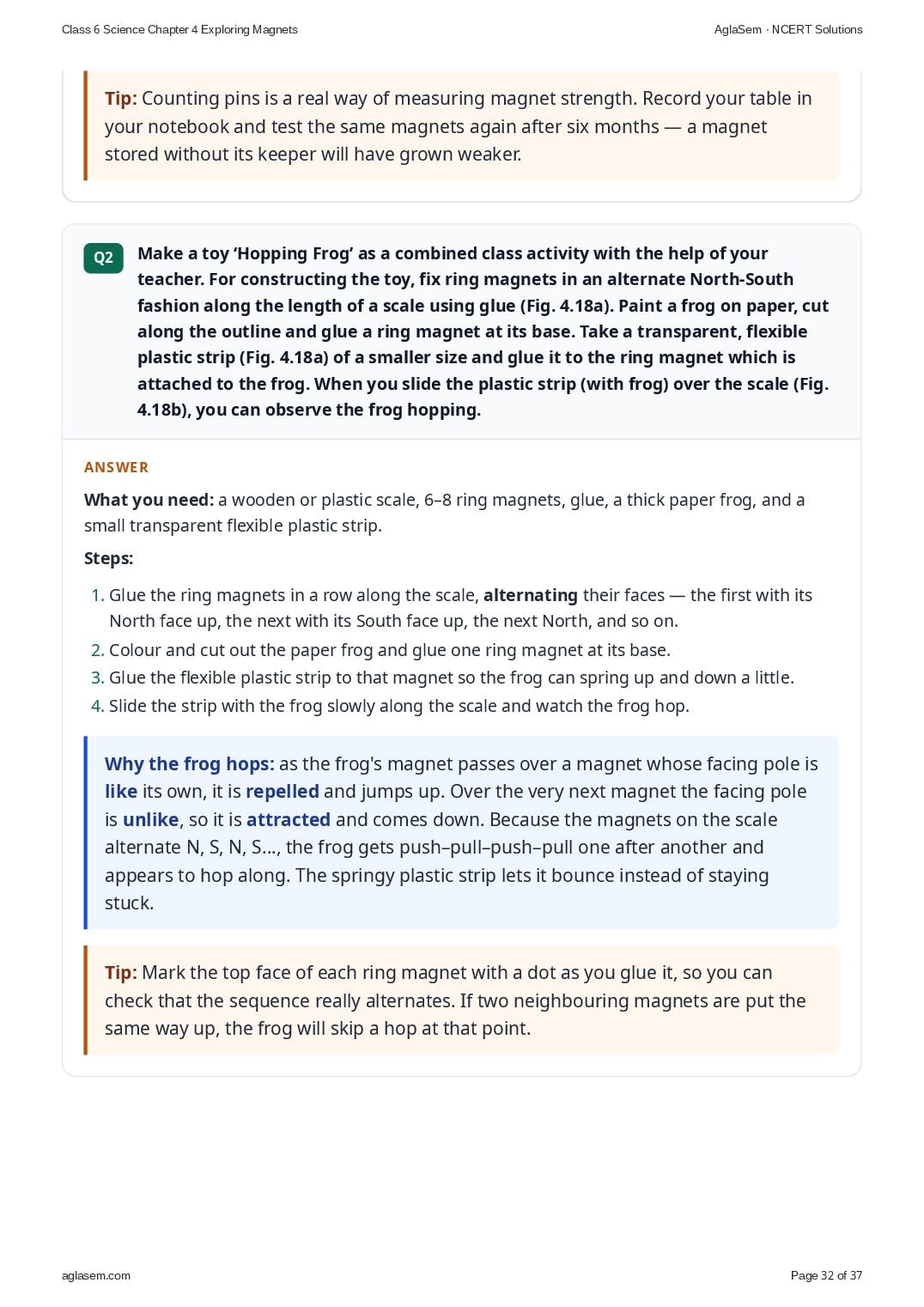
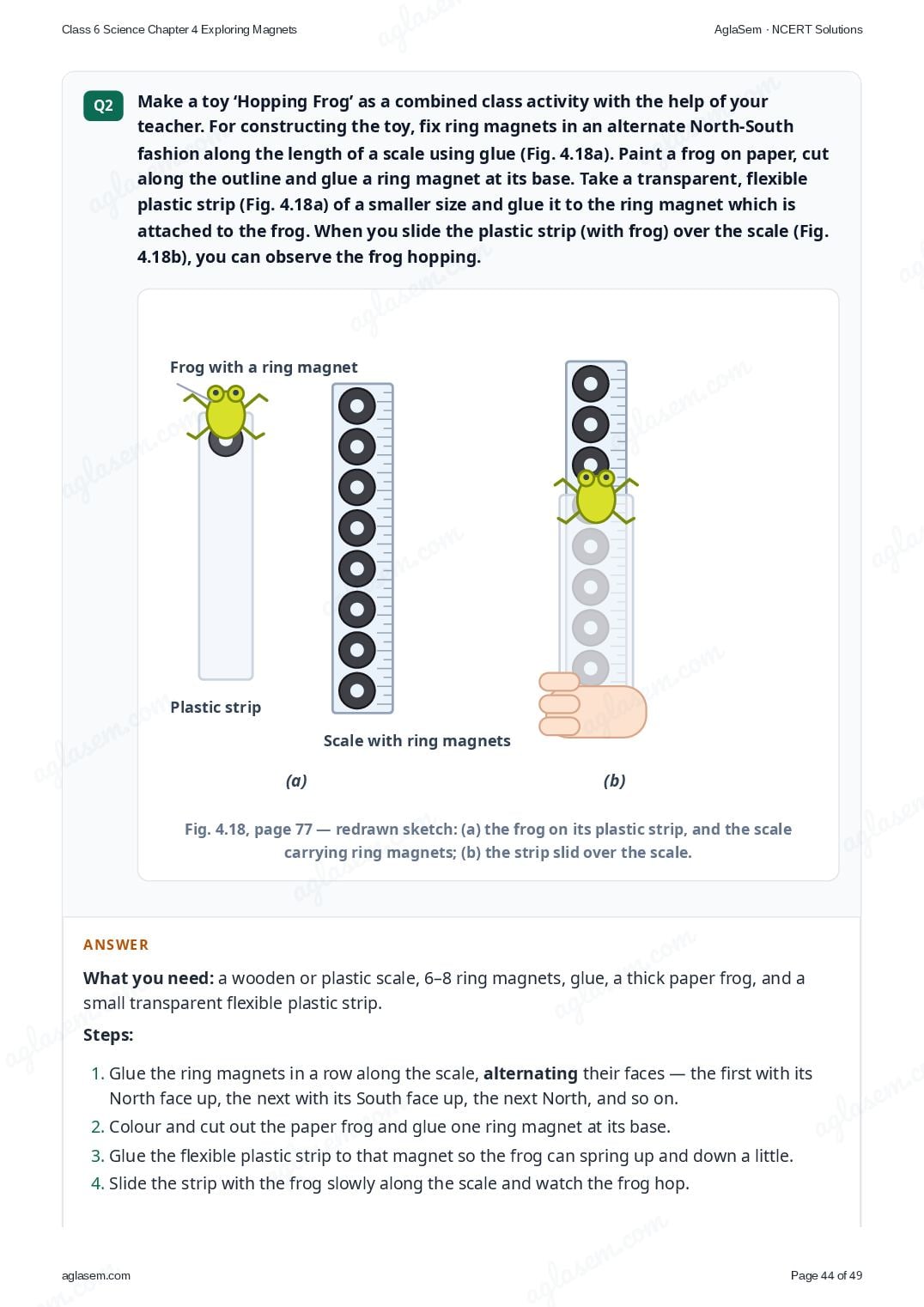
- Make a toy ‘Hopping Frog’ as a combined class activity with the help of your teacher. For constructing the toy, fix ring magnets in an alternate North-South fashion along the length of a scale using glue (Fig. 4.18a). Paint a frog on paper, cut along the outline and glue a ring magnet at its base. Take a transparent, flexible plastic strip (Fig. 4.18a) of a smaller size and glue it to the ring magnet which is attached to the frog. When you slide the plastic strip (with frog) over the scale (Fig. 4.18b), you can observe the frog hopping.
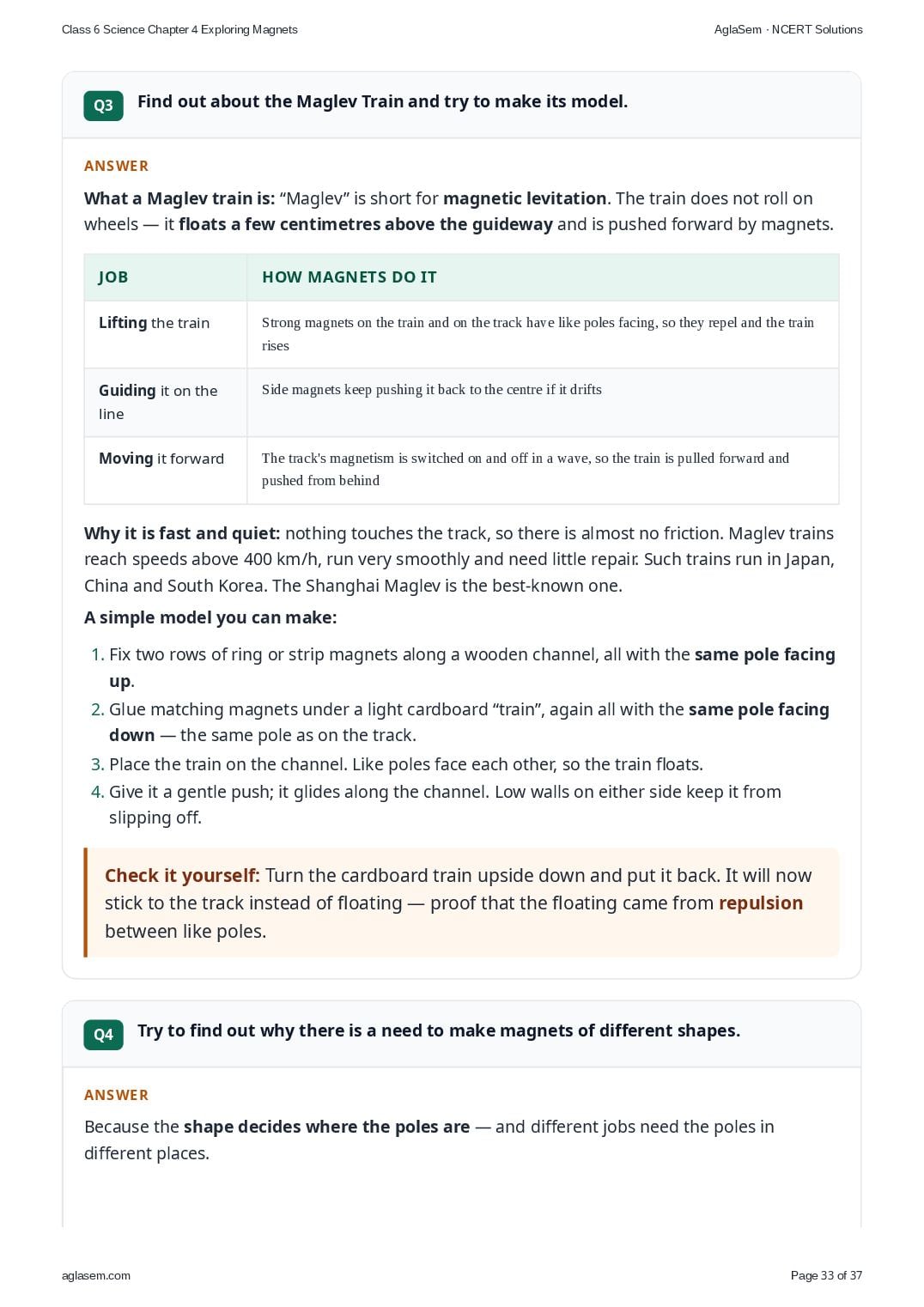
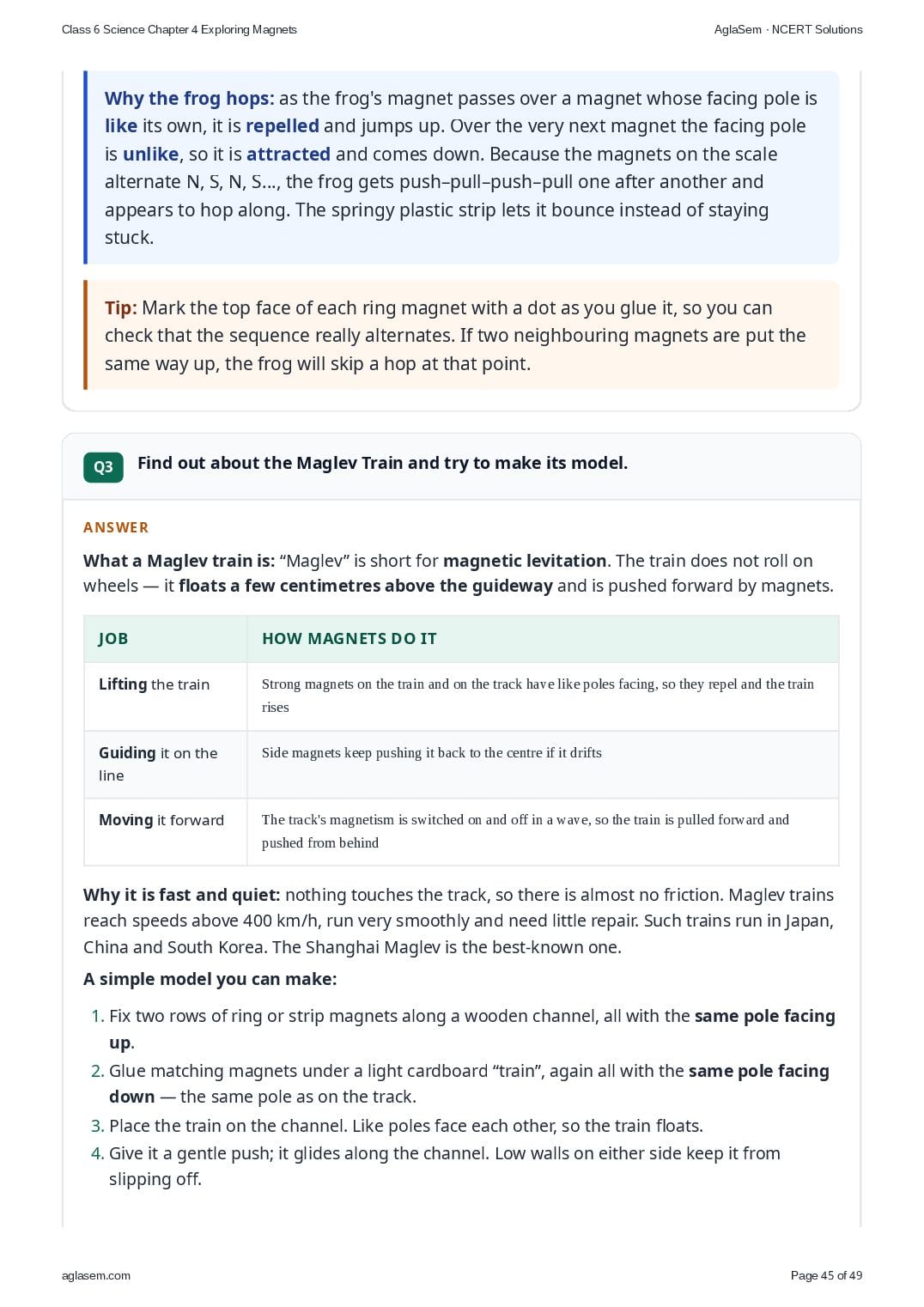
- Find out about the Maglev Train and try to make its model.
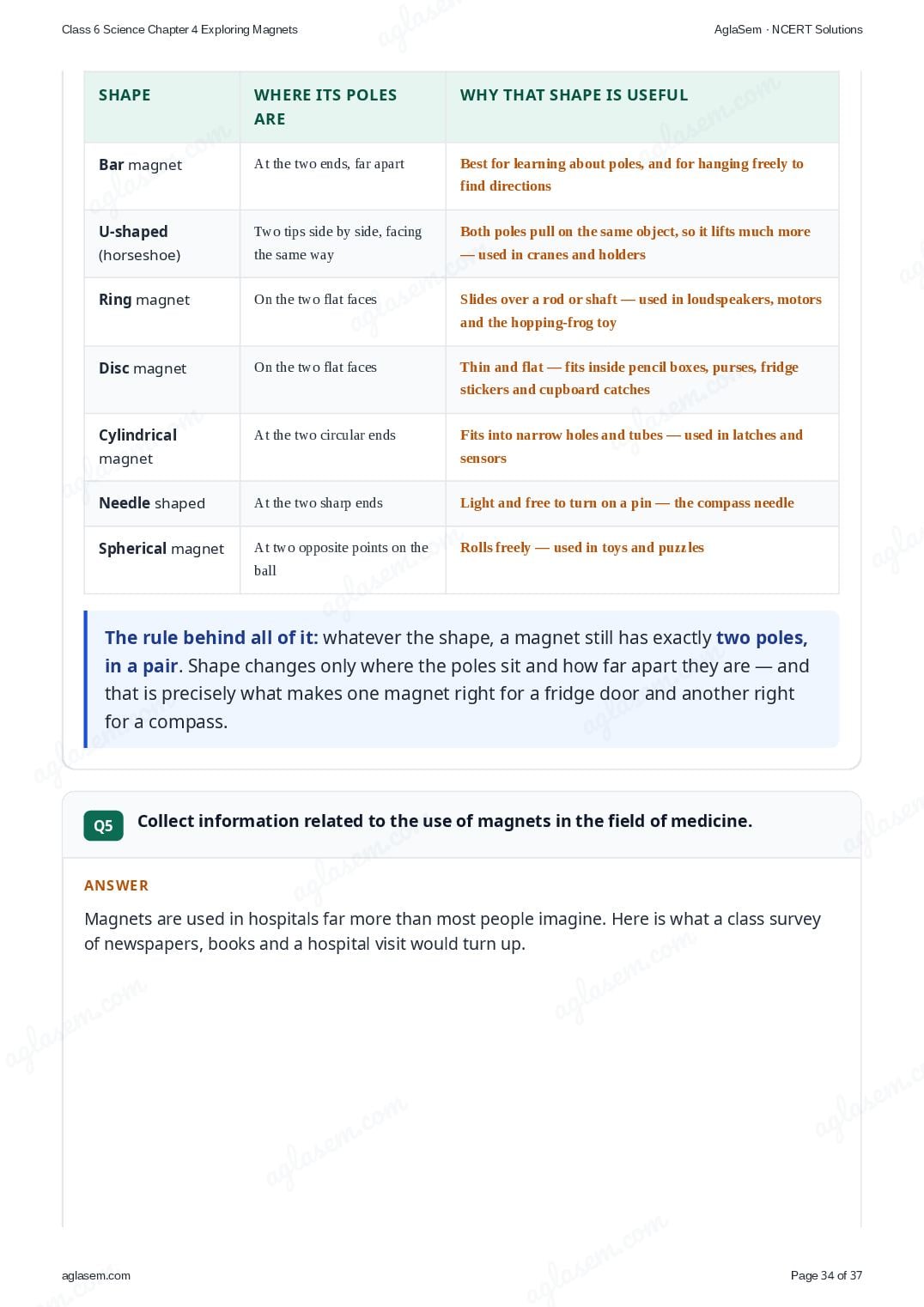
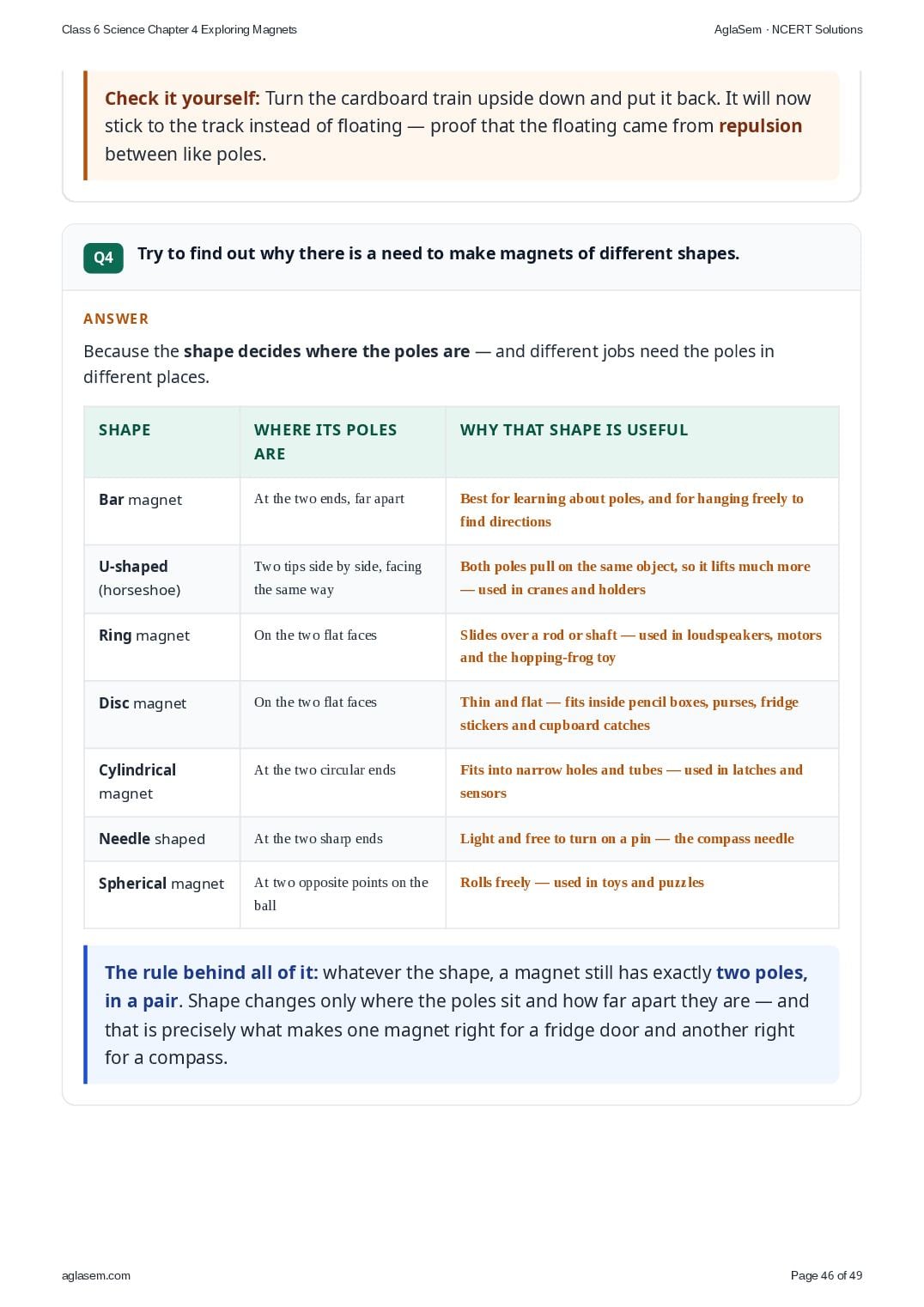
- Try to find out why there is a need to make magnets of different shapes.
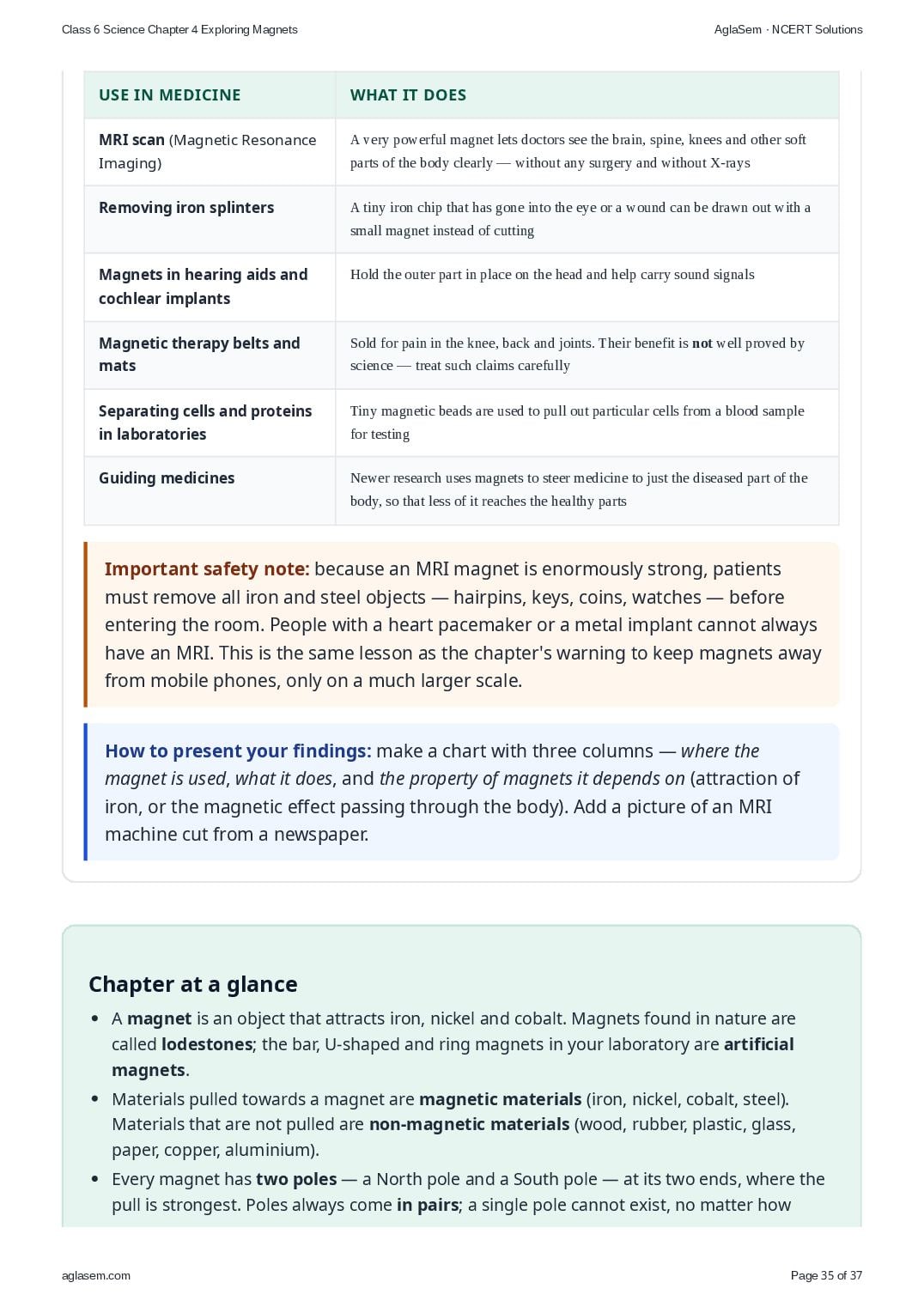
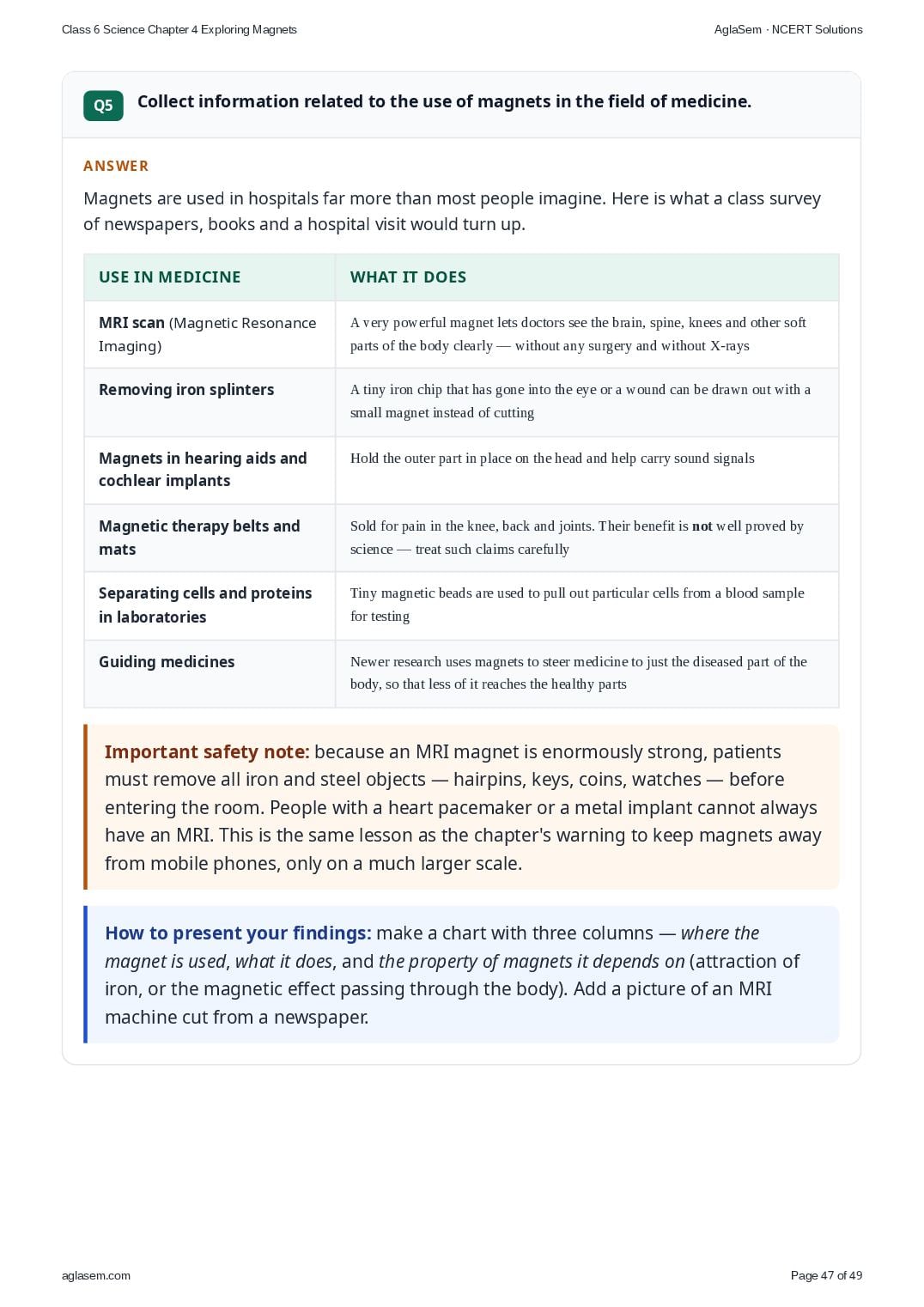
- Collect information related to the use of magnets in the field of medicine.
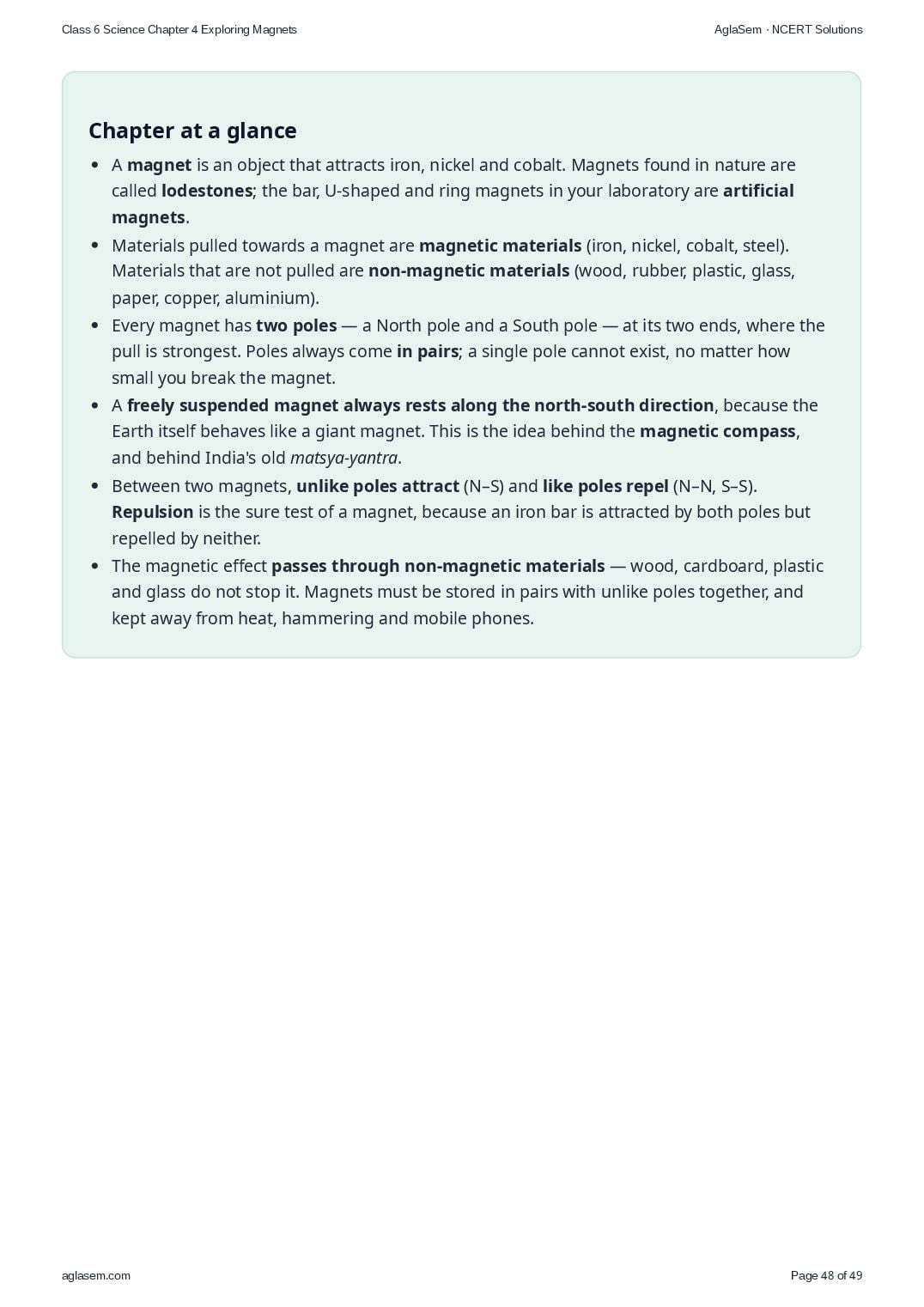
Chapter at a Glance
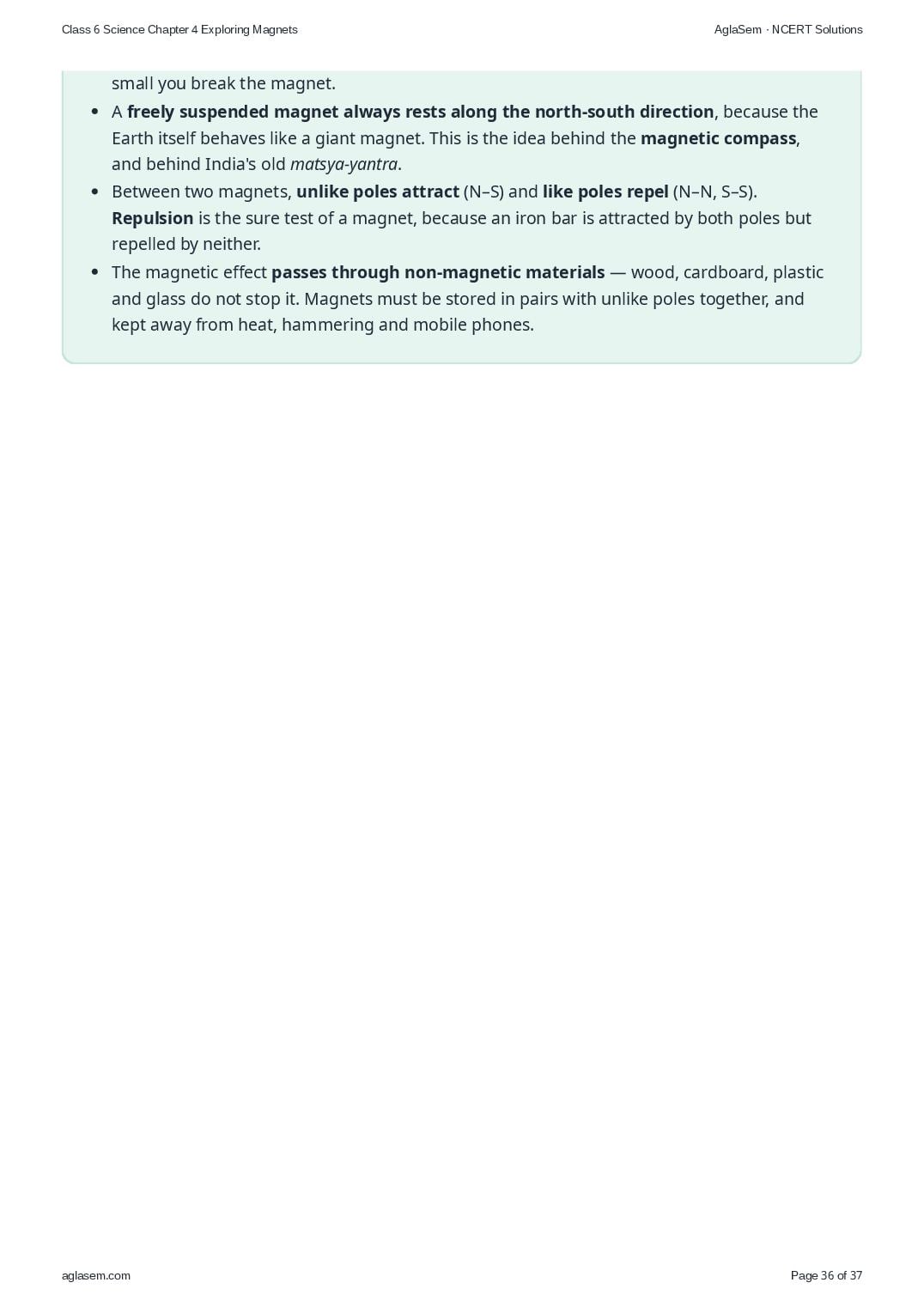
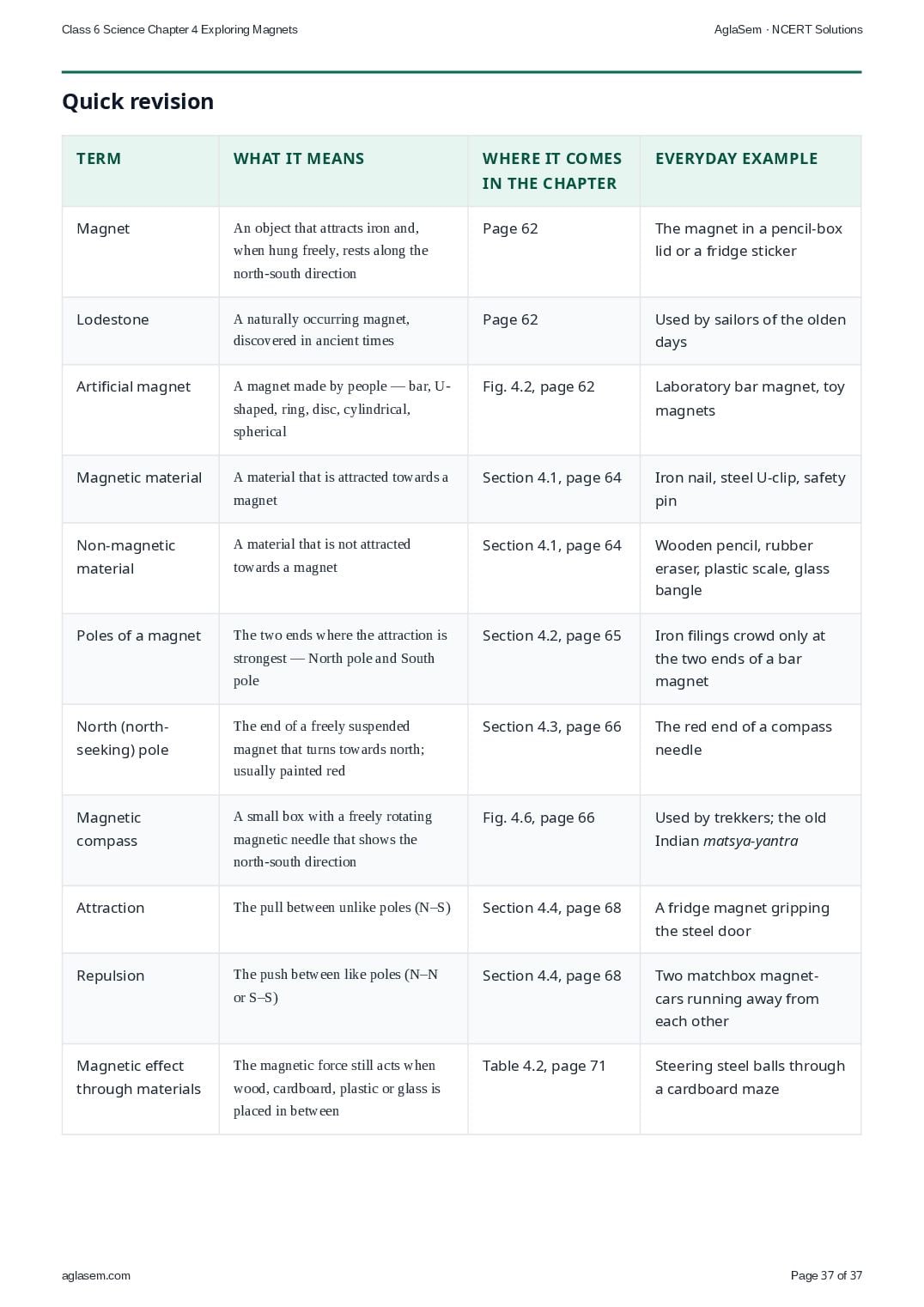
- A magnet is an object that attracts iron, nickel and cobalt. Magnets found in nature are called lodestones ; the bar, U-shaped and ring magnets in your laboratory are artificial magnets .
- Materials pulled towards a magnet are magnetic materials (iron, nickel, cobalt, steel). Materials that are not pulled are non-magnetic materials (wood, rubber, plastic, glass, paper, copper, aluminium).
- Every magnet has two poles — a North pole and a South pole — at its two ends, where the pull is strongest. Poles always come in pairs ; a single pole cannot exist, no matter how small you break the magnet.
- A freely suspended magnet always rests along the north-south direction , because the Earth itself behaves like a giant magnet. This is the idea behind the magnetic compass , and behind India's old matsya-yantra .
- Between two magnets, unlike poles attract (N–S) and like poles repel (N–N, S–S). Repulsion is the sure test of a magnet, because an iron bar is attracted by both poles but repelled by neither.
- The magnetic effect passes through non-magnetic materials — wood, cardboard, plastic and glass do not stop it. Magnets must be stored in pairs with unlike poles together, and kept away from heat, hammering and mobile phones.
How to Download NCERT Solutions for Class 6 Science Chapter 4 PDF
Follow these simple steps to get the Exploring Magnets questions-and-answers PDF from Curiosity.
- Search NCERT Solutions for Class 6 Science Chapter 4 aglasem and open this page.
- Read the exercise questions with answers for Exploring Magnets shown above.
- Click the Download PDF link to save the Exploring Magnets solutions to your device.
NCERT Solutions for Class 6 Science – All Chapters
There are more chapters to study besides Exploring Magnets in Science. Here are the NCERT Solutions for all chapters of Class 6 Science.
- Chapter 1 the Wonderful World of Science
- Chapter 2 Diversity in the Living World
- Chapter 3 Mindful Eating a Path to a Healthy Body
- Chapter 4 Exploring Magnets
- Chapter 5 Measurement of Length and Motion
- Chapter 6 Materials Around Us
- Chapter 7 Temperature and Its Measurement
- Chapter 8 a Journey Through States of Water
- Chapter 9 Methods of Separation in Everyday Life
- Chapter 10 Living Creatures Exploring Their Characteristics
- Chapter 11 Nature’s Treasures
- Chapter 12 Beyond Earth
NCERT Solutions for Class 6 – All Subjects
Just like Chapter 4 of Science, you can get the exercise questions with answers for every other subject of Class 6. Here are the NCERT Solutions for all subjects of Class 6.
NCERT Solutions for Class 6 Science Chapter 4 – An Overview
The key highlights of this study material are as follows.
| Aspects | Details |
|---|---|
| Class | Class 6 |
| Subject | Science |
| Chapter Number | Chapter 4 |
| Chapter Name | Exploring Magnets |
| Book Name | Curiosity |
| Book By | NCERT (National Council of Educational Research and Training) |
| Educational Resource Here | NCERT Solutions of Class 6 Science Chapter 4 for all exercises |
| More Questions Answers of This Subject | NCERT Solutions for Class 6 Science |
| Download Book Chapter | NCERT Book Class 6 Science |
| All Questions Answers For This Class | NCERT Solutions for Class 6 |
| Complete Solutions | NCERT Solutions |
NCERT Solutions for Class 6 Science Chapter 4 Exploring Magnets – FAQs
What are the NCERT Solutions for Class 6 Science Chapter 4 Exploring Magnets?
They are the complete, step-by-step answers to all the exercise and in-text questions of Chapter 4 Exploring Magnets from the NCERT Class 6 Science textbook Curiosity, written by experts as per the latest NCERT syllabus.
How can I download the Class 6 Science Chapter 4 solutions PDF for free?
Open this page on aglasem, read the Exploring Magnets questions with answers, and click the “Download Solutions PDF” link. The Class 6 Science Chapter 4 NCERT Solutions PDF is completely free to download.
Are these NCERT Solutions as per the latest 2026-27 syllabus?
Yes. The NCERT Solutions for Class 6 Science Chapter 4 are based on the latest NCERT textbook Curiosity and the current 2026-27 CBSE syllabus, so the questions and answers match what you study in class.
Where can I get NCERT Solutions for the other chapters of Class 6 Science?
You can find the answers to every chapter on the NCERT Solutions for Class 6 Science page, and solutions for every subject on the NCERT Solutions for Class 6 page.
How do NCERT Solutions help in exam preparation?
They show the correct method to solve each question, help you write answers the way they are expected in exams, let you check and correct your own work, and save revision time — which together improve your marks in Class 6 Science.
If you have any queries on NCERT Solutions for Class 6 Science Chapter 4 Exploring Magnets, then please ask in the comments below.