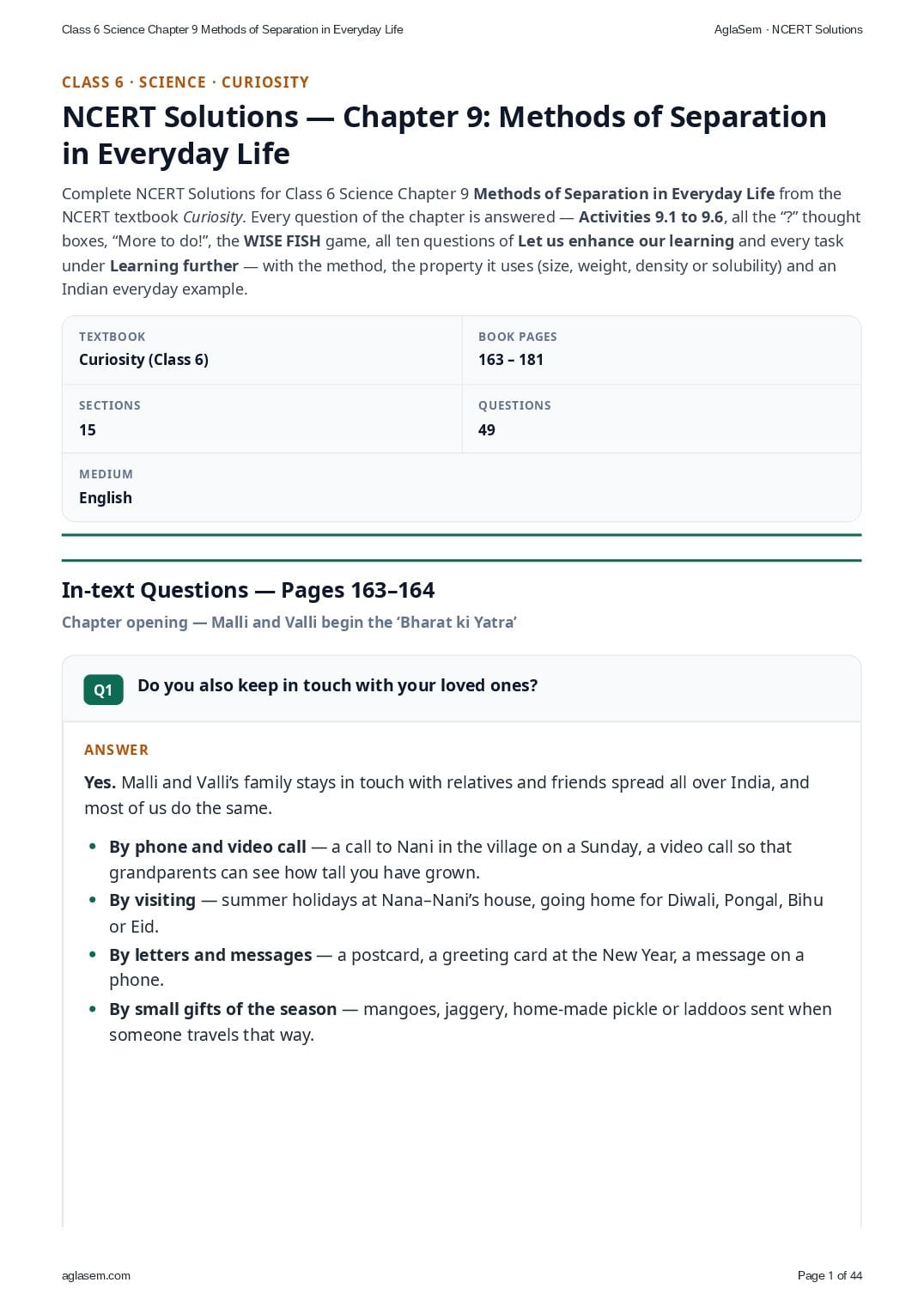
NCERT Solutions for Class 6 Science Chapter 9 Methods of Separation in Everyday Life provide clear, step-by-step answers to every exercise and in-text question from the chapter Methods of Separation in Everyday Life of the NCERT textbook Curiosity. Prepared by subject experts as per the latest NCERT (CBSE) syllabus for 2026-27, these NCERT Solutions for Class 6 Science help you understand each concept, write exam-ready answers, and check your own solutions. You can read them online below or download the free Class 6 Science Chapter 9 question-answer PDF.
NCERT Solutions for Class 6 Science Chapter 9 Methods of Separation in Everyday Life
- Class: Class 6
- Subject: Science
- Chapter: Chapter 9 – Methods of Separation in Everyday Life
- Textbook: Curiosity (NCERT)
- Study material: NCERT Solutions – questions with answers, free PDF
These solutions answer all the exercise questions of Chapter 9 Methods of Separation in Everyday Life — including the in-text questions, short-answer and long-answer questions, and activities — with complete explanations so you can follow the method, not just the final answer. Read the full solutions below.
NCERT Solutions Class 6 Science Chapter 9 Methods of Separation in Everyday Life View Download
NCERT Solutions for Class 6 Science Chapter 9 PDF Download
You can read the NCERT Solutions for Class 6 Science Chapter 9 online above, or download the complete question-answer PDF to study Methods of Separation in Everyday Life offline at any time.
NCERT Solutions for Class 6 Science Chapter 9 PDF Download Link – Click Here to Download Solutions PDF
Questions Covered in This Chapter
These NCERT Solutions answer all 49 questions of this chapter. The questions solved are:
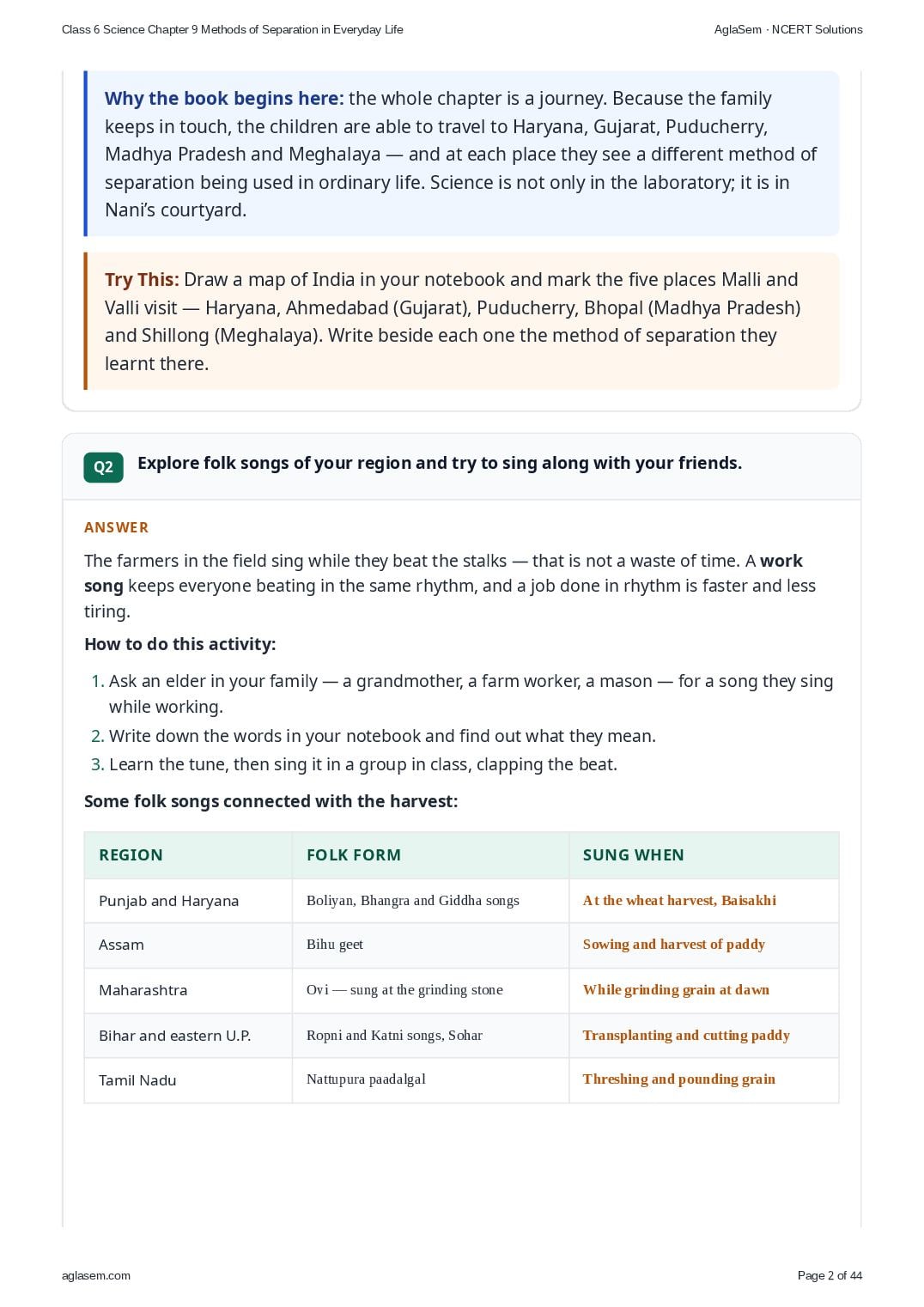
- Do you also keep in touch with your loved ones?
- Explore folk songs of your region and try to sing along with your friends.
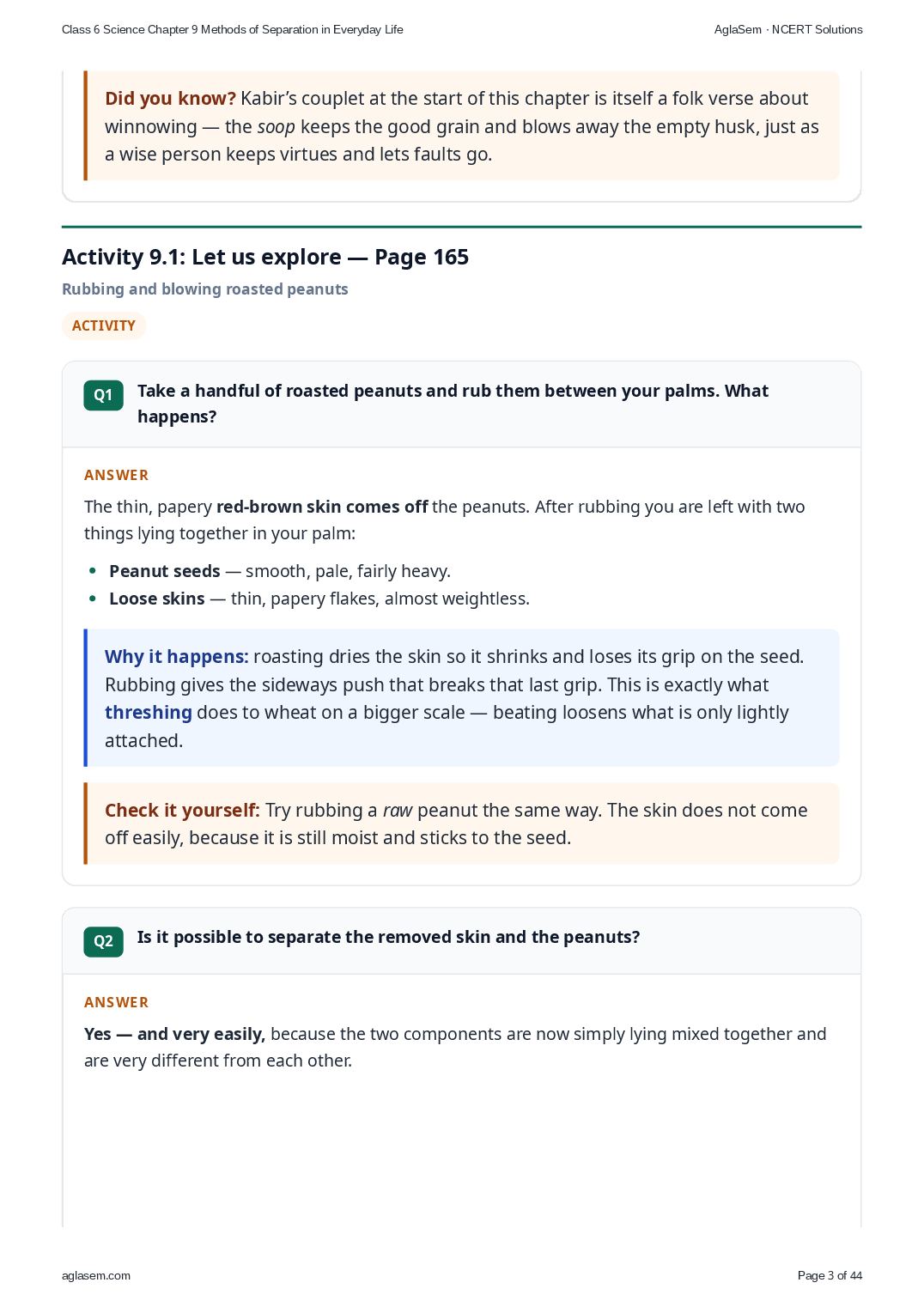
- Take a handful of roasted peanuts and rub them between your palms. What happens?
- Is it possible to separate the removed skin and the peanuts?
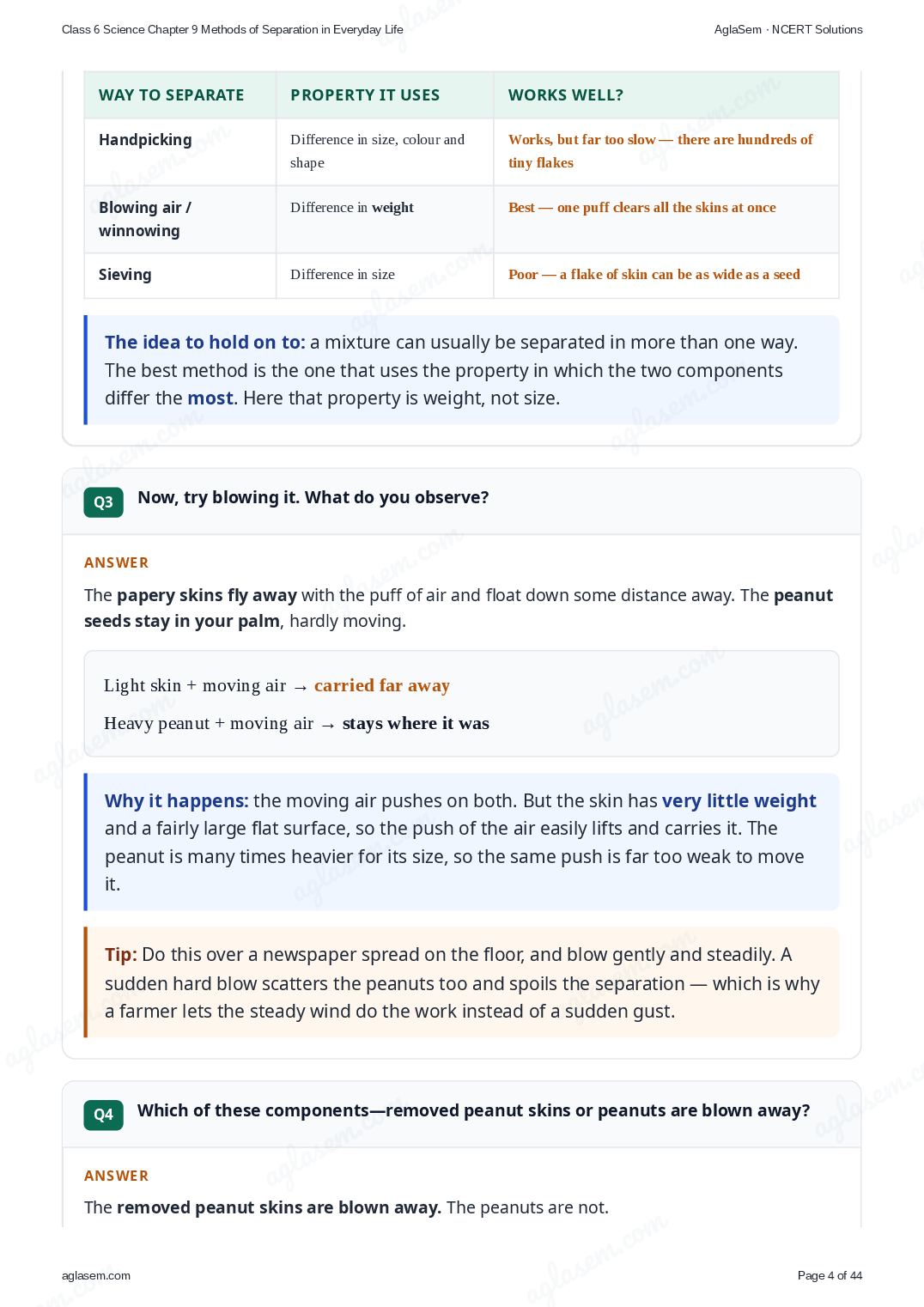
- Now, try blowing it. What do you observe?
- Which of these components—removed peanut skins or peanuts are blown away?
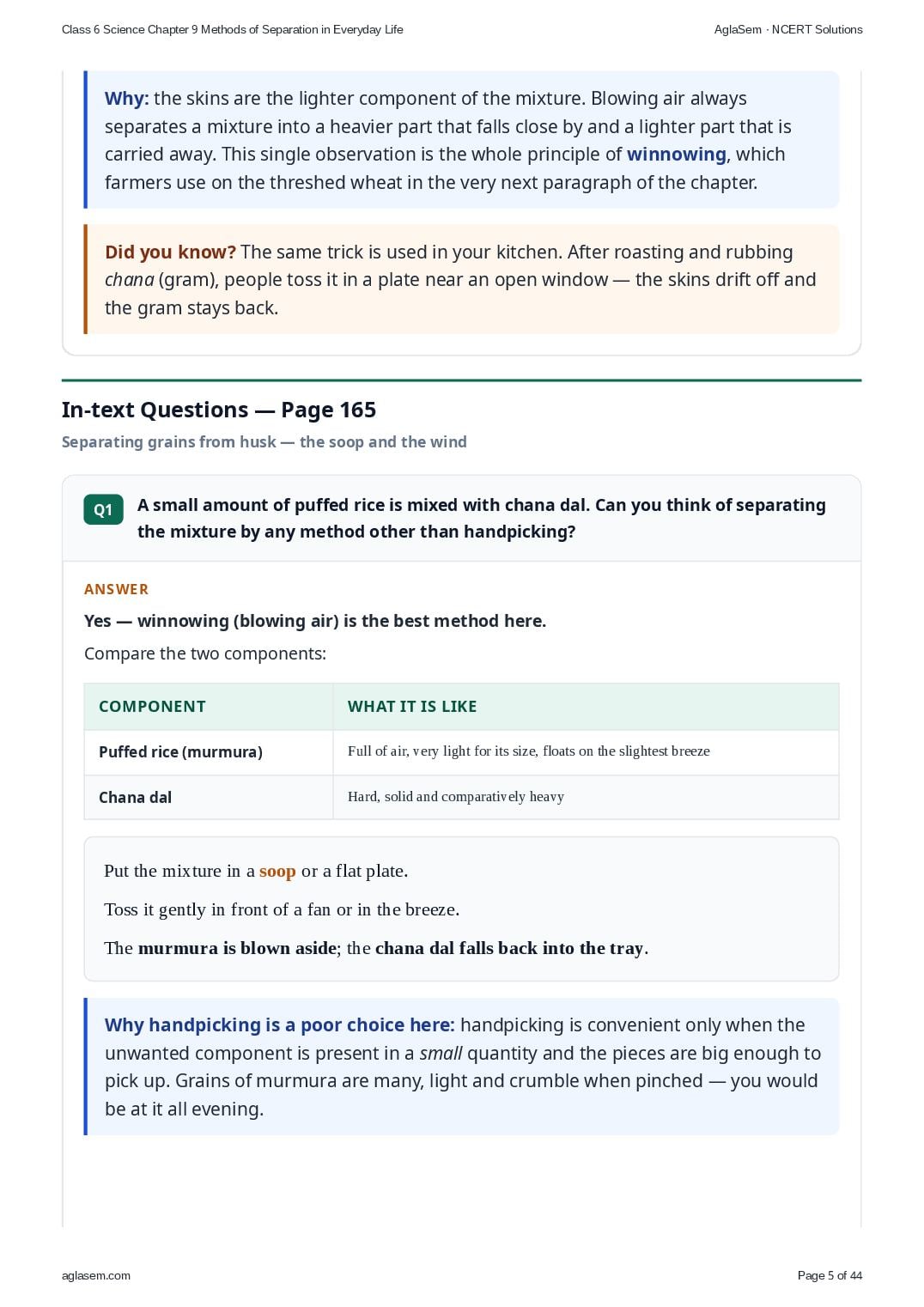
- A small amount of puffed rice is mixed with chana dal. Can you think of separating the mixture by any method other than handpicking?
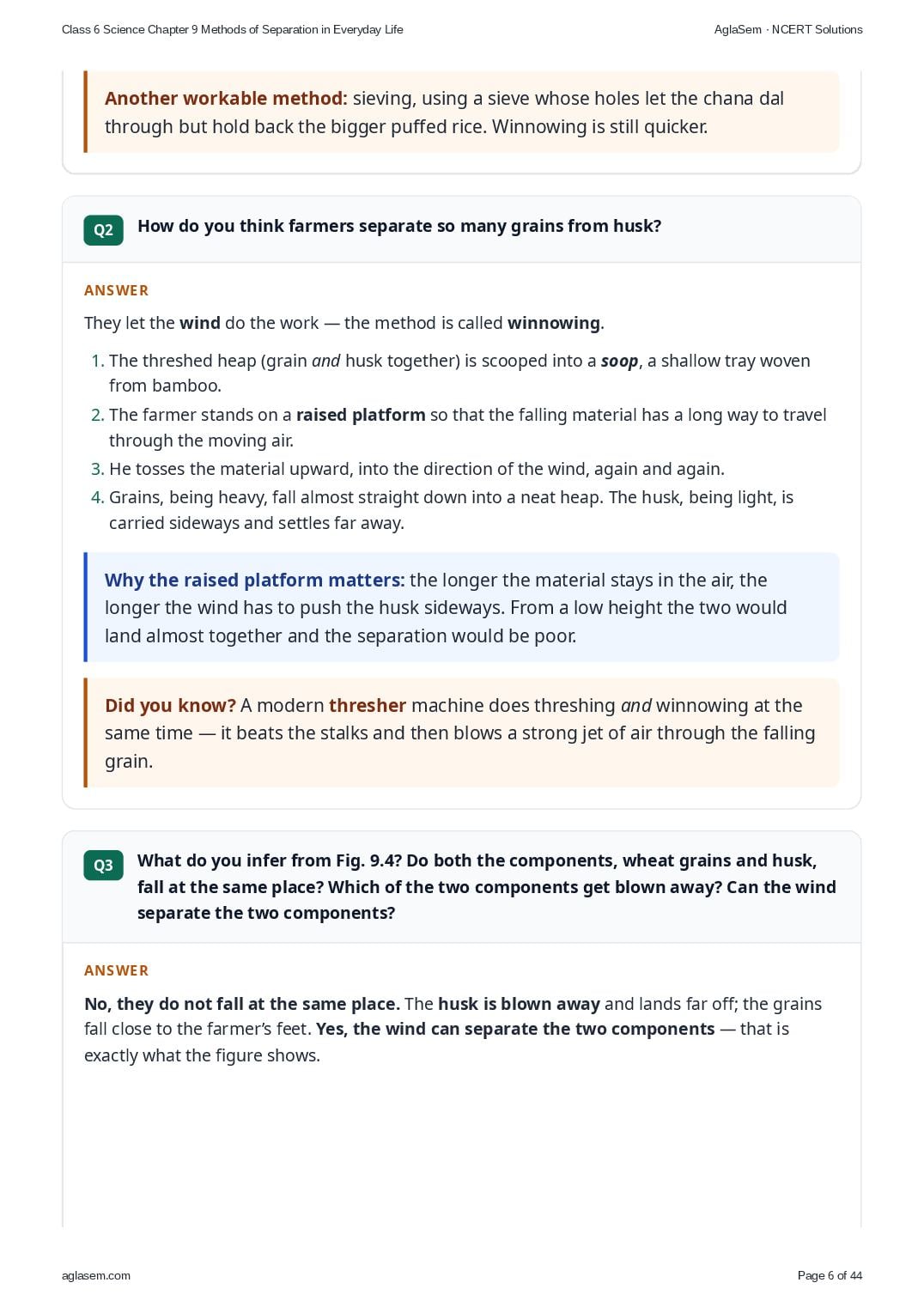
- How do you think farmers separate so many grains from husk?
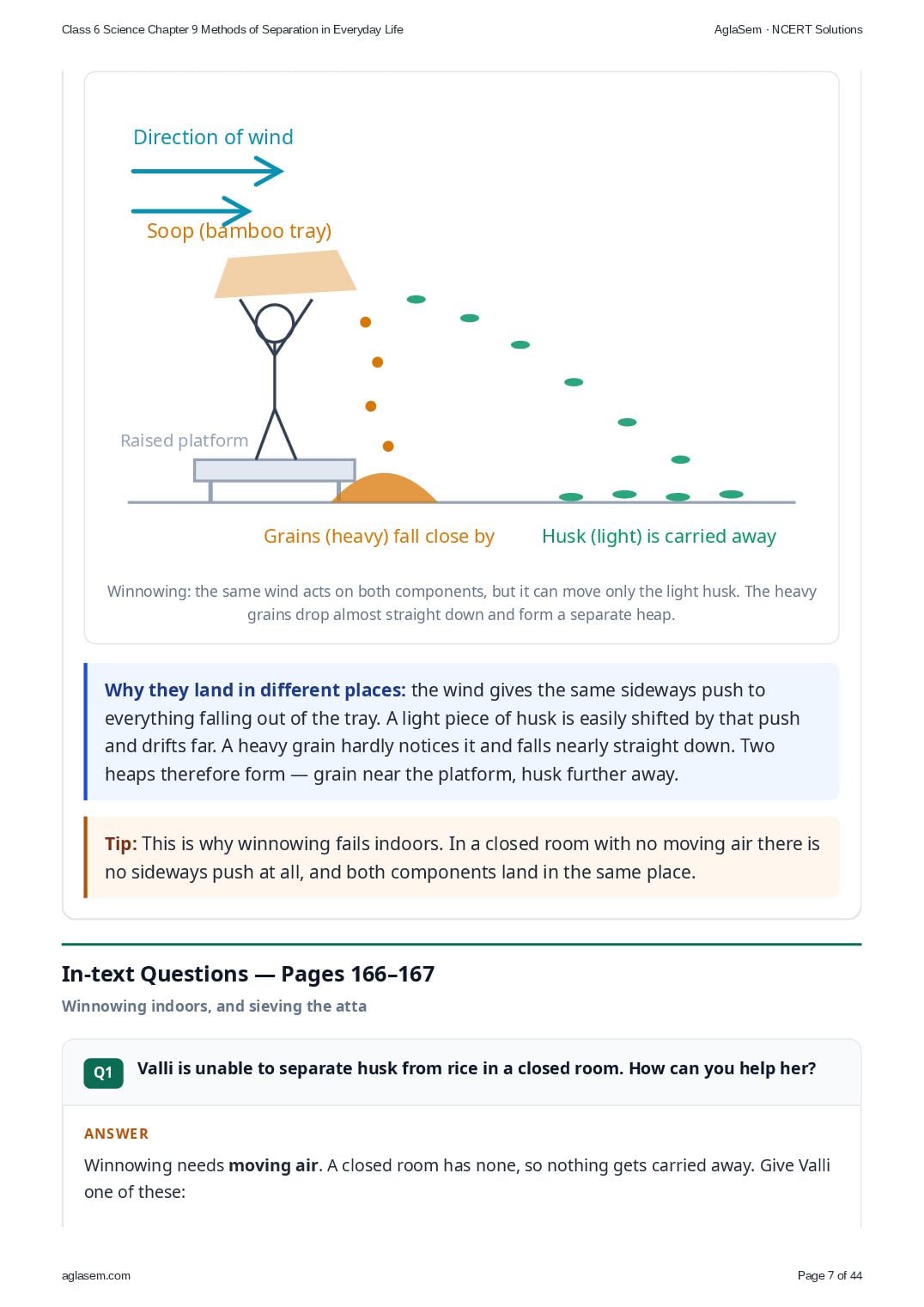
- What do you infer from Fig. 9.4? Do both the components, wheat grains and husk, fall at the same place? Which of the two components get blown away? Can the wind separate the two components?
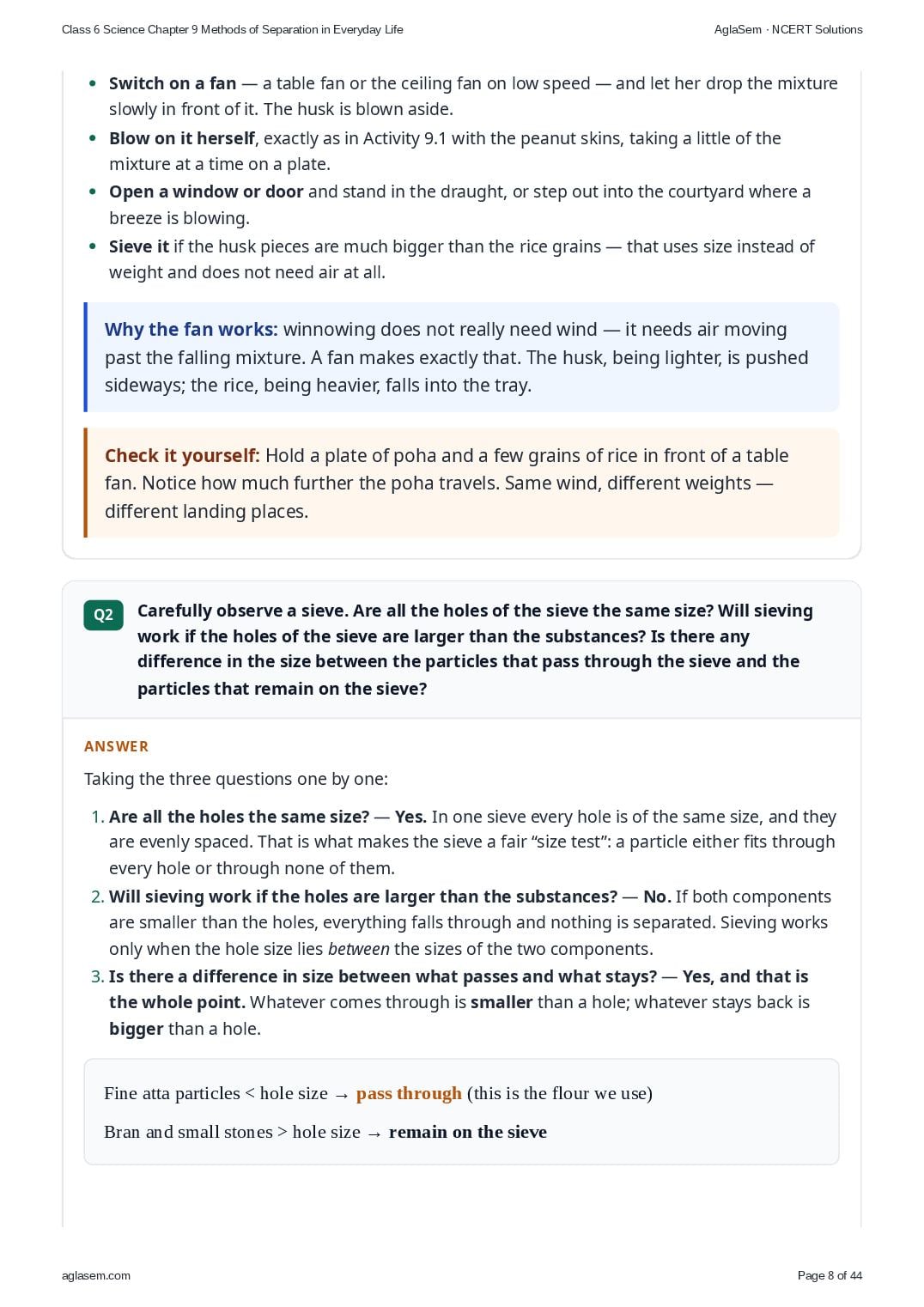
- Valli is unable to separate husk from rice in a closed room. How can you help her?
- Carefully observe a sieve. Are all the holes of the sieve the same size? Will sieving work if the holes of the sieve are larger than the substances? Is there any difference in the size between the particles that pass through the sieve and the particles that remain on the sieve?
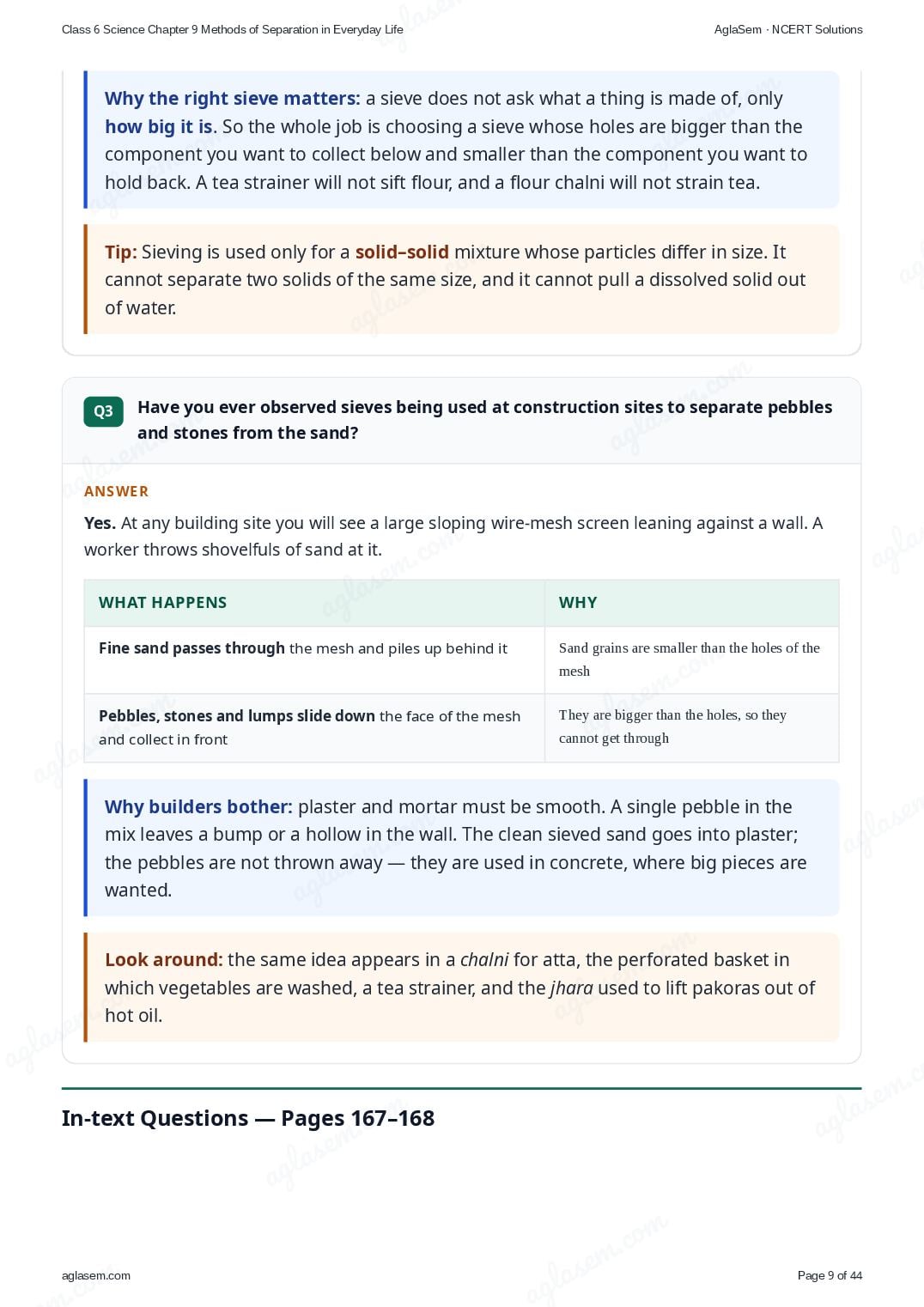
- Have you ever observed sieves being used at construction sites to separate pebbles and stones from the sand?
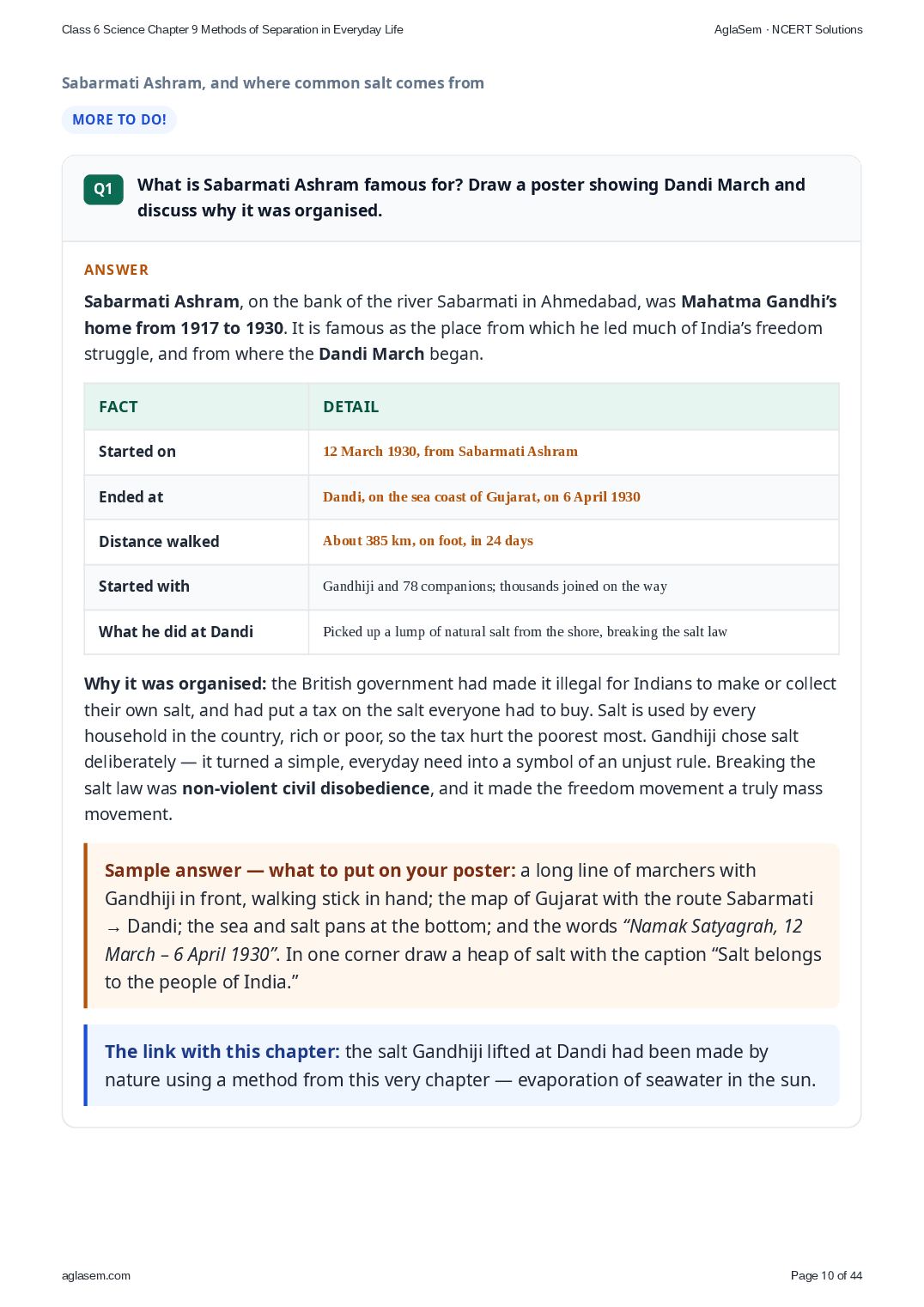
- What is Sabarmati Ashram famous for? Draw a poster showing Dandi March and discuss why it was organised.
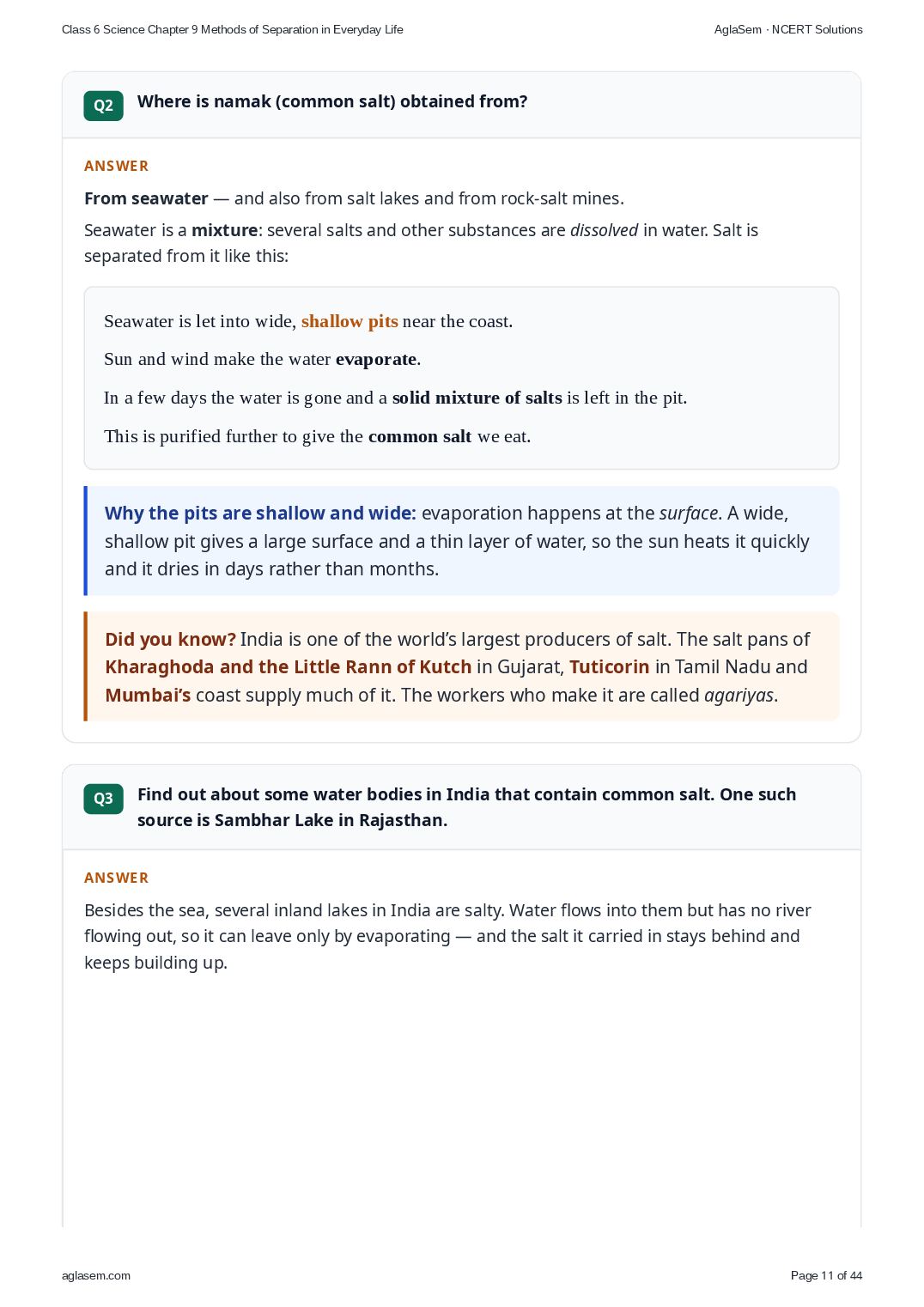
- Where is namak (common salt) obtained from?
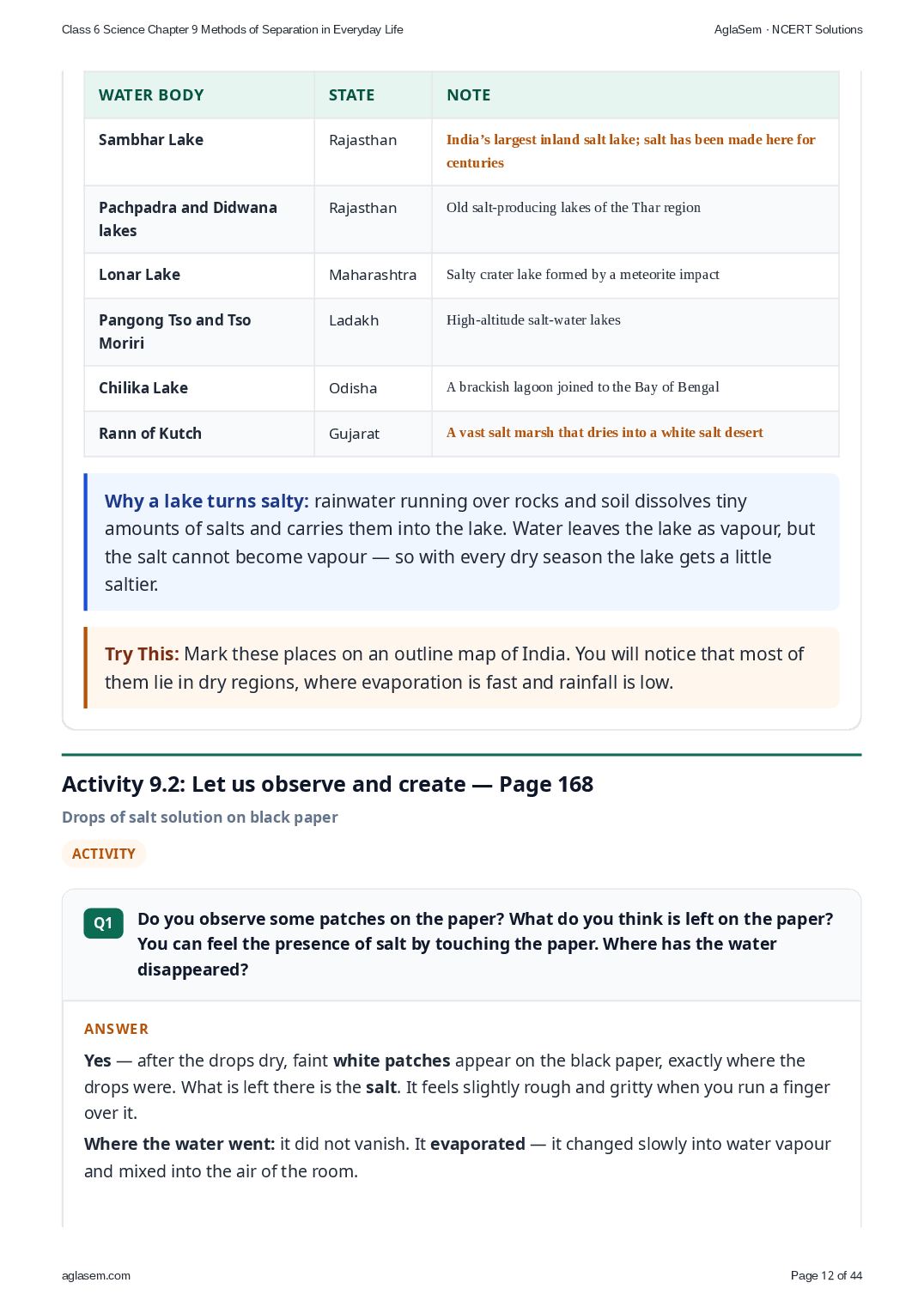
- Find out about some water bodies in India that contain common salt. One such source is Sambhar Lake in Rajasthan.
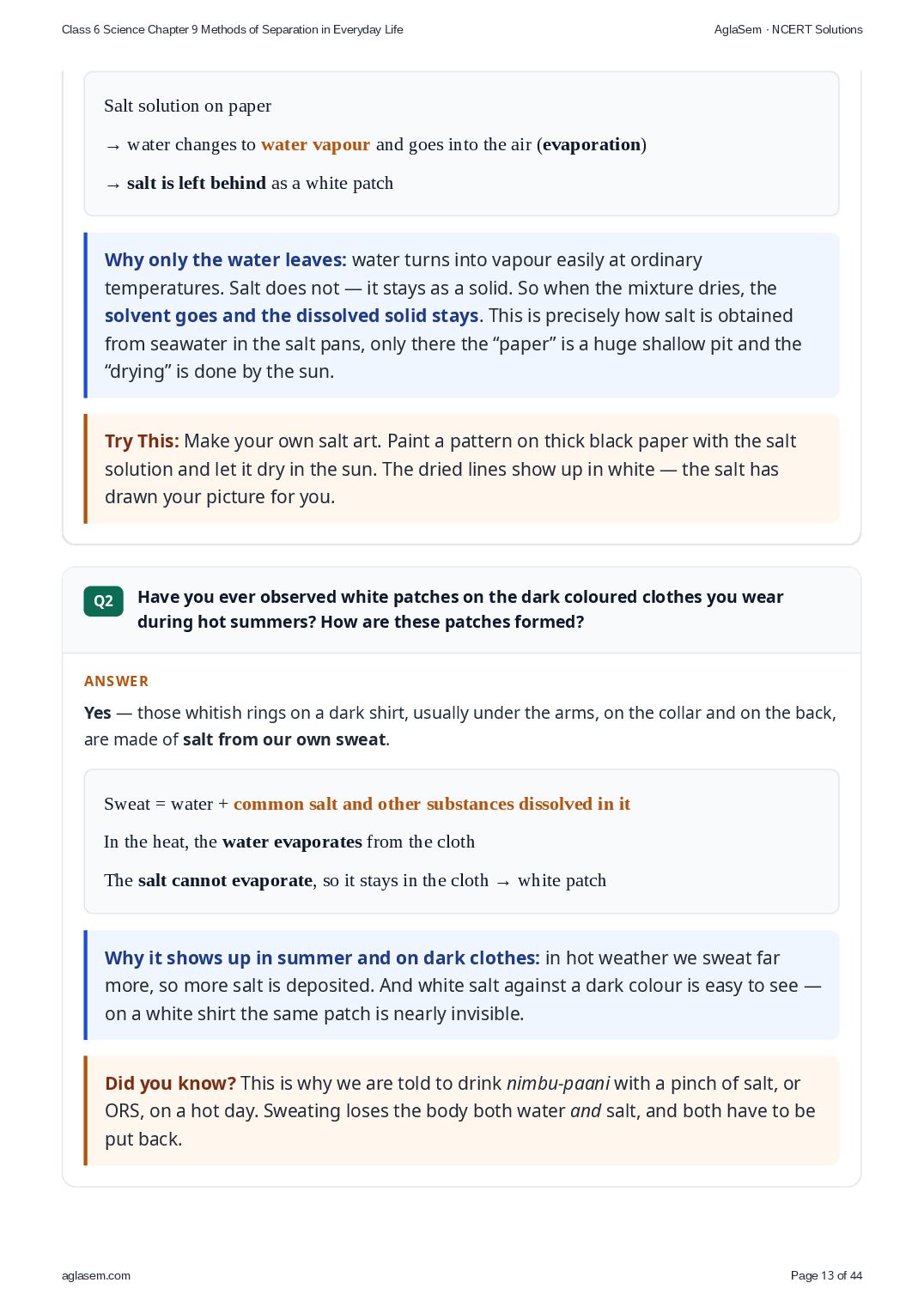
- Do you observe some patches on the paper? What do you think is left on the paper? You can feel the presence of salt by touching the paper. Where has the water disappeared?
- Have you ever observed white patches on the dark coloured clothes you wear during hot summers? How are these patches formed?
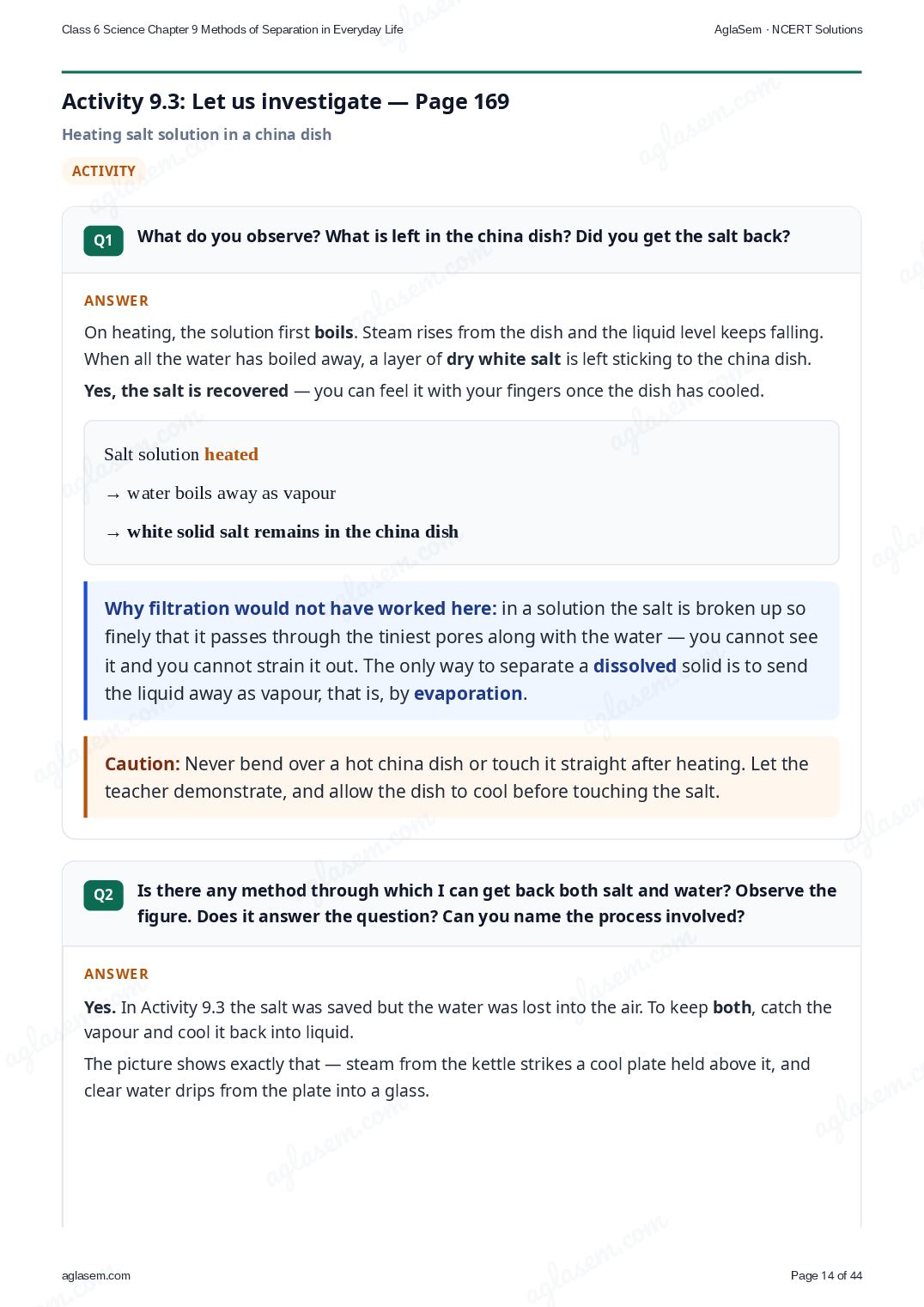
- What do you observe? What is left in the china dish? Did you get the salt back?
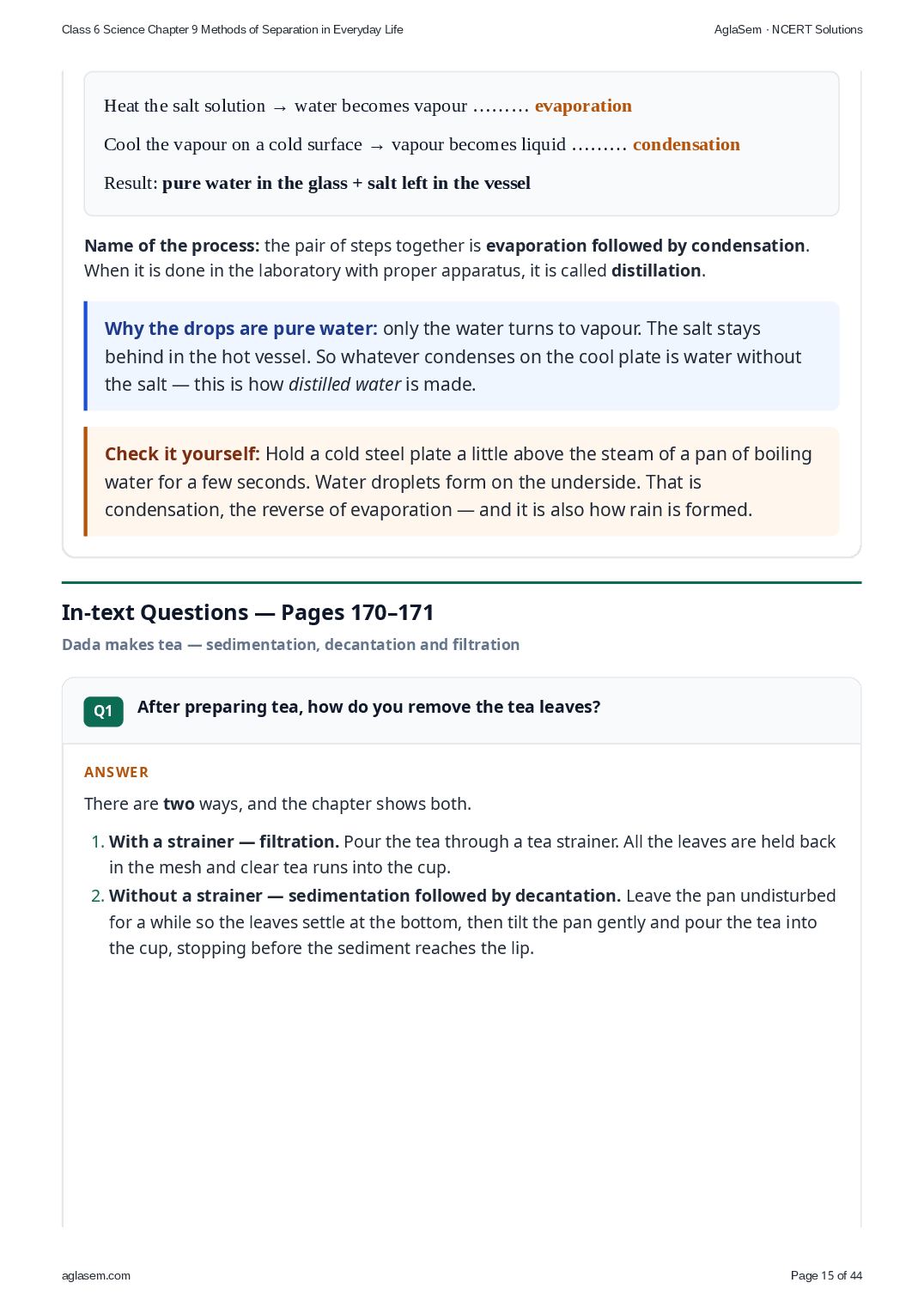
- Is there any method through which I can get back both salt and water? Observe the figure. Does it answer the question? Can you name the process involved?
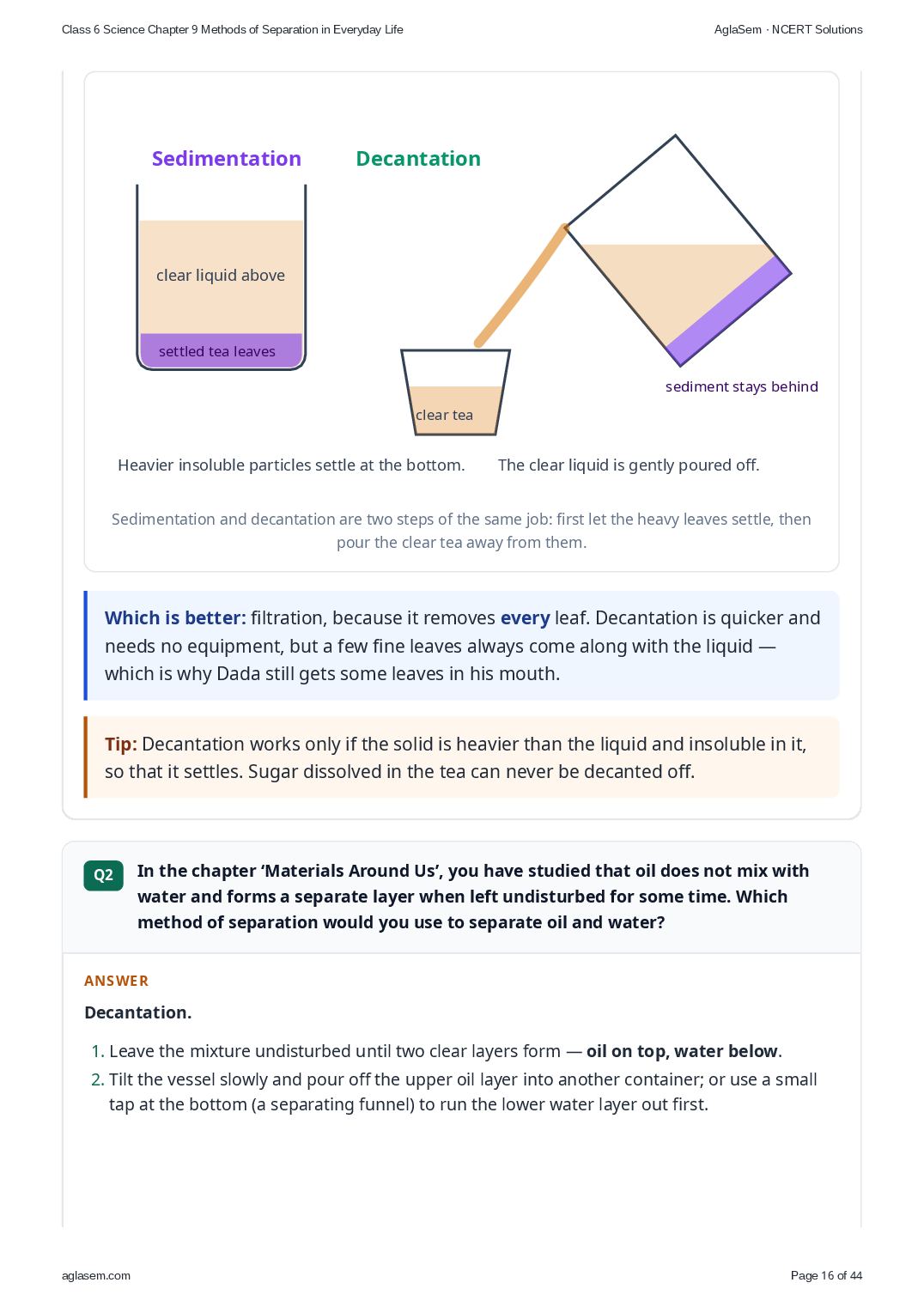
- After preparing tea, how do you remove the tea leaves?
- In the chapter ‘Materials Around Us’, you have studied that oil does not mix with water and forms a separate layer when left undisturbed for some time. Which method of separation would you use to separate oil and water?
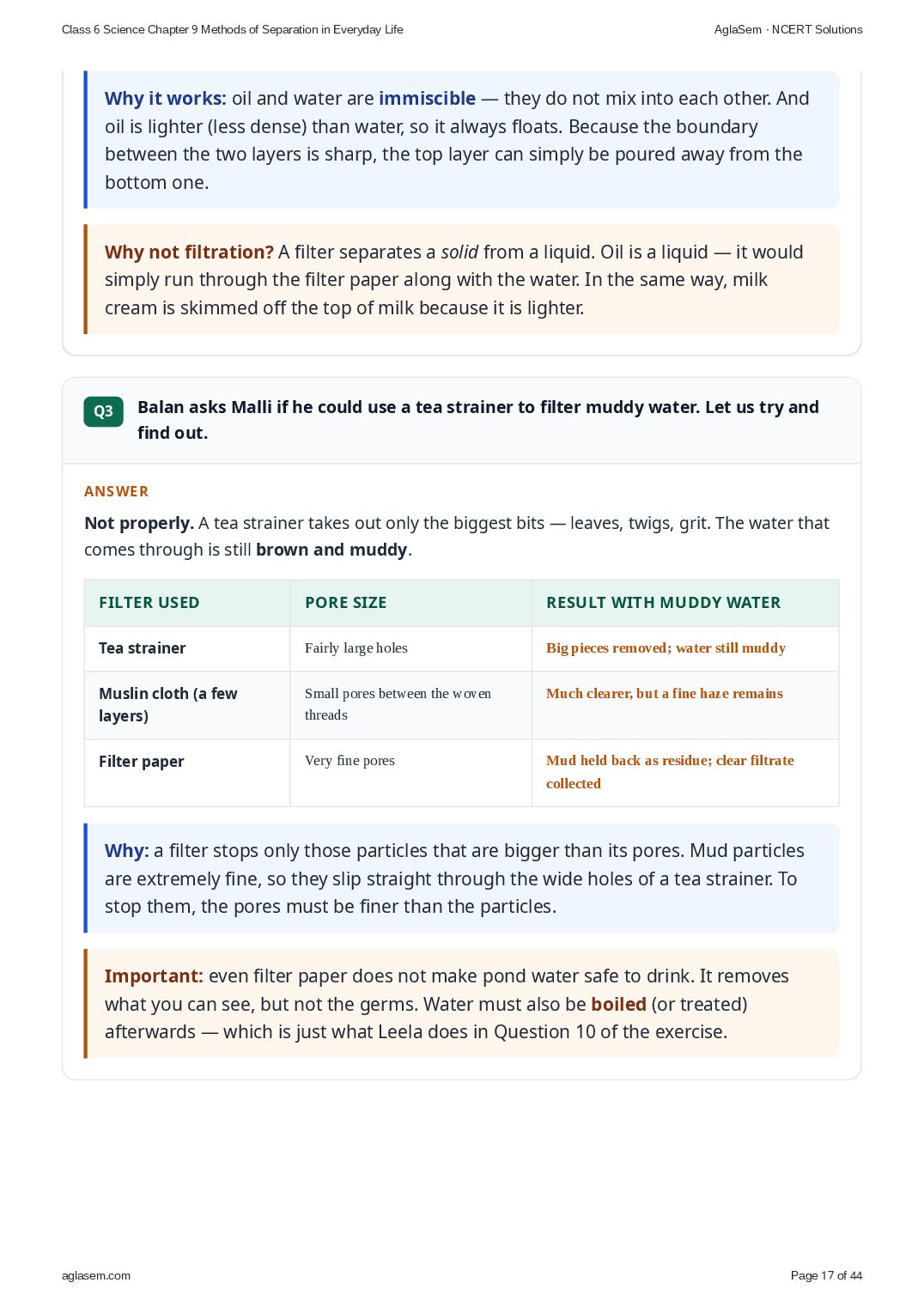
- Balan asks Malli if he could use a tea strainer to filter muddy water. Let us try and find out.
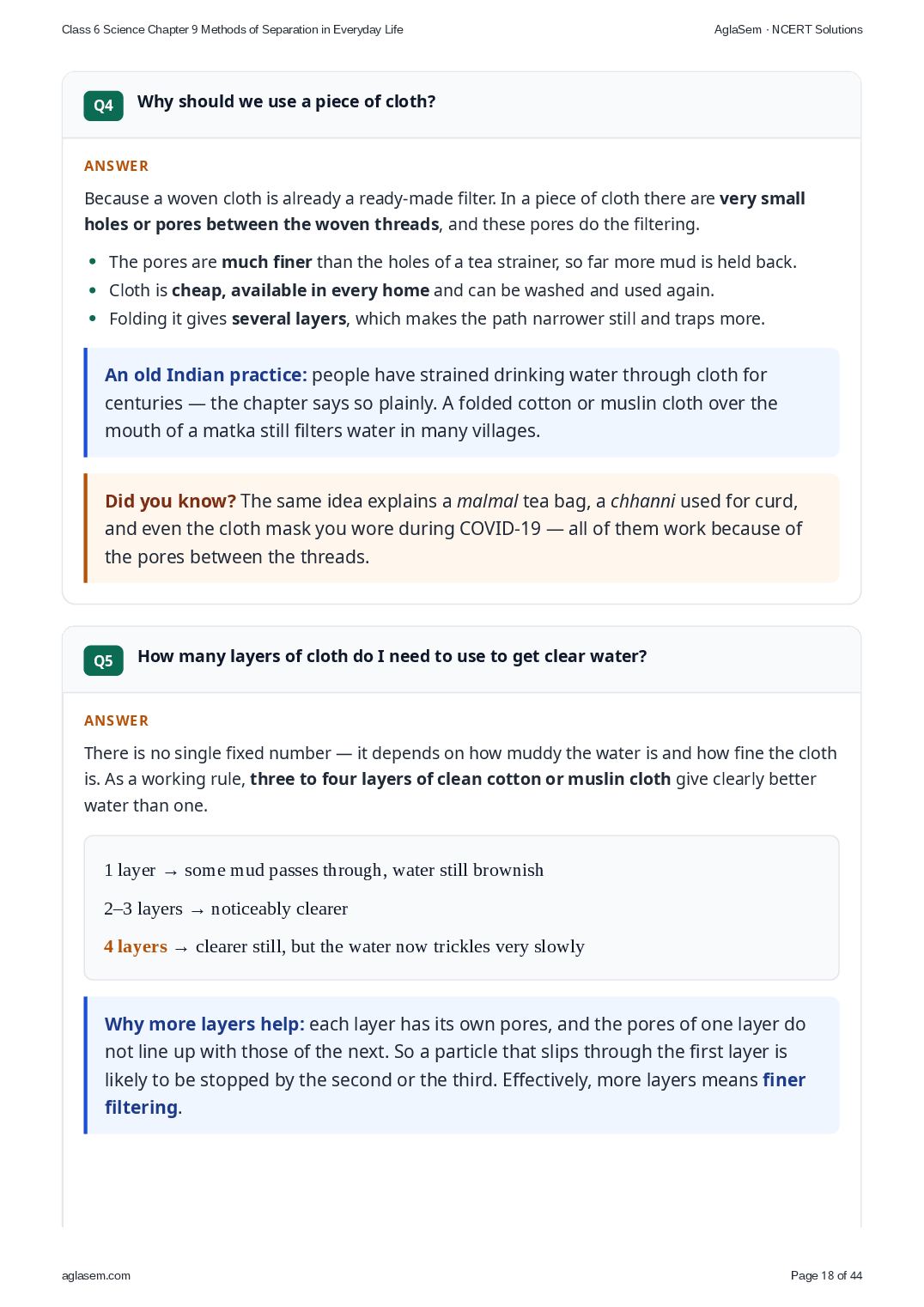
- Why should we use a piece of cloth?
- How many layers of cloth do I need to use to get clear water?
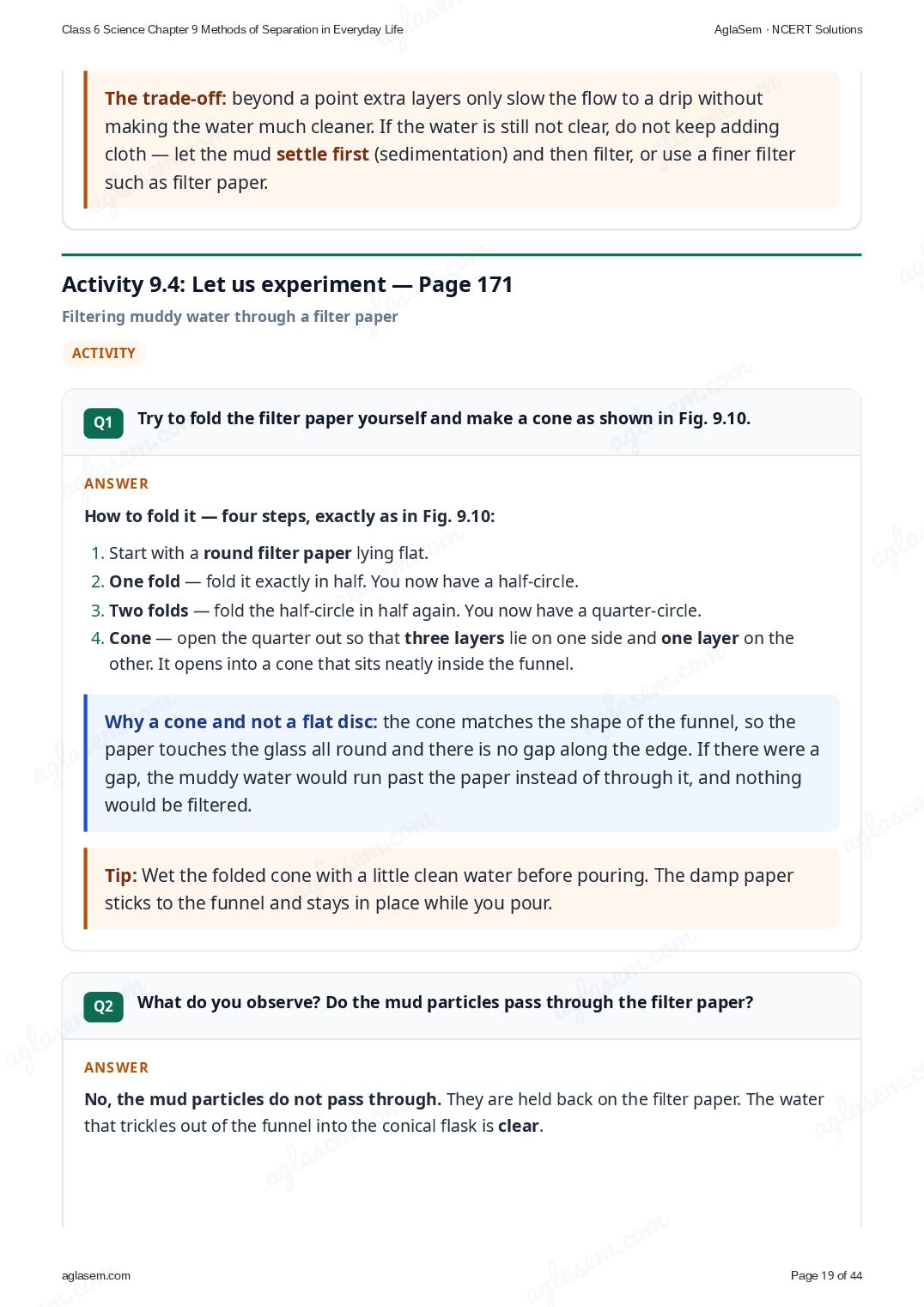
- Try to fold the filter paper yourself and make a cone as shown in Fig. 9.10.
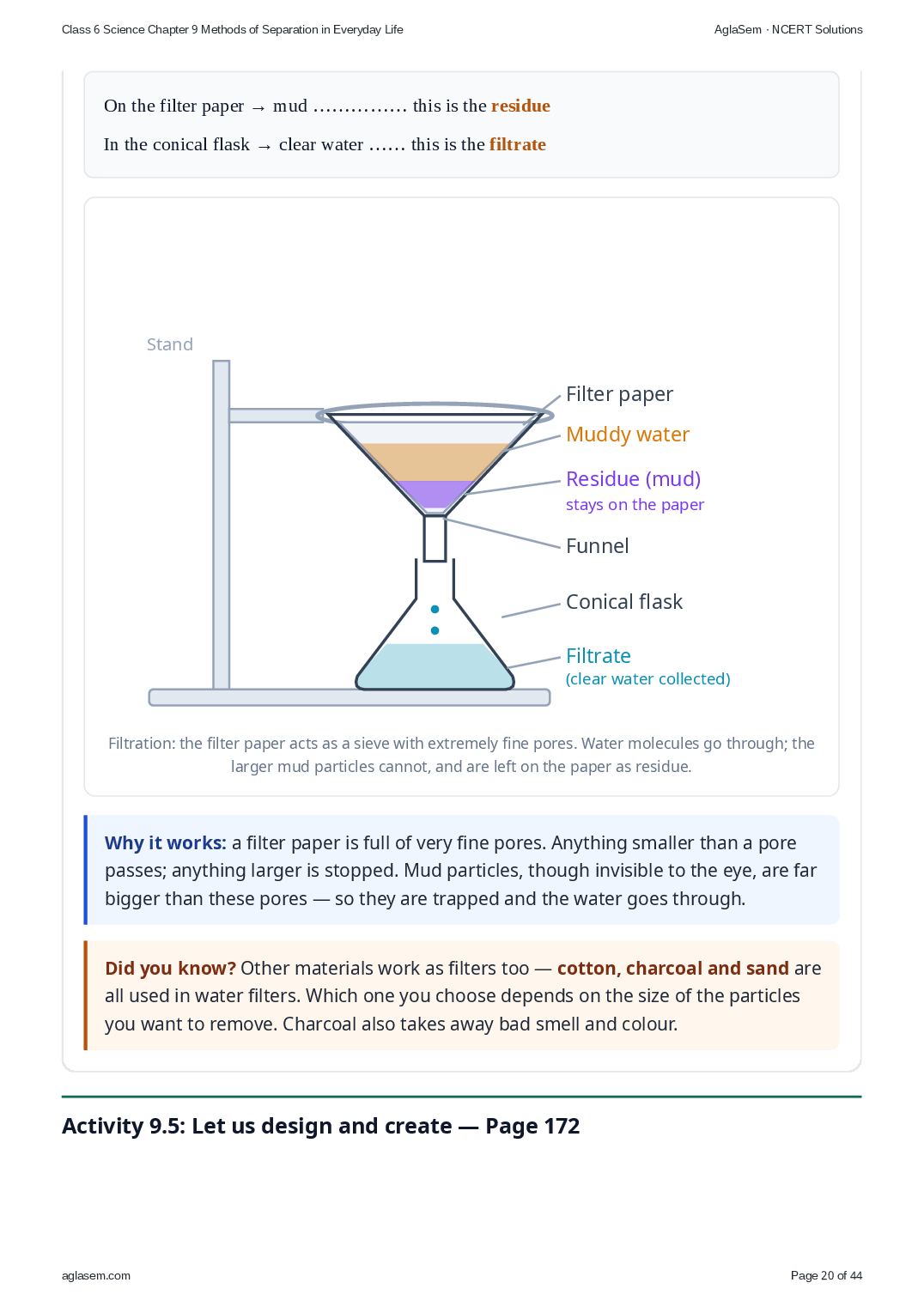
- What do you observe? Do the mud particles pass through the filter paper?
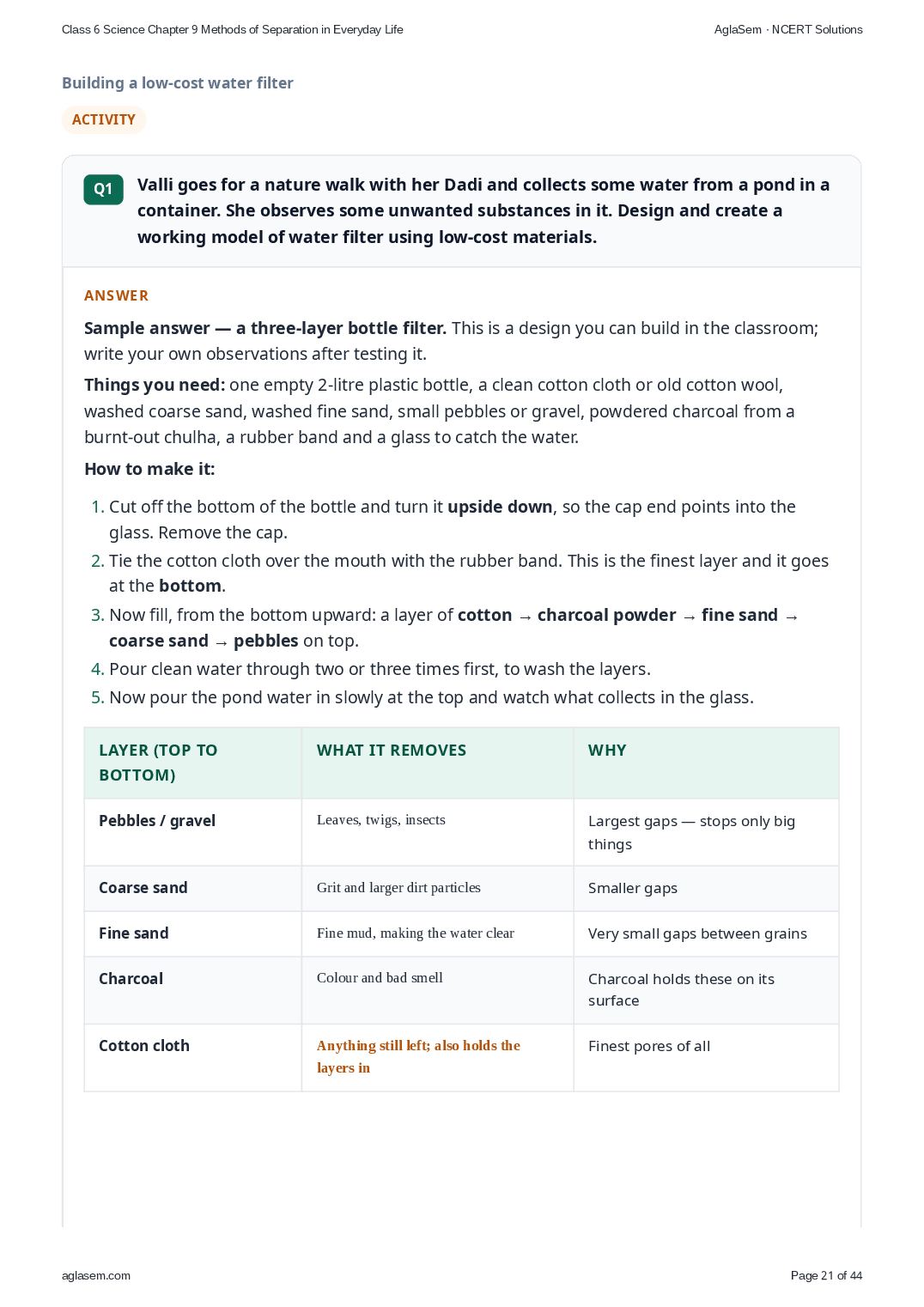
- Valli goes for a nature walk with her Dadi and collects some water from a pond in a container. She observes some unwanted substances in it. Design and create a working model of water filter using low-cost materials.
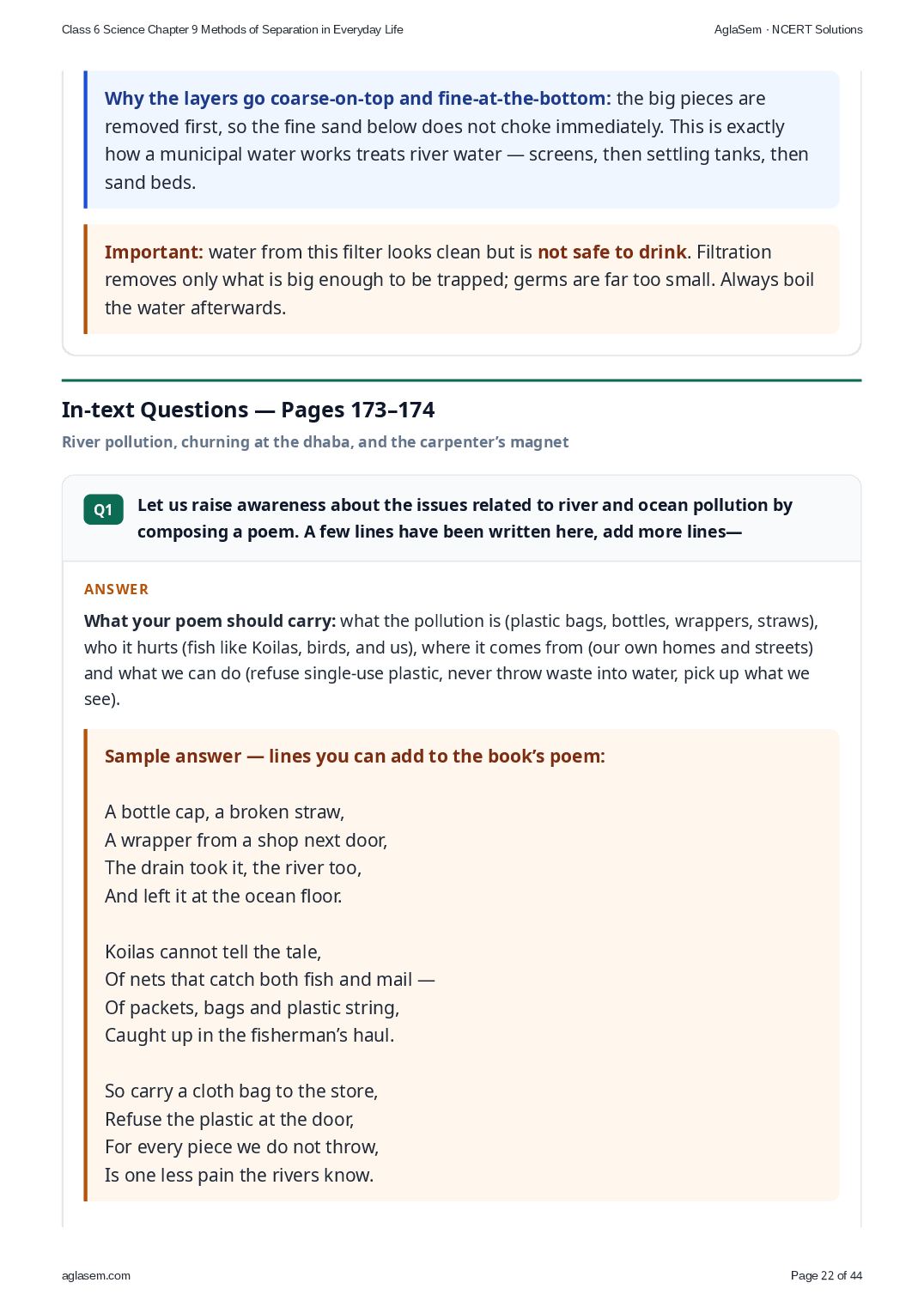
- Let us raise awareness about the issues related to river and ocean pollution by composing a poem. A few lines have been written here, add more lines—
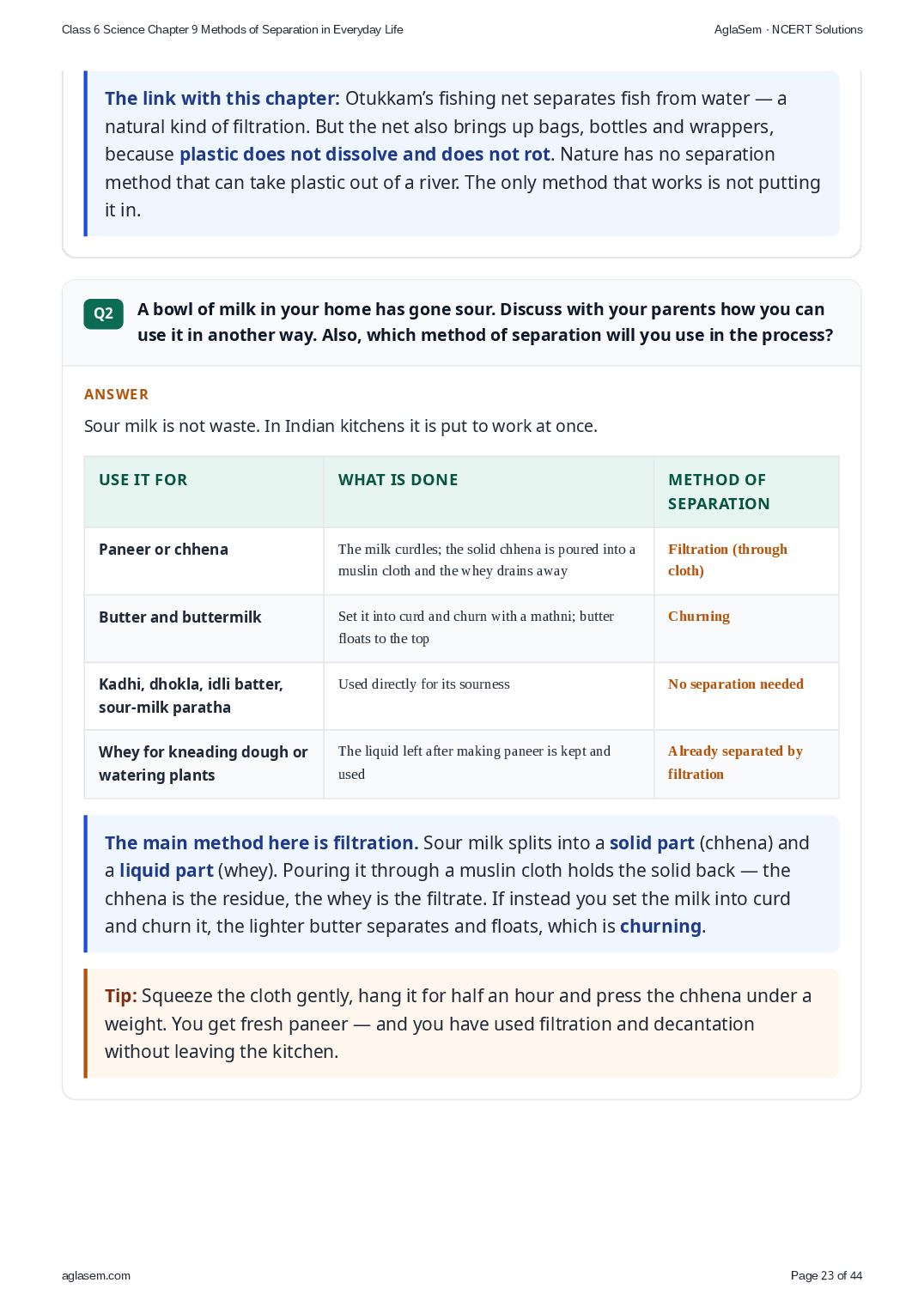
- A bowl of milk in your home has gone sour. Discuss with your parents how you can use it in another way. Also, which method of separation will you use in the process?
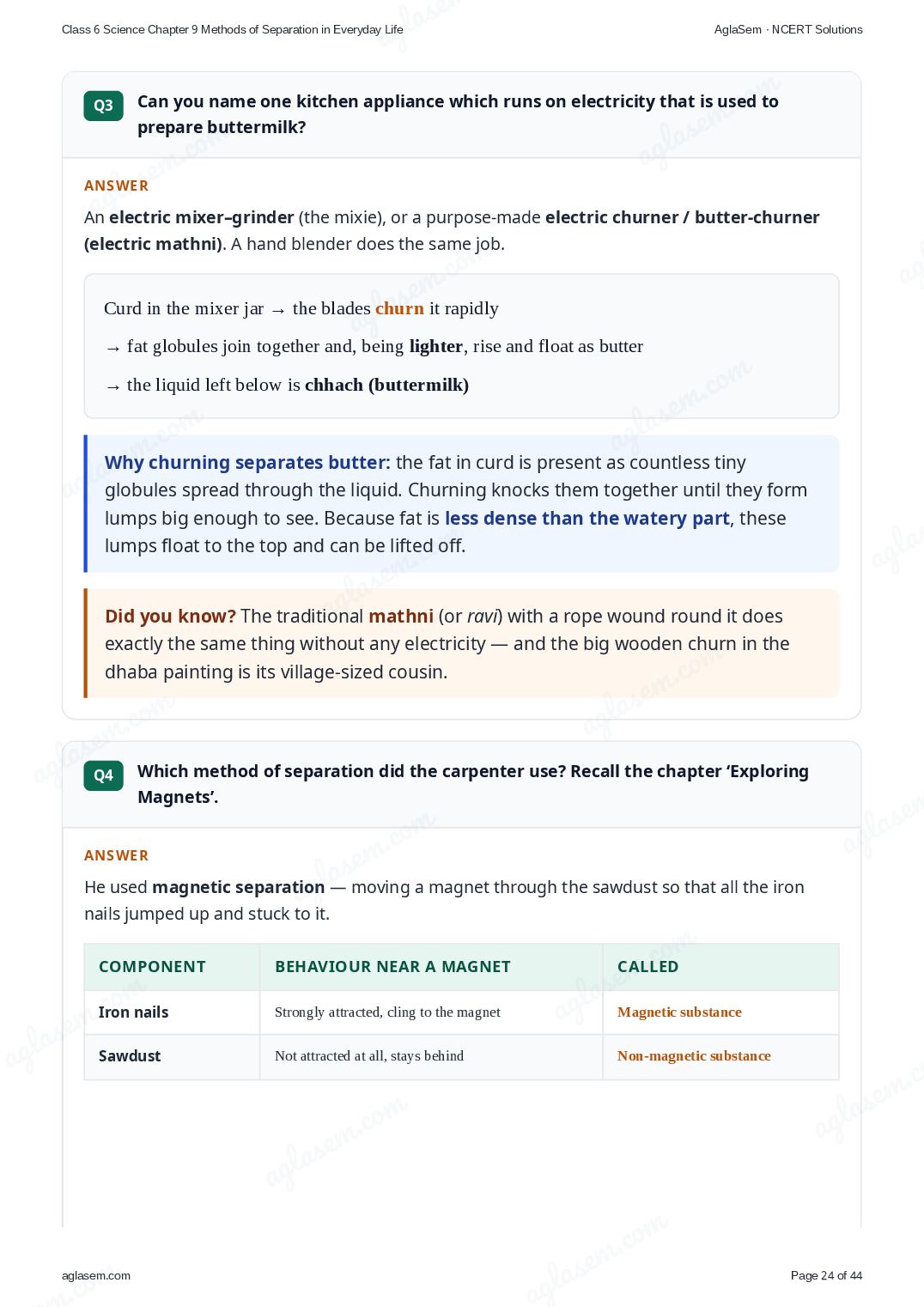
- Can you name one kitchen appliance which runs on electricity that is used to prepare buttermilk?
- Which method of separation did the carpenter use? Recall the chapter ‘Exploring Magnets’.
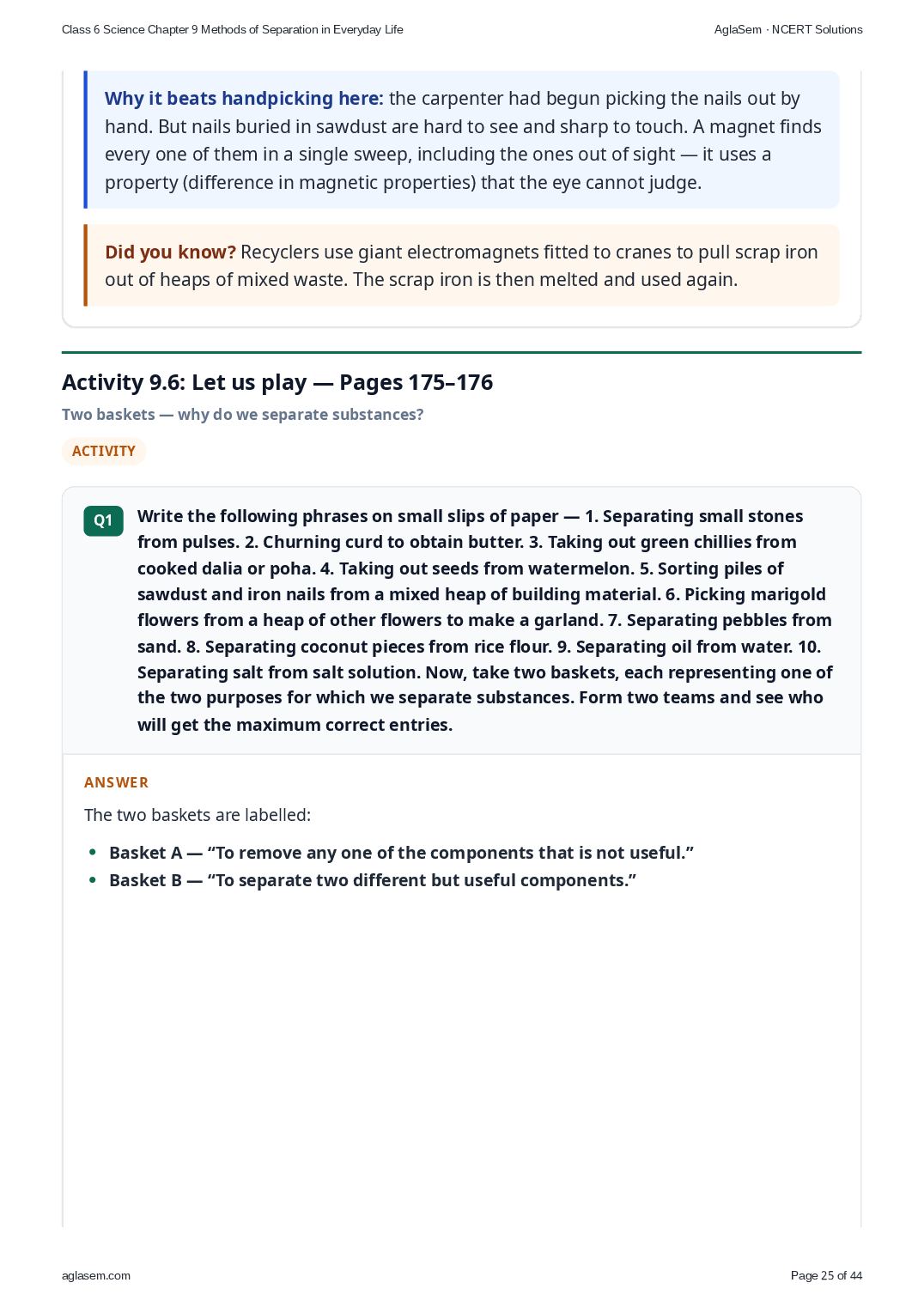
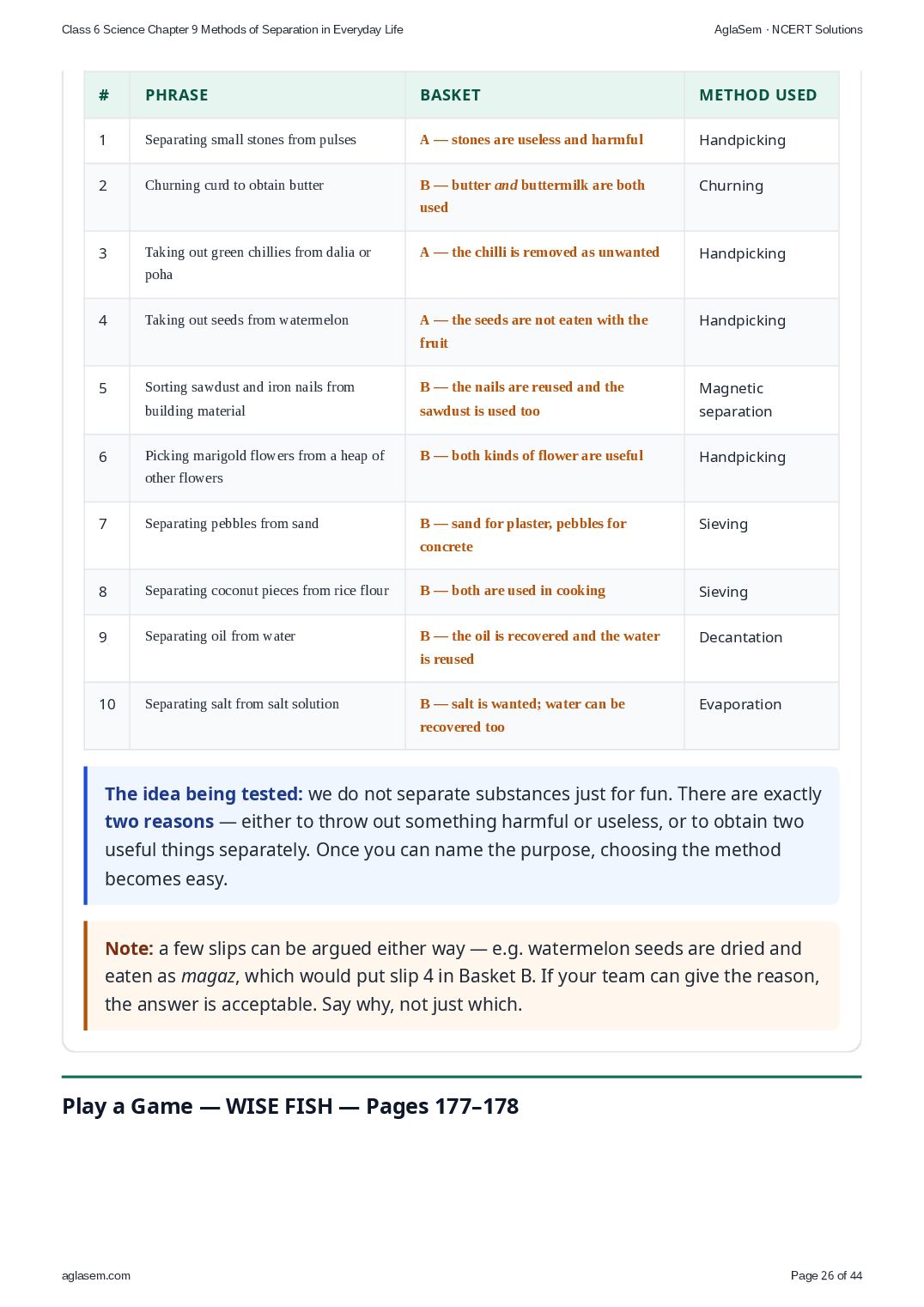
- Write the following phrases on small slips of paper — 1. Separating small stones from pulses. 2. Churning curd to obtain butter. 3. Taking out green chillies from cooked dalia or poha. 4. Taking out seeds from watermelon. 5. Sorting piles of sawdust and iron nails from a mixed heap of building material. 6. Picking marigold flowers from a heap of other flowers to make a garland. 7. Separating pebbles from sand. 8. Separating coconut pieces from rice flour. 9. Separating oil from water. 10. Separating salt from salt solution. Now, take two baskets, each representing one of the two purposes for which we separate substances. Form two teams and see who will get the maximum correct entries.
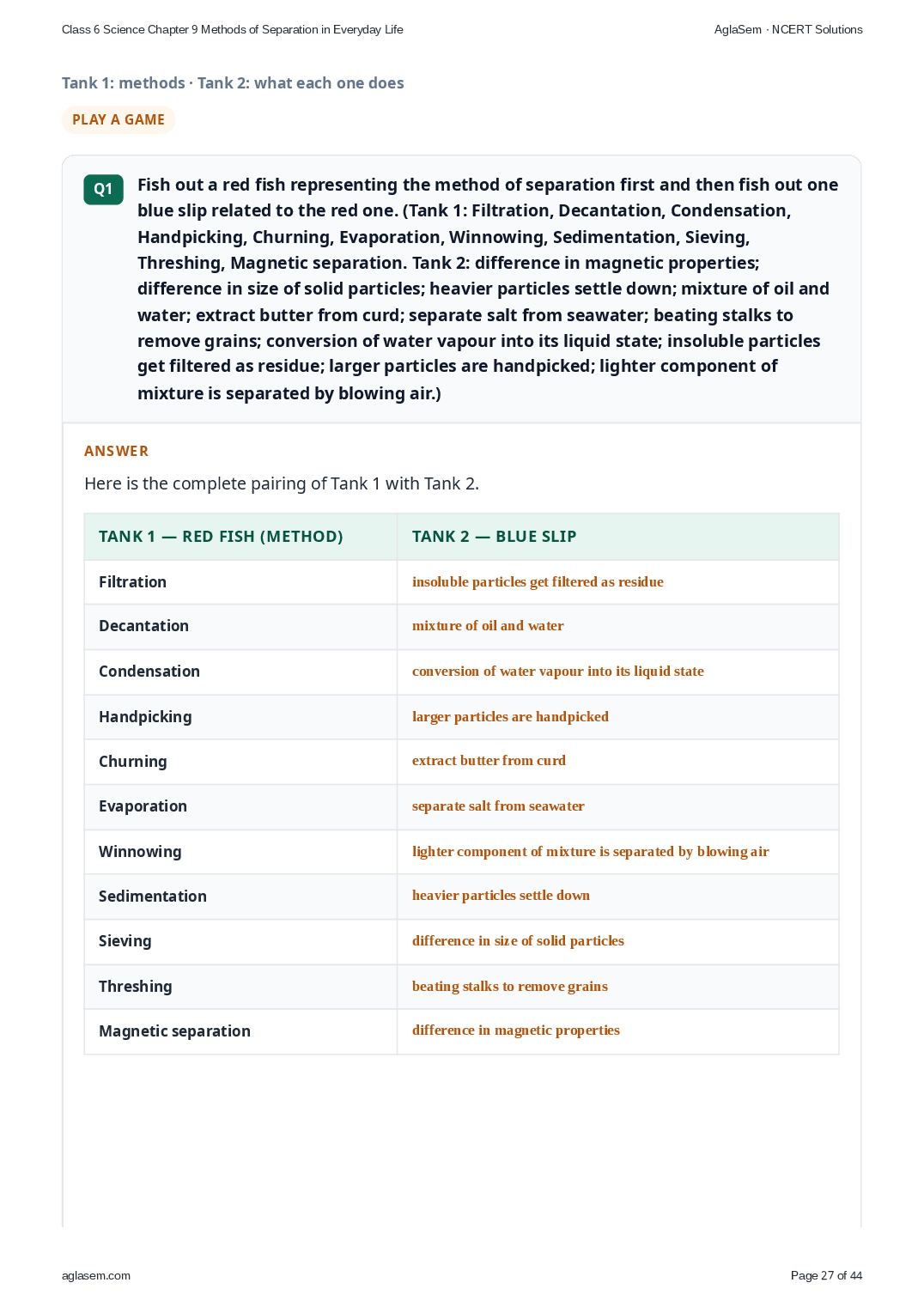
- Fish out a red fish representing the method of separation first and then fish out one blue slip related to the red one. (Tank 1: Filtration, Decantation, Condensation, Handpicking, Churning, Evaporation, Winnowing, Sedimentation, Sieving, Threshing, Magnetic separation. Tank 2: difference in magnetic properties; difference in size of solid particles; heavier particles settle down; mixture of oil and water; extract butter from curd; separate salt from seawater; beating stalks to remove grains; conversion of water vapour into its liquid state; insoluble particles get filtered as residue; larger particles are handpicked; lighter component of mixture is separated by blowing air.)
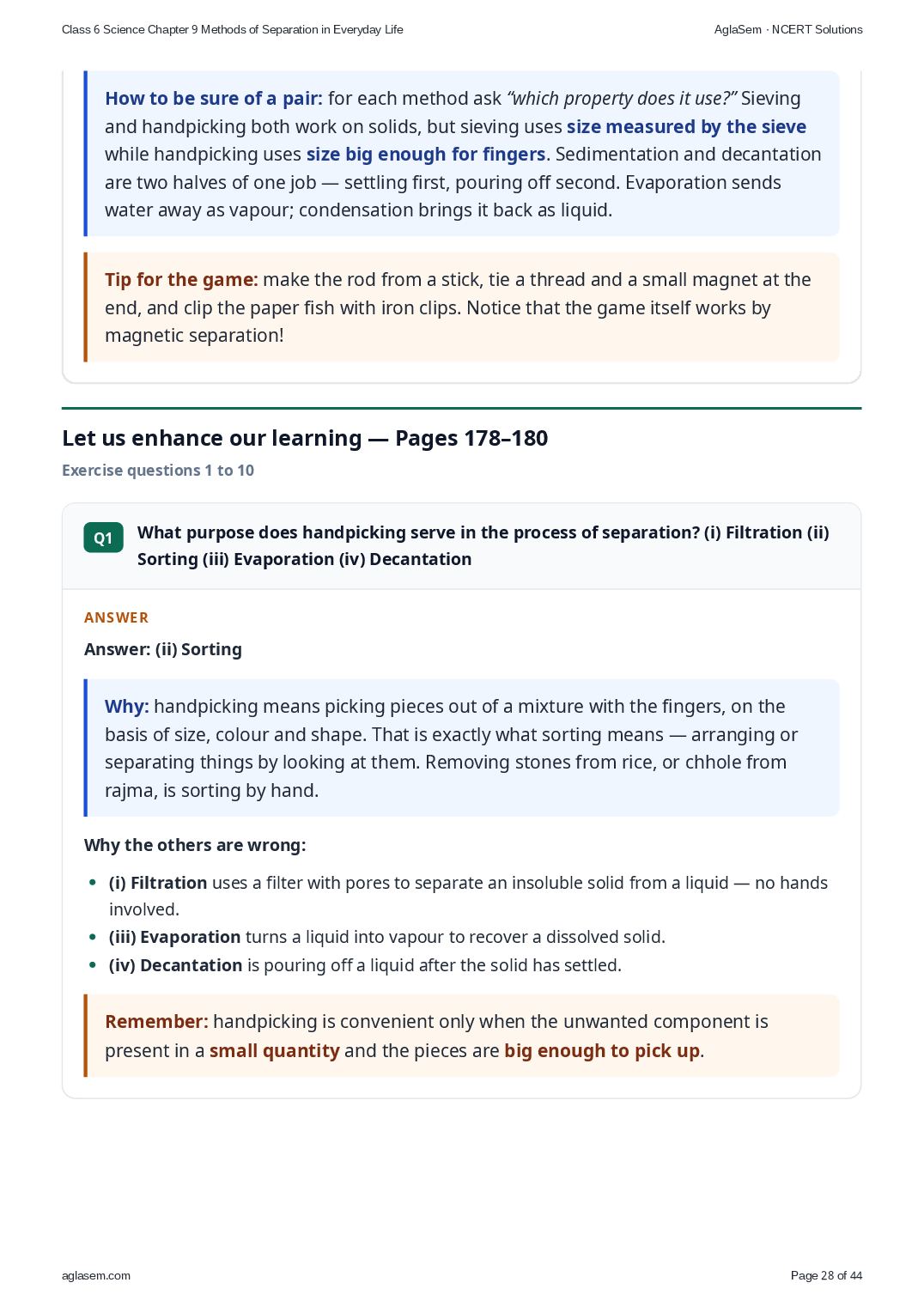
- What purpose does handpicking serve in the process of separation? (i) Filtration (ii) Sorting (iii) Evaporation (iv) Decantation
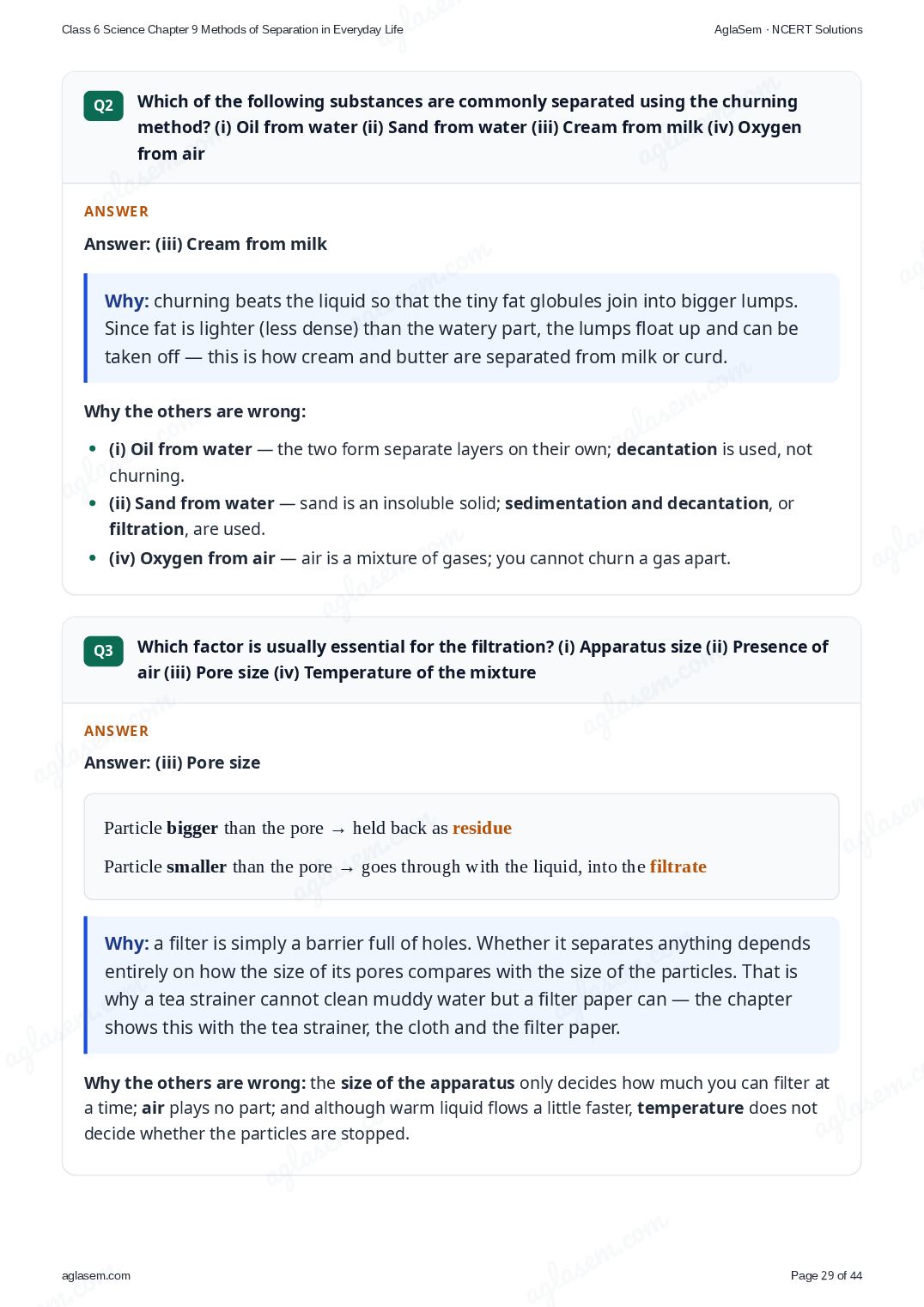
- Which of the following substances are commonly separated using the churning method? (i) Oil from water (ii) Sand from water (iii) Cream from milk (iv) Oxygen from air
- Which factor is usually essential for the filtration? (i) Apparatus size (ii) Presence of air (iii) Pore size (iv) Temperature of the mixture
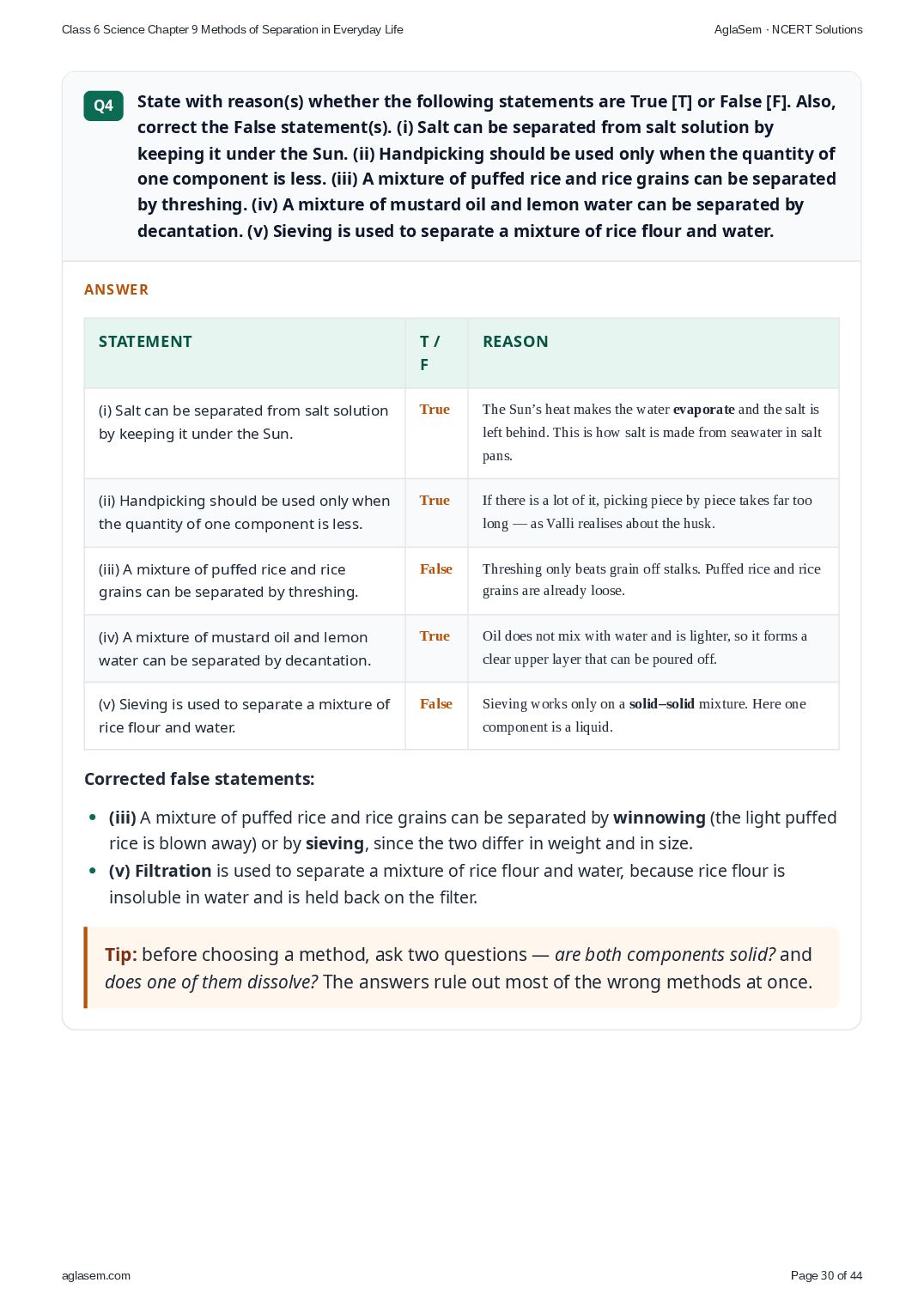
- State with reason(s) whether the following statements are True [T] or False [F]. Also, correct the False statement(s). (i) Salt can be separated from salt solution by keeping it under the Sun. (ii) Handpicking should be used only when the quantity of one component is less. (iii) A mixture of puffed rice and rice grains can be separated by threshing. (iv) A mixture of mustard oil and lemon water can be separated by decantation. (v) Sieving is used to separate a mixture of rice flour and water.
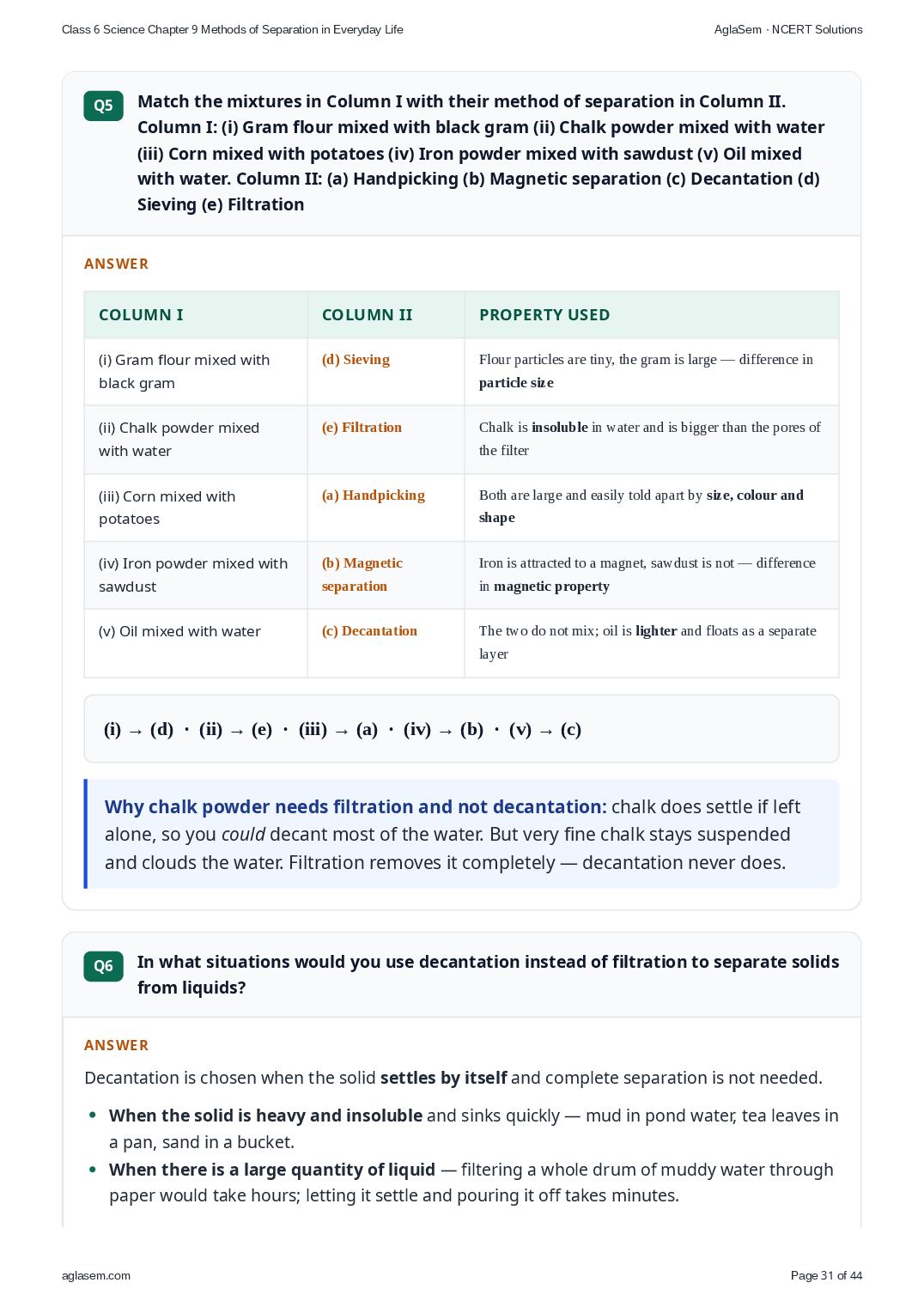
- Match the mixtures in Column I with their method of separation in Column II. Column I: (i) Gram flour mixed with black gram (ii) Chalk powder mixed with water (iii) Corn mixed with potatoes (iv) Iron powder mixed with sawdust (v) Oil mixed with water. Column II: (a) Handpicking (b) Magnetic separation (c) Decantation (d) Sieving (e) Filtration
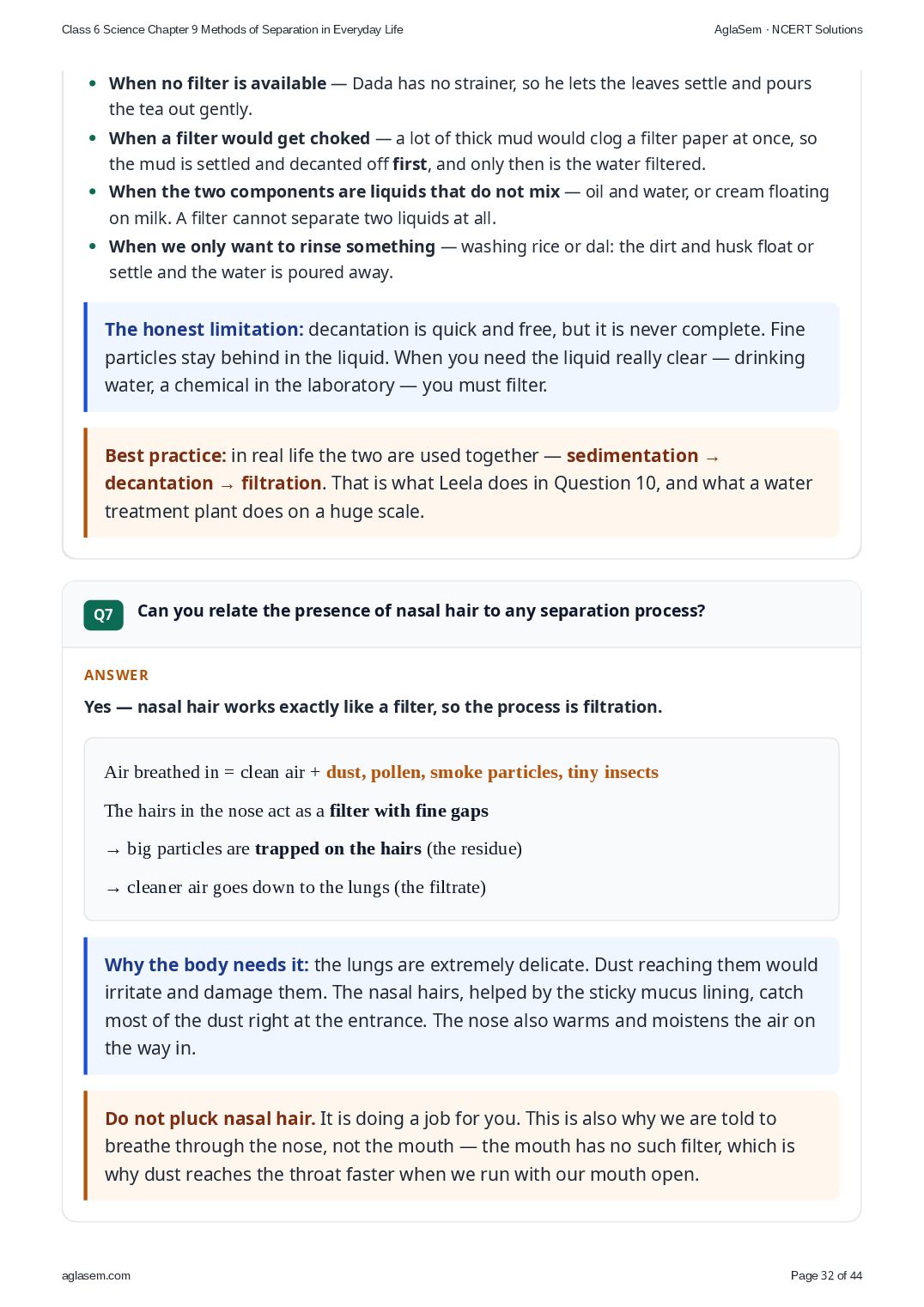
- In what situations would you use decantation instead of filtration to separate solids from liquids?
- Can you relate the presence of nasal hair to any separation process?
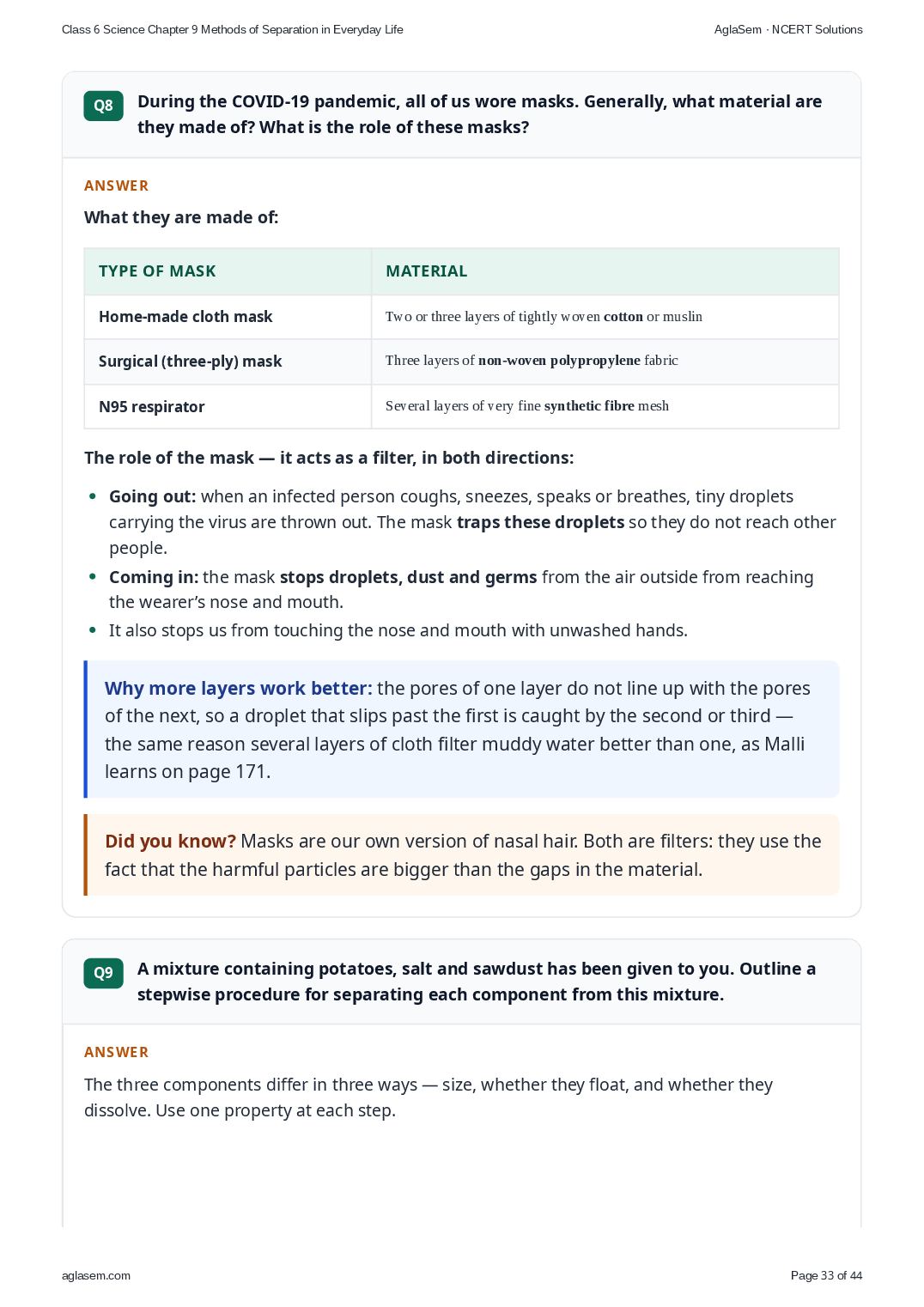
- During the COVID-19 pandemic, all of us wore masks. Generally, what material are they made of? What is the role of these masks?
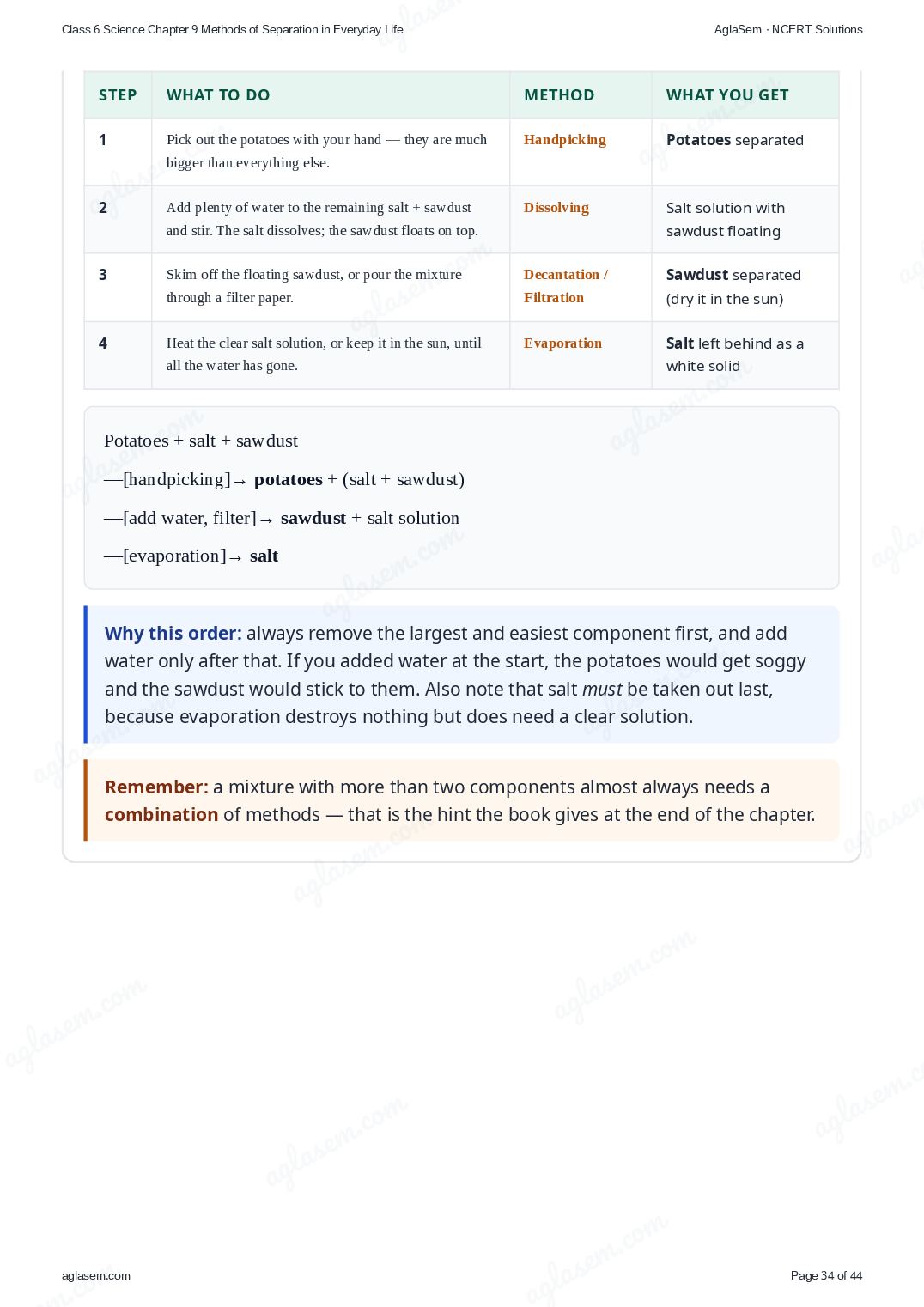
- A mixture containing potatoes, salt and sawdust has been given to you. Outline a stepwise procedure for separating each component from this mixture.
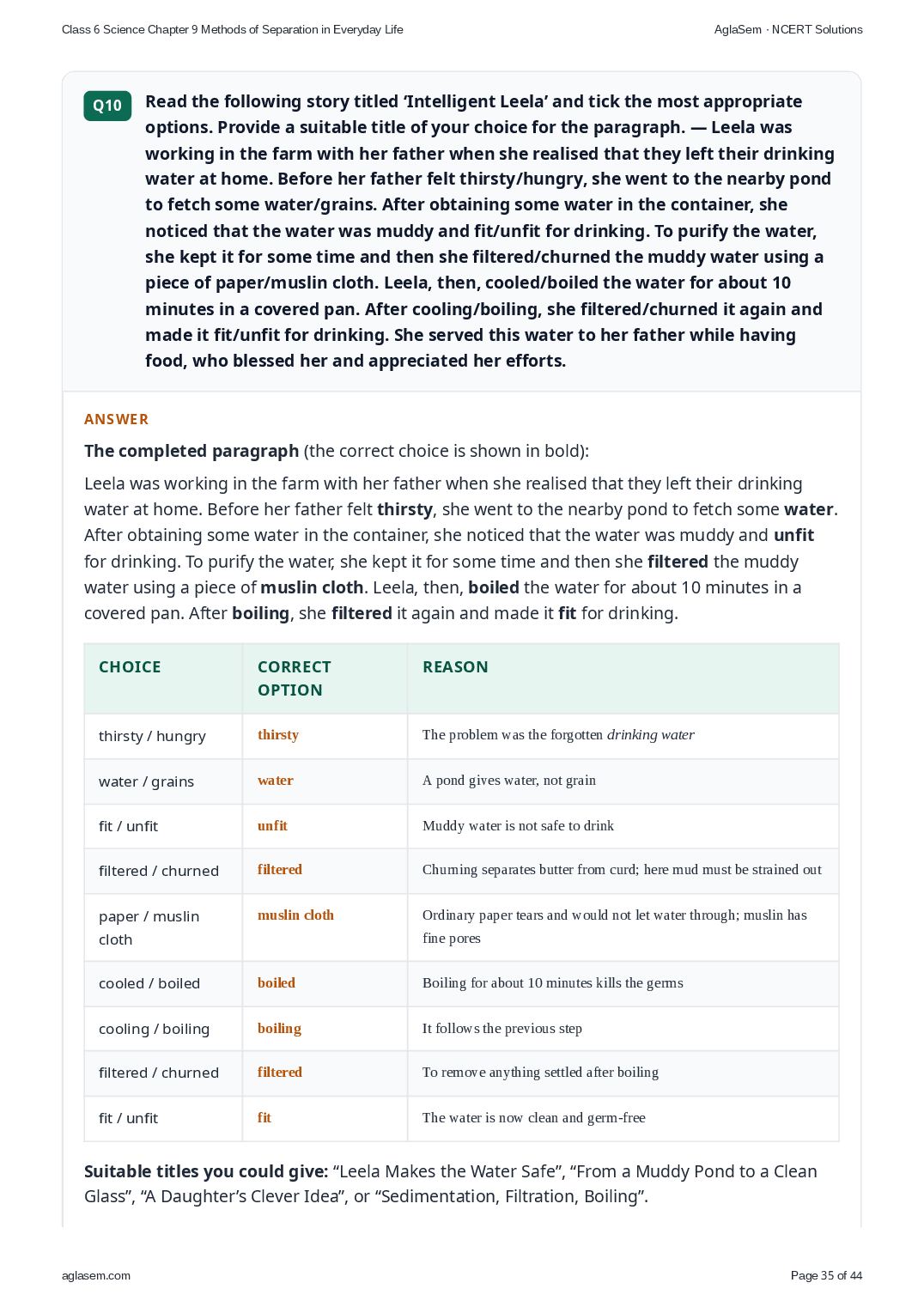
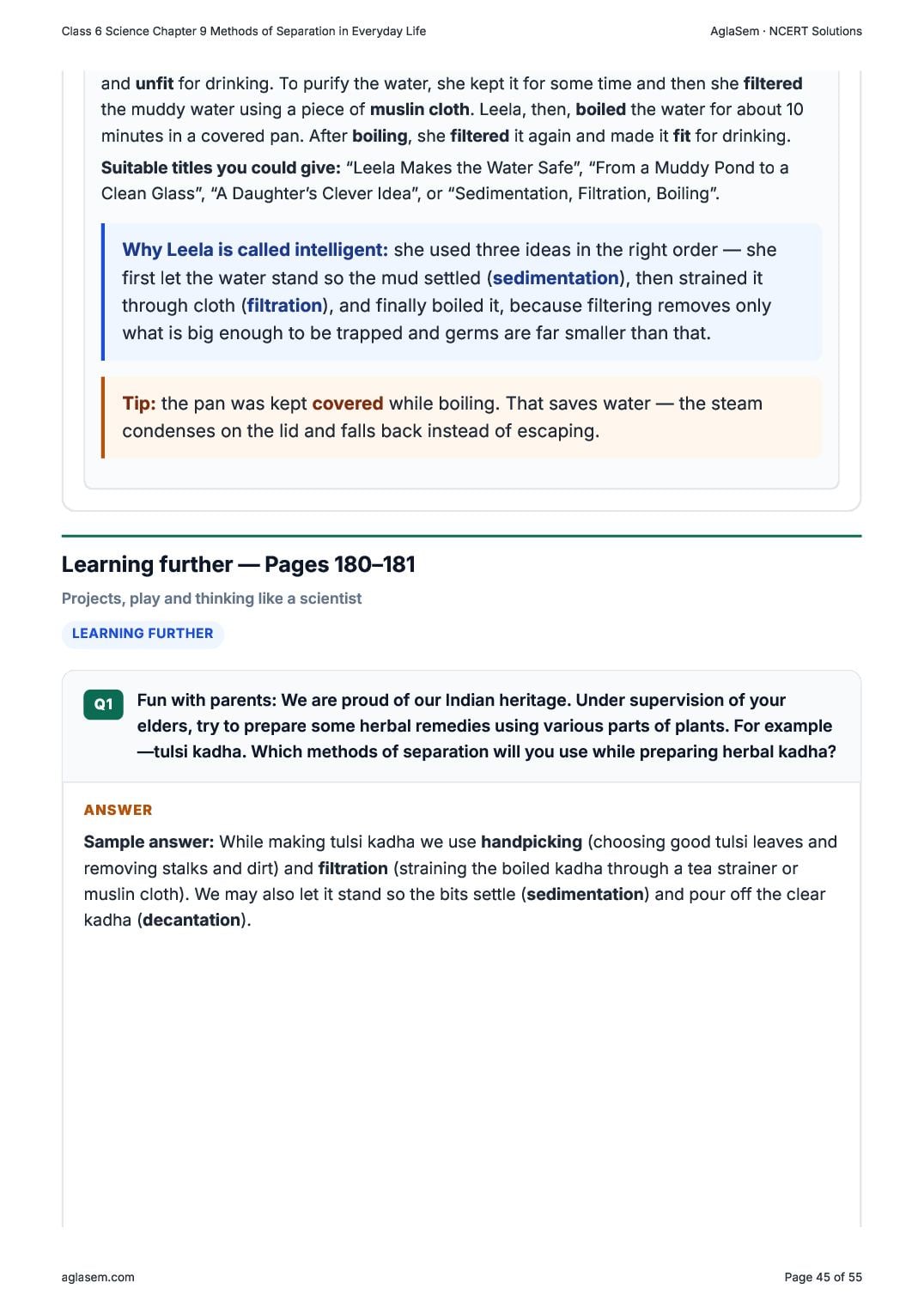
- Read the following story titled ‘Intelligent Leela’ and tick the most appropriate options. Provide a suitable title of your choice for the paragraph. — Leela was working in the farm with her father when she realised that they left their drinking water at home. Before her father felt thirsty/hungry, she went to the nearby pond to fetch some water/grains. After obtaining some water in the container, she noticed that the water was muddy and fit/unfit for drinking. To purify the water, she kept it for some time and then she filtered/churned the muddy water using a piece of paper/muslin cloth. Leela, then, cooled/boiled the water for about 10 minutes in a covered pan. After cooling/boiling, she filtered/churned it again and made it fit/unfit for drinking. She served this water to her father while having food, who blessed her and appreciated her efforts.
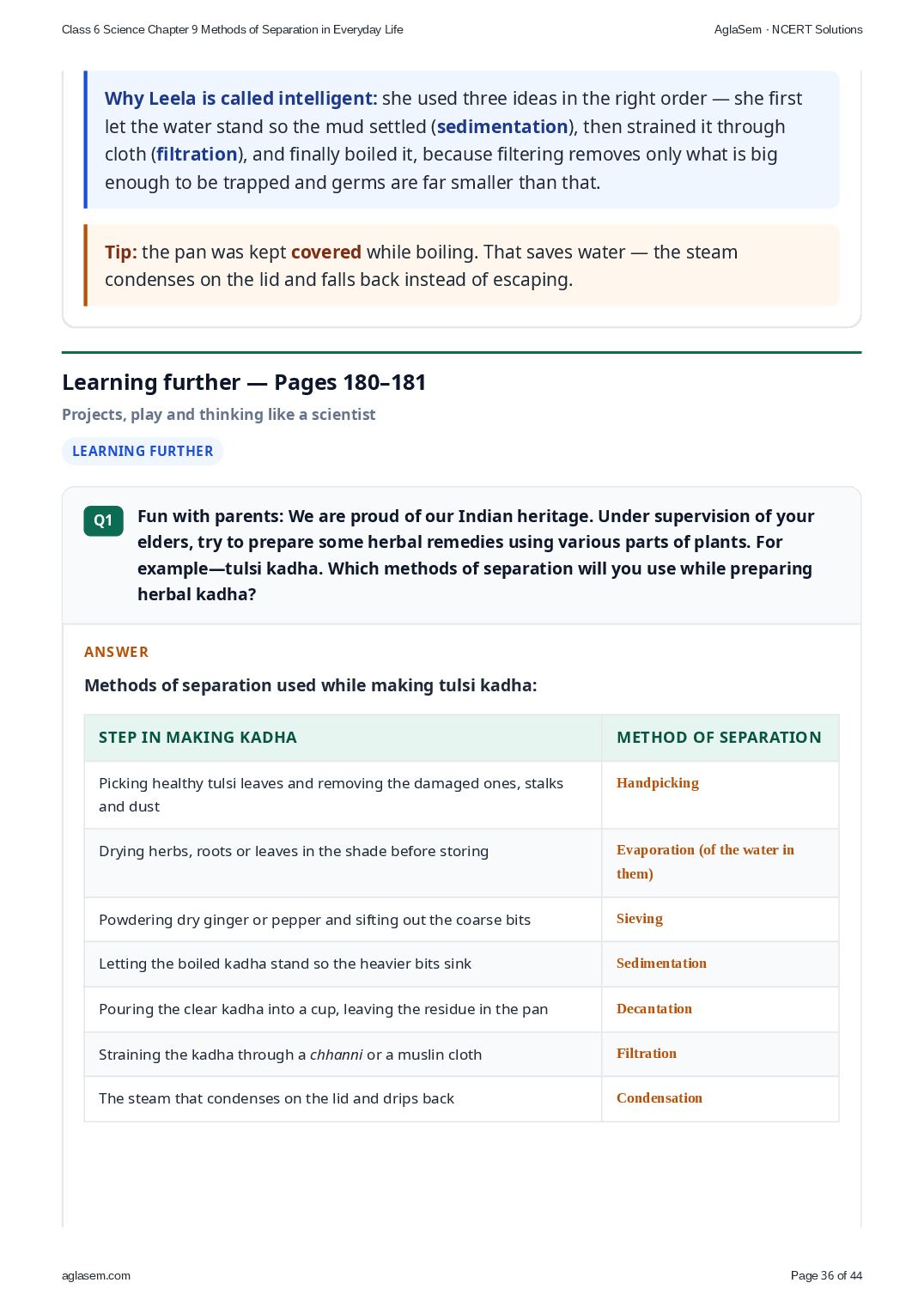
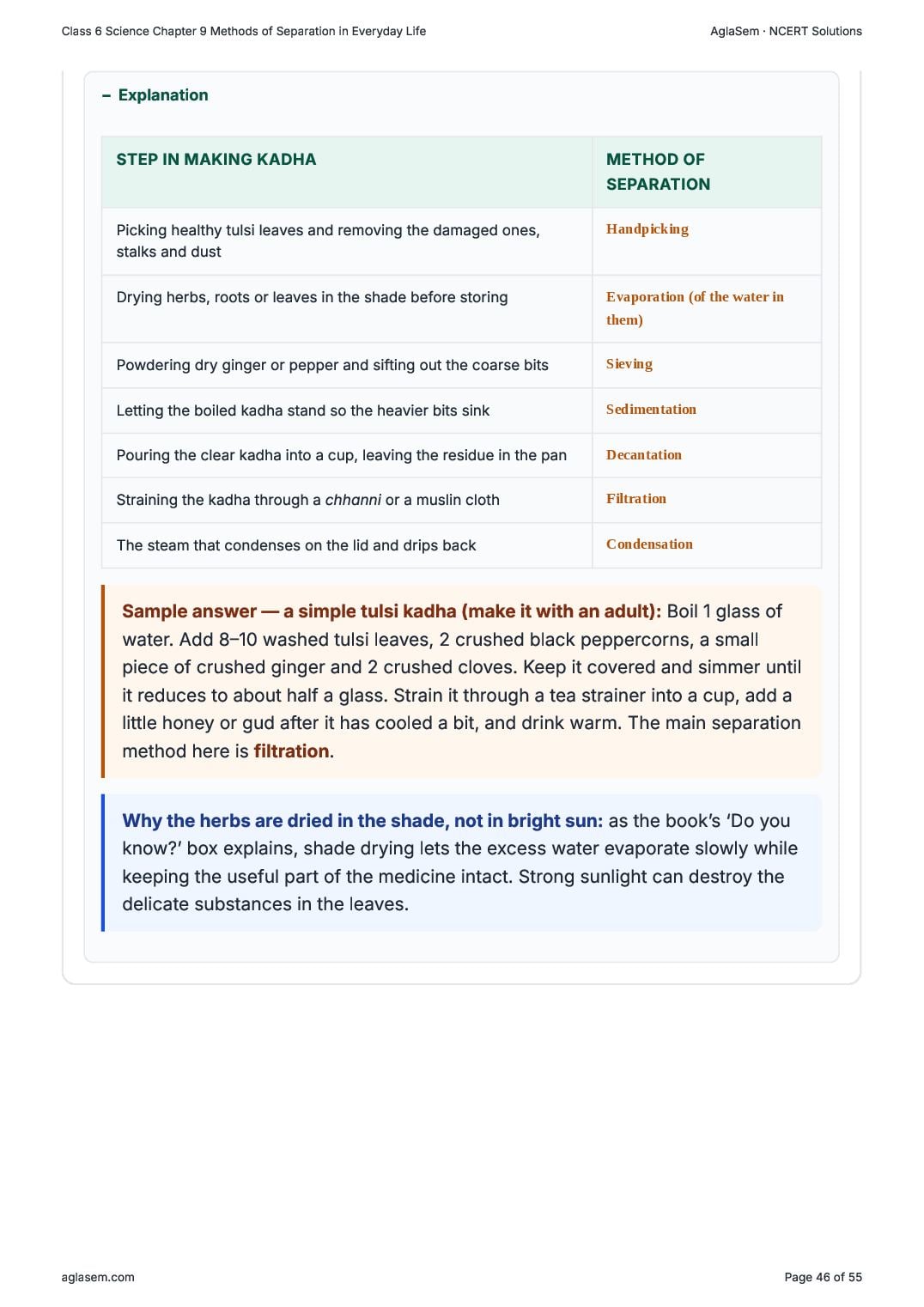
- Fun with parents: We are proud of our Indian heritage. Under supervision of your elders, try to prepare some herbal remedies using various parts of plants. For example—tulsi kadha. Which methods of separation will you use while preparing herbal kadha?
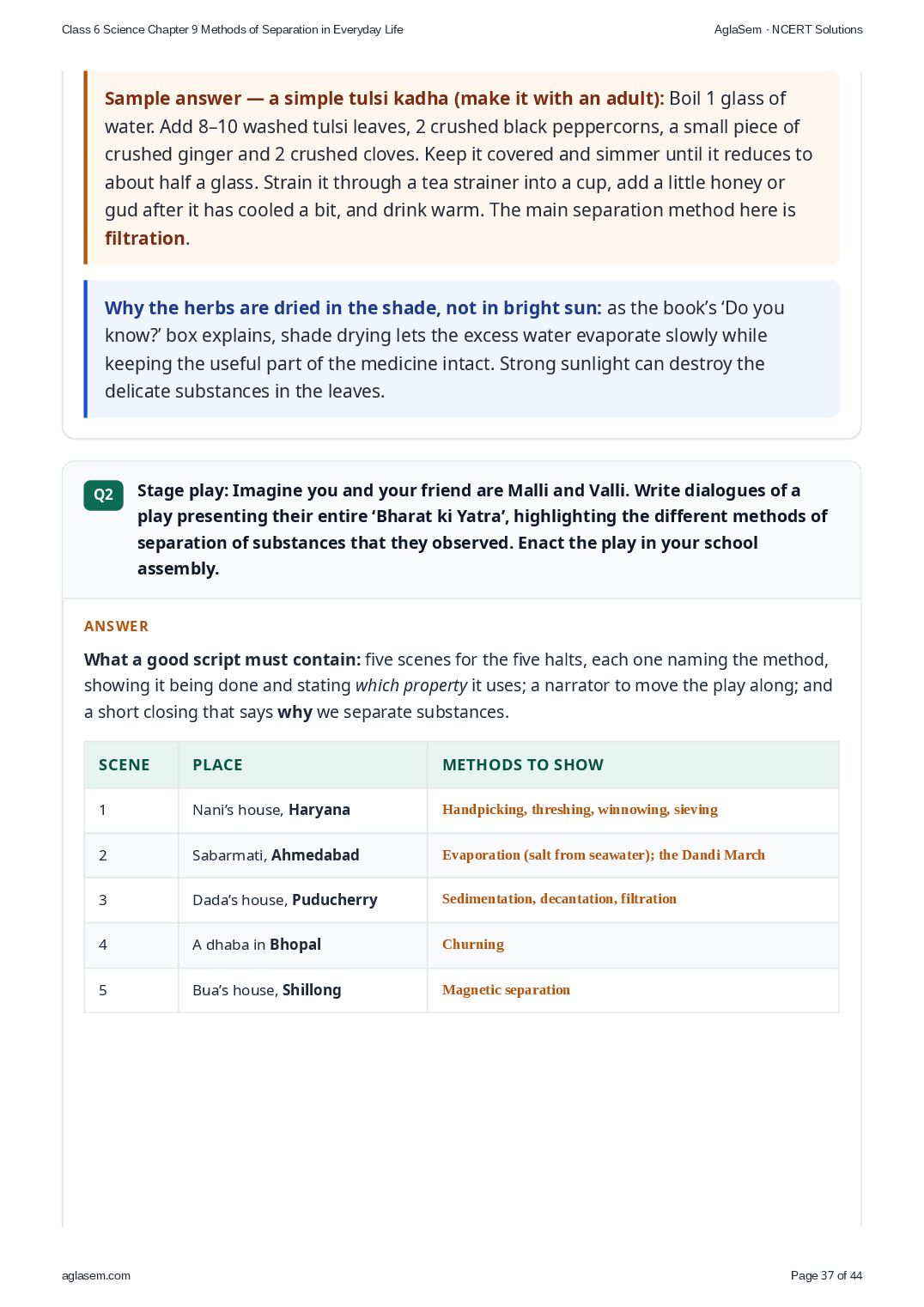
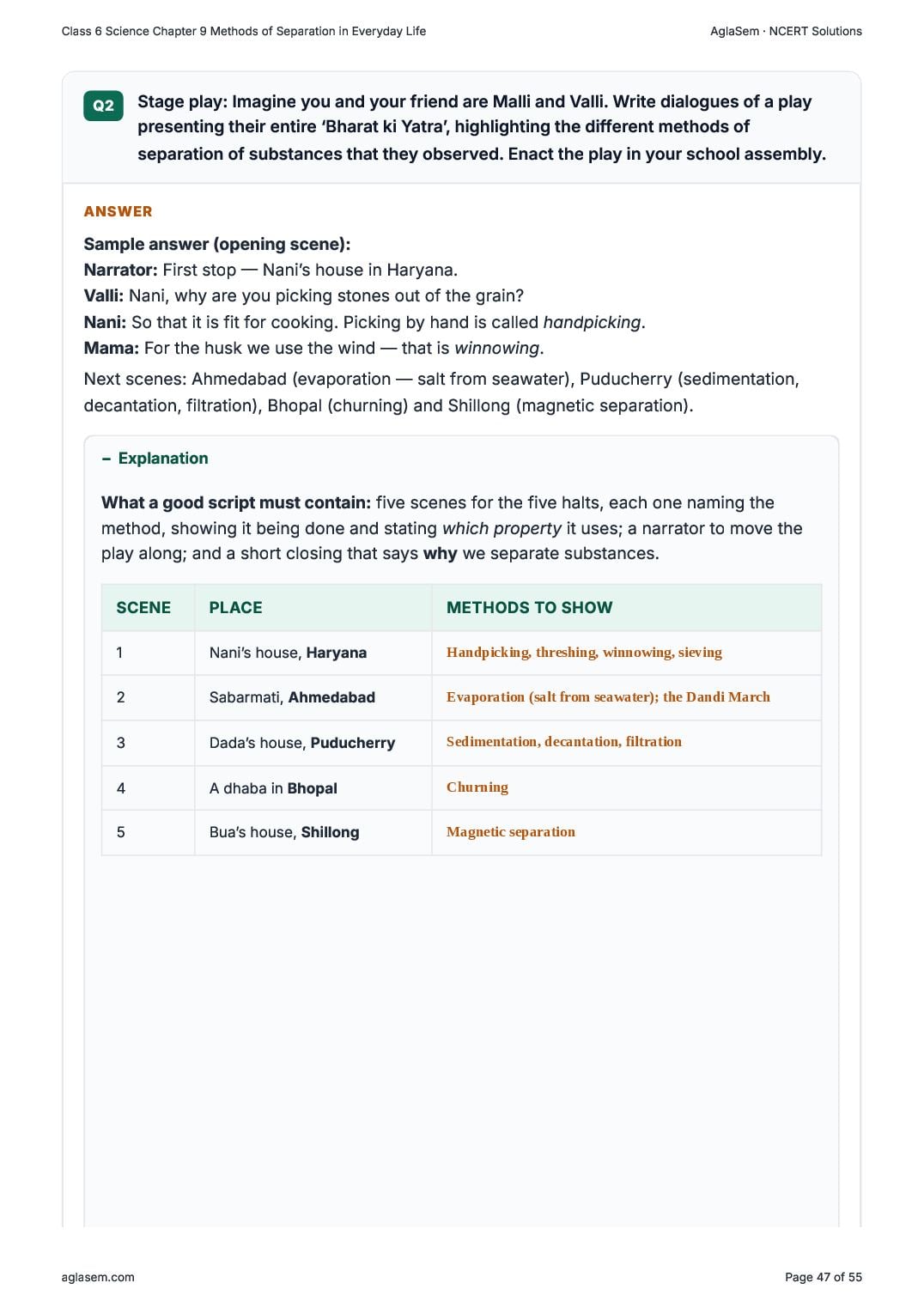
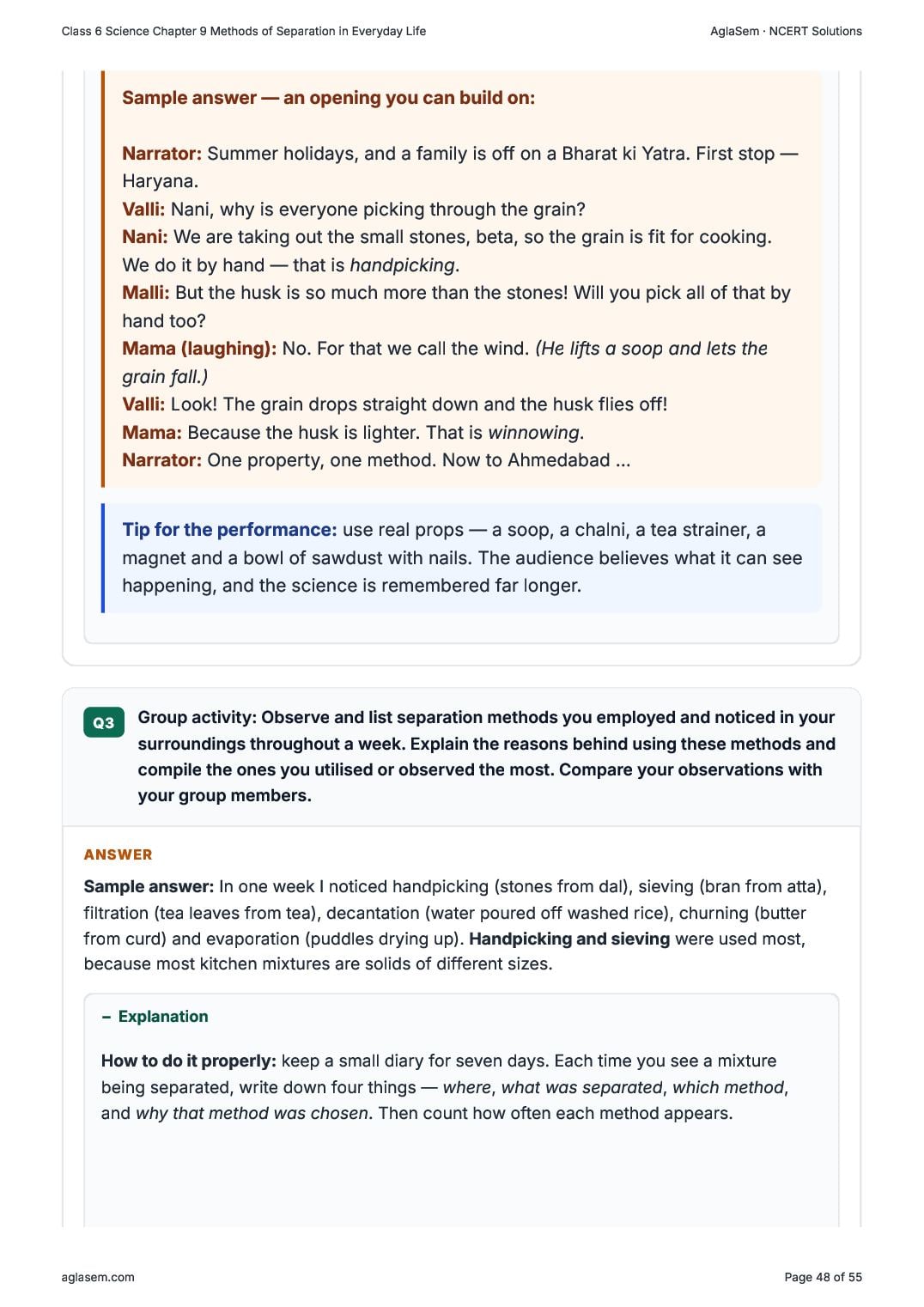
- Stage play: Imagine you and your friend are Malli and Valli. Write dialogues of a play presenting their entire ‘Bharat ki Yatra’, highlighting the different methods of separation of substances that they observed. Enact the play in your school assembly.
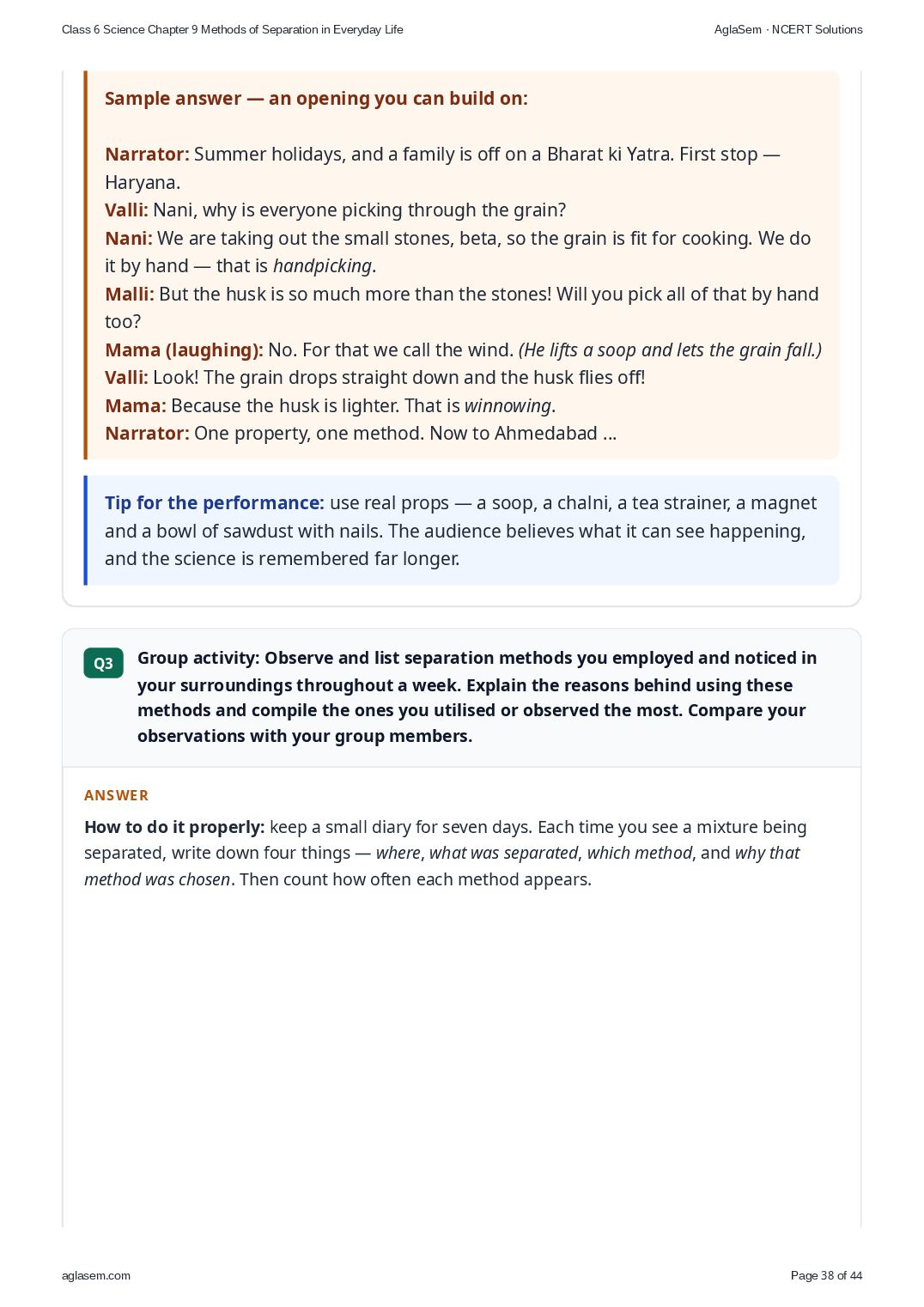
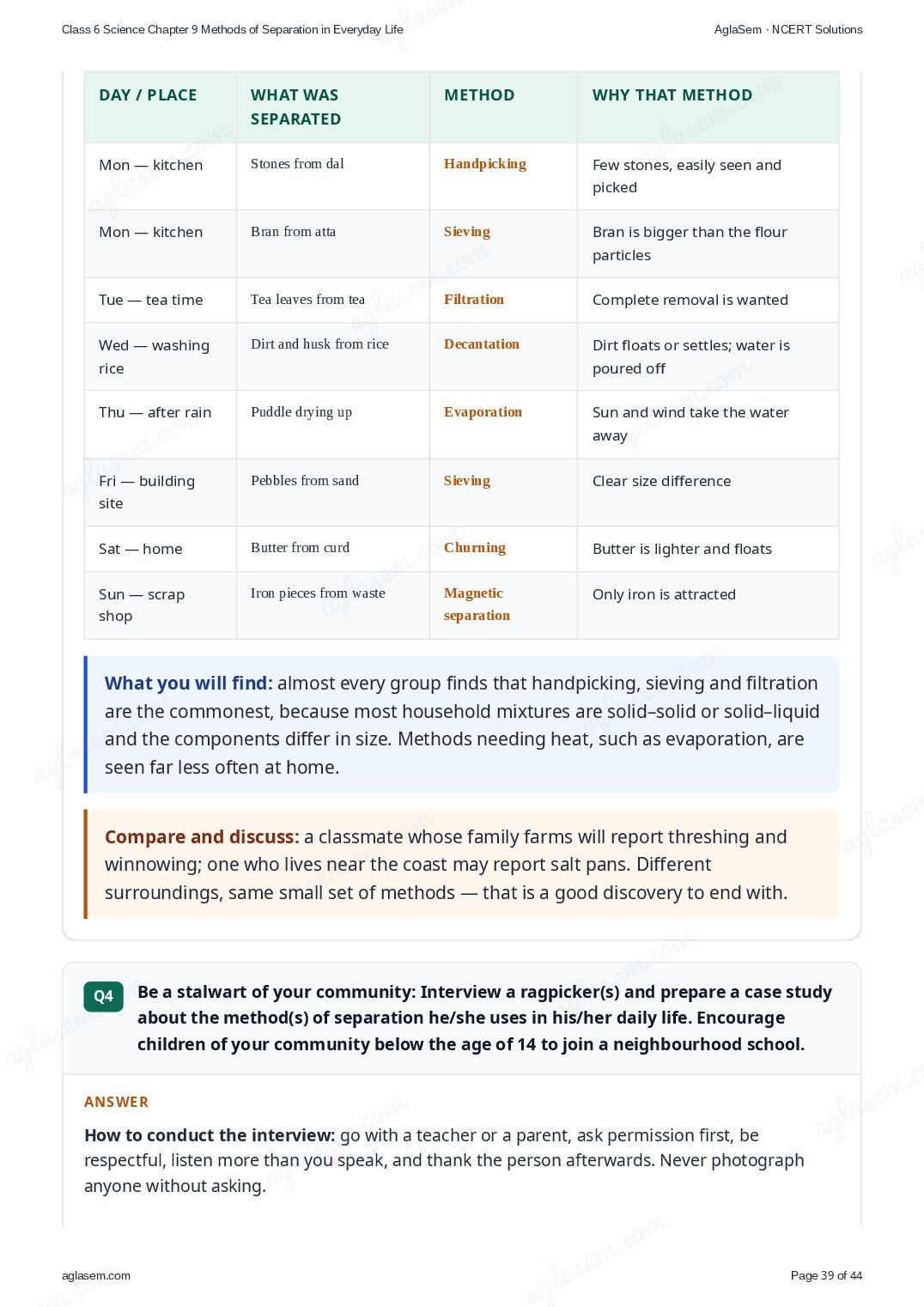
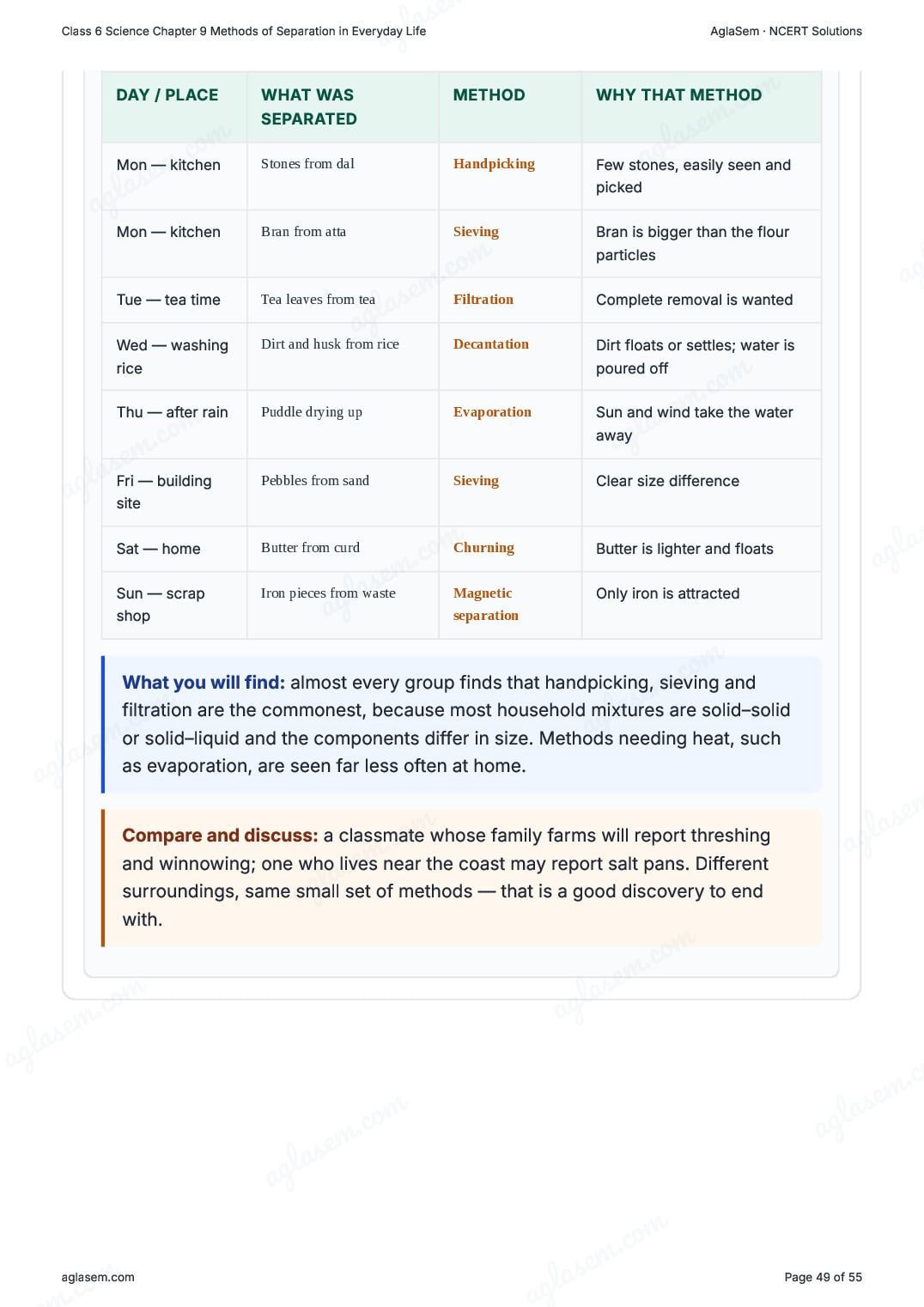
- Group activity: Observe and list separation methods you employed and noticed in your surroundings throughout a week. Explain the reasons behind using these methods and compile the ones you utilised or observed the most. Compare your observations with your group members.
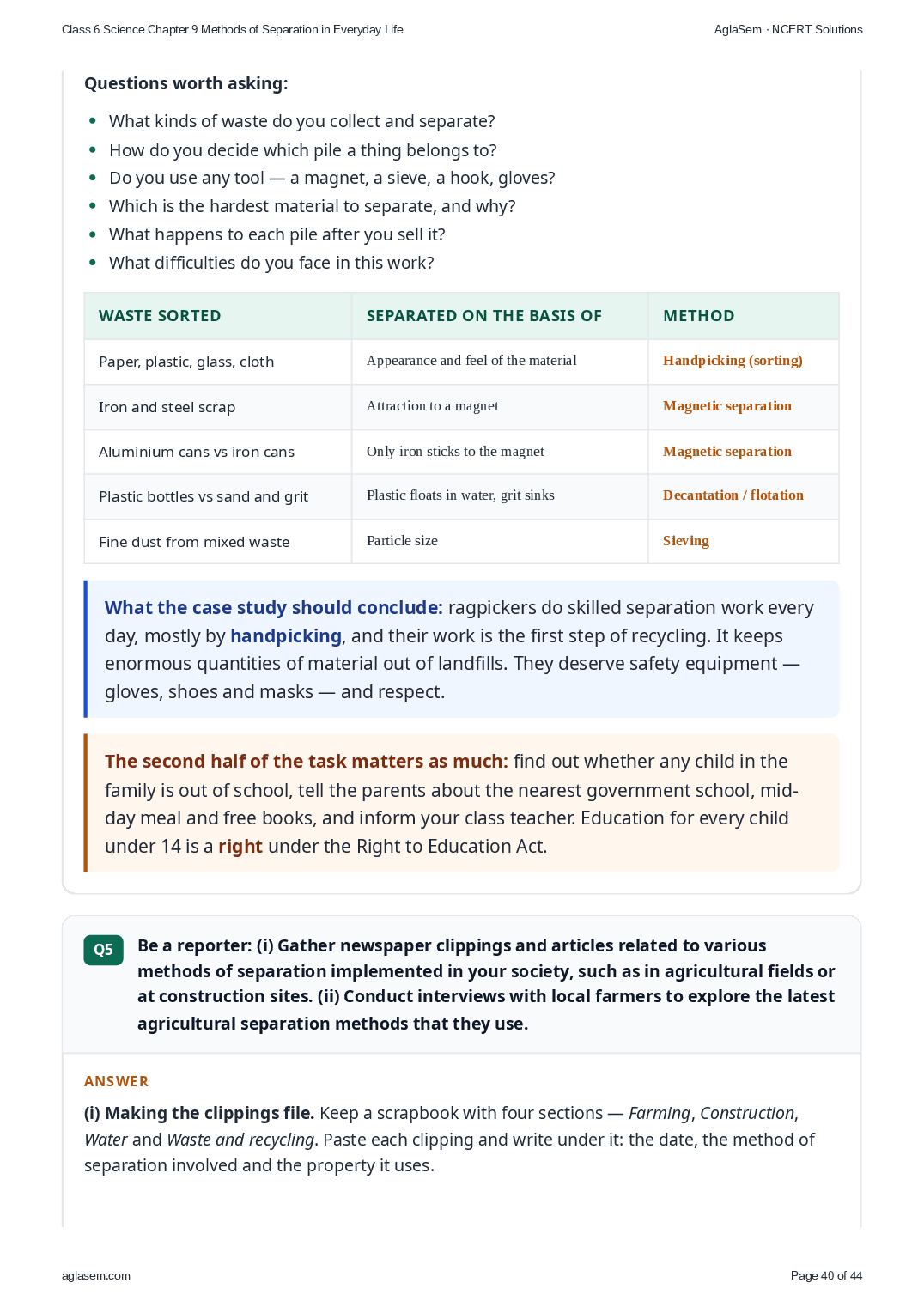
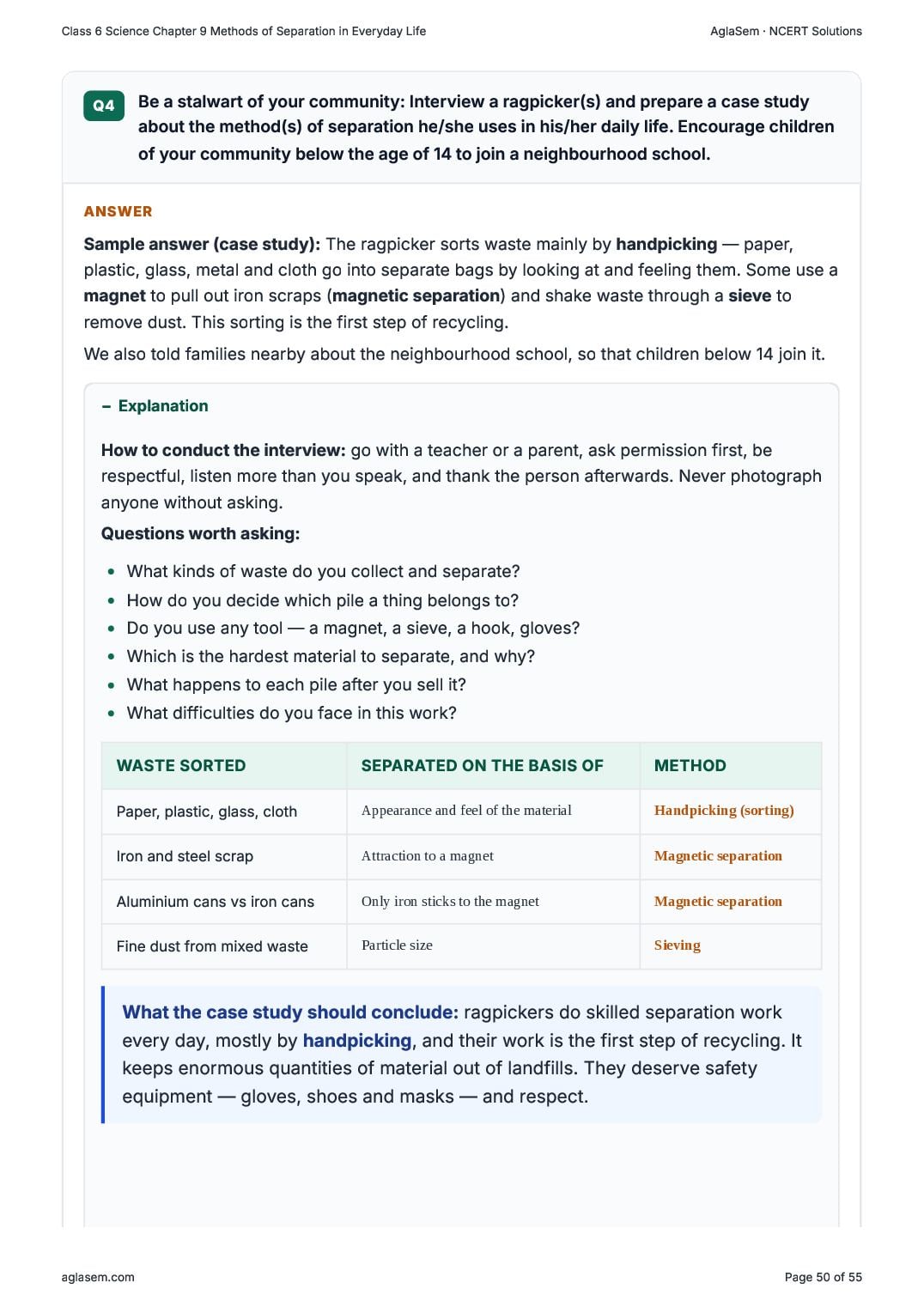
- Be a stalwart of your community: Interview a ragpicker(s) and prepare a case study about the method(s) of separation he/she uses in his/her daily life. Encourage children of your community below the age of 14 to join a neighbourhood school.
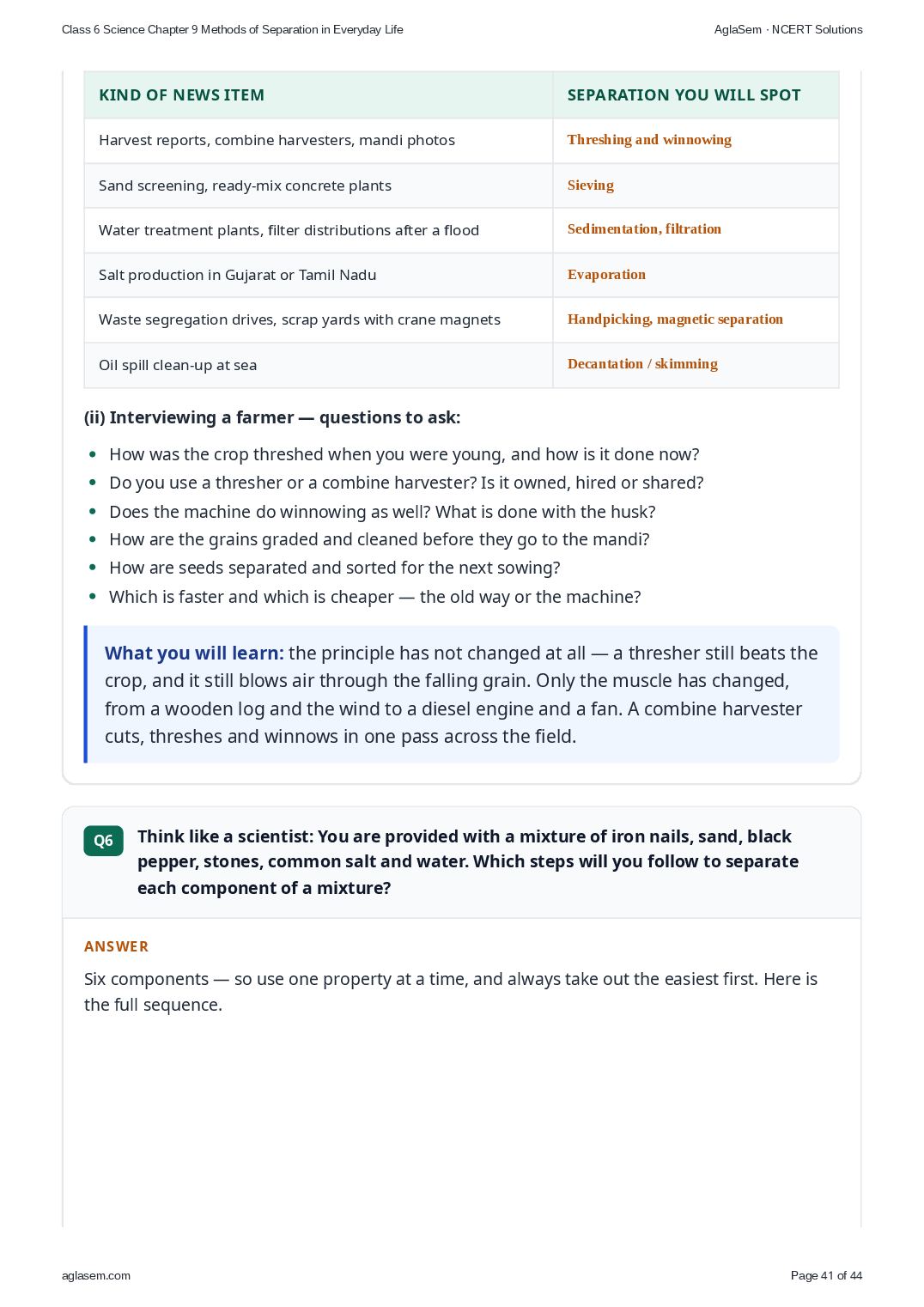
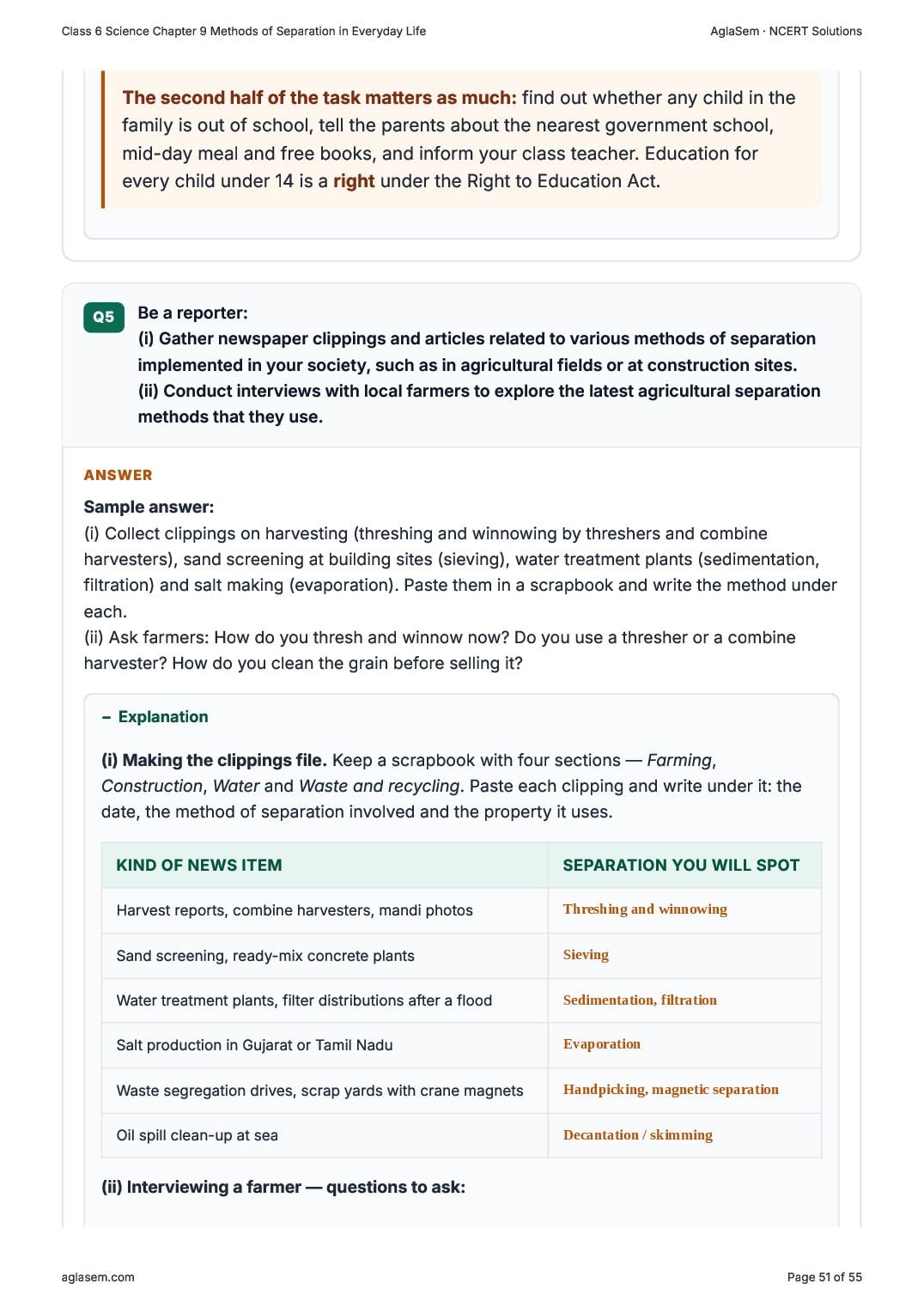
- Be a reporter: (i) Gather newspaper clippings and articles related to various methods of separation implemented in your society, such as in agricultural fields or at construction sites. (ii) Conduct interviews with local farmers to explore the latest agricultural separation methods that they use.
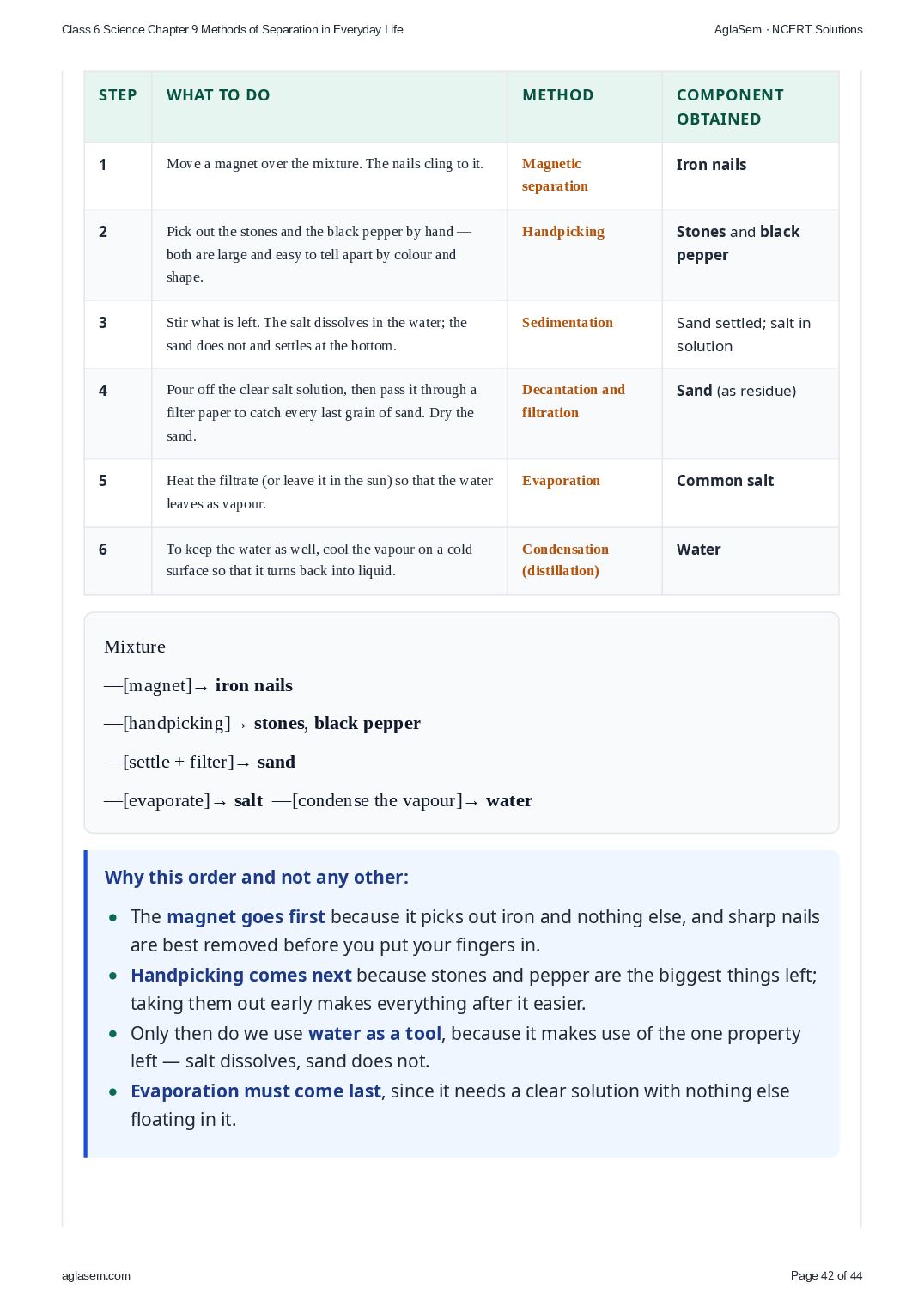
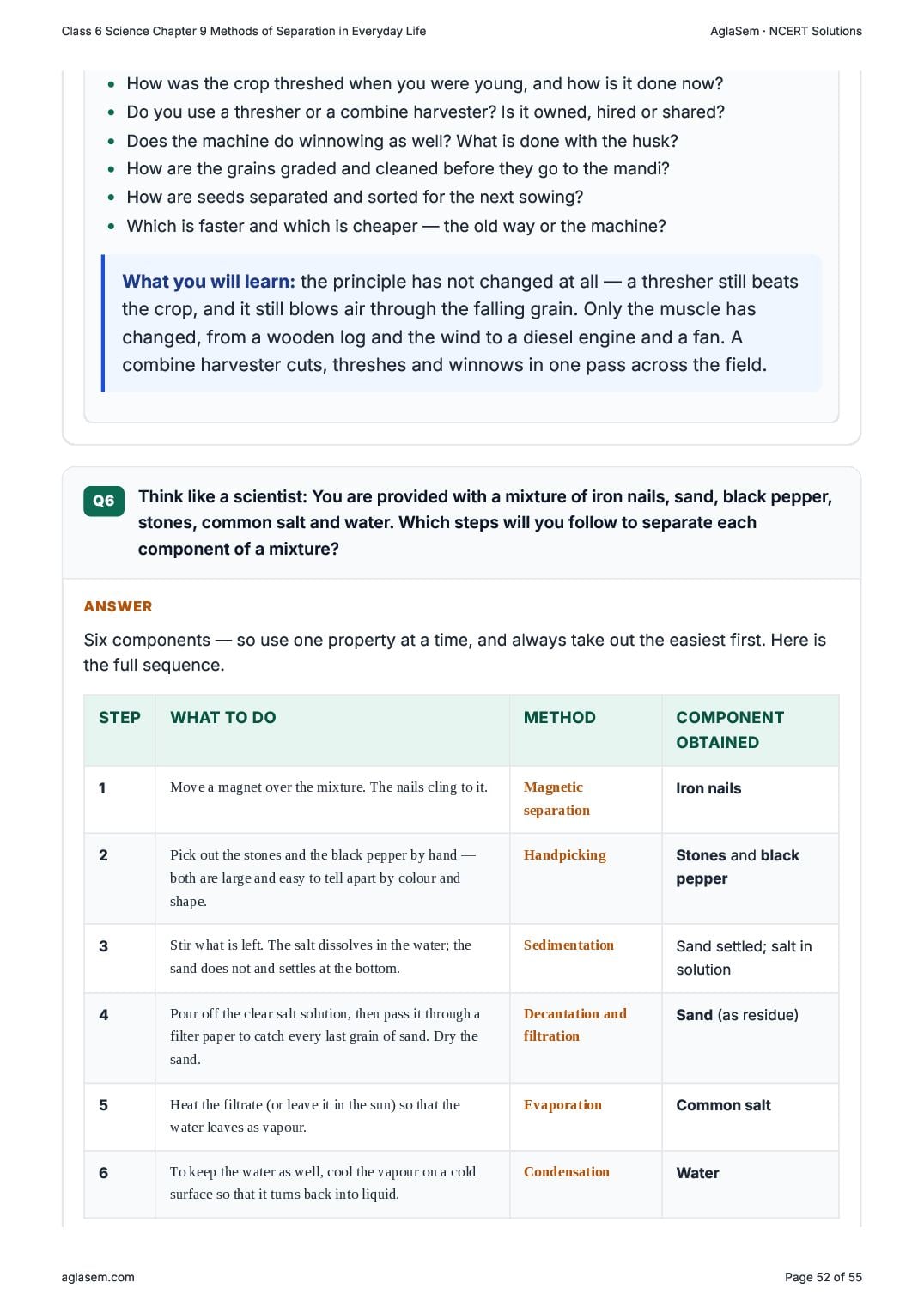
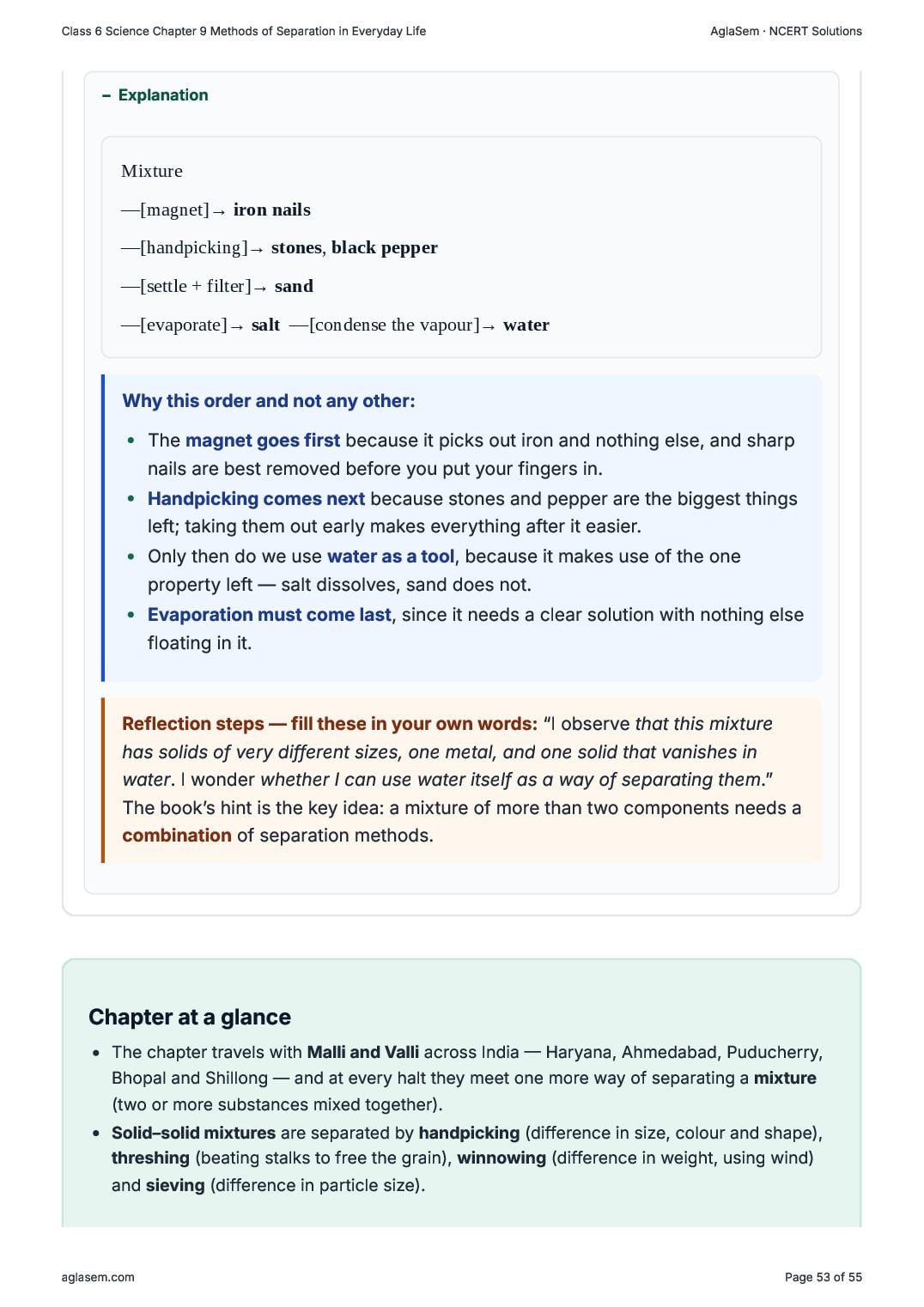
- Think like a scientist: You are provided with a mixture of iron nails, sand, black pepper, stones, common salt and water. Which steps will you follow to separate each component of a mixture?
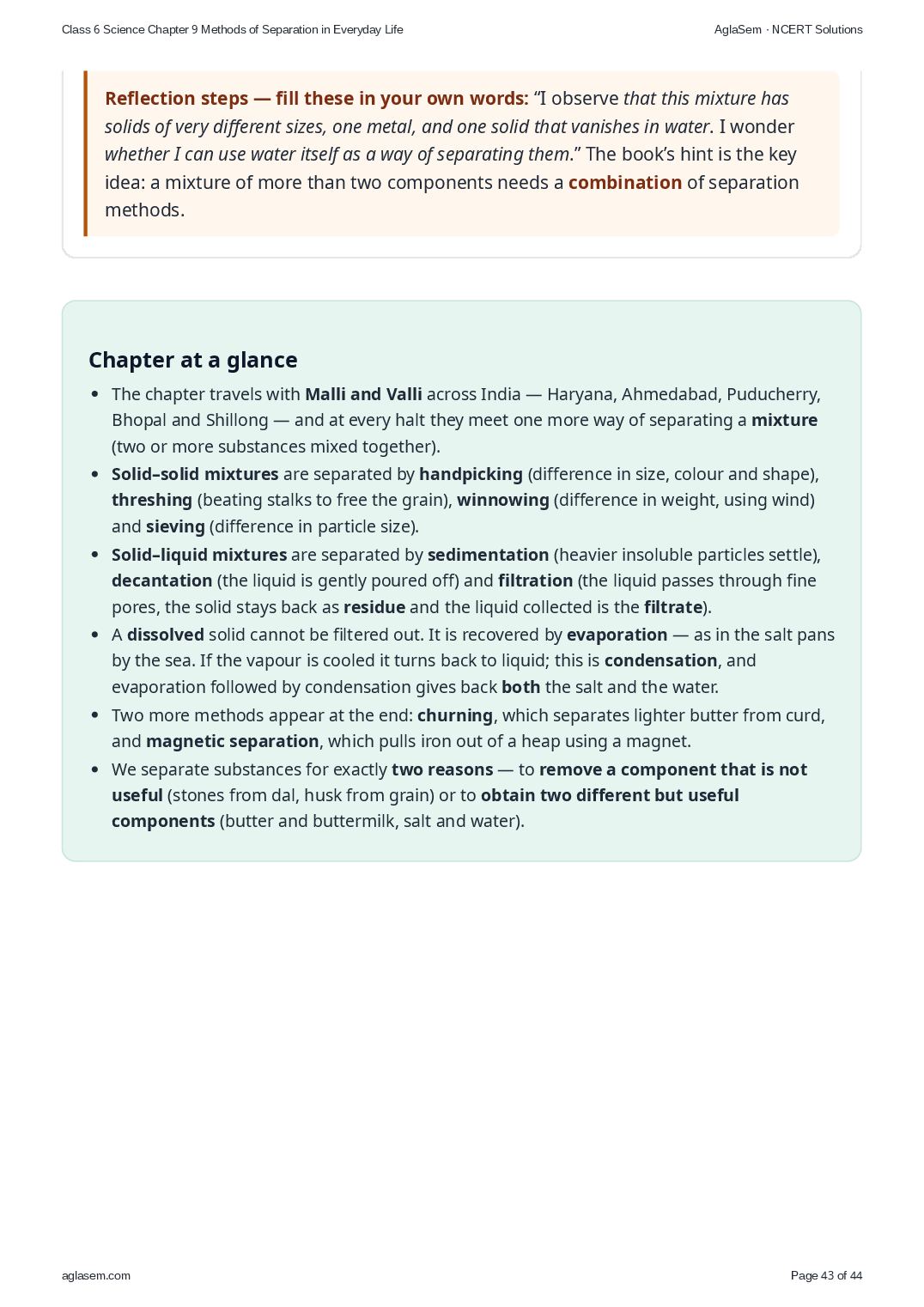
Chapter at a Glance
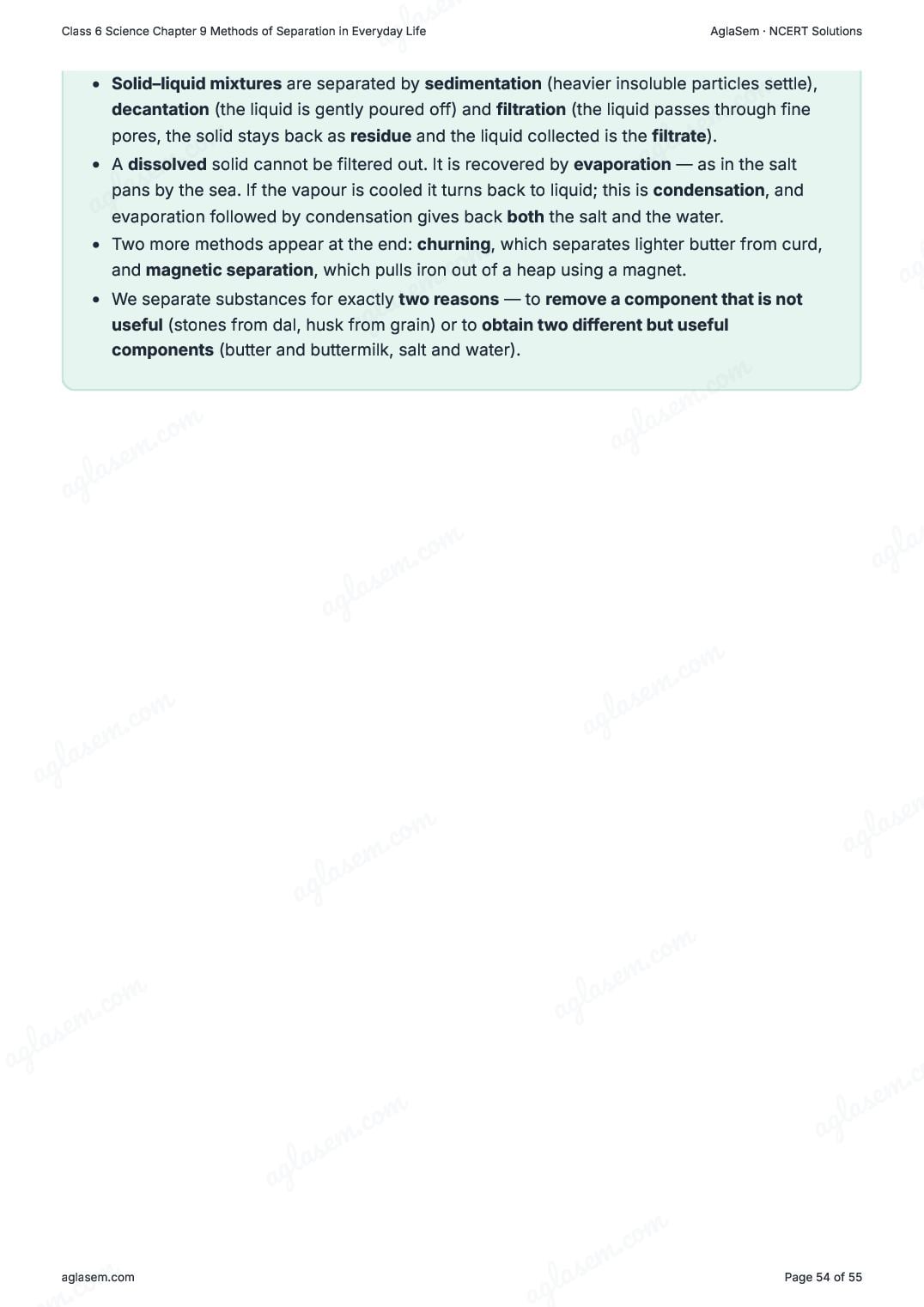
- The chapter travels with Malli and Valli across India — Haryana, Ahmedabad, Puducherry, Bhopal and Shillong — and at every halt they meet one more way of separating a mixture (two or more substances mixed together).
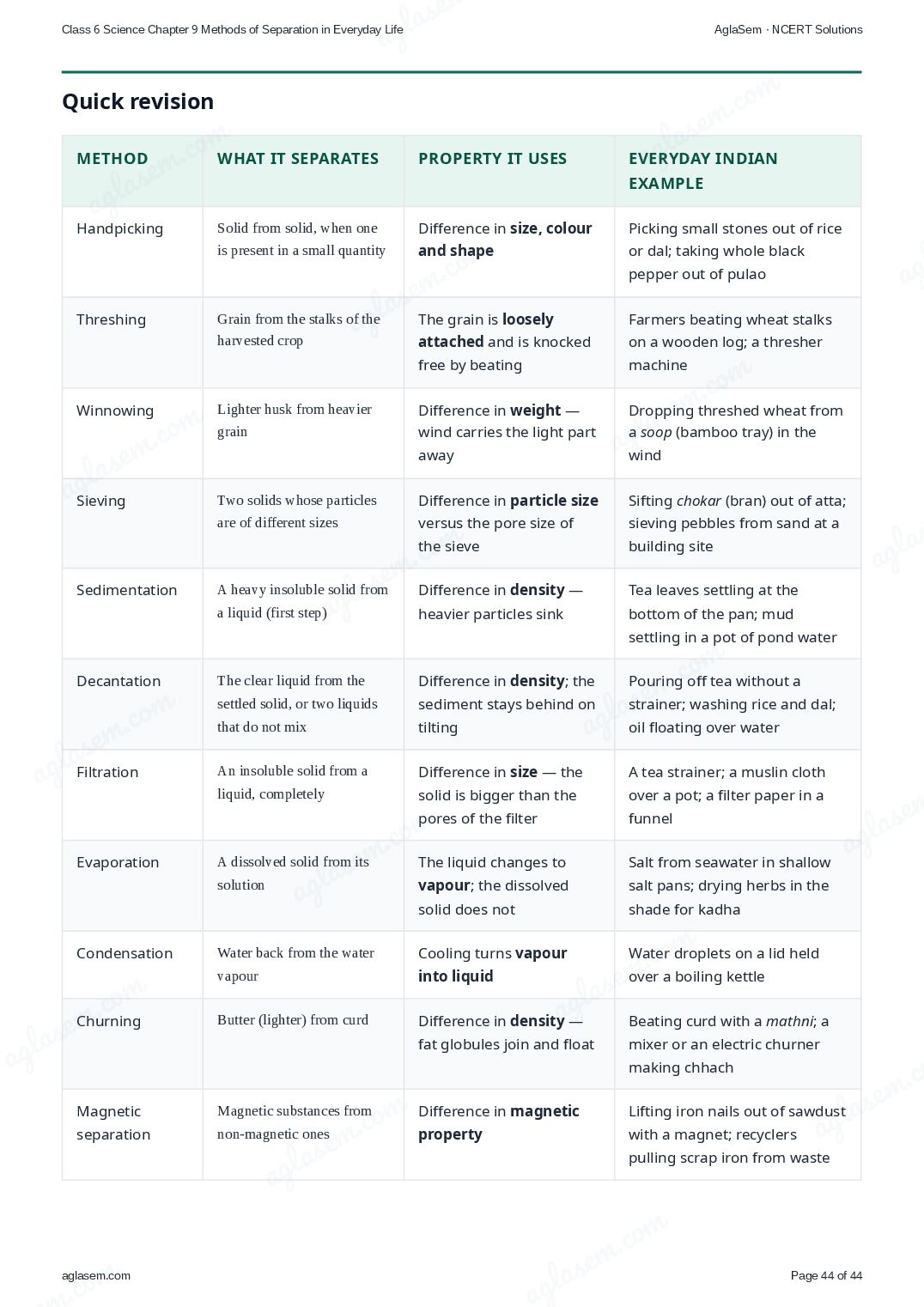
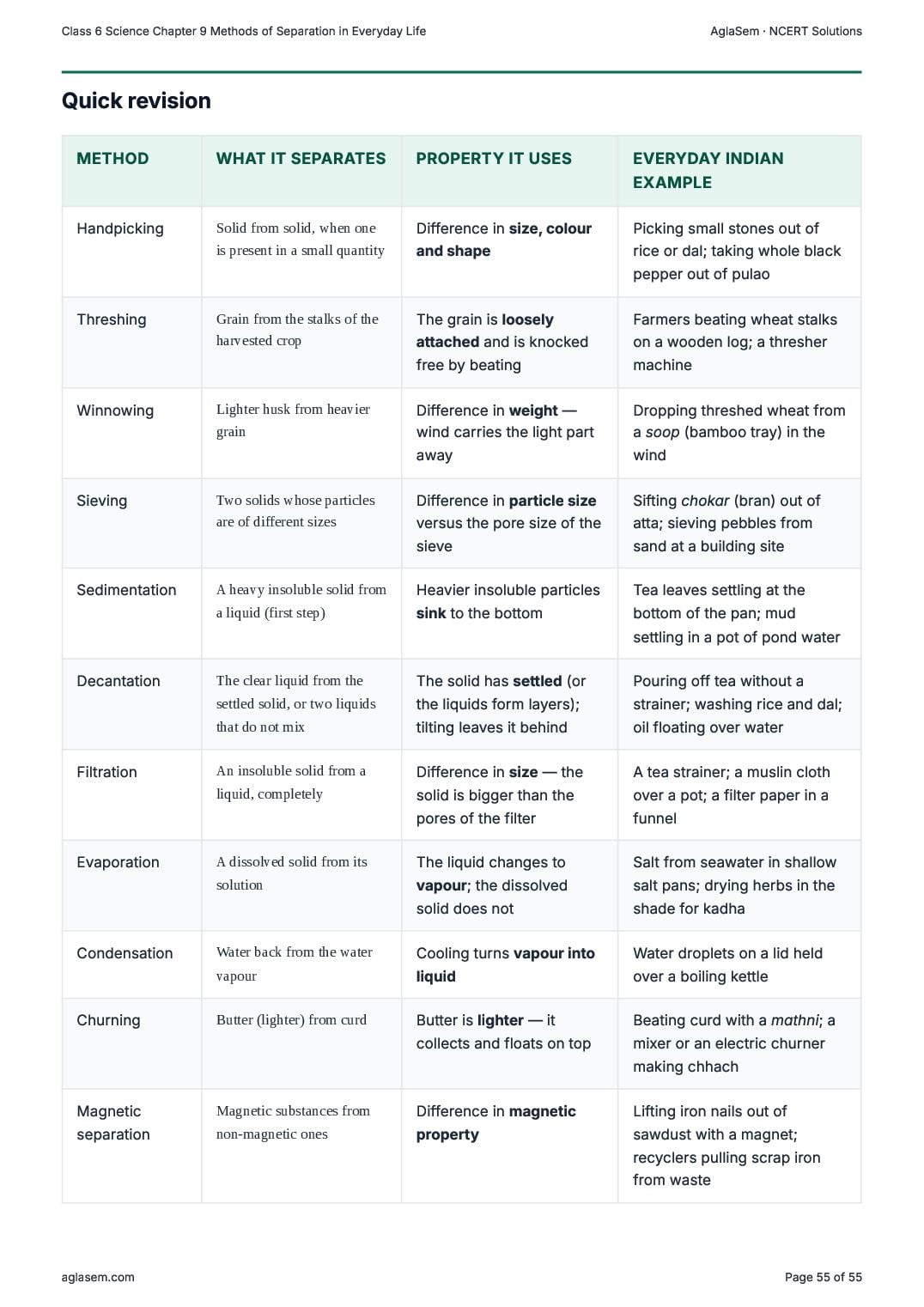
- Solid–solid mixtures are separated by handpicking (difference in size, colour and shape), threshing (beating stalks to free the grain), winnowing (difference in weight, using wind) and sieving (difference in particle size).
- Solid–liquid mixtures are separated by sedimentation (heavier insoluble particles settle), decantation (the liquid is gently poured off) and filtration (the liquid passes through fine pores, the solid stays back as residue and the liquid collected is the filtrate ).
- A dissolved solid cannot be filtered out. It is recovered by evaporation — as in the salt pans by the sea. If the vapour is cooled it turns back to liquid; this is condensation , and evaporation followed by condensation gives back both the salt and the water.
- Two more methods appear at the end: churning , which separates lighter butter from curd, and magnetic separation , which pulls iron out of a heap using a magnet.
- We separate substances for exactly two reasons — to remove a component that is not useful (stones from dal, husk from grain) or to obtain two different but useful components (butter and buttermilk, salt and water).
How to Download NCERT Solutions for Class 6 Science Chapter 9 PDF
Follow these simple steps to get the Methods of Separation in Everyday Life questions-and-answers PDF from Curiosity.
- Search NCERT Solutions for Class 6 Science Chapter 9 aglasem and open this page.
- Read the exercise questions with answers for Methods of Separation in Everyday Life shown above.
- Click the Download PDF link to save the Methods of Separation in Everyday Life solutions to your device.
NCERT Solutions for Class 6 Science – All Chapters
There are more chapters to study besides Methods of Separation in Everyday Life in Science. Here are the NCERT Solutions for all chapters of Class 6 Science.
- Chapter 1 the Wonderful World of Science
- Chapter 2 Diversity in the Living World
- Chapter 3 Mindful Eating a Path to a Healthy Body
- Chapter 4 Exploring Magnets
- Chapter 5 Measurement of Length and Motion
- Chapter 6 Materials Around Us
- Chapter 7 Temperature and Its Measurement
- Chapter 8 a Journey Through States of Water
- Chapter 9 Methods of Separation in Everyday Life
- Chapter 10 Living Creatures Exploring Their Characteristics
- Chapter 11 Nature’s Treasures
- Chapter 12 Beyond Earth
NCERT Solutions for Class 6 – All Subjects
Just like Chapter 9 of Science, you can get the exercise questions with answers for every other subject of Class 6. Here are the NCERT Solutions for all subjects of Class 6.
NCERT Solutions for Class 6 Science Chapter 9 – An Overview
The key highlights of this study material are as follows.
| Aspects | Details |
|---|---|
| Class | Class 6 |
| Subject | Science |
| Chapter Number | Chapter 9 |
| Chapter Name | Methods of Separation in Everyday Life |
| Book Name | Curiosity |
| Book By | NCERT (National Council of Educational Research and Training) |
| Educational Resource Here | NCERT Solutions of Class 6 Science Chapter 9 for all exercises |
| More Questions Answers of This Subject | NCERT Solutions for Class 6 Science |
| Download Book Chapter | NCERT Book Class 6 Science |
| All Questions Answers For This Class | NCERT Solutions for Class 6 |
| Complete Solutions | NCERT Solutions |
NCERT Solutions for Class 6 Science Chapter 9 Methods of Separation in Everyday Life – FAQs
What are the NCERT Solutions for Class 6 Science Chapter 9 Methods of Separation in Everyday Life?
They are the complete, step-by-step answers to all the exercise and in-text questions of Chapter 9 Methods of Separation in Everyday Life from the NCERT Class 6 Science textbook Curiosity, written by experts as per the latest NCERT syllabus.
How can I download the Class 6 Science Chapter 9 solutions PDF for free?
Open this page on aglasem, read the Methods of Separation in Everyday Life questions with answers, and click the “Download Solutions PDF” link. The Class 6 Science Chapter 9 NCERT Solutions PDF is completely free to download.
Are these NCERT Solutions as per the latest 2026-27 syllabus?
Yes. The NCERT Solutions for Class 6 Science Chapter 9 are based on the latest NCERT textbook Curiosity and the current 2026-27 CBSE syllabus, so the questions and answers match what you study in class.
Where can I get NCERT Solutions for the other chapters of Class 6 Science?
You can find the answers to every chapter on the NCERT Solutions for Class 6 Science page, and solutions for every subject on the NCERT Solutions for Class 6 page.
How do NCERT Solutions help in exam preparation?
They show the correct method to solve each question, help you write answers the way they are expected in exams, let you check and correct your own work, and save revision time — which together improve your marks in Class 6 Science.
If you have any queries on NCERT Solutions for Class 6 Science Chapter 9 Methods of Separation in Everyday Life, then please ask in the comments below.